/
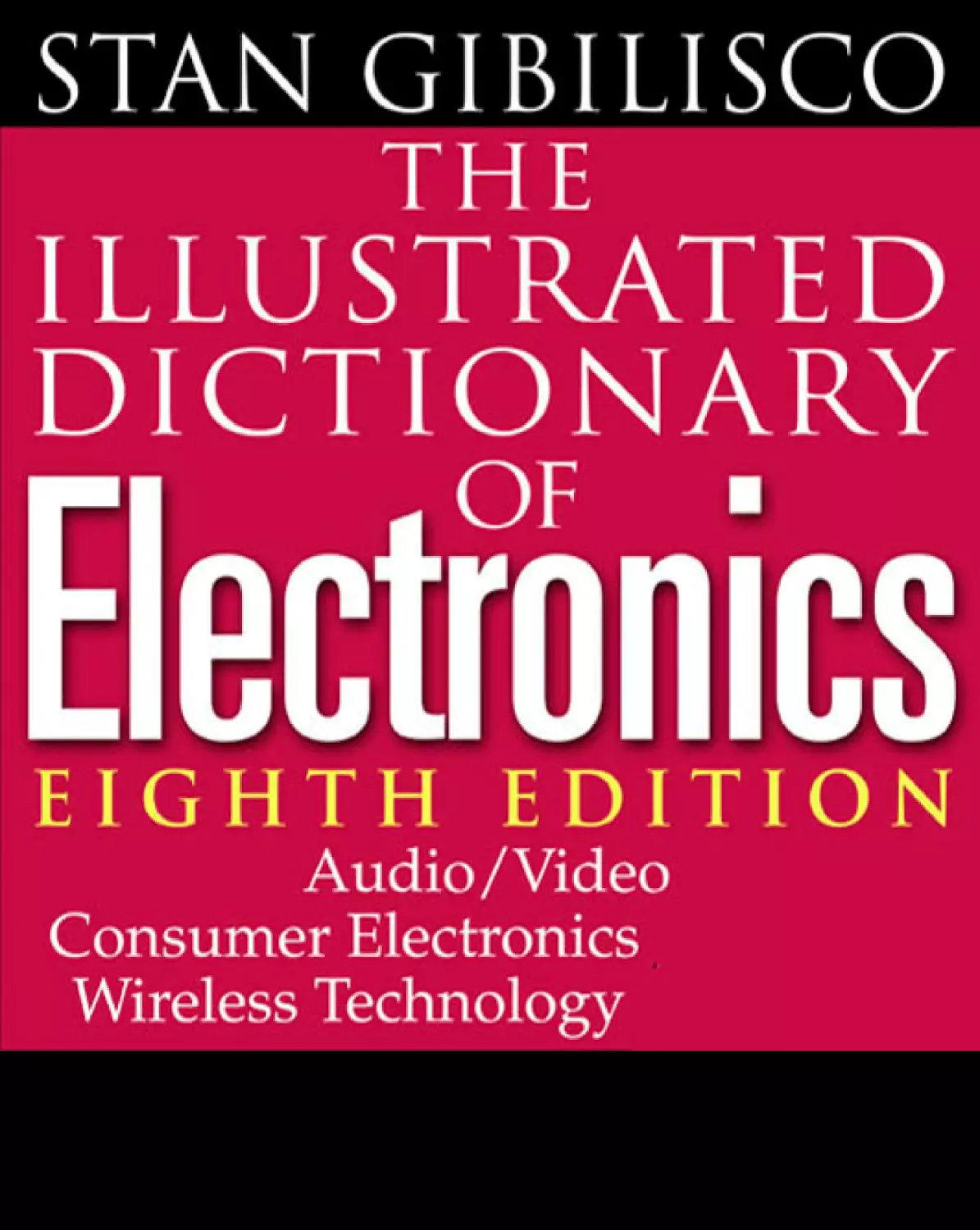


Автор: Gibilisco S.
Теги: dictionary electrical engineering electronics electrical equipment radio electronics
ISBN: 0-07-137236-9
Год: 2001


Текст
Front
4/9/01
4:38 PM
Page i
The
Illustrated Dictionary of
Electronics
This page intentionally left blank.
Front
4/9/01
4:38 PM
Page iii
The
Illustrated Dictionary
of Electronics
Eighth Edition
Stan Gibilisco
Editor-in-Chief
McGraw-Hill
New York Chicago San Francisco Lisbon London Madrid
Mexico City Milan New Delhi San Juan Seoul
Singapore Sydney Toronto
Front
4/12/01
4:38 PM
Page iv
Cataloging-in-Publication Data is on file with the Library of Congress
abc
McGraw-Hill
Copyright © 2001 by The McGraw-Hill Companies, Inc. All rights reserved. Printed in the United States of
America. Except as permitted under the United States Copyright Act of 1976, no part of this publication
may be reproduced or distributed in any form or by any means, or stored in a data base or retrieval system,
without the prior written permission of the publisher.
1234567890
AGM/AGM
0987654321
P/N 0-07-137237-7
ISBN 0-07-137236-9
The sponsoring editor for this book was Scott Grillo, and the production supervisor was Pamela Pelton. It
was set in Bookman by Techbooks.
Printed and bound by Quebecor/Martinsburg.
McGraw-Hill books are available at special quantity discounts to use as premiums and sales promotions, or
for use in corporate training programs. For more information, please write to the Director of Special Sales,
McGraw-Hill, Two Penn Plaza, New York, NY 10121-2298. Or contact your local bookstore
Information in this book has been obtained by the publisher
from sources believed to be reliable. However, neither the
publisher nor the authors guarantee the accuracy or completeness of any information published herein. Neither the publisher
nor the authors shall be responsible for any errors, omissions, or
damages arising out of use of this information. This work is published with the understanding that the publisher and authors
are supplying information but are not attempting to render professional services in any way, shape or form. If such services are
required, the assistance of an appropriate professional should
be sought.
This book is printed on recycled, acid-free paper containing a minimum of 50 percent recycled
de-inked fiber.
Front
4/9/01
4:38 PM
Page v
To Tony, Tim, and Samuel
from Uncle Stan
This page intentionally left blank.
Front
4/9/01
4:38 PM
Page vii
Contents
Preface ix
Acknowledgments
xi
Dictionary 1
Appendix A Schematic Symbols 773
Appendix B Tables and Data 787
Copyright 2001 The McGraw-Hill Companies, Inc. Click Here for Terms of Use
This page intentionally left blank.
Front
4/9/01
4:38 PM
Page ix
Preface
The Illustrated Dictionary of Electronics—8th Edition has been revised, clarified, and updated, reflecting technological advances of recent years. New definitions have been added in
the fields of wireless technology, robotics, and artificial intelligence. Every effort has been
made to be concise and accurate, without “talking down” to the reader.
Many definitions contain cross references (indicated in ALL CAPITALS); these provide
recommended additional information or allow comparison with related terms. Expressions of
special significance are printed in italics. Electronics abbreviations are included in the text;
the full terms are stated as definitions.
While an effort has been made to avoid superfluous mathematics, equations are sometimes necessary to completely and effectively define a term. Mathematics beyond the highschool level has not been used.
Appendix A contains the standard symbols used in electrical and electronic diagrams.
These symbols are used in illustrations throughout this dictionary. Appendix B contains the
following data tables:
1.
2.
3.
4.
5.
Conversion between electrical systems
Greek alphabet
Mathematical functions and operations
Prefix multipliers
Resistor color code
Suggestions for future editions are welcome.
Stan Gibilisco
Editor-in-Chief
Copyright 2001 The McGraw-Hill Companies, Inc. Click Here for Terms of Use
This page intentionally left blank.
Front
4/9/01
4:38 PM
Page xi
Acknowledgments
Illustrations in this book were generated with CorelDRAW. Some clip art is courtesy of Corel
Corporation, 1600 Carling Avenue, Ottawa, Ontario, Canada K1Z 8R7.
Copyright 2001 The McGraw-Hill Companies, Inc. Click Here for Terms of Use
This page intentionally left blank.
Front
4/9/01
4:38 PM
Page xiii
The
Illustrated Dictionary of
Electronics
This page intentionally left blank.
5059F-pA_1-55
A
4/9/01
4:41 PM
Page 1
1. Symbol for GAIN. 2. Symbol for AREA. 3. Symbol for AMPERE (SI unit for current).
A Symbol for negative terminal of filament-voltage
source in a vacuum-tube circuit.
A Symbol for positive terminal of filament-voltage
source in a vacuum-tube circuit.
a 1. Abbreviation of ATTO- (prefix). 2. Abbreviation
of AREA. 3. Abbreviation of ACCELERATION.
4. Abbreviation of ANODE. 5. Obsolete abbreviation of cgs prefix AB-.
aA 1. Abbreviation of attoampere. 2. Obsolete for
ABAMPERE.
AAAS Abbreviation for American Association for the
Advancement of Science.
AAC Abbreviation of automatic aperture control
(NASA).
AAS Abbreviation of advanced antenna system
(NASA).
AASR Abbreviation of airport and airways surveillance radar.
AB Abbreviation of acquisition beacon (NASA).
A-B In sound and acoustics, the direct comparison
of two sources of sound by alternately turning on
one and the other.
ab- 1. Prefix that transforms the name of a practical electrical unit to that of the equivalent electromagnetic cgs unit (e.g., ABAMPERE, ABOHM,
ABVOLT). See individual entries of such cgs
units. 2. Abbreviation for ABSOLUTE.
abac A graphic device for the solution of electronics
problems. Also see ALIGNMENT CHART.
abampere The unit of current in the cgs electromagnetic system. One abampere equals 10
amperes and corresponds to 1 abcoulomb per
second.
Abbe condenser 1. In microscopy, a special twopiece lens that has enhanced light-gathering
power. 2. A similar focusing device in an electromagnetic antenna.
abbreviated dialing In telephone systems, special
circuits requiring fewer-than-normal dialing operations to connect subscribers.
abc 1. Abbreviation of AUTOMATIC BASS COMPENSATION, a system for boosting the volume of
bass sounds at low amplifier gain. 2. Abbreviation of AUTOMATIC BIAS CONTROL. 3. Abbreviation of AUTOMATIC BRIGHTNESS CONTROL.
4. Abbreviation of AUTOMATIC BRIGHTNESS
COMPENSATION.
abcoulomb The unit of electrical quantity in the
cgs electromagnetic system. One abcoulomb
equals 10 coulombs and is the quantity of electricity that flows past any point in a circuit in one
second when the current is one abampere.
aberration 1. Distortion from perfect shape in a
lens or reflecting mirror or antenna dish. 2. A
small error in the determination of the direction
of a source of electromagnetic energy, on account
of the motion of the source and/or the detecting
apparatus. 3. A small displacement in the apparent positions of the stars from month to month on
account of the earth’s orbital motion.
ABETS Acronym for airborne beacon electronic test
set (NASA).
abfarad The unit of capacitance in the cgs electromagnetic system. One abfarad equals 109 farads
and is the capacitance across which a charge of
1 abcoulomb produces a potential of 1 abvolt.
abhenry The unit of inductance in the cgs electromagnetic system. One abhenry equals 10–9 henry
Copyright 2001 The McGraw-Hill Companies, Inc. Click Here for Terms of Use
5059F-pA_1-55
2
4/9/01
4:41 PM
Page 2
abhenry • absolute error
and is the inductance across which a current
that changes at the rate of 1 abampere per second induces a potential of 1 abvolt.
ABL Abbreviation of Automated Biology Laboratory
(NASA).
abmho The obsolete unit of conductance and of
conductivity in the cgs electromagnetic system.
Replaced with ABSIEMENS.
abnormal dissipation Power dissipation higher or
lower than the customary level, usually an overload.
abnormal oscillation 1. Oscillation where none is
desired or expected, as in an amplifier. 2. Oscillation at two or more frequencies simultaneously
when single-frequency operation is expected.
3. Oscillation at an incorrect frequency. 4. Parasitic
oscillation.
abnormal propagation 1. The chance shifting of
the normal path of a radio wave, as by displacements in the ionosphere, so that reception is degraded. 2. Unintentional radiation of energy from
some point other than the transmitting antenna.
3. Propagation over a path or in a direction not
expected.
abnormal reflections Sharp, intense reflections at
frequencies higher than the critical frequency of
the ionosphere’s ionized layer.
abnormal termination The shutdown of a running
computer program or other process. Caused by
the detection of an error by the associated hardware that indicates that some ongoing series of
actions cannot be executed correctly.
abnormal triggering The false triggering or switching of a circuit or device, such as a flip-flop, by
some undesirable source instead of the true trigger
signal. Electrical noise pulses often cause abnormal triggering.
abohm The unit of resistance and of resistivity in
the cgs electromagnetic system. One abohm
equals 10–9 ohms and is the resistance across
which a steady current of 1 abampere produces a
potential difference of 1 abvolt.
abort To deliberately terminate an operation, experiment, process, or project before it has run its
normal course.
AB power pack 1. A portable dry-cell or wet-cell
array containing both A and B batteries in one
package. 2. An ac-operated unit in one package
for supplying A and B voltages to equipment normally operated from batteries.
abrasion machine An instrument for determining
the abrasive resistance of a wire or cable.
abrasion resistance A measure of the ability of a
wire or wire covering to resist mechanical damage.
ABS A basic programming abbreviation for the absolute value (of a number, variable, or expression).
abscissa 1. The independent variable in a function.
2. The axis (usually horizontal) on the graph of a
function that indicates the independent variable.
absence-of-ground searching selector A rotary
switch that searches for an ungrounded contact
in a dial telephone system.
absiemens The unit of conductance or conductivity in the cgs electromagnetic system. One
absiemens equals 109 siemens and is the
conductance through which a potential of 1 abvolt forces a current of 1 abampere.
absolute 1. A temperature scale in which zero represents the complete absence of heat. Units of measure are same as units on Celsius and Fahrenheit
scales. See ABSOLUTE SCALE. 2. Independent of
any arbitrarily assigned units of measure or value.
absolute accuracy The full-scale accuracy of a meter with respect to a primary (absolute) standard.
absolute address In a digital computer program,
the location of a word in memory, as opposed to
location of the word in the program.
absolute code A computer code in which the exact
address is given for storing or locating the reference operand.
absolute coding In computer practice, coding that
uses absolute addresses.
absolute constant A mathematical constant that
has the same value wherever it is used.
absolute delay The time elapsing between the
transmission of two synchronized signals from
the same station or from different stations, as in
radio, radar, or loran. By extension, the time interval between two such signals from any source,
as from a generator.
absolute digital position transducer A digital position transducer whose output signal indicates
absolute position. (See ENCODER.)
absolute efficiency The ratio Xx/Xs, where Xx is
the output of a given device, and Xs is the output
of an ideal device of the same kind under the
same operating conditions.
absolute encoder system A system that permits
the encoding of any function (linear, nonlinear,
continuous, step, and so on) and supplies a nonambiguous output.
absolute error The difference indicated by the approximate value of a quantity minus the actual
5059F-pA_1-55
4/9/01
4:41 PM
Page 3
absolute error • absolute tolerance
value. This difference is positive when the approximate value is higher than the exact value,
and it is negative when the approximate value is
lower than the exact value. Compare RELATIVE
ERROR.
absolute gain Antenna gain for a given orientation
when the reference antenna is isolated in space
and has no main axis of propagation.
absolute humidity The mass of water vapor per
unit volume of air. Compare RELATIVE HUMIDITY.
absolute instruction A computer instruction that
states explicitly and causes the execution of a
specific operation.
absolute magnitude For a complex number quantity, the vector sum of the real and imaginary
components (i.e., the square root of the sum of
the squares of those components). Also see ABSOLUTE VALUE and IMPEDANCE.
absolute maximum rating The highest value a
quantity can have before malfunction or damage
occurs.
absolute maximum supply voltage The highest
supply voltage that can be applied to a circuit
without permanently altering its characteristics.
absolute measurement of current Measurement
of a current directly in terms of defining quantities. 1. TANGENT GALVANOMETER method:
Current is proportional to the tangent of the angle of deflection of the needle of this instrument.
Deflection depends on torque, resulting from the
magnetic field produced by current in the galvanometer coil acting against the horizontal
component of the earth’s magnetic field.
2. ELECTRODYNAMOMETER method: With this
2-coil instrument, current is determined from
the observed deflection, the torque of the suspension fiber of the movable coil, and the coil dimensions.
absolute measurement of voltage Measurement
of a voltage directly in terms of defining quantities. 1. CALORIMETRIC method: A currentcarrying coil immersed in water raises the
temperature of the water. The difference of
potential that forces the current through the coil
then is determined in terms of the equivalent heat
energy. 2. Disk-electrometer method: In this
setup, a metal disk attached to one end of a
balance beam is attracted by a stationary disk
mounted below it, the voltage being applied to the
two disks. The other end of the beam carries a
pan into which accurate weights are placed. At
balance, the voltage is determined in terms of the
weight required to restore balance, the upper-disk
area, and the disk separation.
absolute minimum resistance The resistance between the wiper and the nearer terminal of a potentiometer, when the wiper is as close to that
terminal as physically possible. All potentiometers have two such specifications, one for each
end terminal.
3
absolute Peltier coefficient The product of the
absolute Seebeck coefficient and absolute temperature of a material.
absolute pitch A tone in a standard scale, determined according to the rate of vibration, independent of other tones in the range of pitch.
absolute pressure Pressure (force per unit area) of
a gas or liquid determined with respect to that of
a vacuum (taken as zero).
absolute-pressure transducer A transducer actuated by pressure from the outputs of two different
pressure sources, and whose own output is proportional to the difference between the two applied pressures.
absolute scale 1. A scale in which the zero value
indicates the lowest physically possible value that
a parameter can attain. 2. A standard scale
for measurement of a quantity. 3. A universally
agreed-upon scale for the determination of a variable quantity. 4. The Kelvin temperature scale.
5. The Rankine temperature scale.
absolute Seebeck coefficient The quotient, as an
integral from absolute zero to the given temperature, of the Thomson coefficient of a material divided by its absolute temperature.
absolute spectral response The frequency output
or response of a device in absolute power units
(such as milliwatts) as opposed to relative units
(such as decibels).
absolute system of units A system of units in
which the fundamental (ABSOLUTE) units are
those expressing length (l), mass (m), charge (q),
and time (t). All other physical units, including
practical ones, are then derived from these absolute units.
absolute temperature Temperature measured on
either the Kelvin or Rankine scales, where zero
represents the total absence of heat energy.
absolute temperature scale 1. The Kelvin temperature scale, in which the divisions are equal in
size to 1° Celsius, and the zero point is absolute
zero, the coldest possible temperature, approximately –273.16° Celsius. 2. The Rankine temperature scale, in which the divisions are equal in
size to 1° Fahrenheit, and the zero point is absolute zero or approximately –459.7° Fahrenheit.
absolute tolerance The value of a component as it
deviates from the specified or nominal value. It is
usually expressed as a percentage of the specified
value.
5059F-pA_1-55
4
4/9/01
4:41 PM
Page 4
absolute units • A-B test
absolute units Fundamental physical units (see
ABSOLUTE SYSTEM OF UNITS) from which all
others are derived. See, for example, AMPERE,
OHM, VOLT, and WATT.
absolute value The magnitude of a quantity without regard to sign or direction. The absolute value
of a is written |a|. The absolute value of a positive number is the number itself; thus, |10|
equals 10. The absolute value of a negative number is the number with its sign changed: |-10|
equals 10.
absolute-value circuit A circuit that produces a
unipolar signal in response to a bipolar input and
in proportion to the absolute value of the magnitude of the input.
absolute-value computer A computer in which
data is processed in its absolute form; i.e., every
variable maintains its full value. (Compare to
INCREMENTAL COMPUTER.)
absolute-value device In computer practice, a device that delivers a constant-polarity output
signal equal in amplitude to that of the input
signal. Thus, the output signal always has the
same sign.
absolute
zero The
temperature
–273.16°C
(459.7°F and 0 Kelvin). The coldest possible
temperature, representing the complete absence
of heat energy.
absorbed wave A radio wave that dissipates in the
ionosphere as a result of molecular agitation.
This effect is most pronounced at low and
medium frequencies.
absorptance The amount of radiant energy absorbed in a material; equal to 1 minus the transmittance.
absorption The taking up of one material or medium by another into itself, as by sucking or
soaking up. Also, the retention of one medium (or
a part of it) by another medium, through which
the first one attempts to pass. See, for example,
ABSORBED WAVE, ABSORPTION COEFFICIENT, DIELECTRIC ABSORPTION. Compare
ADSORPTION.
absorption band See ABSORPTION SPECTRUM.
absorption circuit A circuit that absorbs energy
from another circuit or from a signal source—especially a resonant circuit, such as a wavemeter
or wavetrap.
absorption current In a capacitor, the current resulting from absorption of energy by the dielectric
material.
absorption dynamometer A power-measuring instrument in which a brake absorbs energy from a
revolving shaft or wheel.
absorption fading Fading of a radio wave, resulting from (usually) slow changes in the absorption
of the wave in the line of propagation.
absorption frequency meter See WAVEMETER.
absorption line See ABSORPTION SPECTRUM.
absorption loss 1. Transmission loss caused by
dissipation of electrical energy, or conversion of it
into heat or other forms of energy. 2. Loss of all or
part of a skywave because of absorption by the
ionosphere. Also called ionospheric absorption or
atmospheric absorption.
absorption marker A small blip introduced onto
an oscilloscope trace to indicate a frequency
point. It is so called because it is produced by the
action of a frequency-calibrated tuned trap, similar to an absorption wavemeter.
absorption modulation Amplitude modulation of a
transmitter or oscillator by means of an audiofrequency-actuated absorber circuit. In its simplest
form, the modulator consists of a few turns of wire
coupled to the transmitter tank coil and connected to a carbon microphone. The arrangement
absorbs energy from the transmitter at a varying
rate as the microphone changes its resistance in
accordance with the sound waves it receives.
absorption spectrum For electromagnetic waves, a
plot of absorption coefficient (of the medium of
propagation) versus frequency. Also called EMISSION SPECTRUM.
absorption trap See WAVETRAP.
absorption wavemeter A resonant-frequency indicating instrument that is inductively coupled to
the device under test.
absorptivity In audio and microwave technologies,
a measure of the energy absorbed by a given volume of material.
A-B test Comparison of two sounds by reproducing them in alternating succession.
5059F-pA_1-55
4/9/01
4:41 PM
Page 5
abvolt • accentuation
abvolt The unit of potential difference in the cgs
electromagnetic system. One abvolt equals 10–8 V
and is the difference of potential between any two
points when 1 erg of work is required to move 1
abcoulomb of electricity between them.
abwatt The unit of power in the cgs electromagnetic
system. One abwatt equals 107 W and is the
power corresponding to 1 erg of work per second.
ac 1. Abbreviation of ALTERNATING CURRENT.
2. Abbreviation of ATTITUDE CONTROL. 3. Abbreviation of AERODYNAMIC CENTER. 4. A suffix meaning AUTOMATIC CALCULATOR or
AUTOMATIC COMPUTER.
a/c 1. Abbreviation of AIRCRAFT. 2. Abbreviation
of AIR CONDITIONING.
Ac Symbol for ACTINIUM.
ACA Abbreviation of automatic circuit analyzer.
ac base current Symbol, IB(ac). The ac component of
base current in a bipolar transistor.
ac base resistance Symbol, RB (ac). The dynamic
base resistance in a bipolar transistor.
ac base voltage Symbol, VB(ac). The ac component
of base voltage in a bipolar transistor. It is the ac
input signal voltage in a common-emitter amplifier or emitter-follower amplifier.
ac bias In a tape recorder, the high-frequency current that passes through the recording head to
linearize operation.
acc 1. Abbreviation of AUTOMATIC CHROMINANCE CONTROL. 2. Abbreviation of AUTOMATIC COLOR COMPENSATION. 3. Abbreviation
of ACCELERATION.
ac cathode current Symbol, IK(ac). The ac component of cathode current in an electron tube.
ac cathode resistance Symbol, RK(ac). The dynamic
cathode resistance in an electron tube. RK(ac)
equals dVK/dIK for a constant value of VG.
ac cathode voltage Symbol, VK(ac). The ac component of cathode voltage in an electron tube. It is
the ac output signal voltage in cathode-follower
and grounded-grid amplifiers.
accelerated life test A test program that simulates the effects of time on devices or apparatus,
by artificially speeding up the aging process.
accelerated service test A service or bench test in
which equipment or a circuit is subjected to an
extreme condition in an attempt to simulate the
effects of average use over a long time.
accelerating conductor or relay A conductor or
relay that prompts the operation of a succeeding
device in a starting mode according to established
conditions.
accelerating electrode In a cathode-ray tube or
klystron, the electrode to which the accelerating
voltage is applied.
accelerating time The elapsed time that starts
when voltage is applied to a motor, and ends
when the motor shaft reaches maximum speed.
accelerating voltage A positive high voltage applied
to the accelerating electrode of a cathode-ray tube
to increase the velocity of electrons in the beam.
5
acceleration at stall The angular acceleration of a
servomotor at stall, determined from the stall
torque and the moment of inertia of the motor’s
rotor.
acceleration derivative Acceleration (a) expressed
as the second derivative of distance (s) with respect to time (t): a equals d 2s/dt 2.
acceleration
potential See
ACCELERATING
VOLTAGE.
acceleration switch A switch that operates automatically when the acceleration of a body to
which it is attached exceeds a predetermined rate
in a given direction.
acceleration time The time required by a computer to take in or deliver information after interpreting instructions. Compare ACCESS TIME.
acceleration torque During the accelerating period of a motor, the difference between the torque
demanded and the torque actually produced by
the motor.
acceleration voltage The potential between accelerating elements in a vacuum tube, the value of
which determines average electron velocity.
accelerometer A transducer whose output voltage
is proportional to the acceleration of the moving
body to which it is attached.
accentuation The emphasis of a desired band of
frequencies, usually in the audio-frequency spectrum.
5059F-pA_1-55
6
4/9/01
4:41 PM
Page 6
accentuator • accuracy rating
accentuator A circuit or device, such as a filter,
tone control, or equalizer, used to emphasize a
band of frequencies, usually in the audiofrequency spectrum. Also see ACCENTUATION.
acceptable-environmental-range test A test to
disclose the environmental conditions that equipment can endure while maintaining at least the
minimum desired reliability.
acceptable quality level Abbreviation, AQL. A percentage that represents an acceptable average of
defective components allowable for a process, or
the lowest quality that a supplier is permitted to
regularly present for acceptance.
acceptance sampling plan A probabilistic method
of sampling a quantity of units from a lot, and determining from the sample whether to accept the
lot, reject the lot, or perform another sampling.
acceptance test A test performed on incoming
equipment or on submitted samples to determine
if they meet tester’s or supplier’s specifications.
acceptor 1. Any device or circuit, such as a seriesresonant circuit, that provides relatively easy
transmission of a signal, in effect accepting the
signal. 2. A hole-rich impurity added to a semiconductor to make the latter p-type. It is so called
because its holes can accept electrons. Compare
DONOR.
acceptor circuit See ACCEPTOR, 1.
acceptor impurity See ACCEPTOR, 2.
access 1. To gain entrance to something, such as
the interior of the cabinet of a high-fidelity amplifier. 2. In a computer, the action of going to a specific memory location for the purpose of data
retrieval. 3. A port or opening into a piece of
equipment, placed there to make the equipment
easy to maintain and repair.
access arm A mechanical device that positions the
read/write mechanism in a computer storage unit.
access control register A register that is part of a
computer protection system that prevents interference between different software modules.
access method A method of transferring information or data from main storage to an input/output unit.
access right The access status given to computer
system users that indicates the method of access
permitted (e.g., read a file only or write to a file).
access time The time required by a computer to
begin delivering information after the memory or
storage has been interrogated.
accidental error An unintentional error committed by a person making measurements and
recording data.
accidental triggering The undesired chanceoperation of a flip-flop or other switching circuit
caused by a noise pulse or other extraneous signal.
ac collector current Symbol, IC(ac). The ac component of collector current in a bipolar transistor.
ac collector resistance Symbol, RC(ac). The dynamic collector resistance of a bipolar transistor.
RC(ac) equals dVC/dIC for a constant value of base
current IB (in a common-emitter circuit) or emitter current IE (in a common-base circuit).
ac collector voltage Symbol, VC(ac). The ac component of collector voltage in a bipolar transistor.
The ac output signal voltage in a common-emitter
or common-base amplifier.
accompanying audio channel The RF signal that
supplies television sound. Also called Cochannnel
sound frequency.
ac component In a complex wave (i.e., one containing both ac and dc), the alternating, fluctuating, or pulsating part of the combination.
Compare DC COMPONENT.
accordion A printed-circuit connector contact with
a Z-shaped spring that allows high deflection
with low fatigue.
ac-coupled flip-flop A flip-flop that is operated by
the rise or fall of a clock pulse.
ac coupling Transformer coupling or capacitive
coupling, which transmit ac, but not dc. Compare
DIRECT COUPLING.
accumulator 1. In a digital computer, a circuit or
register device that receives numbers, totals
them, and stores them. 2. Storage battery.
accuracy 1. Precision in the measurement of
quantities and in the statement of physical characteristics. 2. Degree of precision. Usually expressed, in terms of error, as a percentage of the
specified value (e.g., 10 V plus or minus 1%), as a
percentage of a range (e.g., 2% of full scale), or as
parts (e.g., 100 parts per million).
accuracy rating The maximum error in an instrument, given as a percentage of the full-scale
value.
5059F-pA_1-55
4/9/01
4:41 PM
Page 7
accw • ac magnetic bias
accw Abbreviation of ALTERNATING-CURRENT
CONTINUOUS WAVE.
ac/dc Abbreviation of ALTERNATING CURRENT/
DIRECT CURRENT. Pertains to equipment that
will operate from either ac utility power or a dc
power source. A notebook computer is a good example.
ac directional overcurrent relay A relay that
works on a specific value of alternating overcurrent that is rectified for a desired polarity.
ac drain current Symbol, ID(ac). The ac component
of drain current in a field-effect transistor.
ac drain resistance Symbol, RD(ac). The dynamic
drain resistance in a field-effect transistor; RD(ac)
equals dVD/dID for a constant value of gate voltage VG.
ac drain voltage Symbol, VD(ac). The ac component
of drain voltage in a field-effect transistor. The ac
output signal voltage in a common-source FET
amplifier.
ac dump The removal of all ac power from a system
or component.
ac emitter current Symbol, IE(ac). The ac component of emitter current in a bipolar transistor.
ac emitter resistance Symbol, RE(ac). The dynamic
emitter resistance of a bipolar transistor; RE(ac)
equals dVE/dIE for a constant value of base current IB (in an emitter-follower circuit) or collector
voltage VCC (in a common-base circuit).
ac emitter voltage Symbol, VE(ac). The ac component of emitter voltage in a bipolar transistor. The
ac input signal voltage in a common-base amplifier; the ac output signal voltage in an emitterfollower amplifier.
ac equipment An apparatus designed for operation from an ac power source only. Compare DC
EQUIPMENT and AC/DC.
ac erasing In tape recording, the technique of using an alternating magnetic field to erase material
already recorded on the tape.
ac erasing head Also called ac erase head. In tape
and wire recording, a head that carries alternating current to erase material already recorded on
the tape or wire. Also see AC ERASING.
acetate Cellulose acetate, a tough thermoplastic
material that is an acetic acid ester of cellulose. It
is used as a dielectric and in the manufacture of
photographic films.
acetate base 1. The cellulose acetate film that
served as the base for the magnetic oxide coating
in early recording tape. Most such tapes today
are of polyester base. 2. The cellulose acetate
substrate onto which certain photosensitive materials are deposited for lithographic reproduction. Also see ACETATE and ANCHORAGE.
acetate tape Recording tape consisting of a magnetic oxide coating on a cellulose acetate film.
Also see ACETATE BASE.
ac gate voltage Symbol, VG(ac). The ac component
of gate voltage in a field-effect transistor. The ac
input signal voltage.
7
ac generator 1. A rotating electromagnetic machine that produces alternating current (e.g., a
dynamo or alternator). 2. An oscillator or combination of an oscillator and an output amplifier.
ac grid voltage Symbol, VG(ac). The ac component
of control grid voltage in an electron tube. The ac
input signal voltage in a common-cathode amplifier or cathode follower.
A channel The left channel of a two-channel stereo
system.
achieved reliability A statement of reliability based
on the performance of mass-produced parts or
systems under similar environmental conditions.
Also called OPERATIONAL RELIABILITY.
achromatic 1. Without color. In a TV image, the
tones from black through gray to white. The term
occasionally refers to black-and-white television,
although MONOCHROMATIC is more often used
in this sense.
achromatic locus Also called achromatic region.
An area on a chromaticity diagram that contains
all points, representing acceptable reference
white standards.
achromatic scale A musical scale without accidentals.
ACIA Abbreviation of asynchronous communications interface adapter.
acicular Pertaining to the shape of magnetic particles on recording tape. Under magnification,
these particles look like thin rods.
acid A substance that dissociates in water solution
and forms hydrogen (H) ions (e.g., sulfuric acid).
Compare BASE, 2.
acid depolarizer Also called acidic depolarizer.
An acid, in addition to the electrolyte, used in
some primary cells to slow the process of polarization.
ac line A power line that delivers alternating current only.
ac line filter A filter designed to remove extraneous signals or electrical noise from an ac power
line, while causing virtually no reduction of the
power-line voltage or power.
ac line voltage The voltage commonly delivered
by the commercial power line to consumers. In
the United States, the two standards are 117 V
and 234 V (~ about 5 percent). The lower voltage
is used by most appliances; the higher voltage is
intended for appliances and equipment that
draws high power, such as electric ovens, cooking ranges, clothes dryers, and amateur-radio
amplifiers. In Europe, 220 V is the common
standard.
aclinic line Also called magnetic equator. An imaginary line drawn on a map of the world or of an
area that connects points of zero inclination (dip)
of the needle of a magnetic compass.
ACM Abbreviation for Association for Computing
Machinery.
ac magnetic bias See AC BIAS.
5059F-pA_1-55
8
4/9/01
4:41 PM
Page 8
ac meter • acoustic feedback
ac meter A meter that is intended to work only on
alternating current or voltage. Such meters include iron-vane and rectifier types.
ac noise 1. Electromagnetic interference originating in the ac power lines. 2. Electrical noise of a
rapidly alternating or pulsating nature.
ac noise immunity In computer practice, the ability of a logic circuit to maintain its state, despite
excitation by ac noise.
acous Abbreviation for ACOUSTIC.
acoustic Pertaining to audible sound disturbances, usually in air (versus audio-frequency
currents or voltages).
acoustic absorption The assimilation of energy
from sound waves passing through or reflected by
a given medium.
acoustic absorption loss That portion of sound
energy lost (as by dissipation in the form of heat)
because of ACOUSTIC ABSORPTION.
acoustic absorptivity The ratio of sound energy
absorbed by a material to sound energy striking
the surface of the material.
acoustic attenuation constant The real-number
component of the complex acoustical propagation
constant, expressed in nepers per unit distance.
acoustic burglar alarm An alarm that receives the
noise made by an intruder. The alarm device responds to the impulses from concealed microphones.
acoustic capacitance The acoustic equivalent of
electrical capacitance.
acoustic clarifier In a loudspeaker system, a set of
cones attached to the baffle that vibrate to absorb
and suppress sound energy during loud bursts.
acoustic communication Communications by
means of sound waves. This can be through the
atmosphere, or it can be through solids or liquids, such as a taut wire, a body of water, or the
earth.
acoustic compliance COMPLIANCE in acoustic
transducers, especially loudspeakers. It is equivalent to electrical capacitive reactance.
acoustic consonance An effect that occurs when
two objects are near each other but not in physical
contact, and both have identical or harmonically
related resonant frequencies. An example is shown
by two tuning forks with identical fundamental fre-
quencies. If one fork is struck and then brought
near the other, the second fork will begin vibrating.
If the second fork has a fundamental frequency
that is a harmonic of the frequency of the first fork,
the second fork will vibrate at its own resonant
frequency. See HARMONIC, RESONANCE.
acoustic coupling Data transfer via a sound link
between a telephone and a pickup/reproducer.
Was once common in computer terminals and
facsimile machines. This scheme has been largely
replaced by hard wiring and optical coupling.
acoustic damping The deadening or reduction of
the vibration of a body to eliminate (or cause to
die out quickly) sound waves arising from it.
acoustic delay line Any equivalent of a special
transmission line that introduces a useful time
delay between input and output signals. In one
form, it consists of a crystal block or bar with an
input transducer at one end and an output transducer at the other. An electrical input signal in
the first transducer sets up sound waves that
travel through the interior of the crystal; the
piezoelectric reaction of the crystal to sound vibrations sets up an output voltage in the second
transducer. The delay is caused by the time required for the acoustic energy to travel the length
of the crystal bar.
acoustic depth finder A direct-reading device for
determining the depth of a body of water, or for
locating underwater objects via sonic or ultrasonic waves transmitted downward and reflected
back to the instrument.
acoustic dispersion Variation of the velocity of
sound waves, depending on their frequency.
acoustic elasticity 1. In a loudspeaker enclosure,
the compressibility of air behind the vibrating
cone of the speaker. 2. In general, the compressibility of any medium through which sound
passes.
acoustic electric transducer A transducer, such
as a microphone or hydrophone, that converts
sound energy into electrical energy. Compare
ELECTRICAL/ACOUSTIC TRANSDUCER. Also
see ACOUSTIC TRANSDUCER.
acoustic feedback A usually undesirable effect
that occurs when sound waves from a loudspeaker (or other reproducer) reach a microphone
(or other input transducer) in the same system.
5059F-pA_1-55
4/9/01
4:41 PM
Page 9
acoustic feedback • acoustic radiator
This can cause an amplifier to oscillate, with a resultant rumbling, howling, or whistling.
acoustic filter Any sound-absorbing or transmitting arrangement, or combination of the two, that
transmits sound waves of desired frequency while
attenuating or eliminating others.
acoustic
frequency
response The
soundfrequency range as a function of sound intensity.
A means of describing the performance of an
acoustic device.
acoustic generator A device that produces sound
waves of a desired frequency and/or intensity.
Examples are electrical devices (headphones or
loudspeakers operated from a suitable oscillator,
buzzer, bell, or flame) and mechanical devices
(tuning forks, bells, string, or whistles).
acoustic grating A set of bars or slits that are parallel to one another and arranged a fixed distance
apart so that an interference pattern forms as
sound passes through. Used to determine the
wavelength of acoustic waves.
acoustic homing system 1. A system that uses a
sound signal for guidance purposes. 2. A guidance method in which a missile homes in on
noise generated by a target.
acoustic horn A tapered tube (round or rectangular, but generally funnel-shaped) that directs
sound and, to some extent, amplifies it. So called
to distinguish it from a microwave horn.
acoustic howl See ACOUSTIC FEEDBACK.
acoustician 1. A person skilled in acoustics (an
acoustics technician). 2. An AUDIOLOGIST.
acoustic impedance Unit, ACOUSTIC OHM. The
acoustic equivalent of electrical impedance. Like
the latter, acoustic impedance is the total opposition encountered by acoustic force. Also like electrical impedance, acoustic impedance has
resistive and reactive components: ACOUSTIC
RESISTANCE and ACOUSTIC REACTANCE.
acoustic inductance Also called inertance. The
acoustic equivalent of electrical inductance.
acoustic inertance See ACOUSTIC INDUCTANCE.
acoustic inhibition See AUDITORY INHIBITION.
acoustic intensity See SOUND INTENSITY.
acoustic interferometer An instrument that evaluates the frequency and velocity of sound waves
in a liquid or gas, in terms of a standing wave set
up by a transducer and reflector as the frequency
or transducer-to-reflector distance varies.
acoustic labyrinth A loudspeaker enclosure
whose internal partitions form a maze-like path
or “tube” lined with sound-absorbing material.
The tube effectively runs from the back of the
speaker down to where it terminates in a MOUTH
or PORT that opens at the front of the enclosure.
The labyrinth provides an extremely efficient reproduction system because of its excellent acoustic impedance-matching capability.
acoustic lens A system of barriers that refracts
sound waves the way that an optical lens does
with light waves.
9
acoustic line Baffles or other such structures
within a speaker that act as the mechanical equivalent of an electrical transmission line to enhance
the reproduction of very low bass frequencies.
acoustic load A device that serves simultaneously
as the output load of an amplifier and as a transducer of electrical energy into acoustic energy
(e.g., headphones or a loudspeaker).
acoustic memory In a computer, a volatile memory element employing an acoustic delay line, often incorporating quartz or mercury as the
transmission and delay element.
acoustic mirage A type of sound distortion in
which the listener experiences the illusion of two
sound sources when there is only one. The phenomenon is caused by the effect of a large temperature gradient in the air or water through
which the sound passes.
acoustic mode Crystal-lattice vibration without
producing an oscillating dipole.
acoustic noise Interferential (usually disagreeable)
sounds carried by the air (or other propagation
medium) to the ear or to an acoustic transducer.
This is in contrast to electrical noise, which consists of extraneous current or voltage impulses
and is inaudible until converted into sound.
acoustic ohm The unit of acoustic resistance, reactance, or impedance. One acoustic ohm equals
the volume velocity of 1 cm/s produced by a
sound pressure of 1 microbar (0.1 Pa). Also called
acoustical ohm.
acoustic phase constant The imaginary-number
component of the complex acoustic propagation
constant expressed in radians per second or radians per unit distance.
acoustic phase inverter A bass reflex loudspeaker
enclosure.
acoustic pressure 1. The acoustic equivalent of
electromotive force, expressed in dynes per
square centimeter; also called acoustical pressure. 2. Sound pressure level.
acoustic propagation The transmission of sound
waves, or subaudible or ultrasonic waves, as a
disturbance in a medium, rather than as an electric current or electromagnetic field.
acoustic radiator A device that emits sound
waves. Examples are the cone of a loudspeaker,
the diaphragm of a headphone, and the vibrating
reed of a buzzer.
5059F-pA_1-55
10
4/9/01
4:41 PM
Page 10
acoustic radiometer • ac plate resistance
acoustic radiometer An instrument for measuring
the intensity of a sound wave (see SOUND INTENSITY) in terms of the unidirectional steadystate pressure exerted at a boundary as a result
of absorption or reflection of the wave.
acoustic reactance Unit, ACOUSTIC OHM. The
imaginary-number component of ACOUSTIC
IMPEDANCE. It can take the form of ACOUSTIC
CAPACITANCE or ACOUSTIC INDUCTANCE.
acoustic reflectivity The ratio Fr/Fi, where Fr is
the rate of flow of sound energy reflected from a
surface and Fi is the rate of flow of sound energy
incident to the surface.
acoustic refraction The deflection of sound waves
being transferred obliquely between media that
transmit sound at different speeds.
acoustic regeneration See ACOUSTIC FEEDBACK.
acoustic resistance Unit, ACOUSTIC OHM. The
real-number component of ACOUSTIC IMPEDANCE. The opposing force that causes acoustic
energy to be dissipated in the form of heat. It is
attributed to molecular friction in the medium
through which sound passes. See ACOUSTIC
OHM.
acoustic resonance In an enclosed chamber with
walls that reflect sound waves, resonance that occurs at certain wavelengths because the echoes
combine in and out of phase. Speaker enclosures
almost always have resonance at certain frequencies. This effect can be used to an advantage when
it is necessary to get good bass (low-frequency)
response from a relatively small speaker.
acoustic resonator 1. A chamber, such as a box,
cylinder, or pipe, in which an air column resonates
at a particular frequency. 2. A piezoelectric, magnetostrictive, or electrostrictive body that vibrates
at a resonant audio frequency that is governed by
the mechanical dimensions of the body when an
audio voltage at that frequency is applied.
acoustics 1. The physics of sound. The study and
applications of acoustic phenomena. 2. The qualities of an enclosure or sound chamber (room,
auditorium, or box) that describe how sound
waves behave in it.
acoustic scattering The spreading of a sound
wave in many directions as a result of diffraction,
reflection, or refraction.
acoustic suspension A loudspeaker design that
allows exceptional low-frequency reproduction
for a fairly small physical size. An airtight enclosure is used to increase the tension on the
speaker cone.
acoustic system 1. A coordinated array of acoustic components (e.g., acoustic filters, resonators,
etc.) that responds to sound energy in a predetermined manner. 2. An audio-frequency system in
which sound energy is converted into electrical
energy, processed, and then reconverted into
sound energy for a clearly defined purpose.
acoustic telegraph A telegraph that gives audible
signals, as opposed to visual signals or printed
messages.
acoustic transducer 1. Any device, such as headphones or a loudspeaker, for converting audiofrequency electrical signals into sound waves. 2.
Any device, such as a microphone, for converting
sound waves into alternating, pulsating, or fluctuating currents.
acoustic transmission The direct transmission of
sound energy without the intermediary of electric
currents.
acoustic transmission system A set of components designed to generate acoustic waves.
acoustic transmissivity Also called acoustic
transmitivity. The ratio et/ei, where et is the
sound energy transmitted by a medium, and ei is
the incident sound energy reaching the surface of
the medium. Acoustic transmissivity is proportional to the angle of incidence.
acoustic treatment Application of sound-absorbing materials to the interior of an enclosure or
room to control reverberation.
acoustic wave The traveling vibration, consisting
of molecular motion, via which sound is transmitted through a gas, liquid or solid. Usually
refers to sound waves in air.
acoustic wave filter See ACOUSTIC FILTER.
acoustoelectric effect The generation of a voltage
across the faces of a crystal by sound waves traveling longitudinally through the crystal.
acoustoelectronics A branch of electronics concerned with the interaction of sound energy and
electrical energy in devices, such as surface-wave
filters and amplifiers. In such devices, electrically
induced acoustic waves travel along the surface
of a piezoelectric chip and generate electrical energy. Also called praetersonics and microwave
acoustics.
ac plate current Symbol, IP(ac). The ac component
of plate current in a vacuum tube.
ac plate resistance Symbol, RP(ac). The dynamic
plate resistance of an electron tube. RP(ac) equals
dEP/dIP, where EP is the plate voltage and IP is the
plate current, for a constant value for grid voltage EG.
5059F-pA_1-55
4/9/01
4:41 PM
Page 11
ac plate voltage • active chord mechanism
ac plate voltage Symbol, EP(ac). The ac component
of plate voltage in an electron tube. The ac output-signal voltage in a common-cathode amplifier.
ac power Symbol, Pac. Unit, watt (W). The power
acting in an ac circuit, Pac equals EI cos q, where
E is in volts, I in amperes, and q is the phase angle. Compare DC POWER. Also see POWER.
ac power supply A power unit that supplies ac
only (e.g., ac generator, vibrator-transformer, oscillator, or inverter). Compare DC POWER
SUPPLY.
acquisition 1. The gathering of data from transducers or a computer. 2. Locating the path of an
orbiting body for purposes of collecting telemetered data. 3. Orienting an antenna for optimum
pickup of telemetered data.
acquisition and tracking radar An airborne or
ground radar, which locks in on a strong signal
and tracks the body that reflects (or transmits)
the signal.
acquisition radar A radar that spots an oncoming
target and supplies position data regarding the
target to a fire-control or missile-guidance radar,
which then tracks the target.
acr 1. Abbreviation of AUDIO CASSETTE RECORDER. 2. Abbreviation of AUDIO CASSETTE
RECORDING SYSTEM.
ac reclosing relay The controlling component in
an alternating-current circuit breaker. It causes
the breaker to reset after a specified period of
time.
ac relay A relay designed to operate on alternating
current without chattering or vibrating.
ac resistance Pure resistance in an ac circuit. Unlike reactance and impedance, which are also
forms of opposition to the flow of current, ac resistance introduces no phase shift.
acronym A word formed from letters or syllables
taken from other applicable words of a multiword
term. Acronyms are convenient for naming new
devices and processes in electronics. Usually, a
term is considered an acronym only when it is
spelled in all-capital letters; once the term is accepted and popularized, it is written as a conventional word and is no longer thought of as an
acronym. For example, LASER was once an
acronym for light amplification by the stimulated
emission of radiation. By the popularization process, the acronym became a conventional word
from which other terms (such as the verb “lase”)
were derived.
acrylic resin A synthetic resin used as a dielectric
and in electronic encapsulations. It is made from
acrylic acid or one of its derivatives.
ACS Abbreviation of automatic control system.
ac source current Symbol, IS(ac). The ac component
of source current in a field-effect transistor.
ac source resistance Symbol, RS(ac). The dynamic
source resistance in a field-effect transistor; RS(ac)
equals dVS/dIS for a constant value of VG.
11
ac source voltage Symbol, VS(ac). The ac component of source voltage in a field-effect transistor.
The ac output-signal voltage in a source-follower
(grounded-drain) FET amplifier.
acss Abbreviation of analog computer subsystem.
ac time overcurrent relay A device with a certain
time characteristic, which breaks a circuit when
the current exceeds a certain level.
actinic rays Short-wavelength light rays in the violet and ultraviolet portion of the spectrum that
give conspicuous photochemical action.
actinism The property whereby radiant energy
(such as visible and ultraviolet light, X-rays, etc.)
causes chemical reactions.
actinium Symbol, Ac. A radioactive metallic element. Atomic number, 89. Atomic weight, 227.
actinodielectric Exhibiting a temporary rise in
electrical conductivity during exposure to light.
actinoelectric effect The property whereby certain materials (such as selenium, cadmium sulfide, germanium, and silicon) change their
electrical resistance or generate a voltage on exposure to light. Also see ACTINODIELECTRIC.
actinometer An instrument for measuring the direct heating power of the sun’s rays or the actinic
power of a light source.
action current A small transient current that
flows in a nerve in the human body as a result of
stimulation.
activate To start an operation, usually by applying
an appropriate enabling signal.
activation 1. Supplying electrolyte to a battery cell
to prepare the cell for operation. 2. Causing the
acceleration of a chemical reaction.
activation time In the activation of a battery cell
(see ACTIVATION, 1), the interval between addition of the electrolyte and attainment of full cell
voltage.
activator A substance added to an accelerator (see
ACCELERATOR, 3) to speed the action of the accelerator.
active Pertaining to a circuit or device that requires a power supply for its operation. This differs from a passive circuit or device, which
operates with no external source of power.
active antenna An antenna that uses a small
whip, loop, or ferrite loopstick with a high-gain
amplifier for receiving at very-low, low, medium,
and high radio frequencies (approximately 9 kHz
to 30 MHz).
active area The forward-current-carrying portion
of the rectifying junction of a metallic rectifier.
active arm See ACTIVE LEG.
active balance In telephone repeater operation, the
sum of return currents at a terminal network balanced against the local circuit or drop resistance.
active chord mechanism Abbreviation, ACM. In
robots, an electromechanical gripper capable of
conforming to irregular objects. It has a structure
similar to the human spine, with numerous
small, rigid links connected by hinges.
5059F-pA_1-55
12
4/9/01
4:41 PM
Page 12
active communications satellite • active repair time
active communications satellite A satellite containing receivers (which pick up beamed electromagnetic signals from a ground point and amplify
them) and transmitters (which send signals back
to the surface of the earth). Also called active
comsat. Compare PASSIVE COMMUNICATIONS
SATELLITE.
active component 1. A device capable of some dynamic function (such as amplification, oscillation, or signal control) that usually requires a
power supply for its operation. Examples include
bipolar transistors, field-effect transistors, and
integrated circuits. Compare PASSIVE COMPONENT. 2. In an ac circuit, a quantity that contains no reactance so that the current is in phase
with the voltage.
active component of current See ACTIVE CURRENT.
active computer A computer in an installation or
network that is processing data.
active comsat See ACTIVE COMMUNICATIONS
SATELLITE.
active control system A device or circuit that
compensates for irregularities in the operating
environment.
active current In an ac circuit, the current component that is in phase with the voltage. This is in
contrast to reactive current, which is not in phase
with the voltage, and is “inactive,” with respect to
power in the circuit. The active current is equal to
the average power divided by the effective voltage.
active decoder An automatic ground-station device that gives the number or letter designation of
a received radio beacon reply code.
active device 1. An electronic component, such as a
transistor that needs a power supply, and/or that
is capable of amplifying. 2. Broadly, any device (including electromechanical relays) that can switch
(or amplify) by application of low-level signals.
active electric network A network containing one
or more active devices or components, usually
amplifiers or generators, in addition to passive
devices or components.
active element The driven or RF-excited element
in a multielement antenna or antenna array.
active file A computer file in use (i.e., one that is
being updated or referred to).
active filter A bandpass, bandstop, highpass or
lowpass filter, consisting of resistors, capacitors,
and operational amplifiers, arranged to pass a desired frequency response. Commonly used at audio frequencies.
active infrared detection Detection of infrared
rays reflected from a target to which they were
beamed.
active jamming Transmission or retransmission
of signals for the purpose of disrupting communications.
active junction A pn junction in a semiconductor
device that has been created by a diffusion process.
active leg An element within a transducer that
changes one or more of its electrical characteristics in response to the input signal of the transducer. Also called active arm.
active lines In a U.S. television picture, the lines
(approximately 488) that make up the picture.
The remaining 37 of the 525 available lines are
blanked and are called INACTIVE LINES.
active material 1. In a storage cell, the chemical
material in the plates that provides the electrical
action of the cell, as distinguished from the supporting material of the plates themselves. 2. A radioactive substance. 3. The phosphor coating of a
cathode-ray tube screen. 4. The material used to
coat an electron-tube cathode.
active mixer A signal mixer using one or more active components, such as transistors or integrated circuits. An active circuit provides
amplification, input-output isolation, and high
input impedance, in addition to the mixing action. Compare PASSIVE MIXER.
active modulator A modulator using one or more
active components, such as transistors or integrated circuits. An active circuit provides gain,
input-output isolation, and high input impedance, in addition to modulation. Compare PASSIVE MODULATOR.
active network See ACTIVE ELECTRIC NETWORK.
active pressure The electromotive pressure that
produces a current in an ac circuit.
active pull-up An arrangement using a transistor
as a pull-up resistor replacement in an integrated
circuit, providing low output impedance and low
power consumption.
active RC network 1. A resistance-capacitance
(RC) circuit that contains active components
(transistors or integrated circuits), as well as passive components (capacitors and resistors). 2. An
RC network in which some or all of the resistors
and capacitors are simulated by the action of active components.
active repair time The time during which maintenance is done on a system and the system is out
of operation.
5059F-pA_1-55
4/9/01
4:41 PM
Page 13
active satellite • adapter
active satellite See ACTIVE COMMUNICATIONS
SATELLITE.
active sensor In an electronic security system, a
transducer that generates an electromagnetic
field or acoustic-wave field, and detects changes
in the field resulting from the presence or movement of objects in the vicinity.
active substrate In an integrated circuit, a substrate consisting of single-crystal semiconductor
material into which the components are formed;
it acts as some or all of the components. This is in
contrast to a substrate consisting of a dielectric,
where the components are deposited on the surface.
active system A radio and/or radar system that
requires transmitting equipment to be carried in
a vehicle.
active tracking system A system in which a
transponder or responder on board a vehicle retransmits information to tracking equipment
(e.g., azusa, secor).
active transducer 1. A transducer that contains
an active device, such as a transistor or integrated circuit, for immediate amplification of the
sensed quantity. 2. A transducer that is itself an
active device.
active wire In the armature of a generator, a wire
experiencing induction and, therefore, is delivering voltage.
activity 1. Intensity of, as well as readiness for, oscillation in a piezoelectric crystal. 2. Radioactive
intensity. 3. Intensity of thermal agitation. 4.
Thermionic emission of electrons.
activity ratio The ratio of active to inactive records
in a computer file.
ac transducer A transducer that either requires an
ac supply voltage or delivers an ac output signal—even when operated from a dc supply.
ac transmission The use of an alternating voltage
to transfer power from one point to another, usually from generators to a distribution center, and
generally over a considerable distance.
actual ground The ground as “seen” by an antenna. The actual ground surface is not necessar-
13
ily in the same physical location as the true
ground surface (i.e., the earth itself ). An actual
ground can be an artificial ground plane, such as
that provided in some antenna structures. Actual
ground can also be modified by nearby rooftops,
buildings, guy wiring, and utility wiring.
actual height The highest altitude where radio
wave refraction actually occurs.
actual power Also called active or AVERAGE
POWER. Symbol, Pavg. In a resistive circuit under
sine-wave conditions, average power is the product of the rms voltage and the rms current. It is
also equal to half the product of the maximum
current and maximum voltage.
actuating device A device or component that operates electrical contacts to affect signal transmission.
actuating system 1. An automatic or manually
operated system that starts, modifies, or stops an
operation. 2. A system that supplies energy for
ACTUATION.
actuating time Also called actuation time. The
time interval between generation of a control signal, or the mechanical operation of a control device, and the resulting ACTUATION.
actuation 1. The starting, modification, or termination of an operation or process. 2. Activation of
a mechanical or electromechanical switching device.
actuator An electromechanical device that uses
electromagnetism to produce a longitudinal or rotary thrust for mechanical work. It is often the
end (load) device of a servosystem.
ACU Abbreviation of automatic calling unit.
ac voltage A voltage, the average value of which is
zero, that periodically changes its polarity. In one
cycle, an ac voltage starts at zero, rises to a maximum positive value, returns to zero, rises to a
maximum negative value, and finally returns to
zero. The number of such cycles per second is
termed the ac frequency.
ac voltmeter See AC METER.
acyclic machine Also called ACYCLIC GENERATOR. A dc generator in which voltage induced in
the active wires of the armature is always of the
same polarity.
A/D Abbreviation for ANALOG-TO-DIGITAL. See
ANALOG-TO-DIGITAL CONVERSION.
Ada A microcomputer language designed primarily
for use in multi-computer systems, where each
small computer communicates with the others,
providing some of the advantages of a larger computer.
Adam A communications code word sometimes
used for phonetic verbalizing of the letter A. More
commonly, ALPHA is used.
adapter 1. A fitting used to change either the terminal scheme or the size of a jack, plug, or socket
to that of another. 2. A fitting used to provide a
transition from one type or style of conductor to
another (e.g., waveguide to coaxial line). 3. An
5059F-pA_1-55
14
4/9/01
4:41 PM
Page 14
adapter • address generation
auxiliary system or unit used to extend the operation of another system (e.g., a citizens-band
adapter for a broadcast receiver).
adaptive communication A method of communication that adjusts itself according to the particular requirements of a given time.
adaptive suspension vehicle Abbreviation, ASV.
A specialized robot that moves on mechanical
legs, rather than on wheels. It generally has six
legs and resembles an insect. It is designed to
move over extremely irregular or rocky terrain,
and to carry a human passenger.
adaptivity The ability of a system to respond to its
environment by changing its performance characteristics.
adc Abbreviation of ANALOG-TO-DIGITAL CONVERTER.
Adcock antenna A directional antenna system
consisting of two vertical antennas, spaced in
such a way that the whole array behaves like a
loop antenna. Its members are connected and positioned so that it discriminates against horizontally polarized waves, and delivers output that is
proportional to the vector difference of signal voltages induced in the two vertical arms.
Adcock direction finder A radio direction-finding
system based on the directivity of the ADCOCK
ANTENNA.
Adcock radio range A radio range system with
four ADCOCK ANTENNAS situated at the corners
of a square, and a fifth antenna at the center of
the square.
add-and-subtract relay A stepping relay that can
be switched either uprange (add) or downrange
(subtract).
addend In a calculation, any number to be added
to another. Compare AUGEND.
addend register In a digital computer, the register
that stores the addend.
adder 1. In a digital computer, the device or circuit
that performs binary addition. A HALF ADDER is
a two-input circuit that can produce a sum output and a carry output, but it cannot accommodate a carry signal from another adder. A FULL
ADDER can accommodate a carry input, as well
as two binary signals to be added. Also see ANALOG ADDER. 2. A circuit in a color TV receiver
that amplifies the receiver primary matrix signal.
additive 1. The character or characters added to a
code to encipher it. 2. In a calculation, an item
that is to be added. 3. An ingredient, usually in a
small quantity, added to another material to improve the latter in quality or performance.
additive color A color formed by combining the
rays from two or three primary-colored lights
onto a single neutral surface. For example, by
projecting a red and a green beam onto a neutral
screen, a yellow additive color results.
additive primaries Primary colors that form other
colors in a mixing of light (see ADDITIVE COLOR),
but are not themselves formed by mixing other
additive primaries. For example, red, green, and
blue are the additive primaries used in color television. Through appropriate mixing, these colors
can be used to generate an unlimited variety of
other colors. Compare SUBTRACTIVE PRIMARIES, which form the color spectrum by mixing pigments rather than lights. In additive
systems, each superimposed primary color increases the total light output from the reflecting
(viewing) surface; in subtractive systems, each superimposed primary decreases the total reflectivity. Thus, equal combination of additive primaries
produces gray or white, and equal combination of
subtractive primaries produces gray or black.
addition record An extra data store created in a
computer during processing.
address 1. In computer operations, a usually numerical expression designating the location of
material within the memory or the destination of
such material. 2. The accurately stated location
of information within a computer; a data point
within a grid, matrix, or table; a station within a
network. 3. In computer operations, to select the
location of stored information.
address comparator A device that ensures that
the address being read is correct.
address computation In digital computer operations, the technique of producing or modifying
only the address part of an instruction.
address field In a computer, the part of the instruction that gives the address of a bit of data (or
a word) in the memory.
address generation The programmed generation
of numbers or symbols used to retrieve records
from a randomly stored direct-access file.
5059F-pA_1-55
4/9/01
4:41 PM
Page 15
address indirect • adjusted decibels
address indirect An address that specifies a storage location that contains another address.
address memory The memory sections in a digital
computer that contain each individual register.
address modification In computer operations,
altering only the address portion of an instruction; if the command or instruction routine is
then repeated, the computer will go to the new
address.
address part In a digital computer instruction, the
part of an expression that specifies the location.
Also called ADDRESS FIELD.
address register In a computer, a register in which
an address is stored.
add/subtract time In a computer, the time required to perform addition or subtraction, excluding the time required to get the quantities
from storage and to enter the sum or difference
into storage.
add time In computer operations, the time required to perform addition, excluding the time required to get the quantities from storage and to
enter the sum into storage.
a/d converter A device that changes an analog
quantity into a digital signal. See ANALOG-TODIGITAL CONVERSION.
ADF Abbreviation of AUTOMATIC DIRECTION
FINDER.
ADI Abbreviation of ALTERNATE DIGIT INVERSION.
adiabatic damping In an accelerator (see ACCELERATOR, 1), reduction of beam size as beam energy is increased.
adiabatic demagnetization A technique using a
magnetic field to keep a substance at a low temperature, sometimes within a fraction of a degree
of absolute zero.
adjacency A character-recognition condition in
which the spacing reference lines of two characters printed consecutively in line are closer than
specified.
adjacent- and alternate-channel selectivity The
selectivity of a receiver or radio-frequency (RF)
amplifier, with respect to adjacent-channel and
alternate-channel signals. That is, the extent to
which a desired signal is passed, and nearby unwanted signals are rejected.
adjacent audio channel See ADJACENT SOUND
CHANNEL.
adjacent channel The channel (frequency band)
immediately above or below the channel of interest.
adjacent-channel attenuation The reciprocal of
the selectivity ratio of a radio receiver. The selectivity ratio is the ratio of the sensitivity of a receiver (tuned to a given channel) to its sensitivity
in an adjacent channel or on a specified number
of channels removed from the original.
adjacent-channel interference In television or
radio reception, the interference from stations
on adjacent channels. A common form arises
15
from the picture signal in the next higher channel and the sound signal in the next lower
channel.
adjacent-channel selectivity The extent to which
a receiver or tuned circuit can receive on one
channel and reject signals from the nearest outlying channels.
adjacent sound channel In television, the radiofrequency (RF) channel containing the sound
modulation of the next lower channel.
adjacent video carrier In television, the radiofrequency (RF) carrier containing the picture
modulation of the next higher channel.
adjustable component Any circuit component
whose main electrical value can be varied at will
(e.g., a variable capacitor, inductor, resistor, or
load).
adjustable instrument 1. An instrument whose
sensitivity, range, or response can be varied at
will (e.g., multirange meter or wideband generator). 2. An instrument that requires adjustment
or manipulation to measure a quantity (e.g.,
bridge, potentiometer, or attenuator).
adjustable motor tuning An arrangement that allows the motor tuning of a receiver to be confined
to a portion of the frequency spectrum.
adjustable resistor A wirewound resistor in which
the resistance wire is partially exposed to allow
varying the component’s value.
adjustable voltage divider A wirewound resistor
with terminals that slide on exposed resistance
wire to produce various voltage values.
adjusted circuit A circuit in which leads that are
normally connected to a circuit breaker are
shunted so that current can be measured under
short-circuit conditions without breaker tripping.
adjusted decibels Noise level (in decibels) above a
reference noise level (designated arbitrarily as
zero decibels) measured at any point in a system
with a noise meter that has previously been adjusted for zero (at reference), according to specifications.
5059F-pA_1-55
16
4/9/01
4:41 PM
Page 16
admittance • affirmative
admittance Symbol, Y. Unit, siemens (formerly
mho). The property denoting the comparative
ease with which an alternating current flows
through a circuit or device. Admittance is the reciprocal of impedance (Z ): Y = 1/Z.
adp 1. Abbreviation of AMMONIUM DIHYDROGEN
PHOSPHATE, a piezoelectric compound used for
sonar crystals. 2. Abbreviation of AUTOMATIC
DATA PROCESSING.
adsorption Adhesion of a thin layer of molecules of
one substance to the surface of another without
absorption. An example is adsorption of water to
the surface of a dielectric. This term is often confused with ABSORPTION because the spellings of
the two words are almost identical. Compare ABSORPTION.
adu Abbreviation of automatic dialing unit.
advanced-class license An amateur-radio license
conveying all operating privileges, except for a few
small bands that are allocated to extra-class licensees. The second-highest class of amateur license.
advance information Data published prior to the
actual production or availability of a manufactured component, circuit, or system. Advance information is often only an approximate reflection
of the expected characteristics of a device.
advance wire A resistance wire used in thermocouples and precision applications. It is an alloy of
copper and nickel, which has high resistivity and
a negligible temperature coefficient of resistance.
aeolight A glow lamp using a cold cathode and a
mixture of inert gases. Because its illumination
can be regulated with an applied signal voltage, it
is sometimes used as a modulation indicator for
motion-picture sound recording.
aerial See ANTENNA.
aerial cable A wire or cable run through the air, using support structures, such as towers or poles.
aerodiscone antenna A miniature discone antenna designed for use on aircraft.
aerodynamics The science dealing with forces exerted by air and other gases in motion—especially
upon bodies (such as aircraft) moving through
these gases.
aerogram See RADIOGRAM.
aeromagnetic Pertaining to terrestrial magnetism,
as surveyed from a flying aircraft.
aeronautical advisory station A civil defense and
advisory communications station in service for
the use of private aircraft stations.
aeronautical broadcasting service The special
service that broadcasts information regarding air
navigation and meteorological data pertinent to
aircraft operation.
aeronautical broadcast station A station of the
aeronautical broadcasting service.
aeronautical fixed service A fixed radio service
that transmits information regarding air navigation and flight safety.
aeronautical fixed service station A station that
operates in the aeronautical fixed service.
aeronautical ground station A land station that
provides communication between aircraft and
ground stations.
aeronautical marker-beacon signal A distinctive
signal that designates a small area above a beacon
transmitting station for aircraft navigation.
aeronautical marker-beacon station A land station that transmits an aeronautical markerbeacon signal.
aeronautical mobile service A radio service consisting of communications between aircraft, and
between aircraft and ground stations.
aeronautical radio-beacon station An aeronautical radio-navigation land station that transmits
signals used by aircraft and other vehicles to determine their position.
aeronautical radionavigation services Services
provided by stations transmitting signals used in
the navigation of aircraft.
aeronautical radio service A service that encompasses aircraft-to-aircraft, aircraft-to-ground,
and ground-to-aircraft communications important to the operation of aircraft.
aeronautical station A station on land, and occasionally aboard ship, operating in the aeronautical mobile service.
Aeronautical Telecommunication Agency The
agency that administers the operation of stations
in the aeronautical radio service.
aeronautical
telecommunications Collectively,
all of the electronic and nonelectronic communications used in the aeronautical service.
aeronautical utility land station A ground station in an airport control tower that provides
communications having to do with the control of
aircraft and other vehicles on the ground.
aeronautical utility mobile station At an airport,
a mobile station that communicates with aeronautical utility land stations and with aircraft
and other vehicles on the ground.
aerophare See RADIO BEACON.
aerospace 1. The region encompassing the earth’s
atmosphere and extraterrestrial space. 2. Pertaining to transport and travel in the earth’s atmosphere and in outer space. This includes
aircraft, orbiting space vessels, and interplanetary spacecraft.
AES Abbreviation for Audio Engineering Society.
AEW Abbreviation of airborne (or aircraft) early
warning.
aF Abbreviation of ATTOFARAD.
AF Abbreviation of AUDIO FREQUENCY.
AFC 1. Abbreviation of AUTOMATIC FREQUENCY
CONTROL. 2. Abbreviation of AUDIO-FREQUENCY CHOKE.
affirmative In voice communications, a word often
used for “yes”—especially when interference is
present or signals are weak.
5059F-pA_1-55
4/9/01
4:41 PM
Page 17
AFIPS • aircraft bonding
AFIPS Acronym for American Federation of Information Processing Societies.
afpc Abbreviation of automatic frequency/phase
control.
AFSK Abbreviation of AUDIO-FREQUENCY-SHIFT
KEYING.
afterglow The tendency of the phosphor of a cathode-ray-tube screen to glow for a certain time after the cathode-ray beam has passed. Also see
PERSISTENCE.
afterpulse An extraneous pulse in a multiplier
phototube (photomultiplier), induced by a preceding pulse.
AF transformer See AUDIO-FREQUENCY TRANSFORMER.
a/g Abbreviation of AIR-TO-GROUND.
AGC Abbreviation of AUTOMATIC GAIN CONTROL.
AGE Abbreviation of AEROSPACE GROUND
EQUIPMENT.
agent An active force, condition, mechanism, or
substance that produces or sustains an effect.
Thus, a sudden voltage rise is a triggering agent
in certain bistable circuits; arsenic is a doping
agent in semiconductor processing; the slow cooling of a heated metal to improve ductility is an
ANNEALING AGENT.
aging 1. An initial run of a component or circuit
over a certain period of time shortly after manufacture to stabilize its characteristics and performance. 2. The changing of electrical
characteristics or of chemical properties over a
protracted period of time.
agonic line An imaginary line connecting points on
the earth’s surface at which a magnetic needle
shows zero declination (i.e., points to true geographic north).
AGREE Acronym for Advisory Group on Reliability
of Electronics Equipment.
Ah Abbreviation of AMPERE-HOUR. Depending on
the standard used, the abbreviation can be amphr, a-h, a-hr, or A-h.
aH Abbreviation of ATTOHENRY.
aided tracking In radar and fire control, a system
in which manual correction of target tracking error automatically corrects the rate of movement
of the tracking mechanism.
AIEE Abbreviation for American Institute of Electrical Engineers, now consolidated with the IRE,
forming the IEEE.
AIP Abbreviation for American Institute of Physics.
air The mixture of gases that constitutes the
earth’s atmosphere and figures prominently in
the manufacture and operation of numerous
electronic devices. By volume, air contains about
21 percent oxygen, 78 percent nitrogen, and
lesser amounts of argon, carbon dioxide, helium,
hydrogen, krypton, neon, and xenon. It also contains varying amounts of water vapor, and in
smoggy areas, carbon monoxide and the oxides of
sulfur and nitrogen.
17
airborne intercept radar A type of short-range
radar used aboard fighter and interceptor aircraft
for tracking their targets.
airborne long-range input Equipment aboard aircraft, for the purpose of facilitating the use of
long-range missiles.
airborne noise See ACOUSTIC NOISE.
airborne radar platform Surveillance and altitude-finding radar used aboard aircraft.
air capacitor A capacitor in which air is the dielectric between two sets of conductive plates. Also
called air-dielectric capacitor.
aircarrier aircraft station On an aircraft, a radio
station that is involved in carrying people for hire
or in transporting cargo.
air cell A primary electrochemical cell in which the
positive electrode is depolarized by reduced oxygen in the air.
air cleaner See DUST PRECIPITATOR.
air column The open space inside an acoustic
chamber, pipe, or horn.
air-cooled component A component, such as a
power transistor, that is cooled by circulating air,
compared with one cooled by a circulating liquid,
such as water or oil.
air-cooled transistor A transistor (particularly a
power transistor) from which the heat of operation is drawn away, through radiation and convection, into the surrounding air. The transistor
is usually mounted on a heatsink or fitted with
fins.
air-cooled tube An electron tube from which heat
is drawn away, mainly via convection, into the
surrounding air. A device called a chimney can be
placed around the tube, through which air is
blown by a fan. Cool air enters through the bottom of the assembly, and hot air escapes from the
top.
air-core inductor A coil of wire wound around a
hollow cylindrical form or in a loop, designed to
introduce inductive reactance into a circuit or
system. In practice, the maximum attainable inductance is approximately 1 mH. This type of inductor is used in some wireless transmitters,
receivers, and antenna networks. The component
can be designed for high current-carrying capacity by using heavy-gauge wire and a large winding
radius. The magnetic lines of flux extend considerably beyond the interior of the coil, especially
along the winding axis. This increases the likelihood of mutual inductance between the coil and
surrounding electrical components, devices, or
circuits.
air-core transformer A transformer without a ferromagnetic core, so called because air is the only
material at the center of (and immediately surrounding) the transformer coils.
aircraft bonding The practice of solidly connecting, for electrical purposes, the metal parts of an
aircraft, including the engine.
5059F-pA_1-55
18
4/9/01
4:41 PM
Page 18
aircraft flutter • airwaves
aircraft flutter Rapid, repetitive fading and intensifying of a received radio or television signal, resulting from reflections of the signal by passing
aircraft.
aircraft station A nonautomatic radio communications station installed on an aircraft.
air-dielectric coax A special type of COAXIAL CABLE designed to have minimum loss. The space
between inner and outer conductors is mostly
empty (i.e., air-filled). Some such cables are
sealed and filled with an inert gas. The inner conductor is held away from the inner wall of the
outer conductor by beads, washers, or a spiralwound filament of high-grade dielectric material,
such as polyethylene.
air environment Pertaining to communications
equipment aboard aircraft.
airflow The path or movement of air in, through, or
around an electronic device or piece of equipment—especially pertaining to an AIR-COOLED
COMPONENT.
air gap 1. A narrow space between two parts of a
magnetic circuit (e.g., the gap in the core of a filter choke). Often, this gap is filled with a nonmagnetic material, such as plastic, for
mechanical support. 2. The space between two or
more magnetically coupled or electrostatically
coupled components. 3. A device that gets its
name from the narrow gap between two small
metal balls, needle points, or blunt rod tips
therein. When an applied voltage is sufficiently
high, a spark discharges across the gap.
air/ground control radio station A station for
aeronautical telecommunications related to the
operation and control of local aircraft.
air-insulated line 1. An open-wire feeder or transmission line. Typically, the line consists of two
parallel wires held apart by separators (bars or
rods of high-grade dielectric material) situated at
wide intervals. 2. AIR-DIELECTRIC COAX.
air-moving device A mechanical device, such as a
specially designed fan or blower, used to facilitate
air cooling of electronic components.
airport beacon A radio or light beacon that marks
the location of an airport.
airport control station A station that provides
communications between an airport control
tower and aircraft in the vicinity.
airport surveillance radar An air-traffic-control
radar that scans the airspace within about 60
miles (approximately 100 kilometers) of an airport, and displays in the control tower the location of all aircraft below a certain altitude and all
obstructions in the vicinity.
air-position indicator An airborne computer system that, using airspeed, aircraft heading, and
elapsed time, furnishes a continuous indication
of the position of the aircraft. The indication is
affected by high-altitude winds. Compare
GROUND-POSITION INDICATOR.
air-to-air communication Radio transmission
from one aircraft to another in flight. Compare AIR-TO-GROUND COMMUNICATION and
GROUND-TO-AIR COMMUNICATION.
air-to-ground communication Radio transmission from an aircraft in flight to a station located
on the ground. Compare AIR-TO-AIR COMMUNICATION and GROUND-TO-AIR COMMUNICATION.
air-to-ground radio frequency The carrier frequency, or band of such frequencies, allocated for
transmissions from an aircraft to a ground station.
airwaves 1. Radio waves. The term is slang, but is
widely used. It probably came from the public’s
5059F-pA_1-55
4/9/01
4:41 PM
Page 19
airwaves • aliasing noise
mistaken notion that radio signals are propagated by the air. 2. Skywaves.
Al Symbol for ALUMINUM.
alabamine See ASTATINE.
alacratized switch A mercury switch in which the
tendency of the mercury to stick to the parts has
been reduced.
alarm 1. An electronic security system. 2. A silent
and/or audible alert signal transmitted by an
electronic security system when an intrusion occurs. 3. A silent and/or audible signal that informs personnel of the occurrence of an
equipment malfunction.
alarm circuit A circuit that alerts personnel to a
system malfunction, a detected condition, or an
intruder.
alarm condition 1. An intrusion or equipment
malfunction that triggers an alarm circuit. 2. The
operation of an alarm circuit that occurs in response to an intrusion or equipment malfunction.
alarm hold A device that keeps an alarm sounding
once it has been actuated.
alarm output The signal sent from an alarm circuit to a siren, buzzer, computer, or other external device to alert personnel to an ALARM
CONDITION.
alarm relay A relay that is actuated by an alarm
device.
A-law A form of companding law frequently used in
European electronics (the mu-law is more often
used in North America). A nonlinear transfer
characteristic in companding circuits. It can be
continuous, or can be a piecewise linear approximation of a continuous function.
A-law companded Companding by means of an 8bit binary code following the A-LAW, a specific
companding function.
albedo For an unpolished surface, the ratio of reflected light to incident light. It can vary from 0.0
to 1.0, or from 0 to 100 percent.
albedograph An instrument for measuring the
albedo of planets.
ALC Abbreviation of AUTOMATIC LEVEL CONTROL.
alerting device An audible alarm that includes a
self-contained solid-state audio oscillator. Powered from the ac line or a battery, the device produces a raucous noise when actuated.
Alexanderson antenna A very-low-frequency
(VLF) and low-frequency (LF) vertically polarized
antenna, designed to minimize ground losses in
structures of manageable height. It usually consists of several wires, each quarter-wave resonant with a loading coil, and all connected
together at the apex of a tower. The antenna is
fed between the ground and the base of one of
the wires.
Alford antenna A loop antenna, in a square configuration, with the corners bent toward the center
to lower the impedance at the current nodes.
19
algebraic adder In computer operations, an adder
that provides the algebraic sum, rather than the
arithmetic sum, of the entered quantities.
algebraic operation A form of electronic calculator
operation, in which the keystrokes proceed in an
intuitive sequence, following the way in which the
calculation is written down. Compare REVERSE
POLISH NOTATION.
algebraic sum The sum of two or more quantities
with consideration of their signs. Compare
ARITHMETIC SUM.
algorithm A step-by-step procedure for solving a
problem, (e.g., the procedure for finding the
square root of a number). It can be expressed in a
line-by-line instruction set or as a flowchart.
algorithmic language A computer language used
to describe a numeral or algebraic process.
alias A label that is an alternate term for items of
the same type; a label and several aliases can
identify the same data element in a computer
program.
aliasing 1. In analog-to-digital (A/D) conversion, a
false output signal that results from a sampling
rate that is too slow. Ideally, the sampling rate is at
least twice the highest input signal frequency. 2.
Sawtooth-like irregularities, also called jaggies,
which are sometimes introduced into a bit-mapped
computer image when it is changed in size.
aliasing noise A form of signal distortion caused
by a signal with an excessive bandwidth.
5059F-pA_1-55
20
4/9/01
4:41 PM
Page 20
align • alloy diode
align 1. To adjust (i.e., to preset) the circuits of an
electronic system, such as a receiver, transmitter, or test instrument, for predetermined response. 2. To arrange elements in a certain
precise orientation and spacing, relative to each
other, as in a Yagi antenna. 3. To orient antennas
so that they are in line of sight, with respect to
each other.
alignment The process of ensuring that equipment, components, or systems are adjusted, both
physically and electronically, for the most efficient possible performance.
alignment chart A line chart for the simple solution of electronic problems. It is so called because
its use involves aligning numerical values on various scales, the lines intersecting at the solution
on another scale. Also called nomograph.
alignment pin A pin or protruding key, usually in
the base of a removable or plug-in component, to
ensure that the latter will be inserted correctly
into a circuit. Often, the pin mates with a keyway,
notch, or slot.
alignment tool A specialized screwdriver or
wrench (usually nonmagnetic) used to adjust
padder or trimmer capacitors or inductor cores.
alive See LIVE.
alkali See BASE, 2.
alkali metals Metals whose hydroxides are bases
(alkalis). The group includes cesium, francium,
lithium, potassium, rubidium, and sodium.
alkaline battery 1. A battery composed of alkaline
cells and characterized by a relatively flat discharge curve under load.
alkaline cell A common non-rechargeable electrochemical cell that employs granular zinc for
the negative electrode, potassium hydroxide as
the electrolyte, and a device called a polarizer as
the positive electrode. Produces approximately
1.5 volts under no-load conditions. The geometry
of construction is similar to that of the zinc–
carbon cell, but it can deliver current effectively
at lower temperatures. Cells of this type have
shelf lives longer than zinc–carbon cells; they also
have greater energy-storage capacity per unit
volume, but they are more expensive than zinc–
carbon cells. They are used in calculators, transistor radios, and cassette tape and compact-disc
players. Compare ZINC–CARBON CELL.
alkaline-earth metals The elemental metals barium, calcium, strontium, and sometimes beryllium, magnesium, and radium, some of which are
used in vacuum tubes.
alkaline earths Substances that are oxides of the
alkaline-earth metals. Some of these materials
are used in vacuum tubes.
all-diffused A type of INTEGRATED CIRCUIT in
which both active and passive elements have
been fabricated by diffusion and related processes.
Allen screw A screw fitted with a six-sided (hexagonal) hole.
Allen wrench A tool used to tighten or loosen an
Allen screw. It is a hexagonal rod and is available
in various sizes.
alligator clip A spring-loaded clip with jagged
teeth, designed to be used for temporary electrical connections.
allocate 1. To assign (especially through legislation) operating frequencies or other facilities or
conditions needed for scientific or technical activity; see, for example, ALLOCATION OF FREQUENCIES. 2. In computer practice, to assign
locations in the memory or registers for routines
and subroutines.
allocated channel A frequency channel assigned
to an individual or group.
allocated-use circuit 1. A circuit in which one or
more channels have been authorized for the exclusive use of one or more services. 2. A communications link assigned to users needing it.
allocation of frequencies See RADIO SPECTRUM.
allocator A telephone system distributor associated with the finder control group relay assembly.
It reserves an inactive line-finder for another call.
allophone A variation in the sound of a phoneme,
depending on what comes before and/or after the
phoneme in the course of speech. Important in
speech recognition and synthesis. There are 128
different phoneme variations in the English language. See PHONEME.
alloter relay A telephone system line-finder relay
that reserves an inactive line-finder for the next
incoming call from the line.
allotropic Pertaining to a substance existing in
two forms.
alloy A metal that is a mixture of several other metals (e.g., brass from copper and zinc), or of a
metal and a nonmetal.
alloy deposition In semiconductor manufacture,
depositing an alloy on a substrate.
alloy-diffused transistor A transistor in which the
base is diffused and the emitter is alloyed. The
collector is provided by the semiconductor substrate into which alloying and diffusion are
affected. Compare ALLOY TRANSISTOR and
DIFFUSE TRANSISTOR.
alloy diode A junction-type semiconductor diode
in which a suitable substance (such as p-type) is
alloyed into a chip of the opposite type (such as
5059F-pA_1-55
4/9/01
4:41 PM
Page 21
alloy diode • alternating-charge characteristic
n-type) to form the junction. Also called alloyjunction diode.
alloy junction In a semiconductor device, a positive/negative (pn) junction formed by alloying a
suitable material (such as indium) with the semiconductor (silicon or germanium).
alloy transistor A transistor whose junctions are
created by alloying. Also see ALLOY JUNCTION.
all-pass filter Also called all-pass network. A filter
that (ideally) introduces a desired phase shift or
time delay, but has zero attenuation at all frequencies.
all-relay central office In telephone service, an
automatic central-office switchboard that uses
relay circuits to make line interconnections.
all-wave Pertaining to a wide operating-frequency
range. Few systems are literally all-wave. For example, a so-called “all-wave radio receiver” might
cover 500 kHz to 30 MHz only.
all-wave antenna An antenna that can be operated
over a wide frequency range with reasonable efficiency and preferably without needing readjustment. Examples are the DISCONE ANTENNA and
the LOG-PERIODIC ANTENNA.
all-wave generator A signal generator that will
supply output over a wide range of frequencies.
all-wave receiver A radio receiver that can be
tuned over a very wide range of frequencies, such
as 10 kHz to 70 MHz.
allyl plastics Plastics, sometimes used as dielectrics
or for other purposes in electronics, based on
resins made by polymerization of monomers (such
as diallyl phthalate) that contain allyl groups.
alnico Coined from the words aluminum, nickel,
and cobalt. An alloy used in strong permanent
magnets, it contains the constituents noted plus
(sometimes) copper or titanium.
alpha 1. Symbol, α. The current gain of a commonbase-connected bipolar transistor. It is the ratio of
the differential of collector current to the differential of emitter current; α = dIC/dIE. For a junction
transistor, alpha is always less than unity, but
very close to it. 2. In voice communications, the
phonetic representation of the letter A.
alphabet The set of all characters in a natural language.
alphabetic coding In computer practice, an abbreviation system for coding information to be fed
into the computer. The coding contains letters,
words, and numbers.
21
alphabetic-numeric Also
called
alphabeticalnumerical and alphanumeric. In computer operations, pertaining to letters of the alphabet and
special characters, and to numerical digits.
alpha cutoff frequency Also called alpha cutoff. In
a bipolar transistor circuit, the frequency at
which the alpha (current gain) becomes 0.707
(70.7 percent) of its value at 1 kHz. A bipolar
transistor can have considerable gain at its alpha
cutoff. This specification denotes how rapidly a
transistor loses gain as the frequency increases,
an important consideration in the design of radiofrequency (RF) amplifiers. See ALPHA. Compare
GAIN BANDWIDTH PRODUCT.
alpha decay The decay of a substance in which the
nuclei of the atoms emit alpha particles, resulting
in a change of the atomic number and atomic
weight of the substance over a period of time.
alphanumeric See ALPHABETIC-NUMERIC.
alphanumeric code In computer operations or in
communications, a code composed of, or using,
both letters and numbers.
alphanumeric readout A type of digital readout
that displays both letters and numerals.
alpha particle A nuclear particle bearing a positive
charge. Consisting of two protons and two neutrons, it is given off by certain radioactive substances. Compare BETA RAYS and GAMMA RAYS.
alpha system An alphabetic code-signaling system.
alphatron An ionizing device in which the radiation source is an emitter of alpha particles.
alteration An inclusive-OR operation.
alternate channel In communications, a channel
situated two channels higher or lower than a
given channel. Compare ADJACENT CHANNEL.
alternate-channel
interference Interference
caused by a transmitter operating in the channel beyond an adjacent channel. Compare
ADJACENT-CHANNEL INTERFERENCE.
alternate digit inversion In multiplex equipment,
a method of switching the binary signals to the
opposite state, in accordance with A-law companding.
alternate frequency A frequency allocated as an
alternative to a main assigned frequency and
used under certain specified conditions.
alternate-mark inversion signal A signal that
conveys bits in which the successive signals are
of opposite polarity (positive, then negative, then
positive, etc.). They are equal in absolute value
amplitude.
alternate mode The technique of displaying several signals on an oscilloscope screen by rapidly
switching the signals in sequence at the end of
each sweep.
alternate routing A secondary, or backup, communications path, used when primary (normal)
routing is impossible.
alternating-charge characteristic In a nonlinear
capacitor, the relationship between the instanta-
5059F-pA_1-55
22
4/9/01
4:41 PM
Page 22
alternating-charge characteristic • amateur extra-class license
neous charge and the instantaneous value of an
alternating voltage.
alternating current Abbreviation, ac. A current that
periodically reverses its direction of flow. In one cycle, an alternation starts at zero, rises to a maximum positive level, returns to zero, rises to a
maximum negative level, and again returns to zero.
The number of such cycles completed per second is
termed the ac frequency. Also see CURRENT.
alternating-current continuous wave An amplitude-modulated signal resulting from the operation of an oscillator or RF amplifier with raw ac
voltage.
alternating current/direct current See AC/DC.
alternating-current erasing head See AC ERASING HEAD.
alternating-current pulse A short-duration ac
wave.
alternating-current transmission 1. The propagation of alternating currents along a length of
conductor—especially for power-transfer purposes. 2. A means of picture transmission in
which a given signal strength produces a constant value of brightness for a very short time.
alternating voltage Also called alternating-current
voltage. See AC VOLTAGE.
alternation In ac practice, a half cycle. In a complete
cycle, there are two alternations, one in the positive
direction and one in the negative direction.
alternative denial A NOT-AND operation.
alternator Any mechanically driven machine for
generating ac power. Sometimes specifically one
having a permanent-magnet rotor, such as a
magneto.
altimeter station An airborne transmitter whose
signals are used to determine the altitude of aircraft.
altitude 1. The vertical distance of an object above
sea level. 2. The vertical distance of an object
above the earth’s surface. 3. The angle, measured
in degrees, with respect to the horizon, at which a
highly directional antenna is pointed.
altitude delay In a plan-position-indicating type of
radar, the sync delay introduced between transmission of the pulse and start of the trace on the
indicator screen to eliminate the altitude circle in
the display.
ALU Abbreviation of ARITHMETIC AND LOGIC
UNIT.
alumel An alloy used in the construction of one
type of THERMOCOUPLE. It is composed of
nickel (three parts) and aluminum (one part).
alumina An aluminum-oxide ceramic used in electron tube insulators and as a substrate in the
fabrication of thin-film circuits.
aluminum Symbol, Al. An elemental metal. Atomic
number, 13. Atomic weight, 26.98. Aluminum is
widely used in electronics, familiar instances being chassis, wire, shields, semiconductor doping,
and electrolytic-capacitor plates.
aluminum antimonide Formula, AlSb. A crystalline
compound useful as a semiconductor dopant.
aluminized screen A television picture-tube
screen with a thin layer of aluminum deposited
on its back to brighten the image and reduce ionspot formation.
Am Symbol for AMERICIUM.
A/m Abbreviation of ampere per meter: the SI unit
of magnetic field strength.
AM 1. Abbreviation of amplitude modulator. 2. Abbreviation of AMPLITUDE MODULATION.
amalgam An alloy of a metal and mercury. Loosely,
any combination of metals.
amateur 1. A nonprofessional, usually noncommercial devotee of any technology (i.e., a hobbyist). 2. A licensed radio operator legally
authorized to operate a station in the AMATEUR
SERVICE.
amateur band Any band of radio frequencies assigned for noncommercial use by licensed radio
amateurs (see AMATEUR, 2). In the United
States, numerous such bands are above 1.8 MHz
(160 meters). Also see AMATEUR SERVICE and
AMATEUR STATION.
amateur call letters Call letters assigned by a government licensing authority—especially to amateur stations. Call-letter combinations consist of
a letter prefix denoting the country in which the
station is situated, plus a number designating
the location within the country, and two or more
letters identifying the particular station. For example: W6ABC: W (or K) = United States, 6 = California, and ABC = identification of individual
licensee (issued alphabetically, except under special circumstances).
amateur callsign See AMATEUR CALL LETTERS.
amateur extra-class license The highest class of
amateur-radio operator license in the United
States. It conveys all operating privileges.
5059F-pA_1-55
4/9/01
4:41 PM
Page 23
amateur radio • AM/FM tuner
amateur radio 1. A general term, referring to the
practice of operation, experimentation, and other
work in and related to the amateur service. 2. The
hardware that comprises an amateur radio station. 3. A radio receiver, transmitter, or transceiver
that is specifically designed for operation in the
amateur bands.
amateur radio operator Also called radio ham or
ham radio operator. An individual licensed to
transmit radio signals in the amateur service.
amateur service A two-way radio service, existing
purely for hobby purposes (i.e., without pecuniary interest).
amateur station A radio station licensed in the
AMATEUR SERVICE.
amauroscope An electronic aid to the blind, in
which photocells in a pair of goggles receive light
images. Electric pulses proportional to the light
are impressed upon the visual receptors of the
brain through electrodes in contact with nerves
above each eye.
amber A yellow or brown fossil resin that is historically important in electronics. It is the first material reported to be capable of electrification by
rubbing (Thales, 600 BC). Also, the words electricity, electron, and electronics are derived from
the Greek name for amber, elektron.
ambience The acoustic characteristic of a room, in
terms of the total amount of sound reaching a listener from all directions.
ambient An adjective meaning “surrounding.” Often
used as a noun in place of the adjective-noun combination (thus, “10 degrees above ambient,” instead of “10 degrees above ambient temperature”).
ambient humidity The amount of moisture in the
air at the time of measurement or operations in
which dampness must be accounted for.
ambient level The amplitude of all interference
(acoustic noise, electrical noise, illumination,
etc.) emitted from sources other than that of a
signal of interest.
ambient light Also called ambient illumination.
Room light or outdoor light incident to a location
at the time of measurement or operations.
ambient-light filter In a television receiver, a filter
mounted in front of a picture-tube screen to minimize the amount of ambient light reaching the
screen.
ambient noise 1. In electrical measurements and
operation, background electrical noise. 2. In
acoustical measurements and operations, audible background noise.
ambient pressure Surrounding atmospheric pressure.
ambient temperature The temperature surrounding apparatus and equipment (e.g., room temperature).
ambient-temperature range 1. The range over
which ambient temperature varies at a given location. 2. The range of ambient temperature that
23
will cause no malfunction of, or damage to, a circuit or device.
ambiguity 1. Any unclear, illogical, or incorrect indication or result. 2. The seeking of a false null by
a servo. 3. In digital computer operations, an error resulting from improper design of logic.
ambiguous count In digital counters, a clearly incorrect count. See ACCIDENTAL TRIGGERING.
ambisonic reproduction A close approximation of
the actual directional characteristics of a sound in
a given environment. The reproduced sound almost exactly duplicates the sound in the actual
environment in which it was recorded.
American Morse code (Samuel F. B. Morse, 1791–
1872). Also called Railroad Morse. A telegraph
code, at one time used on wire telegraph lines in
the United States. It differs from the Continental
code, also called the International Morse Code,
which is used in radiotelegraphy. Compare CONTINENTAL CODE.
American National Standards Institute Acronym, ANSI. An industrial group in the United
States that encourages companies to manufacture devices and equipment in accordance with
certain standards. The objective is to minimize
hardware incompatibility problems.
American Radio Relay League A worldwide organization of amateur radio operators, headquartered in Newington, Connecticut. The official
publications are the monthly magazines, QST
and QEX. They also publish numerous books and
other educational materials.
American Standards Association Abbreviation,
ASA. At one time, the name of the national association in the U.S. devoted to the formation and dissemination of voluntary standards of dimensions,
performance, terminology, etc. See ANSI.
American wire gauge Abbreviation, AWG. Also
called Brown and Sharpe gauge or B & S gauge.
The standard American method of designating
wire sizes. Wire is listed according to gauge number from 0000 (460 mils diameter) to 40 (3.145
mils diameter).
americium Symbol, Am. A radioactive elemental
metal first produced artificially in the 1940s.
Atomic number, 95. Atomic weight, 243.
AM/FM receiver A radio set that can receive either
amplitude-modulated or frequency-modulated
signals. Usually, a band switch incorporates the
demodulation-selection circuitry so that as the
frequency range is changed, the appropriate detector is accessed.
AM/FM transmitter A radio transmitter whose
output signal can be frequency- or amplitudemodulated by a panel selector switch.
AM/FM tuner A compact radio receiver unit that
can handle either amplitude- or frequencymodulated signals, and delivers low-amplitude
output to a high-fidelity audio power amplifier.
Compare AM TUNER and FM TUNER.
5059F-pA_1-55
24
4/9/01
4:41 PM
Page 24
AMI • Amperian whirl
Character
A
B
C
D
E
F
G
H
I
J
K
L
M
N
O
P
Q
R
S
T
Symbol
.—
—...
.. .
—..
.
.—.
——.
. ...
..
—.—.
—.—
——
——
—.
..
.....
..—.
. ..
...
—
Character
U
V
W
X
Y
Z
1
2
3
4
5
6
7
8
9
0
period
comma
question
mark
Symbol
..—
...—
.——
.—..
.. ..
... .
.——.
..—..
...—.
....—
———
......
——..
—....
—..—
——
..——..
.—.—
—..—.
American Wire Gauge (AWG) Diameters
AWG
1
2
3
4
5
6
7
8
9
10
11
12
13
14
15
16
17
18
19
20
Millimeters
Inches
AWG
7.35
6.54
5.83
5.19
4.62
4.12
3.67
3.26
2.91
2.59
2.31
2.05
1.83
1.63
1.45
1.29
1.15
1.02
0.912
0.812
0.289
0.257
0.230
0.204
0.182
0.163
0.144
0.128
0.115
0.102
0.0909
0.0807
0.0720
0.0642
0.0571
0.0508
0.0453
0.0402
0.0359
0.0320
21
22
23
24
25
26
27
28
29
30
31
32
33
34
35
36
37
38
39
40
Millimeters
Inches
0.723
0.644
0.573
0.511
0.455
0.405
0.361
0.321
0.286
0.255
0.227
0.202
0.180
0.160
0.143
0.127
0.113
0.101
0.090
0.080
0.0285
0.0254
0.0226
0.0201
0.0179
0.0159
0.0142
0.0126
0.0113
0.0100
0.00894
0.00795
0.00709
0.00630
0.00563
0.00500
0.00445
0.00398
0.00354
0.00315
AMI See ALTERNATE-MARK INVERSION SIGNAL.
A-minus Also, A-. The negative terminal of an A
battery, or pertaining to the part of a circuit connected to that terminal.
ammeter An instrument used to measure the
amount of current (in amperes) flowing in a circuit.
ammeter shunt A resistor connected in parallel with
an ammeter to increase its current range. Also see
AYRTON-MATHER GALVANOMETER SHUNT.
ammeter-voltmeter method The determination of
resistance or power values from the measurement of voltage (E) and current (I ). For resistance,
R = E/I; for power, P = EI.
ammonium chloride Formula, NH4Cl. The electrolyte in the carbon-zinc type of primary cell.
Also called SAL AMMONIAC.
AMNL Abbreviation of AMPLITUDE-MODULATION
NOISE LEVEL.
amortisseur winding 1. A winding that acts
against pulsation of the magnetic field in an electric motor. 2. A winding that acts to prevent oscillation in a synchronous motor.
amorphous substance A noncrystalline material.
amp 1. Slang for AMPERE. 2. Slang for AMPLIFIER—
especially in audio high-fidelity applications.
ampacity Current-carrying capacity expressed in
amperes.
amperage The strength of an electric current (i.e.,
the number of amperes).
ampere (Andre Marie Ampere, 1775-1836). Abbreviations, A (preferred), a, amp. The SI base unit of
current intensity (I ). The ampere is the constant
current that, if maintained in two straight parallel
conductors of infinite length and of negligible circular cross section and placed 1 meter apart in a
vacuum, would produce between the conductors a
force of 2 × 10 –7 newton per meter. One ampere
flows through a 1-ohm resistance when a potential
of 1 volt is applied; thus I = E/R. Also see MICROAMPERE, MILLIAMPERE, NANOAMPERE,
and PICOAMPERE.
ampere balance A device consisting of two conductors in which the force between them (caused
by current) is balanced against the gravitational
force exerted on an object in the gravitational
field of the earth. Used for the precise determination of current of large dimension, or of the size of
the ampere.
ampere-hour Abbreviations: Ah, amp-hr. The
quantity of electricity that passes through a circuit in one hour when the rate of flow is one ampere. Also see BATTERY CAPACITY.
ampere-hour meter An instrument for measuring
ampere-hours. It contains a small motor driven by
the current being measured and which moves a
point on an ampere-hour scale. The motor speed is
proportional to the current. The position of the
pointer is proportional to current and elapsed time.
Ampere’s law Current flowing in a wire generates
a magnetic flux that encircles the wire in the
clockwise direction when the current is moving
away from the observer.
ampere-turn Symbol, NI. A unit of magnetomotive
force equal to 1 ampere flowing in a single-turn
coil. The ampere-turns value for any coil is obtained by multiplying the current (in amperes) by
the number of turns in the coil.
Amperian whirl The stream of electrons in a
single-turn, current-conducting wire loop acting
as an elementary electromagnet.
5059F-pA_1-55
4/9/01
4:41 PM
Page 25
amp-hr • amplify
Direction of
flux flow
Wire
axis
Direction
of current
Ampere’s Law
amp-hr One style of abbreviating AMPERE-HOUR.
Also, Ah.
amplidyne A dynamo-like rotating dc machine
that can act as a power amplifier because the response of the output voltage to changes in field
excitation is quite rapid. Used in servo systems.
amplification 1. The process of increasing the
magnitude of a signal. This entails an input signal controlling a local power supply to produce a
larger output signal. Depending on the kind of input and output signals, amplification can be categorized as CURRENT, VOLTAGE, POWER, or
some combination of these. 2. The qualitative signal increase resulting from the process in 1. 3.
The quantitative signal increase (resulting from
the process in 1), expressed as a factor (such as
100) or in terms of decibels (dB). See AMPLIFICATION FACTOR and DECIBEL.
amplification factor 1. The ratio of the output
voltage, current, or power to the input voltage,
current, or power of an AMPLIFIER circuit. For
voltage or current, this ratio has meaning only
when the input and output impedances are iden-
25
tical. 2. The number of decibels by which an AMPLIFIER circuit increases the amplitude of a signal. For voltage or current, this figure has
meaning only when the input and output
impedances are identical. See DECIBEL. 3. The
ALPHA or BETA of a bipolar transistor. 4. In
the operation of an electron tube, the ratio of
the derivative (instantaneous rate of change) of
the plate voltage to the derivative of the grid voltage, for zero change in plate current.
amplified ALC Abbreviation, AALC. An automaticlevel-control (ALC) system that uses the amplification of the fed-back control signal. It is used in
RF power amplifiers, particularly single-sideband
(SSB) linear amplifiers, to prevent overmodulation and nonlinearity.
amplified back bias A declining voltage developed
across a fast-time-constant circuit in an amplifier
stage and fed back into a preceding stage.
amplifier Any device that increases the magnitude of an applied signal. It receives an input
signal and delivers a larger output signal that, in
addition to its increased amplitude, is a replica
of the input signal. Also see CURRENT AMPLIFIER, POWER AMPLIFIER, and VOLTAGE AMPLIFIER.
amplifier diode Any semiconductor that can provide amplification in a suitable circuit or microwave system. See DIODE AMPLIFIER.
amplifier distortion A change in the waveform of a
signal, arising within an amplifier that is operated in compliance with specified conditions.
amplifier input 1. The terminals and section of an
amplifier that receive the signal to be amplified.
2. The signal to be amplified.
amplifier noise Collectively, all extraneous signals
present in the output of an amplifier when no
working signal is applied to the amplifier input
terminals.
amplifier nonlinearity A condition in which the
amplifier output signal does not exhibit a linear
relationship to the corresponding input signal.
Some amplifiers are designed to operate in a linear manner at all times, but many amplifier types
need not function in this manner to be effective.
Also see AMPLIFIER DISTORTION and LINEAR
AMPLIFIER.
amplifier output 1. The terminals and section of
an amplifier that deliver the amplified signal for
external use. 2. The amplified signal.
amplifier power The power level of the output signal delivered by an amplifier (also called OUTPUT
POWER), or the extent to which the amplifier increases the power of the input signal (also called
POWER AMPLIFICATION).
amplifier response The performance of an amplifier throughout a specified frequency band. Factors usually included are gain, distortion,
amplitude versus frequency, and power output.
amplify To perform the functions of amplification
(see AMPLIFICATION, 1).
5059F-pA_1-55
26
4/9/01
4:41 PM
Page 26
amplifying delay line • amplitude selection
amplifying delay line A delay line that causes amplification of signals in a circuit intended for
pulse compression.
amplistat A self-saturating magnetic amplifier.
amplitron A backward-wave amplifier used in microwave circuits.
amplitude The extent to which an alternating or
pulsating current or voltage swings, positively
and negatively, from zero or from a mean value.
amplitude-controlled rectifier A thyratron- or
thyristor-based rectifier circuit.
amplitude density distribution A mathematical
function giving the probability that, at a given instant in time, a fluctuating voltage has a certain
value.
amplitude distortion In an amplifier or network,
the condition in which the output-signal amplitude exhibits a nonlinear relationship to the input-signal amplitude.
amplitude error 1. The error in measuring the amplitude of a signal, normally expressed as a percentage of signal amplitude or as a percentage of
full scale. 2. The frequency at which the output
amplitude of a signal is in error by 1% with amplitude at 10% of full scale.
amplitude factor For an ac wave, the ratio of the
peak value to the rms value. The amplitude factor
of a sine wave is equal to the square root of 2 =
1.4142136.
amplitude fading In the propagation of electromagnetic waves, a condition in which the amplitudes of all components of the signal (i.e., carrier
and sidebands) increase and decrease uniformly.
Compare SELECTIVE FADING.
amplitude/frequency response Performance of
an amplifier throughout a specified range, as exhibited by a plot of output-signal amplitude versus frequency for a constant-amplitude input
signal.
amplitude gate A transducer that transmits only
those portions of an input wave that lie within
two close-spaced amplitude boundaries; also
called slicer.
amplitude limiter A circuit, usually with automatic gain control (AGC), that keeps an amplifier
output signal from exceeding a certain level, despite large variations in input-signal amplitude. A
dc-biased diode performs passive limiting action
via clipping.
amplitude-modulated generator A signal generator whose output is amplitude modulated. Usually, this instrument is an RF generator that is
modulated at an audio frequency.
amplitude-modulated
transmitter A
radiofrequency transmitter whose carrier is varied in
amplitude, according to the rate of change of
some data-containing signal (such as voice, music, facsimile, television pictures, control signals,
or instrument readings).
amplitude modulation Abbreviation, AM. A
method of conveying intelligence in wireless com-
munications and broadcasting. The modulatingsignal energy appears at sideband frequencies
above and below, and very close to, the carrier
frequency. These sideband signals carry all the
information. The extent of modulation is expressed as a percentage, from 0, which represents
an unmodulated carrier, to 100, which represents full modulation. In a signal modulated 100
percent, one-third of the power is used to convey
the data; the other two-thirds is consumed by the
carrier. This form of modulation is essentially
outmoded, although it is still used in the standard broadcast band from 535 to 1605 kHz. See
FREQUENCY MODULATION, PHASE MODULATION, SINGLE SIDEBAND.
amplitude-modulation noise Spurious amplitude
modulation of a carrier wave by extraneous signals and random impulses, rather than by the intended data-containing signal.
amplitude noise In radar, amplitude fluctuations
of an echo returned by a target. This noise limits
the precision of the system.
amplitude of noise The level of random noise in a
system. The amplitude of noise is measured in
the same way that signal amplitude is measured.
amplitude range The maximum-to-minimum amplitude variation of a signal. It can be expressed
as a direct numerical ratio or in decibels.
amplitude response The maximum output obtainable at various frequencies over the range of an
instrument operating under rated conditions.
amplitude selection The selection of a signal, according to its correspondence to a predetermined
amplitude or amplitude range.
5059F-pA_1-55
4/9/01
4:41 PM
Page 27
amplitude separator • analog integrator
amplitude separator In a television receiver, a circuit that separates the control pulses from the
composite video signal.
amplitude suppression ratio The ratio of an undesired output of a frequency-modulated (FM) receiver to the desired output, when the test signal
is amplitude modulated and frequency modulated simultaneously.
amplitude-versus-frequency distortion Distortion
resulting from varying gain or attenuation of an
amplifier or network, with respect to signal frequency.
AMTOR A form of amateur-radio data communications, in which the accuracy of a group of characters in a message is checked periodically by the
receiving station. If an error appears likely, then
the receiving station sends an instruction to the
transmitting station to retransmit that particular
group of characters. Characters are sent in
bunches with pauses for possible inquiries from
the receiving station.
AM tuner A compact radio receiver unit that handles amplitude-modulated signals and delivers
low-amplitude audio output to a high-fidelity amplifier. Compare AM/FM TUNER and FM TUNER.
amu Abbreviation of atomic mass unit.
amusement robot An electromechanical robot, often computer-controlled, that is intended for use
as a toy.
AN- A prefix designator used by American military
services to indicate commonality.
anacoustic Pertaining to the lack of sound or absence of reverberation or transmission of sonic
waves.
analog 1. A quantity that corresponds, point for
point or value for value, to an otherwise unrelated
quantity. Thus, voltage is the analog of water
pressure, and current is the analog of water flow.
2. Varying over a continuous range and, therefore, capable of attaining an infinite number of
values or levels. Compare DIGITAL.
analog adder An analog circuit or device that receives two or more inputs and delivers an output
equal to their sum.
analog adder/subtracter An analog circuit or device that receives two or more inputs and delivers
27
an output equal to their sum or difference (in any
combination), as desired.
analog channel In an ANALOG COMPUTER, an information channel in which the extreme limits of
data magnitude are fixed, and the data can have
any value between the limits.
analog communications Any form of communications in which a carrier, generally an electromagnetic wave or high-frequency current, is varied in
a continuous and controlled way by a datacontaining signal. See ANALOG, 2.
analog computer A computer in which input and
output quantities are represented as points on
continuous (or small-increment) scales. To represent these quantities, the computer uses voltages
or resistances that are proportional to the numbers to be worked on. When the quantities are
nonelectrical (such as pressure or velocity), they
are made analogous by proportional voltages or
resistances.
analog data 1. Data represented in a quantitatively analogous way. Examples are the deflection
of a movable-coil meter, the positioning of a slider
on a slide rule, and the setting of a variable resistor to represent the value of a nonelectrical quantity. Also see ANALOG. 2. Data displayed along a
smooth scale of continuous values (as by a
movable-coil meter), rather than in discrete steps
(as by a digital meter).
analog differentiator An analog circuit or device
whose output waveform is the derivative of the
input-signal waveform, with respect to time.
analog divider An analog circuit or device that receives two inputs and delivers an output equal to
their quotient.
analog electronics Electronic techniques and
equipment that is based on uniformly changing
signals, such as sine waves, and often having
continuous-scale indicators, such as D’Arsonval
meters. Compare DIGITAL ELECTRONICS.
analog information Approximate numerical information, as opposed to digital information, which
is assumed to be exact.
analog integrator An analog circuit or device
whose output waveform is the integral of the input signal waveform, with respect to time.
5059F-pA_1-55
28
4/9/01
4:41 PM
Page 28
analog inverting adder • AND circuit
analog inverting adder An analog adder that delivers a sum with the opposite sign to that of the
input quantities.
analog meter An indicating instrument that uses
a movable-coil arrangement or the equivalent,
causing a rotating pointer to indicate a particular
value on a graduated printed scale. Compare
DIGITAL METER.
analog multiplexer 1. A multiplexer used with
analog signals (see MULTIPLEXER). 2. An analog
time-sharing circuit.
analog multiplier An analog circuit or device that
receives two or more inputs and delivers an output equal to their product.
analog network A circuit that permits mathematical relationships to be shown directly by electric
or electronic means.
analogous pole In a PYROELECTRIC MATERIAL,
the end or face having the positive electric charge.
analog output An output quantity that varies
smoothly over a continuous range of values,
rather than in discrete steps.
analog record Also called analog recording. A
record or recording method in which some property of the recorded material, such as displacement or magnetization, varies over a continuous
range that is relative to time and/or physical position.
analog recorder Any recorder, such as a recording
oscillograph, potentiometric recorder, electroencephalograph, electrocardiograph, or lie detector,
that produces an analog record. The counterpart
is a digital recorder, which produces a readout in
discrete numbers (printed or visually displayed).
analog representation Representation of information within a smooth, continuous range, rather
than as separate (discrete) steps or points.
analog signal A signal that attains an infinite
number of different amplitude levels, as opposed
to one that can attain only a finite number of levels as a function of time.
analog subtracter An analog circuit or device that
receives two inputs and delivers an output equal
to their difference.
analog summer See ANALOG ADDER.
analog switch A switching device that will only
pass signals that are faithful analogs of transducer parameters.
analog-to-digital conversion 1. A process in
which an analog signal (such as a voice waveform) is changed into a digital or binary signal
that conveys the same information. This process
is commonly used in digital computers to encode
sounds and images. It is also used in communications systems to improve efficiency, minimize
the necessary bandwidth, and optimize the signal-to-noise ratio. 2. A process in which continuous mechanical motion is encoded into a digital
or binary electronic signal.
analog-to-digital converter Any circuit or device
that performs ANALOG-TO-DIGITAL CONVERSION.
analysis 1. The rigorous determination of the constants and modes of operation for electronic
equipment. Compare SYNTHESIS. 2. A branch of
mathematics dealing with point sets, relations,
and functions.
analytical engine A primitive mechanical calculating machine, invented in 1833 by Charles Babbage.
analyzer 1. Any instrument that permits analysis
through close measurements and tests (e.g., distortion analyzer, WAVE ANALYZER, or gas analyzer). 2. A computer program used for debugging
purposes; it analyzes other programs and summarizes references to storage locations. 3. An
analysis interface to an oscilloscope.
anastigmatic yoke Also called full-focus yoke. In a
television (TV) receiver, a deflection yoke with a
cosine winding for better focus at the edges of the
picture.
anchorage In plastic recording tape, the adhesion
of the magnetic oxide coating to the surface of the
tape.
ancillary equipment Equipment that does not directly enter into the operation of a central system.
Examples are input/output components of a computer and test instruments attached to a system.
AND circuit In digital systems and other switching
circuits, a logic gate whose output is high (logic 1)
only when all input signals are high. Otherwise
the output is low (logic 0). Compare OR CIRCUIT.
5059F-pA_1-55
4/9/01
4:41 PM
Page 29
Anderson bridge • angle of beam
Anderson bridge An ac bridge circuit with six
impedances, permitting the value of an unknown
inductance to be determined in terms of a standard capacitance.
AND gate 1. AND circuit. 2. In a TV receiver, an
AND circuit that holds the keyed-AGC signal off
until a positive horizontal flyback pulse and a
horizontal sync pulse appear simultaneously at
the input.
android A sophisticated robot built in humanoid
form. Usually, it propels itself by rolling on
wheels or on a track drive. A rotatable head contains position sensors, a machine vision system,
and/or a machine hearing system. Mechanical
arms are equipped with end effectors to perform
various tasks. The most advanced androids have
self-contained computer control systems.
anechoic Pertaining to the absence of echoes. Examples: ANECHOIC CHAMBER, anechoic enclosure, or anechoic room.
29
anechoic chamber An enclosure that does not reflect sound waves that approach its walls. Such a
chamber is used to test certain audio devices.
anemograph An electromechanical device that
produces a recording of wind speed versus time.
Generally, it consists of an ANEMOMETER connected to a PEN-AND-INK RECORDER via a suitable electronic interface.
anemometer An instrument that measures or
indicates wind speed, or speed and direction (velocity).
angel 1. An extraneous image, usually of short duration, on a cathode-ray-tube (CRT) display. The
term applies particularly to anomalies in a radar
image caused by low-atmospheric reflection,
birds, or other mobile objects. 2. Air-deployed
metallic debris, also known as chaff, designed to
create radar echoes as a decoy or diversion tactic.
angle jamming A radar jamming technique in
which the return echo is jammed with a signal
containing improper azimuth or elevation angle
components.
angle modulation Variation of the angle of a sinewave carrier in response to the modulating
source, as in FREQUENCY MODULATION and
PHASE MODULATION.
angle noise In radar reception, the interference resulting from variations in the angle at which an
echo arrives from the target.
angle of arrival The angle which the line of propagation of an incoming radio wave makes with the
surface of the earth. Compare ANGLE OF DEPARTURE.
angle of azimuth The horizontal angle between
the viewer and object or target, usually measured
clockwise from north.
angle of beam The angle enclosing most of the
transmitted energy in the radiation from a directional antenna. It is usually measured between
the half-power points in the main lobe of the directional pattern. This angle can be measured in
the horizontal (azimuth) plane or in the vertical
(elevation) plane.
5059F-pA_1-55
30
4/9/01
4:41 PM
Page 30
angle of conduction • anhysteresis
angle of conduction 1. Also called angle of flow.
The number of degrees of an excitation-signal cycle during which output (drain, collector or plate)
current flows in an amplifier circuit. 2. The number of degrees of any sine wave at which conduction of a device (e.g., a diode) begins.
angle of convergence 1. In any graphical representation, the angle formed by any two lines or
plots that come together at a point. 2. The angle
formed by the light paths of two photocells focused on the same object.
angle of declination The angle between the horizon and a descending line. Compare ANGLE OF
ELEVATION.
angle of deflection In a cathode-ray tube, the angle between the electron beam at rest and a new
position resulting from deflection.
angle of departure The angle, relative to the
horizon, made by the line of propagation of a
transmitted radio wave. Compare ANGLE OF
ARRIVAL.
angle of depression See ANGLE OF DECLINATION.
angle of divergence In a cathode-ray tube, the angle formed by the spreading of an undeflected
electron beam as it extends from the gun to the
screen.
angle of elevation The angle that an ascending
line subtends, with respect to the horizon. Compare ANGLE OF DECLINATION.
angle of flow See ANGLE OF CONDUCTION.
angle of incidence The angle, measured relative to
the perpendicular (orthogonal) to a surface or
boundary, subtended by an approaching ray.
Compare ANGLE OF REFLECTION and ANGLE
OF REFRACTION.
angle of lag The phase difference (in degrees or radians) whereby one component follows another in
time, both components being of the same frequency. Compare ANGLE OF LEAD. Also see
PHASE ANGLE.
angle of lead The phase difference (in degrees or
radians) whereby one component precedes another in time, both components being of the same
frequency. Compare ANGLE OF LAG. Also see
PHASE ANGLE.
angle of radiation 1. The angle, measured with respect to the horizon, at which the principal lobe of
an electromagnetic wave leaves a transmitting
antenna. 2. The angle, measured relative to the
horizon, of a receiving or transmitting antenna’s
optimum sensitivity.
angle of reflection The angle, measured relative to
the perpendicular (orthogonal) to a surface, subtended by a ray leaving the surface after having
been reflected from it. Compare ANGLE OF INCIDENCE.
angle of refraction The angle, measured relative
to the perpendicular (orthogonal) to a boundary
between two different media, subtended by a ray
leaving the boundary after having been refracted
thereat. Compare ANGLE OF INCIDENCE.
angle tracking noise Noise in a servo system that
results in a tracking error.
angstrom (Anders J. Angstrom, 1814 –1874). A
unit of length used to describe certain extremely
short waves and microscopic dimensions; 1
angstrom equals 10–4 microns (10–10 meters).
angular deviation loss The ratio of microphone or
loudspeaker response on the principal axis of response to the response at a designated angle from
that axis. Expressed in decibels.
angular difference See PHASE ANGLE.
angular displacement In an ac circuit, the separation, in degrees, between two waves. See PHASE
ANGLE.
angular frequency The frequency of an ac signal,
expressed in radians per second (rad/sec) and approximately equal to 6.28f, where f is the frequency in Hertz.
angular length Length, as along the horizontal
axis of an ac wave or along the standing-wave
pattern on an antenna, expressed as the product
of radians and wavelength.
angular-mode keys On a calculator or computer,
the DEG, RAD, and GRAD keys for expressing or
converting angles in DEGREES, RADIANS, and
GRADS, respectively.
angular phase difference For two sinusoidal
waves, the phase difference, expressed in degrees
or radians.
angular rate In navigation, the rate of bearing
change, expressed in degrees or radians.
angular resolution The ability of a radar to distinguish between two targets by angular measurement.
angus pen recorder An instrument that makes a
permanent record of the time whenever a channel
is used.
anharmonic oscillator An oscillating device in
which the force toward the balance point is not
linear, with respect to displacement.
anhysteresis The magnetization of a material by a
unidirectional field containing an alternating field
component of gradually decreasing amplitude.
5059F-pA_1-55
4/9/01
4:41 PM
Page 31
anhysteretic state • anomalous propagation
anhysteretic state The condition of a substance
after it has been subjected to a strong magnetic
field, the intensity of which alternates in direction
and diminishes gradually to zero.
animism A belief or philosophy, held especially in
Eastern civilizations, such as Japan, that all
things contain an essence of life. This theory renders irrelevant the question of whether or not machines, such as computers and robots can be
“alive.”
anion A negative ion. Also see ION.
anisotropic Pertaining to the tendency of some
materials to display different magnetic and other
physical properties along different axes.
ANL Abbreviation of AUTOMATIC NOISE LIMITER.
anneal To heat a metal to a predetermined temperature and let it cool slowly. The operation prevents brittleness and often stabilizes electrical
characteristics.
annealed laminations Core laminations for transformers or choke coils that have been annealed.
annealed shield A magnetic shield for cathode-ray
tubes, that has been processed by annealing.
annealed wire Soft-drawn wire that has been subjected to annealing.
annotations 1. Marking on copies of original engineering-installation documents to show changes
made during the installation. 2. Any set of comments or notes accompanying a program, an
equipment or system, or a process.
annular 1. Pertaining to the region between two
concentric circles that lie in the same plane; ringshaped. 2. Pertaining to two or more concentric
circles that lie in a common plane.
annular conductor A number of wires stranded in
three concentric layers of alternating twists
around a hemp core.
annular transistor A mesa transistor in which the
base and collector take the form of concentric
rings around a central emitter.
annulling network A subcircuit that shunts a filter to cancel reactive impedance at the extreme
ends of the pass band of the filter.
annunciation relay A relay that indicates whether
or not a circuit is carrying current.
annunciator A device that produces loud sound
and/or conspicuous light to attract attention
(e.g., the electronic siren in an automotive security system).
anode 1. The positive electrode of a vacuum tube
or solid-state device (i.e., the electrode toward
which electrons move during current flow). 2. In
an electrochemical cell, the electrode that loses
electrons by oxidation. This is usually the negative electrode.
anode balancing coil Mutually coupled windings
used to maintain equal currents in parallel anodes operating from a common transformer terminal.
anode current Current flowing in the anode circuit
of a device.
31
anode efficiency Also called plate efficiency. In a
power amplifier using an electron tube, the ratio
Po/Pi, where Po is the output power in watts and Pi
is the dc anode power input in volt-amperes.
anode power input Symbol, PA(input). The product of
anode current and anode voltage.
anode power supply The ac or positive dc power
supply unit that delivers current and voltage to
the anode of a device.
anode saturation The point beyond which a further increase in anode voltage does not produce
an increase in anode current.
anode strap In a multicavity magnetron, a metal
strap connecting the anodes.
anode terminal 1. In a diode, the terminal to
which a positive dc voltage must be applied for
forward bias. Compare CATHODE TERMINAL. 2.
In a diode, the terminal at which a negative dc
voltage appears when the device is used as an ac
rectifier. Compare CATHODE TERMINAL. 3. The
terminal that is connected internally to the anodic element of any device.
anode voltage Symbol, EA or VA. The difference in potential between the anode and cathode of a device.
anodic Pertaining to the anode of a device, or to
anode-like effects.
anodizing An electrolytic process in which a protective oxide film is deposited on the surface of a
metallic body acting temporarily as the anode of
the electrolytic cell.
anomalous dispersion Dispersion of electromagnetic radiation that is characterized by a decrease
in refractive index with increase in frequency.
anomalous propagation 1. The low-attenuation
propagation of UHF or microwave signals through
5059F-pA_1-55
32
4/9/01
4:41 PM
Page 32
anomalous propagation • antenna current
atmospheric layers. 2. Unusual, bizarre, or unexplainable electromagnetic-wave propagation (e.g.,
apparent F-layer ionospheric effects in the FM
broadcast band). 3. Rapid fluctuation of a sonar
echo because of variations in propagation.
anoxemia toximeter An electronic instrument for
measuring or alerting against the onset of anoxemia (deficiency of oxygen in the blood)—especially in airplane pilots.
AN radio range A navigational facility entailing four
zones of equal signal strength. When the aircraft
deviates from course, an aural Morse-code signal,
A (DIT DAH) or N (DAH DIT) is heard; but when the
aircraft is on course, a continuous tone is heard.
ANSI Acronym for American National Standards Institute.
AN signal The signal provided by an AN radio range
to apprise aircraft pilots of course deviation.
answerback The automatic response of a terminal
station to a remote-control signal.
answer cord In a telephone system, the cord used
for answering subscribers’ calls and incoming
trunk calls.
answering machine A device that automatically
answers a telephone and records an audio message from the caller.
answer lamp A telephone switchboard lamp that
lights when an answer cord is plugged into a line
jack; it switches off when the telephone answers
and lights when the call is completed.
ant Abbreviation of ANTENNA.
antenna In a communications system, a specialized transducer that converts incoming electromagnetic fields into alternating electric currents
having the same frequencies (receiving antenna),
or converts an alternating current at a specific
frequency into an outgoing electromagnetic field
at the same frequency (transmitting antenna). An
antenna can be a simple wire or rod, or a complicated structure. Thousands of geometries and
specifications are possible. The optimum antenna
type for a given situation depends on the communications frequency, the distance to be covered,
and various other factors.
antenna ammeter An RF ammeter, usually of the
thermocouple type, employed to measure current
flowing to a transmitting antenna.
antenna amplifier 1. A radio-frequency amplifier,
often installed at the antenna, used to boost signals before they reach a receiver (also called an
RF preamplifier). 2. Occasionally, the first RF amplifier stage of a receiver, also known as the front
end.
antenna array See ARRAY.
antenna bandwidth The frequency range throughout which an antenna will operate at a specified
efficiency without needing alteration or adjustment.
antenna beamwidth A measure of the extent to
which a directional antenna focuses a transmitted electromagnetic field, or focuses its response
to incoming electromagnetic fields. Expressed as
the angle in degrees between opposite half-power
points in the main lobe of the directional pattern.
Usually determined in the horizontal plane, but
occasionally in the vertical plane.
antenna coil The primary coil of the input RF
transformer of a receiver, or the secondary coil of
the output RF transformer of a transmitter.
antenna coincidence The condition in which two
directional antennas are pointed directly toward
each other.
antenna-conducted interference Extraneous signals generated in a transmitter or receiver and
presented to the antenna, from which they are radiated.
antenna core A ferrite rod or slab around which a
coil of wire is wound to act as a self-contained antenna, usually in a miniature receiver.
antenna coupler A device consisting of an inductor, RF transformer, or a combination of inductor(s) and capacitor(s), used to match the
impedance of an antenna to that of a transmitter
or receiver. Also known as a transmatch or antenna tuner.
antenna coupling Inductive and/or capacitive
coupling used to optimize the transfer of energy
from an antenna to a receiver, or from a transmitter to an antenna.
antenna current 1. Radio-frequency current flowing from a transmitter into an antenna. 2. Radiofrequency current flowing from a receiving
antenna into a receiver.
5059F-pA_1-55
4/9/01
4:41 PM
Page 33
antenna detector • antenna pattern
antenna detector A circuit that warns aircraft
personnel that they are being observed by radar.
It picks up the radar pulses and actuates a warning light or other device.
antenna diplexer A coupling device that permits
several transmitters to share one antenna without troublesome interaction. Compare ANTENNA
DUPLEXER.
antenna directivity The directional characteristics of a transmitting or receiving antenna, usually expressed qualitatively (e.g., omnidirectional,
bidirectional, or unidirectional ). A more precise
expression is ANTENNA BEAMWIDTH.
antenna director In a directional antenna, a PARASITIC ELEMENT situated in front of the radiator
and separated from it by an appropriate fraction
of a wavelength. Its function is to intensify radiation in the direction of transmission. Compare
ANTENNA RADIATOR and ANTENNA REFLECTOR.
antenna duplexer A circuit or device permitting
one antenna to be shared by two transmitters
without undesirable interaction.
antenna effect The tendency of wires or metallic
bodies to act as antennas (i.e., to radiate or receive radio waves).
antenna efficiency The ratio of radio-frequency
energy supplied to a wireless transmitting antenna, to the energy radiated into space. Electrically, the radiation resistance of the antenna (RR)
appears in series with loss resistance (RL). The efficiency Eff of the antenna can be determined by
the following formula:
Eff = RR/(RR + RL)
As a percentage,
Eff % = 100 (RR/(RR + RL)
The efficiency is always less than 1 (100 percent)
because, in practice, the loss resistance can
never be reduced to zero.
antenna factor A factor (in decibels) added to an
RF voltmeter reading to find the true open-circuit
voltage induced in an antenna.
antenna field The electromagnetic field immediately surrounding an antenna.
antennafier Low-profile antenna/amplifier device,
sometimes used with portable communications
systems. Also called an active antenna.
antenna front-to-back ratio For a directional antenna, the ratio of field strength in front of the antenna (i.e., directly forward in the line of
maximum directivity) to field strength in back of
the antenna (i.e., 180 degrees from the front), as
measured at a fixed distance from the radiator. It
is usually specified in decibels.
antenna gain For a given antenna, the ratio of signal strength (received or transmitted) to that obtained with a comparison antenna, such as a
simple dipole. Generally specified in decibels.
antenna ground system The earth, counterpoise,
guy wires, radials, and/or various conducting ob-
33
jects in the vicinity of an antenna which, taken
together, form the radio-frequency (RF) ground
system against which the antenna operates.
Some antennas require an extensive ground system to function efficiently; others need no ground
system.
antenna/ground system An arrangement embodying both an antenna and a low-resistance
connection to the earth, as opposed to an antenna system that involves no connection to
earth.
antenna height 1. The height of an antenna above
the surface of the earth immediately beneath the
driven element(s). 2. The height of an antenna
above the effective radio-frequency (RF) ground
immediately beneath the driven element(s). 3.
The height of an antenna above average terrain,
determined against the mean altitude of a number of points on the earth’s surface that lie within
a certain radius of the antenna structure. Also
called height above average terrain (HAAT).
antenna impedance The complex-number impedance that an antenna presents to a transmission line. It can vary over a tremendous range,
and depends on the antenna type, antenna size,
antenna height, operating frequency, and various
other factors.
antenna-induced potential Also called antennainduced microvolts. The voltage across the opencircuited terminals of an antenna.
antenna lens Also called lens antenna. A radiator
designed to focus microwave energy in much the
same manner that an optical lens focuses light
rays. Lens antennas are made from dielectric materials and/or metals.
antenna loading 1. The insertion of inductance in
antenna elements to lower the resonant frequency of the system without necessarily making
the system physically larger or the elements
longer. 2. The insertion of capacitance in antenna
elements to raise the resonant frequency of the
system without necessarily making the system
physically smaller or the elements shorter.
antenna lobe A well-defined region in the radiation
pattern of an antenna in which radiation is most
intense, or in which reception is strongest. Also
see ANTENNA PATTERN.
antenna matching The technique of establishing a
satisfactory relationship between the antenna
impedance and the transmission-line or transmitter-output impedance, for maximum transfer
of power into the antenna. Also, the matching
of antenna impedance to receiver-input impedance, for delivery of maximum energy to the
receiver.
antennamitter An antenna/oscillator combination that serves as a low-power transmitter.
antenna pattern A polar plot of antenna performance that shows field strength versus angle of
azimuth, with the antenna at the center. It is
usually specified in the horizontal plane.
5059F-pA_1-55
34
4/9/01
4:41 PM
Page 34
antenna polarization • anthropomorphism
antenna polarization The orientation of electric
lines of flux, with respect to the surface of the
earth, for which an antenna is most efficient. A
vertical antenna radiates and receives vertically
polarized waves. A horizontal antenna radiates
and receives horizontally polarized waves broadside to itself, and vertically polarized waves at
high elevation angles off its ends. In other directions, the polarization is slanted at various angles.
antenna power Symbol, Pant. The RF power developed in an antenna by a transmitter; Pant equals
I 2R, where I is the antenna current and R is the
antenna resistance at point I is measured.
antenna power gain The ratio of the maximum effective radiated power (ERP) from a wireless
transmitting antenna to the ERP from a reference
antenna, expressed in decibels (dB). If the ERP
from an antenna under test is PT watts and the
ERP from the reference antenna is PR watts, then
the gain GdB is:
GdB = 10 log10 (PT/PR)
Power gain is always measured in the direction in
which the test antenna performs the best. The
reference antenna, usually a dipole, is chosen
with a gain assumed to be unity, or 0 dB. Gain
relative to a dipole is expressed in dBd (decibels
relative to a dipole). Alternatively, the reference
antenna can be an isotropic radiator, in which
case the gain is expressed in dBi (decibels relative
to an isotropic radiator). Gain figures in dBd and
dBi differ by a constant amount as follows:
GdBi = 2.15 + GdBd
antenna preamplifier A highly sensitive amplifier
used to enhance the gain of a receiver. It is usually used at the very high frequencies and above.
antenna radiation The propagation of radio waves
by a transmitting antenna.
antenna radiator The element of an antenna that
receives RF energy from the transmitter and radiates waves into space. Also known as the driven
element. Compare ANTENNA DIRECTOR and ANTENNA REFLECTOR.
antenna range 1. The frequency band, communication distance characteristically covered, or
other continuum of values that specify the operating limits of an antenna. 2. The region immediately surrounding an antenna in which tests and
measurements usually are made. Sometimes
called ANTENNA FIELD.
antenna reflector In a directional antenna, a PARASITIC ELEMENT situated behind the radiator
and separated from the latter by an appropriate
fraction of a wavelength. Its function is to intensify radiation in the direction of transmission.
Compare ANTENNA DIRECTOR and ANTENNA
RADIATOR.
antenna relay In a radio station, a low-loss, heavyduty relay that enables the antenna to be
switched between transmitter and receiver.
antenna resistance The resistive component of
ANTENNA IMPEDANCE.
antenna resonant frequency The frequency, or
narrow band of frequencies, at which an antenna’s impedance appears resistive.
antenna stage 1. The first RF amplifier stage of a
receiver. 2. Occasionally, the final RF amplifier of
a transmitter.
antenna switch In a radio station, a low-loss,
heavy-duty switch that enables the antenna to be
connected to transmitter, receiver, or safety
ground.
antenna system Collectively, an antenna and all of
the auxiliary electrical and mechanical devices
needed for its efficient operation, including couplers, tuners, transmission lines, supports, insulators, and rotator.
antenna terminals 1. The points at which a transmission line is attached to an antenna. 2. The signal input terminals of a receiver. 3. The signal
output terminals of a transmitter.
antennaverter An antenna and converter combined into a single circuit, intended for connection to the antenna terminals of a receiver to
allow operation on frequencies outside the band
for which the receiver has been designed.
antenna wire 1. The radiator element of a wiretype antenna. 2. A strong solid or stranded wire
(e.g., hard-drawn copper, copper-clad steel, or
phosphor-bronze) used for antennas.
anthropomorphism The perception, by people, of
machines as having human qualities. This can
5059F-pA_1-55
4/9/01
4:41 PM
Page 35
anthropomorphism • antiparticle
lead to emotional attachment to hardware, such
as computers and robots. The more sophisticated
the apparatus, in general, the more powerful this
perception can become.
antialiasing filter A low-pass or bandpass filter
that limits the bandwidth of an input signal to
prevent aliasing and its effects. See ALIASING, 1.
anticapacitance switch A switch whose members
are thin blades and stiff wires widely separated to
minimize capacitance between them.
anticathode The target electrode of an X-ray tube.
Anticipatory Sciences A group of futurists, people
who attempt to predict the course of technology.
Some futurists believe that progress will continue
until, for example, homes become fully automated
and artificial intelligence reaches a level comparable to human intelligence. Other futurists believe
that such things are highly improbable.
anticlutter circuit A supplementary circuit in a
radar receiver that minimizes the effect of extraneous reflections that would obscure the image of
the target.
anticlutter gain control In a radar receiver, a circuit that automatically raises the gain of the receiver slowly to maximum after each transmitter
pulse to reduce the effect of clutter-producing
echoes.
anticoincidence Noncoincidental occurrence of
two or more signals. Compare COINCIDENCE.
anticoincidence circuit In computers and control
systems, a circuit that delivers an output signal
only when two or more input signals are not received simultaneously. Compare COINCIDENCE
CIRCUIT. Also see NAND CIRCUIT.
anticoincidence operation An exclusive-OR operation.
anticollision radar A vehicular radar system that
is used to minimize the probability of a collision
with another vehicle, whether or not that other
vehicle has a similar system.
antiferroelectric 1. Pertaining to the property
wherein the polarization curve of certain crystalline materials shows two regions of symmetry.
2. A material that exhibits the aforementioned
property.
antiferromagnetic Pertaining to the behavior of
materials in which, at low temperatures, the
magnetic moments of adjacent atoms point in opposite directions.
antihunt The condition in which hunting is counteracted, usually by removing overcorrection in
automatic control or compensation systems.
antihunt circuit 1. A circuit that minimizes or
eliminates hunting. Also see ANTIHUNT. 2. In a
television (TV) receiver, a circuit that stabilizes an
automatic frequency control (afc) system.
antijamming Pertaining to communications systems that are resistant to, or that counteract, the
effects of jamming.
antilogarithm Abbreviated, antilog or log–1. The
number corresponding to a given logarithm. For
35
example, log 10,000 = log 104 = 4, and thus antilog 4 = 104 = 10,000.
antilogous pole In a PYROELECTRIC MATERIAL,
the end that becomes negatively charged as the
temperature rises.
antimagnetic Pertaining to materials having extremely low RETENTIVITY.
antimatter Pertaining to particles that are the
counterparts of conventional particles (i.e.,
positrons instead of electrons, antineutrons instead of neutrons, and antiprotons instead of
protons). When a particle meets its antiparticle,
the two annihilate, releasing energy. Also see ANTIPARTICLE.
antimicrophonic See NONMICROPHONIC.
antimony Symbol, Sb. A metalloidal element.
Atomic number, 51. Atomic weight, 121.76. Often
used as n-type dopant in semiconductor manufacture.
antineutrino The antiparticle of the NEUTRINO,
emitted as a result of radioactive decay.
antineutron An uncharged particle with a mass
equal to that of the neutron, but with a magnetic
moment in the direction opposite that of the neutron.
antinode A point of maximum amplitude in a
standing wave.
antinoise carrier-operated circuit A circuit that
cuts off the audio output of a receiver while the
station transmitter is in use. This can be accomplished in the automatic-gain-control (AGC) circuit of the receiver, or in the speaker or audio
line. The circuit is actuated by energy from the
transmitted signal.
antinoise microphone Any microphone that discriminates against acoustic noise (e.g., a lip microphone or throat microphone).
antinucleon A particle with the mass of a nucleon,
but with the opposite electrical charge and direction of magnetic moment. Compare NUCLEON.
antioxidant A material, such as a lacquer coat or
an inactive oxide layer, that prevents or slows oxidation of a material exposed to air.
antiparticle A subatomic particle opposite in character to conventional particles, such as electrons,
neutrons, protons. Antiparticles constitute
antimatter. Also see ANTINEUTRINO, ANTINEUTRON, ANTINUCLEON, ANTIPROTON, and
POSITRON.
5059F-pA_1-55
36
4/9/01
4:41 PM
Page 36
antiphase • A plus
antiphase The property of being in phase opposition (180 degrees out of phase).
antipincushioning magnets In some television
(TV) receivers, a pair of corrective magnets in the
deflection assembly on the picture tube that eliminate pincushion distortion (disfigurement of the
raster so that it resembles a pincushion—a rectangle with its sides bowed in).
antiproton A subatomic particle with a mass equal
to that of the proton, but with opposite electrical
charge.
antiquark An ANTIPARTICLE of a QUARK.
antirad substance A material that protects against
damage caused by atomic radiation.
antiresonance 1. Parallel resonance. 2. The condition of being detuned from a resonant frequency.
antiresonant circuit See PARALLEL-RESONANT
CIRCUIT.
antiresonant frequency 1. The resonant frequency of a parallel-resonant circuit. 2. In a
piezoelectric crystal, the frequency at which
impedance is maximum (as in a parallel-resonant
circuit).
antisidetone Pertaining to the elimination in telephone circuits of interference between the microphone and earphone of the same telephone.
antistickoff voltage The low voltage applied to the
coarse synchro control transformer rotor winding
in a dual-speed servo system to eliminate ambiguous behavior in the system.
antitransmit/receive switch Abbreviated ATR. In
a radar installation, an automatic device to prevent interaction between transmitter and receiver.
antivirus program A computer program or utility
designed to detect and eliminate viruses and Trojan horses in a computer system.
antivoice-operated transmission Radio communications that use a voice-activated circuit as a
transmitter interlock during reception on the
companion receiver.
apc 1. Abbreviation of automatic picture control. 2.
Abbreviation of AUTOMATIC PHASE CONTROL.
aperiodic Characterized by a lack of predictable
repetitive behavior. For example, the sferics or
“static” electromagnetic interference caused by
lightning.
aperiodic current The unidirectional current that
follows an electromagnetic disturbance in an LCR
circuit, in which R is equal to or higher than the
critical circuit resistance.
aperiodic damping Damping of such a high degree
that the damped system, after disturbance,
comes to rest without oscillation or hunting.
aperiodic discharge A discharge in which current
flowing in an LCR circuit is unidirectional, rather
than oscillatory. For this condition, 1/LC is less
than or equal to R2/4L2.
aperiodic function A nonrepetitive function (e.g.,
a hyperbolic trigonometric function).
aperture 1. The larger, normally open end of a
horn antenna or horn loudspeaker. 2. An opening
in an opaque disk or mask that passes a predetermined amount of light or other radiant energy.
3. The portion of a directional antenna through
which most of the radiated energy passes.
aperture angle For an antenna or telescope or microscope, the half angle formed by the radius of
the detecting instrument, as viewed from the
source.
aperture antenna An antenna whose beamwidth
depends on the size of a horn, reflector, or lens.
aperture compensation In a television (TV) camera, the minimizing of APERTURE DISTORTION
by widening the video-amplifier passband.
aperture distortion In a television (TV) camera
tube, a form of distortion that occurs when the
scanning beam covers several mosaic elements
simultaneously. This condition, caused by excessive beam thickness, results in poor image resolution.
aperture mask In a three-gun color picture tube, a
thin, perforated sheet mounted behind the viewing screen to ensure that a particular color phosphor will be excited only by the beam for that
color. Also called shadow mask.
aperture synthesis In telescopes, a method of obtaining high resolution using several small antennas separated by great distances. The small
antennas are moved around to simulate the resolving power of a much larger antenna that
would, in practice, be impossible or impractical to
construct.
aphelion 1. The point at which a solar-orbiting
satellite attains its highest altitude. It occurs
once for every complete orbit. At this point, the
satellite travels slower than at any other point in
the orbit. 2. The altitude, measured from the
sun’s surface or the sun’s center, of a solarorbiting satellite at its most distant point.
APL Abbreviation for A Programming Language. A
high-level computer language designed for ease of
use, and characterized by the requirement for a
special character set.
apl 1. Abbreviation of average picture level. 2. Abbreviation of automatic phase lock.
A plus Also, A+. The positive terminal of an A battery. Also, pertaining to the part of a circuit connected to that terminal.
5059F-pA_1-55
4/9/01
4:41 PM
Page 37
apogee • arc cosecant
apogee 1. The point at which an earth-orbiting
satellite attains its highest altitude. It occurs
once for every complete orbit. At this point, the
satellite travels slower than at any other point in
the orbit. 2. The altitude, measured from the
earth’s surface or the earth’s center, of an earthorbiting satellite at its most distant point.
A power supply A term sometimes used to denote
the unit that supplies energy to a vacuum-tube
filament. Compare B POWER SUPPLY.
apparent bearing In radio-direction finding, the
uncorrected direction from which a signal appears to arrive.
apparent power In an ac circuit, the power value
obtained by multiplying the current by voltage (P
equals IE), with no consideration of the effects of
phase angle. Compare TRUE POWER.
apparent power loss The loss in an ammeter or
voltmeter, caused by the imperfection of the instrument. At full scale, the ammeter has a certain
voltage across its terminals; the apparent power
loss is the current multiplied by this voltage. A
voltmeter carries a small current; the apparent
power loss is the product of the current and the
indicated voltage.
appearance potential The potential through
which an electron must move to produce a certain ion from the atom with which it is associated.
applause meter An instrument consisting essentially of a microphone, audio amplifier, and indicating meter (reading directly in sound level). It is
so called because of its familiar use in measuring
audience response, as indicated by loudness of
applause.
Applegate diagram For a velocity-modulated tube,
a plot of the positions of electron bunches in the
drift space versus time.
Appleton layer Collectively, the F1 and F2 layers
of the ionosphere, at a height between 150 and
400 kilometers above the surface of the earth.
apple tube A color picture tube, used in television,
with the red, blue, and green phosphor in vertical
strips.
37
appliance Electrical equipment in general. This
might include any home-operated device.
application A task or job for which an electronic
device or system is used. It especially pertains to
personal-computer software that has practical
usefulness.
application factor A factor involved in determining the failure rate of a circuit or system affected
by unusual operating conditions.
application schematic diagram A diagram of pictorial symbols and lines that illustrate the interrelationship of functional circuit blocks in a
specific program mode.
applicators 1. In dielectric heating, the electrodes
between which the dielectric body is placed and
the electrostatic field developed. 2. In medical
electronics, the electrodes applied to a patient
undergoing diathermy or ultrasonic therapy.
applied voltage The voltage presented to a circuit
point or system input, as opposed to the voltage
drop resulting from current flow through an element.
applique circuit A circuit for adapting equipment
to a specialized job.
approach-control radar A radar installation serving a ground-controlled approach (GCA) system.
approximate data 1. Data obtained through physical measurements. Such data can never be exact; all measurements are subject to error. 2.
Loosely estimated data or imprecise calculations.
AQL Abbreviation of ACCEPTABLE QUALITY
LEVEL. A statistically defined quality level, defined in terms of percent defective, accepted on
an average of 95 percent of the time.
Aquadag A tradename for a material that consists
of a slurry of fine particles of graphite. Aquadag
forms a conductive coating on the inside and outside walls of some cathode-ray tubes.
aqua pura Pure water; in most instances, distilled
water. Formula, H2O. Pure water is a nonconductor with a dielectric constant of about 81.
Ar Symbol for ARGON.
arbitrary function fitter A circuit or device, such
as a potentiometer, curve changer, or analog
computer element, providing an output current
or voltage that is some preselected function of the
input current or voltage.
arc 1. A luminous sustained discharge between
two electrodes. Because it is sustained, rather
than intermittent, an arc is distinguished from a
spark discharge, the latter being a series of discharges (sparks)—even when it appears continuous. 2. In graphical presentations, a section of
curved line, as of a circle.
arc angle The angle in degrees traced out by a circular arc if the center point of the circle is considered to be the vertex of an angle formed by
two rays intersecting the arc at designated
points.
arc cosecant Abbreviated arc csc or csc–1. 1. The
inverse of the cosecant function. 2. The angle, in
5059F-pA_1-55
38
4/9/01
4:41 PM
Page 38
arc cosecant • area code
radians or degrees, corresponding to a given
cosecant.
arc cosine Abbreviated arc cos or cos–1. 1. The inverse of the cosine function. 2. The angle, in radians or degrees, corresponding to a given cosine.
arc cotangent Abbreviated arc cot or cot–1. 1. The
inverse of the cotangent function. 2. The angle, in
radians or degrees, corresponding to a given
cotangent.
arc failure 1. Damage to, and/or failure of, insulation or a dielectric as a result of ARCOVER. 2.
Failure of make-and-break contacts through
damage caused by arcover.
arc function An inverse trigonometric function. See
ARC COSECANT, ARC COSINE, ARC COTANGENT, ARC SECANT, ARC SINE, and ARC TANGENT.
arc furnace A high-temperature electric furnace in
which heat is produced by one or more electrical
arcs.
architecture The functional design elements of a
computer—especially the components of the central processing unit (CPU) and the manner in
which these elements interact.
archived file A computer file stored on some
backup medium, such as magnetic tape, diskette, or CD-ROM (compact disk, read-only memory), rather than being held on the hard disk.
Such a file will be apart from the operating system’s catalog of current files, but can be reconstituted as needed.
archives A complete, periodically updated set of
ARCHIVED FILES.
arcing See ARCOVER.
arcing contacts Make-and-break contacts between which an arc occurs when they are separated.
arcing ring A metal ring placed around an insulator in a high-voltage electrical system. This keeps
an arc from charring or breaking the insulator.
arcing time The elapsed time between the breaking of contacts and the end of the arc between the
contacts.
arc lamp An electric lamp in which a brilliant arc
jumps between the tips of two rods (originally carbon).
arc length The length along a given arc, usually a
part of the circumference of a circle. If the circle
has circumference C and the arc measures x degrees, then the arc length is Cx/360 units.
arc minute See MINUTE.
arc oscillation Oscillations that can occur when
opening relay contacts arc.
arcover The occurrence of an electrical ARC between electrodes, contacts, or capacitive plates.
arcover voltage The voltage at which disruptive
discharge occurs, typically accompanied by an
arc.
arc resistance The ability of a material, usually a
dielectric, to resist damage from arcing. This
property is commonly expressed as the length of
time between the start of the arc and the establishment of a conductive path through the material.
arc secant Abbreviated arc sec or sec–1. 1. The inverse of the secant function. 2. The angle, in radians or degrees, that corresponds to a given
secant.
arc second See SECOND.
arc sensor A device for detecting visible arcs and
excessive reflected power in microwave systems.
arc sine Abbreviated arc sin or sin–1. 1. The inverse
of the sine function. 2. The angle, in radians or
degrees, that corresponds to a given sine.
arc suppression Extinguishing an arc discharge.
Disruptive arcs in electronic circuits are suppressed by means of auxiliary diodes or resistorcapacitor networks.
arc-suppressor diode A semiconductor diode used
to prevent arcing between make-and-break contacts.
arc tangent Abbreviated arc tan or tan–1. 1. The
inverse of the tangent function. 2. The angle, in
radians or degrees, corresponding to a given tangent.
arcthrough The puncturing of a material by an
arc.
area code In the United States, a three-digit
number that indicates the location, according to
specified assigned districts, of a telephone sub-
5059F-pA_1-55
4/9/01
4:41 PM
Page 39
area code • arithmetic symmetry
scriber. When making a long-distance call, the
area code of the desired station must be given in
addition to the seven-digit telephone number.
area protection Coverage of a defined region, in
terms of area or volume, by an alarm system.
area redistribution A scheme to determine the effective duration of an irregularly shaped pulse. A
rectangle is constructed whose height is equal to
the peak height of the pulse, as displayed on an
oscilloscope. The rectangle width is adjusted until the area of the rectangle is the same as the
area under the curve representing the pulse. The
width of the rectangle then represents the effective duration of the pulse.
area search The scanning of a large group of computer records for those of a major category or
class.
area sensor A transducer, used with an alarm system, that protects a defined region or volume,
such as an office or bedroom.
Argand diagram Named after Jean Robert Argand,
(1768-1822) of Geneva, for his work on the
graphical representation of complex numbers. A
graphical illustration of a complex number in the
form A + jB, where the real-number (A) axis is
perpendicular to the imaginary-number ( jB) axis.
The value j is the square root of -1, the unit imaginary number. The axes are perpendicular, usually with the A axis horizontal. The length of the
line from the point (0,0) to the point (A,jB) is the
amplitude of the vector X = A + jB. The direction
is specified as the angle, in degrees or radians, of
the vector measured counterclockwise from the A
axis.
39
argon Symbol, Ar. An inert gaseous element.
Atomic number, 18. Atomic weight, 39.94. Argon,
present in small amounts in the earth’s atmosphere, is used in various specialized devices,
such as lasers.
argon laser A laser whose tube is filled with argon
gas. It generates coherent light at specific wavelengths that are characteristic of elemental argon.
argument 1. The direction angle of a polar vector.
2. An independent variable whose value determines the value of a function.
arithmetic address An address obtained by performing an arithmetic operation on another address.
arithmetic and logic unit Abbreviation, ALU. The
part of a digital computer containing the circuits
that perform calculations and logic operations;
distinguished from mass storage, input/output,
and peripheral units.
arithmetic circuit Also called arithmetic element.
In a digital computer, a circuit that is involved in
the execution of calculations. Included are
adders, storage registers, accumulators, subtracters, and multipliers.
arithmetic mean The average of a group of quantities, obtained by dividing their sum by the number of quantities.
arithmetic operation In digital computer practice, a numerical process performed: addition,
subtraction, multiplication, division, comparison.
arithmetic progression A mathematical series in
which each term following the first is obtained by
adding a constant quantity to the preceding one.
For example, S = 1, 2, 3, 4, . . . n. Compare GEOMETRIC PROGRESSION.
arithmetic shift In a digital computer, the multiplication or division of a quantity by a power of
the base used in the notation.
arithmetic sum The sum of two or more quantities
disregarding their signs. Compare ALGEBRAIC
SUM.
arithmetic symmetry A filter response that is exactly symmetrical about the center frequency
when the frequency scale is linear.
5059F-pA_1-55
40
4/9/01
4:41 PM
Page 40
arm • arsenic
arm 1. Any of the distinct branches of a circuit or
network. Also called leg. 2. A movable element in a
device, usually containing a contact for switching.
armature 1. The rotating member of a motor. 2.
The rotating member of some types of electro-mechanical generator. 3. The movable member of a
relay, bell, buzzer, or gong. 4. The movable member of an actuator. 5. The soft-iron keeper placed
across the poles of a permanent magnet to conserve power.
armature coil A coil of insulated wire wound on a
ferromagnetic core to provide the electromagnetic
properties of an armature. In a motor or generator, the armature coil is distinguished from the
FIELD COIL.
armature core The ferromagnetic core upon which
the armature coil of a motor or generator is
wound.
armature gap 1. In a motor or generator, the space
between an armature core and the pole of a field
magnet. 2. In a relay, the space between the armature and the relay-coil core.
armature hesitation A momentary delay in the
movement of a relay.
armature-hesitation contact chatter Undesired
(usually rapid, repetitive) making and breaking of
relay contacts. Generally caused by armature
hesitation.
armature-impact
contact
chatter Undesired
(usually rapid, repetitive) making and breaking of
relay contacts, caused by contact bounce when
the armature strikes the relay core (closure) or
backstop (opening).
armature relay A relay that uses an electromagnet
to pull a lever toward or away from a set of fixed
contacts.
armature travel The distance traveled by an armature during relay operation.
armor A protective metal cable covering.
Armstrong FM system (Edwin H. Armstrong,
1890 –1954). A phase-shift method of frequency
modulation. See PHASE MODULATION.
armature voltage control A means of controlling
motor speed by changing the applied armature
winding voltage.
armchair copy An amateur radio term for reception of exceptionally clear signals.
arming the oscilloscope sweep Enabling an oscilloscope to trigger on the next pulse by closing a
switch.
Armstrong oscillator (Edwin H. Armstrong,
1890–1954). An oscillator circuit that uses inductive feedback between the output and input.
Either the output coil or the input coil can be
tuned to set the oscillator frequency. The amount
of positive feedback is controlled by varying the
coupling between the coils.
Armstrong superheterodyne circuit See SUPERHETERODYNE CIRCUIT.
Armstrong superregenerative circuit See SUPERREGENERATIVE CIRCUIT.
ARPA Acronym for Advanced Research Projects
Agency, a subsidiary of the U.S. Department of
Defense.
array 1. A directive antenna that consists of an assembly of properly dimensioned and spaced elements, such as radiators, directors, and
reflectors. 2. A coordinated group or matrix of
components, such as diodes, resistors, memory
cells, etc., often enclosed in one capsule. 3. Subscripted variables representing data arranged so
that a program can examine the array and extract
data relevant to a particular subscript.
array device A group of similar or identical components that are connected together in a certain
fashion, to perform a specific task.
arrester 1. A device used to protect an installation
from lightning. It consists of a varistor or an air
gap connected between an antenna or power line
and an earth ground. The device passes little or
no current under ordinary conditions, but passes
heavy current to ground during a lightning
stroke. Also called LIGHTNING ARRESTER. 2. A
self-restoring protective device used to reduce
voltage surges on power lines.
ARRL Abbreviation for American Radio Relay
League.
arrowhead A wideband, log-periodic antenna with
linear polarization.
ARS Abbreviation of Amateur Radio Service.
arsenic Symbol, As. A metalloidal element. Atomic
number, 33. Atomic weight, 74.91. Arsenic is familiar as an n-type dopant in semiconductor processing.
5059F-pA_1-55
4/9/01
4:41 PM
Page 41
ARSR • assemble
ARSR Abbreviation of air route surveillance radar.
articulation A measure of the effectiveness of voice
communications, expressed as the percentage of
speech units understood by the listener when the
effect of context is negligible.
artificial antenna See DUMMY ANTENNA.
artificial ear A microphone-type sensor, equivalent to the human ear, used to measure sound
pressures.
artificial echo 1. In radar practice, the reflections
of a transmitted pulse returned by an artificial
target. 2. A signal from a pulsed radio-frequency
(RF) generator, delayed to simulate an echo.
artificial ground The effective ground provided by
the radials or disk of a ground-plane antenna, as
opposed to actual ground (the earth itself ). Compare TRUE GROUND.
artificial horizon In aircraft instrumentation, a
device that displays lines showing the position of
the aircraft in flight, with reference to the horizon.
artificial intelligence Abbreviation, AI. 1. A specialized field of computer science overlapping
with electronics, biology, physiology, and other
sciences, concerning attempts to develop advanced computer systems that can emulate the
processes of the human mind. 2. The ability of a
computer to learn from its mistakes, refine its
own processes, and perhaps ultimately reason in
a humanlike manner.
artificial ionization An artificial reflecting layer
that is created in the atmosphere to provide a
skip condition.
artificial language A language that is not commonly used, but has been devised for efficiency in
a particular situation—especially in a computer
system.
artificial life 1. The ultimate endpoint of ARTIFICIAL INTELLIGENCE, wherein machines acquire
qualities, such as wisdom and the capability to
feel emotions. The state of the art is currently
nowhere near this point. 2. A hypothetical machine or set of machines with lifelike qualities, including human-level intelligence, wisdom, and
emotion.
artificial stimulus An electronic method of robot
guidance and navigation using radar, sonar, vision systems, edge detection, and/or beacons.
artificial transmission line A network of capacitors and inductors with characteristics similar to
41
those of the more bulky transmission line it replaces in tests and measurements. It also serves
as a time-delay or phase-shift device and as a
pulse-forming network.
artificial voice A device used to test and calibrate
noise-canceling microphones, consisting essentially of a small loudspeaker that has a baffle
whose acoustical properties simulate those of the
human head.
artos stripper A machine that cuts and strips wire
for the fabrication of multiconductor cables.
artwork 1. In the manufacture of printed circuits,
the scaled drawings from which the mask or etch
pattern is obtained photographically. 2. Collectively, the illustrations depicting an electronic circuit, device, or system.
As Symbol for ARSENIC.
ASA Abbreviation of AMERICAN STANDARDS ASSOCIATION.
asbestos A nonflammable fibrous material consisting of calcium and magnesium silicates that is
used for high-temperature insulation.
A-scan A radar-screen presentation in which the
horizontal time axis displays distance or range,
and the vertical axis displays the amplitude of
signal pulse and echo pulses.
ascending node For a satellite orbiting the earth or
another planet, any point at which the groundtrack crosses the equator as it moves from the
southern hemisphere into the northern hemisphere. This node generally changes for each
succeeding orbit, because the earth or planet rotates underneath the orbit of the satellite. Compare DESCENDING NODE.
ascending pass For a specific point on the earth’s
surface, the time during which an artificial communications satellite is accessible when its latitude is moving northward. The duration of
accessibility depends on the altitude of the satellite, and on how close its groundtrack comes to
the earth-based point. Compare DESCENDING
PASS.
ASCII Acronym (pronounced “ask-ee”) for American Standard Code for Information Interchange.
ASI Abbreviation for American Standards Institute.
A-scope A radar system that displays an A-SCAN.
Askarel A synthetic, nonflammable liquid dielectric.
aspect ratio The width-to-height ratio of a video
image, generally three units high by four units
wide.
asperities On the surface of an electrode, tiny
points at which the electric field is intensified and
from which discharge is highly probable.
ASR 1. Abbreviation of AIRBORNE (or AIRPORT)
surveillance radar. 2. Abbreviation of AUTOMATIC SEND/ RECEIVE.
ASRA Acronym for automatic stereophonic recording amplifier.
assemble 1. To gather subprograms into a complete digital computer program. 2. To translate a
5059F-pA_1-55
42
4/9/01
4:41 PM
Page 42
assemble • astrionics
Symbols for ASCII teleprinter code
First
four
signals
000
001
010
011
100
0000
0001
0010
0011
0100
0101
0110
0111
1000
1001
1010
1011
1100
1101
1110
1111
NUL
SOH
STX
ETX
EOT
ENQ
ACK
BEL
BS
HT
LF
VT
FF
CR
SO
SI
DLE
DC1
DC2
DC3
DC4
NAK
SYN
ETB
CAN
EM
SUB
ESC
FS
GS
RS
US
SPC
!
"
#
$
%
&
'
(
)
*
+
,
–
.
|
0
1
2
3
4
5
6
7
8
9
:
;
<
=
>
?
A
B
C
D
E
F
G
H
I
J
K
L
M
N
O
ACK:
BEL:
BS:
CAN:
CR:
DC1:
DC2:
DC3:
DC4:
DEL:
DLE:
ENQ:
EM:
EOT:
ESC:
ETB:
Last three signals
acknowledge
bell
back space
cancel
carriage return
device control no. 1
device control no. 2
device control no. 3
device control no. 4
delete
data link escape
enquiry
end of medium
end of transmission
escape
end of transmission
block
ETX: end of text
FF:
FS:
GS:
HT:
LF:
NAK:
NUL:
RS:
SI:
SO:
SOH:
SPC:
STX:
SUB:
SYN:
US:
VT:
101 110 111
P
Q
R
S
T
U
V
W
X
Y
Z
[
/
]
-
/
a
b
c
d
e
f
g
h
i
j
k
l
m
n
o
p
q
r
s
t
u
v
w
x
y
z
{
/
}
~
DEL
form feed
file separator
group separator
horizontal tab
line feed
do not acknowledge
null
record separator
shift in
shift out
start of heading
space
start of text
substitute
synchronous idle
unit separator
vertical tab
symbolic program language into a machine (binary) language program by substituting operation codes and addresses.
assembly 1. A finished unit that can be either a
practical working model or a dummy, a prototype, or a final model; an integrated aggregation
of subunits. 2. A low-level computer source-code
language that uses crude mnemonics that are
easier to remember than the machine-language
equivalents.
assembly language A source code that uses
mnemonic instructions. (See ASSEMBLY, 2.)
assembly program The program that operates on
a symbolic-language program to produce a machine language program in the process of assembly. Also called assembler.
assembly robot A form of industrial robot that puts
hardware together. Such a robot is generally a
component of an automated integrated manufacturing system (AIMS). The robot can do repetitive
work at high speed and precision for long periods
of time.
assign To reserve part of a computing system for a
specific purpose, normally for the duration of a
program run.
assigned frequency The radio carrier frequency or
band of frequencies designated for a transmitting
station by a licensing authority. Also see RADIO
SPECTRUM.
associative memory Computer memory in which
locations are identified by content, rather than by
specific address.
assumed decimal point A decimal point that does
not occupy an actual computer storage space,
but is used by the computer to align values for
calculation; the decimal point is assumed to be at
the right unless otherwise specified.
astable Having two temporary states; BISTABLE.
astable circuit A circuit that has two unstable
states, and whose operation is characterized by
alternation between those states at a frequency
determined by the circuit constants.
astable multivibrator A free-running multivibrator. The common circuit uses two bipolar or fieldeffect transistors, their inputs and outputs being
cross coupled. Conduction switches alternately
between the two.
astatic 1. Without fixed position or direction. 2. In
a state of neutral equilibrium.
astatic galvanometer A galvanometer with a movable element consisting of two identical magnetized needles mounted nonparallel on the same
suspension. Each needle is surrounded by a coil.
The coils are wound in opposite directions, and
are connected in series to the current source. A
large permanent magnet provides the field
against which the needle assembly rotates. The
instrument functions independently of the geomagnetic field.
astatine Symbol, At. A radioactive elemental halogen produced from radioactive decay. Atomic
number, 85. Atomic weight, 210. Formerly called
alabamine.
A station One of the two stations in the transmitting system of LORAN (long-range navigation).
astigmatism A focusing fault in a cathode-ray
tube (CRT), in which electrons in different axial
planes focus at different points.
ASTM Abbreviation for American Society for Testing
and Materials.
astrionics The design, production, and application
of electronic devices and systems for use in space
vehicles and space navigation.
5059F-pA_1-55
4/9/01
4:41 PM
Page 43
astronomical unit • atmospheric absorption noise
astronomical unit Abbreviation, AU. A unit of distance equal to 1.496 × 10⁸ kilometers (9.296 × 10⁷
miles). Approximately equal to the mean distance
between the earth and the sun.
A supply See A POWER SUPPLY.
asymmetrical cell A photocell exhibiting ASYMMETRICAL CONDUCTIVITY.
asymmetrical communications 1. Two-way communications in which the volume of transmitted
data is much greater in one direction than in the
other. 2. Two-way communications in which the
speed of transmitted data is much greater in one
direction than in the other. Compare SYMMETRICAL COMMUNICATIONS.
asymmetrical conductivity A condition in which
a device conducts well in one direction, but poorly
in the other direction. A rectifier diode is a common example of a component that exhibits this
effect.
asymmetrical distortion In a binary system,
lengthening or shortening of one of the states, by
comparison to the theoretical or ideal duration.
asymmetrical FET A FIELD-EFFECT TRANSISTOR in which the source and drain cannot be interchanged without degrading performance.
asymmetrical multivibrator An unbalanced multivibrator (i.e., one in which the circuit halves are
not identical). If the time constants of the halves
are different, the output pulses will be short and
widely separated.
asymmetrical sideband See VESTIGIAL SIDEBAND.
asymmetrical sideband transmission See VESTIGIAL SIDEBAND TRANSMISSION.
asymmetrical wave A wave whose upper (positive
half-cycle) and lower (negative half-cycle) portions have different amplitudes or shapes. Also
called asymmetric wave.
asymmetry control An adjustment in a device intended for measuring the pH (acidity/alkalinity).
This corrects the inaccuracies that results from
the differences between the electrodes.
asymptote In analytical geometry, a fixed straight
line or ray L with a special relationship to a
curve or part of a curve K that recedes to infinity. As the distance from the origin (0,0) increases without limit, the separation between K
and L approaches zero, but K and L never actually meet.
asymptotic breakdown voltage A voltage that will
cause dielectric breakdown if applied continuously for a sufficiently long time.
asymptotic expression An expression having a
very small error in terms of percentage.
asynchronous 1. Not synchronous, i.e., nonrecurrent (as in out-of-phase waves). 2. A mode of
computer operation in which the completion of
one operation starts another.
asynchronous device A device not regulated by
the system in which it is used, as far as its operating frequency or rate is concerned.
43
asynchronous input In digital circuitry, any flipflop input at which a pulse can affect the output
independently of the clock.
asychronous motor An ac motor whose speed is
not proportional to the supply frequency.
asynchronous transmission Data transmission
in which each character or symbol begins with a
start signal and ends with a stop signal. This
eliminates the need for the data to be sent at a
uniform speed.
asynchronous vibrator In a vibrator-type portable
power supply, a vibrator that only makes and
breaks the primary circuit of the step-up transformer. This is in contrast to the synchronous vibrator, which also makes and breaks the
secondary circuit in synchronism with the primary. Also called NONSYNCHRONOUS VIBRATOR.
AT A quartz crystal cut wherein the angle between
the x-axis and the crystal face is 35 degrees.
At Symbol for astatine.
AT-cut crystal A piezoelectric crystal cut at a 35degree angle, with respect to the optical axis of
the quartz. The frequency of such a crystal does
not appreciably change with variations in temperature.
atmosphere 1. The gas surrounding a planet, particularly the air sheathing the earth. 2. Abbreviation, atm. A unit of pressure equal to 1.013 × 10⁶
dynes per square centimeter (about 14.7 pounds
per square inch).
atmospheric absorption 1. The conversion of
electromagnetic energy into heat, with resulting
loss, as the energy passes through the earth’s atmosphere. The extent of this effect depends on
the wavelength. 2. See ABSORPTION LOSS, 2.
atmospheric absorption noise Noise, principally
above 1 GHz, resulting from atmospheric absorption (see ABSORPTION LOSS, 2).
5059F-pA_1-55
44
4/9/01
4:41 PM
Page 44
atmospheric bending • atomic radiation
atmospheric bending The refraction or reflection
of electromagnetic waves by the troposphere or
ionosphere. See ATMOSPHERIC REFLECTION.
atmospheric duct A tropospheric stratum, often
associated with temperature inversions, lake effects, or weather fronts, through which electromagnetic energy at ultra-high and microwave
frequencies is efficiently propagated for long distances.
atmospheric electricity Static electricity present
in the atmosphere, which evidences itself in disturbance of radio communications and in displays of lightning.
atmospheric noise Receiver noise resulting from
ATMOSPHERIC ELECTRICITY. Also called sferics
or static.
atmospheric pressure Abbreviation, atm press. 1.
The pressure exerted by the earth’s atmosphere,
as indicated by a barometer at sea level; normally
between 29 and 31 inches of mercury. 2. A pressure of 1.013 × 10⁶ dynes per square centimeter.
See ATMOSPHERE, 2.
atmospheric radio wave See SKYWAVE.
atmospheric radio window The band of frequencies (approximately 10 MHz to 10 GHz), including
radio waves that can penetrate the earth’s troposphere and ionosphere.
atmospheric reflection The return of a radio wave
to earth, resulting from reflection by an ionized
portion of the atmosphere.
atmospheric refraction 1. Downward bending of
radio waves as a result of variations in the dielectric constant of the troposphere. 2. Downward
bending of radio waves in the ionosphere, resulting in long-range propagation at high frequencies.
atmospheric scatter 1. The scattering of very-high
frequency ( VHF) and ultra-high frequency (UHF)
radio waves by the lower atmosphere. 2. Communication via scattering of VHF and UHF radio
waves in the lower atmosphere.
atmospherics See ATMOSPHERIC NOISE.
atom 1. The smallest material particle that displays the unique characteristics and properties of
an element. Atoms consist of a dense, positively
charged central nucleus, around which less-massive, negatively charged electrons “swarm” at definite levels called shells. Also see BOHR ATOM
and RUTHERFORD ATOM. 2. In a computercompiling operation, an operator or operand.
atomechanics The physics of electron movement.
atomic battery A battery in which atomic energy is
converted into electrical energy.
atomic charge The electrification (i.e., the electron
charge) exhibited by an ion.
atomic clock Also called atomic time standard. A
highly accurate electronic clock, driven by the
characteristic oscillations of certain atoms.
atomic energy Energy released by the FUSION or
FISSION of atomic nuclei. Also see ATOMIC
POWER.
atomic fission See FISSION.
atomic frequency The natural vibration frequency
of an atom.
atomic fusion See FUSION.
atomic pile See REACTOR, 2.
atomic mass unit Abbreviated amu. A unit that
expresses the relative mass of an elemental isotope. One amu is equal to 1⁄12 of the atomic mass
of carbon 12 (C12). A neutron has a mass of
roughly one amu.
atomic migration The transfer or “wandering” of a
valence electron between or among atoms in a
single molecule.
atomic number The number of protons in the nucleus of an atom. Also, the number of electrons if
the atom is electrically neutral. For example, the
atomic number for copper is 29, indicating 29
protons in the nucleus. An electrically neutral
atom of copper has 29 electrons. The atomic
number uniquely identifies an element.
atomic radiation The emission of radiant energy
by radioactive substances.
5059F-pA_1-55
4/9/01
4:41 PM
Page 45
atomic reactor • attracted-disk electrometer
atomic reactor See REACTOR, 2.
atomic theory The scientific theory that all matter is
composed ultimately of atoms, which are the smallest particles retaining the identity of an element.
Atoms combine to form molecules, the smallest
particles that retain the identity of a compound.
Atoms themselves contain minute subatomic particles, some of which carry electric charges. See
BOHR ATOM and RUTHERFORD ATOM.
atomic time 1. A means of time determination
that makes use of the resonant vibrations of certain substances, such as cesium. 2. Synchronized astronomical time, as determined by an
ATOMIC CLOCK.
atomic unit of energy In a hydrogen atom, the potential energy of the electron in the lowest-energy
shell, as averaged over a certain length of time.
The shell represents the mean energy of the electron.
atomic weight 1. The mass of a particular atom in
ATOMIC MASS UNITS (amu). 2. A number characterizing the average mass of individual atoms
for a specific isotope of an element. Thus, carbon
12 (C12) has an atomic weight of 12, oxygen 16
(O16) has an atomic weight of approximately 16,
and uranium 238 (U238) has an atomic weight of
about 238.
atomistics The science of the atom and atomic energy. Also called atomics.
attack 1. The rise of a pulse from zero to maximum
amplitude. 2. The time required for a pulse to rise
from zero to maximum amplitude. 3. The initialization of a circuit voltage or current for a certain
purpose, such as an automatic gain control. 4.
The rise of a musical note from zero to full volume.
attack time The time required for an applied signal that suddenly increases in amplitude to reach
63.2 percent of its final, stable value.
attemperator An automatic temperature-controlling device; a thermostat.
attention display A computer-generated chart or
graph, displayed as an alert signal concerning a
particular situation.
45
attenuate To reduce in amplitude.
attenuation A reduction of signal amplitude.
attenuation characteristic Also called attenuation constant. 1. In an amplifier, network, or component, the decrease in signal amplitude as a
function of frequency, usually expressed in decibels per octave. 2. In a transmission line, the decrease in signal amplitude per unit length.
Usually expressed in decibels per 100 feet, decibels per mile, or decibels per kilometer.
attenuation
constant See
ATTENUATION
CHARACTERISTIC.
attenuation distortion A type of distortion characterized by variation of attenuation with frequency within a given frequency range.
attenuation equalizer An equalizer that stabilizes
the transfer impedance between two ports at all
frequencies within a specified frequency band.
attenuation-frequency
distortion Distortion
characterized by the attenuation of the frequency
components in a complex waveform. Frequencysensitive RC networks (such as a Wien bridge) exhibit this type of distortion when they attenuate a
fundamental and each harmonic unequally.
attenuation network A combination of components (R, C, or L singly or in any necessary
combination) that provide constant signal
attenuation with negligible phase shift throughout a frequency band.
attenuation ratio The ratio indicating a relative
current, voltage, power or energy decrease. For
example, for voltage, Einput/Eoutput = 6/2 = 3:1 = 3.
attenuator A device for reducing signal amplitude
in precise, predetermined steps, or smoothly over
a continuous range. A network of resistors, capacitors, or both. The simplest attenuator consists of one or more noninductive resistors.
attitude The position of an aircraft or space vehicle
relative to a (usually terrestrial) reference point,
often determined with electronic instruments.
atto- Abbreviated, a. A prefix meaning 10 –18 or
multiplication by 10–18.
attofarad Abbreviation, aF. An extremely small
unit of low capacitance; 1 aF equals 10 –18 F.
attracted-disk electrometer A device to measure
potential difference consisting of two parallel
metal disks—one of which is connected to a tension spring. The force between the disks indicates
the magnitude of the electric field.
5059F-pA_1-55
46
4/9/01
4:41 PM
Page 46
attraction • audio-frequency filter
attraction The drawing together or pulling toward,
as in the attraction between electric charges or
magnetic poles. Dissimilar charges and poles attract each other (electric plus to minus, magnetic
north to south). Compare REPULSION.
ATV Abbreviation of amateur television, used in the
Amateur Radio Service.
AU Abbreviation of ASTRONOMICAL UNIT.
Au Symbol for GOLD.
audibility The quality of being detectable by the
human ear. In a healthy listener, the threshold of
audibility is extremely low; at the threshold, the
pressure of a sound wave varies from normal by
approximately 10-4 pascal. The frequency range
of human audibility extends roughly from 20 Hz
to 20 kHz.
Sound
Threshold of hearing
Whisper
Electric fan at 10 feet
Running water at 10 feet
Speech at 5 feet
Vacuum cleaner at 10 feet
Passing train at 50 feet
Jet at 1000 feet altitude
Rock band on stage
Air hammer at 5 feet
frequency section). 3. A radio channel of fixed frequency that is reserved for voice communications.
audio clipping Brute-force limiting of the amplitude of an audio signal, usually accomplished using semiconductor diodes to prevent the positive
and negative peak amplitudes from exceeding a
certain level.
Audibility (dB)
0
10 – 20
30 – 40
40 – 60
60 – 70
70 – 80
80 – 90
90 – 100
110 – 120
130 – 140
audibility table
audibility curve A graph (such as the FletcherMunson curve) that depicts the range of human
hearing in terms of frequency versus the sound
pressure at the threshold of AUDIBILITY.
audible Detectable by the human ear.
audible alarm device An ANNUNCIATOR that
produces an easily identifiable sound in response to an ALARM CONDITION in a security
system.
audible frequency See AUDIO FREQUENCY.
audible tone A vibration of air molecules that can
be detected by the human ear, and with periodic
properties, such as a sine-wave vibration.
audio 1. Pertaining to the spectrum of frequencies
corresponding to the human hearing range
(about 20 Hz to 20 kHz), or to equipment or performance associated with that spectrum. 2. Any
disturbance, such as a current or compression
wave, falling within the range of about 20 Hz to
20 kHz. 3. AUDIO FREQUENCY.
audio amplifier See AUDIO-FREQUENCY AMPLIFIER.
audio band The range (band) of audio frequencies.
audio channel 1. The portion of a complex signal
or waveform used to convey audio information exclusively. 2. The audio-frequency section of a
transmitter or receiver (as opposed to the radio-
audio component The audio-frequency portion of
any wave or signal.
audio converter A circuit in which a received radio-frequency (RF) signal is heterodyned with a
local RF oscillator signal to produce an audiofrequency (AF) beat-note output. The beat note is
then amplified by an AF amplifier. It is used especially by amateur radio operators in the reception of continuous-wave (CW) radiotelegraphy,
radioteletype, and packet radio at high frequencies.
audio frequency A frequency lying within the audible spectrum. Abbreviated AF. See AUDIOFREQUENCY SPECTRUM.
audio-frequency amplifier An amplifier that operates in part or all of the frequency range 20 Hz to
20 kHz. High-fidelity amplifiers function over a
somewhat wider range (e.g., 10 Hz to 50 kHz).
audio-frequency choke An inductor (usually having a ferromagnetic core) that blocks audio-frequency current, but passes direct current.
audio-frequency feedback 1. Electrical FEEDBACK (positive and/or negative) that affects audiofrequency circuits. 2. ACOUSTIC FEEDBACK.
audio-frequency filter A filter of any type that operates on any part of the frequency range 20 Hz to
20 kHz.
5059F-pA_1-55
4/9/01
4:41 PM
Page 47
audio-frequency meter • audio mixer
audio-frequency meter An instrument to measure
frequencies in the audio-frequency spectrum (approximately 20 Hz to 20 kHz). Three types are
commonly used:
• Analog Gives direct indications of frequency on
the scale of a D’Arsonval meter; the usual range
is 20 Hz to 100 kHz.
• Digital Gives direct indications of frequency by
means of readout lamps; the usual range is 1 Hz
to 15 MHz. This instrument is useful also as a
radio-frequency meter.
• Bridge Consists of a frequency-sensitive bridge,
such as a Wien bridge, with a null-indicating
meter. The operator balances the bridge and
reads the unknown frequency from the dial of
the balance control.
audio-frequency noise Any electrical noise signal
causing interference within the audio-frequency
spectrum.
audio-frequency oscillator See AUDIO OSCILLATOR.
audio-frequency peak limiter Any circuit or device, such as a biased diode, that performs the
function of audio limiting.
audio-frequency-shift keying Abbreviation, AFSK.
Frequency-shift keying that is done at audio
frequencies (below approximately 20 kHz) rather
than at radio frequencies. There are two audio
sine-wave signals, one for logic 1 (high or mark)
pulses and the other for the logic 0 (low or space)
pulses. This scheme is commonly used with
telephone modems where the signal bandwidth is
severely limited by circuit characteristics. At
typical data speeds in twisted-pair telephone
lines (usually 28.8 or 57.6 kbps), signals of this
47
type sound like a hiss or roar.
Compare
FREQUENCY-SHIFT KEYING.
audio-frequency-shift modulator A modulator for
audio-frequency-shift keying of a signal.
audio-frequency spectrum The band of frequencies extending from roughly 20 Hz to 20 kHz.
High-fidelity component specifications extend
this range somewhat in both directions (e.g., from
10 Hz to 50 kHz).
audio-frequency transformer Abbreviation, AF
transformer. A device used for the purpose of
matching impedances at frequencies within the
range of human hearing (up to approximately 20
kHz). This ensures the most efficient possible
transfer of power between stages of audio amplification, between an amplifier and a speaker or
headset, or between a microphone and an audio
preamplifier. These transformers are available
with various power ratings and impedancematching ratios. Some devices are tailored to
have a certain attenuation-versus-frequency response. At audio frequencies, transformers are
physically similar to the alternating-current
transformers used in power supplies. They are
wound on laminated or powdered-iron cores.
Compare RADIO-FREQUENCY TRANSFORMER.
audio-frequency transistor A transistor that is
usually used only at audio frequencies.
audiogram A graph used to rate hearing, used by
audiologists and audiometrists.
audio image In a direct-conversion receiver, a response to a signal on one side of (above or below)
the local-oscillator (LO) frequency, when the operator is listening to a signal on the other side of
the LO frequency. These responses are reduced
or eliminated in single-signal receivers.
audio-level meter An ac meter for monitoring signal amplitude in an audio-frequency system. It
can indicate in volts, decibels, volume units (VU),
or arbitrary units, and is often permanently connected in the circuit.
audio limiter A limiter or clipper operated in the
audio-frequency (AF) channel of a receiver or
transmitter to hold the output-signal amplitude
constant, or to minimize the effect of noise peaks.
audiologist A person skilled in testing hearing (i.e.,
in using audiometers and other electronic instruments) and evaluating their indications for the
fitting of hearing aids.
audiometer An instrument used for hearing tests,
which consists of a specialized audio-frequency
(AF) amplifier with calibrated attenuators, output
meter, and signal source.
audiometrist A person skilled in the use of audiometers and other electronic instruments that
measure sound and human hearing, and who
deals with attendant health and behavior problems. Compare ACOUSTICIAN and AUDIOLOGIST.
audio mixer An amplifier circuit for blending two
or more audio-frequency (AF) signals, such as
those delivered by microphones or receivers.
5059F-pA_1-55
48
4/9/01
4:41 PM
Page 48
audio oscillator • auroral propagation
audio oscillator 1. An oscillator that delivers an
output signal in the frequency range 20 Hz to 20
kHz. 2. An audio-frequency (AF) signal generator.
Some instruments of this type operate above and
below the limits of the common audio-frequency
spectrum (e.g., 1 Hz to 1 MHz).
audio output The output of an audio-frequency
oscillator or amplifier. It can be measured in
terms of peak or rms volts, amperes, or watts.
audiophile A sound-reproduction hobbyist.
audio power Alternating-current power at frequencies roughly between 20 Hz and 20 kHz. When
used in connection with transmitters and other
modulated radio-frequency (RF) equipment, the
term refers to modulator power output.
audio response unit A device that links digitized
responses, held in computer storage, to a telephone set or line to answer incoming calls and inquiries.
audio signal generator See AUDIO OSCILLATOR, 2.
audio spectrum The range of sine-wave frequencies detectable by the human ear when they occur as acoustic vibrations. This range is about 20
Hz to 20 kHz.
audio squelch A squelch circuit that operates only
on the audio channel of a receiver.
audio system 1. The portion of any electronic assembly that is used to process sound. 2. Special
computer equipment capable of storing and processing digitized audio-frequency (AF) data.
audiotape Magnetic tape for the recording and reproduction of data in the audio-frequency (AF)
range.
audio taper In potentiometers, a semilogarithmic
variation of resistance versus rotation. Used in
volume and tone controls for audio circuits. At
midposition (the halfway point), the counterclockwise portion of the device has about 1⁄10 the
resistance of the clockwise portion. A listener will
hear sound at half-volume because of the logarithmic nature of the human audibility curve.
audio-visual Pertaining to a combination of sound
and sight (e.g., television and sound motion pictures).
auditory backward inhibition A subjective phenomenon, in which a sound is erased from the
memory of a listener by a second sound arriving
about 60 milliseconds later.
auditory inhibition The tendency of sound waves
to be partially or totally canceled by the
ears/mind of a listener, depending on the waves’
intensity, relative phase, and/or direction of impact.
auditory mirage See ACOUSTIC MIRAGE.
audit trail A history of the processes relating to a
record, transaction, or file in a computer system.
Created during the routine processing of data,
the trail is stored as a file. The audit trail allows
auditing of the system or the subsequent recreation of files.
augend In a calculation, the number to which another is to be added. Compare ADDEND.
augend register In a digital computer, the register
that stores the augend. Compare ADDEND REGISTER.
aural Pertaining to sound actually heard, as opposed to sound that exists only as audiofrequency currents or waves.
aurora A phenomenon sometimes called the northern lights or southern lights, as seen in the night
sky. In the Northern Hemisphere, it is known as
Aurora Borealis; in the Southern Hemisphere, it
is called Aurora Australis. It generally occurs a
few hours after a solar flare, when charged particles, emitted from the sun, arrive at the earth,
and are accelerated in the vicinity of the the geomagnetic poles.
auroral absorption Radio wave absorption by an
aurora.
auroral flutter Rapid fading of a signal at high or
very high frequencies, so-called because it often
imparts a fluttering quality to the signal that is
caused by phase distortion and Doppler shift
when the waves are reflected from the aurora.
auroral interference 1. Interference to highfrequency radio propagation and also occasionally to medium-frequency and low-frequency
propagation, caused by the activity of the aurora.
2. Auroral flutter on a signal.
auroral opening A condition in which radio communication becomes possible via AURORAL
PROPAGATION. It can occur when communication between two points is normally impossible at
a certain frequency. Auroral openings allow longdistance communication well into the very-highfrequency (VHF) spectrum.
auroral propagation Reflection of radio signals
from aurora that occur during geomagnetic
storms. Theoretically, auroral propagation is possible when the aurora are active, between any two
points on the earth’s surface from which the same
part of the aurora lie on a line of sight. This type
of propagation seldom occurs when one end of the
5059F-pA_1-55
4/9/01
4:41 PM
Page 49
auroral propagation • automatic chrominance control
circuit is at a latitude less than 35 degrees north
or south of the equator. Auroral propagation can
take place at frequencies well above 30 MHz. It is
characterized by deep, rapid fading and random
phase modulation of reflected signals.
auroral reflection The return of electromagnetic
waves that have been beamed toward an aurora.
Most often observed between 15 MHz and 150
MHz.
authorized access switch A device that disables a
security system in a defined region or volume so
that authorized personnel can enter without triggering an alarm condition.
authorized channel The carrier frequency or band
assigned to a transmitting station by a licensing
authority. Also see RADIO SPECTRUM.
autoalarm A device that is actuated from a received signal to alert a radio or computer network
operator to the existence of a message.
autobaud 1. In digital communications, a function
that allows the equipment to adjust itself to the
speed of the terminal. 2. Any digital communications equipment capable of automatically adjusting to the speed of the terminal.
autocondensation The application of radiofrequency (RF) energy to the human body for
medical purposes. The living organs serve as an
impedance or load, across which the RF is applied.
autoconduction The
application
of
radiofrequency (RF) currents into the body, by placing
the living organ inside a coil and supplying the
coil with RF. Used for medical purposes.
autocorrelation function A measure of the similarity between delayed and undelayed versions of
a signal, expressed as a delay function.
autodyne reception Radio reception of cw signals
by means of an oscillating detector. This is in
contrast to heterodyne reception, in which a local
oscillator (LO) generates an audio beat note with
the cw signal in a separate detector.
autoionization A two-phase process of atomic ionization. The atom is excited beyond its ionization
potential, and then it is allowed to deionize, causing the emission of an electron. The result is a
positively charged atom (positive ion).
automated communications The transfer of data
without the use of operating personnel; generally
done with computers connected to communications equipment.
automated guided vehicle Abbreviation, AGV. A
robot cart that runs without a driver. It uses an
electric engine and is guided by the magnetic field
produced by a current-carrying wire embedded in
the floor or pavement. Alternatively, the robot can
run on a track.
automated home A residence in which many, or
most, of the routine chores are done by computers and/or robots. Examples of such tasks are
dishwashing, doing the laundry, mowing the
lawn, blowing snow, and vacuuming the floors.
49
automated integrated manufacturing system
Acronym, AIMS. An assembly line or factory that
uses robots, often controlled by one or more computers, to perform specific tasks that result in the
production of various hardware items.
automatic Self-regulating, independent of human
intervention. Some periodic adjustment might be
needed.
automatic base bias A method of obtaining base
bias in a bipolar transistor, where a resistor
develops a voltage drop because of the current
flowing through it. The resistor is usually placed
in the emitter circuit, raising the emitter above
ground potential.
automatic bass compensation Also called bass
boost. In audio high-fidelity systems, a resistorcapacitor (RC) network that increases the relative
amplitude of the bass at low volume levels. This
compensates for the ear’s inefficiency at low frequencies. The function can be automatically actuated by the setting of the volume control, or it
can be switched manually on and off.
automatic bias In an amplifier, dc base/gate/
grid bias obtained from the voltage drop produced
by collector/drain/plate current flowing through
a resistor common to the input and output. This
resistor is usually shunted by a capacitor and
placed in the emitter/source/cathode circuit.
automatic brightness control A circuit that uses
the same principles used in AUTOMATIC GAIN
CONTROL (AGC) to hold steady the average
brightness of a television (TV) picture.
automatic carriage Typewriters, automatic key
punches, and other devices that can control automatically the spacing and feeding of paper,
cards, and forms.
automatic check 1. In a digital computer, the automatic inspection of operation and performance
by a self-contained subsystem. 2. The circuit or
device for performing this inspection.
automatic chrominance control In a color television (TV) receiver, a subcircuit that controls the
5059F-pA_1-55
50
4/9/01
4:41 PM
Page 50
automatic chrominance control • automatic intercept
gain of the chrominance bandpass amplifier by
automatically adjusting its bias.
automatic circuit breaker Any device that opens
a circuit automatically when the flow of current
becomes excessive. The breaker generally resets
automatically after a specified length of time, or
after power has been temporarily removed from
the circuit.
automatic coding The use of a computer to determine the steps for solving a problem, before the
actual program for the problem is written. This
can help software engineers develop long and/or
complex computer programs.
automatic contrast control A circuit that automatically adjusts the gain of the video IF and RF
stages of a television (TV) receiver to preserve
good picture contrast.
automatic controller In servo systems, any of several circuits or devices that samples a variable
signal, compares it with a standard (reference)
signal, and delivers a control or correction signal
to an actuator.
automatic crossover 1. Current limiting in a
power supply. 2. A device that switches a circuit
from one operating mode to another automatically when conditions change in a predetermined
manner.
automatic current limiter A circuit or device for
holding the output current of a power supply to a
safe value during overload.
automatic current regulator A circuit or device
that holds the output current of a generator or
power supply to a predetermined value, in spite of
wide variations in load resistance.
automatic cutout A device that shuts down a circuit or system when the safe limits of operation
are exceeded. A circuit breaker is an example of
such a device, as is a thermostat in a power amplifier.
automatic data processing Abbreviation, ADP.
The use of computers and accessories for calculations and tabulations using data gathered automatically by the system.
automatic degausser A system for automatically
demagnetizing the picture tube in a color television (TV) receiver.
automatic dialing unit Abbreviated, ADU. A device that automatically generates dialing digits.
Many telephone sets have these devices, some of
which can be programmed for several different
telephone numbers, including country codes and
area codes.
automatic dictionary A computer system component that substitutes codes for words and
phrases in information retrieval systems. In language-translating systems, it provides wordfor-word substitutions.
automatic direction finder Abbreviated ADF. A
specialized receiver/antenna combination for automatically showing the direction from which a
signal arrives.
automatic error correction A technique of correcting transmission errors using error-detecting
and error-correcting codes and, usually, automatic retransmission.
automatic exchange A transmission exchange in
which interterminal communications are accomplished without operators.
automatic focusing A method of focusing a picture tube automatically, in which a resistor connects the focusing anode to the cathode; thus, no
external focusing voltage is necessary.
automatic frequency control Abbreviation, AFC.
A system that keeps a circuit automatically tuned
to a desired signal frequency. A detector (such as
a discriminator) operated from the tuned circuit
delivers a dc output voltage only when the circuit
is operating above or below the signal frequency;
otherwise, it has zero dc output. The dc output,
when present, alters the capacitance of a varactor
in the tuned circuit to retune the stage to the desired frequency.
automatic gain control Abbreviated AGC. A system that holds the output of a receiver or amplifier substantially constant despite input-signal
amplitude fluctuations. A rectifier samples the ac
signal output and delivers a dc signal proportional to that output. The dc signal is filtered, and
the smoothed-out voltage is applied in correct polarity as bias to one or more preceding stages to
reduce their gain. The stronger the signal entering the system, the greater the reduction in gain.
As a result, weak signals are amplified much
more than strong ones. Various forms of this
scheme are used in many types of amplifiers and
communications systems.
automatic gate bias A method of obtaining gate
bias in a FET, where a resistor develops a voltage drop because of the current flowing through
it. The resistor is usually placed in the source
circuit, raising the source above ground potential.
automatic height control In a television (TV) receiver, a system that automatically maintains the
height of the picture, despite signal-amplitude
fluctuations, power-line voltage changes, and
gain variations.
automatic intercept A telephone answering machine. It allows messages to be recorded when the
subscriber is not able to answer the telephone.
5059F-pA_1-55
4/9/01
4:41 PM
Page 51
automatic interrupt • automatic secure voice communications
automatic interrupt A program interruption
caused by hardware or software acting in response to some event independent of the program.
automatic level compensation See AUTOMATIC
GAIN CONTROL.
automatic level control Abbreviation, ALC. 1. A
circuit that adjusts the input gain of a magnetictape recording device to compensate for changes
in the loudness of the sound reaching the microphone. 2. A form of AUTOMATIC GAIN CONTROL
used in single-sideband (SSB) radio transmitters
to maintain linearity while increasing the level of
the average power relative to the peak power.
automatic line feed In the digital transmission of
printed matter, the automatic insertion of a line
feed (LF) character immediately following every
carriage return (CR) character.
automatic modulation control Abbreviation,
AMC. In a frequency-modulated (FM) radio transmitter, a form of AUTOMATIC GAIN CONTROL
that regulates the gain of the audio amplifiers to
compensate for fluctuating audio input amplitude. This prevents overdeviation while optimizing signal intelligibility.
automatic noise limiter Abbreviation, ANL. Any
of several circuits for clipping noise peaks exceeding a predetermined maximum receivedsignal amplitude.
51
automatic phase control In a color television (TV)
receiver, a circuit that synchronizes the burst signal with the 3.58-MHz color oscillator.
automatic pilot An electronic device, often computer-controlled, that automatically keeps a ship,
airplane, or space vehicle on course.
automatic polarity In an electronic metering device, a means of automatically switching the input polarity of the instrument when the input
signal polarity is shifted. Also called bipolar operation.
automatic programming See AUTOMATIC CODING.
automatic protective device A circuit or device
(such as a fuse, circuit breaker, limiter, or regulator) that protects another circuit or device by
automatically removing, reducing, or increasing
the current or voltage during overload or underload.
automatic radio compass See AUTOMATIC
DIRECTION FINDER.
automatic ranging In a metering device, the automatic adjustment or optimization of the full-scale
range to compensate for large changes in the input parameter.
automatic regulation 1. Voltage regulation. In a
power supply, the automatic holding of the output
voltage to a constant value, despite variations in
the input voltage or load resistance. 2. Current regulation. In a power supply, the automatic holding
of the output current to a constant value, despite
variations in the input voltage or load resistance.
automatic relay The relaying of messages automatically from one station to another via intermediate points, without the need for human
operators.
automatic repeater station A station that receives signals and simultaneously retransmits
them, usually on a different frequency.
automatic reset 1. The self-actuated restoration
of a circuit or device to a given state (e.g., the
state of rest). 2. A circuit or device that restores
another circuit or device to a given state.
automatic scanning 1. The automatic (usually
repetitive) tuning or adjustment of a circuit or
system throughout a given frequency range. In a
radio receiver, the system can be programmed to
pause or stop at occupied channels, passing over
vacant ones; or it can be programmed to pause or
stop at vacant channels, passing over occupied
ones. 2. The repetitive sweep of a cathode-raytube (CRT) electron beam.
automatic
scanning
receiver Also
called
PANORAMIC RECEIVER. A radio receiver that is
automatically tuned (usually repetitively) over a
frequency band. Such a receiver either homes in
on a signal when one is found, or displays on a
cathode-ray-tube (CRT) screen the distribution of
signals in the band.
automatic secure voice communications A wideband and narrowband voice-digitizing application
5059F-pA_1-55
52
4/9/01
4:41 PM
Page 52
automatic secure voice communications • auxiliary contacts
to a security network that provides encoded voice
communications.
automatic send/receive set A teletypewriter or
terminal that is capable of receiving and transmitting.
automatic sensitivity control 1. A self-actuating
circuit using principles similar to those used in
AUTOMATIC GAIN CONTROL. It varies the sensitivity of the radio-frequency (RF) and intermediate-frequency (IF) sections of a receiver in inverse
proportion to the strength of a received signal. 2.
In a bridge null detector, a circuit similar to the
one described in 1, which operates ahead of the
detector, varying the sensitivity of the latter automatically.
automatic sequencing The ability of a digital computer to perform successive operations without
additional instructions from the operator.
automatic short-circuiter A device that automatically short-circuits the commutator bias in some
single-phase commutator motors.
automatic short-circuit protection A circuit that
allows the output of a power supply to be shortcircuited without damage to the components
in the supply. It usually consists of a currentlimiting device.
automatic shutoff A switching arrangement that
automatically shuts off a device or circuit under
certain specified conditions.
automatic switch center A telephone-switching
network that routes calls to their destinations
without the need for a human operator.
automatic target control For a vidicon television
camera tube, a circuit that automatically adjusts
the target voltage in proportion to brightness of
the scene.
automatic telegraph reception Telegraph reception providing a direct printout of the received information, without intervention by an operator.
automatic
telegraph
transmission Telegraph
transmission originating from tapes, disks, or other
records, rather than from a hand-operated key.
automatic telegraphy Communications that utilize automatic telegraph transmission and reception.
automatic time switch A time-dependent circuit
or device that opens or closes another circuit at
the end of a predetermined time interval.
automatic tracking A method of keeping a radar
beam automatically fixed on a target.
automatic trip A circuit breaker that automatically opens a circuit.
automatic tuning A process whereby a circuit
tunes itself to a predetermined frequency upon
receiving a command signal.
automatic voltage regulator A circuit that keeps
the output of a power supply constant, despite
the load resistance or input voltage to the supply.
automatic volume control Abbreviated AVC. The
use of AUTOMATIC GAIN CONTROL in an audio
amplifier system.
automatic zero In an electronic meter, a means of
automatically setting the indicator to zero in the
absence of an input signal.
automation 1. The control of machines or processes by self-correcting electronic systems. See
ROBOT. 2. The use of robots and/or computers,
rather than human beings, to perform repetitive
tasks. 3. The use of robots and/or computers to
assist human beings in industrial, office, governmental, and educational work.
automaton A simple robot that performs a task or
set of tasks without artificial intelligence (AI).
These machines have existed for decades. Compare ANDROID.
automonitor In digital computer operations, to require the machine to supply a record of its information-handling operations. Also, the program
for such instructions.
automotive battery A set of four or eight
rechargeable lead-acid cells connected in series
and housed in a common enclosure. The electrolyte is a free-flowing liquid acid. Provides approximately 6 volts (four cells) or 12 volts (eight
cells) under no-load conditions when fully
charged. The high mass results in large energystorage capacity. These batteries must be handled with care and always kept in an upright
position to prevent spillage of the acid. See
LEAD-ACID BATTERY, LEAD-ACID CELL.
autonomous robot A self-contained robot with an
independent computerized control system. It
moves under its own power, usually by rolling on
wheels or a track drive. Compare INSECT ROBOT.
autopatch A remotely controllable device that interconnects a radio-communications system into
a telephone network.
autopilot A self-correcting control and guidance
device for the automatic management of an aircraft or missile.
autoranging See AUTOMATIC RANGING.
autosyn A device or system that operates on the
principle of the synchronous ac motor, in which
the position of the rotor in one motor (the transmitter) is assumed by the rotor in a distant motor
(the receiver) to which the first is connected.
auto tracking A method of controlling the output
voltages of many different power supplies simultaneously.
autotransducter A type of magnetic amplifier
whose power windings serve also as control windings.
autotransformer A single-winding transformer in
which the primary coil is a fraction of the entire
winding for voltage step-up, or the secondary coil
is a fraction of the entire winding for voltage stepdown.
auxiliary circuit A circuit that is supplementary to
the main system.
auxiliary contacts In switches and relays, contacts that are supplementary to the main contacts and are usually actuated with them.
5059F-pA_1-55
4/9/01
4:41 PM
Page 53
auxiliary equipment • avalanche breakdown
auxiliary equipment 1. Also known as peripherals. An apparatus not directly governed by the
central processing unit of a digital computer,
such as a printer or personal robot. 2. Peripheral
equipment in any system. 3. Backup equipment.
auxiliary memory In a digital computer, a unit
that is supplementary to the main memory,
which it augments.
auxiliary receiver Also called standby receiver. In
a radio communications system, a receiver that is
available for use if the main receiver fails.
auxiliary relay 1. A standby relay. 2. A relay
whose operation supports that of another relay.
3. A relay that is actuated by the operation of another relay.
auxiliary switch 1. A standby switch. 2. A switch
wired in series or parallel with another switch. 3.
A switch that is operated by another switch.
auxiliary transmitter Also called standby transmitter. In a radio communications system, a
transmitter that is available for use if the main
transmitter fails.
a/v Abbreviation of AUDIO-VISUAL.
aV Abbreviation of attovolt.
availability The proportion of time during which
an apparatus is operating correctly. It is usually
given as a percentage.
available conversion gain The ratio of the input
power to the output power of a transducer or converter. It is generally given in decibels.
53
available gain The ratio Po/Pi, where Pi is the available power at the input of a circuit and Po is the
available power at the output.
available line The percentage of the length of a facsimile scanning line that is usable for picture signals.
available power The mean square of the opencircuit terminal voltage of a linear source divided
by four, times the resistive component of the
source impedance. The available power is the
maximum power delivered to a load impedance,
equal to the conjugate of the internal impedance
of the power source.
available power gain In a power transistor, the ratio of available transistor output power to the
power available from the generator. It depends on
the generator resistance, but not on the transistor load resistance.
available signal-to-noise ratio The ratio Ps/Pn,
where Ps is the available signal power at a given
point in a system and Pn is the available randomnoise power at that point.
available time 1. The time during which a computer is available and ready for immediate use. 2.
The amount of time a computer is available to an
individual.
avalanche The phenomenon in semiconductors
operated at high reverse bias voltage, whereby
carriers acquire sufficient energy to produce new
electron-hole pairs as they collide with atoms.
The action causes the reverse current to increase
sharply.
avalanche breakdown In a semiconductor P-N
junction, a condition that occurs when the reverse bias voltage exceeds a certain value. If the
electric field in the vicinity of the junction becomes strong enough, charge carriers are dislodged from the atoms and the carriers (electrons
and holes) flow freely across the P-N junction in
the opposite direction from normal. The mini-
5059F-pA_1-55
54
4/9/01
4:41 PM
Page 54
avalanche breakdown • AX.25
mum reverse-bias voltage required to cause this
phenomenon varies among different kinds of
diodes. Some diodes are manufactured to have
precise avalanche voltages. See ZENER DIODE.
avalanche conduction In a semiconductor junction, the enhanced reverse-bias conduction
caused by a condition of AVALANCHE.
avalanche current The high current that flows
through a semiconductor junction when
AVALANCHE occurs.
avalanche diode See ZENER DIODE.
avalanche impedance The reduced impedance of
a diode during avalanche.
avalanche noise Electrical noise generated in a
junction diode operated at the point at which
avalanche just begins.
avalanche transistor A transistor that operates at
a high value of reverse-bias voltage, causing the
pn junction between the emitter and base to conduct because of avalanche breakdown.
avalanche voltage In a semiconductor P-N junction, the minimum applied reverse-bias voltage
that produces AVALANCHE BREAKDOWN.
AVC Abbreviation of automatic volume control.
avdp Abbreviation for Avoirdupois, a weightmeasurement scheme that is used in Englishspeaking countries and is based on the pound.
average absolute pulse amplitude The average
(disregarding algebraic sign) of the absolute amplitudes of a pulse, taken over the duration of the
pulse.
average brightness The average brilliance of a
television (TV) picture, cathode-ray-tube (CRT)
computer display, or oscilloscope image.
average calculating operation The operating time
considered typical for a computer calculation
(i.e., one that is longer than an addition and
shorter than a multiplication); it is frequently
taken as the average of nine additions and one
multiplication.
average current Abbreviation, Iavg. The average
value of alternating current flowing in a circuit.
Taking polarity into account, this value is zero for
a pure sine wave. For other waveforms, it can
vary. When polarity is not considered, the sinewave value of Iavg is equal to 0.637 times Ipk, the
peak value of current; Iavg = 0.637 Ipk.
average life See MEAN LIFE.
average noise figure The ratio of the total noise
output from a circuit to the thermal noise output
at 290 degrees Kelvin. It is usually expressed in
decibels, with the noise taken at all frequencies.
average power The average value of power in an ac
circuit. In a resistive circuit, it is the square of the
effective (rms) current times the resistance; Pavg =
(Irms)2R (for sine waves).
average pulse amplitude Also called effective
pulse amplitude. The value obtained by integrating the pulse amplitude, with respect to time,
from the start of the pulse to its end, then dividing this integral by the pulse duration.
average rectified current Abbreviation, Iavg. The
average value of rectifier output current before filtering. For a full-wave rectifier with a sine wave
input and a resistive load, Iavg is equal to the maximum current Im multiplied by 0.637.
average rectified voltage Abbreviation, Eavg. The
average value of rectifier output voltage before filtering. For a full-wave rectifier with a sine-wave
input and a resistive load, Eavg is maximum voltage Em multiplied by 0.637.
average value 1. The arithmetic mean of two or more
quantities. 2. The geometric mean of two or
more quantities. 3. The harmonic mean of two
or more quantities. 4. In ac operation, the average current, voltage, or power.
average voltage Abbreviation, Eavg. The average
value of ac voltage in a circuit. Taking polarity into
account, this value is zero for a pure sine wave.
For other waveforms, it can vary. When polarity is
not considered, the sine-wave value of Eavg is equal
to 0.637 times Epk, the peak value of voltage.
avg Abbreviation of average.
aviation channels Frequency channels assigned
to the AVIATION SERVICES.
Aviation services The radio-communication services used by aeronautical-mobile and radio navigation personnel.
avigation Acronym for aviation navigation. Aircraft
navigation by means of electronic equipment.
avionics Acronym for aviation electronics. The design, production, and application of electronic devices and systems for use in aviation, navigation,
and astronautics.
Avogadro’s constant (Amedeo Avogadro, 1776 –
1856.) Symbol, NA. The number of molecules in a
kilogram-molecular weight of any substance; NA
equals 6.025 × 1026 (kg-mole)–1.
A voltage The filament voltage in a vacuum-tube
circuit.
aW Abbreviation of attowatt.
AWG Abbreviation of AMERICAN WIRE GAUGE.
AX.25 A signal format used in some digital communications systems, notably amateur packet radio.
5059F-pA_1-55
4/9/01
4:41 PM
Page 55
axial leads • azusa
axial leads The centrally located leads emanating
from the ends of cylindrical components, such as
resistors and diodes.
axial ratio The ratio of the minor to major axes of a
waveguide’s polarization ellipse.
axis 1. A coordinate in a graphical presentation or
display (e.g., horizontal and vertical axes in a
rectangular coordinate system). 2. The real or
imaginary straight line around which a body rotates, or the line that passes through the center
of a symmetrical arrangement (line of symmetry).
axis of abscissas The horizontal axis (x-axis) of a
rectangular-coordinate graph or screen. Compare
AXIS OF ORDINATES.
axis of imaginaries The vertical axis of the complex plane in which rectangular vectors lie. Compare AXIS OF REALS.
axis of ordinates The vertical (y-axis) of a rectangular-coordinate graph or screen. Compare AXIS
OF ABSCISSAS.
axis of reals The horizontal axis of the complex
plane in which rectangular vectors lie. Compare
AXIS OF IMAGINARIES.
Ayrton-Mather galvanometer shunt A stepadjustable universal shunt resistor for varying
the sensitivity of a galvanometer. It has the virtue
of keeping the galvanometer critically damped.
The shunt is also useful in multirange
milliammeters, microammeters, and ammeters.
The sensitive meter movement is never without a
shunting resistor during range switching.
Ayrton-Perry winding A noninductive winding
comprising two inductors conducting current in
opposite directions; the opposing flow cancels the
magnetic field.
55
azel display A plan-position display that incorporates two different radar traces on a single
cathode-ray tube (CRT), one giving bearing, the
other elevation.
azimuth Also called compass direction. Angular
measurement in the horizontal plane, clockwise
from north. It is important in radio and television
communications, navigation, direction finding,
land surveying, and radar.
azimuth alignment In a tape recorder, the alignment of record and playback head gaps so that
their centerlines are parallel.
azimuth blanking In a radar system, blacking-out
of the image as the antenna sweeps across a
specified range of azimuth angles. Effectively
eliminates nuisance echoes from stationary, permanent objects (such as tall buildings or communications towers).
azimuth resolution In a radar system, the minimum azimuth separation of two targets whose
range (distance from the station) are equal that is
required for the system to show two echoes, rather
than one. It is generally measured in degrees.
azusa An electronic tracking system, in which a
single station provides slant range and two direction cosines for a distant airborne object. This accurately defines the coordinates of the distant
object in three-dimensional space.
5059F-pB_56-92
B
4/9/01
4:45 PM
Page 56
1. Symbol for SUSCEPTANCE. 2. Symbol for
FLUX DENSITY. 3. Abbreviation of BATTERY. 4.
Symbol for BORON. 5. Symbol for base of transistor (see BASE, 1). 6. Abbreviation of BASS. 7.
Abbreviation of BEL. 8. Anode voltage or main operating voltage in any circuit (when used with
sign). Also see B VOLTAGE.
b 1. Symbol for SUSCEPTANCE. 2. Symbol for
base of transistor (see BASE, 1). 3. Abbreviation
of BASS. 4. Symbol for BARN.
B&S See AMERICAN WIRE GAUGE.
B5-cut crystal A piezoelectric plate cut from a
quartz crystal in such a way that the face of the
plate is at an angle, with respect to the z-axis of
the crystal. This type of crystal has good frequency stability under conditions of changing
temperature.
BA Abbreviation of BATTERY. Also see B and BAT.
Ba Symbol for BARIUM.
babbit A relatively soft, tin-base alloy of various
compositions. One composition contains 7.4%
antimony, 3.7% copper, and 88.9% tin.
babble Interference caused by crosstalk from a
number of channels.
babble signal A jamming signal containing babble
components. See BABBLE and JAMMING.
BABS Abbreviation of BLIND-APPROACH BEACON
SYSTEM.
baby monitor A short-range radio transmitter and
receiver that can be used to listen at a distance to
the sounds in an infant’s room. The transmitter
contains a sensitive microphone, a whip antenna,
and a power supply. The unit can be placed on a
table or desk, or even on the floor near the baby’s
crib. The receiver is similar to a handheld
“walkie-talkie.” It is battery-powered and can be
carried around. It has an inductively loaded, short
“rubber duckie” antenna similar to the antennas
on cordless telephone sets. The receiver can pick
up signals from the transmitter at distances of up
to about 200 feet. The radio-frequency signals
pass easily through walls, ceilings, and floors.
back bias 1. A feedback signal (negative or positive). 2. Reverse bias (also see BIAS). 3. A reverse
bias voltage, obtained from a voltage divider connected between a voltage source and ground.
B+
B−
R1
Out
In
R2
R1, R2
provide
bias
back bias, 3
Copyright 2001 The McGraw-Hill Companies, Inc. Click Here for Terms of Use
5059F-pB_56-92
4/9/01
4:45 PM
Page 57
backbone • back resistance
backbone A form of transmission line with capacitive connections between the generator and the
load.
back conduction Conduction of current in the reverse direction, as across a semiconductor junction that is reverse-biased.
back contact A contact that closes a circuit when a
relay, switch, or jack is in its normal rest position.
back current Symbol, Ib. The normally small current flowing through a reverse-biased pn semiconductor junction. Also called reverse current and
inverse current. Compare FORWARD CURRENT.
back diode A semiconductor diode that is normally
back-biased (reverse-biased).
back echo An echo resulting from the rear lobe of
an antenna radiation pattern.
back emf See BACK VOLTAGE.
Back-Goudsmit effect See ZEEMAN EFFECT.
background 1. The context or supporting area of a
picture (e.g., the background of a television picture). 2. Background noise.
background control In a color television receiver,
a potentiometer used to set the dc level of the
color signal at one input of the three-gun picture
tube.
background count Residual response of a radioactivity counter in an environment as free as
practicable of radioactivity. This background is
caused largely by cosmic rays and inherent radioactivity of surrounding buildings and other
bodies.
background job A low-priority, relatively longrunning computer program that can be interrupted so that a higher-priority program can be
run.
background noise Electrical noise inherent to a
particular circuit, system, or device that remains
when no other signal is present.
background processing In a computer, the running of programs having low priority.
background radiation Nuclear radiation from materials in the environment. Also see BACKGROUND COUNT.
background response The response of a radiation
detector to background radiation.
backing store In a computer, a device that stores
large amounts of information. In most small computers, this is done via MAGNETIC DISK and/or
MAGNETIC TAPE. A backing store can also be an
optical storage medium, such as CD-ROM (compact disk, read-only memory).
backlash 1. Slack or lag in action of moving parts.
Example: delay between initial application of a
force (such as that required to turn a knob) and
movement of a part or device (e.g., a potentiometer or variable capacitor). 2. On a mechanical
analog tuning dial, an arc within which slack or
lag is discernible.
backloaded horn A loudspeaker enclosure in
which the front of the speaker cone feeds sound
directly into the listening area, and the rear of the
57
cone feeds sound into the same area through a
folded horn.
backloading In a cascaded series of amplifiers, the
tendency of loading effects to be passed to earlier
stages. A change in the output impedance of a final amplifier circuit, for example, could also result in a change in the output impedance of the
driver circuit, and perhaps even in a change in
the output impedance of the predriver.
back lobe In the pattern of a directional antenna,
the lobe directly opposite the major lobe, representing the radiation or response in or from a direction 180 degrees from that in which the gain is
greatest.
backplate A flat electrode in a television (TV) camera tube that receives the stored-charge image via
capacitive coupling.
back porch In a television (TV) horizontal sync
pulse, the time interval between the end of the
rise of the blanking pedestal and the beginning of
the rise of the sync pulse. That portion of the flat
top of the blanking pedestal behind the sync
pulse. Compare FRONT PORCH.
back-porch effect In transistor operation, the continuation of collector-current flow for a short time
after the input signal has fallen to zero.
back-porch tilt The departure of the top edge of a
back porch from true horizontal.
back pressure sensor A device that detects and
measures the torque that a motor is applying,
and produces a signal whose amplitude is proportional to the torque. This signal can be used
for various purposes. In a robotic device, for example, the sensor output can be fed back to the
motor control to limit the applied force.
back resistance Symbol, Rb. The resistance of a reverse-biased pn semiconductor junction. Also
called REVERSE RESISTANCE.
5059F-pB_56-92
58
4/9/01
4:45 PM
Page 58
back scatter • bail
back scatter Scattering of a wave back toward a
radio transmitter from points beyond the skip
zone. This phenomenon is caused by ionospheric
reflection. Compare FORWARD SCATTER.
backstop A contact or barrier (such as a screw or
post) that serves to limit the BACKSWING of the
armature of a relay.
backswing 1. The tendency of a pulse to overshoot,
or reverse direction after completion. Backswing
is measured in terms of the overshoot amplitude
as a percentage of the maximum amplitude of the
pulse. 2. The extent to which a relay armature
moves back from a contact when the relay contacts are open.
back-to-back connection The connection of
diodes or rectifiers in reverse parallel (i.e., the anode of one to the cathode of the other) across a
signal line to pass both half cycles of ac in certain
control circuits.
back-to-back sawtooth A symmetrical sawtooth
wave in which the rise slope is equal to the fall
slope. Also called triangular wave and pyramidal
wave.
backup 1. An element, such as a circuit component, that is used to replace a main component,
in case of main-component failure. 2. Any process or scheme that serves to maintain operation of a system in case of main-component
failure. 3. A battery that maintains volatile
memory data stored in one or more integrated
circuits. 4. A computer file, or set of files, stored
in a nonvolatile medium, such as diskettes or
magnetic tape, to prevent catastrophic data loss
in the event of hard-disk failure. 5. A battery or
alternative power source that keeps an alarm
system operational in the event of a utility power
failure.
backup battery 1. In a computer or microcomputer-controlled electronic device, a source of
voltage to preserve volatile memory data if the
power is removed. 2. A battery used for powering
a system in the event that the main power source
should fail.
backup facility In an electrical or communications
system, a facility that is intended for use when
the primary, or main, facility is not operational.
back voltage 1. Voltage induced in an inductor by
the flow of current through the inductor, so called
because its polarity is opposite to that of the applied voltage. Also called counter emf. 2. A voltage
used to obtain bucking action (e.g., the voltage
used to zero the meter in an electronic voltmeter
circuit). 3. Reverse voltage applied to a semiconductor junction.
backwall In a pot core, the plate or disk that connects the sleeve and center post to close the magnetic circuit.
backward diode A semiconductor diode manufactured in such a way that its high-current flow occurs when the junction is reverse biased. Such a
diode is also a negative-resistance device.
backward-wave oscillator Abbreviation, BWO. A
microwave oscillator tube similar to the travelingwave tube. Like the traveling-wave tube, the BWO
contains a helical transmission line. In the electron beam, electron bunching results from interaction between the beam and the electromagnetic
field, and reflection occurs at the collector. The
wave moves backward from collector to cathode,
and oscillation is sustained because the backward wave is in phase with the input. Output is
taken from the cathode end of the helix.
Helical line
Electron
gun
Output
Collector
backward-wave oscillator
back wave The oscillator signal present in an amplifier-keyed, continuous-wave (CW), Morse-code
transmitter. Normally, this signal is at the same
frequency as the transmitter output, but is not
sufficiently strong to be radiated over the air.
back-wave radiation The condition wherein a back
wave is strong enough to be heard on a continuous-wave (CW) keyed signal at the receiving station. This results from ineffective amplifier keying.
baffle A board on which a loudspeaker is mounted
to separate acoustic radiation from the back of
the cone from radiation emanating from the front.
The baffle improves bass response by increasing
the wavelength (lowering the frequency) at which
phase cancellation occurs.
baffle plate 1. See BAFFLE. 2. A metal plate
mounted in a waveguide to reduce the crosssectional area.
bail A wire loop or chain that holds one member of
a two-member assembly to prevent loss (e.g., the
short chain holding the dust cap of a jack).
5059F-pB_56-92
4/9/01
4:45 PM
Page 59
Bakelite • balanced low-pass filter
Bakelite The trade name for a specialized plastic
dielectric material. Its chemical composition is
phenol-formaldehyde resin.
baker An obsolete phonetic alphabet code word for
letter B. BRAVO is commonly used instead.
baking-out In the process of evacuating a system,
the procedure of heating the system to a high
temperature to drive out gases occluded in the
glass and metal parts.
balance 1. See BRIDGE. 2. To null a bridge or similar circuit. 3. To equalize loads, voltages, or signals between two circuits or components. 4. In a
high-fidelity stereo sound system, a control or set
of controls that adjusts the relative loudness of
the left and right channels. 5. Alignment of a balanced modulator for minimum carrier output amplitude. 6. A condition in which two branches of a
circuit have identical impedances, relative to
ground.
balance coil 1. A type of autotransformer that enables a three-wire ac circuit to be supplied from a
two-wire line. A series of taps around the center of
the winding enables the circuit to be compensated
for unequal loads. 2. See BALANCING COIL.
balance control A variable component, such as a
potentiometer or variable capacitor, that is used
to balance bridges, null circuits, or loudspeakers.
balanced Having identical impedances, with respect to ground.
balanced amplifier Any amplifier with two
branches that have identical impedances, with
respect to ground. Usually, the two branches are
in phase opposition (180 degrees out of phase).
balanced antenna An antenna system where two
halves are exact replicas of each other, geometrically and electrically. Such an antenna normally
must either be fed with a balanced transmission
line or with a coaxial cable and balun.
balanced antenna system A balanced antenna, fed
with a balanced transmission line, that has currents of equal magnitude in each side. An example
Center-fed
horizontal
radiator
90°
Two-wire
feed line
Xmtr
balanced antenna system
59
is a half-wave dipole at uniform height above electrical ground, fed at the center with parallel-wire
line. It is important that the transmission line
runs away from the antenna at a right angle for at
least 1⁄4 wavelength, preferably 1⁄2 wavelength or
more, to prevent line imbalance caused by currents induced from the radiated field.
balanced bridge Any four-leg bridge circuit in
which all legs are identical in all electrical respects.
balanced circuit 1. A circuit that has its electrical
midpoint grounded, as opposed to the singleended circuit, which has one side grounded. 2. A
bridge circuit in the condition of null.
balanced converter See BALUN.
balanced currents Currents with the same value.
In the two conductors of a balanced transmission line, these currents are equal in amplitude
and opposite in phase at every point along the
line.
balanced delta A set of coils or generators in a
three-phase system, connected so that the currents in any two coils differ in phase by 120 degrees.
balanced detector A symmetrical demodulator,
such as a full-wave diode detector or a discriminator.
balanced electronic voltmeter An electronic voltmeter circuit in which two matched transistors
are connected in a four-arm bridge arrangement.
The drift in one half of the circuit opposes that in
the other half; the resulting drift of the zero point
is virtually eliminated.
balanced filter A filter consisting of two identical
sections, one in each branch of a balanced system, such as a parallel-wire transmission line.
balanced input An input circuit whose electrical
midpoint is grounded. Compare SINGLE-ENDED
INPUT.
balanced input transformer An input transformer
in which the center tap of the primary winding is
grounded.
balanced line A pair of parallel wires that possesses a uniform characteristic impedance. The
two conductors are of the same material and have
identical diameters. The distance between them
is constant. In a balanced two-wire line, the currents in the two conductors are of equal amplitude and opposite phase.
balanced lines In high-fidelity audio systems, a
cable that consists of two parallel conductors
surrounded by a single braid. The parallel wires
carry the audio-frequency (AF) signals, and the
braid is grounded for shielding.
balanced loop antenna A loop antenna with a
grounded electrical midpoint, determined by the
junction of two identical series-connected capacitors shunting the loop.
balanced low-pass filter A low-pass filter used in
a balanced system or balanced transmission
line.
5059F-pB_56-92
60
4/9/01
4:45 PM
Page 60
balanced method • balun
balanced method A system of instrumentation in
which a zero-center scale is used. The reading
can be either side of the zero reading.
balanced modulator A symmetrical modulator circuit using bipolar transistors, field-effect transistors, an integrated circuit, or diodes as principal
components, that delivers an output signal containing the sidebands, but not the carrier. It is
commonly used to generate a double-sideband
(DSB) signal that can be filtered to obtain a
single-sideband (SSB) signal.
balanced multivibrator A switching oscillator circuit in which the two halves are identical in configuration, and as nearly identical as practicable
in performance.
balanced network Any network intended to be
used with a balanced system or balanced transmission line. It is characterized by a pair of terminals, each of which shows the same impedance
with respect to ground.
balanced oscillator A PUSH-PULL OSCILLATOR.
balanced output Output balanced against ground
(e.g., where the electrical midpoint of the output
circuit is grounded).
balanced output transformer 1. A push-pull output transformer with a center-tapped primary
winding. 2. An output transformer with a
grounded center tap on its secondary winding.
Input
Output
balanced output transformer, 2.
balanced probe A probe, such as one for an electronic voltmeter or oscilloscope, that has a balanced input and (usually) a single-ended output.
balanced-tee trap A wavetrap constructed in a T
configuration, with a resonant section in each
conductor of a balanced transmission line.
balanced telephone line A telephone transmission line that has two sides, similar to a balanced
radio-frequency transmission line. Either side
has the same impedance, with respect to ground.
balanced termination A load device (or the practice of using such a device) in which the sections
provide identical termination for each of the sections or conductors of a balanced system, such
as a balanced line.
balanced-to-unbalanced transformer See BALUN.
balanced transmission line See BALANCED LINE.
balanced varactor tuning A two-varactor, backto-back circuit for adjusting the value of a capacitor using an applied dc voltage. This
arrangement has an advantage over a singlevaractor (unbalanced) circuit, because hightuned-circuit Q is maintained and harmonic
generation is reduced.
balanced voltages In any symmetrical system,
such as a balanced line or push-pull circuit, two
or more input or output voltages that are adjusted to have the same amplitude and (usually)
opposite phase.
balanced-wire circuit A circuit or conductor system with identical halves that are symmetrical,
with respect to ground and to other conductors.
balancing circuit See BUCKING CIRCUIT.
balancing coil In a receiver, a center-tapped antenna coil that is balanced to ground to eliminate
MARCONI EFFECT.
ballast 1. A component that is used to stabilize the
current flow through, or operation of, a circuit,
stage, or device. 2. An iron-core choke connected
in series with one of the electrodes in a fluorescent or other gas-discharge lamp.
ballast resistor 1. A nonlinear inductive power resistor whose voltage-current (EI) characteristic is
such that current through the resistor is independent of voltage over a useful range. This feature enables the ballast resistor to act as an
automatic voltage regulator when it is simply
connected in series with a power supply and load.
2. A small (usually high-resistance) resistor operated in series with a glow lamp, such as a neon
lamp, to prevent overload.
ballast transformer A misnomer often used in
place of BALLAST, 2.
ballistic galvanometer An undamped galvanometer that is used particularly to observe electric charges by noting the single throw resulting
from the momentary flow of current through the
galvanometer coil.
ballistics The electronics-supported science concerned with the motion of projectiles and similar
bodies in air or space.
balloon antenna A vertical antenna consisting of a
wire or wires held aloft by a captive balloon. Occasionally, used by radio amateurs and shortwave
listeners at low and medium frequencies. A potentially dangerous antenna because of large staticelectric buildup, a tendency to attract lightning,
the possibility of its breaking loose, and the risk of
accidental contact with high-voltage power lines.
balop Contraction of BALOPTICON.
balopticon An opaque-picture projecting system in
which the picture is viewed by a television (TV)
camera, such as a vidicon, and displayed by a
picture tube. Also called balop.
balun A specialized impedance-matching radiofrequency (RF) transformer. It is a wideband device,
5059F-pB_56-92
4/9/01
4:45 PM
Page 61
balun • bandstop
usually providing a 1:1 or 1:4 impedance ratio
and available in several different forms. It is so
called because it has an unbalanced input suitable for coaxial transmission lines, and a balanced output suitable for dipole, Yagi, and quad
antennas.
banana jack The female half of a two-part quickconnector combination. Splicing of a circuit is
completed by inserting a BANANA PLUG into this
jack.
banana plug The male half of a two-part quickconnector combination, with sides usually composed of flat springs that ensure contact with the
female BANANA JACK into which it is inserted.
banana jack and plug
band 1. A continuous range of radio or television
communications frequencies or wavelengths,
usually designated by the lowest and highest frequencies, or the approximate wavelength (e.g.,
the 20-meter amateur radio band). 2. A set of discrete radio or television frequency channels
within a specified range (e.g., the standard AM
broadcast band). 3. A range of wavelengths for infrared, visible, ultraviolet, X-ray, or gamma-ray
energy. 4. A range of energy levels. 5. A colored
stripe on a resistor or capacitor that forms part of
the code that indicates component value and tolerance.
band center 1. In a given radio or television communications band, the arithmetic mean of the
lowest and highest frequencies. 2. In a given
band, the geometric mean of the longest and
shortest wavelengths.
band-elimination filter See BAND-REJECTION
FILTER.
band gap In any atom, the difference in electron energy between the conduction and valence bands.
bandpass 1. The frequency limits between which a
BANDPASS FILTER or BANDPASS AMPLIFIER
transmits ac energy with negligible loss. 2. The
ability to allow passage of signals at a given frequency or band of frequencies while blocking
other signals. Compare BANDSTOP.
bandpass amplifier An amplifier that is tuned to
pass only those frequencies between preset limits.
bandpass coupling A coupling circuit with a flattopped frequency response so that a band of frequencies, rather than a single frequency, is
coupled into a succeeding circuit. Also see BANDPASS, 1.
bandpass filter Any resonant circuit, or combination of resonant circuits, designed to discriminate
61
against all frequencies except a specific frequency
f0, or a band of frequencies between two limiting
frequencies f0 and f1. In a parallel inductancecapacitance (LC) circuit, the device exhibits high
impedance at the desired frequency or frequencies and a low impedance at unwanted frequencies. In a series configuration, the filter has a low
impedance at the desired frequency or frequencies and a high impedance at unwanted frequencies. Compare BAND-REJECTION FILTER,
HIGH-PASS FILTER, LOW-PASS FILTER.
bandpass flatness The degree to which a bandpass
device’s attenuation-versus-frequency curve is a
straight line with zero slope within the passband.
band pressure level The net acoustic pressure of a
sound source within a specified frequency range
(band).
band-rejection filter Also called a band-stop filter.
Any resonant circuit, or combination of resonant
circuits designed to discriminate against a specific frequency f0, or a band of frequencies between two limiting frequencies f0 and f1. In a
parallel inductance-capacitance (LC) circuit, the
device exhibits high impedance at the desired frequencies, and a low impedance at the unwanted
frequency or range of frequencies. In a series configuration, the filter has a low impedance at the
desired frequencies and a high impedance at the
unwanted frequency or range of frequencies.
Compare BANDPASS FILTER, HIGH-PASS FILTER, LOW-PASS FILTER, NOTCH FILTER.
band selector Any switch or relay that facilitates
switching the frequency of a radio transmitter, receiver, or transceiver among various bands.
bandset capacitor In some older communications
receivers, a variable capacitor is used to preset
the tuning range in each band to correspond to
graduations on the tuning dial. This capacitor is
a trimmer or padder operated in conjunction with
the main tuning capacitor.
bandspreading In some older communications receivers, the process of widening the tuning range
within a given frequency band to cover the entire
dial. Otherwise, the band would occupy only a
portion of the dial, and tuning would be difficult.
It is usually accomplished with a BANDSPREAD
TUNING CONTROL whose range is preset via the
main tuning control and/or a BANDSET CAPACITOR.
bandspread tuning control An analog adjustment
in some older communications receivers that allows continuous tuning over a desired band of
frequencies. This control is separate from the
main tuning control.
bandstop 1. The frequency limits between which a
BAND-REJECTION FILTER blocks, or greatly
attenuates, ac energy. 2. The ability to suppress
or block signals of a given frequency or band
of frequencies, while allowing signals of other
frequencies to pass with little or no attenuation.
Compare BANDPASS.
5059F-pB_56-92
62
4/9/01
4:45 PM
Page 62
bandstop filter • bar meter
bandstop filter See BAND-REJECTION FILTER.
band suppression 1. The property of blocking, or
greatly attenuating, signals within a specific frequency band. 2. The frequency limits between
which a device or circuit rejects or blocks ac energy, while passing energy at other frequencies
with negligible loss.
band-suppression filter
See BAND-REJECTION
FILTER.
bandswitch A low-reactance selector switch (usually
rotary) that facilitates changing the tuning range of
a radio receiver, transmitter or transceiver from
one band of frequencies to another.
bandswitching In a receiver, transmitter, or test
instrument, the process of switching selfcontained tuned circuits to change from one frequency spectrum to another within the range of
the device’s intended operation.
bandwidth 1. For a communications or data signal, a measure of the amount of spectrum space
the signal occupies. Usually, it is given as the difference between the frequencies at which the signal amplitude is nominally 3 dB down with
respect to the amplitude at the center frequency.
These frequencies represent the half-power
points of the amplitude-versus-frequency function. In general, the bandwidth increases as the
data rate (in bits per second, baud, or words per
minute) increases. 2. Also called NECESSARY
BANDWIDTH. The minimum amount of spectrum
space normally required for effective transmission and reception of a communications or data
signal. 3. See BANDPASS, 1.
bank A collection of usually similar components
used in conjunction with each other, usually in a
parallel configuration. Some examples are resistor bank, lamp bank, and transformer bank.
banked transformers Parallel-operated transformers.
bankwound coil A coil wound in such a way that
most of its turns are not side by side, thus reducing the inherent distributed capacitance.
bar 1. Abbreviation, b. The cgs unit of pressure, in
which 1 b = 105 pascals per square centimeter. 2.
A horizontal or vertical line produced on a television (TV) screen by a bar generator and used to
check linearity. 3. A thick plate of piezoelectric
crystal. 4. A solid metal conductor, usually uninsulated, of any cross section. 5. A silicon ingot
from which semiconductor devices can be fabricated.
BAR Abbreviation of BUFFER ADDRESS REGISTER.
bar code A printed pattern that contains data that
can be recovered by laser scanning. It is commonly used for the pricing and identification of
store merchandise. It can also be used by an assembly or maintenance robot as an aid to identifying tools.
bar-code reader A laser scanning device that recovers the data from a tag that contains a BAR
CODE. The laser beam moves across the tag. The
beam is reflected from the white regions between
the lines, but is absorbed by the dark lines themselves. This produces modulation of the reflected
beam by the data contained in the tag.
bare conductor A conductor with no insulating covering, a common example being bare copper wire.
bar generator A special type of radio-frequency
signal generator that produces horizontal or vertical bars on the screen of a television receiver. It
is used in adjustment of horizontal and vertical
linearity.
bar graph A graphical presentation of data, in
which numerical values are represented by horizontal bars of width that correspond to the values. This type of graph is nonstandard in the
sense that the ordinate is horizontal, whereas it is
usually vertical. Compare COLUMNAR GRAPH.
bar-graph meter See BAR METER.
barium Symbol, Ba. An elemental metal of the alkaline-earth group. Atomic number, 56. Atomic
weight, 137.36. It is present in some compounds
used as dielectrics (e.g., barium titanate).
barium-strontium oxides The combined oxides of
barium and strontium used as coatings of
vacuum-tube cathodes to increase electron emission at relatively low temperatures.
barium strontium titanate A compound of barium, strontium, oxygen, and titanium that is
used as a ceramic dielectric material. It exhibits
ferroelectric properties and is characterized by a
high dielectric constant.
barium titanate Formula, BaTi02. A ceramic used
as the dielectric in ceramic capacitors. It exhibits
high dielectric constant and some degree of ferroelectricity.
Barkhausen effect The occurrence of minute
jumps in the magnetization of a ferromagnetic
substance as the magnetic force is increased or
decreased over a continuous range.
Barkhausen interference Interference that results
from oscillation because of the BARK-HAUSEN
EFFECT.
bar magnet A relatively long permanent magnet in
the shape of a bar with a rectangular or square
cross section.
bar meter A digital meter that displays a quantity, such as signal strength, incrementally, using a set of LEDs or LCDs arranged in a straight
line. Its main advantage is that it has no moving
parts, yet (unlike direct-readout digital meters)
gives the viewer some impression of the way a
rapidly fluctuating quantity changes. Its chief
5059F-pB_56-92
4/9/01
4:45 PM
Page 63
bar meter • baseband frequency response
disadvantage is that it does not provide a precise
indication.
barn Symbol, b. A non-SI unit of nuclear cross section equal to 100 square femtometers or 10– 24
square centimeters. This unit is approved as
compatible with SI (International System of
Units).
Barnett effect The development of a small amount
of magnetization in a long iron cylinder that is rotated rapidly about its longitudinal axis.
barograph A recording barometer, using either a
drum recorder (pen recorder) or a computer to
store the data as a function of atmospheric pressure versus time.
barometer An instrument for measuring atmospheric pressure.
barometer effect A relation that appears to exist
between the intensity of cosmic rays and the atmospheric pressure. It is an inverse relation; that
is, increasing pressure seems to correlate with reduced intensity of cosmic rays. It is said to be approximately to 1 or 2% per centimeter of mercury.
barometric pressure The atmospheric pressure,
usually given in inches of mercury. The average
barometric pressure at the surface of the earth is
just under 30 inches of mercury.
bar pattern A series of spaced lines or bars (horizontal, vertical, or both) produced on a television
picture screen by means of a BAR GENERATOR.
It is useful in adjusting horizontal and vertical
linearity of the picture.
barrage array An antenna array in which a string
of collinear elements are vertically stacked. The
end quarter wavelength of each string is bent in
to meet the end quarter wavelength of the opposite radiator to improve balance.
barrage jamming The jamming of many frequencies, or an entire band, at the same time.
barrell distortion Television picture distortion
consisting of horizontal and vertical bulging.
barrier 1. The carrier-free space-charge region in a
semiconductor pn junction. 2. An insulating partition placed between two conductors or terminals to lengthen the dielectric path.
barrier balance The state of near equilibrium in a
semiconductor pn junction (after initial junction
forming), entailing a balance of majority and minority charge carrier currents.
barrier capacitance 1. The capacitance in a bipolar
transistor between the emitter and collector. It
varies with changes in applied voltage, and also
with the junction temperature. 2. The capacitance
across any pn junction that is reverse-biased.
barrier height The difference in voltage between
opposite sides of a barrier in a semiconductor
material.
barrier layer See BARRIER, 1.
barrier-layer cell A photovoltaic cell, such as the
copper oxide or selenium type, in which photons
striking the barrier layer produce the potential
difference.
63
barrier potential The apparent internal dc potential across the barrier (see BARRIER, 1) in a pn
junction.
barrier strip A terminal strip having a barrier (see
BARRIER, 2) between each pair of terminals.
barrier strip
barrier voltage The voltage required for the initiation of current flow through a pn junction.
Bartlett force See EXCHANGE FORCE.
baryon A subatomic particle made up of three
quarks.
base 1. In a bipolar transistor, the intermediate region between the emitter and collector, which
usually serves as the input or controlling element
of transistor operation. 2. A substance that dissociates in water solution and forms hydroxyl
(OH) ions. For example, sodium hydroxide. 3. The
constant figure upon which logarithms are computed (10 for common logs, 2.71828 for natural
logs). 4. The radix of a number system (e.g., base
10 for the decimal system, base 8 for the octal
system, base 16 for the hexadecimal system, and
base 2 for the binary system). 5. A fixed nonportable radio communications installation.
base address The number in a computer address
that serves as the reference for subsequent address numbers.
baseband The frequency band of the modulating
signal in a communications, broadcast, or data
transmitter. For voice communications, this is
generally the range of voice frequencies necessary
for intelligible transmission. For high-fidelity music broadcasting, it is approximately the range of
human hearing. For fast-scan television, it
ranges up to several megahertz. It can be restricted or expanded, depending on the nature of
the transmitted signal. See BASEBAND FREQUENCY RESPONSE.
baseband frequency response 1. The amplitudeversus-frequency characteristic of the audiofrequency (AF) or composite video section of a
transmitter that defines the BASEBAND, or range
of modulating frequencies. 2. The range of frequencies over which a radio transmitter can be
modulated to convey information. For single sideband (SSB), it is approximately 300 Hz to 3 kHz;
for high-fidelity, frequency-modulated (FM) music
5059F-pB_56-92
64
4/9/01
4:45 PM
Page 64
baseband frequency response • BASIC
transmission, it is about 10 Hz to 20 kHz or 30
kHz; for fast-scan television, it consists of frequencies up to several megahertz. This range is
determined by bandpass and/or lowpass filters
in the AF or composite video section of the transmitter.
base bias The steady dc voltage applied to the base
electrode of a transistor to determine the operating point along the transistor characteristic
curve.
base-bulk resistance The resistance of the semiconductor material in the base layer of a bipolar
transistor.
base-charging capacitance In the commonemitter connection of a bipolar transistor, the internal capacitance of the base-emitter junction.
base current Symbol, IB. Current flowing through
the base electrode of a bipolar transistor. Also see
AC BASE CURRENT and DC BASE CURRENT.
base electrode See BASE, 1. Also called base element.
base element 1. Base electrode. 2. One of the basic metals, such as iron or tin, that are not generally considered precious (as opposed to
NOBLE).
base-e logarithm See NAPIERIAN LOGARITHM.
base film The plastic substrate of a magnetic
recording tape.
base frequency 1. The frequency of the principal,
or strongest, component in a complex signal or
waveform; also called basic frequency. 2. The frequency of operation of a base-station transmitter
when the receiver is tuned to a second channel.
base-input circuit A common-collector circuit,
common-emitter circuit, or emitter follower.
base insulator A stout dielectric insulator, used to
support a heavy conducting element and keep the
conductor isolated from other possible conductors or conductive paths.
base line In visual alignment procedures involving
an oscilloscope and radio-frequency (RF) sweep
generator, a zero-voltage reference line developed
by the generator as a horizontal trace on the oscilloscope screen.
baseline stabilizer A clamping circuit that holds
the reference voltage of a waveform to a predetermined value. Also called DC RESTORER.
base-loaded antenna A usually vertical antenna or
radiating element, the electrical length of which is
adjusted by means of a loading coil or tuned circuit in series with, and positioned at the bottom
of, the antenna or radiator.
base material In printed circuits, the dielectric
material used as a substrate for the metal pattern. Also called base medium.
base notation The numbering or radix system
used in any application (as octal, decimal, binary,
or hexadecimal).
base number See BASE, 4.
base pin One of the straight prong-like terminals
on an electrical or electronic component; it is
Base
line
base line
used to provide support for the device and to allow a physical connection between the socket terminal, into which it fits, and one of the internal
electrodes of the device.
base plate The chassis plate upon which components are mounted before wiring.
base potential See BASE VOLTAGE.
base region See BASE, 1.
base resistance Symbol, RB. Resistance associated
with the base electrode of a bipolar transistor.
Also see AC BASE RESISTANCE and DC BASE
RESISTANCE.
base resistor The external resistor connected to
the base of a bipolar transistor. In the commonemitter circuit, the base resistor is analogous to
the gate resistor of a field-effect transistor (FET)
circuit.
base spreading resistance Symbol, rBB. In a bipolar transistor, the bulk-material resistance of
the base region between the collector junction
and emitter junction.
base station The head station or fixed home station in a communication network.
base-10 logarithm Abbreviation, log10. A logarithm
based on the decimal number 10. If log10 (x) = y,
then 10y = x. Base-10 logarithms are commonly
used in engineering. Compare NAPIERIAN LOGARITHM.
base voltage Symbol, VB. The voltage at the base
electrode of a bipolar transistor. Also see AC
BASE VOLTAGE and DC BASE VOLTAGE.
BASIC Acronym for BEGINNER’S ALL-PURPOSE
SYMBOLIC INSTRUCTION CODE, a relatively
primitive, but versatile and easy-to-learn computer language developed at Dartmouth College.
5059F-pB_56-92
4/9/01
4:45 PM
Page 65
basic frequency • battery
basic frequency 1. The FUNDAMENTAL FREQUENCY of a signal, as opposed to one of its harmonics. 2. See BASE FREQUENCY, 1.
basic protection Devices and procedures essential
to minimize the risk of damage to electronic
equipment, and/or injury or death to its operators, as a result of lightning. Hardware provisions
include a substantial earth ground, heavy-gauge
grounding wire, lightning arrestors for antennas,
and transient suppressors for power connections.
The safest procedure is to disconnect and ground
all antennas, and unplug all equipment from utility outlets, during electrical storms and/or when
the apparatus is not in use. Radio communications equipment with outdoor antennas, in
particular, should not be operated during
thunderstorms.
basket The structure that supports the cone in an
acoustic loudspeaker.
basket-weave coil A type of single-layer inductor
in which adjacent turns do not parallel each
other around the circumference, but zigzag oppositely as a strand does in the woven pattern of a
basket. This reduces distributed capacitance.
bass Low audio frequencies (AF) corresponding to
low-frequency musical notes or sounds.
bass boost 1. The special emphasis given to low
audio frequencies (the bass notes) by selective
circuits in audio systems. 2. The technique of increasing the loudness of the bass, relative to the
higher audio frequencies, to render a more faithful reproduction of sound at low volume levels.
bass compensation See BASS BOOST, 2.
bass control 1. A manually variable potentiometer
for adjusting bass boost of an amplifier or sound
system. 2. The arrangement of components that
are required to achieve amplitude variation of
bass in an audio signal.
bass port In a loudspeaker, a hole in the cabinet
that enhances the low-frequency (bass) sound
output. Used in high-fidelity audio systems.
bass-reflex enclosure A loudspeaker cabinet with
a critically dimensioned duct or port that allows
back waves to be radiated in phase with front
waves, thus averting unwanted acoustic phase
cancellation.
bass-reflex loudspeaker A loudspeaker mounted
in a bass reflex enclosure. Also see ACOUSTICAL
PHASE INVERTER.
bass-resonant frequency The low frequency at
which a loudspeaker or its enclosure displays
resonant vibration.
bass roll-off 1. The attenuation of the low-frequency (bass) component in a high-fidelity audio
signal. 2. A control that allows adjustable attenuation of the low-frequency component in a highfidelity audio signal.
bass suppression In speech transmission, the removal of all frequencies below about 300 Hz, on
the assumption that those frequencies contribute
little to intelligibility. This suppression permits
65
the speech level to be increased without overmodulating a transmitter. It also allows smaller audio
transformers to be used because transformer
core size must increase as the frequency it passes
decreases.
bassy In audio and high-fidelity applications, a
sound in which the low-frequency components,
below about 500 Hz, are overly predominant.
BAT Abbreviation of BATTERY.
batch fabrication process The manufacture of devices in a single batch from materials of uniform
grade. Particularly, the manufacture of a large
number of semiconductor devices from one batch
of semiconductor material by means of carefully
controlled, identical processes.
batch processing In digital-computer operations,
the processing of quantities of similar information during a single run.
bat-handle switch A toggle switch, the lever of
which is relatively long and thick, and is shaped
like a baseball bat.
bat-handle switch
bathtub capacitor A (usually oil-filled) capacitor
housed in a metal can that looks like a miniature
bathtub.
bathyconductorgraph An instrument that is used
to measure the electrical conductivity of seawater.
bathythermograph An instrument that plots a
graph of temperature versus depth in a body of
water, such as a lake or an ocean.
batten Supporting bars or braces that hold a loudspeaker in place within its cabinet, and/or that
hold the cabinet panels in place.
battery Abbreviations, B, BA. BAT. A device consisting of two or more interconnected electrochemical or photovoltaic cells that generate dc
electricity. The cells can be connected in series to
supply a desired voltage, in parallel to supply a
desired current-delivering capability, or in seriesparallel to obtain a desired voltage and currentdelivering capability. Also see CELL, EDISON
BATTERY, LEAD-ACID BATTERY, PHOTO-
5059F-pB_56-92
66
4/9/01
4:45 PM
Page 66
battery • beacon
VOLTAIC CELL, PRIMARY BATTERY, and STORAGE BATTERY.
battery acid 1. A chemical acid, such as sulfuric
acid, used as the electrolyte of a battery. 2. Colloquially, any cell or battery electrolyte, whether
acid, base, or salt.
battery capacity The current-supplying capability
of a battery, usually expressed in ampere-hours
(Ah).
battery cell See CELL, 1.
battery charger 1. A specialized dc power supply,
usually embodying a stepdown transformer, rectifier, and filter. It is used to charge a storage battery from an ac power line. 2. A motor-generator
combination used to charge a storage battery
from an ac power line. 3. A combination of solar
cells, generators, or other voltaic transducers,
that are used to charge a storage battery with dc
obtained from a nonelectrical energy source.
battery clip 1. A heavy-duty metallic clamp that is
used for quick, temporary connection to a large
cell terminal, such as that of a lead-acid storage
battery. 2. A small connector of the snap-fastener
type, used for quick connection to a small power
source, such as a transistor-radio battery.
battery eliminator A specialized dc power supply,
usually embodying a transformer, rectifier, and
filter, that permits battery-powered equipment to
be operated from an ac power line.
battery holder 1. A case or container of any kind
for holding a cell or battery. 2. A shelf for holding
a cell or battery. 3. A small, metal bracket-type
device for holding a cell or battery between two
contacts.
battery life 1. The ampere-hour or watt-hour capacity of a battery. 2. The number of times that a
rechargeable electrochemical battery can be cycled before it becomes unusable. 3. The nominal
length of time (e.g., hours, days, or weeks) that an
electrochemical battery will function effectively in
a given application before it must be discarded or
recharged.
battery memory See MEMORY DRAIN.
battery receiver A usually portable radio or television receiver operated from self-contained batteries.
battery substitute See BATTERY ELIMINATOR.
bat wing On a television (TV) or frequency-modulation (FM) broadcast receiving antenna, a metallic
element with a shape that resembles that of a
bat’s wing.
baud A unit of communications processing speed
in telegraphy and digital data communications
systems. Often confused with bits per second
(bps). Baud refers to the number of times per second that a signal changes state. The speed in bps
is generally higher than the speed in baud, sometimes by a factor of several times. Compare BITS
PER SECOND.
Baudot code A machine communications code
that uses five parallel binary digits of equal
length, the interpretation of which depends on
the history of the previous transmission or an additional case bit.
baud rate 1. A colloquial expression for data speed
in BAUD. 2. Colloquial, and technically inaccurate, expression for data speed in BITS PER SECOND.
Baume (Antione Baume, 1728–1804). Abbreviation,
Be. Pertaining to the Baume scales for hydrometers. The two such scales are for liquids heavier
than water and for liquids lighter than water.
bay One of several sections of a directional antenna array.
bayonet base The insertable portion of a plug-in
component (e.g., a lamp) that has a projecting pin
that fits into a slot or keyway in the shell of the
socket into which the component is inserted.
bayonet socket A socket with a suitably slotted
shell for receiving the bayonet base of a plug-in
component.
bazooka A linear BALUN, in which a quarter wavelength of metal sleeving surrounds a coaxial
feeder, and is shorted to the outer conductor of
the feeder to form a shorted quarter-wave section.
bb Abbreviation of BLACKBODY.
BBC Abbreviation of British Broadcasting Corporation.
BBM Abbreviation of BREAK BEFORE MAKE.
b-box The index register of a computer.
BC Abbreviation of BROADCAST.
BCD Abbreviation of BINARY-CODED DECIMAL.
BCFSK Abbreviation of BINARY CODE FREQUENCY-SHIFT KEYING.
B channel One of the channels of a two-channel
stereophonic system. Compare A CHANNEL.
BCI Abbreviation of BROADCAST INTERFERENCE.
BCL Amateur radio abbreviation of BROADCAST
LISTENER.
BCN Abbreviation of BEACON.
BCO Abbreviation of BINARY-CODED OCTAL.
BCST Abbreviation of BROADCAST.
BDC Abbreviation of BINARY DECIMAL COUNTER.
B display A radar display in which the target is
represented by a bright spot on a rectangularcoordinate screen. Compare A DISPLAY and J
DISPLAY.
Be Symbol for BERYLLIUM.
Be Abbreviation of BAUME.
beacon 1. A beam of radio waves, or a radio signal,
that is used for navigation and/or direction finding. 2. A transmitter that radiates a beam of radio
waves, or a radio signal, as an aid in navigation
and/or direction finding. 3. A signal transmitted
continuously on a specific frequency, to help radio operators ascertain propagation conditions.
4. A station or transmitter that generates and radiates a signal to help radio operators determine
propagation conditions. 5. In robotics, a device or
system that aids in navigation. For example, tricorner reflectors can be positioned in strategic
locations, and a mobile robot equipped with a
5059F-pB_56-92
4/9/01
4:45 PM
Page 67
beacon • beam parametric amplifier
scanning infrared laser. The robot controller determines the distance to any given reflector by
measuring the time required for the laser beam to
return. In this way, two mirrors can allow the
robot to locate its position in two dimensions;
three mirrors can facilitate position determination in three-dimensional space.
beacon direction finder A direction finder using a
signal received from a beacon station.
beacon receiver A receiver that is specially
adapted for the reception of beacon signals (see
BEACON, 1 and 3).
beacon station 1. A station broadcasting beacon
signals (see BEACON, 1 and 3) for direction finding, navigation, and/or determination of radiowave propagation conditions. 2. Sometimes, a
radar transmitting station.
beacon
transmitter A transmitter specially
adapted for the transmission of beacon signals
(see BEACON, 1 and 3).
bead 1. A small ferromagnetic ring that is used as
a passive decoupling choke by slipping it over the
input power leads of a circuit or stage, or around
a coaxial transmission line. 2. A magnetic memory element in a ferrite-core matrix.
beaded coax A low-loss, coaxial transmission line,
in which the inner conductor is separated from
the outer conductor by means of spaced dielectric
beads.
beaded support A plastic or dielectric bead that is
used to support the inner conductor of an airinsulated transmission line of coaxial construction.
bead thermistor A thermistor consisting essentially
of a small bead of temperature-sensitive resistance
material into which two leads are inserted.
beam 1. The more-or-less narrow pattern of radiation from a directional antenna. 2. A directional
antenna—especially a YAGI ANTENNA. 3. The
stream or cloud of electrons emitted by the cathode in an electron tube—especially a BEAM
POWER TUBE.
beam alignment 1. The lining-up of a directional
transmitting antenna with a directional receiving
antenna for maximum signal transfer. 2. In a
beam alignment
67
television (TV) camera tube, the lining-up of the
electron beam so that it is perpendicular to the
target. 3. In a cathode-ray tube, the positioning of
the electron rays so that they converge properly
on the screen, regardless of the deflection path.
beam angle In the radiation from an antenna, the
direction of most intense radiation, the side limits
of which are determined by the points at which
the field strength drops to half the value in the
principal direction.
beam antenna 1. A multielement directional antenna, consisting of a half-wave driven dipole and
one or more parasitic elements. See YAGI ANTENNA. 2. Any directional antenna used for
transmitting and receiving radio-frequency (RF)
signals.
beam bender 1. In a television (TV) picture tube,
the ion-trap magnet. 2. Deflection-plate correction device or circuit.
beam bending Deflection of an electron beam by
electric or magnetic fields.
beam blanking See BLANK, 2.
beam convergence The meeting, at a shadowmask opening, of the three electron beams in a
three-color television picture tube. See BEAM
ALIGNMENT, 3.
beam coupling A method of producing an alternating current between two electrodes by passing a
density-modulated beam of electrons between the
electrodes. This, in effect, demodulates the electron beam, recovering the information.
beam crossover Either of the half-power points
in the beam of a directional antenna, usually in
the horizontal plane. The reference point is considered to be the direction of maximum radiation.
beam current The current represented by the flow
of electrons in the beam of a cathode-ray tube.
beam cutoff In an oscilloscope or television picture
tube, the complete interruption of the electron
beam, usually as a result of highly negative control-grid bias.
beam deflector A deflection plate in an oscilloscope tube.
beam efficiency In a cathode-ray tube, the ratio of
the number of electrons generated by the gun to
the number reaching the screen. The efficiency is
high in electromagnetic-deflection tubes and
lower in electrostatic-deflection tubes.
beam lead In an integrated circuit, a relatively
thick and strong lead that is deposited in contact
with portions of the thin-film circuit. It provides
stouter connections than continuations of the
thin film would provide.
beam-lead isolation In an integrated circuit, reduction of distributed capacitance and other interaction through use of beam leads.
beam modulation See INTENSITY MODULATION.
beam parametric amplifier A PARAMETRIC AMPLIFIER in which the variable-reactance component is supplied by a modulated electron beam.
5059F-pB_56-92
68
4/9/01
4:45 PM
Page 68
beam-positioning magnet • beat marker
beam-positioning magnet In a three-gun color
television picture tube, a permanent magnet that
is used to position one of the electron beams correctly, with respect to the other two.
beam power tube A tetrode or pentode vacuum
tube, in which special deflector plates concentrate
the electrons into beams in their passage from
cathode to plate. The beam action greatly increases
plate current at a given plate voltage. It is used in
some radio-frequency (RF) power amplifiers.
beam-rider control system A missile-guidance
system in which a control station sends a radio
beam to a missile. The beam is moved in such a
way that as the missile stays within the beam, it
hits the target.
beam-rider guidance 1. An aircraft landing guidance system, in which the aircraft follows a radio
beam in its glide path. 2. The circuitry in a guided
missile using a beam-rider control system.
beam splitter A device used to divide a light beam
(as by a transparent mirror) into two components, one transmitted and the other reflected;
hence, a BEAM-SPLITTING MIRROR.
beam splitting In radar, a method of calculating
the mean azimuth of a target from the azimuth at
which the target is first revealed by one scan, and
the azimuth at which the target information
ceases.
beam-splitting mirror In an oscilloscope-camera
system, a tilted, transparent mirror that allows
rays to pass horizontally from the oscilloscope
screen to the camera and to be reflected vertically
to the viewer’s eye.
beamwidth of antenna The angular width of the
main lobe of the pattern of radiation from a directional antenna. Generally, it is measured beHalf-power
width
tween the half-power points in the horizontal
plane. Occasionally, it is measured in the vertical plane.
bearing The direction of an object or point expressed in degrees within a 360° horizontal clockwise boundary, with the center of the circle
serving as the observation point.
bearing resolution In radar operations, the minimum horizontal separation of two targets, in degrees, that permits the individual targets to be
displayed as two echoes, rather than one.
beat Any one of the series of pulsations constituting a beat note, which results from heterodyning
one signal against another.
beat frequency Either of two frequencies fC1 and
fC2 resulting from the mixing of two signals of different frequencies fA and fB. Frequency fC1 is the
sum of the two input frequencies; fC1 = fA + fB.
Frequency fC2 is the difference; fC2 = fA – fB when
fA is the higher of the two input frequencies.
beat-frequency oscillator Abbreviation, BFO. An
oscillator used to set up audible beat frequencies with an incoming received signal and installed in the intermediate-frequency (IF) stages
of a superheterodyne communications receiver.
For single-sideband (SSB) reception, the BFO is
set at the frequency of the received suppressed
carrier. In continuous-wave (CW) Morse code reception, the BFO is set at a frequency that differs from that of the incoming signal by about
400 to 1000 Hz. The resulting tone has an audio
frequency equal to the difference between the
BFO frequency and the received signal carrier
frequency. For reception of frequency-shiftkeyed (FSK) signals, the BFO is set to such a frequency that the resulting audio beat notes are
appropriate for the mark and space inputs of a
terminal unit or modem.
IF
amp.
From
previous
IF stage
Mixer
AF
amp.
BFO
Audio
output
beat-frequency oscillator
beamwidth of antenna
beating 1. Also called heterodyning. The combination of signals of different frequencies resulting in
sum and difference frequencies. 2. The fluttering
noise heard when two audio tones, very close in
frequency and very similar in amplitude, are
emitted at the same time.
beat marker In the visual (oscilloscopic) alignment
of a tuned circuit, a marker pip that results from
the beat note between the sweep-generator signal
and the signal from a marker oscillator.
5059F-pB_56-92
4/9/01
4:45 PM
Page 69
beat note • Be0
beat note The sum or difference frequency that results from the heterodyning of two signals or, under some conditions, of more than two signals.
beat-note reception 1. Reception in which a radio-frequency carrier is made audible by heterodyning it with a beat-frequency oscillator (BFO) to
produce an audible beat note. 2. Superheterodyne reception (see SUPERHETERODYNE CIRCUIT).
beat tone A beat note in which the frequency is
within the range of hearing.
beaver tail A flat or elongated radar beam, wide in
the azimuth plane. Primarily used to determine
the altitude of a target. The beam is moved up
and down to find the target elevation.
Becquerel effect A phenomenon in which a voltage is produced when radiant energy, such as infrared, visible light, ultraviolet, or X-rays, falls on
one electrode in an electrolytic cell.
bedspring A directional antenna consisting of a
broadside array with a flat reflector and one or
more helical driven elements.
beep A test or control signal, usually of single tone
and short duration.
beeper 1. A pocket- or hand-carried transceiver—
especially one for maintaining two-way contact
with personnel who are away from their base. 2.
An acoustic transducer that produces a beep in
response to an input signal.
beetle A urea formaldehyde plastic used as a dielectric material and as a container material.
bel Abbreviation, B. The basic logarithmic unit
(named for Alexander Graham Bell) for expressing gain or loss ratios. One bel is equivalent to a
power gain of 10. Also see DECIBEL.
bell An electric alarm device consisting of a metallic gong that emits a ringing sound when it is
struck by an electrically vibrated clapper.
Bellini-Tosi direction finder A direction finder in
which the sensing element consists of two triangular vertical antennas crossed at right angles,
the antennas being open at the top and accordingly not acting as conventional coil antennas.
bell-shaped curve A statistical curve (so called
from its characteristic shape) that exhibits a normal distribution of data. Typically, the curve describes the distribution of errors of measurement
around the real value.
bell transformer A (usually inexpensive) stepdown
transformer that operates an electric bell or similar alarm or signaling device from the ac power
line.
bell wire Insulated 18-gauge (AWG) solid copper
wire, so called because of its principal early use
in the wiring of electric-bell circuits.
belt generator Also known as a Van de Graaff generator. A very-high-voltage electrostatic generator, a principal part of which is a fast-traveling
endless belt of dielectric material. At the lower
end, charges of one sign are sprayed on the belt
at 10 to 100 kV dc and are carried to the inside of
69
a hollow metal sphere at the upper end, where
they are removed and spread to the surface of the
sphere, which they raise to a potential up to several million volts.
benchmark A test standard to measure product
performance.
benchmark routine A routine designed to evaluate
computer software and/or hardware, producing a
good indication of how well the software or hardware will perform in real-life situations. In particular, tests instructions per second and
throughput, thereby producing an indication of
the overall computer power in applications, such
as word processing, database, spreadsheet,
graphics, animation, and mathematical calculations.
bench test An extensive checkout of a piece of
equipment in the test laboratory—either to find
an intermittent problem, or to check for reliability.
bend An angular shift in the lengthwise direction of
a waveguide.
bending effect 1. The downward refraction of a
radio wave by the ionosphere. 2. The lowatmosphere turning of a radio wave downward by
temperature discontinuity and atmospheric inversions.
Benito A continuous-wave method of measuring
the distance of an aircraft from the ground, involving the transmission of an audio-modulated
signal from ground and the retransmission back
to ground by the aircraft. The phase shift between
the two signals is proportional to the distance to
the aircraft.
bent antenna An antenna that has its driven element bent, usually near the ends and at right angles, to conserve space.
bent gun A television picture tube neck arrangement having an electron gun that is slanted to direct the undesired ion beam toward a positive
electrode, but which allows the electron beam to
pass to the screen. This prevents the ion beam
from “burning” a permanent spot on the phosopor of the screen.
Be0 Formula for beryllium oxide. Also see BERYLLIA.
Cathode
Ion trap
magnet
First anode
Second anode
Electron
beam
Control
grid
bent gun
5059F-pB_56-92
70
4/9/01
4:45 PM
Page 70
berkelium • biased off
berkelium Symbol, Bk. A radioactive elemental
metal produced artificially. Atomic number, 97.
Atomic weight, 247.
beryllia Formula, Be0. Beryllium oxide, used in
various forms as an insulator and structural element (as in resistor cores).
beryllium Symbol, Be. An elemental metal. Atomic
number, 4. Atomic weight, 9.01218. Beryllium is
present in various dielectrics and alloys used in
electronic components.
Bessel
functions Sophisticated mathematical
functions for dealing with periodic electronic phenomena in which the waveform often displays
decrement. Also called cylindrical functions.
beta Symbol, β. The current gain of a commonemitter bipolar transistor stage. It is the ratio of
the induced change of collector current to the applied change of base current: β = dIC/dIB.
beta circuit The output-input feedback circuit in
an amplifier.
beta cutoff frequency The frequency at which the
current amplification of a bipolar transistor falls
to 70.7% of its low-frequency value.
beta particles Minute radioactive subatomic bits
identical to the electron or positron, and emitted
by some radioactive materials. Also see BETA
RAYS.
beta rays Rays emitted by the nuclei of radioactive
substances, consisting of a stream of beta particles (i.e., electrons or positrons) that move at velocities up to 299.8 million meters per second.
Compare ALPHA PARTICLE and GAMMA RAYS.
beta-to-alpha conversion For a bipolar transistor,
the conversion of current amplification expressed
as beta (β) to current amplification expressed as
alpha (α): α = β/(β + 1).
betatron A particle accelerator in which injected
electrons are given extreme velocity by being propelled in circular paths in a doughnut-shaped
glass container. The term comes from the fact
that high-speed electrons constitute BETA PARTICLES.
beta videocassette recorder The earliest scheme
for videocassette recording, developed by Sony
corporation in the 1970s. Compare VHS videocassette recorder.
beta zinc silicate phosphor Formula, (Zn0 +
Si02):Mn. A phosphorescent substance used to
coat the screen of a cathode-ray tube. The fluorescence is green-yellow.
BeV Abbreviation of billion electronvolts. Also see
ELECTRONVOLT, GEV, MEV, and MILLION
ELECTRONVOLTS. This abbreviation has been
supplanted by the SI (International System of
Units) abbreviation GeV, for GIGAELECTRONVOLTS.
bevatron An accelerator (see ACCELERATOR, 1)
similar to the synchrotron, which accelerates
particles to levels greater than 10 GeV.
Beverage antenna (Harold H. Beverage.) A nonresonant, directional long-wire antenna, erected a
few feet above ground and run in a straight line
for one to several wavelengths. It is generally
used for reception at low and medium frequencies, the best response is to vertically polarized
signals arriving from one or both directions in
line with the wire. It can be left unterminated for
bidirectional response, or it can be terminated at
its far end by a noninductive resistor of about 600
ohms for a unidirectional response.
beyond-the-horizon propagation See FORWARD
SCATTER.
bezel A faceplate for an electronic instrument,
usually having a fitted rim and cutouts for knobs,
switches, jacks, etc.
BFO Abbreviation of BEAT-FREQUENCY OSCILLATOR.
BG Abbreviation of BIRMINGHAM WIRE GAUGE.
Also abbreviated BWG.
B-H curve A plot showing the B and H properties of
a magnetic material. Magnetizing force H is plotted along the horizontal axis, and flux density B
is plotted along the vertical axis.
B-H loop See BOX-SHAPED LOOP.
B-H meter Any instrument for displaying or evaluating the hysteresis loop of a magnetic material.
bhp Abbreviation of brake horsepower.
Bi Symbol for BISMUTH.
bias 1. Any parameter of which the value is set to a
predetermined level to establish a threshold or
operating point. Although it is common to think
of bias currents and bias voltages, other parameters (e.g., capacitance, resistance, illumination,
magnetic intensity, etc.) can serve as biases. 2. In
a high-fidelity audio system, a circuit in a tape
recorder/player that optimizes performance for a
particular type of recording tape.
bias current A steady, constant current that presets the operating threshold or operating point
of a circuit or device, such as a transistor,
diode, or magnetic amplifier. Compare BIAS
VOLTAGE.
bias current drift The ratio of a change in input
bias current to a change in ambient temperature,
generally expressed in nanoamperes per degree
Celsius.
bias distortion Distortion caused by operation of a
tube or transistor with incorrect bias so that the
response of the device is nonlinear.
biased diode A diode having a dc voltage applied in
either forward or reverse polarity. Current flows
readily through the forward-biased diode; the reverse-biased diode appears as an open circuit.
The biased diode is the basis of clippers, limiters,
slicers, and similar circuits.
biased off In a circuit or device, the state of cutoff
caused by application of a control-electrode bias.
Examples include collector-current cutoff (when
the dc base bias of a bipolar transistor reaches a
critical value), and drain-current cutoff (when the
dc gate bias reaches a critical value in a fieldeffect transistor).
5059F-pB_56-92
4/9/01
4:45 PM
Page 71
biased search • bifilar electrometer
71
N
N
P
P
λ/4
Reverse
bias
Forward
bias
Feed
biased diodes
λ/4
biased search A scheme that a mobile robot can
use to find its way to a destination or target, by
deliberately searching off to the side and then
homing in as the approach progresses. It is so
called because the general nature of the initial error (bias) is known, although its exact extent need
not be known.
bias oscillator In a magnetic recorder, an oscillator operated at a frequency in the 40-kHz to 100kHz range to erase prerecorded material and bias
the system magnetically for linear recording.
bias resistor A usually fixed resistor, such as the
source resistor in a field-effect-transistor (FET) circuit or the emitter resistor in a bipolar-transistor
circuit, across which a desired bias voltage is developed by current flowing through the resistor.
bias set A control, such as a potentiometer or variable autotransformer, that facilitates manual adjustment of the dc bias of a circuit.
bias stabilization 1. The maintenance of a constant bias voltage, despite variations in load
impedance or line voltage. It is usually accomplished by means of automatic voltage regulation.
2. The stabilization of transistor dc bias voltage
by means of resistance networks or through the
use of barretters, diodes, or thermistors.
bias supply 1. Batteries that provide bias voltage
or current for bipolar or field-effect transistors. 2.
A line-operated unit for supplying dc bias and
consisting of a transformer, rectifier, and highgrade filter.
bias voltage A steady voltage that presets the operating threshold or operating point of a circuit or
device, such as a transistor. Compare BIAS CURRENT.
bias windings The dc control windings of a saturable reactor or magnetic amplifier.
biconical antenna A form of broadband antenna,
consisting of two conical sections joined at the
apexes. The cones are at least 1⁄4 wavelength in diagonal height. The vertex angles of the cones can
vary, although the apex angle is usually the same
in each cone. The vertex angle affects the feedpoint impedance. Such an antenna radiates, and
responds optimally to, signals with polarization
parallel to the axis of the cones.
biconical horn antenna A double-horn microwave antenna that radiates along relatively sharp
front and back beams.
biconical antenna
bidecal base The 20-pin base of a cathode-ray
tube. Also see DIHEPTAL, DUODECAL, and
MAGNAL.
bidirectional Radiating or receiving (usually
equally) from opposite directions (e.g., front-andback radiation from an antenna or loudspeaker,
or front-and-back pickup with an antenna or microphone).
bidirectional antenna An antenna with a directional pattern that consists of maximum lobes
180 degrees apart.
bidirectional bus In computers, a data path over
which both input and output signals are routed.
bidirectional bus driver In a microcomputer, a
signal-driving device that permits direct connection of a buffer-to-buffer arrangement on one end
(the interface to I/O, memories, etc.) and data inputs and outputs on the other. This device permits bidirectional signals to pass and provides
drive capability in both directions.
bidirectional counter A counter that can count
consecutively up from a given number or down
from that number. Also called UP-DOWN
COUNTER.
bidirectional current A current that flows in both
directions. Utility alternating current (ac) is a
common example.
bidirectional loudspeaker A loudspeaker that delivers sound waves to the front and rear.
bidirectional microphone A microphone that
picks up sound waves equally well from the front
and rear.
bidirectional transistor A symmetrical transistor
(i.e., one in which the two main current-carrying
electrodes can be interchanged without influencing device performance). Some field-effect transistors (FETs) are of this type; the drain and the
source can be interchanged.
bifilar electrometer An electrometer in which the
sensitive element consists of two long platinizedquartz fibers. When an electric potential is ap-
5059F-pB_56-92
72
4/9/01
4:45 PM
Page 72
bifilar electrometer • bimorphous cell
plied, the fibers separate by a distance proportional to the voltage.
bifilar resistor A wirewound resistor with two oppositely wound filaments. The nature of the winding tends to cancel the inductance, making the
device useful at a much higher frequency than an
ordinary wirewound resistor.
bifilar transformer A transformer in which unity
coupling is approached by interwinding the primary and secondary coils (i.e., the primary and
secondary turns are wound side by side and in
the same direction).
bifilar winding 1. A method of winding a coil (such
as a resistor coil) in the shape of a coiled hairpin
so that the magnetic field is self-canceling and
the inductance is minimized. 2. A method of
winding transformers to minimize leakage reactance.
R1
R1
R3
R2
R2
R1
R3
C2
C1
L1
R1
C1
L1
bifilar winding
bifurcated contact A forked contact whose parts
act as two contacts in parallel for increased reliability.
bilateral amplifier An amplifier that transmits or
receives in either direction equally well (i.e., the
input and output can be exchanged at will).
bilateral antenna A bidirectional antenna, such as
a loop antenna or a half-wave dipole.
bilateral element A circuit element or component
(as a capacitor, resistor, or inductor) that transmits energy equally well in either direction. Compare UNILATERAL ELEMENTS.
bilateral network A network, usually passive and
either balanced or unbalanced, that has BILATERAL SYMMETRY. Thus, the input and output
terminals can be exchanged without affecting the
performance of the network in any way.
bilateral symmetry 1. Exhibiting symmetry, with
respect to a vertical line or plane. 2. For a network, having the property that if the input and
output are reversed, the circuit behavior remains
precisely the same. See BILATERAL NETWORK.
3. For an amplitude-versus-frequency response
curve, having the property that the right-hand
and left-hand halves are mirror images of each
other.
billboard antenna A phased group of dipole antennas that lie in one plane. A reflector might be
used behind the entire array.
bilobe pattern An antenna radiation pattern consisting of two major lobes in a given plane, usually the horizontal plane. Often the lobes exist in
opposite directions relative to each other, as in a
bilateral network
half-wave dipole. But they can be at varying angles, as in a long-wire antenna.
bimetal A union of two dissimilar metals—especially those having a different temperature coefficient of expansion. The two are usually welded
together over their entire surface.
bimetallic element A strip or disk of bimetal.
When the element is heated, it bends in the direction of the metal that has the lower temperature coefficient of expansion; when cooled, it
unbends. Usually, an electrical contact is made
at one extreme or the other so that the element
can serve as a thermostat.
bimetallic switch A temperature-sensitive switch
based on a bimetallic element.
bimetallic thermometer A thermometer based on
a bimetallic element that is mechanically coupled
(as through a lever and gear system) to a pointer
that moves over a temperature scale.
bimetallic thermostat A thermostat in which a
bimetallic element closes or opens a pair of
switch contacts.
bimorphous cell A piezoelectric transducer that
consists of two crystal plates, such as Rochelle
salt, bound intimately face to face. In a crystal
microphone, vibration of the transducer results
in a voltage output; in a crystal headphone, an ac
signal voltage impressed on the transducer
causes vibratory mechanical motion.
5059F-pB_56-92
4/9/01
4:45 PM
Page 73
BiMOS • binaural
{
circuit to be preset to deliver an output pulse only
after a predetermined number of input pulses.
binary relay See BISTABLE RELAY.
binary scaler In its simplest form, a single twostage device, such as a flip-flop, which functions
as a divide-by-two counter, because one output
pulse results from every two input pulses.
Higher-order scaling is obtained by cascading
stages.
binary search A system of search entailing the
successive division of a set of items into two parts
and the rejection of one of the two until all items
of the sought-for kind are isolated.
{
BiMOS A combination of bipolar and MOSFET
transistors in an integrated circuit. Thus, a typical BiMOS device can have MOSFET input for
high impedance and bipolar output for low
impedance.
binant electrometer An electrometer in which a
thin platinum vane (“the needle”) is suspended
within two halves of a metal pillbox-shaped container. The halves or binants are biased with a dc
voltage of 1 to 12 V, and the unknown voltage is
applied to the vane. It is also called DUANT
ELECTROMETER and HOFFMAN ELECTROMETER.
binary 1. Pertaining to the base-2 number system.
Thus, binary arithmetic uses two digits: 0 and 1.
2. Pertaining to two-element chemical compounds.
binary arithmetic Mathematical operations performed using only the digits 0 and 1.
binary cell In a computer memory, an element
that can display either of two stable states.
binary chain A cascade of binary elements, such
as flip-flops, each unit of which affects the stable
state of the succeeding unit in sequence.
binary channel Any channel whose use is limited
to two symbols.
binary code A system of numbers representing
quantities by combinations of 1 and 0; a binarynumber system.
binary-coded decimal notation In digital computer operations, a system of notation in which
each digit of a decimal number is represented by
its binary equivalent. Thus, the decimal number
327 in BCD notation becomes 0011 0010 0111.
(By contrast, in pure binary notation, 327 is
101000111.)
binary-coded octal notation A method of numbering in which each base-8 digit is represented
by a binary number from 000 to 111.
binary-controlled gate circuit A gate circuit controlled by a binary stage. An example is a gating
transistor that receives its on/off pulses from a
flip-flop.
binary counter A counter circuit consisting of a
cascade of bistable stages. Each stage is a scaleof-two counter because its output is on for every
second input pulse. At any instant, the total binary count in a multistage counter thus is shown
by the on and off states of the various stages in
sequence.
binary decoder A device or stage that accepts binary signals on its input lines, and provides a
usually exclusive output (representing a decimal
digit, for example).
binary digit See BIT.
binary number system The base-two system of
notation. This system uses only two symbols, 0
and 1, and accordingly is easily applied to twoposition switches, relays, and flip-flops.
binary preset switch In a binary counter or binary
control circuit, a selector switch that allows the
73
binary search
binary signal Any signal that can attain either of
two states. Such a signal is always a digital signal.
binary-to-decimal conversion 1. The automatic
conversion of a number represented by a series of
binary pulses into the corresponding decimal
number, which then is displayed by a readout device. 2. The arithmetic operation of converting a
binary number into a decimal number; this can
be done by noting the powers of 2 represented by
the various binary digits in a number, and then
adding the decimal values of these powers.
binary word A binary numeral that has a particular meaning, agreed upon by convention. For example, the letters A through Z can be represented
by binary numbers 00001 through 11010; a word
can be represented by several blocks of five digits.
binaural Literally, two-eared. In sound recording
and reproduction, the transcription of a broad
sound source using two microphones spaced at
approximately the distance between the ears on a
human head, and played back using headphones
5059F-pB_56-92
74
4/9/01
4:45 PM
Page 74
binaural • biofeedback monitor
to re-create the stereo effect. The technique
evolved into multichannel stereophonic reproduction.
binaural machine hearing Also called stereo machine hearing. The ability of a machine, such as a
robot, to sense the direction and distance to a
source of sound, using two acoustic transducers
and a computer to process their output signals.
The machine determines the location of the
sound source by comparing the relative amplitude and phase of the signals from the two transducers. It functions according to the same
principle as human hearing, in which a person
can determine the general direction and distance
to a sound source by subconsciously comparing
the relative amplitude and phase of the sounds
arriving at the left and right ears.
binaural sound The equivalent of a listener hearing a concert through a pair of earholes; it takes
earphones to reproduce the signal. If speakers
are substituted for the earphones, the listener
hears monophonically, as if standing back several feet from the earholes.
binder A material (such as lacquer) that acts as a
holder and cohesive medium for the particles of
another material. It is used in carbon resistors,
ceramic dielectric bodies, powder cores, and resistive and metallic paints.
binding energy A property of the nucleus of an
atom. The binding energy of a nucleus is equal to
the difference between the nuclear weight and the
sum of the weights of the lighter particles making
up the nucleus. The nucleus is stable when the
binding energy is high.
binding force Any one of the electrostatic forces
that bind crystals together.
binding post A screw-type terminal of various
styles, often having a hole into which a wire or tip
can be inserted and gripped. It is used for temporary indoor connections only.
binding post
binistor A semiconductor switching device that exhibits two stable states and also negative resistance.
binocular machine vision Also called stereoscopic
machine vision. The ability of a machine vision
system to provide depth and perspective data.
Uses two optical sensors spaced a fixed distance
apart. The left sensor sees a slightly different image than the right sensor. These two images are
combined and processed by a computer, allowing
the machine (such as a mobile robot) to determine the distances to various objects in its environment. Functions on the same principle as
stereoscopic human vision.
bin picking In robotics, the selection of a particular object from a container (bin) in which there
are many objects. Can be done using object
recognition, bar coding, or passive transponders.
It requires a sensor, operating in conjunction
with a computer that processes the sensed data
and controls the movements of the robot.
binomial An algebraic expression containing two
terms joined by a plus or minus sign. Examples:
a2 + b2, 3x 3 – 6x.
binomial theorem The theorem, proven by Isaac
Newton, permits a binomial to be raised to any
desired power without performing the multiplications. In electronics, power series are convenient
for expressing such expressions.
biochemical cell A fuel-cell energy source in
which electricity is generated chemically through
the oxidation of biological substances. Also called
biochemical fuel cell.
biochip 1. A natural, living organism with a physical structure that in some way resembles that of
an electronic integrated circuit (IC). 2. A theoretical possibility, according to some scientists, but
not yet a practical reality: An IC manufactured by
a laboratory process that mimics the way in
which nature builds living organisms. A form of
artificial life, harnessed for electronic and/or
computing applications.
bioelectricity 1. Electric currents in living tissues,
generated by the organism and not applied by external means. 2. The science or study of such
currents.
bioelectrogenesis The study and application of
electricity generated by living animals, including
humans, in the powering and control of electronic
devices.
bioelectronics Electronics in relation to the life
sciences—especially the electronic instrumentation of biological experiments.
bioengineering 1. The engineering of equipment,
such as electron microscopes, electroencephalographs, centrifuges, irradiators, etc., for study
and experimentation in the life sciences. 2. The
engineering of equipment, such as pacemakers,
hearing aids, X-ray apparatus, shock-therapy
units, etc., for aid or support-of-life processes.
biofeedback A technique in which changes in skin
temperature and resistance are detected and displayed by an electronic device.
biofeedback monitor A system that provides an
indication of skin temperature and resistance to
a user. Because skin temperature and resistance
are affected by emotions, such as fear, nervous-
5059F-pB_56-92
4/9/01
4:45 PM
Page 75
biofeedback monitor • Birmingham wire gauge
ness, anger, etc., these monitors might be of
value to people who wish to gain improved control
of their emotions, and thus perhaps minimize the
physiological effects of stress.
biological robot Believed by some researchers to
be possible, but not yet a practical reality: A living
organism created by biological cloning, whose
brain has been programmed exactly as a computer is programmed.
biological shield An absorbent shield that blocks
or attenuates ionizing radiation to protect personnel working near radioactive materials.
bioluminescence 1. The emission of light by a living organism. 2. The light itself so produced by
living organisms.
biomechanism An electromechanical device that
simulates the workings of some part of a living
being’s body. Examples are electromechanical
hands, arms, and legs. Such a device is often difficult to distinguish from its biological counterpart when obscured by clothing.
biomechatronics A contraction of the words biology, mechanics and electronics. Research, development and manufacturing that encompasses
aspects of all three fields. This is especially important in robotics.
biometrics Mathematics, and in particular, statistics and probability, applied to biology.
biometric security system An advanced intrusion-prevention system that measures biological
characteristics of the people who are authorized
to enter a property. Such a machine can employ
vision systems, object recognition, and/or pattern recognition to check a person’s face. The machine might use speech recognition to identify
people by the waveforms of their voices. It might
record a hand print, a fingerprint, or an iris print,
or a combination of all these things. A powerful
computer analyzes the data obtained by the sensors and determines whether the person is authorized to enter the premises.
bionics The study, design, and application of microelectronic systems that simulate the functions
of living organisms.
biotelemetry The use of telemetry to collect data
from living organisms or to direct their movement.
biotelescanner An instrument that monitors body
functions via radio, from a great distance.
Biot/Savart law A principle of electromagnetism
that expresses the intensity of magnetic field H in
the vicinity of a long, straight wire carrying a
steady current I. The basic formula is H = 2I/r,
where H is in oersteds, I is in amperes, and r is
the distance in centimeters from the wire.
bip Abbreviation of binary image processor.
biphase half-wave rectifier An alternative term
for FULL-WAVE RECTIFIER; also, each leg of a
two-diode full-wave rectifier.
BIPM Abbreviation of International Bureau of
Weights and Measures.
75
bipolar The condition of possessing two pole sets. In
a conventional (non-FET) transistor, one pole set
exists between the base and collector, and another
pole set exists between the base and emitter.
bipolar driving unit A magnetic headphone or
loudspeaker in which both poles (north and
south) of a magnet actuate a diaphragm or lever.
bipolar operation See AUTOMATIC POLARITY.
bipolar transistor A two-junction transistor whose
construction takes the form of a pnp or an npn
“sandwich.” Such devices are current-operated,
compared with field-effect transistors, which are
voltage-operated. The bipolar transistor (of which
the familiar npn and pnp types are examples)
uses both electron and hole conduction.
biquinary code A variety of binary-coded-decimal
notation in which seven bits are used to represent each decimal digit. A number is written in
two groups of bits: a two-bit group followed by a
five-bit group. The positional values are 5 and 0
for the two-bit group, and 4, 3, 2, 1, and 0 for the
five-bit group.
biquinary decade A decade counter that consists
of a binary stage, followed by a quinary stage.
bird 1. Slang for orbiting SATELLITE. 2. Slang for
guided missile.
birdie 1. A spurious beat note in a superheterodyne receiver. So called because of the characteristic chirping sound it makes as the operator
tunes by the frequency on which it occurs. 2. A
parasitic oscillation in a radio transmitter, also
called a spurious emission or spur.
Birmingham wire gauge Abbreviation, BWG. Also
called Stubs gauge. A method of designating the
various sizes of solid wire. BWG diameters are
somewhat larger than corresponding AMERICAN
WIRE GAUGE diameters for a given wire-size
designator.
Birmingham Wire Gauge (BWG) Diameters
BWG
Millimeters
1
7.62
2
7.21
3
6.58
4
6.05
5
5.59
6
5.16
7
4.57
8
4.19
9
3.76
10
3.40
11
3.05
12
2.77
13
2.41
14
2.11
15
1.83
16
1.65
17
1.47
18
1.25
19
1.07
20
0.889
Inches
0.300
0.284
0.259
0.238
0.220
0.203
0.180
0.165
0.148
0.134
0.120
0.109
0.095
0.083
0.072
0.064
0.058
0.049
0.042
0.035
5059F-pB_56-92
76
4/9/01
4:45 PM
Page 76
bismuth • black box
bismuth Symbol, Bi. A metallic element. Atomic
number, 83. Atomic weight, 209.
bismuth flux meter A flux meter in which the sensor contains a length of bismuth wire, which acts
as a magnetoresistor.
bismuth thermocouple A thermocouple that uses
the junction between bismuth and antimony
wires. Used in thermocouple-type meters.
bistable Having two stable states.
bistable device Any device, such as a flip-flop, the
operation of which exhibits two stable states and
which can be switched at will from one state to
the other.
bistable multivibrator A multivibrator, the operation of which exhibits two stable states. More
commonly known as a FLIP-FLOP. These circuits
are abundant in digital electronic equipment.
Compare ASTABLE MULTIVIBRATOR and
MONOSTABLE MULTIVIBRATOR.
Reset
Q
−
Q
Set
bistable multivibrator
bistable relay A relay that has two stable states:
open and closed. Successive actuating pulses
open and close the relay, two consecutive pulses
being required to return the relay to a given state.
Also called binary relay, relay flip-flop, and electromechanical flip-flop.
bistatic radar A radar set in which the transmitting and receiving antennas are separate.
bistate Having two states. Example: the performance of a FLIP-FLOP.
bit An acronym formed from the words binary digit.
The smallest or elementary unit of data in digital
electronics. Represented either by logic 0 (low) or
logic 1 (high). These states can be represented by
any dichotomy, such as off/on, false/true, minus/plus, dark/bright, red/green, etc.
BIT Abbreviation of built-in test.
bit density The number of digital bits per unit area
or volume, as the number of bits per square centimeter of magnetic tape.
BITE Abbreviation of built-in test equipment.
bit rate The speed in BITS PER SECOND (bps) at
which digital data bits are transmitted or handled.
bit-slice processor A microprocessor whose word
or byte capacity is achieved through the use of in-
terrelated smaller capacity processors (e.g., a 16bit unit derived from eight 2-bit “slices”).
bits per second Abbreviation, bps. An expression
of digital data speed. Commonly used in computer communications. This unit is often confused with, and improperly called, the baud.
There is generally a difference between the speed
of a signal in baud, and the speed of the same signal in bps. Compare BAUD.
bitter pattern A pattern produced in a suspension
of ferromagnetic powder in the presence of an imperfection in a magnet. The pattern appears as an
irregularity that is easy to see.
Bjerknes’ equation An expression for the total
(primary plus secondary) decrement of a tuned
circuit, based on measurements of the tank current at the resonant frequency and at a frequency
near resonance.
BK 1. Radiotelegraph signal for BREAK. 2. Abbreviation of BREAK-IN.
Bk Symbol for BERKELIUM.
black-and-white Also called monochrome and
gray-scale. Any system of image reproduction,
transmission, or reception in which the image is
composed of opaque elements (black) and white
or bright areas, as in noncolor television reception.
black area An area in which there is only an encrypted signal.
blackboard system A method via which computers can recognize, and to some extent determine
the meaning of, spoken words and visual images.
Incorporates machine vision and/or machine
hearing in conjunction with artificial intelligence
(AI). Incoming voices and/or images are digitized
and entered into a large-capacity random-access
memory (RAM). The data is evaluated by sophisticated software to determine the most logical or
probable interpretations of the sounds and images.
blackbody An ideal surface or object, that completely absorbs energy of any wavelength that
strikes it. Such an object is a theoretically perfect
radiator of energy at all wavelengths.
blackbody radiation Electromagnetic radiation
from a heated ideal BLACKBODY. This radiation
is conceived as covering the entire ELECTROMAGNETIC FREQUENCY SPECTRUM. It can be
expressed graphically as a characteristic curve
with a peak at a wavelength that depends on the
absolute temperature of the object. As the absolute temperature increases, the peak occurs at
progressively shorter wavelengths (higher frequencies). This enables radio astronomers to get
a reasonably good idea of the temperatures of distant celestial objects, such as planets.
black box 1. Any “box” or “block” that can be included in an analysis or synthesis based upon
the BLACK-BOX CONCEPT. 2. Any functional
unit (such as a module) whose operating characteristics are known, and that can be inserted into
5059F-pB_56-92
4/9/01
4:45 PM
Page 77
black box • bleeder resistor
a system in development or maintenance operations. 3. Any subcircuit or stage that can be specified in total as required in a system, in terms of
its known or prescribed performance, but whose
internal structure need not be known.
black-box concept A technique for development of
equivalent circuits and of considering their operation. The “box” has a pair of input terminals and
a pair of output terminals; one input terminal is
often common to one output terminal. The contents of the box need not be known, but from the
input and output current and voltage relationships, its nature can be determined. Moreover,
from the available input signal and desired output signal, the internal circuit of the box can be
specified. Integrated circuits (ICs) are often
treated as black boxes by engineers designing
complex electronic equipment.
black compression Attenuation of the level of dark
areas in a television picture.
blacker than black The video-signal amplitude region above the level that just darkens the screen.
Signal information (such as control pulses) in
this region are therefore not seen.
black light
1. Ultraviolet radiation—especially
when used to cause visible fluorescence in certain materials. 2. A lamp that produces a principal portion of its radiation in the ultraviolet
region, causing visible fluorescence of certain
substances. Such lamps are used in some scientific experiments, and also for creating special effects at presentations or parties. It is hazardous
to look directly at the output of such a lamp with
unprotected eyes.
blackout 1. A complete interruption of ac utility
power to numerous customers at the same time.
2. A complete cessation of ionospheric radio-wave
propagation, such as might be caused by a solar
flare. 3. Complete blanking of the screen of an oscilloscope or picture tube.
black reference In a television signal, the blanking
level of pulses, beyond which the sync pulse is in
the blacker-than-black region.
black reference level In a television signal, the
voltage threshold of the BLACK REFERENCE
(i.e., its level above zero volts).
black transmission A system of picture or facsimile transmission in which the maximum copy
darkness corresponds to the greatest amplitude
(in an amplitude-modulated transmitter) or the
lowest instantaneous frequency (in a frequencymodulated
transmitter).
Compare
WHITE
TRANSMISSION.
blank 1. A piezoelectric plate cut from a quartz
crystal, but not yet finished to operate at a desired frequency. 2. To obscure or interrupt a signal or electron beam (usually momentarily), as in
z-axis blanking in an oscilloscope. 3. A silicon
wafer cut from a large slab, containing dopants
only. 4. A magnetic diskette or tape on which
nothing is recorded. 5. An optical diskette on
77
which nothing is recorded. 6. A location (such as
a symbol or space) that is used to verify proper
data character grouping and values.
blanketing A form of radio interference accompanied by severe degradation of reception, virtually
unaffected by tuning, over a wide range of frequencies. An example is ac line noise caused by
an arcing power transformer or electrical appliance in the vicinity of a receiving antenna. It
tends to occur most often at low, medium, and
high frequencies.
blanking Obscuring or momentary elimination of a
signal (see BLANK, 2).
blanking interval The short period during which
the electron beam of a cathode-ray tube is cut off
so that the beam can return to its start position
without creating a trace on the screen.
blanking level The discrete, predetermined level
(usually a threshold voltage) at which BLANKING
occurs.
blanking pedestal In the horizontal pulse of a television signal, the lower portion between zero volts
and the blanking level.
blanking pulse A pulse that produces momentary
blanking (see BLANK, 2).
blanking time The time interval during which the
electron beam of a cathode-ray tube is interrupted by a blanking signal.
blank tape 1. Magnetic tape that has never been
subjected to the recording process and that is
substantially free from noise. 2. Magnetic tape
from which all preexisting information has been
erased.
blasting 1. Severe overloading of a sound system,
usually caused by setting the volume control at
or near maximum and then applying a significant
input signal to the amplifier. Accompanied by distortion, in its worst form, it can cause damage to
speakers and/or headsets. 2. In a communications receiver, the result of a strong signal coming
in unexpectedly when the automatic gain control
(AGC) has been switched off, and the audiofrequency (AF) and radio-frequency (RF) gain controls are set high for reception of weak signals.
bleeder A resistor or group of resistors, used permanently to drain current from charged capacitors. It establishes the predetermined initial load
level for a power supply or signal source, and it
serves as a safety device in high-voltage power
supplies.
bleeder current The current normally flowing
through a bleeder.
bleeder divider A network of resistors, seriesstrung across the output of a power supply or its
regulator. As a load resistor, the bleeder improves
regulation and protects against no-load voltage
surges. The resistor junctions allow various voltages to be drawn from the supply.
bleeder power Power dissipated as heat in a
bleeder.
bleeder resistor See BLEEDER.
5059F-pB_56-92
78
4/9/01
4:45 PM
Page 78
bleeder temperature • blocking interference
+V4
+V3
+
Power
supply
+V2
−
Bloch functions Solutions of the Schrodinger
wave equation for a single electron surrounded
by an electric field. The field varies periodically
with distance from the source.
Bloch wall The transition layer between adjacent
ferromagnetic domains (see DOMAIN).
block 1. A group of data words or digits. 2. A group
of memory storage spaces. 3. A circuit that operates as an identifiable unit. 4. The symbol for a
circuit, stage, unit, or device in a BLOCK DIAGRAM.
block diagram A simplified diagram of an electronic system, in which circuits, stages, units, or
devices are shown as two-dimensional boxes with
the internal wiring and detail circuitry omitted.
This makes it possible to clearly show the interconnection among circuits, stages, units or devices. It also provides a concise rendition of the
overall functional concept of the system.
+V1
RF
Common
Amp
Osc
dc
bleeder divider
bleeder temperature The operating temperature
in a bleeder. It is generally high because of power
dissipation in the form of heat.
bleeding whites A flowing of the white areas of a
television picture into the black areas; an overload condition.
blemish See BURN.
blind flight The flying of aircraft entirely by means
of instruments and electronic communications.
blind landing Landing of an aircraft entirely by
means of instruments and electronic commnications.
blind zone 1. In radar operations, an area that gives
no echoes. 2. Skip zone (see ZONE OF SILENCE).
blip 1. The pulse-like figure on a radar scan, indicating the transmission or reflection (see A-SCAN
and J-SCAN). Also called PIP. 2. In visual alignment of a tuned circuit using a sweep generator
and marker generator, the pulse or dot produced
on the response curve by the marker signal. 3. A
short, momentary signal pulse, such as a single
Morse dot.
BLIP Abbreviation for background-limited infrared
photoconductor.
blip-scan ratio The number of radar scans necessary to show a visible blip, or echo, on a radar
screen.
Control
circuits
Power
supply
Modulator
block diagram
(of a radio transmitter)
blocked impedance The input impedance of a
transducer, whose output load is a theoretically
infinite impedance.
blockette In a computer, the subdivision of a character block that is handled as a unit during data
transfer.
blocking action Obstruction of circuit action, usually abrupt, through internal action or by the
application of an external signal. Thus, the
operation of an amplifier can be blocked (output
reduced to zero) by an input signal or by excessive feedback, either of which overloads the
input.
blocking capacitor A capacitor inserted into a circuit to prevent the passage of direct current while
easily passing alternating current.
blocking choke Any inductor, such as a choke
coil, that is used to prevent the flow of an alternating current while allowing direct current to
pass with little resistance.
blocking interference Radio interference from signals strong enough to reduce the receiver output
through blocking action.
5059F-pB_56-92
4/9/01
4:45 PM
Page 79
blocking oscillator • BNC
blocking oscillator An oscillator that turns itself
off after one or more cycles. It does this as a result of an accumulation of negative charge on its
input electrode (base of a bipolar transistor or
gate of a field-effect transistor). The action is
repetitive. In the self-pulsing type of blocking oscillator, a series of pulses consisting of trains of
sine waves with intervening spaces is generated.
In the single-swing type of blocking oscillator, the
output consists of a series of single cycles with
long intervals between them.
blocking oscillator synchronization 1. In the
BLOCKING OSCILLATOR used in the vertical deflection circuit of a television receiver, the oscillator is synchronized with vertical sync pulses
arriving in the video signal. 2. Synchronization of
the repetition rate of any blocking oscillator with
a suitable external control signal.
blocking system In a telephone system, a method
of dealing with the condition of having more subscribers than connection paths. Allocation is
made on a demand basis. If all channels are in
use, it is impossible to make new calls. This prevents excessive degradation of the quality of existing connections.
block length The number of characters, bits, or
words that compose a defined unit word or character group.
block transfer The conveyance of a word or character grouping in a computer register to another
register or a peripheral device.
blooming On a cathode-ray-tube (CRT) screen, an
enlargement of the electron-beam spot, caused by
poor focusing. This results in poor image
resolution.
blooper 1. A radio receiver that is in oscillation,
and is transmitting a signal that causes interfer-
79
ence. 2. A parasitic oscillation in a radio transmitter. 3. In broadcasting, a statement in which a
radio or television announcer makes an embarrassing error or breach of etiquette.
blow The opening of a fuse or circuit breaker as a
result of excessive current.
blower A fan used to remove heat from electronic
circuits. These are often used in tube-type radiofrequency (RF) power amplifiers, where much
heat is generated, and in computers to cool the
microprocessor and surrounding components.
blowout 1. An alternate term for BURNOUT. 2. The
forceful opening of a circuit breaker. 3. The extinguishing of an arc.
blowout coil An electromagnet that provides a field
to extinguish an arc.
blowout magnet A permanent magnet that provides a field to extinguish an arc.
blst Abbreviation of ballast.
blue-beam magnet In a color television picturetube assembly using three electron guns, a small
permanent magnet to adjust the static convergence of the beam for blue phosphor dots.
blue box An accessory device (sometimes unlawfully used) that generates tones that switch a telephone circuit in the placing of calls.
blue glow 1. In a neon lamp, a bluish light that
results from high-voltage arcing. 2. The normal
color of the gas discharge in an argon glow
lamp. 3. The bluish glow between anode and
cathode of a gassy vacuum tube. 4. The normal
color of the discharge that fills a mercury-vapor
tube.
blue gun The electron in a three-gun color picture
tube, the beam from which strikes the blue phosphor dots.
blueprint 1. A type of contact-print reproduction
in which a sheet of sensitized paper is exposed to
an image on a translucent or transparent film,
under strong light, and is then developed and
fixed. Although this process is still used to reproduce electronic illustrations and typescripts, it
has been superseded largely by other (dry) processes. 2. Loosely, any plan or design for the development of a system.
blue restorer In a three-gun color television circuit, the dc restorer in the blue channel.
blue ribbon program A computer program that
has been hand-prepared and debugged completely before its first computer run.
blue video voltage The signal voltage presented to
the grid of the blue gun of a three-gun color picture tube.
blurring 1. BLOOMING. 2. A defocusing of a television picture or oscilloscope trace. 3. An obscuring of a signal by echoes or trailing (e.g., the slow
decrement of a Morse code signal element).
B-minus Also called B-negative. The negative terminal of a B-power supply.
BNC Abbreviation of bayonet Neill-Concelman. A
type of coaxial connector that can be quickly con-
5059F-pB_56-92
80
4/9/01
4:45 PM
Page 80
BNC • Boltzmann’s principle
BNC
nected and disconnected. It is commonly used
with test equipment.
B-negative Alternative expression for B-MINUS.
BNL Abbreviation
of
Brookhaven
National
Laboratory.
BO Abbreviation of beat oscillator. Also abbreviated
BFO.
board 1. A panel containing patch jacks. 2. A
printed circuit.
boat A type of crucible in which a semiconductor
material is melted and sometimes processed. The
material of which the boat is made (e.g., graphite)
does not react with or contaminate the semiconductor material.
bobbin 1. A usually nonmetallic spool on which a
coil is wound. 2. The form onto which the voice
coil of a loudspeaker is wound.
Bode plot A pair of curves plotted to the same frequency axis, one showing the gain of a network or
amplifier and the other showing its phase shift.
Phase and amplitude of active and passive networks can be exhibited. Also called Bode curve
and Bode diagram.
body-antenna effect The tendency of the human
body to act as a receiving antenna when a finger
is touched to the antenna input terminal of a receiver or when a hand (or the whole body) is
brought close enough to the circuit to provide capacitive coupling.
body capacitance Capacitance between the body
of the operator (as one plate of an equivalent capacitor) and a piece of electronic equipment (as
the other plate). This phantom capacitance is often the cause of detuning and of the injection of
interfering signals and noise because the body
acts as a pickup antenna.
body electrode 1. An electrode attached to the
human body (or to the body of a laboratory animal) to conduct body-generated currents to an
instrument, as in cardiography, electroencephalography, and myography. 2. An electrode attached to the human body (or to the body of a
laboratory animal) to conduct currents into the
body, as in shock therapy and skin-resistance
measurement.
body leakage Leakage of current through the bulk
or body of a dielectric material, as opposed to
SURFACE LEAKAGE.
body temperature In a thermistor, a rating that
represents the temperature measured on the
surface of the device. It is any combination of
ambient temperature, power dissipation, and
operation of the internal heater element (if the
thermistor has one).
bof Abbreviation of barium oxide ferrite.
boffle A loudspeaker enclosure consisting of
stretched screens that are sound absorbing and
elastic.
bogie Also called bogey. 1. The exact value of a
specified characteristic. Thus, if resistance is
given as 1 kΩ ±0.5%, the bogie value is 1 kΩ. 2.
The average value (i.e., the ARITHMETIC MEAN).
3. A false or unidentified echo on a radar screen.
Bohr atom The concept of the nature of the atom,
proposed by Niels Bohr in 1913 partly to explain
why the electrons in the Rutherford atom do not
fly off into space or fall into the nucleus. The Bohr
theory places the electrons in permissible orbits
where they cannot radiate energy (see BOHR RADIUS). They can radiate or absorb energy, however, if they go to a lower orbit or to a higher orbit,
respectively. Compare RUTHERFORD ATOM.
bohrium Symbol, Bh. Also called unnilseptium
(Uns). Atomic number, 107. The most common
isotope has atomic weight 262. Classified as a
transition metal. It is human-made and is not
known to occur in nature.
Bohr radius Symbol, a0. A physical constant
whose value is approximately 5.291772 × 10⁻¹¹
meter.
boiling point Abbreviation, bp. The temperature at
which a liquid vaporizes. The boiling point of water in air at a pressure of one atmosphere is
100°C or 212°F.
bolometer Any device that is essentially a small,
nonrectifying, temperature-sensitive resistor that
can be used for heat sensing, radio-frequency
power measurement, curve changing, demodulation, circuit protection, etc. Included in this category are the BARRETTER, the THERMISTOR, and
the wire-type FUSE.
bolometer bridge A dc bridge in which a bolometer
is one of the four arms. The bridge is balanced
first with the bolometer cold. The bolometer then
is excited with a radio-frequency (RF) current,
whereupon the resultant heating changes the
bolometer resistance. The bridge is rebalanced for
the new resistance. The RF power driving the
bolometer is determined according to a predetermined function of bridge settings versus RF input
power.
Boltzmann constant Symbol, k. A figure that enters into the calculation of thermionic emission
and of thermal noise factor. It represents the temperature equivalent of work function, in electron
volts per Kelvin (eV/K) or joules per Kelvin (J/K).
The values are approximately:
k = 8.617 × 10⁻⁵ eV/K = 1.38 × 10⁻²³ J/K
Boltzmann’s principle A description of the statistical distribution of large numbers of tiny particles under the influence of a force, such as an
electric or magnetic field. When the system is in
5059F-pB_56-92
4/9/01
4:45 PM
Page 81
Boltzmann’s principle • booster
statistical equilibrium, the number of particles in
any portion of the field is given by:
NE = N0e–E/kT
where E is the potential energy of a particle in the
observed area, N0 is the number of particles per
unit volume in a part of the field where E is zero,
k is the BOLTZMANN CONSTANT, T is the absolute temperature of the system of particles, and e
is approximately equal to 2.718.
bombardment The usually forceful striking of a
target with rays or a stream of particles.
bond 1. An area in which two or more items are securely and intimately joined. 2. The attractive
force that holds an atomic or subatomic particle
or particle group together.
bonded-barrier transistor A bipolar transistor in
which the connection at the base region is alloyed.
bonded negative-resistance diode A diode that
displays a negative-resistance characteristic over
part of its current curve. This results from
avalanche breakdown.
bond energy In a molecule, the energy necessary
to break an atomic bond.
bonding 1. The formation of bonds between adjacent atoms in a crystalline material, such as a
semiconductor. See specifically COVALENT
BINDING FORCES, IONIC BINDING FORCES,
and METALLIC BINDING FORCES. 2. The secure
fastening together of conducting surfaces, as by
soldering or brazing, to produce a high-conductance, leak-free continuum.
bond strength The minimum stress required to
separate a material from another to which it is
bonded.
bone-conduction transducer A device used in
place of the earphone in a hearing aid to convey
sound energy to the bone structure of the head.
Bongard problem A method of evaluating how well
a machine vision system can differentiate among
patterns. Similarities and differences are noted
between objects in two sets of boxes. It was developed for object-recognition systems, mainly for
use in intelligent robots.
book capacitor A variable capacitor in which the
metal plates are bonded along one edge and separated from each other by means of mica sheets.
The capacitance is varied by opening and closing
the assembly book fashion. It is used as a padder
or trimmer.
Boolean algebra A system of symbolic logic. Statements are represented as symbols, usually variables such as x, y, and z. The logical AND operation is represented by multiplication; the logical
inclusive OR operation is represented by addition; the logical NOT operation is represented by
a minus sign or a line over the element symbol.
The system has rules, definitions and axioms via
which theorems can be derived. Used by engineers in the design of digital electronic circuits.
81
Boolean truth table
AND
NOT
OR
x
y
xy
x
x+y
___________________________________________________
0
0
0
1
0
0
1
0
1
1
1
0
0
0
1
1
1
1
0
1
Boolean function In mathematical logic, a function that makes use of BOOLEAN ALGEBRA.
Boolean theoreams
1.
2.
3.
4.
5.
6.
7.
8.
9.
10.
11.
12.
13.
14.
x + 0 = x (additive identity)
x1 = x (multiplicative idenity)
x+1=1
x0 = 0
x+x=x
xx = x
(x’)’ = x (double negation)
x + x’ = 1
x’x = 0
x + y = y + x (commutativity of addition)
xy = yx (commutativity of multiplication)
x + xy = x
xy’ + y = x + y
x + y + z = (x + y) + z = x + (y + z)
(associativity of addition)
15. xyz = (xy)z = x(yz) (associativity of multiplication)
16. x(y + z) = xy + xz (distributivity)
17. (x + w) (y + z) = xy + xz + wy + wz (distributivity)
boom 1. A horizontal support for a microphone,
enabling the microphone to be suspended over a
sound source, but out of the sight of a camera.
2. A horizontal support for a small antenna that is
undergoing tests or sampling the field of another
antenna. 3. The supporting element in a Yagi,
quad, or log-periodic antenna. It establishes the
center of gravity and directional axis of the radiation pattern. The driven element(s) and parasitic element(s) are attached, usually at right
angles.
boost capacitor In the damper circuit of a television receiver, the capacitor that is used to boost
the B-plus voltage. Also called booster capacitor.
boost charge A high-current, short-interval charge
used to revitalize a storage battery quickly. Also
called booster charge.
booster 1. Any device used to increase the amplitude of a signal (e.g., as an amplifier or preamplifier) or of an energy source (e.g., to boost the
output of a power supply). 2. A radio-frequency
preamplifier used ahead of a television receiver.
5059F-pB_56-92
82
4/9/01
4:45 PM
Page 82
booster battery • bow-tie test
booster battery 1. A battery used to forward bias a
diode detector into a favorable region of its conduction curve, or to bias a bolometer into the
square-law region of its response. 2. A battery
supplying power to a booster.
booster gain The amplification (usually in terms of
voltage gain) provided by a booster (see especially
BOOSTER, 2).
boot 1. The powering-up routine in a digital computer, in which the machine executes a series of
programs to get itself ready for use. 2. The
resetting of a computer, by pressing certain keyboard keys (e.g., CTRL-ALT-DEL), pressing a reset button, or by powering-down, waiting about
two minutes, and then powering-up again. 3. To
install a computer diskette and instruct the computer to execute one or more programs on the
diskette. 4. A usually flexible protective nipple or
jacket pulled over a cable or connector, so called
from its resemblance to a foot boot.
boot loader A form of computer program that operates on the BOOTSTRAP ROUTINE.
bootstrap A technique for making a device or process achieve a condition through its own actions;
see BOOTSTRAP CIRCUIT, for example.
bootstrap circuit A specialized form of follower
circuit that presents very high input impedance.
Its chief feature is the return of the control-element resistor to a tap on the source or emitter resistor. The technique takes its name from the
figurative notion that such a circuit “lifts its input
impedance by its own bootstraps.”
+
Vdc
−
C1
C2
R1
R2
Signal input
Signal output
R3
bootstrap circuit
(with junction-type field-effect transistor)
bootstrap routine 1. Also called bootstrap program. In a digital computer, and especially in a
personal computer, the routine that the machine
follows when first powered-up. See BOOT, 1.
2. In a digital computer, a routine in which the first
few instructions put in storage are later used to
complete the routine, as supplemented by some
operator instruction. 3. A portion of a computer
program that is used to establish an alternate
version of the program.
borax-aluminum cell An electrolytic cell that consists essentially of an aluminum electrode and a
lead electrode in a saturated solution of sodium
tetraborate (borax). After electroforming, such a
cell can be used either as a rectifier or as an electrolytic capacitor.
boric acid Formula, H3BO3. A compound used variously in electronics—especially as the electrolyte
in electrolytic capacitors.
bornite Formula, Cu5FeS4. A natural mineral that
is a sulfide of copper and iron. Its crystalline
structure made it important in early semiconductor diodes (crystal detectors).
boron Symbol, B. A metalloidal element. Atomic
number, 5. Atomic weight, 10.82. It is used as a
dopant in semiconductor processing.
bot 1. Abbreviation for beginning of tape. 2. Abbreviation of bottom.
bottoming Excessive movement of the cone of a
loudspeaker or the diaphragm of a headphone so
that the magnet or supporting structure is struck
by the moving-coil piston assembly. It produces a
clapping sound, particularly on bass (lowfrequency) audio peaks.
bounce 1. The springback or vibration of the armature of a relay on closure. 2. An abnormal,
abrupt change in the brightness of the image in a
television receiver or cathode-ray-tube (CRT)
computer monitor.
boundary 1. In a polycrystalline substance, the
area of contact between adjacent crystals. 2. The
area of meeting of two regions (such as n and p)
in a semiconductor.
boundary defect A condition in which a piezoelectric crystal has two regions, intersecting in a
plane, with different polarizations.
boundary effect In audio systems, a pheno-menon
in which the proximity of an acoustic transducer
to a flat surface enhances the pickup and/or
transmission of sound. Occurs because of reflection of acoustic waves from the surface.
bound charge The portion of the electric charge on
a conductor that does not escape to ground when
the conductor is grounded. This occurs because
of induction from neighboring charge carriers.
Compare FREE CHARGE.
bound electron An electron held tightly in its orbit
within an atom so that it is not ordinarily free to
drift between atoms and contribute to electric
current flow.
bow-tie antenna A center-fed antenna in which
the two horizontal halves of the radiator are triangular plates that resemble a bow tie. A flat reflector consisting of closely spaced horizontal
wires is mounted behind the triangles.
bow-tie test An oscilloscope-display checkout of a
single-sideband (SSB) signal, in which the appearance of the display indicates the signal quality. The transmitter output signal is fed to the
5059F-pB_56-92
4/9/01
4:45 PM
Page 83
bow-tie test • brass pounder
vertical deflection plates of the oscilloscope. The
exciter audio output is fed to the horizontal sweep
input of the scope.
boxcars Long pulses with short separating spaces
between them.
box-shaped loop The characteristic square-loop
hysteresis curve (B-H loop) that result when a
sine wave of current is used to magnetize a sample of magnetic material. In this plot, which covers all four quadrants, the horizontal axis (H)
displays magnetizing force, and the vertical axis
(B) displays magnetization. Also see HYSTERESIS.
Boys radiomicrometer A detector for radiant energy. The device consists of a thermocouple and a
galvanometer. When energy falls on the thermocouple, a voltage is produced, and this is measured by the galvanometer.
bp 1. Abbreviation of BOILING POINT. 2. Abbreviation of BANDPASS.
bpi Abbreviation of bits per inch.
B-plus Also called b-positive. 1. Symbol, B+. The
positive dc voltage required for certain electrodes
of vacuum tubes, transistors, etc. 2. The positive
terminal of a B power supply.
B positive See B-PLUS.
B power supply A name used sometimes for the
unit that supplies high-voltage dc energy to a
vacuum tube plate or screen circuit.
bps Abbreviation of BITS PER SECOND.
Br Symbol for BROMINE.
bracketing A troubleshooting routine characterized by isolating progressively smaller areas in a
circuit or chain of stages until the defective subcircuit or stage is located.
Bradley detector A locked-oscillator circuit that
was once used as an FM detector.
braid 1. A woven network of fine metal wires used
for grounding purposes. It is usually made of fine
copper conductors. The increased surface-areato-volume ratio improves the conductivity, at radio frequencies, over a single conductor that has
the same cross-sectional area. Braid can be
tinned (saturated with solder) to retard corrosion.
2. It is also called a shield. The outer conductor in
prefabricated coaxial cable.
braided wire A length of braid. Used for grounding
or shielding purposes.
brain waves Alternating or pulsating voltages that
are caused by electrical activity in the brain of an
animal or human being. The voltages can be
picked up by electrodes attached to the scalp,
and amplified to be viewed on a cathode-ray-tube
(CRT) screen, heard by headphones or speakers,
or traced by an electroencephalograph.
branch 1. Any one of the separate paths of a
circuit. With respect to the layout of its components, a branch can be series, parallel, seriesparallel, parallel-series, or any combination of
these. It is also called a LEG. 2. See BRANCH
CIRCUIT.
83
branch circuit In electrical wiring, a group of outlets served through a single cutout from a source
of power-line ac voltage. The source can be a distribution center, subdistribution center, main, or
submain. Interior lighting circuits are usually
branch circuits because many lights are connected to one circuit controlled by a single fuse or
circuit breaker.
Subdistribution center
Main
distribution
center
Feeder
Subfeeder
Subfeeder
Service
Main
Branch
Subdistribution
center
Submain
Cutout
Load
branch circuit
(enclosed in broken lines)
branch current Current flowing through a branch
of a circuit, whose magnitude, with respect to the
total current of the circuit depends on the nature
of the branch.
branched In molecular polymers, the condition of
side chains being attached to the main chain.
branched windings Forked windings of a polyphase transformer.
branching In robotics and artificial intelligence
(AI), a set of routines or programs containing
points at which a computer must select from
among two or more alternatives. Such routines
are used in critical processes, such as the manufacture of precision equipment.
branch point See JUNCTION POINT.
branch voltage The voltage, or voltage drop,
across a branch of a circuit.
brass 1. An alloy of copper and zinc that is widely
used in electronics. Compared to annealed copper, this metal has four times the resistivity (or 1⁄4
the conductivity), half the temperature coefficient, more than twice the tensile strength, and a
lower melting point (900°C). 2. A colloquialism for
an old-fashioned, straight telegraph key.
brass pounder 1. Colloquialism for telegraph operator or radiotelegraph operator. 2. A radio ama-
5059F-pB_56-92
84
4/9/01
4:45 PM
Page 84
brass pounder • brevity code
teur who handles large amounts of message traffic, particularly via Morse code. 3. A radio amateur proficient in Morse code operation.
Braun electroscope An electroscope consisting essentially of a fixed metal vane to which a movable
needle is fastened at a pivot. The repulsion between the two, when an electric charge is applied,
causes the needle to move over a calibrated scale.
bravo Phonetic representation of the letter B.
brazing The joining of two metal (usually iron or
steel) parts together with a suitable melted copper-alloy metal. Compare SOLDERING.
breadboard 1. A perforated board, a chassis, or
any basic framework on which electronic components can be mounted and quickly wired for the
preliminary test of a circuit. It is so called because the first such foundation units of this sort
actually were wooden breadboards. 2. Any preproduction electronic prototype circuit. 3. To set
up a circuit on a breadboard.
breadboard model 1. The preliminary model of an
electronic device, often built on a breadboard (see
BREADBOARD, 1). 2. Loosely, any prototype.
break 1. An open circuit. 2. To open a circuit. 3. In
communications, a word indicating a desire to
transmit on a wavelength already occupied by radio traffic. 4. See BREAK-IN, 1.
break-before-make contacts Contacts, especially
in a rotary selector switch, that open one circuit
before closing the next one.
breakdown 1. Failure of a circuit or device, caused
mainly by excessive voltage, current, or power. A
sudden high current, however, does not always
indicate failure. 2. AVALANCHE BREAKDOWN.
3. The separation of an electronics problem or
project into its constituent parts for an easier
solution.
breakdown diode See ZENER DIODE.
breakdown region The region, in a pn junction, in
which avalanche breakdown occurs.
breakdown strength See DIELECTRIC STRENGTH.
breakdown voltage 1. The voltage at which current suddenly passes in destructive amounts
through a dielectric. 2. The voltage at which a gas
suddenly ionizes, as in a gas tube. 3. The voltage
at which the reverse current of a semiconductor
junction suddenly rises to a high value (nondestructive if the current is limited). See
AVALANCHE BREAKDOWN.
break-in 1. A technique of radio communication in
which one station interrupts a transmission from
another station, rather than waiting until the end
of the latter’s transmission. 2. Also called full
break-in. In a radio communications transceiver
or transmitter/receiver combination, extremely
rapid transmit/receive switching, approaching
full duplex communications. Every pause in
transmission, even of only a few milliseconds,
creates a “receive window” allowing reception
between spoken words or Morse code elements.
3. BURN-IN.
breaking current The momentary current that
flows when the contacts of a switch or relay are
broken.
break-in keying A system of radiotelegraph keying
in which the receiver is in operation whenever the
key is open. See BREAK-IN, 2.
break-in operation In radiotelegraph or singlesideband (SSB) communications, the practice of
interrupting at any time to “talk back” to the
other transmitting station. This operation is
made possible by high-speed transmit/receive
switching. See BREAK-IN, 2.
break-in relay An electromechanical or solid-state
relay that enables break-in operation. Largely
supplanted by solid-state switching devices.
breakover point In a silicon-controlled rectifier,
the source-voltage value at which the load current is suddenly triggered to its steep climb. Also
called TRIGGERING POINT.
breakover voltage In a silicon-controlled rectifier
with open gate circuit, the anode voltage at which
anode current is initiated.
breakpoint A point in a computer program when,
for the purpose of obtaining information for the
program’s analysis, the sequence of operations is
interrupted by an operator or a monitor program.
breakpoint frequencies The upper- and lowerfrequency points at which the gain-versusfrequency response of an amplifier or network
departs from flatness.
breakpoint instruction An instruction that stops
a computer.
breakthrough 1. A new discovery, insight, or solution to a problem that results in an advancement
in the state of the art. 2. See PUNCHTHROUGH.
3. See BREAKDOWN, 1. 4. See AVALANCHE
BREAKDOWN.
break time The time taken for a relay to drop out
completely or a switch to open. Compare MAKE
TIME.
breathing Slow, rhythmic pulsations of a quantity,
such as current, voltage, brightness, beat note,
etc.
breezeway In a sync pulse in NTSC color television, the part of the back porch between the trailing edge of the pulse and the color burst.
B-register An index register in a computer for storing words that are used to change an instruction
before it is executed by the program.
Bremsstrahlung radiation The radiation emitted
by a charged particle whose speed is altered when
it passes through the electric field in the vicinity
of an atomic nucleus.
brevity code A code not intended to conceal information, but to shorten the number of characters
in a message or data file. The Q SIGNALS are an
example of a brevity code used in communications. In computer data transfer and communications, brevity codes allow compression, speeding
up the transfer rate and reducing the storage
space for a given amount of data.
5059F-pB_56-92
4/9/01
4:45 PM
Page 85
Brewster angle • bridge-type meter
Brewster angle From BREWSTER’S LAW, the polarizing angle at which the reflected and refracted
rays of incident light are perpendicular to each
other.
Brewster’s law (Sir David Brewster, 1781–1868).
For any dielectric reflector, the relationship in
which the refractive index is equal to the tangent
of the polarizing angle.
bridge 1. A network, usually consisting of four
branches, connected so that an input signal can
be applied between two opposite points and the
output taken between the other two opposite
points. When the component values are in a certain ratio, the voltage between the output points
is zero, and the bridge is said to be balanced or
set to null. 2. A circuit such as that described in
(1) used for electrical measurements. 3. An audio
or servo amplification system in which the load is
driven from two outputs having opposite polarity,
neither of which are at ground potential. 4. A
communications path between or among two or
more networks. This allows the subscribers in
any network to obtain data from, or send data to,
any other network, in effect creating a network of
networks.
bridge balance control A potentiometer, variable
capacitor, or variable inductor that is used to adjust a bridge circuit to balance.
bridge-connected amplifier 1. A dc amplifier
stage in which the transistors and resistors are
connected in a four-arm bridge circuit, with respect to dc. When the bridge is initially balanced,
all dc is eliminated in the output load. The input
signal unbalances the bridge, which results in an
amplified output signal in the load. 2. An amplifier pair having opposing outputs across which a
load can be bridged to obtain twice the power output of either amplifier alone.
bridged differentiator See HALL NETWORK.
bridge detector The output-indicating device
(e.g., meter, oscilloscope, or headphones) that
indicates whether a bridge is balanced or unbalanced. Also called null detector or null indicator.
bridged integrator A null network that consists of
a two-stage resistance-capacitance (RC) integrator circuit bridged by a capacitor. This network
produces a shallow null at a single frequency determined by the R and C values in the integrator.
Compare HALL NETWORK.
bridged-tee attenuator An attenuator consisting
of a tee section, between the input and output of
which is bridged a single-series arm.
bridged-tee circuit Any circuit (of resistors, capacitors, inductors, or a combination of these)
that consists of a tee section, bridged by a singleseries section, from input to output.
bridged-tee null network A bridged-tee circuit of
resistance (R) and capacitance (C), proportioned
so that at some setting of the R and C values, the
output of the circuit is zero.
85
C1
R1
Input
R2
C2
R3
C3
Output
C1 = C2 = C3
R1 = R2 = R3
fnull = 1.732
2πR1C1
bridged integrator
bridged-tee oscillator A low-distortion oscillator
circuit whose frequency is determined by a
bridged-tee null network inserted into the negative-feedback path of the circuit.
bridge feedback A combination of current feedback and voltage feedback around an amplifier
circuit. It is so called because, in the feedback circuit, the resistors and the output resistance of
the amplifier form a four-arm bridge.
bridge generator The power source (e.g., a battery
or oscillator) that supplies the signal to a BRIDGE
used for electrical measurements.
bridge indicator See BRIDGE DETECTOR.
bridge oscillator See BRIDGE GENERATOR.
bridge rectifier A full-wave rectifier circuit in
which four rectifying diodes are connected in a
bridge configuration. Each half-cycle of ac input
is rectified by a pair of diodes in opposite quarters
of the bridge and in series with each other. The
bridge does not require a transformer with a
center-tapped secondary, as does the FULLWAVE, CENTER-TAP RECTIFIER circuit.
bridge source See BRIDGE GENERATOR.
bridge-type meter A frequency-sensitive bridge
(such as the Wien bridge) that can be used to
measure audio frequency. Because the bridge
can be balanced at only one frequency at a time,
5059F-pB_56-92
86
4/9/01
4:45 PM
Page 86
bridge-type meter • British Standard wire gauge
its adjustable arm can be calibrated to read the
frequency directly.
bridge-type impedance meter An impedancemeasuring circuit in which unknown impedance
Z is connected in series with a calibrated variable
resistor R. An ac voltage is applied to the series
circuit. The separate voltage drops across the resistor and impedance are measured successively
as the value of R is varied. When the two voltage
drops are identical, Z equals R, and the
impedance can be read from a calibrated dial on
the variable-resistor control.
bridge-type oscillator A resistance-capacitance
(RC) tuned oscillator in which a Wien bridge is
used as the frequency-determining circuit in the
feedback loop.
bridge-type power meter 1. See BOLOMETER
BRIDGE. 2. A four-arm bridge specially designed
to operate at radio frequencies. At null, the
impedance of the unknown is read directly from
the balancing dial or calculated from bridge constants. This instrument is used to measure the
impedance of circuit components, antennas, and
transmission lines.
bridge-type SWR meter A four-arm bridge that is
specially designed to operate at radio frequencies.
At null, the standing-wave ratio (SWR) is calculated from the bridge resistance values or read
from a direct-reading scale on the null-indicating
meter.
bridging amplifier An amplifier whose input impedance is so high that it can be considered infinite for practical purposes. Thus, the amplifier
can be connected across a load or line without
significantly affecting the operation of the system.
bridging coupler A voltage-dependent resistor that
permits an occasionally used device (such as a bell)
to be connected permanently across a regularly
used device (such as a telephone) without continuously short-circuiting the latter. Thus, the bridging
coupler ordinarily has very high resistance; but
when the line voltage is momentarily raised, the resistance lowers and the occasionally used device is
actuated (e.g., the bell rings).
bridging gain The gain of a bridging amplifier expressed as the ratio (in decibels) of the power developed in the amplifier load to the power in the
load to which the input terminals of the amplifier
are connected.
bridging loss The loss that results from the shunting of a speaker, microphone, earphone, or other
transducer by a resistor, capacitor, or inductor.
Generally, the loss is expressed as a power ratio
in decibels.
Briggsian logarithm (Henry Briggs, 1556-1631). A
base-10 logarithm, generally known as a
COMMON LOGARITHM. Compare NAPIERIAN
LOGARITHM.
brightness SI unit, candela per square meter
(cd/m2); cgs unit, lambert (L). The quantity of
light, per unit area, emitted or reflected perpendicular to a light-emitting surface.
brightness control 1. In a computer monitor, television receiver, or oscilloscope, a potentiometer
that varies the negative bias voltage on the control grid of the cathode-ray tube (CRT). The
brightness of the image is inversely proportional
to this negative bias voltage. 2. The control of the
brightness of an illuminated area.
brilliance See BRIGHTNESS.
brilliance control 1. The BRIGHTNESS CONTROL
in a television receiver or computer monitor. 2.
The brightness control in a cathode-ray oscilloscope. 3. A control for adjusting the level of the
tweeter output in a speaker system.
British Standard wire gauge Abbreviation, NBS
SWG. A classification of wire sizes sometimes
used in England, Australia, and New Zealand.
The higher the number, the thinner the wire. The
designator does not take into account any coatings on the wire, such as enamel, rubber, or plastic insulation. In the United States, the American
wire gauge is more often used. See AMERICAN
WIRE GAUGE.
British Standard Wire Gauge (NBS SWG) Diameters
NBS SWG
Millimeters
Inches
1
7.62
0.300
2
7.01
0.276
3
6.40
0.252
4
5.89
0.232
5
5.38
0.212
6
4.88
0.192
7
4.47
0.176
8
4.06
0.160
9
3.66
0.144
10
3.25
0.128
11
2.95
0.116
12
2.64
0.104
13
2.34
0.092
14
2.03
0.080
15
1.83
0.072
16
1.63
0.064
17
1.42
0.056
18
1.22
0.048
19
1.02
0.040
20
0.91
0.036
21
0.81
0.032
22
0.71
0.028
23
0.61
0.024
24
0.56
0.022
25
0.51
0.020
26
0.46
0.018
27
0.42
0.0164
28
0.38
0.0148
29
0.345
0.0136
30
0.315
0.0124
31
0.295
0.0116
32
0.274
0.0108
5059F-pB_56-92
4/9/01
4:45 PM
Page 87
British thermal unit • broad response
NBS SWG
Millimeters
Inches
33
34
35
36
37
38
39
40
0.254
0.234
0.213
0.193
0.173
0.152
0.132
0.122
0.0100
0.0092
0.0084
0.0076
0.0068
0.0060
0.0052
0.0048
British thermal unit Abbreviation, Btu. The
amount of heat required to raise the temperature of
a pound of water by one degree Fahrenheit, in an
ambient environment of slightly greater than 39°F.
broadband Also called wideband. Possessing a
characteristic wide bandwidth or range of operating frequencies. This term can be applied at audio
frequencies (AF) or radio frequencies (RF), and is
frequently used to describe the performance of
oscillators, amplifiers, antennas, and various
types of networks. The term can also be applied to
describe the nature of electromagnetic emissions
or noise. Examples are given in the following several definitions. Compare NARROWBAND.
broadband amplifier An amplifier that has very
wide frequency response, such as 10 Hz to 10
MHz. Examples are an instrument amplifier and
a video amplifier.
broadband antenna An antenna that operates satisfactorily over a comparatively wide band of fre-
+12 V
Output
Input
broadband amplifier
87
quencies without requiring retuning at individual
frequencies. Examples are the log-periodic and
discone antennas.
broadband electrical noise Electrical noise that is
present over a wide frequency spectrum (e.g., 3
kHz to 30 MHz).
broadband I-F An intermediate-frequency (IF) amplifier or amplifier chain. The wide frequency response is important when an increased bandpass
is preferred to high selectivity, as in high-fidelity
radio tuners.
broadband interference Interference, other than
noise, that is present over a wide band of frequencies. An example is over-the-horizon shortwave radar, recognizable by its characteristic
“woodpecker” sound in communications receivers
at high frequencies.
broadband Klystron A Klystron oscillator with a
broadbanded tuned circuit.
broadband tuning Receiver tuning characterized
by a selectivity curve having a pronounced flat
top or broad nose that passes a wide band of frequencies. Also called broadband response.
broadcast 1. A radio-frequency transmission of an
intelligence-bearing signal that is directed to numerous unspecified receiving stations. 2. The
transmission or dissemination of signals to a
large, unspecified number of receiving stations.
broadcast band Any band of frequencies allocated
for broadcasting (see BROADCAST SERVICE, 1),
but particularly the U.S. standard amplitudemodulation (AM) and frequency-modulation (FM)
radio broadcast bands at 535 to 1605 kHz (AM)
and 88 to 108 MHz (FM).
broadcasting The dissemination of signals for reception by the general public, not for communications purposes.
broadcast interference Abbreviation, BCI. Interference to normal reception by broadcast receivers, usually arising from signals emitted by
other stations.
broadcast receiver A receiver intended primarily
to pick up standard broadcast stations. Also see
BROADCAST BAND.
broadcast service 1. Any radio transmitting service (including television) that exists for the purpose of sending out electromagnetic signals for
general reception, rather than addressing them to
specific receiving stations. 2. The service provided
by a station operating in the broadcast band.
broadcast station Any station in the broadcast
service, but especially one assigned to operate in
the standard U.S. broadcast bands. Also called
broadcasting station.
broadcast transmitter A radio transmitter designed specifically for, and operated in, the
broadcast service.
broad response Slow deflection of an indicator,
such as a meter, over a relatively wide range of
values of the input quantity.
5059F-pB_56-92
88
4/9/01
4:45 PM
Page 88
broadside • bubble memory
broadside In a perpendicular direction; for example, broadside radiation from an antenna.
broadside antenna See BROADSIDE ARRAY.
broadside array Also called broadside antenna. A
phased group of antennas arranged so maximum
radiation occurs in directions perpendicular to
the plane containing the driven elements. This requires that all of the antennas be fed in phase.
The elements can be half-wave dipoles or fullwave, center-fed conductors. Full-wave elements
have a slight gain over half-wave elements. At
high frequencies, this type of array is usually
constructed from two driven antennas. At veryhigh and ultra-high frequencies there can be several driven antennas. The antennas can each
consist of a single element, or they can be Yagis,
loops, or other systems with individual directive
properties. In general, the larger the number of
elements in the entire array, the greater the gain
and directivity.
In-phase
dipoles
Maximum
radiation
Phasing
lines
To
TX
broadside array
broad tuning Tuning that is characterized by
pronounced signal width, often resulting in
adjacent-channel interference. A common cause
of such impaired selectivity is low Q in the tuned
circuit(s).
Broca galvanometer A device consisting of an
astatic magnetic arrangement, with a coil enclosing central consequent poles. The device is characterized by fast response and high sensitivity.
bromine Symbol, Br. A nonmetallic element of the
halogen family. Atomic number, 35. Atomic
weight, 79.90.
bronze An alloy of copper and tin that has various
uses in electronics. Also see PHOSPHOR BRONZE.
Brown and Sharpe gauge See AMERICAN WIRE
GAUGE.
Brownian movement (Robert Brown, 1773 –1858).
Random movement of microscopic particles—
especially in solutions. It occurs because of colli-
sions of molecules with the particles. Einstein
showed, in his early work, a connection between
this movement and the Boltzmann constant.
brownout A deliberate lowering of line voltage by a
power company to reduce load demands. Minor
events of this type often pass unnoticed by the
average consumer. More pronounced events produce observable effects, such as shrinkage of
television and cathode-ray-tube (CRT) computerdisplay images.
Bruce antenna A vertical collinear array that consists of several resonant sections connected by
short, rigid, parallel-conductor stubs. The currents in the radiating sections are in phase. Maximum radiation and response occur broadside to
the antenna (omnidirectional in the horizontal
plane). Polarization is vertical. The antenna
produces gain at low radiation and response
angles, and is commonly used in repeater installations and fixed communications stations at
very-high frequencies (VHF) and ultra-high frequencies (UHF).
brush A usually metal or carbon strip, blade, or
block, that slides in contact with another part, as
in a motor commutator.
brush discharge Also called Saint Elmo’s fire. A
cloud of repelled ions around the tip of a pointed
conductor charged to a high voltage. It often produces a visible glow in the air.
brush holder The housing for a brush in a motor,
generator, rheostat, slip-ring junction in a rotating data-transmission system, etc.
brute force 1. The transmission of a signal of excessive or unnecessary power. 2. An inefficient
approach to a problem, which might solve the
problem, but requires far more energy, effort, or
computer memory/storage space than the minimum needed to accomplish the same result.
brute-force filter A pi-type lowpass dc power
supply filter, so called because of the extremely
large inductances and capacitances that are
generally used.
brute supply An unregulated power supply.
B-scope A cathode-ray tube (CRT), used in radar,
that presents a B DISPLAY.
B service A teletype communication system operated by the Federal Aviation Administration
(FAA).
B-supply The dc power supply that provides anode
operating voltages, such as plate and screen voltages in a vacuum-tube radio-frequency (RF)
power amplifier.
BT-cut crystal A piezoelectric plate cut from a
quartz crystal at an angle of rotation (relative to
the x-axis) of -49°. It has a zero temperature coefficient of frequency at approximately 25°C. Also
see CRYSTAL AXES and CRYSTAL CUTS.
Btu Abbreviation of BRITISH THERMAL UNIT.
BuAer Abbreviation of Bureau of Aeronautics.
bubble memory In digital-computer practice, a
special type of static magnetic memory. The mag-
5059F-pB_56-92
4/9/01
4:45 PM
Page 89
bubble memory • bulk effect
netic material is divided into regions that are
magnetized in different directions. So called because the flux lines of the tiny magnetized regions
are shaped somewhat like, and move around after the fashion of, bubbles on the surface of a
glass of soda.
bubble shift register A shift register that uses a
magnetic bubble (see BUBBLE MEMORY) that
can be moved sequentially from electrode to electrode on a wafer.
bubbling See MOTORBOATING.
bucket A computer memory or a designated location in such a memory.
bucking The process of counteracting one quantity, such as a current or voltage, via series or
parallel application of a similar quantity that has
opposite polarity (180 degrees out of phase).
bucking circuit 1. A circuit used to obtain bucking action. The simplest form is a battery and potentiometer that supply a variable voltage of
polarity opposite to that of the voltage to be
bucked. A more sophisticated form is an ac transformer, the secondary of which is connected in
series and out of phase with the ac utility line. 2.
The zero-set circuit in an electronic voltmeter.
bucking coil A coil placed and positioned so that
its magnetic field partially or completely cancels
the field of another coil. Troublesome hum fields
sometimes are neutralized with such a coil.
bucking voltage See BACK VOLTAGE, 2.
buckling The warping of storage-battery plates, usually resulting from excessive charge or discharge.
buckshot In an amplitude-modulated (AM) or single-sideband (SSB) radio transmission, broadband signal splatter caused by excessive modulation, or detuned multiplier circuits.
buffer 1. An amplifier used principally to match
two dissimilar impedance points and isolate one
stage from a succeeding one in a cascaded system, and thus to prevent undesirable interaction
between the two. 2. In a digital computer, a storage site used temporarily during data transfers to
compensate for differences in data flow rates. 3.
In digital-computer operations, a follower stage
that is used to drive a number of gates without
overloading the preceding stage.
Buffered
output
Unbuffered
input
Time
buffer, 2.
89
buffer amplifier See BUFFER, 1.
buffer capacitor A high-voltage fixed capacitor
that is placed across a transformer secondary to
suppress voltage spikes and sharp waveforms—
especially when the input is a square wave.
buffer circuit 1. In a data system that uses a keyboard, an electronic circuit that allows the operator to type ahead of the data output. 2. See
BUFFER, 1, 2 and 3.
buffered output An output (power, signal, etc.)
that is delivered from the generating device
through an isolating stage, such as a buffer amplifier. This arrangement protects the device from
variations in the external load. Compare UNBUFFERED OUTPUT.
buffer storage 1. A buffer that is used to interface
between data systems with different rates of
transmission. 2. See BUFFER, 2.
bug 1. Slang for WIRETAP, 1. 2. Slang for circuit
fault, 1. 3. A semiautomatic key that some radiotelegraph operators use to send Morse code.
bug key See BUG, 3.
building-block technique The process of assembling electronic equipment by quickly connecting
together already completed stages (in the form of
boxes or blocks) and supplying power and signals
to the setup. Also called modular technique and
modular construction.
building-out circuit A short section of transmission line shunting another line; it is used for
impedance matching. Also called building-out
section.
buildup 1. The process whereby the voltage of a rotating generator starts at a point that is determined by the residual magnetism of the machine,
and gradually increases to a voltage representing
the point at which the resistance line crosses the
magnetization curve. 2. The (usually gradual) accumulation of a quantity (e.g., the buildup of
charge in a capacitor).
bulb A globe-like container having any of a number
of characteristic shapes from spherical to tubular
and usually evacuated, for enclosing the elements of an electron device, such as a vacuum
tube, gas tube, photocell, or lamp.
bulge 1. A nonlinear attenuation-versus-frequency
curve in a transmission line. 2. A localized nonlinearity in a function.
bulk The body or mass of a semiconductor specimen, as opposed to junctions within the specimen. Current flows through a junction, but it can
also flow, more or less, through the mass of semiconductor wafer into which the junction has been
formed.
bulk effect An effect, such as current, resistance,
or resistivity, observed in the overall body of a
sample of material, as opposed to a region within
the material or on its surface. Thus, a silicon
diode can display junction resistance (i.e., resistance offered by a junction processed in a wafer of
silicon), as well as bulk resistance (i.e., the effec-
5059F-pB_56-92
90
4/9/01
4:45 PM
Page 90
bulk effect • burst generator
tive resistance of all paths around the junction,
through the mass of the wafer). Compare SURFACE EFFECT.
bulk-erased tape Recording tape whose signal
content has been removed via a bulk eraser.
bulk-erase noise 1. The residual magnetic impulses that remain on a magnetic tape after it has
been bulk-erased. 2. Noise generated by bulkerased tape when the latter passes through deenergized record or erase heads in a tape machine.
bulk eraser A type of power-line-frequency degausser that erases an entire reel of magnetic
tape without requiring that the tape be unreeled
and passed continuously under an erase head.
This saves considerable time, but often leaves
some BULK-ERASE NOISE on the tape. Also
called BULK DEGAUSSER.
bulletin board In personal computing or amateur
packet communications, a system that allows
subscribers to leave messages for each other for
access via a modem or terminal node controller.
bulletin station A station intended for the transmission of bulletins of interest to certain parties,
such as military personnel or amateur radio operators. An example is W1AW in Newington, Connecticut, an amateur radio station that transmits
bulletins and code practice.
buncher In a Klystron, a cavity resonator that contains two grids mounted parallel to the electron
stream. The electrostatic field of the grids alternately accelerates and retards the electrons, velocity-modulating the stream into bunches.
buncher grids In a Klystron, the closely spaced
grids that velocity-modulate the electron beam
into successive bunches.
buncher resonator In a velocity-modulated tube,
such as a Klystron, the input cavity resonator.
buncher voltage The radio-frequency (RF) grid-togrid voltage in the buncher resonator of a
Klystron.
bunching The production of electron bunches in a
velocity-modulated tube, such as a Klystron. Also
see BUNCHER.
bunch stranding A technique for combining several thin wires into a single thick wire. Often used
in guy wires and electrical conductors to improve
tensile strength and flexibility. At radio frequencies, bunch stranding also improves electrical
conductivity by increasing the ratio of surface
area to cross-sectional area. This minimizes
losses caused by skin effect.
Bunet’s formula A formula for calculating the inductance of a multilayer air-core coil that has a
diameter less than three times the length:
L = a2N 2/(9a + 10l + 8.4c + 3.2cl/a)
where N is the number of turns, a is the average
coil radius, c is the winding thickness, and l is the
length of the coil.
Bunsen cell A cell consisting of a zinc rod in a sulfuric acid solution contained in a porous pot,
l
c
a
d
Bunet s formula
which is in a nitric acid solution. The zinc rod
serves as the negative pole; the positive pole is a
piece of hard carbon. The cell produces about 1.9
volts and delivers relatively high current.
burden See VOLTAGE BURDEN.
burn 1. A blemish on the screen of a cathode-ray
tube (CRT), caused by destruction of the phosphor there. This results from prolonged focusing
of an intense electron beam in one spot. 2. A
blemish on the screen of a television picture tube,
usually resulting from ions that reach the screen
when the ion trap is not working correctly.
burn-in A long, thorough, carefully controlled preliminary test of a component, device, or system,
to stabilize its electrical characteristics after
manufacture and to ensure that it will function
according to rated specifications. An important
test for equipment whose reliability must be
guaranteed, such as an emergency communications transceiver.
burnout 1. Failure of a conductor or component
caused by overheating from excess current or
voltage. 2. The open-circuiting of a fuse. 3. Electrical failure of any type.
burst 1. The abrupt ionization of the gas in an ionization chamber by cosmic rays. 2. An abrupt increase in the amplitude of a signal. Also, the type
of signal that results from burst action. 3. See
COLOR BURST.
burst amplifier In a color-television receiver, the
amplifier that separates the burst pulse from the
video signals and amplifies the former. See
COLOR BURST.
burst gate timing In a color-television receiver,
the timing of the gating pulse with the input signal of the burst amplifier.
burst generator A signal generator delivering a
burst output (see BURST, 2) for testing various
types of equipment. Its output is intermediate
between sine waves and square waves, and is
convenient for rapidly appraising the perfor-
5059F-pB_56-92
4/9/01
4:45 PM
Page 91
burst generator • button microphone
mance of such devices as amplifiers, filters, electronic switches, transducers, and loudspeakers.
burst transmission A short transmission at high
speed. This method of transmission saves time,
but increases the necessary bandwidth of a signal by the same factor as the ratio of the high
speed to the original speed.
bus 1. A main conductor in a circuit. A bus can be
high in the sense that its potential is above or
below ground, or it can be low or at ground reference. 2. In computer operations, a common
group of paths over which input and output signals are routed.
bus driver A buffering device designed to increase
the driving capability of a microprocessor, which
itself might be capable of driving no more than a
single load.
business machine Any piece of electronic or electromechanical equipment used mainly, or entirely,
for business purposes. Examples are photocopiers,
facsimile (fax) machines, printers, and computers.
busing The parallel interconnection of circuits.
busy test A check conducted to find out whether or
not a certain telephone subscriber line is in use.
busy tone Also called busy signal. An intermittent
tone that indicates that the subscriber line being
called is in use.
Butler oscillator An oscillator that consists of a
two-stage amplifier with a quartz crystal in the
positive-feedback path from output to input.
butterfly capacitor A plate-type variable capacitor
that has two stator sections and a single rotor
section common to the two stators. External connections are made to the stators only. Thus, no
wiping contact is required to the rotor, and the
troubles associated with such a contact are
avoided. The butterfly capacitor is actually two
variable capacitors in series. The unit is so called
from the shape of its rotor.
91
circuit. The ring supplies the inductance, and the
butterfly supplies the capacitance. It is also
called butterfly tank and butterfly resonator.
Butterworth filter A high-pass, low-pass, bandpass or band-rejection filter, characterized by a
flat passband (absence of passband ripple) and
high attenuation at frequencies far removed from
the passband.
Butterworth function A mathematical function
that is used in the design of a BUTTERWORTH
FILTER.
button 1. Usually, a small switch that is actuated
by finger pressure. It is also called pushbutton
and pushbutton switch. Sometimes, the term is
applied only to the insulated knob or pin which is
pushed to operate the switch. 2. A tiny lump of
impurity material, placed on the surface of a
semiconductor wafer for alloying with the wafer
to form a junction. See ALLOY JUNCTION. 3. The
carbon element(s) in a BUTTON MICROPHONE.
button capacitor A button-shaped ceramic or silvered-mica fixed capacitor. Because of its disk
shape and mode of terminal connection, it offers
very low internal inductance.
button microphone A microphone in which a button-shaped carbon element is attached to a diaphragm, which is set into vibration by sound
waves. This motion causes the button resistance
to vary, modulating a direct current that passes
Single button
Diaphragm
Sound
waves
Carbon
granules
Stator 1
Rotor
Output
Sound
waves
Carbon
buttons
Stator 2
butterfly capacitor
butterfly circuit A combination of a butterfly capacitor and a ring, of which the stator plates of
the capacitor are an integral part. The resulting
structure is a compact variable-frequency tuned
Double button
Diaphragm
button microphone
Output
voltage
5059F-pB_56-92
92
4/9/01
4:45 PM
Page 92
button microphone • byte
through the button. A single-button microphone
has only one button, whereas a double-button
microphone has two—one mounted on each side
of the center of the diaphragm.
buzz 1. A low-pitched rough sound with highfrequency components, usually the result of electrical interference from nonsinusoidal voltages
generated by neighboring equipment or devices.
2. The waveform associated with such a sound.
3. Fastening two conducting surfaces by a KELLIE BOND.
buzzer A nonringing device used principally to
generate sound other than that achievable with
sine waves. In an electromechanical vibratingreed buzzer, the reed acts as an armature, which
is mounted close to the core of an electromagnet.
At quiescence, the reed rests against a stationary contact. When voltage is applied to the electromagnet, the reed is attracted to the core,
moving away from the contact; but this breaks
the circuit, the magnetism ceases, and the reed
springs back to the contact. The action is repeated continuously at a frequency that depends
on the reed dimensions and its distance from the
core.
BWO Abbreviation of BACKWARD-WAVE OSCILLATOR.
BX Symbol and abbreviation for armored and insulated flexible electrical cable.
bypass A route (either intended or accidental)
through which current easily flows around a
component or circuit instead of through it.
bypass capacitor A capacitor that is used to conduct an alternating current around a component
or group of components. Often the ac is removed
from an ac/dc signal, the dc being free to pass
through the bypassed component.
Armature
Coil
Contact
Core
Battery
buzzer
BV Abbreviation of BREAKDOWN VOLTAGE.
B voltage The dc voltage required by certain electrodes of vacuum tubes and transistors. It especially pertains to voltages required by the plate
and screen of a vacuum tube, as opposed to the
filament voltage and control-grid voltage.
bw 1. Abbreviation of bandwidth. 2. Abbreviation
of black-and-white.
BWA Abbreviation of backward-wave amplifier.
BWG Abbreviation of BIRMINGHAM WIRE GAUGE.
B-Y signal In a color television receiver, the colordifference signal which, when combined with a
luminance (Y) signal, forms a blue primary signal
for the three-gun picture tube.
byte
In digital-computer and data-communications operations, a unit of data consisting of eight
contiguous bits. In packet communications, the
term octet is often used.
5059F-pC-93-162
C
4/9/01
4:51 PM
Page 93
1. Abbreviation of CAPACITANCE. 2. Symbol for
COLLECTOR of a transistor. 3. Symbol for CARBON. 4. Abbreviation of CELSIUS. 5. Symbol for
COULOMB. 6. Abbreviation of CALORIE.
c 1. Abbreviation of CENTI. 2. Abbreviation of
CENTS. 3. Symbol for CAPACITANCE. 4. Symbol
for SPEED OF LIGHT in a vacuum.
Ca Symbol for CALCIUM.
cabinet An enclosure for a piece of apparatus. It
might or might not incorporate electromagnetic
shielding.
cable 1. A usually flexible (but sometimes rigid)
medium, via which electrical power or signals are
transferred. Although the term is occasionally applied to a single conductor, especially when it is a
braid or weave of a number of wires, cable usually
means a bundle of separate, insulated wires or
strands of fiberoptic material. 2. CABLEGRAM.
cable address A code word that specifies the recipient of a CABLEGRAM.
cable assembly A special-purpose cable with connectors.
cable attenuation Reduction of signal intensity
along a cable, usually expressed in decibels per
foot, hundred feet, mile, etc.
cable capacitance Capacitance between conductors in a cable or between conductors and the
outer sheath of a cable. 2. Sometimes, capacitance between a cable and earth.
cable clamp A support device for cable runs in
equipment and systems.
cable communications Telegraphy or telegraphy
via a (usually undersea) cable.
cable connector A connector, such as a coaxial fitting, that joins cable circuits or connects a cable
to a device.
cabled wiring Insulated leads connecting circuit
points; they are tied together with lacing cord or
with spaced fasteners.
cablegram A (usually printed) message transmitted or received via undersea cable. Compare
RADIOGRAM and TELEGRAM.
cable loss See CABLE ATTENUATION.
cable run The path taken by a cable.
cable splice 1. An electrical attachment between
two sections of cable that has identical or similar construction, with or without the use of connectors. 2. To electrically attach two sections of
cable that have identical or similar construction,
with or without the use of connectors.
cable tie A short piece of wire or plastic that holds
wires or cables in a bundle.
cable TV See COMMUNITY-ANTENNA TELEVISION.
cache memory A short-term, high-speed, highcapacity computer memory. Similar to a scratchpad or read-write memory.
CAD Acronym for computer-aided design.
CAD/CAM Acronym for computer-aided design and
manufacturing.
cadmium Symbol, Cd. A metallic element. Atomic
number, 48. Atomic weight, 112.41. Many electronic structures are cadmium plated for protection.
cadmium borate phosphor Formula, (CdO +
B2O3): Mn. A substance used as a phosphor coating on the screen of cathode-ray tubes. The characteristic fluorescence is green-orange.
cadmium cell Also called Weston standard cell.
An electrochemical standard cell used as a reference voltage source. Produces 1.0186 volt at
20°C.
Copyright 2001 The McGraw-Hill Companies, Inc. Click Here for Terms of Use
5059F-pC-93-162
94
4/9/01
4:51 PM
Page 94
cadmium plating • calibrated sweep
cadmium plating The process of coating a conductor or component with cadmium to increase its
resistance to corrosion.
cadmium selenide photocell A photoconductive cell in which cadmium selenide is the lightsensitive material.
cadmium silicate phosphor Formula, (CdO +
SiO2). A substance used as a phosphor coating on
the screen of cathode-ray tubes; the characteristic fluorescence is orange-yellow.
cadmium standard cell See STANDARD CELL.
cadmium sulfide photocell A photoconductive cell in which cadmium sulfide is the lightsensitive material.
cadmium tungstate phosphor Formula, CdO +
WO3. A substance used as a phosphor coating on
the screen of cathode-ray tubes; the characteristic fluorescence is light blue.
cage A completely shielded enclosure, such as a
screen room, which is covered with a grounded
fine-mesh conductive screen on all sides.
cage antenna An antenna, usually center-fed and
balanced, that consists of multiple parallel conductors arranged in a cylindrical cage configuration. The cage results in a much broader
bandwidth than is the case with an antenna
made up of a single conductor. Cage antennas
are typically used at frequencies between about
10 and 200 MHz.
Multiple
conductors
Feed
cage antenna
CAI Abbreviation for computer-assisted instruction.
CAL An acronym for conversional algebraic language, a general-purpose problem-oriented computer programming language used in time-sharing
systems.
calcium Symbol, Ca. A metallic element of the
alkaline-earth group. Atomic number, 20. Atomic
weight, 40.08.
calcium phosphate phosphor Formula, Ca3(PO4)2.
A substance used as a phosphor coating on the
screen of long-persistence cathode-ray tubes; the
characteristic fluorescence is white, as is the
phosphorescence.
calcium silicate phosphor Formula, (CaO +
SiO2): Mn. A substance used as a phosphor coat-
ing on the screen of cathode-ray tubes; the characteristic fluorescence ranges from green to
orange.
calcium tungstate phosphor Formula, CaWO4. A
substance used as a phosphor coating on the
screen of short-persistence cathode-ray tubes;
the characteristic fluorescence is blue, as is the
phosphorescence.
calculate To perform the steps of an intricate
mathematical operation. Compare COMPUTE.
calculating punch A data-processing peripheral
that reads punched cards, makes calculations,
and punches new data into those cards or new
cards.
calculator A machine that performs mathematical
operations, especially arithmetic. Typically, the
device is a small box with buttons and a miniature numeric display. Used only in mathematical
applications. In contrast, a COMPUTER can be
used for a much wider variety of jobs, such as
word processing, graphics, and data-base. Many
personal computers have calculator programs;
the “buttons” are actuated by pointing and clicking with a mouse.
calculus 1. The symbology and rules comprising a
system of logic, such as BOOLEAN ALGEBRA. 2.
A branch of mathematical analysis concerned
with rates of change and accumulation. See DIFFERENTIAL CALCULUS and INTEGRAL CALCULUS.
calendar age The age of a piece of equipment, measured since the date of manufacture. Specified in
years, months, and days. The actual manufacture date might alternatively be given.
calendar time The time available in a working period [i.e., a 40-hour work week represents a calendar time of 120 hours (five days times 24 hours
per day)].
calibrate To compare and bring into agreement
with a standard.
calibrated measurement 1. A measurement made
with an instrument that has been calibrated with
a standard reference source. 2. A measurement
that is corrected for instrument error.
calibrated meter An analog or digital meter that
has been adjusted to agree as closely as possible
with a reference source.
calibrated scale 1. A scale whose graduations
have been carefully checked for accuracy (i.e.,
they correspond to the true values of the quantity
that they represent). The scale is graduated to
read directly in units of the quantity, such as milliamperes, kilohertz, volts, etc. 2. A scale with
fixed, plain numeric graduations (e.g., 0 to 100)
that do not directly indicate the magnitude of a
quantity, but that can be converted to various
quantities via graphs, nomographs, tables, or
charts. See CALIBRATION CURVE.
calibrated sweep In an oscilloscope, a sweep circuit calibrated to indicate sweep frequency or
time at all control settings.
5059F-pC-93-162
4/9/01
4:51 PM
Page 95
calibrated triggered sweep • CAN
Frequency (MHz)
calibrated triggered sweep In an oscilloscope, a
triggered sweep circuit calibrated in terms of
sweep time or frequency.
calibration 1. Determining the accuracy with
which an instrument indicates a quantity. 2. Determining the degree to which the response of a
circuit or device corresponds to desired performance. 3. Marking a scale to show actual values
of a quantity in the form of a direct readout. For
example, the scale of an analog meter might be
calibrated in milliamperes (mA) from 0 to 50 in increments of 1 mA.
calibration accuracy 1. A quantitative expression
of the agreement between the value of a quantity,
as indicated by an instrument, and the true
value. Usually expressed as the maximum percentage of the true value by which the indicated
value can be expected to deviate in either direction (e.g., ±0.5 percent). 2. The precision of a direct-reading meter in terms of its full-scale
deflection (e.g., ±2.0 percent of full scale).
calibration curve A graph showing the relation between the actual values of a quantity and the setting or indication of an instrument or component.
Usually plotted in rectangular coordinates.
108
106
104
102
100
98
96
94
92
90
88
0
20 40 60 80 100
Log scale reading
calibration curve
calibration marker A pip or blip, superimposed on
a pattern displayed on a cathode-ray-tube (CRT)
screen, to identify a point closely as to frequency,
voltage, distance, or some similar term.
calibrator A device used to perform a calibration
(e.g., a signal generator).
calibrator crystal A highly accurate and stable
quartz crystal, used in an oscillator as a frequency standard. An example is the 100-kHz
crystal oscillator and harmonic generator used in
some communications receivers.
californium Symbol, Cf. A radioactive element produced artificially. Atomic number, 98. Atomic
weight, 251.
call 1. In communications, a transmission by a
station for the purpose of either alerting a particular receiving station for which there is a mes-
95
sage, or alerting all receiving stations to prepare
them for a general broadcast message. 2. In a
computer program, a branch to a closed subroutine; also, to branch to such a subroutine.
call direction code Abbreviation, CDC. In telegraph networks, a special code that, when transmitted to a terminal, causes the teleprinter to be
automatically switched on.
calling sequence 1. Computer program instructions needed to establish the conditions for a call
(see CALL, 2). 2. Subroutine instructions providing a link to the main program.
call instruction A computer program instruction
that makes a program controller branch to a subroutine; it also locates and identifies the parameters needed for the subroutine’s execution. Also
known as subroutine call.
call letters Letters and/or numbers assigned to,
and used to identify, licensed radio stations.
calorie Abbreviation, cal or C. The amount of heat
energy, at a pressure of 1 atmosphere, that will
raise the temperature of 1 gram of water by 1 degree Celsius.
calorimeter An instrument for measuring heat energy. By adaptation, a calorimeter can be used to
measure radio-frequency (RF) power—especially
at microwave frequencies (see CALORIMETRIC
POWER METER).
calorimeter system See CALORIMETRIC POWER
METER.
calorimetric power meter A specialized form of
wattmeter, in which the power to be measured is
dissipated in an oil or water bath that has a
known and fixed mass. The wattage is determined indirectly, by measuring the extent to
which the temperature of the liquid increases in a
certain amount of time.
CAM 1. Abbreviation of computer-aided manufacturing. 2. Abbreviation of content-addressed
memory.
cambric Finely woven cotton or linen used for insulation. One type of spaghetti (conductor insulation), for example, is varnished cambric tubing.
camera cable A multiwire cable that conducts the
video signal from a television camera to control
equipment.
camera chain In television, the camera and the
equipment immediately associated with it, excluding the transmitter and its peripherals.
camera signal The output signal delivered by a
television camera.
camera tube Any video pickup tube, such as an
iconoscope or orthicon, that converts light reflected by a scene into a corresponding television
signal.
Campbell bridge A circuit that is used for comparing mutual inductance with capacitance.
camp-on In a telephone system, a method of engaging a line that is busy until it becomes available for use.
CAN Abbreviation of CANCEL CHARACTER.
5059F-pC-93-162
96
4/9/01
4:51 PM
Page 96
can • capacitive coupling
can 1. A metal enclosure or container roughly resembling a tin can (though not necessarily cylindrical), used for shielding or potting components.
2. Colloquial expression for HEADPHONE.
Canada balsam A transparent cement derived
from the turpentine distilled from balsam fir
resin. It is useful in optical technology and in certain areas of electro-optics.
Canadian Standards Association The Canadian
equivalent of the National Bureau of Standards in
the United States. An agency that publishes
agreed-on standards for industries.
cancel character 1. IGNORE CHARACTER. 2. A
control character indicating that the associated
data is erroneous.
cancellation The elimination of one quantity by
another, as when a voltage is reduced to zero by
another voltage of equal magnitude and opposite
sign.
candela Symbol, cd. The SI unit of luminous intensity; 1 cd represents 1⁄60 of the radiating power of
one square centimeter of a perfect radiator at the
temperature of freezing platinum.
candle Abbreviation, c. Also called international
candle. A unit of light intensity that is the value of
emission by the flame of a sperm-whale-oil candle
burning at the rate of 7.776 grams per hour.
candle power Abbreviation, cp. Luminous intensity in international candles: the luminous intensity resulting from the burning of a
sperm-whale-oil candle at 7.776 grams per hour.
candoluminescence White light produced without
extreme heat.
cannibalization The deliberate use of parts from
operational equipment to temporarily repair or
maintain other equipment. It is a last-resort,
emergency measure.
cap 1. Abbreviation of CAPACITANCE. 2. Abbreviation of CAPACITOR.
capacimeter See CAPACITANCE METER.
capacitance Symbol, C. Unit, farad. The property
exhibited by two conductors separated by a dielectric, whereby an electric charge becomes
stored between the conductors. Capacitance is
thought of as analogous to mechanical elasticity.
Also see FARAD.
capacitance bridge A four-arm ac bridge for gauging capacitance against a standard capacitor. In
its simplest form, it has a standard capacitor in
one arm and resistors in the other three.
capacitance coupling The transfer of ac energy
between two circuits or devices by a capacitor or
capacitance effect. Also see COUPLING.
capacitance diode See VARACTOR.
capacitance divider An alternating-current voltage divider that uses capacitors, rather than resistors. It is used in certain oscillators, such as
the Colpitts type.
capacitance filter A filter consisting of only a
high-capacitance capacitor. Because the capacitor cannot discharge instantaneously, it tends to
maintain its voltage and smooth out the ripples in
the voltage applied to it.
capacitance-inductance bridge A combination ac
bridge that can be used for either capacitance or
inductance measurement. Both capacitance and
inductance can be measured in terms of a standard capacitance; however, some of these bridges
use standard inductors in the inductancemeasuring mode.
capacitance meter A direct-reading meter for
measuring capacitance. In most available types, a
stable ac voltage is applied to the meter circuit, to
which an unknown capacitor is connected in series; meter deflection is roughly proportional to
the reactance of the capacitor. Also called MICROFARAD METER.
capacitance ratio In a variable capacitor, the ratio
of maximum to minimum capacitance.
capacitance relay A relay circuit that operates
from a small change in its own capacitance. It
consists of an RF oscillator whose tank capacitance is very low. When a finger is brought near
the circuit’s short pickup antenna, the attendant
increase in capacitance detunes the oscillator,
activating the relay. Also called PROXIMITY RELAY and PROXIMITY SWITCH.
capacitance-resistance bridge A combination ac
bridge that can be used for either capacitance or
resistance measurement. The unknown resistance is measured against a standard resistor;
the unknown capacitance against a standard capacitor.
capacitance sensor See CAPACITANCE TRANSDUCER.
capacitive amplifier See DIELECTRIC AMPLIFIER.
capacitive attenuator An ac attenuator whose elements are capacitors in any desired combination
of fixed and/or variable units. The desired attenuation is afforded by the capacitance ratio.
capacitive coupling A means of coupling between
circuits that uses a series capacitor for directcurrent blocking. The signal passes through the
capacitor, but the blocking effect allows different
bias voltages to be applied to the two stages.
+
capacitive coupling
5059F-pC-93-162
4/9/01
4:51 PM
Page 97
capacitive diaphragm • capacitive window
capacitive diaphragm A metal plate deliberately
placed in a waveguide to introduce capacitive reactance and, thereby, cancel an inductive reactance.
capacitive-discharge ignition An electronic ignition system for automotive engines. Provides
nearly constant high voltage, regardless of engine
speed. A dc-to-dc step-up converter charges a
large capacitor (typically to 300 volts) when the
distributor breaker points are closed; when they
are open, the capacitor discharges through the
ignition coil, thereby generating an ignition pulse
of several thousand volts.
capacitive division Reduction of an ac voltage by
a capacitive voltage divider.
capacitive feedback Feeding energy back from the
output to the input of an amplifier or oscillator
through a capacitor.
capacitive-input filter A smoothing filter for ac
power supplies, in which the element closest to
the rectifier is a capacitor, regardless of the components or circuits placed subsequently.
capacitive load A load consisting of a capacitor or
a predominantly capacitive circuit.
capacitive loading In an antenna, the addition of
capacitance in series with the element(s). This
raises the resonant frequency for a radiator having a given physical length. It can also serve to increase the physical length required for a radiator
having a specified resonant frequency. Compare
INDUCTIVE LOADING.
capacitive post A protrusion inside a waveguide
for the purpose of introducing capacitive reactance to cancel an inductive reactance.
capacitive potentiometer See CAPACITIVE VOLTAGE DIVIDER.
capacitive pressure sensor A pressure sensor
that uses a radio-frequency oscillator and a pair
of metal plates separated by dielectric foam. The
circuit is designed so a change in the capacitance
between the plates causes the oscillator frequency to change. This change is sensed. A signal
is sent to an analog-to-digital converter (ADC)
and then to a microcomputer that calculates the
extent of the pressure.
97
capacitive proximity sensor A transducer used in
mobile robots that detects the presence of certain
kinds of objects. It consists of an oscillator whose
frequency is determined by an inductancecapacitance (LC) circuit to which a metal plate
is connected. When a conducting or partially conducting object comes near the plate, the mutual
capacitance changes the oscillator frequency.
This change is detected and sent to the robot
controller.
capacitive reactance Symbol, XC. Unit, ohm. The
reactance exhibited by an ideal capacitor, considered as a negative pure-imaginary quantity;
XC = –j/(6.28f C), where f is the frequency in
hertz, C is the capacitance in farads, and j is the
unit imaginary number (the square root of –1).
Alternatively, f can be specified in megahertz
and C in microfarads. In a pure capacitive reactance, current leads voltage by 90 degrees. Also
see CAPACITANCE, CAPACITOR, and REACTANCE.
capacitive speaker See ELECTROSTATIC SPEAKER.
capacitive transducer A transducer consisting essentially of a refined variable capacitor whose
value is varied by a quantity under test, such as
pressure, temperature, liquid level, etc.
capacitive tuning Variable-capacitor tuning of a
circuit.
capacitive voltage divider A capacitive attenuator
usually consisting of two series-connected capacitors whose values are such that an applied ac
voltage is divided across them in the desired ratio.
capacitive welding An electronic welding system
in which energy stored in a capacitor is discharged through the joint to be welded. This develops the heat necessary for the operation.
capacitive window A pair of capacitive diaphragms used in a waveguide to introduce capacitive reactance.
5059F-pC-93-162
98
4/9/01
4:51 PM
Page 98
capacitor • carbon-button amplifier
capacitor A passive electronic-circuit component
consisting of, in basic form, two metal electrodes
or plates separated by a dielectric (insulator).
capacitor amplifier See DIELECTRIC AMPLIFIER.
capacitor antenna See CONDENSER ANTENNA.
capacitor bank A network of capacitors connected
in combination, yielding a desired characteristic.
capacitor braking The connection of a capacitor to
the winding of a motor after the removal of power,
to speed up the process of braking.
capacitor color code See COLOR CODE.
capacitor decade See DECADE CAPACITOR.
capacitor-discharge
ignition CAPACITIVEDISCHARGE IGNITION.
capacitor filter In a direct-current power supply, a
filter consisting simply of a capacitor connected
in parallel with the rectifier output.
+
Pulsating
dc input
+
+
Pure
dc output
−
−
capacitor filter
capacitor-input filter A filter whose input component is a capacitor. The capacitor-input powersupply filter is distinguished by its relatively high
dc output voltage, but somewhat poorer voltage
regulation, compared with the CHOKE-INPUT
FILTER.
capacitor leakage Direct current flowing through
the dielectric of a capacitor. In a good nonelectrolytic capacitor, this current is normally less
than 1 microampere. In an electrolytic capacitor,
it can be up to several milliamperes, depending
on the capacitance and the applied voltage.
capacitor
loudspeaker See ELECTROSTATIC
SPEAKER.
capacitor microphone See CONDENSER MICROPHONE.
capacitor motor An ac motor that uses a capacitor in series with an auxiliary field winding for
starting purposes. Initially out-of-phase current
in the auxiliary field (starting winding) causes a
rotating field that turns the rotor. When the rotor
reaches a safe speed, a centrifugal switch disconnects the capacitor and auxiliary field, and
the motor continues running as an induction
motor.
capacitor series resistance The ohmic loss in
a capacitor. It results partly from conductor
losses, and partly from losses in the dielectric
material.
capacitor substitution box An enclosed assortment of selected-value capacitors arranged to be
switched one at a time to a pair of terminals. In
troubleshooting and circuit development, any of
several useful fixed capacitance values can be
thus obtained.
capacitor voltage 1. The voltage at the terminals
of a capacitor. 2. The maximum voltage rating of
a capacitor.
capacitor voltmeter See ELECTROSTATIC VOLTMETER.
capacity 1. A measure of a cell’s or battery’s ability
to supply current during a given period. 2. CAPACITANCE. 3. The number of bits or bytes a
computer storage device can hold. 4. The limits of
numbers that a register can process.
capacity lag In an automatic control system, a delay caused by the storing of energy by the components. For example, in a heating system, capacity
lag results from the time taken to heat the air or
fluid after the thermostat turns on the heat.
capillary electrometer A sensitive voltage indicator, consisting of a column of mercury in a
transparent capillary tube, in which is suspended a small drop of acid. When a voltage is
applied to both ends of the mercury column, the
acid drop moves toward the low-potential end of
the column over a distance proportional to the
voltage.
capstan The driven spindle or shaft of a magnetic
tape recorder or transport.
capture area The effective ability of a radio antenna
to pick up electromagnetic signals. The larger the
capture area, the greater the antenna gain.
capture effect 1. In frequency-modulation (FM)
radio receivers, the effect of domination by the
stronger of two signals, or by the strongest of several signals, on the same frequency. 2. In an
automatic-frequency-control system, the tendency
of the receiver to move toward the strongest of
several signals near a given frequency. 3. In general, the tendency of one effect to totally predominate over other effects of lesser amplitude.
capture ratio A measure of frequency-modulation
(FM) tuner selectivity: The amplitude difference,
in decibels, between unwanted signals and the
one being tuned in.
carbon Symbol, C. A nonmetallic element. Atomic
number, 6. Atomic weight, 12.011. Carbon, besides being an invaluable material in electronics,
is an important constituent of organic compounds.
carbon arc The arc between two electrified pencils
of carbon or, as in an arc converter, between a
carbon pencil and a metal electrode.
carbon brush A contact made of carbon or some
mixture of carbon and another material, used in
motors, generators, variable auto-transformers,
rheostats, and potentiometers.
carbon-button amplifier An audio-frequency
amplifier having as the active component an
earphone whose diaphragm is attached to a carbon microphone button. The input signal applied to the earphone makes its diaphragm
vibrate. The vibrating button modulates a local
5059F-pC-93-162
4/9/01
4:51 PM
Page 99
carbon-button amplifier • cardistimulator
direct current. Amplification results from the
large ratio of modulated local current to inputsignal current.
carbon-composition resistor A non-inductive resistor made from a mixture of finely powdered
carbon with a non-conductive substance, usually
phenolic. The resulting clay-like material is
pressed into a cylindrical shape, and wire leads
are inserted in the ends. The resistance depends
on the ratio of carbon to the non-conducting material, and on the physical distance between the
wire leads. This type of resistor is useful from direct current to ultra-high radio frequencies. Compare FILM RESISTOR, WIREWOUND RESISTOR.
carbon/disk rheostat A rheostat consisting of a
stack of carbon disks or washers, arranged so
that a controllable pressure can be exerted on the
stack. As a knob is turned, a screw increases or
decreases the pressure, varying the total resistance of the stack.
carbon-film resistor A stable resistor whose resistance element is a film of carbon, vacuumdeposited on a substrate, such as a ceramic.
carbonization The application of a coat of carbon
onto an electrode, either by electroplating or by
any other means.
carbon microphone A microphone that includes
one or two carbon buttons. See BUTTON MICROPHONE.
carbon-paper recorder A recorder in which a
signal-actuated stylus writes, by impression only,
through a sheet of carbon paper onto a plain
sheet underneath. This eliminates the need for an
ink-carrying stylus.
carbon-pile regulator A voltage regulator in
which a stack of carbon disks or washers is in
series with the shunt field. The pile resistance
and field current depend on pressure applied to
the pile by a wafer spring acting through a movable iron armature. Voltage drops increase the
pressure and voltage rises decrease the pressure, thus regulating the generator with which
it is associated.
To dc load
Carbon
pile
Rheostat
+
Arm
−
Shunt
field
Spring
Iron
armature
carbon-pile regulator
Potential
coil
99
carbon-pile rheostat See CARBON-DISK RHEOSTAT.
carbon recording 1. A record made with a
CARBON-PAPER RECORDER. 2. The use of a carbon-paper recorder in data acquisition, facsimile,
communications, and similar applications.
carbon resistor A resistor made from carbon,
graphite, or some composition that contains carbon.
carbon/silicon-carbide thermocouple A thermocouple that is a junction between carbon and silicon carbide.
carbon transfer recording A method of facsimile
reception in which the image is reproduced by
carbon particles sprayed on the paper, a process
controlled by the received signal.
carbon-zinc cell See ZINC-CARBON CELL.
Carborundum Formula, SiC. Trade name for a
synthetic silicon carbide used as a semiconductor, refractory, or abrasive. Also see SILICON
CARBIDE.
Carborundum crystal Trade name for a characteristically superhard crystal of silicon carbide.
Carborundum varistor A voltage-dependent resistor made from Carborundum.
carcinotron A special kind of oscillator tube used
at ultra-high and microwave frequencies.
card 1. A usually thin, rectangular board containing a PRINTED CIRCUIT, often equipped with an
edge connector that makes it easy to install, remove, or replace. Common in electronic and computer equipment having modular construction. 2.
The usually flat, thin insulating strip on which a
resistor element is wound.
cardiac monitor An electronic device that displays
or records electrical impulses from the heart for
medical observation or diagnosis.
cardiac pacemaker An electrical cardiac stimulator that causes the heart to beat at certain intervals. Used when the patient has heart disease
that prevents the heart from regulating itself.
cardiac stimulator An electronic device (sometimes implanted in the subject) that supplies
electric pulses to stimulate heart action. Also
called DEFIBRILLATOR and PACEMAKER.
card image In memory storage, the data contained
on a single card.
cardiogram ELECTROCARDIOGRAM.
cardiograph ELECTROCARDIOGRAPH.
cardioid diagram A polar response curve in the
shape of a cardioid pattern.
cardioid microphone A microphone with a (roughly)
heart-shaped sound-field pickup pattern.
cardioid pattern A radiation/response pattern
with one sharp null in the direction opposite the
single main lobe. The lobe is extremely broad. In
two dimensions, the curve is shaped somewhat
like a “Valentine” heart.
cardiotachometer A device that indicates the
pulse rate.
cardistimulator See CARDIAC STIMULATOR.
5059F-pC-93-162
100
4/9/01
4:51 PM
Page 100
Carey-Foster bridge • carrier line
Carey-Foster bridge A special version of the slidewire bridge that is useful for measuring an unknown resistance, whose value is close to that of
a standard resistance.
R1
R2
Slide
wire
R3
RX
S1
S2
Carey-Foster bridge
Carey-Foster mutual inductance bridge An ac
bridge that permits the measurement of mutual
inductance in terms of a standard capacitor.
R2 = 0
L1
R1
M
M = R1R4C
( )
R3 = R4 L1 −1
M
Det
C
R3
R4
Gen
Carey-Foster mutual inductance bridge
carnauba wax A wax obtained from the Brazilian
wax palm. Used as an electrical insulator, and as
the dielectric in some electrets.
Carnot theorem In thermodynamics, the proposition that in a reversible cycle, all available energy
is converted into mechanical work. Also called
Carnot’s principle.
carrier 1. See CARRIER WAVE. 2. See CHARGE
CARRIER.
carrier amplifier See DIELECTRIC AMPLIFIER.
carrier beating 1. The mixing of two radiofrequency carriers that are separated by a small
amount of frequency, resulting in an audible tone
in a receiver. 2. A heterodyne in a facsimile or
television signal, resulting in a pattern of cross
hatches in the received image.
carrier choke A radio-frequency (RF) choke, inserted in a line to block a carrier component.
carrier chrominance signal For conveying color
television information, sidebands of a modulated
chrominance subcarrier.
carrier color signal For conveying color information in color television transmission, the sidebands of a modulated chrominance subcarrier
(plus the unsuppressed chrominance subcarrier)
added to the monochrome signal.
carrier concentration In a semiconductor material,
the number of charge carriers per unit volume.
carrier control 1. The modification, adjustment,
or switching of a carrier wave. 2. Adjustment of a
circuit or device by means of a carrier wave.
carrier current The current component of a carrier
wave, or the amplitude of that current. Compare
CARRIER POWER and CARRIER VOLTAGE.
carrier-current
communication See
WIRED
WIRELESS.
carrier-current control 1. Control of the current
component in a carrier wave. 2. Remote control
by means of wired wireless.
carrier-current receiver See WIRED-RADIO RECEIVER.
carrier-current relay A radio-frequency (RF) relay
circuit, operated over a wire line by means of a
transmitter.
carrier-current transmitter See WIRED-RADIO
TRANSMITTER.
carrier deviation See CARRIER SWING.
carrier dispersion In a semiconductor, the spreading out of electrons and holes that leave the emitter simultaneously, but arrive at the collector at
various times after following different paths.
carrier frequency The center frequency of a CARRIER WAVE.
carrier-frequency pulse A pulse that contains
radio-frequency oscillation.
carrier-frequency range The band of carrier frequencies over which a transmitter or signal generator can operate.
carrier injection The apparent emission (injection)
of electrons or holes into a semiconductor when a
voltage is applied to the junction.
carrier leak 1. A point at which carrier-wave energy escapes a circuit or enclosure. 2. The residual carrier voltage present in the output of a
carrier-suppressing circuit.
carrier level The amplitude of an unmodulated
carrier wave.
carrier lifetime In a semiconductor, the interval
before an injected current carrier (see CARRIER
INJECTION) recombines with an opposite carrier
and ceases to be mobile.
carrier line In carrier-current systems (see WIRED
WIRELESS), the line or cable conducting the
carrier-wave energy.
5059F-pC-93-162
4/9/01
4:51 PM
Page 101
carrier mobility • carry system
carrier mobility Symbol, µ. In a semiconductor
material, the average drift velocity of electrons
and holes per unit electrostatic field.
carrier noise Modulation of a carrier when there is
no input from the modulator itself; unwanted
modulation.
carrier noise level The noise signal amplitude that
results from unintentional fluctuations of an unmodulated carrier.
carrier-on-light transmission A form of transmission in which many different signals are sent simultaneously by modulating a beam of light at
multiple frequencies.
carrier-on-microwave transmission A form of
transmission in which many different signals are
sent simultaneously by modulating a microwave
signal at multiple lower frequencies.
carrier-on-wire transmission A form of transmission in which many different signals are sent at
the same time over a wire, by using radiofrequency carriers. Also called CARRIER-CURRENT
COMMUNICATIONS or WIRED RADIO.
carrier oscillator In a single-sideband receiver,
the radio-frequency (RF) oscillator that supplies
the missing CARRIER WAVE.
carrier power The actual power represented by a
radio-frequency (RF) carrier applied to an antenna, measured by either the direct or indirect
method. The direct method involves determination of power according to the formula P = I 2R,
where I is antenna current and R is antenna resistance at the point of current measurement.
The indirect method involves determination of
power according to the formula P = EIF, where E
and I are antenna voltage and current, and F is a
factor less than 1.0, whose value depends on the
type of modulation used.
carrier power-output rating The power delivered
by an unmodulated transmitter or generator to
the normal load or its equivalent.
carrier shift In an amplitude-modulated transmitter or generator, the undesired change of average
carrier voltage during modulation.
carrier-shift indicator An instrument for detecting carrier shift. It usually contains only a
pickup coil, semiconductor diode, and dc milliammeter in series. Meter deflection is steady
until carrier shift is detected; then, the needle
fluctuates.
carrier signaling In wire telephony, the use of
carrier-wave signals to operate such functions as
dialing, ringing, busy signal, etc.
carrier storage In a semiconductor device, the tendency of mobile carriers to stay near a junction
for a short time after the junction voltage has
been removed or reversed in polarity.
carrier suppression The elimination of the carrier
in an amplitude-modulated signal so that only
the sideband energy remains.
carrier swing In frequency-modulated or phasemodulated transmission, the total deviation (low-
101
est to highest instantaneous frequency) of the
carrier wave.
carrier system The transmission of many signals
over one circuit, accomplished by modulating
various different carriers at different frequencies.
Different signals can use different modulation
methods.
carrier telegraphy 1. Continuous-wave telegraphy
by WIRED WIRELESS. 2. Wired-wireless telegraphy in which a radio-frequency carrier is modulated by an audio-frequency keying wave.
carrier telephony Telephone communication by
WIRED WIRELESS.
carrier terminal 1. At each end of a carrier-current
line or cable, the equipment for generating, modifying, or utilizing the carrier energy. 2. In a balanced modulator, the point of carrier insertion.
carrier-to-noise ratio The ratio of carrier amplitude to noise-voltage amplitude.
carrier transmission Transport of information by
a carrier, as by an amplitude-modulated radio
wave that carries the low-frequency information
as the AF modulation envelope and delivers it to
the demodulator at the receiving station.
carrier-type dc amplifier A high-frequency ac amplifier, ahead of which is operated a generator
and transducer. A dc voltage applied to the transducer modulates the carrier supplied by the generator; the amplifier boosts the modulated wave,
and the resultant output is rectified at a level
higher than that of the dc input signal.
carrier voltage The voltage component of a carrier
wave; also, the amplitude of this component. Compare CARRIER CURRENT and CARRIER POWER.
carrier wave A sine wave that is modulated to
convey information in wireless and cable communications systems. The lowest frequency normally used for wireless signal transmission is 9
kHz, corresponding to a wavelength of approximately 33 km. The highest frequency is less well
defined; some systems make use of visible light
waves, whose wavelengths are as short as approximately 4 × 10⁻⁷ m. For modulation to work
effectively, the carrier must have a frequency at
least 10 times the highest frequency of the modulating signal.
carry 1. In adding a column of figures, the digit
added to the column at the left when the sum exceeds one less than the radix value. 2. In digital
computers and counters, a pulse that corresponds to the arithmetic operation in which a figure is carried to the next column in addition.
carrying capacity The ability of a conductor, such
as copper wire, to carry current safely (expressed
in maximum amperes).
carry-complete signal In an arithmetic computation by a computer, an adder-produced signal indicating that the pertinent carries have been
generated.
carry system A communications system in which
several carries occupy one circuit.
5059F-pC-93-162
102
4/9/01
4:51 PM
Page 102
carry time • cascaded amplifier
z
100
5
90
y
4
80
3
5
Current (amperes)
70
4
2
60
−5 −4 −3
50
−2 −1
40
−2
−3
30
−4
20
−5
10
−1
3
2
1
1
x
1
−1
2
3
4
5
−2
−3
−4
−5
0
6
8
10
12
14
16
18
20
22
Wire size (AWG)
carrying capacity
(of some AWG sizes of copper wire)
carry time The time taken for a digital computer or
counter to perform a carry operation (See CARRY,
2).
Cartesian coordinate geometry Also called rectangular coordinate geometry. In robotic systems, a
movement scheme in two or three dimensions.
The position of the robot arm is determined by linear coordinates, relative to an origin point. These
coordinates are specified along linear axes—each
of which is perpendicular to the others at the origin. See CARTESIAN COORDINATES, CARTESIAN PLANE, and CARTESIAN THREE-SPACE.
Cartesian coordinates Also called rectangular coordinates. A mathematical system that uniquely
defines the position of a point on a plane, in space,
or in general, in an n-dimensional hyperspace
when n is a whole number greater than 3. There
are n axes for n dimensions, each axis intersects
all the others at a single point, called the origin.
The axes are mutually perpendicular at this origin.
The axes are scaled in units with the origin having
coordinate values that are all equal to zero (usually). Positive values go along the axes in one direction; negative numbers go in the opposite
direction for each axis. Usually, the axes are graduated in equal-sized units. The system gets its
name from the mathematician Rene Descartes.
Cartesian plane A linear, two-dimensional coordinate plane commonly used for graphing equations in one variable.
Cartesian three-space A linear, three-dimensional
graph-coordinate system used for rendering
equations in one or two variables.
Cartesian three-space
Cartesian three-space graph A three-dimensional
graph that shows an equation in one or two variables. Three-space graphs are often displayed
more clearly by means of computer graphics, in
which the entire display can be rotated to show
the characteristics of the surface resulting from a
given equation or function.
Cartesian n-space The coordinate space defined
by a Cartesian system of n coordinates, where n
is a whole number of 2 or greater.
cartridge 1. The replaceable transducer assembly
of a microphone. 2. A magnetic-tape magazine.
Also see TAPE CARTRIDGE. 3. A removable computer mass-storage medium, containing a tape,
magnetic diskette, or optical diskette. 4. An insulating tube housing a fuse, semiconductor component, resistor, capacitor, or other part.
cartridge fuse A fuse consisting of a fusible wire
enclosed in a cartridge, having a ferrule at each
end for plug-in connection.
cascadable Capable of, or designed for, being connected in cascade with other similar or identical
components.
cascade 1. Components or stages connected and
operated in sequence, as in a three-stage amplifier. The components or stages are often but not
necessarily identical. 2. To form a cascade.
cascade control 1. In an automatic control system, a controller whose setting is varied by the
output of another controller. 2. An automatic
control system in which the control units are connected in stages, so that one unit must operate
before the next one can function.
cascaded amplifier A multistage amplifier in which
the stages are forward-coupled in succession.
5059F-pC-93-162
4/9/01
4:51 PM
Page 103
cascaded carry • cathode
cascaded carry In digital computer practice, a system of performing the carry operation (see
CARRY) in which the n + 1 place receives a carry
pulse only when the nth place has received carry
information to generate the pulse.
cascade thermoelectric device A thermoelectric
component or circuit that consists of several cascaded sensors (see CASCADE, 1).
cascade voltage doubler A voltage-doubler circuit
(see VOLTAGE DOUBLER) consisting of two
diode-capacitor combinations in cascade. Unlike
the conventional voltage-doubler circuit with two
capacitors in the output, the cascade voltage doubler has one in the input and one in the output.
cascode A high-gain, low-noise, high-inputimpedance amplifier circuit, consisting of a
grounded-emitter or grounded-source input stage
coupled directly to a grounded-base or groundedgate output stage.
Out
In
cascode
(field-effect transistor
arrangement)
case temperature The temperature at a designated point on the outside surface of a component’s case or housing.
Cassegrain antenna A dish antenna that uses
CASSEGRAIN FEED.
Main dish
Semisphere
focus reflector
Feed
Cassegrain antenna
Cassegrain feed A dish-antenna feed system in
which the feed point is located at the center of the
dish itself. For transmission, the radio-frequency
103
energy emerges from a waveguide and is directed to
a small convex reflector at the focal point of the
dish. The small reflector directs the signal back to
the dish, spreading the energy out to cover the entire surface of the dish. The dish reflects the energy
again and collimates it in the desired direction of
propagation. For reception, the process is reversed;
the dish focuses the energy on the small reflector,
which propagates it back to the feed point.
cassette 1. A holder (magazine) of reels of magnetic tape that is itself a mechanical subassembly, which can be easily inserted into and
removed from a tape deck. 2. A lightweight holder
of photographic film or X-ray plates (before, during, and after exposure).
castor oil A viscous insulating oil extracted from
castor beans. Highly refined castor oil is used as
an impregnant in some oil-filled capacitors. Dielectric constant, 4.3 to 4.7. Dielectric strength,
380 V/mil.
CAT Abbreviation of COMPUTERIZED AXIAL TOMOGRAPHY.
catalysis The process whereby an agent, called a
catalyst, enhances a chemical reaction without
entering into the reaction. Catalysts are used in
electronics, for example, to promote the setting of
resins in potting and encapsulating operations.
catalytic agent A substance that accomplishes
catalysis.
cataphoresis As caused by the influence of an
electrostatic field, the migration toward the cathode of particles suspended in a liquid.
catastrophic failure 1. Sudden, unexpected failure of a component or circuit. 2. Failure that can
result in the breakdown of an entire system. Also
called catastrophic breakdown.
catcher In a Klystron, the second reentrant cavity.
(See KLYSTRON.)
catcher diode A diode that is connected to regulate
the voltage at the output of a power supply. The
cathode is connected to a source of reference voltage. If the anode, connected to the source to be
regulated, becomes more positive than the cathode, the diode conducts and prevents the regulated voltage from rising more than 0.3 volt above
the reference voltage (for germanium diodes) or 0.6
volt above the reference voltage (for silicon diodes).
catcher grids In a Klystron, the grids through
which the bunched electrons pass on their way
from the buncher to the collector. Catcher grids
absorb energy from the bunched electrons and
present it to the collector circuit.
category In a computer system, a group of magnetic disk volumes containing information related
by a common application.
category storage A computer-file storage section
that contains a number of categories and used by
an operating system.
catenation See CONCATENATION.
cathode 1. The negative electrode of a device (i.e.,
the electrode from which electrons move when a
5059F-pC-93-162
104
4/9/01
4:51 PM
Page 104
cathode • cavity laser
current passes through the device). 2. In an electrochemical cell, the electrode that gains electrons. This is generally the positive electrode. 3.
In a vacuum tube, the electron-emitting electrode
(filament or indirectly heated cathode sleeve).
cathode current Symbol IK. The current flowing in
the cathode circuit of a tube. Cathode current is
the total of grid, plate, screen, and suppressor currents, and can have an ac and a dc component.
cathode dark current The electron emission from
the photocathode of a camera tube when there is
no illumination.
cathode element In a vacuum tube, an indirectly
heated emitter of electrons. Also see CATHODE, 2.
cathode emission 1. The giving up of electrons by
the cathode element of a device, such as a vacuum tube. Electrons can be emitted by either hot
or cold cathodes, depending on the tube. 2. Collectively, electrons released by a cathode.
cathode heating time The time required for the
temperature of a tube cathode to increase from
cold to its maximum specified operating temperature after the cathode current has been initiated.
Also called cathode warmup time.
cathode luminous sensitivity For a photomultiplier tube, the cathode’s sensitivity to light. This
sensitivity figure is the ratio of photocathode current to incident light flux.
cathode-ray oscillograph An instrument that provides a permanent record, by photographic or
other means, of the image on the screen of a
cathode-ray tube.
cathode-ray oscilloscope See OSCILLOSCOPE.
cathode rays Invisible rays emanating from the
cathode element of an evacuated tube operated
with a high voltage between the anode and cathode. Cathode rays (electrons) cause certain substances, PHOSPHORS, to glow upon striking them.
cathode-ray scanning tube Any tube in which an
electron beam is deflected horizontally and vertically to scan an area. These include oscilloscope
tubes, some computer monitors, radar displays,
and television camera tubes.
cathode-ray tube 1. An evacuated tube containing
an anode and cathode that generates cathode
Lower
Upper
deflecting deflecting
plates
plates
Glass stem
Shield
Anode
Cathode
Stream
Glass
of
housing
electrons
cathode-ray tube
Viewing screen
rays when operated at high voltage. 2. An oscilloscope tube. 3. A picture tube.
cathode terminal 1. In a diode (semiconductor or
tube), the terminal to which a negative dc voltage
must be applied for forward-biasing the diode.
Compare ANODE TERMINAL. 2. In a diode, the
terminal at which a positive dc voltage appears
when the diode acts as an ac rectifier. Compare
ANODE TERMINAL. 3. The terminal connected
internally to the cathode element of device. 4. In
a vacuum tube, an indirectly heated electron
emitter.
cathode voltage Symbol, EK. The voltage between
ground (or B-minus) and the cathode of a tube; it
can have both ac and dc components.
cathodic protection A method of preventing corrosive galvanic action in underground metal
pipes or the submerged hulls of ships. The part to
be protected is used as the cathode of a circuit
through which a direct current is passed in the
direction opposite to that which caused the corrosion, thus counteracting it.
cathodofluorescence Fluorescence resulting from
a material’s exposure to cathode rays.
cathodoluminescence In a vacuum chamber in
which a metal target is bombarded with highvelocity electrons (cathode rays), the emission of
radiation of a wavelength characteristic of the
metal.
cation A positive ion. Also see ION.
CAT scanner The X-ray apparatus for COMPUTERIZED AXIAL TOMOGRAPHY.
CATV Abbreviation of COMMUNITY-ANTENNA
TELEVISION (usually cable television).
caustic soda electrolyte Symbol, NaOH. Sodium
hydroxide solution, as used in some secondary
cells and experimental devices.
cavitation The local formation of cavities in a fluid
used in ultrasonic cleaning because of the reduction in pressure at those points.
cavitation noise In an ultrasonic cleaner, the
noise resulting from the collapse of bubbles produced by cavitation.
cavity A metallic chamber (can) in which energy is
allowed to reflect, sometimes resulting in resonance.
cavity filter A microwave (usually band rejection)
filter consisting of a resonant cavity and associated coupling devices.
cavity frequency meter See CAVITY WAVEMETER.
cavity impedance The impedance across a cavity
at a particular frequency. At resonance, the cavity impedance is purely resistive.
cavity laser A laser that employs a resonant cavity
filled with gas, such as helium/neon or argon,
and a pair of reflectors. Resonance occurs between the reflectors, one of which is totally reflective and the other of which is approximately 95
percent reflective. Output is from the partially reflective end of the device.
5059F-pC-93-162
4/9/01
4:51 PM
Page 105
cavity magnetron • cell constant
cavity magnetron A magnetron whose anode is a
series of resonant cavities.
cavity oscillator An oscillator with a cavity-tuned
circuit.
cavity radiation Energy radiated from a tiny hole
in an otherwise sealed chamber. The radiation
occurs at all electromagnetic wavelengths; the
greater the temperature within the chamber, the
greater the frequency at which the radiation has
its maximum amplitude.
cavity resonance The phenomenon whereby a
hollow cavity resonates; specifically, resonance in
small metal cavities at microwave frequencies.
cavity resonator See RESONANT CAVITY.
cavity wavemeter An absorption wavemeter whose
adjustable element is a tunable resonant cavity
into which radio-frequency (RF) energy is injected
through a waveguide or coaxial cable. Such an instrument is useful at microwave frequencies.
CB Abbreviation of CITIZENS BAND.
Cb Symbol for COLUMBIUM.
CB Symbol for BASE CAPACITANCE of a transistor.
C band The band of radio frequencies between 3.9
and 6.2 GHz.
CC Symbol for collector capacitance of a transistor.
cc 1. Alternative abbreviation of cubic centimeter.
The International Organization for Standardization recommends cm3. 2. Abbreviation of
COTTON-COVERED.
CCA Abbreviation of CURRENT-CONTROLLED
AMPLIFIER.
CCD Abbreviation of CHARGE-COUPLED DEVICE.
CCIS Abbreviation of COMMON-CHANNEL INTERFACE SIGNALING.
CCIR Abbreviation of Comite Consultatif International des Radiocommunications (International Radio Consultative Committee).
105
CCIT Abbreviation of Comite Consultatif International Telegrafique (International Telegraph Consultative Committee).
CCITT Abbreviation of Comite Consultatif International Telegrafique et Telephonique (International
Telegraph and Telephone Consultative Committee).
CCS 1. Abbreviation of CONTINUOUS COMMERCIAL SERVICE. 2. Abbreviation of commonchannel signaling.
CCTV Abbreviation of CLOSED-CIRCUIT TELEVISION.
CCTV monitor A video monitor that receives a signal from a CCTV transmitter.
CCTV signal The picture signal in a CCTV system.
It can be either a modulated radio-frequency signal or a composite video signal.
ccw Abbreviation of COUNTERCLOCKWISE.
CD Abbreviation of COMPACT DISK.
Cd Symbol for CADMIUM.
cd Abbreviation of CANDELA.
CD-4 A method of obtaining quadraphonic reproduction on a phonograph disk using modulated
carriers with frequencies above the human hearing range.
CDI Abbreviation of CAPACITOR-DISCHARGE IGNITION.
C display A radar display showing the target as a
dot whose coordinates represent the bearing (horizontal) and angle of elevation (vertical). Compare
A DISPLAY, J DISPLAY, and K DISPLAY.
cd/m2 Candelas per square meter, the SI unit of
luminance.
CD-ROM Abbreviation of COMPACT-DISK READONLY MEMORY.
Ce Symbol for CERIUM.
Ce Symbol for EMITTER CAPACITANCE of a transistor.
ceiling 1. The maximum possible power output
from a transmitter. 2. The maximum possible
current or voltage that a circuit can deliver. 3. In
aviation, the level of the cloud base.
ceilometer An instrument for measuring ceiling
(cloud height).
cel In animated graphics, an individual image or
frame.
cell 1. A single (basic) unit for producing dc electricity by electrochemical or photovoltaic action,
as in a battery or a solar panel. Also see PRIMARY
CELL, STANDARD CELL, STORAGE CELL. 2. An
addressable, one-word-capacity storage element
in a computer memory. 3. The geographic region
covered by a specified repeater in a cellular communications network. See CELLULAR COMMUNICATIONS. 4. An electrostatic charge dipole in
the atmosphere, usually occurring in or near
thunderstorms. 5. A thunderstorm.
cell constant The surface area of the electrodes in
a cell divided by the distance between them. The
basic linear units must be the same: for example,
square centimeters for surface area and centimeters for distance.
106
4/9/01
4:51 PM
Page 106
cell counter • center-tapped filament
cell counter A bioelectronic instrument used to
count blood cells and other minute particles.
cell reversal A condition that can occur in some
rechargeable electrochemical cells and batteries,
such as nickel-cadmium batteries. It most often
results from neglecting to recharge the cell or battery when it has become fully discharged.
cell-type enclosure A room designed to prevent
the entrance or escape of radio-frequency (RF)
electromagnetic fields, characterized by doublewalled copper-mesh shielding.
cellular coil A coil having a crisscross (usually
multilayer) winding. Examples: lattice-wound
coil, honeycomb coil, basket-weave coil.
cellular communications A radio, telephone, or
television communications network that makes
use of numerous fixed repeaters. Subscribers use
mobile or portable transceivers that are always
within range of at least one repeater. The most
common form is known as cellular telephone or
cellular mobile radio telephone.
celluloid A thermoplastic dielectric material that is
a blend of cellulose nitrate and camphor. Dielectric constant, 4 to 7. Dielectric strength, 250 to
780 V/mil.
cellulose acetate A plastic dielectric material used
as a substrate for magnetic tapes, photographic
film, and similar applications. Dielectric constant, 6 to 8. Dielectric strength, 300 V to 1
kV/mil. Also see ACETATE.
cellulose acetate base See ACETATE BASE.
cellulose acetate butyrate A thermoplastic dielectric material that is an acetic and butyric acid ester of cellulose.
cellulose acetate tape See ACETATE TAPE.
cellulose nitrate The nitric acid ester of cellulose,
a plastic insulating material.
cellulose propionate A thermoplastic molding material that is a propionic acid ester of cellulose.
Celsius scale A temperature scale in which 0 degrees is the freezing point of water, and 100 degrees the boiling point of water. Also called
CENTIGRADE SCALE. Compare ABSOLUTE
SCALE, and FAHRENHEIT SCALE.
cent An audio-frequency interval of 0.01 (1⁄100) of
a half step. A half step is the frequency difference between two immediately adjacent keys on
a piano.
center channel In high-fidelity stereo, a phantom
sound source that appears to exist midway between the left and right speakers or earpieces.
The effect is caused by identical, or nearly identical, signals in the left and right channels.
center-fed antenna An antenna in which the feeders are connected to the center of the radiator.
center feed 1. Attaching a feeder or transmission
line to the center of the radiator of an antenna. 2.
Connection of signal-input terminals to the center of a coil. 3. Descriptive of paper tape whose
feed holes are aligned with character hole centers. Compare ADVANCE FEED TAPE.
center frequency 1. The frequency, in a communications receiver, that is midway between the
lower and upper 3-dB-down amplitude points.
2. The average frequency of a modulated carrier.
3. The carrier frequency of a modulated signal,
whether or not the carrier is suppressed.
Lower
sidebands
Upper
sidebands
Max
Amplitude
5059F-pC-93-162
Center
(suppressed
carrier)
Min
Frequency
Lower
Higher
center frequency, 3.
centering control In an oscilloscope circuit, a potentiometer used to position the image on the
screen (particularly in the center). Separate controls are provided for horizontal and vertical centering.
center loading In an inductively loaded antenna,
placement of the loading coil(s) at or near a point
or points midway between the feed point and the
end(s) of the radiating element.
center of beam 1. In a directional antenna system,
the direction, denoted by a straight ray, where
the signal strength or response is the greatest. 2.
In a beam of visible light, the geometric center of
the spot produced when the beam strikes a surface perpendicular to the beam. 3. In a beam of
visible light, the axis within the beam where the
intensity is greatest.
center of channel The frequency that is midway
between the lowest and highest frequency components of a communications channel.
center of radiation The point from which the energy radiated by an object appears to arrive.
center tap A connection made to the centermost
turn of a coil or to the center-value point of a resistor, filament, or capacitor pair.
center-tapped coil See CENTER-TAPPED WINDING.
center-tapped filament A tube or lamp filament
that has a tap at its center.
5059F-pC-93-162
4/9/01
4:51 PM
Page 107
center-tapped inductor • ceramic-to-metal seal
center-tapped inductor An inductor that has a
tap at half the total number of turns (the physical
center of the winding).
center-tapped potentiometer A potentiometer
that has a tap at half the total resistance of the
resistance element.
center-tapped resistor A fixed resistor that has a
tap at half the total resistance.
center-tapped transformer A transformer that
has one or more center-tapped windings.
center-tapped winding A winding that has a tap
at half the total number of turns (the physical
center of the winding).
center-tapped winding
center tracking frequency In three-frequency
alignment (tracking) of a circuit, the frequency
between the upper and lower frequency limits
(alignment or tracking points of the circuit).
center-zero meter A meter that has its zero point
at the center of the scale (e.g., a dc galvanometer).
centi- Abbreviation, c. Prefix meaning hundredth(s) (10–2).
centigrade scale See CELSIUS SCALE.
centimeter Abbreviation, cm. A unit of length
equal to 10-2 meter, or 0.3937 inch.
centimeter-gram-second system Abbreviation,
cgs. A system of units, now seldom used, in
which the centimeter is the fundamental unit of
length, the gram is the fundamental unit of
mass, and the mean solar second is the fundamental unit of time. Electrical units in the cgs
system fall into two categories: electrostatic and
electromagnetic. The names of cgs electrostatic
units have the prefix stat- (e.g., STATAMPERE,
STATVOLT, etc.). Cgs electromagnetic units
have the prefix ab- (e.g., ABAMPERE, ABVOLT,
etc.).
centimetric waves See MICROWAVES.
centipoise A cgs measure of the dynamic viscosity
of liquids. Equal to 10–2 poise.
central office In telephone systems, a switching
network at which numerous circuits or subscriber lines converge.
central processing unit Abbreviation, CPU. In a digital computer, the section containing the arithmetic
and logic unit (ALU), control circuits, and internal
memory circuits. Also called central processor.
Central Radio Propagation Laboratory A government laboratory that studies radio propagation and collects, correlates, and analyzes data
for predicting propagation conditions. The organization also studies methods of measuring
propagation.
107
centrifugation potential An electric potential that
occurs in a colloidal solution when the solution is
centrifuged.
centrifugal switch A switch actuated by rotational
motion (e.g., the automatic disconnection switch
in a capacitor motor).
centripetal force The force that draws the mass of
a rotating body toward the axis of rotation.
ceramal See CERMET.
ceramet seal See CERAMIC-TO-METAL SEAL.
ceramic-based microcircuit A tiny circuit printed
or deposited on a ceramic substrate.
ceramic capacitor A component made with sheets
of metal stacked alternately with wafers of ceramic. This material, like mica, has low loss, and
therefore allows for high efficiency. For low values of capacitance, only one layer of ceramic is
needed, and two metal plates can be glued to a
disk of porcelain, one on each side. Alternatively,
a tube or cylinder of ceramic can be employed,
and metal ink applied to the inside and outside of
the tube. These capacitors have values ranging
from a few picofarads to about 0.5 µF. Their voltage ratings are comparable to those of paper capacitors. Compare ELECTROLYTIC CAPACITOR,
MICA CAPACITOR, PAPER CAPACITOR, PLASTIC-FILM CAPACITOR, TANTALUM CAPACITOR.
ceramic dielectric 1. A ceramic used as a dielectric in capacitors. Examples: barium titanate,
barium strontium titanate, and titanium dioxide.
Ceramic dielectrics provide high dielectric constant. 2. A ceramic used as an insulator. Examples: isolantite, porcelain, and steatite.
ceramic filter A resonant filter similar to a crystal
filter, but using a piezoelectric ceramic material.
ceramic magnet A permanent magnet made of a
magnetic ceramic material, such as mixtures of
barium oxide and iron oxide.
ceramic microphone A microphone that uses a
CERAMIC PIEZOELEMENT to convert sound
waves into electrical impulses.
ceramic piezoelement A component that uses a
piezoelectric ceramic material. Examples: ceramic
filter, ceramic microphone, ceramic phono pickup,
ceramic transducer, and electrostrictive transducer. Also called PIEZOELECTRIC CERAMIC.
ceramic resistor A carborundum resistor whose
value is voltage-dependent. It usually displays a
negative temperature coefficient of resistance
(but a positive coefficient is available) and a negative voltage coefficient of resistance.
ceramics 1. Clay-based materials used as dielectrics and insulators in electronics. Examples:
barium titanate, titanium dioxide, porcelain,
isolantite, and steatite. 2. The science and art of
using and developing ceramics.
ceramic-to-metal seal A bond in which ceramic
and metal bodies are joined, for example, the
bonding of a metal lead to a ceramic disk,
through which it passes to provide a leak-proof
seal. Also called ceramet seal.
5059F-pC-93-162
108
4/9/01
4:51 PM
Page 108
ceramic transducer • change record
ceramic transducer A transducer that uses a CERAMIC PIEZOELEMENT to translate such parameters as pressure and vibration into electrical
pulses.
ceramic tube A high-temperature vacuum tube
that uses a ceramic material, instead of glass, as
the envelope; the tube offers low losses at high
frequencies.
Cerenkov radiation Light emanating from a transparent material that is traversed by charged particles, whose speed is higher than the speed of
light through the material.
Visible
light
sensor
Internal
reflecting
mirror
Atomic
radiation
Transparent
material
Cerenkov radiation
Cerenkov rebatron device An apparatus for generating radio-frequency energy by passing an
electron beam through a piece of dielectric having
a small aperture.
ceresin wax A yellow or white wax obtained by refining ozocerite. Used as an insulant and sealant
against moisture. Dielectric constant, 2.5 to 2.6.
cerium Symbol, Ce. A metallic element of the rareearth group. Atomic number, 58. Atomic weight,
140.13.
cerium metals A group of metals belonging to
the rare-earth group: cerium, lanthanum,
neodymium, praseodymium, promethium, and
samarium.
cermet An alloy of a ceramic, such as titanium
carbide, and nickel, a metal. A thin film of cermet
is used as a resistive element in some microcircuits. Cermet is an acronym for ceramic metal.
certified tape A magnetic recording tape that has
been thoroughly checked and found to have no
flaws.
cesium Symbol, Cs. A metallic element of the alkali-metal group. Atomic number, 55. Atomic
weight, 132.91. The oscillations of this element’s
atoms have been used as atomic time standards.
The element is used in some phototubes as the
light-sensitive material, and in some arc lamps.
cesium-vapor lamp A low-voltage arc lamp used
as an infrared source.
Cf Symbol for CALIFORNIUM.
cgs Abbreviation of CENTIMETER-GRAM-SECOND.
chad The punched-out particle(s) constituting refuse from paper-tape punching.
chadded tape Punched paper tape in which the
chad is left partially attached to the tape’s
punched holes.
chadless tape Punched paper tape without CHAD.
chafe 1. An area that has been abraded by rubbing
or scraping. 2. To produce a chafe.
chaff Strips of metal foil used to create radar interference or ambiguity in locating a target by multiple reflections of the beam. Also called MIRROR.
chain broadcasting Simultaneous transmissions
from a number of broadcast transmitters connected together in a network by wire line, coaxial
cable, or microwave link.
chain calculation As performed by a calculator, a
calculation that can be entered as it would normally be written (i.e., without the need for regrouping operands).
chain printer In the readout channel of a digital
computer, a high-speed printer carrying printer’s
type on a revolving chain.
chain radar system A number of radar stations
along a missile-flight path that are connected in a
communications or control network.
chain reaction A reaction (as in nuclear fission)
that is self-sustaining or self-repeating. Unless
controlled from outside, such a reaction runs to
destruction.
chain switch A switch that is actuated by pulling a
light metal chain. Successive pulls turn the
switch alternatively on and off.
Chain
Cord
chain switch
change dump In computer operation (especially in
debugging), the display of the names of locations
that have changed following a specific event.
change file See TRANSACTION FILE.
change of control In a sequence of computer
records being processed, a logical break that initiates a predetermined action, after which processing continues.
changer In a high-fidelity disk player, a device that
allows several disks to be played, one after the
other, without the need for manually exchanging
the disks.
change record A computer record that changes information in a related master record. Also called
transaction record.
5059F-pC-93-162
4/9/01
4:51 PM
Page 109
109
change tape • character density
Max
Channel
separation
Amplitude
change tape See TRANSACTION TAPE.
channel 1. A frequency (or band of frequencies) assigned to a radio or television station. 2. See KEYWAY. 3. A subcircuit in a large system [e.g., the
radio-frequency (RF) channel of a receiver, the
vertical-amplifier channel of an oscilloscope, or the
modulator channel of a radio transmitter]. 4. The
end-to-end electrical path through the semiconductor body in a field-effect transistor. 5. One of
the independent audio circuits in a stereo sound
system (e.g., the left channel or the right channel).
channel analyzer A (usually multiband) continuously tunable instrument, similar to a tuned radio receiver, used in troubleshooting radio
communications circuits by substituting a perfect channel for one that is out of order.
channel balance The state in which the apparent
amplitude of two or more channels is identical.
channel bank In a transmission system, the terminal equipment used for the purpose of multiplexing the individual channels.
channel capacity The fullest extent to which a
channel can accommodate the information (frequencies, bits, words, etc.) to be passed through it.
channel designator A name, number, or abbreviation given to a channel in a communications system.
channel effect The possible current flow through a
high impedance between the collector and emitter
in a bipolar transistor.
channel frequency The CENTER FREQUENCY of
a communications channel.
channeling Multiplex transmission in which separate carriers within a sufficiently wide frequency
band are used for simultaneous transmission.
channelizing The subdivision of a relatively wide
frequency band into a number of separate subbands.
channel reliability 1. The proportion of time, usually expressed as a percentage, that a communications channel is useful for its intended purpose.
2. The relative ease with which communications
can be carried out over a particular channel.
channel reversal In stereo reproduction, interchanging the left and right channels.
channel-reversing switch In a stereo system, a
switch that allows channel reversal without the
need for reorienting speaker cables or connectors.
channel sampling rate The rate at which individual channels are sampled. For example, in the
electronic switching of an oscilloscope, the number of times per second each input-signal channel is switched to the instrument.
channel selector A switch or relay used to put any
of a series of channels into functional status in a
system.
channel separation 1. The spacing between communications channels, expressed in kilohertz. 2.
In stereo reproduction, the degree to which the
information on one channel is separate from the
other; usually expressed in decibels.
Min
f1
f2
Frequency
Lower
f3
Higher
channel separation, 1.
channel slot On a carrier modulated by numerous
signals, the position or frequency of a specific
modulating signal.
channel shift The interchange of communications
channels (e.g., the shift from a calling frequency
to a working frequency).
channel strip A fixed-channel amplifier for a television receiver.
channel time slot In a frame of transmitted information, such as a television picture, a time interval designated to a channel for the transmission
of a character signal or other information.
channel-to-channel connection A device, such as
a channel adapter, used to transfer data rapidly
between any two channels of two digital computers, at the data speed of the slower channel.
channel-utilization index An indication of the extent to which channel capacity is used. For a
given channel, the index is the ratio of information rate to channel capacity, each expressed in
units per second.
channel wave An acoustic wave that travels
within a region or layer of a substance because of
a physical difference between that layer and the
surrounding material. An example of a channel
wave is the propagation of sound over a still lake.
channel width In a frequency channel, the difference f2 – f1, where f1 is the lower-frequency limit
and f2 is the upper-frequency limit of the channel.
chapter A self-contained computer program section.
character 1. One of the symbols in a code. 2. In
computer operations, a digit, letter, or symbol
used alone or in some combination to express information, data, or instructions.
character code In a communications or computer
system, the combination of elements (e.g., bits)
representing characters.
character crowding A reduction of the time interval between successive characters—especially
those read from tape.
character density The number of characters that
can be stored in a given length or surface area of
5059F-pC-93-162
110
4/9/01
4:51 PM
Page 110
character density • charge carrier
a medium. On a magnetic tape, it might be specified in characters per millimeter; on a magnetic
disk, it might be specified in characters per
square millimeter.
character emitter A coded-pulse generator in a
digital computer.
character generator A device that converts coded
information into readable alphanumeric characters.
characteristic 1. A quantity that characterizes
(typifies) the operation of a device or circuit. Examples are emitter current, output power, and
frequency deviation. 2. In floating point notation,
the exponent.
characteristic curve A curve showing the relationship between an independent variable and a dependent variable, with respect to the parameter(s)
for a device or circuit. Example: the collector voltage-collector current characteristic curve of a
transistor.
characteristic distortion 1. In a digital signal,
pulse distortion caused by the effects of the previous pulse or pulses. 2. Distortion in the characteristic curve of a component or device.
characteristic frequency The frequency peculiar
to a given channel, service, or response.
characteristic impedance Symbol, Z0. 1. Theoretically, the impedance that would be simulated
by a given two-conductor or coaxial line of uniform construction, if that line were of infinite
length. This value is determined by the materials
used for the two conductors, the dielectric used
to insulate the two conductors, the diameters of
the conductors, and the spacing between them.
2. In practice, for a transmission line or waveguide terminated with a load that produces no
standing waves on the line, the ratio of radio-frequency (RF) voltage to RF current. This ratio is
the same at all points along the length of a perfectly matched line, and depends on the physical
construction of the line. Coaxial lines typically
have Z0 between 50 and 100 ohms. Twinlead is
available with 75-ohm and 300-ohm Z0 values.
Open-wire line has Z0 between 300 and 600
ohms, depending on the spacing between the
conductors, and also on the type of dielectric (insulating material) employed to keep the spacing
constant between the conductors. 3. Experimentally, the value of impedance that, if it terminates
a transmission line or waveguide, results in no
reflected power from the load end of line. This is
always a pure resistance; that is, it contains no
reactance.
characteristic overflow In floating-point arithmetic, the condition that occurs when a characteristic exceeds the upper limit specified by a
program or computer.
characteristic spread The range of values over
which a characteristic extends. For example, if an
amplifier’s output ranges from 15 W to 25 W, its
characteristic spread is 10 W.
characteristic underflow In floating-point arithmetic, the condition that occurs when a characteristic exceeds the lower limit specified by a
program or computer.
character modifier In address modification, a
constant (compare VARIABLE) that refers to a
specific character’s location in memory.
character-oriented A computer in which character locations, rather than words, can be addressed.
character printer A computer output device that
prints matter in the manner of a conventional
typewriter.
character reader Also called an optical scanner. In
a digital computer, an input device that can read
printing and script directly.
character recognition The reading of a written or
printed character by a computer, including its
identification and encoding.
character sensing The detection of characters by
a computer input device. This can be done galvanically, electrostatically, magnetically, or optically.
character set The set of characters in a complete
language, or in a communications system.
character signal The set of elements or bits representing a character in a digital transmission system. The signal can also represent the quantizing
value of a sample.
characters per minute An expression of the speed
of transmission of a digital signal. The number of
characters (on average) transmitted in a period of
one minute. In Morse code (CW) transmission,
this is generally taken as the number of times the
word paris plus the subsequent space, multiplied
by six (five letters and one space following), can
be sent in one minute.
characters per second An expression of the speed
of transmission of a digital signal. The number of
characters (on average) transmitted in a period of
one second.
character string A one-dimensional character array [i.e., a list of characters that, when printed or
displayed, would appear in a row or column, but
not both (as in a matrix)].
character subset A classification of characters
within a set.
Charactron A cathode-ray readout tube that displays letters, numbers, and symbols on its
screen. More commonly called a monitor.
charcoal tube In a system for producing a high
vacuum, a trap containing activated charcoal,
which is heated to dull red, then cooled by liquid
air to absorb gases.
charge 1. A quantity of electricity associated with a
space, particle, or body. 2. To electrify a space,
particle, or body (i.e., to give an electric charge).
3. To store electricity, as in a storage battery or
capacitor. Compare DISCHARGE.
charge carrier 1. An ELECTRON whose movement
constitutes a flow of electric current. 2. An elec-
5059F-pC-93-162
4/9/01
4:51 PM
Page 111
charge carrier • checking program
tron deficiency (HOLE) whose movement constitutes a flow of electric current. 3. Any particle,
such as a charged atom (ION), PROTON, ALPHA
PARTICLE, or BETA PARTICLE, whose movement
constitutes a flow of electric current.
charge-coupled device Abbreviation, CCD. A
form of analog-to-digital converter that generates
a digital signal output representing an analog
image input. The transfer of stored charges provides the method of operation. Used in machine
vision systems and in numerous scientific applications.
charge density The degree of charge or currentcarrier concentration in a region.
charged particle 1. See CHARGE CARRIER. 2. See
ION.
charged voltage 1. The voltage across a fully
charged capacitor. 2. The terminal voltage of a
fully charged storage cell.
charge holding See CHARGE RETENTION.
charge of electron The negative electric charge
carried by a single electron. Approximately equal
to 1.602 × 10⁻¹⁹ coulombs.
charger 1. See BATTERY CHARGER. 2. Any device
or circuit that charges a capacitor.
charge retention 1. The holding of an electric
charge by a cell or battery when no current is being drawn from it. 2. A measure of the ability of a
cell or battery to maintain an electric charge
when no current is drawn from it. Often specified
in terms of shelf life. 3. The holding of a charge by
a capacitor.
charge-storage tube A cathode-ray tube that holds
a display of information on its screen until the operator removes it by pressing an erase button.
charge-to-mass The ratio of the electric charge to
the mass of a subatomic particle.
charge-to-mass ratio of electron The ratio of the
charge (e) of the electron to the mass (me) of the
electron, in coulombs per kilogram (C/kg). For an
electron at rest, e/me is approximately equal to
1.602 × 10⁻¹⁹ C divided by 9.11 × 10⁻³¹ kg = 1.76
× 1011 C/kg.
charge transfer 1. The switching of an electric
charge from one capacitor to another. 2. The capture of an electron by a positive ion from a neutral
atom of the same kind, resulting in the ion becoming a neutral atom, and the previously neutral atom becoming a positive ion.
charge transfer device A semiconductor in which
an electric charge is moved from location to location. Applications include delay lines, video signal
processing, and signal storage.
charging 1. The process of storing electrical energy
in a capacitor. 2. The process of storing electrochemical energy in a storage cell or battery.
charging current 1. The current flowing into a capacitor. 2. The current flowing into a previously
discharged storage cell.
charging rate 1. The rate at which charging current flows into a storage cell or battery, expressed
111
in amperes or milliamperes. For most cells and
batteries, the rate is greatest initially, when the
cell or battery is depleted or nearly depleted; the
rate decreases as the cell or battery becomes
charged. 2. The instantaneous rate at which
charging current flows into a capacitor or capacitance-resistance circuit, expressed in amperes,
milliamperes, or microamperes.
charged voltage 1. The voltage across a fully
charged capacitor. 2. The terminal voltage of a
fully charged storage cell.
Charlie Phonetic alphabet code word for the letter C.
chassis A (usually metal) foundation on which
components are mounted and wired.
chassis ground A ground connection made to the
metal chassis on which the components of a circuit are mounted. When several ground connections are made to a single point on the chassis, a
COMMON GROUND results.
chatter 1. A rapidly repetitive signal, caused by interruption or variation of a current (usually interference). 2. Extraneous vibration, as of the
armature in a relay.
chatter time The interval between the instant that
contacts close (for example, in a relay) and the instant at which chatter ends.
cheater cord An extension cord used to conduct
power to a piece of equipment (especially a television receiver) by temporarily bypassing the safety
switch or interlock. Use of such a cord presents a
potentially fatal shock hazard to personnel using,
or working on, the equipment.
Chebyshev filter Also spelled Tschebyscheff or
Tschebysheff. A form of inductance-capacitance
(LC) lowpass, highpass, bandpass, or bandrejection filter, characterized by an attenuationversus-frequency curve with ripple in the
passband.
check 1. A test generally made to verify condition,
performance, state, or calculations; specifically, in
computer operations, it applies to operands or results. 2. The usually abrupt halting of an action.
check bit A binary CHECK DIGIT.
check character In a group of characters, one
whose value depends on the other characters,
which it checks when the group is stored or
transferred.
check digit Also called check number. In computer
operations, a number added to a group of digits,
forming a code that identifies entities in the system (including personnel) and can be used for
verification. The check digit is the remainder
when the number code (for example, 459) is divided by a fixed number (for example, 5); in this
case, the check digit (the remainder of 459/5) is
4, and the amended code number is 4594.
check indicator An indication, made via a video
display, that something has been shown to be invalid according to a check.
checking program Also called checking routine.
For debugging purposes, a diagnostic computer
5059F-pC-93-162
112
4/9/01
4:51 PM
Page 112
checking program • chirp
program capable of detecting errors in another
program.
checkout A test routine that ascertains whether or
not a circuit or system is functioning according to
specifications.
checkout routine A routine used by programmers
to debug programs.
checkpoint A point in a digital-computer program
at which sufficient information has been stored to
allow restarting the computation from that point.
checkpoint dump The process of recording details
of a computer program run. This process might
be necessary in the event of a system failure that
requires reconstruction of a program or programs.
checkpointing The writing of a computer program
in such a manner that, during a program run, information is frequently dumped as insurance
against possible loss in the event of a system failure.
check problem A presolved problem used to check
the operation of a digital computer or program.
check register In some digital computers, a register in which transferred information is stored so
that it can be checked against the same information as it is received a second time.
check routine A special program designed to ascertain if a program or computer is operating correctly. Also see CHECK PROBLEM.
checksum Used as part of a summation check, a
sum derived from the digits of a number. For example, the checksum of 23,335 is 16. Also called
HASH TOTAL.
check symbol For a specific data item, a digit or
digits obtained by performing an arithmetic
check on the item, which it then accompanies
through processing stages for the purpose of
checking it.
check total See CONTROL TOTAL.
check word A check symbol in the form of a word
added to, and containing data from, a block of
records.
chelate Pertaining to cyclic molecular structure in
which several atoms in a ring hold a central
metallic ion in a COORDINATION COMPLEX.
chemical deposition The coating of a surface with
a substance resulting from chemical reduction of
a solution. In mirror making, for example,
formaldehyde reduces a solution of silver nitrate,
and deposits metallic silver on the surface of polished glass. Also see CHEMICALLY DEPOSITED
PRINTED CIRCUIT and CHEMICAL REDUCTION.
chemical detector See ELECTROLYTIC DETECTOR.
chemical effect An alteration in the chemical
makeup of a substance or solution, resulting
from the passage of an electric current through it.
Examples include electrolysis, electroplating, and
the reduction of ores.
chemical energy Energy that is stored in the
chemical bonds of a material or solution. An ex-
ample is the stored energy in terms of watt hours
in an electrolytic cell.
chemical load An arrangement of a chemical material or device for the passage of electricity
through it. Examples: electroplater, electrolytic
cell for the production of hydrogen gas, and storage battery.
chemically deposited printed circuit A printed
circuit in which the pattern of metal lines and areas are chemically deposited on a substrate.
chemically pure Abbreviation, CP. Free from impurities.
chemical rectifier See ELECTROLYTIC CELL.
chemical reduction The process of making a
chemical compound (usually in solution) into a
metal, by removing the nonmetallic component
from the compound. For example, when copper
oxide is heated in the presence of hydrogen (a reducting agent), the oxygen (the nonmetallic component) is driven out, and copper (along with
some water) remains.
chemical resistor See ELECTROLYTIC RESISTOR.
chemical
switch See
ELECTROCHEMICAL
SWITCH.
CHIL Abbreviation for current-hogging injection
logic. A form of bipolar digital logic technology.
chip 1. An INTEGRATED CIRCUIT. 2. A small slab,
wafer, or die of dielectric or semiconductor material, on which a subminiature component or circuit is formed or deposited.
chip capacitor A subminiature capacitor formed
on a chip.
chip resistor A subminiature resistor formed on a
chip.
chip tray A chad receptacle located at a card or paper tape punching site.
Chireix-Mesny antenna A high-frequency (HF)
beam antenna, in which each dipole section constitutes one side of a diamond. Cophased horizontal and vertical components of current flow in
each of the diagonals, and radiation is broadside
to the plane of the driven element.
Maximum
radiation
Feed
line
Chireix-Mesny antenna
chirp A rapid change in the frequency of a continuous-wave Morse-code signal. The chirp usually
occurs at the beginning of each dot or dash, and
5059F-pC-93-162
4/9/01
4:51 PM
Page 113
chirp • chopper power supply
can go up or down in frequency. Chirp occurs because of a change in the output impedance of an
oscillator as it is keyed. Modern code transmitters
do not exhibit significant chirp.
chirp modulation A form of modulation in which
the frequency of a signal is deliberately changed
in a systematic way. Used in some radar systems.
chirp radar A radar system that uses CHIRP MODULATION.
Chladni’s plates Conducting plates that are used
to evaluate the nature of a vibration in a solid material. The plates are clamped to the material, and
sand is sprinkled on the surface. This produces
patterns that indicate the nature of the vibrations.
chlorinated diphenyl A synthetic organic substance used as an impregnant in some oil-filled
capacitors.
chlorinated naphthalene See HALOWAX.
chlorine Symbol, Cl. A gaseous element of the
halogen family. Atomic number, 17. Atomic
weight, 35.453.
choke 1. To restrict or curtail passage of a particular current or frequency by means of a discrete
component, such as a choke coil. 2. See CHOKE
COIL.
choke air gap A fractional-inch opening in the iron
core of a filter choke, usually filled with wood or
plastic. The gap prevents saturation of the core
when the choke coil carries maximum rated direct current.
choke coil 1. A large-value inductor that provides
a high impedance to alternating current (ac),
while offering virtually no opposition to direct
current (dc). 2. In radio-frequency (RF) applications, an inductor that provides a high
impedance to RF signals while showing low
impedance for audio-frequency (AF) signals and
direct currents (dc).
choke-coupled
modulation An
amplitudemodulation (AM) scheme, in which the modulator
is coupled to the radio-frequency (RF) amplifier
through a shared iron-core choke coil.
choke flange At the end of a waveguide, a flange in
which a groove forms a CHOKE JOINT.
choke-input filter A filter whose input component
is an inductor (choke). The choke-input powersupply filter is distinguished by its superior
voltage
regulation,
compared
with
the
CAPACITOR-INPUT FILTER.
choke joint A joint connecting two waveguide sections and permitting efficient energy transfer
without requiring electrical contact with the inside wall of the waveguide.
chopped dc See INTERRUPTED DC.
chopped mode In a single-gun cathode-ray-tube
(CRT) oscilloscope, a technique for sequentially
displaying several signals that are not referenced
to the oscilloscope sweep.
chopped signal An ac or dc signal that is periodically interrupted, as by means of a CHOPPER.
113
Filter
choke
+
+
Pulsating
dc input
Filter
capacitor
+
−
Smoothed
dc output
−
choke-input filter
chopper A device or circuit that interrupts a direct
current (dc) at some predetermined rate. Ideally,
such a device is characterized by distinct on and
off operation.
chopper amplifier A circuit that amplifies the output of a CHOPPER. Used in conjunction with a
CHOPPER CONVERTER in dc amplification.
chopper converter A device that interrupts a direct current (dc), and changes it to a pulsating,
rectangular-wave current or voltage that can be
handled by a stable ac amplifier and rectified to
supply amplified dc.
chopper power supply Also called power inverter.
A circuit that delivers high-voltage ac from a dc
source. The input is typically 12 volts dc, and the
output is usually 117 volts rms ac. These devices
facilitate the use of small appliances such as
computers, television sets, and communications
radios in portable and mobile environments. The
output of a low-cost power inverter is generally
not a good sine wave. More sophisticated inverters produce good sine waves and have a frequency close to 60 Hz.
5059F-pC-93-162
114
4/9/01
4:51 PM
Page 114
chopper stabilization • chrominance modulator
chopper stabilization 1. Stabilization of directcurrent (dc) amplification by using a CHOPPER
CONVERTER ahead of a stable ac amplifier, and
rectifying the amplifier output. 2. In a regulated
power supply, use of a CHOPPER AMPLIFIER at
the control-circuit input to improve regulation.
chopper-stabilized amplifier See CHOPPER AMPLIFIER and CHOPPER STABILIZATION, 1.
chopper transistor A transistor that provides
rapid and repeated on/off switching of direct current (dc), in the manner of an electromechanical
interrupter. See CHOPPER.
chopping frequency The frequency at which a
chopper interrupts a signal.
chord 1. A harmonious mixture of musical tones of
various frequencies. 2. A straight line that joins
two points on a curve (such as an arc of a circle).
3. The width of an airfoil.
chord organ An electronic organ that will sound a
musical chord when a key is pressed (see
CHORD, 1).
choreographer program A computer program
similar to one originally written by Charles Lecht
of Lecht Sciences, Inc. The computer operator
gives commands that cause a human form, portrayed on the display screen, to make various
movements. Used in animated computer graphics.
chorus Signals at very low radio frequencies
(VLF), natural in origin, that sweep upward in
frequency. Believed to result from lightninggenerated electromagnetic fields that circulate in
the magnetosphere (earth’s magnetic field). The
term is derived from the sound the signals make
in high-gain audio-frequency (AF) amplifiers connected directly to VLF receiving antennas.
Christiansen antenna A radio-telescope antenna
for obtaining high resolution. Two straight arrays
are placed at an angle, intersecting approximately at their centers. The resulting interference
pattern has extremely narrow lobes.
Christmas tree A tree-like pattern on the screen of
a television receiver, caused by loss of horizontal
synchronization.
chroma The quality of a color: hue and saturation.
chroma circuit In color television, one of several
circuits whose ultimate purpose is to produce a
color component on the screen.
chroma-clear raster In color television reception,
the clear raster resulting from a white video signal, or from operation of the chroma circuits of
the receiver (as if they were receiving a white
transmission). Also called white raster.
chroma control In a color television receiver, a
rheostat or potentiometer that permits adjustment of color saturation through variation of the
chrominance-signal amplitude before demodulation.
chromatic fidelity See COLOR FIDELITY.
chromaticity 1. The state of being chromatic (see
CHROMA). 2. A quantitative assessment of a
color in terms of dominant or complementary
wavelength and purity.
chromaticity coordinate For a color sample, the
ratio of any one of the three tristimulus values
(primary colors) to the sum of the three.
chromaticity diagram A rectangular-coordinate
graph in which one of the three CHROMATICITY
COORDINATES of a three-color system is plotted
against another coordinate.
chromaticity flicker Flicker caused entirely by
chromaticity fluctuation (see CHROMATICITY, 2).
chromel A nickel-chromium alloy with some iron
content, used in thermocouples.
chromel-alumel junction A thermocouple that
uses wires of the alloys chromel and alumel.
chromel-constantan thermocouple A thermocouple consisting of a junction between wires or
strips of chromel and constantan. Typical output
is 6.3 mV at 100°C.
chrome plating The process of coating a metal
with chromium. Generally protects against corrosion.
chrome recording tape Also called chrome tape or
chromium tape. Tape that is manufactured from
the compound chromium dioxide. Noted for its
ability to faithfully record and reproduce music.
chrominance In color television, the difference between a reproduced color and a standard reference color of the same luminous intensity.
chrominance amplifier In a color television circuit, the amplifier separating the chrominance
signal from the total video signal.
chrominance cancellation On a black-and-white
picture tube screen, cancellation of the fluctuations in brightness caused by a chrominance signal.
chrominance-carrier reference In color television, a continuous signal at the frequency of the
chrominance subcarrier; it is in fixed phase
with the color burst and provides modulation
or demodulation phase reference for carrierchrominance signals.
chrominance channel In color television, a circuit
devoted exclusively to the color function, as opposed to audio and general control channels.
chrominance component In the NTSC color television systems, either of the components (I-signal
or Q-signal) of the complete chrominance signal.
chrominance demodulator In a color television
receiver, a demodulator that extracts videofrequency chrominance components from the
chrominance signal, and a sine wave from the
chrominance subcarrier oscillator.
chrominance gain control A rheostat or potentiometer in the red, green, and blue matrix channels of a color television receiver, used to adjust
the primary-signal amplitudes.
chrominance modulator In a color television
transmitter, a device that generates the chrominance signal from the I and Q components and
the chrominance subcarrier.
5059F-pC-93-162
4/9/01
4:51 PM
Page 115
chrominance primary • circuit diagram
chrominance primary One of the transmission
primaries (red, green, and blue) upon which the
chrominance of a color depends.
chrominance signal The signal component in
color television that represents the hues and saturation levels of the colors in the picture.
chrominance subcarrier In color television, the
3579.545-kHz signal that serves as a carrier for
the I- and Q-signals.
chrominance-subcarrier oscillator In a color television receiver, a crystal-controlled oscillator that
generates the subcarrier signal (see CHROMINANCE SUBCARRIER).
chrominance video signals Output signals from
the red, green, and blue channels of a color television camera or receiver matrix.
chromium Symbol, Cr. A metallic element. Atomic
number, 24. Atomic weight, 51.996. Commonly
used as a plating for metals to improve resistance
to corrosion.
chronistor An elapsed-time indicator in which
current, flowing during a given time interval,
electroplates an electrode. The duration of the
interval is determined from the amount of deposit.
chronograph 1. An instrument that provides an
accurate time base along the horizontal axis of its
permanent record. 2. Stopwatch.
chronometer A precision clock. Electronic chronometers often use a highly accurate and stable
crystal oscillator, followed by a string of multivibrators to reduce the crystal frequency to an audio frequency (such as 1 kHz) that drives the
clock motor.
chronoscope An instrument for precisely measuring small time intervals.
CHU Call letters of the Canadian time-signal station whose primary frequency is 7.335 MHz.
Ci Symbol for INPUT CAPACITANCE.
CIE Abbreviation for International Commission on
Illumination.
cinching In a reel of magnetic tape, the slipping of
tape as force is applied.
cinematograph See KINEMATOGRAPH.
cipher A code used for the purpose of preventing
interception of a message by third parties.
circ 1. Abbreviation of circuit. 2. Abbreviation of
circular.
circle graph Also called a pie graph. A representational device consisting of a disk subdivided
into various triangular areas (radiating from the
center of the circle), which are proportional to
represented quantities.
circle of confusion A circular image of a point
source of light, resulting from an aberration in an
optical system.
circle of declination The graduated circular scale
of a declinometer.
circlotron amplifier A high-powered microwave
amplifier of the one-port, cross-field, nonlinear
type using a magnetron.
115
circuit 1. A closed path through which current
flows from a generator, through various components, and back to the generator. (An electronic
circuit is often a combination of interconnected
subcircuits.) 2. The wiring diagram of an electronic device or system.
circuit analysis The careful determination of the
nature and behavior of a circuit and its various
parts. It can be theoretical, practical, or both.
Compare CIRCUIT SYNTHESIS.
circuit analyzer See CIRCUIT TESTER.
circuit board A panel, plate, or card on which electronic components are mounted and interconnected to provide a functional unit.
circuit breaker A resettable fuse-like device that is
designed to protect a circuit against overloading.
In a typical circuit breaker, the winding of an
electromagnet is connected in series with the load
circuit and with the switch contact points. Excessive current through the magnet winding causes
the switch to be opened.
Armature
Load circuit
in series with coil
Springs
Power supply
circuit breaker
circuit
capacitance The
total
capacitance
(lumped, distributed, and stray) present in a circuit.
circuit capacity 1. The ability of a circuit to handle a quantity (such as current, voltage, frequency, power, etc.) safely and efficiently. 2. The
maximum value of some parameter at which a
circuit can function safely and efficiently (e.g., a
circuit capacity of 50 A). 3. The number of channels that can be accommodated simultaneously
by a circuit.
circuit component 1. Any of the electronic devices
or parts (capacitors, resistors, transistors, etc.)
that are connected through wiring to form a circuit. 2. An electrical quantity required for, or
arising from, circuit operation. Examples: input
voltage, feedback current, stray capacitance, and
circuit noise.
circuit diagram A drawing in which symbols and
lines represent the components and wiring of
an electronic circuit. Also called CIRCUIT
5059F-pC-93-162
116
4/9/01
4:51 PM
Page 116
circuit diagram • circular magnetic wave
SCHEMATIC, SCHEMATIC DIAGRAM, and
WIRING DIAGRAM.
circuit dropout A momentary interruption of circuit operation, often caused by a break in the circuit.
circuit efficiency A quantitative measure of the
effectiveness of circuit operation, customarily expressed as the ratio of the useful output power to
the total input power.
circuit element See CIRCUIT COMPONENT, 1.
circuit engineer An electronics engineer who specializes in circuit analysis, circuit synthesis, or
both.
circuit fault 1. Malfunction of a circuit. 2. An error
in circuit wiring.
circuit hole A perforation within the conductive
area of a printed-circuit board, for the insertion
and connection of a pigtail, terminal, etc., or for
connecting the conductors on one side of the
board with those on the other.
circuit loading Intentionally or unintentionally
drawing power from a circuit.
circuit noise 1. Electrical noise generated by a circuit in the absence of an applied signal. 2. In wire
telephony, electrical noise as opposed to acoustic
noise.
circuit noise level The ratio of circuit-noise amplitude to reference-noise amplitude, expressed in
decibels above the reference amplitude.
circuit-noise meter A meter that measures the intensity of the noise generated within a circuit.
circuit parameter See CIRCUIT COMPONENT, 2.
circuit protection Automatic safeguarding of a
circuit from damage from overload, excessive
drive, heat, vibration, etc. Protection is afforded
by various devices and subcircuits, ranging from
the common fuse to sophisticated limiters and
breakers.
circuit reliability A quantitative indication of the
ability of a circuit to provide dependable operation as specified. See MEAN TIME BEFORE FAILURE and MEAN TIME BETWEEN FAILURES.
circuitry 1. Collectively, electronic and electrical
circuits. 2. A detailed plan of a circuit and its
subcircuits. 3. Collectively, the components of a
circuit.
circuit schematic See CIRCUIT DIAGRAM.
circuit simplification 1. In circuit analysis, the
reduction of a complex circuit to its simplest representation to minimize labor and to promote
clarity. Thus, through application of Kirchhoff’s
laws, a complicated circuit could theoretically be
reduced to a single generator in series with a single impedance. 2. In circuit synthesis, the arrangement of a circuit so as to provide desired
performance with the fewest components and
least-complex wiring.
circuit switching In telephony, a method of connection in which a single circuit is maintained between two subscribers for the entire duration of
the call. The signal path does not change. The
connection is maintained even during periods of
silence (no data transmitted by either subscriber). Compare PACKET SWITCHING.
circuit synthesis The development of a circuit under the guidance of theoretical or practical knowledge of basic electronics principles and
component parameters. Compare CIRCUIT
ANALYSIS.
circuit tester An instrument for checking the performance of electronic circuits. Often consists of
a specialized continuity tester, but occasionally it
includes a dynamic performance tester.
circuit tracking The alignment and/or pretuning
of circuits for identical or optimum response. It
applies especially to cascaded circuits, whose
variable elements, such as tuned inductancecapacitance (LC) networks, must follow each
other in step when ganged together.
circular angle The angle described by a radius vector as it rotates counterclockwise around a circle.
circular antenna A half-wave horizontally polarized antenna, whose driven element is a rigid
conductor bent into a circle with a break opposite
the feed point. Also called halo antenna. Used primarily at very-high frequencies (VHF).
circular electric wave An electromagnetic wave
with circular electric lines of flux. An example is
the field in the immediate vicinity of a CIRCULAR
ANTENNA.
Electric lines
of flux
Loop
carrying ac
circular electric wave
circular functions Trigonometric functions of the
angle described by a vector rotating counterclockwise around a circle. Also see COSINE,
COSECANT, COTANGENT, SECANT, SINE, and
TANGENT.
circular magnet See RING MAGNET.
circular magnetic wave An electromagnetic wave
in which the magnetic lines of flux are circular.
An example is the field in the immediate vicinity
of a straight-conductor antenna.
5059F-pC-93-162
4/9/01
4:51 PM
Page 117
circular mil • class-A amplifier
Magnetic lines
of flux
Conductor
carrying ac
circular magnetic wave
circular mil A unit of cross-sectional area equivalent to 0.785 millionths of a square inch, or the
area of a circle having a diameter of 0.001 inch.
Generally, the circular mil is used to specify the
cross-sectional area of a conductor, such as wire.
circular mil foot A unit of volume in which the
length is 1 foot and the cross-sectional area is 1
circular mil.
circular polarization A form of electromagneticwave polarization in which the orientation of the
electric flux rotates continuously and uniformly
as the wave propagates through space. Circular
polarization can occur in either a clockwise or
counterclockwise sense.
circular radian The angle enclosed by two radii of
a unit circle and subtended by a unit arc. Equal
to about 57.296 angular degrees.
circular scan A radar scan in which the electronbeam spot describes a circle centered around the
transmitting antenna.
circular sweep In an oscilloscope, a sweep obtained when the horizontal and vertical sinusoidal deflecting voltages have the same
amplitude and frequency, but are out of phase by
90 degrees (1 ⁄4 cycle).
circular trace An oscilloscope pattern consisting
of a circle obtained with a circular sweep of the
electron beam.
circular waveguide A waveguide with a circular
cross section.
circulating register In a digital computer, a register in which digits are taken from locations at one
end and returned to those at the other end.
117
circulating tank current The alternating current
that oscillates between the capacitor and inductor within a tank circuit.
circulator A multi-terminal coupler in which microwave energy is transmitted in a particular direction from one terminal to the next.
circumvention In a security or alarm system, the
evasion of detection. Can be done by physically
avoiding regions of coverage, or by defeating the
system electronically.
cis A prefix meaning “on this side of.” For example,
the cislunar field is the field on this side of the
moon.
Citizen Band Abbreviation, CB. A band of radio
frequencies allocated for two-way communication
between private citizens (apart from amateur and
commercial services).
Citizens Radio Service Two-way radio communication in a CITIZEN BAND. In the United States,
the FCC licenses users of this service without requiring them to take an examination.
C/kg Abbreviation of coulombs per kilogram, the
unit for electron charge-to-mass ratio.
C/kmol Abbreviation of coulombs per kilomole, the
unit for the Faraday constant.
ckt Abbreviation of CIRCUIT.
Cl Symbol for CHLORINE.
cl Abbreviation of CENTILITER.
cladding The bonding of one metal to another to
minimize or prevent corrosion. A common example is copper-clad steel wire, ideal for use in
radio-frequency antenna systems. The copper
provides excellent conduction, and the steel provides high tensile strength with a minimum of
wire stretching.
clamper A device that restricts a wave to a predetermined dc level. Also called DC RESTORER.
clamping 1. Fixing the operation of a device at a
definite dc level. Also see CLAMPER. 2. In television, establishing a fixed level for the picture signal at the start of each scanning line.
clamping circuit See CLAMPER.
clamping diode A diode used to fix the voltage
level of a signal at a particular reference point.
clapper In a bell, the ball or hammer that strikes
the bell; in an electric bell, it is affixed to the vibrating armature.
Clapp-Gouriet oscillator A Colpitts oscillator in
which a capacitor is connected in series with the
inductor. The circuit offers high frequency stability in the presence of input and output capacitance variations.
Clapp oscillator A series-tuned hybrid Colpitts oscillator, having a tuning capacitor in series with
the inductor, rather than in parallel with the inductor. The circuit allows the use of a smaller
tuning capacitor, resulting in improved stability.
Clark cell See ZINC STANDARD CELL.
class-A amplifier An amplifier whose bias is set at
approximately the midpoint of the characteristic
curve. Output electrode current flows during the
5059F-pC-93-162
118
4/9/01
4:51 PM
Page 118
class-A amplifier • click method
+
Out
Freq.
adj.
{
Clapp oscillator
complete ac driving-voltage cycle. The input signal never drives the device into the nonlinear portion of the characteristic curve.
class-AB amplifier Either a CLASS-AB1 AMPLIFIER or a CLASS-AB2 AMPLIFIER.
class-AB1 amplifier An amplifier whose bias is adjusted to a level between that of a class-A amplifier and that of a class-AB2 amplifier. Output
electrode current flows during the entire ac driving-voltage cycle. The input signal drives the
device into the nonlinear portion of the
characteristic curve during part of the cycle.
class-AB2 amplifier An amplifier whose bias is adjusted to a level between that of a class-AB1 amplifier and that of a class-B amplifier. Output
electrode current flows during more than 50 percent, but less than 100 percent, of the input signal cycle.
class-AB modulator A modulator whose output
stage is a class-AB1 or class-AB2 amplifier.
class-A modulator A circuit for obtaining amplitude-modulated signals; essentially a class-A amplifier with two inputs, one for the carrier and the
other for the modulating signal.
class-A operation The operation of a transistor,
field-effect transistor, or vacuum tube, in which
the collector, drain, or plate current flows during
the entire signal cycle.
class-B amplifier An amplifier whose bias is adjusted to operate at the cutoff point in the characteristic curve. Output current flows during
approximately 50 percent of the input signal cycle.
Efficiency is higher than that of a class-A amplifier.
class-B modulator A push-pull modulator whose
output stage is a class-B amplifier.
class-B operation The operation of a transistor,
field-effect transistor, or vacuum tube, in which
the collector, drain, or plate current flows for approximately half the signal cycle.
class-C amplifier An amplifier whose input-electrode bias is adjusted for operation at a point
considerably beyond cutoff. Output current flows
during less than half of the input signal cycle.
Such an amplifier requires comparatively high
driving power, but is capable of excellent efficiency. Commonly used in continuous-wave
(CW), amplitude-modulated (AM), and frequencymodulated (FM) radio transmitters.
class-C operation The operation of a transistor,
field-effect transistor, or vacuum tube, in which
the collector, drain, or plate current flows for significantly less than half the signal cycle.
class-D telephone A telephone restricted to use by
emergency services, such as fire departments
and guard alarm installations.
classical electron radius Abbreviated re. The
quantity expressed as e 2/(mec 2), where e is the
electron’s charge in electrostatic units, me is its
rest mass, and c is the speed of light. The value
re is equal to approximately 2.82 × 10⁻¹³ cm or
2.82 × 10⁻¹⁵ m.
clean room A room for the assembly or testing of
critical electronic equipment. The term is derived
from the extraordinary steps taken to remove
dust and other contaminating agents. The personnel wear carefully cleaned garments (or disposable clothing), gloves, caps, and masks; in
some situations, they are required to walk between ceiling and floor ducts of a vacuum system
upon entering the room.
cleanup process In the process of electron tube
evacuation, a technique used to remove residual
and occluded gases from the vacuum apparatus
and from the device being evacuated.
clear 1. In computer operations, to restore a
switching element (e.g., a flip-flop) or a memory
element to its standard (e.g., zero) state. 2. In
computer practice, an asynchronous input.
clearance The distance between two live terminals,
or between one live terminal and ground.
clear band In optical character recognition, the
part of a document that must remain unprinted.
clear channel 1. A channel in the standard amplitude-modulation (AM) broadcast band that is designated to only one station within the area covered
by the signal from that station. 2. In television
broadcasting, a channel for which there are no restrictions on the nature of the programming.
clear memory A function in a calculator or small
computer that erases the contents of the memory.
clear raster The raster on the screen of a television
picture tube in the absence of a signal, noise, or
faulty beam deflection.
cleavage In a crystalline substance, the quality of
splitting along definite planes. Also, a fragment
resulting from such a cleft.
click filter See KEY-CLICK FILTER.
click method An emergency technique for rendering an electric current audibly detectable, by
5059F-pC-93-162
4/9/01
4:51 PM
Page 119
click method • closed-circuit security system
making and breaking the circuit carrying the current to a headset or earphone. A single click results from each make and each break. Also see
TIKKER.
click suppressor See KEY-CLICK FILTER.
climate chamber A test chamber that provides accurately controlled temperature, humidity, and/or
barometric pressure, for evaluating the performance of electronic components and circuits. Also
called ENVIRONMENTAL TEST CHAMBER.
climatometer An instrument incorporating a hygrometer and bimetallic thermometer, whose dial
pointers intersect to indicate comfort zones (best
temperature-to-humidity ratio).
clinometer An electromechanical device that measures the steepness of a slope. When the device is
level (horizontal), the output voltage is zero. If the
device is tipped in one direction, a negative voltage is produced; if it is tipped in the other direction, a positive voltage is produced. The output
voltage is proportional to the angle at which the
device is tipped. Used in mobile robots.
clip A pinch-type connector whose jaws are normally held closed by a spring.
clip
clipped-noise modulation Modulation of a jamming signal through clipping action to increase
the sideband energy and resulting interference.
clipper A circuit whose output voltage is fixed at a
value for all input voltages higher than a predetermined value. Clippers can flat-top the positive,
negative, or both positive and negative peaks of
an input voltage.
clipper amplifier An amplifier operated so that the
positive, negative, or both positive and negative
peaks are clipped in the output signal. The clipping action results from feeding a regular symmetric waveform into an amplifier so that on
negative excursion extremes, the stage is cut off;
on positive excursion extremes, the amplifier is
driven into saturation.
clipper limiter A device that delivers an output signal whose amplitude range corresponds to inputsignal voltages between two predetermined limits.
It can be used as a noise limiter with an element or
elements that clip all pulses whose amplitudes are
greater than the signal being processed.
clipping 1. Leveling off (flat-topping) a signal peak
at a predetermined level. Also see CLIPPER. 2. In
audio practice, the loss of syllables or words because of cutoff periods in the operation of the circuit (usually caused by overdriving a stage).
clock In a digital computer or controller, the device
or circuit that supplies timing pulses to pace the
operation of the system.
119
clocked flip-flops A master-slave arrangement of
direct-coupled flip-flops. Information entered into
the master unit when the input-trigger pulse amplitude is high is transferred to the slave unit
when the amplitude is low.
clock frequency In a digital computer or control,
the reciprocal of the period of a single cycle, expressed in terms of the number of cycles occurring in one second of time (hertz, kilohertz, or
megahertz).
clock generator A test-signal generator that supplies a chain of pulses identical to those supplied
by the clock of a digital computer.
clock module A complete plug-in or wire-in digital
unit whose readout indicates time of day or
elapsed time. Connected to a suitable power supply, it serves as either a clock or timer.
clock pulse A time-base pulse supplied by the
clock of a digital computer, expressed as a period
whose reciprocal is frequency.
clock rate See CLOCK FREQUENCY.
clock track On a magnetic tape or disk for data
storage, a track containing read or write control
(clock) pulses.
clockwise Abbreviation, cw. Rotation in a righthand direction around a circle, starting at the
top. Compare COUNTERCLOCKWISE.
clockwise-polarized wave An elliptically polarized
electromagnetic wave whose electric-intensity
vector rotates clockwise, as observed from the
point of propagation. Compare COUNTERCLOCKWISE-POLARIZED WAVE.
clone A machine manufactured by a relatively unknown company that performs all the same functions, in basically the same way, as another
machine manufactured by a well-known, major
corporation. The term is used especially in reference to computers and computer peripherals. If a
device is compatible with a certain computer,
then clones of that device are generally compatible with that computer. Also, the device is likely
to be compatible with all clones of the computer.
close coupling Also called tight coupling. In a
transformer, the placement of the primary and
secondary coils as close together as possible for
maximum energy transfer. Compare LOOSE
COUPLING.
closed capacitance The value of a variable capacitor whose rotor plates are completely meshed with
the stator plates. Compare OPEN CAPACITANCE.
closed circuit A continuous unbroken circuit (i.e.,
one in which current can flow without interruption). Compare OPEN CIRCUIT.
closed-circuit cell A primary cell, such as the
early gravity cell, designed for heavy and polarization-free service.
closed-circuit communication Communication
between units only within a defined, hard-wired
system, not extending to other units or systems.
closed-circuit security system An electronic security or alarm system, consisting of subsystems
5059F-pC-93-162
120
4/9/01
4:51 PM
Page 120
closed-circuit security system • CMR
interconnected so that a disturbance anywhere in
the circuit will result in an alarm signal pinpointing the location of the disturbance.
closed-circuit signaling Signaling accomplished
by raising or lowering the level of a signaling current flowing continuously in a circuit.
closed-circuit television Abbreviation, CCTV. A
usually in-plant television system, in which a
transmitter feeds one or more receivers through a
cable.
closed core A magnetic core generally constructed
in an “O” or “D” configuration to confine the magnetic path to the core material. Compare OPEN
CORE.
closed-core choke A choke coil wound on a
CLOSED CORE. Also called CLOSED-CORE INDUCTOR.
closed-core choke
closed-core transformer A transformer wound on
a CLOSED CORE.
Laminated core
Primary
Secondary
closed-core transformer
closed loop 1. The feedback path in a self-regulating control system. An oscillator, for example, is a
closed-loop amplifier. 2. A loop within a program
that would continue indefinitely, except for an external exit command.
closed-loop bandwidth The frequency at which
the gain of a closed-loop circuit (see CLOSED
LOOP, 1) drops 3 decibels from the direct-current
or midband value.
closed-loop control system A control system in
which self regulation is obtained by means of a
feedback path (see CLOSED LOOP). An example
is a voltage regulator, in which a rise in output
voltage is fed back to the input. This changes the
input voltage and reduces the output voltage to
its correct value. Compare OPEN-LOOP CONTROL SYSTEM.
closed-loop input impedance The input impedance of an amplifier that has feedback.
closed-loop output impedance The output impedance of an amplifier that has feedback.
closed-loop voltage gain The voltage gain of an
amplifier that has feedback.
closed magnetic circuit A magnetic circuit in
which the flux is uninterrupted, as in a ferromagnetic core, which has no air gap. Also see
CLOSED CORE.
closed subroutine In a digital computer program,
a subroutine that can be accessed and left by
branch instructions, such as GOSUB and RETURN in the high-level language BASIC.
close-spaced array A beam antenna in which the
elements (radiator, director, and reflector) are
spaced less than a quarter-wavelength apart.
close-talk microphone A microphone that must
be placed close to the mouth. Such a microphone
is less susceptible to background noises than an
ordinary microphone, and is useful in environments where the ambient noise level is high.
closing rating A specification for closure conditions in a relay, including duty cycle and contact
life (total guaranteed closures before contact
failure).
closure 1. The act of closing or being closed (e.g.,
switch closure or relay closure). 2. Circuit completion (i.e., the elimination of all discontinuities).
cloud The mass of electrons constituting the space
charge in a vacuum tube.
cloverleaf antenna An omnidirectional transmitting antenna in which numerous horizontal,
four-element radiators (stacked vertically, a quarter-wavelength apart) are arranged in the shape
of a four-leaf clover.
C/L ratio See LC RATIO.
clutter Extraneous echoes that interfere with the
image on a radar display.
clutter gating In radar operations, a switching
process that causes the normal video to be displayed in regions free of clutter, and the video indicating target movement to be displayed only in
cluttered areas.
Cm Symbol for CURIUM.
cm Abbreviation of CENTIMETER.
c.m. Abbreviation of CIRCULAR MIL.
cm2 Abbreviation of square centimeter.
cm3 Abbreviation of cubic centimeter.
Cmax Abbreviation of maximum capacitance.
C meter See CAPACITANCE METER.
Cmin Abbreviation of minimum capacitance.
CML Abbreviation of CURRENT-MODE LOGIC.
CMOS Abbreviation of COMPLEMENTARY METALOXIDE SEMICONDUCTOR.
CMR See COMMON-MODE REJECTION.
5059F-pC-93-162
4/9/01
4:51 PM
Page 121
CMRR • coaxial capacitor
CMRR See COMMON-MODE REJECTION RATIO.
CMV See COMMON-MODE VOLTAGE.
C network A circuit with three impedances connected in series, the free leads being connected to
a pair of terminals and the two internal junctions,
to another pair of terminals.
Co Symbol for COBALT.
Co Symbol for OUTPUT CAPACITANCE.
coalesce In computer operations, to create one file
from several.
coarse adjustment Adjustment of a quantity in
large increments. Compare FINE ADJUSTMENT.
coarse-chrominance primary See Q SIGNAL.
coastal bending A change in the horizontal direction of a line-of-sight radio wave when it crosses a
coastline.
coast station In the Maritime Mobile Radio Service, a land station that communicates with shipboard stations.
coating 1. The application of a substance to another substance by means of electroplating, electrophoresis, or similar process, for the purpose of
protecting the material, isolating it from the environment, or improving the conductivity of an
electrical connection to some other object. 2. The
magnetic material on a recording tape. 3. In a
computer system, the magnetic material on a
magnetic diskette or hard disk.
coating thickness On magnetic tape or magnetic
disks, the depth of the magnetic coating applied
to the base.
coax Abbreviation of COAXIAL CABLE or COAXIAL
LINE.
coaxial antenna A half-wave vertical antenna that
is center-fed by coaxial cable. The cable runs upward through a 1⁄4-wave section of tubing that
composes the lower half of the antenna. The
outer conductor of the cable is connected to this
tubing through a shorting disk at the top. The inner conductor of the cable is connected to a 1 ⁄4-
121
wave vertical radiator that is insulated from, and
that extends upward from the top of, the lower
section.
coaxial cable An unbalanced cable consisting of
two concentric conductors: an inner wire and an
outer, braided sleeve. The inner and outer conductors are separated by a dielectric, usually
solid or foamed polyethylene. The outer conductor is generally grounded while the inner conductor carries the signals. This cable is used in
community-antenna television (CATV) networks,
and as a transmission line connecting antennas
to radio transmitters, receivers, and transceivers
at low, medium, high, and very-high frequencies.
It is also used in some high-fidelity sound systems—especially to connect microphones, compact-disc players, tape players, tuners, and
speakers to audio amplifiers.
coaxial cable
(From left to right: insulating jacket,
woven outer conductor, low-loss insulating
sleeve, inner conductor.)
Characteristics of
prefabricated coaxial transmission lines.
Characteristic
impedance, Velocity
Type
(ohms)
factor
RG-8/U
RG-9/U
RG-11/U
RG-17/U
RG-58/U
RG-59/U
RG-174/U
hard line
(1/2-inch)
hard line
(3/4-inch)
52
51
75
52
54
73
50
50
75
50
75
0.66
0.66
0.66
0.66
0.66
0.66
0.66
0.81
0.81
0.81
0.81
Outside
dia. (in.)
0.41
0.42
0.41
0.87
0.20
0.24
0.10
0.50
0.50
0.75
0.75
Picofarads
per foot
29.5
30.0
20.6
29.5
28.5
21.0
30.8
25.0
16.7
25.0
16.7
coaxial capacitor 1. A somewhat uncommon, but
highly effective, capacitor that uses two telescoping sections of tubing. It works because there is a
certain effective surface area between the inner
and the outer tubing sections. A sleeve of plastic
dielectric is placed between the sections of tubing. This allows the capacitance to be adjusted by
sliding the inner section in or out of the outer section. Coaxial capacitors are especially useful in
antenna systems for tuning and/or impedance
matching. Their values are generally from a few
5059F-pC-93-162
122
4/9/01
4:51 PM
Page 122
coaxial capacitor • code
picofarads up to about 100 pF. 2. A short length
of coaxial cable that is used as a capacitor rather
than a transmission line because of the inherent
capacitance between its center conductor and
braid. See COAXIAL CABLE.
coaxial cavity A cavity consisting of a cylindrical
metal chamber housing a central rod. The cavity
can be tuned to resonance by means of a piston.
coaxial connector A device used to splice coaxial
line or to connect a coaxial line to a transmitter,
receiver, or other piece of apparatus.
Female
Male
coaxial connector
coaxial diode A semiconductor diode housed in a
cylindrical metal shell acting as one contact, and
provided with a recessed, concentrically mounted
end pin, which serves as the other contact.
coaxial driver See COAXIAL SPEAKER.
coaxial filter 1. A filter that uses a coaxial cable as
a tuned circuit. 2. A filter designed to be used in
a coaxial transmission line.
coaxial jack A female receptacle or connector,
whose concentric terminals have the same spacing as a male coaxial-cable connector designed to
fit it.
coaxial line A signal transmission line consisting
of COAXIAL CABLE.
coaxial-line frequency meter A microwave absorption wavemeter (see WAVEMETER) with input and output receptacles for insertion into a
coaxial line.
coaxial-line oscillator See CONCENTRIC-LINE
OSCILLATOR.
coaxial loudspeaker See COAXIAL SPEAKER.
coaxial plug A male connector whose concentric
terminals have the same spacing as a female
coaxial cable connector designed to fit it.
coaxial receptacle A coaxial connector, such as a
coaxial jack or plug. Receptacles are installed in
equipment, whereas plugs are usually attached
to the end of coaxial cables.
coaxial relay A relay designed to connect and disconnect, or to interchange, coaxial cables in a
transmission line without disturbing the characteristic impedance of the line.
coaxial speaker Also called coaxial driver and coaxial loudspeaker. A large low-frequency speaker
and a small high-frequency speaker mounted
concentrically, the smaller within the larger.
When used with a crossover network, this arrangement provides fairly good wide-range audiofrequency response, and saves physical space,
compared with the use of separate speakers.
coaxial stub 1. A length of coaxial cable acting as
a branch to another coaxial cable. Commonly
used for impedance matching. 2. A length of
coaxial cable, usually cut to 1 ⁄4 or 1 ⁄ 2 wavelength, and connected across a coaxial transmission line to act as a WAVETRAP. Commonly used
to reject strong interfering signals.
coaxial switch A switch designed to connect and
disconnect, or to interchange, coaxial cables in a
transmission line without disturbing the characteristic impedance of the line.
coaxial tank A tank circuit consisting of a rod
within a cylinder. The tank is usually tuned by a
small variable capacitor connected between the
rod and cylinder at one end of the combination.
Generally used at ultra-high frequencies (UHF).
coaxial-tank oscillator A stable, self-excited oscillator that uses a COAXIAL TANK. Also see
CONCENTRIC-LINE OSCILLATOR.
coaxial transistor A transistor in which a semiconductor wafer is mounted centrally in a metal
cylinder (the base connection) and is contacted
on opposite faces by the emitter and collector
whiskers, which are axially mounted.
coaxial transmission line A transmission line
that is a COAXIAL CABLE.
coaxial wavemeter A type of absorption wavemeter in which the tunable element is a section of
coaxial line (i.e., a metal cylinder surrounding a
metal rod). An internal short-circuiting disk is
moved along the cylinder to connect its inner wall
to selected points along the rod’s length, thereby
varying the resonant frequency. The instrument
is useful at microwave frequencies.
cobalt Symbol, Co. A metallic element. Atomic
number, 27. Atomic weight, 58.94.
cochannel interference Interference between similar signals transmitted on the same channel.
Cockcroft-Walton accelerator A proton accelerator in which nuclei of hydrogen atoms are given
high velocity through a straight tube by a high dc
voltage.
codan Any of several muting (SQUELCH) systems.
In particular, a squelch circuit that suppresses
noise in a sensitive receiver equipped with automatic gain control (AGC). The receiver is quiet
until a carrier of predetermined strength is received. The name is an acronym for carrieroperated device antinoise.
codan lamp A lamp that alerts a radio operator
that a signal of satisfactory strength is being received. Also see CODAN.
code 1. A set of symbols for communications (e.g.,
the Morse code of radiotelegraphy and wire telegraphy in which dots and dashes correspond to
5059F-pC-93-162
4/9/01
4:51 PM
Page 123
code • coherence
coding sheet A form on which program instructions are written prior to input.
codiphase radar A radar system that uses beam
forming, signal processing, and a phased-array
antenna.
codistor A voltage-regulating semiconductor device.
coefficient 1. A factor in an indicated product.
Thus, in 4y, 4 is the coefficient of y. 2. A parameter that indicates a specific characteristic of
some component or device (e.g., COEFFICIENT
OF COUPLING or COEFFICIENT OF REFLECTION).
coefficient of coupling Symbol k. The ratio of MUTUAL INDUCTANCE between two inductors to
the maximum possible (theoretical) value of mutual inductance. This ratio is always greater than
or equal to 0 (no coupling between inductors),
and less than or equal to 1 (perfect coupling between inductors).
coefficient of current detection See CURRENTDETECTION COEFFICIENT.
coefficient of reflection A measure of the amount
of electromagnetic field reflected in a transmission line from the load feed point. The coefficient
of reflection is equal to the square root of the reflected power divided by the forward power.
coercive force The demagnetizing force required
to remove residual magnetism from a material.
coercivity See COERCIVE FORCE.
cogging Nonuniform rotation of a motor armature.
The velocity increases as an armature coil enters
the magnetic field and decreases as it leaves the
field.
coherence In electromagnetic radiation, a condition in which all the wavefronts are in phase. This
results in high energy concentration, and makes
possible the long-distance transmission of infrared, visible light, and ultraviolet, because the
rays are almost perfectly parallel. It also makes
possible the extreme radiation intensity characteristic of some LASER devices.
Same frequency
same phase
Time
Amplitude
letters, numbers, and marks of punctuation). 2.
In a computer program, symbolically represented
instructions. 3. ENCODE.
codec In encoding and decoding equipment, a
coder/decoder, usually in a single package and
operating at 8 kHz for an input signal with a
passband of 3100 Hz (300 to 3400 Hz).
code character 1. The representation of character
in a particular code form. 2. A sequence of dots
and dashes in the Morse code.
code conversion The translation of a coded signal
from one form of code to another.
coded decimal digit A number expressed in binary form (computer code), that is, in terms of zeros and ones only.
code-directing characters Characters added to a
message to indicate how and where it is going.
coded program See PROGRAM.
coded signal 1. A wire- or radiotelegraph signal in
which secrecy is achieved by using letters in cipher groups, instead of straight language. 2.
SCRAMBLED SIGNAL.
coded stop See PROGRAMMED HALT.
code elements The smallest identifiable parts that
compose a digital code. For example, in computer
code, the elements are ones and zeroes (high and
low logic states); in Morse code, they are dots and
dashes.
code holes In a punched card or tape, holes representing data.
code line A written computer program instruction.
code machine Any one of several devices for
recording or reproducing code signals.
code position The part of a data medium (e.g.,
card row) reserved for data.
code-practice oscillator A simple keyed audio oscillator intended for practicing Morse code.
coder 1. In computer operations, a person who
prepares instructions from flow charts and procedures devised by a programmer. 2. A device that
delivers coded signals.
code receiver A radiotelegraph receiver.
code ringing A method of ringing a telephone subscriber in a predetermined manner to convey a
certain message.
code segment The instruction part of computer
storage associated with a process. Compare
DATA SEGMENT and DUMP SEGMENT.
code set The collection of codes representing all of
the characters in a language.
code speed See KEYING SPEED.
code transmitter 1. A radiotelegraph transmitter.
2. A tape-operated keyer for wire telegraphy or radiotelegraphy.
code word See PHONETIC ALPHABET CODE
WORD.
coding 1. Performing the service of a CODER. 2.
Writing instructions for a digital computer; a part
of programming.
coding check A pencil-and-paper verification of a
routine’s validity.
123
Time
Time
coherence
5059F-pC-93-162
124
4/9/01
4:51 PM
Page 124
coherent bundle • cold resistance
coherent bundle A bundle of optical fibers, such
that the individual fibers are in the same relative
positions at either end of the bundle.
coherent carrier A carrier that agrees in frequency
and phase with a reference signal.
coherent electroluminescent device See LASER
DIODE.
coherent light Visible light in which the phase relationship between successive waves is such that
the beam consists of parallel rays that provide a
high concentration of energy. Also see LASER.
coherent-light radar See COLIDAR.
coherent oscillator In a radar system, an oscillator that provides a COHERENT REFERENCE.
coherent-pulse operation Pulse operation characterized by a fixed phase relationship between
pulses.
coherent radiation Radiation characterized by
COHERENCE.
coherent reference A stable reference frequency
with which other signals are phase locked for coherence.
coherent transponder A transponder in which the
frequency and phase of the input and output signals have a fixed relationship.
coil A long conductor or group of conductors wound
into a tight helical package, often in several layers
on a cylindrical form. This takes advantage of the
resulting concentration of magnetic flux, maximizing the inductance that can be obtained in a component of limited physical size. Further increases
in inductance can be realized by the use of ferromagnetic core materials. See also INDUCTOR.
coil antenna See LOOP ANTENNA.
coil checker An alternating-current (ac) meter or
simple bridge for checking inductors. Such instruments usually only indicate inductance values, but some list readings of resistance or
approximate inductor Q factor.
coil dissipation The power wasted in a coil as
heat. Generally, this dissipation or loss is proportional to the resistance of the coil, and to the
square of the current passing through the coil.
coil form The insulating support around which an
air-core coil is wound.
coil loading The insertion of one or more inductors
into a transmission line or antenna element, for
the purpose of impedance matching, alteration of
the resonant frequency, or both.
coil magnification factor The Q factor of an inductor. Generally given by the ratio XL/RL, where
XL is the inductive reactance of the coil in ohms,
and RL is the resistance of the coil in ohms.
coil neutralization See INDUCTIVE NEUTRALIZATION.
coil resistance The resistance of a coil (inductor),
as distinct from its reactance. It is almost entirely
the result of ohmic loss in the wire from which
the coil is manufactured.
coilshield A metal can designed to provide efficient
electrostatic and electromagnetic shielding of a
coil, preventing unwanted inductive coupling to
other components.
coincidence The simultaneous occurrence of two
or more signals. Compare ANTICOINCIDENCE.
coincidence amplifier An amplifier that delivers
an output signal only when two or more input signals occur simultaneously.
coincidence circuit See AND CIRCUIT.
coincidence counter A circuit or device, such as a
gate, that delivers an output pulse only when two
or more input pulses occur simultaneously; the
output pulses go to a device that counts them.
coincidence detector See AND CIRCUIT.
coincidence gate See AND GATE.
coincident-current selection Selection of a magnetic core (in a core memory or similar device) by
applying two or more currents simultaneously.
coin shooting Searching for coins and similar
small, buried metallic objects using a METAL LOCATOR.
coke A porous material obtained from the destructive distillation of coal. It is valued for the
production of carbon components for electronics, such as dry-cell electrodes and motor
brushes.
cold 1. Pertaining to an electrical circuit, component, or terminal that is at ground potential. 2. A
term denoting a bad solder joint. 3. Pertaining to
an unheated electrode or element. See COLD
CATHODE.
cold alignment The alignment of a tracking system (especially of its tuned circuits) when the system is not in operation, as when transistor power
is off. Also called QUIET ALIGNMENT.
cold cathode 1. In an electron tube, a cathode that
emits electrons without being heated. 2. A cathode electrode operated at a temperature below
ambient temperature.
cold chamber An enclosure in which electronic
equipment can be tested at selected, precise low
temperatures. Compare OVEN.
cold flow The (usually gradual) change in the dimensions of a material, such as plastic in a
molded part.
cold junction In a thermocouple system, an auxiliary thermocouple connected in series with the
hot thermocouple, and immersed in ice or operated at ambient temperature.
cold light Light produced without significant heat,
as from the ionization of a gas by a high voltage
(as in neon bulbs and fluorescent lamps), or by
electroluminescence, bioluminescence, cathodoluminescence, or a similar phenomenon.
cold pressure welding Welding sometimes used in
the fabrication of electronic equipment, in which
the metal parts to be joined are pressed together
tightly to the point of deformation, whereupon
they become welded.
cold resistance The resistance of an unheated
electronic component. Compare HOT RESISTANCE.
5059F-pC-93-162
4/9/01
4:51 PM
Page 125
cold rolling • collector voltage
collector efficiency In a bipolar transistor circuit,
the ratio of ac power output to dc collector-power
input.
collector family For a bipolar transistor, a group
of collector current versus collector voltage
curves. Each is plotted for a particular value of
base current (common-emitter circuit) or emitter
current (common-base circuit).
}
IC
Collector current
cold rolling A method of manufacturing an inductor core so that the magnetic grains are all arranged lengthwise.
cold solder joint A solder joint in which insufficient heat has been applied, resulting in a bad
connection.
cold spot 1. An area of a circuit or component
whose temperature is ordinarily lower than that
of the surrounding area. 2. A node of current or
voltage. Compare HOT SPOT.
cold weld A welded joint produced by means of
COLD PRESSURE WELDING.
colidar An optical radar system using unmodulated, coherent (laser-produced) light. The term is
an acronym for coherent light detection and
ranging.
collate In data processing, to produce an ordered
set from two or more similarly ordered sets (as
punched cards).
collator In a punched-card system, a device that
collates (see COLLATE) punched cards.
collector 1. In a bipolar transistor, the electrode
toward which emitted current carriers travel. 2.
In a Klystron, the final electrode toward which
electrons migrate after passing through the
buncher and catcher. 3. In an iconoscope, a
cylindrical electrode around the circumference of
the tube, which gathers and conducts away the
electrons released by the mosaic. 4. The final (target) electrode in a backward-wave or travelingwave tube. 5. A computer program segment that
collates compiled segments so that they can be
loaded into the computer.
collector capacitance 1. Symbol, CC. The capacitance of the collector junction in a bipolar transistor. 2. The capacitance of the collector
electrode in a Klystron, iconoscope, backwardwave tube, or traveling-wave tube.
collector current 1. Symbol, IC. The current flowing in the collector circuit of a bipolar transistor.
Also see AC COLLECTOR CURRENT and DC
COLLECTOR CURRENT. 2. Current flowing in
the collector circuit of a Klystron, iconoscope,
backward-wave tube, or traveling-wave tube.
collector-current cutoff See COLLECTOR CUTOFF.
collector cutoff In a bipolar transistor, the condition in which the collector current is cut off (i.e.,
reduced to the residual value). Also see CUTOFF
CURRENT.
collector cutoff current See CUTOFF CURRENT.
collector-diffusion isolation A method of making integrated circuits that contain bipolar
transistors. Provides electrical separation of
the transistors in a semiconductor integrated
circuit.
collector dissipation Symbol, PC. In a bipolar
transistor, the power dissipation of the collector
electrode. The collector dc power dissipation is
the product of collector current and collector voltage: PC = VC IC.
125
Collector voltage
Various
values
of
base
voltage
or
current
(EB or
IB)
EC
collector family
collector junction In a bipolar transistor, the
junction between collector and base layers.
collector mesh In a cathode-ray storage tube, a
flat, fine wire screen that attracts and conducts
away the secondary electrons knocked out of the
storage mesh by the electron beam.
collector multiplication In a bipolar transistor,
an increase in the number of electrons at the collector electrode, caused by a momentary alteration of the charge density of the collector
junction by injected carriers reaching the junction.
collector resistance In a bipolar transistor, the internal resistance of the collector junction. See AC
COLLECTOR RESISTANCE and DC COLLECTOR
RESISTANCE.
collector ring 1. A rotating, brush-contacted ring
electrode connected to one end of a coil in an ac
generator. 2. A similar ring which, with a brush,
serves as a connection to a rotating element, as in
a signal-gathering system. 3. The collector electrode in an iconoscope.
collector transition capacitance The capacitance
between the collector and base of a bipolar transistor under normal operating conditions. This
capacitance has a limiting effect on the operating
frequency of a bipolar device.
collector voltage Symbol, VC. In a bipolar transistor, the voltage on the collector electrode. See AC
5059F-pC-93-162
126
4/9/01
4:51 PM
Page 126
collector voltage • color fringing
COLLECTOR VOLTAGE and DC COLLECTOR
VOLTAGE.
collimated rays Electromagnetic waves made parallel or nearly parallel. This can be done by
means of a reflector, a lens, or a laser.
collimation 1. The process of rendering electromagnetic rays parallel. 2. Adjustment of the line
of sight of an instrument, such as a level or transit.
collimation equipment Optical-alignment equipment.
collimator A device for producing parallel rays of
light or other radiation. In electronics, the most
common example is a dish antenna.
collinear antenna A broadside directional antenna
consisting of two or more half-wave radiators;
the current is kept in phase in each section by
quarter-wave stubs between each radiating section. The radiators are stacked end to end horizontally or vertically. Also called FRANKLIN ANTENNA.
Collins coupler A single-section, pi-filter circuit,
used to match a radio transmitter to a wide range
of antenna impedances. Also called pi coupler and
Collins network.
collodion A viscous solution of pyroxylin and a
solvent (such as acetone, alcohol, or ether) sometimes used as a binding agent for coils and other
components.
cologarithm Abbreviation, colog. The logarithm of
the reciprocal of a number; colog x = log (1/x) =
log x –1 = –log x.
color A perceived characteristic, and a direct function, of visible-light wavelength. Seen by the human eye as a spectrum of hues, ranging from red
at the longest visible wavelengths, through orange, yellow, green, blue, indigo, and finally violet
at the shortest visible wavelengths. See HUE.
coloration In audio applications, a blending of
sounds as a result of mixing among components
at different frequencies. Sometimes this is done
deliberately; in other instances, it is undesirable.
color balance In a color television receiver, adjustment of the beam intensities of the individual
guns of a three-gun picture tube. Compensates
for the difference in light emissivity of the red,
green, and blue phosphors on the tube screen.
color bar-dot generator A radio-frequency (RF)
signal generator that produces a bar or dot pattern on the screen of a color television picture
tube. Used for testing and alignment.
color-bar pattern A color television test pattern of
vertical bars—each of a different color.
color breakup A transient separation of a color
television picture into its red, green, and blue
components, as a result of a sudden disturbance
of viewing conditions (blinking of eyes, moving of
head, intermittent blocking of screen, etc.).
color burst As a phase reference for the 3.579545MHz oscillator in a color television receiver, approximately nine cycles of the chrominance
subcarrier added to the back porch of the hori-
zontal blanking pedestal in the composite color
signal.
color carrier See CHROMINANCE SUBCARRIER.
colorcast A color television broadcast.
color code 1. A system that uses colored stripes or
dots to mark the nominal values and other characteristics on capacitors, resistors, and other
components. 2. A code that represents the various frequencies being used by radio-control modelers in competition, and used on flags attached
to transmitters, for example, as a safeguard
against jamming.
color coder See COLOR ENCODER.
color contamination In a color television system,
faulty color reproduction resulting from incomplete separation of the red, green, and blue channels.
color-coordinate transformation In a color television system, the computation (performed electrically in the system) of the tristimulus (primary)
values with reference to one set of primaries, from
the same colors derived from another set of primaries.
color depth An expression for the extent to which
an image can accurately render color. Generally
expressed in bits or in number of colors. Some
systems can reproduce millions of different colors.
color-difference signal Designated B-Y, G-Y, and
R-Y. The signal resulting from reducing the amplitude of a color signal by an amount equal to
the luminance-signal amplitude. Also see B-Y
SIGNAL, G-Y SIGNAL, and R-Y SIGNAL.
color dot 1. A phosphor spot on the screen of a
color television picture tube. 2. One of the spots
stamped on a capacitor, indicating the capacitance, voltage, and tolerance (see COLOR CODE,
1). 3. A spot stamped on a resistor, indicating the
number of zeros to be added to the value indicated by the color bands.
color edging In a color television picture, an aberration consisting of false color at the boundaries
between areas of different color.
color encoder In a color television transmitter, the
circuit or channel in which the camera signals
and the chrominance subcarrier are combined
into the color-picture signal.
color equation A mathematical means of determining the resultant color obtained by adding
primary colors in various proportions.
color fidelity The faithfulness with which a color
television system, lens, or film reproduces the
colors of a scene.
color filter A transparent plate or film that transmits light of a desired color, and eliminates or attenuates all other colors.
color flicker In a color television system, image instability that occurs when the luminance and
chromaticity both fluctuate.
color fringing In a color television picture, false
color around objects, sometimes causing them to
appear separated into different colors.
5059F-pC-93-162
4/9/01
4:51 PM
Page 127
color generator • color spectrum
color generator A special radio-frequency (RF) signal generator to adjust or troubleshoot a color
television receiver. The color signals it delivers
are identical to those produced by a broadcast
station.
color graphics Computer graphics displayed in
color on a cathode-ray tube (CRT) or liquidcrystal display (LCD).
colorimeter A device used to quantitatively measure the color intensity of a sample relative to a
standard.
colorimetric A characteristic of visible light, representing the wavelength concentration. Refers to
the perceived color of a light beam.
colorimetry The science and art of color measurement.
color killer In a color television receiver, a circuit
that, in the absence of a color signal, delivers a
negative bias to cut off the bandpass amplifier.
color match In photometry, the condition in which
color agreement exists between the halves of an
area. Also see COLOR MATCHING.
color matching The art of selecting colors that are
identical in hue, saturation, and brilliance. This
can be done with the unaided eye or with the help
of an instrument.
color media Substances that transmit essentially
one color of visible light while blocking other colors.
color meter A photoelectric instrument for measuring color values, and comparing and matching
colors.
color mixture An additive combination of two or
more colors. Thus, red + yellow = orange, blue +
red = violet, red + blue + green = white, etc.
color oscillator The oscillator in a color television
receiver that coordinates the color response. This
oscillator is operated at 3.579545 MHz, to within
plus or minus 10 Hz.
color palette In a color video image, the total number of possible colors that can be displayed.
color phase In color television, the phase difference between an I or Q chrominance primary signal and the chrominance carrier reference.
color-phase diagram In color television, a quadrant diagram showing (for each of the three primary and complementary colors) the difference in
phase between the color-burst signal and the
chrominance signal, as well as the peak amplitude of the chrominance signal. Also shown are
the peak amplitude and polarity of both in-phase
and quadrature components required for the
chrominance signals. For color TV receiver adjustment, the color-phase diagram is displayed,
in effect, by a VECTORSCOPE when a suitable
signal from a color generator is applied to the receiver.
color picture signal 1. In color television and/or
computer graphics, an electrical signal containing components corresponding to the hue, saturation, and brilliance of a fixed or changing visual
127
image. 2. In color television, the combination of
chrominance and luminance signals minus
blanking and sync signals.
color picture tube A specialized type of cathoderay tube (CRT), used in color television receivers
and computer displays. Three different images
are produced: one in red, one in blue, and one in
green. The three monochrome images are combined to form a complete color image.
color primaries 1. Also called additive primaries or
primary colors. In color television, the hues red
(R), green (G), and blue (B). When these colors are
mixed in various ratios, any visual color can result. 2. Also called subtractive primaries or primary pigments. In color printing, the hues
magenta (M), cyan (C), and yellow (Y). These
roughly correspond to red (R), blue (B) and yellow
(Y). Sometimes black (K) is also included. When
these pigments are mixed in various ratios, any
visual pigment can result.
color purity The ratio of wanted to unwanted components in a color. In a pure color, there are no
components other than those required to produce
the color. Color, in this context, includes white,
black, and all shades of gray.
color-purity magnet A permanent magnet on the
neck of a color television picture tube, used to
help ensure color purity by maintaining proper
displacement of the electron beam.
color registration In color television reception, the
precise superimposition of red, green, and blue so
that the composite is free from COLOR EDGING.
color rendering index A mathematical expression
defining the effect of the color of a light source on
an object. For example, in red light, a blue object
appears nearly black.
color sampling rate The number of times per second that each primary color is sampled in a color
television receiver.
color saturation A measure of the purity of a hue.
The extent to which a hue is without a white component; 100% saturation indicates a complete
absence of white.
color sensing In machine vision systems, the ability to distinguish between light of different wavelengths. Usually done with red, green and blue
color filters and three separate cameras.
color sensitivity 1. The degree of which a photosensitive device, such as a photocell or camera
tube, responds to various colors of light. 2. The
degree to which photographic film responds to
various colors of light.
color signal See COLOR PICTURE SIGNAL.
color spectrum The band of electromagnetic energy containing visible light; it extends from red
(at the longest wavelengths) to violet (at the shortest). Commonly measured in nanometers (nm),
where 1 nm = 10–9 m. Also expressed in
Angstroms, where 1 Angstrom = 10–10 m = 0.1
nm. In order of decreasing wavelength, the colors
are red at 750 to 700 nm (7500 to 7000
5059F-pC-93-162
128
4/9/01
4:51 PM
Page 128
color spectrum • coma lobes
Violet
Indigo
Blue
Green
Yellow
Orange
Red
0.4
0.5
0.6
0.7
Wavelength, µm
To
ultraviolet,
Xrays,
Gamma rays
To
infared,
radio waves
as violet, blue, green, yellow, orange, and red, in
order of increasing intensity.
Colpitts oscillator A radio-frequency (RF) oscillator that uses a single, untapped inductor. A combination of two fixed capacitors in series is
connected in parallel with the inductor. The feedback is controlled by the ratio of capacitances. A
permeability-tuned coil or a roller inductor can be
used to obtain variable-frequency operation. Stability is enhanced when the output of the oscillator is taken from the emitter or source portion of
the circuit. To prevent the output signal from being short-circuited to ground, an RF choke is connected in series with the emitter or source.
Compare HARTLEY OSCILLATOR.
color spectrum
Angstroms), orange, yellow, green, blue, indigo,
and violet at 410 to 390 nm (4100 to 3900
Angstroms).
color subcarrier A modulated monochrome signal
whose sidebands convey color information.
color-sync signal See COLOR BURST.
color system Also called RGB color model. A means
of representing a color in terms of mathematical
coordinates. This can be done in three dimensions because there are three COLOR PRIMARIES. Each color primary is represented by an
axis. Any COMPOSITE COLOR can be represented by a unique vector. The relative amount of
each color primary is given by the length of the
composite-color vector components along each
axis.
color television Television in which the picture
approximates natural color. It operates on the basis of mixing three primary colors (red, blue, and
green) of phosphors on the picture tube screen.
color television receiver A television receiver designed to reproduce color pictures.
color television signal The signal transmitted by
a color television transmitter, containing all of the
information needed to reproduce a complete, fullcolor, moving image.
color transmission The television transmission of
a picture in color.
color triad On the screen of a color picture tube,
one of the color cells, each of which contains one
of the three phosphor dots: red, green, and blue.
color triangle A triangle that can be inscribed on a
chromaticity diagram to reveal the chromaticity
range resulting from adding the three color primaries.
color TV signal The complete signal (video, color,
and sync components) required for transmitting a
picture in color.
color weather radar A computer-enhanced radar
rendition of weather patterns, usually showing
various intensities of precipitation as different
colors. Commonly, areas of precipitation show up
Colpitts oscillator
columbium Symbol, Cb. The former name of the
metallic element niobium. Atomic number, 41.
Atomic weight, 92.9064.
column See CARD COLUMN.
columnar graph A graphical presentation of data,
in which the ordinates are represented by vertical
columns whose height depends on the value.
Commonly used in presentation graphics, but less
common in analytical graphics.
column binary Binary number representation on
punched cards, wherein consecutive digits correspond to consecutive column punching positions.
column speaker An acoustic speaker with a long
cabinet, so that a large column of air is used for
resonating or reinforcing purposes. This type of
speaker radiates over a wide azimuth angle, while
providing a narrow beam in the elevation plane.
column split On a punched card machine, the device for reading, as two separate characters or
codes, two parts of a single column.
COM 1. Abbreviation for communications port.
2. Abbreviation for computer output on microfilm.
coma An aberration that causes the beam spot on
the screen of a cathode-ray tube to resemble a
comet.
coma lobes An aberration in the radiation or response pattern of a dish antenna that occurs
when the radiating element is not exactly at the
focal point of the reflector. When the directional
5059F-pC-93-162
4/9/01
4:51 PM
Page 129
coma lobes • commercial data processing
Amplitude
pattern is altered by moving the driven element,
rather than turning the entire antenna, these
lobes appear.
comb amplifier An arrangement of several sharply
tuned bandpass amplifiers whose inputs are connected in parallel and whose outputs are separate; the amplifiers separate various frequencies
from a multifrequency input signal. The name is
derived from the comb-like appearance of the response pattern of various output peaks displayed
along a frequency-base axis.
comb filter A selective device that passes several
narrow bands of frequencies within a larger band,
while rejecting frequencies in between the narrow
bands. So called because its frequency-response
curve resembles the teeth of a comb when observed on a spectrum analyzer. Also see COMB
AMPLIFIER.
Frequency
comb filter response
comb generator 1. A signal generator that provides outputs at evenly spaced frequencies. So
called because, on a spectrum analyzer, its output looks like the teeth of a comb. 2. A transmitter with many spurious signals at its output.
combination 1. A functional, usually stationary,
installation consisting of two or more pieces of
equipment. Examples: transmitter/receiver combination, motor/generator combination, and
tuner/amplifier combination. 2. In mathematics,
a selection of several factors from a group, without regard to order. Thus, from the group ABC,
the three possible combinations are AB, AC, and
BC. Compare PERMUTATION.
combinational circuit Two or more basic logic circuits, combined in such a way that the output
state depends entirely on the input states.
combination bridge A bridge that affords two or
more classes of measurement, usually selectable by means of a function switch. Examples:
capacitance-inductance bridge, and capacitanceresistance bridge.
combination cable A cable that has conductors
grouped in pairs, threes, quads, or similar arrangements.
combination feedback See CURRENT-VOLTAGE
FEEDBACK.
combination microphone Two or more microphones combined into one unit.
129
combination speaker Two or more loudspeakers
combined into one (e.g., a COAXIAL SPEAKER).
combination tone An acoustic tone resulting from
the combination of two other acoustic tones. If
the original tones have frequencies f1 and f2
(where f1 is higher than f2), then the first-order
combination frequencies are f1 + f2 and f1 – f2.
Higher-order combination tones can result from
mixing among the original tones and the firstorder combination tones.
combinatorial logic A form of digital logic, in
which the output states depend on the input
states, but on no other factor.
combined head See READ-WRITE HEAD.
combined reactance The net reactance (X) in a
circuit, obtained by vectorially adding the inductive reactance (XL ) and the capacitive reactance
(XC).
combiner A circuit or device for mixing various signals to form a new signal. Also see MIXER.
combiner circuit In a color television camera, the
circuit that combines the chroma and luminance
with the sync.
comeback A spurious response in a bandpass or
band-rejection filter, at a frequency well above or
below the passband or stopband.
command 1. In computer operations, the group of
selected pulses or other signals that cause the
computer to execute a step in its program. 2. Instruction.
command chain Part of a computer operation carried out independently as a series of input/
output instructions.
command control In automation, electronic control, and computer operations, the performance
of functions in response to a transmitted signal.
command destruct signal A signal for instigating
the destruction of a missile in flight.
command guidance system A system in which a
guided missile and its target are both tracked by
radar.
command language A computer language made
up of command operators.
command link In a command guidance system,
the section that transmits missile-steering commands.
command network A radio communications network in which the chain of command is rigorously defined and followed.
command reference The current or voltage to
which a feedback signal is referenced in a control
system or servomechanism.
comment A statement written into a computer
program for a documentation, rather than implementation (e.g., to describe the purpose of a step
or subroutine).
comment field A record or file in which instructions or explanations are given.
commercial data processing A commercial
(rather than industrial, scientific, or personal) application of data processing.
5059F-pC-93-162
130
4/9/01
4:51 PM
Page 130
commercial-level security • common-mode input capacitance
commercial-level security See LEVEL-2 SECURITY.
commercial killer A usually remote-controlled,
electronic relay for disabling a radio or television
receiver during advertisements.
commercial language A computer programming
language for commercial applications (payroll, for
example).
common 1. Grounded. 2. Pertaining to a connection shared by several different points in a circuit
or system. 3. See COMMON GROUND.
common area A computer storage area usable by
several programs or segments within a program.
common-base circuit A bipolar transistor circuit
in which the transistor base is the common (or
grounded) electrode. Also called grounded-base
circuit.
common battery 1. A battery shared by two or
more different circuits or pieces of equipment. 2.
In wire telephony, a central office battery that
supplies the entire system.
common-battery office In wire telephony, a central office that provides a common battery.
common business-oriented language See COBOL.
common-capacitor coupling The process of coupling one tuned circuit to another by means of a
capacitor that is common to both circuits.
C1
common-drain circuit A field-effect transistor circuit in which the drain terminal is the common
(or grounded) electrode. Also called groundeddrain circuit and SOURCE FOLLOWER.
common-emitter circuit A bipolar transistor circuit in which the emitter is the common (or
grounded) electrode. Also called grounded-emitter
circuit.
common-gate circuit A field-effect transistor circuit in which the gate is the common (or grounded)
electrode. Also called grounded-gate circuit.
common-grid circuit A tube circuit in which the
control grid is the common (or grounded) electrode. Also called grounded-grid circuit.
common ground A single ground-point connection
shared by several portions of a circuit.
common impedance A single impedance shared
by parts of a circuit. Because currents from the
various parts flow through this impedance simultaneously, coupling (desired or undesired) can
occur between them.
common-impedance coupling See COMMONCAPACITOR COUPLING, COMMON-INDUCTOR
COUPLING, and COMMON-RESISTOR COUPLING.
common-inductor coupling The process of coupling one tuned circuit to another by means of an
inductor that is common to both circuits.
C3
C1
Input
L1
C2
(Common
capacitor)
L2 Output
Input
L1
C2
L2
(Common
inductor)
L3 Output
common-capacitor coupling
common-inductor coupling
common-carrier fixed station A fixed radio station that provides public service.
common-cathode circuit A tube circuit in which
the cathode is the common (or grounded) electrode. Also called grounded-cathode circuit.
common-channel interference Radio interference
resulting from two stations transmitting on the
same channel. It is characterized principally by
beat-note (heterodyne whistle) generation, and
suppression or capture of the weaker signal by
the stronger one.
common-collector circuit A bipolar-transistor
circuit in which the collector is the common (or
grounded) electrode. Also called grounded-collector circuit and EMITTER FOLLOWER.
common communications carrier A communications company authorized by the licensing agency
to furnish public communications.
common-component coupling See COMMONCAPACITOR COUPLING, COMMON-INDUCTOR
COUPLING, and COMMON-RESISTOR COUPLING.
common language A language recognized by all
the equipment in a data processing system.
common logarithm Abbreviation, log10. Also
called base-10 logarithm. A logarithm in which
the base number is 10. Also see LOGARITHM.
common mode Pertaining to signals or signal
components that are identical in amplitude and
duration.
common-mode characteristics In an operational
amplifier, characteristics denoting amplifier performance when a common signal is applied to inverting and noninverting inputs.
common-mode gain The voltage gain of a differential amplifier with a common-mode input.
common-mode impedance input The impedance
between ground and one of the inputs of a differential amplifier. Compare COMMON-MODE INPUT IMPEDANCE.
common-mode input capacitance In a differential amplifier, the internal capacitance of the
common-mode input circuit.
5059F-pC-93-162
4/9/01
4:51 PM
Page 131
common-mode input circuit • commutating capacitor
common-mode input circuit In a differential amplifier, the input circuit between ground and the
inputs connected together.
common-mode input impedance In a differential
amplifier, the open-loop impedance between
ground and the inputs connected together. Compare COMMON-MODE IMPEDANCE INPUT.
common-mode input signal A signal applied to
the common-mode input circuit of a differential
amplifier (i.e., to both inputs connected together).
Compare COMMON-MODE SIGNAL.
common-mode input voltage In a differential amplifier, the maximum voltage that can be applied
safely between ground and the inputs connected
together.
common-mode interference A form of interference that occurs across the terminals of a
grounded system.
common-mode rejection The extent to which a
differential amplifier will reject a signal presented simultaneously to both inputs in phase,
or of two signals identical in amplitude, frequency, and phase applied separately to the two
inputs. Also see COMMON-MODE REJECTION
RATIO.
common-mode rejection ratio In a differential
amplifier, the extent to which the amplifier cancels undesired signals. It is the ratio of the differential gain to the common-mode gain. Also see
COMMON-MODE REJECTION.
common-mode signal The algebraic average of
two signals applied simultaneously to the two
ends of a balanced circuit, such as a differential
amplifier. Compare COMMON-MODE INPUT SIGNAL.
common-mode voltage The part of the input that
is common to both inputs of a differential amplifier circuit. It is quantitatively defined as the
arithmetic mean of the voltages at the inputs.
common-mode voltage gain See COMMONMODE GAIN.
common-mode voltage range The range limited
by the maximum nonsaturating input voltage
that can be applied to both inputs of an operational amplifier.
common pool An assigned memory store, utilized
by two or more circuits or systems.
common-resistor coupling The process of coupling one circuit to another by means of a resistor
that is common to both circuits.
C1
Input
L1
C2
R1
(Common
resistor)
L2 Output
common-resistor coupling
131
common-source circuit A field-effect transistor
circuit in which the source terminal is the
common (or grounded) electrode. Also called
grounded-source circuit.
common-user channels Communication channels
open to all licensees in a particular service.
communication band A band of frequencies
whose use is authorized expressly for communications, rather than for other services (such as
broadcasting, education, remote control, etc.).
communication channel 1. In radio or wire service, a (usually auxiliary) channel for direct exchange of information between units of the
service (e.g., a “talking circuit” between a broadcast studio and the transmitter house). 2. A data
transmission channel between two points (e.g., a
remote terminal and a central computer system).
communication link 1. Collectively, the equipment providing a communication channel between two transmitters. 2. Data terminal
equipment.
communication protocol The specifications of a
digital signal, including the speed in bits per second (bps) or bauds, the code type, the bit duration, the mark-to-space ratio, etc.
communications The science and art of using and
developing electronic equipment and processes
for the transmission and reception of information.
communications common carrier An organization licensed to provide public communication
services.
communications network An organization of
transmitting and receiving stations for the reliable exchange of intelligence. Also called net.
communications receiver A general-coverage or
multiband radio receiver, designed primarily for
listening to amateur, weather, or other nonbroadcast stations. Compare BROADCAST RECEIVER.
communications satellites Satellites in earth orbit that provide propagation paths (e.g., by reflection or retransmission) for radio waves between
terrestrial transmitters and receivers. Also see
ACTIVE COMMUNICATIONS SATELLITE and
PASSIVE COMMUNICATIONS SATELLITE.
community-antenna
television Abbreviation,
CATV. A system in which an advantageously located receiving station receives television signals,
amplifies them if necessary, and distributes them
in the community served by the system. Commonly called cable TV.
commutating capacitor 1. In a flip-flop circuit, a
capacitor connected in parallel with the crosscoupling resistor to accelerate the transition from
one stable state to the other. Also called speedup
capacitor. 2. A capacitor connected in parallel between silicon-controlled rectifier (SCR) stages to
momentarily reverse the current going through
the SCR, thereby causing the SCR to go into the
cutoff condition.
5059F-pC-93-162
132
4/9/01
4:51 PM
Page 132
commutation • compass
commutation 1. In a direct-current (dc) generator,
periodic reversal of the current in the armature
coils as the coils alternately pass the north and
south poles of the magnetic field. When the ends
of each coil are connected to opposite bars of the
commutator, the electrical polarity at the commutator brushes remains constant. 2. In a thyratron or silicon-controlled rectifier (SCR) circuit,
momentarily reversing the polarity to cut the device off.
commutator 1. In a direct-current (dc) motor,
generator, or rotating selector, an arrangement
of parallel metal bars or strips on a rotating
drum. As the drum turns, the bars contact one
or more brushes that are in sliding contact with
the commutator. 2. An electronic circuit that
switches a single input sequentially to a series of
output terminals, or switches a number of inputs sequentially to a single pair of output terminals.
commutator ripple The pulsating voltage superimposed on the direct-current (dc) voltage delivered by an unfiltered dc generator.
compact disc Abbreviation, CD. A digital, highdensity optical disc, used in high-fidelity stereo
sound systems. Also used to store computer data.
The information is encoded as tiny pits on the
surface of the disc, and is recovered by a laser, a
sensor and a digital-to-analog (D/A) converter.
These disks have largely superseded magnetic
tapes, and have rendered long-playing vinyl disks
and turntables obsolete. See also COMPACTDISK READ-ONLY MEMORY.
compact-disk read-only memory Abbreviation,
CD-ROM. A digital COMPACT DISC used for the
long-term storage of computer data and/or software programs. Usually the same size as a highfidelity stereo disk, it can hold over 600
megabytes of data. Although data can be read
from the disk, it cannot be overwritten.
compander Term for compressor/expander. In the
transmission and reception of audio-frequency
(AF) intelligence, a system that uses an amplitude
compressor at the transmitter and an amplitude
expander at the receiver. The compressor reduces
the dynamic range before transmission, and the
expander restores it after reception. Provides improved signal-to-noise ratio under marginal communications conditions. Also increases the ratio
of average power to peak power. See COMPANDING.
companding A process in which a signal is compressed at the transmitting end of a circuit and
expanded at the receiving end, yielding a signal
like the original at the receiver output. Signals
are more efficiently transmitted when they are
compressed because the average power increases, relative to the peak power. This improves
the average signal-to-noise ratio for weak signals.
See COMPANDER.
companding law The mathematical function used
for companding. It is an output-amplitude versus
input-amplitude function for the compression at
the transmitter, and the inverse of this function
for the expansion at the receiver.
companion keyboard An auxiliary keyboard connected to a regular keyboard and operated remotely.
companionship machine A computer or robot
with sufficient machine intelligence to provide entertainment and mental stimulation for humans.
comparator 1. An integrated circuit (IC) with two
inputs, called A and B. The device compares the
voltages that appear at these inputs. If the input
voltage at A is significantly greater than the input
voltage at B, the output is about +5 V. If the input voltage at A is not greater than the input
voltage at B, the output voltage is about +2 V.
These ICs are used to actuate, or trigger, other
devices such as relays and electronic switching
circuits. 2. In general, any circuit that compares
some characteristic of two input signals and produces an output that depends on the relationship between the inputs. 3. An instrument for
checking the condition of a component by comparing it directly with an identical component of
known quality has a scale reading in percentage
deviation, or simply “GO/NO-GO.” Examples: capacitor comparator, resistor comparator, coil
comparator.
compare In computer operations, a relational test
performed on two quantities to determine their
relative magnitude, including an indication of the
test result and, sometimes, the taking of action.
Example: the process and acton resulting from
execution of the statement “IF A > B THEN GO TO
LINE 250.”
comparison 1. An expression of the relationship between two voltages, currents, phase angles, component values, or other quantities in an electrical
or electronic circuit or system. 2. An examination
of different data bits or items, which results in a
conclusion about some aspect of their relationship.
comparison bridge A bridge designed especially
for the quick comparison of components (e.g., the
comparison of resistors with a standard resistor,
inductors with a standard inductor, and capacitors with a standard capacitor).
comparison measurement A measurement in
which a quantity or component is compared with
a known, similar quantity or component value,
rather than having the measurement displayed
directly by a meter. Examples: bridge measurements, potentiometric measurements, and frequency matching.
compass 1. Any of several instruments for determining direction on the earth’s surface [e.g., magnetic (mariner’s) compass and gyrocompass]. 2. A
radio direction finder. 3. An instrument for drawing circles.
5059F-pC-93-162
4/9/01
4:51 PM
Page 133
compatibility • compensation theorem
compatibility 1. A desirable condition in which
devices or systems can function efficiently together, without any modification of equipment. 2.
In computer operations, a desirable condition in
which different computers can run the same software, without any modification of hardware or
software.
compatible color television A color-television
system whose transmissions can be received in
black and white by any ordinary monochromatic
receiver.
compatible integrated circuit A hybrid integrated
circuit (IC) that has an active element inside the
integrated structure and a passive element deposited on its insulated outer surface.
compensated amplifier A wideband amplifier
whose frequency range is extended by special
components and circuit modifications. Also see
COMPENSATING CAPACITOR and COMPENSATING COIL.
compensated diode detector A diode detector in
which a positive dc voltage from the automaticgain-control (AGC) rectifier is applied to the diode
anode. The voltage is always proportional to the
signal carrier. The arrangement allows the diode
to handle a heavily modulated AM signal without
producing excessive distortion.
compensated-impurity resistor A resistor consisting of a diffused semiconductor material to
which are added controlled amounts of n- or ptype dopants (impurities).
compensated-loop direction finder A direction
finder whose loop antenna is complemented by
another antenna for polarization-error compensation.
compensated semiconductor A doped semiconductor material in which the acceptor impurity
cancels the effects of the donor impurity.
compensated volume control A combination volume-tone control that provides bass boost at low
volume levels to compensate for the ear’s deficiency at low frequencies.
compensating capacitor 1. A capacitor that has a
temperature coefficient of capacitance numerically
equal to, but having the opposite sign from, that of
another capacitor in a tank or other circuit. When
the capacitors are connected in parallel, a temperature-induced value change in the main capacitor
is balanced by an equal and opposite change in
the compensating capacitor; the net capacitance of
the circuit does not change. This greatly reduces
frequency drift. 2. In a video amplifier, a large capacitance connected between ground and a tap on
the collector or drain resistor to boost lowfrequency response. Compare COMPENSATION
COIL. 3. A usually low-capacitance capacitor of
known temperature coefficient, operated in combination with a main capacitor to reduce capacitance/temperature drift of the latter to zero or to
some desired positive or negative value.
133
compensating diode A junction diode used to
temperature-stabilize a transistor circuit. It is
usually forward-biased in the base-bias network
of the transistor.
compensating filter 1. A selective filter used for
the purpose of eliminating some irregularity in
the frequency distribution of received energy. 2. A
filter used to change the wavelength distribution
of electromagnetic energy.
compensating resistor 1. A low-value resistor
of known temperature coefficient, connected in
series with a main resistor to reduce the
resistance/temperature drift to zero, or to some
desired positive or negative value. 2. See TRIMMER RESISTOR.
Main
Comp
compensating capacitor, 1.
Main
Comp
compensating resistor, 1.
compensation Adjusting a quantity, manually or
automatically, to obtain precise values, or to
counteract undesired variations. Example: temperature compensation of electronic components.
For illustration, see COMPENSATING CAPACITOR, 1.
compensation coil In a video amplifier, an inductor connected in series with the collector or drain
resistor, or in the coupling path between stages,
or both, to boost high-frequency response.
compensation filter See COMPENSATING CAPACITOR, 2.
compensation signal A signal recorded on a tape
track containing computer data, to ensure that
the tape plays back at exactly the correct speed at
all times.
compensation theorem An impedance (Z ) in a
network can be replaced by a generator having
5059F-pC-93-162
134
4/9/01
4:51 PM
Page 134
compensation theorem • complementary wave
zero internal impedance, and whose generated
voltage equals the instantaneous potential difference produced across Z by the current flowing through it. Compare MAXIMUM POWER
TRANSFER THEOREM, NORTON’S THEOREM,
RECIPROCITY THEOREM, SUPERPOSITION
THEOREM, and THEVENIN’S THEOREM.
compensator A device or circuit that facilitates the
adjustment of a quantity, manually or automatically, to obtain precise values, or to counteract
undesired variations.
compilation time The period during which a program is compiled, as distinct from RUN TIME.
compile 1. To unify computer subroutines into an
all-encompassing program. 2. To gather information or data together into a single file or file
set.
compiler In computer operations, a program that
changes a HIGH-LEVEL LANGUAGE, such as
BASIC, C, C++, COBOL, or FORTRAN, into MACHINE LANGUAGE. A compiler must be written
especially for the high-level language being used.
compiler language Any computer language that
serves as an interface between the operator and
the computer.
compiler program A program that converts compiler language into machine language.
compiling routine In digital computer operation, a
routine permitting the computer itself to construct a program to solve a problem.
complement 1. The difference between a number
and the radix (modulus or base) of the number
system. For example, the complement of 7 is
equal to 3 (because 10 – 7 = 3) in the decimal
(radix-10) number system. 2. Also called ones
complement. In computer operations, a representation of the negative value of a binary number. All the available digits are set to 1, and then
the number in question is subtracted. For example, the complement of 101 is equal to 010
(because 111 – 101 – 010); the complement of
1001 is equal to 0110 (because 1111 – 1001 =
0110).
complementary A Boolean operation whose result
is the same as that of another operation, but with
the opposite sign; thus, OR and NOR operations
are complementary.
complementary colors 1. In the additive color
system, two colors that produce light gray or
white when combined. 2. In the subtractive
color system, two pigments that produce dark
gray or black when combined. 3. Colors or pigments that are opposite each other on the color
wheel.
complementary constant-current logic A form of
bipolar logic with high operating speed and high
component density.
complementary
metal-oxide
semiconductor
Also sometimes called complementary metal-oxide
silicon. Acronym, CMOS (pronounced “seamoss”).
A digital integrated-circuit (IC) technology, in
which logic gates are formed by n-channel/
p-channel pairs of metal-oxide-semiconductor
field-effect transistors (MOSFETs) fabricated on a
substrate. Noted for high speed and low current
drain.
complementary operator The logical negation
(NOT) operation.
complementary pushpull circuit See COMPLEMENTARY-SYMMETRY CIRCUIT.
complementary rectifier In the output circuit of a
magnetic amplifier, nonsaturating half-wave rectifier elements.
complementary silicon-controlled rectifier A
silicon-controlled rectifier that has polarity
opposite from the usual silicon-controlled rectifier.
complementary-symmetry circuit A bipolartransistor circuit that uses an npn and pnp transistor. The transistors conduct during opposite
half-cycles of the input signal, the result being
that push-pull output is provided with a singleended input; no phase-splitting input circuit is
required. The complementary-symmetry circuit
offers very low output impedance, permitting a
loudspeaker voice coil (or other low-impedance
load) to be operated directly without a coupling
transformer.
+
+
In
+
−
complementary-symmetry circuit
complementary tracking A control system in
which several secondary (slave) devices are controlled by a primary (master) device.
complementary transistors A transistor pair of
opposite polarity operated in a complementarysymmetry circuit or its equivalent.
complementary wave An electromagnetic wave in
a transmission line that occurs as a result of reflection. Any impedance discontinuity will result
in complementary waves.
5059F-pC-93-162
4/9/01
4:51 PM
Page 135
complementer • component
complementer A logic circuit that provides an output pulse when there is no input pulse, and vice
versa. Also called INVERTER and NOT CIRCUIT.
complement number In a base-n number system,
for a given positive integer p less than n, the positive integer m such that m + p = n. For example, in
the decimal (base-10) system, the complement of 4
is 6, the complement of 7 is 3, and the complement
of 9 is 1. In the hexadecimal (base-16) number
system, the complement of 4 is 12, the complement of 7 is 9, and the complement of 9 is 7.
complement-number handling A computer system in which the operations are carried out via
the complements of the input numbers.
complement-setting technique A process of determining the number of pulses required to complete the switching of a counter circuit when it is
started at some state higher than full zero. The
number of pulses required for completion is equal
to the number that represents the starting state’s
complement.
complete carry In digital computer operation, a
system permitting all carries to generate carries.
complete circuit See CONTINUOUS CIRCUIT.
complete modulation Modulation to the maximum extent possible while maintaining acceptable circuit or system operation.
complete operation In computer operations, the
condition in which the machine rigorously follows
program instructions.
complete routine A vendor-supplied computer
program that is usable without modification.
complex function 1. A mathematical function of a
complex-number variable. 2. An integrated circuit (IC) containing two or more subcircuits that
perform an operation more complicated that of
any one of the circuits alone.
complex notation Notation taking into consideration both the real-number and imaginary-number components of a quantity. Thus, impedance
(Z ) is a complex quantity that includes a resistive
(real) component (R) and a reactive (imaginary)
component ( j X ). See COMPLEX NUMBER and
COMPLEX OPERATOR.
complex number A number expressed in complex
notation (e.g., a + jb, where a and b are real numbers and j is the COMPLEX OPERATOR). Can
also be expressed as a point or a vector in an ARGAND DIAGRAM.
complex operator The unit imaginary number,
represented as j by engineers and as i by mathematicians. This number is defined mathematically as the positive square root of –1.
complex parallel permeability An expression of
the permeability of an inductor core under actual
operating conditions, assuming zero loss in the
conductors of the coil winding. A parallel combination of reactance and resistance.
complex periodic wave A periodic wave composed
of a sine-wave fundamental and certain harmonics in specific proportions.
135
complex permeability An expression of inductorcore permeability, obtained from the mathematical ratio of the magnitudes of the vectors
representing the induction and electromagnetic
field strength within the core.
complex plane A Cartesian coordinate system
with real numbers on the horizontal axis and
imaginary numbers on the vertical axis. Used for
vectorial representation of complex numbers. See
ARGAND DIAGRAM.
complex quantity A quantity containing both real
and imaginary components. Example: Impedance (Z ) is a complex combination of resistance R (a real component) and reactance jX (an
imaginary component): Z = R + jX.
complex radar target A radar target that is large
enough in theory to be detected by radar, but, because of its geometry, cannot be detected. This effect is the result of phase combinations of signal
components reflected from various surfaces on
the target.
complex series permeability An expression of
complex permeability of an inductor core under
actual operating conditions, assuming zero loss
in the conductors of the coil winding. A series
combination of reactance and resistance.
complex steady-state vibration Periodic vibration
with more than one sine-wave component.
complex tone An audio tone made up of more
than one sine-wave component.
complex variable A variable having real and imaginary parts.
complex waveform The shape of a COMPLEX
PERIODIC WAVE. It is the resultant of the individual sine-wave components (i.e., of the fundamental and the harmonics).
complex-wave generator A signal generator
whose output signal is any of several selectable
waveforms and frequencies (or repetition rates).
Also see FUNCTION GENERATOR.
compliance 1. The ease with which a material can
be flexed or bent, an important characteristic of
transducers (such as loudspeakers). Expressed
in cm/dyne, compliance is the reciprocal of stiffness, and is the acoustical or mechanical equivalent of capacitance. 2. A measure of the output
impedance of a switched-current signal source.
Generally given as maximum current for a certain
change in the voltage.
compliance range The voltage range required to
maintain a constant current throughout a loadresistance range.
compliance voltage The range over which the output voltage of a constant-current power supply
must swing in order to maintain a steady current
in a varying load.
compliance-voltage range The output voltage
range of a constant-current power supply.
component 1. A device or part used in a circuit to
obtain some desired electrical action [e.g., a resistor (passive component) or an integrated circuit
5059F-pC-93-162
136
4/9/01
4:51 PM
Page 136
component • compress
(active component)]. Also see ACTIVE COMPONENT and PASSIVE COMPONENT. 2. An attribute inherent in a device, circuit, or
performance (e.g., the REACTIVE COMPONENT
of an inductor). 3. A specified quantity or term
(e.g., the WATTLESS COMPONENT of ac power).
4. A piece of equipment in a high-fidelity sound
system.
component density The number of components
(see COMPONENT, 1) in an electronic assembly of
a given physical volume.
component failure rate 1. The percentage of
components, out of a specified group, that can
be expected to fail within a specified length of
time. 2. The frequency with which a given component, in a certain application, can be expected
to fail.
component layout The mechanical arrangement
of components (see COMPONENT, 1) in an electronic assembly.
component stress The electrical or mechanical
strain to which a component is subjected. In general, the greater the stress, the higher the component failure rate.
composite cable A cable containing other cables of
different types.
composite circuit A circuit handling telegraphy
and telephony simultaneously without causing
mutual interference.
composite color A color that is not one of the
COLOR PRIMARIES, but instead, consists of a
combination of the three color primaries.
composite color signal The complete color television signal, including all picture, color, and control components.
composite conductor A set of wires connected in
parallel. The wires are often, but not necessarily,
of identical size and constitution.
composite current A current having both alternating-current (ac) and direct-current (dc) components; an alternating current superimposed on
a direct current. Also called fluctuating current.
composite curve A curve or pair of curves showing
two modes of operation, as of biased and unbiased conditions.
composite filter A filter consisting of more than
one section. The sections might be, but often are
not, identical.
composite video signal The television picture signal containing picture information and sync
pulses.
composite-video-signal distortion Distortion of
the composite video signal as evidenced by overshooting, ringing, and sync-pulse shortening.
composite voltage A voltage having both alternating-current (ac) and direct-current (dc) components; an ac voltage superimposed on a dc
voltage. Also called fluctuating voltage.
composite wave filter Two or more wave filters
(not necessarily of the same type) operated in cascade.
composition resistor A resistor made from a mixture of materials, usually finely powdered carbon
and a binder.
compound A substance in which the atoms of two
or more elements have united chemically to form
a molecule. For example, an atom of cadmium
(Cd) and one of sulfur (S) combine to form a
molecule of cadmium sulfide (CdS).
compound connection A direct connection of two
transistors, the amplified output of the first being
further amplified by the second. The connection
provides extremely high current gain. Also called
DARLINGTON PAIR.
compound generator A generator that has both
series and shunt fields. Also called compoundwound generator.
compound horn A horn reflector used for transmission of microwave energy. The faces of the
horn approach four geometric plane surfaces as
the distance from the center increases.
compound modulation A system of successive
modulation, the modulated wave from one step
becoming the modulating wave in the next. Also
called multiple modulation.
PA
Data
in
Amp
Mod
#1
Mod
#2
Mod
#3
Osc
#1
Osc
#2
Osc
#3
compound modulation
compound motor An electric motor having both
series and shunt fields. Also called compoundwound motor.
compound transistor Two or more transistors directly coupled in the same envelope for increased
amplification. Also see COMPOUND CONNECTION.
compound-wound generator See COMPOUND
GENERATOR.
compound-wound motor See COMPOUND MOTOR.
compress 1. In communications, to reduce or minimize the bandwidth of a signal. 2. In communications, the processing of a signal to increase
low-level components and thereby raise the average power level relative to the peak power level. 3.
In computer operations, to reduce or minimize
the number of bits in a digital signal or file, while
5059F-pC-93-162
4/9/01
4:51 PM
Page 137
compress • computer graphics
still retaining all the essential information. Compare EXPAND.
compressed-air capacitor A high voltage airdielectric capacitor enclosed in a case in which
the air pressure is held at several atmospheres.
The device exploits the dielectric strength of compressed air, which is higher than that of air at
normal pressure.
compressed-air speaker A speaker that uses an
airtight chamber to enhance the acoustic reproduction at certain frequencies.
compression 1. In communications, the reduction
or minimization of signal bandwidth. 2. In communications, the processing of a signal to increase low-level components and thereby raise
the average power level relative to the peak power
level. Usually, a logarithmic function. 3. In computer operations, the reduction or minimization
of the number of bits in a digital signal or file,
while still retaining all the essential information.
Compare EXPANSION.
compression ratio In a system using COMPRESSION, the ratio A1/A2, where A1 is the gain (or
transmission) at a reference-signal level and A2 is
the gain (or transmission) at a specified higher
signal level.
compression wave A wave disturbance that travels via longitudinal motion of particles in a
medium. Sound waves through air are the most
common example.
compressor A circuit or device that limits the amplitude of its output signal to a predetermined
value, despite wide variations in input signal amplitude.
compressor driver unit A loudspeaker that works
into an air space connected by a throat to a horn,
rather than by driving a diaphragm.
137
Compton diffusion An effect that occurs when a
photon and electron collide. Some of the energy
from the photon is transferred to the electron. On
a large scale, such collisions result in diffusion of
electromagnetic waves.
Compton effect The increase in wavelength (decrease in frequency) of X-rays scattered by the
electrons of lighter atoms bombarded with the
X-rays.
Compton shift See COMPTON EFFECT.
compute To perform a mathematical operation by
means of a relatively simple process. Thus, a digital computer solves intricate problems using
simple arithmetic steps. Compare CALCULATE.
computer A device or machine for performing
mathematical operations on data, and producing
the results as information or control signals.
There are numerous types, the most common being the digital computer.
computer-aided design Abbreviation, CAD. The
use of computers in conceiving, developing, and
perfecting new products.
computer-aided
manufacturing Abbreviation,
CAM. The use of automated manufacturing systems, such as assembly lines, that are partially or
totally controlled by computers.
computer antibody Also called vaccine. A small
subprogram designed to eliminate viruses from
computer systems.
computer-assisted instruction Abbreviation, CAI.
The use of computers as teaching and training
aids.
computer code See MACHINE LANGUAGE.
computer consciousness The degree to which a
machine can be considered aware of its own existence. Until recently, this idea was considered
ridiculous. But as microprocessor power continues to grow, some researchers now consider it
worth thinking about.
computer-controlled catalytic converter A microprocessor-controlled system for automatically
supervising gaseous emissions exhausted by a
motor vehicle. An oxygen sensor monitors the exhaust stream, and the associated electronic system adjusts the air-to-fuel ratio of the carburetor
to reduce smog-producing pollutants in the exhaust.
computer diode A semiconductor diode having
low capacitance and fast RECOVERY TIME, thus
suiting it to rapid switching in computer circuits
and to very-high-frequency applications.
computer engineer A person skilled in the theory
and application of computers, related equipment,
and associated mathematics.
computer file See FILE.
computer game See VIDEO GAME.
computer graphics 1. The use of computers to
assist in drawing and drafting, and in the processing of video images such as photographs.
2. Broadly, any computer-generated or computerprocessed image.
5059F-pC-93-162
138
4/9/01
4:51 PM
Page 138
computer instruction • condenser microphone
computer instruction See INSTRUCTION.
computer interfacing apparatus The equipment
used to connect a computer to other systems,
and to peripherals.
computerized axial tomography Abbreviation,
CAT. A multiple X-ray system that enables the
observer to obtain cross-sectional images of the
internal organs of the body.
computer map A blueprint, used in conjunction
with machine vision, sonar, radar or beacons,
that a mobile robot can use as a navigational aid.
One or more such blueprints are stored in the
robot controller’s main memory.
computer music 1. Music that is composed by a
computer. 2. See MUSICAL INSTRUMENT DIGITAL INTERFACE.
computer program See PROGRAM.
computer programmer A person skilled in devising and/or writing the routines that a digital
computer uses to solve problems or process data.
computer storage tube A cathode-ray tube in
which the electron beam scans and stores information in thousands of memory cells on a target.
A cell “remembers” by acquiring and holding an
electrostatic charge when it is struck by the beam
from the writing gun. Information taken is read
out of a cell by a second beam from the reading
gun.
computer system A central processor and its associated online and offline peripherals, such as a
monitor, modem, printer, optical scanner, magnetic disk drives, CD-ROM drive, and tape
backup.
computer technician A professional skilled in
building, repairing, and maintaining computers,
and who, occasionally, designs them. Usually
works under the supervision of a computer engineer.
computer terminal 1. A teleprinter or video display unit and keyboard, used by human operator(s) of a computer. 2. An interface between a
computer and its human operator(s).
computer/TV interface A device or circuit for delivering the output of a digital computer to a standard television receiver so that the latter can
serve as a GRAPHIC TERMINAL.
computer virus A deliberately created and disseminated subprogram or piece of programming code,
that electronically spreads through computer
systems and hinders operation. Usually diverts
the computer(s) from intended functions; sometimes causes a catastrophic malfunction. Often
exists undetected, being transferred from one
computer to another by means of diskettes or
software.
computer word See WORD.
computing amplifier See OPERATIONAL AMPLIFIER.
computing machine See COMPUTER.
concatenation 1. A method of speed control for a
3-phase motor in which two induction motors are
operated with their shafts coupled together. The
stator of the first motor is connected to the 3phase supply, and the slip rings of this motor are
connected to the field of the second motor. The
slip rings of the second motor are connected to
the three ganged sections of a Y-rheostat used for
adjusting the speed. 2. Arrangement of a set into
a series.
concentrated-arc lamp A brilliant low-voltage
lamp, containing nonvaporizing electrodes in an
inert-gas atmosphere. An arc across the electrodes creates the light source.
concentrated winding A coil winding that has a
large number of turns in a small space.
concentration cell An electrolytic cell in which
two electrodes are immersed in solutions of the
same compound but having different combinations. The voltage is usually very small, 0.1 volt or
less.
concentration gradient Between points in a semiconductor, the difference in electron or hole concentration.
concentric cable See COAXIAL CABLE.
concentric capacitor A fixed or variable capacitor
whose plates are concentric cylinders. Also called
concentric-plate capacitor.
concentric jack See COAXIAL JACK.
concentric line See COAXIAL LINE.
concentric-line oscillator A stable, self-excited
oscillator whose frequency-determining tank consists principally of a section of concentric (coaxial) line. Used primarily at ultra-high frequencies
(UHF).
concentric plug See COAXIAL PLUG.
concentric receptacle See COAXIAL RECEPTACLE.
concentric tank See COAXIAL TANK.
concentric-wound coil A combination of two or
more coils wound on top of, and insulated from,
each other.
conceptual modeling A technique for solving
problems by devising a mathematical model
based on the results of an experiment; experiments performed on the model are used to verify
its validity.
concurrent conversion In computer operations,
running conversion and conventional programs
together. Also see CONVERSION PROGRAM.
concurrent processing See MULTIPROGRAMMING.
condenser 1. An obsolete term for CAPACITOR. 2.
A mirror or lens for concentrating light (on an object, for example). 3. Something that condenses a
gas or vapor. 4. See CONDENSER MICROPHONE.
condenser antenna A two-wire horizontal antenna
system in which the radiator is a wire situated
above a counterpoise.
condenser microphone Also called capacitor microphone. A microphone in which a tightly
stretched metal diaphragm forms one plate of an
5059F-pC-93-162
4/9/01
4:51 PM
Page 139
condenser microphone • conductor
1/2 -Wave
radiator
Feed line
Counterpoise
condenser antenna
air capacitor, and a closely situated metal plug
forms the other plate. A dc bias voltage is applied
to the arrangement. Impinging sound waves
cause the diaphragm to vibrate, varying the capacitance and causing the output current to fluctuate accordingly.
condensing routine In computer operations, a
program that compresses data. See COMPRESSION, 3.
condensite A plastic insulating material whose
base is phenol formaldehyde resin.
conditional Pertaining to a quantity or phenomenon that depends on some external factor,
and is therefore subject to change.
conditional branch A point in a computer program where a relational test is performed, and
the statement line in which the test is made is left
so that an out-of-sequence instruction can be implemented. Such a branch might be made, for example, following a statement, such as “IF Z = Y
THEN GO TO LINE 380.”
conditional branch instruction The instruction
in a computer program that causes a CONDITIONAL BRANCH.
conditional implication operation A Boolean operation in which the result of operand values X
and Y are such that the output is high only if input X is high and input Y is low. Also called inclusion or if-then operation.
conditional jump See CONDITIONAL BRANCH.
conditional stop instruction In a computer program, an instruction that can cause a halt in the
run, as dictated by some specified condition.
conditional transfer See CONDITIONAL BRANCH.
condition code A set of constraints for a computer
program; sets limits on what can be done with the
computer under certain circumstances.
conditioning 1. The process of making equipment
compatible for use with other equipment. Generally involves some design or installation changes.
2. Interfacing.
Condor A continuous-wave navigational system
that produces a cathode-ray-tube display for automatically determining the bearing and distance
from a ground station.
conductance Symbol, G. Unit, siemens. The ability
of a circuit, conductor, or device to conduct electricity. Conductance in siemens is the reciprocal
of resistance: G = 1/R, where R is the resistance
in ohms.
139
conducted heat Heat transferred by conduction
through a material substance, as opposed to convection and radiation. A heatsink conducts dissipated energy away from a transistor, whereupon
convection and radiation allow heat to escape
from the sink.
conduction 1. The propagation of energy through
a medium, depending on the medium for its
travel. 2. The transfer of electrons through a wire.
3. The transfer of holes through a P-type semiconductor material. 4. Heat transfer through a
material object (see CONDUCTED HEAT).
conduction angle See ANGLE OF CONDUCTION.
conduction band In the arrangement of energy
levels within an atom, the band in which a free
electron can exist; it is above the valence band in
which electrons are bound to the atom. In a
metallic atom, conduction and valence bands
overlap; but in semiconductors and insulators,
they are separated by an energy gap.
conduction current 1. The electromagnetic-field
flow that occurs in the direction of propagation. A
measure of the ease with which the field is propagated. 2. Current in a wire or other conductor.
conduction-current modulation In a microwave
tube, cyclic variations in the conduction current;
also, the method of producing such modulation.
conduction electron See FREE ELECTRON.
conduction error In a temperature-acutated
transducer, error caused by conduction of heat
between the sensor and the mounting.
conduction field An energy field that exists in the
vicinity of an electric current.
conductive coating A conducting layer applied to
the glass envelope of a cathode-ray tube, such as
an oscilloscope tube or picture tube.
conductive coupling See DIRECT COUPLING.
conductive material See CONDUCTOR.
conductive pattern The pattern of conductive
lines and areas in a printed circuit.
conductivity Unit, S/m (siemens per meter). An
expression of conductance per unit length of a
material; the reciprocal of resistivity.
conductivity meter A device for measuring electrical conductivity. Generally, such a device is
calibrated in siemens.
conductivity modulation In a semiconductor, the
variation in conductivity that results from a variation of charge-carrier density.
conductivity-modulation transistor A transistor
in which the bulk resistivity of the semiconductor
material is modulated by minority carriers.
conductor 1. A material that allows charge carriers (usually electrons) to move with ease among
atoms. Examples are metals, electrolytes, and
ionized gases. Substances vary widely in their
suitability as conductors; the conductivity of
commercial copper, for example, is almost twice
that of aluminum. Compare INSULATOR. 2. An
individual conducting wire in a cable, insulated
or uninsulated.
5059F-pC-93-162
140
4/9/01
4:51 PM
Page 140
conduit • conic sections
conduit A hollow tube, made of plastic or metal,
through which wires, cables, and other transmission media are fed.
cone The conical diaphragm of a (usually dynamic)
loudspeaker.
cone antenna An antenna in which the radiator is
a sheet-metal cone or a conical arrangement of
rods or wires.
Conelrad An early amplitude-modulation (AM)
broadcast protocol, intended for use in the event
of a nuclear war. Now replaced by the EMERGENCY BROADCAST SYSTEM.
cone marker A UHF marker beacon whose conical
energy lobe radiates vertically from a radio-range
beacon station. Aircraft in flight use such markers to accurately locate the beacon station.
cone of protection The zone surrounding a lightning rod, in which the chances of a lightning
strike are greatly reduced. The cone has an apex
angle of 45°, relative to the rod. Objects entirely
within this cone are unlikely to be struck (although it is still possible).
Lightning
rod
45° 45°
Approximate
protected
region
cone of protection
cone of silence A small zero-signal zone directly
over a low-frequency radio-range beacon. The
zone is the product of the combined directive
properties of the beacon transmitting antenna
and the antenna on an aircraft.
cone speaker A loudspeaker having a soundproducing cone (diaphragm) made of specially
treated paper or other material, as opposed to a
loudspeaker having a flat diaphragm.
confetti On a color TV screen, color spots caused
by chrominance-amplifier noise.
confidence The probability that a predicted result
will occur.
confidence factor Confidence, expressed either as
a fraction (between 0 and 1) or as a percentage.
confidence interval The range over which a parameter can vary so that a given confidence factor
is maintained.
confidence level See CONFIDENCE FACTOR.
confidence limitations The maximum and minimum points of a confidence interval. Outside the
confidence-limitation points, the confidence factor drops below the required minimum.
configuration 1. The characteristic arrangement
of components in an electronic assembly, or of
the equipment symbols in the corresponding circuit diagram. 2. Computer system.
configuration state In a computer system, an expression of the availability status of a device for a
given application. A configured-in device is available; a configured-out device is available, but is
restricted to certain users; a configured-off device
is unavailable.
configuration table Within a computer’s operating
system, a table that provides the configuration
state for various system units.
configured-in See CONFIGURATION STATE.
configured-off See CONFIGURATION STATE.
configured-out See CONFIGURATION STATE.
conformance The degree to which a quantity or
variable corresponds to a standard or to expectations.
conformance error The extent (usually expressed
as a percentage) to which conformance is lacking.
conical antenna See CONE ANTENNA.
conical horn A horn (antenna, loudspeaker, or
sound pickup) having the general shape of a
cone: the cross-sectional area varies directly as
the square of the horn’s axial length.
conical monopole antenna An unbalanced broadband antenna that derives its name from its
shape. It is usually constructed from wire and
must be operated against a good radio-frequency
(RF) ground.
Antenna
conductor
Mast
Cross
braces
Feed point
conical monopole antenna
conical scanning In radar transmission, a method
of scanning in which the beam describes a cone,
at the apex of which is the antenna.
conic sections The geometric plane figures that
result from the intersection of a cone with a
5059F-pC-93-162
4/9/01
4:51 PM
Page 141
conic sections • constant-current source
program, data items that remain unchanged for
each run.
constant-amplitude recording In sound recording, the technique of holding the maximum amplitude of the signal steady as the frequency
changes.
constantan An alloy of copper and nickel used in
some thermocouples and standard resistors.
constantan-platinum thermocouple A thermocouple that uses the junction between constantan and platinum wires, which is contained in
thermocouple-type meters.
constant area As allocated by a computer program, an area of memory that holds constants.
constant bandwidth In a broadband tuned circuit, bandwidth that does not change with frequency.
constant current A current that undergoes no
change in value as it flows through a changing resistance. Compare CONSTANT VOLTAGE.
constant-current characteristic A condition in
which the current through a circuit remains constant—even if the voltage across the circuit increases or decreases.
constant-current curve A graph in which the dependent variable is an electric current that levels
off at, or approaches, a specific maximum. An example is the collector-current versus collectorvoltage curve for a bipolar transistor.
Max.
Collector current
plane. These figures are the circle, the ellipse, the
parabola, and the hyperbola.
conjugate For a given complex number A + jB, the
quantity A – jB. When complex conjugates are
multiplied together, the result is A2 + B2.
conjugate branches In a network, two branches of
such a nature that a signal in one has no effect on
the other.
conjugate bridge A bridge in which the detector
and generator occupy positions opposite to those
in a conventional bridge of the same general type.
conjugate impedance For a given complex impedance, R + jX, where R is the resistive component and jX is the reactive component, the
impedance: R – jX. The resistance is identical; the
reactance is of equal magnitude, but opposite
sign (capacitive as opposed to inductive, or vice
versa).
conjunction The logical AND operation.
connect To provide an electrical path between two
points.
connection The point at which two conductors are
physically joined.
connective An operation symbol written between
operands.
connector 1. A device that provides electrical connection. 2. A fixture (either male or female) attached to a cable or chassis for quickly making
and breaking one or more circuits. 3. A symbol
that connects points on a flowchart.
conoscope A device that uses focused polarized
light to examine crystals (as in checking the optical axis of a quartz crystal).
consequent poles The poles of an equivalent single magnet that is formed when two magnets are
aligned with their two identical poles together.
Thus, when the two north poles are placed together, the consequent poles are a south pole at
each end and a north pole at the center.
conservation of energy 1. The preservation of
the potential for work by a given quantity of energy—even when it undergoes a change in form
within a system. 2. The law of conservation of
energy, which states that energy can be neither
created nor destroyed, but only changed in
form.
console 1. The main station or position for the
control of electronic and/or computer equipment.
2. The equipment at a fixed location. 3. An equipment-containing cabinet that stands on the floor.
4. Equipment permitting communication with a
computer. Also called dumb terminal.
consonance 1. Harmony between audio tones. 2.
Acoustical or electrical resonance between bodies
or circuits that are not physically connected.
constant 1. A quantity whose value remains
fixed, such as the speed of light in a vacuum.
Compare VARIABLE. 2. The value of a component specified for use in a particular electronic
circuit. 3. An electronic component, particularly
a capacitance or inductance. 4. In a computer
141
Constantcurrent region
0
0
Collector voltage
+10 V
constant-current curve
constant-current drive Driving power obtained
from a constant-current source.
constant-current
modulation See
CHOKECOUPLED MODULATION.
constant-current power supply See CONSTANTCURRENT SOURCE.
constant-current sink See CURRENT SINK.
constant-current source A power supply whose
current remains steady during variations in
load resistance. Also called constant-current
supply and current-regulated supply. Compare
CONSTANT-VOLTAGE SOURCE.
5059F-pC-93-162
142
4/9/01
4:51 PM
Page 142
constant-current supply • contactor noise
constant-current
supply See
CONSTANTCURRENT SOURCE.
constant-current transformer A transformer supplied from a constant-voltage source that automatically delivers a constant current to a varying
secondary load.
constant-k filter Also called a Zobel filter. A filter
section in which Z1Z2 equals k2 at all frequencies,
where Z1 is the impedance of the series element
and Z2 is the impedance of the shunt element.
constant-power dissipation line A line connecting points on a family of current-voltage characteristic curves, the points corresponding to the
maximum power that can safely be dissipated by
the device to which the curves apply.
constant-resistance network A circuit of resistors
that, when terminated in a resistance load, presents a constant resistance to a driving source
under various conditions of operation.
constant-speed motor 1. Also called a shunt motor. A motor whose speed varies little, or not at all,
with variations in the armature current. 2. A motor that runs at an unvarying speed through the
action of associated automatic electronic control
circuitry.
constant voltage A voltage that does not change
as the load resistance varies. Compare CONSTANT CURRENT.
constant-voltage, constant-current supply A
combination current-regulated and voltageregulated power supply; delivers constant current to low load resistances and constant voltage
to high load resistances.
constant-voltage drive Driving power obtained
from a CONSTANT-VOLTAGE SOURCE.
constant-voltage source A power supply whose
output voltage remains steady during variations
in load current. Also called constant-voltage supply and voltage-regulated supply.
constant-voltage transformer A special transformer used to reduce variations in power-line
voltage. A capacitor in the device causes a winding
to resonate at the line frequency (e.g., 60 Hz). This
tends to maintain a more constant current than
would be the case in an ordinary transformer.
construct A source (user’s) computer program
statement that, when implemented, produces a
predetermined effect.
consumer reliability risk 1. The chance a consumer takes when buying a component or piece
of equipment that has not been subjected to
quality-assurance/quality-control (QA/QC) testing. 2. An expression of the failure rate for a consumer item.
contact 1. A conducting body (such as a button,
disk, or blade) that serves to close an electric circuit when pressed against another conductor.
Example: switch contact and spring contact. 2.
The state of being touched together, as when two
conductors are brought into contact to close a
circuit.
contact arc The arc that initially occurs when
current-carrying contacts are separated.
contact area 1. The face of an electrical contact.
2. The common area shared by two conductors in
mutual contact.
contact bounce The springing apart or vibration of
contacts upon making or breaking.
contact chatter The abnormal vibration of mating
contacts, caused by contact bounce or by an extraneous alternating current.
contact-closure input The input circuit of a device, such as a control-system amplifier, that is
actuated by the closing of switching contacts.
Compare CONTACT-OPEN INPUT.
contact combination The set of contacts on a
switch or electronic relay.
contact detector A rectifier or demodulator, composed of two dissimilar materials in contact with
each other. Semiconductor diodes are of this general type. Some contact-detector action can be
obtained with two dissimilar fine wires (such as
copper and iron) by touching their tips lightly together.
contact EMF Short for contact electromotive force;
also called contact potential. A low direct-current
(dc) voltage that is sometimes generated by the
contact of two dissimilar materials.
contact follow The tendency of relay contacts to
follow the actuating signals.
contact force 1. The force with which relay contacts close with a given amount of coil current. 2.
The force with which a pair of relay contacts are
held together when current flows through the
coil. 3. In a mercury-wetted relay, the force exerted by the mercury on the contacts as the relay
closes.
contact gap The distance between contacts when
they are open.
contact load 1. The power dissipated by a load
that is connected to a power supply through a
closed set of contacts. 2. The current passing
through a set of closed contacts.
contact microphone A microphone placed in direct contact with a vibrating surface for pickup.
Actuated by the vibration of a solid, rather than
by the movement of air molecules.
contact miss 1. The improper alignment of contacts in a switch or relay. 2. The condition of relay contacts not lining up properly.
contact modulator An electromechanical CHOPPER.
contact-open input The input circuit of a device,
such as a control-system amplifier, that is actuated by the opening of switching contacts. Compare CONTACT-CLOSURE INPUT.
contactor A switch used for frequent opening or
closing of a circuit. An example is a relay contactor used for keying a transmitter.
contactor noise 1. Electrical noise that is the
product of make-and-break contact action or
fluctuations in conduction when the contacts are
5059F-pC-93-162
4/9/01
4:51 PM
Page 143
contactor noise • Continuous Commercial Service
Diaphragm
Movable
magnet
Fixed coil
Output
Object carrying
sound disturbance
contact microphone
closed. 2. Sounds coming directly from contacts
that are opening and closing.
contact potential The small direct-current (dc)
voltage that results from the bombardment of an
electrode by electrons, when the electrode has no
external voltage applied to it.
contact pressure The pressure that holds contacts together.
contact protector A component (such as a diode,
capacitor, resistor, or combination of these) that
serves to suppress contact arcing.
contact rating The maximum current, voltage,
and/or power specified for a given set of contacts.
contact rectifier A rectifier consisting of two dissimilar materials in direct contact. Examples:
copper and copper oxide, magnesium and copper
sulfide, selenium and aluminum, and germanium and indium.
contact resistance The resistance of the closed
contacts of switches, relays, and other similar devices. Normally, this is a very small resistance.
contact separation See CONTACT GAP.
contact strip See TERMINAL STRIP.
contact switch An electromechanical switch that
uses contacts to make and break a circuit, as
compared with an electronic switch that uses
semiconductor devices.
contact travel The distance over which a relay or
switch contact must move to close a circuit.
143
contact wetting The use of mercury (a conducting
liquid) to improve the action of a relay contact or
contacts.
contact wipe A sliding motion between closed contacts. Helps to establish a good connection and to
keep the contact surfaces clean.
container file See CONTROLLING FILE.
contaminated material 1. A semiconductor material containing some undesired substance. 2. A
material unintentionally made radioactive.
contamination 1. The presence of an impurity in a
substance. 2. The addition of a radioactive material to a substance. 3. In a coaxial cable, the tendency for the jacket material to bleed through the
outer braid into the dielectric, resulting in increased loss.
content-addressed storage In a computer, memory- or data-storage locations identified by content (see CONTENTS), instead of by address. Also
called associative storage.
contention The result of interference among more
than one transmitting station on the same communications channel.
contents 1. The data in a computer randomaccess memory (RAM). 2. The data in a specific
storage location, such as on a hard disk, diskette,
or CD-ROM.
context 1. The environment in which a word is
used in a natural language (such as English,
Spanish, or Russian). Important in speech
recognition and speech synthesis. 2. The environment in which a string of characters, composing a data unit or word, is used in a
computer program.
Continental code A version of the Morse code
used internationally in radiotelegraphy. Also
called International Morse code and general service code. Compare AMERICAN MORSE CODE.
continuity A condition of being uninterrupted—
especially pertaining to current flowing in an
electrical or electronic circuit.
continuity test A test of the completeness of an
electrical path. Ideally, the only concern is
whether the circuit is open or closed, but sometimes circuit resistance is also of interest.
continuity tester A device (such as an ohmmeter,
battery and buzzer, and battery and lamp) with
which a continuity test can be made.
continuity writer The person who prepares copy
for a radio or television broadcaster.
continuous carrier A medium (such as a radiofrequency wave) that will convey information (as
when the carrier is modulated) with no disruption
of the medium itself.
continuous circuit An uninterrupted circuit.
Continuous Commercial Service Abbreviation,
CCS. A category in which safe operating parameters are listed for electronic components and
communications equipment operated over long,
uninterrupted periods. Compare INTERMITTENT
COMMERCIAL AND AMATEUR SERVICE.
5059F-pC-93-162
144
4/9/01
4:51 PM
Page 144
continuous duty • contrast
Character
Symbol
A
B
C
D
E
F
G
H
I
J
K
L
M
N
O
P
Q
R
S
T
U
V
W
X
Y
Z
•–
–•••
– •– •
– ••
•
••– •
––•
••••
••
•–––
– •–
•– ••
––
–•
–––
•–– •
–– •–
•– •
•••
–
••–
•••–
•––
– ••–
– •––
–– ••
0
1
2
3
4
5
6
7
8
9
Period
Comma
Query
Slash
Dash
Break (pause)
Semicolon
Colon
–––––
•––––
••–––
•••––
••••–
•••••
– ••••
–– •••
––– ••
––––•
•– •– •–
–– ••––
••–– ••
– ••– •
– ••••–
– •••–
– •– •– •
––– •••
Continental code
Test probe
+
continuity tester
continuous duty The requirement of a device to
sustain a 100-percent duty cycle for a prolonged
period of time.
continuous-duty rating A maximum current, voltage, or power rating for equipment operated for
extended periods at a 100-percent duty cycle.
continuous load A load that requires a continuous
feed for a prolonged period of time.
continuous memory See NONVOLATILE MEMORY.
continuous-path motion In robotics, machine
movement that occurs in a smooth fashion,
rather than in discrete steps. Allows precise positioning of a mechanical arm or gripper.
continuous power The maximum sine-wave power
that an amplifier can deliver for 30 seconds.
continuous recorder An instrument that provides
an uninterrupted recording.
continuous recording A record made on a continuous sheet or tape, instead of on separate sheets
or tapes. An example is a continuous-playing
tape used for repeated public announcements.
continuous spectrum 1. The range of all electromagnetic frequencies between a specified lower
limit f1 and a specified upper limit f2. 2. A range
of electromagnetic frequencies that exhibits similar behavior between its lower and upper limits.
continuous stationery Also called fanfold paper.
The pack of paper a line printer uses. It consists
of sheets connected by perforated or tear-off
edges, folded in accordion fashion. It usually has
tear-off perforated strips along either side to facilitate feed through the printer mechanism.
continuous variable A variable that can attain any
value within a specific range of values. An example is a frequency within the 75- to 80-meter amateur radio band, from 3.5 to 4.0 MHz.
continuous wave Abbreviation, CW. 1. A periodic
wave, such as a radio-frequency (RF) carrier, that
is not interrupted at any point between its normal
start and termination, and that is unmodulated.
2. An RF carrier that is interrupted digitally with
a keying device according to some code (such as
Morse), for the purpose of conveying information.
continuous-wave laser See CW LASER.
continuous-wave radar See CW RADAR.
contour A control on an audio reproduction system that increases the base and treble amplitudes at low levels to compensate for the ear’s
natural losses in these ranges. Alternatively, this
control can attenuate signals in the 3-kHz region,
where the human ear is most sensitive.
contours of equal loudness See AUDIBILITY
CURVES.
CONTRAN A computer language that requires no
compiler, or translating, interface between the
operator and the machine. The programming is
done in a language similar to machine language.
contrast 1. In a video image, the degree to which
adjacent areas of a picture are differentiated. Insufficient contrast makes for a “flat” picture; ex-
5059F-pC-93-162
4/9/01
4:51 PM
Page 145
contrast • controlling file
max
Treble
Output level
Bass
Midrange
min
low
Frequency
high
contour
cessive contrast, a “hard” picture. 2. In optical
character recognition, the degree to which a character is distinguishable from its background.
contrast control A potentiometer for adjusting the
gain of the video in a television receiver or cathode-ray-tube (CRT) computer display and, accordingly, the image contrast.
contrast range In an image or pattern, the brightness range from the lightest to the darkest parts.
contrast ratio In a video image, the ratio of maximum to minimum luminance.
control 1. An adjustable component, such as a
rheostat, potentiometer, variable capacitor, or
variable inductor, that allows some quantity to be
varied at will. 2. A test or experiment conducted
simultaneously with another similar test conducted under conditions lacking the factor under
consideration. Thus, if 100 resistors coated with
a special varnish are tested at 120°F, 100 identical unvarnished resistors could be tested (as a
control) under the same conditions; in this way,
the effect of the varnish would be ascertainable.
3. As a computer function, understanding and
implementing instructions or carrying out tasks,
according to specific conditions.
control ampere-turns The ampere-turns of the
control winding in a magnetic amplifier.
control block A storage block for control information in a computer.
control bus In a digital computer, the electrical
conductors linking the central-processing-unit
(CPU) control register to the memory circuits.
control card A card that provides control information for a computer.
control character A character (bit group) used to
start the control of a peripheral.
control characteristic A representation (such as a
collector-current versus collector-voltage curve)
depicting the extent to which the value of one
quantity affects or controls the value of another.
control circuit 1. A circuit in which one signal or
process is made to control another signal or pro-
145
cess. 2. In a digital computer, a circuit that handles and interprets instructions and commands,
particularly in the arithmetic and logic unit
(ALU).
control computer A computer that receives signals concerning the parameters in some process,
and responds with signals that control those parameters.
control counter See CONTROL REGISTER.
control data 1. In a computer record having a key,
information used to put the records in some sequence. 2. Information affecting a routine’s selection or modification.
control electrode An electrode to which an input
signal can be applied to control an output signal.
Common examples are the base of a bipolar transistor, the gate of a field-effect transistor, and the
inputs of a logic gate.
control field 1. In direct-current generators of the
amplifying type, an auxiliary field winding used
for feedback and regulation, in contrast to the
self-excited field winding (which is the conventional field winding of the generator). 2. A computer record field containing control data.
control flux In an amplidyne, magnetic flux generated by current flowing through the control winding.
control grid See GRID, 1.
control-grid bias The negative dc voltage applied
between ground and the control grid of a vacuum
tube to establish the operating point.
control language Within the operating system of a
computer, the command set that the operator or
programmer uses to control the running of a program or the operation of peripherals. Also called
job control language or system control language.
control language interpreter See CONTROL LANGUAGE and INTERPRETER.
controlled avalanche diode Also called avalanche
diode or Zener diode. A diode that has a welldefined avalanche voltage. Used primarily for
voltage regulation in power supplies.
controlled-carrier modulation See QUIESCENT
CARRIER OPERATION.
controlled-carrier transmission See QUIESCENT
CARRIER OPERATION.
controlled rectifier A rectifier whose dc output
can be varied by adjusting the voltage or phase of
a signal applied to the control element. See
SILICON-CONTROLLED RECTIFIER.
controller 1. The control signal of an electronic
control (or servo), system. 2. A device, such as a
specialized variable resistor, used to adjust current or voltage. 3. A computer that oversees and
controls the operation of a robot or fleet of robots.
controller function The control of the movements
of a servo system.
controlling file A computer storage area encompassing several complete magnetic disk cylinders; its size can be changed to accommodate a
number of files.
5059F-pC-93-162
146
4/9/01
4:51 PM
Page 146
control loop • convergence magnet
control loop See CONTROL TAPE.
control mark See TAPE MARK.
control panel 1. An accessible surface on which are
mounted switches, buttons, potentiometers, meters, digital indicators, monitoring devices, and
other apparatus essential to regulating and supervising an electronic system. 2. The console that a
computer operator or programmer uses to communicate with the central processing unit (CPU).
control plate The metallic plate or disk that serves
as the antenna of a CAPACITANCE RELAY or
TOUCHPLATE RELAY.
control program A program that arranges computer-operation programs in a certain order. Puts
information in the computer memory for later
use.
control rectifier A semiconductor diode device,
used for the purpose of switching large currents.
A small control signal can provide switching of
high-power devices.
control register In a computer, the register that
stores the address of the next instruction in the
program being run.
control sequence The order in which instructions
are executed in a digital computer.
control stack In a computer system, a unit of
hardware having storage locations and used to
perform arithmetic, assist in allocating memory
to programs, and to control internal processes.
control statement In a programming language, an
instruction that causes some action to be taken,
as specified by a condition; it is also applicable to
source program statements that affect the compiler’s operation without modifying the machine
code.
control tape Punched paper or plastic tape in the
form of a closed loop and used to control printing
devices. Also called control loop.
control total For a file or record group, a total derived during an operation; it is used to verify that
all the records have been processed similarly.
control transfer The situation in which the control
unit of a digital computer leaves the main sequence of instructions and takes its next instruction from an out-of-sequence address.
control transfer instruction See BRANCH INSTRUCTION.
control-voltage winding In a servomotor, the
winding that receives a varying voltage of a phase
different from that applied to the fixed-voltage
windings.
control winding In a magnetic amplifier, the winding that conducts the control-signal current.
control word A word (a bit group) stored in a computer memory and used for a control function.
convection The flow of a gas or liquid that results in
the transfer of heat from one location to another.
convection cooling The removal of excess heat
from a component, such as a power vacuum tube
or transistor, via upward movement of surrounding air that has been heated by the component.
Air currents
Transistor
Heatsink
Air currents
convection
cooling
convection current 1. The motion of current carriers or a charge across the surface of a conductor or dielectric. 2. Air currents rising above a
heat source or heated body.
convective discharge The continuous highvoltage current discharge across a spark gap.
convectron A device that indicates the angle, with
respect to the vertical, based on convection cooling of a straight wire. The temperature difference
is greatest when the angle is 0 degrees (the wire is
vertical); the temperature difference decreases as
the angle increases, reaching a minimum at 90
degrees (when the wire is horizontal).
convenience outlet 1. In North America, a wall
outlet providing a nominal 117 volts alternating
current (ac) at 60 Hz for common household appliances. 2. An outlet in a laboratory that provides power for a certain application.
conventional current The notion that current
flows from the positive pole to the negative pole in
an electric circuit. This representation is used
most often by physicists. Electron flow is opposite
to conventional current flow; positively charged
particles, such as holes, move in the same direction as the conventional current.
convergence 1. The eventual meeting of values or
bodies at some point (sometimes at infinity, as in
certain mathematical series). 2. The intersection
point of the beams from separate electron guns in
a cathode-ray tube (CRT).
convergence coil One of a pair of coils used in a
color television receiver to produce dynamic beam
convergence (see CONVERGENCE, 2).
convergence control In a color television receiver,
a potentiometer in the high-voltage circuit for convergence adjustment (see CONVERGENCE, 2).
convergence electrode An electrode that provides
an electrostatic field for converging electron
beams. Compare CONVERGENCE MAGNET.
convergence frequency The frequency of the last
member of a spectrum series.
convergence magnet An assembly that provides a
magnetic field to converge electron beams. Compare CONVERGENCE ELECTRODE.
5059F-pC-93-162
4/9/01
4:51 PM
Page 147
convergence phase control • coordinates
convergence phase control In a three-gun color
picture tube, a variable resistor or variable inductor used to adjust the phase of the dynamic convergence voltage.
convergence plane 1. In a color picture tube, the
plane in which the red, green, and blue beams all
focus. 2. In a cathode-ray tube, the plane in
which the electron beam reaches its sharpest focus.
convergent series A mathematical series that approaches a specific, finite numerical value as the
number of terms increases. Thus, the series 0.3 +
0.03 + 0.003 + . . . approaches a limiting value of
1⁄3. Compare DIVERGENT SERIES and INFINITE
SERIES.
converging lens A lens having a real focus for parallel rays; generally a convex lens.
conversational compiler In computer operations,
a compiler that, using the CONVERSATIONAL
MODE of operation, shows the programmer
whether or not each statement entered into the
computer is valid, and whether or not to proceed
with the next instruction.
conversational mode High-level computer operation or programming, in which the computer
gives responses to the operator’s input.
conversion 1. The deliberate mixing of radiofrequency (RF) signals to produce signals at the
sum and/or difference frequencies. 2. The process of changing direct current (dc) to alternating
current (ac). 3. The process of changing low-voltage dc to high-voltage dc. 4. The changing of a
computer file to another format and, possibly,
transferring it to a different storage medium (e.g.,
from tape to internal memory). 5. The processing
of a program or file written for one computer or
application into a form suitable for another computer or application.
conversion efficiency In a converter (see CONVERTER, 1), the ratio of output-signal amplitude to input-signal amplitude. For example, in
a superheterodyne converter, a large intermediate-frequency (IF) output for a low radiofrequency (RF) input indicates high conversion
efficiency.
conversion equipment In a computer system, an
offline device for transferring data from one
medium to another [e.g., a disk-to-tape converter
(tape drive)]. Also called CONVERTER.
conversion exciter An exciter for transmitters, in
which an output signal of a desired frequency is
obtained by beating the output of a variablefrequency self-excited oscillator with the output
of a fixed-frequency oscillator (such as a crystal
oscillator).
conversion gain Amplification as a byproduct of
conversion. See CONVERSION EFFICIENCY.
conversion loss Conversion gain of less than 1.
conversion program In computer operations, a
program for data conversion (see CONVERSION,
4 and 5).
147
conversion rate Also called sampling rate. The
number of samples per second taken by an
ANALOG-TO-DIGITAL CONVERTER.
conversion time In digital computer operation,
the time required for the machine to read out all
the digits in a coded word.
conversion transconductance See CONVERSION
EFFICIENCY.
convert 1. To perform frequency conversion (see
CONVERSION, 1). 2. To perform voltage conversion (see CONVERSION, 2 and 3). 3. In computer
operations, to change information from one number base to another. 4. To perform data conversion (see CONVERSION, 4 and 5).
converter 1. A heterodyne mixer in which two input signals of different frequency are mixed to
yield a third (output) signal of yet a different frequency. 2. A machine for converting direct current (dc) to alternating current (ac) (e.g., a
chopper converter). 3. A transistor circuit for converting a low-voltage dc to higher-voltage dc. 4.
Conversion equipment. 5. A circuit or device that
changes analog data to digital data or vice versa.
converter amplifier See CHOPPER AMPLIFIER.
converter stage A circuit used principally to mix
two signals (such as a received signal and localoscillator signal in a superheterodyne receiver),
and deliver the resultant signal.
convexo-concave Pertaining to a lens having a
convex face of greater curvature than its concave
face.
coolant A liquid (often water or oil) used to remove
heat from an electronic component.
Coolidge X-ray tube An X-ray tube containing a
heated filament (with focusing shield) and a
slanting tungsten target embedded in a heavy
copper anode.
cooling Maintenance of the operating temperature
of an electronic component or system at a safe
level. Common devices for cooling are heatsinks,
circulating or forced air, and circulating liquid.
coordinate bond A covalent bond that consists of
a pair of electrons supplied by only one of the
atoms joined by the bond.
Coordinated Universal Time Abbreviation, UTC.
Astronomical time at the Greenwich meridian
(zero degrees longitude). The UTC day begins at
0000 hours and ends at 2400 hours. Based on
the mean, or average, synodic (sun-based) rotational period of the earth. The earth is slightly behind UTC near June 1, and is slightly ahead near
October 1.
coordinate digitizer A device or circuit that encodes a coordinate graph into digital signals for
storage or transmission.
coordinate of chromaticity See CHROMATICITY
COORDINATE.
coordinates A set of axes with points that can be
uniquely defined or located on a line, in a plane,
or in space. See CARTESIAN COORDINATES and
POLAR COORDINATES.
5059F-pC-93-162
148
4/9/01
4:51 PM
Page 148
coordinate system • cordless modem
coordinate system A mathematical means of
uniquely defining or locating a point on a line, in
a plane, or in space. The most common coordinates are CARTESIAN COORDINATES (also
called rectangular coordinates), consisting of
numbered lines intersecting at right angles.
y
6
4
2
−6
−4
−2
−2
x
2
4
6
−4
−6
coordinate system
(Cartesian)
coordination complex An ion or compound having a central (usually metallic) ion combined by
coordinate bonds with a definite number of surrounding groups, ions, or molecules.
coplanar array A set of antennas that lie in the
same plane, and are fed by a common transmission line.
copper Symbol, Cu. A metallic element. Atomic
number, 29. Atomic weight, 63.546. An excellent
conductor of electricity and heat, commonly used
in the manufacture of wires and cables.
copper-clad wire Iron or steel wire plated with
copper.
copper-constantan thermocouple A thermocouple consisting of a junction between wires or
strips of copper and constantan. Typical output
is 4.24 mV at 100°C.
copper loss Power (I 2R) loss in copper wires, cables, and/or coils.
copper-oxide diode A small diode in which the
semiconductor material is copper oxide. Such
diodes, widely used before the ready availability
of selenium and silicon, are still occasionally
found in meter-rectifier service.
copper-oxide modulator An amplitude modulator
whose action is derived from the nonlinear conduction characteristic of copper-oxide diodes.
copper-oxide photocell A photoelectric cell in
which the light-sensitive material is copper oxide.
copper-oxide rectifier A rectifier in which the
semiconductor material is copper oxide. Rectifiers of this type are suitable for low-voltage ser-
vice; they were widely used before the advent of
germanium, silicon, and selenium rectifiers.
copper pyrites See CHALCOPYRITE.
copper-sulfide rectifier A rectifier in which the
unilateral junction is between copper-sulfide and
magnesium elements. Like the copper-oxide rectifier, the copper-sulfide unit was once widely
used in low-voltage applications.
copy 1. Also called hard copy. Printed or written
text. 2. In communications, a qualitative expression of the extent to which received data is intelligible (e.g., a radio operator’s signal report, “You
are solid (perfect) copy.”). 3. To duplicate data in
a storage system, the original being in another
system, or in a different location in the same
system. 4. An exact duplicate of data in any
form.
copying telegraph A descriptive term for a facsimile system.
Corbino disk A variable resistor consisting of a
semiconductor disk capable of exhibiting the
CORBINO EFFECT. The disk is inserted into an
adjustable magnetic field, which serves as the
control medium.
Corbino effect A phenomenon similar to the HALL
EFFECT, in which a current flows around a disk
carrying a radial current when the disk is inserted into a magnetic field whose lines of flux are
perpendicular to the disk. Compare HALL EFFECT.
Semiconductor
disk
−
+
Magnetic
field
Current
flow
Corbino effect
cord 1. A length of flexible, insulated cable, usually
having two or three conductors. 2. Tough, insulating string (e.g., dial cord or lacing cord).
cordless 1. Descriptive of a plug without a flexible
cord. 2. Pertaining to radio-frequency (RF) or infrared short-range links for communications and
control (e.g., a cordless telephone set).
cordless keyboard A computer keyboard that employs an infrared (IR), very-high frequency (VHF),
or ultra-high-frequency (UHF) transmitter and receiver. Commonly used with so-called Web TV
systems and in presentations using a display projection system. Operates according to the same
electronic scheme as a CORDLESS MOUSE.
cordless modem See WIRELESS MODEM, 3.
5059F-pC-93-162
4/9/01
4:51 PM
Page 149
cordless mouse • corner reflector
cordless mouse A hand-controlled computer
mouse that employs an infrared (IR), a very-high
frequency (VHF), or an ultra-high-frequency
(UHF) transmitter and receiver. The transmitter
is inside the device, and the receiver is contained
either inside the computer main unit, or in a
small box attached to the computer main unit by
a cord. The box can be placed somewhere out of
the way; for example, at the back of the desk.
Then the mouse can be moved around freely. This
link is effective at distances of up to 20 or 30 feet.
cordwood A type of construction in which electronic components are sandwiched perpendicularly between layers of components. So called
because it looks somewhat like stacked cordwood.
cordwood module A module containing discrete
components mounted perpendicularly between
two parallel printed circuits.
core 1. The body or form on which a coil or transformer is wound. Can be made of ferromagnetic
or dielectric material. The properties depend on
the application. 2. CORE MEMORY.
core dump Dumping core memory content to an
output peripheral. Also see DUMP.
coreless induction heater An induction heater in
which the body to be heated receives energy directly from the field of the energizing coil (there is
no intervening core). Compare CORE-TYPE INDUCTION HEATER.
core loss Loss of energy in a magnetic core, caused
by eddy currents and hysteresis in the core material.
core memory An older memory technology, consisting of a series of small ringshaped magnetic
cores, into or out of which data can be written or
read by changing the magnetization of the cores.
core plane A usually flat assembly of special magnetic cores, through which pass associated
current-conducting wires to provide a CORE
MEMORY.
core saturation The condition in which a core of
magnetic material accommodates the maximum
number of magnetic lines characteristic of that
material. Increasing the magnetizing force produces no additional magnetization.
core shift register A shift register that uses special magnetic cores as bistable components. See
CORE MEMORY.
core storage A high-speed magnetic core storage
unit. Also see CORE MEMORY and CORE PLANE.
core transformer A transformer whose coils are
wound around a ferromagnetic core.
core wrapping The placing of an insulating layer
over an inductor or transformer core. This minimizes the chances of short-circuiting between the
windings and the core material.
core-type induction heater An induction heater
in which the body to be heated is magnetically
linked, by a core, to the energizing coil. Compare
CORELESS INDUCTION HEATER.
149
corner 1. An abrupt turn in the axis of a waveguide. 2. The line, and the region in the vicinity
thereof, at which two intersecting plane surfaces
meet (e.g., the reflector screen of a CORNERREFLECTION ANTENNA). The plane surfaces are
usually perpendicular to each other. 3. The point,
and the region in the vicinity thereof, at which
three intersecting plane surfaces meet. Generally,
the plane surfaces are mutually perpendicular. 4.
The passband frequency limit(s) of a bandpass,
band-rejection, high-pass, or low-pass filter. 5. A
sharp bend in the attenuation-versus-frequency
curve of a bandpass, band-rejection, high-pass,
or low-pass filter, depicting the limit(s) of the
passband.
corner diffraction 1. The bending of sound waves
around a corner. 2. The bending of radiofrequency (RF) energy around an object, when the
wavelength is great, compared with the size of the
object.
corner effect A rounding off of the frequency response of a filter at the corner(s) [i.e., at the
limit(s) of the passband].
corner frequency See CORNER, 4.
corner reflection The reflection of a beam of light
(or of microwave energy or other short-wavelength energy) from a corner reflector, so the
beam leaves the reflector in exactly the opposite
direction from which it approaches. See CORNER
REFLECTOR, 2.
corner-reflection antenna A directional antenna
consisting of a dipole radiator situated at the
apex formed by two nonparallel, flat reflecting
sheets or a single folded sheet. See CORNER REFLECTOR, 1.
corner reflector 1. An antenna with a half-wave
driven element and a reflector made of wire mesh,
screen, or sheet metal that resembles an open
folder. The flare angle of the reflecting element is
about 90 degrees. The antenna is used at ultra-
5059F-pC-93-162
150
4/9/01
4:51 PM
Page 150
corner reflector • corrosion-resistant
corner reflector, 2
high and microwave frequencies for television reception and satellite communications. Sometimes several half-wave dipoles are fed in phase
and arranged along a common line with a single,
elongated reflector. 2. Also called tricorner reflector. A set of three flat metal surfaces or screens,
attached together in a manner identical to the
way two walls meet the floor or ceiling in a room.
Such a device, if it is at least several wavelengths
across, returns electromagnetic energy in exactly
the same direction from which it arrives. Devices
of this type are used as radar dummy targets and
in optical and infrared (IR) wireless ranging
systems.
corona A luminous discharge in the space surrounding a high-voltage conductor; caused by
ionization of the air. The discharge constitutes a
loss of energy.
corona effect The production of a luminous discharge, especially at the end of a pointed terminal, when the voltage gradient reaches a critical
value.
corona failure A form of high-voltage failure, resulting from the erosion of an object (such as an
electrical insulator) by corona.
corona loss Loss caused by energy dissipation
through a corona. It occurs as a result of the
emission of electrons from the surface of electrical conductors at high potentials, and depends
on the curvature of the conductor surface, with
most emission occurring from sharp points and
the least from surfaces with a large radius of curvature. It is often accompanied by a blue glow
and a crackling or hissing sound.
corona resistance The length of time that an insulating material can withstand a specified level of
field-intensified ionization before completely
breaking down.
corona shield A shield surrounding a high-voltage
point to prevent corona by redistributing the electric flux.
corona starting voltage The minimum voltage between two electrodes, or on a single electrode in
free space, at which corona occurs.
corona voltmeter A voltmeter used to measure the
peak value of a voltage in terms of corona discharge. It consists of a metal tube in which a central wire is mounted, the parts being connected to
the voltage source. The air density in the tube is
varied until corona occurs.
corpuscle A tiny particle. It was the name given to
the ELECTRON by some early experimenters and
theorists.
correction 1. The addition of a factor that provides
greater accuracy in a measurement. 2. A change
in the calibration of an instrument to increase the
accuracy.
correction factor A percentage, or numerical factor, added to or subtracted from a reading to provide a greater degree of accuracy. Often used with
instruments known to be inaccurate by a certain
amount.
corrective feedback Feedback that is used to correct (bring to a prescribed level) a quantity constituting the input to a system.
corrective maintenance The repair of a circuit or
system after it has malfunctioned or broken
down.
corrective network A network that improves the
performance of the circuit into which it is inserted.
corrective stub A combination tuning-matching
stub used in some antenna systems. It matches
the resistive component of the antenna impedance to the characteristic impedance of a feed
line, and also eliminates any reactance that
might be present at the antenna feed point.
correed relay A sealed reed relay used as a highspeed switching device in communications equipment.
correlation A statistical expression or measure of
the degree to which two sets of data are related.
Can be given qualitatively (high-positive, lowpositive, zero, low-negative, or high-negative) or
quantitatively (as a number between –1 and 1).
Does not necessarily imply causation.
correlation detector A detector that compares a
signal of interest with a standard signal at every
point, delivering an output that is proportional to
the correspondence between the two signals.
correlation distance The smallest distance between
two antennas that results in fading of signals under conditions of tropospheric propagation. It is
used at very-high frequencies (VHF) and above, to
determine the maximum range over which communications can be carried out reliably.
correlation tracking A method of target tracking
in which phase relationships are used to determine positions.
correspondence The ability of a binocular machine vision system to tell when both of its optical
sensors are processing an image from the same
object; also, the ability of the system to keep both
sensors tracking the same object.
corrosion-resistant Pertaining to materials that
are treated to be immune to corrosion by the elements. Such substances are preferable for use in
marine or tropical environments, where corrosion
is especially severe.
5059F-pC-93-162
4/9/01
4:51 PM
Page 151
corruption • counterpoise
corruption The altering of data or a code as a result of a program error or machine fault.
COS Abbreviation of COMPLEMENTARY-SYMMETRY CIRCUIT.
cosecant Abbreviation, csc. A trigonometric function; csc q = c/a, where c is the hypotenuse of a
right triangle and a is the side opposite q. The
cosecant is the reciprocal of sine: csc q = 1/sin q.
cosecant-squared antenna A radar antenna that
radiates a COSECANT-SQUARED BEAM.
cosecant-squared beam A radar beam whose intensity varies directly with the square of the cosecant of the angle of elevation.
cosech Abbreviation of HYPERBOLIC COSECANT.
Also abbreviated as csch.
cosh Abbreviation of HYPERBOLIC COSINE.
cosine Abbreviation, cos. A trigonometric function;
cos q = b/c, where b is the side adjacent to q and
c is the hypotenuse of the right triangle.
cosine law The brightness in any direction from a
perfectly diffusing surface is proportional to the
cosine of the angle between the direction vector
and a vector perpendicular to the surface.
cosine wave A periodic wave that follows the cosine of the phase angle. It has a shape identical
with a SINE WAVE, but differs by 90 degrees of
phase.
cosine yoke A magnetic-deflection yoke that has
nonuniform windings for improved focus at the
edges of a television picture. Also called anastigmatic yoke and full-focus yoke.
cosmic noise Radio noise produced by signals
from extraterrestrial space.
cosmic rays Extremely penetrating rays consisting
of streams of atomic nuclei entering the earth’s
atmosphere from outer space.
COS/MOS IC An integrated circuit (IC), such as an
operational amplifier, utilizing metal-oxide-semiconductor (MOS) field-effect transistors in a complementary-symmetry (COS) arrangement.
cost analysis In a commercial or industrial organization, ascertaining the expense associated with
a service, process, or job.
cot Abbreviation of COTANGENT.
cotangent Abbreviation, cot. A trigonometric function; cot q = b/a, where a is the side adjacent to q
and b is the side opposite q (in a right triangle).
Cotangent is the reciprocal of tangent: cot q =
1/tan q.
coth Abbreviation of HYPERBOLIC COTANGENT.
Cotton-Mouton effect See KERR MAGNETOOPTICAL EFFECT.
Cottrell process Dust precipitated by high voltage.
Dust in the air is made to flow through a
grounded metal chamber that contains a wire
maintained at high voltage. The dust particles become charged and adhere to the chamber walls,
from which they are later collected.
coul-cell A coulometer of the electrolytic-cell type.
coulomb (Charles Augustin Coulomb, 1736–
1806). Abbreviation, C. The unit of electrical
151
charge quantity, equal to the charge contained in
6.24 × 10¹⁸ electrons. A current of one ampere
(1 A) represents 1 coulomb per second (C/s).
Coulomb’s law The force between two electrically
charged objects is directly proportional to the
product of the charge quantities in coulombs,
and inversely proportional to the square of the
distance between the charge centers. This force is
an attraction for opposite charges, and a repulsion for similar charges.
coulometer An instrument that measures electrical charge quantity in coulombs. A typical version
keeps a cumulative count of coulombs (ampereseconds) by integrating current, with respect to
time. Also called coulombmeter.
Coulter counter See CELL COUNTER.
count 1. The number of pulses tallied by a counting system in a given period of time. 2. A single
response by a radioactivity counter. 3. A record of
the number of times an instruction or subroutine
in a computer program is executed (by increasing
the value of a variable by one, as stated in a FORNEXT loop, for example).
countdown A decreasing count of time units remaining before an event or operation occurs
showing time elapsed and time remaining.
counter 1. A circuit, such as a cascade of flipflops, that tracks the number of pulses applied to
it and usually displays the total number of
pulses. 2. A mechanism, such as an electromechanical indicator, that tracks the number of impulses applied to it and displays the total. 3. An
electronic switching circuit, such as a flip-flop or
stepping circuit, that responds to sequential input pulses applied to it, giving one output pulse
after receiving a certain number of input pulses.
counter- Prefix meaning “opposite to” or “contrary
to.” Examples: counter EMF, counterclockwise.
counterclockwise Abbreviation, ccw. Pertaining to
rotational motion in a sense opposite that of a
typical analog clock. Movement is to the left at the
top of the rotational circle, and to the right at the
bottom of the circle. Compare CLOCKWISE.
counterclockwise-polarized wave An elliptically
polarized electromagnetic wave whose electricintensity vector rotates counterclockwise as observed from the point of propagation. Compare
CLOCKWISE-POLARIZED WAVE.
counter efficiency The sensitivity of a radiation
counter or scintillation counter to incident X-rays
or gamma rays.
counterelectromotive cell A cell used to counteract a direct-current voltage.
counter EMF See BACK VOLTAGE and KICKBACK.
counter-meter A radioactivity instrument, such as
a Geiger counter, that indicates the number of radioactive particles per unit time.
counterpoise A means of obtaining a radiofrequency (RF) ground by using a grid of wires or
tubing in a plane parallel to the earth’s surface or
5059F-pC-93-162
152
4/9/01
4:51 PM
Page 152
counterpoise • CPU
to average terrain. The radius of the grid is usually at least 0.25 wavelength, but might be
smaller if the feed-point impedance of the antenna is very high.
counterpoise ground system A counterpoise with
a radius such that resonance is obtained with a
quarter-wavelength antenna operated at a height
of more than 0.25 wavelength above actual
ground. Usually such a system consists of three
or four radials measuring 0.25 wavelength each,
and extending outward from the base of the antenna nearly parallel to the average terrain.
Antenna
element
Radials
Radials
Feed
line
counterpoise
ground system
counter tube A tube, such as the Geiger-Meuller
tube, in which a penetrating radioactive particle
ionizes a gas and produces an output pulse.
counter voltage See BACK VOLTAGE and KICKBACK.
counting-type frequency meter A direct-reading
analog or digital frequency meter that indicates
the number of pulses (or cycles) per second applied to it.
count-remaining technique See COMPLEMENTSETTING TECHNIQUE.
couple Two dissimilar metals in contact with each
other or immersed in an electrolyte.
coupled circuits Circuits between which energy is
transferred electrostatically, electromagnetically,
by some combination of the two, or by direct connection.
coupled impedance The impedance that a circuit
“sees” when it is coupled to another circuit. Thus,
when the secondary of a transformer is terminated with an impedance, the primary “sees” a
combination of that impedance and its own.
coupler A device for transferring energy between
two circuits and using capacitive coupling, direct
coupling, inductive coupling, or some combination of these.
coupling 1. Also called electrostatic coupling or capacitive coupling. The linking of two circuits or de-
vices by electric flux. 2. Also called magnetic coupling or inductive coupling. The linking of two circuits or devices by magnetic flux. 3. Also called
direct coupling. The linking of two circuits or devices by direct connection. 4. Also called resistive
coupling. The linking of two circuits or devices
through a resistance. 5. Also called optical coupling. The linking of two circuits or devices
through an optoisolator.
coupling aperture A hole in a waveguide that is
used to transmit energy to the waveguide, or receiving energy from outside the waveguide.
coupling capacitor A capacitor used to conduct ac
energy from one circuit to another. Also see CAPACITIVE COUPLING.
coupling coefficient See COEFFICIENT OF COUPLING.
coupling diode A semiconductor diode connected
between the stages of a direct-coupled amplifier.
When the diode is connected in the correct polarity, it acts as a high resistance between stages
when there is no signal, and does not pass the
high dc operating voltage from one stage to the
next. When a signal is present, the diode resistance decreases, and the signal gets through.
coupling efficiency A measure of the effectiveness
of a coupling system (i.e., the degree to which it
delivers an undistorted signal of correct amplitude and phase).
coupling loop 1. A single turn of a coupling transformer. 2. A small loop inserted into a waveguide
to introduce microwave energy.
coupling probe A usually short, straight wire or
pin protruding into a waveguide to electrostatically introduce microwave energy into the waveguide. It acts like a miniature whip antenna.
coupling transformer A transformer used primarily to transfer alternating-current (ac) energy
electromagnetically into or out of a circuit.
covalent binding forces In a crystal, the binding
forces resulting from the sharing of valence electrons by neighboring atoms.
covalent bonding The binding together of the
atoms of a material as a result of shared electrons
or holes.
coverage 1. The area within which a broadcast or
communication station can be reliably heard. 2.
The shielding effectiveness of a coaxial cable.
coversed sine Abbreviation, covers. The trigonometric functional equivalent of the versed sine of
the complement of an angle [i.e., the difference
between the sine of an angle and unity (1)]. Thus,
covers q = 1 – sin q.
CP Abbreviation of chemically pure.
cp 1. Abbreviation of CANDLE POWER. 2. Abbreviation of central processor.
cps 1. Abbreviation of CYCLES PER SECOND. Cycles per second, to denote ac frequency, has been
supplanted by HERTZ. 2. Abbreviation of characters per second.
CPU Abbreviation of CENTRAL PROCESSING UNIT.
5059F-pC-93-162
4/9/01
4:51 PM
Page 153
CQ • critical field
CQ A general call signal used in radio communication, especially by amateur stations, to invite a
response from any station that hears it.
Cr Symbol for CHROMIUM.
cracked-carbon resistor A high-stability resistor
in which the resistance material is particulate
carbon.
cracker A hacker with malicious intent (also see
HACKER). Such a person attempts to gain access
to computer systems or databases in order to
steal something or inflict damage. Examples include theft, erasure, or mutilation of data; fraudulent debiting of bank accounts; alteration of
credit information; and identity theft.
cradle guard See GUARD WIRE.
cradlephone A telephone set in which the microphone and earphone are mounted on opposite
ends of a handle. This handle, called the receiver,
rests on the crossmember of a stand connected to
a base containing the dial and ringing circuits.
Also called French phone, French telephone, and
handset.
crash 1. A condition in which a computer or network server becomes inoperative because of a
software or memory-management problem. 2. In
a computer hard disk or diskette drive, contact of
the read/write head with the surface of a disk or
platter. Usually, it is the result of excessive physical vibration or shock.
crate A foundation unit into which modules are
plugged to establish a circuit.
crawl 1. See CREEPING COMPONENT. 2. The
credits (names of staff and their contribution to
content) superimposed and moving on a television picture at the end of a program.
crazing The formation of tiny cracks in materials,
particularly in such dielectrics as plastic and ceramic.
creep See COLD FLOW.
creepage Current leakage across the surface of a
dielectric.
creeping component A quantity, such as current,
voltage, or frequency, that slowly changes in
value with time.
crest factor See AMPLITUDE FACTOR.
crest value The maximum amplitude of a composite current or voltage.
crest voltmeter A peak-reading (or sometimes
peak-responsive) voltmeter.
crippled mode The mode of operation for a computer or other hardware in which some of the
components are inoperable. Compare GRACEFUL DEGRADATION.
crisscross
neutralization See
CROSS-CONNECTED NEUTRALIZATION.
crisscross rectifier circuit A conventional bridge
rectifier circuit configured in such a way that two
of the diodes are connected in crisscross fashion
between the input and output terminals.
critical angle 1. In radio communications, an angle of departure that a transmitted electromag-
153
netic field subtends, with respect to the horizon
at the transmitting (TX) point, below which the
ionosphere will reliably return the signal to the
earth, and above which the ionosphere will not
reliably return the signal. This angle (shown by
the double arc marked X in the drawing) depends
on the frequency of the transmitted electromagnetic wave, and also on ionospheric conditions. 2.
For an electromagnetic wave or ray approaching
a boundary at which the index of refraction
abruptly decreases, the minimum angle of incidence (relative to a line perpendicular to a plane
tangent to the boundary) at which the energy is
totally reflected.
Ionized layer
X
TX
Earth’s surface
critical angle, 1
critical characteristic A parameter that has a disproportionate effect on other variables. A small
change in this characteristic can result in a large
change in the operating conditions of a circuit or
system.
critical component A component or part that is
especially important in the operation of a circuit
or system.
critical coupling The value of coupling at which
maximum power transfer occurs. Increasing the
extent of coupling beyond the critical value decreases power transfer.
critical damping The value of damping that yields
the fastest transient response without overshoot.
critical dimension The cross-sectional size of a
waveguide that determines its minimum usable
frequency.
critical failure A component or circuit failure that
results in shutdown of a system, or a malfunction
that results in improper operation.
critical field The smallest magnetic-field intensity
in a magnetron that keeps an electron, emitted
from the cathode, from reaching the anode.
5059F-pC-93-162
154
4/9/01
4:51 PM
Page 154
critical frequency • cross modulation
critical frequency For a particular layer of the
ionosphere, the high frequency at which a vertically propagated wave is no longer reflected back
to the earth.
critical inductance In a choke-input powersupply filter, the minimum inductance that will
maintain a steady value of average load current.
critical potential The potential difference required
for an electron to excite or ionize an atom with
which it collides.
critical voltage The voltage at which a gas ionizes.
critical wavelength The wavelength that corresponds to CRITICAL FREQUENCY.
CRO Abbreviation of cathode-ray oscilloscope.
Crookes dark space In a glow-discharge tube, the
narrow dark space next to the cathode. Also see
CROOKES TUBE.
Crookes tube A glow-discharge tube containing an
anode, cathode, and a small amount of gas under
low pressure.
cross antenna An antenna in which two (usually
equal-length) horizontal radiators cross each
other at right angles and are connected together
to a feeder at their point of intersection. It takes
its name from its horizontal-cross shape.
cross assembler A program used with one computer to translate instructions for another computer.
crossband operation 1. Communications in which
two frequency bands are used. Station X, for example, might transmit on frequency fA in band A
and receive on frequency fB in band B; station Y
would then transmit on fB and receive on fA. 2. In
satellite communications, the use of two frequency bands to facilitate full-duplex operation
and to allow the satellite transponder to effectively function. The transponder receives signals
from the earth within a specific frequency band,
and converts this entire band of signals to a set of
signals that occupies an equal amount of spectrum space on another frequency band. The converted signals are then retransmitted back to
earth.
crossbar switch A three-dimensional array of
switch contacts in which a magnetic selector
chooses individual contacts, according to their
coordinates in the matrix.
cross bearings A method of radionavigation, in
which directional readings are taken from a receiving station (such as a ship or aircraft) for two
fixed transmitting stations whose locations are
known. Lines are drawn on a map from the transmitting stations, in directions 180 degrees opposite the bearings obtained from the receiving
station. The intersection point of these lines is the
location of the receiving station.
cross beat A spurious frequency arising from
CROSS MODULATION.
cross-check To compare the result of a calculation
or computer routine with the result obtained by a
different method.
cross color In the chrominance channel of a color
television receiver, crosstalk interference caused
by monochrome signals.
cross-connected neutralization Neutralization of
a push-pull amplifier by feedback through two
capacitors—each connected from the output circuit of one transistor to the input circuit of the
other.
cross-coupled multivibrator A multivibrator circuit in which feedback is provided by a coupling
capacitor between the output of the second stage
and the input of the first stage; the stages are
forward-coupled by a capacitor of the same value.
cross coupling 1. The state of being cross-coupled
(see, for example, CROSS-COUPLED MULTIVIBRATOR). 2. Undesired coupling between two circuits.
cross current A current that flows in the opposite
direction from some other current.
crossed-pointer indicator 1. Also called crossedneedle meter. A combination of two analog metering instruments in one case. Each needle has its
own independently calibrated scale. A third scale
corresponds to the intersection point of the needles. Commonly used in directional wattmeters
that simultaneously show forward power, reflected power, and standing-wave ratio (SWR). 2.
A two-pointer meter used in aircraft to show the
position of the aircraft, relative to the glide path.
crossed-wire thermoelement Two wires or strips
of dissimilar metals joined or twisted at a point
that constitutes a thermoelectric junction. In
usual operation, a high-frequency current is
passed through one wire, and a proportional
direct-current (dc) voltage, generated by thermoelectric action, appears at the other wire.
cross flux The magnetic flux component that is
perpendicular to the flux produced by field magnets.
cross-hair pattern A television test pattern consisting of a single vertical line and a single horizontal line, which form a simple cross. The
pattern resembles the cross hairs of an optical instrument.
crosshatch
generator A
modulated
radiofrequency (RF) signal generator that produces a
crosshatch pattern on a picture-tube screen.
crosshatch pattern A grid of horizontal and vertical lines produced on a picture-tube screen by a
cross-hatch generator. It is used in checking horizontal and vertical linearity.
cross modulation 1. A type of radio-frequency interference (RFI) between two strong stations that
are close in frequency. The desired carrier is modulated by the interfering signal. 2. The production of signals by rectifier junctions in pipes and
wiring near a radio receiver. These objects pick
up waves and deliver energy at a different frequency, which finds its way into the receiver. Also
called external cross modulation. 3. The interaction between signals of different frequency when
5059F-pC-93-162
4/9/01
4:51 PM
Page 155
cross modulation • cryotron
they magnetize a core of nonlinear magnetic material. Also see CROSSTALK.
cross-modulation factor An expression of the
amount of cross modulation (or crosstalk) present in a particular instance. It is equal to M1/M2,
where M1 is the modulation percentage that a
modulated wave produces in a superimposed unmodulated wave, and M2 is the modulation percentage of the modulated wave.
cross-neutralized
circuit See
CROSS-CONNECTED NEUTRALIZATION.
crossover 1. In a circuit diagram, a point at which
lines representing wires intersect, but are not
connected. 2. In a characteristic curve, point at
which the plot crosses an axis or operating point.
3. See CROSSOVER NETWORK.
crossover distortion Distortion of a characteristic
at a crossover point (see CROSSOVER, 2); for example, a bend in the curve where the plot of a
waveform passes through zero.
crossover frequency The frequency at which a
crossover network delivers equal power to the two
circuits it supplies.
crossover network Following final amplification in
a sound-reproduction system, an outboard filter
circuit that facilitates delivery of the low and high
audio frequency (AF) components to the correct
speakers.
crossover point See CROSSOVER, 2.
crossover S-curve The S-shaped image obtained
on an oscilloscope screen during sweep-generator
alignment of a frequency-modulation (FM) detector. In correct alignment, the exact center of the
S-curve (the crossover point) coincides with the
zero point on the screen.
cross product Also called vector product. For vectors A and B having lengths A and B, respectively,
and subtending an angle θ relative to each other,
the cross product A × B points in a direction perpendicular to the plane containing both A and B.
The length of A × B is equal to AB sin θ.
y
A×B
x
A
θ
B
z
cross product
155
cross-sectional area 1. The surface area of a face
of a conductor after cutting through it at a right
angle. Specified in square inches, square millimeters, or circular mils. 2. The total of the crosssectional areas of all the wires in a stranded
conductor.
cross-sectional testing In quality assurance and
quality control (QA/QC), a method of checking a
large lot of units or components. Instead of testing every device, a fraction of the devices is
tested. The sampling is taken uniformly from the
group (e.g., every fifth unit).
crosstalk Undesired transfer of signals between or
among telephone lines, data lines, or system
components. In computer operations, this effect
places a practical limit on the lengths of parallel
data cables.
crosstalk coupling Undesired coupling between
circuits, caused by crosstalk.
crosstalk factor See CROSS-MODULATION FACTOR.
crosstalk level The amplitude of crosstalk, usually
expressed in decibels above a reference level.
crosstalk loss Loss of energy caused by crosstalk.
crowbar An action producing a high overload on a
circuit protection device.
crowfoot 1. A pattern formed by the cracking or
crazing of solid plastics of solidified encapsulating compounds, so called from its resemblance to
a bird’s footprint. 2. In a gravity battery cell, the
zinc electrode, so called from its resemblance to a
bird’s foot.
CRT Abbreviation of CATHODE-RAY TUBE.
crud 1. Broadband electrical noise, originating inside and/or outside a system. 2. Undesired signals that interfere with a desired signal.
cryogenic device A device that exhibits unique
electrical characteristics (such as superconductivity) at extremely low temperatures.
cryogenic motor A motor designed for operation
at extremely low temperatures.
cryoelectronics The study of the behavior of electronic devices, circuits, and systems at extremely
low temperatures.
cryogenics The branch of physics dealing with the
behavior of matter at temperatures approaching
absolute zero. Also concerned with methods of
obtaining such temperatures in controlled environments.
cryosar A semiconductor switch utilizing lowtemperature avalanche breakdown.
cryoscope An instrument used to determine freezing point.
cryostat A chamber for maintaining a very low
temperature for cryogenic operations. Also see
CRYOGENICS.
cryotron A switching device consisting essentially
of a straight tantalum wire, around which a
single-layer control coil is wound. The magnetic
field generated by control current flowing through
the coil causes the tantalum wire to become
5059F-pC-93-162
156
4/9/01
4:51 PM
Page 156
cryotron • crystal loudspeaker
superconductive at a temperature of approximately 4.4 degrees K.
cryotronics Low-temperature electronics, concerned with such phenomena as superconductivity. The term is an acronym from cryogenics and
electronics. Also see CRYOGENICS.
cryptanalysis The breaking of ciphers.
crypto- A prefix added to words, that implies encoding for the purpose of changing or hiding the
meaning of a message or signal.
cryptography The creating and writing of ciphers.
cryptology The art and science of creating, writing, unscrambling, and breaking ciphers.
crystal 1. A material distinguished by the arrangement of its atoms into a redundant pattern called
a lattice that presents, in fragments of various
sizes, a characteristic polyhedral shape. Common
shapes include cubes, parallelepipeds, and
hexagonal prisms. 2. A fragment of material as
defined in (1). 3. A plate or bar cut from a piece of
piezoelectric material.
crystal amplifier 1. A semiconductor diode circuit
using carrier storage. Transistor action and, accordingly, pulse amplification is obtained by alternately making one electrode of the diode an
emitter or collector. 2. Archaic term for TRANSISTOR.
crystal audio receiver An audio radar receiver,
consisting of a crystal detector and audio-amplifier stages.
crystal axes The imaginary lines traversing a piezoelectric crystal, along which (or perpendicular
to which) plates are cut for oscillators, resonators, or transducers.
crystal calibrator A crystal oscillator used to
generate harmonic checkpoints for frequency
calibration. Common fundamental calibrator
frequencies are 100 kHz and 1 MHz.
crystal capacitor See VARACTOR.
crystal control The control of the operating frequency of a circuit by means of a piezoelectric
crystal.
crystal-controlled receiver A superheterodyne
radio receiver whose local oscillator is crystal
controlled.
crystal-controlled transmitter A radio transmitter whose master oscillator is crystal controlled.
crystal counter A device for counting the frequency of subatomic particles, based on their
ability to change the conductivity of a crystal. The
particles can be photons, electrons, protons, neutrons, or the nuclei of atoms.
crystal current Current flowing through a crystal;
specifically, the radio-frequency (RF) current
flowing through a quartz plate in a crystalcontrolled oscillator.
crystal cuts The classification of piezoelectric
plates according to the angle at which they were
cut from a quartz crystal. Common cut designations are AT, BT, CT, DT, X, Y, and Z. Various
cuts afford such complementary factors as fre-
Z axis
(center of crystal)
X cut
X
Y Y cut
35°
AT cut
crystal cuts
quency, temperature, and thickness. Also see
CRYSTAL AXES.
crystal detector A rudimentary form of semiconductor diode consisting of a mounted lump of
mineral (the crystal) in contact with a springy
wire (“cat’s whisker”). The point of the wire is
moved to various points of contact on the crystal
surface until the most-sensitive rectifying spot is
found.
crystal diffraction The tendency of electromagnetic waves to be scattered when passing through
a crystal material.
crystal diode Archaic term for SEMICONDUCTOR
DIODE. Also see GALLIUM-ARSENIDE DIODE;
GERMANIUM DIODE; JUNCTION DIODE; LASER
DIODE; POINT-CONTACT DIODE; SELENIUM
DIODE; SIGNAL DIODE; SILICON DIODE.
crystal earphone An earphone in which the transducer is a piezoelectric crystal. Electrical impulses applied to the crystal vary its shape and
cause a vibration that is transmitted to a diaphragm; this in turn produces corresponding
sound waves.
crystal filter See CRYSTAL RESONATOR.
crystal headphone See CRYSTAL EARPHONE.
crystal holder A fixture specially designed to hold
a piezoelectric crystal; it ensures minimum distortion of crystal dimensions and minimum residual capacitance, inductance, and resistance.
crystal imperfection A flaw in the lattice structure of a crystal.
crystal lattice The orderly, redundant pattern of
atoms and molecules within a crystalline material; it is a characteristic of a given material.
crystal-lattice filter A crystal resonator in which
piezoelectric crystals are used to give a desired
shape to the filter response curve.
crystalline material A material exhibiting the
characteristic properties of a crystal (see CRYSTAL, 1).
crystallogram An X-ray photograph or other
record of crystal structure.
crystallography The science dealing with crystals
and their properties (see CRYSTAL, 1).
crystal loudspeaker A loudspeaker whose transducer is a piezoelectric crystal. Electrical impulses applied to the crystal vary its shape and
5059F-pC-93-162
4/9/01
4:51 PM
Page 157
crystal loudspeaker • crystal tester
cause vibrations that are transmitted to a diaphragm or cone, which produces corresponding
sound waves.
crystal meter A rectifier-type ac meter using a
semiconductor diode in series with a dc milliammeter or microammeter.
crystal microphone A microphone whose transducer is a natural or synthetic piezoelectric
crystal. Sound waves striking the crystal (directly or via a diaphragm) vary its shape, making it produce an audio-frequency (AF) output
voltage.
Crystal
Electrodes
Sound
waves
Output
voltage
Sound
waves
157
crystal pulling 1. The extraction of a single crystal
from a molten mass of crystalline material. Single
crystals are used for high-quality semiconductor
devices. Also see CZOCHRALSKI METHOD, SINGLE CRYSTAL, and SINGLE-CRYSTAL MATERIAL. 2. The use of an inductor or capacitor in a
crystal-controlled radio-frequency (RF) oscillator
circuit to allow adjustment of the frequency over
a small range.
crystal receiver See CRYSTAL SET.
crystal rectifier 1. A semiconductor diode used
for the purpose of rectifying alternating current
(dc), usually in a power supply.
crystal resistor A temperature-sensitive resistor
made from silicon, and exhibiting a positive temperature coefficient of resistance.
crystal resonator A highly selective resonant circuit in which the center frequency is the resonant
frequency of a piezoelectric quartz-crystal plate.
crystal sensor See CRYSTAL TRANSDUCER.
crystal set A simple radio receiver that uses a
tuned circuit, semiconductor-diode detector, and
earphones.
Crystal
Diaphragm
Output
voltage
Electrodes
crystal microphones
crystal mixer A mixer (converter) circuit utilizing
the nonlinearity of a semiconductor diode to mix
signals.
crystal operation 1. The characteristics of a piezoelectric crystal in a particular circuit. 2. Crystal
frequency control.
crystal oscillator An oscillator whose operating
frequency is determined by the dimensions of an
oscillating piezoelectric quartz-crystal plate.
Compare SELF-EXCITED OSCILLATOR.
crystal oven A constant-temperature chamber for
stabilizing the frequency of a quartz crystal by
maintaining its operating temperature at a fixed
point.
crystal photocell A photoelectric cell in which the
light-sensitive material is a crystalline substance,
such as germanium, selenium, silicon, etc.
crystal pickup A phonograph pickup whose transducer is a natural or synthetic piezoelectric crystal. The crystal is attached (either directly or
through a mechanical linkage) to a stylus, whose
movement in the disk groove varies the shape of
the crystal. The resultant vibration generates a
corresponding audio-frequency (AF) output voltage across the crystal.
crystal probe A radio-frequency (RF) probe, whose
rectifying element is a semiconductor diode.
crystal set
crystal slab See QUARTZ BAR.
crystal socket 1. A low-capacitance, low-loss
socket for a piezoelectric crystal. 2. A socket for a
semiconductor diode.
crystal tester 1. An oscillator used to check quartz
crystals. Most such units check only the crystal’s
ability to oscillate; more elaborate ones also check
crystal current, frequency, temperature coefficient, activity, filter action, etc. 2. An instrument
for checking the electrical characteristics of semiconductor diodes. 3. An instrument for checking
the performance of piezoelectric ceramics.
5059F-pC-93-162
158
4/9/01
4:51 PM
Page 158
crystal tetrode • current antinode
crystal tetrode A transistor having four elements:
emitter, collector, and two bases.
crystal transducer A transducer using a piezoelectric crystal as the sensitive element. Examples: crystal earphone, crystal loudspeaker,
crystal microphone, and crystal pickup.
crystal triode See TRANSISTOR.
Cs Symbol for CESIUM.
CS Abbreviation of COMPLEMENTARY SYMMETRY. Also COS.
CS 1. Symbol for standard capacitance. 2. Symbol
for source capacitance.
csc Abbreviation of COSECANT.
C scan See C DISPLAY.
csch Abbreviation of HYPERBOLIC COSECANT.
C scope A cathode-ray tube used in radar to provide a C DISPLAY.
CT-cut crystal A piezoelectric plate cut from a
quartz crystal at an angle of rotation around the
X-axis of +38°. Such a plate has a zero temperature coefficient of frequency at 25°C. Also see
CRYSTAL AXES and CRYSTAL CUTS.
CTL Abbreviation
of
complementary-transistor
logic.
Cu Symbol for COPPER.
cube 1. A regular polyhedron with six identical
square faces and eight vertices. At each vertex,
three edges converge at mutual right angles. 2.
The third power of a number; thus the cube of n
is written n3.
cube tap An electrical adapter, in which a set of
male prongs and three sets of female contacts are
on the sides of a molded cube. Allows three appliances to be used with a single electrical socket.
To
appliances
To wall
outlet
cube tap
cubical antenna An antenna in which the elements form the outline of a geometric cube or
rectangular prism. The most common example is
the QUAD ANTENNA.
cubical quad antenna See QUAD ANTENNA.
cubic equation A polynomial equation of the third
degree. Its general form is ax 3 + bx2 + cx + d = 0.
cue A condition or signal that alerts an operator,
circuit or system to act in a specific manner.
cue circuit A device for transmitting cues used in
program control.
cueing receiver 1. A (usually miniature) radio receiver used to pick up cues. Example: a receiver
carried by a technician, actor, or lecturer. 2. A receiver or other pickup circuit that receives a cuing pulse, which it uses to set another circuit.
cu ft Abbreviation of cubic foot or cubic feet.
cu in Abbreviation of cubic inch or cubic inches.
cumulative error In a sum or other final value, the
total error that has accumulated from the individual errors in the terms. Also called systematic
error.
cup core A coil core that also forms a magnetic
shield around the coil.
cuprous-oxide
rectifier See
COPPER-OXIDE
RECTIFIER.
cur Abbreviation of CURRENT.
curie Abbreviation Ci. A unit of radioactivity; 1
curie is the amount of radiation from (or in equilibrium with) 1 gram of radium. Also equivalent to
3.7 × 10¹⁰ atomic breakdowns per second.
Curie point 1. The temperature above which a ferromagnetic material loses its magnetism or becomes paramagnetic. 2. The temperature at
which the ferroelectric properties of a substance
disappear.
curie temperature As a magnetized substance is
heated, the lowest temperature at which magnetization is lost. It is generally measured in degrees
Celsius or degrees Kelvin. For iron, this temperature is 760 degrees Celsius; for nickel, it is 356
degrees Celsius.
Curie’s law For a paramagnetic substance, the ratio of the magnetization to the magnetizing force
is inversely proportional to the absolute temperature.
Curie-Weiss law Above the Curie point, the susceptibility of a paramagnetic material varies inversely as the excess of temperature above the
Curie point increases. This law is invalid for applications at or below the Curie point.
curium Symbol, Cm. A radioactive metallic element produced artificially. Atomic number, 96.
Atomic weight, 247.
current Symbol, I or i. The movement of charge
carriers, such as electrons, holes, or ions. Also
see AMPERE.
current amplification 1. An electronic process
in which the instantaneous, average, or peak
magnitude of a current is increased. 2. The extent to which a current increases in a circuit;
the ratio (always greater than one) of output
current to input current, Iout/Iin. Also called current gain.
current amplifier An amplifier operated primarily
to increase a signal current. Compare POWER
AMPLIFIER and VOLTAGE AMPLIFIER.
current antinode See CURRENT LOOP.
5059F-pC-93-162
4/9/01
4:51 PM
Page 159
current attenuation • current relay
current attenuation 1. The reduction of current
amplitude along a line. 2. The extent to which a
current decreases in a line or circuit; the ratio (always less than one) of output current to input
current, I out/I in.
current balance An instrument for determining
the size of the ampere. This is done by measuring
the force between two current-carrying conductors.
current-balance switch A switch or relay, operated by the existence of a difference between two
currents.
current-carrying capacity The maximum current
(usually expressed in amperes) that a conductor
or device can safely conduct.
current coil The series coil in a nonelectronic
wattmeter. Compare POTENTIAL COIL.
current-controlled amplifier Abbreviation, CCA.
An amplifier in which gain is controlled by means
of a current applied to a control-input terminal.
current density The current (usually expressed in
amperes per square centimeter) passing through
a cross-sectional area of a conductor.
current drain 1. The current supplied to a load by
a generator or generator-equivalent. 2. The current required by a device for its operation; also,
the current taken by the device during standby
periods.
current echo Reflected current in a transmission
line that is not terminated in an impedance exactly matching its characteristic impedance.
current-fed antenna An antenna in which the
transmission line is attached to the radiator at a
current loop (voltage node). Compare VOLTAGEFED ANTENNA.
current feed 1. The delivery of power to a device or
circuit at a point where current dominates. Compare VOLTAGE FEED. 2. In an antenna, feeding
it at a current maximum.
Current
Current feed
current feedback 1. A feedback signal consisting
of current fed from the output to the input circuit
of an amplifier. 2. A system or circuit for obtaining current feedback.
current-feedback pair A two-stage, direct-coupled
transistor amplifier having direct-current shuntseries feedback.
current flow Charge carriers passing through a
solid, liquid, gas, or vacuum. Also see CURRENT
and CURRENT DENSITY.
159
current gain See CURRENT AMPLIFICATION.
current hogging 1. An undesirable condition that
sometimes takes place when two or more transistors are operated in parallel. One device tends to
do all the work, taking all the current. The result
can be destruction of that device. 2. The tendency
of one component in a group of identical parallelconnected components to dissipate most of the
power.
current-hogging injection logic Acronym, CHIL.
A form of bipolar digital logic, similar to currenthogging logic but having the greater density characteristic of injection logic.
current instruction register A register in which
are held instructions ready for execution by a
program controller.
current lag A circuit condition in which current
variations are delayed by up to 180 degrees of
phase relative to voltage variations. Compare
CURRENT LEAD.
current lead A circuit condition in which current
variations occur earlier than voltage variations by
up to 180 degrees of phase. Compare CURRENT
LAG.
current limiting The controlling of current so that
it does not exceed a desired value.
current-limiting resistor A series resistor inserted into a circuit to limit the current to a prescribed value.
current loop A point on a transmission line or antenna radiator at which the current reaches a local maximum. Compare CURRENT NODE.
current meter A usually direct-reading instrument, such as an ammeter, milliammeter, or microammeter, used to measure current strength.
Also see ELECTRONIC CURRENT METER.
current-meter operation The operation of a voltmeter as a current meter by connecting it to respond to the voltage drop across a resistor that
carries the current of interest.
current-mode logic In computer operations, transistor logic in which the transistors operate in the
unsaturated mode.
current node A point on a transmission line or antenna radiator at which the current reaches a local minimum. Compare CURRENT LOOP.
current noise Electrical noise produced by current
flowing through a resistor.
current probe A transformer usually having a
snap-around, one-turn coil that picks up energy
from a conductor and couples it into an alternating-current ammeter.
current rating 1. A specified value of operating
current. 2. See CURRENT-CARRYING CAPACITY.
current-regulated
supply See
CONSTANTCURRENT SOURCE.
current regulation The stabilization of current at
a predetermined level or value.
current regulator See BARRETTER.
current relay A relay actuated by specific values of
pickup and dropout current.
5059F-pC-93-162
160
4/9/01
4:51 PM
Page 160
current saturation • cutoff frequency
current saturation In the operation of a device
(such as a transistor, saturable reactor, or magnetic amplifier), the leveling off of current at a
value beyond which no further increase occurs—
even though an input parameter is further increased.
current sense amplifier An amplifier used to increase the sensitivity of, or to decrease the loading of, a current-sensing component.
current sensing Sampling a current (e.g., when
the voltage drop across a series resistor is used as
a proportional indication of the current flowing
through the resistor).
current-sensing resistor A low-value resistor inserted into a circuit primarily for current sensing.
current sensitivity In a current meter or galvanometer, current (in amperes or fractions
thereof) per scale division.
current-sheet inductance Symbol, LS. The lowfrequency inductance of a single-layer coil, calculated with the formula L S = (0.10028 a2 N 2)/s,
where L S is in microhenrys, a is the coil radius in
inches, N is the total number of turns, and s is
the coil length in inches.
current shunt 1. A resistor connected in parallel
with a voltmeter to convert it into an ammeter. 2.
A resistor connected in parallel with the input of
a voltage amplifier to make the response of the
amplifier proportional to input-signal current.
current sink A circuit or device through which a
constant current can be maintained.
current-sinking logic A form of bipolar digital
logic. Current flows from one stage to the input of
the stage immediately before.
current-squared meter An ammeter or milliammeter whose deflection is proportional to the
square of the current.
current-stability factor In a common-base connected bipolar transistor, the ratio dIE/dIC, where
IE is the emitter current and IC is the collector
current.
current strength The magnitude of electric current (see CURRENT) (i.e., the number of carriers
flowing past a given point per unit time, expressed in coulombs per second or in amperes).
current transformer 1. A transformer used to increase or decrease current flow. A primary-tosecondary step-up turns ratio reduces the
current; a primary-to-secondary step-down turns
ratio increases the current. 2. A particular transformer (as in 1) used to change the range of an alternating-current milliammeter or ammeter.
current vector In a vector diagram, a line with an
arrowhead (vector) showing the magnitude and
phase of a current. Compare VOLTAGE VECTOR.
current-voltage feedback In an amplifier or oscillator, the process of applying some of the output
current and voltage to the input. This feedback
might be in phase (positive) or out of phase (negative), with respect to the input.
cursor 1. A marker that indicates the position
where a character can be entered in a video alphanumeric display. Commonly used in computers and word processors. 2. The sweeping line on
a radar display. 3. The movable marker on a slide
rule.
curve trace 1. A device that supplies a special
variable test voltage to a component or circuit under test, at the same time supplying a sweep voltage to an oscilloscope. The component’s output
voltage is also presented to the oscilloscope. As a
result, the response curve of the component appears on the oscilloscope screen. 2. A device that
produces a permanent record (photographic or
graphic) of an electrical phenomenon. Also called
OSCILLOGRAPH or RECORDER.
curvilinear trace A trace made on paper with
curved vertical lines. The lines are curved to
match the arc through which the recording pen
swings.
cut-in angle In a semiconductor rectifier circuit, a
phase angle slightly greater than zero degrees, at
which current conduction begins. Compare CUTOUT ANGLE.
Cutler antenna A parabolic-dish antenna, in
which the driven element consists of a waveguide that has two apertures on opposite sides of
a resonant cavity.
Cutler feed An aircraft antenna feed system in
which radio-frequency (RF) energy is fed to the reflector by a resonant cavity at the end of a waveguide.
Cutler tone control A dual resistance-capacitance
(RC) filter circuit of the general bridged-tee variety. Variation of the series leg provides adjustable
treble boost; variation of the shunt leg provides
adjustable bass boost.
cutoff 1. The process of reducing some operating
parameter, such as collector current, to zero by
adjusting the bias at the input electrode. 2. The
point on the characteristic curve of an amplifying
device, at which the output current drops to zero
under no-signal conditions. 3. The lowest
frequency at which a waveguide will efficiently
function. 4. The frequency or frequencies corresponding to the point or points in a filter
response, at which the attenuation is three
decibels greater than the lowest attenuation within
the passband. See also CUTOFF FREQUENCY.
cutoff attenuator A variable, nondissipating attenuator consisting of a variable length of waveguide used at a frequency below cutoff.
cutoff bias In a transistor or vacuum-tube circuit,
the value of control-electrode bias that produces
output current cutoff.
cutoff current Symbol, Ico. In a transistor, the
small collector current that flows when the emitter current is zero (common-base circuit) or when
the base current is zero (common-emitter circuit).
cutoff frequency 1. Symbol, fco. The high frequency at which the current-amplification factor
5059F-pC-93-162
4/9/01
4:51 PM
Page 161
cutoff frequency • cyclic variations
of a transistor drops to 70.7% of its 1-kHz value.
2. In a filter, amplifier, or transmission line, the
frequency point(s) at which transmission loss or
filter rejection begins. It is generally specified as
the half-power point(s), or the point(s) at which
the attenuation is three decibels, relative to
the lowest attenuation. Examples: the highfrequency cutoff of an amplifier and the upper
and lower cutoff points of a bandpass filter.
cutoff limiting Output-peak clipping that results
from overdrive in an amplifying device. Compare
SATURATION LIMITING.
cutoff potential See CUTOFF BIAS.
cutoff voltage See CUTOFF BIAS.
cutoff wavelength 1. The wavelength corresponding to cutoff frequency. 2. For a waveguide, the
ratio of the velocity of electromagnetic waves in
free space (3 × 10⁸ meters per second) to the cutoff frequency of the waveguide in Hz. The result is
thus expressed in meters.
cutout 1. A device, such as a circuit breaker, that
automatically disconnects a circuit, usually to
prevent overload, but occasionally to prevent underload. 2. Emergency switch. 3. Fuse.
cut-out angle In a semiconductor rectifier circuit,
a phase angle slightly less than 180 degrees at
which current conduction ceases. Compare CUTIN ANGLE.
cutout base A fuse block.
cut rate 1. The speed at which a cutter moves
across the surface of a blank vinyl disk during the
recording process. 2. The number of cut lines per
inch in a vinyl disk recording.
CW 1. Abbreviation of CONTINUOUS WAVE. 2. Abbreviation of CLOCKWISE.
CW filter In a communications receiver, a highly
selective filter in the intermediate-frequency (IF)
or audio-frequency (AF) stage. The bandwidth is
typically 200 Hz to 500 Hz; some audio filters
can be set for bandwidths as low as about 50
Hz.
CW laser A laser that emits energy in an uninterrupted stream, rather than in pulses.
CW monitor See KEYING MONITOR.
CW oscillator 1. In a radio receiver, a variablefrequency oscillator that heterodynes a radiotelegraph signal in the intermediate-frequency (IF)
amplifier chain, to make audible the continuouswave dits and dahs. 2. Sometimes, an external
variable-frequency radio-frequency (RF) oscillator, whose output beats against the actual carrier
of a continuous-wave radiotelegraph signal, making it audible as dits and dahs. 3. An unmodulated, unkeyed oscillator.
CW radar A radar system in which radio-frequency
(RF) energy is transmitted continuously.
CW
reference
signal A sinusoidal radiofrequency (RF) signal, used to control the conduction time of a synchronous demodulator in
color television.
Cx Symbol for UNKNOWN CAPACITANCE.
161
cyan Blue-green, one of the three primary pigments.
cyber- A prefix that indicates relevance to, or involvement with, computers, computer systems,
and electronic control systems.
cybernetics The study of control system theory in
terms of the relationship between animal and
machine behavior.
Cyber Sapiens An expression for a computer or
robot with artificial intelligence (AI) on the forefront of current technology.
cyberspace 1. Alternative expression for INFORMATION SUPERHIGHWAY. 2. Alternative expression for VIRTUAL REALITY.
cyborg Acronym of the words cybernetic and organism. 1. A human being with at least one artificial body part, such as a prosthesis (artificial
limb). 2. A human being who is largely composed
of robotic body parts.
cycle 1. Abbreviation, c. One complete, 360-degree
revolution of the current or voltage vector in an
alternating-current (ac) wave. An ac frequency of
1 cycle per second is 1 Hz (see HERTZ). 2. A complete sequence of operations.
cycle counter A device that totals the number of
cycles of a phenomenon repeated during a given
period.
cycle index The number of times that a particular
cycle has been, or must be, iterated in a computer program.
cycle index counter A variable that indicates how
often a cycle of computer program instructions
has been executed. In a program, for example,
this can be accomplished by increasing, through
instruction, the value of a location’s content every
time a loop operation is performed.
cycle life The total number of charge-discharge cycles a rechargeable cell or battery can tolerate before becoming useless.
cycle reset To change the value of a cycle count
(making it zero or some other value).
cycle shift See CYCLIC SHIFT.
cycles per second Abbreviation, cps. Archaic term
for HERTZ.
cycle time Pertaining to an operation, the duration of a complete cycle.
cycle timer A timer that switches a circuit or device on and off, according to a predetermined cycle. Also called programmed timer.
cyclic code See GRAY CODE.
cyclic memory In computer operations, a memory
whose locations can only be accessed points in a
cycle, as of a magnetic diskette.
cyclic shift The moving of data out of one end of a
storage register and reentering it character-bycharacter or bit-by-bit at the other end in a closed
loop (e.g., 87654 cyclically shifted one place to
the right becomes 48765).
cyclic variations Periodic changes in the features
of the ionosphere, occurring on a daily, seasonal,
or sunspot-related basis. These changes are fairly
predictable.
5059F-pC-93-162
162
4/9/01
4:51 PM
Page 162
cycling • Czochralski method
cycling The tendency of a parameter to oscillate
back and forth between two different values.
cyclogram A method of showing the relationship
between two signals on an oscilloscope. The two
signals must have a fixed phase relationship.
cyclotron A type of particle accelerator. An applied
electromagnetic field, acting together with an intense applied magnetic field, cause charged subatomic particles to travel with increasing velocity
in a spiral path between two semicircular metal
boxes called dees. When the particles go fast
enough in the correct path, they are expelled and
strike a target in their path.
cylindrical contour The most common curvature
of the face of a magnetic tape recording head; it is
a section of a cylinder having a constant radius of
0.5 inch to 1 inch.
cylindrical coordinate geometry A scheme for
robot-arm movement. There are three coordinates, called reach, angle, and elevation. It allows
precise positioning of a robot end effector within a
region consisting of two concentric cylinders and
all the volume in between.
cylindrical coordinates A method of locating a
point in three-space in which height, distance,
and angle are used to uniquely define points.
h axis
Path of
accelerated
particles
P = (h, r,θ)
Dee 2
Dee 1
h
r
Hot
cathode
θ
Target
Deflector
cyclotron
cyclotron frequency The angular frequency of a
charged particle in a cyclotron. The cyclotron frequency depends on the number of times per second the magnetic field of the device is reversed.
cyclotron radiation An electromagnetic field produced by the circular movement of charged particles in a fluctuating magnetic field.
cylinder In computer operations, the combination
of equal-radius tracks on the platters of a hard
disk.
cylinder magnet A permanent magnet in the
shape of a cylinder.
cylindrical capacitor See CONCENTRIC CAPACITOR.
θ=0
axis
cylindrical coordinates
cylindrical magnet See CYLINDER MAGNET.
cylindrical wave An electromagnetic wave whose
field surfaces are nearly perfect cylinders.
cylindrical waveguide A waveguide resembling a
round pipe.
cylindrical winding A method of coil winding in
which the wire is formed into a helix. There might
be only one layer, or there might be several layers. The length of the coil is greater than the diameter. Also called a linear winding.
Czochralski method A technique for obtaining a
relatively large single crystal from a substance,
such as the semiconductors germanium and silicon. The method consists essentially of dipping a
seed crystal into a molten mass of the same substance, then slowly withdrawing it while rotating it.
5059F-pD-163-223
4/9/01
5:22 PM
Page 163
D 1. Symbol for DEUTERIUM. 2. Symbol for ELECTRIC DISPLACEMENT. 3. Symbol for ELECTRIC
FLUX DENSITY. 4. Symbol for DISSIPATION
FACTOR. 5. Symbol for drain (see DRAIN, 3). 6.
Abbreviation of DISSIPATION. 7. Symbol for determinant. 8. Symbol for DIFFUSION CONSTANT.
d 1. Abbreviation of DECI. 2. Symbol for DIFFERENTIAL. 3. Symbol for distance. 4. Symbol for
DENSITY. 5. Symbol for drain (see DRAIN, 3). 6.
Abbreviation of DISSIPATION. 7. Abbreviation of
day. 8. Abbreviation of DEGREE. 9. Abbreviation
of diameter. 10. Abbreviation of DRIVE.
D/A Abbreviation of DIGITAL-TO-ANALOG. See
DIGITAL-TO-ANALOG CONVERSION.
dA 1. Symbol for DIFFERENTIAL OF AREA. 2.
Symbol for differential of amplification. 3. Seldomused abbreviation of deciampere.
da Abbreviation of DEKA.
DAC Abbreviation of DIGITAL-TO-ANALOG CONVERTER.
DACI Abbreviation of direct adjacent-channel interference.
DAGC Abbreviation of DELAYED AUTOMATIC
GAIN CONTROL.
daisy chain A method of transferring a signal in a
computer from one stage to the next.
daisy wheel A form of printing device consisting
of a disk having several dozen radial spokes,
each of which has a character molded on its
face. The disk rotates to the proper position in
the printing process, and a hammer strikes the
spoke to press the molding against the ribbon
and paper.
DAM Abbreviation of data-addressed memory.
Damon effect The change that the susceptibility of
ferrite undergoes under the influence of high RF
power.
damped galvanometer A galvanometer with a provision for overswing limiting or oscillation prevention.
damped loudspeaker A loudspeaker in which undesirable excursions are prevented by damping in
the associated amplifier or speaker circuit.
damped meter 1. A meter with a provision for
overswing limiting or oscillation prevention. 2. A
meter that is protected during transport by a
shorting bus between the two meter terminals.
damped natural frequency 1. The frequency at
which a damped system having one degree of
freedom will oscillate after momentary application of a transient force. 2. In the presence of
damping, the rate at which a sensing element oscillates freely.
damped oscillations Oscillations in which the amplitude of each peak is lower than that of the preceding one; the oscillation eventually dies out (the
amplitude becomes zero). Compare CONTINUOUS WAVE.
damped speaker See DAMPED LOUDSPEAKER.
damped wave A wave whose successive peaks decrease in amplitude (i.e., it decays), eventually
reaching an amplitude of zero. Compare CONTINUOUS WAVE and UNDAMPED WAVE.
damped-wave decay See DECREMENT, 1.
dampen To cause the amplitude of a signal to
decay.
damper See DAMPING DIODE.
damper diode See DAMPING DIODE.
Copyright 2001 The McGraw-Hill Companies, Inc. Click Here for Terms of Use
5059F-pD-163-223
5:22 PM
Page 164
damper winding • data-acquisition system
Amplitude
164
4/9/01
Time
damped wave
damper winding A special short-circuited motor
winding that opposes pulsation or rotation of the
magnetic field.
damping 1. See DAMPING ACTION. 2. In a loudspeaker, sound-absorbent material used to minimize resonant effects within the enclosure.
damping action 1. Quenching action. 2. The prevention of overswing, dither, or flutter in a meter
or loudspeaker (see DAMPED GALVANOMETER,
DAMPED LOUDSPEAKER, DAMPED METER). 3.
The prevention of oscillation or ringing in a circuit. 4. Inhibition of the vibration of an acoustic
transducer to prevent ringing and other unwanted effects.
damping coefficient A figure expressing the ratio
of the damping in a system to critical damping.
damping diode A diode used to prevent oscillation
in an electric circuit (e.g., the diode that prevents
ringing in the power supply of a television receiver). Also called damper.
damping factor 1. Symbol, a. For a coil of inductance L and RF resistance R in a damped-wave
circuit, the value R/2L, where L is in henrys and
R in ohms. 2. Abbreviation, Fo. For a torque motor, the ratio of the stall torque to the no-load rotational speed.
damping magnet A permanent magnet so situated, with respect to a moving conductor, disk, or
plate, that the resulting field opposes the movement.
damping ratio See DAMPING COEFFICIENT.
damping resistance 1. The value of shunt resistance required to prevent ringing in a coil. 2. The
value of resistance required for critical damping
of a galvanometer.
damping resistor 1. A shunt across a coil to prevent ringing. 2. A resistor used to provide critical
damping of a galvanometer.
Daniell cell A nonpolarizing primary wet cell with
zinc (negative) and copper (positive) electrodes.
The zinc plate is in a porous cup containing a
weak zinc-sulfate solution with a little sulfuric
acid; the cup is in a jar filled with a saturated copper-sulfate solution in which the copper electrode
is immersed. Typical voltage for the cell is 1.1 V.
daraf The unit of ELASTANCE. Elastance in darafs
is the reciprocal of capacitance in farads.
dark conduction The flow of dark current in a
photoconductive or glow-discharge device.
dark current The usually tiny current flowing
through a darkened photoconductive cell, phototransistor, or glow-discharge device.
dark discharge The occurrence of a discharge in a
gas, without the production of visible light.
dark-spot signal A spurious signal generated by
some camera tubes, arising from secondaryemission effects.
dark-trace tube An oscilloscope tube on whose
white screen a long-persistence magenta image is
traced by the electron beam. Illuminating the
screen with bright light intensifies the image.
Darlington amplifier A high-gain amplifier that
uses a COMPOUND CONNECTION of two bipolar
transistors.
Darlington pair See COMPOUND CONNECTION.
D’Arsonval current A large, low-voltage, highfrequency current at one time thought to be
therapeutic.
D’Arsonval meter A electromechanical analog meter, in which a coil turns on jeweled pivots between the poles of a strong magnet and against
the force of spiral springs. A pointer is attached to
the coil. The pointer moves over a calibrated scale.
D’Arsonval movement The mechanism of a
D’Arsonval meter.
DART Abbreviation of data analysis recording tape.
dart leader A flow of electrons along a path traveled by a lightning stroke, preceding a second
stroke. The dart leader, if any, occurs a few milliseconds after the first stroke. Several strokes
could occur, each preceded by a dart leader,
within less than 1 second.
dash The longer of the two characters (DOT and
DASH) of the telegraph code. The duration of the
dash is three times longer than that of a dot.
dashpot A delayed-action device in which the
movement of a piston is slowed by air or a liquid
in a closed cylinder.
dashpot relay A time-delay relay assembly in
which the delay is obtained with a DASHPOT.
DAT 1. Abbreviation of DIGITAL AUDIO TAPE. 2.
Abbreviation of diffused-alloy transistor.
data 1. A collection of digital bits (binary digits)
with informational content (e.g., a computer file,
a digital image, or a digital sound recording). 2.
General expression for information, especially in
encoded or written form.
data acquisition The reception and gathering of
data (see DATA COLLECTION and DATA SYSTEM, 1).
data-acquisition system A computer or dumb terminal used to gather data from one or more external points.
5059F-pD-163-223
4/9/01
5:22 PM
Page 165
data analysis display unit • data processor
data analysis display unit A video display peripheral for online data analysis.
data area A computer memory area that holds data
only (i.e., one that does not contain program instructions).
data bank A data file stored in a direct-access storage device, which can be drawn from by many
system users through remote terminals.
database 1. A computer file containing often-used
information (e.g., names and addresses, or electronic part numbers). 2. A popular form of computer software that allows users to create,
maintain, and modify information.
data block A set of data bits, comprising an identifiable item.
data bus A conductor or medium over which digital
data is transmitted from one place to another
within a computer.
data carrier storage A medium of data storage
outside of a computer (e.g., a magnetic disk).
data code A set of abbreviations or codes for data
characters or words.
data collection The pickup of signals representing
test data and their transmission to a computer,
data processor, or recorder. Also see DATA SYSTEM, 1.
datacom Acronym for DATA COMMUNICATION.
data communication The transmission and reception of data signals between or among points
in a system.
data communication terminal A computer peripheral providing an input and output link to a
central computer system, and that can be used
offline for other functions.
data compression 1. The process of reducing the
size of a data file by eliminating redundancies. 2.
The process of minimizing the length of a data
transmission by eliminating redundancies. 3.
The process of reducing the bandwidth of a data
transmission. 4. The process of reducing the dynamic amplitude range of a data transmission.
data control The automatic control of incoming
and outgoing data in a data processing system.
data conversion The process of changing data
from one form to another, e.g., from analog to digital (A/D), digital to analog (D/A), parallel to serial, or serial to parallel.
data converter 1. A circuit or device for performing DATA CONVERSION. 2. An analog-to-digital
(A/D) converter. 3. A digital-to-analog (D/A) converter. 4. A parallel-to-serial converter. 5. A
serial-to-parallel converter.
data description The description of a unit of data,
as included in a computer source program.
data display A device, such as a cathode-ray tube
(CRT) or liquid-crystal display (LCD), that presents data for visual examination. Compare
DATA PRINTOUT.
data element 1. A component of a data signal (e.g.,
a number, letter, symbol, or the equivalent electrical pulses). 2. A device or circuit for acquiring
165
or processing data. 3. A unit of data (e.g., a field
in a file).
data-flow diagram A block diagram showing the
movement of data through a data-processing system.
data format The form of data in a record or file
(e.g., character format or numerical format).
data gathering See DATA COLLECTION.
data-handling capacity 1. The amount of data
that can be stored in a memory circuit. 2. The
amount of data that can be transmitted over a
certain medium. 3. The rate at which data can be
transferred under certain conditions.
data-handling system A system that gathers,
routes, transmits, or receives data, but does not
necessarily process it.
data item A logical element (character, byte, or bit)
describing a characteristic of a record used by a
system for which there is a specific application.
data level Descriptive, through a programming
language, of the relative weight of logical elements (data items) in a computer record. Also
called data hierarchy.
data link The portion of a computer system that
gathers data and, if necessary, converts it to a
form acceptable by a computer.
data matrix Variables and their possible values
stored as a series of columns and rows of values
in a computer memory.
data name An operand specified in a computer
source program.
data pickup 1. A transducer that collects data signals from a source; it converts nonelectrical data
into corresponding electrical signals and delivers
its output to a data processing system. 2. Data
acquisition.
data playback The reproduction of data signals
stored by some method of data recording.
data plotter See X-Y PLOTTER.
data printout 1. A device that prints a record of
data or the results of a computation. 2. A permanent printed record, usually of a calculation or
computation—especially the printed output of a
computer peripheral device.
data processing Work performed on acquired
data, as in solving problems, making comparisons, classifying material, organizing files. Usually done by a computer.
data-processing equipment A digital computer
and the peripheral equipment needed to collate,
store, analyze, and reduce data.
data-processing machine A computer or system
used to collate, store, analyze, and reduce data,
as opposed to a computer or system used primarily to solve problems or perform routine tasks.
Also called data processor.
data-processing system An electronic system for
automatic data processing. It can be based on
analog and/or digital techniques.
data processor See DATA-PROCESSING MACHINE.
5059F-pD-163-223
166
4/9/01
5:22 PM
Page 166
data receiver • daylight lamp
To
telephone
Monitor
To
other
computers
Modem
To
radio
transceiver
Computer
Printer
Software
data-processing system
data receiver At a particular point in a dataprocessing system, a circuit or device for
receiving data from a data transmitter.
data reception Receiving data signals from some
point within or outside a data-processing system.
data-reception system A data receiver and its associated equipment.
data record A computer-processed record containing a data unit.
data recorder A machine for storing data acquired
in the form of electrical signals (see DATA
RECORDING).
data recording 1. The preservation of data signals
by some process, such as magnetic-disk encoding, optical-disk encoding, or tape recording, for
future use or as a backup. 2. A record of data signals, as on magnetic tape.
data reduction The summarization of a mass of
electronically gathered data.
data-reduction system A system used to minimize
the amount of data necessary to convey given information.
data representation Values and data as described
by numerals, symbols, and letters (e.g., computer
program instructions).
data segment As related to a particular computer
process, a subunit of allocated storage containing
data only.
data selector/multiplexer A digital circuit that
has several or many input signals, and feeds one
of them onto a common line.
data set A device that connects a data processor to
a telegraph or telephone line.
data signal 1. A signal (such as one of binary bit
combinations) that can represent data as numbers, letters, or symbols. 2. A signal current or
voltage proportional to some sampled quantity,
and that can be used to actuate indicating instruments during tests or measurements.
data statement A computer source program statement identifying a data item and specifying its
format.
data storage The preservation of data, particularly
computer files, for long periods of time in nonvolatile form (no source of power is required to
ensure that the data remains intact).
data storage media Hardware that preserves data,
particularly computer files, for long periods of
time in nonvolatile form (no source of power is required to ensure that the data remains intact).
Common media include magnetic disks, magnetic tape, and optical disks.
data synchronizer A device used to synchronize
data transmission within a computing or processing system.
data system 1. An arrangement for collecting,
recording, and routing data in the form of electrical signals. 2. An arrangement for processing
data (i.e., for correlating, computing, routing,
storing, etc.).
data terminal A remote input/output device connected to a central computer.
data throughput In a computer system, the
amount of data per unit time (bytes, kilobytes,
megabytes, gigabytes, or terabytes per second or
minute) that can be transferred from one place to
another.
data transducer In tests and measurements, a
transducer that converts a monitored phenomenon into electrical quantities that can be
used for computer analysis or calculations.
data transmission Sending data signals from a
pickup point or processing stage to another point
within a data-processing system; also, sending
such signals to points outside the system.
data-transmission system A data transmitter and
its associated equipment.
data transmission utilization measure The ratio
of the useful data output of a data-transmission
system to the total data input.
data transmitter A circuit or device for sending
data from point to point within or outside of a
data-processing system.
data unit Characters in a group that are related in
a way that makes them a meaningful whole (e.g.,
a text word, or an object such as a circle in vector
graphics).
data value A measure of the amount of information contained in a certain number of data bits.
The greater the ratio of the actual information to
the number of bits, the higher the data value.
data words In digital computer operations, words
(bit groups) representing data, rather than program instructions.
DAVC Abbreviation of DELAYED AUTOMATIC
VOLUME CONTROL.
David Phonetic alphabet code word for letter D.
daylight effect The modification of transmission
paths during the day because of ionization of the
upper atmosphere by solar radiation.
daylight lamp An incandescent lamp whose filament is housed in a blue glass bulb, which absorbs some red radiation and transmits most of
5059F-pD-163-223
4/9/01
5:22 PM
Page 167
daylight lamp • dc converter
the green, blue, and violet. So called because the
spectral output resembles that of typical daylight.
daylight range The distance over which signals
from a given transmitter are consistently received
during the day.
DB 1. Abbreviation of DIFFUSED BASE of a transistor. 2. Abbreviation of DOUBLE BREAK (relay).
dB 1. Abbreviation of DECIBEL or decibels. 2.
Symbol for differential of susceptance.
dBa Abbreviation of ADJUSTED DECIBELS.
dBc Abbreviation of decibels referred to the carrier.
DBD Abbreviation of double-base diode.
dBd The power gain of an antenna in the direction
of maximum radiation, compared to the radiation
in the favored direction of a half-wave dipole in
free space receiving the same amount of power.
Expressed in decibels.
dBi The power gain of an antenna in the direction
of maximum radiation, compared to the radiation
from a theoretical isotropic antenna in free space
receiving the same amount of power. Expressed
in decibels.
dBj The level of an RF signal, in decibels, relative to
1 millivolt.
dBk Abbreviation of DECIBELS REFERRED TO 1
KILOWATT.
DBM Abbreviation of database management.
dBm Abbreviation of DECIBELS REFERRED TO 1
MILLIWATT.
dBm0 Signal level in dBm, referred to a zero-transmission level.
dBm0p Noise in dBm0, measured with set phosphometric weighting.
dB meter A usually high-impedance ac voltmeter
with a scale reading directly in decibels.
dBmp The level in dBm, measured with phosphometric weighting. Generally equal to dBm –2.5,
for a noise level that is flat within the communications audio range.
dBmr Decibels measured with respect to zero
transmission level.
dBmV Abbreviation of DECIBELS REFERRED TO
1 MILLIVOLT.
dBrap Abbreviation of DECIBELS ABOVE REFERENCE ACOUSTIC POWER (10–6 W).
dBrn Abbreviation for decibels above reference
noise. A level of 0 dBrn is defined as noise power
of 10–9 W (1 nanowatt).
dBrnc Noise power in dBrn for a circuit with message weighting c.
dBrnc0 Noise in dBrnc measured with respect to
zero transmission level.
dBV Abbreviation of DECIBELS REFERRED TO 1
VOLT.
dBW Abbreviation of DECIBELS REFERRED TO 1
WATT.
dBx Abbreviation of DECIBELS ABOVE REFERENCE COUPLING.
dC Symbol for differential of capacitance.
dc 1. Abbreviation of DIRECT CURRENT. 2. Abbreviation of direct-coupled.
167
dc-ac converter A circuit that converts a dc input
voltage into an ac output voltage, with or without
step-up or step-down. Also called INVERTER.
dc alpha The current amplification factor (ALPHA)
of a common-base transistor stage for a dc input
(emitter) signal. Compare DC BETA.
dc amplifier 1. A direct-coupled amplifier. 2. An
amplifier for boosting direct-current signals.
dc balance 1. Adjustment of a circuit or device for
dc stability or dc null. 2. Adjustment of a circuit
for dc stability during gain changes. 3. A potentiometer or other variable component used to stabilize or null a dc circuit.
dc bar See DC BUS.
dc base current Symbol, IB(dc). The static direct
current in the base element of a bipolar transistor.
dc base resistance Symbol, RB(dc). The static dc resistance of a bipolar transistor’s base element;
RB(dc) = VB/IB.
dc base voltage Symbol, VB(dc). The static dc voltage at the base element of a bipolar transistor.
dc beta The current amplification factor (BETA) of
a common-emitter-connected transistor for a dc
input (base) signal. Compare DC ALPHA.
dc block A coaxial section that has a capacitance
in series with the inner or outer conductor, or
both, to block dc while passing RF. Compare DC
SHORT.
dc bus A supply conductor carrying direct current
only.
dcc Abbreviation of double cotton covered (wire).
dc cathode current Symbol, IK(dc). The static direct
current in the cathode element of an electron
tube.
dc cathode resistance Symbol, RK(dc). The static dc
resistance of the cathode path of an electron
tube.
dc cathode voltage Symbol, VK(dc). The static dc
voltage at the cathode of an electron tube.
dc circuit breaker A circuit breaker operated by
direct-current overload or underload, depending
on its design and application.
dc collector current Symbol, IC(dc). The static direct current in the collector element of a bipolar
transistor.
dc collector resistance Symbol, RC(dc). The static
dc resistance of a bipolar transistor’s collector element; RC(dc) = VC/IC.
dc collector voltage Symbol, VC(dc). The static dc
voltage at the collector element of a bipolar transistor.
dc component In a complex wave (i.e., one containing both ac and dc), the current component
having an unchanging polarity. The dc component constitutes the mean (average) value around
which the ac component alternates, pulsates, or
fluctuates.
dc converter A dynamoelectric machine for converting low-voltage dc into higher-voltage dc. It is
essentially a low-voltage dc motor coupled me-
5059F-pD-163-223
168
4/9/01
5:22 PM
Page 168
dc converter • dc plate resistance
Amplitude
+
dc component
Time
−
dc component
chanically to a higher-voltage dc generator. Compare DC INVERTER.
dc coupling See DIRECT COUPLING.
dc drain current Symbol, ID(dc). The static direct
current in the drain element of a field-effect transistor.
dc drain resistance Symbol, RD(dc). The static dc
resistance of an FET’s drain element; RD(dc) =
VD/ID.
dc drain voltage Symbol, VD(dc). The static dc voltage at the drain element of a field-effect transistor.
dc dump In digital computer operation, removing
dc power from a computer, which would eradicate
material stored in a volatile memory.
dc emitter current Symbol, IE(dc). The static direct
current in the emitter element of a bipolar transistor.
dc emitter resistance Symbol, RE(dc). The static dc
resistance of a bipolar transistor’s emitter element; RE(dc) = VE/IE.
dc emitter voltage Symbol, VE(dc). The static dc
voltage at the emitter element of a bipolar transistor.
dc equipment Apparatus designed expressly for
operation from a dc power supply. Compare AC
EQUIPMENT and AC/DC.
dc erase head In a magnetic recorder, a head supplied with a dc current for the purpose of removing data.
dc error voltage In a television receiver, the dc
output of the phase detector, which is used to
control the frequency of the horizontal oscillator.
dc gate current Symbol, IG(dc). The very small static
direct current in the gate element of a field-effect
transistor.
dc gate resistance Symbol, RG(dc). The very high,
static dc resistance of an FET’s gate element;
RG(dc) = VG/IG.
dc gate voltage Symbol, VG(dc). The static dc voltage at the gate element of a field-effect transistor.
dc generator 1. A rotating machine (dynamo) for
producing direct current. Also see DYNAMOELECTRIC MACHINERY. 2. Generically, a device
that produces direct current: batteries, photocells, thermocouples, etc.
dc generator amplifier A special type of generator
that provides power amplification. The input sig-
nal energizes the field winding of a constantspeed machine; because the output voltage is
proportional to field flux and armature speed, a
high output voltage is obtained. Also see AMPLIDYNE.
dc grid bias Steady dc control-grid voltage used to
set the operating point of an electron tube.
dc grid current Symbol, IG(dc). The static direct current in the control-grid element of an electron tube.
dc grid resistance Symbol, RG(dc). The static dc resistance in the control-grid element of an electron
tube; RG(dc) = VG/IG.
dc grid voltage Symbol, VG(dc). The static dc voltage
at the control grid of an electron tube.
dc inserter In a television transmitter, a stage that
adds the dc pedestal (blanking) level to the video
signal.
dc inverter An electrical, electronic, or mechanical
device that converts dc to ac. Also called INVERTER.
dcl Abbreviation of dynamic load characteristic.
dc leakage The unintended flow of direct current.
dc leakage current 1. The direct current that normally passes through a correctly polarized electrolytic capacitor operated at its rated dc working
voltage. 2. The zero-signal reverse current in a
semiconductor pn junction.
DCM Abbreviation of DIGITAL CAPACITANCE METER.
D/CMOS Combination of DMOS and CMOS on a
monolithic chip.
dc motor A motor that operates from direct current only.
dc noise Noise heard during the playback of magnetic tape that was recorded while direct current
was in the record head.
dc noise margin In a digital or switching circuit,
the difference Vo – Vi , where Vo is the outputvoltage level of a driver gate and Vi is the input
threshold voltage of a driven gate.
dc operating point For a bipolar transistor, fieldeffect transistor, or vacuum tube, the static, zerosignal dc voltage and current levels.
dc overcurrent relay A relay or relay circuit actuated by dc coil current rising above a specified
level. Compare DC UNDERCURRENT RELAY.
dc overvoltage relay A relay or relay circuit actuated as a result of the dc coil voltage rising above
a specified level. Compare DC UNDERVOLTAGE
RELAY.
dc patch bay A patch bay in which the dc circuits
of a system are terminated.
dc picture transmission In television, transmission of the dc component of the video signal; this
component corresponds to the average illumination of the scene.
dc plate current Symbol, IP(dc). The static direct
current in the plate element of an electron tube.
dc plate resistance Symbol, RP(dc). The static dc resistance of the internal plate-cathode path of an
electron tube; RP(dc) = VP/IP.
5059F-pD-163-223
4/9/01
5:22 PM
Page 169
dc plate voltage • dead band
dc plate voltage Symbol, VP(dc). The static dc voltage at the plate electrode of an electron tube.
dc positioning Alignment of the spot on the screen
of an oscilloscope tube, by means of adjustable dc
voltages applied to the horizontal and vertical deflecting plates.
dc power Symbol, Pdc. Unit, watt. The power in a
dc circuit; Pdc = EI, where E is in volts and I is in
amperes. Compare AC POWER. Also see POWER.
dc power supply A power unit that supplies direct
current only. Examples: battery, transformer/
rectifier/filter circuit, dc generator, and photovoltaic
cell. Compare AC POWER SUPPLY.
dc relay A relay having a simple coil and core system for closure by direct current, which can be
rectified ac.
dc resistance Resistance offered to direct current,
as opposed to in-phase ac resistance.
dc resistivity The resistivity of a sample of material measured using a pure dc voltage under
specified conditions (physical dimensions, temperature, etc.).
dc restoration The reinsertion of the dc component into a signal from which the component has
been extracted through a capacitor or transformer.
dc restorer A circuit that reinserts the average dc
component of a signal after the component has
been lost because the signal passed through a capacitor or transformer.
DCS Abbreviation of DORSAL COLUMN STIMULATOR.
dc shift A shift in the DC OPERATING POINT.
dc short A coaxial fitting providing a dc path between the center and outer conductors, while
permitting radio-frequency (RF) current to flow
easily through the coaxial section. Compare DC
BLOCK.
dc signaling A signaling procedure that uses direct
current as the medium (e.g., simple wire telegraphy or telephony).
dc source 1. DC GENERATOR. 2. A live circuit
point from which one or more direct currents can
be taken.
dc source current Symbol, IS(dc). The static direct
current in the source element of a field-effect
transistor.
dc source resistance Symbol, RS(dc). The static dc
resistance of an FET’s source element.
dc source voltage Symbol, VS(dc). The static dc
voltage at the source element of a field-effect
transistor.
DCTL Abbreviation of DIRECT-COUPLED TRANSISTOR LOGIC.
dc-to-dc inverter See DC INVERTER.
dc transducer 1. A transducer that depends on direct current for its operation (i.e., it has a dc
power supply whose output is modulated by the
sensed phenomenon). 2. A transducer that converts a direct current into some other form of energy, such as heat, pressure, or sound.
169
dc transformer A dc-to-dc converter providing
voltage step-up. The applied dc is usually first
converted to ac, which is then stepped up by a
transformer. The higher-voltage ac is then rectified to produce a high dc output voltage.
+
In
−
Chopper
Rectifier
Filter
Out
+
−
dc transformer
dc transmission 1. Sending dc power from a generating point to a point of use. 2. In television
transmission, the retention of the dc component
in the video signal.
dc tuning voltage The capacitance-varying dc
voltage applied to a varactor in an inductancecapacitance (LC) tuned circuit.
dcu Abbreviation of decimal counting unit.
dc undercurrent relay A relay or relay circuit that
is actuated as a result of the dc coil current dropping below a specified level. Compare DC OVERCURRENT RELAY.
dc undervoltage relay A relay or relay circuit that
is actuated as a result of the dc voltage dropping
below a specified level. Compare DC OVERVOLTAGE RELAY.
dcv Abbreviation of DC VOLTS or DC VOLTAGE.
dc voltage Abbreviation, dcv. A voltage that does
not change in polarity, an example being the voltage delivered by a battery or dc generator. Also
see VOLTAGE.
dc working voltage Abbreviation, dcwv. The rated
dc voltage at which a component can be operated
continuously with safety and reliability.
dc working volts Abbreviation, dcwv. The actual
value, expressed in volts, of a DC WORKING
VOLTAGE.
dcwv Abbreviation of DC WORKING VOLTAGE.
dD Symbol for differential of electric displacement.
DDA Abbreviation of digital differential analyzer.
DDD Abbreviation of DIRECT DISTANCE DIALING
(telephone).
D display See D SCOPE.
DE Abbreviation of decision element.
dE Symbol for differential of voltage.
deac In frequency-modulation (FM) receivers, a device used for deemphasis. The name is short for
deaccentuator.
deactuating pressure For an electrical contact,
the pressure at which contact is made or broken
as the pressure reaches the level of activation.
dead 1. Unelectrified. 2. Lacking electromagnetic
signals or fields. 3. Electrically or mechanically
inoperative.
dead band 1. A radio-frequency band on which no
signals are heard. 2. A range of values for which
an applied control quantity (e.g., current or voltage) has no effect on the response of a circuit.
5059F-pD-163-223
170
4/9/01
5:22 PM
Page 170
deadbeat • decade capacitor
deadbeat The state wherein a moving body (such
as the pointer of a meter or the voice coil of a
loudspeaker) comes to rest without overswing or
oscillation.
deadbeat galvanometer See DEADBEAT INSTRUMENT.
deadbeat instrument A meter or recorder that is
highly damped to ensure that overswing or oscillation does not occur.
deadbeat meter See DEADBEAT INSTRUMENT.
dead break An unreliable contact of a relay,
caused by insufficient pressure.
dead circuit A circuit that is electrically disabled.
dead end The unused end of a tapped coil (i.e., the
turns between the end of the coil and the last
turn used).
dead-end tower A supporting tower for an antenna
or transmission line that can withstand stresses
caused by loading or pulling.
dead file A computer file that is not in use, but is
being kept in a record.
dead front panel A metal panel that, for safety and
desensitization, is completely insulated from voltage-bearing components mounted on it; it is often
grounded.
dead interval See DEAD TIME.
dead line A deenergized line or conductor.
dead period See DEAD TIME.
dead room An anechoic room in which acoustic
tests and studies are made.
dead short A short circuit with extremely low (virtually no) resistance from dc into the radiofrequency spectrum.
dead space See DEAD BAND.
dead spot 1. An area in which radio waves from a
particular station are not received. 2. On a
vacuum-tube cathode (directly or indirectly
heated), a spot from which no electrons are
emitted.
dead stretch The tendency of insulating materials
to permanently retain their approximate dimensions after having been stretched.
dead time 1. DOWN TIME. 2. An interval during
which there is no response to an actuating signal.
3. In a computer system, an interval between related events that is allocated to prevent interference between the events.
dead volume In a pressure transducer, the zerostimulus volume of the pressure port cavity.
dead zone See ZONE OF SILENCE.
debatable time Computer time that cannot be
placed in any other category.
debounced switch A switch in sensitive computer
or control systems that has circuitry for eliminating the electrical effects of bounce (see BOUNCE,
1).
de Broglie waves Electromagnetic waves that are
believed to be associated with moving particles
(such as electrons, protons, and neutrons).
debug 1. To eliminate errors in, and maximize the
efficiency of, a computer program or group of pro-
grams. 2. To optimize the design and construction of electronic equipment.
debugging A process by which engineers eliminate
the flaws in a circuit, machine, or computer program.
debugging aid routine A computer program used
to test other programs.
debugging period The time interval following completion of a software design, a hardware interconnection, or the manufacture of a piece of
electronic equipment, during which errors and
imperfections are sought and corrected.
debunching In a velocity-modulated tube, such as
a Klystron, a beamspreading space-charge effect
that destroys electron bunching.
Debye length The maximum distance between an
electron and a positive ion over which the electron is influenced by the field of the ion.
Debye shielding distance See DEBYE LENGTH.
deca- A prefix that indicates multiplication by 10.
decade 1. A frequency band whose upper limit is 10
times the lower limit. Example: 20 Hz to 200 Hz. 2.
A set of 10 switched or selectable components in
which the total value is 10 times that of individual
values. Example: a decade capacitor. Also called
DECADE BOX. 3. A group, sometimes a unit of access, of 10 computer storage locations.
decade amplifier An amplifier or preamplifier
whose gain can be adjusted in increments of 10
(×1, ×10, ×100, etc.).
decade box A group of components that provides
values in 10 equal steps selected by a switch or
jacks. For compactness, the components and the
associated hardware are enclosed in a box or can.
See, for example, DECADE CAPACITOR.
decade capacitor A composite capacitor whose
value is variable in 10 equal steps. For example,
the values might be set at 100 picofarads (pF),
200 pF, 300 pF, etc., up to 1000 pF. Compare
DECADE INDUCTOR and DECADE RESISTOR.
0
1
2
3
4
5
4
6
7
8
9
5
3
6
7
2
1
8
9
decade box
5059F-pD-163-223
4/9/01
5:22 PM
Page 171
decade counter • decimal code
decade counter A counter (see COUNTER, 1, 2) in
which the numeric display is divided into
sections, each having a value 10 times that of the
next and displaying a digit from zero to nine.
decade inductor An inductor whose value is variable in 10 equal steps. Compare DECADE CAPACITOR and DECADE RESISTOR.
decade resistor A resistor whose value is variable
in 10 equal increments. Compare DECADE CAPACITOR and DECADE INDUCTOR.
decade scaler A scale-of-10 electronic counter
(i.e., a circuit delivering one output pulse for each
group of 10 input pulses).
decametric waves Waves in the 10- to 100-meter
band (30 to 3 MHz).
decay 1. The decrease in the value of a quantity,
e.g., current decay in a resistance-capacitance
circuit. 2. The gradual, natural loss of radioactivity by a substance.
decay characteristics 1. The decay of a parameter; usually an exponential function. 2. The persistence time in a storage oscilloscope.
decay curve A curve, usually logarithmic, representing the function of quantity versus time for a
signal decrement, the decrement of radioactivity,
or other natural process.
decay rate A quantitative expression for the rapidity with which a quantity decreases. Generally
listed in decibels per second (dB/s) or decibels
per millisecond (dB/ms).
decay time The time required for pulse amplitude
to fall from 90% to 10% of the peak value. Also
called FALL TIME.
Decca A 70- to 130-kHz CW radio navigation system (British).
decelerated electron A high-speed electron that is
abruptly decelerated upon striking a target, causing X-rays to be emitted.
decelerating electrode A charged electrode that
slows the electrons in an electron beam.
deceleration Acceleration that results in a decrease in speed.
deceleration time 1. The time taken by magnetic
tape to stop moving after the last recording or
playback has finished. 2. The time taken by a
mechanical data storage medium, such as
a hard disk, to come to rest after completion
of a read or write operation, or on poweringdown.
decentralized data processing Data processing in
which the computing equipment is distributed
among managerial subgroups.
deception A method of producing misleading
echoes in enemy radar.
deception device A radar device, or radar-associated device, for deception.
deci- Abbreviation, d. A prefix meaning one-tenth
(10–1). Examples: DECIBEL, DECIMETER.
decibel Abbreviation, dB. A practical unit of relative gain. In terms of power, the relative gain in
decibels is equal to:
171
Gain (dB) = 10 log10(Pout/Pin ),
where Pout is the output power and Pin is the input
power. For voltage, if the input and output
impedances are the same, the gain in decibels is
given by:
Gain (dB) = 20 log10(Vout/Vin ),
where Vout is the output voltage and Vin is the input voltage. For current, if the input and output
impedances are the same, the gain in decibels is
given by:
Gain (dB) = 20 log10(Iout/Iin),
where Iout is the output current and Iin is the input
current. Losses are indicated by negative dB gain
values.
decibels above reference acoustic power Abbreviation, dBrap. The ratio of a given acoustic
power level to a lower reference acoustic power
level, specified in decibels.
decibels above reference noise Abbreviation,
dBrn. The ratio of the noise level at a selected
point in a circuit to a lower reference noise level,
in decibels.
decibels referred to 1 millivolt Abbreviation,
dBmV. The relative voltage level of a signal when
compared with a 1-mV signal measured at the
same terminals.
decibels referred to 1 milliwatt Abbreviation,
dBm. The ratio, in decibels, of an applied power
level to the power level of 1 mW.
decibels referred to 1 volt Abbreviation, dBV. The
ratio, in decibels, of a given voltage to 1 V, expressed in decibels.
decibels referred to 1 watt Abbreviation, dBW.
The ratio of a given power level to the power level
of 1 W, expressed in decibels.
decider See DECISION ELEMENT.
decigram A unit of mass equal to 0.1 gram.
deciliter A unit of volume equal to 0.1 liter, or 10–4
cubic meter.
decilog A unit equal to 0.1 times the common logarithm of a ratio.
decimal 1. Pertaining to the base-10 number system (see DECIMAL NUMBER SYSTEM). 2. A
base-10 numerical fraction, represented by figures to the right of the radix point (decimal point),
and arranged serially according to negative
powers of 10. Examples: 0.12 = 1.2 × 10⁻¹,
0.00135 = 1.35 × 10⁻³.
decimal attenuator An attenuator circuit whose
resistances are chosen for attenuation in decimal steps. Thus, one section provides attenuation in steps of 0.1 times the applied voltage,
another in steps of 0.01 times the applied voltage, another in steps of 0.001 times the applied
voltage, etc.
decimal code A method of defining numbers, in
which each place has a value of ten times that immediately to the right.
5059F-pD-163-223
4/9/01
5:22 PM
Page 173
decommutator • definite-purpose component
decommutator A circuit or device for performing
decommutation, including demodulators, demultiplexers, and signal separators.
decoupler A device that isolates two circuits so
that a minimal amount of coupling exists between them.
decoupling The elimination or effective minimization of coupling effects, as in decoupling amplifier
stages to prevent interaction through a common
power-supply lead.
decoupling capacitor 1. A capacitor that provides
a low-impedance path to ground to prevent
undesired stray coupling among the circuits in a
system. 2. The capacitive member of a resistancecapacitance (RC) decoupling filter.
decoupling filter A resistance-capacitance (RC) filter, usually inserted into a common dc line in a
multistage amplifier to prevent interstage feedback coupling through the common impedance of
the line.
decoupling network One or more decoupling filters.
decoupling resistor The resistive member of a resistance-capacitance (RC) decoupling filter.
decoy In radar, an object that provides misleading
reflections. Also see CHAFF.
decreasing function A function whose curve has a
negative slope at all points in the domain.
decrement 1. Also called logarithmic decrement.
The rate at which a damped wave dies down. The
decrement value is the natural (base-e) logarithm
of the ratio of two successive peaks of the same
polarity. 2. A quantity used to lessen the value of
a variable. 3. To lower the value (of a register, for
example) by a single increment.
decremeter An instrument for measuring the decrement of a radio wave.
decremeter capacitor A variable capacitor for use
in a decremeter. The rotor plates are shaped so
that equal angular rotations correspond to the
same decrement at all settings. Thus, the percentage of capacitance change for a given angle of rotation is constant throughout the capacitance range.
decryption The conversion of an encrypted signal
from a cipher into plain text, graphics, or other
commonly recognizable form. Also see CIPHER.
Compare ENCRYPTION.
decryption key An algorithm, or a set of algorithms,
that converts an encrypted signal from a cipher
into plain text, graphics, or other commonly recognizable form. Each cipher has its own unique
algorithm or set of algorithms for this purpose.
The signal cannot be decrypted unless all the
components of the key are present.
dedicated Assigned exclusively to a certain purpose [e.g., a dedicated facsimile (fax) line].
deductive logic A form of symbolic logic used to
demonstrate that a certain conclusion will always
follow, given a certain set of circumstances. The
logic of digital circuits is deductive. Compare INDUCTIVE LOGIC.
173
dee In a cyclotron, one of the D-shaped chambers
in and between which particles accelerate in a
spiral path to high velocity.
dee line In a cyclotron, a support for the dee, with
which it forms a resonant circuit.
deemphasis In frequency modulation, the introduction of a low-pass characteristic (response
falls as modulating frequency increases) to complement the rising response of preemphasis. Also
called postemphasis or postequalization. Compare PREEMPHASIS.
deemphasis amplifier An amplifier used to remove the high-frequency preemphasis applied to
signals prior to broadcasting, multiplexing, tape
recording, or telemetering. Also see DEEMPHASIS and PREEMPHASIS.
deemphasis circuit A low-pass filter that provides
deemphasis in an FM receiver.
deemphasis network See DEEMPHASIS CIRCUIT.
deenergize To take a circuit or device out of operation (i.e., to remove its power or signal excitation).
deep cycle Pertaining to a rechargeable cell or battery that can operate until it is almost completely
discharged. It generally has a high ampere-hour
capacity.
deep-diffused junction A pn junction made by diffusing the impurity material deep in the semiconductor wafer. Compare SHALLOW-DIFFUSED
JUNCTION.
deep discharge The nearly complete discharge of a
cell or battery; usually done prior to recharging.
deep-space net A radar system intended for constant monitoring of spacecraft.
defeating 1. The disabling or circumvention of an
alarm or security system, leaving the protected
property vulnerable to intrusion. 2. The dangerous, and potentially lethal, disabling of a safety
device in an electrical or electronic system.
defect 1. Absence of an electron (hence, presence
of a hole) in the lattice of a semiconductor crystal.
2. An abnormality of design, construction, or performance of an electronic circuit or device. 3. In a
computer system, a hardware or software fault
that could be the eventual cause of a failure. 4. A
flaw in a crystalline substance.
defect conduction In a semiconductor material,
conduction via holes.
deferred addressing Indirect addressing in which
a preset counter makes several references to find
a desired address.
deferred entry An entry into a computer subroutine, delayed because of a delay in the exit from a
control program.
deferred exit An exit from a computer subroutine,
delayed because of a particular command.
defibrillation Use of a CARDIAC STIMULATOR to
halt fibrillation of the heart, as caused by electric
shock.
defibrillator See CARDIAC STIMULATOR.
definite-purpose component A component designed for a specific use, rather than for a wide
5059F-pD-163-223
174
4/9/01
5:22 PM
Page 174
definite-purpose component • degenerate parametric amplifier
range of possible applications (e.g., a video detector diode, as opposed to a general-purpose diode).
Compare GENERAL-PURPOSE COMPONENT.
definition 1. Clarity of a video image (i.e., one having good contrast and faithful tones). 2. Good intelligibility of reproduced sounds.
deflecting coil One of a set of external coils carrying sawtooth currents, which provide electromagnetic deflection of the cathode-ray beam in
picture tubes, camera tubes, radar display tubes,
sonar display tubes, and some oscilloscopes. Also
called deflection coil.
deflecting electrode An electrode, such as a deflecting plate, used to alter the direction an electron beam. Also called deflection electrode.
deflecting plate In a cathode-ray tube, a plate that
attracts or repels the electron beam, causing the
spot to move horizontally or vertically on the
screen. Also called deflection plate.
Deflecting
plates
+
Screen
Electron
gun
Path of
electron
−
deflecting plate
deflecting torque The torque required to move the
pointer of a meter, or the pen or mirror of a
recorder.
deflection 1. In a cathode-ray tube, movement of
the electron beam by electric or magnetic fields.
2. Movement of the pointer of a meter or the pen
or mirror of a recorder by an applied current or
voltage.
deflection factor Symbol, G. The reciprocal of DEFLECTION SENSITIVITY.
deflection plane In a cathode-ray tube, the plane
perpendicular to the axis of the tube. This plane
contains the electromagnetic and/or electrostatic
lines of flux that result in deflection of the electron beam.
deflection coil See DEFLECTING COIL.
deflection electrode See DEFLECTING ELECTRODE.
deflection plate See DEFLECTING PLATE.
deflection polarity In a cathode-ray tube, the polarity of the voltage applied to a particular deflecting plate to move the electron beam in a
particular direction.
deflection sensitivity Symbol, S. A quantitative
measure of the extent to which the input voltage
will displace the electron beam on the screen of
an electrostatic cathode-ray tube. Expressed in
volts per centimeter (V/cm) or volts per inch
(V/in).
deflection voltage The potential difference between the deflection plates of an electrostatic
cathode-ray tube. It is used to control the direction of the electron beam striking the phosphor
screen.
deflection yoke An assembly of deflection coils in
picture and camera tubes, and in some magnetically deflected oscilloscope tubes. The usual combination is two series-connected horizontal
deflection coils and two series-connected vertical
deflection coils.
deflector 1. A beam-forming plate in a beampower tube. 2. A deflection plate in a cathode-ray
tube. 3. A deflection coil or yoke in a picture tube,
camera tube, or magnetic-deflection oscilloscope
tube. 4. A mechanical attachment for improving
the angle of radiation of a loudspeaker by spreading the higher-frequency waves.
defocusing Blurring of the image on the screen of
a cathode-ray tube, caused by spreading of the
electron beam.
deformation potential The voltage generated
when a crystal lattice is subjected to pressure. An
example is the voltage produced by a crystal microphone when acoustic waves strike the crystal.
defruiting The elimination of non-synchronized
echoes in a radar system.
deg Abbreviation of DEGREE.
degassing During the evacuation of a vacuum tube
or similar device, the removal of gas, including
that which has bonded to the glass and metal
parts.
degauss See DEMAGNETIZE.
degausser 1. A circuit that performs DEGAUSSING. 2. A device for bulk erasing magnetic tape;
also called a bulk tape eraser.
degaussing 1. The demagnetization of an object; in
particular, the removal of all residual magnetism.
2. The erasure of data from a magnetic or
magneto-optical data-storage medium.
degaussing circuit In a color television receiver, a
circuit including a thermistor, voltage-dependent
resistor, and coil for automatically demagnetizing
the picture tube when the receiver is switched on.
degaussing coil A coil carrying an alternating current; the resulting magnetic field demagnetizes
objects that have become accidentally magnetized.
degeneracy In microwave practice, the appearance
of a single resonant frequency for two or more
modes in a resonator.
degenerate modes In microwave operations, a set
of modes with the same resonant frequency or
propagation constant.
degenerate parametric amplifier An inverting
parametric amplifier, in which the two signals are
of the same frequency, which is half the pump
frequency.
5059F-pD-163-223
4/9/01
5:22 PM
Page 175
degenerate semiconductor • deka-
degenerate semiconductor A semiconductor that
behaves like a metal over a wide range of temperatures.
degeneration In an amplifier, the technique of
feeding a portion of the output back to the input
out of phase with the input signal, to improve fidelity at the expense of gain. Also called negative
feedback or inverse feedback. Compare REGENERATION.
degenerative resistor An unbypassed emitter resistor in a common-emitter bipolar-transistor
circuit, or an unbypassed source resistor in a
common-source field-effect transistor circuit.
Signal current flowing through the resistor
produces negative feedback current (degeneration), which reduces the gain of the stage, but
increases the linearity of the transfer characteristic.
+
Out
In
Degenerative
resistor
degenerative resistor
degradation 1. Gradual deterioration in the condition or performance of a circuit or device. 2. In a
computer system, compromised performance
caused by component failure.
degradation failure Failure occurring at the terminal point of degradation.
degraded operation See DEGRADATION.
degreaser See ULTRASONIC CLEANING TANK.
degree 1. A unit of circular angular measurement
equal to 1/360 of the circumference of a circle. Also
called GEOMETRIC DEGREE. 2. A unit of
temperature
measurement.
See
DEGREE
ABSOLUTE, DEGREE CELSIUS, DEGREE CENTIGRADE, DEGREE FAHRENHEIT, and DEGREE
REAUMUR.
175
degree absolute Symbol, K. The unit of temperature on the absolute scale. Also see ABSOLUTE
SCALE.
degree Celsius Symbol, °C. The unit of temperature on the CELSIUS SCALE.
degree centigrade Symbol, °C. The unit of temperature on the centigrade scale (now called CELSIUS SCALE).
degree Fahrenheit Symbol, °F. The unit of temperature on the FAHRENHEIT SCALE.
degree of current rectification For a rectifier, the
ratio of the average direct output current to the
root-mean-square (rms) alternating input current.
degree of voltage rectification For a rectifier, the
ratio of the average direct-current (dc) output
voltage to the root-mean-square (rms) alternating-current (ac) input voltage.
degree Reaumur Symbol, °R. The unit of temperature on the REAUMUR SCALE.
degrees of freedom 1. The ways in which a point
can move or a system can change. In threedimensional space, a rigid body has six degrees of
freedom: motion in three linear directions, and
rotation around three linear axes extending
through its center. 2. The ways in which a robot
arm can move, including linear motion and rotational motion.
degrees of rotation A measure of the extent to
which a robot joint, or a set of robot joints, can be
turned. Some reference axis is always used; angles are specified in degrees, relative to that axis.
degrees-to-radians conversion The conversion of
angles in degrees to angles in radians. To change
degrees to radians, multiply degrees by 0.01745.
Compare RADIANS-TO-DEGREES CONVERSION.
deion circuit breaker A circuit breaker in which
the arc occurring when the contacts open is
quickly extinguished by an external magnetic device.
deionization The conversion of an ionized substance, such as a gas, to a neutral (non-ionized)
state. The process changes the ions into uncharged atoms.
deionization potential The voltage at which an
ionized substance becomes deionized; for example, the voltage at which a glow discharge is extinguished when the gas ions become neutral
atoms at that voltage. Also called extinction potential.
deionization time The time required for an ionized
gas to become neutral after the removal of the
ionizing voltage.
deionization voltage See DEIONIZATION POTENTIAL.
deionize To restore to an electrically neutral condition (i.e., to convert ions to neutral atoms, as in
the deionization of the gas when the discharge in
a glow tube is extinguished).
deka- A prefix meaning ten(s) (e.g., DEKAMETER).
5059F-pD-163-223
176
4/9/01
5:22 PM
Page 176
dekahexadecimal number system • delay time
dekahexadecimal number system See HEXADECIMAL NUMBER SYSTEM.
delamination The splitting apart, in layers, of an
insulating material, such as mica or bonded plastic film.
delay 1. The interval between the instant at which
a signal or force is applied or removed and the instant at which a circuit or device subsequently
responds in a specified manner. 2. The time required for a signal to traverse a given medium,
such as air, mercury, or quartz.
delay action Response occurring some time after a
stimulus has been applied or removed (e.g., the
retarded opening of a delayed-dropout relay).
delay circuit 1. A circuit, such as a resistance-capacitance (RC) or resistance-inductance (RL)
combination, that introduces a time delay. 2. See
DELAY LINE.
delay coincidence circuit A coincidence circuit
(see AND CIRCUIT) triggered by two pulses, one of
which lags behind the other.
delay counter In a digital computer, a device that
halts a program run long enough for an operation
to be completed.
delay distortion 1. Distortion resulting from variations in the phase delay of a circuit or device at
different points in its frequency range. 2. In a facsimile (fax) signal, variations in the delay of different frequency components of the signal.
delayed AGC See DELAYED AUTOMATIC GAIN
CONTROL.
delayed automatic gain control An automatic
gain control circuit that operates only when
the signal amplitude exceeds a predetermined
threshold level, thus providing maximum amplification of weaker signals.
delayed automatic volume control See DELAYED AUTOMATIC GAIN CONTROL.
delayed break In relay or switch operation, contacts separating some time after the switch has
been thrown or the relay deenergized. Compare
DELAYED MAKE.
delayed close See DELAYED MAKE.
delayed closure See DELAYED MAKE.
delayed contacts Contacts that open or close at a
predetermined instant after their activating signal is applied or removed.
delayed drop-in See DELAYED MAKE.
delayed dropout See DELAYED BREAK.
delayed loop In security applications, a circuit or
system that registers an alarm some time after
intrusion is first detected. The delay can usually
be selected or preadjusted.
delayed make In relay or switch operation, contacts closing some time after the switch has been
thrown or the relay has been energized. Compare
DELAYED BREAK.
delayed open See DELAYED BREAK.
delayed PPI Plan-position indicating radar having
a delayed time base.
delayed pull-in See DELAYED MAKE.
delayed repeater A repeater that receives and
stores information, and retransmits the information later, in response to a switching or interrogation signal.
delayed repeater satellite An active communications satellite that acts as a delayed repeater (i.e.,
it receives and records information at one time
and retransmits it at a later time).
delayed sweep 1. In an oscilloscope or radar, a
sweep that starts at a selected instant after the
signal under observation has started. 2. The
(usually calibrated) circuit for producing a sweep,
as defined in (1).
delayed updating Updating a computer record or
record set so that the record fields are left unchanged until all other changes attendant to the
pertinent event are processed.
delay equalizer A network that corrects DELAY
DISTORTION.
delay-frequency distortion Distortion caused by
variation of envelope delay within a frequency
band.
delay line A device (not always a line) that introduces a time lag in a signal. The lag is the time required for the signal to pass through the device,
minus the time necessary for the signal to traverse the same distance through a wire, cable,
optical fiber, or free space.
delay-line memory In a digital computer, a memory that uses a delay line, associated input- and
output-coupling devices, and an external regenerative-feedback path. Information is kept stored
by causing it to recirculate in the line by regeneration.
delay-line register In a digital computer, a register
that operates in the manner of a DELAY-LINE
MEMORY and has a register length (capacity) of
an integral number of words.
delay-line storage See DELAY-LINE MEMORY and
DELAY-LINE REGISTER.
delay multivibrator See MONOSTABLE MULTIVIBRATOR.
delay-power product Unit, watt-second. The figure of merit for an integrated circuit (IC) gate. Increasing gate power reduces propagation delay.
Also called PROPAGATION DELAY-POWER
PRODUCT.
delay relay A relay that opens or closes at the end
of a predetermined time interval.
delay switch A switch having delayed make, delayed break, or both.
delay time 1. The interval between the instant a
voltage or current is applied and the instant a
circuit or device operates. 2. In an output pulse,
the interval between the instant an ideal pulse
is applied to the input of a system and the instant the output pulse reaches 10% of its maximum amplitude. 3. The time elapsed between
the presentation of a pulse to the input of a delay line and the appearance of the pulse at the
output.
5059F-pD-163-223
4/9/01
5:22 PM
Page 177
delay timer • demodulator
delay timer 1. A timer that starts or stops an operation after a prescribed length of time. 2. A delay relay or switch.
delay unit In a radar system, a circuit for delaying
pulses.
delete 1. To erase or blank out a signal. 2. The
elimination from a computer file of a record or
record group. 3. To remove a computer program
from memory or storage.
deletion record In the master file of a digital computer, a new record that causes existing ones to
be deleted.
delimiter In digital computer operations, a character limiting a sequence of characters of which it is
not itself a member.
Dellinger effect The sudden disappearance of a
radio signal as a result of an abrupt increase in
atmospheric ionization caused by a solar eruption.
deliquescent material A material that absorbs
enough moisture from the air to get wet. For example; calcium chloride, a deliquescent material,
is often used to keep electronic equipment dry.
Compare HYGROSCOPIC MATERIAL.
delta circuit A three-phase electrical circuit with
no common ground.
delta connection A triangular connection of coils
or load devices in a three-phase system, so called
from its resemblance to the Greek letter delta.
Compare WYE-CONNECTION.
delta-matched antenna See WYE-MATCHED IMPEDANCE ANTENNA.
delta-matched impedance antenna See WYEMATCHED IMPEDANCE ANTENNA.
delta matching transformer In a WYE-MATCHED
IMPEDANCE ANTENNA, the fanned-out (roughly
delta-shaped) portion of the two-wire feeder at its
point of connection to the radiator. It matches the
impedance of the feeder to that of the radiator.
Antenna
radiator
Matching
transformer
Parallel-wire
feed line
delta-matching transformer
delta modulation The conversion of an analog signal into a digital pulse train that can be decoded
to yield the original analog signal.
delta network See DELTA CONNECTION.
delta pulse-code modulation In wire or radio
communications, the conversion of an audio signal into a digital pulse train.
177
delta quantity An increment (i.e., the difference
between two values of a variable).
delta rays The emission of secondary electrons as
a result of radioactivity.
delta-sigma modulation A method of analog-todigital conversion. The output is a pulse density
function of the input. The input can be obtained
by low-pass filtering of the output.
delta tune Also called receiver incremental tuning
(RIT). In high-frequency (HF) communications
transceivers, a control that allows the receiver
frequency to be adjusted up to several kilohertz
higher or lower than the transmitter frequency.
delta waves Brain waves having a frequency less
than 9 Hz. Also see ELECTROENCEPHALOGRAPH and ELECTROENCEPHALOGRAM.
Deluc’s pile See DRY PILE.
dem Abbreviation of DEMODULATOR.
demagnetization curve The portion of a magnetic
hysteresis curve, showing reduction of demagnetization.
demagnetization effect The phenomenon in
which uncompensated magnetic poles at the surface cause a reduction of the magnetic field inside
a sample of a material.
demagnetize To remove magnetism from an object, either temporarily or permanently.
demagnetizer See DEGAUSSER.
demagnetizing current The half-cycle of an alternating current (or polarity of a direct current)
flowing through a coil wound on a permanent
magnet (as in a headphone, permanent-magnet
loudspeaker, or polarized relay), that reduces the
magnetic field.
demagnetizing force 1. A magnetic force whose
direction reduces the residual induction of a
magnetized material. 2. An effect that reduces the
magnetism of a permanent magnet, such as high
temperature or a physical blow.
demand factor In the use of electric power, the ratio of the consumer’s maximum demand to the
actual power consumed.
demand processing Descriptive of a system that
processes data as it is available, without storing
it.
demarcation strip An interface between a terminal unit and a carrier line.
Dember effect The appearance of a voltage between regions in a semiconductor when one of
the regions is illuminated.
demodulation The process of retrieving the information (modulation) from a modulated carrier. In
receivers and certain test instruments, this process is called DETECTION.
demodulator 1. A circuit that recovers the information from a modulated analog or digital signal.
In radio communications, such a device is
usually called a DETECTOR. 2. In computer
communications, a device that performs
ANALOG-TO-DIGITAL CONVERSION of incoming
online signals.
5059F-pD-163-223
178
4/9/01
5:22 PM
Page 178
demand read (write) • depth of discharge
demand read (write) Inputting or outputting data
blocks to or from a central processor, as needed
for processing.
demodulator probe A diode probe that removes
the modulation envelope from an applied amplitude-modulated signal, and presents the envelope to a voltmeter or oscilloscope.
demonstrator A device used to show and teach the
way in which a component, circuit, or system operates.
DeMorgan’s theorem A rule of sequential or digital logic. It states that the negation of (A AND B),
for any two statements A AND B, is equivalent to
NOT A OR NOT B. Also, the negation of (A OR B)
is equivalent, logically, to NOT A AND NOT B.
demultiplexer A circuit or device that separates
the components of a multiplexed signal transmitted over a channel.
demultiplexing circuit See DEMULTIPLEXER.
denary band A band in which the highest frequency is 10 times the lowest frequency.
dendrite 1. The branching (tree-like) structure
formed by some materials, such as semiconductors, as they crystallize. 2. The branching portion
of a nerve cell; hence, the corresponding circuit
element in the electronic model of such a cell.
dendritic growth 1. Dendrite (see DENDRITE, 1).
2. The process of growing long, flat semiconductor crystals.
dendron See DENDRITE, 2.
dens Abbreviation of DENSITY.
dense binary code A binary representation system, in which any possible combination of characters is assigned some correspondent.
densitometer An instrument for measuring the
density of a body.
density 1. Mass per unit volume of a material. 2.
Concentration of charge carriers or of lines of
flux. 3. The number of items per unit volume,
area, distance, or time.
density modulation Modulation of the density,
with respect to time, of electrons in an electron
beam.
Electron beam
(Least)
(Most)
(Least)
(Most) (Least)
density modulation
density of electrons The concentration of electrons (i.e., the number per unit volume, area, distance, or time).
density packing A figure indicating the quantity of
bits per inch or per centimeter, stored on a magnetic tape.
dependent equations Equations that are alike
and have an infinite number of solutions. Compare INDEPENDENT EQUATIONS and INCONSISTENT EQUATIONS.
dependent linearity Linearity (especially in its deviation from an ideal slope) as a dependent variable.
dependent variable A changing quantity whose
value at any instant is governed by the value at
that instant of another changing quantity (the independent variable). Compare INDEPENDENT
VARIABLE.
depletion-enhancement-mode MOSFET A metaloxide-semiconductor field-effect transistor (MOSFET) designed for zero gate-bias voltage. An ac
gate signal voltage drives the MOSFET alternately
into the depletion mode (negative signal halfcycle) and enhancement mode (positive signal
half-cycle). Compare DEPLETION-TYPE MOSFET
and ENHANCEMENT-TYPE MOSFET.
depletion field-effect transistor A field-effect
transistor whose operation is based on the control of depletion layer width.
depletion layer See BARRIER, 1.
depletion-layer capacitance See JUNCTION CAPACITANCE.
depletion-layer rectification Rectification provided by a semiconductor junction.
depletion-layer transistor A transistor whose action depends on modulation of current carriers in
a space-charge region (depletion layer).
depletion mode Operation characteristic of the
DEPLETION-TYPE MOSFET.
depletion region See BARRIER, 1.
depletion-type MOSFET A metal-oxide-semiconductor field-effect transistor (MOSFET) in which
the channel directly under the gate electrode is
narrowed by a negative gate voltage (in an nchannel device) or by a positive gate voltage (in a
p-channel device).
depolarization 1. In a primary cell, the removal of
the agents that have caused polarization. 2. The
addition of a polarization-inhibiting substance to
the electrolyte of a primary cell.
depolarizer A substance that retards polarization
in an electrochemical cell. An example is the
manganese dioxide used in dry cells.
depolarizing agent See DEPOLARIZER.
deposition The application of a layer of one substance (usually a metal) to the surface of another
(the substrate), as in evaporation, sputtering,
electroplating, silk-screening, etc.
depth finder See ACOUSTIC DEPTH FINDER.
depth indicator 1. A sounding instrument for determining the depth of a body of water. 2. On an
ACOUSTIC DEPTH FINDER, the meter that indicates the depth of water.
depth of cut On a phonograph disk, the depth of
the recorded groove.
depth of discharge Abbreviation, DOD. In a rechargeable cell or battery, a measure of the extent
5059F-pD-163-223
4/9/01
5:22 PM
Page 179
depth of discharge • designation
to which discharging has occurred. It is generally
specified as a percentage. For example, if the
DOD of a 10-ampere-hour (10-AH) battery is 80
percent, then 8 AH have been used up, and 2 AH
remain before recharging will be necessary.
depth of heating In dielectric heating, the depth of
heat penetration in the sample when both electrodes are applied to one of its faces.
depth of modulation The degree to which a carrier
wave is modulated.
depth of penetration The extent to which a skineffect current penetrates the surface of a conductor.
depth sounder See ACOUSTIC DEPTH FINDER.
de-Q 1. To reduce the Q of a component or tuned
circuit. 2. To inhibit laser action during an
interval when an ion population excess is
pumped up.
derating To reduce an operating parameter (e.g.,
current, voltage, power) as another factor (such
as temperature) increases, to ensure efficient, reliable, and safe operation.
derating curve A graph that shows the extent to
which a quantity (such as allowable power dissipation) must be reduced as another quantity
(such as temperature) increases.
derating factor The amount by which a current,
power, or voltage must be decreased to ensure
safe and efficient operation of a circuit or device
in a given environment (temperature, altitude,
humidity, etc.). Also see DERATING and DERATING CURVE.
derivative 1. A mathematical expression indicating the rate at which a function changes, with
respect to the independent variable. See
DERIVATIVE FUNCTION. 2. The slope of a line
tangent to a curve at a given point. 3. The output
signal of a DIFFERENTIATOR, relative to the
input signal.
derivative action In a control system, an action
producing a corrective signal proportional to the
y
dy
=0
dx
x
dy
dx = (Positive)
dy
dx = (Negative)
derivative
179
rate of change (derivative) of the controlled
variable.
derivative control A method of automatic control,
actuated according to the number of errors per
second.
derivative function For a mathematical function
f (x), the function f '(x) = df (x)/dx, over the domain
of f. For any specific point x0 in the domain of f,
the value of f '(x0) is equal to the slope of a line
tangent to f at the point (x0, f (x0)).
derived center channel The sum or difference of
the left and right channels in a stereophonic system.
Dershem electrometer A variation of the quadrant
electrometer. In the Dershem instrument, the
needle (to which a small mirror is attached) rotates within slots cut in the quadrant plates and,
therefore, can never accidentally touch the
plates.
descending node For a satellite orbiting the earth
or another planet, any point at which the groundtrack crosses the equator as it moves from the
northern hemisphere into the southern hemisphere. This node generally changes for each succeeding orbit, because the earth or planet rotates
underneath the orbit of the satellite. Compare
ASCENDING NODE.
descending pass For a specific point on the earth’s
surface, the time during which an artificial communications satellite is accessible when its latitude is moving southward. The duration of
accessibility depends on the altitude of the satellite and on how close its groundtrack comes to
the earth-based point. Compare ASCENDING
PASS.
description A data element that is part of a record
and is used to identify it.
desensitization 1. The process of making a circuit
or device less responsive to small values of a
quantity. 2. Also called desensing. In a communications receiver, an unwanted, often intermittent
reduction in front-end gain, caused by an extremely strong local signal.
desensitize 1. To reduce the sensitivity of a receiver. 2. To reduce the gain of an amplifier. 3. To
reduce the small-quantity response of an instrument.
desiccant A compound, such as cobalt chloride,
used for the purpose of keeping enclosed items
dry.
design 1. A unique, planned arrangement of electronic components in a circuit, in accordance
with good engineering practice, to achieve a desired end result. 2. A unique layout of components or controls, in accordance with good
engineering practice, esthetics, and (often) ergonomics. 3. Invention. 4. Plan. 5. To produce a
design, as defined in 1, 2, 3, or 4.
designation Within a computer record, coded information identifying the record so that it can be
handled accordingly.
5059F-pD-163-223
180
4/9/01
5:22 PM
Page 180
design-center rating • detector blocking
design-center rating A specified parameter that, if
not exceeded, should provide acceptable average
performance for the greatest number of the components so rated.
design compatibility The degree to which a transmitter and receiver are designed for the rejection
of unwanted electromagnetic noise.
design engineer An engineer who is skilled in the
creation of new designs and in the comparative
analysis of designs.
design-maximum rating See MAXIMUM RATING.
design-proof test A performance test made on a
newly completed circuit or device to determine
the suitability of the design.
Desk-Fax A facsimile transceiver that can be
placed on a desktop, used for wire or radio transmission and reception of still images.
desk microphone A microphone equipped with a
stand that sits on a table or desktop. It allows the
operator to use both hands for equipment adjustment, taking notes, etc.
desktop computer A personal computer designed
for nonportable use, usually equipped with a
built-in hard disk, one or more diskette drives, a
CD-ROM drive, and a fax/modem. It generally
uses an external cathode-ray-tube display,
printer, and keyboard. The power supply is intended for use with 117-volt utility circuits.
desolder To unsolder joints, usually with a special
tool that protects delicate parts and removes
melted solder by suction.
destaticization A chemical process used to minimize the retention of electrostatic charges by certain substances.
To
phone line
CD-ROM
drive
Hard
disk
Fax/
Modem
Microprocessor
and
memory
Diskette
drive #1
To
externals
desktop computer
(main unit only)
Diskette
drive #2
destination 1. The point in a system to which a
signal of any sort is directed. 2. In communications, a receiving station.
destination file A computer file that receives data
output during a specific program run.
destination register In a digital computer, a register into which data is entered.
Destriau effect Light emission resulting from the
action of an alternating electric field on phosphors embedded in a dielectric.
destructive addition A computer logic operation
in which the sum of two operands appears in
the memory location occupied by one of the
operands.
destructive breakdown A breakdown in which the
effects are irreversible (e.g., permanent damage to
a dielectric by excessive applied voltage).
destructive interference Interference resulting
from the addition of two waves that have the
same frequency, but opposite phase.
destructive read In a computer or calculator, the
condition in which reading the answer erases the
data (as from a location) used in the calculation.
destructive test A test that unavoidably destroys
the test sample. Compare NONDESTRUCTIVE
TEST.
DETAB A COBOL-based computer programming
language permitting the programmer to present
problems as decision tables.
detail constant Pertaining to a video signal, the
ratio VH/VL, where VH is the amplitude of highfrequency components, and VL is the amplitude of
the low-frequency reference component.
detected error In a computer system, an error
that is identified, but remains uncorrected until
final output is available.
detection 1. See DEMODULATION. 2. The sensing
of a change in the operating parameters of a circuit or system.
detection range In security applications, the radius within which transducers or sensors can be
expected to reliably operate. This radius varies,
depending on the environment, the sensitivity of
the receiving circuits and transducers, and the
strength of the transmitted signal (if any).
detectophone A device for eavesdropping on a
conversation. The device can use a tape recorder
or a tiny radio transmitter.
detector 1. In radio communications, a device or
circuit that extracts the information from a modulated carrier. Also sometimes called a demodulator. 2. A device that senses a signal or condition
and indicates its presence.
detector balanced bias In a radar system, bias obtained from a controlling circuit and used to reduce or eliminate clutter.
detector bias Steady dc voltage applied to a detector to set its operating point.
detector blocking In a regenerative receiver, a
phenomenon in which a strong signal tends to
pull the detector oscillator into phase with itself,
5059F-pD-163-223
4/9/01
5:22 PM
Page 181
thereby causing the detector to oscillate at the
signal frequency.
detector circuit A demodulator circuit (i.e., one
used to recover the intelligence from a modulated
carrier).
detector probe See DEMODULATOR PROBE.
detector pull-in See DETECTOR BLOCKING.
detector stage In a receiver or instrument, the
separate stage that contains the detector circuit.
Some systems, such as a superheterodyne receiver, have more than one detector. Also see
FIRST DETECTOR and SECOND DETECTOR.
detent A mechanical stop used on a rotary switch
to hold the switch pole securely in each selected
position.
detune 1. To adjust a circuit to some frequency
other than its resonant frequency. 2. To set the
frequency of a receiver or transmitter to some
point other than the frequency normally used. 3.
To stagger-tune a receiver intermediate-frequency system.
detuning Tuning to a point above or below the frequency to which a device or system is normally
(or initially) adjusted (usually the resonant frequency of the device).
detuning stub A device used for the purpose of
coupling a feed line to an antenna, while choking
off currents induced on the feed line as a result of
the near-field radiation of the antenna.
deupdating Producing an earlier form of a computer file by substituting older records for current ones.
deuterium Symbol, D, d, H2, or 2H. Also called
heavy hydrogen. The hydrogen isotope having a
nucleus consisting of one proton and one neutron.
deuterium oxide Symbol, D2O. Also called heavy
water. This compound has wide use in nuclear
reactors.
deuteron The nucleus of a deuterium atom.
deuton See DEUTERON.
deutron See DEUTERON.
deviation 1. In a frequency-modulated (FM) radio
signal, the instantaneous amount of carrier frequency shift away from the unmodulated frequency. It is usually expressed in kilohertz;
directly proportional to the amplitude of the modulating signal, up to a certain maximum that depends on the bandwidth allowed. 2. The
maximum instantaneous carrier frequency shift
in a FM signal. 3. The extent or amount by which
a quantity drifts from its proper value.
deviation distortion In a frequency-modulation
(FM) receiver, distortion resulting chiefly from
discriminator nonlinearity and restricted bandwidth.
deviation ratio In a frequency-modulated (FM)
signal, the ratio between the highest modulating
frequency and the maximum carrier deviation.
deviation sensitivity For a frequency-modulation
(FM) receiver, the smallest deviation that will pro-
Instantaneous deviation (kHz)
detector blocking • diagnosis
181
+6
+4
+2
Deviation
=+
− 5 kHz
0
Time
−2
−4
−6
deviation
duce a specified audio output power. Expressed
in kilohertz, or as a percentage of rated deviation
of the receiver, measured with the receiver set for
maximum gain.
device 1. A simple or complex discrete electronic
component. 2. A subsystem used as a unit, and
regarded as a single component.
device complexity The number of components in
an integrated circuit.
device independence A characteristic of a computer, that allows operation independent of the
types of input/output devices used.
dew point For a gas containing water vapor
(typically air), the highest temperature at which
the vapor condenses as the gas is cooled. The dew
point depends on the amount of vapor in the gas.
dew-point recorder An instrument for determining and recording the temperature at which water
vapor in the air condenses to a liquid.
DF Abbreviation of DIRECTION FINDER.
DF antenna An antenna that is mechanically rotatable or has an electrically rotatable response
pattern for use with a direction finder.
DF antenna system Two or more DF antennas arranged for maximum directivity and maneuverability, together with associated feeders and
couplers.
D flip-flop A delayed flip-flop. The state of the input determines the state of the output during the
following pulse, rather than during the current
pulse.
dg Abbreviation of decigram.
dia Abbreviation of diameter.
diac A two-terminal, bilateral, three-layer semiconductor device that exhibits negative resistance.
When the applied voltage exceeds a critical value,
the device conducts.
diagnosis 1. Determination of the cause and location of a hardware malfunction. 2. In computer
operations, determination of the cause of a system operation error.
5059F-pD-163-223
182
4/9/01
5:22 PM
Page 182
diagnostic routine • diamond lattice
diagnostic routine 1. An efficient sequence of diagnostic tests for rapid, foolproof trouble-shooting of electronic hardware. 2. A computer
software package intended for debugging
programs, or for finding the cause of a hardware
or operating-system malfunction. Also called
diagnostic, diagnostic program, or diagnostic
utility.
diagnostic test 1. A test made primarily to
ascertain the cause of dysfunction in electronic
equipment. Compare PERFORMANCE TEST. 2.
To apply a diagnostic routine to hardware faults,
or to implement one to prevent such a fault.
diagnotor In digital computer operations, a troubleshooting routine combining both diagnosis
and editing.
diagram A (usually line) drawing depicting a circuit, assembly, or organization. See, for example,
BLOCK DIAGRAM and CIRCUIT DIAGRAM.
dial 1. A graduated scale, arranged horizontally,
vertically, in a circle, or over an arc. Used to show
the distance through which a variable component
(such as a potentiometer, variable capacitor, or
switch) has been adjusted. A pointer can move
over the scale, or the scale can be moved past a
stationary pointer. 2. The graduated face of a meter. 3. In a telephone system, to press the keys or
actuate the tones that establish contact with another subscriber.
dial cable A flexible cable or belt conveying motion
on the shaft of an adjustable component (such as
a potentiometer or variable capacitor) to a dial.
dial-calibrated attenuator A variable attenuator
with a dial reading directly in decibels.
dial-calibrated capacitor A variable capacitor
with a dial reading directly in picofarads.
dial-calibrated inductor A variable inductor with
a dial reading directly in microhenrys.
dial-calibrated potentiometer A potentiometer
with a dial reading directly in output volts,
percentage of input voltage, number of turns
(when resistance is a linear function), or other
quantity.
dial-calibrated resistor A variable resistor with a
dial reading directly in ohms, kilohms, or
megohms.
dial-calibrated rheostat See DIAL-CALIBRATED
RESISTOR.
dial cord A form of dial cable. Cord usually designates a fabric string, whereas a cable is a flexible,
braided wire.
dial knob The knob used to turn a dial under a
pointer, or to turn a pointer over a dial scale.
dial lamp See DIAL LIGHT.
dial light A small lamp sometimes used to illuminate a dial. Can also serve as a pilot light.
dial lock A small mechanism used to lock a dial at
a particular setting to prevent further turning.
dialer See AUTOMATIC DIALING UNIT.
dialing key In a telephone system, a dial that uses
keys, rather than a rotary dial.
dial jack In a telephone system, a set of jacks that
facilitates interconnections between dial cords
and external lines.
dial light A lamp or light-emitting diode placed in
the dial mechanism of a radio receiver, transmitter, or transceiver. Allows the dial to be read in
dim light or in darkness.
dialog equalizer In sound transmission and recording, a high-pass filter that reduces lowfrequency response during dialog and extreme
closeups.
dial pulse An interruption of the direct current in a
telephone system when the dial contacts of the
calling telephone open. The number of such interruptions corresponds to the digit dialed.
dial scale The graduated portion of a dial.
dial system 1. See DIAL TELEPHONE SYSTEM.
2. The arrangement of dials and knobs that facilitates adjustment of electronic equipment.
dial telephone A telephone set in which a numbered rotatable disk is used to produce the switch
interruptions that cause generation of the transmitted multidigit telephone numbers.
dial telephone system The complete automatic
circuit, including central-office facilities, for dial
telephone operation.
dial tone In a telephone system, a constant hum or
whine heard before dialing, indicating that the
system is operational.
dial-up In a telephone system, the calling of one
subscriber by another, using a dial system.
diam Abbreviation of diameter.
diamagnetic Pertaining to a material having magnetic permeability less than unity.
diamagnetism The state of having magnetic permeability less than unity. A material with this property reduces the flux density of a magnetic field,
relative to the flux density in air or in free space.
diamond antenna Also called rhombic antenna.
A nonresonant wideband directional antenna
whose horizontal wire elements are arranged in
the shape of a diamond (rhombus). The arrangement is fed at one corner, the opposite corner being terminated with a noninductive resistor.
diamond lattice The orderly internal arrangement
of atoms in a redundant pattern in crystalline
materials, such as germanium or silicon.
x
x
Feed
≈ 600 Ω
Line
x
x
All sides x are equal
x≥1λ
diamond antenna
Maximum
radiation
5059F-pD-163-223
4/9/01
5:22 PM
Page 183
diamond stylus • dielectric constant
diamond stylus A phonograph “needle” having as
its point a small, ground diamond.
diapason 1. Either of the two principal stops (open
and closed) of an electronic organ that cover the
entire range of the instrument. When one is used,
a note played is automatically sounded in several
octaves. 2. Tuning fork.
diaphony See DISSONANCE.
diaphragm A usually thin metal or dielectric disk
used as the vibrating member in headphones,
loudspeakers, and microphones, and as the pressure-sensitive element in some sensors and
barometers.
diaphragm gauge A sensitive gas pressure gauge
using a thin metal diaphragm stretched flat. Increments of pressure move the diaphragm,
relative to a nearby electrode, varying the
capacitance between the two.
diathermic Pertaining to a substance that efficiently transfers heat or infrared energy.
diathermotherapy The use of diathermy in the
treatment of various physiological disorders.
diathermy 1. In medicine and physical therapy,
the production of heat in subcutaneous (below
the skin) tissues by means of high-frequency radio waves. 2. A radio-frequency (RF) power oscillator and associated equipment used to produce
heat in subcutaneous tissues.
diathermy interference Radio-frequency interference (RFI) resulting from the operation of
unshielded and/or unfiltered diathermy equipment.
diathermy machine See DIATHERMY, 2.
diatomic Having two atoms (e.g., a DIATOMIC
MOLECULE).
diatomic molecule A molecule (such as that of
oxygen) composed of two atoms. Compare MONATOMIC MOLECULE.
dibble A mathematical function in which a number
(usually an integer) is doubled, and then one is
added to the result. Thus, dibble n = 2n + 1.
dibit A combination of two binary digits (bits). The
four possible dibits are 00, 01, 10, and 11.
dice Plural of DIE, 1, 3.
dichotomizing search Also called binary search.
In digital computer operations, locating an item
in a table of items that are arranged by key values
in serial order. The required key is compared with
a key halfway through the table; according to this
relational test, half of the table is accepted and
again divided for comparison, etc. until the keys
match and the item is found.
dichotomy Characterized by the usually repetitive
branching into two sets, groups, or factions.
dichroism Also called dichromatism. 1. The property of a crystal showing different colors,
depending on which axis corresponds to the line
of sight. 2. The property of a solid taking on different colors as the thickness of the transmitting
layer changes. 3. The property of a liquid changing color, according to solution concentration.
183
dichromate cell An electrolytic cell consisting of
electrodes of carbon and zinc. The zinc electrode
is immersed in a diluted solution of sulfuric acid,
and the carbon electrode in a solution of potassium dichromate.
dicing The cutting of a semiconductor melt, crystal
wafer, or other material into dice (see DIE).
dictionary A table of specifications for the size and
format of computer file operands, and data
names for field and file types.
die 1. A small wafer of useful electrical material,
such as a semiconductor or a precision resistor
chip. 2. A casting designed to mold molten metal
into a specific configuration until the metal hardens. 3. Any small object of roughly cubical proportions. 4. To lose power or energy completely,
usually unintentionally. 5. In a computer program, to produce unpredicted and useless results
following an initial run.
die bonding The bonding of dice or chips to a substrate.
die casting Making a casting by forcing molten
metal (such as an aluminum alloy, lead, tin, or
zinc) under high pressure into a die or mold.
dielectric A material that is a nonconductor of
electricity; especially, a substance that facilitates
the storage of energy in the form of an electric
field. Such materials are commonly used in capacitors and transmission lines.
dielectric absorption The ability of certain dielectric materials to retain some of their electric
charge—even after being momentarily shortcircuited. Capacitors with this property must be
shorted out continuously for a certain length of
time before the dielectric has completely discharged.
dielectric amplifier A voltage amplifier circuit in
which the active component is a capacitor having
a nonlinear dielectric. A signal voltage applied to
the capacitor varies the capacitance, thus varying the current. The modulated current flows
through a load resistor, developing an outputsignal voltage higher than the input-signal voltage.
dielectric antenna An antenna in which some or
all of the radiating element is made of a dielectric
material, such as polystyrene. Primarily used at
microwave frequencies.
dielectric breakdown Sudden, destructive conduction through a dielectric when the applied
voltage exceeds a critical value.
dielectric breakdown voltage The voltage at
which DIELECTRIC BREAKDOWN occurs in an
insulating material. Varies, depending on the
particular dielectric substance.
dielectric capacity See DIELECTRIC CONSTANT.
dielectric constant Symbol, k. For a dielectric material, the ratio of the capacitance of a two-plate
capacitor using the dielectric material, to the capacitance of the equivalent capacitor with dry air
as a dielectric. Also called inductivity and specific
inductive capacity.
5059F-pD-163-223
184
4/9/01
5:22 PM
Page 184
dielectric current • dielectric wire
dielectric current 1. Current flowing over the surface of a dielectric material in response to a varying electric field. 2. Current flowing through a
dielectric as a result of its finite insulation resistance.
dielectric dissipation For a dielectric material in
which an electric field exists, the ratio of the lost
(dissipated) electrical energy to the recoverable
electrical energy.
dielectric dissipation factor The cotangent of the
dielectric phase angle, also equal to the reciprocal
of the Q factor.
dielectric fatigue In some dielectric materials
subjected to a constant voltage, the deterioration
of dielectric properties with time.
dielectric guide A waveguide made from a solid dielectric, such as polystyrene.
dielectric heater A high-frequency power generator used for DIELECTRIC HEATING.
dielectric heating The heating and forming of a
dielectric material, such as a plastic, by temporarily making the material the dielectric of a
two-plate capacitor. This capacitor is connected
to the output of a high-power radio-frequency
(RF) generator. Losses in the dielectric cause its
heating. Compare INDUCTION HEATING.
dielectric hysteresis See DIELECTRIC ABSORPTION.
dielectric isolation In a monolithic integrated circuit (IC), the isolation of circuit elements from
each other by a dielectric film, as opposed to isolation by reverse-biased pn junctions.
dielectric lens A molded piece of dielectric material used to focus microwaves. Its operation is
analogous to that of an optical lens.
Dielectric
material
Microwave
Beam
dielectric lens
dielectric loss For a dielectric material subjected
to a changing electric field, the rate of transformation of electric energy into heat.
dielectric loss angle Ninety degrees minus the DIELECTRIC PHASE ANGLE.
dielectric loss factor For a dielectric material, the
product of the dielectric constant and the tangent
of the dielectric loss angle.
dielectric loss index See DIELECTRIC LOSS FACTOR.
dielectric matching plate A dielectric plate used
in some waveguides for impedance matching.
dielectric mirror A reflector containing a number
of layers of dielectric material. Its action depends
on electromagnetic energy being partially reflected from the interfaces between materials
having unequal indexes of refraction.
dielectric phase angle For a dielectric material,
the angular phase difference between a sinusoidal voltage applied to the material and the
component of the resultant current having the
same period as that of the voltage.
dielectric phase difference See DIELECTRIC
LOSS ANGLE.
dielectric polarization The effect characterized by
the slight displacement of the positive charge in
each atom of a dielectric material, with respect to
the negative charge, under the influence of an
electric field.
dielectric power factor The cosine of the dielectric
phase angle, or the sine of the dielectric loss angle.
dielectric puncture voltage See DIELECTRIC
BREAKDOWN VOLTAGE.
dielectric rating The breakdown voltage, and
sometimes the power factor, of the dielectric material used in a device, such as a relay, motor, or
switch.
dielectric ratings Electrical characteristics of a dielectric material: breakdown voltage, power factor, dielectric constant, etc.
dielectric resistance See INSULATION RESISTANCE.
dielectric rigidity See DIELECTRIC STRENGTH.
dielectric-rod antenna A unidirectional antenna
that uses a dielectric substance to obtain power
gain.
dielectric soak See DIELECTRIC ABSORPTION.
dielectric strain The distorted internal state of a
dielectric, caused by the influence of an electric
field. Also called DIELECTRIC STRESS.
dielectric strength The highest voltage a dielectric
can withstand before DIELECTRIC BREAKDOWN
occurs. Usually expressed in volts or kilovolts per
mil of material thickness.
dielectric stress The distortion of electron orbits
in the atoms of a dielectric material subjected to
an electric field.
dielectric susceptibility For a polarized dielectric,
the ratio of polarization to electric intensity.
dielectric tests Laboratory experiments performed to determine the dielectric characteristics of a
substance—especially the dielectric constant and
the dielectric breakdown voltage.
dielectric waveguide See DIELECTRIC GUIDE.
dielectric wedge A wedge-shaped dielectric slug
placed inside a waveguide for impedance matching.
dielectric wire A small dielectric waveguide that
acts as a wire to carry signals between points in a
circuit.
5059F-pD-163-223
4/9/01
5:22 PM
Page 185
Dietzhold network • differential input
Dietzhold network A four-terminal, shunt m-derived circuit used in some wideband amplifiers.
Dietzhold peaking In some wideband amplifiers,
frequency compensation obtained with a shunt
m-derived network (see DIETZHOLD NETWORK).
difference amplifier See DIFFERENTIAL AMPLIFIER.
difference channel In a stereophonic amplifier, an
audio channel that handles the difference between signals in the right channel and those in
the left channel.
difference detector A detector whose output is the
difference between two simultaneous input signals.
difference frequency A signal frequency produced
by mixing or heterodyning of signals at two other
frequencies. If the lower input signal frequency is
f1 and the higher input signal frequency is f2,
then the difference frequency fd is equal to f2 – f1.
difference of potential The absolute value of the
algebraic difference of voltages at two points of
different electrical potential. Thus, the difference
of potential between a +5-V point and a –5-V
point is +5 – (–5) V = 10 V. Also see POTENTIAL
DIFFERENCE.
difference quantity See INCREMENT.
difference signal 1. The resultant signal obtained
by subtracting, at every instant for at least one
full cycle, the amplitudes of two signals. 2. The
difference of the left- and right-channel outputs
in a stereo system.
differential 1. A device, consisting of a gear system, that adds or subtracts angular motions and
delivers the result. 2. A gear system in which the
motion of a shaft is transferred to two other
shafts aligned with each other and perpendicular
to the first shaft. 3. One of two coils arranged to
produce opposite polarities at a point in a circuit.
4. Pertaining to a difference between two signals
or quantities.
differential amplifier A circuit, usually an operational amplifier, that amplifies the voltage difference between two input signals. The
instantaneous output voltage is equal to some
constant multiple of the difference between the
instantaneous input voltages.
differential analyzer An analog computer that
solves differential equations using integrators.
differential angle For a mercury switch, the angle
between operation and release positions.
differential capacitor A dual variable capacitor
with two identical stator sections, and a single rotor section that turns into one stator section and
out of the other. The capacitance of one section
decreases while that of the other increases.
differential coil See DIFFERENTIAL, 3.
differential comparator A linear integrated circuit
(IC) that delivers an output proportional to the
difference between two input signals.
differential compound dc generator A compound-wound dc generator in which the magne-
185
End view
Stator A
Stator B
Rotor
differential capacitor
tomotive force of the series field opposes that of
the shunt (main) field.
differential compound dc motor A compoundwound dc motor in which the magnetomotive
force of the series field coil opposes that of the
shunt (main) field coil.
differential cooling Reducing temperature at different points on a surface at different rates.
differential delay The difference dmax – dmin across
a frequency band, where dmax is the maximum
frequency delay and dmin is the minimum frequency delay.
differential discriminator A device that passes
pulses, whose amplitudes are between two predetermined values above or below zero.
differential distortion In an automatic-gaincontrol circuit, distortion from effects that cause
shunting of the diode load resistor.
differential flutter Fluctuations in the speed of a
magnetic tape that are nonuniform in different
parts of the tape.
differential gain In a differential amplifier, the average gain of the two sections of the amplifier.
Compare DIFFERENTIAL UNBALANCE.
differential gain control A circuit or device for
setting the gain of a radio receiver in terms of an
anticipated change in signal strength, to reduce
the receiver output signal differential.
differential galvanometer A galvanometer in
which currents in two similar coils neutralize
each other; thus, there is zero deflection when the
currents are equal.
differential gap The smallest range of values that
a controlled variable must take to change a threeposition controller’s output from on to off, or vice
versa.
differential heating Increase of temperature at
different points on a surface at different rates.
differential
impedance See
DIFFERENTIALINPUT IMPEDANCE.
differential induction coil An induction coil having two differentially wound primary coils.
differential input In a differential amplifier, the
circuit between input terminals 1 and 2, as opposed to the circuit between input 1 or input 2
and ground.
5059F-pD-163-223
186
4/9/01
5:22 PM
Page 186
differential-input amplifier • differential-wound field
differential-input amplifier A differential amplifier whose output is proportional to the difference
between two input signals—each applied between
an input terminal and common ground.
differential-input capacitance In a differential
amplifier, the capacitance between the input terminals.
differential-input impedance In a differential amplifier, the impedance between the input terminals.
differential-input measurement For a differential
amplifier, a floating measurement made between
the input terminals.
differential-input rating In an operational amplifier, the greatest difference signal that can be
placed between the inputs while allowing proper
operation.
differential-input resistance In a differential amplifier, the resistance between the input terminals.
differential-input voltage In a differential amplifier, the signal voltage presented to the floating
input terminals.
differential-input voltage range In a differential
amplifier, the range of signal voltages that can be
applied between the differential input terminals
without overdriving the amplifier.
differential input-voltage rating The maximum
differential-input voltage that can be applied
safely to a differential amplifier.
differential instrument A galvanometer or other
meter in which deflection results from the differential effect of currents flowing in opposite directions through two identical coils. Also see
DIFFERENTIAL GALVANOMETER.
differential keying A system of break-in keying, in
which the oscillator stage of a transmitter containing a keyed amplifier is disabled when the key
is open to prevent interference with the receiver
at the keying station, and is enabled when the
key is closed.
differential-mode gain In an operational amplifier, the ratio, in decibels, between the output
voltage and the differential input voltage.
differential-mode input In an operational amplifier in differential mode, the difference between
the two input signal voltages.
differential-mode signal In a balanced threeterminal circuit, such as the input of a differential amplifier, a signal applied between the
floating (ungrounded) input terminals.
differential multiplexer An analog multiplexer
that selects both the high and low portion of the
input signal.
differential nonlinearity Incremental error from
an ideal analog output difference when the input
is changed by a certain value. Generally expressed as a fraction of full-scale output.
differential permeability The derivative of normal
induction, with respect to magnetizing force.
differential phase In a television system tested
with a low-level, high-frequency sine-wave signal
(f1) superimposed on a low-frequency, sine-wave
signal (f2), the difference in phase shift of f1
throughout the system for two specified levels of
f2.
differential phase-shift keying Keying of a carrier
by varying the carrier phase.
differential pressure The difference in pressure
between two points.
differential-pressure transducer A transducer
that delivers an output proportional to the difference between two sensed actuating pressures.
differential protective relay A differential relay
that operates to protect equipment or personnel
when the difference between the two actuating
quantities reaches a prescribed level.
differential receiver A synchro differential that receives the electrical output of two synchro transmitters. The receiver can subtract one input
voltage from the other.
differential relay A relay actuated by the difference between two currents or voltages.
differential selsyn A selsyn in which the position
assumed by the rotor is proportional to the sum
of rotor and stator field values.
differential stage See DIFFERENTIAL AMPLIFIER.
differential synchro See DIFFERENTIAL RECEIVER and DIFFERENTIAL TRANSMITTER.
differential transducer A dual-input, single-output sensor, such as a pressure transducer, that
is actuated by two sensed quantities and delivers
an output proportional to their difference.
differential transformer A variable inductance
transformer having a (usually cylindrical) core
that is moved in and out to provide adjustable
coupling between the interwound primary and
secondary windings. This permits adjustment of
the amplitude and phase of the transformer output voltage, with respect to the input voltage.
differential transmitter A synchro differential
connected to a synchro transmitter. In a synchro
receiver supplied by this combination, the change
in rotor position is the algebraic difference between the transmitter-rotor position and the differential-rotor position.
differential unbalance For a differential amplifier,
the average difference in gain between the two
amplifier sections. Compare DIFFERENTIAL
GAIN.
differential voltage 1. The voltage difference between the input signals to a differential device. 2.
The breakdown voltage minus the operating voltage for a lamp.
differential voltage gain 1. The ratio, in decibels,
between the differential output and differential input voltages of an amplifier. 2. The instantaneous
ratio, in decibels, between the rate of change of
the output signal voltage and the rate of change of
the input signal voltage in an amplifier.
differential-wound field In a motor or generator, a
field winding having series and shunt coils whose
fields are opposing.
5059F-pD-163-223
4/9/01
5:22 PM
Page 187
differentiate • diffused sound
differentiate 1. To produce an output signal, the
instantaneous amplitude of which is proportional
to the instantaneous rate of change of the input
amplitude. 2. To determine the derivative of a
mathematical function.
differentiating circuit See DIFFERENTIATING
NETWORK.
differentiating network A four-terminal resistance-capacitance (RC) network whose output
voltage is the derivative of the input voltage, with
respect to time. Compare INTEGRATING NETWORK.
differentiation 1. The processing of an input signal to create an output signal whose voltage
waveform represents the derivative, with respect
to time, of the input voltage waveform. 2. The process of computing a mathematical derivative.
differentiator 1. See DIFFERENTIATING NETWORK. 2. An operational amplifier whose output
waveform is the mathematical derivative of the
input waveform.
R
C
Ei
AV
Eo = −RC (dEi/dt)
differentiator, 2
diffracted wave A wave or ray of energy undergoing DIFFRACTION.
diffraction 1. Interference of one part of an energy
beam with another part when the beam is deflected along two or more paths having different
lengths. When this happens with visible light,
dark and light bands or colored bands appear.
This effect is responsible for the rainbow-like appearance of light reflected from the surface of a
compact disc. 2. The bending of electromagnetic
waves around an object. This effect explains why
radio signals can propagate around large obstructions, such as buildings and hills. The effect
becomes more pronounced as the wavelength increases (the frequency decreases). 3. The bending
of acoustic waves around an object. This effect
explains why sound propagates around large obstructions, such as buildings. The effect becomes
more pronounced as the wavelength increases
(the frequency decreases).
diffraction grating A transparent plate containing
thousands of parallel lines or grooves spaced extremely close together. Light passing through the
slits between the lines produces a rainbow spectrum as a result of DIFFRACTION.
diffraction spectrum 1. The spectrum produced
in visible light by a diffraction grating. 2. The dis-
187
tribution of energy at various frequencies, produced by diffraction of electromagnetic waves. 3.
The distribution of energy at various frequencies,
produced by diffraction of acoustic waves.
diffractometer An instrument for measuring the
diffraction of radiation, such as light or X-rays.
diffuse 1. To produce or cause DIFFUSION. 2. Energy that is diffused.
diffused-alloy transistor See DRIFT-FIELD TRANSISTOR.
diffused-base transistor A bipolar transistor in
which the base region has been diffused into the
semiconductor wafer. Also see DIFFUSED JUNCTION.
diffused device A semiconductor device in which
the junction is produced by diffusion (see DIFFUSION, 1). Examples: DIFFUSED-BASE TRANSISTOR, DIFFUSED DIODE, DIFFUSED-JUNCTION
RECTIFIER, and DIFFUSED-MESA TRANSISTOR.
diffused diode A semiconductor diode having a
diffused junction.
diffused-emitter-and-base transistor A transistor
in which n and p materials both have been diffused into the semiconductor wafer to provide
emitter and base junctions. Also see DIFFUSION,
1 and DIFFUSED TRANSISTOR.
diffused junction In a semiconductor device, a pn
junction formed by diffusing a gas into a semiconductor at a high temperature that is below the
melting point of the semiconductor. Typically, a
gas containing an n-type impurity is diffused into
p-type semiconductor material. Compare ALLOY
JUNCTION.
diffused-junction rectifier A semiconductor rectifier using a diffused junction.
diffused-junction
transistor See DIFFUSEDBASE TRANSISTOR, DIFFUSED-MESA TRANSISTOR, and DIFFUSED TRANSISTOR.
diffused-layer resistor In an integrated circuit, a
resistor produced by diffusing a suitable material
into the substrate.
diffused-mesa transistor A transistor whose base
is a n-type layer diffused into a p-type wafer (the
remaining p-type material serving as the collector); its emitter is a small p-type area diffused
into or alloyed with the n-layer. Unwanted diffused portions are etched away, leaving the transistor in a mesa shape.
diffused planar transistor A diffused transistor in
which emitter, base, and collector electrodes are
exposed at the face of the wafer, which has an oxide layer to forestall leakage between surface electrodes.
diffused resistor See DIFFUSED-LAYER RESISTOR.
diffused sound 1. Sound distributed so that its
energy flux is the same at all points. 2. Sound
whose source is difficult to locate or seems to
shift, as that heard from out-of-phase stereo
channels.
5059F-pD-163-223
188
4/9/01
5:22 PM
Page 188
diffused transistor • digital comparator
diffused transistor A transistor in which one or
both electrodes are created by diffusion. See DIFFUSED JUNCTION.
diffused-junction
transistor See DIFFUSEDBASE TRANSISTOR, DIFFUSED-MESA TRANSISTOR, and DIFFUSED TRANSISTOR.
diffusion 1. In the fabrication of semiconductor
devices, the slow, controlled introduction of a material into the semiconductor, for example, the
high-temperature diffusion of a n-type impurity
(from a gas containing it) into a p-type wafer to
form a diode. 2. The random velocity and movement of current carriers in a semiconductor, resulting from a high-density gradient. 3. The
characteristic spreading of light reflected from a
rough surface or transmitted through a translucent material. 4. The spreading-out of sound
waves, for example when reflected from acoustic
baffles. 5. The migration of atoms from one substance to another, as in the spreading of one gas
throughout another.
Translucent
material
Incident
Transmitted
rays
rays
diffusion, 3
diffusion bonding A method of joining different
substances by diffusing atoms of one into the
other. This technique is employed in the manufacture of certain semiconductor diodes, transistors, and other devices.
diffusion capacitance The current-dependent capacitance of a forward-biased semiconductor
junction.
diffusion current Current resulting from the diffusion of carriers within a substance (see DIFFUSION, 2).
diffusion length In a semiconductor junction, the
distance a current carrier travels to the junction
during carrier life.
diffusion process 1. The technique of processing
semiconductor devices by diffusion (see DIFFU-
SION, 1). 2. Producing a high vacuum by means
of diffusion (see DIFFUSION PUMP).
diffusion pump A pump for fast, efficient creation
of a high vacuum in electron tubes and similar
devices. In one form, the pump, in conjunction
with a force pump, uses mercury vapor as the
pumped medium. Gas molecules evacuated from
the device diffuse into a chamber, where condensing mercury vapor traps and carries them
off.
diffusion theory The notion that, in a homogeneous medium, current density is directly
proportional to the gradient of particle flux
density.
diffusion transistor A transistor whose operation
is based principally on the diffusion of current
carriers (see DIFFUSION, 2).
diffusor In acoustics, a device or structure deliberately installed to spread sound waves throughout
a region.
dig-in angle A stylus angle of 90 degrees, relative
to the surface of a phonograph disc. Compare
DRAG ANGLE.
DIGIRALT Acronym for digital radar altimetry. A
system that utilizes digital techniques to enhance
the accuracy of an altimeter using radar.
digit A single symbol in a numbering system (e.g.,
0 through 9 in the decimal system, or 0 or 1 in
the binary system), whose value depends on its
position in a group and on the radix of the particular system used.
digital 1. Pertaining to components, circuits, or
systems that use signals having an integral number of discrete levels or values, rather than signals, whose levels or values vary over a
continuous range. 2. Pertaining to a numeric
readout or display. 3. See BINARY, 1.
digital annunciator An annunciator that gives an
alphanumeric digital display of information, as
well as sounding an alarm.
digital audio tape Abbreviation, DAT. A magnetic
tape intended for recording digitally encoded audio data. Used in some high-fidelity applications,
and also for computer data storage.
digital barometer An electronic barometer providing a digital readout.
digital capacitance meter Abbreviation DCM. A
meter with a digital readout for measuring capacitance values.
digital cellular See PERSONAL COMMUNICATIONS SERVICE.
digital circuit A circuit affording a dual-state
switching operation (i.e., on or off, high or low,
etc.). Also called binary circuit.
digital communications Radio or wire communications using a dual-state mechanism (on/off,
positive/negative, or modulated/unmodulated)
to represent information.
digital comparator A comparator that presents
two digital values, one for each of the quantities
being compared.
5059F-pD-163-223
4/9/01
5:22 PM
Page 189
digital computer • digital representation
digital computer A high-speed, electronic machine for performing mathematical operations,
file management, machine control, or other “intelligent” functions, and whose basic internal
operations (data storage, comparing, and computation) are based on semiconductor devices assuming one of two states (on or off, high or low).
Compare ANALOG COMPUTER.
digital data Information represented and processed in the form of combinations of digits (0
and 1, in the binary system).
digital-data cable A cable designed to conduct
high-speed digital pulses with minimal distortion
and loss.
digital data-handling system A system that accepts, sorts, modifies, classifies, or records digital
data, displaying the final result or passing the
data to a computer.
digital delay circuit A device that stores digitized
audio data, and releases it after a specified delay.
digital device 1. A digital integrated circuit (IC). 2.
Any circuit or system that operates by digital
means.
digital differential analyzer Abbreviation, DDA. A
digital computer that can perform integration using specialized circuitry.
digital display A presentation of information (such
as the answer to a problem) in the form of actual
digits, as opposed to one in the form of, for example, a meter deflection. See, for example, DIGITAL-TYPE METER.
digital divider In a computer, a device that can divide (i.e., provide a quotient and remainder using
dividend and divisor signals).
digital electrometer An electrometer that has a
digital current or voltage indicator.
digital electronics The branch of electronics concerned with components, circuits, and systems
that use signals having an integral number of discrete levels or values, as opposed to signals
whose levels or values vary over a continuous
range. Compare ANALOG ELECTRONICS.
digital frequency meter A direct-reading frequency meter using high-speed electronic switching circuits and a digital readout. Such
instruments read frequency from less than 1 Hz
to many gigahertz.
digital HIC A hybrid integrated circuit (HIC) designed for digital applications. Also see DIGITAL
INTEGRATED CIRCUIT.
digital IC See DIGITAL INTEGRATED CIRCUIT.
digital incremental plotter A device that can
draw, according to signals received from a computer, graphs depicting solutions to problems.
digital information See DIGITAL DATA.
digital information display See DIGITAL DISPLAY.
digital integrated circuit An integrated circuit
(IC) intended for binary operations, such as
switching, gating, etc. Compare LINEAR INTEGRATED CIRCUIT.
189
digital integrator A device that can perform integration, in which increments in input variables,
and an output variable, are represented by digital
signals.
digital logic A form of Boolean algebra, consisting
of negation, conjunction, and disjunction, in
which the binary digit 1 has the value “true” and
0 the value “false” (in positive logic) or vice versa
(in negative logic). Digital logic is the basis by
which all digital devices function.
digital-logic module 1. A circuit that performs
digital operations. 2. A logic gate.
digital meter A meter that produces a readout in
discrete blocks or directly as numerals. The first,
more primitive and less precise type, is known as a
BAR METER. The second, more sophisticated type
can resolve to several significant digits and often
includes a fixed or floating radix point. This
scheme eliminates the need for personnel to interpolate the reading on a scale. There is little chance
for error on the part of the technician or engineer,
because the readout is straightforward. Another
advantage is the fact that there are no moving
parts to wear out or be damaged by physical shock.
Compare ANALOG METER.
digital
multimeter Abbreviation,
DMM.
A
voltohm-milliammeter producing a digital readout of measured values.
digital multiplex 1. The combination of several or
many digital signals into a single digital signal. 2.
Also called digital demultiplex. The reverse process from that defined in 1, in which the original
signals are obtained from the combination signal.
3. Communication using the techniques defined
in 1 and 2.
digital multiplex equipment Equipment that accomplishes digital multiplexing or the reverse
process, digital demultiplexing.
digital multiplier In a digital computer, a device
that produces a product signal from multiplier
and multiplicand signals.
digital output An output signal of digital pulses
representing a number equal or proportional to
the value of a corresponding input signal.
digital panel meter A numeric-readout meter whose
relatively small size allows mounting on a panel.
digital phase shifter A phase shifter actuated by a
digital control signal.
digital photometer An electronic photometer providing a digital readout of illumination values.
digital power meter An electronic wattmeter providing a digital readout of measured power.
digital readout An indicating device that displays
a sequence of numerals that represent a measured value.
digital recording A system for tape-recording
high-fidelity sound. The audio is converted from
analog to binary digital form, and the binary digits (bits) are recorded on magnetic tape.
digital representation The use of digital signals to
represent information as characters or numbers.
5059F-pD-163-223
190
4/9/01
5:22 PM
Page 190
digital rotary transducer • digit delay element
digital rotary transducer A device that delivers a
digital output signal proportional to the rotation
of a shaft.
Digital Satellite System Abbreviation, DSS. Trade
name for a satellite television (TV) system developed by RCA. The analog signal is changed into
digital pulses at the transmitting station via
analog-to-digital (A/D) conversion. The digital
signal is amplified and uplinked to a geostationary satellite. The satellite has a transponder that
receives the signal, converts it to a different frequency, and downlinks it back to the earth. The
downlink is picked up by a portable dish that can
be placed on a balcony or patio, on a rooftop, or
in a window. A tuner selects the channel that the
subscriber wants to watch. The digital signal is
amplified. If necessary, digital signal processing
(DSP) can be used to improve the quality of reception under marginal conditions. The digital
signal is changed back into analog form, suitable
for viewing on a conventional TV set, via digitalto-analog (D/A) conversion.
digital signal A signal having an integral number
of discrete levels or values, as opposed to a signal
whose levels or values vary over a continuous
range.
1
0
Time
digital signal
digital signal processing Abbreviation, DSP. A
method of signal enhancement that operates by
eliminating confusion between digital states. This
improves dynamic range and frequency response,
reduces the number of errors, and virtually eliminates noise. It is used extensively in digital communication and recording, often in conjunction
with analog-to-digital (A/D) and digital-to-analog
(D/A) conversion to enhance the quality of analog
signals and recordings.
digital sound Sound recording and reproduction
accomplished with digital, rather than analog,
signals. Advantages include wideband frequency
response, superior dynamic range, and relative
immunity to noise.
digital speech communications A system of voice
communications, in which the analog voice signal
is encoded into digital pulses at the transmitter,
and decoded at the receiver.
digital subtractor In a computer, a device that produces an output signal whose value is equal to the
difference of the values of two input signals.
digital switching Routing operations carried out
on digital signals to establish communications
links between specified system users.
digital television 1. A television system in which
the picture information is encoded into digital
form at the transmitter, and decoded at the receiver. 2. A form of television picture transmission that functions according to picture motion,
rather than absolute brightness.
digital temperature indicator See DIGITAL
THERMOMETER.
digital thermometer An electronic thermometer
that provides a digital readout of temperature.
digital-to-analog conversion The conversion of a
digital quantity into an analog representation,
such as shown by a performance curve. Compare
ANALOG-TO-DIGITAL CONVERSION.
digital-to-analog converter A circuit or device
that performs DIGITAL-TO-ANALOG CONVERSION.
digital transmission 1. A method of signal
transmission in which the modulation occurs
in defined increments, rather than over a continuous range. 2. A message that is sent in digital form.
digital-type meter An indicating instrument in
which a row of numeral indicators displays a
value. Compare ANALOG-TYPE METER.
digital voltmeter Abbreviation, DVM. An electronic voltmeter having a direct numerical readout, rather than an analog display.
digital wattmeter See DIGITAL POWER METER.
digital compression In digital computer operation, the process of representing data with an
economy of characters to reduce file size.
digit current In digital computer operations, the
current associated with writing or reading a digit
into or out of a memory cell.
digit delay element A logic element (gate) whose
output signal lags the input signal by one digit
period.
5059F-pD-163-223
4/9/01
5:22 PM
Page 191
digit filter • diode-capacitor memory cell
digit filter A device for detecting designations. See
DESIGNATION.
digitize 1. To express the results of an analog
measurement in digital units. 2. To convert an
analog signal into corresponding digital pulses.
digitizer See ANALOG-TO-DIGITAL CONVERTER.
digit period In a digital circuit or system, the time
interval between the start of one digital pulse and
the start of the next pulse.
digit place See DIGIT POSITION.
digit plane In a matrix-type computer memory, the
plane within a three-dimensional array of memory storage elements representing a DIGIT POSITION.
digit position The ordinal position of a digit in a
numeral, the first position being occupied by the
least-significant digit (e.g., 7 is in the third position in the numeral 756).
digit pulse A pulse that energizes magnetic core
memory elements representing a digit position in
several words.
digitron A display in which all of the characters lie
in a single, flat plane.
digit time The duration of a digit signal in a series
of signals.
digit time slot In digital communications, the interval of time assigned to one bit or one digit.
digit-transfer bus In a digital computer, a main
line (of conductors) that transfers information
among various registers; it does not handle control signals.
diheptal CRT base The 14-pin base of a cathoderay tube. Also see BIDECAL, DUODECAL, and
MAGNAL.
DIIC Abbreviation for dielectric-isolated integrated
circuit. Several separate integrated-circuit wafers
are contained in a single package, and kept electrically insulated by layers of dielectric.
dilatometer An instrument used to measure expansion.
dimension 1. Any measurable quantity, such as
distance, time, temperature, humidity, etc. 2. An
axis in the three-dimensional Cartesian coordinate system. 3. An independent variable in a
function of one or more variables.
dimensional analysis A mathematical procedure
whereby an equation involving quantities with
different units is verified as being dimensionally
correct. The original variables are replaced with
fundamental quantities, such as resistance (R),
current (I ), length or displacement (d ), and time
(t), applicable to electrical systems. The equation
is dimensionally correct if it can be shown that
the left and right sides of the equation are identical.
dimensional ratio In magnetism, the ratio of the
longest diameter of an elongated ellipsoid of revolution to the shortest.
dimensional stability Nonvariance or little variance in the shape and size of a medium (such as
film) during the processing of that material.
191
dimensionless quantity A quantity that is merely
a real number. Example: logarithm, exponent,
numerical ratio, etc. In contrast are physical
quantities: 3 volts, 5000 hertz, 10 amperes, etc.
diminished radix complement See COMPLEMENT.
dimmer An electronic device used for controlling
the brightness of incandescent lamps. Using amplified control, the device enables high-wattage
lamp loads to be smoothly adjusted via a small
rheostat or potentiometer. A photoelectric-type
dimmer automatically controls lamps in accordance with the amount of daylight.
dimmer curve The function of a light-dimmer voltage output as a function of setting on a linear
scale.
DIN Abbreviation for Deutsche Industrie Normenausschuss. A German association that sets
standards for the manufacture and performance
of electrical and electronic equipment, as well as
other devices.
D indicator In radar operations, an indicator combining type B and C indicators (see B DISPLAY
and C DISPLAY).
Dingley induction-type landing system An aircraft landing system that provides lateral and
vertical guidance; instead of radio, it uses the
magnetic field surrounding two horizontal cables
laid on or under either side of the runway.
diode A two-element device containing an anode
and a cathode, and providing unidirectional conduction. The many types are used in such devices
as rectifiers, detectors, peak clippers, mixers,
modulators, amplifiers, oscillators, and test instruments.
diode action 1. The characteristic behavior of a
diode (i.e., rectification and unidirectional conduction). 2. Two-electrode rectification or unidirectional conductivity in any device other than a
diode (e.g., asymmetrical conductivity between
the collector and base of a transistor).
diode amplifier 1. A parametric amplifier employing a varactor. 2. An amplifier utilizing holestorage effects in a semiconductor diode. 3. A
negative-resistance amplifier using a tunnel diode.
diode array A combination of several diodes in a
single housing.
diode assembly See DIODE ARRAY.
diode bias A steady direct-current (dc) voltage applied to a diode to establish its operating point.
diode capacitance The capacitance existing at the
p-n junction of a semiconductor diode when the
junction is reverse-biased. The capacitance generally varies, depending on the reverse-bias voltage.
diode capacitor 1. A capacitor normally operated
with a diode. 2. A voltage-variable capacitor utilizing the junction capacitance of a semiconductor diode (e.g., a varactor).
diode-capacitor memory cell A high-value capacitor in series with a high-back-resistance semi-
5059F-pD-163-223
192
4/9/01
5:22 PM
Page 192
diode-capacitor memory cell • diode peak detector
conductor diode. A data pulse forward-biases the
diode and charges the capacitor, which remains
charged, thus holding the data bit, because of the
long time constant of the high capacitance and
the high back resistance of the diode.
diode characteristic The current-versus-voltage
curve for a diode.
diode checker An instrument for testing semiconductor diodes. There are two forms: A static
checker, which measures forward and reverse
current; and a dynamic checker (see DYNAMIC
DIODE TESTER), which displays the entire diode
response curve on an oscilloscope screen.
diode chopper A chopper using an alternately biased diode as the switching element.
diode clipper A clipper using one or more diodes.
A single biased diode will limit the positive or negative peak of an applied alternating-current (ac)
voltage, depending on diode polarity and bias.
Two biased diodes with opposing polarity will clip
both peaks. Also see LIMITER.
Input
Output
diode clipper
diode converter See DIODE MIXER.
diode current The forward or reverse current flowing through a diode.
diode current meter A direct-current (dc) milliammeter or microammeter with a semiconductor-diode rectifier that allows the measurement of
alternating current (ac).
diode curve changer A diode or network of diodes
used to make a linear current-voltage curve acquire some nonlinear shape.
diode demodulator See DEMODULATOR PROBE
and DIODE DETECTOR.
diode detector A detector circuit in which a diode
demodulates a signal. The diode, a simple device,
provides linear response at high signal amplitudes, but affords no amplification.
diode feedback rectifier 1. In a rectified-carrier,
negative-feedback system for an amplitudemodulated (AM) transmitter, the diode that
rectifies the modulated carrier and provides the
audio envelope for use as negative-feedback
voltage. This voltage is applied to the speech
amplifier/modulator channel to reduce distortion,
noise, and hum, at the same time providing
automatic modulation control. 2. The diode that
rectifies a part of the signal at the output of an
audio amplifier and provides a proportional
direct-current (dc) voltage for use as bias in an
automatic-gain-control (AGC) circuit.
diode field-strength meter A simple meter for
measuring the intensity of a radio-frequency
(RF) electromagnetic field. It consists of a short
whip antenna, an inductance-capacitance (LC)
tuned circuit, a diode detector, and a directcurrent (dc) microammeter. The deflection of the
meter is roughly proportional to the RF signal
voltage.
diode gate A passive switching circuit of biased
diodes. Also see AND CIRCUIT and OR CIRCUIT.
diode impedance The vector sum (resultant) of the
resistive and reactive components of a diode. In a
semiconductor diode, the inductive component of
reactance is almost entirely the inductance of
leads and electrodes, whereas the capacitive component of reactance is the shunting capacitance
between leads and electrodes, plus the voltagevariable capacitance of the pn junction. The
resistive component is almost entirely the voltage-variable resistance of the pn junction.
diode isolation A means of insulating an integrated-circuit chip from its substrate. The chip is
surrounded by a pn junction that is reversebiased. This prevents conduction between the
chip and the substrate.
diode lamp See LASER DIODE.
diode laser See LASER DIODE.
diode light source See LASER DIODE.
diode limiter See DIODE CLIPPER.
diode load 1. The current drawn from a diode acting as a rectifier or demodulator. 2. The output
(load) resistor into which a diode operates.
diode load resistance The required value for a
diode load resistor.
diode load resistor A resistor usually connected to
the output of a diode rectifier or diode detector.
diode logic Digital circuitry, such as AND and OR
circuits, using diodes as the principal components.
diode matrix In some digital devices, a grid of
wires, the intersections of some being interconnected through diodes, whose polarities determine circuit operation. A series of AND circuits is
provided by this arrangement, which acts as a
high-speed rotary switch when it is supplied with
input pulses.
diode mixer A frequency converter that operates
via the nonlinearity of semiconductor diodes.
diode noise limiter A noise limiter circuit having
one or more biased diodes.
diode oscillator An oscillator based on the negative resistance or breakdown characteristics of
certain diodes, such as high-reverse-biased germanium diodes, tunnel diodes, Gunn diodes, and
four-layer diodes. It is generally used at microwave frequencies.
diode pack A device containing more than one
diode. An example is the full-wave bridge-rectifier
integrated circuit.
diode peak detector A diode detector whose load
resistance is high at modulation frequencies; the
voltage across the resistance is proportional to
the peak amplitude of the modulated signal.
5059F-pD-163-223
4/9/01
5:22 PM
Page 193
diode peak voltmeter • diplex reception
Resonant
cavity
Regulated
+
voltage
RFC
Gunn
diode
diode oscillator, 1
diode peak voltmeter A diode-type alternatingcurrent (ac) voltmeter, in which the deflection of
the direct-current (dc) milliammeter or microammeter is proportional to the peak value of the applied ac voltage.
diode probe A test probe containing a diode used
as either a rectifier or demodulator.
diode recovery time The interval during which relatively high current continues to flow after the
voltage across a semiconductor junction has been
abruptly switched from forward to reverse. Recovery time is attributable to DIODE STORAGE.
diode rectification Conversion of alternating current (ac) to pulsating direct current (dc) by diode
action.
diode rectifier 1. A diode device that converts alternating current (ac) to pulsating direct current
(dc) in a power supply. 2. A small-signal diode device that converts ac to dc in the automatic-gaincontrol (AGC) circuit of a superheterodyne
receiver. Also called AGC rectifier.
diode resistor 1. A resistor usually operated with
a diode. 2. A voltage-variable resistor utilizing the
(usually forward) resistance of a semiconductor
diode.
diode storage The charge carriers (electrons and
holes) remaining within a pn junction for a short
time after forward bias has been either removed
or switched to reverse polarity.
diode storage time See DIODE RECOVERY TIME.
diode switch See DIODE GATE.
diode sync separator A diode used in a television
receiver circuit to separate and deliver the sync
pulses from the composite video signal.
diode temperature stabilization 1. Keeping the
temperature of a diode at a constant level. 2. Using the temperature-resistance characteristic of a
forward-biased semiconductor diode to stabilize a
circuit (such as a transistor amplifier stage) (i.e.,
to prevent variations caused by temperature
changes).
193
diode tester See DIODE CHECKER.
diode transistor 1. See UNIJUNCTION TRANSISTOR. 2. A semiconductor diode whose operation
simulates that of a transistor by means of pulsed
operation that alternately makes the single junction an emitter or collector. 3. A transistor connected to operate solely as a diode.
diode-transistor logic Abbreviation, DTL. Logic
circuitry in which a diode is the logic element and
a transistor acts as an inverting amplifier.
diode-type meter A rectifier-type alternatingcurrent (ac) meter consisting of a semiconductor
diode(s) and a direct-current (dc) milliammeter or
microammeter. The diode rectifies the ac input,
the resulting dc deflecting the meter.
diode varactor A conventional semiconductor
diode or rectifier used as a makeshift varactor
(voltage-variable capacitor).
diode variable resistor See DIODE VARISTOR.
diode varistor A conventional diode used as a
makeshift varistor (voltage-variable resistor).
diode voltage reference See ZENER VOLTAGE
REFERENCE.
diode voltage regulator See ZENER VOLTAGE
REGULATOR.
DIP Abbreviation of DUAL IN-LINE PACKAGE.
dip 1. A distinct decrease in the value of a varying
quantity, followed by an increase [e.g., the sudden drop, followed by a rise, in collector current
when a bipolar-transistor radio-frequency (RF)
power amplifier is tuned through resonance]. 2.
Also called magnetic inclination. The slanting of a
compass needle, resulting from the orientation of
the geomagnetic lines of flux, with respect to the
earth’s surface. It varies, depending on magnetic
latitude.
dip adapter An external accessory that allows a radio-frequency (RF) signal generator to be used as
a DIP METER.
dip coating 1. Applying a protective coat of insulating material to a conductor or component by
dipping it into the liquid material, then draining
and drying it. Compare SPRAY COATING. 2. The
coat applied in this way.
dip encapsulation Embedding a component or circuit in a protective block of insulating material
(such as a plastic) while the material is in a liquid
state, and then allowing the material to harden in
ambient air or in an oven.
dip impregnation Saturating a component or material (such as absorbent film) with a substance
(such as oil or wax) by dipping or vacuum forcing.
diplexer A coupler that permits two or more transmitters to operate simultaneously into a single
antenna.
diplex operation 1. Simultaneous transmission or
reception of two signals using a single antenna.
2. Simultaneous transmission or reception of two
signals on a single carrier.
diplex reception The reception of signals while
transmitting with the same antenna.
5059F-pD-163-223
194
4/9/01
5:22 PM
Page 194
diplex transmission • direct-conversion receiver
diplex transmission The transmission of signals
while receiving with the same antenna.
dip meter A tunable radio-frequency (RF) instrument that, by means of a sharp dip of an indicating meter, indicates resonance with an external
circuit under test. Specific names are derived
from the active component used: grid-dip meter,
gate-dip meter, etc.
dip needle See INCLINOMETER.
dipolar Also, bipolar. Possessing two poles (usually electric or magnetic).
dipolarization See DEPOLARIZATION.
dipole 1. A pair of electrically opposite charge
poles separated by a specific distance. 2. A pair of
magnetically opposite poles separated by a specific distance. 3. See DIPOLE ANTENNA. 4. See
FOLDED DIPOLE.
dipole antenna Also called dipole and doublet. A
half-wavelength radiator fed at the center with a
two-wire or coaxial transmission line. Each “leg”
of the antenna is one-quarter wavelength long.
Such an antenna can be oriented horizontally or
vertically, or at a slant. The radiating element is
usually straight. For a straight wire radiator,
properly insulated at the ends and placed well
away from obstructions, the length L ft (in feet) at
a design frequency f (in megahertz) is approximately
L ft = 467/f
The length Lm (in meters) is close to
L m = 143/f
Because of its simplicity, this antenna is popular
among shortwave listeners and radio amateurs,
especially at frequencies below 10 MHz. A fullsize antenna of this type has a feed-point
impedance of approximately 73 ohms, purely resistive. Compare FOLDED DIPOLE.
λ/4
λ/4
Feed
line
dipole antenna
dipole disk feed A method of coupling radio-frequency energy to a disk-shaped antenna. The energy is applied to a dipole located adjacent to the
disk.
dipole feed A method of coupling radio-frequency
energy to an antenna by means of a half-wave
dipole. The dipole is directly fed by the transmission line, and the dipole radiates energy to the
rest of the system.
dip oscillator The oscillator that provides the signal for a DIP METER.
dipotassium tartrate Abbreviation, DKT. An organic piezoelectric material.
dipped component A discrete electronic component that has been given a protective coating by
dipping into a suitable material (such as oil, varnish, or wax) and draining off the surplus.
dipper Collective term for resonance-type instruments, such as a DIP METER or DIP ADAPTER.
dipper interrupter A cyclic switching device in
which a contact pin is part of a revolving wheel
partially immersed in mercury.
dipping 1. The application of a protective coating
or impregnant to a component by immersing it in
a suitable material. Also see DIP COATING, DIP
ENCAPSULATION, and DIP IMPREGNATION. 2.
In a resonant (tuned) amplifier circuit, the adjustment of the resonant circuit for minimum
current through the amplifying device.
dipping needle See INCLINOMETER.
dip soldering 1. Soldering leads or terminals by
dipping them into molten solder and then removing excess solder. 2. Tinning printed-circuit patterns by dipping the boards into molten solder or
placing them in contact with the surface of a solder bath. 3. Soldering leads in printed circuits by
the methods defined in (2).
DIP switch A switch (or group of miniature
switches) mounted in a dual-inline package (DIP)
for easy insertion into an integrated-circuit
socket or printed-circuit board.
direct-access storage device A computer memory
in which data access time is unaffected by the
data location. Also called random-access memory
device.
direct-acting recorder See GRAPHIC RECORDER.
direct-acting
recording
instrument See
GRAPHIC RECORDER.
direct address The actual address of a computer
storage location (i.e., the one designated by machine code 0. Also called absolute address or real
address.
direct capacitance The capacitance between two
points in a circuit, as opposed to the capacitance
between either point and other objects (including
ground).
direct allocation In digital computer operations,
to specify the necessary memory locations and
peripherals for a particular program when it is
written.
direct coding Computer programming in machine
language.
direct control Control of one machine by another,
for example, the control of a computerized mobile
robot by a central computer system.
direct-conversion receiver A heterodyne receiver
in which the incoming radio-frequency (RF) signal
5059F-pD-163-223
4/9/01
5:22 PM
Page 195
direct-conversion receiver • direct ground
Ant.
RF amp.
Mixer
Local
osc.
AF amp.
Speaker or
headset
direct-conversion receiver
is amplified, then mixed with the RF output of a
tunable local oscillator, producing an audiofrequency (AF) beat note. The AF is amplified;
audio filtering can be added. Although the directconversion receiver somewhat resembles the
superheterodyne type, it has no intermediatefrequency (IF) chain, and does not normally
provide single-signal reception. Also see ZEROBEAT RECEPTION.
direct-coupled amplifier An amplifier in which
the output circuit of one stage is wired directly to
the input circuit of the following stage (i.e., there
is no intervening capacitor or transformer). Such
an amplifier can handle alternating-current (ac)
or direct-current (dc) signals, and has wide frequency response.
direct-coupled transistor logic Abbreviation,
DCTL. In digital computer and switching circuits,
a logic system using only direct-coupled transistor stages.
direct coupling Direct connection of one circuit
point to another for signal transmission (i.e.,
without intermediate capacitors or transformers).
Because coupling devices aren’t used, direct coupling provides transmission of direct current (dc),
as well as alternating current (ac).
direct current 1. Abbreviation, dc. A current that
always flows in the same direction (i.e., the polarity never reverses). The current might be constant, as from a battery or a regulated power
supply; it might be pulsating, as from an unfiltered rectifier. 2. Pertaining to current that always flows in the same direction. 3. Descriptive
of a voltage, resistance, or other parameter under conditions in which there is a usually constant current that always flows in the same
direction.
direct-current amplifier An amplifier for boosting
direct-current (dc) signals, as opposed to dc voltage signals.
195
direct-current bar See DC BAR.
direct-current beta See DC BETA.
direct-current block See DC BLOCK.
direct-current bus See DC BUS.
direct-current circuit breaker See DC CIRCUIT
BREAKER.
direct-current component See DC COMPONENT.
direct-current converter See DC CONVERTER.
direct-current coupling See DC COUPLING.
direct-current dump See DC DUMP.
direct-current equipment See DC EQUIPMENT.
direct-current erase head See DC ERASE HEAD.
direct-current generator See DC GENERATOR.
direct-current inverter See DC INVERTER.
direct-current leakage See DC LEAKAGE.
direct-current motor See DC MOTOR.
direct-current noise See DC NOISE.
direct-current power See DC POWER.
direct-current relay See DC RELAY.
direct-current resistance See DC RESISTANCE.
direct-current shift See DC SHIFT.
direct-current short See DC SHORT.
direct-current signaling See DC SIGNALING.
direct-current source See DC SOURCE.
direct-current transducer See DC TRANSDUCER.
direct-current transformer See DC TRANSFORMER.
direct-current transmission See DC TRANSMISSION.
direct digital control In a digital computer, multiplexing or time sharing among a number of controlled loops.
direct display unit A cathode-ray-tube (CRT) peripheral that displays data recalled from memory.
direct-distance dialing A form of telephone service that allows dialing of long-distance numbers
without involving a human operator.
direct drive 1. Pertaining to electromechanical accessories for electronic equipment. 2. The transmission of power directly from a source (such as
a motor) to a driven device without intermediate
gears, belts, or clutches.
direct-drive robot A robot that uses the minimum
possible number of gears and other drive systems.
direct-drive torque motor In a positioning or
speed-control system, a servoactuator connected
directly to the driven load.
direct-drive tuning A tuning or adjusting mechanism in which the shaft of the variable component (such as a potentiometer or variable
capacitor) is turned directly by a knob (i.e., without gearing, dial cable, or similar linkage).
directed number A number having direction as
well as magnitude; a vector quantity.
direct electromotive force A direct-current (dc)
voltage that does not fluctuate or pulsate.
direct emf See DIRECT ELECTROMOTIVE FORCE.
direct ground 1. A ground connection made by the
shortest practicable route. Compare INDIRECT
GROUND. 2. An earth ground.
5059F-pD-163-223
196
4/9/01
5:22 PM
Page 196
direct induced current • directional wattmeter
jx
+j 4
4 + j4
+j 2
j0
R
−j2
5 − j2
−j4
directed number
direct induced current A transient current induced in the same direction as the induction current when it is interrupted.
directing antenna See DIRECTIONAL ANTENNA.
direct-input circuit A circuit, especially an amplifier, whose input is wired directly to the input
electrode of the active device (i.e., without a coupling capacitor or transformer).
direct-insert subroutine In digital computer operations, a subroutine directly inserted into a larger
instruction sequence. It must be rewritten at every point it is needed.
direct instruction A computer program instruction that indicates the location of an operand in
memory.
directional 1. Depending on direction or orientation. 2. Having a concentration in an identifiable
direction. 3. Pertaining to a transducer in which
radiation, or sensitivity, is concentrated in certain directions at the expense of radiation or sensitivity in other directions.
directional antenna An antenna that transmits
and receives signals more effectively in some directions than in others. Also called beam, beam
antenna, and directive antenna.
directional array 1. A directional antenna having
a set of elements assembled in such a way that
their combined action shapes the radiation into a
unidirectional pattern. 2. A group of antennas
spaced and phased to produce unidirectional radiation and reception patterns.
directional beam 1. An antenna whose radiation
or reception pattern strongly favors a specific direction. 2. The radiation or reception pattern of
such an antenna.
directional characteristic The precise directional
properties of an antenna or transducer.
directional CQ In amateur radio, a transmission
that invites replies only from stations in a certain direction or in a particular city, state, or
country.
directional coupler A microwave device that couples an external system to waves traveling
through the coupler in one direction.
directional diode A high-back-resistance semiconductor diode inserted into a direct-current
(dc) signal circuit or control circuit. Permits unidirectional current flow.
directional filter In carrier-current transmission,
a filter that halves the frequency band, one half
being for transmission in one direction, and the
other half being for transmission in the opposite
direction.
directional gain Symbol, kS. The ratio of the power
that would be radiated by a loudspeaker if the
free-space axial sound pressure were constant
over a sphere, to the actual radiated power. Usually expressed in decibels.
directional homing A scheme for locating the
source of a radio signal. An effort is made to keep
the bearing of the target or guiding station constant. Therefore, the search path is as direct (as
nearly a straight line) as practicable.
directional horn See DIRECTIVE HORN.
directional hydrophone A hydrophone whose response pattern strongly favors one direction.
directional lobe In the spatial response pattern of
a device, such as an antenna or loudspeaker, a
portion showing emphasized response in a given
direction.
directional microphone A microphone that
strongly favors sound emanating from in front of
it.
directional pattern See DIRECTIVITY PATTERN.
directional phase shifter A phase-shifting circuit
in which the characteristics are different in one
direction, as compared with the other direction.
directional power relay A relay that is actuated
when the monitored power reaches a prescribed
level in a given direction.
directional relay See POLARIZED RELAY.
directional response For any form of transducer,
a radiation or sensitivity pattern that is concentrated in certain directions.
directional separation filter See DIRECTIONAL
FILTER.
directional transducer A device that senses or
emits some effect to an extent that depends on
the direction from which the effect comes. Directional effects are often, but not always, accompanied by gain in the favored direction(s).
Examples: directional microphone, directional
speaker, and directional antenna.
directional variation of radio waves Changes in
the field strength of radio waves, depending on
the direction. There are various causes, including
antenna directivity, ground characteristics, ionospheric factors, weather conditions, and the presence of obstructing objects.
directional wattmeter A device that can measure
radio transmitter output power and can also give
an indication of how well an antenna is matched
5059F-pD-163-223
4/9/01
5:22 PM
Page 197
directional wattmeter • directivity index
to a transmission line. Such meters fall into two
categories. One type has a single scale, calibrated
in watts, and sometimes also in milliwatts or kilowatts (switch selectable). The meter reads either
forward power or reflected power, depending on
the position of a switch or rotatable internal element. Another type has two needles in a single
enclosure, with a different calibrated scale for
each needle. Both of these scales are graduated
in watts, and sometimes also in milliwatts or kilowatts. One needle/scale indicates forward power
and the other needle/scale indicates reflected
power. There is a third scale, calibrated for the
point where the two needles cross. This scale indicates the standing-wave ratio (SWR). See also
CROSSED-POINTER INDICATOR.
direction angle In radar operations, the angle between the center of the antenna baseline and a
line going to the target.
direction finder A receiver specially adapted to
show the direction from which a signal is received, thus revealing the direction of the receiver
with respect to the transmitting station, and vice
versa. In its simplest form, it is a receiver with a
loop antenna that is rotatable over a map or compass card. For increased accuracy, checks are
made with signals from two transmitting stations; the exact location of the receiver is pinpointed by triangulation.
direction finding The taking of bearings by means
of a direction finder.
direction of lay In a multiconductor cable, the lateral direction of winding of the topmost conductors as they recede from the observer; called
Land
Rcvr
x
Rcvr
y
Sea
Position of
vessel sending
distress signal
Bearing
y
Bearing
x
direction finding
197
left-hand lay or right-hand lay. If the cable is
viewed from either end, left-hand lay is equivalent
to conductors that rotate clockwise as they recede from the viewer; right-hand lay is equivalent
to conductors that rotate counterclockwise as
they recede from the viewer.
direction of polarization The direction of the electrostatic field in a linearly polarized wave.
direction of propagation The direction in which
energy moves from a transmitter, or between
equivalent points in a sector of space under consideration.
direction rectifier In a control system, a rectifier
whose direct-current (dc) output voltage has a
magnitude and polarity dependent on the magnitude and phase of an alternating-current (ac) selsyn error voltage.
direction resolution 1. The smallest difference in
azimuth that a direction-finding device can detect. 2. The smallest angular separation between
two targets that allows a radar set to show two
separate echoes rather than a single echo.
directive In a computer source program, a statement directing the compiler in translating the
program into machine language without being
translated itself. Also called control statement.
directive antenna An antenna designed for best
propagation or reception in one (often steerable)
horizontal direction. Also called beam antenna
and directional antenna.
directive gain For a directional antenna, a rating
equal to 12.566(Pr/Pt), where Pr is the radiated
power per steradian in a given direction and Pt is
the total radiated power.
directive horn A microwave antenna having the
shape of a (usually rectangular) horn.
directivity 1. In an antenna, a directional response. 2. The degree to which the radiation or
sensitivity of a transducer is concentrated in certain directions. 3. The angle between the halfpower points of a directive antenna in the
azimuth plane. 4. In an antenna system, the ratio, in decibels, between the power in the favored
direction and the power in the exact opposite direction; also called front-to-back ratio. 5. The forward power gain of an antenna, with respect to a
dipole in free space. 6. The forward power gain of
an antenna, with respect to an isotropic radiator
in free space.
directivity diagram A graph of the radiation/
response pattern of a beam antenna or other
directional device, usually in a horizontal or
vertical plane. Also see DIRECTIVITY PATTERN.
directivity factor 1. A measure of the directivity of
an antenna or transducer. 2. In acoustics, the ratio, in decibels, between the gain in the maximum
direction and the gain in the minimum direction,
for a transducer, such as a speaker or microphone.
directivity index 1. For an acoustic-emitting
transducer, the ratio, in decibels, of E1 to E2,
5059F-pD-163-223
198
4/9/01
5:22 PM
Page 198
directivity index • directrix
where E1 is the average intensity over an entire
sphere surrounding the transducer, and E2 is the
intensity on the acoustic axis. 2. For an acoustic
pickup transducer, the ratio, in decibels, of E1 to
E2, where E1 is the average response over an entire sphere surrounding the transducer, and E2 is
the response on the acoustic axis.
directivity of antenna For a beam antenna, the
ratio Emax/Eavg, where Emax is the maximum field
intensity at a selected distance from the antenna
and Eavg is the average field intensity at the same
distance.
directivity of directional coupler The ratio, in
decibels, of P1 to P2, where P1 is the power at the
forward wave-sampling terminals (measured with
a forward wave in the transmission line) and P2 is
the power at the terminals when the wave is reversed in direction.
directivity pattern The calculated or measured radiation or response pattern (transmission or reception) of an antenna, microphone, loudspeaker,
or similar device, with particular attention to the
directional features of the pattern.
directivity signal A spurious output signal resulting from finite directivity in a coupler.
direct light Light rays traveling directly from a
source to a receptor or target without reflection.
directly grounded Connected to earth or to the
lowest-potential point in a circuit, without any intervening resistance or reactance.
directly heated cathode A vacuum-tube filament.
It is so called because, when heated, it becomes
the cathode of the tube (i.e., the emitter of electrons).
directly heated thermistor A thermistor whose
temperature changes with the surrounding temperature, and also as a result of power dissipation in the device itself. Compare INDIRECTLY
HEATED THERMISTOR.
directly heated thermocouple A meter thermocouple heated directly by signal currents passing
through it. Compare INDIRECTLY HEATED
THERMOCOUPLE.
direct measurement Immediate measurement of
a quantity, rather than determining the value of
the quantity through adjustments of a measuring
device (e.g., measuring capacitance with a capacitance meter, rather than with a bridge). Compare
INDIRECT MEASUREMENT.
direct memory access Abbreviation, DMA. The
transfer of data from a computer memory to some
other location, without the intervention of the
central processing unit (CPU).
direct numerical control In a computer or data
system, the capability for distributing information among numerically controlled machines
whenever desired.
director In a multielement directional antenna, an
element that is usually mounted in front of the
radiator element, and that is phased and spaced
to direct the radiation forward. The director func-
tions in conjunction with the reflector element,
which is usually mounted behind the radiator.
directory See DICTIONARY.
direct pickup The broadcasting, especially in television, of events at the same time as they occur
(e.g., without recording/reproduction).
direct piezoelectricity The production of a piezoelectric voltage by mechanically stressing a suitable crystal.
direct playback In audio or video recording, the
reproduction of a recording without additional
processing (e.g., the playing of an original
recorded tape, rather than a tape that has been
mass produced).
direct-point repeater A relay-operated telegraph
repeater. The received signals actuate the relay,
which switches the second line.
direct-radiator loudspeaker A loudspeaker whose
cone or diaphragm is directly coupled to the air.
direct ray An electromagnetic ray (wave) that
reaches a receiver without reflection or refraction,
and without encountering obstructions.
direct recording 1. A record produced by a
graphic recorder. 2. The technique of producing
such a record.
direct-recording instrument A device, such as a
graphic recorder, that directly produces a permanent record (such as an inked trace) of the variations of a quantity.
direct resistance coupling A form of coupling in
which the output of the first amplifying device is
connected through a resistor directly to the input
of the second device. The resistance value can
vary; sometimes the connection is a short circuit.
directrix A fixed line to which a curve is referred
(e.g., the axis of a parabola).
+
direct resistance coupling
5059F-pD-163-223
4/9/01
5:22 PM
Page 199
direct scanning • discrete capacitor
direct scanning In television, the sequential viewing of parts of a scene by the camera—even
though the entire scene is continuously illuminated.
direct serial file organization A technique of organizing files stored in a direct access device, in
which a record can be chosen by number and
amended where it is without altering other members of the file.
direct sound wave A sound wave arriving directly
from its source—especially a wave within an enclosure that is not affected by reflection.
direct substitution 1. An exact component replacement. 2. Installing an exact component replacement.
direct synthesizer A device for producing random,
rapidly changing frequencies for security purposes. A reference oscillator provides a comparison frequency; the output frequency is a
rational-number multiple of this reference frequency.
direct voltage See DC VOLTAGE.
direct wave A wave that travels from a transmitter
to a receiver without being reflected by the ionosphere or the ground. Compare SKYWAVE.
direct Wiedemann effect Twisting force (torque)
in a wire carrying current in a longitudinal magnetic field. Occurs because of interaction between
the longitudinal field and the circular magnetic
field around the wire.
direct-wire circuit A communications or control
line of wires connecting a transmitter (or control
point) and a receiver (or controlled point) without
an intermediary, such as a switchboard.
direct-writing
recorder See
GRAPHIC
RECORDER.
direct-writing telegraph 1. See PRINTING TELEGRAPH. 2. See TELAUTOGRAPH.
dis- A prefix meaning “deprived of.” For the formation of electronic terms, the prefix must be distinguished from un-, meaning “not.” For example, a
discharged body is one that was charged, but has
been emptied of its charge. An uncharged body is
one that ordinarily or presently is not charged.
disable 1. To deliberately render a circuit, device,
or system inoperative. 2. In digital computer
operations, to defeat a software or hardware
function.
disc See DISK.
disc engraving 1. Recording sound by cutting a
groove in a record disc. 2. The groove resulting
from such a process.
discharge The emptying or draining of electricity
from a source, such as a battery or capacitor. The
term also denotes a sudden, heavy flow of current, as in DISRUPTIVE DISCHARGE. Compare
CHARGE.
discharge current 1. Current flowing out of a capacitor. 2. Current flowing out of a cell—especially a storage cell. Compare CHARGING
CURRENT.
199
discharge key See DISCHARGE SWITCH.
discharge lamp A gas-filled tube or globe in which
light is produced by ionization of the gas between
electrodes. Familiar examples are the neon bulb
and fluorescent tube.
discharge phenomena The effects associated with
electrical discharges in gases, such as luminous
glow.
discharge potential See IONIZATION POTENTIAL.
discharger 1. A short-circuiting tool for discharging capacitors. 2. A spark gap or other device for
automatically discharging an overcharged capacitor.
discharge rate 1. The current that can be supplied
by an electrochemical cell or battery reliably during its discharging cycle. Usually expressed in
milliamperes or amperes. 2. An expression of the
speed with which a battery is being discharged at
a specific point in time. It is usually specified in
amperes or milliamperes.
discharge switch A switch for connecting a
charged capacitor to a resistor or other load,
through which the capacitor discharges. In some
circuits, when the switch is in its resting position,
it connects the capacitor to the charging source.
discharge voltage See IONIZATION POTENTIAL.
discharging 1. The conversion of chemical energy
to electrical energy by an electrochemical cell or
battery. 2. The release of stored electrical energy
from a capacitor, or from a network containing
capacitors.
discharging tongs See DISCHARGER, 1.
discone antenna An antenna consisting of a horizontal metal or wire-mesh disk above a metal or
wire-mesh cone. The antenna has an omnidirectional radiation pattern in the horizontal plane,
and provides a good match to a coaxial transmission line over a frequency range of several octaves. Commonly used at very-high frequencies
(VHF) and ultra-high frequencies (UHF).
disconnect 1. To separate leads or connections,
thereby interrupting a circuit. 2. A type of connector whose halves can be pulled apart to open
a cable or other circuit quickly. 3. To open a
switch or relay.
disconnector See DISCONNECT, 2 and DISCONNECT SWITCH.
disconnect signal A signal sent over a telephone
line, ending the connection.
disconnect switch A switch whose main function
is to open a circuit quickly (either manually or
automatically) in the event of an overload.
discontinuity 1. A break in a conductor. 2. A
point at which the impedance in a transmission
line abruptly changes.
discontinuous wave trains See DAMPED WAVES.
discrete 1. Complete and self-contained, as opposed to a part of something else. 2. Composed of
individual, separate members.
discrete capacitor Capacitance that is entirely
self-contained, rather than being electrically dis-
5059F-pD-163-223
200
4/9/01
5:22 PM
Page 200
discrete capacitor • disk capacitor
tributed. Also called LUMPED CAPACITOR. Compare DISTRIBUTED CAPACITANCE.
discrete circuit A circuit comprised of discrete
components, such as resistors, capacitors,
diodes, and transistors, not fabricated into an integrated circuit.
discrete component A self-contained device that
offers one particular electrical property in lumped
form (i.e., concentrated at one place in a circuit,
rather than being distributed). A discrete component is built especially to have a specific electrical
property, and exists independently, not in combination with other components. Examples: disk
capacitor, toroidal inductor, and carbon-composition resistor. Compare DISTRIBUTED COMPONENT.
discrete device Any component or device that operates as a self-contained unit.
discrete element A discrete device that forms part
of a larger system.
discrete inductor An inductive component that is
entirely self-contained, rather than being electrically spread out. Also called lumped inductor.
Compare DISTRIBUTED INDUCTANCE.
discrete information source A source of data containing a finite number of individual elements,
rather than a continuously variable parameter.
discrete part See DISCRETE COMPONENT.
discrete resistor A resistive component that is entirely self-contained, rather than being electrically spread out. Also called lumped resistor.
Compare DISTRIBUTED RESISTANCE.
discrete sampling Sampling of individual bits or
characters, one or more at a time.
discrete thin-film component A discrete component produced by the thin-film process (e.g., thinfilm capacitor, thin-film potentiometer, etc.).
discretionary wiring A method of interconnecting
the components and circuits on a semiconductor
wafer for optimum performance. This requires a
separate analysis and wiring pattern for every
chip.
discrimination 1. Sharp distinction between electrical quantities of different value. 2. The detection
of a frequency-modulated (FM) signal (i.e., the delivery of an audio signal corresponding to the frequency or phase variations in the FM carrier).
discriminator A second detector for frequencymodulated (FM) signals, in which two diodes are
operated from the center-tapped secondary of a
special intermediate-frequency (IF) transformer.
The circuit is balanced for zero output when the
instantaneous received signal frequency is at the
unmodulated carrier frequency; the circuit delivers output when the instantaneous received
signal frequency swings above or below the
unmodulated carrier frequency. Also see FOSTER-SEELEY DISCRIMINATOR and TRAVIS DISCRIMINATOR.
discriminator transformer The special input
transformer in a DISCRIMINATOR.
C2
R3
D1
From
limiter
R1
C3
C1
T1
D2
R2
C5
C6
To AF
amp
C4
discriminator
discriminator tuner A device that tunes a discriminator to a selected subcarrier.
discriminator tuning device See DISCRIMINATOR TUNER.
dish See DISH ANTENNA.
dish antenna A transmitting and/or receiving antenna consisting of a driven element and a large
reflector. The reflector has the shape of a shallow,
circular section of a paraboloid or sphere. The
feed point is at the focus of the reflector. This antenna, noted for its high directivity and gain, is
used mainly at ultra-high and microwave frequencies for communications and satellite television. Large antennas of this type are used in
some radio telescopes.
dish-type construction A type of panel-and-chassis construction in which the chassis is fastened
vertically to the back of the panel.
disintegration 1. The destructive breakdown of a
material. 2. The stripping of a vacuum-tube cathode of its emissive coating (see DISINTEGRATION
VOLTAGE). 3. The decay of a radioactive material.
disintegration voltage The anode voltage at which
the cathode of a gas tube begins to be stripped of
its electron-emitting material. For safety and reasonable tube life, the anode working voltage must
be between the ionization and disintegration values.
disintegrator An ultrasonic device for reducing
crystals or particles to fine suspensions.
disjunction The logical inclusive-OR operation.
disk 1. A flat, circular plate (e.g., rectifier disk). 2.
See DISKETTE. 3. See HARD DISK. 4. See COMPACT DISC. 5. See CD-ROM. 6. A phonograph
record or the equivalent unrecorded blank.
disk capacitor A fixed (usually two-plate) capacitor consisting of a disk of dielectric material on
whose faces are deposited metal-film plates.
disk capacitor
5059F-pD-163-223
4/9/01
5:22 PM
Page 201
disk coil • display loss
disk coil See DISK WINDING.
disk dynamo A rudimentary direct-current (dc)
generator, in which a copper disk rotates between
the poles of a permanent magnet. The outer edge
of the disk becomes positively charged; the center
of the disk becomes negatively charged.
diskette A magnetic recording disk used for microcomputer data storage. Housed in a square, flat
case. In personal computing, there are two sizes:
5.25 inches square and 3.5 inches square. The
5.25-inch version is flexible and is sometimes
called a floppy disk.
disk files An information-storage system in which
data are recorded on rotating magnetic disks.
disk generator 1. See DISK DYNAMO. 2. A disktype electrostatic generator.
disk memory A common misnomer for DISK
STORAGE.
Disk Operating System Abbreviation, DOS. Any of
several command-driven operating systems commonly used in IBM-compatible personal computers.
disk pack In disk files, a set of disks that can be
handled as a single unit.
disk recorder A device for recording (and usually
also playing back) sound or other signals on
record disks.
disk recording 1. Recording sound or other signals on disks. 2. A disk resulting from such a
recording. See DISK.
disk rectifier A semiconductor rectifier (such as
copper-oxide, selenium, magnesium-coppersulfide, or germanium type) in which the active
material is deposited on a metal disk.
disk resistor A resistor consisting of a resistive
material deposited on a metal disk; or a disk of
resistive material. In the latter, electrodes are
plated on the faces of the disk, one or more of
which are held between clips or screws for connections.
disk storage In digital computer systems, an online or offline data storage scheme, in which information is recorded on the magnetic coating of
a rotating disk or set of disks. See DISKETTE,
and HARD DISK.
disk system A sound-motion-picture system using
audio disks synchronized with the film.
disk thermistor A thermistor having the general
shape of a disk.
disk-type storage See DISK STORAGE.
disk varistor A varistor having the general shape
of a disk.
disk winding An armature or coil winding that is
flat, rather than cylindrical. Also called disk coil,
pancake coil, and spiral coil.
dislocation A crystal region in which the arrangement of atoms does not have the perfect lattice
structure of the crystal.
dispersion 1. The property of a material that
causes energy at different wavelengths to pass
through it at different speeds. 2. The separation
201
of a wave into its various component frequencies
(as when white light is broken up into the color
spectrum by a prism). 3. The scattering of a microwave beam when it strikes an obstruction. 4.
The scattering of sound or ultrasound as it emanates from an acoustic transducer. 5. A suspension of finely divided particles within another
substance.
dispersive medium A medium that disperses a
wave passing through it.
displacement 1. A change in the position of a
point, particle, figure, or body. 2. The vector representing a change in the position of a point, particle, figure, or body. 3. Movement of a member
through a specified distance.
displacement current 1. An alternating current
proportional to the rate of change of an electric
field, and existing in addition to usual conduction
current. 2. The current flowing into a capacitor
immediately after application of a voltage. This
current continues to flow, although continually
diminishing in value, until the capacitor becomes
fully charged.
displacement of porches In a television signal,
the amplitude difference between the front porch
and back porch of a horizontal sync pulse.
displacement of vectors Vector rotation through
a specified number of angular degrees or radians.
displacement transducer A transducer in which
movement (displacement) of a rod, armature,
core, reed, or other object converts mechanical
energy into proportionate electrical energy.
display 1. Visually observable presentation of information, such as data entered into a computer,
an answer to a problem solved by a computer, the
value of a measured quantity, or a graph of a
function. 2. The screen in a computer system or
terminal that visually portrays text and graphical
data. In laptop, notebook, and portable computers, this is usually a liquid-crystal display (LCD);
in desktop computers and terminals, it is usually
a cathode-ray tube (CRT ). 3. To portray information in a visual manner (e.g., as text, numerals,
symbols, or graphic images).
display blanking See DISPLAY INHIBIT.
display console In a computer system, a peripheral that is used to access and display data being
processed or stored; often, it is a unit with a
cathode-ray tube (CRT), keyboard, and light pen.
display control An interface device between a central processor and several visual display units
(terminals).
display dimming See DISPLAY INHIBIT.
display inhibit In a digital meter, the blanking or
dimming of the display when the instrument is
not being used. It is used to conserve battery energy.
display loss The ratio P1/P2, where P1 is the minimum input-signal power that can be detected by
an ideal output device at the output of a receiver,
and P2 is the minimum input-signal power value
5059F-pD-163-223
202
4/9/01
5:22 PM
Page 202
display loss • distance-double law
seen by an operator using an output device with
the same receiver. Also called visibility factor.
display mode 1. A particular method of presenting
a display. For example, a character display on a
video unit might consist of bright characters on a
dark background, or dark characters on a light
background. 2. An operating mode for a particular device, in which a display is used.
display module A self-contained unit with circuitry and readouts for indicating a numerical
count.
display primaries Also called primary colors. In a
color television receiver, the colors red, green,
and blue. When mixed correctly, these three colors can produce any visible hue.
display-storage tube A special cathode-ray tube in
which patterns and other information can be
stored for later viewing. The tube has two electron
guns: a writing gun and a reading (viewing) gun.
display unit A device that presents information for
visual reading. Included are analog and digital
meters, cathode-ray tubes, data printers, graphic
recorders, etc. Also see DISPLAY CONSOLE.
display visibility The ease with which a display
can be read by an operator.
display window 1. In a panoramic display, the
width of the presented frequency band in hertz.
2. The panel opening through which the indication of a display unit appears.
displayed part That portion of a number displayed
in the readout of a calculator or computer. There
might be digits that are not displayed, but which
the machine might take into consideration
when making calculations. For example, in a
10-digit
calculator
display,
the
number
245.789378214895 would be displayed as
245.7893782. Depending on the calculator design, the machine might truncate (disregard) the
undisplayed digits (14895), or take the undisplayed digits into account when making calculations.
disposable component A circuit component or
machine part that is so inexpensive that it is
more cost-effective to discard it than to repair it
when it fails.
disruptive discharge Sudden, heavy current flow
through a dielectric material when it fails completely under electric stress.
dissector A transducer that samples an illuminated image point by point.
dissector tube A camera tube using a flat photocathode, upon which the image is focused by the
lens system. Electromagnetic deflection from
external coils provides scanning. Electrons pass
sequentially from the image cathode to a scanning tube at the opposite end of the camera tube.
Also called Farnsworth dissector tube and orthiconoscope.
dissipation 1. The consumption of power, often
without contributing to a useful end, and usually
accompanied by the generation of heat. 2. In an
Aperture
Photocathode
Optics
Image
Object
Anode
dc
Input
dc
Input
Output
dissector tube
amplifier, the difference between the collector,
drain, or plate input power and the usable output
power.
dissipation constant For a thermistor, the ratio of
the change in power dissipation to a corresponding change in body temperature.
dissipation factor 1. For a dielectric material, the
tangent of the dielectric loss angle. Also called
loss tangent. 2. Symbol, D. For an impedance
(such as a capacitor), the ratio of resistance to reactance; D = R/X. It is the reciprocal of the figure
of merit (Q).
dissipation line A resistive section of transmission
line, used for dissipating power at a certain
impedance. Two parallel lengths of resistance
wire are terminated by a large, noninductive resistor that has a value equal to the characteristic
impedance of the line.
dissipator 1. A device used primarily to consume
power (i.e., a power sink). 2. A device for removing heat generated by a device’s operation (e.g., a
heatsink attached to a power transistor).
dissociation The condition that characterizes electrolytes (certain acids, bases, or salts in water solution) in which the molecules of the material
break up into positive and negative ions.
dissonance The unpleasant effect (especially in
music) produced by nonharmonious combinations of sounds.
dissymmetrical network A network having unequal input and output image impedances.
dissymmetrical transducer A transducer having
unequal input and output image impedances.
distance-double law A theoretical rule for determining the rate at which sound intensity decreases as distance increases. Under ideal
conditions, when the distance from a sound
source is doubled, the sound pressure is reduced to one-fourth of its original level, a reduction of 6 decibels. This is analogous to the
inverse-square law for visible light and other radiant energy.
5059F-pD-163-223
4/9/01
5:22 PM
Page 203
distance mark • distributed component
distance mark On a radar screen, a mark indicating the distance from the radar set to the target.
distance measurement Also called ranging. A
method or system that allows a robot to navigate
in its environment. It also allows a central computer to track the locations of robots under its
control. Can use radar, sonar, visible light, or infrared.
distance-measuring equipment In radionavigation, a system that measures the distance of the
interrogator to a transponder beacon in terms of
the transmission time to and from the beacon.
distance protection The use of a protective device
within a specified electrical distance along a circuit.
distance relay In circuit protection, a relay that
operates to remove power when a fault occurs
within a predetermined distance along the circuit.
distance resolution 1. Qualitatively, the ability of
a ranging system to differentiate between two objects or beacons that are almost, but not quite,
the same distance away. See RANGING. 2.
Quantitatively, the minimum radial separation of
objects or beacons necessary for a ranging
system to tell them apart. 3. For two targets
having the same azimuth bearing, the minimum
difference in range for which a radar display
renders them as distinct blips.
distant control See REMOTE CONTROL.
distorted-drive multiplier A frequency multiplier
whose excitation signal is a peaked wave that has
been predistorted to decrease the angle of flow in
the device, thus increasing its efficiency.
distorted nonsinusoidal wave A nonsinusoidal
wave whose ideal shape (square, rectangular,
sawtooth, etc.) has been altered.
distorted sine wave A wave that is approximately
of sinusoidal shape (i.e., it is not an exact plot of a
sine wave because of the presence of harmonics).
distortion 1. Deformation of a signal waveform. 2.
The additional deformation of a signal exhibiting
a less-than-ideal waveshape when it passes
through a circuit. Some distortion originates
within the signal generator itself; other forms result from circuits and devices transmitting the
signal. 3. Any degradation in the quality of a
high-fidelity audio signal. 4. See TOTAL HARMONIC DISTORTION.
distortionless 1. Having no distortion. 2. Having a
propagation velocity that does not depend on frequency.
distortion meter An instrument for measuring
harmonic distortion. It consists of a highly selective band-rejection filter (notch filter) that removes the fundamental frequency of the signal
under test, and a sensitive voltmeter that can be
switched between the filter input and the filter
output. The distortion percentage is determined
from the ratio between filter-output and filterinput voltages.
203
Voltmeter
Notch
filter
Input
distortion meter
distortion tolerance The maximum amount of
distortion that can be present in a signal without
making it useless. This varies over wide limits.
The maximum harmonic distortion that might be
acceptable in a high-fidelity sound system could
be less than 0.1% total, whereas in some applications of ac power, 10% would be acceptable.
distress frequency A radio frequency on which an
emergency signal is transmitted. Ships at sea and
aircraft over the sea use 500 kHz (by international agreement). In Citizen Band communications, channel 9 has been set aside for emergency
use.
distress signal A signal indicating that trouble exists at the transmitting station and imploring aid
from the recipient. The international radiotelegraph distress signal is the three-letter combination SOS; the international radiotelephone
distress signal is the word mayday, the phonetic
equivalent of the French m’aidez (help me).
distributed Existing over a measurable interval,
area, or volume; not concentrated in a single
place or places.
distributed amplifier A wideband, untuned amplifier whose active devices are spaced (distributed) along parallel, artificial delay lines
consisting of coils that act in combination with
the input and output capacitances of the active
devices. Adding active devices to the lineup increases the gain. Commonly used as preamplifiers for television receivers.
distributed capacitance Symbol, Cd. Capacitance
that is dispersed throughout a component or system, rather than being lumped in one place. An
example is the distributed capacitance of a coil.
distributed component An electrical property that
is spread throughout a circuit or device, rather
than being concentrated at one point, as in a discrete component. For example, DISTRIBUTED
CAPACITANCE and DISTRUBUTED INDUCTANCE are spread along the length of a transmission line. Another example is the DISTRIBUTED
RESISTANCE of a wire coil. Distributed compo-
5059F-pD-163-223
204
4/9/01
5:22 PM
Page 204
distributed component • diversity gain
nents are often unintended, but they can be useful. Compare DISCRETE COMPONENT and
LUMPED COMPONENT.
distributed constant See DISTRIBUTED COMPONENT.
distributed-constant delay line A delay line
whose capacitance and inductance are distributed throughout the line. Compare LUMPEDCONSTANT DELAY LINE.
distributed inductance Symbol, L d. Inductance
that is dispersed throughout a system or component, rather than being lumped in one place,
such as in a coil (e.g., the inductance of an antenna or capacitor).
distributed network 1. A network in which electrical properties (such as resistance, inductance,
and capacitance) are distributed over a measurable interval, area, or volume. 2. A network
whose characteristics do not depend on frequency within a given range.
distributed-parameter network A network composed of distributed components, rather than
lumped components.
distributed pole In a motor or generator, a pole
having a DISTRIBUTED WINDING.
distributed resistance Symbol, Rd. Resistance
that is dispersed throughout a component or circuit, rather than being lumped in one place, such
as in a resistor. An example is the high-frequency
resistance of an antenna system.
distributed-shell transformer A transformer having two complete closed cores that are perpendicular to each other.
distributed winding In a motor or generator, a
winding that is placed in several slots (rather
than in one slot) under a pole piece.
distributing amplifier An amplifier having a single
input and two or more outputs that are isolated
from each other; it distributes signals to various
points.
distributing cable 1. In cable television, the cable
connecting the receiver to the transmission cable.
2. In power service, the cable running between a
feeder and a consumer’s house.
distribution 1. The selective delivery of a quantity
(e.g., power distribution). 2. In statistical analysis, the number of times particular values of a
variable appear. Also called frequency distribution.
distribution amplifier A low-output-impedance
power amplifier that distributes a radio, television, or audio signal to a number of receivers or
speakers.
distribution cable See DISTRIBUTING CABLE.
distribution center 1. The central point from
which a signal is routed to various points of use.
2. In electric power operations, the point at which
generation, conversion, and control equipment is
operated to route power to points of use.
distribution factor For a polyphase alternator, the
factor by which the total voltage VT can be deter-
mined in terms of the coil voltage VC and the
number of coils n: VT = nVC. Distribution factor
kd = (sin(sd/2))/(s × sin(d/2)), where s is the
number of slots per phase per pole, and d is the
angle between adjacent slots.
distribution function In statistical analysis, the
function F(x) expressing the probability that F
takes on a value equal to or less than x.
distribution
switchboard 1. A switchboard
through which signals can be routed to or among
various points. 2. A switchboard for routing electric power to points of use.
distribution transformer A step-down transformer used to supply low-voltage alternatingcurrent (ac) utility power to one or more
consumers from a high-voltage line.
distributor 1. See COMMUTATOR. 2. A switching
device consisting of a rotating blade and a number of contacts arranged in a circle. Accomplishes
sequential switching of a voltage to a number of
points in a circuit. A common example is the distributor in the ignition system of an automotive
engine.
disturbance An undesired variation in, or interference with, an electrical or physical quantity.
disturbed-one output In digital computers, the
one output of a magnetic cell that has received
only a partial write pulse train because it was last
written into. Compare UNDISTURBED-ONE
OUTPUT.
disturbed-zero output In digital computers, the
zero output of a magnetic cell that has received
only a partial write pulse train since it was last
read from. Compare UNDISTURBED-ZERO OUTPUT.
dither 1. Vibrate; quiver. 2. The condition of vibration or quivering (e.g., the dither of a meter
pointer). 3. To blend pixels in a digitized image to
obtain various shades and colors.
divergence 1. The tendency of a collimated beam
of energy to spread out. 2. The extent to which a
collimated beam of energy spreads out, generally
measured in seconds of arc, minutes of arc, angular degrees, or angular radians.
divergence loss Loss of transmitted sound energy,
resulting from spreading.
diverging lens A lens having a virtual focus for
parallel rays; generally a concave lens.
diversity 1. The property of consisting of two or
more independent components or media. 2. See
DIVERSITY RECEPTION. 3. See DIVERSITY
TRANSMISSION.
diversity factor 1. A measure of the degree to
which a system exhibits unity among its constituents. 2. The sum of the requirements of each
constituent of a system, divided by the total requirement of the system.
diversity gain 1. Signal gain achieved by using
two or more receiving antennas. 2. Signal gain
achieved by using two or more transmitting antennas.
5059F-pD-163-223
4/9/01
5:22 PM
Page 205
diversity reception • DNL
diversity reception Also called dual-diversity reception. A method of minimizing the effects of fading in ionospheric communication at high
frequencies (HF). Accomplished using two receivers whose antennas are 5 to 10 wavelengths
apart. Each receiver, tuned to the same signal,
feeds a common audio amplifier. The timing of
the fading is different at the two antennas because of phasing effects. The composite signal,
therefore, fades less than either of the component
signals. Some diversity systems use three or more
antennas and receivers to reduce the effects of
fading even further; this is sometimes called
multiple-diversity reception.
5 to 10
wavelengths
RF
stages
RF
stages
Mixer and
local
oscillator
Mixer and
local
oscillator
IF
stages
Second
detector
Audio
amplifier
Second
detector
IF
stages
Output
diversity reception
diversity transmission Also called dual-diversity
transmission or multiple-diversity transmission. A
scheme similar to DIVERSITY RECEPTION, except applied at the transmitting end of a communication circuit. The signals from two or more
transmitters, at identical frequencies, are fed to
antennas spaced several wavelengths apart.
diverter-pole generator A well-regulated directcurrent (dc) generator, whose shunt winding is on
the main field pole, the series winding being on a
diverter pole whose flux opposes that of the main
pole.
divide-by-seven circuit A three-stage binary circuit having feedback from stage three to stage
one. Stage three is switched on by the fourth input pulse; at that time, the feedback pulse
switches on stage one, simulating one input
pulse and reducing the usual counting capacity
from eight to seven.
divide-by-two circuit A circuit that delivers one
output pulse for each two successive input pulses
(i.e., a flip-flop).
205
6
5
Input
5
Output
4
7
7
C
7
R
divide-by-seven circuit
divided-carrier modulation Modulation obtained
by adding two identical frequency carriers that
are 90 degrees out of phase.
divided circuit A parallel circuit.
divided equipment A system of modular electronic components interconnected with cables. A
simple example is a radio receiver having an external power supply and external loudspeaker.
divider 1. See VOLTAGE DIVIDER. 2. See FREQUENCY DIVIDER. 3. See PULSE-COUNT DIVIDER. 4. A computing circuit or device for
performing mathematical division.
divider probe A test probe that divides an applied
signal voltage by some factor (such as 2, 5, or 10)
to place it within the range of the instrument with
which the probe is used.
dividing network See CROSSOVER NETWORK.
division 1. Separating a quantity into a number of
equal parts, as indicated by the divisor. 2. Voltage division (see VOLTAGE DIVIDER). 3. Frequency division (see FREQUENCY DIVIDER). 4.
Pulse-count division (see PULSE-COUNT DIVIDER).
division of vectors 1. The quotient of two rectangular vectors determined by the principle of rationalization in algebra (i.e., by multiplying the
numerator and denominator of the indicated division by the conjugate of the denominator, simplifying, and performing the division). 2. To find the
quotient of two polar vectors: the quotient of their
moduli and the difference of their arguments.
dj Abbreviation of diffused junction.
DKT Abbreviation of dipotassium tartrate.
D layer A layer of the ionosphere that is below the
E layer; its altitude is approximately 60 kilometers.
dm Abbreviation of decimeter.
DMA Abbreviation of DIRECT MEMORY ACCESS
and direct memory addressing.
DME Abbreviation of DISTANCE-MEASURING
EQUIPMENT.
DMM Abbreviation of DIGITAL MULTIMETER.
DMOS Abbreviation for double-diffused metal-oxide
semiconductor, a type of field-effect transistor
that exhibits extremely low capacitance and low
source-drain resistance when conducting.
DNL See DIFFERENTIAL NONLINEARITY.
5059F-pD-163-223
206
4/9/01
5:22 PM
Page 206
DNS • donut pattern
DNS Abbreviation of Doppler navigation system.
doctor To use unconventional (sometimes substandard) methods in fixing a circuit or device or
in correcting a bad design.
document 1. In digital computer operations, especially in file maintenance, a form that provides information pertinent to a transaction. Also see
TRANSACTION. 2. To perform documentation (see
DOCUMENTATION, 2). 3. A computer text file.
documentation 1. Paperwork explaining the scope
of programs and how they can be optimized. 2. Annotating a computer program at critical points during its writing (e.g., so that the purpose of various
segments are understood). A measure of good programming, documentation becomes especially
valuable for program modification or debugging.
document reader An electronic device that reads
printed cards, usually for data entry into a computer.
dog 1. A malfunctioning circuit or device. 2. The
cause of a circuit or device malfunction.
doghouse An enclosure for antenna loading inductors and other resonating components, placed at
the base of a vertical broadcasting tower.
dog whistle See ULTRASONIC WHISTLE.
Doherty amplifier A highly efficient linear radiofrequency (RF) amplifier in which a carrier tube and
a peak tube operate jointly, both receiving amplitude-modulated RF excitation. During unmodulated intervals, the carrier tube supplies carrier
power to the load, while the peak tube, biased to
cutoff, idles. On positive modulation peaks, the
peak tube supplies output power that combines
with that of the carrier tube, the increase in power
corresponding to the condition of full modulation of
the carrier. On negative modulation peaks, the
peak tube does not supply power, and the output
of the carrier tube is reduced to zero.
Dolby An electronic method of improving the audio
reproduction quality of magnetic-tape systems.
The gain is increased for low-level sounds during
the recording process. During playback, the gain
of the low-level sounds is reduced back to its original level.
Dolby A A Dolby system with four frequency
ranges, operated independently. It is used mostly
by recording professionals.
Dolby B A modified form of Dolby A, with only one
band of noise-reducing circuitry. It is used primarily by hobbyists.
Dolezalek electrometer See QUADRANT ELECTROMETER.
dolly 1. A low, wheeled frame or platform for transporting electronic equipment. 2. A tool with
which one end of a rivet is held while the head is
hammered out of the other end.
DOM Abbreviation of DIGITAL OHMMETER.
domain 1. A region of unidirectional magnetization
in a magnetic material. 2. A region of unidirectional polarization in a ferroelectric material. 3. A
region in which a variable is confined.
domestic electronics Also called consumer electronics. The branch of electronics concerned with
appliances, automatic controls, protective devices, entertainment systems, communications
devices, and other equipment for the home.
domestic induction heater A household cooking
utensil heated by currents induced in it. A primary coil (connected to the power line) is imbedded in the utensil, which acts as a short-circuited
secondary coil.
dome tweeter A speaker designed for highfrequency (treble), high-fidelity audio, and often
functional at frequencies considerably above the
limit of the human hearing. Characterized by a
convex diaphragm. Usually part of an assembly
including a woofer and midrange speaker.
dominant In statistical analysis, the nature of any
quantity that imposes its effects even in the presence of other quantities.
dominant mode In a waveguide, the propagation
mode exhibiting the lowest cutoff frequency.
dominant wave In a waveguide, the wave having
the lowest cutoff frequency.
dominant wavelength For visible light of a given
hue, the wavelength at which the emitted energy
is the greatest.
donor An electron-rich impurity added to a semiconductor to make it into an n-type material. So
called because it donates its excess electrons.
Compare ACCEPTOR.
donor atom An atom having an excess electron.
When a substance having such atoms is added to
an intrinsic semiconductor, the extra electron is
donated, making the semiconductor into an ntype material.
donor impurity A substance whose atoms have
excess electrons, and that donates electrons to
the atomic structure of the semiconductor crystal
to which it is added. Donor elements make semiconductors into n-type materials. Also see
DONOR ATOM. Compare ACCEPTOR IMPURITY.
do-nothing instruction A computer program instruction that causes no action to be taken. Can be
used to provide space for future program updating,
or to fill out a block of instructions, as needed by a
compiler. Also called dummy instruction.
don’t-care state In a logic function or gate, an input digit whose state (high or low) does not affect
the output.
donut capacitor A flat, ring-shaped capacitor.
donut coil See TOROIDAL COIL.
donut crystal A relatively large, zero-temperaturecoefficient piezoelectric quartz crystal cut in the
form of a torus with the y-axis passing through
the center of rotation.
donut magnet See RING MAGNET.
donut pattern The three-dimensional radiofrequency (RF) radiation/response pattern of a
free-space straight antenna element measuring
1
⁄2 wavelength, neglecting the effects of ground
and nearby objects.
5059F-pD-163-223
4/9/01
5:22 PM
Page 207
doohickey • dot
doohickey A usually unnamed device—especially
one used to achieve some significant modification
of circuit performance.
doorknob capacitor A high-voltage fixed capacitor, so called from its round package, which
somewhat resembles a doorknob.
doorknob tube A special UHF vacuum tube, so
called from its characteristic shape. The unique
design provides short electron-transit time and
low interelectrode capacitance. Largely replaced
in recent years by semiconductor devices.
dopant An impurity added in controlled amounts
to a semiconductor to make it an n-type or p-type
material. Also see ACCEPTOR and DONOR.
dope To add impurities to a semiconductor material. Doping allows the manufacture of n-type or
p-type semiconductors with varying degrees of
conductivity. In general, the greater the extent of
doping, the higher the conductivity.
doped junction In a semiconductor device, a junction produced by adding a dopant to the semiconductor melt.
doping Adding a dopant to a semiconductor to alter the way it conducts current.
doping agent See DOPANT.
doping compensation Opposite doping (i.e., adding a donor impurity to p-type semiconductor
material or adding an acceptor impurity to n-type
semiconductor material).
doping gas A gas diffused into a semiconductor
material to dope it. For example, phosphorus
pentoxide gas can be used to create an n-type region in a p-type silicon chip.
doping level The relative concentration of impurity
added to a semiconductor material to obtain a
certain resistivity and polarity. The greater the
doping level, the lower the resistivity.
Doppler broadening In a spectrum, the spreading
out or blurring of a spectral line caused by
DOPPLER EFFECT, in turn resulting from motion
of molecules, atoms, or other particles in the
medium.
Doppler cabinet A loudspeaker enclosure with
which a vibrato effect is achieved by rotating or
reciprocating either the loudspeaker or a baffle
board; the length of the sound path is altered
cyclically.
Doppler effect A change in the frequency of a wave
that occurs when the source and observer are in
relative motion. The frequency of the wave increases (the wavelength shortens) as the source
and observer approach each other; the frequency
decreases (the wavelength becomes greater) as
the source and observer recede from each other.
This effect is often observed with sound waves, as
when the pitch of an automobile horn seems to
rise as the car approaches and to fall as the car
passes. The effect is also observable in electromagnetic radiation at all wavelengths. It affects
satellite communication and space communication.
207
Doppler enclosure See DOPPLER CABINET.
Doppler radar A radar that uses the change in carrier frequency of the signal returned by a moving
target (approaching or receding) to measure its
velocity. Used by law enforcement officers to determine the speed of moving vehicles. Also used
by meteorologists to evaluate air circulation patterns in thunderstorms, and to determine wind
speeds in hurricanes and tornadoes.
Doppler ranging See DORAN.
Doppler shift The extent to which the frequency or
wavelength of a signal changes because of
DOPPLER EFFECT. Can be measured in Hertz
(for frequency) or in meters (for wavelength). In
astronomy, the shift is also measured as displacement of absorption or emission lines in an
infrared, visible, or ultraviolet spectrum.
Doppler’s principle See DOPPLER EFFECT.
doran A continuous-wave trajectory-measuring
system utilizing Doppler shift (see DOPPLER EFFECT). The name is a contraction of doppler ranging.
dorsal column stimulator Abbreviation, DCS. A
machine that generates radio-frequency energy
that is applied to human tissues for the temporary relief of pain.
dosage meter See DOSIMETER.
dose The total quantity of radiation received upon
exposure to nuclear radiation or X-rays.
dosimeter An instrument for measuring the
amount of exposure to nuclear radiation or
X-rays.
dot 1. The shorter of the two characters (dot and
dash) of the telegraph code. The dot, a short
sound, mark, or perforation, is one-third the
5059F-pD-163-223
208
4/9/01
5:22 PM
Page 208
dot • double buffering
length (duration) of a dash. Compare DASH. 2.
One of the small spots of red, green, or blue phosphor on the screen of a color-television picture
tube or cathode-ray-tube (CRT) computer display. 3. A small spot of material alloyed with a
semiconductor to form an alloy junction. 4. The
junction of two lines on a schematic diagram,
representing a wired connection; also called
solder dot.
dot AND Externally connected circuits or functions
whose combined outputs result in an AND function. Compare DOT OR.
dot-and-dash telegraphy Telegraphy (wire or radio) by means of dot and dash characters.
dot cycle One period of an alternation between two
signaling conditions, each of which is of unit duration (e.g., a unit mark followed by a unit space).
dot encapsulation A method of packaging cylindrical components by pressing them into the
holes of perforated disks; interconnections are
made, to complete a circuit, on each face of the
disks.
dot generator A special radio-frequency (RF) signal generator used to produce a pattern of red,
green, and blue dots on the screen of a color television receiver.
dot matrix A rectangular array of spaces, some of
which are filled in to form alphanumeric and
punctuation characters.
dot matrix
dot-matrix display A display that shows characters in dot-matrix form.
dot-matrix printer A computer output peripheral
that prints characters and images on paper as a
fine grid of dots. A print head, containing several
pins, presses the ribbon against the paper as it
moves laterally across each line. Can be used to
print text and/or graphics.
dot movement pattern The movement of the red,
green, and blue dots on the screen of a color television picture tube as the red, green, and blue
magnets and the lateral magnet are adjusted for
convergence of the dots at the center. The blue
dots move horizontally or vertically; the red and
green dots, diagonally.
dot OR Externally connected circuits or functions
whose combined outputs result in an OR function. Compare DOT AND.
dot pattern In color television testing with a dot
generator, dots of color (a red group, green group,
and blue group) produced on the screen. With
overall beam convergence, the three groups blend
to produce white.
dot-sequential system The color television system
in which the image is reproduced by means of primary-color dots (red, green, blue) sequentially activated on the screen of the picture tube.
Compare FIELD-SEQUENTIAL SYSTEM and
LINE-SEQUENTIAL SYSTEM.
double-amplitude-modulation multiplier A modulating system in which a carrier is amplitudemodulated first by one signal and then by a second signal. The resulting signal is fed to a
detector, the output of which contains the product of the two modulating signals.
double-anode diode A semiconductor diode having two anodes and a common cathode.
double armature An armature (such as that of a
dynamotor or a two-voltage generator) that has
two separate windings on a single core, and has
two separate commutators.
double-balanced mixer See BALANCED MIXER.
double-balanced
modulator See
BALANCED
MODULATOR.
double-base diode See UNIJUNCTION TRANSISTOR.
double-base junction transistor A junction transistor having the usual emitter, base, and collector electrodes, plus two base connections, one on
either side of the base region. The additional base
connection acts as a fourth electrode to which a
control voltage is applied. Also called tetrode transistor.
double-beam CRT See DUAL-BEAM OSCILLOSCOPE.
double-beam oscilloscope See DUAL-BEAM OSCILLOSCOPE.
double-bounce calibration In radar operations, a
calibration technique for determining zero-beat
error. Round-trip echoes are observed, the correct range being the difference between the two
echoes.
double-bounce signal A signal that is received after having been reflected twice.
double-break contacts The member of a set of
contacts that is normally closed on two others.
Compare DOUBLE-MAKE CONTACTS.
double-break switch A switch that opens a previously closed circuit at two points simultaneously
on closing. Compare DOUBLE-MAKE SWITCH.
double bridge See KELVIN DOUBLE BRIDGE.
double buffering In the input/output operation of
a computer peripheral, the use of two memory areas for temporary storage.
5059F-pD-163-223
4/9/01
5:22 PM
Page 209
double-button microphone • double-extended Zepp antenna
double-button microphone A carbon microphone
having two buttons mounted on each side of the
center of a stretched diaphragm, and connected
in push-pull. Also see BUTTON MICROPHONE.
double-channel duplex Two-way communication
over two independent channels. One station
transmits on one channel, and the other station
transmits on the other channel. The result is conversation-mode communications, in which one
operator can interrupt the other at any time; both
receivers are always operational.
double-channel simplex A system of communication in which two channels are used. One station
transmits on one channel, and the other station
transmits on the other channel. Interruption is
not possible because whenever either operator
transmits, the station receiver is muted.
double-checkerboard pattern In a magnetic core
memory, the maximum noise that appears when
half of the half-selected cores are in the one state
and the others are in the zero state. Also called
worst-case noise pattern.
double circuit tuning A circuit whose output and
input are tuned separately. Such tuning provides
increased selectivity when the input and output
are resonant at the same frequency, and decreased
selectivity when they are tuned to different frequencies. Also see DOUBLE-TUNED AMPLIFIER.
double clocking A phenomenon that occurs in
some digital circuits when the input pulse is
nonuniform, and appears as two pulses to the device. The device is thus actuated at twice the desired frequency.
double-coil direction finder A radio direction
finder (RDF) using an antenna that consists of
two identical, perpendicular coils. The directivity
of the antenna is the resultant of the directivity of
the individual coils.
double conversion 1. Two complete frequency
conversions in a superheterodyne system. For example, the incoming signal might be converted to
a 9-MHz first intermediate frequency (first IF); at
a later stage, this signal might be converted to a
455-kHz second IF. The high first IF widely sepa1st
IF
In
1st
mix.
2nd
IF
Amp.
2nd
mix.
rates the signal from the image; the low second IF
allows superior selectivity to be achieved at a reasonable cost. Also called dual conversion. 2. Pertaining to a superheterodyne receiver with two
intermediate frequencies.
double-conversion receiver Also called doubleconversion superheterodyne. A superheterodyne
receiver using DOUBLE CONVERSION to achieve
optimum selectivity and image rejection.
double-current generator 1. A dynamo-type generator supplying both alternating current (ac) and direct current (dc) from one armature winding. 2. A
rotary converter operating on dc and delivering ac.
double-diamond antenna A broadband antenna
consisting of two rhomboid plates, one attached
to each side of the feeder.
double-diffused epitaxial mesa transistor A transistor in which a thin mesa crystal is overlaid on
another mesa crystal. Also called epitaxial-growth
mesa transistor.
double-diffused
transistor See
DIFFUSEDEMITTER-AND-BASE TRANSISTOR.
double diode See DUODIODE.
double-diode limiter A limiter in which two diodes
are connected back to back in parallel, to limit
both peaks of an alternating-current (ac) signal.
double-doped transistor See GROWN-JUNCTION
TRANSISTOR.
double edit In audio tape recording, to make two
changes in a given span of the tape. For example,
a producer might dislike the wording of a certain
sentence, and re-record the sentence. Then,
changing his or her mind, the producer might
record the original sentence back over the rerecorded sentence. These changes increase the
risk of audible irregularities appearing in the final
recording.
double emitter follower See COMPOUND CONNECTION.
double-ended amplifier See PUSH-PULL AMPLIFIER and DOUBLE-ENDED CIRCUIT.
double-ended circuit A symmetrical circuit (i.e.,
one having identical halves, each operating on a
half-cycle of the input signal). Example: a pushpull amplifier.
double-extended Zepp antenna A horizontal,
collinear, center-fed antenna, in which each section measures 0.65 wavelength. This antenna
gives increased gain over that of the Zepp and
double Zepp (see DOUBLE ZEPP ANTENNA).
Out
Radiator
0.65λ/2
Osc.
0.65λ/2
Osc.
Feeder
double conversion
209
double-extended Zepp antenna
5059F-pD-163-223
210
4/9/01
5:22 PM
Page 210
double-hump resonance curve • double-sideband system
double-hump resonance curve A resonant response that is flattened by double tuning; it
exhibits two resonance peaks. Also see DOUBLETUNED AMPLIFIER.
double-hump wave See DOUBLE-PULSE WAVE.
double image Two overlapping television pictures,
one usually fainter than the other. Caused by the
signal arriving over two different paths (one possibly attributable to reflection of the wave) and,
hence, at different instants in time. The fainter
image is called a GHOST.
double insulation The use of two layers of insulation on a conductor, made of different materials.
double ionization Ionization resulting from an
electron colliding with an ion. In a gas, for example, a neutral atom might collide with an electron,
which can knock an electron out of the atom. The
atom then becomes a positive ion; it might in turn
be bombarded by an electron, releasing still another electron.
double-junction photosensitive semiconductor
See PHOTOTRANSISTOR.
double layer See HELMHOLTZ DOUBLE LAYER.
double local oscillator A mixer system in which a
local oscillator generates two accurate radiofrequency (RF) signals separated by a few hundred hertz. The difference frequency is used as a
reference in some applications.
double-make contacts A set of normally open contacts of which one closes against two others
simultaneously.
Compare
DOUBLE-BREAK
CONTACTS.
double-make switch A switch that closes a previously open circuit at two points simultaneously.
Compare DOUBLE-BREAK SWITCH.
double moding In microwave operations, the
abrupt changing of frequency at irregular intervals.
double modulation Using a modulated carrier to
modulate another carrier of a different frequency.
double-play tape A thin magnetic recording tape
that has approximately twice the playing time of
the usual tape. Although the playing time is
longer, double-play tape is more subject to jamming and stretching than standard-thickness
recording tape.
double-pole Having two poles or switchable circuits (e.g., a double-pole switch).
double-pole, double-throw switch or relay Abbreviation, DPDT. A switch or relay having two
contacts that can be closed simultaneously in
one of two directions, to close or open two circuits.
double precision The use of two computer words
to represent a single number to gain precision.
double-pole, single-throw switch or relay Abbreviation, DPST. A switch or relay having two contacts that can be closed in only one direction, to
simultaneously close or open two circuits.
double precision hardware Within a computer,
arithmetic units permitting the use of double-
precision operands, sometimes also accommodating floating-point arithmetic.
double-precision number In digital computer operations, a number represented by two words for
greater precision.
double pulse reading Pertaining to a magnetic
core in a computer memory, recording bits as two
states held simultaneously by one core having
two areas that can be magnetized with alternate
polarities. For example, positive-negative could
represent zero, and negative-positive could represent one.
double-pulse wave An alternating-current (ac)
wave having two successive positive peaks followed by two successive negative peaks within
each cycle. The output voltage of a varistor bridge
has such a waveshape for an ac input.
double-pulsing station A loran station that transmits at two pulse rates upon receiving two pairs
of pulses.
double pumping A method of obtaining increased
peak output power from a laser by pumping it for
a comparatively long interval and then immediately pumping it for a short interval.
doubler 1. A circuit or device for multiplying a frequency by two (see FREQUENCY DOUBLER). 2.
A circuit or device for multiplying a voltage by two
(see VOLTAGE DOUBLER).
double probe A test probe that multiplies an applied signal voltage by two, so it can be handled
more effectively by the instrument with which the
probe is used.
double punching In perforating a punched card,
putting two holes in one column; it is an error if it
occurs in a field of a card that is part of a record.
double rail A form of logic system in which two
lines are used, with three possible states. The
output can be high, low, or undecided.
double response 1. Two-point response, as that
associated with tuning a receiver to a signal and
then to its image. 2. See DOUBLE-HUMP RESONANCE CURVE.
double screen A cathode-ray tube having a twolayer screen on which there is an additional,
long-persistence coating of a different color.
double shield Two independent electromagnetic
shields for a circuit enclosure or cable. The
shielding structures are concentric, and can be
connected together at a single point (the common
point).
double sideband Abbreviation, DSB. In a modulated signal, the presence of both sidebands.
double-sideband suppressed carrier Abbreviation,
DSSC. A transmission technique in which both
sideband products of modulation are transmitted
and the carrier is suppressed. Compare LOWER
SIDEBAND, SUPPRESSED CARRIER, UPPER
SIDEBAND, and SUPPRESSED CARRIER.
double-sideband system A modulation or demodulation system utilizing both sidebands, with or
without the carrier.
5059F-pD-163-223
4/9/01
5:22 PM
Page 211
double-sideband transmitter • double Zepp antenna
Jacket
Outer shield
Dielectric
Inner shield
Dielectric
Center
conductor
double shield
double-sideband transmitter A modulated transmitter using a double-sideband system.
double signal In reception, the property of having
a signal on either side of the carrier frequency, as
in a direct-conversion receiver. The two signals
represent the sum and difference of the local oscillator signal and the actual received signal.
Because the two signals convey identical
information, the phenomenon is wasteful of received spectrum, and degrading to receiver selectivity and sensitivity.
double-signal receiver A receiver, such as a direct-conversion type, in which the signals occur
in replicated form on either side of the local oscillator signal. Compare SINGLE SIGNAL.
double-spot tuning In a superheterodyne receiver,
tuning in the same signal at two different places
on the dial, a condition caused by image response.
double squirrel-cage induction motor A polyphase induction motor having a double squirrelcage rotor. The rotor slots contain two bars, an
upper bar having low reactance (being near the
air gap) and high resistance, and a lower bar having high reactance and low resistance. This motor
has low starting current, high starting torque,
and a full-load slip of less than 5%.
double-stream amplifier A traveling-wave tube in
which microwave amplification results from the
interaction of two electron beams of different average velocity.
double-stub tuner Two stubs (see STUB) connected in parallel with a transmission line and
usually spaced 0.375 wavelength (135 electrical
degrees) apart; it is used as an impedance
matcher.
double superheterodyne See DOUBLE-CONVERSION SUPERHETERODYNE.
double superheterodyne reception See DOUBLECONVERSION SUPERHETERODYNE.
double-surface transistor See COAXIAL TRANSISTOR.
211
doublet See DIPOLE ANTENNA.
double-throw Operating in opposite directions as
selected (e.g., a double-throw relay or switch).
double-throw circuit breaker A circuit breaker that
closes in both its pull-in and dropout positions.
double-throw switch or relay A switch or relay
having two ganged poles.
double-trace recorder See DOUBLE-TRACK RECORDER, 2.
double tracing Displaying two signals simultaneously on the screen of an oscilloscope through
the use of an electronic switch.
double-track recorder 1. A tape recorder whose
head is positioned so that separate recordings
can be made as two tracks on the tape. 2. A
graphic recorder that produces two separate parallel tracings.
doublet trigger A two-pulse, constant-spaced trigger signal used for coding.
double-tuned amplifier An amplifier whose input
and output circuits are both tuned.
double-tuned circuit A circuit, such as an amplifier or filter, using separate input and output tuning. Also see DOUBLE CIRCUIT TUNING and
DOUBLE-TUNED AMPLIFIER.
Input L1
L2
C1
Input tuning: L2 and C1
C2
L3
L4 Output
Output tuning: L3 and C2
double-tuned circuit
double-tuned detector A form of frequencymodulation (FM) discriminator with two resonant
circuits. One is tuned slightly higher than the
channel center frequency, and the other is tuned
an equal amount below the center.
double-vee antenna A broadband, modified dipole
antenna resembling two vees in line. Also see
VEE ANTENNA.
double-winding generator A dynamo-type generator having separate armature windings for supplying two voltages, either of which can be direct
(dc voltage) or alternating (ac voltage).
double-wye rectifier A heavy-load circuit using six
rectifier diodes, each conducting for 120 degrees
of the cycle. An interphase winding is used. The
circuit is equivalent to two three-phase, half-wave
rectifiers connected in parallel.
double-Y rectifier See DOUBLE-WYE RECTIFIER.
double Zepp antenna A usually horizontal,
straight, center-fed, full-wavelength antenna.
5059F-pD-163-223
212
4/9/01
5:22 PM
Page 212
double Zepp antenna • dress
Also called two half waves in phase. Its name was
derived because it is, in fact, two Zepp antennas
forming a collinear array.
doubling 1. Producing the second harmonic of a
signal. 2. In communication, unintentional simultaneous transmission by both operators, resulting in missed information. 3. In a speaker,
distortion resulting in large amounts of secondharmonic output.
doubly balanced modulator See BALANCED
MODULATOR.
doughnut capacitor See DONUT CAPACITOR.
doughnut coil See TOROIDAL COIL.
doughnut crystal See DONUT CRYSTAL.
doughnut magnet See RING MAGNET.
down convert In superheterodyne conversion, to
heterodyne a signal to an intermediate frequency
lower than the signal frequency. Compare UP
CONVERT.
down lead See LEAD-IN.
downlink The signal sent down from an active
communications satellite to the earth, usually on
a different frequency than the signal sent up. See
UPLINK.
downlink beamwidth The angle subtended between the half-power points of the downlink signal from an active communications satellite.
downlink frequency The frequency of the downlink signal from an active communications satellite. Usually, the downlink signals occupy a
certain band of frequencies, anywhere from several kilohertz to several megahertz wide.
downlink power 1. The output power of the downlink transmitter in an active communications
satellite. 2. The effective radiated power (ERP) of
the downlink signal from an active communications satellite.
down time A period of time during which electronic equipment is completely inoperative (for
any reason).
downturn A usually sudden dip in a performance
curve. Compare UPTURN.
downward modulation Modulation in which the
average carrier component decreases during
modulation. Example: amplitude modulation of a
transmitter in which the antenna current decreases during modulation. Compare UPWARD
MODULATION.
DP Abbreviation of DATA PROCESSING.
DPDT Abbreviation of double-pole, double-throw
(switch or relay).
DPM 1. Abbreviation of digital power meter. 2. Abbreviation of DIGITAL PANEL METER. 3. Abbreviation of disintegrations per minute.
DPS Abbreviaton of disintegrations per second.
DPST Abbreviation of double-pole, single-throw
(switch or relay).
dr Abbreviation of dram.
drag 1. A retarding force, caused by friction, acting
on a moving body in contact with another moving
or stationary body or medium. 2. A retarding
force introduced by an applied magnetic or electric field.
drag angle In disk recording, an angle of less than
90° between the stylus and the disk. The acute
angle causes the stylus to drag instead of digging
in.
drag cup A cup of nonmagnetic metal (usually copper or aluminum) that, when rotated in a magnetic field, acquires a voltage proportional to the
speed of rotation. The device is often used as a
brake.
drag-cup motor A servomotor whose shaft has a
copper or aluminum drag cup that rotates in the
field of a two-phase stator. Eddy currents set up
in the cup by the field winding produce torque;
braking action, direction control, and speed control are obtainable by means of associated electronics.
drag magnet In a motor-type meter, a braking
magnet (i.e., one used to reduce speed through
eddy-current effects). Also called retarding magnet.
drain 1. The current or power drawn from a signal
or power source. 2. A load that absorbs current
or power. 3. The electrode in a field-effect transistor (FET) from which the output is usually taken;
equivalent to the collector of a bipolar transistor.
drainage equipment Devices and systems for protecting circuits against transients generated by
circuit breakers and similar safety devices.
drain-coupled multivibrator An oscillator that
uses two field-effect transistors (FETs) in the circuit equivalent of a collector-coupled bipolartransistor multivibrator. The drain of one stage is
capacitance-coupled to the gate of the other
stage.
+ dc
R1
C1
R4
C3
C2
Out
Q2
Q1
R2
R3
drain-coupled multivibrator
D-region A low region of the ionosphere beneath
the E-region, whose ionization varies with the inclination of the sun. The greatest ionization is at
midday; the layer disappears at night.
dress The (usually experimental) arrangement of
leads for optimum circuit operation (minimum
5059F-pD-163-223
4/9/01
5:22 PM
Page 213
dress • driver element
capacitance, best suppression of oscillation, minimum pickup, etc.).
dressed contact A contact having a permanently
attached locking spring member.
drift 1. Within a conductor or semiconductor, the
controlled, directed movement of charge carriers
resulting from an applied electric field. 2. A usually gradual and undesirable change in a quantity, such as current, as a result of a disturbing
factor, such as temperature or age.
drift current In a semiconductor, the current resulting from a flow of charge carriers in the presence of an electric field. The charge carriers are
electrons in n-type material and holes in p-type
material.
drift field The inherent internal electric field of a
DRIFT-FIELD TRANSISTOR.
drift-field transistor An alloy-junction, bipolar,
radio-frequency (RF) transistor for which the impurity concentration is graded from high on the
emitter side of the base wafer to low on the collector side. This creates an internal drift field that
accelerates current carriers and raises the upper
frequency limit of the transistor.
drift-matched components Active or passive
components that have been closely matched in
terms of the drift of one or more parameters, with
respect to time, temperature, etc.
drift mobility For current carriers in a semiconductor, the average drift velocity per unit electric
field.
drift space 1. In a vacuum tube, a space that is
nearly free of alternating-current (ac) fields from
the outside, and in which the repositioning of
electrons is governed by the space-charge forces
and the velocity distribution of the electrons. 2.
In a Klystron, the space between buncher and
catcher cavities in which there is no field.
drift speed The average velocity of charge carriers
moving through a medium.
drift transistor See DRIFT-FIELD TRANSISTOR.
drift velocity The net velocity of a charged particle
(electron, hole, or ion) in the direction of the field
applied to the conducting medium.
drift voltage The usually gradual change in voltage resulting from such causes as internal heating. Also called voltage drift.
drip loop In a transmission line for an antenna or
power service, a loop near the point of entry to the
building for the purpose of allowing condensation
or rain water to drip off.
drip-proof motor A motor with ventilating apertures arranged so that moisture and particles
cannot enter the machine.
drip-tight enclosure A housing designed to prevent entry of rain, snow, and dust; it also prevents accidental contact with the enclosed
apparatus or machinery.
drive 1. To excite (i.e., to supply with input-signal
current, power, or voltage) (see DRIVING CURRENT, DRIVING POWER, and DRIVING VOLT-
213
AGE). 2. Input-signal excitation (see DRIVING
CURRENT, DRIVING POWER, and DRIVING
VOLTAGE). 3. A device that moves a recording
medium (e.g., tape drive and diskette drive). 4.
The transmission of mechanical energy from one
place to another (e.g., motor drive).
drive array A set of two or more hard-disk drives in
a computer system. They function together to
minimize the possibility of data loss. Such a system can also increase the amount of fast-access
data storage.
drive belt A continuous belt used to transmit mechanical energy from a driving pulley to a driven
pulley.
drive circuit 1. A circuit used to provide the excitation to a motor. 2. An amplifier that supplies
drive to a more powerful amplifier.
drive control In a television receiver, the potentiometer used to adjust the ratio of horizontal
pulse amplitude to the level of the linear portion
of the sawtooth scanning-current wave.
driven element In a multielement antenna, an element to which electromagnetic energy is fed directly, as opposed to a PARASITIC ELEMENT,
which is excited by a nearby radiator element.
driven-element directive antenna A multielement directional antenna whose elements are
driven from the feed line (i.e., no element is parasitic). Compare PARASITIC-ELEMENT DIRECTIVE ANTENNA.
driven multivibrator A multivibrator whose operation or frequency is controlled by an external
synchronizing or triggering voltage. Compare
FREE-RUNNING MULTIVIBRATOR.
driven single sweep A single oscilloscope sweep
that is initiated by the signal under observation.
drive pattern A pattern of interference in a facsimile system that is caused by improper synchronization of the recording spot.
driven sweep An oscilloscope sweep that is initiated by the signal under observation.
drive pin A pin used to prevent a record from slipping on the rotating turntable of a recorder or reproducer. It is similar to, and located near, the
center pin of the turntable.
drive pulse In digital computer operations, a pulse
that magnetizes a cell in a memory bank.
driver 1. A device that supplies a useful amount of
signal energy to another device to ensure its
proper operation (e.g., a current driver for a magnetic-core memory, an oscillator driving a loudspeaker). 2. A power amplifier stage that supplies
signal power to a higher-powered amplifier stage.
3. In a digital computer, a stage that increases
the output current or power of another stage
(e.g., a clock driver). 4. The cone and magnet of a
dynamic speaker.
driver element In a multielement directive antenna, the element excited directly by the feeder,
the other elements (directors and reflectors) being
parasitic.
5059F-pD-163-223
214
4/9/01
5:22 PM
Page 214
driver impedance • dropsonde
driver impedance 1. The output impedance of a
driver stage. 2. The impedance “seen” from the
driven stage of an amplifier, through the driver
transformer, to the driver stage. It is the vector
sum of driver reactance and resistance.
driver inductance In an amplifier’s driver transformer, the inductance, as “seen” looking through
the transformer from the driven stage into the
driver stage.
driver resistance In an amplifier’s driver transformer, the resistance “seen” looking through the
transformer from the driven stage into the driver
stage.
driver stage An amplifier stage whose chief purpose is to supply excitation (input-signal current,
power, or voltage) to the next stage. Also see
DRIVER.
driver transformer The transformer that couples a
driver stage to a driven stage. Example: the interstage transformer inserted between the collector
of a single-ended driver transistor and the two
bases of a push-pull power-output stage in an
audio amplifier.
driving current In a power amplifier, the input
signal current required to produce a given
amount of output power.
driving-point admittance The reciprocal of
DRIVING-POINT IMPEDANCE.
driving-point impedance The input impedance of
a network.
driving power In a power amplifier, the input signal power required to produce a given amount of
output power.
drive wire The wire forming the coil around the
toroidal cell in a magnetic core memory; supplies
pulses that magnetize the cell.
driving-range potential In cathodic protection,
the difference of potential between the anode and
(protected) cathode.
driving signal 1. Drive (see DRIVE, 2). 2. In television, time-scanning signals (line-frequency pulses
and field-frequency pulses) at the pickup location.
driving spring In a stepping relay, the spring that
moves the wiper blades.
driving voltage In a power amplifier, the input signal voltage required to produce a given amount of
output power.
DRO Abbreviation of DIGITAL READOUT.
drone A pilotless radio-controlled aircraft without
a human pilot.
drone cone An undriven loudspeaker cone that is
mounted in a bass-reflex enclosure with other
speakers. Also called PASSIVE RADIATOR.
droop 1. A dip in the graph of a function. 2. In a
pulse train, the decrease in mean amplitude (in
percent of maximum amplitude) at a given instant after attainment of maximum amplitude.
drooping radials In a ground-plane antenna, radials that slope downward to provide a transmission-line impedance match. The slope angle
Radiator
Approx. 135°
Radials
(grounded)
drooping radials
depends on the characteristic impedance of the
line; typically, the angle is between 45 degrees
and 70 degrees, relative to horizontal.
drop 1. In wire communications, the line connecting a telephone cable to a subscriber’s building.
2. See VOLTAGE DROP.
drop bar A device that automatically grounds or
short-circuits a capacitor when the door of a protective enclosure is opened.
drop cable See DISTRIBUTING CABLE, 1.
drop channel In a communications system utilizing several channels, a channel that is not used.
drop-in The unintentional creation of bits when a
magnetic storage device is being read from or
written into. Compare DROP-OUT, 4.
drop indicator In a signaling system, such as an
annunciator, a hinged flap that drops into view
when the signaling device is actuated.
drop-out 1. The opening of a relay or circuit
breaker. 2. In digital computer operations, variation in signal level of the reproduced taperecorded data. Such variation can result in errors
in data reproduction. 3. In the production of
monolithic circuits, a special image placed at a
desired point on the photomask. 4. Digit loss
during a read or write operation involving a magnetic storage device.
dropout current See DROPOUT VALUE.
dropout power See DROPOUT VALUE.
dropout value The level of current, power, or voltage at which a device, such as a circuit breaker or
relay, is released.
dropout voltage See DROPOUT VALUE.
dropping resistor A series resistor providing a
voltage reduction equal to the voltage drop across
itself. For example, a 1000-ohm resistor in series
with a 45-V battery, and carrying a current of 10
mA, will provide a voltage reduction equal to 10 V
(IR = 0.01 × 1000 = 10 V), thus dropping the 45 V
to 35 V.
drop relay In a telephone system, a relay that is
activated by the ringing signal. The relay is used
to switch on a buzzer, light, or other device.
drop repeater A repeater intended for a termination of a communications circuit in a telephone
system.
dropsonde A parachute-supported radiosonde
dropped from a high-flying aircraft.
5059F-pD-163-223
4/9/01
5:22 PM
Page 215
drop-tracks • dry flashover voltage
drop-tracks The tracks of radioactive particles made
visible by moisture in an ionization chamber.
drop wire A wire that runs from a building to a
pole (for line extension) or to a cable terminal (for
cable extension).
drum 1. A rotating cylinder coated with a magnetic
material on which digital information can be
recorded in the form of tiny magnetized spots.
These spots are read as the drum rotates under
pickup heads, or erased when the stored information is no longer needed. 2. In some graphic
recorders, facsimile receivers, etc., a rotating
cylinder carrying the recording sheet.
drum capacitor See CONCENTRIC CAPACITOR.
drum controller The device that regulates the recording process on a drum memory.
drum mark On a track of a magnetic drum, a character that signifies the end of a character group.
drum memory In digital computers, a memory
based on a magnetic drum (see DRUM, 1). They
have been largely replaced in recent years by electronic random-access memory, in the form of integrated circuits (ICs) and/or PCMCIA standard
adapter cards.
drum parity The degree of accuracy in a drum
recording/reproducing system.
drum programmer A device for sequencing operations. Its heart is a rotating drum, around whose
surface contacts or points can be placed to actuate or terminate operations at selected times.
drum receiver A facsimile receiver using recording
paper or photographic film wound around a revolving drum.
drum recorder A graphic recorder in which the
record sheet is wound around a rotating drum.
Armature with
marker
Meter
device
Input
Rotating
drum
drum recorder
215
drum resistor A resistor consisting of a hollow
cylinder of resistive material. Such a resistor can
be cooled by circulating air or liquid through the
cylinder.
drum speed The speed, usually measured in revolutions per minute (rpm), of the rotating drum in
a graphic recorder, facsimile transmitter, or facsimile receiver.
drum storage The storage of data as magnetic
impulses on a cylindrical, or drum-shaped,
medium. Largely supplanted in recent years by
magnetic disks, optical disks, and magnetic
tapes.
drum switch A sequential switch whose contacts
are pins or teeth placed at points around the outside of a revolving drum.
drum transmitter A facsimile transmitter in which
the sheet bearing the material to be transmitted
is wound around a revolving drum.
drum-type controller A motor-driven drum switch
arranged to time various operations through sequential switching.
drum varistor A varistor that is a hollow cylinder
of nonlinear resistance material. This varistor
can be cooled by circulating air or liquid through
it.
drum winding In a motor or generator, an armature whose conductors are on the outer face of
the core, the two branches of a turn lying under
adjacent poles of opposite polarity.
drunkometer An instrument for testing the extent
of alcoholic intoxication. It electronically measures blood alcohol content through analysis of
the subject’s breath.
dry In an electric cell, a term used to describe an
electrolyte that is semiliquid or solid.
dry battery A battery of dry cells.
dry cell 1. A Leclanche primary cell in which the
positive electrode is carbon, the negative electrode is zinc, and the electrolyte is a gel of ammonium chloride and additives. Also see CELL and
PRIMARY CELL. 2. A cell whose electrolyte is a
gel or paste.
dry circuit A circuit in which the maximum voltage is 50 mV and the maximum current 200 mA.
dry-contact rectifier See DRY-DISK RECTIFIER.
dry contacts Contacts that neither make nor
break a circuit.
dry-disk rectifier A solid-state rectifier, such as a
copper-oxide, magnesium-copper-sulfide, or selenium type, that consists of a metal disk coated
with a semiconductor material. The name was
originally used to distinguish this rectifier from
the wet electrolytic rectifier.
dry electrolytic capacitor An electrolytic capacitor whose electrolyte is a paste or solid. Compare
WET ELECTROLYTIC CAPACITOR.
dry flashover voltage The breakdown voltage between electrodes in dry air when all insulation is
clean and dry.
5059F-pD-163-223
216
4/9/01
5:22 PM
Page 216
dry pile • dual-cone speaker
dry pile A voltaic pile containing numerous disks
silvered or tinned on one face and covered with
manganese dioxide on the other.
dry reed A metal contact, generally used as a relay
or switch, that moves toward or away from another fixed contact under the influence of a magnetic field.
dry-reed relay See DRY-REED SWITCH.
dry-reed switch A switch consisting of two thin,
metallic strips (reeds) hermetically sealed in a
glass tube. The tube is surrounded by a coil of
wire. When a current flows in the coil, a magnetic
field affects the reeds. In the normally open dryreed switch, the magnetic field causes the reeds
to come together and close the circuit. In the normally closed dry-reed switch, the magnetic field
causes the reeds to separate, opening the circuit.
Compare MERCURY-WETTED REED RELAY.
dry run 1. The preliminary operation of equipment
for testing and appraisal. Such a procedure precedes putting the equipment into regular service.
2. A step-by-step, paper-and-pencil “run” of a
computer program before it is machine-implemented.
dry shelf life The life of a battery cell stored without its electrolyte.
dry-transfer process A method of transferring
printed-circuit patterns and panel labels from
sheets by rubbing them onto the substrate or
panel.
dry-type forced-air-cooled transformer A DRYTYPE TRANSFORMER that is cooled by convection of air circulated by a blower or fan. This
increases the amount of power that the transformer can safely handle.
dry-type self-cooled transformer A DRY-TYPE
TRANSFORMER that is cooled by natural air circulation (convection), without the use of a blower
or fan.
dry-type transformer A transformer that, rather
than being immersed in oil, is cooled entirely by
the circulation of air.
DSB Abbreviation of DOUBLE SIDEBAND.
DSBSC Abbreviation of DOUBLE-SIDEBAND SUPPRESSED CARRIER. Also abbreviated DSSC.
dsc Abbreviation of double silk covered (wire).
D scope A radar whose display resembles that of a
C scope, the difference being that blip height
gives an approximation of the distance.
D service A Federal Aviation Agency service providing radio broadcasts of weather data, notices
to aircraft personnel, and other advisory messages.
D-shell connector A multi-pin connector (either
male or female) with a characteristic shape that
ensures proper pin placement. Commonly used
for computer ports, and for connections of peripherals to electronic equipment.
dsp Abbreviation of double silver plated.
DSR Abbreviation of DYNAMIC SPATIAL RECONSTRUCTOR.
DSS Abbreviation of direct station selection (telephone).
DSSC Abbreviation of DOUBLE-SIDEBAND SUPPRESSED CARRIER. Also abbreviated DSBSC.
DT Abbreviation of DATA TRANSMISSION.
DTA Abbreviation of differential thermoanalysis.
DT-cut crystal A piezoelectric plate cut from a quartz
crystal at an angle of rotation about the z-axis of
–53 degrees. It has a zero temperature coefficient of
frequency at approximately 30 degrees Celsius.
Also see CRYSTAL AXES and CRYSTAL CUTS.
DTL Abbreviation of DIODE-TRANSISTOR LOGIC.
DTn Abbreviation of DOUBLE TINNED.
DTS 1. Abbreviation of DATA-TRANSMISSION SYSTEM. 2. Abbreviation of digital telemetry system.
DU Abbreviation of DUTY CYCLE.
dual 1. Pertaining to a combination of two components such as diodes, transistors, etc., in a single
housing. The components are often carefully
matched. Compare QUAD. 2. Pertaining to a device or circuit that behaves in a manner analogous to that of another operating with component
and parameter counterparts. Thus, a current amplifier can be the dual of a voltage amplifier;
a series-resonant circuit, the dual of a parallelresonant circuit; or a field-effect transistor, the
dual of a bipolar transistor.
dual-beam CRT A cathode-ray tube having two
separate electron guns, for use in a dual-beam
oscilloscope.
dual-beam oscilloscope Also called dual-trace oscilloscope. An oscilloscope having two electron
guns and deflection systems; it can display two
phenomena on the screen simultaneously for
comparison.
dual capacitor 1. Two fixed capacitors combined
in a single housing, sometimes sharing a common capacitor plate. 2. A two-section, ganged
variable capacitor.
dual-channel amplifier An amplifier having two
separate, independent channels (e.g., a stereo
high-fidelity audio amplifier).
dual-cone speaker A speaker designed for a wide
range of audio frequencies. One cone responds to
the bass (low) and midrange audio frequencies,
and a smaller cone responds to the treble (high)
audio frequencies.
5059F-pD-163-223
4/9/01
5:22 PM
Page 217
dual diode • Duant electrometer
dual diode A discrete component consisting of two
diodes in one package.
dual-diversity receiver A receiver or receiver system for DIVERSITY RECEPTION.
dual-diversity reception See DIVERSITY RECEPTION.
dual-emitter transistor A low-level silicon pnp
chopper transistor of the planar passivated epitaxial type; it has two emitter electrodes.
dual-frequency calibrator A secondary frequency
standard providing two fundamental test frequencies (e.g., 100 kHz and 1 MHz).
dual-frequency induction heater An induction
heater whose work coils carry energy of two different frequencies. The coils heat the work either
simultaneously or successively.
dual gate 1. A digital integrated circuit (IC) consisting of two logic gate units. 2. Pertaining to a
field-effect transistor (FET) with two gates or gate
electrode connections.
dual-gate FET A field-effect transistor with two
gate (input) electrodes.
dual-gate MOSFET A metal-oxide-semiconductor
field-effect transistor (MOSFET) with two gate (input) electrodes.
dual-inline package Abbreviation, DIP. A flat,
molded integrated-circuit (IC) package having terminal pins along both long edges.
Case
Pins
dual-inline package
duality 1. The condition of being dual (see DUAL).
This can be an aid in the design of certain circuits
requiring complementary parameters, e.g., current-operated circuit analogs of voltage-operated
circuits. 2. See DUALITY OF NATURE.
duality of nature 1. Any of various situations in
which a phenomenon exhibits two distinct and
different natures. A commonly cited example is
the dual model of light. In some instances, visible
light behaves like a barrage of particles, but in
other environments it appears to be a wave effect.
Another example is the dual model of electro-
217
static energy, behaving as point charges in some
scenarios and as force fields in other situations.
2. The tendency of a set of principles to be duplicated in sense by predictable analogies, as between inductance and capacitance, electrostatics
and magnetics, etc.
dual local oscillator See DOUBLE LOCAL OSCILLATOR.
dual meter A meter having two meter movements
and scales in a single case; the arrangement permits simultaneous monitoring of two quantities.
dual modulation The modulation of a single carrier or subcarrier by two different types of modulation—each carrying different information.
dual network A network that is the dual of another
network having complementary parameters. For
example, a common-emitter, current-sensitive,
bipolar-transistor circuit is the dual of a common-source, voltage-sensitive, field-effect-transistor (FET) circuit. Also see DUALITY.
dual operation In digital logic, the operation resulting from inverting all of the digits. Every 1 is
replaced with a 0, and vice versa.
dual-output power supply A power supply with
two outputs. Often, one output is positive and the
other is negative. In some cases, one output consists of alternating current (ac) and the other consists of direct current (dc).
dual pickup In disk reproduction, a pickup having
two styli, one for large-groove records and one for
fine-groove records.
dual potentiometer A ganged assembly of two potentiometers. The resistance values might or
might not be the same.
dual preset counter A preset counter that will set
alternately to two different numbers.
dual rail See DOUBLE RAIL.
dual resistor See DUAL POTENTIOMETER and
DUAL RHEOSTAT.
dual rheostat A ganged assembly of two rheostats. The resistance values might or might not
be the same.
dual stereo amplifier 1. A two-channel audio amplifier for stereophonic audio applications. 2. A
two-channel linear integrated circuit (IC) for
stereophonic audio applications.
dual-system
loudspeaker See
TWO-WAY
SPEAKER.
dual trace In a cathode-ray oscilloscope, the use of
two separate electron beams, which can show two
different signals simultaneously on a single
screen.
dual-trace recorder See DOUBLE-TRACK RECORDER, 2.
dual-track recorder See DOUBLE-TRACK RECORDER.
dual recording In digital computer operations, updating two sets of master files simultaneously.
dual use The use of a communications system for
two modes of data transfer at the same time.
Duant electrometer See BINANT ELECTROMETER.
5059F-pD-163-223
218
4/9/01
5:22 PM
Page 218
duct • dump check
Channel 1
Channel 2
dual trace
duct 1. A narrow propagation path, sometimes
traveled by microwaves, created by unusual atmospheric conditions. 2. A pipe or channel for cables and wires.
dubbing The adding of sound to a recorded magnetic tape, record disk, or film (e.g., replacing the
sound track of a film in one language with that of
another language).
dubnium Symbol, Db. Also clalled unnilpentium
(Unp) and hahnium (Ha). Atomic number, 105.
The most common isotope has atomic weight
262. Classified as a transition metal. It has a
half-life on the order of a few seconds to a few
tenths of a second (depending on the isotope), is
human-made, and is not known to occur in nature.
duct 1. A narrow propagation path, sometimes
traveled by microwaves, created by unusual atmospheric conditions. 2. A pipe or channel for cables and wires. 3. An opening, vent, or other
airway used for various purposes, such as cooling
and acoustic wave transmission.
ducted port An opening in a speaker cabinet that
has an airway (duct) extending several inches
into the cabinet. It improves the quality of sound
from a speaker system by equalizing the air pressure inside and outside the cabinet. Also provides
resonant audio effects at frequencies that depend
on the dimensions of the duct.
duct effect see TROPOSPHERIC DUCTING.
ductilimeter An instrument used for measuring
the ductility of metals.
ducting The confinement of a radio wave to a duct
(see DUCT, 1) between two layers of the atmosphere or between an atmospheric layer and the
earth.
Duddell arc A carbon copper arc circuit that produces audible continuous waves. Consists of a
series inductance-capacitance (LC) circuit shunting an electric arc.
Duerdoth’s multiple feedback system In an amplifier, feedback through several paths to improve
response over that afforded by single-path feed-
back. In a simple application of multiple feedback, a single external loop is augmented with
unbypassed emitter resistors in the amplifier
stages.
Duerdoth’s stability margin A feedback-amplifier
stability margin equal to a 6-dB increase in gain
at low and high frequencies over beta values between 0.3 and somewhat less than 2. For higher
beta values, Duerdoth adopts an angular margin
(for example, 15°); below β = 0.3, no danger of instability is present.
dummy 1. A nonoperative model of a piece of
equipment, usually assembled with dummy components (see DUMMY COMPONENT, 1) for the
purpose of developing a layout. 2. DUMMY ANTENNA, DUMMY COMPONENT, or DUMMY
LOAD. 3. Part of a computer program that, rather
than being useful for the problem at hand, only
serves to satisfy some other format or logic requirement.
dummy antenna 1. A nonradiating device that
serves as a load for a transmitter (i.e., it takes the
place of the regular antenna during tests and adjustments of the transmitter). 2. A device
containing a network of discrete inductive,
capacitive, and resistive elements, inserted between a radio-frequency signal generator and receiver to simulate a standard antenna.
dummy component 1. A nonoperative component used in developing a layout or package. 2.
A nonoperative component fraudulently included in a piece of equipment (e.g., an unwired
transistor in a receiver circuit, a common occurrence during the early days of the transistor,
when a 10-transistor radio brought more money
than an 8-transistor radio, without regard to the
circuit itself).
dummy instruction In a computer, a command
that serves no operational purpose, other than to
fill a format requirement.
dummy load 1. A load device, usually consisting of
resistance without reactance, used to terminate a
power generator or power amplifier during adjustments and tests. The load resistance is equal
to the output impedance of the generator or amplifier. 2. See DUMMY ANTENNA.
dummy resistor A power-type resistor used as a
dummy load.
dump 1. In digital-computer operations, to transfer, completely or partially, the contents of memory into a peripheral. 2. To switch off all power to
a computer, deliberately or accidentally, thereby
losing what is in the volatile memory.
dump and restart During a halt in a computer
program run, to backtrack to the last dump point
and use the data there to resume the run. Also
see DUMP POINT.
dump check In digital-computer operations, the
checking of all digits being transferred (see
DUMP, 1) to prevent errors when they are retransferred.
5059F-pD-163-223
4/9/01
5:22 PM
Page 219
dumping • dust cover
duplexing assembly In a radar system, a device
that automatically makes the receiver unresponsive to the outgoing transmitted signal while allowing incoming signals to reach the receiver
easily. Also see TRANSMIT-RECEIVE SWITCH.
duplex computer system An installation of two
computer systems, one standing by to take over
in case the other fails.
duplex operation The simultaneous operation of a
transmitter and receiver at a single location. This
becomes possible (without mutual interference)
through the use of two sufficiently separated carrier frequencies.
duplex system A system composed of two identical
equipment sets—either of which will perform the
intended function while the other stands by.
duplication check In digital-computer operations,
the checking of an operation by doing it twice, using different methods in each case, to ensure the
accuracy of results.
duplication house A professional person or company who makes high-quality copies of tape
recordings (either audio or video). Charges vary,
depending on the type and length of the recording.
duplicate To transfer data from one storage location to another. Compare DUMP, 1.
dural See DURALUMIN.
duralumin An alloy of aluminum, copper, magnesium, manganese, and silicon. It offers strength
with minimal weight.
duration control A potentiometer or variable capacitor for adjusting the duration of a pulse.
duration time The period during which a pulse is
sustained (i.e., the interval between turn-on and
turn-off time).
Amplitude
dumping To transfer the output at various stages
in a computer program run to an external storage
medium, so it will be available (in case of a failure) for the program’s resumption from a point
other than at the beginning.
dump point In writing a computer program, a point
at which instructions are given to transfer data
processed thus far to a storage medium that would
be unaffected by a software or hardware failure.
Also see DUMP AND RESTART and DUMPING.
dumping resistor 1. See BLEEDER. 2. A resistor
having the minimum resistance permissible in a
given situation. Used to discharge a capacitor, it
acts to provide an alternative path to a potentially
destructive short circuit.
duo Any pair of matched components, usually in a
single package.
duodecal CRT base The 12-pin base of a cathoderay tube. Also see BIDECAL, DIHEPTAL, and
MAGNAL.
duodecal socket A 12-pin tube socket. Also see
DUODECAL CRT BASE.
duodecimal 1. Having 12 possibilities, states,
choices, etc. 2. Pertaining to the DUODECIMAL
NUMBER SYSTEM. 3. A number or numeral in
the DUODECIMAL NUMBER SYSTEM.
duodecimal number system A system of numbering in which the radix, also called the base or
modulus, is 12. The system uses the digits 0
through 9, plus two other characters (usually A
and B) to represent 10 and 11. Thus, counting
proceeds as 0, 1, 2, . . . , 9, A, B, 10, 11, 12, . . . , 19,
1A, 1B, 20, 21, 22, etc. At one time, some people
seriously proposed that this system replace the
DECIMAL NUMBER SYSTEM for general use.
duodiode See DUAL DIODE.
duolateral coil A multilayer, lattice-wound coil
(see UNIVERSAL WINDING) in which the turns in
successive layers are staggered slightly. Also
called honeycomb coil.
duopole A two-pole all-pass device.
duplex 1. A mode of communication in which two
channels are used so that either operator in a
conversation can interrupt the other at any time.
2. The transmission of two messages over a single
circuit, at the same time.
duplex artificial line In wire telephony, a balancing network that simulates the impedance of the
actual line and the remote terminal equipment; it
prevents an outgoing transmission from interfering with the local receiver.
duplex cable A cable consisting of a twisted pair of
insulated stranded-wire conductors.
duplex channel A channel used for wire or radio
DUPLEX OPERATION.
duplex communication See DUPLEX OPERATION.
duplex diode See DUAL DIODE.
duplexer In radar operations, a device operated by
the transmitted pulse to automatically switch the
antenna from the receiver to the transmitter.
219
Duration
time
Time
duration time
during cycle The interval during which a timer is
in operation.
durometer An instrument for measuring the hardness of a material.
dust collector See DUST PRECIPITATOR.
dust core A magnetic core for radio-frequency coils
consisting of very minute particles of iron or an
alloy, such as Permalloy.
dust cover A removable, usually plastic cover for
electronic and computer equipment, to protect
hardware during periods of nonuse.
5059F-pD-163-223
220
4/9/01
5:22 PM
Page 220
dust-ignition-proof motor • dynamic debugging
dust-ignition-proof motor A motor whose housing completely prevents the entry of dust, virtually eliminating the danger of fine dust sparking
inside the machine.
dust precipitator An electrostatic device for removing dust, lint, and other particles from the
air. It consists essentially of a pair of screens or
wires through which the air passes; a potential of
several thousand volts is maintained between
them. The particles acquire a charge, then stick
to the oppositely charged screen.
Dutch metal A copper-zinc alloy.
duty cycle 1. The proportion or percentage of
time during which a device, circuit, or system is
operating or handling power. For example, when
a radiotelegraph transmitter is keyed on and off
to send Morse code, the duty cycle is approximately 50 percent; with frequency-shift keying,
the duty cycle is 100 percent. 2. The conditions
under which an electrochemical cell or battery
is used. In particular, the proportion or percentage of time during which current is drawn from
the cell or battery for the purpose of operating
an electrical or electronic circuit, device, or
system.
duty cyclometer A direct-reading instrument for
measuring duty cycle.
duty factor 1. The ratio Pavg/Ppk, where Pavg is the
average power in a system and Ppk is the peak
power. 2. The product of the duration and the
repetition rate of regularly recurring pulses comprising a carrier.
duty ratio See DUTY FACTOR, 1.
DVM Abbreviation of DIGITAL VOLTMETER.
DVOM Abbreviation of DIGITAL VOLT-OHMMILLIAMMETER.
dwell meter An instrument that shows the period
(or angle) during which contacts remain closed.
dwell switching Switching action in which the
contacts are held closed (or a circuit kept on) for
specified periods, as opposed to MOMENTARY
SWITCHING.
dwell tachometer A combination dwell meter/
tachometer for automobile engine testing and adjustment. The dwell meter allows observation and
adjustment of the ignition point cam angle; the
tachometer shows the motor speed in revolutions
per minute (rpm).
DX 1. Radiotelegraph abbreviation meaning long
distance or foreign country. 2. A communication
or broadcast station located far away and/or in a
foreign country. 3. Abbreviation of DUPLEX.
DXer An amateur radio operator who prefers to
communicate with stations far away and/or in
foreign countries.
Dy Symbol for DYSPROSIUM.
dyadic operation A binary operation (i.e., one using two operands).
dyn Abbreviation of DYNE.
dyna- A prefix (combined form) meaning power
(e.g., dynamometer and dynatron).
dynamic acceleration Acceleration whose magnitude and direction are constantly changing.
dynamic allocation In multiprogramming, a system in which a monitor program assigns peripherals and areas of memory to a program.
dynamic analogy A mathematical similarity between or among various phenomena involving the
motion of particles.
dynamic base current See AC BASE CURRENT.
dynamic base resistance See AC BASE RESISTANCE.
dynamic base voltage See AC BASE VOLTAGE.
dynamic behavior 1. The behavior of a component,
device, or system when signals are applied, as
opposed to static behavior under no-signal conditions. 2. The behavior of a device or system involving the motion of particles over a period of time.
dynamic braking A technique for stopping a motor
quickly using a resistor (the dynamic braking resistance) connected across the spinning armature. The resistor dissipates the energy generated
by the motor, producing a damping action that
results in braking.
dynamic characteristic The performance characteristic of a device or circuit under alternatingcurrent (ac) operating conditions, as opposed to
the static characteristic, when only direct current
(dc) flows.
dynamic check 1. A test made under actual operating conditions of a device or circuit. 2. A test
made with an alternating-current (ac) applied signal, rather than with direct-current (dc) quantities.
dynamic collector current See AC COLLECTOR
CURRENT.
dynamic collector resistance See AC COLLECTOR RESISTANCE.
dynamic collector voltage See AC COLLECTOR
VOLTAGE.
dynamic contact resistance In relay or switch
contacts, variation in the electrical resistance of
the closed contacts because of variations in contact pressure.
dynamic convergence In a color picture tube, the
meeting of the three beams at the aperture mask
during scanning.
dynamic current amplification Abbreviation,
DCA. An expression of gain in a bipolar transistor.
Specified as the ratio of the difference in collector
current IC to the difference in base current IB
DCA = dIC/dIB
Geometrically, the dynamic current amplification
at a given bias point is the slope of a line tangent
to the IC-versus-IB curve at that point.
dynamic curve A characteristic curve that accounts for the presence of resistance in series
with the device to which the curve applies.
dynamic debugging Any debugging operation performed on a computer system during a normalspeed program run.
5059F-pD-163-223
4/9/01
5:22 PM
Page 221
dynamic decay • dynamic range
dynamic decay Decay resulting from such factors
as ion charging in a storage tube.
dynamic demonstrator A teaching aid consisting
of a board displaying an electronic circuit, behind
which is mounted the actual circuit. Various circuit components (especially adjustable ones) are
mounted on the front of the board, in clear view
at places where their circuit symbols appear. Pin
jacks at important test points in the circuit allow
connection of a meter, signal generator, and oscilloscope leads for testing or demonstrating the
circuit.
dynamic deviation The difference between ideal
output and actual output of a circuit or device operating with a reference input that changes at a
constant rate and is free of transients.
dynamic diode tester An instrument that displays
the response curve (or family of curves) of a diode
on a calibrated oscilloscope screen. The horizontal axis of the screen indicates voltage, the vertical axis shows current, and zeros for both
quantities are at center screen. Also see DYNAMIC RECTIFIER TESTER.
dynamic drain current See AC DRAIN CURRENT.
dynamic drain resistance See AC DRAIN RESISTANCE.
dynamic drain voltage See AC DRAIN VOLTAGE.
dynamic dump A dump that occurs during a program run. See DUMPING.
dynamic electric field An electric field whose intensity is constantly changing, either periodically
or in a complex way.
dynamic emitter current See AC EMITTER CURRENT.
dynamic emitter resistance See AC EMITTER
RESISTANCE.
dynamic emitter voltage See AC EMITTER VOLTAGE.
dynamic equilibrium 1. The state of balance between constantly varying quantities. 2. The tendency of two current-carrying circuits to maintain
at a maximum the magnetic flux linking them.
dynamic error In a periodic signal delivered by a
transducer, an error resulting from the restricted
dynamic response of the device.
dynamic flip-flop A flip-flop (bistable multivibrator) that is kept on by recirculating an alternating-current (ac) signal. The device can be
switched on or off by a single pulse. Compare
STATIC FLIP-FLOP.
dynamic focus Compensation for defocusing,
caused by the electron beam sweeping in an arc
across a flat color picture-tube screen; the
method uses an alternating-current (ac) focusing-electrode voltage.
dynamic gate voltage See AC GATE VOLTAGE.
dynamic impedance The impedance of a device
(such as a transistor or diode) when it is operating with an applied alternating-current (ac) signal, as opposed to its static resistance with only
direct current (dc) applied.
221
dynamic limiter A limiter, such as is used in frequency-modulation (FM) receivers, that maintains the output-signal level, despite appreciable
excursions of input-signal amplitude.
dynamic loudspeaker See DYNAMIC SPEAKER.
dynamic magnetic field A magnetic field whose
intensity is constantly changing, either periodically or in a complex way.
dynamic memory A usually random-access data
storage method in which the memory cells must
be electrically refreshed periodically to avoid the
loss of held data.
dynamic microphone A microphone in which a
small coil attached to a vibrating diaphragm or
cone moves in a uniform magnetic field to generate the output signal.
Diaphragm
Coil
Magnet
Sound waves
Output
dynamic microphone
dynamic mutual conductance See DYNAMIC
TRANSCONDUCTANCE.
dynamic noise suppressor A noise limiter consisting of an audio filter whose bandwidth is directly
proportional to signal strength (i.e., it is varied
automatically by signal amplitude).
dynamic operating line A curve displaying the
control function of a device. For example, the
collector-current-versus-base-current curve of a
bipolar transistor is drawn between the limits of
saturation and cutoff.
dynamic output impedance The output impedance of a power supply, as “seen” by the load.
dynamic pickup A phonograph pickup whose stylus causes a small coil to vibrate in the field of a
permanent magnet. Works on the same principle
as the DYNAMIC MICROPHONE.
dynamic printout A printout that occurs as a single function, actuated by one command, and
completing itself in one operation.
dynamic problem checking A method of checking
the solution obtained by an analog computer, to
see that it makes sense (is not absurd).
dynamic programming A method of problem
solving in which continual checks are made to
ensure accuracy or conformance to a certain set
of rules.
dynamic range 1. In high-fidelity audio, the ratio
of the loudest sound to the faintest sound that
can be reproduced without significant distortion
5059F-pD-163-223
222
4/9/01
5:22 PM
Page 222
dynamic range • dynatron
or noise. It is usually expressed in decibels. 2. In
a communications receiver, a measure of the
ability to receive both weak and strong signals
without excessive noise, distortion, desensitization or other undesirable effects. It is expressed
in various ways, typically in decibels. 3. The ratio
between the loudest and faintest sounds, or between the strongest and weakest signals, encountered in a given environment or situation. It is
usually expressed in decibels.
dynamic rectifier tester An instrument that displays the response curve of a rectifier on a calibrated oscilloscope screen. During the test, the
rectifier receives an alternating-current (ac)
voltage with a low positive peak and high negative peak, both corresponding to the rated forward and reverse voltages (respectively) of the
rectifier. The horizontal axis of the screen indicates voltage, the vertical axis indicates current,
and zeros for both quantities are at center
screen.
dynamic regulation In an automatically regulated
system, such as a voltage-regulated power supply, the transient response of the system. Dynamic regulation is determined from maximum
overshoot and recovery time when the load or line
value is suddenly changed.
dynamic regulator A circuit or device providing
dynamic regulation.
dynamic reproducer 1. See DYNAMIC MICROPHONE. 2. See DYNAMIC PICKUP. 3. See DYNAMIC SPEAKER.
dynamic resistance See DYNAMIC IMPEDANCE.
dynamic run See DYNAMIC CHECK, 1. See also
DYNAMIC DEBUGGING.
dynamics The study of bodies, charges, fields,
forces, or pulses in motion. Compare STATICS.
dynamic sequential control In digital computer
operation, the computer’s changing the sequence
of instructions during a run.
dynamic source current See AC SOURCE CURRENT.
dynamic source resistance See AC SOURCE RESISTANCE.
dynamic source voltage See AC SOURCE VOLTAGE.
dynamic spatial reconstructor Abbreviation,
DSR. An advanced x-ray machine, developed at
the Mayo Clinic, that displays organs in threedimensional views in motion, and allows them to
be electronically dissected without actually
operating on the patient.
dynamic speaker A loudspeaker in which a small
coil (voice coil), attached to a diaphragm or cone
and carrying an audio-frequency signal current,
moves back and forth in a permanent magnetic
field and, accordingly, causes the diaphragm or
cone to vibrate (emit sound). Compare MAGNETIC SPEAKER.
dynamic stability A measure of the ability of a
robot to maintain its balance while in motion.
dynamic stop As caused by a computer program
instruction, a loop indicating the presence of an
error.
dynamic storage See DYNAMIC MEMORY.
dynamic subroutine A form of computer subroutine that allows the derivation of other subroutines in various forms.
dynamic test See DYNAMIC CHECK.
dynamic
transconductance Transconductance
determined from alternating-current (ac) signal
parameters, rather than from direct-current (dc)
parameters.
dynamic transducer A coil-and-magnet device
that converts mechanical vibration into electric
currents, or vice versa. Common examples include most microphones, headphones, and loudspeakers.
dynamic transfer characteristic An input-output
characteristic determined, with respect to the
load of a transfer device. Also see DYNAMIC
CHARACTERISTIC.
dynamic transistor tester 1. An instrument for
checking the alternating-current (ac) gain of a
transistor, rather than its direct-current (dc)
beta. 2. An instrument for determining the condition of a transistor from its performance in a simple oscillator circuit. 3. An instrument that
displays a transistor response curve, or a family
of such curves, on a calibrated oscilloscope
screen. Also see DYNAMIC DIODE TESTER and
DYNAMIC RECTIFIER TESTER.
dynamo A mechanical generator of electricity; typically a rotating machine.
dynamoelectric machinery Rotating electric machinery. Examples: amplidynes, generators, dynamotors, rotary converters.
dynamometer 1. See ELECTRODYNAMOMETER.
2. A device for mechanically measuring the output power of a motor.
dynamometer ammeter See ELECTRODYNAMOMETER.
dynamometer voltmeter See ELECTRODYNAMOMETER.
dynamophone A dynamometer (see DYNAMOMETER, 2) that uses two telephone circuits to
measure the twist of a shaft.
dynamostatic machine A machine driven by alternating-current (ac) or direct-current (dc) power
for the generation of static electricity.
dynamotor A (usually small) self-contained
motor-generator. The motor and generator
portions are enclosed in a common housing,
giving the machine the appearance of a simple
motor.
dynaquad A pnpn four-layer semiconductor device
with three terminals, similar to the siliconcontrolled rectifier or thyristor.
dynatron A form of vacuum tube that displays a
negative-resistance characteristic, resulting in
oscillation at ultra-high and microwave frequencies.
5059F-pD-163-223
4/9/01
5:22 PM
Page 223
dynatron frequency meter • dysprosium
dynatron frequency meter A heterodyne-type frequency meter using a dynatron oscillator.
dyne Abbreviation, d. A unit of force. One dyne
(10–5 newton) is the force that will give a mass of
1 gram an acceleration of 1 centimeter per second
per second. Compare NEWTON.
dyne-centimeter See ERG.
dyne-five In the Giorgi mks system, a unit of force
equal to 1 newton.
dyne per square centimeter Abbreviation, d/cm2.
A unit of pressure equal to 0.1 pascal (9.869 ×
10-7 atmosphere).
dyne-seven A unit of force equal to 107 dynes.
dynistor A semiconductor diode that continues to
conduct after the forward voltage is reduced below the normal threshold point. To stop the conduction, a reverse voltage must be applied, or
voltage must be entirely removed from the device.
It is used in switching applications.
dynode In a photomultiplier tube, any of several
slanting electrodes that receives a beam of electrons generated by the light-sensitive cathode
and reflects it, along with secondary electrons.
This amplifies the beam; the process is repeated
several times. Thus, the emission from the
223
+
Dynodes
−
Load
Electron
beam
Visible
light
Anode
Photocathode
Dynodes
dynode
cathode is greatly amplified when it reaches the
plate.
dysprosium Symbol, Dy. An element of the rareearth group. Atomic number, 66. Atomic weight,
162.50. Dysprosium is a highly magnetic substance.
5059F-pE-224-273
E
4/9/01
5:26 PM
Page 224
1. Symbol for VOLTAGE. 2. Symbol for ELECTRIC FIELD STRENGTH. 3. Abbreviation of
EMITTER. 4. Symbol for prefix EXA. 5. Symbol
for ENERGY.
e 1. Symbol for VOLTAGE. 2. Abbreviation of
EMITTER. 3. Symbol for ELECTRON CHARGE. 4.
Symbol for the natural logarithm base (approximately equal to 2.71828). 5. Symbol for ECCENTRICITY. 6. Abbreviation of ERG.
EAM Abbreviation of electronic accounting machine.
E and M terminals The output and input leads in
some signaling systems. Also called E and M
leads.
early early sound Sound propagated through
solids and/or liquids that reaches a pickup device (such as a microphone) before the sound
propagated through the air. In general, sound
waves travel faster as the medium becomes more
dense.
early-failure period The period immediately after
manufacture of a device, during which the failure
rate (caused by defects in equipment or workmanship) is high.
early-warning radar Abbreviation, EWR. A radar
system that produces immediate warning when
enemy aircraft enter the monitored area.
earphone 1. Headphone (usually a single unit).
2. Telephone receiver. 3. A miniature acoustic
transducer that is small enough to be inserted
into the ear.
earpiece See EARPHONE, 3.
earth 1. The ground. 2. An electrical connection to
the earth (see GROUND CONNECTION, 2). 3. In
space communications, the planet Earth.
earth connection See GROUND CONNECTION, 2.
earth currents 1. Electric currents induced in the
earth by current flowing through underground or
underwater cables. 2. Electric currents flowing
through the earth between ground connections of
electrical equipment.
earth ground 1. A common connection to an electrode buried in the earth so that good conductivity is maintained between the common circuit
point and the earth itself. 2. A rod driven into the
surface of the earth for use as a common circuit
connection.
earth inductor A magnetometer consisting of a
coil that is rotated in the earth’s magnetic field. It
delivers an alternating-current (ac) voltage proportional to the field strength. Also called generating magnetometer.
earth-moon-earth See MOONBOUNCE.
earth resonance A resonant effect at extremely low
frequencies, caused by reflection of currents
within the earth. Resonant currents have been
tested as a means of communicating with submarines worldwide.
earth’s magnetic field Also called geomagnetic
field. The natural magnetic field whose lines of flux
extend from north to south. The earth’s magnetic
poles, also called the geomagnetic poles, do not exactly coincide with the geographic poles. The field
somewhat resembles that of a bar magnet.
Eastern Standard Time Abbreviation, EST. Local
mean time at the 75th meridian west of Greenwich.
east-west effect The phenomenon in which the
number of cosmic rays approaching earth near
the equator from the west is greater than that
from the east by 10 percent.
Copyright 2001 The McGraw-Hill Companies, Inc. Click Here for Terms of Use
5059F-pE-224-273
4/9/01
5:26 PM
Page 225
Eavg • echo
Magnetic pole
Flux lines
Earth
Magnetic pole
earth’s magnetic field
Eavg Symbol for AVERAGE VOLTAGE.
Eb Symbol for BATTERY VOLTAGE.
E bend In a waveguide, a smooth change in the direction of the axis, which remains parallel to the
direction of polarization.
EBI Abbreviation of EQUIVALENT BACKGROUND
INPUT.
ebiconductivity Conductivity resulting from electron bombardment.
ebonite Hard rubber used as an insulant. Dielectric constant: 2.8. Dielectric strength: 30 to 110
kV/mm.
EBR Abbreviation of ELECTRON-BEAM RECORDING.
EBS Abbreviation of ELECTRON-BOMBARDED
SEMICONDUCTOR.
EBS amplifier An amplifying device using an electron-bombarded semiconductor. The electron
beam is modulated by the input signal, and the
modulated resistance of the semiconductor target
modulates a relatively heavy current to provide
an amplified output. Current gains on the order
of 2000 are possible.
ec Abbreviation of ENAMEL-COVERED (in reference to wire).
eccentric circle See ECCENTRIC GROOVE.
eccentric groove On a phonograph record, an offcenter groove in which the stylus rides at the end
of the recording, where it causes the tone arm to
trip the record-changing mechanism.
eccentricity 1. The condition of being off center,
intentionally or not. It is often a consideration in
the behavior of dials, potentiometers, and servomechanisms. 2. On a phonograph record, the
condition in which the spiral recording groove
and the center hole of the disk are not concentric.
3. A quantitative expression for the extent to
which an ellipse is elongated.
eccentricity of orbit The extent to which the orbit
or path of a satellite differs from a circle. A
circular orbit has eccentricity zero. As the orbit
225
becomes elliptical and deviates more and more
from a perfect circle, the eccentricity increases.
When the eccentricity reaches 1, the object takes
a parabolic path through space. If the eccentricity
exceeds 1, the path is a hyperbola.
ECCM Abbreviation of ELECTRONIC COUNTERCOUNTERMEASURES.
ECDC Abbreviation of electrochemical diffused collector.
ECG Abbreviation of electrocardiogram. (Also,
EKG.)
ECG telemetry Use of a radio telemetering system
to monitor the heart function of a person from a
distance.
echelon 1. A level of calibration accuracy, the
highest echelon being the national standard for
the particular measurement involved. 2. A level of
maintenance in which lower ordinal numbers refer to less-critical tasks, and higher ordinal numbers refer to tasks requiring progressively higher
skills and technological expertise.
echelon grating A diffraction grating with extremely high resolution. Generally useful only
over a small range of wavelengths.
echo 1. A signal that is reflected back to the point
of origin. 2. A reflected or delayed signal component that arrives at a given point behind the main
component. 3. A radar blip, indicating an object
or thundershower. 4. Reflection of the signal on a
telephone line, caused by improper impedance
matching, or by overload of the system by too
many subscribers attempting to use the system
at the same time. 5. In audio systems, a circuit
that causes sounds to repeat one or more times,
at intervals ranging from a fraction of a second to
several seconds. 6. The effect produced by a circuit, as defined in 5.
Short path
Ionosphere
Y
X
Earth
Long path (echo)
echo
5059F-pE-224-273
226
4/9/01
5:26 PM
Page 226
echo area • eddy-current loss
echo area The area of a target that will return a
radar signal as an echo.
echo
attenuation In a bidirectional wirecommunication circuit equipped with repeaters
or multiplexers, the attenuation of echo currents
set up by conventional operation.
echo box A resonant-cavity device used to test a
radar set. Part of the transmitted energy enters
the box, which retransmits it to the receiver. The
signal reaching the receiver is a slowly decaying
transient whose intensity eventually falls below
the level that can be displayed on the screen; the
time required to reach this level indicates radar
performance.
echo chamber A reverberation chamber, electronic
recording device, or room for acoustic tests or for
simulating sonic delays.
echo check In data communication, a means of
checking the accuracy of received data by sending it back to the transmitting station for comparison with the original data.
echo depth sounder See ACOUSTIC DEPTH
SOUNDER.
echo eliminator 1. A device that quiets a navigational instrument after receipt of a pulse, to prevent reception of a subsequent, delayed pulse. 2.
In a two-way telephone circuit, a voice-operated
device that suppresses echo currents caused by
conversation currents going in the opposite direction.
echoencephalograph An ultrasonic medical instrument that allows viewing of internal organs.
Used for diagnostic purposes in certain situations, instead of the X-ray machine.
echogram In acoustics, a graph of the sound
decrement in an enclosure. Time is plotted on
the horizontal axis; signal amplitude is plotted
on the vertical axis. An intense pulse is transmitted from a speaker; a microphone picks up the
echoes and sends them to a pen recorder or microprocessor.
echo intensifier A device used at a radar target to
boost the intensity of reflected energy.
echo interference Radio interference resulting
from a reflected signal arriving slightly later than
the direct signal.
echo matching In an echo-splitting radar system,
the trial-and-error orientation of the antenna to
find the direction from which the pulse indications are identical.
echo ranging An ultrasonic method of determining
the bearing and distance of an underwater object.
echo send In an audio mixer, an output for delivering signals to external systems, such as an
echo box (see ECHO, 5). It can also provide an
auxiliary output for a second set of speakers, a
tape recorder, etc.
echo sounder See ACOUSTIC DEPTH SOUNDER.
echo splitting Separating a radar echo into two
parts so that a double indication appears on the
radar screen.
echo suppression In a telephone circuit, a device
that chokes off reflected waves, thereby minimizing audible echo.
echo suppressor See ECHO ELIMINATOR.
echo talk Echo in a telephone system that results
in distracting interference.
echo wave A reflected wave, such as a radio wave
reflected alternately between earth’s surface and
the ionosphere.
ECL Abbreviation of EMITTER-COUPLED LOGIC.
eclipse effect A decrease in the critical frequency
of the E and F1 layers of the ionosphere during a
solar eclipse.
ecliptic orbit Any orbit that lies in the same plane
as the orbit of the earth around the sun (the ecliptic plane). The ecliptic plane is slanted about
23.5° from the plane of the earth’s equator.
ECM Abbreviation of ELECTRONIC COUNTERMEASURES.
ECO Abbreviation of ELECTRON-COUPLED OSCILLATOR.
econometer An instrument for continuously monitoring the amount of carbon dioxide in (factory)
flue gases.
E core A transformer or transducer core having the
shape of an E. Coils can be wound on one, two, or
all three of the crosspieces.
E core
ECPD Abbreviation of Engineer’s Council for Professional Development.
ECTL Abbreviation of emitter-coupled transistor logic.
EDD Abbreviation of ENVELOPE-DELAY DISTORTION.
eddy current A circulating current induced in a
conducting material by a varying magnetic field,
often parasitic in nature. Such a current can, for
example, flow in the iron core of a transformer.
eddy-current device A brake, coupling, clutch,
drag cup, drive unit, or similar device whose operation is based on the generation of torque, pull,
or opposition by the action of eddy currents.
eddy-current heating Heating caused by eddycurrent loss in a material.
eddy-current loss Power loss resulting from eddy
currents induced in nearby structures by an
5059F-pE-224-273
4/9/01
5:26 PM
Page 227
eddy-current loss • effective acoustic center
electromagnetic field. Eddy currents in the core of
a transformer give rise to such loss.
edge connector A terminal block with a number of
contacts, attached to the edge of a printed-circuit
board for easy plugging into a foundation circuit.
edge control In the manufacture of paper, a
robotic system for maintaining the width of a
sheet by sensing the edges and correcting the
machine accordingly. Transducers that sense the
passing edges deliver output signals proportional
to variations from standard width.
edge detection The ability of a machine vision system to locate and follow boundaries. Used extensively in mobile robots.
edge effect The extension of electric lines of flux
between the outer edges of capacitor plates. This
portion of the interplate field contributes a small
amount of capacitance. Because the lines of flux
are not confined to the space between plates, they
can cause capacitive coupling with external
bodies.
Positive plate of capacitor
Edge
lines
Negative plate of capacitor
edge effect
edge-punched card In digital computer operations, a punched card whose edge is perforated in
a narrow column, the center being used for written annotation.
edgewise meter A meter having a curved horizontal scale; this arrangement allows mounting the
instrument edgewise in a panel.
edgewise-wound coil A coil made of a flat metal
strip cut in the shape of a coil spring. The design
allows the use of clips to vary the inductance, but
this advantage is often offset by the coil’s high
distributed capacitance.
edging In a color television picture, extraneous
color of a different hue than the objects around
whose edges it appears.
Edison base A threaded base on light bulbs, conetype heaters, and some pilot lamps.
Edison battery A group of Edison cells connected
in series, parallel, or both, and contained in a single package with two electrodes.
Edison cell A secondary (storage) cell in which the
active positive plate material consists of nickel
hydroxide held in steel tubes assembled into a
steel grid; the active negative plate material is
powdered iron oxide mixed with cadmium; the
electrolyte is potassium hydroxide. The open-
227
circuit voltage of the cell is typically 1.2 V at full
charge.
Edison distribution system A three-wire, 110- to
250-volt direct-current (dc) power-distribution
system.
Edison effect Thermionic emission of negatively
charged particles (electrons) from a hot filament
sealed in an evacuated bulb; they are attracted by
a cold, positively charged metal plate in the bulb.
E display A radar display in which the horizontal
coordinate indicates distance, and the vertical coordinate indicates elevation.
edit 1. In tape recording, the modifying of the
recorded material by deleting (cutting out or erasing), adding (splicing or overrecording), or changing the sequence of the material by physically or
magnetically altering the tape. 2. In digital computer operations, to make data ready for processing.
edit decision list In the editing of a digital audio/video presentation, a record of every change
(cut and paste). The list is automatically made by
the computer and stored on disk for later reference if needed.
editing 1. Alteration of a magnetic-tape recording
by means of splicing. 2. Alteration of data stored
in memory, either by adding information, removing information, changing information, or (usually) a combination of these operations.
EDL Abbreviation of EDIT DECISION LIST.
EDM Abbreviation of ELECTRICAL-DISCHARGE
MACHINING.
EDP Abbreviation of electronic data processing.
EDPC Abbreviation
of
ELECTRONIC
DATAPROCESSING CENTER.
EDPM Abbreviation of ELECTRONIC DATAPROCESSING MACHINE.
EDPS Abbreviation
of
ELECTRONIC
DATAPROCESSING SYSTEM.
EDT 1. Abbreviation of ethylene diamine tartrate (a
synthetic piezoelectric material). 2. Abbreviation
of Eastern Daylight Time.
EDU Abbreviation of electronic display unit.
educational robot A robot that can be programmed
for the purpose of teaching its users something.
Popular as an educational toy for children.
EDVAC Acronym for Electronic Discrete Variable
Automatic Computer, a development of the University of Pennsylvania.
EE Abbreviation of ELECTRICAL ENGINEER or
ELECTRONICS ENGINEER.
Eeff Symbol for EFFECTIVE VOLTAGE.
EEG Abbreviation
of
ELECTROENCEPHALOGRAM.
EEPROM Abbreviation
of
ELECTRICALLY
ERASABLE
PROGRAMMABLE
READ-ONLY
MEMORY. See PROM and ROM.
EES Abbreviation of EARLY EARLY SOUND.
effective acoustic center The apparent point of
propagation of spherically divergent sound waves
radiated by an acoustic generator.
5059F-pE-224-273
228
4/9/01
5:26 PM
Page 228
effective actuation time • effective phase angle
effective actuation time The total actuation time
of a relay (i.e., the sum of the initial actuation
time and subsequent intervals of contact
chatter).
effective address The address a computer uses in
implementing an instruction (i.e., one not necessarily coinciding with the address given in the instruction).
effective ampere An effective current of 1 ampere.
Also see EFFECTIVE CURRENT.
effective antenna length See ELECTRICAL
LENGTH.
effective antenna resistance The radiation resistance of an antenna, as measured at the input
point.
effective bandwidth The bandwidth of an ideal
bandpass filter, which, at a reference frequency,
has the same transfer ratio as an actual bandpass filter under consideration; it also has the
same current and voltage characteristics.
Effective
bandwidth
Amplitude
Theoretical
rectangular
response
Actual
filter
response
fo
Frequency
effective bandwidth
effective capacitance The actual capacitance between two points in a circuit resulting from the
combination of inherent, lumped, and stray capacitances.
effective conductivity Conductivity measured between the parallel faces of a unit cube of a material.
effective confusion area In a radar system, an
area in which interference makes it impossible to
see whether a target is present.
effective current Symbol, Ieff. The root-meansquare (rms) value of alternating current (see
EFFECTIVE VALUE). For a sinusoidal current,
Ieff = 0.707Imax, where Imax is the maximum value
of the current. Also called rms current.
effective cutoff See EFFECTIVE CUTOFF FREQUENCY.
effective cutoff frequency For a filter or similar
device operated between specified impedances,
the frequency at which insertion loss is higher
than the loss at a specified reference frequency in
the passband.
effective field intensity The root-mean-square
(rms) value of the field-strength voltage, averaged
for all points at a horizontal distance of one mile
from a transmitting antenna.
effective height The height of an antenna in terms
of its performance as a transmitter or receiver of
electromagnetic energy.
effective input capacitance The actual operative
capacitance present at the input terminals of a
circuit or device, caused by the shunt capacitance of the terminals themselves and the net
capacitance of the circuit connected to the
terminals.
effective internal resistance In an electrochemical cell or battery, a resistance that originates
within the electrolyte and electrodes. This resistance is low when the current drain is low; it rises
as the current drain increases. It limits the maximum current that the cell or battery can deliver.
effective isolation The condition of components
or circuits being so well isolated or shielded that
no significant direct coupling, capacitive coupling, or inductive coupling exists between them.
effective instruction The machine-language version of an instruction given in a computer program, as produced by resident software.
effectively bonded The condition afforded by an
extremely low-resistance union between two conducting surfaces that are solidly fastened together.
effectively grounded The condition of being connected to earth or to the low-potential end of a
circuit by means of an extremely low-resistance
connection.
effective parallel capacitance Inherent capacitance that manifests itself in parallel with two circuit points in combination with any lumped
capacitance.
effective parallel resistance 1. The leakage resistance that manifests itself in parallel with a
dielectric (e.g., the leakage resistance of a
capacitor). 2. Parallel-resistance effects caused
by stray shunt-resistance components.
effective percentage of modulation For a complex waveform, an expression of the equivalent
percentage of modulation by a pure sine wave.
Given a certain proportion of power in the sidebands with modulation by a complex signal, the
effective percentage of modulation is that percentage which, when the modulating signal is sinusoidal, results in the same proportion of power
in the sidebands.
effective phase angle In alternating-current (ac)
circuits, the phase angle, with respect to waveforms for current and voltage. When both waveforms are sinusoidal, the effective phase angle is
5059F-pE-224-273
4/9/01
5:26 PM
Page 229
effective phase angle • eight-level code
the actual phase angle. But when harmonics are
present in current or voltage, the angles differ,
the difference being greater in capacitive circuits
than in inductive circuits.
effective radiated power Abbreviation, ERP or
PER. 1. A measure of the performance of a wireless
transmitting antenna. Suppose a test antenna,
AT, is set up and the field strength in its favored
direction at a frequency f is measured at a distance d in free space. Let the field strength thus
measured be F watts per square meter. Suppose
AT is replaced with an isotropic radiator, AI, and
the field strength at the same frequency f is measured at the same distance d in free space. Let
the radio-frequency (RF) power at the feed point
of the isotropic radiator AI be varied until the field
strength is F, the same as it was with the test antenna AT. Let this RF power be symbolized P.
Then P is defined as the effective radiated power
(ERP or PER) of the test antenna, AT. 2. The figure
defined as in (1), measured in some direction
other than the favored direction of a test antenna.
effective resistance 1. In a coupled circuit, the
sum of the actual resistance of the circuit and the
reflected resistance of the load. 2. See EFFECTIVE ANTENNA RESISTANCE.
effective series inductance Inherent (distributed) inductance acting in series with other components in a circuit. The inherent inductance of
the wire in a wirewound resistor, for example,
manifests itself in series with the resistance of the
device.
effective series resistance Inherent (distributed)
resistance acting in series with other components
in a circuit. Thus, the inherent resistance of the
wire in a coil appears in series with the inductance of the coil. Likewise, a capacitor has an effective series resistance because of the resistance
of the leads, plates, and connections.
effective shunt capacitance See EFFECTIVE
PARALLEL CAPACITANCE.
effective shunt resistance See EFFECTIVE PARALLEL RESISTANCE.
effective sound pressure The root-mean-square
(rms) value of instantaneous sound pressure at
one point in a sound cycle.
effective speed of transmission In telegraphy
(wire or radio) and in electronic data transmission, the transmission speed (characters per
minute, bits per second, etc.) that can be reliably
maintained for a given period.
effective thermal resistance The effective temperature rise (in degrees per watt of dissipation)
of a semiconductor junction above an external
reference temperature that is at equilibrium.
effective time For a computer, the time during
which useful work is performed.
effective transmission speed See EFFECTIVE
SPEED OF TRANSMISSION.
effective value The root-mean-square (rms) value
of an alternating-current (ac) quantity. The
229
effective value an alternating current produces in
a pure resistance has the same heating effect as
the equivalent direct current. See also ROOT
MEAN SQUARE.
effective volt An effective potential of one rootmean-square (rms) volt. Also see EFFECTIVE
VOLTAGE.
effective voltage Symbol, Eeff. The root-meansquare value of alternating-current (ac) voltage
(see EFFECTIVE VALUE). For a sinusoidal voltage, Eeff = 0.707Emax, where Emax is the maximum
value of the voltage. Also called rms voltage.
effective wavelength Wavelength in terms of measured frequency and effective propagation velocity.
effects processor In audio systems, a circuit that
produces various sound effects via digital signal
processing.
efficiency 1. The ratio of useful power or energy
output to total power or energy input to a device
or system. 2. The proportion of applied audiofrequency (AF) power that a loudspeaker converts
into acoustic energy. 3. See ELECTRICAL EFFICIENCY.
efficiency modulation A system of amplitude
modulation in which the efficiency of a radiofrequency (RF) power amplifier is varied at an audio-frequency (AF) rate.
efficiency of rectification For a rectifier, the ratio
of the direct-current (dc) output voltage to the
peak value of alternating-current (ac) input voltage. For percent efficiency, the ratio is multiplied
by 100.
efflorescence The giving up of water by a substance upon exposure to air. Some materials used
in electronics exhibit this property. Common efflorescent compounds are hydrated ferrous carbonate, ferrous sulfate, and sodium carbonate.
efflorescent material A material exhibiting efflorescence. Compare DELIQUESCENT MATERIAL.
E field 1. An electric field. 2. the electric-field component of an electromagnetic wave.
EFL Abbreviation of emitter-follower logic.
Eg Symbol for GENERATOR VOLTAGE.
EHD Abbreviation of electrohydrodynamic(s).
EHF Abbreviation of EXTREMELY HIGH FREQUENCY.
EHP Abbreviation of effective horsepower.
E-H tee A waveguide junction in which E- and
H-plane tee junctions intersect the main waveguide at the same point. Also see WAVEGUIDE
TEE.
E-H tuner An impedance-transforming E-H tee
with two arms that are terminated in tunable
plungers for critical adjustments. See WAVEGUIDE PLUNGER.
EHV Abbreviation of extra-high voltage.
Ei Symbol for INPUT VOLTAGE.
EIA Abbreviation of Electronics Industries Association.
eight-level code A code, such as the American
Standard Code for Information Interchange (ASCII),
5059F-pE-224-273
230
4/9/01
5:26 PM
Page 230
eight-level code • electret microphone
in which each character is represented by eight
bits.
E indicator A radar elevation display, in which the
horizontal scale shows range and the vertical
scale shows elevation.
Einstein equation The equation depicting the
interconversion of mass and energy; E = mc2,
where E is energy (ergs), m is mass (grams), and c
is the speed of light in a vacuum (centimeters per
second).
einsteinium Symbol, Es. A radioactive element
produced artificially. Atomic number, 99. Atomic
weight, 252.
Einstein/Dehaas effect The tendency for an iron
or steel cylinder to become magnetized as it rotates.
Einstein shift The decrease in frequency and loss
of energy experienced by quanta acted upon by
gravitation.
Einthoven string galvanometer A simple galvanometer in which a silvered glass filament carrying current is mounted in a magnetic field set
up by either a permanent magnet or an electromagnet. The current causes the filament to be deflected through a distance proportional to current
strength, the deflection being observed through a
microscope.
EIT Abbreviation of engineer-in-training.
either-or operation The logical inclusive-OR operation.
EJC Abbreviation of Engineers’ Joint Council.
eka-aluminum See GALLIUM.
eka-silicon See GERMANIUM.
EKG Abbreviation of ELECTROCARDIOGRAM.
(Also, ECG.)
EKG telemetry See ECG TELEMETRY.
EL Abbreviation of ELECTROLUMINESCENCE.
elapsed time 1. In data-processing and computer
operations, what appears to be the duration of a
process, compared with actual processing time,
as measured by internal clocks, for example.
2. The accumulated time, usually expressed in
hours, minutes, and seconds, that an operation
takes or a machine runs.
elapsed-time meter An instrument that indicates
the time an electronic device or system has been
in operation. Most such meters are based on electric clockwork that runs only while the system is
in operation, holding the count during shutdown
periods. Also see ELECTROLYTIC ELAPSEDTIME METER.
elastance Unit, daraf. The opposition of a capacitor to being charged. It is the reciprocal of capacitance.
elastic collision A collision between two charged
particles in which neither loses energy—even
though they are deflected from their normal paths.
elasticity 1. The ability of a body to return to its
original shape after being deformed. See
YOUNG’S MODULUS. 2. See ELASTIVITY.
elastic limit The maximum stress that can be
tolerated by a material without being permanently deformed.
elastic wave A wave in an elastic medium, such as
air or water; thus, a wave that is mechanically
produced.
Compression
Travel
elastic waves
elastivity 1. Specific elastance (i.e., the elastance
in darafs per cubic unit of a dielectric). 2. The ratio of electric stress to displacement.
elastomer A compressible, conducting substance
used in pressure sensing. In one arrangement, an
array of electrodes is connected to each side of a
pad of the material. When pressure appears at
some point, the material compresses, lowering
the resistance in the pressure zone. A microprocessor determines the location and extent of the
pressure.
E layer A layer in the ionosphere that is 50 to 90
miles above the surface of the earth, and is noted
for returning radio waves at high and very-high
frequencies.
elbow bend A 90-degree bend in a waveguide.
ELD Abbreviation of edge-lighted display.
electra A radio-navigational system in which
equal-intensity signal zones (usually 24) are provided.
electralloy A nonmagnetic alloy used in the manufacture of radio hardware, such as chassis.
electre See ELECTRUM.
electrepeter A device used to change the direction
of an electric current.
electret A device whose heart is a dielectric disk or
slab that is permanently polarized electrically,
and so possesses a permanent electric field. The
electrical equivalent of the permanent magnet.
Certain waxes, ceramics, and plastics acquire
permanent polarization after they have been
heated, then cooled slowly in an intense electric
field.
electret microphone Also called electret capacitor
microphone. A microphone in which sound
waves cause an electret to vibrate and generate
5059F-pE-224-273
4/9/01
5:26 PM
Page 231
electret microphone • electrical engineer
audio-frequency (AF) output current. An internal power supply (such as a battery) supplies
the necessary voltage.
electric 1. Pertaining to electricity and its various
manifestations. 2. See ELECTROSTATIC.
electric absorption See DIELECTRIC ABSORPTION.
electric accounting machine A self-contained
data-processing machine that is neither a computer nor a computer peripheral.
electrical-acoustical transducer A transducer,
such as a headphone, sonic applicator, or buzzer,
that converts electrical energy into sound energy.
Compare ACOUSTICAL-ELECTRICAL TRANSDUCER.
electrical angle The angle assumed at any instant
by the rotating vector representing an alternating
current or voltage. A complete cycle is divided
into 360 electrical degrees. Thus, for an alternating-current (ac) sine wave, the angle is 0 degrees
for zero and positive-going, 90 degrees for positive
maximum, 180 degrees for zero and negativegoing, and 270 degrees for negative maximum.
Amplitude
y
+
θ
−
+
x
Rate of
change
−
electrical angle
electrical attraction The attraction between two
oppositely charged bodies or particles. Compare
ELECTRICAL REPULSION.
electrical axis In a quartz crystal, the axis through
opposite corners of the hexagonal cross section.
The various electrical axes are x, x’, and x” (or xx, x’-x’, and x”-x”). The electrical axis is perpendicular to the mechanical axis, which runs
through the crystal’s length. Also see CRYSTAL
AXES and X-AXIS, 2.
electrical bail An action in which a special switch
changes contact position and locks itself in that
position after a station has been actuated, at the
same time releasing a previously actuated station.
electrical bandspread In a tuned circuit, bandspread obtained by changing values of inductance or capacitance, rather than by mechanical
gearing.
231
electrical bias A current maintained in a relay coil
(sometimes an auxiliary coil) to keep the relay
partially closed, thus sensitizing it. Compare MECHANICAL BIAS.
electrical boresight In radar operations, the
tracking axis, as determined by an electrical test,
such as one involving a sharp null or sharp peak
response.
electrical center The point at which an adjustable
component (variable resistor, variable inductor,
etc.) has exactly half its total value. This point
does not always coincide with the physical center.
electrical conductance See CONDUCTANCE.
electrical conduction The flow of charge carriers
through a material. The degree of conduction is
indicated by the material’s value of conductance.
electrical conductivity See CONDUCTIVITY.
electrical coupling The coupling of two or more
circuits or elements by means of electric-field effects.
electrical degree 1. In a periodic waveform, the
length of time corresponding to 1⁄360 of the time for
completion of one cycle. 2. In space, that distance representing 1⁄360 of the wavelength in the
medium through which electromagnetic energy
travels.
electrical discharge The flow of current out of a
voltage reservoir, such as a battery or capacitor.
electrical discharge in gases The phenomenon of
electric conduction (current) by a gas, caused by
sudden breakdown as a result of gas ionization.
The discharge is often accompanied by light, as in
the red glow of a neon bulb.
electrical-discharge machining A method of machining metals in which the metal is vaporized by
an arc formed between an electrode and the metal
workpiece (anode). In this way, metal is removed
in tiny bits from the surface of the workpiece.
electrical distance Distance in terms of the time
required for an electromagnetic wave to travel between two points in a particular medium.
electrical drainage The diversion of electric currents away from underground pipes to prevent
corrosion by electrolysis.
electrical efficiency The ratio of the output of an
electrical or electronic device to the total input. It
can be expressed as a decimal or percentage. For
example, for a bipolar transistor amplifier, the
percent efficiency is equal to 100(Pout/Pin), where
Pin is the collector input in volt-amperes, and Pout
is the output power in watts.
electrical elasticity See CAPACITANCE.
electrical element See ELEMENT, 2.
electrical energy Energy in the form of electricity
(see ELECTRICITY, 1). The term is often used in
place of ELECTRICITY.
electrical engineer Abbreviation, EE. A trained
professional skilled in applying physics and mathematics to electricity, and in the theory and application of basic engineering and related subjects.
Of particular interest to the EE are the generation
5059F-pE-224-273
232
4/9/01
5:26 PM
Page 232
electrical engineer • electrical transducer
and distribution of electrical energy and the design and application of electromechanical devices.
Compare ELECTRONICS ENGINEER.
electrical erosion In electrical contacts, the loss of
metal as a result of the evaporation or transfer of
metal during switching.
electrical filter A bandpass, band-rejection, highpass, or low-pass filter that operates by electrical
means. Examples: Butterworth filter and Chebyshev filter.
electrical forming See ELECTROFORM, 1.
electrical gearing In an electromechanical system, such as a servo, the condition in which an
output shaft is electrically rotated at a speed different from that of an input shaft.
electrical glass High-temperature insulating materials made from glass fibers.
electrical inertia See INDUCTANCE.
electrical initiation 1. Starting an action (electrical or nonelectrical) by means of an electrical signal. 2. Using an enabling pulse.
electrical instrument A device for measuring an
electrical quantity (such as voltage, current, or
power).
electrical interlock Also called an interlock switch
or door-interlock switch. A door- or lid-operated
switch connected in series with the power switch
of a piece of equipment. The interlock causes
power to be removed from internal circuits whenever the door is opened, the lid lifted, or the case
removed. This minimizes the chance for electric
shock to occur to service personnel.
electrical length The length, in wavelengths, of an
antenna or transmission line. The electrical
length usually differs from the actual length because of ground-capacitance effects, end effects,
and the speed of electromagnetic waves in conductors and/or dielectrics.
electrical load A device connected to a source of
electricity (generator, amplifier, network, etc.) for
a useful purpose (heat, work, etc.).
electrically connected Connected via direct path,
such as through a wire, resistance, inductance,
or capacitance.
electrically erasable PROM A programmable
read-only memory (PROM) that can be erased by
an electrical signal, rather than by exposure to
ultraviolet light. Also see PROM and ROM.
electrically variable capacitor See VOLTAGEVARIABLE CAPACITOR.
electrically variable inductor An inductor whose
value varies inversely with the amount of direct
current that is caused to flow through it or
through an auxiliary winding on the same core.
electrically variable resistor See VOLTAGEDEPENDENT RESISTOR.
electrical nature of matter The general behavior
of matter as a complex interplay of waves and
particles. Also see ELECTRON THEORY OF MATTER, WAVE MECHANICS, and WAVE THEORY
OF MATTER.
electrical network A circuit containing two or
more components (including generators and
loads), usually arranged in some pattern.
electrical noise Extraneous currents and/or voltages that interfere with desired electrical quantities. Compare ACOUSTIC NOISE.
electrical polarity The distinct difference observable in electrification, designated positive (or
plus) and negative (or minus). Negative electrification is generally characterized by a surplus of
electrons; positive electrification is characterized
by a deficiency of electrons.
electrical quantity 1. See COULOMB and QUANTITY, 3. 2. An electrical unit (e.g., AMPERE,
OHM, VOLT, and WATT).
electrical repulsion The mutual repulsion of bodies or particles having similar electric charges.
Two positively charged objects will repel each
other, as will two negatively charged objects.
electrical reset An electromechanical device for
resetting a relay that ordinarily remains in the
position resulting from actuation.
electrical resistance The in-phase currentretarding effect that all conductors exhibit to
some extent. Also see RESISTANCE.
electrical resistivity See RESISTIVITY.
electrical resolver A synchro whose rotor has two
perpendicular windings in addition to another
winding.
electrical scan A method of changing the orientation of the major lobe of an antenna. The antenna
is kept physically stationary, but the phase/
amplitude relationships of the signals applied to
different driven elements are varied.
electrical sheet Sheet iron or steel used for motor
laminations.
electrical system 1. The overall configuration of
electrical elements for a set of apparatus. 2. The
wiring system that supplies power to a set of devices. 3. One of several methods of quantizing
electrical properties, such as METER-KILOGRAMSECOND (mks), CENTIMETER-GRAM-SECOND
(cgs) electromagnetic, cgs electrostatic, and the
INTERNATIONAL SYSTEM OF UNITS (SI).
electrical taste See GALVANIC TASTE.
electrical technology The theory and practical
application of electricity. Taught as a subengineering major, usually in two-year colleges that
award the degree of Associate in Arts (AA) or Associate in Science (AS).
electrical time constant For a torque motor, the
ratio of armature inductance to effective armature resistance. Compare MECHANICAL TIME
CONSTANT.
electrical transcription 1. A phonograph record
made electrically, as opposed to one made mechanically. 2. A radio program in which such a
record is played. 3. Any direct mechanical or electrical recording of an audio signal.
electrical transducer 1. A transducer that converts
a nonelectrical phenomenon into a proportional
5059F-pE-224-273
4/9/01
5:26 PM
Page 233
electrical transducer • electric column
current, voltage, or frequency. 2. A transducer
that converts electricity in one form to electricity in
another [e.g., a transducer actuated by directcurrent (dc) voltage, delivering an alternatingcurrent (ac) output, whose frequency is
proportional to the dc input voltage].
electrical twinning A defect in which two quartz
crystals intergrow in such a way that the electrical sense of their axes becomes reversed. Compare OPTICAL TWINNING.
electrical unit A standard for measuring an electrical quantity (e.g., ampere, ohm, volt, watt,
siemens, etc.).
electrical wavelength The distance between one
point in an electromagnetic wave cycle and the
next identical point. This is usually expressed as
the separation between points where the instantaneous amplitude of the electric field is zero and
increasing positively. This quantity depends on
the velocity factor, ν, of the medium through, or
along, which the field propagates. The electrical
wavelength also depends on the frequency, f, of
the energy. In a transmission line with a velocity
factor ν (given as a fraction rather than as a percentage), the electrical wavelength λ is given by
λ = 3.00 × 10⁸ ν / f
where s is in meters, ν is in meters per second,
and f is in hertz. Often, this formula is modified
for values of f expressed in megahertz (Mhz)
rather than in hertz. The equation in this case
becomes
λ = 300 ν / f
The wavelength of a signal in a radio-frequency
(RF) transmission line is always less than the
wavelength of the same signal in free space.
Electrical
field intensity
+
Direction
of
propagation
−
λ
electrical wavelength
electrical zero 1. A zero-output or minimumoutput point resulting from the adjustment of a
bridge or other zero-set circuit. 2. In a meter
whose pointer is mechanically set to some point
above or below the zero on the scale, the zero setting obtained when the meter is deflected to scale
zero by a current or voltage. 3. For a synchro, the
position at which the amplitudes and time phase
of the outputs are defined.
233
electric and magnetic double refraction See
KERR ELECTRO-OPTICAL EFFECT and KERR
MAGNETO-OPTICAL EFFECT.
electric arc A sustained luminous discharge in the
space between two electrodes. Compare ELECTRIC SPARK.
electric aura See ELECTRIC WIND.
electric balance See BRIDGE, 1 and 2.
electric bell See BELL.
electric brazing A method of brazing in which
electric current generates the required heat.
electric breakdown 1. The usually sudden ionization of a gas by an electric field and the accompanying heavy current flow through the gas. 2. The
(destructive) puncture of a dielectric by the strain
produced by high voltage. Also see DIELECTRIC
STRENGTH. 3. The usually nondestructive,
abrupt increase in semiconductor junction current at a high reverse voltage. See, for example,
AVALANCHE BREAKDOWN.
electric breakdown voltage 1. The voltage at
which avalanche effect occurs. 2. Dielectric
strength.
electric breeze See ELECTRIC WIND.
electric buzzer See BUZZER. Compare ELECTRONIC BUZZER.
electric calculator An electrically driven machine
for performing mathematical operations. Its electromechanical nature distinguishes it from the
electronic calculator, which features no moving
parts, other than keys. Also see CALCULATOR.
electric catfish A fish native to tropical and northern Africa, capable of delivering a strong electric
shock.
electric cell See CELL, 1.
electric chair An electrode-bearing chair used in
some states for administering the death penalty
via high-voltage electricity. See ELECTROCUTION.
electric charge Potential energy as the electrification of a body or component. For a capacitance of
C farads charged to a potential of E volts, the
charge Q, in coulombs, is equal to the product
CE. Also see ENERGY STORED IN CAPACITOR.
electric chronograph An instrument for accurately recording time intervals.
electric chronometer A precision electric or electronic timepiece. Also see ELECTRIC CLOCK and
ELECTRONIC CLOCK.
electric circuit A network of interconnected components and devices, often including a source of
electric power. Current flowing through a circuit
is acted on by components, which produce specific desired effects.
electric clock A clock driven by electric current.
Electric clocks fall into two categories: those
driven by synchronous alternating-current (ac)
motors, and those driven by stepping mechanisms that usually operate from direct current
(dc).
electric column See VOLTAIC PILE.
5059F-pE-224-273
234
4/9/01
5:26 PM
Page 234
electric conduction • electric generator
electric conduction The flow of current carriers
through a conductor.
electric constant Also called permitivity of vacuum. The fixed electrical permitivity of free space,
the value of which is 8.8542 × 10⁻¹² farad per
meter.
electric contact See CONTACT, 1, 2.
electric controller An adjustable device for modifying the operating voltage or power of a component or system. Compare ELECTRONIC
CONTROLLER.
electric cooling 1. Cooling via PELTIER EFFECT.
2. See ELECTROSTATIC COOLING. 3. Forced-air
cooling (of equipment) by electric blowers or fans.
electric current The phenomenon wherein charge
carriers move in a directed manner through a
material or vacuum. In most electrical conductors, current results from movement of electrons.
In a semiconductor material, electric current can
result from the movement of holes, as well as
electrons; the proportion of holes to electrons depends on the nature of the semiconductor. In a
gas or electrolyte, current consists of a flow of
ions. In certain situations, electric currents can
result from the movement of positrons, protons,
anti-protons, alpha particles, and various atomic
nuclei.
electric current density See CURRENT DENSITY.
electric delay line See DELAY LINE.
electric density See ELECTRIC SPACE DENSITY
and ELECTRIC SURFACE DENSITY.
electric dipole A pair of equal charges having opposite polarity and separated by a fixed distance.
electric discharge See ELECTRICAL DISCHARGE.
electric-discharge lamp See DISCHARGE LAMP.
electric disintegration See ELECTRIC DISPERSION.
electric dispersion In a colloidal suspension, dispersion accomplished by passing an electric current through the material.
electric displacement The movement of a body or
particle in response to an electric current or field.
electric double refraction See KERR ELECTROOPTICAL EFFECT.
electric dust precipitator See DUST PRECIPITATOR.
electric eel An eel (fish) capable of delivering a disabling shock on contact.
electric elasticity See ELASTIVITY, 1, 2.
electric endosmosis See ELECTRO-OSMOSIS.
electric eye A sensing device that uses a radiant
energy beam to detect objects. It generally uses a
laser diode as the beam source, and a photoelectric cell, phototransistor, or photovoltaic cell as
the beam detector. The output is used to control
some external machine or system.
electric fence A wire fence through which an electric current is passed. Anyone touching the fence
will receive a shock. It is used in some prisons,
and also by cattle ranchers to keep people or animals contained.
electric fidelity The frequency response of a circuit or device.
electric field The space surrounding an electric
charge or charged body, in which electric energy
acts (electric lines of flux fill the space).
electric field intensity See ELECTROSTATIC
FIELD INTENSITY.
electric field strength 1. Symbol, E. In an electromagnetic wave, the amplitude of the electric component of the field, expressed in volts per meter.
2. Dielectric strength.
electric-field
vector See
ELECTRIC-FIELD
STRENGTH, 1.
electric filter See ELECTRIC WAVE FILTER.
electric fish Fish capable of generating intense electric shocks (e.g., electric catfish and electric eel).
electric flux See ELECTROSTATIC FLUX.
electric flux density Symbol, D. In an electric
field, the number of lines of flux per unit area,
usually expressed in coulombs per square meter.
electric flux lines The direction of the electric field
in the vicinity of a charged object. The field is denoted by means of “lines of flux” or “lines of
force,” with each line representing a designated
electric field intensity. The closer together the
lines, the more intense the field in a given region.
electric focusing See ELECTROSTATIC FOCUSING.
electric force The force exerted by an electrically
charged particle or an electric field.
electric forces The forces exerted by electric
charges or electric fields. Also see UNIT ELECTROSTATIC CHARGE.
electric furnace An electrically heated chamber
(sometimes heated by an electric arc) used in ore
reduction, carbide manufacture, and other hightemperature processes.
electric generator A device for producing electricity. Thus, many different devices, such as bat-
5059F-pE-224-273
4/9/01
5:26 PM
Page 235
electric generator • electric residue
Flux
lines
+
−
Flux
lines
electric flux lines
teries, dynamos, oscillators, solar cells, and thermocouples, are classed as generators.
electric glow The light (usually pale blue) that occasionally accompanies an electric discharge in
air.
electric guitar A guitar whose acoustic vibrations
are converted by a transducer to an electrical signal for amplification.
electric hygrometer An instrument for measuring
humidity in terms of the moisture-sensitive resistance of a sensor. A relatively simple directcurrent
(dc)
circuit
is
used.
Compare
ELECTRONIC HYGROMETER.
electric hysteresis See ELECTROSTATIC HYSTERESIS.
electrician A professional person who installs and
services electrical equipment and wiring.
electric image For solving certain problems involving electricity, an array of electrical points
forming an image of certain other electrical
points.
electricity 1. Phenomena resulting from the existence of stationary or moving electric charge carriers, such as electrons, holes, and ions. 2. A
branch of physics concerned with phenomena resulting from the existence of stationary or moving
charge carriers. 3. Electrical energy or power. 4.
The voltage existing at utility outlets. In the North
America, this is nominally an alternating-current
(ac) voltage of 117 or 234 V at 60 Hz.
electric lamp An electric-powered device used primarily as a source of light. Common types are
arc, incandescent, and fluorescent.
electric light 1. Visible light produced by means of
electricity. 2. Electric lamp.
electric lines of flux Lines of flux associated with
an electric charge and constituting the charge’s
electric field.
235
electric machine A mechanical device for generating static electricity. See, for example, ELECTROSTATIC GENERATOR, VAN DE GRAAFF GENERATOR, and WIMSHURST MACHINE.
electric meter 1. An instrument such as an ammeter, voltmeter, or wattmeter, used to indicate
an electrical quantity (usually directly). 2. See
KILOWATT-HOUR METER.
electric mirror See ELECTRON MIRROR.
electric moment In an electric field of unit intensity, the maximum torque exerted on an electric
dipole.
electric motor A machine that converts electrical
energy into mechanical work. The familiar form is
a machine in which an armature rotates between
the poles of a field magnet, mechanical energy being produced at the armature’s revolving shaft.
electric needle A needle electrode carrying highfrequency current; it is used in surgery to cut tissue and sear it immediately to prevent bleeding.
electric network See ELECTRICAL NETWORK.
electric organ See ELECTRONIC ORGAN.
electric oscillations The alternate flow of electric
charges in opposite directions, occurring at a defined frequency or frequencies.
electric osmosis See ELECTRO-OSMOSIS.
electric piano See ELECTRONIC PIANO.
electric polarization 1. The orientation of flux
lines in an electric field. 2. The orientation of the
electric field component in an electromagnetic
field.
electric potential See ELECTROSTATIC POTENTIAL.
electric power Symbol, P. Unit, watt. The rate at
which electrical energy is used. Power is energy
per unit time; in the context of electricity, it is expressed as the product of current and voltage. In
terms of heat losses, it is often expressed as I 2R
(current in amperes squared, multiplied by resistance in ohms).
electric precipitator See DUST PRECIPITATOR.
electric probe A pin or rod inserted into an electrostatic field to sample it, or into an electromagnetic field to sample its electric component. See,
for example, WAVEGUIDE PROBE. Compare
MAGNETIC PROBE.
electric radiation 1. The radiation of energy by
means of electric waves. 2. The energy so radiated.
electric recording Inkless recording on paper by
direct use of an electric current. The two principal
types are: (1) A current-carrying stylus burns
away (in a fine line) the metallic coating of the
recording paper, exposing the dark underlying
layer. (2) A stylus delivers current that produces
a line by means of electrolysis in a special paper
(see ELECTROLYTIC RECORDER). Compare
ELECTROSTATIC PRINTER.
electric reset See ELECTRICAL RESET.
electric residue A residual electric charge, such as
might remain on a capacitor after it has been incompletely discharged.
5059F-pE-224-273
236
4/9/01
5:26 PM
Page 236
electric rings • electroballistics
electric rings Colored rings formed on a plate by
the electrolytic deposition of substances, such as
copper and some peroxides.
electric screen See ELECTROSTATIC SCREEN.
electric shield See ELECTROSTATIC SCREEN.
electric shock A physiological reaction caused by
the passage of electric current through living tissue. When slight, it is characterized by tingling
sensations and involuntary contractions of the
muscles; a severe shock can cause paralysis, unconsciousness, heart fibrillation, and/or burns. If
heart fibrillation occurs or if burns are severe,
death can result.
electric spark A momentary, luminous discharge
of electricity in the space between two electrodes.
Compare ARC, 1.
electric steel Steel that has been processed in an
electric furnace.
electric strain See DIELECTRIC STRAIN.
electric strain gauge A device for detecting the
strain that a certain stress produces in a body.
Typically, such a gauge consists of one or more
fine insulated wires cemented to the surface under test. As the surface becomes strained, the
wire stretches, undergoing a change in electrical
resistance that is proportional to the change in
strain.
electric strength See DIELECTRIC STRENGTH.
electric stress See DIELECTRIC STRESS.
electric stroboscope See ELECTRONIC STROBOSCOPE.
electric surface density The ratio of the electric
charge on a surface to the area of the surface.
Compare ELECTRIC VOLUME DENSITY.
electric tachometer See ELECTRONIC TACHOMETER.
electric telemeter A device that sends metered
data over a wire transmission line to a remote
point for monitoring.
electric thermometer See ELECTRONIC THERMOMETER.
electric transcription See ELECTRICAL TRANSCRIPTION.
electric transducer A transducer that responds to
non-electric energy, then delivers a proportional
electric current or voltage to another circuit.
electric tuning A means of adjusting the frequency of a receiver, transmitter, transceiver, or
oscillator, without the use of mechanical devices.
An example is the use of a varactor diode, whose
capacitance varies with voltage.
electric utilities The power companies that supply electric current for industrial and consumer
use.
electric vane A small demonstration device consisting of a rotor having several spokes terminating in points. The rotor is mounted on a pivot
bearing and, when it is connected to a source of
high voltage, spins from the force of electricity
escaping from the points into the surrounding
air.
To
osc.
Variable
tuning
voltage
Varactor
Tuned circuit
electric tuning
electric vector In an electromagnetic field, the
vector representing the electric component. It is
perpendicular to the magnetic vector.
electric volume density The ratio of the electric
charge in a space to the volume of the space.
Compare ELECTRIC SURFACE DENSITY.
electric watch A small timepiece driven by a tiny,
self-contained electrochemical cell that drives an
electrical escapement or other stepping mechanism. Compare ELECTRONIC WATCH.
electric wave See ELECTROMAGNETIC WAVES.
electric-wave filter A circuit or device for separating signals of one frequency from those of other
frequencies.
electric whirl See ELECTRIC VANE.
electric wind 1. Air currents set up by electrons
escaping from the sharp point of a high-voltage
electrode. 2. The outward-rushing plasma (solar
wind) ejected by the sun and traveling through
space.
electrification 1. Generating an electric charge in
a body, as in charging a glass rod by rubbing it
with a silk cloth. 2. Providing electric service (e.g.,
RURAL ELECTRIFICATION). 3. The conversion of
a system from purely mechanical to electrical or
electromechanical.
electroacoustic Pertaining to devices and systems
that exhibit both electrical and acoustic effects.
For example, speakers and microphones are electroacoustic devices.
electroacoustic device A device that transfers energy by converting it from electrical to acoustic
form or vice-versa.
electroacoustic transducer A transducer that
converts sound vibrations into electrical pulsations or, conversely, one that converts electricity
into sound.
electroanalysis Chemical analysis performed by
electrolytic methods.
electroanesthesia Anesthesia produced by an
electric current going through some part of the
body.
electroballistics A branch of physics concerned
with the electrical or electronic measurement of
the velocities and trajectories of projectiles.
5059F-pE-224-273
4/9/01
5:26 PM
Page 237
electrobath • electrode efficiency
electrobath A solution in which ELECTROPHORESIS or ELECTROPLATING is done.
electrobiology Biology concerned with electrical
phenomena in living organisms.
electrobioscopy The examination of a body for viability by inducing muscular contractions with
an electrical impulse.
electrocapillarity The production of capillary effects by means of electricity. See, for example,
CAPILLARY ELECTROMETER.
electrocardiogram Abbreviation, ECG or EKG. A
record made by an electrocardiograph of the
changes in potential caused by the heartbeat;
used as a diagnostic aid.
electrocardiograph An instrument that records
changes in electrical potential caused by the
heartbeat.
electrocardiophonograph A medical instrument
that detects and records the impulses of the
heart.
electrocatalysis Catalytic action produced by
electricity (see CATALYSIS).
electrocautery 1. In medicine, a cauterizing instrument consisting essentially of a platinum
wire (at the tip of an insulated probe) that is
heated by an electric current. Also see ELECTRIC
NEEDLE. 2. Cauterizing with an electrocautery.
electrochemical deterioration An electrochemical reaction that results in the permanent or temporary failure of a device.
electrochemical diffused-collector transistor A
high-current pnp transistor in which metal has
replaced the etched-away mass of p material,
providing a built-in heatsink.
electrochemical equivalent In electrolysis or electroplating, a constant (Z ) for the metal in plates.
For a given metal, Z is the mass (in grams) of the
metal deposited by 1 coulomb of electricity.
electrochemical junction transistor See SURFACE-BARRIER TRANSISTOR.
electrochemical measurements 1. Measurements
made on chemical substances with electrical instruments to determine such factors as conductivity, pH, dielectric strength, dielectric constant,
etc. 2. Measurements of electrical or electronic
phenomena in terms of electrochemical response
(e.g., current drain in terms of weight of plated
metal, or voltage in terms of gas breakdown).
electrochemical polarization The disabling of a
primary cell caused by gas products deposited
around or on one of the electrodes.
electrochemical recording See ELECTRIC RECORDING.
electrochemical reduction Extracting a metal
from a compound by means of electrolysis.
electrochemical series See ELECTROMOTIVE
SERIES.
electrochemical switch A static, ionic alternating-current (ac) switch consisting of an anode,
cathode, and a control electrode, all immersed in
an electrolyte. A positive control-electrode voltage
237
switches the device on, initiating ion current from
anode to cathode through the liquid.
electrochemical transducer A transducer that
converts chemical changes into electrical quantities, or vice versa. Examples: soil-acidity probe
and electrolytic elapsed-time meter.
electrochemistry The branch of chemistry, overlapping with physics, concerned with chemical
action arising from the effect of electricity on substances, and electrical effects produced by chemical action.
electrochromic display A display that operates by
means of electric fields, which control the lighttransmission and light-reflection characteristics
in different regions of the material.
electrochronometer A precision electric or electronic clock. Also see ELECTRIC CLOCK and
ELECTRONIC CLOCK.
electrocoagulation Use of a high-frequency alternating current to solidify tissue, as in arresting
bleeding.
electrocorticogram See ELECTROENCEPHALOGRAM.
electroculture Acceleration or modification of
plant growth through the application of electricity
to plants, seeds, or soil.
electrocution 1. Death resulting from electric
shock. 2. An electric shock inflicted for the purpose
of causing death (e.g., in an ELECTRIC CHAIR).
electrode A body, point, or terminal in a device or
circuit that delivers electricity, or to which electricity is applied. A positive electrode is usually
an ANODE; a negative electrode is usually a
CATHODE.
electrode admittance The admittance encountered by current flowing through an electrode; the
property is entirely that of the electrode and is the
reciprocal of ELECTRODE IMPEDANCE. Consists
of a real-number component (ELECTRODE
CONDUCTANCE) and an imaginary-number
component that is 90 degrees out of phase
(ELECTRODE SUSCEPTANCE).
electrode capacitance The capacitance between
an electrode and a reference body, such as
ground or another electrode.
electrode characteristic The mathematical function or graph of electrode current versus electrode voltage.
electrode conductance The conductance encountered by current flowing through an electrode; the
property is entirely that of the electrode and is the
reciprocal of ELECTRODE RESISTANCE.
electrode current Current entering or leaving an
electrode.
electrode dark current See DARK CURRENT.
electrode dissipation The power lost in the form
of heat in an electrode.
electrode drop Voltage drop resulting from ELECTRODE RESISTANCE.
electrode efficiency In an electrolytic cell, the ratio of the yield of metal deposited to the maximum
5059F-pE-224-273
238
4/9/01
5:26 PM
Page 238
electrode efficiency • electrokinetics
possible theoretical yield. This value ranges between 0 and 1 (0 percent and 100 percent).
electrode impedance The impedance encountered
by alternating current flowing through an electrode; the property is entirely that of the electrode
and is the reciprocal of ELECTRODE ADMITTANCE. Consists of a real-number component
(ELECTRODE RESISTANCE) and an imaginarynumber component that is 90 degrees out of
phase (ELECTRODE REACTANCE).
electrodeless discharge Discharge in a gas tube
that is not directly connected to a power source.
A familiar example is the glow of a neon lamp held
in a strong radio-frequency (RF) electromagnetic
field.
electrodeposit 1. To deposit a substance by electrical action. Also see ELECTROPHORESIS and
ELECTROPLATING. 2. A deposit that is formed
on an electrode by electrophoresis or electroplating.
electrodeposition The electrical application of a
layer of one material (such as a metal) on the surface of another (the substrate) (e.g., electroplating, evaporation, and sputtering).
electrode potential See ELECTRODE VOLTAGE.
electrode reactance The imaginary-number component of ELECTRODE IMPEDANCE.
electrode resistance The resistance encountered
by current flowing through an electrode; the
property is entirely that of the electrode and is the
reciprocal of ELECTRODE CONDUCTANCE.
electrodermography A method of monitoring
the functions of the human body by measuring
the resistance between two electrodes placed on
the surface of the skin.
electrode susceptance The imaginary-number
component of ELECTRODE ADMITTANCE.
electrode voltage The voltage between an electrode and a reference point, such as ground or
another electrode.
electrodiagnosis 1. The diagnosis of a disease or
disorder through the use of electromedical instruments. 2. Troubleshooting the electrical portion of electromechanical equipment.
electrodialysis See ELECTRO-OSMOSIS.
electrodissolution Dissolving a constituent substance of an immersed electrode by means of
electrolysis.
electrodynamic Pertaining to electricity in motion
(i.e., current flow and its accompanying electric
and magnetic fields).
electrodynamic braking Stopping a tape-deck
motor quickly by applying a braking voltage. In
this method, direct braking current flows through
the shaded-pole alternating-current (ac) reel
motor.
electrodynamic instrument See ELECTRODYNAMOMETER.
electrodynamic
loudspeaker See
DYNAMIC
SPEAKER.
electrodynamics The branch of physics concerned with moving electric charge carriers,
such as electrons, holes, and ions. Also concerned with the interaction of electrical and mechanical phenomena. Important in the design
and manufacture of devices, such as motors and
generators.
electrodynamic speaker See DYNAMIC SPEAKER.
electrodynamism See ELECTRODYNAMICS.
electrodynamometer An indicating meter whose
movable coil rotates between two stationary coils.
All three coils are connected in series, and the
magnetic fields of the two stationary coils are additive. This meter produces a positive indication
for alternating current (ac), as well as for direct
current (dc). Can be adapted for use as an ammeter, voltmeter, or wattmeter.
electroencephalogram Abbreviation,
EEG.
A
record made by an ELECTROENCEPHALOGRAPH, showing changes in electric potential resulting from bioelectric action in the brain. The
record is used as a diagnostic aid.
electroencephalograph An instrument that produces a record of voltage changes resulting from
the brain’s bioelectricity.
electroencephaloscope A type of oscilloscope
used to pick up, amplify, and display changes in
potential caused by the brain’s bioelectric action.
electroextraction Extracting a substance from a
mixture (e.g., a metal from an ore) by an electrical
process, such as electrolysis.
electroform 1. To precondition a material or device (e.g., a semiconductor junction) by passing a
current through it for a specified period. 2. To
form articles by electrodepositing material on a
mold or core.
electrogalvanized Electroplated with zinc.
electrogastrogram A recording of the electrical impulses and other functions of the stomach, for
medical diagnostic purposes.
electrograph 1. A picture transmitting or receiving
device (see FACSIMILE RECEIVER and FACSIMILE TRANSMITTER). 2. A device used for the electrolytic etching or transfer of designs.
electrographic recording A method of producing
a visible pattern or record, using electrodes to
create discharge through an insulating material.
electrographite Synthetic graphite prepared by
heating carbon in an electric furnace.
electrojet A region of high current concentration
in the sky near bright auroral displays or along
the magnetic equator.
electrokinetic energy The energy of electric
charge carriers in motion; a form of kinetic energy. The current in a wire (a flow of electrons) is
a common manifestation of this form of energy.
Compare ELECTROSTATIC ENERGY.
electrokinetics A branch of electricity concerned
with (1) the behavior of moving charged particles (such as ions and molecules) and bodies in
5059F-pE-224-273
4/9/01
5:26 PM
Page 239
electrokinetics • electrolytic elapsed-time meter
motion, and (2) the generation of static charges
by moving liquids or solids in contact with each
other.
electroless process Plating a metal from a
solution of one of its salts without using electricity.
electroluminescence The ability of certain phosphors to emit light continuously when an alternating-current (ac) voltage is applied to them.
electroluminescent cell A device for generating
light by electroluminescence. It consists of a luminescent-phosphor layer and two transparent
metal films. An alternating-current (ac) voltage
applied between the films causes the phosphor to
glow through the transparent metal.
Light rays
239
electrolytic capacitor A component that is manufactured by rolling up aluminum foil strips
separated by paper saturated with electrolyte.
When a polarized voltage is applied, the aluminum oxidizes. The oxide layer forms the dielectric for the capacitor. The layer is extremely
thin, producing high capacitance per unit volume. This type of capacitor must be connected
with the proper polarity in a circuit. The component can have values up to thousands of microfarads, and some units can handle thousands of
volts. They are used in audio circuits and in
power supplies. Compare CERAMIC CAPACITOR, MICA CAPACITOR, PAPER CAPACITOR,
PLASTIC-FILM
CAPACITOR,
TANTALUM
CAPACITOR.
Aluminum
can
To ac
voltage
Glass plate
Transparent
metal coat
Electrolyte
paste
Glass plate
Phosphor
Phosphor
+
−
Spiral-wound
aluminum foil
electrolytic capacitor
Clear
conductive
electrodes
electroluminescent cell
electroluminescent lamp A lamp using one or
more electroluminescent panels.
electroluminescent panel A panel that forms a
complete electroluminescent cell. It delivers lowintensity visible light when an alternatingcurrent (ac) voltage is applied to it. Available in
various sizes and shapes.
electrolysis 1. The action whereby a current passing through a conductive solution (electrolyte)
produces a chemical change in the solution and
the electrodes. 2. An electrical method of destroying hair roots.
electrolyte A substance that ionizes in solution.
Electrolytes conduct electricity; in batteries, they
are instrumental in producing electricity by
chemical action.
electrolytic 1. Containing an electrolyte substance. 2. See ELECTROLYTIC CAPACITOR.
electrolytic cell An electrochemical device containing an electrolyte and at least two electrodes. Included in this category are voltaic
cells, electrolytic capacitors, and electrolytic resistors.
electrolytic conduction Electric current flowing
through an electrolyte, an action characterized by
(1) positive electrolyte ions migrating to the
negative electrode, where they acquire electrons;
(2) negative ions migrating to the positive electrode, where they lose electrons; and (3) current
flow in the external circuit, which consists of conventional electron flow (current in the electrolyte
is a movement of ions).
electrolytic conductivity Conductance of an electrolyte. It is the conductance of a cube of the electrolyte, measuring one centimeter along each
edge, at a specified temperature.
electrolytic corrosion Corrosion caused by an applied voltage, or that is accelerated by the voltage.
Compare GALVANIC CORROSION.
electrolytic current meter See VOLTAMMETER.
electrolytic dissociation See DISSOCIATION.
electrolytic elapsed-time meter An instrument
that indicates the time that equipment has been
in operation in terms of the amount of metal
5059F-pE-224-273
240
4/9/01
5:26 PM
Page 240
electrolytic elapsed-time meter • electromagnetic energy conversion
electroplated on the cathode of an electrolytic
cell by energy consumed during the period.
electrolytic gas A gas produced by electrolysis.
Examples are hydrogen (H) and oxygen (O), generated in a ratio of two to one, by the electrolysis
of water (H2O).
electrolytic iron Very pure iron obtained by electrolytic refining.
electrolytic polarization In electrolysis, the tendency for the products to recombine. In an electrolytic cell, this effect interferes with the
performance of the cell, reducing the voltage.
electrolytic potential The difference of potential
that appears between a metal electrode in an
electrolyte and the electrolyte immediately
surrounding it. Also see ELECTROMOTIVE
SERIES.
electrolytic recorder A data recorder that uses a
paper impregnated with a chemical that turns
dark when an electric current passes through the
paper from the point of a stylus.
electrolytic rectifier A rectifier consisting of an
aluminum electrode and a lead or carbon electrode in a solution of borax or sodium bicarbonate, or in a solution of ammonium citrate,
ammonium phosphate, and potassium citrate.
Also called chemical rectifier.
electrolytic refining Extracting or purifying metals by electrolysis.
electrolytic resistor An emergency resistor made
by immersing two wire leads in an electrolyte; the
weaker the solution, the higher the resistance.
electrolytic
switch See ELECTROCHEMICAL
SWITCH.
electrolyze To subject something to electrolytic
action.
electrolyzer A cell used in the production of various materials by electrolysis. See, for example,
ELECTROCHEMICAL REDUCTION and ELECTROLYTIC REFINING.
electromagnet 1. A coil of insulated wire wound
around an iron or steel cylinder, intended for use
as a magnet. When current flows through the
coil, a magnetic field develops, in effect rendering
the cylinder a strong bar magnet. 2. Any device
that exhibits magnetism only while an electric
current flows through it.
electromagnetic Exhibiting both electric and
magnetic properties (e.g., an electromagnetic
wave).
electromagnetic attraction 1. The attraction of
iron or steel to an electromagnet. 2. The attraction of an electromagnetic pole to the opposite
pole of another electromagnet. A unit pole attracts another unit pole 1 centimeter away with a
force of 1 dyne or 10-5 newton. Compare ELECTROMAGNETIC REPULSION.
electromagnetic communication 1. Any form of
communication using a combination of electric
and magnetic phenomena. Examples include
wire telegraphy, wire telephony, radiotelegraphy,
radiotelephony, facsimile, and television. 2. Electronic communication via electromagnetic fields
(i.e., radio communication).
electromagnetic compatibility 1. The ability of a
set of electronic devices to work together without
being adversely affected by each other’s electromagnetic fields. 2. In radio communication, the
relative immunity of a device or devices to the effects of electromagnetic fields.
electromagnetic complex A system that produces
electromagnetic radiation.
electromagnetic component 1. The magnetic
component of an electromagnetic wave, which is
perpendicular to the electrostatic component,
and can be thought of as the wave’s current
component. 2. A device operated by electromagnetism, such as a coil-type relay or a currentoperated field magnet.
electromagnetic consonance An effect that takes
place when two antenna elements, both having
identical or nearly identical resonant frequencies,
are in close proximity. If one antenna is fed with
energy at its resonant frequency, currents will be
induced in the other antenna, and it, too, will radiate. Parasitic arrays, such as the Yagi antenna
and the quad antenna, operate on this principle.
See RESONANCE.
electromagnetic constant 1. Symbol, c. The propagation speed of electromagnetic waves in a vacuum, approximately equal to 299,792 kilometers
per second or 186,282 miles per second. Also
called SPEED OF LIGHT and VELOCITY OF
LIGHT. 2. The propagation speed of electromagnetic waves in a particular medium. Equal to vc,
where v is the VELOCITY FACTOR of the
medium, and c is the speed of electromagnetic
waves in a vacuum (299,792 kilometers per second or 186,282 miles per second).
electromagnetic coupling See INDUCTIVE COUPLING.
electromagnetic crack detector An instrument
that uses electromagnetic fields to find cracks in
iron or steel.
electromagnetic CRT A cathode-ray tube using
electromagnetic deflection.
electromagnetic cylinder See SOLENOID.
electromagnetic deflection In a television picture
tube and some oscilloscopes, deflection of the
electron beam by the magnetic fields of external
horizontal- and vertical-deflection coils. Compare
ELECTROSTATIC DEFLECTION.
electromagnetic deflection coil See DEFLECTION COILS.
electromagnetic delay line See DELAY LINE.
electromagnetic energy Energy in the form of
electric and magnetic fields. A radio wave traveling through space, for example, has electric and
magnetic components, between which energy oscillates.
electromagnetic energy conversion The conversion of electrical energy into mechanical work
5059F-pE-224-273
4/9/01
5:26 PM
Page 241
electromagnetic energy conversion • electromagnetic microphone
and vice versa, through the intermediary of an
electromagnetic field.
electromagnetic environment A region in which
electric and magnetic fields are present.
electromagnetic field A combination of alternating electric and magnetic fields. The electric lines
of flux are perpendicular to the magnetic lines of
flux at every point in space. The field propagates
in a direction perpendicular to both the electric
and magnetic lines of flux. The frequency of oscillation can range from a fraction of one Hz to many
quadrillions of Hz. In order from longest wavelength (lowest frequency) to shortest wavelength
(highest frequency), effects of this type include radio waves, infrared, visible light, ultraviolet,
X rays, and gamma rays.
Electric field
Magnetic
field
Direction
of propagation
electromagnetic field
electromagnetic flux The magnetic field surrounding a coil or conductor carrying an electric
current.
electromagnetic focusing In a television picture
tube, electron-beam focusing obtained by varying
the direct current flowing through an external
focusing coil.
electromagnetic force The force that causes a
conductor to be displaced from its position in a
magnetic field when it conducts current.
electromagnetic frequency spectrum The frequency range of electromagnetic fields including
radio waves, infrared, visible light, ultraviolet,
X rays, and gamma rays. Ranges from a fraction
of one Hz to many quadrillions of Hz.
electromagnetic horn radiator A horn used to radiate microwave energy. Also see HORN ANTENNA.
electromagnetic induction Inducing a voltage in
a circuit or conductor by causing alternating
current to flow in another nearby circuit or con-
241
Lines of force bend
electron streams
inward so that they
converge at the
screen
Control grid
Beam
Cathode
Cross section of
focusing coil
Screen
electromagnetic focusing
Wavelength
(meters)
10−16
10−14
10−12
10−10
10−8
10−6
10−4
10−2
1
10 2
10 4
10 6
10 8
Gamma rays
X rays
Ultraviolet rays
Infrared
Microwaves
FM broadcast short waves
AM broadcast
60 Hz alternating current
electromagnetic frequency spectrum
ductor. Compare ELECTROSTATIC INDUCTION.
electromagnetic inertia The tendency for the current in a circuit to lag the voltage at high frequencies.
electromagnetic interference Abbreviation, EMI.
A phenomenon in which electronic devices upset
each other’s operation. Computers, television receivers, telephone sets, high-fidelity sound
equipment, and certain medical devices can
malfunction because of strong radio-frequency
fields such as those from a nearby broadcast
transmitter. The EMI is usually the result of
improper or ineffective shielding in the affected
device or system.
electromagnetic lens A coil or coil system whose
magnetic field causes an electron beam passing
through it to converge or diverge as a light beam
does in passing through an optical lens. Compare
ELECTROSTATIC LENS. Also see ELECTROMAGNETIC FOCUSING.
electromagnetic mass The mass that a moving
electric charge is thought to possess.
electromagnetic microphone A microphone in
which sound energy is converted into proportionate
electrical energy by electromagnetism. Common
5059F-pE-224-273
242
4/9/01
5:26 PM
Page 242
electromagnetic microphone • electromagnetizer
examples are the dynamic microphone and velocity microphone.
electromagnetic mirror A reflector of electromagnetic waves (e.g., antenna elements, ionospheric
layers, buildings, and hills).
electromagnetic momentum The momentum of a
moving electric charge, comparable to that of
matter in motion. Electromagnetic momentum is
the product of electromagnetic mass and charge
velocity.
electromagnetic oscillograph 1. An electromechanical data recorder for tracing the waveform
or variations of a signal. 2. See ELECTROMECHANICAL OSCILLOSCOPE.
electromagnetic oscilloscope 1. An oscilloscope
using electromagnetic deflection. 2. See ELECTROMECHANICAL OSCILLOSCOPE.
electromagnetic pump A device used for moving
conducting or semiconducting fluids. When a
current is passed through the fluid, a force is exerted on the molecules of the fluid because of the
magnetic field set up by the current.
electromagnetic pulse Abbreviation, EMP. 1. A
broadband electromagnetic field emitted in a
short, intense burst from a lightning stroke or
nuclear explosion. This field can disrupt the operation of, and (in some cases) cause damage to,
electrical and electronic apparatus. 2. In electromagnetic induction, the displacement of an electron in a conductor by the magnetic field.
electromagnetic radiation The propagation of
electromagnetic fields through space; it normally
occurs at approximately 299,792 kilometers per
second or 186,282 miles per second.
electromagnetic reaction The reaction between
magnetic fields. Also see ELECTROMAGNETIC
ATTRACTION and ELECTROMAGNETIC REPULSION.
electromagnetic reconnaissance In military applications, the use of electromagnetic apparatus
to detect potential enemy activity in a certain geographic region.
electromagnetic relay See ELECTROMECHANICAL RELAY.
electromagnetic repulsion The repulsion of a pole
of an electromagnet by the pole of another electromagnet (north pole opposing north pole, south
opposing south). Compare ELECTROMAGNETIC
ATTRACTION.
electromagnetics A branch of physics concerned
with the theory and application of electromagnetism.
electromagnetic
screen See
ELECTROMAGNETIC SHIELD.
electromagnetic shield 1. A partition, can, or box
made of magnetic material (iron, steel, or special
alloy) enclosing a magnetic component. The
magnetic flux generated by the component is confined by the shield, thus preventing interference
with external components. Likewise, external
magnetic fields are prevented from reaching the
component. 2. A grounded partition, metal sheet,
wire braid, or other barrier that prevents electromagnetic fields from passing through. Commonly
used in electronic equipment to prevent ELECTROMAGNETIC INTERFERENCE. Also used in
COAXIAL CABLE to confine electromagnetic
fields to the transmission line.
electromagnetic shielding The use of an ELECTROMAGNETIC SHIELD to prevent undesired interaction among electrical and electronic devices
and systems.
electromagnetic spectrum See ELECTROMAGNETIC FREQUENCY SPECTRUM and ELECTROMAGNETIC WAVELENGTH SPECTRUM.
electromagnetic switch 1. A switch actuated by
magnetism produced by control current flowing
through a coil wound on an iron core. 2. See
ELECTROMECHANICAL RELAY.
electromagnetic theory of light The theory that
light consists of electromagnetic waves that are
similar to radio waves, but of shorter wavelength.
electromagnetic tube A cathode-ray tube using
electromagnetic deflection (e.g., a television picture tube).
electromagnetic unit Abbreviation, emu. A unit
of measure in the electromagnetic system of
CENTIMETER-GRAM-SECOND (cgs) units.
electromagnetic vibrator See INTERRUPTER.
electromagnetic
wavelength
spectrum The
wavelength range of electromagnetic fields, including radio waves, infrared, visible light, ultraviolet, X rays, and gamma rays. It ranges from
many kilometers to a tiny fraction of one millimeter.
electromagnetic-wave polarization The orientation of the electric flux lines in an electromagnetic
(EM) field, especially a field propagating through
space. The polarization is generally parallel with
the active element of a radio transmitting or receiving antenna. Thus, a vertical antenna radiates and receives fields with vertical polarization,
and a horizontal antenna radiates and receives
fields having horizontal polarization. Some antennas radiate and receive an EM field whose polarization continually and rapidly rotates. This is
elliptical polarization. If the rate of rotation is constant, it is circular polarization.
electromagnetic waves Waves produced in a conductor or in space by the acceleration or oscillation of electric charge carriers. Such waves have
an electric and a magnetic component acting at
right angles to each other. The waves propagate
at right angles to both the electric and magnetic
flux lines.
electromagnetism 1. Magnetism resulting from
the movement of electric charge carriers (e.g., the
magnetic field surrounding a coil of wire carrying
an electric current). 2. See ELECTROMAGNETICS.
electromagnetizer A magnetizer using continuous
direct current (dc) as the magnetic-field source.
5059F-pE-224-273
4/9/01
5:26 PM
Page 243
electromechanical • electromigration
electromechanical Descriptive of any device that
converts energy from electrical to mechanical
form or vice-versa. Examples are the motor and
the generator.
electromechanical amplifier An amplifier that
converts an electrical input signal into mechanical motion (vibratory or rotary), which it then
converts back into an electrical output signal of
higher current, voltage, or power.
electromechanical chopper A vibrator-type interrupter used primarily to chop direct current, converting it into a square-wave signal, whose
amplitude is proportional to current strength.
Also see CHOPPER.
electromechanical counter A device that indicates the number of pulses that have been applied to it. Typically, it has a series of dials—each
capable of displaying the numerals 0 to 9 in sequence, one for each decade in the count. The dials are geared together, the train being operated
by the stepping action of an electromagnetic escapement. Compare ELECTRONIC COUNTER.
electromechanical energy The energy stored by
an inductor or capacitor in an electromechanical
device.
electromechanical filter See ULTRASONIC FILTER, 1.
electromechanical flip-flop See BISTABLE RELAY.
electromechanical frequency meter A usually direct-reading instrument for measuring frequency
in the lower and middle portions of the audio
spectrum. It works via the mechanical motion resulting from the applied signal. The two varieties
are the movable-iron type and the reed type.
electromechanical modulator See CHOPPER.
electromechanical oscillator An oscillator consisting of an electromechanical amplifier provided
with regenerative feedback.
electromechanical oscilloscope A galvanometertype instrument for displaying a varying or alternating current or voltage. The signal is applied to
a meter movement having a movable coil, which
swings or vibrates in response to the signal. A
tiny mirror cemented to the coil reflects a beam of
light to a rotating mirror that sweeps the beam
across a translucent screen on which the image is
produced.
electromechanical recorder An instrument in
which a pen or stylus is moved on a sheet of paper by the varying signal current or voltage being
recorded.
electromechanical rectifier A rectifier in which a
moving part, such as a vibrating reed or rotating
commutator-slip-ring unit, is driven by alternating current (ac) to close the circuit during positive
or negative ac half-cycles, thus rectifying the ac.
Compare ELECTROLYTIC RECTIFIER and ELECTRONIC RECTIFIER.
electromechanical
relay An
electromagnetic
switch consisting of a multiturn coil wound on an
iron core near an armature with a movable end
243
contact. When control current flows through the
coil, it becomes magnetized and attracts the armature, closing the movable contact against a
stationary one.
Switched
terminals
Movable contact
Fixed contact
Actuating
current
Iron-core coil
(electromagnetic)
electromechanical relay
electromechanical timer A device for automatically timing a process or an observed event. Most
such timers are based on an accurate clock (electric or spring driven) that opens or closes
contacts at predetermined instants. Compare
ELECTRONIC TIMER.
electromechanical transducer A transducer that
translates mechanical signals directly into electrical ones or vice versa, without the intermediary
of active devices, such as transistors or integrated circuits.
electromechanical valve A usually poppet-type
valve for gases or liquids. The valve is operated by
electromagnetic action and is often aided by an
electronic (servo) circuit.
electromechanics The theory and application of
electromechanical devices.
electromedical engineering The branch of electronics engineering concerned with the theory,
design, and application of electronic equipment
for medical diagnosis or treatment.
electromedical equipment Electrical or electronic
equipment used in medical diagnosis or treatment.
electromerism Ionization in gases.
electrometallurgy The branch of metallurgy concerned with the use of electricity (especially in
electrolysis) to separate or purify metals or to furnish heat for metallurgical processes.
electrometer A specially designed, highly sensitive
electronic voltmeter used to measure extremely
low voltages and, indirectly, extremely low currents. It is sometimes used as a galvanometer.
electrometer amplifier A stable low-noise amplifier
for increasing the sensitivity of an electrometer.
electrometry The science of electrical measurements.
electromigration The movement of atoms in a
substance from one place to another, because of
interaction between electrons and ions in the
presence of electric currents. This effect can
cause the eventual deterioration of certain semiconductor devices.
5059F-pE-224-273
244
4/9/01
5:26 PM
Page 244
electromotion • electron gun
electromotion Motion
produced
by
electric
charges or electrons.
electromotive force Abbreviation, emf. Electrical
pressure, the potential that causes charge carriers to move through a substance or circuit. See
VOLTAGE.
electromotive series A list of metals arranged according to the potential between the surface of
the metals and an electrolyte into which they are
immersed. Some metals acquire a positive potential (with respect to hydrogen, for which the potential is zero) and others, a negative potential.
electromotor A generator or motor, depending
upon the context in which the term is used.
electromyogram The record produced by an
ELECTROMYOGRAPH.
electromyograph An instrument for detecting,
measuring, and analyzing the weak electrical
currents generated by muscular activity.
electromyography The monitoring and analysis of
the electrical activity of human muscles.
electron The subatomic particle that carries the
unit negative charge of electricity. The electron
has a mass of 9.109 × 10⁻³¹ kilogram and carries
a charge of 1.602 × 10⁻¹⁹ coulomb.
electron acceleration See ELECTRON MOTION, 2.
electronarcosis Loss of consciousness caused by
passing a weak current through the brain. Useful
in treating certain mental disorders, the process
is somewhat similar to ELECTROSHOCK.
electron attachment The bonding of an electron
to a neutral atom to form a negative ion. Also see
ANION and ION.
electron avalanche See AVALANCHE and ELECTRON MULTIPLICATION.
electron band 1. An emission line in the spectrum
of an element or compound, caused by the movement of electrons from higher to lower energy levels within the atoms. 2. An absorption line in the
spectrum of an element or compound, caused by
the movement of electrons from lower to higher
energy levels within the atoms.
electron beam See ELECTRON STREAM, 1.
electron-beam bender Any element that causes
intentional deflection of the electron stream in a
cathode-ray tube.
electron-beam focusing Reducing the size of the
spot produced by the electron beam in a cathoderay tube or television picture tube. This is accomplished by adjusting the direct-current (dc) bias
voltage on a focusing electrode.
electron-beam generator 1. See ELECTRON GUN.
2. A tube, such as a Klystron, in which velocity
modulation of the electron beam generates extremely high radio frequencies.
electron-beam instrument An instrument, such
as an oscilloscope, based on a cathode-ray tube.
electron-beam machining Welding or shaping
materials by controlled electron beams.
electron-beam magnetometer A magnetometer in
which the magnetic field under measurement
deflects the electron beam in a cathode-ray tube
over a distance that is proportional to field intensity.
electron-beam recording In digital computer operations, a technique whereby the output of a
computer is recorded on microfilm by an electron
beam.
electron-beam scanning tube A tube in which an
electron beam strikes a sensitized screen to produce a spot of light, which is deflected electrically
or magnetically across a screen. Examples are oscilloscope tubes, storage tubes, and television
picture tubes.
electron-beam tube Electron tubes (such as
beam-power tubes, klystrons, oscilloscope tubes,
and television picture tubes), in which an electron beam is generated and controlled.
electron-beam welding A method of welding in
which an electron beam is focused on the workpiece to heat it.
electron-bombarded semiconductor A semiconductor wafer, plate, or junction that is acted on
by an electron beam; it alters the resistance of the
semiconductor to control the current in an external circuit.
electron-bombarded semiconductor amplifier
See EBS AMPLIFIER.
electron bunching See BUNCHING.
electron charge See ELEMENTARY CHARGE.
electron cloud A mass of free electrons.
electron diffraction Diffraction that occurs when
a beam of electrons passes through a crystal material. Fast-moving electrons have wavelike properties; the wavelength depends on the speed of
the particles. This effect can also occur with
beams of other particles, such as neutrons, protons, or alpha particles.
electron drift 1. The movement of an electron
from atom to atom in a conductor, as caused by
the influence of an applied voltage. 2. In a semiconductor, directed electron movement. Also see
DRIFT, 1.
electronegative Having negative electrification or
polarity (see ELECTRICAL POLARITY). Compare
ELECTROPOSITIVE.
electron emission The emission of electrons into
surrounding space by a material. Depending on
the material, this effect can be initiated by application of heat, light, torsion, electron impact, a
high-voltage field, and other actions.
electron flow See ELECTRON DRIFT.
electron g-factor A physical constant that expresses the ratio of electron magnetic moment to
the Bohr magneton, and equal to approximately
1.00116. Also called free-electron g-factor.
electron-gas binding forces See METALLIC BINDING FORCES.
electron-gas bonding See BONDING, 1 and
METALLIC BINDING FORCES.
electron gun A composite electrode for generating
an electron beam (see ELECTRON STREAM, 1) in
5059F-pE-224-273
4/9/01
5:26 PM
Page 245
electron gun • electronic counter
a vacuum. In a cathode-ray tube, the gun comprises a heated cathode, control electrode, accelerating electrodes, and a focusing electrode.
electron-hole pair In a semiconductor, an electron
and a related hole. Each electron in the conduction band has a counterpart in the valence band,
a vacancy (hole) left by the electron’s moving to
the conduction band.
Nucleus
Valence band
Conduction
band
Hole
Electron
electron-hole pair
electronic 1. Descriptive of any component, device, or system that functions, according to the
principles of ELECTRONICS. 2. Pertaining to
electrons.
electronic adder A circuit (such as an operational
amplifier) for performing arithmetic addition. In
such a circuit, the output-signal amplitude is the
sum of the input-signal amplitudes. Also see
ADDER and ANALOG ADDER.
electronic aid An electronic device or circuit that
contributes to the operation of a nonelectronic
device or system; a pH meter, for example, is an
electronic aid to chemistry.
electronics aide See ELECTRONICS TECHNICIAN.
electronic attenuator An attenuator in which the
variable resistor is the output section of an active
device, such as a transistor. Varying the directcurrent (dc) bias of the input section varies the
resistance of the output section.
electronic autopilot A servo system for detecting
and automatically correcting an aircraft’s flight
path.
electronic balance An electronic scale, which uses
a sensitive current-measuring device in conjunction with a movable tension device.
electronic brain 1. A high-end computer. 2. A
robot controller. 3. A system that possesses or
uses artificial intelligence (AI).
electronic breadboard 1. A thin, usually nonmetallic board or card having prepunched holes
for the quick assembly of electronic circuits for
test and evaluation. 2. Any circuit prototype that
245
is manually wired during the experimental phase
of product development.
electronic bug 1. A semiautomatic telegraph key
that produces dots via an oscillating mechanical
arm. The operator produces dashes manually.
2. A telegraph keying device that automatically
generates dots and dashes. Also see ELECTRONIC
KEY, 1. 3. An undetermined source of problems
or improper operation in an electronic circuit.
electronic buzzer 1. A mechanical buzzer driven
by a direct-current (dc) amplifier. 2. An oscillator
circuit that produces a sound similar to that of a
mechanical buzzer.
electronic calculating punch A machine that
punches on a card the result of calculations it
has performed on data it has read from another
punched card.
electronic calculator A fully electronic machine
for performing mathematical calculations. The
simplest machines perform basic arithmetic;
more sophisticated ones can do operations with
trigonometric, logarithmic, hyperbolic, and other
scientific functions. Basic machines are available
in department stores for about five dollars. It is
usually powered via a small cell or battery, or by
a small photovoltaic panel.
electronic camouflage The use of electronics by a
target craft to minimize or prevent the reflection
of radar echoes.
electronic carillon An electronic system that produces sounds resembling those of a bell carillon.
electronic chime See ELECTRONIC CARILLON.
electronic circuit An electric circuit containing
active electronic components, such as transistors
and integrated circuits, as opposed to a circuit
containing only passive electrical components
(such as resistors, switches, heating elements,
etc.).
electronic clock 1. An electric clock whose motor
is driven by a constant-frequency oscillator (crystal or tuning fork type), followed by multivibrators
and amplifiers. 2. Any electronic timing circuit
that produces pulses at predetermined intervals
for the purpose of regulating the operation of
other circuits, subsystems, or assemblies.
electronic commutator See COMMUTATOR, 2.
electronic conduction A flow of electric current
resulting from the movement of electrons among
atoms in a conductor.
electronic control 1. The science of automatically
controlling machines and devices by means of
electronic circuits. 2. A circuit or device that provides automatic electronic control.
electronic controller A controller (see CONTROLLER, 2) having no moving parts. For automatic operation, such a device often contains a
circuit that senses control signals, compares
them with a signal standard, and automatically
adjusts the output control power accordingly.
electronic counter A fully electronic circuit that
indicates the number of pulses that have been
5059F-pE-224-273
246
4/9/01
5:26 PM
Page 246
electronic counter • electronic heating
applied to it (see COUNTER, 1). Unlike the electromechanical counter, the electronic counter
has no moving parts and is therefore capable of
extremely high-speed, noiseless operation.
electronic counter-countermeasures Abbreviation, ECCM. Military procedures for interfering
with a foe’s electronic countermeasures.
electronic countermeasures Abbreviation, ECM.
Interference with enemy radio and radar emissions by electronic means. Also see JAMMING.
electronic coupling Coupling via electronic effects
or devices.
electronic crowbar A switch that prevents destructive currents from flowing through the components of a circuit.
electronic current meter A current meter that
uses an amplifier ahead of an analog or digital indicator to provide increased sensitivity.
+
dc mA
Input
−
+12 V
electronic current meter
electronic data processing Abbreviation, EDP.
See DATA PROCESSING and ELECTRONIC INFORMATION PROCESSING.
electronic data-processing center Abbreviation,
EDPC. An installation of electronic equipment
and accessories for processing and storing data,
usually in digital form. Also see DATA PROCESSING and ELECTRONIC INFORMATION PROCESSING.
electronic data-processing machine Abbreviation, EDPM. A device, such as an electronic computer, used in the automatic processing of data,
usually in digital form.
electronic data-processing system 1. A unique
arrangement of machines for processing data. 2.
The sequence of steps in, and the underlying rationale for, the processing of data by automated
equipment.
electronic deception See DECEPTION and DECEPTION DEVICE.
electronic differential analyzer See ANALOG
DIFFERENTIATOR, DIGITAL DIFFERENTIAL ANALYZER, and DIFFERENTIAL ANALYZER.
electronic differentiator A circuit that performs
mathematical differentiation. Also see DIFFERENTIATOR, 2.
electronic divider 1. An electronic device for performing arithmetic division. In a digital computer,
such a divider can be a sequence of flip-flops,
each of which produces a single output for every
two input pulses. In an analog computer, the output signal amplitude is equal to the quotient of
two input-signal amplitudes. 2. See FREQUENCY
DIVIDER. 3. A voltage divider using active components, rather than resistors.
electronic dust precipitator See DUST PRECIPITATOR.
electronic efficiency A quantitative expression for
the effectiveness of an electron beam as a
medium of power transmission. The electronic efficiency, in percent, is equal to 100Pout/Pin, where
Pout is the (output) power delivered by the beam,
and Pin is the (input) power supplied to the beam.
electronic equivalent of gravity In equations for
the acceleration, velocity, and distance traveled
for an electron, the factor equal to eF/m, where e
is the electron charge, F is the potential gradient
of field, and m is the electron mass. Also see
ELECTRON MOTION, 2.
electronic flash 1. A device containing a circuit
that uses an electronic flash tube as a light
source for photography or other purposes. Also
called photoflash. 2. A bright momentary light
burst produced by the equipment described in 1,
above.
electronic flash tube A tube used to produce brilliant bursts of light in photoflash units, stroboscopes, and laser exciters. A flash tube usually
contains xenon gas, which is fired by a highvoltage pulse.
electronic frequency meter 1. An instrument
that gives direct readings of frequency in hertz,
kilohertz, or megahertz on an analog scale or as a
digital readout. 2. Any device that indicates the
operating frequency of another device, directly or
indirectly, when used for such purpose.
electronic frequency synthesizer An instrument
that supplies a number of selectable frequencies
derived from one or more internally generated
fixed frequencies.
electronic gas A collection of free electrons whose
behavior resembles that of a gas.
electronic gate 1. A logic gate that operates by
electronic means. 2. A security system, consisting of a mechanical gate controlled electronically.
Similar to an electronic garage door.
electronic guitar See ELECTRIC GUITAR.
electronic heating The production of heat in an
object via high-frequency energy. The two principal methods are dielectric heating and induction
heating.
5059F-pE-224-273
4/9/01
5:26 PM
Page 247
electronic hygrometer • electronic power supply
electronic hygrometer An electrical device for
measuring relative humidity, whose sensitivity
and stability have been increased by the addition
of active amplifying devices.
electronician See ELECTRONICS TECHNICIAN.
electronic induction See ELECTROSTATIC INDUCTION.
Electronic Industries Association Abbreviation,
EIA. An American association of electronic manufacturers and engineers. It sets standards, disseminates information, provides industrygovernment liaison, and maintains public relations for the industry.
electronic information processing The use of
electronic equipment (especially digital computers and attendant devices) to perform mathematical operations on data entered into the system in
the form of electrical signals. Also see DATA PROCESSING.
electronic instrument An instrument whose circuit uses active devices for increased sensitivity
over that of the electrical counterpart, and for
minimum loading of a device under test. Compare ELECTRICAL INSTRUMENT.
electronic integrator A active device (such as an
operational amplifier) for performing mathematical integration. Also see INTEGRATOR, 2.
electronic intelligence 1. Information exchanged
by electronic means. Examples: radio messages,
radar information, and computer data. 2. The
faculties of reasoning and decision making, as
apparently simulated by a high-level computer.
electronic interference The malfunctioning of a
device because of nearby currents, voltages, or
electromagnetic fields.
electronic inverter An electronic device for converting direct current (dc) to alternating current
(ac). Typically, an inverter is a transistorized
square-wave oscillator inductively coupled to ac
output terminals. The dc to be inverted energizes
the transistors, which perform the switching
function at the rate determined by the components of the circuit. Also see INVERTER, 1.
+
dc Input
−
Oscillator
Amplifier
ac
Input
electronic inverter
electronic jamming The deliberate transmission
of electromagnetic energy for the purpose of interfering with the operation of a device or devices.
electronic key 1. For telegraphy (radio or wire), an
electronic circuit that generates a continuous
string of accurately spaced and timed Morse code
247
dots or dashes, depending on its lever’s position
(right or left). 2. For telegraphy (radio or wire), a
keyboard that produces perfectly timed Morse
code output that corresponds to the operator’s
typed input. 3. An electronic device for opening
an electronic lock.
electronic keyer See ELECTRONIC KEY, 1.
electronic lock A lock that will open only after application of a special coded sequence of signals.
electronic mail Also called e-mail. A communications system that allows people to leave digital
text messages for each other. It is popular among
users of personal computers. Operates through
the telephone lines using terminal emulation
software and a modem. It can also be used via
amateur radio packet communications.
electronic microammeter See FET CURRENT
METER and TRANSISTOR CURRENT METER.
electronic microvoltmeter See MICROVOLTMETER.
electronic milliammeter See FET CURRENT METER and TRANSISTOR CURRENT METER.
electronic millivoltmeter A millivoltmeter that
uses an amplifier ahead of an analog or digital indicator to provide high input impedance and increased sensitivity.
electronic multimeter A voltohm-milliammeter
that uses active amplifying devices. Also see
ELECTRONIC INSTRUMENT.
electronic multiplier A device, such as a Hall generator, whose output is equal (or proportional) to
the product of two inputs (i.e., it can perform
arithmetic multiplication).
electronic music 1. Music produced by a combination of electronic oscillator, amplifier, and
loudspeaker. A number of successful instruments have been developed. See, for example,
ELECTRONIC CARILLON, ELECTRONIC ORGAN,
ELECTRONIC PIANO, and THEREMIN. 2. The
electronically amplified sounds of conventional
musical instruments.
electronic organ A musical instrument with a keyboard similar to that of a conventional organ, in
which tones produced by oscillators or electrically driven reeds are processed and amplified for
delivery to a system of loudspeakers.
electronic packaging See ENCAPSULATION.
electronic part A lowest replaceable unit, or component, in an electronic circuit.
electronic phase meter An electronic instrument
for measuring phase difference. Direct readings,
in degrees of lead or lag, are visible on an analog
scale or as a digital readout.
electronic photoflash A transistorized light-intensity meter. Also see ELECTRONIC INSTRUMENT.
electronic piano A musical instrument having the
keyboard of a conventional piano and provided
with electronic amplification.
electronic power supply A power supply using
transistors or integrated circuits for stabilization
and output control.
5059F-pE-224-273
248
4/9/01
5:26 PM
Page 248
electronic precipitator • electronic watch
electronic precipitator See DUST PRECIPITATOR.
electronic product Any commercially manufactured electronic device, intended for purchase by
the public, by industry, or by government.
electronic profilometer An electronic instrument
for measuring surface roughness.
electronic ratchet A stair-step circuit or other arrangement functioning in the manner of an
equivalent electromechanical stepping switch.
Also see COMMUTATOR.
electronic reconnaissance In military applications, the use of electronic systems to locate enemy installations (such as radio stations,
guided-missile sites, and radar bases).
electronic rectifier A rectifier that uses active devices to change alternating current (ac) to direct
current (dc).
electronic regulator A voltage regulator that uses
active electronic circuits, as opposed to a reactortype or electromechanical device. See, for example, VOLTAGE REGULATOR.
electronic relay 1. A switching circuit that uses
one or more transistors, and performs the relay
function without moving parts. 2. An electronic
component designed to switch when gating signals are applied (e.g., triac, diac, or siliconcontrolled rectifier).
electronic resistor 1. The effective internal collector-emitter resistance of a common-emitter bipolar-transistor stage. 2. The effective internal
drain-source resistance of a field-effect transistor
(FET) stage.
electronics The branch of physics concerned with
the behavior and application of electric charge
carriers in components, devices and systems that
accomplish amplification, oscillation, signal processing, and/or switching.
electronics engineer A trained professional
skilled in the physics and mathematics of electronics, and in the theory and application of basic
engineering and related subjects. Compare
ELECTRICAL ENGINEER.
electronics service person An electronics technician skilled in repairing and maintaining electronic equipment. Also called electronics service
technician.
electronic shutter See KERR CELL.
electronics technician A professional skilled in
building, testing, repairing, or maintaining electronic equipment.
electronics technology The theory and practical
application of electronics. Taught as a subengineering major, usually in two-year junior colleges
or technical institutes, awarding the degree of associate in arts (AA) or associate in science (AS).
electronic stethoscope A stethoscope employing
a miniature microphone, amplifier, and earphones. The amplifier gain is continuously controllable, and its bandwidth often selectable for
emphasizing particular heart sounds and other
body noises.
electronic stimulator A device for applying controlled electrical pulses to the body to stimulate
muscles or nerves during diagnosis or therapy.
electronic stroboscope A stroboscope that uses a
rate-calibrated oscillator, rather than a mechanical
contactor to generate pulses that strobe the lamp.
electronic subtracter An electronic circuit for performing arithmetic subtraction.
electronic surge A sudden, large increase in the
current in a conductor. Can be caused by an electromagnetic pulse; can also occur when utility
power is restored following a blackout.
electronic switch 1. A nonmechanical device,
such as a flip-flop or gate, whose characteristic
on-off operation can be used to make and break
an electric circuit. Compare CONTACT SWITCH.
2. A device using electronic gating and sequencing circuits to present several signals alternately
to the single input of an oscilloscope, allowing simultaneous viewing of the signals.
electronic tachometer An instrument for measuring angular velocity, usually in revolutions per
minute (rpm). Ideally, the response is independent of sensor voltage amplitude, showing only
the number of pulses per unit time reaching the
meter circuit.
electronic thermal conductivity The thermalconductivity component, resulting from the
transfer of heat by electrons and holes.
electronic thermometer An instrument for measuring temperature as a result of variations in a
temperature-sensitive component, such as a resistor, thermocouple, or thermistor.
electronic timer An electronic circuit or device for
automatically timing a process or observed event.
Most are based on the time constant of a stable
resistance-capacitance (RC) circuit. Compare
ELECTROMECHANICAL TIMER.
electronic tube See ELECTRON TUBE.
electronic tuning Variation of the resonant frequency of a device or circuit by changing the bias
voltage or current of a controlling electronic component.
electronic voltmeter A voltmeter that uses electronic amplification ahead of the indicating meter
to provide high input impedance and increased
sensitivity. Also see FET VOLTMETER and TRANSISTOR VOLTMETER.
electronic voltohmmeter A voltohmmeter that
uses electronic amplification ahead of the indicating meter to provide high input impedance
and increased sensitivity.
electronic typewriter A typewriter with a microcomputer that provides features, such as buffering, automatic repeat, erase memory, and
paragraph/page memory.
electronic warfare The use of electronic systems
for military purposes, including interfering with
an enemy’s use of similar systems.
electronic watch 1. A watch whose movement is
a tiny, high-frequency, alternating-current (ac)
5059F-pE-224-273
4/9/01
5:26 PM
Page 249
electronic watch • electron stream
motor driven by a stable oscillator. 2. Any miniature timepiece incorporating solid-state circuitry,
but especially one using a digital readout.
electronic wattmeter A wattmeter in which an
amplifier is used for increased sensitivity.
electronic waveform synthesizer A signal generator that delivers an alternating or pulsating signal whose waveform can be tailored by means of
adjustable circuit components.
electron lens A device that focuses an electron
beam in a manner similar to the focusing of light
rays by a glass lens. Also see ELECTROSTATIC
LENS, ELECTROMAGNETIC LENS, and WAVEGUIDE LENS.
electron magnetic moment The energy per unit
flux density available in an electron. Approximately equal to 9.2848 × 10⁻²⁴ joule per tesla.
electron mass See MASS OF ELECTRON AT REST.
electron microscope A microscope in which the
source of illumination is an electron beam focused by electromagnetic lenses. It allows much
greater magnification than is possible with optical microscopes.
Electron gun
+dc
Magnetic lens
Object
Magnetic lens
Image
Magnetic lens
Image
Fluorescent
screen
electron microscope
electron mirror A reflector of electrons—especially
a dynode element in a photomultiplier tube or
electron-multiplier tube.
electron motion 1. The movement of electrons in
a conductor, semiconductor, or space, as the
result of electric or magnetic attraction or
249
repulsion. 2. The movement of an electron as a
charged mass. In an electric field, this movement
simulates that of a free-falling body in a gravitational field.
electron multiplication 1. In a gas discharge, the
production of additional electrons as a result
of collisions between electrons, atoms, and
molecules. 2. The increased production of electrons in a semiconductor when avalanche occurs.
electron-multiplier tube 1. A vacuum tube utilizing a sequence of secondary emissions for increased current amplification. Electrons from the
cathode strike a positively biased dynode with a
force that dislodges secondary electrons, which,
upon joining those first emitted, are reflected to a
second positive dynode that contributes more
secondary electrons, reflecting the total to a third
positive dynode, etc. The last dynode in the chain
reflects the enhanced beam to an anode collector
that passes the high current to an external circuit. 2. See PHOTOMULTIPLIER TUBE.
electronography Printing by means of the electrostatic transfer of ink from a printing plate across
a gap to an impression cylinder.
electron optics See ELECTRO-OPTICS.
electron orbits See ELECTRON SHELLS.
electron oscillator A device in which oscillation is
obtained by causing electrons to move in an oscillatory path, to travel in bunches, etc. Examples: klystron, magnetron, and traveling-wave
tube.
electron pair Two electrons from adjacent atoms,
which sometimes share the same orbits, but always produce a bond between two adjacent
atoms.
electron-pair bond The bond between an electron
pair.
electron physics The physics of electronics, usually from a highly theoretical viewpoint.
electron-proton magnetic moment ratio A physical constant whose value is approximately equal
to 658.211, derived from the division of the magnetic moment of the electron by that of the proton.
electron recoil The recoil of an electron from a
photon it has collided with.
electron rest mass See MASS OF ELECTRON AT
REST.
electron scanning Deflection of an electron beam.
See, for example, ELECTROSTATIC DEFLECTION and ELECTROMAGNETIC DEFLECTION.
electron shells The spheres, concentric with the
nucleus of an atom, that represent the median
distances from the nucleus around which electrons migrate.
electron spin The rotation of an electron (i.e.,
around its axis). This motion is independent of
the electron’s movement around the nucleus of
an atom.
electron stream 1. The beam of electrons generated by the electron gun in a cathode-ray tube.
5059F-pE-224-273
250
4/9/01
5:26 PM
Page 250
electron stream • electrophorus
2. The electrons moving between the cathode and
plate in an electron tube.
electron-stream instrument See ELECTRONBEAM INSTRUMENT.
electron-stream meter An oscilloscope (or cathode-ray tube alone) used as a device for making
measurements.
electron-stream transmission efficiency The ratio of the current through a positive electrode to
the current impinging on it. In a tube, for example, some electrons are absorbed by the plate,
and others are reflected.
electron telescope A telescope using a combination of a glass lens, photocathode, and electrostatic focusing. Light from the object is focused
on the photocathode by the lens, the electrons
emitted being focused electrostatically on a phosphorescent viewing screen.
electron transit time The time required for an electron to travel a given distance. For a vacuum tube,
the upper frequency limit of operation is governed
by the time required for an electron to reach the
plate after leaving the cathode. Transit time is
usually stated in fractions of a microsecond.
electron tube An evacuated or gas-filled chamber
in which electrons are emitted (usually by a hot
cathode) and controlled (usually by a voltage applied to a grid electrode).
electron unit See ELEMENTARY CHARGE.
electron velocity The velocity acquired by an electron that moves between two points having a
given potential difference. Also see ELECTRON
MOTION, 2.
electronvolt Abbreviation, eV. The energy acquired by a unit charge moving through a potential difference of one volt; it is equal to
approximately 1.6022 × 10⁻¹⁹ joule.
electron-wave tube A tube, such as a klystron or
traveling-wave tube, in which electrons traveling
at different velocities interact with each other,
modulating the electron stream.
electro-oculogram A recording of the voltage that
is found between the anterior and posterior parts
of the eyeball.
electro-optical transistor A phototransistor or
pair of phototransistors in a single package. Used
in electronic circuits to sense changes in light
levels.
electro-optical valve See KERR CELL.
electro-optic radar A form of radar that makes
use of visual apparatus for locating a target.
electro-optics The branch of electronics dealing
with related electrical and optical phenomena:
photoelectricity, light generation, laser technology, light amplification, etc. It is also concerned
with electronic phenomena that are analogous to
optical phenomena, such as electronic focusing,
reflection, refraction, diffraction, etc. Also called
electron optics and optoelectronics.
electro-osmosis Causing liquids to flow by applying an electric field across the walls of a porous
plug. The force exerted by the field on ions in the
liquid causes it to flow.
electropad The skin-contacting electrode of an
electrocardiograph.
electropathy See ELECTROTHERAPY.
electrophilic Pertaining to the tendency to seek
electrons.
electrophobia An irrational fear of electricity, a
psychological condition sometimes exhibited by
victims of serious electric shock.
electrophonic effect Sound heard by a person
when an alternating current is passed through
some part of the body.
electrophoresis The movement of dielectric particles through a liquid in which they are suspended, produced by the electric field between
electrodes immersed in the suspension.
electrophoresis equipment 1. Any device intended for the purpose of depositing a dielectric
material onto a metal by means of electrophoresis. 2. Any equipment in which electrophoresis
occurs.
electrophoresis scanner A device that senses the
movement of charged particles caused by electrophoresis effects.
electrophoretic deposition A type of deposition in
which a low-voltage direct current passing
through a colloidal suspension of dielectric polymer particles deposits them as a coating on a
metallic body (the anode in the process). It can
provide a better coating than one obtained with
spray painting or dipping.
Anode part
to be coated
+
−
Cathode
Suspended particles
electrophoretic deposition
electrophorus A simple device used to demonstrate electrostatic generation and induction. It
consists of a smooth metal plate at the end of an
insulating handle and an accompanying cake of
resin or hard rubber. The cake is rubbed with
cat’s fur, making it negatively charged. The metal
plate is touched to the charged cake; by induction, it acquires a bound positive charge on the
face that touched the cake and a free negative
charge on the opposite face. When the plate is
lifted and its top face touched momentarily with
the finger or grounded, the negative charge leaks
5059F-pE-224-273
4/9/01
5:26 PM
Page 251
electrophorus • electrostatic field
off, often with a sharp spark, but the positive
charge remains.
electrophotographic process See XEROGRAPHY.
electrophotography The production of photographs
by means of electricity. See XEROGRAPHY.
electrophotometer A light-intensity meter using a
photoelectric sensor and a meter, but usually not
incorporating an amplifier. Compare ELECTRONIC PHOTOMETER.
electrophrenic respiration A system of inducing
respiration in which one or both of the phrenic
nerves (i.e., of the diaphragm) are stimulated
electrically to produce contractions of the diaphragm muscles.
electrophysiology 1. The study of electrical processes in the human body. 2. The study of how
electrical impulses affect, and are produced by,
body organs.
electroplaques In electric fish, small voltagegenerating cells that are connected in seriesparallel networks.
electroplate 1. To cause one metallic substance to
adhere to the surface of another through the effects of electrolysis. 2. A metal plating deposited
via electrolysis.
electroplating Depositing one metal on the surface of another by electrolytic action.
electropolar Having electrical polarity (either positive or negative).
electropolishing An
electrolytic
method
of
smoothing a rough metal surface. The workpiece
to be polished becomes the anode of an electrolytic cell in which electrolytic action dissolves
tiny surface irregularities.
electropositive Having positive electrification or
polarity. Compare ELECTRONEGATIVE.
electropotential series See ELECTROMOTIVE
SERIES.
electropsychrometer An electronic instrument for
humidity measurements.
electroreduction In electrolysis, reduction of the
cathode electrode.
electrorefining The refining of metals by means of
electrolysis.
electroretinograph An instrument used to measure the electrical response of the human retina
to light.
electroretinography The process of detecting and
measuring electrical impulses from the retina.
electroscope An instrument for detecting electric
charges and fields. The common type uses a pair
of gold-leaf strips hung from the end of a metal
rod in a glass tube or jar. When the exposed end
of the rod is brought near a charged object, the
leaves repel each other and spread apart.
electrosection The use of an arc-generating device
for making surgical incisions.
electrosensitive recording See ELECTRIC RECORDING.
electroshock 1. The system of creating a controlled electric shock in the brain as a treatment
251
for certain mental disorders. 2. The electric shock
used in the therapy described in 1.
electrospinograph An instrument that senses and
records electrical impulses from the spinal cord.
electrostatic Pertaining to stationary electric
charges and fields, and their application.
electrostatic actuator A device for measuring the
sensitivity of a microphone. Electrostatic charges
produce forces on the diaphragm of the microphone, and the resulting output is recorded.
electrostatic amplifier See DIELECTRIC AMPLIFIER.
electrostatic charge See ELECTRIC CHARGE.
electrostatic component The electric component
of an electromagnetic wave. It is perpendicular to
the magnetic component and can be thought of
as the wave’s voltage component.
electrostatic constant See ELECTRIC CONSTANT.
electrostatic convergence See ELECTROSTATIC
FOCUSING.
electrostatic cooling Accelerated cooling of a body
through the application of an intense electrostatic field. The body must be in a free convection
state, a corona discharge must be present, and
the field must not be uniform.
electrostatic copier A document-copying apparatus that uses electrostatic effects to reproduce
printed material.
electrostatic coupling See CAPACITANCE COUPLING.
electrostatic deflection In a cathode-ray tube,
deflection of the electron beam by the electrostatic fields between pairs of internal horizontal
and vertical deflecting plates. It is primarily used
in laboratory oscilloscopes. Compare ELECTROMAGNETIC DEFLECTION.
+150 V
Electron
stream
Lines of
flux
−150 V
electrostatic deflection
electrostatic electrometer See KELVIN ABSOLUTE ELECTROMETER.
electrostatic electrophotography See XEROGRAPHY.
electrostatic energy The potential energy contained in an electrostatic field (e.g., the energy in
a charged capacitor). Compare ELECTROKINETIC ENERGY.
electrostatic field A stationary electric field.
5059F-pE-224-273
252
4/9/01
5:26 PM
Page 252
electrostatic field intensity • electrostatic stress
electrostatic field intensity An expression of the
strength of an electrostatic field. Usually expressed in volts per meter, millivolts per meter, or
microvolts per meter.
electrostatic flux The flux existing around an
electric charge or a charged body.
electrostatic focusing In a cathode-ray tube, electron-beam focusing achieved by varying the dc
bias voltage on a focusing electrode. Compare
ELECTROMAGNETIC FOCUSING.
electrostatic galvanometer A galvanometer operating on the principle of the electrostatic voltmeter.
electrostatic generator A device for producing
high-voltage electric charges; e.g., a Van de
Graaff generator.
electrostatic headphone A device similar to an
electrostatic speaker, but held against the head
for private listening. Incoming audio signals
cause attraction and repulsion among charged
plates, resulting in acoustic vibration.
electrostatic hysteresis The tendency of some dielectrics (especially ferroelectric materials) to saturate and retain a portion of their polarization
when an alternating electric field to which they
are exposed reverses polarity. This causes the
charge to lag behind the charging force.
electrostatic induction The charge acquired by a
body inserted into an electric field. Compare
ELECTROMAGNETIC INDUCTION.
electrostatic instrument See ELECTROSTATIC
VOLTMETER.
electrostatic lens An assembly of deflecting plates
or cylinders, whose electric field causes an electron beam to converge or diverge in much the
same way as a visible light beam passing through
an optical lens. Compare ELECTROMAGNETIC
LENS.
electrostatic loudspeaker See ELECTROSTATIC
SPEAKER.
electrostatic memory A memory unit in which an
information bit is stored as an electric charge.
electrostatic memory tube A cathode-ray tube in
which information bits are stored in capacitive
cells swept by the scanning electron beam.
electrostatic microphone See CAPACITOR MICROPHONE.
electrostatic phase shifter See PHASE-SHIFTING
CAPACITOR.
electrostatic potential In an electric field, the potential energy represented by the voltage between
the two elements creating the field, or between
any two points within the field.
electrostatic precipitator See DUST PRECIPITATOR.
electrostatic printer A computer output peripheral in which the printing medium, a fine dust, is
fused by heat onto paper that has been charged
according to the data being represented.
electrostatic process 1. Any process that uses
electrostatic action. 2. A method of photography
in which visual images are converted to electrostatic images.
electrostatic recording A method of recording
that employs a signal-controlled electric field.
electrostatic relay A high-input-impedance relay
consisting of two polarity-controlled contacts; opposite charges on the contacts close the relay,
and like charges open it.
electrostatics The branch of electricity concerned
with electrical charges at rest. Compare ELECTRODYNAMICS and ELECTROKINETICS.
electrostatic screen A shield against electric flux
consisting of a number of straight, narrowly separated rods or wires joined at only one end. The
shield has little effect on magnetic flux. Also
called Faraday shield.
electrostatic separator A device for separating
fine particles from a mixture by exposing the mixture to an intense electrostatic field.
electrostatic series A list of materials arranged in
this sequence: any one of them becomes positively electrified when rubbed with another lower
in the list, or negatively electrified when rubbed
with another higher in the list. Compare ELECTROMOTIVE SERIES.
electrostatic shield Any metallic enclosure designed to confine an electric field.
electrostatic speaker A loudspeaker whose vibrating diaphragm is one of two plates in a large
air-dielectric capacitor, the other being a closely
situated metal plate (or plug). An audio voltage
applied to the plates causes them to vibrate. Also
called capacitive loudspeaker and capacitor loudspeaker.
electrostatic sprayer An equipment for spray
painting in which fine droplets of paint are attracted by an electrostatic field to the surface to
be coated.
electrostatic storage See ELECTROSTATIC MEMORY.
electrostatic stress 1. Stress in the vicinity of a
charged body or particle. 2. See DIELECTRIC
STRESS.
5059F-pE-224-273
4/9/01
5:26 PM
Page 253
electrostatic transducer • element
electrostatic
transducer See
CAPACITANCE
TRANSDUCER.
electrostatic tube of flux The space between electric lines of flux going through adjacent points on
the boundary of a given area in an electric field.
electrostatic
tweeter A
small
electrostatic
speaker for reproducing high-frequency sounds.
Compare WOOFER.
electrostatic unit Abbreviation, esu. A unit of
measure in the electrostatic system of cgs units.
Also see CENTIMETER-GRAM-SECOND. Compare ELECTROMAGNETIC UNIT.
electrostatic vector See ELECTRIC VECTOR.
electrostatic voltmeter An indicating meter
whose movement consists of a stationary metal
plate near a rotating metal plate. A voltage applied to the plates charges them, and the attraction between them causes the movable member
to rotate against the torque of a returning spring
over an arc proportional to the voltage.
Calibrated
scale
Fixed
vane
Movable
vane
Input
Spring
bearing
electrostatic voltmeter
electrostatography See XEROGRAPHY.
electrosteel See ELECTRIC STEEL.
electrostenolysis The deposition of certain metals
from a solution in capillary tubes when an electric current passes through the solution.
electrostimulation Electrical excitation of nerves
for the relief of pain.
electrostriction In certain materials, the physical
contraction that occurs when a voltage is applied.
Compare MAGNETOSTRICTION.
electrostrictive ceramic A ceramic exhibiting
ELECTROSTRICTION when voltage is applied.
electrostrictive relay A relay in which the movable contact is carried by a bar of electrostrictive
material, such as barium titanate. A control voltage deforms the material, causing the contacts to
close.
electrosurgery Surgery, sometimes bloodless,
achieved with diathermy-like equipment. See
DIATHERMY, 2.
253
electrosynthesis Chemical synthesis produced by
means of electric currents or fields.
electrotape Also called electronic tape measure.
Any device that measures distance by electronic
means, such as radar or sonar.
electrotechnology See ELECTRICAL TECHNOLOGY and ELECTRONICS TECHNOLOGY.
electrotellurograph An instrument for measuring
ground currents.
electrotherapeutics See ELECTROTHERAPY.
electrotherapy The treatment of disorders or diseases by electrically induced heat—especially by
DIATHERMY.
electrothermal 1. Pertaining to electrically generated heat. 2. Pertaining to a combination of electricity and heat.
electrothermal device A device whose operation
depends on the heat generated by an electric current (e.g., a bolometer, hot-wire ammeter, thermocouple, or varistor).
electrothermal expansion element A thermostatic element, such as a bimetallic strip, whose
expansion is used in heat-sensitive switches.
electrothermal instrument A hot-wire or thermocouple-type meter.
electrothermal recorder See ELECTRIC RECORDING, 1 and THERMAL RECORDER.
electrothermic See ELECTROTHERMAL.
electrothermics The study and application of the
heating effects of electricity in conductors and
junctions.
electrotitration In chemistry, the completion of
titration, as indicated by an electrical measurement, such as of the resistance of the solution being titrated.
electrotonic Pertaining to ELECTROTONUS.
electrotonus Modification of a nerve’s sensitivity
by passing a constant current through it.
electro-ultrafiltration In physical chemistry, filtering a colloidal suspension by electro-osmosis.
electrovalence 1. The number of charges acquired
by an atom gaining electrons. 2. The number of
charges forfeited by an atom losing electrons. 3.
Valence resulting from electron transfer between
atoms and the resulting creation of ions.
electrovalency See ELECTROVALENCE.
electrovalent bond See IONIC BOND.
electrowin To recover (win) a metal from a solution
of its salts by means of electrolysis.
electrum A natural alloy of gold and silver.
element 1. See ELECTRODE. 2. A circuit component intended for a specific purpose. 3. A specific part of an antenna array (e.g., driven
element or parasitic element). 4. A fundamental,
unique substance whose atoms are of only one
kind (examples: aluminum, carbon, silicon, and
sulfur). There are more than 100 elements, some
man-made. Elements combine to form compounds. 5. A circuit, such as an AND gate, that
can be taken as a unit because it performs
a special function. 6. In digital computer
5059F-pE-224-273
254
4/9/01
5:26 PM
Page 254
element • ELSIE
operations, a subunit of a category that cannot
be further categorized [e.g., a bit (word element)
or a record (file element)].
elemental area In a facsimile or television picture,
a scanning line segment as long as the line’s
width.
elemental charge See ELEMENTARY CHARGE.
elemental semiconductor A semiconductor containing one undoped chemical element.
elementary charge Symbol, e. Also called unit
electric charge. The electric charge of a single
electron or proton. This charge is approximately
equal to 1.6022 × 10⁻¹⁹ coulomb.
elementary particle 1. A minute charged or uncharged particle within the atom (i.e., electron,
proton, neutron, quark, etc.). 2. In theory, a subatomic particle that cannot be broken down into
smaller particles.
element error rate In communications or data
transfer, the ratio ni/nt, where ni is the number of
elements received incorrectly and nt is the number of elements transmitted.
element spacing 1. The spacing between radiator,
director, and reflector elements in a directional
antenna. 2. The spacing between the internal
electrodes of a vacuum tube.
elevation Angular position (in degrees) of a point
above the horizontal.
elevation-position indicator A type of radar display simultaneously indicating the elevation of,
and the line-of-sight distance to, the target.
elevator control 1. An electronic system for automatically stopping an elevator and opening the
doors. Various safety functions are included, an
example being the reopening of a closing door
when a passenger steps into the car. 2. In an aircraft, the mechanical, electronic, or electromechanical devices or circuits involved in actuation
of the elevators.
ELF Abbreviation for EXTREMELY LOW FREQUENCY.
eliminator 1. A device or circuit acting as a surrogate for an inconvenient or undesirable component (e.g., battery eliminator). 2. A device for
removing or minimizing an undesirable signal or
quantity (e.g., harmonic eliminator); interference
eliminator.
ell A coaxial fitting that is a right-angle line section
with a coaxial connector at each end. It takes its
name from its L shape.
ellipse A geometric figure having the Cartesianplane formula (x – x0)2/a2 + (y – y0)2/b2 = 1, where
a and b are constants, and xo and y0 represent
the center point.
elliptical filter See ELLIPTIC FILTER.
elliptical function See ELLIPTIC FUNCTION.
elliptical load line For any amplifier with an output transformer, a load line in the shape of an ellipse, obtained when the load connected to the
output element is reactive, rather than purely resistive.
y
a
yo
b
x
xo
ellipse
elliptically
polarized
wave An electromagnetic wave in which the rotation of the electricintensity vector at one point describes an ellipse.
elliptical orbit A satellite orbit that is not a perfect
circle. In theory, all satellites deviate slightly from
perfectly circular orbits. Sometimes a satellite is
deliberately put into an orbit that is greatly elongated. The closer the satellite is to the earth, the
faster it moves.
elliptical polarization Polarization characterized
by elliptical rotation of the wave vector at a given
point.
elliptical stylus In a phonograph (turntable) system, a stylus with a characteristic ellipsoidal
shape.
elliptic filter A band-pass, band-stop, high-pass,
or low-pass inductance-capacitance (LC) filter,
designed according to an ELLIPTIC FUNCTION.
Characterized by a steep attentuation-versusfrequency cutoff response with ripple in both the
passband and the stopband.
elliptic function A function, similar to the
Chebyshev and Butterworth functions, used in
the design of certain selective filters. The elliptic
function results in a better filter magnitude response than the Chebyshev or Butterworth
functions in some applications. See ELLIPTIC
FILTER.
elongation A form of modulation distortion resulting from multipath propagation. Some of the
paths result in greater propagation delay than
other paths; this causes the modulation envelope
to spread out. The higher the modulating frequency, the greater the effect.
ELSE A word used in a BASIC computer program
that provides an instruction based on a relational
test and, in this respect, is related to IF-THEN,
ON-GOTO, etc. It specifies the operation to be
done if the conditions given in the same program
line don’t occur.
ELSIE Abbreviation of electronic letter-sorting and
indicator equipment.
5059F-pE-224-273
4/9/01
5:26 PM
Page 255
EM • emissivity
EM 1. Abbreviation of EFFICIENCY MODULATION.
2. Abbreviation of ELECTROMAGNETIC(S). 3. Abbreviation of electromagnetic iron. 4. Abbreviation
of ELECTROMAGNETIZER. 5. Abbreviation of
ELECTRON MICROSCOPE. 6. Abbreviation of EXPOSURE METER. 7. Abbreviation of electromotive.
Em 1. Symbol for MAXIMUM VOLTAGE. 2. Symbol
for MAXIMUM JUNCTION FIELD.
emanation 1. Emission of electrons. 2. Emission
of radioactive particles or ionizing radiation. 3.
Emission of electromagnetic energy.
Emax Symbol for MAXIMUM VOLTAGE.
embedded path A means of guiding a mobile robot
along a specific route. One common scheme uses
a buried, current-carrying wire that produces a
magnetic field. The robot can sense and follow
this field. Colored paints and tapes can also be
used in conjunction with machine vision systems. Compare EDGE DETECTION.
embedded training The inclusion of training/
tutorial programs in computerized equipment
that assist users in the operation of the equipment.
embedding See ENCAPSULATION.
embossed-foil printed circuit A printed circuit
made by pressing the pattern from metal foil into
the insulating substrate and then removing the
surplus foil.
embossed-groove recording 1. A phonograph
record into which grooves are embossed, rather
than scribed. 2. Recording sound by embossing
grooves on record disks.
embossing stylus The rounded-tip stylus used to
make an embossed-groove recording.
EMC Abbreviation of ELECTROMAGNETIC COMPATIBILITY.
EME Abbreviation of earth-moon-earth. See MOONBOUNCE.
e/me The ratio of the elementary electron charge to
its mass: 1.7588 × 10¹¹ coulombs per kilogram.
Also see CHARGE-MASS RATIO.
Emergency Broadcast System In the United
States, a general plan for dissemanating information via broadcast stations in the event of a national emergency.
emergency channel A communication channel allocated for emergency service.
emergency communication Radio or other electronic transmission and reception of urgent messages (e.g., distress signals, storm warnings,
etc.).
emergency equipment 1. Apparatus kept in
standby status for immediate operation when
regularly used equipment fails. 2. Equipment, especially vehicular, for use in emergency situations. Examples are ambulances, fire-fighting
trucks and equipment, etc.
emergency power supply An alternating-current
(ac) or direct-current (dc) power unit kept in
standby status for immediate use when the regular power supply fails.
255
emergency service A communications service devoted exclusively to emergency communication.
EMF, emf Abbreviation of ELECTROMOTIVE
FORCE.
emf standard See STANDARD CELL.
EMG 1. Abbreviation of ELECTROMYOGRAM. 2.
Abbreviation of ELECTROMYOGRAPH.
EMI Abbreviation of ELECTROMAGNETIC INTERFERENCE.
E microscope See ELECTRON MICROSCOPE.
emission 1. The ejection of particles, especially
electrons, from a material. 2. Waves radiated
from any source (as from a transmitting antenna
or from an amplifier stage). 3. The emanation of
radiant, electromagnetic, acoustical, electrical, or
magnetic energy.
emission code A system of abbreviating the various
types of radio emission. See EMISSION MODE.
emission frequency 1. In communications, the
carrier frequency of the transmitted signal as it is
radiated from the antenna or fed into a transmission line. 2. The actual frequency or frequency
range of a signal as it is transmitted or radiated.
This might be the carrier frequency. 3. The frequency of energy in an emission band or bands in
a spectrum.
emission lines In a spectrum, radiation intensity
peaks that appear as bright lines in a visible display. In a radio-frequency spectrum, the emission
lines occur as sharp peaks in radiated energy at
specific wavelengths.
emission mode Any of various official classifications of radio communication emission types.
Emissions are designated according to the modulation method used (e.g., continuous waves,
amplitude modulation, single-sideband with
suppressed carrier, frequency modulation, pulse
modulation, etc.).
emission power 1. The rate at which energy is radiated from an object. 2. In radio communication,
the transmitter output power.
emission spectrum The radiation spectrum of a
substance that emits energy (e.g., the light spectrum of an incandescent metal).
emission types See EMISSION MODE.
emission velocity The initial velocity of an electron as it leaves an emitting surface.
emission wavelength 1. In communications, the
carrier wavelength of the transmitted signal as it
is radiated from the antenna or fed into a transmission line. 2. The actual wavelength or wavelength range of a signal as it is transmitted or
radiated. This might or might not be the carrier
wavelength. 3. The wavelength of energy in an
emission band or bands in a spectrum.
emissive power The rate at which a surface emits
energy of all wavelengths in all directions, per
unit area of radiating surface, regardless of temperature.
emissivity For a radiating source, the ratio
W1/W2, where W1 is the energy emitted by the
5059F-pE-224-273
256
4/9/01
5:26 PM
Page 256
emissivity • empirical design
source at a particular temperature, and W2 is the
energy emitted by a blackbody (i.e., a theoretically perfect radiator) at the same temperature.
emittance For an energy-radiating source, the radiated power per unit area of radiating surface.
emitted electron An electron that has left an atom
of a material and has escaped into surrounding
space or entered a neighboring material.
emitter 1. A body that discharges particles or
waves (see EMISSION). 2. In a semiconductor device, the area, region, or element from which current carriers are injected into the device. In a
transistor symbol, the emitter is that electrode
shown with an arrowhead.
emitter-base junction In a bipolar transistor, the
boundary between base and emitter regions.
emitter bias Emitter current or voltage maintained to set the operating point of a bipolar transistor.
emitter bulk resistance The portion of the resistance of the semiconductor material in a transistor that affects emitter resistance.
emitter-coupled logic A bipolar form of digital
logic, abbreviated ECL.
emitter-coupled multivibrator A two-transistor
multivibrator circuit in which the emitters share
a common resistor.
emitter-coupled phase inverter A transistor
phase inverter in which the out-of-phase component is taken from the collector and the in-phase
component from the emitter resistor (of the same
transistor). Another transistor is often used to
amplify the in-phase component so that both outputs are equal in magnitude.
+dc
Output
Output
Input
emitter-coupled phase inverter
emitter current Symbol, IE. The current in the
emitter electrode of a bipolar transistor.
emitter degeneration In a transistor amplifier,
current degeneration obtained by use of an unbypassed emitter resistor. The arrangement results
in virtually distortion-free amplification at a sacrifice in voltage gain.
emitter follower A transistor circuit in which the
input signal is applied to the base, and the output
signal is taken from the emitter resistor. Gain is
always less than unity; output impedance is low.
+dc
Input
Output
emitter follower
emitter-input circuit See COMMON-BASE CIRCUIT.
emitter junction See EMITTER-BASE JUNCTION.
emitter resistance Symbol, RE. 1. The resistance
of the emitter electrode in a bipolar transistor. 2.
External resistance connected to a transistor’s
emitter terminal.
emitter stabilization In a common-emitter transistor stage, an emitter resistor that stabilizes the
circuit against temperature variations.
emitter-to-base junction See EMITTER-BASE
JUNCTION.
emitter voltage Symbol, VE. The voltage at the
emitter electrode of a bipolar transistor.
EMP, emp 1. Abbreviation of ELECTROMAGNETIC
PULSE. 2. Abbreviation of electromagnetic power.
emphasis Modification of the amplitude-versusfrequency output or response of an audio circuit,
for the purpose of optimizing signal intelligibility.
emphasizer An audio-frequency device with a specially tailored response, intended to maximize intelligibility of a voice.
Empire cloth Varnished cambric used as an insulating sheet or tape.
empirical Observable; derived from experimentation.
empirical curve A curve plotted from data acquired from observations, tests, and calculations,
rather than from mathematical laws or other theory.
empirical design The design of electronic circuits
by cut-and-try methods and, to some extent,
5059F-pE-224-273
4/9/01
5:26 PM
Page 257
empirical design • end feed
through intuition arising from experience (i.e.,
practical as opposed to theoretical design).
empirical probability Probability estimated from
experience and observations. This method is often used in quality-control and reliability procedures.
empty medium A computer storage medium, such
as a magnetic tape or disk, that is ready to accept
data (i.e., rather than being completely blank, it
contains the signals necessary for processing the
to-be-added data).
EMU, emu Abbreviation of ELECTROMAGNETIC
UNIT(S).
emulator In computer engineering, a sophisticated
device that substitutes for a similar device or
stage in the computer, and thereby provides a basis for experimenting and troubleshooting without
disturbing the equivalent part of the computer.
En Symbol for voltage remaining at null.
enable To initiate the operation of a circuit or device by applying a pulse or trigger signal.
enable pulse 1. A pulse that initiates the operation
of a circuit or device. 2. A binary pulse that augments a write pulse to make a magnetic core
change state.
enabling gate A digital device that regulates the
length of a pulse for specialized use.
enameled wire Wire that is insulated by a thin
coat of baked enamel. Commonly used in coil
winding because the thin enamel allows for a
maximum number of turns in a given volume for
a given wire gauge.
encapsulant A material, such as potting resin,
used to embed (encapsulate) a component, circuit, or device.
encapsulated circuit A component, circuit, or device embedded in plastic or wax (see ENCAPSULATION).
encapsulated component An electronic part that
is embedded in plastic or wax (see ENCAPSULATION).
encapsulating material See ENCAPSULANT.
encapsulation The embedding of a circuit or component in a solid mass of plastic or wax. The mold
or container remains as part of the assembly after the plastic or wax has solidified. Protects
against the environment, and/or against the effects of physical vibration. Compare POTTING.
encephalogram See
ELECTROENCEPHALOGRAM.
encephalograph See
ELECTROENCEPHALOGRAPH.
enciphered facsimile Facsimile communications
that have been rearranged or scrambled at the
transmitting location so that it cannot be intercepted by a third party. A deciphering device is
needed at the receiver end of the circuit.
enclosure 1. A cabinet, case, or other housing for
electronic equipment, such as a receiver, transmitter, or test instrument. 2. A specially designed
housing for a loudspeaker.
257
encode 1. To convert signals or data into a desired
(usually digital) form. Also called CODE. 2. To
equip a transmitter with a tone-producing device
(encoder). 3. To develop and apply an encoding
system to a group of transceivers or transmitters
of a communications network.
encoder 1. An analog-to-digital or digital-to-analog
converter. 2. An electromechanical device for
translating the angular position of a rotating
shaft into a corresponding series of digital pulses.
Also see SHAFT-ANGLE ENCODER. 3. A device
for encoding data (see ENCODE). 4. A machine
with a keyboard for printing characters that can
be read by optical character recognition (OCR)
equipment. 5. A tone generator used as a receiver
enabler in the transmitters of a communications
network.
encoding 1. The translation, either by a machine
or by a human operator, of a spoken or written
language into digital code. 2. Any function performed by an ENCODER.
encryption The conversion of a signal from plain
text, graphics, or other commonly recognizable
form into a cipher. See also CIPHER. Compare
DECRYPTION.
end-around carry In a computer, a carry produced
in the most significant position, causing a carry
into the least-significant position.
end-around shift In digital-computer operations,
the transfer of characters from one end of a register to the other end. Also called LOGICAL SHIFT.
end bell 1. The part of a motor housing that supports the bearing and protects internal rotating
parts. 2. A clamping part fastened to the back of
a plug or receptacle. 3. Either of the two frames of
a transformer that contains the mounting lugs.
end bracket See END BELL, 2.
end cell A cell intended for series operation in conjunction with a storage battery. As the voltage of
the battery drops, the end cell can be added into
the circuit.
end effect 1. In a tapped coil, losses because of induced currents flowing in the inductance and
distributed capacitance of the unused end of the
coil. 2. EDGE EFFECT in a capacitor. 3. An effective capacitance at the ends of an antenna, resulting from air discharge. This lowers the
resonant frequency slightly below that predicted
by theory. The effect is exaggerated by the proximity of objects, such as trees and buildings, or
when an antenna is placed close to the earth.
end effector The device or tool connected to the
end of a robot arm (e.g., a gripper, screwdriver,
drill, or soldering iron).
end-fed antenna An antenna whose lead-in or
feeders are attached to an end of the radiator.
end feed A method of feeding electromagnetic
fields to an antenna by connecting the transmission line to the end. Ordinarily, the antenna must
be a multiple of 0.5 wavelength long for end feed
to be effective.
5059F-pE-224-273
258
4/9/01
5:26 PM
Page 258
end-fire antenna • end point
end-fire antenna See END-FIRE ARRAY.
end-fire array Also called end-fire antenna. A
phased antenna in which the greatest radiation/response takes place off one or both ends.
The array consists of two or more parallel driven
elements, all of which lie in a single plane. A typical system might consist of two half-wave
dipoles, fed 90 degrees out of phase and spaced
one-quarter wavelength apart in free space. This
produces a unidirectional directivity pattern. Two
elements might be driven in phase and spaced
1 wavelength apart, producing a bidirectional
pattern. These systems show some power gain, in
their favored directions, compared to a single
half-wave dipole. The larger the number of elements, with optimum phasing and spacing, the
greater the gain.
end-fire directivity In a directive antenna, beaming a signal along the plane of the antenna (i.e.,
off its ends).
end instrument A device capable of converting intelligence into electrical signals or vice versa, and
that needs to be connected to only one terminal of
a loop.
end item A final, completed product or component.
endless loop Also called infinite loop. A computer
programming bug that causes the machine to go
in an indefinite, and often useless, logical circle.
For example, suppose that at line 180, the computer encounters the command GOTO 250,
meaning “Go to line 250,” but line 250 gives the
command GOTO 180. Once the computer gets to
line 180, it enters a loop in which nothing is accomplished, and from which the only escape is
intervention by the operator (e.g., terminating the
program).
end mark In digital-computer operations, a signal
or code indicating the close of an information
unit.
endodyne reception See ZERO-BEAT RECEPTION.
end-of-charge voltage For a rechargeable cell or
battery, the voltage at full charge (i.e., just after
disconnection of the charging apparatus and before use).
end-of-data mark A code or character signaling
that all the data in a computer storage medium
has been read or used.
end-of-discharge voltage For a rechargeable cell
or battery, the voltage at the termination of a discharging cycle, immediately before the unit is
taken out of use and the charging apparatus is
connected.
end-of-field mark In computer operations, a “flag”
code that signals when the end of a field has been
reached.
end-of-file mark In computer operations, a code
instruction that signals when the last record in a
file has been read.
end-of-line unit The last device or circuit in a
chain.
end-of-message character A character or code
signaling the end of a message.
end-of-run The end of a computer program or program run, as indicated by the program.
end-of-tape mark A physical marker at the end of
a magnetic tape (e.g., something that can be
sensed by methods other than that used to read
the tape).
end-of-tape routine A computer program that
handles the processing needed after the last
record on a reel of magnetic tape has been
reached.
end-on armature A relay armature that moves in
the direction of the core’s axis.
end-on directional antenna See END-FIRE ANTENNA and END-FIRE ARRAY.
endoradiograph An X-ray picture, derived or enhanced by the introduction of substances into the
body.
endoradiosonde A tiny pill-enclosed transducer
and radio transmitter for sensing physiological
conditions in the stomach and intestines; it
transmits corresponding signals to instruments
outside.
endothermic reaction A chemical reaction producing cold (i.e., one in which kinetic energy is
lost). Compare EXOTHERMIC REACTION.
end-plate magnetron A magnetron whose oscillation intensity is increased by a positive and a negative end plate, the electric field between them
causes the electrons to move axially while spinning.
end point 1. For a precision potentiometer, the
shaft position between the last and first positions of measurement. 2. The point at which the
useful life of a device can be considered spent.
3. The point at which a time interval or operational sequence ends. 4. The end-point voltage
of a primary or Edison storage cell. 5. For a
5059F-pE-224-273
4/9/01
5:26 PM
Page 259
end point • energy-level diagram
Electron path
Magnet
Magnet
Cathode
Plate
Negative
electrode
Electron path
Positive
electrode
Magnet
Magnet
Cathode
Plate
end-plate magnetron
lead-acid storage cell, the specific-gravity value
of the electrolyte at which the cell is considered
in need of recharging (nominally 1.150 to
1.175).
end-point control A form of quality control in
which the end item is checked for defects.
end-point sensitivity A means of expressing the
sensitivity of a meter or other indicating device:
the ratio, in decibels, between the input signal
required to produce a full-scale or maximum
reading and the smallest detectable input signal.
end-point voltage The voltage of a battery or cell
terminal when the device is no longer useful.
end resistance In a rheostat or potentiometer, the
resistance between the wiper and the end terminal when the wiper is set to the end point of the
device.
end-resistance offset In a potentiometer, the resistance between the wiper and an end terminal
when they are in contact.
end-scale deflection See END-SCALE VALUE.
end-scale value For an indicating meter, the electrical quantity indicated at the last graduation on
the scale.
end section Either the input or output section of a
multisection filter.
end setting 1. The fully clockwise or fully counterclockwise setting of a rotatable control. 2. The
minimum or maximum setting of a control.
end shield In a magnetron, a shield that confines
the space charge to the interaction space.
end spaces The cavities at either end of the anode
block in a multicavity magnetron tube; they terminate all the anode-block cavity resonators.
end use The intended application of a circuit or device.
energize To apply operating power and input signals to a circuit or device.
259
energized The condition of a circuit or device that
is powered or excited.
energy Symbol, W. Common units: joule, watthour, and kilowatt-hour. 1. The capacity for doing work. Some common forms of energy are
electrical, mechanical, and chemical. Also see
CONSERVATION OF ENERGY, KINETIC ENERGY, and POTENTIAL ENERGY. 2. The work
performed by electric power. The unit used by
utility companies is the kilowatt-hour (kWh),
equal to the product Pt, where P is power in kilowatts and t is the period (hours) during which the
power is used.
energy-band diagram A diagram depicting the various energy levels within the atom of a conductor,
semiconductor, or insulator.
energy barrier The natural potential gradient
across a semiconductor junction. In the absence
of an applied voltage, the gradient, not measurable from the outside, prevents total interaction
between the n- and p-type materials.
energy cell 1. A usually small primary or secondary cell—especially the kind used in hearing
aids and electronic watches. 2. A capacitivetype direct-current (dc) source (see ENERGYSTORAGE DEVICE, 2).
energy consumption 1. The conversion of energy
from one form to another by a component, circuit,
system, or machine, in the process of performing
some useful task. 2. The amount of energy involved in the process defined in 1.
energy conversion The transformation of energy
from one form to another. See also CONSERVATION OF ENERGY and ENERGY TRANSFORMATION.
energy-conversion device A component, circuit,
system, or machine that changes energy from one
form to another. See also CONSERVATION OF
ENERGY.
energy density 1. For an energy-producing cell,
such as an electrochemical cell, the ratio of available energy to cell mass. It is expressed in joules
per gram or in watt-hours per kilogram. 2. For
an energy-producing cell, the ratio of available
energy to cell volume. Expressed in joules per cubic centimeter or in watt-hours per cubic centimeter.
energy gap In the energy-level diagram for a semiconductor or insulator, the region between valence and conduction bands representing the
minimum energy required to make the electron
pass from the valence to the conduction band
(i.e., to become a current carrier). Also called forbidden energy band.
energy level A constant-energy state, such as one
of the energy levels of an electron in an atom.
energy-level diagram 1. A diagram showing the
energy levels (in electronvolts) of electrons in the
various shells of an atom. 2. A diagram showing
variations in power that correspond to variations
in current in a channel.
5059F-pE-224-273
260
4/9/01
5:26 PM
Page 260
energy loss • entladungsstrahlen
energy loss In any system, the energy that is unavoidably lost (i.e., it is not converted into useful
work). Also see ENTROPY and POWER LOSS.
energy of a charge The energy level of an electrostatic charge. It is QV/2 ergs, where Q is the
quantity of electricity in coulombs, and V is the
potential in volts.
energy product An expression of the effectiveness
of a permanent magnet. The magnetic flux density is multiplied by the magnetic field strength to
obtain the energy product, specified in gaussoersteds.
energy redistribution A mathematical process for
determining the effective duration of an irregular
pulse. The instantaneous power output of the irregular pulse is integrated from the start to the
end of the pulse. Then, a rectangular pulse is
constructed having the same peak power and the
same total energy content (area under the power
curve). The length of this rectangular pulse is
considered to be the effective duration of the irregular pulse.
Equivalent rectangular
pulse (same start time)
Instantaneous power
Max.
Irregular
pulse
0
Time
energy redistribution
energy state The condition of an electron, as expressed by its position and velocity, with respect
to the position and velocity of other electrons.
energy-storage capacitor A usually high-value capacitor used primarily to store the charge used to
fire a lamp (as in a photoflash unit), create a
spark discharge (as in electronic ignition), or perform some similar function.
energy-storage device 1. See CAPACITOR. 2. A
small, electrochemical component offering very
high capacitance (e.g., several farads) and low
leakage current (less than 1 pA). It has a number
of applications, including long-interval timing,
power-supply filtering, and energy-cell service. Its
active ingredients are compressed powders.
energy stored in capacitor The electrical energy
in the field between the plates of a charged capacitor. In this instance, energy W = CE 2/2,
where W is the energy in joules, C is the capacitance in farads, and E is the voltage in volts.
energy stored in inductor The magnetic energy in
the field surrounding an inductor carrying current. In this instance, energy W = LI 2/2, where W
is the energy in joules, L is the inductance in henrys, and I is the current in amperes.
energy transformation The conversion of one
form of energy into another, as with a transducer.
engine analyzer An instrument for checking the
performance of an automobile engine. In addition
to measuring voltage and resistance throughout a
car’s electrical system, the instrument measures
engine speed, cam dwell angle, and other factors.
engineer 1. A person who designs machines, circuits, and other devices. 2. A person who develops methods of utilizing machines, circuits, or
other devices more efficiently, or for new applications. 3. To design or implement an apparatus.
engineering The science of applying scientific laws
to technical problems and designing practical devices. Also see ELECTRICAL ENGINEER and
ELECTRONICS ENGINEER.
enhanced-carrier demodulation A method of
reducing distortion in the demodulation of
amplitude-modulated (AM) signals. A properly
phased and synchronized local carrier is added to
the signal in the demodulator.
enhancement mode Operation characteristic of
an ENHANCEMENT-TYPE MOSFET.
enhancement-type MOSFET A metal-oxide semiconductor field-effect transistor (MOSFET) in
which the channel directly under the gate electrode is widened (enhanced) by a negative gate
voltage in the n-channel unit or by a positive
gate voltage in the p-channel unit. Compare
DEPLETION-TYPE MOSFET.
ENIAC An electronic computer developed at the
University of Pennsylvania. The name is an
acronym for Electronic Numerical Integrator And
Calculator.
ENIC Abbreviation of voltage negative-impedance
converter.
enrichment In a mixture of different isotopes of a
given element, the increase in the relative concentration of one particular isotope.
ensemble 1. A collection of devices that functions
together as a complete unit. 2. In music recording,
the ability of all the musicians to hear each other
during the session. 3. A set of random mathematical functions, all starting at the same point.
ENSI Abbreviation of EQUIVALENT-NOISE-SIDEBAND INPUT.
entladungsstrahlen Ultraviolet radiation emitted
by electric arcs. At atmospheric pressure, the
wavelength is approximately 40 to 90 nanometers,
5059F-pE-224-273
4/9/01
5:26 PM
Page 261
entladungsstrahlen • epitaxial deposition
depending on the arc length. The term is derived
from the German word for discharge rays.
entrainment Providing a path for gases to escape
from an electrochemical cell or battery.
entrance delay In security applications, a delay
that allows authorized people time to leave the
protected area after activating the alarm system,
or to deactivate the system after entering the protected area. The delay is approximately 30 to 45
seconds.
entropy 1. In all closed physical systems, the measure of energy wasted. According to the second
law of thermodynamics, for example, supplied
heat can never be converted entirely into work.
2. In communications, the amount of information
in a message, defined as the base-10 logarithm of
the number of equivalent messages that can exist. 3. A natural process in which the energy in
the universe tends to become more uniformly distributed with the passage of time.
entropy coding A form of digital encoding that
minimizes redundancy, thereby increasing the
amount of data in a given amount of memory or
storage space.
entry 1. A unit of computer input or output information. 2. A data item in a table or list. 3. A computer source program statement. 4. In a computer
program, the address of the first instruction.
entry condition A condition that must be specified
before a computer program is run (e.g., establishing operand values).
entry-level system 1. The least-sophisticated
computer that will perform the things that a user
requires. 2. A simple electronic or computer system (e.g., an amateur radio transciever or personal computer, intended for ease of operation,
and from which the user expects to upgrade to a
more powerful system at a later date).
entry point In a computer program, the first instruction to be implemented, or a point during
the run when data can be entered.
envelope 1. On a graph, the imaginary line joining
successive signal peaks. In the graph for an amplitude-modulated signal, the line reproduces the
modulating wave. 2. The enclosure of a transistor
or integrated circuit. 3. The glass shell of a vacuum tube.
envelope delay In a tuned amplifier, time delay introduced in the envelope of a modulated signal by
varying the phase of the envelope with the modulating frequency. This delay varies directly with
the amount by which the sidebands shift, with respect to the carrier frequency.
enveloped file A computer file with labels permitting it to be handled by a computer of a type different from that used to make the file.
environmental conditions See ENVIRONMENTAL
FACTORS.
environmental factors Aspects of the space immediately surrounding and sometimes influencing electronic equipment. Examples: altitude,
261
dust, light, moisture, noise, pressure, shock,
temperature, and vibration.
environmentally sealed Sealed against the effects
of adverse environmental factors.
environmental test chamber See CLIMATE
CHAMBER.
Eo 1. Symbol for OUTPUT VOLTAGE. 2. Symbol for
zero reference voltage.
EOF Abbreviation of end of file.
EOL Abbreviation of end of line.
EOLM Abbreviation of electro-optical light modulator.
EOR Abbreviation of END OF (program) RUN.
EOS Abbreviation of electro-optical system(s).
EOT Abbreviation of end of tape.
EOTS Abbreviation of electro-optical tracking system.
EP 1. Symbol for PLATE VOLTAGE. 2. Symbol for
PEAK VOLTAGE.
EP Abbreviation for EXTENDED PLAY.
ephemeris time Time measured with respect to
the orbit of the earth around the sun. Initiated in
the year 1900 AD.
epipolar navigation A scheme for position sensing
and navigation that uses an artificially intelligent
vision system. Allows calculation of position and
velocity, based on changes in the visualized direction, size, and shape of an object whose actual
location, size, and shape are precisely known. It
is used in some mobile robots.
episcotister A mechanical light beam modulator.
The device consists of a series of rotating disks
having transparent and opaque sections that alternately interrupt and pass the light beam at an
audio-frequency rate.
Light
Stationary disk
Rotating
disk
Modulated
light
episcotister
epitaxial Pertaining to, or having the property of,
EPITAXY.
epitaxial deposition The tendency of certain materials to grow on a semiconductor substrate under certain conditions.
5059F-pE-224-273
262
4/9/01
5:26 PM
Page 262
epitaxial device • equation solver
epitaxial device A semiconductor device built by
means of EPITAXIAL GROWTH.
epitaxial film A film of single-crystal semiconductor material deposited onto a single-crystal semiconductor substrate.
epitaxial growth Growing monocrystalline silicon
on a silicon wafer by precipitating silicon from a
gas in which the wafer is placed. Epitaxy is secured between the precipitate and the wafer.
epitaxial layer A semiconductor layer exhibiting
epitaxy. Also see EPITAXIAL GROWTH.
epitaxial
mesa
transistor See
DOUBLEDIFFUSED EPITAXIAL MESA TRANSISTOR.
epitaxial planar transistor A planar transistor
having an epitaxially grown collector on a lowresistivity substrate, and a diffused base and
emitter.
epitaxial process See EPITAXIAL GROWTH PROCESS.
epitaxial transistor A transistor in which an epitaxial layer (into which a base region later is diffused and an emitter region alloyed) is grown on
the face of a semiconductor wafer, which serves
as the collector. Also see DOUBLE-DIFFUSED
EPITAXIAL MESA TRANSISTOR.
epitaxy The condition in which atoms in a thin
film of single-crystal semiconductor material
grown on the surface of the same kind of wafer
continue their characteristic alignment. Also see
EPITAXIAL GROWTH.
E plane The plane of an antenna containing the
electric field.
E plane bend See E BEND.
E-plane tee junction A waveguide junction whose
structure changes in the plane of the electric
field.
epoxy resin A synthetic resin used to encapsulate
electronic equipment, or as a cement. Epoxy
resins are based on ethylene oxide or its derivatives.
EPROM Abbreviation of erasable programmable
read-only memory.
EPU 1. Abbreviation of electronic power unit. 2. Abbreviation of emergency power unit.
Eq 1. Abbreviation of equation. 2. Abbreviation of
EQUALIZER or EQUALIZATION.
equal alternations Positive and negative halfcycles of a wave that have identical shape and
amplitude.
equal-energy source A light source that has a constant emission rate (energy per unit wavelength).
equal-energy white The color of light emitted by a
source radiating equally the wavelengths of the
visible-light spectrum.
equal heterodyne In a beat-frequency system, the
condition in which the outputs of the two heterodyning oscillators are identical.
equality circuit A logic circuit that, when two
numbers are put into it, outputs logic 1 if the
numbers are equal, and logic 0 if the numbers are
not equal.
equalization 1. The use of an EQUALIZER to make
the frequency response of a line, amplifier, or other
device uniform over a given frequency range.
2. The use of an EQUALIZER to modify the frequency response of a line, amplifier, or other device.
equalizer A circuit or device, such as a compensated attenuator, that allows the user to tailor the
frequency response of a line, amplifier, or other
device. Sometimes used in sophisticated high-fidelity stereo amplifier systems, to obtain a desired bass/midrange/treble frequency output.
equalizer circuit breaker A form of circuit breaker
that trips in the event of unbalance in an electrical system.
equalizing current A current that flows in the circuit of two compound generators connected in
parallel.
equalizing network A circuit used to equalize a
line.
equalizing pulses In a television signal waveform,
several pulses (preceding and following the vertical
sync pulse and having a repetition rate of twice the
power-line frequency) that start the vertical retrace at the correct instant for good interlace.
equal-loudness curves See AUDIBILITY CURVES.
equal vectors Vectors having the same magnitude
and the same direction. They do not necessarily
originate at the same point. Compare IDENTICAL
VECTORS.
X
Y
Z
X
=
Y
=
Z
equal vectors
equation solver A (usually analog) computer for
solving linear simultaneous equations or for determining the roots of polynomials.
5059F-pE-224-273
4/9/01
5:26 PM
Page 263
equatorial orbit • equivalent inductance
equatorial orbit A satellite orbit that lies in the
plane of the earth’s equator.
equiphase surface Any surface in a wave, over
which the field vectors at a particular instant
have either 0° or 180° phase difference.
equiphase zone The space region in which two radionavigation signals show no phase difference.
equipment 1. Collectively, apparatus or components designated for a specific purpose (e.g., radio equipment). 2. A functional electronic unit,
such as a test instrument, receiver, or memory
unit.
equipment chain A system consisting of seriesconnected circuits or devices.
equipment ground An electrical ground connection intended to reduce the chances of electric
shock. An equipment ground does not necessarily constitute a good radio-frequency ground; it
serves only to eliminate potential differences
among the individual units in a system.
equipment life The period during which electronic
equipment functions according to specifications;
it is terminated at an END POINT.
equipment test A usually preliminary, qualifying
test of electronic equipment.
equipotential Having a potential difference of zero;
being at the same voltage level.
equipotential line Between two charged plates,
the locus (an imaginary line) of points having the
same potential, with respect to the plates.
equipotential surface A surface on which all
points have the same electrical potential.
equisignal Pertaining to signals having equal intensity.
equisignal localizer See TONE LOCALIZER.
equisignal radio-range beacon For aircraft guidance, a radio-range beacon that transmits two
distinct signals that are received by aircraft with
equal intensity only in certain directions.
equisignal surface The “surface” around a transmitting antenna formed by points of equal field
intensity.
equisignal zone The region in which two radionavigation signals have identical amplitude.
equivalence The condition existing when one network can be substituted for another without disturbing currents, impedances, and voltages at
the terminals.
equivalent absorbing power See EQUIVALENT
STOPPING POWER.
equivalent absorption Unit, sabin. The rate at
which a surface absorbs sound energy.
equivalent binary digits For a given decimal number or specific character, the corresponding binary digits (bits).
equivalent bit rate The number of binary digits
(bits) that can be sent in a given unit of time,
such as one second, in a digital communications
system.
equivalent capacitance The value of a single
lumped capacitance, that would cause the same
263
action as the capacitance distributed throughout
a circuit.
equivalent circuit A circuit that has the same
overall current, impedance, phase, and voltage
relationships as a more-complicated counterpart
that it usually replaces for analysis.
equivalent component density For a circuit in
which discrete components are not used or are
not evident, the volume of that circuit divided by
the number of discrete components that would be
required if the circuit used them.
equivalent conductivity The conductivity of a solution that contains 1 gram equivalent of the solute in the space between electrodes 1 centimeter
apart.
equivalent dark-input current For a photoelectric
device, the illumination required for an output
current equal to the DARK CURRENT of the device.
equivalent decrement The value of decrement in
a damped wave that would result in the same
amount of interference at a receiver as the interference caused by the sidebands of an amplitudemodulated signal.
equivalent delay line A comparatively simple network, such as a resistance-capacitance (RC) circuit, that will provide the attenuation and phase
characteristics of an ideal delay line.
equivalent delta In a three-phase system, a deltaconnected circuit that is equivalent to a given
wye-connected circuit, from the standpoint of
impedance and phase. Also see DELTA CONNECTION and WYE CONNECTION. Compare EQUIVALENT WYE and WYE-EQUIVALENT CIRCUIT.
equivalent differential input capacitance For a
differential amplifier, the equivalent input capacitance (see EQUIVALENT CAPACITANCE) at one
input (inverting or noninverting) when the opposite input is grounded.
equivalent differential input impedance For a
differential amplifier, the equivalent input
impedance at one input (inverting or noninverting) when the other input is grounded.
equivalent differential input resistance For a
differential amplifier, the equivalent input resistance at one input (inverting or noninverting)
when the other input is grounded.
equivalent equations Two equations for an unknown that have the same root.
equivalent four-wire system A two-wire line over
which full-duplex operation is obtained by use of
frequency division.
equivalent height See VIRTUAL HEIGHT.
equivalent impedance 1. The value of a single
lumped impedance that would cause the same
action as the impedance distributed throughout a
circuit. 2. An impedance that draws current of
the same strength and phase as that drawn by an
impedance it replaces.
equivalent inductance The value of a single
lumped inductance that would cause the same
5059F-pE-224-273
264
4/9/01
5:26 PM
Page 264
equivalent inductance • equivalent wye
action as the inductance distributed throughout
a circuit.
equivalent input offset current For a differential
amplifier, the difference between currents flowing
into the inverting and noninverting inputs when
the output voltage is zero.
equivalent input offset voltage For a differential
amplifier, the input voltage required to reduce the
output voltage to zero.
equivalent input wideband noise voltage For a
differential amplifier, the ratio Vo/Gv, where Vo is
the root-mean-square (rms) output-noise voltage,
and Gv is the direct-current (dc) voltage gain.
equivalent length of antenna 1. The electrical
length of an antenna, as measured in degrees or
wavelengths. 2. The free-space length of an antenna. 3. The length d (in feet) of a quarter-wave
resonant antenna at a specific frequency f (in
megahertz), given by the formula d = 234/f. 4.
The length d (in feet) of a half-wave resonant antenna at a specific frequency f (in megahertz),
given by the formula d = 468/f.
equivalent length of electric dipole The distance,
measured in a straight line, separating the points
that represent the charge centers of an electric
dipole.
equivalent length of feed line The electrical
length of a feed line as measured in degrees or
wavelengths. Generally, this is equal to 1/v times
the line length in free-space wavelengths, where v
is the VELOCITY FACTOR of the line, expressed
as a fraction between 0 and 1.
equivalent length of magnet The distance separating the poles of a magnet. In a bar magnet,
these poles are not exactly at the ends. The actual
equivalent length is about 83% of the length of
the bar magnet.
N
Flux
Flux
Equivalent
length
S
equivalent length of magnet
equivalent loudness The actual intensity, in decibels, of a given sound whose apparent loudness
changes with frequency.
equivalent network A network that can replace a
more-complex network for analysis purposes.
equivalent noise input The value of modulated luminous flux that, when applied to a photoelectric
device, produces a root-mean-square (rms) output
current equal to the device’s rms noise current.
equivalent-noise-sideband
input Abbreviation,
ENSI. A specification for receiver noise character1
istics. Numerically, ENSI = 0.3Es(Pn/Ps) ⁄2, where
Es is the voltage of an unmodulated radiofrequency (RF) carrier applied to the receiver, Pn
is the resulting noise-output power of the receiver
(measured with an rms meter), and Ps is the
noise-output power measured with the RF signal
30% amplitude modulated at 400 Hz with a 400Hz bandpass filter inserted between the receiver
output terminals and the meter.
equivalent noise temperature For a component
having resistance, the temperature (degrees absolute) at which a theoretically perfect resistor
having the resistance of the component would
generate the same noise the component generates at room temperature.
equivalent optics The analogy between certain optical lenses and prisms and the electrostatic deflection of an electron beam. Thus, when the
upper deflecting plate in an electrostatic deflection system is made negative and the lower plate
is positive, the beam is deflected downward, like
horizontal light rays bent by a prism. When both
plates are made equally negative, the beam converges to a point, as light rays do when they pass
through a double convex lens. When both plates
are made equally positive, the beam spreads out,
as do light rays passing through a double concave lens.
equivalent permeability The permeability of a
component made of certain materials, compared
with that of a component having the same reluctance, shape, and size, but made of different materials.
equivalent reactance The value of a single lumped
reactance that would cause the same action as
the reactance distributed throughout a circuit.
equivalent resistance The value of a single lumped
resistance that would cause the same action as
the resistance distributed throughout a circuit.
equivalent series and parallel circuits Series and
parallel circuits in which current, voltage, phase,
and frequency relationships are identical. Any series circuit can be transformed into an equivalent
parallel circuit.
equivalent series resistance The equivalent resistance acting in series with circuit components.
equivalent sine wave A sine wave of the same frequency and effective voltage as a given wave.
equivalent stopping power For a material in the
path of radioactive particles, the thickness of the
material that produces the same energy loss as
that produced by one centimeter of air.
equivalent time The effective duration of some
phenomenon, such as a pulse.
equivalent volt See ELECTRONVOLT.
equivalent wye In a three-phase system, a wyeconnected circuit that is equivalent to a given
delta-connected circuit from a standpoint of
impedance and phase. Also see DELTA
5059F-pE-224-273
4/9/01
5:26 PM
Page 265
equivalent wye • error correction
CONNECTION, EQUIVALENT DELTA, WYE CONNECTION, and WYE-EQUIVALENT CIRCUIT.
equivalent Y See EQUIVALENT WYE.
equivocation A condition in which the meaning of
data depends on certain parameters.
ER Abbreviation of ECHO RANGING.
Er Symbol for ERBIUM.
Er Symbol for voltage drop across a resistance.
erasable storage In computer operations, any
storage medium holding information that can be
erased.
erasable PROM A programmable read-only memory (PROM) from which the data can be removed,
usually by exposure to ultraviolet light. Also see
PROM.
erase To obliterate or remove a signal, especially a
recorded one, as in the erasure of recorded material from a magnetic tape or the data from a computer disk.
erase button A pushbutton that actuates the circuit supplying a signal that erases stored material (as the display on a storage oscilloscope).
erase current In an electromagnetic erase head,
the current flowing through the coil of the head.
In most instances, it is a high-frequency current
(usually the regular bias current), but it can be as
low as 60 Hz, as long as the speaker does not respond to what remains of it on the tape after erasure.
erase head In a tape recorder, a head used to erase
recorded material from tape. It can contain a permanent magnet (see ERASE MAGNET) or an electromagnet whose coil carries erase current.
Magnetic
tape
Tape movement
Magnetic
head
ac
Erase
signal
erase head
erase magnet In a tape recorder, a magnet used to
erase recorded material from tape. Because the
strength of the magnet is greater than that of the
magnetized areas on the tape, erasure is complete (the tape left demagnetized).
265
erase oscillator In a tape recorder, a highfrequency (typically 30 to 80 kHz) oscillator that
supplies erase current.
eraser See BULK ERASER.
erase signal A signal that causes recorded material
to be erased (see ERASE and ERASE CURRENT).
erasing speed The rate at which successive storage elements are erased, as in a charge-storage
tube.
erasure 1. In tape-recording and digital-computer
operations, the process of erasing a recorded signal (see ERASE). 2. An erasure accomplished by
the process described in 1, above.
erbium Symbol, Er. A metallic element of the rareearth group. Atomic number, 68. Atomic weight,
167.26.
E region See E LAYER.
e register In a computer, a register used in doubleprecision calculations.
Er-Ey signal In color television, the resultant signal
that is the difference between the original full-red
and Ey signals.
ERG Abbreviation of ELECTRORETINOGRAPHY.
erg Abbreviation, e. A unit of work. It is the work
done by a force of one dyne (10–5 newton) acting
through a distance of one centimeter.
ergograph An instrument used to measure and
record work done by muscles.
ergometer An instrument for measuring energy
consumed or work accomplished.
ergon See ERG.
Erms Symbol for ROOT-MEAN-SQUARE VOLTAGE.
ERP Abbreviation of EFFECTIVE RADIATED
POWER.
error 1. In calculations and measurements, the
difference between a true value and an observed
or calculated value. 2. In electronic circuits, especially those of automatic control systems, the
difference between a required (or reference signal)
level and the actual signal level. 3. In communications, a discrepancy between the transmitted
data and the received data.
error accumulation The adding-up of maximum
possible error when measurements are repeatedly made. Generally, the maximum plus-orminus error per measurement is multiplied by
the number of measurements.
error amplifier An amplifier for boosting error current or voltage.
error-checking code An error-correcting or errordetecting code.
error-correcting code An error-detecting code
that, in addition to the function indicated by its
name, indicates the correct code.
error-correcting telegraph A digital communications system in which an improbable or incorrect
character is not accepted. In the event that such
a character is received, the receiver instructs the
transmitter to send that character again.
error correction 1. The restoration of mutilated,
corrupted, or missing data in a digital system,
5059F-pE-224-273
266
4/9/01
5:26 PM
Page 266
error correction • ET
especially in magnetic data storage media, such as
tapes and disks. 2. In digital communications, any
scheme in which the receiver (destination) automatically eliminates (to the greatest possible extent) errors in data from a transmitter (source). For
example, the destination can instruct the source
to repeat questionable characters or words.
error-correction routine In computer operations,
a series of programmed instructions to detect and
correct errors in files. A common example is a
spell-checking program for word-processed document files.
error current An error signal that is a feedback
current for automatically correcting a system.
error curve A bell-shaped curve that describes the
distribution of errors in measurement around a
true value.
error-detecting code In computer operations, a
character-coding system that ensures that an impossible combination (forbidden characters) will
be generated by an error (for error detection).
error-detecting routine A computer program that
detects errors by checking the validity of data.
error detection and feedback In computer operations, a system in which an error (sensed by an
error-detecting code) automatically generates a
request to repeat the suspect signal.
error detector A sensor that responds to an error
signal by delivering a signal proportional to the
error.
error diagnostics As performed by a compiler, detecting and indicating the presence of errors in
source language statements.
error interrupt A computer program halt caused
by a software or hardware error and accompanied
by a display of what has happened.
error list As produced by a compiler, a list of
source language statement faults.
error message During a computer program run, a
statement (displayed on a peripheral) of what is
in error.
error of measurement The positive or negative difference between the value of an actual measurement and the true (or most probable) value.
error range For a data item, the range of values
over which it will cause an error.
error rate In data transmission, the ratio of errors
transmitted to the data transmitted.
error-rate damping Damping that involves adding
to an error signal another signal that is proportional in rate of change.
error ratio 1. In a received message, the number of
incorrect characters divided by the total number
of characters. Can be represented as a fraction
between 0 and 1 or as a percentage by multiplying the fraction by 100. 2. A measure of distortion
for digital signal communications. The number of
inaccurately received bits divided by the total
number of received bits.
error routine A computer program segment that is
input when an error is detected so that an
appropriate action is taken (correct the error, repeat the process, etc.).
error-sensing circuit A circuit that samples the
output current or voltage of a power supply, amplifier, or control system, compares this output
with a standard value, and delivers a feedback
(correction) signal whose amplitude is proportional to the difference (error).
error signal In a servo system, an output signal
whose value is proportional to the difference between the actual operating quantity of the system
and a standard reference quantity. The signal is
fed back to the input of the system for automatic
correction.
error tape In data processing, a record tape designed and used for storing errors for subsequent
study.
error voltage An error signal that is a feedback
voltage for automatically correcting a system.
Es Symbol for EINSTEINIUM.
Esaki diode See TUNNEL DIODE.
E scope See E DISPLAY.
escape character In computer operations, a character indicating that the next character belongs
in a new group.
escapement A (usually oscillating) mechanical or
electromechanical device that stores energy (often
in a spiral spring) on one swing, and returns that
energy on the next swing. Such a mechanism advances a shaft progressively in a clock or watch,
and in some control equipment.
escape velocity 1. The minimum velocity (about
25,000 miles per hour or seven miles per second)
required for a space vehicle to completely escape
the gravitational field of the earth. 2. The minimum velocity required for a space vehicle to completely escape the gravitational field of a planet or
star. 3. The minimum velocity required for an
electron to escape the electrical influence of an
atomic nucleus.
escutcheon A usually decorative plate that
frames an opening or covers a panel in a piece of
equipment (e.g., the escutcheon of a radio tuning dial).
ESD Abbreviation of ENERGY-STORAGE DEVICE.
ESG Abbreviation of electronic sweep generator.
Esnault-Pelterie formula A formula for approximately calculating the inductance of a singlelayer solenoidal coil:
L = 0.1008(a2n2)/(s + 0.92a)
where L is the coil inductance in microhenrys, a
is the radius of the coil in inches, s is the length
of the coil in inches, and n is the number of turns
in the winding. The formula is accurate to 0.1
percent for all values of 2a/s between 0.2 and
1.5.
ESS Abbreviation of electronic switching system.
EST Abbreviation of EASTERN STANDARD TIME.
esu Abbreviation of ELECTROSTATIC UNIT(S).
ET Abbreviation of EPHEMERIS TIME.
5059F-pE-224-273
4/9/01
5:26 PM
Page 267
ETC • even-line field
ETC Abbreviation of electronic temperature control.
etchant Any substance such as cupric chloride,
ferrous chloride, or hydrochloric acid, used in
etching.
etched circuit A circuit produced by etching the
metallic coating of a substrate to provide the required pattern of conductors and terminals to
which discrete components are soldered.
etched circuit
etch factor The ratio of the depth to the width of
an etched track in an etched circuit.
etching 1. Chemically eating away a metal to form
a desired pattern, such as an etched circuit. 2.
Thinning a quartz-crystal plate by slowly eroding
one or both of its faces with hydrofluoric acid to
fine-tune the resonant frequency.
ET-cut crystal A piezoelectric plate cut from a
quartz crystal at an angle of +66°, with respect to
the z-axis. Also see CRYSTAL AXES and CRYSTAL CUTS.
ether 1. Also called luminiferous ether. A nonviscous fluid once thought to fill space, convey
waves (radio, light, etc.), and sustain fields. 2. A
volatile liquid occasionally used in electronics as
a solvent [e.g., ethyl oxide (C2H5)2O].
ether drift The postulated motion between a material body and the ether (see ETHER, 1). The concept was checked by Michelson and Morley, who
failed to find that the earth moves relative to the
ether. This eventually led to scientific rejection of
the so-called ether theory of the propagation of
light.
ethical slave A machine, especially a smart robot,
that is treated in the manner of a slave, based on
the notion that a machine cannot have “feelings.”
Some researchers fear that the use of ethical
slaves could lead to technological nightmares. For
example, robots might be used as soldiers in a marauding offensive army; the commanders could rationalize that there is nothing immoral about the
war because there is no loss of life on their side.
E transformer A differential transformer whose
primary is wound on the center leg of an E core,
the secondaries being wound on the outer legs.
267
Ettinghausen effect A phenomenon somewhat
like the HALL EFFECT. It occurs when a metal
strip, carrying current longitudinally, is placed
into a magnetic field perpendicular to the plane of
the strip: corresponding points on opposite edges
of the strip exhibit different temperatures.
Eu Symbol for EUROPIUM.
eudiometer 1. An instrument for measuring the
amount of oxygen in the air. 2. An instrument for
analyzing gases.
eureka 1. See CONSTANTAN. 2. The ground
transponder beacon in the British rebeccaeureka radar navigational system (see REBECCAEUREKA SYSTEM).
europium Symbol, Eu. An element of the rareearth group. Atomic number, 63. Atomic weight,
151.96.
eutectic 1. A form of reaction in which mixed liquids solidify when cooled. 2. The solid substance
resulting from a reaction as defined in 1.
eutectic alloy A metallic alloy with a specific melting point, made via eutectic process.
eutectic bond A connection between two dissimilar metals, facilitated by a third metal alloyed, via
eutectic process, to the adjoining faces.
eV Symbol for ELECTRONVOLT.
evacuation The removal of air or other gases from
a tube or chamber, specifically, the envelope of a
vacuum tube that houses the internal elements.
evaporation 1. A technique for electrically depositing a film of a selected metal on a metallic or nonmetallic surface. A filament of the metal to be
deposited is heated by an electric current in a
vacuum chamber, which makes filament particles travel to the (nearby) object to be coated,
where they condense as a film. In an alternate
method, a piece of the metal to be deposited is
laid on or wrapped around a filament of some
other metal. 2. Electron emission by a hot cathode.
evaporation theory The theory that electrons will
acquire sufficient escape velocity to leave a material when the energy acquired by (or imparted to)
the electron exceeds the work function of the material. Also see WORK FUNCTION.
E vector The vector that represents the electric
component of an electromagnetic wave.
even-even nucleus An atomic nucleus containing
an even number of protons and an even number
of neutrons. An example is the alpha particle, or
helium nucleus, which contains two protons and
two neutrons.
even harmonic In a complex waveform, an evennumbered multiple of the fundamental frequency. Compare ODD HARMONIC.
even line In a television picture, an evennumbered member of the 262.5 horizontal lines
scanned by the spot in developing the even-line
field. Compare ODD LINE.
even-line field On a television screen, the complete field obtained when the spot has traced all
5059F-pE-224-273
268
4/9/01
5:26 PM
Page 268
even-line field • excited state
the even-numbered lines. Compare ODD-LINE
FIELD.
even parity check A check to verify the presence of
an even number of ones or zeros in a group of bits.
event An occurrence that affects the state of a
computer file.
event counter Any device that measures the number of specified events taking place within a certain interval of time.
evolution Extracting a root of a number (e.g.,
square root, cube root, etc.).
E wave In microwave operations, the transverse
magnetic (TM) wave. Also see WAVEGUIDE
MODES.
EWR Abbreviation of EARLY-WARNING RADAR.
EWS Abbreviation of early-warning system.
EX 1. Symbol for voltage drop across a reactance.
2. Symbol for EXCITATION ENERGY.
exa- Symbol, E. A prefix meaning 1018 (International System of Units).
exalted-carrier reception In radio reception, overcoming the effects of selective fading by maintaining the carrier at a high amplitude. This is
accomplished before demodulation by removing
the carrier from an amplitude-modulated or phasemodulated signal, amplifying it, and reinserting it
at a higher amplitude with the sidebands.
exc 1. Abbreviation of EXCITER. 2. Abbreviation of
EXCITATION.
except gate A logic gate that delivers an output
pulse when an input pulse is present at one or
more of a set of input terminals, and absent from
one or more of another set of input terminals.
Also called exclusive-OR element.
excess charge The amount of overcharge for a
storage battery.
excess conduction In a semiconductor, current
conduction by excess electrons.
excess electron 1. An electron that, when introduced into an atom, results in a negative ion. 2.
An electron resulting from the addition of a donor
impurity to a semiconductor substance.
excess meter A meter that integrates the amount
of power in excess of some predetermined level.
excess minority carriers The number of minority
carriers in excess of the normal equilibrium number in a semiconductor material.
excess modified index of refraction Symbol, M.
For waves transmitted through a refracting
medium, a modified index of refraction greater
than unity.
excess noise Electrical noise caused by current in
a semiconductor material.
excess sound pressure Unit, dyne/cm2. In a
medium conducting sound waves, the quantity
Pi – Ps, where Pi is total instantaneous pressure at
a given point in the medium, and Ps is static pressure in the absence of the sound waves.
excess-three code A computer code derived from
binary notation by adding binary three (i.e.,
0011) to each four-bit group. Thus, decimal seven
is 1010 in the code (it is 0111 in binary). Unlike
the binary representation for zero, the excessthree representation (0011) contains two ones, a
feature that distinguishes actual zero from a machine fault.
exchange 1. To reverse the contents of two memory banks. For example, if the memory banks are
called A and B, an exchange is the placing of the
contents of memory A into memory B, and the
placing of the contents of memory B into memory
A. The original contents are removed. 2. A twoway sequence of data transmissions. 3. A designated location in a telephone circuit.
exchange line A telephone line.
exciplex In a laser, a method of adjusting the color
by means of chemical reactions in organic dyes.
excitant The electrolyte in a voltaic cell.
excitation 1. Supplying input-signal driving current, driving power, or driving voltage. 2. Inputsignal driving current, driving power, or driving
voltage.
excitation anode In a mercury-pool tube, an auxiliary anode whose operation maintains the cathode spot when no output current is being drawn
from the tube.
excitation current 1. Input-electrode current in
an excited transistor amplifier. 2. Grid current in
an excited vacuum-tube amplifier. 3. Current
flowing in the circuit of the excitation anode of a
mercury-pool tube. 4. Current flowing in the exciter circuit of an alternator. 5. Shunt-field current in a motor.
excitation energy 1. Symbol, EX. In artificial
transmutation, the energy of a nucleus when protons of less than maximum energy have been
emitted from the atom. 2. Electrical energy required by a transducer.
excitation purity In color television, complete saturation of a hue (i.e., there is no contamination
by other colors, and the saturated hue is distributed uniformly).
excitation voltage 1. The signal voltage that
achieves, or is required for, excitation (see EXCITATION, 1). 2. The value of driving voltage.
excitator An electrical discharger.
excited atom An atom in which one or more
electrons have been pushed out of their normal
orbits into higher ones by energy applied from the
outside.
excited-field speaker A dynamic speaker in which
the magnetic field is provided, not by a permanent magnet, but by direct current flowing
through a large coil of wire wound around the
speaker core. The coil usually acts as a filter
choke in the power supply of the attendant amplifier or receiver.
excited state In artificial transmutation, the state
of the nucleus when protons of less-than-maximum energy have been emitted from the atom.
The energy of the protons, in this instance, is
greater than the ground state.
5059F-pE-224-273
4/9/01
5:26 PM
Page 269
exciter • expandable
exciter 1. An amplifier or oscillator (or a system of
such units) that supplies the input (driving) signal to the output amplifier in a radio transmitter
or similar device. 2. A small direct-current (dc)
generator that supplies direct current to the field
winding of an alternating-current (ac) generator.
3. See INDUCTION COIL.
exciter lamp 1. A concentrated-filament, highintensity incandescent lamp used in soundon-film recording and reproduction and in some
types of electromechanical television. 2. In a
facsimile transmitter, the lamp illuminating what
is being scanned.
exciter relay In an electromechanical generator,
the relay that activates the direct-current (dc)
field excitation during machine startup.
exciter response 1. A change in the exciter voltage
of a motor when the field-circuit resistance
changes. 2. A change in the operating conditions
of a radio frequency exciter, as a result of a
change in the impedance at the input of the final
amplifier.
exciter unit See EXCITER.
exciting current 1. The output current produced
by the exciter of a generator (see EXCITER, 2). 2.
The field current of a dynamo-type generator. 3.
Primary current in an unloaded transformer.
exciting power 1. The output power produced by
an exciter. 2. The input-signal power required for
full output from a power amplifier. Also called
DRIVING POWER.
exciting voltage 1. Input-signal voltage. 2. The
input-signal-voltage amplitude required for full
rated output from a power amplifier. Also called
DRIVING VOLTAGE. 3. The output voltage produced by an exciter.
exciton In a semiconductor or dielectric, a bound
electron-hole pair.
excitron A mercury-pool rectifier whose arc is
initiated mechanically (e.g., by means of a
magnetic plunger in the tube).
exclusion principle The rule that only one particle
of a particular kind can occupy a given quantum
state at one time.
exclusive-NOR A logic function where the output
is 1 if both inputs are 1 or both are 0 (same). The
output is 0 if one input is 0 and the other is 1 (different). Compare EXCLUSIVE OR.
exclusive-OR A logic function in which the output
is 1 when the two inputs are different, and is 0
when the two inputs are the same.
excursion 1. A change in the value of a quantity in
a given direction. 2. In an oscillatory system, a
body’s moving away from the point of equilibrium
or mean position.
execution A computer’s performance of the operations required by an instruction.
execution time The length of time required for a
computer to complete a designated operation.
executive routine In computer operations, a program that controls and processes other routines.
269
A
C
B
A
B
C
0
0
0
0
1
1
1
0
1
1
1
0
exclusive-OR
Also called monitor program. Compare MONITOR
SYSTEM.
exhaust analyzer An instrument for examining
the exhaust fumes of an internal combustion engine, to measure the presence of noxious materials and to evaluate air-to-fuel ratio and
combustion efficiency.
exhaustion See EVACUATION.
exit 1. In computer operations, the last instruction
in a program or program segment, often taking a
subroutine back to the main program. 2. To leave
a computer application, routine or subroutine.
exoskeleton A robot that resembles a suit of armor, and that greatly magnifies the force of physical movements. A human operator occupies the
interior. Thus, for example, the operator might
use the machine to throw a football 2500 yards,
or to run 50 miles an hour, or to smash through
walls. Primarily a tool of science fiction writers,
this machine is within the scope of current
robotic technology.
exosphere The extreme outer layer of the earth’s
atmosphere.
exothermic Pertaining to a chemical or electrochemical reaction in which heat is given off. Compare ENDOTHERMIC.
exothermic reaction In a chemical reaction, the
production of positive reaction energy (i.e., kinetic energy is gained). Compare ENDOTHERMIC
REACTION.
exp 1. Symbol for EXPONENTIAL. 2. Abbreviation
of EXPERIMENT(AL).
expand 1. In communications, to increase the
bandwidth of a signal, restoring it to normal
bandwidth after it has been compressed. 2. In
communications, to increase the dynamic range
of a signal. 3. In computer operations, to restore
a file to full or normal size after it has been compressed. 4. To widen the scale of a meter. 5. To
widen (or magnify a portion of) the trace of an oscilloscope beam. Compare COMPRESS.
expandable Capable of being built up into larger
circuits or systems.
5059F-pE-224-273
270
4/9/01
5:26 PM
Page 270
expandable gate • exponential horn
expandable gate In digital logic, a gate that can be
provided with an unlimited number of input lines
by electrical interconnection with other gates.
expanded memory In personal computer systems,
memory beyond the basic 640 kilobytes (640 kb),
up to one megabyte (1 MB). This memory resides
in integrated circuits (ICs) in the computer, and is
normally volatile (i.e., it is not retained when
power is removed). Compare EXTENDED MEMORY.
expanded-scale meter A meter having a scale designed to display a narrow range of values. Such
a meter used for monitoring the 117-V power line
might have a scale reading 100 to 140 V, instead
of a conventional scale beginning at zero.
expanded sweep 1. In an oscilloscope, speeding
up the deflection of the beam during a selected
portion of the trace. 2. The circuit for the action
described in 1.
expander A circuit for increasing the dynamic
range over which a signal or quantity can vary. A
typical example is the volume expander, a device
that greatly increases the amplitude of strong signals while weakening, or having no effect on, signals of low amplitude.
expansion 1. In communications, the process of
increasing the bandwidth of a signal, restoring it
to normal bandwidth after it has been compressed. 2. In communications, a process in
which stronger components are amplified more
than weak ones, restoring a signal to its normal
dynamic range after it has been compressed.
3. In computer operations, the restoration of a file
to full or normal size after it has been compressed.
4. The widening of a meter scale. 5. The widening
or magnification of an oscilloscope trace. Compare COMPRESS.
expansion chamber A cloud chamber for viewing
the paths of radioactive particles. It consists of a
closed glass cylinder containing humid air and a
piston. An electrostatic field is applied through
the cylinder, the piston is pulled quickly, and the
volume of the chamber expands. The temperature
inside falls below the dew point, a cloud is
formed, and droplets of water condense on ions,
making their paths visible for observation or photography through the cylinder walls.
expansion ratio In communications, the inverse of
COMPRESSION RATIO.
expansion time For an expansion chamber, the
interval during which expansion occurs. The
interval is kept short to ensure that the temperature will drop low enough for vapor condensation, and to minimize the possibility of
continuing gas motion distorting the track of a
particle.
expectation In probability theory, the middle
value (average or mean) of a random variable.
expendable A component or system that, for economy, is best discarded instead of repaired when it
fails. Also called DISPOSABLE COMPONENT.
experiment One or a series of carefully planned
tests carried out under controlled conditions to
obtain data or to check performance.
experimental chassis See ELECTRONIC CHASSIS.
experimental model A prototype of an electronic
circuit or device, produced solely for operational
tests or as a model against which theory and design can be checked.
experimental service A special, nonamateur radio
service intended for on-the-air testing of new
methods and equipment.
experimental station A station specially licensed
to operate on specific frequencies in the experimental service.
expert system Also called rule-based system. A
form of artificial intelligence (AI) that allows a
computer or smart robot to act as a highly talented specialist in a specific field. An example is
the use of a computer to help a physician diagnose a complex disease. A smart robot might be
used as a surgical assistant.
exploring coil A pickup coil for sensing a signal or
magnetic field. Sometimes called a sniffer.
exploring electrode 1. A sampling electrode sealed
in a discharge tube for measuring ionization at
the point of insertion. 2. Broadly, a test probe.
explosion-proof device A device that is housed
and operated so that its sparking, heating, or
production of radiant energy will not cause materials in the environment to explode.
exponent A number written as a superscript indicating the power to which another number (called
the base) is to be raised. For example, 22 is the
square (second power) of 2; x3 is the cube (third
power) of x.
exponential 1. A base (such as the natural number e) modified by an exponent. 2. Related to a
change in value as determined by an exponent.
Thus, using increments for x in the equation y =
ex produces an exponential curve.
exponential curve A curve based on powers of a
number (such as for y = ex). Also see EXPONENTIAL, EXPONENTIAL DECREASE, and EXPONENTIAL INCREASE.
exponential damping Damping action described
by an exponential curve.
exponential
decay See EXPONENTIAL DECREASE.
exponential decrease The continuous reduction
in the value of a quantity, according to the equation y = e-x, which depicts the natural decay
curve.
exponential function A function, such as f (x) = ex,
that varies exponentially. See, for example, EXPONENTIAL DECAY, EXPONENTIAL GROWTH,
and EXPONENTIAL SERIES.
exponential horn A horn of circular or rectangular
cross section, whose cross-sectional area S at any
point x feet along its axis is given by the formula
S = S0emx, where S0 is the cross-sectional area at
the throat, e is the natural logarithm base
5059F-pE-224-273
4/9/01
5:26 PM
Page 271
exponential horn • external damping device
(approximately 2.71828), and m is the horn flaring constant.
exponential increase The continuous increase of
a quantity, according to the equation y = ex,
which depicts the natural growth curve.
exponential line A transmission line whose characteristic impedance varies exponentially with its
electrical length.
exponential quantity A quantity involving an exponential (e.g., 3ex).
exponential series A mathematical series based
on exponential expressions. Example: ex = 1 + x +
(x2/2!) + (x3/3!) + (x4/4!) + . . .
exponential sweep In cathode-ray-tube (CRT) devices, such as oscilloscopes, a beam sweep that
starts fast and slows exponentially.
exponential transmission line See EXPONENTIAL LINE.
exponential waveform Any waveform in which the
rate of change in the amplitude is directly or inversely proportional to the instantaneous amplitude. The absolute value of the derivative of such
a waveform is equal to the absolute value of the
instantaneous amplitude, multiplied by a constant that depends on the amplitude units.
exposure 1. The total amount of radiation received
in a given area, or by a given sample, or by a person, over a specified length of time. 2. The extent
to which a photographic film has been darkened
or otherwise modified by visible light, infrared, ultraviolet, or X rays.
exposure meter 1. A usually simple instrument
for measuring light intensity—especially for photographic purposes. A common form consists of a
self-generating photocell connected to a directcurrent microammeter. 2. A device that indicates
the amount of ionizing radiation that has been received over a given period of time.
Sensitivity
Photovoltaic
cell
Meter
exposure meter
expression control A volume control in an electronic organ.
extended double Zepp antenna See DOUBLEEXTENDED ZEPP ANTENNA.
271
extended memory In personal computer systems,
memory beyond the first megabyte (1 MB). There
is no limit in theory to the extent of this memory,
although it is limited by current technology. Used
in high-level programs—especially those involving graphical applications, artificial intelligence,
or intensive calculations. Resides in integrated
circuits (ICs) in the computer, and is normally
volatile (i.e., it is not retained when power is removed). Compare EXPANDED MEMORY.
extended octaves Audio-frequency tones above or
below the normal range of an electronic musical
instrument. Special circuits must be added to
make the extended octaves available.
extended play Pertaining to a recorded phonograph disc that provides a longer playing time
than conventional discs of the same size and
recording speed.
extender A substance added to an encapsulant to
make it go further.
extensimeter See EXTENSOMETER.
extension cable A flexible, low-capacitance (usually concentric) cable for connecting part of one
circuit to part of another. Extension cables are
available with a variety of end connectors.
extension cord A flexible power cord having a
male plug on one end and female receptacle on
the other.
extension loudspeaker An auxiliary loudspeaker
serving areas in which the main speakers can’t be
adequately heard.
extensometer An instrument used to measure
small amounts of expansion, contraction, or deformation.
exterior label On a diskette or tape cartridge used
for computer data storage, a written identification
on the housing or cartridge, as opposed to the label, which is recorded on the diskette or tape itself.
external armature In a dynamo-type machine, an
armature that rotates around the outside of the
field magnets, as opposed to the usual (inside) arrangement.
external capacitor A high-value capacitor connected externally to an oscillator or sweep generator to lower its frequency.
external circuit A circuit or subcircuit connected
and external to a main equipment.
external controls 1. Control devices that are connected to, but operated away from, a main circuit. 2. Manual or screwdriver-adjusted controls
that are mounted on the panel of an equipment,
as opposed to those mounted in the case or behind the panel.
external critical damping resistance The value of
external resistance that must be connected to a
galvanometer or other meter to produce critical
damping.
external damping device A resistor or shortcircuiting bar connected temporarily between the
terminals of a meter to keep its movement immobile during transportation.
5059F-pE-224-273
272
4/9/01
5:26 PM
Page 272
external feedback • extreme
external feedback Negative or positive feedback
through a separate path outside of and around
the main circuit. Example: negative feedback
through a resistance-capacitance (RC) path between the output terminals and the input terminals of an amplifier.
External
feedback
external feedback
external impedance Load impedance (i.e., an
impedance connected to the output terminals of a
generator or amplifier).
external load See EXTERNAL IMPEDANCE.
external loudspeaker See EXTERNAL SPEAKER.
externally caused chatter In a relay, contact
chatter caused by mechanical vibration outside
of the relay.
externally caused failure Failure of a circuit or
component resulting from unfavorable environmental factors.
external memory In computer operations, a memory unit outside of the computer mainframe.
external power supply A power supply unit situated apart from the powered equipment. Such
separation is helpful in eliminating the disturbing
effects of heat, hum, and vibration associated
with internal power units.
external Q For a microwave tube, the quantity
1/(1/Q1 + 1/Q2), where Q1 is the loaded Q and Q2
is the unloaded Q.
external S-meter A signal-strength meter connected to a receiver, but not installed in its panel.
external speaker A loudspeaker that doesn’t share
an enclosure with an amplifier, receiver, or other
device that drives it. Such isolation is helpful in
eliminating the undesirable effects of vibration
and acoustic feedback.
external storage In computer operations, storage
media (such as magnetic diskettes or tapes) that
are outside of the computer.
extinction potential See DEIONIZATION POTENTIAL.
extinction voltage See DEIONIZATION POTENTIAL.
Extra-class license An amateur-radio license that
conveys all available amateur operating privileges
in the United States. The highest class of amateur license.
extract 1. To remove a signal or quantity from
some product containing it, or from its source.
Examples: extracting a fifth harmonic from a
complex signal, extracting the direct-current (dc)
component from a signal containing both alternating current (ac) and dc. 2. To derive a factor
(e.g., to extract a root). 3. To separate certain
classes of information from an aggregate of information.
extract instruction In computer operations, the
instruction to generate a new word by the serial
arrangement of designated segments of specified
words.
extractor 1. A circuit or device for removing a signal (or a signal component) from another circuit
or device. A demodulator probe, for example, extracts the modulation from a modulated signal.
2. A device for removing used active devices from
a circuit board. Such extractors can also employ
heat to desolder, as well as remove the devices.
extraneous component A usually undesired inherent effect that results from the physical
nature of a component or device. Examples:
distributed capacitance of a coil, internal inductance of a capacitor.
extraneous emission Undesired emission from a
transmitter (e.g., excessive harmonics).
extraneous response The unintended response of
a circuit or device (e.g., image response in a superheterodyne communications receiver).
extraneous root In the solution of an equation derived from another equation, one or more roots
that satisfy the derived equation but not the original one.
extraneous signal A superfluous and potentially
interference-causing signal.
extranuclear Outside the nucleus of an atom.
extraordinary ray Of the two rays resulting from
the double refraction of electromagnetic waves,
the one that does not follow the usual laws of refraction. Also see X WAVE.
extraordinary wave See X WAVE.
extrapolar 1. Outside of electrical or magnetic
poles. 2. Not between electrical or magnetic poles.
extrapolation Estimation of values beyond the
range of available data. An example is the extension of a curve beyond its final plotted point to determine a value for a variable. There is always
some margin for error, which increases as the
process is extended further and further beyond
the range of actual data values. Commonly done
by computers (e.g., prediction of the probable
path of a hurricane 12, 24, 36, and 48 hours in
advance).
extrared See INFRARED.
extraviolet See ULTRAVIOLET.
extreme 1. The lowest or highest value of a
5059F-pE-224-273
4/9/01
5:26 PM
Page 273
extreme • E zone
quantity. 2. The lowest or highest point of the dependent variable in the range of a function. 3. An
unusual value for a parameter (e.g., temperature
extreme and pressure extreme).
extremely high frequency Abbreviation, EHF. A
frequency near the upper limit of the radio-frequency spectrum—especially one in the 30- to
300-GHz band.
extremely low frequency 1. Abbreviation, ELF.
Pertaining to a signal or current within the audiofrequency (AF) range, but not used for audio applications. 2. Electromagnetic emissions from a
cathode-ray tube (CRT), resulting from the currents in the deflecting coils and/or electron
beam. 3. The 60-Hz electromagnetic field generated by utility power lines and wiring.
extrinsic base-resistance/collector-capacitance
product Units: seconds, milliseconds, and microseconds. For a bipolar transistor, the product
RBCC, where RB is the base resistance and CC is
the collector capacitance. This product is a time
constant that determines the high-frequency operating limit of the transistor.
extrinsic conductance For a material, the conductance resulting from impurities or such external factors as environmental conditions.
extrinsic properties For a semiconductor material, properties resulting from doping (e.g., altered
resistivity or majority/minority carrier differentiation). Also see EXTRINSIC SEMICONDUCTOR.
extrinsic semiconductor A semiconductor material, such as germanium or silicon, to which a
controlled amount of a suitable impurity material
has been added to give the semiconductor a desired resistivity and polarity. Compare INTRINSIC
SEMICONDUCTOR.
extrinsic transconductance Symbol, gm. For a
bipolar transistor, the first derivative of collector
current, with respect to base-emitter voltage. It is
the ratio of a small change in collector current
(dIC) to the small change in base-emitter voltage
(dVBE) that produced it, collector voltage being
constant; gm = dIC/dVBE.
273
extrusion The process of forming a material such
as metal or plastic, by forcing it through dies.
Many pieces of electronic hardware are mass produced in this manner. Examples are insulating
rods and tubes, metal cans, and metal tubing.
eye-in-hand system In robotics, a scheme that
uses a vision system, servo, and microprocessor
to precisely manipulate an END EFFECTOR, such
as a robot gripper (“hand”). A camera (the “eye”) is
contained in the end effector itself, and is designed to work at close range (i.e., approximately
one meter down to a fraction of a millimeter).
eyelet connection A connection made by fastening conductors together with an eyelet or by soldering leads or pigtails to an eyelet.
eyepiece A small lens system for viewing an oscilloscope screen through a camera setup.
EZ Symbol for voltage drop across an impedance.
E zone A portion of the earth including most of the
eastern hemisphere. When propagation forecasts
are made, this region is one of three longitude
zones specifie
5059F-pF-274-306
4/9/01
5:31 PM
Page 274
F 1. Symbol for FORCE. 2. Symbol for FLUORINE.
3. Abbreviation of FAHRENHEIT. 4. Abbreviation of FARAD. 5. Abbreviation of FERMI. 6. Symbol for FOCAL LENGTH. 7. Symbol for FUSE.
8. Symbol for FARADAY CONSTANT.
f 1. Abbreviation of FEMTO. 2. Symbol for FREQUENCY. 3. Symbol for FUNCTION.
F0 Symbol for DAMPING FACTOR.
F1 layer The lower part of the ionosphere’s F REGION. Also called F1 region.
F2 layer The upper part of the ionosphere’s F REGION. Also called F2 region.
fA Abbreviation of FEMTOAMPERE.
fabrication tolerance The amount of variation
that can be tolerated in the manufacture of components.
Fabry-Perot interferometer A resonant cavity, often used with lasers, that has mirrors at each
end; the interferometer produces the optical
equivalent of standing waves.
face 1. A flat crystal surface whose orientation can
be expressed as its position relative to other
faces. 2. The viewer’s side of a screen. 3. The
scale part of a meter.
face material In a tape recorder, the plastic used
to coat the face of a head.
face-parallel cut See Y-CUT CRYSTAL.
face-perpendicular cut See X-CUT CRYSTAL.
face side The side of pressure-sensitive insulating
tape that is coated with adhesive.
facom A radionavigation system that operates by
means of phase comparison at low frequencies.
Effective over long distances and under poor conditions.
facsimile Also called fax. The transmission and reception, through the medium of radio or by wire,
of permanent pictures, writing, and other graphic
material.
facsimile receiver The complete device or system
that selects, amplifies, and demodulates a picture
signal received up from the air, wires, or cable,
and uses the elements of this signal to reproduce
the picture. Also see FACSIMILE.
facsimile recorder The machine that puts a transmitted facsimile image on paper.
facsimile transmitter The complete device or system that generates signals depicting graphic material (pictures, writing, printing, etc.) and sends
them to a distant point via cable, wire lines, or radio for subsequent reproduction. Also see FACSIMILE.
factor 1. A data element that is an operand in an
arithmetic operation. 2. To find the two or more
numbers whose product is the number being factored. 3. One of two or more numbers whose
product is the number being factored.
factorial Symbol, !. For an integer n, the product of
all positive integers up to and including n. Thus,
5! = 1 × 2 × 3 × 4 × 5 = 120. The term n! is read “n
factorial.”
factor of merit See FIGURE OF MERIT.
factor of safety See SAFETY FACTOR.
fade in To gradually increase an audio or video signal—especially for recording.
fade out 1. To gradually decrease an audio or video
signal—especially for recording. 2. The complete
disappearance of a radio communications signal.
See FADING.
fader 1. In sound amplification systems, an attenuator circuit that enables the operator to fade out
one signal and fade in another. Ordinarily, a
fader does not provide mixing action. 2. In an au-
Copyright 2001 The McGraw-Hill Companies, Inc. Click Here for Terms of Use
5059F-pF-274-306
4/9/01
5:31 PM
Page 275
fader • fan-out
fading
factory automation The use of robotic devices, to
the greatest extent possible, as laborers in manufacturing plants.
Fahnestock clip A flat, sheet-metal spring clip for
holding a wire (usually in a temporary breadboard setup).
Fahrenheit scale A temperature scale on which
the freezing point of water is 32 degrees, and the
boiling point of water is 212 degrees. Compare
ABSOLUTE SCALE and CELSIUS SCALE.
failsafe Pertaining to devices or circuits that, upon
failure, cause no damage or serious malfunction.
failsoft In a computer, a system in which operation
is maintained—even in the event of partial failure. Efficiency is reduced but the computer does
not completely shut down.
failure The condition wherein a circuit, system, or
device is not operating correctly.
failure analysis 1. The process of determining the
failure rate for a component, system, or device.
2. The process of determining the cause of a
failure.
failure mode The particular way in which a failure
of equipment or a method occurs.
failure unit A unit of machine or device failure:
one failure per billion (109) hours of operation.
fall-in The time when synchronous speed is attained in a synchronous motor.
falling characteristic A NEGATIVE RESISTANCE
characteristic.
fall time 1. Decay time. 2. The time required for
the amplitude of a pulse to decrease from 90 per-
Collector
current,
milliamps
8 _
Base
current,
microamps
150
6 _
100
50
4 _
25
2 _
0
0 _
0
5
_
RX
Earth
_
TX
_
Ionized
layer
cent to 10 percent of its peak amplitude. Compare RISE TIME.
false add A logic add (i.e., addition without carries).
false alarm 1. Improper operation of an electronic
security system, resulting in actuation of the
device when no breach of security has occurred.
2. In radar, the presence of a false echo that
causes the attendant circuits or personnel to act
as though an enemy target is present.
false error A condition in which a computer system erroneously signals the existence of an error.
false precision See MISLEADING PRECISION.
false retrieval The incorrect specification of criteria for information to be selected for retrieval so
that an unwanted item of data is selected. Also
called false drop.
family Any group of components, circuits, ratings,
or characteristics, classed together because of
some common or analogous feature or application. Examples: IC family, family of curves, and
family of equations.
family of curves A group of curves plotted on the
same axes, that depict the performance of a circuit
or device at several levels of a third parameter (e.g.,
curves showing transistor collector current vs. collector voltage for several levels of base current).
_
tomotive high-fidelity sound system, a control
that adjusts the volume of the front speaker set
and rear speaker set. Usually, this is a single
knob; increasing the front volume decreases the
rear volume, and vice-versa.
fading 1. Repeated increases and decreases of radio communications signal amplitude at the reception point. Fading of a radio wave results from
multiple propagation paths from transmitter to
receiver, causing the received waves to arrive in
constantly varying phase relationships. 2. In a
cell or battery power supply, a gradual loss of
power-delivering capability that occurs during
the discharge cycle.
275
10
15
Collector voltage, volts
family of curves
fan antenna See DOUBLE-V ANTENNA.
fan-in 1. A number of inputs entering a common
input terminal. 2. In digital computer operations,
the number of inputs that can be accommodated
by a logic circuit. Compare FAN-OUT.
fan-in circuit A circuit having a number of input
lines entering a common input point. Also see
FAN-IN, 1.
fan-out 1. One common output terminal feeding a
number of output lines. 2. In digital computer
5059F-pF-274-306
276
4/9/01
5:31 PM
Page 276
fan-out • fatigue
operations, the number of outputs that can be fed
by a logic circuit. Compare FAN-IN.
fan-out circuit A circuit in which a number of output lines leave a common output terminal. Also
see FANOUT, 1.
fantasy robot A robot as portrayed in science fiction or fantasy. Such robots are usually, but not
always, androids (that is, they have humanoid
form). Some fictional robot characteristics are
later realized. Science fiction can even give roboticists ideas for future designs.
farad (Michael Faraday, 1791–1867) Abbreviation,
F. The basic unit of capacitance. A capacitor has
a capacitance of 1 F when a charge of 1 volt per
second across the capacitor produces a current of
1 ampere through it.
faraday An electrical quantity approximately equal
to 9.65 × 10⁴ coulombs; it is the quantity of electricity required in electrolysis to free 1 gram
atomic weight of a univalent element. The equivalent, and preferred, unit is the COULOMB. Also
called Faraday constant.
Faraday cage See ELECTROSTATIC SCREEN.
Faraday constant See FARADAY.
Faraday cylinder A cylindrical metal shield placed
around electrical equipment or circuits to prevent
electromagnetic fields from affecting the equipment or circuits.
Faraday rotation 1. A change in the polarization of
an electromagnetic wave as it passes through a
medium. 2. Constant and random fluctuations in
the polarization of radio signals as they pass
through the earth’s ionosphere. This phenomenon
affects signals having linear polarization at frequencies well below 10 GHz. It has little or no effect on circularly polarized signals, or on signals at
frequencies above 10 GHz. It can be a problem
with some satellite communications links.
Faraday effect See MAGNETO-OPTICAL ROTATION.
Faraday’s disk dynamo See DISK DYNAMO.
Faraday shield See ELECTROSTATIC SCREEN.
Faraday’s law The voltage induced in a conductor
moving in a magnetic field is proportional to the
rate at which the conductor cuts the magnetic
lines of flux.
Faraday’s laws of electrolysis 1. In electrolysis,
the mass of a substance liberated from solution is
proportional to the strength and duration of the
current. 2. For different substances liberated by
the same current in a certain time, the masses
are proportional to the electrochemical equivalents of the substances. Also see ELECTROCHEMICAL EQUIVALENT; ELECTROLYSIS, 1;
and ELECTROLYTE.
faradic current The lopsided alternating current
produced by an induction coil.
faradmeter An alternate term for MICROFARAD
METER.
far field 1. The region beyond the near field of an
antenna (see NEAR FIELD, 1). 2. The region be-
yond the near field of a loudspeaker (see NEAR
FIELD, 2).
far infrared Also called far IR. The lower-frequency
portion of the infrared (IR) spectrum.
farming robot A robot that performs labor in an
agricultural setting. Examples: fruit-picking
robot, field-watering robot, cow-milking robot.
Such machines are usually overseen by a central
computer, via which the farmer can monitor and
control the robots’ actions.
far zone See FAR FIELD, 1, 2.
fast access storage In a computer memory, the
section from which information can be most
quickly accessed, depending on the relative speed
of other system devices.
fast-break, fast-make relay A relay that opens
and closes rapidly.
fast-break, slow-make relay A relay that opens
rapidly and closes slowly.
fast charge The rapid charging of a rechargeable
cell or battery, particularly of a nickel-cadmium
(NICAD) or nickel-metal-hydride (NiMH) device.
fast diode See COMPUTER DIODE.
fast drift The rapid change of a quantity or setting,
usually in one direction. Compare SLOW DRIFT.
fast-food robot A robot that prepares and/or
serves items in a fast-food establishment.
Robots have not yet gained wide acceptance in
this setting, mainly because of technical difficulties and prohibitive cost. Another problem is
that some customers are put off or intimidated
by robots.
fast-forward Abbreviation, FF or FFWD. In a tape
recorder, a mechanism for running the tape
through the machine rapidly.
fast groove The informationless groove between
tracks on a disk recording.
fast-make/fast-break relay A relay that closes
and opens rapidly.
fast-make, slow-break relay A relay that closes
rapidly and opens slowly.
fast-forward playback In a videotape recorder, the
playing back of the tape at faster than real-life
speed. It allows the viewer to move quickly ahead
in a program, and also to watch the images so as
to know when to resume normal replay.
fast-reverse playback In a videotape recorder, the
playing back of the tape rapidly backwards. It allows the viewer to move quickly back in a program, and also to watch the images so as to know
when to resume normal replay.
fast time constant 1. The property of responding
quickly to changes in input parameters. 2. In
radar, a method of defeating attempts at jamming
by modification of the receiving circuitry.
fathometer See ACOUSTIC DEPTH FINDER.
fathom 1. To measure the depth of a body of water,
as in the use of sonar for this purpose. 2. A unit
of length (distance) equal to six feet.
fatigue 1. The degradation of the performance of
circuits or materials with time. 2. The tendency of
5059F-pF-274-306
4/9/01
5:31 PM
Page 277
fatigue • feedback factor
bodies and materials to weaken, deform, or fracture under repeated strain.
fault 1. A defective point or region in a circuit or
device. 2. A failure in a circuit or device.
fault current 1. A momentary current surge. 2. A
leakage current.
fault finder A troubleshooting instrument or device (e.g., a multimeter).
fault resilience 1. A design scheme for an electronic or computer device or system so that if a
component or circuit fails, the system will continue to operate, although perhaps at reduced efficiency. The operator is notified of the problem so
that it can be repaired with minimal downtime. 2.
In a computer system, the property of being as
nearly sabotage-proof as possible.
fault tolerance Total redundancy in an electronic
or computer system so that if a component or circuit fails, the system will continue to function at
full efficiency. Every component has a backup
that automatically takes over in case of failure.
The operator is notified of the problem, so the defective part or circuit can be replaced while its
backup keeps the circuit working continuously at
100-percent capacity.
Faure plate A storage battery plate consisting of a
lead grid containing a chemical electrolytic paste.
fax Abbreviation of FACSIMILE.
fc Abbreviation of FOOT-CANDLE.
fc Abbreviation of CARRIER FREQUENCY.
FCC See FEDERAL COMMUNICATIONS COMMISSION.
fco Abbreviation of CUTOFF FREQUENCY.
F connector A type of antenna feedline connection
especially common on television receivers and
videocassette recorders.
F display See F SCAN.
FDM Abbreviation of frequency-division multiplex.
FE Abbreviation of FERROELECTRIC. See FERROELECTRICITY.
Fe Symbol for IRON.
feasibility study The procedures for evaluating
the potential gains in applying a computer system to a job or to an organization’s process, or in
modifying or replacing an existing system.
FEB Abbreviation of FUNCTIONAL ELECTRONIC
BLOCK.
Federal Communications Commission Abbreviation, FCC. Established in 1934, the U.S. Government agency that regulates electronic communications. The FCC succeeded the Federal Radio Commission (FRC), which was established in
1927; the FRC succeeded the Radio Division of
the Bureau of Navigation in the Department of
Commerce, whose jurisdiction over radio began
in 1912.
feed 1. To supply power or a signal to a circuit or
device. 2. The method of supplying such a signal
or power. See, for example, PARALLEL FEED and
SERIES FEED. 3. To cause data to be entered
into a computer for processing.
277
feedback 1. The transmission of current or voltage
from the output of a circuit or device back to the
input, where it interacts with the input signal to
modify operation of the device. Feedback is positive when it is in phase with the input, and is negative when it is out of phase. 2. To input the
result at one point in a series of operations to another point; the method allows a system to monitor its actions and make necessary corrections.
+12 V
Feedback
(negative)
Output
Input
feedback, 1.
feedback amplifier 1. An amplifier whose performance (especially frequency response) is modified by means of positive, negative or both
positive and negative feedback. 2. An amplifier
placed in the feedback path of another circuit to
increase the amplitude of feedback.
feedback attenuation 1. In an operationalamplifier circuit, the attenuation in the voltage
from output to input. 2. In an audio-frequency or
radio-frequency amplifier circuit, the reduction of
feedback by electronic means.
feedback bridge A bridge circuit in the feedback
channel of an amplifier or oscillator.
feedback capacitance 1. A capacitance through
which feedback current is coupled from the output to the input of a circuit or system. 2. The interelectrode capacitance of a vacuum tube.
feedback control 1. The variable component (potentiometer or variable capacitor) used to adjust
the level of feedback current or voltage. 2. The
control of circuit performance by means of feedback.
feedback cutter A device used for the purpose of
cutting grooves in phonograph disks. Feedback is
used to provide a flat frequency response.
feedback factor For a feedback amplifier, the
quantity 1 – bA, where A is the open-loop gain of
the amplifier and b is the FEEDBACK RATIO.
5059F-pF-274-306
278
4/9/01
5:31 PM
Page 278
feedback input current • feedthrough terminal
feedback input current In a feedback network,
the current drawn by the feedback input. This
current affects the design parameters of a network.
feedback loop The part of a circuit that provides
controlled feedback in an operational-amplifier
circuit.
feedback oscillator A circuit in which oscillation
is obtained by feeding a portion of the output of
an active amplifying device back to the input circuit by inductive coupling. Also called tickler oscillator.
feedback path A path over which feedback, either
positive or negative, can occur in a circuit. The
feedback can be intentionally produced, or it can
be undesirable.
feedback percentage Symbol, n. In a feedback circuit, the percentage of output voltage that is fed
back; n = 100Vf/Vo, where Vf is the feedback voltage and Vo is the open-loop output voltage. Compare FEEDBACK RATIO.
feedback ratio For a feedback system, the ratio
Vf/Vo, where Vf is the voltage that is fed back
and Vo is the open-loop output voltage of the
system.
feedback rectifier See DIODE FEEDBACK RECTIFIER.
feedback regulator In a controlled-feedback circuit, the device that determines the amount of
feedback.
feedback resistance 1. The internal base resistance of a point-contact transistor. 2. The resistance in a feedback loop.
feedback transfer function The transfer function
of a feedback loop exclusively.
feedback winding A special winding on a magnetic
amplifier or saturable reactor, for the introduction of feedback currents.
feeder 1. A conductor or set of conductors that
carries electric power from one point to another.
2. The transmission line connecting a transmitter
to an antenna.
feeder cable 1. A communication cable running in
a primary route from a central station (or in a secondary route from a main feeder cable) as a
means of making connections to distribution cables. 2. In a cable television system, the cable
carrying transmission from the head end to the
trunk amplifier. Also called TRUNK CABLE.
feeder loss Loss of energy resulting from resistance in, or radiation from, feeder lines.
feeding In character recognition, a system in
which documents go into the transport of a character reader at a steady, specified rate.
feed pitch The distance between feed holes.
feed reel The tape supply reel of a tape recorder.
feedthrough 1. The usually undesirable transmission of a signal through a circuit without being
processed by the circuit, because of unavoidable
capacitive coupling, for example. 2. Contraction
of FEEDTHROUGH COMPONENT.
feedthrough capacitor A capacitor whose design
is like that of a feedthrough terminal; it is
mounted in a hole in a chassis. The center screw
or wire is the “high” terminal of the capacitor, to
which connections can be made above or below
the chassis. The body of the device is the “low”
terminal of the capacitor; it is soldered to the
chassis or secured with a nut.
Chassis wall
Metal flange
Center
conductor
feedthrough capacitor
feedthrough component A passive device permanently installed in a panel or plate (e.g., a
FEEDTHROUGH
CAPACITOR
or
FEEDTHROUGH INSULATOR).
feedthrough insulator An insulator mounted
tightly in a hole in a wall or chassis, and provided
with a center hole for a lead.
Panel or
chassis
Nuts
Threaded
shaft
Nuts
Insulating
material
feedthrough insulator
feedthrough terminal A terminal mounted tightly
in a hole in a chassis or wall; it consists of a
screw going through a feedthrough insulator.
Connections can be made to either end of the
screw.
5059F-pF-274-306
4/9/01
5:31 PM
Page 279
FE-EL • ferrite limiter
FE-EL Abbreviation of ferroelectric-electroluminescent.
feeler 1. A wire or blade contact (e.g., a finger that
senses holes in a punched card). 2. The wire portion of a point-contact diode.
Felici mutual-inductance balance An inductive
null circuit for determining mutual inductance
(Mx) in terms of a standard mutual inductance
(Ms). The secondary coils of two mutual-inductance circuits are connected in phase opposition.
The standard mutual inductor, which is variable,
is adjusted for null. At null, Mx = Ms.
Mx
Primary
Generator
Null
detector
Secondary
Secondary
Ms
Primary
Felici mutual-inductance balance
female plug A plug whose contacts are separated
by a recess into which the prongs of a mating
male plug are inserted. Compare HERMAPHRODITE PLUG and MALE PLUG.
femto- Abbreviation, f. A prefix meaning quadrillionth (10–15).
femtoampere Abbreviation, fA. A unit of extremely
low current; 1 fA equals 10–15 A.
femtofarad Abbreviation, fF. A unit of extremely
low capacitance; 1 fF equals 10–15 F.
femtovolt Abbreviation, fV. A unit of extremely low
voltage; 1 fV equals 10–15 V.
fence A system or string of early warning radar
stations.
Fermat’s principle The principle that the path of a
ray of radiant energy between two points in any
medium is the shortest distance between those
points in that medium. This path is also the path
of least propagation time. This might not necessarily be a straight line. On a flat plane, the path
of least time between any two points is always a
straight line, assuming constant velocity of propagation. However, on a sphere, the path of least
time between two points is represented by a great
circle.
fermi Abbreviation, F. An extremely small unit of
length and wavelength, equal to one quadrillionth
(10–15) of a meter.
Fermi-Dirac distribution function The probability that an electron will be in a certain quantum
state under conditions of thermal equilbrium.
This is determined as the probability that the
electron will be in a given energy band at a particular instant of time.
279
fermium Symbol, Fm. A radioactive metallic element that is artificially produced. Atomic number, 100. Atomic weight, 257.
ferpic Acronym for ferroelectric ceramic picture device. An image-storing device containing a photoconductive film, transparent electrodes, and a
ferroelectric ceramic, in layers.
ferreed A form of magnetic switching device, similar to a reed relay, that maintains its position indefinitely without the need for a continuous
current.
ferret A vehicle or craft equipped for determining
the locations of enemy radar transmitters.
ferri- A prefix used to denote magnetic properties.
ferric oxide Formula, Fe 2O3. A red oxide of iron
used to coat magnetic recording tape.
ferristor A high-frequency magnetic amplifier using a ferroresonant circuit.
ferrite A high-resistance magnetic material consisting principally of ferric oxide and one or more
other metals. After being powdered and sintered,
ferrites exhibit low eddy-current loss at high frequencies and make ideal core material for inductors and switching elements. Also used in
television deflection yokes and in miniature antennas. Also see FERROSPINELS.
ferrite antenna See FERRITE-ROD ANTENNA.
ferrite bead 1. A magnetic storage device in the
form of a bead of ferrite powder fused onto the
signal conductors of a memory matrix. 2. A tiny
ring of ferrite that can be slipped over a wire or
cable to choke off radio-frequency (RF) currents.
Ferrite
bead
Cable
ferrite bead
ferrite core A coil or switching-element core made
from a ferrite; specifically, in a core memory, a
small magnetic toroid that can retain its polarity
when charged by a pulse.
ferrite core memory A magnetic memory in which
ferrite cores are interconnected by a network of
input and output wires.
ferrite isolator A microwave device that permits
energy to pass with negligible loss in one direction
through a waveguide or coaxial line, while absorbing energy passing in the opposite direction.
ferrite limiter A device used in the antenna circuit
or front end of a receiver, to prevent overload
while maintaining a linear response. Used mostly
at ultra-high and microwave frequencies.
5059F-pF-274-306
280
4/9/01
5:31 PM
Page 280
ferrite loopstick • fetch
ferrite loopstick See FERRITE-ROD ANTENNA.
ferrite memory A static memory using ferrite
cores. See CORE MEMORY.
ferrite-rod antenna Also called loopstick antenna.
A small antenna that can be used for wireless reception at frequencies below approximately
20 MHz. This antenna consists of a coil wound
on a solenoidal, high-permeability, powderediron core, usually less than 20 centimeters (cm)
long and 1 cm in diameter. A series or parallel
capacitor, in conjunction with the coil forms a
tuned circuit. The operating frequency is determined by the resonant frequency of the inductance-capacitance (LC) combination. Response
is maximum off the sides of the coil, and a sharp
null occurs off the ends. This antenna has narrow bandwidth. The null can be oriented to minimize system response to undesired local signals
or humanmade noise. Compare SMALL LOOP
ANTENNA.
ferrite switch A device that regulates the flow of
power through a waveguide. The electric-field
vector is rotated, resulting in a high degree of attenuation when actuated, but little or no attenuation when not activated.
ferroelectric 1. Producing ferroelectricity. 2. A ferroelectric material.
ferroelectric amplifier See DIELECTRIC AMPLIFIER.
ferroelectric capacitor A capacitor in which a ferroelectric material is the dielectric.
ferroelectric cell See FERROELECTRIC CAPACITOR.
ferroelectric crystal A crystal of ferroelectric material.
ferroelectric flip-flop A flip-flop based on the hysteresis of a ferroelectric capacitor. Compare FERRORESONANT FLIP-FLOP.
ferroelectricity Electric polarization in certain
crystalline materials. The effect is analogous to
the magnetization of a ferromagnetic material by
a magnetic field.
ferroelectric-luminescent Pertaining to a ferroelectric cell that emits light.
ferroelectric material A nonlinear dielectric material capable of producing ferroelectricity. Examples: barium titanate, barium strontium titanate,
potassium dihydrogen phosphate, guanadine
aluminum sulfate hexahydrate (GASH), Rochelle
salt, and triglycene sulfate.
ferromagnetic 1. Pertaining to a substance that
conducts a magnetic field with relative ease. 2.
Pertaining to a material in which a magnetic-field
change causes a voltage, which in turn results in
a measurable current flow.
ferromagnetic-core inductor A coil of wire designed to introduce inductive reactance into a circuit or system, wound around a core consisting of
ferromagnetic material that greatly increases the
inductance for a given number of turns. With
proper design and choice of core material, the Q
factor (selectivity attainable) can be extremely
high. The core confines much of the magnetic
flux within itself. When the coil current exceeds
a certain level, core saturation occurs, and further
increases in the current will not produce a corresponding increase in magnetic flux. This decreases the effective inductance, and reduces the
efficiency because power is dissipated as heat in
the core.
ferromagnetic material A substance that concentrates magnetic lines of flux relative to their concentration in free space. Iron, powdered iron, and
ferrite are common examples.
ferromagnetic resonance The point at which the
permeability of a magnetic material peaks at a
microwave frequency.
ferromagnetic spinels Highly permeable and resistive ceramic-like materials. The low eddycurrent losses and high permeability of these
materials suit them for use as cores in radiofrequency (RF) transformers and inductors. Also
see FERRITE.
ferromagnetic tape Magnetic tape used for winding closed transformer cores.
ferrometer An instrument for testing hysteresis
and permeability in steel and iron.
Ferron detector See IRON-PYRITES DETECTOR.
ferroresonant circuit An inductance-capacitance
(LC) circuit in which the coil is a saturable reactor. Because of coil nonlinearity, the circuit is resonant at only one value of alternating-current (ac)
voltage, and exhibits both negative resistance
and bistable operation.
ferroresonant counter A digital counter using ferroresonant flip-flops, rather than semiconductor
devices.
ferroresonant flip-flop A flip-flop using one or two
ferroresonant circuits instead of semiconductor
devices. See BISTABLE MULTIVIBRATOR. Compare FERROELECTRIC FLIP-FLOP.
ferroresonant shift register A shift register using
ferroresonant circuits instead of semiconductor
devices.
ferrosoferric oxide See MAGNETITE.
ferrospinels See FERROMAGNETIC SPINELS.
ferrous Pertaining to a substance that contains
iron and is magnetizable.
Ferroxcube A nonmetallic ferromagnetic material
having high permeability and resistivity, and a
Curie point near room temperature. These characteristics make the material suitable for the
cores of radio-frequency (RF) inductors and
transformers, and for high-frequency magnetic
shields.
Fessenden oscillator In underwater communications, a transmitter of acoustic waves.
FET Abbreviation of FIELD-EFFECT TRANSISTOR.
fetch An operation in a computer run in which the
location of the next instruction is taken from
memory and changed if necessary; it then goes to
the control register.
5059F-pF-274-306
4/9/01
5:31 PM
Page 281
FET current meter • field coil
FET current meter An ammeter, milliammeter, or
microammeter having a self-contained amplifier
that uses field-effect transistors. Also see ELECTRONIC CURRENT METER.
FET op-amp 1. An operational amplifier composed
of field-effect transistors and associated components. 2. An operational amplifier having a fieldeffect transistor in its input stage.
FET voltmeter A voltmeter using a field-effect
transistor amplifier for high-impedance input.
Also see ELECTRONIC VOLTMETER.
281
fiberoptics 1. Also called optical fibers. Extruded
materials, such as certain plastic filaments, that
provide paths for light. 2. The science of developing and using communications systems that use
optical fibers to transfer data.
Fiber
Reflection
point
Reflection
point
Light
beam
fiberoptics
FET VOM A volt-ohm-milliammeter (VOM) using a
field-effect transistor amplifier for increased sensitivity and high input impedance.
FF Abbreviation of FLIP-FLOP.
fF Abbreviation of FEMTOFARAD.
FFI Abbreviation of FUEL-FLOW INDICATOR.
fhp Abbreviation of FRACTIONAL HORSEPOWER.
fiber 1. A tough, vulcanized insulating material.
Dielectric constant, 2.5 to 5. Dielectric strength,
2 kV/mm. 2. A thin thread of a material. 3. Also
called optical fiber. A light-conductive transparent filament; see FIBEROPTICS, 1.
fiber electrometer An instrument for measuring
small quantities of electricity. It consists of a
thin thread, such as one of plasticized quartz,
hanging freely between two knife-edged metal
pieces that are charged by the electricity being
measured. The charge draws the fiber away from
its position of rest. The movement can be observed with a microscope. A special form of this
instrument, using two fibers, is the bifilar electrometer.
fiber needle A soft phonograph needle made from
a fiber. It produces less disk wear than other
styli, but is short-lived.
fiber metallurgy A process in which metallic fibers
or filaments are grown.
fiberoptic bundle A cable of optical fibers. See
FIBEROPTICS, 1.
fiberoptic coupling Also called optical coupling. A
method of coupling in which a light-conducting
fiber is placed between a light (signal) source and
a photoreceptor. Also see FIBEROPTICS, 1, 2.
fiberoptic scrambler A fiberscope in which a center section of fibers in the core is deliberately disoriented before the bundle is encapsulated; when
cut, one half can decode the image encoded by
the other half. See FIBERSCOPE.
fiberscope A flexible bundle of optical fibers having
a lens at each end; it is used to view areas that
are otherwise inaccessible to view.
fiber stylus See FIBER NEEDLE.
fibre Alternate (Brit.) spelling of FIBER.
fibrillation Dangerous, irregular beating of the
heart that often follows electric shock. Also see
CARDIAC STIMULATOR and DEFIBRILLATION.
fidelity The degree to which a circuit or device
transmits a signal without distorting it. Pertains
especially to acoustic devices and stereo audio
equipment.
field 1. A volume of space in which a force is operative. See, for example, ELECTRIC FIELD and
MAGNETIC FIELD. 2. Half of a video image, consisting either of all the even-numbered lines, or
all the odd-numbered lines. 3. A computer record
subdivision containing an information unit (e.g.,
a bank account record might have deposits as a
field).
field circuit breaker A circuit breaker designed to
control the field excitation of a motor or other device.
field coil 1. The winding on the field pole of a motor or generator. 2. The winding on the pole of an
electrodynamic speaker. 3. The main coil of a relay. 4. The fixed coil in an electrodynamometer.
5059F-pF-274-306
282
4/9/01
5:31 PM
Page 282
Field Day • fil
Field Day In amateur radio, an annual contest
sponsored by the American Radio Relay League
(ARRL) to simulate emergency communication
conditions. It occurs during the last full weekend
in June.
field direction The direction in which an electric
field or magnetic field exerts its force.
field effect The phenomenon in which the flow of
current carriers in a solid substance is controlled
by an external electric field. A useful application
is the FIELD-EFFECT TRANSISTOR (FET).
field-effect tetrode Also called dual-gate FET. A
field-effect transistor (FET) in which the gate electrode is split into two parts, each connected to a
separate external lead. The reverse bias between
the channel and either gate lead affects the conductivity through the device.
field-effect transistor Abbreviation, FET. A monolithic semiconductor amplifying device in which
a high-impedance GATE electrode controls the
flow of current carriers through a thin bar of silicon (rarely, germanium) called the CHANNEL.
Ohmic connections made to the ends of the channel constitute SOURCE and DRAIN electrodes.
Also see JUNCTION FIELD-EFFECT TRANSISTOR,
METAL-OXIDE
SEMICONDUCTOR
FIELD-EFFECT TRANSISTOR, and CHANNEL
JUNCTION FIELD-EFFECT TRANSISTOR.
field-effect varistor A nonlinear dual-terminal
semiconductor device capable of maintaining a
value of current for a range of voltages.
field-emission microscope An instrument for examining the atomic structure of high-meltingpoint metals; it magnifies more than 2 million
times. The metal to be examined is made into a
needle that is subjected to 5 to 30 kV; electrons
emitted by the tip of the needle form an image on
a fluorescent screen.
field forcing A method of controlling a motor by
changing the magnetic field in the windings.
field frequency In television, the product of frame
frequency and fields per frame (in the United
States, 60 per second).
field intensity 1. The strength of an electric or
magnetic field. 2. The strength of an electromagnetic field, usually expressed in microvolts per
meter or millivolts per meter.
field-intensity meter See FIELD-STRENGTH METER.
field ionization The tendency for atoms to be ionized in a gas by a high-intensity electric field. The
ionization occurs mostly near the poles of the
electric field.
field-ion microscope A high-resolution field-emission microscope that uses helium ions instead of
electrons. The ions are repelled by the tip of the
metal needle under observation, forming an image on a fluorescent screen. Also see FIELDEMISSION MICROSCOPE.
field length Record field size in applicable units,
usually bytes, characters, or words.
field magnet 1. The permanent magnet in a dynamic speaker. 2. A similar magnet in an earphone, generator, microphone, motor, phono
pickup, transducer, etc.
field pickup 1. A probe or sensor for insertion into
an electric or magnetic field. 2. An on-location radio or television program (i.e., one coming from
outside the studio). Also called remote or NEMO.
field resistor A resistive component consisting of
an insulated form with a thin layer of conductive
material.
field rheostat The rheostat whose setting determines the amount of current flow through the
field coil of a motor or generator.
field scan A form of television scanning in which
the lines are scanned alternately.
field-sequential system A color-television system
in which the image is reproduced by means of primary color fields (red, green, and blue) flashed sequentially on the screen of the picture tube.
Compare DOT-SEQUENTIAL SYSTEM and LINESEQUENTIAL SYSTEM.
field strength See FIELD INTENSITY.
field-strength meter An instrument for measuring the radio-frequency (RF) voltage of a signal
reaching a chosen location. The instrument consists essentially of a radio detector equipped with
a portable antenna and an output meter.
µA
field-strength meter
field telephone A rugged, portable telephone system for outdoor use.
field test A test of equipment under actual operating conditions (i.e., outside the laboratory or factory).
field winding See FIELD COIL, 1, 2.
fig. Abbreviation of figure (usually in reference to
an illustration).
figure-8 pattern 1. A bidirectional antenna pattern whose cross section, in a specified plane, resembles the numeral 8. 2. A Lissajous figure
resembling the numeral 8.
figure of merit 1. For a capacitor, inductor, or
tuned circuit, the ratio of reactance to resistance.
Also called Q factor or Q. 2. For a magnetic amplifier, the ratio of power amplification to control
time constant. 3. For a transistor, the gain-bandwidth factor.
fil Abbreviation of FILAMENT.
5059F-pF-274-306
4/9/01
5:31 PM
Page 283
filament • filler
filament In a vacuum tube or incandescent lamp,
the thin wire heated by electric current; it emits
electrons, light, and heat. The filament is the
cathode in a filament-type tube, but serves only
to heat indirectly the cathode sleeve in an indirectly heated tube.
filament battery See A BATTERY.
filament choke A radio-frequency (RF) choke operated in the filament lead of an electron tube.
Such chokes are necessary in filament-type tubes
in RF power amplifiers.
filament circuit The circuit carrying filament current.
filament coil See FILAMENT WINDING.
filament current Symbol, IF. The current flowing
through the filament of a vacuum tube.
filament emission Electrons emitted directly by
the filament in an electron tube (thermionic emission) or the amount of such emission.
filament hum A hum signal caused by voltage induced in a circuit by the alternating-current (ac)operated filaments (heaters) of tubes or by the
filament wiring.
filament lag The time delay in the heating and
cooling of an ac tube or lamp filament as filament-current changes polarity.
filament power supply A source of power, usually
alternating-current, for heating the filament of a
vacuum tube or tubes.
filament resistance 1. The resistance of the filament in an electron tube or incandescent
lamp. 2. The resistance of an external dropping
resistor in the filament circuit of a tube or
lamp.
filament transformer A step-down transformer
that supplies power exclusively to the filament
(heater) of an electron tube.
filament-type bolometer A BOLOMETER in
which the sensitive element is a wire filament.
Examples: barretter, incandescent lamp, and
wire fuse.
filament voltage Symbol, VF. The voltage across
the filament of an electron tube.
filament winding In a power transformer, the coil
that supplies heating power to the filament of a
vacuum tube. Also called FILAMENT COIL.
file An organized collection of records related by a
common format, data source, or application.
file conversion Converting data files from one
form to another, often for the purpose of making
them compatible with other computers.
file gap An area of a data medium that signifies the
end of a file; it can also mark the start of another
file.
file identification A code that identifies a file.
file label File identification in which the first
record in the file is a set of characters unique to
the file; it conveys such information about (for example, a tape file as a description of content, generation number, reel number, date of writing,
etc.). Also called HEADER LABEL.
283
file layout How the contents of a file are organized;
usually defined by the system or specified by a
program.
file maintenance To delete, add, or correct records
in a file. Unlike updating, which is done to reflect
changes in events recorded in the file, maintenance ensures that the contents of the file are accurate records of the necessary data.
file management A method of storing and recalling data from computer storage media, such as
magnetic disks.
filename In a computer file label, the alphanumeric character set that identifies and describes
the file. It generally consists of one to eight characters, often including an extension of one to
three characters. In some computer operating
systems, filenames can be much longer (e.g., up
to 32 characters). See FILENAME EXTENSION.
filename extension A group of one, two, or three
characters following the main body of a FILENAME, and separated from it by a period (.). It
generally denotes the application or purpose of
the file. The extension .BAK, for example, denotes
a backup file; .TXT denotes a text file; .BMP denotes a bit-mapped graphics file.
file organization The way words, bits, or records
are physically arranged in the storage medium for
a file, possibly including the method of access (serial, alphabetical, random, etc.).
file-oriented programming Computer programming that uses a general file and record-control
program to simplify I/O coding.
file-oriented system A system having file storage
as its basis.
file print A hard copy (printout) of the contents of
a file.
file processing The operations associated with
making and using files.
file protection Preventing the possibility of writing
over data files before they are made available for
use. It is usually done by having a program check
file labels.
file reconstitution Restoring a partially or completely damaged file by updating a previous generation of the file using a file of interim transactions.
file recovery Following the interruption of file processing because of system failure, the procedure
for reestablishing the file’s condition as necessary
for the resumption of processing without losing
accuracy.
file section Part of a file in certain consecutive locations on a storage medium.
file security Protective and security measures
(e.g., the issuance of clearances, status markers,
etc.) as they relate to computer files.
file set A collection of interrelated files stored consecutively in a magnetic disk volume (package).
fill The percentage of lines in a cable that are actually in use at a given time.
filler A nonessential data part used, for example,
to bring a record to a standard size.
5059F-pF-274-306
284
4/9/01
5:31 PM
Page 284
film • filter stopband
film See THIN-FILM MEMORY.
film capacitor A capacitor in which the electrodes
are plated or deposited on the faces of a thin film
of plastic or other dielectric material.
film chain A system designed for the transmission
of movies over a television system. This requires
synchronization of the movie frame rate with the
television scanning rate.
film frame A single picture on a strip of motion
picture film.
film-frame blanking interval The interval during
which a film frame is blanked out as motionpicture film moves through a camera, projector,
or pickup. The blanking action allows a frame to
move into position without blurring the image as
seen by viewers.
film integrated circuit A monolithic circuit whose
elements are films formed on an insulating substrate.
film pickup A photocell, photodiode, or phototransistor circuit used to pick up recordings from the
sound track of motion-picture film.
film reader A device for converting data on film
into digital form for a computer.
film recorder An apparatus that records data as a
sound pattern on film. Compare FILM REPRODUCER.
film reproducer An apparatus that plays back
data recorded on photographic film. Compare
FILM RECORDER.
film resistor Also called carbon-film resistor or
metal-film resistor. An electronic component consisting of a mixture of ceramic, carbon, and/or
metal, applied to a cylindrical form in a thin layer
to obtain a desired value of resistance. The cylindrical form is made of an insulating substance,
such as porcelain. The film can be deposited on
this form by various methods, and the value tailored as desired. Metal-film units can be made to
have nearly exact values. Film type resistors usually have low to medium-high resistance. A major
advantage of film-type resistors is that they, like
carbon-composition units, do not have much inductance or capacitance. A disadvantage, in
some applications, is that they cannot handle as
much power as the more massive carbon-composition units, or as wirewound types. Compare
CARBON-COMPOSITION
RESISTOR,
WIREWOUND RESISTOR.
film scanning The conversion of a movie into a
form suitable for transmission by television.
film speed 1. The speed at which motion-picture
film moves intermittently through a camera, projector, or pickup, measured in feet or frames per
second. 2. A measure of film’s light sensitivity,
given as an ASA (American Standards Association) or DIN (European) number; in either system,
the higher the number, the greater the light sensitivity.
filter 1. A circuit or device that passes alternating
currents at some frequencies while attenuating or
blocking currents at other frequencies. Examples: BANDPASS FILTER, BAND-REJECTION
FILTER, HIGH-PASS FILTER, and LOW-PASS
FILTER. 2. An inductance-capacitance (LC) or
resistance-capacitance (RC) circuit for removing
the ripple from the output of a power-supply rectifier. 3. A transparent disk with special optical
properties placed in front of a camera lens for a
special photographic effect. 4. A character patterned to control the elimination or selection of
characters in another pattern. 5. A device or program that separates information, according to
certain specifications or characteristics. 6. A machine word that specifies the elements to be
treated in another machine word; also called
MASK.
filter attenuation In a selective filter, the power,
current, or voltage loss, in decibels, that occurs
within the passband.
filter attenuation band In a selective filter, the
frequency band(s) outside the passband; that is,
the frequency range over which signals are significantly attenuated.
filter bank In audio applications, a set of bandpass filters, each of which covers a specific portion of the audio-frequency (AF) spectrum. There
is some (minimal) overlap between the passbands
of the filters, so an AF signal of a specific frequency will always pass through at least one of
the filters, but will never pass through more than
two of the filters.
filter capacitor A capacitor that provides capacitive reactance in a wave filter or power-supply filter while also blocking direct current.
filter center A place where information is modified
for transmission to aircraft pilots. Such information can include weather data, course changes, or
other instructions.
filter choke An inductor that provides inductive
reactance in a wave filter or power-supply filter
while affording relatively easy conduction of direct current.
filter crystal A piezoelectric crystal used in a
CRYSTAL RESONATOR.
filter cutoff The frequency or frequencies at which
the transmission figure of a filter is below its
maximum value by a prescribed amount, usually
3 dB, representing the half-power point(s).
filter discrimination The amount of fluctuation in
the insertion loss of a bandpass, band-rejection,
high-pass, or low-pass selective filter. The fluctuation is measured at various points in the filter
passband.
filter inductor See FILTER CHOKE.
filter passband The frequency range over which a
selective filter passes signals with minimum attenuation.
filter reactor See FILTER CHOKE.
filter slot In a waveguide, a slot that acts as a
choke to suppress undesirable modes.
filter stopband See FILTER ATTENUATION BAND.
5059F-pF-274-306
4/9/01
5:31 PM
Page 285
filter transmission band • firing angle
filter transmission band See FILTER PASSBAND.
fin 1. A metal disk or plate attached to a component for the purpose of radiating heat. 2. A projection in an irregular heatsink.
final amplifier Also called output amplifier or
power amplifier. In a wireless transmitter, the
amplifier that boosts the signal power to the level
to be emitted over the airwaves. The input is
provided by the driver; the output is connected to
the system, to a transverter, or to a network cable
power amplifier.
In some transmitters, the
output amplifier requires no tuning; in others,
adjustment of the output circuitry is necessary to
obtain proper coupling to the antenna system. In
a single-sideband (SSB) or amplitude-modulated
(AM) transmitter, all amplifiers following the
modulator must be linear. In transmitters intended for use only in digital modes or for frequency modulation (FM), power amplifiers need
not be linear.
final result A result displayed at the end of a data
processing operation. Compare INTERMEDIATE
RESULT.
finder The switch or group of relays that selects
the path for a call going through a telephone
switching system. Also called LINE FINDER.
fine adjustment Adjustment of a quantity in small
increments or as a smooth, continuous variation.
Compare COARSE ADJUSTMENT.
fine-chrominance primary See I SIGNAL.
fine frequency control A variable component,
such as a potentiometer or variable capacitor,
that permits a signal or response frequency to be
varied over a small increment; it is often used in
conjunction with a coarse frequency control.
Coarse
control
To
osc.
Fine
control
10
pF
365
pF
fine frequency control
fine-groove record See MICROGROOVE RECORD.
fine index In computer operations, a secondary,
supplemental index used with a main, or gross,
index when the latter does not adequately detail
the differences between the items being indexed.
fine-motion planning The scheme used by a
robotic end effector (“hand”) to get in exactly the
285
correct position. It uses machine vision, tactile
sensors, pressure sensors, or high-precision displacement transducers.
finger See FEELER, 1.
finger plethysmograph A device that senses and
records the resistance through the human finger
during various parts of the heart cycle.
finger rules See FLEMING’S LEFT-HAND RULE,
FLEMING’S RIGHT-HAND RULE, and RIGHTHAND RULE FOR WIRE.
finish lead The lead attached to the last turn of a
coil. Also called outside lead. Compare START
LEAD.
finished blank The end product in the crystal manufacturing process, often including electrodes.
finishing The careful handwork and testing involved in bringing a crystal blank to a condition
that is acceptable as finished, according to specifications.
finishing rate The rate of charging a battery, as
the battery approaches a full charge. Generally,
the finishing rate is less than the normal charging rate.
finite Pertaining to that which has defined limits.
finite sample space In statistics, a sample space
having definite limits.
finite series A mathematical series having a limited number of terms. Example: 1 + 0.1 + 0.01 +
0.001, a finite series containing four terms and
whose sum is equal to 1.111.
finned surface The irregular surface of a heatsink.
The ratio of surface area to volume is greater than
with a flat surface; this increases the cooling effectiveness of the heatsink.
fins Metal vanes radiating from components that
dissipate large amounts of power as heat.
FIR Abbreviation of FAR INFRARED.
fire A transition from non-conduction to conduction in an ionizing switching device.
fire control The aiming and firing of guns automatically via radar and associated electronic systems.
firefighter robot A robotic device or system intended to protect lives and property from fire.
Such a robot can be simple, such as an automatic sprinkler system actuated via heat sensors
and/or smoke detectors. More sophisticated systems might use autonomous or remotely controlled androids that perform the same functions
as human firefighters.
Fire Underwriter’s regulations See NATIONAL
ELECTRIC CODE.
firing The pulse that initiates conduction in an
ionization switching device.
firing angle 1. For a magnetic amplifier, the angular distance through which the input-voltage
vector rotates before the core is driven into
saturation. 2. For a silicon-controlled rectifier
(SCR), the point, as an angle (in degrees or
radians), along the control voltage half-cycle at
which the SCR fires.
5059F-pF-274-306
286
4/9/01
5:31 PM
Page 286
firing circuit • fixed-frequency oscillator
firing circuit Any circuit, such as a phase shifter,
that permits adjustment of the firing angle of a
silicon-controlled rectifier (SCR) or similar device,
or which delivers the required pulse or other signal to initiate firing.
firmware 1. Programs (software) in nonvolatile
computer memory [e.g., in a read-only memory
(ROM), that can only be changed by replacement
with an alternate unit]. 2. Unalterable internal
interconnections that determine what a computing device or system can do. Also called MICROPROGRAM.
first detector In a superheterodyne circuit, the
signal frequency detector. Compare SECOND DETECTOR.
first filter capacitor The input capacitor in a capacitor-input power-supply filter.
first Fresnel region A portion of a directional
transmitted electromagnetic ray, shaped generally like a paraboloid with the apex at the transmitter and the axis in the direction of
transmission. Any point in the first Fresnel zone
is in such a position that the sum of the lengths
of the paths from the point to the receiver, and
the point to the transmitter, is no greater than
0.5 wavelength more than the distance from the
transmitter to receiver.
first harmonic The fundamental frequency in a
complex waveform from which multiples are generated.
first-in/first-out Acronym, FIFO. A read-write
memory commonly used as a buffer to smooth
out the flow of data bits in a digital system. The
output bits are in the same order (sequence) as
the input bits. If a data bit x goes into the FIFO
before data bit y, then x will always emerge from
the FIFO before y. Compare PUSHDOWN STACK.
first-in/last-out See PUSHDOWN STACK.
first law of thermodynamics Quantities of heat
can be converted into mechanical work, and vice
versa. Also see MECHANICAL EQUIVALENT OF
HEAT.
first level address See ABSOLUTE ADDRESS.
first selector The selector that responds to the
first-digit dial pulses when a telephone number is
called.
fishbone antenna An untuned, wideband directional antenna of the general end-fire type. Consists of a number of collector antennas, each
capacitively coupled to the resistor-terminated
transmission line in collinear pairs. It is so
called from its resemblance to the skeleton of a
fish.
fishpaper A chemically treated, vulcanized-fiber
paper used for electrical insulation.
fish pole A microphone boom that can be held in
the hand.
fist In radiotelegraphy and wire telegraphy, an operator’s manual sending style.
fitting A device intended to mechanically fasten a
wire or cable in place.
Collector antennas
Terminating
resistor
Transmission line
To receiver
fishbone antenna
five-element code A five-impulse telegraph code
that describes a character (e.g., Baudot, which
also includes start and stop elements).
five-layer device A semiconductor device containing four pn junctions. Examples: diac and triac.
five-level code A teletype code that utilizes five binary elements to define a character.
fix 1. In direction finding, the point at which two
lines of direction intersect. 2. In electronics maintenance, to repair successfully. 3. To subject an
in-process circuit board to a solution or other
medium to stop a photographic action permanently. Also, the solution in which such photosensitive materials can be immersed to halt
development.
fixed bias Bias voltage or current supplied from a
fixed external source (such as a battery or power
supply) independent of the operation of the biased device. Compare AUTOMATIC BIAS.
fixed block length Blocks of data having a fixed
number of words or characters, as required because of hardware limitations or a program instruction. Compare VARIABLE BLOCK LENGTH.
fixed capacitor A nonadjustable capacitor (i.e.,
one having a single unalterable value).
fixed component Any component (e.g., a capacitor, inductor, or resistor that has one unalterable
value).
fixed contact The stationary contact in a relay or
switch. Compare MOVABLE CONTACT.
fixed-crystal detector A simple crystal detector in
which the point of the contact wire is permanently placed in contact with a sensitive spot on
the surface of the crystal.
fixed field Fields in records organized so that
those containing similar information in each
record are the same length and in the same relative position in the record. Compare VARIABLE
FIELD.
fixed form coding The coding of source languages
so that each part of the instruction is in a fixed
field.
fixed-frequency amplifier An amplifier that is
pretuned to operate on one frequency, or in a relatively narrow band of frequencies.
fixed-frequency oscillator An oscillator that is
preset to operate on one frequency. Such an os-
5059F-pF-274-306
4/9/01
5:31 PM
Page 287
fixed-frequency oscillator • flange
cillator can be self-excited or controlled (crystal,
fork, magnetostriction, etc.).
fixed-frequency receiver A receiver that is pretuned to receive signals of one frequency.
fixed-frequency transmitter A transmitter that is
pretuned to radiate signals of one frequency.
Such a transmitter can contain a self-excited or
crystal-controlled oscillator.
fixed inductor A nonadjustable inductor (i.e., one
having an unalterable value of inductance).
fixed-length record A record in which word or
character size is constant. Compare VARIABLE
LENGTH RECORD.
fixed logic Applicable to computers or peripherals
whose logic can only be altered internally by
changing connections.
fixed memory A nonvolatile readout computer
memory that can only be altered mechanically.
fixed placement file A file that has been allocated
a fixed location in storage.
fixed-point system A notation system in which a
single set of digits represents a number, and the
radix point (in the decimal system, the decimal
point) can only be placed in one position for the
value being expressed. Also see FLOATINGPOINT CALCULATION.
fixed resistor A nonadjustable resistor (i.e., one
having an unalterable value of resistance).
fixed-sequence robot A robot that performs one
task or set of tasks, making exactly the same
movements every time. The sequence is programmed in the robot controller via firmware.
Many assembly robots and toy robots are of this
type. Compare FLEXIBLE AUTOMATION.
fixed station A radio station operating from a stationary point; one that is not mobile.
fixed-step potentiometer A potentiometer whose
output is varied in one or more discrete steps by
fixed-resistor sections. Also see POTENTIOMETER.
fixed wireless 1. A cellular communications network in which some, or all, of the end users are at
fixed locations. This is increasingly popular as an
alternative to conventional hard-wired telephone
and Internet access. 2. The use of wireless equipment, such as cell phones and wirelessmodem–equipped computers, at fixed (rather
than mobile or portable) locations.
fixed word length Applicable to the organization of
information in storage in which each computer
word stored has a fixed number of characters or
bits.
fixture A piece of hardware used in equipment setups (e.g., microwave couplers, joints, sections,
etc.).
fL Abbreviation of FOOT-LAMBERT.
flag 1. A piece of information added to a data item
that gives information about the data item. 2. A
bit added to a character or word to delineate a
field boundary. 3. An indication that an operation
is complete and need not be done by the program.
287
4. An indicator identifying the members of mixed
sets. 5. A character that signals the presence of
some condition (e.g., an error flag indicates that a
data item caused an error).
flag event A program condition that causes a flag
to be set.
flag line An input pulse to a microprocessor that
depends on specific external instructions. Indicates a certain condition or change of state.
flagpole antenna 1. Any of several vertical UHF or
VHF antennas consisting of a radiator mounted
atop a coaxial pipe or cable (see, for example,
COAXIAL ANTENNA). It takes its name from its
resemblance to a flagpole. 2. A vertical antenna
formed by shunt-feeding a pole already in existence, such as a flagpole. This can be done to
conceal the antenna.
Whip to coax
center conductor
Center
insulator
Pipe to coax
outer conductor
Coaxial
feed line
Base
insulator
flagpole antenna, 1
flag terminal A form of terminal that does not require soldering for electrical contact. A protruding “flag” is crimped around the conductor.
flame alarm A (usually photoelectric or thermoelectric) device or circuit for detecting a flame and
actuating an alarm.
flame control A (usually photoelectric or thermoelectric) device or circuit for sensing and automatically controlling the height of a flame, such
as a gas pilot.
flame-failure control A FLAME CONTROL that automatically cuts off the fuel if the flame goes out.
flame microphone A microphone in which two
electrodes in a flame undergo a change in electrical resistance when the flame is influenced by
sound waves, thus modulating current passing
between the electrodes.
flange 1. A flat, protruding edge used for fastening
a connector or plug to the chassis of a piece of
equipment. 2. In a waveguide, a coupling used for
connection to another section of waveguide, or to
a horn or other external device.
5059F-pF-274-306
288
4/9/01
5:31 PM
Page 288
flange focus • flattening
flange focus The focal length of a lens, based on
the distance from the mounting flange to the focal
plane.
flanging In sound systems, a means of obtaining
special effects using a COMB FILTER. Creates an
“extraterrestrial,” digitized sound. Commonly
used by rock music bands.
flanking Modification of the response of a selective
filter, resulting from the parallel connection of
two or more similar filters.
flap See DROP INDICATOR.
flap attenuator A waveguide attenuator consisting
of a sheet of resistance material inserted transversely into the waveguide through a slot.
flare 1. The hyperbolic cross section of a horn antenna or loudspeaker. 2. A transient or stationary
bright area with (usually) a central pip on the
screen of an otherwise blank oscilloscope or television picture tube.
flare angle The gradual change in a waveguide’s
diameter over its length.
flare factor The angle at which the faces of a horn
speaker are curved or turned outward.
flaring constant Symbol, m. A number expressing the degree of flare (see FLARE, 1) in a horn
antenna or loudspeaker. The value of m is equal
to 0.6931/d, where d is the distance along the
axis required for the cross-sectional area A of
the horn to double. If d is given in feet (ft), for example, then A is in units of square feet (ft2) and
m is in units of reciprocal feet (1/ft). If d is in
centimeters (cm), then A is in units of square
centimeters (cm2) and m is in units of reciprocal
centimeters (1/cm).
flash 1. A photographic camera flash. 2. To vaporize a metal (such as magnesium) in an electron
tube being evacuated, to absorb gases. 3.
Flashover.
flash arc In a vacuum tube, a sudden high-current
arc between cathode and plate at high plate voltages; it can short-circuit the plate power supply.
flashback voltage The maximum inverse voltage
that causes the gas in a tube to ionize.
flash delay A device that automatically postpones
the operation of a FLASHTUBE until a predetermined instant, such as the moment when a moving object arrives at a particular point before a
camera.
flasher An electrical or electronic device or circuit
that flashes a light or a series of lights sequentially.
flasher LED A light-emitting diode (LED) that,
when connected to a low-voltage direct-current
(dc) source, emits light that flashes at a basic rate
of a few pulses per second.
flashlamp 1. See FLASHTUBE. 2. A small portable
light operated from self-contained cells; a flashlight or lantern.
flashlight See FLASHLAMP, 2.
flash memory High-capacity, nonvolatile randomaccess memory, used in some computers in place
of an electromechanical hard drive. This type of
memory allows a computer to store, access, and
run large data files or programs much faster than
is possible with a conventional hard drive. See
also
NONVOLATILE
MEMORY,
RANDOMACCESS MEMORY.
flashover The sudden discharge of electrical energy between electrodes or conductors, often accompanied by light; it is usually the result of
excessive voltage.
flashover voltage 1. The peak voltage at which
FLASHOVER occurs. 2. The voltage at which disruptive discharge occurs between electrodes and
across the surface of an insulating material.
flash plating Electroplating in which a thin layer is
deposited quickly.
flash test Insulation testing by applying a higherthan-normal voltage for a short time.
flashtube A straight or coiled glass tube filled with
gas and provided with electrodes. When a high
voltage is applied to the electrodes, the tube emits
a brilliant flash of light.
flat cable Also called ribbon cable. A cable whose
flexible conductors are molded side by side in a
flexible, flat ribbon of plastic (such as polyethylene).
flat-compounded generator A compound-wound
generator whose windings are proportioned so that
the full-load and no-load voltages are identical.
flat fading Fading of a radio signal that occurs independently of frequency; all frequency components of the signal fade to the same extent at the
same time.
flat file A computer file containing unfolded documents.
flat frequency response Relatively equal response
to all fixed-point frequencies within a given spectrum, exhibited by an amplifier or other circuit
that must transmit a band of frequencies.
flat line A transmission line in which there are no
standing waves, or for which the standing-wave
ratio is very low.
flat pack An integrated circuit package consisting
of a square or rectangular flat housing, with pins
projecting straight outward from the edges.
flat response A response characteristic in which
the dependent variable is substantially constant
over a specified range of values of the independent variable. For example, in amplifier operation, an output signal whose component
fundamental frequencies and their harmonics are
in the same proportion as those of the input signal being amplified.
flat-ribbon line A transmission line (feeder) consisting of two flexible conductors molded in a flexible, flat ribbon of plastic, such as polyethylene.
Also called twinlead.
flattening The leveling-off or blunting of a normally peaked or curved response, often caused by
signal saturation within a circuit. Sine-wave clipping is an example.
5059F-pF-274-306
4/9/01
5:31 PM
Page 289
flat top • flight telerobotic servicer
flat top 1. The horizontal radiating portion of an
antenna. 2. See FLAT-TOP ANTENNA. 3. Of an
amplifier, to distort by clipping of the positive
half-cycles.
flat-top antenna An antenna having a horizontal
wire or wires at the top to lower the resonant frequency and increase the bandwidth.
flat-top beam A bidirectional, end-fire antenna
consisting of two close-spaced dipoles center-fed
out of phase. Also see KRAUS ANTENNA.
flat-topping The positive-peak clipping of a modulation envelope that occurs when an amplifier is
overdriven or when a signal is overmodulated.
This is in contrast to deliberate clipping. Flattopping results in “splatter” and is, therefore, an
undesirable characteristic in an amplitudemodulated signal.
flat-top response The ability to uniformly transmit
frequencies in a given band.
flat transmission line 1. A transmission line that is
free of standing waves. Also see MATCHED
TRANSMISSION LINE. 2. See FLAT-RIBBON LINE.
flaw An irregularity in a substance that can result
in problems, such as mechanical failure or poor
equipment performance.
flaw detector An instrument that uses ultrasonic
waves to detect internal flaws in metal. The waves
are reflected by flaws.
F layer See F REGION.
fLb Abbreviation of FOOT-LAMBERT.
Fleming/Kennelly law Under conditions at or
near magnetic saturation in a ferromagnetic substance, the reluctivity is directly proportional to
the intensity of the magnetic field.
Fleming’s generator rule See FLEMING’S RIGHTHAND RULE.
Fleming’s left-hand rule A simple way of indicating certain relationships in the behavior of electric generators and motors. If the thumb, index
finger, and middle finger of the left hand are positioned so that they are at right angles to each
other, the thumb will point in the direction of
force or motion when the index finger is pointed
in the direction of flux; the middle finger points in
the direction of current flow. Compare FLEMING’S RIGHT-HAND RULE.
Fleming’s motor rule See FLEMING’S LEFTHAND RULE.
Fleming’s right-hand rule A simple way of indicating certain relationships in the behavior of
electric generators and motors. If the thumb, index finger, and middle finger of the right hand are
positioned so that they are at right angles to each
other, the middle finger points in the direction of
an induced voltage, the thumb in the direction of
the motion of a conductor, and the index finger in
the direction of the magnetic field. Compare
FLEMING’S LEFT-HAND RULE.
Fletcher-Munson curves A set of curves depicting
the uneven frequency response of human hearing. Also called AUDIBILITY CURVES.
289
flexible automation The ability of a robot or system to do various different tasks. Changing from
one task to another is simply a matter of changing software. Compare FIXED-SEQUENCE
ROBOT.
flexible collodion A viscous solution of pyroxylin
(cellulose nitrates) used sometimes as a binder
for coils.
flexible contact A contact made from flat, metal
spring stock; it is usually bent or curved. Also
called spring contact.
flexible coupling A device for joining two shafts
and conveying rotary motion from one to the
other; it is elastic, so the shafts need not be exactly aligned with each other.
flexible flat cable See FLAT CABLE.
flexible manufacturing system A roboticized
manufacturing plant that can turn out a variety
of different products. One or more central computers oversee the operation of the facility. Such
factories are commonly used in the production of
electronic devices (such as printed circuits, calculators, and portable radios).
flexible resistor An insulated, wirewound resistor
that can be bent, coiled, or knotted.
flexible shaft A control shaft that can be bent
somewhat while still allowing easy adjustment.
flex life A measure of how much bending a conductor or other flexible object can take without
breaking.
flexode A diode that is flexible in that its junction
can be changed (i.e., reversed without reversing
its leads, its resistance being variable from the
forward- to backward-resistance value).
flicker 1. A tendency for a video image to appear,
disappear, and reappear, or to increase and decrease in intensity frequently. 2. The effect created by such action (as in a flickering light).
flicker frequency The number of times the screen
illumination flashes on and off in the projection of
a motion picture. It is 48 per second (twice the
frame rate) in conventional movie projectors; for
each frame, the screen is blanked once when the
frame is pulled into position and once again during projection of the frame.
flight control Electronic monitoring and control of
an aircraft in flight.
flight path The course planned for an aircraft’s
flight.
flight-path computer A computer that controls
the course of an aircraft in flight, from takeoff to
landing.
flight-path deviation The departure of an aircraft
in flight from the course in the flight plan. Also
see FLIGHT PATH.
flight-path-deviation meter An instrument that
provides a visual indication of the departure of an
aircraft in flight from the course in the flight plan.
flight telerobotic servicer A remotely controlled
robot used to maintain and repair space vehicles
and satellites. The machine can be controlled by
5059F-pF-274-306
290
4/9/01
5:31 PM
Page 290
flight telerobotic servicer • floating-point system
a computer program or by a human operator. The
most-sophisticated machines can use TELEOPERATION and/or TELEPRESENCE so that a human can perform dangerous work without being
placed at personal risk.
flight test 1. To test airborne electronic equipment
in actual flight. 2. Any test made as in 1.
Flinders bar In a magnetic compass, a metal bar
that corrects for the vertical component (inclination) of the earth’s magnetic field. The bar must
be designed differently in different geographic locations, because the inclination varies from place
to place. Inclination is greatest near the geomagnetic poles, and is zero at the geomagnetic equator.
flint glass A hard, bright, lead glass. Dielectric
constant, 7 to 9.9. Dielectric strength, 30 to 150
kV/mm. Also see GLASS.
flip chip A monolithic semiconductor device (such
as a diode, transistor, or integrated circuit), in
which bead-like terminals are provided on one
face of the chip for bonding.
flip-chip bonding A scheme for making connections between a semiconductor chip and a
header, in which leads are not run between chip
and header. Instead, bead-like projections are
electrodeposited as terminals around one face of
the chip, which is then registered with the header
terminals and bonded to them.
flip-flop 1. See BISTABLE MULTIVIBRATOR. 2. A
two-position relay that locks in alternate positions upon receiving successive actuating pulses.
flip-flop key In a video display, a key that, when
pressed, allows viewing of one half of the screen
and then the other.
flip-flop memory A bistable computer memory
that stores bits of data as flip-flop states.
flip-flop relay See BISTABLE RELAY.
float charging The constant charging of a storage
battery, keeping the battery at or near the fully
charged state at all times.
floated battery A storage battery connected in
parallel with a generator, which supplies the
load; the battery, always completely charged,
helps during high-current demands.
floating 1. To float a storage battery; see FLOAT. 2.
An ungrounded device or circuit that is not connected to a source of voltage. 3. Not loaded or
driven. 4. Not fixed in position. 5. A dedicated
ground connection that remains isolated from the
common circuit ground.
floating address See RELATIVE ADDRESS.
floating charge See TRICKLE CHARGE.
floating control 1. A potentiometer, such as a
gain control, installed with its shaft insulated
from ground and, accordingly, subject to bodycapacitance effects. 2. A type of automatic control
in which the rate of final control element movement depends on the amount that the controlled
variable deviates from a prescribed value.
floating ground See FLOATING, 5.
floating input An ungrounded input circuit.
floating-input measurement See DIFFERENTIALINPUT MEASUREMENT.
floating instrument An instrument whose signal
terminals are above ground.
floating I/O port An input/output (I/O) terminal
that is not loaded or being driven.
floating junction A junction (in a semiconductor
device, for example), that has no net current flowing through it.
floating neutral A circuit with a variable common
voltage reference.
floating paraphase inverter A dual-transistor
adaptation of the paraphase inverter. The second
stage receives its input signal from a tap on the
load resistor of the first stage and provides the
additional phase shift that is required.
Output 1
D
S
Input
Common
S
D
Output 2
floating paraphase inverter
floating-point calculation An electronic calculation using a floating point number [i.e., a number
whose value is represented by two sets of digits, a
fixed-point part (see FIXED-POINT SYSTEM) and
a radix (base number) with an exponent]. Important in the operation of microprocessors, especially in computer systems.
floating-point number A number expressed in the
floating-point system.
floating-point package Computer-vendor software that enables that computer to perform floating-point calculations.
floating-point system A system of notation in
which a number n is represented by two sets of
numbers: a fixed-point part (see FIXED-POINT
SYSTEM) a, the radix (base number) r, and an exponent b as follows: n = a × r b. For example, in the
floating-point system, 623 can be written 6.23 ×
102. Floating-point numbers can be stored economically (in terms of memory) and in magnitudes that might otherwise be beyond the
capacity of the computer to operate upon with
relatively consistent accuracy. Compare FIXEDPOINT SYSTEM.
5059F-pF-274-306
4/9/01
5:31 PM
Page 291
floating probe • fluorescent materials
floating probe A test electrode (wire or plate) inserted in a discharge tube at a desired point to
sample the potential gradient, but which acquires
a misleading negative charge, with respect to the
gas cloud, because electrons (traveling faster
than the positive ions) tend to accumulate on the
probe.
floating zero A control system in which the reference point is easily moved.
floating zone In a semiconductor ingot undergoing
purification, a molten zone in which impurities
float. The material in the zone is melted by the
radio-frequency (RF) field of an external heating
coil, which is passed along the ingot to move the
molten zone to one end, picking up impurities
along the way and concentrating them at the end
that is later sawed off.
float switch A switch operated by a float, such as
in a sump pump.
flocking 1. Particulate felt used on phonograph
turntables to protect disks from being scratched.
2. To coat with flocking.
flood gun In a storage (image-holding) oscilloscope, the electron gun that sprays the storage
target with low-velocity electrons and makes the
image visible on the viewing screen. The gun is
mounted next to one pair of deflection plates.
Compare WRITING GUN.
floor stand A support for a microphone, consisting
of a heavy base that rests on the floor, and an adjustable, vertical boom that allows the microphone to be set at various heights.
floppy disk A flexible magnetic disk used in
recording, as in computer and data system storage. It usually refers to a 5.25-inch diskette.
flow 1. The movement of current carriers under
the influence of an electric field. 2. See ANGLE
OF CONDUCTION. 3. A series of interrelated
events in a time sequence.
flow angle See ANGLE OF CONDUCTION.
flowchart 1. A diagram depicting the logic steps in
a digital-computer program. 2. A diagram showing the flow of material through a sequence of
processes.
flow direction The method of delineating antecedent and successor events on a flowchart;
usually arrows and flowlines connecting the
events in the way a page is read (top to bottom,
left to right).
flowed-wax disk A form of recording disk, in which
wax is melted onto a plastic or metal base. The
grooves are cut in the wax layer.
flowline A line showing flow direction on a
flowchart.
flowmeter An instrument for measuring liquid
flow rate.
flow relay A relay that is actuated by a predetermined rate of fluid flow.
fluctuating current See COMPOSITE CURRENT.
fluctuating voltage See COMPOSITE VOLTAGE.
fluid absorption See LIQUID ABSORPTION.
291
fluid analogy The comparison of electric current
flow to the movement of a simple fluid. Also see
WATER ANALOGY.
fluid capacitor See WATER CAPACITOR.
fluid computer A digital computer that uses fluid
logic elements (i.e., one that contains no electronic circuits or moving parts).
fluid damping Use of a viscous fluid to damp a mechanical member’s movement.
fluid-flow alarm An electronic circuit that actuates
an alarm when fluid flowing through pipes or other
channels changes from a predetermined rate.
fluid-flow control A servo system that automatically maintains or adjusts liquid flow through
pipes or other channels.
fluid-flow gauge See FLUID-FLOW METER.
fluid-flow indicator See FLUID-FLOW METER.
fluid-flow meter An instrument that indicates
fluid flow rate through pipes or other channels.
fluid-flow switch In a fluid-cooled system, a
switch that actuates an alarm when the fluid
slows or stops.
fluidics 1. A form of digital logic in which circuits
operate by means of fluid flow. 2. A branch of
physics concerned with the behavior of fluids;
more commonly called fluid dynamics.
fluid-level control A servo system that automatically maintains the level of a fluid in a tank.
fluid-level gauge An electronic system that provides
direct readings of the level of a fluid in a tank.
fluid-level indicator See FLUID-LEVEL GAUGE.
fluid logic Logic operations carried out by varying
the flow and pressure of a gas or liquid in a circuit of channels. Also see FLUID COMPUTER.
fluid ounce (U.S.) Abbreviation, fl. oz. A unit of volume equal to 2.957 × 10⁻⁵ cubic meters, or
0.02957 liter. A quart is 32 ounces; a gallon is
128 ounces.
fluid-pressure alarm An electronic circuit that actuates an alarm when fluid pressure rises or falls
beyond set limits.
fluid-pressure control A servo system that automatically maintains or adjusts fluid pressure in
pipes or other channels.
fluid-pressure gauge See FLUID-PRESSURE METER.
fluid-pressure indicator See FLUID-PRESSURE
METER.
fluid-pressure meter An instrument that indicates
the pressure of a fluid in a pipe or other channel.
fluid valve See ELECTROMECHANICAL VALVE.
fluorescence The property of some materials to
glow when excited by a stimulus, such as ultraviolet, X rays, or an electron beam. Compare
PHOSPHORESCENCE.
fluorescent lamp See FLUORESCENT TUBE.
fluorescent materials Materials that glow when
irradiated, but cease to glow when the source of
excitation is removed. An example is the phosphor coating on the screen of a cathode-ray tube
(CRT).
5059F-pF-274-306
292
4/9/01
5:31 PM
Page 292
fluorescent screen • flyback time
fluorescent screen A transparent or translucent
plate (such as the end of a cathode-ray tube or
fluoroscope) coated with phosphors that glow
when struck by an electron beam, or by highenergy electromagnetic radiation, such as ultraviolet or X rays.
fluorescent tube A mercury-vapor glow lamp distinguished by having a glass tube whose inner
wall is coated with a phosphor that emits light
when excited by the ultraviolet glow discharge in
the vapor.
fluorescent X rays X rays reradiated by the atoms
of a material that has absorbed X radiation. During initial exposure, energy absorbed from the radiation raises the energy level of electrons in the
atoms; when the electrons return to their normal
energy levels, they reradiate some of the absorbed
energy.
fluorine Symbol, F. A gaseous element of the halogen family. Atomic number, 9. Atomic weight,
18.998.
fluoroscope A device used for viewing the internal
structures of objects. A screen coated with material that fluoresces when exposed to X rays is
mounted in one end of a light-tight viewing hood.
When an object is placed between the screen and
an X-ray tube, an image is produced on the
screen. In medical applications, this device has
been supplanted by methods that do not use ionizing radiation; nuclear magnetic resonance imaging (NMRI) is one example.
fluoroscopy The art of using a fluoroscope in the
inspection of materials and parts or in medical
examinations.
flush A form of mounting in which there is little or
no protrusion from the panel surface.
flutter 1. In a high-frequency superheterodyne receiver, a rapid fluctuation in signal strength,
caused by tuning and detuning of the oscillator
stage. This usually results from poor directcurrent (dc) power-supply regulation. 2. Repetitive, rapid fluctuations in the output of a sound
reproducer. Also see WOW. 3. An echo effect
sometimes observed in rooms or auditoriums of
poor acoustic design.
flutter bridge A bridge-type instrument for measuring flutter in constant-speed machines, such
as sound recording and reproducing devices.
flutter rate The frequency of flutter, in cycles per
second (Hertz).
flux 1. Theoretical lines of force that extend in all
directions from an electric charge (electric flux)
or from a magnetic pole (magnetic flux). 2. A
material that makes metals more amenable to
being joined by soldering. 3. The number of
photons that pass through a surface for a given
time.
flux density Symbol, B. Unit, tesla. The degree of
concentration of magnetic lines of force. One tesla
represents a flux density of one volt-second per
square meter (V•s/m2).
fluxgate A device that controls the azimuth bearing of a directional system by means of interaction with the geomagnetic field.
fluxgate magnetometer A magnetic compass for
robot guidance. Uses coils to sense changes in artificially generated reference fields. Output from
the sensors is sent to a computer that calculates
the robot’s position, based on the orientation and
intensity of the lines of flux in the reference fields.
flux graph A device that graphically records the intensity of a magnetic field around a permanent
magnet or electromagnet, or around an inductor
carrying a current.
flux leakage See MAGNETIC LEAKAGE.
flux lines The theoretical lines of force in an electric or magnetic field.
flux linkage The passage of lines of force set up by
one component through another component, so
as to enclose most of the penetrated component’s
volume.
Flux
lines
In
Out
flux linkage
fluxmeter An instrument for measuring magnetic
flux density. Also called gaussmeter.
flux refraction The tendency for magnetic lines of
flux to change direction at the boundary between
substances having different permeability. Flux
refraction resembles refraction of electromagnetic
radiation in or at a boundary between substances
having different indices of refraction.
flyback 1. The abrupt drop or reversal of a current
or voltage that was previously increasing (e.g., the
rapid fall of a sawtooth wave). Also see KICKBACK. 2. The duration of the drop of a current or
voltage that was previously increasing, for a sawtooth or similar wave. 3. In an oscilloscope or picture tube, the rapid return of the beam to its
starting position.
flyback checker An apparatus that senses the
presence of short or open circuits in motors,
transformers, and generators, by measuring the
amount of flyback (kickback).
flyback power supply See KICKBACK POWER
SUPPLY.
flyback time The time taken for the electron beam
in an oscilloscope tube, picture tube, or camera
tube to return to its starting point after it has
reached the point of maximum deflection.
5059F-pF-274-306
4/9/01
5:31 PM
Page 293
flyback transformer • focal length
flyback transformer In a television receiver circuit,
the horizontal output transformer. The unit supplies horizontal scanning voltage and kickback
voltage, which is rectified to produce the highvoltage direct-current (dc) anode potential. Also
see FLYBACK and KICKBACK POWER SUPPLY.
flying eyeball An undersea exploration robot consisting of a television camera, illumination lamps,
and thrusters (such as jets or propellers). A cable,
which also serves as a tether, sends data to a human operator, and allows the operator to control
the movements of the robot. In some cases, the
tether/cable can be replaced by an infrared or
visible-light laser data link.
flying-spot tube A tube, such as a camera tube, in
which a rapidly deflected spot of light scans an
image on a transparent screen; the spot is projected through the picture to a photomultiplier.
fly’s-eye lens A lens consisting of hundreds of
much smaller lenses. Used in microelectronic circuit fabrication to produce many images of the
same circuit.
flywheel effect 1. In an inductance-capacitance
(LC) tank circuit, the completion of a partial input
wave cycle at the resonant frequency, resulting
from the storage and release of energy. This provides a nearly perfect sine-wave output for classAB, class-B, and class-C radio-frequency (RF)
power amplifiers. 2. In an LC tank circuit, the action in which energy continues to oscillate between the capacitor and inductor after an input
signal has been removed. The oscillation stops
when the tank-circuit finally loses the energy absorbed. The lower the inherent resistance of the
circuit, the longer the decrement (decay time).
Amplitude
Input waveform
Time
Filled in by
flywheel effect
flywheel effect, 1.
293
flywheel synchronization A form of television
scanning synchronization used when the received signal is very weak. The synchronization
signals from the transmitter are sensed by the receiver, which then produces its own local pulses
based on the rate of received pulses.
flywheel tuning A tuning dial mechanism in
which the control shaft has a flywheel for the
smoother tuning action afforded by the added
momentum.
Fm Symbol for FERMIUM.
FM Abbreviation of FREQUENCY MODULATION.
fm Abbreviation of MODULATION FREQUENCY.
FM-AM Pertaining to equipment that will operate
with either amplitude-modulated or frequencymodulated signals.
FM-AM multiplier A method of frequency multiplication using both amplitude and frequency modulation of a carrier wave.
FM broadcast band The 88- to 108-MHz frequency
band, within which channels spaced 200 kHz
apart occupy positions from 88.1 to 107.9 MHz.
FM detector See DISCRIMINATOR, RATIO DETECTOR, and SLOPE DETECTOR.
FM-FM Frequency modulation by one or more FM
subcarriers.
FM limiter In a frequency-modulation circuit, a
stage which holds the amplitude of the FM signal
to a constant value. The limiter can be active
(e.g., an amplifier-limiter transistor) or passive
(e.g., a diode clipper).
FM multiplex See MULTIPLEX ADAPTER.
FM noise Unintentional modulation of a frequency-modulated transmitter, resulting from
noise in the audio-input stages.
FM-PM A system of modulation in which a carrier
is phase modulated by frequency-modulated subcarriers.
FM radar A radar system in which the signal is frequency modulated; the distance to the target is
measured in terms of the beat note between
transmitted and reflected waves.
FM repeater A two-way radio system composed
of a simultaneously operating receiver and
transmitter, the latter of which retransmits
(usually on a different frequency) all signals
picked up by the receiver. The system is usually
tower- or hilltop-mounted, and is used to extend
the range of two-way units in a communications
network.
FM stereo The use of multiplex methods to transmit and receive stereophonic programs in an FM
channel. Also see MULTIPLEX ADAPTER.
FM tuner A compact radio receiver that handles
frequency-modulated (FM) signals, and delivers
its low-amplitude audio output to a high-fidelity
system. Compare AM TUNER and AM-FM
TUNER.
focal length Symbol, F. The distance from the center of a lens or dish antenna to the principal focus. Also see PRINCIPAL FOCUS.
5059F-pF-274-306
294
4/9/01
5:31 PM
Page 294
focus • folded pattern
focus 1. The point at which rays converge. Also see
PRINCIPAL FOCUS. 2. To bring rays to a point of
convergence.
focus coil See FOCUSING COIL.
focus control In an oscilloscope or television circuit, the potentiometer that controls the voltage
on the focusing electrode of the cathode-ray tube
and, accordingly, the sharpness of the image.
focus grid 1. The focusing electrode in an electrostatic cathode-ray tube. 2. The focusing electrode
in an oscilloscope tube.
focusing Bringing a ray of particles or energy to a
common point. This can be done using lenses,
deflecting coils, deflecting plates, or reflecting devices. Focusing can be done with acoustic waves,
electromagnetic waves, and theoretically with any
kind of disturbance propagated through any
medium.
focusing anode See FOCUSING ELECTRODE.
focusing coil An external coil used to focus an
electron beam in a cathode-ray tube. Also see
ELECTROMAGNETIC FOCUSING.
focusing electrode The internal electrode (grid or
ring) used to focus the electron beam in a cathode-ray tube. Also called focus electrode. Also see
ELECTROSTATIC FOCUSING and FOCUS GRID,
1, 2.
focusing magnet A permanent magnet assembly
for focusing the electron beam in a cathode-ray
tube.
foil 1. The thin conductive strips on a printedcircuit board. 2. Also known as tape. Thin metal
supplied in strips, intended for use in certain security systems. It can be installed in closed loops
at potential points of entry.
foil capacitor A capacitor whose plates are sheets
or strips of metal foil separated by a dielectric
film.
foil coil See FOIL-WOUND COIL.
foil conductor A conductor that is a strip of metal
foil, rather than wire. Also see FOIL PATTERN.
foil electroscope See LEAF ELECTROSCOPE.
foil pattern The pattern of thin metal circuit paths
that constitute the “wiring” of a printed circuit.
Also see ETCHED CIRCUIT and PRINTED CIRCUIT.
foil-wound coil A coil wound with metal foil (usually aluminum or copper) instead of wire. Such
coils substantially reduce the weight of large
transformers and filter chokes.
foldback 1. See FOLDBACK CURRENT LIMITING.
2. In audio recording, the routing of sound (via an
audio mixer) to some other destination in addition to the recording medium. Example: playing
an electronic organ while singing, recording the
arrangement on tape, and also listening to it (organ and voice) in a headset.
foldback current limiting In a power supply, a
method of automatically reducing the output current to a safe level when the load current exceeds
the maximum recommended value. This action
protects both the power supply and the powered
equipment.
folded dipole A half-wavelength, center-fed antenna constructed of two parallel wires with their
ends connected together. It has the same length
as a simple dipole antenna, but the feed-point
impedance is four times that of the ordinary
dipole. Instead of approximately 73 ohms, the
folded dipole presents a resistive impedance of
about 300 ohms. This makes the folded antenna
desirable for use with high-impedance, parallelwire transmission lines. It also can be used to
obtain a good match with 75-ohm coaxial cable
when four antennas are connected in phase, or
with 50-ohm coaxial cable when six antennas
are connected in phase. Compare DIPOLE
ANTENNA.
1/2
λ
300-Ω Feeder
folded dipole
folded horn A loudspeaker having a horn whose
flare is divided into several zigzagging chambers;
that is, the horn is, in effect, folded to squeeze a
required length into a small cabinet.
folded-horn enclosure See LABYRINTH SPEAKER.
folded pattern An oscilloscope image having an
elongated time axis obtained by successive horizontal sweeps—each placed slightly lower on the
folded pattern
5059F-pF-274-306
4/9/01
5:31 PM
Page 295
folded pattern • fork oscillator
screen than the preceding one. The foldedpattern technique provides a time axis several
times longer than the screen width.
folding frequency In a system where sampling is
made at uniform frequency increments, the frequency corresponding to half the sampling rate in
hertz.
foldover Distortion characterized by the horizontal
or vertical overlapping of a television picture.
follower A single-stage, active circuit characterized
by zero phase reversal, and voltage gain less than
unity. The emitter follower is also called a common-collector circuit; the source follower is also
known as a common-drain circuit. Characterized
by moderate to high input impedance, and low
output impedance over a wide band of frequencies.
follower drive In a servo system, the drive that
mechanically follows the master drive.
following blacks In a television picture, the effect
in which a moving white object has a black border
following it.
following whites In a TV picture, the effect in
which a moving dark object has a white border
following it.
follow-up motor See SERVOMOTOR.
font The physical shape and size of the letters and
numbers in an alphanumeric system.
font reticle In optical character recognition, an
overlay reference pattern of lines used to check
the size and configuration of an input character,
the size of punctuation marks, and spacing between lines and characters.
food-service robot Any robot that is used for the
purpose of packaging, preparing, and/or serving
food.
foot Abbreviation, ft. A unit of linear measure in
the English system equal to 0.3048 meter.
foot-candle Abbreviation, fc. A unit of illuminance;
1 fc is the amount of direct light emitted by 1 candela (see CANDLEPOWER) that falls on 1 square
foot of a surface on which every point is 1 foot
away from the source. In the International System of Units, the unit is lux (lumens per square
meter). Compare METER-CANDLE.
foot-candle meter A light meter whose scale reads
directly in foot-candles.
foot-lambert Abbreviation, fL. A unit of luminance; the average brightness of a surface that
emits or reflects 1 lumen per square foot. The
Standard International (S.I.) unit is the candela
per square meter (cd/m2); 1 fL = 3.426 cd/m2.
foot-pound Abbreviation, ft-lb. In the English system, a unit of energy equal to 1 pound displaced
through 1 foot in the direction of the exerting
force. The Standard International (S.I.) unit is the
joule (j); 1 ft-lb = 1.356 j.
foot-pound-second system See FPS SYSTEM OF
UNITS.
foot switch A switch operated by the foot, generally used for the purpose of turning a playback or
295
recording system on and off. Often used for taking dictation.
forbidden band See ENERGY GAP.
forbidden character code An error-finding code
using forbidden characters: combinations of prohibited bits. Also called forbidden combination.
forbidden energy band See ENERGY GAP.
force 1. Symbol, F. Units: newton, dyne, poundal.
The agency or influence that accomplishes work.
2. An operator interjection made during a program run that causes the computer to execute a
branch instruction; it is usually necessary when
a condition responsible for halting a program
must be bypassed.
forced coding Programming that minimizes the
time required to retrieve information from storage. Also called minimum latency programming or
minimum access programming.
forced oscillations Oscillations in a circuit, such as
in an inductance-capacitance (LC) tank, that result from continuously applied alternating-current
(ac) excitation. Compare FREE OSCILLATIONS.
foreground job A relatively high-priority, shortrunning program that is carried out by interrupting a low priority, long-running program.
Compare BACKGROUND JOB.
force pump In a multistage vacuum system, the
first pump that reduces the pressure considerably below atmospheric pressure. Also see DIFFUSION PUMP and VACUUM PUMP.
force summing device A transducer element that
is physically moved by a force being transduced.
foreshortened addressing In control computers,
the mixing of available storage by using simplified
addressing instructions.
fork oscillator An audio-frequency oscillator controlled by a tuning fork. The dimensions of the
fork determine its vibration frequency and, accordingly, the frequency of the oscillator.
AF output
Tuning
fork
B+
B−
fork oscillator
5059F-pF-274-306
296
4/9/01
5:31 PM
Page 296
form • forward voltage drop
form 1. The core or frame upon which an inductor
is wound. 2. A vessel, such as a mold, used in the
shaping stage of a manufacturing process.
formaldehyde Formula, HCHO. A colorless, pungent gas that is a constituent of many well-known
plastic insulating materials (see PHENOLFORMALDEHYDE PLASTICS).
formant 1. The audio-frequency range in which
the sound of a spoken syllable is concentrated. 2.
Any general group of audio frequencies.
formant filter In an electronic organ, an audio filter that changes the waveshape of a tone so that
the tone will have the desired characteristics.
format 1. The form in which data is presented
(e.g., the arrangement of characters, fields,
words, totals, etc.). 2. To prepare a computer disk
or tape so that it will accept data.
form factor 1. The SHAPE FACTOR for a filter or
tuned circuit. 2. For a half-cycle of an alternating-current (ac) quantity, the ratio of the rootmean-square (rms) value to the average value.
form feed 1. A mechanical system that positions
paper being supplied to a line printer. 2. The FF
character that initiates advancement of printout
paper in a printer. 3. The advancement of printout paper in a printer.
form feed character In a control loop, a character
(symbol, FF) used on printing devices for controlling form feed.
forming See ELECTROFORM, 1.
form stop An automatic device that stops a printer
when the paper runs out.
FORTH A high-level computer programming language used in certain robots, automated factories, medical electronic devices, and electronic
games. It was originally developed in the 1970s to
facilitate computer control of equipment in astronomical observatories.
FORTRAN A high-level computer programming
language developed in the 1950s, and still used
in some scientific and mathematical applications.
It is not especially useful for the control of electronic or mechanical devices.
fortuitous conductor A medium that creates an
unwanted electrical path.
fortuitous distortion Waveform distortion that results from causes other than characteristic effects or bias effects.
forward AGC Automatic gain control provided by
special transistors whose transconductance decreases with increasing emitter current, and vice
versa. Compare REVERSE AGC.
forward-backward counter A counter that runs
forward to perform addition and backward to perform subtraction.
forward bias Forward voltage or current in a transistor or semiconductor diode.
forward-blocking state For a silicon-controlled
rectifier, the off state, during which the forward
bias is so much less than the forward breakover
voltage that only small off-state current flows.
forward breakover voltage 1. For a semiconductor pn junction, the smallest forward voltage at
which appreciable conduction occurs. This is
about 0.3 V for germanium and 0.6 V for silicon.
2. For a silicon-controlled rectifier, the forward
voltage value at which the device abruptly
switches on.
forward characteristic The current-voltage response of a semiconductor junction that is biased
in the forward (high-conduction) direction. Compare REVERSE CHARACTERISTIC.
forward compatibility standards Standards developed to make programs for one computer system
usable for additional or replacement equipment.
forward conduction The increased current conduction through a pn junction that is forward biased. Compare REVERSE CONDUCTION.
forward current Symbol, If. The increase in current flow through a pn junction that is forward biased. Compare REVERSE CURRENT.
forward current-transfer ratio The current gain of
a bipolar transistor (alpha for the common-base
connection and beta for the common-emitter connection).
forward power 1. In a transmission line, the power
leaving the generating source, as measured by a
directional wattmeter at that location. 2. The
power arriving at the load at the terminating end
of a transmission line.
forward propagation by ionospheric scatter See
FORWARD SCATTER.
forward propagation by tropospheric scatter Abbreviation, FPTS. A method of transmitting part
of a radio signal beyond the horizon using the
scattering effect of the troposphere. Also see FORWARD SCATTER and TROPOSPHERE.
forward resistance Symbol, Rf. The resistance of a
forward-biased pn junction. Also see FORWARD
BIAS. Compare REVERSE RESISTANCE.
forward-reverse ratio See FRONT-TO-BACK RATIO.
forward scatter Also called forward propagation by
ionospheric scatter. The scattering of a radio wave
in the normal direction of propagation to points
beyond the skip zone. The phenomenon occurs
because of waves returned from regions in the
ionosphere. Compare BACK SCATTER.
forward transconductance Symbol, gfs. For a
common-source-connected FET, the ratio of a
drain-current differential to the differential of
gate-to-source voltage that produces it; gfs =
1000(dID/dVGS), where gfs is in microsiemens, ID is
the drain current in milliamperes, and VGS is the
gate-to-source voltage in volts.
forward voltage Symbol, Ef or Vf. Voltage whose
polarity causes maximum current to flow through
a pn junction. Compare REVERSE VOLTAGE.
forward voltage drop The voltage across a semiconductor junction that is biased in the forward
(high-conduction) direction. Compare REVERSE
VOLTAGE DROP.
5059F-pF-274-306
4/9/01
5:31 PM
Page 297
FOSDIC • fps system of units
FOSDIC Acronym for film optical scanning devices
for input to computer.
Foster-Seeley discriminator A discriminator circuit in which the diodes are operated from a
single-tuned, center-tapped secondary of the input
transformer. The center tap is also capacitively
coupled to the top of the transformer’s primary
coil. Compare TRAVIS DISCRIMINATOR.
From
limiter
C2
Ep
T1
A
E1
C1
R2
+
−
Audio
output
C4
C3
C5
E2
R3
B+
Foster-Seeley discriminator
Foucault currents See EDDY CURRENTS.
four-address instruction A computer instruction
in which the address is comprised of four addresses: two for operands, one for the result of
the operation, and one for the upcoming instruction.
four-channel sound system Also called quadraphonic sound system. A high-fidelity, stereophonic sound reproduction system, in which
there are four channels, rather than the usual
two. The channels are generally designated left
front, left rear, right front, and right rear. The
four-channel system is an enhancement of twochannel stereo.
four-dimensional continuum 1. In relativistic
theory, the space-time continuum. There are
three spatial dimensions and one time dimension. A point in the continuum can be uniquely
defined by three space coordinates and one time
coordinate. 2. Any continuum that requires four
and only four coordinates to uniquely determine
the position of a point.
Fourier analysis Use of the FOURIER SERIES to
evaluate the components of a complex wave, or to
define a complex wave in terms of its components.
Fourier series An infinite mathematical series that
shows any periodic function to be a combination
of sine terms and cosine terms. Any complex
wave (e.g., a square wave) consists of fundamental and harmonic sine-wave components. In simplified form, the series is:
f(x) = A0/2 + A1 cos x + B1 sin x + A2 cos 2x + B2
sin 2x + A3 cos 3x + B3 sin 3x + . . .
In general, the more terms to which the series is
calculated, the better the approximation of a
complex waveform.
297
four-layer diode A dual-terminal npnp device that
is usable as a bistable switch, sawtooth or pulse
generator, memory device, etc.
four-layer transistor A transistor in which the
wafer or block has four processed regions; however, the device might have only three terminals.
Some examples are the silicon-controlled rectifier, silicon-controlled switch, and thyristor.
four-level laser A laser identical to the three-level
laser, except for the addition of one excited state.
four-phase system A two-phase system in which
the center taps of the coils are interconnected.
Also called QUARTER-PHASE SYSTEM.
four-terminal network A network having two input terminals and two output terminals. One input terminal can be internally connected to one
output terminal (as when a common ground is
present), but this is not mandatory.
four-space 1. A mathematical space in which four
coordinates (w,x,y,z) are necessary to uniquely
define a point. 2. Three-dimensional space with
the addition of time as a fourth dimension; coordinates are, for example, (x,y,z) for space and t for
time.
four-space coordinates 1. A system of coordinates
for uniquely determining points in four-space.
Such a system can be Euclidean or nonEuclidean, as with space of any number of
dimensions. 2. The set of numbers that defines a
particular point uniquely in four-space; for example, P = (3,–15,0,–7).
four-sphere The set of all points equidistant from a
given point P in four-space. Formula is w2 + x2 +
y2 + z2 = r2, where r is the radius and the coordinates
are (w,x,y,z) in the Euclidean, Cartesian system.
four-track recording A tape recording in which
four channels are recorded in two adjacent tracks
on the tape. Usually, tracks number 1 and 3 are
in the forward direction, and tracks number 2
and 4 are in the reverse direction.
four-track tape A magnetic tape with four parallel
sound paths.
four-wire wye system A three-phase system in
which three wires supply the respective phases, a
fourth being the neutral conductor.
Fp Symbol for POWER-LOSS FACTOR.
fp Abbreviation of FREEZING POINT.
FPC Abbreviation of Federal Power Commission.
FPI Abbreviation of FUEL-PRESSURE INDICATOR.
FPIS Abbreviation of forward propagation by ionospheric scatter. See FORWARD SCATTER.
fpm Abbreviation of feet per minute.
fps 1. Abbreviation of feet per second. 2. Abbreviation of frames per second. 3. Abbreviation of footpound-second (fps), a chiefly British system of
units.
fps system of units The British system of units of
measurement that uses the foot for length, the
pound for mass, and the second for time. Compare CENTIMETER-GRAM-SECOND and INTERNATIONAL SYSTEM OF UNITS.
5059F-pF-274-306
298
4/9/01
5:31 PM
Page 298
FPTS • Fraunhofer region
FPTS Abbreviation of FORWARD PROPAGATION
BY TROPOSPHERIC SCATTER.
Fr Symbol for FRANCIUM.
fr Abbreviation of FRANKLINE.
fractional exponent An exponent indicating that a
number is to be raised to a fractional power (e.g.,
104/3). The numerator of the exponent indicates
the power to which the base number must be
raised; the denominator of the exponent indicates
the root that must be taken of the result. Thus,
na/b is equal to the bth root of na.
fractional gain Amplification less than unity. A
notable example is the transfer function of a
source follower or emitter follower.
fractional horsepower Any power rating lower
than one horsepower (1 hp). Also see HORSEPOWER.
fractional uncertainty See RELATIVE UNCERTAINTY.
frame 1. A single, complete video image, scanned
in 1⁄30 second in conventional television receivers.
2. A single motion-picture (film) image. 3. In
packet communications, a fundamental unit of
data. The three types are called information (I)
frame, supervisory (S) frame, and unnumbered (U)
frame. 4. One of a recurring cycle of pulses. 5. In
pulse-code modulation (PCM), a cyclic word
group including a sync signal. 6. A complete commutator cycle. 7. A digital representation of a set
of objects, useful in robotics and artificial intelligence (AI).
frame alignment The condition in which the receiver, or receiving apparatus, is in correct alignment with the signal to be received. In television,
for example, this results in true rendition of the
picture. Incorrect frame alignment (misalignment) might result in the picture being split with
the top and bottom interposed. For other types of
signals, misalignment would result in garbled reception.
frame-alignment signal In television, a transmitted signal that is used to ensure that frame alignment occurs in the receiver. It is a form of
synchronizing pulse.
frame-alignment time slot In a transmitted television frame, an interval of time that is used for
the purpose of transmitting a frame-alignment
signal. There might or might not be other signal
information transmitted during this time interval.
frame frequency The number of frames of a motion-picture film that come into position per unit
of time in a camera, projector, or pickup.
frame of reference Geometric relationships used
to describe the location of a body in space.
frame rate See FRAME FREQUENCY.
frame-repetition rate See FRAME FREQUENCY.
frame roll Momentary vertical roll in a television
picture.
frame synchronizing signal 1. In pulse amplitude
modulation (PAM), a coded pulse indicating initiation of a commutation frame. 2. In pulse-code
modulation (PCM), a signal used to identify an information frame.
framing 1. Synchronization of the vertical component of a video signal so that the top and bottom
of the transmitted and received pictures line up.
2. The process of lining up the top and bottom of
a movie picture. 3. Alignment of the characters in
a digital alphanumeric transmission.
francium Symbol, Fr. A radioactive metal element
of the alkali-metal group. Produced artificially
through radioactive disintegration. Atomic number, 87. Atomic weight, 223.
Frankenstein scenario A theme often depicted in
science fiction, in which intelligent machines
seize power from their human creators. With the
rapid advance of technology, especially in
robotics and artificial intelligence (AI), some people, including a few educated researchers, believe
this scenario is within the realm of possibility.
Most scientists think it is highly improbable.
Franklin antenna A vertical collinear array that
produces omnidirectional gain because of phasing among the individual components.
frankline (Benjamin Franklin, 1706–1790) Abbreviation, fr. A name that has been suggested for
the unit of electric charge; 1 fr is the charge that
exerts a force of 1 dyne on an equal charge at a
distance of 1 centimeter in a vacuum.
Franklin oscillator A dual-terminal, audio/radiofrequency (AF/RF) oscillator circuit. Consists of a
B−
B+
Output
Franklin oscillator
two-stage, resistance-capacitance (RC) coupled
amplifier, with a tuned inductance-capacitance
(LC) tank in the input gate circuit, and with capacitive feedback from the second drain to the
tank.
Fraunhofer region The area surrounding a radiating antenna, throughout which the energy ap-
5059F-pF-274-306
4/9/01
5:31 PM
Page 299
Fraunhofer region • frequency band
pears to come from a single point located near the
actual antenna.
free air resonance For a speaker, the resonant frequency or frequencies exhibited when the device
is not mounted in a cabinet.
free carrier A free electron or, in a semiconductor
material, the equivalent hole. Also see ELECTRON and HOLE.
free charge The portion of a charge on a conductor
that, being unaffected by a neighboring charge,
will escape to ground when the conductor is
grounded. Compare BOUND CHARGE.
free electron 1. An electron situated in one of the
outer orbits of an atom, held loosely by the nucleus. Because free electrons can easily escape
the attraction of atomic nuclei, they will drift
among atoms if the material is subjected to an
electric potential. The result is electric current.
Also see ELECTRON and BOUND ELECTRON. 2.
An electron that is not associated with any atomic
nucleus.
free field Data organized in a storage medium in
such a way that a data item or field can be anywhere in the medium. Compare FIXED FIELD.
free impedance For a transducer, the input
impedance produced by a perfectly shortcircuited load.
free magnetic pole A magnetic pole that is so well
isolated from its opposing pole that it experiences
little or no influence from the latter.
free magnetism A theoretical medium or fluid to
which magnetic effects are conventionally given.
The sum of free magnetism in any given object is
always zero. Within any small part of the field, the
free magnetism is thought of as flux lines. This
theoretical medium can be any nonmagnetic material.
free net In radio communications, a network in
which stations are free to communicate with
other stations in the net without constant supervision by the net control station. Such communication is carried out on a frequency
slightly above or below that of the net’s formal
operation.
free oscillations Oscillations in a circuit, such as
an inductance-capacitance (LC) tank, that continue after excitation has been removed. Also see
FLYWHEEL EFFECT. Compare FORCED OSCILLATIONS.
free path In a gas tube, the path taken by an electron as it collides with atoms. Also see MEAN
FREE PATH.
free-power supply 1. A simple tuned radio-frequency (RF) detector diode, used to rectify a radio
signal and supply small amounts of direct current for the operation of low-powered transistor
circuits. 2. See SOLAR BATTERY.
free reel The supply reel of a magnetic-tape
recorder.
free-running frequency The frequency at which a
synchronized generator, such as a multivibrator
299
or self-excited oscillator, will operate when the
synchronizing voltage is removed.
free-running multivibrator See ASTABLE MULTIVIBRATOR and UNCONTROLLED MULTIVIBRATOR.
free space Empty space; a theoretical ideal.
free-space loss Radio transmission loss disregarding variable factors (a theoretical condition).
free-space pattern The ideal directivity pattern of
an antenna that is situated many wavelengths
above ground. In use, this pattern is modified by
reflections from ground.
free speed The angular velocity of an unloaded
motor.
free-standing display In a computer system, a remote display unit for prompting peripheral operators.
freezing point Abbreviation, fp. The temperature
at which a liquid starts becoming a solid at normal pressure. Compare MELTING POINT.
F region Also called F layer. A region of the ionosphere with an altitude at night of approximately
175 miles. In daytime, the region splits into the
lower F1 region and the higher F2 region. This
layer is primarily responsible for long-distance
propagation of radio waves at high frequencies
(3 MHz to 30 MHz). At times it returns waves at
frequencies as high as about 70 MHz.
Fremodyne detector A frequency-modulation
(FM) detector that is essentially a conventional
amplitude-modulation (AM) circuit detuned to
one side of resonance (slope-tuned) to demodulate a frequency-modulated signal. Also see
SLOPE DETECTOR.
French phone See CRADLEPHONE.
freqmeter Contraction of FREQUENCY METER.
frequency Symbol, f. The rate at which a phenomenon is repeated. The basic unit of frequency is the Hertz (Hz), which represents one
complete cycle per second. Common units encountered in electronics are the kilohertz (kHz),
megahertz (MHz), and gigahertz (GHz), where
1 kHz = 103 Hz, 1 MHz = 106 Hz, and 1 GHz = 109
Hz. Occasionally, the terahertz (THz) is used;
1 THz = 1012 Hz.
frequency-agile radar A radar system in which the
transmitter frequency is shifted in a predetermined pattern for the purpose of avoiding detection. A frequency-agile radar system, with a
complex frequency control program, is very difficult to jam.
frequency allocation 1. The assignment of frequencies to radio and allied services by the licensing authority (in the United States, the
Federal Communications Commission). 2. A specific assignment of a frequency or a band of frequencies. Also see RADIO SPECTRUM.
frequency band A given range of frequencies, usually specified for some application (e.g., the band
allocated for standard radio broadcast service).
Also see BAND.
5059F-pF-274-306
300
4/9/01
5:31 PM
Page 300
frequency bias • frequency drift
frequency bias An intentional change in the frequency of a transmitted signal.
frequency bridge 1. Any alternating-current
bridge, such as the Wien bridge or resonance
bridge, that can be nulled at only one frequency
for a given set of bridge-arm values. 2. Any alternating-current bridge that is used to measure
unknown frequencies.
frequency calibrator A device, such as a crystal oscillator, that provides a signal of precise frequency
with which other signals can be compared. Also
see SECONDARY FREQUENCY STANDARD.
frequency changer 1. A superheterodyne converter (see CONVERTER). 2. A motor-generator in
which the output voltage has the same value as
the input voltage, but is of a different frequency.
3. See FREQUENCY-MULTIPLYING TRANSFORMER. 4. See FREQUENCY MULTIPLIER.
frequency-change signaling See FREQUENCYSHIFT KEYING.
frequency channel A relatively narrow segment of
a frequency band allocated to a station in a particular service. The bandwidth of the channel depends on the type of modulation used, the type of
data to be transmitted, and the speed or fidelity of
the data to be transmitted.
frequency comparator A device, such as an oscilloscope or zero-beat indicator, used to check one
frequency against another. Also see FREQUENCY
COMPARISON.
frequency comparison The observation of a current or voltage of one frequency for similarities in
that of another frequency. Comparisons (as in
frequency matching) can be made by audio
means, by visual means, or both. Common instruments used are oscilloscopes, beat-note detectors, and beat-note meters.
frequency-compensated attenuator An attenuator, such as one in an electronic voltmeter or
wideband oscilloscope, that has been modified by
the addition of capacitors or inductors to achieve
reasonably flat response over a wide range of frequencies.
frequency compensation The modification of a
circuit, such as an amplifier or attenuator, by the
addition of capacitors or inductors to tailor its response at specified frequencies.
frequency control 1. An adjustable component
(potentiometer, variable capacitor, or variable inductor) with which the frequency or frequency response of a circuit is adjusted. 2. A device, such
as a quartz crystal or tuning fork, that automatically sets the frequency of an oscillator.
frequency conversion The process of changing a
signal from one frequency to another, usually
without altering the signal bandwidth. In some
cases, a signal is turned “upside down” by this
process [e.g., an upper-sideband (USB) signal
might be changed to a lower-sideband (LSB) signal]. Generally accomplished by means of a
MIXER.
frequency converter 1. An active or passive device
for changing the frequency of a signal. 2. The
mixer in a superheterodyne circuit.
frequency correction Manual or automatic resetting of a deviated frequency to its original value.
frequency counter An instrument that counts signal cycles or pulses over a standard time base (a
frequency measurement). Often used to accurately measure the frequencies of radio or television signals; in this application, it is a precision
FREQUENCY METER.
frequency cutoff See CUTOFF FREQUENCY.
frequency detector See FREMODYNE DETECTOR.
frequency deviation 1. The degree to which a frequency changes from a prescribed value. Thus, if
the frequency of a 1000-Hz oscillator drifts between 990 and 1010 Hz, the deviation is ±10 Hz.
2. In a frequency-modulated (FM) signal, the
amount of instantaneous frequency shift above
and below the unmodulated carrier frequency.
frequency-deviation meter In frequency-modulation (FM) communications operations, a meter
that gives a direct reading of frequency deviation
resulting from a modulating signal. It uses either
a tuned circuit or a frequency comparator.
frequency difference 1. In a superheterodyne circuit, the difference between the signal frequency
and the oscillator frequency. 2. In any beatfrequency operation, the quantity f2 – f1, where f2
is the higher frequency and f1 is the lower
frequency. Compare FREQUENCY SUM.
frequency discriminator See DISCRIMINATOR.
frequency distortion A form of distortion in which
the amplification of some frequencies is different
from that of others.
frequency distribution See DISTRIBUTION, 2.
frequency diversity The transmission and reception of signals at two or more frequencies for the
purpose of reducing the effects of fading. It is generally used in long-distance, high-frequency circuits.
frequency divider A circuit or device whose output frequency is a fraction of the input frequency.
Compare FREQUENCY MULTIPLIER.
frequency-dividing network See CROSSOVER
NETWORK.
frequency-division multiplex A form of multiplesignal parallel transmission in which a single carrier is modulated by two or more signals
simultaneously.
frequency doubler A circuit that multiplies an input frequency by two. If a doubler’s input circuit
is tuned to frequency f, then its output circuit is
generally tuned to 2f. Frequency doubling is performed by various nonlinear devices, including
transistors, varactors, and biased diodes.
frequency drift An undesired, usually gradual,
change in the frequency of a signal from its intended frequency or channel; expressed in hertz
or kilohertz.
5059F-pF-274-306
4/9/01
5:31 PM
Page 301
frequency function • frequency response
Tuned
to
2f
Tuned
to
2f
Out
In
frequency doubler
frequency function See PROBABILITY DENSITY
FUNCTION.
frequency indicator 1. A device that indicates
when a phase or frequency is common to two alternating currents. 2. The display or dial that
shows the operating frequency of a radio receiver or transmitter. 3. See FREQUENCY METER.
frequency keying See FREQUENCY-SHIFT KEYING.
frequency meter An instrument for measuring the
frequency of an alternating current. The several
different types are used in different applications.
Also see AUDIO FREQUENCY METER, FREQUENCY COUNTER, POWER-FREQUENCY METER, and WAVEMETER.
frequency-modulated radar See FM RADAR.
frequency
modulation Abbreviation, FM. A
method of conveying intelligence in wireless communications and broadcasting. The amplitude of
the carrier remains constant, and the instantaneous frequency varies. One scheme for obtaining this type of modulation is to apply the
modulating signal to a varactor in an oscillator.
Another method is to modulate the phase of the
oscillator signal. This causes small fluctuations
in the frequency as well, because any instantaneous phase change shows up as an instantaneous frequency change (and vice versa). Also
see AMPLITUDE MODULATION, PHASE MODULATION, SINGLE SIDEBAND.
frequency modulation deviation 1. In frequency
modulation (FM), the largest difference between
the instantaneous signal frequency and the unmodulated carrier frequency. 2. The maximum
bandwidth of an FM signal at its audio modulation amplitude peak.
frequency modulator 1. A circuit or device that
modulates the frequency of an oscillator. 2. The
modulator section of an FM transmitter.
frequency monitor A device used (often continuously) to check the frequency of a signal (e.g., a
frequency-deviation meter used in radio broad-
301
cast stations or a frequency meter used in electric-generating stations).
frequency multiplier A circuit or device whose output frequency is a multiple of the input frequency.
See, for example, FREQUENCY DOUBLER.
frequency-multiplying amplifier See MULTIPLIER AMPLIFIER.
frequency-multiplying transformer A magnetic
amplifier that generates harmonics of the supply
frequency. The effect results from the nonlinearity of the transformer core material.
frequency offset 1. The difference between an actual frequency and the desired frequency. 2. In a
communications transceiver, the difference between the receiver frequency and the transmitter
frequency. In some modes, such as single-sideband (SSB), the offset is normally zero. In other
modes, notably continuous-wave (CW) Morse
code, the offset is normally several hundred Hz.
3. See FREQUENCY SPLIT, 1.
frequency overlap 1. A common band of frequencies between two adjacent channels in a communications system. 2. A common frequency region
between two assigned bands. 3. A condition in
which parts of the sidebands of two signals occupy the same range of frequencies.
frequency pulling A change in the frequency of a
circuit, especially of a self-excited oscillator, resulting from the detuning effects of an external
circuit, device, or condition (such as body capacitance or a change in the temperature).
frequency pushing An effect in which a current
change in a source oscillator causes a shift in
source frequency.
frequency quadrupler See QUADRUPLER, 2.
frequency quintupler See QUINTUPLER, 2.
frequency range 1. A communication system’s frequency transmission limits, beyond which the
power output is attenuated below a specified
amount. 2. The frequency band or bands within
which a radio transmitter, receiver, or transceiver
is designed to operate.
frequency ratio counter See FREQUENCY RATIO
METER.
frequency ratio meter A meter that indicates the
ratio between two frequencies, and is useful in
the quick identification of harmonics.
frequency record A phonograph test disk containing recordings of various frequencies at specified
amplitudes.
frequency rejection The elimination, usually by a
filter, of a single frequency (or narrow band of frequencies) from a mixture of frequencies. Compare
FREQUENCY TRANSMISSION.
frequency relay A frequency-sensitive relay (see
SELECTIVE RELAY, 1).
frequency response A performance characteristic
that describes the operation of a device or circuit
over a specified range of signal frequencies (e.g.,
the gain-versus-frequency characteristic of an
amplifier).
5059F-pF-274-306
302
4/9/01
5:31 PM
Page 302
frequency-response recorder • frequency-variation method
frequency-response recorder A graphic recorder
that automatically plots a frequency-response
curve for a device under test.
frequency run A test, or test sequence, that determines the loss characteristics of a circuit as a
function of the operating frequency.
frequency scanning 1. A controlled fluctuation of
the transmitter frequency in a frequency-agile
radar or communications system. 2. In a programmable, digital communications receiver or
transceiver, a form of simultaneous digital monitoring of two or more channels. 3. The frequencyresponse change in a spectrum analyzer.
frequency scaler See SCALER.
frequency-selection sensor A sensor that passes
or rejects phenomena at certain frequencies while
ignoring those at other frequencies.
frequency-selective relay See SELECTIVE RELAY, 1.
frequency-sensitive bridge A bridge, such as the
Wien bridge or resonance bridge, that can be balanced at only one frequency for a given set of
bridge-arm values.
frequency separator In a television receiver, the
circuit that separates horizontal- and verticalscanning sync pulses.
frequency-shift keying Abbreviation, FSK.
A
method of digital signal transmission. The logic 1
(high or mark) pulses are sent at a specific carrier
frequency, and the logic 0 (low or space) pulses
are transmitted at another frequency slightly
higher or lower than the logic 1 pulses. This is
the most primitive form of frequency modulation
(FM). The difference between the mark and space
frequencies is called the shift, and is usually
between 100 and 1000 Hz.
Compare
AUDIOFREQUENCY-SHIFT KEYING.
frequency-shift radar See DOPPLER RADAR.
frequency span The difference f2 – f1, where f1 is
the lowest frequency in a given range of frequencies and f2 is the highest frequency. Compare
FREQUENCY SPREAD.
frequency spectrum All electromagnetic radiation, from longest to shortest wavelengths, within
a set of specified limits.
frequency split 1. The difference between the receiver frequency and the transmitter frequency in
a communications repeater. 2. See FREQUENCY
OFFSET, 2.
frequency spotting The setting-up of signals at
reference frequencies (usually harmonics of a
standard-frequency oscillator), and their use in
identifying unknown frequencies. Also see FREQUENCY CALIBRATOR.
frequency spread The ratio f2/f1, where f1 is the
lowest frequency in a given range of frequencies
and f2 is the highest frequency. Compare FREQUENCY SPAN.
frequency stability The degree to which a frequency remains constant during variations in
temperature, current, voltage, and similar factors. It is specified in Hertz (Hz), kilohertz (kHz),
or megahertz (MHz), or in parts per million per
unit of the variable parameter.
frequency standard A signal source of a precise
frequency, against which other signal sources
can be calibrated. See specifically PRIMARY FREQUENCY STANDARD and SECONDARY FREQUENCY STANDARD.
frequency sum In a beat-frequency system, the
quantity f1 + f2, where f1 is the lower frequency
and f2 is the higher frequency. Compare FREQUENCY DIFFERENCE, 2.
frequency swing See FREQUENCY DEVIATION, 1,
2.
frequency synthesizer A generator of signals at a
precise frequency or set of frequencies, generally
adjustable in discrete frequency steps. It is used
for test or communications purposes. The signals
are derived from a single-frequency source, usually a crystal oscillator. Also see SIGNAL SYNTHESIZER.
frequency tolerance The acceptable amount by
which a frequency can vary from its intended
value. The tolerance can be specified as a percentage of the stated frequency, a certain number
of parts per million, or a certain number of hertz
(Hz), kilohertz (kHz), or megahertz (MHz). Example: 3.675000 MHz ±10 Hz.
frequency-to-voltage converter A device or circuit that delivers an output voltage that is proportional to the input frequency.
frequency translation 1. The conversion of a
given frequency band from one part of the electromagnetic spectrum to another, without changing the actual separation of channels or the
overall width of the band. 2. See FREQUENCY
CONVERSION.
frequency transmission The passage of a frequency or band of frequencies from a mixture of
frequencies through a filter or other circuit. Compare FREQUENCY REJECTION.
frequency tripler See TRIPLER, 2.
frequency-variation method A method of determining the figure of merit (Q) of a tuned circuit by
varying the frequency of the applied test voltage
5059F-pF-274-306
4/9/01
5:31 PM
Page 303
frequency-variation method • ft
from resonance ( fr ) to a high point (f2) and a low
point (f1). At the high and low points, the circuit
voltage is 0.707 times the voltage at resonance.
The figure of merit then is calculated from the formula Q = fr/(f2 – f1).
frequency-voltage converter See FREQUENCYTO-VOLTAGE CONVERTER.
frequency-wavelength conversion See WAVELENGTH-PERIOD-FREQUENCY RELATIONSHIPS.
fresnel (A.J. Fresnel, 1788–1827) A unit of frequency equal to 1012 Hz. Also called terahertz and
abbreviated THz.
fresnel lens A usually square plastic sheet with
progressively thicker concentric areas; its effect is
similar to that of an automotive headlight lens.
Fresnel number A measure of the relative effects of
diffraction in an optical lens. The Fresnel number
is equal to the radius of the lens divided by the
product of the light wavelength and the lens focal
length, all measured in the same units.
Fresnel region For a radio-frequency transmitting
antenna, the zone between the antenna and the
FRAUNHOFER REGION. The size of the Fresnel
region depends on the wavelength of the radiated
energy.
friction The resistance to mechanical motion when
one material is rubbed against another. Friction
was one of the earliest sources of human-made
electricity (see FRICTIONAL ELECTRICITY and
ELECTRIC MACHINE). Electrical resistance, opposing the flow of current, is analogous to friction.
frictional electricity Static electricity generated
by rubbing one material against another.
frictional electric machine See ELECTRIC MACHINE.
frictional error The change in parameters of a
phonograph pickup, resulting from friction with
the disk surface.
frictional loss A decrease or impairment in the efficiency with which energy is converted into useful work, caused by friction between moving
parts.
fringe area The region in which a signal falls to the
minimum field strength necessary for satisfactory
communication.
fringe howl In a regenerative detector, a howling
sound that occurs when the transistor first begins to oscillate, obscuring the signal. The term is
used because the circuit is operated at the fringe
of oscillation.
fringing See EDGE EFFECT.
Fritch Trade name (American Telephone & Telegraph Co.) for frequency-selective switch.
fritting A condition in which electrical contact corrosion creates a small hole, through which
molten contact material passes to form a conductive bridge.
front contact The movable contact of a relay.
front end 1. The first radio-frequency (RF) amplifier
stage in a radio or television receiver. 2. The con-
303
verter portion of a superheterodyne communications receiver (i.e., the RF amplifier, first detector,
and local oscillator). Compare REAR END.
front layer photocell See RECTIFIER PHOTOCELL.
front porch In a television horizontal sync pulse,
the interval between the end of the sync pulse
and the fall of the blanking pedestal. Compare
BACK PORCH.
front projection In big-screen video, a scheme in
which the images from a set of bright cathode-ray
tubes (CRTs) are projected onto a reflective
screen, in a manner similar to the way the film is
projected in a movie theater.
front-surface mirror Also called first-surface mirror. A mirror that has its reflective material on the
front, instead of on the back.
front-to-back ratio Abbreviation, f/b. An expression of the ability of a unidirectional antenna to concentrate its radiation or response in
its favored direction. This specification is nearly
always given in decibels (dB). The field strength
in the favored direction is compared with the
field strength exactly opposite the favored direction at the same distance from the antenna in
free space, at the same frequency, and with the
same power applied to the antenna feed point.
Measurements can be made with a calibrated
field-strength meter.
Compare FRONT-TOSIDE RATIO.
front-to-side ratio Abbreviation, f/s. An expression of the directivity of a unidirectional or bidirectional antenna system. This specification is
nearly always given in decibels (dB). The field
strength in the favored direction(s) is compared
with the field strength at right angles to the favored direction(s) at the same distance from the
antenna in free space, at the same frequency, and
with the same power applied to the antenna feed
point. Measurements can be made with a calibrated field-strength meter. Compare FRONTTO-BACK RATIO.
frost alarm A device or circuit that responds to the
presence of frost and actuates an alarm. Such
alarms are sensitive to temperature, moisture, or
both.
FRUGAL Acronym for FORTRAN rules used as a
general applications language.
FRUSA Acronym for flexible rolled-up solar array,
such as the type used in spacecraft and communications satellites.
F scan In radar operations, a display in which a
central blip represents the target at which the
antenna is pointed; horizontal and vertical
displacement of the blip indicate corresponding
horizontal and vertical aiming errors.
FSK Abbreviation of FREQUENCY-SHIFT KEYING.
FSM Abbreviation of FIELD-STRENGTH METER.
FS meter See FIELD-STRENGTH METER.
FSR Abbreviation of feedback shift register.
ft Abbreviation of foot or feet.
5059F-pF-274-306
304
4/9/01
5:31 PM
Page 304
FT-cut crystal • full-scale sensitivity
FT-cut crystal A piezoelectric plate cut from a
quartz crystal at an angle of +57°, with respect to
the z-axis. Also see CRYSTAL AXES and CRYSTAL CUTS.
ft-Lb Abbreviation of FOOT-LAMBERT.
ft-lb Abbreviation of FOOT-POUND.
Fuchs antenna A simple antenna consisting of a
single-wire radiator without feeder or transmission line, connected directly to the transmitter. It
is usually an odd multiple of 0.25 wavelength
long. When a good radio-frequency (RF) ground is
used, this antenna can be effective at high frequencies, although part of its radiated field is often inside the transmitter building.
TX
Radiating
element:
odd multiple
of λ/4
Fuchs antenna
fuel alarm A sensing circuit that actuates an
alarm when the fuel in a tank or reservoir falls to
a prescribed level.
fuel cell A generator that produces electricity directly from a reaction between fuel substances,
such as hydrogen and oxygen.
fuel-flow alarm An electronic circuit that actuates
an alarm when fuel flow changes from a prescribed value.
fuel-flow control A servo system that automatically maintains or corrects the flow rate of a fuel.
fuel-flow gauge See FUEL-FLOW METER.
fuel-flow indicator See FUEL-FLOW METER.
fuel-flow meter An instrument for measuring fuel
flow rate.
fuel-flow switch A switch that is actuated by fuel
flowing in pipes or other channels.
fuel gauge An instrument consisting of a transducer that senses the level of liquid fuel in a tank
and delivers a proportional output current or
voltage, and an electric meter whose needle is deflected in proportion to the current or voltage
and, therefore, to the fuel level. Alternatively, the
meter can be a direct-readout digital device,
showing the number of gallons remaining in the
tank, and/or the extent to which the tank is full
(fraction or percentage).
fuel meter See FUEL GAUGE.
fuel-pressure indicator An instrument for measuring fuel pressure in pipes or other channels.
fuel-pressure meter See FUEL-PRESSURE INDICATOR.
full adder In a digital computer, an adder circuit
that can handle the carry signal, as well as the binary elements that are to be added. Also see
ADDER and CARRY. Compare HALF ADDER.
full bridge A bridge-rectifier circuit in which each
of the four arms contains a diode. By comparison,
the three-quarter bridge contains a resistor in
one arm; the half bridge, resistors in two arms;
and the quarter bridge, resistors in three arms.
full-duplex system In data communications, a
system that transmits data in both directions simultaneously and continuously. Compare HALFDUPLEX SYSTEM.
full-focus yoke See COSINE YOKE.
fullhouse A multichannel radio-control model
plane system that allows the use of a realistic
complement of working control surfaces.
full-load current The output current from a
source when the load is maximum (that is, the
load resistance is minimum).
full-load power The power drawn from a source
when the load is maximum (that is, the load resistance is minimum).
full-load voltage The output voltage of a source
when full power is drawn [i.e., when the load is
maximum (that is, the load resistance is minimum)].
full-load wattage See FULL-LOAD POWER.
full-power frequency response The highest frequency at which a signal can fluctuate at full voltage (peak-to-peak) without causing distortion of
more than a certain specified amount.
full-range speaker See MONORANGE SPEAKER.
full scale 1. The operating range of an instrument.
2. In an analog meter, the quantity indicated by
maximum deflection of the needle (usually at the
extreme right-hand end of the calibrated scale).
3. Transducer output as a function of highest allowable input stimulus.
full-scale current Symbol, IFS. In a digital-toanalog converter, the maximum current that can
occur at the output.
full-scale error For an electrical indicating instrument, the rated full-scale input signal minus the
actual input signal that causes a full-scale deflection. Thus, the predictable error in an instrument,
expressed as a percentage of the full-scale reading.
full-scale frequency Generally expressed in Hertz
(Hz) or kilohertz (kHz). The maximum frequency
at which a voltage-to-frequency converter can operate while remaining within its specifications.
full-scale sensitivity The current, voltage, or
power required to deflect a meter mechanism to
full scale.
5059F-pF-274-306
4/9/01
5:31 PM
Page 305
full-scale symmetry • function generator
full-scale symmetry Expressed in microamperes
(mA). The mathematical difference between the
full-scale current outputs in a complementaryoutput digital-to-analog converter.
full track A recording track covering the full width
of a magnetic tape.
full-track head A tape-recorder head having a gap
that covers the full width of the tape.
full-track recording Usually applicable to quarterinch or narrower magnetic recording tape, a onetrack recording made by a head that magnetizes
essentially the entire width of the tape.
full-wave bridge rectifier See BRIDGE RECTIFIER.
full-wave, center-tap rectifier A circuit in which
the center-tapped secondary winding of a transformer operates two rectifier diodes, each on an
alternate half-cycle of secondary voltage. The frequency of the ripple in the direct-current (dc) output is equal to twice the alternating-current (ac)
input frequency. Compare BRIDGE RECTIFIER.
+
Pulsating
dc out
ac
in
full-wave, center-tap rectifier
full-wave detector A detector circuit using two
diodes in a full-wave, center-tap rectifier configuration.
full-wave doubler See FULL-WAVE VOLTAGE
DOUBLER.
full wavelength Symbol, λ. The distance that corresponds to 360 degrees of phase as an electromagnetic (EM) field is propagated. In free space, it
is related to the frequency by a simple equation:
L ft = 984/f
where L ft represents λ in feet, and f represents the
frequency in megahertz. If λ is expressed in meters, then the formula is:
L m = 300/f
Where L m represents the displacement in meters.
In general, if ν is the velocity factor (expressed as
a ratio) in a given medium, then:
L ft = 984ν/f
and
L m = 300ν/f
Compare HALF WAVELENGTH, QUARTER
WAVELENGTH.
full-wave loop antenna A loop antenna with a circumference of one wavelength, fed at a break. The
loop can be circular, square, triangular, or occa-
305
sionally some odd shape. The most efficient configuration is the circular loop. Maximum radiation occurs perpendicular to the plane of the loop.
full-wave rectifier A rectifier that delivers a halfcycle of pulsating direct-current (dc) output
voltage for each half-cycle of applied alternatingcurrent (ac) voltage. The successive output
half-cycles have the same polarity. See, specifically,
BRIDGE
RECTIFIER
and
FULLWAVE, CENTER-TAP RECTIFIER. Compare
HALF-WAVE RECTIFIER.
full-wave vibrator 1. In a vibrator-type power supply, an interrupter that closes contacts on both
ends of its swing, thus causing direct current (dc)
to flow through the transformer in alternate directions. 2. A vibrator-type rectifier that closes in
both directions.
full-wave voltage doubler A voltage-doubler circuit whose direct-current (dc) output has a ripple
of twice the alternating-current (ac) supply frequency. Compare HALF-WAVE VOLTAGE DOUBLER.
function 1. A mapping between two sets of quantities or points A and B, such that: (1) For each y in
B, there exists at least one corresponding x in A;
and (2) For each x in A, there exists exactly one y
in B. In this case y is said to be a function of x;
this can be written as y = f (x). The set A is called
the domain of f; the set B is called the range of f.
2. A mathematical expression, using symbols, relating variables (e.g., the expression x - y = z is a
function of variables x, y, and z). 3. The behavior
and application for which a device or system is
designed. 4. Part of a computer instruction specifying the operation to be done.
functional blocks Combinations of substances or
components that perform specific tasks in an
electronic circuit. An example is a tuned circuit,
containing inductive reactance, capacitive reactance, and resistance.
functional character See CONTROL CHARACTER.
functional design Design specifications encompassing a description of how system elements will
interrelate, and what their logic design will be.
functional diagram FUNCTIONAL DESIGN represented in graphic form; that is, as an illustration
or set of illustrations.
functional electronic block Abbreviation, FEB. A
complete integrated circuit. See INTEGRATED
CIRCUIT.
functional end (FE) point In a system operating
from a battery power supply, the lowest voltage at
which the equipment will properly operate. As a
battery discharges, the voltage decreases; when
the voltage drops to the FE point, the battery
must be replaced or recharged.
functional test A performance test of a device or
circuit, to see that it behaves as intended in the
environment in which it is to be used.
function generator 1. A signal generator whose
output is any of several selectable waveforms
5059F-pF-274-306
306
4/9/01
5:31 PM
Page 306
function generator • fV
(e.g., sine, square, triangular, step-pulse) and frequencies (or repetition rates). 2. An analog computer circuit that produces a variable based on a
mathematical function and one or more input
variables.
function key 1. In digital communications, a keyboard key used to control the form in which a
message will be received. 2. On a computer keyboard, any of 12 keys (usually designated F1
through F12) that activates special functions.
The precise action of a given key depends on the
program being run.
function polling A polling technique in which a
disabled device signals its condition and specifies
the remedy.
function switch In a multifunction instrument,
such as a voltohm-milliammeter, the switch that
permits selection of the various functions.
function table 1. A table of mathematical function
values. 2. Hardware or software that translates
one representation of information into another.
3. A routine that allows a computer to use the
values of independent variables to determine the
value of a dependent variable.
fundamental Contraction of FUNDAMENTAL FREQUENCY.
fundamental component The FUNDAMENTAL
FREQUENCY of a complex wave.
fundamental frequency 1. The lowest frequency
in a complex wave containing harmonic energy.
2. In a radio or television transmitter, the intended frequency of operation. 3. In acoustics
and audio applications, the predominant pitch of
a musical tone.
fundamental group A set of trunk lines in a telephone system, through which zone centers are
interconnected.
fundamental mode See DOMINANT MODE.
fundamental suppression Removal of the fundamental frequency from a complex wave, leaving
only the harmonics, as in the operation of a null
network adjusted to the fundamental frequency.
fundamental units Base units of an absolute system of units. Example: the meter (m), the kilogram (kg), and the second (s) in the mks system.
fundamental wavelength The wavelength that
corresponds to the FUNDAMENTAL FREQUENCY
of a wave or signal.
fuse A safety device consisting of a wire of lowmelting-point metal. When current passing
through the wire exceeds a prescribed (safe) level,
the resulting heat melts the wire and opens the
circuit, protecting equipment from damage. See
PROXIMITY FUSE.
fuse box A set of electrical fuses, usually enclosed
in a metal box.
fused junction In a semiconductor, a junction produced by alloying metals to the semiconductor
material.
fused junction See ALLOY JUNCTION.
fuse resistor See FUSIBLE RESISTOR.
fuse wire The low-melting-point wire used in
fuses. See FUSE.
fusible resistor A low-value resistor that also
serves as a fuse in certain appliances, such as
television receivers.
fusing current The specified current level at which
a wire of a given diameter and material composition will melt.
fusion 1. In acoustics, pertaining to delayed or
reflected waves that arrive within approximately
1
⁄25 of a second of the direct wave. So called because the human ear/brain “fuses” (blends)
sounds together when they are separated by
less than about 1⁄25 second. If the delay is longer,
the ear/brain usually perceives an echo instead. 2. In a nuclear reaction, the uniting of
two atomic nuclei, accompanied by the release
of energy.
future labels In a computer system, program instruction labels that refer to locations not designated as absolute addresses by a compiler or
assembler.
futurist A person who tries to anticipate or predict,
based on current technology and trends, what
will be accomplished in a given field in the next
several years or decades.
fuzz A form of deliberate distortion in the waveform
produced by an electric guitar.
fuzzbox A circuit that distorts the waveform produced by an electric guitar, for the purpose of creating various musical sound effects.
fuzz buster Slang for a specialized mobile radio receiver, used by drivers of vehicles to signal the
presence of law-enforcement radar equipment.
fV Abbreviation of femtovolt.
5059F-pG-307-325
4/10/01
8:57 AM
Page 307
G 1. Symbol for CONDUCTANCE. 2. Abbreviation
of GIGA-. 3. Symbol for DEFLECTION FACTOR.
4. Symbol for PERVEANCE. 5. Symbol for GRAVITATIONAL CONSTANT. 6. Symbol for GENERATOR. 7. Symbol for GATE. 8. Abbreviation for
GAUSS.
g 1. Symbol for CONDUCTANCE. 2. Abbreviation
of GRAM. 3. Subscript for GATE. 4. Subscript for
GENERATOR. 5. Symbol for GRAVITY.
GA Radiotelegraph abbreviation of “Go ahead.”
G/A Abbreviation of ground-to-air.
Ga Symbol for GALLIUM.
GaAs 1. Formula for gallium arsenide. 2. Pertaining to semiconductor devices based on gallium
arsenide.
GA coil A special form of coil, wound with extra
space among the turns to reduce the distributed
capacitance.
gadget 1. A device or component. 2. A superfluous
or makeshift device.
gadolinium Symbol, Gd. A metallic element of the
rare-earth group. Atomic number, 64. Atomic
weight, 157.25.
gage See GAUGE.
gain The extent to which a component, circuit, device, or system increases current, voltage, or
power. Applicable especially to active devices,
such as transistors and integrated circuits (ICs),
and to amplifiers and filters that use them. Also
used to express the directional properties of some
antenna systems. Usually specified in decibels
(dB). See AMPLIFICATION, CURRENT AMPLIFICATION, DECIBEL, VOLTAGE AMPLIFICATION,
and POWER AMPLIFICATION.
gain bandwidth product
Symbol, fT. The frequency at which the gain of a bipolar transistor is
equal to 1 (no amplification or loss) in the
common-emitter configuration. The f T represents
an absolute upper limit for the frequency at
which a bipolar transistor will works as an
amplifier. Any attempt to design an amplifier
using a bipolar transistor at a frequency higher
than its fT will inevitably fail. Compare ALPHA
CUTOFF FREQUENCY.
gain control 1. To adjust the gain of an amplifier.
2. A potentiometer used to adjust amplifier gain.
+
Gain
adjustment
Output
Input
+
gain control
gain function A function between two currents or
voltages in a circuit with gain.
gain-level linearity The quantitative measure of
the extent to which the gain of a device depends
on the signal level. The level is found by compar-
Copyright 2001 The McGraw-Hill Companies, Inc. Click Here for Terms of Use
5059F-pG-307-325
308
4/10/01
8:57 AM
Page 308
gain-level linearity • gamma rays
ing the output to the input level over a range of
input signal levels.
gain reduction The drop in gain of an amplifier at
high- and low-frequency extremes.
gain sensitivity control See DIFFERENTIAL GAIN
CONTROL.
gain stability The degree to which the gain of a
system remains constant during changes in related factors, such as temperature, supply power,
and loading.
gain temperature coefficient The extent to which
the full-scale current varies over a certain temperature range, expressed in parts per million per
degree Celsius (ppm/°C).
galactic noise Radio noise propagated from the
plane of our galaxy, and especially from the center, located in the direction of the constellation
Sagittarius. It is of significance in space communications and radio astronomy.
galena Formula, PbS. Natural lead sulfide, which
in nature takes the form of bluish-gray, cubical
crystals.
gallium Symbol, Ga. Atomic number, 31. Atomic
weight, 69.72. One of the constituents of the
semiconductor compound GALLIUM ARSENIDE.
gallium arsenide Formula, GaAs. A compound of
gallium and arsenic, used as a semiconductor
material. It is noted for its low-noise characteristics.
gallium-arsenide diode A diode in which the semiconductor material is processed gallium arsenide.
gallium-arsenide varactor A low-noise, microwave varactor in which the semiconductor material is gallium arsenide.
gallium-phosphide diode A light-emitting diode in
which the semiconductor material is processed
gallium phosphide.
galloping ghost A form of radio-control system in
which the elevation and rudder can be moved to
the desired extent.
Galton whistle A device for producing highfrequency acoustic waves (ultrasound), similar to
a common dog whistle.
galvanic cell Generic term for any electrochemical
primary voltaic cell.
galvanic corrosion Corrosion that occurs on one
of two dissimilar metals when they are immersed
in an electrolyte. Caused by battery action between them. Compare ELECTROLYTIC CORROSION.
galvanic couple See VOLTAIC COUPLE.
galvanic current A very small direct current such
as that produced by dissimilar metals in acid or
by nervous reaction in living tissue.
galvanic pile See VOLTAIC PILE.
galvanic series A list of metals and alloys arranged
in order of the most to least likely to oxidize in a
given environment.
galvanic skin response Abbreviation, GSR. The
variations in electrical resistance of the (usually
human) skin. This phenomenon is a useful indicator in physiology, psychology, and criminology.
galvanic taste A sharp, metallic taste experienced
when a small electric current is passed through
the tip of the tongue.
galvanism (After Luigi Galvani, 1737–1798) The
production of an electric current by chemical action, as in a battery.
galvanize To coat steel with zinc to forestall corrosion.
galvanometer A sensitive, bi-directional current
meter. Used in various electrical tests—especially
as a null indicator in bridge operation. Also see
MICROAMMETER.
galvanometer constant The number by which a
galvanometer reading must be multiplied in order
to obtain the current in microamperes, milliamperes, or amperes.
galvanometer recorder A graphic recorder in
which a mirror in a movable-coil galvanometer reflects a beam of light to a passing strip of photographic film.
galvanometer shunt A resistor placed in parallel
with a galvanometer to decrease its sensitivity.
Also see SHUNT RESISTOR.
galvanometry The use of galvanometers to determine the intensity and direction of electric currents.
galvanoplastics The science of ELECTROPHORESIS and ELECTROPLATING.
galvanoscope An instrument for detecting and
showing the direction of very weak electric currents.
galvanotherapy The use of electric currents to
produce heat in the body of a human or animal.
gamma ferric oxide A form of coating used in formulation of magnetic recording tape.
gamma match A linear transformer for matching
an unbalanced (usually coaxial) feed line to a balanced (usually half-wave) antenna. The outer
conductor of the cable is connected to the center
of the radiator, and an extension of the center
conductor runs for a short distance parallel to the
radiator, making a right-angle bend before connecting to the radiator.
Radiator
Coaxial
feed line
Matching
section
gamma match
gamma rays High-energy, ionizing radiation emitted by radioactive substances; similar to X rays,
but of a shorter wavelength.
5059F-pG-307-325
4/10/01
8:57 AM
Page 309
gamma section • gaseous voltage regulator
gamma section See GAMMA MATCH.
gang To mechanically couple components (pots,
switches, etc.) for operation by a single knob.
gang capacitor A variable capacitor consisting of
sections mounted on the same shaft for simultaneous variation. It is usually specified by the
number of sections (e.g., four-gang capacitor).
Compare GANGED CAPACITORS.
ganged capacitors Separate variable capacitors
mechanically connected together (e.g., by belt or
gear drive) for simultaneous variation. Compare
GANG CAPACITOR.
ganged potentiometers Separate potentiometers
mechanically connected together (e.g., by belt or
gear drive) for simultaneous variation. Compare
GANG POTENTIOMETER.
ganged rheostats See GANGED POTENTIOMETERS.
ganged switches Separate switches mechanically
connected together for simultaneous operation.
Compare MULTISWITCH.
ganged tuning Simultaneous tuning of separate
circuits by means of ganged capacitors or ganged
potentiometers.
gang potentiometer A potentiometer consisting
of sections mounted on the same shaft for simultaneous variation. Usually specified according to the number of sections (e.g., dual
potentiometer).
gang printer In digital computer and data processing operations, an electromechanical printer capable of printing an entire line at one time.
gang punch 1. To punch identical or nonvarying
information into the cards of a group. 2. A machine for this operation.
gang rheostat See GANG POTENTIOMETER.
gang switch See MULTISWITCH.
Gantt chart A chart of activity versus time used in
industry as an aid in making decisions regarding
the allocation of resources for specific activities
[e.g., as applied to PERT (project evaluation and
review techniques)].
gap 1. A space between electrodes or magnetic
poles. 2. A device consisting essentially of separated electrodes (e.g., spark gap). 3. A relatively
narrow space cut in iron cores to provide a break
in a magnetic circuit. Also see SLOT, 1. 4. The
opening between the opposite poles of a tape
recorder or playback head.
gap arrester A lightning arrester consisting of a
number of metal cylinders separated by air gaps.
gap coding A system in which silent periods are inserted, according to a specific timing code, into a
transmission.
gap depth In a magnetic recording head, the depth
of the gap (taken perpendicular to the face). Compare GAP WIDTH.
gap digit A digit that contributes no intelligence to
the word in which it appears (e.g., a parity bit).
gap energy The energy represented by the forbidden gap in electron energy levels (e.g., between
309
the M-valence band and the N-conduction band
in a material).
gap filling Modification of an antenna for the
purpose of eliminating nulls in the directional
pattern.
gap insulation See SLOT INSULATION, 1, 2.
gap loss In a reproducing head, the loss that occurs because of the GAP DEPTH.
gap-type protector A spark gap used to protect
equipment from high-voltage transients.
gap voltmeter See NEEDLE GAP and SPHERE
GAP.
gap width In a magnetic recording head, the width
of the gap (taken parallel with the face). Compare
GAP DEPTH.
garbage 1. In digital computer operations, a colloquialism for useless or incorrect data. 2. Colloquialism for unreadable signals or severe
intermodulation in a radio communications circuit. 3. Colloquialism for an unsound theory.
garble 1. Garbled matter. 2. Also called scramble.
To purposely render communications or data unintelligible to everyone, except the intended recipient(s). See SCRAMBLER CIRCUIT.
garbled matter Confused communications or
data, usually resulting from distortion in a circuit
or system. Also called GARBLE.
garbler See SCRAMBLER CIRCUIT.
garnet maser A maser that uses natural or synthetic garnet as the stimulated material. Also see
YTTRIUM-IRON-GARNET.
gas One of the states of matter, characterized by
molecules that are widely separated and are in
continual, relatively rapid motion. Because it is a
fluid, a gas will readily conform to a container of
any shape. Gases can readily be compressed and
liquefied. Compare LIQUID, PLASMA, and SOLID.
gas amplification In a radiation-counting device,
the ratio, in decibels, of the charge collected to
the charge produced in the gas.
gas breakdown The ionization of a gas by means of
high voltage. The intensity of the electric field prevents recombination of ions. Collisions among
atoms cause further ionization. Thus, the gas becomes a good conductor of current.
gas cell A cell whose operation depends on gas absorption by the electrodes.
gas cleanup Loss of pressure in a gas-filled tube,
eventually leading to failure. Caused by gas ions
forming compounds with metal parts or with the
glass envelope.
gas detector A device for sensing presence of various gases in the air—especially toxic or explosive
gases (such as chlorine, hydrogen, or methane).
gaseous conduction The conduction of an electric
current through an ionized gas.
gaseous phototube A PHOTOTUBE containing a
small amount of a gas suitable for ionic conduction.
gaseous voltage regulator A gas-filled diode
across which the voltage drop is substantially
5059F-pG-307-325
310
4/10/01
8:57 AM
Page 310
gaseous voltage regulator • gated amplifier
constant during the gas discharge and which accordingly delivers a constant output voltage.
gas-filled cable A sealed cable filled with an inert
gas that serves as a low-loss dielectric and moisture barrier.
gas-filled counter tube A radiation counter tube
containing a gas that ionizes when irradiated. See
GEIGER-MUELLER TUBE.
gas-filled lamp 1. An incandescent lamp filled
with a gas, such as nitrogen, for improved performance. 2. Discharge lamp.
gas-filled tube An enclosure filled with gas that is
subjected to an electric potential, intended to
produce specific effects, such as light emission or
voltage regulation.
gas-flow alarm An electronic circuit that actuates
an alarm when the flow of gas through a pipe
changes from a predetermined rate.
gas-flow control A servo system for automatically
maintaining or adjusting the flow of gas through
pipes.
gas-flow gauge See GAS-FLOW METER.
gas-flow indicator See GAS-FLOW METER.
gas-flow meter An instrument that indicates the
rate of gas flow through a pipe, in terms of volume
per unit time (e.g., cubic feet per minute).
gas-flow switch In a gas-circulating system, a
switch that actuates an alarm when the gas flow
rate changes.
gas focusing In a cathode-ray tube, a technique by
which a gas is used for the purpose of focusing an
electron beam. The ionization of the gas causes
the electron beam to be made more narrow.
GASH Acronym for guanidine aluminum sulfate
hexahydrate, an organic crystalline material used
as the dielectric in certain ferroelectric capacitors
and ferroelectric memory elements.
gas laser A LASER that uses a gas or mixture of
gases (instead of a solid rod) as the stimulated
medium. Some of the gases used are argon, carbon dioxide, helium, krypton, and neon.
gas maser A MASER in which the stimulated material is a gas, such as ammonia.
gas multiplication See GAS AMPLIFICATION.
gas noise Electrical noise resulting from the undirected motion of gas molecules in a gas-filled tube.
gas-pressure alarm An electronic circuit that actuates an alarm when gas pressure rises or falls.
gas-pressure control A servo system for automatically maintaining or adjusting gas pressure in
pipes or other channels.
gas-pressure gauge See GAS-PRESSURE METER.
gas-pressure indicator See GAS-PRESSURE METER.
gas-pressure meter An instrument that indicates
gas pressure in a pipe or container, but provides no
means for automatically correcting the pressure.
gas ratio For a gas-filled tube, the ratio Ii/Ei, where Ii
is the ion current and Ei is the ionization potential.
gas sensor Any element, such as the filament in a
hot-filament gas detector, that responds to the
presence of a gas in the environment and activates the detector or alarm circuit.
gassing 1. The generation of gas by a storage battery, especially while it is being charged. 2. The
generation of gas during electrolysis.
gas sniffer See GAS DETECTOR.
gaston A device intended for the purpose of modulating an aircraft signal, making the signal difficult to jam. The signal is randomly modulated by
noise from the device.
gas tube See GAS-FILLED TUBE.
gas-tube lightning arrester A lightning arrester,
consisting of a special gas diode. The tube has virtually infinite resistance at low voltages, but provides a low-resistance path to ground when the
high voltage of a lightning stroke ionizes the gas.
gas-tube oscillator A relaxation oscillator using a
two-element gas tube, such as a neon lamp, as
the breakdown device.
R
B+
C
Sawtooth
output
gas-tube oscillator
gas valve See ELECTROMECHANICAL VALVE.
gas X-ray tube An X-ray tube in which the positive
ions of a gas bombard the cathode, which emits
electrons.
gate 1. A device or circuit that has no output until
it is triggered into operation by one or more enabling signals, or until an input signal exceeds a
predetermined threshold amplitude. 2. The input
(control) electrode of a field-effect transistor or
thyristor device (e.g., silicon-controlled rectifier).
3. A signal that triggers the passage of other signals through a circuit.
gate array Basic gates arranged in a pattern on a
chip; the gates can be interconnected during
manufacture to form a unit that performs whatever function is needed.
gate circuit 1. An electronic switching circuit (see
GATE, 1). 2. The circuit associated with the gate
electrode of a field-effect transistor.
gate-controlled switch A device similar to a siliconcontrolled rectifier or thyristor. A negative current,
applied to the gate, switches the device off.
gate current Symbol, IG. Current flowing in the
gate (control) circuit of a semiconductor device.
The current is finite in thyristors, but is almost
zero in some types of field-effect transistors.
gated amplifier An amplifier whose input is effectively switched on and off by gating signals.
5059F-pG-307-325
4/10/01
8:57 AM
Page 311
gated buffer • Gauss’ theorem
gated buffer A low-voltage, high-current driver,
used for differentiation in a multivibrator circuit.
gated flip-flop A flip-flop in which it is impossible
for both outputs to be low simultaneously.
gate-dip meter A dip meter using a field-effecttransistor oscillator with the indicating microammeter in the gate circuit.
gate-dip oscillator See GATE-DIP METER.
gated multivibrator A rectangular-wave generator
that produces a gate voltage when triggered.
gate-drain voltage Symbol, VGD. In a field-effect
transistor, the maximum voltage permitted between the gate and drain electrodes.
gated sweep 1. In radar, a sweep whose initiation
and duration are closely controlled to eliminate
echoes in the image. 2. A circuit providing the action described in 1.
gate electrode See GATE, 2.
gate impedance 1. The impedance of the gate electrode of a field-effect transistor with respect to the
other electrode, which serves as the return. 2.
The impedance of the gate winding of a magnetic
amplifier.
gate leakage current See GATE REVERSE CURRENT.
gate nontrigger voltage Symbol, VGnt. For a thyristor, the direct-current (dc) voltage applied between the gate and the cathode, above which the
device fails to maintain its rated blocking voltage.
gate power dissipation Symbol, PG. In a silicon
controlled rectifier, the power consumed by the
gate-cathode path.
gate-protected MOSFET A metal-oxide-semiconductor field-effect transistor in which the gate
electrode is protected from accidental burnout via
built-in Zener diodes, connected back-to-back.
gate pulse 1. A pulse applied to the gate electrode
to actuate a gate-controlled semiconductor device. 2. An actuating pulse in a gate circuit.
gate recovery time Symbol, tGr. For a siliconcontrolled rectifier, an extension of the reverse
recovery time: the interval following application of
the reverse voltage required before the forward
blocking voltage can be reapplied and then
blocked by the device.
gate reverse current Symbol, IGSS. In a field-effect
transistor, reverse current in the gate-source circuit. Also called gate leakage current.
gate signal 1. The input or control signal applied
to the gate electrode of a semiconductor device. 2.
An actuating signal in a gate circuit.
gate-source breakdown voltage Symbol, BVGSS.
The voltage at which the gate junction of a junction
field-effect
transistor
(JFET)
enters
avalanche.
gate-source pinchoff voltage Symbol, VP. In a
field-effect transistor, the gate-source voltage at
which the conduction channel just closes.
gate-source voltage Symbol, VGS. In a field-effect
transistor, the direct-current (dc) voltage between
the gate and source electrodes.
311
gate terminal 1. The terminal connected to the
gate semiconductor in a field-effect transistor.
2. The terminal, or terminals, connected to the
input or inputs of a digital-logic network.
gate trigger current In a gate-controlled semiconductor switch, the current flowing in the gate circuit when the device is being switched on by a
gate trigger voltage.
gate trigger voltage In a gate-controlled semiconductor switch, the trigger voltage required to actuate the device.
gate turn-off current In a gate-controlled semiconductor switch, the low value of gate current that
flows when the device is being switched off. Turnoff current varies with collector (anode) current.
gate turn-off voltage In a gate-controlled semiconductor switch, the low value of gate voltage
that causes the device to switch off.
gate voltage 1. The voltage applied to the gate
electrode of a field-effect transistor. See GATESOURCE VOLTAGE. 2. The instantaneous gatecathode voltage in a silicon-controlled rectifier. 3.
The voltage across the gate winding of a magnetic
amplifier.
gate winding In a magnetic amplifier, a winding
that produces gating action.
gating 1. The process of using one signal to switch
another (or part of another) on or off for a desired
interval. 2. Selecting a part of a wave for observation or for control purposes.
gauge 1. Any device, such as a METER, used for
the purpose of measuring the magnitude of a
quantity. 2. Wire data and measurements (see
WIRE GAUGE, 1, 2, 3). 3. Sheet metal thickness
(e.g., 10 gauge).
Gauss (Karl F. Gauss, 1777–1855) Unit of magnetic
flux density, equivalent to one line of flux per
square centimeter. The SI (preferred) unit of magnetic flux density is the TESLA (webers per
square meter); 1 gauss equals 10–4 teslas (symbol,
T). Also see FLUX DENSITY.
Gaussian curve See BELL-SHAPED CURVE.
Gaussian distribution In statistics, the symmetrical distribution described by a bell-shaped curve.
Also called NORMAL DISTRIBUTION.
Gaussian function A mathematical function used
in the design of lowpass filters. The Gaussian response is characterized by low band-edge selectivity, high transition bandwidth, negligible step
response overshoot, and low step-response delay
time.
Gaussian noise Electrical noise whose amplitudeversus-frequency characteristic is described by
the GAUSSIAN DISTRIBUTION.
Gaussian waveform A waveform that results in minimal side lobes in a pulse-compression system.
gaussmeter See FLUXMETER.
Gauss’ theorem Across any closed surface within
an electric field, the total flux is approximately
equal to 12.566 times the enclosed quantity of
electric charge.
5059F-pG-307-325
312
4/10/01
8:57 AM
Page 312
gauze resistor • general class license
Probability
Geiger counter A radioactivity rate-counting instrument based on the GEIGER-MUELLER
TUBE. Pulses from the tube drive a transistor,
which, in turn, drives a meter or digital counter to
indicate the count.
Trigger 8 range
Parameter
G-M
tube
Detector
voltage
supply
M
e
d
i
a
n
Meter
Gaussian distribution
Geiger counter
gauze resistor See WOVEN RESISTOR.
GAVRS Abbreviation of gyrocompass attitude vertical reference system.
GCA Abbreviation
of
GROUND-CONTROLLED
APPROACH.
GCI Abbreviation
of
GROUND-CONTROLLED
INTERCEPTION.
GCM Abbreviation of gyrocompass module. See
GYROCOMPASS.
GCT Abbreviation of GREENWICH CIVIL TIME.
Gd Symbol for GADOLINIUM.
G display See G SCAN.
GDO 1. Abbreviation of GRID-DIP OSCILLATOR.
2. Abbreviation of GATE-DIP OSCILLATOR.
Ge Symbol for GERMANIUM.
gear 1. Collectively, electronic equipment. 2. A
toothed wheel commonly used in mechanical devices.
gearmotor An electric motor with a gear train for
speed changing.
gear-wheel pattern A pattern produced on an oscilloscope by intensity-modulating a circular
trace. A signal of unknown frequency fx is applied
to the intensity-modulation (z-axis) input. The
signal produces corrugations in the trace. If there
are n corrugations around the trace, and if the
trace itself completes fs revolutions per second,
then the unknown frequency fx, in Hz, is equal to
nfs. Compare SPOT-WHEEL PATTERN.
Geiger-Mueller counter See GEIGER COUNTER.
Geiger-Mueller region For a GEIGER-MUELLER
TUBE, the range of voltages within which the output pulse amplitude is constant, regardless of
ionizing radiation intensity.
Geiger-Mueller threshold The lowest voltage in
the Geiger-Mueller region.
Geiger-Mueller tube A gas-filled radiation detector/counter tube consisting of a straight wire as
an anode, surrounded by a cylindrical cathode.
The tube is biased by high voltage. Radiation penetrating the tube ionizes the gas; each ionizing
event causes an output pulse.
Geiger point counter See POINT COUNTER.
Geiger region See GEIGER-MUELLER REGION.
Geiger threshold See GEIGER-MUELLER THRESHOLD.
Geissler tube A simple gas-filled glow-discharge
tube with metal electrodes sealed in each end.
When a sufficiently high voltage is applied between the electrodes, the highly rarefied gas ionizes and glows with the color associated with the
particular gas used.
gel A substance equivalent to colloidal solution in
the solid phase (e.g., silica gel).
gel battery A rechargeable electrochemical BATTERY designed for use with portable electronic
and computer equipment. Noted for its ability to
deliver high current for short periods, when necessary, and also to deliver moderate current continuously throughout its discharge cycle.
gen Abbreviation of GENERATOR.
genemotor Contraction of generator/motor, a
(usually battery-driven) dynamotor that has separate motor and generator windings on the same
armature core.
general class license An amateur-radio license
that conveys some privileges in the highfrequency bands, and all operating privileges in
the very-high-frequency region and above. An examination of moderate difficulty is required.
fx = nfs
gear-wheel pattern
5059F-pG-307-325
4/10/01
8:57 AM
Page 313
General Packet Radio Service • geometric progression
General Packet Radio Service A form of packet
radio especially designed for mobile use. Subscribers pay for the volume of data they send and
receive, rather than for the time they spend accessing the network. This optimizes the efficiency
of the network, both from an engineering standpoint and a financial standpoint. See PACKET
COMMUNICATIONS.
general-purpose bridge See UNIVERSAL BRIDGE.
general-purpose component A component designed or used for a wide range of applications.
For example, a general-purpose germanium
diode is useful as a detector, mixer, limiter, clipper, meter rectifier, automatic-gain-control (AGC)
rectifier, and curve changer.
general-purpose computer A computer that can
be used in a number of applications for which it
was not specifically designed.
general-purpose diode A small-signal semiconductor diode that is useful for a variety of applications, such as detection, light-duty
rectification, limiting, logic switching, etc.
general-purpose function generator A nonspecialized function generator that is capable of generating a variety of different waveforms.
general-purpose program A program for the solution of a class of problems or for a specific problem, according to certain parametric values. Also
called general routine.
general-purpose relay Any relay that can be used
in various situations, such as for switching alternating or direct currents.
general-purpose tester An instrument, such as a
voltohm-milliammeter, that offers several test capabilities.
general-purpose transistor A transistor that can
be used in several applications, such as audio
amplification, detection, and oscillation.
general service code See CONTINENTAL CODE.
generate 1. To produce a signal or carrier wave.
2. To convert some non-electrical form of energy
(usually mechanical) into electrical energy.
3. To develop subroutines from parameters applied to skeletal coding. 4. To use a program
generator to produce a specialized version of a
general-purpose program.
generated address An address developed by program instructions for later use by that program.
generated noise 1. Electrical noise caused by battery action (i.e., between dissimilar metals) in a
component, such as in a potentiometer. 2. Electrical noise caused by small output variations of
generating devices (rotating machines, vibrators,
etc.). Also called generator noise.
generating magnetometer See EARTH INDUCTOR.
generating station An electric power station.
generating voltmeter An instrument based on a
rapidly spinning variable capacitor. A directcurrent (dc) voltage applied to the capacitor is
converted into an alternating current (ac) by the
313
varying capacitance; the ac is proportional to the
voltage.
generation 1. The production of a signal or carrier
wave. 2. The conversion of some non-electrical
form of energy (usually mechanical) into electrical
energy. 3. The number of recording steps between a master recording and a copy. 4. A copy of
data in any form (e.g., tape recording, disk file,
and photocopy).
generation number A number that identifies the
age of a file; it is included in the file label on the
disk or tape containing the file.
generator 1. Symbol, G. Any signal source. 2. A
rotating machine for producing electricity. 3. An
electronic device for converting direct current into
alternating current of a specific frequency and
waveshape. 4. In computer operation, a routine
(akin to a compiler) that will produce a program
to perform a specific version of some general operation by implementing skeletal coding, according to specific parameters (e.g., sort generator).
generator efficiency The ratio of consumed power
to delivered power in a generator. It is usually expressed as a percentage.
generator noise Electrical noise caused by a rotating generator. Also see GENERATED NOISE, 2.
generator-type microphone A microphone that
produces an output voltage without the need for
a supply voltage. Examples: ceramic, crystal, dynamic, electret, and velocity types.
generator-type transducer A transducer that converts mechanical motion into an electrical signal
of a proportional voltage. In such a transducer, an
armature or conductor moves in a magnetic field.
generic A form of software collection. Several
specialized software packages can be derived
from the generic collection, for use in different
systems.
geodesic 1. On a surface, the shortest path between
two points. 2. The shortest path between two geographical locations, measured over the surface of
the earth. Also called geodetic and great circle.
geodesy The branch of applied mathematics concerned with the precise dimensions of the earth.
geodetic system The application of a computer to
seismographic studies for the purpose of reducing drilling and mining costs.
geomagnetic field See EARTH’S MAGNETIC
FIELD.
geomagnetism The earth’s magnetism. Also see
EARTH’S MAGNETIC FIELD.
geometric capacitance The ratio of the free
charge of a capacitor to the voltage across its
terminals.
geometric mean The nth root of the product of n
quantities.
geometric progression A mathematical sequence
in which each term after the first is obtained by
multiplying the preceding one by a constant
quantity (e.g., 1, 2, 4, 8, 16, 32, 64, . . .). Also
called geometric sequence.
5059F-pG-307-325
314
4/10/01
8:57 AM
Page 314
geometric symmetry • GIGO
Min.
Amplitude
Max.
geometric symmetry In a bandpass or bandrejection filter, a condition in which the response
is identical on either side of the center frequency.
Also called mirror-image symmetry.
Higher
Lower
Min.
Amplitude
Max.
Frequency
Higher
Lower
Frequency
geometric symmetry
george box In an intermediate-frequency amplifier,
a device used to reject jamming signals. Any jamming signal with an amplitude lower than a certain minimum is rejected.
geostationary orbit An orbit in which a satellite
revolves around the earth exactly once a day, so it
remains over the same place on the earth all the
time. The altitude must be 22,300 miles, and the
orbit must lie in the plane of the earth’s equator.
geostationary satellite A satellite in GEOSTATIONARY ORBIT. It is always in the same spot
in the sky from any given observing point. A
geostationary satellite provides coverage over
about 40 percent of the earth, and is commonly
used for communications and weather-observation purposes.
germanium Symbol, Ge. A metalloidal element.
Atomic number, 32. Atomic weight, 72.59. Used
in semiconductor diodes, photocells, rectifiers,
and transistors.
germanium diode A diode in which the semiconductor material is specially processed germanium.
germanium dioxide Formula, GeO2. A gray or
white powder obtainable from various sources; it
is reduced in an atmosphere of hydrogen or helium to yield germanium, a semiconductor material.
germanium junction diode A germanium diode
that contains a pn junction.
germanium photocell A photoconductive cell consisting of a reverse-biased germanium pointcontact diode or germanium junction diode.
germanium point contact The contact between a
pointed metal wire and a germanium wafer, as in
a point-contact diode or point-contact transistor.
germanium rectifier A power rectifier that contains a germanium pn junction.
germanium transistor A transistor in which
germanium is the semiconductor material. Such
a transistor has lower internal resistance and
greater temperature drift than a silicon transistor.
German silver A copper-nickel-zinc alloy used in
some resistance wires. Also called NICKEL SILVER.
GEV Abbreviation of ground effect vehicle.
GeV Abbreviation of GIGAELECTRONVOLT.
gfi Abbreviation of GROUND-FAULT INTERRUPTER.
g-force See GRAVITY, 2.
gFS Symbol for FORWARD TRANSCONDUCTANCE.
G/G Abbreviation of GROUND-TO-GROUND.
ghost In television reception, a slightly displaced
image appearing on the screen simultaneously
with its twin (the false member of a double image).
ghost signal Any signal (such as an undesired reflection) that produces a ghost.
GHz Abbreviation of GIGAHERTZ.
Gi Symbol for INPUT CONDUCTANCE.
Gibson girl A portable radio transmitter, powered by
an integral crank-operated generator, introduced
during World War II for pilots forced down at sea.
giga- Abbreviation, G. 1. A prefix meaning billion
(109). 2. In digital data applications, a prefix
meaning 230.
gigabit A unit of digital data, equal to 230 bits or
1024 megabits. Also see BIT and MEGABIT.
gigabyte A unit of digital data, equal to 230 bytes or
1024 megabytes. Also see BYTE and MEGABYTE.
gigacycle See GIGAHERTZ.
gigaelectronvolt Abbreviation, GeV. A large unit of
voltage; 1 GeV equals 109 eV. Also see BEV,
ELECTRONVOLT, MEV, and MILLION ELECTRON VOLTS.
gigahertz Abbreviation, GHz. A unit of ultra-high
frequency; 1 GHz equals 1,000,000,000 Hz = 109
Hz.
gigaohm A unit of extremely high resistance, reactance, or impedance, equal to 1,000,000,000
ohms = 109 ohms.
GIGO Abbreviation of garbage in = garbage out, an
expression signifying that incorrect or improper
5059F-pG-307-325
4/10/01
8:57 AM
Page 315
GIGO • glucinium
input to a computer will produce meaningless
output.
gilbert (William Gilbert, 1540–1603) A unit of magnetomotive force, equal to 1.26 times the number
of ampere-turns. The SI (preferred) unit of magnetomotive force is the ampere (symbol, A); 1
gilbert = 0.796 A.
gilbert per centimeter See OERSTED.
gimbal A suspension device whose orientation can
be changed without affecting the attitude of the
body being suspended.
gimmick 1. Colloquialism for any unnamed device. Also see GADGET. 2. Colloquialism for any
tricky manipulation or design. 3. A low-value capacitor made by twisting two short pieces of insulated wire together.
gimp Colloquialism for the tinsel and cloth conductor used in some earphone cords.
Giorgi system The meter-kilogram-second (mks)
system of units.
GJD Abbreviation of GERMANIUM JUNCTION
DIODE.
glass A hard, brittle, amorphous, and usually
transparent substance that is largely silicon dioxide. Glass has a multitude of uses in electronics,
and there are several kinds, each having different
electrical properties. The dielectric constant
ranges from about 4 to 10; the dielectric strength
ranges from about 20 to 300 kilovolts per millimeter.
glass arm A stiffness of the wrist or forearm, somewhat resembling writer’s cramp, sometimes experienced by radiotelegraph operators or wire
telegraph operators after prolonged use of a hand
key.
glass bulb The glass enclosure of electron tubes
and incandescent lamps.
glass capacitor A capacitor that uses thin glass as
the dielectric, and usually has plates consisting
of metal electroplated or electrodeposited on opposite faces of the glass. Also see MOLDED
GLASS CAPACITOR.
glass diode A semiconductor diode molded in glass.
glass electrode A probe used with a pH meter; it
consists of a thin-walled glass tube containing
potassium chloride and mercurous chloride. Also
see CALOMEL ELECTRODE.
glass envelope See GLASS BULB.
glassivation A procedure for encapsulating semiconductor devices in glass or other dielectric material.
glass-metal seal See GLASS-TO-METAL SEAL.
glass plate capacitor See GLASS CAPACITOR.
glass shell See GLASS BULB.
glass-to-metal seal A bond between glass and
metal in electronic devices, such as vacuum tubes,
feedthrough terminals, and glass capacitors.
glass tube A vacuum tube whose elements are
housed in an evacuated glass envelope.
glide path The guidance beam used by aircraft
making instrument landings.
315
Glide-path
beam
Plane
Runway
Transmitter
glide-path transmitter
glide-path transmitter A radio-frequency transmitter that produces a guidance beam for aircraft
landing purposes. The aircraft follows the beam
toward the runway.
glide slope See GLIDE PATH.
G line A microwave conductor consisting of a
round wire coated with a dielectric.
glitch 1. In a television image, a narrow, horizontal
interference bar that moves vertically. 2. A very
short and unwanted high-amplitude transient
that recurs irregularly in an electronic system.
glitter 1. In radar, an echo or set of echoes that
fluctuates rapidly in intensity because of motion
in the target. 2. A system in which moving devices
are used to confuse enemy radar systems.
gloss factor For a reflecting surface, the ratio of reflected light in a selected direction to reflected
light in all directions.
glossmeter An instrument for determining GLOSS
FACTOR.
glow discharge The luminous electrical discharge
resulting from the passage of current through
ionized gas in a partially evacuated tube. The
color of the glow is characteristic of the particular
gas used.
glow-discharge microphone A device that produces audio-frequency currents from the action
of sound waves in a glow-discharge tube.
glow-discharge tube A partially evacuated tube
that contains two or more electrodes. The rarefied
gas in the tube glows when a sufficient voltage is
applied to the electrodes. See DISCHARGE LAMP,
FLUORESCENT TUBE, and NEON BULB.
glow lamp See DISCHARGE LAMP.
glow modulator tube A gas tube whose luminous
output can be modulated by an audio input signal.
glow potential The voltage at which glow discharge just begins in a gas-filled tube.
glow switch In fluorescent light circuits, an electron tube containing two bimetal strips that make
mutual contact when heated by the glow discharge.
glow tube See DISCHARGE LAMP, FLUORESCENT TUBE, GLOW MODULATOR TUBE, NEON
BULB, and STROBOTRON.
glow voltage See BREAKDOWN VOLTAGE, 2.
glucinium See BERYLLIUM.
5059F-pG-307-325
316
4/10/01
8:57 AM
Page 316
gluon • Graffiti
gluon A subatomic particle that is believed to bind
quarks together (coined by Prof. Murray GellMann of California Institute of Technology).
GM Abbreviation of Geiger-Mueller (see, for example, GEIGER-MUELLER TUBE).
gm Abbreviation of gram. Also abbreviated g.
gm Symbol for TRANSCONDUCTANCE.
g-m Abbreviation of GRAM-METER.
gm-cal Abbreviation of GRAM-CALORIE.
gm-cm Abbreviation of GRAM-CENTIMETER.
G-M counter See GEIGER COUNTER.
GMT Abbreviation of GREENWICH MEAN TIME.
G/M tube See GEIGER-MUELLER TUBE.
gnd Abbreviation of GROUND.
go Symbol for OUTPUT CONDUCTANCE.
gold Symbol, Au. A precious metallic element.
Atomic number, 79. Atomic weight, 196.967.
Electrical contacts that must have low radiofrequency resistance, and that must be
relatively immune to corrosion, are often plated
with gold.
gold-bonded diode A germanium point-contact
diode having a fine gold wire whose point is
bonded to the germanium wafer. Its principal features are high forward current and almost constant, low reverse current.
gold doping The diffusion of gold into the base and
collector regions of a diffused-mesa transistor; it
shortens carrier storage time.
golden ratio A set of proportions used in the design of some speaker cabinets. The width (W) is 5⁄8
of the height (H); the depth (D) is 5⁄8 of the width.
These correspond to a ratio H : W : D = 1.000 :
0.625 : 0.391. These proportions are thought by
some acoustics engineers to result in the best
possible sound quality.
gold-leaf electroscope See ELECTROSCOPE.
Goldschmidt alternator An early dynamo for generating radio-frequency power. The highfrequency energy was not generated directly by
the machine, but by resonant circuits and
frequency-multiplying
interaction
between
components.
Golf Standard phonetic alphabet code word for the
letter G.
goniometer 1. Generically, any radio direction
finder. 2. An inductive coupler having a secondary coil rotated by a dial calibrated to read azimuth. The coupler, when used with a suitable
antenna system, comprises a direction finder.
3. A device for electrically varying the directional
pattern of an antenna.
go-no test A test that indicates only acceptance or
rejection of a device. No diagnosis is made.
GOTO In computers and programmable calculators, an instruction that, followed by a suitable
label, directs the program to that label.
goto circuit In a digital-logic circuit, a device that
senses the direction of electric current.
goto pair A pair of diodes connected in reverse series used in digital-logic circuits.
governor 1. A device that prevents a motor or engine from running faster than a certain speed.
2. Any device that limits a circuit parameter.
g parameters Conductance parameters obtained
for the equivalent-pi model of a transistor: gBE,
gGC, gCE, and gm.
gpc Abbreviation of GERMANIUM POINT CONTACT.
GPI Abbreviation of GROUND-POSITION INDICATOR.
GPRS Abbreviation for GENERAL PACKET RADIO
SERVICE.
gr Abbreviation of grain(s).
graceful degradation A computer programming
technique used to prevent debilitating breakdown
by operating the system—even though several
subsystems have malfunctioned; also known as
crippled mode.
grad A unit of angular measurement equal to 0.9
degree.
graded-base
transistor See DIFFUSED-BASE
TRANSISTOR.
graded filter A power-supply filter that supplies
direct-current output at various points in the filter sequence. Thus, the points in the powered
equipment that can tolerate the least ripple are
connected to the filter output, and those that can
tolerate appreciable ripple are connected to the
filter input; fairly critical points are connected to
an intermediate position in the filter, such as at
the junction of two chokes.
−
Out
A
+
−
Out
B
+
+
Out
C
−
−
graded filter
graded-junction
transistor A grown-junction
transistor in which the temperature of the melt
and the rate at which the crystal is pulled from it
are closely controlled as the n and p layers are
formed.
gradient The rate at which a variable quantity increases or decreases. See, for example, VOLTAGE
GRADIENT.
gradient microphone A microphone whose output
varies with sound pressure. Also see PRESSURE
MICROPHONE.
Graetz bridge A full bridge rectifier (i.e., one having a diode in each arm).
Graffiti 1. Trade name for a specialized written alphabet used for entering data into a handheld
computer using a stylus. 2. The entry of data into
5059F-pG-307-325
4/10/01
8:57 AM
Page 317
Graffiti • graphic panel
a handheld computer using a stylus. See HANDHELD COMPUTER.
grain boundary In a polycrystalline solid, a boundary between single crystalline regions.
gram 1. Abbreviation, g. A unit of mass and
weight, equal to 0.001 kilogram or 0.0353 ounce.
2. A suffix meaning something drawn (written), or
recorded, as in radiogram or electrocardiogram.
gram atom See GRAM ATOMIC WEIGHT.
gram atomic weight Also called gram-equivalent.
The quantity of an element with a mass in grams
that is equal to the atomic weight of the element.
For example, copper has an atomic weight of
63.546; therefore, one gram atomic weight of copper has a mass of 63.546 grams.
gram-calorie Abbreviation, gm-cal. The amount of
heat required to raise the temperature of one
gram of water by one degree Celsius.
gram-centimeter Abbreviation, gm-cm. The work
done by a force of one gram exerted over a distance of one centimeter. Also see JOULE.
gram-equivalent See GRAM ATOMIC WEIGHT.
grammar 1. The sequence of words and/or abbreviations in a communication or part of a communication. 2. The sequence of codes and/or
commands in a high-level computer programming language.
gramme armature See GRAMME RING.
Gramme ring A type of armature for a motor or
generator, consisting of an iron ring onto which is
wound a coil of wire, each turn being connected
to a commutator bar.
gram-meter Abbreviation, g-m. A unit of work
equal to a force of one gram exerted over a distance of one meter. Compare JOULE.
gram-molecular weight See MOL.
gram molecule See MOL.
gramophone Archaic term for phonograph.
grandfather cycle A backup scheme in a magnetic
reproduction system. The original records are retained for a period of time so that new copies of
high precision can be made in case of loss.
grandfather file An original copy of a file on a magnetic disk or tape, retained as a source for reconstruction as needed. Usually, three generations of
a file (grandfather, father, and son) are kept, each
identified by a generation number. Sometimes
the terms grandparent, parent, and child are used
instead. See GENERATION NUMBER.
grand synthesizer A hypothetical child with a
mind perfectly attuned to artificial intelligence
(AI), who grows up to revolutionize the whole industry; a “grand master of AI.”
granular carbon Carbon in the form of fine granules, used in the button of a carbon microphone.
granularity 1. In a digital device, the smallest increment that can be differentiated. 2. The limit of
detail in a reproduction system.
granule One of many narrow frequency subbands,
the combination of which composes a complete
signal. Each subband carries its own specific data.
317
graph 1. A presentation of data, particularly a depiction of the manner in which one variable or set
of variables changes, with respect to another.
Can be in the form of discrete points, curves,
bars, columns, pie-shaped slices, etc. 2. A curve
or set of curves in a coordinate system.
graphical analysis The solution of problems
through the use of graphic devices, such as vector diagrams, load lines, Nyquist plots, topological flow diagrams, etc.
graphical harmonic analysis See SCHEDULE
METHOD.
graphical user interface Acronym, GUI (pronounced “gooey”). An operating system or software that makes it easy for lay people to use a
computer. Commands are given by making
choices from among items displayed on the
screen. Popular versions use symbols, called
icons, along with a pointing device, such as a
mouse or trackball.
graphic documentation Records of data in the
form of graphs, charts, tables, diagrams, etc.
graphic equalizer A device for tailoring the amplitude-versus-frequency response of a high-fidelity
audio system. Consists of a splitter, several audio
filters, and a mixer. The gain of each filter is adjustable via a slide potentiometer. The potentiometers are arranged on the front panel in such
a way that their relative positions show the approximate shape of the response curve.
30-Hz filter
100-Hz filter
300-Hz filter
Splitter
900-Hz filter
Audio
combiner
2.5-kHz filter
Input
7-kHz filter
Output
18-kHz filter
graphic equalizer
graphic instrument See GRAPHIC RECORDER.
graphic-level recorder An instrument that makes
a permanent recording of signal amplitude as a
function of some independent variable (such as
time, frequency, or direction).
graphic panel In process control, a panel of illuminated lights or dials that display the status of a
process.
5059F-pG-307-325
318
4/10/01
8:57 AM
Page 318
graphic recorder • gray tin
graphic recorder An instrument in which a signaldriven pen or stylus makes a permanent record of
a quantity on graph paper. The paper passes at a
controlled speed beneath the pen.
graphics 1. Diagrams, charts, photos, tables, or
similar, often symbolic, artwork used to convey
information. 2. The video display in a computer
system. 3. Computer software designed specifically to create and edit illustrations.
graphic solution 1. A method of depicting the solution(s) to a problem or equation by means of
graphs. 2. The process of solving problems or
equations with the aid of graphs.
graphic terminal A display or plotter that provides
visual output of a computer run.
graphite A soft form of carbon used in resistors,
attenuators, contacts, brushes, vacuum-tube
plates, cathode-ray tube coatings, etc.
graphite-line resistor An emergency, makeshift
resistor consisting of a pencil line drawn on a
piece of paper. The heavier the line for a given
width and length, the lower its resistance.
graphophone Archaic term for phonograph.
grasping planning A scheme that a robot arm and
gripper use to get hold of a particular object. It
can use a vision system, a bar-code reader, tactile
sensing, and/or proximity sensing. The robot
controller (computer) must be programmed to
recognize the input from these devices, and to
seek out the object.
grass The background noise (noise floor) on the
display of a spectrum analyzer; it also appears on
certain types of radar displays.
grasshopper fuse A special type of spring-operated
fuse. When it burns out, it actuates an alarm that
alerts personnel of a possible circuit or system
malfunction.
graticule Calibrated gridwork, as on the face of an
oscilloscope or spectrum-analyzer screen.
grating A set of parallel, closely spaced, equidistant conductors or bars. When an electromagnetic field that has a wavelength comparable to
the conductor spacing passes through the plane
containing the conductors, diffraction occurs,
producing an interference pattern. An adaptation
of this device, called a DIFFRACTION GRATING,
is used to separate visible light into its constituent spectral colors.
grating reflector A metal antenna reflector consisting of numerous parallel, straight, closely
spaced conductors. When the conductor spacing
is much smaller than the wavelength, the set behaves like a solid sheet of metal.
Gratz rectifier A form of full-wave rectifier circuit
in a three-phase, alternating-current system.
gravitational constant Symbol, g. The acceleration produced by the attraction of a unit mass at
unit distance; g = 6.673 × 10⁻¹¹ N•m2/kg2.
gravitational wave See GRAVITY WAVE.
gravity 1. The universal force of attraction between
material bodies—especially that force evidenced
by the earth’s drawing of bodies toward its center,
causing them to have weight. 2. Abbreviation, g.
The rate at which a free-falling mass accelerates
in a vacuum at the earth’s surface; equal to 9.802
meters per second per second (m/s2). 3. The rate
at which a free-falling mass accelerates in a vacuum in the vicinity, or at the surface, of an astronomical object, such as a planet or star.
gravity cell An electrochemical cell in which the
positive electrode is made of copper and the negative electrode is made of zinc. The copper electrode is placed at the bottom of a jar, and the zinc
electrode is placed at the top. The jar is half filled
with copper sulfate solution, and then filled with
zinc sulfate solution. The solutions remain separate because copper sulfate has a higher specific
gravity than zinc sulfate.
gravity wave A disturbance in a gravitational field,
such as might be caused by a collapsing star.
These waves might emanate from black holes or
rapidly spinning neutron stars.
gray body A radiating body exhibiting constant
spectral emissivity at all wavelengths. That is, the
emitted energy is the same at all wavelengths and
all frequencies.
Gray code A computer code in which the expressions representing sequential numbers differ in
only one bit.
gray scale A reference scale for use in black-andwhite television and video display images, consisting of several defined levels of brightness with
neutral color.
Gray scale:
hypothetical 16-shade binary codes.
Percent
Code
Relative shade
brightness
0000
0001
0010
0011
Black
Very dark gray
0100
0101
0110
0111
Dark gray
1000
1001
1010
1011
Medium gray
1100
1101
1110
1111
Light gray
Medium-dark gray
Medium-light gray
Off-white
White
0.00
6.67
13.33
20.00
26.67
33.33
40.00
46.67
53.33
60.00
66.67
73.33
80.00
86.67
93.33
100.00
gray tin A form of tin that exhibits some properties
of a semiconductor at temperatures below 18 degrees Celsius.
5059F-pG-307-325
4/10/01
8:57 AM
Page 319
greatest lower bound • grid resistor
greatest lower bound The largest value of a parameter that can be obtained without changing
some characteristic of a circuit, program, or system.
Greek alphabet The 24-letter alphabet of the
Greek language. Virtually all of letters are used as
symbols in electronics and related sciences.
Green Book A specialized format for compact-disk
read-only memory (CD-ROM) computer data storage media, developed by Sony and Philips. Requires the use of a Compact Disk-Interactive (CD-I)
player for data retrieval. See also CD-ROM, ORANGE BOOK, RED BOOK, and YELLOW BOOK.
green gun The electron gun in a color cathode-ray
tube whose correctly adjusted beam strikes only
the green phosphors on the screen.
green video voltage In a three-gun color cathoderay-tube circuit, the green-signal voltage, which
actuates the green gun.
Greenwich Civil Time Abbreviation, GCT. Mean
time counted from mean midnight at Greenwich,
England, the location of zero meridian.
Greenwich Mean Time Abbreviation, GMT. Mean
solar time at zero degrees longitude, also called
the Greenwich meridian because it passes
through Greenwich, England. In recent years,
GMT has been supplanted by COORDINATED
UNIVERSAL TIME (UTC) as the basis of standard
time throughout the world.
grid 1. The prime control electrode in a vacuum
tube. Usually, it is a coil or mesh, but it can have
other forms. Also called control grid. 2. Any electrode in a vacuum tube placed between the cathode and the anode (plate) (e.g., screen grid and
suppressor grid). 3. Two sets of straight, uniformly spaced, parallel conducting wires or rods,
one set perpendicular to the other. The conductors are electrically connected at all crossing
points. Used as an electrostatic or electromagnetic shield, or as a reflector of electromagnetic
waves. 4. Two sets of uniformly spaced parallel
lines, one set perpendicular to the other, used as
a system of coordinates or as a basis for physical
measurements.
grid capacitor 1. A capacitor in series with the grid
of a vacuum tube, used for blocking purposes.
2. A bypass capacitor in a grounded-grid tube
type amplifier. 3. The capacitor in the grid tank
circuit of a tube type oscillator or amplifier.
grid-cathode capacitance Symbol, CGK. The internal capacitance between the control grid and
cathode of an electron tube. Also called INPUT
CAPACITANCE.
grid characteristic The grid-current-versus-gridvoltage performance curve for a vacuum tube.
grid circuit The external circuit associated with
the control grid of a vacuum tube.
grid current Symbol, IG. Current flowing between
the control grid and cathode in a vacuum tube.
grid cylinder The metal cylinder that acts as a
control grid in a cathode-ray tube.
319
grid-dip meter 1. A dip meter that contains a vacuum-tube oscillator; the indicating microammeter
is in the grid circuit. 2. Loosely, any frequencysensitive wavemeter that indicates resonance by a
marked dip in input (base, grid, and gate) current.
grid-dip oscillator See GRID-DIP METER.
grid dissipation 1. The amount of power given up
as heat in the grid circuit of a vacuum-tube amplifier. 2. The maximum amount of power that a
tube can safely dissipate as heat in the grid.
grid drive See GRID EXCITATION.
grid-driving power The signal power required by
the control grid of a power tube.
grid emission Electron or ion emission by the control grid of a vacuum tube.
grid excitation Signal voltage or power applied to
the control grid in a vacuum-tube amplifier circuit.
grid impedance Symbol, ZG. The internal impedance of the grid-cathode path in a vacuum tube.
grid input impedance The impedance of the grid
input section of a vacuum-tube circuit. It is a
complex combination of grid impedance and the
impedance of input-circuit components.
gridistor A special form of field-effect transistor
with several channels.
grid-limiter resistor A resistor connected in series
with the grid of a tube to limit grid current during
the positive half-cycle of grid-signal voltage.
grid limiting The cutting off of plate current in a
vacuum tube, with consequent limiting action, by
means of a high, negative grid voltage developed
by overdriving the grid.
grid loading effect The tendency of the internal
grid-cathode path of a vacuum tube to load a
tuned circuit—especially when the grid draws
current.
grid locking A vacuum-tube fault in which the grid
potential has become permanently positive because of excessive grid electron emission.
grid mesh The mechanical structure of a grid (e.g.,
gauze or a metal screen).
grid neutralization See GRID-NEUTRALIZED AMPLIFIER.
grid-neutralized amplifier A neutralized radiofrequency power amplifier in which the neutralizing capacitor is connected from the plate of the
tube to the free end of a center-tapped grid-tank
coil.
grid north In the grid system of navigation, the direction most nearly corresponding to geographic
north.
grid-plate capacitance See PLATE-GRID CAPACITANCE.
grid pool tube A gas-discharge tube in which the
cathode is a pool of mercury.
grid power loss Driving-power loss in the gridinput circuit of a power amplifier.
grid resistor A high-value resistor connected between the control grid and ground in a vacuumtube amplifier circuit.
5059F-pG-307-325
320
4/10/01
8:57 AM
Page 320
grid return • ground conduit
grid return The circuit path through which the
control grid of a vacuum tube is returned to
ground or to the negative grid bias supply.
grid-separation circuit A vacuum-tube circuit
in which the control grid is grounded. See
COMMON-GRID CIRCUIT.
grid swing The peak-to-peak variation of a grid
excitation signal.
grid tank A resonant inductance-capacitance circuit operating in the control-grid circuit of a vacuum tube. Compare PLATE TANK.
grid tank capacitance The capacitance required
to tune a GRID TANK to resonance.
grid tank inductance The inductance of the coil
in a GRID TANK.
grid tank voltage The alternating-current (ac)
voltage developed across the grid tank of a vacuum-tube circuit.
grid tuning Tuning of a vacuum-tube circuit by
varying the capacitance, inductance, or both in
the GRID TANK.
grid voltage 1. Symbol, VG. The direct-current
(dc) bias voltage applied to the control grid of a
vacuum tube. 2. Symbol, VG(ac). The voltage of
the radio-frequency (RF) or audio-frequency (AF)
signal in the grid circuit.
grille A covering for an acoustic speaker, used
primarily to protect the speaker cone, but also
for esthetic appeal.
grille cloth A durable fabric often used for
speaker grilles in high-fidelity sound systems. It
transmits sound at all audio frequencies, but
protects the speaker(s) and provides an attractive physical appearance.
gripper See ROBOT GRIPPER.
grommet An elastic washer inserted through a
hole in a chassis to prevent accidental grounding of a conductor or to reduce wear on a cord or
cable exiting the chassis.
groove 1. See KEYWAY. 2. The fine, spiral line
cut into a phonograph disc when it is manufactured.
groove angle On a phonograph disk, the angle
between the walls of the unmodulated groove.
Disk
surface
Disk
motion:
toward observer
θ
θ = Groove angle
(usually 90°)
groove angle
groove speed In a phonograph recording or reproducing system, the speed of the cutter or needle,
with respect to the disc. The speed is greatest
near the outer edge of the disk, and least near the
center.
gross content The overall amount of data contained in a message. It can be expressed in bits,
bytes, words, or other units.
gross index One of a pair of indexes, used to give a
reference in the fine index, a supplement; both
indexes are used to locate computer records in
storage.
gross-motion planning The method(s) that a robot
uses to navigate in a general area without running into objects, knocking things over, falling
down stairs, or losing its balance. It is often performed using a COMPUTER MAP of the work environment.
ground 1. The earth in relation to electricity and
magnetism. 2. An electrical connection to the
earth. 3. The return point in a circuit. 4. A shortcircuit to the earth or to a circuit return point.
5. A short-circuit to the metal chassis, case, or
panel of a piece of equipment.
ground absorption The absorption (and resulting
loss) of radio-frequency electromagnetic energy
by the earth.
ground bus A conductor connected to an earth
ground, and to which devices in a system are individually connected. The common ground points
(e.g., chassis) of the individual devices are not directly connected to each other, so ground loops
are avoided. This scheme minimizes the probability of ELECTROMAGNETIC INTERFERENCE to
or from the system. Compare GROUND LOOP.
A
B
C
Bus
ground bus
ground clamp A device that provides a mechanical
and electrical bond between a conductor and a
ground rod or pipe. It is generally capable of passing a large amount of current.
ground clutter 1. In a surface-based radar system, echoes from nearby buildings, hills, and
other objects, producing blips or blobs near the
center of the screen. 2. In radar operations, an interference pattern on the screen, caused by accidental grounding in the system.
ground conductivity The ease with which the
earth will carry electrical current. Saltwater has
the best conductivity; dark, moist soil and fresh
water (because of the mineral content) rate from
fair to good. Sandy soil has the poorest ground
conductivity.
ground conduit A pipe housing one or more
ground leads.
5059F-pG-307-325
4/10/01
8:57 AM
Page 321
321
ground connection • ground-mounted vertical antenna
ground connection 1. A low-resistance connection to the earth. 2. The common point, such as a
chassis, to which zero-potential terminals of circuit components are connected.
ground constants The conductivity and dielectric
constant of the earth for a particular kind of terrain and soil at a given location. Affects the behavior of radio antenna systems and electrical
utility systems. Usually, high conductivity (low
resistance) and low dielectric constant are desirable characteristics.
ground-controlled approach Abbreviation, GCA.
In air navigation, a ground radar system that provides information for radio-directed aircraft approaches.
ground-controlled
interception Abbreviation,
GCI. A ground radar system by which an aircraft
can be directed to intercept enemy aircraft.
ground current 1. A direct electric current flowing
into the earth from an electrical or electronic device, or into a device from the earth. 2. An alternating current flowing between the earth and a
device. 3. An electric current flowing through the
earth between two points. 4. A current flowing in
the normal ground (low-potential) line of a circuit.
ground detector A device that indicates whether
or not a given circuit point is at direct-current
ground.
grounded antenna See MARCONI ANTENNA.
grounded-base circuit See COMMON-BASE CIRCUIT.
grounded-cathode
circuit See
COMMONCATHODE CIRCUIT.
grounded-collector
circuit See
COMMONCOLLECTOR CIRCUIT.
grounded-drain circuit See COMMON-DRAIN
CIRCUIT.
grounded-emitter
circuit See
COMMONEMITTER CIRCUIT.
grounded-gate circuit See COMMON-GATE CIRCUIT.
grounded-grid circuit See COMMON-GRID CIRCUIT.
grounded outlet An outlet with a receptacle having a ground contact that can be connected to
equipment-grounding conductors.
grounded-source circuit See COMMON-SOURCE
CIRCUIT.
grounded system A set of electrical conductors or
a transmission line in which one conductor is deliberately grounded.
ground effect 1. Modification or distortion of the
ideal free-space directivity pattern of an antenna
by reflections from, and absorption by, the earth.
2. Effects of the earth on radio-wave propagation
(e.g., the production of a reflected wave and a surface wave, neither of which can exist if the earth
is not part of the signal path). 3. Effects on antenna behavior, such as modification of the
impedance and resonant frequency, caused by
the proximity of the earth.
ground efficiency In an antenna system, the quality of the ground circuit. For some antenna systems, such as a balanced dipole at great height,
this is not a consideration. Ideal ground efficiency
(100%) results in zero ground loss.
ground environment 1. See GROUND CONSTANTS. 2. The ground characteristics in the
vicinity of an unbalanced antenna working
against ground. 3. In aviation, the set of groundbased installations.
ground fault 1. Loss of a ground connection. 2. A
short-circuit to ground.
ground-fault interrupter Abbreviation, GFI. A
fast-acting electronic circuit breaker that opens
the power-line circuit breaker to prevent electric
shock or equipment damage when the path of
current flow is through the earth.
grounding electrode A device, such as a ground
plate or ground rod, that facilitates lowresistance connections to the earth.
grounding plate A metal plate connected to the
earth, on which a person stands to discharge
static electricity from the body.
grounding rod See GROUND ROD.
ground insulation Electrical insulation used between adjacent energized and grounded parts,
such as transformer windings and metal cores.
ground level See GROUND STATE.
ground loop A closed current path resulting from
improper grounding of the components in a system. A loop is formed when two devices are connected to each other, and also to separate earth
grounds or to a single earth ground via conductors
of appreciable length. The loops can act as antennas, increasing the likelihood of ELECTROMAGNETIC INTERFERENCE to or from the system. The
use of a single GROUND BUS is preferred.
A
B
Loop
C
Loop
ground loop
ground mat A grid or network of conductors, connected to earth ground, for the purpose of improving the earth conductivity.
ground-mounted vertical antenna A vertical radiator mounted at the earth’s surface or at the surface of a body of water, and fed with coaxial cable.
The radiator can be any physical length, but it is
tuned to resonance at the operating frequency.
5059F-pG-307-325
322
4/10/01
8:57 AM
Page 322
ground-mounted vertical antenna • groundtrack
The center conductor of the cable is connected to
the base of the radiator, and the shield is connected to a ground system. Radial wires, usually
buried just below the surface, minimize losses.
The antenna can be made resonant on several
frequencies by inserting multiple loading coils or
traps in the radiator. The chief advantages of this
antenna are unobtrusiveness and ease of installation. The main problems are marginal efficiency
and susceptibility to human-made electromagnetic noise. See also RADIAL, 1. Compare
GROUND-PLANE ANTENNA.
ground noise 1. Electrical noise that results from
a faulty ground connection. 2. Background noise.
3. In wire circuits, such as a telephone system,
electrical noise that results from fluctuations in
ground current.
ground plane 1. A metal plate or a system of horizontal rods or wires mounted high on a mast, at
the base of a vertical antenna, to provide a radiofrequency ground at a point several wavelengths
above the surface of the earth. Also see GROUNDPLANE ANTENNA. 2. In noise and interference
tests, a sheet metal structure used to simulate
the skin of an aircraft or missile. 3. On a circuit
board, a thin metallic sheet, usually bound to the
underside, that serves as a common ground and
RF shield.
ground-plane antenna A vertical radiator operated against a system of quarter-wave radials,
elevated at least a quarter wavelength above the
earth’s surface and fed with coaxial cable.
The center conductor of the cable is connected
to the base of the radiator, and the shield is connected to three or four quarter-wave radials that
run outward from the base of the radiator. At
shorter wavelengths, a disk or cone can replace
the radials. The chief advantages of this antenna are simplicity and high efficiency. The
main problem is susceptibility to human-made
electromagnetic noise.
See also RADIAL,
1. Compare GROUND-MOUNTED VERTICAL
ANTENNA.
ground plate A metal plate buried in the earth to
provide a low-resistance ground connection.
ground-position indicator Abbreviation, GPI. A
computer system that gives a continuous indication of an aircraft’s position in terms of heading,
elapsed time, and speed, with respect to the surface. This provides a more useful indication of the
aircraft position than an air-speed indicator because it is not affected by high-altitude winds.
ground potential See ZERO POTENTIAL, 3.
ground protection The use of a GROUND-FAULT
INTERRUPTER.
ground-reflected wave A radio wave component
that results from ground reflection.
ground reflection The reflection of a radio wave by
the earth.
ground resistance The direct-current resistance of
a connection to the earth, or the resistance between two points through the earth. The magnitude of the resistance depends on several factors:
composition of the soil, amount of moisture, soil
electrolytic action, and the area of contact with
the earth.
ground return 1. The point or path used to return
a circuit to ground for completion. 2. In radar,
echoes returned from the earth’s surface (including reflections from objects on it).
ground-return circuit A circuit, such as a singlewire telephone line, in which earth ground forms
one leg of the circuit. Compare METALLIC CIRCUIT.
ground rod A strong metal rod driven deep into the
earth as a point of ground connection.
ground speed The speed of an aircraft or missile,
relative to the surface of the earth.
ground state The least-energy level of all possible
states in a system.
ground support equipment Electronic surfacebased apparatus upon which the functioning of a
weapons system is dependent.
ground switch A switch for grounding an outside
antenna during idle periods. Also called lightning
switch. Ideally, antennas should be disconnected
from equipment, as well as grounded, when not
in use.
ground-to-air communication Radio or radar
transmission from a land station to an aircraft in
flight.
ground-to-ground 1. Pertaining to communications between land-based stations. 2. Pertaining
to missiles intended for use between points on
the surface of the earth.
ground-to-ground communication Communications between land-based stations.
groundtrack For an earth-orbiting satellite, the
path followed by the point on the earth’s surface
from which the spacecraft appears directly overhead. For most satellites, this path shifts toward
the west for each succeeding orbit, because the
earth rotates eastward underneath the satellite.
For geostationary satellites, the point never
5059F-pG-307-325
4/10/01
8:57 AM
Page 323
groundtrack • G-string antenna
changes position on the surface. For satellites in
equatorial orbits, the track follows the equator.
ground wave In wireless communications and
broadcasting, an electromagnetic (EM) wave that
consists of three distinct components: the direct
wave (also called the line-of-sight wave), the reflected wave, and the surface wave. The direct
wave is significant only when the transmitting and
receiving antennas are connected by a line through
free space without obstructions. The reflected
wave, after returning from the earth’s surface or a
human made structure, combines with the direct
wave (if any) at the receiving antenna. The surface
wave travels in electrical contact with the earth.
This occurs only with vertically polarized EM fields
at frequencies below about 15 MHz. Below about
300 kHz, the surface wave propagates for hundreds or even thousands of miles. Sometimes the
surface wave is called the ground wave.
ground wire A conductor between an equipment
and a ground connection, either for circuit completion or for safety.
group 1. A series of computer storage locations
containing a specific record or records. 2. The
data in these locations. 3. A record set having a
common key value in a sorted file.
group busy In a telephone system, an audio signal
indicating that all of the lines in a group are in
use.
group code In digital communications, an errordetecting code used to verify a character group
transferred between terminals.
group delay In a modulated signal, a delay in the
transmission of data.
grouped-frequency operation In a two-wire communications system, the grouping of directional
signals into certain frequency bands.
grouped records A set of data records in which the
key of one record identifies the entire set.
grouping 1. The arrangement of data into blocks
or sets. 2. On a phonograph disc, the insertion of
gaps in the arrangement of grooves. 3. Any periodic irregularity in the spacing of a data transmission. 4. The bunching of grooves on a disc
recording. 5. In a facsimile system, occasional
spacing errors between recorded lines. 6. A mass
of data arranged into groups, according to common characteristics.
group mark 1. In telegraphy, an indicator that signals the end of a data unit. 2. A character indicating the end of a character group; usually, it is
a logical record that is addressed and processed
as a unit.
group velocity The velocity at which a group of
waves or a pulse is propagated.
Grove cell A closed-circuit primary cell in which
the positive electrode, platinum, is immersed in
nitric acid; the negative electrode, zinc, is immersed in sulfuric acid. The nitric acid is held in
a porous cup, surrounded by a larger jar of sulfuric acid.
Zinc
(−)
323
Platinum
(+)
Porous cup
Nitric
acid
Sulfuric
acid
Solid
container
Grove cell
growler 1. An electromechanical troubleshooting
device that indicates the location of short circuits
and grounds (especially in electric motors) by
emitting a growling or rumbling sound. 2. Any
tester that provides an audible signal, which indicates electrical continuity.
grown-diffused transistor A transistor that is
made by first growing the emitter and collector
regions as a crystal, into which the base region is
later diffused while the crystal is being pulled.
grown diode A semiconductor diode created by
growing a layer of p-type material into n-type material (or vice versa) as the single-crystal material
is being pulled from the melt.
grown junction A pn junction produced by adding
impurities in various amounts to a crystal while it
is being pulled from molten semiconductor material.
grown-junction diode See GROWN DIODE.
grown-junction photocell A grown-junction diode
used as a photoconductive cell.
grown-junction transistor A transistor made by
adding n-type and p-type impurities successively to a crystal in its molten state, then slicing
the resulting npn formations from the finished
crystal.
G-scan A rectangular radar display consisting of a
laterally centered blip that “grows wings” as a target approaches. Horizontal and vertical displacement of the blip indicate horizontal and vertical
aiming errors.
G scope See G SCAN.
GSR Abbreviation of GALVANIC SKIN RESPONSE.
G-string antenna In microwave operations, a communications path provided by a dielectric-coated
wire that behaves like an extremely low-loss
coaxial line with its outer conductor removed to
infinity. A horn at each end matches the line to
the transmitter and receiver. The term comes
Transmitting
horn
Wire
Coaxial
cable
Receiving
horn
Coaxial
cable
G-string antenna
5059F-pG-307-325
324
4/10/01
8:57 AM
Page 324
G-string antenna • Gunnplexer
from the first initial of Dr. George Groubau, inventor of the device, and the stringy appearance
of the wire.
GTO Abbreviation of GOTO.
guard band A narrow unoccupied band of frequencies at the upper and lower limits of an assigned
channel; its purpose is to prevent adjacentchannel interference by ensuring adequate
separation between channels.
guard circle On a phonograph disk, an inner
groove that prevents collision of the pickup with
the spindle at the center of the disc.
guard circuit An auxiliary circuit added to an
alternating-current bridge to compensate for the
effects of stray capacitance in the bridge arms.
One of its several forms is the WAGNER
GROUND.
guarded input An input-terminal arrangement in
which one terminal, maintained at the proper potential, shields the entire input-terminal combination.
guarding A method of short-circuiting a leakage
current to ground. On a printed-circuit board,
guarding is usually accomplished by the use of a
large conducting foil surface near critical components.
guard relay A relay that ensures that only one
linefinder will be connected to a line circuit when
other line relays are in operation.
guard ring A metal ring (or other configuration)
surrounding, but separate from, a charged body
or terminal, for the purpose of evenly distributing
the electric charge over the latter’s surface.
guard shield A shield that encloses the input circuit of an amplifier or instrument.
guard terminal In a GUARDED INPUT, the terminal that shields the combination.
guard wire A grounded wire that is intended to
catch and ground a broken high-voltage line.
Gudden-Pohl effect The tendency of an ultraviolet
irradiated phosphor to glow momentarily when
subjected to an electric field.
GUI Acronym for GRAPHICAL USER INTERFACE.
Can be spelled out or pronounced “gooey.”
guidance Electronic control of the path or course
of a robot, missile, or other vehicle.
guidance system The complete electromechanical
system for control of a robot, missile, or other vehicle. It consists of hardware and software. The
hardware includes beacons, sensors, drive systems, rockets, etc. The software interprets data
from, and transmits commands to, the hardware.
The nature of the hardware and software depend
on the application.
guidance tape In a guided missile, a magnetic tape
containing computer instructions for steering the
missile in a designated course.
guide See WAVEGUIDE.
guide connector See WAVEGUIDE CONNECTOR.
guided missile A missile whose progress to a target is controlled electronically by signals from a
control station or by sensing equipment aboard
the missile.
guided propagation A form of radio-wave propagation in which air masses of different temperatures
or humidity levels cause refraction and/or reflection of electromagnetic waves, guiding signals
over long distances with very little attenuation.
Commonly observed at very-high and ultra-high
frequencies.
guide elbow See WAVEGUIDE ELBOW.
guide flange See WAVEGUIDE FLANGE.
guide gasket See WAVEGUIDE GASKET.
guide junction See WAVEGUIDE JUNCTION.
guide load See WAVEGUIDE LOAD.
guide slot See KEYWAY.
guide wavelength See WAVEGUIDE WAVELENGTH.
Guillemin effect The tendency for a strip of ferromagnetic material to become straight in a strong
magnetic field. This is a form of MAGNETOSTRICTION.
Guillemin line In radar operations, a special
pulse-forming network for controlling modulation
pulse duration.
guillotine capacitor A variable capacitor in which
a sliding (instead of rotary) plate moves between
two stator plates. Its name results from its resemblance to the infamous beheading apparatus.
gulp Several bytes of digital information.
gun See ELECTRON GUN.
Gunn diode A semiconductor diode that can operate as an oscillator in the ultra-high-frequency
(UHF) and microwave parts of the radio spectrum. Oscillation takes place as a result of a negative-resistance effect in which, within a certain
range of applied voltages, the current decreases
as the voltage increases. The device is not particularly efficient. Only a small fraction of the input
power results in useful signal output. The frequency and oscillation stability are sensitive to
changes in temperature and bias voltage. See
GUNN EFFECT, NEGATIVE RESISTANCE.
Gunn effect A semiconductor phenomenon named
after J. Gunn of International Business Machines
(IBM) who first observed and studied it in the
1960s. In certain types of diodes having a negative-resistance characteristic, oscillation occurs
when the applied voltage is within a certain
range. See GUNN DIODE, NEGATIVE RESISTANCE.
Gunn-effect circuit Any circuit exploiting the
Gunn effect, especially a GUNN OSCILLATOR.
Gunn oscillator A discrete semiconductor microwave oscillator using a GUNN DIODE.
Gunnplexer A microwave transmitter consisting of
a Gunn-diode oscillator connected to a horn antenna. Usually, the entire device is a compact,
self-contained unit. The output power is low.
When the device is placed at the focal point of a
large dish antenna with the horn pointing toward
the dish reflector (conventional dish feed), consid-
5059F-pG-307-325
4/10/01
8:57 AM
Page 325
Gunnplexer • G-Y signal
erable transmission range is possible. Used primarily by experimenters, and in wireless communications links. See GUNN DIODE.
gutta percha A hard, rubberlike, organic insulating material. Dielectric constant, 3.3 to 4.9. Dielectric strength, 203 to 508 kV/in.
guyed tower In radio communications or in microwave links, a structure that is supported by
one or more sets of guy wires to add strength and
to prevent collapse.
guying The support of a radio communications or
microwave-link tower by the use of one or more
sets of guy wires.
guy insulator Also called egg insulator. An insulator designed to electrically break a guy wire while
maintaining its ability to support a structure.
Such an insulator has two slots with holes placed
at right angles, in such a position that the wire
will not separate even if the insulator breaks. The
stress exerted on the insulator is compression,
and the insulating material is stronger under this
type of stress than under tension (pulling).
guy insulator
325
guy wire A bracing wire for antenna masts or towers.
gyrator An active (usually cascaded-transistor) device exhibiting nonreciprocal phase shift. It provides, among other functions, the simulation of
inductance using capacitors.
gyro Contraction of GYROSCOPE.
gyro- A prefix meaning “pertaining to gyroscopes,”
“containing a gyroscope,” or “behaving like a gyroscope.”
gyrocompass A type of compass in which a spinning gyroscope, acted upon by the earth’s rotation, causes the device to point to true north.
Compare MAGNETIC COMPASS.
gyrofrequency The natural frequency of rotation
of charged particles around the earth’s magnetic
lines of flux.
gyromagnetic Pertaining to the magnetic properties of rotating electric charges (e.g., the effect of
electrons spinning inside an atom).
gyromagnetic effect The tendency of a rotating
body to become magnetized because of the magnetic field of the earth.
gyropilot See AUTOPILOT.
gyroscope A device that consists of a spinning
wheel mounted in a gimbal. The shaft of the
wheel will point in one direction, despite the
movement of the earth beneath it.
gyrostat See GYROSCOPE.
G-Y signal In a color-television circuit, the signal
representing primary green (G) minus luminance
(Y). A primary green signal is obtained when the
G-Y signal is combined with the luminance (Y)
signal. Compare B-Y SIGNAL and R-Y SIGNAL.
5059F-pH-326-351
4/10/01
9:00 AM
Page 326
H 1. Symbol for magnetic field strength. 2. Symbol
for MAGNETIZING FORCE. 3. Symbol for HYDROGEN. 4. Symbol for UNIT FUNCTION. 5. Abbreviation of HORIZONTAL. (Also, hor and horiz.)
6. Symbol for HENRY. 7. Symbol for HARMONIC.
h 1. Abbreviation of prefix HECTO-. 2. Symbol for
the PLANCK CONSTANT. 3. Abbreviation of HOUR.
Haas effect See FUSION, 1.
hack In computer networking, to access, and
sometimes to change, sensitive data without authorization.
hacker A person knowledgeable in computer networking who uses his or her expertise to access,
and sometimes alter, sensitive data. This is illegal
and can sometimes be destructive. The intent, is
rarely malicious, however, the activity is viewed
as a challenge. Compare CRACKER.
HACKER program A computer program developed
by Gerry Sussman as an early experiment with
artificial intelligence (AI), to see how the machine
would deal with complex decision-making problems.
hadron A subatomic particle consisting of quarks.
hafnium Symbol, Hf. A metallic element. Atomic
number, 72. Atomic weight, 178.49. Readily
emits electrons.
hahnium See DUBNIUM.
hailer 1. A marine microphone-amplifier-speaker
system for calling to other boats or persons
ashore. 2. A comparable system for land vehicles,
such as police cars. Also see MEGAPHONE, 1.
hair See HAIRLINE.
hair hygrometer A device for measuring relative humidity, in which a stretched hair is the
moisture-sensitive element.
hairline A fine line used as an index or a graticule
marker in a precision instrument.
hairpin coil A quarter-turn coil, so called from its
resemblance to a hairpin.
hairpin coupling coil A hairpin coil used as a lowimpedance primary or secondary coil for input or
output coupling.
hairpin match A form of impedance-matching network used at the feed point of a half-wave dipole
antenna. A short length of open-wire transmission line, short-circuited at the far end, is connected in parallel with the antenna at the feed
point.
hairpin pickup A short, doubled length of wire
that acts as a pickup coil at very-high and ultrahigh frequencies.
hairspring A fine, usually spiral spring—especially the one in a movable-coil meter or the one
connected to the balance wheel of a watch or
clock.
hair-trigger Pertaining to extreme sensitivity of response, such as the tendency of a switching device to change state when excited by a weak
pulse.
hair wire 1. An extremely thin wire filament in a
lamp or bolometer. 2. Very small gauge wire (e.g.,
#44).
hal Abbreviation of HALOGEN.
half-add The sum of two binary digits, in which the
carry operation is omitted. Thus 0 + 0 = 0, 0 + 1 =
1, 1 + 0 = 1, and 1 + 1 = 0.
half-adder In digital systems, an adder circuit that
can handle the two binary bits that are to be
added, but that cannot accommodate a carry signal. Compare FULL ADDER.
Copyright 2001 The McGraw-Hill Companies, Inc. Click Here for Terms of Use
5059F-pH-326-351
4/10/01
9:00 AM
Page 327
half-bridge • half-wavelength
X
Input
Sum output
Y
Carry output
half-adder
+
ac
Input
dc
Output
−
half-bridge
half-bridge A bridge rectifier that has diodes in two
arms and resistors in the other two.
half-cell A voltaic cell consisting of a single electrode immersed in an electrolyte and having a
definite difference of potential; it is, in effect, half
of a primary cell. Also see HELMHOLTZ DOUBLE
LAYER.
half-cycle Half of a complete alternation (i.e., 180
degrees of phase).
half-cycle magnetizer A magnetizer using halfcycles of rectified alternating current as the magnetic-field source.
half-duplex channel A communications channel
in a HALF-DUPLEX SYSTEM.
half-duplex system In data communications, a
system that transmits data in both directions,
but not simultaneously. Compare FULL-DUPLEX
SYSTEM.
half-lattice crystal filter A band-pass crystalfilter circuit using two piezoelectric crystals
in a four-arm bridge. Also see CRYSTAL RESONATOR.
half-nut In a facsimile receiver, a device that
guides the lead screw.
half-power point In a response curve or directional pattern, such as for a selective filter or a
unidirectional antenna, the points on each side of
maximum at which the power is 3 dB below the
peak value.
327
half-power width In a directional antenna system,
an expression of beamwidth. It is usually listed as
the horizontal-plane angle, in degrees, between
the half-power points in the main lobe of the directive pattern.
half-step 1. In audio engineering, the frequency
interval between two sounds, whose ratio is
1.06:1. 2. The difference in pitch between the
notes produced by two adjacent keys on a
piano.
half tap A bridging circuit or device that can shunt
another circuit with the least electrical disturbance.
half-track recorder A magnetic tape recorder that
applies signals to both halves of a tape with a
head that covers only half the tape’s width in
each of two directions. Also called dual-track
recorder.
half-track tape Magnetic tape recorded by a
HALF-TRACK RECORDER.
half-wave Half of a complete wave (i.e., a complete
rise and fall in one direction). Its graphic representation is similar in appearance to that for a
half-cycle.
half-wave antenna An antenna whose radiator
measures an electrical half wavelength from end
to end. Such a radiator is about 5 percent less
than a free-space half-wavelength long, because
of capacitive effects and the velocity factor of the
conductor.
half-wave chopper A chopper that closes a circuit
during only half the switching signal cycle.
half-wave dipole A center-fed antenna whose radiator measures 0.5 electrical wavelength from end
to end. Also see DIPOLE ANTENNA.
half-wave doubler See HALF-WAVE VOLTAGE
DOUBLER.
half-wave feeder See HALF-WAVE TRANSMISSION LINE.
half-wavelength Symbol λ/2. The distance that
corresponds to 180 degrees of phase as an electromagnetic (EM) field is propagated in free
space, it is related to the frequency by a simple
equation:
L ft = 492/f
where Lft represents λ/2 in feet, and f represents
the frequency in megahertz. If λ/2 is expressed in
meters, then the formula is:
L m = 150/f
where Lm represents the displacement in meters.
In general, if ν is the velocity factor (expressed as
a ratio) in a given medium, then:
L ft = 492ν/f
and
L m= 150ν/f
Compare FULL
WAVELENGTH.
WAVELENGTH,
QUARTER
5059F-pH-326-351
328
4/10/01
9:00 AM
Page 328
half-wave loop antenna • Hall field
half-wave loop antenna A loop antenna having a
circumference of 0.5 wavelength with a break opposite the feed point. It is, in effect, a HALF-WAVE
DIPOLE bent into a circle or square (although any
symmetrical configuration can be used). The circle is the most efficient configuration.
Gap
λ/4
half-wave vibrator A vibrator (see INTERRUPTER)
whose reed operates against only one stationary
contact. Compare FULL-WAVE VIBRATOR.
half-wave voltage doubler A voltage-doubler circuit whose direct-current (dc) output has a ripple
frequency equal to that of the alternating-current
(ac) supply. Although its output is harder to filter
than that of a full-wave doubler, this circuit has
the advantage of a common ground. Compare
FULL-WAVE VOLTAGE DOUBLER.
C1
100 V
−
+
λ/4
D2
+
D1
100 Vac
C2
200 Vdc
−
half-wave loop antenna
half-wave radiator An antenna consisting of a single, usually straight, active element that measures an electrical half wavelength from end to
end. It is therefore a resonant element. A simple
half-wavelength (λ/2) conductor with a high
length-to-diameter ratio measures approximately
95 percent of λ/2 in free space. The element can be
much shorter than free-space λ/2 yet remain λ/2resonant if inductance is inserted in series with
the radiator. The element can be much longer
than free-space λ/2 yet remain λ/2-resonant if distributed capacitances are inserted in series with
the radiator.
half-wave rectification The conversion of alternating current (ac) to direct current (dc) during
half of each ac cycle. Also see HALF-WAVE RECTIFIER.
half-wave rectifier A rectifier that delivers a halfcycle of direct-current (dc) output for every other
half-cycle of applied alternating-current (ac) voltage. Because the successive dc half-cycles are
180 degrees apart, they have the same polarity.
Compare FULL-WAVE RECTIFIER.
half-wave transmission line A transmission line
measuring 0.5 electrical wavelength at the transmission frequency. The physical length is somewhat less than a free-space half wavelength
because of the VELOCITY FACTOR of the line.
half-wave voltage doubler
halide A compound of a HALOGEN. Examples:
sodium iodide, used as a scintillating crystal; ammonium chloride, used as the electrolyte in a dry
cell.
halide crystal A halogen-compound crystal, such
as mercuric iodide and sodium iodide, useful in
detecting radioactivity.
Hall coefficient For a current-carrying conductor,
the constant relationship between the Hall
(transverse electric) field and the magnetic flux
density.
Hall constant For a current-carrying conductor,
the constant of proportionality k given by the
equation k = e/(im), where e is the transverse
electric field (Hall field), i is the current density,
and m is the magnetic field strength.
Hall effect A phenomenon observed in thin strips
of metal and in some semiconductors. When a
strip carrying current longitudinally is placed in a
magnetic field that is perpendicular to the strip’s
plane, a voltage appears between opposite edges
of the strip that, although feeble, will force a current through an external circuit. The voltage is
positive in some metals (such as zinc) and negative in others (such as gold). Also see ETTINGHAUSEN EFFECT, NERNST EFFECT, and
RIGHT-LEDUC EFFECT.
Hall-effect modulator A device that uses the HALL
EFFECT to modulate a signal, or to mix two signals.
Hall-effect multiplier A device based upon the
Hall generator and used in analog mathematical
operations, such as multiplication and the extraction of roots.
Hall field The transverse electric field of a conductor carrying current in a magnetic field.
5059F-pH-326-351
4/10/01
9:00 AM
Page 329
Hall generator • handoff
Hall generator A semiconductor device exhibiting
the HALL EFFECT. It is a thin wafer or film of indium antimonide or indium arsenide with leads
on opposite edges.
Hall current
Magnetic field
perpendicular
to ohmic
contact
Hall-effect
element
Control
electrode
M
Ohmic
contact
Control current
Hall generator
Hall mobility For a conductor or semiconductor,
the product of conductivity and the HALL CONSTANT.
Hall network A resistance-capacitance null circuit
whose general configuration is two cascaded
high-pass tee-sections bridged by a high resistance. The circuit can be tuned with one potentiometer.
R1
C1
C2
C3
Input
Output
R2
R3
Hall network
Hallwacks effect The phenomenon (observed by
Hallwacks in 1888) in which ultraviolet light
falling on a polished zinc plate causes a negatively charged electroscope to which it is connected to discharge.
hallucination In complex computers and artificially intelligent systems, the generation or appearance of data for no apparent reason.
halo See AFTERGLOW and PERSISTENCE.
halo antenna A horizontally polarized antenna,
consisting of a circular half-wave dipole whose
329
ends are capacitance loaded. Commonly used at
very high frequencies (VHF).
halogen Abbreviation, hal. A group of five very active nonmetallic elements whose similar chemical
properties put them in group VIIA of the periodic
table; they are astatine, bromine, chlorine, fluorine, and iodine.
Halowax A chlorinated naphthalene wax used as
an impregnant for paper capacitors. Dielectric
constant, 3.4 to 5.5. Resistivity, 1013 to 1014 ohmcm.
halt A stop during the execution of a computer
program run, often resulting from a HALT INSTRUCTION.
halt instruction An instruction in a computer program that causes a break in the program’s execution, as by BASIC’s STOP command, for example.
ham Colloquialism for AMATEUR RADIO operator.
ham radio See AMATEUR RADIO.
Hamilton’s principle Also called the principle of
least action. Motion tends to occur in such a
way that the integral of the product of kinetic energy and elapsed time is minimal.
hammer 1. The striking member in a WHEEL
PRINTER. 2. The clapper in an electric bell or
gong.
hammer-and-wheel See WHEEL PRINTER.
Hamming code An error-correction code used in
some digital communications circuits.
hand capacitance Also called body capacitance.
Capacitive coupling effects between a circuit and
the human body (e.g., as evidenced between an
operator’s hand and a device having extremely
high impedance and poor grounding and/or
shielding).
hand generator An electric generator operated by
turning a hand crank.
handheld computer Also called personal digital
assistant (PDA) or palmtop computer. The names
PalmPilot and Palm are proprietary (Palm Computing, Inc.) and refer to specific families of handheld computers, although they might someday
become generic and refer to handheld computers
in general. A battery-powered portable computer,
smaller than a notebook computer, and used
for simple tasks such as note-taking and
record keeping. Some units incorporate wireless
modems for connection to the Internet. Others include paging, wireless fax, videoconferencing capability, remote-control capability, and other
features. Many units can recognize a specialized
form of handwriting so users can enter data with
a penlike device called a stylus.
Handie-Talkie Abbreviation, HT. Tradename for a
portable transceiver small enough to be held in
the hand during operation.
hand key Also called brass pounder. An oldfashioned, hand-operated telegraph key, operated by manual downward pressure.
handoff In cellular communications networks, the
changeover of reception from, and transmission
5059F-pH-326-351
330
4/10/01
9:00 AM
Page 330
handoff • hard-wire telemetry
to, a mobile or portable set from one repeater to
another as the subscriber moves from one cell
into another. When the subscriber is moving
rapidly—for example, driving along a freeway,
such transfers occur relatively often. When a
subscriber is moving slowly, for example, walking
along a trail, such transfers occur rarely. When a
subscriber is in a fixed location, such transfers
do not normally occur.
hand-operated device A device manipulated directly and manually by the operator’s hand(s).
Also called manual device.
hand receiver 1. A single earphone that must be
held against the ear. 2. A telephone receiver.
hand rules See FLEMING’S LEFT-HAND RULE,
FLEMING’S RIGHT-HAND RULE, and RIGHTHAND RULE FOR WIRE.
handset See CRADLEPHONE.
handshaking 1. A controlled, periodic exchange of
synchronizing pulses between a digital transmitter and receiver. 2. In a digital communications
system, a method of error correction. The receiver
detects nonstandard or improbable character sequences, and instructs the transmitter to repeat
them for double-checking.
hand-type pointer In an electric meter, a spearlike pointer (resembling the hand of a clock), as
opposed to a knife-edged pointer.
hand-wired Pertaining to electronic equipment
wired by hand, rather than being assembled on
printed-circuit boards. This form of construction
is rarely seen nowadays, except in some radiofrequency power amplifiers.
hang AGC An automatic-gain-control (AGC) circuit
whose action is sustained for a brief interval after
an actuating signal has passed, an advantage in
some applications. Also called fast-attack/slowrelease AGC.
hangover In sound operations, the blurring or
smearing of low-frequency (bass) notes by a
poorly damped or poorly mounted loudspeaker.
hangup 1. In phonograph operation, the state in
which the same material is played repetitiously
(i.e., the stylus does not move toward the spindle). 2. In digital-computer operations, an unexpected break during a program run as a result of
software or hardware failure. Sometimes called
UNEXPECTED HALT.
H antenna See LAZY-H ANTENNA.
hard copy 1. In digital computer operations, a
readable document (printout) of material being
translated to a form understood by a computer.
2. Generally, written or typed documents, as opposed to data on other media, such as diskettes,
tapes, CD-ROM, etc.
hard disk An electromechanical data storage medium commonly used in personal computers.
Consists of several rigid disks, called platters,
coated with ferromagnetic material.
hard-drawn
wire High-tensile-strength unannealed wire.
hard dump See HARDWARE DUMP.
hard magnetic material High-retentivity magnetic
material. Also see RETENTIVITY.
hardness 1. The property that causes a material to
resist penetration, deformation, scratches, etc. 2.
The penetrative ability of ultraviolet rays, X rays,
or other ionizing radiation. Generally, the radiation hardness increases as the wavelength decreases, and as the photon or particle energy
increases.
hardness tester A device for measuring the hardness of a solid in terms of the force required to
penetrate its surface. Also see HARDNESS, 1.
hard radiation In general, any radiation with high
penetrating power. Usually, this term is used in
reference to short-wavelength (high-energy) ultraviolet rays or X rays.
hard solder Solder that melts at a comparatively
high temperature. Compare SOFT SOLDER.
hard vacuum A nearly perfect vacuum, that is, a
medium essentially devoid of atomic or subatomic particles.
hardware 1. Collectively, electronic circuit components and associated fittings and attachments. 2.
In a computer system, the electronic and electromechanical components (e.g., integrated circuits, keyboards, and disk drives) associated with
operation. Compare SOFTWARE.
hardware availability ratio A figure depicting the
availability of a computer system to do productive
work; as a percentage, it is given by the formula:
A = 100(ta – td)/ta,
where A is the availability ratio, ta is the operational time, and td is the downtime over a specified time period.
hardware check A check on data being transferred
within a computer, as done by hardware (e.g., a
parity check).
hardware cloth A finely woven wire screen sometimes used in place of a metal plate for an antenna element, an antenna reflector, or a shielded
enclosure. Especially useful when free-air circulation is required.
hardware dump During a computer program run,
data sent to a storage device for later evaluation;
it occurs at the time of a failure. Also called AUTOMATIC HARDWARE DUMP.
hardware engineer A person who designs and perfects the actual electronic circuitry in a system.
The hardware engineer is not involved with the
programming of the system.
hardware recovery A computer system’s ability
(through software or hardware) to recover from a
failure (i.e., to proceed from the point of failure).
hardware serviceability ratio See HARDWARE
AVAILABILITY RATIO.
hardwire 1. To construct a circuit for direct-current
conductivity. 2. A circuit exhibiting direct-current
conductivity over a complete, closed path.
hard-wire telemetry See WIRE-LINK TELEMETRY.
5059F-pH-326-351
4/10/01
9:00 AM
Page 331
hard wiring • harmonic-distortion percentage
hard wiring 1. In computer systems, functions or
programs built directly into the machine hardware. In order to alter such functions or programs, the system wiring and/or components
must be physically changed. 2. A system interconnected entirely by wires and cables, and using
no free-space links, such as radio or infrared.
hard X rays High-frequency (shortwave) X rays.
Such radiation has high penetrating power. Compare SOFT X RAYS.
harmonic 1. Symbol, H. In a complex sound or signal wave, a component whose frequency is a multiple of the FUNDAMENTAL FREQUENCY by a
whole-number factor of 2 or more. 2. Pertaining
to whole-number multiples of the FUNDAMENTAL FREQUENCY of a sound or signal, as defined
in 1.
Second harmonic wave
Third
harmonic
wave
Amplitude
Fourth
harmonic
wave
Time
Fundamental wave
A
Amplitude
Fundamental pip
Second
harmonic
pip
Third
harmonic
pip
Fourth
harmonic
pip
Frequency
B
harmonic: waves (A)
and spectrum-analyzer display (B)
harmonic accentuation Increasing the amplitude
of harmonic components in a complex wave using
filters, amplifiers, or special modes of operation.
harmonic accentuator A circuit or device, such as
a harmonic amplifier or bandpass filter, for emphasizing signal harmonics.
331
harmonically related bands In communications,
frequency bands arranged so that the frequencies
in one band are harmonics of the frequencies in
another band. An example of bands that are precisely related in this way are 4.1 to 4.3 MHz and
8.2 to 8.6 MHz. Various amateur radio bands are
harmonically related to some extent, such as 40
meters (7.0 to 7.3 MHz) and 20 meters (14.0 to
14.35 MHz).
harmonic amplifier An amplifier, such as one
used with a frequency standard, used to increase
the amplitude of weak harmonics. Also see HARMONIC ACCENTUATION.
harmonic analysis 1. The evaluation of the harmonic content of a complex wave. See, for example, HARMONIC WAVE ANALYZER; SCHEDULE
METHOD, 2; SPECTRUM ANALYZER; and WAVE
ANALYZER. 2. See FOURIER ANALYSIS.
harmonic analyzer See HARMONIC WAVE ANALYZER, SPECTRUM ANALYZER, and WAVE ANALYZER.
harmonic antenna An antenna operated at a harmonic of the lowest frequency at which it is resonant. For example, a half-wave dipole cut for 7.0
MHz, but used for transmitting and receiving at
21.0 MHz, is functioning at the third harmonic.
harmonic attenuation Reduction of the amplitude
of harmonic components in a complex wave using
filters, tuned amplifiers, or special modes of operation.
harmonic attenuator A circuit, device, or method
of operation (such as a filter, tuned amplifier,
special biasing, or special bypassing) for reducing
the amplitude of harmonics.
harmonic component See HARMONIC.
harmonic composition See HARMONIC DISTRIBUTION.
harmonic content The amount of harmonic
energy present in a complex wave. Also see
HARMONIC-DISTORTION PERCENTAGE and
HARMONIC RATIO.
harmonic-cut crystal Also called overtone crystal.
A quartz crystal that, when operated in the
proper circuit, oscillates at a harmonic of the
(fundamental) frequency dictated by its thickness.
harmonic detector A detector tuned to respond to
a harmonic of a signal.
harmonic distortion 1. The generation of harmonics by the circuit or device by which the signal is processed. 2. The deformation of the
original signal that results from the action described in 1. 3. The disproportionate reproduction of a signal’s harmonic components.
harmonic distortion meter See DISTORTION METER.
harmonic-distortion percentage In a signal containing harmonics, the harmonic energy as a percentage of the total signal energy (fundamental
plus all harmonics). Also called total harmonic
distortion (THD).
5059F-pH-326-351
332
4/10/01
9:00 AM
Page 332
harmonic distribution • hassium
harmonic distribution For a given signal, the various frequencies and amplitudes of its harmonics,
specified within a certain range of frequencies.
harmonic elimination The complete removal of
one or more harmonics from a complex wave using a filter or special mode of operation.
harmonic eliminator A circuit or device, such as a
band-suppression filter, for removing harmonics.
harmonic filter 1. A bandpass filter for transmitting one or more harmonics of a complex input
wave. 2. A band-suppression filter for removing
one or more harmonics of a complex input wave.
harmonic frequency 1. In a complex wave, the
frequency of a component that is a multiple of
the FUNDAMENTAL FREQUENCY by a wholenumber factor of two or more. 2. A frequency that
is a whole-number (two or more) multiple of another frequency to which it is referred. Compare
NONHARMONIC FREQUENCY.
harmonic generator 1. An oscillator operated so
that it generates strong harmonics of the fundamental frequency. 2. See FREQUENCY MULTIPLIER. 3. See HARMONIC AMPLIFIER.
harmonic intensification See HARMONIC ACCENTUATION.
harmonic intensifier See HARMONIC ACCENTUATOR.
harmonic
interference Interference resulting
from the harmonics of radio or test signals.
harmonic motion Periodic motion typified by a
swinging pendulum and illustrated by the plot of
a sine wave.
harmonic oscillator A crystal oscillator whose
output frequency is a harmonic of the crystal frequency.
harmonic percentage See HARMONIC-DISTORTION PERCENTAGE.
harmonic producer 1. An oscillator that uses a
tuning fork to establish the fundamental frequency. The output can be an odd or even harmonic of this frequency. 2. See FREQUENCY
MULTIPLIER. 3. A nonlinear circuit used in a calibrator to generate markers at integral multiples
of the fundamental frequency.
harmonic ratio 1. In a complex wave, the ratio of
harmonic energy to total signal energy (fundamental plus all harmonics). 2. In a complex wave,
the ratio of harmonic energy to fundamentalfrequency energy.
harmonic reducer See HARMONIC ATTENUATOR.
harmonic reduction See HARMONIC ATTENUATION.
harmonic resonance Resonance of an antenna or
a circuit at a whole multiple of the applied signal
frequency.
harmonic ringing In wire telephony, the use of
alternating-current signal harmonics for selective
ringing.
harmonic series of tones A set of audio-frequency
tones in which the frequencies can be specified by
f, 2f, 3f, 4f, and so on.
harmonic suppression See HARMONIC ELIMINATION.
harmonic suppressor See HARMONIC ELIMINATOR.
harmonic tolerance The harmonic content permissible in a given system.
harmonic totalizer An instrument for measuring
total harmonic distortion. See, for example, DISTORTION METER.
harmonizer A circuit that changes the frequency
of an audio signal, or produces an output at several audio frequencies from an input having only
one audio frequency. Used in sound recording for
special effects.
harness A tied bundle of wires or cables for wiring
electronic equipment.
harp antenna A vertical antenna consisting of a
number of wires that fan out from point to point
along a horizontal supporting wire.
hartley A unit of digital information equivalent to
3.32 bits. Used in certain computer applications.
Hartley oscillator A radio-frequency (RF) oscillator that uses a single inductor with a tap on the
windings to provide the feedback. The amount of
feedback is controlled by the position of the coil
tap. A variable capacitor in parallel with the inductor determines the oscillating frequency and
allows for frequency adjustment. The circuit uses
about 25 percent of its output power to produce
feedback. The other 75 percent of the power can
be delivered to external circuits or devices. Compare COLPITTS OSCILLATOR.
Hartley oscillator
hash 1. Electrical noise, especially wideband noise
with a characteristic hissing sound in a radio receiver. 2. Undesirable or purposefully meaningless
information, as used in a hash total (checksum).
hash filter A radio-frequency filter for eliminating
HASH noise in a radio receiver.
hassium Symbol, Hs. Also called unniloctium
(Uno). Atomic number, 108. The most common
isotope has atomic weight 265. Classified as a
transition metal. It is human-made and not
known to occur in nature.
5059F-pH-326-351
4/10/01
9:00 AM
Page 333
hat • head room
hat 1. Also called capacitance hat. A small disk or
set of wires attached to the end(s) of an antenna
radiator, lowering the resonant frequency and increasing the usable bandwidth. 2. A procedure
for randomizing data.
hash total See CHECKSUM.
hatchdot pattern A television test pattern consisting of a crosshatch pattern with dots around its
outer edges and one dot at its center.
hatted code A form of code in which randomization is used to maximize the difficulty of breaking
the code.
Hay bridge An alternating-current bridge for measuring the inductance and Q of an inductor in
terms of resistance, frequency, and a standard
capacitance.
Rx
R1
Lx
det
R2
Cs
R3
Inductance
balance
Q Balance
Hay bridge
haywire Loose, disorderly, or apparently careless
wiring.
haz Abbreviation of HAZARD.
hazard Abbreviation, haz. A dangerous or potentially dangerous circuit, device, material, method,
situation, or system (e.g., electric-shock hazard).
H beacon A form of homing beacon with an omnidirectional radiation pattern and a radiofrequency output of between 50 W and 2 kW.
H bend See H-PLANE BEND.
HCD Abbreviation of hard-copy device.
HCM Abbreviation of HALF-CYCLE MAGNETIZER.
HDB-3 code Abbreviation of HIGH-DENSITY
BIPOLAR-3 CODE.
HDF Abbreviation of HIGH-FREQUENCY DIRECTION FINDER.
HDTV Abbreviation of HIGH-DEFINITION TELEVISION.
H-display See H-SCAN.
He Symbol for HELIUM.
head 1. The top or operating portion of a device
(e.g., microphone head or dynamic-speaker
head). 2. In magnetic recording and reproduction, the magnetic device (transducer) that delivers or picks up recorded impulses. 3. In a hard
333
disk or diskette drive, a transducer that delivers
and picks up recorded data.
head alignment 1. Positioning the cone of a dynamic speaker so that the voice coil moves freely
(i.e., without rubbing against the core). 2. Positioning a magnetic-recorder head so that a proper
relationship to the moving tape is maintained.
head amplifier A self-contained amplifier or preamplifier in the head of a microphone or soundon-film pickup.
head degausser A device used for the purpose of
demagnetizing the head of a tape recorder. Unwanted magnetization can build up because of
direct-current components in the driving signal.
head demagnetizer See HEAD DEGAUSSER.
head end In a television network or system, the location from which signals are sent to subscribers.
header 1. A (usually glass) disk or wafer through
which one or more leads pass and to which they
are fully sealed. Can be used as the terminal base
of an enclosed plug-in unit, such as a miniature
coil, filter, or similar components. Also see
GLASS-TO-METAL SEAL. 2. A data set placed before other sets as a means of identifying them
and, possibly, including control data pertinent to
the sets so identified.
header capacitance Capacitance between or
among the leads in a header (see HEADER, 1).
header label A header recorded on a magnetic tape
file (see HEADER, 2).
head gap 1. In computer disk or tape drives, the
distance between the head and the magnetic
medium. 2. In audio operations, the spacing between tape-unit head electrodes; also called gap
width.
heading The direction taken by a vehicle with reference to some point (such as a radio beacon,
true north, or magnetic north).
headlight In radar operations, a small rotating antenna.
headphone A small acoustic transducer worn
against the ear for listening to music without disturbing others, or for monitoring live or recorded
material without being disturbed by noise in the
environment. Also see RECEIVER, 2.
headphone amplifier An audio-frequency amplifier designed and operated primarily to supply a
signal to headphones.
headphone receiver A portable radio receiver,
usually for AM and/or FM broadcast, consisting
of a pair of headphones or a headset with the radio built into it.
head room 1. In a high-fidelity sound system, the
extent, measured in decibels, to which an amplifier can be operated beyond the zero point on its
volume-unit (VU) meter without causing objectionable distortion on sound peaks. 2. In tape
recording, the region between the maximum
recording level specified by the manufacturer of
the equipment, and the amplitude at which tape
overload occurs. It is specified in decibels.
5059F-pH-326-351
334
4/10/01
9:00 AM
Page 334
headset • heat therapy
headset An assembly consisting of one or two earphones, a headband, and a flexible cord. Also see
HEADPHONE and RECEIVER, 2.
head stack In magnetic recording, an assembly of
two or more heads for multitrack service. Also see
HEAD, 2.
head station See BASE STATION.
head-to-tape contact In magnetic-tape recording
or playback, physical contact between the tape
and the head.
hearing aid A miniature audio-frequency device
that amplifies sound for people with impaired
hearing. It consists of a microphone, a high-gain
amplifier, and an earphone or bone-conduction
transducer.
hearing-aid battery A physically small battery designed for use with hearing aids. Such a battery
is usually of the lithium type, or some other type
that has long life under conditions of low current
drain.
hearing loss A measure of hearing impairment.
Generally expressed as the ratio, in decibels, of
an individual’s threshold of hearing to the normal
threshold of hearing. Also see AUDIOLOGIST,
AUDIOMETER, and AUDIOMETRIST.
heart fibrillation A condition in which the heart
muscle twitches at random, rather than pumping
blood normally. This can be caused by an electric
shock through the heart of 100 mA to 300 mA. If
normal heart function is not restored, death will
follow.
heart pattern See CARDIOID PATTERN.
heart telemetry See ECG TELEMETRY.
heat A form of energy transferred by conduction,
convection, or radiation between two bodies having different temperatures. The amount of heat is
expressed in degrees, British thermal units, calories, joules, or kelvins.
heat aging 1. The degeneration of a substance, aggravated by high temperatures. 2. A test that
indicates the immunity of a substance to
degeneration because of high temperatures.
heat coil A device that disconnects a circuit when
the temperature reaches a certain minimum
level.
heat detector A sensor of heat. See, for example,
BOLOMETER, INFRARED DETECTOR, MICRORADIOMETER, RADIOMETER, THERMISTOR,
THERMOCOUPLE, and THERMOPILE.
heated-pen recorder See THERMAL RECORDER.
heated-stylus
recorder See THERMAL RECORDER.
heated-wire flowmeter See HOT-WIRE FLOWMETER.
heated-wire sensor A hot wire used to discriminate between substances, according to how they
affect its heating. See, for example, GAS DETECTOR (also usable as a vacuum gauge), HOT-WIRE
ANEMOMETER, and HOT-WIRE MICROPHONE.
heat engine A machine that converts heat energy
into mechanical energy.
heater 1. The filament of an indirectly heated vacuum tube. 2. The filament in an indirectly heated
thermistor.
heater-voltage coefficient The amount of frequency change per volt of fluctuation in the filament voltage of a Klystron.
heat exchanger A device or system that removes
heat from a hot body and transfers it to another
body or to the surrounding air.
heat-eye tube An infrared-sensitive device used
for the purpose of locating objects in visible darkness. The tube consists of a cathode-ray device
that is sensitive to infrared radiation.
heat gradient The temperature difference between
two points on a body, divided by the distance between the two points.
heating depth See DEPTH OF HEATING.
heating effect The production of heat (power loss)
by electric current flowing in a conductor.
heating element 1. See HEATER. 2. The resistance element (such as a strip or coil) that generates heat in an electric-heating device.
heat loss 1. Heat emitted by conduction, convection, or radiation from a body at a relatively high
temperature. 2. Power loss as a result of the heating effect of an electric current.
heat of fusion The amount of heat required to melt
a unit mass of a solid that has reached its melting point.
heat of radioactivity Heat generated during the
process of radioactive disintegration.
heat of reaction In a chemical or electrochemical
reaction, the heat (in calories) absorbed or released.
heat of vaporization The amount of heat required
to convert 1 gram of a liquid to a vapor without
raising its temperature.
heat radiator See HEATSINK.
heat rays See INFRARED RAYS.
heat remover 1. See HEATSINK. 2. A forced-air or
forced-liquid cooling system.
heat-resistant glass See PYREX.
heat-sensitive resistor See THERMISTOR.
heat-sensitive switch A make-and-break device,
such as a thermostat, that is actuated by a
change in temperature.
heat-shrink tubing An insulated flexible sleeving
made from a plastic that shrinks permanently for
a tight fit when heated; it is commonly used at the
joint between a cable and connector.
heatsink A heat exchanger in the form of a heavy,
metallic mounting base or a set of radiating fins.
It conducts heat away from such devices as
power transistors, heavy-duty resistors, or power
tubes, and dissipates the heat into the surrounding environment via convection and radiation.
heatsink resistance The opposition offered by a
heatsink to the flow of heat.
heat therapy 1. The use of radio-frequency heating
for therapeutic purposes. Also see DIATHERMY. 2.
The use of infrared rays for therapeutic purposes.
5059F-pH-326-351
4/10/01
9:00 AM
Page 335
heat transfer • helical antenna
Radiation
Radiation
Convection
Heatsink
Heat-generating
components
Chassis
heatsink
heat transfer The movement of heat from one
point to another by absorption, conduction, convection, or radiation.
heatronic Pertaining to the heating of a dielectric
material subjected to a high voltage.
heat unit 1. See BRITISH THERMAL UNIT. 2. See
CALORIE. 3. See KELVIN.
heat waves See INFRARED RAYS.
heat writer See THERMAL RECORDER.
Heaviside-Campbell bridge A form of mutualinductance bridge. Mutual inductance is determined without regard to the operating frequency.
Heaviside
layer See
KENNELLY-HEAVISIDE
LAYER.
heavy hydrogen An isotope of hydrogen. The term
is applied to deuterium, whose nucleus consists
of one proton and one neutron, and also to tritium, whose nucleus consists of one proton and
two neutrons.
heavy metal A metal having a specific gravity of
5.0 or higher. Examples: iron (7.85 to 7.88), lead
(11.3), nickel (8.6 to 8.9), mercury (13.6), platinum (21.4).
heavy water Formula, D2O. Water in which deuterium (HEAVY HYDROGEN), rather than ordinary hydrogen has combined with oxygen.
hecto- Abbreviation, h. A prefix meaning hundred(s), (i.e., 102).
hectometric wave An electromagnetic field whose
wavelength is on the order of hundreds of meters
(i.e., at least 100 meters, but less than 1000 meters). The frequency ranges from 300 kHz to 3
MHz.
335
hectowatt Abbreviation, hW. A unit of power equal
to 100 watts. Seldom used; power in this range is
usually expressed in terms of the WATT or the
KILOWATT.
heelpiece A part of an electronic relay that provides mechanical support for the armature.
Hefner candle A unit of luminous intensity equal
to 0.9 candela; the standard (German) is the
HEFNER LAMP.
Hefner lamp A standard light source whose luminous intensity is 0.9 candela. It burns amyl acetate (banana oil) and its flame has been the
standard of the HEFNER CANDLE, a unit of luminous intensity devised in Germany. Also see
CANDLE POWER and LUMINOUS INTENSITY.
height control In a television receiver circuit, the
potentiometer or rheostat that controls the vertical dimension of the picture by varying the amplitude of vertical scanning pulses.
height finder An altitude-measuring radar system.
height-position indicator Abbreviation, HPI. A
radar displaying the height of a target, its angular
elevation, and the slant range.
Heil oscillator An oscillator based on a special
tube consisting of a heated cathode, first anode,
metal cylinder, and second anode. Electrons
emitted by the cathode pass through a hole in the
first anode and become a beam, which passes
through the cylinder and strikes the second anode (collector). Electron bunching in the cylinder
causes energy to be transferred to a tank circuit
between the cylinder and anodes.
Anode 1
Cylinder
Electron
beam
Anode 2
Cathode
−
dc Input
+
RF output
Heil oscillator
Heisenberg uncertainty principle See UNCERTAINTY PRINCIPLE.
hekto- See HECTO-.
heliacal cycle See SUNSPOT CYCLE.
helical antenna A spring-shaped antenna mounted
perpendicular to a flat metal-plate reflector, an arrangement that produces circularly polarized
waves in a narrow beam. It is used primarily at
ultra-high and microwave radio frequencies.
5059F-pH-326-351
336
4/10/01
9:00 AM
Page 336
helical-beam antenna • Herschel-Quincke tube
helical-beam antenna See HELICAL ANTENNA.
helical line The helix in a backward-wave oscillator or traveling-wave tube.
helical potentiometer A potentiometer whose resistance element is a wire wound into a coil of
several turns. The slider moves over the wire (or
the larger coil) from one end to the other as the
slider or coil is turned through several complete
revolutions. Also called MULTITURN POTENTIOMETER.
helical scanning Radar scanning by an antenna
that moves vertically as it moves horizontally,
producing a spiral motion to the radiated beam.
helical sweep See SPIRAL SWEEP, 1, 2.
helical transmission line See HELICAL LINE.
helicone An antenna used at ultra-high and microwave frequencies, consisting of a helical radiator within a cone-shaped reflector.
Feed point
Helix
Reflecting
cone
Signal
helicone
helionics The science of converting solar heat into
electrical energy. The term is an acronym from
helio- (pertaining to the sun) and electronics.
heliostat 1. A servo-controlled motor-driven device that drives a mirror to keep sunlight
trained upon a specific target. 2. By extension,
any similar device to keep a solar cell pointed to
the sun.
helitron A form of oscillator used at ultra-high and
microwave frequencies. The output frequency is
variable over a wide range.
helium Symbol, He. A gaseous element. Atomic
number, 2. Atomic weight, 4.0026.
helium group The six inert gases in group 0 of the
periodic table: argon, helium, krypton, neon,
xenon, and radon.
helium-neon laser A laser in which the lasing substance is a mixture of helium and neon. Produces
a characteristic brilliant red visible output. Also
see HELIUM and NEON.
helix 1. A single-layer coil. 2. That which is coilshaped (i.e., spiral in configuration). 3. See HELICAL ANTENNA. 4. See HELICAL LINE.
helix line See HELICAL LINE.
helix recorder An information recorder using a
spiral method of scanning. The recording
medium is usually drum-shaped.
Helmholtz coil A device consisting of two crossedfield primary windings in which an inductively
coupled secondary winding rotates. The primary
windings carry currents that differ in phase by 90
degrees. Rotating the secondary coil provides 360
degrees of continuously variable phase shift.
V2
Output
Input
H
2
S
H
2
V2
Helmholtz coil
Helmholtz double layer An intermolecular layer
between a metal and an electrolyte in which it is
immersed. It is formed when the adhesive force between the metal and electrolyte decreases the surface tension of the metal, causing positive ions to
migrate from the metal into the liquid. The metal,
charged negatively, and the electrolyte, charged
positively, form a capacitor whose dielectric is the
Helmholtz layer.
Helmholtz resonator An acoustic (sound) chamber whose geometry, in combination with the size
of a small opening, results in resonance at a specific frequency.
HEM Abbreviation of hybrid electromagnetic (see, for
example, HYBRID ELECTROMAGNETIC WAVE).
hemimorphic Pertaining to an object with ends
that have unlike faces.
He-Ne laser See HELIUM-NEON LASER.
henry Symbol, H. The standard unit of inductance.
It is the inductance exhibited by a closed circuit
in which one volt is produced by a current changing uniformly at one ampere per second. This is a
large unit of inductance; more common units are
the MILLIHENRY and the MICROHENRY.
hermaphroditic plug A plug that has the prongs of
a male plug and the recessed contacts of a female
plug. Compare FEMALE PLUG and MALE PLUG.
hermetically sealed Constructed in manufacture
so as to be permanently closed against the entry
of air or other gases, dust, and moisture.
hermetic seal A permanent, air-tight seal that effectively prevents corrosion from elements in the
outside environment.
herringbone pattern A pattern of interference in a
television picture, so named because of its resemblance to the skeleton of a fish.
Herschel-Quincke tube An acoustic device that
demonstrates sound interference. The device has
5059F-pH-326-351
4/10/01
9:00 AM
Page 337
Herschel-Quincke tube • heterodyne wave analyzer
two hollow cylinders, one of which can be adjusted in length. At the far end of the apparatus,
the cylinders are joined together. The resultant
amplitude depends on the difference in length between the cylinders. Sound wavelengths can be
measured using this apparatus.
hertz Abbreviation, Hz. The standard unit of frequency (of periodic phenomena, such as alternating or pulsating currents); 1 Hz = 1 cycle per
second. One Hz is an extremely small unit of frequency; more common units are the KILOHERTZ,
the MEGAHERTZ, and the GIGAHERTZ.
Hertz antenna An ungrounded halfwave antenna
fed by a transmission line attached to one end or
to the center of the radiator. See, for example,
CENTER-FED ANTENNA and END-FED ANTENNA. Compare MARCONI ANTENNA.
Hertz effect Ionization of a gas, produced by intense ultraviolet radiation.
Hertzian antenna See HERTZ ANTENNA.
Hertzian oscillator See HERTZ OSCILLATOR.
Hertzian radiation Radiation of electromagnetic
(radio) waves.
Hertzian waves Electromagnetic waves in the radio spectrum, with wavelengths longer than those
of infrared, visible light, ultraviolet, X rays, or
gamma rays.
Hertz oscillator A damped-wave generator of oscillations, used by Hertz in his demonstration of
radio waves in 1888 (verifying the earlier prediction by James Clerk Maxwell). The oscillator contains a spark gap supplied by an induction coil,
attendant coils, capacitors (in the prototype, Leyden jars), and two large metal plates.
Metal
plate
Spark gap
Metal
plate
From secondary
of induction coil
Hertz oscillator
Hertz vector A single vector that specifies the electromagnetic field (electric and magnetic components) of a radio wave.
hesitation As distinct from a halt, a brief break in
a computer program run during which internal
operations are occurring, such as data transfer to
a peripheral.
heterochromatic Consisting of different frequencies, wavelengths, or colors. Compare MONOCHROMATIC.
337
heterodyne 1. To beat one alternating-current signal against another to produce one or more beatfrequency signals. Also see BEAT FREQUENCY
and BEAT NOTE. 2. The whistle produced when
two signals very close in frequency are mixed in a
radio receiver. 3. To combine radio signals in a
mixer, the purpose of which is to produce a sum
or difference signal for further processing.
heterodyne detection 1. Signal detection by beating the incoming signal against one produced by
a local oscillator. In this way, an unmodulated
signal is made audible (the beat note is an audio
frequency). 2. Signal detection by a superheterodyne circuit.
heterodyne detector 1. A detector that makes a
radio-frequency (RF) signal audible by beating it
against the RF signal of a local oscillator, the
product being an audio-frequency (AF) beat note.
2. The FIRST DETECTOR or SECOND DETECTOR in a SUPERHETERODYNE CIRCUIT. 3. A
combination linear detector and local RF oscillator used to detect and measure the frequency
of test signals. Also see HETERODYNE FREQUENCY METER.
heterodyne eliminator See WHISTLE FILTER.
heterodyne filter See WHISTLE FILTER.
heterodyne frequency The frequency of the signal
obtained by beating one signal against another.
heterodyne
frequency
meter A frequencymeasuring device that contains a variablefrequency oscillator (VFO), a mixer, and an
indicator such as an analog meter. The oscillator
frequency is adjusted until zero beat is reached
with the signal source. This condition is shown by
a dip in the meter indication. An audio amplifier
can be coupled to the output of the device instead
of a meter; in this case the heterodyne appears as
an audible tone whose frequency drops to zero
when the oscillator frequency is equal to the
signal frequency being measured.
heterodyne method See HETERODYNE, 1.
heterodyne oscillator A signal generator whose
output is the beat product of outputs from two internal oscillators. The output frequency can be either the sum or the difference of the oscillator
frequencies, as selected by output filtering or
tuning. See BEAT-FREQUENCY OSCILLATOR.
heterodyne reception Radio reception (especially
in telegraphy) by means of the beat-note process.
Also see HETERODYNE DETECTION, 1 and HETERODYNE DETECTOR, 1.
heterodyne repeater A REPEATER in which the
received signals are converted to another frequency before transmission.
heterodyne-type frequency meter See HETERODYNE FREQUENCY METER.
heterodyne wave analyzer A type of audiofrequency (AF) wave analyzer. The input signal is
heterodyned in a balanced modulator with the
signal from an internal tunable oscillator. One of
the resulting sidebands is passed through a
5059F-pH-326-351
338
4/10/01
9:00 AM
Page 338
heterodyne wave analyzer • high-efficiency linear amplifier
sharp bandpass filter, whose output actuates an
alternating-current (ac) voltmeter. The internal
oscillator is tuned slowly so that different components of the balanced-modulator output sideband pass successively through the filter. The
amplitude-versus-frequency function of the input
signal is determined by noting the meter readings
as the internal oscillator is tuned.
heterodyne wavemeter See HETERODYNE FREQUENCY METER.
heterodyne whistle See HETERODYNE, 2.
heterogeneous Pertaining to a group of objects or
devices that have differing characteristics.
heterogeneous radiation Any broadband form of
radiation. In particular, broadbanded radio
waves, infrared radiation, visible light, ultraviolet,
X rays, or gamma rays.
heterolysis The HYDROLYSIS of a compound into
two oppositely charged ions.
heteropolar generator An electric generator in
which the active conductors move through magnetic fields, first in one direction, then in the
other direction. This is done by means of rotation
in a nonuniform magnetic field. Most generators
in common use are of this kind.
heuristic knowledge In artificial intelligence (AI), a
form of machine knowledge in which a computer
learns from its mistakes. As a complex program is
repeatedly run over a period of time, the number
of errors per run approaches zero.
heuristic program In artificial intelligence (AI), a
program with which the computer solves a problem by trial and error, often learning in the process so that mistakes will not be repeated on
subsequent runs.
Heusler’s alloys Ferromagnetic alloys that contain
one or more non-magnetic metals (such as aluminum, copper, or manganese).
hexadecimal number system An alphanumeric,
base-16 system of number notation used in some
computers. The system uses the usual digits plus
the letters A through F to represent the numbers
10 through 15 (each place can only hold one symbol).
hex inverter A collection of six digital inverters, or
NOT gates, contained within one package, usually an integrated circuit.
Hf Symbol for HAFNIUM.
HF Abbreviation of HIGH FREQUENCY.
Hg Symbol for MERCURY.
HH beacon In radionavigation, a nondirectional
homing beacon.
hi 1. Contraction of HIGH. 2. Radiotelegraph symbol for a laugh, often verbalized by radio amateurs.
HIC Abbreviation of HYBRID INTEGRATED CIRCUIT.
HIDM Abbreviation
of
HIGH-INFORMATION
DELTA MODULATION.
hierarchical password protection Also called
multilevel password protection. A security feature
that prevents unauthorized use of a computer,
network, or database. The password levels allow
users various degrees of control over the host machine.
hi-fi 1. Contraction of HIGH-FIDELITY. 2. In video
recording, the addition of sound having high fidelity.
high 1. Pertaining to a circuit point or condition at
some potential above ground. 2. The logical digit
1. 3. The condition of having relatively large magnitude (e.g., HIGH FREQUENCY and HIGH VOLTAGE). 4. Pertaining to the upper portion of a
range, as in HIGH BAND or HIGH FREQUENCY.
5. Characterized by greater-than-normal response or performance, as in HIGH Q or HIGH FIDELITY.
high band 1. The higher or highest frequency band
used in communications, testing, or processing,
when several bands are available. 2. The veryhigh-frequency (VHF) television channels 7
through 13. 3. The communications frequency
range from about 144 MHz to about 170 MHz.
high boost In sound recording and reproduction,
the emphasis of high frequencies in an operating
spectrum. Also called HIGH-FREQUENCY COMPENSATION.
high-C circuit A tuned circuit having high capacitance and low inductance at a given frequency.
Such a circuit is characterized by high selectivity
and low voltage. Compare HIGH-L CIRCUIT. Also
see LC RATIO.
high contrast In an image, a limited range of gray
values between black and white, or a similar condition in a color image (overbright whites, little
shadow detail). Also see CONTRAST.
high definition In facsimile or television, a condition of minute detail so that the original scene is
faithfully reproduced.
high-definition television Abbreviation, HDTV. A
method of getting enhanced detail into a television (TV) picture and for obtaining better audio
quality, compared with standard analog TV.
There are several different schemes. The most noticeable feature is the crispness of the picture.
This is vividly apparent in big-screen installations, which have traditionally suffered from image blurring. A standard TV picture has 525 lines
per frame, but HDTV systems can have more
than twice that number. Another important difference is that HDTV is digital; this minimizes
susceptibility to interference. Interlacing is used
in some systems.
high-density bipolar-3 code A communications or
digital code in which two logic highs (ones) can
occur in sequence, without the need for an intervening logic low (zero) to separate them.
high-efficiency linear amplifier A LINEAR AMPLIFIER with higher operating efficiency than is
obtainable with conventional class-B linear amplifiers. Efficiencies on the order of 60% at 100%
modulation are possible.
5059F-pH-326-351
4/10/01
9:00 AM
Page 339
high-energy materials • high order
high-energy materials See HARD MAGNETIC MATERIALS.
high-energy particle 1. A SUBATOMIC PARTICLE
that has been given high velocity by a particle accelerator. 2. High-speed subatomic particles
emitted by the sun during a solar flare, or arriving from outer space.
high-energy physics The discipline dealing with
the characteristics, properties, and applications
of HIGH-ENERGY PARTICLES.
higher-order language See HIGH-LEVEL LANGUAGE.
high fidelity Abbreviation, hi-fi. Pertaining to an
audio-frequency system that is very faithful to
the signal it is processing (i.e., one characterized
by extremely low distortion and wide frequency
response).
high frequency Abbreviation, HF. Pertaining to
frequencies in the 3- to 30-MHz band (wavelengths from 10 to 100 meters). Also see RADIO
SPECTRUM.
high-frequency alternator A dynamo for generating radio-frequency energy.
high-frequency bias In a tape recorder, a highfrequency sinusoidal signal superimposed on the
signal being recorded, for improving linearity and
dynamic range.
high-frequency compensation See HIGH BOOST.
high-frequency
converter See
SHORTWAVE
CONVERTER.
high-frequency crystal See HARMONIC CRYSTAL.
high-frequency direction finder Abbreviation,
HDF. A direction finder operated at high radio frequencies (i.e., between about 3 MHz and 30 MHz).
high-frequency heating Electronic heating of materials by high-frequency energy. See, for example, DIELECTRIC HEATING and INDUCTION
HEATING.
high-frequency
resistance See
RADIO-FREQUENCY RESISTANCE.
high-frequency speaker See TWEETER.
high-frequency trimmer 1. In older highfrequency communications receivers, a low-value
variable capacitor operated in parallel with a usually front-panel tuning capacitor to set the highfrequency end of the tuning range. See, for
example, OSCILLATOR TRIMMER. 2. A small
variable capacitor used in conjunction with a
larger tuning capacitor, the function of which is
to permit precision tuning of the larger device.
high-impedance-state output current Pertaining
to tests that ensure that an integrated circuit will
not overload a bus line.
high-impedance voltmeter A voltmeter having an
input impedance of at least several megohms.
high-information delta modulation A companded form of delta modulation, operating at
comparatively low sample rate.
high-L circuit A tuned circuit having high inductance and low capacitance at a given frequency.
339
Such a circuit is characterized by low selectivity
and high voltage. Compare HIGH-C CIRCUIT.
Also see LC RATIO.
high-level audio signal An audio-frequency signal
that has been preamplified (e.g., the output of a
compact-disc player). Compare LOW-LEVEL AUDIO SIGNAL.
high-level input current 1. Pertaining to the testing of intertransistor leakage in an integrated circuit (IC) having multiple emitter inputs. 2. The
current into an IC input at minimum high-level
voltage.
high-level language Also called higher-order language. A computer programming language in
which the operator is easily able to communicate
with the machine. It generally serves as an interface between a human programmer and the MACHINE LANGUAGE. Examples are BASIC, C,
C++, COBOL, and FORTRAN.
high-level modulation In an amplitude-modulated transmitter, introduction of the audio at the
final stage of radio-frequency amplification, permitting 100% modulation of the full-power signal.
Osc
Amp
Final
amp
Mixed
Audio
amp
Audio
power
amp
high-level modulation
high-level output current 1. Pertaining to the
testing of drive capability and fanout of an integrated circuit (IC). 2. The current flowing from an
IC output when in the high state.
high-level recovery Hardware recovery using data
not involved in the failure, such as that on a magnetic storage medium. Also see HARDWARE RECOVERY.
highlight 1. A bright area in a television picture. 2.
In computer data processing, the defining or setting-off of a block of data (such as text), with the
intention of relocating, editing, or deleting it.
high-noise-immunity logic Abbreviation, HNIL. A
form of bipolar digital logic designed for minimal
sensitivity to noise. Also known as high-threshold
logic (HTL).
high order Descriptive of the relationship between
bits or digits in a word or number. Of two digits,
5059F-pH-326-351
340
4/10/01
9:00 AM
Page 340
high order • hiss
the one holding the higher place value is the highorder digit (e.g., 2 is the high-order digit in 25).
high-pass filter A combination of capacitance, inductance, and/or resistance, intended to produce
large amounts of attenuation below a certain frequency and little or no attenuation above that frequency. The frequency at which the transition
occurs is called cutoff. At cutoff, the power attenuation is 3 dB with respect to the minimum attenuation. At frequencies above cutoff, the power
attenuation is less than 3 dB. At frequencies below cutoff, the power attenuation is more than
3 dB. The simplest circuit consists of a parallel
inductor or a series capacitor. The inductancecapacitance (LC) circuit has a combination of parallel inductors and series capacitors. In the
resistance-capacitance (RC) circuit, resistors are
substituted for the inductors. Compare BANDPASS FILTER, BAND-REJECTION FILTER, LOWPASS FILTER.
C
C
In
Out
L
L
L
high-pass filter
high-pass-filter method A method of measuring
the total harmonic distortion (THD) percentage
using a high-pass filter to separate the harmonics
from the fundamental. The output voltage Vo of
the filter is compared with the input voltage Vi;
then THD = 100Vo/Vi.
high-performance Pertaining to apparatus designed
for continuous operation with maximum reliability.
high-performance navigation system Acronym
HIPERNAS. An electromechanical guidance system that is purely inertial and self-compensating.
high-potential test A high-voltage test of insulation, in which the applied voltage is continuously
increased until the breakdown point of the dielectric is reached.
high-power rectifier A rectifier designed for highvoltage, high-current operation.
high Q For a component or circuit, a high value for
the ratio X/R (reactance to resistance). This is a
relative term because a particular numerical
value of Q, considered high in one situation,
might be regarded as low under other circumstances. Also see FIGURE OF MERIT.
high-resistance joint In the wiring of electronic
equipment, a joint or connection between conductors that is poorly made, thereby introducing
a high resistance between the parts.
high-resistance voltmeter A voltmeter having an
input resistance of at least several megohms.
high-speed carry In computer operation, a carry
into a column causing a carry out, circumventing
the usual intermediate adding circuit.
high-speed diode See COMPUTER DIODE.
high-speed flip-flop A flip-flop having short
switch-on and switch-off time.
high-speed oscilloscope An oscilloscope with excellent high-frequency and unit-function response. It
can reproduce high-speed pulses faithfully.
high-speed relay A relay with a short make or
short break interval.
high-speed transistor See SWITCHING TRANSISTOR.
high tension Pertaining to utility power-transmission lines on which there are very high voltages,
typically 100 kilovolts (100 kV) or more.
high-tension line A power-transmission line carrying a very high voltage. It is generally used for
the transfer of electric power over long distances.
high-threshold logic See HIGH-NOISE-IMMUNITY
LOGIC.
high voltage 1. A voltage considerably higher than
those ordinarily encountered in a particular application. The term is comparative; a few hundred
volts might be considered high in one situation,
but low in another. 2. In a cathode-ray tube, the
voltage that accelerates the beam electrons. 3. In
a television receiver, the picture-tube anode voltage. 4. In a vacuum-tube power amplifier, the
plate supply voltage.
high-voltage probe A very-high-resistance probe
for measuring high voltages with a low-range
voltmeter.
highway A path over which multiple signals are
propagated using time-division multiplexing.
HILAC Acronym for heavy-ion linear accelerator.
hill-and-dale recording See VERTICAL RECORDING.
hinged-iron instrument An alternating-current
meter whose input transformer core is hinged in
two parts. By means of a thumb trigger, the core
can be opened, then closed around the currentcarrying conductor that induces magnetism in the
core; a secondary coil delivers current to the meter. Also called clamp ammeter or clamp voltmeter.
HIPERNAS Acronym for HIGH-PERFORMANCE
NAVIGATION SYSTEM.
hipernick A high-permeability alloy of iron and
nickel.
hipot Contraction of high potential. See HIGHPOTENTIAL TEST.
hiss 1. A high-pitched sound rich in sibilants (s,
sh, and z sounds) produced by random highfrequency fluctuations in current. 2. The characteristic, high-pitched background noise (as in 1)
accompanying super-regeneration. 3. Internally
generated noise in a communications receiver,
amplified by the audio-frequency stages and appearing at the speaker or headphones.
5059F-pH-326-351
4/10/01
9:00 AM
Page 341
hiss filter • hole injector
hiss filter See HASH FILTER.
hit 1. The occurrence of a lightning stroke at a specific point on the ground. Also called direct hit. 2.
The coincidence of two pulses.
H lines Magnetic lines of flux.
HLL Abbreviation of HIGH-LEVEL LANGUAGE.
H network A network of five impedances: two connected in series between the upper input and
output terminals, two between the lower input
and output terminals, and one shunted between
the junctions of the series-connected impedances. Also called H pad, balanced tee network, and balanced tee pad.
In
Out
H network
Ho Symbol for HOLMIUM.
hobby robot A robot intended for amusement and,
sometimes, for education. Such robots often take
humanoid form. Some are programmable, and
can give demonstrations, play musical instruments, and do other complex routines.
hockey-stick lead On a capacitor, resistor, or
other component, a pigtail lead that is given a
single crimp for easy insertion into a printedcircuit board.
hodoscope An instrument consisting essentially of
closely spaced ion counters, for studying the path
of an ionizing particle.
Hoffmann electrometer See BINANT ELECTROMETER.
hog horn A form of horn antenna used in microwave applications. It is generally used in the
feed system of a dish antenna. The horn opening
points in the direction of the feed waveguide.
hold 1. To retain data in a storage device after the
data has been duplicated in another location or
device. 2. A momentary halt of an operation or
process. 3. In a television receiver, a control that
stabilizes the vertical or horizontal synchronization.
hold circuit 1. See HOLDING CIRCUIT. 2. In a
television receiver, the circuit associated with the
hold control(s). Also see HORIZONTAL-HOLD
CONTROL and VERTICAL-HOLD CONTROL.
hold control See HORIZONTAL-HOLD CONTROL
and VERTICAL-HOLD CONTROL.
341
hold current Symbol, Ih. The minimum current
that will keep a normally open relay closed or a
normally closed relay open.
hold electrode In a mercury switch, the electrode
that is in permanent contact with the mercury.
holding beam In an electrostatic cathode-ray storage tube, the electron beam that generates replacement charges for those that were stored on
the dielectric surface and then lost.
holding circuit In an electromechanical relay, a
separate circuit that, when energized, keeps the
relay actuated.
holding coil In an electromechanical relay, the extra coil that is associated with the holding circuit.
holding current 1. Current in the holding coil of a
relay. 2. In a gas tube, the minimum current required to maintain ionization.
holding gun In an electrostatic cathode-ray storage tube, the electron gun that generates the
holding beam.
hold mode A condition in which the output state of
a digital-logic circuit remains unchanged while
the input signals are removed.
hold-off voltage The highest voltage that can be
applied to a flashtube without causing it to fire.
holdover The flow of current through the ionized
path created by an electric arc.
hold time 1. The time permitted for a weld to
harden in resistance welding. 2. In digital communications, the time for which a signal is maintained at a certain input after changing state at
another specified input.
hole 1. In a semiconductor atom, the vacancy resulting from the loss of an electron. When an
electron is lost, so is its negative charge, leaving
an equivalent net positive charge. This charge,
like that of an electron, can move as a current
carrier. 2. The punched-out portion of a chassis
or panel, through which wires can be passed or
components mounted.
hole conduction In a semiconductor material,
electrical conduction as a result of HOLE CURRENT.
hole current In a semiconductor material, the
electrical current resulting from the movement
of positive charge carriers (holes). Also see
HOLE.
hole density The degree of concentration of holes
in a semiconductor. Also see HOLE.
hole-electron pair In a semiconductor, a hole and
a related electron. Each electron in the conduction band has a counterpart in the valence band,
a vacancy (HOLE) left by the movement of the
electron to the conduction band.
hole injection The creation of mobile holes in a
semiconductor by applying an electric charge.
Also see HOLE.
hole injector 1. The emitter electrode of a bipolar
pnp transistor. 2. The metal whisker of a pointcontact diode having an n-type wafer. 3. The
player of a forward-biased junction diode.
5059F-pH-326-351
342
4/10/01
9:00 AM
Page 342
hole mobility • horizon
hole mobility The ease with which a hole moves
within a semiconductor. Also see CARRIER MOBILITY.
hole storage See CARRIER STORAGE.
hole storage factor In a bipolar transistor biased
to saturation, the amount of storage charge
caused by excess base current.
hole trap In a semiconductor, an impurity that can
cancel holes by releasing electrons to fill them.
hollow coil A coreless inductor.
hollow conductor Tubing used as a low-loss conductor at radio frequencies.
hollow core A core that is not solid throughout—
especially one that has a central mounting hole.
holmium Symbol, Ho. A metallic element of the
rare-earth group. Atomic number, 67. Atomic
weight, 164.93. Forms highly magnetic compounds.
holocamera A camera for making holograms. Also
see HOLOGRAM, 1 and HOLOGRAPHY.
hologram 1. A wavefront recording made on photographic film by the process of HOLOGRAPHY.
By changing the frequency of the light transmitted, various magnifications of the image can be
obtained. Produces a true three-dimensional image. 2. A visible, three-dimensional display projected in the air or underwater by means of
lasers. They are often used at outdoor music concerts and other events.
holography A method of producing a wavefront
recording of an object illuminated by laser light.
The result, an interference pattern, appears
meaningless when viewed in ordinary diffuse
light. But when a point source of illumination is
used, especially a laser, an image appears that is
convincingly three-dimensional.
homeostasis The condition of being in static equilibrium.
home station See BASE STATION.
homing 1. Guidance by means of an electronic
beacon. The vehicle maintains a course toward
the beacon. 2. Guidance by means of some form
of emission from a target object. The emission
can be acoustic or electromagnetic energy.
homing antenna A direction-finding antenna—
especially one on a mobile vehicle.
homing beacon A station radiating a beam for use
in direction finding by mobile vehicles.
homing device A receiving device mounted on a
mobile vehicle, and that continuously indicates
the direction of a selected transmitting station
that is the vehicle’s destination.
homing relay A stepping relay that returns to its
starting position after each switching sequence.
Also see STEPPING SWITCH.
homing station See HOMING BEACON.
homodyne reception See ZERO-BEAT RECEPTION.
homogeneous 1. Uniform in structure; similar at
all points or locations. 2. Consisting of many
identical elements.
homogous field A field whose lines of flux in one
plane pass through a single point.
homolysis The decomposition of a compound into
a pair of neutral atoms or radicals.
homomorphism A one-to-one correspondence between the elements of two sets.
homopolar Pertaining to the union of atoms of the
same polarity; nonionic.
homopolar generator A direct-current (dc) generator whose poles have the same polarity, with respect to the armature. Thus, no commutator is
necessary.
homopolar magnet A magnet whose pole pieces
are concentric.
homunculus In artificial intelligence (AI), a computer or robot that exhibits characteristics of a
living being; especially, an ANDROID.
honeycomb coil A multilayer coil having a UNIVERSAL WINDING.
honeycomb winding See UNIVERSAL WINDING.
honker Also called midrange speaker. A loudspeaker that favors the middle audio frequencies.
Compare TWEETER and WOOFER.
hood A light shield for a cathode-ray tube; it allows
the screen to be viewed with a minimum of interference from room light.
Hooke’s law Strain is proportional to the stress
that produces it, as long as the ELASTIC LIMIT is
not exceeded.
hook switch A switch that closes a circuit when a
headset or handset is lifted from the resting position. The common telephone receiver uses such a
switch.
hook transistor A four-layer pnpn semiconductor device, in which the outer p and n layers
serve as emitter and collector, the inner n layer
being the base. This places a p layer between
the base and collector, resulting in a transistor
that provides high alpha as a result of carrier
multiplication by the additional junction in the
collector layer.
hookup See SCHEMATIC DIAGRAM.
hookup wire Flexible, insulated wire used in the
wiring of some electrical and electronic devices.
hoop antenna See CAGE ANTENNA.
hoot stop During a computer program run, a loop
made evident by a sound signal.
hop In long-distance radio communications, the
transmission of a wave and its subsequent return
to the earth from the ionosphere; it is of importance mainly at low, medium, and high frequencies.
hor Abbreviation of HORIZONTAL. (Also, H and
horiz.)
horiz Occasional abbreviation of HORIZONTAL.
The usual form is hor; another alternate is H.
horizon 1. For a specific location, the circle on the
celestial sphere midway between the zenith (the
point directly overhead) and the nadir (the point
directly underfoot). 2. Also called visual horizon.
The set of points, as viewed from a particular
5059F-pH-326-351
4/10/01
9:00 AM
Page 343
horizon • horizontal flowcharting
location, where the sky and the earth appear to
meet (i.e., the last visible part of the earth’s surface from a given observation point). 3. Also
called radio horizon. The set of points, from a particular location at a given radio frequency, representing the maximum communications range via
the ground wave under normal conditions. Also
see ARTIFICIAL HORIZON.
horizontal 1. Pertaining to objects or effects in a
plane perpendicular to a line connecting the
zenith (the point directly overhead) and the nadir
(the point directly underfoot). 2. Pertaining to
that which is parallel to an assumed flat surface.
3. Pertaining to width deflection on a cathode-ray
tube.
horizontal AFC In a television receiver circuit, automatic frequency control (AFC) of the horizontal
sweep. It keeps the receiver’s horizontal scanning
in step with that of the camera at the transmitting station.
horizontal amplification Gain provided by the
horizontal channel of a device, such as an oscilloscope, cathode-ray electrocardiograph, or
television
receiver.
Compare
VERTICAL
AMPLIFICATION.
horizontal amplifier A circuit or device that provides HORIZONTAL AMPLIFICATION. Compare
VERTICAL AMPLIFIER.
horizontal angle of radiation For an antenna, the
direction of maximum radiation in the horizontal
plane (see HORIZONTAL, 1), provided as an azimuth angle measured clockwise from geographic
north.
horizontal angle of deviation In a communications circuit, the angular difference, in degrees,
between the compass direction from which a received signal arrives, and the great-circle path
connecting the receiving station with the transmitting station.
horizontal axis The axis that is parallel to an assumed horizontal surface (of the earth, for example) or the one so represented in a diagram. Also
see X-AXIS.
horizontal beamwidth In a directional antenna
system, the angle, measured in the horizontal
plane, between the half-power points in the major
lobe.
horizontal blanking See HORIZONTAL RETRACE
BLANKING.
horizontal-blanking pulse In a television signal,
the rectangular pedestal-shaped pulse that occurs between the active horizontal lines to
achieve horizontal retrace blanking. Compare
VERTICAL-BLANKING PULSE.
horizontal centering control See CENTERING
CONTROL.
horizontal channel The system of amplifiers, controls, and terminations that constitute the path of
the horizontal signal in an equipment, such as an
oscilloscope or graphic recorder. Compare VERTICAL CHANNEL.
343
Beamwidth
0°
270°
90°
180°
horizontal beamwidth
horizontal-convergence control In a color television receiver, the variable component for adjusting the horizontal dynamic convergence voltage.
horizontal coordinates See CARTESIAN COORDINATES.
horizontal deflection In a cathode-ray tube, the
lateral movement of the electron beam on the
screen. Compare VERTICAL DEFLECTION.
horizontal deflection coils The pair of coils that
produces the magnetic field to horizontally deflect
the electron beam in an electromagnetic cathoderay tube. Also see DEFLECTION COIL.
horizontal-deflection electrodes See HORIZONTAL DEFLECTION COILS and HORIZONTAL DEFLECTION PLATES.
horizontal deflection plates In an electrostatic
cathode-ray tube (typical of laboratory oscilloscopes and some early television picture tubes), a
pair of plates that produces an electric field to
horizontally deflect the electron beam. Compare
VERTICAL DEFLECTION PLATES.
horizontal directivity The radiation or reception
pattern of a directional antenna in the horizontal
plane.
horizontal-drive control See DRIVE CONTROL.
horizontal dynamic convergence During the
scanning of a horizontal line in a color picture
tube, convergence of the electron beams at the
aperture mask. Compare VERTICAL DYNAMIC
CONVERGENCE.
horizontal field strength The field strength of signals passing through an antenna in a horizontal
plane. Compare VERTICAL FIELD STRENGTH.
horizontal-field-strength diagram A plot of horizontal field strength, usually in polar form. Compare VERTICAL-FIELD-STRENGTH DIAGRAM.
horizontal flowcharting Flowcharting the movement of documents or files, rather than the data
bits themselves, through a digital system.
5059F-pH-326-351
344
4/10/01
9:00 AM
Page 344
horizontal frequency • horizontal synchronization
horizontal frequency In television circuits, the
horizontal scanning frequency [i.e., the frequency
at which the horizontal lines are traced (generally
15.750 kHz)].
horizontal frequency response The gain-vsfrequency characteristic of the horizontal channel
of an oscilloscope or graphic recorder. Compare
VERTICAL FREQUENCY RESPONSE.
horizontal gain At a specified frequency, the overall amplification of the horizontal channel of an
oscilloscope or graphic recorder. Compare VERTICAL GAIN.
horizontal-gain control A control, such as a potentiometer, for adjusting horizontal gain. Compare VERTICAL-GAIN CONTROL.
horizontal-hold control In a television receiver,
the control for adjusting the horizontal oscillator frequency to prevent horizontal tearing of
the picture. Compare VERTICAL-HOLD CONTROL.
horizontal hum bars Dark, horizontal interferential bars in a television picture, caused by HUM
interference.
horizontal linearity The precision of gain and deflection in the horizontal channel of an oscilloscope, graphic recorder, or television receiver. A
linear picture is a faithful (undistorted) reproduction of the original image. Compare VERTICAL
LINEARITY.
horizontal-linearity control In an oscilloscope or
television receiver, the control with which horizontal linearity is adjusted. Compare VERTICALLINEARITY CONTROL.
horizontal line frequency See HORIZONTAL FREQUENCY.
horizontal lock See HORIZONTAL-HOLD CONTROL.
horizontally polarized wave An electromagnetic
wave whose electric lines of flux are parallel to the
plane of the horizon. Compare VERTICALLY POLARIZED WAVE.
horizontal multivibrator In a television receiver, a
15.750-kHz multivibrator that generates the horizontal sweep signal.
horizontal oscillator In a TV receiver, the oscillator (usually a multivibrator) that generates the
horizontal sweep signal. Compare VERTICAL OSCILLATOR.
horizontal output stage In a television receiver,
an output amplifier following the horizontal oscillator. Compare VERTICAL OUTPUT STAGE.
horizontal output transformer In a television receiver, the output transformer in the horizontaloscillator-output amplifier section. Also called
FLYBACK TRANSFORMER.
horizontal polarization Pertaining to an electromagnetic wave whose electric lines of flux are
horizontal. In general, when the radiating element of an antenna is horizontal, the electric
lines of flux in the transmitted waves are horizontal, and the antenna is most sensitive to in-
coming signals whose electric lines of flux are
horizontal. Compare VERTICAL POLARIZATION.
horizontal positioning control See CENTERING
CONTROL.
horizontal quantity The quantity measured along
the X-axis of a graph represented by the horizontal deflection of an oscilloscope beam. Compare
VERTICAL QUANTITY.
horizontal recording See LATERAL RECORDING.
horizontal repetition rate See HORIZONTAL
FREQUENCY.
horizontal resolution In a television picture, the
number of picture elements (pixels) that can be
discerned in a horizontal scanning line. Compare
VERTICAL RESOLUTION.
horizontal retrace In a cathode-ray device, such
as an oscilloscope or television receiver, the rapid
return of the electron beam to its starting point
after completing a horizontal sweep of the screen.
Compare VERTICAL RETRACE.
horizontal retrace blanking In oscilloscopes and
television receivers, the automatic cutoff of the
electron beam during a horizontal retrace period,
preventing an extraneous line on the screen during the period. Compare VERTICAL RETRACE
BLANKING.
horizontal scanning 1. The lateral sweeping of the
electron beam in a cathode-ray tube. 2. The sampling of x-axis values in a repetitive or nonrepetitive sweep of that axis.
horizontal scanning frequency See HORIZONTAL
FREQUENCY.
horizontal sensitivity The signal voltage required
at the input of a horizontal channel for full horizontal deflection. Also see HORIZONTAL GAIN.
Compare VERTICAL SENSITIVITY.
horizontal signal A signal serving as a horizontal
quantity. Compare VERTICAL SIGNAL.
horizontal sweep 1. In a cathode-ray tube, the
horizontal movement of the spot on the screen; in
particular, the movement from left to right, during which a line of the image is formed on the
screen. 2. The circuit that produces horizontal
sweep.
horizontal sweep frequency The frequency at
which horizontal sweep occurs; in a television receiver, it is generally 15.750 kHz. Also called horizontal sweep rate. Compare VERTICAL SWEEP
FREQUENCY.
horizontal sweep rate See HORIZONTAL SWEEP
FREQUENCY.
horizontal-sync discriminator In a television receiver, a circuit that compares horizontal syncpulse phase with the phase of the signal from the
horizontal sweep oscillator.
horizontal synchronization In a television receiver, synchronization of the horizontal component of scanning with that of the transmitting
camera. Also see HORIZONTAL SYNC PULSE.
Compare VERTICAL SYNCHRONIZATION.
5059F-pH-326-351
4/10/01
9:00 AM
Page 345
horizontal sync pulse • hot line
horizontal sync pulse In a video signal, the pulse
that synchronizes the horizontal scanning component in a television receiver with that of the
camera; it also triggers horizontal retrace and
blanking. Also see BACK PORCH. Compare VERTICAL SYNC PULSE.
horizontal wave See HORIZONTALLY POLARIZED
WAVE.
horizontal-width control See WIDTH CONTROL,
1, 2.
horn A radiating device that is essentially a cylindrical or rectangular pipe, whose surface flares
from a narrow entry to a wide exit. See, for example, HORN ANTENNA, HORN SPEAKER, and
MEGAPHONE.
horn antenna An antenna used for transmission
and reception of signals at microwave frequencies. There are several configurations; most have
a square or rectangular cross section. The antenna provides a unidirectional radiation and
response pattern, with the favored direction
coincident with the opening of the horn. The feed
line consists of a waveguide that joins the antenna at the narrowest point (throat) of the horn.
This type of device is used alone in microwave
transmitters known as Gunnplexers. The device
works well in the feed systems of large dish antennas; the horn is pointed toward the center of
the dish, in the opposite direction from the favored direction of the dish. See also DISH ANTENNA, GUNNPLEXER.
horn cutoff frequency The lowest frequency at
which an exponential horn will function properly.
Coupling
to
waveguide
Maximum
signal
horn antenna
345
horn loading In a sound-transmission system, a
form of propagation that makes use of a hornshaped speaker.
horn mouth The wider (radiating) end of a horn
antenna or speaker. Compare HORN THROAT.
horn radiator See HORN ANTENNA.
horn speaker A loudspeaker using a horn in conjunction with an acoustic transducer. It generally
produces sound of low fidelity, and is intended for
use in marginal environments, such as outdoor
public-address (PA) systems.
horn throat The narrower (input) end of a horn antenna or speaker. Compare HORN MOUTH.
horsepower Abbreviation, hp. A unit of power
equal to 746 watts. It is generally used to express
mechanical power delivered by engines and electric motors.
horsepower-hour Abbreviation, hp-hr. A unit of
energy or work represented by the equivalent of
one horsepower delivered for a period of one
hour; equal to 746 watt-hours.
horseshoe coil See HAIRPIN COIL and HAIRPIN
COUPLING COIL.
horseshoe magnet A (usually permanent) magnet
having the shape of a horseshoe or a U and a
rectangular cross section.
host A programmable computer that gathers and
stores the information from all of the data-entry
terminals in a system.
HOT 1. Abbreviation of HORIZONTAL OUTPUT
TRANSFORMER. 2. Abbreviation of HORIZONTAL OUTPUT TUBE.
hot 1. Pertaining to an object from which heat energy is transferred to the environment by radiation, convection, and/or conduction. 2. Charged
to an electrical potential, either positive or negative, with respect to common ground. 3. Pertaining to a conductor that carries a high
radio-frequency (RF) current or voltage.
hot carrier In a semiconductor, a charge carrier
(electron or hole) whose energy is higher than
that of majority carriers normally encountered in
the same material.
hot-carrier diode A semiconductor diode having a
metal base that receives HOT CARRIERS from a
semiconductor layer. The unit has a fast switching speed because there are virtually no minority
carriers—either injected or stored.
Hotel Phonetic alphabet code word for the letter H.
hot-filament gas detector A gas detector in which
the sensor is a heated filament acting as one arm
of a Wheatstone bridge circuit. The bridge, previously balanced, becomes unbalanced when gas
impinges upon the filament and changes its resistance.
hot junction The heated junction in a two-junction
thermocouple circuit. Compare COLD JUNCTION.
hot line 1. An energized wire, transmission line, or
busbar. 2. A private communications channel
(wire or radio) kept in constant readiness for instant use between persons of high authority.
5059F-pH-326-351
346
4/10/01
9:00 AM
Page 346
hot-pen recorder • H scope
hot-pen recorder See THERMAL RECORDER.
hot plate A metal device, usually heated by means
of electricity, used for the purpose of conducting
certain experiments.
hot resistance The resistance of a component during its operation (i.e., after it has been heated by
ambient temperature or internal power dissipation). Compare COLD RESISTANCE.
hot spark A brilliant flash seen when a capacitor
discharges through a spark gap in a vacuum.
hot spot 1. In a circuit or component, an area
whose temperature is ordinarily higher than
that of the surrounding area. 2. A local current
or voltage maximum on an antenna or transmission line. 3. In communications operations, a
geographic location in which reception is
markedly better than in other nearby places or
from which the transmitted signal appears to be
stronger.
hot-strip ammeter A current meter similar to the
hot-wire meter, except that it has a heated metallic strip instead of a heated wire.
hot-stylus recorder See THERMAL RECORDER.
hot-tip writing The use of a heated-tip stylus in
graphic recording. Also see THERMAL RECORDER.
hot-wire ammeter See HOT-WIRE METER.
hot-wire anemometer An electrical anemometer
whose indication is based on the cooling effect of
the wind on a heated filament.
hot-wire flowmeter An instrument for determining the rate of flow of a gas in a pipe or other
channel. The circuit is similar to that of the gas
detector and hot-wire anemometer.
hot-wire gasmeter See GAS DETECTOR.
hot-wire instrument See HOT-WIRE METER.
hot-wire meter A meter in which current heats a
wire, stretching it so that it moves a pointer
across a scale over a distance proportional to the
magnitude of the current.
hot-wire microphone A microphone in which
sound waves vary the temperature of a heated
wire and, accordingly, its electrical resistance.
hot-wire relay A time-delay relay in which actuating current heats a wire, causing it to expand,
eventually opening or closing the contacts. Also
see DELAY RELAY.
hot-wire sensor See HEATED-WIRE SENSOR.
hot-wire transducer See HOT-WIRE MICROPHONE.
hour Abbreviation, h; (sometimes, hr). A unit of
time measure equal to 60 minutes or 3600 seconds. Compare MINUTE, 1 and SECOND, 1. Also
see TIME.
housekeeping In digital-computer operations, the
part of a program that attends to chores (e.g., setting variables to zero), rather than being involved
in making computations for a solution.
howl A discordant sound produced in headphones
or a loudspeaker, usually as a result of acoustic
or electrical feedback.
howler 1. An audio-frequency alarm device. 2. A
sound-emitting test device (see GROWLER, 1,
2).
howl repeater A form of electric feedback in
which a hum or howl occurs because of oscillation. The term is used to describe an oscillating
conduction in a wire-communications-system
repeater.
hp Abbreviation of HORSEPOWER.
h-p Abbreviation of HIGH PRESSURE.
H pad See H NETWORK.
h parameters Parameters of the four-terminal network equivalent of a transistor. They are hybrid
parameters (thus, h) because of their appearance
in mesh and nodal equations. The basic h parameters are h11, input resistance with output shortcircuited; h12, reverse voltage ratio with input
open-circuited; h21, forward current gain with
output short-circuited; and h22, output conductance with input open-circuited.
h particle A positive hydrogen ion or proton obtained by bombarding a hydrogen atom with alpha particles or high-velocity positive ions.
HPF Abbreviation of highest probable frequency.
hp-hr Abbreviation of HORSEPOWER-HOUR.
HPI Abbreviation of HEIGHT-POSITION INDICATOR.
H plane The plane of the magnetic field of an antenna, or the magnetic component of an electromagnetic field. Compare E PLANE.
H-plane bend In a waveguide, a smooth change in
the direction of the axis perpendicular to the direction of polarization.
H-plane tee junction A waveguide tee junction,
whose structure changes in the magnetic-field
plane. Also see WAVEGUIDE JUNCTION and
WAVEGUIDE TEE.
hr Abbreviation of HOUR. (Also, h.)
H scan A radar display in which the target is represented by two close blips, approximating a line,
whose shape is proportional to the sine of the target’s angle of elevation.
H scope See H SCAN.
5059F-pH-326-351
4/10/01
9:00 AM
Page 347
HSM • Huygens’ principle
HSM Abbreviation of high-speed memory.
HTL Abbreviation of HIGH-THRESHOLD LOGIC.
hub The hole in the center of a magnetic tape reel.
hue The quality of having a particular visible
color; an attribute that depends on the wavelength(s) of light emitted or reflected. Thus, electromagnetic energy at a wavelength of 700
nanometers (nm) has a red hue; energy at a
wavelength of 400 nm has a violet hue. Compare
SATURATION, 2.
hue control Also called tint control. In a color television receiver, a control that allows adjustment
of the color wavelength, but does not affect the
saturation (intensity).
hum 1. Alternating current having a frequency of 60
Hz. 2. Residual ripple in the output of a power supply, having a frequency of 60 Hz or 120 Hz, depending on the type of rectifier circuit used. 3. An
electromagnetic field of long wavelength, usually
originating from utility lines and having a primary
frequency of 60 Hz. 4. The effects of low-frequency
electromagnetic fields or currents, such as moving
horizontal bars on a television screen. 5. An acoustic disturbance of long wavelength (low pitch).
human engineering 1. Also called user-friendliness. The extent to which an electronic or electromechanical device or system is easy to
operate. 2. The branch of engineering devoted to
interfacing human beings with the machines and
instruments they operate. Both a science and an
art, the discipline is concerned with the safest
and most efficient design, arrangement, and operation of equipment.
human interface The interface between a sophisticated electronic device and a human operator.
human-made interference Also called artificial interference. Electromagnetic interference to radio
and television receiving systems or to data terminals, originating from artificial sources (such as
radio transmitters, certain electrical appliances,
and internal-combustion engines). Of the numerous different forms, some affect only a narrow
band of frequencies or set of frequencies, and
others affect a wide band of frequencies.
humanoid robot A robot that bears structural resemblance to a human being (e.g., has arms, a
head, and perhaps legs). In its most advanced
form, such a robot is an ANDROID.
hum-balance potentiometer A potentiometer
connected across an alternating-current power
supply, with its slider grounded. At a certain setting, hum interference is nulled.
hum bars See HORIZONTAL HUM BARS.
hum bucking The reduction of hum interference
by introducing an alternating-current voltage of
the same frequency and amplitude as the hum,
but opposite in phase.
hum-bucking coil An auxiliary coil used in conjunction with the field and voice coils of an electrodynamic speaker. Reduces hum interference
via HUM BUCKING.
347
hum field The magnetic field surrounding a conductor carrying hum-frequency alternating current.
humidity The amount of moisture in the air. Also
see ABSOLUTE HUMIDITY and RELATIVE HUMIDITY.
humidity meter See ELECTRIC HYGROMETER
and ELECTRONIC HYGROMETER.
humidity sensor A pickup whose resistance or capacitance varies proportionally with ambient humidity.
hum interference Electrical interference resulting
from HUM in any of its various electrical forms
(see HUM, 1–4).
hum loop A ground loop that results in undesired
hum in the output of an amplifier.
hummer A nonelectronic audio oscillator similar to
the fork oscillator, but using a thick, metal reed,
instead of a tuning fork. A carbon microphone
button attached to the reed provides the feedback
path necessary for sustained oscillation.
Reed
Carbon
microphone
button
AF output
hummer
hum modulation Undesirable modulation of a radio signal or audio amplifier output signal by
HUM interference.
hump 1. Either the positive or the negative halfcycle of a sine wave; that is, either the portion
from 0 degrees to 180 degrees, or the portion from
180 degrees to 360 degrees. 2. A curve whose
graph is a multiple of the sine function, and
whose domain is restricted to a half-cycle (0 to
180 degrees or 180 to 360 degrees). See, for example, DOUBLE-HUMP RESONANCE CURVE
and DOUBLE-HUMP WAVE.
hunting An undesirable condition in which an
electrical or electromechanical system oscillates
back and forth, relative to some mean mode of
operation (“hunts” for the mode), sometimes
eventually settling down at the mode. It can occur
in a servo system because of overcompensation,
lack of hysteresis, or both.
Huygens’ principle The observation that an advancing wave is the resultant of secondary waves
5059F-pH-326-351
348
4/10/01
9:00 AM
Page 348
Huygens’ principle • hygrometer
that arise from points in the medium that have
already been passed.
HV Abbreviation of HIGH VOLTAGE.
H vector A vector representing the magnetic field
of an electromagnetic wave. Compare E VECTOR.
hW Abbreviation of HECTOWATT.
H-wave mode In a waveguide, a mode of transmission in which the electric lines of flux are at right
angles to the direction of the waveguide. Also
called transverse-electric (TE) mode.
hy Occasional abbreviation of HENRY. The SI abbreviation and symbol, H, is preferred.
hybrid Descriptive of a device that is an offspring
of other devices or a product of dissimilar technologies (but using elements of each). See,
for example, HYBRID JUNCTION and HYBRID
COIL.
hybrid active circuit An active circuit (such as an
amplifier, oscillator, or switch) using a combination of two dissimilar active devices (e.g., transistors and vacuum tubes).
hybrid coil A special type of bridging transformer
used in wire telephony to prevent self-oscillation
in a repeater amplifier that operates in both directions.
hybrid computer A computer system incorporating more than one major computer technology.
Examples: analog/digital and digital/neuralnetwork.
hybrid electromagnetic wave Abbreviation, HEM
wave. An electromagnetic wave whose electricfield and magnetic-field vectors are both in the direction of propagation.
hybrid IC See HYBRID INTEGRATED CIRCUIT.
hybrid integrated circuit Abbreviation, HIC. An
integrated circuit embodying both integrated and
microminiature discrete components (i.e., one
combining both monolithic and thin-film construction).
hybrid junction 1. See MAGIC TEE. 2. A fourterminal device, such as a resistor circuit, special
transformer, or waveguide assembly, in which a
signal applied to one pair of terminals divides and
appears at only the two adjacent terminals.
hybrid microcircuit A microcircuit containing diffused or thin-film elements interconnected with
separate chip elements.
hybrid parameters See H PARAMETERS.
hybrid ring A hybrid waveguide junction (see HYBRID JUNCTION, 2) consisting essentially of a
reentrant line with four side arms. Used as an
equal power divider.
hybrid-tee See HYBRID JUNCTION, 1.
hybrid thin-film circuit A microcircuit in which
semiconductor devices and discrete components
are attached to passive components and conductors that have been electrodeposited on a substrate.
hybrid transformer See HYBRID COIL.
hydroacoustic Pertaining to the sound of fluids,
especially water, under pressure.
hydroacoustic transducer A transducer that converts energy from the high-pressure flow of a fluid
into acoustic energy.
hydrodynamic pressure The pressure of a fluid in
motion. Compare HYDROSTATIC PRESSURE.
hydroelectric Pertaining to the production of electricity by water power, as by a generator turned
by water turbines.
hydroelectric machine A device for generating
electricity from high-pressure steam escaping
from a series of jets.
hydroelectric power See WATER POWER.
hydrogen Symbol, H. A gaseous element. Atomic
number, 1. Atomic weight, 1.00794. Used in
making semiconductor materials, it is the lightest
and most abundant element in the universe.
Compare DEUTERIUM and TRITIUM.
hydrogen atmosphere The nonoxidizing atmosphere in which semiconductor materials are
melted and processed, and in which semiconductor crystals are grown. Occasionally, helium is
used instead of hydrogen.
hydrogen atom A single atom of the element hydrogen, consisting of one electron and one proton.
hydrogen-ion concentration See pH.
hydrogen lamp A glow-discharge lamp that produces light by means of the ionization of rarefied
hydrogen gas. Visible light is emitted at discrete
wavelengths.
hydrokinetic Pertaining to fluids in motion or the
forces behind such motion.
hydrolysis The process whereby chemical substances become ionized in water solution, producing electrolytes.
hydromagnetics See MAGNETOHYDRODYNAMICS.
hydromagnetic wave In a fluid, a wave in which
the energy is propagated via magnetic and dynamic modes.
hydrometer An instrument for measuring the specific gravity of liquids.
hydrophone An underwater sound-to-electricity
transducer (microphone).
hydropower See WATER POWER.
hydrostatic pressure The pressure of a fluid at
rest. Compare HYDRODYNAMIC PRESSURE.
hygristor A resistor, the resistance of which depends on humidity. A common application is in
the measurement of relative atmospheric humidity.
hygrogram A graphic rendition of atmospheric humidity versus time, made by a HYGROGRAPH.
hygrograph A device that produces a graphic
recording of atmospheric humidity as a function
of time. Consists essentially of a HYGROMETER
connected to a permanent data-storage device,
such as a computer or pen recorder.
hygrometer An instrument for measuring humidity.
Also see ELECTRIC HYGROMETER, ELECTRONIC
HYGROMETER, and HAIR HYGROMETER.
5059F-pH-326-351
4/10/01
9:00 AM
Page 349
hygroscopic material • hyperpolarization
hygroscopic material A material that absorbs
moisture from the air, but not enough to get wet
(e.g., lime and silk). Compare DELIQUESCENT
MATERIAL.
hygrostat A humidity-sensitive relay or switching
circuit.
hygrothermograph A graphic recorder indicating
humidity and temperature on the same chart,
both as functions of time.
hyperacoustical zone In the upper atmosphere, a
region in which the distance between air
molecules is comparable to the wavelengths of
audible sound. As the altitude increases within
this zone, the upper-frequency limit of effective
sound propagation decreases. At altitudes above
this zone, no audible sound can be propagated.
hyperbola A conic-section curve satisfying the
equation:
(x – x0)2/a2 – (y – y0)2/b 2 = 1
where x and y are the independent and dependent variables, x0 and y0 are the coordinates of
the center, a is half the length of the major axis,
and b is half the length of the minor axis.
Plane
Cone
axis
Double
cone
y
(x0, y0)
x
hyperbola
hyperbolic angle An angle subtended by a sector
of a hyperbola in a manner analogous to that in
which a circular angle is subtended by an arc of a
circle.
hyperbolic-cosine horn See CATENOIDAL HORN.
hyperbolic error 1. In an interferometer, a miscalculation in the direction of arrival of a signal. The
signal from one antenna in the system can be as-
349
sumed to be in phase with the signal from another antenna, when actually the two components differ by an integral number of whole
wavelengths. 2. The angular error, in degrees,
minutes, or seconds of arc, resulting from a miscalculation of phase in an interferometer.
hyperbolic face contour See HYPERBOLIC GRIND.
hyperbolic functions The nonperiodic functions of
a hyperbolic angle. Hyperbolic functions are related to the hyperbola in the same manner that
common trigonometric functions are related to
the circle. Hyperbolic functions are useful in calculations involving traveling waves on transmission lines, attenuator design, and wave-filter
design.
hyperbolic grind The shape (approximately hyperbolic) to which the face of a magnetic recording
head is ground. It provides optimum contact with
the tape and ensures good high-frequency response.
hyperbolic horn A horn antenna whose crosssectional area is a hyperbolic function of the
distance along the axis.
hyperbolic logarithm See NAPIERIAN LOGARITHM.
hyperbolic navigation A radionavigation system
in which the operator of an aircraft or boat determines position by comparison of two received signals. The two transmitters radiate signals from
known positions and with known timing characteristics. The time delay from each transmitter is
determined, resulting in two hyperbolic curves on
a map. The point of intersection of the curves is
the location of the aircraft or ship.
hyperbolic radian A unit of measure derived from
a hyperbolic angle. A hyperbolic radian is the hyperbolic angle that encloses an area of 0.5 when
the distance along the x-axis to the hyperbola is
unity. Also see HYPERBOLIC ANGLE. Compare
CIRCULAR RADIAN.
hyperbolic trigonometry The branch of mathematics dealing with the theory and application of
hyperbolic angles and their functions.
hypercardioid microphone A unidirectional microphone with exceptional sensitivity in front,
and minimal responsiveness from the sides and
rear.
hypercardioid pattern A directional CARDIOID
PATTERN with accentuated responsiveness or
emission in the favored direction (front), and
greatly suppressed responsiveness or emission in
other directions (sides and rear).
hyperfocal distance The shortest distance to
which a lens can be focused without degrading
definition at infinity.
hyperfrequency waves See MICROWAVES.
hypernik See HIPERNICK.
hyperon Any one of various particles having a
mass greater than that of a neutron or proton.
hyperpolarization The production of an increased
voltage across a biological membrane.
5059F-pH-326-351
350
4/10/01
9:00 AM
Page 350
hypersonic • hysteresis error
hypersonic Pertaining to speeds of at least five
times that of sound. In air at normal atmospheric
pressure, such speeds are more than approximately 1700 meters, or 5600 feet, per second.
hypersonic speed Any speed greater than five
times the speed of sound in a given medium.
hypersyn motor A high-efficiency, high-powerfactor synchronous motor combining the advantages of the direct-current-excited synchronous
motor (stiffness), the hysteresis motor (synchronizing torque), and the induction motor (high
starting torque).
hypervelocity Velocity in excess of 3 kilometers
per second.
hypotenuse The side of a right triangle opposite to
the right angle.
Hypotenuse
causing magnetization to lag behind the magnetizing force. 2. A similar electrostatic action in a
ferroelectric dielectric material. 3. In a servo
system, the condition in which a variable quantity lags the effect or stimulus that causes it to
change. The plot for this is a double-line HYSTERESIS CURVE.
hysteresis brake A brake whose retarding action
comes from hysteresis in a permanent-magnet
motor.
hysteresis clutch A magnetic clutch whose output
torque (for synchronous drive or continuous slip)
comes from hysteresis in a permanent-magnet
motor.
hysteresis coefficient In a sample of iron whose
volume is one cubic centimeter, the energy in
ergs dissipated during one cycle of magnetization.
Also called coefficient of hysteresis.
hysteresiscope An oscilloscope that is specially
designed to display the hysteresis curve of a material. Compare HYSTERESIGRAPH.
hysteresis curve A response curve depicting hysteresis in a magnetic material, a dielectric, or a
servo system. A graph of the extent to which a
variable quantity lags the effect or stimulus that
causes it to change (e.g., a curve showing the effect of response delay in a thermostatically controlled heating/cooling system).
Off
On
hypothesis An idea, concept, or system that seems
true or workable, but must be subjected to logical
analysis and/or practical testing to prove its validity.
hypsometer An altimeter in which a thermistor
(connected to a battery and current meter) is immersed in a boiling liquid. Because the liquid’s
boiling point is proportional to altitude, it affects
the resistance of the thermistor and, hence, the
deflection of the meter.
hysteresigram The hysteresis-curve record produced by a HYSTERESIGRAPH.
hysteresigraph A graphic recorder that displays or
records the hysteresis curve for a material. Also
see HYSTERESISCOPE.
hysteresimeter See HYSTERESIS METER.
hysteresis 1. The tendency of a magnetic material to saturate and retain some of its magnetism after the alternating magnetic field to
which it is subjected reverses polarity, thus
Cooling
Hypotenuse
Heating
90°
Off
On
|
65
|
70
|
75
Temperature, Fahrenheit
hysteresis curve
hysteresis cycle A complete hysteresis curve.
hysteresis distortion Signal distortion in ironcore components, such as coupling transformers,
resulting from hysteresis in the iron.
hysteresis error In a meter, a difference in indications for increasing and decreasing current, an
effect caused by hysteresis in iron meter parts.
5059F-pH-326-351
4/10/01
9:00 AM
Page 351
hysteresis heater • Hz
hysteresis heater An induction heater in which
heating results from hysteresis loss in the load.
hysteresis loop See HYSTERESIS CURVE.
hysteresis loss Power loss caused by hysteresis in
a magnetic material exposed to an alternating
magnetic field, or in a dielectric material exposed
to an alternating electric field. It is characterized
by the generation of heat.
hysteresis meter An instrument that determines
the hysteresis loss in a ferromagnetic material in
terms of the torque produced when the material
is rotated in a magnetic field, or vice versa.
351
hysteresis motor A synchronous motor that does
not require direct-current excitation, and does
not have salient poles. It is started by means of
hysteresis losses that the rotating magnetic field
causes in the secondary.
hysteretic constant For a ferromagnetic material,
hysteresis loss in ergs per cubic centimeter of
material per cycle of magnetization.
hysteretic loss See HYSTERESIS LOSS.
hystoroscope A device used to determine the magnetic characteristics of a material.
Hz Abbreviation of HERTZ.
5059F-pI_352-384
4/10/01
9:03 AM
Page 352
I 1. Symbol for CURRENT. 2. Symbol for INTRINSIC SEMICONDUCTOR. 3. Symbol for LUMINOUS INTENSITY. 4. Symbol for IODINE.
i 1. Symbol for the unit imaginary number, the
square root of -1. (Also, j.) 2. Subscript for INSTANTANEOUS VALUE. 3. Symbol for INTRINSIC
SEMICONDUCTOR. 4. Symbol for ANGLE OF INCIDENCE. 5. Symbol for INSTANTANEOUS CURRENT. (Also, Ii.) 6. Symbol for a unit vector parallel
to the x-axis. 7. Symbol for INCIDENT RAY.
Iac Symbol for the ac component of a COMPOSITE
CURRENT.
IAF Symbol for AUDIO-FREQUENCY CURRENT.
IAGC Abbreviation of INSTANTANEOUS AUTOMATIC GAIN CONTROL.
IAVC Abbreviation of INSTANTANEOUS AUTOMATIC VOLUME CONTROL.
IB 1. Symbol for plate power-supply current. 2. Occasional symbol for plate current (usually, IP).
IBM Abbreviation for International Business Machines Corporation.
IC 1. Abbreviation of INTEGRATED CIRCUIT. 2.
Abbreviation of INTERNAL CONNECTION.
IC 1. Symbol for transistor COLLECTOR CURRENT. 2. Occasional symbol for grid current (usually, IG).
ICAD Abbreviation of integrated control and display.
ICAS Abbreviation of INTERMITTENT COMMERCIAL AND AMATEUR SERVICE.
ICBO Symbol for the static reverse collector (leakage)
current in a common-base connected transistor
with an open-circuited emitter.
ICBS Abbreviation of interconnected business system.
ICEO Symbol for the static reverse collector (leakage)
current in a common-emitter-connected transistor with an open-circuited base.
ice loading 1. In an antenna, power-line system,
or other structure, the additional stress caused
by accumulation of ice. 2. The weight or thickness of ice a structure can safely withstand.
ice-removal circuit A high-voltage, low-frequency
power supply used to heat certain antennas to
melt ice that accumulates on them.
ICET Abbreviation of Institute for the Certification of
Engineering Technicians (National Society of Professional Engineers).
ICME Abbreviation of International Conference on
Medical Electronics.
Ico Symbol for the collector cutoff current (static
leakage current) of a bipolar transistor (see CUTOFF CURRENT).
icon In a graphical computer interface, a symbol
that aids the user in recognizing a selection that
can be made.
iconoscope A camera tube in which an electron
beam scans a photomosaic on which the image is
focused. The light-sensitive droplets of the mosaic form tiny capacitors with the insulated,
metallic backplate of the mosaic, each capacitor
becoming charged by the light of the picture. As
the electron beam scans the mosaic, each capacitor discharges as the beam strikes it, delivering
an output pulse proportional to the light intensity
at that spot in the picture.
IC tester An instrument for checking the operation
of an integrated circuit.
ICW Abbreviation of INTERRUPTED CONTINUOUS
WAVE.
Copyright 2001 The McGraw-Hill Companies, Inc. Click Here for Terms of Use
5059F-pI_352-384
4/10/01
9:03 AM
Page 353
ID • IEC
Optical image Photocathode
Collector plate
Object
Output
Deflecting coils
Electron gun
iconoscope
ID Abbreviation of INSIDE DIAMETER.
IDA Abbreviation of integrodifferential analyzer.
Idc Symbol for the dc component of a COMPOSITE
CURRENT.
ideal Pertaining to a circuit, device, material, or
manner of operation that is assumed to conform
to the theoretical best-case example; it is not
usually realized in real life. Thus, an ideal reactance has no inherent resistance.
ideal capacitor A capacitor having zero dielectric
loss and a constant value of capacitance at all
alternating-current frequencies.
ideal component A theoretical component that is
assumed to be 100-percent efficient and to have
no extraneous properties. Compare PRACTICAL
COMPONENT.
ideal crystal A piezoelectric crystal that acts as a
theoretically perfect tuned circuit, that is, an
ideal capacitor and inductor.
ideal inductor An inductor having zero loss and a
constant value of inductance at all alternatingcurrent frequencies.
I demodulator In a color-television receiver circuit, a demodulator that receives the chrominance and 3.58-MHz oscillator signals and
delivers a video output corresponding to color in
the picture.
identical vectors Equal vectors that have the
same initial point or point of application.
identification 1. In radar operations, the (often
automatic) determination of the target’s identity.
See, for example, IDENTIFICATION, FRIEND OR
FOE. 2. In digital computer operations, a symbol
or set of symbols within a label identifying a unit
of data or its location.
identification beacon 1. A beacon used for the determination of a particular geographic location.
2. An automatically transmitted station-identification signal or code, usually superimposed on
the regular transmission in the form of a subcarrier or subaudible signal.
353
identification division The division (one of four)
in a COBOL program that describes and identifies the program being compiled.
identification, friend or foe Abbreviation, IFF. A
technique in which a radar station transmits an
interrogating signal and the station questioned
replies automatically with a suitable pulse or
other signal if it is aboard a friendly aircraft or
vessel. If it is aboard an enemy vehicle, the station gives no reply or sends an unsatisfactory
one.
identifier A data file identification label in an input/output device, or a label that identifies a specific storage location.
identity element A logic element that, upon receipt of two input signals, provides an output
that is logic 1 (high) only if the input signals are
both logic 1 (high) or logic 0 (low).
idiochromatic Possessing the photoelectric properties of a true crystal.
I display See I SCAN.
idle channel noise A measurement of wideband
noise. The total energy at an output of an integrated circuit or other communications stage
with that output grounded (idle).
idle character A digital character that conveys no
information, but helps maintain synchronization
between the transmitter and receiver. Sometimes
called a blank.
idler wheel In a phonograph or magnetic tape
recorder, an auxiliary, rubber-coated wheel that
transfers rotary motion from the motor pulley to
the platter or the rim of the capstan flywheel.
idle time The period during which data processing
equipment, although operable, is not in use.
idling Standby equipment operation, as when vacuum-tube filaments in a radio-frequency power
amplifier are kept hot—even when the amplifier is
not actually being used to transmit a signal.
idling current The current flowing in a device during a standby period, as opposed to operating
current. Also called STANDBY CURRENT.
idling frequency In a parametric amplifier, the difference between the signal frequency and pump
frequency.
idling power See STANDBY POWER.
idling voltage The voltage required by or measured in a device that is in standby mode.
ID(off) Symbol for drain cutoff current in a field-effect
transistor.
IDOT Abbreviation of instrumentation online transcriber.
IDP 1. Abbreviation of INDUSTRIAL DATA PROCESSING. 2. Abbreviation of INTEGRATED DATA
PROCESSING. 3. Abbreviation of INTERMODULATION-DISTORTION PERCENTAGE.
IDSS Symbol for DRAIN CURRENT AT ZERO GATE
VOLTAGE in a field-effect transistor.
IE Symbol for EMITTER CURRENT.
IEC Abbreviation of integrated electronic component.
5059F-pI_352-384
354
4/10/01
9:03 AM
Page 354
IEE • illuminated pushbutton
IEE Abbreviation of Institution of Electrical Engineers (British).
IEEE Abbreviation of Institute of Electrical and Electronics Engineers.
IES Abbreviation of Illuminating Engineering Society.
IF Abbreviation of INTERMEDIATE FREQUENCY.
IF amplifier See INTERMEDIATE-FREQUENCY
AMPLIFIER.
IFB In an integrated circuit, current limit feedback
or feedback current.
IF channel See INTERMEDIATE-FREQUENCY
CHANNEL.
IF converter The converter (first detector-oscillator) section of a superheterodyne radio receiver.
IFF Abbreviation of IDENTIFICATION, FRIEND OR
FOE.
IF gain 1. The amplification provided by the intermediate-frequency (IF) channel of a superheterodyne receiver, usually specified in decibels. 2. A
control that allows adjustment of the amplification in the IF channel of a superheterodyne radio
receiver.
IF interference See INTERMEDIATE-FREQUENCY INTERFERENCE.
IFIPS Abbreviation of International Federation of
Information Processing Societies.
IF selectivity See INTERMEDIATE-FREQUENCY
SELECTIVITY.
IF strip A (sometimes removable) circuit section
containing a complete intermediate-frequency
channel.
IF/THEN/ELSE In computer systems and artificial
intelligence, a two-way choice that is made during the execution of a program. For example, in
finding the absolute value of a number, the logic
proceeds as follows: “IF x < 0, THEN multiply x by
-1; otherwise (ELSE) leave it alone.”
IF transformer See INTERMEDIATE-FREQUENCY TRANSFORMER.
IG Symbol for GATE CURRENT.
IG Symbol for GRID CURRENT.
IGFET Abbreviation of INSULATED-GATE FIELDEFFECT TRANSISTOR.
ignition coil A small open-core transformer having
a high step-up turns ratio for converting
6- or 12-volt battery potential to the high voltage
needed in an automotive ignition system.
ignition interference Electrical noise generated
by the ignition system of an internal combustion
engine.
ignition potential 1. The minimum voltage
needed to cause electrical discharge in an internal combustion engine. 2. See BREAKDOWN
VOLTAGE, 1, 2.
ignition reserve The extra voltage provided by the
starter, as compared with the voltage actually
needed for ignition of an internal-combustion engine.
ignition system An electrical or electronic system
that supplies the high voltage in an automotive
engine.
See,
for
example,
CAPACITORDISCHARGE IGNITION SYSTEM.
ignition voltage See IGNITION POTENTIAL.
ignitron A form of rectifier tube that contains ionized mercury. It is used with some extremely
high-voltage power supplies.
ac supply
−
Iron anodes
dc load
Shields
Steel tank
Water jacket
Mercury cathode
+
ignitron
ignore character 1. A character used as a signal to
inhibit an action. 2. A digital character that is ignored by the system.
IGSS Symbol for GATE REVERSE CURRENT in a
field-effect transistor.
IGY Abbreviation for INTERNATIONAL GEOPHYSICAL YEAR.
IH 1. Symbol for HOLD CURRENT. 2. Symbol for
HOLDING CURRENT.
IHF Abbreviation of INHIBIT FLIP-FLOP.
IHFM Abbreviation for Institute of High Fidelity
Manufacturers.
ihp Abbreviation of INDICATED HORSEPOWER.
ihp-hr Abbreviation of INDICATED HORSEPOWER-HOURS.
Ii 1. Symbol for INPUT CURRENT. 2. Symbol for INSTANTANEOUS CURRENT (also, i).
IK Symbol for CATHODE CURRENT.
IL Symbol for current in an inductor.
I2L Abbreviation of INTEGRATED INJECTION
LOGIC. (Also IIL.)
illegal character 1. A character or bit group that is,
according to some standard, invalid. 2. A bit group
that represents a symbol in a character set.
illuminance The amount of luminous flux received
per unit surface area, measured in lux (lumens
per square meter).
illuminant-C In color television, the reference
white that closely resembles average daylight.
illuminated pushbutton See LIGHTED PUSHBUTTON.
5059F-pI_352-384
4/10/01
9:03 AM
Page 355
illuminated switch • image transfer constant
illuminated switch See LIGHTED SWITCH.
illumination 1. Visible light. 2. The condition of
being irradiated by visible light. 3. The intensity
of visible light irradiating an object or region.
illumination control A photoelectric circuit that
automatically regulates electric lights, according
to the amount of daylight.
illuminometer A device for measuring the intensity of visible light, or, less often, infrared or
ultraviolet.
In its simplest form, the meter
consists of a photovoltaic cell, a potentiometer for
adjusting the sensitivity, and a microammeter.
More sophisticated devices include direct-current
amplification.
ILS Abbreviation of INSTRUMENT LANDING SYSTEM.
IM Abbreviation of INTERMODULATION.
Im 1. Abbreviation of maximum current. (Also, Imax).
2. Abbreviation of meter current.
image 1. In a superheterodyne circuit, a spurious
response whose frequency differs from that of the
desired signal by twice the intermediate frequency. 2. A picture on the screen of a television
receiver or computer display. 3. A pattern on the
screen of an oscilloscope tube. 4. A picture on the
mosaic of a television camera tube. 5. A duplicate
of a computer storage area that is in another part
of storage or on another medium.
image admittance The reciprocal of IMAGE IMPEDANCE.
image antenna An imaginary “mirror” antenna
below the effective radio-frequency (RF) ground
surface, at a depth equal to the height of the
true radiating antenna above effective RF
ground.
image attenuation constant The real-number
part of the IMAGE TRANSFER CONSTANT. Also
see IMAGE PHASE CONSTANT.
image compression Any of various methods by
which the number of bytes in a digital image can
be reduced, without significant degradation of
image quality. The two most common methods
are JPEG (Joint Photographic Experts Group) image compression and fractal image compression.
Other schemes include MPEG (Moving Picture Experts Group) image compression and Indeo, developed by Intel Corporation. Fractal image
355
compression can provide a compression factor of
as much as 100:1 without significant degradation
of image quality.
image converter 1. A device that changes an invisible image into a visible image. Examples include the snooperscope, an infrared-to-visible
converter, and photographic apparatus for infrared, ultraviolet, and X-ray wavelengths. 2. A
tube that operates as an image converter.
image dissector See DISSECTOR TUBE.
image effect The effect of reflection of electromagnetic waves from the ground. An IMAGE ANTENNA appears to radiate from a point beneath
the effective RF ground plane. The depth of the
image antenna below the effective RF ground
plane is equal to the height of the actual antenna
above the effective RF ground plane.
image frequency The frequency of the image response in a superheterodyne radio receiver. See
IMAGE, 1.
image impedance The property of a network in
which the load impedance is “seen,” looking into
the output terminals with the generator connected to the opposite end, and the generator
impedance is “seen,” looking into the input terminals with a load connected to the opposite
end.
image intensification An increase of the brightness of the display on a cathode-ray tube.
image intensifier A device that increases the
brightness of the spot produced when a beam of
electrons or X rays hits a fluorescent screen.
image interference A type of interference that can
occur in superheterodyne circuits. It occurs when
there is a sufficiently strong signal on the IMAGE
FREQUENCY.
image orthicon See ORTHICON.
image phase constant The imaginary-number
part of the IMAGE TRANSFER CONSTANT. Also
see IMAGE ATTENUATION CONSTANT.
image potential The potential energy of a charged
particle at a given distance from a metal surface.
The metal surface acts in a way similar to a mirror; a reflected image of the object, having equal
charge but opposite polarity, is formed on the
other side of the surface.
image ratio See SIGNAL-TO-IMAGE RATIO.
image rejection In a superheterodyne radio receiver, the suppression or elimination of IMAGE
INTERFERENCE by means of a selective circuit,
such as a radio-frequency preamplifier.
image response In a superheterodyne receiver, an
undesired response to signals removed from the
desired frequency by twice the intermediate frequency.
image transfer constant A number depicting the
transfer of power by an impedance network. It
has the same value, regardless of the direction of
transmission through the network. Also see IMAGE ATTENUATION CONSTANT and IMAGE
PHASE CONSTANT.
5059F-pI_352-384
356
4/10/01
9:03 AM
Page 356
imaginary axis • impedance-matching network
imaginary axis In a vector diagram of complex
impedance, the axis of the imaginary-number
component (jX).
imaginary number A real-number multiple of the
positive square root of -1. Engineers depict the
positive square root of -1 by the lowercase letter j;
mathematicians use the lowercase letter i. Engineers write imaginary numbers in the form jX,
and mathematicians write Xi, where X is a real
number.
imaginary-number component The imaginarynumber part of a COMPLEX NUMBER.
Imax Abbreviation of maximum current.
IM distortion meter INTERMODULATION METER.
IM distortion percentage See INTERMODULATION-DISTORTION PERCENTAGE.
Imin Abbreviation of minimum current.
imitation The transmission of false signals for
purposes of deception. For example, during
wartime, the signals from an enemy station might
be recorded and retransmitted.
immediate access 1. The ability of a computer to
store and retrieve data in a minimal amount of
time. 2. Computer storage that can be accessed
in a minimal amount of time.
immediate address An instruction address that is
used as data by that instruction.
IM meter See INTERMODULATION METER.
immitance Impedance or admittance; a contraction of IMPEDANCE and ADMITTANCE. Example:
a negative-immitance circuit.
immortal knowledge Knowledge that can be kept
indefinitely in the form of detailed computer data
files. Some scientists and sociologists believe that
this will eventually have a profound effect on the
way that future generations view history.
impact excitation See SHOCK EXCITATION.
impact strength 1. The ability of a component or
material to withstand mechanical shock loading.
2. The work required to fracture the material under shock loading.
IMPATT diode Acronym for impact avalanche transit time diode. A microwave semiconductor (silicon or gallium arsenide) diode exhibiting negative
resistance resulting from the combined effects of
charge-carrier transit time and impact avalanche
breakdown. It is used as an oscillator or amplifier.
IMPATT oscillator A microwave oscillator that
uses an IMPATT DIODE.
impedance Symbol, Z. Unit, ohm. The total opposition offered by a circuit or device to the flow of alternating current. It is the vector sum of
RESISTANCE and REACTANCE. This is a COMPLEX NUMBER whose real-number component is
resistance R, and whose imaginary-number component is reactance jX; mathematically, Z = R + jX.
impedance angle The angle between the resistance and impedance vectors in an IMPEDANCE
TRIANGLE.
impedance arm The network branch that contains
one or more impedances, as opposed to an arm
that contains only resistance or (predominantly,
reactance). Also called impedance leg.
impedance branch See IMPEDANCE ARM.
impedance bridge 1. An alternating-current (ac)
bridge (commonly operated at 1 kHz) used to
measure resistance, inductance, capacitance,
and resistive components associated with inductors and capacitors, from which impedance can
be calculated. 2. Sometimes, an ac half-bridge
circuit in which an unknown impedance is compared with a known resistance. 3. A radiofrequency bridge circuit whose balancing element
reads impedance directly in ohms.
impedance bump A discontinuity in the characteristic impedance of a radio-frequency transmission line. It is often caused by the use of improper
splicing techniques.
impedance coil See CHOKE COIL.
impedance converter See IMPEDANCE TRANSFORMER.
impedance-coupled amplifier An amplifier using
capacitor/coil combinations for interstage and
output load coupling.
impedance drop In an alternating-current circuit,
the complex sum of the resistance drop and reactance drop.
impedance ground A ground connection in which
the impedance at the operating frequency is determined by a network of resistors, capacitors,
and/or inductors.
impedance leg See IMPEDANCE ARM.
impedance magnetometer A device that is used
for measuring small local variations in the intensity of the earth’s magnetic field. A small change
in the intensity of the magnetic field will cause a
change in impedance of a nickel-iron wire having
high permeability.
impedance match The condition (for maximum
power transfer) when the transmitting impedance equals the receiving impedance, or when a
suitable transformer is inserted between different
impedances for matching purposes. Also see
IMPEDANCE MATCHING.
impedance matching 1. The adjustment or modification of two impedances so that they are identical, that is, the two resistive components are
equal, and the two reactive components are
equal. 2. The insertion of a suitable transformer
or network between circuits having different
impedances, for the purpose of optimizing power
transfer.
impedance-matching network A network of discrete components, often adjustable, that is used
to match a circuit having a certain impedance to
a circuit having a different impedance. An
example is the inductive-capacitive (LC) coupler, also called a transmatch, commonly used
to match a radio transmitter to an antenna
system.
5059F-pI_352-384
4/10/01
9:03 AM
Page 357
impedance-matching transformer • impulse ratio
impedance-matching transformer See IMPEDANCE TRANSFORMER.
impedance meter See Z METER.
impedance plethysmograph An electronic device
used to measure changes in the chemical content
of body cells.
impedance poles See POLES OF IMPEDANCE.
impedance ratio The quotient of two impedances
that are related in some situation, such as
impedance match or impedance mismatch. The
impedance ratio of a transformer is equal to the
square of the turns ratio.
impedance transformer 1. A transformer for converting an impedance to a different value. The
turns ratio is equal to the square root of the
impedance ratio. 2. An emitter follower or source
follower circuit, used primarily to match a high
impedance to a lower impedance. 3. A shortcircuited transmission-line section used to match
or convert impedances at radio frequencies.
Zp Primary
Secondary
Zs
T = Npri / Nsec
impedance transformer
impedance triangle A triangular vector diagram in
which the impedance vector is the hypotenuse,
and the reactance and resistance vectors are the
perpendicular sides.
+XL
Z
−R
X
R
+R
−Xc
impedance triangle
impedance vector In a vector diagram, the resultant (vector) representing the combined reactance
and resistance vectors. Also see IMPEDANCE
TRIANGLE.
impedance zeros See ZEROS OF IMPEDANCE.
imperative
macroinstruction A
MACROINSTRUCTION used to create object (machine language) program instructions.
imperative statement A source language program
instruction that is converted into object program
(machine language) instructions.
357
imperfection A fault in the lattice of a crystal. Also
see CRYSTAL LATTICE.
implementation 1. Putting a system into operation and evaluating its performance. 2. Doing
all that is necessary to install a device or system.
implosion The inward collapse of an evacuated
chamber, such as the envelope of a cathode-ray
tube. It is the opposite of explosion, an outward
bursting.
impregnant A substance for the IMPREGNATION
of electronic components. Examples: waxes, oils,
liquid plastics, and varnish.
impregnation The process of filling the spaces
within a material or structure with an insulating
compound. Various electronic components, such
as capacitors, inductors, transformers, transistors, and diodes, are impregnated for protection
and stability.
impressed voltage The voltage applied or presented to a circuit or device.
impulse 1. A signal of extremely short duration
(e.g., a noise burst). 2. A brief, unidirectional
surge in voltage (usually) or current.
impulse excitation Driving a tank circuit with a
single pulse, then allowing it to oscillate at its
own frequency until another driving pulse arrives.
impulse frequency In a digital telephone, the
number of pulse periods per second, corresponding to a dialed digit, generated by the pulse
springs.
impulse generator See MARX GENERATOR.
impulse noise Electrical noise from short-duration
pulses, such as those produced by an automotive
ignition system.
impulse ratio The ratio Vp/Vs, where Vp is the
breakdown (or flashover or sparkover) voltage
caused by an impulse, and Vs is the corresponding voltage at the crest of the power-frequency
cycle.
5059F-pI_352-384
358
4/10/01
9:03 AM
Page 358
impulse relay • inclusive-OR
impulse relay A relay that is able to close or open
completely when driven by a short pulse.
impulse speed The switching rate of a telephone
dialing device as it transmits pulses.
impulse
timer A
synchronous-motor-driven
timer whose cams can control many circuits; it
can advance by a number of specified increments, as controlled by an integral stepping
mechanism.
impulse transmission A method of transmission
in which defined impulses are used to denote
changes in signal content or format.
impurity A substance added to an intrinsic semiconductor to alter its electrical properties.
impurity atom In a processed semiconductor material, an atom of an IMPURITY material that produces either n- or p-type properties to the
intrinsic semiconductor.
impurity density In the manufacturing process of
a semiconductor material, the amount of impurity added to the original semiconductor.
impurity ion In a crystal, an ion in a space between atoms, or one taking the place of an atom.
impurity level 1. The energy existing in a semiconductor material as a result of doping (the addition of an impurity). 2. See IMPURITY
DENSITY.
impurity material See IMPURITY.
IN Abbreviation for INTELLIGENT NETWORK.
In Symbol for INDIUM.
In Symbol for the nth value of current in a series of
values.
in 1. Abbreviation of INPUT. 2. Abbreviation of
INCH.
inaccuracy 1. The state or condition of instrument error. 2. The difference between the actual
value of a parameter and the value indicated by
an instrument. 3. The percentage of instrument
error.
inactive leg Within a transducer, an electrical
component whose characteristic remains unchanged when the stimulus (quantity being
transduced) is applied; specifically, a Wheatstone
bridge element in a transducer.
inactive lines In a conventional television picture,
blanked lines that do not contribute to the visible
part of the image. Approximately half of these
lines are at the top of the screen; the other half
are at the bottom.
inactive time The period during which a radioactivity counter is insensitive to ionizing agents.
incandescence The state of glowing from intense
heat, as when a metal becomes white hot from an
electric current flowing through it.
incandescent lamp A filament-type lamp. The filament becomes so hot when an electric current
passes through it that it glows brilliantly.
inch Abbreviation, in. A unit of linear measure in
the English system; 1 in. = 2.54 centimeters =
0.0254 meter.
inching See JOGGING.
inch-pound Abbreviation, in-lb. A unit of work
equal to a force of 1 pound exerted over a distance of 1 inch. Compare FOOT-POUND.
incident 1. A failure in a computer system requiring the intervention of an operator in removing or
revising the job involved. 2. Pertaining to a ray or
rays of energy striking a surface or boundary, or
encountering a device (such as an antenna or
photovoltaic cell).
incidental AM Undesired amplitude modulation in
a frequency-modulated signal. Compare INCIDENTAL FM.
incident field intensity The field strength of an
electromagnetic field as it arrives at a receiving
antenna.
incidental FM Undesired frequency modulation in
an amplitude-modulated signal. Compare INCIDENTAL AM.
incidental time Computer time devoted to other
than program runs or program development.
incident light The light that strikes or enters an
altering device or medium. See INCIDENT RAY.
incident power In a transmission line, the power
that reaches the end of the line. Compare REFLECTED POWER.
incident ray The ray that strikes the surface of a
reflecting, refracting, or absorbing body. Compare REFLECTED RAY and REFRACTED RAY.
incident wave 1. A wave propagated to the ionosphere. Compare REFLECTED WAVE and REFRACTED WAVE. Also see IONOSPHERE and
IONOSPHERIC PROPAGATION. 2. A wave that
encounters a change (in density, for example) in a
propagation medium or the transition point between media.
in-circuit tester An instrument that permits the
checking of components (especially transistors)
without removing them from the circuit in which
they are wired.
inclination 1. At a given geographic location, the
angle between the earth’s magnetic lines of flux
and the horizon. This angle ranges from 0 degrees
at the geomagnetic equator to 90 degrees at the
geomagnetic poles. Compare DECLINATION, 1. 2.
The angle between the plane of a satellite orbit
and the plane containing the equator of the earth,
planet, or star around which the satellite revolves. Generally measured as the angle at which
the satellite crosses the equator while passing
from the southern hemisphere to the northern
hemisphere. This angle is between 0 and 90 degrees for satellites in non-retrograde orbits, and
between 90 and 180 degrees for satellites in retrograde orbits.
inclinometer An instrument for measuring INCLINATION. One form consists of a magnetic needle
mounted so that it can swing inside a vertically
mounted circular scale.
inclusive-OR Also called OR operation. A logical
operation between two operands, the result of
which depends on rules for combining bits in
5059F-pI_352-384
4/10/01
9:03 AM
Page 359
inclusive-OR • indexing
each position within the operands: an output of 1
results if one or both of the bits have a value of 1;
zero only if both are zero. Compare EXCLUSIVEOR.
incoherent light Electromagnetic radiation in the
visible spectrum in which the waves are not
aligned (not in phase) and can be of more than
one wavelength.
incoherent radiation Electromagnetic radiation in
which the waves are not aligned (not in phase)
and can be of more than one frequency or wavelength.
incoming inspection The examination of equipment and materials as they enter a factory or laboratory, for the purpose of identifying damaged or
faulty units.
incoming line A line that enters a device, facility,
or stage. Compare OUTGOING LINE.
Incompleteness Theorem A mathematical theorem of significance in artificial intelligence. For
any consistent set of axioms (postulates), there
are always more true statements than provable
statements.
incomplete program Also called incomplete routine. A computer program of generalized steps
that must be augmented with specific requirements to be implemented for a given operation.
inconsistency Contradictory
computer
statements, as detected by the program.
inconsistent equations A set of equations that
have no common solution.
Increductor A specialized radio-frequency magnetic amplifier or saturable reactor.
increment 1. The difference between two successive values of a variable. 2. A small change in a
quantity, such as mass, distance, or time. 3. A
quantity to be added to another quantity. 4. The
difference in value between adjacent hash marks
on a meter scale.
2
3
4
5
6
7
0
8
9
1
dc Volts
10
Increment = 0.5 V
increment, 4
incremental computer A computer that operates
on changes in variables. Example: differential analyzer.
incremental digital recorder A magnetic tape
recorder that moves the tape across the record
head in increments.
359
incremental display A device that converts digital
data into a form for display (characters; graphs).
incremental inductance The inductance exhibited by an inductor, such as an iron-core choke,
carrying a direct current.
incremental permeability The permeability exhibited by a material when an alternating-current
magnetizing force is superimposed upon a direct
current.
incremental plotter A device that, by direction of
a computer program, provides the results of a
program run in the form of curves or points on a
curve, along with annotational characters.
incremental
representation For incremental
computers, a method of representing variables in
terms of changes in the variables.
incremental sensitivity The smallest change in a
quantity under measurement that can be detected by the instrument used.
ind 1. Abbreviation of indicator. 2. Abbreviation of
INDUCTANCE (more commonly, L). 3. Abbreviation of INDUCTOR (More commonly, L).
indefinite integral See INTEGRAL, 1.
Indeo Also called Digital Video Interactive (DVI). A
method of IMAGE COMPRESSION developed by
Intel Corporation.
independent equations A set of equations having
one common solution.
independent events In probability and statistics,
the case where the occurrence of one event has
no effect on the occurrence of another.
independent failure A circuit failure whose direct
cause is not related to malfunctions elsewhere in
the system.
independent mode In tracking supplies, an optional method of operation in which the separate
units are adjustable independently of each other.
Compare TRACKING MODE.
independent variable A changing quantity whose
value at any instant is not governed by the value
of any other quantity. Compare DEPENDENT
VARIABLE.
index 1. A reference line, hair, or point (e.g., a file
index). 2. In mathematics, an exponent. 3. A ratio
of one quantity to another, as index of refraction.
4. In a computer memory, a table of references in
a key sequence; it can be addressed to find the
addresses of other data items. 5. A number that
is used to select a specific item within an array of
items in memory.
index counter Also called tape counter. In a magnetic tape recorder, a (usually electromechanical)
counting device that the operator can refer to in
order to find material on the tape.
indexed address During or preceding the execution
of a computer program instruction, an address
that is modified by the content of an index register.
indexing 1. An information retrieval technique
used with files on a direct-access storage medium
or on tables in memory. 2. To modify an instruction using an index word.
5059F-pI_352-384
360
4/10/01
9:03 AM
Page 360
index of modulation • indium
index of modulation In frequency modulation, the
ratio of carrier frequency deviation to modulating
frequency.
index of refraction Symbol, n. The ratio v1/v2,
where v1 is the speed of energy propagation in
the first medium through which the energy
passes, and v2 is the speed in the second
medium.
index register Abbreviation, XR. In digital computer operations, a register holding a modifier
that allows data to be directly addressed (each
program refers to an index register when addressing storage locations). Also called MODIFIER REGISTER.
index word A word (bit group) containing a modifier that will be added to a basic instruction when
it is executed during a program run.
India mica High-grade mica mined in India. Its excellent dielectric properties make it useful for capacitor stacks, high-Q radio-frequency circuits,
and other critical applications.
indicated horsepower Abbreviation, ihp. Horsepower calculated from data or ratings, as opposed
to measured horsepower.
indicated horsepower-hours Abbreviation, ihphr. Horsepower-hours based on calculation of indicated horsepower.
indicating fuse A fuse that provides some signal
(such as a protruding pin) to show that it has
blown.
indicating instrument An instrument, such as a
meter, that provides direct readings of a measured quantity, as opposed to an instrument,
such as a bridge, that must be manipulated and
whose operation must often be followed by calculations.
indicating lamp A lamp that is marked or coded so
that when it is on or off it conveys information.
indicator 1. Meter (see METER, 1). 2. See MONITOR. 3. See ANNUNCIATOR. 4. In a computer, a
device that can be set by a specific condition (e.g.,
by a negative result or error indicator).
indicator probe A test probe having a built-in meter.
indicial response Symbol, I(T). The sum of the
transient and steady-state responses to a unit
function.
indirect addressing In computer programming,
a technique in which the address in an instruction refers to a different location containing another address, that can specify yet another
address or an operand. Also called multilevel addressing.
indirect coupling Collectively, capacitive and inductive coupling, as opposed to direct coupling.
indirect ground An unintentional ground connection (e.g., accidental grounding of part of a circuit) or one obtained through a roundabout path.
Compare DIRECT GROUND.
indirect light Light that has been reflected from
one or more surfaces. Compare DIRECT LIGHT.
indirectly controlled Influenced by a directly controlled parameter, but not itself directly controlled.
indirectly grounded Connected to earth or to the
lowest-potential point in a system inadvertently
or through a roundabout path (e.g., by means
of an indirect ground). Compare DIRECTLY
GROUNDED.
indirectly heated cathode An electron-tube cathode consisting of a cylindrical or rectangular
sleeve coated with a substance that is a rich emitter of electrons; it is heated by a filament inside
the cylinder.
indirectly heated thermistor A thermistor whose
temperature is changed by a built-in heater (filament) operated by the control current.
indirectly heated thermocouple A meter thermocouple heated by a small heater (filament)
through which the signal current passes.
indirect material A semiconductor substance in
which electrons move from the conduction
band to the valence band in discrete jumps or
steps.
indirect measurement The measurement of a
quantity by comparing it with a similar quantity,
using an instrument that requires adjustment or
manipulation (rather than a simple meter). For
example, resistance can be measured with a
bridge, instead of an ohmmeter. Compare DIRECT MEASUREMENT.
indirect piezoelectricity In a piezoelectric crystal,
the application of a voltage for the purpose of producing a strain on the crystal. A piezoelectric
buzzer operates on this principle.
indirect scanning A method of video scanning, in
which a fast-moving spot of light scans the film or
an object and is passed through the film (or reflected by the object) to a photocell.
indirect wave 1. In communications, a wave that
arrives at a receiver after having traveled via refraction, reflection, or both. 2. A radio wave propagated via the ionosphere. 3. A wave reflected
from some object, such as the moon or a meteor
trail. 4. A wave received from a satellite, originating from a distant earth station.
indium Symbol, In. A metallic element. Atomic
number, 49. Atomic weight, 114.82. Used as a
dopant in semiconductor processing.
Ionized layer
TX
RX
indirect wave
5059F-pI_352-384
4/10/01
9:03 AM
Page 361
indoor antenna • induction modulator
indoor antenna An antenna erected and operated
in a building, but kept away from other objects as
much as possible.
indoor radiation Electromagnetic radiation from
the part of an antenna feeder or lead-in that is inside the transmitter building.
indoor transformer A power service transformer
that, for protection against the elements, is installed inside the building it serves.
induced Brought about by the influence of a magnetic or electric field.
induced charge An electric charge produced in a
body by the electric field surrounding another
charge.
induced current An alternating current established in one circuit by the alternating magnetic
field of another circuit. Also see INDUCTION.
induced EMF See INDUCED VOLTAGE.
induced failure A form of component failure that
occurs because of operation beyond the normal
specifications.
induced voltage An alternating voltage set up
across one circuit (especially a coil) by the alternating magnetic field of another circuit. Also see
INDUCTION.
inductance Symbol, L. Unit, henry. In a conductor, device, or circuit, the inertial property
(caused by an induced reverse voltage) that opposes the flow of current when a voltage is applied; it opposes a change in current that has
been established. Also see HENRY, INDUCTION,
and MUTUAL INDUCTANCE.
inductance bridge An alternating-current bridge
for measuring inductance in terms of a standard
inductance or a standard capacitance. See, for
example, HAY BRIDGE, MAXWELL BRIDGE, and
OWEN BRIDGE.
inductance-capacitance Abbreviation, LC. 1. A
combination of inductance and capacitance in a
circuit, such as a filter, a parallel-resonant circuit, or a series-resonant circuit. 2. Pertaining to
a device for measuring inductance and capacitance (e.g., LC bridge and LC meter).
inductance-capacitance bridge An alternatingcurrent bridge for measuring inductance and capacitance only.
inductance-capacitance filter A filter composed
of inductors and capacitors. Also called LC filter.
inductance-capacitance meter A direct-reading
meter for measuring inductance and capacitance.
inductance-capacitance-resistance Abbreviation, LCR. 1. A combination of inductance, capacitance, and resistance in a circuit, such as a basic
tuned circuit. The resistive component represents
loss in the inductor and capacitor. 2. Pertaining
to a device for measuring inductance, capacitance, and resistance (e.g., LCR bridge and LCR
meter).
inductance-capacitance-resistance
bridge See
IMPEDANCE BRIDGE.
inductance coil See INDUCTOR.
361
inductance filter A filter using only an inductor,
usually a coil of wire.
inductance-resistance time constant The time
constant t (see ELECTRICAL TIME CONSTANT) of
a circuit containing, ideally, only inductance and
resistance. Mathematically, t = LR, where t is in
seconds, L is the inductance in henrys, and R is
the resistance in ohms. Also called LR time constant.
inductance standard A highly accurate, stable inductor used in precision measurements. Also see
PRIMARY STANDARD and SECONDARY STANDARD.
induction 1. The ability of an alternating, pulsating, or otherwise changing current flowing in one
circuit to set up a current in a nearby circuit. The
circuits need not be physically connected, but
need only be linked by magnetic lines of flux. Also
see SELF-INDUCTION. 2. The phenomenon
whereby a body becomes electrically charged by
the field surrounding a nearby charged body.
Also see ELECTRIC CHARGE.
induction coil A special high-voltage step-up
transformer having an open core and a vibratorinterrupter in series with the primary winding,
which carries direct current from a battery. The
current is broken up into short pulses by the interrupter, and a high alternating-current voltage
is generated in the secondary winding.
induction compass A compass whose indications
depend on current induced in a coil revolving in
the earth’s magnetic field. Compare GYROCOMPASS and MAGNETIC COMPASS.
induction factor The ratio of total current to nonproductive current in an alternating-current circuit.
induction field The portion of an electromagnetic
field that returns to a radiator, such as a coil, as
opposed to the RADIATION FIELD.
induction frequency converter A mechanical device used for converting a signal at a fixed frequency to a signal at another fixed frequency.
induction furnace A furnace in which highfrequency magnetic fields induce currents in
metal ores, causing the ore to become hot enough
to melt.
induction heater A high-power, radio-frequency
generator designed especially for induction heating.
induction heating The heating of metallic work
samples by placing them in (but insulated from) a
WORK COIL carrying current from a high-power
radio-frequency generator. The workpiece is heated
by radio-frequency currents induced in it as a result of the intense alternating magnetic field within
the coil. Compare DIELECTRIC HEATING.
induction loss Loss of energy from a currentcarrying conductor because of inductive coupling
to a nearby conductor.
induction modulator See ELECTROMECHANICAL MODULATOR.
5059F-pI_352-384
362
4/10/01
9:03 AM
Page 362
induction motor • inductive transducer
induction motor An electric motor in which the
stator’s rotating magnetic field makes the rotor
revolve.
induction speaker An acoustic loudspeaker in
which an audio-frequency current is passed
through a diaphragm or coil located in a constant
magnetic field. This results in movement of the
diaphragm or coil.
induction transducer See INDUCTIVE TRANSDUCER.
induction-type landing system See DINGLEY
INDUCTION-TYPE LANDING SYSTEM.
induction welding Welding in which the heating
current flowing in the workpieces is induced by
an electromagnetic field.
inductive capacitor A wound capacitor in which
the inductance of the roll is controlled and specified. Such a capacitor is useful in compact filters
and in single-frequency bypassing, where the reactive components are supplied by the capacitor.
Compare NONINDUCTIVE CAPACITOR.
Metal case
Dielectric
Spirally wound
plates
inductive capacitor
inductive circuit 1. A circuit in which inductance
predominates. 2. A (theoretical) circuit containing
inductance only.
inductive coupling The transfer of energy between
two inductors (or inductive devices) by a linking
electromagnetic field. Also see COEFFICIENT OF
COUPLING, COUPLING, INDUCTION, and MUTUAL INDUCTANCE.
inductive feedback See MAGNETIC FEEDBACK.
inductive heater See INDUCTION HEATER.
inductive heating See INDUCTION HEATING.
inductive kick See BACK VOLTAGE and KICKBACK.
inductive load A load device that approaches a
pure inductive reactance (e.g., loudspeaker and
electric motor).
inductive loading In an antenna, the addition of
inductance in series with the element(s). This reduces the resonant frequency for a radiator having a given physical length. It can also serve to
reduce the physical length required for a radiator
having a specified resonant frequency. Compare
CAPACITIVE LOADING.
inductive logic A form of reasoning that demonstrates that a certain conclusion is highly probable, given a certain set of circumstances. This is
of interest to researchers in artificial intelligence
(AI). Compare DEDUCTIVE LOGIC.
inductive microphone A microphone in which
sound waves vibrate a conductor or coil in a
strong magnetic field, producing a corresponding
alternating-current output by the resulting induction. Example: dynamic microphone.
induction neutralization Neutralization of a vacuum-tube radio-frequency power amplifier, via
negative feedback from the output to the input
through coupling coils.
inductive reactance Symbol, X L. Unit, ohm. The
reactance exhibited by an ideal inductor, considered as a positive imaginary-number quantity; X L
= j6.28fL, where X L is in ohms, f is the frequency
in Hertz, L is the inductance in henrys, and j is
the unit imaginary number (the square root of
–1). Alternatively, f can be specified in megahertz,
and L in microhenries. In a pure inductive reactance, current lags 90 degrees behind voltage.
Also see INDUCTANCE, INDUCTION, INDUCTOR,
and REACTANCE.
inductive switching Switching operations in a circuit containing an inductor. Switching time is
influenced by the INDUCTANCE-RESISTANCE
TIME CONSTANT of the inductor; overall operation is affected by the back voltage generated by
the inductor.
inductive transducer A transducer in which the
sensed phenomenon causes a change in inductance (or reluctance), which, in turn, causes a
proportional change in output current, voltage,
frequency, or bridge balance. Compare CAPACITIVE TRANSDUCER, CRYSTAL TRANSDUCER,
MAGNETIC TRANSDUCER, and RESISTIVE
TRANSDUCER.
5059F-pI_352-384
4/10/01
9:03 AM
Page 363
inductive trimmer • inertial guidance
L = 100 µH
Reactance (ohms)
6000
4000
2000
0
0
2
4
6
8
10
80
100
Frequency (MHz)
f = 1 MHz
Reactance (ohms)
600
400
200
0
0
20
40
60
Inductance (µH)
inductive reactance
inductive trimmer See TRIMMER INDUCTOR.
inductive tuning Also called permeability tuning.
In a radio receiver, transmitter or transceiver, the
adjustment of frequency by changing the inductance of a coil having a movable core.
inductivity See DIELECTRIC CONSTANT.
inductometer An instrument for measuring inductance in terms of the resonant frequency of an
INDUCTANCE-CAPACITANCE (LC) circuit, in
which L is the unknown inductance and C is calibration capacitance.
inductor A coil of wire wound according to various
designs, with or without a core of ferromagnetic
material, to concentrate the magnetic flux resulting from current flowing in the wire. The coiling of
the wire and/or the addition of a ferromagnetic
core increases the self-inductance compared with
that of a straight wire having the same length.
Also see INDUCTANCE; INDUCTION, 1; and
SELF-INDUCTANCE, 1.
inductor alternator See ALTERNATOR.
inductor amplifier See MAGNETIC AMPLIFIER.
inductor decade See DECADE INDUCTOR.
inductor microphone See INDUCTIVE MICROPHONE.
inductors in parallel See PARALLEL INDUCTORS.
363
inductors in parallel-series See PARALLELSERIES INDUCTORS.
inductors in series See SERIES INDUCTORS.
inductors in series-parallel See SERIES-PARALLEL INDUCTORS.
inductor substitution box An enclosed assortment of common-value inductors that can be
switched, one at a time, to a pair of terminals. In
troubleshooting and circuit development, any of
several useful fixed inductances can be thus obtained.
industrial data processing Abbreviation, IDP. The
application of digital computers and associated
equipment to industrial problems, through the
classification, sorting, storing, and manipulation
of information.
industrial electronics The branch of electronics
concerned with manufacturing processes and
their control, and with the operation and safeguarding of factories.
industrial instrumentation 1. Supplementing an
industrial process with electrical and electronic
measuring instruments. 2. The instruments used
for the purpose defined in 1.
industrial television Abbreviation, ITV. A usually
closed-circuit television (CCTV) system, used as
an adjunct to a manufacturing process, or as a
means of communication or surveillance within
an industrial plant.
industrial robot A robotic device used in industrial applications (e.g., mining, construction,
manufacturing, or laboratory work).
industrial tube An (often heavy-duty) highly reliable vacuum tube designed expressly for industrial service, such as high-power radio or
television broadcasting.
ineffective time The period during which an otherwise operational computer is not being used effectively because of delays or idle time.
inelastic collision A collision between charged
particles in which one gains energy and the other
loses energy.
inert gas A gas that does not readily react with
other elements. Inert gases include argon, helium,
krypton, neon, and xenon. Such gases are often
used in hermetically sealed devices to retard corrosion.
inertance See ACOUSTIC INDUCTANCE.
inertia The tendency of a body at rest to remain at
rest unless acted on by an outside force. Also, the
tendency for a body in motion to maintain that
motion unless acted on by an outside force. Compare MOMENTUM.
inertia in electric circuit The condition in a circuit containing inductance, in which a current
change lags behind a voltage change (analogous
to mechanical inertia; see INERTIA).
inertial guidance A system that automatically
guides missiles and satellites in a desired trajectory without the need for continuous control by
signals from a station.
5059F-pI_352-384
364
4/10/01
9:03 AM
Page 364
inertia relay • information superhighway
inertia relay A time-delay relay whose operation is
slowed by the addition of weights or other attachments.
inertia switch A switch that can sense a disturbance of its inertia.
inference engine A circuit that gives instructions
to a computer or robot, by applying programmed
rules to commands issued by a human operator.
Comprises the functional portion of an EXPERT
SYSTEM.
infinite Pertaining to a quantity or region that has
no defined limits.
infinite baffle A loudspeaker baffle having no
openings for the passage of sound from the front
to the back of the speaker cone.
infinite-impedance detector A detector that offers the very high input impedance of a gatesource circuit and the large-signal capabilities of
a diode detector. Audio-frequency output is taken
across the source resistor, which is bypassed for
radio-frequency signals. There is no drain resistor. Drain current increases with the input signal
from a very low value at zero signal level.
C3
+B
C1
RF input L1
L2
R2
C2
R1
C4
R3
−B
AF
output
infinite-impedance detector
infinite line See INFINITE TRANSMISSION LINE.
infinite regress A reasoning pattern (either human or machine-based) that is fallacious because
it defines or explains something in terms of itself.
infinite sample space In statistics, a sample
space having no definite limits.
infinite series A mathematical series in which the
number of terms is limitless. For example, 1⁄6 = 0.1
+ 0.06 + 0.006 + 0.0006 + . . .
infinitesimal 1. A quantity, such as a differential,
that approaches zero as the limit. 2. Pertaining to
a quantity whose magnitude is extremely small or
negligible. 3. Pertaining to an extremely small
change in a quantity or measured value.
infinite transmission line A theoretical transmission line with normal characteristics, but extending away from the signal generator or receiver for
a limitless distance.
infinity Symbol, ∞. A quantity that is unlimited in
duration or dimension. A quantity that increases
without limit is sometimes said to “approach infinity.”
infix notation A system of logical operation notation wherein operands are separated by operators, thus, A & B, where the ampersand means
AND. Compare PREFIX NOTATION.
Infobahn See INFORMATION SUPERHIGHWAY.
infobond On a printed circuit board, a form of
wiring on the side opposite the components. The
wiring is used in place of the foil normally on
such a circuit board.
information 1. Collectively, data or communications, excluding the symbols or signals used to
describe, present, or store them. 2. The result of
data processing (i.e., that which is derived from
the compilation, analysis, and distillation of
data).
information bits In an encoded signal, data characters or digits that can be treated to give information (excluding control characters).
information center A storage bank designed for
use by many different subscribers, via computer.
information channel A channel through which
data and associated signals are transmitted and
received.
information feedback system In message transmission, a control system in which intelligence
received at a terminal is returned to the sending
unit for automatic verification.
information gate A device or circuit that opens
and closes an information channel.
“information processor” species Anything that
uses data to derive conclusions, to produce other
data, or to take specific actions, and whose functioning can be explained entirely on the basis of
data-processing operations. This includes computers and smart robots. Many (but not all) scientists believe that animals are also included;
some believe that human beings qualify as well.
information retrieval In digital computer and
data-processing operations, the categorizing and
storage of information and the automatic recall of
specific file items. Also see ACCESS TIME.
information separator An indicator that separates items of information or fields in a (usually
variable-length) record.
information storage In digital computer and data
processing operations, holding information in
memory pending retrieval.
information superhighway 1. General expression
for a worldwide network consisting of computers
(personal, educational, industrial, and government) interconnected by telephone lines. 2. See
INTERNET. 3. A massive, evolving, somewhat
controversial data communication network linking computers, television, and telephone systems. It uses high-speed, high-volume data links.
Communication technologies include fiberoptics,
radio-frequency repeaters, microwaves, geosta-
5059F-pI_352-384
4/10/01
9:03 AM
Page 365
information superhighway • inherited error
found. This band lies between the microwave radio spectrum and the visible-light spectrum.
infrared therapy The use of infrared rays by
physicians and other practitioners to treat certain disorders.
infrared waves Electromagnetic waves whose
lengths are greater than those of visible light
waves, but less than those of microwaves.
infrared window Any portion of the infrared spectrum in which energy is easily transmitted
through the lower atmosphere of the earth.
infrasonic Pertaining to acoustic disturbances
whose frequencies are below the range of human
hearing (less than about 20 Hz).
infrasonic intrusion detector A system that detects the presence of extremely low-frequency
acoustic disturbances, and sends a signal to an
alarm. Such INFRASONIC waves can be caused
by various actions such as walking on a wooden
floor, opening or closing a door, etc.
infrasonics The branch of physics dealing with INFRASONIC phenomena.
infrasound Acoustic disturbances in the air,
whose frequencies are lower than about 20 Hz,
and whose wavelengths are longer than about 55
feet (17 meters).
inharmonic distortion Distortion in which the frequencies of extraneous components are not harmonically related to the fundamental frequency.
It is sometimes experienced when a tone-burst
signal is applied to a loudspeaker.
Max.
Fundamental
Amplitude
tionary satellites, and low-earth-orbit (LEO) satellite systems.
information word A character group representing
stored information and managed, as a unit, by
hardware or software.
infra- Prefix meaning below or lower than (e.g., INFRARED).
infrablack region In a composite video signal, the
blacker-than-black region (see BLACKER THAN
BLACK).
infradyne receiver A superheterodyne receiver in
which the intermediate frequency is the sum of
the signal and oscillator frequencies, rather than
their (usual) difference.
infrared Pertaining to electromagnetic energy in a
band whose wavelength is longer than that of visible light, but shorter than that of microwave energy.
infrared communication Communication by keying or modulating infrared rays.
infrared counter-countermeasure A military tactic in which action is taken against an enemy infrared countermeasure.
infrared countermeasure A military tactic using
countermeasure methods to cripple enemy infrared equipment.
infrared detector A device that senses the presence of infrared energy. Some such detectors are
bolometers, radiometers, radiomicrometers, and
photocells.
infrared-emitting diode Abbreviation, IRED. A
semiconductor diode, such as the galliumarsenide type, that emits infrared rays when a
current passes through the p-n junction in the
forward direction.
infrared guidance A navigation and reconnaissance system using infrared rays.
infrared homing The method whereby a guided
missile uses infrared rays to guide it to its target.
infrared light See INFRARED RAYS.
infrared motion detector See MOTION DETECTOR and INFRARED.
infrared photography Photography in which the
scene is illuminated with infrared light or emits
infrared rays, and the film is infrared sensitive.
infrared radiation See INFRARED RAYS.
infrared rays Radiation at frequencies in the INFRARED region. Also (somewhat mistakenly)
called heat rays.
infrared remote control 1. The use of an infrared
link, usually over short line-of-sight distances,
for the purpose of controlling the operation of
electronic equipment. A common example is the
local remote control of a television receiver or
high-fidelity system. 2. A small box, containing
buttons, a transmitter and an infrared-emitting
diode (IRED), used for local remote control of devices, such as television receivers and highfidelity sound systems.
infrared spectrum The region of the electromagnetic spectrum in which INFRARED radiation is
365
Min.
0
1
2
3
Frequency, kHz
inharmonic distortion
inherent component A (usually extraneous) property possessed by a device because of its internal
peculiarities. Thus, an inductor has inherent capacitance; a capacitor has inherent inductance.
inherited error In an extended calculation, an error carried through from one of the earlier steps.
5059F-pI_352-384
366
4/10/01
9:03 AM
Page 366
inhibit • in-plant system
inhibit 1. In digital computer and logic operations,
to prevent an action or block the input of data by
means of a pulse. 2. To delay an action or process.
inhibit gate A pulse-actuated gate circuit that acts
as an INHIBITOR.
inhibitor 1. A device or circuit that produces a
pulse or signal that prevents an action, or that
blocks data input. 2. An additive, such as an organic liquid, that delays the hardening of a mixture, such as an encapsulating compound.
inhibit pulse In a computer, a drive pulse that prevents other pulses from changing the direction of
magnetization in the cells of a magnetic core
memory.
inhibit signal In digital computer and logic operations, the signal that causes an INHIBIT action.
initial drain 1. The current supplied by a battery or
cell at its rated voltage. 2. The current delivered
by a rechargeable battery or cell when it is put to
use immediately after receiving a full charge.
initial failure The first failure occurring in the operation of a circuit or device.
initial instructions A resident computer routine
used to aid program loading. Also called initial order.
initial ionizing event In the operation of a radioactivity counter, the first event that starts the
chain of similar events constituting the count.
initialization A computer program instruction
that sets the value of a variable to zero.
initial permeability Permeability in the low magnetization region of a material.
initial time delay Abbreviation, ITD. In acoustics,
the elapsed time between the instant the direct
sound wave is first heard, and the instant the
first echoes (reflected sound waves) arrive.
initiate See TRIGGER.
injection 1. Introducing a signal into a circuit or
device. 2. Introducing charge carriers (electrons
or holes) into a semiconductor.
injector 1. An element or electrode for INJECTION.
2. A device or circuit that injects a signal into another device or circuit.
injector electrode See INJECTOR, 1.
ink bleed In the printing of matter for optical character recognition, ink flow around the characters,
often making them unrecognizable to the reader.
inkjet galvanometer A galvanometer whose movement controls the pressure of a jet of ink for making a recording on a paper chart. Also see
LIQUID-JET OSCILLOGRAPH.
inkjet printer A printer commonly used with personal computers, in which images are created by
jets of ink sprayed directly onto the paper. Noted
for low operating noise level, high image resolution, and excellent color-reproduction capability.
ink-mist recorder A graphic recorder in which the
line is traced by a mist of ink.
ink recorder A graphic recorder using a pen-andink stylus.
ink squeeze-out In the printing of matter for optical character recognition, the squeezing of ink
from a character’s center.
ink-vapor recorder See INK-MIST RECORDER.
in-lb Abbreviation of INCH-POUND.
inlead The part of an electrode that passes through
the external shell or case of a component.
inline procedure The main portion of a COBOL
computer program, responsible for the primary
operations.
inline processing The action peculiar to a system
that processes data almost immediately upon receipt (i.e., one that need not be capable of storing
a lot of unprocessed data).
inline readout In digital computer operations, a
readout device that displays digits side-by-side
horizontally.
inline subroutine A subroutine that must be written each time it is needed, as compared with one
that can be accessed by a program branch.
inline tuning Tuning of all the stages of a channel,
such as an intermediate-frequency amplifier, to
the same frequency.
inner conductor The inner wire or rod of a coaxial
cable or coaxial tank. It generally carries the signal, and is isolated from the surrounding environment by the grounded OUTER CONDUCTOR.
inorganic Consisting of materials other than carbon compounds; therefore, it is not related to living things.
inorganic electrolyte Any electrolyte that is completely inorganic: containing no compounds of
carbon.
in phase The condition in which alternating or pulsating waves or wave phenomena are in step with
each other at all points. Compare OUT-OF-PHASE.
in phase
in-phase carrier See I-PHASE CARRIER.
in-phase current Resistive current in an ac circuit
(i.e., current in phase with voltage). Compare
QUADRATURE CURRENT.
in-phase feedback Feedback in phase with a main
signal. Also called POSITIVE FEEDBACK and REGENERATION.
in-phase voltage A voltage that is in phase with
another (reference) voltage.
in-plant system An automatic data communications system within a specific building or complex.
5059F-pI_352-384
4/10/01
9:03 AM
Page 367
input • input/output module
input 1. Energy or information delivered or transferred to a circuit or device. 2. The terminals of a
device or circuit to which energy or information is
applied. 3. To deliver or transfer energy or information to a circuit or device (as to input data
from a computer peripheral to memory).
input admittance Symbol, Yi. The internal admittance of a circuit or device, as “seen” from the input terminals; the reciprocal of input impedance.
Compare OUTPUT ADMITTANCE.
input area In a computer memory, an area set
aside for data input from a source other than a
program.
input bias current The input bias required by an
operational amplifier.
input capacitance Symbol, Ci. 1. The internal capacitance of a circuit or device, as “seen” from the
input terminals. Compare OUTPUT CAPACITANCE. 2. The grid-cathode capacitance of a vacuum tube.
input capacitor 1. In a capacitance-coupled circuit, the input coupling capacitor. Compare OUTPUT CAPACITOR. 2. The first capacitor in a
capacitor-input filter (i.e., that capacitor electrically nearest the rectifier output electrode).
input choke The first choke in a choke-input filter
(i.e., that choke electrically nearest the rectifier
output electrode, when no preceding capacitor is
used).
input circuit The circuit or subcircuit constituting
the input section of a network or device. Compare
OUTPUT CIRCUIT.
input clamp current The current from an input
when the input is in a state below ground potential. A test for the input clamp diode.
input conductance Symbol, Gi. The internal conductance of a circuit or device, as “seen” from the
input terminals; it is the reciprocal of INPUT RESISTANCE. Compare OUTPUT CONDUCTANCE.
input coupling capacitor See INPUT CAPACITOR,
1.
input coupling transformer See INPUT TRANSFORMER.
input current Symbol, Ii. 1. The current delivered
to a circuit or device. 2. Current flowing in the input leg or electrode of a circuit or device.
input device 1. A device, such as an input transformer, that couples energy or information to a
circuit or device. Compare OUTPUT DEVICE. 2. A
device through which another device receives
data.
input equipment Collectively, input devices used
with a computer.
input error voltage In an operational amplifier,
the error voltage at the input terminals when a
feedback loop operates around the amplifier.
input extender A diode network that provides increased fan-in for a logic circuit. Also see FAN-IN,
1.
input gap In a velocity-modulated tube, the gap in
which the electron stream is initially modulated.
367
input guarding A method of eliminating stray coupling among inputs in an integrated circuit. A
shield is provided at the input; it is driven to follow along with the input voltage. This ensures low
loss and minimum errors resulting from unwanted coupling.
input impedance Symbol, Z i. The internal impedance of a circuit or device, as “seen” from the
input terminals. Compare OUTPUT IMPEDANCE.
input limited The processing time limitation imposed by an input unit on the speed of a program
run.
input noise current At the input of an integrated
circuit, the root-mean-square (rms) or peak-topeak (pk-pk) noise current existing within a specified range of frequencies.
input noise current density The noise current,
usually expressed as a root-mean-square (rms)
value, in a band 1 Hz wide around a given frequency.
input noise voltage At the input of an integrated
circuit, the root-mean-square (rms) or peak-topeak (pk-pk) noise voltage existing within a specified range of frequencies.
input noise voltage density The noise voltage, usually expressed as a root-mean-square (rms) value,
in a band 1 Hz wide around a given frequency.
input offset current In an operational amplifier,
the difference between the currents going to the
input terminals when the output is zero.
input offset voltage In an operational amplifier,
the potential that has to be applied between the
input terminals for a zero output voltage.
input/output Abbreviation, I/O. 1. Data transmitted to, or received from, a computer. 2. A terminal
through which data is transmitted to, or received
from, a device.
input/output bound A condition affecting a system in which the time consumed by input and
output operations is greater than that required
for other processes.
input/output buffer A computer memory area
specifically reserved for the receipt of data coming
from or going to a peripheral.
input/output control The part of a computer system that coordinates activity between a central
processor and peripherals.
input/output equipment 1. In digital computer
operations, devices for entering information into
the computer or for reading information from it.
Examples: keyboard, mouse, display, and optical
scanner. 2. In robotics and artificial intelligence,
a data link between a controller and one or more
robots, and/or between or among two or more
controllers.
input/output isolation Arrangement or operation
of a circuit or device so that there is no direct
path between input and output terminals around
the circuit or device. Also see ISOLATION.
input/output
module See
INPUT/OUTPUT
EQUIPMENT.
5059F-pI_352-384
368
4/10/01
9:03 AM
Page 368
input/output routine • insect robot
input/output routine A routine for simplifying the
programming of standard input/output equipment operations.
input/output switching The allocation of more
than one channel to peripherals for communications with a central processor.
input/output voltage differential At a given load
current, the potential difference that is necessary
for an integrated circuit to operate according to
its output voltage specifications.
input power Symbol, P i. 1. The power presented to
the input terminals of a circuit or device. Also
called POWER INPUT. Compare OUTPUT
POWER. 2. The operating power of a circuit or device (i.e., the power-supply requirement).
input protection In an integrated circuit, a
means of preventing damage to the device from
excessive voltage at the input, such as transient
spikes or the result of malfunctioning of some
other circuit.
input record 1. A computer record of immediate
interest that is ready for processing. 2. During a
computer program run, a record read into memory from an input device.
input recorder A device that makes a permanent
record of the signals or data input to a circuit or
system.
input register In a computer, a register that receives data from a peripheral relatively slowly and
then passes it on to a central processor at a faster
speed as a sequence of informational units. Also
see REGISTER.
input resistance Symbol, R i. The internal resistance of a circuit or device, as “seen” from the input terminals. Compare OUTPUT RESISTANCE.
input resonator In a velocity/modulated tube, the
resonator in which electron bunching occurs.
input routine A computer program section that
manages data transferal between an external
storage medium and a memory input area.
input section 1. See INPUT ROUTINE. 2. See INPUT AREA.
input sensitivity 1. The level of input-signal amplitude that will result in a certain signal-to-noise
ratio at the output of a device. The specified signal-to-noise ratio is usually 10 or 20 dB. 2. The
level of input signal in a frequency-modulated device, required to produce a specified amount of
noise quieting. The specified level of noise quieting is usually 20 dB. Alternatively, 12-dB SINAD
(ratio of signal to the level of noise and distortion)
can be specified. 3. The minimum level of input
voltage required to actuate a logic gate.
input signal The signal (current, voltage, and
power) presented to the input terminals of a circuit or device for processing.
input tank In a double-tuned stage of a transmitter or power generator, the tank circuit in which
the input signal is resonated. This is generally
the base or gate circuit. Compare OUTPUT
TANK.
Tank
Output
Input
+
input tank
input terminals Terminals (usually a pair) associated with the input section of a circuit or device.
Compare OUTPUT TERMINALS.
input transformer The transformer that delivers
signal voltage or power to the input circuit of a
network or device. Compare OUTPUT TRANSFORMER.
input uncertainty The combination of all parameters that result in adverse behavior in an operational amplifier.
input unit In a digital computer, the device or circuit that receives information from peripherals.
input voltage 1. Symbol, E i or V i. The voltage presented to a circuit or device. Compare OUTPUT
VOLTAGE, 1. 2. The voltage across the input leg
or electrode of a circuit or device. Compare OUTPUT VOLTAGE, 2.
input-voltage drift For an integrated circuit (IC),
the time- and temperature-dependent change in
output voltage divided by the IC’s open-loop voltage gain.
input-voltage offset For a differential amplifier,
the input signal voltage at the differential input
that results in zero output voltage.
input-voltage range The range, in volts, over
which the input voltage can fluctuate in an integrated circuit so that the common-mode rejection
ratio (CMRR) specifications are not exceeded.
input winding The signal winding of a magnetic
amplifier.
inquiry A programmed request for information
from storage in a computer.
inquiry display terminal A video display/keyboard terminal used to make an inquiry to a computer system, and display the response.
inquiry station A terminal from which an inquiry
can be sent to a central computer.
inrush The initial surge of current that occurs
when voltage is first applied to the primary winding of a transformer with no load connected.
inscribe To convert data to a form on a document
that is readable by a character-recognition device,
as through the use of magnetic ink, for example.
insect robot A member of a fleet of robots, all of
which are under the control of a single computer.
5059F-pI_352-384
4/10/01
9:03 AM
Page 369
The term arises because the system functions
like an anthill or beehive, in which the individual
machines are “stupid,” but the system as a whole
is “smart.” Such robots often have six legs, like
insects. Compare AUTONOMOUS ROBOT.
insert A (usually metallic) bushing that can be
molded into a plastic part (or pressed into it after
molding is completed) to provide a bearing sleeve
or threaded hole.
insert core A ferromagnetic core whose position
can be adjusted to vary the inductance of the coil
surrounding it.
insert edit 1. In magnetic tape recording, a section
of tape on which new audio is recorded over existing audio. 2. The process of recording new audio over existing audio in a defined interval on a
magnetic tape.
insertion gain In a circuit or system, the gain resulting from the amplifier inserted into the system; it is usually expressed in decibels. Compare
INSERTION LOSS.
insertion loss Loss of energy or gain by placing
certain devices or subcircuits (filters, impedance
matchers, etc.) in a circuit. It is usually expressed
in decibels. Also see INSERTION RESISTANCE.
insertion phase shift The difference in phase produced by a circuit installed in an electrical transmission line.
insertion resistance The resistance of a component or instrument that is introduced into
a circuit. Thus, the internal resistance of a
microammeter becomes an insertion resistance
in the circuit in which the meter is connected for
current measurement.
inside antenna See INDOOR ANTENNA.
inside diameter Abbreviation, ID. The innermost
diameter of a body or figure having two concentric diameters. Compare OUTSIDE DIAMETER.
inside lead See START LEAD.
inside radiation See INDOOR RADIATION.
inside spider A voice-coil centering device within a
loudspeaker.
inst 1. Abbreviation of INSTRUMENT or INSTRUMENTATION. 2. Abbreviation of INSTANT.
instability Inconsistency in the operation of a circuit or device, in the parameters of a device, or in
an electrical quantity. It can be attributed to a
number of causes, including temperature, loading, age, humidity, negative resistance, and radioactivity.
installation tape number An identification number given to a reel of magnetic tape by the processing facility.
instant Abbreviation, inst. The point in time at
which an event occurs, or at which a quantity
reaches a particular value.
instantaneous Occurring at a specified moment,
or instant, of time.
instantaneous amplitude The amplitude, specified in amperes, volts, or watts, of a signal, specified at a particular moment in time.
369
Amplitude
insect robot • instantaneous speech power
t1
(Instant)
t2
(Instant)
Time
instantaneous amplitude
instantaneous automatic gain control Abbreviation, IAGC. An automatic gain control whose operation almost immediately follows a change in
signal amplitude.
instantaneous automatic volume control Abbreviation, IAVC. An instantaneous automatic gain
control system for the immediate control of volume in receivers and audio-frequency amplifiers.
instantaneous companding A form of companding that operates according to the instantaneous
amplitude of the input signal.
instantaneous contacts Timer contacts that open
or close almost immediately upon application of
the control signal.
instantaneous current Symbol, i or Ii. The value of
an alternating or fluctuating current at a particular instant in the cycle.
instantaneous disc A phonograph disc that can be
played back immediately after being recorded.
instantaneous frequency The frequency of a signal at a particular moment in time. The instantaneous frequency changes in frequencymodulated or phase-modulated signals.
instantaneous power 1. In a single-sideband, suppressed-carrier signal, the power at a specified instant in time. It varies between zero and the peak
envelope power (PEP). 2. The output power of an
audio amplifier at a specified instant in time.
instantaneous power output The rate of power
delivery to a load at a given instant.
instantaneous relay A relay, such as a fully electronic type (having no moving parts), that shows
virtually no delay in its operation.
instantaneous sample A measurement obtained
by INSTANTANEOUS SAMPLING.
instantaneous sampling The measurement of
wave or signal amplitude at a specific moment in
time. See, for example, INSTANTANEOUS CURRENT and INSTANTANEOUS VOLTAGE.
instantaneous speech power In the output of an
audio amplifier, the instantaneous value of power
in a speech wave, as opposed to that in a sine
wave. Also see INSTANTANEOUS VALUE and
SPEECH POWER, 1.
5059F-pI_352-384
370
4/10/01
9:03 AM
Page 370
instantaneous value • instrument transformer
instantaneous value The magnitude of a fluctuating value at a selected instant in time. See,
for example, INSTANTANEOUS CURRENT,
INSTANTANEOUS POWER, INSTANTANEOUS
SPEECH POWER, and INSTANTANEOUS VOLTAGE. Compare AVERAGE VALUE, and EFFECTIVE VALUE.
instantaneous voltage Symbol, e or E i. The value
of an alternating or fluctuating voltage at a particular instant in the cycle.
instant loop In electronic security applications, a
circuit that actuates an alarm without delay
when an intrusion is detected.
instruction In digital computer operations, a set of
bits defining an operation. Consists of an operation code specifying the operation to be performed, one or more operands or their addresses,
and one or more modifiers or their addresses (to
modify the operand or its address).
instruction address In a computer memory, the
address of a location containing an instruction.
instruction address register Also called program
counter. A register that holds instruction addresses so that the retrieval of the instructions
from memory can be controlled during a program
run.
instruction code Also called INSTRUCTION SET.
The symbols and characters that compose the
syntax of a computer programming language.
instruction format In a computer’s basic machine
code, the part that specifies how characters or
digits are used to represent the codes within the
machine’s instruction set.
instruction modification In a computer instruction, a change in the instruction code that makes
the computer do a different operation when the
routine containing the code is encountered again.
instruction register A register in a computer containing the address of the current instruction.
Also called CONTROL REGISTER (abbreviation,
CR).
instruction set 1. The range of commands that
form a programming language. 2. See INSTRUCTION CODE.
instruction storage A memory circuit that stores
computer instructions or programs.
instruction time The time required for a control
unit to analyze and implement a computer program instruction.
instruction word In digital computer programming, a word containing the instruction code
(type of operation to be performed) and the address part (location of the associated data in storage).
instrument A device for measuring electrical
quantities or the performance of electronic equipment. A meter provides a direct indication; other
devices, such as a bridge, must be adjusted, the
measured quantities being determined from one
or more adjustments (sometimes augmented with
calculations).
instrumental error See INSTRUMENT ERROR.
instrument amplifier Also called INSTRUMENTATION AMPLIFIER. A high-gain, wideband amplifier that increases the sensitivity of an
instrument (such as an oscilloscope, meter, or
graphic recorder).
instrument-approach system See INSTRUMENT
LANDING SYSTEM.
instrumentation Planning and providing instruments and instrument systems for the collection
and, sometimes, storage and analysis of data.
instrumentation amplifier 1. A form of integrated-circuit voltage amplifier designed for high
linearity, high input impedance, and high
common-mode rejection. It is intended for use
with electronic instruments. 2. See INSTRUMENT
AMPLIFIER.
instrument chopper A refined chopper for converting a direct-current (dc) signal to alternating
current (ac) for an ac instrument, such as a voltmeter or recorder.
instrument error Discrepancy in measured quantities resulting from inaccuracy of the instrument
used, insertion resistance, environmental factors,
operator error, etc.
instrument flight Also called blind flight. Aircraft
flight guided by navigational instruments and
signals alone. Required when visibility is extremely poor.
instrument fuse A fast-acting, low-current fuse
used to protect a sensitive instrument, such as a
galvanometer, milliammeter, and/or microammeter.
instrument lamp A light or lamp that illuminates
the face of an instrument to facilitate viewing in
the dark.
instrument landing Also called blind landing. Aircraft landing guided entirely by instruments. Required when visibility is poor and when landing is
imperative at a given location at a given time.
instrument landing station The radio or radar
station in a blind-landing system (see INSTRUMENT LANDING SYSTEM).
instrument landing system Abbreviation, ILS.
The complete instrument and signal system (on
the ground or in aircraft) required for an INSTRUMENT LANDING.
instrument multiplier See MULTIPLIER PROBE,
1.
instrument preamplifier An external, sensitive
amplifier for an instrument that has an internal
input amplifier. Also see INSTRUMENT AMPLIFIER.
instrument relay See METER RELAY.
instrument resistance See METER RESISTANCE.
instrument shunt A resistance connected in parallel with a current-measuring instrument, used
to increase the range of currents that can be measured.
instrument transformer A transformer used to
change the range of an alternating-current meter.
5059F-pI_352-384
4/10/01
9:03 AM
Page 371
instrument transformer • Integrated Services Digital Network
instrument shunt
For ammeters, it is called a current transformer;
for voltmeters, it is called a potential transformer.
insulant A nonconducting material, used to prevent the flow of electric current between or among
points. See INSULATOR, 1.
insulated Isolated from conductors by an INSULANT.
insulated-gate field-effect transistor Abbreviation, IGFET. See METAL-OXIDE SILICON FET.
insulated resistor A resistor around which is
molded a nonconducting material, such as vitreous enamel or a plastic.
insulating tape Electrical insulation in the form of
a thin, usually adhesive, strip of fabric, paper, or
plastic.
insulation 1. A coating of dielectric material that
prevents a short circuit between a conductor and
the surrounding environment. 2. The application
of a dielectric coating to an electrical conductor.
3. Electrical separation between or among different components, circuits, or systems.
insulation breakdown Current leakage through,
and rupture of, an insulating material because of
high-voltage stress.
insulation ratings Collectively, the dielectric constant, dielectric strength, power factor, and resistivity of an insulating material. Sometimes included are such physical properties as rupture
strength, melting point, etc.
insulation resistance The very high resistance exhibited by a good insulating material. It is expressed in megohms (or higher units of resistance)
for a sample of material of stated volume or area.
insulation system Collectively, the materials
needed to insulate a given electronic device.
insulator 1. A material that, ideally, conducts no
electricity; it can, therefore, be used for isolation
and protection of energized circuits and components (also see DIELECTRIC). Actually, no insulator is perfectly nonconductive (see, for example,
INSULATION RESISTANCE). 2. A molded piece of
solid insulating material, used to electrically isolate conductors—especially in antenna systems
and power transmission lines. 3. Any body made
from an insulating material.
insulator arcover A sudden arc, or flow of current,
over the surface of an insulator, because of excessive voltage.
integer A positive or negative whole number, as
opposed to a fraction or mixed number.
371
integral 1. Also called indefinite integral and antiderivative. For given mathematical function f,
function g, whose derivative is equal to f. 2. Also
called definite integral. The area under a curve of
a function, between two vertical lines defined by
two specific points in the domain of the function.
3. The part of a number to the left of the radix
point. 4. Pertaining to integers (positive or negative whole numbers) or quantities that can be
represented by integers.
integral action In automatic control operations, a
control action delivering a corrective signal proportional to the time that the controlled quantity
has differed from a desired value.
integral contact In a relay or switch, a contact
that carries current to be switched.
integral-horsepower motor A motor rated at one
horsepower.
integral multiple A whole multiple of a number.
Thus, a harmonic is an integral multiple of fundamental frequency f: 2f, 3f, 4f, etc.
integral number See INTEGER.
integrate 1. To perform the function of mathematical or electrical INTEGRATION. 2. To construct a
circuit on a piece of semiconductor material.
integrated Constructed on a single piece of material, such as a semiconductor wafer.
integrated amplifier An audio-frequency (AF) amplifier having a preamplifier, intermediate amplifier, and output amplifier on a single chassis.
integrated capacitor In an integrated circuit, a
fixed capacitor in which one plate is a layer of material diffused into the substrate, the dielectric is
a thin-oxide film grown on top of the first layer,
and the other plate is a metal layer deposited on
top of the oxide film.
integrated circuit Abbreviation, IC. A circuit
whose components and connecting “wires” are
made by processing distinct areas of a chip of
semiconductor material, such as silicon. Classified according to construction (e.g., monolithic IC,
thin-film IC, hybrid IC).
integrated data processing Abbreviation, IDP.
The detailed electronic classification, sorting,
storage, and mathematical processing of data
within a coordinated system of equipment, usually at one location.
integrated electronics The branch of electronics
that is concerned with the design and fabrication
of integrated circuits.
integrated resistor See DIFFUSED-LAYER RESISTOR.
Integrated Services Digital Network Abbreviation, ISDN. A communications network or connection intended primarily for Internet access
via telephone lines. Allows significantly higher
data speed than is possible with a conventional
analog connection. In addition, it is possible to
use a digital system, such as a computer, online
simultaneously with an analog voice conversation.
5059F-pI_352-384
372
4/10/01
9:03 AM
Page 372
integrating circuit • interactive photovoltaic system
integrating circuit See INTEGRATING NETWORK.
integrating galvanometer A device for measuring
the change in electric flux produced in a coil in an
electric field. Even very slow changes can be measured.
integrating meter An instrument whose indication is a summation (usually) of an electrical
quantity that is time-dependent (e.g., amperehour meter and watt-hour meter).
integrating motor An electric motor that follows
the integral of the input signal. The angle of rotation of the motor shaft is equal to the integral of
the input waveform.
integrating network A four-terminal network
whose output voltage is proportional to the time
integral of the input voltage. It can be a passive
resistance-capacitance (RC) circuit or it can use
an operational amplifier. Compare DIFFERENTIATING NETWORK.
Input
Output
−
Input
+
Output
integrating networks
integrating photometer A photometer whose
reading is the average candlepower at all angles
in one plane.
integration 1. The process of determining a
mathematical function when its derivative is
given. 2. The processing of a signal by an INTEGRATOR circuit. 3. Collectively, the processes
by which an INTEGRATED CIRCUIT is manufactured.
integrator 1. See INTEGRATING NETWORK. 2. A
device having an output variable whose value is
proportional to the integral of one variable, with
respect to another, or is proportional to the integral of an input variable, with respect to elapsed
time.
intelligence 1. Meaningful data that modulates a
carrier [e.g., the voice or music in a frequencymodulated (FM) radio signal, or the image in a
television signal]. 2. Also called machine intelligence. The quality of a system or device, especially a computer, that allows it to “learn” (i.e., to
better its capability by repeatedly operating on a
given problem).
intelligence bandwidth 1. The bandwidth necessary to convey a specified amount of data within
a certain period of time. 2. The total bandwidth of
one complete signal channel in a communications or broadcast system.
intelligence signal 1. A signal that conveys data
or information. 2. The modulating waveform in a
communications or broadcast transmission.
intelligent network Abbreviation, IN. 1. In general, any advanced and sophisticated communications network, particularly a broadband digital
network. 2. A network designed to readily accommodate new technologies and services, such as
videoconferencing, interactive television, or remote control.
intelligent terminal A computer terminal (e.g., an
input/output video display/keyboard unit) that
through its circuitry (i.e., by use of a microprocessor) has some data-processing ability.
intelligibility tests Tests that measure the coherence of electronically reproduced speech.
intensification of image See IMAGE INTENSIFICATION.
intensifying ring In some electrostatic cathoderay tubes, an internal metal ring serving as an extra anode to accelerate the beam and, thus,
brighten the image.
intensity The degree or extent of a phenomenon
(such as amplitude, brightness, loudness, power,
force, etc.).
intensity control In an oscilloscope circuit, the
potentiometer that adjusts the direct-current
voltage on the control electrode of the cathoderay tube and, accordingly, the brightness of the
image. Also called BRIGHTNESS CONTROL and
BRILLIANCE CONTROL.
intensity level 1. A measure of sound magnitude,
expressed in decibels, with respect to a value of
one microwatt per square centimeter (10-6
W/cm2) at sea level in the atmosphere. 2. The setting of the brightness control in a cathode-raytube device.
intensity modulation 1. Modulation of electronbeam intensity in a cathode-ray tube. Also called
z-axis modulation. 2. Sometimes, the video-signal
modulation in a television image.
intensity-modulation amplifier The z-axis amplifier in an oscilloscope. Also see INTENSITY MODULATION.
interaction The (sometimes mutual) influence of
one circuit or device on the behavior of another,
as in induction.
interactive display A computer display device
with which its operator can supply data to the
computer in response to what is displayed. Example: touch screen.
interactive graphics A computer graphics system
using a cathode-ray tube to draw or modify threedimensional representations.
interactive photovoltaic system A solar-power
plant that operates in conjunction with the utility
5059F-pI_352-384
4/10/01
9:03 AM
Page 373
interactive photovoltaic system • interference stub
companies. Energy is sold to the companies during times of daylight and minimum usage, and is
bought back from the companies at night or during times of heavy usage. The principal advantage
of this system is that the user can keep using
electricity (by buying it all from the utilities) if the
solar-energy system breaks down. But such a
system does not provide the independence from
utility companies that some users desire. Compare STAND-ALONE PHOTOVOLTAIC SYSTEM.
interactive program A computer program in
which the machine and its operator engage in
two-way communication. Most personal computing software is of this type, in contrast to programs that carry out all their functions without
operator intervention (other than initialization).
interactive television Television provided to consumers, in which viewers can transmit data, as
well as receive it. For example, a survey might be
conducted in which viewers are polled and send
in their responses. Another example: products
might be ordered while viewing an advertisement.
interactive mode See CONVERSATIONAL MODE.
interbase resistance The internal resistance between the bases of a unijunction transistor.
interblock A part of a computer program or a
hardware device that will prevent interference between parts of a computer system.
interblock space 1. On a magnetic tape, the space
between recordings, caused by starting and stopping the tape. 2. On magnetic tape used as a
computer storage medium, the interval between
recorded blocks.
intercarrier receiver A television (TV) receiver circuit in which video, sound, and sync components of the composite TV signal are amplified
together in the radio-frequency (RF), intermediate-frequency (IF), and video IF stages; then they
are separated in the video detector and video amplifier stages. Compare SPLIT-SOUND RECEIVER.
intercept receiver In military service, a search receiver tuned over a wide band of frequencies to locate and evaluate enemy signals.
interchangeability The ability of one component
to substitute directly for another component of
the same kind. Example: capacitor interchangeability, transistor interchangeability. Also see REPLACEMENT.
intercharacter space The three-unit interval between letter symbols in telegraphy. Compare INTERWORD SPACE.
intercom A comparatively simple two-way telephone or low-power radio system for use on the
premises of a home or business.
intercommunicator See INTERCOM.
interconnection 1. A mutual connection of separate circuits. 2. The interconnection of two or
more separate power-generating systems.
interdigital contacts A pair of contacts with “fingers” that are plated, printed, or deposited on the
373
surface of a resistor material or semiconductor
substrate. The fingers of each contact are interconnected at one end, the fingers of one contact
being interleaved with those of the other.
interdigital tube A magnetron having a cathode
surrounded by anode segments that are alternately interconnected at opposite ends in the
manner of INTERDIGITAL CONTACTS.
interelectrode capacitance Capacitance between
or among electrodes—especially between the
plate and control grid of a vacuum tube.
interelement capacitance Internal pn-junction
capacitance in a semiconductor device, such as a
diode or transistor.
interface 1. The circuitry that interconnects and
provides compatibility between a central processor and peripherals in a computer system. 2. Collectively, the hardware and software that allows a
computer to interact with its operator. 3. To provide an efficient pathway for data between two devices or systems. 4. The meeting of surfaces or
regions in a material. 5. The surface of a body
that mates with another body similar or identical
to it.
interface resistance See CATHODE INTERFACE.
interface routine A computer program routine
that links one system to another.
interfacial connection A connection that runs
through a printed-circuit board and joins circuit
joints on opposite faces of the board.
interference 1. In communications, degradation
of reception caused by noise or undesired signals.
2. The interaction of acoustic or electromagnetic
waves from more than one source, especially
when they are of the same frequency, producing a
characteristic INTERFERENCE PATTERN of highamplitude and low-amplitude regions.
interference attenuator A device or mode of operation that reduces the amplitude of interference.
interference eliminator A filter, wavetrap, or similar device that removes interfering signals or
noise. Also see INTERFERENCE.
interference filter See INTERFERENCE ELIMINATOR.
interference pattern A regular pattern of highamplitude and low-amplitude regions, lobes, or
bands, produced when waves of identical frequency from two or more sources combine in
varying phase. Such patterns can be observed
with sound, radio waves, infrared, visible light,
ultraviolet, X rays, and gamma rays. The phenomenon is of interest in acoustic engineering,
the design of radio antenna systems, and in
physics (particularly optics).
interference stub A length of twin-lead feeder cut
to appropriate length, connected to the antennainput terminals of a television receiver, and
short-circuited at the opposite end. A stub of the
correct length resonates at the frequency of an interfering signal and, acting as a wavetrap, keeps
it out of the receiver. Also see STUB.
5059F-pI_352-384
374
4/10/01
9:03 AM
Page 374
interference trap • intermittent commercial and amateur service
interference trap A wavetrap that suppresses interfering signals at the rejection frequency of the
trap.
interferometer 1. A radio telescope having two antennas spaced at a distance of many wavelengths, providing much greater resolution than a
single antenna. Pioneered by M. Ryle of England
and J.L. Pawsey of Australia. 2. Any device that
displays an INTERFERENCE PATTERN for testing
or experimental purposes.
interfix A method used in information-retrieval
systems that eliminates ambiguity in the responses to inquiries by describing the relationship between keywords in a record.
Interframe A method of digital IMAGE COMPRESSION developed by MPEG (Moving Picture Experts
Group). It operates by eliminating redundant
data from between image frames. Compare INTRAFRAME.
interharmonic beats Beat notes produced by various combinations of the harmonics of a signal.
interim storage See TEMPORARY STORAGE.
interior label On a magnetic tape used as a computer-storage medium, a label recorded at the beginning of the tape. Compare EXTERIOR LABEL.
interior protection 1. In electronic security applications, a set of sensors contained entirely within
the region to be protected. 2. The installation and
operation of a security system whose sensors are
all within the region to be protected.
interlace A form of data storage in which portions
of the data are stored in alternate locations in the
tape or disk.
interlaced field A video image field produced by
INTERLACED SCANNING.
interlaced scanning In the display of a video image, the alternate presentation of the even- and
odd-line fields. This process increases the obtainable image resolution for a given refresh rate, but
can result in “jerkiness” of the image when rapid
motion is portrayed.
interlace factor A number expressing the extent
to which two fields are interlaced. Also see INTERLACED SCANNING.
interleaving In multiprogramming, the inclusion
in a program of segments of another program so
that both can be effectively executed simultaneously.
interlock switch See ELECTRICAL INTERLOCK.
intermediate amplifier See BUFFER.
intermediate frequency Abbreviation, IF. In a superheterodyne circuit, the frequency of the signal
that results from beating the incoming signal
with the signal produced by the local oscillator.
intermediate-frequency amplifier In a superheterodyne circuit, the fixed-frequency amplifier
that boosts the intermediate-frequency signal.
Also see INTERMEDIATE FREQUENCY.
intermediate-frequency channel Usually, the intermediate-frequency amplifier in a superheterodyne circuit, but sometimes including the second
+
Tuned
to IF
Tuned
to IF
Output
Input
+
intermediate-frequency amplifier
detector, automatic gain control (AGC), and oscillator stages.
intermediate-frequency converter See IF CONVERTER.
intermediate-frequency
interference Interference from signals at the intermediate frequency
of a receiver or instrument.
intermediate-frequency selectivity The selectivity of an intermediate-frequency (IF) channel
alone, usually determined by the characteristics
of the bandpass filter(s) in the IF channel.
intermediate-frequency transformer A coupling
transformer designed for use in an intermediatefrequency amplifier.
intermediate-puck drive In a tape recorder, a
speed-reducing drive system in which an intermediate wheel conveys motion from the motor
shaft to the rim of the flywheel.
intermediate puck wheel See IDLER WHEEL.
intermediate repeater In wire telephony, a repeater inserted into a line or trunk at some point
other than the end.
intermediate result Obtained during a program
run or the execution of a subroutine, a result that
is used again as an operand in deriving the final
result.
intermediate section Any of the internal sections
of a multisection filter. Thus, the middle section
of a three-section filter.
intermediate storage In a computer system, a
storage medium for temporarily holding totals or
working figures. Also called WORK AREA.
intermediate subcarrier A modulated or unmodulated subcarrier that modulates either a carrier or
another intermediate subcarrier.
intermittent 1. Pertaining to a circuit fault, such
as an open or short circuit, that occurs some of
the time, but not all the time. 2. See INTERMITTENT CONDITION. 3. Pertaining to a phenomenon that is observed some of the time, but
not all the time; sporadic. 4. Pertaining to a DUTY
CYCLE greater than zero, but less than 100 percent; usually between 25 and 50 percent.
intermittent commercial and amateur service
Abbreviation, ICAS. Operation of equipment,
such as radio transmitters, for short, irregular
5059F-pI_352-384
4/10/01
9:03 AM
Page 375
intermittent commercial and amateur service • international farad
periods, as in amateur (hobbyist) activity or infrequent commercial service. ICAS ratings are
higher than continuous commercial service (CCS)
ratings. Compare CONTINUOUS COMMERCIAL
SERVICE.
intermittent condition A defect in a circuit or device that causes erratic and unreliable operation.
The cause of such a problem is often difficult to
determine.
intermittent dc See INTERMITTENT DIRECT
CURRENT.
intermittent direct current A regularly pulsed
unidirectional current. Also called PULSATING
DIRECT CURRENT.
intermittent duty A DUTY CYCLE of less than
100 percent, but greater than zero. Generally, an
operating duty cycle of 25 to 50 percent.
intermittent-duty rating The dissipation or
power rating of a component, circuit, or system,
under conditions of intermittent use, usually a
25-percent to 50-percent DUTY CYCLE.
intermittent operation Operation characterized
by often long nonoperating intervals. Intermittent
operation is often random, whereas on-off operation tends to be regular.
intermittent signal An interrupted signal resulting from the intermittent operation of a circuit or
device.
intermodulation Abbreviation, IM. 1. The (usually
undesired) modulation of one signal by another,
caused by nonlinear processing of the signals. 2.
The heterodyning of components in the sidebands produced by an amplitude-modulated (AM)
or single-sideband (SSB) transmitter.
intermodulation distortion Abbreviation, IMD. 1.
Distortion products in the output of an amplitude-modulated (AM) or single-sideband (SSB)
transmitter, caused by heterodyning of components in the sidebands. 2. Distortion products in
the output of an audio amplifier, caused by heterodyning of the fundamental components. 3.
The extent to which distortion as defined in 1
occurs. See INTERMODULATION-DISTORTION
PERCENTAGE.
intermodulation-distortion meter See INTERMODULATION METER.
intermodulation-distortion percentage Abbreviation, IDP. The degree to which a low-frequency
test signal modulates a higher-frequency test signal when both are applied simultaneously (in a
prescribed amplitude ratio) to a device under test;
IDP = 100(b – a)/a, where a is the peak-to-peak
amplitude of the unmodulated high-frequency
wave and b is the peak-to-peak amplitude of the
modulated high-frequency wave.
intermodulation meter An instrument for measuring percentage of intermodulation distortion
(IMD). The instrument combines a dual-frequency
signal generator, filter circuits, and percent-ofmodulation meter. Also see INTERMODULATIONDISTORTION PERCENTAGE.
375
intermodulation noise Electrical noise produced
in one channel by signals in another; it is caused
by INTERMODULATION.
internal absorptance The ratio of flux absorbed in
a substance to the flux leaving at the entry surface of the substance. It does not include energy
reflected at the entry surface.
internal amplification In a radioactivity counter
tube, current enhancement resulting from cumulative ionization initiated by an ionizing particle.
internal arithmetic In a digital computer, arithmetic operations performed in the computer, as
opposed to those performed by peripherals.
internal impedance The impedance in a device, as
opposed to that added from the outside. Compare
INTERNAL RESISTANCE.
internal input impedance The impedance in a circuit or device, as “seen” from the input terminals.
Compare INTERNAL OUTPUT IMPEDANCE.
internal input resistance The resistance in a circuit or device, as “seen” from the input terminals.
Compare INTERNAL OUTPUT RESISTANCE.
internal noise Electrical noise generated within a
circuit, as opposed to that picked up from outside. Such noise comes from transistors, diodes,
integrated circuits, resistors, and any other component through which current flows.
internal output impedance The impedance in a
circuit or device, as “seen” from the output terminals. Compare INTERNAL INPUT IMPEDANCE.
internal output resistance The resistance in a circuit or device, as “seen” from the output terminals. Compare INTERNAL INPUT RESISTANCE.
internal resistance 1. The resistance of a device,
as opposed to added resistance. See, for example,
METER RESISTANCE. 2. In a cell or battery, the
equivalent resistance, resulting from imperfect
conductivity of the electrolyte and electrodes,
which limits the maximum deliverable current.
internal thermal shutdown In an integrated circuit, the junction temperature at which thermal
shutdown occurs. It is generally indicated in degrees Celsius (°C).
internal transmittance The ratio of flux reaching
the exit surface of a material to the flux leaving
the entry surface. Reflection is not taken into account. The sum of internal transmittance and INTERNAL ABSORPTANCE is always equal to 1.
international broadcast station A shortwave
broadcast station transmitting programs for international reception between 6 and 26.6 MHz.
international callsign The call letters of a station,
assigned within a country, according to the
method of arrangement (identifying letters, or letters and numerals) prescribed by the International Telecommunication Union.
international candle See CANDLE.
international coulomb A unit of electrical quantity, equal to 0.99985 absolute coulomb.
international farad A unit of capacitance, equal to
0.99952 absolute farad.
5059F-pI_352-384
376
4/10/01
9:03 AM
Page 376
international henry • interpreter
international henry A unit of inductance, equal to
1.00018 absolute henry.
international joule A unit of energy, equal to
1.00018 absolute joule.
International Morse Code See CONTINENTAL
CODE.
international ohm A unit of electrical resistance,
equal to 1.000495 absolute ohm. The other international units are derived from this value.
International Radio Consultative Committee
Abbreviation, CCIR (Comite Consultatif International Radiodiffusion). An international organization
reporting
to
the
International
Telecommunication Union, and studying technical operations and tariffs of radio and television.
International Steam Table calorie A unit of heat
energy equal to 4.1868 joules.
International System of Units Abbreviation, SI
(Systeme International d’Unites). The system of
units of measurement established in 1960 under
the Treaty of the Meter. The base units are as follows.
–METER (m), length: 1,650,763.73 times the
wavelength of the light emitted in a vacuum of
krypton 86
–KILOGRAM (kg), mass: the mass of the protype
kilogram kept at Sevres, France
–SECOND
(s),
time:
the
duration
of
9,192,631,770 periods of the radiation that corresponds to the transition between the two hyperfine levels of the ground state of cesium 133
–KELVIN (K), thermodynamic temperature: 1⁄273.16
the thermodynamic temperature of the triple
point of water
–AMPERE (A), electric current: the current that,
flowing through two infinitely long parallel wires
in a vacuum and separated by 1 meter, produces a force of 2 × 10⁻⁷ newton per meter of
length between the wires
–CANDELA (cd), luminous intensity: the luminous intensity of 1⁄600,000 square meter of perfectly
radiating surface at the temperature of freezing
platinum
International Telecommunication Union Abbreviation, ITU. An international, nongovernmental
organization devoted to standardizing worldwide
communications practices and procedures.
International Telegraph and Telephone Consultative Committee See CCITT.
International Telegraph Consultative Committee
See CCIT.
international units A system of electrical units,
based on the resistance through a specified
quantity and configuration of the element mercury. The INTERNATIONAL OHM forms the basis
for the international system of units.
international volt A unit of electrical potential,
equal to 1.00033 absolute volt.
international watt A unit of power, equal to
1.00018 absolute watt.
Internet A worldwide, interconnected system of
computer networks. Originated in the late 1960s
as ARPAnet (Advanced Research Projects Agency
network). Still used extensively by educators and
scientists, but gaining popularity among
personal-computer users. Sometimes called
the INFORMATION SUPERHIGHWAY.
interphone An intercom aboard a mobile vehicle.
interpolation Finding a value that falls between
two values listed in a table, indicated by a dial,
plotted on a graph, derived by estimate, or given
by intermediate calculation. For example, if a linear variable capacitor has a value of 100 pF when
its dial is set to 10, and 140 pF when the dial is
set to 20, then the capacitance when the dial
reads 15 (midway between 10 and 20) can be assumed to be 120 pF (midway between 100 pF and
140 pF). When functions are not linear, interpolation is usually not exact.
Estimated
point
E
D
F
C
B
A
A—F:
known points
interpolation
interpolation meter See INTERPOLATION-TYPE
INSTRUMENT.
interpolation oscillator A frequency-measuring
signal generator with a built-in crystal oscillator,
whose harmonics provide calibration points on
the tuning dial. The dial provides a continuous
indication of generator frequencies between crystal-harmonic points. Also see INTERPOLATIONTYPE INSTRUMENT.
interpolation-type instrument An instrument,
such as a meter or signal generator, that is used
to transfer an accurate quantity point from a
standard to another instrument and to provide a
range of values between such points. A secondary
standard is sometimes used as an interpolationtype instrument (see, for example, INTERPOLATION OSCILLATOR).
interpole motor A direct-current motor with small
auxiliary poles (interpoles) between its main field
poles. The interpoles reduce sparking at the commutator.
interpreter A computer program that can convert
instructions given in a high-level language (BASIC, for example) into the machine language that
5059F-pI_352-384
4/10/01
9:03 AM
Page 377
interpreter • intrinsic conduction
a computer uses; if it is not resident in the computer’s nonvolatile memory, it must be loaded
each time the machine is activated.
interrecord gap See INTERBLOCK SPACE.
interrupt A break in a computer program, as when
a background job is interrupted so that a foreground job can be run. Also see BACKGROUND
JOB and FOREGROUND JOB.
interrupted commercial and amateur service
See INTERMITTENT COMMERCIAL AND AMATEUR SERVICE.
interrupted continuous wave Abbreviation, ICW.
A continuous wave that is interrupted at regular
intervals, as in the chopping of a wave at a regular rate. Compare CONTINUOUS WAVE (CW) and
MODULATED CONTINUOUS WAVE (MCW).
interrupted dc A direct current or voltage that is
periodically started and stopped by switching or
chopping.
interrupter contacts Auxiliary contacts operated
directly by the armature of a stepping switch.
interruption frequency See QUENCHING FREQUENCY.
interruption-frequency oscillator See QUENCH
OSCILLATOR.
interrupt signal The signal that causes a break
(INTERRUPT) in a computer program.
intersatellite communication 1. Communication between or among satellites. 2. Communication between two earth-based stations, using
two or more satellites. 3. Communication between an earth-based station and a satellitebased station, using at least one intermediate
relaying satellite.
Satellites
Earth
intersatellite communication
intersecting storage ring A device for producing
great amounts of energy. It is similar to a vacuum
tube. High-speed subatomic particles are fed to a
ring-shaped evacuated structure in opposite directions. The two particle beams collide at various points, yielding high energy.
intersection The logical AND operation.
interstage capacitor A coupling capacitor used
between two circuit stages.
377
interstage coupling The transfer of a signal between two circuit stages, such as those of an amplifier. Common forms of interstage coupling
include direct coupling, capacitive coupling, transformer coupling, diode coupling, and optoisolator
coupling.
interstage diode A semiconductor coupling diode
used between two circuit stages.
interstage transformer A coupling transformer
used between two circuit stages. It provides direct-current isolation, and also can match purely
resistive impedances.
intersymbol interference In a digital communications signal, a condition in which a given symbol
overlaps with one or more other symbols (either
immediately preceding it or immediately following
it), upsetting the ability of the receiver to decipher
signals in certain time intervals. The phenomenon is sometimes a problem in time-division
multiplexing—especially at data speeds near the
maximum for the system.
intersystem A power-generating network of interconnected separate systems.
intersystem communications Communications
between computer systems, either through direct
linking of central processors, or by mutual use of
peripherals and input/output channels.
intertie See INTERCONNECTION, 2.
interval 1. The amount of separation between successive points, events, or quantities. 2. The continuous range of values between two defined
points. 3. A specific period of time, with defined
beginning and ending points.
intervalometer A timing device for operating
equipment over a precisely defined time interval.
interval timer A device that provides power to an
equipment for a precise interval upon application
of a simple initiating signal or action. See also INTERVALOMETER.
interword space The seven-unit interval between
words or code groups in telegraphy. Compare INTERCHARACTER SPACE.
intoxication tester See DRUNKOMETER.
intracoding The coding of data using only data
that it contains.
Intrafax Western Union’s private facsimile system.
Intraframe A method of digital IMAGE COMPRESSION developed by MPEG (Moving Picture Experts
Group) and JPEG (Joint Photographic Experts
Group). It operates by eliminating redundant data
within image frames. Compare INTERFRAME.
intrinsic-barrier diode See PIN DIODE.
intrinsic-barrier transistor A bipolar transistor
with a layer of intrinsic semiconductor between
one of its pn junctions.
intrinsic concentration The number of minority
carriers exceeding the normal equilibrium number in a semiconductor.
intrinsic conduction The flow of electron/hole
pairs in an intrinsic semiconductor subjected to
an electric field.
5059F-pI_352-384
378
4/10/01
9:03 AM
Page 378
intrinsic flux • inverse voltage
intrinsic flux A quantity equal to the product of
the intrinsic flux density and the cross-sectional
area in a magnet.
intrinsic flux density The increased flux density
of a magnet in its actual environment, as compared with the flux density resulting from the
same magnetizing force in a perfect vacuum.
intrinsic mobility Electron mobility in an intrinsic
semiconductor. Also see CARRIER MOBILITY and
MOBILITY.
intrinsic Q The value of the Q, also known as the
FIGURE OF MERIT, for an unloaded circuit. This
value is generally higher than the value when a
load is connected to the circuit.
intrinsic semiconductor A semiconductor whose
characteristics are identical to those of a pure
crystal of the material. In this condition, the
semiconductor is nearly an insulator. Example:
highly purified germanium or silicon before n- or
p-type impurities have been added. Compare EXTRINSIC SEMICONDUCTOR.
intrusion alarm A set of electronic sensors and associated circuitry composing a system that detects and warns of the presence of unauthorized
personnel within a specific region.
intrusion sensor A sensitive pickup (such as a
photocell, ultrasonic detector, or capacitive
transducer) that responds to a nearby body by
delivering an actuating signal to an intrusion
alarm.
INV Abbreviation of INVERTER.
inv Abbreviation of INVERSE.
Invar A nickel-steel alloy (36% nickel) having a low
temperature coefficient of linear expansion (1
ppm/°C). Invar is used in electronic equipment
where mechanical distortion resulting from temperature changes must be negligible, and in magnetostrictive circuits (see MAGNETOSTRICTION).
inverse 1. Opposite in nature (e.g., an INVERSE
CHARACTERISTIC). 2. Of opposite sign (e.g., a
negative current or voltage). 3. An operation of
opposite kind; thus, subtraction is the inverse of
addition, and division is the inverse of multiplication.
inverse beta The beta of a transistor operated with
the emitter and collector interchanged.
inverse bias See REVERSE BIAS.
inverse characteristics The characteristics of a
bipolar transistor when operated with the emitter
and collector reversed.
inverse conduction See REVERSE CONDUCTION.
inverse cube law A principle relating the intensity
of an effect to the reciprocal of the cube of the distance from the source. The magnetic field around
a solenoidal coil of wire obeys this principle.
inverse current See REVERSE CURRENT.
inverse-distance law The inverse-square law applied to the propagation of radio waves, assuming
that the waves do not encounter obstacles.
inverse feedback See DEGENERATION.
inverse fourth-power law A rule of propagation for
certain complex forms of energy: I = k/d 4, where I
is the intensity of the field, d is the distance from
the source, and k is a constant.
inverse impedances Impedances (Z1 and Z2) that
are the reciprocal of another impedance (Z3), satisfying the relationship Z1Z2 = (Z3)2. Also called
RECIPROCAL IMPEDANCES.
inverse leakage The flow of a small static reverse
current in semiconductor devices.
inverse-parallel circuit See BACK-TO-BACK CIRCUIT and BACK-TO-BACK CONNECTION.
inverse peak voltage See PEAK INVERSE VOLTAGE.
inverse piezoelectric effect Mechanical movement in a piezoelectric material, caused by application of voltage.
inverse resistance See REVERSE RESISTANCE.
inverse resonance See PARALLEL RESONANCE.
inverse-square law The energy or power intensity
of a phenomenon is inversely proportional to the
square of the distance from the source. This is
often applied to quantitative reasoning about
radiant energy, electromagnetic energy, and
acoustic energy. Thus, if the distance doubles,
the energy or power drops to 1⁄4 its previous
value.
inverse trigonometric function An angle expressed in terms of a given trigonometric function, followed by the exponent -1 or preceded by
“arc” (sin-1 is the equivalent of arcsin).
inverse voltage 1. The negative voltage at the anode of a rectifier during the negative half-cycle of
alternating-current (ac) input. 2. The voltage
across a power-supply filter capacitor during the
5059F-pI_352-384
4/10/01
9:03 AM
Page 379
inverse voltage • invister
379
negative half-cycle of ac input. 3. Semiconductorjunction reverse voltage.
inverse Wiedeman effect See DIRECT WIEDEMAN EFFECT.
inversion 1. A reversal of the normal vertical temperature gradient of the atmosphere, often resulting in long-distance tropospheric radio-wave
propagation. 2. Speech scrambling (see SCRAMBLER CIRCUIT). 3. Phase inversion (see PHASE
INVERTER). 4. Changing direct current into alternating current, often increasing the voltage
(see INVERTER, 1).
inverted amplifier A push-pull, grounded-gate,
field-effect-transistor (FET) amplifier.
D
inverter, 1
Output
S
Input
Output
Input
RFC
S
In
0
1
Out
1
0
inverter, 2
D
+
inverted amplifier
inverted-L antenna An antenna having a horizontal radiator and a vertical feeder or lead-in attached to one end of the radiator. The entire
arrangement resembles an upside-down L. The
overall length is generally 1⁄4 to 1⁄2 wavelength.
inverted speech See SCRAMBLED SPEECH.
inverter 1. Also called power inverter. A device that
converts direct current (dc) into alternating current (ac), often of a much higher voltage (e.g., 12
Vdc into 117 Vac). 2. A logic circuit that provides
an output pulse that is a negation of the input
pulse. Also called a COMPLEMENTER or a NOT
CIRCUIT. 3. See PHASE INVERTER.
inverting adder An analog adder circuit that is
provided with an amplifier for a 180° phase
shift.
inverting amplifier An amplifier providing a 180°
phase shift between input and output.
inverting connection Connection to the inverting
input terminals of a differential amplifier or operational amplifier. Also see INVERTING INPUT.
Compare NONINVERTING INPUT.
inverting input In a differential amplifier or operational amplifier, the input circuit that produces a
phase reversal between the input and output.
Compare NONINVERTING INPUT.
inverting transponder In a communications
satellite, a transponder in which the downlink
band is “upside-down” in frequency relative to the
uplink band. That is, the highest downlink frequency corresponds to the lowest uplink frequency, and the lowest downlink frequency
corresponds to the highest uplink frequency.
Compare NONINVERTING TRANSPONDER. See
also DOWNLINK, TRANSPONDER, UPLINK.
invisible failure In a computer system, a hardware
or software failure whose effect on the system is
unnoticeable in a given application. A failure that
is invisible in one application might be vividly apparent in some other application.
invister A unipolar semiconductor material, capable of operation at very high frequencies.
5059F-pI_352-384
380
4/10/01
9:03 AM
Page 380
involution • ionization time
involution Raising a number to a power: squaring,
cubing, etc. Compare EVOLUTION.
inward-outward dialing Also called direct dialing.
In a telephone system, a method of dialing in
which calls can be made to and from branch exchanges, without operator assistance.
I/O Abbreviation of input/output (see INPUT/
OUTPUT EQUIPMENT).
Io Symbol for OUTPUT CURRENT.
iodine Symbol, I. A nonmetallic element of the
halogen family. Atomic number, 53. Atomic
weight, 126.905. Also see HALOGEN.
ion A charged atom [i.e., one that has gained one
or more electrons (a negative ion, or anion) or lost
one or more electrons (a positive ion, or cation)].
ion burn A spot burned on the screen of a cathoderay tube by negative ions from the cathode striking a single point on the faceplate with high
intensity for long periods.
ion concentration 1. The number of ions, expressed as a percentage or as a number per unit
volume, in a substance. 2. Ionization density in
the atmosphere.
ion exchange resins Granular resins that contain
acid or base groups, and that trade ions with
salts in solutions. The resins play a part in the
purification of water for various industrial processes.
ionic binding forces In a crystal, the binding
forces that occur when valence electrons of one
atom are joined to those of a neighboring atom
whose outer shell they fill.
ionic bond In a solid, a bond between atoms,
formed as a result of the attraction between oppositely charged atoms (ions).
ionic conduction Conduction, as in a gas or electrolyte, by ion migration (positive to the cathode,
negative to the anode).
ionic crystal A crystal whose lattice is held together by the electric forces between ions. Also
see IONIC BINDING FORCES and IONIC BOND.
ionic current Current caused by ion movement in
a gas or liquid. Also see ION, IONIZATION, and
IONIC CONDUCTION.
ionic semiconductor A semiconductor in which
the carrier is an ion, as opposed to an electron or
hole.
ionic switch See ELECTROCHEMICAL SWITCH.
ionization 1. The loss or gain of one or more electrons by an atom. Also see ANION, CATION, and
ION. 2. The formation or existence of significant
numbers of ions in a gas, liquid, or solid (e.g., ionization of the upper atmosphere).
ionization arc The electrical discharge resulting
from the ionization of a material because of high
voltage.
ionization chamber An enclosure containing a gas
and a pair of electrodes between which a high
voltage is applied. Radiation, such as X rays or
radioactive particles, passing through the walls of
the chamber ionize the gas, creating an ionization
current that is proportional to the intensity of the
radiation.
ionization current 1. Current in an ionized gas
(such as air). 2. Current flowing in an electrolyte.
3. Current in an ionization chamber, GeigerMueller tube, or similar gaseous device. 4. In a
gas tube, current flowing after the ignition potential has been reached. 5. Negative grid current resulting from gassiness in a vacuum tube.
ionization density The extent to which ionization
exists in an ionized layer of the atmosphere. The
higher the ionization density, the greater the effect on radio waves—especially at frequencies below about 150 MHz.
ionization gauge A form of vacuum tube that can
be used to measure the hardness of a vacuum. It
consists of a cathode, an anode (plate), and a positively charged grid. Plate current flows as a result of ionization of the atoms within the tube.
The more nearly perfect the vacuum, the lower
the plate current.
Anode
To recorder
and measuring
circuits
Electrons
To vacuum system
Gas ions
Electrons
Grid
dc
Cathode
ionization gauge
ionization potential The voltage at which a substance (especially a gas) ionizes. Also called (for a
gas) ignition potential (see BREAKDOWN VOLTAGE).
ionization pressure In an ionized gas, the pressure increase resulting from the ionization, as
compared with the same volume and mass of gas
when not ionized.
ionization resistance See CORONA RESISTANCE.
ionization smoke detector A device that senses
the presence of smoke or other particles as a result of changes in the IONIZATION CURRENT
through the air. When the ionization current suddenly changes, a signal is sent to an alarm circuit.
ionization time The interval, usually measured in
microseconds or milliseconds, between the instant that an ionizing potential is applied to a
gas, and the instant at which the gas begins to
ionize. Compare DEIONIZATION TIME.
5059F-pI_352-384
4/10/01
9:03 AM
Page 381
ionization trail • IRF
ionization trail The ionized path of a meteor as it
passes through the upper atmosphere.
ionize To cause the electrons in a substance,
particularly a gas, to move freely from atom to
atom.
ionized gas A gas whose atoms, under the influence of a strong electric field or IONIZING RADIATION, have become positive or negative ions.
ionized layer See KENNELLY-HEAVISIDE LAYER.
ionized liquid See ELECTROLYTE.
ionizing radiation 1. Any high-energy electromagnetic radiation that causes ionization in a gas
through which the field passes. Examples: ultraviolet, X rays, and gamma rays. 2. High-speed
atomic nuclei (e.g., protons or alpha particles).
ion migration The movement of ions through a
solid, liquid, or gas because of the influence of an
electric field.
ionosphere 1. Any of several ionized regions at
specific altitudes above the earth’s surface.
These layers cause absorption and refraction of
electromagnetic (EM) fields at some radio frequencies. The D layer exists at an altitude of
about 30 miles (50 km) and is ordinarily present
only on the daylight side of the planet. This layer
does not contribute to, and in fact sometimes
hinders, wireless communications. The E layer,
about 50 miles (80 km) above the surface, also
exists mainly during the day, but nighttime ionization is sometimes observed. The E layer can
facilitate medium-range radio communication at
certain frequencies. The uppermost regions are
the F1 and F2 layers. The F1 layer, normally present only on the daylight side of the earth, forms
at about 125 miles (200 km) altitude; the F2 layer
exists at about 180 miles (300 km) more or less
around the clock. Sometimes the distinction between the F1 and F2 layers is ignored, and they
are spoken of together as the F layer.
ionospheric
disturbance See
IONOSPHERIC
STORM.
381
ionospheric forecasting Predicting ionospheric
conditions. Radio propagation data is derived
from such predictions.
ionospheric layers The respective layers of the
ionosphere: D layer (at an altitude of about 30 mi
or 50 km), E layer (at an altitude of about 50 mi
or 80 km), the F1 layer (at an altitude of about
125 mi or 200 km), and the F2 layer (at an altitude of about 180 mi or 300 km). The F1 layer is
generally present only in the daytime.
ionospheric propagation Propagation of radio
waves by means of reflection or refraction by the
ionosphere. Also see HOP; INCIDENT WAVE;
IONOSPHERE; MULTIHOP PROPAGATION; REFLECTED WAVE, 1; REFRACTED WAVE; and
SKYWAVE.
ionospheric storm Turbulence in the ionosphere,
usually accompanied by a magnetic storm and
caused by high-speed particles emitted from an
eruption on the sun.
ion sensor A device whose operation is based on
the detection of ions and the delivery of a proportionate voltage. Examples are the Geiger counter,
halogen gas leak detector, mass spectrometer,
and vacuum gauge.
ion spot See ION BURN.
ion trap See BENT-GUN CRT.
ion-trap magnet An external (usually double)
magnet used with a television picture tube to deflect the ion beam away from the screen. This prevents ION BURN.
I/O port That part of a computer providing, via a
connector, a point through which data can enter
from, or exit to, peripheral equipment.
IP 1. Abbreviation of PLATE CURRENT. 2. Abbreviation of PEAK CURRENT.
I-phase carrier In color television, a carrier separated by 57 degrees from the color subcarrier.
I-picture A video image that is coded using only
data that it contains.
ipm Abbreviation of INCHES PER MINUTE.
ips Abbreviation of INCHES PER SECOND.
IR 1. The product of current and resistance (see,
for example, IR DROP). 2. Abbreviation of INSULATION RESISTANCE. 3. Abbreviation of INFRARED.
Ir Symbol for IRIDIUM.
Ir Symbol for CURRENT in a resistor.
IRAC Abbreviation for Interdepartment Radio Advisory Committee (a federal government group in
the United States).
IR diode See INFRARED DIODE.
IR drop The voltage drop (E) across a resistance (R)
when there is a current (I) through the resistor;
according to Ohm’s law, E = IR.
IRE Abbreviation for Institute of Radio Engineers,
the predecessor of the IEEE (Institute of Electrical
and Electronics Engineers).
IRED Abbreviation
for
INFRARED-EMITTING
DIODE.
IRF Symbol for RADIO-FREQUENCY CURRENT.
5059F-pI_352-384
382
4/10/01
9:03 AM
Page 382
iridescence • Is
iridescence A sparkling, colorful appearance in a
material, resulting from refraction, internal reflection, and interference in light waves passing
through the substance. It is especially noticeable
in quartz and certain gems.
iridium Symbol, Ir. A metallic element of the platinum group. Atomic number, 77. Atomic weight,
192.22.
iron Symbol, Fe. A ferromagnetic, metallic element. Atomic number, 26. Atomic weight,
55.847. Iron (and its special form, steel) is widely
used in magnetic circuits.
iron/constantan thermocouple A thermocouple
consisting of a junction between wires or strips of
IRON and CONSTANTAN.
iron core A transformer or choke core made from
iron or steel. The core is usually laminated to reduce eddy-current loss.
iron-core coil An inductor having an iron or steel
core, usually laminated to reduce eddy-current
loss.
iron-core IF transformer An intermediate-frequency transformer having a core of powdered
iron, a form of iron that has the advantage of high
permeability while greatly minimizing eddy currents.
iron-core transformer A transformer whose coils
are wound on a core of laminated iron or steel.
iron loss Power lost in the iron cores of transformers, inductors, and electrical machinery as a result of eddy currents and hysteresis.
iron magnet A permanent magnet consisting of
magnetized iron or a mixture of iron and nickel.
iron oxide A compound of iron and oxygen, whose
most familiar form is common rust. The several
variants have characteristics that depend on the
number of iron and oxygen atoms in the ironoxide molecule. See, for example, MAGNETITE
and RED OXIDE OF IRON.
iron pyrites Formula, FeS2. Natural iron sulfide
that occurs as bright yellow crystals in its natural
state.
iron-vane meter An alternating-current meter
whose movable element, a soft iron vane, carries
the pointer and pivots near a similar, stationary
vane. The vanes are mounted in a multiturn coil
of wire. The current flows through the coil, the resulting magnetic field magnetizing the vanes.
Because the magnetic poles of the vanes are
identical, they repel each other; the movable vane
is deflected (against the torque of returning
springs) over an arc proportional to the current,
carrying the pointer over the scale.
irradiance The amount of radiant flux impinging
on a unit surface area; it is generally specified in
watts per square meter (W/m2).
irradiation 1. Exposure of a device to radioactivity
or X rays. 2. The total radiant power density that
is incident upon a receiving surface.
irrational number A number that cannot be expressed as the quotient of two integers. Its deci-
Needle
Bearing
with
spring
Enclosure
with coil
Fixed
vane
Movable vane
Input
iron-vane meter
mal expansion is nonterminating and nonrepeating.
irregularity 1. The condition of being nonuniform,
or rapidly fluctuating, rather than constant. 2. A
departure from normal operating conditions. 3.
Nonuniformity in a surface. 4. Nonuniform distribution of matter. 5. Nonuniform distribution of
data.
irregular wave A wave disturbance, or the plot of
such a disturbance versus time, that has a complex, periodic, repeating nature.
IR viewer A device that allows observation of images at infrared wavelengths. See SNIPERSCOPE
and SNOOPERSCOPE.
Is 1. Symbol for source current in a field-effect
transistor. 2. Symbol for screen current in a vacuum tube.
5059F-pI_352-384
4/10/01
9:03 AM
Page 383
ISDN • isoplanar
ISDN Abbreviation for INTEGRATED SERVICES
DIGITAL NETWORK.
ISCAN Abbreviation of inertialess steerable communications antenna.
I-scan A radar display in which the target is shown
as a complete circle, whose radius is proportional
to the distance to the target.
I-signal With the Z-signal, one of the two signals
that modulates the chrominance subcarrier in
color television. The I-signal results from mixing
a B-Y signal (with -0.27 polarity) and an R-Y signal (with +0.74 polarity).
Isinglass Thinly laminated mica.
ISO Abbreviation for International Standards Organization.
ISO 9660 A standard format for producing CDROM (COMPACT DISK READ-ONLY MEMORY)
mass storage media for use with computers. It is
a part of the YELLOW BOOK scheme.
isobar 1. An atom whose nucleus has the same
weight as that of another atom but differs in
atomic number. 2. On a weather map, a line connecting points of equal pressure. Also see BAR, 1.
isochromal phenomena 1. Effects occurring at regular time intervals. 2. Effects of equal duration.
isochromatic Also orthochromatic. 1. The quality
of having or producing natural visible-light hues.
2. Color sensitivity excluding a response to red.
isochronal See ISOCHRONE.
isochrone On a map, a line connecting points of
constant time difference in radio-signal reception. It is useful in radiolocation and radionavigation.
isochronous Having identical resonant frequencies or wavelengths.
isoclinic line See ACLINIC LINE.
isodose Pertaining to points receiving identical
dosage of radiation.
isodynamic line On a map of the geomagnetic field
(the earth’s magnetic field), a line connecting
points of equal flux density.
isoelectric Having a potential difference of zero.
isoelectronic Having the same number of electrons.
isogonal 1. See ISOGONIC LINE. 2. Having uniform magnetic declination at all points.
isogonic line On a map of the geomagnetic field
(the earth’s magnetic field), a line connecting
points of equal magnetic declination.
isolantite An insulating ceramic. Dielectric constant, 6.1.
isolated 1. Electrically insulated. 2. Separated in
such a way that interaction does not take place.
isolated input 1. An ungrounded input. 2. An input circuit with a blocking capacitor to prevent
the passage of direct current.
isolated location In a computer, a storage location
that is hardware-protected from being addressed
by a user’s program.
isolating amplifier See BUFFER, 1.
isolating capacitor A series capacitor inserted in a
circuit to pass an alternating-current signal while
383
blocking direct current. Also called a BLOCKING
CAPACITOR.
isolating diode A diode used (because of its unidirectional conduction) to pass signals in one direction, but block them in the other direction.
isolating resistor A high-value resistor connected
in series with the input circuit of a voltmeter or
oscilloscope to protect the instrument from stray
pickup. In most voltmeters, this resistor is built
into the probe.
isolating transformer A power transformer, usually having a 1:1 turns ratio, for isolating equipment from direct connection to the power line.
117 Vac
Neut
Hot
To
equipment
Gnd
isolating transformer
isolation The arrangement or operation of a circuit
so that signals in one portion are not transferred
to (nor affect) another portion.
isolation amplifier See ISOLATING AMPLIFIER.
isolation capacitor See ISOLATING CAPACITOR.
isolation diode 1. In an integrated circuit, a reverse-biased diode that is formed in the substrate
to prevent cross-coupling and grounds. 2. See
ISOLATING DIODE.
isolation resistor See ISOLATING RESISTOR.
isolation transformer See ISOLATING TRANSFORMER.
isolator See OPTOELECTRONIC COUPLER.
isolith A form of monolithic integrated circuit, in
which the semiconductor is removed in certain
places for the purpose of isolating different parts
of the circuit.
isomagnetic Having equal magnetic intensity.
isomer A material that has the same atomic number or chemical formula as some other substance,
but, because of a difference in the atomic structure, is an entirely different substance. An example is carbon; it can be either graphite (by far the
more common form) or diamond.
isophote On a graph of visible-light intensity, a
curve joining points of equal brightness.
isoplanar An integrated-circuit configuration in
which insulating barriers or metal oxides are fabricated among the bipolar elements.
5059F-pI_352-384
384
4/10/01
9:03 AM
Page 384
isothermal process • -ize
isothermal process A physical or chemical process in which there is no temperature change as
other factors vary. Compare ENDOTHERMIC REACTION and EXOTHERMIC REACTION.
isotope An atom having the same number of protons as another atom, thereby composing the
same chemical element, but having a different
number of neutrons. Thus, deuterium is an isotope of hydrogen. Some isotopes are radioactive
[e.g., carbon 14 (an isotope of the more-common
carbon 12)]. The two extra neutrons in carbon 14
make it less stable than carbon 12.
isotropic antenna A theoretically ideal antenna
that transmits and/or receives electromagnetic
fields equally well, and with 100-percent efficiency, in all directions in three-dimensional free
space.
isotropic radiator A theoretically ideal radiating
element that transmits electromagnetic fields
equally well, and with 100-percent efficiency, in
all directions in three-dimensional free space.
Isup Symbol for suppressor current.
I(t) Symbol for INDICIAL RESPONSE.
ITD Abbreviation for INITIAL TIME DELAY.
item 1. Component. 2. Any one of a number of
similar or identical components, circuits, or systems.
iteration Repeating a series of arithmetic operations to arrive at a solution to a problem. Com-
puters are commonly programmed to do this
thousands, millions, or billions of times. Such a
program must include a statement of acceptable
accuracy so that it knows when to leave the iteration loop.
iterative impedance In a network consisting of
identical, cascaded sections, the input impedance of a section to which the output impedance
of the preceding section is made equal.
iterative routine A program or subroutine that
provides a solution to a problem by iteration.
iterative transfer constant Symbol, P. A property
of ITERATIVE IMPEDANCE networks. If Ii is the
network input current and Io is the network output current, then P = loge(Io/Ii).
ITU Abbreviation for International Telecommunication Union.
ITV 1. Abbreviation of INDUSTRIAL TELEVISION.
2. Abbreviation for INTERACTIVE TELEVISION.
I-type semiconductor See INTRINSIC SEMICONDUCTOR.
IX Symbol for current in a reactance.
IY Symbol for current in an admittance.
IZ Symbol for current in an impedance.
-ize A suffix used, with some liberty, to form
verbs from nouns. In electronics, this commonly
refers to procedures or processes (e.g., to ANODIZE, ELECTROCIZE, PLASTICIZE, or TRANSISTORIZE).
5059F-pJ-385-388
4/10/01
9:06 AM
Page 385
J 1. Abbreviation for JOULE. 2. Symbol for JACK
or CONNECTOR. 3. Symbol for EMISSIVE
POWER.
j (j operator) The square root of –1; an imaginary
number (usually denoted i in mathematics). Assigned to reactance values depicted on the vertical axis of the resistance-reactance (RX) plane in
impedance vector diagrams, and whose currents
are 90 degrees out of phase with the current in
the resistive part of an alternating-current circuit.
jack A receptacle for a plug. A plug (a male connector) is inserted into a jack (a female connector) to
complete a circuit or removed from it to break a
circuit.
jack
jack box A (usually metallic) box or can used to
hold, shield, or protect a jack or group of jacks.
jacket 1. The outer covering on a cable, as opposed
to the insulation or dielectric separating the individual conductors within the cable. 2. An insulat-
ing outer case or wrapper on a component, such
as a capacitor. 3. A shield can or shield box. 4. A
heat-radiating or water-conducting enclosure
used in cooling a power vacuum tube.
jack panel A (usually metallic) panel in which a
number of jacks are mounted, usually in some
order or sequence as denoted by labels.
jack panel
jackscrew In a two-piece connector, a screw for
mating or separating the halves of the connector.
Jacob’s law A principle concerning the behavior of
motors. An electric motor develops maximum
power when Ei = 2Ebk, where Ei is the applied voltage and Ebk is the back voltage.
JAES Abbreviation for Journal of the Audio Engineering Society.
jaff Colloquial term for radar jamming that combines electronic and chaff techniques.
jag Distortion caused by temporary loss of synchronization between the scanner and recorder in
a facsimile system.
jam input 1. A means of setting a logic line to the
desired condition by directly applying the desired
high or low voltage. 2. A voltage applied to a logic
line to force it high or low.
jammer 1. A radio transmitter or station used for
the purpose of JAMMING communications be-
Copyright 2001 The McGraw-Hill Companies, Inc. Click Here for Terms of Use
5059F-pJ-385-388
386
4/10/01
9:06 AM
Page 386
jammer • job stream
tween or among other stations. 2. A radio operator who engages in the practice of deliberately
JAMMING communications between or among
other stations.
jamming The deliberate use of countermeasures,
such as malicious transmission of interfering signals, to obstruct communications.
jamming effectiveness The extent to which JAMMING is able to disrupt a service. It can be expressed quantitatively as the ratio of jamming
signal voltage to jammed signal voltage. It can
also be determined according to the percentage of
data that is effectively obliterated.
JAN Abbreviation of JOINT ARMY-NAVY.
janet A system for point-to-point communication
via meteor-trail forward scatter. It is generally
used at very high frequencies (VHF).
Jansky noise Wideband, high-frequency electromagnetic noise generated by objects in interstellar and intergalactic space.
J antenna An end-fed half-wave antenna having a
quarter-wave, parallel-wire matching section. The
entire antenna, when oriented vertically, resembles the letter J.
Radiator
λ/2
Matching
section
λ/4
Coaxial
line
J antenna
Janus antenna array (from Janus, an ancient Roman god.) A Doppler-navigation antenna array
radiating forward and backward beams.
jar 1. (From Leyden jar) An obsolete unit of capacitance equal to 1/900 microfarad. 2. The container for the elements of a storage cell.
JASA Abbreviation for Journal of the Acoustical Society of America.
J-carrier system In carrier-current (wired/wireless) telephony, a broadband system that provides 12 telephone channels at frequencies up to
140 kHz.
JCET Abbreviation of Joint Council on Educational
Television.
JCL Abbreviation of job control language.
J-display A radar display having a circular time
base. The transmitted pulse and reflected (target)
pulse are spaced around the circumference; distances can be measured circumferentially between them.
JEDEC Acronym for Joint Electron Device Engineering Council.
jerk The rate of change of acceleration; the third
derivative of displacement.
JETEC Acronym for Joint Electron Tube Engineering Council.
jewel bearing A low-friction bearing used in electric meters and other sensitive devices. It takes
its name from a jewel pivot (such as a sapphire) in
the groove of which rides the pointed end of a rotating shaft. Also called jeweled bearing or jewel.
jezebel A passive sonobuoy used in military applications. It detects enemy submarine noises, and
transmits them by radio to a monitoring station.
JFET Abbreviation of junction field-effect transistor.
JHG Abbreviation of JOULE HEAT GRADIENT.
jig A device constructed especially for the purpose
of holding an equipment or circuit board during
its repair.
jitter A (usually small and rapid) fluctuation in a
phenomenon, such as a quantity or wave, because of noise, mechanical vibration, interfering
signals, or similar internal or external disturbances. It is used especially in reference to
cathode-ray-tube (CRT) displays.
J/K Abbreviation for joule(s) per Kelvin, the SI unit
of entropy; also the unit for the Boltzmann constant.
J-K flip-flop A transistor-resistor flip-flop stage
producing an output signal even when both inputs are in the logic 1 state (high). It is so called
because its input terminals are labeled J and K.
J/(kg•K) Abbreviation for joule(s) per kilogram
Kelvin, the SI unit of specific heat capacity.
job A unit of computer work, usually consisting of
several program runs.
job control language An operating system language used to describe the control requirements
for jobs within the system.
job control program A program that uses control
language statements and implements them as instructions controlling a job in an operating system.
job control, stacked See SEQUENTIAL-STACKED
JOB CONTROL.
job flow control To control the order of jobs being
processed by a computer to make the most efficient use of peripherals and central processor
time—either manually or by an operating system.
job library A series of related sets of data that will
be loaded for a given job.
job-oriented terminal A terminal that produces
data in computer-ready form.
job statement A control statement identifying the
beginning of a series of job control statements for
a job.
job step The execution of a computer program according to a job control statement; several job
steps can be specified by a job.
job stream In a processing system, a group of consecutively run jobs.
5059F-pJ-385-388
4/10/01
9:06 AM
Page 387
jogging • J rule
jogging Rapid, repetitive switching of power to a
motor to advance its shaft by small amounts.
Also called inching.
Johnson counter See RING COUNTER.
Johnson curve A spectral curve (important in appraising solar cell performance) for air mass zero
(i.e., for conditions beyond the earth’s atmosphere).
Johnson-Lark-Horowitz effect The resistivity
gained by a metal or degenerate semiconductor
(one in which conduction is nearly equal to that
of a simple metal) because of electron scattering
by impurity atoms.
Johnson noise See THERMAL NOISE.
Johnson-Q feed system See Q-ANTENNA.
join Also called disjunction. The logical inclusiveOR operation.
joined actuator A form of multiple circuit breaker
in which the opening of one circuit results in the
opening of all circuits.
joint See JUNCTION, 1.
joint circuit A communications circuit shared by
two or more services.
joint communications Communication facilities
being used by more than one service of the same
country.
joint denial The logical NOR (NOT-OR) operation.
joint-force sensor A feedback servo device that prevents a robot joint from exerting excessive force. It
works by detecting the mechanical resistance the
robot arm encounters. If the resistance becomes
too great, the joint force is reduced or removed.
jolt 1. Colloquialism for KILOVOLT. 2. Colloquialism for ELECTRIC SHOCK. 3. Colloquialism for
TRANSIENT. 4. Colloquialism for a lightning discharge.
Joly transformer A frequency-tripling transformer
whose frequency-multiplying action depends on
the nonlinearity of the magnetic induction curve
of the core material.
Jones plug A special form of polarized receptacle
having numerous contacts.
387
joule Abbreviation, J. The SI unit of work. One
joule is the work performed when the point of application of one newton is moved one meter in the
direction of the applied force. Also see NEWTON.
Joule calorimeter A heat-measuring device that
operates electrically.
Joule constant See MECHANICAL EQUIVALENT
OF HEAT.
Joule effect 1. The heat resulting from current
flowing through a resistance. 2. See MAGNETOSTRICTION.
joule heat See JOULE EFFECT, 1.
joule heat gradient The rate of change in the temperature of a resistive object through which a
current flows.
joule meter An integrating wattmeter producing
readings in joules.
Joule’s law The rate at which heat is produced by
current flowing in a constant-resistance circuit is
proportional to the square of the current.
journal A file of messages within an operating system, providing information for restarts and historical analysis of system functioning.
joystick A two- or three-dimensional potentiometer with a movable lever, allowing control of a parameter, according to the position of the lever in
the up/down and left/right directions. It is often
used in computer games for the purpose of manipulating images on a screen. In some such
devices, the lever can be rotated clockwise or
counterclockwise to obtain additional functions.
joystick
Jones plug
j operator See J.
Josephson effect The phenomenon, predicted by
Brian Josephson, wherein a current flows across
the gap between the tips of two superconductors
brought close together; a high-frequency wave is
generated.
Joshi effect The phenomenon whereby current in
a gas changes as the result of irradiation by light.
JPEG Abbreviation of Joint Photographic Experts
Group.
JPEG image compression An image-compression
scheme that eliminates redundancies, greatly reducing the necessary digital storage space. The
process is fast enough to allow animated graphics
at moderate speed.
JPL Abbreviation of Jet Propulsion Laboratory.
J-pole antenna See J ANTENNA.
J rule During transitions of orbital electrons from
higher to lower energy states (accompanied by
the emission of photons), changes in the inner
quantum number can only be by a factor of 0 or
+1, or –1.
5059F-pJ-385-388
388
4/10/01
9:06 AM
Page 388
J scan • juxtaposed images
J scan See J DISPLAY.
J scope A radar device that produces a J DISPLAY.
JSR Abbreviation of jump to subroutine.
JTAC Abbreviation of Joint Technical Advisory
Committee.
judder In facsimile transmission, distortion caused
by movements of the transmission or reception
equipment.
juice Colloquialism for electric voltage or current.
jukebox An automatic phonograph (usually found
in public places) that contains a large assortment
of records.
Juliet Phonetic representation for the letter J,
used in voice communications.
jump 1. To purposely provide a short circuit
around some component or circuit. 2. Also called
branch. In digital computer operations, a programming instruction specifying the memory location of the next instruction and directing the
computer to it.
jump, conditional See CONDITIONAL BRANCH.
jump,
unconditional See
UNCONDITIONAL
BRANCH INSTRUCTION.
jumper A short piece of wire (usually flexible, insulated, and equipped with clips) for jumping a
component or circuit. See JUMP, 1.
jump instruction See BRANCH INSTRUCTION.
junction 1. A joint (connection) between two conductors. 2. The region of contact between semiconductor materials of opposite type (e.g., pn junction).
3. A waveguide fitting used to attach a branch
waveguide to a main waveguide at an angle.
junction barrier See DEPLETION REGION.
junction battery A nuclear battery in which a silicon pn junction is irradiated by strontium 90.
junction box A (usually metal) protective box or
can into which several conductors are brought together and connected.
junction capacitance In a semiconductor pn junction, the internal capacitance across the junction;
it is of special interest when the junction is reverse-biased. Also called barrier capacitance.
junction capacitor See VOLTAGE-VARIABLE CAPACITOR.
junction diode A semiconductor diode created by
joining an n-type region and p-type region as a
wafer of semiconductor material, such as germanium or silicon.
junction field-effect transistor Abbreviation,
JFET. A field-effect transistor in which the gate
electrode consists of a pn junction.
junction filter A combination of separate low- and
high-pass filters having a common input, but
separate outputs. The filter is used to separate
two frequency bands and transmit them to different circuits.
junction laser See LASER DIODE.
junction light source See LIGHT-EMITTING
DIODE.
junction loss 1. The loss that occurs in a telephone circuit at connecting points. 2. Loss in a
semiconductor pn junction. 3. Loss occurring at
an electrical connection because of poor bonding.
junction photocell A photoconductive or photovoltaic cell that is essentially a light-sensitive
JUNCTION DIODE.
junction point 1. A point at which two or more
conductors, components, or circuits join in an
electrical connection. 2. The point in a computer
routine at which one of several choices is made.
junction rectifier A semiconductor rectifier that
is, in effect, a heavy-duty junction diode, or the
equivalent of several heavy-duty junction diodes
in combination.
junction station A microwave relay station joining
one or more microwave radio legs to the main
route or through route.
junction transistor A transistor in which the emitter and collector consists of junctions (see JUNCTION, 2) between p and n semiconductor regions.
Compare POINT-CONTACT TRANSISTOR.
junctor In a crossbar system, a circuit that bridges
frames of a switching unit and terminates in a
switching device on each frame.
Jungian-world theory The theory that societies
keep repeating the same mistakes, generation after generation. Of interest to some researchers in
artificial intelligence. It has been suggested that
supercomputers might help find solutions to recurring social problems.
justification 1. The alignment of text along the left
margin, the right margin, or both margins. 2. A
method of altering the speed of a digital signal so
that it can be received by equipment designed for
a different data speed. The rate of speed is lower
after this process is applied. Also called pulse
stuffing.
justify 1. To adjust the printing of words for
aligned left and/or right margins. 2. In computer
operations, to shift an item in a register so that
the most- or least-significant digit is at the corresponding end of the register.
just-operate value The current or voltage level at
which a relay or similar device just closes. Also
called just-close value.
just-release value The current or voltage level at
which a relay or similar device just opens. Also
called just-open value.
just scale A musical scale of three consecutive triads, the highest note of each being the lowest
note of the next. Each triad has the ratio 4:5:6 or
10:12:15.
jute Tar-saturated fiber, such as hemp, used as a
protective covering for cable.
jute-protected cable A cable whose outer covering
is a wrapping of JUTE or similar material.
juxtaposed elements Components placed or
mounted side by side.
juxtaposed images Images (e.g., those on the
screen of a dual-beam cathode-ray tube) that are
close to each other for simultaneous viewing, but
do not overlap at any point.
5059F-pK-389-395
4/10/01
9:11 AM
Page 389
K 1. General symbol for CONSTANT. 2. Symbol for
POTASSIUM. 3. Symbol for KELVIN. 4. Radiotelegraph symbol for go ahead or over. 5. Symbol for
CATHODE. 6. Symbol for KILOBYTE. 7. Abbreviation of KILOHM (k is preferred). 8. Abbreviation
of KILO-.
k 1. Abbreviation of KILO-. 2. Symbol for the
BOLTZMANN CONSTANT. 3. General symbol for
a mathematical constant. 4. Symbol for DIELECTRIC CONSTANT. 5. Abbreviation for KILOHM.
kA Abbreviation of KILOAMPERE.
Karnaugh map A logic chart showing switchingfunction relationships and used in computer
logic analysis to determine quickly the simplest
form of logic circuit for a given function. The Karnaugh map is sometimes regarded as a tabular
form of the Venn diagram.
Kansas City standard A frequency-shift modulation standard for a computer/tape-recorder interface. Also called byte standard.
KB 1. Abbreviation of KEYBOARD. 2. Abbreviation
of KILOBYTE.
K band The 18- to 27-GHz band of frequencies,
pertaining to their use in radar applications.
kcal Abbreviation of KILOCALORIE.
K carrier system A four-wire carrier-current telephone system using frequencies up to 60 kHz
and providing 12 channels.
kCi Abbreviation of KILOCURIE.
kcs Abbreviation of kilocharacter per second (1000
characters per second).
K display See K SCAN.
KDP Abbreviation of POTASSIUM DIHYDROGEN
PHOSPHATE, a ferrolelectric material.
keeper A small iron bar placed across the poles of
a permanent magnet to forestall demagnetization.
K electron In certain atoms, one of the electrons
whose orbit is nearest the nucleus.
Kel-f Abbreviation
of
polymonochlorotrifluorethylene, a high-temperature insulating material.
Kellie bond 1. The junction of two mated electrically conductive surfaces that are held together
by an adhesive that exhibits negligible resistance
thermally and electrically when set. 2. To make a
thermally conductive joint, as from a heatsink to
a chassis or component.
kelvin (Lord Kelvin, 1824–1907) Symbol, K. The SI
unit of thermodynamic temperature; 1 K =
1/273.16, the thermodynamic temperature of the
triple point of water.
Kelvin absolute electrometer An electrostatic
voltmeter consisting of a movable metal plate (or
plates) and a stationary metal plate (or plates)
Pointer
Stationary
plates
ac or dc
input
Movable
plate
Spiral
springs
Kelvin absolute electrometer
Copyright 2001 The McGraw-Hill Companies, Inc. Click Here for Terms of Use
5059F-pK-389-395
390
4/10/01
9:11 AM
Page 390
Kelvin absolute electrometer • keyboard keyer
between which voltage is applied. The movable
plate(s) is displaced over a distance that is proportional to the potential, against the torque of a
return spring.
Kelvin balance An apparatus for measuring current in terms of magnetic pull. A coil is attached
to each end of the beam of a balance, and coils
ride directly above two stationary coils. Current
flows through all coils, making one pair attractive
and the other repellent, thus unbalancing the
beam. Balance is restored by sliding a weight
whose position along a graduated scale indicates
the current strength.
Kelvin contacts Electrical contacts designed to
eliminate the effect of lead resistance on the accuracy of measurement. Two leads run to each test
point, one lead carrying the test signal and the
other leading directly to the measuring instrument.
Kelvin double bridge A special bridge for measuring very low resistance (0.1 ohm or less). The arrangement of the bridge reduces the effects of
contact resistance that causes significant error
when such low resistances are connected to conventional resistance bridges.
R2
R1
M
R3
Rx
R4
Rs
When R1/R2 = R3/R4,
Rx = (R1/R2)Rs
Kelvin double bridge
Kelvin replenisher A static generator consisting of
two pairs of concentric, rotating semicircular
conductors connected to brushes. The machine
can be regarded as a rotating electric doubler.
Kelvin scale See ABSOLUTE SCALE.
Kelvin temperature scale See ABSOLUTE SCALE.
Kelvin voltmeter An electrostatic voltmeter in
which an assembly of figure-8-shaped metal
plates rotates between the plates of a stationary
assembly when a voltage is applied between the
assemblies. The length of the arc of rotation is
proportional to the electrostatic attraction and,
thus, to the applied voltage.
Kendall effect Distortion in a facsimile record
caused by unwanted modulation produced by a
carrier signal.
Kennelly-Heaviside layer (A.E. Kennelly, 1861–
1939; Oliver Heaviside, 1850–1925) An early
name for ionized regions in the upper atmosphere. These regions reflect and refract radio
waves at certain frequencies. There are several
layers at various altitudes. Also see IONOSPHERE and IONOSPHERIC LAYERS.
keraunograph A meteorological instrument for detecting distant electrical storms. In its simplest
form, it consists of a galvanometer connected in
series with an antenna and ground.
keraunophone A
radio-receiving
KERAUNOGRAPH.
kernel Inside an electrical conductor, a line along
which the magnetic field strength is zero. Generally, this line is near the center of the conductor.
Kerr cell A nitrobenzene-filled cell that makes use
of the KERR ELECTRO-OPTICAL EFFECT. It can
function as an electric light shutter or control.
Kerr electro-optical effect The tendency of certain dielectric materials to become doublerefracting in an electric field.
Kerr magneto-optical effect The tendency of
glass and some other solids and liquids to become double-refracting in a magnetic field.
Kerst induction accelerator See BETATRON.
keV Abbreviation of KILOELECTRONVOLT.
Kew magnetometer A special magnetometer used
to measure the intensity of the earth’s magnetic
field, and also the magnetic declination at a given
point on the earth’s surface. The device is designed for very high accuracy, using magnifying
lenses.
key 1. See DECRYPTION KEY. 2. A projection or
pin that guides the insertion of a plug-in component into a holder or socket. 3. A digit or digits
used to locate or identify a computer record (but
not necessarily part of the record). 4. A specialized hand-operated switch, used to make and
break a circuit repetitively to form the dot and
dash signals of Morse code telegraphy. Primarily
of historical interest. Used by some amateur radio operators for hobby purposes. 5. Slang for
principal or main.
keyboard An array of lettered or numbered, lowtorque push buttons, used to enter information
into a computer, telegraph, teletypewriter, or automatic control system.
keyboard computer A digital computer in which
the input device is an electrical keyboard of the
typewriter or calculator type.
keyboard entry The operation of a keyboard to enter information into a computer for processing.
keyboard keyer A device for automatically sending
Morse code using a typewriter-like keyboard,
rather than a paddle or straight key. Each key on
the keyboard, when pressed, produces the complete character and a space following it. Most keyboard keyers have buffers to allow typing well
ahead of the code being sent, with insertion of all
the correct spaces. The speed range is usually
5059F-pK-389-395
4/10/01
9:11 AM
Page 391
keyboard keyer • keying speed
from about 5 words per minute (wpm) to 60 or 70
wpm, although some keyboard keyers are programmed for speeds over 100 wpm.
keyboard lockout A keyboard interlock in a data
transmission circuit that prevents data from being transmitted while the transmitter of another
station on the same circuit is operating.
keyboard send-receive unit A teletypewriter lacking an automatic input device.
key cabinet In a telephone system, a facility that
shows a subscriber which lines are busy and
which lines are open.
key chirp A chirping sound in a received signal, resulting from slight frequency shift when a radiotelegraph transmitter is keyed. It does not
occur with a well-designed transmitter.
key-click filter An inductance-capacitance (LC) or
resistance-capacitance (RC) filter for smoothing a
keying wave to eliminate KEY CLICKS. It functions by optimizing the rise and decay times of
the keyed waveform.
key clicks Excessive bandwidth of a radiotelegraph signal that can result when a keyed signal
has rise and decay times that are too rapid. Produces characteristic clicking or popping sounds,
with resulting interference, in receivers tuned to
frequencies near that of the transmitted signal. A
KEY-CLICK FILTER can eliminate this.
Amplitude
No click
produced
Click
produced
Time
key clicks
keyed AGC A controlled automatic gain control
(AGC) system in a television receiver circuit. The
AGC acts when the horizontal sync pulse appears; it is inactive between pulses. This prevents
unwanted actuation of the AGC by noise transients and picture-signal elements.
keyed clamp A clamping circuit that uses a control signal to determine the clamping time.
keyed interval In a transmission system that is
keyed periodically, an interval beginning with a
change in state and having a duration of the
shortest time between changes in state.
keyed rainbow generator For testing of colortelevision receivers, a signal generator that
produces a rainbow color pattern on the screen
(i.e., a set of 10 vertical color bars representing
the spectrum, with blank bars in between). The
pattern results from gating the 3.56-MHz oscillator
in the receiver at a frequency of 189 kHz.
391
keyer An automatic device for keying a radiotelegraph transmitter or wire telegraph circuit. The
keyer can operate from perforated tape, an embossed disk, magnetic tape, or other similar
recording.
keyer adaptor A modulated-signal detector that
produces a direct-current signal having an amplitude sympathetic with the modulation; it provides the keying signal for a frequency-shift
exciter in radio facsimile transmission.
key escrow A controversial system in which the
government is provided with certain components
of decryption keys to all communications ciphers,
according to laws that would allow the government to eavesdrop on private communications or
transactions after getting a court order. The key
components are held in a secure place, that is, in
“escrow,” unless and until the necessary court order is obtained. See DECRYPTION KEY.
keying 1. The modulation of a carrier by switching
it on and off. It is commonly used in radiotelegraphy. 2. The modulation of a carrier by switching
its frequency between two defined values. It is
also called FREQUENCY-SHIFT KEYING (FSK)
and it is used in data transmission. 3. The modulation of a carrier with an audio tone that is
switched on and off. The carrier can be modulated via amplitude modulation (AM), frequency
modulation (FM), pulse modulation, or any other
form that will convey the audio tone. It is occasionally used in radiotelegraphy at very-high frequencies (VHF) and above. Also called audio
keying. 4. The modulation of a carrier with an audio tone whose frequency is switched between
two defined values. The carrier can be modulated
via amplitude modulation (AM), frequency modulation (FM), pulse modulation, or any other form
that will convey the audio tone. It is commonly
used in data transmission at VHF and above.
Also called AUDIO FREQUENCY-SHIFT KEYING
(AFSK).
keying chirp A rapid change in the frequency of a
continuous-wave signal, occurring at the beginning of each code element. In the receiver, the resulting sound is a chirp.
keying error rate In data transmission, the ratio
of incorrectly keyed signals to the total number of
signals keyed.
keying filter See KEY-CLICK FILTER.
keying frequency 1. In audio-keyed radiotelegraphy, the audio frequency (tone) of the dot and
dash signals (as opposed to the carrier frequency). 2. In radiotelegraphy, the transmission
speed (see KEYING SPEED). 3. The number of
times per second that a black-line signal occurs
while an object is scanned in a facsimile system.
keying monitor A simple detector used by an operator to listen to the keying of a radiotelegraph
transmitter.
keying speed The speed (in words per minute) of a
telegraph or radio-telegraph transmission.
5059F-pK-389-395
392
4/10/01
9:11 AM
Page 392
keying transients • kilogram-calorie
keying transients 1. Transients arising from the
keying of a radiotelegraph transmitter or wire
telegraph circuit. 2. Transients that arise from
the repetitive making and breaking of any circuit.
keyless ringing In a telephone system, ringing
that begins as soon as the calling plug is put in
the appropriate jack on the jack panel.
key pulse In telephone operations, a signaling system in which the desired numbers are entered by
pressing corresponding pushbuttons or keys.
key punch A keyboard-operated machine for
recording information by perforating a tape or
cards.
keyshelf A shelf that supports manually operated
telephone switchboard keys.
key station The master (control) station in a communications or control network.
keystoning A form of video image distortion in
which the top of the picture is wider than the bottom, or vice versa. Thus, the image area is shaped
like a trapezoid, rather than a rectangle.
TV
picture
keystoning
key switch 1. A lockable switch that is operated by
inserting and turning a key in it. 2. A switch having a long handle that transmits motion to the
mechanism through a cam. 3. See KEY, 1. 4.
The separate short-circuiting switch sometimes
mounted on the base of a telegraph key (see KEY,
1). 5. A switch that actuates the keys of an electronic organ.
key-to-disk unit A keyboard-to-magnetic-disk
data-processing unit.
keyway A groove or slot into which a mating key
slides to position a plug-in component (see KEY,
2).
keyword In information retrieval systems, the significant word in the title describing a document
(e.g., in the title “A Primer on French Cuisine,”
the word cuisine would be the keyword, the others having no singular significance).
kg Abbreviation of KILOGRAM.
kgC Abbreviation of KILOGRAM-CALORIE.
kgm Abbreviation of KILOGRAM-METER.
kg/m3 Symbol for KILOGRAMS PER CUBIC METER, the SI unit of density.
K-H layer See KENNELLY-HEAVISIDE LAYER.
kHz Abbreviation of KILOHERTZ.
kick 1. To place into sudden operation, as by the
quick, forcible closure of a switch or the rapid application of an enabling pulse. 2. See TRIGGER.
3. Colloquialism for an abrupt, momentary electric shock.
kickback 1. The counter EMF that appears across
an inductor when current is interrupted. 2. See
FLYBACK.
kickback power supply A high-voltage power supply using the flyback principle. See FLYBACK.
kidney joint A waveguide coupling used in radar.
The joint is flexible, or can consist of an air gap,
to allow rotation of the antenna.
Kikuchi lines A characteristic spectral pattern
produced by the electrons scattered when an
electron beam strikes a crystal.
killer 1. A pulse or other signal used to disable a
circuit temporarily (e.g., a blanking pulse). 2. In
personal computing, an application of such importance that it alone serves as the motivation for
someone to purchase or upgrade a system. Common examples are word processing and online
communications.
killer circuit 1. A circuit that disables some
function of a system, such as the audio in a
television receiver. 2. The blanking circuit in a
radar receiver. 3. A circuit that prevents responses to side-lobe signals in a repeater or
transponder.
Kilo Pronunciation, KEY-low. Phonetic alphabet
code word for the letter K.
kilo- Abbreviation, K or k. 1. A prefix meaning
thousand(s). 2. In digital data applications, a prefix meaning 210 (1024).
kiloampere Abbreviation, kA. A unit of current
equal to 1000 amperes.
kilobit A unit of digital data equal to 210 (1024)
bits. Also see BIT.
kilobyte Abbreviation, K or KB. A unit of digital
data equal to 210 (1024) bytes. Also see BYTE.
kilocalorie Abbreviation, kcal. A large unit of heat;
1 kcal equals 1000 calories. See CALORIE.
kilocurie Abbreviation, kCi. A large unit of radioactivity equal to 3.71 × 10¹³ disintegrations
per second; 1 kCi equals 1000 curies. Also see
CURIE, MEGACURIE, MICROCURIE, and MILLICURIE.
kilocycle See KILOHERTZ.
kiloelectronvolt Abbreviation, keV. A large unit of
electrical energy equal to 1000 electronvolts. See
ELECTRONVOLT.
kilogauss A large unit of magnetic flux density;
1 kilogauss equals 1000 gauss or 0.1 tesla.
kilogram Abbreviation, kg. The SI base unit of
mass; it is equal to 1000 grams.
kilogram-calorie The heat required to raise 1 kilogram of water 1°C.
5059F-pK-389-395
4/10/01
9:11 AM
Page 393
kilogram-meter • kite-supported antenna
kilogram-meter Abbreviation, kgm. A unit of mechanical energy (work); 1 kgm is the energy required to raise a mass of 1 kilogram vertically by
a distance of 1 meter (equal to 7.2334 footpounds). Also see JOULE.
kilohertz Abbreviation, kHz. A unit of frequency;
1 kHz equals 1000 Hz.
kilohm Symbol, kΩ. A unit of high resistance, reactance, or impedance; 1 kΩ equals 1000 ohms.
kilojoule Abbreviation, kJ. A unit of energy or
work; 1 kJ equals 1000 joules. See JOULE.
kilolumen Abbreviation, klm. A unit of luminous
flux equal to 1000 lumens. See LUMEN.
kilomega- See GIGA-.
kilomegahertz See GIGAHERTZ.
kilometer Abbreviation, km. A large metric unit of
linear measure; 1 km equals 1000 meters (3280.8
feet).
kilo-oersted Abbreviation, kOe. A unit of magnetic
field strength; 1 kOe equals 1000 oersteds. See
OERSTED.
kiloroentgen Abbreviation, kr. A large unit of radioactive radiation; 1 kr equals 1000 roentgens.
See ROENTGEN.
kilorutherford Abbreviation, krd. A large unit of radioactivity equal to 109 disintegrations per second.
kilovar A compound term coined from kilo- and
VAR (the abbreviation of volt-amperes reactive). It
is equal to a reactive power of 1000 watts.
kilovar-hour A large unit of reactive electrical energy, equivalent to 1000 reactive watts manifested for a period of one hour.
kilovolt Abbreviation, kV. A unit of high voltage;
1 kV equals 1000 V.
kilovolt-ampere Abbreviation, kVA. A unit of high
power that gives the TRUE POWER in a directcurrent circuit and the APPARENT POWER in an
alternating-current circuit; 1 kVA equals 1000 W.
Also see DC POWER.
kilovolt-ampere reactive See KILOVAR.
kilovoltmeter A voltmeter designed to measure
thousands of volts (kilovolts).
kilowatt Abbreviation, kW. A unit of high power;
1 kW equals 1000 watts. Also see WATT.
kilowatt-hour Abbreviation, kWh. A common unit
of electrical energy; 1 kWh equals 1000 watt
hours, or the equivalent of 1000 watts dissipated
for a period of one hour. Also see ENERGY,
KILOWATT-HOUR, POWER, WATT-HOUR, and
WATT-SECOND.
kilowatt-hour meter A motorized meter for
recording (electrical) power consumption in kilowatt-hours. Also see KILOWATT-HOUR.
kinematograph A motion picture camera. Also
called CINEMATOGRAPH and KINETOGRAPH.
kine 1. See KINESCOPE, 1. 2. See KINESCOPE
RECORDING.
kinescope 1. The picture tube in a television receiver. 2. See KINESCOPE RECORDING.
kinescope recorder A film or tape apparatus for
recording television pictures.
393
kinescope recording A motion-picture or videotape made from the screen (or taken from the circuit) of a television picture tube.
kinetic energy The energy associated with particles, bodies, or electric charge carriers in motion.
kinetograph See KINEMATOGRAPH.
kinetoscope A motion-picture projector.
kiosk A computer and peripherals set up for the
purpose of multimedia use by the general public.
It generally uses a touch screen for inputting data
and must be ruggedly constructed to tolerate
rough treatment.
Kirchhoff’s first law The sum of the currents flowing out of a point in a direct-current circuit
equals the sum of the currents flowing into that
point.
Kirchhoff’s laws (Gustav Robert Kirchhoff, 1824–
1887) Two laws of electric circuits that account
for the behavior of certain networks. See KIRCHHOFF’S FIRST LAW and KIRCHHOFF’S SECOND
LAW.
First law: I1 + I2 + I3 = I4 + I5
I4
I5
x
I1
I2
I3
Second law: V1 + V2 + V3 + V4 = V5
V2
V1
V3
V5
V4
Kirchhoff’s laws
Kirchhoff’s second law The algebraic sum of all
the voltage drops around a direct-current circuit
(including supply voltages) is always equal to
zero.
kit A selection of components, associated equipment, supplies (such as wire and hardware), and
instructions for constructing a piece of electronic
equipment.
kite-supported antenna A longwire antenna that
uses a kite as a support for the far (nonstation)
end. A tether is used to reduce the chance that
the kite will fly away with wire attached. It was
used by Marconi in early experiments with radio.
Radio amateurs and shortwave listeners sometimes use this scheme at low and medium
5059F-pK-389-395
394
4/10/01
9:11 AM
Page 394
kite-supported antenna • Kramer system
frequencies. It is a dangerous antenna because of
electrostatic buildup, a tendency to attract lightning, the possibility of its breaking loose, and the
risk that it might contact utility lines.
kJ Abbreviation of KILOJOULE.
k-line programming A method by which an artificially intelligent robot can learn as it does a job,
so it will have an easier time doing the same job
in the future. The robot controller actually learns
from the robot’s mistakes.
Klipsch horn A loudspeaker that includes a folded
low-frequency horn housed in a corner enclosure.
klm Abbreviation of KILOLUMEN.
kludge 1. A crude, useless, or grossly inefficient
machine or process. 2. A hastily contrived prototype of a circuit or device, put together for the
purpose of testing a concept, but not intended as
a representative of a production unit.
klydonograph A device that photographically
records the voltage gradient in the presence of an
electric field.
klystron A microwave tube whose operation is
based on the velocity modulation of an electron
beam by buncher and cavity reentrant cavities.
Coupling loop
Terminals
Input Output
Buncher
Drift space
Catcher
Collector
Heater
Glass
Grid
Cathode
Metal
Feedback path
klystron
klystron amplifier A microwave amplifier using a
klystron.
klystron harmonic generator A frequencymultiplying power amplifier using a klystron. It is
used at microwave radio frequencies.
klystron oscillator A klystron operated as a selfexcited microwave oscillator.
klystron repeater A microwave amplifier in which
a klystron inserted in a waveguide boosts the amplitude of an incoming signal.
km Abbreviation of KILOMETER.
knee 1. A sharp bend in a response curve for a device, usually indicating the onset of conduction,
saturation, cutoff, pinchoff, or limiting action. It
applies especially to semiconductor diodes and
transistors. 2. The characteristics of a device
when it is operated at a point in the vicinity of a
sharp bend in its response curve.
knee noise Electrical noise generated by rapidly
repeating current fluctuations at the knee in a
Zener diode.
knife-edge diffraction The lessening of atmospheric signal attenuation when the signal
passes over a sharp obstacle and is diffracted.
knife switch A switch composed of one or more flat
blades roughly resembling knife blades, which
are slid firmly between the jaws of pinching contacts to close a circuit.
knob 1. A (usually round and insulated) finger dial
for adjusting a variable electronic component,
such as a potentiometer, variable capacitor, or
rotary switch. 2. A solid round insulator usually
having a low diameter to height ratio. 3. A small
ball- or rod-shaped electrode or protuberance.
knocker A fire-control radar subassembly of synchronizing and triggering circuits.
knockout An area in a metal box or chassis that is
easily removed by tapping or knocking to provide
an opening.
knot A unit of speed, corresponding to 1 nautical
mile per hour. A speed of 1 knot is about 1.15
statute miles per hour; a speed of 1 statute mile
per hour is about 0.868 knots. It is used by
mariners for specifying speeds at sea, and also
occasionally by meteorologists in specifying wind
speeds.
knowledge The data in a computer and in massstorage media, accumulated over time and capable of being put to practical use.
kOe Abbreviation of KILO-OERSTED.
Kolster decremeter An absorption wavemeter
with a movable scale; it permits measurement of
the decrement of a radio wave.
Kooman antenna A unidirectional antenna consisting of stacked, full-wave, center-fed driven elements, and a reflecting screen.
Korner Killer Trade name for an acoustically absorbent object that reduces sound echoes that
can occur in enclosed rooms. The name results
because the device works best when placed in a
corner (where two walls meet).
Kovar An alloy of cobalt, iron, and nickel. It is used
mostly in glass-to-metal seals because it has
characteristics of both kinds of material.
Kozanowski oscillator A positive-grid vacuumtube UHF oscillator circuit using two tubes
having cylindrical elements, and a pair of
parallel-wire tanks.
Kr Symbol for KRYPTON.
kr Abbreviation of KILOROENTGEN.
K radiation X rays emitted from an atom when an
electron becomes a K electron.
kraft paper Strong brown paper used for insulation and as the dielectric of paper capacitors.
Kramer system A system of three-phase motor
control providing constant horsepower, and
having a direct-current (dc) motor coupled to the
shaft of a wound-rotor three-phase induction motor. The dc supply for the motor also supplies a
rotary converter. The speed-control rheostat is
connected in series with the field of the motor and
the dc power supply.
5059F-pK-389-395
4/10/01
9:11 AM
Page 395
Kraus antenna • kWh
RFC1
V1
Plate wire
RFC2
Cathode wire
C1
B+
Cathode wire
RFC3
C2
Plate wire
RFC4
+−
A
RFC5
V2
C−
Kozanowski oscillator
Kraus antenna A bidirectional, flat-top beam antenna consisting of a pair of closely spaced
dipoles. Several such sections can be connected
in series by crisscrossing the wires at voltage
loops.
krd Abbreviation of KILORUTHERFORD.
Kryptol A mixture of clay, graphite, and silicon
carbide. It is used in electric heater elements because of its low resistance and high melting
point.
krypton Symbol, Kr. An inert, gaseous element.
Atomic number, 36. Atomic weight, 83.80. Kryp-
395
ton is present in trace amounts in the earth’s atmosphere.
K scan In radar operations, a modified A-scan
used in aiming antennas in which two pips are
displayed; their relative amplitudes indicate the
antenna-aiming error.
K series A series of spectral lines for the shortest
wavelengths of radiation from the innermost electron shell of a radiating atom.
KSR Abbreviation of keyboard send-receive unit.
Ku band A band of microwave frequencies between
approximately 12 and 18 GHz.
Kundt’s law The index of refraction of a medium
does not change continuously with wavelength in
the absorption bands.
Kundt tube A device used to measure the speed of
sound in gases under various conditions. Suspended particles in the gas form standing waves
that can be easily seen. Knowing the frequency of
the disturbance and the distance between nodes
of the standing waves, the speed can be determined. The pressure and density of the gas, as
well as temperature and humidity, affect the
speed.
kurchatovium See RUTHERFORDIUM.
kV Abbreviation of KILOVOLT.
kVA Abbreviation of KILOVOLT-AMPERE.
kVAR Abbreviation of REACTIVE KILOVOLTAMPERE.
kVARh Abbreviation of KILOVAR-HOUR.
kW Abbreviation of KILOWATT.
kWh Abbreviation of KILOWATT-HOUR.
5059F-pL-396-423
4/10/01
9:14 AM
Page 396
L 1. Symbol for INDUCTANCE. 2. Symbol for
MEAN LIFE. 3. Abbreviation of LOW. 4. Resembling the capital letter L in physical shape.
5. Symbol for LAPLACE TRANSFORM.
l 1. Symbol for LENGTH. 2. Abbreviation of LITER.
3. Subscript for LOW. 4. Abbreviation of LUMEN;
also abbreviated lm (preferred) and lum.
La Symbol for LANTHANUM.
label 1. A symbolic group of characters that identifies an area of memory, an item of data, a file, or
a record. 2. A name assigned to a source program
instruction step to identify the step as a coding
entry point, or to make the step usable as a reference point for entry to the routine or subroutine
in which it appears.
label group A collection of labels, usually of the
same type, held in an operating system.
label identifier Within a label, a character set
used to name the kind of item labeled.
label record A record identifying a file recorded
on a magnetic storage medium (e.g., magnetic
tape).
label set A collection of labels having a common label identifier.
labile oscillator A frequency-controlled local oscillator.
laboratory conditions The environmental, mechanical, and electrical parameters characteristic
of controlled conditions. Actual operating conditions can be much different.
laboratory-grade instrument An instrument having the high accuracy and stability that suit it to
precision measurements in a laboratory. Also
called PRECISION INSTRUMENT. Compare
SERVICE-TYPE INSTRUMENT.
laboratory power supply A regulated directcurrent source whose adjustable output is less
than 10 kV at no more than 500 W.
laboratory standard See PRIMARY STANDARD
and SECONDARY STANDARD.
labyrinth speaker A loudspeaker whose enclosure
(a wooden cubicle) includes a folded pipe or
acoustic transmission line (behind the speaker);
the inner walls are lined with a sound-absorbent
material. When the pipe, which is open-ended, is
half as long as the wavelength of the frequency
being reproduced, the sound emerging from the
open end is in phase with that radiated by the
front of the speaker and, therefore, reinforces it.
laced wiring Circuit wiring in which wires or cables run parallel in bundles that are tied together
with LACING CORD.
lacing cord Strong, sometimes waxed cord used to
tie together wires running parallel in a bundle.
Also see LACED WIRING.
lacquer disk See CELLULOSE-NITRATE DISK.
lacquer-film capacitor A fixed capacitor with a
plastic film dielectric; the film is applied as liquid
lacquer to the metal foil.
lacquer master A master recording made on a
CELLULOSE-NITRATE DISK.
lacquer original See LACQUER MASTER.
ladar Abbreviation of LASER DOPPLER RADAR.
Also abbreviated lopplar.
ladder attenuator See LADDER-TYPE ATTENUATOR.
ladder filter A form of delay line or filter. It generally consists of series and parallel impedances,
either in a balanced or unbalanced form.
ladder line See AIR-INSULATED LINE.
Copyright 2001 The McGraw-Hill Companies, Inc. Click Here for Terms of Use
5059F-pL-396-423
4/10/01
9:14 AM
Page 397
ladder network • lamp driver
ladder network A network consisting of several L
sections in cascade. See L SECTION, 1, 2, 3.
ladder-type attenuator An attenuator consisting
of a ladder network equipped with a switching
circuit for selecting the output at various sections.
Input
Output
ladder-type attenuator
LAFOT Coded weather broadcasts aired every six
hours by the U.S. Weather Bureau through marine radiotelephone broadcasting stations for the
Great Lakes region.
lag In computations relating the phase of alternating-current signals, the extent to which one
quantity follows another in time (e.g., the current
lags the voltage by 90 degrees in a pure inductive
reactance). Compare LEAD.
lagged-demand meter A meter with a built-in time
delay.
lagging current Current that follows voltage (in
time). Also see LAG.
lagging load A load in which current lags behind
voltage (i.e., an inductive load). Compare LEADING LOAD.
397
lag network A phase-shifting circuit containing
series-resistance and shunt-capacitance arms. It
produces a lagging phase shift. Compare LEAD
NETWORK.
lambda wave An electromagnetic disturbance that
travels along the surface of an object. An example
is the surface wave characteristic of lowfrequency propagation.
lambert Symbol, L. The centimeter-gram-second
(cgs) unit of luminance, equal to the brightness of
an ideal diffusing surface that radiates or reflects
light at 1 lumen per square centimeter. The SI
(preferred) unit of luminance is the candela per
square meter (cd/m2); 1 lambert equals 104
cd/m2. Also see CANDELA.
Lambert’s law of illumination The illumination
of a surface by a point light source is inversely
proportional to the square of the distance between the surface and the source. If the surface
is not perpendicular to the rays, the illumination
is proportional to the cosine of the angle of incidence.
laminated armature An armature for a motor or
generator, made of stacked laminations.
laminated contact A switch contact consisting of
a number of laminations—each contacting a conducting counterpart.
laminated core A core for a transformer, choke, relay, or similar device, made of stacked laminations.
laminated disk A layered recording disk.
laminated pole A pole within a motor, generator,
relay, electromagnet, or similar device, made of
stacked laminations.
lamination 1. A relatively thin sheet of metal cut
to a required shape to be stacked with other similar sheets to form a laminated core or pole. 2. A
relatively thin sheet of plastic that is bonded together and heat-formed with other similar sheets
to produce a sheet or piece of desired thickness
and strength.
lamp A device for converting electrical energy into
visible light. The term includes a number of devices (e.g., arc lamp, fluorescent tube, incandescent lamp, mercury-vapor lamp, and neon
bulb).
lamp-bank resistor A makeshift heavy-duty resistor consisting of several incandescent lamps
arranged so that they can be switched in various series, parallel, and series-parallel combinations to vary the resistance provided by the
filaments.
lampblack Carbon obtained from soot deposited
by a smoky flame. The substance is used as the
basic material for some resistors.
lamp cord A two-wire insulated cord, used with
low-wattage alternating-current appliances at
117 volts. The wire is usually stranded copper
equivalent to American Wire Gauge (AWG) #16.
lamp dimmer See DIMMER.
lamp driver A usually single-stage circuit for amplifying a small pulse to drive an indicator lamp.
5059F-pL-396-423
398
4/10/01
9:14 AM
Page 398
lamp extractor • Laplace transform
lamp extractor A special tool used to insert or extract miniature lamps for electronic equipment.
lamp jack A receptacle with a spring release that
holds a small incandescent bulb. The bulb is removed and replaced by pushing and twisting.
lamp jack
lamp-type expander A volume expander in which
the tungsten filament in an incandescent lamp
serves as the nonlinear resistor.
lamp-type readout For counters, calculators, and
digital meters, a readout device in which each
digit is indicated by a lamp.
LAN Abbreviation of LOCAL AREA NETWORK.
land 1. The flat, reflective surface between pits on
a compact disc (CD). Compare PIT, 1. 2. The thin
vinyl wall between grooves on a phonograph
record. 3. A bonding point in a microcircuit. 4.
Pertaining to earthbound communications stations.
Land camera See POLAROID CAMERA.
landing beacon The aircraft landing-beam transmitter. Also see LANDING BEAM.
landing beam A highly directional airport radio
signal beamed upward to guide aircraft landing
during conditions of poor visibility.
landline A telephone or telegraph circuit completed with wires.
landmark beacon Any beacon that is not an airway or airport beacon.
land mobile service Two-way radio service between a base station and mobile land vehicles, or
among mobile land vehicles.
land mobile station A radio station aboard a mobile, earthbound vehicle.
land return Ground reflection of radar signals
back to the transmitter.
land station A fixed ground station.
Langevin ion An electrically charged particle, such
as a grain of dust or droplet of water, resulting
from the accumulation of ions.
Langmuir dark space In a luminous gas discharge, the dark region around a negatively
charged probe inserted into the positive column.
Compare CROOKES’ DARK SPACE.
Langmuir’s law See CHILD’S LAW.
language In digital-computer operations, any one
of the detailed systems for representing data, instructions, and procedures through the use of
symbols and symbol sequences. See MACHINE
LANGUAGE, ASSEMBLY LANGUAGE, COBOL,
FORTRAN, and BASIC.
language laboratory An electronic contribution to
the teaching and learning of languages. It consists of recordings in a language being studied
and all the equipment associated with recording,
playback, and monitoring. Students listen to the
speech of experts in the language record, listen
to, and later erase their own utterances in the
language.
language translation 1. The conversion of statements in one computer language to equivalent
statements in another. 2. The conversion of one
written natural language into another (e.g., French
to Russian) by means of a computer program.
language translator 1. An assembly program,
compiler, or other routine used for translation between computer languages. 2. A high-level program that allows a computer to translate one
written natural language into another (e.g., Chinese to Italian).
L antenna See INVERTED-L ANTENNA.
lantern battery A moderate-sized electrochemical
battery usually rated at 6 volts. Derives its name
from its original use as a power source for portable
lamps. One type has spring contacts on the top.
Another type has thumbscrew terminals. The nonrechargeable battery consists of 4 zinc–carbon
or alkaline cells in series. Some varieties are
rechargeable, consisting of nickel–cadmium (NiCd)
or nickel–metal-hydride (NiMH) cells. This type of
battery can provide enough energy to operate a
low-power radio transceiver. Two units connected
in series, or four units in series-parallel, make a
12-volt battery that can power a small portable
Citizen Band (CB) or amateur radio station.
lanthanum Symbol, La. An elemental metal of the
rare-earth group. Atomic number, 57. Atomic
weight, 138.906.
lanyard A wire or cable used to quickly pull apart
the halves of a quick-disconnect connector.
lap A device used for grinding piezoelectric crystals
for resonance at a desired frequency.
lap dissolve The simultaneous fading out of one
televised scene while another is fading in so that
one is apparently dissolving into the next. It is
also applicable to motion pictures.
lapel microphone A small microphone that is
clipped to a lapel of a user’s jacket or coat.
lap joint An overlapping splice of two conductors.
Laplace transform Symbol, L. An operator that reduces the work of solving certain differential
equations by permitting them to be handled by
simpler algebraic methods.
5059F-pL-396-423
4/10/01
9:14 AM
Page 399
lapping • laser diode
lapping Fine-tuning quartz crystal plates by moving them over a flat plate coated with a liquid
abrasive.
laptop computer See NOTEBOOK COMPUTER.
lap winding In a motor or generator armature, a
winding in which the opposite ends of each coil
are connected to the adjoining segments of the
commutator.
lap wrap 1. A form of asbestos cloth wire insulation. 2. A method of wrapping with electrical tape,
in which there is considerable overlap among the
turns of the tape.
large calorie See KILOGRAM-CALORIE.
large loop antenna A single-turn open or closed
loop, usually having a circumference of 0.5 wavelength or 1 wavelength. With a half-wavelength
open or closed loop, maximum radiation occurs
in the plane of the loop. A full-wavelength closed
loop exhibits maximum radiation and response
along the axis. This type of antenna can be used
for wireless transmitting and receiving applications. Either the open or the closed halfwavelength loop exhibits a slight power loss
relative to a dipole, but the full-wavelength loop
shows a small gain over a dipole in its favored
directions. Compare SMALL LOOP ANTENNA.
large-scale integration Abbreviation, LSI. The inclusion of more than 100 transistors, performing
various individual, but interrelated circuit functions, on a single integrated-circuit chip.
large signal A relatively high-amplitude signal that
traverses so large a part of the operating characteristic of a device that nonlinear portions of the
characteristic are usually encountered. Compare
SMALL SIGNAL.
large-signal analysis The rigorous study of circuits and devices that process large signals.
large-signal component 1. A coefficient or parameter such as amplification, transconductance, or
dynamic resistance, measured under conditions
of large-signal operation. Also see LARGE SIGNAL
and LARGE-SIGNAL EQUIVALENT CIRCUIT. 2. A
device designed for operation at high signal
levels.
large-signal equivalent circuit For a given transistor circuit, the equivalent circuit at high signal
levels (i.e., at amplitudes approaching saturation
and cutoff levels). Also see EQUIVALENT CIRCUIT.
large-signal operation The use of a circuit or device at signal levels sufficiently high so that nonlinear portions of the characteristic are usually
encountered. Compare SMALL-SIGNAL OPERATION.
large-signal transistor See POWER TRANSISTOR.
large-signal voltage gain In an integrated-circuit
amplifier, the voltage gain under open-loop conditions, determined as the difference in the output
voltage divided by the difference in the input voltage. It is usually specified in volts per millivolt or
volts per microvolt.
399
Larmor orbit The path followed by a charged particle in a constant magnetic field. Because of interaction between the external field and the field
generated by the particle, the charged particle
travels in a circular path.
laryngaphone See THROAT MICROPHONE.
LASCR Abbreviation of LIGHT-ACTIVATED SILICON-CONTROLLED RECTIFIER.
LASCS Abbreviation of LIGHT-ACTIVATED SILICON-CONTROLLED SWITCH.
lase To emit coherent electromagnetic energy in
the visible-light spectrum. See LASER.
laser Acronym for light amplification by stimulated
emission of radiation. A device that produces coherent radiation in the visible-light range, that is,
between 750 and 390 nanometers (one nanometer is 10-9 meter). Some devices that produce coherent radiation in the infrared, ultraviolet, or
X-ray parts of the spectrum are also referred to as
lasers. Lasers can be either continuous or pulsed,
and are characterized by coherent, monochromatic emissions. The peak intensity ranges from
a few microwatts to many megawatts.
Flash
tube
Laser
beam
Silvered
end
Ruby rod
Power supply
laser
laser beam The radiation from a laser—especially
if the divergence is very low, that is, the rays are
almost perfectly parallel, resulting in minimal divergence.
laser-beam communication A form of coherent
infrared or optical communication in which a
laser beam is the link between transmitting and
receiving stations. Also see LASER, LASER
DIODE, and LIGHT-BEAM COMMUNICATION.
laser capacitor An energy-storage capacitor used
to discharge-fire the exciter lamp of a laser. Also
see LASER.
laser cavity An optical-resonant cavity that results
in the emission of coherent light.
laser cutting A method of using a laser for severing materials.
laser diode A special form of semiconductor lightemitting diode (LED), usually of the galliumarsenide type, that emits coherent light when a
voltage is applied to its terminals. Also see LASER.
5059F-pL-396-423
400
4/10/01
9:14 AM
Page 400
laser disk • laue diagram
+
P-type
material
N-type
material
End
mirror
Substrate and
heatsink
Output
−
laser diode
laser disk A method of reproducing sound in
which a laser is used to recover the sound from a
compact disk.
laser Doppler radar Acronyms, ladar or lopplar. A
form of Doppler radar using the light beam of a
laser instead of radio waves.
laser eye surgery A method of repairing the retina
of the eye without cutting the eyeball, using laser
beams to push loose retina tissue back into
place.
laser gun A colloquial term for a weapon that
makes use of a laser as a device of destruction.
laser optical videodisc system A system in which
a low-powered laser reads audio and video information from a videodisc and delivers it to a television receiver.
laser ranger A radar-like device using intense light
(instead of microwaves).
laser show A three-dimensional, midair display
having motion, made by using lasers in various
combinations.
laser surgery The application of a laser in
medicine for the purpose of assisting in, or actually performing, operations on human subjects.
laser welding Welding (especially of tiny pieces)
with the heat produced by a laser beam.
lasing The emission of coherent electromagnetic
energy in the visible-light spectrum. See LASER.
lat Abbreviation of LATITUDE.
latch 1. A feedback loop in a symmetrical digital
circuit, such as a flip-flop, used to maintain a
given state. 2. A simple logic-circuit storage element that consists of two gates as a unit. 3. To
maintain a closed (energized) state in a pair of relay contacts after initial energization from a single electrical pulse. See LATCHING RELAY.
latching current In a thyristor, the minimum
value of anode current (slightly higher than the
holding current) that will sustain conduction immediately after switch-on.
latching relay An electromechanical or fully electronic relay that locks into whichever mode it is
energized for (on or off).
latch-on relay See LOCKING RELAY.
latchup In a transistor switching circuit, the abnormal condition in which the collector voltage
remains at its switched-on level after the transistor is switched to cutoff from saturation.
latch voltage The input voltage at which a flip-flop
changes states.
late contacts Relay contacts that are operated following the movement of other contacts during the
relay’s operation.
latency 1. The time taken by a digital computer to
deliver information from its memory. 2. In a serial
storage system, the access time less the word
time.
latent image 1. In a storage tube, a stored image
that is not yet visible. 2. An image stored in the mosaic of an iconoscope. 3. The image that will appear
when photographic film or paper is developed.
lateral chromatic aberration An aberration affecting the sharpness of off-axis color television
images.
lateral compliance In phonograph reproduction,
the ease with which the stylus can move laterally
as it follows the groove. Also see COMPLIANCE
and LATERAL RECORDING.
lateral-correction magnet In a color picture tube,
a magnet operated with a set of pole pieces attached to the focus element of the blue gun; it
controls horizontal positioning of the blue beam
for convergence.
lateral
magnet See
LATERAL-CORRECTION
MAGNET.
lateral recording A disc recording in which the
groove undulates from side to side. Compare
VERTICAL RECORDING.
latitude Abbreviation, lat. Angular distance measured around the earth’s circumference to the
north and south from the equator. Compare
LONGITUDE.
latitude effect The tendency of the earth’s magnetic field to decrease the number of charged
subatomic particles that reach the surface of the
earth near the equator, as compared with the
number reaching the surface at other latitudes.
Latour alternator See BETHENOD ALTERNATOR.
lattice 1. The orderly internal pattern (matrix) of
atoms in a crystal. Also see CRYSTAL LATTICE.
2. A symmetrical arrangement of components in
a network (such as an attenuator, a filter, or a
bridge circuit).
lattice filter A lattice network having reactance in
its arms that makes it a selective circuit.
lattice network See LATTICE, 2.
lattice section See LATTICE, 2.
lattice structure See LATTICE, 1.
lattice winding See UNIVERSAL WINDING.
laue diagram A pattern of spots on a photographic
plate produced by the scattering of high energy
radiation as it falls on a thin crystal. This pattern
is used to determine the nature of the crystal
material.
5059F-pL-396-423
4/10/01
9:14 AM
Page 401
launching • LC
Z
Z
Z
Output
Input
Z
lattice filter
launching The energy transference from a cable
into a waveguide.
lavalier microphone A small microphone that can
be hung from the user’s neck on a cord or chain.
law 1. A general, verifiable statement that describes
the behavior of entities or the relationships between phenomena or concepts. The product of inductive reasoning that follows many observations
and controlled experiments (e.g., first law of
thermodynamics, inverse-square law, Kirchhoff’s
laws, and Ohm’s law. 2. The nature of the change
of a dependent variable, particularly as depicted
by a response curve (e.g., square law).
LAWEB Civilian weather bulletins issued every six
hours from ship and shore positions along the
Great Lakes during the sailing season.
lawn mower 1. A facsimile term for a helix recording mechanism. 2. A radar receiver preamplifier.
law of a curve See LAW, 2.
law of averages In probability and statistics, a
principle stating that for a large sampling of
events, the numerical probability value will be
more closely approached than when the sampling
is small. Compare LAW OF LARGE NUMBERS.
law of charges Different electric charges attract
each other, and similar charges repel each other.
law of electric charges See LAW OF CHARGES.
law of electromagnetic induction See LENZ’S
LAW.
law of electrostatic attraction See COULOMB’S
LAWS.
law of electrostatic repulsion See COULOMB’S
LAWS.
law of first wavefront In acoustics, a rule stating
that the perceived direction from which a sound
arrives is determined by the first wavefront that
reaches the listener’s ears.
law of induction See FARADAY’S LAW.
law of inverse squares See INVERSE-SQUARE
LAW.
law of large numbers In probability and statistics,
a principle stating that with a large sample, the
sample average will approximate the population
average. It is often erroneously called LAW OF
AVERAGES.
law of magnetism Different magnetic poles attract
each other, and similar magnetic poles repel each
other.
401
law of natural decay See EXPONENTIAL DECREASE.
law of natural growth See EXPONENTIAL INCREASE.
law of normal distribution Gauss’ law of the frequency distribution of a repetitive function, describing the probability of deviations from the
mean.
law of octals Chemical activity occurs between two
atoms lacking eight valence electrons, and continues until the requirement of eight electrons is
satisfied for all but the first orbit, where only two
electrons are required. Of interest in the study of
semiconductors.
law of radiation See QUANTUM THEORY.
law of reflection For a ray of energy striking a
smooth reflective surface, the angle of reflection
is equal to the angle of incidence, with respect to
a plane tangent to the surface at the point of incidence.
Lawrence accelerator See CYCLOTRON.
lawrencium Symbol, Lr (occasionally Lw). A shortlived radioactive element produced artificially
from californium. Atomic number, 103. Atomic
weight, about 260.
lay See DIRECTION OF LAY.
layer 1. A complete coil winding consisting of turns
laid side by side (not on top of each other). 2. In a
semiconductor device, a region having unique
electrical properties (e.g., n layer). 3. A region
of the ionosphere. See IONOSPHERIC LAYERS.
4. The tape on a reel or in a cassette, encompassing one complete turn (rotation). 5. In general, a
single stratum of a stratified medium.
layer-to-layer transfer In a roll of magnetic tape,
unwanted transfer of data between adjacent
turns on the reel. If severe, this transfer can
cause drop-in or drop-out in a computer. In audio
applications, it can sometimes be heard as a delayed echo or a faint sound occurring just prior to
the actual recorded sound.
layer winding A coil winding in which the turns
are arranged in two or more concentric layers.
layerwound coil An inductor wound in layers, one
on top of the other. Also see LAYER, 1. Compare
SINGLE-LAYER COIL.
layout The arrangement of components on a chassis, printed circuit board, or panel.
lazy-H antenna An antenna consisting of two vertically stacked collinear elements, producing both
horizontal and vertical directivity.
Lb Abbreviation of LAMBERT; also, L (preferred).
lb Abbreviation of POUND.
L band A radio-frequency band extending from 390
MHz to 1.55 GHz. For subdivisions of this band,
see LC BAND, LF BAND, LK BAND, LL BAND, LP
BAND, LS BAND, LT BAND, LX BAND, LY BAND,
and LZ BAND.
LC 1. Abbreviation of LIQUID CRYSTAL; also abbreviated lix. 2. Abbreviation of INDUCTANCECAPACITANCE. 3. Symbol for LC CONSTANT.
5059F-pL-396-423
402
4/10/01
9:14 AM
Page 402
L carrier • lead frame
L carrier In a telephone system, a carrier having a
frequency between approximately 68 kHz and 10
MHz. It can be used in wire-transmission or radio
links.
LC band A section of the L BAND extending from
465 MHz to 510 MHz.
LC
bridge See
INDUCTANCE-CAPACITANCE
BRIDGE.
LC constant Abbreviation, LC. The product of the
inductance and capacitance required for resonance at a given frequency.
LCD Abbreviation of LIQUID-CRYSTAL DISPLAY.
LC filter See INDUCTANCE-CAPACITANCE FILTER.
L circuit See L NETWORK.
LC meter See INDUCTANCE-CAPACITANCE METER.
LCR See
INDUCTANCE-CAPACITANCE-RESISTANCE.
LC ratio In a tuned circuit, the ratio of inductance
to capacitance.
LCR bridge See IMPEDANCE BRIDGE, 1.
Ld Symbol for DISTRIBUTED INDUCTANCE.
LDF See LOW-FREQUENCY DIRECTION FINDER.
L display Also called L scan. A radar display in
which the target appears as two horizontal
traces, one extending from a vertical timebase to
the right, the other to the left.
lead Pronunciation, leed. 1. A conductor (usually
a wire) leading to or emerging from a terminal or
electrode. 2. In computations relating phase, the
extent to which one quantity precedes another
(e.g., current leads voltage by 90 degrees in a
pure capacitance). Compare LAG.
lead Pronunciation, led. Symbol, Pb. A heavy
metallic element. Atomic number, 82. Atomic
weight, 207.2. It can be used as a shield against
atomic radiation, and has various applications in
electronics (e.g., as electrodes in batteries and as
a component of solder). See LEAD-ACID BATTERY, FUSE, and SOLDER.
lead–acid battery A set of two or more lead–acid
cells connected in series, usually housed in a
common enclosure. Some batteries of this type,
notably automotive batteries, are made from sets
of lead–acid cells having a free-flowing liquid acid.
Other cells have a semisolid “paste” electrolyte.
These batteries are popular in consumer electronic devices that require a moderate amount of
current. They are also used in uninterruptible
power supplies (UPSs) for personal computers.
See LEAD–ACID CELL.
lead–acid cell A rechargeable electrochemical cell
having an electrolyte of sulfuric acid. The electrodes are lead (negative) and lead dioxide (positive). Produces about 1.5 volts under no-load
conditions when fully charged. A large cell of this
type can store several tens of ampere-hours.
Smaller units have less capacity but more versatility. Their main advantage is reasonable cost,
considering that they can be charged and discharged many times.
Terminal
Filler cap and vent
Sealing compound
Cover
Strap
Negative
plate
Positive
plate
Slotted rubber
separator
Wood
separator
Rubber
container
Bottom
of
negative
plate
Bottom of
positive plate
Supports
Sediment spaces
lead-acid cell
lead cell 1. A lead-acid cell. 2. A lead-sulfide photocell; see LEAD SULFIDE, 1.
lead dress See DRESS.
leader 1. The blank section at the beginning of a
magnetic tape. It is usually made of plastic. 2. A
record, preceding a group of records, that identifies the group and provides other data pertinent
to the group. 3. In a lightning stroke, the initial
movement of electrons or positive ions, creating
the ionized path that allows discharge.
lead frame The metal frame holding the leads
of a circuit package (DIP) in place before
encapsulation.
5059F-pL-396-423
4/10/01
9:14 AM
Page 403
lead-in • least-significant digit
lead-in The wire connecting an antenna to a receiver or transmitter.
leading current Current that precedes voltage in
time. Also see LEAD.
leading edge The rising edge of a pulse; compare
TRAILING EDGE.
leading ghost A twin television image to the left of
the original on the screen.
leading load A load in which current leads voltage
(i.e., a capacitive load).
lead-in groove Around the outer edge of a phonograph record, a blank spiral groove that leads the
stylus into the first groove of the recording. Compare LEAD-OUT GROOVE.
leading whites In a television picture, an abnormal condition in which the leading (left) edge of a
black object has a white border.
leading-zero suppression In a digital meter, the
blanking out of all zeros to the left of the decimal
point.
lead-in spiral See LEAD-IN GROOVE.
lead-in tube A tube of insulating material, such as
plastic or ceramic, used to conduct an antenna
lead-in through a wall.
lead-in wire 1. A single wire, used as a feed line for
a shortwave receiving antenna. 2. The feed line
for a television receiving antenna. 3. A feed line
for a transmitting antenna.
lead network A phase-shift circuit containing series
capacitance and shunt resistance; it produces a
leading phase shift. Compare LAG NETWORK.
lead-out groove Around the inner edge of a phonograph record, a blank spiral groove leading into
the eccentric or locked groove.
lead-over groove On a phonograph record containing several recorded tracks, a blank groove
that conducts the stylus from the end of one
recording to the beginning of the next.
lead screw 1. A threaded rod that guides the cutter
across the surface of a disc during its recording.
2. In facsimile transmission, a threaded shaft
that moves the drum or scanning mechanism
lengthwise.
lead sulfate Formula, PbSO4. An insulating compound formed in a LEAD-ACID CELL by the
chemical action between the lead in the plates
and the sulfuric-acid electrolyte. If the sulfate is
not broken down during charging of the cell, it
will eventually ruin the cell.
lead sulfide Formula, PbS. A compound of lead
and sulfur used as the light-sensitive material in
some photoconductive cells.
lead zirconate titanate A synthetic piezoelectric
material.
leaf electroscope An electroscope using a pair of
gold leaves or a single gold leaf and a solid strip of
metal.
leak 1. The loss of energy through a stray path not
intended for conduction. 2. A point from which
energy is lost through a stray path not intended
for conduction.
403
leakage 1. The small current that flows through an
electrical insulator. 2. The electromagnetic field
that is radiated or received by a feed line that
should theoretically have 100-percent shielding.
leakage current The zero-signal current flowing
across a reverse-biased semiconductor junction.
leakage flux Collectively, magnetic lines of flux
around a transformer that do not link the primary and secondary coils.
leakage inductance Self-inductance caused by
LEAKAGE FLUX. Leakage inductance is effectively in series with the primary or secondary
winding of a transformer.
leakage resistance 1. In an imperfect insulator,
the ohmic resistance, calculated by dividing the
voltage across the insulator by the current flowing through the insulator. 2. The quotient of
voltage and current in a reverse-biased semiconductor junction.
leakage radiation Radiation from parts of a system,
as compared with that from the true radiator.
leakage reactance Inductive reactance caused by
leakage inductance in the primary or secondary
circuit of a transformer.
leakance The conductance of an insulating material, measured in siemens. It is equal to the reciprocal of the leakage resistance in ohms.
leaky 1. Descriptive of a capacitor in which the dielectric material is not a perfect insulator. 2. Descriptive of imperfect shielding in a coaxial
transmission line. 3. Descriptive of a waveguide
with imperfect shielding.
leaky dielectric See LEAKY INSULATOR.
leaky insulator An insulator that conducts significant current at a specified (test) voltage.
leaky waveguide A waveguide that has imperfect
shielding, allowing some electromagnetic field to
escape.
leapfrogging In radar, a phasing process that
eliminates false echoes resulting from the signals
of other radar sets.
leapfrog test A test performed on different locations by a computer program in memory; it moves
to another memory area to continue tests on
other locations.
learning The ability of an artificially intelligent machine to improve or expand its knowledge with
time. This can occur as a result of accumulation
of information; it can also occur in systems that
track their errors to avoid repeating them.
leased line A communications circuit reserved exclusively for a specific user.
least-significant bit Abbreviation, LSB. The digit
with the lowest place value in a binary number.
least-significant character Abbreviation, LSC. In
positional notation, the extreme right-hand character in a group of significant characters. See
POSITIONAL NOTATION.
least-significant digit Abbreviation, LSD. The
digit in a number that is at the extreme right (i.e.,
the one having the lowest place value).
5059F-pL-396-423
404
4/10/01
9:14 AM
Page 404
least upper bound • level-0 security
least upper bound The smallest value of a parameter that can be obtained without changing some
characteristic of a circuit, program or system.
Lecher frame A sturdy assemblage of LECHER
WIRES.
Diode
Input
coupling
link
from
RF
source
Standoff Short-circuiting
slider
insulator
dc
Milliammeter
Pickup
ink
Base
Pointer
Scale
Lecher frame
Lecher lines See LECHER WIRES.
Lecher oscillator A self-excited radio-frequency
oscillator using Lecher wires in place of an inductance-capacitance (LC) tank circuit. Also see
LINE-TYPE OSCILLATOR.
Lecher wires A circuit segment consisting of two
parallel wires or rods joined by a coupling loop on
one end, the other end being open. A shortcircuiting bar is moved along the wires to vary the
effective length of the circuit. Radio-frequency energy is inductively coupled into the system
through the loop, and the bar is slid along to various response points, as indicated by a meter or
lamp coupled to the wires. The frequency can be
determined by measuring the distance between
adjacent response points. It is used at very-high
frequencies (VHF), ultra-high frequencies (UHF),
and microwave frequencies. Also called Lecher
frame and Lecher lines.
Leclanche cell See DRY CELL, 1.
LED See LIGHT-EMITTING DIODE.
LED phototransistor isolator An optoelectronic
isolator in which the light source is a lightemitting diode and the light-sensitive component
is a phototransistor.
LEDE Abbreviation for LIVE END/DEAD END.
LEF See LIGHT-EMITTING FILM.
left-hand lay See DIRECTION OF LAY.
left-hand motor rule See FLEMING’S LEFT-HAND
RULE.
left-hand polarized wave See COUNTERCLOCKWISE-POLARIZED WAVE.
left-hand taper Potentiometer or rheostat taper in
which most of the resistance is in the counterclockwise half of rotation as viewed from the
front. Compare RIGHT-HAND TAPER.
left justified An item of data that occupies consecutive locations in storage, starting at the lefthand end of its area; empty locations might
appear consecutively at the right-hand end if the
item needs fewer positions than have been provided.
left shift A shift operation in which the digits of a
word are displaced to the left; the effect is multiplication in an arithmetic shift.
leg 1. Any one of the distinct branches of a circuit
or network; also called ARM or BRANCH. 2. In a
computer program, a path in a routine or subroutine.
L electron In certain atoms, an electron whose orbit is outside of, and nearest to, the orbit of the K
electrons.
Lenard rays See CATHODE RAYS.
length 1. The number of bits or characters in a
record, word, or other data unit. 2. The endto-end dimension of a device, circuit, line, etc.
3. The start-to-finish duration of a time interval.
length to fault In cable or line measurements from
the home station, the distance (i.e., the cable or
line length) to the point at which a fault, such as
a short circuit or ground, is located.
lens 1. A usually circular piece of transparent material with one or both surfaces curved in cross
section, used (through its refractive properties) to
focus or spread rays that pass through it. Lenses
for visible light must be transparent, but those
for other radiation, such as radio waves, need not
transmit light. Also see ANTENNA LENS. 2. In a
cathode-ray tube, one or more high-voltage electrodes for focusing an electron beam to a fine
point on the screen.
lens antenna See ANTENNA LENS.
lens disk A NIPKOW DISK having a lens in each
hole.
lens speed The light-transmitting ability of a lens,
given as an f-stop number: the lens’ focal length
divided by its diameter.
lens turret A multiple-lens mount on a camera
that can be rotated for quick lens interchange.
LEO Acronym for LOW EARTH ORBIT.
LEO satellite system A set of several dozen low
earth orbit (LEO) satellites in polar orbits spaced
strategically around the globe such that, for any
point on the earth, there is always at least one
satellite in range. The satellites can relay messages throughout the fleet. Any two points on the
surface are always able to make contact through
the satellites.
Lepel discharger See QUENCHED SPARK GAP.
letter-identification word See PHONETIC ALPHABET CODE WORD.
letters patent See PATENT.
letters shift In a text communications terminal, a
control character that causes all of the following
characters to occur in the lower case. This can be
an automatic or a manual control character.
let-through current The current conducted by a
circuit breaker during a short-circuit.
level-0 security In communications, the complete
lack of security measures. Anyone can listen in
on a conversation at any time, provided they are
5059F-pL-396-423
4/10/01
9:14 AM
Page 405
level-0 security • life
willing to spend the money and/or time to obtain
the necessary equipment. Examples are amateur
(“ham”) radio and Citizens’ Band (CB) voice communications.
level-1 security Also called wire-equivalent security. In communications, the implementation of
security measures such that the circuit is protected to the extent of a typical hard-wired link.
The encryption is anticipated to be unbreakable
for at least 12 months, and preferably for
24 months or more. The technology is updated
at least every 12 months, and preferably every
6 months.
level-2 security Also called commercial-level security. In communications, the implementation of
security measures such that the circuit is
deemed safe for ordinary commercial transactions. The encryption is anticipated to be of such
a nature that engineers believe it would take a
hacker at least 10 years, and preferably 20 years
or more, to break the cipher. The technology
should be updated at least every 10 years, but
preferably every 3 to 5 years, and more often if
possible.
level-3 security
Also called mil-spec security. In
communications, the implementation of security
involving the most sophisticated forms of encryption and personnel restriction that a government
can muster.
level 1. The amplitude at which a device is functioning or at which a phenomenon occurs (e.g.,
collector-current level, or received signal level).
2. The minimum amplitude at which a phenomenon occurs; also called threshold amplitude. 3.
A functional plateau or echelon.
level clipper See CLIPPER.
level compensator 1. An automatic gain control
(AGC) that effectively reduces amplitude variations in a received signal. 2. An automatic gain
control in telegraph receiving equipment.
level control 1. The adjustment of amplitude or
threshold. 2. A potentiometer or other variable
component for adjusting the amplitude or threshold of a quantity.
level indicator See VOLUME INDICATOR.
level translator Any circuit or device that alters
the voltage levels of input signals. An example is
a converter that changes positive-logic signals to
negative-logic signals.
level-triggered flip-flop A flip-flop that responds
to voltage level, rather than to the frequency of an
input signal.
lever switch 1. A switch designed for rapid making
and breaking of a circuit. 2. A radiotelegraph key.
Lewis antenna A form of antenna used at ultrahigh and microwave frequencies. It resembles a
horn antenna.
Leyden bottle See LEYDEN JAR.
Leyden jar [Leyden, Holland (also Leiden), site of
the invention in 1745 by Peiter van Musschenbroek, 1692–1761.] The first practical capacitor.
405
In modern form, it is a glass jar covered inside
and out with metal foil and has a rod topped by a
metal ball that touches the inner foil. It is still
used occasionally in classrooms for demonstrating static electricity. The Leyden jar was coinvented by van Musschenbroek and invented
independently by E. G. von Kleist of Pomerania,
among others.
Inner,
electrode
metal
plate
Insulating
cover
Glass
Chain
Outer metal
plate
Leyden jar
Leyden phial See LEYDEN JAR.
Leyden vial See LEYDEN JAR.
LF Abbreviation of LOW FREQUENCY.
LF band A section of the L BAND extending from
1.35 to 1.45 GHz.
L fitting See ELL.
LHD Abbreviation of LOAD/HAUL/DUMP.
Li Symbol for LITHIUM.
librarian program A computer program controlling
a LIBRARY.
library In digital-computer and data-processing
operations, the permanent storage of data or instructions. Also called permanent mass storage.
libration fading In earth-moon-earth (EME) communications, also known as moonbounce, rapid
and deep fading, accompanied by phase modulation, that takes place because the moon does not
always show the earth exactly the same portion of
its surface. The moon “wobbles” slightly back and
forth on its axis. This causes changes in the relative phases of signals reflected from the topographic features (mountains, in particular) on the
lunar surface.
licrystal An acronym from liquid and crystal. See
LIQUID CRYSTAL.
lidar See LIGHT DETECTION AND RANGING.
lie detector See POLYGRAPH.
life 1. The duration of useful service (or of operation before failure) of electronic equipment. 2. For
a non-rechargeable cell or battery, the length of
time it will last in a given application before it
must be discarded and replaced. 3. In robotics
and artificial intelligence (AI), a general term that
refers to qualitative similarities between machines and animate creatures, including human
beings.
5059F-pL-396-423
406
4/10/01
9:14 AM
Page 406
life test • light-induced electricity
life test An assessment of the life of electronic
equipment—either by means of full-time test
runs or accelerated time tests.
lifetime See CARRIER LIFETIME.
lifter A device in a magnetic tape recorder that
removes the tape from the recording and playback heads under fast-forward and rewind conditions.
light Visible electromagnetic radiation occurring in
the wavelength band of about 750 nanometers
(red light) to 390 nanometers (violet light). Included sometimes in the category of light are infrared and ultraviolet rays.
light-activated silicon-controlled rectifier Abbreviation, LASCR. A silicon-controlled rectifier
that functions both as a photosensor and a heavyduty bistable electronic switch, allowing high currents to be switched by means of a light beam.
light-activated silicon-controlled switch Abbreviation, LASCS. A pnpn device that acts simultaneously as photocell and electronic switch.
light adaption 1. The process whereby the eye adjusts itself to an increase or decrease in illumination. 2. Similar action in photoelectric devices.
3. The length of time required for the eye to adjust
itself to an increase or decrease in illumination.
light amplifier A solid-state amplifier using an input electroluminescent cell and an output photocell, or some similar pair of components. The
device is essentially an optoelectronic coupler
with gain.
light-beam communication A system of communication in which a beam of light between transmitting and receiving stations is modulated or
interrupted to convey intelligence. A laser is commonly used because it has minimal beam divergence, allowing maximum communication range.
light-beam meter An electric meter using a
LIGHT-BEAM POINTER.
light-beam pointer A slender beam of light that replaces the pointer in a moving-coil meter. The
light comes from a small incandescent lamp and
is reflected by a mirror attached to the coil; when
the coil moves, a spot of light moves over the scale
of the meter.
light-beam receiver The receiver in a LIGHTBEAM COMMUNICATION system.
light-beam recorder A graphic recorder using a
light-beam pointer. In this device, a small spot of
light traces a pattern on moving photographic
film, which is subsequently developed to produce
a permanent record.
light-beam transmitter The transmitter in a
LIGHT-BEAM COMMUNICATION system.
light cable A cable, consisting of numerous thin
optical fibers, through which light can be transmitted for communication or control purposes.
See, for example, LIGHT-WAVE TELEPHONY.
light chopper A device that modulates a light
beam by interrupting it repetitively.
Modem
Terminal
Laser
Modulated
light
beam
Telescope
(for focusing light beam)
Modem
Terminal
Photocell
light-beam communication
light detection and ranging Acronym, lidar. A
navigation and surveillance system in which laser
light scans in a manner similar to that of RADAR.
light dimmer See DIMMER.
lighted pushbutton See LIGHTED SWITCH.
lighted switch A pushbutton switch containing a
pilot light that glows to show when the switch is
on. Also called illuminated switch.
light-emitting diode Abbreviation, LED. A semiconductor device that emits visible light when forward biased. Also see LASER DIODE.
light-emitting film A thin phosphor film that
becomes luminescent when a high-frequency
voltage is applied across its surface. Also see
ELECTROLUMINESCENCE and ELECTROLUMINESCENT CELL.
light flasher An electronic circuit or simple automatic flasher switch for flashing a lamp at regular
intervals.
light flicker See LOAD FLICKER.
light flux See LUMINOUS FLUX.
light hood See HOOD.
light-induced electricity See PHOTOELECTRICITY.
5059F-pL-396-423
4/10/01
9:14 AM
Page 407
light load • light sensor
light load A load that is a fraction of the usual
value for a given application. That is, its resistance or impedance is several times higher than
normal.
light meter An electronic instrument for measuring the intensity of light. It generally consists of
a photodiode, a battery, and a direct-current microammeter connected in series. A directcurrent amplifier can be used to increase the
sensitivity.
light microsecond A unit of electrical distance;
the distance that light, or any electromagnetic
disturbance, travels in free space in 1 microsecond. Approximately equal to 300 meters.
light modulation Variation of the instantaneous
brightness of a visible light beam in synchronization with the instantaneous amplitude of a modulating signal. Also see LIGHT MODULATOR.
light modulator A device with which a beam of
light can be modulated by an electrical signal.
light negative Pertaining to negative photoconductivity, the decrease in conductivity of a photosensitive material under illumination. Compare
LIGHT POSITIVE.
lightning The discharge that occurs between positive and negative poles in the atmosphere. Common in and near areas where heavy rainfall is
occurring. It also can occur in snow storms, in
sand storms, and over erupting volcanoes. Generally, the negative pole is in a cloud and the positive pole is at the surface of the earth, resulting
in a flow of electrons from cloud to ground. Some
lightning occurs as a flow of electrons from
ground to cloud, or between two clouds. Such
discharges sometimes attain current levels of
more than 1,000,000 amperes.
lightning arrester A device that bypasses highvoltage pulses from most nearby lightning discharges to the earth, helping to protect electronic
equipment connected to an outdoor antenna or
power line. Is not a total guarantee of protection,
however.
lightning conductor 1. A system for protecting
buildings from lightning strikes. A common system includes a lightning rod, heavy conductor,
and ground rod. The ground rod is placed at least
six feet from the base of a building and is at least
eight feet long. 2. The conductor between the
lightning rod and ground rod in a system, as defined in 1.
lightning detector See KERAUNOGRAPH and
KERAUNOPHONE.
lightning rod A protective device mounted on the
outside of structures, consisting of a pointed,
grounded metal rod that will conduct a lightning
discharge to earth.
lightning strike A direct hit of an object by a lightning stroke. It usually causes extensive damage
to electrical and electronic equipment through
which the discharge passes.
407
Lightning
rod
Cone of
protection
45° 45°
lightning rod
lightning stroke The discharge that occurs with
lightning. The peak current is typically several
tens of thousands of amperes, but in some cases
can exceed 1,000,000 amperes. A stroke can consist of one discharge or several individual discharges in rapid succession.
lightning switch See GROUND SWITCH.
light-operated relay See PHOTOELECTRIC RELAY.
light-operated switch A PHOTOELECTRIC RELAY, or a switch operated by such a relay.
light pen A probe containing a tiny photosensor in
its tip. The tip of the light pen is touched to the
screen of a cathode-ray tube to sense the beam
when it passes the spot of contact. It is used as
an input device in some computers and terminals.
light pipe 1. An OPTICAL FIBER. 2. A cable consisting of numerous optical fibers in a bundle.
See FIBEROPTICS, 1.
light positive Pertaining to positive photoconductivity, when the conductivity of a photosensitive
material increases under illumination. Compare
LIGHT NEGATIVE.
light quantum See PHOTON.
light ray A thin beam of light. Theoretically, a ray
emerges from a point source (i.e., it has no width).
light receiver See LIGHT-BEAM RECEIVER.
light relay A photoelectric device that operates a
relay, according to fluctuations in the intensity of
a light beam.
light-sensitive cathode Also called photocathode.
A cathode that emits electrons when exposed to
light.
light-sensitive diode A semiconductor diode usable as a photoconductive cell. Such diodes are
available as both junction and point-contact
types.
light-sensitive material A photoconductive or
photoemissive substance.
light-sensitive resistor See PHOTOCONDUCTIVE
CELL.
light sensor 1. A light-sensitive device, such as
a photocell, photodiode, phototransistor, or
5059F-pL-396-423
9:14 AM
Page 408
phototube. 2. A light-sensitive substance, such
as cesium, selenium, silicon, cadmium selenide,
or lead sulfide.
light source Any generator of light. Under some
conditions, the source is regarded as a point.
light spectrum See ELECTROMAGNETIC THEORY OF LIGHT.
light-spot scanner Also called flying-spot scanner.
A television camera using (as a source of illumination) a spot of light that scans what is to be
televised.
light transmitter See LIGHT-BEAM TRANSMITTER.
light valve 1. An electromechanical device for
varying the intensity of light passing through its
adjustable aperture. 2. See KERR CELL.
light-wave telephony Telephone communication
by means of modulated-light transmission, usually through an OPTICAL FIBER.
light-year Abbreviation, lt-yr. Pertaining to astronomy, a unit of distance equal to the distance traveled by light in one year in a vacuum: 9.460 55 ×
1015 meters (5.878 × 10¹² miles).
likelihood In probability and statistics, the chance
that an event will occur or that an outcome will
be realized. Also see PROBABILITY, 1, 2.
lim Abbreviation of LIMIT.
Lima Pronunciation, LEE-ma. Phonetic alphabet
word for the letter L.
limen A unit that has been proposed as the minimum audible change in frequency that can be detected by at least half of a group of listeners.
limit 1. The lowest or highest frequency in a band.
2. In mathematics, a fixed value that a variable
approaches. 3. The upper and lower extremes in
any performance range or value range.
limit bridge A bridge used to check a component
(e.g., resistance, capacitance, or inductance) in
terms of the tolerance limits, rather than the
nominal (named) value, of that component. Also
see BRIDGE, 2.
limited integrator A circuit that integrates two input signals until the corresponding output signal
exceeds a certain limit.
limited stability A characteristic of a circuit or
system, allowing proper operation only if the input signal and applied voltages are within certain
maximum and minimum limits.
limiter A device or circuit whose output-signal amplitude remains at some predetermined level, despite wide variations in input-signal amplitude.
limiting The restriction of the maximum peak amplitude of a signal to a designated level.
limiting amplifier An amplifier that automatically
holds the output-signal level to a prescribed value.
limiting current In electrolysis, the highest current that conducts under certain conditions of
ion concentration. This current depends on the
electrolyte material, the concentration of the electrolyte in solution, the electrode substance, and
the size of the electrolytic cell.
Peak amplitude
light sensor • linear algebra
Limited
amplitude
408
4/10/01
limiting
limiting error The anticipated maximum value of
the absolute error in a computation.
limiting resistor See CURRENT-LIMITING RESISTOR.
limiting resolution As a measure of video image
resolution, the maximum number of lines for picture height that can be discriminated on a test
chart.
limit switch A switch that is actuated when a
monitored quantity (e.g., current, voltage, or illumination) reaches the limit of its range.
line 1. A wire, cable, or waveguide, along which
electrical or electromagnetic energy travels from
one defined place to another. 2. One lengthwise
path in which a force, such as electricity or magnetism, is evidenced. Such a line of flux has theoretically zero width.
line advance 1. The physical separation between
the centers of adjacent scanning lines in a television system. 2. Line feed in a text data transmission system.
line amplifier An amplifier in a telephone line or
similar channel, or one feeding such a line from
the input end.
linear 1. In a straight line. 2. In the manner of a
straight line. Thus, linear response is indicated
when one quantity varies directly with another;
the graph of this response is a straight line (i.e.,
one of constant slope). 3. The characteristic of a
signal that is a replica of another (e.g., an amplifier output signal of the same waveform as that of
the input signal).
linear absorption coefficient A number expressing the extent to which the intensity of an X-ray
beam is reduced per centimeter of the material
through which it passes.
linear accelerator A device in which subatomic
particles are accelerated in a straight line
through a long tube. This action is in contrast
with that occurring in a circular accelerator, such
as a CYCLOTRON.
linear algebra A branch of mathematics that deals
with the solving of linear equations or sets of linear equations.
5059F-pL-396-423
4/10/01
9:14 AM
Page 409
linear amplifier • linear scale
linear amplifier 1. An amplifier for which a linear
relationship exists between input and output parameters (e.g., a high-fidelity audio amplifier).
2. A class-AB radio-frequency power amplifier that
does not distort the envelope of an amplitudemodulated (AM) or single-sideband (SSB) signal.
It is commonly used by amateur radio operators.
linear array A directional antenna having equally
spaced, in-line elements.
linear circuit 1. A circuit whose output is a faithful reproduction of the input. See LINEAR AMPLIFIER, 1 and LINEAR DETECTOR. 2. A circuit
whose performance is linear. See LINEAR RESPONSE, 1.
linear decrement In a damped wave, a constant
decrease in amplitude with time, as opposed to a
decrease that is a logarithmic or otherwise nonlinear function of time. Compare DECREMENT.
linear detector A detector whose output/input relationship is linear. Also see LINEAR, 2, 3; LINEAR CIRCUIT, 1; and LINEAR RESPONSE, 1, 2,
3.
linear differential transformer A device that converts the physical position of an object into an
output voltage or current. The voltage or current
is directly proportional to the displacement.
linear distortion Amplitude distortion in which
the output and input signal envelopes are disproportionate (in the absence of spurious frequencies).
linear equation See FIRST-DEGREE EQUATION.
linear function 1. In Cartesian two-space, a function of the form y = mx + b, where the coordinates
are (x,y), the slope is m (any real number) and b is
the point on the y axis at which the graph crosses
the axis. 2. Any function in any number of dimensions whose graph appears as a straight line
in the Cartesian system of coordinates.
y
x
linear function
linear IC See LINEAR INTEGRATED CIRCUIT.
linear integrated circuit An integrated circuit designed for analog operations (such as signal
409
amplification, oscillation, nondigital regulation,
analog instrumentation, and similar applications). Compare DIGITAL INTEGRATED CIRCUIT.
linearity 1. The degree to which performance or
response approaches the condition of being linear, expressed in percent or parts per million.
Also see LINEAR AMPLIFIER, 1; LINEAR CIRCUIT, 1, 2; LINEAR OSCILLATOR, 1; LINEAR RESPONSE, 1, 2, 3; and LINEAR TAPER. 2. In a
cathode-ray-tube image, absence of compression
or stretching of any portion of the image; that is,
an undistorted reproduction.
linearity control In a cathode-ray-tube display,
the potentiometer used to correct image linearity.
See LINEARITY, 2.
linearity error 1. The difference between a theoretically linear function and the actual function,
as observed under experimental conditions.
2. The degree of nonlinearity in an amplifier that
is supposed to be linear.
linear modulation 1. Modulation in which the
instantaneous amplitude of the input signal is
directly proportional to the instantaneous amplitude of the output signal. 2. Modulation in which
the instantaneous amplitude of the input signal
is inversely proportional to the instantaneous
amplitude of the output signal. 3. Modulation in
which the instantaneous amplitude of the input
signal is directly proportional to the frequency or
phase deviation of the output signal.
linear motor A motor in which the stator and rotor
are parallel and straight.
linear oscillator 1. An oscillator whose alternating-current output amplitude varies linearly with
its direct-current input. 2. A line-type oscillator.
linear programming A method of determining the
optimum value for a certain set of linear equations. Generally, this is done by finding the point
on a plane in space closest to some point not on
the plane.
linear quantizing A method of quantizing in which
all of the intervals are of equal size or duration.
An example is a linear analog-to-digital converter
circuit.
linear reflex detector See INFINITE-IMPEDANCE
DETECTOR.
linear response 1. A response in which the value
of the dependent variable is equal or directly proportional to the value of the independent variable.
Thus, the graph of the response function is a
straight line over the range of normal operating
values. Compare LOGARITHMIC RESPONSE, 1
and SQUARE-LAW RESPONSE. 2. A type of response in which a quantity (such as current)
varies directly with another quantity (such as
voltage). Compare LOGARITHMIC RESPONSE, 2.
3. Low-distortion response. Also see HIGH FIDELITY.
linear scale A scale in which all of the divisions
represent the same differential and are equally
spaced. On a linear scale, a given difference
5059F-pL-396-423
410
4/10/01
9:14 AM
Page 410
linear scale • line filter
8
10
9
8
7
6
7
6
5
4
10
9
Linear
5
Nonlinear
3
4
2
3
2
1
1
0
linear scale
always has the same physical length, no matter
where on the scale it appears. For example, the
interval between 3 and 4 on a linear scale is the
same as any interval between x and x + 1, where
x is any real value on the scale.
linear sweep In a television or oscilloscope circuit,
the scanning of the electron beam across the
screen at a constant speed. Also see LINEAR, 1;
LINEAR RESPONSE, 1; and LINEARITY, 2.
linear taper In a potentiometer or rheostat, resistance variation that is directly proportional to
shaft rotation. Thus, half the total resistance corresponds to movement of the shaft over half the
arc of full rotation. Compare LOG TAPER. Also
see TAPER.
linear time base For an oscilloscope, the base provided by sweeping the electron beam horizontally
at a uniform rate. Also see LINEAR SWEEP.
linear track On a video tape, the track that contains audio information that accompanies the
video data. It was so named because it is a single,
straight track, in contrast to the video tracks,
which are angled.
linear tracking In a turntable system, a design
scheme in which the lateral movement of the stylus, as the disc is played, occurs in a straight line,
rather than in an arc.
linear transformer A radio-frequency transformer
consisting of a section of transmission line.
linear variable differential transformer Abbreviation, LVDT. A differential transformer exhibiting
linear response. Also see LINEAR RESPONSE, 1,
2.
Coupling link
Input
λ/4
linear transformer
Output
line balance The degree of electrical similarity between transmission line conductors, or between a
conductor and ground.
line-balance converter A device used to isolate
the outer conductor at the end of a coaxial line
from ground.
line characteristic distortion Fluctuations in the
duration of received signal impulses in text data
communications, caused by changing current
transitions in the wire circuit.
line circuit The telephone system relay equipment
associated with stations connected to a switchboard.
line code A code between the digits in processing
equipment and the pulses representing the digits
in a line transmission.
line conditioning In data communications, the
modification of private or leased lines by adding
compensating reactances to reduce amplitude
variations or phase delays over a band of frequencies.
line contact stylus A needle used to reproduce
stereo high-fidelity sound from vinyl discs. It has
a characteristic oblate ellipsoidal shape.
line coordinate A symbol identifying a specific row
of cells in a matrix; a specific cell can be located
with an additional column coordinate.
line cord A flexible two- or three-wire insulated cable connecting equipment to the power line by
means of a plug that mates to a standard electrical outlet.
line current 1. Current flowing from a power line
into equipment. 2. Current flowing in a transmission line. 3. Current flowing into a parallelresonant circuit.
line diffuser A circuit that creates minor vertical
oscillations of the spot on a television screen,
making the individual scanning lines less noticeable.
line driver An integrated circuit capable of transmitting logic signals through long lines.
line drop The voltage drop along a line supplying
power to a device.
line equalizer See EQUALIZER.
line fault A discontinuity in a transmission line,
resulting in signal loss at the receiving end of a
circuit.
line feed In a text data transmission system, the
movement of the paper, platen, or cursor to allow
for printing or displaying an additional line of
text.
line filter 1. A circuit that can be inserted in the
utility power cord of an appliance, device, or system for transient suppression and the minimization of electromagnetic interference (EMI). The
filter employs series inductors, parallel capacitors, and in some cases, a clamping device. Installed between a radio transmitter and the
utility lines, such a filter can choke off radiofrequency (RF) current and help keep utility
wiring from acting as an antenna. Installed in the
5059F-pL-396-423
4/10/01
9:14 AM
Page 411
line filter • linkage
power cords of home entertainment equipment,
such as stereo audio amplifiers, line filters can
keep RF from entering the apparatus through
the power supply. 2. A circuit containing parallel capacitors and/or series inductors, installed
in a twisted-pair telephone line to reduce or
eliminate the effects of EMI and transients in a
telephone set.
linefinder A switching device that finds one of a
group of calling telephone lines and connects it to
a trunk, connector, or selector.
line frequency 1. The frequency of power-line voltage in the United States, 60 Hz. 2. The rate at
which the horizontal lines are traced in a video
image. Also see HORIZONTAL FREQUENCY.
line group 1. A group of signals sent by wire transmission. 2. The frequency spectrum occupied by
a group of signals sent by wireless transmission.
line leakage Resistance between insulators of two
wires in a telephone line loop.
line loss The sum of energy losses in a transmission line.
lineman A technician who works mainly with telephone or telegraph lines.
line matching transformer A device that provides
an impedance match in an audio circuit, and also
can adapt balanced to unbalanced audio transmission lines (or vice versa).
line noise 1. Electrical noise (as received by a radio) arising from fluctuations of current or voltage
in a power line. 2. Noise in a data transmission
line.
line of flux 1. A line (usually curved) depicting the
points of equal-intensity field strength in the
vicinity of an electric charge or a charged body.
Also see FLUX. 2. A line depicting the points of
equal-intensity field strength in the vicinity of a
magnetic pole or a magnetized body. Also see
FLUX.
line-of-sight communication Radio communications between points located so that a straight
line between them does not pass through the
earth, or through any major obstructions. Also
see LINE-OF-SIGHT DISTANCE.
411
line-of-sight distance The maximum distance
over which an ultra-high-frequency (UHF) or microwave signal can be directly transmitted along
the surface of the earth. It is slightly more than
the maximum optical line-of-sight distance.
line oscillator See LINE-TYPE OSCILLATOR.
line plug The plug terminating a line cord. Also see
MALE PLUG.
line printer A machine that prints the results of a
computer run, line by line.
line radio See WIRED RADIO.
line regulation Automatic stabilization of powerline voltage.
line-sequential system The color television system in which the image is reproduced by means
of primary color lines (red, green, and blue) sequentially beamed across the screen of the picture tube. Compare DOT-SEQUENTIAL SYSTEM
and FIELD-SEQUENTIAL SYSTEM.
lines of cleavage See CLEAVAGE.
lines oscillator See LINE-TYPE OSCILLATOR.
line supervision In electronic security systems, a
method of monitoring circuit characteristics to
detect possible tampering.
line switch 1. The main power-line switch to a system. 2. Within a piece of electronic equipment,
the switch that opens and closes the circuit to the
incoming power line.
line-type amplifier A radio-frequency amplifier in
which the tuned circuits are transmission lines
consisting of parallel wires, rods, or tubing, or of
coaxial cable sections.
line-type oscillator A radio-frequency oscillator in
which the tuned circuits are transmission lines
consisting of parallel wires, rods, or tubing, or of
coaxial cable sections.
line unit In a wire data transmission system, the
terminal unit, or device that converts the text signals into electrical impulses and vice versa.
line voltage 1. The voltage between the conductors
in a power line. 2. The voltage between the conductors of a transmission line.
line-voltage drop See LINE DROP.
line-voltage monitor See POWER-LINE MONITOR.
linguistics The study of languages, including
structure, symbology, and phonetics.
link 1. The small coupling coil used in link coupling. 2. A communication path between two radio facilities for the purpose of extending the
range of one, as between a remote pickup point
and a broadcast transmitter. 3. A data connection between two different computers. 4. The act
or process of creating a signal path or data connection, as defined in 1, 2, or 3. 5. In a digital
computer, a branch instruction, or an address in
such an instruction, used to leave a subroutine to
return to some point in the main program.
linkage Coupling between separated conductors or
devices through the medium of electric or magnetic lines of flux.
5059F-pL-396-423
412
4/10/01
9:14 AM
Page 412
link circuit • liquid-pressure alarm
Back glass
and polarizer
link circuit A closed-loop coupling circuit having
two coils of a few turns of wire; each coil is placed
near one of the circuits to be coupled.
link coupling Low-impedance coupling via a small
(usually one-turn) input or output coil fed by a
twisted pair or a coaxial line.
Input
C1
L1
L2
C2
Output
Sealed-in
fluid
Front glass
and
polarizer
link coupling
linked subroutine A subroutine, entered by a
branch instruction from a main routine, that executes a branch instruction returning control to
the main routine.
link fuse A fuse consisting of an exposed length of
fuse wire.
link neutralization Neutralization achieved by
out-of-phase current fed back via link coupling
from the output to the input of an amplifier. Also
called INDUCTIVE NEUTRALIZATION.
lin-log receiver A radar receiver whose amplitude
response is linear for small signals, but logarithmic for large ones.
lip microphone A small microphone operated
close to or in contact with the lips.
liquid A state of matter characterized by a level of
molecular motion intermediate between that of
gases and solids; liquids have the ability (like
gases) to take the shape of a container and are only
slightly compressible. Compare GAS, PLASMA,
and SOLID. Also see STATE OF MATTER.
liquid absorption For a solid material, such as dielectric, the ratio of the weight of liquid absorbed
by the material to the weight of the material.
liquid capacitor See WATER CAPACITOR.
liquid cell See ELECTROLYTIC CELL.
liquid conductor See ELECTROLYTE.
liquid cooling Use of circulating water, oil, or
other fluid to remove heat from components or
equipment, such as microprocessors or power
amplifiers.
liquid crystal A liquid exhibiting some of the characteristics of a crystal. Also see NEMATIC CRYSTAL and SMECTIC CRYSTAL.
liquid-crystal display Abbreviation, LCD. A flatpanel display noted for its thin profile, light
weight, and low power consumption. The simplest devices are used in calculators, meters,
wristwatches, and radios. More sophisticated
displays are used in computers and portable
video units. This type of display can operate at a
much lower voltage than a cathode-ray tube
(CRT). This makes it ideal for portable electronic
systems in which batteries are used. Older
displays of this type can be difficult to read from
certain viewing angles.
This situation has
liquid-crystal display
improved in recent years with the advent of
active-matrix, also known as thin-film-transistor
(TFT), displays.
liquid-filled transformer A transformer filled with
a protective liquid insulator, such as oil.
liquid-flow alarm An electronic circuit that actuates
an alarm when the flow of a liquid through pipes or
other channels changes from a desired rate.
liquid-flow control A servo system that automatically maintains or corrects the rate of liquid flow
through pipes or other channels.
liquid-flow gauge See LIQUID-FLOW METER.
liquid-flow indicator See LIQUID-FLOW METER.
liquid-flow meter An instrument that indicates
the rate at which a liquid moves through pipes or
other channels.
liquid-flow switch In a liquid-cooled system, a
switch that actuates an alarm when the liquid
slows or stops.
liquid-jet oscillograph A graphic recorder using
an ink-jet galvanometer to trace the pattern on a
paper chart.
liquid laser A laser in which the active material is
a liquid.
liquid-level alarm An electronic device that actuates visual or audio signal devices when the surface of a liquid inside a tank rises or falls to a
predetermined level.
liquid-level control A servo system that automatically maintains the liquid in a tank at a predetermined level.
liquid-level gauge An electronic system that provides direct readings of the level of a liquid in a
tank.
liquid-level indicator See LIQUID-LEVEL GAUGE.
liquid-level meter See LIQUID-LEVEL GAUGE.
liquid load See WATER LOAD.
liquid-pressure alarm An electronic circuit that
actuates an alarm when the pressure of a liquid
changes.
5059F-pL-396-423
4/10/01
9:14 AM
Page 413
liquid-pressure control • lm-hr
liquid-pressure control A servo system that automatically maintains or corrects liquid pressure in
pipes or other channels.
liquid-pressure gauge See LIQUID-PRESSURE
METER.
liquid-pressure indicator See LIQUID-PRESSURE
METER.
liquid-pressure meter An instrument that provides direct readings of liquid pressure in a pipe
or other channel.
liquid-pressure switch A switch that actuates an
external circuit or device when the pressure of a
liquid changes.
liquid rheostat See WATER RHEOSTAT.
liquid valve See ELECTROMECHANICAL VALVE.
liser An oscillator that produces an extremely pure
microwave carrier signal.
LISP A digital-computer language written in the
form of lists. A program can be directly interpreted as data, and vice versa. The entire language is derived from a few basic functions.
Programs are easy to debug. It is used in artificial
intelligence (AI) research. Also see LANGUAGE.
Lissajous figure Any one of several curves resulting from the combination of two harmonically related sine waves. These figures are familiar in
electronics; they are obtained when signals are
applied simultaneously to both axes of an oscilloscope. It is also called Lissajous pattern.
list 1. To print serially the records in a file or in
memory. 2. To print (instruct a computer to display) every item of input data in a program. 3. A
one-dimensional array of numbers.
listener fatigue Physiological symptoms, such as
headaches, caused by prolonged listening to certain sounds (e.g., a pure sine wave or poorly reproduced music).
listening angle In stereo sound reproduction, the
angle between the speakers, with respect to the
listener. This angle can vary from zero to 180 degrees. Larger angles result in increased apparent
channel separation.
listening test The subjective evaluation of audio
equipment by listeners.
liter Abbreviation, l. A metric unit of volume equal
to 1.0567 U.S. liquid quarts or 0.908 U.S. dry
quart. A liter is the volume of 1 kilogram of water
at 4¯C and under a pressure of 1 pascal.
literal operands It is usually applicable to source
language instructions, operands that specify the
value of a constant, rather than an address of a
location in which the constant is stored.
lithium Symbol, Li. An element of the alkali-metal
group, and the lightest elemental metal. Atomic
number, 3. Atomic weight, 6.941.
lithium battery See LITHIUM CELL.
lithium cell A type of electrochemical cell with exceptional energy-to-mass ratio and long shelf life.
There are several variations in the chemical
makeup; they all contain lithium, a light, highly
reactive metal. These units can be manufactured
Leftchannel
speaker
Stereo
system
413
Rightchannel
speaker
Listening
angle
Listener
listening angle
to supply 1.5 to 3.5 volts, depending on the particular chemistry used. These cells can last for
years in very-low-current applications such as
memory backup.
Litzendraht wire See LITZ WIRE.
Litz wire A woven wire having a number of copper
strands, each separately enameled to insulate it
from the others. The wire is woven so that inner
strands come to the surface at regular intervals.
It is noted for its low losses at radio frequencies.
live 1. Electrically activated (i.e., sustaining voltage or current). 2. Being broadcast as it occurs.
3. Acoustically reflective, as in a LIVE ROOM
(contrasted with one that is acoustically absorbent).
live end 1. In a recording or broadcasting studio,
the part of the room in which the acoustic concentration is greatest. 2. In a utility circuit, the
wire or terminal that carries 117 volts alternating
current (the ungrounded end).
live end/dead end Pertaining to a room that is
acoustically reflective (live) at one end, and
acoustically absorbent (dead) at the other end.
live room A room with little or no acoustically absorbent material in its ceiling, walls, and floor,
with the result that echoes and reverberation are
pronounced. Compare DEAD ROOM.
lix Abbreviation of LIQUID CRYSTAL.
LK band A section of the L BAND that extends from
1.150 to 1.350 GHz.
LL band A section of the L BAND that extends from
510 to 725 MHz.
LLL Abbreviation of LOW-LEVEL LOGIC.
lm Preferred abbreviation of LUMEN.
lm/ft2 Abbreviation of lumens per square foot. Also
see LUMEN.
lm-hr Abbreviation of LUMEN-HOUR.
5059F-pL-396-423
414
4/10/01
9:14 AM
Page 414
lm/m2 • loading disk
lm/m2 Abbreviation of lumens per square meter.
Also see LUMEN and LUX.
lm/W Abbreviation of lumens per watt, a unit of luminosity. Also see LUMEN.
ln Representation of the natural (base-e) logarithm
function (see NAPIERIAN LOGARITHM). Also
written loge.
L network An impedance-matching circuit, filter,
or attenuator whose schematic representation resembles an inverted letter L.
LO Abbreviation of LOCAL OSCILLATOR.
lo Abbreviation of low, usually as a prefix or subscript. Also abbreviated L.
load 1. Also called electrical load. A device or circuit
that is operated by the electrical power output of
another device or circuit. Examples: speaker, light
bulb, power amplifier, antenna system. 2. Also
called mechanical load. The mechanical power
output demanded of a machine—especially a motor. 3. To fill an internal computer storage with information from an external storage [e.g., from a
magnetic disk to a computer’s random access
memory (RAM)]. 4. To add inductors and/or capacitors to an antenna system to alter the characteristics of the system—especially the resonant
frequency. 5. To adjust the output circuit of a
radio-frequency power amplifier for optimum
energy transfer to the antenna system.
load-and-go Automatic coding in which a user’s
(source) program is translated automatically into
machine language and stored.
load capacitance 1. The capacitance present in an
electrical load (see LOAD, 1). 2. A capacitance
used as an electrical load.
load capacity 1. In pulse-code modulation, the
level at which a sine-wave signal has peaks coinciding with the plus/minus virtual decision values of the encoder. 2. The maximum number of
signals that a medium or line can carry without
serious degradation of reception.
load circuit 1. The circuit that forms the load, or
power-consuming portion, of a system. 2. A circuit that facilitates transfer of power to a load.
load coil See WORK COIL.
load current The current flowing in a load. See
LOAD.
load division A method of connecting two or more
power sources to a single load, for optimum
power transfer.
loaded antenna An antenna incorporating a
LOADING COIL and/or LOADING DISK to increase its electrical (effective) length. See LOADING COIL and LOADING DISK.
loaded line A transmission line in which inductors
or capacitors are inserted at appropriate points to
alter the characteristics of the line.
load end The end of a transmission line to which a
radiator or receiver is connected.
load flicker Fluctuations in the brightness of
lamps, caused by intermittent loading of the
power line by other devices.
Shortened radiator
Loading coil
Coaxial
feed
line
Radial
system
loaded antenna
load/haul/dump Abbreviation, LHD. A remotecontrolled or computer-controlled robot used in
mining and construction work. Under the direction of a human operator or a computer, it loads,
hauls, and dumps materials (hence its name). It
can use various navigation methods, including
beacons, computer maps, position sensors, and
vision systems.
load impedance Symbol, Z L. The impedance presented by a load connected to a generator or other
source.
loading 1. The matching of source impedance to
load impedance, usually by means of the introduction of an inductance or capacitance into the
load itself. 2. Any form of impedance matching.
3. The addition of inductance and/or capacitance
to an antenna system to alter the characteristics
of the system—especially the resonant frequency.
4. The modification of the acoustic impedance of
a loudspeaker.
loading coil An inductor inserted in a circuit to increase its total inductance or to provide some
special effect, such as canceling capacitive reactance. See LOADED ANTENNA and PUPIN COIL.
loading disk Also called capacitance hat. A metal
disk mounted atop a vertical antenna to increase
its effective length and thereby lower its resonant
frequency. It also increases the bandwidth of the
system.
5059F-pL-396-423
4/10/01
9:14 AM
Page 415
loading factor • local side
loading factor The ratio of source impedance to
load impedance before the introduction of loading
circuits.
loading inductance 1. The inductance present in
a load. 2. An inductance used as a load.
loading routine Also called loading program. A
routine permanently in memory; it allows a program to be loaded into memory from an external
storage medium.
load life The longevity of a device in terms of the
number of hours it can withstand its full power
rating.
load line In a group of voltage-current (EI) curves,
a line connecting points of equal resistance (E/I)
that are equal to a particular value of load resistance (impedance).
load power The power dissipated in a load.
load regulation Automatic stabilization of load resistance (impedance) at a constant value.
load resistance 1. The resistance present in a
load. 2. A resistance used as load.
load stabilizer A device for holding load current or
load voltage to a constant value.
loadstone Alternate spelling of LODESTONE.
load termination The load connected to the output of a circuit or device as the terminal element
in a circuit or system.
load voltage The voltage developed across a load.
load-voltage stabilization Automatic regulation of
load voltage.
load wattage See LOAD POWER.
lobe In the directivity pattern of a transducer, a figure, such as a circle or ellipse enclosing an area
of intensified response. Applicable especially to
antennas.
60
50
40
80 90 80 70
60
30
50
25
40
20
15
30
20
10
0
70
9°
10
5
30
20
10
0
30°
10
5
10
10
20
30
15
40
50
20
50
25
60
30
60
70 80 90 80 70
lobe (pattern of
horizontal half-wave antenna)
20
30
40
415
lobing 1. In a transmitting or receiving antenna,
the effect of ground reflection, resulting in phase
reinforcement (lobes) at some elevation angles
and phase opposition (nulls) at other angles.
2. The pattern of secondary maxima in the
radiation response of a directional antenna.
local action Electrolysis between separate areas of
a single electrode immersed in an electrolyte. The
action is caused by impurities at different spots
in the electrode metal, causing one spot to act as
an anode and the other as a cathode, thereby creating a small battery cell.
local alarm In security applications, a visible
and/or audible alarm that can be seen and/or
heard easily throughout the protected zone.
local area network Abbreviation, LAN. A group of
computers and/or terminals that are linked together within a relatively small geographic area,
such as a college campus. Interconnections are
usually made via cable. There are several different configurations, called topologies.
local battery In wire telephony, a battery installed
on the subscriber’s premises.
local broadcast station A standard broadcast station licensed in the local service. See LOCAL
CHANNEL and LOCAL STATION.
local channel A channel in the standard amplitude-modulation (AM) broadcast band, intended
to serve only the area near the station. Transmitter power and operating time are restricted to
prevent long-distance propagation.
local control The control of a radio transmitter
from the site (in contrast to remote control).
local feature focus In robotic systems, the use of
only a small portion of the available image data to
perform a function. The robot computer recognizes and acts on the data it needs, disregarding
the rest.
local feedback Feedback within a circuit stage.
localizer A radionavigation transmitter whose signal guides aircraft to the centerline of a runway.
local oscillator Abbreviation, LO. In a wireless
transmitter, one of the oscillators that contributes
to the signal that is ultimately modulated and
transmitted. The LO output is mixed with the output of a variable-frequency oscillator (VFO). The
LO frequency can be switchable at increments of
several hundred kilohertz (500 kHz and 1000 kHz
are typical), facilitating band changes when mixed
with the VFO output. In some transmitters, the
LO can operate at a single, fixed frequency if the
VFO tunes over an exceptionally wide range.
local program A program that originates at the
same single broadcast station from which it is
transmitted.
local reception The reception of signals from local
stations. Compare LONG-DISTANCE COMMUNICATIONS.
local side The group of circuits and components
associated with a communications terminal at a
given location.
5059F-pL-396-423
416
4/10/01
9:14 AM
Page 416
local station • logarithmic voltmeter
local station A station situated within the same
general area as the receiver, as opposed to a distant station.
local system library A computer program library
containing standard software associated with a
specific system.
local transmission The sending of signals to receivers in the same general locality as the transmitter, as opposed to long-distance transmission.
local trunk In a telephone system, the interconnecting line between local and long-distance
lines.
location In digital computer operation, a memory
position (often a register) specified by an address
and usually described in terms of the basic storage unit a particular system uses (e.g., a character is a location in a character-oriented machine).
location counter A register in the control section
of a computer containing the address of the instruction being executed.
locked groove A continuous blank groove around
the inside of a phonograph record. When the disc
is done playing, this groove keeps the stylus from
running into the label or sliding across the disc.
locked oscillator 1. A fixed-frequency oscillator,
such as a crystal-controlled oscillator. 2. See
BRADLEY DETECTOR.
lock-in A state of synchronism, as when a selfexcited oscillator is synchronized (locked-in) with
a standard-frequency generator.
lock-in amplifier A detector that makes use of a
balanced amplifier. The output is the difference
between the collector or drain currents of the two
devices.
locking circuit See HOLDING CIRCUIT.
locking relay See LATCHING RELAY.
lock-in relay See LATCHING RELAY.
lock-out 1. To prevent a hardware unit or routine
from being activated (e.g., when there would be a
conflict between operations using the same areas
of memory). 2. A safeguard against an attempt to
refer to a routine in use.
lock-up relay An electromagnetic relay that can be
locked in the actuated state nonmechanically
(i.e., by means of an electromagnet or permanent
magnet).
locus The set of all points located by stated conditions (e.g., the locus of secondary points that are
all equidistant from a primary point is a sphere).
lodestone A natural magnet; a form of the mineral
magnetite. Also spelled loadstone.
log 1. Abbreviation of LOGARITHM. 2. A continuous record of communications kept by a station,
or a record of the operation of an equipment.
log10 Abbreviation of common logarithm (base-10
logarithm). Also called Briggsian logarithm.
logarithm Abbreviation, log. The power y to which
a fixed number a, called the base, must be raised
to equal a given number x. Suppose x = ay, where
a, x, and y are real numbers. Then, logax = y. The
most common logarithmic bases are 10 and the
transcendental number e, approximately equal
to 2.71828. See COMMON LOGARITHM and
NAPIERIAN LOGARITHM.
logarithmic amplifier An amplifier whose outputsignal amplitude is proportional to the logarithm
of the input-signal amplitude.
logarithmic curve A graphical representation of a
logarithmic function, having the form y = k logax,
where k is a nonzero real-number constant, and
a is a positive real number (the logarithmic base).
logarithmic decrement See DECREMENT.
logarithmic graph Also called log-log graph. A
graph in which the x and y axes are both incremented logarithmically. Compare SEMILOGARITHMIC GRAPH.
logarithmic horn A horn whose diameter varies
directly, according to the logarithm of the displacement along the axis. See HORN.
logarithmic mean See GEOMETRIC MEAN.
logarithmic meter A current meter or voltmeter
whose deflection is proportional to the logarithm
of the quantity under measurement. The increments on the scale of such an instrument are
closer together in the upper portion.
logarithmic rate of decay See EXPONENTIAL DECREASE.
logarithmic rate of growth See EXPONENTIAL
INCREASE.
logarithmic response 1. Response in which the
value of a dependent variable is at every point
proportional to the logarithm of the independent
variable. 2. A type of response in which a quantity (such as current) varies directly with the logarithm of another quantity (such as voltage).
logarithmic scale A graduated scale in which the
coordinates are positioned, according to the logarithm of the actual distance from the origin.
logarithmic
voltmeter See
LOGARITHMIC
METER.
Linear
0
Logarithmic
1
2
3
4
6
1
10
20
30
40
60
2
100
logarithmic scale
5059F-pL-396-423
4/10/01
9:14 AM
Page 417
loge • logic probe
loge Abbreviation of logarithm to the base e (the
NAPIERIAN LOGARITHM). Also written ln.
logic 1. In digital circuits, the mathematics dealing
with the truth or falsity of statements (represented by variables) and their combinations. Also
see SYMBOLIC LOGIC. Generally, “truth” is represented by the binary digit 1, and “falsity” is represented by the binary digit 0. 2. Collectively, the
switching circuits and associated hardware for
implementing digital functions (see 1), such as
AND, NAND, NOR, OR, etc.
logical decision During a computer program run,
a choice between alternatives based on specified
conditions. For example, one alternative path in a
routine might be selected because an intermediate result was negative.
logical diagram A schematic diagram showing the
interconnection between gates of a logic circuit.
logical equivalence The condition in which two
logical statements have identical truth value for
all possible combinations of truth value of their
constituents.
logical file A data set composing one or several
logical records.
logical implication For logical statements x and y,
the condition that y is true whenever x is true: If
x, then y.
logical operation 1. An operation using logical operators: AND, NOR, OR, and NAND. 2. A processing operation in which arithmetic is not involved
(e.g., a shift).
logical operator A word or symbol representing a
logic function operating on one or more operands.
Examples: NOT, OR, AND, NOR, and NAND.
logical shift A shift operation in which digits in a
word are moved to the left or right in circular fashion; digits displaced at one end of the word are returned at the other. Also called CYCLIC SHIFT.
logic array In logic circuits, a redundant arrangement of identical components in a single package.
logic circuit In digital systems, a gating or switching circuit that performs such logical operations
as AND, NAND, NOR, OR, and XOR. It can use
diodes, transistors, charge-coupled devices, tunnel diodes, thyristors, ferroelectric elements, magnetic-core elements, or a combination of these. It
usually consists of diodes and transistors fabricated onto an integrated-circuit (IC) chip.
AND
NOT
OR
EX-OR
NAND
NOR
logic circuits
(or gates)
417
logic comparison An operation in which two operands are compared for equal value.
logic connectives Words connecting operands in a
logic statement; the truth or falsity of the statements can be determined from their content and
the connectives’ meanings.
logic diagram 1. A graphic representation of a
logic function (e.g., AND, NAND, NOR, OR, and
XOR). 2. The design of a device or system represented by graphic symbols for logic elements and
their relationships.
A
B
AND
OR
Output
C
NOT
A
0
0
0
0
1
1
1
1
B
0
0
1
1
0
0
1
1
C
0
1
0
1
0
1
0
1
−
AB + C
1
0
1
0
1
0
1
1
logic diagram and truth table
logic diode See COMPUTER DIODE.
logic flowchart The logical steps in a program or
subroutine represented by a set of symbols.
logic function An expression for an operation involving one or a combination of logic operators.
logic gate See LOGIC CIRCUIT.
logic input current In an integrated circuit, the
input current to the logic gate at a certain voltage
value.
logic input levels The range of voltages over which
the logic trip level occurs, from low to high or high
to low. It is usually expressed in volts for the low
state and the high state; for example, low is –1 to
+2 volts, high is +4 to +6 volts.
logic instruction A command to execute a logical
function.
logic level 1. One of the two logic states 0 or 1 (on
or off, high or low). 2. Of the two logic states, that
which represents the “true” condition. 3. The voltage amplitude of digital signals in a logic system.
logic probe A test probe with a built-in amplifier
and (usually) indicating LEDs; its tip is touched
to various test nodes in a digital logic circuit to
trace logic levels and pulses.
5059F-pL-396-423
418
4/10/01
9:14 AM
Page 418
logic relay • long-term input offset voltage stability
logic relay See BISTABLE RELAY.
logic swing In a logic circuit, the difference between the voltage corresponding to the high state
and the voltage corresponding to the low state.
logic symbol 1. A symbol used to represent a logic
element in a circuit diagram. 2. A symbol used to
represent a logic connective.
log-log graph See LOGARITHMIC GRAPH.
LOGO A high-level computer programming language used for robot control and as an education
aid. It is especially useful for teaching children
how to operate computers and computerized
robots. Statements are simple enough so that
elementary-school children can learn to write
short programs.
log-periodic antenna Also called log-periodic dipole
array (LPDA). A broad-spectrum, multiband directional antenna in which the lengths and spacing of
the radiator and elements increase logarithmically
from one end of the antenna to the other.
log polar navigation A computerized navigation
system in which polar-coordinate data is converted into rectangular-coordinate data. In the
transformation process, the logarithm of the radius (range) is taken. This results in improved
image resolution at close range, although it sacrifices resolution at greater ranges.
log taper In a potentiometer or rheostat, resistance
variations that correspond to the logarithm of
shaft rotation, or vice versa. Compare LINEAR
TAPER. Also see TAPER.
long Abbreviation of LONGITUDE.
long-distance communication 1. Radio communication between stations separated by distances
too great for ground-wave propagation to be effective. 2. In telephone service, communications
that require the dialing of an area code in addition to the local exchange number.
long-distance loop A direct telephone line connecting a subscriber’s station to a long distance
switchboard.
long-distance reception Reception of radio signals from stations beyond the range of groundwave propagation. See also LONG-DISTANCE
COMMUNICATION, 1.
long-distance transmission Transmission of radio signals to points beyond the range of groundwave propagation. See also LONG-DISTANCE
COMMUNICATION, 1.
longitude Abbreviation, long. Angular displacement, measured in degrees around the earth’s
circumference, to the east and west of the prime
meridian that passes through Greenwich, England. Compare LATITUDE. Also see MERIDIAN.
longitude effect The variation (caused by the
earth’s rotation and magnetic field) of the
strength of cosmic rays arriving at different longitudes on the surface of the earth.
longitudinal current Current flowing in the same
direction in the parallel wires of a pair (the return
circuit is via ground).
longitudinal parity Parity associated with bits
recorded on one track of a magnetic storage
medium to indicate whether the number of bits is
even or odd.
longitudinal redundancy A computer condition,
generally affecting magnetic tape records, in
which the bits in each track of a record do not
meet the required parity, as determined by a
LONGITUDINAL REDUNDANCY CHECK.
longitudinal redundancy check A parity check
performed on a block of characters or bits (for example, on a track of a magnetic disk). A parity
character is generated and transmitted as the
last character of the block; thus, each longitudinal block has either even or odd parity.
longitudinal wave A wave in which the movement
of particles in a medium is parallel with the direction of propagation.
Max
Max
Max
Max
longitudinal wave
long line 1. A single-wire antenna whose length is
greater than the length of the wave fed to it for
propagation. Also see LONG-WIRE ANTENNA.
2. In wire telegraphy, an electrical line that has
great physical length. 3. In electronics theory, a
transmission line of indeterminate length, but
whose characteristics remain stable and predictable to infinity.
long-persistence
screen A
cathode-ray-tube
screen on which the image remains for a time after the electron beam has passed.
long-play Abbreviation, LP. Descriptive of phonograph discs designed to play at 33.3 revolutions
per minute (rpm). Also see MICROGROOVE
RECORD.
long-play record See MICROGROOVE RECORD.
long-range navigation See LORAN.
long-range radar Radar that can detect targets at
distances of 200 miles or more.
long skip Ionospheric radio-wave propagation,
usually via the F layer, between or among stations separated by large geographic distances.
The wave angles of departure (from transmitting
stations) and arrival (at receiving stations) are
very small relative to the horizon. Compare
SHORT SKIP.
long-term drift Gradual change in the value of a
quantity, such as voltage or frequency, observed
over a long period, in contrast to that noted for a
brief interval. Compare SHORT-TERM DRIFT.
long-term input offset voltage stability Expressed in microvolts per month. The extent to
5059F-pL-396-423
4/10/01
9:14 AM
Page 419
long-term input offset voltage stability • Lorentz force
which the input offset voltage in an integrated circuit stays stable over long periods of time.
long-term stability Stability reckoned over a period of weeks, months or years, as contrasted to
that noted for brief intervals of time (minutes or
hours).
long throw A speaker design term that describes a
woofer moving through long excursions; the objective is to provide good low-frequency response
with low distortion.
long waves Low-frequency radio waves, particularly those in the frequency range of 30 kHz to
300 kHz (10 km to 1 km).
long-wire antenna A horizontal or sloping wire antenna measuring a full wavelength or more and
fed at a high-current point or at one end. As the
wire is made longer, the main radiation/response
lobes get more nearly in line with the antenna,
and their amplitudes increase. As the wire is
made shorter, the main lobes get farther from the
axis of the antenna, and their amplitudes decrease. This antenna can produce high gain and
excellent low-angle radiation, provided it is
straight, is at least several wavelengths long, and
is clear of obstructions. However, it cannot be rotated conveniently to change the direction in
which maximum gain occurs. Also, a great deal of
real estate is needed at medium and high frequencies.
lookup A computer programming technique in
which a data item identified by a key is selected
from an array.
loop 1. An electrical circuit consisting of elements
connected in series. 2. In a standing-wave system, a maximum-response point (e.g., current
loop and voltage loop). Compare NODE, 2. 3. See
LOOP ANTENNA. 4. A signal path (e.g., feedback loop). 5. A one- or two-turn coil for lowimpedance coupling. Also see LINK, 1. 6. In a
computer program run, the repetitious execution
of a series of instructions that terminates when
some specified condition is satisfied by a relational test, at which point the next instruction in
the main program is obeyed.
loop antenna 1. A small portable receiving antenna in the form of a wire coil. 2. A half-wave
conductor bent into a circle or square. The conductor is broken at the point opposite the feed
point. It can be used for transmitting and receiving. 3. A full-wavelength, continuous conductor
bent into a circle or square. It can be used for
transmitting and receiving.
loop checking A method of checking the accuracy
of data transmitted over a data link by returning
signals received at one terminal to the transmitting terminal for comparison with the original
data.
looped amplification See FEEDBACK FACTOR.
looping plug A double phone-plug unit for simultaneously plugging into two phone jacks. Completes (loops) the circuit between the two jacks.
419
looping plug
loop-input signal A signal introduced into a feedback control loop.
loop pulsing The regular, intermittent breaking of
the direct-current path at the transmitting end of
a transmission line; also called DIAL PULSING.
loop resistance The resistance of the electrical
path around a complete loop (see LOOP, 1).
loop response time In a security system, the
length of time between the first sensing of an abnormal condition (e.g., an intrusion) and the
recognition of that condition by the controller.
loopstick antenna See FERRITE-ROD ANTENNA.
loop test A means of locating a discontinuity in a
circuit by creating a closed loop, including the
suspected fault point.
loose coupling Coupling that transfers only small
amounts of energy, as when a primary and secondary coil are spaced so far apart that the coefficient of coupling is small. Compare CLOSE
COUPLING.
loosely coupled twin In computer operations, a
system in which two processors, each having its
own operating system, are used with switches so
that they can use common peripherals. Also see
SWITCH.
lopplar Acronym for laser Doppler radar. Also abbreviated as ladar.
lorac A radio-navigation system that operates by
means of phase comparison. Similar to LORAN.
Trade name of Seismograph Service Corporation.
loran A long-range radionavigation system in
which two pairs of ground stations transmit
pulsed signals that are used by aircraft and ships
to determine their positions. The name is an
acronym for long-range navigation.
loran C A radionavigation system that operates at
a frequency of 100 kHz. It operates on the hyperbolic principle.
loran D A radionavigation system similar to loran
C. It is used by aircraft, operates independent of
ground stations, and prevents unwanted enemy
detection of aircraft position.
Lorentz force For a charge Q moving with velocity
v in a magnetic field B and an electric field E, the
force F = Q(E + (v × B)).
5059F-pL-396-423
420
4/10/01
9:14 AM
Page 420
loss • lower sideband suppressed carrier
loss Energy that is dissipated without doing useful
work in a circuit or system. See POWER LOSS.
loss angle For an insulating material, 90 degrees
minus the PHASE ANGLE.
loss index For an insulating material, the product
of the POWER FACTOR and the DIELECTRIC
CONSTANT.
lossless data compression A process in which
the number of bits in a data file is reduced by
eliminating redundancies, without sacrificing
any of the precision or detail in the file. Compression of text and programs must usually be
lossless. Image compression need not generally
be lossless. Compare LOSSY DATA COMPRESSION.
lossless line A perfect transmission line (i.e., one
having no resistance loss, no dielectric loss, and
no radiation loss). It is not realizable in practice,
but useful in some theoretical calculations.
loss tangent See DISSIPATION FACTOR, 1.
lossy data compression A process in which the
number of bits in a data file (especially a digital
image) is reduced by eliminating redundancies,
with some sacrifice of precision or detail. In image
compression, some loss can usually be tolerated,
allowing larger compression ratios than would be
possible if zero loss were mandatory. Lossy compression is not generally acceptable for text files
and programs. Compare LOSSLESS DATA COMPRESSION.
lossy line A line or cable having comparatively
high or excessive attenuation per unit length.
loudness The amplitude of sound, especially in audio reproduction equipment, such as a highfidelity stereo amplifier. Also called VOLUME.
loudness control See COMPENSATED VOLUME
CONTROL.
loudness curves See AUDIBILITY CURVES.
loudness switch/button In a high-fidelity audio
amplifier, a switch or button that can be actuated
when music is played at low loudness. Increases
the volume of the bass relative to the midrange
and treble.
loudspeaker A transducer that converts electrical
impulses into sound waves of sufficient volume to
be heard easily by a number of listeners situated
at some distance from the device. Also called
speaker.
loudspeaker damping See DAMPED LOUDSPEAKER.
loudspeaker dividing network See CROSSOVER
NETWORK.
low 1. The logical digit 0. 2. Of relatively small
magnitude (e.g., LOW VOLTAGE and LOWFREQUENCY). 3. In a rechargeable cell or battery,
the condition of being near the end of the discharge cycle.
low band 1. The low or lowest frequency band
used in communications, testing, or processing
in a given situation. 2. Television channels 2 to
6 (54 to 88 MHz). 3. In two-way radio opera-
tions, those radio channels between 30 MHz
and about 70 MHz.
low battery 1. The condition of a battery needing
replacement or recharging. 2. An indicating device that shows when a battery needs to be replaced or recharged.
low-battery bias current The current into a designated pin of an integrated circuit required for
proper operation of the LOW-BATTERY INDICATOR.
low-battery indicator A device, such as a lightemitting diode (LED) and associated circuitry,
that gives a visible indication of the condition of
LOW BATTERY.
low-capacitance probe A test probe in which capacitance has been minimized to reduce loading
and detuning of the circuit under test.
low earth orbit Acronym, LEO. An artificial satellite
orbit that is comparatively low in altitude, resulting
in a short orbital period (in some cases less than 2
hours). See also LEO SATELLITE SYSTEM.
low-energy criterion See VON HIPPEL BREAKDOWN THEORY.
lower sideband Abbreviation, LSB. In an amplitude-modulated wave, the lower band of frequencies equal to the difference between the carrier
frequency and the modulating frequency. Compare UPPER SIDEBAND.
lower sideband suppressed carrier Abbreviation,
LSSC. A single-sideband transmission technique
in which the lower sideband is transmitted,
but the upper sideband and carrier are suppressed. Compare DOUBLE SIDEBAND SUPPRESSED CARRIER and UPPER SIDEBAND
SUPPRESSED CARRIER.
5059F-pL-396-423
4/10/01
9:15 AM
Page 421
lowest usable frequency • low power
lowest usable frequency Abbreviation, LUF. The
lowest frequency that can be used successfully at
a given time for communication via the ionosphere. Compare MAXIMUM USABLE FREQUENCY.
low filter A highpass filter that removes lowfrequency audio noise from the modulating waveform of a broadcast station. The result is a lower
level of transmitted hum and rumble.
low-frequency Abbreviation, LF. 1. Pertaining to
radio frequencies in the band from 30 kHz to 300
kHz (wavelengths from 10 kilometers to 1 kilometer). Also see RADIO SPECTRUM. 2. Pertaining to
audio frequencies below 500 Hz.
low-frequency
compensation 1.
In
videoamplifier design, special measures, such as use
of high coupling and bypass capacitances, to
boost low-frequency gain. 2. Use of special circuits
to increase the low-frequency response of an audio
amplifier. Also see BASS BOOST, 1, 2.
low-frequency direction finder Abbreviation,
LDF. A direction finder operated in or below the
standard amplitude-modulation (AM) broadcast
band, that is, below 1.605 MHz.
low-frequency padder See OSCILLATOR PADDER.
low-frequency parasitics Parasitic oscillations of
a frequency lower than that being processed by
the amplifier or generated by the oscillator in
which they occur.
low-level 1. A logic term for the more negative of
the two (binary) logic levels. 2. Having an amplitude that is below that normally available in comparable circuits or systems. 3. In computer
operations, pertaining to programming languages
(such as assembly language or machine language) that control the machine, but do not directly interface with the operator.
low-level audio signal In audio operations, a signal that has not been amplified by any means
(e.g., the output of a dynamic microphone). Compare HIGH-LEVEL AUDIO SIGNAL.
low-level contact A switch or relay contact intended
for use with low values of current and voltage.
low-level input current 1. A test used to check an
input pull-up resistor in an integrated circuit to
ensure that the fan-in is as specified. 2. The current flowing from an input when the highest lowlevel output voltage specified is applied to the
input of the device.
low-level language A computer programming language in which each instruction has only one
equivalent machine code. Examples are machine
language and assembly language. Compare
HIGH-LEVEL LANGUAGE.
low-level logic Abbreviation, LLL. In digitalcomputer operations, any logic system that
operates at low voltage or current levels.
low-level modulation Modulation of a radio or
television transmitter at a stage preceding the final radio-frequency (RF) power amplifier.
421
low-level output current 1. A test to ascertain
that the fan-out and current-sinking capability of
an integrated circuit are as specified. 2. The current flowing into an output with input conditions
that cause the output to be at logic low.
low-level signal 1. A signal with small amplitude.
2. A signal with peak-to-peak voltage so low that
it does not drive an amplifier circuit out of the linear range of operation.
low-loss material A material, particularly a dielectric, having low electrical loss at a given frequency. Also see LOSS.
low-noise Pertaining to circuits, especially weaksignal communications receiving amplifiers and
converters, designed to generate the smallest
possible amount of internal noise.
low-noise down converter In a satellite television
receiving system, a circuit that converts the signals from the dish antenna to frequencies that
correspond to the channels on a conventional
television set.
low order The lesser-value place(s) of characters or
digits in the hierarchy of a group (number or
word). For example, 5 and 6 are low-order digits
in the number 123,456.
low-order position The extreme right-hand (least
significant) position in a number or word.
low-pass filter A combination of capacitance, inductance, and/or resistance, intended to produce
large amounts of attenuation above a certain frequency and little or no attenuation below that frequency. The frequency at which the transition
occurs is called cutoff. At cutoff, the power attenuation is 3 dB with respect to the minimum attenuation. At frequencies below cutoff, the power
attenuation is less than 3 dB. At frequencies
above cutoff, the power attenuation is more than
3 dB. The simplest circuit consists of a series inductor or a parallel capacitor. The inductancecapacitance (LC) circuit has a combination of
series inductors and parallel capacitors. In the
resistance-capacitance (RC) circuit, resistors are
substituted for the inductors. Compare BANDPASS FILTER, BAND-REJECTION FILTER,
HIGH-PASS FILTER.
low power Abbreviation, LP. Power considerably
lower than that ordinarily encountered in a
L
L
In
C
C
low-pass filter
C
Out
5059F-pL-396-423
422
4/10/01
9:15 AM
Page 422
low power • lug
particular application. The term is arbitrary; several hundred watts might be regarded as low
power in one situation, whereas a fraction of a
watt would be implied in another.
low-print recording tape Magnetic tape that is
less susceptible to print-through than conventional tape.
low Q For a component or circuit, a low quotient for
the ratio of reactance to resistance (X/R). This is a
relative term because a particular Q value considered low in one situation might be high in other
circumstances. Also see FIGURE OF MERIT, 1.
low tension See LOW VOLTAGE.
low voltage 1. A voltage considerably lower than
that ordinarily encountered in a particular application. The term is arbitrary; several hundred
volts might be regarded as low in one situation,
and a fraction of a volt would be implied in another. 2. In a television receiver, the supply voltage applied to all points other than the
high-voltage circuit or the picture tube.
low-voltage rectifier In a television receiver, the
rectifier that supplies power for the low-voltage
stages. See LOW VOLTAGE, 2.
LP 1. Abbreviation of LOW POWER. 2. Abbreviation
of LONG PLAY. 3. Abbreviation of low pressure.
L pad An attenuator consisting of one series arm
and one shunt arm, arranged in such a way that
the schematic representation of the circuit resembles an inverted capital letter L. It is noted for
its constant input resistance or impedance as the
amount of attenuation is varied.
LPB Abbreviation of LIGHTED PUSHBUTTON.
LP band A section of the L BAND extending from
390 to 465 MHz.
lpm Abbreviation of lines per minute: the output
speed of a line printer.
lpW Abbreviation of lumens per watt; lm/W is preferred.
Lr Symbol for LAWRENCIUM.
L + R, L – R The sum and difference of the left (L)
and right (R) channel signals in a stereo highfidelity sound system. The L + R signal is the inphase combination of the two channels; the L – R
signal is the out-of-phase combination.
L regulator See L-TYPE VOLTAGE REGULATOR.
LRR Abbreviation of LONG-RANGE RADAR.
LR time constant See INDUCTANCE-RESISTANCE TIME CONSTANT.
LSA diode Abbreviation for limited-space-chargeaccumulation diode. A solid-state diode that acts
as a microwave oscillator.
LSB 1. Abbreviation of LOWER SIDEBAND. 2. Abbreviation of LEAST-SIGNIFICANT BIT.
LS band A section of the L band that extends from
900 to 950 MHz.
LSC Abbreviation of LEAST-SIGNIFICANT CHARACTER.
LSD Abbreviation of LEAST-SIGNIFICANT DIGIT.
L section 1. A filter section whose schematic representation has the general shape of an inverted
capital letter L. 2. An attenuator circuit whose
schematic representation has the general shape
of an inverted capital letter L. 3. A network section consisting of a series (input) impedance arm
and a shunt (output) impedance arm. See L PAD.
4. A right-angle bend in coaxial cable (see ELL).
LSI See LARGE-SCALE INTEGRATION.
LSSC Abbreviation of LOWER SIDEBAND SUPPRESSED CARRIER.
LT band A section of the L BAND extending from
780 to 900 MHz.
LTROM Abbreviation of LINEAR-TRANSFORMER
READ-ONLY MEMORY.
L-type antenna See INVERTED-L ANTENNA.
L-type voltage regulator A simple voltage regulator containing a series current-limiting resistor
and shunt regulator (zener diode, VR tube, voltage-dependent resistor, etc.). The schematic
representation resembles an inverted capital
letter L.
Unreg
+
+
Unreg
+
+
R1
R1
From
power
supply
output
Reg
+
From
power
supply
output
Reg + (High)
VR
Reg + (Low)
VR
VR
−
−
−
−
L-type voltage regulator
lt-yr Abbreviation of LIGHT-YEAR.
Lu Symbol for LUTETIUM.
Lucalox General Electric’s translucent ceramic; its
chief constituent is polycrystalline alumina. The
material has many applications in electro-optics.
Lucite Trade name for METHYL METHACRYLATE
RESIN.
Luddites During the Industrial Revolution, people
who sabotaged automated factory equipment because they believed the machines would put
them out of work. The word comes from the name
of Ned Ludd, their supposed leader. The term is
sometimes applied nowadays to people who fear
computers, robots, and other technological innovations because of real or imagined threats to
personal job security.
LUF Abbreviation of LOWEST USABLE FREQUENCY.
lug 1. A contact attached to the end of a wire lead
to facilitate connection to a binding post. 2. A
5059F-pL-396-423
4/10/01
9:15 AM
Page 423
lug • LZT
contact attached to a terminal strip, to which
wire leads are soldered.
lum Abbreviation of LUMEN. The preferred (SI)
form is lm.
lumen Abbreviation, lm, and sometimes l or lum.
The SI unit of luminous flux; it is equal to the
light that is emitted in one steradian (the unit
solid angle) by a uniform point source of one candela. Also see CANDLE POWER, ILLUMINANCE,
LUMINOUS INTENSITY, SOLID ANGLE, and
STERADIAN.
lumen-hour Abbreviation, lm-hr. The amount of
light that a source having a luminous flux of one
LUMEN delivers in a time period of one hour.
luminaire A complete and self-contained lighting
system, for television-studio use or photographic
use. The kit includes all of the needed parts and
accessories.
luminance The amount of light emitted or scattered by a surface. This property is expressed in
candelas per square meter (cd/m2).
luminance channel In a color television circuit,
the channel that processes the Y SIGNAL.
luminance signal See Y SIGNAL.
luminescence The production of visible light, but
not heat, by a material stimulated by radiation or
electron bombardment. See ELECTROLUMINESCENT CELL and LUMINESCENT SCREEN.
luminescent cell See ELECTROLUMINESCENT
CELL.
luminescent screen A cathode-ray tube whose
screen is coated with a material that glows under
the influence of ionizing radiation, X rays, or electron beams.
luminiferous ether See ETHER, 1.
luminosity The luminous efficiency of radiant energy, as given by the ratio of luminous flux to radiant flux (lumens per watt) for a specific
wavelength.
luminosity factor Abbreviated K, and expressed in
lumens per watt. The luminous intensity divided
by the actual radiant intensity at a given wavelength of visible light.
luminous energy The energy in visible electromagnetic radiation.
luminous flux The rate of transfer or flow of luminous energy.
luminous intensity Luminous flux through a unit
solid angle, expressed in candelas. Also see CANDELA.
lumistor An amplifier or coupling device in which
the input signal varies the brilliance of a lamp,
electroluminescent cell, or light-emitting diode,
and a photocell (or other light-sensitive device)
picks up the fluctuating light and uses it to modulate an output current. In a compact lumistor,
the light-emitting and light-sensing components
are separate layers in a wafer or block of material.
Compare LIGHT AMPLIFIER.
lumped Pertaining to a property that is concentrated at or around a single point, rather than be-
Light
rays
Photoconductive
cell
Load
resistor
Signal
input
423
Signal
output
Electroluminescent
cell
lumistor
ing distributed through a circuit (e.g., lumped capacitance and lumped inductance).
lumped capacitor See DISCRETE CAPACITOR.
lumped component A discrete component (i.e.,
one that is self-contained). Compare DISTRIBUTED COMPONENT.
lumped constant The total value of any single
electrical property in an electrical or electronic
component.
lumped-constant delay line A delay line having discrete capacitance and inductance components.
Compare DISTRIBUTED-CONSTANT DELAY LINE.
lumped impedance A reactance and/or resistance
manifested in a definite location. Examples are
ordinary components, such as capacitors, inductors, and resistors.
lumped inductor See DISCRETE INDUCTOR.
lumped parameter Any circuit parameter that can
be considered as a discrete parameter—even if it
is not made up of a single component.
lumped resistor See DISCRETE RESISTOR.
lutetium Symbol, Lu. A metallic element of the
rare-earth group. Atomic number, 71. Atomic
weight, 174.967.
lux The unit of illuminance, equivalent to one LUMEN per square meter.
Luxemberg effect The generation of interference
by cross-modulation of two or more signals
whose paths intersect in the same region of the
ionosphere.
luxmeter A device for measuring visible illuminance.
LV Abbreviation of LOW VOLTAGE.
LVDT Abbreviation of LINEAR VARIABLE DIFFERENTIAL TRANSFORMER.
Lw Symbol for LAWRENCIUM; more commonly Lr.
lx Abbreviation of LUX.
LX band A section of the L BAND that extends from
950 MHz to 1.15 GHz.
LY band A section of the L BAND that extends from
725 to 780 MHz.
LZ band A section of the L BAND that extends from
1.450 to 1.550 GHz.
LZT Abbreviation of LEAD ZIRCONATE-TITANATE,
a ceramic used in electronics.
5059F-pM-424-465
4/10/01
9:19 AM
Page 424
M 1. Abbreviation of prefix MEGA-. 2. Symbol for
MUTUAL INDUCTANCE. 3. Symbol for MODIFIED INDEX OF REFRACTION.
m 1. Abbreviation of prefix MILLI-. 2. Symbol for
MASS. 3. Abbreviation of METER. 4. Abbreviation of MILE. (Also, mi.) 5. Symbol for MODULATION COEFFICIENT.
m2 Abbreviation of square meter, the SI unit of
area.
m3 Abbreviation of cubic meter, the SI unit of volume.
MA 1. Abbreviation of MAGNETIC AMPLIFIER.
(Also, magamp.) 2. Abbreviation of MEGAMPERE.
mA Abbreviation of MILLIAMPERE.
Mache unit A unit of radioactivity equivalent to
13.47 disintegrations per second (3.64 × 10⁻¹⁰
curie) per liter. It represents the concentration of
radon gas per liter (when all radiation is absorbed) that will result in a saturation current of
10–3 esu (not to be confused with MACH NUMBER).
machine address See ABSOLUTE ADDRESS.
machine code See MACHINE LANGUAGE.
machine cycle In a machine whose operation is
periodic, a complete sequence constituting a period of operation.
machine error In a computer or data-processing
system, an error attributable to a hardware failure, rather than to a software fault.
machine instruction A computer program instruction written in MACHINE LANGUAGE.
machine knowledge General term for data stored
in an artificially intelligent computer system, and
the ability of the computer to use that data in
meaningful ways.
machine language Computer program instructions and data represented in binary form. In the
hierarchy of programming languages, it is the
lowest; the computer works directly with it. All
high-level languages are translated to machine
language by an assembler, compiler, interpreter,
or monitor system.
machine learning In artificial intelligence, a computer’s ability to learn through repeated calculations for particular problems.
machine logic 1. The way that a computer’s functional parts are interrelated. 2. The facility
whereby a computer solves problems.
machine operation The performance by a computer of a built-in function (e.g., subtraction).
machine operator A person participating in implementing and overseeing the processing of computer programs.
machine word In computer operations, the address of a memory location composed of the full
number of bits normally handled by each register
of the machine.
machining In industrial robotics, the mechanical
modification of parts during assembly. Examples:
drilling, welding, sanding, polishing, and painting.
Mach number For a medium such as air, the ratio
of the speed of a body in motion to the speed of
sound in the medium. (Not to be confused with
MACHE UNIT.)
macro 1. A control shortcut, in which a function
requiring the actuation of several switches is abbreviated, via a microcomputer, so that it can be
executed by actuating only one or two switches.
2. Abbreviation of MACROINSTRUCTION.
Copyright 2001 The McGraw-Hill Companies, Inc. Click Here for Terms of Use
5059F-pM-424-465
4/10/01
9:19 AM
Page 425
macro- • magnetic balance
macro- Prefix denoting extremely large. Compare
MICRO-.
macro assembly program An assembly program
whose source statements are translated to several machine-language instructions.
macroinstruction A source program instruction
that becomes several machine-language instructions when operated on by a compiler.
macroknowledge In artificial intelligence, knowledge in the large sense (i.e., knowledge about information). Example: a set of definitions in an
expert system. Compare MICROKNOWLEDGE.
macroprogram A computer program consisting of
macroinstructions.
macrosonics The theory and applications of highamplitude sound waves.
madistor A component that produces changes in
current by means of magnetic-field effects. It is
used as an oscillator or amplifier.
MADT Abbreviation of MICROALLOY DIFFUSED
TRANSISTOR.
MAG Abbreviation of MAXIMUM AVAILABLE GAIN.
magamp Acronym for MAGNETIC AMPLIFIER.
magazine A tape or film cartridge.
magenta One of the primary pigments used in
color printers. It has a pinkish-red hue.
magnal CRT base An 11-pin base typical of many
cathode-ray tubes.
magnesium Symbol, Mg. A metallic element.
Atomic number, 12. Atomic weight, 24.305.
magnesium fluoride phosphor A substance used
as a phosphor coating on the screen of a verylong-persistence cathode-ray tube. The fluorescence and phosphorescence are orange.
magnesium silicate phosphor A substance used
as a phosphor coating on the screen of a cathoderay tube. The fluorescence is orange-red.
magnesium tungstate phosphor A substance
used as a phosphor coating on the screen of a
cathode-ray tube. The fluorescence is very light
blue.
magnet A device or body of material that has the
ability to attract to itself pieces of iron and other
magnetic metals, and the ability to attract or repel other magnets. Also see ELECTROMAGNET,
PERMANENT MAGNET, and TEMPORARY MAGNET.
magnet armature See KEEPER.
magnet battery A group of several magnets placed
together in parallel (i.e., with similar poles touching or resting nearby) to act as a single magnet.
magnet charger A device that produces an intense
magnetic field for restoring weakened magnets or
for making new magnets.
magnetic 1. Pertaining to MAGNETISM. 2. Possessing MAGNETISM. 3. Capable of being magnetized. 2. See MAGNETIC MATERIAL.
magnetic air-gap A space between two magnetic
poles, either the same (in which case the force is
repulsive) or opposite (in which case the force is
attractive).
425
magnetic amplifier An iron-core device that uses
the principle of the saturable reactor to obtain
amplification. In its simplest form, it consists of
input and output coils wound on a core of
square-loop magnetic metal. The input coil consists of two identical windings connected in
series-opposition so that currents in the output
winding cannot induce voltage in the input winding. The output coil is connected in series with a
load and an alternating-current (ac) supply. A
small ac signal applied to the input winding
causes a large change in the impedance of the
output winding and, therefore, a large change in
the voltage across the load.
Load
ac
power
supply
dc
control-signal
input
magnetic amplifier
magnetic analysis See MASS SPECTROMETER.
magnetic attraction 1. The force that causes a
magnetic pole to draw to itself an opposite magnetic pole. Thus, a north pole attracts a south
pole, and a south pole attracts a north pole. Compare MAGNETIC REPULSION. 2. The force that
causes a magnetic pole to draw to itself a piece of
magnetic material, such as iron or steel.
magnetic axis A straight line joining the poles of a
magnet.
magnetic bearing The azimuth, or compass direction, measured with respect to magnetic north
(the direction of the north geomagnetic pole). It is
usually expressed in degrees and can be read directly from a compass.
magnetic azimuth An azimuth bearing relative to
magnetic north (the direction of the north geomagnetic pole).
magnetic balance An instrument for measuring
the force, either attractive or repulsive, between
two objects that are magnetized, or between a
5059F-pM-424-465
426
4/10/01
9:19 AM
Page 426
magnetic balance • magnetic field intensity
magnet and a magnetic substance. The device
can also be used for measuring the intensity of a
magnetic field, either from a permanent magnet,
an electromagnet, or from the earth.
magnetic bias A steady magnetic force applied to
another magnetic field to set the latter’s quiescent point (e.g., sensitizing a relay by using a permanent magnet to lower the relay draw-in point).
magnetic blowout 1. The extinction of an electric
arc by a strong magnetic field. 2. The apparatus
for accomplishing the action described in 1.
magnetic bottle A container envisioned for atomic
fusion reactions, and that would consist of a
magnetic field. Conventional containers cannot
withstand the extremely high temperatures involved in atomic fusion.
magnetic
braking See
ELECTROMAGNETIC
BRAKING.
magnetic bridge An instrument comparable to the
WHEATSTONE BRIDGE, used to measure magnetic permeability.
magnetic bubble memory See BUBBLE MEMORY.
magnetic capacity The maximum magnetization a
given material can receive.
magnetic card A computer storage medium in the
form of a card that can be selectively magnetized
or imprinted with magnetic ink to represent data.
magnetic cartridge A variable-reluctance phonograph pickup. As the stylus moves in the groove,
the vibrations are translated into electric currents by a magnet and coil.
magnetic centering Centering the beam in a television picture tube by means of an electromagnetic focusing coil, a permanent magnet, or both.
magnetic character A letter, numeral, or other
symbol written or printed in (visible) magnetic ink
for its automatic sensing or reading in computing
and signaling operations.
magnetic circuit The closed path determined by a
line of magnetic flux or by a set of lines of flux.
magnetic clutch A clutch in which the magnetism
of one rotating member causes a second member
to lock in and rotate. There need not be physical
contact between the two.
magnetic coil The winding in an electromagnet or
similar device.
magnetic compass A direction-indicating device
using a horizontally suspended magnetic needle
as the indicator. The needle tends to point in the
direction of the north geomagnetic pole. Compare GYROCOMPASS.
magnetic component See ELECTROMAGNETIC
COMPONENT.
magnetic conductivity See PERMEABILITY.
magnetic constant The absolute permeability of
free space. It is approximately 1.26 × 10⁻⁶ H/m.
magnetic controller A controller that uses electromagnets for some of its functions.
magnetic core The iron core of an electromagnet,
choke, transformer, relay, or similar device.
magnetic coupling See INDUCTIVE COUPLING.
magnetic course In navigation, a course referenced to geomagnetic north, rather than geographic north.
magnetic crack detector See ELECTROMAGNETIC CRACK DETECTOR.
magnetic creeping A gradual increase in the magnetization of a material under the influence of a
steady magnetizing force.
magnetic cycle 1. For a material in an alternating
magnetic field, the change in magnetic flux as a
function of time. 2. The change in the magneticfield polarity of the earth. This polarity reverses
every few thousand years.
magnetic damping The production of a damping
effect or drag in a machine or meter by means of
magnetic action on a moving member, in accordance with LENZ’S LAW.
magnetic declination See DECLINATION.
magnetic deflection See ELECTROMAGNETIC
DEFLECTION.
magnetic density The concentration of magnetic
flux in a region, expressed as the number of lines
per unit area of cross section.
magnetic dip At a particular location on the
earth’s surface, the angle between the terrestrial
magnetic field and a horizontal line.
magnetic dipole 1. A molecule or particle with a
north and south magnetic pole. 2. Any pair of adjacent north and south magnetic poles.
magnetic direction finder Abbreviation, MDF. A
type of compass operated by an electric signal delivered by a gyrostabilized magnetic-compass
movement.
magnetic disk A rotating disk coated with a layer
of magnetic material for the recording, storage
and retrieval of information. They are available in
various sizes, configurations, and storage capacities. Commonly used with personal computers.
Also see DISKETTE and HARD DISK.
magnetic doublet See DOUBLET, 2.
magnetic drive A device in which mechanical
movement is conveyed from one moving part to
another by means of a magnetic clutch.
magnetic drum See DRUM.
magnetic effect of electric current The presence
of a magnetic field around a conductor carrying
electric current.
magnetic equator Also called geomagnetic equator.
An imaginary circle around the earth, along which
a magnetic needle shows no dip. It is near, but
slightly displaced from, the geographic equator,
and is midway between the geomagnetic poles.
magnetic feedback Feedback by means of inductive coupling between the output and input circuits of a system. It can be positive or negative.
magnetic field The space around a magnetic pole
or magnetized body in which magnetic energy
acts.
magnetic field intensity See MAGNETIC INTENSITY.
5059F-pM-424-465
4/10/01
9:19 AM
Page 427
magnetic field strength • magnetic media
−
427
+
N
S
Output
Input
magnetic flux
magnetic feedback
magnetic field strength See MAGNETIC INTENSITY.
magnetic-field viewer A device for visually examining a magnetic field. It consists of a clear plastic watchcase filled with iron-oxide particles in
liquid suspension. When it is placed within a
magnetic field, the particles align themselves in
the direction of the magnetic lines of flux.
magnetic-film memory A magnetic memory in
which memory cells consist of a thin film (thick
film in some instances) of a magnetic material deposited on a substrate. Information is written into
and read out of the cell through coils. Also called
thin-film memory.
magnetic flip-flop A bistable multivibrator using
magnetic amplifiers or square-loop cores in place
of transistors.
magnetic flux The intensity of a magnetic field
through a given area. The unit of magnetic flux is
the weber, and the symbol is F. It can loosely be
expressed as the number of lines passing through
a region of a certain area or of a unit area, such
as one square meter. See FLUX.
magnetic flux density See FLUX DENSITY.
magnetic flux linkage The passage of magnetic
lines of flux through separate materials or circuits, thereby coupling them magnetically.
magnetic focusing See ELECTROMAGNETIC FOCUSING.
magnetic force The force exerted by a magnet on a
body of magnetic material, or on another magnet,
within its field.
magnetic friction 1. See HYSTERESIS, 1. 2. The
resistance experienced by a magnetic material
moving in a magnetic field.
magnetic gap A space separating the materials in
a magnetic circuit. This break is either an air
space or one filled with a comparatively thin piece
of nonmagnetic material (e.g., the gap in a chokecoil core).
magnetic head See MAGNETIC PICKUP HEAD
and MAGNETIC RECORDING HEAD.
magnetic hysteresis See HYSTERESIS, 1.
magnetic inclination See MAGNETIC DIP.
magnetic induction 1. The magnetization of a
magnetic material, such as iron or steel, when it
is placed in a magnetic field. 2. The induction of
an alternating voltage in a conductor by a nearby
alternating magnetic field. Also see ELECTROMAGNETIC INDUCTION.
magnetic ink Writing or printing ink that is a suspension of finely divided particles of magnetic
material. Also see MAGNETIC CHARACTER.
magnetic instability 1. The tendency of a magnetic recording medium to deteriorate with time.
2. Any fluctuation in the intensity of a magnetic
field.
magnetic intensity The free-space strength of a
magnetic field at a particular point. Specifically,
the force (in dynes) that the magnetic field would
exert on a unit magnetic pole placed at that point.
magnetic iron oxide See MAGNETITE.
magnetic leakage The usually undesired extension of magnetic flux beyond the confines of a
magnetic body, such as the core of a choke.
magnetic lens See ELECTROMAGNETIC LENS.
magnetic line of flux See LINE OF FLUX, 2.
magnetic load An electromagnetic device operating on the output of an electrical source. Such devices include actuators, alarms, electromagnets,
magnetic tapes and disks, relays, and loudspeakers.
magnetic loudspeaker See MAGNETIC SPEAKER,
1, 2.
magnetic material 1. A material, such as magnetite, that exhibits natural magnetism. 2. A material, such as iron or steel, that is capable of
being magnetized.
magnetic media Any medium that stores data as
tiny magnetic fields; in particular, MAGNETIC
DISK or MAGNETIC TAPE.
5059F-pM-424-465
428
4/10/01
9:19 AM
Page 428
magnetic memory • magnetic shielding
magnetic memory 1. See RETENTIVITY. 2. A digital memory circuit using magnetic fields to store
data bits. Example: BUBBLE MEMORY.
magnetic meridian The circle of the celestial
sphere that passes through the zenith and
earth’s magnetic poles.
magnetic mine A naval mine detonated by a magnetic switch that is closed by the proximity of the
steel hull of a ship.
magnetic modulator A core-type device that is
somewhat similar to a magnetic amplifier used
for amplitude modulation. Modulating current
passes through the control winding, and the carrier current through the output winding.
magnetic moment Unit, joule per tesla. For a
magnet, the product of pole strength and the distance between poles.
magnetic needle The pivoted magnetic pointer in
a magnetic compass.
magnetic north See NORTH MAGNETIC POLE.
magnetic oxide Iron oxide used as the sensitive
coating of magnetic recording tape.
magnetic pickup 1. A phonograph pickup of the
variable-reluctance type (see VARIABLE-RELUCTANCE PICKUP). 2. A magnetic transducer (such
as a phono cartridge, tape recording head, or
similar input element).
magnetic-pickup head In a tape recorder, the
transducer that receives up magnetic impulses
from the passing tape and converts them into alternating currents. These currents are amplified
to obtain the original sound. Compare MAGNETIC RECORDING HEAD.
magnetic-plate wire Wire in which a magnetic
metal has been plated on top of a nonmagnetic
metal.
magnetic poles 1. The points in a MAGNET at
which the magnetic lines of flux converge. 2. The
points on the earth at which the geomagnetic
lines of flux converge. See NORTH MAGNETIC
POLE and SOUTH MAGNETIC POLE.
magnetic
pressure See
MAGNETOMOTIVE
FORCE.
magnetic printing 1. Also called magnetic printthrough. In a recording material, such as magnetic tape, the transfer of information from one
part of the material to another part (or from one
medium to another) by the magnetic field of the
recorded material. This phenomenon, which is
also called PRINT-THROUGH, sometimes occurs
in recording tape on a reel. 2. Conventional
lithography, letterpress, or other reproduction
process in which MAGNETIC INK is used.
magnetic print-through See MAGNETIC PRINTING, 1.
magnetic probe A loop or coil inserted in an electromagnetic field to sample the magnetic component. See, for example, WAVEGUIDE PROBE.
Compare ELECTRIC PROBE.
magnetic recording 1. The recording of sounds or
data by varying the magnetization of a medium,
Modulating
waveform
Tape
Motion of tape
magnetic recording
such as a magnetic disk or tape. 2. A magnetic
medium on which data has been recorded.
magnetic recording head In a tape recorder, the
transducer that receives current impulses
(analogs of the original sound vibrations) from an
amplifier and converts them into magnetic impulses that magnetize spaces on the passing
tape. Compare MAGNETIC PICKUP HEAD.
magnetic recording medium 1. A magnetic cylinder, disk, drum, tape, or wire used in the recording of sound or data. 2. The sensitive material
with which any of these is coated.
magnetic relay A relay having a permanent magnet in whose field a coil, bar, or reed moves to
open or close a pair of contacts.
magnetic remanence See RESIDUAL MAGNETISM.
magnetic repulsion The force that causes a magnetic pole to push away a similar magnetic pole,
although they are not in mutual contact. Thus,
two north poles repel each other, and so do two
south poles. Compare MAGNETIC ATTRACTION.
magnetic-resonance accelerator See CYCLOTRON.
magnetics 1. Collectively, magnetic components
and equipment. 2. Collectively, magnetic materials. 3. A branch of physics dealing with magnets
and magnetism.
magnetic saturation The condition in which a
magnetic material passes all of the magnetic lines
of flux that its permeability allows. Increasing the
intensity of the magnetizing force will produce no
increase in magnetization.
magnetic scan See ELECTROMAGNETIC DEFLECTION.
magnetic
screen See
ELECTROMAGNETIC
SHIELD.
magnetic
shield See
ELECTROMAGNETIC
SHIELD and MAGNETIC SHIELDING.
magnetic shielding 1. Enclosing a magnetic field
to confine its flux, thus preventing interaction
5059F-pM-424-465
4/10/01
9:19 AM
Page 429
magnetic shielding • magnetic whirl
with outside bodies. 2. Devices (such as boxes,
cans, or shells of iron, steel, or a magnetic alloy)
used for the purpose described in 1.
magnetic shift register A shift register using magnetic flip-flops.
magnetic shunt A device that allows the useful
magnetic flux of an instrument’s magnet to be
controlled. The device consists of a piece of magnetic material near the magnet in an electrical
measuring instrument.
magnetic south See MAGNETIC SOUTH POLE.
magnetic speaker 1. A loudspeaker that is essentially an enlarged earphone with a horn that conveys and intensifies the sound from the vibrating
diaphragm. 2. A loudspeaker in which the vibration of a diaphragm or reed in the field of a permanent magnet is conveyed by a pin to a paper or
composition cone. Compare DYNAMIC SPEAKER.
magnetic storage 1. A data bank or memory that
stores information in the form of magnetic fields.
2. The data on a magnetic tape or disk.
magnetic storm A disturbance in the earth’s magnetic field that typically follows a solar flare. Often causes interference to radio communications
at low, medium and high frequencies.
magnetic strip A strip of powdered iron or ferrite
on the back of an identification card, bank cash
card, or credit card, that carries a code to identify
the account number and verify that the secret entry code (if any) is correct, or that the credit is
good.
magnetic susceptibility See SUSCEPTIBILITY.
magnetic switch 1. In security systems, a switch
kept open by the presence of a magnet attached
to a door, window, or other movable object. When
the object is moved, the magnet moves away from
the switch, closing the switch and actuating an
alarm. 2. A REED SWITCH operated by a magnetic field.
magnetic tape Plastic tape coated with a film of
magnetic material; it can be magnetized along its
length to record sounds, video signals, and computer information.
magnetic-tape core A strip of magnetic metal
wound spirally to create a toroid (donut) shape.
Such construction is sometimes used in choke or
transformer cores. Also see TOROID.
magnetic tape deck See TAPE DECK.
magnetic tape drive See TAPE TRANSPORT.
magnetic tape head See MAGNETIC PICKUP
HEAD and MAGNETIC RECORDING HEAD.
magnetic tape library In a computer installation,
the place where magnetic tape files are kept, or
magnetic tape files and the records needed to utilize them.
magnetic tape parity As a safeguard against losing information bits during the transfer of information between magnetic tape and a memory
device, a technique in which an extra bit is generated and added to characters under certain conditions, to make the output uniform temporarily.
429
Lack of uniformity in output then serves as an error indicator. The original quantity is recovered
by dropping the extra bit following a parity check.
magnetic tape reader A tape deck for playing back
data on magnetic tape.
magnetic tape recorder A recorder-reproducer
using magnetic tape.
magnetic test coil See SEARCH COIL.
magnetic thick film A film of magnetic material at
least 10-6 meter in thickness, deposited on a substrate. Compare MAGNETIC THIN FILM.
magnetic thin film A film of magnetic material,
less than 10-6 meter in thickness, deposited on a
substrate. Compare MAGNETIC THICK FILM.
magnetic transducer A transducer that uses a
coil, magnet, or both, to convert displacement
into variable magnetic fields or electric currents.
Common varieties are the inductance type, transformer type, and generator type. Compare
CAPACITIVE
TRANSDUCER,
CRYSTAL
TRANSDUCER, and INDUCTIVE TRANSDUCER.
magnetic tuning In a microwave oscillator, a
means of tuning in which a ferrite rod in the cavity resonator is made to have adjustable magnetization so that the resonant frequency of the
cavity varies and the frequency of the oscillator is
thus adjustable. It is also used at ultra-high frequencies (UHF) and occasionally at very-high frequencies (VHF).
magnetic-vane meter See IRON-VANE METER.
magnetic vector In an electromagnetic field, the
vector representing the magnetic component. It is
perpendicular to the electric vector.
magnetic viscosity A property of certain materials, described in terms of the time required to
magnetize a given substance to a specified level.
magnetic whirl One of the circular magnetic lines
of flux around a straight conductor that carries
electric current.
Current-carrying
wire
Magnetic
flux
line
magnetic whirl
5059F-pM-424-465
430
4/10/01
9:19 AM
Page 430
magnetic wire • magnetostriction
magnetic wire The thin wire used in wire recording and playback. See WIRE RECORDER.
magnetism The property of having or causing a
magnetic field. It occurs when magnetic dipoles
are aligned and when electric charge carriers are
in motion.
magnetite A natural magnetic oxide of iron. Also
called LODESTONE.
magnetization curve A curve depicting the magnetization of a material versus the applied magnetizing force. See, for example, HYSTERESIS
CURVE.
magnetizer A device for magnetizing magnetic materials, as in the making of permanent magnets.
Also see MAGNET CHARGER. Compare DEMAGNETIZER.
magnetizing current 1. A current that sets up a
magnetic field of useful intensity. 2. The halfcycle of an alternating current or the polarity of a
direct current flowing through a coil wound on a
permanent magnet (as in a headphone, permanent-magnet loudspeaker, or polarized relay) that
increases magnetic field strength. Compare DEMAGNETIZING CURRENT. 3. The field current of
a dynamo.
magnetizing force 1. Magnetomotive force (in
gilberts) divided by spatial distance (in meters). 2.
The intensity of a magnetic field that causes a
material to become magnetized.
magnet keeper See KEEPER.
magnet meter See MAGNET TESTER.
magnet motor See PERMANENT-MAGNET MOTOR.
magneto See PERMANENT-MAGNET GENERATOR.
magnetocardiogram Abbreviation, MCG. A record,
made by a MAGNETOCARDIOGRAPH, of the pulsating magnetic field of the heart. It is used as a
diagnostic aid.
magnetocardiograph An instrument that produces a record of the pulsating magnetic field
generated around the torso by natural ion currents in the heart.
magnetoelectric generator See MAGNETOGENERATOR.
magnetofluid mechanics See MAGNETOHYDRODYNAMICS.
magnetofluidynamics See MAGNETOHYDRODYNAMICS.
magnetogasdynamics See MAGNETOHYDRODYNAMICS.
magnetoionic duct A propagation path for radio
waves between two points that have the same
geomagnetic longitude on the surface of the
earth. The radio waves tend to travel with the geomagnetic lines of flux at some frequencies under
certain conditions.
magnetoionics The study of the effects of the geomagnetic field on the propagation of radio waves.
magnetogenerator See
PERMANENT-MAGNET
GENERATOR.
magnetograph An instrument for automatically
recording a magnetic field.
magnetohydrodynamic generator A device using
magnetohydrodynamic principles to generate
electric power directly from gases. In the generator, a hot gas is passed through an intense magnetic field; a pair of collector plates picks up
electrons from the ionized gas.
magnetohydrodynamic gyroscope A gyroscope
whose spin is obtained by a rotating magnetic
field circulating a conducting fluid, such as mercury, around a closed loop. Also see MAGNETOHYDRODYNAMICS.
magnetohydrodynamic power generator See
MAGNETOHYDRODYNAMIC GENERATOR.
magnetohydrodynamics Abbreviation, MHD. The
theory and application of phenomena produced
by electrically conductive fluids and gases in electric and magnetic fields.
magnetometer An instrument for measuring the
strength and direction of magnetic fields.
magnetomotive force Abbreviation, mmf. Unit,
ampere. The phenomenon that is sometimes descriptively called magnetic pressure. It is analogous to electromotive force (and to water
pressure) and is the agent that produces a magnetic field.
magneton See BOHR MAGNETON.
magneto-optical rotation The tendency of a magnetic field to rotate the plane of polarization of
light passing through a substance. Also see
KERR MAGNETO-OPTICAL EFFECT.
magneto-optical technology A computer datastorage technology that uses lasers to guide the
read/write head in a magnetic disk drive. This
greatly increases the amount of data that can be
effectively stored on, and retrieved from, a magnetic disk.
magneto-optical valve See KERR MAGNETOOPTICAL EFFECT.
magnetopause The high-altitude limit of the MAGNETOSPHERE.
magnetoplasmadynamics See MAGNETOHYDRODYNAMICS.
magnetoresistance The phenomenon whereby the
resistance of a material, such as a semiconductor, changes when it is exposed to a magnetic
field. Also see MAGNETORESISTOR.
magnetoresistor A material (such as bismuth
wire, indium antimonide, or indium arsenide)
whose resistance varies with the strength of a
magnetic field in which it is placed.
magnetosphere In the upper atmosphere, a region
extending thousands of kilometers from the
earth, in which charged particles are trapped by
the earth’s magnetic field.
magnetostatic field A stationary magnetic field,
such as that produced by a permanent magnet.
magnetostriction The expansion or contraction of
a bar or rod of magnetic material (such as Invar,
Monel metal, Nichrome, nickel, or Stoic metal) in
proportion to the strength of an applied magnetic
field. Magnetostrictive vibration in such a rod is
5059F-pM-424-465
4/10/01
9:19 AM
Page 431
magnetostriction • main memory
Charged cosmic
particle
Magnetosphere
431
evated temperature) inside the body, as in heating a cancerous tumor for therapeutic purposes.
magnetron A microwave vacuum tube consisting
of a diode (with a cylindrical anode) through
which the field of a powerful external permanent
magnet passes. The magnetic field causes electrons leaving the cathode to travel in spiral paths
between the electrodes. This action gives the tube
a negative-resistance characteristic, resulting in
oscillation when the tube is connected in an appropriate circuit. Some magnetrons have a builtin resonant cavity.
Cathode
1st
plate
Cathode
Plate
magnetosphere
S
comparable to piezoelectric vibration in a quartz
crystal.
magnetostriction filter See ULTRASONIC FILTER, 1.
magnetostriction oscillator An oscillator whose
frequency is controlled by a magnetostrictive rod
(see MAGNETOSTRICTION). The dimensions of
the rod and the type of metal it contains determine its vibration frequency and, accordingly, the
operating frequency of the oscillator.
Output
+
−
Magnetostrictive
rod
magnetostriction oscillator
magnetostrictive delay line A delay line in which
the signal is propagated through a magnetostrictive rod. Also see MAGNETOSTRICTION.
magnetostrictive microphone A microphone in
which sound vibrations produce changes in a
magnetostrictive element, which, in turn, are
converted into output-voltage changes. Also see
MAGNETOSTRICTION.
magnetostrictive transducer A transducer in
which some phenomenon, such as vibration or
pressure, produces changes in a magnetostriction
element, which in turn are converted into outputvoltage changes. Also see MAGNETOSTRICTION.
magnet protector See KEEPER.
magnetrode The trademark of a radio-frequency
device for externally producing hyperthermia (el-
N
Plate
Magnets
Β− Β+
2nd
plate
magnetron
magnet steel A high-retentivity alloy of chromium, cobalt, manganese, steel, and tungsten,
used in the manufacture of permanent magnets.
magnet tester An instrument used to measure the
flux of a magnet. Also see FLUXMETER.
magnet wire Insulated wire (usually solid copper)
of 14 to 40 gauge, so called because of its original
major use in winding the coils of electromagnets.
magnitude 1. General expression for degree, size,
or extent. 2. Signal strength (amplitude). 3. For a
number or vector quantity, the absolute value or
length. 4. A measure of the relative or absolute
brightness of celestial objects.
mAh Abbreviation of milliampere-hour.
main British expression for the alternating-current
(ac) utility power available in a house or building.
main bang 1. In a radar display, the pip or pulse
resulting from the actual transmitted signal. This
pulse is blanked out. 2. In a spectrum analyzer,
the pip corresponding to a frequency of zero, and
caused by the local oscillator.
mainframe 1. The chassis containing the central
processor and arithmetic and logic circuits for a
large computer. 2. The general term for a large,
powerful computer.
main lobe Also called major lobe. In a directional
antenna system, the portion of the directivity pattern representing the greatest transmitted signal
gain and/or the greatest received signal response. Also see MINOR LOBE, SIDE LOBE.
main memory The principal (immediate process)
memory unit in a digital computer or dataprocessing system.
5059F-pM-424-465
432
4/10/01
9:19 AM
Page 432
main path • manual
system (e.g., major feedback loop). Compare MINOR LOOP.
make 1. The closing of a pair or set of contacts.
2. To close a pair or set of contacts.
make-before-break contacts A pair of contacts in
which the movable arm closes with the next contact before breaking with the previous one. Compare BREAK-BEFORE-MAKE CONTACTS.
make time The time required for a relay to latch
completely, or for a switch (either mechanical or
electronic) to close completely. Compare BREAK
TIME.
male plug A plug having one or more protruding
contacts in the form of pins, blades, or prongs.
Compare FEMALE PLUG and HERMAPHRODITIC PLUG.
male plug
main path In a computer program, the sequence of
instruction execution disregarding the execution
of subroutines.
main program The part of a computer program
other than a subroutine.
main routine See MAIN PROGRAM.
mains 1. In a power-distribution center, the lines
that supply the entire system. An example is the
set of lines leading into a house. 2. The utility wires
and associated outlets in a house or building.
maintenance The process of keeping a system, circuit, or component in operating condition, with
minimal down time.
maintenance routine A computer program used
by computer service personnel for diagnosis during a regular service interval.
major beats The principal beats produced in a
beat-note system; they are usually the sum
and/or difference of two fundamental frequencies. Compare MINOR BEATS.
major face In a hexagonal quartz crystal, one of
the three larger faces. Compare MINOR FACE.
majority carrier The predominant charge carrier
in processed semiconductor material. Electrons
are the majority carriers in n-type material; holes
are the majority carriers in p-type material. Compare MINORITY CARRIER.
majority logic A logic gate in which the output is
high whenever the majority of its inputs is high,
regardless of which inputs are high. Thus, in a
five-input gate of this type, the output is high
when any three or more of the inputs are high.
major lobe See MAIN LOBE.
major loop The principal path for the circulation of
information or control signals in an electronic
Malter effect The tendency for a layer of semiconductor having a high secondary emission ratio to
become positively charged when bombarded by
electrons. This occurs when a thin insulator separates the semiconductor from a metal plate. The
insulator must be very thin (on the order of 10–7
meters). This results in a potential difference of
up to about 100 volts.
manganese Symbol, Mn. A metallic element.
Atomic number, 25. Atomic weight, 54.938.
manganese-dioxide depolarizer In a dry cell,
manganese dioxide mixed with powdered carbon,
the mixture being a depolarizing agent. Also see
DEPOLARIZER.
manganin A
low-temperature-coefficient
alloy
used in making wire for precision resistors. A typical composition is: copper (84 percent), manganese (12 percent), and nickel (4 percent).
manipulator A robot arm and end effector, as used
in mechanical processes.
man-made interference See HUMAN-MADE INTERFERENCE.
man-made static See HUMAN-MADE INTERFERENCE.
manometer An instrument for measuring gas or
vapor pressure—especially at low levels.
manpack A portable radio transceiver that can be
used while walking.
mantissa 1. The portion of a logarithm to the right
of the decimal point. Thus, in 3.952502 (log10
8964), the mantissa is 0.952502. 2. The fixed
point part of a number in scientific notation;
thus, in 4 × 10³, the mantissa is 4.
manual 1. Actuated or operated directly by mechanical means, rather than automatically. 2. A
5059F-pM-424-465
4/10/01
9:19 AM
Page 433
manual • maser
book, or a set of online information files, detailing
the operation and maintenance procedures for a
device or system.
manual input Use of a keyboard, mouse, trackball,
or other electromechanical input device to enter
data into a computer program or system.
manual operation In data processing, an operation in which automatic machines are not involved.
manual telegraphy Telegraphy that consists signals transmitted by a hand-operated key and
recorded by hand (pen, pencil, or typewriter).
manual tuning Tuning performed entirely by adjusting variable circuit components by hand.
manual word generator A device by which an operator can originate information words for input
into computer memory.
manufacturing automation protocol In a factory
using computer-controlled robots, the set of standards for data communication between the
robots and the controller and/or between individual robots. It keeps the factory operating
smoothly.
MAR Abbreviation of MEMORY-ADDRESS REGISTER.
Marconi antenna A quarter-wave radio transmitting or receiving antenna operated against an
earth ground.
Marconi effect The undesired tendency of an entire receiving antenna system, including lead-in
or feeders, to act as a MARCONI ANTENNA.
margin 1. A gap or space between two objects,
such as adjacent plates of a capacitor. 2. Clearance. 3. The maximum error that can be tolerated
without risk of improper or abnormal operation.
4. In a teletypewriter, the range of adjustments in
which the error frequency is acceptable.
marginal relay A relay having a small difference
between its on and off currents or voltages.
marginal test As performed on equipment in a
computer installation, a test to either determine
the cause of an intermittent malfunction, or verify an equipment’s operating tolerances.
marine broadcast station A coastal station that
broadcasts information of interest to shipping:
time, weather, ocean currents, etc.
marine radio Radio communications between
seagoing vessels or between vessels and shore
stations.
marine radiobeacon station A land-based radionavigation station whose transmitted signals are
used for taking bearings.
mariner’s compass See MAGNETIC COMPASS.
mark 1. In telegraphy, the dot or dash portion of a
character, as opposed to the dead space between
such portions. 2. The intelligence part of a similar signal (such as sound, light, etc.). 3. The high
(logic 1) state represented by a binary bit, as opposed to the low (logic 0) state. 4. A character
identifying the end of a data set. Also called
MARKER (see MARKER, 2).
433
marker 1. A pip that indicates a particular frequency on a response curve displayed on an oscilloscope screen. 2. A character that identifies
the end of a data set. Also called MARK (see
MARK, 4).
marker beacons Individual coded-signal transmitters placed along a radio range and indicating
features of the course marked by them.
marker frequency 1. A known frequency that can
be used to identify a spot-frequency harmonic of
a frequency-standard signal. 2. A known accurate signal used to identify the limit of a radio
band. 3. The frequency at some point on a response curve as identified by a marker pip (see
MARKER).
marker generator An oscillator that supplies a
marker pip (see MARKER).
mark hold In telegraphy, an unmodulated signal
meaning information is not being sent.
mark reading The reading by an optical scanning
device of marks made in specific areas of a document; the process also includes the marks’ conversion to digital signals for input to a computer.
mark scanning See MARK READING.
mark sensing A process similar to MARK READING, except that the marks are sensed electrically.
marker trap A wave trap that supplies a dip-type
marker pip when used in conjunction with a radio-frequency test oscillator (see MARKER).
market scanner Also called bar-code reader. A device that scans a black-bar binary label printed
on a carton or other package (or magazine), and
indicates the price of the merchandise on the
readout of the checkout register.
mark-to-space ratio In radiotelegraphy, the ratio
of the duration (mark) of a dot to the interval
(space) between successive dots.
Marx generator An impulse-type high-voltage
direct-current generator circuit in which several
capacitors are charged in parallel through a highresistance network. When the capacitor voltage
reaches a critical high value, discharge occurs in
series through spark gaps, producing a highvoltage pulse for each discharge.
maser A low-noise microwave amplifying device in
which a microwave input signal causes highenergy-state molecules of ammonia or ruby to fall
to the low-energy state and, as a result, to emit
large amounts of energy as an output signal. The
name is an acronym for microwave amplification
by stimulated emission of radiation.
ac input
Marx generator
5059F-pM-424-465
434
4/10/01
9:19 AM
Page 434
mask • master program file
mask 1. A kind of stencil through which plating,
electrodeposition, or diffusion can be done.
2. The viewing screen, or GRATICULE, of an oscilloscope. 3. To obliterate a signal with a stronger
one. 4. A bit or character pattern used to change
or extract bit positions in another pattern.
masking 1. The use of a MASK of any type. 2. The
tendency of one effect or phenomenon to obscure
another. It applies especially in audio systems,
where certain sounds impair the ability of a listener to hear other sounds that occur at the same
time. 3. The extent to which one effect or phenomenon obscures another.
Masonite Masonite Corporation’s tough fiberboard
used for panels and bases of some electronic
equipment.
mass The quantity of matter in a body. Like weight,
mass is expressed in kilograms in the metric (SI)
system and in pounds in the English system. For
a given piece of material, mass can be determined
by dividing the weight by the acceleration of gravity.
mass data Data in excess of the maximum amount
that can be stored in the main (internal) storage
unit of a digital computer (i.e., that which can
only be accommodated by external media such as
magnetic disks or tapes).
mass-energy equation Energy (E) is the product of
a given mass (m) and the square of the speed of
light (c2): E = mc2. It is also called the Einstein
equation.
mass number 1. Symbol, A. A number representing the total of neutrons and protons in the nucleus of an atom. The approximate mass of an
atom is equal to A × mp, where mp is the total proton (rest) mass. 2. The number indicating the
sum of nuclear protons and neutrons in an atom.
It is usually written following the symbol for the
atom: thus, U238 is uranium having 238 nucleons. An isotope of an element will have a different
mass number than that of the normal atom.
mass of electron at rest Symbol, me. The amount
of matter in an electron; me = 9.1093897 ×
10–31 kg.
mass of neutron at rest Symbol, mn. The mass of
a neutron in the nucleus of an atom; mn =
1.6749286 × 10⁻²⁷ kg.
mass of proton at rest Symbol, mp. The mass
of a proton in the nucleus of an atom; mp =
1.6726231 × 10⁻²⁷ kg.
mass resistivity 1. The resistance of a wire one
meter long having a mass of one gram. It varies,
depending on the composition of the wire. 2. The
resistance of a wire one mile long having a weight
of one pound. It varies, depending on the composition of the wire.
mass spectograph An instrument used to analyze chemical compounds and mixtures in
terms of their distinctive mass spectra, exhibited by ionized samples of the materials in a
magnetic field.
mass spectrometer Abbreviation, MS. An instrument that permits rapid analysis of chemical
compounds via the MASS SPECTRUM.
mass spectrum An electron spectrum that can be
used to identify a chemical element. Different elements have nuclei with different charge-to-mass
ratios. This results in each element having a
unique mass spectrum.
mass storage In a computer system, a magnetic or
optical storage medium capable of holding large
amounts of data. Examples: magnetic diskette,
magneto-optical diskette, external hard disk,
compact-disk read-only memory (CD-ROM), and
magnetic tape.
mass unit See ATOMIC MASS UNIT.
master 1. The primary or main element or device
in a system. 2. A primary data medium or recording from which copies are made. 3. A primary
reference standard. See the following several
definitions.
master clock 1. In a digital computer, the primary
generator of timing pulses. 2. A standard time
clock that drives other (slave) clocks, or to which
clocks of lesser accuracy can be referred.
master console In a computer system, an equipment with panel instruments and controls, which
permits operations to be governed, monitored,
and controlled by a human operator.
master control 1. The main control circuit in a
system. 2. A point from which signals or programs are distributed in a communications or
broadcast system.
master data Also called archives. In a computer
record, data elements that remain unaltered for a
long time, and from which copies are made.
master file A computer file of data used routinely
and remaining unchanged for a long time.
master gain control The principal gain control in
an audio amplifier or mixer [i.e., the one used to
adjust the gain (volume) of the entire system].
master instruction tape Magnetic tape on which
various related computer programs are recorded.
master library tape See MASTER PROGRAM FILE.
master oscillator Abbreviation, MO. The main oscillator in an electronic system (e.g., the oscillator
stage in an oscillator-amplifier type of radio
transmitter). This oscillator can be either selfexcited or crystal-controlled.
master oscillator-power amplifier Abbreviation,
MOPA. A type of transmitter or signal generator
in which a frequency-determining oscillator
drives a power amplifier, which in turn delivers
an output signal. Because the oscillator is isolated from the output load, this arrangement has
greater stability than one in which the oscillator
alone supplies power to the load.
master pattern The etching pattern used for manufacture of a batch of identical printed-circuit
boards.
master program file A reel of magnetic tape on
which is recorded the programs regularly used in
4/10/01
9:19 AM
Page 435
master program file • maxima and minima
100
Voltage (volts)
a data-processing installation. It is also called
master library tape.
master record In a data-processing system, the
current record (usually stored on a disk or tape)
that will be used for the next computer run.
master relay A relay that operates other (slave) relays. Compare SLAVE RELAY.
master station See KEY STATION.
master switch A switch that can actuate or deactuate an entire installation or system.
master tape 1. In sound recording and reproduction, a magnetic tape that contains material from
which other tapes and discs can be made. 2. In
automation, a magnetic tape on which is
recorded the basic signal sequence for controlling
a process and other recorders. 3. In data processing, a magnetic tape that must not be erased.
master volume control See MASTER GAIN CONTROL.
masurium See TECHNETIUM.
MAT Abbreviation of MICROALLOY TRANSISTOR.
match 1. To mate devices, signals, impedances,
etc. for optimum compatibility in terms of signal
transfer, equipment interfacing, and other optimizing qualities. 2. The condition of being compatibly mated, physically or electrically.
matched components Circuit components (capacitors, coils, diodes, resistors, transistors, etc.)
that are carefully selected for similar or particularly compatible operating characteristics.
matched filter 1. A filter with input and output
impedances matched to the input line and output
load, respectively. 2. A filter designed for separating a signal with a particular waveform from
other signals and noise.
matched impedance A usually non-reactive
impedance that has the same value as that of another impedance with which it is operated. Maximum power is transferred between impedances
that are matched.
matched load A purely resistive load, the impedance of which is the same as the characteristic impedance of the feed line. This results in
optimum power transfer from the line to the load.
matched pair A pair of matched components offered in a single package.
matched transmission line A transmission line
terminated in a purely resistive impedance whose
value is identical to the characteristic impedance
of the line. Such a line transfers all of its energy
to its load without reflection; no standing waves
are on the line.
matching pad An inductance-capacitance (LC)
network for matching the impedance of a load to
the output impedance of a signal generator.
matching stub See STUB.
matching transformer An audio-frequency (AF) or
radio-frequency (RF) transformer used to match
one purely resistive impedance to another.
matchtone A transistorized, single-frequency audio oscillator that can be used to monitor trans-
Voltage
80
5
4
3
60
40
435
Current
20
2
1
0
Current (amperes)
5059F-pM-424-465
0
Relative position
Gen.
Line
(50 ohms)
Load
(50 ohms)
matched transmission line
mitted radiotelegraph signals. The carrier wave
from the transmitter is rectified by a small semiconductor diode, whose direct-current output
powers the oscillator.
Mateucci effect The generation of a potential difference in a helically wound, ferromagnetic wire
when its magnetization fluctuates.
mathematical check A test of the validity of the
result of an arithmetic process (by using alternate
methods, for example).
mathematical logic 1. A branch of mathematics
that involves the theoretical behavior of various
systems of reasoning. 2. See BOOLEAN ALGEBRA. 3. See DIGITAL LOGIC.
mathematical model See MODEL, 2.
mathematical subroutine Within a computer program, a subroutine serving as an arithmetic function (i.e., one for performing an operation not
integral to the monitor program).
matrix 1. A high-speed switching or memory array
used in counters and computers. 2. Generally,
any two-dimensional array of objects. 3. A device
for solving linear simultaneous equations, consisting of a rectangular array of coefficients.
matrix printer See WIRE PRINTER.
mat switch A form of PRESSURE SENSOR used in
some security systems. When weight appears on
the mat, switches close, actuating an alarm.
matter The building material of the universe that
occupies space and has mass that can be measured. See, for illustration, ATOMIC THEORY and
STATES OF MATTER.
matter waves See DE BROGLIE WAVES.
max Abbreviation of MAXIMUM.
maxima Points along a curve at which a function
reaches a local maximum value. Also see MAXIMA AND MINIMA.
maxima and minima 1. The loops and nodes of
current or voltage on an antenna or transmission
line. 2. The lobes and nulls in a directivity pattern. 3. The bright and dark bands in a visiblelight interference pattern. 4. In radar reflections,
regions of localized maximum and minimum
5059F-pM-424-465
436
4/10/01
9:19 AM
Page 436
maxima and minima • Maxwell’s equations
Local
maxima
y
x
maxima
intensity. 5. The study and solution of maximum,
minimum, and inflection points on the curve of a
function.
maximal flatness For an amplifier or network, the
condition in which peaks are not present in the
normal passband response.
maximum Abbreviation, max. The highest value in
a range or set. Also see MAXIMA AND MINIMA
and PEAK.
maximum available gain Abbreviation, MAG. The
amplification provided by a circuit or device
whose input and output impedances are correctly
matched to source and load.
maximum current 1. Symbol, Im or Imax. The highest value reached by an alternating-current halfcycle or by a pulse current. Also called PEAK
CURRENT. 2. The highest value of current in a
series of current values.
maximum power 1. Symbol, Pm or Pmax. The highest value of power that an equipment can be
called upon to supply. 2. The highest value of
power in a series of measurements or calculations.
maximum-power discharge current For a cell or
battery, the current at which the greatest amount
of power is delivered.
maximum power output See MAXIMUM POWER,
1.
maximum power transfer The condition in which
the largest amount of power is delivered by a
source to a load.
maximum power transfer theorem Maximum
power is transferred from a generator to a load
when the impedance of the load equals the internal impedance of the generator. Compare COMPENSATION THEOREM, NORTON’S THEOREM,
RECIPROCITY THEOREM, SUPERPOSITION
THEOREM, and THEVENIN’S THEOREM.
maximum rating 1. The highest value of a quantity
(e.g., current, voltage, or power) that can safely be
used with a given device. 2. The highest value of a
quantity afforded by a given device (e.g., maximum
capacitance of a variable capacitor).
maximum record level 1. In a magnetic tape,
magnetic disk, or phonograph disc, the highest
amplitude of input signal that can be recorded
with an acceptable amount of distortion. 2. The
recording-head current or power that results in
third-harmonic distortion of three percent.
maximum signal level 1. In an amplitude-modulated signal, the peak power. 2. In an amplitudemodulated facsimile or television system, the
amplitude that results in a black or white picture
(depending on whether the highest amplitude
produces black or white).
maximum undistorted power output Abbreviation, MUPO. The highest power that an active amplifying device will deliver before significant
distortion occurs.
maximum usable frequency Abbreviation, MUF.
The highest frequency that can be used successfully at a given time, between two specific geographic locations, for communication via the
ionosphere.
maximum voltage 1. Abbreviation, Em, Emax, Vm,
or Vmax. The peak value reached by an alternating-current voltage half-cycle, or by a voltage
pulse. 2. The highest value of voltage in a series
of voltage measurements or calculations.
maximum wattage See MAXIMUM POWER.
maxterm form In mathematical calculations, the
factored form of a function, expressed as a product of sums. For example, the maxterm form of
f(x) = x2 + 5x + 6 is f(x) = (x + 2) (x + 3).
maxwell Symbol, Mx. The cgs unit of magnetic
flux, equivalent to one line of flux or 10–8 weber.
Maxwell bridge A four-arm alternating-current
bridge for measuring inductance against a standard capacitance.
Maxwell’s equations A set of four equations developed by James Clerk Maxwell in 1864 and 1873,
describing vector quantities pertaining to points in
space subjected to varying electric and magnetic
forces. Through his classic presentation, Maxwell
Det
Gen
Maxwell bridge
5059F-pM-424-465
4/10/01
9:19 AM
Page 437
Maxwell’s equations • measurand
predicted the existence of electromagnetic waves,
whose later discovery made radio possible.
Maxwell’s law Also called Maxwell’s rule. Every
part of an electric circuit is acted upon by a force
tending to move it in the direction that results in
the maximum magnetic flux being enclosed.
maxwell-turn A unit of magnetic coupling (linkage)
equal to 1 maxwell per turn of wire in a coil linked
by magnetic flux. Also see MAXWELL.
mayday In radiotelephony, a word spoken as an
international distress signal equivalent to SOS in
radiotelegraphy. The word is the phonetic equivalent of the French m’aidez (help me).
MB Abbreviation of MIDBAND.
Mb Abbreviation of MEGABAR.
MBB Abbreviation of MAKE BEFORE BREAK.
MBM Abbreviation of magnetic bubble memory.
MBO Abbreviation of MONOSTABLE BLOCKING
OSCILLATOR.
MBS Abbreviation of magnetron beam switching.
mc 1. Symbol for MILLICURIE (mCi is preferred).
2. Symbol for METER-CANDLE.
Mc 1. Symbol for MEGACURIE (MCi is preferred).
2. Obsolete abbreviation of megacycle(s), a term
superseded by MEGAHERTZ.
MCG Abbreviation of MAGNETOCARDIOGRAM.
McLeod gauge An instrument for measuring gas
under low pressure. A measured volume of the
gas under test is first compressed (to a lower
known volume) to a pressure more easily measured via a mercury manometer and the application of Boyle’s law.
MCM Abbreviation of MONTE CARLO METHOD.
McProud test A simple test for checking the tracking efficiency of a phonograph pickup and arm for
microgroove discs.
Mc/s Obsolete abbreviation of megacycle(s) per
second, a term superseded by MEGAHERTZ.
MCS 1. Abbreviation of Master of Computer Science. 2. Abbreviation of missile control system.
MCW Abbreviation of MODULATED CONTINUOUS
WAVE.
Md Symbol for MENDELEVIUM.
MDAS Abbreviation of medical data acquisition system.
m-derived filter A filter whose inductance (L) and
capacitance (C) values are derived by multiplying
those of a constant-k filter by a factor m between
zero and 1. This factor is a function of the ratio
fÏ/fc, where fÏ is the frequency of infinite attenuation, and fc is the cutoff frequency. This type of filter exhibits sharper response than the equivalent
constant-k filter.
MDI Abbreviation of MAGNETIC DIRECTION INDICATOR.
M-display See M-SCAN.
MDS Abbreviation of MINIMUM DISCERNIBLE
SIGNAL.
me Symbol for MASS OF ELECTRON AT REST.
Meacham oscillator A highly stable radiofrequency oscillator consisting of an amplifier
RF
amplifier
437
RF output
Crystal
Meacham oscillator
provided with a feedback circuit containing a
four-arm bridge, one arm of which is a quartz
crystal, and another, a tungsten-filament lamp
acting as a nonlinear resistor. Also called bridgestabilized oscillator.
mean 1. A general term meaning average. 2. See
ARITHMETIC MEAN. 3. See GEOMETRIC MEAN.
mean charge 1. In an object that is nonuniformly
charged, the average charge per unit distance,
area, or volume. 2. In a capacitor carrying a fluctuating current, the average amount of charge
held by the plates.
mean free path 1. In acoustics, the average distance that sound waves travel before striking a
barrier or reflecting surface. 2. The average distance that sound waves travel between reflections
(echoes) in a chamber. 3. In a gas tube, the average of all the free paths of electrons at a specified
temperature.
mean life 1. Symbol, L. The average life of a radioactive substance [i.e., the time taken for 1/e
(e = base of natural logarithms) of the substance
to disintegrate]. 2. The time required for excess carriers injected into a semiconductor to recombine
with carriers of opposite sign. Also called average
life.
mean proportional See GEOMETRIC MEAN.
mean time before failure Abbreviation, MTBF.
The average length of time that a component or
system will perform before the first failure occurs.
It is generally specified in hours.
mean time between failures Abbreviation, MTBF.
The average length of time that a component or
system will perform before failure occurs—either
initially or after repair or replacement. It is generally specified in hours.
measured A quantity that is presented to an instrument for measurement.
measured service Any service in which charges
are assessed per unit-time usage block. Online
computer services are a common example. In
some cases, other factors, such as distance, affect the cost per unit time; most long-distance
telephone services fall into this category.
measurand Any quantity that is measured with an
instrument.
5059F-pM-424-465
438
4/10/01
9:19 AM
Page 438
measurement • medium-scan television
measurement 1. The process by which the magnitude, extent, or duration of a parameter is found.
2. The value of a parameter, as obtained, according to 1.
measurement error The difference between the
measured value of a quantity and its true value.
Also see NEGATIVE ERROR OF MEASUREMENT
and POSITIVE ERROR OF MEASUREMENT.
measurement range In a measuring device, the
range within which the error is smaller than a
specified value.
mechanical analogs Familiar mechanical devices,
systems, or effects with which certain electrical
counterparts can be compared for ease in teaching or understanding (e.g., inductance compared
with mass, capacitance with elasticity, voltage
with pressure, and current with velocity).
mechanical axis In a quartz crystal, the axis perpendicular to the faces of the hexagon. Also see
Y-AXIS, 2.
mechanical bandspread Bandspread tuning obtained by reduction-ratio gearing of the tuning
mechanism. Compare ELECTRICAL BANDSPREAD.
mechanical bias 1. A steady pull applied by a
spring to the armature of a relay to sensitize it by
decreasing the distance that the armature must
move to close the contacts. 2. Bending of a relay
frame to position the armature closer to the magnet for the purpose defined in 1.
mechanical damping Damping action obtained
entirely by mechanical devices (such as weights,
dashpots, etc.).
mechanical equivalent of heat The amount of
mechanical work required to produce a unit
quantity of heat. For example, 4.183 joules can
be converted into 1 calorie of heat.
mechanical equivalent of light The expression of
luminous energy in equivalent power units. In
practical measurements, this is taken as the total
power output of a lamp minus the power absorbed by a transparent jacket used to remove
the infrared and ultraviolet rays.
mechanical filter See ULTRASONIC FILTER, 1.
mechanical joint A union of electrical conductors
consisting exclusively of a junction or splice made
without brazing, soldering, or welding.
mechanical load An electromechanical device that
uses the output of an electrical source. Such devices include actuators, brakes, clutches, meters,
motors, and relays.
mechanical rectifier A vibrator or commutator
used to change an alternating current into a
direct current by selecting and passing only
positive or negative half-cycles. Also see
ELECTROMECHANICAL RECTIFIER.
mechanical scanner 1. A mechanical device for
scanning an object or scene and breaking it into
horizontal lines that are converted to signals. 2. A
device that scans the reproducer lamp in a me-
chanical television receiver. See, for example,
NIPKOW DISK.
mechanical switch A switch actuated by moving
or sliding a lever, pressing a button, or otherwise
applying mechanical pressure.
mechanical time constant For a torque motor,
the ratio of moment of inertia to damping factor.
Compare ELECTRICAL TIME CONSTANT.
mechanical wave filter See ULTRASONIC FILTER, 1.
mechanics The branch of physics concerned with
forces and motion and the laws of gases and liquids. It is subdivided into kinematics and kinetics.
mechatronics Combination of the words mechanics and electronics, referring to the use of electromechanical devices (especially robots) in
manufacturing. The term was originally coined in
Japan.
median 1. The middle value in a sequence of numbers. For example, in the series: 1, 2, 3, 4, 5, 6, 7,
the median is 4. Compare ARITHMETIC MEAN
and GEOMETRIC MEAN. 2. In a statistical distribution, the value s in the domain so that the area
under the curve for all values less than s is equal
to the area under the curve for all values greater
than s.
medical electronics See ELECTROMEDICAL ENGINEERING.
medical robot 1. A robot used in a doctor’s office,
or in a hospital to assist doctors and nurses.
There are various applications, some of which
have provoked controversy (e.g., robotic surgical
assistant). It generally performs simple, noncritical tasks. It has been suggested as a means of entertaining hospital patients—especially children.
2. See BIOMECHANISM.
medium In a computer system, that storage device
onto or into which data is recorded for input into
memory (e.g., magnetic disk, magnetic tape, optical disk, etc.).
medium-frequency Abbreviation, MF. Pertaining
to frequencies in the range 300 kHz to 3 MHz,
representing wavelengths from 1000 meters to
100 meters.
medium of propagation The substance (or vacuum) through which electromagnetic energy is
transmitted (e.g., outer space, the atmosphere, or
a dielectric material).
medium-scale integration A method of manufacturing integrated circuits, in which there are at
least 10, but less than 100, individual gates on
each chip. Abbreviated MSI.
medium-scan television A television (TV) communications medium in which the scanning
rate is slowed down compared to regular (fastscan) TV, but is faster than the commonly used
slow-scan TV. It provides some conception of
motion, although not as realistic as fast-scan
TV.
5059F-pM-424-465
4/10/01
9:19 AM
Page 439
medium tension • meltback transistor
medium tension Medium voltage. A relative term,
but generally referring to common alternatingcurrent utility voltage (e.g., 117 volts or 234
volts).
medium wave Abbreviation, MW. Pertaining to
wavelengths corresponding to medium frequencies (see MEDIUM-FREQUENCY) (i.e., those in
the 100- to 1000-meter range).
meg 1. Colloquialism for MEGOHM(s). 2. Colloquialism for MEGABYTE(s).
mega- Abbreviation, M. 1. A prefix meaning million(s), (i.e., 106 or 1,000,000). 2. In digital data
applications, a prefix meaning 220 or 1,048,576.
megabar Abbreviation, Mb. A cgs unit of high pressure. 1 Mb = 106 bars = 1011 pascals. Also see
BAR, 1.
megabit A unit of digital data equal to 220
(1,048,576) bits. Also see BIT.
megabyte Abbreviation, M or MB. A unit of digital
data equal to 220 (1,048,576) bytes. Also see BYTE.
megacurie Abbreviation, MCi. A large unit of radioactivity equal to 3.71 × 10⁶ disintegrations per
second; 1 MCi = 106 curies. Also see CURIE.
megacycle See MEGAHERTZ.
megaelectronvolt Abbreviation, MeV. A large unit
of electrical energy; 1 MeV = 106 eV. Also see
ELECTRONVOLT.
megahertz Abbreviation, MHz. A unit of frequency;
1 MHz = 106 Hz = 1,000,000 Hz.
megampere Abbreviation, MA. A unit of high current; 1 MA = 106 A = 1,000,000 A.
megaphone 1. A hand-held microphone/amplifier/loudspeaker used to amplify the voice of a
person who must be heard over an appreciable
area. 2. A simple horn for amplifying the voice.
megarutherford Abbreviation, Mrd. A large unit of
radioactivity equal to 1 trillion (1012) disintegrations per second; 1 Mrd = 106 rd = 1,000,000 rd.
Also see RUTHERFORD.
megavolt Abbreviation, MV. A unit of extremely
high voltage; 1 MV = 106 V = 1,000,000 V.
megavolt-ampere Abbreviation, MVA. A unit of extremely high reactive power; 1 MVA = 106 VA =
1,000,000 VA. Also see VOLT-AMPERE.
megawatt Abbreviation, MW. A unit of high power;
1 MW = 106 W = 1,000,000 W. Also see WATT.
megawatt-hour Abbreviation, MWh. A large unit of
electrical energy or of work; 1 MWh = 106 Wh =
1,000,000 Wh = 3.6 × 10⁹ joules. Also see WATTHOUR.
megger An instrument containing an internal
high-voltage direct-current power supply, used
for measuring high values of resistance. Compare
MEGOHMMETER.
meg-mike 1. Colloquialism for MEGOHM-MICROFARAD(s). 2. Colloquialism for MEGOHMFARAD(s).
megohm Symbol, M. A unit of high resistance, reactance, or impedance; 1 M = 106 ohms =
1,000,000 ohms.
439
megohm-farads For a large capacitor, the product
of leakage resistance (megohms) and capacitance
(farads). Also see MEGOHM-MICROFARADS.
megohmmeter A special ohmmeter for measuring
resistances in the megohm range.
megohm-microfarads For a capacitor, the product
of leakage resistance (megohms) and capacitance
(microfarads). The figure is an expression for the
relative insulation resistance of a capacitor.
Meissner circuit An oscillator tuned by means of
LECHER WIRES (parallel-conductor resonant circuits). It is used primarily at ultra-high frequencies (UHF).
Output
Gate
tuning
Drain
tuning
+12 V
Meissner circuit
Meissner effect In a superconductive material, the
abrupt loss of magnetism when the temperature
of the material is reduced to a value below that
required for superconductivity.
Meissner oscillator See MEISSNER CIRCUIT.
meitnerium Symbol, Mt. Also called unnilenium
(Une). Atomic number, 109. The most common
isotope has atomic weight 266. Classified as a
transition metal. It is human-made and not
known to occur in nature.
mel An expression of apparent or perceived sound
pitch. A tone of 1 kHz, at a level of 40 dB, with respect to the threshold of hearing, represents 1
mel. The perceived pitch depends, to some extent,
on the intensity of the sound, as well as on the
actual frequency.
M electron In certain atoms, one of the electrons
whose orbits are outside of and nearest to those
of the L electrons.
meltback process The technique of remelting a
doped semiconductor material and allowing it to
refreeze to form a grown junction.
meltback transistor A grown-junction transistor
produced by the MELTBACK PROCESS.
5059F-pM-424-465
440
4/10/01
9:19 AM
Page 440
melting point • mercury cell
melting point Abbreviation, mp. The temperature
at which a solid starts becoming liquid at a pressure of one atmosphere. Compare FREEZING
POINT and MIXTURE MELTING POINT.
memory 1. The section of a digital computer that
records and holds data until it is necessary. In
personal computers, the term generally refers to
RANDOM-ACCESS MEMORY and READ-ONLY
MEMORY, contained in integrated circuits (ICs).
Compare STORAGE. 2. See MEMORY DRAIN.
memory address register In computer storage, a
register in which is stored the address of
operands in other locations.
memory area A portion of computer memory reserved for a specific type of data. Also called area.
memory capacity As a function of the number of
memory locations available, the number of bytes
that can be stored. It is usually specified in kilobytes, megabytes, or gigabytes. Also see GIGABYTE, KILOBYTE, and MEGABYTE.
memory cycle 1. The period of execution of a sequence of operations. 2. The complete operational cycle for inputting data to memory or
retrieving it.
memory dialing In a telephone set, a feature that
allows rapid dialing of stored digits. The simplest
version is the “redial” feature, in which the most
recently dialed number is rapidly dialed at the
touch of a button. Some sets can store several different numbers, usually including area codes,
and sometimes country codes as well.
memory drain Also called battery memory. A phenomenon occasionally exhibited by nickel–
cadmium cells and batteries, in which the useful
ampere-hour capacity is reduced even though the
unit is not physically damaged. The depth of the
charge cycle decreases to a fraction of its rated
value. The problem can usually be overcome by
discharging the cell or battery fully, then recharging fully, and repeating the process several times.
See also NICKEL–CADMIUM.
memory dump In computer operations, to either
print out what is stored in some of or all of the
memory locations or transfer the data from a
bank of memory cells to some external storage
medium.
memory effect See MEMORY DRAIN.
memory guard In a computer, hardware or software that keeps certain memory locations from
being addressed by a program being run.
memory location In a computer memory, a place
where an information unit (word or character)
can be stored; the stored information can be retrieved by appropriate addressing instructions.
memory organization packets In artificial intelligence (AI) and expert systems, a method of arranging computer memory into general rules or
statements. The statements are used by software
to derive models, forecasts, diagnoses, etc.
memory power Computer memory efficiency in
terms of data processing (cycle) speed.
memory protection A hardware device in a multiple programming computer that prevents programs from being altered by other operating
programs in the installation.
memory register In a digital computer, a register
used in all instruction and data transfers between the memory and other sections of the machine.
memory unit See MEMORY.
mendelevium Symbol, Md. A radioactive element
produced artificially. Atomic number, 101.
Atomic weight, 258 (approx.).
menu In computer operations, a list of commands
for using various functions of the system.
MEP Abbreviation of mean effective pressure.
mercuric iodide Formula, HgI2. A compound
whose crystals are useful at room temperature as
detectors in high-resolution gamma-ray spectroscopy.
mercury Symbol, Hg. A metallic element. Atomic
number, 80. Atomic weight, 200.59. The only
metal that is liquid at room temperature. It is
used extensively in switches, certain high-voltage
rectifiers, high-vacuum pumps, and thermometers.
mercury arc The arc discharge occurring in mercury vapor between solid or liquid (mercury) electrodes. The discharge emits ultraviolet radiation.
mercury-arc rectifier A heavy-duty rectifier tube
utilizing ionized mercury vapor. The two general
types are MERCURY-VAPOR RECTIFIER and
MERCURY-POOL RECTIFIER.
mercury battery Also called mercuric-oxide battery. A set of two or more mercury cells stacked
one atop the other, electrically connected in series. The resulting battery has a cylindrical
shape. A set of four cells provides approximately
5.4 volts under no-load conditions; a battery of
seven cells provides 9.5 volts; a battery of nine
cells provides 12 volts. See MERCURY CELL.
mercury cadmium telluride Formula HgCdTe.
An alloy used as a semiconductor in certain transistors, integrated circuits, and infrared detectors.
mercury cell Also called mercuric-oxide cell. An
electrochemical cell having a button-like shape,
small enough to fit inside a wristwatch. The
unit is housed in a steel container and has a
mercuric-oxide cathode, amalgamated-zinc anode,
and potassium hydroxide and zinc-oxide electrolyte. The potential difference under no-load
conditions is 1.35 volts, with a high ratio of
stored energy per unit mass. The cell has a flat
discharge curve; the voltage remains essentially
constant until the charge is almost depleted, and
then the voltage drops rapidly. There has been a
decrease in the use of mercury cells and batteries
in recent years, because mercury is toxic. Unless
these cells are discarded in a special way, the
mercury from them can cause dangerous contamination of soil and water.
5059F-pM-424-465
4/10/01
9:19 AM
Page 441
mercury delay line • meson
mercury delay line A delay line in which delay is
obtained by propagating the signal through a
pipe of mercury.
mercury diffusion pump A vacuum diffusion
pump using mercury vapor.
mercury displacement relay A form of switching
relay in which the electrical contact is made by
moving mercury.
mercury-jet switch A multipoint switch using a jet
of mercury instead of the conventional wiper arm,
for high-speed operation and reduced wear.
mercury memory A recirculating memory using a
mercury delay line. Also see DELAY LINE and
DELAY-LINE MEMORY.
mercury-pool cathode In certain industrial electron tubes, such as the ignitron, a cathode electrode consisting of a pool of mercury.
mercury-pool rectifier A type of mercury-arc rectifier whose cathode is a pool of mercury. In one
type, the arc is initiated by tilting the tube momentarily to bring the mercury into contact with
a third electrode, thus causing a starting current
to flow through the pool. In another type, the ignitron, a starter electrode is in continual contact
with the mercury.
mercury pump See MERCURY DIFFUSION PUMP.
mercury rectifier See MERCURY-POOL RECTIFIER and MERCURY-VAPOR RECTIFIER.
mercury relay A relay in which at least one of the
contacts is mercury.
mercury storage See MERCURY MEMORY.
mercury switch A switch consisting essentially of
two or more stiff wire electrodes and a drop of
mercury hermetically sealed in a glass tube. Tilting the tube causes the mercury to flow toward
one end, where it immerses the electrodes, providing a conductive path between them.
mercury-vapor lamp A glow lamp emitting bluegreen light that causes ionization of mercury vapor by an electric current.
mercury-vapor rectifier A tube-type high-voltage
diode rectifier containing a small amount of mercury that vaporizes and ionizes during tube operation.
mercury-vapor tube 1. See MERCURY-VAPOR
LAMP. 2. See MERCURY-VAPOR RECTIFIER.
mercury-wetted reed relay A reed relay in which
the reeds are wetted with mercury in a pool by
capillary action. The film of mercury forms a tiny
bridge when the reeds open; when this bridge separates, a clean, high-speed break occurs without
contact bounce. Compare DRY-REED SWITCH.
merge 1. In computer operations, to make a single
set or file from two or more record sets. 2. In word
processing, to create a corrected master recording from two input media: the original master
recording and the recording that contains the
corrections.
meridian 1. A great circle passing through earth’s
geographic poles and a given point on the surface
of the earth. 2. A line of longitude on a map or
441
globe. Also see TIME ZONE, ZERO MERIDIAN,
and ZONE TIME.
mesa A flat-topped, protruding region in a semiconductor wafer. The mesa is produced by etching the surrounding part of the material. Some
bipolar transistors are manufactured in this way.
mesa diffusion A method of manufacturing bipolar transistors. The different semiconductor materials are first diffused together. Then part of the
resulting wafer is etched away, resulting in a
mesa shape.
mesa transistor A diffused planar transistor in
which the silicon area around the base has been
etched away to reduce collector-to-base capacitance; the base-emitter region remains elevated
like a high plateau (mesa).
Base
Emitter
Diffused region
Alloyed
region
Collector
Semiconductor
mesa transistor
MESFET A form of field-effect transistor combining
depletion-mode and enhancement-mode properties. A Schottky barrier forms the gate electrode.
mesh 1. A combination of the elements that form a
closed path in a network. 2. The closed figure
(such as the delta or star) obtained by connecting
polyphase windings together. 3. A grid, screen, or
similar structure in a vacuum tube.
mesh equations Equations describing fully the
current and voltage relations in a network of
meshes (see MESH, 1).
Mesny circuit A push-pull ultra-high-frequency
(UHF) oscillator whose gate or base tank is a pair
of parallel wires short-circuited by a slider; the
drain or collector tank is a similar pair of wires.
The frequency is varied by moving the sliders
along the wires.
mesochronous A condition for signals in which
significant instants pass at identical average
speeds, such as bits per second.
meson An unstable nuclear particle first observed
in cosmic rays. A meson can be electrically positive, negative, or neutral. Its mass lies between
that of the electron and proton.
5059F-pM-424-465
442
4/10/01
9:19 AM
Page 442
mesotron • meteorograph
mesotron See MESON.
message 1. In communications, a body of information sent from a source (transmitter) to a destination (receiver). 2. Data entered into a
transaction-processing system.
message exchange In a digital communications
channel, a hardware unit that carries out certain
switching functions that would otherwise have to
be done by a computer.
message switching system A data communications system having a central computer that receives messages from remote terminals, stores
them, and transfers them to other terminals as
needed.
metadyne See DC GENERATOR AMPLIFIER.
metal An elemental material that exhibits several
familiar properties (such as luster, ductility, malleability, good electrical and heat conductivity,
relatively high density, and the ability to emit
electrons). Common examples are aluminum,
copper, gold, lead, and silver. Compare METALLOID and NONMETAL.
metal-base transistor A bipolar transistor in
which the base is a metal film, and the emitter
and collector are films of n-type semiconductor
material.
metal-ceramic construction The building of certain electronic components by bonding ceramic
parts to metal parts. Also see CERMET.
metal-film resistor A fixed or variable resistor in
which the resistance element is a film of a metal
alloy deposited on a substrate such as a plastic or
ceramic.
metal finder See METAL LOCATOR.
metallic binding forces In a crystal, the binding
electrostatic force between cations and electrons.
Also called electron-gas binding forces.
metallic bonding See BONDING, 1 and METALLIC
BINDING FORCES.
metallic circuit A circuit, such as a two-wire telephone line, in which earth ground is not a part of
the circuit. Compare GROUND-RETURN CIRCUIT.
metallic crystal A crystal substance in which positive ions and free electrons exist; it is, therefore,
a good electrical conductor.
metallic insulator A short-circuited quarter-wave
section of transmission line that acts as an insulator at the quarter-wavelength frequency.
metallicize To make a circuit fully metallic, as
when two wires are used instead of one wire and
a ground connection. (Not to be confused with
METALLIZE.)
metallic rectifier A dry rectifier using a metal disk
or plate coated with a material (such as selenium,
an oxide, or a sulfide).
metallic tape Recording tape made from metal,
rather than from plastic. Noted for its excellent
audio-reproduction characteristics.
metallize To treat, coat, or plate with a metal. (Not
to be confused with METALLICIZE.)
metallized capacitor A capacitor in which each
face of a dielectric film is metallized to form conductive plates.
metallized-paper capacitor A paper-dielectric capacitor whose plates are metal areas electrodeposited on each side of a paper film.
metallized-polycarbonate capacitor A fixed capacitor in which the dielectric is a polycarbonate
plastic film, and the plates are metal areas electrodeposited on each face of the film.
metallized resistor See METAL-FILM RESISTOR.
metal locator An electronic device for locating
metal deposits, pipes, or wires underground, in
walls, or under floors. It operates via the disturbance that these objects cause to a radiofrequency or magnetic field.
metalloid An element that has some of the properties of a metal. Examples of metalloidal elements
widely used in electronics are antimony, arsenic,
germanium, silicon, and tin.
metal master See ORIGINAL MASTER.
metal negative See ORIGINAL MASTER.
metal-oxide resistor A resistor in which the resistance material is a film of tin oxide deposited on a
substrate.
metal-oxide semiconductor field-effect transistor Abbreviation, MOSFET. A field-effect transistor in which the gate electrode is not a pn
junction (as in the junction field-effect transistor), but a thin metal film insulated from the
semiconductor channel by a thin oxide film.
Gate-control action is entirely electrostatic. Also
called insulated-gate field-effect transistor. Also
see DEPLETION-TYPE MOSFET, DEPLETIONENHANCEMENT-TYPE MOSFET, and ENHANCEMENT-TYPE MOSFET.
metal-oxide varistor A VOLTAGE-DEPENDENT
RESISTOR in which the resistance material is a
metallic oxide, such as zinc oxide.
metal-plate rectifier See METALLIC RECTIFIER.
metal tube A vacuum tube housed in a metal envelope for self-shielding and mechanical ruggedness.
metamer A visible-light beam that is identical in
color (hue), but different in concentration (saturation), with respect to a reference color.
meteor-burst signals Momentary signals, or increases in signal strength, resulting from reflection of electromagnetic energy from meteor
ionization trails. See METEOR SCATTER, 1.
meteor ionization trail A cloud of ions left in the
upper atmosphere as a meteor passes. This cloud
tends to reflect radio signals at certain frequencies for a short period of time. During a meteor
shower, there could be a sufficient number of
such trails to allow continuous over-the-horizon
communication when other over-the-horizon
modes are unusable.
meteorograph An instrument for the simultaneous measurement of various meteorological phenomena such as temperature, humidity, etc.
5059F-pM-424-465
4/10/01
9:19 AM
Page 443
meteorology • metrology
meteorology The science of the atmosphere, especially the study of weather and climate. (Not to be
confused with METROLOGY.)
meteor-scatter propagation The reflection of radio
signals from the ionized trails produced by meteors as they pass through the upper atmosphere.
This can result in over-the-horizon radio communication or reception. A meteor produces a trail
that persists for a few tenths of a second up to several seconds, depending on the size of the meteor,
its speed, and the angle at which it enters the atmosphere. This is not sufficient time for the transmission of very much information, but during a
meteor shower, ionization can be almost continuous. Meteor-scatter propagation has been observed at frequencies considerably above 30 MHz.
meteor-trail reflections Momentary reflection of
signals by the ionized trails of meteors passing
through a signal path.
Ionized
trails
F layer
Meteor
paths
E layer
meteor-trail reflections
meter 1. An instrument for measuring and indicating the value of a particular quantity. See, for
example, CURRENT METER and VOLTMETER.
2. Abbreviation, m. A unit of linear measure and of electrical wavelength, equivalent to
1.65076373 × 10⁶ wavelengths (in a vacuum) of the
radiation corresponding to the transition between
the two levels of the krypton-86 atom, and
approximately equal to 39.37 inches. 3. To supply
in specific increments or by a governed amount.
meter alignment See VISUAL ALIGNMENT.
meter-ampere A unit of transmitted radio signal
intensity. Determined by multiplying the antenna
current (in amperes) by the height (in meters) of
the antenna above ground.
meter-candle Abbreviation, mc. A metric unit of illuminance, equivalent to the illumination on a
surface 1 meter from a light source of 1 candle
power. Compare FOOT-CANDLE and LUX.
meter equivalent The number of meters equal to a
given English measure of length (e.g., the meter
equivalent of 3 feet is approximately 0.9144).
443
meter-kilogram-second Abbreviation, mks. The
system of units in which the meter is the standard unit of length, the kilogram is the standard
unit of mass, and the second is the standard unit
of time. Compare CENTIMETER-GRAM-SECOND
and INTERNATIONAL SYSTEM OF UNITS.
meter multiplier See MULTIPLIER RESISTOR.
meter protector A nonlinear resistor, such as a
varistor or semiconductor diode, used to prevent
overswing in an electric meter by limiting the current flowing through it.
meter rating The maximum reading on a meter, at
or below which the accuracy is within a specified
limit, but above which the error might exceed
that limit.
meter rectifier A light-duty semiconductor diode
or bridge circuit, used to change alternating current (ac) to direct current (dc) for deflection of a
D’Arsonval-type dc milliammeter or microammeter.
meter relay A sensitive relay that is essentially a
moving-coil meter, whose pointer closes against a
stationary contact mounted at some point along
the scale.
meter resistance Symbol, Rm. The internal resistance of an electric meter. In a simple D’Arsonval
meter, it is the resistance of the movable coil. In
more-complicated meter circuits, it is the resistance of the parallel combination of the coil and
METER SHUNT.
meter scale factor See SCALE FACTOR, 1.
meter sensitivity See VOLTMETER SENSITIVITY.
meter shunt A resistor connected in parallel with
an ammeter, milliammeter, or microammeter to
increase the range of currents that the device can
measure.
meter torque See DEFLECTING TORQUE.
meter-type relay See METER RELAY.
methyl methacrylate resin Also known by the
trade name Lucite. A plastic insulating material.
Dielectric constant, 2.8 to 3.3. Dielectric
strength, 20 kV/mm.
metre Abbreviation, m. Alternate spelling of meter
when used to specify displacement or wavelength. See METER, 2.
metric system The decimal system of weights and
measures based on the meter, kilogram, and second. Also see CENTIMETER-GRAM-SECOND,
METER-KILOGRAM-SECOND, and INTERNATIONAL SYSTEM OF UNITS.
metric ton Abbreviation, MT. A metric unit of
weight equal to 1000 kilograms or 1.1023 English
tons.
metric waves British designation for electromagnetic energy having wavelengths ranging from 10
meters down to 1 meter, corresponding to frequencies from 30 MHz up to 300 MHz.
metrology The science of weights and measures,
including electrical standards and electronic instruments and measurements. (Not to be confused with METEOROLOGY.)
5059F-pM-424-465
444
4/10/01
9:19 AM
Page 444
metronome • microcomponent
metronome A mechanical or electronic device that
produces audible beats (ticks). It is commonly
used in setting the tempo for music, and for audibly timing certain processes.
MeV Abbreviation of MEGAELECTRONVOLT(s).
MEW Abbreviation of MICROWAVE EARLY WARNING.
mF Abbreviation of MILLIFARAD.
MF 1. Abbreviation of MEDIUM FREQUENCY.
2. Abbreviation of MIDFREQUENCY.
MFD Abbreviation of MAGNETOFLUID DYNAMICS
(see MAGNETOHYDRODYNAMICS).
MFSK Abbreviation of MULTIPLE FREQUENCYSHIFT KEYING.
Mg Symbol for MAGNESIUM.
mg Abbreviation of MILLIGRAM.
MGD Abbreviation of MAGNETOGASDYNAMICS
(see MAGNETOHYDRODYNAMICS).
MHD Abbreviation of MAGNETOHYDRODYNAMICS.
MHD generator See MAGNETOHYDRODYNAMIC
GENERATOR.
MHD gyroscope See MAGNETOHYDRODYNAMIC
GYROSCOPE.
MHD power generation See MAGNETOHYDRODYNAMIC GENERATOR.
mho Obsolete term for the standard unit of electrical conductance. See SIEMENS.
mhp Abbreviation of MILLIHORSEPOWER.
MHz Abbreviation of MEGAHERTZ.
mi Abbreviation of MILE. (Also, m.)
MIC Abbreviation of MICROWAVE INTEGRATED
CIRCUIT.
mic Abbreviation of MICROPHONE.
mica A dielectric mineral of complex silicate composition, easily separated into numerous thin, transparent sheets. It is widely used as a capacitor
dielectric and high-temperature electrical insulator. Dielectric constant, 2.5 to 7. Dielectric
strength, 50 to 220 kV/mm. Also see MUSCOVITE.
mica capacitor A component that is made by alternately stacking metal sheets and layers of mica,
or by applying silver ink to sheets of mica. The
metal sheets are wired together into two meshed
sets, forming the two terminals of the capacitor.
This type of capacitor is noted for low loss. Voltage
ratings can be up to several thousand volts if
thick sheets of mica are used. But these capacitors are physically bulky in proportion to their capacitance. The main application is in radio
receivers and transmitters. Compare CERAMIC
CAPACITOR,
ELECTROLYTIC
CAPACITOR,
PAPER CAPACITOR, PLASTIC-FILM CAPACITOR,
TANTALUM CAPACITOR.
MICR Abbreviation of MAGNETIC INK CHARACTER RECOGNITION.
micro- 1. A prefix meaning MILLIONTH(S) (i.e.,
10–6). 2. A prefix meaning extremely small (as in
microstructure). Compare MACRO-.
microalloy
diffused
transistor Abbreviation,
MADT. A MICROALLOY TRANSISTOR having a
Leads
Thin layer
of mica
Coating
Metal
electrodes
mica capacitor
uniform base region that is diffused into the
wafer before the emitter and collector electrodes
are produced by alloying.
microalloy transistor Abbreviation, MAT. A transistor having tiny emitter and collector electrodes
that are formed by alloying a thin film of impurity
material with a collector pit and emitter pit facing
each other on opposite surfaces of the semiconductor wafer. Also see SURFACE-BARRIER
TRANSISTOR.
microammeter A usually direct-reading instrument used to measure current in the microampere range. Also see CURRENT METER.
microampere A small unit of current, equal to 10–6
(0.000001) A.
microbalance A sensitive electronic weighing device. One type uses one or more servo amplifiers
for the balancing operation.
microbar A cgs unit of low pressure, equal to 10–6
b or 0.1 pascal. Also see BAR, 1 and MILLIBAR.
microbarograph A barograph that is sensitive to
small changes in pressure.
microbeam An energy beam (ray) having extremely
small cross section.
microcircuit An extremely small circuit fabricated
upon and within a substrate, such as a semiconductor chip. Also see INTEGRATED CIRCUIT.
microcode 1. See MICROINSTRUCTION. 2. A code
for MICROPROGRAMMING.
microcomponent A tiny component in an electronic circuit. Examples are the resistors, capacitors, diodes, and transistors fabricated onto an
integrated-circuit chip.
5059F-pM-424-465
4/10/01
9:19 AM
Page 445
microcomputer • micromodule
microcomputer 1. A computer contained within
a single integrated circuit (IC). The simplest
such devices perform elementary functions and
are available for a few dollars. More sophisticated devices control radio receivers and transmitters, television sets, automobiles, aircraft,
and robots. The most advanced devices can be
programmed to provide electrical impulses to
control erratically functioning body organs,
move the muscles of paralyzed persons, and
transcribe speech to writing or vice versa. Compare MICROPROCESSOR. 2. In general, any
small computer.
microcrystal A crystal that is invisible to the
naked eye.
microcurie A small unit of radioactivity equal to
3.71 × 10⁴ disintegrations per second or 10–6
curie. Also see CURIE.
microelectrode 1. An electrode used in MICROELECTROLYSIS. 2. A tiny electrode, especially
one of those used in integrated circuits and in
certain biological applications.
microelectrolysis Electrolysis of tiny amounts of
material. Also see ELECTROLYSIS, 1.
microelectronic circuit 1. A tiny electronic circuit
other than an INTEGRATED CIRCUIT (i.e., one
assembled in a small space with small discrete or
integrated components). 2. See MICROCIRCUIT.
microelectronic device See MICROELECTRONIC
CIRCUIT.
microelectronics The branch of electronics dealing with extremely small components and circuits
fabricated on substrates. Also see INTEGRATED
CIRCUIT.
microelectrophoresis Electrophoresis of single
particles.
microelectroscope A very sensitive electroscope
used to detect minute quantities of electricity.
microelement A tiny component (capacitor, resistor, coil, semiconductor device, or transformer)
mounted on a wafer and used in a MICROCIRCUIT.
microelement wafer A microwafer on which a microelement is mounted or deposited.
microfarad Abbreviation, µF. A unit of capacitance
equal to 10-6 (0.000001) F.
microfarad meter 1. A dynamometer-type meter
that indicates the value of a capacitor directly in
microfarads. Such instruments operate from
an alternating-current power line. 2. A directreading capacitance meter.
microfiche A method of storing printed information on small film cards. The pages are reduced
and arranged in order from left to right and top to
bottom. The card is inserted into a projecting machine to allow retrieval of the information. The
photographic method is similar to that used in
MICROFILM.
microfilm A method of storing printed or photographic information. The pages are reduced and
arranged sequentially on a strip of film, usually
445
35-mm size. The film is inserted into a projecting
device for retrieval of the information.
microgalvanometer A highly sensitive GALVANOMETER.
microgauss A magnetic unit equal to 10–6
(0.000001) gauss.
microgram A metric unit of weight or mass equal
to 10–6 (0.000001) gram.
microgroove record A phonograph disc with a
very fine groove (200 to 300 per inch), designed
for playback at 331⁄3 revolutions per minute (rpm).
microhenry Symbol, µH. A unit of inductance,
equal to 10–6 (0.000001) H.
microhm Symbol, µΩ. A unit of low resistance, reactance, or impedance, equivalent to 10–6
(0.000001) ohm.
microhm-centimeter A unit of low resistivity,
equal to 10–6 (0.000001) ohm-cm. See OHMCENTIMETER and RESISTIVITY.
microhmmeter An instrument for measuring ultra-low resistance. Such an instrument must
have a special provision for canceling the effects
of contact and lead resistance.
microinch A unit of linear measure equal to 10-6
(0.000001) inch.
microinstruction A machine-code instruction
that controls the operation of a computer directly
(i.e., it is a “wired-in” instruction, or one set by
DIP switches, independent of programs loaded
into the machine).
microknowledge In artificial intelligence (AI), detailed machine knowledge. It includes logic rules,
computer programs, and data in memory. Compare MACROKNOWLEDGE.
microliter A unit of volume, equal to 10–6
(0.000001) liter.
microlock A special form of phase-locked-loop
system, used especially with radar to improve the
signal-to-noise ratio.
micromanipulator A machine that permits handling tiny parts in very small areas. An example of
its use is in placing connections close together in
microcircuits.
micrometer 1. An instrument for measuring very
small thicknesses, diameters, etc. 2. Also called
micron. The SI unit of length, equal to 10–6
(0.000001) meter, or 10–3 (0.001) millimeter.
micromho See MICROSIEMENS.
micromicro- See PICO-.
micromicrofarad See PICOFARAD.
micromicrohenry See PICOHENRY.
micromicron A unit of linear measure equal to
10–12 meter, or 10–6 (0.000001) micrometer.
micromillimeter See NANOMETER.
microminiature Pertaining to an extremely small
body, component, or circuit; the last adjective in
the sequence of those describing size: standard,
small, midget, miniature, subminiature, and microminiature.
micromodule A small, encapsulated circuit, consisting of smaller components. The components
5059F-pM-424-465
446
4/10/01
9:19 AM
Page 446
micromodule • microsyn
can be discrete, can consist of integrated circuits,
or can be a combination of both. The module is
easily removed and replaced by means of a plugin socket.
micron See MICROMETER.
microphone A transducer that converts sound
waves, especially speech and music, into electrical voltage analogs.
microphone amplifier A sensitive, low-distortion,
low-noise amplifier used in voice wireless transmitters and public address systems. Most amplifiers of this type have a tailored frequency
response, passing audio between about 300 Hz
nd 3000 Hz, and attenuating audio outside this a
range. The range 300 Hz to 3000 Hz is sufficient
to convey intelligible voice signals, and also allows
for audio-frequency-shift keying (AFSK) and
slow-scan television (SSTV) audio input.
+12 V
Mic.
Output
microphone amplifier
microphone boom A device used to hang a microphone, with the base out of the way. It is often
used in radio broadcasting.
microphone hummer See HUMMER.
microphone input In an audio amplifier, a jack or
other receptacle provided for connection to an external microphone. It can also be used with other
low-level audio apparatus. The jack is connected
to a MICROPHONE AMPLIFIER that provides
high gain with minimum internal noise.
microphone oscillator See HUMMER.
microphonics Ringing (electrical noises) set up by
the vibration of a component having loose or movable elements. For example, ringing noises are
generated in some circuit boards when they receive a physical blow.
microphonograph A recorder of very low-intensity
sound.
microphonoscope An electronic stethoscope, using amplification to enhance the response.
microphotograph An extremely small photograph,
often of a pattern or mask used in producing
transistors and integrated circuits. Not to be confused with photomicrograph, a photograph taken
through a microscope.
microphotometer A sensitive instrument for measuring small-area light intensity.
microphysics The branch of physics concerned
with atoms, molecules, and subatomic particles.
micropower Extremely small amounts of power—
especially the very low direct-current supply
power required by some transistors.
microprocessor The integrated circuit (IC), also
known as a chip, that coordinates the actions of a
computer and does the calculations. It is located
on the motherboard (sometimes called the logic
board). These devices get more powerful every
year. Physically, this translates to an increasing
number of digital switching transistors per chip.
The number of digital switches that can be fabricated onto a semiconductor chip of a particular
size is ultimately limited by the structure of matter. Compare MICROCOMPUTER.
microprogram 1. In computer operations, a routine of microinstructions that provides a computer a specific function, independent of those
established by programs being run or by the
monitor program. Also see MICROINSTRUCTION.
2. In the direction of a computer, use of a routine
that is stored specifically in the memory, instead
of elsewhere.
microprogramming In the direction of a computer, the use of a routine that is stored specifically in the memory, instead of elsewhere.
micropulsation Also called micropulse. A pulse of
extremely short duration.
microradiometer A sensitive detector of heat and
infrared radiation, consisting essentially of a
thermopile carried by the moving coil of a galvanometer.
microrutherford A unit of radioactivity equal to
one disintegration per second or 10–6 (0.000001)
rutherford. Also see RUTHERFORD.
microsecond A unit of time measure equal to 10–6
(0.000001) second.
microsiemens A unit of conductance equal to 10–6
(0.000001) siemens.
microspectrophotometer An extremely sensitive
spectrophotometer for examining light from tiny
areas.
microstrip A microwave component that is, in effect, a single-wire transmission line operating
above ground.
microsyn A device that translates rotational position into an electrical signal. Similar to a
SELSYN. It is used for such purposes as rotatordirection reading.
5059F-pM-424-465
4/10/01
9:19 AM
Page 447
microsystems electronics • midrange speaker
microsystems electronics The technology of electronic systems using tiny electronic components.
Also see INTEGRATED CIRCUIT, MICROELECTRONIC CIRCUIT, MICROELEMENT, MICROELEMENT WAFER, and MICROWAFER.
microvolt A unit of low voltage, equal to 10–6
(0.000001) volt.
microvolter An accurate, external attenuator
(usually for an audio signal generator) providing
stepped and continuously variable output in microvolts and millivolts.
microvoltmeter A usually direct-reading instrument used to measure voltages in the microvolt
range. An input amplifier boosts the test voltage
sufficiently to deflect the indicating meter.
microvolts per meter A unit of radio-frequency
(RF) field strength. It refers to the RF voltage (in
microvolts) between an antenna and ground, divided by the height of the antenna (in meters)
above ground. Compare MILLIVOLTS PER METER.
microvolts per meter per mile A means of expressing absolute radio-frequency (RF) field
strength. Generally, the numerical value is based
on the field strength, in MICROVOLTS PER METER, at a distance of 1 statute mile (5280 feet)
from the source.
microwafer A wafer of insulating material, such as
a ceramic, on which one or more microelements
are mounted and terminals deposited or plated.
microwatt A unit of low power, especially electrical
power, equal to 10–6 (0.000001) watt.
microwattage See MICROPOWER.
microwattmeter An instrument for measuring
power in the microwatt range. Such an instrument obtains its sensitivity from a built-in input
amplifier.
microwave See MICROWAVES.
microwave security system A circuit using microwave radio-frequency energy to detect intruders. When an object moves within the field, the
intensity of the field changes at one or more
pickup sensors, triggering an alarm.
microwave acoustics See ACOUSTOELECTRONICS and ACOUSTIC DELAY LINE.
microwave dish A dish antenna for use at microwave frequencies.
microwave early warning Abbreviation, MEW. A
high-power early warning radar system that affords large traffic-handling capacity and long
range.
microwave filter A bandpass filter built into a
waveguide for use at microwave frequencies.
microwave frequencies The general expression
for radio frequencies above the ultra-high range,
that is, 3 GHz or more, but below the frequencies
of infrared energy. This corresponds to radio
wavelengths of 10 centimeters or less.
microwave integrated circuit Abbreviation, MIC.
An integrated circuit designed for use at microwave frequencies.
447
microwave lens See WAVEGUIDE LENS.
microwave mirror A reflector of microwaves.
microwave oven A device consisting essentially of
a radio-frequency heater using a magnetron
oscillator. It produces microwave energy that
causes heating of certain substances via excitation of the molecules.
microwave plumbing Collectively, the waveguides, tees, elbows, and similar fixtures and
connections used in microwave setups.
microwave radio relay The use of microwaves to
relay radio, television, and control signals from
point to point.
microwave refractometer An instrument using
microwaves (around 10 GHz) to measure the refractive index of the atmosphere.
microwave region See MICROWAVE FREQUENCIES and MICROWAVES.
microwave relay See MICROWAVE RADIO RELAY.
microwave relay system A series of microwave
transmitter-receiver stations for relaying communications in several line-of-sight hops.
microwaves Radio-frequency electromagnetic energy at wavelengths shorter than about 10 centimeters, but longer than the wavelengths of
infrared energy. See also MICROWAVE FREQUENCIES.
microwave spectrum See MICROWAVE FREQUENCIES and MICROWAVES.
microwave transistor A transistor whose semiconductor properties and special fabrication enable it to operate at microwave frequencies.
microwave tube A KLYSTRON, MAGNETRON, or
similar tube, used to generate or amplify microwave radio-frequency signals.
midband Abbreviation, MB. The region whose limits are immediately above and below a MIDFREQUENCY; the limits are usually specified for a
particular case.
midband frequency See MIDFREQUENCY.
midfrequency The center frequency in a specified
band of frequencies.
midget Of reduced size (smaller than small and
larger than miniature).
MIDI Acronym for MUSICAL INSTRUMENT DIGITAL INTERFACE.
midpoint voltage The voltage at the terminals of a
cell or battery when it has been discharged
halfway (i.e., when the amount of energy used up
is equal to the amount of energy remaining).
midrange Pertaining to audio frequencies in the
middle of the human hearing range, where the
ear is the most sensitive. These frequencies lie between the BASS and TREBLE.
midrange horn A MIDRANGE SPEAKER equipped
with a flared horn to give the device a unidirectional sound-emission pattern. It is used primarily in high-power systems and by popular music
bands or high-end audio enthusiasts.
midrange speaker A loudspeaker operating most
efficiently at frequencies in the middle of the
5059F-pM-424-465
448
4/10/01
9:19 AM
Page 448
midrange speaker • milliroentgen
audio spectrum. Such a speaker is intermediate
in performance between a WOOFER and a
TWEETER.
midsection The center section of a multisection filter having an odd number of sections; thus, the
second section of a three-section filter.
migration See ION MIGRATION.
mike 1. See MICROPHONE. 2. See MICROFARAD.
3. See MICROMETER.
MIL Abbreviation of military.
mil 1. A small unit of linear measure; 1 mil = 10–3
(0.001) inch = 0.0254 mm. 2. Thousand, as in n
parts per mil.
mile Abbreviation, m or mi. A large unit of linear
measure, 1 mi = 1.609 km = 5280 feet.
military robot A robot designed and used for the
purpose of executing some task in warfare. The
two general types are: human-operated and
computer-controlled. An example of a humanoperated military robot is an aircraft that is flown
by remote control by a ground-based pilot. The
same robot, or a whole fleet of them, might be
flown by a computer using sophisticated EXPERT
SYSTEMS.
mill A telegraph operator’s typewriter.
Miller oscillator A crystal oscillator circuit in
which the crystal is connected between the control electrode and ground. The tuned tank is connected in the output circuit. The internal
capacitance of the active device provides feedback
coupling. Sometimes called conventional crystal
oscillator.
milli- Abbreviation, m. A prefix meaning thousandth(s): 10–3 (0.001).
Output
+12 V
Miller oscillator
milliammeter A usually direct-reading instrument
for measuring current in the milliampere range.
Also see CURRENT METER.
milliampere Abbreviation, mA. A unit of current
equal to 10–3 (0.001) ampere.
milliampere-hour Abbreviation, mAh. A unit of
low current drain or charging rate, equal to 10-3
(0.001) ampere-hour. Also see AMPERE-HOUR
and BATTERY CAPACITY.
millibar Abbreviation, mb. A unit of low pressure
equal to 10–3 (0.001) bar or = 100 pascals.
millicurie Abbreviation, mCi. A small unit of radioactivity equal to 3.71 × 10⁷ disintegrations per
second, or 10–3 (0.001) curie. Also see CURIE.
millifarad Abbreviation, mF. A seldom-used unit of
capacitance, equal to 10–3 (0.001) farad or 1000
microfarads.
milligram Abbreviation, mg. A metric unit of
weight equal to 10–3 (0.001) gram.
millihenry Abbreviation, mH. A unit of inductance, equal to 10–3 (0.001) henry.
millihorsepower Abbreviation, mhp. A unit of
power equal to 10–3 (0.001) horsepower or 0.746
watt. Also see HORSEPOWER.
millilambert Abbreviation, mL. A small unit of
brightness equal to 10–3 (0.001) lambert.
milliliter Abbreviation, ml. A metric unit of volume
equal to 10–3 (0.001) liter.
millimaxwell Abbreviation, mMx. A small unit of
magnetic flux equal to 10–3 (0.001) maxwell or
10–11 weber.
millimeter Abbreviation, mm. A metric unit of linear measure equal to 10–3 (0.001) meter or
0.03937 inch.
millimeter equivalent The number of millimeters
equal to a given English measure fraction (e.g.,
the millimeter equivalent of 5⁄16 inch is 7.937).
millimeter waves Wavelengths between 0.6 and
10 mm (frequencies from 30 to 500 GHz).
millimicro See NANO-.
millimicrofarad See NANOFARAD.
millimicrohenry See NANOHENRY.
millimicron Abbreviation, mm. A unit of wavelength
equal to 10–3 micron or one nanometer (10–9 meter).
millimilliampere See MICROAMPERE.
millimole Abbreviation, mmol. A unit in chemistry
equal to 10–3 (0.001) mole.
milliohm A small unit of resistance, reactance, or
impedance, equal to 10–3 (0.001) ohm.
milliohmmeter An ohmmeter for measuring resistances in the milliohm range.
million electronvolt(s) See MEGAELECTRONVOLT.
milliphot A unit of illumination equal to 10–3
(0.001) phot.
millipuffer See PUFFER.
milliradian Abbreviation, mrad. A unit of angular
measure equal to 10–3 (0.001) radian.
milliroentgen Abbreviation, mr. A small unit of radioactive dosage; 1 mr = 10–3 (0.001) roentgen =
2.57976 × 10⁻⁷ Ci/kg.
5059F-pM-424-465
4/10/01
9:19 AM
Page 449
millirutherford • minor lobe
millirutherford Abbreviation, mrd. A small unit of
radioactivity equal to 1000 disintegrations per
second; 1 mrd = 10–3 (0.001) rutherford.
millisecond Abbreviation, ms or msec. A small
unit of time equal to 10–3 (0.001) second.
millitorr Abbreviation, mT. An obsolete unit of low
pressure equal to 10–3 (0.001) torr, or 0.133322
pascal. Also see TORRICELLI.
millivolt Abbreviation, mV. A unit of voltage equal
to 10–3 (0.001) volt.
millivoltmeter A usually direct-reading instrument for measuring low electric potential. Its
sensitivity is provided by a high-gain amplifier
operated ahead of the indicating meter.
millivolt potentiometer Abbreviation, MVP. A potentiometer-type null instrument for accurately
measuring small direct-current voltages, such as
those delivered by a thermocouple. Also see POTENTIOMETRIC VOLTMETER.
millivolts per meter Abbreviation, mV/m. A unit
of radio-frequency (RF) field strength. It refers to
the RF voltage (in millivolts) developed between
an antenna and ground, divided by the height (in
meters) of the antenna above ground. Compare
MICROVOLTS PER METER.
milliwatt Abbreviation, mW. A unit of power equal
to 10–3 (0.001) watt.
milliwattmeter An instrument for measuring
power in milliwatts. Such instruments usually
obtain their sensitivity from a built-in preamplifier.
Mills cross A radio-telescope antenna, consisting
of two collinear or phased arrays with a common
intersecting lobe. The result is high resolution.
mil-spec security See LEVEL-3 SECURITY.
min 1. Abbreviation of MINIMUM. 2. Abbreviation
of MINUTE.
mineral An element or compound that occurs naturally in the earth’s crust. Most minerals are
crystalline and many of these have found use in
electronics. Some have been produced artificially.
mineral oil A natural liquid insulant derived from
petroleum. Dielectric constant, 2.7 to 8.0. Power
factor, 0.08 to 0.2 percent at 1 kHz.
mineral-oil capacitor An oil capacitor whose paper dielectric has been impregnated with mineral
oil, which is also the filler.
miniature Very small (smaller than midget and
larger than subminiature).
miniature cell An electrochemical cell of very
small size (e.g., a button cell of the kind used in
cameras and watches).
miniaturization The technology of minimizing the
physical size of a circuit or system, while maintaining its ability to accomplish a given task.
minicalculator A pocket-size electronic calculator.
minicomputer General term for a computer that is
more sophisticated than a MICROCOMPUTER,
but less powerful than a MAINFRAME.
mini connector A jack or plug having two or three
conductors, and measuring 1⁄8 (0.125) inch in di-
449
ameter. It is commonly used with audio equipment.
minifloppy A smaller than standard flexible magnetic disk (floppy).
minima Points along a curve at which a function
reaches a local minimum value. Also see MAXIMA
AND MINIMA.
y
x
Local
minima
minima
minimum Abbreviation, min. The smallest value in
a range or set. Also see MAXIMA AND MINIMA.
minimum detectable signal A signal whose intensity is just higher than the threshold of detection.
minimum discernible signal Abbreviation, MDS.
The lowest input-signal amplitude that will produce a discernible output signal in a radio receiver.
miniscope A very-small-sized, lightweight oscilloscope.
minitrack A system used to track an earth satellite, using signals transmitted to the satellite by a
line of ground radio stations.
minometer A radioactivity-measuring instrument
composed of an ionization chamber and a string
galvanometer.
minor beats Secondary or extraneous beats produced in a beat-note system, caused by various
sum and difference frequency byproducts of the
heterodyne process. Compare MAJOR BEATS.
minor bend A bend in a rectangular waveguide,
made without twisting.
minor cycle See WORD TIME.
minor face In a hexagonal quartz crystal, one of
the three smaller faces. Compare MAJOR FACE.
minority carrier The type of charge carrier present
in relatively small numbers in a processed semiconductor material. Electrons are minority carriers in p-type material; holes are minority carriers
in n-type material. Compare MAJORITY CARRIER.
minor lobe In a directional antenna system, any
lobe other than the main lobe(s). Such a lobe represents reduced sensitivity and/or power gain
5059F-pM-424-465
450
4/10/01
9:19 AM
Page 450
minor lobe • mixture
relative to the main lobe. Also see MAIN LOBE,
SIDE LOBE.
minor loop A subordinate path for the circulation
of information or control signals in an electronic
system (e.g., minor feedback loop). Compare MAJOR LOOP.
minute 1. Abbreviation, min. A unit of measure of
time equal to 60 seconds or 1⁄60 hour. 2. Also called
minute of arc. Symbol (‘). A unit of arc measure
equal to 1⁄60 angular degree or 60 seconds. 3. General term meaning “extremely small.”
MIR Abbreviation of memory-information register.
mirror 1. A device consisting chiefly of a highly
polished or silvered surface that reflects a large
part of the radiation (such as light) striking it.
2. Radar-interference material (see CHAFF). 3. To
reflect, as by a mirror.
mirror galvanometer A galvanometer in which a
mirror is moved by the coil. The mirror either reflects a spot of light along an external scale, or it
reflects the scale, which is then read through a
small telescope.
mirror-galvanometer oscillograph See ELECTROMECHANICAL OSCILLOSCOPE.
mirror image 1. An image or curve that is exactly
reversed relative to a straight line or flat plane,
compared to a reference image or curve. Compare
BILATERAL SYMMETRY. 2. For a quarter-wave
Marconi antenna, the extra quarter-wave element
supplied by the earth. 3. For an antenna at a distance d above a ground plane, an effective antenna at an equal distance d below the ground
plane.
Antenna
λ/4
Image
λ/4
Ground
mirror image, 2
mirror-reflection echo A false radar echo or set of
echoes, caused by reflection of the radar beam
from a plane surface prior to its encountering the
target or targets. The beam can also be reflected
from one target to another.
mirror-type meter A meter whose movable coil
carries a small mirror (rather than a pointer) that
reflects a beam of light to produce a spot on a
translucent scale.
misaligned head In a tape recorder, a record or a
pickup head that is incorrectly oriented, with respect to the passing tape.
misfire Failure of a gas tube or mercury-arc tube
to ignite at the correct instant.
misleading precision In electronic calculations
and data recording, greater precision than the instruments or conditions justify. Also see SIGNIFICANT FIGURES.
mismatch The condition resulting from joining two
circuits, or connecting a line to a circuit, in which
the impedances are substantially different.
mismatched impedances Impedances that are
unequal, and thus do not satisfy the conditions
for maximum power transfer.
mismatch factor For a load not perfectly matched
to a driving circuit, the ratio of current flowing in
the load to the current that would flow in the load
if its impedance were perfectly matched to the
output impedance of the driving circuit.
mismatch loss For a load that is mismatched to a
source, the ratio P1/P2, where P1 is the power a
matched load would absorb from the source, and
P2 is the power actually absorbed by the mismatched load.
mistor A variable-resistance device, used to detect
the presence of a magnetic field and to measure
magnetic-field strength.
MIT Abbreviation of MASTER INSTRUCTION TAPE.
mix 1. To produce a beat signal (either the sum or
the difference frequency) from two input signals.
2. The proportion of powdered iron and other inert substances in a ferromagnetic transformer
core. Different mixes result in different operating
characteristics.
mixdown A method of combining recorded sound
from two or more audio tracks, and recording the
result onto an audio tape or disc. It is used to create special audio effects.
mixed-base notation A number system in which
the base (radix) alternates between two digit positions. Also called mixed radix notation.
mixed calculation A mathematical calculation or
expression in which more than one operation is
used.
mixed modulation Modulation of several kinds coexisting in a system. Thus, a small amount of undesired frequency modulation might accompany
amplitude modulation, or vice versa.
mixed number A number having integral (whole)
and fractional parts (e.g., 3.14159).
mixer 1. A device, such as a transistor or semiconductor diode, used to mix two input signals and
deliver an output equal to their difference and/or
sum (see MIXING). 2. See AUDIO MIXER. 3. Any
device that combines two or more signals, yielding one output signal whose nature is determined
by the characteristics of the circuit.
mixer noise Electrical noise that occurs in a
MIXER.
mixing Combining several signals so that some desired mixture of the original signals is obtained.
Compare MODULATION.
mixture 1. A combination of two or more signals
that retain their characteristics—even when they
interact to produce beat-frequency products. 2. A
5059F-pM-424-465
4/10/01
9:19 AM
Page 451
mixture • moderator
Passive
Input1
Output
Input
2
Active
+
Output
Input 1
Input 2
mixer
diffusion of one substance throughout another,
without a solution or a chemical reaction resulting.
mixture melting point Abbreviation, mmp. The
temperature at which a mixture of solid substances starts turning into a liquid at 1 atmosphere of pressure. This melting point depends
upon the melting points of the substances and
their relative concentration in the mixture. Also
see MELTING POINT and MIXTURE.
mks Abbreviation of METER-KILOGRAM-SECOND.
mL Abbreviation of MILLILAMBERT.
ml Abbreviation of MILLILITER.
mm Abbreviation of MILLIMETER.
mmf Abbreviation of MAGNETOMOTIVE FORCE.
mmol Abbreviation of MILLIMOLE.
mmp Abbreviation of MIXTURE MELTING POINT.
mmv Abbreviation of MONOSTABLE MULTIVIBRATOR.
Mn Symbol for MANGANESE.
mn Symbol for MASS OF NEUTRON AT REST.
mnemonic 1. Pertaining to MEMORY or to memory systems. 2. A memory code or device.
mnemonic code In computer operations, a programming code, such as assembly language,
that, although easily remembered by the programmer, requires subsequent conversion to machine language.
451
mntr Abbreviation of MONITOR. (Also, mon.)
MO Abbreviation of MASTER OSCILLATOR.
Mo Symbol for MOLYBDENUM.
mobile communications 1. Radio communications between or among stations on board moving or stationary land, waterborne, or airborne
vehicles. 2. Radio communications between at
least one fixed station and one or more moving or
stationary land, waterborne, or airborne stations.
mobile radio service See MOBILE COMMUNICATIONS.
mobile receiver A radio, television, or other receiver aboard a moving or stationary land, waterborne, or airborne vehicle.
mobile-relay station A fixed station that receives a
signal from a MOBILE STATION and retransmits
it to one or more other mobile stations.
mobile station A station installed and operated
aboard a moving or stationary vehicle. The vehicle might be on land, under water, or in the air.
Compare PORTABLE STATION.
mobile transmitter A radio, television, or other
transmitter aboard a moving or stationary vehicle. The vehicle might be on land, under water, or
in the air.
mobility See CARRIER MOBILITY.
mockup See DUMMY, 1.
mod 1. Abbreviation of MODULATOR. 2. Abbreviation of MODULUS. 3. Abbreviation of MODIFICATION.
mode 1. One of the ways a given resonant system
can oscillate. 2. One of the ways that electromagnetic energy can be propagated through a device
or system. See MODES OF PROPAGATION.
3. The method via which intelligence is conveyed
in a communications or broadcast signal. See
EMISSION MODE. 4. Resonance of sound waves
within an acoustic chamber.
mode coupling The exchange or interaction of energy between identical modes (see MODE, 1, 2).
mode filter A waveguide filter that separates
waves of different propagation mode, but of the
same frequency (see MODES OF PROPAGATION).
model 1. A working or mockup version of a circuit,
system, or device, illustrative of the final version.
2. A mathematical representation of a process,
device, circuit, or system. Example: the Rutherford model of the atom.
modeling The creation of an object in three-dimensional computer graphics.
modem See MODULATOR-DEMODULATOR.
mode purity In a modulated radio-frequency signal, the condition in which no undesirable types
of modulation exist. For example, a frequencymodulated signal in which there is zero amplitude modulation.
moderator A substance, such as graphite or
heavy water, used to slow neutrons in an atomic
reactor. Also see ACCELERATOR, 1 and REACTOR, 2.
5059F-pM-424-465
452
4/10/01
9:19 AM
Page 452
modes of propagation • modulation capability
modes of propagation The configurations in
which microwave energy can be transmitted
through a WAVEGUIDE.
modes of resonance In a microwave cavity, the
configurations in which resonant oscillation can
exist, depending on the way the cavity is excited.
modification 1. Changing the configuration of a
circuit, device, or system, usually to a minor extent, to tailor its characteristics for a specific purpose. 2. Changing some aspect of a signal for a
specific purpose (e.g., reducing the emission
bandwidth to allow more signals to fit within a
given band of frequencies). 3. In computer operations, changing program addresses and instructions by performing logic and arithmetic on them,
as if they were data. Also see PROGRAM MODIFICATION.
modified alternate mark inversion A signal that
is similar to alternate mark inversion (AMI), but
contains certain differences that are specified by
a rigorous set of standards for the particular signal.
modifier A data item used to change a computer
program instruction so that it can be used to implement different successive operations. Also see
PROGRAM MODIFICATION.
modifier register See INDEX REGISTER.
modify To perform a MODIFICATION to a circuit,
device, system, signal, program address, etc.
moding A fault characterized by oscillation of a
MAGNETRON in undesirable modes.
modular technique See BUILDING-BLOCK TECHNIQUE.
modulated amplifier A usually high-frequency
amplifier whose output is varied in some way for
the purpose of conveying intelligence. Compare
MODULATED OSCILLATOR. In the amplitude
modulation of an amplifier, there is little or no
disturbance of the carrier frequency. Also see
MODULATION.
modulated beam 1. An electron beam (as in a
cathode-ray tube), whose intensity is varied by a
desired signal. 2. A light beam whose intensity is
varied for communications or control purposes.
modulated carrier A carrier wave whose amplitude, frequency, or phase is varied to convey intelligence.
modulated continuous wave Abbreviation, mcw.
A high-frequency carrier wave modulated by a
continuous, lower-frequency wave, as in MCW
telegraphy.
modulated CW See MODULATED CONTINUOUS
WAVE.
modulated electron beam See MODULATED
BEAM, 1.
modulated light beam See MODULATED BEAM,
2.
modulated oscillator A usually high-frequency
oscillator whose output is varied in some way to
convey intelligence. Compare MODULATED AMPLIFIER. Also see MODULATION.
+6 V
Out
RF in
+6 V
AF in
modulated amplifier
modulated-ring pattern See GEAR-WHEEL PATTERN and SPOT-WHEEL PATTERN.
modulated stage A transmitter, amplifier, or oscillator in which the signal information is impressed
on the carrier.
modulated wave See MODULATED CARRIER.
modulatee A stage or circuit upon which modulation is impressed (e.g., a MODULATED AMPLIFIER or a MODULATED OSCILLATOR).
modulating electrode 1. In an oscilloscope, an
electrode (usually the intensity electrode) to which
a signal can be applied to intensity-modulate
the electron beam. 2. In a cathode-ray tube, the
electrode to which the video signal is applied.
modulating signal Intelligence that modulates a
carrier (e.g., binary data in radioteletype, or music in broadcasting).
modulation Combining two signals with the result
that some aspect of one signal (the carrier) is varied by and in sympathy with the other (the modulating signal). Usually, the carrier has a
frequency considerably higher than that of the
modulating signal.
modulation bars A form of television interference
in which an amplitude-modulated signal causes
horizontal bars, alternating light and dark, to appear on the picture screen. The higher the modulating frequency, the closer together the bars
appear. In severe cases, the bars completely obliterate the picture.
modulation capability The maximum percentage
of modulation a transmitter will permit before
5059F-pM-424-465
4/10/01
9:19 AM
Page 453
modulation capability • modulator-demodulator
modulation bars
nonlinearity occurs. Also see MODULATION LINEARITY.
modulation characteristic For an amplitudemodulated wave, the ratio of the instantaneous
amplitude of the modulated signal to the instantaneous modulating voltage.
modulation code In a modulated transmitter, a
system of modulation in which certain signal
variations or pulses represent particular characters. Examples are ASCII, BAUDOT CODE, and
MORSE CODE.
modulation coefficient Symbol, m. A figure expressing the depth (extent) to which a signal is
amplitude-modulated. For a signal in which the
upward modulation is equal to the downward
modulation, m = (Em – Ec)/Ec, where Ec is the
peak-to-peak voltage of the unmodulated signal,
and Em is the peak-to-peak voltage of the modulated signal. For full (100%) modulation, m = 1.
modulation depth See DEPTH OF MODULATION.
modulation distortion 1. In a modulated signal,
envelope distortion introduced by the modulation
process or by the receiver circuit. 2. External
cross modulation (see CROSS MODULATION, 1).
modulation envelope See ENVELOPE, 1.
modulation-envelope distortion Undesirable distortion in the ENVELOPE of the modulating intelligence in an amplitude-modulated or single-sideband signal at the output of a radio transmitter.
modulation factor See MODULATION COEFFICIENT.
modulation frequency Abbreviation, fm. The frequency of a modulating signal.
modulation linearity In a modulated signal, the
degree to which the instantaneous signal amplitude or frequency follows the instantaneous amplitude of the modulating signal.
modulation meter See PERCENTAGE-MODULATION METER.
modulation monitor 1. A linear detector with a
pickup coil (or antenna) and headphones for listening to an amplitude-modulated signal. 2. See
453
PERCENTAGE-MODULATION METER. 3. A device that displays the modulation characteristics
of a signal (e.g., the envelope for amplitude modulation and single sideband or the frequency-vs.
time function for frequency modulation).
modulation noise See NOISE BEHIND THE SIGNAL.
modulation percentage A measure of the extent
to which a signal is amplitude modulated. It is expressed as the MODULATION COEFFICIENT
multiplied by 100.
modulation ratio For a modulated signal, the quotient Mr/Mi, where Mr is the percentage of radiated-signal modulation, and Mi is the percentage
of current modulation.
modulator A device or circuit for modulating a carrier.
modulator cell See KERR CELL.
modulator crystal A transparent piezoelectric crystal to which a signal voltage can be applied to modulate a beam of polarized light passing through it.
modulator-demodulator Also called modem. 1. A
device that converts binary data to audiofrequency-shift-keyed (AFSK) analog signals, and
vice-versa. It is commonly used to interface computers and terminals with telephone lines and radio transceivers. 2. A circuit or device, such as a
Data in
Data out
Amplifier
Amplifier
A/D
converter
D/A
converter
Computer
modulator-demodulator
5059F-pM-424-465
454
4/10/01
9:19 AM
Page 454
modulator-demodulator • molecular conductance
biased diode or diode bridge, that can perform either modulation or demodulation.
modulator driver An amplifier stage that delivers
excitation current, voltage, or power to a modulator stage.
module An assembly containing a complete selfcontained circuit (or subcircuit), often miniaturized and made for plug-in operation.
modulometer Any instrument, such as a percentage-modulation meter, used to measure the degree of modulation of a signal. Often, it can also
measure other signal characteristics (e.g., carrier
shift, extraneous amplitude modulation, and extraneous frequency modulation).
modulo n check In computer operations, a technique for verifying the validity of a number used
as an operand. The number being so checked is
divided by another number to provide a remainder (check digit) that goes with the number. After
the number is, for example, transmitted through
some part of a computer system, it is again divided by the original divisor, and if the remainder
is the check digit, the data has retained its integrity.
modulus 1. Absolute magnitude. Also see ABSOLUTE VALUE and IMPEDANCE. 2. Abbreviation,
mod. In computer operations, a whole number
that indicates the number of states a counter sequences through in each cycle. 3. Abbreviation,
mod. A number (constant or coefficient) expressing the degree to which some property is possessed by a material or body (e.g., modulus of
elasticity, shear modulus, and bulk modulus). 4. A
constant by which a logarithm to one base must
be multiplied to obtain a logarithm of the same
number to another base.
modulus of elasticity The stress-to-strain ratio in
a material under elastic deformation.
moire In a television or facsimile picture, an effect
produced by the convergence of straight lines.
When the lines are nearly parallel to the scanning
lines, the converging lines appear irregular.
moisture meter See ELECTRIC HYGROMETER
and ELECTRONIC HYGROMETER.
mol Abbreviation of MOLE.
molar conductance See MOLECULAR CONDUCTANCE.
molar polarization Any molecule in an electric
field undergoes a small displacement of the positive and negative electrical centers. This results
in an electric dipole.
molar solution A solution, such as an electrolyte,
containing 1 mol of solute per liter of solvent.
Compare NORMAL SOLUTION.
mold 1. To form matter into a desired shape, as by
pouring liquefied material into a container or liquefying the material in the container, then allowing the liquid material to solidify. In hot molding,
the material is melted in the container and then
cooled to hardness; in cold molding, the material
is shaped without heat and it solidifies with time.
2. The hollow container used to shape a material,
as in 1.
molded capacitor A capacitor that is molded into
a protective body of insulating material. Also see
MOLD, 1, 2 and MOLDED COMPONENT.
molded ceramic capacitor A ceramic-dielectric
capacitor enclosed in a molded housing. Also
see MOLD, 1, 2; MOLDED CAPACITOR; and
MOLDED COMPONENT.
molded coil See MOLDED INDUCTOR.
molded component A part (such as a capacitor,
coil, or resistor) that is completely enclosed in a
protective material (such as a plastic) that is
molded around it. Also see MOLD, 1, 2.
molded electrolytic capacitor A solid-dielectric
electrolytic capacitor enclosed in a molded housing. Also see MOLD, 1, 2; MOLDED CAPACITOR; MOLDED COMPONENT; and SOLIDELECTROLYTIC CAPACITOR.
molded glass capacitor A glassplate-dielectric capacitor enclosed in a molded glass housing. Also
see GLASS CAPACITOR; MOLD, 1, 2; MOLDED
CAPACITOR; and MOLDED COMPONENT.
molded inductor An inductor that is molded into a
protective housing of insulating material. Also see
MOLD, 1, 2 and MOLDED COMPONENT.
molded mica capacitor A mica-dielectric capacitor enclosed in a molded housing. Also see MICA
CAPACITOR; MOLD, 1, 2; MOLDED CAPACITOR;
and MOLDED COMPONENT.
molded mud A molding compound that has inferior electrical characteristics. Also see MOLD, 1,
2 and MOLDED COMPONENT.
molded paper capacitor A paper-dielectric capacitor enclosed in a molded housing. Also see
MOLD, 1, 2; MOLDED CAPACITOR; MOLDED
COMPONENT; and PAPER CAPACITOR.
molded porcelain capacitor A capacitor enclosed
in a body of molded porcelain. Also see MOLD, 1,
2; MOLDED CAPACITOR; MOLDED COMPONENT; and PORCELAIN.
molded resistor A resistor that is molded in a protective housing of insulating material. Also see
MOLD, 1, 2 and MOLDED COMPONENT.
molded transistor A transistor that is encapsulated in a protective molding compound, such as
epoxy resin. Also see MOLD, 1, 2 and MOLDED
COMPONENT.
mole Abbreviation, mol. 1. The amount of substance in a system containing as many specified
entities (atoms, molecules, ions, subatomic particles, or groups of such particles) as there are
atoms in 12 grams of carbon 12. 2. It is also
called the Avogadro constant. A unit of quantity
in chemistry, equal to approximately 6.022 ×
1023.
molectronics See MOLECULAR ELECTRONICS.
molecular
circuit See
MONOLITHIC
INTEGRATED CIRCUIT.
molecular conductance For a solution, such as
an electrolyte, the product of specific conductivity
5059F-pM-424-465
4/10/01
9:19 AM
Page 455
molecular conductance • monitor system
and the volume (in liters) of a solution that contains 1 gram molecule of the solute. Also see
SOLUTE; SOLUTION, 1; and SOLVENT, 1, 2.
molecular conductivity See MOLECULAR CONDUCTANCE.
molecular electronics The technique of processing a single block of material so that separate areas perform the functions of different electronic
components. The entire block constitutes a circuit (e.g., a MONOLITHIC INTEGRATED CIRCUIT).
molecular magnets According to the molecular
theory of magnetism, the elemental magnets
formed by individual molecules.
molecular theory of magnetism Each molecule in
a piece of magnetic metal is itself a magnet (possessing a north and a south pole). These tiny
magnets are thought to be normally oriented at
random, but when the material is magnetized by
an external force, they align themselves with each
other.
molecular weight Abbreviation, mol wt. In a
molecule of a substance, the sum of the atomic
weights of the constituent atoms.
molecule The basic particle of a compound; each
molecule usually contains two or more atoms.
For example, the formula AgNO3 represents silver
nitrate, each molecule of which contains one
atom of silver (Ag), one atom of nitrogen (N), and
three atoms of oxygen (O).
moletronics See MOLECULAR ELECTRONICS.
mol wt Abbreviation of MOLECULAR WEIGHT.
molybdenum Symbol, Mo. A metallic element.
Atomic number, 42. Atomic weight, 95.94. It is
used in the grids and plates of certain vacuum
tubes.
moment The tendency to produce motion around
a point, as by torque, or the product of a quantity
and the distance to a point. The moment of force
is expressed as the product Fd, where F is force
and d is distance.
momentary-contact switch A switch that maintains contact only while it is held down. Such a
device is usually a pushbutton switch, although it
might be a toggle switch, a slide switch, or a lever
switch.
momentary switching Switching of short duration, often characterized by a quick make and
break immediately following activation of the
switch. Compare DWELL SWITCHING.
moment of inertia For a torque motor, the inertia
of the armature around the axis of rotation. Also
see MOMENT.
mon 1. Abbreviation of MONITOR. 2. Abbreviation
of MONAURAL.
monatomic 1. Pertaining to a molecule with only
one atom. 2. Pertaining to a molecule with only
one replaceable atom or radical.
monatomic molecule A molecule having a single
atom (e.g., argon, helium, and neon). Compare
DIATOMIC MOLECULE.
455
monaural 1. Pertaining to an audio system having
one channel. 2. Pertaining to hearing with one
ear, as opposed to BINAURAL.
monaural recorder A single-track recorder, as opposed to a stereophonic recorder.
Monel metal An alloy of nickel (67%), copper
(28%), iron, manganese, and other metals (5%).
Its resistivity is approximately 42 microhmcentimeters at 20°C.
monimatch An amateur version of the reflectedpower meter and SWR meter.
RF
input
V
RF
output
monimatch
moniscope A special cathode-ray tube that produces a stationary picture for testing television
equipment. Its name is a contraction of monitor
and scope.
monitor 1. A device that allows the sampling of a
signal or quantity. Examples: line-voltage monitor,
television monitor, and modulation monitor. 2. A
cathode-ray-tube (CRT) computer display.
monitor head A separate playback head included
in some tape recorders for listening to the tape as
it is being recorded.
monitoring The act, process, or technique of observing an action while it is in progress or checking a quantity while it is varying. Examples:
carrier monitoring, modulation monitoring, and
line-voltage monitoring.
monitoring amplifier An auxiliary amplifier used
in monitoring an audio-frequency system.
monitoring antenna A usually small pickup antenna used with a signal monitor or monitoring
receiver.
monitoring key In a telephone system, a device
used to listen to a two-way conversation.
monitoring receiver A radio or television receiver
used specifically to monitor a transmission directly.
monitoring station In a security system, a central
control location from which personnel can observe the input from sensors, cameras, and other
devices at remote locations throughout the secured area.
monitor system A computer program usually
stored in the read-only memory (ROM) supplied
by the hardware vendor. It controls the implementation of programs written by the user, and
the operation of peripherals associated with
5059F-pM-424-465
456
4/10/01
9:19 AM
Page 456
monitor system • monovalent
program runs and inputting or outputting data to
or from memory. Also called executive program.
monkey chatter The characteristic sound of a single-sideband (SSB) signal when the receiver is
mistuned, or when the receiver is set for the
wrong sideband.
monk’s cloth A coarse drapery fabric sometimes
used to soundproof the walls and ceiling of a radio studio or recording booth.
mono See MONAURAL.
mono- Prefix meaning single.
monobrid circuit An integrated circuit in which
either several monolithic IC chips are interconnected to form a larger, single-package circuit, or
monolithic IC chips are interwired with thin-film
components into a single-package circuit. The
name is a contraction of monolithic hybrid.
monochromatic 1. Being of one color (hue) in nature. 2. Being of a single wavelength in nature
(pertaining to radiation of any kind). 3. Pertaining
to black-and-white television.
monochromaticity Consisting of one color of visible light. The brightness can vary from black to
maximum.
monochromatic power density At a given temperature, the energy radiated per square centimeter of blackbody surface per second per unit
wavelength range. Also see BLACKBODY and
BLACKBODY RADIATION.
monochromatic sensitivity Sensitivity to light of
one color only.
monochrome television Black-and-white television.
monoclinic crystal A crystal having three axes of
unequal length; two of them intersect obliquely
and are perpendicular to the third [e.g., the type
of crystal found in one form of sulfur (monoclinic
sulfur)].
monocrystalline material See SINGLE-CRYSTAL
MATERIAL.
monode A one-element device, such as a filamenttype lamp, thermistor, voltage-dependent resistor, barretter, etc.
monogroove stereo A method of making a stereophonic phonograph disc in which both channels
are recorded as a single groove.
monolayer A thin film having a thickness of one
molecule.
monolithic integrated circuit An integrated circuit (IC) formed in a single block or wafer of semiconductor material. The name is derived from the
Greek monolithos (“one stone”). Compare HYBRID INTEGRATED CIRCUIT and THIN-FILM INTEGRATED CIRCUIT.
monometallic Containing or using only one metal.
monomolecular film See MONOLAYER.
monophonic recorder See SINGLETRACK RECORDER.
monophonic system A single-channel sound system. Compare STEREO SYSTEM.
monopole antenna See QUARTER-WAVE MONOPOLE.
monopulse In radar and electronic-navigation operations, using one pulse to determine azimuth
and elevation simultaneously.
monorange speaker A loudspeaker that reproduces most of the full audio range. Also called extended range speaker. Compare TWEETER and
WOOFER.
monostable Having one stable state.
monostable blocking oscillator Abbreviation,
MBO. A blocking oscillator that behaves somewhat like a one-shot multivibrator. The oscillator
delivers a single output pulse each time it receives an input (trigger) pulse.
monostable multivibrator A multivibrator that
delivers one output pulse for each input (trigger)
pulse. Also called one-shot circuit and single-shot
multivibrator. Compare ASTABLE MULTIVIBRATOR and BISTABLE MULTIVIBRATOR.
+5 V
Input
Output
−5 V
monostable multivibrator
monostatic reflectivity The property whereby, for
certain reflectors (such as a tricorner reflector),
all incident rays are reflected in exactly the opposite direction from which they arrive.
monotone A sound or series of sounds having a
single, constant pitch (frequency).
monotonicity In a digital-to-analog converter, a
condition where the output either remains the
same or increases for any single increase in the
input code.
monovalent See UNIVALENT.
5059F-pM-424-465
4/10/01
9:19 AM
Page 457
Monte Carlo method • motorboating filter
Monte Carlo method 1. The use of statistical sampling in the approximate solution of an engineering problem. 2. In computer operations, the
construction of mathematical models from randomly selected components taken from representative statistical populations.
Moog synthesizer An electronic device that can be
made to simulate virtually any sound, including
that of musical instruments and the human
voice, through the use of several audio oscillators, whose output can be controlled to produce
tones of various harmonic content, duration, attack, and decay periods.
moonbounce Also called earth-moon-earth (EME).
Radio communication, usually at very-high frequencies (VHF) or ultra-high frequencies (UHF),
in which the moon is used as a passive reflector.
This is a popular mode among some amateur radio operators.
Moon
Earth
moon bounce
MOPA Abbreviation of MASTER OSCILLATOR/
POWER AMPLIFIER.
morphological
electronics See MOLECULAR
ELECTRONICS.
Morse 1. See MORSE CODE. 2. Telegraphy (wire or
radio). 3. To signal by means of the Morse code.
Morse code Either of two similar binary codes
used in radio and wire telegraphy. It uses short
pulses (dots or dits) and long pulses (dashes or
dahs) to represent letters of the alphabet, numerals, and punctuation marks. It usually refers to
the CONTINENTAL CODE, but occasionally it
refers to the AMERICAN MORSE CODE.
MOS Abbreviation of metal-oxide-semiconductor.
mosaic 1. See PHOTOMOSAIC. 2. The pattern of
tiny photoelectric particles in a television camera tube that convert the image into electric
charges.
mosaic crystal A form of imperfect crystal. The defects have certain properties, one of which is to
cause additional energy levels in semiconductor
materials manufactured from such crystals.
MOS capacitor A capacitor using metal-oxidesemiconductor (MOS) technology. It is used in
MOS integrated circuits. A silicon substrate
forms one electrode (generally p-type material).
An oxide layer forms the dielectric. An electrode
forms the other plate of the capacitor. The capac-
457
itance might be variable by changing the applied
voltage at the metal gate electrode.
MOSFET Abbreviation
of
METAL-OXIDESEMICONDUCTOR FIELD-EFFECT TRANSISTOR.
MOSROM Abbreviation of metal-oxide-semiconductor read-only memory (see READ-ONLY MEMORY).
MOST Abbreviation of metal-oxide-semiconductor
transistor.
most significant character Abbreviation, MSC. In
positional number representation, the leftmost
character in a significant group, such as a word.
most significant digit Abbreviation, MSD. In a
number, the leftmost digit that is not zero (zero
being insignificant in this context).
mother 1. A term or prefix referring to a component that supports (or appears to support) other
similar components (e.g., MOTHERBOARD). 2. A
term referring to the source from which samples
or components are derived (e.g., MOTHER CRYSTAL). 3. A mold that has been electroformed from
a master phonograph disc.
motherboard In a computer or data-processing
device, the circuit board on which most of the
main circuitry is mounted.
mother crystal A natural quartz crystal from
which is produced the piezoelectric plates and
other components used in electronics.
motion detector A device for sensing the movement or stopping of a body, such as a rotating
shaft. Various sensors are used in different detectors: magnetic, photoelectric, capacitive, etc.
motion frequency The natural frequency (especially that of oscillation) of a servo.
Motion Picture Experts Group Abbreviation,
MPEG. A data-compression standard used for
animated digital video. It is useful in computer
videoconferencing and telecommuting, and for
the development of multimedia presentations.
motion-picture pickup In television operations, a
camera (and the technique for using it) for picking up scenes directly from motion-picture film.
motion sensor In security systems, a set of devices that produces an output signal whenever
anything moves within a certain area. Such
equipment might use infrared, ultrasound,
microwaves, capacitive effects, thermal sensors,
air-current detectors, sound detectors, video
cameras, or a combination of these.
motor 1. A machine for converting electrical energy into mechanical energy. 2. The driving
mechanism of a loudspeaker.
motorboard The basic mechanism of a tape
recorder, embodying motor, flywheel, capstan,
rollers, etc., assembled on a board or panel.
motorboating A repetitive, low-frequency popping
or puffing noise sometimes observed in malfunctioning audio circuits. It was so named because
of its resemblance to the sound of a motorboat.
motorboating filter In an audio amplifier
circuit, a simple filter installed to prevent
5059F-pM-424-465
458
4/10/01
9:19 AM
Page 458
motorboating filter • M scan
MOTORBOATING caused by unwanted positive
feedback. Also see DECOUPLING FILTER.
motor capacitor See MOTOR-RUN CAPACITOR
and MOTOR-START CAPACITOR.
motor constant The ability, expressed numerically, of a torque motor to convert electric input
power into torque.
motor converter An electromechanical device for
converting alternating current to direct current.
motor-driven relay An electromechanical relay
whose contacts are opened and closed by a rotating motor.
motor effect Magnetic force between adjacent current-carrying conductors.
motor-generator A combination of motor and generator in a single machine assembly. A common
arrangement is a low-voltage motor turning a
high-voltage generator. The machine shafts can
be coupled, or the motor can turn the generator
through a belt, chain, or gear train.
motor meter A meter in which the movable element is essentially a continuously rotating motor.
See, for example, KILOWATT-HOUR METER.
motor-run capacitor A power-factor-boosting capacitor connected (together with its auxiliary
winding) in parallel with the main winding in an
induction motor. Also see CAPACITOR MOTOR.
motor-speed control A method of controlling the
speed of a motor by varying the magnitude
and/or phase of its current. Electronic devices
usually use diode, diac, or triac circuits.
motor-start capacitor A capacitor that, with an
auxiliary winding, is switched into a motor circuit
during the starting period, and is automatically
disconnected (with the winding) after the motor
reaches normal running speed. Also see CAPACITOR MOTOR.
motor starter See STARTING BOX.
mould See MOLD.
mount 1. A mechanical device with which a component is attached to a circuit board or chassis.
2. The attachment of a circuit board to a
chassis. 3. The hardware with which an antenna is attached to a mast. 4. The hardware
with which a microphone is attached to a boom
or other support. 5. In general, any attaching
hardware.
Mountain standard time Abbreviation, MST. Local mean time at the 105th meridian west of
Greenwich. Also see GREENWICH MEAN TIME,
STANDARD TIME, TIME ZONE, and COORDINATED UNIVERSAL TIME.
mounting flange The portion of a speaker frame,
usually made of metal, that is equipped with
holes for attachment to a cabinet or panel.
mouse A pointing device commonly used with personal computers. It is about the size of a candy
bar. The computer operator moves the display
pointer or cursor by sliding the mouse on a flat
surface. Functions and commands are executed
by pressing a button (clicking) on the device.
mouth The radiating end of a horn (antenna, loudspeaker, etc.).
MOV Abbreviation of METAL-OXIDE VARISTOR.
movable-coil meter See D’ARSONVAL METER.
movable-coil modulator See ELECTROMECHANICAL MODULATOR.
movable contact The traveling contact in a relay
or switch. Compare FIXED CONTACT.
movable-iron meter See IRON-VANE METER.
movies on demand In television, a system that
makes it possible for subscribers to choose the
programs they want to see, and also to choose the
viewing times for the programs.
moving-coil galvanometer A galvanometer whose
movable element is a coil of fine wire suspended
or pivoted between the poles of a magnet.
moving-coil microphone See DYNAMIC MICROPHONE.
moving-coil motor The driving mechanism of a
moving-coil DYNAMIC SPEAKER.
moving-coil pickup See DYNAMIC PICKUP.
moving-coil speaker See DYNAMIC SPEAKER.
moving-conductor microphone See VELOCITY
MICROPHONE.
moving-diaphragm meter A headphone used as a
sensitive indicator in alternating-current bridge
measurements.
moving element In an electromechanical device,
the portion that moves physically under variable
operating conditions.
moving-film camera An oscilloscope camera in
which the film is drawn past the lens continuously at a constant speed, rather than being advanced frame by frame, as in a motion-picture
camera.
moving-iron meter See IRON-VANE METER.
moving-vane meter See IRON-VANE METER.
mp Abbreviation of MELTING POINT.
mp Symbol for MASS OF PROTON AT REST.
MPEG Abbreviation for MOTION PICTURE EXPERTS GROUP.
MPG Abbreviation of microwave pulse generator.
mph Abbreviation of miles per hour. Also, mi/h.
MPO Abbreviation of maximum power output.
mps 1. Abbreviation of meters per second. Also,
m/s. 2. Abbreviation of miles per second. Also,
mi/s.
MPT Abbreviation of MAXIMUM POWER TRANSFER.
MPX Abbreviation of MULTIPLEX.
MR Abbreviation of MEMORY REGISTER.
mrad Abbreviation of MILLIRADIAN.
MRIA Abbreviation of Magnetic Recording Industry
Association.
mrm Abbreviation of milliroentgens per minute.
MS Abbreviation of MASS SPECTROMETER.
m2/s Abbreviation of meters squared per second.
The unit of kinematic viscosity.
M scan In radar operations, a modified A-scan display in which a pedestal signal is moved along the
base line to a point where it coincides with the
5059F-pM-424-465
4/10/01
9:19 AM
Page 459
M scan • multiband receiver
base line of the reflected signal to determine the
distance to the target.
msec Abbreviation of MILLISECOND. Also, ms.
msg Abbreviation of MESSAGE.
MSI Abbreviation of MEDIUM SCALE INTEGRATION.
MST Abbreviation of MOUNTAIN STANDARD
TIME.
MT Abbreviation of METRIC TON.
MTR Abbreviation of MAGNETIC TAPE RECORDER.
mtr Alternate abbreviation of METER.
MTS Abbreviation for MULTICHANNEL TELEVISION SOUND.
M-type backward-wave oscillator A broadband,
voltage-tuned oscillator in which the electrons interact with a backward traveling radio-frequency
wave. Compare O-TYPE BACKWARD-WAVE OSCILLATOR.
mu Symbol, µ. 1. Abbreviation of the prefix MICRO-. 2. Expression for AMPLIFICATION
FACTOR. 3. Expression for PERMEABILITY.
4. Expression for MICRON. 5. Expression for ELECTRIC MOMENT. 6. Expression for INDUCTIVITY.
7. Expression for MAGNETIC MOMENT. 8. Expression for MOLECULAR CONDUCTIVITY.
µ 1. Symbol for MU.
µA Abbreviation of MICROAMPERE.
µB Symbol for BOHR MAGNETON.
µb Abbreviation of MICROBAR.
µCi Abbreviation of MICROCURIE.
µe Symbol for ELECTRON MAGNETIC MOMENT.
µF Abbreviation of MICROFARAD.
µg Abbreviation of MICROGRAM.
µH Abbreviation of MICROHENRY.
µin Abbreviation of MICROINCH.
µl Abbreviation of MICROLITER.
µmm Abbreviation of micromillimeter (see NANOMETER).
µn Symbol for NUCLEAR MAGNETON.
µo Symbol for FREE-SPACE PERMEABILITY CONSTANT.
µp Symbol for PROTON MAGNETIC MOMENT.
µP Abbreviation of MICROPROCESSOR.
µrd Abbreviation of MICRORUTHERFORD.
µS Abbreviation of MICROSIEMENS.
µs Abbreviation of MICROSECOND. (Also, µsec.)
µV Abbreviation of MICROVOLT.
µV/m Abbreviation of MICROVOLTS PER METER.
µW Abbreviation of MICROWATT.
MUF Abbreviation of MAXIMUM USABLE FREQUENCY.
mu factor See MU, 2.
mu law In communications, a companding standard generally used in the United States and
Canada.
Muller tube A tube that conducts by means of ionization of an internal gas. It is used for radiation
detection.
multiaddress In a computer, a multiple memory
location.
459
multiband amplifier A radio-frequency power amplifier capable of operation on more than one frequency band. The bands are often (but not
always) harmonically related. Compare WIDEBAND AMPLIFIER.
multiband antenna A single antenna, such as one
used in amateur radio and television reception,
operated in several frequency bands or channels.
The bands are often (but not always) harmonically related.
Radiating elements
Coaxial
feed line
Balun
Radio
Radiating element
Coaxial
line
Balanced
feed line
Transmatch
Radio
multiband antenna
multiband device A device (such as a tuner, receiver, transmitter, or test instrument) that operates in several selectable frequency bands.
multiband oscilloscope See WIDEBAND OSCILLOSCOPE.
multiband receiver A communications receiver
capable of operation on more than one frequency
band. Such a receiver might, but does not necessarily, provide continuous coverage over a wide
5059F-pM-424-465
460
4/10/01
9:19 AM
Page 460
multiband receiver • multipath transmission
range of frequencies. Compare WIDEBAND RECEIVER.
multicasting The use of two frequency-modulation
(FM) broadcast stations, or one FM station and
one television station, to broadcast separately the
two channels of a stereo program. The program is
picked up simultaneously with two receivers.
multicavity magnetron A magnetron whose anode block has two or more cavities.
multicellular horn A loudspeaker in front of which
are placed rectangular cells through which the
sound passes.
multichannel Pertaining to a radio-communication system that operates on more than one
channel at the same time. The individual channels might contain identical information, or they
might contain different signals.
multichannel analyzer A test instrument, such as
a spectrum analyzer, that splits an input into
several channels for testing.
multichannel television sound Abbreviation,
MTS. In television broadcasting, audio transmitted on more than one channel to provide stereo
sound to subscribers.
multichip circuit A MICROCIRCUIT composed of
interconnected active and passive chip-type components.
multichip integrated circuit An INTEGRATED
CIRCUIT composed of circuit elements on separate, interconnected chips.
multicontact switch A switch having more than
two contacting positions.
multicoupler An impedance-matching device used
to couple several receivers to a single antenna.
multielement antenna A directive antenna having
more than one element. Such antennas include
phased arrays and parasitic arrays. Common examples are the LOG-PERIODIC ANTENNA, the
QUAD ANTENNA, and the YAGI ANTENNA.
multiemitter transistor 1. A bipolar transistor
having more than one emitter. 2. A bipolar power
transistor having several emitters connected in
parallel in the transistor structure.
multiframe A set of frames in a signal that are adjacent to each other in time (consecutive) and positioned according to an alignment signal.
multigun CRT A cathode-ray tube (CRT) having
more than one electron gun.
multihop propagation Propagation of a radio wave
by several successive reflections between the
ionosphere and the surface of the earth.
multilayer circuit A circuit consisting of several
sections printed or deposited on separate layers,
which are subsequently stacked in a sandwichlike manner.
multilayer coil A coil in which the turns of wire
are wound in several complete layers, one on top
of the other. Compare SINGLE-LAYER COIL.
multilevel password protection See HIERARCHICAL PASSWORD PROTECTION.
multimedia 1. In computing, the use of video,
voice, music, electromechanical control, and/or
data transfer at the same time. Useful in education, entertainment, business, and gaming applications. 2. The use of voice, images, data, and/or
video in a communications system or network,
and, in particular, in wireless applications. An example is videoconferencing between a corporate
office and the user of a handheld computer
equipped with a wireless modem.
multimedia computer A personal computer designed especially for multimedia use. It includes
a sound board, speakers, a microphone, and a
CD-ROM (compact-disk read-only memory) drive.
It often has a large-screen, high-resolution monitor (17 inches or greater diagonal measure).
multimeter A meter that allows measurement of
different quantities (e.g., current, voltage, and resistance); the functions are usually made available through a selector switch.
multimode operation 1. In radio communication,
the use of two or more transmitters simultaneously, operating in different modes [e.g., one using single-sideband (SSB) and another using
frequency modulation (FM)]. 2. The transmission
of visible light or infrared energy through an optical fiber in more than one mode at the same time.
3. The operation of any device in more than one of
its modes simultaneously.
multipactor A microwave switching tube capable
of operating at high power levels. Characterized
by high operating speed.
multipath cancellation A phenomenon sometimes
observed in radio-wave propagation. Separate signal components arrive at the receiver in equal amplitude, but opposite phase. Also see MULTIPATH
FADING and MULTIPATH RECEPTION.
multipath delay In MULTIPATH RECEPTION, the
lag between signal components arriving over different paths.
multipath effect At a receiver, the difference in arrival time of multipath signals. Also see MULTIPATH DELAY.
multipath fading In radio communication, variations in the received signal that result from phasing various components of the transmitted signal
that are propagated over different paths. At low,
medium, and high frequencies, this effect is usually the result of ionospheric fluctuation. At veryhigh and ultra-high frequencies, it could occur as
a result of changes in the state of the intervening
atmosphere or, occasionally, reflection from objects, such as aircraft.
multipath reception Reception of a signal over
more than one path. This often results in fading
(see MULTIPATH FADING) and other undesirable
effects, such as ghosting in television reception.
multipath transmission 1. Transmission of a signal over two or more paths. Also see MULTIPATH
RECEPTION. 2. See MULTIHOP PROPAGATION.
5059F-pM-424-465
4/10/01
9:19 AM
Page 461
multiphase system • multiplex stereo
Ionized layer
Transmitter
Receiver
multipath reception
multiphase system See POLYPHASE SYSTEM.
multiple access system A timesharing data processing system that can be used by a number of
people at remote locations, usually through peripherals other than conventional terminals (e.g.,
cash registers linked to a computer system for inventory control).
multiple-address code In computer operations, an
instruction code that requires the user to specify
the address of more than one operand per instruction.
multiple address instruction A computer program instruction specifying the address of more
than one operand.
multiple break 1. Interruption of a circuit at several points. 2. Contact bounce.
multiple-chip circuit See HYBRID INTEGRATED
CIRCUIT.
multiple connector In a flowchart, a symbol
showing the merging of several flowlines.
multiple ionization Successive ionization, as
when an ion repeatedly collides with electrons.
Also see DOUBLE IONIZATION.
multiple-length number In computer operations,
a number occupying more than one register.
multiple-loop feedback system A feedback system using more than one feedback loop. An
example is a tunable audio amplifier (see
PARALLEL-TEE AMPLIFIER) in which a negativefeedback path provides tuning, while a positivefeedback path sharpens selectivity.
multiple modulation See COMPOUND MODULATION.
multiple precision arithmetic An arithmetic process using several words (bit groups) for an
operand to ensure accuracy.
multiple programming 1. Computer operation in
which several programs in memory share peripherals and processor time. 2. Programming a
computer so that several logic or arithmetic
operations can be carried out at the same time.
multiple-purpose meter See MULTIMETER.
multiple-purpose tester A multimeter sometimes
combined with some other instrument, such as a
test oscillator.
multiple reel file In a data-processing system, a
magnetic tape data file of more than one reel.
461
multiple speakers A group of more than two loudspeakers, usually operated from a single amplifier system.
multiple-stacked broadside array A stacked array in which a number of collinear elements are
stacked above and below each other. Also see
BROADSIDE ARRAY and COLLINEAR ANTENNA.
multiple station Descriptive of a communications
network in which more than one terminal is used.
multiple-unit steerable antenna A shortwave antenna system intended to prevent or minimize the
effects of fading in received signals. It consists
principally of a number of rhombic antennas
feeding the receiver. The system utilizes the various waves arriving at different angles. An electric
steering system causes the antennas to be selected automatically in the best combination and
with their outputs in the proper phase. Also see
DIVERSITY RECEPTION.
multiple winding See DRUM WINDING.
multiplex Pertaining to a communications or
broadcasting system in which multiplexing is
used. See MULTIPLEXING, 1, 2, 3.
multiplex adapter A special circuit (or auxiliary
unit) used in frequency-modulated radio receivers for stereophonic reception from a station
transmitting a multiplex broadcast. Also see
MULTIPLEXING, 1 and MULTIPLEX STEREO.
multiplex code The transmission of multiple signals over a single medium, using a code (such as
Morse, Baudot, or ASCII). See MULTIPLEXING, 2,
3.
multiplex data terminal A computer terminal acting as a modem by virtue of its accepting and
transferring signals between its input/output devices and a data channel.
multiplexer A device that allows two or more signals to be transmitted simultaneously on a single
carrier wave, communications channel, or data
channel. See MULTIPLEXING, 2, 3.
multiplexing 1. A process in which a comparatively low-frequency carrier is modulated, then
mixed with a signal that has a higher frequency.
Also see SUBCARRIER and SUBSIDIARY COMMUNICATION AUTHORIZATION. 2. The simultaneous transmission of numerous relatively
low-frequency signals on a single carrier having a
higher frequency. Also called frequency-division
multiplexing. 3. The transmission of numerous
signals on a single channel by breaking each signal into timed fragments (intervals) and transmitting the fragments in a rotating sequence. Also
called time-division multiplexing. 4. In certain digital light-emitting-diode (LED) displays, the lighting of various parts of the display in a rapidly
rotating sequence.
multiplex stereo The use of multiplexing to broadcast both channels of a stereophonic program on
a single carrier wave. See MULTIPLEXING, 1, 2.
5059F-pM-424-465
462
4/10/01
9:19 AM
Page 462
multiplex telegraphy • multiprogramming
Subcarrier
oscillator
Mixer
Tuned to
mf
f
RF
amplifier
Out
Modulator
Reactancemodulated
oscillator
Power
amplifier
In
+12 V
AF amp.
AF amp.
Output
multiplier amplifier
Subsidiary
input
Main
input
multiplexing, 1.
multiplex telegraphy 1. A system of wire telegraphy in which two or more messages are sent simultaneously in one or both directions. 2. A
system of radiotelegraphy in which two or more
messages can be sent simultaneously on the
same carrier wave.
multiplex telephony 1. A system of wire telephony in which two or more messages can be
sent simultaneously in one or both directions
over the same line. 2. A system of radiotelephony
in which two or more messages can be sent simultaneously on the same carrier wave.
multiplication 1. The arithmetic process whereby
a certain factor is added to itself the number of
times indicated by another factor (the multiplier).
2. A method of increasing a quantity, magnitude,
or rate by some desired factor. See, for example,
FREQUENCY MULTIPLIER and VOLTAGE MULTIPLIER.
multiplier 1. See FREQUENCY MULTIPLIER.
2. See VOLTAGE MULTIPLIER. 3. A circuit or
device for performing arithmetic multiplication.
4. See VOLTMETER MULTIPLIER.
multiplier amplifier A frequency-multiplying amplifier (such as a doubler, tripler, or quadrupler),
whose output circuit is tuned to an integral multiple of the input frequency. Compare STRAIGHTTHROUGH AMPLIFIER.
multiplier phototube See PHOTOMULTIPLIER
TUBE.
multiplier prefix A prefix that, when affixed to the
name of a quantity (e.g., Hertz and byte) indicates
the amount, usually a power of 10 or a power of
2, by which that quantity is to be multiplied. Also
called prefix and prefix multiplier. See PREFIXES
table in Appendix B. Also see, for example,
GIGA-, KILO-, MEGA-, MICRO-, MILLI-, NANO-,
and PICO-.
multiplier probe 1. A resistor-type test probe for a
voltmeter, which increases the range of the meter
and, therefore, acts as a voltmeter multiplier. 2. A
voltage-multiplier type of test probe for a voltmeter,
which multiplies the test voltage before it is applied
to the instrument (e.g., voltage-doubler probe).
multiplier register In a computer, a register that
retains a number during a multiplication operation.
multiplier resistor A resistor connected in series
with a current meter (usually a milliammeter or
microammeter) to make it a voltmeter. Also called
VOLTMETER MULTIPLER.
multiplier tube See PHOTOMULTIPLIER TUBE.
multipoint circuit A transmission circuit or system, in which information can be entered or retrieved at two or more locations.
multipoint distribution service In radio broadcasting, the transmission of programs via microwave links from a central facility to various
local stations.
multipolar Pertaining to the presence of more than
two magnetic poles.
multipolar machine A motor or generator having
a number of poles in its armature and field.
multiposition relay A relay having more than two
positions of closure. See, for example, SELECTOR
RELAY.
multiposition switch A switch having more than
two contacting positions. See, for example, SELECTOR SWITCH and STEPPING SWITCH.
multiprocessing 1. In a computer system, the
running of more than one program at once.
2. The use of more than one microprocessor
simultaneously in a single computer. Also called
parallel processing. 3. See TIME SHARING.
multiprogramming Also called multitasking. In a
computer system, a technique that allows two or
more programs to be executed at the same time.
5059F-pM-424-465
4/10/01
9:19 AM
Page 463
multipurpose meter • Musical Instrument Digital Interface
multipurpose meter An electric meter that performs several functions, usually available
through a function selector. Examples: VOLTAMMETER, VOLT-OHMMETER, and VOLT-OHMMILLIAMMETER.
multirange instrument An instrument provided
with several separate ranges, usually selectable
by range switching (e.g., five-range voltmeter,
two-scale ammeter, and four-band oscillator).
multisection filter A filter having two or more selective sections connected in cascade.
multisegment
magnetron See MULTICAVITY
MAGNETRON.
multiskip propagation See MULTIHOP PROPAGATION.
multistage device A device having several stages
operating in cascade or otherwise coordinated
with each other (e.g., a five-stage amplifier).
multistage feedback Feedback (positive or negative) between several stages in a system, as opposed to feedback between the output and input
of a single stage.
multistage oscillation Oscillation resulting from
positive feedback between or among two or more
stages of an amplifier chain, as opposed to oscillation occurring between the output and input of
a single amplifier stage.
multistage X-ray tube An X-ray tube providing
electron acceleration by means of successive
ring-shaped anodes—each biased to a higher
voltage than the preceding one.
multiswitch A switch having a number of poles
and contacts.
multitester An instrument, such as a multimeter
or a combined signal generator and oscilloscope,
that performs a number of different test functions.
multitrack recording 1. A recording on two or
more tracks (e.g., multitrack disk and multitrack
tape). 2. Making a recording on a tape or disc
with two or more tracks.
multiturn loop antenna A small loop antenna
(whose diameter measures less than approximately 10 degrees of phase in free space) that has
two or more turns of wire or tubing. The loop has
significant inductance. A capacitor, connected in
parallel or in series with the loop, can produce a
narrowband frequency response.
multiturn potentiometer A potentiometer whose
shaft must be rotated through several complete
revolutions to cover the full resistance range.
multivalent Having a valence greater than 2. Compare UNIVALENT.
multivibrator A circuit usually containing two transistors in a resistance-capacitance (RC) coupled
amplifier, whose output is capacitance-coupled to
the input. The two stages switch each other alternately in and out of conduction at a frequency determined by the R and C values. Also see ASTABLE
MULTIVIBRATOR, BISTABLE MULTIVIBRATOR,
and MONOSTA-BLE MULTIVIBRATOR.
463
multiwire antenna An antenna having more than
one wire in the radiating section. In early flat-top
antennas, such wires were usually connected together at one end.
multiwire doublet antenna A doublet antenna
having more than one wire in its radiator. A common form is the folded dipole, in effect two closely
spaced dipole radiators connected together at
both ends, one being center-fed.
Mumetal A high-permeability alloy of iron and
nickel, valued especially for use as a magnetic
shield for cathode-ray tubes.
Munsell color system A system for specifying colors in terms of hue, saturation, and brilliance,
according to charts. Also see COLOR MATCHING.
Muntz metal See YELLOW METAL.
MUPO Abbreviation of MAXIMUM UNDISTORTED
POWER OUTPUT.
Murray-loop bridge A specialized form of Wheatstone bridge in which two of the resistance arms
are supplied by a two-wire line (such as a telephone line). By means of resistance measurements made with the bridge, the distance from an
office or station to a ground fault on the line can
be determined.
MUSA Abbreviation of multiple-unit steerable antenna.
muscovite Formula, KH2Al2(SiO4)3. A high-grade
variety of mica having low dielectric loss.
Musical Instrument Digital Interface Acronym,
MIDI. A computer language used in electronic
music. It “tells” the computer when to play a note,
how long to play it, and how loud to play it. It also
sets the tempo of the music, based on how long a
5059F-pM-424-465
464
4/10/01
9:19 AM
Page 464
Musical Instrument Digital Interface • Mylar
quarter-note lasts. It controls the operation of a
music synthesizer, and allows two or more synthesizers to communicate.
musical quality See TIMBRE.
musical scale A series of tones between a given
tone and its second harmonic, scaled in intervals
of 1⁄8 octave. The most common example can be
found on a piano. Variations exist (e.g., 13-note
scale, six-note scale, and five-note scale).
music chip An integrated circuit for producing
various musical effects (such as tones, percussion, etc.).
music power For a power amplifier, the short-term
output power obtained in the reproduction of music waveforms, in contrast to root-mean-square
(rms) or effective power output.
music synthesizer A set of oscillators, usually operated with a computer, used to create or playing
electronic music. Also see MOOG SYNTHESIZER
and MUSIC INSTRUMENT DIGITAL INTERFACE.
music under Pertaining to low-volume, continuous, background music, often added to presentations, radio and television advertisements,
educational programs, etc.
muting 1. Disabling a receiver or amplifier under
no-signal or weak-signal conditions. 2. Softening
or muffling a sound.
Amplifier
stage
+
Muting
transistor
+
muting
muting circuit 1. An interference-preventing device that automatically shuts off a radio receiver
during the operation of a transmitter, and vice
versa. 2. A squelch circuit. 3. In a stereo receiver,
an electronic element that cuts off all audio when
no signal is present or when the receiver is being
tuned between carriers.
muting switch A switch or relay that cuts off a receiver during periods of transmission, or when reception is not desired. Generally, a cutoff voltage
is applied to one of the intermediate-frequency
stages to accomplish muting. In some cases, the
audio-frequency circuit is disabled.
mutual antenna coupling Electromagnetic coupling between or among antennas when they are
placed too close together. Usually, it is an undesirable phenomenon.
mutual capacitance Inherent capacitance between two conductors.
mutual-capacitance attenuator An attenuator
that, in its simplest form, is essentially a
shielded, two-plate variable capacitor.
mutual conductance See TRANSCONDUCTANCE.
mutual impedance An impedance shared by two
or more branches of a circuit.
mutual inductance Symbol, M. Unit, henry. The
property shared by neighboring inductors or inductive devices that enables induction to occur. A
mutual inductance of 1 henry is present when a
current change of 1 ampere per second in one inductor induces 1 volt across another inductor.
Also see INDUCTANCE.
mutual-inductance attenuator An attenuator
consisting essentially of two coupled coils (input
and output), whose spacing can be gradually
changed.
mutual-inductance bridge See CAREY-FOSTER
MUTUAL-INDUCTANCE BRIDGE.
mutual induction The action whereby the magnetic field produced by alternating current in one
conductor produces a voltage in another isolated
conductor.
mutual
interference 1.
See
ADJACENTCHANNEL INTERFERENCE. 2. Any kind of
interference between or among radio-frequency
communications circuits.
mutually exclusive events Two or more events (or
data points) so that the occurrence of one prevents the occurrence of the other(s). That is, two
events cannot take place simultaneously.
MV 1. Abbreviation of MEGAVOLT. 2. Abbreviation
of MULTIVIBRATOR.
mV Abbreviation of MILLIVOLT.
MV Abbreviation of MEDIUM VOLTAGE.
MVA Abbreviation of MEGAVOLT-AMPERE.
mV/m Abbreviation of millivolts per meter.
mVP Abbreviation of MILLIVOLT POTENTIOMETER.
MW Symbol for MEGAWATT.
mW Symbol for MILLIWATT.
mw Abbreviation of MEDIUM WAVE.
MWH Abbreviation of MEGAWATT-HOUR.
mW RTL Abbreviation of milliwatt resistor-transistor logic or low-power resistor-transistor logic.
Mx Abbreviation of MAXWELL.
Mycalex Trade name for an insulating material
consisting of mica bonded with glass. Dielectric
constant, 6 to 8. Resistivity, 1013 ohm-cm.
Mylar A DuPont registered trademark. A tough,
plastic insulating material commonly used as a
magnetic tape base. Dielectric constant, 2.8 to
3.7. Dielectric strength, 7000 V/mil.
5059F-pM-424-465
4/10/01
9:19 AM
Page 465
Mylar capacitor • myriametric waves
Mylar capacitor A capacitor in which the dielectric
film is Mylar.
Mylar tape Magnetic recording tape using a Mylar
film as the substrate.
mym Abbreviation of MYRIAMETER.
myoelectricity 1. Bioelectric pulses of 10- to
1000-mV amplitude produced by muscular activity and detectable by electrodes attached to the
skin. Also see ELECTROMYOGRAM, ELECTROMYOGRAPH, and ELECTROMYOGRAPHY. 2.
The study of phenomena, as defined in 1.
465
myogram See ELECTROMYOGRAM.
myograph See ELECTROMYOGRAPH.
myography See ELECTROMYOGRAPHY.
myriameter Abbreviation, mym. A metric unit of
linear measure equal to 10 kilometers (104 meters).
myriametric waves British designation for electromagnetic energy having wavelengths from
100 kilometers down to 10 kilometers, corresponding to frequencies from 3 kHz up to
30 kHz.
5059F-pN-466-487
N
4/10/01
9:21 AM
Page 466
1. Symbol for NUMBER. 2. Symbol for NITROGEN. 3. Abbreviation for NEWTON. 4. Abbreviation of NUMBER (also, No.). 5. Symbol for the set
of natural (counting) numbers (0, 1, 2, 3, . . . ).
n 1. Abbreviation of prefix NANO-. 2. Symbol for
NUMBER. 3. Symbol for a term (e.g., a multiplier)
having an assigned value. 4. Symbol for part of
an expression or operator (as in 2n, n - 1, n2, etc.).
5. Symbol for INDEX OF REFRACTION. 6. Symbol for amount of substance (unit, mole).
NA 1. Abbreviation of not available (as on a specifications sheet). 2. Abbreviation of not applicable.
NA Symbol for AVOGADRO’S CONSTANT.
Na Symbol for SODIUM.
nA Abbreviation of NANOAMPERE.
NAB Abbreviation of NATIONAL ASSOCIATION OF
BROADCASTERS.
NAB curve In audio-frequency operations, the
standard magnetic tape playback equalization
curve developed by the National Association of
Broadcasters (NAB).
NAE Abbreviation of National Academy of Engineering.
NAND circuit Also called NOT-AND circuit. A binary
digital circuit whose output is high (logic 1) if any
of the input signals are low (logic 0); the output is
low only when all the inputs are high. The performance of the NAND circuit is the inverse of that of
the AND circuit.
NAND gate A gate that performs the function of a
NAND circuit.
nano- Abbreviation, n. A prefix meaning billionth(s) (i.e., 10–9).
nanoampere Abbreviation, nA. A unit of current;
1 nA equals 10–9 ampere.
A
C
B
A
0
0
1
1
B
0
1
0
1
C
1
1
1
0
NAND circuit
nanofarad Abbreviation, nF. A unit of capacitance;
1 nF equals 10–9 farad.
nanohenry Abbreviation, nH. A unit of low inductance; 1 nH equals 10–9 henry.
nanometer Abbreviation, nm. A unit of short wavelength or displacement; 1 nm equals 10–9 meter.
nanosecond Abbreviation, ns. A time interval of
10–9 second.
nanotechnology The design and construction of
superminiature electronic and electromechanical
devices. For example, microscopic, computercontrolled robots might someday be used as programmable antibodies to fight infectious diseases,
or to build integrated circuits, atom by atom.
nanovolt Abbreviation, nV. A unit of low voltage;
1 nV equals 10–9 volt.
nanovoltmeter A sensitive voltmeter for measuring potential in the nanovolt range.
Copyright 2001 The McGraw-Hill Companies, Inc. Click Here for Terms of Use
5059F-pN-466-487
4/10/01
9:21 AM
Page 467
nanowatt • natural frequency
nanowatt Abbreviation, nW. A unit of low power;
1 nW equals 10–9 watt.
nanowattmeter A meter for measuring power in
the nanowatt range.
NAP Abbreviation of nuclear auxiliary power.
napier See NEPER.
Napierian base Symbol, e. An irrational number,
equal to approximately 2.718282, and used as
the NAPIERIAN LOGARITHM base.
Napierian logarithm Abbreviation, ln or loge. A
logarithm to the base e (see NAPIERIAN BASE).
Also called NATURAL LOGARITHM. Compare
COMMON LOGARITHM.
NAPU Abbreviation of nuclear auxiliary power unit.
narrative A computer program statement that,
rather then being an instruction, merely describes the purpose of what follows (usually the
steps in a routine or a block of instructions) as a
debugging or program modification aid. In a program written in BASIC, such a statement is preceded by the abbreviation REM, for remark. Also
called COMMENT.
narrowband 1. A frequency band in which the difference between upper and lower limits is small
compared with bandwidths typical of the service
specified. 2. Pertaining to a radio-frequency emission whose bandwidth is limited or restricted. 3.
Pertaining to a circuit or device that operates over
a comparatively small range of frequencies. 4. In
a digital network, a channel having a bandwidth
of 64 kbps or less.
narrowband amplifier An amplifier whose passband is restricted to a fraction of the frequency
spread common to the amplifier’s application.
narrowband FM See NARROWBAND FREQUENCY
MODULATION.
narrowband frequency modulation Abbreviation,
NBFM or NFM. Frequency modulation in which
+12 V
Tuned
circuit
Output
Input
narrowband amplifier
467
the maximum instantaneous frequency deviation
is no greater than the highest modulating frequency.
narrowband
interference Signal
interference
whose bandwidth is narrow, compared with that
of the circuit affected.
narrowband
voice
modulation Abbreviation,
NBVM. A scheme via which an analog voice signal
is compressed into a band of frequencies narrower than that normally required for effective
communication.
narrow bandwidth Pertaining to a radio-frequency
emission whose bandwidth is comparatively narrow (e.g., a small fraction of the available spectrum space in the frequency band being used).
narrow-sector recorder A directional radio receiver for locating sources of atmospheric noise.
NARTB Abbreviation of National Association of Radio and Television Broadcasters.
NAS Abbreviation of National Academy of Sciences.
National Association of Broadcasters Abbreviation, NAB. A countrywide organization of radio
and television broadcasters.
National Bureau of Standards Abbreviation, NBS.
An agency in the U.S. that maintains values for
physical constants in the Standard International
(SI) System of Units. It also maintains radio
broadcast stations that transmit standard time
and frequency signals.
National Electrical Manufacturers Association
Abbreviation, NEMA. A countrywide organization
of manufacturers of electrical and electronic
equipment and supplies.
National Electric Code Abbreviation, NEC. Safety
regulations and procedures issued by the National Fire Protection Association for the installation of electrical wiring and equipment in the
United States. Although the code is advisory from
the Association’s standpoint, it is enforced to various degrees by local authorities.
National Television Standards Committee Abbreviation, NTSC. A U.S. organization of television
companies and other interested organizations. It
developed the original black-and-white and color
television standards that were approved by the
Federal Communications Commission.
natural-decay curve See EXPONENTIAL DECREASE.
natural antenna frequency The fundamental resonant frequency of an electromagnetic antenna.
natural disintegration 1. The decay of a radioactive substance as a result of the continuous emission of particles and rays. 2. Also called half life.
The time required for half of a quantity of a radioactive substance to decay into a different isotope or element.
natural electricity 1. Atmospheric electricity.
2. The electricity in living organisms, that is, BIOELECTRICITY.
natural frequency See NATURAL RESONANT
FREQUENCY.
5059F-pN-466-487
468
4/10/01
9:21 AM
Page 468
natural-growth curve • near infrared
natural-growth curve See EXPONENTIAL INCREASE.
natural interference Interference from atmospheric and celestial sources, as opposed to human-made interference.
natural language A spoken or written human language (such as French or Japanese), as opposed
to a computer language (such as machine language, C++, or LISP). Translation between natural language and machine language is important
in optical character recognition, speech recognition, and speech synthesis.
natural logarithm See NAPIERIAN LOGARITHM.
natural magnet A material, such as magnetite
(lodestone), found in nature and exhibiting permanent magnetism.
natural magnetism Magnetism found in some
natural materials (see NATURAL MAGNET) and in
the earth itself.
natural number 1. Any nonnegative whole number, that is, a member of the set N = (0, 1, 2, 3, . . .).
2. See NAPIERIAN BASE.
natural period The time required for one complete
wave cycle to occur in a device at its NATURAL
RESONANT FREQUENCY.
natural radiation Noise in the form of radiation
emitted by natural radioactive substances, cosmic
rays, etc. Also called BACKGROUND RADIATION.
natural resonance Resonance resulting from the
unique physical constants of a body, circuit, or
system. Also see NATURAL RESONANT FREQUENCY.
natural resonant frequency 1. The frequency at
which a circuit or device responds with maximum
amplitude to applied signals. 2. The frequency at
which a circuit or device generates maximum energy. 3. The frequency at which an object vibrates
at maximum amplitude.
natural wavelength The wavelength corresponding to the NATURAL RESONANT FREQUENCY of
a circuit, device, or object.
nautical mile A nautical unit of linear measure
equal to 1.852 kilometers (1.1508 statute miles).
nav 1. Abbreviation of navigation. 2. Abbreviation
of navigational.
Navaglobe A radionavigation system used at verylow or low frequencies over long distances.
NAVAIDS Abbreviation of NAVIGATIONAL AIDS.
navar A radar system in which a ground radar
scans the immediate vicinity of an airport, observes the flight activity, and transmits such observations to aircraft in flight. The name is a
contraction of the term navigation and ranging.
navigation aid An electronic device or system,
such as radar or radio direction finding, that assists in the navigation of vehicles on land, at sea,
or in the air.
navigation beacon A beam that provides aircraft
and ships with navigational aid.
NAWAS Abbreviation of National Attack Warning
System.
Nb Symbol for NIOBIUM.
nb Abbreviation of NARROWBAND.
NBFM Abbreviation of NARROWBAND FREQUENCY MODULATION. Also abbreviated NFM.
NBS Abbreviation for NATIONAL BUREAU OF
STANDARDS.
NBTDR Abbreviation of narrowband time-domain
reflectometry.
nbw Abbreviation of NOISE BANDWIDTH.
NC 1. Abbreviation of NORMALLY CLOSED. 2. On
drawings, abbreviation of no connection. 3. Abbreviation of NUMERICAL CONTROL.
N/C Abbreviation of NUMERICAL CONTROL.
nc Abbreviation of no connection.
n-channel junction field-effect transistor Abbreviation, NFET. A junction field-effect transistor in
which the gate junction is formed on a bar or die
of n-type semiconductor material.
Gate
p
Source
n
p
Drain
n-channel junction field-effect transistor
n-channel MOSFET A metal-oxide-semiconductor
(MOS) field-effect transistor in which the channel
is n-type material.
NCMT Abbreviation of NUMERICALLY CONTROLLED MACHINE TOOL.
NCS Abbreviation of net control station(s).
N curve A negative-resistance voltage-current
curve having a shape roughly resembling an uppercase letter N. Compare S CURVE.
Nd Symbol for NEODYMIUM.
N display A radar display in which the target is
represented by a pair of vertical blips, whose amplitude indicates target direction and whose position along the horizontal base line (as determined
by lining up a pedestal signal with the blips) is
read from the pedestal-adjustment calibration.
n-doped
zinc-oxide
ceramic A
nonlinearresistance material used in the manufacture of
some voltage-dependent resistors.
NDR Abbreviation of NONDESTRUCTIVE READ.
NDT Abbreviation of NONDESTRUCTIVE TEST.
Ne Symbol for NEON.
near-end crosstalk Crosstalk originating at, or
near, the telephone subscriber line in which the
interference is noticed.
near field 1. The radiation field within a radius of
1 wavelength from a transmitting antenna. 2. The
sound field near a loudspeaker or other reproducer.
near infrared Pertaining to electromagnetic radiation of 3 to 30 micrometers in wavelength.
5059F-pN-466-487
4/10/01
9:21 AM
Page 469
near ultraviolet • negative exponent
near ultraviolet That part of the ultraviolet spectrum nearest the visible light wavelengths. These
are the least-penetrating ultraviolet rays. They
are also called soft ultraviolet.
near video on demand In television, a local service
in which various programs/videos are broadcast
at specified times.
near zone See NEAR FIELD, 1.
NEB Abbreviation of noise equivalent bandwidth.
NEC Abbreviation of NATIONAL ELECTRIC CODE.
necessary bandwidth The minimum bandwidth
needed (with a given emission) to transmit information at a required rate and of a required quality. In general, as data speed increases (as
measured in bits per second, baud, or words per
minute), the minimum required bandwidth increases. For slow-speed Morse code signals, it
can be as small as a few Hertz; for fast-scan television, it is several megahertz.
neck The straight portion of a cathode-ray-tube
(CRT) envelope (i.e., the part between the base
and the flared portion).
NEDA Abbreviation of National Electronic Distributors’ Association.
needle 1. The stylus of a phonograph cartridge.
2. The pointer of an indicating meter. 3. One of
the electrodes in a voltage-measuring spark gap
(see NEEDLE GAP). 4. The slender, pointed metal
tip of a test probe.
needle chatter See NEEDLE TALK.
needle drag In disc recording and reproduction,
friction between the needle (stylus) and disc. Also
called stylus drag.
needle electrode See NEEDLE, 3, 4.
needle gap A spark gap composed of two needles
having an adjustable air gap between their
points. An unknown high voltage is measured in
terms of the gap width necessary for sparking.
needle memory A computer memory in which
the dual-state elements are thin magnetic needles.
needle pointer The pointer of a meter or compass.
needle pressure See VERTICAL STYLUS FORCE.
needle probe See NEEDLE-TIP PROBE.
needle scratch In disc recording and reproduction, noise resulting from vibration of the needle
(stylus) because of an irregular groove surface.
Also called surface noise.
needle talk Direct radiation of sound by the stylus
of a phonograph pickup. Also called needle chatter.
needle telegraph A telegraph in which the Morse
code characters are converted into magnetic needle deflections.
needle test point See NEEDLE, 4.
needle-tip probe A test probe that terminates in a
sharp point. Also see NEEDLE, 4.
needle voltmeter See NEEDLE GAP.
neg Abbreviation of NEGATIVE.
negate 1. To insert the NOT operation in front of a
digital expression. 2. To change logic 1 to logic 0
(high to low) or vice versa.
469
negation The logical NOT operation (see NOT) in
digital systems. Also see NAND CIRCUIT, NOR
CIRCUIT, NOR GATE, NOT CIRCUIT, and NOTOR CIRCUIT.
negation element In a computer system, a device
that can give the reverse of a condition, event, or
signal.
negative 1. Possessing NEGATIVE ELECTRIFICATION. 2. In voice communications, a word often
used for “no,” especially when interference is present or signals are weak. 3. Pertaining to a real
number less than zero. 4. An image whose shadings are opposite to those in the scene.
negative acceleration A decrease in speed or velocity; also called deceleration.
negative acknowledgment character In a handshaking or forward-error-correction (FEC) system, a response by the receiving station that
indicates a missed bit or bits.
negative angle 1. An angle in the third or fourth
quadrant in a system of rectangular coordinates.
2. An angle measured clockwise from the positive
x-axis in a rectangular coordinate system. Compare POSITIVE ANGLE.
negative bias A steady, negative direct-current voltage or current applied continuously to an electrode of a device, such as a transistor to establish
the operating point. Compare POSITIVE BIAS.
negative bus See NEGATIVE CONDUCTOR.
negative charge An electric charge consisting of a
quantity of NEGATIVE ELECTRIFICATION. Also
see CHARGE, 1; ELECTRIC CHARGE; and UNIT
ELECTROSTATIC CHARGE. Compare POSITIVE
CHARGE.
negative conductor The conductor or wire connected to the negative terminal of a current,
power, or voltage source. Compare POSITIVE
CONDUCTOR.
negative electricity See NEGATIVE CHARGE and
NEGATIVE ELECTRIFICATION.
negative electrification Electrification characterized by an excess of electrons. For example, when
a glass rod is rubbed with a silk cloth, the cloth
becomes negatively charged because electrons
are transferred from the glass to the cloth. Similarly, when a neutral atom acquires an extra electron, the atom becomes negatively charged
because it has an excess of electrons. Compare
POSITIVE ELECTRIFICATION.
negative electrode 1. An electrode connected to
the negative terminal of a current, power, or voltage source. 2. The negative output terminal of a
current, power, or voltage source, such as a battery or generator.
negative error of measurement An error of measurement in which the difference between a measured value and the true or most probable value
is negative. Compare POSITIVE ERROR OF MEASUREMENT.
negative exponent In mathematical notation, an
exponent indicating that a number is to be raised
5059F-pN-466-487
470
4/10/01
9:21 AM
Page 470
negative exponent • negative resistance
to a negative power. Raising a number x to a negative power –n means taking the reciprocal of the
number raised to the power n. That is, x –n = 1/xn;
for example, 10–2 = 1/102 = 1/100 = 0.01.
negative feedback Feedback that is out of phase
with the input signal. Also called INVERSE FEEDBACK, DEGENERATION, and DEGENERATIVE
FEEDBACK. Compare POSITIVE FEEDBACK.
+Vcc
+
Input
Output
−
Feedback
resistor
negative feedback
negative-feedback amplifier An amplifier in
which negative feedback is used to improve performance or modify response.
negative function A trigonometric function having
the negative sign. In a rectangular coordinate
system, the sine function is negative in the third
and fourth quadrants, the cosine in the second
and third, and the tangent in the second and
fourth. Compare POSITIVE FUNCTION.
negative gain A misnomer for FRACTIONAL GAIN,
arising because fractional gain can be expressed
in negative decibels.
negative ghost In a television picture, a ghost with
negative (see NEGATIVE, 4) shading.
negative ground In a direct-current power system,
the connection of the negative pole to common
ground.
negative image 1. A picture in which the blacks,
whites, and shades in between are the reverse of
those in the scene (see NEGATIVE, 4). 2. An abnormal image that has the reverse shading described in 1.
negative impedance An impedance that displays
the same behavior as that of NEGATIVE RESISTANCE.
negative ion An atom with an excess of electrons
and, consequently, a net negative charge. Also
called ANION. Compare POSITIVE ION.
negative-ion generator A device for generating
negative ions and circulating them into the surrounding air. This is believed by some people to
be beneficial to health.
negative lead See NEGATIVE CONDUCTOR.
negative-lead filtering Power-supply filtering in
which the choke coils and capacitors are in the
negative direct-current lead, rather than in the
positive lead (the usual position). One advantage
of this arrangement is the lower insulation requirement of the choke.
negative light modulation In television image
transmission, the condition in which transmitted
power is increased by a decrease in the initial intensity of light. Compare POSITIVE LIGHT MODULATION.
negative line See NEGATIVE CONDUCTOR.
negative logic 1. Binary logic in which a high negative state represents logic 1, and a low negative
state represents logic 0. 2. Binary logic in which
a low positive state represents logic 1, and a high
positive state represents logic 0. Compare POSITIVE LOGIC.
negative measurement error See NEGATIVE ERROR OF MEASUREMENT.
negative modulation Amplitude-modulated television transmission in which the transmitted
power decreases as image brightness increases.
Compare POSITIVE MODULATION.
negative modulation factor For an amplitudemodulated wave having unequal positive and
negative modulation peaks, a ratio expressing the
maximum negative deviation from the average for
the envelope. Compare POSITIVE MODULATION
FACTOR.
negative number A real number less than zero
(i.e., one to which the minus sign is assigned).
negative peak The maximum negative instantaneous current or voltage in an alternatingcurrent waveform.
negative-peak voltmeter An electronic meter for
measuring the NEGATIVE PEAK voltage of an alternating-current waveform.
negative phase-sequence relay A relay that responds to the negative phase sequence in a
polyphase circuit. Compare POSITIVE PHASESEQUENCE RELAY.
negative picture modulation See NEGATIVE
MODULATION.
negative picture phase In a television signal, the
picture-signal voltage swing from zero to negative, in response to an increase in brightness.
Compare POSITIVE PICTURE PHASE.
negative plate The negative member of a battery
cell; electron flow is from the plate through the
external circuit.
negative pole See NEGATIVE ELECTRODE, 1, 2.
negative positive zero Abbreviation, NP0. Pertaining to temperature-compensating capacitors having a temperature coefficient of capacitance that
changes sign within a specified temperature range.
negative potential 1. The potential measured at a
negative electrode, with respect to the positive
electrode or to ground. 2. Potential less than that
of the earth as a reference.
negative resistance 1. A decrease in voltage across
a device as the current through it increases, and
an increase in voltage as the current decreases.
2. A decrease in current through a device as the
5059F-pN-466-487
4/10/01
9:21 AM
Page 471
negative resistance • nemo
voltage across it increases, and an increase in
current as the voltage decreases. This is opposite to
the behavior of an ohmic (positive) resistance. Also
see N-CURVE, NEGATIVE-RESISTANCE REGION,
NEGATIVE RESISTOR, and S CURVE.
+
Current
Negative
resistance
region
+
Voltage
negative resistance
negative-resistance amplifier A simple circuit in
which a negative-resistance device, such as a
TUNNEL DIODE, cancels the positive resistance
of the circuit, causing amplification or oscillation.
negative-resistance device See NEGATIVE RESISTOR.
negative-resistance diode 1. See TUNNEL DIODE.
2. A reverse-biased germanium diode (and occasionally a silicon diode) that exhibits NEGATIVE
RESISTANCE. 3. A special diode tube that, when
operated at ultrahigh frequencies, exhibits negative resistance because of transit-time effects.
negative-resistance magnetron A split-anode
magnetron operated at a combination of anode
voltage and magnetic field strength corresponding to cutoff; it exhibits negative resistance to
voltage applied symmetrically between the anode
halves. The frequency of oscillation is determined
by an external tank circuit.
negative-resistance oscillator An oscillator that
consists of a negative-resistance device connected across a tuned circuit. The arrangement
oscillates because the negative resistance cancels
the positive resistance (losses) of the tuned circuit. See, for example, NEGATIVE-RESISTANCE
MAGNETRON and TUNNEL-DIODE OSCILLATOR.
negative-resistance region In certain devices, a
portion of the voltage-versus-current curve having negative slope (i.e., the current decreases as
the voltage increases, or vice versa). Also see N
CURVE, NEGATIVE RESISTANCE, and S CURVE.
negative-resistance repeater A repeater that produces gain by means of NEGATIVE RESISTANCE
effects.
negative resistor Any device exhibiting NEGATIVE
RESISTANCE.
471
negative space charge The cloud of electrons
(negative particles) in the region surrounding an
emitter, such as the hot cathode of a vacuum
tube.
negative temperature coefficient Abbreviation,
NTC. A number expressing the amount by which
a quantity (such as the rating of a component) decreases when the temperature is raised. The coefficient is stated as a percentage, or as a certain
number of parts per million (ppm) per degree
temperature rise. Compare POSITIVE TEMPERATURE COEFFICIENT and ZERO TEMPERATURE
COEFFICIENT.
negative terminal See NEGATIVE ELECTRODE,
2.
negative torque In an electric motor, a torque that
acts against the operating torque.
negative transmission In a television or facsimile
system, the condition in which brighter light corresponds to lower transmitted power, and dimmer
light corresponds to higher transmitted power.
negative valence The valence of a negative ion.
Also see VALENCE.
negator A logical NOT element [i.e., one that outputs the complement of an input bit (1 for 0 and
vice-versa)].
negatron The term that specifically differentiates
the familiar ELECTRON from a POSITRON (positive electron).
NEI Abbreviation of noise equivalent input.
neighborhood node A local site at which a fiberoptic television (video) signal is converted to a cable
signal.
NEL Abbreviation of National Electronics Laboratory.
NELA Abbreviation of National Electric Light Association.
N electron In certain atoms, an electron whose orbit is outside of, and nearest to, those of the M
electrons.
NEMA Abbreviation of National Electrical Manufacturers’ Association.
nematic crystal A normally transparent liquid
crystal that becomes opaque when an electric
field is applied to it, and becomes transparent
again when the field is removed. The crystal material is cut in the form of a letter or numeral and
provided with a reflecting backplate for display
readouts in calculators, watches, and various
electronic devices.
nematic-crystal display A device in which an electrically controlled film of nematic-crystal material
is used to transmit and interrupt light from a
lamp or from a reflecting mirror, in this way displaying characters in whose shape the film has
been formed.
nematic liquid In a liquid-crystal display (LCD), a
normally clear liquid that becomes opaque in the
presence of an electric field.
nemo A radio or television program that is picked
up from a location outside the studio. Also called
field pickup or remote.
5059F-pN-466-487
472
4/10/01
9:21 AM
Page 472
neodymium • neper
neodymium Symbol, Nd. A metallic element of the
rare-earth group. Atomic number, 60. Atomic
weight, 144.24.
neodymium-YAG laser A laser that uses neodymium and yttrium-aluminum-garnet (YAG)
crystal. It is used in medical applications, such as
surgery and various other jobs where high precision is required. Generally, it is a low-to-mediumpower laser.
neomatachograph An instrument used in psychology to measure complex reaction time. Compare NEOMATACHOMETER.
neomatachometer An instrument used in psychology to measure simple reaction time. Compare NEOMATACHOGRAPH.
neon Symbol, Ne. An inert-gas element. Atomic
number, 10. Atomic weight, 20.179. Neon, present in trace amounts in the earth’s atmosphere,
is used in some glow tubes, readout devices, and
indicator lamps.
neon bulb A (usually small) neon-filled gas diode.
It has a characteristic pink glow and is ignited by
a firing voltage for the particular unit. Also called
neon glow lamp and neon tube.
neon-bulb flip-flop A flip-flop circuit (bistable multivibrator) using two neon bulbs as the bistable
components.
neon-bulb gate A gate circuit containing a neon
bulb biased below the firing point. A trigger voltage
added to the bias voltage raises the applied voltage
and fires the bulb, producing an output pulse.
neon-bulb logic Logic circuits composed of neonbulb gates.
neon-bulb memory See NEON-BULB STORAGE.
neon-bulb multivibrator A multivibrator using
two neon bulbs as the switching components.
neon-bulb oscillator A simple relaxation oscillator
consisting essentially of a neon bulb, capacitor,
resistor, and direct-current supply. The frequency
of the sawtooth-wave output depends principally
on the capacitance and resistance values. The
maximum operating frequency is limited to about
5 kHz by the deionization time of the gas.
neon-bulb overmodulation indicator The application of a neon-bulb overvoltage indicator
as a monitor for amplitude-modulated radiofrequency signals. The bulb flashes each time the
modulation percentage exceeds a predetermined
value. Also called neon-bulb modulation alarm.
neon-bulb overvoltage indicator A relatively simple circuit in which a neon bulb flashes each time
a voltage monitored by the circuit exceeds a predetermined value. The flash shows that the portion of the voltage presented to the bulb has
exceeded the firing potential.
neon-bulb peak indicator See NEON-BULB
OVERVOLTAGE INDICATOR.
neon-bulb ring counter A ring counter composed
of neon-bulb flip-flops. The maximum counting
speed is limited by the deionization time of the neon
bulbs to approximately 300 events per second.
Frequency
adjustment
+150 V
Neon
bulb
Output
neon-bulb oscillator
neon-bulb sawtooth generator A relatively simple
relaxation oscillator using a neon bulb, capacitor,
and resistor. The output is a sawtooth wave,
whose frequency is determined principally by the
capacitance and resistance values.
neon-bulb scale-of-two circuit A scale-of-two circuit (frequency halver) using neon bulbs as the
bistable elements.
neon-bulb storage A storage (memory) device composed of neon bulbs. A fired bulb (representing a
bit of stored information) remains fired until
turned off by an erase signal.
neon-bulb stroboscope A stroboscope in which a
neon bulb supplies the light flashes. The circuit is
essentially that of the neon-bulb oscillator, the
flash rate being continuously variable by an adjustable frequency control.
neon-bulb voltage regulator A simple circuit utilizing the constant voltage drop across a fired
neon bulb as a regulated voltage. The usual circuit configuration is a neon bulb and currentlimiting resistor in series with a power supply.
neon-bulb volume indicator A neon-bulb overvoltage indicator used in some tape recorders to
show when the volume exceeds a predetermined
level—especially when the volume is high enough
to cause an unacceptable amount of distortion.
neon glow lamp See NEON BULB.
neon lamp See NEON BULB.
neon pilot lamp A neon bulb used as a pilot lamp
operated from the power-line circuit of an electronic equipment. Also called neon pilot light.
neon tube See NEON BULB.
NEP Abbreviation of NOISE EQUIVALENT POWER.
NEPD Abbreviation of noise equivalent power density.
neper Abbreviation, Np. A Napierian-logarithmic
unit expressing a ratio of power levels; Np = loge
(P1/P2)1/2, where P1 and P2 are the power values
being compared and e is the Napierian logarithm
base, equal to approximately 2.71828. The neper
is related to the decibel (dB), a similar unit based
5059F-pN-466-487
4/10/01
9:21 AM
Page 473
neper • network analog
on common logarithms, in the following manner:
1 Np = 8.686 dB; 1 dB = 0.1151 Np.
neptunium Symbol, Np. A radioactive metallic element produced artificially. Atomic number, 93.
Atomic weight, 237.05.
Nernst effect The appearance of a voltage between
the opposite edges of a metal strip that is conducting heat longitudinally when the strip is
placed in a magnetic field perpendicular to the
plane of the strip.
90°
Heated
metal
strip
B field
Nernst effect
Nernst-Ettinghausen effect In a piezoelectric crystal, the tendency for a temperature gradient to exist as a result of applied electromagnetic fields.
Nernst lamp An incandescent lamp in which the
filament material is a mixture of magnesia and
certain rare oxides (such as yttria). A surrounding current-carrying coil heats the filament, lowering its resistance and causing it to glow, after
which it continues to operate on a low current.
nerve center The most essential part of a control
system or communication network.
nerve current In an animal organism, the small
electrical current that flows along nerve fibers.
nervous breakdown The upset of a function in a digital computer (which becomes disabled as a result).
NESC Abbreviation of National Electrical Safety
Code.
473
nested loops See NESTING.
nesting In digital computers and data processing,
the inclusion of one or more loops or subroutines
inside a larger loop or subroutine. Nested loops,
for example, can be used to assign values to
double-subscripted variables.
NET Abbreviation of noise equivalent temperature.
net 1. An effective, useful, or resultant quantity
(e.g., NET CAPACITANCE). 2. Colloquialism for
communications network. See NETWORK, 2.
net authentification A password or other special
identification used in a radio network.
net capacitance The resultant capacitance in a
circuit in which capacitances act in combination
with each other.
net component The total value of two or more passive components of the same sort. See, for example, NET CAPACITANCE, NET CURRENT, NET
IMPEDANCE, NET INDUCTANCE, NET POWER,
NET REACTANCE, NET RESISTANCE, and NET
VOLTAGE.
net current The current flowing in a circuit in
which currents aid or oppose each other.
net gain For an amplifier, the amount of gain remaining after all losses in the device have been
subtracted.
net impedance The impedance of a circuit in
which impedances act in combination with each
other.
net inductance The inductance of a circuit in which
inductances act in combination with each other.
net loss For an amplifier or other system, the algebraic sum of gains and losses between two points
in the system.
net power The resultant power observed when
power signals aid or oppose each other in a single
circuit or system.
net radiometer A device for measuring the difference in intensity between radiation entering the
earth’s surface and radiation leaving it. This is
generally visible light or infrared radiation from
the sun.
net reactance Symbol, Xt. The combined inductive
reactance (XL ) and capacitive reactance (XC) in a
circuit or device.
net resistance The resistance of a circuit in which
resistances act in combination with each other.
net voltage The resultant voltage at a point where
voltages aid or oppose each other.
network 1. A circuit arrangement of electronic
components, sometimes redundant in its design
[e.g., resistance-capacitance (RC) network]. 2. A
group of interconnected computers, communications stations, or other facilities, often organized
for simultaneous operation and data transfer.
3. To conduct research or gather information
using a group of interconnected computers,
communications stations, or other facilities.
network analog A circuit or circuits representing
variables and used to express and solve a mathematical relationship between the variables.
5059F-pN-466-487
474
4/10/01
9:21 AM
Page 474
network analysis • neutral wire
network analysis The rigorous examination of a
network to determine its properties and performance. Compare NETWORK SYNTHESIS.
network analyzer An analog or digital circuit for
simulating and analyzing a network (see NETWORK, 1) by means of measurements and calculations from the model so obtained.
network assurance The construction and operation of a network in such a manner that failures
can be quickly and easily located and corrected.
network calculator An analog or digital device for
determining the component values and performance of a given network (see NETWORK, 1).
network constant The value of a passive component (capacitance, inductance, resistance, etc.)
used in a network (see NETWORK, 1).
network filter A transducer that passes or rejects
signals, depending on their frequency.
network interface unit Abbreviation, NIU. A device, provided to each subscriber, that connects
telephones, television sets, and personal computers to an electrical or fiberoptic cable. Envisioned
as an integral component of the multimedia INFORMATION SUPERHIGHWAY.
network provisioning The control of a network by
means of computer software, rather than via
manual rearrangement of system devices.
network relay 1. A relay that provides protection
of the circuits in a network (see NETWORK, 1); a
circuit breaker. 2. In a communications network
(see NETWORK, 2), the reception and retransmission of a message by a human operator.
network synthesis The design and fabrication of a
network (see NETWORK, 1) by rigorous engineering methods to achieve a prescribed performance.
network theorems See COMPENSATION THEOREM, MAXIMUM POWER TRANSFER THEOREM,
NORTON’S THEOREM, RECIPROCITY THEOREM,
SUPERPOSITION
THEOREM,
and
THEVENIN’S THEOREM.
network topology The analysis of networks (see
NETWORK, 1) with signal-flow diagrams. Components of the diagram represent signal paths, open
loops, closed loops, and node points.
network transfer function A function describing
the overall processing of energy by a network (see
NETWORK, 1); it is equal to Vo/Vi, where Vi is the
input voltage and Vo is the output voltage of the
network.
Neuman’s law A property of mutual inductances.
For a given orientation and environment for two
inductors, the value of the mutual inductance
does not change, regardless of the magnitude,
frequency, or phase of the currents in the coils.
That is, mutual inductance is subject only to the
physical environment surrounding the coils.
neuristor A two-terminal semiconductor device
that simulates the behavior of a neuron (nerve
cell) and allows machines to duplicate some of
the neurological phenomena observed in the human body.
neuroelectricity Low-voltage electricity in the nervous system of a human being or animal.
neuron A nerve cell in a living organism.
neurosurgery assistance robot An electromechanical device, controlled by a human operator
and assisted by computers, that helps to perform
simple neurosurgical operations requiring extreme precision and steadiness. One procedure
for which a robot has been used is the drilling of
holes in the skull prior to brain surgery.
neutral 1. Having no electric charge; thus, an
atom is normally neutral because its internal
positive charges neutralize its internal negative
charges. 2. Devoid of voltage (e.g., a neutral line).
3. Pertaining to a chemical, especially a solution,
that is neither acidic nor alkaline.
neutral bus See NEUTRAL WIRE.
neutral circuit 1. A deenergized circuit (i.e., a
“dead” one). 2. In a teletypewriter system, a circuit in which current flows in one direction.
neutral conductor See NEUTRAL WIRE.
neutral ground A ground connection to a neutral
wire or to the neutral point of a circuit.
neutralization The process of balancing out positive feedback in an amplifier to prevent selfoscillation. Also see NEUTRALIZING CAPACITOR
and NEUTRALIZING COIL.
neutralization indicator A neon bulb or radiofrequency meter used during neutralization of an
amplifier. When the amplifier is properly neutralized, the bulb or meter will show zero signal with
no input to the amplifier, indicating that the circuit is not oscillating.
neutralize To eliminate positive feedback in a radio-frequency amplifier.
neutralized amplifier An amplifier in which neutralization has been performed to prevent self-oscillation.
neutralizing capacitor In a capacitively neutralized circuit, a small capacitor that serves as a
coupler of signal energy from the output back
to the input in reverse phase, to cancel selfoscillation of the circuit.
neutralizing circuit Any component or set of components that is used to neutralize a radiofrequency amplifier.
neutralizing coil In an inductively neutralized circuit, a small coupling coil that picks up signal energy from the output and applies it in reverse
phase to the input, to cancel circuit self-oscillation.
neutralizing tool A nonconducting screwdriverlike device for adjusting a neutralizing capacitor
or coil. It is usually made of fiber or plastic.
neutralizing voltage The feedback voltage that cancels self-oscillation in the process of neutralization.
neutralizing wand See NEUTRALIZING TOOL.
neutral line See NEUTRAL WIRE.
neutral relay See UNPOLARIZED RELAY.
neutral wire In a polyphase power-transmission
system, the line (wire) that does not carry current
until the system is unbalanced.
5059F-pN-466-487
4/10/01
9:21 AM
Page 475
neutrodon • nickel–iron
neutrodon See NEUTRODYNE.
neutrodyne A radio-frequency amplifier that is
neutralized by feeding energy through a small capacitor from a tap on the secondary coil of the
collector or drain output transformer back to the
base or gate.
neutron An uncharged atomic particle having a
mass approximately equal to that of the proton.
The neutron is present in the nucleus of every
atom, except that of hydrogen.
neutron age 16.7% of the mean square displacement of a neutron as it moves through a specified
energy range.
neutron rest mass See MASS OF NEUTRON AT
REST.
new candle See CANDELA.
newton (Sir Isaac Newton.) Symbol N. The SI unit
of force. A force of 1 newton imparts an acceleration of 1 meter per second per second to a
mass of 1 kilogram. The newton is equal to 105
dynes.
Newton’s laws of motion Three natural laws discovered in 1686 by Sir Isaac Newton. First law: A
body at rest or in motion tends to remain in that
state, unless it is acted upon by some force. Second law: A body tends to accelerate or decelerate
when it is acted upon by a force, the acceleration
or deceleration being directly proportional to the
force and inversely proportional to the mass of
the body. Third law: For every action or acting
force, there is an equal and opposite reaction or
reacting force.
nexus An interconnection point in a system.
NF Abbreviation of NOISE FIGURE.
nF Abbreviation of NANOFARAD.
NFET Abbreviation of N-CHANNEL JUNCTION
FIELD-EFFECT TRANSISTOR.
NFM Abbreviation of NARROWBAND FREQUENCY
MODULATION. Also abbreviated NBFM.
NFM reception Reception of a signal having NARROWBAND FREQUENCY MODULATION. Standard discriminators and ratio detectors can be
used. Slope detection can be achieved with an
amplitude-modulation (AM) receiver by tuning
slightly to one side of the center frequency of the
FM signal.
NFM transmission Transmission of a signal via
NARROWBAND FREQUENCY MODULATION. A
simple method consists of frequency modulating
the master oscillator of the transmitter at the
modulation frequency. Phase modulation can
also be used.
NFPA Abbreviation of National Fire Protection Association (see NATIONAL ELECTRIC CODE).
NFQ Abbreviation of night frequency.
NG 1. Abbreviation of NEGATIVE GLOW. 2. Abbreviation of no good, used for marking inoperative
or malfunctioning components.
nH Abbreviation of NANOHENRY.
nhp Abbreviation of NOMINAL HORSEPOWER.
Ni Symbol for NICKEL.
475
nibble In computer operations, a four-bit word.
NICAD Acronym for NICKEL–CADMIUM.
NiCd Chemical symbol for NICKEL–CADMIUM.
Nichrome A nickel-chromium alloy used in the
form of a wire or strip for resistors and heater elements.
nickel Symbol, Ni. A metallic element. Atomic
number, 28. Atomic weight, 58.69. Nickel is familiar as an alloying metal in some resistance
wires and as the material used in some electrontube elements.
nickel–cadmium Acronym,
NICAD.
Chemical
symbol, NiCd. A mixture used in certain
rechargeable electrochemical cells and batteries.
In recent years, these cells and batteries have
been largely replaced by nickel–metal-hydride
(NiMH) and lithium-based units. These batteries
must be disposed of in a special way because of
the toxic cadmium they contain. Compare
NICKEL–METAL-HYDRIDE.
nickel–cadmium battery 1. A battery of nickel–
cadmium cells. 2. Loosely, a nickel–cadmium
cell. See also NICKEL–CADMIUM.
nickel-cadmium cell A small, rechargeable, electrochemical cell. The anode is cadmium, the cathode
is nickel hydroxide, and the electrolyte is potassium hydroxide. See also NICKEL–CADMIUM.
−
Cadmium
anode
Potassium
hydroxide
electrolyte
Nickel
hydroxide
cathode
+
nickel-cadmium cell
nickel hydroxide Chemical symbol, NiOH. A compound used in certain rechargeable electrochemical power supplies. Examples are nickel–cadmium
(NiCd or NICAD) and nickel–metal-hydride (NiMH)
batteries, used in older notebook computers.
nickel–iron Chemical symbol, NiFe. A mixture used
for a specialized rechargeable electrochemical cell
in which the active positive plate material consists
of nickel hydroxide. The active negative plate material is powdered iron oxide mixed with cadmium,
and the electrolyte is potassium hydroxide.
5059F-pN-466-487
476
4/10/01
9:21 AM
Page 476
nickel-iron battery • noctovision
nickel-iron battery See EDISON BATTERY.
nickel-metal–hydride Chemical symbol, NiMH. A
mixture used in certain rechargeable electrochemical cells and batteries. This type of cell or battery
is less likely than nickel–cadmium units to develop
battery memory or memory drain, in which the
ampere-hour capacity is reduced because of repeated
partial discharging. In addition, the chemicals in
NiMH cells and batteries are less toxic than those
in NICADs. Compare NICKEL–CADMIUM.
nickel–metal-hydride battery
1. A small,
rechargeable, nickel-based electrochemical battery, similar to the nickel–cadmium (NICAD) type.
2. Loosely, a nickel–metal-hydride cell. See
NICKEL–METAL-HYDRIDE.
nickel–metal-hydride cell A small, rechargeable,
nickel-based electrochemical cell, similar to the
nickel–cadmium type. See also NICKEL–METALHYDRIDE.
nickel-oxide diode A diode fabricated from nickeloxide semiconductor material.
nickel silver An alloy of copper, nickel, and zinc,
sometimes used for making resistance wire. Also
called GERMAN SILVER.
Nicol prism An optical component for producing or
analyzing plane-polarized light. It consists of two
prisms of Iceland spar cemented together. Light
entering the device strikes the interface, where
the ordinary ray is totally reflected and the extraordinary ray passes through, both rays being
plane-polarized perpendicular to each other.
NIDA Abbreviation of numerically integrating differential analyzer.
NIF Abbreviation of NOISE IMPROVEMENT FACTOR.
NiFe Chemical symbol for NICKEL–IRON.
night effect A phenomenon sometimes observed
at frequencies below approximately 500 kHz. Direction-finding signals received between sunset
and the following sunrise appear to come from a
transmitter that moves slowly back and forth.
night-effect errors In radio direction-finding, inaccurate or uncertain readings resulting from the
NIGHT EFFECT.
night range The distance over which signals from
a given transmitter are consistently received after
sunset.
ni junction In a semiconductor device, the junction
between an n-type layer and an intrinsic layer.
nil 1. Colloquialism for negligible. 2. British expression for zero. Also, nought. 3. Colloquialism
for nothing.
NiMH Chemical symbol for NICKEL–METALHYDRIDE.
niobium Symbol, Nb. A metallic element chemically resembling tantalum. Atomic number, 41.
Atomic weight, 92.91.
NIPO Abbreviation of negative input/positive output.
NIR Abbreviation of NEAR INFRARED.
nit In digital-computer operations, a unit of data
equal to 1.44 bits.
nitrocellulose See CELLULOSE NITRATE.
nitrogen Symbol, N. A gaseous element. Atomic
number, 7. Atomic weight, 14.007. Nitrogen is
the most-abundant component (about 78%) of
the Earth’s atmosphere.
NIU Abbreviation of NETWORK INTERFACE UNIT.
Nixonite A trade name for cellulose acetate, a
plastic.
Nixonoid A trade name for cellulose nitrate, a
plastic.
NJCC Abbreviation of National Joint Computer Conference.
n layer A semiconductor layer doped to provide
current carriers that are predominantly electrons. Compare P LAYER.
n-level logic 1. A multilevel form of logic, with n
different possible states. 2. In a computer, the
connection of up to n logic gates.
NLR 1. Abbreviation of nonlinear resistance. 2. Abbreviation of NONLINEAR RESISTOR.
NLS Abbreviation of NO-LOAD SPEED.
N/m2 Abbreviation of newtons per meter squared
(pascals).
Nm2/kg Newton meters squared per kilogram, the
SI unit of the gravitational constant.
NMAA Abbreviation of National Machine Accountants Association.
NMOS A metal-oxide semiconductor device made
on a p-type substrate whose active carriers, electrons, migrate between n-type source and drain
contacts.
NMR 1. Abbreviation of NUCLEAR MAGNETIC
RESONANCE. 2. Abbreviation of NORMALMODE REJECTION.
n-n junction In a semiconductor device, especially
an integrated circuit, the junction between two
n-type regions having somewhat different properties (sometimes designated n1 and n2).
NO Abbreviation of NORMALLY OPEN.
No Symbol for NOBELIUM.
No. Abbreviation of NUMBER.
no-address instruction In digital computer operations, an instruction requiring no reference to
storage or memory for its execution.
nobelium Symbol, No. A radioactive element produced artificially. Atomic number, 102. Atomic
weight, approximately 259 (varies with isotope).
Nobili’s rings See ELECTRIC RINGS.
noble Chemically inert or inactive. For example,
noble metals oxidize less rapidly than base metals.
noble gas An inert rare gas (such as argon, helium,
krypton, neon, or xenon). It is used in electronic
glow devices.
noble metal A comparatively nonreactive metal
(such as gold, silver, or platinum).
noctovision A television transmission system using infrared rays instead of visible light to scan
the object. This makes it possible to televise images in complete visual darkness (hence, the prefix nocto-, meaning “night”).
5059F-pN-466-487
4/10/01
9:21 AM
Page 477
no-charge machine fault time • noise current
no-charge machine fault time Unproductive computer time resulting from errors or a malfunction.
nodal point See NODE.
node 1. The terminal point at which two or more
branches of a circuit meet, or a point that is
common to two circuits. 2. In a standing-wave
system, a zero point or minimum point, e.g.,
current node. Compare LOOP, 1. 3. A database
management system expression defining the
location of information about a record, user,
field, etc. 4. A point at which a satellite crosses
the equator. See also ASCENDING NODE, DESCENDING NODE.
Current
Node
Node
Displacement
node, 2
nodules 1. Oxide particles that protrude above the
surface of magnetic tape. 2. In a planar pattern
describing radiation or pickup characteristics (as
for antennas, microphones, loudspeakers), a
small peak aligned in a direction other than that
of the main lobe.
no-field release In the starting box for a shunt motor, the electromagnet that normally holds the
arm in full-running position; it is connected in series with the field winding. When the field current
is lost, the arm is released, disconnecting the armature for safety. Compare NO-VOLTAGE RELEASE.
noise 1. A random-frequency current or voltage
signal extending over a considerable frequency
spectrum and having no useful purpose, unless
it is intentionally generated for test purposes.
2. Dissonant, interferential sound; unlike harmonious sound, it is disagreeable. 3. In audio operations, unwanted hiss and/or hum. 4. Extra bits
or bytes that must be removed from digital data
before it can be useful.
noise abatement The elimination or reduction of
noise intensity—especially a measure in a program concerned with noise pollution in the environment.
noise analysis The measurement of the amplitude
and spectral distribution of noise and the determination of its character.
noise analyzer An instrument for evaluating the
nature of noise in a communications system. See,
for example, NOISE METER. Noise analyzers are
sometimes adapted for vibration analysis.
477
noise-balancing system A bridge circuit inserted
between a receiver and antenna for balancing out
interferential signals resulting from nearby
power-line leaks or similar causes.
noise bandwidth Abbreviation, NBW. A figure obtained by dividing the area under the poweroutput-vs.-frequency curve of a device by the
power amplitude at the noise frequency of interest.
noise behind the signal Noise caused by, but exclusive of, a signal.
noise blanker A device that cuts off one of the intermediate-frequency stages of a radio receiver during
a noise pulse. The noise blanker is effective against
high-amplitude impulses of short duration.
noise-canceling antenna A specialized receiving
antenna system that uses two elements, one intended for receiving primarily the desired signal(s) and the other intended for receiving
primarily local human-made noise. The outputs
from the two elements are combined so that the
noise impulses appear out of phase, but of equal
amplitude. Because one element is located in a
favorable position for reception of desired signals while the other element is not, the desired
signals do not cancel at the receiver input. As a
result, the signal-to-noise ratio is greatly
improved, compared with the use of the signal
antenna alone.
noise-canceling microphone A microphone that
discriminates against background sounds. It is
usually directional and relatively insensitive, requiring the user to talk directly into it at close
range.
noise clipper A biased-diode circuit used as an
automatic noise limiter. The device cuts off all
signals above a predetermined amplitude on the
theory that noise peaks are high-level transients
in an otherwise uniform signal. Noise is reduced
at the sacrifice of system reproduction fidelity.
noise criteria An expression for the level of ambient acoustic noise.
noise current Noise-generated current.
5059F-pN-466-487
478
4/10/01
9:21 AM
Page 478
noise-current generator • noise-reducing antenna
noise-current generator A noise generator that
supplies a useful current. Compare NOISEVOLTAGE GENERATOR.
noise digit A digit (usually zero) generated during
normalization of a floating-point number. See
NORMALIZE.
noise diode A reverse-biased semiconductor diode
that produces a standard noise voltage.
noise elimination The nearly complete removal of
noise effects from a system. Noise can never be
eliminated altogether because the movement of
electrons and atoms generates some electrical
and thermal noise. However, in some digital systems, the effects of noise can be almost totally
overcome. Compare NOISE SUPPRESSION.
noise equivalent power Abbreviation, NEP. The
power that produces an rms signal-to-noise ratio
of 1 in a detector.
noise factor For a circuit, especially a communications receiver or weak-signal amplifier, the ratio
R1/R2, where R1 is the signal-to-noise power ratio of
an ideal circuit, and R2 is the signal-to-noise ratio of
the circuit under test. Compare NOISE FIGURE.
noise figure The NOISE FACTOR of a circuit, expressed in decibels. If N is the noise factor expressed as a ratio, then noise figure NdB can be
determined by NdB = 10 log10N.
noise filter A filter designed to suppress noise that
would otherwise enter an electronic circuit (e.g., a
power-line noise filter).
noise floor 1. In a receiver, the level of noise in microvolts that determines the weakest signal that
can be heard or accurately received. 2. In a spectrum analyzer, the level of noise that determines
the weakest signal that will be visibly displayed.
noise generator A device for generating precise
amounts of noise voltage for test purposes.
noise grade 1. The relative level of radiofrequency background noise, over all electromagnetic frequencies, in a particular geographic
location. The noise grade is generally lowest
near the poles and highest near the equator.
2. The mathematical function of relative electromagnetic noise intensity versus latitude and
longitude.
noise immunity The degree to which a circuit or
device is insensitive to extraneous energy—especially noise signals.
noise-improvement factor Abbreviation, NIF. For
a radio receiver, the ratio SNi/SNo, where SNi is
the input signal-to-noise ratio and SNo is the output signal-to-noise ratio.
noise killer 1. See AUTOMATIC NOISE LIMITER.
2. See NOISE FILTER. 3. See NOISE BLANKER.
noiseless alignment See VISUAL ALIGNMENT.
noise level 1. The amplitude of ambient electrical
noise generated outside an electronic system of
interest. 2. The amplitude of electrical noise generated in an electronic system of interest. 3. The
intensity of ambient acoustic noise.
noise limiter See AUTOMATIC NOISE LIMITER.
noise margin In a binary logic circuit, the difference between operating and threshold voltages.
noise-measuring set See NOISE METER.
noise meter An instrument for measuring acoustic noise level. It consists essentially of a sensitive, multirange voltmeter provided with a
microphone, amplifier, and attenuators. The meter scale reads noise level directly in decibels.
Mike
Readable signals
µΑ
Amp.
Amplitude axis
Frequency
axis
Noise
floor
Signals below
noise floor
noise floor, 2.
Do not appear
in display
noise meter
noise power The power component of a noise
signal.
noise power ratio The ratio of noise power at the
output of a circuit (such as a receiver) to the noise
power at the input.
noise pulse A random short-duration noise burst
whose amplitude exceeds the average peak noise
level.
noise quieting In a radio receiver, the reduction
(in decibels) of background noise, with respect to
a signal of interest.
noise ratio See NOISE POWER RATIO.
noise-reducing antenna A receiving antenna having a balanced transmission line and usually
some form of noise-balancing system for reducing
electrical noise picked up by the antenna.
5059F-pN-466-487
4/10/01
9:21 AM
Page 479
noise reduction • nominal value
nominal bandwidth 1. For a filter, the difference
fc2 fc1, where fc1 is the nominal lower cutoff frequency and fc2 is the nominal upper cutoff frequency. 2. For an allocated communication
channel, the total bandwidth, including upper
and lower guard frequencies. 3. The intended and
specified bandwidth of a given channel, regardless of the bandwidth of the signal on that frequency at any given time.
Amplitude
noise reduction See NOISE SUPPRESSION.
noise residue The residual output (see NULL
VOLTAGE, 1) of a balanced bridge, caused entirely by noise.
noise silencer A noise-limiting circuit that removes noise-pulse transients with little or no effect on the signal from which the noise is
removed. Compare NOISE CLIPPER.
noise source See NOISE GENERATOR.
noise spike See NOISE PULSE.
noise suppression 1. In communications, the reduction of noise amplitude to a level that is noncompetitive with desired signals. 2. In audio
recording and reproduction, reduction of unwanted noise (e.g., hiss) to the greatest extent
possible without degrading the fidelity of the desired audio. Compare NOISE ELIMINATION.
noise suppressor A device for eliminating electrical noise or reducing its amplitude. See, for example, AUTOMATIC NOISE LIMITER and NOISE
BLANKER.
noise temperature At a given frequency, the temperature of a passive system that has the same
noise power per unit bandwidth as that observed
at the terminals of a device under test.
noise voltage The voltage component of an electrical noise signal.
noise-voltage generator A signal generator that
supplies an alternating-current waveform containing random-frequency pulses of relatively
uniform distribution over a given frequency spectrum. Compare NOISE-CURRENT GENERATOR.
noisy mode During normalization of a floatingpoint number, the generation of digits, excluding
zero, as part of the fixed-point part (see NORMALIZE).
NOL 1. Abbreviation of National Ordnance Laboratory. 2. Abbreviation of Naval Ordnance Laboratory.
no-load current 1. Output-electrode current (e.g.,
drain, plate, or collector current) when a device is
not delivering output to an external load. 2. Current flowing in the primary winding of an unloaded transformer.
no-load losses Losses in an unloaded transformer
(see NO-LOAD CURRENT, 2).
no-load speed The rotational speed of an unloaded
motor.
no-load voltage The open-circuit output voltage of
a power supply, amplifier, generator, or network.
nominal 1. Named, rated, or specified. The nominal
value of a speaker, for example, might be 8 ohms,
even though the actual impedance value depends
on the frequency of the applied signal. 2. Approximate, and specified as a typical example only, for
the purpose of identifying the operating or value
range. For example, an automotive circuit might
have a nominal rating of 12 volts—even though it
can be operated at 10 volts to 14.6 volts.
nominal band In a facsimile signal, the waveband
extending between zero and the maximum frequency of modulation.
479
Channel
X
Channel
Y
Freq.
Nominal
bandwidth
Nominal
bandwidth
nominal bandwidth, 2
nominal capacitance The rated (“label”) value of a
capacitor. Also see NOMINAL VALUE.
nominal current The rated (“nameplate”) value of
required current or of current output. Also see
NOMINAL VALUE.
nominal horsepower The rated (“nameplate”)
horsepower of a machine, such as a motor. Also
see NOMINAL VALUE.
nominal impedance The rated impedance of a circuit or device. Also see NOMINAL VALUE.
nominal inductance The rated (“label”) value of a
coil’s inductance. Also see NOMINAL VALUE.
nominal line pitch In a television raster, the average center-to-center separation between adjacent
lines.
nominal line width 1. For a television raster, the
factor 1/n, where n is the number of lines per
unit width for the direction in which the lines
progress. 2. In facsimile, the average center-tocenter separation of scanning or recording lines.
nominal power factor The rated (“nameplate”)
value of power factor of a device. Also see NOMINAL VALUE.
nominal power rating The rated (“nameplate”)
value of power output, power drain, or power dissipation. Also see NOMINAL VALUE.
nominal Q The rated (“nameplate”) value of Q of a
capacitor, inductor, transformer winding, or tank
circuit. Also see NOMINAL VALUE.
nominal rating See NOMINAL, 1, 2.
nominal resistance The rated (“label”) value of a resistor or similar device. Also see NOMINAL VALUE.
nominal speed The highest speed of a dataprocessing unit or system, disregarding slowdowns
because of factors other than computational operations.
nominal value A named, specified, rated, or labeled value, given without reference to tolerance.
5059F-pN-466-487
9:21 AM
Page 480
nominal value • nonharmonic oscillations
This can differ significantly from the actual value.
For example, the nominal value of a capacitor
might be 100 pF; but if the tolerance is ±10 percent, the actual capacitance might be any value
between 90 pF and 110 pF.
nominal voltage 1. The rated (“nameplate”) value
of required voltage or of voltage output. Also see
NOMINAL VALUE. 2. In a cell or battery, the MIDPOINT VOLTAGE.
nomogram See ALIGNMENT CHART.
nomograph See ALIGNMENT CHART.
nomography The geometric representation of a
mathematical function or relation by means of
alignment charts.
nonaccountable time The period during which a
computer system is unavailable to the user (because of a power outage, for example).
nonarithmetic shift See LOGICAL SHIFT.
nonblinking meter A digital meter that does not
alternate, or oscillate, between two different values when the measured parameter is between
two discrete values. Instead, the display is
rounded off to the nearest value, and the display
remains at that value continuously.
nonblocking system In a telephone communications network, a system that ensures a circuit
will be completed when necessary. That is, at no
time is it impossible for a connection to be made.
Under conditions of extremely heavy usage, the
quality of communications might be degraded,
but the connection will not be cut off.
nonbridging contact In a switch or relay, a movable contact that leaves one stationary contact
before contacting another.
nonchargeable battery A primary battery (i.e., one
that cannot ordinarily be recharged). An example
is a battery of common zinc-carbon or alkaline
cells.
noncoherent Pertaining to electromagnetic radiation in which the wave disturbances are not all
precisely aligned in frequency and phase.
nonconductor See DIELECTRIC.
noncontact temperature measurement The use
of infrared or optical electronic equipment to
measure the temperature of bodies without
touching them.
noncorrosive flux A solder flux that does not corrode the metals to which solder is applied.
noncrystalline Pertaining to materials that possess none of the characteristics of crystals. Compare CRYSTALLINE MATERIAL.
nondestructive read In digital computer and
counter operation, the process of reading data
without erasing it as a result. The name is also
applied to the readout device.
nondestructive test Abbreviation, NDT. A test
that does little or no irreversible harm to the test
sample. Compare DESTRUCTIVE TEST.
nondeviated absorption Absorption that slows
waves by a negligible amount; also, normal skywave absorption.
nondirectional antenna An antenna that displays
equally intense radiation or equally sensitive reception in all directions within a specified plane.
An example is a vertical dipole antenna, which is
nondirectional in the horizontal plane.
nondirectional microphone A microphone that
responds equally well to sound from any direction; an omnidirectional microphone.
nondissipative load A purely reactive load. In
such a load, the only power consumed is that
which is dissipated in the inherent resistance
(losses) of the load.
nondissipative stub A stub that exhibits only slight
losses; it consumes no power, except that dissipated in small, inherent losses. Also see STUB.
nonelectrical Not electrical in nature. The term is
commonly used to designate the mechanical
parts of electromechanical systems, such as
robots and servomechanisms.
nonelectrolyte A substance that does not ionize in
water solution. Compare ELECTROLYTE.
nonelectronic meter A meter that uses no electronic devices (such as transistors, liquid crystals, light-emitting diodes, or integrated circuits).
Also called conventional meter.
nonequivalence operation See EXCLUSIVE-OR
OPERATION.
nonerasable storage In digital-computer and
data-processing operations, storage media that
cannot be erased under ordinary circumstances.
A common example is CD-ROM (compact-disk
read-only memory).
nonferrous metal A metal or alloy that does not
contain iron, and is not related to iron in the
sense that it is not attracted to magnets.
nonflammable Pertaining to a material that is resistant to burning.
nonharmonic frequency A frequency that has no
integral numerical relationship to another frequency of interest. Compare HARMONIC FREQUENCY.
nonharmonic oscillations Parasitic oscillations
that do not occur at the fundamental frequency
nor at any harmonic frequency of an oscillator or
amplifier in which they appear.
Fundamental
signal
Relative attenuation (dB)
480
4/10/01
Nonharmonic
oscillations
Harmonics
0
20
40
60
0
2
4
6
8
Relative frequency
10
nonharmonic oscillations
5059F-pN-466-487
4/10/01
9:21 AM
Page 481
nonillion • nonoscillating detector
nonillion The number 1030, so called because
when written out, the number contains nine
groups of three zeros (following the first 1000).
noninductive capacitor A wound capacitor in
which the edges of one of the spiral windings are
connected together to minimize the inductance of
the roll. Compare INDUCTIVE CAPACITOR.
noninductive resistor A wirewound resistor constructed so that the magnetic field of the coil is
self-canceling. Therefore, the inductance is practically eliminated.
noninterlaced scanning In the display of a video
image, the presentation of all the raster lines in a
single scan. It is commonly used in cathode-raytube (CRT) computer monitors. This process minimizes “jerkiness” in rapidly moving images.
noninverting connection Connection to the noninverting input of a differential or operational amplifier. Also see NONINVERTING INPUT. Compare
INVERTING CONNECTION.
noninverting input In a differential or operational
amplifier, the input that provides an output signal in phase with the input. Compare INVERTING
INPUT.
noninverting transponder In a communications
satellite, a transponder in which the downlink
band is “rightside-up” in frequency relative to the
uplink band. That is, the highest downlink frequency corresponds to the highest uplink frequency, and the lowest downlink frequency
corresponds to the lowest uplink frequency.
Compare INVERTING TRANSPONDER. Also see
DOWNLINK, TRANSPONDER, UPLINK.
nonionic 1. Possessing none of the properties of
ions. 2. Electrically neutral.
nonionizing radiation Electromagnetic radiation
that does not cause ionization of gases under a
given set of conditions. Examples: radio signals,
television signals, and visible light.
nonlinear 1. Pertaining to components, circuits, or
devices in which the instantaneous output signal
amplitude is not directly proportional to the instantaneous input signal amplitude. The graph of
instantaneous output versus instantaneous input is a curve, not a straight line. Example:
CLASS-C AMPLIFIER. 2. Pertaining to components, circuits, or devices in which a specified
value is not directly proportional to some other
specified value. Example: NONLINEAR CAPACITOR.
nonlinear
bridge See
VOLTAGE-SENSITIVE
BRIDGE.
nonlinear capacitor A capacitor whose value
varies nonlinearly with applied voltage. Also see
VOLTAGE-VARIABLE CAPACITOR, 1, 2.
nonlinear coil See SATURABLE REACTOR.
nonlinear dielectric A material (such as processed barium-strontium titanate) whose dielectric constant varies with applied voltage.
nonlinear distortion Distortion caused by nonlinear response of an amplifier or component. This
481
causes different parts of the signal to be amplified
or transmitted by different amounts; therefore,
the amplitude variations in the output signal differ from those in the input signal.
nonlinear inductor See SATURABLE REACTOR.
nonlinearity 1. The condition of being NONLINEAR. In an amplifier, this means that the output
signal is not a faithful reproduction of the input
signal, and distortion occurs. 2. A measure of the
extent to which a circuit is nonlinear. Expressed
as a percentage of peak-to-peak full-scale output,
the maximum extent to which the output differs
from a perfect reproduction of the input.
nonlinearity error An error in received signals resulting from nonlinearity in one or more of the
stages in the communications circuit.
nonlinear mixing The mixing of signals as a result
of the nonlinear response of a device (such as a
semiconductor diode operated in its square-law
region) through which they are passed simultaneously. Also see MIXER and MIXING.
nonlinear network A circuit that produces distortion in an input waveform; the output and input
waves are not related by a linear function.
nonlinear quantizing A method of signal quantizing in which the intervals are not all the same size
or duration.
nonlinear resistor A resistor whose value
varies with applied voltage. Also see VOLTAGEDEPENDENT RESISTOR.
nonlinear response Any response for which the
corresponding plot is not a straight line; doubling
the independent variable, for example, does not
double the dependent variable.
nonloaded Q See UNLOADED Q.
nonmagnetic 1. Possessing no magnetism. 2. Incapable of being magnetized.
nonmathematical Pertaining to materials and
methods that rely upon physical description and
qualitative procedures instead of mathematical
development, prediction, and quantitative procedures.
nonmetal An elemental material devoid of the properties exhibited by metals (e.g., luster, good ductility, electrical conductivity, heat conductivity, and
malleability). Examples: carbon, phosphorus, sulfur. Compare METAL and METALLOID.
nonmetallic conduction Collectively, ionic conduction in liquids and gases, conduction in
dielectrics by small leakage currents, and
thermionic conduction in a vacuum.
nonmicrophonic Without microphonic properties,
e.g., a nonmicrophonic integrated circuit does not
produce electrical ringing when physically struck.
nonnumeric character A character that is not a
numeral, i.e., a symbol or letter.
nonohmic response 1. Nonlinear resistance or reactance. Compare OHMIC RESPONSE. 2. See
NEGATIVE RESISTANCE.
nonoscillating detector A detector devoid of positive feedback action and, therefore, unable to
5059F-pN-466-487
482
4/10/01
9:21 AM
Page 482
nonoscillating detector • nonsynchronous vibrator
generate a signal on its own. Compare OSCILLATING DETECTOR.
nonplanar 1. Existing in three spatial dimensions.
2. Pertaining to a circuit that cannot be fabricated on a two-dimensional board without the
use of jumper wires.
nonpolar 1. Having no pole(s). 2. Pertaining to
atoms that share electrons to complete their
outer shells. 3. Not polarized nor requiring polarization. Example: a 100-pF disk ceramic capacitor is nonpolar because it can be used in circuits
without consideration of voltage polarity.
nonpolar crystal A crystal in which lattice points
are identical.
nonpolarized electrolytic capacitor An electrolytic capacitor that has no definite negative
and positive terminals and, consequently, can be
used in alternating-current circuits, as well as in
direct-current circuits. See also NONPOLAR, 3.
Electrolyte
paste
Oxide
film
Oxide
film
Anodes
nonpolarized electrolytic capacitor
nonpolarized reactor A saturable reactor in which
the lines of flux produced in the three-leg core by
the coils on the two outer legs oppose each other
in the center leg. When direct current (dc) is
passed through the coil on the center leg to saturate the core, operation remains the same for either dc polarity. Compare POLARIZED REACTOR.
nonpolarized relay See UNPOLARIZED RELAY.
nonprint code In telegraphy, a code used to start
teleprinter functions excluding printing.
nonreactive circuit A circuit containing pure resistance only.
nonrechargeable battery See NONCHARGEABLE
BATTERY.
nonrecurrent Pertaining to phenomena that do
not repeat periodically. Thus, a single sweep in an
oscilloscope is nonrecurrent.
nonrecurrent sweep See NONREPETITIVE SWEEP.
nonregenerative detector A detector having no
regenerative feedback. Such a detector is stable,
but relatively insensitive. Compare REGENERATIVE DETECTOR.
nonregenerative receiver A radio receiver in
which no local signal whatever is generated.
nonrepetitive phenomena See NONRECURRENT.
nonrepetitive sweep In an oscilloscope, a single
horizontal sweep of the electron beam, initiated
either by the operator or by the signal under observation. Also called SINGLE SWEEP. Compare
RECURRENT SWEEP.
nonreset timer A timer that must be reset manually.
nonresident routine A computer routine not permanently stored in memory. Compare RESIDENT
ROUTINE.
nonresonant 1. Pertaining to a resonant circuit or
device operated at some frequency other than one
of its resonant frequencies. Thus, reactance is
present at the operating frequency. See RESONANCE. 2. Pertaining to a circuit or device that
exhibits pure resistance (without reactance) over
a wide range of frequencies.
nonresonant lines Transmission lines so dimensioned and operated that they do not resonate at
the operating frequency.
nonresonant load An alternating-current load
that is either purely resistive or is detuned from
the fundamental and harmonic frequencies of the
source from which it is operated.
nonreturn to zero In the magnetic recording of
digital data, the system in which the current flowing in the write-head coil is sustained (i.e., does
not return to zero) after the write pulse.
nonsalient pole A nonprojecting (often flush) pole.
Compare SALIENT POLE.
nonsaturated color 1. Visible light that consists of
energy at more than one wavelength. 2. A color that
contains some white, in addition to the pure color.
nonsaturated logic A logic circuit in which transistors are prevented from saturating. This results in higher operating speed than SATURATED
LOGIC using the same transistors.
nonshorting switch A multiple-throw switch that
disconnects one circuit before completing another; that is, no two poles are ever connected simultaneously.
nonsinusoidal waveform A waveform whose curve
cannot be represented by the equation y = c sin
a(x + b), where a, b, and c are constants, y is the
dependent variable (usually instantaneous amplitude or frequency), and x is the independent
variable (usually time), for any real-number values of a, b, and c. Examples: BACK-TO-BACK
SAWTOOTH, SAWTOOTH, and SQUARE WAVE.
The COSINE WAVE is sinusoidal, being a SINE
WAVE shifted in phase by 90 degrees.
nonsymmetrical wave See ASYMMETRIC WAVE.
nonsynchronous Unrelated in cyclic quality to
other such qualities in the system.
nonsynchronous network A communications network in which the clocks are not all synchronized.
nonsynchronous vibrator A power-supply vibrator that is essentially a single-pole, double-throw
switch providing no mechanical rectification.
A separate rectifier must be used. Compare
5059F-pN-466-487
4/10/01
9:21 AM
Page 483
nonsynchronous vibrator • normal-mode rejection
VIBRATOR-TYPE RECTIFIER. Also see VIBRATOR-TYPE POWER SUPPLY.
nontechnical Pertaining to circuits, devices, systems, or phenomena described in lay terms, using
concise graphics and little or no mathematics. An
example is the simplified explanation of the operation of a spread-spectrum radio transmitter.
nontonal components See NOISE, 3.
nontrigger voltage For a thyristor, the maximum
gate-to-cathode voltage that can be applied without triggering the device. The amplitude of interferential signals, including noise, must be below
this level to prevent accidental triggering.
nonuniform field An electric or magnetic field
whose intensity is not the same at all points.
nonvolatile memory Memory whose data is retained even when power is removed for extended
periods. This type of memory requires no backup
power source. The main advantage of this type of
memory is the fact that the data is not lost in case
of a power interruption. Memory should not be
confused with storage.
Magnetic, magnetooptical, or optical disks (including hard drives) are
storage media, not memory. Memory data can be
stored and retrieved much faster than storage
data, because memory uses no mechanical parts.
Also see RANDOM-ACCESS MEMORY, READONLY MEMORY. Compare VOLATILE MEMORY.
nonvolatile storage A computer storage medium
in which the data does not require a source of
power to be retained. Examples: MAGNETIC
DISK, MAGNETIC TAPE, and COMPACT-DISK
READ-ONLY MEMORY.
no-op instruction An instruction that commands
a computer to perform no operation, other than
to proceed to the following instruction.
NOR circuit Also called NOT-OR CIRCUIT. In computer and control operations, a circuit that delivers a zero output signal, except when two or more
input signals are zero. The NOR circuit function
is the inverse of that of the OR circuit.
NOR gate A gate that performs the functions of a
NOR circuit.
norm The average or ambient condition.
A
C
B
A
0
0
1
1
B
0
1
0
1
C
1
0
0
0
NOR circuit
483
normal 1. Pertaining to the most commonly observed set of conditions or parameters. 2. Standard. 3. Perpendicular; oriented at right angles.
4. Pertaining to a NORMAL DISTRIBUTION.
5. Pertaining to a NORMAL SOLUTION. 6. Pertaining to an atom at its lowest energy state. See
NORMAL STATE OF ATOM.
normal curve See BELL-SHAPED CURVE.
normal distribution In a statistical evaluation, a
probability distribution represented by the socalled bell-shaped curve. The maximum probability occurs at the 50-percent value.
normal-distribution curve See BELL-SHAPED
CURVE.
normal electrode A standard electrode used in
electrode-potential measurements.
normal fault An unintended path between the hot
terminal of a load and ground.
normal fault plus grounded neutral fault A combination of NORMAL FAULT and GROUNDED
NEUTRAL FAULT.
normal glow discharge In a glow-discharge tube,
the discharge region between the Townsend discharge and the abnormal glow in which current
increases sharply, but a constant voltage drop is
maintained across the tube.
normal impedance A transducer’s input impedance when the load impedance is zero.
normal induction curve A saturation curve for a
magnetic material. Also see BOX-SHAPED LOOP
and SATURABLE REACTOR.
normalize In computer programming, to use floating-point numbers to modify the fixed-point part
of a number so that it is within a desired range.
normalized admittance The quantity 1/Zn, where
Zn is NORMALIZED IMPEDANCE.
normalized frequency The unitless number represented by the ratio f/fr, where fr is a reference frequency and f is a frequency of interest. Response
plots are sometimes conveniently drawn on the
basis of normalized frequency, the reference (or
resonant) frequency being indicated as 1, twice
the reference frequency as 2, etc.
normalized impedance A value of impedance divided by the characteristic impedance of a waveguide.
normally closed Abbreviation, NC. Pertaining to a
switch or relay whose contacts are closed when
the device is at rest. Compare NORMALLY OPEN.
normally open Abbreviation, NO. Pertaining to a
switch or relay whose contacts are open when the
device is at rest. Compare NORMALLY CLOSED.
normal mode Pertaining to a device or system operated in its usual or most common manner.
normal mode A state of acoustic resonance in an
enclosure, such as a speaker cabinet or a room.
normal-mode rejection Abbreviation, NMR. In a
digital direct-current voltmeter, the level of noise
on the applied voltage that will be rejected by the
instrument. Compare COMMON-MODE REJECTION.
5059F-pN-466-487
9:21 AM
Page 484
normal position • notch sweep
normal position In a switch or relay, the state of
the contacts when the device is at rest.
normal solution A solution, such as an electrolyte,
in which the amount of dissolved material is
chemically equivalent to 1 gram-atomic weight
of hydrogen per liter of the solution. Compare
MOLAR SOLUTION.
normal state of atom The condition in which an
atom is at its lowest energy level. For the hydrogen atom, for example, the state in which the
electron is in the lowest-energy orbit.
normal-through A feature in an audio PATCH BAY
or PATCH PANEL that connects two sockets by
default. The top socket and the one immediately
below it are connected, even when a patch cord is
not plugged into either of them.
northern lights See AURORA.
north magnetic pole The north pole of the equivalent bar magnet constituted by the EARTH’S
MAGNETIC FIELD. The north magnetic pole lies
close to the geographic north pole. Compare
SOUTH MAGNETIC POLE.
north pole 1. See NORTH MAGNETIC POLE.
2. The earth’s geographic north pole. 3. See
NORTH-SEEKING POLE.
north-seeking pole Symbol, N. The so-called
north pole of a magnet. When the magnet is suspended horizontally, this pole points in the direction of the earth’s north magnetic pole. Compare
SOUTH-SEEKING POLE.
Norton’s equivalent An equivalent circuit based
on NORTON’S THEOREM, replacing a Thevenin
equivalent for a current-actuated device, such as
a bipolar transistor. Also see THEVENIN’S THEOREM.
Norton’s theorem With reference to a particular
set of terminals, any network containing any
number of generators and any number of constant impedances can be simplified to one constant-current generator and one impedance. The
equivalent circuit will deliver to a given load the
same current that would flow if the output
terminals of the original circuit where shortcircuited. Compare COMPENSATION THEOREM,
MAXIMUM POWER TRANSFER THEOREM,
RECIPROCITY THEOREM, SUPERPOSITION
THEOREM, and THEVENIN’S THEOREM.
NOT In binary logic, an operation that changes
high to low and vice versa. Also see NAND CIRCUIT, NOR CIRCUIT, NOR GATE, NOT CIRCUIT,
and NOT-OR CIRCUIT.
NOT-AND circuit See NAND CIRCUIT.
notation The way that numbers, quantities, or formulas are represented (e.g., binary notation, Polish notation, and scientific notation).
notch A dip in frequency response, typical of a
band-suppression (band-elimination) filter or
other frequency-rejection circuit. Compare
PEAK, 3.
notch amplifier An amplifier containing a notch
filter or other arrangement that permits it to re-
0
Attenuation, dB
484
4/10/01
10
20
30
40
200
800
1400
Audio frequency, Hz
notch
ject one frequency or a given band of frequencies
while passing all higher and lower frequencies.
notch antenna An antenna with a slot in the radiating surface, for the purpose of obtaining a directional response.
notcher See NOTCH FILTER.
notcher-peaker A circuit or device that can be set
to perform either as a NOTCH FILTER or PEAK
FILTER.
notch filter A circuit that exhibits high attenuation at and near a single frequency and little or no
attenuation at all other frequencies. This type of
device is used in some radio communications receivers, and can reduce interference caused by
strong, unmodulated carriers within the passband. The notch frequency is adjustable, so that
the deep null can be tuned to any frequency
within the receiver passband. A properly designed circuit can produce attenuation in excess
of 40 dB in the center of the notch. Some sophisticated types, especially audio designs, can provide more than 60 dB of attenuation at the notch
frequency. Audio notch filters employ operational
amplifiers with resistance-capacitance (RC) circuits. In some audio notch filters, the notch
width (sharpness) and frequency are both adjustable. Compare BAND-REJECTION FILTER.
notch gate In radar, a gate that determines the
minimum and maximum range.
notch sweep An oscilloscope sweep that expands
only a small portion (notch) of the pattern on the
screen, leaving the portions on either side of the
notch untouched. Thus, the first dozen or so
5059F-pN-466-487
4/10/01
9:21 AM
Page 485
notch sweep • n-type conduction
cycles might appear at the normal sweep speed,
the next two cycles expanded, and the remaining
two or three at normal sweep speed.
NOT circuit A logic circuit that provides an output
pulse when there is no input pulse, and vice
versa. Also called COMPLEMENTER, NEGATOR,
and INVERTER.
note See BEAT NOTE.
notebook computer A portable personal computer, also called a laptop computer. It is about
the size of a typical three-ring notebook, and generally contains a DISKETTE DRIVE, a HARD
DISK, a MODEM, and attachments for peripherals, such as printers. It uses rechargeable batteries and can be operated for approximately two to
six hours between battery charges.
NOT gate A digital circuit that inverts a logical condition—either from high (logic 1) to low (logic 0) or
vice versa. Also called an inverter.
NOT-OR circuit A logical OR CIRCUIT combined
with a NOT CIRCUIT.
novelty calculator See SPECIAL-PURPOSE CALCULATOR.
November Phonetic alphabet code word for the letter N.
novice 1. A beginner class of amateur radio license. 2. Any beginner or inexperienced practitioner.
no-voltage release In the starting box for a shunt
motor, the electromagnet that normally holds the
arm in full-running position. It is connected directly across the power line to disconnect the motor in the event of power failure. When the arm is
released, it falls to its off position, thereby preventing burnout that would result if the motor
were left connected to the line in the full-running
position when power resumed. Compare NOFIELD RELEASE.
noys scale A scale of apparent acoustic noise,
based on a linear function instead of the more
common logarithmic function.
Np 1. Symbol for NEPTUNIUM. 2. Abbreviation of
NEPER.
Np Symbol for number of primary turns in a transformer.
n-phase system A polyphase system having n
phases.
npin transistor A junction transistor having an intrinsic layer between a p-type base and an n-type
collector. The emitter is a second n-type layer on
the other side of the base.
N plant See NUCLEAR POWER PLANT.
n-plus-one address instruction A computer program instruction containing two addresses, one
of which specifies the location of an upcoming instruction to be executed.
NPM Symbol for counts per minute.
npnp device A semiconductor switching device
having three junctions. Examples: FOUR-LAYER
DIODE, and SILICON-CONTROLLED RECTIFIER. Also called pnpn device.
485
npn transistor A bipolar transistor in which the
emitter and collector layers are n-type semiconductor material, and the base layer is p-type
semiconductor material. Compare PNP TRANSISTOR.
NP0 Abbreviation of NEGATIVE POSITIVE ZERO.
NP0 capacitor A fixed capacitor exhibiting temperature-compensating ability over a wide temperature range, in which the coefficient has negative,
positive, and zero values.
NPS Symbol for counts per second.
N radiation X rays emitted as a result of an electron becoming an N electron.
NRD Abbreviation of NEGATIVE-RESISTANCE
DIODE.
N region See N LAYER.
NRZ Abbreviation of NONRETURN TO ZERO.
Ns Symbol for number of secondary turns in a
transformer.
ns Abbreviation of NANOSECOND.
N scan See N DISPLAY.
N scope Colloquialism for a radar set using an N
DISPLAY.
nsec Alternate abbreviation of NANOSECOND.
Ns/m2 Newton-seconds per meter squared, the
unit of dynamic viscosity.
n-space A coordinate system in n variables. It is
generally of mathematical interest. The coordinates are written (x1, x2, x3, . . . ,xn) and are called
ordered n-tuples.
NSPE Abbreviation of National Society of Professional Engineers.
NTC Abbreviation of NEGATIVE TEMPERATURE
COEFFICIENT.
nth harmonic An unspecified harmonic, having a
frequency of n times the fundamental frequency,
where n is some positive integer. Also see HARMONIC and HARMONIC FREQUENCY.
nth term An unspecified term in a mathematical
sequence or series.
NTP Abbreviation of NORMAL TEMPERATURE
AND PRESSURE.
NTSC Abbreviation of National Television Standards Committee.
NTSC color signal The color-television signal specified by the National Television Systems Committee. In the signal, the phase of a 3.58-MHz signal
varies with the instantaneous hue of the transmitted color, and the amplitude varies with the
instantaneous saturation of the color.
NTSC triangle On a chromaticity diagram, a triangle whose sides encompass the range of colors
obtainable from the additive primaries.
NTSC-type generator A special radio-frequency
signal generator for color-television tests. It provides separate, individually selected color bars
that are fully saturated. The signals are strictly in
accordance with NTSC standards.
n-type conduction In a semiconductor, current
flow consisting of electron movement. Compare
P-TYPE CONDUCTION.
5059F-pN-466-487
486
4/10/01
9:21 AM
Page 486
n-type material • null detector
n-type material Semiconductor material that has
been doped with a donor-type impurity and, consequently, conducts a current via electrons. Germanium, for example, when doped with arsenic,
becomes n-type. Compare P-TYPE MATERIAL.
n-type semiconductor See N-TYPE MATERIAL.
nuclear battery See ATOMIC BATTERY.
nuclear bombardment In nucleonics, the bombarding of the nucleus of an atom with subatomic
particles, usually neutrons.
nuclear charge The net positive charge of the nucleus of an atom.
nuclear clock A chronometer based on the rate of
disintegration of a radioactive material.
nuclear energy Energy resulting from the splitting
of the nucleus of an atom or from the fusion of
nuclei. Also see ATOMIC ENERGY, ATOMIC
POWER, NUCLEAR FISSION, NUCLEAR FUSION,
NUCLEAR REACTOR, and NUCLEUS.
nuclear fission A nuclear reaction resulting from
the bombardment of nuclei in the atoms of certain radioactive materials. The bombardment
with neutrons creates two new nuclei (by splitting) and several new neutrons that split several
other nuclei, producing still more nuclei and neutrons, etc. The result is a chain reaction that can
lead to a violent explosion if not checked. Compare NUCLEAR FUSION.
nuclear force A strong attraction that holds together pairs of nucleons in an atomic nucleus.
This prevents an electric charge of protons from
driving the nucleus apart. Nuclear force acts only
over very minute distances. At greater distances,
electrostatic repulsion is stronger.
nuclear fusion A nuclear reaction resulting from
the violent collision of the nuclei of the atoms of a
hydrogen isotope (such as deuterium) at extremely high temperature. The process produces
more energy than does NUCLEAR FISSION, and
leaves no hazardous radioactive waste.
nuclear magnetic resonance An atomic phenomenon in which a particle, such as a proton, in
a steady magnetic field “flips over” when an alternating magnetic field is applied perpendicular to
the steady field.
nuclear magnetic resonance imaging Abbreviation, NMRI. The use of NUCLEAR MAGNETIC
RESONANCE effects to produce a picture of internal body organs. Using computers, threedimensional renditions can be generated. It is
useful in medicine as a diagnostic aid.
nuclear medicine A branch of medicine involving
the use of radioactive isotopes in diagnosing and
treating disease. A radioactive isotope is put
inside the body and it tends to accumulate in
certain areas. Abnormal concentration of
radioisotopes might indicate abnormal body activity in a certain area.
nuclear pile See NUCLEAR REACTOR.
nuclear power plant A power-generating plant using a NUCLEAR REACTOR.
nuclear reaction 1. A reaction in which a heavy
atomic nucleus is split into two or more lighter nuclei, with an accompanying release of radiant energy. Also called NUCLEAR FISSION. 2. A reaction
in which two or more light nuclei combine to form
a heavier nucleus, accompanied by the release of
radiant energy. Also called NUCLEAR FUSION.
nuclear reactor 1. A device in which nuclear fission can be initiated and controlled. At the center
of the reactor is a core of nuclear fuel, such as a
fissionable isotope of uranium. The core is surrounded by a graphite moderator jacket that is, in
turn, surrounded by a coolant jacket; the whole
is surrounded by a thick concrete shield. Neutron-absorbing rods are inserted through various
walls to different depths in the fuel to control the
reaction. Also called atomic pile. 2. A controlled
nuclear fusion device, not yet perfected, but under development. It would provide all the benefits
of an atomic pile (fission reactor), but would be
more efficient and would not produce hazardous
radioactive waste.
nuclear recoil An observable vibration of an
atomic nucleus when it disintegrates.
nuclear resonance The condition wherein a nucleus absorbs a gamma ray emitted by an identical nucleus.
nuclear service robot A remotely controlled (teleoperated) robot used for general work in environments where the level of radioactivity is too high
for humans (e.g., the maintenance of a nuclear
reactor). It could also be used, if necessary, for
such tasks as disarming nuclear warheads and
cleaning up after a nuclear accident.
nucleon A proton or neutron in the nucleus of an
atom.
nucleonics The branch of physics concerned with
nucleons and nuclear phenomena. The name is
an acronym for nuclear electronics.
nucleon number See MASS NUMBER.
nucleus The center or core of an atom. Contains
neutrons, protons, and other particles. The net
electric charge of the nucleus is positive, and is
equal to the sum of the negative charges of the orbital electrons of the atom.
null 1. The condition of zero output current or voltage resulting from adjusting or balancing a circuit, such as a bridge. 2. A local minimum in an
interference pattern or directivity pattern.
null balance In potentiometric-measuring circuits
for comparing one voltage to another, the balance
condition in which no current flows through the
galvanometer.
null current In potentiometric-measuring circuits
for comparing one voltage to another, the galvanometer current remaining at null when the
null point is not fully zero.
null detection Direction finding by means of an
antenna with a bidirectional or unidirectional
null response.
null detector See BRIDGE DETECTOR.
5059F-pN-466-487
4/10/01
9:21 AM
Page 487
487
null frequency • N zone
Electron
shells
Nucleus
nucleus
null frequency The frequency at which a frequency-sensitive circuit, such as a Wien bridge or
twin-tee network, can be balanced.
null meter See BRIDGE DETECTOR.
null method See ZERO METHOD.
null point In a balanced circuit, such as a bridge
or potentiometer, the point of zero output voltage
(or current) or minimum output voltage (or current).
null potentiometer 1. The variable resistor that
constitutes one arm of a four-arm bridge and is
used to balance the bridge. 2. A potentiometric
circuit using the null method to compare one voltage with another. Also see POTENTIOMETER, 2.
null setting 1. The setting of a bridge circuit or
other null device that balances the circuit. 2. The
electrical zero setting of an electronic voltmeter.
null voltage 1. In a conventional bridge, the output voltage remaining when the bridge is set for
its best null. 2. For a voltage-sensitive bridge, the
input voltage that will produce zero output voltage.
number The mathematical representation of a
quantity. It is generally used in electronics to denote coefficients, magnitudes, component values,
frequencies, etc.
number cruncher A computer with great computational power, but one not necessarily able to
process large amounts of data (such as payroll information).
number system A systematic sequence of numbers based on a radix and a logical arrangement.
See, for example, BINARY NUMBER SYSTEM and
DECIMAL NUMBER SYSTEM.
numeral A member of a digit set in a number system.
numerical analysis A mathematical approach to
solving problems numerically, including finding
the limits of error in the results.
numerical code A code having a character set restricted to digits.
numerical control A method of programming
computer-controlled mechanical devices, used in
some early robots. An automated system in which
number sequences fed to a digital computer
cause it to control machines or processes in a
manufacturing operation.
nV Abbreviation of NANOVOLT.
nW Abbreviation of NANOWATT.
nybble A piece of digital information that is larger
than a bit and smaller than a byte. Compare
GULP.
Nylon The trade name for a synthetic fiber-forming
polyamide, useful for electrical insulation.
Nyquist criterion of stability With reference to a
NYQUIST DIAGRAM for a feedback amplifier, the
amplifier is stable if the polar plot of loop amplification for all frequencies from zero to infinity is a
closed curve that neither passes through nor encloses the point 1 + j0.
Nyquist diagram A graph of the performance of a
reactive feedback system (such as a degenerative
amplifier) that depicts the variation of amplitude
and phase of the feedback factor with frequency.
The plot is polar and accounts for the real and
imaginary components.
(Imaginary)
jy
Phase
x (Real)
Nyquist diagram
Nyquist noise rule The power dissipated in a resistor because of thermal noise at a given frequency. The derivative of frequency, with respect
to power, is equal to the absolute temperature
times the Boltzmann constant.
N zone See N LAYER.
5059F-pO-488-509
4/10/01
9:24 AM
Page 488
O 1. Symbol for OXYGEN. 2. Abbreviation of OUTPUT.
o 1. Symbol for OUTPUT. (Also, OUT; both are used
as subscripts.) 2. Symbol for ORIGIN.
O2 Symbol for OXYGEN.
O3 Symbol for OZONE.
OAT Abbreviation of OPERATING AMBIENT TEMPERATURE.
object code 1. In a computer system, the machinelanguage output of the compiler, directed
to the computer. 2. In a computer, the high-level
output of the compiler, directed to the operator.
3. The assembly language, directed to the compiler for translation between machine language
and high-level language and vice versa.
object language The computer language that a
compiler derives from a high-level (source) language (such as C++, LISP, etc.); it is usually machine language, but it can be an intermediate
code that requires further conversion.
object-oriented graphics Also called vector graphics. In computer graphics, the use of equations to
represent curves in a coordinate plane to define
shapes, rather than defining the shapes pixel-bypixel.
object-oriented language A computer program
that uses on-screen objects, called icons, to represent commands. A movable device, such as a
mouse or trackball, is used to move an arrow or
other pointer to the icon; then a button is pressed
to carry out the function indicated by the icon.
object-oriented programming Abbreviation, OOP.
A computer programming language that builds
sophisticated programs from basic programs
called modules.
object program A machine or high-level language
version of a user’s computer program, as produced by a compiler.
object recognition In robotic systems, any
method used to identify specific objects, according to characteristics, such as shape, texture,
weight, etc. Common schemes use bar-code labels and machine vision. More-complex methods
make use of pattern-recognition programs.
oblique-incidence transmission Transmission of
radio signals via ionospheric reflection.
oblique mode In acoustics, a resonance within a
room that involves all four walls, the floor, and
the ceiling.
oboe A system of radar navigation in which a pair
of ground stations measures the distance to an
airborne transponder beacon and then transmits
the information to the aircraft.
obsolescence-free Pertaining to a design or process that is not likely to become obsolete in the
near future. Compare OBSOLESCENCE-PRONE.
obsolescence-prone Pertaining to a design or process subject to being soon outdated. Compare
OBSOLESCENCE-FREE.
OBWO Abbreviation of O-TYPE BACKWARD-WAVE
OSCILLATOR.
o/c Abbreviation of OPEN CIRCUIT.
occluded gas Gas that has been absorbed or adsorbed by solid material, such as glass or metals,
and that must be eliminated during the evacuation of an electronic device, such as a vacuum
tube. Also see OUTGASSING.
occultation 1. The passage of the moon or other
planetary body in front of a more distant celestial
object, resulting in the cutting off of electromag-
Copyright 2001 The McGraw-Hill Companies, Inc. Click Here for Terms of Use
5059F-pO-488-509
4/10/01
9:24 AM
Page 489
occultation • odometry
netic radiation from that object. 2. The eclipsing
of one object by another.
occupied band A frequency band used by at least
one transmitting station regularly.
occupied bandwidth For a given emission, the
continuous band of frequencies (f2 f1) for which
the mean (average) radiated power above f2 and
below f1 is 0.5 percent of the total mean radiated
power.
occupied orbit In an atom, an orbit in which an
electron is present.
Ocean Phonetic alphabet code word for the letter O.
OCR Abbreviation of OPTICAL CHARACTER RECOGNITION.
oct Abbreviation of OCTAL.
octal Abbreviation, oct. Based on the number eight.
See, for example, OCTAL NUMBER SYSTEM.
octal digit One of the figures in the group 0
through 7 used in the OCTAL NUMBER SYSTEM.
octal notation See OCTAL NUMBER SYSTEM.
octal number system The base-eight system of
number notation. It uses digits 0 through 7.
Compare BINARY NUMBER SYSTEM and DECIMAL NUMBER SYSTEM. The octal system is often
used as shorthand for otherwise-cumbersome binary numbers. The binary number is separated
into groups of three digits from right to left; each
such group is then converted into its decimal
equivalent, with the result being the octal form of
the binary number [e.g., binary 111 001 011 = octal 713 (111 = decimal 7; 001 = decimal 1; and
011 = decimal 3)].
Decimal
0
1
2
3
4
5
6
7
8
9
10
11
12
13
14
15
16
Octal
0
1
2
3
4
5
6
7
10
11
12
13
14
15
16
17
20
octal number system
octal-to-decimal conversion Conversion of numbers in the octal number system to numbers in
the more-familiar decimal number system.
This is done by expressing the octal number serially in powers of eight. Thus, octal 12 = (1 × 81) +
(2 × 80) = 8 + 2 = decimal 10.
489
octant One-eighth of a circle; therefore, 45 degrees, or 0.5 quadrant.
octave 1. The range of frequencies between a given
frequency ( f ) and twice that frequency (2f ).
2. The range of frequencies between a given frequency ( f ) and half that frequency ( f/2).
octave band A band of frequencies one octave wide
(see OCTAVE).
octave-band noise analyzer A noise analyzer having bandpass-filter channels whose center frequencies are one octave apart.
octave-band pressure level Sound pressure level
within an OCTAVE BAND.
octave pressure level See OCTAVE-BAND PRESSURE LEVEL.
OCTL Abbreviation of OPEN-CIRCUITED TRANSMISSION LINE.
octonary signal An eight-level signaling code.
octonary system See OCTAL NUMBER SYSTEM.
OD Abbreviation of OUTSIDE DIAMETER.
odd-even check A method of checking the integrity
of data transferred in a computer system, in which
each word carries an extra digit to show whether
the sum of ones in the word is odd or even.
odd harmonic In a complex waveform, a harmonic
that is an odd-numbered multiple of the fundamental frequency (e.g., third harmonic, fifth harmonic, etc.). Compare EVEN HARMONIC.
odd-harmonic intensification In a complex waveform, emphasis of the amplitude of odd harmonics, with respect to that of even harmonics, a
property of some multivibrators and nonsinusoidal waves.
odd line In a conventional television picture, one
of the 262.5 odd-numbered horizontal lines
scanned by the electron beam in developing the
odd-line field. Compare EVEN LINE.
odd-line field On a conventional television screen,
the complete field obtained when the electron
beam has traced all the odd-numbered lines.
Compare EVEN-LINE FIELD.
odd-line interlace See ODD-LINE FIELD.
odd parity check A computer check for an odd
number of ones or zeros in digital data.
Odex Trade name for a series of autonomous
robots developed by Odetics, Inc. They use legs
for locomotion. Noted for their ability to maneuver in places that most robots cannot reach.
odograph An electromechanical or electronic plotter that traces the path of a vehicle on a map, or
on the image of a map as portrayed on a display
screen.
odometer An electromechanical device that indicates the speed of, and distance covered by, a
moving vehicle or robot. Some such devices give a
constant position indication, via mathematical
integration of the measured velocity (speed and
direction), relative to time. It can function in one,
two, or three dimensions.
odometry A method of speed, velocity, and/or position sensing. It is commonly used in mobile
5059F-pO-488-509
490
4/10/01
9:24 AM
Page 490
odometry • ohmic contact
vehicles and mobile robots. The mostsophisticated systems give a constant indication
of position on the basis of a starting point (origin)
and mathematical integration of the velocity
(speed and direction), with respect to time. It can
function in one, two, or three dimensions.
Oe Symbol for OERSTED.
oersted Symbol, Oe. The cgs unit of magnetic field
intensity; 1 Oe = 79.58 A/m. Formerly the unit of
reluctance.
off-air alarm A device that gives a visible or audible indication when the carrier of a transmitter is
lost. In its most rudimentary form, the device
consists of a radio-frequency relay that actuates
a bell, buzzer, horn, or lamp.
off-center display A radar display whose center
point does not correspond to the location of the
antenna.
off-center-fed antenna An antenna in which a
feeder is attached to one side of the center point
of the radiator. See, for example, WINDOM ANTENNA.
off-center feed The connection of a feed line to an
antenna radiator at some point other than the
physical center of the radiator.
λ/4
3λ/4
off-center feed
off delay The interval during which a circuit remains on after the control signal has been
switched off. Compare ON DELAY.
off-ground 1. An above- or below-ground operating
voltage. 2. The ground return for a voltage, as defined in 1, not common with the system ground.
offhook In a telephone system, the condition in
which the receiver is removed from its receptacle,
or in which the line is otherwise engaged (e.g., a
fax machine or modem is in use).
off isolation A measure of the extent to which an
open switch isolates the output from the input,
specified as the output voltage divided by the input voltage. For percentage, multiply this quantity by 100. The ideal value is zero (or zero
percent).
off-limit In a stepping relay, a condition in which
the armature has gone past the limit of its travel.
offline 1. In a computer installation, equipment
that is not controlled by the central processor.
2. In computers and data processing, operations
that are not under the direct real-time control of
a central processor. 3. A computer memory facility or device not connected to a central processor.
4. In personal computing, the use of a computer
by itself (i.e., not connected in a network). Compare ONLINE.
offline editing In video production, a process in
which copies are made of the original recording;
these copies are edited in a trial-and-error
scheme to develop the final presentation. Compare ONLINE EDITING.
offloading The use of computers and/or robots to
perform repetitive, mundane tasks, leaving people free to do more interesting things. Example: a
personal robot that mows the lawn.
off-on operation See ON-OFF OPERATION.
off period 1. The interval during which an on-off
circuit or device is off. 2. The time during which
an equipment is shut down.
offset An imbalance between the halves of a normally symmetrical circuit, such as that of a differential amplifier. Also see OFFSET CURRENT
and OFFSET VOLTAGE.
offset adjustment range The change in offset voltage, in millivolts or in microvolts, that can be affected by means of the external offset adjustment
circuit(s).
offset current For an operational amplifier, the input current when the offset voltage is zero.
offset voltage For an operational amplifier, the
particular value of direct-current bias voltage required at the input to produce zero output voltage.
off state 1. The condition of an on-off circuit or device, such as a flip-flop, that is off. Compare ON
STATE, 1. 2. The condition in which a circuit or
device is shut down. Compare ON STATE, 2.
off-state voltage The voltage drop across a semiconductor device, such as a diode, rectifier, or
thyristor, when the device is in its normal off
(nonconducting) state. Compare ON-STATE
VOLTAGE.
off-target jamming In radio or radar jamming, the
use of a remote jamming transmitter that will not
betray the location of the base station.
off time The period during which no useful work is
being performed, as of equipment when it is not
functioning because of a circuit breakdown.
OGL Abbreviation of OUTGOING LINE.
OGO Abbreviation of orbiting geophysical observatory.
ohm Symbol, Ώ. The basic unit of resistance, reactance, or impedance. A resistance of 1 ohm
passes a current of 1 ampere in response to an
applied emf of 1 volt.
ohmage Electrical resistance or resistivity expressed in ohms.
ohm-centimeter A unit of volume resistivity (see
RESISTIVITY): the resistance of a centimeter
cube of the material under measurement. Also
see MICROHM-CENTIMETER.
ohmic component A resistive or reactive circuit or
device exhibiting an OHMIC RESPONSE.
ohmic contact A usually very-low-resistance connection between two materials that provides
5059F-pO-488-509
4/10/01
9:24 AM
Page 491
491
ohmic contact • oil diffusion pump
bilateral linear conduction. It exhibits none of the
properties of a rectifying junction or a nonlinear
resistance.
ohmic heating 1. Heating caused by current passing through a resistive material (i.e., I2R losses in
the material). 2. In an electric field, heat generated by charged particles when they collide with
other particles.
ohmic loss Loss resulting from the direct-current
resistance in a circuit or transmission line.
ohmic region The portion of the response curve of
a negative-resistance device that exhibits positive
(ohmic) resistance. The E-I curve of a tunnel diode, for example, has two such positiveslope regions with a negative-slope (negativeresistance) region between them.
Zero
adjust
Range
switch
Unknown
resistance
Voltmeter
mA
+
−
Current
ohmmeter
0
Nonohmic
(negative-resistance)
region
Ohmic
region
Ohmic
region
Voltage
ohmic region
ohmic resistance A resistance exhibiting OHMIC
RESPONSE.
ohmic response Response that follows OHM’S
LAW: I = E/R. In strictly ohmic devices, neither
resistance nor reactance changes with current or
voltage. Compare NONOHMIC RESPONSE.
ohmic value Electrical resistance expressed in
ohms, or in multiples or fractions of ohms (kilohms, megohms, milliohms, etc.)
ohmmeter An instrument for the direct measurement of electrical resistance. It usually consists
of a milliammeter or microammeter, a battery,
and several switchable resistors having very close
tolerances. The scale is calibrated in ohms; the
switch selects multiplier factors (e.g., ×100,
×10,000, ×1,000,000). The scale is usually reversed (i.e., 0 is at the extreme right and “infinity”
is at the extreme left).
ohmmeter zero 1. The condition of proper adjustment of an ohmmeter, indicating zero resistance
for a direct short circuit. 2. The potentiometer, or
other control, used for adjusting an ohmmeter to
obtain a reading of zero with a short circuit.
ohm-mile A rating meaning 1 mile of wire having a
resistance of 1 ohm.
ohms adjust The rheostat or potentiometer used to
set the pointer of an ohmmeter before it is used to
take resistance readings.
Ohm’s law The statement of the relationship
among current, voltage, and resistance. In a
direct-current circuit, current varies directly
with voltage and inversely with resistance: I = E/R,
where I is the current in amperes, E is the voltage in volts, and R is the resistance in ohms. For
alternating current, Ohm’s law states that I =
E/X = E/Z, where X is reactance and Z is
impedance.
ohms per square The resistance (in ohms) between
two parallel edges of a square of thin-film resistance material.
ohms-per-volt A specification that indicates the
sensitivity and impedance of a voltmeter. In general, the higher the rating, the better. When measuring voltage in high-impedance circuits, the
rating should be as high as possible. Field-effecttransistor (FET) voltmeters and vacuum-tube
voltmeters have the highest ratings.
oil-burner control An electronic system for starting and stopping the operation of an oil burner to
prevent puffback and to interrupt the supply
when the flame becomes erratic.
oil calorimeter A calorimeter used to measure
power in terms of the rise in temperature of oil
heated by the electrical energy of interest.
oil capacitor A capacitor impregnated or filled
with oil, such as high-grade castor or mineral oil.
Also see OIL DIELECTRIC.
oil circuit breaker A circuit breaker filled with a
high-grade insulating oil for cooling and arc elimination.
oil-cooled transformer A heavy-duty transformer,
through which oil is circulated for heat removal
and arc prevention.
oil dielectric A highly refined oil used as an electrical insulating material (e.g., between the plates
of a capacitor). Familiar examples are castor oil,
mineral oil, and the synthetic oil chlorinated
diphenyl.
oil diffusion pump See OIL PUMP.
5059F-pO-488-509
492
4/10/01
9:24 AM
Page 492
oiled paper • one-lunger
oiled paper Insulating paper impregnated with oil
for waterproofing and to increase its dielectric
strength.
oil-filled cable A cable whose insulation is impregnated with oil that can be maintained at a constant pressure.
oil-filled capacitor See OIL CAPACITOR.
oil-filled circuit breaker See OIL CIRCUIT
BREAKER.
oil-filled transformer A transformer whose case is
filled with an insulating oil.
oil fuse cutout A fuse cutout that is filled with an
insulating oil. Compare OPEN-FUSE CUTOUT.
oil-immersed transformer See OIL-FILLED TRANSFORMER.
oil-impregnated capacitor See OIL CAPACITOR.
oil pump A vacuum diffusion pump using oil instead of mercury. Also see DIFFUSION PUMP.
oil switch A switch enveloped by insulating oil.
OLRT Abbreviation of online real time (operation).
OM Amateur radio jargon for OLD MAN: chief
(male) operator, or husband of female operator.
omega A phase-dependent radionavigation system
using single-frequency, time-shared, ICW transmissions from two or more locations.
omnibearing A navigational bearing obtained by
means of OMNIRANGE.
omnibearing converter An electromechanical device in which an OMNIRANGE signal and vehicle
heading information are combined, the output
being a signal that is fed to a meter.
omnibearing indicator Abbreviation, OBI. An omnibearing converter with a dial and pointer.
omnibearing line In an OMNIRANGE system, one
of the imaginary lines extending from the geographic center of the omnirange.
omnibearing selector A device that can be set
manually to a selected omnibearing.
omniconstant calculator A calculator that adds
or multiplies numbers in succession in such a
manner as to arithmetically or geometrically increase the exponent as a single button is repeatedly pressed.
omnidirectional 1. Pertaining to a device that
responds equally well to acoustic or electromagnetic energy from any direction in three
dimensions. 2. Pertaining to a device that radiates acoustic or electromagnetic energy equally
well in any direction in three dimensions. 3. Also,
NONDIRECTIONAL. Pertaining to an antenna
that intercepts or radiates equally well in any azimuth (horizontal) direction.
omnidirectional antenna See NONDIRECTIONAL
ANTENNA.
omnidirectional hydrophone A hydrophone that
picks up underwater sounds coming from any direction.
omnidirectional microphone A microphone that
picks up sounds coming from any direction.
omnidirectional radio range See OMNIRANGE.
omnidirectional range See OMNIRANGE.
omnidirectional
range
station Abbreviation,
ORS. A radionavigation station for OMNIRANGE
service.
omnigraph A Morse-code generator that operates
via marked or perforated paper tape.
omnirange A radionavigation system in which
each station in a chain broadcasts a beam in all
directions. It usually operates at very-high frequencies (VHF) or ultra-high frequencies (UHF).
Pilots of aircraft home on a particular station by
tuning it in and noting its bearings.
OMR Abbreviation for OPTICAL MARK RECOGNITION.
on air See ON THE AIR.
on-call channel An assigned radio channel of
which exclusive, full time use is not demanded.
on-course curvature In navigation, the rate at
which the course of a vehicle deviates with reference to the distance along the true course.
on-course signal A single-tone-modulated signal
indicating to an aircraft pilot following a radio
beam that the flight is substantially on course.
on current See ON-STATE CURRENT.
on delay An interval during which a circuit remains off after an actuating signal has been supplied. Compare OFF DELAY.
on-demand system A system, especially in computer and data-processing operations, that delivers information or service immediately upon
request.
ondograph An electromechanical device that
graphically draws alternating-current waveforms
on paper.
ondoscope A radio-frequency (RF) energy detector
that consists of a neon bulb attached to the end
of an insulating rod. When a bulb is held in an intense RF field, the field energy ionizes the gas in
the bulb, causing it to glow without direct connection to the RF circuit.
one-address code In computer programming, a
code in which the address in an instruction refers
to only one memory location.
one condition See ONE STATE.
one-digit adder See HALF ADDER.
one-element rotary antenna A directional antenna consisting of a radiator only (no directors
or reflectors) that can be rotated. A straight, rigid,
half-wave rotatable dipole is the most common
configuration.
one-for-one compiler A compiler that generates
one machine language instruction from one
source language instruction.
one-input terminal In a flip-flop, the input terminal that must be energized to switch the circuit to
its logic 1 output.
one-level address See ABSOLUTE ADDRESS.
one-level subroutine In a computer program, a
subroutine in which no reference is made to other
subroutines.
one-lunger Colloquialism for a radio transmitter
consisting entirely of a one-transistor oscillator.
5059F-pO-488-509
4/10/01
9:24 AM
Page 493
one output • on-state current
one output See ONE STATE.
one-output signal The signal that results from
reading a computer memory unit that is in the
logic 1 state.
one-output terminal In a flip-flop, the output terminal that is energized when the circuit is in its
logic 1 state.
one-plus-one address A method of computer programming in which instructions contain two addresses and an operation, the addresses referring
to the location of the next instruction and the location of the data to be used.
ones complement Binary notation in the radixminus-one-complement form.
one shot See MONOSTABLE MULTIVIBRATOR.
one-shot circuit See MONOSTABLE MULTIVIBRATOR.
one-shot multivibrator See MONOSTABLE MULTIVIBRATOR.
one-sided wave A waveform consisting of only negative or positive half-cycles. Example: a rectified
alternating-current signal.
one state Also, logic 1 state. The high, on, or true
logic state of a bistable device, such as a flip-flop.
Compare ZERO STATE. In binary notation, the
one state is represented by the digit 1.
one-third-octave band A frequency band that is 1⁄3
octave wide; that is, the difference between
the upper-frequency limit (f2) and the lowerfrequency limit (f1) is one-third of an octave. Also
see OCTAVE BAND.
one-to-one assembler An assembler computer
program that produces a machine language instruction as a result of translating a sourcelanguage statement.
one-to-one correspondence A mapping between
two sets A and B so that every element in set A
has exactly one correspondent in B, and every element in B has exactly one correspondent in A.
O network A four-impedance network containing
two series (upper and lower) arms and two shunt
(input and output) arms.
RS1
Input
RSH2
RSH1
Output
RS2
O network
one-way communication 1. The transmission of a
message to one or more stations that receive only.
Compare TWO-WAY COMMUNICATION. 2. See
BROADCASTING.
one-way conduction See UNILATERAL CONDUCTIVITY.
493
one-way radio See ONE-WAY COMMUNICATION.
one-way repeater In wire telephony, a device that
amplifies and retransmits a signal in the direction the signal was traveling when it arrived at
the repeater. Compare TWO-WAY REPEATER.
one-way valve A diode or rectifier (British variation).
on interval See ON TIME.
online 1. Descriptive of equipment under the control of a central processor. 2. Pertaining to operations being controlled by a central processor.
3. Relating to a computer storage device independent of a central processor. 4. In personal computing, the use of a computer in a network (e.g.,
with a modem for operation on the Internet).
Compare OFFLINE.
online data reduction Processing data as it enters
a computer system.
online editing In video production, the final phase
of editing. The original recording (not copies) is
used to prepare the presentation, based on the
trials that were performed using the copies. Compare OFFLINE EDITING.
online service A computer network accessible via
telephone lines, television cable systems, and/or
radio. It is generally available to owners of personal computers. It provides such services as
electronic mail, special-interest forums, news,
weather, sports, shopping, and general information.
on-off keying Keying, as in radiotelegraphy and
wire telegraphy, by switching a signal source on
and off to form dots and dashes or a binary code,
rather than alternately changing the amplitude or
frequency of the signal.
on-off operation A switching operation, especially
that performed by nonmechanical (fully electronic) circuits.
on-off ratio 1. For a circuit or device, the ratio of
off time to on time. 2. For a pulse, the ratio of
pulse duration to the dead space between pulses.
on-off switch 1. In electronic equipment, the
switch by which the equipment can be started or
stopped. It can be, but is not necessarily, the
power-line or B-plus switch. 2. An electronic circuit or stage that is designed to operate as a conventional switching element when triggered by an
appropriate signal.
on period See ON TIME.
ONR Abbreviation of Office of Naval Research.
on resistance See ON-STATE RESISTANCE.
on state 1. For a switch or switching device (such
as a flip-flop), the condition of the device when it
conducts current or delivers an output voltage.
Compare OFF STATE, 1. 2. The condition of a circuit or device that is activated for operation.
Compare OFF STATE, 2.
on-state current The current flowing through a
semiconductor device (such as a diode, rectifier,
or thyristor) when it is conducting. Also see ONSTATE VOLTAGE.
5059F-pO-488-509
494
4/10/01
9:24 AM
Page 494
on-state resistance • open-frame machine
on-state resistance The resistance of a voltagedependent resistor that is conducting current.
on-state voltage The voltage drop across a semiconductor device (such as a diode, rectifier, or
thyristor) when the device is conducting current.
Also see ON-STATE CURRENT.
on the air 1. The state of a radio station that is
transmitting. 2. In broadcasting, the condition in
which the transmitter is operational and the
sound and/or video from the studio is being disseminated.
on time The length of time a switch or switching
device (such as a flip-flop) remains on.
on voltage See ON-STATE VOLTAGE.
OOP Abbreviation of OBJECT-ORIENTED PROGRAMMING.
op 1. Abbreviation of OPERATE. 2. Abbreviation of
operator (see OPERATOR, 1). 3. Abbreviation of
OPERATION. 4. Abbreviation of operational.
opacimeter 1. An instrument for measuring the
extent to which a material blocks light. 2. An instrument, such as a field-strength meter, used to
measure the effectiveness of an electrical shielding material in blocking radio waves, X rays, or
other radiation.
opacity The condition of being opaque. This applies to all forms of radiation. For example, a
material can be opaque to light rays, but be
transparent to radio waves, or it can be transparent to gamma rays while being opaque to alpha
particles.
op amp See OPERATIONAL AMPLIFIER.
op code Abbreviation of OPERATION CODE.
open-air line See OPEN-WIRE LINE.
open-back cabinet A loudspeaker enclosure in
which the space behind the speaker is open to the
room.
open capacitance The value of a variable capacitor
whose rotor plates have been rotated completely
out of mesh with the stator plates. Compare
CLOSED CAPACITANCE.
open-center display A radar display in which a
ring around the center indicates zero range.
open-chassis construction A method of assembling electronic equipment by mounting components and wiring them on an unenclosed chassis,
often without a front panel. Similar to breadboard
construction.
open circuit 1. A discontinuous circuit (i.e., one
that is broken at one or more points and, consequently, cannot conduct current nor present a
voltage at its extremities). Compare CLOSED
CIRCUIT. 2. Pertaining to no-load conditions, for
example, the open-circuit voltage of a battery.
3. For a bipolar transistor, the operating characteristics under independent input and output conditions.
open circuit breaker A circuit breaker whose contacts are open.
open-circuit current Current flowing in the primary winding of an unloaded transformer.
open-circuited
line See
OPEN-CIRCUITED
TRANSMISSION LINE.
open-circuited transmission line Abbreviation,
OCTL. An unterminated transmission line in
which the conductors at the far end are not connected together.
open-circuit impedance For a transmission line
or a four-terminal network, the input or drivingpoint impedance when the output end of the line
or network is open-circuited.
open-circuit jack A telephone jack that introduces
a break in a circuit until a plug connected to a
closed external circuit is inserted.
open-circuit plug See OPEN PLUG.
open-circuit resistance For a four-terminal network, the input or driving-point resistance when
the output end of the network is unterminated.
open-circuit signaling A system of signaling in
which no current flows until the signal circuit is
in active operation. In a simple telegraph circuit,
for example, current flows only when the key is
pressed (to form a dot or dash).
open-circuit alarm system A security system in
which all the actuating sensors are normally
open and connected in parallel. When one of the
sensors is actuated, it closes, causing a short circuit that triggers the alarm.
open-circuit voltage See NO-LOAD VOLTAGE.
open-collector configuration In an integrated circuit, an output scheme utilizing no internal pullup resistor. Wired-OR outputs can thus have
opposite states without risk of damage to the device.
open component An open-circuit component (e.g.,
an open diode, coil, resistor, etc.).
open core A magnetic core having a cylindrical
shape. A disadvantage of this core configuration,
in some applications, is that much of the magnetic flux extends outside the core. Compare
CLOSED CORE.
open-core choke A choke coil wound on an open
core. Also called OPEN-CORE INDUCTOR. Compare CLOSED-CORE CHOKE.
open-core transformer A transformer wound on
an open core. Compare CLOSED-CORE TRANSFORMER.
open-delta connection See VEE-CONNECTION
OF TRANSFORMERS.
open-ended Pertaining to a circuit or device that
can be built upon without modifying its original
configuration.
open-end stub A stub that is neither shortcircuited nor terminated at its far end.
open-end stub tuning Adjustment of an OPENEND STUB, by pruning its length, for optimum
operation at a given frequency.
open-entry contact In a connector, an unprotected, opening contact of the female type.
open feeder See OPEN-WIRE LINE.
open-frame machine See OPEN GENERATOR and
OPEN MOTOR.
5059F-pO-488-509
4/10/01
9:24 AM
Page 495
open-fuse cutout • open-wire transmission line
open-fuse cutout A type of enclosed-fuse cutout
having an exposed fuse holder and support. Compare OIL FUSE CUTOUT.
open generator An unsealed generator (i.e., one
that has openings in its housing for air circulation).
open line 1. See OPEN-WIRE LINE. 2. See OPENCIRCUITED TRANSMISSION LINE.
open loop 1. In a control system, a feedthrough
path having no feedback and that is not selfregulating. 2. In an operational amplifier, the
configuration in which there is no feedback, and
in which the device operates at maximum gain.
3. A loop within a program from which the computer automatically exits after a specific number
of iterations.
+Vcc
+
Input
Output
−
open loop, 2.
open-loop bandwidth The bandwidth of an openloop device, such as an amplifier, without feedback. Also see OPEN LOOP.
open-loop control system A control system having no feedback and that is not self-regulating.
An example is a fluid-level gauge that indicates
the height of fluid in a tank, but that cannot correct the level automatically. Compare CLOSEDLOOP CONTROL SYSTEM.
open-loop differential voltage gain For a differential amplifier, the overall voltage gain (when either input is used) when the amplifier has no
feedback.
open-loop gain The overall gain (ratio of output to
input) of an open-loop device, such as an amplifier without feedback. Also see OPEN LOOP.
open-loop input impedance The input impedance
of an open-loop device, such as an amplifier without feedback. Also see OPEN LOOP.
open-loop output impedance The output impedance of an open-loop device, such as an amplifier without feedback. Also see OPEN LOOP.
open-loop output resistance The output resistance of an open-loop device, such as an amplifier
without feedback. Also see OPEN LOOP and
OPEN-LOOP IMPEDANCE.
open-loop system 1. A circuit in which the input
and output currents are independent. 2. A robot
that does not use a servo system. It depends entirely on alignment and precision for positioning
accuracy. 3. An electromechanical device that
does not use corrective feedback.
495
open-loop voltage gain The overall voltage gain of
an open-loop amplifier (i.e., one having no feedback). Also see OPEN LOOP.
open magnetic circuit A magnetic circuit in
which a complete path is not provided for magnetic flux. See, for example, OPEN CORE. Compare CLOSED MAGNETIC CIRCUIT.
open motor An unsealed motor (i.e., one that has
openings in its housing for air circulation).
open-phase protection Use of an automatic device, such as an open-phase relay, to interrupt
the power to a polyphase system when one or
more phases are open-circulated.
open-phase relay In a polyphase system, a protective relay that opens when one or more phases
are open-circuited. Also see OPEN-PHASE PROTECTION.
open plug A phone plug to which no external connections are made; it is used to hold the blades of
a jack as if they were plugged in.
open-reel A tape-recording system in which the
tape, during record or playback condition, is
wound into a take-up reel that is physically separate from the tape reel. Also called reel-to-reel
arrangement.
open relay 1. A relay in its open-contact state. 2. A
relay having an open-circuited coil. 3. An unenclosed relay.
open routine In computer operations, a routine
that can be inserted directly into a larger routine
and requires no link to the main program.
open subroutine In computer operations, a subroutine that can be inserted into a larger instructional sequence and must be recopied
whenever it is required. Also called direct-insert
subroutine.
Open Systems Interconnection Reference Model
Abbreviation, OSI-RM. A standard set of protocols for computer network communication. It
consists of seven levels, also called layers: physical layer, link layer, network layer, transport
layer, session layer, presentation layer, and application layer.
open temperature pickup A temperature transducer that must be placed directly in contact with
the monitored medium.
open volume Pertaining to the maximum-gain operation of a sound-reproducing system (i.e., operation at full volume).
open wire 1. An unterminated wire. 2. A wire supported above the surface of the earth and often
ungrounded. 3. See OPEN-WIRE LINE.
open-wire feeder See OPEN-WIRE LINE.
open-wire line A transmission line or feeder usually consisting of two straight, parallel wires held
apart by bars of low-loss insulating material at
regular intervals along the line.
open-wire loop A branch line connected to a main
open-wire line.
open-wire transmission line See OPEN-WIRE
LINE.
5059F-pO-488-509
9:24 AM
Page 496
open-wire wavemeter • operating ratio
open-wire wavemeter See LECHER WIRES.
operand In computer operations, a quantity that
enters into or results from an operation.
operate 1. To manipulate according to an established procedure (e.g., to operate an instrument).
2. To perform according to specifications, in the
sense that an electronic circuit functions.
operate current A signal current or trigger current
required to actuate a device. Compare OPERATE
VOLTAGE.
operate delay See OPERATE TIME, 1.
operate interval See OPERATE TIME, 2.
operate time 1. The interval starting after the application of an operate current or voltage to a device, and ending when the device operates. 2. The
period during which an electronic equipment is in
operation. Also see OPERATING TIME, 1.
operate voltage The signal voltage or trigger voltage required to actuate a device. Compare OPERATE CURRENT.
operating ambient temperature Abbreviation,
OAT. The maximum or recommended temperature in the space immediately surrounding an
equipment in operation.
operating angle In an amplifier circuit, the excitation-signal cycle, in degrees, during which drain,
collector, or plate current flows. Class-A amplifiers operate for 360 degrees of the input signal
cycle; class-AB amplifiers operate for more than
180 degrees, but less than 360 degrees of the input signal cycle; class-B amplifiers operate for
180 degrees of the input signal cycle; class-C amplifiers operate for less than 180 degrees of the
input signal cycle.
operating bias In a circuit containing transistors,
diodes, or vacuum tubes, the value(s) of directcurrent bias required for normal operation.
operating code The code used by the operator in a
computer or data-processing system.
operating conditions The environment in which a
circuit or system functions in normal use.
operating current The current required by a device during its operation. Compare IDLING CURRENT.
operating cycle The sequence of events in the operation of a device. For example, the repetitive operation of a neon-bulb relaxation oscillator is a
sequence of three events: (1) slow charge of capacitor, (2) firing of bulb, and (3) abrupt discharge of capacitor.
operating frequency 1. The fundamental frequency at which a circuit or device is operated. 2.
The frequency of the current, voltage, or power
delivered by a generator.
operating frequency range 1. The range of operating frequencies, expressed as a minimum and
maximum, for a communications receiver, transmitter, or transceiver. 2. For an integrated-circuit
oscillator, the minimum and maximum frequency, and all frequencies in between, at which
the device is guaranteed to operate.
operating life The maximum period (from seconds
to years) over which a device will operate before
failure (from which it usually cannot recover).
Compare SHELF LIFE.
operating line A line drawn across a family of
curves depicting the performance of a device. It
intersects each curve at a single point and graphically displays the performance of the device for a
given condition. Thus, an operating line on a family of output curves for a transistor might depict
operation with a given load resistor.
Operating line:
Ec = 10 V
IB = 200 µA
Collector current (Ic)
496
4/10/01
IB = 100 µA
IB = 50 µA
IB = 20 µA
Collector voltage (Ec)
operating line
operating overload The extent and/or duration of
overload to which an equipment can be exposed
during customary operation, and still continue to
properly function.
operating point On the response curve for a device, the point indicating the quiescent level of
operation (such as determined by a fixed bias
voltage or current). An alternating-current signal
applied at this point oscillates above and below
the point as a mean.
operating-point shift A movement of an operating
point due to faulty operation of a circuit or device,
or to a value change in some critical component.
operating position 1. The control point in a system, [i.e., the place where an operator (see OPERATOR, 1) normally functions]. 2. The actual or
recommended physical orientation of a device
during its operation (e.g., a vertical operating position for a power vacuum tube).
operating power 1. The power actually used by a
device during its operation. 2. The antenna power
of a radio station.
operating ratio For a given period, the ratio to/t,
where to is the time during which an equipment is
operating correctly, and t is the duration of the
period.
5059F-pO-488-509
4/10/01
9:24 AM
Page 497
operating station • optical character reader
operating station In a computer installation, one
or more consoles for the control of a dataprocessing system by an operator.
operating system Abbreviation, OS. In a computer,
a set of programs that oversee the functioning of
the hardware and application software. It works
with the basic input/output system (BIOS).
operating temperature The actual or recommended temperature of a device during its operation.
operating-temperature range For a given device,
the spread between maximum and minimum values of operating temperature.
operating time 1. The interval during which an
equipment is in operation. 2. The period corresponding to OPERATING ANGLE.
operating-time characteristic For a coil-type relay, the relationship between operating time and
operating power.
operating voltage The voltage required by a device, or measured at the device, during its operation. Compare IDLING VOLTAGE.
operation 1. The working of a circuit or device (i.e.,
its performance). 2. A process usually involving a
sequence of steps (e.g., a mathematical operation).
operational amplifier Also called an op amp. A
specialized linear integrated circuit (IC) that consists of several transistors, resistors, diodes, and
capacitors, interconnected to produce gain over a
wide range of frequencies. A single amplifier can
comprise an entire IC, or an IC can contain several amplifiers. The dual op amp and the quad op
amp are common variants. Some ICs contain one
or more amplifiers in addition to other circuits.
The devices can be used with resistance-capacitance (RC) network combinations to build active
filters for use at audio frequencies.
operational differential amplifier An OPERATIONAL AMPLIFIER preceded by a DIFFERENTIAL AMPLIFIER.
operational readiness In statistical analysis, the
probability that a system will, at a certain time,
be correctly operating or ready to operate.
operational reliability Reliability determined empirically from a study of the actual operation of a
device or system under controlled conditions.
Also called ACHIEVED RELIABILITY.
operational transconductance amplifier Abbreviation, OTA. An integrated-circuit amplifier that
differs from the conventional operational amplifier in that its output current is proportional to its
input-signal voltage.
operation code In computer operations, the part
of an instruction that specifies an operation.
operation decoder In a digital computer, the circuit that reads an OPERATION CODE and directs
other circuitry in the execution of the code.
operation envelope See WORK ENVELOPE.
operation number In computer programming, a
number that indicates the position in the program of a particular operation or subroutine.
497
operation part In a computer program, the part
of an instruction containing the OPERATION
CODE.
operation register In a digital computer, the register that stores the operation code of an instruction.
operations research A branch of computer engineering, devoted to the solution and/or optimization of functions of many variables.
operation time The interval between the instant of
application of all voltages to a circuit, and the instant when the current reaches a specified percentage of its final steady value.
operator 1. A person who performs an operation
(see OPERATE, 1). 2. In mathematics, a symbol
indicating an operation (e.g., j, +, –, ×, etc.).
operator j See J OPERATOR.
opposition 1. The state of two quantities that are
180 degrees out of phase with each other. 2. A
state in which two effects or quantities operate
against each other in some manner (e.g., physically, mathematically, electrically, etc.).
opt Abbreviation of OPTICAL.
Optacon An electronic aid for the blind. It has a
camera that scans printed matter and a device
that forms corresponding raised letters that can
be read, as would Braille, with the fingertips. The
name is a contraction of optical to tactile converter.
optical 1. Generating or sensing visible light.
2. Visible electromagnetic radiation in the range
of approximately 390 to 750 nanometers wavelength.
optical ammeter A type of OPTICAL PYROMETER
that measures the current flowing through the filament of an incandescent lamp.
optical antenna A photosensitive device intended
for the reception of modulated-light or modulated-infrared signals. Usually consists of a
convex lens or a concave reflector and a
semiconductor photodetector.
optical axis The z-axis of a quartz crystal (see
Z-AXIS, 4).
optical character reader A device that uses OPTICAL CHARACTER RECOGNITION to discern
printed characters.
5059F-pO-488-509
498
4/10/01
9:24 AM
Page 498
optical character recognition • optical sound recording
optical character recognition Abbreviation, OCR.
In computer and data-processing operations, the
reading of alphabetical, numerical, and other
characters from hard copy (usually printed matter) by photoelectric methods. It converts the
characters into digital data that can be stored in
computer memory, on disks and tapes, and
transmitted via digital communications networks. It can also allow a computer or robot to
read signs, maps, etc.
optical communications One-way or two-way
communications via modulated visible light. It
can be conducted through optical fibers, the
atmosphere, water, or any other transparent
medium.
optical coupler A coupling device consisting essentially of a light source (actuated by an input
signal) mounted in an opaque housing with a
light-sensitive device (that delivers the output
signal). In its simplest form, the arrangement
consists of a light-emitting diode (LED) and a
photodiode.
Input
Amp.
Mod.
Output
optical coupler
optical detector An integrated-circuit (IC) that
provides light-to-voltage conversion. Its directcurrent output voltage is proportional to the intensity of light impinging on its sensor.
optical encoder An electronic device that measures the extent to which a mechanical shaft has
rotated. It can also measure the rate of rotation
(angular speed). It consists of a light-emitting
diode (LED), a photodetector, and a disk with alternate light and dark bands (chopping wheel). It
is commonly used in digital controls and jointed
robot arms.
optical fiber A glass or plastic medium through
which light is propagated for optical-communications purposes. The refractive characteristics of
the fiber keep the visible light inside.
optical lever A device for amplifying the effect of a
small rotation. The rotating member carries a
small mirror that reflects a light beam over a
curved scale, the distance through which the
light spot travels on the scale being proportional
to the distance between the scale and the rotating
mirror. In this way, the deflection on the scale is
several times the length of the arc described by
the mirror, the rotation being thus amplified.
optical link See OPTICAL COUPLER.
optical mark recognition A method of data transfer that involves the use of optical techniques.
optical maser See LASER.
Stationary
light source
Image
Mirror
Meter
bearing
Screen
with scale
optical lever
optical mode The vibration mode that produces an
oscillating dipole in a crystal lattice.
optical pattern A Christmas-tree-like pattern produced by parallel rays of light striking a phono
disk. Also see DIFFRACTION.
optical playback See OPTICAL SOUND REPRODUCER.
optical pyrometer A pyrometer for measuring the
temperature of a hot body in terms of the intensity and color of light it emits.
optical scanner An electronic device that converts
hard-copy text and graphics into digital form
suitable for processing and storage in a computer. There are several types; the most common
resembles a small photocopy machine and is
known as a flatbed scanner. See OPTICAL SCANNING.
optical scanning An electronic process that converts hard-copy text and graphics into digital
form suitable for processing and storage in a
computer. Text scanners work in conjunction
with specialized software. The optical scanner
and software together form the equivalent of audio speech recognition and sound interpretation.
Usually, scanners are employed to convert
printed matter to digital data. However, scanning
technology can also be used at a distance, for example, by a robot for the purpose of reading road
signs.
optical sound recorder A photoelectric machine
for recording sound on photographic film. Also
see OPTICAL SOUND RECORDING.
optical sound recording A system for recording
sound on photographic film, as in sound motion
pictures. The sound is picked up by a microphone
and amplified to vary the intensity of a light
source. The film passing this modulated beam becomes exposed to a variable-width or variabledensity track corresponding to the modulation
(see VARIABLE-DENSITY SOUND RECORD and
VARIABLE-WIDTH SOUND RECORD). When de-
5059F-pO-488-509
4/10/01
9:24 AM
Page 499
optical sound recording • Orange Book
veloped film is played back, its sound track modulates a light beam in the reproducer by actuating
a photocell or phototube to produce the audio signal, which is then amplified.
optical sound reproducer A photoelectric machine for reproducing sound on film. A light beam
in the device is modulated by the passing sound
track, and it, in turn, modulates photocell or phototube current, which is amplified to drive a loudspeaker. Also see OPTICAL SOUND RECORDING.
optical system Collectively, the functional arrangement of lenses, mirrors, prisms, and related
devices in optoelectronic apparatus.
optical tachometer An optoelectronic instrument
for measuring (by means of reflected-light variations) the speed of a body, such as a rotating
shaft, without electrical or mechanical attachments to the latter.
optical thermometer See OPTICAL PYROMETER.
optical twinning A kind of defect in which two
types of quartz occur in the same crystal. Compare ELECTRICAL TWINNING.
optical type font A special type (printing) style
designed for use with OPTICAL CHARACTER
RECOGNITION equipment.
optical wand A pencil-like optical probe, used to
read bar codes from a printed page and translate
the codes into information that is then loaded
into a computer or calculator.
optic axis See OPTICAL AXIS.
optic flow See EPIPOLAR NAVIGATION.
optics 1. The science of light, its measurement,
application, and control. 2. A system of lenses,
prisms, filters, or mirrors used in electronics to
direct, control, or otherwise modify light rays.
optimization The adjustment or manipulation of
the elements of a process or system for the best
operation or end result.
optimize 1. To manipulate a set of variables or parameters for the best possible performance of a
circuit or system. 2. To maximize the value of a
multivariable function.
optimum angle of radiation For a given altitude of
the ionosphere, the angle, with respect to the
horizon, at which a radio signal should be transmitted from a specific geographic location to provide optimum reception at some other specific
location. This angle varies, depending on the altitude of the ionospheric layer from which signals
are returned, the distance between the transmitting and receiving stations, and the number of
hops taken by the signal between the earth and
the ionosphere.
optimum bunching In a velocity-modulated tube,
such as a klystron, the bunching associated with
maximum output.
optimum collector load The ideal load impedance (see OPTIMUM LOAD) for a particular transistor operated in a specified manner.
optimum coupling The degree of coupling between two circuits tuned to the same frequency
499
that results in maximum energy transfer. Also
called CRITICAL COUPLING.
optimum current The value of current that produces the most-effective performance of a circuit
or device.
optimum frequency See OPTIMUM WORKING
FREQUENCY.
optimum load The value of load impedance that
produces maximum transfer of power from a generator or amplifier.
optimum plate load The ideal load impedance (see
OPTIMUM LOAD) for a particular electron tube
operated in a specified manner.
optimum Q The most effective figure of merit for a
capacitor, inductor, or tuned circuit at a specified
frequency.
optimum reliability The value of reliability that
ensures minimum project cost.
optimum voltage The value of voltage that results
in the most effective performance of a circuit or
device.
optimum working frequency In radio transmission involving reflection from the ionosphere, the
frequency of use that results in the most reliable
communication between two points.
optoelectronic coupler An assembly consisting of
an LED and a phototransistor. An input signal
causes the diode to glow, and the light activates
the transistor, which in turn delivers an output
signal of higher amplitude than that of the input
signal.
optoisolator A light-emitting diode (LED) or infrared-emitting diode (IRED) and a photodiode
combined in a single package with a transparent
gap between them. The LED or IRED converts an
electrical signal to visible light or IR; the photodiode changes the visible light or IR back into an
electrical signal. This device eliminates interstage
impedance reflections that can plague systems
that employ electronic coupling. Even the most
drastic changes in load impedance have no effect
on the impedance “seen” by the signal source.
The devices can also protect expensive equipment
against electrical transients; for example, in
telephone-line modems used with personal
computers.
optoelectronics A branch of electronics that involves the use of visible light for communications
or data-transfer purposes.
optoelectronic transistor A transistor having an
electroluminescent emitter, transparent base,
and photoelectric collector.
optophone A photoelectric device for converting
light into sounds of proportionate pitch to enable
blind persons to “see” by ear.
Orange Book Trade name (Sony and Philips) for a
specialized format for compact-disc recordable
(CD-R) computer data storage media. It allows
recording of data onto, as well as retrieval of data
from, an optical compact disc. See also GREEN
BOOK, RED BOOK, and YELLOW BOOK.
5059F-pO-488-509
500
4/10/01
9:24 AM
Page 500
orange peel • orthiconoscope
orange peel On a phonograph disc, a mottled surface that produces high background noise; so
called from its resemblance to an orange peel.
orbit 1. Also called shell. The median path of an
electron around the nucleus of an atom. 2. The
circular or elliptical path of an artificial satellite
(e.g., a communications satellite) around the
earth. 3. The elliptical path of the moon around
the earth. 4. The elliptical path of the earth or another planet around the sun. 5. Any closed, usually circular or elliptical path, that an object
follows around another object.
orbital-beam
multiplier
tube An
electronmultiplying UHF oscillator or amplifier tube in
which a positively charged electrode focuses
electrons in a circular path.
orbital electron An electron in orbit around the
nucleus of an atom.
orbital period The length of time required by a
satellite to go around a celestial body, usually the
earth. It can vary from about 90 minutes for very
low orbits to months or even years for orbits beyond that of the moon. The moon’s period is
about a month.
OR circuit Also called inclusive-OR circuit. In digital systems and other switching circuits, a logic
gate whose output is high (logic 1) when any of
the input signals is high. The output is low (logic
0) only when all of the inputs are low. Compare
AND CIRCUIT.
A
Inputs
B
C
A
0
0
1
1
B
0
1
0
1
Output
C
0
1
1
1
2-input OR circuit
order 1. An instruction to a digital computer.
2. Sequence.
OR element See OR CIRCUIT.
ordered pair A set of two variables or numbers
that can be mapped one-to-one onto a set of
points in a plane. The most familiar example is
(x,y), used to depict the Cartesian (rectangular)
coordinate system on which characteristic curves
and other functions are plotted.
order of interference The position of an interference fringe that depends on whether the interference arises from one, two, three, or more
wavelength differences. Generally, the first fringe
results from a difference of one wavelength, the
second fringe from a difference of two wavelengths, etc. The center fringe indicates that the
two signals are exactly in phase; that is, the difference is zero wavelengths.
order of logic 1. A mathematical expression for
the complexity of a system of logic. 2. The relative
speed with which logical information is processed
in a system.
order tone A warning signal to receiving operators
in the form of a tone transmitted over a trunk
preceding the transmission of an order.
ordinary ray As a result of the double refraction of
electromagnetic waves, the member of a pair of
rays that follows the usual laws of refraction. Also
see O WAVE. Compare EXTRAORDINARY RAY.
ordinary wave See O WAVE.
ordinate In the rectangular coordinate system, a
point located on the vertical axis.
organ 1. A computer subsystem. 2. An electronic
device used for the purpose of generating music.
organic decay See EXPONENTIAL DECREASE.
organic electricity Electricity in the living tissues
of animals and plants.
organic growth See EXPONENTIAL INCREASE.
organic semiconductor A semiconductor material
consisting of, or combined with, some compound
of carbon.
OR gate See OR CIRCUIT.
orientation 1. The direction or position of an object in space, expressed in terms of coordinate
values. 2. In a teleprinter, the calibration or
alignment that determines the speed of response
to a received character.
orientation of quartz plates See CRYSTAL AXES
and CRYSTAL CUTS.
orifice An opening or window, such as that in a
loudspeaker enclosure or waveguide, through
which energy is transmitted.
origin 1. The starting point in a coordinate system.
2. Relative to address modification in computer
operations, an address to which a modifier is
added to derive a variable operand address.
original lacquer In disc-recording operations, an
original recording made on a lacquer-surfaced
disc that is subsequently used to make a master.
original master In disk recording, the master disc
produced from a wax or lacquer disc (see ORIGINAL LACQUER) by means of electroforming.
origin distortion The change in the shape of a
wave as it swings through zero (polarity).
OR operation See OR CIRCUIT.
ORS Abbreviation of OMNIDIRECTIONAL RANGE
STATION.
orthicon A television camera tube somewhat similar to the iconoscope, but which provides internal
amplification of light and, accordingly, can be
used in dimmer places than the iconoscope. Light
amplification is provided by an arrangement similar to that of a photomultiplier tube.
orthiconoscope See ORTHICON.
5059F-pO-488-509
4/10/01
9:24 AM
Page 501
orthoacoustic recording • oscillator keying
orthoacoustic recording 1. A system of disc
recording in which the inherent differences
between high-frequency recording and lowfrequency recording are compensated to provide
reproduction that more closely resembles the
actual sound. 2. A disc made by the method
defined in 1.
orthogonal axes Perpendicular axes [e.g., those in
a Cartesian (rectangular) coordinate system].
Os Symbol for OSMIUM.
OS Abbreviation of OPERATING SYSTEM.
osc Abbreviation of OSCILLATOR.
OSCAR Abbreviation for Orbiting Satellite Carrying
Amateur Radio. A satellite with a transponder
that has an uplink in one amateur band and a
downlink in another amateur band.
osciducer See OSCILLATING TRANSDUCER.
oscillate 1. To fluctuate in amplitude in a uniform
manner. 2. To vary above and below a specified
value at a constant rate.
oscillating arc A small arc, especially one produced by slow-opening relay contacts, that generates high-frequency oscillations.
oscillating circuit A closed circuit containing inductance, capacitance, and inherent resistance,
in which energy passes back and forth between
inductor and capacitor at a frequency determined
by the inductance (L) and capacitance (C) values.
oscillating crystal 1. A piezoelectric plate maintained in a state of oscillation in a circuit. See, for
example, CRYSTAL OSCILLATOR and QUARTZ
CRYSTAL. 2. An oscillating semiconductor diode
(see NEGATIVE-RESISTANCE DIODE, 1, 2).
oscillating current See OSCILLATORY CURRENT.
oscillating detector A detector provided with positive feedback; therefore, it is capable of generating
a
signal
of
its
own.
Compare
NON-OSCILLATING DETECTOR.
oscillating diode 1. A semiconductor diode biased
into its negative-resistance region so that it oscillates in a suitable circuit. 2. An oscillating tunnel
diode. 3. Any of several microwave diodes, such
as the IMPATT diode, which will oscillate in a
suitable system. 4. See MAGNETRON. Also see
DIODE OSCILLATOR.
oscillating field An alternating electric or magnetic field.
oscillating rod A rod of magnetostrictive metal
maintained in a state of oscillation in a circuit.
See, for example, MAGNETOSTRICTION and
MAGNETOSTRICTION OSCILLATOR.
oscillating transducer A transducer in which an
input quantity varies a frequency proportionately
from its center value.
oscillating wire A wire of magnetostrictive metal
maintained in a state of oscillation in a circuit.
See, for example, MAGNETOSTRICTION and
MAGNETOSTRICTION OSCILLATOR.
oscillation The periodic change of a body or quantity in amplitude or position (e.g., oscillation of a
pendulum, voltage, or crystal plate).
501
oscillation constant For an oscillating inductance-capacitance (LC) circuit, the expression
(LC)1/2, where L is the inductance in henrys and C
is the capacitance in farads. The reciprocal of the
OSCILLATION NUMBER.
oscillation control A manual or automatic device
for adjusting the frequency or amplitude of the
signal generated by an oscillator.
oscillation efficiency The ratio, as a percentage,
of the alternating-current (signal) power output of
an oscillator (Pout) to the corresponding directcurrent power input (Pin). Efficiency = 100Pout/Pin.
oscillation number For an oscillating circuit, the
number of complete oscillation cycles that occur
in 6.28 (2 pi) seconds.
oscillation test 1. A test of an oscillator to determine if a signal is being generated. 2. A test for
transistors wherein the transistor is used as an
oscillator to give a rough indication of its condition in terms of oscillation amplitude.
oscillation transformer A tank coil of a radio
transformer—especially one that includes an output coupling coil.
oscillator A device that produces an alternating
or pulsating current or voltage electronically.
The term is sometimes used to describe any
alternating-current-producing device other than
an electromechanical generator.
oscillator circuit The specific manner in which
the components of an OSCILLATOR are interconnected. The three general types are: positivefeedback, negative-resistance, and relaxation.
oscillator coil A tapped coil that provides the input
and output windings required for an oscillator circuit. Such coils are used in signal generators, oscillators, and superheterodyne receivers.
oscillator-doubler A circuit consisting of an oscillator and a frequency doubler (e.g., a crystal oscillator whose output frequency is twice the
crystal frequency).
oscillator drift A usually gradual change in frequency of an oscillator caused by such factors as
warmup time, voltage variations, capacitance
change, inductance change, or change in transistor characteristics.
oscillator frequency The fundamental frequency
at which an oscillator operates. It can be determined by a tuned circuit, crystal, cavity, section
of waveguide or transmission line, or by a resistance-capacitance circuit.
oscillator harmonic interference In a superheterodyne receiver, interference that is the beat
product of local oscillator harmonics and received
signals.
oscillator interference Radio-frequency interference caused by signals from the high-frequency
oscillator of a receiver.
oscillator keying Keying by making and breaking
the signal output, direct-current (dc) power, or dc
bias of the oscillator stage of a radiotelegraph
transmitter.
5059F-pO-488-509
502
4/10/01
9:24 AM
Page 502
oscillator-mixer • oscillatory current
+
Output
oscillator keying
oscillator-mixer 1. A combination stage in which
a transistor functions as a local oscillator and
mixer in a receiver or test instrument. 2. A device
designed specifically to function as a local oscillator and mixer.
oscillator-mixer-detector 1. In a superheterodyne receiver, a stage in which the functions of
high-frequency oscillator, mixer, and first detector are performed by a single transistor. 2. A device designed specifically to function as a local
oscillator, mixer, and detector.
oscillator-multiplier A single circuit that serves simultaneously as an oscillator and frequency multiplier. See, for example, OSCILLATOR-DOUBLER.
oscillator padder In a superheterodyne receiver, a
small, limited-range variable capacitor connected
in series with the oscillator coil for tracking oscillator tuning at the low end of a band. Compare
OSCILLATOR TRIMMER.
oscillator power supply 1. The direct-current or
alternating-current power supply for an oscillator. 2. See OSCILLATOR-TYPE POWER SUPPLY.
oscillator radiation The emission of radiofrequency energy by the oscillator stage of a
superheterodyne receiver. Also see OSCILLATOR
INTERFERENCE.
oscillator-radiation voltage The radio-frequency
voltage at the antenna terminals of a superheterodyne receiver that results from signal emission by the oscillator stage.
oscillator stabilization 1. The automatic compensation of an oscillator circuit for the frequency
drift resulting from changes in temperature, current, voltage, or component parameters. 2. The
automatic stabilization of the operating point of
an oscillator circuit against variations resulting
from changes in temperature, supply current or
voltage, or component parameters.
oscillator synchronization The locking of an oscillator in step with another signal source, such
as a frequency-standard generator.
oscillator tracking In a superheterodyne receiver,
the constant separation of the oscillator frequency from the signal frequency by an amount
equal to the intermediate frequency at all settings
of the tuning control.
oscillator transmitter A radio transmitter consisting only of a radio-frequency oscillator and its
power supply. The oscillator can be modulated in
various ways [e.g., on-off keying, frequency-shift
keying, voice amplitude modulation (AM), voice
frequency modulation (FM)].
oscillator trimmer In a superheterodyne receiver,
a small, limited-range capacitor connected in
parallel with the oscillator coil for tracking oscillator tuning at the high end of a band. Compare
OSCILLATOR PADDER.
oscillator tuning The separate, often ganged, tuning of the oscillator stage in a circuit.
+
Variable
tuned
circuit
Output
oscillator tuning
oscillator-type power supply A high-voltage,
direct-current (dc) power supply in which a radiofrequency (RF) oscillator generates a low-voltage
alternating current (ac). This ac voltage is
stepped up by an RF transformer, and is finally
rectified to obtain high-voltage dc.
oscillator-type transmitter See OSCILLATOR
TRANSMITTER.
oscillator wavelength The fundamental wavelength at which an oscillator operates. It is
usually expressed in meters, centimeters, or
millimeters. It can be determined by a tuned circuit, crystal, cavity, section of waveguide or
transmission line, or by a resistance-capacitance
circuit.
oscillatory current A current that alternates periodically, particularly the current in an inductance-capacitance (LC) tank circuit that results
5059F-pO-488-509
4/10/01
9:24 AM
Page 503
oscillatory current • out of phase
from the oscillation of energy back and forth between the inductor and capacitor.
oscillatory discharge An electrical discharge,
such as that of a capacitor, that sets up an OSCILLATORY CURRENT.
oscillatory surge A current or voltage surge that
includes both positive and negative excursions.
oscillatory transient See OSCILLATORY SURGE.
oscillistor A device consisting essentially of a bar
of semiconductor material positioned in a magnetic field; it will produce oscillations under certain conditions.
oscillogram 1. The image produced on the screen
of an oscilloscope. 2. A permanent, usually photographic, record made from the screen of an oscilloscope.
oscillograph 1. An instrument that makes a permanent record (photograph or pen recording) of a
rapidly varying electrical quantity. Also called
recorder (see RECORDER, 2). Compare OSCILLOSCOPE. 2. An obsolete term for OSCILLOSCOPE.
oscillograph recorder A direct-writing recorder
(see RECORDER, 2).
oscillography The use of a graphic oscillation
recorder (OSCILLOGRAPH).
oscillometer A device used for determining the
peak amplitude of an oscillation.
oscilloscope An instrument that presents for
visual inspection the pattern representing
variations in an electrical quantity. Also see
CATHODE-RAY OSCILLOSCOPE. Compare OSCILLOGRAPH.
oscilloscope camera A special high-speed, shortfocus camera with fixtures for attachment to an
oscilloscope to record images from the screen.
Standard and instant-film types are available.
oscilloscope differential amplifier An amplifier
that processes the difference between two signals, for the purpose of displaying on an oscilloscope or oscillograph.
oscilloscope tube A cathode-ray tube for use in an
oscilloscope. It contains an electron gun, accelerating electrode, horizontal and vertical deflecting
plates, and a fluorescent screen.
Os-Ir Symbol for OSMIRIDIUM.
OSI-RM Abbreviation of OPEN SYSTEMS INTERCONNECTION REFERENCE MODEL.
OSL Abbreviation of orbiting space laboratory.
osmiridium Symbol, Os-Ir. A natural alloy of osmium and iridium.
osmium Symbol, Os. A metallic element of the
platinum group. Atomic number, 76. Atomic
weight, 190.2.
osmotic pressure The force that causes the positive ions to pass out of a solution toward a metal
body immersed in an electrolyte. Also see
HELMHOLTZ DOUBLE LAYER.
OSO Abbreviation of orbiting solar observatory.
osteophone A bone-conduction hearing aid.
OTA Abbreviation of OPERATIONAL TRANSCONDUCTANCE AMPLIFIER.
503
OTL Abbreviation of OUTPUT-TRANSFORMERLESS.
O-type backward-wave oscillator Abbreviation,
OBWO. A backward-wave oscillator using harmonics having opposing phases.
ounce Abbreviation, oz. A unit of weight equal to 1⁄16
pound or 28.35 grams.
ounce-inch Abbreviation, oz-in. A unit of torque
equal to the product of a force of 1 ounce and a
moment arm of 1 inch. Compare POUND-FOOT.
outage 1. Loss of power to a system. 2. Loss of a
received signal.
outboard components 1. Discrete components
(capacitors, coils, resistors, or transformers) connected externally to an integrated circuit. 2. Discrete components connected externally to any
existing electronic device.
outcome In statistical analysis, the result of an experiment or test. An outcome can be numerical or
nonnumerical.
outdoor antenna An antenna erected outside,
usually high above the surface of the earth clear
of obstacles. It generally provides superior performance compared with an INDOOR ANTENNA.
Also reduces the probability of radio-frequency
interference (RFI) when used for transmitting.
outdoor booster A signal preamplifier mounted on
an outdoor television receiving antenna for improved reception.
outdoor transformer A weatherproof distribution
transformer installed outside the building it services.
outer conductor The outer metal cylinder or
jacket of a coaxial cable or coaxial tank. Compare
INNER CONDUCTOR.
outgassing 1. In the evacuation of electronic devices, such as vacuum tubes, the removal of occluded gases from glass, ceramic, and metal by
means of slow baking and by flashing an internal
metal getter (such as one of magnesium). 2. The
production of gases in certain electrochemical
cells and batteries during the final stage of charging.
outgoing line A power or signal line that leaves a
device, facility, or stage. Compare INCOMING
LINE.
outlet A female receptacle that delivers a signal or
operating power to equipment plugged into it.
outline flowchart In computer operations, a preliminary flowchart showing how a program will be
divided into routines and segments, input and
output functions, program entry points, etc.
out-of-line coding Instructions for a computer
program routine stored in an area of memory
other than that in which the routine’s program is
stored.
out of phase Pertaining to the condition in which
the alternations or pulsations of two or more separate waves or wave phenomena, having identical
frequencies, are out of step with each other. Compare IN PHASE.
5059F-pO-488-509
504
4/10/01
9:24 AM
Page 504
out-of-phase current • output coupling transformer
out of phase
out-of-phase current Reactive current in an alternating-current circuit (i.e., current that is out of
phase with voltage. Also see QUADRATURE CURRENT).
out-of-phase voltage Voltage across a reactance; so
called because it is out of phase with the current.
outphaser A device that converts a sawtooth wave
to a square wave. It is used in electronic organs
and synthesizers.
outphasing modulation A system of modulation
in which the sideband frequencies are shifted
90 degrees from the phase position in an amplitude-modulated wave. The resulting constantenvelope wave is then amplified with high
efficiency and low distortion by a class-C stage;
then the signal is reconverted to an amplitudemodulated one by phase shifting the carrier, with
respect to the sidebands.
out-plant system A data-processing system in
which a central computer receives data from remote terminals.
output 1. Energy or information delivered by a
circuit, device, or system. Compare INPUT, 1. 2.
The terminals at which energy or information is
taken from a circuit, device, or system. Compare
INPUT, 2.
output admittance Symbol, Yo. The internal admittance of a circuit or device, as “seen” at the
output terminals; the reciprocal of OUTPUT
IMPEDANCE. Compare INPUT ADMITTANCE.
output amplifier See FINAL AMPLIFIER.
output area In a computer system, the portion of
storage holding information for delivery to an output device. Also called output block.
output axis For a gyroscope that has received an
input signal, the axis around which the spinning
wheel precesses.
output block See OUTPUT AREA.
output buffer 1. A circuit that follows an oscillator
and reduces the effects of variable load impedance
on the oscillator frequency or signal amplitude.
2. An amplifier, usually with a voltage gain of 6 dB,
that follows a video multiplexer. The amplifier
drives a coaxial transmission line.
output bus driver In a computer, a device that
amplifies output signals sufficiently to provide
signals to other devices without undue loading of
the supply line (bus).
output capability The maximum power or voltage
output that a circuit can deliver without distortion or other improper operating conditions.
output capacitance Symbol, Co. The internal capacitance of a circuit or device, as seen at the
output terminals. Compare INPUT CAPACITANCE.
output capacitive loading For an operational amplifier at unity gain, the maximum capacitance
that can be connected to the output of the amplifier before phase shift increases to the point of oscillation.
output capacitor 1. In a capacitance-coupled circuit, the output coupling capacitor. Compare INPUT CAPACITOR. 2. The last capacitor in a
power-supply filter circuit.
output capacity The maximum output capability
of a device or system expressed in appropriate
units, such as current, voltage, power, torque,
horsepower, etc.
output choke The last choke (inductor) in a
power-supply filter circuit.
Output choke
L1
Input
L2
C1
C2
Output
output choke
output circuit The circuit or subcircuit that constitutes the output portion of a network or device.
Also see OUTPUT and OUTPUT TERMINALS.
Compare INPUT CIRCUIT.
output-circuit distortion Distortion in the output
portion of a circuit or device (such as a transistor
or transformer), usually caused by an overload or
nonlinear response.
output conductance Symbol, Go. The internal
conductance of a circuit or device, as “seen” at
the output terminals. It is the reciprocal of OUTPUT RESISTANCE. Compare INPUT CONDUCTANCE.
output control 1. The gain control of an amplifier.
2. The level control of a variable power supply.
output coupling capacitor See OUTPUT CAPACITOR.
output
coupling
transformer See OUTPUT
TRANSFORMER.
5059F-pO-488-509
4/10/01
9:24 AM
Page 505
output current • output transformer
output current 1. Symbol, Io. The current delivered by a source, such as a battery, generator, or
amplifier. Compare INPUT CURRENT, 1. 2. Symbol, Io. Current flowing in the output leg or electrode of a circuit or device. Compare INPUT
CURRENT, 2.
output device 1. A load device, such as a resistor,
loudspeaker, lamp, relay, motor, etc., that utilizes the output energy delivered by a generator,
amplifier, or network. 2. A device, such as an output transformer, that serves to transfer energy or
information from a circuit or device. Compare INPUT DEVICE. 3. In computer operations, a device
that presents the results of computer operation
in a comprehensible form. Examples: printer,
monitor, disk drive, tape drive, modem, etc.
output efficiency The efficiency of a device, such
as a generator or amplifier, in delivering an output signal. For an amplifier, the efficiency (Eff%) is
given as a percentage by the formula Eff% =
100Po/Pi, where Pi is the direct-current power input, and Po is the alternating-current (signal)
power output.
output equipment See OUTPUT DEVICE, 3.
output filter The direct-current filter of a power
supply operating from alternating current. Also
see CAPACITOR-INPUT FILTER and CHOKEINPUT FILTER.
output gap A device via which current or power is
intercepted from an electron beam in a beampower tube.
output impedance Symbol, Zo. The impedance
“looking” into the output terminals of an amplifier, generator, or network. Compare INPUT
IMPEDANCE.
output indicator A device, such as an analog meter, digital meter, or bar-graph meter, that provides a visual indication of the output-signal
amplitude of an equipment.
output leakage current In an open-collector integrated circuit, the current from collector to emitter with the output in the “off” condition and a
certain specified voltage applied to the device. It
can be expressed in milliamperes or microamperes.
output limiting A process for automatically maintaining the amplitude of the signal delivered by a
generator or amplifier. See, for example, AUTOMATIC GAIN CONTROL, AUTOMATIC MODULATION CONTROL, VOLUME COMPRESSION, and
VOLUME LIMITER.
output load See OUTPUT DEVICE, 1.
output load current 1. The current through the
output load of an amplifier. Generally, this current is expressed in root-mean-square (rms) form.
2. The highest rms current that an amplifier can
deliver to a load of a specified impedance.
output meter A meter that gives a quantitative or
qualitative indication of the output of an amplifier
or generator. See, for example, OUTPUT-POWER
METER.
505
output offset In an integrated circuit, the voltage
at the output when the inputs are grounded.
output port The output terminal of a logic device.
output power Symbol, Po. The power deliverable by
an amplifier, generator, or circuit. Also called
power output. Compare INPUT POWER.
output-power meter A type of direct-reading
wattmeter for measuring the power output of an
amplifier or generator.
output regulator A circuit or device that automatically maintains the output of a power supply or
signal source at a constant amplitude.
output resistance Symbol, Ro. The internal resistance of a circuit or device, as “seen” at the output terminals. Compare INPUT RESISTANCE.
output routine In computer operations, a routine
(program segment) that performs the work involved in moving data to an output device, often
including intermediate transferals and modifying
the data as necessary.
output section See OUTPUT AREA.
output sink current In an integrated circuit, for a
specified set of conditions at the input and output, current into the output as measured in milliamperes or microamperes.
output source current In an integrated circuit, for
a specified set of conditions at the input and output, the current out of the output, as measured
in milliamperes or microamperes.
output stage The last stage of an amplifier. Delivers the signal to the load.
output terminals Terminals (usually a pair) associated with the output of a circuit or device (see
OUTPUT, 1, 2). Compare INPUT TERMINALS.
output tank In a transmitter or power generator, a
parallel-tuned combination of inductance and capacitance in the collector, drain, or plate circuit,
that is generally tuned to resonance at the operating frequency. IT optimizes efficiency and couples the signal to the load. Compare INPUT TANK.
output transformer The output-coupling transformer that delivers signal voltage or power from
an amplifier, generator, or network to a load or to
another circuit. Compare INPUT TRANSFORMER.
+
Output
tank
Output
Input
+
output tank
5059F-pO-488-509
506
4/10/01
9:24 AM
Page 506
output-transformerless • overdesign
output-transformerless Abbreviation, OTL. Pertaining to an oscillator, amplifier, or generator
that requires no output coupling transformer.
output transistor A transistor in the final stage of
an amplifier or generator; usually, it is a power
transistor.
output tube A vacuum tube in the final stage of an
amplifier or generator; usually, it is a power tube.
output unit See OUTPUT DEVICE.
output voltage 1. Symbol, Eo or Vo. The voltage delivered by a source, such as a battery, generator,
or amplifier. Compare INPUT VOLTAGE, 2. 2.
Symbol, Eo or Vo. The voltage across the output
leg or electrode of a circuit or device. Compare INPUT VOLTAGE, 2.
output voltage compliance In an integrated circuit, the voltage range over which the output can
be made to swing, while keeping the operation of
the circuit within a certain maximum allowable
nonlinearity limit. It is measured in volts or millivolts.
output voltage noise In an integrated circuit, the
output noise over a given range of frequencies, as
measured in peak-to-peak millivolts or microvolts. It can also be measured as the rootmean-square (rms) value.
output voltage swing In an integrated circuit with
a specified load, the output-voltage change measured as a difference between maximum and
minimum in volts or millivolts.
output voltage tracking For an integrated-circuit
dual regulator, the difference between the absolute values of the output voltages of a dual regulator. It can be expressed as a specific voltage or
as a percentage of the specified output voltage of
the device.
output winding The secondary coil of an output
transformer.
outside antenna See OUTDOOR ANTENNA.
outside booster See OUTDOOR BOOSTER.
outside diameter Abbreviation, OD. The outermost diameter of a body or figure having two concentric diameters (e.g., tubing or conduit).
Compare INSIDE DIAMETER.
outside lead See FINISH LEAD.
outside transformer 1. See OUTDOOR TRANSFORMER. 2. A transformer mounted outside of
an equipment in whose circuit it is included.
External mounting can eliminate hum in the
equipment circuit, and can help to prevent
overheating.
oven 1. Also called crystal oven. A chamber providing a closely controlled operating temperature for
an electronic component, such as a quartz crystal. 2. An enclosure in which electronic equipment can be tested at selected, precise high
temperatures. Compare COLD CHAMBER.
overall feedback Positive or negative feedback
around an entire system (such as a publicaddress system), as opposed to feedback confined
to one stage or a few stages within the system.
overall gain The total gain of an entire system
(such as a multistage amplifier), as opposed to
that of one or several stages.
overall loudness The apparent intensity of an
acoustic disturbance, generally measured with
respect to the threshold of hearing, and expressed in decibels, relative to the threshold level.
overbiased unit A component, such as a transistor or vacuum tube, whose bias current or voltage
is higher than the correct value for a given mode
of operation. Compare UNDERBIASED UNIT.
overbunching In a velocity-modulated tube, such
as a Klystron, the condition in which the buncher
voltage exceeds the value required for optimum
bunching.
overcharging In a secondary cell or battery, the
application of charging current longer than necessary to obtain full charge. This can sometimes
cause problems, such as cell heating.
overcompounded generator A dynamo-type generator having a compound field winding in which
the series-field winding increases the field intensity beyond the point needed to maintain the output voltage. Compare UNDERCOMPOUNDED
GENERATOR.
overcompounding A characteristic of electromechanical motors, resulting in increased running
speed with decreasing load resistance.
overcoupled transformer A transformer having
greater than critical coupling between its primary
and secondary windings. In tuned circuits, such
as intermediate-frequency (IF) transformers, this
produces a double-peak response.
overcoupling Extremely close coupling (see
CLOSE COUPLING).
overcurrent A current greater than the specified,
nominal, or desired level. Compare UNDERCURRENT.
overcurrent circuit breaker A circuit breaker that
opens when current exceeds a predetermined
value.
overcurrent protection The use of a circuit
breaker, relay, or other device to protect a circuit
or system from damage resulting from an excessive flow of current.
overcurrent relay A protective relay that opens a
circuit when current exceeds a predetermined
value. Compare UNDERCURRENT RELAY.
overcutting In disc recording, the condition in
which an excessively high amplitude signal
causes the stylus to cut through the wall between
adjacent grooves. Compare UNDERCUTTING.
overdamping Damping greater than the critical
value (see DAMPING ACTION, 2). Compare UNDERDAMPING.
overdesign Also called overengineering. 1. To use
an unnecessarily high safety factor in the design
of equipment. 2. To design equipment for performance superior to that which is required in the
intended application. 3. A design that results
from operations defined in 1 and 2.
5059F-pO-488-509
4/10/01
9:24 AM
Page 507
overdrive • overload recovery time
overdrive In an analog amplifier, an undesirable
operating condition that occurs with the application of excessive input signal voltage or power.
This results in increased distortion, nonlinearity,
excessive harmonic generation, and excessive
output signal bandwidth. In a high-fidelity audio
system, such a condition grossly degrades the
quality of the sound. The amplifying device (transistor or vacuum tube) is in or near saturation
during part of the signal cycle. This reduces the
efficiency of the circuit, can cause excessive collector, drain, or plate current, and can overheat
the base–collector (B-C) junction of a bipolar
transistor. In the worst case, it can destroy the
component.
overdriven amplifier See OVERDRIVEN UNIT.
overdriven unit An amplifier, oscillator, or transducer whose driving signal (current, voltage,
power, or other quantity) is higher than that
which the device can properly or efficiently handle for correct or intended operational performance.
overdub In audio recording, a method of combining two or more signals onto a single tape track.
For example, a live voice can be recorded on a
tape containing pre-recorded music.
overexcited Receiving higher than normal excitation, as in radio-frequency amplifiers or alternating-current generators.
overflow 1. In computer or calculator operation,
the condition in which an arithmetic operation
yields a result exceeding the capacity of the location or display for a result. 2. The carry digit that
results from the condition described in (1).
overflow indicator 1. In a digital calculator, a display that indicates that a numerical value is too
large or too small to be shown with the available
number of decimal places. 2. In data processing,
a display that indicates the presence of too many
bits or characters for the available storage
capacity.
overflow position In a digital computer, an auxiliary register position for developing the overflow
digit (see OVERFLOW, 1, 2).
overflow record In data processing, a record that
will not fit the storage area allotted for it, and that
must be kept where it can be retrieved, according
to some reference stored in its place.
overflow storage In a calculator or computer, extra storage space, allowing a small amount of
overflow without loss of accuracy.
overhanging turns The turns in the unused portion(s) of a tapped coil.
overhead line A power or transmission line suspended above the ground between poles or towers.
over-horizon radar A form of radar used at high
frequencies, in which pulses are transmitted and
received. The signals are returned to earth via the
ionosphere, both in the forward and reflected directions, making it possible to detect such things
507
as missile launchings from thousands of miles
away.
over-horizon transmission See FORWARD SCATTER.
overinsulation Use of excessive insulation for a
particular application. Compare UNDERINSULATION.
over insulation The insulation (usually a strip of
tape) laid over a wire brought up from the center
of a coil. Compare UNDER INSULATION.
overlap 1. The time during which two successive
operations are performed simultaneously. 2. In a
facsimile or television system, a condition in which
the scanning line is wider than the center-tocenter separation between adjacent scanning lines.
overlap radar A long-range radar situated in one
sector and covering part of another sector.
overlay 1. A sheet of transparent or translucent
material laid over a schematic diagram for the
purpose of tracing connections that have been
made in wiring an equipment from the diagram.
2. In computer operations, a method whereby the
same internal storage locations are used for different parts of a program during a program run.
It is used when the total storage requirements for
instructions exceed the available main storage
capacity.
overlay transistor A double-diffused epitaxial
transistor having separate emitters connected together by means of diffusion and metallizing to
increase the edge-to-area ratio of the emitters.
This design raises the current-handling ability of
the transistor. Also see DIFFUSED TRANSISTOR
and EPITAXIAL TRANSISTOR.
overload 1. Current or power drain in excess of the
rated output of a circuit or device. 2. An excessive
driving signal.
overload circuit breaker See CIRCUIT BREAKER.
overloaded amplifier A power amplifier delivering excessive output power. Compare UNDERLOADED AMPLIFIER, 2.
overloaded oscillator An oscillator from which
excessive power is drawn, causing instability,
frequency shift, lowered output voltage, and
overheating.
overload
indication Any
attention-catching
method, such as an audible or visual alarm, for
warning that a prescribed signal or power level
has been exceeded.
overload level The amount of overload that can
safely be applied to an equipment (see OVERLOAD, 1).
overload protection The use of circuit breakers,
relays, automatic limiters, and similar devices to
protect equipment from overload damage by reducing current or voltage, disconnecting the
power supply, or both.
overload recovery time Following an overdrive at
the input of an integrated-circuit device, the time
required for the output to resume its normal
characteristics.
5059F-pO-488-509
9:24 AM
Page 508
overload relay • oxidation-reduction potential
overload relay A relay actuated when circuit current exceeds a predetermined value. Compare
UNDERLOAD RELAY.
overload time The maximum length of time that
an equipment can safely be subjected to an overload level of current.
overmodulation Modulation in excess of a prescribed level—especially amplitude modulation
greater than 100%. Compare COMPLETE MODULATION and UNDERMODULATION.
Overshoot
Relative amplitude
508
4/10/01
Time
Carrier level
overshoot
Time
overmodulation
overmodulation alarm See OVERMODULATION
INDICATOR.
overmodulation indicator A device, such as a
neon bulb, incandescent lamp, light-emitting
diode, analog meter, or digital meter, adapted to
give an alarm when the modulation percentage of
a signal exceeds a predetermined value.
overpotential See OVERVOLTAGE.
overpower relay A relay actuated by a rise in
power above a predetermined level. Compare UNDERPOWER RELAY.
overpressure For a pressure transducer, pressure
in excess of the maximum rating of the device.
override 1. To intentionally circumvent an automatic control system. 2. To bridge a functional
stage of a system.
overscanning The deflection of the beam of a cathode-ray tube beyond the edges of the screen.
overshoot 1. The momentary increase of a quantity beyond its normal maximum value (e.g., the
spike sometimes seen on a square wave because
of the overswing of a rising voltage). 2. Momentary overtravel of the pointer of an analog meter.
overswing See OVERSHOOT, 2.
overtemperature protection The use of an automatic device, such as a thermal relay or thermostat, to disconnect a device from the power
supply when the device’s temperature becomes
excessive.
overthrow See OVERSHOOT, 2.
overtone See HARMONIC.
overtone crystal A piezoelectric quartz crystal
that oscillates at odd multiples of the frequency
for which it was cut. This allows crystal operation
at frequencies otherwise obtainable only from a
fundamental-frequency crystal ground so thin as
to be prohibitively fragile.
overtone oscillator A crystal oscillator using an
OVERTONE CRYSTAL.
overtravel See OVERSHOOT, 2.
overvoltage A voltage higher than a specified or
rated value. Compare UNDERVOLTAGE.
overvoltage circuit breaker A circuit breaker that
opens when voltage exceeds a predetermined
value.
overvoltage protection The use of a special circuit or device to protect equipment from excessive
voltage. When voltage increases beyond the overvoltage limit, the protective circuit causes shutdown.
overvoltage relay A relay actuated when voltage
rises above a predetermined value. Compare UNDERVOLTAGE RELAY.
overwrite In computer operations, to record new
data over existing data (e.g., to update the files on
a magnetic disk or tape).
Ovshinsky effect In thin-film solid-state devices,
the tendency for switches to have the same characteristics for currents in either direction.
O wave One (the ordinary) of the pair of components
into which an ionospheric radio wave is divided by
Earth’s magnetic field. Compare X WAVE.
Owen bridge A wide-range four-arm bridge that
measures inductance in terms of a standard capacitance and bridge-arm resistances.
own coding Additional program steps added to
vendor-supplied software so that it can be modified to fit special needs.
ox Abbreviation of OXYGEN.
oxidation 1. The combination of a substance with
oxygen. Generally a slow process, such as the
corrosion of iron or aluminum in the atmosphere.
The process is accelerated by the presence of
moisture and/or high temperatures. 2. The loss
of electrons from a cell or battery during discharge.
oxidation-reduction potential The potential at
which oxidation occurs at the anode of an electrolytic cell, and at which reduction occurs at the
cathode.
5059F-pO-488-509
4/10/01
9:24 AM
Page 509
oxide-coated cathode • ozone monitor
oxide-coated cathode See OXIDE-COATED EMITTER.
oxide-coated emitter An electron-tube cathode or
filament coated with a material, such as thorium
oxide, for increased electron emission at low
emitter temperatures.
oxide-coated
filament See
OXIDE-COATED
EMITTER.
oxide film 1. The thin film of iron oxide that constitutes the recording surface of a magnetic disk
or tape. 2. The layer of copper oxide formed on
the copper plate of a copper-oxide rectifier.
oxide-film capacitor An electrolytic capacitor, so
called because the dielectric is a thin oxide film.
oxide rectifier A solid-state rectifier using a junction between copper and copper oxide. Also called
COPPER-OXIDE RECTIFIER.
oximeter A photoelectric instrument for measuring the oxygen content of the blood. It operates by
passing visible light through the earlobe, and analyzing the color and intensity of the emerging
beam. Also called ANOXEMIA TOXIMETER.
oxygen Symbol, O. Abbreviation, O2. A gaseous element. Atomic number, 8. Atomic weight, 15.999.
Constitutes 21% of Earth’s atmosphere. It readily
combines with various elements to form compounds (see OXIDATION).
oxygen analyzer An electronic gas analyzer designed especially to measure oxygen content. The
operation of this instrument is based on the paramagnetic properties of oxygen.
509
oxygen recombination In nickel-cadmium (NICAD)
cells and batteries, a process in which oxygen is
generated in the vicinity of the positive electrode,
and is reduced with water in the vicinity of the
negative electrode. This produces battery heating.
oz 1. Abbreviation of OUNCE. 2. Abbreviation of
OZONE.
oz-in Abbreviation of OUNCE-INCH.
ozocerite An insulating mineral wax. Dielectric
constant, 2.2. Dielectric strength, 4 to 6 kV/mm.
Also spelled OZOKERITE.
ozone Symbol, O3. An allotropic form of oxygen. Its
formula indicates that each molecule has three
atoms. Produced by the action of ultraviolet rays
(or electrical discharge) on oxygen, its characteristic odor (somewhat like weak chlorine) can often
be detected around sparking contacts or in the
air after a thunderstorm.
ozone layer In the earth’s atmosphere, a layer of
ozone gas in the upper troposphere and lower
stratosphere. It is produced by ultraviolet
radiation from space, mainly from the sun. The
ozone layer tends to block ultraviolet radiation,
reducing the amount that reaches the surface of
the earth.
ozone monitor An instrument for measuring the
concentration of ozone in the atmosphere. One
version measures the extent to which ultraviolet
radiation is absorbed by a sample of air; the
greater the absorption, the higher the ozone concentration in the sample.
5059F-pP-510-565
4/10/01
9:32 AM
Page 510
P 1. Symbol for POWER. 2. Symbol for PLATE (of a
vacuum tube). 3. Symbol for PHOSPHORUS. 4.
Abbreviation of PRESSURE. 5. Symbol for PRIMARY. 6. Abbreviation for prefix PETA-. 7. Symbol for PERMEANCE. 8. Abbreviation of POINT.
p 1. Abbreviation of prefix PICO-. 2. Subscript for
PEAK. 3. Abbreviation of POUND. 4. Abbreviation
of POINT (often capitalized). 5. Subscript for PRIMARY. 6. Subscript for PLATE (of a vacuum
tube). 7. Abbreviation of PITCH. 8. Abbreviation
of PER.
PA 1. Abbreviation of POWER AMPLIFIER. 2. Abbreviation of PULSE AMPLIFIER. 3. Abbreviation
of particular average. 4. Abbreviation of pilotless
aircraft. (Also, P/A.) 5. Abbreviation of PUBLIC
ADDRESS (as in PA system).
Pa 1. Symbol for PROTACTINIUM. 2. Symbol for
PASCAL.
pA Abbreviation of PICOAMPERE.
pacemaker See CARDIAC STIMULATOR.
pacer See CARDIAC STIMULATOR.
Pacific Standard Time Abbreviation, PST. Local
mean time at the 120th meridian west of Greenwich. Also see GREENWICH MEAN TIME, STANDARD TIME, TIME ZONE, and COORDINATED
UNIVERSAL TIME.
pack A technique for maximizing a computer memory device’s storage capacity, wherein more than
one information item is stored in a single storage
unit. Also called crowd.
package 1. The enclosure for an electronic device
or system. This includes a wide range of housings, from the simple encapsulation of miniature
transistors to forced-air-cooled enclosures for
heavy power units. 2. To assemble and house an
electronic equipment, or to design a housing for
it, in accordance with good engineering techniques. 3. A computer program of general use for
an application (e.g., payroll package).
package count The number of discrete packaged
circuits in a system.
packaging density 1. See VOLUMETRIC EFFICIENCY. 2. Computer storage capacity in terms
of the number of information units that can be
contained on a given segment of a magnetic
medium. Also called PACKING DENSITY. 3.
Within a given integrated circuit, the capacity in
terms of the number of active devices that can be
contained on a single silicon chip.
packet 1. A unit of digital information in PACKET
COMMUNICATIONS. It consists of a header followed by a certain number of data bits or bytes.
2. See WAVE PACKET. 3. See PACKET COMMUNICATIONS. 4. See PACKET RADIO.
packet communications A method via which data
is exchanged through a network between or
among people or computers. Information is sent
and received in blocks of information called
packets. Each packet is routed individually
through the network according to the most efficient possible path at the time of its transit. At
the destination, the packets are reassembled into
the original signal. This scheme makes more efficient use of network resources than continuousconnection or single-path methods. However,
when network usage is heavy, there can be a delay in the arrival of a sufficient number of packets
to produce an intelligible received signal.
packet radio The transmission and reception of
PACKET COMMUNICATIONS data via radio.
Copyright 2001 The McGraw-Hill Companies, Inc. Click Here for Terms of Use
5059F-pP-510-565
4/10/01
9:32 AM
Page 511
packet switching • panel meter
packet switching In telephony, a method of connection in which data is exchanged between subscribers by splitting the data into units (packets).
Each packet is sent over the optimum path at the
time of transmission. The signal path can, and
usually does, vary from packet to packet. At the
destination, the packets are reassembled into the
original singal. The connection is in effect nonexistent during periods of silence (no data transmitted by either subscriber). Compare CIRCUIT
SWITCHING.
packing In the button of a carbon microphone,
bunching and cohesion between the carbon granules.
packing density The number of discrete package
circuits within a given surface area or volume.
packing factor 1. See VOLUMETRIC EFFICIENCY.
2. In computer operations, the number of bits
that can be recorded in a given length of magnetic
memory surface. Also called PACKING DENSITY.
pack transmitter A portable transmitter that can
be strapped to the operator’s back.
pack unit A portable transceiver that can be
strapped to the operator’s back or carried on an
animal’s back.
PACM Abbreviation of pulse-amplitude code modulation.
pad 1. An attenuator network (usually a combination of resistors) that reduces the amplitude of a
signal by a desired amount while maintaining
constant input and output impedance. 2. In computer operations, to make a record a fixed size by
adding blanks or dummy characters to it. 3. To
lower the frequency of an inductance-capacitance
(LC) circuit by adding capacitance to an already
capacitively tuned network.
padder See OSCILLATOR PADDER.
padding capacitor See OSCILLATOR PADDER.
padding character In a digital communications system, a character that is inserted solely for the purpose of consuming time while no meaningful
characters are sent. The insertion of such characters maintains the synchronization of the system.
paddle-handle switch A toggle switch the lever of
which is a flattened rod. Compare BAT-HANDLE
SWITCH, ROCKER SWITCH, and SLIDE SWITCH.
PADT Abbreviation of POST-ALLOY-DIFFUSED
TRANSISTOR.
paddle-handle switch
511
page A display of text data on a computer display
that completely fills the screen.
page printer A computer peripheral that prints a
message in lines on a page, according to an established format, rather than in a single line.
pager 1. A public-address system used for summoning purposes. 2. See BEEPER, 2.
page turning The successive display of pages (see
PAGE).
pair 1. Two wires, especially two insulated conductors in a cable. 2. A set of two particles or charge
carriers (e.g., electron-hole pair). 3. A set of two
transistors or vacuum tubes, operating together
in push-pull or parallel in a power amplifier.
paired cable A cable consisting of separate twisted
pairs of conducting wires.
paleomagnetism The study of certain rocks and
minerals to determine the nature of the earth’s
magnetic field at the time the rocks were formed.
When the age of the rock is determined by means
of radioactive dating, and numerous rock samples are found covering many different eras, the
nature of the earth’s magnetic field can be
graphed over time.
palladium Symbol, Pd. A metallic element of the
platinum group. Atomic number, 46. Atomic
weight, 106.42.
palletizing In industrial robots, the automatic
placing of objects in a tray according to a computer program.
Palm See HANDHELD COMPUTER.
Palmer scan In radar, a method of simultaneously
scanning the azimuth and the elevation.
PalmPilot See HANDHELD COMPUTER.
palmtop computer See HANDHELD COMPUTER.
PAM Abbreviation of PULSE-AMPLITUDE MODULATION.
Pan In radiotelephony, a spoken word indicating
that an urgent message is to follow. It is equivalent to the XXX of radiotelegraphy.
pan 1. To make a panoramic sweep [e.g., to sweep
a wide area with a beam (as from an antenna), or
to sweep a wide band of frequencies with a suitable tuning circuit]. 2. A panoramic sweep made
as defined in 1. 3. In audio engineering, to gradually shift from one audio channel to another or
from one reproducer to another.
pan and tilt 1. An azimuth-elevation mounting for
a television camera. 2. The simultaneous movement of a television camera in the vertical and
horizontal directions.
pancake coil See DISK WINDING.
panel A flat surface on which are mounted the controls and indicators of an equipment, for easy access to the operator.
panel lamp 1. See ELECTROLUMINESCENT
PANEL. 2. See PANEL LIGHT.
panel light A pilot light for illuminating the front
panel of a piece of equipment.
panel meter A usually small meter for mounting
on, or through an opening in, a panel.
5059F-pP-510-565
512
4/10/01
9:32 AM
Page 512
panic button • parallel capacitors
panic button In a security system, a button or
switch that immediately triggers an alarm when it
is closed.
panoramic adapter An external device that can be
connected to a receiver to sweep a frequency
band and indicate carriers on the air as pips on a
screen at the corresponding frequency points.
Also called pan adapter.
panoramic display 1. A wide-angle display. 2. A
spectrum-analyzer display that shows a wide
range of frequencies, from zero to well above the
maximum frequency in the monitored system.
panoramic radar An omnidirectional radar (i.e.,
one that transmits wide-beam signals in all directions without scanning).
panoramic receiver A receiver that displays pips
on a screen to show carriers on the air in a given
frequency band. All frequencies in the band are
presented along the horizontal axis of the screen.
panpot A potentiometer with which panning can
be achieved (see PAN, 3).
pan-range A form of radar display in which target
motion can be ascertained.
pantography The transmission of radar information
to a distant location for observation or recording.
Papa Phonetic alphabet code word for the letter P.
paper advance mechanism In a data-processing
system, the part of a printer that moves (sometimes by computer control) the paper through the
printer.
paper capacitor A component that is made by
placing paper, soaked with mineral oil, between
two strips of foil. The assembly is rolled up, and
wire leads are attached to the two pieces of foil.
Finally, the rolled-up foil and paper are enclosed
in a cylindrical case. These components are
sometimes found in radio-frequency (RF) electronic equipment. They have values ranging from
about 0.001 microfarads (µF) to 0.1 µF, and can
handle low to moderate voltages, usually up to
about 1000 volts. Compare CERAMIC CAPACITOR,
ELECTROLYTIC
CAPACITOR,
MICA
CAPACITOR,
PLASTIC-FILM
CAPACITOR,
TANTALUM CAPACITOR.
PAR Abbreviation of PRECISION APPROACH
RADAR.
par Abbreviation of PARALLEL.
parabola A plane curve that is the locus of points
that are equidistant from a fixed point (the focus)
Foil
Paper
Foil
Paper
paper capacitor
and a fixed straight line (the directrix). In the
Cartesian xy-plane, the general equation is y =
ax2 + b, where a and b are constants.
parabola
control See VERTICAL-AMPLITUDE
CONTROL, 2.
parabola generator A circuit for generating a
parabolic-waveform signal.
parabolic microphone A directional microphone
mounted at the principal focus of a parabolic
sound reflector; the front of the microphone faces
the inside of the parabola. It is useful for detecting sounds from great distances.
parabolic reflector Also called paraboloidal reflector. A reflector having the shape of a paraboloid.
It is particularly useful for focusing or directing
radiation. For example, if a radiator, such as an
antenna rod, is placed at the focus of the
paraboloid, a beam of parallel rays will be emitted
by the reflector.
paraboloid The surface generated by a PARABOLA
rotated about its axis of symmetry.
paraffin A relatively inexpensive, easily available,
solid, white petroleum wax. At one time, it was
used to impregnate capacitors and coils and to
waterproof paper used for insulating purposes.
parallax The apparent shift in the position of a relatively nearby object when the observer moves or
alternately blinks either eye. Thus, a pointer-type
meter will seem to give different readings when
viewed from different angles. Some meters have
mirrored scales to eliminate this effect.
parallel 1. Pertaining to the type of operation in a
computer when all elements in an information
item (e.g., bits in a word) are acted upon simultaneously, rather than serially (one at a time).
2. The condition in which two comparably sized
objects or figures are equidistant at all facing
points. 3. Pertaining to the shunt connection of
components or circuits.
parallel access In computer operations, inputting
or outputting data to or from storage in whole elements of information items (a word, rather than
a bit at a time, for example).
parallel adder In a computer or calculator, an
adder in which corresponding digits in multibit
numbers are added simultaneously. Also see
PARALLEL, 1.
parallel antenna tuning Antenna-feeder tuning in
which the tuning capacitor is connected in parallel with the two feeder wires. Compare SERIES
ANTENNA TUNING.
parallel arithmetic unit See PARALLEL ADDER.
parallel capacitance 1. A capacitance connected
in parallel (shunt) with some other component.
2. The capacitance between the turns of a coil.
Also see DISTRIBUTED CAPACITANCE.
parallel capacitors Two or more capacitors connected in parallel (shunt) with each other. The
total capacitance is equal to the sum of the
individual capacitances. Also see PARALLEL
CIRCUIT.
5059F-pP-510-565
4/10/01
9:32 AM
Page 513
513
parallel circuit • parallel operation
parallel circuit A circuit in which the components
are connected across each other (i.e., so that the
circuit segment could be drawn showing component leads bridging common conductors as rungs
would across a ladder). Compare SERIES CIRCUIT.
parallel-component amplifier An amplifier stage
in which the active devices (transistors or vacuum tubes) are connected in parallel with each
other for increased power output. Also see PARALLEL CIRCUIT.
parallel-component oscillator An oscillator stage
in which transistors are connected in parallel
with each other for increased power output. Also
see PARALLEL CIRCUIT.
parallel computer A computer equipped to handle
more than one program at a time, but not
through the use of multiple programming or
time-sharing.
parallel-cut crystal See Y-CUT CRYSTAL.
parallel-diode half-wave rectifier See PARALLEL
LIMITER.
parallel-fed amplifier An amplifier circuit in which
the direct-current operating voltage is applied in
parallel with the alternating-current output voltage. Also see PARALLEL FEED.
parallel-fed oscillator An oscillator circuit in
which the direct-current operating voltage is applied in parallel with the alternating-current output voltage. Also see PARALLEL FEED.
parallel feed 1. The presentation of parallel alternating-current (ac) and direct-current (dc) voltages to a device. 2. The presentation of a dc
operating voltage in parallel with the ac output
voltage of a device (as in a parallel-fed amplifier or
oscillator). Also see SHUNT FEED.
parallel gap welding A welding technique using
two electrodes separated by a gap.
parallel gate circuit 1. A gate circuit using two
bipolar transistors with parallel-connected collectors and emitters, and a common collector resistor. The input signal is applied to one base, and
the control signal to the other. 2. A gate circuit
using two field-effect transistors with parallelconnected drains and sources, and a common
drain resistor. The input signal is applied to one
gate, and the control signal to the other.
parallel inductance An inductance connected in
parallel (shunt) with some other component.
parallel inductors Inductors connected in parallel
and separated or oriented to minimize the effects
of mutual inductance. Also see PARALLEL CIRCUIT.
parallel inverse feedback In a single-ended audio
amplifier circuit, a simple system for obtaining
negative feedback: A high resistance is connected
from the output-transistor collector or drain to
the driver-transistor collector or drain.
parallel limiter A limiter (clipper) circuit in which
the diode is in parallel with the signal. Compare
SERIES LIMITER.
Positive limiting
0
0
vin
vout
Negative limiting
0
0
vin
vout
parallel limiter
parallel-line tuning At ultra-high frequencies
(UHF) and microwave frequencies, the use of two
parallel wires or rods for tuning. A straight shortcircuiting bar is slid along the wires to accomplish tuning.
parallelogram A two-dimensional geometric figure
that has four sides. Opposite pairs of sides are parallel. Opposite interior angles have equal measure.
x
y
y
x
parallelogram
parallelogram of vectors A graphic device for finding the sum of two vectors. A parallelogram is
constructed for which the two vectors are adjacent sides. The sum of the vectors is represented
by the diagonal of the parallelogram.
parallel operation In computer operations, the simultaneous transmission of all bits in a multibit
word over individual lines, as compared with the
serial transmission of a word bit by bit.
5059F-pP-510-565
514
4/10/01
9:32 AM
Page 514
parallel output • parallel-wire line
parallel output A digital output consisting of two
or more lines, all of which carry data at the same
time.
parallel processing In computer operations, the
simultaneous processing of several different programs through separate channels. Compare
SERIAL PROCESSING.
parallel Q Symbol, Qp. The figure of merit of a parallel circuit of inductance, capacitance, and resistance.
parallel resistance 1. A resistance connected in
parallel (shunt) with some other component.
2. The resistance between the plates of a capacitor.
3. The resistance across a coil.
parallel resistors Resistors connected in parallel.
If the individual resistances are represented by
R1, R2, R3, . . ., Rn, then total resistance Rt is
equal to 1/(1/R1 + 1/R2 + 1/R3 + . . . + 1/Rn). Also
see PARALLEL CIRCUIT.
parallel resonance Resonance in a circuit consisting of a capacitor, inductor, and alternatingcurrent source connected in parallel. At the
resonant frequency, the inductive reactance is
equal in magnitude, but opposite in effect, to the
capacitive reactance. The capacitor current and
inductor current are maximum, the line current
is minimum, and the circuit impedance is maximum. Compare SERIES RESONANCE.
parallel-resonant circuit A resonant circuit in
which the capacitor, inductor, and alternatingcurrent source are connected in parallel. Compare SERIES-RESONANT CIRCUIT.
parallel-resonant trap A wavetrap consisting of a
parallel-resonant inductance-capacitance (LC)
circuit. Compare SERIES-RESONANT TRAP.
parallel-resonant trap
parallel-resonant
wavetrap See
PARALLELRESONANT TRAP.
parallel-rod oscillator An ultra-high-frequency
(UHF) oscillator tuned by means of two straight,
parallel quarter- or half-wave rods, one rod connected to the base or gate of a transistor, and the
other rod connected to the collector or drain.
parallel-rod tuning Adjustment of the resonant frequency of a section of open-wire transmission line.
A movable shorting bar allows quarter-wave resonance. The impedance at resonance is very high.
1/4
Wavelength
Input
Moveable
shorting bar
parallel-rod tuning
parallel-series Also called series-parallel. Pertaining to an arrangement of components, usually
similar (e.g., resistances), consisting of parallel
circuits connected in series with each other, or of
series circuits connected in parallel with each
other. Usually, the component values or ratings
are all identical, so currents and/or voltages are
equally shared among them. Also see PARALLEL
CIRCUIT and SERIES CIRCUIT.
parallel-series capacitors Capacitors connected
in PARALLEL-SERIES, usually to obtain higher
voltage and/or current ratings than an individual
capacitor can provide.
parallel-series inductors Inductors connected in
PARALLEL-SERIES and separated or oriented to
minimize the effects of mutual inductance.
parallel-series resistors Resistors connected in
PARALLEL-SERIES, usually to obtain a higher
power rating than an individual resistor can provide.
parallel storage In a computer, storage in which
all information items can be made available in the
same amount of time.
parallel-tee amplifier A bandpass amplifier having a parallel-tee network in its negative-feedback
path. The null frequency of the network determines the pass frequency of the amplifier.
parallel-tee measuring circuit A parallel-tee network used for measuring circuit constants. Also
called TWIN-TEE MEASURING CIRCUIT.
parallel-tee network A resistance-capacitance
(RC) network containing two tee sections (with R
and C elements opposite in the tees) connected in
parallel. The network produces a null at one frequency. Also called TWIN-T NETWORK.
parallel-tee oscillator A resistance-capacitance
tuned oscillator having a parallel-tee network in
its negative-feedback path. The null frequency of
the network determines the oscillator frequency.
parallel transfer A form of digital information
transfer, consisting of two or more lines that
carry data at the same time.
parallel-wire line A transmission line consisting of
two parallel wires whose separation is kept
5059F-pP-510-565
4/10/01
9:32 AM
Page 515
parallel-wire line • parasitic capacitance
constant by dielectric rods (open-wire line) or a
solid dielectric web (ribbon line).
parallel-wire tank In an ultra-high-frequency
(UHF) amplifier or oscillator, a resonant circuit
consisting of two separate parallel wires connected to the transistor(s) or tube(s) at one end,
and short-circuited or tuned at the other end.
paramagnet A paramagnetic substance (see PARAMAGNETISM). Compare DIAMAGNET.
paramagnetic Possessing
PARAMAGNETISM.
Compare DIAMAGNETISM.
paramagnetism The state of having a magnetic
permeability slightly greater than 1. Compare
DIAMAGNETISM.
parameter 1. An operating value, constant, or coefficient that can be either a dependent or an independent variable (e.g., a transistor-electrode
current or voltage). 2. The ratio of one coefficient
to another, where both are either fixed or variable
(e.g., transconductance of a vacuum tube).
parameter word In a computer memory, a place
having a capacity of a word (bit group) in which is
stored a parameter for a program.
parametric amplifier A radio-frequency power
amplifier based on the action of a voltage-variable
capacitor in a tuned circuit.
parametric amplifier diode See VARACTOR.
parametric converter A frequency converter in
which a parametric device, such as a varactor, is
used to change a signal of one frequency to a signal of another frequency. Also see PARAMETRIC
DOWN-CONVERTER and PARAMETRIC UPCONVERTER.
parametric diode A variable-capacitance diode
(see VOLTAGE-VARIABLE CAPACITOR, 1).
parametric down-converter A parametric converter in which the output signal is of a lower
frequency than the input signal. Compare
PARAMETRIC UP-CONVERTER.
parametric equalizer A set of audio filters similar
to a GRAPHIC EQUALIZER, except that the center frequencies are adjustable, rather than fixed.
The center frequencies are selected by the operator; then the attenuation level (in decibels) is set
for each frequency. It is used in audio recording
studios.
parametric modulation Modulation in which either the inductance or capacitance of a tank circuit or coupling device is varied at the
modulation frequency.
parametric oscillator An oscillator that generates
visible light energy by means of a parametric amplifier and a tunable cavity.
parametric up-converter A parametric converter
in which the output signal is of a higher frequency than the input signal. Compare PARAMETRIC DOWN-CONVERTER.
parametron See PHASE-LOCKED OSCILLATOR.
paramistor A device consisting of several digital
circuit elements that use parametric oscillators.
paramp Abbreviation of PARAMETRIC AMPLIFIER.
515
paraphase inverter A single-transistor phase inverter in which the two out-of-phase output signals are obtained by taking one output from the
collector or drain, and the other output from
the emitter or source. Thus, the 180-degree
phase difference between collector/drain and
emitter/source is exploited.
+ 12 V
Out X
In
Out Y
paraphase inverter
parasitic See PARASITIC OSCILLATION.
parasitic antenna See PARASITIC ARRAY, PARASITIC ELEMENT.
parasitic array Any of several types of directional
antenna employing parasitic elements, sometimes in combination with phasing, to obtain directivity and gain. Common examples include the
Yagi and quad. Arrays with numerous parasitic
elements (usually directors) can produce upwards of 15 dBd forward gain. When several
high-gain arrays are phased, the realizable
gain becomes greater still. Two-element, threeelement, and four-element arrays are common
below 30 MHz. At very-high and ultra-high frequencies, especially above 100 MHz, bays of antennas of this type are used in satellite
communications and radio astronomy. See PARASITIC ELEMENT, QUAD ANTENNA, YAGI ANTENNA.
parasitic capacitance Stray capacitance. It can be
internal or external to a circuit and can introduce
undesirable coupling or bypassing.
5059F-pP-510-565
516
4/10/01
9:32 AM
Page 516
parasitic choke • pass amplifier
parasitic choke A small radio-frequency choke
coil (with or without a shunting resistor) that
suppresses or eliminates parasitic oscillation in a
power amplifier.
parasitic director In a multielement directional
antenna, a parasitic element acting as a director;
usually, it is a few percent shorter than the driven
element.
parasitic element An electrical conductor that
comprises an important part of an antenna system, but that is not directly connected to the feed
line. Such elements are used for the purpose of
obtaining directivity and power gain. They operate via electromagnetic coupling to the driven element(s). The principle of operation was first
discovered by the Japanese engineers Yagi and
Uda, who observed that antenna elements parallel to a driven element but not connected to anything, at a specific distance from the driven
element, and having a certain length, cause the
radiation pattern to show gain in one direction
and loss in the opposite direction. See DRIVEN
ELEMENT, PARASITIC ARRAY, PARASITIC DIRECTOR, PARASITIC REFLECTOR.
parasitic-element directive antenna See PARASITIC ARRAY.
parasitic eliminator See PARASITIC SUPPRESSOR.
parasitic excitation Excitation of a beam-antenna
element without a direct connection to the transmitter. Thus, a director or reflector element can
be excited by the field of the radiator element.
parasitic inductance Stray inductance (e.g., the
internal inductance of a wirewound resistor).
parasitic oscillation Extraneous, useless oscillation present as a fault in an electronic circuit,
particularly a radio-frequency power amplifier.
parasitic reflector In a multielement beam antenna, a parasitic element acting as a reflector;
usually, it is a few percent longer than the driven
element.
parasitic resistance Stray resistance (e.g., the inherent, internal resistance of a multilayer coil).
parasitic suppressor A small resistor, coil, or parallel combination of the two, connected in series
with the plate or collector of a vacuum tube or
transistor to eliminate parasitic oscillations in a
radio-frequency power amplifier.
PARD Abbreviation of PERIODIC AND RANDOM
DEVIATION.
parity 1. At par (with respect to the even-or-odd
state of the characters in a group). 2. Having the
quality that the number of bits (or the number of
similar bits) are even or odd, as intended.
parity bit 1. In computer operations, a logic 1
added to a group of bits so that the number of 1s
in the group is, according to specification, even or
odd. 2. In computer operations, a check bit that
can be a logic 1 or 0, depending on the parity (see
PARITY, 1) of the total of 1s in the bit group being
checked.
parity check A check of the integrity of data being
transferred by adding the bits in, for example, a
word, and then determining the parity bit needed
and comparing that with the transmitted parity
bit.
parity error An error disclosed by a parity check.
parity tree A digital device used to check parity.
parsec Abbreviation, pc. The distance at which the
mean radius of the earth’s orbit around the sun
subtends an angle of 1 second of arc; 1 pc =
3.0857 × 10¹³ kilometers or 3.2616 light years.
part See CIRCUIT COMPONENT, 1.
part failure The usually destructive breakdown of
a circuit component.
partial One of the frequencies in a complex musical tone. It might be a harmonic of the fundamental frequency, although this is not always the
case.
partial carry The temporary storage of some or all
of the carry information in a digital calculation.
particle 1. A tiny, discrete bit of matter. 2. A unit
of matter smaller and lighter than an atom. See,
for example, ANTIPARTICLE, ELECTRON, MESON, NEUTRETTO, NEUTRINO, NEUTRON, NUCLEON, POSITRON, and PROTON.
particle accelerator See ACCELERATOR, 1.
particle theory of radiation In physics, a model
that explains the nature of electromagnetic radiation (radio waves, infrared, visible light, ultraviolet, X rays, and gamma rays) in terms of discrete
particles. Each particle, called a PHOTON, carries
a certain amount of energy that depends on the
wavelength of the radiation.
particle velocity 1. The speed and direction of
the particles from a source of atomic radiation.
2. The speed and direction of the molecules in the
medium of an acoustic disturbance.
partitioning In computer operations, breaking
down a large block of data into smaller blocks
that can be better handled by the machine.
parton model A model for atomic nuclei, in which
protons and neutrons are made up of smaller
particles called partons. Subparticles have been
found, commonly called quarks.
Pascal A high-level computer programming language, similar to BASIC or FORTRAN in structure. It is used in some schools to teach computer
programming.
pascal Symbol, Pa. The SI (derived) unit of pressure; 1 Pa = 1 N/m2 = 1.4503 × 10⁻⁴ lb/in2.
Paschen-Back effect See ZEEMAN EFFECT.
Paschen’s law For a two-element, parallel-plate,
gas-discharge tube, the plate-to-plate sparking
potential is proportional to Pd, where P is the gas
pressure, and d is the distance between plates.
pass amplifier A tuned amplifier having the response of a bandpass filter. Like the filter, the
amplifier passes one frequency (or a narrow
band of frequencies) readily while rejecting or
attenuating others. Compare REJECT AMPLIFIER.
5059F-pP-510-565
4/10/01
9:32 AM
Page 517
passband • passive reflector
passband The continuous spectrum of frequencies
transmitted by a filter, amplifier, or similar device. Compare STOPBAND.
passband ripple Multiple low-amplitude attenuation variations within the passband of a filter or
tuner, resulting in a ripple pattern on the nose of
the response curve.
Passband
at 3 dB down
Relative
freq.,kHz
10
Ripple
20
−6
−4
+2
−2
+4
517
requires no power for its characteristic operation). Examples: conventional resistor, capacitor,
inductor, diode, rectifier, and fuse. Compare ACTIVE COMPONENT, 1.
passive comsat See PASSIVE COMMUNICATIONS
SATELLITE.
passive decoder A decoder that responds to only
one signal code, rejecting all others.
passive detection In reconnaissance, detecting a
target without betraying the location of the detector.
passive electric network See PASSIVE NETWORK.
passive frequency multiplier A frequency multiplier that does not require a power supply, but
operates only from the input signal energy. Usually
consists of one or more semiconductor diodes,
sometimes in conjunction with inductors and/or
capacitors. The output signals appear at integral
multiples of the input frequency.
+6
40
50
Attenuation,
dB
60
passband
passband ripple
passivation The process of growing a thin oxide
film on the surface of a planar semiconductor device to protect the exposed junction(s) from contamination and short circuits. See, for example,
PLANAR EPITAXIAL PASSIVATED TRANSISTOR
and PLANAR TRANSISTOR.
passive absorber A substance that reflects minimal sound energy. Examples include acoustical
ceiling tile and thick carpeting.
passive circuit A circuit consisting entirely of nonamplifying components, such as capacitors, resistors, inductors, and diodes.
passive communications satellite A communications satellite that reflects electromagnetic waves,
but does not contain a transponder; that is, it
does not receive and retransmit the signals. Also
called passive comsat. Compare ACTIVE COMMUNICATIONS SATELLITE.
passive component A device that is basically
static in operation (i.e., it is ordinarily incapable
of amplification or oscillation and usually
passive infrared sensor A device that detects infrared directly, such as that given off by humans
because of their body heat. It does not generate
energy of any kind. It is used in some intrusion
detection systems.
passive mixer A signal mixer using only passive
components (diodes, nonlinear resistors, and
nonlinear reactances) (i.e., one without active
components, such as transistors). Passive mixers introduce some loss. Compare ACTIVE
MIXER.
passive modulator A modulator using only passive components (diodes, nonlinear resistors, and
nonlinear reactances) (i.e., one without active
components, such as transistors). Passive modulators introduce some loss. Compare ACTIVE
MODULATOR.
passive network A network composed entirely of
passive components (i.e., one containing no generators and providing no amplification).
passive radiator See DRONE CONE.
passive reflector A metal surface used to reflect
electromagnetic energy at ultra-high and microwave frequencies.
5059F-pP-510-565
518
4/10/01
9:32 AM
Page 518
passive transponder • Pb
X in
Y in
Out
passive mixer
passive transponder A device that allows a machine, such as a computer or robot, to identify an
object. A bar-code reader is a common example.
Magnetic labels, such as those on credit cards
and bank cash cards, are another example. It is
so named because it does not transmit data; it requires a sensor for data detection.
password As a security device in computer operations, a group of characters upon whose presentation to the system via a terminal the user is
allowed access to memory or control of information.
password retry limitation A security feature that
prevents hackers from making repeated guesses
at passwords in an attempt to break into a computer, network, or database. If more than three
unsuccessful entries are made in succession, for
example, the system will not accept further access attempts for a certain preprogrammed
length of time, say 1 hour.
paste In “dry” batteries and electrolytic capacitors,
a gelatinous electrolyte.
patch 1. A temporary signal path, as between a radio receiver and a telephone or, conversely, between a telephone line and a radio transmitter.
2. To make quick, usually temporary connections,
as with a patch cord. 3. Instructions entered by
an unconditional branch to a computer program
for the purpose of correction.
patch bay 1. See PATCH PANEL. 2. A set of patch
panels.
patch cord A flexible line of one or more conductors with a jack or connector at each end, used to
interconnect (patch) circuit points exposed for the
purpose on a panel or breadboard.
Patchett tone control A dual tone-control circuit
using a variable series resistance-capacitance
(RC) filter for treble boost, and a variable shunt
RC filter for bass boost. The input signal is applied in parallel to both filters. The outputs are
combined in an audio mixer.
patching The interconnection of two or more signal
media or lines.
patch panel A panel on which the terminals of a
system are accessible for interconnection, tests,
etc. It is used especially in high-fidelity audio
recording systems. It was once commonly used in
manual telephone-switching applications.
patch up 1. To replace faulty or damaged parts in
an electronic system with roughly appropriate
surrogates to restore operation quickly (usually
under emergency conditions). Also see DOCTOR.
2. To wire a circuit quickly using patch cords for
preliminary test and evaluation.
patent 1. A document awarded by a government
body, giving to an inventor the exclusive right to
exploit an invention for a specified number of
years. Formally called letters patent. 2. The
monopoly granted by a document, as defined
in 1.
path 1. The route over which current flows. 2. In
radio and navigation, the imaginary line extending directly between transmitter and receiver (or
target). 3. In a computer program, the logical order of instructions.
pathometer A form of lie detector that indicates
changes in the electrical resistance of the human
body.
pattern 1. An established sequence of steps in a
process. 2. An arrangement of terms in a matrix.
3. The graphical representation of a varying
quantity (e.g., an alternating-current wave pattern). 4. The image on the screen of an oscilloscope, or the record traced by an oscillograph.
5. The graphic polar representation of the radiation
field of an antenna. 6. The arrangement of bits in
a word or field.
pattern recognition In machine-vision systems, a
method of identifying an object or decoding data
according to geometric shape. Optical character
recognition (OCR) is an example. The machine
recognizes combinations of shapes, and deduces
their meanings via a computer program.
pause editing In the editing of audio tape recordings, the use of a “pause” switch to temporarily
stop the tape when necessary.
PAV Abbreviation of PHASE-ANGLE VOLTMETER.
pawl In a mechanical stepping device, as in a nonelectric clock, a device made to engage the sloping
sprockets on a wheel to ensure shaft rotation in
one direction only.
PAX Abbreviation of PRIVATE AUTOMATIC EXCHANGE.
pay-per-view Abbreviation, PPV. Television service
in which each subscriber pays only for individually selected programs.
pay TV See SUBSCRIPTION TV.
Pb Symbol for LEAD.
5059F-pP-510-565
4/10/01
9:32 AM
Page 519
P band • peak envelope power
P band A radio-frequency band extending from 225
to 390 MHz.
PBX Abbreviation of PRIVATE BRANCH EXCHANGE.
PC 1. Abbreviation of PERSONAL COMPUTER.
2. Abbreviation of PRINTED CIRCUIT. 3. Abbreviation of PHOTOCELL. 4. Abbreviation of POSITIVE
COLUMN. 5. Abbreviation of POINT-CONTACT.
6. Abbreviation of PERCENT (also, pct.). 7. Abbreviation of PROGRAM COUNTER.
pc 1. Abbreviation of PICOCOULOMB. Also, pC
(preferred). 2. Abbreviation of PICOCURIE. Also,
pCi (preferred). 3. Abbreviation of PARSEC.
pC Abbreviation for PICOCOULOMB.
PCB Abbreviation of PRINTED-CIRCUIT BOARD.
PC board See PRINTED-CIRCUIT BOARD.
PC diode See POINT-CONTACT DIODE.
p-channel JFET See P-CHANNEL JUNCTION
FIELD-EFFECT TRANSISTOR.
p-channel junction field-effect transistor Abbreviation, PFET. A junction-type FET in which
the gate junction has been formed on a bar or
die of p-type semiconductor material. Compare
N-CHANNEL JUNCTION FIELD-EFFECT TRANSISTOR.
p-channel MOSFET A metal-oxide semiconductor
field-effect transistor in which the channel is
composed of p-type silicon. Also see DEPLETIONTYPE MOSFET, DEPLETION-ENHANCEMENTTYPE MOSFET, and ENHANCEMENT-TYPE
MOSFET.
pCi Symbol for PICOCURIE.
PCL Abbreviation of PRINTED-CIRCUIT LAMP.
PCM Abbreviation of PULSE-CODE MODULATION.
PCM-FM Pertaining to a carrier that is frequency
modulated by information that is pulse-code
modulated. Also see FREQUENCY MODULATION
and PULSE-CODE MODULATION.
PCM-FM-FM Pertaining to a carrier that is frequency modulated by one or more subcarriers
that are frequency modulated by information that
is pulse-code modulated. Also see FREQUENCY
MODULATION and PULSE-CODE MODULATION.
PCM level In a pulse-code-modulated signal, one
of several different possible signal conditions.
PCM-PM Pulse-code modulation that is accomplished by varying the phase of the carrier wave.
PC relay See PRINTED-CIRCUIT RELAY.
PCS Abbreviation for PERSONAL COMMUNICATION SERVICE.
PC transistor See POINT-CONTACT TRANSISTOR.
PD 1. Abbreviation of PLATE DISSIPATION. 2. Abbreviation of PULSE DURATION. 3. Abbreviation
of PROXIMITY DETECTOR. 4. Abbreviation of
POTENTIAL DIFFERENCE.
Pd Symbol for PALLADIUM.
PDA Abbreviation for personal digital assistant. See
HANDHELD COMPUTER.
PDAS Abbreviation of programmable data acquisition system.
P display See PLAN POSITION INDICATOR.
519
PDM Abbreviation of PULSE-DURATION MODULATION.
PDM-FM Pertaining to a carrier that is frequency
modulated by one or more subcarriers that are
frequency modulated by pulses that are pulseduration modulated. Also see FREQUENCY
MODULATION and PULSE-DURATION MODULATION.
PDM-FM-FM Pertaining to a carrier that is frequency modulated by one or more subcarriers
that are frequency modulated by pulses that are
pulse-duration modulated. Also see FREQUENCY
MODULATION and PULSE-DURATION MODULATION.
PDM-PM Pertaining to a carrier that is phase modulated by pulse-duration-modulated information.
Also see PHASE MODULATION and PULSEDURATION MODULATION.
PDT Abbreviation of PACIFIC DAYLIGHT TIME.
PDVM Abbreviation of PRINTING DIGITAL VOLTMETER.
PE 1. Abbreviation of POTENTIAL ENERGY. 2. Abbreviation of PROFESSIONAL ENGINEER. 3. Abbreviation of PROBABLE ERROR.
peak 1. The maximum value of a quantity. 2. In an
alternating-current cycle, the maximum positive
or negative current or voltage point. 3. The frequency at which the transmission by a bandpass
circuit or device is maximum (attenuation is
minimum), evidenced by a maximum in the
frequency-response curve.
peak amplitude 1. The maximum positive or negative current or voltage of a wave. 2. The maximum instantaneous power of a signal.
peak anode (plate) current The maximum instantaneous current flowing in the anode (plate) circuit of a vacuum tube.
peak anode (plate) voltage The maximum instantaneous voltage applied to the anode (plate) of a
vacuum tube.
peak chopper See PEAK CLIPPER.
peak current Abbreviation, Ip. The highest value
reached by an alternating-current half-cycle or a
current pulse. Also called MAXIMUM CURRENT.
peak detector See PEAK PROBE.
peak distortion 1. The maximum instantaneous
distortion in a signal, generally expressed as a
percentage. 2. Distortion of a modulated signal at
envelope peaks.
peaked sawtooth A wave composed of a sawtooth
and peaking-pulse components. The deflection
voltage of a magnetic-deflection cathode-ray tube
requires this waveform to produce a current sawtooth in the deflecting coils.
peaked waveform An alternating-current waveform having nearly pointed positive and negative
half-cycles. Such a wave contains appreciable
third-harmonic energy.
peak envelope power Abbreviation, PEP. For a linear radio-frequency (RF) power amplifier handling a modulated signal, the average RF output
5059F-pP-510-565
520
4/10/01
9:32 AM
Page 520
peak envelope power • peak-to-peak voltage
peaked sawtooth
power during a single RF cycle at the highest
peak of the modulation envelope.
peaker 1. See PEAK FILTER. 2. See PEAKING
TRANSFORMER.
peaker-notcher See NOTCHER-PEAKER.
peak factor For an alternating-current wave, the
ratio Em/Erms or Im/Irms, where Em is the maximum
voltage, Erms is the effective (root-mean-square)
voltage, Im is the maximum current, and Irms is the
effective current.
peak filter A frequency-selective circuit, such as a
bandpass filter, for producing a peak response
(see PEAK, 3).
peak inductor current In a switching regulator,
the maximum instantaneous current through the
inductor when the device is switching at its fully
rated duty cycle.
peaking The adjustment of a control or device for
maximum indication on a meter or other display.
peaking coil A small inductor used to compensate
the frequency response of a circuit, such as a
video amplifier or video detector. Both series and
shunt peaking coils are used.
peaking transformer A transformer whose output
waveform is sharply peaked (of short duration,
with respect to a cycle). The effect is obtained by
means of a special core that, because it contains
little iron, saturates easily.
peak inverse voltage Abbreviation, PIV. Often
used interchangeably with the term PEAK REVERSE VOLTAGE. 1. The peak value of the voltage applied to a rectifier diode in the reverse
direction. 2. The maximum value of reverse voltage that a rectifier diode will tolerate according to
its specifications.
peak level lamp In audio recording and reproduction, a bulb or light-emitting diode (LED) that
illuminates when sound peaks exceed a
predetermined amplitude.
peak limiting 1. A method of limiting the maximum amplitude of a signal. When the instantaneous peak amplitude, either positive or negative,
exceeds a certain value, the output is clipped at
that value. 2. In pulse-code modulation, the effect resulting from the application of an input signal in excess of the virtual decision value.
peak
modulated
power In an amplitudemodulated wave, the maximum instantaneous
signal power (including the carrier and
sidebands). In 100-percent sinusoidal modulation,
the peak modulated power is four times the unmodulated carrier power.
Amplitude
Limiting level
Time
Limiting level
peak limiting
peak point The highest current point in the current-voltage response curve of a tunnel diode.
Immediately beyond this point, the current
decreases as the applied voltage is increased,
indicating a negative-resistance region. Compare
VALLEY POINT.
peak power 1. Symbol, Pp. Unit, watt. Alternatingcurrent power that is the product of the peak voltage (Ep) and the peak current (Ip). For Ep in volts
and Ip in amperes, the peak power in watts is
given by Pp = Ep Ip. 2. The highest output power
that an amplifier or device can produce without
excessive distortion. 3. The maximum instantaneous power that a speaker can handle without
risk of damage.
peak probe A voltmeter test probe containing a
diode circuit whose direct-current output voltage
is close to the peak value of the applied alternating-current test voltage.
peak recurrent forward current For a semiconductor diode, the maximum repetitive instantaneous forward current as measured under
specified conditions of operation.
peak reverse voltage Abbreviation, PRV. In semiconductor operations, the peak value of the voltage applied in reverse polarity across the
junction. It is often used interchangeably with the
term PEAK INVERSE VOLTAGE.
peak signal level The maximum instantaneous
signal power or voltage specified for particular operating conditions.
peak-to-peak Abbreviations, p-p or pk-pk. For an
alternating-current waveform, pertaining to the
arithmetic difference between the positive peak
and negative peak values of current or voltage.
peak-to-peak probe A voltmeter test probe containing a diode circuit whose direct-current output voltage is close to the peak-to-peak value of
the applied alternating-current test voltage.
peak-to-peak voltage The arithmetic sum of positive and negative peak voltages in an alternatingcurrent (ac) wave. Thus, a symmetrical sine-wave
ac voltage of 115.0 V rms has a peak value of
162.63 V and a peak-to-peak value of 325.3 V.
Also see PEAK VOLTAGE.
5059F-pP-510-565
4/10/01
9:32 AM
Page 521
peak torque • PEP transistor
Amplitude
+
pk-pk
Time
−
Amplitude
+
pk-pk
Time
−
Amplitude
+
pk-pk
Time
−
521
pencil 1. A beam of electrons or other particles or
rays that either converges to, or diverges from, a
specific point. 2. A pair of geometric entities sharing a property (e.g., lines intersecting at a single
point).
pendulum switch A device that closes a circuit
when subjected to physical shock. One type consists of a dangling element resembling a pendulum, with one or more nearby contacts.
penetrating frequency For a particular layer of
the ionosphere, the lowest high frequency at
which a vertically propagated wave penetrates the
layer (i.e., it is not reflected back to earth). Also
called CRITICAL FREQUENCY.
penetrating radiation Ionizing radiation that
passes through otherwise opaque materials. A
relative term; low-energy X rays are less penetrating than high-energy X rays, which, in turn, are
less penetrating than gamma rays.
penetrating rays See COSMIC RAYS.
penetration depth See DEPTH OF PENETRATION.
pent Abbreviation of PENTODE.
pentavalent element An element whose atoms
have five valence electrons (e.g., antimony or arsenic).
pentode A five-electrode vacuum tube in which the
electrodes are an anode, cathode, control grid,
screen grid, and suppressor grid.
pentode field-effect transistor A field-effect transistor with three separate gates.
pentode transistor A bipolar transistor with three
emitters.
peak-to-peak voltage
C
peak torque Symbol, Tp. For a torque motor, the
maximum useful torque at maximum recommended input current.
peak voltage Abbreviation, Ep. The highest value
reached by an alternating-current voltage half cycle, or by a voltage pulse. Also called MAXIMUM
VOLTAGE.
peak voltmeter 1. An alternating-current (ac) voltmeter that responds to the peak value of the applied voltage. 2. An ac voltmeter that responds to
the average value of the applied voltage—even
though its scale reads in peak volts.
pea lamp A miniature incandescent bulb, sometimes used as a control-panel or meter light.
PEC Abbreviation of PHOTOELECTRIC CELL.
pedestal See BLANKING PEDESTAL.
pedestal level See BLANKING LEVEL.
pel See PIXEL.
Peltier effect A drop below ambient temperature
at the junction between two dissimilar metals
when an electric current is passed through the
junction.
PEM Abbreviation of photoelectromagnetic.
pen-and-ink recorder A graphic recorder in which
a fountain-pen-type stylus inscribes an ink line
on a paper chart. Also called pen recorder.
B
E1
E2
E3
pentode transistor
penumbra 1. That part of a shadow in which the
light source is not fully obscured by the eclipsing
object. 2. In a sunspot, the outer part of the spot;
it is less dark than the inner portion.
PEP 1. Abbreviation of PLANAR EPITAXIAL PASSIVATED. 2. Abbreviation of PEAK ENVELOPE
POWER.
PEP diode See PLANAR EPITAXIAL PASSIVATED
DIODE.
PEP reading wattmeter A wattmeter that shows
the peak envelope power output of a transmitter.
PEP transistor See PLANAR EXPITAXIAL PASSIVATED TRANSISTOR.
5059F-pP-510-565
522
4/10/01
9:32 AM
Page 522
perceived level • peripheral electron
perceived level The level of a disturbance, particularly sound, as sensed by a person. It is generally expressed in decibels, with respect to a
certain threshold value. The threshold is assigned an intensity of 0 dB.
percent An expression of a fraction, in terms of
hundredths. A quantity of x percent indicates a
fraction of x/100. Percent is usually abbreviated
by the symbol %.
percentage error The amount by which a measured value differs from the true value, expressed
as a percentage (the number of parts per 100 that
the measurement is in error).
percentage-modulation meter An instrument
that provides direct readings of the modulation
percentage of an amplitude-modulated signal.
The meter scale or dial is graduated in increments from 0 to somewhat more than 100 percent.
percentage uncertainty The maximum possible
error in a measurement, expressed as a percentage of the measured value. Also see UNCERTAINTY IN MEASUREMENT.
percent distortion Symbol, %D. In the determination of harmonic distortion, the total harmonic
voltage expressed as a percentage of the fundamental voltage, plus total harmonic voltage; %D =
100Eh/Et, where Eh is the total voltage of the harmonic components, and Et is the total signal voltage (fundamental plus harmonics).
percent modulation See MODULATION PERCENTAGE.
percent modulation meter See PERCENTAGEMODULATION METER.
percent ripple The amount of ripple voltage in the
direct-current (dc) output of a rectifier or generator, expressed as a percentage of the nominal dc
output voltage.
perfect crystal A crystal without defects or impurities. The atoms are arranged in a regular pattern with no faults.
perforated board A plastic panel provided with a
number of small holes in orderly columns and
rows for the insertion of the pigtails of components, or of push-in terminals to facilitate quick
assembly of prototype circuits. Also called perfboard.
performance curve A curve depicting the behavior
of a component or circuit under specified conditions of operation. Such a curve, for example,
might display the variation of output power with
input power, the variation of frequency with voltage, etc. Compare CHARACTERISTIC CURVE.
performance test A test made primarily to ascertain how a system behaves. The test is concerned
with normal operation, whereas a diagnostic test
is a troubleshooting procedure. Compare TROUBLESHOOTING TEST.
perigee 1. The point at which an earth-orbiting
satellite attains its lowest altitude. It occurs once
for every complete orbit. At this point, the satellite
travels faster than at any other point in the orbit.
2. The altitude, measured from the earth’s surface or the earth’s center, of an earth-orbiting
satellite at its closest approach.
perihelion 1. The point at which a solar-orbiting
satellite attains its lowest altitude. It occurs once
for every complete orbit. At this point, the satellite travels faster than at any other point in the
orbit. 2. The altitude, measured from the sun’s
surface or the sun’s center, of a solar-orbiting
satellite at its closest approach.
perimeter protection The use of a security system
to restrict or prevent access to a designated area,
using sensors and/or barriers around the boundaries of the area.
period Symbol, T. Unit, second. The duration of a
complete alternating-current cycle or of any
cyclic event; T = 1/f, where f is the frequency
in Hertz. Also see CYCLE, FREQUENCY, and
HERTZ.
periodic and random deviation Abbreviation,
PARD. In the direct-current output of a rectifier,
the combined PERIODIC DEVIATION, including
ripple, noise, hum, and transient spikes.
periodic curve A curve that repeats its shape in
each period (e.g., a sine curve).
periodic deviation Repetitive deviation of a quantity from its normal value (e.g., ripple in the
direct-current output of a rectifier).
periodic function A mathematical function that is
represented by a periodic curve (e.g., the sine
function y = sin x).
periodicity In a transmission line, the tendency
for power to be reflected at a point or points
where the diameter of the line changes.
periodic law The observation that when the chemical elements (see ELEMENT, 3) are arranged in
increasing order of atomic number, their physical
and chemical properties recur periodically. Also
see PERIODIC TABLE.
periodic table A table in which the chemical elements (see ELEMENT, 3) are arranged according
to the periodic law. The vertical columns in the
table, labeled groups, contain elements possessing related properties (e.g., silicon and germanium in group IV). The rows, labeled periods,
depict the periodic shift in the properties of the elements.
peripheral 1. Pertaining to equipment accessory to
a central system (e.g., peripheral input/output
devices online or offline to computers, data
recorders, and indicators). Also see ANCILLARY
EQUIPMENT. 2. Peripheral equipment in a computer system (e.g., printers, modems, external
disk drives, tape drives, etc.).
peripheral buffer As part of a peripheral in a computer system, a storage unit in which data
temporarily resides on its way to or from the
central processing unit. Also called INPUT/
OUTPUT BUFFER.
peripheral electron See VALENCE ELECTRON.
5059F-pP-510-565
4/10/01
9:32 AM
Page 523
peripheral equipment • persistor
peripheral equipment See PERIPHERAL, 1, 2.
peripheral interface adapter Abbreviation, PIA.
An integrated circuit that acts as an input/output port to interface a microprocessor with peripheral devices.
peripheral transfer In a computer system, the
transfer of a unit of data between peripherals, or
between a peripheral and the central processing
unit.
Permalloy A high-permeability alloy of iron and
nickel.
permamagnetic
speaker See
PERMANENTMAGNET SPEAKER.
permanent magnet A body that is always magnetized (i.e., without the application of electricity
and without requiring the presence of another
magnet). Compare TEMPORARY MAGNET.
permanent-magnet erase Erasure of magnetic
tape by the field of a permanent magnet. Typically, it is a two-step process: a magnet erases
what it can of the signal, leaving any residual
magnetization for erasure by a second magnet.
permanent-magnet focusing In a cathode-ray
tube, the focusing of the electron beam by means
of permanent magnets.
permanent-magnet generator An electromechanical generator in which the field (either stationary
or rotating) is provided by a multipole permanent
magnet. Also called magneto.
permanent-magnet loudspeaker See PERMANENT-MAGNET SPEAKER.
permanent-magnet magnetizer A magnetizer using a permanent magnet as the magnetic-field
source.
permanent-magnet meter An indicating meter in
which a movable coil rotates between the poles of
a permanent magnet. Compare ELECTRODYNAMOMETER and IRON-VANE METER.
permanent-magnet motor A motor having a permanent-magnet field.
permanent-magnet relay A polarized relay using
a permanent magnet.
permanent-magnet speaker An acoustic loudspeaker in which the core is a strong permanent
magnet (as opposed to a direct-current electromagnet). Also see MAGNETIC SPEAKER.
permanent storage See NONVOLATILE MEMORY.
permeability Unit, H/m. A quantitative indicator
of the extent to which a material concentrates
magnetic flux: for a given constant magnetic-field
intensity, the ratio of magnetic flux density in the
material to the magnetic flux density in air.
permeability curve See B-H CURVE.
permeability-tuned oscillator A radio-frequency
oscillator in which the frequency is varied or adjusted by moving a ferromagnetic core in and out
of the coil of an inductance-capacitance (LC)
tuned circuit.
permeability tuning Variation of the resonant frequency of an inductance-capacitance LC circuit
by changing the position of a magnetic core
Ferromagnetic
core
Coil
523
Coil
form
permeability tuning
within the inductor. This type of tuning is used in
amplifiers, oscillators, filters, and wavetraps.
permeameter An instrument for measuring permeability.
permeance Unit, Wb/A. In a magnetic circuit, the
ease with which a magnetic field is established.
The reciprocal of RELUCTANCE.
Permendur A high-permeability magnetic alloy
containing equal parts of iron and cobalt. At saturation, the flux density of this material can be 2
teslas (20,000 gauss).
Perminvar A high-permeability magnetic alloy of
cobalt, iron, and nickel. At saturation, the flux
density of this material can approach 1.2 teslas
(12,000 gauss).
permittivity See DIELECTRIC CONSTANT.
permutation A selection of several factors or objects from a group, in a specific ordered sequence.
For example, one of the permutations of the elements of the set (1, 2, 3, 4, and 5) is the ordered
sequence 4, 1, 3, 5, 2.
permutation modulation A method of modulation
accomplished by varying the sequence of digital
bits.
peroxide of lead In a lead-acid cell or battery, a
compound of lead and oxygen that composes the
positive electrode or electrodes.
persistence 1. The effect whereby the retina of the
eye continues to register a projected scene for approximately 0.05 second after the scene disappears. This allows perception of a sequence of
video frames as a continuous moving image.
2. The tendency of certain phosphors to glow after
the excitation has been removed. Thus, after the
electron beam in a cathode-ray tube has passed
over the screen, the phosphor might continue to
glow for a certain time along the path traced by
the beam. Some phosphors, such as those used
in high-speed oscilloscopes, have virtually no
persistence, whereas others have long persistence.
persistent oscillations Successive oscillations of
constant amplitude. Also called CONTINUOUS
WAVE.
persistor A device used at low temperatures for
temporary memory storage that operates between
superconducting and normal conditions.
5059F-pP-510-565
524
4/10/01
9:32 AM
Page 524
personal communications service • phase coincidence
personal communications service Abbreviation,
PCS. Also called digital cellular. An enhanced
wireless network using digital modulation,
cellular repeaters, and facilitating telephone and
Internet connections. Emphasis is on maximizing
user mobility and portability, and minimizing
blind zones. Compare CELLULAR COMMUNICATIONS.
personal computer A small computer equipped
with a keyboard, display, hard disk, diskette
drive(s), a modem or fax/modem, one or more serial data ports, and one or more parallel data
ports. They are used extensively by individuals
and businesses for record keeping, data processing, communications, word processing, graphics,
etc.; they are also used in schools as an educational aid.
personal digital assistant Abbreviation, PDA. See
HANDHELD COMPUTER.
personal equation The value of systematic error
for a person observing specific phenomena or
making measurements.
personality Characteristics that make an intelligent computer or robot human-like. In general,
the more powerful the computer, the more personality it can have, depending on the installed
software. In some cases, certain malfunctions in
a computer can produce personality quirks.
personal robot A usually autonomous robot intended for use by individuals. The most common
examples are robot toys, programmable with a
PERSONAL COMPUTER, intended for the education and entertainment of children. More sophisticated devices can perform domestic tasks, such
as cleaning floors and mowing lawns.
peta- Abbreviation, P. A prefix meaning 1015.
petagram Abbreviation, Pg. A large unit of mass or
force, equal to 1015 grams or 1012 kilograms.
petameter Abbreviation, Pm. A large unit of (astronomical) distance, equal to 1015 meters or 1012
kilometers.
pF Abbreviation of PICOFARAD.
pf Symbol for POWER FACTOR.
PFET Abbreviation of P-CHANNEL JUNCTION
FIELD-EFFECT TRANSISTOR.
PFM Abbreviation of PULSE-FREQUENCY MODULATION.
PG Abbreviation of POWER GAIN.
Pg Abbreviation of PETAGRAM.
pH 1. Symbol for hydrogen-ion concentration. Numerically, pH is the negative logarithm of the effective hydrogen-ion concentration in gram
equivalents per liter. The scale runs from zero to
14, on which 7 denotes neutrality relative to acidity vs. alkalinity; values between zero and 7 denote acidity, and values between 7 and 14 denote
alkalinity. 2. Abbreviation of PICOHENRY.
phantom Radio interference in the form of a beat
note (heterodyne), resulting from interference between two strong carriers, often from local radio
stations. When the phantom frequency lies
within the tuning range of a receiver, the phantom can be tuned in as a separate signal. But
when the phantom corresponds to the intermediate frequency (IF) of the receiver, it will ride into
the IF amplifier and be present as an untunable
interferential signal.
phantom channel In a properly phased highfidelity stereo sound system, the apparent sound
source centered between the left- and right-channel loudspeakers.
phantom circuit In wire telephony, a third circuit
that has no wires; it results from a method (using
repeating coils) of making two other circuits do
the work of (this third) one.
phantom signal Also called bogey. In a radar system, a signal that does not correspond to an actual target. The origin of the phantom signal or
echo cannot be readily determined.
phantom target See ECHO BOX.
phase angle Unit, degree or radian. In an alternating-current (ac) circuit, the lag or lead between
the instant that one alternating quantity reaches
its maximum value and the instant that another
alternating quantity reaches its maximum value.
It is usually given in degrees (a complete cycle being 360 degrees) along the horizontal axis of the
time-versus-magnitude graph of the ac quantity.
phase-angle voltmeter An instrument that indicates both the magnitude and phase of a voltage.
phase coincidence For signals having the same
frequency, the condition of their coinciding in
terms of instantaneous amplitudes, so positive
peaks of the first signal correspond to positive
peaks of the second signal, and negative peaks of
the first signal correspond to negative peaks of
the second signal. For periodic waves that do not
change their characteristics with time, this is the
same thing as being shifted by an integral multiple of 360 degrees in phase. Compare PHASE
OPPOSITION.
5059F-pP-510-565
4/10/01
9:32 AM
Page 525
phase compensation • phase opposition
phase compensation In an operational amplifier,
compensation for excessive phase shift in the
feedback.
phase compressor A push-pull phase-inverter circuit in which a capacitor is connected between
each collector or drain and the opposite output
terminal to attenuate in-phase components, such
as even-numbered harmonics.
phase constant A figure providing the rate (in degrees of phase per unit length) at which the phase
lag of the current or voltage field component in a
traveling wave increases linearly in the propagation direction.
phase corrector A circuit that returns a signal to a
certain phase after the signal has passed through
a circuit or medium that has caused phase distortion.
phased antenna See PHASED ARRAY.
phased array Also called phased antenna. An antenna system having two or more driven elements
fed with a certain relative phase, and spaced at a
certain distance, resulting in a directivity pattern
that exhibits gain in some directions and little or
no radiation/response in other directions. Such
an array can have two elements, producing a unidirectional cardioid or bidirectional figure-eight
pattern. More complex arrays have several elements, usually vertical antennas, strategically
positioned and fed with signals of specified phase
to produce a highly tailored pattern. The most sophisticated systems have rotatable or steerable
radiation/response patterns.
phase-delay equalizer See DELAY EQUALIZER.
phase detector See PHASE-SENSITIVE DETECTOR.
phase diagram A graphical representation of
waves having equal frequency, but differing in
phase. The phase difference for two identical
waveforms is greater than or equal to zero degrees, but less than 360 degrees.
phase difference 1. The difference (in time, angle,
or fractional cycle) between the instants at which
two alternating quantities reach a given value.
2. For a dielectric, the complement of PHASE ANGLE; that is, 90 degrees minus the phase angle in
degrees.
phase discriminator See DISCRIMINATOR, FOSTER-SEELEY DISCRIMINATOR, RATIO DETECTOR, and TRAVIS DISCRIMINATOR.
phase distortion Distortion characterized by input/output phase shift between various components of a signal passed by a circuit or device.
phase inverter A resistance-capacitance-coupled
amplifier with a single-ended input and a pushpull output. This circuit enables a push-pull amplifier to be driven without an input transformer.
phase-locked loop Abbreviation, PLL. An oscillator
that combines the flexibility of a conventional
variable-frequency oscillator (VFO) with the stability of a crystal oscillator. The oscillator output
is passed through a programmable divider that
525
Signal
input
(from IF)
Phase
comparator
Voltagecontrolled
oscillator
Filter
Amplifier
Output
Control
voltage
phase-locked loop
divides the frequency by a specific integral value
n chosen by the operator. The output frequency
of the divider is locked, by means of a phase comparator, to the signal from a crystal-controlled
reference oscillator. As long as the output from
the divider is exactly at the reference-oscillator
frequency, the two signals are in phase, and the
output of the phase comparator is zero volts dc. If
the VCO frequency changes, the phase also
changes, and the phase comparator produces a
dc error voltage. The error voltage is applied to the
VCO, causing the VCO frequency to correct itself.
This maintains the VCO frequency at precisely n
times the reference-oscillator frequency.
phase-locked oscillator An oscillator in which the
inductance or the capacitance is varied periodically at half the driving frequency.
phase margin In an integrated-circuit amplifier,
the extent to which the device shifts the phase of
a signal more or less than one-half cycle (180 degrees) for a certain signal voltage.
phase modulation Abbreviation, PM. A method of
modulation in which the phase of the carrier current is varied in accordance with the instantaneous modulating-signal voltage. The result is
similar to FREQUENCY MODULATION.
phase modulator A circuit or stage that produces
PHASE MODULATION.
phase multiplier A circuit used for the purpose of
phase comparison between signals. The frequency of the measured signal is multiplied, resulting in multiplication of the phase difference.
This improves the sensitivity of the measuring
apparatus.
phase opposition For signals having the same frequency, the condition of their being inverted relative to each other in terms of instantaneous
amplitudes, so positive peaks of the first signal
correspond to negative peaks of the second signal, and negative peaks of the first signal correspond to positive peaks of the second signal. This
is not the same thing as being shifted by an odd
5059F-pP-510-565
526
4/10/01
9:32 AM
Page 526
phase opposition • phase windings
Amplitude
Phase
shift
Time
phase shift
integral multiple of 180 degrees in phase,
although in practice, with sine waves and square
waves, the effect is the same. Compare PHASE
COINCIDENCE.
phase resonance See VELOCITY RESONANCE.
phase reversal 1. The inversion of an alternatingcurrent (ac) signal. The instantaneous amplitude (current or voltage) is multiplied by a
negative constant. Thus, the positive half-cycles
become negative, and the negative half-cycles
become positive. 2. A phase shift of ±180
degrees (±1⁄2 cycle) in an ac signal.
phase-rotation relay See PHASE-SEQUENCE RELAY.
phase-rotation system A system for producing
single-sideband signals without using selective
filters. In one such system, two balanced modulators are used. One of these receives carrier and
modulating voltages that are 90 degrees out of
phase with voltages that are fed to the other balanced modulator.
phase-sensitive detector Abbreviation, PSD. A
detector for frequency modulation (FM) and
phase modulation (PM). It delivers a directcurrent output voltage whose value is proportional
to the difference in phase between a reference
signal and the signal from a local oscillator.
phase-sequence relay In a polyphase system, a relay or relay circuit that is actuated by voltages
reaching maximum positive amplitude in a predetermined phase sequence. Also called PHASEROTATION RELAY.
phase shift 1. A change in the displacement, as a
function of time, of a periodic disturbance having
constant frequency. 2. The magnitude of a
change, as defined in 1, measured in fractions of
a wavelength or in electrical degrees.
phase-shift bridge A four-arm-bridge circuit for
shifting the phase of an alternating-current signal. Such a circuit is often used (with one arm
variable) to shift the phase of the firing voltage for
a thyratron.
phase-shift discriminator See FOSTER-SEELEY
DISCRIMINATOR.
phase shifter A circuit, such as an inductancecapacitance (LC) or resistance-capacitance (RC)
network, or a device, such as a Helmholtz coil or
phase-shifting capacitor, that introduces a phase
shift between input and output signals.
phase-shifting capacitor A special four-stator,
one-rotor variable capacitor that, with a transformer-coupled resistance-capacitance (RC) circuit, provides 360 degrees of continuously
variable phase shift for one rotation of the rotor.
The rotor plate turns like a cam under the stators
because of the off-center insertion of the rotor
shaft.
phase-shift oscillator A single-stage oscillator in
which the required 180-degree phase shift in the
signal (fed back from output to input) is obtained
by passing the output through a phase-shifting
network.
phase-shift-type distortion meter A distortion
meter in which the output signal of a device under test is compared with a distortion-free input
test signal. The output signal phase is shifted 180
degrees, with respect to the input, and the two
amplitudes are made equal. If there is no distortion, the signals cancel each other, and the result
is zero. Any remaining signal is proportional to
the total harmonic distortion (THD).
phase-splitting circuit A circuit that produces,
from a single input signal, two output signals differing in phase.
phase-splitting driver A PHASE INVERTER used
as the driver of a push-pull amplifier.
phase velocity The velocity of a wave, provided by
the product of the frequency and the wavelength.
phase windings In an alternating-current generator,
windings that deliver voltages that differ in phase.
5059F-pP-510-565
4/10/01
9:32 AM
Page 527
phasing capacitor • phonetic alphabet
phasing capacitor In a crystal filter, a small variable capacitor that constitutes one arm of a
four-arm bridge in which the crystal is another
arm. Adjustment of this capacitor balances the
bridge, thus preventing the undesirable passage
of a signal through the capacitance of the crystal
holder.
phenol-formaldehyde plastics A family of plastic
insulating materials made with phenolic resin,
and occasionally used as dielectrics and air-core
coil forms. Some of the trade names for these materials include Bakelite, Catalin, Durez, Durite,
Formica, and Micarta.
phenolic insulants See PHENOL-FORMALDEHYDE PLASTICS.
phenolic resin A synthetic resin made by condensing phenol (carbolic acid) with formaldehyde.
phenomenon An event or circumstance that can
be verified by the senses, as opposed to one subject to theory or speculation (e.g., the phenomenon of magnetic attraction).
Phillips gate A device that allows measurement of
the gas pressure in a confined chamber. A current is passed through the gas. The magnitude of
the current, for a given gas, is a function of the
gas pressure and temperature.
Phillips screw A screw with a pair of slots in its
head. The slots are arranged like an x. Phillips
screws are available in many different sizes, as are
ordinary screws. The x-shaped pair of slots reduces the tendency for the screwdriver to slip out
of the screw head as the screw is rotated.
Phi phenomenon The illusion of motion resulting
from the rapid presentation to the eye of pictures
showing objects in a succession of different positions. Television and motion pictures exploit this
illusion. Also see PERSISTENCE.
pH meter An instrument used to measure the
acidity or alkalinity of solutions. Also see PH, 1.
phon A unit of apparent change in loudness discerned by a listener. Unlike the decibel, the phon
includes compensation for the ear’s nonlinear response to attendant frequency changes. At a frequency of 1 kHz, a change in loudness of 1 phon
is the equivalent of 1 decibel.
phone 1. Telephone (wire or radio). 2. To establish
communication via telephone. 3. Colloquialism
for voice communication (radiotelephone), particularly via amateur-radio single sideband on the
high-frequency bands (160 through 10 meters).
4. A minimal, unique speech sound. Also called
SOUND UNIT.
phoneme An individual sound or syllable in the
human voice, with a characteristic amplitude-vs.
frequency spectral pattern. It is important in
speech recognition and speech synthesis. Computers can be programmed to identify and transcribe these sounds; computers can also be
programmed to generate the sounds from text
data.
527
phone jack The female mating device for a PHONE
PLUG.
phone monitor A simple device for listening to
amplitude-modulated radio transmissions to
test their quality. In its most rudimentary form,
it consists of a pickup antenna, semiconductor-diode detector, and high-resistance headphones.
phone patch A device for establishing a connection (patch) between radio and wire-telephone facilities. Also see PATCH.
phone plug A type of plug originally designed for
patching telephone circuits, now widely used in
electronics and instrumentation. In its conventional form, it has a rod-shaped neck that
serves as one contact, and a ball on the tip of
the neck, but insulated from it, that serves as
the other contact. Typical diameters are 1⁄8 inch
and 1⁄4 inch.
phone test set An instrument for checking the
performance of a radiotelephone transmitter. The
set combines the functions of field-strength meter, modulation indicator, and aural monitor.
Sometimes it includes a volt-ohm-milliammeter
for troubleshooting the transmitter.
phonetic alphabet Words whose initial letters are
used to identify the letters of the alphabet for
5059F-pP-510-565
528
4/10/01
9:32 AM
Page 528
phonetic alphabet • phosphor copper
which they stand. These words are spoken in radiotelephony to identify letters that, if spoken by
themselves, might not be clearly heard.
Letter
A
B
C
D
E
F
G
H
I
J
K
L
M
N
O
P
Q
R
S
T
U
V
W
X
Y
Z
Phonetic alphabet
Phonetic
(Capitals indicate
emphasis)
AL-fa
BRAH-vo
CHAR-lie
DEL-ta
ECK-o
FOX-trot
GOLF
ho-TEL
IN-dia
Ju-li-ETTE
KEE-low
LEE-ma
Mike
No-VEM-ber
OS-car
pa-PA
Que-BECK
ROW-me-oh
see-AIR-ah
TANG-go
YOU-ni-form
VIC-tor
WHIS-key
X-ray
YANK-key
ZOO-loo
phonetic alphabet code word In radio and wire
telephony, a word chosen for its easy recognition
by ear to identify the letter of the alphabet with
which it begins. For example: Golf for G, Juliet for
J, X-ray for X.
phonics See ACOUSTICS, 1.
phonocardiogram The record made by a PHONOCARDIOGRAPH.
phonocardiograph An instrument that makes a
graphic record of heart sounds.
phono cartridge The vibration-to-electricity transducer (pickup) of a phonograph; it is actuated by
the stylus (needle). Common types are ceramic,
variable-inductance, and variable-reluctance. See
PHONOGRAPH and PHONOGRAPH DISC.
phonocatheter A microphone that can be inserted
into the body for the purpose of listening to the
functions of internal organs.
phonograph A device for reproducing sound
recorded on disc. It consists of a turntable, an
amplifier, and one or more speakers.
phonograph cartridge See PHONO CARTRIDGE.
phonograph disc A thin, lightweight disc, usually
made of vinyl or similar plastic, on which audiofrequency signals are recorded as irregularities in
a spiral groove. In reproduction, these irregulari-
ties cause vibration in a PHONO CARTRIDGE as
the turntable rotates.
phonograph oscillator See PHONO OSCILLATOR.
phono jack Also called RCA jack. A jack similar to
a PHONE JACK, designed especially for the quick
connection and disconnection of coaxial cables
used with audio and low-frequency devices.
phonon A unit of energy resulting from vibration,
as of a piezoelectric crystal.
phono oscillator A small radio-frequency (RF) oscillator modulated by the audio-frequency (AF)
voltage from a phonograph. The modulated RF
signal is picked up by a remote radio receiver
(usually in the same room), and the sound is reproduced through a loudspeaker connected to
the receiver.
phono plug Also called RCA plug. A plug similar to
a PHONE PLUG, designed especially for the quick
connection and disconnection of coaxial cables
used with audio and low-frequency devices.
phono plug
phonoreception The hearing of high-frequency
sounds.
phonorecord A PHONOGRAPH disc.
phonoselectroscope A special type of stethoscope,
in which the main heartbeat is attenuated. This
makes abnormal sounds more audible. The device can be adjusted in various ways to listen for
abnormalities characteristic of various heart diseases.
phosphor A substance that glows when an electron beam strikes it. Such a substance is used as
a coating on the screens of cathode-ray tubes.
See also BEAT ZINC SILICATE; CADMIUM
BORATE, SILICATE, and TUNGSTATE; CALCIUM PHOSPHATE, SILICATE, and TUNGSTATE; MAGNESIUM FLUORIDE, SILICATE, and
TUNGSTATE; ZINC ALUMINATE; ZINC BERYLLIUM SILICATE; ZINC BERYLLIUM ZIRCONIUM
SILICATE; ZINC BORATE; ZINC CADMIUM SULFIDE; ZINC GERMANATE; ZINC MAGNESIUM
FLUORIDE; ZINC ORTHOSILICATE; ZINC OXIDE; ZINC SILICATE; and ZINC SULFIDE.
phosphor bronze A form of bronze whose elasticity, hardness, and toughness have been greatly
improved by the addition of phosphorus. The
metal is used for brushes, springs, switch blades,
and contacts.
phosphor copper An alloy of copper and phosphorus used in the manufacture of PHOSPHOR
BRONZE.
5059F-pP-510-565
4/10/01
9:32 AM
Page 529
phosphorescence • photoelectric efficiency
phosphorescence The property of some materials
that ordinarily fluoresce to continue to glow after
the stimulus (light or an electron beam) has been
removed. Compare FLUORESCENCE.
phosphorescent screen A viewing screen coated
with a phosphor (e.g., oscilloscope screen).
phosphorous Exhibiting the properties of phosphor (e.g., glowing after stimulation with light).
Not to be confused with PHOSPHORUS.
phosphorus Symbol, P. A nonmetallic element of
the nitrogen family. Atomic number, 15. Atomic
weight, 30.974. It is used as a dopant in semiconductor processing.
phot The cgs unit of illumination: The direct illumination produced upon a one-centimeterdistant surface by a uniform point source of one
international foot-candle. Equivalent to one lumen per square centimeter.
photocathode 1. The photomosaic of a video camera tube. 2. The light-sensitive cathode in a phototube.
PhotoCD Trade name for an image-recording system developed by Kodak, in which photographs
can be stored on compact discs. Viewing is accomplished using personal computers.
photocell See PHOTOELECTRIC CELL.
photocell amplifier An amplifier used to boost the
output of a photocell. With respect to the nature
of the input signal, it can be an alternatingcurrent (ac) or direct-current (dc) amplifier, depending on whether the output of the photocell is
modulated dc or pure dc.
photochemical effect The phenomenon whereby
certain substances undergo chemical change when
exposed to light or other radiant energy. An example of such a substance is the silver bromide, silver
chloride, or silver iodide on photographic film.
photoconductive cell A photoelectric cell, such as
the cadmium-sulfide type, whose resistance is
proportional to the intensity of light impinging
upon it. The photoconductive cell acts as a lightsensitive variable resistor in a current path. Also
see PHOTOCONDUCTIVE MATERIAL.
photoconductive effect The tendency for the electrical resistance of a substance to change when
infrared radiation, visible light, or ultraviolet radiation strikes it. Different substances exhibit different degrees of this effect.
photoconductive material A substance that exhibits decreased electrical resistance when exposed to infrared rays, visible light, or ultraviolet.
Some photoconductive substances are cadmium
selenide, cadmium sulfide, germanium, lead sulfide, selenium, silicon, and thallous sulfide. Also
see ACTINOELECTRIC EFFECT.
photoconductivity The phenomenon whereby the
electrical resistance of certain materials (such as
cadmium sulfide, cadmium selenide, germanium,
selenium, and silicon) is lowered upon exposure
to infrared rays, visible light, or ultraviolet. Also
see PHOTOCONDUCTIVE MATERIAL.
529
photoconductor 1. See PHOTOCONDUCTIVE MATERIAL. 2. See PHOTOCONDUCTIVE CELL.
photocurrent See PHOTOELECTRIC CURRENT.
photo-Darlington Also, photodarlington. 1. A phototransistor fabricated as a Darlington amplifier
for high output current. 2. A combination of photodiode (see LIGHT-SENSITIVE DIODE) and Darlington amplifier.
photodecomposition Chemical breakdown by the
action of radiant energy. Also called photolysis.
photodetachment The removal of an electron from
an atom or ion, resulting from the impact of a
PHOTON.
photodetector 1. An illumination meter that uses
a PHOTOCELL. 2. See OPTOELECTRONIC COUPLER.
photodielectric effect The tendency for the dielectric constant of a substance to change when
infrared radiation, visible light, or ultraviolet
radiation strikes it. Different substances exhibit
different degrees of this effect.
photodiffusion effect See DEMBER EFFECT.
photodiode See LIGHT-SENSITIVE DIODE.
photodisintegration In the nucleus of an atom,
disintegration resulting from PHOTON bombardment.
photoelasticity The tendency for the lighttransmission characteristics of a substance to
change with externally applied forces.
photoelectric alarm An alarm actuated when a
light beam impinging on a photocell is interrupted.
photoelectric amplifier 1. An amplifier for boosting the output of a photosensitive device. 2. An
OPTOELECTRONIC COUPLER possessing gain.
photoelectric cell A device that converts infrared,
visible-light, or ultraviolet energy into electricity
or electrical effects. It can function by producing
a voltage (see PHOTOVOLTAIC CELL, SELENIUM
CELL, SILICON CELL, SOLAR CELL, and SUN
BATTERY) or by acting as a light-sensitive resistor (see LIGHT-SENSITIVE DIODE, PHOTOCONDUCTIVE CELL, and SELENIUM CELL).
photoelectric constant The quantity h/e, where h
is Planck’s constant and e is the unit electron
charge.
photoelectric counter A counting device (electromechanical or fully electronic) that counts objects as they interrupt a light beam impinging
upon a photocell.
photoelectric disintegration See PHOTODISINTEGRATION.
photoelectric effect The phenomenon whereby
temporary changes occur in the atoms of certain
substances under the influence of infrared, visible light, or ultraviolet radiation. Some of these
materials undergo a change in their electrical resistance, whereas others generate electric current
(see, for comparison, PHOTOCONDUCTIVE MATERIAL and PHOTOVOLTAIC MATERIAL).
photoelectric efficiency See QUANTUM YIELD.
5059F-pP-510-565
530
4/10/01
9:32 AM
Page 530
photoelectric field-effect transistor • photographic sound recording
photoelectric
field-effect
transistor See
PHOTOFET.
photoelectricity Electricity produced by the action of light on certain materials, such as cesium,
selenium, and silicon. Also see PHOTOEMISSION
and PHOTOVOLTAIC CELL.
photoelectric material See PHOTOCONDUCTIVE
MATERIAL and PHOTOEMISSIVE MATERIAL.
photoelectric multiplier A device that internally
amplifies the current resulting from bombardment by infrared, visible light, or ultraviolet radiation. A PHOTOMULTIPLIER TUBE is an example
of such a device.
photoelectric photometer An instrument that
uses a photoelectric device for the purpose of
measuring the intensity of infrared radiation, visible light, or ultraviolet radiation.
photoelectric proximity sensor A device that
uses a light-beam generator, a photodetector, an
amplifier, and a microprocessor to detect the
presence of nearby objects. It is useful in robot
guidance systems.
photoelectric pyrometer An optical pyrometer in
which a photocell and appropriate filters act instead of the human eye.
photoelectric relay A relay actuated directly by a
photocell or a photocell and amplifier. This type of
relay is the basis of some PHOTOELECTRIC
ALARM devices.
photoelectric sensor 1. See ELECTRIC EYE.
2. See PHOTOELECTRIC PROXIMITY SENSOR.
3. See PHOTOELECTRIC CELL.
photoelectric smoke alarm An alarm that is
tripped by a PHOTOELECTRIC SMOKE DETECTOR when the density of smoke exceeds a safe
level.
photoelectric smoke control A system for making
automatic adjustments to a burning process
when the smoke density exceeds a prescribed
level. The initial element in the system is a PHOTOELECTRIC SMOKE DETECTOR.
photoelectric smoke detector A smoke detector
in which a photocell, photodiode, phototransistor, or phototube is excited by a light beam passing through the air. The cell output current
decreases when smoke fills the air. This current
change trips an alarm or deflects an indicating
meter when the density of the smoke exceeds a
prescribed level.
photoelectric tape reader A punched-tape reader
using a photocell, photodiode, phototransistor, or
phototube to sense light passing through the
holes.
photoelectric transducer A photocell, photodiode,
phototransistor, or phototube used as a sensor.
photoelectric tube See PHOTOTUBE.
photoelectric wattmeter A power-measuring instrument useful for the approximate measurement of radio-frequency power. It consists of an
incandescent lamp sharing an opaque enclosure
with a photovoltaic cell. The power to be mea-
RF
input
mA
photoelectric wattmeter
sured is applied to the lamp, which glows proportionately. The light excites the cell, causing it to
deliver a direct current proportional to the power.
This current deflects a milliammeter or microammeter. The meter can be calibrated to read directly in watts.
photoelectromotive force The electromotive force
(voltage) produced by a photovoltaic cell.
photoelectron An electron displaced within, or
ejected from, an atom, as the result of infrared,
visible light, or ultraviolet radiation striking the
atom.
photo-emf See PHOTOELECTROMOTIVE FORCE.
photoemission The ejection of electrons from certain materials, such as cesium, when these materials are exposed to infrared, visible light, or
ultraviolet radiation. Also see PHOTOEMISSIVE
MATERIAL.
photoemissive material A substance that emits
electrons when exposed to infrared, visible light, or
ultraviolet radiation. A typical use of such a material is in the coating of the light-sensitive cathode
of a phototube. The metals cesium, potassium, rubidium, and sodium are photoemissive.
photofabrication 1. A method of circuit-board
manufacturing. The etching pattern is placed
over the circuit-board material, the board is
placed in a special solution, then the assembly is
exposed to visible light. The light interacts with
the solution to dissolve the metal in areas exposed to the light, but not in areas covered by the
etching pattern. 2. The technique in 1, applied to
the manufacture of integrated circuits.
photoFET A FIELD-EFFECT TRANSISTOR that exhibits properties similar to those of a bipolar
PHOTOTRANSISTOR.
photoflash See ELECTRONIC FLASH, 1.
photoglow tube See DISCHARGE LAMP.
photogram The permanent shadow produced by
an object placed between a light source and photographic paper.
photographic exposure meter See EXPOSURE
METER, 1.
photographic recorder A graphic recorder that
uses a light beam, deflected by galvanometer
movement, that moves across photographic film
or paper to produce a trace representing a varying quantity.
photographic sound recording See OPTICAL
SOUND RECORDING.
5059F-pP-510-565
4/10/01
9:32 AM
Page 531
photograph reception • photon
Blu
e
Relative perceived brightness for
light source of constant intensity
Green
low
Yel
0
200
300
400
Red
Violet
In d ig
o
nge
Ora
photograph reception 1. The use of FACSIMILE to
print photographs transmitted in analog form via
wire or radio. 2. The use of a computer, equipped
with a modem and graphics software, to display
and/or store photographs transmitted in digital
form via wire or radio.
photograph transmission 1. The use of FACSIMILE to scan and send photographs in analog form
via wire or radio. 2. The use of a computer,
equipped with a modem and video camera or optical scanner, to digitize and send photographs
via wire or radio.
photoionization The ejection of electrons from
atoms or molecules by the action of infrared, visible light, or ultraviolet radiation.
photoisolator See OPTOELECTRONIC COUPLER.
photojunction cell A photocell consisting of a semiconductor pn junction. The cell is useful mainly
for its photoconductivity, although infrared, visible
light, or ultraviolet energy striking the junction
produces a small amount of photovoltaic action.
photokinesis Light-induced motion, as in a RADIOMETER.
photolithographic process A method of producing
integrated circuits and printed circuits by photographing (often at considerable reduction) an
enlarged pattern of the circuit on a suitable lightsensitized surface of metal or semiconductor, and
chemically etching away unwanted portions of
the surface.
photolysis See PHOTODECOMPOSITION.
photomagnetic effect Light-sensitive magnetic
susceptibility in some materials.
photomap A photo taken of terrain from a high altitude and usually overlaid with a reference grid.
photomask In PHOTOFABRICATION, the transparent film or template on which the etching pattern is drawn.
photometer An instrument used to compare the
luminous intensity of two light sources.
photometric measurement of power See PHOTOELECTRIC WATTMETER.
photometry The science of visible-light measurement. The response of the human eye is used as
the basis for preferred sensors (those used with
photometric instruments, which have spectral
sensitivity curves resembling those of the eye).
Compare RADIOMETRY.
photomosaic In a television camera tube, the flat
photocathode screen on which the image is projected by the lens system and scanning electron
beam. The surface of the screen is covered with
tiny light-sensitive droplets. Also see DISSECTOR
TUBE, ICONOSCOPE, and ORTHICON.
photomultiplier tube A type of PHOTOTUBE that
delivers high output current for a given light intensity by utilizing the secondary emission of electrons. The initial light-sensitive cathode emits
electrons; these strike a specially placed metal
plate with a force that dislodges more electrons.
These electrons, together with the initial emission,
531
500
600
700
800
Wavelength (nm)
photometry
Light
Focusing
lens
Photomosaic
Returned, modulated
electron beam
Incident
electron
beam
Anode
Electron gun
Output
photomosaic
are reflected to a second plate, where they dislodge still more electrons. This process continues
from deflection plate to deflection plate through
the tube. The final plate deflects the accumulated
electrons to the anode (collector electrode).
photon A quantum of radiant energy whose energy
constant W (in joules) is equal to hf, where h is
the PLANCK CONSTANT and f is the frequency in
Hertz.
5059F-pP-510-565
9:32 AM
Page 532
photoneutron • pickoff
photoneutron A neutron released by PHOTODISINTEGRATION.
photophone 1. A telephone-type communication
system using a modulated light beam transmitted
between stations. 2. A process for recording
sound on motion-picture film (see OPTICAL
SOUND RECORDING).
photorelay See PHOTOELECTRIC RELAY.
photoresistive cell See PHOTOCONDUCTIVE
CELL.
photoresistive material See PHOTOCONDUCTIVE MATERIAL.
photoresistivity See PHOTOCONDUCTIVITY.
photoresistor See PHOTOCONDUCTOR, 1, 2.
photosensitive device A light-sensitive electronic
device. See, for example, PHOTOCONDUCTIVE
CELL, PHOTODIODE, PHOTOFET, PHOTOMULTIPLIER TUBE, PHOTOTRANSISTOR, PHOTOTUBE, and PHOTOVOLTAIC CELL.
photosphere The luminous layer at the surface of
a star.
photoswitch A light-activated switch. Some photoswitches contain an electromechanical relay; others, such as the light-activated silicon-controlled
switch, have no moving parts.
phototimer An electronic timer for timing photographic processes.
phototransistor A transistor in which current
carriers emitted as a result of illumination constitute an input-signal current. This current is
amplified by the transistor. The output signal
delivered by the transistor, accordingly, is
larger than the output of an equivalent photodiode.
phototube An electron tube that converts light energy into electrical energy by acting as a lightsensitive resistor. Characteristically, the tube
contains an illuminated cathode coated with a
photoemissive material, and an anode wire situated nearby. Light energy causes electrons to be
emitted from the cathode in amounts proportional to light intensity; the electrons are attracted by the anode, which is connected
externally to a positive direct-current voltage.
photovoltaic cell
Also called solar cell. A semiconductor diode, usually made from silicon, that
converts visible light, infrared, and/or ultraviolet
directly into electric current. The device consists
of a flat P-N junction; the assembly is transparent
so that radiant energy can fall directly on the Ptype silicon. Metal ribbing, forming the positive
electrode, is interconnected with tiny wires. The
negative electrode is a metal backing, placed in
contact with the N-type material. The component
produces about 0.5 to 0.6 volts in direct sunlight
under no-load conditions.
photovoltaic material A substance that generates
a voltage when exposed to light. The principal
substances exhibiting this effect are silicon, selenium, and germanium. Also see ACTINOELECTRIC EFFECT.
Metal
ribbing
+
Glass
p
n
Metal base
−
8
Relative current
532
4/10/01
Saturation current
6
4
2
0
0
2
4
6
8
10
Relative light intensity
photovoltaic cell
photran A light-sensitive, four-layer semiconductor device, used for switching purposes.
physical properties The distinguishing characteristics of matter, apart from its chemical properties. Included are boiling point, density, ductility,
elasticity, electrical conductivity, hardness, heat
conductivity, index of refraction, malleability, melting point, specific heat, and state (solid, liquid,
gaseous, or plasma).
physical quantity A quantity expressing the actual number of physical units under consideration, as compared with a dimensionless number.
Examples: 50 volts, 39 kilometers, and 30 picofarads. Compare DIMENSIONLESS QUANTITY.
physics The science of energy and matter and their
interactions. Physics is subdivided into several
fields, including mechanics, thermodynamics,
acoustics, optics, and electricity/magnetism.
Many subdivisions are within the traditional
fields.
Pi Symbol for INPUT POWER.
picket fencing An effect often observed at veryhigh frequencies (VHF) and ultra-high frequencies (UHF), in which movement of the transmitting station antenna, the receiving station
antenna, or both antennas causes rapid fading.
The fading is the result of phase effects between
the direct wave and indirect wave(s). These effects
are most pronounced with vertically polarized
antennas.
PIA Abbreviation of PERIPHERAL INTERFACE
ADAPTER.
pickoff 1. To monitor a voltage, current, or other
characteristic in an active circuit, without dis-
5059F-pP-510-565
4/10/01
9:32 AM
Page 533
pickoff • Pierce oscillator
turbing the operation of the circuit. 2. A device for
electronically monitoring linear or angular displacement.
pickup 1. A device that serves as a sensor of a signal or quantity. This covers a wide variety of
items, including temperature sensors, vibration
detectors, microphones, phonograph pickups, etc.
2. Collectively, energy or information that is received (e.g., sound pickup).
pickup arm The pivoted arm that holds the cartridge and stylus of a phonograph.
pickup cartridge See PHONO CARTRIDGE.
pickup current 1. The current required to close a
relay. 2. Current flowing through, or generated
by, a pickup.
pickup pattern The directional pattern of a microphone or other transducer that converts acoustic
energy into electrical signals.
pickup voltage 1. The voltage required to close a
relay or circuit breaker. 2. The voltage delivered
by a pickup.
pico- 1. Abbreviation, p. A prefix meaning 10–12.
2. A prefix meaning extremely small.
picoammeter A usually direct-reading instrument
used to measure current in the picoampere
range. Also see CURRENT METER.
picoampere Abbreviation, pA. A small unit of current equal to 10–12 ampere.
picocoulomb Abbreviation, pC. A small unit of
electrical quantity equal to 10–12 coulomb.
picocurie Abbreviation, pCi. A small unit of radioactivity equal to 10–12 curie.
picofarad Abbreviation, pF. A small unit of capacitance equal to 10–12 farad.
picohenry Abbreviation, pH. A small unit of inductance equal to 10–12 henry.
picosecond Abbreviation, ps or psec. A small unit
of time equal to 10–12 second.
pi coupler See COLLINS COUPLER.
picovolt Abbreviation, pV. A small unit of voltage
equal to 10–12 volt.
picovoltmeter A usually direct-reading electronic
instrument used to measure electromotive force
in the picovolt range.
picowatt Abbreviation, pW. A small unit of power
equal to 10–12 watt.
pictorial See PICTORIAL WIRING DIAGRAM.
pictorial diagram See PICTORIAL WIRING DIAGRAM.
pictorial wiring diagram A wiring diagram in the
form of a drawing or photograph of the components, as opposed to one of circuit symbols. The
components are shown in their positions in the
finished equipment, and the wiring as lines running between them.
picture black In facsimile or television, the signal
condition resulting from the scanning of a black
portion of the image.
picture detector See VIDEO DETECTOR.
picture diagram See PICTORIAL WIRING DIAGRAM.
533
picture element See PIXEL.
picture information In a television signal, the
variable-amplitude component (i.e., the one carrying energy corresponding to the picture elements) that fills the space between blanking
pulses.
picture-in-picture Abbreviation, PIP. In some television receivers, a feature that allows simultaneous viewing of two programs. One program
occupies the full screen, and another program
appears in a small portion of the screen.
picture reception 1. See PHOTOGRAPH RECEPTION. 2. The reception of television signals.
picture transmission 1. See PHOTOGRAPH
TRANSMISSION. 2. The transmission or broadcasting of television signals.
picture tube The cathode-ray tube used in a television receiver to display the image. Also called
KINESCOPE.
−
+
Housing
Grids
Phosphor
screen
Electron
gun
Signal
input
Deflecting
plates
or
coils
picture tube
pie chart See CIRCLE GRAPH.
Pierce oscillator A simple crystal oscillator in
which the crystal is connected directly between
the input and output terminals of the active device (usually a bipolar or field-effect transistor). A
tuned inductance-capacitance (LC) circuit might
be included, but is not required.
Y1
RF
output
RFC
B+
B−
Pierce oscillator
5059F-pP-510-565
534
4/10/01
9:32 AM
Page 534
pie winding • pinch roller
pie winding A method of coil winding in which two
or more separate, multilayer coils are connected
in series and placed along a common axis. It is
sometimes used in radio-frequency chokes to
minimize capacitance among the windings.
piezo- A prefix meaning pressure (see PRESSURE,
2).
piezodielectric A substance that, when stretched
or compressed, exhibits a change in dielectric
constant.
piezoelectric accelerometer An accelerometer
using a piezoelectric crystal, whose voltage output is proportional to acceleration.
piezoelectric ceramic A ceramic material that delivers a voltage when deformed, or that changes
in shape when a voltage is applied to it.
piezoelectric crystal A crystal (such as quartz,
Rochelle salt, tourmaline, or various synthetics)
that delivers a voltage when mechanical force is
applied between its faces, or that changes its
shape when a voltage is applied between its faces.
piezoelectric earphone See CRYSTAL EARPHONE.
piezoelectric filter See CRYSTAL FILTER and
CRYSTAL RESONATOR.
piezoelectricity Electricity produced by deforming
(squeezing, stretching, bending, or twisting) certain crystals, such as those of quartz, Rochelle
salt, or tourmaline.
piezoelectric loudspeaker See CRYSTAL LOUDSPEAKER.
piezoelectric microphone See CERAMIC MICROPHONE and CRYSTAL MICROPHONE.
piezoelectric oscillator See CRYSTAL OSCILLATOR.
piezoelectric pickup See CRYSTAL PICKUP.
piezoelectric resonator See CRYSTAL FILTER
and CRYSTAL RESONATOR.
piezoelectric sensor See CRYSTAL TRANSDUCER.
piezoelectric transducer See CRYSTAL TRANSDUCER.
piezoid A complete piezoelectric crystal device.
piezoresistance In certain substances, the tendency of the resistance to change with stretching
or compression.
piezo tweeter A tweeter of the piezoelectric type
(see CRYSTAL LOUDSPEAKER).
pi filter An unbalanced filter section having one
series arm and two shunt arms; its schematic
representation has the general shape of the uppercase Greek letter pi.
piggyback component See OUTBOARD COMPONENT.
piggyback control See CASCADE CONTROL.
piggyback tuner A separate ultra-high-frequency
(UHF) television tuner operated in conjunction
with the very-high-frequency (VHF) tuner of the
receiver.
pigtail 1. A usually long and sometimes flexible
lead, such as the pigtail of a fixed capacitor.
Input
Output
Input
Output
pi filters
2. Descriptive of a device containing a long lead
or leads, and usually mounted by such leads.
pile 1. See VOLTAIC PILE. 2. See NUCLEAR REACTOR. 3. A battery of electrochemical cells. 4. Any
packed group of particles or granules.
pillow speaker A small, flat loudspeaker intended
for use under a pillow.
PILOT Acronym for programmed inquiry learning or
teaching. A straightforward high-level computer
programming language, used in computerassisted instruction (CAI).
pilot lamp See PILOT LIGHT.
pilot light A usually small, incandescent or neon
lamp. When glowing, it serves as a signal that a
piece of equipment is in operation.
pilot model A preliminary model of a circuit or device constructed primarily to test the efficacy of a
production process. The pilot model usually follows the PROTOTYPE.
pilot production The often small-scale production
of a device in a special assembly line apart from
the main line in a factory.
pilot regulator A variable-gain circuit that maintains a constant output—even if the input amplitude changes.
PIM Abbreviation of PULSE-INTERVAL MODULATION.
pi mode In a vane-anode magnetron, the mode of
operation in which adjacent vanes have radiofrequency voltages of opposite polarity.
pin 1. A semiconductor junction consisting of a
layer of instrinsic semiconductor material situated between n and p layers. 2. A slender,
straight, stiff prong used as a terminal or locking
device (see, for example, BASE PIN and BAYONET
BASE).
pinchoff In a junction field-effect transistor, the
condition in which the gate voltage causes the
two depletion regions to meet and close the channel to obstruct drain-current flow.
pinchoff voltage In a junction field-effect transistor, the lowest value of gate voltage that will produce pinchoff.
pinch roller In a tape recorder, a rubber-tired, rotating cylinder that helps to pull the tape past the
recording and/or playback heads.
5059F-pP-510-565
4/10/01
9:32 AM
Page 535
pincushion • pitch
pincushion A type of television picture distortion
in which each side of the raster sags toward center screen. Also see ANTIPINCUSHIONING MAGNETS.
pincushion-correction generator A circuit for
generating a deflection signal to correct pincushion distortion (see PINCUSHION). One form consists of a parabola generator and op-amp-type
differentiator.
pin diode A silicon junction diode having a lightly
doped intrinsic layer serving as a dielectric barrier between p and n layers.
pi network See COLLINS COUPLER.
ping An acoustic pulse; it can be audible sound or
ultrasound.
pinhole 1. A tiny hole present as a defect in a film
of dielectric, semiconductor, or metal. 2. A tiny
aperture that acts as a universal lens by permitting the passage of a very small bundle of light
rays. The smaller the aperture, the greater the
depth of field.
pinhole detector An electronic device for finding
pinholes in materials. Also see PINHOLE, 1.
pin jack A jack into which a pin plug is inserted for
quick connection.
pink noise Acoustical noise whose amplitude is
inversely proportional to the frequency within a
limited frequency spectrum. In the extreme, it
creates a hissing sound. Compare WHITE
NOISE.
pinout A diagram of an integrated circuit depicting
the locations of the pins for various functions. It
generally takes the form of a rectangle for the circuit itself, and short lines for the pins with designators printed next to the lines.
pin plug A plug consisting of a slender metal pin
inserted between the blades of a PIN JACK for a
quick connection. The plug usually has a small
insulated back for convenient handling.
pin straightener A device for straightening the
pins of a transistor, integrated circuit, or other
electronic component.
pin switch A switch that changes state when a
small pin is pushed or pulled.
pin-usage factor For an integrated circuit, the
number of gate equivalents per package pin. Also
see GATE EQUIVALENT.
PIO Abbreviation of parallel input/output.
pion A subatomic particle consisting of one quark
and one antiquark.
PIP Abbreviation of PICTURE-IN-PICTURE.
pip See BLIP.
pi pad A resistance-type attenuator having a series
arm, a shunt input arm, and shunt output arm;
its name is derived from its resemblance to the
Greek letter pi. Also see PAD.
pipe radiator A waveguide having an open end
from which microwave energy is radiated.
Pirani gauge A type of vacuum gauge in which a
heated filament, composing one arm of a fourarm resistance bridge, is sealed into the vacuum
Input
535
Output
pi pad
system. The bridge is balanced before evacuation
starts. As evacuation progresses, the heat removed from the filament becomes proportional to
the pressure in the system, and the resistance of
the filament changes accordingly. The bridge is
then rebalanced, and the difference between initial and subsequent null conditions indicate the
extent of the vacuum when the bridge has been
appropriately calibrated.
pi section An unbalanced filter or tuner section
whose schematic representation has the general
shape of the uppercase Greek letter pi.
pi-section coupling Use of a PI SECTION for coupling a radio transmitter to an antenna. Also see
COLLINS COUPLER and PI-SECTION TANK.
pi-section filter A pi section used as either a lowpass or high-pass filter, depending on the position of the capacitors in the circuit.
pi-section tank A pi section used as the collector,
drain, or plate tank circuit of a radio-frequency
power amplifier, and also serving as an antenna
coupler.
piston 1. The movable element (cone) of a loudspeaker. 2. The movable, solid plunger of a trimmer capacitor that consists of a plug within a
cylinder.
piston directivity Directivity of sound emitted by
the piston of a loudspeaker (see PISTON, 1). As
the frequency of the audio signal increases, radiation from a loudspeaker tends to be concentrated along the axis of the piston.
pit 1. A microscopic depression in a compact disc;
scatters and/or absorbs light from the laser,
rather than reflecting it. Compare LAND, 1. 2. In
a printed-circuit board, a pockmark in a component or foil run. 3. A pockmark in a metallic substance, resulting from corrosion.
pitch 1. The frequency of a sound, either in general terms (e.g., low, midrange, and high) or as a
specific quantity (e.g., 2450 Hz). 2. The distance
between the peaks of adjacent grooves on a
phonograph disc. 3. The distance between adjacent threads of a screw. 4. The distance between
centers of turns in a coil (see PITCH OF WINDING) 5. The number of teeth or threads per unit
length. 6. The distance along its axis a propeller
moves in a revolution. 7. Up-and-down motion of
a robot end effector or other electromechanical
device. 8. The extent or range of movement, as
defined in 7.
5059F-pP-510-565
536
4/10/01
9:32 AM
Page 536
pitch of winding • plasma diode
pitch of winding In a coil, the distance from the
center of one turn to the center of the adjacent
turn in a single layer of winding.
PIV Abbreviation of PEAK INVERSE VOLTAGE.
pivot The sometimes jeweled, stationary member
of the bearing in an analog meter movement.
pi-wound choke A choke coil consisting of several
series-connected sections, mounted on a single
core and separated to reduce internal capacitance.
pix Abbreviation of PICTURE.
pixel Contraction of picture element. The smallest
bit of data in a video image. Also called pel. The
smaller the size of the pixels in an image, the
greater the resolution for a given image area.
pixel aspect ratio In a video image, the ratio of
PIXEL height to pixel width.
pix tube See PICTURE TUBE.
PL Abbreviation for PRIVATE LINE.
place effect An apparent change in the perceived
pitch of a sound, caused by variations in the way
the waves interact inside the human ear.
planar diffusion In the production of a semiconductor device, the diffusion of all the elements
into one face of a wafer. Consequently, connections to the elements all lie in one plane. Also see
EPITAXIAL PLANAR TRANSISTOR and PLANAR
TRANSISTOR.
planar diode A semiconductor diode, having a pn
junction that lies entirely within a single plane.
planar epitaxial passivated diode A junction
diode that, like the planar epitaxial transistor,
has been manufactured by planar diffusion, then
passivated to protect the junction. Also see EPITAXIAL GROWTH, EPITAXY, PASSIVATION, and
PLANAR DIFFUSION.
PL/1 A computer programming language that is a
hybrid of scientific and commercial types (like ALGOL and COBOL), the combined features being powerful problem-solving and mass-datahandling abilities.
planar epitaxial passivated transistor A planar
epitaxial transistor that has been passivated to
protect the exposed junctions. Also see EPITAXIAL PLANAR TRANSISTOR, PLANAR TRANSISTOR, EPITAXIAL TRANSISTOR, PASSIVATION,
and PLANAR TRANSISTOR.
planar transistor A transistor in which the emitter, base, and collector elements terminate on the
same face (plane) of the silicon wafer. A thin film
of silicon dioxide is grown on top of the wafer to
insulate the exposed junctions after the leads
have been attached (i.e., the transistor is passivated).
Planck constant Symbol, h. Unit, joule-second.
The constant of proportionality in the fundamental law of the quantum theory, stating that
radiant energy is composed of quanta proportional to the frequency of the radiation; h = q/f =
6.62608 × 10⁻³⁴ J•s, where q is the value of the
quantum and f is the frequency in Hz.
Collector
Base
Emitter
Oxide
film
n
p
n
planar transistor
plane of polarization The plane containing the direction of propagation and the electric field vector
of a plane-polarized wave (see POLARIZATION, 3
and POLARIZED LIGHT).
plane-polarized light See POLARIZATION, 3 and
POLARIZED LIGHT.
plane-reflector antenna A directive antenna in
which the reflector is a sheet of metal or a metal
screen. In a corner-reflector antenna, the reflector is a folded sheet, or two sheets joined along
one edge.
planetary electron See ORBITAL ELECTRON.
planimeter A mechanical instrument for measuring the area of a closed figure. The outline of the
figure is traced with the pointer of the device, and
the area is read from a pair of dials. In this application, the planimeter does the work of integral
calculus.
PLANNER A high-level computer programming
language sometimes used in artificial intelligence. It is a “goal-oriented” language in that it
seeks a solution to a problem using various
schemes, as necessary.
plan position indicator Abbreviation, PPI. A radar
display on whose screen small spots of light reconstruct the scanned vicinity, revealing objects,
such as buildings, boats, aircraft, etc. The distance from the center of the screen to a spot depicts the range of an object, and the radial angle
reveals its bearing.
plant In computer operations, to put the result of
an operation specified by a routine in a storage
location from which it will be taken for implementation of an instruction further on in the program.
plaque resistor A flat, noninductive, power resistor, often used as a dummy load during highfrequency power measurements.
plasma A usually high-temperature gas that is so
highly ionized that it is electrically conductive
and susceptible to magnetic fields; it is recognized as one of the states of matter. Also see
PHYSICAL PROPERTIES.
plasma diode A diode in which a plasma substance produces conduction in one direction, but
not in the other.
5059F-pP-510-565
4/10/01
9:32 AM
Page 537
plasma length • plated magnetic wire
y
Plateau
{
plasma length See DEBYE LENGTH.
plasma oscillation In a plasma, a form of electricfield oscillation of the rapidly moving electrons.
plasma torch A torch, used for such high-heat applications as melting metal, in which a gas is
heated by electricity to the high temperature at
which it becomes a plasma.
plasmatron A form of amplifier tube sometimes
used at ultra-high and microwave frequencies. It
is similar to a thyratron. An inert gas is excited
until it becomes a plasma, producing amplification under certain operating conditions.
Plastacele See CELLULOSE ACETATE.
plastic A synthetic material usually made from
various organic compounds through polymerization (see POLYMERIZE). Plastics can be molded
into solid shapes and are available as films. Examples: celluloid, cellulose acetate, cellulose nitrate, polyethylene, and polystyrene. Also see
THERMOPLASTIC MATERIAL and THERMOSETTING MATERIAL.
plastic-film capacitor A capacitor made using
polyester, polyethylene, or polystyrene. The
method of manufacture is similar to that for paper capacitors when the plastic is flexible. Stacking methods can be used if the plastic is more
rigid. The geometries can vary, and these capacitors are therefore found in several different
shapes. Capacitance values for plastic-film units
range from about 50 pF to several tens of microfarads. Most often they are in the range of 0.001 µF
to 10 µF. Plastic-film capacitors are employed in
audio equipment, and also in wireless transmitters and receivers. The efficiency is good, although not as high as that for mica-dielectric
units. Compare CERAMIC CAPACITOR, ELECTROLYTIC CAPACITOR, MICA CAPACITOR, PAPER CAPACITOR, TANTALUM CAPACITOR.
plasticizer A substance added to a plastic to make
it softer or more flexible.
plastic-leaded chip carrier Abbreviated PLCC. A
surface-mounted package for an integrated circuit. It is small in size and has high electrical and
mechanical reliability.
plate 1. The anode of an electron tube. 2. One of
the electrodes of a primary or secondary battery
cell. 3. One of the electrodes of a capacitor.
plateau In a response curve, a region in which an
increase in the independent variable produces no
further change in the dependent variable. Example: the saturation region in a common-base
transistor collector-current curve.
plate blocking capacitor A capacitor connected
between the plate of an electron tube and the
plate tank. It allows the direct-current supply
voltage to be applied directly to the plate without
it passing through the tank coil, while at the
same time preventing the tank coil from shortcircuiting the plate power supply. The capacitor
freely transmits alternating-current signal energy
to the tank.
537
y = f (x)
x
plateau
plate capacitance See PLATE-CATHODE CAPACITANCE.
plate-cathode capacitance Symbol, CPK. Unit, pF.
The internal capacitance between the plate and
cathode of an electron tube. Also called OUTPUT
CAPACITANCE.
plate characteristic For an electron tube, the family of plate current-vs-plate voltage curves for various grid-bias voltages.
plate circuit The external circuit associated with
the plate of an electron tube.
plate-circuit relay A direct-current relay operated
in series with the plate of an electron tube.
plate conductance Symbol, gP. Unit, siemens.
Conductance of the internal plate circuit of an
electron tube. The value of static gP is equal to the
plate current divided by the plate voltage (IP/EP).
The value of dynamic gP is equal to the derivative
of the static gP: dIP/dEP. Plate conductance is the
reciprocal of PLATE RESISTANCE.
plate current Symbol, IP. Direct current flowing in
the plate circuit of an electron tube.
plate-current shift A change in the plate current
of a radio-frequency power amplifier during amplitude modulation. The action discloses faulty
operation because the average plate current
should remain constant during modulation.
plate dissipation Abbreviation, PD. Unit, watt.
Power expended in the plate of an electron tube.
For an unloaded tube, PD = EPIP, where EP is the
direct-current (dc) plate voltage in volts, and IP is
the dc plate current in amperes. For a loaded
tube, PD = Po – Pi, where Po is the alternatingcurrent (ac) power output of an amplifier or
oscillator in which the tube operates, and Pi is the
dc plate power input.
plated magnetic wire A wire with a ferromagnetic
outer coating on a core that is not magnetic.
5059F-pP-510-565
538
4/10/01
9:32 AM
Page 538
plated-wire memory • plate-type capacitor
plated-wire memory See WIRE MEMORY.
plate-grid capacitance Symbol, CPG or CGP. Unit,
pF. The internal capacitance between the plate
and control grid of an electron tube. Also called
INTERELECTRODE CAPACITANCE and FEEDBACK CAPACITANCE.
plate load The power-consuming load into which
the plate circuit of an electron tube operates. In
an intermediate stage of a multistage amplifier,
this load is the grid circuit of the following tube.
plate load impedance Symbol, ZLP. Unit, ohm. In a
tube circuit, the (output) impedance that is acconnected between the plate and ground, or dcconnected between the plate electrode and dc
plate power supply.
plate meter A direct-current ammeter or milliammeter that indicates the plate current of an
electron tube.
plate modulation A method of AMPLITUDE MODULATION in which a modulating voltage is superimposed on the direct-current plate voltage of a
higher-frequency amplifier or oscillator.
platen The “roller” in a teletypewriter or impact
printer. It supports the paper against impact by
the print head; it also helps to move the paper
through the machine.
plate-neutralized amplifier A vacuum-tube radiofrequency power amplifier in which a neutralizing
capacitor is connected between the control grid
and the free end of a center-tapped plate-tank
coil.
plate power Symbol, PP. Unit, watt. Power in the
plate circuit of an electron tube; PP = EPIP, where
EP is the plate voltage in volts and IP is the plate
current in amperes.
plate power input See PLATE POWER.
plate power output The output signal power delivered by the plate circuit of an electron tube. Compare PLATE POWER INPUT.
plate power supply The (usually direct current)
power supply that furnishes energy to the plate of
an electron tube.
plate pulse modulation A method of obtaining
pulse modulation by injecting high-voltage pulses
into the plate circuit of a vacuum-tube amplifier.
plate relay A relay operated in series with the plate
of an electron tube.
plate resistance Symbol, rP. Unit, ohm. Resistance
of the internal plate circuit of an electron tube.
The static value of rP is equal to EP/IP, where EP is
the plate voltage in volts, and IP is the plate current in amperes. The dynamic value is dEP/dIP.
plate saturation In an electron tube, the point at
which, while plate voltage is increasing, the plate
attracts all the electrons emitted by the cathode
(i.e., the point beyond which no further significant increase in plate current results from a further increase in plate voltage).
plate-screen capacitance Symbol, CPS. Unit, pF.
The internal capacitance between the plate and
screen grid of an electron tube.
plate-screen modulation A method of AMPLITUDE MODULATION in which the modulating
voltage is superimposed simultaneously on the
direct-current plate and screen voltages of a
higher-frequency amplifier or oscillator.
plate series compensation In an audio amplifier,
the use of a plate decoupling circuit to obtain a
fixed amount of bass boost.
plate shunt compensation The addition of a network to the plate-output circuit of a tube to boost
the bass response of an amplifier.
plate spacing 1. The distance between plates in a
fixed capacitor. This dimension is usually the
same as dielectric thickness. 2. The distance between plates in a variable capacitor. Also called
capacitor air gap.
Plate
Plate
spacing
Dielectric
Plate
plate spacing, 1
plate supply voltage Symbol, EBB. The output voltage of a plate power supply.
plate tank A resonant inductance-capacitance
(LC) circuit operated from the plate of an electron
tube.
plate tank capacitance The capacitance required
to tune a PLATE TANK to resonance.
plate tank inductance The inductance of the coil
in a PLATE TANK.
plate tank Q Figure of merit (see Q) of a plate tank,
a function of the load resistance and the tank inductance-to-capacitance (L/C) ratio.
plate tank voltage The audio-frequency or radiofrequency voltage developed across the plate tank
of an electron-tube circuit.
plate tuning Tuning an electron-tube circuit by
varying the capacitance, inductance, or both in
the plate tank.
plate tuning capacitance See PLATE TANK CAPACITANCE.
plate tuning inductance See PLATE TANK INDUCTANCE.
plate-type capacitor A capacitor having flat metal
plates, rather than concentric cylinders, a cylinder and rod, etc.
5059F-pP-510-565
4/10/01
9:32 AM
Page 539
plate voltage • plug-in meter
plate voltage Symbol, EP. The direct-current voltage applied to the plate of an electron tube.
plate winding 1. An inductor connected in series
between the plate of a vacuum tube and the positive power-supply voltage. 2. The primary winding of a plate-circuit output transformer.
platiniridium A natural alloy of PLATINUM and
IRIDIUM.
platinotron A form of traveling-wave vacuum tube
used as an amplifier at ultra-high and microwave
frequencies. There are two output connections.
platinum Symbol, Pt. A precious metallic element. Atomic number, 78. Atomic weight,
195.08. It is sometimes used for plating of relay
and switch contacts, and for certain parts of
vacuum tubes.
platinum metals The rare metals IRIDIUM, OSMIUM, PALLADIUM, PLATINUM, RHODIUM, and
RUTHENIUM. They do not react readily with
other elements.
platinum-tellurium thermocouple A thermocouple using the junction between platinum and tellurium wires; it is used in thermocouple-type
meters.
platter 1. One of the individual disks in a computer HARD DISK drive. 2. The rotating turntable
in a PHONOGRAPH.
playback The reproduction of recorded material in
audio-tape, audio-disc, video-tape, or video-disc
systems.
playback computer system A personal computer
and associated peripherals, equipped for reproducing multimedia that has been recorded on
CD-ROM.
playback head In a magnetic recorder/reproducer,
the head that picks up the signal from the tape or
disc for reproduction. Also called read head and
play head.
playback loss In disc recording, the difference (at a
particular point on the disc) between the recorded
level and the reproduced level.
player A semiconductor layer that is doped to provide current carriers that are predominantly
holes. Compare N LAYER.
player A device or system that reproduces (plays
back) data from a tape or disc, but cannot be
used to record data onto the tape or disc.
play head See PLAYBACK HEAD.
playthrough The condition in which an amplifier
delivers a small output signal when the gain control is set to zero.
PLC Abbreviation of POWER-LINE COMMUNICATION.
PLCC Abbreviation of PLASTIC-LEADED CHIP
CARRIER.
plethysmograph A medical-electronic device that
allows the monitoring of the amount of blood in
different parts of the body.
PLL Abbreviation of PHASE-LOCKED LOOP.
PLM Abbreviation of pulse-length modulation (see
PULSE-DURATION MODULATION).
539
PLO Abbreviation of PHASE-LOCKED OSCILLATOR.
plot 1. A curve depicting the variations of one
quantity, with respect to another. 2. To generate,
print, or display a curve of the type defined in 1.
plotter A machine that plots (see PLOT, 2) automatically, often by the direction of a computer.
PL tone encoder An audio oscillator and modulator that cause a subaudible-tone modulation of a
signal for use in restricted communications systems.
plug A usually male quick-connect device that can
be inserted into a JACK to make a circuit connection, or be pulled out of the jack to break the connection. See, for example, MALE PLUG, PHONE
PLUG, POWER PLUG, and POLARIZED POWER
PLUG.
plug-and-jack connection A connection made by
inserting a PLUG into a JACK.
plug fuse A fuse provided with an Edison base for
screwing into a socket.
pluggable Capable of being completely removed
from the rest of the system without the need for
removing any wiring. Pluggable components and
circuit boards simplify the servicing of electronic
equipment.
plug-in See PLUG-IN COMPONENT and PLUG-IN
UNIT.
plug-in capacitor A capacitor with pins or ferrules
that can be quickly inserted into, or removed
from, a socket.
plug-in coil A coil wound on a form having pins
that can be quickly inserted into, or removed
from, a socket.
plug-in coil form An insulating form with base
pins that mate with socket terminals so that a
coil wound on the form can be quickly inserted
into, or removed from, a circuit.
plug-in component A component or module, such
as a transistor, capacitor, coil, lamp, etc., provided with pins, clips, or contacts for easy insertion into, or removal from, a circuit. See, for
example, PLUG-IN CAPACITOR, PLUG-IN COIL,
PLUG-IN FUSE, PLUG-IN LAMP, PLUG-IN METER, PLUG-IN RESISTOR, PLUG-IN TRANSFORMER, and PLUG-IN UNIT.
plug-in fuse A cartridge fuse having a metal ferrule
on each end for insertion into a matching clip for
easy installation and removal.
plug-in fuse
plug-in lamp A lamp with base pins for quick insertion into, or removal from, a socket.
plug-in meter A meter with pins or banana plugs for
quick insertion into, or removal from, a circuit.
5059F-pP-510-565
540
4/10/01
9:32 AM
Page 540
plug-in resistor • point defect
plug-in resistor A resistor with pins or ferrules for
quick insertion into, or removal from, a socket.
plug-in transformer A small transformer with pins
for quick insertion into, or removal from, a
socket.
plug-in unit A unit, such as a tuned circuit, amplifier, or meter, that has pins or contacts for easy
insertion into, or removal from, a larger piece of
equipment.
plumber’s delight An antenna whose construction, including that of the mast, is entirely of
metal rods or tubing, with no insulating parts.
Short circuits and grounds are prevented by
making all attachments and joints at points that
are at zero voltage, with respect to the standingwave pattern.
Plumbicon A television camera tube, similar to the
VIDICON, with a lead-oxide target. It is noted for
high sensitivity. The image lag time is shorter
than in the conventional vidicon.
plumbing Collectively, the waveguides, tees, elbows, and similar pipelike devices and fixtures
used in microwave setups.
plunger-type meter A meter in which an iron or
steel plunger is pulled into a coil by the magnetism produced by a current flowing in the coil.
The plunger is attached to a pointer that moves
over the scale.
plutonium Symbol, Pu. A radioactive metallic element that is artificially produced. Atomic number, 94. Atomic weight, approximately 244.
PM 1. Abbreviation of PERMANENT MAGNET.
2. Abbreviation of PULSE(D) MODULATOR.
3. Abbreviation of post meridian. 4. Abbreviation
of PHASE MODULATION.
Pm 1. Symbol for PROMETHIUM. 2. Abbreviation
of PETAMETER.
Pm Symbol for MAXIMUM POWER.
PME Abbreviation of photomagnetoelectric.
PMG Abbreviation of PERMANENT-MAGNET GENERATOR.
PMM Abbreviation
of
PERMANENT-MAGNET
MAGNETIZER.
PMOS Abbreviation of P-CHANNEL METAL-OXIDE
SEMICONDUCTOR.
PMU Abbreviation of portable memory unit.
PN 1. Abbreviation of POLISH NOTATION. 2. Abbreviation of POSITIVE-NEGATIVE (often lowercase).
pn Abbreviation of POSITIVE-NEGATIVE.
pn boundary See PN JUNCTION.
pnip transistor A junction transistor having an intrinsic layer between an n-type semiconductor
base and one of the p-type semiconductor layers.
pneumatic computer A computer that uses fluid
logic [i.e., one in which information is stored and
transferred by the flow of a fluid (gas or liquid)
and pressure variations therein].
pn junction The boundary between p-type and ntype semiconductor materials in a single block or
wafer of the materials. The junction cannot be
duplicated by merely touching two pieces of material (one n-type and one p-type) together, however smooth their mating faces.
pn-junction diode A diode consisting of the junction between p-type and n-type regions in the
same wafer of semiconductor material.
PNM Abbreviation of PULSE-NUMBERS MODULATION.
pnpn device See NPNP DEVICE.
pnp transistor A bipolar junction transistor in
which the emitter and collector layers are p-type
semiconductor material, and the base layer is
n-type semiconductor material. Compare NPN
TRANSISTOR.
Po Symbol for POLONIUM.
Po Symbol for OUTPUT POWER or POWER OUTPUT.
POGO Abbreviation of polar orbiting geophysical
observatory.
point 1. A dot indicating the place of separation
between the integral and fractional parts of a
number (e.g., decimal point). Also called RADIX
POINT. 2. A precisely defined location in threedimensional space that has theoretically zero
length, zero width, and zero depth (e.g., focal
point). 3. The place on a graph in any number of
dimensions, at which two or more curves or coordinates intersect. 4. A set of operating conditions
for a component, device, or system (e.g., cutoff
point, operating point). 5. A defined condition at
which some specific physical phenomenon occurs
(e.g., melting point).
point charge An electric charge imagined to occupy a single point in space; thus, it has neither
area nor volume.
point contact The point at which the sharply
pointed tip of a wire or rod conductor touches a
second conductor (e.g., the contact between a
“cat whisker” and a semiconductor wafer).
point-contact diode A semiconductor diode having a fine wire (“cat whisker”), whose point is in
permanent contact with the surface of a wafer of
semiconductor material, such as germanium or
silicon.
point-contact junction The pn junction electroformed under the point at which the “cat
whisker” touches the semiconductor wafer in a
point-contact diode or transistor.
point-contact transistor A transistor having two
fine wires (“cat whiskers”) that serve as the emitter
and collector electrodes. The pointed tips of the
wires are nearly in contact with (a few mils apart
from) the surface of a wafer of semiconductor material, such as germanium. The semiconductor
serves as the base electrode. This device was a predecessor of the JUNCTION TRANSISTOR.
point counter A Geiger counter tube in which the
central electrode is a pointed, fine wire. Also see
PROPORTIONAL COUNTER.
point defect 1. In a semiconductor substance or
piezoelectric crystal, the absence of an atom from
5059F-pP-510-565
4/10/01
9:32 AM
Page 541
point defect • polarization
its place in the lattice structure. 2. The presence
of an extra atom in the lattice structure.
point effect The tendency of an electrical discharge to occur more readily at a sharp point
than at a blunt surface (as of an electrode).
pointer A pointed blade, stiff wire, or inscribed line
on a transparent blade; it moves over a scale to
indicate a setting or the value of a quantity. Also
called NEEDLE.
pointer-type meter An analog meter in which a
pointer moves over a calibrated scale.
point impedance 1. The impedance observed at a
given point in a circuit. 2. In a transmission line,
the intensity of the electric field divided by the intensity of the magnetic field at a given point.
points of saturation For a magnetic core, saturation as evidenced by a leveling-off of the positive
and negative halves of the magnetization curve.
point source A source from which electromagnetic
radiation emanates, and that appears as a geometric point from a great distance.
point mode Descriptive of cathode-ray-tube display operation (in a computer system), in which
data is portrayed as plotted dots.
point-to-point communication Communication
between two stations whose location can be precisely specified.
point-to-point motion A method of robot arm
movement in which the device can attain only
certain positions. The coordinates of each stopping point are stored in the robot controller (computer) memory.
point-to-point station A radio station that provides POINT-TO-POINT COMMUNICATION.
point-to-point wiring A method of wiring an electronic circuit in which wires are run directly between the terminals or components, usually by
the shortest practicable route. It is used mainly
in high-voltage circuits, such as power amplifiers.
Compare CABLED WIRING.
poise The cgs unit of absolute viscosity; 1 poise is
the absolute viscosity of a fluid that requires a
shearing force of 1 dyne to move a 1-sq-cm area
of one of two parallel layers of the fluid (1 cm
apart) with a velocity of 1 cm per second, with respect to the other layer. The comparable SI unit is
the newton-second per meter squared (N • s/m2);
1 poise = 0.1 N • s/m2.
polar axis 1. In a crystal, the axis of rotation not
perpendicular to a reflection plane. 2. The
straight line connecting epicenters of electric,
magnetic, or gravitational poles in a system.
3. The axis about which the earth or another
planet rotates.
polar coordinate conversion See POLAR COORDINATE TRANSFORMATION.
polar-coordinate geometry A two-dimensional
system for movement of industrial-robot arms. It
is based on a system of POLAR COORDINATES,
in which a radius and a direction angle are assigned to each point in the working plane.
541
polar coordinates The magnitude and direction of
a vector in a defined plane, listed as a radius
(magnitude) in combination with an angle (direction) between the vector and the polar axis.
(r,θ)
θ
Origin: r = 0
r
0
2
4
6
8
polar coordinates
polarimeter An instrument for measuring the
amount of polarized light in a ray that is only partially polarized.
polariscope An instrument used in the observation
or testing of materials under POLARIZED LIGHT.
polarity 1. The condition of being electrically positive or negative. 2. The condition of being magnetically north or south. 3. The orientation of the
positive and negative poles in a battery or power
supply relative to a circuit. 4. The orientation of a
magnetic field, relative to the surrounding environment.
polarity blanking See POLARITY INHIBIT.
polarity inhibit In some instruments, especially
those having automatic polarity, the automatic
blanking of the polarity sign.
polarity-sensitive relay A direct-current relay actuated only when coil current flows in one direction. One of the simplest versions is a relay
having a semiconductor diode connected in series
with its coil.
polarity shifter A potentiometer connected to two
direct-current sources so that a pair of output
terminals has plus and minus polarities at one
extreme of potentiometer adjustment, and minus
and plus at the other extreme. At the center of the
range, the output voltage is zero.
polarity switch A double-pole, double-throw
switch connected between a pair of direct-current
input terminals so that the polarity of a pair of
output terminals can be interchanged.
polarization 1. In a radio wave, the orientation of
the electric lines of flux, with respect to the surrounding environment (e.g., horizontal polarization and vertical polarization). 2. The disabling of
a battery cell by the formation of insulating gas
on one of the plates. 3. The condition in which
transverse waves of light are confined to a specific
(e.g., horizontal or vertical) plane.
5059F-pP-510-565
542
4/10/01
9:32 AM
Page 542
polarization diversity • polarizing filter
polarization diversity A form of reception in
which two separate receivers, tuned to the same
signal, are connected to independent antennas.
One antenna is vertically polarized and the other
is horizontally polarized. The result is a reduction
in fading caused by ionospheric effects on the polarization of the incoming signal.
Both antennas
at least λ/2 apart
Vertical
antenna
polarized plug A plug that can be inserted into a
socket or receptacle in only one way to ensure
safe and foolproof operation.
Larger pin
is ground
Horizontal antenna
polarized plug
RX
polarization diversity
polarization error In the operation of a loop antenna (e.g., that of a direction finder), null error
caused by waves arriving with polarization opposite that of the loop (thus, vertically polarized
waves at a horizontal-plane loop, and vice versa).
polarization fading In radio reception, a form of
fading that results from changes in the polarization of the arriving signal with respect to the receiving antenna. When the polarization of the
arriving signal coincides with that of the receiving
antenna, the received signal strength is maximum. When the received-signal polarization is at
right angles to the receiving antenna, the signal
strength is minimum.
polarization modulation A method of impressing
information on a signal by changing the polarization of the radiated electromagnetic field.
polarization selectivity For a photoemissive surface, the condition in which the ratio of photocurrents for two different angles of plane polarization
of the light incident to the surface differs from the
ratio of the corresponding amounts of light
absorbed by the surface. Also see PHOTOEMISSION; PHOTOEMISSIVE MATERIAL; and
POLARIZATION, 3.
polarized capacitor A conventional electrolytic capacitor, so called because one particular terminal
must be connected to the more positive of the two
connection points. Compare NONPOLARIZED
ELECTROLYTIC CAPACITOR.
polarized light Visible light waves whose electric
lines of flux are confined more or less to a single
plane. This effect can be obtained via filtering; it
also occurs naturally under certain conditions.
Scattered sunlight is polarized to some extent by
the atmosphere. Light is polarized to some extent
when it reflects from a plane surface. Also see POLARIZING FILTER.
polarized power plug A polarized plug for connection of equipment to an alternating-current utility
power source.
polarized reactor A saturable reactor in which the
lines of flux produced in the three-leg core by the
coils on the two outer legs are added in the center
leg. Consequently, the flux can reinforce or oppose the controlling current in the coil on the
center leg, depending on the direction of the current. Compare NONPOLARIZED REACTOR.
polarized receptacle A receptacle constructed so
that it can receive a plug in only one way, thus
preventing incorrect connections.
Larger pin
socket is
ground
polarized receptacle
polarized relay A relay actuated by one polarity of
direct current, or by one particular phase of alternating current. Such a relay sometimes contains an armature-centering permanent magnet.
polarized socket See POLARIZED RECEPTACLE.
polarized X rays X-ray waves whose electric lines
of flux are more or less oriented in a specific
plane, as when they are scattered by carbon
blocks. See, for illustration, POLARIZATION, 3
and POLARIZED LIGHT.
polarizing filter A light filter that consists essentially of microscopic heraphathite plastic plate.
The plate can be rotated to cause light passing
5059F-pP-510-565
4/10/01
9:32 AM
Page 543
polarizing filter • polygraph
through it to be polarized in any particular plane
between horizontal and vertical, depending on
the degree of rotation. Also see POLARIZED
LIGHT.
polarography In chemistry, a form of qualitative or
quantitative analysis utilizing IE curves obtained
when the voltage is gradually increased across a
solution in ELECTROLYSIS.
polar orbit An orbit that carries a satellite over the
geographic polar regions of the earth. This type of
orbit is oriented at, or nearly at, 90 degrees with
respect to the equator, and can have a period
ranging from about 90 minutes to several weeks
or even months. Low-earth-orbit (LEO) satellites
generally have such orbits.
Satellite
orbit
North
pole
Earth
Equator
polar orbit
polar-orbiting satellite Any satellite in a POLAR
ORBIT.
polar planimeter See PLANIMETER.
polar relay See POLARIZED RELAY.
polar response The horizontal-plane directional
response of an antenna or other transducer.
pole 1. An extremity or terminus that possesses
POLARITY. Examples: magnetic pole and electric
pole. 2. The movable member of a switch. 3. One
of the frequencies at which a transfer function
becomes infinite.
pole face The smooth end surface of a pole piece.
pole piece 1. A section of specially shaped iron or
steel that is attached to a magnetic core. 2. Half
of a two-piece magnetic core that terminates in a
pole.
543
pole shoe In an electric motor, the section of the
field pole nearest the armature.
poles of impedance For a reactive network, the
frequencies at which the impedance is infinite.
Compare ZEROS OF IMPEDANCE.
poles of network function The values at which a
network function is infinite. Compare ZEROS OF
NETWORK FUNCTION.
poles of transfer function The frequencies at
which a transfer function becomes infinite. Compare ZEROS OF TRANSFER FUNCTION.
police robot A proposed robotic machine, either
autonomous or remotely controlled (teleoperated), that would be used to assist in law enforcement, particularly in dangerous operations.
poling The deliberate adjustment of electromagnetic-field polarity.
Polish notation In Boolean algebra, a form of notation wherein the variables in a statement are
preceded by the operators.
polling In data transmission, a technique in which
channels being shared by more than one terminal are tested to find one over which data is
coming in, or to ascertain which is free for
transmission.
polonium Symbol, Po. A radioactive metallic element. Atomic number, 84. Atomic weight, approximately 209.
polychromatic radiation 1. Visible-light radiation
having more than one wavelength; in particular,
covering a broad range of wavelengths. 2. Electromagnetic radiation over a broad band of wavelengths.
polycrystalline material A substance, such as a
semiconductor, of which even a very small
sample consists of a number of separate crystals bound tightly together. Compare SINGLECRYSTAL MATERIAL.
polydirectional microphone See OMNIDIRECTIONAL MICROPHONE.
polyelectrolyte An ELECTROLYTE having high
molecular weight.
polyester A resin made by reacting a dihydroxy alcohol with a dibasic acid.
polyester backing A polyester tape on the surface
of which iron oxide is deposited to yield a magnetic recording tape.
polyethylene A plastic insulating material. Dielectric constant, 2.2. Dielectric strength, 585 V/mil.
polyethylene disc A phonograph disc made of
polyethylene.
polygonal coil A coil wound on a form having a
polygonal, rather than circular cross section.
Some polygonal forms have as many as 12 sides
in cross section.
polygraph An instrument for measuring and
recording electrical signals proportional to blood
pressure, skin resistance, breathing rate, and
other reactions that vary under emotional stress.
Also called LIE DETECTOR. Compare PATHOMETER.
5059F-pP-510-565
544
4/10/01
9:33 AM
Page 544
polymer • position
polymer A compound that is the product of polymerization, resulting from the chemical union of
monomers. Also see POLYMERIZE.
polymerize To unite monomers or polymers of the
same kind to form a molecule having a higher
molecular weight.
polyphase In alternating-current circuits, pertaining to the existence or generation of two or more
specific electrical phases. Compare SINGLE
PHASE.
polyphase antenna An antenna consisting of two
dipole radiators mounted perpendicular to each
other at their midpoint and excited 90 degrees
out of phase. The radiation pattern is approximately circular in the plane of the elements. Also
called TURNSTILE ANTENNA.
90° Phase shift
polyphase antenna
polyphase generator 1. A dynamo-type generator
of polyphase power (two-phase, three-phase,
etc.). 2. See POLYPHASE OSCILLATOR.
polyphase oscillator An oscillator circuit that generates polyphase alternating current. The circuit
contains separate oscillators for each phase. A
three-phase circuit, for example, has three symmetrical oscillators with matched inductance and
capacitance values.
polyphase power 1. The total dissipated power in
a polyphase alternating-current circuit. 2. Polyphase alternating current provided for utility purposes.
polyphase rectifier A rectifier of polyphase alternating current generally obtained from a threephase power line through a transformer. The
several common circuits usually contain a diode
for each phase. Such rectifiers offer the advantage of higher ripple frequency than is obtainable
by single-phase operation. For a three-phase rectifier, for example, the ripple frequency is three
times the line frequency; for a six-phase rectifier,
it is six times the line frequency.
polyphase system An alternating-current circuit
in which voltages or currents are normally out of
phase with each other by some fixed amount. Familiar types are two-phase and three-phase.
polyphase transformer An alternating-current
transformer specifically designed for use in circuits that have two or more simultaneous current
phases.
polypropylene A plastic material commonly used
as an electrical insulator. Dielectric constant,
2.0. Dielectric strength, 600 V/mil.
polyrod antenna A tapered dielectric antenna,
usually made of polystyrene, for directional microwave transmission.
polysilicon A polycrystalline form of silicon (see
POLYCRYSTALLINE MATERIAL).
polystyrene A clear, colorless thermosetting-type
plastic. It is widely used as an insulating material
in radio-frequency circuits and, to some extent,
as a dielectric film in fixed capacitors. Dielectric
constant, 2.4 to 2.9. Dielectric strength, 20 to 28
kV/mm.
polystyrene capacitor A high-Q capacitor in
which the dielectric film is polystyrene.
polyvinyl chloride Abbreviation, PVC. A plastic
insulating material. Dielectric constant, 3.6 to
4.0. Dielectric strength, 800 V/mil.
pool cathode In an industrial electron tube, a
cathode consisting of a pool of mercury.
pool-cathode tube An industrial electron tube using a pool cathode. Examples: excitron, ignitron,
and mercury-arc rectifier.
popcorn noise A temperature-dependent, randomshot electrical noise. In a radio receiver or audio
circuit, this noise resembles the sound of popping
corn. It occurs in some operational amplifiers.
population In statistical analysis, the total group
of items, quantities, or values under consideration. Sometimes called universe.
porcelain A hard, white, usually glazed ceramic
used as a dielectric and insulant. Dielectric constant, 6 to 7.5. Dielectric strength, 40 to 100
V/mil. Also called china.
porcelain capacitor A ceramic-dielectric capacitor
in which the dielectric is composed of porcelain or
a related substance.
porcelain insulator An electric insulator fabricated from porcelain.
porch See BACK PORCH and FRONT PORCH.
port 1. In a circuit, device, or system, a point at
which energy or signals can be introduced or extracted in a particular manner (e.g., two-port circulator and I/O port). 2. An aperture in a
loudspeaker enclosure.
portable-mobile station See MOBILE STATION.
portable station A communications station that
can be carried from one location to another. A
portable station differs from a mobile station in
that a portable station does not usually operate
while in motion, whereas a mobile station does.
ported reflex enclosure A loudspeaker cabinet
with openings that facilitate bass (low-frequency)
sound reproduction.
pos 1. Abbreviation of POSITIVE. 2. Abbreviation
of POSITION.
position 1. The location of a point or object with respect to one or more (usually fixed) references.
2. The setting of an adjustable device, such as a
potentiometer, rotary switch, or variable capacitor.
5059F-pP-510-565
4/10/01
9:33 AM
Page 545
positional notation • positive ghost
positional notation A method of representing
numbers in which the number is indicated by the
positions and value of the component digits. The
decimal number system belongs in this category
(e.g., the decimal number 1284.67 is equal to 1 ×
103 + 2 × 10² + 8 × 101 + 4 × 100 + 6 × 10⁻¹ + 7 ×
10–2).
positional number system See POSITIONAL NOTATION.
positional representation See POSITIONAL NOTATION.
position-control potentiometers In an oscilloscope, potentiometers used to control the voltage
applied to the horizontal and vertical deflecting
plates to position the spot on the screen. Also see
CENTERING CONTROL.
position controls See POSITION-CONTROL POTENTIOMETERS.
position feedback In a servo or other control system, feedback current, or voltage that is proportional to the position assumed by a member.
position fixing The determination of a position
from the intersection on a map of two lines derived
from the direction-finding pickups of two transmitting stations. Also see DIRECTION FINDER.
position indicator In a tape recorder, a counter
whose numbered wheels revolve when the reels
do, thus aiding in locating a desired spot on the
tape. Also called tape counter.
positioning circuit The circuit associated with a
horizontal or vertical centering control (see CENTERING CONTROL).
position sensing 1. In robotics and navigation
systems, a method of determining location, relative to the surrounding environment. 2. Any
method via which a robot can accurately determine the location(s) of its end effector(s).
position sensor An electronic circuit that detects
physical displacement, and transmits a signal
proportional to the displacement.
positioning control See CENTERING CONTROL.
positive 1. Possessing positive (plus) directcurrent electrical polarity. 2. Pertaining to real
numbers greater than zero. 3. A photographic
image whose shadings are the same as those in
the scene.
positive angle 1. In a system of rectangular coordinates, an angle in the first or second quadrant.
2. In rectangular coordinates, an angle measured
counterclockwise from the positive x-axis.
Compare NEGATIVE ANGLE.
positive bias A positive voltage or current applied
continuously to an electrode of a device (as to a
transistor base) to maintain the device’s operating point. Compare NEGATIVE BIAS.
positive bus See POSITIVE CONDUCTOR.
positive charge An electrical charge characterized
by having relatively fewer electrons than a negative charge. Also see CHARGE, 1; ELECTRIC
CHARGE; and UNIT ELECTROSTATIC CHARGE.
Compare NEGATIVE CHARGE.
545
positive conductor The conductor or line connected to the positive terminal of a current,
voltage, or power source. Compare NEGATIVE
CONDUCTOR.
positive electricity See POSITIVE CHARGE and
POSITIVE ELECTRIFICATION.
positive electrification Electrification characterized by a deficiency of electrons. For example,
when a glass rod is rubbed with a silk cloth, the
rod becomes positively charged because electrons
are rubbed off the glass onto the silk. Similarly,
when an atom loses an electron, it becomes electrified positively because it has a deficiency of electrons. Compare NEGATIVE ELECTRIFICATION.
positive electrode 1. An electrode connected to
the positive terminal of a current, voltage, or
power source. 2. The positive terminal of a current, voltage, or power source, such as a battery
or generator.
positive electron See POSITRON.
positive element See POSITIVE ELECTRODE, 1.
positive error of measurement An error of measurement in which the difference between a measured value and the true or most probable value
is positive. Compare NEGATIVE ERROR OF MEASUREMENT.
positive exponent A positive superscript indicating that a number (x) is to be raised to the positive nth power. Thus, in the expression xn, the
value of n is greater than zero. Compare NEGATIVE EXPONENT.
positive feedback Feedback that is in phase with
an input signal. Also called REGENERATION and
REGENERATIVE FEEDBACK. Compare NEGATIVE FEEDBACK.
Feedback
resistor
+Vcc
+
Input
Output
−
positive feedback
positive function A function having the positive
sign. In the rectangular coordinate system, the
trigonometric sine function is positive in the first
and second quadrants, the cosine in the first and
fourth, and the tangent in the first and third.
Compare NEGATIVE FUNCTION.
positive ghost In a television picture, a ghost with
positive shading (see POSITIVE, 3). Also see
GHOST.
5059F-pP-510-565
546
4/10/01
9:33 AM
Page 546
positive-going • positive resistor
positive-going Pertaining to a signal whose value
is changing in a positive direction. This is not restricted to signals of actual positive polarity; a
decreasing negative voltage, for example, is
positive-going as it falls in the direction of zero—
even if it never crosses the zero line.
positive grid In an electron tube, a control grid
whose bias or signal voltage is positive, with respect to the cathode.
positive-grid oscillator A microwave oscillator circuit in which the control grid of a triode tube is
operated at a positive direct-current potential,
and the plate at a negative potential. Electrons
move back and forth between cathode and plate,
through the grid, and thus give rise to an oscillating current.
positive ground A direct-current electrical system
in which the positive power-supply terminal is
connected to the common ground. It is not generally used in North America.
positive half-alternation See POSITIVE HALFCYCLE.
positive half-cycle That half of an alternatingcurrent cycle in which the current or voltage increases from zero to maximum positive and returns to zero.
positive image 1. A picture in which the blacks,
whites, and grays correspond to those in the actual
scene (see POSITIVE, 3). 2. A normal television picture (i.e., one that has the shading described in 1).
positive ion An atom that has a deficiency of electrons and, consequently, exhibits a net positive
charge. Also called CATION.
positive lead See POSITIVE CONDUCTOR.
positive light modulation In television transmission, the condition in which transmitted power
increases as the light intensity increases. Compare NEGATIVE LIGHT MODULATION.
positive line See POSITIVE CONDUCTOR.
positive logic 1. Binary logic in which a low positive state represents logic 0, and a high positive
state represents logic 1. 2. Binary logic in which
a high negative state represents logic 0, and a low
negative state represents logic 1. Compare NEGATIVE LOGIC.
positive magnetostriction A form of MAGNETOSTRICTION in which the physical size of a
substance is directly proportional to the intensity
of the surrounding magnetic field.
positive measurement error See POSITIVE ERROR OF MEASUREMENT.
positive modulation In amplitude-modulated
television transmission, the increase in transmitted power when the brightness of the scene increases. Compare NEGATIVE MODULATION.
positive modulation factor For an amplitudemodulated wave having unequal positive and
negative peaks, a ratio expressing the maximum
positive deviation (increase) from the average
value of the envelope. Compare NEGATIVE MODULATION FACTOR.
positive number A real number, whose value is
greater than zero. Compare NEGATIVE NUMBER.
positive peak The maximum amplitude of a positive half-cycle or positive pulse.
positive-peak clipper A peak clipper that levels off
the positive half-cycle of an alternating-current
wave to a predetermined level.
positive-peak modulation Amplitude modulation
of the positive peaks of a carrier wave.
positive-peak voltmeter An electronic voltmeter
for measuring the amplitude of the positive peak
of an alternating-current (ac) wave. In its simplest form, it consists essentially of a directcurrent (dc) microammeter with a diode oriented
to pass the positive half-cycle. A series capacitor
in the circuit is charged to approximately the
peak value of the applied ac voltage. Compare
NEGATIVE-PEAK VOLTMETER.
Discharge
switch
+
Input
−
+
+
V
−
positive-peak voltmeter
positive phase-sequence relay A phase-sequence
relay that responds to the positive phase sequence in a polyphase circuit. Compare NEGATIVE PHASE-SEQUENCE RELAY.
positive picture modulation See POSITIVE MODULATION.
positive picture phase In a television signal, the
swinging of the picture-signal voltage from zero to
positive, in response to an increase in brightness
in the scene. Compare NEGATIVE PICTURE
PHASE.
positive plate 1. The positive member of an electrochemical cell or battery. Electrons flow to this
plate from the negative plate, through the external circuit. 2. A vacuum-tube plate that is biased
positively, as in a conventional tube circuit.
positive pole See POSITIVE ELECTRODE, 1, 2.
positive potential 1. The voltage at a positive electrode (with respect to the negative electrode).
2. Voltage greater than that at ground as a reference.
positive power See POSITIVE EXPONENT.
positive resistance Ohmic resistance (see OHMIC
RESPONSE). Compare NEGATIVE RESISTANCE.
positive resistor A resistor whose value does not
change with current or voltage changes. Compare
NEGATIVE RESISTOR.
5059F-pP-510-565
4/10/01
9:33 AM
Page 547
positive temperature coefficient • potential energy
positive temperature coefficient Abbreviation,
PTC. A number expressing the amount by which a
quantity (such as the value of a component) increases when temperature is increased. The coefficient is stated as a percentage of the rated value
per degree, or in parts per million per degree.
Compare NEGATIVE TEMPERATURE COEFFICIENT and ZERO TEMPERATURE COEFFICIENT.
positive transmission In facsimile or television, a
form of amplitude modulation in which the picture brightness is directly proportional to the signal strength at any given instant of time.
positive valence The valence of a positive ion.
positron A positively charged particle having the
same mass as that of the electron, and the same
magnitude of electric charge, but positive (instead
of negative). Sometimes called positive electron.
post See BINDING POST.
post- Prefix meaning “following,” “subsequent to,”
or “behind.”
post-accelerating electrode In a cathode-ray
tube, the high-voltage electrode that produces
POST-DEFLECTION ACCELERATION of the electron beam. Also called INTENSIFIER ELECTRODE.
postacceleration See POST-DEFLECTION ACCELERATION.
post-alloy-diffused
transistor Abbreviation,
PADT. A transistor in which electrodes are diffused into the semiconductor wafer after other
electrodes have been alloyed.
post-conversion bandwidth The bandwidth of a
signal after it has been converted from one frequency to another.
post-deflection
accelerating
electrode See
POST-ACCELERATING ELECTRODE.
post-deflection acceleration In a cathode-ray
tube, the intensification of the electron beam
following beam deflection. Also see POSTDEFLECTION CRT.
post-deflection CRT An oscilloscope tube provided with a high-voltage intensifier electrode in
the form of a ring encircling the inside flare of the
tube, between the deflecting plates and the
screen. The deflected electron beam is accelerated by this electrode. This arrangement allows
the beam to be deflected at low velocity and high
sensitivity, then to be accelerated for a brighter
image.
post edit The editing of data in a computer output.
postemphasis See DEEMPHASIS.
post-equalization 1. In sound recording and reproduction, equalization during playback. Compare PREEQUALIZATION. 2. See DEEMPHASIS.
postmortem An investigation into the cause of
failure of a circuit, device, or system.
postmortem dump At the end of a computer program run, a dump to supply information for debugging purposes.
post office box A type of wheatstone bridge that
contains resistance coils in a special box. The
547
coils are connected so that they can be replaced
by shorting connectors.
pot 1. See POTENTIOMETER. 2. See DASHPOT.
3. Abbreviation of POTENTIAL. 4. To encapsulate a
circuit in a potting compound, such as epoxy resin.
potassium Symbol, K. A metallic element of the alkali-metal group. Atomic number, 19. Atomic
weight, 39.098.
potassium chloride Formula, KCl. A compound
used as a phosphor coating on the screen of a
nearly permanent-persistence cathode-ray tube.
The fluorescence is magenta or white, as is the
phosphorescence.
potassium cyanide Formula, KCN. A highly toxic
salt that is an electrolyte in some forms of electroplating.
potassium dihydrogen phosphate Abbreviation,
KDP. An inorganic ferroelectric material.
pot core A magnetic core for a coil, made of ferrite
or of powdered iron, consisting of a central rod, a
surrounding potlike enclosure, and a lid. The rod
passes through the center of the coil, and the pot
and lid completely enclose the coil. This arrangement provides a completely closed magnetic circuit and coil shield.
Slot for coil
Slot for
coil
Clamping
bolt
pot core
potential See ELECTROMOTIVE FORCE.
potential barrier The electric field produced on
each side of a semiconductor junction by minority carriers (i.e., by holes in the n-layer and electrons in the p-layer) that face each other across
the junction, but cannot diffuse across the junction and recombine.
potential coil The shunt coil in a conventional
wattmeter.
potential
difference See
ELECTROMOTIVE
FORCE and VOLTAGE.
potential divider See VOLTAGE DIVIDER.
potential drop 1. A voltage difference between two
points in a circuit. 2. The voltage across a resistor in a direct-current circuit.
potential energy Energy resulting from the position of a body or particle (e.g., the energy stored
5059F-pP-510-565
548
4/10/01
9:33 AM
Page 548
potential energy • power amplifier
in something lifted against gravity and held in its
new position) or from the position of charges (e.g.,
the energy stored in a charged capacitor). Compare KINETIC ENERGY.
potential gradient See VOLTAGE GRADIENT.
potential profile A rectangular-coordinate display
of the VOLTAGE GRADIENT across a body (e.g.,
the cross section of a transistor).
potential transformer A small step-up transformer for increasing the range of an alternatingcurrent voltmeter.
potentiometer 1. A variable resistor used as a voltage divider. The input voltage is applied across the
entire resistance element and the output voltage
is taken from the wiper, relative to one end of the
element. One end is usually grounded (at zero potential). 2. A null device whose operation is based
on a variable resistor, and is used for precise voltage measurements. The unknown voltage is applied to the input of a variable resistor whose
settings are known with great accuracy; the resistance is adjusted for an output voltage that exactly equals the voltage of a standard cell (as
indicated by a null between the two voltages). The
unknown voltage is then determined from the resistance and the standard-cell voltage.
potentiometer noise In a current-carrying potentiometer, electrical noise generated when the
wiper blade rubs against the resistance element,
or by contact between the blade and element.
potentiometric recorder A type of graphic
recorder. It consists essentially of a resistancecalibrated potentiometer, a standard cell, and a
galvanometer. When an unknown voltage (Ex) is
applied to the input terminals of the potentiometer and the potentiometer is set for null, Ex = Es
(R2/R1), where Es is the voltage of the standard
cell, R1 is the input resistance of the potentiometer, and R2 is the output resistance of the potentiometer.
Potier diagram An illustration of the phase relationship between current and voltage in an alternating-current circuit that contains reactance.
POTS Acronym for plain old telephone service,
meaning basic service without optional features
(such as call waiting, conference calling, call forwarding, etc.).
potted circuit A circuit embedded in plastic or
wax to protect it against the environment, and/or
to minimize the effects of physical vibration (see
POTTING).
potted component An electronic part embedded
in a suitable plastic or wax to protect it against
the environment, and/or to minimize the effects
of physical vibration (see POTTING).
potting A process of embedding a component or
circuit in a solid mass of plastic or wax held in a
container. The process is similar to encapsulation, except that in potting, the container (envelope) remains as part of the assembly. Compare
ENCAPSULATION.
potting material A substance, such as a resin or
wax, used for potting electronic gear. Also called
potting compound.
pound 1. Abbreviations, lb, p. A unit of weight
equal to 16 avoirdupois ounces. 2. Abbreviation,
lbf. A unit of force approximately equal to 4.448
newtons. 3. Abbreviation, lbm. A unit of mass approximately equal to 0.4536 kilogram.
poundal A unit of force equal to approximately
13825.5 dynes or 0.138255 newton. One poundal
is the force that, when acting for one second, will
impart a speed of one foot per second to a onepound mass.
pound-foot Abbreviation, lb-ft. A unit of torque
equal to the product of a force of one pound and
a moment arm of one foot. Compare OUNCEINCH.
pounds per square inch absolute Abbreviation,
psia. Absolute pressure (i.e., the sum of atmospheric pressure and the pressure indicated by a
gauge). Compare POUNDS PER SQUARE INCH
GAUGE.
pounds per square inch gauge Abbreviation,
PSIG. The value of pressure indicated by a gauge,
without correction for atmospheric pressure.
Compare POUNDS PER SQUARE INCH ABSOLUTE.
powdered-iron core A magnetic core consisting of
minute particles of iron, each coated with a film
to insulate it from others, molded into a solid
mass. Because of its low eddy-current loss, this
type of core is usable in radio-frequency transformers and coils, where it increases the inductance of the winding.
power 1. Symbol, P. Unit, watt. The rate of doing
work, or producing or transmitting energy. In
direct-current circuits, and in alternating-current
circuits containing no reactance, power is the
product of the root-mean-square current and
voltage. See, for example, AC POWER, APPARENT
POWER, DC POWER, KILOVOLT-AMPERE,
POWER
FACTOR,
REACTIVE
KILOVOLTAMPERE, REACTIVE VOLT-AMPERE, TRUE
POWER, VOLT-AMPERE, WATT, and WATTLESS
POWER. 2. The product obtained by multiplying
a quantity x by itself n times, written xn. For example, 24 = 2 × 2 × 2 × 2 = 8; here, 8 is the fourth
power of 2. Compare ROOT, 1. 3. The exponent in
an expression, as defined in 2.
power amplification 1. The amplification of a signal having a certain power (wattage) to produce a
signal having greater power. 2. The signal power
increase, expressed as a ratio or as a figure in
decibels, resulting from the process defined in 1.
Also called POWER GAIN.
power amplification ratio See POWER AMPLIFICATION, 2 and POWER GAIN.
power amplifier An amplifier that delivers useful
amounts of power to a load, such as one or more
speakers. Compare CURRENT AMPLIFIER and
VOLTAGE AMPLIFIER.
5059F-pP-510-565
4/10/01
9:33 AM
Page 549
power-amplifier device • power grid
Input
+
Output
power amplifier
power-amplifier device A high-current tube or
transistor designed especially for high power
output. Such a device does not always provide
significant voltage amplification, but always provides power amplification. Compare VOLTAGEAMPLIFIER DEVICE.
power at peak torque Symbol, Pp. For a torque
motor, the input power in watts needed for peak
torque at stall at a winding temperature of 25 degrees Celsius.
power attenuation 1. A reduction of power level.
2. See POWER LOSS.
power bandwidth For a high-fidelity audio amplifier, the difference between the maximum and
minimum frequencies at which the amplifier can
produce at least 50 percent of its maximum
power output, with less than a certain amount of
total harmonic distortion (usually 10 percent).
power blackout A situation in which all electric
power is lost to utility subscribers in a defined region.
power consumption 1. For a direct-current device, the normal operating voltage multiplied by
the normal drawn current. 2. For an alternatingcurrent circuit, the root-mean-square voltage
multiplied by the root-mean-square current.
power control The adjustment of the output voltage of a power supply, usually by means of a variable autotransformer, silicon-controlled rectifier,
thyratron, or similar device.
power cutoff frequency Symbol, fco. The frequency
at which the power gain of a transistor drops 3 dB
below its low-frequency value.
power derating For a temperature higher than the
specified ambient temperature, a deliberate reduction of the power dissipated by a component
or device. This is done to prevent failure of the
component or device. Also see DERATING, DERATING CURVE, and DERATING FACTOR.
power difference An expression of the power lost
in a circuit when power is absorbed by a dielectric
material.
power diode A heavy-duty diode that is usually
used in power-supply service. Also called rectifier
diode.
549
power dissipation Abbreviation, PD. The power
consumed by a device during normal operation.
This power is not available in the electrical output
of the device. An example is the direct-current
power dissipated in the collector circuit of a highfidelity audio amplifier.
power divider A circuit that distributes power, in a
predetermined manner, among various loads.
power drain The amount of power drawn by a device. It can be operating power or standby power.
power dump See DUMP, 2.
power equations Variations of the basic power
equation: P = EI = E2/R = I2R, where P is the
power in watts, E is the voltage in volts, I is the
current in amperes, and R is the resistance in
ohms.
power factor Abbreviation, PF. In an alternatingcurrent circuit, the ratio (expressed either as a
decimal or a percentage) of true power (power actually consumed) to apparent power (simple
product of voltage and current). The power factor
is equal to the cosine of the phase angle. Also see
AC POWER.
power-factor balance In a capacitance bridge, a
separate null adjustment for the internal resistance component of a capacitor under measurement. The dial of the variable component for this
adjustment reads directly in percent power factor
in some bridges.
power-factor correction To raise the power factor
of an inductive circuit by inserting a parallel capacitance. In power circuits, this affords improved economy of operation because the current
drain is brought more in line with that of a resistive circuit.
power-factor meter An instrument that gives direct readings of power factor (lead or lag). One
such meter uses a dynamometer-type movement
(see ELECTRODYNAMOMETER) in which the rotating element consists of two coils fastened together at right angles.
power-factor regulator A device that regulates the
power factor of an alternating-current line.
power-factor relay An alternating-current relay
actuated by a rise or fall in power factor, with respect to a predetermined value.
power frequency 1. See POWER-LINE FREQUENCY. 2. The frequency of an alternatingcurrent generator. 3. The output frequency of a
power inverter (see INVERTER, 1).
power-frequency meter An instrument for measuring power-line frequency. It can use electromechanical devices, or can directly count the
number of alternations per second.
power gain Abbreviations, PG or PGdB. The extent
to which power is increased by a power amplifier.
It can be expressed as the ratio of power output to
power input as PG = Po/Pi, or in decibels as
PGdB = 10 log10(Po/Pi).
power grid An aggregation of power-generating
stations, transmission lines, and associated
5059F-pP-510-565
550
4/10/01
9:33 AM
Page 550
power grid • power surge
equipment, usually extending over hundreds of
miles and embracing several communities, so operated that individual members can deliver power
to the system or draw power from it, according to
local demand.
power ground The power-supply ground for a circuit or system.
power-handling capacity 1. The amount of power
that a device can dissipate, either continuously or
intermittently, without suffering damage. 2. The
maximum input power that can be tolerated by an
amplifier transistor or tube without overheating.
power hyperbola For a semiconductor device or
vacuum tube, a curve plotted from the device’s
current and voltage values, which provide the
power value when multiplied (e.g., a 2-watt curve
for the direct-current collector input of a power
transistor).
power input See INPUT POWER.
power-input control The adjustment of the output
of a power supply by varying the alternatingcurrent input to the power transformer. Usually,
a variable autotransformer is operated ahead of
the power transformer. See, for example,
VARIABLE TRANSFORMER and VARIAC.
power inverter See CHOPPER POWER SUPPLY.
power-level indicator 1. See DB METER. 2. See
OUTPUT POWER METER.
power line The line through which electrical energy is received by a subscriber.
power-line communication Abbreviation, PLC.
Carrier-current telephony or telegraphy over
power lines that are common to transmitting and
receiving stations. Also see WIRED WIRELESS.
power-line filter 1. A heavy-duty radio-frequency
(RF) filter inserted in the power line close to a device that generates RF energy, such as a radio
transmitter. It prevents transmission of RF energy via the power line. 2. An RF filter inserted in
the power line, where it enters the power supply
of a sensitive electronic device, such as a computer or high-fidelity audio amplifier. It prevents
RF energy on the power line from entering the device via the power supply.
power-line frequency The frequency of the alternating current and voltage available over commercial power lines. In the United States, it is
60 Hz; in some countries, it is 50 Hz.
power-line monitor An expanded-scale alternating-current voltmeter for the continuous monitoring of power-line voltage.
power-line pickup The interception of radiofrequency energy by utility power lines acting as
receiving antennas. This energy can enter a sensitive
electronic device, such as a computer or a highfidelity audio amplifier, via the power supply.
power loss The power dissipated in a component.
It generates heat while doing no useful work.
Represents energy loss, except when the generation of heat is the end purpose.
power-loss factor Symbol, Fp. In interstage coupling, the ratio of available power (with the coupling network in place) to the available power
when the network is disconnected.
power meter See WATTMETER.
power modulation factor In amplitude modulation,
the ratio of the peak power to the average power.
power oscillator A heavy-duty oscillator delivering
useful power output.
power output See OUTPUT POWER.
power-output meter See OUTPUT POWER METER.
power pack An external power-line-operated unit
supplying alternating or direct current for the operation of electronic equipment.
power pentode A heavy-duty pentode vacuum tube
designed to deliver relatively high output power.
power plug A plug for insertion into a power-line
outlet.
power programmer A device that adjusts radar
output power, in accordance with the target distance.
power rating 1. The specified power required by an
equipment for normal operation. 2. The specified
power output of a generator or amplifier.
power reactive See REACTIVE VOLT-AMPERE.
power rectifier A heavy-duty semiconductor diode
used to rectify alternating current for powersupply purposes.
power relay A heavy-duty relay designed to switch
significant amounts of power. The heavy contacts
and armature require high actuating current;
this necessitates a larger coil than is used in
lighter-duty relays.
power resistor A heavy-duty resistor (i.e., one designed to carry large currents without overheating).
power stack A selenium rectifier consisting of a
number of rectifier plates stacked in series for
higher voltage handling.
power supply 1. A device, such as a generator or a
transformer-rectifier-filter arrangement, that produces the power needed to operate an electronic
equipment. 2. A reserve of available power (e.g.,
the power line, an installation of batteries, etc.).
power-supply filter A low-pass filter that is used
to remove the ripple from the output of a powersupply rectifier. See, for example, BRUTE-FORCE
FILTER.
power-supply rejection ratio The ratio of the output-voltage change for an amplifier, oscillator, or
other circuit, to the change in power-supply voltage. It is determined on an instantaneous basis.
power-supply sensitivity In an operational amplifier, sensitivity of the offset to variations in the
power-supply voltage.
power surge 1. A momentary increase in the voltage on a utility line. 2. An abnormally high voltage that sometimes exists for the first several
milliseconds after utility power is restored following a blackout.
5059F-pP-510-565
4/10/01
9:33 AM
Page 551
power switch • preamplifier
Filter
chokes
+
+
Filtered
dc
From
rectifier
−
−
power-supply filter
power switch The switch for controlling power to a
piece of equipment. Also see ON-OFF SWITCH.
power switching Switching operating power on
and off. There are two principal methods: One involves making and breaking the connections between equipment and the power line; the other
involves making and breaking the output of a
line-operated or battery-type power supply.
power tetrode A heavy-duty tetrode vacuum
tube designed to deliver relatively high output
power.
power-to-decibel conversion Abbreviation, PdB.
Power expressed in decibels, with respect to a reference power level. Determined by the formula
PdB = 10 log10(Px/Pref ), where Px is the given power
level and Pref is the reference power level.
power transfer 1. The passage of power from a
generator to a load. 2. The passage of power from
one circuit to another.
power transfer theorem See MAXIMUM POWER
TRANSFER THEOREM.
power transformer A transformer designed solely
to supply operating power to electronic equipment—either directly or through a rectifier-filter
circuit. Because a power transformer is used at
low (power-line) frequencies, its core does not require the high-grade iron used in audio transformers, nor are special winding techniques
needed to reduce the leakage inductance and interwinding capacitance.
power transistor A heavy-duty transistor designed
for power-amplifier and power-control service.
power triode A heavy-duty triode vacuum tube designed to deliver relatively high output power.
power tube A heavy-duty electron tube designed to
deliver useful amounts of power. See, for example, POWER PENTODE, POWER TETRODE, and
POWER TRIODE.
power unit 1. A power supply (see POWER SUPPLY, 1). 2. A unit of power measurement. See,
for example, KILOWATT, MEGAWATT, MICROWATT, MILLIWATT, PICOWATT, and WATT.
551
power user In personal or business computing, a
serious user who has extensive, up-to-date
knowledge of hardware and software.
power winding In a magnetic amplifier or saturable reactor, the output winding (i.e., the winding through which the controlled current flows).
Poynting vector In an electromagnetic wave, the
vector product of instantaneous electric intensity
and magnetic intensity.
PP Abbreviation of peripheral processor.
PP 1. Symbol for PLATE POWER. 2. Symbol for
PEAK POWER.
ppb Abbreviation of parts per billion.
PPI Abbreviation of PLAN POSITION INDICATOR.
pp junction In a semiconductor wafer, the boundary between two p-type regions that have somewhat different properties.
PPM Abbreviation of PULSE-POSITION MODULATION.
ppm 1. Abbreviation of parts per million. 2. Abbreviation of pulses per minute.
pps Abbreviation of pulses per second.
ppt Abbreviation of parts per thousand.
PPV Abbreviation of PAY PER VIEW.
Pr Symbol for PRASEODYMIUM.
practical component A circuit component considered in proper combination with the stray components inherent in it. Thus, a resistor has residual
inductance and capacitance, an inductor has
residual capacitance and resistance. Compare
IDEAL COMPONENT.
practical units A set of physical/electrical units
especially suited to a particular application. For
example, in direct-current electrical applications,
practical units are the AMPERE, OHM, VOLT,
and WATT.
praetersonics See
ACOUSTOELECTRONICS;
ACOUSTIC DELAY LINE; SURFACE-WAVE AMPLIFIER; SURFACE-WAVE FILTER.
pragilbert The unit of MAGNETOMOTIVE FORCE
in the absolute mks (Giorgi) system.
pragilbert per weber The unit of RELUCTANCE in
the absolute mks (Giorgi) system.
praoersted The unit of MAGNETIZING FORCE in
the absolute mks (Giorgi) system.
praseodymium Symbol, Pr. A metallic element of
the rare-earth group. Atomic number, 59. Atomic
weight, 140.908.
preaccelerating electrode In the electron gun of a
cathode-ray tube, the high-voltage electrode that
provides initial acceleration to the electron beam.
pre-alarm signal An audio and/or visual indicator
that an alarm will sound if an area is not cleared
within a short time. An example is a voice recording in a car alarm system (e.g., “Stand back!”).
preamplifier 1. A high-sensitivity, low-noise amplifier that usually uses a high-gain field-effect
transistor (FET) and is used to enhance the
sensitivity of a radio communications receiver.
They are especially used at frequencies above
5059F-pP-510-565
552
4/10/01
9:33 AM
Page 552
preamplifier • preset counter
Output
+
preamplifier
approximately 15 MHz, where most of the noise
comes from the receiver, rather than from outside
sources. 2. A low-noise amplifier used for boosting weak signals for television reception. 3. A lownoise, low-level amplifier used for boosting signal
levels from transducers, such as microphones or
photocells.
prebiased relay A relay through which is maintained a steady current that is just lower than
that needed to close the relay. The actuating signal, then, need only be a small amount of additional current.
precedence effect See FUSION, 1.
precipitation 1. Water falling from the atmosphere
in some form (rain, snow, hail, or sleet). See PRECIPITATION STATIC. 2. The amount of precipitation occurring in a given period of time at a
specific location. 3. Separation of a solid material
from a solution, as a result of a chemical or physical action.
precipitation static 1. Radio noise that sometimes occurs when it rains or snows. It can be
mistaken for artificially generated noise. 2. Radio
noise caused by atmospheric electricity arising
from rain, snow, ice crystals, hail, or dust clouds,
through which an aircraft carrying the radio flies.
precipitator See DUST PRECIPITATOR.
precipitron See DUST PRECIPITATOR.
precision 1. Pertaining to electronic hardware, especially test instruments and measuring devices,
designed and built to function with a high degree
of accuracy. 2. The relative accuracy of a meter or
other indicating device. 3. The accuracy of the results of an experiment, test, or measurement.
precision approach radar A radar aimed along the
approach path to guide an aircraft during approach.
precision instrument An instrument possessing
high accuracy and stability (i.e., one capable of
reproducing readings or settings for various trials
under set circumstances).
precision potentiometer 1. A POTENTIOMETER
possessing highly accurate resistance calibration, linearity, and repeatability of settings. 2. A
potentiometer-type voltage-measuring instrument.
preconduction current 1. The cutoff current in a
transistor. 2. In a thyratron, the small (anode)
current flowing before the tube is fired.
predetermined counter A counter programmed to
count to a desired number and stop.
predistortion See PREEMPHASIS.
pre-Dolby 1. To record a tape with DOLBY compression. 2. A tape that has been recorded with
Dolby compression.
preemphasis In frequency modulation, the introduction of a rising-response characteristic (response rises as modulation frequency increases).
Compare DEEMPHASIS.
preequalization 1. In sound recording and reproduction, equalization during recording. 2. See
PREEMPHASIS.
preferred values of components A number system used by the Electronics Industries Association (EIA) for establishing the values of
composition resistors and small fixed capacitors.
prefix multiplier See MULTIPLIER PREFIX.
prefix notation As used with complex expressions
involving many operators and operands, a type of
notation in which the expressions, rather than
containing brackets, are given a value, according
to the relative positions of operators and
operands.
preform 1. A small wafer, usually dry-pressed
from powdered plastic, from which the body of a
component, such as a capacitor or resistor, is
heat-molded. Also called a pill or biscuit. 2. The
preformed slab used in molding a phonograph
disc. 3. To shape a moldable circuit before fixing
the final configuration or package.
preliminary information For manufactured electronic components, data that is released prior to
the actual availability of the device. Subject to
change when units are produced.
premix A molding compound of reinforced plastic.
prerecorded disc A phonograph disc on which a
recording has been made (i.e., a recorded disc).
prerecorded tape Magnetic tape on which a program or data has been recorded. Also called
RECORDED TAPE.
p region See P LAYER.
prescaler A device operated ahead of a counter to
establish a new, usually higher-frequency, range
over which frequency measurements can be
made.
preselector A tuned or untuned radio-frequency
amplifier operated ahead of a radio or television
receiver to boost the sensitivity of the receiver.
presence 1. In sound reproduction, the quality of
being true to life. 2. The effect of boosted uppermidrange frequencies in music.
preset counter A pulse counter that delivers one
output pulse for a number of successive input
pulses, determined by the settings of countercircuit controls. Thus, a preset counter might
give an output pulse for each train of 125 input
pulses.
5059F-pP-510-565
4/10/01
9:33 AM
Page 553
preset element • primary coil
Relative amplitude
preset element In automation and control, an element that can be preset to a given level or value,
and to which other elements can then be referred.
preset switch In the circuit of a PRESET COUNTER, a multiposition rotary switch that can be set
to determine the number of input pulses that
must be received for the circuit to deliver one
output pulse.
preshoot A downward-moving transient pip that
sometimes precedes the rise of a pulse.
Preshoot
Time
−
preshoot
preshoot amplitude The peak voltage of a PRESHOOT, measured from the zero line to the valley
of the preshoot.
preshoot time The width of a PRESHOOT, measured along the horizontal base line (time axis).
pressing 1. A process by which phonographic
discs are fabricated from plastic. 2. A disc
pressed from plastic.
press-to-talk microphone A microphone that
uses a PRESS-TO-TALK SWITCH for actuation.
press-to-talk switch A switch in a microphone or
on the end of a control cord. It is used to actuate
a transmitter, telephone, or recorder when the
operator wishes to speak.
pressure Abbreviation, P or p. 1. Force per unit
area. It can be expressed in any appropriate units
of force and area (e.g., newtons per square meter,
pounds per square inch, grams per square centimeter, etc.). 2. The application of force over part
or all of a surface. 3. Compression. 4. See TENSION, 1.
pressure amplitude The pressure caused by an
acoustic disturbance. It is usually measured in
dynes per square centimeter.
pressure capacitor An enclosed fixed or variable
capacitor, whose breakdown voltage increases
when the air pressure rises inside the container.
pressure contact 1. Electrical contact made by
pressing two conducting surfaces together (to
complete a circuit). 2. A contact for obtaining the
condition described in 1.
pressure-gradient microphone See PRESSURE
MICROPHONE.
pressure microphone A microphone that receives
sound waves at only one side of its diaphragm.
553
This one-sided exposure results in the displacement of the diaphragm by an amount proportional
to the instantaneous pressure of the sound waves.
pressure pad In a tape recorder, a small pad that
holds the tape against one of the heads.
pressure pickup See PRESSURE TRANSDUCER.
pressure roller In a tape recorder, a rubber-tired
roller that presses the tape against the capstan.
pressure sensor A device that detects the presence
of, and/or measures, physical force within a specific area. One simple device uses two metal
plates separated by electrically resistive foam.
Pressure compresses the foam and reduces the
resistance between the plates. This resistance
change can be detected and measured.
pressure switch A switch that is opened or closed
by a change in pressure within a system.
pressure transducer A sensor for converting pressure into proportionate current or voltage. Some
use strain gauges; others use piezoelectric crystals, potentiometers, and other variable elements.
pressure zone A region of high air pressure that is
immediately adjacent to a surface reflecting an
acoustic (sound) wave.
pressure-zone microphone A microphone equipped with a deflector that helps to guide acoustic
energy toward the diaphragm.
prestore To place data in memory before it is intended for use.
pretuned stage A stage, such as one in an intermediate-frequency amplifier or single-frequency
receiver, that is preset to a frequency, rather than
being continuously tuned.
prf Abbreviation of PULSE REPETITION FREQUENCY.
pri Abbreviation of PRIMARY.
primaries See PRIMARY COLORS.
primary 1. See PRIMARY WINDING. 2. See PRIMARY STANDARD.
primary battery A battery composed of primary
cells.
primary block A fundamental group of channels in
pulse-code modulation, combined by means of
time-division multiplexing.
primary capacitance 1. The distributed capacitance of the primary winding of a transformer
whose secondary winding is unloaded. Compare
SECONDARY CAPACITANCE, 1. 2. A series or
shunt capacitance used to tune the primary coil
of a radio-frequency transformer. Compare SECONDARY CAPACITANCE, 2.
primary cell An electrochemical cell that does not
require, and generally will not accept, an electrical charge in order to function. Once it has been
discharged, the cell must usually be thrown
away. Compare STORAGE CELL. Also see CELL,
DRY CELL, and STANDARD CELL.
primary circuit 1. The circuit associated with the
primary winding of a transformer. 2. The circuitry
associated with the input to a device or system.
primary coil See PRIMARY WINDING.
5059F-pP-510-565
554
4/10/01
9:33 AM
Page 554
primary colors • print
primary colors See COLOR PRIMARY.
primary current The current flowing in the primary winding of a transformer. Also called
TRANSFORMER INPUT CURRENT. Compare
SECONDARY CURRENT.
primary electron The electron possessing the
greater energy after a collision between two electrons. Compare SECONDARY ELECTRON.
primary emission Emission arising directly from a
source, such as the cathode of an electron tube.
Compare SECONDARY EMISSION.
primary frequency standard A device that generates unmodulated signals at precise frequencies.
It generally uses a highly stable crystal oscillator
that can be referred to a time standard and periodically corrected. A string of multivibrators, together with harmonic amplifiers and buffers,
divide, and multiply the fundamental crystal frequency. The resulting signals provide markers for
calibrating receivers and test equipment. Compare SECONDARY FREQUENCY STANDARD.
Also see PRIMARY STANDARD.
primary impedance 1. The impedance of the primary winding of a transformer whose secondary
winding is unloaded. Compare SECONDARY
IMPEDANCE, 1. 2. An external impedance presented to the primary winding of a transformer.
Compare SECONDARY IMPEDANCE, 2.
primary inductance The inductance of the primary winding of a transformer whose secondary
winding is unloaded. Compare SECONDARY INDUCTANCE.
primary kVA The kilovolt-amperes in the primary
circuit of a transformer. Compare SECONDARY
KVA.
primary measuring element A detector, sensor,
or transducer that performs the initial conversion
in a measurement or control system. Such an element converts a phenomenon into a signal that
can be transmitted to appropriate instruments
for translation and evaluation.
primary power Power in the primary circuit of a
transformer. Also see PRIMARY KVA and PRIMARY VA. Compare SECONDARY POWER.
primary radiator 1. The driven element of a directive antenna system that incorporates parasitic
elements. 2. The driven element of a directive antenna that uses a reflector, such as a screen or
dish.
primary resistance The direct-current resistance
of the primary winding of a transformer. Compare
SECONDARY RESISTANCE.
primary standard A usually stationary source of a
quantity (e.g., capacitance, frequency, time, inductance, resistance, etc.). This source is so precise, and is maintained with such care, that it
can be used as a universal reference. Compare
SECONDARY STANDARD.
primary turns Symbol, Np. The number of turns in
the primary winding of a transformer. Compare
SECONDARY TURNS.
primary utilization factor Abbreviation, UFp. For
a transformer in a rectifier circuit, the ratio of
direct-current power output to primary voltamperes. Numerically, the primary utilization
factor is higher than the secondary utilization
factor, but is less than 1. Also see SECONDARY
UTILIZATION FACTOR and UTILITY FACTOR.
primary VA The volt-amperes in the input circuit
of a transformer. Compare SECONDARY VA.
primary voltage The voltage across the primary
winding of a transformer. Also called transformer
input voltage. Compare SECONDARY VOLTAGE.
primary winding The normal or usual input winding of a transformer. Also called primary coil.
Compare SECONDARY WINDING.
prime meridian See ZERO MERIDIAN.
prime mover A machine, such as a gas engine,
steam engine, or water turbine, that converts a
natural force or material into mechanical power.
primitive oscillation period In a complex oscillation waveform, the shortest period for which a
definite repetition occurs; the highest fundamental frequency.
principal axis The line passing through the center
of the spherical part of a lens, mirror, or dish reflector.
principal focus The focal point of rays arriving
parallel to the principal axis of a lens, mirror, or
dish reflector.
Principal axis
Principal focus
principal focus
principal mode See DOMINANT MODE.
principal ray The path described by an electron entering an electron lens parallel to the lens’ axis, or
by an electron leaving this lens parallel to the axis.
print 1. The material transferred from a typewriter
onto paper. 2. The command, in a computer sys-
5059F-pP-510-565
4/10/01
9:33 AM
Page 555
print • private branch exchange
tem, that causes data to be placed on paper or
onto the output screen. 3. The alphanumeric output of a computer or data terminal.
printed capacitor A two-plate capacitor formed on
a printed circuit.
printed circuit A pattern of conductors (corresponding to the wiring of an electronic circuit)
formed on a board of insulating material, such as
a phenolic, by photo-etching, silk-screening of
metallic paint, or by the use of pressure-sensitive
preforms. The leads or pins of discrete components are soldered to the printed metal lines at
the proper places in the circuit, or the components can be formed along with the conductors.
Also see ETCHED CIRCUIT.
printed-circuit board A usually copper-clad plastic board used to make a printed circuit.
printed-circuit lamp A baseless lamp having flexible leads for easy soldering or welding to a
printed circuit.
printed-circuit relay A usually small relay provided with pins or lugs for easy solder connection
to a printed circuit.
printed-circuit switch A rotary switch whose contacts and contact leads are printed on a substrate.
printed-circuit template Also called etching pattern. A drawing for the purpose of making
printed-circuit boards by photographic means.
printed coil A flat, spiral coil formed on a printed
circuit.
printed-circuit template
printed component A component formed on the
substrate of a printed circuit. See, for example,
PRINTED CAPACITOR, PRINTED COIL, and
PRINTED RESISTOR.
printed display See DATA PRINTOUT, 2.
printed element See PRINTED COMPONENT.
printed inductor See PRINTED COIL.
printed resistor A resistor printed or painted on a
printed circuit.
printed wiring The printed or etched metal lines
that serve as the conductors in a printed circuit.
printer In computer and calculator operations and
in measurement procedures, a readout device
that prints a permanent record of output data.
555
There are several types, including the dot-matrix
printer, the daisy-wheel printer, the inkjet printer,
and the laser printer. Some printers, such as the
daisy-wheel type, can render only text data;
others, such as the laser type, can print highresolution graphic images, sometimes in color.
printing calculator 1. An electronic calculator
that supplies a printed record of the results of a
calculation. 2. For a programmable calculator,
the results, a record of program steps, and plots
of curves.
printing digital voltmeter Abbreviation, PDVM. A
digital voltmeter that delivers a printed record of
a voltage reading, in addition to the usual digital
readout of the voltage.
printing telegraph 1. A telegraph that prints the
received message on a tape or page. 2. See TELETYPEWRITER.
printing wheel See PRINT WHEEL.
print format The form of data transmitted by a
computer program to a printer (e.g., plain text,
graphics, color graphics, etc.).
printout See DATA PRINTOUT, 1, 2.
print-through In prerecorded magnetic tape on a
reel or cassette, the transfer of magnetism between layers of the rolled-up tape.
print wheel In a daisy-wheel printer, the rotatable
wheel on whose rim the letters, numbers, and
other symbols are inscribed in relief.
priority indicator In data transmission, a code
that specifies the order of importance of a message in a group of messages to be sent.
priority processing In multiple programming operations, a system for ascertaining the order of
processing for different programs.
privacy code 1. A subaudible tone used in cordless telephone systems to reduce the chances of
interference between phones operating on the
same channel in close proximity. 2. A subaudible
tone used in radio transmissions, especially in
conjunction with repeaters, to allow only those
stations with the proper code to be received. 3. A
tone-burst sequence at the beginning of a transmission that actuates a receiver, allowing only
those stations with the proper code to be received.
privacy equipment Devices, such as speech
scramblers and digital encryption programs, that
provide some measure of secrecy in communications.
privacy switch In a telephone amplifier, a switch
(usually a pushbutton) for muting outgoing messages.
private automatic exchange Abbreviation, PAX. A
dial telephone system for use within an organization and having no connection to the central office. Compare PRIVATE BRANCH EXCHANGE.
private branch exchange Abbreviation, PBX. A
telephone system, complete with a private manually operated switchboard and individual telephone sets, installed and operated on private
5059F-pP-510-565
556
4/10/01
9:33 AM
Page 556
private branch exchange • program
premises but having trunk-line connection to the
central office. Compare PRIVATE AUTOMATIC
EXCHANGE.
private line 1. A communication circuit in which
the use is limited, by electronic means, to certain
subscribers. 2. A subaudible-tone system used to
restrict access to a communications system. The
tone frequency is predetermined. For access to
the system, a transmitted signal must contain
the tone of the appropriate subaudible frequency,
in addition to the voice or other information.
probability 1. The branch of mathematics concerned with the likelihood of an event’s occurrence. It has many applications in quality control
and physics. 2. The mathematical likelihood that
an event will occur.
probable error Abbreviation, PE. The value of error
above and below which all other error values are
equally likely to occur.
probe 1. A usually slender pencil-like implement
with a pointed metal tip and a flexible, insulated
lead. It is used to contact live points in a circuit
under test (e.g., voltmeter probe and oscilloscope
probe). 2. A device used to sample a radiofrequency voltage or current at a desired point
(e.g., WAVEGUIDE PROBE). 3. A pickup device
shaped like a probe for insertion into close
quarters (e.g., PROBE THERMISTOR).
probe meter See PROBE-TYPE VOLTMETER.
probe thermistor A thermistor of slender construction for insertion into an area in which the
temperature is to be monitored or controlled.
probe thermocouple A thermocouple in the form
of a slender probe for insertion into close quarters
for temperature sensing or temperature control.
probe tip See PROD.
probe-type voltmeter A voltmeter installed in a
long probe or wand. Kilovoltmeters are sometimes constructed in this fashion, with a long
multiplier resistor housed in the probe.
probing A process for locating, or determining the
existence of, external artificial interference (e.g.,
power-line noise) in a radio communications circuit.
problem-oriented language Any high-level computer programming language that allows the user
to write programs as statements in terms applicable to the field of interest (e.g., COBOL’s statements in English for problems relating to
business).
problem reduction In artificial intelligence, a process in which problems are made easier by breaking them down into smaller logical parts.
process control The control of a process, such as
one of manufacturing, by means of computers.
processor 1. A circuit or device used to modify
a signal in response to certain requirements
(e.g., clipper and waveshaper). 2. See DATAPROCESSING MACHINE. 3. See CENTRAL PROCESSING UNIT. 4. See MICROPROCESSOR.
prod The metal tip of a probe (see PROBE, 1).
product 1. The result of mixing or heterodyning of
two or more signals. 2. The result of modulating
one signal with another. 3. The result of combining or processing a signal or signals in a specified
manner. 4. The saleable end result of a manufacturing process. 5. The result obtained when two
or more quantities are multiplied by each other.
product detector A detector circuit whose output
is the product of two signals applied simultaneously to the circuit. In a single-sideband receiver,
for example, one of the signals is the incoming
signal; the other, the signal from the local beatfrequency oscillator.
+12 V
Out
IF
Local osc.
product detector
production lot A manufactured set of components, circuits, or systems, intended for sale. All
of the units in the lot are identical. The finished
product is suitable (presumably) for consumer
use.
production unit One unit in a production lot; a
finished unit, ready for use by a consumer.
product modulator A modulator whose output is
equal or proportional to the product of carrier
voltage and modulating voltage.
product of sine waves The result of multiplying
one sine wave by another with attention being
paid to the power factor. In the case of a resistive
circuit, where the power factor is equal to 1, all
voltage-current (EI) products are positive, and are
equal to the true power. A product wave has negative half-cycles when the circuit contains reactance.
professional engineer A person licensed by a state
board of examiners to work independently as an
engineering. Also see PE and REGISTERED PROFESSIONAL ENGINEER.
program 1. In computer operations, a detailed sequence of instructions representing an algorithm
5059F-pP-510-565
4/10/01
9:33 AM
Page 557
program • promethium cell
(the necessary steps in solving a problem) that
can be implemented by a computer. 2. The content of a radio or television broadcast during a
specified period of time. 3. In audio recording, the
composite output from the mixer, used to make
the master tape or disc.
program address counter See INSTRUCTION
REGISTER.
program amplifier A broadcast preamplifier used
at the studio or a remote location.
programatics The study of computer programming.
program circuit In wire telephony, a circuit capable of handling music and other audio data that
covers a wide band of frequencies.
program compatibility The condition in which a
program written for one computer can be used
with another computer having a different architecture.
program controller In a central processor, a unit
that controls the sequence and execution of program instructions.
program counter See CONTROL REGISTER.
program file A flexible reference system for software library maintenance.
program flowchart A representation of a computer
program in the form of a flowchart. Each function
and transition point is indicated by a box in the
chart. A user can follow the flowchart and determine the outcome of the program for any given
set of input parameters.
program library A collection of computer or programmable-calculator programs. Usually, it
means the collection of programs used in a given
computer system, often a software package supplied by the hardware vendor. It might also be a
catalog of programs with instructions for their use.
programmable calculator A calculator that can be
programmed to perform a chain of operations in a
given order repetitively.
programmable read-only memory In a computer,
a read-only memory (ROM) that can store a program.
program maintenance The ongoing correcting,
updating, and modification of computer programs belonging to a system.
programmed dump A dump that occurs during a
program run, according to a program instruction.
programmed halt During a computer program
run, a temporary cessation resulting from an interrupt or halt instruction.
programmed instruction See MACRO INSTRUCTION.
programmed timer See CYCLE TIMER.
programmer A person who writes computer programs.
program modification 1. In computer programming operations, a change in the effect of instructions and addresses during a program run by
performing arithmetic and logical operations on
them. 2. Rewriting, or adding a patch to, a computer program. Also see PATCH, 3.
557
program register See CONTROL REGISTER.
program segment A unit within a computer program that is stored with others in memory at the
time of the program’s execution, or sometimes, as
overlays loaded individually when the entire program exceeds memory capacity.
program specification A description of the steps
involved in the solution of a problem, from which
a programmer devises a computer program.
program step An instruction in a computer program.
program tape In computer operations, a magnetic
or paper tape that contains programs for a system or application.
program timer 1. A programmed timer (see CYCLE TIMER). 2. A timing unit that controls the
duration of a program.
progressive scanning Non-interlaced television
raster scanning, in which the lines are traced
from top to bottom in succession. Conventional
television broadcasting uses INTERLACED
SCANNING.
progressive wave A wave disturbance that travels
through a theoretically perfect homogeneous
medium. This can be a compression (longitudinal) wave, a transverse wave, or an electromagnetic wave.
projected cutoff For an amplifier circuit, the operating point at which crossover distortion vanishes. The direct-current bias voltage (grid or
gate) required for projected cutoff is somewhat
lower than the value corresponding to conventional cutoff of plate or drain current.
project engineering A field of engineering dealing
with the coordination of a complete project.
projection television Large-screen television for
viewing by a relatively large group, usually accomplished via a projection tube and optical system.
projection tube A cathode-ray tube, especially a
television picture tube, capable of producing a
bright image that can be projected onto a large
screen by means of a lens system.
projector 1. A device that transmits a visible image
onto a surface for reproduction. 2. In general, any
device that transmits a signal into space.
PROLOG Acronym for programming in logic. A
high-level computer programming language, similar to LISP, used in artificial intelligence. The operator inputs facts and rules; the computer, in
effect, derives theorems from the facts by following the logical rules.
PROM Abbreviation of PROGRAMMABLE READONLY MEMORY.
promethium Symbol, Pm. A metallic element of
the rare-earth group, produced artificially.
Atomic number, 61. Atomic weight, approximately 145. Formerly called illinium.
promethium cell A radioactive battery cell using
an isotope of promethium. Radioactive particles
from this substance strike a phosphor, causing it
5059F-pP-510-565
558
4/10/01
9:33 AM
Page 558
promethium cell • protective gap
to glow. Self-generating photocells then convert
this light into electricity.
PROM programmer An electronic device that can
store a computer program in a PROGRAMMABLE READ-ONLY MEMORY (PROM). It uses a
built-in keyboard.
prompt In computer operations, a message received by an operator from an operating system
or an individual program. For example, in disk
operating system (DOS), it could be the statement
“Bad command or file name.”
prompting In computer or programmed-calculator
operations, the entry of a special, required variable when the machine halts and awaits such entry.
prong See PIN.
prony brake An arrangement for measuring the
mechanical power output of a rotating machine.
It is a special form of friction brake consisting of
a band passed around a pulley on the rotating
shaft of the machine under test and held at each
end by a spring balance.
propagation 1. The extension of energy into and
through space. Thus, radiant energy is propagated from and by its source. 2. A phenomenon
resulting from the extension of energy into and
through space. Thus, radio waves can be spoken
of as a propagation.
propagation constant For waves transmitted
along a line, a number showing the effect the line
has on the wave. This is a complex figure [i.e., one
containing a real-number component (the attenuation constant) and an imaginary-number component (the phase constant)].
propagation delay 1. Symbol, tpd. In an integrated-circuit logic gate, the time taken for a logic
signal to be propagated across the gate. 2. In digital-circuit operation, the time required for a
logic-level change to be transmitted through one
or more elements.
propagation delay-power product See DELAYPOWER PRODUCT.
propagation factor The ratio E/Eo, where E is the
complex electric-field strength at a point to which
a wave has been propagated, and Eo is the complex electric-field strength at the point of origin.
Also called propagation ratio.
propagation loss The path loss of an electromagnetic disturbance between the transmitting and
receiving antennas.
propagation mode See WAVEGUIDE MODE.
propagation ratio See PROPAGATION FACTOR.
propagation time In digital-circuit operation, the
time required for a binary bit to be transferred
from one point to another in the system.
propagation velocity See VELOCITY OF PROPAGATION.
proportional action An action, such as amplification or conversion, that produces an output
signal proportional to the input signal.
proportional amplifier An amplifier in which the
instantaneous output amplitude is proportional
to the instantaneous input amplitude.
proportional control A voltage-regulation system
in which the feedback correction voltage is proportional to the output-voltage error.
proportional counter A Geiger tube having a
pointed-wire (or ball-tipped-wire) anode. The voltage developed across the load resistor is proportional to the number of ions created by the
radioactive particles entering the tube.
proprioceptor A set of transducers and associated
circuitry that allows a computerized robot to constantly sense the positions of its end effectors, and
use this data in carrying out programmed tasks.
prosodic features Variations in voice tone and emphasis that lend meaning and implication to
spoken statements. It is important in advanced
computer speech recognition and speech synthesis systems. Two sentences with identical wording
can have greatly different meanings, depending on
these factors (e.g., “You are!” versus “You are?”).
prosthesis An electromechanical artificial human
limb or body part. Examples: artificial legs, artificial hands, and artificial respirators. Some such
devices are computer-controlled; others can be
manipulated by nerve impulses.
protactinium Symbol, Pa. A relatively short-lived
radioactive metallic element. Atomic number, 91.
Atomic weight, 231.04 Formerly called protoactinium.
protected area A region to which access is restricted, and that is secured by an alarm system,
surveillance cameras, or other intrusion-prevention systems.
protected location In computer storage, a location whose contents are protected from mutilation or erasure by making the location usable
only by following a special procedure (e.g., using
a password).
protection In a multiple processing computer system, preventing interference between data or programs.
protective bias In the final power amplifier of a radio transmitter, external direct-current bias applied to the base, gate, or grid. Prevents runaway
in collector, drain, or plate current when the bias
caused by the driving signal is lost.
protective capacitor A power-line bypass capacitor.
protective device 1. A component that breaks a
circuit in the event of excessive voltage or current
from the power supply. 2. A device that prevents
excessive power from being delivered to a load by
a driving circuit.
protective gap 1. A spark gap connected in parallel with a component, or between a line and
ground as protection against high-voltage transients and surges. 2. A spark-gap-type lightning
arrester.
5059F-pP-510-565
4/10/01
9:33 AM
Page 559
protective resistor • pseudo-instruction
To
antenna
Two-wire
feed line
Tuning
network
Protective
gaps
protective gap
protective resistor 1. A bleeder resistor connected
in parallel with a filter capacitor in a high-voltage
direct-current power supply to discharge the capacitor automatically, thus preventing electric
shock. 2. A series resistor that limits the current
going through a device.
+
Protective
resistor
+
protective resistor, 2.
protector 1. A fast-acting power-disconnect device, such as a circuit breaker or fuse, that acts to
protect electronic equipment. 2. A device or connection, such as a safety ground or ground-fault
interrupter, that protects an operator from electric shock. 3. See CONTACT PROTECTOR.
protium The light isotope of hydrogen, having an
atomic mass of 1.
protoactinium See PROTACTINIUM.
protocol 1. A set of parameters for a digital communications signal. 2. The method by which a
procedure is followed; a uniform set of governing
regulations. It ensures proper operation of a system or network.
559
proton A positively charged particle in the nucleus
of an atom. The mass of a proton is approximately
1840 times the mass of an electron.
proton rest mass See MASS OF PROTON AT
REST.
proton-synchrotron A synchrotron that uses frequency modulation of the radio-frequency accelerating voltage. It can accelerate protons to
energies of several billion electronvolts.
prototype The preliminary design or model of a device or system. It is often modified numerous
times before the final design is attained. Compare
PILOT MODEL.
proustite Crystalline silver arsenide trisulfide. Artificial crystals of this compound are used in tunable infrared-ray instruments.
proximity alarm A capacitance relay used to actuate an alerting-signal device when an area is intruded upon or a person is too close to a
protected object. Also called INTRUSION ALARM.
proximity detector See PROXIMITY SENSOR.
proximity effect 1. The influence of highfrequency current flowing in one conductor on
the distribution of current flowing in an adjacent
conductor. 2. In an audio system, the result of
placing a microphone too close to a person’s
mouth. Under these conditions, some spoken
consonants (e.g., B, F, P, and T) produce clapping
or booming sounds.
proximity fuse An electronic device situated in the
nose of a missile. When the missile is near the
target, the fuse transmits a signal that is reflected
back from the target; this reflected signal detonates the missile.
proximity relay See CAPACITANCE RELAY.
proximity sensing The ability of a machine, especially a robot, to detect when an object is near.
This is an aid in robot navigation because it prevents collisions. Some devices can measure the
distance from a robot, or from a robotic end effector, to a nearby object.
proximity sensor A device that indicates the presence of a nearby body. Such a device uses some
form of circuit, such as that of a CAPACITANCE
RELAY, that changes its operating characteristics
when an object enters its field.
proximity switch See CAPACITANCE RELAY.
PRR Abbreviation of PULSE REPETITION RATE.
PRV Abbreviation of PEAK REVERSE VOLTAGE.
PS Abbreviation of POWER SUPPLY.
ps Abbreviation of PICOSECOND. (Also, psec.)
PSD Abbreviation of PHASE-SENSITIVE DETECTOR.
psec Abbreviation of PICOSECOND. (Also, ps.)
pseudocode In a computer system, an instruction
or code symbol that affects the operation of the
programming in an indirect manner.
pseudo-instruction In computer programming operations, data representing an instruction and requiring translation by a compiler or assembler.
5059F-pP-510-565
560
4/10/01
9:33 AM
Page 560
pseudo-offlining • pulling
pseudo-offlining During input/output operations
in a computer system, maximizing hardware by
disconnecting slow devices from the process in
question.
pseudo-operation In computer operations, an operation that, rather than being performed by
hardware, is carried out by special software or by
macroinstruction.
pseudo-random numbers Numbers that, although
produced by a computer operating on an algorithm for their generation, are useful for an application requiring random numbers.
pseudo-stereophonic effect A somewhat heightened binaural effect obtained when two loudspeakers are situated, relative to the listener, so
that a transit-time difference of 1 to 30 milliseconds results.
Hi-fi
Level
equalizer
Out
Amp.
Long
path
Short
path
Listener
pseudo-stereophonic effect
psf Abbreviation of pounds per square foot. (Also, lb
per sq ft, lb/ft2.)
psi 1. Abbreviation of pounds per square inch.
(Also, lb per sq in, lb/in2.)
psia Abbreviation of POUNDS PER SQUARE INCH
ABSOLUTE.
psig Abbreviation of POUNDS PER SQUARE INCH
GAUGE.
psi particle A massive elementary particle that
represents a resonance in an electron-positron
interaction.
PSK Abbreviation of PHASE-SHIFT KEYING.
PSM Abbreviation of pulse-spacing modulation,
more commonly called PULSE-INTERVAL MODULATION.
psophometer A device used to measure noise in a
wire communications system. It provides quantitative readings based on typical human observations.
psvm Abbreviation of phase-sensitive voltmeter.
PSWR Abbreviation of power standing-wave ratio.
psychoacoustics A field of acoustics, overlapping
with psychology, concerned with the effects of
sounds on human beings.
PT Abbreviation of Pacific Time.
Pt Symbol for PLATINUM.
PTC Abbreviation of POSITIVE TEMPERATURE
COEFFICIENT.
PtIr Symbol for PLATINIRIDIUM.
PTM Abbreviation of PULSE-TIME MODULATION.
PTO Abbreviation of PERMEABILITY-TUNED OSCILLATOR.
PTT Abbreviation for press-to-talk. See PRESS-TOTALK MICROPHONE; PRESS-TO-TALK SWITCH.
PTV Abbreviation of public television.
p-type conduction In a semiconductor, current
flow consisting of the movement of holes. Compare N-TYPE CONDUCTION.
p-type material Semiconductor material that has
been doped with an acceptor-type impurity and,
consequently, conducts current mainly via hole
migration. Germanium, for example, when doped
with indium, becomes p-type. Compare N-TYPE
MATERIAL.
p-type semiconductor An acceptor-type semiconductor (i.e., one containing an excess of holes in
its crystal lattice).
PU Abbreviation of PICKUP.
Pu Symbol for PLUTONIUM.
public-address amplifier A high-gain, high-power
audio amplifier designed especially for the reproduction of speech and music at large gatherings.
public-address system A system of sound reproduction especially designed for use at large gatherings indoors or outdoors. The system includes
microphones, a public-address amplifier, loudspeakers, and sometimes recorders and playback
devices. Also called PA system.
puck drive In a tape recorder, a speed-reduction
system for driving the flywheel from the shaft of
the (high-speed) motor. In some machines, a rubber tire mounted on the flywheel is driven,
through friction, by the motor shaft. In others, an
intermediate rubber-tired wheel is placed between the motor shaft and the rim of the flywheel.
puffer A meter or bridge for measuring small values of capacitance. The name comes from the
spoken sound of pF, the abbreviation of PICOFARAD.
pulldown Descriptive of a circuit, device, or individual component used to lower the value (e.g.,
impedance) of a circuit to which it is connected.
pull-in current The current required to close a relay.
pulling 1. The abnormal tendency of one circuit to
cause another to slip into tune with it. This often
results from coupling (intended or accidental)
that is too tight. Thus, when two oscillators feed a
common circuit, such as a mixer, one might pull
the other into tune with itself. 2. Lowering of a
crystal frequency by an external reactance.
5059F-pP-510-565
4/10/01
9:33 AM
Page 561
pull-in voltage • pulse droop
+10
Voltage
+8
+6
+4
+2
0
Time
pulsating direct current
pulsating wave See PULSATING DIRECT CURRENT.
pulse A transient signal that is usually of short duration, constant amplitude, and one polarity. A
typical example is a narrow positive or negative
spike.
pulse amplifier An amplifier having wide frequency response and low distortion, used for amplifying steep-sided pulses of short duration.
pulse-amplitude modulation Abbreviation, PAM.
A method of conveying information in wireless
communications. A train of pulses is transmitted.
The strength of each individual pulse varies according to the modulating waveform. Normally,
the pulse amplitude increases as the instantaneous modulating-signal level increases (positive
modulation). However, this can be reversed so
that higher audio levels cause the pulse amplitude to go down (negative modulation).
pulse bandwidth For an amplitude pulse, the minimum bandwidth occupied. The faster the rise
and/or decay times of a pulse, the greater the
bandwidth. The greater the pulse frequency, the
greater the bandwidth.
pulse code A code in which groups of pulses represent digits.
pulse-code modulation Abbreviation, PCM. A
method of conveying information in wireless communications. A train of pulses is transmitted. The
intelligence-carrying signal is sampled periodically and the amplitude is converted into binary code. The code might allow for eight levels
(000 to 111), 16 levels (0000 to 1111), 32 levels
(00000 to 11111), or 64 levels (000000 to 111111).
pulse-code-modulation binary code A pulse code
used in communications not in the form of line
transmission. Individual values are denoted by
binary numbers.
pulse-code modulation multiplex equipment A
multiplexer/demultiplexer for signal conversion
between a single signal and multiple-channel signals. It uses both pulse-code modulation and
time-division multiplexing.
pulse-count divider A circuit or device that receives
an input of a certain number of pulses (or pulses
per second) and delivers an output that is a function of that quantity. See, for example, DIVIDE-BYSEVEN CIRCUIT and DIVIDE-BY-TWO CIRCUIT.
pulse counter A circuit or device that indicates the
number of pulses presented to it in a given time
interval.
pulse counting Counting pulses in a sequence. At
low speed (pulse repetition rate), this can be done
with an electromechanical dial-type counter. At
high speed, a fully electronic circuit is required.
pulse delay circuit A monostable multivibrator
adapted to deliver its single output pulse a predetermined time after the input pulse has been applied.
pulse dialing A form of telephone dialing in which
each digit is formed by a series of pulses, usually
at 10 to 20 Hz. The pulses are the equivalent of
disconnecting the line for a few milliseconds. Each
digit has the corresponding number of pulses, except digit 0, which is formed by 10 pulses.
pulse droop Distortion observable as a downwardsloping top on the oscilloscope trace of a pulse. It
can be quantified in volts, millivolts, microvolts,
amperes, milliamperes, or microamperes.
+8
+6
Voltage
pull-in voltage The voltage required to close a relay.
pull switch A mechanical switch actuated by a
pulling action.
pullup Descriptive of a circuit or component used
to raise the value (e.g., impedance) of a circuit to
which it is connected.
pulsar An extremely dense, rapidly rotating collapsed star that produces radio signals at regular
intervals. The pulse frequency varies from less
than one hertz to several tens or hundreds of
hertz.
pulsating direct current A direct current that periodically rises and falls between zero and a maximum value (or between two positive or negative
values) without changing polarity. Thus, it is possible to have either a pulsating positive current or
a pulsating negative current. Also see DIRECT
CURRENT.
561
Droop
+4
+2
0
Time
pulse droop
5059F-pP-510-565
562
4/10/01
9:33 AM
Page 562
pulsed laser • pulse-time modulation
pulsed laser A laser in which flashes (pulses) of
high-intensity light excite the lasing medium.
pulse duration The time period during which a
pulse exists (i.e., its width on an oscilloscope display).
pulse-duration modulation Abbreviation, PDM.
See PULSE WIDTH MODULATION.
pulse equalizer A MONOSTABLE MULTIVIBRATOR adapted to deliver pulses of equal amplitude,
shape, and width—even when it receives trigger
pulses of different kinds.
pulse fall time The time required for the trailing
edge of a pulse to fall from 90 to 10 percent of its
peak amplitude. Compare PULSE RISE TIME.
pulse-forming line A circuit used in radar for producing high-intensity pulses. Inductances and
capacitances are combined in a long string, and
the effect is to generate high-amplitude radiofrequency pulses.
pulse-frequency modulation Abbreviation, PFM.
See PULSE-INTERVAL MODULATION.
pulse generator A signal generator that produces
pulses. A general-purpose generator of this sort
will produce pulses of adjustable amplitude, duration, shape, and repetition rate.
pulse-height discriminator A circuit or device
that passes only pulses whose amplitudes exceed
a predetermined level.
pulse interval The interval between successive
pulses.
pulse-interval modulation Abbreviation, PIM.
Also called pulse-frequency modulation (PFM) or
pulse-numbers modulation (PNM). A method of
conveying information in wireless communications. A train of pulses is transmitted. Every
pulse has the same amplitude and the same duration, but their rate fluctuates with the modulating waveform. When there is no modulation, the
pulses are evenly spaced with respect to time. An
increase in the instantaneous data amplitude
might cause pulses to be sent more often (positive
modulation) or less often (negative modulation).
pulse inverter A single-stage, wideband, lowdistortion, common-emitter, or common-source
amplifier. The output-pulse waveforms are
therefore inverted, with respect to the input-pulse
waveforms.
pulse jitter In a pulse train, a disturbance characterized by random changes in the spacing between pulses.
pulse-length modulation See PULSE-DURATION
MODULATION.
pulse load The load impedance for a pulse generator.
pulse mode See PULSE MODULATION.
pulse modulation See PULSE-AMPLITUDE MODULATION, PULSE-CODE MODULATION, PULSEINTERVAL MODULATION, PULSE-POSITION
MODULATION, PULSE-WIDTH MODULATION.
pulse modulator 1. A modulator that delivers
power or voltage pulses for modulating a carrier.
2. A device that modulates pulses (see PULSE
MODULATION, 2).
pulse narrower A circuit or device that reduces the
duration (width) of a pulse.
pulse-numbers modulation Abbreviation, PNM.
See PULSE-INTERVAL MODULATION.
pulse operation Intermittent operation of a circuit,
in the form of discrete pulses.
pulse oscillator Any oscillator with an output that
consists of a series of pulses.
pulse-position modulation Abbreviation, PPM. A
method of conveying information in wireless communications. A train of pulses is transmitted. The
timing of each individual pulse varies according to the modulating waveform. The pulses
occur earlier or later than the nominal (zeromodulation) time, depending on the instantaneous amplitude of the modulating signal.
pulse rate See PULSE REPETITION RATE.
pulse ratio The ratio of pulse height (amplitude) to
pulse width (duration).
pulse regeneration Restoration of the original
waveform and frequency to a pulse. It eliminates
distortion caused by circuits or propagation conditions.
pulse repetition frequency Abbreviation, PRF.
See PULSE-REPETITION RATE.
pulse-repetition rate Abbreviation, PRR. The
number of pulses per unit time; usually pulses
per second (pps).
pulse rise time The time required for the leading
edge of a pulse to rise from 10 to 90 percent of its
maximum amplitude. Compare PULSE FALL
TIME.
pulse scaler A circuit actuated by the reception of
a definite, predetermined number of input
pulses.
pulse-shaping circuit 1. A circuit for producing a
pulse from a wave of some other shape (e.g., sine
wave). 2. A circuit for tailoring a pulse to desired
shape, amplitude, and duration.
pulse spacing The interval between successive
pulses.
pulse-spacing modulation Abbreviation, PSM. See
PULSE-INTERVAL MODULATION.
pulse-steering diode In a flip-flop circuit, a diode
through which the trigger pulse must pass to
switch the circuit. Because of the unidirectional
conductivity of a diode, pulses of only one polarity are passed.
pulse stretcher 1. A shaping circuit that widens a
pulse (i.e., increases its duration). 2. A circuit,
such as a special monostable multivibrator, that
generates a pulse that is wider than the trigger
pulse.
pulse stuffing See JUSTIFICATION, 2.
pulse tilt The sloping of the normally flat top of a
pulse either up or down. Also see PULSE DROOP.
pulse time See PULSE DURATION.
pulse-time modulation See PULSE-POSITION
MODULATION.
5059F-pP-510-565
4/10/01
9:33 AM
Page 563
pulse train • purity control
pulse train A series of successive pulses of usually
one kind.
pulse transformer A transformer designed to accommodate the fast rise and fall times of pulses
and similar nonsinusoidal waveforms. Such
transformers often use special core materials and
are made using special winding techniques.
pulse transmitter 1. A device that transmits a series of pulses. 2. A pulse-modulated transmitter.
3. See PULSE MODULATOR.
pulse waveform The general shape of a pulse as it
appears on an oscilloscope display. The various
forms range from positive or negative halfsinusoids, through rectangles, to thin-line spikes.
pulse width The horizontal dimension of a pulse
(i.e., its duration).
pulse-width modulation Abbreviation, PWM. Also
called pulse-duration modulation (PDM). A
method of conveying information in wireless communications. A train of pulses is transmitted.
The width (duration) of each individual pulse
varies according to the modulating waveform.
Normally, the pulse width increases as the instantaneous modulating-signal level increases
(positive modulation). However, this can be reversed so that higher audio levels cause the pulse
width to decrease (negative modulation).
Modulating
waveform
Pulse
amplitude
pulse-width modulation
pump 1. In a parametric amplifier, the oscillator
that supplies the signal that periodically varies
the reactance of the varactor. 2. The pumping
signal in 1. 3. To perform the operation (pumping) described in 1. 4. To increase the energy level
of an atom or molecule (by exposing it to electromagnetic radiation) to such an extent that oscillation or amplification occurs. A ruby laser, for
example, produces its intense, coherent beam as
a result of pumping. 5. The radiation used to
pump an atom or molecule. 6. The device producing the radiation required to pump an atom or
molecule.
563
pump frequency The frequency of a PUMP voltage.
pumping A method of laser actuation. A series of
pulses, at the resonant frequency of the lasing
material, is injected to cause laser output.
pump oscillator An oscillator for producing a
pump voltage.
pump voltage The voltage of a pumping signal.
Also see PARAMETRIC AMPLIFIER and PUMP,
1, 2.
punch 1. A tool for cutting holes in metal chassis,
panels, and boxes for electronic equipment. 2.
High signal strength.
punch-in editing In audio recording, a feature
that allows convenient insertion of new
material on a tape. The tape recorder can be
switched instantly from Play to Record, and
back again, whenever the operator wants to add
material.
punchthrough In a bipolar transistor, the potentially damaging condition resulting when the reverse bias of the collector is increased to a voltage
high enough to spread the depletion layer entirely
through the base. This tends to effectively connect the emitter to the collector.
punchthrough region The conduction region associated with higher-than-punchthrough voltage,
in which bipolar-transistor current is excessive.
Also see PUNCHTHROUGH.
punchthrough voltage The voltage that causes
PUNCHTHROUGH in a given bipolar transistor.
puncture voltage See BREAKDOWN VOLTAGE, 1.
Pupin coil One of several loading coils that can be
inserted at intervals in series with a telephone
line to cancel line-capacitance effects and, thus,
improve the clarity of speech.
pure tone An audio-frequency (AF) tone having essentially no harmonic content; a sine-wave AF
tone.
pure wave A wave containing no distortion products.
purging The removal of an undesired gas or other
substance from a system by introducing a material to displace it.
purifier A power-line operated alternating-current
electromagnet that can be manually rotated in
front of a color-television picture tube to demagnetize the tube. Also called a DEGAUSSER.
purity 1. In color television, complete saturation
of a hue. 2. In a waveform, complete freedom
from distortion. 3. The extent to which spurious
signals are attenuated in the output of a radio or
television transmitter. Also called spectral
purity.
purity adjustment In a color-television picture
tube, adjustment of each purity control for pure
color.
purity coil A variable-current coil around the neck
of a color-television picture tube that is used to
adjust color purity.
purity control For a purity coil, the variable resistor that controls the current for color correction.
5059F-pP-510-565
564
4/10/01
9:33 AM
Page 564
purity magnet • push-push multiplier
purity magnet A ring-magnet collar around the
neck of a color-television picture tube to adjust,
by rotation, color purity.
purple plague Corrosion that occurs when aluminum and gold are placed in contact.
pushbutton tuner A radio or television tuner utilizing pushbutton tuning.
pushbutton tuning The tuning of a circuit to various frequencies in single steps by means of pushbutton switches.
pushdown list In data processing, a method of
amending a list. A new item entered at the top
moves each existing item one position down.
pushdown stack Also called first-in/last-out. A digital read-write memory in which data bits emerge
in reverse sequence from the order they go in. If
data bit x enters the pushdown stack before data
bit y, then x will come out after y. Compare
FIRST-IN/FIRST-OUT.
push-in terminal A circuit contact or tie point,
usually of thin, springy material, that can be inserted into a hole in a perforated board.
push-pull Pertaining to a circuit in which two active devices are used, with the inputs and outputs both placed in phase opposition. In the
output circuit, even harmonics are canceled, and
odd harmonics are reinforced.
+12 V
Input
Output
push-pull
push-pull amplifier An amplifier stage in which,
for increased power output, two active devices are
operated 180 degrees out of phase with each
other in opposite halves of a symmetrical circuit.
Also see PUSH-PULL CIRCUIT.
push-pull circuit A symmetrical circuit in which
two active devices operate on separate halves of
the input-signal cycle and deliver a combined
output signal.
push-pull deflection In an oscilloscope, the application of deflection voltage to a pair of deflecting
plates 180 degrees out of phase with each other.
For this purpose, the output amplifier in the horizontal or vertical deflection channel is a pushpull stage.
push-pull doubler See PUSH-PULL MULTIPLIER.
push-pull microphone A set of two microphones,
in which the audio-frequency outputs are in
phase opposition.
push-pull multiplier A push-pull amplifier with its
output circuit tuned to an odd-numbered multiple of the input frequency. This circuit is unsuitable for even-harmonic operation, but has some
merit as an odd-harmonic multiplier (e.g., a
tripler or quintupler). Also see PUSH-PUSH MULTIPLIER.
push-pull oscillator An oscillator stage in which,
for increased power output, two active devices are
operated 180 degrees out of phase with each
other in opposite halves of a symmetrical circuit.
Also see PUSH-PULL CIRCUIT.
push-pull/parallel amplifier An amplifier stage in
which tubes or transistors are connected in
push-pull/parallel for increased power output.
Also see PARALLEL-COMPONENT AMPLIFIER,
PUSH-PULL AMPLIFIER, and PUSH-PULL/PARALLEL CIRCUIT.
push-pull/parallel circuit A push-pull circuit in
which two or more active devices are connected in
parallel on each side of the circuit. This arrangement gives increased power output over that of
the conventional push-pull circuit. See, for example, PUSH-PULL/PARALLEL AMPLIFIER and
PUSH-PULL/PARALLEL OSCILLATOR.
push-pull/parallel oscillator An oscillator stage
in which active devices are connected in
push-pull/parallel for increased power output.
Also see PARALLEL-COMPONENT OSCILLATOR,
PUSH-PULL OSCILLATOR, and PUSH-PULL/
PARALLEL CIRCUIT.
push-pull recording A type of film sound track
consisting of two side-by-side images 180 degrees
out of phase with each other.
push-pull transformer A transformer having a
center-tapped winding for operation in a pushpull circuit.
push-push Pertaining to a circuit in which two active devices are used, with the inputs connected
in phase opposition, and the outputs connected
in parallel. The result is reinforcement of the even
harmonics, and cancellation of the fundamental
frequency and all odd harmonics.
push-push circuit See PUSH-PUSH MULTIPLIER.
push-push multiplier An amplifier circuit containing two active devices with their inputs connected
in phase opposition and their outputs connected
in parallel. This circuit is unsuitable for fundamental-frequency and odd-harmonic operation,
5059F-pP-510-565
4/10/01
9:33 AM
Page 565
push-push multiplier • PZT
Input
Output
+12 V
push-push
but has some merit as an even-harmonic multiplier (e.g., a doubler or quadrupler). Also see
PUSH-PULL MULTIPLIER.
push-to-talk
switch See
PRESS-TO-TALK
SWITCH.
pushup list In data processing, a method of
amending a list, whereby new items are added at
the end of the list; all other items retain their original positions. Compare PUSHDOWN LIST.
pV Abbreviation of PICOVOLT.
PVC Abbreviation of POLYVINYL CHLORIDE.
pW Abbreviation of PICOWATT.
PWM 1. Abbreviation of PULSE-WIDTH MODULATION. 2. Abbreviation of PLATED-WIRE MEMORY.
pwr Abbreviation of POWER.
565
Pyralin See CELLULOSE NITRATE.
pyramidal horn antenna A rectangular horn antenna that is flared in two dimensions. The horn
width and height both increase linearly with increasing distance (in the direction of maximum
radiation/response) from the feed point.
pyramidal wave See BACK-TO-BACK SAWTOOTH.
Pyrex A heat-resistant glass having numerous applications in electronics and chemistry.
pyrheliometer An instrument used to measure infrared radiation.
pyroelectricity In certain crystals, electricity generated by temperature change, and in particular,
by the application of heat.
pyroelectric lamp See NERNST LAMP.
pyroelectric material A crystalline material that
generates an output voltage when it is heated.
pyrolysis The process whereby heat changes a
substance into one of several different substances by rearranging its atoms.
pyromagnetic effect In a material or circuit, the
combined effect of heat and magnetism.
pyrometer An instrument, other than a thermometer, used for the measurement of temperature. See, for example, OPTICAL PYROMETER.
Pythagorean scale A sound scale defining a specific type of relationship among audio tones. If x
and y are related by the Pythagorean scale and
are adjacent in frequency, then a specific frequency ( f ) exists, so x = f 2 and y = f 3.
Pythagorean theorem A theorem of plane geometry. For a right triangle, with sides of lengths a, b,
and c, where c is the side opposite the right angle,
it is always true that a2 + b2 = c2.
p-zone See P LAYER.
PZM Abbreviation of PRESSURE-ZONE MICROPHONE.
PZT Abbreviation of LEAD ZIRCONATE TITANATE.
5059F-pQ-566-573
4/10/01
9:35 AM
Page 566
Q 1. The figure of merit of a capacitor, inductor, or
inductance-capacitance (LC) circuit, equal to the
reactance divided by the resistance. 2. Symbol for
electrical charge. 3. Occasional symbol for SELECTIVITY. 4. See Q BAND. 5. See Q OUTPUT.
q 1. Symbol for quantity of electricity (in
coulombs). 2. Symbol for the charge carried by an
electron (the charge carried by a hole is represented by –q). 3. Symbol for the value of a quantum.
QA Abbreviation of QUALITY ASSURANCE.
Q adjustment The separate null adjustment for
the Q value of a component being tested in an
impedance bridge having separate resistive and
reactive balances.
Q-antenna An antenna in which the transmission
line (feeder) is matched in impedance to the center of the radiator by means of a Q-matching section.
QAVC Abbreviation of QUIET AUTOMATIC VOLUME CONTROL.
Q band The radio-frequency band 36 to 46 GHz. It
is subdivided as follows: Qa, 36 to 38 GHz; Qb, 38
to 40 GHz; Qc, 40 to 42 GHz, Qd, 42 to 44 GHz;
and Qe, 44 to 46 GHz.
Q bar One of the parallel metal tubes in a
Q-matching section. Also see Q ANTENNA.
Q booster See Q MULTIPLIER.
Q bridge An alternating-current bridge used principally to determine the Q of capacitors and
inductors. Bridges are usually used for
audio-frequency Q determinations; resonant-type
Q meters are generally used for measurement of
radio-frequency Q.
Radiating element
Q-matching
section
Feeder
Q-antenna
Copyright 2001 The McGraw-Hill Companies, Inc. Click Here for Terms of Use
5059F-pQ-566-573
4/10/01
9:35 AM
Page 567
567
Forward Q point.
Reverse
voltage
Forward
load line
Forward voltage
Reverse
Q point
Reverse
load line
Reverse
current
QC Abbreviation of QUALITY CONTROL.
QCE Abbreviation of QUALITY-CONTROL ENGINEERING or QUALITY-CONTROL ENGINEER.
Q channel In American (NTSC) color television, the
508-kHz-wide green-magenta color information
transmission band.
QCT Abbreviation of QUALITY-CONTROL TECHNICIAN.
QCW In the local oscillator and associated circuitry
of a color television receiver, a 3.85-MHz CW signal of Q PHASE.
QCW signal In a color television receiver, the component of the chrominance signal that is 90 degrees out of phase with the in-phase component.
Q demodulator In a color television receiver, the
demodulator that combines the chrominance signal and the color-burst oscillator signal to recover
the Q signal (see Q SIGNAL, 2).
QED 1. Abbreviation of QUANTUM ELECTRODYNAMICS. 2. Abbreviation of quod erat demonstrandum, Latin for “which was to be
demonstrated.” Also, Q.E.D. Often written at the
conclusions of valid logical proofs and derivations.
Q factor See Q.
QFM Abbreviation of QUADRATURE MODULATION.
QM Abbreviation of QUADRATURE MODULATION.
Q-matching section A linear radio-frequency
impedance-matching transformer consisting of
two straight, rigid, parallel metal conductors that
are used to match a feeder to an antenna. The
section is 1⁄4 wavelength long at the operating frequency. The diameters and center-to-center
spacing of the conductors are such that the characteristic impedance of the matching section is
equal to the geometric mean of the feeder characteristic impedance and the radiation resistance of
the radiator. Also see Q ANTENNA and QUARTER-WAVELENGTH MATCHING STUB.
Q meter A usually direct-reading instrument for
determining the Q of a capacitor, inductor, or inductance-capacitance (LC) circuit. Most Q meters
are operated at radio frequencies, but audiofrequency instruments are available.
Q modulation Amplitude modulation obtained by
varying the effective Q of a radio-frequency tank
circuit in step with a modulating component. See
ABSORPTION MODULATION.
QMQB Abbreviation of quick make/quick break.
Q multiplier A positive-feedback (regenerative)
amplifier that increases the effective Q of a tuned
circuit, and thereby sharpens its response, when
its input is connected across the tuned circuit.
Q output The reference output of a flip-flop.
Q phase A color-television carrier signal that is 147
degrees out of phase with the color subcarrier.
Q point The point or points at which a load line intersects a device characteristic (such as the collector curve of a transistor or plate curve of a
tube) and that identifies the quiescent operating
point.
Forward
current
QC • quad
Q points on diode characteristic
QRD Abbreviation of QUADRATIC RESIDUE DIFFUSOR.
Q-section transformer See Q-MATCHING SECTION.
Q signal In color television, the quadrature component of the chrominance signal, equal to +0.48(RY) and to +0.41(B-Y), where B is the blue camera
signal, R is the red camera signal, and Y is the luminance signal.
Q signals A set of three-letter groups, each beginning with the letter Q, used for simplified telegraph and radiotelegraph communication, and
sometimes rapid voice communication (in radiotelephony). Each signal represents a commonly used phrase or message.
QSL card A card verifying communication with, or
the reception of signals from, the station sending
the card. Such verification is common in the amateur radio service and with some shortwave
broadcast and CB stations.
QSO Amateur radiotelegraph abbreviation for
TWO-WAY COMMUNICATION.
Q spoiler A device or circuit that produces Q
SPOILING in a laser.
Q spoiling The technique of inhibiting laser action
during an interval when an ion population excess
is pumped up. When the laser is subsequently
triggered by Q switching, a more powerful pulse
of light results than would be otherwise obtained.
Q switching A laser-switching action obtainable
with Kerr cells or rotating reflecting prisms,
which consists of holding the Q of the laser cavity
to a low value during an ion-population buildup,
then abruptly switching the Q to a higher value.
Q transformer See Q-MATCHING SECTION.
qty Abbreviation of QUANTITY.
quad 1. A combination of four components, such as
diodes, transistors, etc., in a single housing. The
components are usually carefully matched. 2. In a
cable, a combination of four separately insulated
conductors (sometimes, two twisted pairs) twisted
5059F-pQ-566-573
568
4/10/01
9:36 AM
Page 568
quad • quadrillion
together. 3. Abbreviation of QUADRANT. 4. See
QUAD ANTENNA. 5. See QUADROPHONIC.
quad antenna A directional antenna similar to the
Yagi, except that full-wavelength loops are used
instead of straight elements. A two-element array
can consist of a driven element and a reflector, or
it can have a driven element and a director. A
three-element system has one driven element,
one director, and one reflector. The director has
a perimeter of about 0.97 electrical wavelength,
the driven element measures exactly 1 electrical
wavelength around, and the reflector has a
perimeter of about 1.03 electrical wavelength. Additional director elements can be added to the basic three-element quad design to form arrays
having any desired numbers of elements. The
gain and directivity increase as the number of elements increases. Compare YAGI ANTENNA.
Reflector
Radiator
Stub
Feeder
quad antenna
quadded cable See QUAD, 2.
quadding Redundancy obtained by connecting
components in series-parallel for enhanced reliability and/or increased power-handling capacity.
quad latch A set of four interconnected flip-flops
that is used for digital data storage.
quadrant 1. A specific 90-degree arc of a circle.
2. One of the four parts formed on a plane surface
by rectangular coordinates and designated I, II,
III, and IV in a counterclockwise direction, starting with the upper-right quadrant. 3. An altitudemeasuring instrument.
quadrantal deviation The part of magneticcompass deviation caused by the induction of
transient magnetism into the horizontal soft iron
of a vessel by the horizontal component of
terrestrial magnetism.
quadrantal error See QUADRANTAL DEVIATION.
quadrant electrometer An electrometer whose
principal parts are quadrants (a pillbox-shaped
brass chamber split into four parts) and a needle (a
flat, bowtie-shaped aluminum vane) suspended by
a platinized quartz fiber between the quadrants.
Quadrant
Mirror
Needle
Quartz fiber
Needle
Quadrant
quadrant electrometer
quadraphonic sound Sound recording and reproduction involving four channels.
quadraphony Music recording or playback in
which four distinct information channels are
used. Also called four-channel stereo.
quadratic equation A second-degree equation
[i.e., one in which the highest exponent is 2 (the
square of an unknown) (e.g., ax2 + bx + c = 0)].
quadratic residue diffusor Abbreviation, QRD. In
acoustics, a sound-reflection grating that scatters (diffuses) sound waves almost uniformly in
all directions. The depths of the indentations in
the grating are determined according to a
QUADRATIC EQUATION.
quadrature The state of (cyclic events or points)
being 90 degrees out of phase.
quadrature amplifier An amplifier circuit that introduces a 90-degree phase shift. Such amplifiers
are used in control devices, test instruments,
transmitters, and color television receivers.
quadrature axes The vertical axes in the complexnumber plane (i.e., the +j and –j axes).
quadrature carrier See Q PHASE.
quadrature component 1. The reactive component of an alternating current or voltage. 2. A vector perpendicular to a reference vector. 3. The
imaginary-number component in a complexnumber expression.
quadrature current Reactive current in an alternating-current circuit.
quadrature modulation In-phase modulation of
two carrier components having a 90-degree phase
difference.
quadrature number See IMAGINARY NUMBER.
quadrature-phase subcarrier signal See QCW
SIGNAL.
quadrature portion In color television, the portion of the chrominance signal having the same
(or opposite) phase as that of the Q-signalmodulated subcarrier, and that is 90 degrees out
of phase with the in-phase portion.
quadrature sensitivity The sensitivity of a transducer to motions in a direction that is perpendicular to the normal axis of response.
quadrature voltage A voltage 90 degrees out of
phase with another (reference) voltage.
quadrilateral 1. Pertaining to an object having
four sides. 2. A four-sided plane polygon.
quadrillion The number 1,000,000,000,000,000
(1015).
5059F-pQ-566-573
4/10/01
9:36 AM
Page 569
quadripartite • quantized pulse modulation
quantitative test A test performed to determine
the numerical values (and their relationships)
connected with observable phenomena. Compare
QUALITATIVE TEST.
quantity 1. A parameter (e.g., collector current,
grid voltage, etc.). 2. In calculations, a positive or
negative real number. 3. Electrical charge, usually specified or measured in coulombs (see
COULOMB). Also called electrical quantity.
quantization The conversion of a quantity having
infinitely many possible values or levels (such as
an analog signal) into one that can attain only a
finite number of defined values or levels (such as
a digital signal). The number of levels is usually
some integral power of 2 (i.e., 2, 4, 8, 16, 32, etc.).
This allows the levels to be represented as binary
numbers.
111
110
101
Amplitude
quadripartite Having four parts.
quadripole network A four-terminal network,
usually with input- and output-terminal pairs.
quadrivalent Having a valence of 4. Tin, for example, is quadrivalent. Also called TETRAVALENT.
quadruped robot A robot with four legs that can
move independently. It offers better stability than
three-legged designs. Functions well in mobile
machines that must navigate irregular terrain.
quadrupler 1. A rectifier circuit that delivers a direct-current output voltage approximately equal
to four times the peak value of the alternatingcurrent input voltage. 2. An amplifier or other circuit that delivers an output signal of four times
the frequency of the input signal.
quadruplex circuit A data circuit in which two messages are carried in each direction simultaneously.
quadrupole 1. A combination of two dipoles, producing a force that varies inversely with the
fourth power of distance. 2. A four-pole magnet
used in some synchrotrons and linear accelerators to focus and bend a particle beam. 3. A system consisting of two dipoles of equal and
opposite direct moment.
qualification The quality-control or qualityassurance scheme used in the production of
components, circuits, or systems. Certain
minimum requirements must be met for a device
to obtain qualification.
qualitative test A test performed to determine the
general mode of operation or the presence of certain factors, without regard to numerical values.
Compare QUANTITATIVE TEST.
quality 1. In audio-frequency applications, fidelity
of transmission or reproduction. 2. The degree of
conformity of a product to specifications.
quality assurance The outcome of measures taken
to bring performance into conformity with specifications. See QUALITY, 2.
quality control The surveillance of selection, manufacturing, and testing operations to ensure conformity of a product to specifications.
quality-control engineering The branch of engineering concerned principally with the technical
methods of quality control and statistical methods of assessing quality (see QUALITY, 2).
quality-control technician A technician whose
principal duty is the performance of operations in
the areas of incoming inspection, manufacturing
support, and product testing. Sometimes statistical evaluations are required.
quality engineering A field of engineering that deals
with quality assurance and quality control in the
production of components, circuits, and systems.
quality factor See Q.
quality-factor bridge See Q BRIDGE.
quality-factor meter See Q METER.
quanta Plural of QUANTUM.
quantimeter An instrument used to measure the
quantity of X rays to which a body has been exposed.
569
100
011
010
001
000
Time
quantization
quantization distortion Distortion introduced by
the process of QUANTIZATION in a communications or broadcast signal.
quantization distortion power The level of the
distortion in a signal resulting from QUANTIZATION. It is expressed in microwatts, milliwatts, or
watts. It can also be expressed as a percentage, or
as a level in decibels, relative to the power level of
the input signal.
quantization error The difference between the actual values of quantities and their quantized values.
quantization noise Noise introduced by the process of QUANTIZATION in a communications or
broadcast signal.
quantize 1. To perform the process of QUANTIZATION. 2. To split a quantitative commodity, such
as energy into its smallest measurable incremental units.
quantized pulse modulation Pulse modulation involving QUANTIZATION. Examples are PULSECODE MODULATION and PULSE-NUMBERS
MODULATION.
5059F-pQ-566-573
570
4/10/01
9:36 AM
Page 570
quantizer • quarter wavelength
quantizer A circuit or device that selects the digital
subdivision into which an analog quantity is
placed (e.g., an analog-to-digital converter).
quantizing See QUANTIZATION.
quantometer An instrument for measuring magnetic flux.
quantum 1. Abbreviation, Q. Plural, quanta. In
physics, the elemental unit or particle of electromagnetic energy. The energy contained in one
such particle is directly proportional to the frequency, and inversely proportional to the wavelength. 2. See PHOTON. 3. Any discrete unit
derived by QUANTIZATION.
quantum chromodynamics A term coined by Professor Murray Gell-Mann for the theory of quarks
and gluons.
quantum counter A radiation-counter tube with a
window for the admission of light to the cathode.
quantum efficiency See QUANTUM YIELD.
quantum electrodynamics A branch of quantum
mechanics that involves the motions of electrons,
photons, and muons caused by electromagnetic
action. Quantum electrodynamics takes relativistic effects into account.
quantum electronics The branch of electronics
concerned with energy states in matter.
quantum equivalence The principle that one electron is emitted for each photon absorbed by a material (when the photon has the necessary energy).
quantum jump The abrupt movement of a particle
from one discrete energy state to another.
quantum level The orbit or ring occupied by an
electron in an atom.
quantum mechanics A branch of physics concerned with the behavior of matter and energy, on
the basis of observable data.
quantum noise A noise signal arising from random variations in the average rate at which
quanta impinge upon a detector.
quantum number A number that describes the energy level, or change in energy level, for a particle.
quantum statistics A branch of QUANTUM MECHANICS concerned with the distribution of elementary particles through various quantized
energy levels.
quantum theory The theory that the emission or
absorption of energy by atoms or molecules occurs in discrete packages or units, rather than
continuously. Each unit is the emission or absorption of an energy packet called a QUANTUM.
Thus, radiant energy is thought to be divided into
quanta.
quantum transition The movement of an electron
from one energy level to another within an atom.
quantum yield The photoelectric efficiency of a
light-sensitive surface in terms of the number of
electrons emitted for each absorbed quantum of
light.
quark A hypothetical particle having a fractional
electrical charge; quarks are thought to be constituents of other subatomic particles.
quarter-deflection method A method of measuring high-frequency resistance, involving the use
of a sine-wave signal source, a standard noninductive variable resistor, and a square-law radiofrequency ammeter.
quarter-phase See TWO-PHASE.
quarter wave 1. The length of time corresponding
to 90 electrical degrees in a wave disturbance.
2. The distance in space, or along a wire or feed
line that corresponds to 90 electrical degrees in a
wave disturbance.
quarter-wave antenna An antenna in which the
radiator is an electrical quarter-wavelength long
at the operating frequency.
1/4-wave
radiator
Ground
radials
Coaxial
line
Earth
quarter-wave antenna
quarter-wave attenuator In a transmission line or
waveguide, two energy-absorbing structures separated by an odd number of quarter wavelengths
so that the reflection from one structure is canceled by that from the other.
quarter-wave balun A balun using quarter-wave
elements. One form of this device consists of
a grounded quarter-wavelength-long cylinder
closed at one end and open at the other, for
matching an unbalanced low-impedance line to a
balanced high-impedance line.
quarter wavelength Symbol, λ/4. The distance that
corresponds to 90 degrees of phase as an electromagnetic (EM) field is propagated. In free space, it
is related to the frequency by a simple equation
L ft = 246/f
where L ft represents λ/4 in feet, and f represents
the frequency in megahertz. If λ/4 is expressed in
meters, then the formula is
L m = 75/f
5059F-pQ-566-573
4/10/01
9:36 AM
Page 571
quarter wavelength • quartz plate
where L m represents the displacement in meters.
In general, if v is the velocity factor (expressed as
a ratio) in a given medium, then:
L ft = 246v/f
and
L m = 75v/f
Compare FULL WAVELENGTH, HALF WAVELENGTH.
quarter-wavelength line A transmission line or
feeder that is a quarter-wavelength long at the
operating frequency. Also called quarter-wave
line.
quarter-wavelength matching stub An arrangement consisting of a quarter-wavelength-long
parallel-wire section of transmission line, used
for matching the impedance of a nonresonant
feeder to that of an antenna. It is similar to a QMATCHING SECTION, except that flexible transmission line (e.g., ladder line) is used, rather than
rigid metal rods or tubing.
quarter-wave monopole A nondirectional UHF
vertical antenna requiring no ground. The radiator is 1⁄4 wavelength long, and is an enlargeddiameter outer sleeve connected to the outer
conductor of the coaxial feeder. The two sections
simulate a half-wave antenna.
quarter-wave plate A plate of double-refracting
crystalline material whose thickness allows the
introduction of a quarter-cycle phase difference
between the ordinary and extraordinary components of light transmitted by it.
quarter-wave radiator An antenna consisting of a
single, usually straight, active element that measures an electrical quarter wavelength from end
to end. When operated against electrical ground,
the element exhibits resonance. A simple quarter-wavelength (λ/4) conductor with a high
length-to-diameter ratio measures approximately
95 percent of λ/4 in free space. The element can
be much shorter than free-space λ/4 yet remain
resonant when operated against electrical ground
if inductance is inserted in series with the radiator. The element can be much longer than freespace λ/4 yet remain resonant when operated
against electrical ground if distributed capacitances are inserted in series with the radiator.
quarter-wave resonance Resonance at the operating frequency in a quarter-wave antenna.
quarter-wave resonant line A section of transmission line (such as open-wire line or coaxial cable)
that is a quarter-wavelength long at the operating
frequency. Such a section is useful in impedance
matching and in various radio-frequency tests
and measurements.
quarter-wave stub See QUARTER-WAVE TRANSFORMER.
quarter-wave support In a coaxial line, a quarterwave metal stub that can be used, instead of an
insulator, to separate the inner and outer conductors.
571
quarter-wave termination In a waveguide, a set of
two metal barriers separated by 90 electrical degrees. One barrier totally reflects the energy striking it. The other barrier allows some energy to
pass through. Resonance occurs in the space between the barriers.
quarter-wave transformer A quarter-wave resonant line short-circuited at one end by an adjustable slider. This arrangement is useful for
radio-frequency impedance matching.
quarter-wave transmission line See QUARTERWAVE LINE.
quartic equation A fourth-degree equation of the
form ax4 + bx3 + cx2 + dx + e = 0, where a, b, c, d,
and e are constants. Also called BIQUADRATIC
EQUATION.
quartz A mineral that is a variety of natural silicon
dioxide, or an artificially grown material of the
same sort. In the natural state, quartz occurs in
hexagonal crystals having pyramidal ends. It has
various uses in electronics; one of the most common is the manufacture of piezoelectric crystals.
quartz bar A comparatively large, thick piezoelectric quartz plate used in standard-frequency oscillators and in sharply tuned low-frequency
filters. Common resonant frequencies are 50 kHz,
100 kHz, and 1000 kHz.
quartz crystal A natural or artificial piece of
quartz cut to specific dimensions, usually selfcontained in a solder-in or plug-in enclosure. The
device acts as a highly stable selective circuit. It
exhibits a sharp resonance at the frequency for
which it is cut, and at harmonics of this frequency. It is used as the frequency-determining
element in precision oscillators.
quartz-crystal oscillator See CRYSTAL OSCILLATOR.
quartz-crystal resonator See CRYSTAL RESONATOR.
quartz delay line An acoustic delay line using
quartz to transmit the sound waves.
quartz-fiber electroscope An electroscope using a
gold-plated quartz fiber, instead of gold leaves.
quartz-halogen lamp An incandescent, usually
low-voltage lamp used in automotive headlights,
and in some home and office lighting appliances.
It provides greater efficiency than conventional
incandescent lamps.
quartz lamp A mercury-vapor lamp with a transparent quartz (instead of glass) envelope. Unlike
glass, quartz readily passes the ultraviolet rays
generated by the mercury discharge.
quartz lock A circuit that uses a CRYSTAL OSCILLATOR to regulate frequency, timing, or speed. It
is used in electronic clocks and watches, television receivers, synthesized radio receivers, transmitters, transceivers, high-fidelity turntables, etc.
quartz oscillator See CRYSTAL OSCILLATOR.
quartz plate A piezoelectric plate cut from a quartz
crystal. The plate is itself often called a crystal.
Also see CRYSTAL AXES and CRYSTAL CUTS.
5059F-pQ-566-573
9:36 AM
Page 572
quartz resonator • quick-break fuse
quartz resonator See CRYSTAL RESONATOR.
quartz timepiece A watch or clock having as its
control element a time-determining quartz crystal.
quasi- A prefix meaning “to some extent” or “similar to,” as in quasi-optical radio wave (a radio
wave that behaves like a light ray).
quasi-bistable circuit A trigger-operated multivibrator. It operates as a flip-flop when the trigger
frequency is sufficiently high.
quasi-instruction In a computer program, a data
item appearing as an encoded instruction, but
that is not acted upon.
quasi-linear feedback system A system in which
the feedback elements are nearly linear, but not
entirely linear.
quasi-negative Pertaining to a voltage that is
negative, with respect to some other voltage, but
whose absolute polarity is positive. For example,
+0.5 volt is quasi-negative, with respect to
+5.5 volts.
quasi-optical Behaving like light. The term is used
to describe certain extremely short radio waves or
other radiations that, like light rays, follow lineof-sight paths and can be directed, reflected, refracted, or diffused.
quasi-optical path A line-of-sight path followed by
very short radio waves, such as microwaves.
quasi-positive Pertaining to a voltage that is positive, with respect to some other voltage, but
whose absolute polarity is negative. For example,
–0.5 volt is quasi-positive, with respect to
–5.5 volts.
quasi-random A set of numbers considered to be
random, but chosen according to an algorithm.
quasi-rectangular wave A wave whose shape approaches that of a rectangular wave, but that
possesses a small amount of tilt and/or curvature.
quasi-scientific A term that is sometimes applied
to the design of electronic systems or to the appraisal of circuit behavior, using an intuitive,
rather than analytical approach.
quasi-sine wave A waveform that is not a perfect
sine curve, but is close enough to be considered
sinusoidal, for all practical purposes.
quasi-single sideband A modulated waveform that
somewhat resembles single sideband, in which
parts of both sidebands are present.
quasi-square wave A waveform that is not a perfect square, but is close enough to be considered
square for all practical purposes. It is sometimes
applied to a rectangular wave when a square
wave is desired.
quasi-technical A term sometimes applied to qualitative tests, as opposed to quantitative tests.
quaternary 1. Pertaining to a base-4 number
system. 2. Of an atom, joined to carbon atoms for
four bonds. 3. The fourth member of a 4-unit set.
Quebec Phonetic alphabet code word for the
letter Q.
+
Amplitude
572
4/10/01
Time
−
quasi square wave
quench 1. To suddenly bring to an end (e.g., to
quench an oscillation). 2. To cool quickly, as in
the quenching of a heated metal object. 3. To extinguish the discharge in a gas tube.
quench capacitor A capacitor that prevents a
spark from arcing across an inductor when current flow abruptly stops.
quench
frequency See
QUENCHING
FREQUENCY.
quenching action Typical operation of a superregenerative circuit, in which regeneration is increased to nearly the point of oscillation and then
reduced; this action is repeated at an ultrasonic
frequency and results in very high sensitivity.
Also see QUENCHING FREQUENCY, QUENCH
OSCILLATOR, and SUPERREGENERATIVE CIRCUIT.
quenching frequency The frequency at which regeneration in a superregenerative circuit is increased and decreased.
quench oscillator In some superregenerative circuits, the separate ultrasonic oscillator that produces the required quenching action.
quench resistor A resistor in a quenching network
that prevents a spark from occurring across an
inductor when current flow stops.
queue A list of data, steps in a process, or commands awaiting execution in a specific order.
queuing theory A branch of mathematical electronics, dealing with the optimum order in which
steps should be executed to obtain a particular
end result.
quibinary code In computer operations, a binarycoded decimal system in which each decimal digit
is represented by seven bits occupying places
whose values are 8, 6, 4, 2, 0, 1, and 0.
quibinary decade circuit A decade counter consisting of a ring-of-5, followed by a single binary
stage.
quick break An operating characteristic of a
switch, relay, or circuit breaker whereby the contacts open rapidly—even when the actuating current or mechanical force is slow-acting.
quick-break fuse A fuse in which the wire melts
and breaks almost instantly when the current
rating is exceeded. Also called quick-blow fuse.
Compare SLOW-BLOW FUSE.
5059F-pQ-566-573
4/10/01
9:36 AM
Page 573
quick-break switch • QWERTY
quick-break switch A switch that opens rapidly—
even if its handle or lever is moved slowly by the
operator. This action minimizes arcing and prevents chatter. Compare QUICK-MAKE SWITCH.
quick charge The process of charging a battery,
such as a nickel-cadmium (NICAD) or nickelmetal-hydride (NiMH) type, at a relatively rapid
rate, at high charging current. It is sometimes
used to charge a battery from a state of almost total discharge. Compare TRICKLE CHARGE.
quick-disconnect The characteristic of a connector that enables its mating halves to be separated
quickly and simply, to break the circuit in which
it is situated.
quickening liquid A solution of mercuric cyanide or
mercuric nitrate, into which objects can be dipped
prior to electroplating with silver. The process ensures good adhesion of the silver to the object.
quick make An operating characteristic of a
switch, relay, or circuit breaker, whereby the contacts close rapidly—even when the actuating current or mechanical force is slow acting.
quick-make switch A switch that closes rapidly—
even if its handle or lever is moved slowly by the
operator. Compare QUICK-BREAK SWITCH.
quick printer A high-speed printer, used with a
data terminal or computer. A relative term, depending on the user and the application.
quicksilver See MERCURY.
quick-stop control A control on tape recorders and
some dictating machines that allows the operator
to stop the tape, but keep the machine in the play
or record mode. Also called pause control.
QuickTime Trade name (Apple Computer, Inc.) for
system software commonly used in MULTIMEDIA
applications with personal computers.
QUICKTRAN For multiaccess computer systems, a
computer programming language based on FORTRAN and offering facilities, through the use of
remote terminals, for running, testing, debugging, and compiling programs.
quiescent carrier operation A modulation system
in which the carrier is present only during modulation (i.e., it is suppressed at all other times).
Also called controlled-carrier transmission.
quiescent-carrier telephony A carrier-current
(wired-wireless) telephone system in which the
carrier is suppressed when there is no voice or
alerting signal.
quiescent component In an electronic device, a
component that is momentarily nonfunctional.
quiescent current Operating current (usually a direct current) flowing in a circuit or component
during zero-signal or no-drain intervals. Also
called IDLING CURRENT.
quiescent operation Zero-signal operation of a device, such as a transistor, diode, magnetic amplifier, or similar component.
573
quiescent period The no-signal interval during
which equipment is not operating—even though
it is energized.
quiescent point The point on the characteristic
curve of a transistor, diode, or similar device, denoting the zero-signal operating conditions.
quiescent push-pull Denoting a push-pull stage,
especially an audio power-output amplifier, in
which the direct-current signal is essentially
zero.
quiescent state The inactive, or resting, state of
an active component, such as a transistor or vacuum tube.
quiescent value The zero-signal value of current
or voltage for any component supplied with operating power.
quiet AGC See DELAYED AUTOMATIC GAIN CONTROL.
quiet automatic gain control See DELAYED AUTOMATIC GAIN CONTROL.
quiet automatic volume control See DELAYED
AUTOMATIC GAIN CONTROL.
quiet AVC See DELAYED AUTOMATIC GAIN CONTROL.
quiet battery A direct-current source specially designed and filtered to minimize noise components
in its output.
quieting Noise-voltage reduction in the output of a
frequency-modulation (FM) receiver when an unmodulated carrier is received. Also called noise
quieting.
quieting level In a frequency-modulation (FM) receiver, the limiter threshold point.
quieting sensitivity In a frequency-modulation
(FM) receiver, the lowest input-signal amplitude
at which the output signal-to-noise ratio is below
the specified limit.
quiet tuning A system of tuning in which the output of a receiver is muted until a station is tuned
in properly.
quinary code See BIQUINARY CODE.
quinary counter A decade counter consisting of a
five-stage ring.
quinhydrone electrode A pH meter electrode consisting of a platinum wire in a solution of quinhydrone (C12H10O4). Also see PH METER.
quintillion The
number
1,000,000,000,000,
000,000 (1018).
quintupler 1. A rectifier circuit that delivers a direct-current output voltage equal to about five
times the peak value of the alternating-current
input voltage. 2. A circuit that delivers an output signal at the fifth harmonic of the input signal.
QWERTY The standard typewriter and computer
keyboard layout. The name is derived from the
first several letters in the top letter row: Q, W, E,
R, T, and Y.
5059F-pR-574-606
4/10/01
9:42 AM
Page 574
R 1. Symbol for RESISTANCE. (Also, r.) 2. Radiotelegraph abbreviation for ROGER. 3. Symbol
for RELUCTANCE. 4. Abbreviation of RADIUS.
r 1. Symbol for ROENTGEN. 2. Symbol for correlation coefficient. 3. Abbreviation of RADIUS. (Also,
abbreviated R.)
re Symbol for CLASSICAL ELECTRON RADIUS.
RA 1. Abbreviation of right ascension. 2. Abbreviation of RANDOM ACCESS.
rabbit ears An indoor antenna, sometimes used
with a television receiver, consisting of two vertical whips (usually telescoping), the angle between
which is adjustable.
RAC Abbreviation of RECTIFIED ALTERNATING
CURRENT.
Rac Symbol for AC RESISTANCE. (Also, rac.)
race Incorrect interpretation of the clock pulses by
a digital circuit. Also called racing. The circuit improperly attempts to do many operations during
one clock pulse, rather than a single operation.
RACES Abbreviation of Radio Amateur Civil Emergency System.
raceway See WIRE DUCT and WIREWAYS.
rack An upright frame for holding equipment of
RACK-AND-PANEL CONSTRUCTION.
rack-and-panel construction A method of building electronic equipment on a chassis attached
horizontally or vertically to a vertical panel. After
completion of a unit, the panel is fastened in
place on a RACK. Several such panels fill the
rack.
rack and pinion A device used for mechanical adjustment of a control, such as the tuning control
in a radio receiver. A gear engages a serrated rod.
As the gear is turned, the rod moves lengthwise.
Scale
Pointer
Straight,
toothed rod
Shaft
Round,
toothed gear
rack and pinion
rack up In computer operations, a way of displaying data, in which a new line added to the already
completely occupied screen bumps up what has
forgone, thus eliminating the top line.
racon Acronym for radar beacon.
rad 1. A unit of ionizing radiation received by a
body (dose) equal to 0.001 J/kg. 2. Abbreviation
of RADIAC. 3. Abbreviation of RADIAN. 4. Abbreviation of RADIO. 5. Abbreviation of RADIX.
radar 1. A microwave system for detecting objects
and determining their distance, direction, heading, speed, and other characteristics. Signals
from the transmitter are reflected back to the
transmitter site by the object, and the reflection
(sometimes along with the transmission) is displayed on a cathode-ray screen. The name is an
Copyright 2001 The McGraw-Hill Companies, Inc. Click Here for Terms of Use
5059F-pR-574-606
4/10/01
9:42 AM
Page 575
radar • radial
acronym for radio detection and ranging. 2. The
theory and application of radio detection and
ranging systems as defined in 1.
radar altitude The distance of an aircraft above
the surface of the earth, as determined by radar.
This value varies with the terrain over which the
aircraft passes.
radar antenna Any antenna used for transmitting
and/or receiving radar signals.
radar astronomy The use of radar equipment to
observe and map planets, moons, and asteroids,
and to measure their distance from the earth or
from a spacecraft.
radar beacon A radar transceiver that, on receipt
of radar signals, transmits encoded signals from
which the operator can take a bearing.
radar beam The cone-shaped main lobe of energy
emitted by a radar antenna. The narrower the
beam, the greater the resolution of the radar system.
radar clutter Visual interference on a radar screen
caused by reflections from ground or sea.
radar countermeasures Abbreviations, RCM and
rad CM. In wartime, any method of interfering
with enemy radar, such as jamming or use of decoys.
radar detector 1. A device used in automobiles
and trucks to detect the proximity of police or
highway-patrol radar. 2. A device used in military
applications, especially aviation, to indicate the
presence of radar.
radar display The scheme via which a radar set
portrays the relative positions of the objects that
produce echoes. The most common is the azimuth/range display, showing compass bearings
575
(usually in degrees clockwise from geographic
north) and radius from the transmitter (usually
in miles or kilometers). Altitude above mean sea
level can be displayed for individual echoes.
radar homing A method of missile homing in
which radar is used to track a target.
radar speed trap A radar system used by traffic
police to spot speeding vehicles.
radar telescope The transmission and reception
unit used in radar astronomy. Compare RADIO
TELESCOPE.
RadCM Abbreviation of RADAR COUNTERMEASURES. (Also, RCM.)
radial 1. One of several conductors used to enhance
the performance of an unbalanced, vertical antenna. These can be constructed from wire or
metal tubing, and generally measure one-quarter
wavelength or more. When a vertical antenna is
mounted at the earth’s surface, the ground conductivity is improved by these conductors, which
run outward from the base of the radiator, and are
connected to the shield of a coaxial feed line. The
greater the number of radials of a given length, the
more the ground loss is reduced. Also, the longer
the radials for a given number, the better. If a vertical radiator is mounted with its base more than
one-quarter wavelength above the earth’s surface, there need only be three or four conductors
measuring exactly one-quarter wavelength.
See GROUND-MOUNTED VERTICAL ANTENNA,
GROUND-PLANE ANTENNA. 2. Pertaining to the
distance from the center of a circle to its periphery.
3. Pertaining to the distance from the center of a
sphere to its surface. 4. Extending or emanating
outward in a straight line from a defined point.
Vertical
radiating
element
Radial
Radial
Coaxial
feed line
radials
5059F-pR-574-606
576
4/10/01
9:42 AM
Page 576
radial ground • radioactive
radial ground An earth connection composed of
radials buried in the ground.
radial lead A lead (pigtail) attached perpendicular
to the axis of a component, such as a resistor or
capacitor.
radian Abbreviation, rad. The angle at the center of
a circle subtended by an arc whose length is
equal to the radius. Equal to approximately
57.2958 degrees.
radiance The radiant flux emitted by an object. Radiance is measured in terms of the amount of energy contained in a unit solid angle (steradian)
with the source at the apex.
radians-to-degrees conversion The conversion of
radian angular measure into degrees. To change
radians to degrees, multiply the number of degrees by 57.2958. Thus, 0.7854 radian = 45 degrees. Compare DEGREES-TO-RADIANS CONVERSION.
radiant efficiency The ratio of the radiant energy
emitted by a source to the energy consumed by
the source. The radiant energy is generally specified within a certain range of wavelengths. An example is the incandescent light bulb, which has
relatively low radiant efficiency in the visible
spectrum between about 750 and 390 nanometers.
radiant energy 1. Any form of energy emitted by a
source and propagated through space as an electromagnetic disturbance. Included are radio
waves, infrared, visible light, ultraviolet, X rays,
and gamma rays. 2. Electromagnetic disturbances at infrared and shorter wavelengths.
radiant flux The rate at which radiant energy is
emitted.
radiation 1. The emission of energy or particles
(e.g., waves from an antenna, X rays from an Xray tube, energy from a radioactive material, heat
from a body, etc.). 2. Radio waves, infrared, visible light, ultraviolet, X rays, or gamma rays.
3. Ionizing emissions from radioactive substances
(e.g., alpha particles, beta particles, neutrons,
gamma rays, etc.).
radiation angle The horizontal or vertical angle at
which electromagnetic waves are radiated from
an antenna. Measured between the central axis of
the main lobe and the horizon, or between the
central axis of the main lobe and geographic
north.
radiation belts See VAN ALLEN RADIATION
BELTS.
radiation counter An instrument used for determining the intensity of atomic-particle radiation,
X rays, or gamma rays. It operates by means of
ionization of a gas in a sealed tube.
radiation field The portion of the electromagnetic
field that is propagated by a radiator, as opposed
to the induction field.
radiation intensity For a directional radio transmitting antenna, the radiated power per steradian in a given direction.
Maximum
radiation
Antenna
Angle
Average terrain
(horizontal)
radiation angle
radiation loss Loss of energy through radiation
from a conductor. Also see LOSS.
radiation pattern A graphical representation of
the intensity of the electromagnetic field in various directions from a radiator, such as a transmitting antenna. It is usually shown in either the
horizontal plane or a specific vertical plane containing the antenna. Also see LOBE.
radiation physics The study of radiation and its
effects on matter. Radiation physics is especially
concerned with ionizing radiation, but it can involve any kind of particle or electromagnetic energy.
radiation pressure Pressure exerted on a surface
by impinging electromagnetic radiation.
radiation resistance The inherent resistance at
the feed point of a resonant radio antenna.
radiation sickness General physiological symptoms resulting from a short-term overdose of
X rays, gamma rays, or atomic-particle radiation.
radiator 1. The element of an antenna from which
radio energy is directly radiated, as opposed to
the transmission line, lead-in, reflector, or director. 2. See LOUDSPEAKER.
radio 1. Wireless electrical communication, i.e., by
means of electromagnetic waves. 2. See RADIO
RECEIVER. 3. See RADIO TRANSCEIVER. 4. See
RADIO TRANSMITTER. 5. To communicate by radio.
radio- 1. A prefix meaning “pertaining to wireless
electrical communication.” Examples: radiotelephone and radiotelegraph. 2. A prefix meaning
“using radio waves.” Examples: radiosonde, radiolocator, and radiothermics. 3. A prefix meaning
“pertaining to using or possessing radioactivity,”
or “pertaining to X rays.” Examples: radiograph,
radioisotope, and radiologist.
radioactive Having the property of emitting alpha,
beta, and (sometimes) gamma rays as the result
of nuclear disintegration. Also see HALF-LIFE.
5059F-pR-574-606
4/10/01
9:42 AM
Page 577
radioactive element • radio-frequency choke
radioactive element A chemical element that is
RADIOACTIVE (e.g., uranium). Also called radioelement.
radioactive isotope See RADIOISOTOPE.
radioactive tracer A quantity of radioactive material put into a system so that its path can be monitored by means of a radiation detector. An
example is the introduction of radioactive barium
into the large intestine. The flow and concentration of the barium gives an indication of the functioning of the lower intestine.
radioactive transducer A pickup device for detecting and measuring radioactivity (e.g., GeigerMueller tube).
radioactivity counter See GEIGER COUNTER
and SCINTILLATION COUNTER.
radio altitude See RADAR ALTITUDE.
radio amateur An electronics hobbyist licensed to
operate two-way wireless communications stations in various assigned frequency bands, without receiving payment for services rendered.
Radio Amateur Civil Emergency System Abbreviation, RACES. A civil-defense organization of licensed amateur radio stations. Also see RADIO
AMATEUR.
radio astronomy The observation, study, and
analysis of radio-frequency electromagnetic emissions from bodies or points in space, and the
study of these bodies through their radiations.
radioautograph See AUTORADIOGRAPH.
radio beacon 1. A radio transmitter of directionfinding or guidance signals. 2. Also called radio
beam. The signals transmitted by a radio beacon,
as defined in 1.
radio beam 1. Antenna radiation focused in one
direction. 2. See RADIO BEACON, 2.
radiobiology A field of biology concerned with the
influence of radiant energy or radioactivity on living organisms.
radio broadcast A radio transmission directed to
numerous, nonspecific receivers—especially by a
station in the broadcast service. Also called RADIOCAST. Also see BROADCAST SERVICE, 1, 2.
radio car An automobile equipped with a two-way
radio.
radio carbon Radioactive carbon (i.e., carbon 14).
radiocast See RADIO BROADCAST.
radio channel A single, usually narrow radiofrequency band within a larger band, in which
stations are authorized to transmit signals of a
specified type. Also see CHANNEL, 1; CHANNEL
SEPARATION; and CHANNEL WIDTH.
radiochemistry The chemistry of radioactive substances.
radio communication Wireless communication
carried on by means of radio-frequency electromagnetic waves.
radio compass See DIRECTION FINDER.
radioconductor A substance or body whose electrical conductivity is affected by radio waves, and
that can be used as a sensor of such waves.
577
radio control See REMOTE CONTROL.
radio direction finder See DIRECTION FINDER.
radio Doppler 1. A change in the frequency of a radio signal emitted by a source having radial motion, with respect to the receiver. 2. An electronic
device used to measure radial speed by means of
the Doppler effect at radio frequencies.
radio-electronics The branch of electronics specifically involved with wireless communications.
radioelement See RADIOACTIVE ELEMENT.
radio engineer A trained professional skilled in the
physics and mathematics of radio communications, and in the theory and application of basic
electronics engineering and related subjects. Also
see RADIO ENGINEERING.
radio engineering The branch of electronics engineering devoted to the theory and operations of
radio communication.
radio field strength The intensity of radio waves
at a given point. Also see FIELD INTENSITY, 2
and RADIO MAP.
radio frequency Abbreviation, RF. 1. Consisting
of, or pertaining to, alternating currents at frequencies above about 9 kHz (the lowest allocated
radio communications frequency). 2. Consisting
of, or pertaining to, electromagnetic fields whose
wavelengths are longer than those of infrared,
but shorter than about 33 kilometers (corresponding to a frequency of 9 kHz). Also see RADIO SPECTRUM.
radio-frequency amplifier 1. In a superheterodyne circuit, the channel in which the incoming
signal is amplified. Compare INTERMEDIATEFREQUENCY AMPLIFIER. 2. Broadly, an amplifier of radio-frequency signals.
radio-frequency choke Abbreviation, RFC. A lowinductance coil used to block radio-frequency
(RF) alternating currents. Many RF chokes have
air cores; some have cores of ferrite or powdered
iron.
Out
In
+12 V
(General bipolar circuit)
radio-frequency amplifier, 2
5059F-pR-574-606
578
4/10/01
9:42 AM
Page 578
radio-frequency current • radiolocation
radio-frequency current Symbol, IRF. 2. The intensity of a generated radio-frequency (RF) signal,
usually expressed in microamperes. 2. Loosely,
any measurable RF signal.
radio-frequency heating The generation of heat in
an object by an intense radio-frequency electromagnetic field. See, for example, DIATHERMY, 1;
DIELECTRIC HEATING; and INDUCTION HEATING.
radio-frequency interference Abbreviation, RFI.
1. Annoying electrical noise in radio-frequency
(RF) amplifiers, detectors, and instruments.
2. Undesired RF signals that compete with desired
ones in amplifiers, receivers, and instruments.
3. The unwanted interception and demodulation
of a strong RF signal by an audio-frequency (AF)
device, such as a telephone set or high-fidelity
stereo amplifier.
radio-frequency meter An instrument for measuring signals of RADIO FREQUENCY (9 kHz and
above).
radio-frequency oscillator Abbreviation, RFO. An
oscillator (self-excited or crystal-controlled) for
operation at radio frequencies. In such an oscillator, stray components, efficiency, and general
losses are of primary concern. Also see RADIO
FREQUENCY.
radio-frequency power Symbol, PRF. Alternatingcurrent power at radio frequencies.
radio-frequency resistance The total in-phase resistance exhibited by a conductor at radio frequencies. This opposition to current includes
direct-current resistance and the in-phase components caused by skin effect, shielding, and the
presence of dielectrics.
radio-frequency selectivity The selectivity of a radio-frequency (RF) channel, such as the RF amplifier and first detector of a superheterodyne
circuit.
radio-frequency transformer Abbreviation, RF
transformer. A device used for the purpose of
impedance matching, antenna tuning, or interstage coupling at frequencies above the range of
human hearing (approximately 20 kHz and up).
The device might consist of solenoidal windings
with an air core, solenoidal windings with a
powdered-iron or ferrite core, or toroidal windings with a powdered-iron or ferrite core. The
windings are designed to minimize distributed
capacitance and direct-current resistance.
When no reactance is present, the impedancetransfer ratio is equal to the square of the turns
ratio. Compare AUDIO-FREQUENCY TRANSFORMER.
radio-frequency transistor 1. A transistor capable of providing significant amplification at radio
frequencies. 2. A transistor operable at frequencies above 100 kHz.
radiogenic Produced by radioactivity.
radiogoniometer A radio compass (see DIRECTION FINDER and GONIOMETER, 1).
radiogram A (usually printed out) message transmitted and received via radiotelegraphy or radioteletype. The term is an acronym for radio
telegram.
radiograph 1. To contact by sending a RADIOGRAM. 2. An X-ray photograph.
radio homing 1. A method of homing that uses the
tracking of a target on the basis of a radio signal
emitted by that target. 2. A method of keeping a
missile on track via radio remote control.
radio interference 1. Interference to radio communication, from whatever cause. 2. See RADIOFREQUENCY INTERFERENCE.
radioisotope A radioactive isotope (natural or artificial) of a normally nonradioactive chemical element
(e.g., radioactive carbon). Also see ISOTOPE.
radio jamming See JAMMING.
radio knife A surgical instrument consisting essentially of a needle that forms a high-frequency arc.
The arc simultaneously cuts and cauterizes tissue.
radiolocation A process whereby the position of a
vehicle, aircraft, or ocean-going vessel is determined. The simplest method is the directional
method. Two or three fixed receiving stations are
used. Radio direction-finding (RDF) equipment is
employed at each station, in conjunction with a
transmitter aboard the vessel, to establish the
bearings of the vessel with respect to each station. Radar can also be used to locate vessels. In
wartime, enemy craft can sometimes be located
by visual or infrared apparatus. Satellites can locate enemy ships and missiles, in some cases
with an error smaller than the length of the vessel itself. Compare RADIONAVIGATION.
Receiver
X
Vessel
Receiver Z
radiolocation
Receiver
Y
5059F-pR-574-606
4/10/01
9:42 AM
Page 579
radiolocator • radio spectroscope
radiolocator See RADAR.
radiological system See X-RAY THERAPY SYSTEM.
radiologist A specialist skilled in RADIOLOGY.
radiology The science embracing the theory and
use of X rays and radioactive substances in the
diagnosis and treatment of diseases and ailments.
radiolucency 1. The property of a material that allows ionizing radiation to pass through it with little or no absorption. 2. The extent to which a
material transmits ionizing radiation.
radioluminescence Visible light emitted from a radioactive material. A good example is radium; it
was once used on wristwatch dials so that they
could be seen in the dark.
radiolysis Chemical decomposition brought about
by radiation.
radioman A radio technician or operator.
radio map A map of a geographic area, on which
lines are drawn connecting measured points of
equal field strength for signals from a radio station at the approximate center of the area.
radiometeorograph See RADIOSONDE.
radiometer A device for detecting and measuring
the strength of radiant energy. One form consists
of a set of vanes blackened on one side and
mounted on pivots in a partially evacuated glass
bulb. Visible light or infrared causes the vane assembly to rotate, the speed being proportional to
the intensity of the light.
Glass
envelope
Light
radiometer
radiometry The science and art of measuring radiation in the infrared, visible, and ultraviolet regions of the electromagnetic frequency spectrum.
Compare PHOTOMETRY.
579
radio micrometer See MICRORADIOMETER.
radionavigation The use of radio apparatus, usually in conjunction with computers, by personnel
aboard moving vessels, for the purpose of plotting,
correcting, and maintaining a course. The intersecting-line method is simplest. Two or three
land-based transmitters are needed. Their locations must be accurately known. A directionfinding device on the vessel is used to determine
the bearings of each of the transmitters. Aircraft
radionavigation can be performed with the aid of
radar. The most sophisticated radionavigation
techniques employ the Global Positioning System
(GPS). Computers are used to project the course
of a craft based on its current position, its speed,
and the direction of its movement. Course corrections are made by choosing the desired course
and having the computer calculate speed and/or
direction changes. Compare RADIOLOCATION.
radio net A group of radio stations operating together in an organization, often on or near the
same frequency.
radio network See RADIO NET.
radio operator A technician licensed to operate a
transmitter in the radio, television, or radar services.
radiopaque Opaque to X rays or other ionizing radiation. Compare RADIOPARENT.
radioparent Transparent to X rays or other ionizing radiation. Compare RADIOPAQUE.
radiophone See RADIOTELEPHONE.
radiophoto A photograph transmitted and received by radio. Also see FACSIMILE.
radio pill See ENDORADIOSONDE.
radio prospecting The use of radio-frequency devices to locate underground or underwater metals
and mineral deposits. Also see METAL LOCATOR.
radio range A radio station providing navigational
aid to airplanes.
radio receiver The complete apparatus that selects, amplifies, demodulates, and reproduces a
radio signal for purposes of communication, as
distinct from facsimile receiver, remote-control receiver, telemetry receiver, television receiver, etc.
radiosensitivity 1. The property of being sensitive
to ionizing radiation. Most photographic films
have this property. 2. The extent to which a substance or device is sensitive to ionizing radiation.
radio service technician An electronics technician skilled in the repair and maintenance of radio equipment—especially receivers.
radiosonde A balloon-carried combination of radio
transmitter and transducers, for sending to a
ground monitoring station signals revealing such
atmospheric conditions as temperature, humidity, and pressure. It is used mainly for gathering
meteorological data at high altitudes.
radiosonobuoy See SONOBUOY.
radio spectroscope A device used by radio astronomers to obtain the radio-frequency profile of
a distant star or galaxy. It generally consists of a
5059F-pR-574-606
580
4/10/01
9:42 AM
Page 580
radio spectroscope • radiothermics
graph, obtained by scanning the radio spectrum
and plotting signal intensity as a function of frequency or wavelength.
radio spectrum The continuum of frequencies
useful for radio communication and control.
Classified in the following manner: Very low frequency (VLF), 9 to 30 kHz; low frequency (LF), 30
to 300 kHz; medium frequency (MF), 300 to 3000
kHz; high frequency (HF), 3 to 30 MHz; very high
frequency (VHF), 30 to 300 MHz; ultrahigh
To
infrared,
visible light,
ultraviolet, X rays,
gamma rays
Decimillimetric
0.1 mm
1 mm
3 THz
300 GHz
Millimetric
EHF
Microwaves
1 cm
30 GHz
Centimetric
Decimetric
SHF
10 cm
1m
3 GHz
UHF
300 MHz
VHF
Metric
10 m
30 MHz
HF
Decametric
100 m
3 MHz
MF
Hectometric
1 km
300 kHz
LF
Kilometric
10 km
30 kHz
30 km
10 kHz
VLF
Myriametric
100 km
3 kHz
To lower audio
and subaudio
radio spectrum
frequency (UHF), 300 to 3000 MHz; super high frequency (SHF), 3 to 30 GHz; extremely high frequency (EHF), 30 to 300 GHz.
radiostat See CRYSTAL FILTER.
radio station 1. The location at which a radio
transmitter and/or receiver is/are installed.
2. The complete set of equipment for a radio receiving and/or transmitting installation, including
the studio, linking apparatus, and antennas. 3. A
standard broadcast station.
radio technician A professional skilled in the construction, testing, repair, and maintenance of radio
equipment, and sometimes in its design, and who
usually works under the supervision of a radio engineer. Also see RADIO SERVICE TECHNICIAN.
radiotelegram See RADIOGRAM.
radiotelegraph 1. Pertaining to the theory and application of, and the equipment for, Morse code
transmission and/or reception via radio. 2. An
installation for Morse code transmission and/or
reception via radio. 3. The transmission and/or
reception of Morse code signals via radio.
radiotelegraph code See CONTINENTAL CODE.
radiotelegraph distress signal See SOS.
radiotelegraph monitor See KEYING MONITOR.
radiotelegraphy The transmission and/or reception of telegraphic communications, usually
Morse code, by means of radio.
radiotelephone 1. Pertaining to the theory and application of, and the equipment for, voice transmission and/or reception via radio. 2. An
installation for voice transmission and/or reception via radio. 3. The transmission and/or reception of voice signals via radio.
radiotelephone distress signal See MAYDAY.
radio/telephone patch See PHONE PATCH.
radiotelephony The transmission and/or reception of audio signals, usually human voices, by
means of radio.
radio telescope A directional antenna and associated equipment for receiving and evaluating the
radio-frequency electromagnetic radiation from
space—especially from celestial objects (such as
the sun, planets, stars, nebulae, galaxies,
quasars, etc.). See RADIO ASTRONOMY.
radioteletype 1. Pertaining to the theory and application of, and the equipment for, text data
transmission and/or reception via radio. 2. An
installation for text data transmission and/or reception via radio. 3. The transmission and/or reception of text data signals via radio.
radioteletypewriter A teletypewriter adapted to
radio, rather than wire service; it is used in some
RADIOTELETYPE installations. In recent years,
personal computers and terminals have largely
replaced adapted teletypewriters for this purpose.
radiotherapy The use of X rays and/or radioactive
substances in the treatment of disease and disorders.
radiothermics The science of the generation of
heat by means of radio-frequency current.
5059F-pR-574-606
4/10/01
9:42 AM
Page 581
radiothermy • random feed
rad/s Abbreviation of radians per second, the SI
unit of angular velocity.
rad/s2 Abbreviation of radians per second squared,
the SI unit of angular acceleration.
radux A continuous-wave, low-frequency radionavigation system. Position is determined by comparing the phase of two signals sent from
different locations.
RAID Acronym for REDUNDANT ARRAY OF INDEPENDENT DISKS.
rainbow generator A test-signal generator that
produces a full color spectrum, a pattern resembling the successive coloration of a rainbow, on
the screen of a color-television receiver. Also see
RAINBOW PATTERN.
rainbow pattern A test pattern for servicing a
color-television receiver. It consists of a full color
spectrum, thus taking its name from its resemblance to a rainbow. Also see RAINBOW GENERATOR.
RAM Abbreviation of RANDOM-ACCESS MEMORY.
ramp A sawtooth wave with a linear rise and a
practically instantaneous decay; its name was
derived from its resemblance to an incline.
Amplitude
radiothermy See DIATHERMY.
radio thorium Radioactive THORIUM.
radiotracer See TRACER.
radio transceiver A RADIO RECEIVER and RADIO
TRANSMITTER built into a single unit, and generally intended for use in two-way communication.
radio transmitter The complete apparatus that
generates radio-frequency power, modifies it with
the data needed for communication, and delivers
the product to an antenna for radiation into
space. Here, the radio transmitter is distinguished from similar equipment: facsimile transmitter, remote-control transmitter, telemetry
transmitter, television transmitter, etc.
radio-transparent
material 1. A substance
through which radio waves pass with little or no
attenuation. 2. A substance through which
X rays, gamma rays, or high-speed subatomic
particles can pass with little or no attenuation.
radiotrician Acronym for radio electrician. See RADIO SERVICE TECHNICIAN.
radio tube 1. A VACUUM TUBE used at radio frequencies. 2. A vacuum tube used as an amplifier,
local oscillator, detector, or mixer in an early radio receiver.
radiovision See TELEVISION.
radio watch See WATCH.
radio waves Electromagnetic waves in the RADIO
SPECTRUM.
radio window That portion of the radio-frequency
electromagnetic spectrum that passes through
the atmosphere, rather than being refracted or
absorbed. The wavelength range is about 20 meters to 5 millimeters, or 15 MHz to 60 GHz. The
lower limit of this range is affected by ionospheric
conditions. The upper frequency limit depends on
various factors, including relative humidity and
dust content of the air.
radium Symbol, Ra. A rare radioactive metallic
element. Atomic number, 88. Atomic weight,
226.025.
radius The straight-line distance from the center of
a circle or sphere to its periphery.
radius vector In spherical or polar coordinates, a
line segment drawn from the pole, or origin, and
representing the vector magnitude.
radix The number indicating the number of symbols in a system of numerical notation, and the
powers of which give the place values of the system. Thus, 10 is the radix of the decimal system,
and 2 is the radix of the binary system. Also
called BASE.
radix point In a number, the point (dot or period)
separating the integral and fractional digits. Its
specific name depends on the system of notation
involved: binary point, decimal point, etc.
radome A plastic shell housing a radar antenna—
especially aboard an aircraft.
radon Symbol Rn. A gaseous radioactive element
that results from the disintegration of radium.
Atomic number, 86. Atomic weight, 222.
581
Time
ramp
ramp generator A test-signal generator that produces sawtooth-wave signals. Also see RAMP.
R and D Abbreviation of research and development
or research and design. (Also, R&D.)
random access Abbreviation, RA. In computer and
data-processing operations, pertaining to storage
or memory in which data can be recovered in any
order.
random-access memory In computer and dataprocessing systems, a memory providing access
time that is independent of the address.
random deviation Irregular RIPPLE.
random-fed antenna An antenna that uses RANDOM FEED.
random feed A method of connecting a transmission line to an antenna, wherein the feed point is
not necessarily at the center and not necessarily
at a current loop or voltage loop. This technique
is rarely used; it generally results in some radiation from the feed line.
5059F-pR-574-606
582
4/10/01
9:42 AM
Page 582
random noise • ratio detector
random noise Electrical noise in which the pulses
or fluctuations have no discernible pattern of occurrence (i.e., they are haphazard in frequency
and amplitude).
random number A number derived by chance. It is
used in statistical analysis for various purposes.
random number generator Hardware or software
that provides a sequence of numbers or digits
that are random for the purpose of a given statistical application.
random occurrence See CHANCE OCCURRENCE.
random variable In statistics, a variable that can
have a number of values, each of the same probability.
random winding A coil winding in which the turns
are wound haphazardly to reduce distributed capacitance.
range 1. The limits within which a circuit or device
operates (i.e., the territory defined by such limits). Examples: current range, frequency range,
and voltage range. 2. The difference between the
upper and lower limits of deflection of a meter.
3. The distance over which a transmitter operates
reliably. 4. A clear area for testing antennas.
5. The distance between a radar station and a
target. 6. The possible values for a quantity or
function that lie between given limits.
range capacitor See TRIMMER CAPACITOR.
range-height indicator Abbreviation, RHI. A radar
display in which the horizontal axis shows distance to the target, and the vertical axis shows elevation of the target.
range mark See DISTANCE MARK.
range plotting The creation of a graph of the distance (range) to objects, as a function of direction
or orientation in two or three dimensions. Commonly used in robot guidance systems.
range resistor See TRIMMER RESISTOR.
range sensing The measurement of distances to
objects via electronic methods such as radar,
sonar, vision systems, etc. Commonly used in
robot guidance systems.
ranging 1. Any means of determining the distance
from a station or vehicle to an object or objects.
2. Any of several methods for a vehicle, vessel,
aircraft, spacecraft, or robot to navigate in its environment by measuring, and keeping track of
changes in, the distance between itself and one or
more objects or beacons.
rank 1. To arrange in a specific sequence according to significance. 2. A place in such a sequence.
Rankine scale A temperature scale on which the
freezing point of water is 491.69 degrees, and the
boiling point 671.69 degrees. Absolute zero is
represented by 0 degrees. For conversion to
kelvins, multiply degrees Rankine by 5/9.
rapid drift A fast change of a quantity or setting
(usually in one direction) with time.
rapid printer See QUICK PRINTER.
raser A device that produces coherent electromagnetic waves at radio frequencies; the radiofrequency equivalent of a LASER.
raster The rectangle of light (composed of unmodulated lines) seen on the screen of a television
picture tube when no signal is present.
ratchet circuit See COMMUTATOR, 2 and ELECTRONIC RATCHET.
rate action See DERIVATIVE ACTION.
rate effect In a four-layer semiconductor device,
the tendency for the switch to conduct undesirably as a result of a transient spike.
rate-grown transistor See GRADED-JUNCTION
TRANSISTOR.
rate gyro A special gyroscope for measuring angular rates.
rate of change 1. The extent to which the value of
a dependent variable changes in accordance with
a specified change in an independent variable
(usually time). 2. A quantitative expression of the
speed with which a dependent variable changes,
with respect to an independent variable (usually
time).
rate signal A signal whose amplitude is proportional to the derivative of a variable, with respect
to time.
rate time In automatic-control operations, the
time over which the addition of DERIVATIVE ACTION advances PROPORTIONAL ACTION.
ratio-arm bridge A simple four-arm bridge in
which the balancing potentiometer supplies the
two arms, one on each side of the slider at all
settings.
Rx
Rs
Det
Rx =
Ra
Ra
R
Rb s
Rb
ratio-arm bridge
ratio arms Two impedance arms serving to establish the numerical ratio of a bridge circuit.
ratio control In automatic-control operations, a
system in which the controlled variable is in a
prescribed ratio to another variable.
ratio detector A frequency-modulation (FM) second detector resembling the FOSTER-SEELEY
DISCRIMINATOR, except that one of the two
5059F-pR-574-606
4/10/01
9:42 AM
Page 583
ratio detector • reactance
diodes is reversed and the junction point of the
load resistors is grounded. In an FM circuit using
a ratio detector, no limiter is required. The ratio of
the direct-current outputs is proportional to the
ratio of the instantaneous signal voltages applied
to the two diodes.
ratio meter An instrument that compares two different signals (and indirectly their sources) and
delivers a reading of their ratio.
rational number A number that can be expressed
in the form a/b, where a and b are integers and b
is not equal to zero.
rational operation Any of the conventional arithmetic operations: multiplication, division, addition, or subtraction.
ratio of geometric progression In a geometric
progression, the ratio of one value to the next.
ratio of similitude The ratio of the lengths of corresponding sides in similar geometric figures.
rat race See HYBRID RING.
raven red A variety of red oxide of iron, a commercial red paint used as the magnetic coating of
early recording tapes.
raw ac Unrectified alternating current (ac) or voltage.
raw data Data that has not been processed in any
way.
rawinsonde A RADIOSONDE tracked by a radio direction finder to determine wind velocity. The
name is an acronym from radar wind radiosonde.
raw tape See BLANK TAPE.
ray 1. A line of radiant energy. Such a line (e.g.,
the path of a single photon of visible light) is
imagined to arise from a point source and have
zero width. 2. A thin beam of radiant energy
(e.g., the beam of electrons in a cathode-ray
tube). 3. A quantity of radiant energy or ionizing
radiation (e.g, gamma ray). 4. One of numerous
lines converging toward, or emanating from, a
specific point. 5. A vector representing the direction in which an electromagnetic field or acoustic disturbance travels. 6. Also called half line.
The set of points on a line consisting of a defined
origin and all the points on one side of the origin.
Example: the positive reactance axis in an ARGAND DIAGRAM.
Raydist A continuous-wave, medium-frequency
radionavigation system. The position is determined according to the phase difference between
two signals transmitted from different locations.
Rayleigh-Carson theorem An expression of the
reciprocal relationship between the transmitting
and receiving properties of an antenna. If voltage
E applied to antenna A causes current I to flow at
a given point in antenna B, then the same voltage
(E) applied at that point in antenna B will produce
identical current I (same magnitude and phase)
at the point in antenna A, where voltage E
originally was applied. Also see RECIPROCITY
THEOREM.
583
Rayleigh distribution A probability-density function, used to describe the behavior of sky-wave
electromagnetic signals.
Rayleigh’s law The hysteresis loss in a magnetic
material varies in proportion to the cube of the
magnetic induction.
Rb Symbol for RUBIDIUM.
RB Symbol for BASE RESISTANCE. (Also, rB.)
RC 1. Abbreviation of RESISTANCE-CAPACITANCE. 2. Abbreviation of RADIO-CONTROLLED. 3. Abbreviation of REMOTE CONTROL.
Rc 1. Symbol for COLLECTOR RESISTANCE. (Also,
rC.) 2. Symbol for COLD RESISTANCE.
RCA jack See PHONO JACK.
RCA plug See PHONO PLUG.
RC circuit See RESISTANCE-CAPACITANCE CIRCUIT.
RC-coupled amplifier See RESISTANCE-CAPACITANCE-COUPLED AMPLIFIER.
RC coupling See RESISTANCE-CAPACITANCE
COUPLING.
RC filter See RESISTANCE-CAPACITANCE FILTER.
RCL 1. Abbreviation of RECALL. 2. Abbreviation of
RESISTANCE-CAPACITANCE-INDUCTANCE.
RCM Abbreviation of RADAR COUNTERMEASURES. (Also, radCM.)
RC phase shifter See RESISTANCE-CAPACITANCE PHASE SHIFTER.
RC time constant See RESISTANCE-CAPACITANCE TIME CONSTANT.
RCTL Abbreviation of RESISTOR-CAPACITORTRANSISTOR LOGIC.
RC tuning See RESISTANCE-CAPACITANCE TUNING.
RCV Abbreviation for receive. (Also, rcv.)
RCVR Abbreviation for RECEIVER. (Also, rcvr, rx.)
rd Abbreviation for rutherford.
R & D See R AND D.
RD Symbol for DRAIN RESISTANCE.
Rd 1. Symbol for DIODE RESISTANCE. (Also, rd.)
2. Symbol for DISTRIBUTED RESISTANCE.
R-DAT Abbreviation of ROTARY DIGITAL AUDIO
TAPE.
Rdc Symbol for DC RESISTANCE. (Also, rdc.)
RDF Abbreviation of RADIO DIRECTION FINDER.
Re Symbol for RHENIUM.
Re Symbol for EMITTER RESISTANCE. (Also, rE.)
REA Abbreviation of Rural Electrification Administration.
reachthrough See PUNCHTHROUGH.
reachthrough region See PUNCHTHROUGH REGION.
reachthrough
voltage See PUNCHTHROUGH
VOLTAGE.
reactance Symbol, X. Unit, ohm. The opposition
offered to the flow of alternating current by pure
capacitance, pure inductance, or a combination
of the two. Reactance introduces phase shift. Also
see CAPACITIVE REACTANCE and INDUCTIVE
REACTANCE. Compare RESISTANCE.
5059F-pR-574-606
584
4/10/01
9:42 AM
Page 584
reactance chart • readthrough
reactance chart A nomograph for capacitance, inductance, and frequency.
reactance factor The ratio of the alternatingcurrent resistance of a conductor to the directcurrent resistance. The reactance factor generally
increases as the frequency increases because of
skin effect and because the length of the conductor might be a sizable part of the wavelength of
the transmitted energy.
reactance modulator A frequency modulator using a variable reactance, usually a varactor diode
in the oscillator.
To
osc.
AF
in
Circuit
−
+
Varactor
bias
reactance modulator
reactance transistor A transistor used as a REACTANCE MODULATOR.
reaction-time meter See NEOMATACHOGRAPH
and NEOMATACHOMETER.
reactive absorber In acoustics, a device that dissipates impinging sound waves by means of reflection, resonance, and other effects, besides
dissipation in the form of heat.
reactive attenuator An attenuator that functions
by means of reactance, rather than by means of
resistance.
reactive current The component of alternating
current that is not in phase with the voltage.
Compare RESISTIVE CURRENT.
reactive kilovolt-ampere Abbreviation, kVAR. A
unit of high apparent power; it is the product of
kilovolts and amperes in a reactive component of
a circuit. Also see APPARENT POWER, KILOVOLT-AMPERE, REACTIVE VOLT-AMPERE, and
VOLT-AMPERE.
reactive load 1. A load device that is capacitive or
inductive, rather than resistive. 2. A load device
that contains reactance as well as resistance.
reactive power See REACTIVE KILOVOLTAMPERE and REACTIVE VOLT-AMPERE.
reactive volt-ampere Abbreviation, VAR. A unit of
apparent power; it is the product of volts and amperes in a reactive component of a circuit. Also see
APPARENT POWER, KILOVOLT-AMPERE, REACTIVE KILOVOLT-AMPERE, and VOLT-AMPERE.
reactor 1. An inductor, especially one having very
low internal resistance, used principally for its inductive reactance. 2. A chamber in which the nuclei of atoms are split to provide atomic energy.
Also see NUCLEAR REACTOR. 3. In industrial
chemistry, a vat in which reactions take place.
read 1. In computer operations, to extract data
from memory or a storage medium and (usually)
transfer it to another area of memory or other
medium. Compare WRITE. 2. In digital communications, to transcribe data into printed form. 3. In
radiotelegraphy, to listen to Morse-code signals
and comprehend the text without necessarily
writing it down. 4. To observe and note the indication of an instrument, such as a meter.
readability In electronic communications, the degree to which a desired signal can be recognized
and interpreted in a given context.
readback In a multiplexer, a feature that facilitates
inspection of the contents of the control latch.
reader A device that transcribes digital signals or
markings into meaningful data. Examples:
Morse-code reader and bar-code reader.
read head In a magnetic memory or in a tape
recorder or wire recorder used for data recording,
the head that picks up the magnetic pulses from
the drum, tape, disk, or wire. Compare WRITE
HEAD.
reading rate The number of input characters per
second that a computer or other data-processing
device handles.
read-only memory Abbreviation, ROM. In a computer or calculator, a memory unit in which instructions or data are permanently stored for use
by the machine or for reference by the user. The
stored information is read out nondestructively.
readout lamp An electron tube containing several
cathodes, filled with a gas (such as neon), and
used as a numeric or alphanumeric display device. Each cathode is connected to a separate pin
on the base. A single anode is common to all
cathodes. The cathode(s) to which a voltage is applied glow(s), showing the shape of a numeral, letter of the alphabet, or other symbol. In recent
years, this type of display has been replaced by
light-emitting diodes (LEDs) and liquid-crystal
displays (LCDs).
readout pulse In a random-access memory (RAM),
a pulse applied to the word line, facilitating readout of the information in a certain storage slot.
read pulse In computer operations, a pulse that
activates the read function (see READ). Compare
WRITE PULSE.
read rate The number of data units an input read
device can transcribe per unit of time [e.g., bits
per second (bps) and words per minute (wpm)].
readthrough 1. The reception of signals between
transmitted pulses at the same frequency.
2. The continuous monitoring of a signal being
jammed. Any change in the frequency, modulation, or other characteristics of the signal can
5059F-pR-574-606
4/10/01
9:42 AM
Page 585
readthrough • receiver front end
then be detected, and the jamming signal
adjusted accordingly.
read time The period during which data is being
transferred from a computer storage unit.
read-write channel In computer operations, a
channel over which activity between a central
processing unit and a specific peripheral occurs.
read-write head An electromagnetic transducer
used for both reading and writing data. See READ
and WRITE.
read-write memory 1. A small data storage bank
for short-term use. The contents of the memory
are easily changed. 2. See RANDOM ACCESS
MEMORY.
real address See ABSOLUTE ADDRESS.
real axis The axis of the real-number component of
a COMPLEX NUMBER (i.e., the horizontal axis in
an ARGAND DIAGRAM).
real component The real-number part of a COMPLEX NUMBER.
real image The image formed on a screen when
rays from the object converge on passing through
a lens. Compare VIRTUAL IMAGE.
Lens
Screen
Object
Image
real image
real number A number in the category that includes zero, all rational numbers, and all irrational numbers. Also see COMPLEX NUMBER,
IMAGINARY NUMBER, IRRATIONAL NUMBER,
and RATIONAL NUMBER.
real power The apparent power multiplied by the
power factor in an alternating-current circuit
containing reactance. Real power is the difference
between the apparent power and the reactive
power. Actual radiated or dissipated power cannot exceed the real power.
real time Pertaining to the operation of a computer,
communications, or data processing system in
which events are represented or acted on as they
occur. Data is processed as it becomes available,
usually through the use of time-sharing, directaccess storage devices, and remote terminals.
real-time clock A device that produces periodic
signals that reflect the interval between events. It
is sometimes used to indicate time of day.
rear end The low-frequency portion of a superheterodyne receiver (i.e., the intermediatefrequency amplifier, second detector, and
audio-frequency amplifier). Compare FRONT END.
rear projection A method of big-screen television
picture reproduction. The image is focused onto a
585
translucent, flat surface. The viewer is positioned
on the side of the screen opposite to the projecting beam.
Reaumur scale A thermometer scale on which zero
is the freezing point of water and 80 degrees is the
boiling point of water. Compare ABSOLUTE
SCALE, CELSIUS SCALE, FAHRENHEIT SCALE,
and RANKINE SCALE.
rebecca The airborne interrogator in the British
REBECCA-EUREKA SYSTEM.
rebecca-eureka
system A
British
90-milehovering radar navigation system that consists of
an airborne interrogator (rebecca) and a ground
transponder beacon (eureka).
rebroadcast The retransmission of a radio broadcast simultaneously by a station other than the
originator. Also see AUTOMATIC RELAY STATION.
rebroadcast station See AUTOMATIC RELAY STATION.
recalescence During the cooling of a metal, the
sudden release of heat. Also see RECALESCENT
POINT. Compare DECALESCENCE.
recalescent point In a metal whose temperature is
being lowered from a higher value, the temperature at which heat is suddenly released. Compare
DECALESCENT POINT.
recall Abbreviation, RCL. In computers and calculators, an instruction that brings material from
the memory for examination or use. The opposite
instruction is STORE.
receiver 1. A device or system operated at the destination end of a communication link; it accepts a
signal and processes or converts it for local use.
Also see specific entries for various types of receiver. 2. The earpiece of a telephone. 3. A radio
broadcast-band tuner integrated with a generalpurpose preamplifier and power amplifier, and
containing standard jacks for input and output of
audio signals to and from peripheral equipment.
receiver detector In a wireless communications or
broadcast receiver, a circuit that extracts the information from the signal. The design depends on
the type of emission to be received. See also DISCRIMINATOR, ENVELOPE DETECTOR, PHASELOCKED LOOP, PRODUCT DETECTOR, RATIO
DETECTOR.
receiver dynamic range A quantitative measure of
the ability of a wireless receiver to maintain a
fairly constant output, and yet to maintain its
rated sensitivity, in the presence of signals ranging
from very weak to extremely strong. This figure is
specified in decibels. It is typically 100 dB or more
in a well-engineered communications receiver.
receiver front end The portion of a wireless communications or broadcast receiver consisting of
the first radio-frequency (RF) amplifier, and often
also including bandpass filters between this amplifier and the antenna. The dynamic range and
sensitivity of a receiver are determined by the performance of this stage. These two characteristics
are among the most important for any receiver.
5059F-pR-574-606
586
4/10/01
9:42 AM
Page 586
receiver front end • recombination rate
Low-noise, high-gain amplifiers are the rule.
Field-effect transistors are commonly used.
receiver IF chain In a wireless communications or
broadcast receiver, the series of radio-frequency
(RF) amplifier stages in which most of the gain
takes place. These stages are also where the best
possible RF selectivity is obtained. The intermediate frequency (IF) on which the amplifiers works
is a constant frequency. This simplifies the design of the amplifiers to produce optimum gain
and selectivity. Crystal-lattice filters or mechanical filters are commonly used in these stages to
obtain the desired bandwidth and response.
receiver mixer In a superheterodyne wireless communications or broadcast receiver, a stage that
converts the variable input signal frequency to a
constant intermediate frequency (IF), or a stage
that converts the first IF to a second IF usually
having a lower frequency. This type of circuit is
nonlinear, and combines the signal with a carrier
from a local oscillator (LO). The output is either
the sum or the difference of the signal frequency
and the LO frequency.
receiver muting See MUTING, 1.
receiver noise figure A quantitative measure of the
ability of a wireless receiver to respond to desired
signals while rejecting unwanted noise. This can
be quantified in various ways. In general, the
lower the noise figure, the better the sensitivity.
Gallium–arsenide field-effect transistors (GaAsFETs) are well known for the low levels of noise
they generate, even at quite high frequencies.
Other types of FETs can be used at lower frequencies. Bipolar transistors tend to be noisy.
See also NOISE FACTOR, NOISE FIGURE.
receiver post-detector stages In a wireless communications or broadcast receiver, one or more
stages of amplification and/or filtering employed
to refine the detector output to a form suitable for
feeding a speaker, headset, printer, fax machine,
slow-scan television picture tube, computer,
electromechanical device, or other peripheral
equipment.
receiver primaries See DISPLAY PRIMARIES.
receiver selectivity A quantitative measure of the
ability of a wireless receiver to respond to a desired signal, but not to undesired ones. The frequency window is established by a preselector in
the early RF amplification stages, and is honed to
precision by bandpass filters in later amplifier
stages. The preselector passes energy within a
range of about plus-or-minus 10 percent of the
signal frequency; other frequencies are attenuated. This reduces the chance for strong, out-ofband signals to impair the performance of
the receiver. The narrowband filter in the final
intermediate-frequency (IF) stage responds only
to energy within the actual signal band. This
minimizes adjacent-channel interference. In
some receivers, yet another bandpass filter is
used in the audio-amplifier stages.
receiver sensitivity A quantitative measure of the
ability of a wireless receiver to recover weak signals and process them into readable data. The
most common expression is the number of signal
microvolts that must exist at the antenna terminals to produce a certain signal-to-noise ratio
(S/N). Sometimes, the signal-plus-noise-to-noise
ratio (abbreviated S+N/N) is given. The front end,
or first RF amplifier stage, of a receiver is the
most important stage with regard to sensitivity.
Sensitivity is directly related to the gain of this
stage, but the amount of noise the stage generates is even more significant. A good front end
should produce the best possible S/N or S+N/N
ratio at its output. All subsequent stages amplify
the front-end noise output as well as the frontend signal output.
receiving set RADIO RECEIVER.
receiving station A station that ordinarily only receives signals (i.e., it makes no type of transmission). Compare TRANSMITTING STATION.
receptacle 1. See SOCKET. 2. The half of a connector that is mounted on a support, such as a
panel, and that is therefore stationary.
recharge In certain cells and batteries, the restoration of chemical energy following use so that the
device is ready to deliver its full rated electric current. Also see RECHARGEABLE.
rechargeable Pertaining to a secondary cell or battery that can accept a restoration of chemical energy following use, and thus can be completely
charged and discharged numerous times. Examples: nickel-metal-hydride (NiMH) battery and
lead-acid battery.
reciprocal impedances See INVERSE IMPEDANCES.
reciprocal ohm See SIEMENS and MHO.
reciprocation 1. The determination of a mathematical reciprocal value from a given value.
2. The transmission of a message in response to
a received message.
reciprocity in antennas See RAYLEIGH-CARSON
THEOREM.
reciprocity theorem When a voltage E across
branch A of a network causes a current I to flow
in branch B of the network, the voltage can be applied across branch B to cause the same value of
current to flow in branch A. Compare COMPENSATION THEOREM, MAXIMUM POWER
TRANSFER THEOREM, NORTON’S THEOREM,
SUPERPOSITION THEOREM, and THEVENIN’S
THEOREM.
recombination The refilling of holes by electrons
in a semiconductor.
recombination current In a transistor circuit,
base current resulting from recombination.
recombination rate In a semiconductor material,
the speed at which the electrons and holes recombine. It can be expressed as the time
required for a certain proportion of charge carriers to recombine.
5059F-pR-574-606
4/10/01
9:42 AM
Page 587
recompile • rectified alternating current
switched from forward to reverse. 2. The time required for a circuit to recover from momentary
overdrive. 3. The time required for a computer
system to stabilize following a degenerative operation. 4. The time required for switching a memory from the write to the read mode. It is
measured as the length of time from switching
out of the write mode until meaningful signals occur at the output. 5. In a transceiver, the time required from the completion of a transmitted
signal until the receiver is activated.
rect Abbreviation of RECTIFIER.
rectangular coordinates See CARTESIAN COORDINATES.
rectangular scan 1. A method of beam scanning in
a cathode-ray tube, in which the beam moves sequentially in parallel lines to cover a rectangular
region. Used in television. 2. In radar, a twodimensional scan, covering a specific rectangular
region.
rectangular wave An alternating or pulsating current or voltage whose rise and decay times are essentially zero, and whose maxima and minima
are essentially flat, but not necessarily of equal
duration. The SQUARE WAVE is a special type of
rectangular wave.
+
Amplitude
recompile In computer operations, to COMPILE
again, usually according to program amendments
following debugging, or to create a different form
of a program so that it will be compatible with
other hardware.
record 1. See PHONOGRAPH DISC. 2. A chart delivered by a graphic recorder. 3. To make one of
the foregoing. 4. In data processing, a constituent
of a file. 5. In data processing, a data unit portraying a specific transaction.
record blocking In data processing operations,
making data blocks from groups of records so
that the blocks can, in a single operation, be
transferred to a nonvolatile storage medium,
such as diskette or tape.
record count A usually running total of a file’s
records.
recorded disc A phonograph disc on which a
recording has been made. Also called PRERECORDED DISC.
recorded tape Magnetic tape containing recorded
material. Also called PRERECORDED TAPE.
Compare BLANK TAPE.
recorder 1. A machine for preserving sound, video,
or data signals in the sequence in which they occur (e.g., DISC RECORDER, TAPE RECORDER,
and WIRE RECORDER). 2. A machine for making
a permanent visual record (photographically or
by stylus) of an electrical phenomenon. Examples: DRUM RECORDER and OSCILLOGRAPH.
record head See RECORDING HEAD.
recording density In a magnetic storage medium,
the number of information units (bits, bytes, etc.)
represented by magnetized areas, per unit area or
length.
recording disc A phonograph record on which material has not been recorded, or from which
recorded material has been removed. Compare
PRERECORDED DISC.
recording head In a magnetic recorder/reproducer, the head that magnetizes the medium in
accordance with sounds or other signals. Also
called RECORD HEAD and WRITE HEAD. Compare PLAYBACK HEAD.
Recording Industry Association of America Abbreviation, RIAA. An organization that sets standards for audio recording and reproduction in the
United States.
recording instrument A measuring instrument,
such as a voltmeter or ammeter, that makes a
permanent record of its deflections. Also see
RECORDER, 2.
recording loss 1. Loss of data during a recording
process. 2. Loss resulting from recording efficiency of less than 100 percent; audio power loss.
recording tape Magnetic tape on which nothing
has been recorded, or from which all data has
been erased. Compare PRERECORDED TAPE.
recovery time 1. Symbol, t r. The time required for
a semiconductor pn junction to attain its highresistance state when the bias voltage is suddenly
587
Time
−
rectangular wave
rectangular waveguide A waveguide having a rectangular cross section.
rectification The conversion of alternating current
into pulsating direct current by any means other
than the use of a motor-generator. Also see RECTIFIER.
rectification efficiency The ratio (expressed as a
percentage) of the direct-current output voltage
to the peak alternating-current input voltage of a
rectifier.
rectified alternating current The unfiltered, pulsating direct-current output of a rectifier. It consists of the unidirectional half-cycles passed by
the rectifier (one per cycle for half-wave rectification, and two per cycle for full-wave rectification).
5059F-pR-574-606
588
4/10/01
9:42 AM
Page 588
rectifier • reductionism
rectifier Abbreviation, rect. An electronic or electromechanical device that converts alternating
current into pulsating direct current.
rectifier diode A heavy-duty tube or semiconductor diode designed primarily to change alternating current to pulsating direct current in power
supplies.
rectifier filter A circuit containing parallel capacitance, sometimes in combination with series inductance, intended for smoothing out the ripple
in the output of a power-supply rectifier.
+4
+3
+2
+1 Pen
−1
0
1
2
3
4
5
6
7
8
0
−1
−2
−3
Movement of paper
−4
rectilinear chart
rectifier-filter system The rectifier plus powersupply-filter combination for converting alternating current into direct current.
rectifier photocell A photovoltaic cell consisting of
two layers of material with a semiconductor junction between them. The device produces direct
current when exposed to visible light, infrared, or
ultraviolet radiation.
rectifier probe A diode-type probe used with a
direct-current (dc) voltmeter to measure radiofrequency (RF) voltage. The diode rectifies the RF
signal and presents to the meter a dc voltage proportional to the peak RF voltage.
rectifier stack An assembly of separate rectifier
disks or plates in series on a central bolt, as in
most selenium rectifiers.
rectifier tube A two-element electron tube, once
commonly used for converting alternating current into pulsating direct current in high-voltage,
high-current power supplies.
rectifier-type meter See DIODE-TYPE METER.
rectilinear chart A graphic-recorder chart in
which the crossing coordinates are arcs, rather
than straight lines, to correspond to the swing of
the pen. Also see STRIP CHART.
rectilinear scan See RECTANGULAR SCAN, 1.
recurrent network A circuit in which several sections of identical configuration (e.g., L sections)
are cascaded.
recurrent phenomenon A phenomenon that repeats itself periodically.
recurrent sweep In an oscilloscope, a repetitive
horizontal sweep of the beam occurring at a frequency determined by the settings of the sweep
controls. Also called REPETITIVE SWEEP. Compare NONREPETITIVE SWEEP.
recursion 1. Generating a complete sequence of
functions or numbers by applying an algorithm to
initial values in the sequence. 2. In computer
programming and artificial intelligence, a logical
process containing loops in calculation or reasoning.
recursive Relating to a procedure or set of steps
that repeat endlessly.
Red Book The first format developed for compactdisc data storage media, developed by Sony and
Philips. It is commonly used in digital audio systems. See also CD-ROM, GREEN BOOK, ORANGE BOOK, and YELLOW BOOK.
red-green-blue Abbreviation, RGB. In video applications, the three primary colors from which all
other colors are derived. Also see COLOR TELEVISION.
red gun In a three-gun color-television picture
tube, the electron gun whose (correctly adjusted)
beam strikes only the red phosphor dots on the
screen.
red oxide of iron An iron oxide of the general formula Fe2O3, used as the magnetic coating of
recording tape. Also see IRON OXIDE.
red oxide of zinc See ZINCITE.
red-tape operation An operation or function
needed for organizational purposes, but that does
not directly contribute to the completion of the
task at hand.
reduced instruction set computer Abbreviation,
RISC. A computer architecture in which program
instructions are simplified to obtain enhanced
processing speed. It is useful especially in complex graphics, animation, multimedia, and scientific work requiring many calculations.
reductio ad absurdum A method of obtaining a
conclusion by proving that its negation results in
a contradiction. It is sometimes used in computer
programming involving mathematical proofs.
reduction In an electrochemical cell or battery, a
transfer of electrons to the active chemical.
reductionism The theory that all human thought
processes, including emotion and intuition, can
5059F-pR-574-606
4/10/01
9:42 AM
Page 589
reductionism • reflected power
be reduced to digital logic, and thus can be duplicated by a sufficiently powerful computer. It is of
interest to researchers in artificial intelligence.
reductionist A person who subscribes to the theory of REDUCTIONISM.
redundancy 1. The repetition of components in a
circuit (e.g., series or parallel connection of them)
so that one will be available for circuit operation
if the other fails. 2. Having available more than
one method for performing a function. 3. Having
on hand several copies of data as a safeguard
against data loss.
redundancy check A check for the integrity of digitized data to which extra bits have been added
for the purpose (e.g., parity check).
redundant 1. Pertaining to any two units of data
that resemble each other in such a manner that if
either unit is removed, no information is lost from
the system. 2. A unit of data that contains information already present in the system.
redundant array of independent disks Acronym,
RAID. A set of data storage media used to store
video programs.
red video voltage In a three-gun color-television
circuit, the red-signal voltage that actuates the
red gun.
reed A usually thin metal blade, leaf, or strip used
in vibrators, reed-type relays, reed-type oscillators, and similar devices.
reed oscillator See REED-TYPE OSCILLATOR.
reed
relay See
DRY-REED
SWITCH
and
MERCURY-WETTED REED RELAY.
reed-relay logic Logic circuits using reed relays.
Also see RELAY LOGIC.
reed switch 1. A frequency-sensitive switch in
which the movable contact is mounted on the tip
of a thin, metal strip (reed). The reed is actuated
by an alternating-current (ac) coil. The reed
closes the contacts when the ac excitation is at its
natural frequency. 2. See DRY-REED SWITCH.
reed-type oscillator An electromechanical audiofrequency oscillator whose frequency is controlled by a vibrating metal strip (reed) instead of
a tuning fork. Also see HUMMER.
reed-type switch See REED SWITCH.
reel 1. The spool around which a magnetic tape or
video film is wound. 2. A spool containing magnetic tape or video film.
reentrant cavity A resonant cavity in which one or
more sections are directed inward to confine the
electric field to a small volume.
reentrant winding A winding of wire that returns
to its starting point—especially in a motor armature.
ref Abbreviation of REFERENCE.
reference address As a point of reference, an address for instructions having relative addresses.
reference amplifier A voltage-regulation device
consisting of a transistor and Zener diode in the
same envelope.
reference angle In radar, the angle of incidence of
589
the beam against a target surface, measured with
respect to the normal (perpendicular) line at the
surface.
reference antenna A standard antenna, such as
an isotropic radiator or a half-wave dipole, used
to establish a reference for determining the relative gain of another antenna.
reference bias current In a reference amplifier,
the input current that subtracts from the reference current. It is generally measured in microamperes.
reference current range In a digital-to-analog converter, the difference between the maximum and
minimum reference current for which the device
is within specifications for resolution.
reference diode A Zener diode whose constant
voltage drop is used as a direct-current reference
potential in calibrator circuits and voltage regulators.
reference dipole See REFERENCE ANTENNA.
reference electrode For use with a pH meter, an
electrode that provides a reference potential.
reference input slew rate In a digital-to-analog
converter, the average rate of change in output
for a given change in the reference input. It is expressed in milliamperes or microamperes per microsecond.
reference level A specific value of a quantity (e.g.,
current, frequency, power, or voltage) to which
other values of the same quantity are referred.
reference time The point at which a trigger pulse
attains 10 percent of its maximum amplitude.
reference tone A standard audible tone of known
frequency [e.g., 440 Hz (representing A below
middle C)]. Sometimes the intensity as well, as
the frequency, is specified.
reference white level The television picture signal
value representing the uppermost limit for peak
white signals.
Reff Symbol for EFFECTIVE RESISTANCE.
reflectance 1. See MISMATCH FACTOR. 2. The reflected part of the radiant flux striking a surface.
It is expressed as a fraction of the total incident
radiation.
reflected binary code See CYCLIC CODE.
reflected electromagnetic field In a transmission
line, the electromagnetic energy not absorbed by
the load when an impedance mismatch exists between the load and the line. See INCIDENT
POWER and REFLECTED POWER.
reflected impedance In a coupled circuit, the
impedance in the secondary that appears in the
primary circuit, or vice-versa, as if it were reflected through the coupling transformer.
reflected power In a transmission line not perfectly matched to a load at the feed point, an expression of the amount of electromagnetic field
reflected from the feed point, rather than absorbed by the load. In general, this can be expressed in watts or as a percentage of the
incident power. It is not a true indicator of the
5059F-pR-574-606
590
4/10/01
9:42 AM
Page 590
reflected power • refractivity
loss caused by the mismatch because the reflected field is usually all returned again when it
arrives back at the transmitter.
reflected-power meter A radio-frequency instrument, connected between a source and a load,
that can measure INCIDENT POWER and REFLECTED POWER.
reflected ray The ray that is reflected by the surface of a body or region it strikes. Compare INCIDENT RAY and REFRACTED RAY.
reflected resistance 1. In a transformer, the effective resistance across the primary winding when
a resistive load is connected to the secondary.
2. In a transmission line, the resistance at the input
end when a load is connected to the output end.
reflected wave 1. An electromagnetic wave reflected
by the ionosphere or by the surface of the earth.
Compare INCIDENT WAVE and REFRACTED
WAVE. Also see IONOSPHERE and IONOSPHERIC
PROPAGATION. 2. A wave that is bounced off an
obstruction, such as a building or mountain.
reflecting galvanometer A galvanometer having a
light-beam pointer.
reflecting shell See IONOSPHERE.
reflection 1. The turning back of a ray by a surface
it strikes. Examples of reflecting media are the
surface of the earth, the polished surface of a material, and a layer of the ionosphere. Compare
REFRACTION. 2. The return of energy to the
source by the mismatched end of a transmission
line or by the end of a radiator.
reflection error In a radar, radionavigation, or radiolocation system, an error in the reading
caused by reflections of the signal from objects
other than the intended signal source or object.
reflection factor See MISMATCH FACTOR.
reflection law When a ray strikes a smooth reflecting surface, the angle of incidence is equal to the
angle of reflection.
Reflected ray
Tangent plane
Surface
Incident ray
= Angle of incidence
= Angle of reflection
reflection law
reflection loss 1. Loss caused by the reflection of
an electromagnetic field at a discontinuity in a
transmission line. 2. Loss that occurs when an
electromagnetic wave is reflected from a surface
or object.
reflection phase grating A device that diffuses
sound waves by diffraction effects. The acoustic
equivalent of an electromagnetic-wave DIFFRACTION GRATING.
reflective code See GRAY CODE.
reflectivity 1. See MISMATCH FACTOR. 2. The
degree to which a point, plane, or surface reflects
the radiation (light, for example) that strikes it.
reflectometer 1. See REFLECTED-POWER METER. 2. A type of photometer used to measure reflection.
reflector 1. A smooth, metal surface or wire screen
for reflecting radio waves. See, for example,
PARABOLIC REFLECTOR. 2. A length of wire,
rod, or tubing used in a parasitic antenna to reflect radio waves. Compare DIRECTOR and RADIATOR. 3. A polished surface for reflecting visible
light or infrared rays (i.e., a mirror). 4. See REPELLER.
reflector element See REFLECTOR, 2.
reflector satellite A satellite whose skin reflects
radio waves.
reflector voltage In a reflex Klystron, the reflectorto-cathode voltage.
reflex baffle A loudspeaker BAFFLE constructed
so that some of the sound radiated to the rear of
the diaphragm is transmitted forward (after
phase shift) to boost acoustic radiation at some
frequencies.
reflex bunching In a Klystron, electron bunching
following direct-current-field-induced reversal of
the velocity-modulated electrons. Also see REFLEX KLYSTRON.
reflex circuit A radio receiver circuit in which a
single transistor is used successively for different
functions. For example, one active device can act
as a mixer and as a radio-frequency amplifier.
reflex Klystron A Klystron having only one cavity.
This cavity serves first as the buncher and then,
as the electrons are turned around and caused to
pass through again, as the catcher.
refracted ray The ray that is refracted by a body or
region through which it passes. Compare INCIDENT RAY and REFLECTED RAY.
refracted wave An electromagnetic wave that is refracted by the ionosphere. Compare INCIDENT
WAVE and REFLECTED WAVE. Also see IONOSPHERE and IONOSPHERIC PROPAGATION.
refraction The bending of an energy ray as it
passes through media that cause a change in the
speed of propagation. It can occur with radio
waves, infrared, visible light, ultraviolet, X rays,
gamma rays, and sound waves.
refractive index See INDEX OF REFRACTION.
refractivity The extent of the ability to refract, given
as the quantity (v1/v2) – 1, where v1 is the phase
5059F-pR-574-606
4/10/01
9:42 AM
Page 591
refractivity • rejection filter
velocity in free space, and v2 is the phase velocity
in the medium through which a wave passes.
refractory A heat-resistant, nonmetallic ceramic
material.
refrigerator A chamber used to maintain a circuit
or component at a constant temperature that is
lower than the ambient temperature. This device
is analogous to the oven, which maintains a
higher temperature than the surrounding
medium. A refrigerator can be used to maintain
precise frequency for a reference oscillator.
regeneration 1. The processing of a distorted signal so that it has its original characteristics.
2. Positive feedback generally used for the purpose
of causing oscillation, or for detection in a regenerative receiver. See POSITIVE FEEDBACK.
regeneration period The period during which the
electron beam scans a cathode-ray tube screen to
restore changes to the screen surface.
regenerative amplifier An amplifier that uses regeneration to increase its gain and/or selectivity.
regenerative detector A detector provided with regenerative feedback. Although such a detector is
sensitive, it can be unstable. Compare NONREGENERATIVE DETECTOR.
regenerative feedback Feedback producing regeneration (i.e., positive feedback). Compare DEGENERATIVE FEEDBACK.
regenerative IF amplifier An intermediatefrequency amplifier in which regeneration is introduced to boost sensitivity and, sometimes,
selectivity.
regenerative reading A method of reading data
(see READ) so that it is automatically restored, by
writing, to locations from which it came.
register In computer systems, an arrangement of
several storage devices, such as flip-flops, for
storing a certain number of digits (a two-bit register, for example, requires two flip-flops).
register capacity The range of values for quantities that can be handled by a register.
registered professional engineer A title granted
by a state board of examiners to a person licensed
to work as an engineer.
register length The number of characters or bits
that can be held in a register, according to its capacity.
registration The accurate alignment of terminals
or other points on different components or on opposite sides of a board so that when the surfaces
containing those points are overlaid, all points
mate precisely.
regulated power supply A power supply whose
output is held automatically to a constant level or
within a narrow range, regardless of loading variations.
regulating transformer See VOLTAGE-REGULATING TRANSFORMER.
regulation 1. In general, the adjustment or control
of a component, device, or system. 2. Automatic
control. See, for example, SELF-REGULATION.
591
3. See CURRENT REGULATION. 4. See VOLTAGE REGULATION.
regulator 1. A device that automatically holds a
quantity to a constant value (e.g., a voltage regulator). 2. A device via which a quantity can be varied (e.g., potentiometer, rheostat, and variable
autotransformer).
regulator diode A semiconductor diode—especially a Zener diode used as a two-terminal voltage regulator.
reinitialization The setting of all lines in a microcomputer or microprocessor to logic zero automatically when power is removed, then reapplied.
reject amplifier A tuned amplifier having the response of a band-suppression filter. Like the filter, the amplifier rejects or severely attenuates
one frequency (or band of frequencies) while readily passing lower and higher frequencies. Compare PASS AMPLIFIER.
reject filter See REJECTION FILTER.
rejection circuit A circuit performing the function
of a REJECTION FILTER.
rejection filter A filter that suppresses one frequency (or band of frequencies) while passing all
other frequencies.
Input
Output
rejection filter
5059F-pR-574-606
592
4/10/01
9:42 AM
Page 592
rejection notch • reluctance motor
rejection notch A sharp dip in the transmission
characteristic of a crystal filter. It provides rejection-filter action at the notch frequency. Also see
CRYSTAL RESONATOR and REJECTION FILTER.
rejectivity The degree to which a selective circuit
rejects an unwanted signal. Compare TRANSMITTIVITY.
rejuvenation See REACTIVATION.
rel Symbol, R. The cgs unit of reluctance, equivalent to gilberts per maxwell.
relative accuracy In a measuring instrument, the
error determined as a percentage of the actual
value; the difference between the actual and measured values, divided by the actual value, then
multiplied by 100.
relative address In the address part of a computer
program instruction, a number specifying a location relative to a BASE ADDRESS. When the base
address is added to the relative address, it yields
the ABSOLUTE ADDRESS.
relative error The ratio of the absolute error to the
exact value of a quantity.
relative gain The current, voltage, or power gain,
measured, with respect to a reference standard.
relative humidity Abbreviation, rh. The ratio, as a
percentage, of the amount of moisture in the air
to the amount the air could contain at a given
temperature. Compare ABSOLUTE HUMIDITY.
relative luminosity Luminosity measured with respect to a reference level.
relative permeability The ratio of the permeability
of a given material to the permeability of another
material (or of the same material under different
conditions).
relative power Power level specified with respect
to another (often reference) power level.
relative uncertainty The uncertainty of a measurement divided by the measured value. The
maximum value that this quotient can have is 1.
Also see UNCERTAINTY IN MEASUREMENT.
relative visibility Response of the human eye to
light. This is relative because the eye does not see
equally well throughout the visible spectrum. The
peak response of the human eye is around 5.4 ×
1014 Hz; this represents yellow-green light. Photoelectric devices have peak responses that can differ considerably from this value.
relativity theory See EINSTEIN’S THEORY.
relaxation A delayed change in circuit conditions,
as a result of change in the input.
relaxation inverter An inverter circuit in which
the direct-to-alternating-current conversion device is a RELAXATION OSCILLATOR.
relaxation oscillator An oscillator whose operation
results from the buildup of a charge in a capacitor, followed by sudden discharge of the capacitor,
the sequence being repeated periodically. In one
circuit, a capacitor is connected in series with a
resistor and a direct-current power supply, and a
neon bulb is connected in parallel with the capacitor. The output is a sawtooth wave.
relaxation time 1. The time required for an exponentially decreasing variable to fall to 1/e (approximately 36.8 percent) of its initial value,
where e is the natural-logarithm base (approximately 2.71828). 2. For a gas, the time required
for it to return to its original state after having
been disturbed.
relay 1. A signal-actuated switching device. In
most instances, a relatively weak current or voltage is used to make the relay switch a higher current or voltage. A relay can be electromechanical
or fully electronic (no moving parts). See, for example, ELECTROMECHANICAL RELAY and
ELECTRONIC RELAY. 2. A repeater station. 3. In
communications, to receive a message and retransmit it en route from a source to a destination.
relay amplifier See RELAY DRIVER.
relay booster See RELAY DRIVER.
relay driver A direct-current amplifier (usually one
stage) used to actuate an electromechanical relay
in response to a low-powered signal.
relay flip-flop See BISTABLE RELAY.
relay logic Abbreviation, RL. In computer and
industrial-control operations, a logic system using electromechanical relays as flip-flops (see
BISTABLE RELAY).
relay transmitter See AUTOMATIC REPEATER
STATION.
release time 1. The interval between the instant
power is removed from a relay and the instant
the armature is released sufficiently to operate
the contacts. 2. The time between one control input becoming inactive and another becoming active. 3. The time required for reception to
resume in a transceiver, once transmission has
stopped. 4. An expression for the rapidity with
which an automatic gain control reverts to maximum sensitivity following the reception of a
strong signal.
reliability 1. The dependability of operation of a
device or circuit under specified conditions.
2. The proportion of units that still work after a
set of units has been in use for a specified length
of time.
reliability engineering The branch of engineering
devoted to the theory and application of reliability; based on fundamental engineering and advanced statistical concepts.
reluctance Symbol, R. SI unit, A/Wb; cgs unit, rel.
In a magnetic circuit, the opposition to the establishment of a magnetic field; it is analogous to resistance in electric circuits.
reluctance motor An electric motor having a
squirrel-cage rotor with some of its teeth ground
down, and a shaded-pole or split-phase type of
stator that supplies a rotating magnetic field.
When starting, this motor comes up to speed like
an induction motor, but the protruding teeth of
the rotor then follow the field in the manner of the
poles of a hysteresis motor.
5059F-pR-574-606
4/10/01
9:42 AM
Page 593
reluctivity • replacement
reluctivity Specific reluctance (i.e., the reluctance
of a sample of magnetic material one centimeter
long and one square centimeter in cross section).
Reluctivity is the reciprocal of permeability.
rem Acronym for roentgen equivalent man, an
amount of ionizing radiation having the same effect on the body as a one-roentgen dose of gamma
or X radiation.
remagnetizer A magnetizer used principally to restore weakened permanent magnets.
remainder 1. The result of subtracting one quantity (the subtrahend) from another (the minuend).
Also called DIFFERENCE. 2. In division, the numerical value left over after the integral part of
the quotient has been determined; it becomes the
fractional part when divided by the divisor. For
example, in 25/3, the remainder is 1.
remanence See RESIDUAL MAGNETISM.
remanent flux density See REMANENCE.
remodulator Any device that changes the modulation of a signal from one form to another, such as
from frequency modulation to amplitude modulation, without loss of intelligence.
remote alarm In security systems, an alarm that
occurs at a location different from where an intrusion occurs (e.g., at the headquarters of a security company).
remote control Control of distant devices by mechanical means or by radio-frequency signals
sent from a transmitter especially designed for
the purpose; in the latter case, it is sometimes
called radio control.
remote-control receiver The complete device that
selects, amplifies, and demodulates or rectifies a
radio signal for control of a circuit or mechanism
at a distance from the transmitter of the control
signal. Some receivers have self-contained antennas.
remote-control transmitter The complete device
that generates radio-frequency power, adds to it
the signals needed for remote control, and radiates the modified power.
remote-control system The complete set of hardware units and software programs facilitating the
operation of a computer or robot from a distance.
remote data terminal In a computer system, a
terminal connected to the central processor by a
telephone line or radio link. It is used for the
transfer of data without providing control of the
system. Also called remote data station.
remote error sensing A method of regulation used
in some power supplies. The voltage across the
load, or the current through the load, is determined by remote control. The power-supply output is adjusted to compensate for losses in the
system.
remote job entry In computer operations, the keying-in of input data at a site physically distant
from the central processor.
remote tuning The electrical or radio tuning of a
circuit or device from a distance.
593
rendering In three-dimensional computer animation, the software process in which all the aspects
of the model are combined to obtain the presentation.
rep 1. Acronym for roentgen equivalent physical,
an amount of ionizing radiation that, upon absorption by body tissue, will develop the energy of
a one-roentgen dose of gamma or X radiation.
2. Colloquial abbreviation for repetition, as in rep
rate. 3. Colloquial abbreviation for representative,
as in service representative.
repeatability The ability of an instrument, system,
or method to give identical performance or results
in successive instances.
repeater A receiver/transmitter device that retransmits a signal it receives from another
source, often simultaneously. In this way, a signal can be transmitted on several frequencies, or
the service area of the original station can be extended. Also see ONE-WAY REPEATER and TWOWAY REPEATER.
Receive
antenna
Transmit
antenna
Isolator
Receiver
Transmitter
repeater
repeater station See AUTOMATIC REPEATER
STATION and REPEATER.
repeating decimal A decimal fraction in which
groups of digits recur endlessly (e.g., 25/99 =
0.252525. . .).
repeller An electrode, especially in a velocity-modulated tube, for reversing the direction of an electron beam.
repertoire The instruction set for a particular object or source computer programming language.
repetition instruction In a loop in a computer
program, an instruction that causes the repetitive implementation of one or more instructions.
repetitive phenomenon See RECURRENT PHENOMENON.
repetitive sweep See RECURRENT SWEEP.
replication In an electronic system, especially in a
computer, the redundancy of hardware units to
provide standby facilities in case of failure.
replacement A component or circuit that can be
substituted directly for another; it fits exactly into
place and functions exactly like the component it
replaces, without modification to the equipment.
5059F-pR-574-606
594
4/10/01
9:42 AM
Page 594
report • resilience
report 1. The results of testing and evaluation of a
device, organized into a written document. 2. The
output of a computer, printed on paper for permanent reference.
report program generator Abbreviation, RPG. A
computer programming language with which programs can be produced for the generation of business reports.
reproduce head See PLAYBACK HEAD.
reproducing stylus A stylus for the playback of
material from a phonograph disc.
reproduction 1. The recovery of data from storage,
and its presentation in original form. 2. Data obtained by the process defined in 1. 3. See PLAYBACK.
reproduction loss See PLAYBACK LOSS.
repulsion A force that pushes objects away from
each other, as between similar electric charges or
similar magnetic poles. Compare ATTRACTION.
Also see LAW OF REPULSION.
repulsion-induction
motor An
alternatingcurrent motor arranged to start as a REPULSION
MOTOR and run as an INDUCTION MOTOR, but
with better regulation than that of the latter.
repulsion motor An alternating-current motor
having an armature and commutator similar to
those of a direct-current motor, and a stator similar to that of a split-phase motor, without the
auxiliary starting winding. Repulsion caused by
the negative half-cycle of torque is utilized to drive
the armature, by placing the brushes in such a
way that they close the coils only when the latter
are in position to receive this repulsive action.
repulsion-start motor An alternating-current motor that starts as a REPLUSION MOTOR but at
approximately 75 percent of full speed. Its commutator is automatically short-circuited and the
motor runs as an INDUCTION MOTOR. Also see
REPULSION INDUCTION MOTOR.
request slip In computer operations, peripheral
and memory needs for a program given in a written statement.
reradiation Radiation of energy by a body that has
been exposed to radiation, as when a receiving
antenna retransmits a signal.
rerecording A recording of played-back material.
reroute 1. In computer operations, to establish new
channels between peripherals and main memory.
2. To establish new circuit paths, physically (as by
changing conductor orientation) or electronically
(as by selecting an alternate signal bus).
rerun See ROLLBACK.
res 1. Abbreviation of RESISTANCE or RESISTOR.
(Also, R and r.) 2. Abbreviation of RESEARCH. 3.
Abbreviation of RESOLUTION.
reset 1. The clearing of a flip-flop of data in storage
(i.e., the setting of the flip-flop to its zero state). 2.
In a computer program, an instruction to initialize the value of a variable. 3. In a security system,
a function that terminates an alarm signal following an intrusion, and renders the system opera-
tional again so that it can detect subsequent intrusions should they occur.
reset action 1. The return of a circuit or device to
its normal operating condition. 2. A method of
adjusting a circuit to compensate for the severity
of an abnormal condition. The extent of readjustment is determined by the extent of the departure
from normal conditions.
reset generator A circuit or device that generates a
pulse for resetting a flip-flop or counter. Also see
RESET and RESET TERMINAL.
reset pulse A pulse that resets (see RESET, 1) a
storage cell in a computer memory.
reset terminal In a flip-flop, the zero-input terminal. Compare SET TERMINAL.
reset time The elapsed time between a malfunction and the completion of the reset action.
reset timer A device that returns a circuit or device to its initial state after a specified time delay.
reserve In multiple programming computer operations, to allocate memory areas and peripherals
for a program.
reserve battery A battery in which the electrolyte
is in a special standby chamber outside of the interelectrode section while the battery is on the
shelf. When the battery is readied for service, the
electrolyte is caused to flow into position between
the electrodes, either by heating the battery,
shocking it mechanically, or inverting it.
residual amplitude modulation See INCIDENTAL
AM.
residual charge The electric charge remaining in a
capacitor after it has been initially discharged. It
results from dielectric absorption.
residual current A current that continues to flow
in a circuit after removing power. The duration is
measured in nanoseconds or microseconds.
residual frequency modulation 1. See INCIDENTAL FM. 2. Frequency modulation of the fundamental frequency of a Klystron by noise or
alternating-current heater voltage.
residual gas Minute quantities of gas remaining in
a vacuum tube after evacuation.
residual magnetism Magnetism remaining in a
material, such as iron, after the magnetizing force
has been removed.
residual modulation 1. Modulation of a signal by
hum or noise. 2. See INCIDENTAL AM. 3. See INCIDENTAL FM.
residual voltage In the output of a null device,
such as a bridge, a usually small voltage still present at null and preventing zero balance.
residue check In computer operations, the verification of the result of an arithmetic operation using
the remainders generated when each operand is divided by a special number; the remainder is transmitted along with the operand as a check digit.
resilience Also called fault resilience. The ability of
an electronic device or system, especially a computer, to keep functioning after part of it has
failed.
5059F-pR-574-606
4/10/01
9:42 AM
Page 595
resin • resistance-inductance circuit
resin A natural or synthetic organic substance
that is polymeric in structure and largely amorphous. Various plastics are made from synthetic
resins.
resistance 1. Symbol, R or r. Unit, ohm. In a device, component, or circuit, the simple opposition
to current flow. Resistance by itself causes no
phase shift. In a purely resistive circuit, R = E/I,
where R is the resistance in ohms, E is the voltage
in volts, and I is the current in amperes. 2. A
property of circuits, devices, or substances that
causes impinging energy to be dissipated by conversion to heat. Compare REACTANCE.
resistance
Per kilometer of solid copper wire for American Wire Gauge
(AWG) 1 through 40.
AWG
ohms/km
AWG
ohms/km
1
0.42
21
43
2
0.52
22
54
3
0.66
23
68
4
0.83
24
86
5
1.0
25
110
6
1.3
26
140
7
1.7
27
170
8
2.1
28
220
9
2.7
29
270
10
3.3
30
350
11
4.2
31
440
12
5.3
32
550
13
6.7
33
690
14
8.4
34
870
15
11
35
1100
16
13
36
1400
17
17
37
1700
18
21
38
2200
19
27
39
2800
20
34
40
3500
resistance alloys Metallic alloys used in the manufacture of resistance wire and resistance elements. Such alloys include CONSTANTAN,
GERMAN SILVER, MANGANIN, MONEL METAL,
and NICHROME.
resistance balance A device used to balance a circuit, by means of the insertion of resistances.
resistance brazing A method of brazing in which
metal is heated by passing a current through it.
The I 2R loss, or dissipated power, occurs in the
form of heat.
resistance bridge A bridge (see BRIDGE, 2) for
measuring resistance only.
resistance-capacitance Abbreviation, RC. Pertaining to a combination of resistance and capacitance
(e.g., RESISTANCE-CAPACITANCE CIRCUIT).
resistance-capacitance bridge 1. A four-arm null
circuit containing only resistors and capacitors.
Also see BRIDGE, 1. 2. An alternating-current
bridge (see BRIDGE, 2) for measuring resistance
and capacitance.
595
resistance-capacitance circuit A circuit containing only resistors and capacitors. There are no inductors.
resistance-capacitance-coupled
amplifier A
multistage amplifier circuit in which RESISTANCE-CAPACITANCE COUPLING is used between stages and at the input and output points
of the circuit.
resistance-capacitance coupling Coupling, especially between stages in a circuit, using blocking
capacitors and supply-path resistors.
resistance-capacitance filter A power-supply filter or wave filter containing only resistors and capacitors. The resistors are in the positions
occupied by inductors in inductance-capacitance
filters.
resistance-capacitance-inductance Abbreviation, RCL. Pertaining to a combination of resistance, capacitance, and inductance.
resistance-capacitance phase shifter A phase
shifter containing only resistors and capacitors to
obtain the desired shift.
+
R
ER
0
C
EC
−
ER EC
resistance-capacitance phase shifter
resistance-capacitance time constant Symbol, t.
The time constant (see ELECTRICAL TIME CONSTANT) of a circuit containing (ideally) only resistance and capacitance; t = RC, where t is in
seconds, R is in ohms, and C is in farads. Compare
RESISTANCE-INDUCTANCE TIME CONSTANT.
resistance-capacitance tuning Tuning of a circuit, such as that of an amplifier or oscillator, by
means of a variable resistor or ganged units of
this type. See, for example, PARALLEL-TEE AMPLIFIER, PARALLEL-TEE OSCILLATOR, and
WIEN-BRIDGE OSCILLATOR.
resistance-coupled amplifier See RESISTANCECAPACITANCE-COUPLED AMPLIFIER.
resistance drop The voltage drop across a resistor,
or across the inherent resistance of a device.
resistance-inductance Abbreviation, RL. Pertaining to a combination of resistance and inductance
(e.g., RESISTANCE-INDUCTANCE CIRCUIT).
resistance-inductance bridge 1. A four-arm null
circuit containing only resistors and inductors.
Also see BRIDGE, 1. 2. An alternating-current
bridge (see BRIDGE, 2) for measuring resistance
and inductance only.
resistance-inductance circuit A circuit containing only resistors and inductors. There are no capacitors.
5059F-pR-574-606
596
4/10/01
9:42 AM
Page 596
resistance-inductance phase shifter • resistors in series-parallel
resistance-inductance phase shifter A phase
shifter containing only resistors and inductors to
obtain the desired phase shift.
EL ER
R
ER
L
EL
resistance-inductance phase shifter
resistance lamp An incandescent bulb inserted in
series with a circuit to provide a dropping resistance. Such a lamp is capable of dissipating a
large amount of power, shows very little reactance at low frequencies, and is inexpensive.
resistance magnetometer A magnetometer whose
operation is based upon the change of electrical
resistance of a material (such as bismuth wire)
placed in the magnetic field under test.
resistance material A substance, such as carbon
or German silver, whose resistivity is high
enough to enable its use as a lumped resistor.
See, for example, RESISTANCE ALLOYS and RESISTANCE METAL.
resistance metal A metal, such as iron, whose resistivity is high enough to enable its use as a
lumped resistor. Also see RESISTANCE ALLOYS.
resistance pad An attenuator composed of noninductive resistors.
resistance standard A highly accurate and stable
resistor used in precision measurements of resistance. Also see PRIMARY STANDARD and SECONDARY STANDARD.
resistance strain gauge An electrical strain gauge
in which the stressed element is a thin resistance
wire.
resistance strip A strip of metallic or nonmetallic
resistance material. Also see RESISTANCE ALLOYS and RESISTANCE METAL.
resistance temperature detector A transducer
consisting of a specially made resistor whose resistance varies linearly with temperature.
resistance thermometer An electronic thermometer whose operation is based on the change of resistance of a wire as it is heated or cooled.
resistance transducer See RESISTIVE TRANSDUCER.
resistance tuning See VARIABLE-RESISTANCE
TUNING.
resistance welding An electrical or electronic
welding process in which the workpieces are
heated by current flowing through the inherent
resistance of their junction.
resistance wire Wire made of a metal or alloy that
exhibits significant resistivity. See, for example,
RESISTANCE ALLOYS and RESISTANCE METAL.
resistance-wire sensor A specific length of resistance wire, properly mounted, whose resistance
is proportional to a sensed phenomenon (such as
strain, temperature, presence of gas, pressure,
etc.). See, for example, ELECTRICAL STRAIN
GAUGE, GAS DETECTOR, and PRESSURE
TRANSDUCER.
resistive current The component of alternating
current that is in phase with voltage. Also called
WATT CURRENT. Compare REACTIVE CURRENT.
resistive cutoff frequency Symbol, frco. The frequency beyond which a tunnel diode ceases to exhibit negative resistance.
resistive load A load device that is essentially a
pure resistance.
resistive losses Losses resulting from the resistance of a circuit or device, and usually appearing
as heat.
resistive transducer A transducer in which the
sensed phenomenon causes a change in resistance, which in turn produces a corresponding
change in output current or voltage. Compare
CAPACITIVE TRANSDUCER, CRYSTAL TRANSDUCER, INDUCTIVE TRANSDUCER, MAGNETIC
TRANSDUCER, and PHOTOELECTRIC TRANSDUCER.
resistive trimmer See TRIMMER RESISTOR.
resistive voltage The voltage across the resistance
component in a circuit. In an alternating-current
circuit, the resistive voltage is in phase with the
current.
resistivity Symbol, r. Resistance per unit volume
or per unit area. It can be expressed in terms of
ohms per cubic meter or ohms per square meter.
Also see MICROHM-CENTIMETER and OHMCENTIMETER.
resistor A device having resistance concentrated in
lumped form. Also see RESISTANCE and RESISTIVITY.
resistor-capacitor-transistor logic Abbreviation,
RCTL. A form of RESISTOR-TRANSISTOR LOGIC
in which capacitors are used to enhance switching speed.
resistor color code See COLOR CODE.
resistor core A form around which a resistance
wire can be wound for the purpose of constructing a high-power resistor.
resistor decade See DECADE RESISTOR.
resistor diode A usually forward-biased semiconductor diode that acts as a VOLTAGE-DEPENDENT RESISTOR.
resistor FET See ELECTRONIC RESISTOR.
resistor fuse See FUSIBLE RESISTOR.
resistors in parallel See PARALLEL RESISTORS.
resistors in parallel-series See PARALLELSERIES RESISTORS.
resistors in series See SERIES RESISTORS.
resistors
in
series-parallel See
SERIESPARALLEL RESISTORS.
5059F-pR-574-606
4/10/01
9:42 AM
Page 597
resistor substitution box • resonant-line oscillator
Current or voltage
resistor substitution box A self-contained assortment of common-value resistors arranged to be
switched one at a time to a pair of terminals. In
troubleshooting and circuit development, any of
several useful fixed resistance values can thus be
obtained.
resistor transistor See ELECTRONIC RESISTOR.
resistor-transistor logic Abbreviation, RTL. A circuit in which the logic function is performed by
resistors, and an inverted output is provided by
transistors.
resnatron A form of vacuum tube that is used as
an oscillator and amplifier at ultra-high and microwave frequencies. It is essentially a cavity resonator.
resolution 1. The degree to which closely adjacent
parts of an image can be differentiated. 2. The reduction of a problem by means of logical analysis.
3. The ability of a vision or ranging system to distinguish between objects that are close together
in terms of radial distance, direction, or absolute
separation.
resolution ratio In a television image, the ratio of
horizontal resolution to vertical resolution.
resonance 1. The state in which the natural response frequency of a circuit coincides with the
frequency of an applied signal, or vice versa,
yielding intensified response. 2. The state in
which the natural vibration frequency of a body
coincides with an applied vibration force, or vice
versa, yielding reinforced vibration of the body.
resonance bridge An alternating-current bridge
(see BRIDGE, 2) in which one or two arms are
series-resonant or parallel-resonant, the other
arms being resistances. Also see SERIES-TYPE
RESONANCE BRIDGE and SHUNT-TYPE RESONANCE BRIDGE.
resonance curve A graph of the insertion gain or
loss of a component, device, circuit, or system to
f0
Frequency
resonance curve
597
variations in the frequency of an applied sound or
signal. Such curves are almost always plotted in
rectangular coordinates with frequency as the independent variable on the horizontal axis. The dependent variable, plotted on the vertical axis, can
be any characteristic that displays a peak or dip
at the resonant frequency or frequencies. In radiofrequency circuits, such parameters include current, voltage, attenuation, gain, and impedance.
resonance theory of hearing The theory that
sound waves pass down the auditory canal and
cause the eardrum to vibrate. Behind the
eardrum is a system of three bones leading to the
cochlea. The cochlea consists of fibers that resonate. Therefore, they vary in length and tension.
Various groups of fibers are activated by different
sounds, and the vibrations are transmitted to
nerves leading to the brain.
resonance radiation Electromagnetic radiation
from an energized substance, resulting from
movement of electrons from a higher to lower energy level. When an electron moves from a higher
to a lower orbit, a photon, having a definite wavelength, is emitted.
resonant cavity A chamber whose size reinforces
energy injected into it at a natural frequency,
which is determined by the chamber’s dimensions. Such cavities can be used with acoustic or
electromagnetic waves.
resonant circuit A circuit whose constants are
chosen for maximum circuit response at a given
frequency. Examples: parallel-resonant circuit
and series-resonant circuit. Also see RESONANCE
and RESONANT FREQUENCY.
resonant current Current flowing in a tuned circuit at resonance.
resonant feeder An antenna feeder that is resonant at the operating frequency.
resonant filter A filter containing at least one series- or parallel-resonant arm for sharp response.
Thus, a power-supply filter of this kind might
have a parallel-resonant arm acting as a wavetrap at the ripple frequency.
resonant frequency Symbol, fr or fo. The natural
frequency at which a circuit oscillates or a device
vibrates. In an inductance-capacitance circuit
(series-resonant or parallel-resonant), the reactances cancel at the resonant frequency, leaving
only resistance.
resonant-gate transistor A transistor embodying
a tiny tuning fork for resonance at low frequencies, thus eliminating bulky coils and capacitors.
resonant line A transmission line that is resonant
at the operating frequency.
resonant-line amplifier See LINE-TYPE AMPLIFIER.
resonant-line circuit A circuit using resonant
lines as a tank. See, for example, LINE-TYPE
AMPLIFIER and LINE-TYPE OSCILLATOR.
resonant-line oscillator See LINE-TYPE OSCILLATOR.
5059F-pR-574-606
598
4/10/01
9:42 AM
Page 598
resonant-line wavemeter • reverberation system
resonant-line wavemeter See LECHER WIRES.
resonant rise See VOLTAGE RISE.
resonant-slope amplifier See DIELECTRIC AMPLIFIER.
resonant-slope detector See SLOPE DETECTOR.
resonant suckout The drawing of radio-frequency
energy out of the energized part of a coil or transmission line by the part not intended to be energized, when the latter resonates at the same
frequency.
resonant-voltage rise See VOLTAGE RISE.
resonant-voltage stepup See VOLTAGE RISE.
resonate 1. To exhibit RESONANCE—either electrically or acoustically. 2. To adjust a variablefrequency electrical or acoustical device so that it
exhibits RESONANCE at a specific frequency.
resonator A device that produces or undergoes
resonance. See, for example, HELMHOLTZ RESONATOR and RESONANT CAVITY.
resource A part of a computer system that can be
used for a specific application as a unit (e.g.,
printer, PCMCIA standard adapter card, tape
drive, etc.).
responder The transmitting section of a transponder.
response The behavior of a circuit or device (especially in terms of its dependent variables), in accordance with an applied signal (e.g., frequency
response and current-vs.-voltage response).
response curve A graph depicting the performance of a circuit or device. Examples: attenuation-vs.-frequency curve and current-vs.-voltage
curve.
response time The interval between the instant a
signal is applied to or removed from a circuit or
device and the instant that the circuit acts accordingly.
restart Following a malfunction or error occurring
during a computer program run, to go back to an
earlier point in the program.
resting state See QUIESCENT STATE.
restore See RESET.
resultant 1. The vector that results from the addition of two or more vectors. 2. A quantity that results from mathematical operations performed on
other quantities.
retarding magnet See DRAG MAGNET.
retentivity 1. The property whereby a material retains magnetism imparted to it. 2. A quantitative
measure of the extent to which a material retains
magnetism imparted to it.
retention period In computer operations, the time
during which the data on a magnetic medium
(disk or tape) must be kept intact.
retrace 1. In a cathode-ray tube, the return of the
scanning beam to its starting point. 2. In a cathode-ray tube, a line traced on the screen by the
scanning beam as it returns to its starting point,
if RETRACE BLANKING is not used.
retrace blanking Obliteration of the RETRACE of
the electron beam in a cathode-ray tube. It ren-
ders the retrace line invisible on the screen so
that it will not interfere with the display.
retrace line See RETRACE, 2.
retrace ratio For the swept beam in a cathode-ray
tube, the ratio of the scanning velocity in the
trace direction to the scanning velocity in the RETRACE direction.
retrace time In a cathode-ray tube, the amount of
time required for the scanning beam to move
from the end of one trace or line to the beginning
of the next.
retrofit To supply something with specially designed or adapted parts that were not available
when it was made.
retrograde orbit For an artificial earth satellite, an
orbit whose direction is east-to-west, relative to
the earth’s surface.
return 1. See RETRACE. 2. See RETURN CIRCUIT.
3. See RETURN POINT. 4. In an electronic circuit,
the electrical ground and ground current path.
return circuit The circuit through which current
returns to a generator.
return instruction In a computer program, an instruction in a subroutine directing operation
back to a specific point in the main program.
return interval See RETRACE TIME.
return line See RETRACE, 2.
return point 1. The point to which circuits are returned (e.g., a common ground point). 2. The terminal point of a return circuit.
return ratio See FEEDBACK FACTOR.
return time See RETRACE TIME.
return to zero 1. Abbreviation RZ or RTZ. In the
magnetic recording of data, a method in which the
write current returns to zero following the write
pulse. Compare NONRETURN-TO-ZERO. 2. A
logic system in which the zero and one states are
represented by zero voltage and a discrete voltage.
return trace See RETRACE, 1, 2.
REV 1. Abbreviation of REENTRY VEHICLE. 2. Abbreviation of REVERSE.
rev 1. Abbreviation of REVOLUTION. 2. To quickly
and substantially increase the angular velocity of
a motor.
reverberation 1. Multiple reflections of sound
waves from the inside surfaces of an enclosed
chamber. 2. The dying-out of sound waves in an
enclosed chamber as the waves reflect repeatedly
from the inside surfaces. 3. In sound recording
and/or reproduction, an electronically produced
echo. It is used for special effects—especially in
electronic music systems. 4. See RESONANCE, 2.
reverberation chamber A room in which the walls,
floor, and ceiling absorb very little sound, resulting in echoes. To avoid standing waves, the room
is designed so that no two surfaces are exactly
parallel.
reverberation system A system of devices operated with an electronic organ to simulate the effect of reverberation in a large room, such as a
church auditorium.
5059F-pR-574-606
4/10/01
9:42 AM
Page 599
reverberation time • revolution
reverberation time In an enclosed chamber, the
time required for a sound to die down to a specified level (usually -60 dB) after the disturbance
has stopped.
reverberation unit A device for producing artificial
echoes—especially in the operation of electronic
music systems.
reverse 1. To alter the direction of a current or process or motion of an object so that the new direction is exactly opposite the previous direction.
2. In a directional wattmeter, the reflected-power
indication or switch position.
reverse AGC Automatic gain control in which a
signal-dependent voltage is fed back to an earlier
stage to adjust its gain automatically. Compare
FORWARD AGC.
reverse bias Reverse voltage or current in a transistor or a semiconductor diode. Compare FORWARD BIAS.
npn
+
−
599
reverse engineering A design process in which a
specific device or system is copied functionally,
but not literally.
reverse Polish notation Abbreviation, RPN. A system of notation for expressing mathematical operations in which the operators follow the
operands being manipulated. It is a mode of entry
for some calculators (e.g., the operation 7 × 2
might be entered by pressing keys in this order:
7, ENTER, 2, ×).
reverse recovery time See RECOVERY TIME, 1.
reverse resistance Symbol, Rr. The resistance of a
reverse-biased pn junction. Also called BACK RESISTANCE. Compare FORWARD RESISTANCE.
reverse voltage Symbol, Er or Vr. Direct-current
voltage applied to a pn junction so that the
p-type material is electrically more negative than
the n-type material. Also called BACK VOLTAGE.
Compare VOLTAGE.
reverse-voltage capacitance The internal capacitance of a reverse-biased semiconductor pn junction.
reverse voltage drop The voltage drop across a
semiconductor pn junction that is biased in the
reverse (low-conduction) direction.
reversible counter A counter that, by a control
signal, can have the value it is holding either increased or decreased.
reversible permeability The permeability of a ferromagnetic substance when the magnitude of the
alternating-current field is arbitrarily small.
reversing switch 1. A switch that reverses the polarity of a direct-current voltage. 2. A switch that
reverses the direction of motor rotation.
pnp
_
+
Input
−
+
Ganged
output
reverse bias
reverse breakdown See AVALANCHE.
reverse breakdown voltage See AVALANCHE
VOLTAGE.
reverse characteristic The current-vs.-voltage response of a semiconductor junction that is biased
in the reverse (low-conduction) direction. Compare FORWARD CHARACTERISTIC.
reverse conduction The very small current conduction through a pn junction when it is reversebiased. Compare FORWARD CONDUCTION.
reverse current Symbol, Ir. The current that flows
through a pn junction when it is reverse-biased.
Also called back current. Compare FORWARD
CURRENT.
reversing switch
revolute geometry A method by which a robot
arm can move freely in three dimensions. The entire assembly rotates from the base in a horizontal plane through a complete circle (360 degrees).
An elevation joint at the base moves the arm from
horizontal to vertical (90 degrees). A joint in the
middle of the arm can bend through about 180
degrees.
revolution Abbreviation, r or rev. One complete rotation (i.e., 360 degrees of circular travel).
5059F-pR-574-606
600
4/10/01
9:42 AM
Page 600
revolving field • Rieke chart
revolving field See ROTATING FIELD.
rewind To run a magnetic tape on a transport at a
high speed, in the direction opposite to that associated with the play mode.
rewrite In computer operations, to return information read from a storage location to that location
by recording.
RF Symbol for FILAMENT RESISTANCE.
RF Abbreviation of RADIO FREQUENCY.
RF amplifier See RADIO-FREQUENCY AMPLIFIER.
RFC Abbreviation of RADIO-FREQUENCY CHOKE.
RF heating See RADIO-FREQUENCY HEATING.
RFI Abbreviation of RADIO-FREQUENCY INTERFERENCE.
RF inverse feedback A negative-feedback system
for radiophone transmitters, in which a portion of
the modulated radio-frequency (RF) signal is rectified, and the resulting direct-current voltage is
filtered and applied as bias to one of the audio
stages in the proper polarity for degeneration.
RF lamp A lighting lamp, used with radiofrequency (RF) alternating current, rather than
the conventional 60-Hz utility current. This results
in better efficiency, and allows much more light to
be generated with a given filament lamp, as compared with 60-Hz current.
RF motion detector In security systems, an intrusion detection and alarm system that senses
Doppler-effect-induced changes in the frequency
or phase of a radio-frequency (RF) electromagnetic field. The Doppler effect results from motion
of objects in the secured area.
RFO Abbreviation of radio-frequency oscillator.
RF power supply See OSCILLATOR-TYPE POWER
SUPPLY.
RF preamplifier A sensitive, radio-frequency amplifier circuit intended for improving the signal-tonoise (S/N) ratio in a wireless receiver. Generally
placed between the receiver and the antenna or
feed line. Some such devices are tunable; others
are broadbanded. See also PREAMPLIFIER.
RF probe See RECTIFIER PROBE.
RF resistance See RADIO-FREQUENCY RESISTANCE.
RF selectivity See RADIO-FREQUENCY SELECTIVITY.
RF transformer See RADIO-FREQUENCY TRANSFORMER.
RF transistor See RADIO-FREQUENCY TRANSISTOR.
Rg Symbol for GRID RESISTANCE.
RG Symbol for GATE RESISTANCE.
RGB Abbreviation of RED-GREEN-BLUE.
RGT Abbreviation of RESONANT-GATE TRANSISTOR.
Rh Symbol for RHODIUM.
R/h Abbreviation of ROENTGENS PER HOUR.
RH 1. Symbol for HEATER RESISTANCE. 2. Symbol for HOT RESISTANCE.
rh Abbreviation of RELATIVE HUMIDITY.
rhenium Symbol, Re. A metallic element. Atomic
number, 75. Atomic weight, 186.207. It is used in
some thermocouples.
rheostat A wirewound variable dropping resistor of
the rotary type or slider type.
End Adjustable
contact contact
End
contact
Adjustable
contact
End contacts
rheostat
RHF Symbol for high-frequency resistance (see
RADIO-FREQUENCY RESISTANCE).
RHI Abbreviation of RANGE-HEIGHT INDICATOR.
rhodium Symbol, Rh. A metallic element. Atomic
number, 45. Atomic weight, 102.906.
rhombus A four-sided geometric plane figure, in
which all four sides have equal length, and opposite angles have equal measure.
rhombic antenna See DIAMOND ANTENNA.
rho-theta A radio-navigation system in which a
single transmitting station is used, and the position is determined, according to polar coordinates
(distance and direction).
rhumbatron A RESONANT CAVITY—especially
one in a KLYSTRON.
RI Abbreviation of RADIO INTERFERENCE.
Ri Symbol for INPUT RESISTANCE. (Also, Rin.)
RIAA Abbreviation of RECORDING INDUSTRY ASSOCIATION OF AMERICA.
RIAA curve The amplitude-versus-frequency function used in recording and reproduction of longplaying (33.3 rpm) phonograph discs, and
specified by the Recording Industry Association
of America (RIAA). The RIAA curve takes advantage of the sensitivity of the human ear at various
frequencies to reduce the level of audible noise.
ribbon microphone See VELOCITY MICROPHONE.
ride gain In broadcasting, the operations of constantly adjusting the audio modulation of the
transmitter for optimum operation.
Rieke chart A visual aid, similar to the SMITH
CHART, used with traveling-wave tubes in the
5059F-pR-574-606
4/10/01
9:42 AM
Page 601
Rieke chart • ripple
ultra-high-frequency (UHF) and microwave frequency bands for determining the optimum load
impedance.
rig Colloquialism for a radio communications installation—especially a transmitter or transceiver. It is commonly used among amateur radio
operators.
right-angle line section See ELL.
right-hand lay See DIRECTION OF LAY.
right-hand polarized wave See CLOCKWISEPOLARIZED WAVE.
right-hand rule for induced emf See FLEMING’S
RIGHT-HAND RULE.
right-hand rule for wire A simple rule for indicating the direction of the magnetic field surrounding a straight wire that carries current. When the
wire is grasped in the right hand with the thumb
pointing in the direction of current flow, the fingers curl in the direction of the magnetic field.
right-hand taper Potentiometer or rheostat taper
in which most of the resistance is in the clockwise
half of rotation, as viewed from the front. Compare LEFT-HAND TAPER.
right justified In a computer memory location, a
data item that takes up consecutive bit positions,
from right to left.
Right-Leduc effect A phenomenon somewhat
analogous to the Hall effect. When a metal strip
conducting heat is placed in a magnetic field perpendicular to the plane of the strip, a temperature difference develops across the strip.
right shift In computer operation, a shift whereby
word bits are displayed to the right; the effect is
division in a right arithmetic shift.
rim drive 1. In a tape recorder, a driving method in
which the motor shaft is provided with a smooth
pulley that transfers motion directly to the rubber-tired rim of the flywheel. 2. A driving method
for a phonograph turntable in which a rotating
wheel contacts the outer edge of the platter.
Rin Symbol for INPUT RESISTANCE. (Also, Ri.)
ring 1. The core of a toroidal coil. 2. See HYBRID
RING. 3. See RING MODULATOR. 4. See RING
INDUCTOR. 5. See RING MAGNET. 6. See RINGING.
ring armature A motor or generator armature having a ring winding.
ringback In a telephone system, the signal sent
from the receiving (destination) telephone set
back to the sending (source) set, indicating that
the signal is being received. This consists of a
tone, interrupted by pulses at intervals of about
0.05 second. The signal stops when the destination set is taken off the hook. Also see RINGDOWN.
ring circuit 1. See RING MODULATOR. 2. A
waveguide hybrid-tee resembling a ring having
radial branches. 3. In amateur radio operations,
a circuit connected to a telephone line and radio
transmitter. The radio transmitter is energized
and modulated with an identifiable signal each
601
time the telephone rings, so the telephone can be
answered via remote control.
ring counter An electronic counter in which successive cascaded stages form a ring (i.e., the last
stage in the chain is connected to the first stage
so that the counter advances through the cycle,
stage by stage, repetitively).
ringdown In a telephone system, the signal sent
from the transmitting (source) set to the receiving
(destination) set, causing the destination set to
ring. Also see RINGBACK.
ring head In tape recorders, a recording and playback head that consists essentially of a metal ring
with a gap at one point, and on which the coils
are wound.
ring inductor 1. An inductor consisting of a single
turn of wire, or of a conductor bent into a loop.
2. See SHADING COIL.
ringing Self oscillation in a pulsed inductancecapacitance circuit, sustained by the circuit’s flywheel action (hysteresis), and usually producing
a damped wave.
ringing coil In the horizontal oscillator in a television circuit, a small, adjustable coil (shunted by a
capacitor) used to produce a sharp rise in inputsignal voltage.
ringing current In wire telephony, an alternating
current superimposed on the direct operating
current. Produces RINGDOWN.
ringing time See RING TIME, 1.
ring magnet A permanent magnet in the shape of
a ring or donut.
ring main An electric power main that is closed to
form a ring. This results in two independent electrical paths between any two points in the circuit.
If one path is interrupted, power can still be
transmitted to any other point in the circuit from
a power station.
ring modulator A double-balanced diode-type
modulator circuit; its name is derived from the
ring-like arrangement of the four diodes.
ring oscillator A self-excited oscillator in which
two sets of two transistors are operated in pushpull/parallel.
ring shift In computer operation, the cyclic shifting of digits from one end of a register to the
other.
ring time 1. The period of a damped oscillation—
especially one set up in an inductance-capacitance circuit by a pulse. 2. The time required for
an ECHO BOX signal to decay below the display
level.
ring winding A winding in which the turns of the
coil are laid on the outside of a ring-shaped core
and passed through its center, resulting in a
donut coil with a core.
ripple 1. A small alternating-current component in
the output of a direct-current power supply with
inadequate filtering. 2. In computer and dataprocessing operations, the serial transmission of
data.
5059F-pR-574-606
602
4/10/01
9:42 AM
Page 602
ripple amplitude • Rochelle salt
Core
ring winding
ripple amplitude The peak or peak-to-peak value
of ripple in a power supply (see RIPPLE, 1).
ripple counter A binary counter consisting of flipflops cascaded in series. A pulse must pass sequentially from the input, through each stage, to
the output of the chain.
ripple current Current flowing in a circuit as the
result of ripple voltage (see RIPPLE AMPLITUDE).
ripple factor The ratio of the RIPPLE AMPLITUDE
to the direct-current voltage output of a power
supply.
ripple frequency The frequency of a ripple component (see RIPPLE, 1). In power supplies using
half-wave rectification, this frequency is normally
60 Hz (the line frequency); in full-wave supplies,
it is normally 120 Hz (twice the line frequency).
ripple percentage See PERCENT RIPPLE.
ripple torque Symbol, TR. In a torque motor, the
small fluctuation in torque resulting from commutator switching action.
ripple voltage See RIPPLE AMPLITUDE.
RISC Abbreviation of REDUCED INSTRUCTION
SET COMPUTER.
rise 1. See VOLTAGE RISE. 2. See RISE TIME.
3. An increase in the amplitude of a pulse or wave.
rise cable 1. A vertical feeder cable. 2. A vertical
section of a feeder cable.
rise time The time required for a pulse to rise from
10 percent to 90 percent of its peak amplitude.
Compare FALL TIME.
RJE Abbreviation of REMOTE JOB ENTRY.
Rk Symbol for cathode resistance.
RL 1. Abbreviation of RESISTANCE-INDUCTANCE.
2. Abbreviation of RELAY LOGIC.
RL Abbreviation of LOAD RESISTANCE.
RL
bridge See
RESISTANCE-INDUCTANCE
BRIDGE.
RL circuit See RESISTANCE-INDUCTANCE CIRCUIT.
RLF Symbol for low-frequency resistance.
RL phase shifter See RESISTANCE-INDUCTANCE
PHASE SHIFTER.
Rm Symbol for METER RESISTANCE.
rm Symbol for emitter-collector transresistance of a
bipolar transistor.
rms Abbreviation of ROOT MEAN SQUARE.
rms converter See ROOT-MEAN-SQUARE CONVERTER.
rms current See EFFECTIVE CURRENT.
rms meter A current meter or voltmeter whose deflection is proportional to the root-mean-square
(rms) value of current or voltage. In most meters,
the deflection is proportional to either the peak
value or the average value, but the scale of an
rms unit is graduated on the basis of sine-wave
input.
rms value See EFFECTIVE VALUE.
rms voltage See EFFECTIVE VOLTAGE.
Rn Symbol for RADON.
Rn 1. Symbol for NEGATIVE RESISTANCE. (Also,
–R.) 2. Symbol for null resistance.
Ro Symbol for OUTPUT RESISTANCE. (Also, Rout.)
roaming 1. In cellular communications, an ideal
condition in which the user of a mobile or
portable wireless telephone set can travel
throughout a specified geographic region with no
“dead zones” or interruption in service. 2. For a
mobile or portable cellular telephone subscriber,
the act of traveling throughout a large geographic
region and, in particular, among different states
or countries.
robot 1. An electromechanical device or system capable of reliably performing complex and/or
repetitive tasks. It can be controlled by a human
operator or by a computer. 2. A usually autonomous device, as defined in 1, built to physically resemble a human being, with a head, two
arms, and some form of locomotion.
robot generations Agreed-on milestones or criteria in the evolution of robots and smart machines. First generation: Before 1980. Mainly
mechanical, stationary, physically rugged, no external sensors, no artificial intelligence. Second
generation: 1980–1990. Tactile sensors, vision
systems, position sensors, pressure sensors, microcomputer control, programmable. Third generation: After 1990. Mobile, autonomy or group
control, artificial intelligence, speech recognition/synthesis, teleoperation, navigation systems. Fourth generation: In conceptual stages.
Highly intelligent, capable of building other
robots, capable of doing many human tasks.
robot gripper A robotic END EFFECTOR designed
specifically to grasp objects. The two basic designs are: hand-like and specialized. Hand-like
grippers are engineered according to the notion
that the human hand has evolved to near perfection, and should be mimicked in robots. Specialized grippers are built by trial-and-error methods
and often bear little resemblance to human
hands.
robotics The science and art of robot design, construction, operation, and maintenance.
Rochelle salt Sodium potassium tartrate, a substance whose crystals are piezoelectric. Such crystals are used in some microphones, loudspeakers,
and transducers. Also called SEIGNETE SALT.
5059F-pR-574-606
4/10/01
9:42 AM
Page 603
rock • rotary beam
rock Slang for QUARTZ CRYSTAL.
rockbound Pertaining to an oscillator or radio
transmitter whose frequency is determined by a
quartz crystal, and is, therefore, not variable over
a significant range.
rocker switch A toggle switch whose lever is a specially shaped bar. The bar is rocked back and
forth to operate the switch. Compare BATHANDLE SWITCH, PADDLE SWITCH, and SLIDE
SWITCH.
on
off
rocker switch
rod 1. A unit of length or distance; 1 rod = 5.029
meters. 2. A bar of material with special properties.
rod antenna See FERRITE-ROD ANTENNA.
rod magnet A permanent magnet in the shape of a
rod with circular or elliptical cross section.
roentgen Abbreviation, r. A unit of ionizing radiation; 1 r is the quantity of radiation that produces
1 esu of electricity (positive or negative) per cubic
centimeter of air at standard temperature and
pressure. In average tissue, 1 r produces ionization equivalent to an energy concentration of
2.58 × 10⁻⁴ C/kg (93 ergs per gram). Also see MILLIROENTGEN.
roentgen equivalent man See REM.
roentgen equivalent physical See REP.
roentgen ray See X RAY.
roger A communications signal meaning “Acknowledged.”
Roget spiral A spring-like wire device that contracts in proportion to the magnitude of the current flowing through it.
role indicator In computer operations, a code
classifying a keyword as a part of the speech (e.g.,
noun).
roll 1. In a display terminal having a line length of
less than the standard 80 characters, an operating feature that allows the operator to follow the
text along. The cursor remains fixed near the center of the displayed line, while the text moves
from right to left. 2. Vertical movement of a television picture, resulting from lack of vertical synchronization.
rollback In computer operations, the running
again of a computer program or portion of the
program. Also called RERUN.
roller inductor A variable inductor, usually of the
air-core type, with a shaft attached that allows
603
the whole assembly to be rotated; a wheel contact
provides a movable tap. Such an indicator is continuously variable and is often used in such devices as antenna-tuning networks.
rolling In television, the apparent continuous upward or downward movement of the picture,
resulting from lack of vertical synchronization
between the transmitter and receiver.
rolloff 1. The rate at which a dependent variable
(e.g., output amplitude) diminishes above or below a certain critical value of the independent
variable (e.g., frequency). It pertains especially to
frequency response in audio devices and systems. 2. Attenuation of the bass and/or treble response or output in an audio system.
ROM Abbreviation of READ-ONLY MEMORY.
Romeo Phonetic alphabet code word for the letter
R.
Romex cable A form of wire cable with a covering
that is highly resistant to the environment.
roof mount A metal bracket for fastening an antenna mast to a roof.
room noise Ambient acoustic noise in a room.
room resonance Acoustic resonance caused by
the geometry and contents of a room.
room temperature Abbreviation, RT. 1. The temperature of the chamber in which a test or fabrication is carried out. It is commonly used to
distinguish between operations that can be performed at the ambient temperature and those
that require an oven or a cold chamber. 2. A temperature typical of an indoor environment, approximately 21 degrees Celsius (70 degrees
Fahrenheit).
room tone A qualitative expression for the suitability or behavior of an enclosed area for a given
acoustic application. It affected by factors (such
as resonances or lack thereof, echoes or lack
thereof, overall room size and proportions, and
background noise).
root mean square Abbreviation, rms. The square
root of the arithmetic mean (average) of the
squares of a set of values.
root-mean-square converter A device that converts an input signal of any waveform into a
direct-current signal of the same value as the
EFFECTIVE VALUE of the input signal.
root-mean-square current See EFFECTIVE CURRENT.
root-mean-square value See EFFECTIVE VALUE.
root-mean-square voltage See EFFECTIVE VOLTAGE.
ROP Abbreviation of record of production.
rosin A substance derived chemically from an extract of pine wood, and used in some solders.
rotameter A fluid flow gauge consisting of a float
within a glass tube having incremental markings.
rotary amplifier See AMPLIDYNE.
rotary antenna See ROTATABLE ANTENNA.
rotary beam A beam antenna, such as a Yagi, that
can be rotated in a (usually horizontal) plane to
5059F-pR-574-606
604
4/10/01
9:42 AM
Page 604
rotary beam • rounding
allow transmission and/or reception in various
directions. Also see ROTATABLE ANTENNA.
rotary-beam antenna See ROTARY BEAM.
rotary converter A dynamo (electric machine)
having a direct-current armature connected to a
commutator on one end of the shaft and to slip
rings on the other end. When the machine is operated as a direct-current motor, it delivers an alternating-current output, and vice versa. Also
called DOUBLE-CURRENT GENERATOR.
rotary dialing An older style of telephone dialing in
which a rotary pulse generator is used to dial the
digits.
rotary digital audio tape Digital audio tape used
with a recording/playback system that uses a rotating head or heads.
rotary encoder An optical analog-to-digital (A/D)
converter that operates by passing a light beam
through a rotating disk. The amplitude of the
analog input signal at any moment causes a certain angular rotation of the disk, cutting off the
light beam, according to the nature of the pattern
on the disk. The resulting modulated light beam
has digital characteristics and can be detected
using photocells.
rotary inverter A motor-generator used to change
a direct-current input voltage into an alternatingcurrent output voltage.
rotary-motion sensor A transducer that delivers
an output voltage proportional to the arc over
which its shaft has been turned.
rotary power amplifier See DC GENERATOR AMPLIFIER.
rotary relay An electromechanical relay in which a
pivoted armature rotates to open or close the contacts. The meter relay is an example.
rotary selector switch See ROTARY SWITCH.
rotary stepping relay See STEPPING SWITCH.
rotary stepping switch See STEPPING SWITCH.
rotary switch A switch in which a blade moves in
a circle or in arcs over the contacts.
rotary transformer A motor-generator used to
change an input voltage into a lower or higher
output voltage.
rotatable antenna An antenna that can be turned
to change the orientation of its main lobe (direction of greatest forward gain) in a specific plane
(usually horizontal).
rotating amplifier See DC GENERATOR AMPLIFIER.
rotating antenna An antenna that constantly
turns to scan a given area (e.g., a RADAR ANTENNA).
rotating-capacitor modulator A frequency modulator consisting of a motor-driven variable capacitor. Also see WOBBULATOR.
rotating field An alternating-current electric or
magnetic field, such as that generated by the stators of some motors, that revolves between poles.
rotating interrupter A commutator (see COMMUTATOR, 1).
Antenna
Mast
Rotator
Tower
rotatable antenna
rotating machines Electromechanical devices
(such as motors, generators, amplidynes, rotary
converters, etc.) that utilize magnetic flux to convert angular motion or displacement into electrical energy, or vice-versa.
rotating memory See DISK MEMORY and DRUM
MEMORY.
rotating voltmeter See GENERATING VOLTMETER.
rotator A motor-driven, remotely controlled mechanism for turning a directional antenna in a specific plane.
rotor 1. A rotatable coil—especially in a motor or
generator. Compare STATOR, 1. 2. The rotating
member of a motor or generator. Compare STATOR, 2. 3. The rotating-plate assembly of a variable capacitor. Compare STATOR, 3.
rotor blade The wiper arm of a rheostat or potentiometer.
rotor coil See ROTOR, 1.
rotor plate The rotating plate(s) of a variable capacitor. Compare STATOR PLATE.
roulette pattern A circular pattern for frequency
identification with an oscilloscope, consisting of
loops around the screen’s circumference. Compare GEAR-WHEEL PATTERN, LISSAJOUS FIGURE, and SPOT-WHEEL PATTERN.
rounding 1. A method of approximating a quantity
by reducing the number of significant digits. For
example, rounding 3.44 to two significant digits
yields 3.4; rounding 3.46 to two significant digits
5059F-pR-574-606
4/10/01
9:42 AM
Page 605
rounding • rumble
yields 3.5. Compare TRUNCATION. 2. The approximation of a value to a specified number of
decimal places or significant digits. 3. Smoothing
of the corners of a square wave or sawtooth wave,
resulting in lengthening of the transition time
from one state to another.
rounding error The error resulting from the
rounding of a number (see ROUNDING, 1, 2).
round off To shorten an otherwise lengthy number
by replacing numerical digits with zeros and increasing the final nonreplaced digit by 1 if the
leftmost replaced digit is 5 or greater. Thus,
3.141592653 can be rounded off to 3.1416 or
3.14.
round-up A form of numerical approximation, in
which a number with a value of n.5 or greater is
assigned the value n + 1. This is a feature of many
calculators using scientific notation or a fixed
number of decimal places.
Rout Symbol for OUTPUT RESISTANCE. (Also, Ro.)
route 1. To physically position wires or conducting
circuit paths by planning and deliberation. 2. The
path over which conductors are positioned. 3. A
path over which signals or information can be
carried.
routine 1. In computer operations, the complete
sequence of instructions for performing an operation (i.e., a program or program segment). 2. A
test or measurement procedure. 3. An assembly
or manufacturing procedure. 4. A standard troubleshooting procedure.
row In a matrix, a horizontal arrangement or set of
values.
RP 1. Symbol for PLATE RESISTANCE. (Also, rP.)
2. Symbol for POSITIVE RESISTANCE. 3. Symbol
for PARALLEL RESISTANCE. (Also, Rpar.) 4. Symbol for PRIMARY RESISTANCE. (Also, Rpri.)
Rpar Symbol for PARALLEL RESISTANCE. (Also,
RP.)
r parameters 1. Device or network parameters expressed as resistances. 2. Transistor parameters
in terms of resistance values in the equivalent tee
network. Compare G PARAMETERS and H PARAMETERS.
RPG Abbreviation of REPORT PROGRAM GENERATOR.
rpm Abbreviation of revolutions per minute.
rpm meter See ELECTRONIC TACHOMETER and
STROBOSCOPE.
RPN Abbreviation of REVERSE POLISH NOTATION.
Rpri Symbol for PRIMARY RESISTANCE. (Also,
RP.)
rps Abbreviation of revolutions per second.
RPT Radiotelegraphic abbreviation of repeat.
Rreq 1. Symbol for REQUIRED RESISTANCE.
2. Symbol for SCREEN RESISTANCE.
RRF Symbol for RADIO-FREQUENCY RESISTANCE.
RS Symbol for SOURCE RESISTANCE in a fieldeffect transistor.
605
Rs 1. Symbol for SERIES RESISTANCE. (Also, Rser.)
2. Symbol for SECONDARY RESISTANCE. (Also,
Rsec.)
Rsec Symbol for SECONDARY RESISTANCE. (Also,
Rs.)
Rser Symbol for SERIES RESISTANCE. (Also, Rs.)
RST flip-flop A conventional flip-flop subject to the
operations of reset, set, and trigger.
RST system In the amateur radio service, a
method of reporting signal quality in terms of
readability, strength, and tone.
R sweep In an oscilloscope or spectrum analyzer,
an expanded portion of the trace produced by a
long triggered sweep. It permits detailed analysis
of a small portion of a displayed waveform or frequency band.
RT 1. Abbreviation of RADIOTELEPHONE. 2. Abbreviation of ROOM TEMPERATURE.
rt Abbreviation of RIGHT.
RT 1. Symbol for THERMAL RESISTANCE. 2. Symbol for total resistance. (Also, Rt.)
Rt Symbol for total resistance.
RTD Abbreviation of RESISTANCE TEMPERATURE DETECTOR.
RTL Abbreviation
of
RESISTOR-TRANSISTOR
LOGIC.
RTTY Abbreviation of RADIOTELETYPE.
RTZ Abbreviation of RETURN TO ZERO. (Also, RZ.)
Ru Symbol for RUTHENIUM.
rubber A natural insulating material; an elastomer
exhibiting rapid elastic recovery. Dielectric constant, 2 to 3.5. Dielectric strength, 16 to 50
kV/mm. Also called India rubber. Compare HARD
RUBBER.
rubber-covered wire Wire insulated with a jacket
of rubber.
rubidium Symbol, Rb. A metallic element. Atomic
number, 37. Atomic weight, 85.468.
ruby laser A laser using a ruby rod as the resonant
element.
Ruby crystal
Output
100-percent
reflector
Helical
flash tube
95-percent
reflector
ruby laser
ruby maser A maser in which the resonant material is ruby.
Ruhmkorff coil See INDUCTION COIL.
rumble 1. Low-frequency acoustical noise of a frequency below about 50 Hz. 2. Low-frequency
electrical noise in an audio circuit of a frequency
5059F-pR-574-606
606
4/10/01
9:42 AM
Page 606
rumble • R-Y signal
below about 50 Hz. 3. Vibrations that can occur
in a poorly designed or malfunctioning phonograph turntable.
rumble filter An audio high-pass filter having
sharp cutoff below 50 Hz, for eliminating rumble
arising from irregularities in the rotation of a
phonograph turntable. Also see RUMBLE, 3.
run 1. The execution of a computer routine or program. 2. To execute a routine or program. 3. To
cause a routine or program to be executed. 4. A
command that causes a routine or program to be
executed.
runaway In a current-carrying circuit or device, especially a semiconductor, a rapid increase in current that causes the temperature to rise, in turn
resulting in a further increase in current. Unless
preventive measures are taken, this will ultimately damage or destroy the component.
run chart In computer operations, a flowchart
showing the organization and order of pertinent
programs to be run.
running accumulator A computer storage unit
having registers linked so that data is transferred
unidirectionally from one to the other, and in
which only one register is accessible from the outside.
running open 1. The condition of a mechanical
teleprinter running continuously in the absence
of a signal. The teleprinter operates, but nothing
is printed; this keeps the machine in synchronization. 2. Operation of a transmitter at the
maximum rated level of input or output power.
running-time meter See ELAPSED-TIME METER.
run time 1. The period of time during which a
computer program is executed. 2. The length of
time required for a computer program to be executed.
rupture 1. The usually rapid and violent tearing
apart, or breaking through, of an insulating ma-
terial subjected to excessive voltage. 2. The clean
opening of relay, circuit-breaker, or switch contacts to interrupt a current-carrying circuit.
rush Broadband audio background noise, such as
that arising from superheterodyne receivers and
high-gain amplifiers. Its name is derived from resemblance to the gentle rushing of wind. Compare HISS, 1, 2.
ruthenium Symbol, Ru. A rare metallic element.
Atomic number, 44. Atomic weight, 101.07.
rutherford Abbreviation, rd. A unit of radioactivity
equal to 106 disintegrations per second (2.7 × 10⁻⁵
curie). Also see KILORUTHERFORD, MEGARUTHERFORD,
MICRORUTHERFORD,
and
MILLIRUTHERFORD.
Rutherford atom An early concept of the nature of
the atom, proposed by Rutherford in 1912. In this
model, negatively charged electrons orbit a central, positively charged nucleus in a manner similar to the way planets orbit the sun. Compare
BOHR ATOM.
rutherfordium Symbol, Rf. Also called unnilquadium
(Unq) and kurchatovium (Ku). Atomic number, 104.
The most common isotope has atomic weight 261.
Classified as a transition metal. It has a half-life on
the order of a few seconds to a few tenths of a second (depending on the isotope), is human-made,
and is not known to occur in nature.
RW Abbreviation of radiological warfare.
Rx Symbol for unknown resistance.
RY Abbreviation of RELAY.
ryotron A form of inductive semiconductor switch,
operated at cold temperatures to maximize conductivity.
R-Y signal In a color-television circuit, the signal
representing primary red (R) minus luminance
(Y). A primary red signal is obtained when the
R-Y signal is combined with the luminance (Y)
signal. Compare B-Y SIGNAL and G-Y SIGNAL.
5059F-pS-607-670
4/10/01
9:47 AM
Page 607
S 1. Symbol for SCREEN GRID of a vacuum tube.
2. Symbol for SHELL of a tube or semiconductor
device. 3. Symbol for SULFUR. 4. Symbol for DEFLECTION SENSITIVITY. 5. Symbol for SWITCH.
6. Symbol for ELASTANCE. 7. Abbreviation of
SYNC. 8. Symbol for SECONDARY. 9. Abbreviation for SIEMENS. 10. Abbreviation of SINE. 11.
Symbol for ENTROPY.
s 1. Symbol for distance or DISPLACEMENT.
2. Symbol for SCREEN GRID of a vacuum tube.
3. Symbol for STANDARD DEVIATION. 4. Abbreviation for SECOND.
SA Abbreviation of SUBJECT TO APPROVAL.
SA band A section of the S band, extending from
3100 to 3400 MHz.
sabin A unit of sound absorption; 1 sabin represents a surface that can absorb sound at the
same rate as 1 square foot of a perfectly absorbent surface.
SADT Abbreviation of surface alloy diffused-base
transistor.
SAE 1. Abbreviation of SHAFT-ANGLE ENCODER.
2. Abbreviation of Society of Automotive Engineers.
safe noise level A level of acoustic intensity equal
to 85 dB above the threshold of hearing. At sound
levels higher than this, eardrum damage is possible.
safety factor A figure denoting the extent of overload that a device can withstand before breaking
down.
safety ground A connection made between equipment (usually the metal chassis, panel, case, or
B-minus circuit) and the earth as a protective
measure against fire and electric shock.
safety switch See ELECTRICAL INTERLOCK.
Unit
X
Unit
Y
Unit
Z
safety ground
sal ammoniac Formula, NH4Cl. Ammonium chloride, the principal ingredient in the gelatinous
electrolyte of some dry cells and batteries.
salient pole A pole, such as the polepiece of a motor or generator, that projects from the rest of the
structure (rotor assembly or motor frame).
Salisbury chamber A radio-frequency test chamber in which the walls are non-reflective at various frequencies, thus simulating free space.
salt-spray test A test to assess the life and performance of electronic equipment in a marine environment. The equipment is sprayed, usually with
a saltwater mist, and various electrical parameters are measured at prescribed time intervals.
samarium Symbol, Sm. A metallic element of the
rare-earth group. Atomic number, 62. Atomic
weight, 150.36.
sample 1. A selection of quantities, events, or objects, taken at a specific time or time interval for
analysis or testing. 2. To take a sample, as defined in 1. 3. To test a quantity (current, voltage,
temperature, pressure, etc.) or a material
Copyright 2001 The McGraw-Hill Companies, Inc. Click Here for Terms of Use
5059F-pS-607-670
608
4/10/01
9:47 AM
Page 608
sample • saturation
(electrolyte, insulant, corrosion, rust, etc.) taken
from a larger group or body.
sample and hold A method of storing a variable
signal for detailed examination.
sampled data system A system that can be either
analog or digital, and that works from samples of
the input signals.
sampler In audio systems, a device that digitizes
and stores sound for a brief interval of time.
sample size In statistics, the number of items in
the sample space chosen for analysis.
sample space In statistics, the set of events, numbers, or other items chosen for analysis.
sampling 1. Observation of a signal at various
points in a circuit, without affecting the operation
of the circuit. 2. The conversion of analog signals
to binary signals—especially for use in digital
communications systems and in computers. 3. In
statistics and probability, a set of function values
corresponding to specifically chosen points in the
domain.
sampling rate The frequency with which samples
are taken [e.g., 1/hr (one sample per hour) or
10/min (10 samples per minute)].
sampling window See WINDOW, 2.
sand load A microwave power dissipator in which
the absorptive material is a mixture of sand and
carbon.
sapphire needle See SAPPHIRE STYLUS.
sapphire stylus A jewel-tipped stylus for disc
recording and playback. It is noted for durability.
sat 1. Abbreviation of saturate. 2. Abbreviation of
SATURATION. 3. Abbreviation of SATELLITE.
satd Abbreviation of saturated.
satellite An artificial object sent into orbit around
the earth or another planet. See, for example, ACTIVE COMMUNICATIONS SATELLITE and PASSIVE COMMUNICATIONS SATELLITE.
satellite communication Communication via one
or more satellite transponders. Usually both stations are on the ground, although sometimes one
or both stations are airborne or in space.
satellite processor 1. In a computer, a microprocessor that is subsidiary to the central processing
unit (CPU). 2. In a data-processing system, a CPU
used to handle the running of programs of secondary importance to the system’s main application.
satellite television The broadcasting and reception
of television (TV) signals via earth-orbiting satellite. Usually, the satellite is in a geostationary orbit. The receiving station employs a dish antenna,
a tuner, a digital-to-analog (D/A) converter (if the
signals are digital), and a TV receiver.
satisfy To make a statement of inequality or an
equation true (e.g., x = 2 satisfies the equation
2x = x 2).
saturable capacitor A voltage-variable ceramic or
semiconductor capacitor in which variations in
capacitance stabilize at a reasonably constant
value after a particular voltage level is reached.
saturable-core magnetometer A MAGNETOMETER in which the sensor is a saturable magnetic
core with a winding. The readout is proportional
to the change in permeability of the core produced by the magnetic field under test.
saturable reactor An inductor consisting essentially of a coil wound on a core of magnetic
material whose magnetic flux can easily reach
saturation level. The inductance and, accordingly,
the reactance of the device can be varied by passing a direct current through the coil simultaneously with the alternating current to be controlled.
saturable transformer A transformer having a saturable core that permits automatic regulation of
an alternating-current voltage.
saturated color A visible color whose energy is
concentrated at a single wavelength or in a narrow band of wavelengths. Also called pure color.
saturated logic Any form of digital-logic circuit in
which the transistors are either completely cut off
or completely saturated. It is characterized by relative immunity to noise, high speed, and high
input-level requirements.
saturated operation 1. The operation of a magnetic core at or beyond its saturation point (i.e.,
in the region where an increase in coil current
produces no change in core magnetization).
2. The operation of a transistor or vacuum tube
beyond its saturation point (i.e., in the region
where an increase in voltage produces no change
in current, or vice versa). Compare UNSATURATED
OPERATION.
saturated solution A solution, such as an electrolyte, that contains all of the solute that it ordinarily will hold at a given temperature and
pressure. Compare SUPERSATURATED SOLUTION. Also see SOLUTE; SOLUTION, 1 and SOLVENT, 2.
saturating current See SATURATION CURRENT.
saturation
1. See SATURATION POINT. 2. The
state of purity of a color. In general, the greater
5059F-pS-607-670
4/10/01
9:47 AM
Page 609
saturation • scale down
Collector/drain current
Saturation
point
Base/gate voltage
saturation point
saturation resistance The voltage-to-current ratio
for a saturated semiconductor.
saturation switching The on/off switching operation in which a transistor is in its saturated state
when conducting.
saturation value 1. In a transistor, field-effect
transistor, or vacuum tube, the lowest level of the
input current, voltage, or power that results in
saturation. 2. The maximum obtainable output
level for a given circuit. 3. In a magnetic material,
the smallest level of magnetizing force that results in the maximum possible flux density.
saturation voltage The (usually direct-current
output) voltage appearing across a device operating in its saturation region (e.g., the collector volt-
age of a switching transistor in its switched-on
state).
SAVOR Abbreviation
of
SIGNAL-ACTUATED
VOICE RECORDER.
sawtooth An alternating or pulsating wave of current or voltage that is characterized by a gradual
rise in amplitude followed by a rapid fall, or vice
versa; its name is derived from its graphic resemblance to the teeth of a saw.
Amplitude
the saturation, the narrower the bandwidth of the
electromagnetic energy. The highest possible saturation is represented by energy at a single wavelength [e.g., light of 700 nanometers (nm) appears
as highly saturated red, and light of 400 nm appears as highly saturated violet]. Compare HUE.
3. The condition of a ferromagnetic material in
which it can accommodate no additional magnetic flux. 4. The condition of a dielectric material
in which it can accommodate no additional electric flux.
saturation current In a device, the current flowing
at and beyond the SATURATION POINT.
saturation flux 1. The magnetic flux density that
will saturate a given sample of magnetic material.
2. The electric flux density that will saturate a
given sample of dielectric material.
saturation flux density See SATURATION INDUCTION.
saturation induction For a magnetic material, the
maximum possible flux density.
saturation limiting Output peak clipping that occurs when a transistor or vacuum tube is driven
into saturation during part of the input cycle.
Compare CUTOFF LIMITING.
saturation point On a voltage-current conduction
curve, the point beyond which a further increase
in voltage produces no appreciable increase in
current.
609
Time
sawtooth
SB
1. Abbreviation of SIDEBAND. 2. Abbreviation
of SIMULTANEOUS BROADCAST.
Sb Symbol for ANTIMONY.
S band A radio-frequency band extending from
1550 to 5200 MHz. For subdivisions of this band,
see SA BAND, SC BAND, SD BAND, SF BAND, SG
BAND, SH BAND, SQ BAND, SS BAND, ST BAND,
SW BAND, SY BAND, and SZ BAND.
SBC Abbreviation of SINGLE-BOARD COMPUTER.
SBDT Abbreviation of SURFACE-BARRIER DIFFUSED TRANSISTOR.
SBT Abbreviation of SURFACE-BARRIER TRANSISTOR.
SC 1. Abbreviation of SUPPRESSED CARRIER.
2. Abbreviation of SHORT CIRCUIT. 3. On drawings, the abbreviation for silk-covered.
Sc Symbol for SCANDIUM.
sc 1. Abbreviation of SINGLE CRYSTAL. 2. Abbreviation of SCALE. 3. Abbreviation of sine-cosine.
4. Abbreviation of science.
SCA Abbreviation of SUBSIDIARY COMMUNICATION AUTHORIZATION.
SCA adapter An auxiliary tuner unit for separating the SCA subcarrier from a main frequencymodulated signal on which it is superimposed.
Also see SCA SUBCARRIER and SUBSIDIARY
COMMUNICATIONS AUTHORIZATION.
scalar quantity A quantity having magnitude, but
for which direction is not specified. Compare
VECTOR QUANTITY.
scale 1. A graduated line or curve for indicating
values of a quantity. 2. An ordered set of values.
3. An ordered series of quantities, such as tones,
frequencies, voltages, etc. (e.g., musical scale).
scale division The space between consecutive
graduations on a scale (see SCALE, 1).
scale down In computer operations, to adjust a
group of quantities according to a fixed factor so
that it can be accommodated by hardware or
software.
5059F-pS-607-670
610
4/10/01
9:47 AM
Page 610
scale expansion • scanning yoke
scale expansion Spreading out the divisions in
part of a scale (see SCALE, 1).
scale factor 1. A figure by which the readings from
a particular scale must be multiplied or divided to
give the true values of measured quantities. 2. A
figure via which values in one system of notation
are converted to those in another system. 3. In
scaling down (see SCALE DOWN), the factor by
which a group of quantities is adjusted. 4. The
ratio of output frequency to input voltage for a
voltage-to-frequency converter.
scale-factor adjustment In some meters, an adjustment that allows full-scale deflection to be set
at any desired value (within certain limits) of applied-signal amplitude.
scale-factor error The absolute value of the difference between the actual scale factor and the ideal
scale factor for a multiplier circuit.
scale-factor tolerance The extent to which a measured value for the scale factor differs from the
computed value. It is generally given as a percentage.
scale length The end-to-end dimension of a scale
(see SCALE, 1), in inches, centimeters, geometric
degrees, or number of divisions.
scale multiplier See SCALE FACTOR, 1.
scale-of-two counter A circuit that delivers one
output pulse for two successive input pulses.
scale-of-10 counter A circuit that delivers one
output pulse for 10 successive input pulses.
scale-of-ten scaler See SCALE-OF-10 COUNTER.
scaler A circuit or device for extending the frequency range of another device (e.g., a circuit that
extends the range of a 1-MHz counter to 100
MHz).
scale range The difference between the lowest and
highest values on a scale.
scale span See SCALE RANGE.
scaling The fact, and the implications of the fact,
that the mechanical strength of a structure increases in proportion to the square of linear dimension while the weight increases, according to
the cube of linear dimension. Thus, weight increases more rapidly than strength as a structure, composed of a given material, is made
larger. It is important in the design of large antennas and support structures.
scaling adder An inverting OPERATIONAL AMPLIFIER used to weight and sum multiple voltages.
scaling circuit A circuit, such as one or more flipflops, that will deliver one output pulse after a
predetermined number of input pulses have been
received; therefore, it will provide pulse or frequency division. See, for example, SCALE-OFTWO COUNTER.
scaling factor For a scaler, the number of input
pulses required for one output pulse.
scaling ratio See SCALING FACTOR.
scan 1. To traverse a range, field, or dimension.
2. The amount of traversal in 1. 3. See SWEEP.
4. To sample or reproduce an image in a single-line
element, as in facsimile or television. 5. A single
line resulting from 4. 6. In information retrieval
operations, to inspect each record in a file or constituent of a list. 7. To check communications or
data channels for availability.
scan conversion In television reception, the scanning of each line twice to convert a conventional
image into one that can be displayed on a highdefinition picture tube.
scan-converter tube A face-to-face assembly of a
cathode-ray tube and a vidicon in one envelope.
scandium Symbol, Sc. A metallic element. Atomic
number, 21. Atomic weight, 44.956.
scan frequency See SCANNING FREQUENCY.
scanner A device, especially a radio receiver,
equipped with a circuit that searches communications or data channels for signals.
scanner amplifier An amplifier for boosting a
scanning signal. Also see SCAN, 1, 3, 4.
scanning 1. In a cathode-ray tube or camera tube,
the synchronized movement of the electron beam
(or other marker) from right to left and/or from
top to bottom. 2. The intermittent, but repetitive,
monitoring of two or more communications channels in rotating sequence. 3. The movement of a
radar beam for the purpose of obtaining coverage
over a specified area.
scanning antenna A transmitting or receiving antenna (such as a rotating one) that covers a generally circular region.
scanning beam The deflected electron beam in a
cathode-ray tube. Also see SCAN, 1, 2, 3, 4, 5.
scanning circuit A circuit for producing a scan
(see SCAN, 2, 4).
scanning frequency The number of scans per unit
time, usually expressed in lines, sweeps, or channels per second or per minute. Also called SCANNING RATE.
scanning line A single line sampled or produced
by a scanning process, as in facsimile, television,
and graphic recording.
scanning line frequency See SCANNING FREQUENCY.
scanning linearity Uniformity of scanning rate. In
a linear scan, for example, scan speed is the same
at all points along a line.
scanning loss The effective reduction in radar sensitivity that occurs as the beam scans a given
area, rather than remaining in a fixed orientation.
scanning rate See SCANNING FREQUENCY.
scanning receiver A receiver whose tuning is automatically and continuously swept through a
frequency band to detect all signals in the band.
scanning sonar A form of distance-measuring or
depth-finding sonar, in which the receiving transducer scans to find the direction of the echo or
echoes.
scanning speed The rate at which a line, region, or
quantity is scanned or at which samples are
taken.
scanning yoke See YOKE, 2.
5059F-pS-607-670
4/10/01
9:47 AM
Page 611
scan rate • scientific notation
scan rate 1. The rate at which a controlled quantity is checked periodically by a control computer.
2. See SCANNING FREQUENCY.
scan tuning Repetitive, automatic sweeping of a
frequency band by a tuned circuit containing a
varactor, whose capacitance is periodically varied
by a sawtooth voltage.
SCARA Abbreviation of SELECTIVE COMPLIANCE
ASSEMBLY ROBOT ARM.
SCA subcarrier An auxiliary carrier (commonly
67 kHz) superimposed on a main frequencymodulated carrier to convey subsidiary communications, such as music without commercials. Also see
SUBSIDIARY COMMUNICATION AUTHORIZATION.
scatter To disperse or diffuse transmitted electromagnetic radiation.
scattering 1. The tendency of a concentrated beam
of energy to be spread out when it passes through
a given medium or substance. 2. The spreading
out of radio waves as they pass through the ionosphere or troposphere.
611
schematic diagram An electronic circuit diagram.
Also called WIRING DIAGRAM and schematic.
schematic symbol A graphic symbol used to represent electronic components in a circuit diagram.
Schering bridge A four-arm capacitance bridge in
which the unknown capacitance is compared
with a standard capacitance. This bridge is frequently used in testing electrolytic capacitors, to
which a direct-current polarizing voltage is applied during the measurement.
CX = CS (R2/R1)
RX = R1 (C1/CS)
CX
RX balance
RX
R1
C1
CS
R2
Ionosphere
Transmitting
station
Earth
Receiving
station
scattering
scatter read In data processing, to distribute data
from an input record to several storage areas.
scatter transmission See BACK SCATTER and
FORWARD SCATTER.
SC band A section of the S BAND extending from
2000 to 2400 MHz.
scc Abbreviation of SINGLE-COTTON-COVERED
(WIRE).
SCDSB Abbreviation of SUPPRESSED CARRIER
DOUBLE-SIDEBAND (see DOUBLE-SIDEBAND
SUPPRESSED CARRIER).
SCE Abbreviation of saturated calomel electrode.
sce Abbreviation of SINGLE-COTTON-ENAMELED
(WIRE).
SCEPTRON Acronym for SPECTRAL COMPARATIVE PATTERN RECOGNIZER.
schedule In computer operations, to establish the
order of importance of jobs to be run, and assign
the necessary resources for those jobs.
schedule method A method of waveform analysis
involving the evaluation of instantaneous amplitudes at numerous points in time. The values are
obtained at specific intervals from the image of
one complete wave cycle, as displayed on an oscilloscope or plotted on a graph.
CX
balance
Schering bridge
Schmidt optical system In projection television, a
lens system used between the bright-image picture tube and the screen.
Schmitt limiter See SCHMITT TRIGGER.
Schmitt trigger A multivibrator that produces
uniform-amplitude output pulses from a variable-amplitude input signal. This circuit has
many applications, one being the conversion of a
sine wave into a square wave.
Schottky diode A solid-state diode in which a
metal and a semiconductor form the pn junction.
Electrons injected into the metal have a higher
energy level than the charge carriers in a semiconductor, and energy storage at the junction is
low because current flow is not accompanied by
hole movement. Also known as HOT-CARRIER
DIODE.
Schottky logic A form of integrated-injection logic
with enhanced operating speed.
Schottky noise The random noise resulting from
the emission of charged particles, usually electrons or holes, from an electrode in an amplifying
device. This noise is usually of a wideband nature.
scientific language Any computer programming
language used primarily for mathematical or scientific applications.
scientific notation The expression of very large
and very small numbers as a fixed-point part
(mantissa) and a power of the radix (usually 10).
5059F-pS-607-670
612
4/10/01
9:47 AM
Page 612
scientific notation • seaborgium
Generally, the mantissa is greater than or
equal to 1, but less than 10; the power of 10 is adjusted accordingly. Thus, for example, 203,700 =
2.037 × 10⁵; 0.000533 = 5.33 × 10⁻⁴. See also
SIGNIFICANT FIGURES.
scintillating crystal A crystal, such as one of
sodium iodide, that sparkles or flashes when exposed to radioactive particles or rays.
scintillation 1. In radar operations, the apparent
rapid displacement of a target from its mean position. 2. A momentary flash of light produced in
a phosphor or scintillating crystal when a highvelocity particle strikes it. 3. A small fluctuation
in radio field intensity at a receiving point.
scintillation counter A radiation counter consisting essentially of a scintillating crystal in combination with a photomultiplier tube. Flashes from
the excited crystal cause the tube to deliver output pulses that are totaled and indicated.
scintillator material A substance, such as crystalline sodium iodide, that scintillates under certain stimuli.
scissoring A method of interrupting the electron
beam in a cathode-ray tube when the beam
would not land on the phosphor screen.
SCLC Abbreviation of SPACE-CHARGE-LIMITED
CURRENT.
sco Abbreviation of SUBCARRIER OSCILLATOR.
scope Colloquialism for OSCILLOSCOPE.
Scott oscillator See PARALLEL-TEE OSCILLATOR.
scp Abbreviation of SPHERICAL CANDLEPOWER.
SCR Abbreviation of SILICON-CONTROLLED RECTIFIER.
scrambled signal Any signal in which (for secrecy
or exclusivity) the elements are disarranged according to an encryption algorithm. Thus, intelligent reception is possible only if the signal is
processed via a suitable decryption algorithm.
Example: SCRAMBLED SPEECH.
scrambled speech Voice transmission in which
the frequencies have been inverted to prevent
eavesdropping. It is automatically unscrambled
(by reinversion) at the receiver to restore intelligibility.
scrambler circuit A circuit containing filters and
frequency inverters for scrambling speech.
scratch filter An audio-frequency low-pass filter
that suppresses high-frequency noise caused by
friction between a phonograph disc and the needle.
Input
Output
scratch filter
scratchpad memory In computers, a low-capacity
memory that stores an intermediate result of a
calculation.
scratch tape Magnetic data tape that can be overwritten for any purpose.
screen 1. See SCREEN GRID. 2. See SHIELD.
3. The front surface of a cathode-ray tube. 4. The
surface of a computer or terminal display.
screen angle In radar, the angular difference between the actual horizon and the plane perpendicular to the line connecting the radar set with
the center of the earth.
screen current Symbol, IS or ISG. The current flowing in the screen circuit of an electron tube.
screen grid In a vacuum tube, a grid element between the control grid and plate. It reduces the
internal grid-plate capacitance, and consequently
prevents self-oscillation when the tube is used in
a straight-through amplifier.
screen-grid neutralization Neutralization of an
amplifier that uses a tetrode vacuum tube. Such
circuits require smaller neutralizing capacitances
than those used in triode amplifiers because
of the lower interelectrode capacitance of the
screen-grid tube.
screen illumination Edge lighting of the transparent screen of an oscilloscope, to make the lines of
the graticule more clearly visible.
screen material See PHOSPHOR.
screen resistance Symbol, RS or RSG. The internal
resistance presented by the screen-grid/cathode
path of an electron tube.
screen room See CAGE.
screen voltage Symbol, ES or ESG. The voltage at
the screen grid of an electron tube.
scribing The etching of a semiconductor wafer to
facilitate breaking the wafer into smaller pieces.
ScriptX A high-level programming language used
in the writing of software for personal computers—especially in multimedia. Developed by
Kaleida Laboratories.
SCS Abbreviation
of
SILICON-CONTROLLED
SWITCH.
SCT Abbreviation of SURFACE-CHARGE TRANSISTOR.
S curve 1. The voltage-versus-current curve for a
negative-resistance device. Compare N CURVE.
2. The response curve for a frequency-modulation discriminator or ratio detector.
SD Abbreviation of STANDARD DEVIATION.
SD band A section of the S BAND extending from
4200 to 5200 MHz.
SDF Abbreviation of static direction finder.
SDR See SOFTWARE-DEFINED RADIO.
Se Symbol for SELENIUM.
seaborgium Symbol, Sg. Also called unnilhexium
(Unh). Atomic number, 106. The most common
isotope has atomic weight 263. Classified as a
transition metal. It has a half-life on the order of
1 second or less, is human-made, and is not
known to occur in nature.
5059F-pS-607-670
4/10/01
9:47 AM
Page 613
sea clutter • secondary frequency standard
sea clutter Collectively, the radar echoes that the
sea reflects.
seal 1. The point at which a lead or electrode enters or leaves and is secured to an envelope, case,
or housing. Such a point is often tightly closed
against the passage of air in or out of the envelope. 2. To close off a circuit or component from
tampering.
sealed dry battery A set of electrochemical dry
cells that can be installed without concern for orientation or position. Example: 9-volt “transistor
battery.”
sealed meter 1. A meter that is tightly closed
against the entry of moisture and foreign materials. 2. A meter that is locked or otherwise protected against tampering.
sealing compound A substance (such as wax,
pitch, or plastic) used to enclose and protect electronic devices.
search 1. To scan or sweep through a range of
quantities or through a region of interest. 2. To
examine (usually in some prescribed order) items
of information in a computer memory to find
those satisfying a given criterion.
search coil An inductive probe (exploring coil)
used to sample magnetic fields.
search oscillator A variable-frequency oscillator
used to locate and identify signals by the heterodyne method.
search probe 1. See SEARCH COIL. 2. A capacitive
probe used to sample electric fields.
search radar A radar that displays a target almost
immediately after that target enters a scanned
area.
search time The time needed to test items during
a search (see SEARCH, 2).
sea return See SEA CLUTTER.
seasonal effects In ionospheric propagation, the
changes produced as a result of the revolution of
the earth around the sun. The path of the sun
across the sky, and the length of the day, are primarily responsible for such effects.
seasonal static Atmospheric electrical interference, most prevalent during the summer.
SE band A section of the S BAND extending from
1550 to 1650 MHz.
sec 1. Abbreviation of SECOND. 2. Abbreviation of
SECTION. (Also, sect.) 3. Abbreviation of SECONDARY. 4. Abbreviation of SECANT.
secant Abbreviation, sec. The trigonometric function representing the ratio of the hypotenuse of a
right triangle to the adjacent side (c/b). The secant
is the reciprocal of the cosine; sec x = 1/cos x.
second 1. Abbreviation, s and sec. A unit of time.
The mean solar second is 1/86,400 of a mean solar day, and is 1/60 minute or 1/3600 hour.
2. Symbol ("). A unit of arc measure. 1" = 1/3600
geometric degree.
secondaries See SECONDARY COLORS.
secondary 1. See SECONDARY WINDING. 2. See
SECONDARY STANDARD.
613
secondary battery See STORAGE BATTERY.
secondary calibration The calibration of an instrument, based on a reference instrument calibrated against an absolute source.
secondary capacitance 1. The distributed capacitance of the secondary winding of a transformer
whose primary winding is unloaded. Compare
PRIMARY CAPACITANCE, 1. 2. A series or shunt
capacitance used to tune the secondary coil of a
radio-frequency transformer. Compare PRIMARY
CAPACITANCE, 2.
From
IF amp.
To next
IF amp.
Secondary
capacitance
secondary capacitance, 2
secondary cell See STORAGE CELL.
secondary circuit 1. The circuit associated with
the secondary winding of a transformer. 2. See
OUTPUT CIRCUIT.
secondary coil See SECONDARY WINDING.
secondary color 1. A color prepared by mixing two
primary colors. 2. In television operations, any
displayed color composed of two or more color
primaries.
secondary current The current flowing in the secondary winding of a transformer. Also called
TRANSFORMER OUTPUT CURRENT. Compare
PRIMARY CURRENT.
secondary electron 1. The electron possessing the
lesser energy after a collision between two electrons. Compare PRIMARY ELECTRON. 2. An
electron ejected by secondary emission.
secondary emission The action whereby electrons
in the atoms at the surface of a target are ejected
as a result of bombardment by a beam of (primary) electrons. Thus, in an electron tube, electrons from the cathode strike the plate with a
force that drives secondary electrons out of the
plate, into the surrounding space.
secondary emitter A source of secondary electrons (e.g., the plate of an electron tube or a dynode in a photomultiplier tube).
secondary failure The failure of a component or
circuit, resulting from the failure of some other
component. For example, the pass transistor in a
power supply might burn out, causing the output
voltage to increase; this increased voltage can
damage equipment connected to the supply.
secondary frequency standard A device for generating signals of accurate frequency, but that does
5059F-pS-607-670
614
4/10/01
9:47 AM
Page 614
secondary frequency standard • secular equilibrium
not possess the very high stability and extreme
accuracy of a primary frequency standard. The
secondary standard is periodically checked
against a PRIMARY FREQUENCY STANDARD
and appropriately corrected.
secondary impedance 1. The impedance of the
secondary winding of a transformer whose primary winding is unloaded. Compare PRIMARY
IMPEDANCE, 1. 2. An external impedance presented to the secondary winding of a transformer.
Compare PRIMARY IMPEDANCE, 2.
secondary inductance The inductance of the secondary winding of a transformer whose primary
winding is unloaded. Compare PRIMARY INDUCTANCE.
secondary kVA The kilovolt-amperes in the secondary circuit of an operating transformer. Compare PRIMARY KVA.
secondary power The power in the secondary circuit of a transformer. Also see SECONDARY KVA
and SECONDARY VA. Compare PRIMARY POWER.
secondary radiation 1. The (sometimes random)
reradiation of electromagnetic waves, as from a
receiving antenna. 2. Rays emitted by atoms or
molecules when the latter are struck by other radiation.
secondary rays Rays emitted by atoms or molecules that have been bombarded by other rays of
the same general nature. Examples: secondary X
rays and secondary beta rays.
secondary resistance The direct-current resistance of the secondary winding of a transformer.
Compare PRIMARY RESISTANCE.
secondary standard An accurate source of a
quantity (capacitance, frequency, inductance, resistance, etc.), that is referred periodically to a
primary standard for correction.
secondary storage In computer and data-processing operations, storage that is auxiliary to the
main storage. Also called backing storage.
secondary turns The number of turns in the secondary winding of a transformer. Compare PRIMARY TURNS.
secondary utilization factor For a transformer in
a rectifier circuit, the utility factor of the secondary winding (ratio of direct-current power output to secondary volt-amperes).
secondary VA The volt-amperes in the secondary
circuit of a transformer. Compare PRIMARY VA.
secondary voltage The voltage across the secondary winding of a transformer. Also called
TRANSFORMER OUTPUT VOLTAGE. Compare
PRIMARY VOLTAGE.
secondary winding The normal output winding of
a transformer. Also called SECONDARY COIL.
Compare PRIMARY WINDING.
second breakdown In a large-area power transistor, a destructive breakdown caused by thermal
runaway.
second-breakdown voltage The collector voltage at
which second breakdown occurs in a transistor.
second-channel attenuation See SELECTANCE, 2.
second-channel interference In a given channel,
interference arising from authorized signals two
channels removed.
second detector In a superheterodyne receiver,
the intermediate-frequency detector. Compare
FIRST DETECTOR.
second-level address In a computer program instruction, an address giving the location of the
address of a required operand. Also called indirect
address.
sect Abbreviation of SECTION. (Also, sec.)
section 1. A subcircuit or stage of a larger circuit
(e.g., the oscillator section of a receiver). 2. The
smaller unit described in 1, when self-contained
and operated independently (e.g., filter section).
3. See PROGRAM SEGMENT.
sectionalized antenna A set of collinear radiating
elements, placed end-to-end with reactances between them, for the purpose of modifying the radiation pattern.
sectionalized winding 1. A method of winding a
coil in complete, multilayer sections that are
stacked side by side or top to bottom, a technique
that reduces distributed capacitance. 2. A coil
wound, as defined in 1.
sector On a magnetic disk, a specific portion of a
track.
sectoral horn antenna An (usually sheetmetal)
antenna with the shape of a horn of rectangular
cross section. It is flared in one dimension only.
To
waveguide
Maximum
radiation/response
Flared
dimension
sectoral horn antenna
sector display In a radar, a display that allows the
continuous observation of a portion of the
scanned area.
secular equilibrium The state in which a radioactive substance changing into another substance
5059F-pS-607-670
4/10/01
9:47 AM
Page 615
secular equilibrium • selective fading
is decaying as fast as the second substance is being formed.
secular variation A slow change in the intensity of
the terrestrial magnetic field.
secure mode In a security system, the condition of
being fully activated.
securite In radiotelephony, a spoken word (pronounced say-kyoor-ee-tay) identifying a transmission concerning safety. Equivalent to TT in
radiotelegraphy.
security code 1. A set of alphanumeric characters
(letters and/or numbers) or switch settings that
activates or deactivates a security system. 2. See
PASSWORD.
security robot In a smart home, a robot that assists in protection of a home or business, and its
occupants, from intrusion, burglary, or attack. If
an intruder enters the property, the security
robot might drive the offender away or detain the
offender until police arrive. The robot might employ iris-print detection or facial feature detection
to identify an intruder from a distance. The robot
would be linked to the home computer via a
broad-bandwidth, high-speed wireless system.
Compare SENTRY ROBOT. Also see SMART
HOME OR BUSINESS.
security system A set of electronic (and sometimes also electromechanical) devices designed to
do one or more of the following: restrict access to
a premises or computer system, detect abnormal
conditions, detect unauthorized entry, alert human operators of abnormal conditions, alert owners and/or authorities of unauthorized entry to a
premises, and (in some cases) provide physical
protection of property.
Seebeck effect The development of an electromotive force in a junction of two dissimilar metals
(a thermocouple) when the temperature of the
junction is different from that of the rest of the
metal.
Seebeck emf The electromotive force resulting
from the Seebeck effect.
seed crystal A small single crystal from which a
larger single crystal (e.g., germanium or silicon) is
grown. Also see CZOCHRALSKI METHOD.
seeing-eye robot A robot that serves in the capacity of a seeing-eye dog, to help visually impaired
people in their daily activities.
seek See SEARCH.
seek area An area of direct-access storage to which
are assigned specific records and from which the
records can be accessed quickly.
segment 1. The portion of a line or curve lying between two points. 2. See PROGRAM SEGMENT.
segmental meter An expanded-scale meter (see
SCALE EXPANSION).
segmented encoding law An approximation of a
smooth encoding law, done by means of linear
partitions or segments. The greater the number of
segments, the more accurate the approximation.
segmenting See PARTITIONING.
615
segment mark A character indicating the division
between tape file sections.
segue (Pronounced SEG-way.) A smooth transition
from one sound or channel to another (e.g., between musical selections in a radio broadcast).
The first selection decreases in volume as the second selection increases. There is some overlap.
Seignette salt See ROCHELLE SALT.
seismic detector A vibration sensor used in some
types of intrusion-detection systems.
seismogram A record produced by a SEISMOGRAPH.
seismograph An instrument for detecting and
recording earth tremors. Indicates the direction,
magnitude, and time of a quake.
seismometer See SEISMOGRAPH.
seismoscope An instrument that shows the occurrence and time of an earthquake. Compare SEISMOGRAPH.
select To accept or separate a unit, quantity, or
course of action from all those available (in a
group, mixture, or series).
selectance 1. For a resonant circuit, the ratio
Er/Ex, where Er is the voltage at resonance, and
Ex is the voltage at a specified nonresonant frequency. 2. For a receiver, the figure S2/S1, where
S1 is the sensitivity of the receiver in a given frequency channel, and S2 is the sensitivity in another specified channel.
selected mode In an encoder, a mode in which one
output is read and the others are ignored.
selective Pertaining to a device or system, such as
a radio receiver, with a high degree of SELECTIVITY.
selective absorption The attenuation or absorption of some frequencies or bands of frequencies,
with little or no attenuation at other frequencies
or bands of frequencies.
selective amplifier An amplifier that can be
tuned, with the desired degree of sharpness, to a
single frequency or band of frequencies. Radiofrequency amplifiers are generally tuned by
means of inductance-capacitance (LC) circuits;
audio-frequency amplifiers are usually tuned by
means of resistance-capacitance (RC) circuits.
selective calling The calling, alerting, or alarming
of a desired station without interfering with other
stations.
selective compliance assembly robot arm Abbreviation, SCARA. An electromechanical device designed especially for use in assembly lines. It
uses cylindrical coordinate geometry to allow precise, programmable movements in three dimensions.
selective dump In computer operations, a dump
(see DUMP) affecting a small, specific memory
area.
selective fading Fading caused by propagation
conditions, whose effects differ at slightly different frequencies. In an amplitude-modulated signal, this effect causes the sidebands and carrier
5059F-pS-607-670
616
4/10/01
9:47 AM
Page 616
selective fading • self-excited oscillator
to arrive in various phase relationships, with resulting distortion in the received signal.
selective interference Interference confined to a
narrow band of frequencies.
selective polarization See POLARIZATION SELECTIVITY.
selective reflection In the reflection of electrons
directed into a crystal by means of an electron
gun, the tendency of the electrons to be reflected
more readily when they strike the crystal at certain speeds.
selective relay 1. A relay or relay circuit tuned to
open or close at one signal frequency. 2. A relay
or relay circuit adjusted to open or close at one
value of current or voltage.
selective trace In computer operations, a diagnostic program used to analyze certain areas of
memory or specific kinds of program instructions, for debugging purposes.
selectivity 1. The ability of a circuit or device to
pass signals of one frequency and reject signals
at other frequencies. 2. The degree to which a circuit or device passes signals of one frequency and
rejects signals at other frequencies.
selectivity control In some equipment (such as
receivers, crystal filters, wave analyzers, and vibration meters) an adjustment that permits variation of selectivity.
Selectoject A fully electronic, continuously tunable, notcher-peaker that is resistance-capacitance tuned. The name is an acronym for select or
reject.
selector 1. A channel switch in a radio or television receiver. 2. See SELECTOR SWITCH.
selector channel In data-processing and computer systems, a data transmission channel controlling the information flow between peripherals
and a central processing unit.
selector pulse In digital communications, an identifying pulse that represents a certain group of
bits or data.
selector relay A device, such as a stepping switch,
that actuates one of a number of available circuits on receipt of a predetermined number of
pulses.
selector switch A (usually rotary) multiposition
switch that allows an operator to select from
among several options (such as frequency channels, frequency bands, or selective filters).
selenium Symbol, Se. A nonmetallic element.
Atomic number, 34. Atomic weight, 78.96. It is
used in the manufacture of some diodes, rectifiers, and photocells.
selenium cell A photoelectric cell that uses specially processed selenium as the light-sensitive
material. It can be operated as a photoconductive
cell or a photovoltaic cell.
selenium diode A junction diode in which the
semiconductor material is specially processed selenium. Also see JUNCTION DIODE.
selenium photocell See SELENIUM CELL.
selenium rectifier A disk- or plate-type power rectifier utilizing the junction between selenium and
aluminum or selenium and iron.
self-bias For a transistor or vacuum tube, inputelectrode bias voltage resulting from the flow of
output-electrode current through a resistor common to both circuits. Also called AUTOMATIC
BIAS.
self-bias
self-capacitance The inherent internal capacitance of a device other than a capacitor.
self-checking number A number whose digits
have a value that determines the check digit attached to it; thus, it can be verified following its
transfer between storage locations or peripherals.
self-cleaning contacts Switch or relay contacts
that clean themselves automatically by means of
wiping action.
self-contained device A device containing all
parts and sections (e.g., main circuit, power supply, meter, loudspeaker, etc.) needed for full operation (i.e., no auxiliary equipment is needed).
self-controlled oscillator See SELF-EXCITED OSCILLATOR.
self discharge The tendency of an electrochemical
cell or battery to gradually lose stored energy
when not in use.
self-discharge rate A quantitative expression of
the speed with which SELF DISCHARGE occurs
in an electrochemical cell or battery when it is
stored without being used.
self-energy Symbol, E. The energy mc2, in joules,
of a particle traveling at the speed of light c
(2.9979 × 10⁸ meters per second) and whose
mass is m kilograms.
self erasing In a magnetic tape, the unwanted
erasing of data near a highly magnetized region.
self-excited generator An alternating-current
generator in which the field coils are supplied
with direct current produced by the machine itself. Compare SEPARATELY EXCITED GENERATOR.
self-excited oscillator An oscillator consisting of
an amplifier that supplies its own input signal
through positive feedback, and whose oscillation
frequency depends entirely on circuit constants,
5059F-pS-607-670
4/10/01
9:47 AM
Page 617
self-excited oscillator • self-sustained oscillations
such as the capacitance and inductance in a tank
circuit. Compare CRYSTAL OSCILLATOR, FORK
OSCILLATOR, HUMMER, and MAGNETOSTRICTION OSCILLATOR.
Output
+
self-excited oscillator
self-focus picture tube A television picture tube in
which the electron gun has an automatic, electrostatic focusing arrangement.
self-generating photocell See PHOTOVOLTAIC
CELL.
self-generating transducer A voltage-producing
transducer, such as a piezoelectric pickup or dynamic microphone.
self-healing capacitor A capacitor, such as a wet
electrolytic unit, in which the dielectric is restored to its normal condition after a high-voltage
breakdown.
self-heated thermocouple A thermocouple in
which the passage of an applied current produces
the heat necessary for the activation of the thermocouple.
self-heating thermistor A thermistor heated to
above ambient temperature by the current passing through it. Also called DIRECTLY HEATED
THERMISTOR. Compare INDIRECTLY HEATED
THERMISTOR.
self impedance The effective or measured impedance at a circuit point.
self-inductance 1. The inductance of an inductor.
2. The inherent internal inductance of a device
other than an inductor.
self-induction Induction that occurs in a single
circuit. An instance is the generation of an opposing voltage across a coil by an alternating current flowing through it. Compare INDUCTION.
Also see INDUCTANCE.
self-latching relay A relay that remains in the
state that it has been switched (i.e., locked open
or closed) until a subsequent signal is received.
self-modulated oscillator A circuit, such as a
blocking oscillator, in which oscillation occurs
simultaneously at two frequencies, one modulating the other.
617
self-organizing Pertaining to a computer or system that can change the arrangement of data files
for particular purposes.
self-powered device A device that requires no external source of power (i.e., it is equipped with a
self-contained battery or a generator).
self-pulsing blocking oscillator A blocking oscillator that produces a train of radio-frequency
pulses. Compare SINGLE-SWING BLOCKING OSCILLATOR.
self-quenching detector A super-regenerative detector (see SUPER-REGENERATIVE CIRCUIT) in
which the low-frequency quenching voltage is
supplied by the regenerative detector itself. Also
see QUENCHING ACTION and QUENCH OSCILLATOR. Compare SEPARATELY QUENCHED DETECTOR.
self-quenching oscillator A circuit, such as a
blocking oscillator, in which oscillation is periodically switched off automatically, resulting in a
self-interrupted wave train.
self-rectifying vibrator A vibrator-type power
supply in which one vibrator reed chops the direct-current input to the primary winding of the
transformer, and a second vibrator reed rectifies
the alternating-current output delivered by the
secondary winding. Also see VIBRATOR RECTIFIER.
self-rectifying X-ray tube An X-ray tube operated
with alternating-current anode voltage.
self-regulation The ability of a circuit or device to
control its output automatically, according to
some predetermined plan, by using output error
to correct operation or to vary the input.
self reset 1. The action of a circuit breaker to reapply power after a certain elapsed time. 2. The action of any device, returning a circuit or system to
normal automatically.
self-resetting loop In a computer program, a loop
in which instructions cause locations used in the
loop to assume their condition prior to the loop’s
execution.
self-resistance The inherent internal resistance of
a device other than a resistor.
self-resonant frequency The frequency at which a
device will resonate naturally (without external
tuning). Thus, an inductor will self-resonate with
its distributed capacitance; similarly, a capacitor
will resonate with its stray inductance.
self-saturation In a magnetic amplifier, saturation
resulting from rectification of the saturablereactor output current.
self-starting motor An alternating-current motor
that starts running as soon as voltage is applied
(i.e., no external mechanical force is needed). Also
see SHADING COIL.
self-sustained oscillations Oscillations maintained by means of positive feedback (inductive
or capacitive) from the output to the input
of a circuit. See, for example, SELF-EXCITED
OSCILLATOR.
5059F-pS-607-670
9:47 AM
Page 618
self-test • semiresonant line
self-test Any arrangement whereby a device or
system determines, without the aid of an external
operator, whether or not it is operating correctly.
self-ventilated motor See OPEN MOTOR.
self-wiping contacts See SELF-CLEANING CONTACTS.
selsyn See AUTOSYN and SYNCHRO.
SEM 1. Abbreviation of SINGLE-ELECTRON MEMORY. 2. Abbreviation of SCANNING ELECTRON
MICROSCOPE.
semantic network A reasoning scheme sometimes
used in artificial intelligence. Logical state-ments
or sentences are broken down into nodes (generally nouns) and relationships (generally verbs
and modifiers). This allows statements to be
mapped in a way that is easy for computers to
store and modify.
semiautomatic key Also called bug. A telegraph
key that mechanically produces a string of
Morse-code dots (short pulses) when its lever is
pressed to one side (usually toward the right),
and continuous circuit closure when the lever is
pressed to the opposite side (usually toward the
left). Dashes are manually sent by the operator.
semiconductor A material whose natural resistivity lies between that of conductors and insulators
(e.g., GERMANIUM, SILICON, SELENIUM, and
GALLIUM ARSENIDE).
semiconductor capacitor A miniaturized component that takes advantage of reverse biasing
in a semiconductor P-N junction. When a voltage source is connected across a diode so that it
does not conduct, the diode acts as a capacitor.
The capacitance varies depending on how much
reverse voltage is applied to the diode. The
greater the reverse voltage, the smaller the capacitance. Some diodes are especially manufactured to serve this function. This phenomenon
can be useful in the fabrication of integrated circuits (ICs). See also INTEGRATED CIRCUIT,
VARACTOR.
semiconductor counter A device for measuring
the intensity of ionizing radiation (such as alpha
particles, beta particles, or gamma rays) using a
photodiode and sensing circuit.
semiconductor device A component (such as a
diode, photocell, rectifier, or transistor) that exploits the properties of a semiconductor.
semiconductor diode A solid-state diode, as opposed to a vacuum-tube diode or gas-tube diode.
Examples: germanium diode, selenium diode, and
silicon diode.
semiconductor junction Within a body of semiconductor material, the area of physical contact
between two regions (usually n and p) having opposite electrical properties.
semiconductor laser See LASER DIODE.
semiconductor material See SEMICONDUCTOR.
semiconductor-metal junction The area of
physical contact between a metal and a semiconductor.
semiconductor photosensor A semiconductor
photodiode or phototransistor, as opposed to a
phototube.
semiconductor rectifier A heavy-duty semiconductor diode (or assembly of such diodes) designed primarily to change alternating current to
direct current in power-supply units. Rectifiers
commonly are made from copper oxide, germanium, magnesium-copper sulfide, selenium, or
silicon. Also see JUNCTION DIODE and METER
RECTIFIER.
semiconductor resistor A tiny resistor manufactured from semiconductor material, especially one
that is etched onto the chip of an integrated circuit
(IC). The thickness, and the types and concentrations of impurities added, determine the resistance of the component. Such resistors can handle
only a tiny amount of power because of their small
size. But because IC circuits are designed to consume minimal power, this is not a problem. The
small signals produced by ICs can be amplified,
using circuits made from discrete components, if it
is necessary to obtain higher signal power. See
also INTEGRATED CIRCUIT.
semidirectional Pertaining to a transducer that
exhibits different directional characteristics at
different frequencies.
semiduplex operation A two-frequency communication system that operates in duplex at one end
of the link, and in simplex at the other end. Also
see DUPLEX OPERATION and SIMPLEX TELEGRAPHY.
semilogarithmic graph Also called semilog graph.
A graph in which one axis is logarithmic and the
other axis is linear.
y
10
Logarithmic scale
618
4/10/01
7
5
y=x
3
2
x
1
0
2
4
6
8
linear scale
10
semilogarithmic graph
semimetal An elemental substance that exhibits
some, but not all, of the properties of a metal (e.g.,
antimony and arsenic). Also called METALLOID.
semiresonant line An open-wire transmission line
cut approximately to resonant length at the frequency of operation.
5059F-pS-607-670
4/10/01
9:47 AM
Page 619
semitone • sequential
semitone See HALF STEP.
sender See TRANSMITTER, 1, 3.
sending-end impedance See DRIVING-POINT
IMPEDANCE.
sending set 1. See RADIO TRANSMITTER. 2. An
equipment for transmitting electromagnetic
waves. Also see TRANSMITTER, 1.
sensation level The level of sound that produces a
tingling or noticeable sensation in the ear.
sense 1. To check the condition of a switching device, such as a gate. 2. See READ.
sense amplifier A device that produces a control
signal when some characteristic of the input signal changes.
sense determination In a direction finder that
provides an ambiguous indication (two readings
180 degrees apart), the process of deducing, or
the ability of the apparatus to deduce, the true direction from which the signal is coming.
sense resistor A (usually low-value) resistor used
to sense current in a circuit without introducing
a significant loss. The voltage drop across this resistor is proportional to the current and can be
applied to a voltmeter, oscilloscope, or other instrument for measurement or observation.
sensing circuit 1. A circuit that samples a quantity. 2. In a voltage regulator, the circuit that
monitors the output voltage and delivers a control voltage proportional to the output-voltage error.
sensing window See WINDOW, 2.
sensitive communications Two-way communications of an emergency or priority nature, or involving the security of government operations.
sensitive device A device that responds to a signal
of low amplitude.
sensitivity 1. The ability of a circuit or device to
respond to a low-level applied stimulus. 2. For a
receiver, the input-signal (in microvolts or millivolts) required for a specified output level. 3. For
a galvanometer, microamperes or milliamperes
per scale division. 4. The ohms-per-volt rating of
a voltmeter. Also see VOLTMETER SENSITIVITY.
sensitivity adjustment 1. An input gain control in
an amplifier circuit. 2. The radio-frequency gain
control of a receiver. 3. A control or switch that is
used to select the range or threshold of a piece of
test equipment.
sensitivity control A manual or automatic device
for adjusting the sensitivity of a circuit or device.
sensitometer An instrument used to measure the
sensitivity of certain materials to light.
sensor 1. A device that samples a phenomenon,
and delivers a proportionate current or voltage in
terms of which the intensity of the phenomenon
can be measured, or with which control action
can be initiated. 2. An electronic device that detects abnormal conditions (e.g., smoke and heat)
and delivers a warning signal to human operators
and/or computers. 3. An electronic device that
detects intrusion to a premises and delivers a
619
warning signal to human operators and/or computers.
sentry robot In a smart home or business, a robot
that alerts the owner to abnormal conditions. It
can detect fire, burglars, or water in places it
should not be. It might also detect abnormal temperature, barometric pressure, wind speed, humidity, or air pollution. A wireless link alerts the
owner via a device similar to a common beeper.
Compare SECURITY ROBOT. Also see SMART
HOME OR BUSINESS.
separately excited generator An alternatingcurrent generator whose field coils are supplied
with direct current from another generator or from
a battery. Compare SELF-EXCITED GENERATOR.
separately quenched detector A superregenerative detector (see SUPERREGENERATIVE CIRCUIT) in which the quenching voltage is supplied
by a separate low-frequency oscillator. Also see
QUENCHING ACTION and QUENCH OSCILLATOR. Compare SELF-QUENCHED OSCILLATOR.
separation See CHANNEL SEPARATION.
separation energy The energy required to remove
a proton or neutron from the nucleus of an atom.
The separation energy depends on the atomic
number.
separator 1. See FILTER, 1. 2. A perforated or
porous plate of insulating material (usually plastic or wood) for holding active plates apart in a
storage cell. 3. In computer operations, a character marking the division between logical data
units. Also called data delimiter.
septate cavity A coaxial cavity containing a SEPTUM between the inner and outer conductors.
septate waveguide A waveguide containing one or
more septa (see SEPTUM) to control power transmission.
septum A thin metal vane used as a reflector in a
waveguide or cavity.
sequence 1. A succession of objects, parameters,
or numbers. 2. An ordered set of numbers—each
of which is related to its predecessor by a specific
mathematical function.
sequence checking routine In computer operations, a routine that verifies the order of items of
data.
sequence control register In a computer memory,
a register whose contents determine the instruction to be implemented next.
sequence programmer A timing device that can be
preset to start or stop various operations at predetermined times.
sequencer A device that initiates or terminates
events in a desired sequence.
sequence relay A relay whose several contacts
close in a predetermined order.
sequence timer A timer in which separate delay
circuits are actuated in a predetermined sequence.
sequential In computer operations, a term denoting operations on data items in which the items
5059F-pS-607-670
620
4/10/01
9:47 AM
Page 620
sequential • series equivalent of parallel circuit
(e.g., records in a file) are taken in an order determined by key values, rather than in the order in
which the items are physically arranged.
sequential access memory Any semiconductor
memory in which data can be recalled or addressed only in a certain specified order.
sequential analysis In statistics, using an unspecified number of observations as samples from
which a result is derived. Each observation is
accepted or rejected, or another observation is
made.
sequential color television The successive transmission of the three primary colors in a television
system, and their reproduction at the receiver in
the same order. Also see DOT-SEQUENTIAL SYSTEM, FIELD-SEQUENTIAL SYSTEM, and LINESEQUENTIAL SYSTEM.
sequential control Computer operation in which
the order of instruction implementation is the
same as the order of instruction storage.
sequential relay See SEQUENCE RELAY.
sequential scanning Rectilinear television scanning in which the center-to-center distance between successive lines is the same as the nominal
line width.
sequential switch 1. A switch that provides selection of two or more ports in a rotating succession.
2. In a television system, a switch that allows the
monitoring technician to select any of the cameras for viewing.
sequential timer See SEQUENCE TIMER.
ser 1. Abbreviation of SERIES. 2. Abbreviation of
SERIAL.
serial 1. Pertaining to the performance of steps, or
the occurrence of elements (such as data items
on magnetic tape), in succession. 2. An order,
row, or sequence in which one item follows another (as opposed to parallel).
serial access Access to data file records in their order in a storage medium.
serial adder See SERIAL ARITHMETIC UNIT.
serial arithmetic unit In computer operations, an
arithmetic unit in which digits are handled in order. Compare PARALLEL ADDER.
serial bit Data in which the bits of each byte or
word are sent or received one at a time.
serial memory A register in which the input and
output data is stored and retrieved one bit at a
time.
serial-parallel 1. Pertaining to data transfer that is
serial in one sense and parallel in another sense.
For example, entire words might be serially transmitted within a system, but the constituent bits
of each word might be transferred in parallel.
2. See PARALLEL-SERIES.
serial processing In computer operations, the sequential processing of several different programs
through a single channel. Compare PARALLEL
PROCESSING.
serial storage In computer operation, storage in
which elements are entered in order and are
available only in the same order. Compare PARALLEL STORAGE.
serial transfer The propagation of information
along a single path, in which data bits are sent
one after the other.
series 1. The sum of a mathematical sequence (see
SEQUENCE, 2). 2. Pertaining to the connection
of elements or components end-to-end (see SERIES CIRCUIT).
series addition See SERIES-AIDING.
series-aiding The condition in which two series
voltages or magnetic fields are added together.
Compare SERIES-BUCKING.
series antenna tuning Antenna-feeder tuning in
which a separate tuning capacitor is connected in
series with each wire. Compare PARALLEL ANTENNA TUNING.
Two-wire
line
Input
series antenna tuning
series bucking The condition in which two series
voltages or magnetic fields oppose each other.
Compare SERIES-AIDING.
series capacitance Capacitance acting, or connected, in series with another capacitance or
other quantity.
series capacitors Capacitors connected in series.
If the individual capacitors have values C1, C2,
. . . , Cn, then the total capacitance Ct is equal to
1/(1/C1 + 1/C2 + . . . + 1/Cn). Also see SERIES
CIRCUIT.
series circuit A circuit whose components are, in
effect, connected in a string (i.e., end-to-end).
Compare PARALLEL CIRCUIT.
series-diode half-wave rectifier See SERIESDIODE RECTIFIER.
series-diode rectifier A rectifier circuit in which
the diode is connected in series with the source
and load. Compare SHUNT-DIODE RECTIFIER.
series dropping resistor See DROPPING RESISTOR.
series equivalent impedance A series impedance
that will draw the same current (magnitude and
phase) drawn by a given parallel circuit connected across the same single-phase source.
series equivalent of parallel circuit See SERIES
EQUIVALENT IMPEDANCE.
5059F-pS-607-670
4/10/01
9:47 AM
Page 621
series-fed amplifier • serrated rotor plate
series-fed amplifier An amplifier circuit in which
the operating voltages are applied in series with
the alternating-current signal voltages. Also see
SERIES FEED.
series-fed oscillator An oscillator circuit in which
the direct-current operating voltage is applied in
series with the alternating-current output voltage. Also see SERIES FEED.
series feed The application of alternating-current
(ac) and direct-current (dc) voltages in series to a
device. Example: the presentation of the dc operating voltages for an amplifier in series with
the ac signal voltages (see SERIES-FED AMPLIFIER).
series feedback A feedback system in which the
feedback signal is presented to the input point in
series with the input signal. Compare SHUNT
FEEDBACK.
series field A magnetic field produced by a series
winding in a motor or generator.
series generator An electric generator in which the
armature and field windings are connected in series. Compare SHUNT GENERATOR.
series inductance 1. Inductance acting, effectively, in series with some other quantity (e.g., the
inherent inductance of a wirewound resistor).
2. An inductance connected in series with other
inductances, or with some other quantity (e.g.,
capacitance and resistance).
series inductors Inductors connected in series,
and separated or oriented in a way that minimizes the effects of mutual inductance. Assuming
zero mutual inductance, if the individual inductors have values L1, L2, . . . , Ln, then the total inductance Lt is equal to L1 + L2 + . . . + Ln. Also see
SERIES CIRCUIT.
series limiter A limiter (clipper) circuit in which
the diode is essentially in series with the signal.
Compare PARALLEL LIMITER.
series loading The series insertion of reactances
in a circuit for the purpose of impedance
matching.
series magnetic circuits A combination of several
magnetic paths in line so that flux extends
through each path in sequence; this is analogous
to the passage of electric current successively
through series-connected resistors.
series motor An electric motor whose armature
and field windings are connected in series. Compare SHUNT MOTOR.
series operation The operation of units in succession, necessitating sequential current flow
through each. Also see SERIES CIRCUIT.
series opposition See SERIES BUCKING.
series-parallel See PARALLEL-SERIES.
series-parallel capacitors See PARALLEL-SERIES
CAPACITORS.
series-parallel inductors See PARALLEL-SERIES
INDUCTORS.
series-parallel resistors See PARALLEL-SERIES
RESISTORS.
621
series regulator A voltage regulator circuit in
which the controlled device is in series with the
load. Compare SHUNT REGULATOR.
series resistance 1. Resistance acting in series
with another resistance or with another quantity
(e.g., capacitance and inductance). 2. The inherent resistance that acts effectively in series with
the plates of a capacitor. 3. The resistance of the
wire in a coil, acting effectively in series with the
inductance.
series resistors Resistors connected in series with
each other. If the individual resistors have values
R1, R2, . . . , Rn, then the total resistance Rt is
equal to R1 + R2 + . . . + Rn. Also see SERIES
CIRCUIT.
series resonance Resonance in a circuit consisting
of a capacitor, inductor, and an alternatingcurrent generator in series. At the resonant frequency, the inductive reactance and the
capacitive reactance cancel, so the net reactance
is zero. The capacitor current and inductor
current are maximum and equal, and the circuit
impedance is minimum. Compare PARALLEL
RESONANCE.
series-resonant circuit A resonant circuit in
which the capacitor, inductor, and generator are
connected in series. Also see SERIES RESONANCE. Compare PARALLEL-RESONANT CIRCUIT.
series-resonant trap A wavetrap consisting of a
series-resonant inductance-capacitance (LC) circuit. Compare PARALLEL-RESONANT TRAP.
series-resonant wavetrap See SERIES-RESONANT TRAP.
series-shunt circuit See PARALLEL-SERIES.
series tee junction See E-PLANE TEE JUNCTION.
series tracking capacitor See OSCILLATOR PADDER.
series-type frequency multiplier A varactor frequency-multiplier circuit in which the varactor is
in series with the input and output. Compare
SHUNT-TYPE FREQUENCY MULTIPLIER.
series-type resonance bridge A resonance bridge
in which the impedance arm is a series-resonant
circuit. Compare SHUNT-TYPE RESONANCE
BRIDGE.
series winding 1. In a motor or generator, a winding connected in series with the armature. 2. A
method of motor or generator construction in
which the field winding is connected in series
with the armature.
series-wound generator See SERIES GENERATOR.
series-wound motor See SERIES MOTOR.
serrated pulse A pulse having a notched or slotted
top. An example is the vertical sync pulse in television.
serrated rotor plate In a variable capacitor, an external rotor plate that is slotted radially. This alters the capacitance-variation curve of the
capacitor to allow alignment of sensitive apparatus
5059F-pS-607-670
622
4/10/01
9:47 AM
Page 622
serrated rotor plate • sexadecimal number system
(e.g., the tracking of radio-frequency tuned
circuits in a radio receiver).
serrated vertical sync pulse In television, the vertical sync pulse notched at twice the horizontal
sweep frequency.
service 1. To maintain or repair electronic equipment. 2. To provide maintenance or repair of electronic equipment.
serviceability ratio For a device or system, the ratio ts/(ts + td), where ts is serviceable (operational) time, and td is downtime (non-operational
time).
serviceable time The cumulative time during
which an operator-monitored (but not necessarily
operated) device or system is capable of normal
operation.
service area For a broadcast or communications
station, the useful coverage area.
service band 1. For a communications system, the
band of frequencies in which operation is normally carried out. 2. A band of frequencies specifically assigned, by government regulation, to a
certain communications service or services.
service channel The band of frequencies that a
particular broadcast or communications station
occupies, when the carrier frequency is held constant.
service charge The amount charged by a technician for installation, maintenance, or repair of
equipment. It is often performed on a per-hour
basis.
service maintenance For a cell or battery, the relative amount of energy capacity (percentage of
full-charge capacity) available at a given time, or
after a certain length of time in normal use.
service meter 1. An energy (“power”) meter. Also
see KILOWATT-HOUR METER. 2. A rugged multimeter used by a service technician.
service oscillator A signal generator designed expressly for troubleshooting and repair service.
service switch 1. The main switch controlling the
electric service to a building or other place of installation. 2. In television repair, a switch on the
rear of a chassis. The switch facilitates adjustment of screen controls by removing vertical deflection temporarily.
service-type instrument An instrument having
reasonable accuracy and a degree of ruggedness so that it is suitable for field or shop use.
Examples: SERVICE METER and SERVICE OSCILLATOR.
Compare
LABORATORY-GRADE
INSTRUMENT.
servo amplifier A highly stable amplifier designed
expressly for use in a SERVOMECHANISM.
servo loop In a control system (particularly a servo
amplifier), the output-to-input feedback loop,
through which automatic control is performed.
servomechanism Also called servo. A self-correcting, closed-loop control system. It usually uses
an electromechanical device, such as a motor,
that controls some electronic device. Error sig-
nals, supplied by the controlled electronic device,
cause the motor to run in such a way as to optimize or stabilize the system.
servomotor A motor operated by the output signal
of a servo amplifier. Depending on the end application of the servo system, the motor signal might
or might not be corrected.
servo oscillation In a servo system, a back-andforth movement or fluctuation, relative to the
optimum setting or position. It Results from improper system adjustment. Sometimes the system stabilizes at the optimum after a short period
of oscillation; in some cases, the oscillation continues indefinitely.
servo robot A (usually industrial) robot whose motion sequence is programmed into a computer.
The robot follows the instructions given by the
computer, and makes precise, timed movements
on that basis. Different computer programs allow
different motion sequences, so a single robot can
be used for various tasks.
servo system An automatic control system using
one or more servomechanisms.
set 1. A piece of equipment or a system (e.g., radio
set). 2. In a flip-flop circuit, an input that is not
controlled by the clock. 3. To adjust a circuit or
device, such as a flip-flop, to a desired operating
point or condition. 4. A class of numbers, things,
or events. 5. In computer programming, to initialize a variable (i.e., to assign a label to a location).
set analyzer A combination test instrument designed originally for troubleshooting radio receivers. It consists of a multimeter and transistor
tester or vacuum-tube tester.
set noise Electrical noise arising inside a radio or
television receiver, as opposed to that picked up
from the outside.
set pulse A pulse used to adjust a device to a certain state (see SET, 3).
set terminal In a flip-flop, the one-input terminal.
Compare RESET TERMINAL.
setting The position or value to which an adjustable device is set for a particular purpose.
settling time 1. In a digital voltmeter, the time required between the application of a test voltage
and the final display of an accurate readout. 2. In
a digital-to-analog converter, the time between
half of the level change over all inputs and the arrival of the output to a level within a certain tolerance of its specified final level. It is defined for
either full-scale to zero or zero to full-scale.
set up To arrange and prepare equipment for operation.
setup See SET, 1.
set-up time 1. The time required to install and test
an electronic system, and to ready the system for
operation. 2. In a digital gate, the length of time
that a pulse must be held to produce a change of
state.
sexadecimal number system See HEXADECIMAL
NUMBER SYSTEM.
5059F-pS-607-670
4/10/01
9:47 AM
Page 623
sexagesimal number system • shaft-position indicator
sexagesimal number system A number system
whose radix is 60.
SF 1. Abbreviation of SAFETY FACTOR. 2. Abbreviation of SINGLE FREQUENCY. 3. Abbreviation
of STANDARD FREQUENCY. 4. Abbreviation of
STABILITY FACTOR.
SFA Abbreviation of SINGLE-FREQUENCY AMPLIFIER.
SF band A section of the S BAND extending from
1650 to 1850 MHz.
sferics In wireless broadcast or communications
reception, random electromagnetic noise generated by the earth’s atmosphere. Some of this
noise is thermal in origin; some originates in thunderstorms. Sometimes this noise is called static.
623
pole of a motor. Current induced in the coil
causes a momentary flux shift that approximates
a rotating field that self-starts a simple singlephase induction motor. 2. A coil used in a simple
ac relay to prevent chatter.
shading ring See SHADING COIL.
shading signal In a television camera, a signal that
increases the gain of the amplifier while the beam
scans a dark part of the image.
shadow area A region in which signal attenuation
or the absence of a signal results from the
SHADOW EFFECT.
Obstruction
Shadow
area
Transmitter
shadow area
SFO 1. Abbreviation of SINGLE-FREQUENCY
OSCILLATOR. 2. Abbreviation of STANDARDFREQUENCY OSCILLATOR.
SFR Abbreviation of SINGLE-FREQUENCY RECEIVER.
SFR-Chireix-Mesny
antenna See
CHIREIXMESNY ANTENNA.
SG Abbreviation of SCREEN GRID.
SG band A section of the S BAND extending from
2700 to 2900 MHz.
SGCS Abbreviation of silicon gate-controlled switch
(see SILICON-CONTROLLED SWITCH).
shaded-pole motor An induction-type alternatingcurrent motor using shading coils on the field
poles for self-starting with a single-phase supply.
shading Electronic enhancement of a television
picture, resulting in a different brightness over
various portions of the background, as compared
with the actual situation. It can be used, for example, to make certain subjects stand out from
the background.
shading coil 1. A single, short-circuited turn (copper ring) encircling the tip of the core of a coil that
carries alternating current (ac), such as the field
shadow attenuation 1. The attenuation of electromagnetic energy caused by an obstacle. It is generally measured in decibels. 2. The attenuation of
electromagnetic energy produced by the curvature of the earth.
shadow effect The obstruction of radio waves by
objects in their path.
shadow mask See APERTURE MASK.
shadow meter See SHADOW TUNING INDICATOR.
shadow region See SHADOW AREA.
shadow tuning indicator A tuning meter in which
the indicating medium is a shadow whose width
is proportional to meter current.
shaft The rodlike part of an adjustable component
(such as a potentiometer or variable capacitor) to
which a rotating (or turning) member is attached.
shaft-angle encoder An electronic system for converting shaft rotation into direct binary or decimal readings.
shaft lock A device for fastening the shaft of an adjustable component (such as a potentiometer, rotary switch, or variable capacitor) in position at a
particular setting.
shaft-position encoder See SHAFT-ANGLE ENCODER.
shaft-position indicator A device that delivers an
analog or digital output signal proportional to the
arc of rotation of a shaft.
5059F-pS-607-670
624
4/10/01
9:47 AM
Page 624
shaker • shock-excited oscillator
shaker See VIBRATOR, 2.
shake table A platform, actuated by a vibrator, on
which components can be mounted for a vibration test.
shallow-diffused junction A pn junction made by
diffusing the impurity material for a short distance into the semiconductor wafer. Compare
DEEP-DIFFUSED JUNCTION.
shape factor 1. For a tuned circuit, the ratio of the
60-dB bandwidth to the 6-dB bandwidth. 2. For a
filter, the ratio of bandwidth at high attenuation
to that at low attenuation.
shaping network A combination of components for
changing the natural response of a circuit to a desired response (i.e., a curve-changing circuit).
shared file A data file that is available for use by
more than one system simultaneously.
shared files system A data-processing system
having one direct-access storage device from
which information can be accessed by more than
one computer.
sharpener 1. A circuit or device for increasing the
selectivity of another circuit or device. 2. A circuit
or device for decreasing the rise or fall time of a
pulse or square wave. 3. A circuit or device for
steepening the response of a filter.
sharpness See SELECTIVITY.
sharp pulse A pulse having extremely fast rise and
fall times and narrow width (i.e., a spike).
shaving The physical modification of a phonograph disc, or other permanent recording surface, in preparation for rerecording.
SH band A section of the S BAND extending from
3700 to 3900 MHz.
sheath See POSITIVE-ION SHEATH.
shelf corrosion In a dry cell in storage, deterioration of the negative electrode because of local action in the zinc.
shelf life 1. The longest period of time that electronic equipment can be continuously kept in
storage before deterioration of materials or degradation of performance occurs. 2. The longest period of time that a battery can be stored without
use before it must be discarded or recharged.
shell 1. An electronic orbit (imaginary shell) in an
atom. 2. The envelope of a component (e.g., the
outer casing of a power transistor or the housing
of a plug). 3. The rigid case in an audio or video
tape cassette.
shell-type choke See SHELL-TYPE INDUCTOR.
shell-type core A core that completely surrounds
the coil(s) of a choke or transformer.
shell-type inductor An inductor in which the core
completely surrounds the coil.
shell-type transformer A transformer in which
the core completely surrounds the coils.
shf Abbreviation of SUPERHIGH FREQUENCY.
shield A metallic partition or box for confining an
electric or magnetic field.
shield baffle A sheet-type shield. Also see BAFFLE,
2 and SHIELD PARTITION.
shield box A shield having a general box shape,
and which is usually enclosed on all sides.
shield braid Tubing woven from wire, through
which an insulated wire is passed and thus
shielded.
shield can A cylindrical shield, usually enclosed
on all sides.
shield disk A flat shield having a disk shape. Also
see BAFFLE, 2; SHIELD BAFFLE; and SHIELD
PARTITION.
shielded cable Cable completely enclosed within a
metal sheath that is either flexible or rigid.
shielded wire A single strand of insulated wire
completely enclosed in a flexible or rigid shield.
shield partition A wall-type shield usually consisting of a single, flat sheet of metal, sometimes
bent into an angle. Also called BAFFLE SHIELD
(see BAFFLE, 2).
shield plate See BAFFLE, 2; SHIELD BAFFLE;
SHIELD DISK; and SHIELD PARTITION.
shield room See CAGE.
shield wire A (usually grounded) wire, near and
parallel to another wire that it shields.
shift 1. To move from one operating point to another in a characteristic curve, or in the operation
of an equipment. 2. To transfer data from one
point to another in a system, or move it left or
right in a register.
shift flip-flop circuit A flip-flop designed especially as a stage in a shift register.
shift pulse In a shift register, a drive pulse that initiates the shifting of characters.
shift register In computers, calculators, and storage systems, a circuit (usually composed of flipflops in cascade) in which pulses can be shifted
from stage to stage and finally out of the circuit.
shingle-type photocell A device in which several
separate photocells are series connected by
slightly overlapping the ends of adjacent cells.
ship station A radio or radar station installed
aboard a ship that is not in port.
ship-to-shore communication Radio communication between a ship at sea and a land-based station.
shock 1. See ELECTRIC SHOCK. 2. A signal applied momentarily to a circuit, as in the shock excitation of a tank. 3. A sudden, dramatic change
in an environmental variable (such as temperature). 4. Physical blows or vibration.
shock absorber Any object or device intended for
reducing physical vibration of a component, set of
components, circuit, or system.
shock device 1. A device for administering shock
therapy (see ELECTROSHOCK, 1). 2. An induction coil and associated primary supply for applying high voltage to a wire fence.
shock excitation Driving an inductance-capacitance (LC) tuned circuit into damped oscillation
by momentarily applying a pulse.
shock-excited oscillator A type of self-excited oscillator in which the transistor is suddenly cut off
5059F-pS-607-670
4/10/01
9:47 AM
Page 625
shock-excited oscillator • short skip
625
+B
RG
Transmitter
D
G
K
Input
L
C
Output
shock-excited oscillator
by applying a cutoff voltage to the gate or base
electrode. This abrupt interruption of steady
drain or collector current shocks the tank into
damped oscillations.
shock hazard 1. Any situation that presents the
danger of electric shock to attendant personnel.
2. The existence of a potential difference that will
cause a current of at least 5 mA to flow through a
resistance of 500 ohms or more, for a prolonged
period of time.
Shockley diode See FOUR-LAYER DIODE.
shock mount A structure that secures a microphone while minimizing the pickup of vibrations
through the table, floor, or other surface on
which the microphone is placed.
shock therapy See ELECTROSHOCK, 1.
shoran Contraction of SHORT-RANGE NAVIGATION.
shore effect The tendency of radio waves traveling
along a shore to be bent either toward or away
from the shore. It can occur because of differences in surface conductivity and/or atmospheric temperature over land, as compared with
water.
shore station A fixed, land-based radio station
that communicates with ships at sea.
shore-to-ship
communication See
SHIP-TOSHORE COMMUNICATION.
short circuit An often unintended low-resistance
path through which current bypasses a component or circuit.
short-circuit current In a power supply, the current that flows when the output is directly
shorted. Many power supplies have shutdown devices that cause the current to stop flowing when
the output terminals are short-circuited; other
supplies effectively insert resistance in series
with the load, if necessary, to limit the current.
short-circuiting switch A rotary selector switch in
which unused contacts are automatically shortcircuited.
short-circuit parameter A parameter for which
zero resistance is assumed in the part of the cir-
Land
Water
shore effect
cuit under consideration. The current amplification factor (alpha) of a common-base-connected
transistor is such a parameter because its collector load resistance is assumed to be zero.
shorted-stub tuning Tuning a stub to match a
feeder to an antenna by sliding a short-circuiting
bar along the two wires of the feeder.
shorting bar A thick, metal strap for short-circuiting two binding posts.
shorting link A sheet-metal strip for connecting
together two binding posts.
shorting loop In a telephone system, a device that
short-circuits two specified points for the purpose
of testing or line fault location.
shorting stick A metal rod with an insulating handle, used to short-circuit a charged capacitor to
remove the shock hazard.
shorting
switch See
SHORT-CIRCUITING
SWITCH.
short-line tuning Use of a parallel capacitance to
tune a transmission line that is less than a quarter-wave long.
short-range navigation Contraction, shoran. Navigation by means of SHORT-RANGE RADAR.
short-range radar A radar having a 50- to 150mile maximum line-of-sight range for a 1-squaremeter reflecting target that is perpendicular to
the radar beam.
short skip Skip of only a few hundred miles range.
Also see SHORT-SKIP COMMUNICATION.
5059F-pS-607-670
626
4/10/01
9:47 AM
Page 626
short-skip communication • SI
short-skip communication Radio communication via the ionosphere over relatively short distances (400 to 1300 miles). See, for example,
SPORADIC-E SKIP.
short-term drift The gradual change in the value
of a quantity, such as frequency or voltage, observed over a comparatively brief interval, as opposed to change occurring over a long period.
Compare LONG-TERM DRIFT.
short-term effect The variation of any electrical
parameter over a relatively brief time interval. Example: frequency drift over a short time period.
Also called short-time effect.
short-term stability Stability reckoned over a
comparatively brief time interval, as opposed to
stability for a long period. Compare LONG-TERM
STABILITY.
short-time effect See SHORT-TERM EFFECT.
shortwave 1. Pertaining to wavelengths shorter
than 200 meters (i.e., frequencies higher than
1.50 MHz). 2. Pertaining to the frequencies above
the standard amplitude-modulation broadcast
band (above 1.605 MHz), but below 30 MHz.
shortwave converter A superheterodyne converter for adapting a longwave receiver (such as a
broadcast receiver) for shortwave reception.
shortwave listener Abbreviation, SWL. A radio
hobbyist who receives, but does not transmit,
shortwave signals.
shortwave receiver Any radio receiver capable of
intercepting and demodulating signals in the
range 1.705 MHz to 30 MHz.
shortwave transmitter Any radio transmitter capable of producing energy in the range 1.705 MHz
to 30 MHz.
shot-effect noise Electrical noise caused by random fluctuations in a current, as in a diode or
transistor. Also see EQUIVALENT NOISE RESISTANCE. Compare THERMAL NOISE.
shotgun microphone A highly directional microphone sensitive only to sounds coming from a
specific direction; the response pattern has a narrow main lobe. It name results from its long,
cylindrical configuration.
shot noise Electrical noise arising from intermittent impulses, such as those produced by spark
discharges, make-and-break contacts, etc. Its
name results from its resemblance to pistol shots.
shrink The amount by which a material being measured with an electronic instrument decreases in
surface dimension. Compare STRETCH.
shrink tubing Plastic sleeving placed over a conductor or at a conductor/connector joint, and
made to shrink tightly with the application of
heat.
shunt Synonym, parallel. 1. Pertaining to the
connection of one component across (in parallel
with) another (e.g., shunt resistor). 2. Pertaining
to connection of components in such a manner
that they each (or all) are subjected to identical
voltages. 3. A deliberately produced short circuit
between two specific points in a device or system.
4. To deliberately bypass some part of a system
by means of a short circuit.
shunt circuit See PARALLEL CIRCUIT.
shunt-diode rectifier A rectifier circuit in which
the diode is connected in parallel with the source
and load. Compare SERIES-DIODE RECTIFIER.
shunt-fed 1. Pertaining to a circuit or device in
which the direct-current operating voltage and alternating-current signal voltage are applied in
parallel to an electrode. 2. Pertaining to a basegrounded vertical antenna excited at some point
above ground.
shunt feed See PARALLEL FEED.
shunt feedback A feedback system in which the
fed-back signal is presented to the input of the
network in parallel with the input signal. Compare SERIES FEEDBACK.
shunt generator An electric generator in which the
armature and field windings are connected in
parallel. Compare SERIES GENERATOR.
shunting effect The condition in which a quantity,
such as stray capacitance or resistance, acts in
parallel with another quantity. Example: the
shunting (parallel) resistance of an electrolytic
capacitor.
shunt leads Interconnecting wires used for the
purpose of attaching a shunting component to a
test instrument.
shunt limiter See PARALLEL LIMITER.
shunt loading The parallel insertion of reactance
in a circuit, for the purpose of impedance matching.
shunt motor An electric motor whose armature
and field windings are connected in parallel.
Compare SERIES MOTOR.
shunt regulator A voltage-regulator circuit in
which the controlled transistor or vacuum tube is
in parallel with the output (load) terminals. Compare SERIES REGULATOR.
shunt resistor 1. A resistor connected in parallel
with a meter or recorder to increase its current
range. 2. A resistor connected in parallel with a
voltmeter to convert it into a current meter. Compare MULTIPLIER RESISTOR.
shunt-series circuit See PARALLEL-SERIES CIRCUIT.
shunt tee junction A waveguide H-PLANE TEE
JUNCTION.
shunt-type frequency multiplier A varactor frequency multiplier circuit in which the varactor is
in parallel with the input and output. Compare
SERIES-TYPE FREQUENCY MULTIPLIER.
shunt-type resonance bridge A resonance bridge
in which the impedance arm is a parallel-resonant circuit. Compare SERIES-TYPE RESONANCE BRIDGE.
shunt-wound generator See SHUNT GENERATOR.
shunt-wound motor See SHUNT MOTOR.
SI Abbreviation of (Standard) INTERNATIONAL
SYSTEM OF UNITS.
5059F-pS-607-670
4/10/01
9:47 AM
Page 627
S/I • sidetone
S/I Abbreviation of signal-to-intermodulation ratio.
Si Symbol for SILICON.
sibilants 1. High-frequency (hissing) components
of speech. 2. High-frequency sounds or audio signals.
SIC Abbreviation of specific inductive capacity (see
DIELECTRIC CONSTANT).
SiC Formula for SILICON CARBIDE.
sideband 1. With respect to a carrier, one of the
additional frequencies generated by the modulation process. In simple amplitude modulation,
the two sidebands are fc + fm and fc – fm, where
fc is the carrier frequency, and fm is the modulation frequency. 2. Pertaining to sidebands as defined in 1.
Relative amplitude (V)
100
627
sideband technique A method of using, for communications or other purposes, one or both of the
sidebands of a modulated signal without the carrier.
side-chain amplifier An auxiliary amplifier that is
external to a main amplifier. Such an amplifier
might be used, for example, in a feedback channel or in a volume-compression or volumeexpansion channel.
side frequency See SIDEBAND.
side lobe In certain directional antenna systems, a
minor lobe in the horizontal-plane directivity pattern that appears at right angles, or nearly at
right angles, to the main lobe. Such a lobe represents reduced sensitivity and/or power gain relative to the main lobe. Also see MAIN LOBE,
MINOR LOBE.
Carrier
(channel center)
Bandwidth
Lower
sideband
Upper
sideband
50
Relative
modulating
frequency
Relative
modulating
frequency
sideband
sideband attenuation See SIDEBAND CUTTING.
sideband cutting Elimination or attenuation of the
sidebands of a modulated signal by a circuit having insufficient bandwidth.
sideband frequency The frequency of the modulation-generated signal accompanying a carrier.
One sideband frequency is that of the carrier minus that of the modulating signal; another is the
sum of the carrier and the modulation frequency.
See also SIDEBAND, 1.
sideband interference 1. Interference arising from
one or both of the normal sidebands of a modulated signal. 2. Interference caused by spurious
sidebands, resulting from overmodulation.
sideband power The power contained in the sideband(s) of a signal.
sideband slicing See SIDEBAND CUTTING.
sideband splatter In an amplitude-modulated or
single-sideband signal, the emission of sideband energy at frequencies other than within
the designated channel. Also simply called
splatter.
sidelobe suppression Elimination of the sidelobe(s) from the radiation pattern of an antenna.
sidestacked antennas Antennas mounted in a
horizontal line, parallel to each other, and connected by a common coupler to a transmitter or
receiver.
sideswiper A manual telegraph key operated by
moving the lever sideways, rather than up and
down.
sidetone 1. In wire telephony, the reproduction by
the receiver of sounds picked up by the transmitter of the same telephone. 2. In radiotelegraphy,
an audible tone actuated when the carrier is
transmitted. It allows the sending operator to
hear Morse code elements as they are sent.
5059F-pS-607-670
628
4/10/01
9:47 AM
Page 628
sidetone telephone • signal rectification
sidetone telephone A telephone set with no provision for canceling the sidetone.
siemens Symbol, S. The SI unit of conductance.
The conductance of a component or medium in
siemens is equal to the reciprocal of the resistance in ohms.
Siemen’s electrodynamometer A spring-tension
meter that operates by means of torque, with zero
current through the device representing zero
torque. It can be used for measurements of current, voltage, or power.
Sierra Phonetic alphabet code word for the letter S.
sig Abbreviation of SIGNAL.
sign 1. Any indicator denoting whether a value is
positive or negative. 2. A graphic device indicating an operation. Examples: + (addition), × (multiplication). 3. Any symbol. An ampersand, for
example, is an “and” sign. 4. A characteristic
symptom of malfunction or improper operation
(e.g., a high standing-wave ratio in an antenna
system is a sign of an impedance mismatch).
signal An electrical quantity, such as a current or
voltage, that can be used to convey information
for communication, control, calculation, etc.
signal-actuated voice recorder Abbreviation, SAVOR. A recorder that goes into operation automatically when the speaker starts talking and
stops when the speaker finishes.
signal amplitude The intensity of a signal quantity
(see SIGNAL).
signal booster See PREAMPLIFIER.
signal channel In a system, a channel through
which only signals flow, control and modifying impulses being accommodated by other channels.
signal circuit A circuit handling signal currents
and voltages to the exclusion of control and operating currents and voltages.
signal conditioner Any accessory device (such as a
peak probe, demodulator probe, current shunt,
etc.) used to modify or change the function of a basic instrument (such as an electronic voltmeter).
signal converter See CONVERTER, 1.
signal current The current component of a signal,
as opposed to operating current in a system.
signal diode A diode designed primarily for lightduty signal applications (detection, demodulation, modulation, curve changing), as opposed to
the heavy-duty applications of power diodes and
rectifiers.
signal distance In two words (bit groups) of the
same length, the number of corresponding bit positions whose states differ. For example, the signal distance between 01001 and 10011 is 3.
signal-flow analysis A graphic method of analyzing circuits, particularly those using feedback,
through the use of diagrams in which straight arrows represent transmission paths, dots represent nodes, and curved arrows represent
feedback paths.
signal-flow diagram The transmission-path diagram used in SIGNAL-FLOW ANALYSIS.
signal gain The gain of an amplifier circuit—especially if used in small-signal applications. See
also AMPLIFICATION, and GAIN.
signal generator An instrument that produces signals of precise frequency and amplitude, usually
over a wide range.
signal ground 1. Any circuit point that remains at
zero signal potential. 2. A connection to a point
that is deliberately maintained at zero signal potential.
signal/image ratio See SIGNAL-TO-IMAGE RATIO.
signaling In a communications system, the exchange of data in electrical form, either analog or
digital.
signaling rate In data communications, the speed
at which data is transmitted. It is commonly expressed in bits per second (bps). Also, it is sometimes expressed in baud or in words per minute
(wpm).
signaling time slot In a communications signal, a
specified interval of time, starting at a certain instant in each signal frame. This interval is used
exclusively for the purpose of signaling.
signal injection 1. The introduction of a signal
into a circuit. 2. A method of troubleshooting in
communications receivers. A signal generator is
used to introduce a test signal into each stage,
starting with the output and proceeding stage-bystage toward the input, until the defective stage
or component is located.
signal injector A simple (usually single-frequency)
signal generator used in troubleshooting to introduce a test signal at selected points in a circuit,
to locate malfunctioning stages or components.
Also see SIGNAL INJECTION, 2.
signal intensity See SIGNAL STRENGTH.
signal inversion Phase reversal of a signal passing
through a circuit, device or medium.
signal level At a given point in a circuit, the
strength of a signal, with respect to a reference
amplitude.
signal loss 1. A reduction in the amplitude of a signal as it passes through a system. 2. The
complete disappearance of a signal. 3. See
FRACTIONAL GAIN.
signal mixer See MIXER.
signal/noise ratio See SIGNAL-TO-NOISE RATIO.
signal notcher See NOTCH FILTER.
signal peaker See PEAK FILTER.
signal power The amplitude of a signal expressed
in watts, milliwatts, or microwatts, as opposed to
amplitude expressed as a current or voltage.
signal processor Any device, (e.g., preamplifier,
expander, amplitude limiter, delay network) inserted into or added onto a system to modify an
input or output signal.
signal rectification The conversion of an alternating-current signal into a proportionate directcurrent signal, usually by means of a diode
circuit.
5059F-pS-607-670
4/10/01
9:47 AM
Page 629
signal rectifier • silicon capacitor
+
RF
In
dc
Out
signal rectification
signal rectifier See SIGNAL DIODE.
signal regeneration See SIGNAL RESHAPING.
signal reshaping 1. The processing of a signal so
that it acquires its original waveform. Also called
signal regeneration. 2. Passing a digital signal of
any type through a circuit that delivers a uniform output pulse on a real-time one-to-one
basis.
signal shifter 1. A device used for quickly changing the frequency of a transmitted signal. 2. A device that automatically causes a transmitted
signal to be sent on a frequency that differs from
the receiver frequency by a known and predetermined amount. 3. See MIXER, 1. 4. See CONVERTER, 1.
signal squirter See SIGNAL INJECTOR.
signal strength The amplitude of a signal, usually
in terms of voltage. Current or power is specified
in some applications.
signal-strength meter 1. See FIELD-STRENGTH
METER. 2. See S-METER.
signal synthesizer A special signal generator delivering signals whose frequency, amplitude, and
waveshape can be adjusted at will.
signal time delay The time required for an element
of a signal to be transmitted through a circuit or
network. This delay results in phase shift in an
amplifier.
signal-to-distortion ratio In a receiver, the ratio of
the desired signal to the level of distortion other
than the specified signal. Usually expressed in
decibels (dB).
signal-to-image ratio Abbreviation, S/I. In a receiver, the ratio of signal amplitude to image amplitude, both being measured in the same units.
It is usually expressed in decibels (dB).
signal-to-noise-plus-noise
ratio Abbreviation,
(S+N)/N. In a receiver, the ratio of the combined
signal and noise amplitude to the amplitude of
the noise alone. It is usually expressed in decibels
(dB). Peak voltages are used to determine this ratio in the case of pulse noise; root-mean-square
(rms) voltages are used in the case of random
noise.
signal-to-noise ratio Abbreviations: S/N, SNR. In
a receiver, the ratio of signal amplitude to noise
amplitude. It is usually expressed in decibels
629
(dB). Peak voltages are used to determine this ratio in the case of pulse noise; root-mean-square
(rms) voltages are used in the case of random
noise.
signal-to-noise-and-distortion
ratio Abbreviation, SINAD. In a receiver, the ratio of the desired
signal to the level of noise and distortion, other
than the specified signal. It is usually expressed
in decibels (dB).
signal tracer A tuned or untuned detector/amplifier having an input probe and an output indicator (meter, loudspeaker, or both), for following a
test signal through a circuit.
signal voltage The voltage component of a signal,
as opposed to the operating voltage of the circuit
generating or passing the signal.
signal wave 1. Any electromagnetic disturbance of
a periodic nature that is modulated to convey information. 2. The visual illustration or rendition
of an electromagnetic disturbance that is modulated to convey information.
signal winding In a magnetic amplifier or saturable reactor, the coil that receives the control
current.
signal window See WINDOW, 2.
signal wobbulator A frequency modulator used
with an unmodulated signal generator to provide
sweep signals for visual alignment. Also see
WOBBULATOR.
sign bit A one-bit SIGN DIGIT.
sign digit A character indicating the sign (positive
or negative) of the value of the field or word to
which it is attached (usually at the end).
signed field In a computer record, a field having a
number whose sign is indicated by a SIGN DIGIT.
significant digits See SIGNIFICANT FIGURES.
significant figures In a numerical quantity, especially one expressed in scientific (power of 10) notation, those figures (digits) that depict a quantity
to a required, relevant, or justifiable degree
of precision. For example, 173,201 expressed
to three significant figures is 1.73 × 10⁵;
0.00477583 expressed to four significant figures
is 4.776 × 10⁻³. See also SCIENTIFIC NOTATION.
silencer See AUTOMATIC NOISE LIMITER.
silent alarm In security systems, the transmission
of a warning signal to attendant human operators
and/or computers, without producing an audible
or visible warning to intruders.
silent alignment See VISUAL ALIGNMENT.
silent piano See ELECTRONIC PIANO.
silica pencil A rod of silicon dioxide heated to emit
infrared rays.
silicon Symbol, Si. A metalloidal element. Atomic
number, 14. Atomic weight, 28.086. Silicon is
abundant in the earth’s crust. It is used in many
semiconductor devices, including integrated circuits, diodes, photocells, rectifiers, and transistors.
silicon capacitor See VOLTAGE-VARIABLE CAPACITOR.
5059F-pS-607-670
630
4/10/01
9:47 AM
Page 630
silicon carbide • silver-oxide cell
silicon carbide Formula, SiC. A compound of silicon and carbon valued as a semiconductor, an
abrasive material, and a refractory substance.
The commercial product is made by heating carbon and sand to a high temperature in an electric
resistance furnace. Also called CARBORUNDUM.
silicon cell A type of photovoltaic cell using specially processed silicon as the light-sensitive material. This cell has a comparatively high voltage
output.
silicon-controlled rectifier Abbreviation, SCR. A
four-layer semiconductor device commonly used
in power control applications (e.g., light dimmers
and motor-speed controls). The electrodes are
called the anode, the cathode, and the gate. The
control signal is applied to the gate.
silicon-controlled switch Abbreviation, SCS. A
four-terminal semiconductor switching device
similar to the SILICON-CONTROLLED RECTIFIER. It is used for light-duty switching.
silicon crystal detector 1. See SILICON JUNCTION DIODE. 2. See SILICON POINT-CONTACT
DIODE. 3. A point-contact diode in which a lump
of silicon is contacted by either a fine wire (cat
whisker) or a blunt-tipped steel screw under
pressure.
silicon detector See SILICON CRYSTAL DETECTOR.
silicon-diffused transistor A silicon bipolar transistor fabricated by diffusion techniques. It is
characterized by high power-dissipation tolerance.
silicon diode A semiconductor diode in which the
semiconductor material is specially processed silicon. Also see SILICON JUNCTION DIODE and
SILICON POINT-CONTACT DIODE.
silicon dioxide Formula, SiO2. A compound of silicon and oxygen. In the passivation of transistors
and integrated circuits, a thin layer of silicon
dioxide is grown on the surface of the wafer to
protect the otherwise exposed junctions.
silicone A polymeric material characterized by a
recurring chemical group containing oxygen and
silicon atoms in the main chain as links. Various
silicone compounds have numerous uses in electronics.
silicon junction diode A semiconductor diode using a pn junction in a silicon wafer. Compare SILICON POINT-CONTACT DIODE.
silicon on sapphire Abbreviation, SOS. Pertaining
to integrated-circuit fabrication in which a silicon
epitaxial layer is grown on a sapphire substrate.
silicon oxide A compound containing both silicon
monoxide and silicon dioxide, and having dielectric properties. It is used in the manufacture of
metal-oxide-semiconductor (MOS) devices.
silicon photocell A photocell using a silicon pn
junction as the light-sensitive medium.
silicon photodiode A silicon diode constructed so
that radiant energy can strike the barrier between the P- and N-type materials. A reverse bias
is applied. When light falls on the P-N junction,
current flows. The current is proportional to the
intensity of the impinging energy, within certain
limits. The greatest sensitivity is in the near infrared (IR). When energy of variable brightness
falls on the P-N junction under conditions of reverse bias, the output current follows the intensity variations. This makes the device useful in
fiberoptic communications systems.
silicon point contact The contact between a
pointed metal wire (cat whisker) and a silicon
wafer.
silicon point-contact diode A diode in which a
tungsten wire (cat whisker) contacts a wafer of
single-crystal silicon. It is useful at ultra high frequencies (UHF). Compare SILICON JUNCTION
DIODE.
silicon rectifier A semiconductor rectifier consisting essentially of a junction between n- and ptype silicon inside a specially processed wafer or
plate of single-crystal silicon.
silicon resistor See CRYSTAL RESISTOR.
silicon solar cell A relatively heavy-duty photovoltaic cell using specially processed silicon as
the light-sensitive material.
silicon steel A high-permeability, high-resistance
steel containing 2 to 3 percent silicon. It is used
as core material in transformers and other electromagnetic devices.
silicon transistor A transistor in which the semiconductor material is single-crystal silicon.
silk-enameled wire Wire whose insulation is a
layer of silk on top of an enamel coating.
silver Symbol, Ag. A precious metallic element.
Atomic number, 47. Atomic weight, 107.87. It is
used in circuits where low resistance and high Q
are mandatory.
silver arsenide trisulfide See PROUSTITE.
silver-dollar construction Printed-circuit assembly on a disk-shaped board, about the size of a
U.S. silver dollar.
silver-mica capacitor A fixed capacitor made by
painting or depositing a silver layer (capacitor
plate) on both faces of a thin mica film (dielectric
separator).
silver migration The undesirable tendency of silver to be removed from one location and deposited in another under adverse environmental
conditions.
silver-oxide battery A set of two or more silveroxide cells stacked one atop the other, electrically
connected in series. The resulting battery has a
cylindrical shape. A set of four cells provides approximately 6 volts under no-load conditions; a
battery of six cells provides 9 volts; a battery of
eight cells provides 12 volts. See also SILVEROXIDE CELL.
silver-oxide cell An electrochemical cell having a
button-like shape, small enough to fit inside a
wristwatch. There are several available sizes and
thicknesses, all with similar appearance. The
5059F-pS-607-670
4/10/01
9:47 AM
Page 631
silver-oxide cell • single cotton enameled wire
generated potential difference under no-load conditions is 1.5 volts, with a high ratio of stored energy per unit mass. The cell has a flat discharge
curve; the voltage remains essentially constant
until the charge is almost depleted, and then the
voltage drops rapidly.
silver solder A solder consisting of an alloy of silver, copper, and zinc. It has a comparatively high
melting temperature. Also see HARD SOLDER.
silverstat A multiconductor device used to adjust
the balance of a resistance or reactance bridge.
similar decimals Two or more decimal numbers
that have the same number of digits to the right
of the radix point (e.g., 3.14 and 6.39, or 1.234
and 1.000).
simple quad A combination of two parallel paths—
each containing two elements in series.
simple tone A pure sine-wave tone (i.e., one having negligible harmonic content).
simplex channel An information channel for unidirectional transmission.
simplex system 1. In data communications, a system that transmits data in only one direction.
Compare FULL DUPLEX SYSTEM and HALF DUPLEX SYSTEM. 2. In voice communications via
radio, a direct path over a single channel, used
alternately for transmitting and receiving at each
station.
simplex telegraphy Wire telegraphy in which only
one message at a time can be sent over a line.
simplification of circuits See CIRCUIT SIMPLIFICATION.
simulation 1. Imitation of the performance of a
process, device, or system. 2. The use of a mathematical model to represent a physical process,
device, or system. 3. The use of a computer,
sometimes with virtual reality hardware and software, to mimic a real-life situation.
simulator 1. A software or hardware system capable of simulation (see SIMULATION, 2). 2. A computer program whose implementation allows
programs written for one computer to be compatible with another computer. 3. A system of equipment for simulation (see SIMULATION, 1).
simulcast 1. To broadcast a program over two or
more different channels at the same time. 2. To
broadcast a program over two or more different
types of mode, for example, television and radio,
at the same time. 3. A program broadcast over
two or more channels or modes at the same
time.
simultaneous access See PARALLEL ACCESS.
simultaneous broadcasting See SIMULTANEOUS
TRANSMISSION.
simultaneous computer See PARALLEL COMPUTER.
simultaneous transmission The transmission of
the same information in two or more channels, or
by means of two or more processes, at the same
time.
sin Abbreviation of SINE.
631
sin–1 Symbols for the inverse of the sine function,
also called the arc sine.
sine Abbreviation, sin. The trigonometric function
a/c, the ratio of the opposite side of a right triangle to the hypotenuse.
SINAD See SIGNAL-TO-NOISE-AND-DISTORTION
RATIO.
sine galvanometer A galvanometer in which the
sine of the angle of deflection is proportional to
the current. Compare TANGENT GALVANOMETER.
sine law The variation in radiation intensity in any
direction from a linear source is proportional to
the sine of the angle between the axis of the
source and the direction of interest.
sine potentiometer A POTENTIOMETER whose
output is proportional to the sine of the angle
through which the shaft has rotated.
sine wave A periodic wave that can be represented
by a sine curve (i.e., its amplitude is directly proportional to the sine of a linear quantity, such as
displacement or time). Compare COSINE WAVE.
90°
180°
360°
0°
270°
sine wave
singing Audible oscillation in a circuit or device,
such as the low-level buzz emanating from the filament of a lamp dimmed with a phase-control
circuit.
single-address coding In computer programming,
the use of instruction words that contain the address for the location of the data to be operated
on, and no other addresses.
single-board computer Abbreviation, SBC. A computer built entirely on one circuit board.
single-button microphone A carbon microphone
having only one button attached to the diaphragm. Also see BUTTON MICROPHONE.
single-channel codec A form of CODEC intended
for operation on a single signal source, rather
than in a multiplexed system.
single-chip codec An integrated circuit contained
entirely on one chip and in one package that can
accomplish all CODEC functions. It can be a single-channel device or multiplexed.
single-cotton-covered wire Wire insulated with
one layer of cotton.
single cotton enameled wire Wire insulated with
one layer of cotton on top of an enamel coating.
5059F-pS-607-670
9:47 AM
Page 632
single-crystal • single-layer solenoid
single-crystal Pertaining to the internal structure
of a crystalline material, in which the characteristic lattice is continuous throughout any size
piece of the material. Also called MONOCRYSTALLINE.
single-crystal material A substance, such as a
semiconductor, of which a sample, regardless of
size, consists of only one crystal (i.e., there are no
grain boundaries). Also see SINGLE-CRYSTAL.
Compare POLYCRYSTALLINE MATERIAL.
single-crystal
pulling See
CZOCHRALSKI
METHOD.
single-dial control Adjustment of a multistage
system via one rotatable, calibrated control attached to a ganged arrangement that tunes all
stages simultaneously.
single-diffused transistor A transistor in which
only one diffusion of an impurity substance is
made. Thus, in a diffused-base transistor, a single diffusion provides the base region and at the
same time creates the emitter-base and collectorbase junctions. Compare DOUBLE-DIFFUSED
TRANSISTOR.
single-electron memory Abbreviation, SEM. A
computer memory in which the movement of one
electron can change a logic bit from 1 (high) to 0
(low) or vice versa.
single-element
rotary
antenna See
ONEELEMENT ROTARY ANTENNA.
single-ended circuit A circuit that has one end
grounded, as opposed to a double-ended circuit
and push-pull circuit.
single-ended deflection In an oscilloscope or similar device, horizontal or vertical deflection provided by a single-ended deflection channel.
Compare PUSH-PULL DEFLECTION.
single-ended input An input circuit with one terminal grounded (or the equivalent ungrounded
input circuit). Also called unbalanced input. Compare BALANCED INPUT.
single-ended multiplexer A group of analog
switches that selects from several analog
signals.
single-ended output An output circuit with one
terminal grounded (or the equivalent ungrounded
output). Also called unbalanced output. Compare
BALANCED OUTPUT.
single-ended push-pull circuit An arrangement,
such as a complementary symmetry circuit, that
provides push-pull output with single-ended input, but does not require transformers.
single-frequency Also called fixed-frequency. Pertaining to circuits or devices that normally operate at one frequency only (e.g., single-frequency
oscillator).
single-frequency amplifier An amplifier that normally operates at only one frequency (or within a
very narrow band of frequencies) (e.g., an intermediate-frequency amplifier, or a selective audiofrequency amplifier used for harmonic analysis or
bridge balancing).
single-frequency duplex Two-way communications over one medium or frequency. Voice-actuated (VOX) or break-in devices are used at both
ends of the circuit.
single-frequency oscillator An oscillator that normally delivers a signal at only one frequency until it is switched to another frequency (e.g.,
crystal-controlled oscillator).
single-frequency receiver A radio or television receiver that normally operates at one carrier
frequency, rather than being tunable. Such receivers are used in monitoring specific programs,
picking up standard-frequency signals, and in
similar applications.
single-gun color picture tube A color-television
picture tube in which the image is produced by a
single beam that scans the red, green, and blue
color-phosphor dots sequentially.
single-hop propagation Long-distance radio-wave
propagation involving only one encounter with
the ionosphere, and involving no intermediate reflections from the earth’s surface.
single-hop return distance The return distance,
as a function of the angle of departure from a radio transmission, from a layer of the ionosphere.
The illustration shows the maximum possible
distance under average conditions and assuming
an angle of departure of zero degrees.
80°
Angle of departure
632
4/10/01
60°
40°
F layer
E layer
20°
0°
0
500
1000
1500
2000
2500
3000
single-hop return distance (miles)
single-image response In an oscilloscope presentation, a single pattern, as opposed to a doubletrace pattern.
single-inline package Abbreviation, SIP. A flat,
molded component package having terminal pins
along one edge. All the pins lie along a common
line.
single-junction transistor See UNIJUNCTION
TRANSISTOR.
single-layer coil A coil whose turns are wound
side by side in one layer.
single-layer solenoid See SINGLE-LAYER COIL.
5059F-pS-607-670
4/10/01
9:47 AM
Page 633
single-line tap • single-track recorder
single-inline package
single-line tap In a telephone system, a connection that provides or designates a separate line
(e.g., to serve a single household).
single-loop feedback Feedback through only one
path.
single phase Pertaining to the presence or generation of one alternating-current phase only. Compare POLYPHASE.
single-phase full-wave Pertaining to a rectifier operated from a single-phase alternating-current (ac)
power line, and rectifying both half-cycles of ac
voltage. Compare SINGLE-PHASE/HALF WAVE.
single-phase/full-wave bridge A bridge rectifier
operated from a single-phase alternating-current
supply, usually from the untapped secondary
winding of a transformer. Compare SINGLEPHASE/FULL-WAVE CIRCUIT and SINGLEPHASE/HALF-WAVE CIRCUIT.
single-phase/full-wave circuit A rectifier circuit
in which each half-cycle of single-phase alternating current is rectified by a separate diode supplied from the ends of a center-tapped winding of
a transformer. Compare SINGLE-PHASE/FULLWAVE BRIDGE and SINGLE-PHASE/HALFWAVE CIRCUIT.
single-phase/half-wave Pertaining to a rectifier
operated from a single-phase alternating-current
(ac) power line, and rectifying only one half-cycle
of ac voltage.
single-phase/half-wave circuit A rectifier circuit
in which a diode, output load, and single-phase
alternating-current supply are connected in series, only one half-cycle of the cycle being passed
by the diode. Compare SINGLE-PHASE/
FULL-WAVE CIRCUIT and SINGLE-PHASE/
FULL-WAVE BRIDGE.
single-phase
rectifier See
SINGLE-PHASE/
FULL-WAVE BRIDGE, SINGLE-PHASE/FULLWAVE CIRCUIT, and SINGLE-PHASE/HALFWAVE CIRCUIT.
single-point ground One ground connection to
which all channels of a circuit are returned. Such
a common connection eliminates or greatly minimizes the common coupling often encountered
when separate ground points are used.
single-pole double-throw Abbreviation, SPDT. Descriptive of an electrical, electronic, or mechanical switch with a pole that can be connected to
either of two adjacent poles, but not to both.
633
single-pole single-throw Abbreviation, SPST. Descriptive of an electrical, electronic, or mechanical switch with a pole that can be connected to an
adjacent pole (or disconnected from it) at will. It is
used to provide the make and break function in a
single circuit.
single rail 1. A one-conductor communications
medium with a ground return. 2. A one-conductor data line, with a ground return.
single shot Also called one shot. Pertaining to circuit
operation in which a single input pulse applied to a
switching device (such as a multivibrator) causes it
to deliver a single output pulse, rather than switch
to a stable “on” state. A MONOSTABLE MULTIVIBRATOR operates in this mode.
single-shot multivibrator See MONOSTABLE
MULTIVIBRATOR.
single sideband Abbreviation, SSB. Pertaining to a
system of modulation in which one of the sidebands from an amplitude-modulated signal is attenuated or canceled out, leaving only one
sideband. The carrier is generally suppressed also.
single-sideband suppressed-carrier Abbreviation,
SSSC or SSBSC. Pertaining to a system of modulation in which the carrier and one sideband from an
amplitude-modulated signal are suppressed; only
the remaining sideband is transmitted. Sometimes
this mode is simply called SINGLE SIDEBAND.
single signal Pertaining to a mode of reception in
which signals appear on only one side of zero
beat, enhancing selectivity and reducing interference among received signals. Most superheterodyne receivers have this feature; most
direct-conversion receivers do not.
single-signal receiver A superheterodyne receiver
that achieves high selectivity via a selective filter
in the intermediate-frequency amplifier chain.
Signals appear on only one side of zero beat, in a
band whose width can be adjusted or selected for
various values from about 200 Hz to 3 kHz.
single silk-covered wire Wire insulated with one
layer of silk.
single-skip propagation See SINGLE-HOP PROPAGATION.
single-step operation See STEP-THROUGH OPERATION.
single sweep In an oscilloscope, a single time-axis
deflection of the electron beam. Also see SWEEP,
1, 2. Compare RECURRENT SWEEP.
single-sweep blocking oscillator A blocking oscillator that cuts off after generating a single cycle
or pulse.
single-throw switch A single-action switch with
two or more poles.
single-tone keying Modulated continuous-wave
keying. A single audio-frequency tone is used to
amplitude-modulate or frequency-modulate the
carrier.
single-track recorder A recorder, such as a magnetic-tape recorder or a graphic recorder, that
permits recording along only one track.
5059F-pS-607-670
634
4/10/01
9:47 AM
Page 634
single-trip multivibrator • skin depth
single-trip
multivibrator See
MONOSTABLE
MULTIVIBRATOR.
single-tuned circuit A circuit tuned by varying
only one of its components [e.g., an intermediatefrequency transformer in which only the secondary coil (rather than both primary and
secondary) is tuned].
single-turn coil 1. A coil consisting of a single turn
of wire, tubing, or strip. 2. See RING INDUCTOR.
3. See SHADING COIL.
single-turn potentiometer A potentiometer that
can be adjusted through its entire resistance
range by no more than one full rotation of the
shaft. Usually, the turning range is somewhat
less than a full circle (e.g., 300 degrees).
single-wire-fed antenna See WINDOM ANTENNA.
single-wire line 1. See SINGLE-WIRE TRANSMISSION LINE. 2. A single wire used for communication or control purposes. The earth furnishes the
return path.
single-wire transmission line An antenna transmission line or feeder consisting of one wire only
(see, for example, WINDOM ANTENNA).
sink 1. A device or circuit into which current
drains. 2. See HEATSINK.
sink circuit The circuit associated with a load or
other sink. Compare SOURCE CIRCUIT, 2.
sinker A piece of semiconductor material used to
reduce the base-collector junction resistance in a
bipolar transistor.
sintering A process in which various solid bodies
are formed from fusible powders at temperatures
below their melting points. Example: sintered
magnetic core.
sinusoidal Having the shape and properties of a
SINE WAVE.
SIO Abbreviation of serial input/output.
SIP Abbreviation of SINGLE-INLINE PACKAGE.
six-phase rectifier A polyphase rectifier circuit
operated from a three-phase supply. The output
ripple frequency is six times the supply frequency.
Primaries
Secondaries
six-phase rectifier
Load
SJD Abbreviation of SILICON JUNCTION DIODE.
skating In a phonograph turntable, the tendency
of the tone arm to swing toward the spindle during record play, independent of the action produced by the stylus following the groove.
skeletal code A generalized computer routine
needing only certain parameters to be usable for
a specific application.
skeleton bridge A bridge consisting of an adjustable arm (potentiometer) and a pair of binding
posts for each of the other three arms. Suitable
resistors, capacitors, or inductors are connected
to the binding posts to set up the bridge circuit
desired.
Det
Gen
skeleton bridge
skeleton-type assembly 1. A method of electronic-equipment construction in which a minimum of supporting members is used. An example
is the use of an open framework, instead of a
chassis, to support components. 2. An assembly
of electronic equipment, consisting essentially of
a foundation unit (containing the basic circuitry)
and plug-in units for setting up various complete
equipments.
skew 1. A condition resulting from failure of the
horizontal synchronization in facsimile or television. The picture appears distorted, and appears
as a non-rectangular parallelogram. 2. In a print
display, nonalignment of columns resulting from
an incorrect number of line spaces in each line.
3. In a probability function, an accumulation of
values toward either side of center.
skewing 1. The bending of a curve away from its
normal shape. 2. In a differential amplifier, the
offset between two signals. Also see OFFSET.
Skiatron A special form of cathode-ray tube, with
the fluorescent coating replaced by a screen of
halide crystals that darken, instead of glow, when
exposed to the electron stream.
skin depth The depth to which current penetrates
below the surface of a conductor, as a result of
the SKIN EFFECT.
5059F-pS-607-670
4/10/01
9:47 AM
Page 635
skin effect • slider
skin effect The tendency of high-frequency alternating current to travel along the surface of a
conductor; the high-frequency reactance is lower
along the outside than at the center of a conductor. This tends to increase the resistivity of solid
conductors at high alternating-current frequencies, as compared with low frequencies and direct
current.
skip 1. Ionosphere-reflected radio transmissions.
2. In a computer program, an instruction whose
sole function is that of causing a jump to the next
instruction.
skip distance For a signal propagated via the ionosphere, the distance from the transmitter to the
point at which the returned skywave strikes the
earth.
skip fading For a signal propagated via the ionosphere, changes in signal strength caused by
fluctuations in the altitude and/or contour of the
ionized layer(s).
skip zone See ZONE OF SILENCE.
skirt selectivity 1. The bandwidth between points
of high attenuation (usually 30 dB or 60 dB) on
the selectivity curve in a communications receiver. 2. The relative steepness of the attenuation-vs.-frequency curve in a communications
receiver.
SKM Abbreviation of sine-cosine multiplier.
skyhook 1. Colloquialism for ANTENNA. 2. A wire
antenna supported by a captive balloon or kite.
sky noise Radio noise originating in outer space.
skywave A radio wave propagated by ionospheric
reflections
and/or
refractions.
Compare
GROUND WAVE.
Ionized layer
Xmtr
Earth
Rcvr
skywave
skywave correction A factor applied to long-range
radionavigation signals to account for the time
delay resulting from ionospheric propagation.
skywire See OUTSIDE ANTENNA.
slab 1. A relatively thick body of quartz, ceramic,
semiconductor, or dielectric. 2. See SUBSTRATE.
slap back The return of sounds by an acoustically
reflective object or surface a short distance away,
resulting in almost immediate echoes.
slashed-field-gun CRT A straight-gun television
picture tube (see STRAIGHT-GUN CRT). Because
the gap between the anodes in this tube is
First Strong
anode magnet
Cathode
635
Weak
magnet
Electron
beam
Control grid
Ion beam
slashed-field-gun CRT
slanted, the electrostatic field is diagonal, causing the electron and ion beams to be diverted at
an angle.
slave flash A photoflash operated by the light flash
from another such unit.
slave relay A relay operated by, and whose action
follows, a MASTER RELAY.
SLC Abbreviation of STRAIGHT-LINE CAPACITANCE.
sleeping sickness A gradual increase in transistor
leakage current.
sleep machine An electronic device sometimes
used as an aid for relaxation or sleeping. It consists of a wideband audio-frequency noise generator that produces low-level sounds similar to the
noise of waves on a beach or a light wind through
trees.
sleeve antenna A vertical antenna in which the
upper half is a quarter-wave rod connected to the
inner conductor of a coaxial feeder, and the lower
half is a quarter-wave metal sleeve connected to
the outer conductor of the feeder. Also called
COAXIAL ANTENNA.
sleeving A material in tubular form that can be
slipped over another material [e.g., insulating
sleeving for wires (spaghetti)].
slew rate In an operational amplifier, the rate at
which the output can be driven between its limits.
SLF Abbreviation
of
STRAIGHT-LINE
FREQUENCY.
slice A semiconductor wafer cut from a singlecrystal ingot.
slicer See CLIPPER-LIMITER.
slide-back meter An electronic voltmeter in which
an unknown alternating-current signal voltage
applied to the input of an amplifier stage is
bucked by an internal, adjustable, accurately
known signal voltage. The internal voltage is adjusted until a null occurs, indicating that its magnitude is equal to that of the unknown voltage.
slider A flat-spring contact that slides along the
turns of a resistance or inductance coil to vary
the coil’s resistance or inductance. Also called a
WIPER.
5059F-pS-607-670
636
4/10/01
9:47 AM
Page 636
slide-rule dial • slotted line
slide-rule dial A dial mechanism having a straight
scale that resembles a slide rule.
slide switch A switch actuated by sliding a blockshaped button. Compare BAT-HANDLE SWITCH,
PADDLE SWITCH, and ROCKER SWITCH.
slope detector An amplitude-modulation (AM) receiving circuit detuned to one side of resonance
(i.e., to a point along the skirt of the selectivity
curve) to detect a frequency-modulated (FM) signal. The FM swing occurs along the slope of the
resonance curve. Slope detection is useful in narrowband FM when conventional FM circuitry is
not available.
on
off
slide switch
slide wire A simple potentiometer consisting of a
single, straight piece of resistance wire with a
sliding contact. Also see SLIDE-WIRE RESISTOR.
slide-wire bridge A simple four-arm bridge in
which the adjustable element is a single, straight
resistance wire along which a clip or slider is
moved, and that supplies two arms of the bridge
(one on each side of the slider).
slide-wire resistor A variable resistor consisting of
a single wire (straight or coiled) along whose
length a slider is moved to vary the resistance.
sliding contact A contact that mates with another
contact, or moves along a contacted surface, with
a sliding motion. Also called SELF-CLEANING
CONTACT and WIPING CONTACT.
slip 1. In an eddy-current brake, coupling, or
drive, the difference in speed between the field
magnets and the iron eddy-current ring. 2. In a
synchronous motor, the difference between rotor
speed and stator speed.
slip clutch In a gear or rack-and-pinion drive system, a device that releases the load if the torque
becomes excessive. The gears then slip instead of
being damaged.
slip ring See COLLECTOR RING, 1.
slip speed See SLIP, 2.
slope 1. The slant of a line (graph) in rectangular
coordinates, depicted as the ratio of the change in
the dependent variable y to the change in the independent variable x. If (x1,y1) and (x2,y2) are two
points on the line, then slope m is determined by
m = (y2 – y1)/(x2 – x1). 2. The slant of a line in rectangular coordinates as defined in 1, when the
line is tangent to a curve (graph) at a specified
point. 3. The skirt(s) of a selectivity curve, particularly in a communications receiver, where a
small change in frequency results in a significant
change in gain or attenuation. 4. The ratio of the
extent of change in a quantity to the extent of
change in some other quantity, when a causal relation exists between the magnitudes of the
quantities. Example: See SLOPE RESISTANCE.
slope resistance The ratio of a small change in
voltage to a small change in current at an electrode or in a component.
slop-jar capacitor See WATER CAPACITOR.
slop-jar rectifier See ELECTROLYTIC RECTIFIER.
slot 1. In the armature of a motor or generator, a
groove in which the windings are laid. 2. The
notch in the response curve of a crystal filter.
slot antenna A microwave antenna that radiates
energy through a slot cut in a surface, such as
the metal skin of an aircraft.
slot cell A reinforcing, dielectric material (such as
plastic) placed in the slot of a ferromagnetic core.
slot coupling Coupling microwave energy between
a waveguide and a coaxial cable by means of two
slots, one in the waveguide and the other in the
outer conductor of the cable.
slot-discharge resistance See CORONA RESISTANCE.
slot insulation 1. Insulation of wires in the slots of
the armature of a motor or generator (see SLOT,
1). 2. A material in the form of tape or sheets,
used for the purpose defined in 1.
slot radiator See SLOT ANTENNA.
slotted line A device consisting of a section
of air-dielectric coaxial line arranged for microwave measurements. The outer conductor is
a metal cylinder, and the inner conductor is a
concentric metal rod. The cylinder is provided
5059F-pS-607-670
4/10/01
9:47 AM
Page 637
slotted line • small signal
with a lengthwise slot through which a small
pickup probe extends for sampling the electromagnetic field inside the device. The probe is
attached to a carriage that slides along a
graduated scale on the outside of the cylinder.
Radio-frequency energy is injected into one end
of the line through a coaxial cable; as the probe
moves along, response points are indicated by
an external detector connected to the probe. The
scale is read at these points to determine frequency, standing-wave ratio, impedance, and
power. An alternate form of slotted line uses a
section of slotted waveguide, instead of a section of coaxial line.
slotted rotor See SERRATED ROTOR PLATE.
slotted section See SLOTTED LINE.
slotted waveguide See SLOTTED LINE.
slot width 1. The width of a slot in the armature of
a motor or generator (see SLOT, 1). 2. The bandwidth of the notch in the response curve of a
band-suppression filter of any kind. See, for example, NOTCH FILTER.
slow-acting relay Any relay designed to operate at
some finite period following the application of the
actuation voltage.
slow-blow fuse A fuse in which the melting wire
breaks apart slowly. The time delay allows the
fuse to withstand momentary current surges that
do not damage the protected equipment, but that
would cause a fast-blow fuse to break the circuit
needlessly.
slow-break, fast-make relay A relay that opens
slowly and closes rapidly.
slow-break, slow-make relay A relay that opens
slowly and closes slowly.
slow charge Storage-battery charging in which a
low current is passed through the battery over a
long period of time. It ensures that the rated
ampere-hour capacity will be restored to the
battery.
slow death 1. The gradual deterioration of transistor performance. 2. The gradual deterioration in
the performance of a component, circuit, device,
or system.
slow drift The gradual change of a quantity or setting (usually in one direction). Compare FAST
DRIFT.
slow-make, fast-break relay A relay that closes
slowly and opens rapidly.
slow-make, slow-break relay A relay that closes
slowly and opens slowly.
slow-operate, fast-release relay See SLOWMAKE-FAST-BREAK RELAY.
slow-operate, slow-release relay See SLOWMAKE-SLOW-BREAK RELAY.
slow-release, fast-operate relay See SLOWBREAK-FAST-MAKE RELAY.
slow-release, slow-operate relay See SLOWBREAK-SLOW-MAKE RELAY.
slow storage A form of memory with long storage
and recovery time.
637
slow time scale An extended time scale, i.e., one
larger than the time unit of the system under
consideration.
SLS Abbreviation of SIDELOBE SUPPRESSION.
slug 1. A movable core of ferromagnetic material,
used to tune (varying the inductance of) coil by
changing its position along the axis of the coil.
Also see SLUG-TUNED COIL. 2. A copper ring attached to the core of a relay for time-delay purposes (see SLUG-TYPE DELAY RELAY).
slug-tuned coil A coil whose inductance is varied
by means of a ferromagnetic slug that slides in
and out of the coil.
slug tuner A tuner for a radio or television receiver
or test instrument, using slug-tuned coils.
slug-type delay relay A delayed-response relay that
achieves time delay through the action of a heavy
copper slug on the core. The slug forms a lowresistance, short-circuited single turn in which a
current is induced by the magnetic flux, resulting
from energizing the relay. The resulting flux of the
slug opposes the buildup of relay-coil flux.
slumber switch An alarm-reset switch on an electronic clock radio. If the alarm activates, the
slumber switch (usually a pushbutton device)
can be pressed to turn off the alarm for a predetermined length of time. Also called snooze button.
SLW Abbreviation of STRAIGHT-LINE WAVELENGTH.
Sm Symbol for SAMARIUM.
small-current amplifier 1. A direct-current (dc)
amplifier for low-level input currents (i.e., currents of 1 milliampere or less). 2. An amplifier
(such as a silicon-transistor unit) requiring very
low dc operating current.
small-scale frequency response For an analog
circuit, the output frequency at which the level is
–3 dB, relative to the maximum level, with a small
signal at the input, normally 1 volt peak-to-peak.
small loop antenna A closed loop antenna with
one to several turns and a circumference less
than 0.1 wavelength at the highest operating frequency. This antenna is suitable for wireless reception, but generally not for transmission
because the radiation resistance is extremely low.
The antenna is least responsive along its axis,
and is most responsive in the plane defined by its
turn(s). The null along the axis is sharp and deep.
A capacitor can be connected in series or parallel
with the loop to provide a resonant response. This
type of antenna can reduce interference caused
by human-made noise or strong local signals. It is
also useful for radio direction finding (RDF) at frequencies up to approximately 20 MHz. Compare
FERRITE-ROD ANTENNA, LARGE LOOP ANTENNA.
small signal A low-amplitude signal. Such a signal
covers so small a part of the operating characteristic of a device that operation is essentially linear. Compare LARGE SIGNAL.
5059F-pS-607-670
638
4/10/01
9:47 AM
Page 638
small-signal analysis • smoke detector
S meter In a radio communications receiver, a meter graduated in S units and/or decibels to indicate the strength of a received signal.
1
3
7
5
9
20
S units
40
60
dB
S units
dB
S meter
Smith chart A curvilinear graph on which complex-number impedance values can be plotted. It
is useful in evaluating the behavior of radiofrequency circuits, transmission lines, and
antenna systems—especially with regard to
impedance mismatches and standing-wave ratio.
SWR 10:1
Reactance
0 Short
Resistance
small-signal analysis Analysis of circuit or component operation in which it is assumed that the
signals deviate from (fluctuate to either side of)
the steady bias levels by only a small amount.
Also see SMALL SIGNAL.
small-signal bandwidth The frequency at which
the output signal of an analog circuit decreases to
–3 dB, relative to the value for direct current. The
output voltage is generally set at 0.1 volt peak-topeak for testing this value so that the circuit is
not overdriven.
small-signal component 1. A coefficient or parameter (such as amplification, transconductance, dynamic resistance, etc.) calculated or
measured under conditions of small-signal operation. Also see SMALL SIGNAL and SMALLSIGNAL EQUIVALENT CIRCUIT. 2. A device
designed for operation at low signal levels.
small-signal diode See SIGNAL DIODE.
small-signal equivalent circuit For a given transistor circuit, the equivalent circuit for low signal levels (i.e., at amplitudes lower than saturation and
cutoff levels). Also see EQUIVALENT CIRCUIT.
small-signal operation Operation at low signal
amplitudes (i.e., at signal levels that do not extend into the saturation or cutoff levels of a transistor, diode, or other component).
small-signal transistor A transistor designed for
low-level applications, such as the amplification
of small voltages and currents and low-voltage
switching. Compare POWER TRANSISTOR.
SmallTalk A high-level computer programming
language that uses a graphical user interface
(GUI). It is used in complex design and research,
and in robotics.
smart home or business An electronically controlled home or business, in which computers
and robots take care of cooking, dish washing,
floor scrubbing, waste removal, laundry, yard
maintenance, snow removal, and other mundane
chores. Intrusion detection and fire prevention
are constantly maintained. In some cases, intruders can actually be identified or detained;
fires can be extinguished by controlled sprinkler
systems or remotely controlled robots. Some
tasks can be monitored and controlled directly by
the owner from remote locations, via telephone
lines or wireless.
smartness The ability of an electronic system, especially a computer or control system, to perform
a complete series of operations, substituting alternative steps, where necessary—all with a minimum of instructions from, and supervision by,
human operators.
smearing In television or facsimile, a form of picture
distortion caused by an excessively narrow receiving bandpass. The image appears fattened and
horizontally blurred. Contrast might also be lost.
smectic crystal A liquid crystal in which the
molecules are arranged in parallel layers and
cannot slide past each other.
−25
0 − j40
−50
SWR = 4:1
25
50 + j0 50
50 + j50
50 − j50
+25
SWR = 2:1
0 + 40
+50
100
+100
−100
SWR = ∞ :1
(Worst possible
mismatch)
∞ Open
Smith chart
smoke alarm A device that produces audible
and/or visible signals in the presence of smoke or
unusual gases in the air. Also see PHOTOELECTRIC SMOKE ALARM.
smoke control See PHOTOELECTRIC SMOKE
CONTROL.
smoke detector Any circuit or device used to
sense the presence of smoke or noxious gases.
5059F-pS-607-670
4/10/01
9:47 AM
Page 639
smoke detector • software
Some types detect changes in the ionization
potential of the air; others sense changes in
the dielectric constant of the air. Also see
PHOTOELECTRIC SMOKE DETECTOR.
smoke sensor See SMOKE DETECTOR.
smooth 1. Relatively free from surface irregularity.
2. To reduce or eliminate irregularities in the voltage or current from a direct-current power
source. 3. To reduce or eliminate irregularities in
data or signal amplitude.
smoothing choke A power-supply filter choke
having a core with an air gap that prevents saturation at maximum rated direct current. Compare SWINGING CHOKE.
smoothing factor For a power-supply filter, a
quantity approximately equal to 6.28fRC, where f
is the alternating-current frequency in Hertz, R is
the filter resistance (in an RC filter) or the series
reactance of the choke (in an LC filter) in ohms,
and C is the filter capacitance in farads.
smoothing filter 1. A filter for smoothing the alternating-current ripple component of a directcurrent power supply following rectification. It
can consist of one or more parallel capacitors of
large value, and one or more series chokes of
large inductance. 2. A low-pass filter used at the
output of a digital-to-analog (D/A) converter for
eliminating high-frequency components generated by sampling.
SMPTE Abbreviation of SOCIETY OF MOTION PICTURE AND TELEVISION ENGINEERS.
smudge See SQUEEZEOUT.
SN Abbreviation of semiconductor network.
S/N Abbreviation of SIGNAL-TO-NOISE RATIO.
Sn Symbol for TIN.
snake 1. A long, strong, flexible wire or strip used
to pull other wires through electrical conduits. 2.
To route wires or cables through a group of circuits, components, or boards.
snap-action switch A switch that snaps quickly
into the on or off position to prevent arcing and
consequent premature contact deterioration.
snap diode A semiconductor diode in which
switch-off time after carrier storage is extremely
short (e.g., under 1 nanosecond).
snap magnet A magnet that reduces the tendency
for arcing in relay-control instruments, thereby
minimizing electromagnetic interference and prolonging contact life.
snap-on connector An electrical connector that
locks in place, reducing the chance that it will detach unless it is deliberately removed.
snapshot dump During a computer program run,
a dump, for debugging purposes, of certain storage areas.
snap switch See SNAP-ACTION SWITCH.
sneak current Unintended current flow through a
path that is auxiliary to a main circuit.
sneak path A path through which current is
accidentally detoured; it is usually a leakage
path.
639
Snell’s law A rule of physics that applies to visible
light passing from air (or a vacuum) to some
medium with an index of refraction c. If the light
ray strikes the medium at an angle u, relative to a
line normal (perpendicular) to the surface, and
passes into the medium at angle v relative to the
normal, then (sin u)/(sin v) = c.
sniffer See EXPLORING COIL.
sniperscope A telescope, snooperscope, or starlight scope for a carbine or rifle.
(S+N)/N Abbreviation of SIGNAL-PLUS-NOISE-TONOISE RATIO.
SNOBOL Acronym for string-oriented symbolic language, a computer-programming language for
manipulating character strings.
snooperscope 1. An infrared-sensitive device that
permits viewing objects and surroundings in total
darkness. It presents the image on a fluorescent
screen. 2. A rifle-mounted starlight scope.
snow A type of television picture interference that
typically occurs when the signal-to-noise ratio is
low (the reception is marginal or poor). Characterized by countless tiny out-of-focus light spots,
whose rapid, random motion mimics the appearance of falling snow.
SNR Abbreviation of SIGNAL-TO-NOISE-RATIO.
soak value The smallest value of current that will
cause saturation of a relay core.
Society of Motion Picture and Television Engineers Abbreviation, SMPTE. A group that decides on various procedures in video recording
and reproduction, both on magnetic media (tape
or disk) and on film.
socket A (usually female) fixture into which a plug,
integrated circuit, or other component is inserted
for easy installation in, or removal from, a circuit.
socket punch See PUNCH, 2.
sodium Symbol, Na. A metallic element of the alkali-metal group. Atomic number, 11. Atomic
weight, 22.9898.
sodium silicate See WATER GLASS.
sodium-vapor lamp A gas-discharge lamp containing neon and a small amount of sodium. After
the filaments of the lamp are lighted for a short
time, the heat vaporizes the sodium, and the filaments are disconnected by an automatic switch.
Under the influence of the voltage across the
lamp, the sodium vapor glows with a characteristic yellow light.
sofar A system for pinpointing the source of underwater sounds (coming from as far away as 2000
miles) through triangulation. The name is an
acronym for sound fixing and ranging.
soft-drawn wire Wire that is highly malleable, and
is therefore easily bent and unbent. Compare
HARD-DRAWN WIRE.
soft iron A grade of iron, used in some cores, that
is easily demagnetized.
soft solder A low-melting-point solder.
software 1. Vendor-supplied or user-generated
programs or groups of programs for a computer
5059F-pS-607-670
640
4/10/01
9:47 AM
Page 640
software • soldering gun
or computer system. 2. The detailed instructions
for performing a particular operation with a calculator or a computer.
software-defined radio Abbreviation, SDR. 1.
Wireless communications in which the modulation waveforms and protocols are generated and
decoded by computer software. This allows a
single, microcomputer-controlled radio receiver,
transmitter, or transceiver to operate in a variety
of services that use different protocols. Changing
the modulation waveform or protocol requires
only a change in the program run by a microcomputer that controls the radio. 2. A receiver,
transmitter, or transceiver that employs the
technology defined in (1). 3. The use of wireless
equipment that employs the technology defined
in (1).
soft X rays Low-frequency (long-wavelength)
X rays. Such radiation has relatively poor penetrating power. Compare HARD X RAYS.
sol 1. Abbreviation of SOLUTION. 2. Abbreviation
of SOLUBLE.
solar access For a specific property or location, the
availability of direct exposure to the sun’s rays as
a source of energy.
solar absorption index A quantitative measure of
the effect of the sun on the ionospheric absorption of radio waves.
solar activity See SOLAR RADIATION and
SUNSPOT cycle.
solar battery A battery composed of solar cells
connected in series and/or parallel for increased
output.
solar cell A photovoltaic power transducer that
converts visible light to electricity. It is called a
cell because its output is a low direct-current
voltage. Such cells can be connected in series
and/or parallel to provide useful electric power
output.
solar cycle See SUNSPOT CYCLE.
solar energy 1. The total energy arriving from the
sun, over a given period of time and within a specific surface area, at a given location on the surface of the earth. 2. Any energy derived entirely
from the sun.
solar-energy conversion Any process that changes
solar radiant energy into another useful form.
solar flare A violent storm on the surface of the
sun. These events tend to occur near the peak of
the 11-year sunspot cycle. They cause an increase in the level of radio noise that comes from
the sun, and they emit high-speed subatomic
particles that reach earth a few hours after the
first appearance of the flare. Because the particles are electrically charged, they are accelerated
by the geomagnetic field. Sometimes a geomagnetic storm results, producing aurora near the
poles and deterioration of ionospheric radiopropagation conditions.
solar flux An indicator of general solar activity. The
solar noise level is measured at a particular fre-
quency, such as 2800 MHz. The solar flux tends to
be highest during periods of the greatest sunspot
activity and immediately following a solar flare.
solar laser See SUNLIGHT-POWERED LASER.
solar noise Broadband electromagnetic noise generated by the sun. In particular, noise that occurs
at radio frequencies and affects satellite, moonbounce, and space communications. This noise
varies in intensity with the 11-year sunspot cycle,
being generally higher at and near sunspot maxima. A solar flare can cause a sudden and dramatic increase in the noise at all wavelengths.
See SOLAR FLARE.
solar panel An array consisting of a number of series-connected or series-parallel-connected solar
cells mounted on a flat plate.
solar power Useful amounts of electricity obtained
from suitable arrays of solar cells.
solar radiation Electromagnetic energy of various
wavelengths originating in the sun. Such radiation, after passing through the earth’s atmosphere, consists mostly of infrared rays and
visible light. Some ultraviolet rays also reach the
earth’s surface.
solar relay See SUN SWITCH.
solar switch See SUN SWITCH.
solar wind Continuous emission of high-speed subatomic particles by the sun. It causes distortion of
the lines of flux in the earth’s magnetic field. It becomes more intense following a solar flare.
solder 1. A metal alloy (usually of tin and lead) that
is melted to electrically and mechanically join
pieces of other metals. Also see HARD SOLDER
and SOFT SOLDER. 2. To join metals with solder.
solder
Solder
type
Melting point
(°F/°C)
Principal
uses
Tin-lead 50 : 50,
rosin-core
430/220
Electronic
circuits
Tin-lead 60 : 40,
rosin-core
370/190
Electronic
circuits,
low-heat
Tin-lead 63 : 37,
rosin-core
360/180
Electronic
circuits,
low-heat
Tin-lead 50 : 50,
acid-core
430/220
Non-electronic
metal bonding
Silver
600/320
High-current,
high-heat
soldering Joining (usually nonferrous) metal parts
with solder, a lead-alloy substance. Compare
BRAZING.
soldering gun An electric soldering iron having the
general shape of a handgun. The element heats
and cools more rapidly than the element in a
5059F-pS-607-670
4/10/01
9:47 AM
Page 641
soldering gun • solution
typical soldering iron. The element is heated by
pressing a device similar to the trigger on a pistol.
soldering iron An electric or nonelectric tool having a heated tip for melting solder.
solderless breadboard A foundation (see BREADBOARD, 1) on which a circuit can be assembled
by plugging components into tiny jacks without
the use of solder.
solderless connection A connection between
leads, or between leads and terminals, accomplished entirely through crimping, pinching,
splicing, or wire wrapping. Solder is not used.
Also see WIRE-WRAP CONNECTION.
solderless terminal A terminal to which a solderless connection can be made. Also see WRAP
POST.
solenoid 1. A coil of wire having a single layer,
wound on a cylindrical form. 2. A multilayer coil
used as an electromagnet, and usually having a
straight, iron core.
Metal
rod
solenoid
solenoid switch A switch consisting of a solenoid
coil (see SOLENOID, 2) into which a core is pulled
by the magnetic field to close a pair of contacts.
solid 1. One of the states of matter. It is characterized by a definite shape and volume, and by
atoms that maintain a fixed position, relative to
each other. Compare GAS, LIQUID, and PLASMA.
2. An enclosed, defined volume of three-dimensional space. 3. In communications, descriptive
of error-free reception of a series of coded signals.
4. In printing and data transmission, a large
print area whose entire surface is of equal and
maximum intensity (of ink, light, or darkness).
solid angle Unit, steradian. The angle within the
apex of a cone formed by all line segments between the center of a sphere and a defined circle
on the surface of the sphere.
solid circuit Any circuit consisting of a single piece
of hardware that is not normally separated into
smaller parts.
solid conductor See SOLID WIRE.
solid electrolyte A solid substance affording ionic
action similar to that in a liquid electrolyte.
solid electrolytic capacitor A capacitor using a
solid electrolyte.
solid ground See DIRECT GROUND.
641
solid-state Pertaining to devices and circuits in
which the flow of charge carriers (electrons and
holes) is controlled in specially prepared blocks,
wafers, rods, or disks of solid materials. Semiconductor devices, such as transistors and integrated circuits, are solid-state components.
solid-state battery An atomic battery consisting
essentially of a photovoltaic cell in combination
with a quantity of radioactive material, whose radiation causes the cell to generate electricity.
solid-state camera A video camera device that
makes use of solid-state technology. The target is
a matrix of charge-coupled devices (CCDs). When
light strikes these devices, charge carriers are
separated in a manner similar to that in a photovoltaic cell. The matrix is scanned according to a
particular scheme, and the voltages developed in
each CCD combine to produce the video signal
output.
solid-state capacitor See SOLID ELECTROLYTIC
CAPACITOR.
solid-state chronometer Any semiconductor device to indicate or measure time.
solid-state
circuit See MONOLITHIC INTEGRATED CIRCUIT.
solid-state lamp 1. See LIGHT-EMITTING DIODE.
2. See LASER DIODE. 3. See ELECTROLUMINESCENT CELL.
solid-state maser A device, such as the ruby
maser, in which the stimulated medium is a solid
material.
solid-state photosensor A semiconductor photodiode or phototransistor, as opposed to a phototube.
solid-state physics The branch of physics concerned with the nature and applications of such
solids as electronic semiconductors.
solid-state relay 1. A sensitive relay consisting of
a conventional electromagnetic relay preceded by
a transistorized amplifier. 2. A completely electronic relay (i.e., one without moving parts) in
which switching transistors provide the on and
off states. 3. See THYRISTOR.
solid-state thermometer An electronic thermometer utilizing one or more solid-state components, such as transistors, integrated circuits, or
thermistors.
solid-state thyratron See SILICON-CONTROL-LED
RECTIFIER and SILICON-CONTROLLED SWITCH.
solid-state tube A semiconductor device (diode,
rectifier, transistor, SCR, etc.) whose housing and
base allow it to replace directly an electron tube.
solid tantalum capacitor A capacitor using tantalum as a solid electrolyte.
solid wire Wire consisting of a single strand of
metal. Compare STRANDED WIRE.
solute A substance that is dissolved in some other
substance. Also see SOLUTION, 1.
solution 1. A well-diffused mixture of two or more
substances. It can consist of a gas in a liquid, a
gas in a solid, a gas in a gas, a liquid in a solid, or
5059F-pS-607-670
642
4/10/01
9:47 AM
Page 642
solution • SOS
a solid in a solid. A solution, typically, is molecular (i.e., there is no chemical reaction between its
constituents). Also see SATURATED SOLUTION;
SOLUTE; SOLVENT, 1; and SUPERSATURATED
SOLUTION. 2. The result of solving a problem or
making a calculation. Also called answer or result.
solution conductivity The electrical conductivity
of a solution, such as an electrolyte. The conductivity (and conversely, the resistance) depends on
the number and mobility of ions in the solution.
solution-conductivity bridge A direct-current
bridge specially designed and calibrated to measure the conductivity of chemical solutions.
solution pressure In an electrolyte into which a
metal body is immersed, the force that causes the
metal to tend to pass into solution as positive
ions and to form a Helmholtz double layer.
solvent 1. A fluid that dissolves other materials.
2. The constituent of a solution that dissolves one
or more other constituents. Thus, in a saltwater
solution, water is the solvent and salt the solute.
Also see SOLUTION, 1.
SOM Abbreviation of start of message.
Sonalert Tradename for a small, but loud, sound
reproducer used with solid-state circuits for
alarm purposes.
sonar A system of detection and ranging by means
of sonic and ultrasonic signals. In this system of
echo ranging, the distance to an underwater object is determined from the time it takes a sound
signal to reach the object and be reflected back to
the transmitter. The name is an acronym for
sound navigation and ranging.
Sonar
receiver
Sonar
transmitter
Acoustic waves
Fish
Submarine
Bottom
sonar
sonde A device for automatically gathering meterological data at high altitudes. An example is the
radiosonde.
sone A unit of loudness for an individual listener.
The level of 1 sone is the loudness of a 1000-Hz
tone that is 40 dB above the particular listener’s
threshold of hearing.
sonic altimeter An altimeter (see ABSOLUTE ALTIMETER) using sound waves. The time required
for a transmitted wave to reach a target and be
reflected back to the transmitter is proportional
to the distance between the transmitter and the
target.
sonic boom An explosive sound occurring when
the shock wave produced by an aircraft flying at
supersonic speed strikes the earth.
sonic delay line A delay line using electroacoustic
transducers and an intervening medium through
which a sound wave is transmitted.
sonic depth finder See ACOUSTIC DEPTH
FINDER.
sonic thermocouple A thermocouple whose heatabsorbing properties are enhanced by subjecting
it to acoustic vibrations.
sonobuoy A buoy equipped with an acoustic receiver and radio transmitter. The device is
parachuted into the water, where it receives submarine sounds and transmits them to a monitoring station. Several sonobuoys communicating
with a computer will track the path of a submarine.
sonovox An electronic device used to produce special sound effects when it is held against the
throat of the operator. The special sounds are
formed into words by the operator’s mouth.
SOP Abbreviation of standard operating procedure.
sophisticated electronics Advanced electronics
theory and operations, usually dealing with complex devices or systems and requiring rigorous
analysis to describe their operation and devise applications. Compare UNSOPHISTICATED
ELECTRONICS.
sorption processes Processes whereby certain
substances (e.g., activated charcoal) occlude and
retain gases and vapors. A chamber containing
such a substance is often useful in the production of a vacuum. Sorption includes both absorption and adsorption.
sort 1. To group information items using their
keys. Also see KEY. 2. To group information items
according to some system of classification, as to
print an alphabetical list of words stored in a random sequence.
sorting routine A computer program for sequencing data items according to key words (values in
specific fields) of the different records.
SOS 1. The international radiotelegraph distress
signal; equivalent to mayday in radiotelephony. It
consists of three dits (“dots”), followed by three
dahs (“dashes”), followed by three more dits.
2. Abbreviation of SILICON ON SAPPHIRE.
5059F-pS-607-670
4/10/01
9:47 AM
Page 643
sound • sound power level
sound The vibratory or wave phenomenon to which
the sense of hearing is responsive. Conducted by
waves in solids, liquids, and gases; not propagated through a vacuum.
sound absorption The nonreflection and nontransmission of acoustic energy by a body or medium,
and the attendant conversion of the acoustic energy into another form of energy (usually heat).
sound absorption coefficient A quantitative expression of the extent to which a surface absorbs
acoustic energy (as opposed to reflecting, transmitting, diffusing, or scattering it).
sound amplifier 1. An audio amplifier—especially
the sound channel of a television system. 2. A device, such as a horn or reflector, that directly
boosts the intensity of sound at a given listening
point.
sound analyzer An instrument, often a wave analyzer equipped with a microphone, for measuring
such characteristics of sound as amplitude, frequency (pitch), and harmonic content (timbre).
sound articulation See ARTICULATION.
sound bars In a television picture, horizontal bars
resulting from interference between the audio
and video channels of the receiver.
sound carrier In a television signal, the frequencymodulated carrier that transmits the audio part
of the program. Compare VIDEO CARRIER.
sound chamber An air enclosure, usually a box or
can, for modifying the acoustic qualities of sound
or of an audio signal.
sound detector The discriminator or ratio detector
that demodulates the sound signal in a television
receiver circuit.
sound-energy density Sound energy per unit volume, expressed in joules per cubic meter or ergs
per cubic centimeter.
sound-energy flux The average rate of flow of
sound energy through a specified area, as expressed in ergs or joules per second.
sound field A volume of space or material containing sound waves.
sound film Motion-picture film on which a sound
track is recorded. Also see OPTICAL SOUND
RECORDING.
sound flux The rate of flow of sound energy, usually expressed in terms of sound pressure at a
point or over a unit area normal to the direction
of sound propagation.
sound gate An optical device used to convert the
sound track of a movie film into electrical impulses.
sound generator Any combination of oscillator,
amplifier, and transducer (loudspeaker or headphones) for producing sound waves.
sound-hazard integrator An instrument used to
measure cumulative noise exposure received by
persons in noisy environments. One such instrument provides direct readings in percent of permissible exposure.
sound IF amplifier In a television receiver circuit,
the separate amplifier for the sound intermediate
643
frequency. See, for illustration, INTERCARRIER
RECEIVER and SPLIT-SOUND RECEIVER.
sound-level meter See SOUND SURVEY METER.
sound marker A marker indicating the soundcarrier point on a television alignment curve
displayed on an oscilloscope screen.
sound-marker
generator A
special
radiofrequency signal generator (or a special circuit in
a television-alignment generator) for the production of a sound marker.
sound mirage See ACOUSTIC MIRAGE.
sound mix In sound recording or reproduction, the
composite output from an audio mixer circuit.
sound-on-film recording See OPTICAL SOUND
RECORDING.
sound-on-sound recording The simultaneous
recording (on a single track on magnetic tape) of
new material with previously recorded material.
The old recording is not erased.
sound-operated relay 1. A relay operated indirectly from sound, through the medium of a
pickup microphone and amplifier. 2. A relay having a delicately poised armature that operates directly from sound vibrations.
Audio
amplifier
Rectifier
Mic.
Filter
dc
amplifier
To
controlled
circuits or
systems
Relay
sound-operated relay
sound power The total sound energy per unit time
produced by a sound source, as expressed in ergs
per second or in watts.
sound power level The extent, in decibels, by which
SOUND POWER exceeds one picowatt (10–12 watt).
5059F-pS-607-670
644
4/10/01
9:47 AM
Page 644
sound pressure • source follower
sound pressure 1. The force exerted by sound
waves on a surface area, expressed in dynes per
square centimeter (as an rms value over 1 cycle).
The sound pressure is proportional to the square
root of sound-energy density. 2. The instantaneous difference between actual air pressure and
average air pressure at a given point.
sound pressure level The extent, in decibels, via
which SOUND PRESSURE exceeds 20 micropascals (2.0 × 10⁻⁵ pascal).
sound probe A transducer used to receive acoustic
vibrations for detection or measurement purposes.
sound recording The electrical recording of sound,
using cylinder, disc, tape, wire, or other comparable storage medium.
sound-recording system A complete, integrated
array of equipment for recording sound, including such components as microphones, amplifiers, pickups, filters and other shaping networks, attenuators, level indicators, and
recording mechanisms. Compare SOUNDREPRODUCTION SYSTEM.
sound reinforcement Intensification of sound by
horns, resonant chambers, or other acoustical
devices.
sound relay See SOUND-OPERATED RELAY.
sound reproduction The electrical reproduction of
sound from recordings on vinyl discs, magnetic
tapes, magnetic discs, compact optical disbs, etc.
sound-reproduction system A complete, integrated array of equipment for the playback of
recorded sound, including such components as
tape or record players, amplifiers, filters and
other shaping networks, attenuators, level indicators, loudspeakers, and headphones. Compare
SOUND-RECORDING SYSTEM.
sound spectrograph A device that produces a display of sound amplitude vs. frequency. Similar to
a SPECTRUM ANALYZER, except that it operates
at audio frequencies (about 20 Hz to 20 kHz) and
is actuated by acoustic disturbances, rather than
by electromagnetic signals.
sound spectrum The continuous band of frequencies (about 20 Hz to 20 kHz) constituting
audible sounds, and sometimes the immediately
adjacent (subaudible and superaudible) frequencies.
sound stage The apparent dimensions of a sound
source.
sound survey meter A portable instrument for
measuring the intensity and other characteristics
of sound.
sound sweetening In audio recording or reproduction, the modification of the sound to achieve
some desired effect.
sound system A sound-recording system, soundreproduction system, or a combination of the two.
sound takeoff In a television receiver circuit, the
point at which the frequency-modulated sound
signal is extracted from the complex signal.
sound track The variable-density or variable-width
recording on one side of the film in sound-on-film
recording and reproduction. Also see OPTICAL
SOUND RECORDING.
sound transducer See ACOUSTIC TRANSDUCER.
sound-transmission coefficient See ACOUSTICAL TRANSMITTIVITY.
sound trap In a television receiver circuit, a wavetrap that prevents the sound signal from entering
the picture channels.
sound unit See PHONE, 2.
sound wave The vibratory phenomenon produced
in a medium by acoustic energy. A sound wave in
air consists of alternate compressions and rarefactions of the air. Also see ACOUSTIC WAVE.
source 1. The origin of a signal or electrical energy
(e.g., a transmitting station). 2. In a field-effect
transistor, the electrode that is equivalent to the
emitter of a common-emitter-connected bipolar
transistor, or the cathode of a vacuum tube.
3. That which is being transcribed to magnetic
tape. 4. Manufacturer, wholesaler, or retailer.
source circuit 1. The circuit associated with the
source electrode of a field-effect transistor. 2. A
generator circuit. Compare SINK CIRCUIT.
source code See SOURCE LANGUAGE.
source computer A computer for compiling a
source program.
source-coupled multivibrator A multivibrator circuit using field-effect transistors, in which feedback coupling is achieved with a common source
resistor for the two FETs. This circuit is equivalent to the emitter-coupled bipolar-transistortype multivibrator.
source data automation A means of storing a
master data file for easy duplication, whenever
necessary.
source deck An audio or video tape player that reproduces original recordings in the editing process.
source follower A field-effect-transistor circuit in
which the output is taken across a resistor between source and ground. This circuit is equivalent to the emitter follower, and is a unity-gain
stage whose impedance-transformation characteristics make it ideal in signal conditioning,
buffering, and impedance-matching applications.
+dc
Cin
Cout
Signal
input
Rg
Rs
source follower
Signal
output
5059F-pS-607-670
4/10/01
9:47 AM
Page 645
source impedance • special character
source impedance 1. The impedance of a generator in a circuit. 2. The impedance of the source
electrode of a field-effect transistor.
source language A computer programming language from which is derived (by a compiler) the
machine (object) language on which the computer
operates.
source program A computer program written in a
source language.
south magnetic pole The south pole of the equivalent bar magnet constituted by earth’s magnetic
field (see EARTH’S MAGNETIC FIELD). The south
magnetic pole lies close to the geographic south
pole. Compare NORTH MAGNETIC POLE.
south-seeking pole Symbol, S. The so-called
south pole of a magnet. When a bar magnet is
suspended horizontally, this pole points to
earth’s south magnetic pole. Compare NORTHSEEKING POLE.
SP Abbreviation of STACK POINTER.
sp 1. Abbreviation of single pole. 2. Abbreviation of
special.
space-charge field 1. The electric field existing
within a group of charged particles. 2. The electric field existing in a plasma.
space diversity See DIVERSITY RECEPTION.
space-diversity reception See DIVERSITY RECEPTION.
space division A method of data transfer in which
different paths are used for the transmission of
different signals.
space-division switch A switch having two or more
ports and different paths connecting the ports.
space lattice The three-dimensional, redundant
pattern formed by atoms and molecules in a crystal and having a shape that is characteristic of a
particular crystalline material.
spacer An insulating rod or bar that serves to hold
apart the conductors of a two-wire, four-wire, or
coaxial air-dielectric transmission line.
space suppression Following the printing of a line
by a printer, the prevention of normal paper travel.
space-time-space switch Abbreviated STS switch
or STSS. A large switching array with two space
switch blocks and a time switch block between
them.
space wave One of the components of an electromagnetic ground wave. The space wave, unlike
the surface wave, is not earth-guided. It has two
components: the direct wave and the groundreflected wave.
spaghetti Slender, varnished-cambric tubing used
as slipover insulation for wires and busbars.
span On an instrument scale, the difference between the highest value and the lowest value.
spark See ELECTRIC SPARK.
spark absorber 1. See SPARK SUPPRESSOR. 2.
See KEY-CLICK FILTER.
spark coil A small induction coil. Its name is derived from its initial purpose of supplying the
high voltage for spark plugs in gas engines.
645
spark energy The energy dissipated by an electric
arc or spark.
spark gap A device consisting essentially of two
metal points, tips, or balls that are separated by a
small air gap. A high voltage applied to the electrodes causes a spark to jump across the gap.
sparking distance The maximum separation of
the electrodes of a spark gap at which a given
voltage will produce a spark.
sparking voltage The lowest voltage that will
cause a spark to jump across a gap of a given
width.
spark killer See SPARK SUPPRESSOR.
sparkover A discharge in air, a vacuum, or a dielectric. It is characterized by sparking between
electrodes in the medium.
spark plate In some automobile radios, a noiseinterference-eliminating bypass capacitor in
which the chassis is one plate.
spark-plug suppressor A small resistive device
connected in series with a spark plug to suppress
electrical noise arising from the ignition in an internal combustion engine.
spark quencher See SPARK SUPPRESSOR.
spark suppressor A resistor, capacitor, and/or
diode used to eliminate or minimize sparking between make-and-break contacts.
To keyed
circuit
spark suppressor
spark-suppressor
diode See
SUPPRESSOR
DIODE.
spatial distribution The three-dimensional directional pattern of a transducer (such as an antenna, microphone, or speaker).
spc 1. Abbreviation of silicon point contact. 2. Abbreviation of silver-plated copper.
SPDT Abbreviation of SINGLE-POLE/DOUBLETHROW (switch or relay).
speaker See LOUDSPEAKER.
speaker damping See DAMPED LOUDSPEAKER.
speaker-level audio In a sound reproduction system, radio receiver, or other audio circuit, an audio-frequency signal of sufficient amplitude to
drive a speaker or speaker system directly, without the need for additional amplification.
speaking arc A method of modulated-light transmission. An electric arc is modulated by audiofrequency signals.
special character A printed, displayed, or encoded
character other than a numeral or letter, such as
5059F-pS-607-670
646
4/10/01
9:47 AM
Page 646
special character • speech clipping
an ampersand (&) or a pound sign (#). Also called
SYMBOL.
special effects Various techniques used in filmmaking, computer animation, and videotape
recording for achieving certain visual scenes or
images.
special-purpose computer A computer designed
to handle problems or be suitable for applications
of a specific category; a dedicated computer.
special-purpose calculator An electronic calculator intended for essentially “nonmathematical”
purposes, such as biorhythm data, astrological
information, metric conversions, musical composing, etc.
specific address See ABSOLUTE ADDRESS.
specification 1. For an electronic device, a statement of performance over specific parameters.
Example: for a high-fidelity stereo amplifier, 50
watts per channel over a frequency range of 10 Hz
to 30 kHz, with less than 1 percent total harmonic distortion. 2. A precise listing of requirements or expectations.
specific conductivity Conductance per unit volume. In SI units, this is expressed in siemens per
cubic centimeter (S/cm3).
specific dielectric strength For an insulant, the
dielectric strength per millimeter of thickness.
specific gravity Abbreviation, sp gr. The ratio of
the density of a material to the density of a substance accepted as a standard (usually water at 4
degrees Celsius or 39.2 degrees Fahrenheit).
specific inductive capacity See DIELECTRIC
CONSTANT.
specific resistance See RESISTIVITY.
specific sound-energy flux See SOUND INTENSITY.
spectral comparative pattern recognizer Acronym, SCEPTRON. Equipment used to classify
automatically complex signals obtained from
information that has been converted into electrical signals.
spectral density For a complex signal, the amount
of energy contained within a given band of frequencies.
spectral energy distribution The occurrence of
different amounts of energy in different areas of a
spectrum (as in a visible-light spectrum, sound
spectrum, or radio-frequency spectrum).
spectral response The characteristic of a device,
such as a photocell or the human eye, that describes the device’s sensitivity to radiations of
various frequencies in a given spectrum.
spectral sensitivity The color response of a lightsensitive device.
spectrograph A recording SPECTROMETER.
spectrometer 1. An instrument used to measure
spectral wavelengths. 2. An instrument used to
measure the index of refraction. 3. See MASS
SPECTROMETER.
spectrophotometer A photoelectric instrument for
chemical analysis. In the device, light passing
through the material under analysis is broken up
into a spectrum that is examined with a photoelectric circuit, which, in turn, plots a spectrogram.
spectroscope An instrument that resolves a radiation into its various frequency components and
permits measurement of each.
spectrum A band of frequencies or wavelengths
(e.g., radio spectrum, visible-light spectrum, and
sound spectrum).
spectrum analyzer 1. An automatic wave analyzer
with a visual display (oscilloscope). 2. A scanning
receiver with a screen that shows a plot of signals
and their bandwidths over a specific frequency
band.
Amplitude axis
Signals
Frequency
axis
Noise floor
Signals
spectrum analyzer, 2.
specularity A qualitative or experimentally derived
expression of the efficiency with which a
DIFFRACTION GRATING works.
specular reflection Reflection in which the reflected ray is in the same plane as the incident
ray, as in reflection from an extremely smooth
surface.
speech amplifier A (usually low-level) audio amplifier designed especially for speech frequencies.
It is generally used to amplify the signals from a
microphone.
speech clipper A device, such as a biased diode,
(see POSITIVE PEAK CLIPPER) for holding speech
signals to a constant amplitude. Compare
SPEECH COMPRESSOR. Also see SPEECH CLIPPING.
speech clipping The use of a limiting circuit to
maintain the output-signal amplitude of a speech
amplifier against fluctuations in the intensity of
5059F-pS-607-670
4/10/01
9:47 AM
Page 647
speech clipping • speed of transmission
speech input. The resulting signal requires filtering to remove harmonics generated by the process. Compare SPEECH COMPRESSION.
speech compression Automatic regulation of the
gain of a speech amplifier to maintain its outputsignal amplitude against speech-input fluctuations. Compare SPEECH CLIPPING.
speech compressor A circuit or device, such as an
automatic-gain-control (agc) system, for performing speech compression. Compare SPEECH CLIPPER.
speech digit signaling A method of digital signaling, where time slots generally used for encoded
audio or video are used alternately for signaling.
speech frequencies See VOICE FREQUENCIES.
speech intelligibility The quality of reproduced
speech that makes it easily understood by a reasonably proficient user of the language. For good
speech intelligibility, a circuit should transmit
frequencies between 300 Hz and 3000 Hz with
minimal distortion. Increased bandwidth improves fidelity, but does not provide a significant
increase in intelligibility for normal speech.
speech inverter See SCRAMBLER CIRCUIT.
speech power 1. The alternating-current power in
an electric wave corresponding to speech, as opposed to that in a sine wave. 2. Sound power in a
speech transmission.
speech recognition The ability of a device to
translate audible spoken words, phrases, or sentences into binary digital signals that can be used
by machines, such as computers and robots.
speech recognizer An electronic device that translates audible spoken words, phrases, or sentences into binary digital signals that can be used
by machines, such as computers and robots.
speech scrambler See SCRAMBLER CIRCUIT.
speech synthesis The ability of a device to translate binary digital signals from a machine, such
as a computer or robot, into audible, coherent
spoken words, phrases, or sentences.
speech synthesizer An electronic device that
translates binary digital signals from a machine,
such as a computer or robot, into audible, coherent spoken words, phrases, or sentences.
speed key 1. A semiautomatic key for manual generation of Morse code characters. 2. A similar,
fully automatic key used especially for highspeed telegraphy.
speed of light Symbol, c. The speed at which electromagnetic waves propagate in a vacuum; approximately 299,792 kilometers per second
(186,282 miles per second).
speed of sound The speed at which acoustic waves
propagate. It depends on the nature of the
medium. In air, at ordinary temperatures, it is
approximately 344 meters (1129 feet) per second.
In fresh water, it is approximately 1463 meters
(4800 feet) per second.
speed of transmission The amount of data sent in
a given unit of time. It is generally measured in
A/D
converter
Mic.
To computer
or robot
647
Pattern
analyzer
Comparator
Vocabulary
speech recognizer
Pause
inserter
Spkr.
Inflection
inserter
Phoneme
vocabulary
Phoneme
selector
Optical
character
recognizer
Text
hardcopy
speech synthesizer
5059F-pS-607-670
648
4/10/01
9:47 AM
Page 648
speed of transmission • spiral distortion
bits per second (bps), characters per second (cps),
characters per minute (cpm), or words per minute
(wpm). It is used primarily for digital codes.
speedup capacitor See COMMUTATING CAPACITOR.
SPFW Abbreviation of SINGLE-PHASE FULL-WAVE.
sp gr Abbreviation of SPECIFIC GRAVITY.
sphere 1. A closed surface in three-dimensional
space, represented by the set of all points
equidistant from a specified center point. 2. A
solid in three-dimensional space, represented by
the set of all points on or within a closed surface,
as defined in 1.
sphere gap A spark gap in which the spark passes
between two polished metal spheres. When the
air gap is adjustable, unknown high voltages can
be measured in terms of the largest gap width at
which sparking occurs. Compare NEEDLE GAP.
sphere-gap voltmeter See SPHERE VOLTMETER.
sphere voltmeter A gap voltmeter using a SPHERE
GAP.
spherical aberration In a spherical lens, mirror, or
reflecting dish, distortion as a result of the spherical (as opposed to paraboloidal) shape of the surface. This causes the focus to be elongated into a
short line segment along the principal axis.
spherical angle An angle formed by the intersection of two arcs on the surface of a sphere.
spherical coordinate geometry A scheme for
guiding a robot arm in three dimensions via
SPHERICAL COORDINATES. The length (radius)
of the arm can be varied, as can the elevation (latitude) and azimuth (longitude).
spherical coordinates A method of defining a
point (P) in three-space using two angles (latitude
and longitude) and a radial distance (r) from the
origin.
spherical degree A unit equal to 1⁄720 of the surface
area of a sphere.
spherical distance The length of the shortest arc
(lying on a great circle) connecting two specified
points on a sphere.
spherical divergence The manner in which energy
normally propagates from a fixed point source in
three dimensions. Wavefronts expand from the
source in the form of spheres, whose centers are
at the point source.
spherical reflector A microwave reflector (dish)
whose contour is that of a sphere, rather than
that of a paraboloid.
spherical wave A wave characterized by wavefronts that are concentric spheres.
spheroidal antenna A sheetmetal or wire-mesh
antenna having the cross section of a sphere that
is flattened at the ends of one axis.
SPHW Abbreviation of SINGLE-PHASE HALF-WAVE.
spider 1. The flat, round, springy part that holds the
apex of the vibrating cone of a dynamic speaker.
2. A quickly assembled, chassisless hookup in
which the pigtails of components form the wiring
and the mechanical support for a circuit.
spiderweb antenna A set of dipole antennas for
different frequencies, arranged in a common
(usually horizontal) plane. The result is a broadband antenna.
Radiators
Radiators
Feed line
spiderweb antenna
spiderweb coil A flat, single-layer coil in which a
strand of wire is woven over and under the
spokes of a wheel-like form, and having the general appearance of a spiderweb. The criss-cross
winding reduces distributed capacitance by
breaking up the parallelism of adjacent turns.
spike 1. A current or voltage pulse of extremely
short duration. 2. A sharp transient, such as an
overshoot on a pulse or square wave.
spike suppressor A clipper or similar device for removing a spike from a signal voltage.
spin A quantity of angular momentum possessed
by a subatomic particle. It can be positive, negative, or zero, but it always exists in integral multiples of 1⁄2.
spindle 1. The pivoted shaft that carries the movable element and rotates between the pivots in a
meter movement. 2. The rotor of an alternator—
especially when the rotor is a permanent magnet.
3. The rotating shaft in a motor, generator, or
similar electric machine.
spinning electron An electron having nonzero angular momentum.
spinthariscope An optical device for observing the
effect of alpha particles emitted by a radioactive
substance, from the scintillations they produce
upon striking a small, fluorescent screen.
spiral coil See DISK WINDING.
spiral distortion A form of television camera-tube
distortion caused by spiraling of the electrons as
they are emitted from the photocathode. The result is a twisted image.
5059F-pS-607-670
4/10/01
9:47 AM
Page 649
spiral-rod oscillator • spot modulation
spiral-rod oscillator A parallel-line-type oscillator
in which the lines are rods that are rolled up into
spirals to conserve space. Also see LINE-TYPE
OSCILLATOR.
spiral sweep 1. A means of sweeping the electron
beam in a cathode-ray tube to produce a spiral
trace on the screen. 2. The circuit for producing
such a sweep.
spiral trace See SPIRAL SWEEP.
spiral winding See DISK WINDING.
spkr Abbreviation of speaker (see LOUDSPEAKER).
splatter See SIDEBAND SPLATTER.
splatter-suppression filter In an amplitude-modulated (AM) or single-sideband (SSB) radio transmitter, a low-pass filter inserted between the
output of the audio amplifier and the audio input
of the modulator. It suppresses high-frequency
audio components that would otherwise cause
sideband splatter.
splaying The construction of a room or auditorium
so that the walls do not meet at right angles. It is
useful in optimizing the acoustic characteristics
of the enclosure because it tends to reduce
acoustic resonant effects.
splice 1. A physical or electrical connection between two wires, made by tightly winding the
ends together. Solder is often applied for additional mechanical strength and electrical continuity. 2. A physical connection between two
lengths of magnetic tape, made in such a way as
to cause minimal disturbance in reproduced audio, video, or data. 3. To prepare a joint, as defined in 1 or 2.
splicer A device for making a SPLICE.
splicing block A device specifically designed to facilitate easy splicing of audio, video, or digital
magnetic tape.
splicing tape A durable, flexible adhesive designed
to hold a magnetic-tape splice together.
spline-based modeling In video animation and advanced computer graphics, a scheme that uses
curve-generating formulas (e.g., Bezier curves) to
create lifelike images.
split-anode magnetron A magnetron in which the
plate (anode) consists of two semicylinders with
the cathode at their axis.
Envelope
One-half
anode
Cathode
One-half
anode
(Magnet not shown)
split-anode magnetron
649
split-load phase inverter See PARAPHASE INVERTER.
split-phase motor A fractional-horsepower, alternating-current motor that starts like a two-phase
motor and runs like a single-phase motor. After
the machine approaches approximately 75 percent of full speed, a centrifugal switch cuts out
the starting winding.
split projector An acoustic transmission device
with several independently operated transducers.
split-reed vibrator See SELF-RECTIFYING VIBRATOR.
split-rotor plate See SERRATED ROTOR PLATE.
split-stator capacitor A variable capacitor having
two separate stator sections and a common rotor
section.
split-sound receiver A television receiver circuit in
which the sound signal is separated from the
composite signal shortly after pickup by the antenna, and is amplified separately from the video
signal. Compare INTERCARRIER RECEIVER.
splitter A device used to couple two or more television receivers to a single antenna.
spool See REEL.
sporadic-E layer ionization Occasional, scattered
ionization in the E-layer of the ionosphere.
sporadic-E propagation At certain radio frequencies, the long-distance propagation of electromagnetic (EM) waves via the E layer of the
ionosphere. This layer exists at an altitude of approximately 50 miles (80 km) above sea level. This
mode of propagation tends to be intermittent, and
conditions can change rapidly. It is most likely to
occur between 20 MHz and 150 MHz. Occasionally, it is observed at frequencies as high as 200
MHz. The propagation range is normally several
hundred miles, but occasionally can occur over
distances of 1,000 to 1,500 miles. The standard
frequency modulation (FM) broadcast band is
sometimes affected by this propagation. The
same is true of the lowest television (TV) broadcast channels, especially channels 2 and 3. See
IONOSPHERE.
SPOT Abbreviation of satellite position and tracking.
spot brightness In a cathode-ray tube, the relative
brilliance of the glowing dot or trace produced on
the screen by the electron beam.
spot check 1. To take a random sample or to make
a random test by arbitrarily selecting a single item
from a run of similar items and subjecting it to
analysis, examination, performance, or parametric evaluation, etc. 2. A random sample or test.
spot frequency 1. A single frequency or signal to
which other frequencies can be referred. 2. A frequency or signal that acts as a limit marker (e.g., to
define the edges of an allocated frequency band).
spot jamming Deliberate interference to a radio signal at some frequency and at some specific time.
spot modulation In a cathode-ray tube, modulation of the brightness of the spot (and, accordingly, of the image) produced on the screen by the
5059F-pS-607-670
650
4/10/01
9:47 AM
Page 650
spot modulation • square-law meter
electron beam. Also see INTENSITY MODULATION.
spot welding A method of electrical welding in
which the parts to be joined are held together,
overlapping, between the points of two electrodes,
between which a current is passed to heat the
parts at the spot of contact.
spot-wheel pattern A frequency-identifying wheel
pattern produced on an oscilloscope screen by intensity-modulating a circular trace. The circular
trace is produced by applying a standardfrequency signal to the horizontal and vertical input
terminals 90 degrees out of phase. A square-wave
signal of unknown frequency is applied to the intensity-modulation (z-axis) input terminals. The
square wave chops the circle into a number of
bright sectors or spots. The unknown frequency
(fx) equals Nfs, where N is the number of spots in
the circle, and fs is the standard frequency. Compare GEAR-WHEEL PATTERN.
sprat Acronym for small portable radar torch. A
portable radar unit that uses a Gunn diode to
generate microwave energy. The range is about
500 meters (1⁄3 mile).
spray coating 1. Applying a protective coat of insulating material to a conductor or component by
spraying it with a liquid substance and allowing it
to dry. Compare DIP COATING. 2. The coat applied, as defined in 1.
spreader 1. An insulator used to separate the
wires of an air-spaced transmission line. 2. Any
of the rods composing the supporting structure in
a cubical quad antenna.
spreading current In a semiconductor, current
caused by the movement of charge carriers by circuitous routes, that is, in paths that deviate significantly from straight lines.
spreading loss Energy lost during the transmission of radiation.
spreading resistance In a semiconductor device,
the resistance that is a consequence of electrical
paths through material that is not along straight
lines between electrodes.
spread spectrum 1. A method of transmission in
which the occupied bandwidth of the signal is deliberately increased, or spread out, over a much
wider range than it would normally occupy with
conventional modulation. 2. A signal transmitted, as defined in 1.
spring coil See SOLENOID, 1.
spring contact See FLEXIBLE CONTACT.
sprite In video and animated computer graphics, a
brief insert, such as a little insect that scurries
across the screen, or a face that pops in and
smiles. It is used primarily for effect.
SPST Abbreviation of SINGLE-POLE/SINGLETHROW (switch or relay).
spurious emission From a radio or television
transmitter, an unintended and unwanted
output signal on a frequency other than the
fundamental signal frequency. It can be
generated by faulty modulation, amplification,
and/or oscillation.
spurious oscillation 1. Oscillation in a normally
nonoscillatory circuit. 2. In an oscillator, simultaneous oscillation at a frequency other than the
normal one.
spurious response In a communications receiver,
a signal that appears to be on a certain frequency, when, in fact, the received signal is not
on that frequency. It often results from inadequate image rejection.
spurious-response ratio The ratio of the transmission (or gain) of a circuit of a desired signal to its
transmission (or gain) for a spurious signal at the
same setting of the circuit (e.g., signal-to-image
ratio).
spurious sidebands In an amplitude-modulated
(AM) or single-sideband (SSB) radio signal, sideband energy at frequencies outside the nominal
signal band, usually resulting from improper
modulation, inadequate filtering, improper envelope clipping, or nonlinear amplification.
Sputnik The first orbiting artificial earth satellite.
It was launched by Russia (then known as the
Union of Soviet Socialist Republics) in 1957.
sputter 1. A layer of material obtained by sputtering (see SPUTTERING, 1). 2. To carry out the process of sputtering (see SPUTTERING, 1).
sputtering 1. A technique for electrically depositing a film of metal on a metallic or nonmetallic
surface. In a vacuum chamber, the piece of metal
to be deposited is made the cathode of a highvoltage circuit, with respect to a nearby anode
plate. The high voltage causes atoms to be ejected
from the surface of the cathode and strike the
surface of an object placed in their path, becoming deposited on it as a film of cathode metal.
Compare EVAPORATION, 1. 2. The disintegration
of a vacuum-tube cathode through ejection of
surface atoms from the cathode by impinging
positive ions.
sq Abbreviation of SQUARE.
SQ band A section of the S BAND, from 2400 to
2600 MHz.
SQC Abbreviation of STATISTICAL QUALITY CONTROL.
SQR 1. Abbreviation of SQUARE ROOTER. 2. In
the BASIC computer-programming language, a
function that computes the square root of a positive number.
S quad See SIMPLE QUAD.
square-law demodulator See SQUARE-LAW DETECTOR.
square-law detector A detector whose output is
proportional to the square of the root-meansquare (rms) value of the input. Also called
WEAK-SIGNAL DETECTOR.
square-law meter 1. A meter whose deflection is
proportional to the square of the quantity applied
to it. Also see CURRENT-SQUARED METER. 2. A
high-impedance electronic voltmeter, whose
5059F-pS-607-670
4/10/01
9:47 AM
Page 651
square-law meter • ssc
deflection is proportional to the square of the applied voltage.
square-law modulator A circuit or device that accomplishes amplitude modulation of one signal
current by another, by simultaneously passing
the two currents through a component, such as a
nonlinear resistor, having a square-law response.
square-law response Circuit or component operation that results in an output signal, proportional
to the square of the input.
square rooter An analog or digital device used to
extract the square root of a number.
square wave An alternating or pulsating current or
voltage whose rise and decay times are essentially
zero, and whose maxima and minima are essentially flat. The duration of the maxima is equal to
the duration of the minima. A special form of
RECTANGULAR WAVE.
square-wave amplifier An amplifier designed to
operate with square waves.
square wave
square-wave converter See SQUARING CIRCUIT.
square-wave generator A signal generator delivering an output signal that has a square waveform.
Compare SQUARING CIRCUIT, 1.
square-wave testing Testing the response of a circuit or device, such as an amplifier, by observing
the extent to which it distorts a square-wave
signal passing through it (a measure of highfrequency response).
squaring circuit 1. A circuit (such as a twin-diode
clipper, overdriven amplifier, or Schmitt trigger)
that converts a sine wave or pulse into a square
wave. 2. A circuit whose instantaneous outputsignal amplitude is equal to the square of the instantaneous input-signal amplitude.
squarish wave 1. A signal whose oscilloscope trace
is nearly, but not exactly, the same as that of a
square wave. 2. A rectangular wave that is not a
square wave; that is, whose maxima and minima
are not of the same duration. See RECTANGULAR
WAVE and SQUARE WAVE.
squawker 1. In a three-way speaker system, the
midrange speaker. 2. Any slave station in a multistation intercom network.
squeal A high-pitched interferential sound, such
as that encountered in spuriously oscillating systems.
squeezeout In optical character recognition (OCR),
a condition in which errors occur because the
printed characters have excessive ink at the
edges. Also called smudge.
651
squegging A choking-type cutoff action in a circuit
caused by an excessively strong signal.
squegging oscillator An oscillator that starts and
stops oscillating intermittently as a result of
SQUEGGING.
squelch See SQUELCH CIRCUIT.
squelch amplifier An amplifier that can be controlled by a squelch signal. Also see SQUELCH
CIRCUIT.
squelch circuit One of several circuits that automatically disable a receiver or amplifier, except
when incoming signals exceed a predetermined
threshold amplitude. This action mutes the
equipment, eliminating annoying background
noise and unwanted signals. Also called MUTING
CIRCUIT.
squelch signal The activating or deactivating signal delivered by a SQUELCH CIRCUIT.
squiggle See BLIP, 2.
squint 1. The angular resolution of a radar antenna. 2. The angular difference between the
antenna axis and the major lobe of a radar transmitter.
squirrel-cage induction motor See SQUIRRELCAGE MOTOR.
squirrel-cage motor An induction-type alternating-current motor using a squirrel-cage rotor.
squirrel-cage rotor In an alternating-current motor, a rotor composed of straight copper bars
embedded in a laminated soft-iron core and
short-circuited at the ends by rings. Its name is
derived from its resemblance to a revolving squirrel cage.
squirter See SIGNAL INJECTOR.
SR 1. Abbreviation of SILICON RECTIFIER. 2. Abbreviation of silicone rubber (see SILICONE).
3. Abbreviation of SHIFT REGISTER.
S-R Abbreviation of SEND-RECEIVE.
Sr Symbol for STRONTIUM.
sr Abbreviation of STERADIAN.
SRAM Abbreviation of static random-access memory.
S-rays See SECONDARY RAYS.
SRF Abbreviation of SELF-RESONANT FREQUENCY.
S-RF meter A dual-function meter in a radio
transceiver. In the receiving mode, the meter indicates S units. In the transmit mode, the meter
indicates relative output power.
SRR Abbreviation of SHORT-RANGE RADAR.
SS 1. Abbreviation of SOLID STATE. 2. Abbreviation of SINGLE SHOT. 3. Abbreviation of small
signal. 4. Abbreviation of SINGLE SIGNAL. 5. Abbreviation of same size. 6. Abbreviation of stainless steel.
SSB Abbreviation of SINGLE SIDEBAND.
SS band A section of the S BAND extending from
2900 to 3100 MHz.
SSBSC Abbreviation of SINGLE-SIDEBAND SUPPRESSED CARRIER.
ssc Abbreviation of single-silk-covered (wire).
5059F-pS-607-670
652
4/10/01
9:47 AM
Page 652
S scale • staggered tuning
S scale A scale of numbers used in radio communications, and especially in amateur radio, to report the approximate strength of signals: S1,
faint signals; S2, very weak signals; S3, weak signals; S4, fair signals; S5, fairly good signals; S6,
good signals; S7, moderately strong signals; S8,
strong signals; S9, extremely strong signals. Also
see S METER.
sse Abbreviation of single-silk-enameled (wire).
SSI Abbreviation of SMALL-SCALE INTEGRATION.
SSL Abbreviation of SOLID-STATE LAMP.
SSSC Abbreviation of SINGLE-SIDEBAND SUPPRESSED CARRIER. (Also, SSBSC.)
ST Abbreviation of SINGLE THROW.
sta 1. Abbreviation of STATION. (Also stn.) 2. Abbreviation of STATIONARY.
stab Abbreviated form of stabilizer (see STABILIZER, 4).
stability 1. The condition in which an equipment
or device is able to maintain a particular mode of
operation without deviation. 2. The condition in
which the setting or adjustment of a device remains at a particular point without movement.
3. The condition in which a quantity remains
constant, with respect to time, temperature, or
another variable. 4. The ability of inks used in optical character recognition to retain their color
after exposure to light or heat.
stability factor Abbreviation, SF. For a bipolar
transistor, the derivative dIc/dIco, where Ic is the
steady-state collector current and Ico is the collector cutoff current.
stabilized platform See STABLE PLATFORM.
stabilizer 1. See DAMPING DIODE. 2. See DAMPING RESISTOR. 3. A device or circuit for the selfregulation of current or voltage. 4. A chemical
used to control or arrest a reaction.
stabilizing windings Auxiliary field windings used
to prevent speed runaway in shunt motors.
Stabistor Trade name for a type of voltage-regulating semiconductor diode.
stable device A device whose characteristics and
performance remain substantially unchanged
with time or variations in temperature, applied
power, or other quantities.
stable element 1. A component that maintains its
value or ratings, despite widely variable environmental conditions. 2. A navigational instrument
that maintains its orientation at all times.
stable platform A gyro-type device used to
stabilize objects in space, and to provide accurate
information regarding attitude (pitch, roll, and
yaw).
stable state A stable condition, such as the high
and low states of a flip-flop. The flip-flop has two
stable states and will remain in one until it is
switched to the other, whereupon it will then remain in that latter state until switched back to
the former. Compare UNSTABLE STATE.
stack 1. A piled assembly of capacitor plates and
separating dielectric films. 2. An assembly of
selenium rectifier plates (see POWER STACK).
3. To assemble a stacked array. 4. A temporary
storage area consisting of a small group of registers in a computer memory.
stacked array An antenna system in which two or
more identical antennas, such as dipoles, Yagis,
or halos, are placed one above the other or sideby-side. It provides additional forward gain, and,
in some cases, enhances the front-to-back ratio
and/or front-to-side ratio.
stacked array
stacked-dipole antenna A stacked array of halfwave dipole antennas.
stacking The combination of two or more identical
antennas, such as dipoles, Yagis, or halos, in a
STACKED ARRAY to provide enhanced forward
gain. It can also enhance the front-to-back ratio
and/or front-to-side ratio. Stacking can be done
vertically or horizontally.
stack pointer Abbreviation, SP. A register indicating the last data item to be entered in a stack (see
STACK, 4).
stage A complete functional unit of a system (e.g.,
amplifier stage, oscillator stage, modulator stage,
etc.).
stage-by-stage elimination See SIGNAL INJECTION.
stage gain The amplification provided by a single
stage in a system.
stage loss The loss introduced by a single stage in
a system.
stagger 1. An error in facsimile reception, occurring as a constant discrepancy in the position of
the received dot. 2. To deliberately tune a set of
resonant circuits, especially in a bandpass filter,
to one side or the other of the center frequency.
staggered tuning The tuning of the input and output circuits of a single stage, or the tuning of
5059F-pS-607-670
4/10/01
9:47 AM
Page 653
staggered tuning • standard signal generator
successive stages to slightly different frequencies
to obtain flat-top response.
stagger tuning See STAGGERED TUNING.
stagger-wound coil See BASKET-WEAVE COIL
and SPIDERWEB COIL.
staircase circuit See STAIR-STEP CIRCUIT.
staircase generator A circuit or device for generating a STAIR-STEP WAVE.
staircase wave See STAIR-STEP WAVE.
stair-step circuit A circuit that converts a series of
equal-amplitude pulses into a stair-step wave.
stair-step wave A nonsinusoidal wave characterized by a multistep rise and a steep fall. It is so
called from its resemblance to the cross section of
a staircase.
653
broadcast bands range from 54 MHz to 806 MHz
in several sections, designated in channels from 2
through 69. Also see BROADCAST SERVICE, 1.
standard candle See CANDELA.
standard cell A highly refined primary cell used
to supply a precise direct-current voltage for
electronic measurements. The Weston standard
cell contains a mercury positive electrode, cadmium amalgam negative electrode, and cadmium sulfate electrolyte, and delivers 1.0183
volts at 20 degrees Celsius. Also see ZINC
STANDARD CELL.
stair-step wave
stall torque The torque produced when a motor
shaft is prevented from turning.
stalo Acronym for stabilized oscillator.
stand-alone photovoltaic system A solar-power
plant that uses large banks of rechargeable electrochemical batteries, such as the lead–acid type,
to store electric energy as it is supplied by photovoltaics during hours of bright sunshine. The energy is released by the batteries at night or in
gloomy daytime weather. This system does not
depend on the electric utility companies. Although this scheme offers independence from the
utility companies, a blackout will occur if the system goes down. Compare INTERACTIVE PHOTOVOLTAIC SYSTEM.
standard 1. A precise specification governing the
dimensions and characteristics of a device or system (e.g., military standard). 2. A highly accurate
physical or electrical quantity to which similar
quantities can be compared (e.g., standard frequency). 3. The device or system that produces a
standard quantity as defined in 2 (e.g., frequency
standard). 4. Having conventional and widely accepted characteristics.
standard atmosphere Abbreviation, atm. Air pressure at sea level (1.013 Pascals, or about 14.7
pounds per square inch). Also called ATMOSPHERE.
standard broadcast band Any of numerous frequency bands allocated to conventional broadcast stations. In the United States, the
amplitude-modulation (AM) radio broadcast band
extends from 535 to 1705 kHz, and the frequency-modulation (FM) radio broadcast band
extends from 88 to 108 MHz. The television (TV)
standard deviation In statistical analysis, the
square root of the mean of squares of deviation
from the mean.
standard frequency A highly precise frequency to
which other frequencies can be compared for
identification or measurement.
standard-frequency oscillator A stable, precise
oscillator that delivers a standard frequency. Also
see PRIMARY FREQUENCY STANDARD and
SECONDARY FREQUENCY STANDARD.
standard-frequency signal A calibration and reference signal that is broadcast on a standard frequency, such as those transmitted on 2.5, 5, 10,
and 15 MHz by the National Bureau of Standards.
standard pitch The tone corresponding to the
frequency 440 Hz (in music, the note A above
middle C).
standard signal generator A (usually continuously variable) high-grade generator of modulated and unmodulated radio-frequency test
signals. A general-purpose instrument of this
type usually covers a wide range (e.g., 15 kHz to
100 MHz) in several tuning bands. For calibration, a standard signal generator is referred to a
primary frequency standard or secondary frequency standard.
5059F-pS-607-670
654
4/10/01
9:47 AM
Page 654
standard subroutine • state
standard subroutine A usually vendor-supplied
computer program segment applicable to more
than one program and used as needed as a subroutine.
standard temperature and pressure The condition where the temperature is zero degrees Celsius and the pressure is one atmosphere.
Abbreviated STP.
standard time Official civil time in a particular region. See TIME ZONE.
standby 1. The state in which equipment is out of
operation, but can be immediately activated. Also
called IDLING. 2. A state of readiness on the part
of personnel, equipment, or systems.
standby battery An emergency power source for a
battery-powered installation.
standby current The CURRENT DRAIN of a circuit, device, or system when in the standby condition.
standby equipment See EMERGENCY EQUIPMENT.
standby operation Keep-alive operation during a
standby interval (see STANDBY).
standby power The power drawn by an equipment
connected to the power supply, but out of operation.
standby power supply A circuit containing a battery, an automatic switch, and sometimes a
power inverter. When utility power fails, the
switch actuates the supply, and the battery supplies power to essential devices or systems. Similar to an UNINTERRUPTIBLE POWER SUPPLY.
standing wave A stationary distribution of current
or voltage along a line because of the interactions
between a wave transmitted down the line and a
wave reflected back; it is characterized by maximum-amplitude points (loops) and minimumamplitude or zero points (nodes).
Voltage standing waves
Feed line
standing wave
standing-wave distortion Distortion of current or
voltage caused by standing waves on a transmission line terminated in an impedance that contains reactance, and/or that differs from the
characteristic impedance of the line.
standing-wave indicator 1. A device, such as a
lamp or meter, used to detect standing waves.
2. Standing-wave meter (see SWR BRIDGE).
standing-wave loss The additional loss, over the
matched-line loss, that occurs in a transmission
line when the standing-wave ratio (SWR) is not 1.
standing-wave meter See SWR BRIDGE.
standing-wave ratio Abbreviation, SWR. 1. The
ratio between the maximum and minimum voltage along a transmission line. This quantity is
sometimes specifically called voltage standingwave ratio (VSWR). 2. The ratio between the
maximum and minimum current along a
transmission line. 3. The ratio of load impedance
to feed-line characteristic impedance or vice
versa, whichever is greater than or equal to 1.
Ideally, the SWR is equal to 1 or 1:1, representing
a load impedance that is purely resistive and has
the same value as the characteristic impedance of
the feed line. A high standing-wave ratio causes
increased loss in the line and can also result in
excessive conductor heating or dielectric breakdown.
standoff insulator An insulator (usually of the
post type) that is used to hold a wire or component away from a chassis or base.
star 1. In a gravity-battery cell, the copper electrode. The name is derived from its star shape.
2. A star-shaped circuit of three-phase components. Also see WYE CONNECTION.
star connection See WYE CONNECTION.
Stark effect The influence of a strong transverse
electric field on the spectrum lines of a gas.
starlight scope A device capable of viewing in apparent total darkness. Its operation depends on
its ability to provide high amplification of extremely low light levels, such as that of objects reflecting the light from a moonless, but starlit, sky.
star rectifier See WYE RECTIFIER.
starter 1. An ignitor electrode in an ignitron (see
IGNITOR). 2. See STARTING BOX.
starting box A special rheostat for starting a motor
gradually in steps. The device is provided with an
electromagnet for holding the arm in the maximum-speed position and releasing it when power
is interrupted.
starting rod An ignitor electrode in an ignitron (see
IGNITOR).
starting voltage 1. For a gas tube, the minimum
voltage that will initiate the glow discharge. 2. In
appropriate solid-state devices (e.g., a diac), the
voltage at which conduction between electrodes
occurs.
start lead The lead attached to the first turn of a coil.
Also called inside lead. Compare FINISH LEAD.
start/stop
multivibrator See
MONOSTABLE
MULTIVIBRATOR.
stat- A prefix denoting ELECTROSTATIC.
statampere The cgs electrostatic unit of current;
1 statampere = 3.335640 × 10⁻¹⁰ ampere.
statcoulomb The cgs electrostatic unit of charge;
1 statcoulomb = 3.335640 × 10⁻¹⁰ coulomb.
state 1. The present condition (i.e., on or off, true
or false, 1 or 0, high or low) of a bistable device,
such as a flip-flop. 2. The physical or electrial
condition or status of a component, device,
circuit, or system.
5059F-pS-607-670
4/10/01
9:47 AM
Page 655
statement • statics
statement The contents of a line in a sourcelanguage computer program.
state of charge The amount of charge, measured
in coulombs or ampere hours, in a storage cell or
battery at a given time. A measure of the available
remaining energy in the cell or battery.
statfarad The cgs electrostatic unit of capacitance;
1 statfarad = 1.112650 × 10⁻¹² farad.
stathenry The cgs electrostatic unit of inductance;
1 stathenry = 8.987554 × 10¹¹ henry.
static 1. Pertaining to that which is constant in
quantity (e.g., static collector current of a transistor). 2. Pertaining to that which is at rest (e.g.,
static electricity). 3. The radio noise (sferics) produced by electric discharges in the atmosphere,
usually lightning. 4. Pertaining to a test-andmeasurement mode for a unit or device, without
subjecting the unit or device to regular operation.
Compare DYNAMIC.
static base current See DC BASE CURRENT.
static base resistance See DC BASE RESISTANCE.
static base voltage See DC BASE VOLTAGE.
static cathode current See DC CATHODE CURRENT.
static cathode resistance See DC CATHODE RESISTANCE.
static cathode voltage See DC CATHODE VOLTAGE.
static characteristic An operating characteristic
determined from constant, rather than alternating or fluctuating, values of independent and dependent variables. Examples: the direct-current
(dc) characteristics of diodes, transistors, and integrated circuits. Compare DYNAMIC CHARACTERISTIC.
static charge Energy stored in a stationary electric
field; electricity at rest.
static collector A device that grounds the rotating
wheels of a motor vehicle, thereby removing the
static electricity generated by the friction of the
tires on the roadway.
static collector current See DC COLLECTOR
CURRENT.
static collector resistance See DC COLLECTOR
RESISTANCE.
static collector voltage See DC COLLECTOR
VOLTAGE.
static convergence In a color-television picture
tube, the convergence of the three undeflected
electron beams at the center of the aperture
mask.
static device A device with no moving parts.
static discharge resistor A fixed resistor connected between the earth and the high side of the
power line in a television receiver to drain off atmospheric electric charge.
static drain current See DC DRAIN CURRENT.
static drain resistance See DC DRAIN RESISTANCE.
static drain voltage See DC DRAIN VOLTAGE.
655
static dump In computer operations, a dump occurring at a predetermined point in a program
run or at the end of the run.
static electricity Energy in the form of a stationary electric charge, such as that stored in capacitors or produced by friction or induction.
static emitter current See DC EMITTER CURRENT.
static emitter resistance See DC EMITTER RESISTANCE.
static emitter voltage See DC EMITTER VOLTAGE.
static flip-flop A flip-flop (see BISTABLE MULTIVIBRATOR) using direct-current operating voltages.
A single pulse switches the unit from on to off,
and vice versa. Compare DYNAMIC FLIP-FLOP.
static forward current transfer ratio Symbol,
HFE. An expression of gain in a bipolar transistor.
It can range from a factor of just a few times up to
hundreds of times. Mathematically,
HFE = IC/IB
where IC is the collector current and IB is the base
current. The HFE rating is important because it
gives engineers an indication of the greatest current amplification that can be obtained with a
particular transistor.
static frequency multiplier A magnetic-core device, similar to a magnetic amplifier or peaking
transformer, that provides harmonics by distorting a sine-wave signal.
static gate current See DC GATE CURRENT.
static gate resistance See DC GATE RESISTANCE.
static gate voltage See DC GATE VOLTAGE.
static grid current See DC GRID CURRENT.
static grid voltage See DC GRID VOLTAGE.
static hysteresis The condition in which the magnetization of a material (when it has the same intensity as the magnetizing force) is different when
the force is increasing than when the force is decreasing, regardless of the time lag. Compare
VISCOUS HYSTERESIS.
static induction See ELECTROSTATIC INDUCTION.
static machine See ELECTROSTATIC GENERATOR.
static memory Also called nonvolatile memory. In
a computer, a data memory medium (such as
programmable read-only memory, or PROM) in
which information is stored until it is altered or
erased. It does not require a source of power to
maintain the integrity of the data. Compare
VOLATILE MEMORY.
static mutual conductance See STATIC TRANSCONDUCTANCE.
static plate current See DC PLATE CURRENT.
static plate resistance See DC PLATE RESISTANCE.
static plate voltage See DC PLATE VOLTAGE.
statics The study of forces, bodies, poles, charges,
or fields at rest or in equilibrium. Compare
DYNAMICS.
5059F-pS-607-670
656
4/10/01
9:47 AM
Page 656
static skew • step counter
static skew In magnetic tape recording or playback, the amount of lead or lag time of one track,
with respect to another. Ideally, the static skew
should be zero or practically zero.
static source current See DC SOURCE CURRENT.
static source resistance See DC SOURCE RESISTANCE.
static source voltage See DC SOURCE VOLTAGE.
static storage Also called nonvolatile storage. In a
computer, a data storage medium (such as magnetic or optical disk) in which information is
stored until it is altered or erased. It does not require a source of power to maintain the integrity
of the data. Virtually all data storage media are of
this type, as contrasted with memory, which is often volatile (see STATIC MEMORY and VOLATILE
MEMORY).
static stability The ability of a robot to maintain
its balance while standing still. A robot with two
legs is generally poor in this respect. This is one
of the reasons why humanoid robots (androids)
are difficult to engineer. A minimum of three legs
is necessary for good static stability.
static subroutine In computer programming, a
subroutine that always serves the same purpose
[i.e., it does not need to be tailored (according to
parameters) for a specific application].
station 1. An installation consisting of a transmitter, receiver, or both. 2. A test-equipment installation or position. 3. A computer installation
including peripherals.
stationary battery A (usually wet storage) battery
not normally moved when in use.
stationary state A particular energy state for an
atom represented by its electrons being in shells
at specific energy levels.
stationary wave See STANDING WAVE.
station authorization The legal privilege assigned
to a broadcast or communications station, allowing that station to be used for the purpose of
transmitting electromagnetic signals.
station license See STATION AUTHORIZATION.
statistical quality control Quality control based
upon the techniques of probability and statistics
in analyzing findings, making predictions, and
formulating procedures for sampling.
statmho The cgs electrostatic unit of directcurrent conductance; 1 statmho = 1.112650 ×
10–12 siemens.
statoersted The cgs electrostatic unit of magnetizing force; 1 statoersted = 265.458 A/m
(3.33585 × 10⁻¹¹ oersted).
statohm The cgs electrostatic unit of direct-current
resistance; 1 statohm = 8.987554 × 10¹¹ ohm.
stator 1. A stationary coil. Compare ROTOR, 1. 2.
The stationary member of a motor or generator.
Compare ROTOR, 2. 3. The stationary-plate section of a variable capacitor. Compare ROTOR, 3.
stator coil A stationary coil (see STATOR, 1, 2).
stator plate(s) The stationary plate(s) of a variable
capacitor. Compare ROTOR PLATE.
Stator
plates
stator plate
stator section See STATOR, 3.
statoscope An aircraft altimeter that shows small
changes in altitude.
statvolt The cgs electrostatic unit of electromotive
force; 1 statvolt = 299.7925 volts.
statweber The cgs electrostatic unit of magnetic
flux; 1 statweber = 299.7925 webers (2.997925 ×
1010 maxwells).
ST band A section of the S BAND, extending from
1850 to 2000 MHz.
std Abbreviation of STANDARD.
steady-state component A quantity whose value
remains constant during normal operation of a
circuit or device, as opposed to an alternating,
fluctuating, or transient component.
steerable antenna A directional antenna having a
rotatable major lobe.
steering diode See DIRECTIONAL DIODE.
Stefan-Boltzmann constant Value, 5.67051 ×
10–8 Wm–2K–4.
Stefan-Boltzmann law The thermal-radiation law
that shows the total emissive power of a blackbody to be proportional to the fourth power of the
absolute temperature of the body.
stenode See CRYSTAL FILTER.
step 1. A computer program instruction. 2. A single action in the operation, maintenance, or troubleshooting of equipment. 3. A specific increment
in a quantity (such as frequency, voltage, current,
etc.). 4. A sharp or rapid change in the value of a
quantity.
step-by-step operation See STEPTHROUGH OPERATION.
step change A single-increment change in a value.
step circuit A circuit that produces a step (sharp
change of slope) in the response curve of an amplifier.
step counter 1. A stair-step circuit arranged to
count input pulses. The output capacitor of the
circuit discharges when a predetermined number
of input pulses has raised the capacitor voltage to
the level required to trigger a counter. 2. In a computer or calculator, a circuit or device that counts
the steps in an operation (such as division, multiplication, or shifting) called for by an instruction.
5059F-pS-607-670
4/10/01
9:47 AM
Page 657
step-down ratio • stop amplifier
step-down ratio In a circuit or device, such as a
step-down transformer or cathode follower, the
ratio of the low output voltage to the high input
voltage. Compare STEP-UP RATIO.
step-down transformer A transformer delivering
an output voltage that is lower than the input
voltage. In such a transformer, the secondary
(output) winding contains fewer turns than the
primary (input) winding. Compare STEP-UP
TRANSFORMER.
step function See UNIT FUNCTION.
step generator 1. A signal generator that delivers
a step function (see UNIT FUNCTION). 2. A circuit
or device that generates a STAIR-STEP WAVE.
stepped leader The probing flow of electrons
through the atmosphere preceding a lightning
stroke. Once the path has been established, the
discharge takes occurs along the ionized path
determined by the stepped leader. It is so called
because the electrons move in hesitations,
jumping several meters with each advance or
step.
stepper motor A motor in which the shaft advances in uniform angular steps, instead of rotating continuously. These motors are extensively
used in robotic devices. When such a motor is
stopped and its coils are carrying current, the
shaft resists turning.
stepping relay See STEPPING SWITCH.
stepping switch A multiposition rotary switch in
which an electromechanical ratchet mechanism
advances to the next contact position each time
that a pulse of current is received.
step-through operation A way of operating a computer, usually during a debugging operation, in
which program instructions are executed one at a
time by direction of the user. Also called singlestep operation and step-by-step operation.
step-up ratio In a circuit or device, such as a stepup transformer or voltage amplifier, the ratio of
the high output voltage to the low input voltage.
Compare STEP-DOWN RATIO.
step-up transformer A transformer delivering an
output voltage that is higher than the input voltage. In such a transformer, the secondary (output) winding contains more turns than the
primary (input) winding. Compare STEP-DOWN
TRANSFORMER.
steradian A unit of solid-angle measure. A coneshaped solid angle that has a vertex at the center
of a sphere (of radius r), that cuts off a portion of
the sphere’s surface whose outer perimeter is a
circle, and that has an area (as measured on the
sphere’s surface) of r2. Also see SOLID ANGLE.
Sterba array See BARRAGE ARRAY.
Sterba curtain See BARRAGE ARRAY.
stereo 1. Contraction of STEREOPHONIC. 2. General term for a two-channel high-fidelity audio reproduction system.
stereo-adaptable Pertaining to a television receiver
or videocassette recorder (VCR) that requires a
657
special circuit to obtain stereo sound from Multichannel Television Sound signals. Compare
STEREO-READY.
stereo amplifier A two-channel amplifier for binaural reproduction (see BINAURAL).
stereophonic Pertaining to equipment or techniques for producing a (somewhat) three-dimensional perspective of sound reproduction.
stereophonic sound system See STEREO SYSTEM.
stereo-irrelevant Pertaining to sound components in a stereo system that are of equal magnitude in both (or all) channels. Thus, these
components sound the same whether the system
is reproducing stereophonic sound or monaural
sound.
stereo phono cartridge A phono cartridge capable
of reproducing sound from stereo discs.
stereo-ready Pertaining to a television receiver or
videocassette recorder (VCR) that can deliver
stereo sound from Multichannel Television Sound
signals without the need for a decoding circuit.
Compare STEREO-ADAPTABLE.
stereo recording A method of recording in which
two independent sound channels are transferred
to some medium simultaneously, with the intention that the two channels be reproduced at the
same time.
stereoscopic television Television in which the
reproduced image appears three-dimensional.
stereo system A multichannel, high-fidelity sound
reproduction system including an amplifier and
various other components, such as a radio receiver, compact-disc (CD) player, tape player,
turntable, and speakers.
stereotape Magnetic tape bearing more than one
channel (usually two channels) for the recording
and reproduction of stereophonic sound.
sterilizer Any electronic device, such as an ultraviolet generator, used to kill germs.
stethoscope An electronic or nonelectronic instrument used by physicians to listen to the heartbeat and other body sounds, and by technicians
to listen to mechanical sounds.
still 1. A stationary picture on television. 2. A picture transmitted or received by means of facsimile.
3. A print on photographic paper of a negative.
still television See FACSIMILE.
stinger A brief, loud sound burst, such as a musical chord, sometimes used for effect in recorded
audio or audio-visual presentations.
stn Abbreviation of STATION. (Also, sta.)
STO Abbreviation of STORAGE FUNCTION.
stochastic The condition in which, at any instant,
a given variable can assume a state dependent on
previous states, as well as chance elements (e.g.,
words uttered extemporaneously by a speaker are
random in that they cannot be predicted), while
also being dependent, by the application of grammar, on previously spoken words (i.e., previous
states).
stop amplifier See REJECT AMPLIFIER.
5059F-pS-607-670
658
4/10/01
9:47 AM
Page 658
stopband • storage register
AM
tuner
FM
tuner
CD
player
Amplifier
Tape
player
Turntable
Left
speaker
Right
speaker
stereo system
stopband The continuous spectrum of frequencies
rejected by a filter, selective amplifier, or other
band-suppression device.
stopband ripple Single or multiple attenuation
peaks within the stopband of an elliptic filter,
where the frequency of the attenuation peak(s)
is/are associated with the resonant circuit(s) in
the filter.
stop code See HALT INSTRUCTION.
stop element In digital transmission, a bit or set of
bits indicating the end of a character, and serving
to inform the receiving device of the end of the
character.
stop filter See BAND-SUPPRESSION FILTER.
stopper resistor See STOPPING RESISTOR.
stopping capacitor See BLOCKING CAPACITOR.
stopping coil See CHOKE COIL.
stopping resistor A parasitic-suppressing resistor, usually inserted in series with the input
and/or output of a power amplifying device. Also
called stopper resistor.
storage 1. In computer operations, a medium on
which data can be kept for an extended period of
time. Examples: magnetic disk, magnetic tape,
optical disk. 2. The transferring of data from
memory to a more permanent medium. Compare
MEMORY. 3. The retention of data of any kind,
such as an oscilloscope image or video display,
for use at a later time. 4. The retention of electric
energy or charge, as in a capacitor or electrochemical cell. 5. The retention of energy in the
form of a magnetic field, as in an inductor. 6. The
retention of potential energy in any form.
storage allocation The assignment of computer
memory areas to certain kinds of information, as
outlined in a source program and implemented
by a compiler.
storage battery A rechargeable battery; the technical term is secondary battery. Also see STORAGE CELL.
storage capacity 1. The amount of data that can
be stored in a specific medium, such as a hard
disk, diskette, or tape. Generally measured in
bytes, kilobytes, megabytes, gigabytes, or terabytes. 2. The energy-delivering capability of a
storage battery in terms of ampere-hours, milliampere-hours, or other current-time units for a
specific rated voltage.
storage cell 1. An electrochemical cell whose potential can be restored by charging it with electricity. Compare PRIMARY CELL. Also see CELL.
2. The smallest part of a computer storage
medium. 3. In computer data storage, the part
that can hold a data unit (e.g., a bit).
storage CRT See STORAGE TUBE.
storage cycle In computer operation, the period
during which a location of a cyclic storage device
cannot be accessed.
storage density The number of data units (e.g.,
bytes, kilobytes, or megabytes) that can be stored
in a given length or area of a storage medium.
storage device A medium into which data can be
placed and kept for later use. Examples: magnetic disk, magneto-optical disk, optical disk,
and magnetic tape.
storage dump See DUMP.
storage function Abbreviation, STO. The so-called
“memory” function of a microcomputer chip. It
causes data to be inserted into memory or storage
for later use. It is commonly used in programmable
calculators, automatic-dialing telephones, and radio receivers. Also called memory function.
storage laser A laser that stores intense energy before flashing.
storage life See SHELF LIFE.
storage mesh In the cathode-ray tube (CRT) of a
storage oscilloscope, a fine metal mesh electrode
that serves as the target on which the image is
electrostatically stored. Also see STORAGE TUBE.
storage oscilloscope An oscilloscope that retains
a displayed image until the display is erased. Also
see STORAGE TUBE.
storage register In computers and calculators, a
storage unit composed of flip-flops. In computers,
it is independent of the central processing unit
(CPU).
5059F-pS-607-670
4/10/01
9:47 AM
Page 659
storage temperature • stray field
storage temperature 1. The recommended temperature for storing specified electronic components. 2. The particular temperature at which
electronic components have been stored.
storage time 1. The interval during which carriers
remain in a semiconductor-junction device after
the bias has been removed. Also see DIODE RECOVERY TIME. 2. For a switching semiconductor
device, the time required for the amplitude of the
output pulse to fall from maximum to 90% of
maximum after the input pulse has fallen to zero.
3. In a computer, the time required for data to be
transferred from random-access memory (RAM)
to nonvolatile storage (e.g., hard disk).
storage tube A cathode-ray tube that retains information in the form of images on a special electrode until erased by a signal.
store 1. To place data in a nonvolatile medium
(such as a hard disk, diskette, optical disk, magnetic tape, etc.). 2. To place in the memory of a
calculator or computer. 3. In computing, a command that causes data to be placed in a nonvolatile medium. In some applications, this is
called save. 4. A nonvolatile medium on which
data has been placed for future use or for archival
purposes.
stored base charge The carriers that remain in the
base layer of a bipolar transistor immediately after the forward bias has been interrupted. This
charge maintains collector current momentarily.
stored-energy welding A method of electric welding in which electrical energy is stored slowly,
then released at the rate required for the welding.
STP See STANDARD TEMPERATURE AND PRESSURE.
straight adapter An inline coaxial fitting for joining two fixture-terminated coaxial lines in series.
straight angle An angle measuring 180 degrees.
straight dipole A (usually center-fed) dipole antenna having only one radiator. Also see DIPOLE
ANTENNA.
straightforward Pertaining to data transmission in
one direction only.
straight-gun CRT A cathode-ray tube (CRT) in
which the electron gun projects the beam in a
straight line through the deflecting elements to
the screen. Compare BENT-GUN CRT.
straight-line capacitance Abbreviation, SLC. Pertaining to a variable capacitor for which the
setting-vs.-capacitance curve is a straight line;
the capacitance variation is linear. Compare
STRAIGHT-LINE FREQUENCY and STRAIGHTLINE WAVELENGTH.
straight-line coding See STRAIGHT-LINE PROGRAMMING.
straight-line frequency Abbreviation, SLF. Pertaining to a variable capacitor in a tuned circuit
for which the setting-vs.-frequency curve is a
straight line; the frequency variation is linear.
Compare STRAIGHT-LINE CAPACITANCE and
STRAIGHT-LINE WAVELENGTH.
659
straight-line programming During the writing of
a computer program, avoiding the creation of
loops by repeating a series of instructions to reduce execution time.
straight-line tracking In a phonograph turntable,
linear lateral stylus movement (as opposed to motion along an arc) as the disc is played. This ensures that the stylus is always at the optimum
angle in the disc groove. The result is improved
sound reproduction, and longer disc and stylus
life because of minimal friction between the stylus and groove.
straight-line wavelength Abbreviation, SLW. Pertaining to a variable capacitor in a tuned circuit
for which the setting-vs.-wavelength curve is a
straight line; the wavelength variation is linear.
Compare STRAIGHTLINE CAPACITANCE and
STRAIGHT-LINE FREQUENCY.
straight-through amplifier An amplifier in which
the input and output circuits are tuned to the
same frequency. Compare MULTIPLIER AMPLIFIER.
strain A force that compresses or squeezes a body.
Compare TENSION, 1.
strain gauge See ELECTRIC STRAIN GAUGE.
strain-gauge bridge A four-arm resistance bridge
in which an ELECTRIC STRAIN GAUGE forms
one arm. The resistance of the gauge changes because of strain. The amount of strain can be determined by balancing the bridge.
strain-gauge transducer A transducer, other than
a strain sensor, that uses strain gauges to convert values of pressure into their electrical
analogs (e.g., pressure transducer and straingauge phonograph pickup).
strain pickup A phonograph pickup using a strain
gauge to convert sound vibrations into a varying
electric current.
strand A single solid conductor in a STRANDED
WIRE.
stranded wire A conductor composed of several
non-insulated wires twisted together to provide
mechanical flexibility. Compare SOLID WIRE.
stratosphere The portion of earth’s upper atmosphere beginning at a height of approximately 10
miles and extending to the ionosphere.
stray capacitance Inherent capacitance in a place
where it can be detrimental, such as that between
the turns of a coil or between adjacent areas in a
circuit. Also see STRAY COMPONENT.
stray component An electrical property that exists
as an inherent, and usually undesirable, side effect in a circuit or device. Thus, for example,
STRAY CAPACITANCE unavoidably exists between parallel conductors, and STRAY INDUCTANCE is present in all wiring.
stray field The portion of an electric or magnetic
field that extends beyond the immediate vicinity
of the circuit with which it is associated, and
which is, therefore, capable of interfering with
other circuits or devices.
5059F-pS-607-670
660
4/10/01
9:47 AM
Page 660
stray inductance • stylus friction
Field
interacts
with nearby
components
stray field
stray inductance Inherent inductance in a place
where it can be detrimental (e.g., inductance in
the coil of a wirewound resistor). Also see STRAY
COMPONENT.
stray resistance Inherent resistance in a place
where it can be detrimental, such as leakage resistance in a dielectric, and wire resistance in an
inductor.
streaking In television or facsimile, a form of distortion in which the image appears enlarged in
the horizontal, but not the vertical.
stress 1. See STRAIN. 2. See TENSION, 1. 3. The
force per unit area that produces STRAIN or TENSION on a body.
stretch The amount by which a material being
measured with an electronic device increases in
surface dimensions. Compare SHRINK.
stretched string A long, thin wire or string that vibrates at a certain frequency, causing standing
waves. It generally exhibits a specific fundamental frequency and integral harmonics of this frequency. As the wavelength is cut in half, the
frequency doubles.
strike To initiate a discharge, as in striking a gas
tube.
striking voltage See STARTING VOLTAGE.
string 1. In computer operations, a set of items in
a sequence determined by the order of keys. 2. In
a computer memory, a sequence of bits or characters. 3. Any group of series-connected components or circuits.
string electrometer See BIFILAR ELECTROMETER.
string variable A string of characters, usually
forming a word or phrase, represented by a variable name and character string symbol (BASIC’s
$, for example) in a computer program.
strip chart A longitudinal, as opposed to circular,
chart for graphic recording. In a rectilinear chart,
both coordinates are straight; in a curvilinear
chart, the crosswise coordinates are arcs.
strip core A ferromagnetic core material made from
a strip of the substance. The method of manufacture results in superior ferromagnetic qualities,
but also imparts a polarization to the material.
strip fuse A fuse in which the fusible element is a
flat strip of low-melting-point metal. Compare
WIRE FUSE.
strobe 1. See ELECTRONIC FLASH, 1. 2. See
STROBOSCOPE.
strobe light 1. See ELECTRONIC FLASH, 1. 2. See
STROBOSCOPE.
Strobolume Trade name for a type of high-output
stroboscope.
stroboscope 1. An instrument that emits bright,
adjustable-rate flashes of light. When this light illuminates an object that is rotating or vibrating
at a fixed period, and the flash rate is made to
match that period, the object seems to stand still
and can be examined for flaws or faulty operation
(and its speed can be measured). 2. A rotatable,
slotted disk for producing the effect defined in 1.
stroboscopic disk A rotatable disk with alternating
white and black radial regions, used in conjunction with a strobe light for precise measurement of
the speed of a phonograph turntable.
strobotron A gas tetrode tube used as the flashing
light source in a stroboscope.
stroke speed See SCANNING FREQUENCY.
strong coupling See CLOSE COUPLING.
strontium Symbol, Sr. A metallic element of the alkaline-earth group. Atomic number, 38. Atomic
weight, 87.62. It is used in some ceramic dielectrics, such as barium-strontium titanate.
Strowger exchange A telephone system incorporating Strowger switches.
Strowger switch A switch with one input and 100
individually selectable outputs. It is used with
telephone switching networks. The telephone dial
code causes a contact to move vertically and horizontally in such a way that a particular output is
connected to the input. Each output has a
unique dial code and each dial code has a unique
output.
structured programming Computer programming
using a limited number of procedural sets, while
minimizing branches to make the program as
forward-going as possible. This allows it to be
easily modified or debugged.
STS switch See SPACE-TIME-SPACE SWITCH.
stub A (usually short) section of transmission line
that is patched onto a longer line for tuning or
impedance matching.
Stubs gauge See BIRMINGHAM WIRE GAUGE.
stub tuner A tuning unit consisting of a stub with
a short circuit that can be moved along the stub.
stub trap See INTERFERENCE STUB.
stub-type wavetrap See INTERFERENCE STUB.
stuffing bits In a digital communications system,
extra bits inserted into some words so that all the
words are the same length.
styli Plural of STYLUS.
stylus 1. The “needle” that conveys vibrations to or
from the disk in phonograph-disc recording or
playback. 2. One of the pins in the print head of
a dot-matrix printer.
stylus drag See NEEDLE DRAG.
stylus friction Rubbing of the stylus against the
record groove in phonograph-disc playback.
5059F-pS-607-670
4/10/01
9:47 AM
Page 661
stylus pressure • subsidiary communication authorization
stylus pressure See VERTICAL STYLUS FORCE.
stylus printer See WIRE PRINTER.
stylus scratch See NEEDLE SCRATCH.
sub Abbreviation of subtract.
sub- Prefix denoting under, below, less than, or
lower than, with respect to size, value, or rank.
Compare SUPER-.
subassembly A completely fabricated unit that
forms part of a larger unit into which it easily fits.
subatomic particle 1. Any of various particles that
comprise atoms of matter. 2. A particle smaller
than an atom. See, for example, ANTI-PARTICLE,
ELECTRON, MESON, NEUTRETTO, NEUTRINO,
NEUTRON, NUCLEON, POSITRON, and PROTON.
subaudible 1. Pertaining to any frequency falling
below the limit of human hearing, that is, less
than about 20 Hz. 2. Any sound that is too low in
amplitude to be heard.
subaudible tone A signal, usually a steady, sinewave tone, sent along with a radio signal. The
tone frequency varies from about 20 Hz to 200
Hz, below the audio cutoff frequency of most voice
communications systems. Subaudible tones are
used mainly for privacy. The receiver is programmed to receive only signals having the correct subaudible tone frequency.
suballocation A portion of a radio-frequency
broadcast or communications band that is legally
set aside for specific purposes or users, e.g., the
Extra-class segment of the 40-meter amateur-radio band.
subband 1. A portion of a frequency band with specific characteristics. 2. A portion of a radiofrequency broadcast or communications band that
is set aside, legally or by convention, for specific
purposes [e.g., the single-sideband (SSB) portion
of the 20-meter amateur-radio band].
subcarrier A modulated carrier wave that composes
the modulating signal for another carrier wave.
subcarrier band The band of frequencies in which
a subcarrier signal is transmitted.
subcarrier frequency modulation In a system in
which a carrier frequency is obtained by beating a
low-frequency radio-frequency (RF) signal with a
high-frequency RF signal, the application of frequency modulation to the low-frequency component. The technique is sometimes used in
sweep-frequency signal generators.
High - freq.
RF osc.
Mixer
Low-freq.
RF osc.
Reactance
modulator
subcarrier frequency modulation
Out
661
subcarrier oscillator In a color-television receiver,
the oscillator operating at the burst (chrominance-subcarrier) frequency of 3.579545 MHz.
subchassis An auxiliary chassis on which one section of a larger piece of equipment is completely
assembled and wired.
subfrequency See SUBHARMONIC.
subharmonic An integral submultiple of a fundamental frequency. Thus, for example, the 10th
subharmonic of 15 MHz is 1.5 MHz.
submarine cable An underwater cable designed to
withstand continuous immersion.
submarine robot A robot designed for underwater
operation. It can be operated via telepresence or
by simple remote control, usually using a conventional or fiberoptic cable. Some underwater
robots have manipulators attached; others are
equipped only with cameras, lights, and propulsion devices.
subminiature jack A female connector with an inside diameter of 3⁄32 inch.
subminiature plug A male connector with an outside diameter of 3⁄32 inch.
submultiple A fractional multiple, usually in reference to a frequency. For example, 7.2 MHz is a
submultiple of 14.4 MHz. See SUBHARMONIC.
subpanel The front panel of a removable unit or
module that forms a part of a larger unit.
subroutine In a computer program, a sequence of
instructions for carrying out a section of the program’s function. It is usually entered (led to) by a
conditional branch (jump) instruction in the main
program.
subscriber An individual user of a communications network or service.
subscript A small number or letter written to the
lower right (and occasionally to the lower left) of
another number or letter to identify the latter
from others of the same designation (e.g., a5, Sn).
Compare SUPERSCRIPT.
subscription TV A television (TV) service paid for
by subscribing viewers. The signals are scrambled so as to be useless to nonsubscribers, and
legitimate subscribers are provided with a decoder to unscramble the telecasts.
subset 1. In statistics and set theory, a set whose
members are all contained in a larger set. 2. A
telephone handset or deskset (subscriber’s set).
3. A modulator/demodulator for making
business machines compatible with telephone
circuits.
subsidiary communication authorization Abbreviation, SCA. An authorization provided by the
Federal Communications Commission (FCC) for a
frequency-modulation (FM) broadcast station to
transmit, in addition to its main program, a second program within the assigned bandwidth usually consisting of commercial-free background
music on a subcarrier that can be detected only
with a special receiver or with a special adapter
attached to a standard FM receiver.
5059F-pS-607-670
662
4/10/01
9:47 AM
Page 662
subsidiary feedback • sun battery
subsidiary feedback Feedback other than the
main feedback in a system.
subsonic frequencies Frequencies below the
range of hearing, that is, less than about 20 Hz.
Also called ULTRALOW FREQUENCIES and SUBAUDIBLE FREQUENCIES.
substation An intermediate electricity-distributing
location from which electrical energy is transformed and transmitted to users within a given
geographical area.
substitution capacitor A capacitor used temporarily in place of another of usually the same
value, as in troubleshooting. Also see CAPACITOR SUBSTITUTION BOX.
substitution inductor An inductor used temporarily in place of another of usually the same
value, as in troubleshooting. Also see INDUCTOR
SUBSTITUTION BOX.
substitution method 1. A method of measuring a
quantity (such as capacitance, inductance, or resistance) in which the value of the unknown
quantity is determined in terms of the amount of
a standard quantity that must be removed to restore the test circuit to its original state of balance. 2. A method of troubleshooting in which
good components are substituted for bad ones in
a circuit (see, for example, SUBSTITUTION CAPACITOR, SUBSTITUTION INDUCTOR, SUBSTITUTION RESISTOR, SUBSTITUTION SPEAKER,
and SUBSTITUTION TRANSFORMER).
substitution resistor A resistor used temporarily
in place of another of usually the same value, as
in troubleshooting. Also see RESISTOR SUBSTITUTION BOX.
substitution speaker A loudspeaker used temporarily in place of another, as in troubleshooting.
substitution transformer A transformer used
temporarily in place of another having the same
characteristics, as in troubleshooting.
substrate A plate, wafer, panel, or disk of suitable
material on (or in) which the components of a
unit, such as an integrated or printed circuit, are
deposited or formed.
subterranean 1. Pertaining to components, systems, or devices installed underground. It is applicable especially to cables. 2. Pertaining to a
phenomenon, such as the propagation of electric
currents or acoustical waves, that occurs underground.
subterranean acoustical communication A method of communication that uses low-frequency
sound waves, such as SONAR, to communicate
via conduction through earth or water.
subtracter See ELECTRONIC SUBTRACTER.
subtractive color A color formed by mixing subtractive primary pigments.
subtractive primaries Broad-spectrum pigments
used in printing to produce a wide variety of colors through filtering. These primaries are cyan
(blue-green), magenta (pink-red), yellow, and
sometimes black. They are used to print images
that have been filtered through additive-primary
lenses.
subtrahend In the process of subtraction, the
quantity that is subtracted from another (the
minuend) to produce the remainder or difference.
subwoofer A speaker designed to effectively reproduce extremely low audio frequencies, in some
cases, subaudible (below 20 Hz).
successive derivatives Successive repetition of
the operation of differentiating a function, which
yields the first derivative, second derivative, and
so on to the nth derivative.
successive integration The operation of double or
triple integration.
Suhl effect A reduction in hole life that occurs in a
semiconductor material in the presence of a magnetic field.
suite 1. A group of computer programs run successively as a job. 2. A bundled, high-end software
package used especially in business computing.
sulfate Contraction of lead sulfate.
sulfation In a lead-acid storage cell, the formation
of disabling lead sulfate during discharge of the
cell.
sulfur Symbol, S. A nonmetallic element. Atomic
number, 16. Atomic weight 32.06.
sulfur hexafluoride A gas used as a coolant and
insulant in some power transformers.
sulfuric acid Formula, H2SO4. An acid used in dilute solution as the electrolyte of a lead-acid battery. This highly corrosive fluid also has many
industrial uses.
sum The result obtained by adding two or more
terms. Compare SUMMATION.
sumcheck See SUMMATION CHECK.
sum frequency 1. In an amplitude-modulated carrier, the upper sideband frequency (i.e., the sideband equal to the carrier frequency plus the
modulating frequency). Compare DIFFERENCE
FREQUENCY. 2. In superheterodyne operation,
an intermediate frequency equal to the signal frequency plus the local-oscillator frequency.
summation 1. The sum of a finite number of
terms. Thus, the total resistance of n resistors
connected in series is the summation of all R (resistance) terms. 2. A frequency equal to the sum
of two other frequencies.
summation check In computer operations, a
check carried out on a group of digits. The result
of adding the digits, and disregarding any overflow, is a check digit that can be compared with a
standard value for the operation to verify the integrity of data.
summer 1. See ADDER. 2. See SUMMING AMPLIFIER.
summing amplifier An operational amplifier
whose output is the sum, or is proportional to the
sum, of several inputs.
sun battery A set of photovoltaic cells connected in
series, parallel, or series-parallel to produce useful output voltages and currents.
5059F-pS-607-670
4/10/01
9:47 AM
Page 663
V1
V2
V3
V0
n
Vc0 = − V1
i=1
summing amplifier
S units In radio (especially amateur radio), gradations reflecting the strength of received signals.
Typically, a value of S9 (9 s-units), representing
“extremely strong signals,” is equal to a strength
of 50 microvolts. The next lower S unit (S8) is
6 dB lower in voltage (i.e., 25 microvolts); S7 is
12 dB below S9 (i.e., 12.5 microvolts), etc.
sun lamp An incandescent or fluorescent lamp with
high ultraviolet output, used in medicine for the
treatment of certain skin disorders. It can also be
used for skin tanning; most physicians discourage
habitual use of the lamps for this purpose.
sunlight lamp A lamp that produces visible light
whose spectral distribution is similar to that of
typical daylight. It generally produces more blue
and violet light than a conventional lamp. It is
sometimes used for indoor lighting in winter at
high latitudes, and/or to enhance plant growth.
sunlight-powered laser A laser whose action is
stimulated by sunlight collected by a system of
mirrors and lenses. The life of the device is long,
compared with that of conventional lasers.
sun-pumped laser See SUNLIGHT-POWERED
LASER.
sun relay See SUN SWITCH.
sunspot An area on the sun’s surface that is visible
as a dark, irregular region of variable size, generally several thousand miles across. Sunspots are
believed to be comparatively cool regions associated with solar magnetic disturbances. The number of sunspots is correlated with the frequency
and intensity of solar flares (see SOLAR FLARE).
sunspot cycle Regular periodic variation of sunspot activity. The time between peaks in activity
is approximately 11 years.
sun switch A photoelectric switch or relay actuated by sunlight and used for various domestic
and industrial purposes, such as switching
lights, operating window shades, etc.
sup Abbreviation of SUPPRESSOR.
super Contraction of supersonic.
super- Prefix denoting over, above, greater than, or
higher than, with respect to size, value, or rank.
Compare SUB-.
superaudible frequency See ULTRASONIC FREQUENCY.
superbeta transistor A transistor or transistor
combination, such as a Darlington pair (see
COMPOUND CONNECTION), that provides a very
high current amplification factor (beta).
663
Relative sunspot numbers
S units • supermodulation
1970
1980
1990
2000
sunspot cycle
supercardioid microphone A microphone that is
highly sensitive in one direction and insensitive
in all other directions. The directional pattern is
similar to a CARDIOID PATTERN, but is exaggerated along the axis of optimum response.
superconducting cable A cable in which superconductivity is achieved by surrounding the cable
with liquid helium to lower its temperature to
near absolute zero.
superconductivity The virtual disappearance of
resistance in some metals cooled to temperatures
in the vicinity of absolute zero. Also see CRYOGENICS, CRYOSTAT, and CRYOTRON.
superconductor A material or device that displays
superconductivity.
super flatpack An integrated-circuit package of
the flatpack type having considerably more components and leads than those in the conventional
flatpack.
superhet Contraction of superheterodyne.
superheterodyne circuit A circuit in which the incoming signal in a first detector (or mixer) beats
with the signal of a local oscillator, resulting in a
lower (intermediate) frequency, which then is amplified by an intermediate-frequency (IF) amplifier. This IF signal is detected by a second
detector whose output is amplified by an audiofrequency (AF) amplifier. Because the IF amplifier
operates at a single (fixed) frequency, it can be
adjusted for optimum selectivity and gain. Also
called superhet circuit.
superheterodyne receiver A radio or television receiver using a SUPERHETERODYNE CIRCUIT.
superhigh frequency See RADIO SPECTRUM.
Supermalloy An alloy having a maximum permeability of 106.
supermodulation A type of amplitude modulation
(AM) in which one radio-frequency (RF) power
stage continuously generates the carrier, and a
second (usually identical) RF power stage is gated
into full operation at the proper instant by the audio modulation to add additional RF power (corresponding to 100% modulation) to the signal. At
the same time, the carrier amplitude is decreased
by the proper amount to fulfill the conditions of a
5059F-pS-607-670
664
4/10/01
9:47 AM
Page 664
supermodulation • surface-barrier transistor
signal amplitude swing between zero and twice
maximum for 100% modulation.
superposition In a complex wave, the manner in
which the constituent waves combine. The instantaneous value of the complex wave is equal to
the vector sum of the instantaneous values of all
the constituent waves.
superposition theorem In a network of linear elements, if a voltage E1 in branch A causes a current I1 to flow through branch C, and if a voltage
E2 in branch B (which might be identical with
branch A) causes a current I2 to flow through
branch C, then E1 in branch A and E2 in branch
B applied simultaneously will cause a current
equal to I1 + I2 to flow through branch C. Compare
COMPENSATION THEOREM, MAXIMUM POWER
TRANSFER THEOREM, NORTON’S THEOREM,
RECIPROCITY THEOREM, and THEVENIN’S
THEOREM.
superpower An arbitrary term denoting very high
power. In the rating of standard broadcast stations, it has come to signify 1,000,000 watts (one
megawatt) radio-frequency (RF) power output.
superradiance In a laser, a rapid increase in intensity of fluorescent-line emission with increasing
excitation power.
superregenerative circuit A regenerative detector
circuit in which regeneration is periodically increased almost to the point of oscillation, then decreased. This quenching action takes place at a
supersonic rate (typically at 50 or 100 kHz) so
that the quenching is inaudible. The result is that
much more regeneration is afforded, without the
detector going into oscillation, than is possible by
simply increasing the regeneration manually. An
extremely sensitive detector is the result.
supersaturated solution A solution that contains
more solute than it normally would hold. Supersaturated solutions are obtained through special
techniques and are extremely unstable. Compare
SATURATED SOLUTION. Also see SOLUTE; SOLUTION, 1; and SOLVENT, 2.
superscript A small number or letter written to the
upper right of another number or letter, the
BASE, to indicate the power to which the base
must be raised. Example: 105, e x, y2. Also called
EXPONENT. Compare SUBSCRIPT.
supersensitive relay A relay that operates with a
current of less than one milliampere, or with a
voltage of less than one millivolt.
supersonic flow In a gas or liquid, movement of
the medium at a speed greater than the speed of
sound in that medium. Supersonic flow results in
a greatly increased resistance or drag because of
shock waves that form in the medium.
supersonic frequency See ULTRASONIC FREQUENCY.
supersonics See ULTRASONICS.
supervised line In a security system, a wire or foil
strip that carries electrical current. If the current
changes in such a line, an alarm is actuated.
supervisor 1. In a computer, a set of routines that
oversees the operation of the system. The supervisor routines are coordinated by the central processing unit. 2. The execution of such a set of
routines. 3. A microcomputer that oversees the
operation of a security system.
supervisory circuit In a security system, a link
between a sensor and the central computer or
control device. This link can be via electric current through a wire or cable, but other methods
can be used, such as fiberoptics, line-of-sight optics, infrared, ultrasonic, or radio.
supply 1. See CURRENT SUPPLY. 2. See POWER
SUPPLY. 3. See VOLTAGE SUPPLY.
supply current Alternating or direct current available for operating a circuit, device, or system.
supply frequency The frequency of an alternatingcurrent power supply.
supply power The maximum power that can be reliably delivered by an alternating-current or
direct-current power supply.
supply reel In a reel-to-reel tape recorder or player,
the reel that is initially full, and that gradually
empties as the tape moves through the machine.
supply voltage The voltage of an alternating-current or direct-current power supply.
suppressed carrier A carrier that has been canceled
or filtered out of a carrier/sideband combination.
suppressed-carrier double sideband See DOUBLE-SIDEBAND and SUPPRESSED CARRIER.
suppressed-zero instrument A meter or graphic
recorder in which the zero point is off-scale or upscale, but has been brought to scale-zero by
means of mechanical adjustment or use of a
bucking voltage.
suppressor 1. A filter used to suppress radio interference. 2. See AUTOMATIC NOISE LIMITER. 3.
See SPARK SUPPRESSOR. 4. In a pentode vacuum tube, a gridlike element between the screen
grid and the plate, used to suppress secondary
emission. Also see GRID, 2 and PENTODE.
suppressor circuit The circuit associated with the
suppressor electrode of a vacuum tube.
suppressor diode A semiconductor diode used to
prevent inductive kickback in circuits, to eliminate or reduce transients, or to prevent arcing between make-and-break contacts.
suppressor grid See SUPPRESSOR, 4.
suppressor modulation A method of modulation
in which a modulating voltage is superimposed
on the suppressor voltage of a pentode radiofrequency power amplifier tube.
suppressor pulse A pulse that prevents electron
flow.
surface analyzer A device designed for the measurement of surface flatness or uniformity.
surface-barrier diffused transistor See MICROALLOY DIFFUSED TRANSISTOR.
surface-barrier transistor Abbreviation, SBT. A
pnp transistor made by means of electrolysis and
electroplating: Two fine streams of indium sulfate
5059F-pS-607-670
4/10/01
9:47 AM
Page 665
surface-barrier transistor • surveillance radar
Emitter
Base
Collector
surface-barrier transistor
solution are placed on axially opposite points on
the faces of an n-type wafer. At the same time, a
direct current is passed through the wafer and
solution in such a direction as to remove semiconductor material electrolytically from the faces;
the tiny sprayed areas are etched away. When the
desired wafer thickness is reached at the points
of impact, the etching process is arrested by reversing the direction of current flow. This reversal
causes an indium dot to be plated on each opposite face in the etched-out pit. Leads are attached
to the collector and emitter dots and to the wafer
(base).
surface-charge transistor A semiconductor device
consisting essentially of two narrowly separated
plates (source electrode and receiver electrode)
deposited on the film-insulated surface of a silicon chip, and a third, overlapping electrode (the
transfer gate) deposited on, but insulated from,
the other electrodes. An input signal stores a
charge in the capacitor formed by the source electrode and chip. A subsequent trigger signal applied to the transfer gate transfers the charge to
the receiver electrode, where it becomes an output signal (often amplified, with respect to the input signal).
surface effect An effect (such as current, resistance, or resistivity) observed on the surface of a
sample of material, rather than throughout the
body of the material. Compare BULK EFFECT.
surface insulation A coating applied to the surfaces of core laminations to prevent the passage
of currents between laminations.
surface leakage Leakage of current over the surface of a dielectric material, as opposed to leakage
through the interior of the material.
surface noise See NEEDLE SCRATCH.
surface recombination rate For a semiconductor,
the rate at which electrons and holes recombine
at the surface. Compare VOLUME RECOMBINATION RATE.
surface resistivity The resistance of a unit area of
a material, measured between opposite edges.
Compare VOLUME RESISTIVITY. Also see RESISTIVITY.
surface tension The tendency of the surface of a
liquid to “shrink.” This property varies with different liquids and is caused by a net molecular
force directed inward from the surface.
665
surface wave 1. The earth-guided component of a
ground wave. (The other component is the SPACE
WAVE.) 2. An acoustic wave traveling along the
surface of a plate in a surface-wave amplifier or
surface-wave filter.
surface-wave amplifier An amplifying device consisting essentially of a surface-wave filter to
which has been added a direct-current-biased ntype silicon electrode, which is separated from
the crystal substrate of the filter by a very thin
oxide layer. Amplification is produced by interaction between the electron current in the silicon
and the piezoelectric field of the filter. Also see
ACOUSTOELECTRONICS.
surface-wave filter An acoustoelectronic device
consisting essentially of a crystal plate having
electrodes at each end. An alternating-current
(ac) input signal applied to one electrode sets up
acoustic waves that travel along the surface of the
plate to the other electrode, where they generate
an ac output voltage by piezoelectric action. The
resonant frequency of the device is governed by
the dimensions of the crystal plate. Also see
ACOUSTOELECTRONICS.
surge A sudden rise or flow of current or voltage.
surge absorber See SURGE SUPPRESSOR.
surge arrester See SURGE SUPPRESSOR.
surge current A heavy current that flows initially
into a capacitor when a charging voltage is applied.
surge impedance Symbol, Zo. The impedance seen
by a pulse applied to a transmission line; Zo = L/C
(approximately), where L and C are the inductance and capacitance, in microhenrys and microfarads, per unit length of the line. Also called
CHARACTERISTIC IMPEDANCE.
surge protector Misnomer for SURGE SUPPRESSOR.
surge suppressor A semiconductor device used to
absorb potentially destructive transients or overvoltages on a utility power line. It has a three-wire
cord for plugging into a 117-volt outlet, a power
switch, and several three-wire outlets for connection to sensitive electronic equipment (such as
personal computers, videocassette recorders,
television sets, hi-fi amplifiers, etc.).
surround See SUSPENSION, 1.
Surround Sound The trade name for a multichannel sound system for use with television receivers
and videocassette players. Some televised movies,
especially on cable and satellite networks, deliver
multichannel sound through receiving/recording
systems equipped with special decoders.
surveillance 1. A method of monitoring a specific
area or volume for intrusion or other disturbance.
2. A means of monitoring a specified portion of
the electromagnetic spectrum for unauthorized
signals.
surveillance radar An air-traffic-control radar that
supplies continuous information regarding the
azimuth and distance of aircraft inside a selected
radius around an airport.
5059F-pS-607-670
9:47 AM
Page 666
susceptance • swing
susceptance Symbol, B. Unit, siemens. The reactive component of admittance, as distinguished
from conductance.
susceptibility The capacity of a substance to become magnetized, expressed as the ratio of magnetization to the strength of the magnetizing
force.
suspension 1. In a speaker, the flexible, circular or
elliptical structure via which the cone is attached
to the frame. 2. The wire or metallized fiber
supporting the movable coil of a galvanometer.
3. Particles of a substance and the liquid in which
it is mixed, but not dissolved. 4. The substance,
as defined in 3.
suspension galvanometer A meter with a lightbeam apparatus for lengthening the arc through
which the pointer travels. When the beam of light
is cast a long distance, a tiny movement of the
coil will cause considerable movement of the image.
sustained oscillations Oscillations that continue
as long as power is supplied to the oscillation
generator. Also see CONTINUOUS WAVE. Compare DAMPED OSCILLATIONS.
sustaining voltage The voltage at which secondcollector breakdown occurs in a transistor (see
SECOND BREAKDOWN).
S video In animation, a scheme that separates
brightness and color. It can enhance the video in
some applications.
SW Abbreviation of SHORTWAVE.
sw Abbreviation of SWITCH. (Also, S or s.)
swamping resistor 1. A noninductive resistor connected in parallel with the input circuit of a classB linear amplifier for automatic regulation of the
excitation. 2. A resistor connected in series with
the emitter of a bipolar transistor to minimize the
effects of temperature-induced variations in junction resistance.
swarf The string of material that threads off a disc
during sound recording.
SW band A section of the S BAND, extending from
3400 to 3700 MHz.
sweep 1. To deflect the electron beam in a cathoderay tube, usually horizontally, to provide a time
base. 2. The circuit for achieving the particular
deflection described in 1.
sweep circuit A circuit, such as a deflection generator (e.g., a sawtooth oscillator), for producing a
sweep signal. Also see SWEEP.
sweep delay In an oscilloscope, the process of initiating the sweep of the electron beam at some selected instant after the signal has started.
sweep-delay circuit In an oscilloscope or radar,
the circuit for delaying the sweep until the start of
the signal. Also see DELAYED SWEEP.
sweeper 1. See SWEEP GENERATOR. 2. See
SWEEP-SIGNAL GENERATOR.
sweep frequency 1. The frequency at which the
electron beam in a cathode-ray tube is deflected
along the reference axis. 2. The frequency at
which the carrier frequency is increased and decreased by a sweep-signal generator. 3. In an oscilloscope, the number of times that the trace
moves across the screen in one second. It is equal
to the reciprocal of the SWEEP PERIOD.
sweep generator 1. A device that causes the electron beam in a cathode-ray tube to scan at a
known speed. 2. An oscillator that generates a
signal that rapidly varies in frequency. It is used
for the testing and adjustment of bandpass filters
and other selective circuits.
sweeping receiver See SCANNING RECEIVER.
sweep magnification In an oscilloscope, increasing or multiplying the sweep frequency, thus reducing the time per horizontal division. This
increases the maximum frequency of waveforms
that can be analyzed, and allows closer inspection of high-frequency signal components.
sweep magnifier In an oscilloscope, a circuit for
achieving sweep magnification.
sweep oscillator See SWEEP GENERATOR.
sweep period The duration, in seconds, of one
complete cycle of sweep signal in an oscilloscope.
It is equal to the reciprocal of the SWEEP FREQUENCY.
sweep signal The (usually linear, sawtooth) signal
used to sweep the beam of an oscilloscope tube.
Also see SWEEP, 1, 2.
sweep-signal generator A signal generator that
supplies a signal whose frequency varies automatically and periodically throughout a given band.
fmax
Frequency
666
4/10/01
fmin
Time
sweep-signal generator
sweep test A method of testing the attenuationvs.-frequency characteristics of a selective circuit, using a radio-frequency sweep generator.
sweep time The actual time required for a single
sweep by a deflecting signal; t = 1/f, where t is
sweep time in seconds, and f is sweep frequency
in hertz.
sweep voltage The peak voltage amplitude of the
sweep signal.
SWG Abbreviation of standard wire gauge.
swing The maximum change exhibited by a varying
quantity (e.g., amplitude swing and frequency
swing).
5059F-pS-607-670
4/10/01
9:47 AM
Page 667
swinging choke • symmetrical conductivity
swinging choke A filter choke that exhibits relatively high inductance when low current flows
through it, and lower inductance when high current flows through it. This inductance, which
swings under conditions of varying load current,
permits the use of a high-resistance bleeder resistor. Compare SMOOTHING CHOKE.
Swiss-cheese packaging A method of packaging
an electronic circuit, in which components are inserted into the assembly through holes drilled or
punched in parallel, stacked printed-circuit
boards.
switch 1. A circuit or device (electronic, electromechanical, or mechanical) for opening and closing
a circuit or for connecting a line to one of several
different lines (e.g., rotary selector switch). 2. To
change the logic state of a circuit or device. 3. In
a computer program, a branch instruction directing the program to a line number dependent on
the value of a variable or result (e.g., BASIC’s
GOTO). 4. To cause an electrical circuit to change
state, as from low to high or vice versa.
switch current 1. The current flowing through a
switch. 2. The current flowing through a switching diode or transistor. 3. The minimum current
necessary to produce switching of a transistor,
specified in milliamperes or microamperes.
switchgear Collectively, devices and systems for
making and breaking circuits—either automatically or manually.
switchhook In a telephone set, the spring-andswitch device that engages the line when the receiver is lifted.
switching characteristics Technical data describing the performance and capabilities of switching
devices and circuits.
switching circuit An on-off type of circuit containing electronic or mechanical switches.
switching diode See COMPUTER DIODE.
switching frequency The frequency at which a
repetitive switch operates. Also see SWITCHING
RATE.
switching mode Operation in which a device, such
as a transistor or diode functions as a binary digital device, rather than as an analog device. The
current is generally either zero (cutoff or pinchoff)
or some value that depends on the bias and on
the applied voltage.
switching rate The rate (e.g., closures per second)
at which a repetitive switch operates. Also see
SWITCHING FREQUENCY.
switching speed The time required for a switch to
open or close or for a switching device to change
states (as from cutoff to saturation). Also see
SWITCHING TIME.
switching time The time required, after the application of a pulse, for an electronic switch to
change state. Also see SWITCHING SPEED.
switching transistor A transistor designed especially for on-off operation. Such units exhibit
short recovery time and low capacitance.
667
switching voltage The largest voltage that a
switching device can handle without malfunctioning.
switch leakage current 1. The current flowing
through a switching device when it is supposed to
be nonconducting. 2. In a switching transistor,
for a given voltage, the leakage current between
the emitter and collector when the device is supposed to be nonconducting.
SWL Abbreviation of SHORTWAVE LISTENER.
SWR Abbreviation of STANDING-WAVE RATI0.
SWR bridge A four-arm resistance bridge for measuring voltage standing-wave ratio. This radiofrequency bridge has noninductive resistors in
three of its arms and the device under test in the
fourth arm. The bridge is balanced first with an
equivalent noninductive resistor that replaces
the device, and the output voltage is noted. Then
the device is substituted for the test resistor, and
the change in voltage is noted. The standing-wave
ratio is determined from the voltage ratio.
SWR meter See SWR BRIDGE.
SY band A section of the S BAND, extending from
2600 to 2700 MHz.
syllable compandor A device that compresses or
expands the amplitude of an audio signal. The
time constant is fast enough to allow response to
individual syllables. Compression is generally
used at the transmitting station, and expansion
at the receiving station.
sym 1. Abbreviation of symmetrical. 2. Abbreviation of SYMBOL.
symbol 1. A letter or graphic device representing a
quantity or term [e.g., I (current), f (frequency),
etc.]. 2. A conventional device denoting a mathematical operation (e.g., +, /). 3. In a circuit
diagram, a pictorial device representing a
component.
symbolic address An address in a sourcelanguage computer program (i.e., the arbitrary
label used by the programmer).
symbolic language See SOURCE LANGUAGE.
symbolic logic A system for representing logical
relationships, such as those acted upon by computer and switching circuits, by means of symbols that are usually nonnumerical. Also see
BOOLEAN ALGEBRA.
symmetrical circuit A circuit having identical
configurations on each side of a dividing line,
such as the ground bus. A push-pull circuit is an
example.
symmetrical communications 1. Two-way communications in which the volume of transmitted
data is the same, or nearly the same, in both directions. 2. Two-way communications in which
the speed of transmitted data is the same, or
nearly the same, in both directions. Compare
ASYMMETRICAL COMMUNICATIONS.
symmetrical conductivity Identical conductivity
for both positive and negative electricity. Compare ASYMMETRICAL CONDUCTIVITY.
5059F-pS-607-670
668
4/10/01
9:47 AM
Page 668
symmetrical FET • synchronous clock
symmetrical FET See SYMMETRICAL FIELDEFFECT TRANSISTOR.
symmetrical field-effect transistor A field-effect
transistor whose source and drain terminals can
be interchanged without affecting circuit operation. Also called BIDIRECTIONAL TRANSISTOR.
Compare UNILATERAL FIELD-EFFECT TRANSISTOR.
symmetrical input See BALANCED INPUT.
symmetrical output See BALANCED OUTPUT.
symmetrical
transistor See BIDIRECTIONAL
TRANSISTOR.
symmetrical wave A wave whose positive and negative half-cycles are identical in shape and peak
amplitude.
symmetry 1. The condition of having the same
shape on each side of an axis. 2. The condition of
conducting positive and negative currents equally
well. 3. The condition in which a circuit is identical on both sides of a reference line, such as the
ground line.
sympathetic vibration Resonant vibration of one
body in response to the vibration of another body.
sync 1. Contraction of SYNCHRONIZATION.
2. Contraction of SYNCHRONISM.
sync amplifier In a television circuit, the amplifier
used to increase the amplitude of the sync pulses
after they are separated from the composite video
signal.
sync generator A circuit that produces the synchronization pulses in a television transmitter.
synchro A dynamo-electric-control device that,
when connected to a similar device and the alternating-current power line, permits remote control.
Thus, when the rotor of one synchro is turned to a
certain position, the rotor of the other assumes the
same position. Also see AUTOSYN and SELSYN.
synchrocyclotron A type of cyclotron in which the
variation in mass, because of increased velocity,
of the charged particles is compensated, resulting
in higher energy for the particles.
synchro differential A synchro that receives two
input signals and delivers a single output signal.
The inputs can be two electrical signals, or one
electrical signal and one mechanical signal.
synchrodyne receiver A direct-conversion receiver in which the local oscillator frequency or
phase is locked into synchronism with the incoming signal carrier frequency or phase.
synchroflash A flash that is synchronized with the
shutter of a camera.
synchro generator The transmitting member of a
synchro system.
synchro motor The receiving member of a synchro
system.
synchronism 1. The condition of being in step, as
when two motors are running in synchronism
with each other and the power frequency, or
when two relays open and close in step. 2. The
condition of being in phase, as when two pulses
occur simultaneously.
Signal
Frequency
comparator
RF amp.
Control
voltage
Detector
AF amp.
Signal
Voltagecontrolled
oscillator
Speaker
synchrodyne receiver
synchronization The coincidence of one process
or operation with another, as in the synchronization of an oscillator frequency by means of an applied standard-frequency voltage, in which case
the oscillator frequency becomes that of the standard signal.
synchronized clamping A type of clamping in
which an output voltage is maintained at a predetermined fixed value until a synchronizing
pulse is applied, whereupon the output follows
the input.
synchronized multivibrator See DRIVEN MULTIVIBRATOR.
synchronizer A computer storage device used between two devices transmitting data at different
speeds, to counteract this differential (as a
buffer).
synchronizing signal A signal used to synchronize
another signal, usually in frequency.
synchronous The condition of operating in step
(phase) with some reference signal.
synchronous clock 1. An alternating-current
clock driven by a synchronous motor. Although
60-Hz models are common, such clocks are not
restricted to low-frequency ac operation; 1-kHz
types, for example, are used in some primary
frequency standards. 2. The timing source in a
synchronous computer.
5059F-pS-607-670
4/10/01
9:47 AM
Page 669
synchronous computer • synthesizer
synchronous computer A computer whose operations are timed by single-frequency clock signals.
synchronous contacts The rectifying contacts of a
synchronous vibrator (see VIBRATOR-TYPE RECTIFIER).
synchronous converter A synchronous machine
that can run on alternating current and generate
direct current, or vice versa. Also called ROTARY
CONVERTER.
synchronous gate A gate whose output is synchronized, according to the input signal.
synchronous generator An alternator operating in
synchronism with one or more other alternators.
Also see SYNCHROSCOPE, 2.
synchronous induction motor An alternatingcurrent motor that is intermediate between the
fractional-horsepower reluctance motor and the
multiple-horsepower three-phase, synchronous
motor. The synchronous induction machine
starts like an induction motor and runs like a
synchronous motor.
synchronous inputs In a computer flip-flop, inputs that accept pulses only at the command of
the clock.
synchronous machine See SYNCHRONOUS INDUCTION MOTOR.
synchronous motor See SYNCHRONOUS INDUCTION MOTOR.
synchronous network A communications network
in which all clocks are set so that they run at the
same rate, their increments are identical in duration, and transitions occur simultaneously or
with a specified phase difference. Such a system
allows for greatly enhanced signal-to-noise ratio
for a given amount of transmitter power, and also
reduces the bandwidth necessary for a single signal so that many more signals can be placed in a
given frequency band.
synchronous orbit See GEOSTATIONARY ORBIT.
synchronous
satellite See
GEOSTATIONARY
SATELLITE.
synchronous speed For an alternating-current
(ac) machine, the speed corresponding to the ac
frequency.
synchronous transmission A method of signal
transmission in which individual symbols are
sent at a specified rate, according to a clock that
also governs the receiver.
synchronous vibrator See VIBRATOR-TYPE RECTIFIER.
synchroscope 1. An oscilloscope having a highspeed sweep triggered by a synchronizing signal.
Such an instrument is valuable for viewing highspeed pulses. 2. A pointer-type instrument used
to indicate the synchronism between two power
alternators.
synchro system A circuit or system using synchros for the transmission and reception of positioning signals. Also see SYNCHRO.
synchrotron A particle accelerator that uses a
high-frequency electrostatic field and a low-
669
Linear
accelerator
Collector
Circular
accelerating
chamber
synchrotron
frequency magnetic field to impart very high
velocity to the particles.
sync pulse 1. A pulse used to control the frequency or repetition rate of an oscillator or other
generator. 2. In a television system, a pulse
transmitted as part of the composite video signal
to control scanning. Also see HORIZONTAL SYNC
PULSE and VERTICAL SYNC PULSE.
sync separator In a television receiver circuit, a
stage used to separate and deliver the sync
pulses from the composite video signal. See, for
example, DIODE SYNC SEPARATOR.
sync signal See SYNCHRONIZING SIGNAL.
sync takeoff The point in the video amplifier circuit of a television receiver at which the composite video signal is sampled to extract the sync
pulses.
syntax 1. The rules by which computer program
statements are structured. 2. The way that a
written or spoken sentence is constructed. It is
important in speech recognition and speech synthesis.
synthesis The rigorous (usually mathematical) design of an electronic circuit or device and the accurate prediction of its performance. Compare
ANALYSIS.
synthesizer 1. See SIGNAL SYNTHESIZER. 2. A
circuit synthesizer (i.e., a device that allows a
wide variety of circuits to be set up temporarily or
simulated, for testing and evaluating). Sometimes, a specially programmed computer serves
this purpose. 3. A keyboard on which music can
be played, and whose output can be adjusted to
simulate the sounds of various musical instruments. 4. See MOOG SYNTHESIZER.
5059F-pS-607-670
670
4/10/01
9:47 AM
Page 670
synthetic bass • SZ band
synthetic bass An apparent accentuation of bass
notes resulting from intermodulation distortion
in an amplifier.
synthetic crystal An artificially produced crystal,
such as synthetic quartz.
synthetic resin An artificially produced resin. Also
see THERMOPLASTIC MATERIAL and THERMOSETTING MATERIAL.
syntony See RESONANCE.
syst Abbreviation of SYSTEM.
system 1. An integrated assemblage of hardware
and/or software elements operating together to
accomplish a prescribed end purpose (e.g., servo
system, operating system, and communications
system). 2. A methodology incorporating fixed
and ordered procedures for accomplishing an end
purpose. 3. A self-contained computer workstation.
systematic error See CUMULATIVE ERROR.
system engineering See SYSTEMS ENGINEERING.
system of units A set of fundamental units for
defining the magnitudes of all physical variables.
The most common system of units is the standard international (SI) system.
systems analysis In computer system operation,
analyzing the way something is done and devising
a better alternative by isolating the problem area,
scrutinizing the system as it stands, studying
what is thereby disclosed, devising the alternate
application of software and/or hardware, disseminating the revised operational procedure, and
overseeing the implementation of the new method.
systems engineering The branch of engineering
devoted to the design, development, and application of complete systems. The approach takes
into consideration all elements in a system or
process and their integration.
systems flowchart A flowchart showing the interrelationship of activities in a system.
SZ band A section of the S BAND, extending from
3900 to 4200 MHz.
5059F-pT-671-699
T
4/10/01
9:51 AM
Page 671
1. Symbol for TRANSFORMER. 2. Abbreviation of
prefix TERA-. 3. Symbol for thermodynamic temperature. 4. Symbol for TRITIUM. 5. Abbreviation
of TON. (Also, t and tn.) 6. Abbreviation of TESLA.
7. Symbol for KINETIC ENERGY. 8. Symbol for
PERIOD. 9. Symbol for true.
t 1. Symbol for TIME. 2. Abbreviation of TON.
(Also, T and tn.) 3. Symbol for CELSIUS TEMPERATURE. (Also, T.) 4. Abbreviation of TARGET.
5. Abbreviation of technical. 6. Abbreviation of
TENSION.
Ta Symbol for TANTALUM.
tab On the keyboard for a computer, typewriter,
terminal, or word-processing system, a key that
moves the cursor a specified number of spaces
toward the right. It also performs various other
functions in menu-driven or graphical computer
interfaces.
table In an internal or external computer memory,
an array (i.e., a list or matrix) of data that can
be recalled using keys (e.g., single- or doublesubscripted variables).
table look-at Abbreviation, TLA. In computer operations, finding the position of a data item in a
table by implementing an algorithm.
table look-up Abbreviation, TLU. In computer operations, locating items in a table by inspecting
what is in the table, key by key.
tabulate In data processing, to combine the totals
for data item groups having the same key.
tabulation 1. The printout of what has been tabulated (see TABULATE). 2. The computer-programdirected movement of the cursor on a
cathode-ray-tube display, or of a typewriter carriage, to certain positions in a line.
tabulator See TAB.
tacan A pulse-type UHF air navigation system in
which a station is interrogated by signals from an
aircraft to provide bearing and range information.
The name is an acronym for tactical air navigation.
tach Abbreviated form of tachometer.
tachometer See ELECTRONIC TACHOMETER.
tachometer generator A small, dynamo-type electric generator that delivers a voltage proportional
to the rotational speed of a shaft to which it is attached.
tachyon A high-speed subatomic particle thought
to move faster than the speed of light.
tactical air navigation See TACAN.
tactical radar A radar system used in military operations.
tactile sensor A device that provides an intelligent
machine with a sense of “touch”: temperature,
pressure, force, texture, and torque. It is important in robotics, and also in some computer applications, such as virtual reality (VR).
T-adapter See TEE-JUNCTION.
tag 1. In data-processing and computer operations, the identification of digits or characters
forming part of a record. 2. An encoded price tag
(i.e., a passive transponder or barcode strip). It is
commonly used in retail stores.
tag converter A device that senses the information
on tags (see TAG, 2) and transfers it to a computer system.
tail 1. The decay of a waveform from maximum
amplitude to zero amplitude. 2. Any pulse that
follows a main pulse as a result of the main
pulse.
Copyright 2001 The McGraw-Hill Companies, Inc. Click Here for Terms of Use
5059F-pT-671-699
9:51 AM
Page 672
taillight monitor • tap changer
Amplitude
672
4/10/01
Tail
Time
tail
taillight monitor An electronic device for warning
a motorist of taillight failure.
tail pulse 1. A pulse with a fast rise time, but a
slow decay time. 2. See TAIL, 2.
takedown In computer operations, the process of
clearing output peripherals for upcoming program runs.
take-down time The duration of the TAKEDOWN
process.
take-up reel In a reel-to-reel tape recorder/reproducer, the reel on which the tape accumulates
during recording or reproduction.
talk-back circuit See INTERPHONE.
talk-listen switch A transmit-receive switch in an
intercommunication system (see INTERCOM).
talk power See SPEECH POWER.
tally 1. To obtain a sum or total. 2. The rows of
operands, subtotals, and totals that an adding
machine prints.
tally reader A device that, via optical character
recognition (OCR), can read the digits and symbols on a tally (see TALLY, 2).
tamper switch A device that closes a circuit or actuates an alarm when a certain set of conditions
is altered.
tan Abbreviation of TANGENT.
tan–1 Arc tan (inverse tangent function).
tandem transistor An assembly of two seriesconnected transistors in the same envelope.
tangent 1. Abbreviation, tan. The ratio of the side
opposite to the side adjacent to an acute angle in
a right triangle. 2. A line that intersects a curve at
a single point without crossing the curve. 3. A
plane that intersects a curved surface at a single
point.
tangent galvanometer A galvanometer in which
the current is proportional to the tangent of the
angle of deflection. Compare SINE GALVANOMETER.
tangential mode In acoustics, the reflection of
sound waves from four surfaces in a room having
six interior surfaces.
tanh Abbreviation of HYPERBOLIC TANGENT.
tank 1. A parallel-resonant inductance-capacitance circuit in the output of a radio-frequency
amplifier. 2. A circuit in which is stored electrical
energy of frequencies in a range whose midpoint
is resonance for the circuit. 3. See MERCURY
DELAY LINE.
tantalum Symbol, Ta. A metallic element of the
vanadium family. Atomic number, 73. Atomic
weight, 180.95. Tantalum is used in the elements
of some electron tubes and in some electrolytic
capacitors.
tantalum capacitor A type of electrolytic capacitor
that uses tantalum rather than aluminum. The
tantalum can be foil, as is the aluminum in a conventional electrolytic capacitor. It might also take
the form of a porous pellet, the irregular surface
of which provides a large area in a small volume.
An extremely thin oxide layer forms on the tantalum. These capacitors have high reliability and
excellent efficiency, and are used in military applications because they have a low failure rate.
They can be used in audio and digital circuits in
place of aluminum electrolytic capacitors. The
main disadvantage of tantalum capacitors is that
they are comparatively expensive. Compare CERAMIC CAPACITOR, ELECTROLYTIC CAPACITOR, MICA CAPACITOR, PAPER CAPACITOR,
PLASTIC-FILM CAPACITOR.
Lead
Electrolyte
Tantalum
Metal case
Lead
tantalum capacitor
tantalum detector A radio-frequency contact detector consisting essentially of a fine tantalum
wire whose point lightly touches the surface of a
small pool of mercury.
tantalum-nitride resistor A resistor consisting of
a thin film of tantalum nitride deposited on a
substrate. Also see THIN FILM.
T-antenna See TEE-ANTENNA.
tap A connection made to an intermediate point on
a coil, resistor, or other device. See, for example,
CENTER TAP and TAPPED COMPONENT.
tap changer A device that facilitates adjustment of
the turns ratio of a transformer by changing the
5059F-pT-671-699
4/10/01
9:51 AM
Page 673
tap changer • target acquisition
tap on the primary winding, the secondary winding, or both. It also facilitates the adjustment of
the impedance-transfer ratio. It can be used for
power supplies or audio- or radio-frequency
transformers.
tape 1. Magnetic tape. 2. Insulating tape. 3. To
make a magnetic tape recording (audio, video,
and/or digital data).
tape cable 1. A form of cable in which all of the
conductor centers lie in the same plane. 2. A flat
cable, commonly used in situations, where repeated flexing occurs.
tape cartridge A holder and the reel of blank or
prerecorded magnetic (1⁄8-inch audio or wider
video) tape it contains, which can be inserted into
a recorder/reproducer without having to thread
or otherwise handle the tape for either playing or
rewinding.
tape comparator In a data-processing or computer system, a machine that compares tapes
generated from the same input, for differences in
the data thereon; it is a character-by-character
process.
tape core A ring-type magnetic core made by
tightly winding metal tape in several layers for the
desired thickness.
tape counter See POSITION INDICATOR.
tape deck In a tape recorder/reproducer, the complete tape-transport mechanism (drive, heads,
equalization circuitry, and preamplifiers).
tape drive 1. See TAPE TRANSPORT. 2. See TAPE
DECK. 3. A tape recorder/reproducer for computer data, used for backup and/or archiving.
tape file A data file recorded on magnetic tape.
tape group An assembly of two or more tape decks.
tape label On a reel or cassette of magnetic tape
containing a data file, a record at the beginning or
end that contains information about the file.
tape loop An endless loop of magnetic tape.
tape magazine See TAPE CARTRIDGE.
tape mark 1. A character that subdivides the magnetic tape file on which it is recorded. Also called
CONTROL MARK. 2. A character marking the end
of a length of magnetic tape on a reel. Also called
END-OF-TAPE MARK.
tape plotting system In computer operations, a
system for operating a digital incremental plotter
using the information on magnetic tape.
taper In a potentiometer or rheostat, the rate of
change in resistance during uniform rotation of
the shaft. See, for example, LINEAR TAPER and
LOG TAPER.
tape recorder A machine for recording audio,
video, or data signals on magnetic tape; it can
usually also play back the recorded material.
tapered potentiometer A potentiometer having a
tapered resistance winding (see TAPERED WINDING).
tapered winding A resistance winding (in a rheostat or potentiometer) in which the resistance
change per unit length of winding is nonuniform
673
(see, for example, LOG TAPER). However, a winding having uniform resistance change is often
called LINEAR TAPER.
tape skew A condition in which a magnetic tape
passes between the recording or playback heads
in an irregular way. The result is that the various
channels, or tracks, are not always perfectly
aligned.
tape sort The (computer) operation of sorting data
in a magnetic tape file into a record-keydetermined sequence.
tape splicer A mechanism that aligns and secures
the overlapping ends of broken magnetic tape so
that they can be cut (often with an integral cutter)
to form butted ends, and taped into a splice.
tape station See TAPE DECK.
tape-to-head contact See HEAD-TO-TAPE CONTACT.
tape transmitter A transmitter that receives its
signal input from a recorded tape.
tape transport In a tape deck or reproducer, the
device that moves the tape past the heads.
tape unit 1. See TAPE DECK. 2. See TAPE GROUP.
tape verifier In computer operations, a device that
checks the integrity of data on paper tape
through comparison with an original document.
tape width In magnetic tape, the dimension perpendicular to tape travel; in general, the greater the
tape width, the more tracks the tape can contain.
tape-wound core See TAPE CORE.
tapped coil An inductor to which one or more intermediate connections (taps) are made at appropriate turns to provide intermediate values of
inductance.
tapped component A coil, transformer, choke, resistor, or other component in which an intermediate connection is made. See, for example
TAPPED COIL.
tapped inductor See TAPPED COIL.
tapped resistor A resistor in which one or more intermediate connections (taps) are made to appropriate parts of the resistance element to provide
steps of resistance.
tapped transformer A transformer having one or
more tapped windings.
tapped winding A transformer or choke winding
with one or more taps. Also see TAP and TAPPED
COIL.
tap switch A multiposition switch used to connect
an external circuit to various taps on a component. Also see SELECTOR SWITCH and TAP.
target 1. The bombarded electrode in an X-ray
tube. 2. The scanned storage element in a television camera tube. 3. In radar operations, the
scanned object. 4. An object intended for nuclear-particle bombardment. 5. A goal—especially in a production process (deadline, desired
number of units, etc.).
target acquisition 1. The moment at which a target
comes within the range of a radar system.
2. The observation of a new target on a radar screen.
5059F-pT-671-699
674
4/10/01
9:51 AM
Page 674
target discrimination • tee-equivalent circuit
Output
V
Secondary
Primary
115 Vac
tapped transformer
target discrimination The extent to which a radar
system can distinguish between two targets that
are close together. Also called target resolution. It
is specified in linear units (such as meters, kilometers, or miles).
target identification Any method by which the
identity of a radar target is determined.
target voltage In a television camera tube, the
backplate-to-cathode voltage.
task environment The characteristics of the space
in which an autonomous robot works. It depends
on such factors as the intended application(s),
the required speed at which the robot(s) must
work, and the human/robotic or computer/
robotic interface.
task-level programming In robotics, the writing of
programs to perform sequences of actions. A
complex process, it is a primitive level of artificial
intelligence (AI). An example is a program that directs a robot to prepare and serve a meal.
taut-band meter A movable-coil meter in which
the conventional spiral springs of the coil are replaced by two tightly stretched, thin, straight
metal ribbons, whose twist provides torque that
returns the pointer to zero after a deflection.
Tb Symbol for TERBIUM.
BS Abbreviation of talk between ships.
Tc Symbol for TECHNETIUM.
TCCO Abbreviation
of
TEMPERATURE-CONTROLLED CRYSTAL OSCILLATOR.
T circuit See TEE NETWORK.
T circuit parameters See R PARAMETERS.
T circulator See TEE CIRCULATOR.
TCL Abbreviation
of
TRANSISTOR-COUPLED
LOGIC.
TCM Abbreviation of thermocouple meter (see
THERMOCOUPLE-TYPE METER).
TDM Abbreviation of TIME-DIVISION MULTIPLEX.
TDR 1. Abbreviation of TIME-DELAY RELAY (see
DELAY RELAY). 2. Abbreviation of TIMEDOMAIN REFLECTOMETRY.
TDS Abbreviation of TIME-DELAY SPECTROMETRY.
TE Abbreviation of transverse electric (see, for example, TRANSVERSE ELECTRIC MODE).
Te Symbol for TELLURIUM.
teach box A robot-control device via which an operator can program the machine to carry out specific movements. The operator manipulates
controls, and the robot’s computer stores the
data. When the data is accessed, the robot reproduces the motions.
tearing In a television picture, the abnormal condition in which poor synchronization causes the
horizontal lines to be irregularly displaced. The
effect resembles cloth being torn.
technetium Symbol, Tc. A metallic element produced artificially. Atomic number, 43. Atomic
weight, 98. Formerly called masurium.
technician 1. A person who repairs faulty
electronic equipment. 2. A person who assists
with the design and debugging of a system prototype. 3. A person who operates an electronic
system.
technocentrism Overdependence on, and/or obsession with, the products of technology, particularly computers.
tee Pertaining to a network, connection, or configuration whose geometric shape or schematic representation resembles an uppercase letter T.
tee adapter See TEE JUNCTION.
tee antenna An antenna consisting of a horizontal
radiator with a vertical lead-in or feeder connected to its center point.
Insulator
Insulator
Horizontal
section
Vertical
section
Antenna
tuner
tee antenna
tee circuit See TEE NETWORK.
tee circulator In microwave systems, a tee-shaped
junction of three waveguides with a ferrite post at
the junction.
tee-equivalent circuit An equivalent circuit in
which the components are arranged in the form
of a tee. See, for example, TEE NETWORK and
R PARAMETERS.
5059F-pT-671-699
4/10/01
9:51 AM
Page 675
tee junction • telephone amplifier
tee junction 1. A tee-shaped splice between two
wires. 2. A tee-shaped fixture for splicing one coaxial line perpendicularly to another. 3. A tee-shaped
section for joining one waveguide perpendicularly
to another. Also called WAVE GUIDE TEE.
tee junction
tee network A three-terminal network resembling
a tee.
tee pad A three-resistor pad in which two series resistors and a shunt resistor are arranged to form
a tee.
tee switch A combination of three switches arranged to form a tee; two switches are in series
with a shunt switch in between. If the series
switches are open and the shunt switch is closed,
isolation is greatly improved, compared to a single series switch.
Teflon FEP A plastic insulating material. Dielectric
constant, 2.1. Dielectric strength, 2800 V/mil.
Teflon TFE A plastic insulating material. Dielectric
constant, 2.2. Dielectric strength, 600 V/mil.
tel 1. Abbreviation of TELEPHONE. 2. Abbreviation of TELEGRAPH. 3. Abbreviation of TELEGRAM.
telautograph A device that transmits and receives
handwriting, drawings, and similar material. At
the receiver, a pen follows the movements of a
similar pen at the transmitter.
teleammeter A TELEMETER for measuring current generated at a remote point.
telecamera See TELEVISION CAMERA.
telecast A television program for general reception.
The term a contraction of television broadcast.
telechir A remotely controlled, autonomous robot.
See TELEOPERATION and TELEPRESENCE.
telecommunication Communication, usually between widely separated points, by electrical or
electronic means.
telecontrol See REMOTE CONTROL and TELEOPERATION.
telefacsimile See FACSIMILE.
telegram Abbreviation, tel. A (usually printed-out)
message transmitted and received via telegraph
or teletypewriter. Compare CABLEGRAM and RADIOGRAM.
telegraph Abbreviation, tel. An instrument for
transmitting and receiving messages by means of
675
telegraphy. In its simplest form, it consists of a
key and a sounder powered by a battery. Also see
PRINTING TELEGRAPH, 1, 2.
telegraph channel 1. The frequency band assigned to a particular telegraph station. 2. The
frequency band occupied by a telegraph signal.
telegraph code Broadly, Morse code. Wire telegraphy often uses a special version, such as the
American Morse code.
telegraph key See KEY, 1.
telegraph sounder See SOUNDER.
telegraph system A complete, integrated, coordinated arrangement of equipment for communication by means of telegraphy. Included are
telegraph keys or keyers, sounders or printers,
relays, switchboards, wire lines and cables, and
power supplies.
telegraphy The branch of electrical communications that deals with the transmission and reception of messages by means of prearranged
codes—especially over wires. Also see MORSE, 1,
2, 3; MORSE CODE; and WIRE TELEGRAPHY.
telemeter 1. An indicating instrument that measures the value of a quantity generated at a distant point or measures and transmits the value.
2. The action afforded by the device in 1.
telemetering See TELEMETRY.
telemeter receiver See TELEMETRIC RECEIVER.
telemeter transmitter See TELEMETRIC TRANSMITTER.
telemetric receiver A system that selects, amplifies, and demodulates or rectifies a radio signal,
and actuates indicating instruments, recorders,
or data processors.
telemetric transmitter A specialized transmitter
that generates radio-frequency (RF) power, adds
to it signals delivered by data transducers, and
delivers the modulated power to an antenna for
transmission to a distant telemetric receiver.
telemetry The transmission of data signals over a
distance, either by radio or wire, and the reception and application of the signals to indicating
instruments, recorders, etc.
teleoperation The remote control of autonomous
robots. A human operator can control the speed,
direction, and other movements of a robot from
some distance away. See also TELEPRESENCE.
telephone Abbreviation, tel. An instrument for
transmitting and receiving messages by means of
telephony. In its simplest form, it consists of a
microphone, earphone, switching and ringing devices, wire line or cable, and power supply. Also
see HANDSET.
telephone accessories Devices (such as answering
machines, speaker phones, facsimile machines,
etc.) used in conjunction with a telephone set.
telephone amplifier A small audio amplifier, usually with a self-contained loudspeaker, for increasing the sound volume of a telephone output.
Some amplifiers of this kind are connected to the
5059F-pT-671-699
676
4/10/01
9:51 AM
Page 676
telephone amplifier • televise
telephone line, and others receive sound from the
telephone receiver.
telephone-answering machine See ANSWERING
MACHINE.
telephone bypass capacitors A set of fixed capacitors installed between each wire in a telephone
line and an electrical ground to bypass radiofrequency energy. It can reduce or prevent radiofrequency interference (RFI) to telephone sets and
data terminals.
telephone data set A device that converts signals
from a data terminal for passage over a telephone
circuit to a data-processing center.
telephone dialer In a security system, a circuit
that automatically dials one or more telephone
numbers, alerting the recipient(s) that an emergency exists at a given location.
telephone induction coil A small telephone-toline impedance-matching transformer used in
telephone systems.
telephone patch See PHONE PATCH.
telephone pickup A device for receiving conversations from a telephone to which it isn’t directly
connected.
telephone plug See PHONE PLUG.
telephone-radio patch See PHONE PATCH.
telephone receiver The handheld part of a telephone set, containing the microphone and earphone, and, in some cases, the dialing keypad.
telephone repeater An amplifier and associated
equipment used to boost the amplitude of a telephone signal at an appropriate point along the
line.
telephone service entrance The point at which
the telephone wiring in a house or building connects to the outside telephone line.
telephone silencer A device for muting a telephone or its bell.
telephone system A complete, integrated, and coordinated arrangement of equipment for communication by means of telephony. Included are
telephones, switchboards and associated equipment, wire lines and cables, and power supplies.
Also see DIAL TELEPHONE SYSTEM, HANDSET,
PRIVATE AUTOMATIC EXCHANGE (PAX), PRIVATE BRANCH EXCHANGE (PBX), and TELEPHONE.
telephone test set See PHONE TEST SET.
telephone transmitter The sound pickup unit
(microphone) of a telephone. Also see TRANSMITTER, 2.
telephony The branch of electrical communication
dealing with the transmission and reception of
sounds—especially over wires. Also see WIRE
TELEPHONY.
Telephoto 1. The transmission and/or reception
of photographs by means of FACSIMILE. 2. A
photograph transmitted and/or received by
means of FACSIMILE.
telephoto lens A camera lens providing a telescopic effect.
Telephoto receiver See FACSIMILE RECEIVER.
Telephoto transmitter See FACSIMILE TRANSMITTER.
telepresence An advanced form of robotic TELEOPERATION, in which a human operator has the
impression of being at the robot’s location. It includes vision systems, pressure sensors, sound
sensors, tactile sensors, and electromechanical
control devices. The operator uses, or wears,
equipment similar to that used for VIRTUAL REALITY (VR).
teleprinter A terminal telegraph printing machine.
Also see PRINTING TELEGRAPH, 1, 2.
TelePrompTer A device that presents a running
display on a screen before a television announcer,
performer, or speaker, of dialogue.
teleran A ground-to-air communications system.
Ground-based radar pictures are transmitted, via
television, to aircraft.
telescoping antenna A vertical antenna consisting
of separate lengths of metal tubing of progressively smaller diameter so that one can slide into
another. The antenna can be pulled out to full
length or compressed to the length of the largestdiameter section.
telescoping antenna
teletext A method of communication in which a
video image is sent of a page of printed material.
telethermoscope A device for measuring the temperature of distant objects.
Teletorque See AUTOSYN and SYNCHRO.
Teletype 1. The transmission and/or reception of
text messages in digital form, displayed or
printed at a distant location. 2. See TELETYPEWRITER.
teletype grade A term descriptive of a circuit having the quality necessary for communication via
telegraphy.
Teletypesetter An electronic system for operating
a distant Linotype.
teletypewriter A variety of printing telegraph using electric typewriters and associated equipment. The message is typed on the keyboard at
the transmitting station and is typed out in corresponding letters at the receiving station. The
same typewriter is able to send and receive messages. Also see RADIOTELETYPEWRITER.
teletypewriter exchange Abbreviation, TWX. A
center for switching and routing teletypewriter
communications. Also see TELETYPEWRITER.
teleview To observe a scene or program via television.
televise 1. To convert a scene into a television
signal. 2. To broadcast a scene or program via
television.
5059F-pT-671-699
4/10/01
9:51 AM
Page 677
television • temperature derating
television 1. Abbreviation, TV. The transmission
and/or reception, via electromagnetic fields, wire
cable, and/or fiberoptic cable, of images, usually
with sound. 2. A system for receiving signals, as
defined in 1. 3. Video programs or data, with or
without sound, transmitted via electromagnetic
fields, wire cable, and/or fiberoptic cable.
television band See UHF TELEVISION CHANNELS
and VHF TELEVISION CHANNELS.
television camera The pickup device that scans a
scene and delivers a series of electrical signals
that can be used to reconstruct the image on the
screen of a picture tube.
television-camera tube See CAMERA TUBE,
ICONOSCOPE, and ORTHICON.
television channel A radio-frequency band allocated exclusively for the transmission of a television signal. In conventional broadcasting, this
band is usually 6 MHz wide. See, specifically,
UHF TELEVISION CHANNELS and VHF TELEVISION CHANNELS.
television engineer A trained professional skilled
in video electronics engineering, as well as in basic engineering and associated subjects.
television engineering The branch of electronics
engineering devoted to the theory and application
of television.
television interference Abbreviation, TVI. Interference to the reception of television signals, usually occasioned by signals from radio services or
computers, or by electrical noise.
televisor 1. A television transmitter or receiver.
2. A person or entity responsible for the broadcast
of television programs or signals.
televoltmeter A TELEMETER for measuring voltage generated at a remote point.
telewriter See TELAUTOGRAPH.
Telex 1. A teleprinter system that operates via the
telephone lines, and was once commonly used by
businesses for sending and receiving short messages. It has largely been supplanted by computerized data communications systems. 2. A hard-copy
message sent or received by such a system.
telluric currents Also called terrestrial currents.
A flow of electrical charge carriers, primarily electrons, in the earth.
tellurium Symbol, Te. A rare, metalloidal element
related to selenium. Atomic number, 52. Atomic
weight, 127.60.
TE mode See TRANSVERSE ELECTRIC MODE.
temp 1. Abbreviation of temperature. (Also, T.)
2. Abbreviation of temporary. 3. Abbreviation of
TEMPLATE.
temperament The tuning of a keyboard-type musical instrument to produce a nearly perfect diatonic scale.
temperature Symbol, T. A quantitative measure of
the heat exhibited by an object or phenomenon.
Also see THERMOMETER SCALE.
temperature coefficient A figure that states the
extent to which a quantity drifts or varies under
677
the influence of changing temperature. It is generally expressed in percent per degree (%/°C) or
in parts per million per degree (ppm/°C).
temperature-compensated crystal oscillation
Oscillation in a crystal oscillator, in which the
crystal and/or circuit is automatically compensated against frequency drift caused by temperature change.
temperature-compensating component A circuit
component, such as a capacitor or resistor, whose
temperature coefficient is equal in magnitude and
opposite in sign to that of a conventional component to which it is connected to cancel temperature-induced variation in the latter’s value.
Tuning
control
Tank capacitor
Temperaturecompensating
capacitor
temperature-compensating component
temperature compensation The use of a device,
such as a temperature-compensating component, to correct a temperature-induced deviation
in the value of a conventional component.
temperature control 1. The adjustment of temperature. 2. The automatic maintenance of temperature at a desired level, as in a
temperature-controlled oven. 3. A device for controlling temperature, as defined in 1 or 2.
temperature-controlled crystal oscillator Abbreviation, TCCO. A high-precision crystal oscillator
in which the crystal plate (and sometimes the circuitry, as well) is held at constant temperature.
temperature degree See DEGREE, 2 and THERMOMETER SCALE.
temperature derating Deliberate reduction of operating current and/or voltage of a device to a
specific temperature to ensure proper operation.
Also see DERATING, DERATING CURVE, and
DERATING FACTOR.
5059F-pT-671-699
678
4/10/01
9:51 AM
Page 678
temperature gradient • terrain echoes
temperature gradient A range of temperature
variation, such as the rate of change of temperature, with respect to change of power dissipation,
or the rate of change of temperature with spatial
displacement.
temperature inversion See INVERSION, 1.
temperature meter An indicator (usually a directcurrent voltmeter or millivoltmeter) whose scale
reads directly in degrees.
temperature scale See THERMOMETER SCALE.
temperature-sensitive resistor See THERMISTOR.
temperature shock See THERMAL SHOCK.
temperature-to-voltage converter A circuit or device, such as a thermocouple, that delivers an
output voltage proportional to an applied temperature.
template 1. A diagram, usually drawn on paper, to
show the locations at which components should
be placed or tasks should be performed. It is
taped or cemented temporarily to the work, and
the points are transferred to the latter by prickpunching. 2. A stencil-like plate with alphanumeric and circuit symbols, used as a drafting aid.
Sometimes called “drafting stencil.”
temporary magnet 1. A body that exhibits magnetism only briefly after it has been exposed to
another magnet. Compare PERMANENT MAGNET. 2. See ELECTROMAGNET.
temporary storage 1. In computer and data-processing operations, the storage of data or instructions only until they are needed. Also called
INTERIM STORAGE. 2. Locations in a computer
memory set aside during a program run for holding intermediate results of operations.
TEM wave See TRANSVERSE ELECTROMAGNETIC WAVE.
ten code A set of abbreviations used by two-way
radio operators. Each “ten signal” represents a
specific statement or query.
tension 1. A force that tends to stretch, pull tight,
or pull apart. Compare STRAIN. 2. A term referring to VOLTAGE—especially in a utility power
transmission line.
ten-turn potentiometer A precision potentiometer whose shaft must be turned through 10 complete revolutions to cover the entire resistance
range. Also see HELICAL POTENTIOMETER and
MULTITURN POTENTIOMETER.
T-equivalent circuit See TEE-EQUIVALENT CIRCUIT.
tera- Abbreviation, T. 1. A prefix meaning
trillion(s), (i.e., 1012). 2. A prefix meaning 240.
tera-electronvolt Abbreviation, TeV. A large unit
of energy; 1 TeV = 1012 electronvolts. Also see
ELECTRONVOLT.
terahertz Abbreviation, THz. A unit of extremely
high frequency equal to 1012 Hz. Also called Fresnel.
teraohm A unit of high resistance, reactance, or
impedance equal to 1012 ohms.
terawatt Abbreviation, TW. A large unit of power;
1 TW = 1012 W.
terbium Symbol, Tb. A metallic element of the
rare-earth group. Atomic number, 65. Atomic
weight, 158.93.
terbium metals A group of rare-earth metals, including europium, gadolinium, terbium, and occasionally dysprosium.
term In an algebraic expression, constants, variables, or combinations of these, separated by operation signs (e.g., the expression 4xy + z has two
terms).
terminal 1. A connection point at the input, output, or an intermediate point of a device, or a
point at which a voltage is to be applied. 2. A
metal tab or lug attached to the end of a lead for
connection purposes. 3. Pertaining to the end of a
series of events, etc. (e.g., terminal tests). 4. In a
data-communications system, a point of data input or output. Also called data terminal. If it does
not have computing capability of its own, it is often called a dumb terminal.
terminal block A group of several terminals, intended for interconnection of circuits, mounted
on a solid insulating block.
terminal board An insulating board carrying several lugs, tabs, or screws as terminals (see TERMINAL, 2). Also see TERMINAL STRIP.
terminal guidance The navigation of a missile or
aircraft to help it reach its target or destination.
terminal impedance The internal impedance of a
device measured at the input or output terminals.
terminal point of degradation The point at which
degradation of a circuit or component is complete. Also see DEGRADATION FAILURE.
terminal repeater A telephone repeater operated
at the end of a line.
terminal strip A strip of insulating material, such
as plastic or ceramic, on which are mounted one
or more screws, lugs, or other terminals. Also see
TERMINAL, 2.
terminal strip (lug-type)
terminal voltage The voltage at the output terminals of an unloaded battery or generator.
ternary code See TRINARY NUMBER SYSTEM.
ternary fission The splitting of an atomic nucleus
into three nuclear pieces. Also see FISSION.
ternary number system See TRINARY NUMBER
SYSTEM.
terrain echoes Radar images caused by reflections
from hills, mountains, and other natural terrestrial surface features. Also see GROUND
CLUTTER.
5059F-pT-671-699
4/10/01
9:51 AM
Page 679
terrestrial magnetism • texture sensing
terrestrial magnetism See EARTH’S MAGNETIC
FIELD.
tertiary coil A third winding (see TERTIARY
WINDING).
tertiary winding A third winding on a transformer
or magnetic amplifier.
tesla Symbol, T. A unit of magnetic flux density; 1
T = 1 weber per square meter = 104 gauss.
Tesla coil A special type of air-core step-up transformer for developing high voltage at radio frequencies. It consists essentially of a low-turn
primary coil, through which radio-frequency (RF)
current flows, and a multiturn secondary coil,
across which the high voltage, is developed.
test A procedure consisting of one or several steps,
in which (1) the mode of operation of a circuit or
device is established, (2) the value of a component
is ascertained, or (3) the behavior of a circuit or
device is observed.
test bench An equipment installation intended for
the testing, repair, or debugging of electronic devices by a technician.
test data Data used to test a computer program,
including samples within limits that might be encountered during the program’s implementation.
tester 1. See TEST INSTRUMENT. 2. A technician
who primarily makes tests and measurements.
testing window See WINDOW, 2.
test instrument A device for checking the operation of a circuit or the value of a component. This
class of instrument is usually less accurate than
measurement instruments. Also see TEST SET.
test lead The flexible, insulated wire attached to a
test prod.
test pattern A picture-and-line display on the
screen of a television picture tube, used to check
such features as aspect ratio, linearity, contrast,
etc.
test point A terminal intended for connection of
test equipment in the repair or debugging of a circuit. Often, test points are labeled by the letters
TP followed by numerals (such as TP1, TP2, etc.).
test probe See PROBE, 1.
test prod A stick-type probe (see PROBE, 1) with a
flexible, insulated lead terminating in a plug or
lug for attachment to an instrument.
test prods
test program In computer operations, a program
devised to check the functioning of hardware.
Also called utility and test routine.
679
test run In computer operations, using test data to
check the operation of a program, by comparing
the results obtained thereby with what should
ideally result.
test set A combination of instruments assembled
on a single panel, and usually enclosed in a carrying case, for convenience in making tests.
test signal 1. A signal used for conducting a test of
a component, circuit, or system. 2. In radiotelegraphy, a special signal signifying that the transmitting station is testing equipment. Also see
VEE SIGNAL.
test-signal generator A device, such as an oscillator, for producing a signal for testing equipment
(see TEST SIGNAL, 1).
test tape A magnetic tape containing signals for
testing equalization, frequency response, head
adjustment, stereo balance, etc. in an audiotape
recorder, high-fidelity sound system, computer
tape drive, or videocassette recorder.
tetravalent See QUADRIVALENT.
tetrode An electron tube in which the principal
electrodes are cathode, control grid, screen, and
plate.
tetrode transistor 1. A bipolar transistor with two
emitters. 2. A dual-gate field-effect transistor.
C
B
E1 E2
tetrode transistor
TeV Abbreviation of TERA-ELECTRONVOLT.
Te value The temperature at which a centimeter
cube of glass or ceramic exhibits 1 megohm of resistance.
TE wave See TRANSVERSE ELECTRIC MODE.
text editor A computer program for finding and
changing data in a file.
texture map In computer graphics, the topographical qualities of the surface of a three-dimensional rendition. For example, the image of an
orange would have a “bumpy” texture map; the
image of a peach would have a “fuzzy” texture
map.
texture sensing The ability of a robotic end effector to determine the relative smoothness or
5059F-pT-671-699
680
4/10/01
9:51 AM
Page 680
texture sensing • thermal shock
roughness of a surface. One common scheme
uses reflected light or infrared. Scattered reflections indicate a rough or matte surface.
tgt Abbreviation of TARGET.
TH Abbreviation of true heading.
Th Symbol for THEORIUM.
TH Symbol for heater temperature.
thallium Symbol, Tl. A metallic element. Atomic
number, 81. Atomic weight, 204.38.
thalofide cell An evacuated photoconductive cell
using thallium oxysulfide as the light-sensitive
material.
THD Abbreviation of TOTAL HARMONIC DISTORTION.
theory A reasonable proposition put forth to account for the behavior of, or the relationships between, bodies and forces, or to explain concepts
and their relations. When a theory has stood up
under exhaustive tests, it might reveal a scientific
law.
therm A gas heating unit. 1 therm = 100,000
British thermal units (105 Btu).
thermal agitation Random movement of particles
(such as electrons) in a substance, because of
heat.
thermal-agitation noise See THERMAL NOISE.
thermal ammeter See HOT-WIRE AMMETER.
thermal anemometer See HOT-WIRE ANEMOMETER.
thermal conductivity The heat-conducting ability
of a material. Compare electrical conductivity (see
CONDUCTIVITY).
thermal conductivity
Element
Aluminum
Carbon
Chrominum
Cooper
Gold
Iron
Lead
Magnesium
Mercury
Nickel
Platinum
Silicon
Silver
Thorium
Tin
Tungsten
Zinc
Thermal conductivity
(mW/m/°C)
22.0
2.4
6.9
39.0
30.0
7.9
3.5
16.0
0.8
8.9
6.9
8.4
41.0
4.1
6.4
20.0
11.0
thermal-conductivity device An instrument or
control unit using a heated filament whose temperature and, accordingly, conductivity is varied
by some sensed phenomenon. See, for example,
GAS DETECTOR, HEATED-WIRE SENSOR, HOT-
WIRE ANEMOMETER, HOT-WIRE FLOW-METER, and HOT-WIRE MICROPHONE.
thermal-conductivity gasmeter See GAS DETECTOR.
thermal detector 1. See BOLOMETER. 2. In a security or fire-protection system, a device that
closes a circuit or actuates an alarm if the temperature rises to a specific level.
thermal emf See SEEBECK EFFECT.
thermal gasmeter See GAS DETECTOR.
thermal imaging See THERMOGRAPHY.
thermal instrument See HOT-WIRE METER and
THERMOCOUPLE-TYPE METER.
thermally sensitive resistor See THERMISTOR.
thermal meter See HOT-WIRE METER and THERMOCOUPLE-TYPE METER.
thermal neutron A neutron that is essentially in
thermal equilibrium with the surrounding medium or environment.
thermal noise Frequency-independent electrical
noise caused by the agitation of particles (e.g.,
atoms and electrons) in a material by heat. Thermal noise is proportional to bandwidth, resistance, and absolute temperature.
thermal radiation See HEAT.
thermal recorder A graphic recorder in which a
strip of paper coated with a thin layer of opaque
wax is drawn between a knife-edge platen and a
heated writing stylus that melts the wax beneath
its point, exposing the underlying black paper as
a fine line.
thermal resistance Symbol, RT. For a semiconductor device, the rate of change of junction temperature, with respect to power dissipation; RT =
dT/dP, where RT is in degrees Celsius per milliwatt, T is the temperature in degrees Celsius, and
P is the power in milliwatts.
thermal resistor A resistor that is sufficiently
temperature-sensitive to be used as a heat sensor. Examples: thermistor and germanium
diode.
thermal response time For a power-dissipating
component, the elapsed time between the initial
change in power dissipation and the moment at
which the temperature has changed by a specified percentage (usually 90%) of the total value.
thermal runaway A destructive process resulting
from cumulative temperature effects. In bipolar
transistors, this can occur if the collector current
increases as the temperature rises. As the unit
gets hotter, the collector-base junction dissipation increases, generating still more heat. The
ultimate result, if the process continues
unchecked, is destruction of the component. The
process can also occur in certain batteries when
they are charged too rapidly or at excessively high
temperatures.
thermal shock The effect of applying heat or cold
to a device so rapidly that abnormal reactions occur, such as rapid (often catastrophic) expansions and contractions.
5059F-pT-671-699
4/10/01
9:51 AM
Page 681
thermal switch • thermoelectric junction
thermal switch A switch actuated by a temperature change. Types vary from the simple thermostat to complex servosystem switches with a
temperature-transducer input.
thermal time-delay relay A delay relay utilizing
the slow-heating and slow-cooling property of one
of its components.
thermion An ion or electron emitted by a hot body,
such as the heated cathode of a vacuum tube.
thermionic Pertaining to thermions and their applications.
thermionic cathode A heated cathode, in contrast
to a cold cathode, used as an emitter of electrons
or ions. Also see THERMION.
thermionic current Current caused by thermionic emission—especially in an electron tube.
thermionic detector A vacuum-tube detector.
Also see THERMION and THERMIONIC EMISSION.
thermionic diode A hot-cathode diode tube.
thermionic emission The emission of electrons by
a hot body, such as the filament or cathode of a
vacuum tube. Also see THERMION and HOT
CATHODE.
thermionics The study of electron emission from
objects or materials at high temperature.
thermionic tube An electron tube (i.e., one in
which electrons or ions are emitted by a heated
cathode). Also see THERMION, THERMIONIC
CURRENT, and THERMIONIC EMISSION.
thermionic work function The energy required to
force an electron from inside a heated cathode
into the surrounding space (in thermionic emission). Also see WORK FUNCTION.
thermistor A temperature-sensitive resistor, usually made from specially processed oxides of
cobalt, magnesium, manganese, nickel, uranium,
or mixtures of such substances. Thermistors are
available with either a positive or negative temperature coefficient of resistance. The name is a
contraction of thermally sensitive resistor.
Semiconductor
layer
Metal
electrodes
thermistor
681
thermistor bridge A four-arm bridge (see BRIDGE,
1) in which one arm is a thermistor and, therefore, is temperature sensitive.
thermistor power meter A radio-frequency
power-measuring instrument based on a thermistor bridge.
thermistor probe A temperature probe containing
a thermistor as the sensing element.
thermistor thermometer An electronic thermometer in which the temperature-sensitive element is a thermistor.
thermoammeter See
THERMOCOUPLE-TYPE
METER.
thermocouple A device consisting essentially of a
bond between two wires or strips of dissimilar
metals (such as antimony and bismuth). When
the bond is heated, a direct-current voltage appears across it.
Glass envelope
Electrodes
thermocouple
thermocouple bridge A four-arm bridge (see
BRIDGE, 1) in which one arm is a thermocouple;
therefore, it is temperature sensitive, as well as
being voltage-productive.
thermocouple meter See THERMOCOUPLE-TYPE
METER.
thermocouple-type meter A radio-frequency (RF)
meter consisting of a thermocouple and directcurrent (dc) ammeter, milliammeter, or microammeter, connected in series. The thermocouple
is heated, directly or indirectly, by an applied RF
current, and the resulting dc output deflects the
meter pointer.
thermodynamics The science dealing with the relationships between heat and mechanical energy
and their interconversion. Also see CARNOT
THEOREM, FIRST LAW OF THERMODYNAMICS,
SECOND LAW OF THERMODYNAMICS, and
THIRD LAW OF THERMODYNAMICS.
thermoelectric cooler A cooling device based on
the Peltier effect.
thermoelectric effect The production of thermoelectricity by certain materials.
thermoelectricity Heat-produced electricity, as in
thermocouple operation.
thermoelectric junction A junction between two
conductors that exhibits variable characteristics
under conditions of changing temperature.
5059F-pT-671-699
682
4/10/01
9:51 AM
Page 682
thermoelectric series • thin-film resistor
thermoelectric series A series of conducting metals, sequenced so that if a thermocouple is made
from two of the metals, current flows at the hot
junction from the metal occurring earlier in the
series.
thermoelectron An electron emitted by a hot cathode. Also see THERMION and THERMIONIC
EMISSION.
thermoelement A thermocouple, especially a
miniature one, used in a THERMOCOUPLE-TYPE
METER.
thermogalvanometer See
THERMOCOUPLE
TYPE METER.
thermography A means of locating or mapping by
detecting infrared images. It can be in the form of
live video, similar to television, or in the form of
photographs, using infrared film. Many common
cameras can be used with infrared film to make
infrared photographs (thermographs).
thermojunction The junction of the two metals in
a thermocouple. A voltage appears when the dissimilar metals are heated.
thermoluminescence Luminescence
resulting
from the moderate heating of certain materials.
thermomagnetic effect The effects of temperature
on the magnetism of a body, or vice versa.
thermometer A (usually direct reading) device for
measuring temperature. Also see ELECTRONIC
THERMOMETER and THERMOMETER SCALE.
thermometer scale The scale on a thermometer,
graduated in degrees, from which temperature is
read. For a description of different scales, see
ABSOLUTE SCALE, CENTIGRADE SCALE,
FAHRENHEIT SCALE, REAUMUR SCALE, and
RANKINE SCALE. The Kelvin scale is the same as
the absolute scale, and the Celsius scale is the
same as the centigrade scale.
thermonuclear reaction A nuclear reaction in
which energy is released when lighter atoms are
converted into heavier atoms at temperatures in
the millions of degrees Celsius. Also see FISSION,
FUSION, and NUCLEAR REACTOR.
thermopile A device consisting of two or more
thermocouples connected in series for increased
voltage output.
thermoplastic material A plastic that can be resoftened by applying heat after having been
molded into a desired shape. Example: polystyrene. Compare THERMOSETTING MATERIAL.
thermorelay See THERMOSTAT.
thermosensitivity Sensitivity of a circuit or device
to heat.
thermosetting material A plastic that cures
chemically (will not ordinarily soften again when
heat is applied) after having been heat-molded
into a desired shape. Example: Bakelite. Compare THERMOPLASTIC MATERIAL.
thermostat A temperature-sensitive switch. In one
common form, a movable contact is carried by a
strip of bimetal and the stationary contact is
mounted nearby.
thermostatic switch See THERMOSTAT.
thermoswitch See THERMOSTAT.
theta wave A form of brain wave that occurs at
extremely low frequencies, and is associated with
sleep or mental incoherence.
Thevenin’s theorem The proposition that, with
reference to a particular set of terminals, a network containing a number of generators and constant impedances can be simplified to a single
generator in series with a single impedance.
The equivalent circuit will deliver to a given load,
the same current, voltage, and power delivered by
the original network. Compare COMPENSATION
THEOREM, MAXIMUM POWER TRANSFER THEOREM, NORTON’S THEOREM, RECIPROCITY
THEOREM, and SUPERPOSITION THEOREM.
thick film A film of selected material (conductive,
resistive, dielectric, etc.) applied to a substrate by
painting, photography, or similar process. See,
for example, PRINTED CIRCUIT. Compare THIN
FILM. Typically, thick films are 1 mil or more in
thickness.
thick-film component A unit, such as a capacitor
or resistor, fabricated by thick-film techniques.
See, for example, PRINTED COMPONENT. Also
see THICK FILM. Compare THIN-FILM COMPONENT.
thick-film resistor A resistor fabricated by thickfilm techniques. See, for example, PRINTED
RESISTOR. Also see THICK FILM. Compare
THIN-FILM COMPONENT.
thick magnetic film See MAGNETIC THICK FILM.
thin film An extremely thin layer (less than 1 mil)
of a selected material (conductive, resistive, semiconductive, dielectric, etc.) electrodeposited or
grown on a substrate. Compare THICK FILM.
thin-film capacitor A capacitor made by electrodepositing a thin film of metal on each side of
a grown layer of oxide, as in an integrated circuit.
Also see THIN FILM.
thin-film component A unit (such as a capacitor,
resistor, diode, or transistor), fabricated by thinfilm techniques. Also see THIN FILM. Compare
THICK-FILM COMPONENT.
thin-film integrated circuit An integrated circuit
in which the components and “wiring” are produced by depositing (or growing) and processing
materials on a semiconductor slab or wafer (the
substrate). Compare HYBRID INTEGRATED CIRCUIT and MONOLITHIC INTEGRATED CIRCUIT.
thin-film memory In a computer, a storage meium that is a magnetic thin film (see THIN FILM)
on a nonmagnetic substrate (often glass) and that
can be magnetized to represent digital data.
thin-film microelectronic circuit An integrated
circuit that occupies (essentially) two dimensions; that is, a very thin integrated circuit.
thin-film resistor A resistor fabricated by thinfilm techniques (see THIN FILM) (e.g., TANTALUM-NITRIDE RESISTOR). Compare THICKFILM RESISTOR.
5059F-pT-671-699
4/10/01
9:51 AM
Page 683
thin-film semiconductor • three-phase rectifier
thin-film semiconductor A very shallow layer of
semiconductor material, such as single-crystal
silicon, electrodeposited on a substrate. Also see
THIN FILM.
thin-film transistor A transistor fabricated by
thin-film techniques. Also see THIN FILM and
THIN-FILM COMPONENT.
thin magnetic film See MAGNETIC THIN FILM.
third-generation computer A computer in which
the active discrete components are integrated circuits.
Third Law of Thermodynamics As the temperature of absolute zero is approached in an isothermal process involving a solid or liquid, the change
in entropy approaches zero; and the entropy of a
substance is zero at absolute zero.
third-octave
band See
ONE-THIRD-OCTAVE
BAND.
thirty-channel multiplex A form of pulse-codemodulated (PCM) multiplex using eight digits and
the A-law. There are 30 speech channels and two
utility channels.
Thomson bridge See KELVIN BRIDGE.
Thomson effect The liberation or absorption of
heat (depending on the material of interest) when
an electric current flows from a warmer to a
cooler part of a conductor.
Thomson heat The amount of thermal energy
transferred because of Thomson effect.
Thomson voltage The voltage drop between two
points on a conductor that are at different temperatures.
thoriated-tungsten filament In a vacuum tube, a
filament made of tungsten to which thorium oxide has been added to increase the emission
of electrons. Also see THERMION and THERMIONIC EMISSION.
thorium Symbol, Th. A radioactive metallic element. Atomic number, 90. Atomic weight,
232.04. Thorium, when heated, is a copious emitter of electrons, so the filaments or cathode cylinders of some electron tubes are coated with one of
its compounds.
thoron Symbol, Tn. A radioactive isotope of RADON.
three-address instruction A computer program
instruction having three addresses, two for
operands and one for the result (of the operation
called for).
three-channel stereo A form of stereophonic
sound recording and reproduction in which three
distinct channels are used; these are usually designated the left, right, and center channels.
three-coil meter See ELECTRODYNAMOMETER.
three-conductor jack A female connector in which
two separate conductors are provided, in addition
to the ground conductor.
three-conductor plug A male connector in which
two separate conductors are provided, in addition
to the ground conductor.
three-dimensional
television See
STEREOSCOPIC TELEVISION.
683
Tip contact
Sleeve
contact
Ring contact
three-conductor jack
Ring
Tip
Sleeve
three-conductor plug
three-electrode tube See TRIODE.
three-element tube See TRIODE.
three-gun picture tube A color-television picture
tube having a separate gun for each primary color
(red, green, and blue).
three-halves-power law See CHILD’S LAW.
three-junction transistor A pnpn or npnp transistor. Also see NPNP DEVICE.
three-phase bridge rectifier A bridge-rectifier circuit for three-phase alternating current. Two
diodes are provided for each phase. The ripple
frequency is six times the line frequency. Also see
BRIDGE RECTIFIER, POLYPHASE RECTIFIER,
and THREE-PHASE CIRCUIT.
three-phase circuit The circuit of a three-phase
system. See THREE-PHASE SYSTEM and, specifically, DELTA CONNECTION and WYE CONNECTION.
three-phase current Current in a three-phase circuit. The currents in the three legs differ in phase
by 120°.
three-phase four-wire system See FOUR-WIRE
WYE SYSTEM.
three-phase generator A (usually dynamo-type)
generator of three-phase current or voltage. See
THREE-PHASE SYSTEM.
three-phase half-wave rectifier A half-wave rectifier circuit for three-phase alternating current.
One diode is provided for each phase. The ripple
frequency is three times the line frequency. Also
see HALF-WAVE RECTIFIER, POLYPHASE RECTIFIER, and THREE-PHASE CIRCUIT. Compare
THREE-PHASE BRIDGE RECTIFIER.
three-phase motor An alternating-current motor
operating on three-phase power. Above fractional-horsepower size, the three-phase motor is
smoother running and more simply structured
than the single-phase counterpart.
three-phase power The total power dissipated or
delivered in a three-phase alternating-current
circuit.
three-phase rectifier A rectifier for three-phase alternating current. At least one diode is included
5059F-pT-671-699
684
4/10/01
9:51 AM
Page 684
three-phase rectifier • thumbwheel switch
for each phase. Also see POLYPHASE RECTIFIER,
THREE-PHASE BRIDGE RECTIFIER, THREEPHASE CIRCUIT, and THREE-PHASE HALFWAVE RECTIFIER.
three-phase system An alternating-current electrical system in which three currents or voltages
exist simultaneously. They are of equal amplitude, but are 120° out of phase with each other.
three-phase, three-wire system An electrical system having three conductors, with an alternating-current phase difference of 120° between
conductor pairs.
three-phase-to-single-phase transformer An alternating-current transformer with three-phase
input and single-phase output (one terminal is
grounded).
three-phase-to-two-phase transformer An alternating-current transformer with three-phase input and two-phase output, the output currents
are 180° out of phase with each other.
three-phase voltage Voltage in a three-phase alternating-current circuit. The voltages across the
three legs differ by 120°.
three-quarter bridge A bridge rectifier having
diodes in three arms and a resistor in the fourth.
three-space A mathematical continuum in which
each point is uniquely defined by three variables
in an ordered triple, such as (x,y,z), and each ordered triple corresponds to exactly one point in
the space. A common coordinate system is the
Cartesian system consisting of three axes, x, y,
and z—each mutually perpendicular and intersecting at the origin (0,0,0).
three-space coordinates Any set of coordinates
used for locating points or plotting graphs in
three dimensions.
three-state logic See TRI-STATE LOGIC.
three-way speaker A set of three individual speakers contained in a single cabinet: a woofer (lowfrequency speaker), a midrange speaker, and a
tweeter (high-frequency speaker). It is common in
high-fidelity music reproduction systems. Compare TRIAXIAL SPEAKER.
three-wire system 1. An electric-power feed system using three wires, the center one (neutral)
being at a potential midway between the potential
across the other (outer) two. 2. See THREEPHASE and THREE-WIRE SYSTEM. 3. See TWOPHASE and THREE-WIRE CIRCUIT.
threshold 1. The initial (observable) point of an effect (e.g., threshold of hearing). 2. A predetermined
point, such as of minimum current or voltage, for
the start of operation of a circuit or device.
threshold component A value of current, voltage,
sound intensity, etc., selected as the minimum
level at which a circuit or device is to operate in
some prescribed manner, or beyond which a
certain condition will prevail. Also see THRESHOLD, 1, 2.
threshold current 1. The minimum value of current at which a certain effect takes place. 2. The
smallest amount of forward current that flows
through a diode. 3. In a gas, the smallest level of
current for which a discharge will maintain itself
under variable conditions.
threshold detector A device that prevents a signal
from passing until its peak amplitude reaches a
certain value.
On
Off
Input
Output
threshold detector
threshold frequency 1. The cutoff frequency or frequencies in a band-pass, band-rejection, low-pass,
or high-pass filter. 2. The lowest frequency for a
metal or semiconductor junction at which incident
radiation gives rise to the photoelectric effect.
threshold of hearing The minimum intensity level
at which sounds are audible in an environment
containing essentially no background acoustic
noise.
threshold of pain The intensity level at which
hearing a sound causes physical discomfort. This
is approximately 120 dB above the THRESHOLD
OF HEARING for most people.
threshold signal The weakest signal that can be
detected in a receiving system.
throat See HORN THROAT.
throat microphone A small microphone operated
in contact with the user’s throat.
throttle The feedback control device in a regenerative detector or amplifier.
throughput In computer operations, an overall
quantitative indicator of processing power, expressed in terms of the amount of data processed
in a given period of time.
throw-out spiral On a phonograph disc, a lead-out
groove.
thulium Symbol, Tm. A metallic element of the
rare-earth group. Atomic number, 69. Atomic
weight, 168.93.
thumbwheel potentiometer A potentiometer operated by means of a knurled knob (usually protruding perpendicularly through a panel) that is
turned with the thumb or with a finger.
thumbwheel switch A switch operated by means
of a knurled knob (usually protruding perpendicularly through a panel) that is turned with the
thumb or with a finger.
5059F-pT-671-699
4/10/01
9:51 AM
Page 685
thy • time-interval mode
thy Abbreviation of THYRATRON.
thyratron A gas triode or gas tetrode used principally for switching and control purposes. Thyratron action differs from that of the vacuum tube
in the unique behavior of the thyratron control
electrode (grid): Anode current starts to flow
abruptly when grid voltage reaches a particular
value, at which point the grid provides no further
control; anode current continues to flow until the
anode voltage is either interrupted or reversed.
thyratron inverter An inverter circuit (see INVERTER, 1) using thyratrons as the switching
devices. Also see THYRATRON.
Thyrector A silicon diode exhibiting very high resistance (approaching that of an insulator) up to
a certain voltage, beyond which the unit switches
to a low-resistance conducting state.
thyristor 1. A pnpn-type bistable semiconductor
device having anode, cathode, and gate terminals
that is used as an electronic switch. 2. The
generic term for all thyratronlike solid-state devices, such as the silicon-controlled rectifier.
Thyrite Ceramic silicon carbide, a nonlinear resistance material, or a resistor made of this material. The resistance of Thyrite decreases sharply
as the applied voltage is increased. Thyrite resistors are used in voltage regulators, equipment
protectors, lightning arresters, curve changers,
and similar devices.
THz Abbreviation of TERAHERTZ.
Ti Symbol for TITANIUM.
tickler A (usually small) coil, through which energy is inductively fed back from the output to the
input of a circuit to induce oscillation.
tickler coil See TICKLER.
tickler-coil regeneration Positive feedback obtained via inductive coupling between a small coil
(tickler) in the output circuit of an amplifier, and
a (usually larger) coil in the input circuit. Also see
TICKLER.
Out
+12 V
Tickler
In
tickler-coil regeneration
tickler oscillator An oscillator circuit in which
positive feedback is obtained through inductive
coupling between an output (tickler) coil and an
input coil.
tie A bracket, clamp, clip, ring, or strip for holding
several wires tightly as a cable or bundle.
685
tie cable 1. A cable that connects two distributing
points in a telephone system. 2. Any cable that
interconnects two circuits.
tie point A lug, screw, or other terminal to which
wires are connected at a junction.
tie-point strip A terminal strip with lugs to which
conductors can be soldered.
tight coupling See CLOSE COUPLING.
tilt switch A device, such as a mercury switch,
that is actuated by tilting it to a certain angle.
timbre The quality that distinguishes the sound of
one voice or instrument from that of another,
largely because of harmonic content.
time Symbol, t. 1. The instant at which an event
occurs. 2. The instant at which a time-base variable reaches a given value. 3. The interval between two instants, commonly called duration or
length of time. Also see STANDARD TIME, TIME
BASE, TIME ZONE, and ZERO TIME.
time base Time as the independent variable in a
physical relation or function. It appears in expressions such as pulses per second, feet per
minute, watts per hour, etc.
time compressor In audio recording and reproduction, a device that speeds up or slows down
the tempo without changing the audio frequencies. It is used for special effects.
time constant See ELECTRICAL TIME CONSTANT
and MECHANICAL TIME CONSTANT.
time delay See DELAY, 1, 2.
time-delay relay See DELAY RELAY.
time-delay spectrometry In acoustics, a method
of simulating an echo-free environment within an
enclosure that is actually not echo-free.
time-division multiplexing Abbreviation, TDM. In
data and computer communications, a timesharing technique in which several terminals use
the same channel by transmitting data at regular,
staggered intervals (i.e., one is active while the
others are idle). This gives the appearance of simultaneous real-time operation.
time-division-multiplex switch A switch with multiple ports—each port corresponding to a certain
time slot in a time-division-multiplex scheme. The
input and output (send and receive) ports are connected by selecting the same TIME SLOT for each.
time-domain reflectometry Abbreviation, TDR.
Measuring the reflective characteristics of a device or system by superimposing the direct and
reflected components of a step-formed test signal
on a time-calibrated oscilloscope screen.
time duration See TIME, 3.
time-duration modulation See PULSE-DURATION MODULATION.
time factor The ratio ta/tr, where ta is analog time
(the relativistic duration of an event as simulated
by a computer), and tr is real time (the actual duration of the event). Also called TIME SCALE.
time-interval mode In computer operations, operation that allows a number of events to be
counted between two points on a waveform.
5059F-pT-671-699
686
4/10/01
9:51 AM
Page 686
time modulation • tolerance
time modulation Any form of modulation in which
the instantaneous characteristics of a signal are
varied.
timeout The expiration of an allotted time period
for a given operation.
timer 1. A device for automatically controlling the
duration of an operation. See ELECTRONIC
TIMER. 2. A device for measuring the duration of
an operation.
time sharing In computer operations, a method
for interlaced (i.e., nearly simultaneous) use of a
machine or facility by two or more persons or
agencies. As the cost of computers diminishes, so
does the need for time sharing. Also see TIMEDIVISION MULTIPLEXING.
time-sharing dynamic allocator In computer storage, a program that allocates memory areas and
peripherals to programs being entered into a timesharing system; it also controls program execution.
timeshift 1. To receive a message at a significantly
later time than when it was sent. 2. To use a
videocassette or videodisc recorder to view a television program at a later time than when it was
transmitted.
time-shifting communications Any form of communications in which the recipient reads or views
the message(s) at a significantly later time than
the message is sent from the source. A common
example is electronic mail (e-mail) using online
computer networks.
time signals Special radio transmissions made
under the auspices of the National Bureau of
Standards, for indicating Coordinated Universal
Time (UTC).
time slot A specifically defined time interval in a
data signal. It is of importance primarily in digital
communications, where a given time interval can
be high or low or at some discrete value.
time-space-time switch A large switch consisting
of a space block between two time blocks.
time zone One of the 24 zones into which the global
map is divided for the purpose of standardizing
time. Within these zones, mean solar time is determined in terms of distance east or west of the zero
meridian at Greenwich (near London, England).
Each zone is equal to 15 degrees of longitude, or
1 hour. Four zones fall within the continental
United States: Eastern Standard Time (zone of the
75th meridian), Central Standard Time (zone of
the 90th meridian), Mountain Standard Time
(zone of the 105th meridian), and Pacific Standard
Time (zone of the 120th meridian). Also see
MERIDIAN, ZERO MERIDIAN, and ZONE TIME.
timing extraction The retrieval of a timing signal
from incoming data.
timing pin current Measured in microamperes.
The current that generates a timing waveform in
an integrated-circuit voltage regulator.
timing signal A repeating signal sent along with
data to control the synchronization of transmitter
and receiver.
tin
1. Symbol, Sn. A metallic element. Atomic
number, 50. Atomic weight, 118.71. Tin is widely
used in electronics as a structural material, a
constituent of solder, and (in foil form) as the
plates of some fixed capacitors. 2. To prepare the
tip of a soldering gun or iron, or the stripped end
of a wire or cable, by applying a coat of solder.
tin-oxide resistor See METAL-OXIDE RESISTOR.
tinsel Metal film strips interwoven with fabric
threads to provide a flexible cord, particularly for
headphones.
tint control In a color-television receiver, the control for changing color hue.
tip jack The mating connector for a tip plug.
tip plug 1. A prod terminating in a phone tip. 2. A
plug-type connector terminating in a phone tip.
tip plug, 2
titanium Symbol, Ti. A metallic element. Atomic
number, 22. Atomic weight, 47.88. Titanium enters into some dielectric compounds (e.g., titanium dioxide).
titanium dioxide Formula, TiO2. A ceramic dielectric material. Dielectric constant, 90 to 170.
Dielectric strength, 100 to 210 V/mil.
T junction See TEE JUNCTION.
Tl Symbol for THALLIUM.
T2L Abbreviation of TRANSISTOR-TRANSISTOR
LOGIC. (Also, TTL.)
TLA Abbreviation of TABLE LOOK-AT.
TLC Abbreviation of thin-layer chromatography.
TLU Abbreviation of TABLE LOOK-UP.
TM 1. Abbreviation of TRANSVERSE MAGNETIC.
2. Abbreviation of technical manual.
Tm Symbol for THULIUM.
TM mode See TRANSVERSE MAGNETIC MODE.
TM wave See TRANSVERSE MAGNETIC MODE.
T network See TEE NETWORK.
TNS Abbreviation of TRANSCUTANEOUS NERVE
STIMULATOR.
toggle A bistable device.
toggle switch A switch having a mechanism that
snaps into the on or off position at the opposite
extremes to which a lever is moved.
tolerance The amount by which error is allowed in
a value, rating, dimension, etc. It is usually
5059F-pT-671-699
4/10/01
9:51 AM
Page 687
tolerance • torque amplifier
687
tone modulation 1. The transmission of Morse,
Baudot, or ASCII signals by audio-frequency
modulation of a radio-frequency carrier. 2. Any
rapid variation of the amplitude or frequency of
an audio tone.
top cap A small metal cap on top of some electron
tubes, serving as a direct, low-capacitance connection to one of the internal elements—usually
the control grid, but sometimes the plate.
top loading A method of feeding a vertical antenna
at or near the top.
Feed line
toggle switch
expressed as a percent of nominal value, plus
and minus so many units of measurement (or
parts per million).
toll call In a telephone system, a call that is
charged on a per-minute or per-second basis.
ton Abbreviation, T, t, or tn. A unit of avoirdupois
weight; in the United States, it is usually taken to
mean short ton, a unit equal to 907.20 kilograms
(2000 lb). Compare METRIC TON.
tone 1. The pitch (frequency) and timbre (relative
harmonic content) of a sound other than noise.
2. A sound consisting of a periodic waveform
having constant frequency; also called note.
tone arm See PICKUP ARM.
tone burst A test signal consisting of a singlefrequency sine wave sustained for a brief period
of time, usually having a rectangular envelope
(rapid rise and decay).
tone-burst entry In repeater systems, a technique
whereby a short tone signal is used at the start of
a transmission to trigger a particular repeater so
that all repeaters in the system will not go into
operation simultaneously.
tone-burst generator An oscillator and associated
circuitry for producing a tone burst.
tone control An adjustable device or circuit for modifying the frequency response of an amplifier (i.e.,
for emphasizing bass, treble, or midrange pitches).
tone dialing A method of telephone dialing that
uses standard tone pairs actuated via a keypad
with 12 keys representing digits 0 through 9 and
symbols # and *. Some keypads have four additional keys: A, B, C, and D.
tone generator An oscillator for producing simple
audio-frequency signals for communications,
control, or testing.
tone keying In wire and radio telegraphy, the representation of code characters by audiofrequency tones. Also see MODULATED
CONTINUOUS WAVE.
tone localizer A localizer that provides lateral
guidance for an aircraft by comparing the amplitudes of two modulating frequencies.
Radiating
element
Insulator
Earth
top loading
topology 1. A branch of mathematics concerned
with the properties of surfaces and spaces. 2. The
details of layout of an integrated circuit. 3. The
characteristics of a surface.
toroid See TOROIDAL COIL.
toroidal coil A coil wound on a form that is shaped
like a donut. The form is made of powdered-iron
or ferrite. Toroidal coils have certain advantages
over solenoidal coils: greater inductance for a
given physical size, better isolation properties,
and higher Q factor. A disadvantage is that an air
core is not practical.
toroidal coil
torque 1. The force that tends to produce a rotating motion. 2. Rotation of the plane of polarization of light by some crystals.
torque amplifier A device having rotating input
and output shafts and that delivers greater
torque at the output shaft than that required to
turn the input shaft.
5059F-pT-671-699
688
4/10/01
9:51 AM
Page 688
torque sensitivity • tracking
torque sensitivity Symbol, KT. For a torque motor, torque output per ampere of input current.
torr A unit of pressure equal to the pressure required to support a column of mercury 1 millimeter high at 0°C and standard gravity; 1 torr =
133.322 Pa (1333.2 microbars).
torsion The effect on an object by torque applied to
one end while the other is being held fast or
torqued in the opposite direction.
torsion delay line A delay line in which the delay
is manifested in a material that is torqued by mechanical vibrations.
torsion waves Waves that travel by means of
torque, instead of displacement or compression.
The velocity of propagation depends on the modulus of rigidity and the density of the propagating
medium.
tot 1. Abbreviation of total. 2. To derive a sum or
total.
total breakaway torque For a torque motor, the
sum of magnetic retarding torque and brushcommutator friction.
total harmonic distortion Abbreviation, THD. The
distortion caused by the combined action of all
the harmonics present in a complex waveform.
An important specification in high-fidelity audio
amplifiers.
total distortion See TOTAL HARMONIC DISTORTION.
total internal reflection 1. The reflection of visible
light from a boundary between two substances
having different indices of refraction. When the
angle of incidence, relative to the tangent to the
boundary, is smaller than a certain value, as light
travels through the more dense medium total reflection occurs at the boundary. 2. Reflection of
electromagnetic waves from an ionized layer in
the atmosphere. This occurs at angles smaller
than a certain angle, relative to the tangent of the
plane of the ionizing layer. In some cases, total internal reflection does not occur. Actually, most
ionospheric reflection is really refraction; the
electromagnetic waves are bent by the ionized
layer rather than reflected.
total reflection Full return of a ray by a reflector,
none of the energy being transmitted by or absorbed in the reflecting material.
Lower index
of refraction
Higher index
of refraction
Light or
radio beam
total internal reflection
touchplate relay A capacitance relay in which the
pickup element is a small, metal plate that actuates the relay when it is touched.
tough dog A malfunctioning circuit that seemingly
defies all attempts to diagnose and correct its
trouble. Also see DOG.
tourmaline crystal A piezoelectric and pyroelectric crystal; a transparent plate of tourmaline has
the ability to polarize light passing through it.
Also see POLARIZATION, 3; POLARIZED LIGHT;
and POLARIZER.
tower 1. A usually tall and self-supporting openwork structure used to support an antenna, and
usually having three or four sides. 2. A metal
structure, as defined in 1, used as a vertical antenna.
Townsend discharge In a glow-discharge tube, the
discharge that begins after the applied voltage
reaches a given level. It is a low-current, non-selfsustaining discharge. Compare ABNORMAL
GLOW and NORMAL GLOW DISCHARGE.
touch screen A special cathode-ray tube (CRT) or
video display unit that allows input of data via
physical contact with the screen surface. Items
are selected by simply touching the appropriate
spot (“button” or icon) on the screen.
TP Abbreviation of TRANSACTION PROCESSING.
T pad See TEE PAD.
TR Abbreviation of transmit-receive.
tr 1. Symbol for RECOVERY TIME. 2. Symbol for
RISE TIME.
trace 1. A tiny or insignificant quantity. 2. The
movement of the electron beam across the face of
a cathode-ray tube. 3. A routine used for testing
of, or for locating a fault in, a circuit or computer
program. 4. The process of implementing such a
routine.
trace element See MICROELEMENT.
tracer A suitable substance or object introduced
into the human body and whose progress
through the body can be followed (or its state
monitored) by means of electronic equipment.
Tracers are sometimes used also in nonbiological
systems, such as pipelines.
track 1. A discrete information band on a magnetic
disk or tape. 2. To follow, as by a stylus, a phono
disc groove. 3. To follow, as by radar, a target.
trackability An expression of the accuracy with
which a phonograph stylus follows the irregularities in a disc.
trackball A device for guiding the cursor or pointer
in a computer. It is often used in laptop (notebook) computers. It resembles a ball bearing; the
operator moves the cursor or pointer by pushing
on the bearing with a finger.
track-drive locomotion A method of robotic locomotion using two or more wheels that drive a belt
(track). It uses the same principle as a military
tank.
tracking Following in step, as when ganged circuits resonate at the same frequency (or some
5059F-pT-671-699
4/10/01
9:51 AM
Page 689
tracking • transfer function
frequency difference) at all settings, or when a
missile closely follows its guiding signal.
tracking force See VERTICAL STYLUS FORCE.
track label On a magnetic storage medium, a
record that identifies a track.
tracking mode In tracking supplies, the usual
manner of operation in which the output of each
of the separate supplies automatically follows
that of the one being adjusted. Compare INDEPENDENT MODE.
tracking supplies Adjustable power supplies,
packaged two or more to the unit, in which the
output of each will automatically follow adjustment made to one of them.
track pitch The distance between tracks (see
TRACK, 2).
traffic 1. Collectively, messages handled by a communications station. 2. Collectively, data and instructions handled by a computer system in
continual use.
trailer label At the end of a magnetic-tape or
floppy-disk file, a record signaling the end of the
file and often giving such information as the
number of records in the file.
trailer record At the end of a group of computer
records, a record containing information relevant
to the group’s processing.
trailing edge The falling edge of a pulse. Compare
LEADING EDGE.
trans Abbreviation of TRANSVERSE.
transaction The exchange of activity that occurs
between a computer, via a terminal, and the user,
including any processing required (e.g., that involved in adding records to, or deleting them
from, a file).
transaction file In data processing, a group of
records used to update a master file.
transaction processing In computer operations,
the use of a central processor for handling, modifying, or otherwise acting on information by
transactions.
transaction tape Magnetic tape on which a transaction file has been recorded.
transadmittance For an active device, the ratio
dI2/dE1, where I2 is the alternating-current (ac)
component of the current in a second electrode
(such as the drain), and E1 is the ac component
of voltage on a first electrode (such as the gate),
with constant direct-current operating voltages.
transceiver 1. A combination transmitter and receiver, housed in a single enclosure, with frequency control and some ancillary stages
common to both units. This design is economical
because it eliminates redundancy. Such a system
is more easily tuned than a separate transmitter
and receiver if the operating frequency must be
changed often, but it can be difficult to carry out
split-frequency or split-band communication on
two frequencies that differ greatly. Compare
TRANSMITTER–RECEIVER. 2. In computer practice, a read/write data terminal capable of trans-
689
mitting and receiving information to and from a
channel.
transcendental functions Nonalgebraic functions. These include logarithmic functions, exponential functions, trigonometric functions, and
inverse trigonometric functions.
transconductance 1. Symbol, gm. Unit, micromho. In an electron tube, the extent to which
plate current (IP) changes in response to a change
in grid voltage (EG); gm = dIP/dEG. 2. Symbol,
gfs. Unit, micromho. In a field-effect transistor,
the extent to which drain current (ID) changes in
response to a change in gate-to-source voltage
(VGS); gfs = dID/dVGS.
transconductance amplifier An amplifier in
which the output current is a linear function of
the input voltage.
transcribe 1. To record material, such as a radio
program, for future transmission. 2. In computer
operations, the intermedia transfer of data, as
from tape to disk.
transcriber A device used for intermedia data
transfer (e.g., one that can move the data on magnetic tape to magnetic or optical disc).
transcription A recording of material, such as a
record or tape of a radio program, for later use in
a transmitter. See ELECTRICAL TRANSCRIPTION.
transcutaneous nerve stimulator Abbreviation,
TNS. An electronic device for the temporary relief
of pain. In its use, electrodes taped to the skin
over the painful area are connected to a portable
generator of suitable pulse energy.
transducer A device that converts one quantity
into another quantity, specifically when one of
the quantities is electrical. Thus, a loudspeaker
converts electrical impulses into sound, a microphone converts sound into electrical impulses, a
photocell converts light into electricity, a thermocouple converts heat into electricity, etc.
transducer amplifier An amplifier used expressly
to boost the output of a transducer.
transducer efficiency For a transducer, the ratio
of the output power to the input power.
transductor See MAGNETIC AMPLIFIER.
transfer 1. To move a signal from one point to another—especially through a modifying circuit or
device. 2. To transmit information or data from
one point or device to another, inside or outside a
system.
transfer characteristic A figure or plot expressing
the output-input signal relationship in a circuit
or device. Also see TRANSFER, 1.
transfer efficiency In a charge-coupled device, the
proportion of charge that is transferred under
given conditions.
transfer function 1. See TRANSFER CHARACTERISTIC. 2. An expression that mathematically shows how two entities or events occurring
in different places or at different times are
related.
5059F-pT-671-699
690
4/10/01
9:51 AM
Page 690
transfer rate • transient response
transfer rate The speed at which data can be
moved between a computer’s internal memory
and a peripheral.
transferred charge In a circuit containing a capacitor, the net electric charge that moves around
the external circuit from one plate of the capacitor to the other.
transform 1. See LAPLACE TRANSFORM. 2. To
change the voltage or nature of an electrical parameter (e.g., high to low voltage and alternating
to direct current). 3. To change the form, but not
the content, of data.
transformation constant See DISINTEGRATION
CONSTANT.
transformer 1. A device using electromagnetic induction to transfer electrical energy from one circuit to another (i.e., without direct connection
between them). In its simplest form, a transformer consists of separate primary and secondary coils wound on a common core of
ferromagnetic material, such as iron. When an alternating current flows through the primary coil,
the resulting magnetic flux in the core induces an
alternating voltage across the secondary coil; the
induced voltage can cause a current to flow in an
external circuit. Also see AIR-CORE TRANSFORMER, INDUCTION, INDUCTIVE COUPLING,
IRON-CORE TRANSFORMER, and TURNS RATIO. 2. A section of radio-frequency (RF) transmission line used to match impedances. Also see
LINEAR TRANSFORMER.
transformer input voltage See PRIMARY VOLTAGE.
transformer iron See SILICON STEEL.
transformer loss The expression (in decibels) 10
log10 (P1/P2), where P1 is the calculated power
that a given transformer should deliver to a particular load impedance, and P2 is the actual
power delivered.
transformer oil A petroleum product in which
high-voltage, high-current transformers are
sometimes immersed. The oil protects the windings from environmental damage.
transformer output current See SECONDARY
CURRENT.
transformer output voltage See SECONDARY
VOLTAGE.
transformer-type voltage regulator See VOLTAGE-REGULATING TRANSFORMER.
transformer utilization factor See UTILITY FACTOR.
transient 1. A sudden, high-voltage spike in an alternating-current system, caused by arcing or
lightning. 2. A spurious signal in a hardcopyreceiving system. 3. Any short pulse attributable
to external causes. 4. Existing for a short period
of time, or intermittently for short periods of time.
Iron core
Primary
Symbol
Secondary
Pictorial
transformer, 1
transformer-coupled amplifier An amplifier using
coupling transformers between its stages or at its
input and output points. Compare RESISTANCECAPACITANCE-COUPLED AMPLIFIER.
transformer coupling The inductive coupling
of circuits through a transformer. Also see
COEFFICIENT OF COUPLING; INDUCTIVE
COUPLING;
MUTUAL
INDUCTANCE;
and
TRANSFORMER, 1.
transformer equivalent circuit An equivalent circuit depicting the various parameters of a transformer (such as primary and secondary
resistances, primary and secondary reactances,
core losses, etc.) and their relationship to each
other.
transformer feedback Inductively coupled feedback (positive or negative) through a transformer.
transformer input current See PRIMARY CURRENT.
transient absorber See SURGE ARRESTER.
transient arrester See SURGE ARRESTER.
transient-based amplifier See CRYSTAL AMPLIFIER, 2.
transient current A momentary pulse of current.
Also see TRANSIENT.
transient response The response of a circuit to a
transient, as opposed to its steady-state response, usually evaluated in terms of its ability to
reproduce a square wave.
5059F-pT-671-699
4/10/01
9:51 AM
Page 691
transient suppressor • transistor VOM
transient suppressor See SURGE ARRESTOR.
transient voltage A momentary pulse of voltage.
Also see TRANSIENT.
transient voltmeter An instrument that indicates
the voltage of momentary signals. Usually, a
peak-reading meter in the instrument displays
the highest positive or negative value the transient attains (sometimes holding the deflection
for reading later) and can respond to pulses of
1 microsecond in duration.
transistor An active (commonly three-terminal)
semiconductor device capable of amplification,
oscillation, and switching action. The name is a
contraction of transfer resistor. Also see ALLOYDIFFUSED TRANSISTOR, ALLOY TRANSISTOR,
BIPOLAR TRANSISTOR, DIFFUSED-BASE TRANSISTOR, DIFFUSED EMITTER-AND-BASE TRANSISTOR, DIFFUSED-JUNCTION TRANSISTOR,
DIFFUSED MESA TRANSISTOR, DIFFUSED PLANAR TRANSISTOR, DIFFUSED TRANSISTOR,
DIFFUSION
TRANSISTOR,
DOUBLE-BASE
JUNCTION TRANSISTOR, FIELD-EFFECT TRANSISTOR, FIELDISTOR, GERMANIUM TRANSISTOR,
GROWN-DIFFUSED
TRANSISTOR,
GROWN-JUNCTION
TRANSISTOR,
JUNCTION
TRANSISTOR,
MESA
TRANSISTOR,
METAL-OXIDE-SEMICONDUCTOR
FIELDEFFECT TRANSISTOR, MICROALLOY DIFFUSED
TRANSISTOR,
MICROALLOY
TRANSISTOR,
PHOTOTRANSISTOR,
PLANAR
EPITAXIAL
PASSIVATED TRANSISTOR, PLANAR TRANSISTOR, POINT-CONTACT TRANSISTOR, POWER
TRANSISTOR, SILICON TRANSISTOR, SURFACE-BARRIER
TRANSISTOR,
SURFACECHARGE TRANSISTOR, TANDEM TRANSISTOR,
THIN-FILM
TRANSISTOR,
THREEJUNCTION TRANSISTOR, and UNIJUNCTION
TRANSISTOR.
transistor amplifier An amplifier containing only
transistors as the active components. Also called
transistorized amplifier.
transistor analyzer An instrument for measuring
the electrical characteristics of transistors. Compare TRANSISTOR TESTER.
transistor battery A 9-volt electrochemical battery
consisting of six tiny zinc–carbon or alkaline cells
in series. Each of the six cells supplies 1.5 volts.
The ampere-hour capacity is small. The battery
has a characteristic box shape with adjacent clipon terminals at one end. These batteries are used
in low-current electronic devices such as remotecontrol garage-door openers, television channel
changers, remote videocassette recorder (VCR)
controls, electronic calculators, and smoke
detectors.
transistor-coupled logic Abbreviation, TCL. In
computer and automatic-control operations, logic
circuitry and systems using multi-emitter-coupled transistors. Also see RESISTOR-TRANSISTOR LOGIC and TRANSISTOR-TRANSISTOR
LOGIC.
691
transistor current meter An ammeter, milliammeter, or microammeter circuit containing an
amplifier using only transistors. Also see ELECTRONIC CURRENT METER.
transistorized
voltmeter See
TRANSISTOR
VOLTMETER.
transistorized voltohmmeter An electronic voltmeter-ohmmeter combination using a transistorized circuit similar to that of a vacuum-tube
voltohmmeter.
transistor keyer A power transistor acting as a
keying device.
transistor oscillator An oscillator using only transistors as the active components. Also called transistorized oscillator.
transistor power supply A high-current, wellfiltered, direct-current power supply for operating
transistor circuits.
transistor radio Any small, portable, battery-powered radio receiver whose active components are
transistors and/or other semiconductor devices.
transistor-resistor
logic See
RESISTORTRANSISTOR LOGIC.
transistor tester An instrument for checking the
condition of transistors (i.e., whether good or
bad). Compare TRANSISTOR ANALYZER.
transistor tetrode See DOUBLE-BASE JUNCTION
TRANSISTOR.
transistor thyratron See SOLID-STATE THYRATRON.
transistor-transistor logic Abbreviation, TTL or
T2L. In computer operations, a circuit in which
the multiple-diode cluster of the diode-transistor
logic circuit has been replaced by a multipleemitter transistor.
Output
X
Input
Y
transistor-transistor logic
transistor voltmeter Abbreviation, TVM. A voltmeter containing an amplifier that uses only
bipolar transistors. Also called transistorized voltmeter. Also see ELECTRONIC VOLTMETER.
Compare FET VOLTMETER and VACUUM-TUBE
VOLTMETER.
transistor VOM See TRANSISTORIZED VOLTOHMMETER.
5059F-pT-671-699
692
4/10/01
9:51 AM
Page 692
transit angle • transverse
transit angle For an electron, the angular frequency multiplied by the time required to travel
from one point to another.
transit time The time taken by an electron to
travel from one electrode to another—especially
from the cathode to the plate in a vacuum tube.
transistor element A metallic element whose
atoms have valence electrons in two shells. Examples: chromium, iron, and nickel.
transition factor See MISMATCH FACTOR.
transition region See BARRIER, 1.
translation loss See PLAYBACK LOSS.
translator 1. See COMPILER. 2. See ASSEMBLER.
transliteration 1. To change the characters in one
alphabet or code system to the characters in a
different system. 2. The function that maps the
characters in one alphabet or code system to
those in another.
translucence 1. The transmission of radiation, especially visible light, through a material. 2. The
extent to which a substance can transmit radiation—especially visible light. 3. Pertaining to a
material that partially or totally transmits radiation—especially visible light.
transmission gain Current amplification, power
amplification, or voltage amplification.
transmission line 1. A single conductor or group
of conductors for carrying electrical energy from
one point to another. 2. A correctly dimensioned
conductor or pair of conductors for carrying radio-frequency energy from a transmitter to an antenna or coupling device.
transmission mode 1. In a transceiver, the condition in which the transmitter is enabled and the
receiver is disabled. 2. In a waveguide, propagation via transverse waves.
transmission speed The number of information elements (words, code groups, data symbols, bits,
and bytes) that can be generated or received per
unit time (second or minute) by a system or operator.
transmission wavemeter A (usually simple) inductance-capacitance-tuned wavemeter that provides peak response when tuned to the frequency
of a signal passing through it; also, the comparable microwave device. Compare ABSORPTION
WAVEMETER.
transmit-receive switch A manually or electrically operated switch for transferring a single antenna between a transmitter and receiver.
transmittancy The relative ability of a substance
to transmit radiation. Transmittancy depends on
the frequency of the radiation, as well as the substance.
transmitter 1. An equipment for producing and
sending signals or data. 2. See MICROPHONE. 3.
One who originates signals or data.
transmitter–receiver A transmitter and receiver
usually contained in a single enclosure, but with
separate and independent oscillators, mixers,
and amplifiers. The main asset of this scheme is
the fact that it is possible to conduct splitfrequency communication on bands whose wavelengths differ greatly. Another asset is the ability
of the system, with proper design, to operate in
full-duplex mode. Installations of this type are often used in satellite communications. Compare
TRANSCEIVER, 1.
transmitting antenna An antenna designed expressly for the efficient radiation of electromagnetic energy into space.
transmitting station A station that only transmits
signals (i.e., it engages in no official form of reception). Compare RECEIVING STATION.
transmittivity The degree to which a selective circuit transmits a desired signal. Compare REJECTIVITY.
transmultiplexer A device that changes a signal
from one multiplexed form to another while maintaining all of the information contained in the signal. For example, a transmultiplexer might
convert time-division-multiplex data to frequency-division multiplex or vice-versa.
transonic Equal to, or approximating, the speed of
sound in air (approximately 1100 feet per second).
transparence The practically unimpeded transmission of radiation, such as light, through a material. Compare OPACITY and TRANSLUCENCE.
transponder An acronym for transmitter and
responder. 1. A combination transmitter–receiver
that automatically transmits an identification
signal whenever it receives an interrogating signal. 2. In a communications satellite, a broadband repeater that receives signals sent up from
the earth, converts them to another frequency,
and retransmits them back to the earth. Some
satellites have units that employ multiplexing,
data storage and retrieval systems, and other
schemes to maximize the amount and variety of
data they can handle.
transponder overload A condition that occurs
when a satellite transponder is heavily used or
when an excessively strong uplink signal is received. During heavy usage, all downlink signals
are consistently weaker than they are when the
transponder is not dealing with many signals. If
an overly powerful uplink signal is received, all
downlink signals are attenuated intermittently;
the greater the instantaneous power of the offending uplink signal, the greater the instantaneous attenuation of all the downlink signals.
See TRANSPONDER, 2.
transport See TAPE TRANSPORT.
transportable
equipment Portable
electronic
equipment. See, for example, PORTABLE TRANSMITTER.
transuranium An element whose atomic number
is higher than that of uranium.
transverse Occurring in a direction or directions
perpendicular to the direction of propagation.
5059F-pT-671-699
4/10/01
9:51 AM
Page 693
transverse electric mode • triangulation
transverse electric mode In a waveguide, the condition in which the electric lines of flux are perpendicular to the direction of propagation.
Compare TRANSVERSE MAGNETIC MODE. Also
see WAVEGUIDE MODE.
transverse electromagnetic wave An electromagnetic wave having electric-field vectors and magnetic-field vectors perpendicular to the direction
of propagation.
transverse magnetic mode In a waveguide, the
condition in which the magnetic lines of flux are
perpendicular to the direction of propagation.
Compare TRANSVERSE ELECTRIC MODE. Also
see WAVEGUIDE MODE.
trap 1. See WAVETRAP. 2. In a semiconductor
crystal, an imperfection capable of trapping current carriers.
trapezoid 1. A polygon having four sides, of which
only two are parallel. 2. See TRAPEZOIDAL PATTERN. 3. See TRAPEZOIDAL WAVE.
trapezoidal distortion In television or facsimile, a
form of distortion in which the frame is wider at
the top than at the bottom, or vice versa.
Top of screen
Bottom of screen
trapezoidal distortion
trapezoidal pattern An oscilloscope pattern used
to check the percentage of modulation of an amplitude-modulated wave. Its name is derived from
its trapezoidal shape.
trapezoidal wave A nonsinusoidal wave that is a
combination of a rectangular component and a
sawtooth component. It is the required waveform
of the voltage applied to a magnetic deflecting coil
(oscilloscope or television) to ensure a sawtooth
wave of current in the coil.
traveling-wave amplifier Abbreviation, TWA. An
amplifier based on the unique operation of the
traveling-wave tube.
traveling-wave tube Abbreviation, TWT. A microwave tube containing an electron gun, helical
transmission line, collector, and input and output couplers. A microwave signal is coupled into
the helix, through which it travels while the gun
projects an electron beam through the helix.
693
x
y
x−y
Modulation (%) = 100 x + y
(
)
trapezoidal pattern
When wave and electron velocities are equal, a
power gain is obtained in the signal coupled out
of the helix. Also see BACKWARD-WAVE OSCILLATOR.
Travis discriminator A discriminator circuit in
which the diodes are operated from separately
tuned halves of the secondary winding of the input transformer. Compare FOSTER-SEELEY
DISCRIMINATOR.
treasure locator See METAL LOCATOR.
treble The higher portion of the sound spectrum—
especially the upper end of the musical scale
(middle C and above). Compare BASS.
treble boost 1. Amplification of high audio frequencies (the treble notes) in an audio system—
especially in high-fidelity music reproduction.
2. The extent of amplification of high audio
frequencies in audio applications—especially in
music reproduction. 3. A control that allows
adjustment of the relative treble gain in an audio
system.
treble control See TREBLE BOOST, 3.
tree 1. A cause-and-effect chain with two or more
independent branches. 2. A circuit with two or
more branches but no meshes.
TRF Abbreviation of tuned radio frequency.
TRF amplifier See TUNED RADIO-FREQUENCY
AMPLIFIER.
TRF receiver See TUNED RADIO-FREQUENCY
RECEIVER.
triac A three-terminal, gate-controlled, semiconductor switching device. Compare DIAC.
triangular wave See BACK-TO-BACK SAWTOOTH.
triangulation A method of radiolocation in which
directional bearings are obtained for the signals
from two transmitters whose positions are
accurately known. The position of the receiver is
indicated by the intersection of two lines on a
5059F-pT-671-699
694
4/10/01
9:51 AM
Page 694
triangulation • Trinitron
A2
Gate
A1
triac
map, drawn emanating from the transmitter
locations 180 degrees opposite their respective
bearings.
Triax A double-shielded coaxial cable. A center
conductor is surrounded by two concentric, independent shield conductors.
triaxial connector A male or female connector
having three concentric contacting surfaces. By
contrast, the coaxial jack and coaxial plug have
only two such surfaces.
triaxial speaker A dynamic loudspeaker containing three coils and three cones, for high-,
low-, and middle-frequency ranges. It is, in effect,
three speakers in one. It is commonly used in
high-fidelity music reproduction systems. Also
called triaxial driver. Compare THREE-WAY
SPEAKER.
triboelectric Pertaining to frictional electricity.
triboelectric series See ELECTROSTATIC SERIES.
triboluminescence Luminescence produced by
means of friction.
trickle charge A continuous slow charge of a storage battery, in which the charging rate is just sufficient to compensate for internal losses or
normal discharge.
trickle charger A light-duty unit for charging a
battery gradually at low current.
tricorner reflector A device that reflects a ray of
incident energy at a 180-degree angle, regardless of the direction from which the ray approaches. Thus, the ray will return to its source,
unless some obstruction intervenes. It consists
of three mutually perpendicular reflecting plane
surfaces that intersect in a common point. The
geometry is identical to that in a typical room,
where the ceiling meets two walls. It is useful at
microwave, infrared, visible, and ultraviolet
wavelengths.
triethanolamine An amino alcohol that precipitates metallic silver from a silver-nitrate solution
in the deposition of a silver surface on a substrate, such as glass or a ceramic.
trig Abbreviation of TRIGONOMETRY.
trigatron A form of electrically operated switch.
The circuit is closed by the breakdown of an electrical gap.
trigger 1. A pulse used to start or stop the operation of a circuit or device, such as a flip-flop. 2. To
place a circuit or device into or out of operation
with a start or stop pulse, as defined in 1.
trigger diode See DIAC and FOUR-LAYER DIODE.
triggered multivibrator See DRIVEN MULTIVIBRATOR.
triggered sweep In an oscilloscope or similar device, a driven sweep.
triggering point The voltage level at which the action of an electronic switching device is initiated.
Also see BREAKOVER POINT.
trigistor A three-junction semiconductor device
that exhibits two-state operation, and is useful as
a flip-flop or switch. Also see NPNP DEVICE.
trigonometric functions See CIRCULAR FUNCTIONS and HYPERBOLIC FUNCTIONS.
trigonometry The branch of mathematics devoted
to the application of CIRCULAR FUNCTIONS in a
plane. It is useful in electronics for determining
impedance and phase.
trim To make a fine adjustment, as of a tuning
control, balance control, output adjustment, etc.
trimmer A low-valued variable capacitor, inductor,
or resistor operated in conjunction with a main
unit (usually of the same sort) for vernier
adjustment or range setting. See, for example,
HIGH-FREQUENCY TRIMMER and OSCILLATOR
TRIMMER.
trimmer capacitor A variable capacitor used as a
trimmer.
Adjustable screw
Dielectric
Mounting
contact
Mounting
contact
Porcelain
base
trimmer capacitor
trimmer coil See TRIMMER INDUCTOR.
trimmer inductor A variable inductor used as a
trimmer.
trimmer resistor A variable resistor used as a
trimmer.
trinary number system The base-3 system of notation. This system uses the digits 0, 1, and 2, the
positional values being successive powers of 3
(e.g., decimal 14 equals trinary 112). Also called
ternary number system.
Trinitron 1. A single-gun color-television picture
tube developed by Sony. 2. A television set using
5059F-pT-671-699
4/10/01
9:51 AM
Page 695
Trinitron • tropospheric propagation
this tube. The gun has three cathodes that modulate the three color beams (red, green, and blue).
The beams are accelerated by common grids and
are focused at different angles by convergence
plates.
Trinoscope See TRINITRON.
triode A three-electrode tube or transistor, embodying an anode, cathode, and a control electrode as the principal elements.
triple-diffused transistor A diffused transistor in
which the base and emitter are diffused into the
top face of the chip, and the collector into the bottom face.
triple diode An assembly of three (often closely
matched) semiconductor diodes in a single
housing.
tripler 1. A rectifier that delivers a direct-current
output voltage at approximately triple the peak
value of the alternating-current input voltage.
2. An amplifier or other circuit that delivers an
output signal at triple the frequency of the input
signal.
triplexer In radar, a device that facilitates the use
of two receivers at the same time.
C2
R1
+
CR3
+
CR1
ac
in
CR2
Erms
C3
C1
+
+
−
tripler, 1
Tri-state logic Digital logic in which there are
three possible states, rather than the usual two.
The conditions are defined as 0, 1, and undecided. Trade name of National Semiconductor.
tritium Symbol, T or H3. An isotope of hydrogen
whose nucleus contains two neutrons and one
proton. Compare DEUTERIUM.
TRL Abbreviation of transistor-resistor logic (see
RESISTOR-TRANSISTOR LOGIC).
Trojan horse A program written with the malicious
intent of sabotaging the operating system and/or
files in a computer. It is somewhat similar to a
VIRUS; it is occasionally spread via software
whose origin is questionable or unknown.
troposcatter
See TROPOSPHERIC-SCATTER
PROPAGATION.
troposphere The portion of the atmosphere in
which virtually all weather phenomena occur. It
extends from the surface to an altitude of 8 to 12
miles above sea level.
695
tropospheric bending A common type of radiowave propagation that takes place when radio
waves are refracted in the lower atmosphere.
This effect is most dramatic near weather fronts,
where warm, relatively light air lies above cool,
heavy air. The cooler air has a higher index of refraction than the warm air, causing radiofrequency electromagnetic fields to be bent
downward at a considerable distance from the
transmitter. It is often responsible for anomalies
in reception of FM and TV broadcast signals.
Compare TROPOSPHERIC DUCTING, TROPOSPHERIC-SCATTER PROPAGATION.
tropospheric ducting Also called duct effect. A
form of tropospheric propagation that occurs
close to the earth’s surface at very-high
frequencies (VHF) and ultra-high frequencies
(UHF). A duct forms when a layer of cool air
becomes sandwiched between two layers of
warmer air. Total internal reflection of the
electromagnetic (EM) field takes place inside
the duct. For this phenomenon to provide
communications, both the transmitting and
receiving antennas must be located within the
same duct, and this duct must be unbroken and
unobstructed between the two locations. A duct
might measure only a few feet from top to bottom, but cover thousands of square miles
parallel to the surface. Compare
TROPOSPHERIC BENDING, TROPOSPHERIC-SCATTER
PROPAGATION.
tropospheric propagation Also called tropo. Overthe-horizon propagation of radio-frequency electromagnetic waves that occurs as a result of
reflection, scattering, and/or refraction in the
troposphere, the lowest 10 or 12 miles of the
earth’s atmosphere. At wavelengths shorter than
about 15 m (frequencies above 20 MHz), refraction and reflection can take place within and between air masses of different density. The air also
produces some scattering of EM energy at
wavelengths shorter than about 3 m (frequencies
above 100 MHz). “Tropo” can often allow
5059F-pT-671-699
696
4/10/01
9:51 AM
Page 696
tropospheric propagation • tuned circuit
communications over distances of several hundred miles. Also see TROPOSPHERIC BENDING,
TROPOSPHERIC DUCTING, and TROPOSPHERICSCATTER PROPAGATION.
tropospheric-scatter propagation Also called troposcatter. A form of tropospheric propagation
that occurs at frequencies above about 100 MHz,
where the atmosphere has a scattering effect on
radio waves. Dust in the air increases the scattering effect, but some troposcatter occurs regardless of the weather. Troposcatter takes place
mostly at low altitudes where the air is the most
dense. This mode can provide reliable communication over distances of several hundred miles
when the appropriate equipment is used. Communication via troposcatter requires the use of
high-gain antennas. Scatter is often observed
along with other modes of tropospheric propagation. Compare TROPOSPHERIC BENDING,
TROPOSPHERIC DUCTING.
troubleshoot 1. To look for the cause of equipment
failure. 2. To look for flaws in computer software
or to debug a program.
troubleshooting test A test that is part of the procedure for finding the cause of faulty electronic
equipment operation. Also see DIAGNOSTIC
TEST. Compare PERFORMANCE TEST.
trough value The minimum amplitude of a composite current or voltage.
true complement See RADIX COMPLEMENT.
true ground The earth, as opposed to an artificial
ground, such as that provided by the radials of
a ground-plane antenna or an equipment
chassis.
true power In an alternating-current (ac) circuit,
the power actually dissipated in the resistive
component; the reactive component consumes no
power. In ac circuits containing reactance, the
true power is less than the product of the voltage
and current. Also see AC POWER and POWER
FACTOR.
truncation A method of approximating a quantity
by cutting off its digits beyond a certain point. For
example, 3.44 and 3.46, when truncated to two
significant digits, both become 3.4. Compare
ROUNDING.
trunk 1. A communications link between two
points, one usually being external. 2. The interface between a central processing unit and a peripheral device.
trunk link In computer systems, an interface permitting access to main storage via a peripheral.
truth table In logic analysis and logic circuit design, a table in which are listed all combinations
of input values and the corresponding output values for a given logic function.
ts Abbreviation of tensile strength.
Tschebyscheff filter See CHEBYSHEV FILTER.
TSS Abbreviation of TIME-SHARING SYSTEM.
T switch See TEE SWITCH.
TST switch See TIME-SPACE-TIME SWITCH.
truth table
x
0
0
0
0
1
1
1
1
y
0
0
1
1
0
0
1
1
z
0
1
0
1
0
1
0
1
x+y
0
0
1
1
1
1
1
1
(x + y)' + xz
(x + y)'
1
1
0
0
0
0
0
0
xz
0
0
0
0
0
1
0
1
(x + y)' + xz
1
1
0
0
0
1
0
1
TTL Abbreviation of TRANSISTOR-TRANSISTOR
LOGIC. (Also, T2L.)
TTT In radiotelegraphy, a signal indicating that a
message concerning safety is to follow (equivalent
to securite in radiotelephony).
TTY Abbreviation of TELETYPE.
T-type antenna See TEE ANTENNA.
T-type attenuator See TEE PAD.
tube 1. Generic term for any electron tube (e.g.,
vacuum tube, gas tube, cathode-ray tube, X-ray
tube, etc.). 2. Glow lamp: argon bulb, neon bulb,
mercury-vapor lamp, etc.
tube capacitances The internal capacitances between the elements of an electron tube.
tube diode A two-element (cathode and anode)
electron tube for current rectification. Also see
DIODE.
tube of flux A group of flux lines within a circular
cross section. It can vary in diameter as the density of the flux lines changes.
tube parameters Operating coefficients of electron
tubes (e.g., plate current, grid voltage, screen
current, transconductance, amplification factor,
etc.).
tube tester An instrument for checking one or
more of the parameters of an electron tube.
tubular capacitor A fixed capacitor consisting of a
wound section enclosed in a cylindrical can.
tune 1. To adjust a selective circuit to accept or reject a signal. 2. To correct the natural frequency
of vibration of a body. 3. To adjust a radio transmitter for optimum output. 4. To adjust the frequency of an oscillator—especially in a radio
transmitter or receiver. 5. To adjust the resonant
frequency of an antenna, antenna coupler, or antenna system.
tuned AF amplifier 1. An audio amplifier that is
continuously tunable over a band of frequencies.
2. An audio oscillator that is set to a fixed, precise
frequency. See, for example, PARALLEL-TEE AMPLIFIER.
tuned-base oscillator A self-excited, commonemitter connected, bipolar-transistor oscillator in
which the tuned tank is in the base circuit.
tuned circuit A (usually series-resonant or parallel-resonant) circuit adjusted to accept or reject a
signal. Also see RESONANCE.
5059F-pT-671-699
4/10/01
9:51 AM
Page 697
tuned-collector oscillator • tunnel-diode amplifier
tuned-collector oscillator A self-excited, common-emitter connected, bipolar-transistor oscillator in which the tuned tank is in the collector
circuit.
T
Output
C3
R3
−
C1
R1
VCC
R2
C2
+
tuned-collector oscillator
tuned coupler An antenna coupler (transmatch)
that can be adjusted independently of the transmitter or receiver with which it is used.
tuned dipole A half-wave, center-fed, resonant antenna.
tuned feeders An antenna feed line that is adjusted or trimmed so that the entire system (feeders and radiating element) is resonant at the
transmitted-signal frequency.
tuned headphones Headphones used in radio-telegraphy that are fix-tuned to a single audio frequency
(e.g., 1 kHz) by means of a small parallel capacitor.
tuned line An antenna wire or transmission line
that provides a resistive load at a specific resonant frequency.
tuned pickup A pickup circuit or device (such as a
radio-frequency sampling coil) that is tuned to
the signal frequency.
tuned radio-frequency amplifier An amplifier circuit that is continuously tunable over a specific
band of radio frequencies.
tuned radio-frequency receiver A radio receiver
consisting only of a tuned-radio-frequency amplifier, detector, and audio amplifier. Compare SUPERHETERODYNE RECEIVER.
tuned reed A vibrating reed whose length, width,
and/or thickness have been adjusted so that it
vibrates naturally at a desired frequency.
tuned-reed frequency meter An audio frequency
meter using tuned metal reeds as the indicators.
Also see POWER FREQUENCY METER, 2.
tuned relay An electronic or electromechanical relay that closes at one frequency. See, for example,
REED SWITCH, 1.
697
tuned signal tracer A signal tracer that can be
tuned sharply to the frequency of the test signal
being traced.
tuned transformer An audio-frequency or radiofrequency transformer tuned via a capacitor in
parallel with its primary winding and/or a capacitor in parallel with it secondary winding.
tuner A circuit or device that can be set to select
one signal from a number of signals in a frequency band.
tungsten Symbol, W. A metallic element. Atomic
number, 74. Atomic weight, 183.85. Also called
wolfram. It is used in switch and relay contacts,
in the elements of some electron tubes, and in incandescent-lamp filaments.
tuning 1. Adjustment of the frequency of a receiver
to intercept a signal on a given frequency. 2. Adjustment of a transmitter oscillator to a desired
frequency. 3. Adjustment of an inductancecapacitance circuit for resonance on a desired
frequency. 4. Adjustment of an antenna or
antenna system to a desired frequency. 5. Adjustment of a radio-frequency amplifier for optimum
performance. 6. Alignment of a musical instrument for correct tone frequency.
tuning capacitor A variable capacitor used to tune
an inductance-capacitance circuit (seriesresonant or parallel-resonant).
tuning coil A variable inductor used to tune an inductance-capacitance circuit (series-resonant or
parallel-resonant).
tuning core See TUNING SLUG.
tuning diode See VOLTAGE-VARIABLE CAPACITOR, 1.
tuning fork A metal device that vibrates at a precise audio frequency when struck physically. It
usually has two prongs and looks something like
a fork.
tuning-fork oscillator See FORK OSCILLATOR.
tuning indicator 1. A meter or display that indicates when a receiver is properly tuned to the frequency of an incoming signal. 2. Sometimes, a
bridge null detector.
tuning meter A meter-type resonance indicator.
tuning potentiometer A single or ganged potentiometer (depending on the circuit in which it is
used) used to vary the frequency response of a
resistance-capacitance-tuned circuit, such as
the bridge-tee, parallel-tee or Wien-bridge
circuit.
tuning slug A powdered-iron core that slides or
screws in and out of a coil to vary the inductance.
tuning voltage An adjustable direct-current voltage used to vary the capacitance of a varactor
diode (serving as the capacitor in a tuned circuit).
tuning wand See NEUTRALIZING TOOL.
tunnel diode A specially processed junction diode
whose forward conduction characteristic displays
negative resistance.
tunnel-diode amplifier A circuit that uses the
negative-resistance properties of a tunnel diode
5059F-pT-671-699
698
4/10/01
9:51 AM
Page 698
tunnel-diode amplifier • two-phase
to produce gain. It is used primarily at ultra-high
and microwave frequencies.
tunnel-diode oscillator A circuit that uses the
negative-resistance properties of a tunnel diode
to produce oscillation at a specific frequency. It is
used primarily at ultra-high and microwave frequencies.
turbidimeter A device used to measure the turbidity (relative opaqueness) of liquids.
turbidity meter See TURBIDIMETER.
Turing machine A hypothetical model, conceived
by Alan Turing in the 1930s, devised as an exercise in problem solving. In effect, it was a computer programming language with a limited
instruction set, operating in a computer with infinite memory and storage capacity.
Turing test A scheme devised by Alan Turing, designed to test computers for artificial intelligence
(AI). If the machine can fool a person into thinking it is another person most of the time, then the
machine in effect “passes” the test, indicating
that it has some AI.
turn One complete loop of a coil.
turnaround time 1. The length of time required for
a repair to be performed. 2. The length of time required for a computer program to be completed.
3. The time required for a trans-ceiver to switch
from the full-transmit to the full-receive condition.
turn factor For a given inductor core, the number
of turns (in a standard configuration) that results
in an inductance of 1 H.
turn-off time The time required for the operation
of a circuit or device to cease completely after a
signal or operating power has been removed.
Compare TURN-ON TIME.
turn-on time The time required for a circuit or device to come up to full (normal) operation after
application of a trigger or operating power. Compare TURN-OFF TIME.
turnover pickup See DUAL PICKUP.
turns ratio For a transformer, the ratio of the
number of turns in the primary winding to the
number of turns in the secondary winding.
turnstile antenna A polyphase antenna that resembles a turnstile gate.
turntable 1. The motor-driven, rotating platter on
which a phonograph disc rests during recording
or reproduction. 2. In a high-fidelity phonograph
system, the assembly containing the platter, as
defined in 1.
turret tuner A television front-end tuner having a
separate tuned-circuit section for each channel.
Turning a knob rotates a desired section into position against switch contacts. Also called DETENT TUNER.
TV 1. Abbreviation of TELEVISION. 2. Abbreviation
of terminal velocity.
T/V Abbreviation of temperature to voltage.
TV decoder A device for unscrambling a television
broadcast that has been intentionally encrypted
to prevent its use by unauthorized viewers. See
SUBSCRIPTION TV.
TV ghost See GHOST.
TVI Abbreviation of TELEVISION INTERFERENCE.
TVL Amateur radio abbreviation of television listener (looker).
TVM Abbreviation of TRANSISTORIZED VOLTMETER.
TVO Abbreviation of TRANSISTORIZED VOLTOHMMETER. (Also, TVOM.)
TVOM Abbreviation of TRANSISTORIZED VOLTOHMMETER. (Also, TVO.)
TV projector A combination electronic and optical
device for projecting television images on a large
screen.
TV sound marker See SOUND MARKER.
TVT Abbreviation of television terminal (computer
peripheral).
TW Abbreviation of TERAWATT.
TWA Abbreviation of TRAVELING-WAVE AMPLIFIER.
tweeter A loudspeaker that favors the extreme treble (high) audio frequencies, ranging from 4000
or 5000 Hz to more than 20,000 Hz. Compare
WOOFER.
twin diode See DUAL DIODE.
twinlead See FLAT-RIBBON LINE.
twin line See FLAT-RIBBON LINE.
twin meter See DUAL METER.
twin-T measuring circuit See PARALLEL-TEE
MEASURING CIRCUIT.
twin-T network See PARALLEL-TEE NETWORK.
twisted pair A simple wire line used for communications. It consists of two wires twisted together
to form a helix.
twister A piezoelectric crystal, such as one of
Rochelle salt, that generates a voltage when
torqued.
twistor A magnetic-memory element consisting of
a winding of magnetic wire on a length of nonmagnetic wire.
two-channel amplifier See DUAL-CHANNEL AMPLIFIER.
two-channel recorder See DOUBLE-CHANNEL
RECORDER.
two-electrode amplifier See DIODE AMPLIFIER.
two-electrode tube See TUBE DIODE.
two-element amplifier See DIODE AMPLIFIER.
two-element beam A Yagi antenna consisting of a
driven element and one parasitic element. The
parasitic element can be either a reflector, about
5% longer than the resonant half wavelength at
the operating frequency, or it can be a director,
about 5% shorter than a half wavelength at the
operating frequency.
two-element tube An electron tube having two
principal electrodes (i.e., a tube diode).
two-five code See BIQUINARY CODE.
two-phase Pertaining to circuits or devices in
which two components (two voltages, two
5059F-pT-671-699
4/10/01
9:51 AM
Page 699
two-phase • Type A telephone line
Boom
Driven
element
Boom
Director
Reflector
Driven
element
two-element beam
currents, or a current and a voltage) are 90° out
of phase with each other.
two-phase system See QUARTER-PHASE SYSTEM.
two-phase, three-wire circuit A circuit using three
conductors, one of which (the common return) is
90° out of phase with the other (outer) two.
two-pincher gripper A simple robotic end effector
using two tongs, and resembling large tweezers or
needle-nosed pliers. It grasps objects by “pinching” them.
two-point tuning See DOUBLE-SPOT TUNING.
two-space A two-dimensional mathematical continuum in which each point is uniquely defined
by two variables in an ordered pair, such as (x,y),
and each ordered pair corresponds to exactly one
point in the continuum. A common scheme is the
Cartesian coordinate system; another scheme is
the polar coordinate system. See CARTESIAN
COORDINATES and POLAR COORDINATES.
two-space coordinates A coordinate system for
defining points in two-space. See CARTESIAN
COORDINATES and POLAR COORDINATES.
699
two-state device A device having two stable states
(e.g., a flip-flop).
two-state logic Digital logic in which there are two
possible conditions (called high and low, true and
false, or 1 and 0).
two-tone keying See FREQUENCY-SHIFT KEYING.
two-track recording Recording on two adjacent
tracks on magnetic tape. The separate recordings
can be in the same direction (as in stereo) or in
opposite directions.
two-way amplifier An amplifier whose input and
output terminals can be used interchangeably.
two-way communication The exchange of messages between two or more stations that transmit
as well as receive. Compare ONE-WAY COMMUNICATION, 1.
two-way radio 1. Any form of TWO-WAY COMMUNICATION using electromagnetic waves. 2. A radio transceiver—especially one used for voice
communication at very-high or ultra-high frequencies.
two-way repeater In telephony, a device that amplifies and retransmits a signal in either direction. Also see TWO-WAY AMPLIFIER.
two-way speaker A woofer/midrange speaker and
a tweeter occupying the same enclosure, and interconnected by a crossover network for wideband frequency response.
TWT Abbreviation of TRAVELING-WAVE TUBE.
TWX Abbreviation of TELETYPEWRITER EXCHANGE.
Twystron A form of microwave-oscillator tube,
similar to the Klystron.
Type A telephone line A telephone line serving
one subscriber (as opposed to a party line).
5059F-pU-700-715
U
4/10/01
9:53 AM
Page 700
1. Symbol for URANIUM. 2. Abbreviation of
UNIT.
u Symbol (ital.) for UNIFIED ATOMIC MASS UNIT.
Ua Abbreviation of unit of activity (electroencephalography).
UAM Abbreviation of underwater-to-air missile.
ubiquitous carrier A current carrier (especially an
electron) whose velocity is so high, or mechanism
of transfer so subtle, that it appears to be in two
places simultaneously. Thus, in the tunnel diode,
during the interval of tunneling a single electron,
appears to be on both sides of the barrier at the
same time.
Ubitron A tube in which a periodic magnetic field
causes an electron beam to undulate. Through its
transverse velocity component, the beam interacts with a radio-frequency wave, and its kinetic
energy is converted into radio-frequency energy.
The ubitron can be used as an amplifier or oscillator.
UCT Abbreviation of UNIVERSAL COORDINATED
TIME.
UDC Abbreviation of universal decimal classification.
UDOP Abbreviation of ultra-high-frequency Doppler. A 440-MHz phase-coherent tracking system
used to determine the velocity and position of
missiles and space vehicles.
UEP Abbreviation of underwater electric potential.
UFET Abbreviation of unipolar field-effect transistor. (Also, UNIFET.) See UNIPOLAR TRANSISTOR.
UFO See UNIDENTIFIED FLYING OBJECT.
UG Abbreviation of underground.
UHF Abbreviation of ULTRAHIGH FREQUENCY.
UHF adaptor See UHF CONVERTER, 1.
UHF capacitor A button-type capacitor. Because
of its unique design, it is an efficient bypass capacitor at ultrahigh frequencies.
UHF converter 1. A circuit, usually consisting of a
radio-frequency amplifier and mixer, for converting ultra-high-frequency (UHF) signals to a lower
band of frequencies. 2. A circuit for converting
UHF television signals to very-high-frequency
(VHF) signals so that they can be accommodated
by an older (VHF only) television receiver. See
UHF TELEVISION CHANNELS and VHF TELEVISION CHANNELS.
UHF
in
UHF
amp.
Mixer
HF
amp.
HF
out
Osc.
UHF converter, 1
UHF diode A semiconductor diode whose rectification efficiency is good at ultra-high frequencies.
Copyright 2001 The McGraw-Hill Companies, Inc. Click Here for Terms of Use
5059F-pU-700-715
4/10/01
9:53 AM
Page 701
UHF generator • ultra-low frequencies
UHF generator 1. An oscillating device (such as a
transistor, tunnel diode, Klystron, or magnetron)
used to produce radio-frequency energy at ultrahigh frequencies (UHF). 2. The equipment in
which such a device is used. 3. An ultra-highfrequency test-signal generator.
UHF loop A (usually single-turn) loop antenna with
a toroidal radiation pattern perpendicular to the
loop; the antenna has a natural wavelength in the
ultra-high-frequency (UHF) range.
UHF receiver A receiver tunable to frequencies in
any band in the range 300 MHz to 3000 MHz.
UHF television channels Television channels 14
through 69, whose frequencies lie in the ultrahigh range.
UHF transistor A transistor specially designed and
fabricated for ultra-high-frequency (UHF) operation. It is characterized by extended beta cutoff
frequency, low junction capacitance, and fast recovery time.
UHF translator A television broadcast translator
station transmitting in an ultra-high-frequency
(UHF) channel.
UHF transmitter A transmitter that is specially
designed for operation at ultra-high frequencies.
In such a transmitter, stray parameters are minimized and special tubes or transistors are required.
UHF tube A vacuum tube specially designed for ultra-high-frequency operation. It is characterized
by low interelectrode capacitance, low input and
output capacitances, short electron transit time,
and low lead inductance.
UHF tuner 1. A superheterodyne receiver front end
tunable in the ultra-high-frequency (UHF) range.
It is usually arranged to deliver the mixer output
to a lower-frequency receiver. 2. A television receiver front end tunable to the UHF channels.
UHR Abbreviation of ULTRA-HIGH RESISTANCE.
U index The difference between consecutive daily
mean values of the horizontal component of the
geomagnetic field.
UJT Abbreviation of UNIJUNCTION TRANSISTOR.
UL 1. Abbreviation of UNDERWRITERS LABORATORIES. 2. Abbreviation of ULTRALINEAR.
ULD Abbreviation of ULTRA-LOW DISTORTION.
ULF Abbreviation of ULTRA-LOW FREQUENCY.
U-line section A short section of coaxial cable or
hardline having the shape of a squared U.
ULSI See ULTRA-LARGE-SCALE INTEGRATION.
ultimate attenuation The maximum attenuation
in a circuit or device when it is operated outside
its passband, or within its stopband.
ultimately controlled variable In an automated
system, the quantity or operation (e.g., liquid
level, temperature, pressure, precision drilling,
etc.), whose control is the end purpose of the system.
ultimate-range ballistic missile A ballistic missile
whose range is greater than half the earth’s circumference (approximately 12,000 miles).
701
ultimate ratio The limiting value of a ratio (i.e., the
value approached by a ratio).
ultimate sensitivity 1. In an instrument or system, the maximum degree of perception of, or response to, a quantity or condition. 2. In a graphic
recorder, half the deadband.
ultimate threshold See ULTIMATE SENSITIVITY,
2.
ultimate trip current For a specified set of environmental conditions, the lowest value of current
that will trip a circuit breaker.
ultimate trip limits For a circuit breaker, the
maximum and minimum current at which the
breaker trips and drops out.
ultor anode The second anode of a television picture tube or oscilloscope tube.
ultor element In a television picture tube, the element that receives the highest direct-current
voltage. Also called ultor electrode. Also see ULTOR ANODE.
ultor voltage The high direct-current voltage applied to the second anode of an oscilloscope tube or
television picture tube. Also see ULTOR ANODE.
ultra- A prefix meaning above, larger than, greater
than, or higher than. See the following several definitions for examples.
ultra-atomic Pertaining to particles smaller than
atoms (i.e., SUBATOMIC).
ultra-audible frequency A frequency higher than
the highest audible frequency. Also called ULTRASONIC FREQUENCY and supersonic frequency.
ultra-audion oscillator See ULTRAUDION OSCILLATOR.
ultracentrifuge A centrifuge that spins at a very
high speed.
ultrafast switch An electronic switch capable of
microsecond operation.
Ultrafax A system for high-speed transmission of
printed matter by facsimile, radio, or television.
ultra-high frequency A radio frequency in the
range 300 MHz to 3000 MHz, corresponding to
free-space wavelengths between 1 meter and
10 centimeters.
ultra-high-frequency band See UHF BAND.
ultra-high resistance Resistance of 100 megohms or higher.
ultra-large-scale integration An integrated-circuit
process that goes several orders of magnitude
beyond VERY-LARGE-SCALE INTEGRATION.
More than 4 × 10⁶ transistors could be on a single
chip.
ultra-linear Pertaining to the most linear operation
obtainable with state-of-the-art electronic equipment.
ultra-linear amplifier A high-fidelity audiofrequency power amplifier having wide frequency
response and very low distortion.
ultra-low distortion Total harmonic distortion
(THD) of less than 0.1 percent.
ultra-low frequencies 1. Radio frequencies between 300 Hz and 3 kHz, pertaining to
5059F-pU-700-715
702
4/10/01
9:53 AM
Page 702
ultra-low frequencies • ultrasonic light diffraction
wavelengths between 1000 kilometers and 100
kilometers. 2. Audio frequencies lower than those
in the human hearing range.
ultramicrometer An electronic instrument for extremely small linear measurements.
ultramicroscope An optical microscope using refracted light to illuminate minute particles.
ultramicrowave Pertaining to wavelengths in the
range 10-3 to 10-6 meter (300 GHz to 300 THz).
ultraminiature See SUBMINIATURE.
ultraphotic rays Collectively, infrared and ultraviolet rays.
ultrared rays See INFRARED RAYS.
ultra-short waves Waves whose length correspond
to ultra-high frequencies (i.e., wavelengths between 0.1 and 1 meter).
ultrasonic Of higher frequency than those that are
audible (supersonic). See, for example, ULTRASONIC FREQUENCY.
ultrasonic bonding A method of bonding metal by
means of physical vibration at frequencies above
the human hearing range.
ultrasonic brazing Forming a nonporous bond between metal parts through the use of ultrasonic
energy and a second, different metal (or alloy)
having a lower melting point.
ultrasonic cleaning A method of cleaning delicate
or intricately structured items (such as dentures,
contact lenses, or jewelry) in which the soiled
items are immersed in a fluid that is agitated by
ultrasonic transducers; the foreign particles are
shaken away.
ultrasonic cleaning tank A thick-walled stainlesssteel tank with ultrasonic transducers mounted
within its walls and used for ultrasonic cleaning.
ultrasonic coagulation The coagulation of a substance through ultrasonic agitation.
ultrasonic
communication Underwater
telegraphic communication between ships and/or
submarines by keying the echo-ranging sonar
equipment.
ultrasonic delay line A delay line, such as the
mercury type, through which an ultrasonic signal
is propagated. The delay results from the relatively slow propagation of the ultrasonic wave
through the substance in the line.
ultrasonic densitometer A density-measuring apparatus whose operation is based on the time required for an ultrasonic signal to penetrate the
material under test, or for the signal to penetrate
the material and be reflected back to the transmitter.
ultrasonic depth finder See ACOUSTIC DEPTH
FINDER.
ultrasonic detector A device that responds to ultrasonic waves by indicating their presence, intensity, and/or frequency.
ultrasonic diagnosis The medical determination of
the condition of tissues or structures within the
body, in terms of reflection of ultrasonic waves by
those tissues or structures. The technique is use-
ful in situations where other techniques, such as
radiology or the use of catheter probes, are risky.
Also see ULTRASOUND.
ultrasonic disintegrator In biology and related
fields, a device that uses ultrasonic energy to rupture or shatter cells, tissues, or foreign bodies,
such as kidney stones.
ultrasonic drill A drill running at speeds corresponding to ultrasonic frequencies. The tool is
valuable in drilling hard or brittle materials and
in dentistry.
ultrasonic filter 1. A bandpass filter whose operation is based on the natural (ultrasonic) vibration
frequency of small disks or rods of magnetostrictive metal. See MAGNETOSTRICTION. Also called
mechanical filter. 2. Generally, a filter operating
at ultrasonic frequencies.
ultrasonic flaw detector A system analogous to
radar, in which an ultrasonic wave is transmitted
through a solid material and is reflected back to a
detector and display device to reveal flaws,
cracks, and strain in the material.
ultrasonic frequency For an acoustic disturbance, any frequency above the limit of human
hearing (higher than 20 kHz).
ultrasonic generator 1. An oscillator that operates
at frequencies above the range of human hearing,
and the output of which is intended for coupling
to an electroacoustic transducer. 2. Any device
that produces ultrasonic waves.
ultrasonic grating constant For a sound wave
producing a diffraction spectrum, a figure indicating the distance between diffracting centers of
the wave.
ultrasonic heating The production of heat in a
specimen by means of ultrasonic energy directed
into or through it.
ultrasonic image converter A device that makes
visible acoustic field patterns.
ultrasonic inspection The use of ultrasonic waves
to detect internal flaws in solid materials, such as
metals. It is valued particularly because it is nondestructive. Also see ULTRASONIC FLAW DETECTOR.
ultrasonic intrusion alarm A security system activated when an intruder disturbs a pattern of ultrasonic waves in the protected area; a sensitive
relay closes, setting off an alarm.
ultrasonic level detector A level-monitoring system in which an ultrasonic transmitter and detector are mounted together on one wall of a tank
or chamber. When the tank is empty, the transmitted signal is reflected by the opposite wall
back to the detector. When the liquid rises, the
reflection time is reduced; this change is used to
operate a device that indicates that the tank has
been filled to a desired level.
ultrasonic light diffraction Diffraction resulting
from the periodic variation of light refraction
when a beam of light passes through a longitudinal sound-wave field.
5059F-pU-700-715
4/10/01
9:53 AM
Page 703
ultrasonic light modulator • ultraviolet altimeter
Sensor
Osc.
Amp.
Ultrasonic
waves
Moving
objects
ultrasonic intrusion alarm
ultrasonic light modulator A device that modulates a light beam passing transversely through a
fluid agitated by sound waves.
ultrasonic material dispersion The use of the agitative action of high-intensity ultrasonic waves
to disperse or emulsify one substance in another.
ultrasonic plating The use of ultrasonic energy to
deposit or bond one material onto the surface of
another.
ultrasonic probe A rodlike director of ultrasonic
energy.
ultrasonic relay An electronic relay actuated by
ultrasound.
ultrasonics 1. The use of high-frequency acoustic
energy in industry, medicine, research, and the
home. See ULTRASONIC FREQUENCY. 2. The
use of high-frequency acoustic energy for medical
diagnosis and treatment. 3. The branch of
physics dealing with the effects and behavior of
acoustic disturbances at frequencies above the
range of human hearing.
ultrasonic soldering See ULTRASONIC BRAZING.
ultrasonic sounding Determining the depth of a
body of water in terms of the time taken for a
transmitted ultrasonic signal to be reflected back
to a transmitting point on the surface of the water.
ultrasonic space grating A periodic variation in
the index of refraction when acoustic waves are
present in a light-transmitting medium. Also see
ULTRASONIC LIGHT DIFFRACTION.
ultrasonic storage cell See ULTRASONIC DELAY
LINE.
ultrasonic stroboscope A stroboscope that uses
an ultrasonically modulated beam of light.
ultrasonic switch An electronic switch actuated
by ultrasound.
ultrasonic therapy The use of ultrasonic energy in
medicine for treatment of certain disorders.
ultrasonic thickness gauge An instrument that
determines the thickness of a specimen in terms
of the propagation time (or echo time) of ultrasonic waves through the specimen.
ultrasonic transducer A transducer that converts
electrical energy into ultrasonic energy, or viceversa. Common types are the quartz crystal, ceramic crystal, and magnetostrictive disk.
ultrasonic waves Acoustic waves whose length
corresponds to ultrasonic frequencies (i.e., frequencies above 20 kHz).
ultrasonic welding A below-melting-point technique of joining two metallic bodies by clamping
them tightly together and applying ultrasonic energy, rather than heat, in the plane of the desired
weld. Compare ULTRASONIC BRAZING.
ultrasonic whistle A whistle whose pitch is beyond the range of human hearing. Although some
are of the simile (blown) type, others are (usually
miniature) electronic sound generators. These devices can be used for the remote control of television receivers, garage-door openers, and other
equipment.
ultrasonography A method of examining human
tissues or organs by transmitting ultrasonic
waves into the body and receiving the echoes.
ultrasound 1. Acoustic disturbances at frequencies above 20 kHz. 2. See ULTRASONIC FREQUENCY. 3. See ULTRASONOGRAPHY.
ultraviolet 1. Electromagnetic radiation at wavelengths somewhat shorter than those of visible
light. Longwave or near ultraviolet extends from
approximately 390 nanometers (nm) down to
50 nm. Shortwave or far ultraviolet extends from
50 nm down to 4 nm. 2. Pertaining to the behavior and effects of electromagnetic radiation in the
range of approximately 390 nm to 4 nm.
100
101
Wavelength (angstroms)
To
alarm
703
X rays
102
Far ultraviolet
103
Near ultraviolet
104
Visible light
105
Infared
106
107
108
109
EHF
SHF
UHF
}
Radio waves
1010
ultraviolet
ultraviolet altimeter An altimeter that uses ultraviolet rays instead of radio waves to determine the
altitude of an aircraft or spacecraft.
5059F-pU-700-715
704
4/10/01
9:53 AM
Page 704
ultraviolet lamp • unblanking interval
ultraviolet lamp A lamp that delivers ultraviolet
rays. Common types are arc lamps and mercuryvapor lamps.
ultraviolet light See ULTRAVIOLET RAYS.
ultraviolet power The power (in watts) of ultraviolet radiation.
ultraviolet rays Radiation at frequencies in the ultraviolet region (i.e., between the highest visiblelight frequencies and the lowest X-ray frequencies).
ultraviolet therapy The use of ultraviolet rays by
physicians and other health personnel in the
treatment of certain disorders.
ultraviolet wavelength The wavelength range of
ultraviolet radiation [e.g., 390 nanometers (nm)
to 4 nm].
ultraviolet waves See ULTRAVIOLET RAYS.
umbilical cord 1. A cord through which missiles
and rockets are controlled and powered until they
are launched. 2. A cord connecting an astronaut
to his space vehicle during extravehicular activity
(e.g., during a space “walk”).
umbilical tower The vertical tower supporting the
umbilical cords extending to a rocket in the
launch position.
umbra 1. The region of total (conical) shadow behind an object situated in the path of a radiation.
2. The comparatively dark central region in a
sunspot.
umbrella antenna An antenna consisting of a
number of wires, extending from the top of a vertical mast to points on a circle below, at the center of which the mast is mounted. The wires are
usually fed in parallel from the top.
Umklapp process A process responsible for thermal resistance in nonconducting materials. It results from collision between phonons, or
phonons and electrons.
UMW Abbreviation of ULTRAMICROWAVE.
unabsorbed field strength The field strength with
no absorption between transmitter and detector.
The unabsorbed field strength is an ideal quantity; the actual field strength over a given distance
is always less. It is expressed in volts per meter.
unamplified back bias A negative-feedback voltage developed across a fast-time-constant circuit
within a single amplifier stage.
unamplified feedback A positive or negative current or voltage taken from the output of a system
and presented to the input without being boosted
through auxiliary amplification.
unamplified ALC Automatic level control (ALC) in
which the control-signal voltage is taken from a
point in the circuit and fed to the controlled point
without being boosted by an auxiliary amplifier.
Compare AMPLIFIED ALC.
unattended operation Operation, as of an electronically programmed machine, with minimal (or
no) human supervision.
unattended time The period, excluding down time
for repair or checkout, during which a computer
is unpowered.
unattenuated Not reduced in intensity of amplitude. Thus, an unattenuated signal is one that
has retained its original strength during its transmission through a system.
unavailable energy The difference between the
quantity of heat energy supplied to a system and
the available energy of the system.
unbalance 1. Lack of balance or symmetry in a circuit, line, or system. 2. The condition in which a
bridge (or the equivalent) is not nulled.
unbalanced circuit See SINGLE-ENDED CIRCUIT.
unbalanced delta system A three-phase circuit in
which the elements are connected in a triangular
(delta) configuration, but are of unequal
impedance. In an unbalanced delta system, no
definite relationship exists between line and
phase currents. Compare BALANCED DELTA
SYSTEM.
unbalanced input See SINGLE-ENDED INPUT.
unbalanced line 1. A transmission line in which
one side (conductor) is grounded (e.g., a coaxial
line). 2. A normally balanced transmission line in
which the currents in the two halves are out of
balance (i.e., they are not equal in amplitude and
opposite in phase).
unbalanced multivibrator A multivibrator in
which the time constant of one base or gate circuit differs from that of the other base or gate circuit. The asymmetry results in short-duration
output pulses separated by long time periods.
unbalanced output See SINGLE-ENDED OUTPUT.
unbalanced two-phase system A two-phase circuit in which the load elements are of unequal
impedance.
unbalanced wire circuit A wire line whose (two)
sides are dissimilar.
unbalanced-wye system A three-phase circuit in
which the elements are connected in the familiar
wye, or star, configuration, but are of unequal
impedance.
unbalanced-Y system See UNBALANCED-WYE
SYSTEM.
unbalance-to-balance transformer A transformer
for matching an unbalanced transmission line to
a balanced line (e.g., a coaxial line to a parallelwire line).
unbiased limiting Peak limiting that results from
overdriving an unbiased active device.
unbiased unit A device or circuit operated without
bias [e.g., a transistor without base bias (common
emitter and emitter follower) or emitter bias (common base)].
unblanking Removal of the blanking pulse in a
cathode-ray-tube circuit (i.e., turning on the
beam).
unblanking generator A (usually pulse-type) signal source for turning on the beam of a blanked
cathode-ray tube.
unblanking interval The period during which the
beam of a cathode-ray tube is turned on. Compare BLANKING INTERVAL.
5059F-pU-700-715
4/10/01
9:53 AM
Page 705
unblanking pulse • unconditional jump
unblanking pulse A pulse that turns on the beam
of a blanked cathode-ray tube. Compare BLANKING PULSE.
unblanking time 1. See UNBLANKING INTERVAL.
2. The instant at which unblanking begins.
unbonded strain gauge A strain gauge that is not
directly attached (by cement, for example) to the
strained surface.
unbound electron A free electron (i.e., an electron
not confined to a shell within an atom).
unbuffered output An output (signal, power, etc.)
that is delivered directly from the generating device without the benefit of an isolating stage,
such as a buffer amplifier. Compare BUFFERED
OUTPUT.
unbypassed emitter resistor In a common-emitter transistor circuit, an emitter resistor without
a bypass capacitor. The flow of output-signal current through the resistor produces negative feedback within a single stage.
−VCC
RC
CO
CI
Output
Input
RB
RE
unbypassed emitter resistor (RE )
unbypassed source resistor In a common-source
field-effect transistor circuit, a source resistor
without a bypass capacitor. The flow of outputsignal current through the resistor produces negative feedback within a single stage.
uncage In a displacement gyroscope system, to
disconnect the erection circuit.
uncalibrated unit A component, circuit, or instrument that has never been calibrated or has not
recently been calibrated and, hence, is of questionable accuracy.
uncanny valley According to a theory put forth by
certain Japanese roboticists, a phenomenon that
can occur among people as technology advances.
As machines rapidly get more sophisticated, a
point is reached at which their human users become unnerved, partially offsetting the advantages the technology has to offer.
uncased choke See UNSHIELDED CHOKE.
705
uncased transformer See UNSHIELDED TRANSFORMER.
uncertainty in computation The degree of doubt
concerning the exactness of computations. This
uncertainty is always greater than that of the
roughest measurement used in obtaining data for
the computation. Uncertainty is closely related to
the tolerance of the instruments and formulas
used.
uncertainty in measurement The estimated maximum amount whereby the numerical value of a
measured quantity can differ from the true value.
uncertainty principle The observation that high
precision in the location of an electron is obtainable only at a sacrifice in the accuracy with which
the momentum of the electron can be determined, and vice versa.
uncharged Without an electric charge, as opposed
to discharged (depleted of a charge).
unclamp To switch off clamping action in a circuit.
See CLAMPER and CLAMPING.
uncoated filament 1. A plain filament (i.e., one
without a coating of electron-increasing material).
2. A stripped filament (i.e., one from which the
electron-increasing coating has been burned off).
uncompensated Not modified to produce a desired
type of performance, such as increased bandwidth or reduced temperature sensitivity. Example: an uncompensated amplifier put into service
in the (wide) video band. Compare COMPENSATED AMPLIFIER, COMPENSATED CAPACITOR, and COMPENSATED DIODE DETECTOR.
uncompensated amplifier An amplifier without a
provision for the automatic or manual modification or correction of its response. Compare COMPENSATED AMPLIFIER.
uncompensated capacitor A fixed or variable capacitor without a provision for the automatic or
manual correction or modification of its capacitance or range or the improvement of its temperature coefficient. Compare COMPENSATED
CAPACITOR.
uncompensated inductor A fixed or variable inductor without a provision for the automatic or
manual correction or modification of its inductance or range or the improvement of its temperature coefficient.
uncompensated resistor A fixed or variable resistor without a provision for the automatic or manual correction or modification of its resistance or
range or the improvement of its temperature coefficient.
unconditional
branch See
UNCONDITIONAL
JUMP.
unconditional jump In computer operations, a program instruction that interrupts, without a relational test being made, the normal, ordered
sequence of instructions and gives the address of
(usually) the first instruction in a subroutine [e.g.,
BASIC’s GOTO (line number)]. Also called unconditional branch. Compare CONDITIONAL JUMP.
5059F-pU-700-715
706
4/10/01
9:53 AM
Page 706
unconditional stability • underloaded amplifier
unconditional stability Stability of a system at all
frequencies and ages. Also called absolute
stability.
unconditional transfer See UNCONDITIONAL
JUMP.
uncontrolled multivibrator A multivibrator that
is not synchronized with a signal source. Also
called ASTABLE MULTIVIBRATOR and FREERUNNING MULTIVIBRATOR.
uncontrolled oscillator See SELF-EXCITED OSCILLATOR.
uncorrected power In an alternating-current circuit, a power value calculated without regard for
power factor (i.e., the volt-ampere product).
uncorrected time Local standard time that has
not been corrected in terms of the distance of the
locality from the nearest standard-time meridian.
uncorrected tube A television picture tube operated without antipincushioning magnets.
uncoupled mode A mode of vibration existing in a
system concurrent with (but independent of)
other modes.
undamped galvanometer A galvanometer for
which no provision has been made to limit overswing or prevent oscillation.
undamped meter 1. A meter for which no provision has been made to limit overswing or prevent
oscillation. 2. A meter that is unprotected by a
short circuit for limiting vibratory movement of
the pointer during transport.
undamped natural frequency In the absence of
damping, the oscillation frequency of a system
having one degree of freedom when a transient
force displaces the system momentarily from its
position of rest.
undamped oscillation Continuous-wave oscillation. Also see CONTINUOUS WAVE.
undamped output circuit An audio power-amplifier output circuit that has not been designed so
that overswing of the loudspeaker cone is prevented.
undamped speaker enclosure A loudspeaker cabinet for which provision has not been made to
deaden resonances and other undesired vibration.
undamped wave See CONTINUOUS WAVE.
undeflected beam A cathode-ray beam or a light
beam in its normal position of rest (quiescence).
underbiased unit A component, such as a transistor or vacuum tube, whose bias voltage or current
is lower than the prescribed value. Compare
OVERBIASED UNIT.
underbunching Less-than-optimum bunching of
electrons in a velocity-modulated tube because of
lowered buncher voltage.
undercompounded generator A generator in
which the output voltage varies inversely with
load resistance.
undercoupling Loose coupling, usually of an
amount insufficient for optimum signal transfer.
undercurrent A current of lower than specified
strength. Compare OVERCURRENT.
undercurrent relay A relay that is actuated when
coil current falls below a predetermined level.
undercut The removal of the metal under the edge
of the resist in a printed circuit by the etchant;
thus the cross section of the conductor is reduced.
undercutting A phonograph-disc groove that is
cut too shallow or with reduced internal movement of the recording stylus.
underdamping Insufficient damping of a system
(i.e., not enough to prevent output oscillation following application of a transient force).
underdriven unit An amplifier, oscillator, or
transducer whose driving signal (current, voltage,
power, or other quantity) is lower than the prescribed value. Compare OVERDRIVEN UNIT.
underexcited Receiving lower-than-normal excitation, as in an underdriven final amplifier of a radio transmitter. Compare OVEREXCITED.
underflow In computer operations, the condition
in which a quantity entered into storage is
shorter than the space provided for it (e.g., a 12digit quantity in a 16-position register).
underground antenna A transmitting or receiving
antenna installed and operated below ground. Included are buried antennas and antennas on
equipment operated in tunnels, cellars, and similar areas.
underground cable A cable that is buried in the
earth.
underground
communication Communication
between a transmitter and receiver, both below
the surface of the earth.
underground image The below-ground mirror image of an antenna; it combines with the actual
antenna to form the complete radiation pattern.
underground line A power line laid below the surface of the earth.
underground receiver 1. A receiver situated completely below the surface of the earth. 2. A clandestine receiver.
underground reception Reception of an aboveground station’s transmissions by an underground receiver. Compare UNDERGROUND
COMMUNICATION.
underground transmitter 1. A transmitter situated completely below the surface of the earth. 2.
A clandestine transmitter.
under insulation The insulation (usually a strip of
tape) laid under a wire brought up from the center of a coil.
underinsulation Inadequate or insufficient insulation.
underlap In a facsimile or television picture, a
crowding of the scanned lines.
underload circuit breaker See CIRCUIT BREAKER.
underloaded amplifier 1. An amplifier whose load
resistance (impedance) is less than the prescribed value. 2. A power amplifier delivering less
than its rated output power. Compare OVERLOADED AMPLIFIER.
5059F-pU-700-715
4/10/01
9:53 AM
Page 707
underload relay • unequal alternation
underload relay A relay actuated when circuit current drops below a predetermined value. Compare OVERLOAD RELAY.
undermodulation Incomplete modulation of a carrier wave. Compare COMPLETE MODULATION
and OVERMODULATION.
underpass The crossing of two conductors on a
semiconductor wafer, without an electrical connection.
underpower relay A relay actuated when power
drops below a predetermined level. Compare
OVERPOWER RELAY.
underrate To assign a rating (e.g., current or
power) lower than the quantity of the rating an
equipment can handle, or tolerate. For safety or
reliability, apparatus sometimes is deliberately
underrated—especially in power output and maximum current or voltage.
undershoot On an oscilloscope screen or graph, a
momentary swing of a current or voltage below
the reference axis. Compare OVERSHOOT.
Relative amplitude
+
Time
Undershoot
−
undershoot
undershoot distortion Distortion caused by reduction of the maximum amplitude of a signal
wavefront below the steady-state amplitude that
would be reached by a prolonged signal wave.
understudy See BACKUP.
underthrow A form of signal distortion that occurs
when the modulating-waveform frequency is too
high in proportion to the frequency of the wave itself.
undervoltage A voltage of lower than specified
value. Compare OVERVOLTAGE.
undervoltage protection The automatic disconnection of a load device from its driving source
when the driving voltage falls below a predetermined (threshold) level. This action is sometimes
accomplished with a Zener diode (whose breakdown voltage is equal to the threshold voltage) in
series with a disconnect relay.
undervoltage relay A relay actuated when voltage
drops below a predetermined level. Compare
OVERVOLTAGE RELAY.
707
underwater antenna A transmitting or receiving
antenna normally operated in a body of water. It
is usually associated with a submarine.
underwater sound projector A hydroacoustic
transducer that converts audio-frequency power
into sound waves, which it radiates through a
body of water to a receiver.
Underwriters Code The advisory National Electrical Code adopted by the National Fire Protection
Association; it is often enforced by courts of law
and inspection agencies.
Underwriters Laboratories Abbreviation, UL. A
private corporation that issues standards of
safety for electrical components and equipment,
and for their operation.
undistorted power output For active amplifier devices, a specified maximum audio power output
level at which the total distortion does not exceed
a specified low value (i.e., at which operation is
practically distortionless).
undistorted wave 1. A sine wave that contains essentially no harmonic energy. 2. A nonsinusoidal
wave whose shape corresponds exactly to the
equation for the wave.
undisturbed-one output In digital-memory operations, the one-output of a magnetic cell or other
memory unit that has received a full, rather than
partial, read pulse. Compare UNDISTURBED
OUTPUT SIGNAL.
undisturbed output signal In digital-memory operations, the output of a magnetic cell or other
memory unit previously set to one or zero, and
that has received a full, rather than partial, read
pulse. Also called undisturbed response voltage.
undisturbed
response
voltage See UNDISTURBED OUTPUT SIGNAL.
undisturbed-zero output In digital-memory operations, the zero-output of a magnetic cell or other
memory unit that has received a full, rather than
partial, read pulse. Compare UNDISTURBED
OUTPUT SIGNAL.
Universal Truth Machine (UTM) A hypothetical
computer capable of proving any logically true
statement. According to the Incompleteness Theorem proved in 1930, such a machine cannot exist for a first-order logical system.
undoped Pertaining to a pure semiconductor material (i.e., one containing no lattice-altering additives).
undulating current A current, such as an alternating or composite current, whose value oscillates in the manner of a wave.
undulation A wavelike alternation.
undulatory theory The theory that light is transmitted by means of an undulating (wavelike) movement between the luminous object and the eye.
unequal alternation In an alternating-current
waveform, a form of asymmetry in which the positive and negative half-cycles are not exact mirror
images; they might vary in peak amplitude, duration, shape, etc.
5059F-pU-700-715
708
4/10/01
9:53 AM
Page 708
unexpected halt • unidirectional response
Amplitude
Positive
half-cycles
Time
Negative
half-cycles
unequal alternation
unexpected halt During a computer program run,
an undirected (unplanned) halt (e.g., one caused
by a machine fault or program bug).
unfiltered Not having been subjected to filtering
action. An example is the pulsating-directcurrent output of an alternating-current-operated
rectifier circuit.
unfocused light source In a photoelectric system,
a light source that delivers diffused light.
unformed rectifier A newly fabricated semiconductor rectifier (especially selenium) or an electrolytic rectifier before it has been electroformed
for improved characteristics.
unfurlable antenna An antenna that can be unrolled to increase its length, thereby lowering its
fundamental resonant frequency; it can also be
rolled up to decrease its length and increase its
fundamental resonant frequency.
ungrounded item A component, circuit, or circuit
point having no connection to ground, except an
inadvertent one through common impedances or
leakage paths.
ungrounded system A system operated entirely
above ground, any path to ground being accidental.
unguided Without electronic guidance (pertaining
to missiles, rockets, satellites, etc.).
uni- A prefix (combining form) meaning one or single and appearing in a number of electronic
terms. See the following several definitions for examples.
uniaxial 1. Having one axis. 2. Referred to one axis.
uniaxial crystal A crystal having one optical axis.
unibivalent electrolyte An electrolyte, such as
sodium carbonate (Na2CO3), that dissociates into
two univalent ions and one bivalent ion.
Unicode Trade name for a 16- or 32-bit binary digital code that allows for the representation of
characters and glyphs in all the written languages of the world. The 16-bit code contains
65,536 code points; the 32-bit version contains
more than 1 million code points.
uniconductor cable A cable having a single conductor, usually of braided or twisted wires.
uniconductor waveguide A waveguide consisting of a metal sheath deposited on a solid dielectric of cylindrical or rectangular cross
section.
unidentified flying object Abbreviation, UFO. An
object claimed to have been seen in flight, but not
identified by reliable authorities as any known
type of vehicle.
unidirect To commutate (see COMMUTATOR).
unidirectional 1. Flowing or acting in one direction only. 2. Having a radiation or response sensitivity that is maximum in primarily one
direction in space.
unidirectional antenna See UNIDIRECTIONAL
ARRAY.
unidirectional array A beam antenna that radiates in one direction only, or principally in one direction, unless rotated.
unidirectional conductivity Electrical conductivity in only one direction; it characterizes an ideal
diode.
unidirectional coupler A directional coupler sampling only one direction of transmission.
unidirectional current A current that flows always in the same direction, although it might
fluctuate in intensity.
unidirectional elements Circuit elements, such
as diodes or transistors, that transmit energy in
only (or best in) one direction.
unidirectional field-effect transistor See UNILATERAL FIELD-EFFECT TRANSISTOR.
unidirectional hydrophone An underwater unidirectional microphone.
unidirectional loudspeaker A loudspeaker that
radiates sound substantially in one direction.
unidirectional microphone A microphone that receives sound waves from one direction, usually
from the front, minimum response usually being
from the sides and back.
unidirectional network A network that transmits
signals in only one direction (i.e., the input and
output terminals are not interchangeable).
unidirectional pattern For a transducer (such as
an antenna, speaker, or microphone), a radiation
or response pattern that shows a pronounced
maximum in one direction only.
unidirectional pulse A single-polarity pulse.
unidirectional pulse train A series of unidirectional pulses.
unidirectional response For a receiving transducer, such as an antenna or microphone, a
response pattern that shows a pronounced
maximum in one direction only.
5059F-pU-700-715
4/10/01
9:53 AM
Page 709
unidirectional speaker • unilateral field-effect transistor
0°
90°
270°
180°
unidirectional pattern
unidirectional speaker See UNIDIRECTIONAL
LOUDSPEAKER.
unidirectional transducer A transducer that operates in one direction only (i.e., its input and
output cannot be interchanged).
unidirectional voltage A voltage that never changes
polarity, although it might fluctuate in value.
UNIFET Abbreviation
of
UNIPOLAR
FIELDEFFECT TRANSISTOR. (Also, UFET.)
unified-field theory A theory, as yet unproved,
that all forces in nature are interrelated and are
controlled by the same causes and factors. Albert
Einstein worked on this theory after he successfully developed the theories of relativity.
unifilar Having (or wound as) one fiber, wire, filament, or thread.
unifilar magnetometer A magnetometer in which
a bar is suspended at its center of gravity by a
single thread.
unifilar suspension A method of meter construction in which the moving part is suspended by a
single filament. The torque might be provided by
this filament or by a spring or other resisting device; the greater the displacement, the greater the
torque.
uniform circular motion Motion at a uniform rate
and describing a circle (e.g., a motor armature rotating at a constant speed).
uniform electric field An electric field in which all
the lines of flux are straight and parallel, and in
which the electrostatic force has the same value
at all points (e.g., the field between two oppositely
charged, flat, parallel plates).
uniform field See UNIFORM ELECTRIC FIELD
and UNIFORM MAGNETIC FIELD.
uniform frequency response Frequency response
that is flat throughout a specified range. Such response is characterized by the transmission of a
signal with no introduced amplitude or phase
distortion.
709
uniform line A transmission line having identical
electrical properties over its entire length.
uniform magnetic field A magnetic field in which
all the lines of flux are straight and parallel, and
in which the magnetic force has the same value at
all points.
uniform plane wave A free-space plane wave at an
infinite distance from the generator, having constant-amplitude electric and magnetic field vectors over the equiphase surfaces.
uniform precession In regions of the uniform
magnetic field of a sample of material, the state in
which the magnetic moments of all atoms are
parallel and precess in phase around the magnetic field.
uniform waveguide A waveguide having constant
electrical and physical characteristics along its
axis.
uniground 1. The grounding of a circuit at one
point to reduce susceptibility to hum and noise.
2. The point at which such a connection is made.
unijunction transistor A semiconductor device
consisting of a thin silicon bar on which a single
pn junction acting as an emitter is formed near
one end. Two bases are provided—each an ohmic
connection made to one end of the bar. Also
called double-base diode.
Pictorial
n
Base 1
Base 2
p
Emitter
Base 1
Emitter
Base 2
Symbol
unijunction transistor
unilateral area track A film sound track having
modulation on only one edge of the opaque area.
unilateral bearing In radio direction finding, a
bearing obtained with a finder that produces unilateral response and thereby eliminates 180degree error.
unilateral conductivity See UNIDIRECTIONAL
CONDUCTIVITY.
unilateral
element See
UNIDIRECTIONAL
ELEMENTS.
unilateral field-effect transistor A field-effect
transistor whose source and drain terminals cannot be interchanged. Also called ASYMMETRICAL
FIELD-EFFECT TRANSISTOR. Compare SYMMETRICAL FIELD-EFFECT TRANSISTOR.
5059F-pU-700-715
710
4/10/01
9:53 AM
Page 710
unilateralization • unit record
unilateralization A system of neutralization used
in transistor amplifiers at very-high and ultrahigh frequencies, in which the internal capacitive
and resistive components are compensated by
the neutralization feedback.
unilateralized amplifier A transistor amplifier in
which both the internal resistive and capacitive
components are compensated by the neutralizing
circuit. Also see UNILATERALIZATION.
unilateral network See UNIDIRECTIONAL NETWORK.
unilateral
transducer See
UNIDIRECTIONAL
TRANSDUCER.
uninterruptible power supply Abbreviation, UPS.
A device that provides a continuous utility current to electronic devices in the event of a utility
power dip or blackout. It contains a battery and a
power inverter. These devices are used extensively in personal computing to prevent loss of
data that could otherwise result from a utility
power failure.
union 1. The logical inclusive-OR operation. 2. See
BOND, 1.
union catalog In computer operations, the compiled list of the contents of two or more tape or
disk libraries.
unionic material A material having no ions (i.e.,
one in which all atoms are neutral).
uniphase antenna See COLLINEAR ANTENNA.
UNIPOL Acronym for universal problem-oriented
language, a high-level computer-programming
language.
unipolar 1. Having or using a single pole or polarity. 2. Operating with one class of current carrier.
unipolar armature An electric-motor armature
that maintains its polarity throughout a complete
revolution.
unipolar field-effect transistor See UNIPOLAR
TRANSISTOR.
unipolar induction Induction by only one pole of a
magnet.
unipolar input The input circuit of an instrument
or device designed for input signals of one polarity only.
unipolar pulse A pulse in which the current flows
in only one direction, or in which the voltage occurs with only one polarity.
unipolar transistor A field-effect transistor (FET).
It utilizes only one kind of carrier (electrons in the
n-channel FET, holes in the p-channel FET).
Compare BIPOLAR TRANSISTOR.
unipolar winding The winding of a UNIPOLAR ARMATURE.
unipole 1. An all-pass filter having one pole and
for which there is one zero. Also see ALL-PASS
FILTER, POLES OF IMPEDANCE, and ZEROS OF
IMPEDANCE. 2. A hypothetical, omnidirectional
antenna.
unipotential cathode An indirectly heated tube
cathode. Also called equipotential cathode. See INDIRECTLY HEATED CATHODE.
unit 1. A named, single magnitude adopted as a
standard by physical measurement. Thus, the
unit of current is the ampere, the unit of frequency is the hertz, the unit of capacitance is the
farad, etc. Also see ABSOLUTE SYSTEM OF
UNITS, INTERNATIONAL SYSTEM OF UNITS,
and CENTIMETER-GRAM-SECOND. 2. A single
piece or assemblage of equipment, such as amplifier, converter, power supply, etc. 3. A quantity of
1 implied when unit is the adjective describing a
quantity (e.g., unit length means a distance of
1 meter, 1 foot, etc.).
unitary code In computer operations, a code
based on one digit. The number of times the digit
is repeated indicates a given number.
unit cell In crystals, the simplest polyhedron exhibiting all the structural features and which is
repeated to form the crystal lattice.
unit charge See UNIT ELECTROSTATIC CHARGE.
unit electric charge See UNIT ELECTROSTATIC
CHARGE.
unit electrostatic charge An electrostatic point
charge that will attract or repel a point charge of
equal strength 1 centimeter away in a vacuum,
with a force of 1 dyne (10–5 newton).
unit function Symbol, H or 1. A time-dependent
quantity that is zero before the start of a period
(when time t is zero) and 1 for all values of t
greater than zero. It is approximated by a square
wave, and is useful in solving problems involving
transients.
unit length 1. A fundamental unit of distance or
time, used for reference in a measuring system.
For example, in the mks (meter-kilogram-second)
system, the distance unit length is the meter, and
the time unit length is the second. 2. The duration of a fundamental element, or bit, in a binarycode transmission system.
unitized construction The fabrication of an electronic equipment in subassemblies (such as
modules) that can be tested separately, and that
can be easily replaced (plugged in) in the event of
individual failure.
unit line A line of electric or magnetic flux.
unit magnetic pole See UNIT POLE.
unit matrix A matrix whose main diagonal terms
(all) are all at unity, the other terms being zero.
unitooth Pertaining to the use in electrical machinery of one slot per pole per phase.
unitor See OR GATE.
unit pole The strength (magnetic flux) of a (hypothetical) magnetic pole that will attract or repel
a pole of equal strength 1 centimeter away in a
vacuum, with a force of 1 dyne; 1 unit pole =
1.257 × 10⁻⁷ weber.
unit-ramp function A function whose value is zero
before time t, and becomes equal to the time measured from t at all other instants. The integral of
the UNIT FUNCTION.
unit record In computer operations, a complete
record consisting of many data elements and
5059F-pU-700-715
4/10/01
9:53 AM
Page 711
unit record • universal-wound coil
contained within one storage medium, such as a
magnetic disk.
unitrivalent electrolyte An electrolyte, such as
sodium phosphate (Na3PO4), that dissociates into
three univalent ions and one trivalent ion.
units position In a numbering system, the rightmost position in a multidigit whole number; or, if
the number contains a radix point, the digit immediately to the left of the radix point.
unit-step function See UNIT FUNCTION.
unitunnel diode A special form of semiconductor
diode, used as an oscillator at ultra-high and microwave frequencies.
unit vector A vector that is 1 unit long in terms of
the scale representing a factor of interest, and
has the same direction as the vector of interest.
For example, if u is a unit vector, then 5u represents a vector having the same direction and five
times the magnitude of u.
unity 1. The figure 1 implied. 2. A ratio of 1:1. 3. A
gain of 0 dB.
unity coupling Tight coupling between two coils,
the turns ratio often being 1 to 1 and the coils always being closely interwound.
Input
Output
unity coupling
unity gain The condition in which the output amplitude is the same as the input amplitude; that
is, a gain factor of 1, or 0 dB.
unity-gain bandwidth 1. For an active filter, the
bandwidth between the frequencies at which the
gain is 0 dB. 2. For an operational amplifier having a rolloff of 6 dB per octave, the frequency at
which the open-loop gain is 0 dB.
uni-univalent electrolyte An electrolyte that dissociates into two univalent ions [e.g., sodium
chloride (NaCl)].
univ Abbreviation of universal.
UNIVAC The name given to a family of digital computers and data-processing systems. The name is
an acronym for Universal Automatic Computer.
univalent Having a valence of 1. For example, in the
compound sodium chloride (NaCl), the sodium ion
(Na+) and the chlorine ion (Cl–) are univalent.
universal bridge A bridge for the measurement of
capacitance (C), inductance (L), and resistance
711
(R). Such a bridge often is a skeletal foundation
circuit with a provision for plugging L, C, or R
standards in the various arms, as required. Also
called general-purpose bridge.
universal coordinated time Abbreviation, UTC.
Greenwich mean time coordinated by the International Time Bureau for broadcast as signals
(on WWV, for example).
universal coupler 1. An arrangement of one or
more inductors and variable capacitors for
matching a transmitter to virtually any antenna.
One such device is the Collins coupler. 2. A device for matching numerous generator output
impedances to numerous load impedances.
universal filter An active filter that is continuously tunable over a wide frequency range and
that offers low-pass, high-pass, bandpass, and
band-suppression functions.
universal frequency counter A digital frequency
meter usable at radio and audio frequencies.
universal motor A small series-wound motor that
runs on direct current or single-phase alternating
current. This type of motor is used in many
household appliances and in motor-driven tools,
such as portable electric drills, polishers, etc.
universal output transformer An output transformer having a number of taps on its primary
and secondary windings for use with a wide variety of impedances.
universal product code Abbreviation, UPC. The
variable-width-bar code appearing on price tags
or product labels, and yielding such information as cost, size, and color when read by supermarket (or other retailer) optical characterrecognition equipment. Also called universal
vendor marking (UVM).
universal receiver A radio receiver that can be operated either from alternating current or direct
current (i.e., from utility power or battery power).
universal
shunt See
AYRTON-MATHER
GALVANOMETER SHUNT.
universal time See GREENWICH MEAN TIME.
universal transformer See UNIVERSAL OUTPUT
TRANSFORMER.
universal transmitter A radio transmitter that
can be operated either from alternating current or
direct current (i.e., from utility power or battery
power).
universal Turing machine In computer theory, a
TURING MACHINE capable of simulating other
Turing machines.
universal vendor marking See UNIVERSAL
PRODUCT CODE.
universal winding A zigzag winding used to reduce
the distributed capacitance of multilayer coils.
Also called lattice winding and honeycomb winding.
universal-wound coil A coil using a universal
winding. Such coils are common in intermediatefrequency (IF) transformers and in radiofrequency (RF) chokes.
5059F-pU-700-715
712
4/10/01
9:53 AM
Page 712
univibrator • unsaturated operation
univibrator See MONOSTABLE MULTIVIBRATOR.
unknown quantity Any variable quantity sought
in calculations; it is usually represented by lowercase italic letters from the second half of the alphabet (e.g., x, y, z).
unlike charges Dissimilar electric charges (i.e.,
positive and negative).
unlike poles Dissimilar poles, such as the north
and south poles of a magnet.
unload 1. To remove data from a file. 2. To disconnect the load from a circuit.
unloaded amplifier See UNTERMINATED AMPLIFIER.
unloaded antenna An antenna operated without
added inductance or capacitance.
unloaded-applicator impedance In dielectricheating operations, the unloaded impedance of
applicator electrodes placed in their normal
working position without the dielectric-material
load in place.
unloaded battery 1. A battery in the standby condition. 2. A battery tested for open-circuit terminal
voltage (i.e., with no load, except the voltmeter).
unloaded generator See UNTERMINATED GENERATOR.
unloaded line See UNTERMINATED LINE.
unloaded potentiometer A potentiometer or voltage divider with an open-circuited output.
unloaded Q The Q factor (degree of selectivity) of a
coil or tuned circuit that is activated by a signal,
but that delivers no output to a load.
unloaded transmitter A transmitter operated under open-circuit conditions (i.e., without an external load, such as an antenna or dummy resistor).
unmanned factory A manufacturing plant run
largely by robots and computers. There must
generally be at least one human being, whose
job(s) is/are to oversee and maintain the operation of the machines.
unmatched elements 1. Components (such as resistors, capacitors, semiconductors, etc.) having
different values. 2. Mating elements or devices
not having the same impedance. Also called
MISMATCH.
unmodulated carrier See CONTINUOUS WAVE.
unmodulated current A current whose characteristics (amplitude, phase, or frequency) are not
varied by a signal or by noise.
unmodulated voltage A voltage whose characteristics (amplitude, phase, or frequency) are not
varied by a signal or by noise.
unmodulated wave See CONTINUOUS WAVE.
unnilennium See MEITNERIUM.
unnilhexium See SEABORGIUM.
unniloctium See HASSIUM.
unnilpentium See DUBNIUM.
unnilquadium See RUTHERFORDIUM.
unnilseptium See BOHRIUM.
unode See MONODE.
unpack In computer operations, to remove data
from a storage location into which, with other
data, it has been packed (as a memory-conservation measure).
unpolarized light Light in which the wave orientation is random around the axis of the beam.
unpolarized plug A plug that can be inserted into
a socket in two or more different ways, thus increasing the likelihood of a wrong connection.
Compare POLARIZED PLUG.
unpolarized receptacle A receptacle into which a
plug can be inserted in two or more different
ways, thus increasing the likelihood of a wrong
connection. Also called UNPOLARIZED SOCKET.
Compare POLARIZED RECEPTACLE.
unpolarized relay A relay that always closes in
the same direction, regardless of the direction of
current in its coil. Also called nonpolarized
relay.
unpolarized socket A socket into which a component or plug can be inserted in two or more different ways, thus increasing the likelihood of
wrong connections. Also called UNPOLARIZED
RECEPTACLE.
unprotected antenna An outside antenna operated without a lightning arrester or grounding
switch. Increases the risk of damage to equipment, such as radio receivers and transmitters,
connected to the antenna. It also increases the
danger to personnel using the equipment.
unrationalized systems of units Collectively, the
absolute centimeter-gram-second (cgs) electrostatic system of units, the absolute cgs electromagnetic system of units, and the absolute
meter-kilogram-second (mks) system of units.
unreflected ray See UNREFLECTED WAVE.
unreflected wave 1. See DIRECT WAVE. 2. See
GROUND WAVE. 3. An electromagnetic wave that
penetrates the ionosphere and passes into space.
unregulated Not held to a constant value. For example, an unregulated voltage is free to fluctuate
in value.
unregulated power supply A power supply whose
output current or voltage is not automatically
held to a constant value. Compare CONSTANTCURRENT SOURCE and CONSTANT-VOLTAGE
SOURCE.
uns Abbreviation of UNSYMMETRICAL.
unsaturated core A magnetic core operated below
the point of saturation (i.e., below the point at
which an increase in coil current produces no
further increase in magnetization of the core).
unsaturated logic A digital-logic scheme in which
the switching devices operate between the saturated and cut-off conditions during either or both
of the high and low states.
unsaturated operation Operation of a device at a
point below saturation [i.e., below the point at
which (1) an increase in voltage produces no further increase in current, or vice versa, or (2) an
increase in coil current produces no further increase in magnetization of a core]. Compare
SATURATED OPERATION.
5059F-pU-700-715
4/10/01
9:53 AM
Page 713
unsaturated standard cell • ununoctium
Unsaturated
operation
Collector current
Saturation
point
Base voltage
unsaturated operation
unsaturated standard cell See STANDARD CELL.
unshielded cable A cable, such as a twisted pair or
a multiwire twist, lacking a shielding jacket. Unless special precautions are taken, such as transposing conductors, such a cable is susceptible to
stray pickup and is capable of radiation.
unshielded choke An uncased choke (i.e., one without a protective and shielding metal housing).
unshielded coil An inductor without a fieldconfining enclosure.
unshielded probe An instrument probe that has no
shielding enclosure. Such a probe is desirable for
some tests, but it is subject to antenna-pickup effect, body capacitance, and stray-field pickup.
unshielded stage In electronic equipment, a stage
operating entirely in the open (i.e., without electrostatic or magnetic shielding enclosures). It is,
therefore, susceptible to stray pickup and is capable of radiation.
unshielded transformer 1. An uncased transformer (i.e., one without a protective and shielding metal housing). 2. A transformer having no
electrostatic shield between its windings.
unshift The mechanical action in a teletypewriter
when the carriage moves from the figures position
to the letters position.
unshunted
current
meter A
single-range
D’Arsonval milliammeter or microammeter that
has no shunt resistor. The resistance of the instrument is, therefore, equal to the resistance of
the movable coil.
unsolder To separate wires, contacts, or fastenings
by melting the solder that holds them together.
Also called DESOLDER.
unsophisticated electronics Electronics theory
and operations of the simplest kind, involving little or no mathematics. It is generally intended for
a hobbyist audience. Compare SOPHISTICATED
ELECTRONICS.
unstable oscillation 1. Relaxation oscillation.
2. The periodically interrupted oscillation characteristic of a blocking oscillation.
713
unstable region The negative-resistance portion of
an N- or S-shaped response curve.
unstable servo A servo having unlimited output
drift.
unstable state A condition, such as a negativeresistance region, that is difficult to maintain
and often results in oscillation. The negativeresistance region of the tunnel diode forwardconduction curve is evidence of such a state.
Compare STABLE STATE.
untapped winding A winding having two terminals, one at either end, and no intermediate terminals or connections. Also called untapped coil.
unterminated amplifier An amplifier operated
without a load device (i.e., under open-circuit
output conditions).
unterminated generator A generator operated
without a load device (i.e., under open-circuit
output conditions).
unterminated line A transmission line that is not
terminated with an impedance (i.e., an openended line).
untriggered flip-flop A flip-flop that, at a particular instant, receives no actuating pulse, and that,
therefore, does not change state.
untuned amplifier A radio-frequency amplifier
that is not tuned to a single frequency, but has
useful gain over a wide band of frequencies. Examples are the distributed amplifier and the video
amplifier.
untuned filter See ALL-PASS FILTER.
untuned line An aperiodic transmission line (i.e.,
one that is only tuned to a particular frequency
by its own distributed characteristics).
untuned transformer A transformer having simple primary and secondary windings and no tuning devices (such as capacitors in series or
parallel with the windings), and designed so that
its natural resonant frequency (because of distributed capacitance) lies outside the specified
range of operation.
ununbium Symbol, Uub. Atomic number, 112.
The most common isotope has atomic weight
277. Classified as a transition metal. It is humanmade and not known to occur in nature.
ununhexium Symbol, Uuh. Atomic number, 116.
The most common isotope has atomic weight
289. First reported in January 1999. It is a decomposition product of ununoctium, and it in
turn decomposes into ununquadium. It is not
known to occur in nature.
ununnilium Symbol, Uun. Atomic number, 110.
The most common isotope has atomic weight
269. Classified as a transition metal. It is
human-made and not known to occur in
nature.
ununoctium Symbol, Uuo. Atomic number, 118.
The most common isotope has atomic weight
293. It is the result of the fusion of krypton and
lead, and decomposes into ununhexium. It is not
known to occur in nature.
5059F-pU-700-715
714
4/10/01
9:53 AM
Page 714
ununquadium • uranium rays
ununquadium Symbol, Uuq. Atomic number, 114.
The most common isotope has atomic weight
285. First reported in January 1999. It is humanmade, and not known to occur in nature.
unununium Symbol, Uuu. Atomic number, 111.
The most common isotope has atomic weight
272. Classified as a transition metal. It is humanmade, and not known to occur in nature.
unused time See UNATTENDED TIME.
unweighted average In the statistical analysis of
data, an average calculated from terms not
weighted by a factor. Compare WEIGHTED AVERAGE. Also see UNWEIGHTED TERM.
unweighted term In the statistical analysis of
data, a term not operated upon by a weighting
factor. Therefore, it has no extraordinary influence on a final result, such as an average. Compare WEIGHTED TERM.
unwind To eliminate all redundant or unnecessary
operations in a computer system.
up-and-downer amplifier In broadcasting and
sound amplification, an auxiliary amplifier that
allows the level of sound effects and background
music to be controlled automatically without disturbing the dialogue levels.
UPC Abbreviation of UNIVERSAL PRODUCT CODE.
upconv Abbreviation of UP CONVERTER.
up convert In superheterodyne conversion, to heterodyne a signal to an intermediate frequency
higher than the signal frequency. Compare
DOWN CONVERT.
update In data-processing operations, to make a
file reflect the current status of pertinent information by using transactions for its modification.
up-down counter See BIDIRECTIONAL COUNTER.
uplink 1. The signal sent up to a satellite
transponder. 2. The frequency of the signal sent
up to a satellite transponder.
uplink frequency 1. The specific frequency of a
given signal sent up to a satellite transponder.
2. The band of frequencies sent up to a satellite
transponder. There can be many signals in an
uplink; there can also be many different stations
sending uplink signals within the band.
uplink power 1. The power output of the transmitter sending the signal up to a satellite transponder. 2. The effective radiated power of the station
sending the uplink signal.
uplink station Any station that transmits a signal,
or group of signals, up to a satellite transponder.
upper atmosphere See IONOSPHERE, STRATOSPHERE, and TROPOSPHERE.
upper sideband Abbreviation, USB. In an amplitude-modulated wave, the component whose frequency is the sum of the carrier frequency and
the modulation frequency. Compare LOW-ER
SIDEBAND.
upper sideband, suppressed carrier Abbreviation,
USSC. A single-sideband transmission technique
in which the upper sideband is transmitted, the
lower sideband is suppressed, and the carrier is
suppressed. Compare DOUBLE SIDEBAND,
SUPPRESSED CARRIER, LOWER SIDEBAND,
and SUPPRESSED CARRIER.
UPS Abbreviation for UNINTERRUPTIBLE POWER
SUPPLY.
upside down 1. In radioteletype, a signal in which
the MARK and SPACE signals are reversed in frequency. 2. In single sideband, reception of a signal on the wrong sideband, resulting in “monkey
chatter.”
up time See SERVICEABLE TIME.
upturn A usually sudden rise in a performance
curve. Compare DOWNTURN.
upward modulation Modulation in which the output current of the modulated circuit increases
during modulation. Compare DOWNWARD MODULATION.
UR Abbreviation of ULTRARED.
uranium Symbol, U. A radioactive metallic
element. Atomic number, 92. Atomic weight,
238.03.
uranium 235 Symbol, U-235. An isotope of uranium of mass number 235, used in atomic bombs
and atomic power plants.
uranium 238 Symbol, U-238. An isotope of uranium
of mass number 238, which, under fast-neutron
bombardment, decays to become neptunium and
then plutonium (of mass number 239).
uranium metals The group of heavy, radioactive
elements of atomic numbers 89 through 103.
Also called the actinide series.
uranium rays The ionizing radiation emitted by
uranium. In 1896, Antoine Henri Becquerel
5059F-pU-700-715
4/10/01
9:53 AM
Page 715
uranium rays • UVM
observed that uranium salts emit rays (later identified as alpha, beta, and gamma) that can pass
through bodies opaque to light and are capable of
exposing a photographic plate. Also called Becquerel rays.
urea formaldehyde resin A thermosetting, synthetic resin used in the manufacture of a number
of plastic dielectric bodies and formed by the reaction of urea with formaldehyde.
urea plastic Any of several thermosetting plastics
having a urea base and used as a dielectric and
as a molding material in electronics (e.g., urea
formaldehyde resin).
URSI Abbreviation of Union Radio Scientifique Internationale (International Radio Scientific Union).
ursigram A broadcast message giving information
on sunspots, radio propagation, terrestrial magnetism, and related subjects. Also see URSI.
usable frequency 1. Any frequency at which communications can be maintained between two
points via ionospheric propagation. 2. Any frequency at which a communications system is operational.
usable sample 1. The portion of an oscilloscope or
monitor display that is visible on the screen. 2. In
statistics, a sample that is considered valid for
calculation purposes.
USB Abbreviation of UPPER SIDEBAND.
user friendliness 1. For electronic equipment and
systems, the quality of being easy for people to
operate. 2. The relative ease with which a machine, especially a computer, can be operated by
people.
useful life The elapsed time between the installation of an expendable component, circuit, or system, and the time it must be replaced.
useful line In television, the portion of a scanning
line that can be used for picture signals. Also
called AVAILABLE LINE.
user group A group of hobbyists or company representatives having in common the ownership
715
and/or use of a specific brand of computer, and
who meet or otherwise interact to share their expertise with, or programs, for, the machine. Also
applicable to similar groups of programmablecalculator owners.
user’s library A compilation of programs supplied
to (by the vendor) or generated by a user group.
USM Abbreviation of underwater-to-surface missile.
USSC Abbreviation of UPPER SIDEBAND, SUPPRESSED CARRIER.
UTC Abbreviation of UNIVERSAL COORDINATED
TIME.
utility 1. An organization providing a public service, such as electric power or electronic communications. 2. In computer operations, a program
or set of programs intended for diagnosing
and/or correcting hardware and software problems.
utility box A general-purpose aluminum or steel
box, supplied in various convenient sizes (painted
or unpainted), used as a housing or shield for
electronic equipment.
utility factor For a transformer used in a directcurrent (dc) power supply, the ratio of dc output
to required kilovolt-ampere (kVA) capacity.
utilization factor See UTILITY FACTOR.
UTL Abbreviation of unit transmission loss.
UUM Abbreviation of underwater-to-underwater
missile.
UV 1. Abbreviation of ULTRAVIOLET. 2. Abbreviation of UNDERVOLTAGE.
Uvicon A television camera tube in which a conventional vidicon scanning section is preceded
by an ultraviolet-sensitive photocathode, an
electron-accelerating section, and a special target.
Uviol lamp An ultraviolet lamp using uviol glass—
a special glass that is transparent to ultraviolet
rays.
UVM Abbreviation
of
UNIVERSAL
VENDOR
MARKING.
5059F-pV-716-737
4/10/01
9:56 AM
Page 716
V
1. Abbreviation of VOLT. 2. Symbol (ital) for
VOLTAGE or POTENTIAL. 3. Symbol for VANADIUM. 4. Symbol for VOLUME. 5. Symbol (ital)
for RELUCTIVITY. 6. Abbreviation of VERTICAL.
(Also, vert.)
v 1. Abbreviation of VELOCITY. 2. Abbreviation of
VECTOR.
VA Abbreviation of VOLT-AMPERE.
V/A Abbreviation of volts per ampere (ohms).
VAC Abbreviation of vector analog computer.
vac Abbreviation of VACUUM.
Vac Symbol for AC VOLTS. (Also, Vac.)
vacancy In a crystal lattice, a position not occupied by a nucleus.
Vacancies
Bonds
Nuclei
vacancy
vacuum A space from which all air and other gases
have been removed to the greatest practicable extent. Some electronic parts, such as the elements
of an electron tube, are housed in an evacuated
space to protect them from the deterioration that
would result from open-air operation.
vacuum capacitor A plate- or concentric-cylindertype capacitor sealed in an evacuated glass tube
or bulb. The vacuum acts as the dielectric and
provides a dielectric constant of 1 and very high
voltage breakdown.
vacuum deposition The electrical application of a
layer of one material (such as a metal) to the surface of another (the substrate), carried out in a
vacuum chamber (e.g., evaporation and sputtering). Also see DEPOSITION and EVAPORATION,
1.
vacuum envelope The shell or tube of an electron
tube, X-ray tube, or other electron device that requires a vacuum.
vacuum evaporation A method of manufacturing
thin-film circuits by vaporizing a substance, and
letting it accumulate or condense on a base.
vacuum gauge An instrument for measuring the
vacuum in a device being evacuated. One of the
several varieties of this gauge uses the elements
of a triode, which are sealed in part of the vacuum system, some characteristic of the tube being continuously monitored as the vacuum
pumping progresses. Another uses a thermistor
sealed in part of the system; the resistance of the
thermistor changes proportionately during the
vacuum pumping.
vacuum impregnation The impregnation of a device (such as a capacitor, transformer, or choke
coil) in a vacuum chamber. The process causes
the pores in the device and its insulating materials to be completely filled with the impregnant.
Copyright 2001 The McGraw-Hill Companies, Inc. Click Here for Terms of Use
5059F-pV-716-737
4/10/01
9:56 AM
Page 717
vacuum level • V antenna
vacuum level 1. The pressure, in millimeters of
mercury (mm/Hg). Normal atmospheric pressure
is 760 mm/Hg. A perfect vacuum would be represented by 0 mm/Hg. 2. The proportion, or percentage, of normal atmospheric pressure in a
given environment.
vacuum phototube A phototube enclosed in an
evacuated envelope, as opposed to one that is
gas-filled.
vacuum pump A pump for removing air and gases
from electron tubes, X-ray tubes, lamp bulbs, etc.
Such pumps include mechanical types, diffusion
types, and combinations of these. Also see DIFFUSION PUMP.
vacuum range The range of a communications
system if propagation takes place through a
perfect-vacuum (theoretical) medium.
vacuum seal An airtight seal between adjoining
parts in an evacuation system.
vacuum switch A switch that is enclosed in a vacuum bulb or tube to reduce contact sparking.
vacuum thermocouple A thermocouple enclosed
in a vacuum bulb with a small heater element.
Radio-frequency current passed through the
heater raises its temperature and causes the
thermocouple to generate a proportional directcurrent voltage.
vacuum tube An electron tube from which virtually all air and gases are removed. Also see ELECTRON TUBE.
vacuum-tube amplifier An amplifier using one or
more vacuum tubes, rather than semiconductor
devices.
vacuum-tube bridge A special bridge for determining vacuum-tube characteristics by null methods.
vacuum-tube characteristics The operating parameters of a vacuum tube, such as plate current, grid voltage, input resistance, interelectrode
capacitances, amplification factor, transconductance, etc., that describe tube performance.
vacuum-tube coefficients See VACUUM-TUBE
CHARACTERISTICS.
vacuum-tube current meter An ammeter, milliammeter, microammeter, or nanoammeter embodying an amplifier that uses one or more
vacuum tubes. Also see ELECTRONIC CURRENT
METER.
vacuum-tube modulator A circuit using one or
more vacuum tubes to impress a modulating signal on a carrier.
vacuum-tube rectifier 1. An alternating-to-directcurrent converter circuit using one or more vacuum tubes, rather than gas tubes or
semiconductor devices. 2. A rectifier tube.
vacuum-tube sweep A sweep oscillator using a
vacuum tube, rather than a gas tube. Also called
HARD-TUBE SWEEP.
vacuum-tube voltmeter Abbreviation, vtvm. A
voltmeter using a tube-type amplifier. Also see
ELECTRONIC VOLTMETER.
717
val Abbreviation of VALUE.
valence A unit showing the degree to which elements or radicals (replaceable atoms or groups of
atoms) will combine to form compounds.
valence band In the energy diagram for a semiconductor, the band of lowest energy. This band lies
below the forbidden band (energy gap), which is
below the conduction band. Also see ENERGY
BAND DIAGRAM.
valence bond In a semiconductor material, an interatomic path over which shared electrons
travel.
valence electrons Electrons in the outermost orbits of an atom. These electrons determine the
chemical and physical properties of a material.
Also see FREE ELECTRON.
valence shells See ELECTRON SHELLS.
validate To check data for correctness.
validity 1. Correctness or accuracy of data. 2. The
logical truth of a derivation or statement, based
on a given set of propositions.
valley A dip between adjacent peaks in a curve or
wave.
valley current In a tunnel diode, the current at the
valley point.
valley point The lowest point of finite current on
the current-voltage response curve of a tunnel
diode. Immediately before this point, current decreases with increasing applied voltage (an indication of negative resistance). Beyond this point,
however, the current again increases with increasing voltage. Compare PEAK POINT.
valley voltage In a tunnel diode, the voltage at the
valley point.
value 1. The level or magnitude of a quantity (e.g.,
voltage value). 2. The worth of a system, procedure, device, etc., in terms of goal fulfillment or
other criterion.
valve Variation (Brit.) of ELECTRON TUBE. The
term was applied to the first tube, a diode (the
Fleming valve), and is descriptive of the action of
a tube (a controller of electric current), rather
than its appearance.
vanadium Symbol, V. A metallic element. Atomic
number, 23. Atomic weight, 50.94.
Van Allen radiation belts Two high-altitude zones
that surround the earth and consist of highenergy subatomic particles. These belts were
once thought to preclude space travel by humans
beyond the immediate vicinity of the earth.
Van de Graaff generator See BELT GENERATOR.
vane-anode magnetron A magnetron having plane
parallel walls between adjacent cavities.
vane attenuator A waveguide attenuator consisting essentially of a slab (vane) of resistive material
that slides laterally through the waveguide.
vane instrument See IRON-VANE METER.
vane-type magnetron See VANE-ANODE MAGNETRON.
vane-type meter See IRON-VANE METER.
V antenna See VEE ANTENNA.
5059F-pV-716-737
718
4/10/01
9:56 AM
Page 718
vapor lamp • variable inductor
vapor lamp A discharge lamp consisting essentially of a glass tube filled with a small amount of
gas under low pressure and some element, such
as mercury or sodium. A high voltage is applied
between electrodes sealed into each end of the
tube. The voltage causes the element to vaporize.
This, in turn, ionizes the gas, causing it to glow.
vapor pressure In a confined medium, the pressure of a gas, measured in atmospheres, pounds
per square inch, or millimeters of mercury.
VAR Abbreviation of VOLT-AMPERES REACTIVE.
var Abbreviation of VARIABLE.
varactor A semiconductor-type voltage-variable
capacitor. Sometimes called a varactor diode.
varactor amplifier A dielectric amplifier using a
varactor as the voltage-variable capacitor.
varactor flip-flop A bistable multivibrator based
on the nonlinear performance of one or two varactors.
varactor frequency multiplier A frequency multiplier (doubler, tripler, etc.) in which multiples of a
fundamental frequency result from the nonlinear
action of a varactor.
C1 and L1 tuned to f
C2 and L2 tuned to Fxn
C1
RF input (f )
L1
L2
C2
RF output (Fxn)
varactor frequency multiplier
varactor tuning A method of tuning a circuit or
adjusting the frequency of an oscillator, using an
inductor and a varactor to obtain the desired frequency. The varactor acts as a variable capacitor.
VAR-hour Abbreviation, VARh. Short for voltampere-reactive-hour, a unit of reactive energy;
1 VARh can be represented by 1 VAR for 1 hour,
2 VAR for 0.5 hour, 0.5 VAR for 2 hours, etc.
VAR-hour meter An instrument that measures reactive energy.
variable Abbreviation, var. A quantity whose value
changes at some stated or calculable rate, and is
given names in expressions or equations, such as
x, y, or z. Compare CONSTANT. Also see DEPENDENT VARIABLE and INDEPENDENT VARIABLE.
variable-area sound track See VARIABLE-WIDTH
SOUND RECORD.
variable block In computer operations, a unit of
data, such as a group of records, whose size is dependent on data requirements (i.e., it is not fixed).
variable-capacitance diode See VARACTOR.
variable-capacitance transducer See CAPACITIVE TRANSDUCER.
variable capacitor A capacitor that can be adjusted from a low value (practically zero) to some
maximum value. A step-type unit contains a
number of fixed capacitors that can be switched
in parallel with each other until, at the last step,
all are in parallel. A continuously variable unit
has a provision for moving one plate or set of
plates, relative to another plate or set of plates; or
one plate might be moved, with respect to another, so that the distance between them is
changed. In a voltage-variable capacitor (such as
a varactor), capacitance varies in accordance
with an applied direct-current voltage.
variable-carrier modulation See QUIESCENTCARRIER OPERATION.
variable connector In a flowchart, a path leading
from a box in which a decision is made, to a number of other points on the diagram.
variable coupling Coupling that is adjustable. In
an inductively coupled circuit, the distance or angle between the coils is usually the adjustable
factor. In a capacitively coupled circuit, a variable
capacitor is generally used.
variable-density sound record In photographic
sound-on-film recording, a sound track made by
varying, in sympathy with the sound frequency,
the amount of light reaching the film. Compare
VARIABLE-WIDTH SOUND RECORD.
variable-depth sonar A sonar device that can be
placed far below the surface, for the purpose of
detecting objects or terrain at greater depths than
would be possible with a surface-located sonar
device.
variable-efficiency modulation See EFFICIENCY
MODULATION.
variable-erase recording In magnetic-tape operations, recording a signal by selectively erasing a
previously recorded signal.
variable field 1. Any field with an intensity that
changes with time. An electromagnetic field is a
common example. 2. In a computer record, a field
that is a variable block with a terminal symbol at
the end.
variable-frequency oscillator Abbreviation, VFO.
An oscillator (usually self-excited) whose frequency is continuously variable.
variable-inductance pickup A phonograph pickup in which vibration of the stylus causes the inductance of a small coil to vary in sympathy with
the sound frequency.
variable-inductance transducer A transducer in
which a monitored quantity causes the inductance of a coil to vary proportionately. The coil
thereby offers a varying impedance to an
alternating-current supply voltage.
variable inductor An inductor whose value can be
adjusted from zero to a certain maximum. The
variability might be in steps, provided by taps on
the inductor, or a sliding contact can be used.
5059F-pV-716-737
4/10/01
9:56 AM
Page 719
variable inductor • VATE
Several different inductors can be connected in
series and parallel combinations, with switches
to facilitate variability. One type of variable inductor uses a roller contact to allow continuous
adjustment. See ROLLER INDUCTOR. Another
method of varying inductance is to change the
permeability of the core, such as by moving a rod
of ferrite or powdered iron in and out of the coil.
See VARICOUPLER and VARIOMETER.
variable-pitch indication An audible signal used
in lieu of, or in conjunction with, a meter to indicate voltage, current, logic state, etc. The higher
the value of the measured quantity, the higher
the pitch.
variable-reluctance microphone A microphone in
which the impinging sound waves cause corresponding variations in the reluctance of an internal magnetic circuit.
variable-reluctance pickup A phonograph pickup in which the stylus causes an armature to vibrate in a magnetic field, and consequently the
reluctance of the magnetic circuit varies in sympathy with the audio frequency.
variable-reluctance transducer A transducer in
which the monitored quantity causes the reluctance of an internal magnetic circuit to vary proportionately.
variable-resistance pickup A phonograph pickup
in which the vibration of the stylus causes the resistance of an internal resistive element to vary in
sympathy with the sound frequency.
variable-resistance transducer A transducer in
which a monitored quantity causes the resistance
of an internal resistive element to vary proportionately.
variable-resistance tuning Tuning of a selective
resistance-capacitance (RC) circuit, such as a
Wien bridge or parallel-tee network, by varying
one or more of its resistance arms.
variable resistor A resistor whose value can be
varied either continuously or in steps. Also see
POTENTIOMETER and RHEOSTAT.
variable selectivity In a circuit or device, selectivity that is adjustable. Example: a variableselectivity intermediate-frequency (IF) amplifier.
variable-speed motor Any motor whose speed is
adjustable, smoothly or in steps, under load.
variable transformer A transformer (often an autotransformer) whose output voltage is adjustable
from zero (or some minimum value) to maximum.
For this purpose, one winding (usually the secondary in a two-winding transformer) can have a
number of taps. Smooth variation can be provided by a wiper arm that slides over the turns of
the winding.
variable-width wound record In photographic
sound-on-film recording, a sound track made by
varying the width of the track in sympathy with
the sound variations. Compare VARIABLEDENSITY SOUND RECORD.
Variac See VARIABLE TRANSFORMER.
719
Varicap A voltage-variable capacitor of the semiconductor-diode type. Also see VOLTAGEVARIABLE CAPACITOR.
varicoupler An adjustable radio-frequency transformer consisting of a primary coil (usually the
rotor) and a secondary coil (usually the stator),
the former being rotatable to vary the coupling
between the coils. The inductance of the stator is
varied via a set of taps.
varindor A coil having a special core and whose inductance varies with the amount of direct current
flowing through the winding. Also see SATURABLE REACTOR.
variocoupler A radio-frequency transformer in
which one winding is rotatable, for the purpose of
adjusting the mutual inductance between the primary and secondary. It is used in certain antenna-coupling applications.
variolosser A variable attenuator.
variometer A continuously variable inductor consisting of two coils connected in series or parallel
and mounted concentrically—one rotating inside
the other. Inductance is maximum when the coils
are perpendicular to each other, and minimum
when they are parallel.
varioplex A time-sharing method of transmitting
and receiving wire telegraph signals. It allows the
optimum usage of available lines.
varistor See VOLTAGE-DEPENDENT RESISTOR.
Varley-loop bridge A four-arm, direct-current
bridge circuit in which one of the arms, a twowire line, is accidentally grounded at a distant
point. By adjustment of the bridge, the resulting
resistance indicates the distance to the fault.
Line A
Lines tied
together
for test
Line B
Accidental
ground
Varley loop bridge
VAR meter An instrument for measuring the apparent (VAR) power in a reactive circuit.
varnished cambric Cotton or linen fabric in
sheets, tape or tubes, that has been varnishimpregnated and baked. A common form of this
insulating material, the slender tubing known as
spaghetti, has largely been replaced by plastic
tubing.
varnished-cambric tubing Slender tubes of varnished cambric slipped over bare wires and busbars to insulate them. Also called spaghetti.
VATE Abbreviation of VERSATILE AUTOMATIC
TEST EQUIPMENT.
5059F-pV-716-737
720
4/10/01
9:56 AM
Page 720
VB • vector power factor
VB Symbol for BASE VOLTAGE of a bipolar transistor.
VBB Symbol for base-voltage supply for a bipolar
transistor.
V beam system See VEE BEAM SYSTEM.
VC Symbol for COLLECTOR VOLTAGE of a bipolar
transistor.
VCA Abbreviation of VOLTAGE-CONTROLLED AMPLIFIER.
VCC Symbol for collector-voltage supply of a bipolar
transistor.
VCCO Abbreviation of VOLTAGE-CONTROLLED
CRYSTAL OSCILLATOR. (Also, lowercase.)
VCD Abbreviation of VARIABLE-CAPACITANCE
DIODE.
VCG Abbreviation of VOLTAGE-CONTROLLED
GENERATOR.
VCO Abbreviation of VOLTAGE-CONTROLLED OSCILLATOR.
V connection of transformers See VEE CONNECTION OF TRANSFORMERS.
VCR Abbreviation of VIDEO CASSETTE RECORDER.
VCSR Abbreviation of voltage-controlled shift register.
V-cut crystal See VEE-CUT CRYSTAL.
VCXO Abbreviation of VOLTAGE-CONTROLLED
CRYSTAL OSCILLATOR. (Also, lowercase.)
VD 1. Abbreviation of VOLTAGE DROP. 2. Abbreviation of vapor density.
VD Symbol for drain voltage of a field-effect transistor.
Vdc Symbol for DC VOLTS.
VDU Abbreviation of VISUAL DISPLAY UNIT.
vdcw Symbol for DC WORKING VOLTAGE. (Also,
dcwv.)
VDIG Abbreviation of VIDEO DIGITIZER.
VDR 1. Abbreviation of VOLTAGE-DEPENDENT
RESISTOR. 2. Abbreviation of VIDEODISC
RECORDER.
Vdrive Abbreviation for DRIVING VOLTAGE or OUTPUT VOLTAGE.
VE Abbreviation of value engineering.
VE Symbol for EMITTER VOLTAGE of a bipolar
transistor.
vectograph A graphic three-dimensional representation of a scene composed of superimposed images photographed through polarizing filters of
different orientation, and reconstructed by a similar viewing technique.
vector 1. A quantity having direction (in two or
three dimensions) and magnitude. 2. A graphical
representation of a quantity, as defined in 1. It
consists of a straight arrow indicating the direction, and whose length is proportional to the
magnitude.
vector addition The summation of two vectors, determined by adding their corresponding component values. In two dimensions, for example,
suppose A = (x1,y1) and B = (x2,y2). Then A + B =
[(x1 + x2),(y1 + y2)]. The sum can be found geomet-
rically by constructing a parallelogram from the
vectors, corresponding to the two known sides, as
determined by the vectors. The sum is the vector
originating at the point where the two vectors
originate, and extending the diagonal of the
parallelogram.
y
(x1, y1)
(x1 x2, y1 y2)
(x2, y2)
x
vector addition
vector admittance The reciprocal of VECTOR
IMPEDANCE.
vector cardiograph An electrocardiograph that indicates the magnitude and the direction of a
heart signal.
vector components 1. The Cartesian coordinates
of a vector, or its component angle and radius
(polar coordinates). 2. Quantities that can be represented by means of vectors (e.g., impedance
and velocity).
vector diagram A graphical representation of vector quantities.
vector function A function having both magnitude
and direction. Also see VECTOR; VECTOR COMPONENTS, 2; and VECTOR QUANTITY.
vector generator A device that graphically illustrates vectors.
vectorial angle 1. The angle between a vector and
the horizontal axis. 2. The angle between two vectors.
vector impedance Complex impedance (i.e., an
impedance of the form R + jX, where R is resistance, X is reactance, and j is an operator indicating that the reactance is 90 degrees out of
phase, relative to the resistance).
vector-mode display On a cathode-ray-tube display, the data representation in which points on
the screen are connected by straight lines.
vector power The vector quantity (Pa2 + Px2)1/2,
where Pa is the active power and Px is the reactive
power.
vector power factor The ratio Pa/(Pa2 + Px2)1/2,
where Pa is the active power and Px is the reactive
power. In sine-wave situations, this ratio (of
5059F-pV-716-737
4/10/01
9:56 AM
Page 721
vector power factor • velocity modulation
active power to vector power) produces a figure
identical to the conventional power factor.
vector quantity A quantity having both magnitude and direction, and that can, therefore, be
represented by a vector.
vectorscope A special oscilloscope for visual adjustment of a color-television receiver by means
of a color-phase diagram.
vector sum The resultant of two nonparallel vectors; therefore, the resultant of the forces or
quantities represented by them. For example, reactance and resistance can be represented by two
perpendicular vectors.
vector voltmeter A voltmeter that indicates the
phase as well as the amplitude of an alternatingcurrent voltage.
VEE Symbol for emitter-voltage supply of a bipolar
transistor.
vee antenna A center-fed antenna in which the
two halves of the radiator form an angle considerably less than 180 degrees.
vee-beam system An elevation-measuring radar
system in which fan-shaped vertical and inclined
beams, intersecting at ground and rotating continuously around the vertical axis, are radiated
by one antenna. Target elevation is determined
from the interval between successive echoes from
the target.
vee connection of transformers In a three-phase
system, a method of connecting two transformers
so that the line current and voltage equal the
phase current and voltage. Also called open-delta
connection.
vee-cut crystal A piezoelectric plate cut from a
quartz crystal so that its faces are not parallel to
the x, y, or z axis of the crystal. Also see CRYSTAL
AXES and CRYSTAL CUTS.
vee particle A short-lived elementary particle that
results when high-energy neutrons or protons
collide with nuclei. The particle can be positive,
negative, or neutral, and gets its name from its
cloud-chamber track.
vee signal In radiotelegraphy, the letter V (di-di-didah) transmitted as a test signal, usually three
times in rapid succession. It is used during onthe-air transmitter tests, followed by the station’s
call letters.
vehicle An inert substance, usually a liquid, that
acts as a solvent, carrier, or binder for some
other, more active substance. Thus, shellac can
be the vehicle for the metallic powder in a silver
paint used in silk-screening electronic circuits.
vehicle smog-control device See COMPUTERCONTROLLED CATALYTIC CONVERTER and
EXHAUST ANALYZER.
vel Abbreviation of VELOCITY.
velocimeter 1. An instrument for measuring the
velocity of sound in various materials. 2. An
electronic velocity meter—especially a radialvelocity meter using Doppler radar. 3. An electronic flow meter.
721
velocity Symbol, v. Abbreviation, vel. Unit, distance per unit time [e.g., meters per second
(m/s)]. 1. The change in the position of a body
over a specified period of time. 2. The derivative of
displacement with respect to time. Compare ACCELERATION.
velocity constant See VELOCITY FACTOR.
velocity error For a servomechanism in which the
input and output shafts rotate at the same speed,
the angular displacement between them.
velocity factor Abbreviation, v. For a transmission
line, the ratio of the speed of electromagnetic
wave propagation in the line to the speed of electromagnetic waves in a vacuum (299,792 kilometers per second). It can be expressed as a number
between 0 and 1, or as a percentage between 0
and 100. In practical feed lines, v ranges from
about 0.66 (for coaxial line with a solid polyethylene dielectric) to about 0.95 (for open-wire line
with widely separated spacers).
velocity hydrophone A hydrophone whose output, like that of the velocity microphone, is proportional to the instantaneous particle velocity in
the sound wave impinging on the device.
velocity-lag error A lag (proportional to the inputvariation rate) between the input and output of a
device, such as a servomechanism.
velocity level For a sound, the ratio v0, expressed
in decibels:
v0 = 20 log10(vs/vr)
where vs is the particle velocity of the sound, and
vr is a reference particle velocity.
velocity microphone A microphone in which the
vibratory element is a thin, aluminum or Duralumin ribbon suspended loosely between the poles
of a strong permanent magnet. Vibration of the
corrugated ribbon in the magnetic field causes an
audio-frequency voltage to be induced across the
ribbon. The microphone is so called because its
output is proportional to the instantaneous particle velocity in the sound wave impinging on the
ribbon. Also called ribbon microphone.
velocity-modulated amplifier A circuit in which
radio-frequency amplification is obtained by velocity modulation.
velocity-modulated oscillator A vacuum-tube
device in which an electron stream is velocitymodulated (see VELOCITY MODULATION) as it
passes through a resonant cavity (the buncher);
the subsequent energy, of a higher intensity, is
extracted from the bunched stream as it passes
through another resonant cavity (the catcher).
Feedback from catcher to buncher sustains oscillations. See, for example, KLYSTRON OSCILLATOR.
velocity-modulated tube A vacuum tube utilizing
velocity modulation. See, for example, KLYSTRON.
velocity modulation The process in which the input signal of a vacuum tube varies the velocity of
the electrons in a constant-current electron beam
in sympathy with the input signal.
5059F-pV-716-737
722
4/10/01
9:56 AM
Page 722
velocity resonance • versatile automatic test equipment
velocity resonance A state of resonance in which
a 90-degree phase difference is between the fundamental frequency of oscillation of a system and
the fundamental frequency of the applied signal.
velocity sorting Selecting and separating electrons, according to their velocity.
velocity spectrograph A device that uses electric
or magnetic deflection to separate charged particles into various streams, according to their velocity.
velocity variation See VELOCITY MODULATION.
velocity-variation
amplifier See
VELOCITYMODULATED AMPLIFIER.
velocity-variation
oscillator See
VELOCITYMODULATED OSCILLATOR.
velometer An instrument used to measure the velocity of air (e.g., to determine wind speed).
venetian-blind effect A television-display malfunction in which the picture seems to appear
through horizontal slits.
Venn diagram A method of illustrating the relationship among various subsets within a specified universal set. The subsets are shown as
geometric figures, usually circles.
vented-baffle
loudspeaker See
ACOUSTICAL
PHASE INVERTER and BASS-REFLEX LOUDSPEAKER.
vent mount A metal bracket for fastening an antenna mast to a (plumbing) vent pipe on a roof.
ventricular fibrillation See FIBRILLATION.
verification 1. The process of ensuring that two
sets of data are identical. 2. The process of validating (see VALIDATE).
vernier 1. An auxiliary scale along which a regular, linear scale (such as that of a tuning dial)
slides. The vernier scale is graduated so that
when the main scale is set to an unmarked point
between two of its graduations, and the “0” point
on the vernier scale is used as the index, “1” on
the vernier scale will exactly coincide with “1” on
the main scale. The corresponding number on the
vernier scale indicates the exact number of subdivisions between two points on the main scale.
Vernier arrangements are provided with the dials
of some precision analog instruments. 2. See
VERNIER CAPACITOR. 3. See VERNIER DIAL.
4. See VERNIER RESISTOR.
Main
reading
line
Universal set
Aux. scale
w1
w2
x
1 2 3 4 5
6 7
y
y3
x1
y4
x4
x2
y1
y2
x5
x3
z1
y5
y6
9
Reading is
somewhere
between
75 and 76
Aux. scale lines up at 3,
indicating 75.3
vernier, 1
z2
z
70
8
80
w3
Venn diagram
vent 1. An opening in an equipment enclosure for
the entry of cool air or the escape of warm air.
2. In an electrolytic capacitor, a lightly covered
blowout hole for the relief of gas pressure in the
event of severe overload. 3. A small opening for
relieving gas pressure in an automobile battery.
4. In a loudspeaker enclosure, such as the bassreflex type, an auxiliary opening that extends the
low-frequency range of the speaker.
vented baffle A loudspeaker enclosure having the
proper auxiliary opening(s) for coupling the
speaker to the surrounding air.
vernier capacitor A low-capacitance variable capacitor connected in parallel with a higher-capacitance fixed or variable capacitor for precise
adjustment of the total capacitance.
vernier dial 1. A slow moving dial for fine tuning
an adjustable device. The required reduction ratio is obtained with gears, friction wheels, or a
belt-and-pulley combination. 2. A dial provided
with an accessory vernier scale.
vernier resistor A low-resistance variable resistor
connected in series with a higher-resistance fixed
or variable resistor to precisely adjust the total resistance.
vernier rheostat See VERNIER RESISTOR.
vers Abbreviation of VERSED SINE.
versatile automatic test equipment Abbreviation, VATE. For troubleshooting the electronic
systems of missiles, a computer-controlled tester
that isolates faults through logical operations.
5059F-pV-716-737
4/10/01
9:56 AM
Page 723
versed sine • vertical frequency response
versed sine Abbreviation, vers. A trigonometric
function equal to the difference between the cosine of an angle and one; vers x = 1 – cos x.
vert Abbreviation of VERTICAL.
vertex 1. The terminal point at which two or more
branches of a network meet. Also see NODE, 1.
2. The point of intersection of two lines that form
an angle.
vertex plate In the reflector of a microwave antenna, a matching plate mounted at the vertex.
vertical 1. The direction indicated by a line perpendicular to the plane of the horizon (e.g., a vertical axis). 2. In the 45-45 recording process, the
signal resulting from sound that arrives simultaneously and 180 degrees out of phase at the two
microphones and causes up-and-down movement of the cutting stylus.
vertical amplification Gain provided by the vertical channel of a device, such as an oscilloscope,
cathode-ray electrocardiograph, or television receiver. Compare HORIZONTAL AMPLIFICATION.
vertical amplifier The circuit or device that provides gain in the vertical channel of a device.
Compare HORIZONTAL AMPLIFIER.
vertical-amplitude control 1. See VERTICALGAIN CONTROL. 2. In a color television receiver,
one of the three controls by which the amplitude
of the parabolic voltages applied to the coils of the
magnetic-convergence assembly are adjusted.
vertical angle of radiation The angle, with respect
to the plane of the horizon, at which radiofrequency energy is propagated from a transmitting
antenna.
vertical antenna 1. An antenna that consists essentially of a single, straight, vertical conductor.
2. An antenna that is mounted vertically, instead
of horizontally.
vertical
blanking See VERTICAL RETRACE
BLANKING.
vertical-blanking pulse In a television signal, the
pulse at the end of each field that accomplishes
vertical retrace blanking. Compare HORIZONTAL-BLANKING PULSE.
vertical-centering control See CENTERING CONTROL.
vertical channel The system of amplifiers, controls,
and terminations that constitutes the path of the
vertical signal applied to a device, such as an oscilloscope. Compare HORIZONTAL CHANNEL.
vertical compliance In disc sound reproduction,
the ease with which the stylus can move vertically
while it is in position on the disc.
vertical coordinates See CARTESIAN COORDINATES.
vertical deflection 1. In an oscilloscope or television receiver, the movement of the spot up and
down on the screen. Compare HORIZONTAL DEFLECTION. 2. In a direct-writing recorder, up or
down deflection of the pen.
vertical deflection coils In a cathode-ray tube,
the pair of coils in a deflection yoke that provides
723
the electromagnetic field for the vertical deflection
of the electron beam. Compare HORIZONTAL DEFLECTION COILS.
vertical deflection electrodes See VERTICAL DEFLECTION COILS and VERTICAL DEFLECTION
PLATES.
vertical deflection plates In an oscilloscope (and
in some early television picture tubes), a pair of
plates that provides the electrostatic field for vertical deflection. Compare HORIZONTAL DEFLECTION PLATES.
vertical dipole An antenna consisting of a
straight, center-fed, half-wave conductor oriented
vertically.
1/2-wave
radiating
element
Feed line
vertical dipole
vertical dynamic convergence During the scanning of points along a vertical line through the
center of a color-television picture tube, the convergence of the electron beams at the aperture
mask. Compare HORIZONTAL DYNAMIC CONVERGENCE.
vertical field strength The field strength of signals
in a vertical plane passing through an antenna.
Compare HORIZONTAL FIELD STRENGTH.
vertical-field-strength diagram A plot of vertical
field strength.
vertical frequency response The gain-frequency
characteristic of the vertical channel of an instrument, such as an oscilloscope. Compare HORIZONTAL FREQUENCY RESPONSE.
vertical gain The overall amplification (gain) provided by the vertical channel of an instrument,
such as an oscilloscope, graphical recorder, or
television receiver. Compare HORIZONTAL GAIN.
vertical-gain control A control, such as a potentiometer, for adjusting vertical amplification.
Compare HORIZONTAL-GAIN CONTROL.
vertical-hold control In a television receiver, the
control for adjusting the frequency of the vertical
oscillator so that the picture can be locked to prevent vertical roll. Compare HORIZONTAL-HOLD
CONTROL.
vertical-incidence transmission Transmission of
a wave vertically to the ionosphere and the subsequent reflection of the wave to the earth.
vertical-lateral recording In stereophonic disc
recording, the recording of one signal vertically
(see VERTICAL RECORDING) and the other laterally (see LATERAL RECORDING).
vertical linearity Linearity of response (gain and
deflection) of the vertical channel of an oscilloscope or television receiver. A linear picture is
neither contracted nor expanded vertically in any
part of the screen. Compare HORIZONTAL LINEARITY.
vertical-linearity control In an oscilloscope or
television receiver, the control whereby vertical
linearity is adjusted. Compare HORIZONTALLINEARITY CONTROL.
vertically polarized wave An electromagnetic
wave whose electric lines of flux are perpendicular to the plane of the horizon. Compare HORIZONTALLY POLARIZED WAVE.
vertical-metal-oxide semiconductor field-effect
transistor Abbreviation, VMOSFET. A metaloxide semiconductor field-effect transistor fabricated so that the current flow within the device is
vertical, instead of the usual horizontal, affording
several advantages over the conventional MOSFET.
vertical oscillator In a television receiver, the oscillator that generates the vertical sweep signal.
Compare HORIZONTAL OSCILLATOR.
vertical-output regulator In a television receiver,
a voltage-dependent resistor used to stabilize the
sweep voltage across the horizontal deflection
coils—especially during warmup.
vertical output stage In a television receiver, an
output amplifier following the vertical oscillator.
Compare HORIZONTAL OUTPUT STAGE.
vertical polarization Pertaining to an electromagnetic wave whose electric lines of flux are perpendicular to the plane of the horizon. In general,
when the radiating element of an antenna is vertical, the electric lines of flux in the transmitted
waves are vertical, and the antenna is most sensitive to incoming signals whose electric lines of
flux are vertical. Compare HORIZONTAL POLARIZATION.
vertical positioning control See CENTERING
CONTROL.
vertical quantity The quantity measured along
the y-axis of a graph, or represented by the vertical deflection of an electron beam. Compare
HORIZONTAL QUANTITY.
vertical radiator See VERTICAL ANTENNA.
vertical recording Disc recording in which the
depth of the groove is varied in sympathy with the
sound. Also called HILL-AND-DALE RECORDING. Compare LATERAL RECORDING.
vertical redundance In computer operation, the
error state when a character has an odd number
of bits in an even-parity system, or vice versa.
vertical resolution The number of horizontal
wedge-lines that can be easily seen in a television
test pattern before they blend. Compare HORIZONTAL RESOLUTION.
vertical retrace In a cathode-ray device, such as an
oscilloscope or television receiver, the rapid return
of the beam to its starting point at the top of the
screen after completely traversing the screen from
top to bottom. Compare HORIZONTAL RETRACE.
vertical retrace blanking In a television receiver,
the automatic shutoff of the electron beam during
a vertical retrace period, to prevent an extraneous
line being traced on the screen during this period.
Also see BLACKOUT, 2; BLANKING INTERVAL,
1, 2; BLANKING PEDESTAL; BLANKING
TIME; VERTICAL RETRACE; and VERTICAL
RETRACE PERIOD. Compare HORIZONTAL RETRACE BLANKING.
vertical retrace period In a television receiver, the
interval during which the spot returns from the
bottom to the top of the screen after having traced
all horizontal lines from top to bottom. Compare
HORIZONTAL RETRACE PERIOD.
vertical sensitivity The signal voltage required at
the input of a vertical channel to produce full vertical deflection. Also see VERTICAL GAIN. Compare HORIZONTAL SENSITIVITY.
vertical signal A signal serving as a vertical quantity (e.g., one that deflects the beam in a cathoderay tube upward and/or downward). Compare
HORIZONTAL SIGNAL.
vertical-speed transducer A transducer whose
electrical output is proportional to the vertical
speed of an aircraft or missile carrying the transducer.
vertical stylus force
5059F-pV-716-737
4/10/01
9:56 AM
Page 725
vertical synchronization • VHF oscillator
vertical synchronization In a television receiver,
synchronization of the vertical component of
scanning with that of the camera. Also see VERTICAL SYNC PULSE. Compare HORIZONTAL
SYNCHRONIZATION.
vertical sync pulse In a video signal, the pulse
that synchronizes the vertical component of
scanning in a television receiver with that of the
camera, and that triggers vertical retrace and
blanking. Compare HORIZONTAL SYNC PULSE.
vertical wave See VERTICALLY POLARIZED
WAVE.
vertical width control See WIDTH CONTROL, 1,
2.
very high frequency Abbreviation, VHF. Radio
frequencies in the range 30 MHz to 300 MHz,
corresponding to free-space wavelengths of 10
meters to 1 meter. It is sometimes divided into
VHF low band (30 MHz to 50 MHz) and VHF high
band (50 MHz to 300 MHz). Also see RADIO
SPECTRUM, 1.
very high resistance Abbreviation, VHR. Large
values of resistance; usually expressed in megohms, gigohms, or teraohms.
very-high-resistance
voltmeter Abbreviation,
VHRVM. A voltmeter using a low-range microammeter or picoammeter and a very high value of
multiplier resistance (see VOLTMETER MULTIPLIER).
very-high-speed integrated circuit An integrated
circuit used for switching or other digital functions at thousands, millions, or billions of
changes of state per second.
very-large-scale integration Abbreviation, VLSI.
The inclusion of several complete systems, such
as computers, on a single integrated-circuit chip.
This can extend several orders of magnitude beyond large-scale integration (LSI).
very long range Abbreviation, VLR. Pertaining to
ground radar sets having a maximum slant range
of over 250 miles. Compare VERY SHORT
RANGE.
very low frequency Abbreviation VLF. A radio frequency in the range 10 kHz to 30 kHz, corresponding to wavelengths between 30 kilometers
and 10 kilometers. Also see RADIO SPECTRUM,
1.
very low resistance Abbreviation, VLR. Values of
resistance less than 1 ohm, usually expressed in
milliohms or microhms.
very short range Abbreviation, VSR. Pertaining to
ground radar sets having a maximum slant range
of less than 25 miles. Compare VERY LONG
RANGE.
vestigial 1. An effect that remains as a by-product,
but that serves no directly applicable purpose.
See, for example, VESTIGIAL SIDEBAND. 2. Unnecessary; extraneous.
vestigial sideband 1. A portion of one sideband in
an amplitude-modulated signal, remaining after
passage through a selective filter. 2. An ampli-
725
Carrier
Vestigial
sideband
Working
sideband
fo
Frequency
vestigial sideband, 2
tude-modulated signal in which one sideband
has been partially or largely suppressed. 3. The
small amount of energy emitted in the unused
sideband in a single-sideband transmitter.
vestigial-sideband filter A filter operated between
an amplitude-modulated transmitter and an antenna to obtain a vestigial-sideband signal.
vestigial-sideband signal An amplitude-modulated signal in which one of the sidebands has
been partially suppressed.
vestigial-sideband transmission Transmission of
a signal containing a vestigial sideband. In television, for example, the upper sideband is transmitted fully, while the lower sideband is almost
completely suppressed. The lower sideband is,
therefore, a vestigial sideband.
vestigial-sideband transmitter An amplitudemodulated transmitter equipped with the filters
or other subcircuits necessary for emitting a vestigial-sideband signal.
VF Abbreviation of VIDEO FREQUENCY.
VFB Abbreviation for feedback voltage in an integrated circuit device. The term applies especially
to operational amplifiers.
VFO Abbreviation of VARIABLE-FREQUENCY OSCILLATOR.
Vg Abbreviation of GENERATOR VOLTAGE. (Also,
Eg.)
VGA Abbreviation of VARIABLE-GAIN AMPLIFIER.
VGD Symbol for GATE-DRAIN VOLTAGE of a fieldeffect transistor.
VGS Symbol for GATE-SOURCE VOLTAGE of a
field-effect transistor.
VHF Abbreviation of VERY HIGH FREQUENCY.
VHF high band See VERY HIGH FREQUENCY.
VHF low band See VERY HIGH FREQUENCY.
VHF omnirange Abbreviation, VOR. A very-highfrequency radionavigation system that provides
radial lines of position.
VHF oscillator A radio-frequency oscillator specially designed to operate in the range 30 MHz to
300 MHz.
5059F-pV-716-737
726
4/10/01
9:56 AM
Page 726
VHF receiver • vibrocardiography
VHF receiver 1. A radio receiver specially designed
to operate in the range of 30 MHz to 300 MHz.
2. A television receiver for the VHF channels (see
VHF TELEVISION CHANNELS).
VHF television channels Twelve 6-MHz-wide
channels (television channels 2 through 13) between 54 and 216 MHz.
Channel
2
3
4
5
6
7
8
9
10
11
12
13
Frequency (MHz)
54.0 – 60.0
60.0 – 66.0
66.0 – 72.0
76.0 – 82.0
82.0 – 88.0
174 – 180
180 – 186
186 – 192
192 – 198
198 – 204
204 – 210
210 – 216
VHF television channels
(United States)
VHF transmitter A radio or television transmitter
specially designed to operate in the range 30 MHz
to 300 MHz.
VHR Abbreviation of VERY HIGH RESISTANCE.
VHRVM Abbreviation of VERY-HIGH-RESISTANCE
VOLTMETER.
VHS videocassette recorder A popular scheme for
videocassette recording, used in millions of
households in the United States alone. Typical
VHS cassette play times range from about two
hours to more than eight hours.
VHSIC Abbreviation for VERY HIGH SPEED INTEGRATED CIRCUIT.
VI 1. Abbreviation of VOLUME INDICATOR. 2. Abbreviation of VISCOSITY INDEX.
Vi Symbol for INPUT VOLTAGE. (Also, Vin.)
vibrating bell A bell with a striking mechanism
that oscillates, causing a continuous ringing
sound.
vibrating-reed frequency meter See POWERFREQUENCY METER, 2.
vibrating-reed oscillator An audio-frequency oscillator in which an iron, steel, or alloy reed vibrating in a magnetic field acts like a tuning fork
to control the oscillation frequency.
vibrating-reed relay An electromechanical relay in
which the movable contact is carried by the end
of a thin, metal strip (reed) of iron or magnetic alloy. The strip is supported within the magnetic
field of a coil carrying an alternating control current; when the frequency of this current corresponds to the natural (resonant) frequency of the
reed, it vibrates vigorously enough to close the
contacts. Such a relay, consequently, is frequency selective.
vibrating-wire oscillator An oscillator similar to
the vibrating-reed oscillator, but using a wire, instead of a reed.
vibrating-wire transducer A transducer in which
the fluctuating tension of a thin wire suspended
in a magnetic field frequency-modulates the operating voltage.
vibration 1. The changing of the position or dimensions of a body back and forth, usually at a
rapid rate, an action seen in the repetitive movement of a musical string, headphone diaphragm,
loudspeaker cone, loose machine, etc. 2. See OSCILLATION.
vibration analyzer See VIBRATION METER.
vibration calibrator A device that generates a
standard vibration, usually at a fixed frequency,
for calibrating vibration meters, pickups, transducers, etc.
vibration galvanometer A type of alternatingcurrent galvanometer. The natural frequency of
the movable element of the instrument is made
equal to that of the alternating current under
test, to obtain a reading.
vibration isolator In an electronic-equipment assembly, a cushioning support that protects the
equipment from vibration.
vibration machine See VIBRATOR, 2.
vibration meter An instrument for measuring the
amplitude and frequency of vibration (see VIBRATION, 1). It consists essentially of a vibration
pickup followed by a selective amplifier and an indicating voltmeter graduated in vibration units.
vibration pickup A transducer that senses mechanical vibration and converts it into a proportionate output voltage, or changes resistance in
sympathy with the vibration.
vibrato In electronic musical instruments, a circuit or device that modulates a note by varying its
frequency, amplitude, or both, at an extremely
low frequency (a few hertz).
vibrator 1. See INTERRUPTER. 2. See VIBRATINGREED RELAY. 3. A device for shaking something
under test at selected frequencies and amplitudes.
vibrator-type power supply A battery-operated,
high-voltage power supply in which one vibrator
(see INTERRUPTER) makes and breaks direct
current flowing from the battery into the primary
winding of a step-up transformer, and another vibrator rectifies the high voltage delivered by the
secondary winding.
vibrator-type rectifier A vibrator (see INTERRUPTER) that connects one terminal of the secondary winding of a transformer to an output
terminal each time that terminal is positive.
When the negative half-cycle appears at the
transformer terminal, the vibrator is open. In this
way, the alternating-current output of the transformer is rectified.
vibrocardiography A method of monitoring and
recording the movement of the chest cavity as a
result of the beating of the heart.
5059F-pV-716-737
4/10/01
9:56 AM
Page 727
vibrograph • video IF amplifier
T
B RFC 1
Vibrator
C1
Driver coil
C3
RFC 2
+
C2 dc output
_
video correlator A device used with radar to locate
and identify a target with high precision.
video detector In a television receiver, the demodulator for the video signal. This detector follows
the video intermediate-frequency amplifier and
precedes the video amplifier. It usually embodies
a relatively simple, wideband diode circuit.
_
vibrator-type power supply
vibrograph A device for observing and recording vibration.
vibrometer See VIBRATION METER.
vibroscope An instrument for observing (and
sometimes recording) vibration.
Victor Phonetic alphabet communications code
word for the letter V.
Victron A brand of polystyrene, a low-loss plastic
insulant that is especially useful at high radio frequencies.
video 1. Pertaining to television—especially to its
picture circuitry or to circuits and devices related
to television, but used for other purposes. 2. The
picture portion of a television broadcast, as opposed to the sound (audio) portion. 3. Sometimes, a cathode-ray-tube terminal or display.
4. Generally, television in adjective sense (e.g.,
video play). 5. The images on a computer display
or monitor.
video amplifier 1. In television, the wideband
stage (or stages) that amplifies the picture signal
and presents it to the picture tube. 2. A similar
wideband amplifier, such as an instrument amplifier or preamplifier having at least a 4-MHz
bandwidth.
video animation Movement of graphic images on a
cathode-ray-tube display by the use of computermanipulation through special software, under
the direction of an operator using a keyboard,
joystick, or digitizer.
video buffer A unity-gain circuit that minimizes
loading effects caused by having several video
multiplexer inputs connected to the same signal
source.
video carrier The television carrier amplitudemodulated by the picture information, synchronization pulses, and blanking pulses.
videocassette recorder Abbreviation, VCR. A
machine for recording television programs on
magnetic-tape cassettes (see CASSETTE, 1).
videocast 1. Television broadcast. Also called
TELECAST. 2. To make a television broadcast.
videocaster See TELECASTER.
video CD-ROM A digital optical VIDEODISC, resembling an audio or computer compact disc. A
typical disc can store more than an hour’s worth
of conventional television programming.
727
Peaking
Video coil
det.diode
Output
R1
Last IF amp
+
Peaking
coil
l
C1
R2
detector
load
B+
video detector
Video Digitizer Abbreviation, VDIG. A program
developed for multimedia video in personal computer systems.
videodisc A flat magnetic or optical disc on which
audio-visual programs are recorded, and from
which they can be played back into a television
receiver or multimedia personal computer.
videodisc recorder Abbreviation, VDR. A machine
for recording television programs on discs comparable to those used for sound or data recording.
video discrimination In radar, the use of a circuit
or device to decrease the width of the videoamplifier passband.
video frequency 1. Pertaining to signals in the wide
passband of a video amplifier: 30 Hz to 4 MHz.
2. Pertaining to a device capable of operating over
the wide passband of a video amplifier (e.g., a
video-frequency alternating-current voltmeter).
video-frequency amplifier An amplifier capable of
handling signals of a wide frequency range (e.g.,
direct current to 4 MHz). Also see VIDEO FREQUENCY, 1.
video gain control In a television receiver, a gain
control for adjusting the video signal amplitude.
In a color-television receiver, a pair of these controls permits adjustment of the three color signals to the proper amplitude ratio.
video game A game, such as football, basketball,
slot machine, tic-tac-toe, etc., played on the
screen of a television receiver or on a computer.
videogenic Suitable for television.
video IF amplifier In a television receiver, the
broadband intermediate-frequency (IF) amplifier
of the video signal. In modern receivers, this IF
amplifier also handles the sound signal.
5059F-pV-716-737
728
4/10/01
9:56 AM
Page 728
video mapping • vinyl
video mapping A system of surveillance or mapping in which, for reference, the outlines of the
area being surveyed are superimposed electronically on the radar display of the area.
video masking A form of radar signal processing
in which ground clutter and other unwanted
echoes are removed, making the desired targets
more readily visible.
video mixer A circuit or device for mixing the signals from two or more television cameras.
video modulation In television transmission, amplitude modulation of the carrier wave with
pulses and waves corresponding to the picture elements.
video on demand Television service in which subscribers can choose the programs they want to
watch, and also the specific times for viewing.
video
random-access
memory Abbreviation,
VRAM. In computer systems, RANDOM-ACCESS
MEMORY used primarily for enhancing the performance of the display.
video recording 1. Recording wideband material
(such as a video signal) on a tape or disc. 2. The
recording made of a telecast. Also see VIDEOTAPE RECORDER.
video signal 1. In television, the amplitude-modulated signal containing picture information and
pulses. Also see VIDEO, 2 and VIDEO MODULATION. 2. Broadly, a telecast signal, including
sound.
Whitest
signal Black
Dark
Grey White
grey
} Blacker-than-black
region
videotape recording 1. Abbreviation, VTR. The
technique of recording video signals on magnetic
tape. Also see VIDEO RECORDING, 1, 2 and
VIDEOTAPE. 2. A tape on which a video signal
has been recorded.
videotext A system that allows television viewers
to dial up special material, such as stock market
quotations, weather data, sports scores, etc.
vidicon A television camera tube in which the electron beam scans a charged-density pattern that
has been formed and stored on the surface of the
photoconductor. It is commonly used in camcorders, closed-circuit television systems, and
robot vision systems. Its assets include compactness and sensitivity.
viewfinder An accessory or integral device in
which an image (formed optically or electronically) corresponds to the image viewed by the
camera with which it is used.
viewing mesh In a cathode-ray storage tube, the
mesh on which the image is presented for viewing
by the operator. Also see CHARGE-STORAGE
TUBE.
viewing mirror In an oscilloscope-camera assembly,
a flat, slant-mounted mirror that reflects the image
on the oscilloscope screen to the viewer’s eye.
viewing screen In a cathode-ray device, such as
an oscilloscope tube or television picture tube,
the face on which the image appears.
viewing time In a storage type cathode-ray tube,
the length of time for which the image persists.
viewing window See WINDOW, 2.
Villard circuit 1. A voltage-doubler circuit using
only one diode and two capacitors. The opencircuit direct-current output voltage is approximately twice the peak value of the
alternating-current input voltage. Also see VOLTAGE DOUBLER. 2. See SELECTOJECT.
Zero signal
C1
video signal
video stretching In some electronic navigation
systems, increasing the duration of a video pulse.
video synthesizer A computerized device that produces graphical renditions of objects or circuits
in three dimensions.
videotape 1. A special magnetic tape for video
recording (see VIDEO RECORDING, 2). 2. To
make a video recording.
videotape recorder Abbreviation, VTR. A wideband, magnetic-tape recorder for producing video
recordings with a camera, or for making a record
of television programs, for subsequent reproduction (playback).
ac
Input
D
Erms
Edc
+ dc
Output
_
C2
Edc = 2.82 Erms
Villard circuit, 1
Villari effect In certain magnetostrictive materials,
the change in magnetic induction that accompanies the application of a mechanical stress in a
given direction. Also see MAGNETOSTRICTION.
vinyl A general name for vinyl copolymer resins.
5059F-pV-716-737
4/10/01
9:56 AM
Page 729
vinylidene chloride • visible spectrum
vinylidene chloride A plastic insulant. Dielectric
constant, 3 to 5. Dielectric strength, 20 kV/mm.
Vinylite-A A brand of the plastic polyvinyl acetate.
Vinylite-Q A brand of the plastic polyvinyl chloride.
vinyl resin A synthetic resin resulting from the
polymerization of compounds that contain the
group CH2 = CH–.
violation In a security system, a condition that results in the actuation of an alarm. Example: an
intruder breaks the light beam in an electric eye.
virgin magnetic material Core or shield material
that has never been magnetized. When virgin material is first subjected to magnetization, the hysteresis loop starts at zero, but never returns to
zero (see BOX-SHAPED LOOP).
virgin neutron Any neutron that has not been involved in a collision with another particle subsequent to its initial generation.
virgin record See BLANK RECORD.
virgin tape See BLANK TAPE.
virtual address In computer operations, an address that must be modified to refer to a location
in main memory.
virtual decision value In quantizing or encoding,
a method of expressing the maximum input amplitude. Two values are extrapolated from actual
decision values—one at either end of the working
range used.
virtual height The altitude that a vertically propagated electromagnetic wave would reach before
reflection if its path in the ionosphere were a
straight line. The actual distance at which the
wave penetrates the ionosphere before reflection
is less than the virtual height.
virtual image The image formed when rays from a
scene diverge after passing beyond the focal point
of a convex lens. The scene appears inverted to an
observer. Compare REAL IMAGE.
virtual memory 1. In a computer system, a means
of using two or more memory stores simultaneously. 2. Auxiliary memory used in conjunction
with the main, or core, memory.
virtual ppi reflectoscope A device used to superimpose a virtual image of a chart or map onto a
plan-position indicator (ppi) radar display. Also
see VIDEO MAPPING.
virtual reality Abbreviation, VR. A general term for
any of various high-level computer simulation or
remote-control programs. The user often wears a
head-mounted display that provides vivid, threedimensional imagery and binaural sound. It can
be used in robotic telepresence systems for precision remote control.
virus See COMPUTER VIRUS.
vis 1. Abbreviation of visibility. 2. Abbreviation of
visual.
viscometer An instrument for measuring viscosity. There are several electronic versions of this
device. In one, a steel ball falls through a material
(such as an oil) under test and distorts the magnetic field of a pickup coil, causing the deflection
729
of a meter by an amount proportional to the
speed of the ball and, consequently, to the viscosity of the fluid.
viscosimeter See VISCOMETER.
viscosity The resistance offered by a fluid (liquid
or gas) to objects passing through it. The viscosity of pure water is low; that of heavy oil is high.
Expressed in newton-seconds per meter squared.
viscosity index Abbreviation, VI. A number indicating how well an oil retains its viscosity with
temperature changes; larger indexes are assigned
to oils that are little influenced by variations in
temperature.
viscous-damped arm A phonograph pickup arm
with an oil dashpot to prevent arm resonance and
to slow the descent of the arm to the disc.
viscous damping The use of a viscous fluid in the
dashpot of a device (such as a relay, timer, or
pickup arm) to provide damping. See, for example, DASHPOT RELAY.
viscous hysteresis A slow, slight increase in the
magnetization of a material when the magnetizing
field is constant. Compare STATIC HYSTERESIS.
visibility factor See DISPLAY LOSS.
visible radiation Electromagnetic radiation that is
perceptible to the eye. Also see VISIBLE SPECTRUM.
visible spectrum The band of electromagnetic
wavelengths that the human eye perceives as visible light. For most people, this band extends
from approximately 750 nanometers (nm), representing red light, down to 390 nm, representing
violet light. The visibility curve peaks in the
yellow-green region at about 560 nm; 1 nm = 0.000
Wavelength
(angstroms)
100
X rays
101
102
Ultraviolet
103
Visible light
104
105
Infared
106
107
EHF
108
109
SHF
}
Radio waves
UHF
1010
visible spectrum
5059F-pV-716-737
730
4/10/01
9:56 AM
Page 730
visible spectrum • voice frequencies
000 001 meter = 10–9 m. Also see ELECTROMAGNETIC THEORY OF LIGHT.
vision system A set of devices that allows a machine (computer or robot) to observe and respond
to visual stimuli. Typically, it includes a camera
[such as a vidicon or charge-coupled device
(CCD)], a cable, electromagnetic or fiberoptic link,
a receiver, and software for interpreting the images.
visual alignment Optimization of a circuit (such
as a radio receiver) with the aid of meter deflections, rather than with audible indications. Also
called silent alignment.
visual-aural radio range A radio aid to air navigation (characterized by an audible signal, meter
deflection, or both) used by the pilot of an aircraft
to determine if the course is being followed.
visual-aural range See VISUAL-AURAL RADIO
RANGE.
visual-aural signal tracer A troubleshooting instrument for following a signal through a circuit
by sensing it at successive points in the circuit.
The signal strength is indicated by a meter and a
loudspeaker.
visual carrier frequency See VIDEO CARRIER
and VIDEO-FREQUENCY, 1.
visual communication 1. Transmission and reception of signals by visible-light means, such as
modulated beams of flashing lights. 2. Transmission and reception of messages by direct visual
observation, such as signal lights.
visual display unit Abbreviation, VDU. 1. A computer peripheral consisting of a cathode-ray tube,
a keyboard, and often a pointing device. 2. A
dumb terminal for operation of a computer from a
remote site.
visual horizon 1. The distance from a given point
to the farthest visible point on the surface of the
earth in a particular direction. 2. The enclosed
geometric plane figure on the surface of the earth,
representing the set of farthest-visible points for a
particular location.
visual telegraphy Telegraphy in which the received signals are read from a visual device, such
as a blinking light, meter, or swinging pen.
visual transmitter The equipment used to transmit the picture portion of a television broadcast.
visual transmitter power The peak power output
of a visual transmitter during normal operation.
vitreous Pertaining to a material or surface resembling, or related to, glass (e.g., the vitreous
enamel on certain types of resistors).
VLF Abbreviation of VERY LOW FREQUENCY.
VLR 1. Abbreviation of VERY LOW RESISTANCE.
2. Abbreviation of VERY LONG RANGE.
VLSI Abbreviation of VERY-LARGE-SCALE INTEGRATION.
V/m Abbreviation of VOLTS PER METER (a unit of
electric field strength).
VMOS Abbreviation of vertical-metal-oxide semiconductor.
VMOSFET Abbreviation of VERTICAL-METALOXIDE
SEMICONDUCTOR
FIELD-EFFECT
TRANSISTOR.
Vo Symbol for OUTPUT VOLTAGE. Also, Vout.
VOA Abbreviation of VOLT-OHM-AMMETER.
vocabulary In computer-programming operations,
a list of available operating codes and instructions for the computer. Also called INSTRUCTION
SET.
Vocoder A device for reducing speech to frequencies low enough for efficient transmission
through a limited-bandwidth channel. The term
is a contraction of voice coder.
Voda In a telephone system that utilizes a radio
link (using the same frequency for transmission
in both directions) and land-line links, an automatic, voice-operated switching system for enabling the transmitter and disabling the receiver,
and vice versa. The name is an acronym for voiceoperated device, anti-sing.
Vodacom Contraction of voice data communications.
Voder An electronic device that synthesizes
speech. The term is an acronym for voice operation demonstrator.
vogad A type of automatic gain control for audio
amplifiers and modulators. In a radio transmitter, it maintains 100% modulation of the carrier—even when the speaker’s voice level varies
widely. The name is an acronym for voiceoperated gain adjusting device.
voice actuation See VOICE-OPERATED CONTROL.
voice analyzer A circuit that evaluates the characteristics of human voices, such as the amplitudevs.-frequency function or the amplitude-vs.-time
function.
voice band See VOICE FREQUENCIES.
voice coil The moving coil of a dynamic microphone or dynamic speaker.
voice-controlled break-in A type of break-in operation for radiotelephony, in which the transmitter
automatically switches on and the receiver
switches off immediately when the operator starts
talking; the transmitter switches off and the receiver switches on a moment after the operator
stops talking.
voice-controlled relay An electronic relay that is
actuated by the human voice.
voice filter 1. A filter for passing, suppressing, or
modifying voice frequencies. 2. A parallelresonant circuit inserted into a line that feeds
several loudspeakers, to trap certain frequencies
and thereby improve the sound of the reproduced
voice.
voice frequencies 1. The audio-frequency range of
human speech, from about 60 Hz to 8000 Hz. 2.
The frequencies within the audio passband of a
typical single-sideband voice transmitter or receiver. The lower limit is generally 200 Hz to 300
Hz; the upper limit is about 2500 Hz to 3000 Hz.
5059F-pV-716-737
4/10/01
9:56 AM
Page 731
voice-frequency carrier telegraphy • voltage-breakdown test
voice-frequency carrier telegraphy A type of carrier-current telegraphy (see WIRED WIRELESS)
in which the modulated carrier can be transmitted over a telephone line having a voice-frequency
bandwidth.
voice-frequency dialing A system of telephone dialing involving the conversion of direct-current
pulses into voice-frequency alternating-current
pulses.
voice-frequency telephony Wire telephone communication in which the frequencies of the electric waves are identical to the frequencies of the
sound waves (or very nearly so).
voice grade Pertaining to a communications system having a bandpass capable of transferring a
human voice with reasonable intelligibility. See
VOICE FREQUENCIES, 2.
voice-grade channel 1. A telephone line and attendant equipment suitable for the transmission
of speech and certain other information, such as
control signals, digital data, etc. 2. In a radiotelephone transmitter, a speech amplifier-modulator
channel suitable only for voice frequencies.
voice-operated control Abbreviation, vox. Pertaining to a device (such as a relay, automatic
modulation control, transmit-receive switch, etc.)
that is actuated when the operator speaks into a
microphone.
voice-operated device, anti-sing See VODA.
voice-operated gain-adjusting device See VOGAD.
voice-operated loss control and suppressor In
wire telephony, a device that switches the loss
from the transmitting line to the receiving line
when the subscriber speaks, and vice versa.
voice-over The simultaneous recording of a human
voice (such as that of a narrator) along with other
sounds (such as music, children playing, wind in
trees, ocean waves, chirping birds, etc.). The voice
is generally louder than the other sounds.
voice print A graphic recording of the speech frequencies produced by an individual and used as
a means of identifying that individual.
voice-recognition device See SPEECH RECOGNIZER.
voice security In voice communications system,
the use of encryption and decryption, usually in
the form of digital algorithms, to “scramble”
speech at the source and “unscramble” it at the
destination.
voice-stress analyzer Abbreviation, VSA. An instrument that samples the spoken voice and produces a display from which the relative amount of
stress experienced by the speaker can be determined, and from which, in turn, probable truth
or falsity of statements or answers can be inferred.
voice synthesis device See SPEECH SYNTHESIZER.
void space See VACUUM.
vol Abbreviation of VOLUME.
731
volatile 1. Capable of evaporating (e.g., volatile solvents used in the encapsulation of electronic
equipment). 2. Explosive (noun and verb). 3. Pertaining to a state which is difficult to maintain
(e.g., a VOLATILE MEMORY).
volatile memory Memory, usually of the randomaccess type, whose data vanishes when power is
removed unless some provision is made for memory backup. The most common means of memory
backup is the use of an electrochemical cell or
battery. Modern memory chips need so little current to store their data that a backup battery
lasts almost as long in the circuit as it would on
the shelf. The main advantage of this type of
memory is the fact that it can easily be erased if
desired. Compare NONVOLATILE MEMORY.
volatile storage See VOLATILE MEMORY.
volatile store See VOLATILE MEMORY.
Voldicon A form of semiconductor logic device
used for analysis of analog signals. Trade name of
Adage, Inc.
volt Abbreviation, V. The basic practical unit of difference of potential (i.e., of electrical pressure); 1
volt is the difference of potential produced across
a resistance of 1 ohm by a current of 1 ampere.
Also see KILOVOLT, MEGAVOLT, MICROVOLT,
MILLIVOLT, NANOVOLT, and PICOVOLT.
Volta effect See VOLTA’S PRINCIPLE.
voltage Symbols, E, e, V, v. Electromotive force, or
difference of potential; E = IR, where I is current
and R is resistance. Also see VOLT.
voltage-actuated device An electronic device,
such as a field-effect transistor, that amplifies a
voltage signal or is controlled by a voltage, and
draws virtually no signal current or control current. The opposite is a current-actuated device,
such as a bipolar transistor.
voltage amplification 1. Abbreviation, Av. Amplification of an input-signal voltage to provide a
higher output-signal voltage. 2. Abbreviation, Av.
The signal increase (Vout/Vin) resulting from this
process. Also called voltage gain.
voltage-amplification device A low-current device designed especially for voltage amplification.
It provides little or no power amplification.
voltage amplifier An amplifier operated primarily
to increase a signal voltage. Compare CURRENT
AMPLIFIER and POWER AMPLIFIER.
voltage at peak torque Symbol, Vp. For a torque
motor operated at 25°C, the voltage required to
produce peak torque at standstill.
voltage attenuation 1. The reduction in voltage at
a given point in a circuit. 2. For a device, the ratio of input voltage to output voltage when the
output voltage is the lower quantity.
voltage-balance relay A relay actuated by a voltage differential.
voltage breakdown See BREAKDOWN VOLTAGE.
voltage-breakdown test 1. A test in which the
measured voltage applied to an insulating
material is continuously increased until the
5059F-pV-716-737
732
4/10/01
9:56 AM
Page 732
voltage-breakdown test • voltage divider
breakdown point is reached. 2. A test in which
the measured reverse voltage applied to a semiconductor junction is continuously increased until the reverse breakdown point is reached (see
AVALANCHE BREAKDOWN).
voltage burden The voltage drop across a CURRENT SHUNT.
voltage calibrator A device used to calibrate, in
terms of voltage, a meter scale, oscilloscope
screen, graphic-recorder chart, etc.
voltage-capacitance curve A plot depicting the
variation of capacitance with applied voltage for a
voltage-variable capacitor. For a varactor (variable-capacitance diode), capacitance varies inversely with reverse direct-current voltage.
voltage coefficient A figure that shows the extent
to which a quantity drifts under the influence of
voltage. It is generally expressed in percent per
volt or in parts per million per volt (ppm/V).
voltage coefficient of capacitance For a voltagedependent capacitor, the capacitance change per
unit change in applied voltage.
voltage coefficient of resistance For a voltagedependent resistor, the resistance change per
unit change in applied voltage.
voltage coil See POTENTIAL COIL.
voltage comparator A device for comparing (usually only two) voltages. The various types range
from simple, manually balanced potentiometers
to analog or digital devices that automatically
compare the applied voltages and provide a direct
readout of either their difference or the percent of
unbalance.
voltage control 1. A component or circuit that allows the adjustment of the output voltage of a
power supply within a given range. 2. The adjustment of the output voltage of a power supply to
optimize the performance of a circuit connected
to the supply. 3. Any form of circuit control that
is accomplished by the adjustment of the voltage
at a given circuit point.
voltage-controlled amplifier Abbreviation, VCA.
An amplifier in which gain is controlled by means
of a voltage applied to a control terminal.
voltage-controlled attenuator An attenuator circuit in which a transistor serves as a voltagevariable resistor. The output resistance of the
transistor varies inversely with the direct-current
bias voltage applied to the input electrode (base,
emitter, or gate).
voltage-controlled
capacitor See
VOLTAGEDEPENDENT CAPACITOR.
voltage-controlled crystal oscillator Abbreviation, VCCO or VCXO. A voltage-controlled oscillator of the crystal-stabilized type.
voltage-controlled generator Abbreviation, VCG.
Any signal-generating device whose output frequency is varied by changing one of the directcurrent operating voltages of the device.
voltage-controlled oscillator Abbreviation, VCO.
An oscillator of the inductance-capacitance (LC)
type that employs a varactor diode in the capacitive portion of the tuned circuit. The varactor is
placed in series or parallel with the tuning capacitor and is isolated for direct current by blocking
capacitors. The frequency can be adjusted, within
certain limits, by nonmechanical means. The signal can also be frequency modulated by applying
the modulating voltage across the varactor.
voltage-controlled resistor See VOLTAGE-DEPENDENT RESISTOR.
voltage corrector See VOLTAGE REGULATOR.
voltage crest See VOLTAGE PEAK.
voltage-current characteristic See VOLTAGECURRENT CURVE.
voltage-current crossover The point at which a
voltage-regulated supply becomes a currentregulated supply.
voltage-current curve For a circuit or device, the
plot of the interrelationship of current and voltage, with voltage as the independent variable.
voltage-current feedback See CURRENT-VOLTAGE FEEDBACK.
voltage decay The exponential decrease of voltage
across a discharging capacitor. Also see EXPONENTIAL DECREASE.
voltage-dependent capacitor A capacitor (such as
a varactor) whose capacitance varies with applied
voltage.
voltage-dependent resistor A nonlinear resistor
whose value varies inversely with the voltage drop
across it. Also called varistor.
voltage detector A circuit or device that delivers
an output voltage only when the input voltage is
of a prescribed value. Compare VOLTAGE DISCRIMINATOR.
voltage-determined property A property (capacitance, current, frequency, or resistance) whose
magnitude depends on the value of an applied
voltage. See, for example, VOLTAGE-DEPENDENT
CAPACITOR, VOLTAGE-DEPENDENT RESISTOR,
and VOLTAGE-CONTROLLED OSCILLATOR.
voltage differential Symbol, dE or dV. An infinitesimal change in voltage. Compare VOLTAGE
INCREMENT.
voltage-directional relay 1. A relay that is actuated when voltage exceeds a certain value in a
given direction. 2. A relay that closes only when
the applied voltage is in a specific direction.
voltage discriminator A circuit or device whose
output voltage is zero when the input voltage is of
a prescribed value. When the input voltage is
greater than this value, the output is positive;
when it is less, the output is negative.
voltage distribution 1. The delivery of operating
voltage throughout a circuit (e.g., high and low
direct-current voltages in the various stages of a
control circuit). 2. Sometimes, the distribution of
electrical energy (“power” distribution).
voltage divider A resistive or capacitive potentiometer or network used to divide an applied
voltage by a desired amount.
5059F-pV-716-737
4/10/01
9:56 AM
Page 733
voltage doubler • voltage peak
Edc = 2(1.41)Erms
ac
Input
(Erms)
C1
+
_
dc
Output
(Edc)
C2
voltage doubler
voltage doubler A power-supply circuit that supplies a direct-current output voltage of about
twice the peak value of the alternating-current input voltage.
voltage drift See DRIFT VOLTAGE.
voltage drop Abbreviation, VD. The voltage (E) set
up across a resistance (R) carrying a current (I);
E = IR. For alternating current, reactance X and
impedance Z can be substituted for resistance,
where applicable.
voltage-equalizing resistors In a power-supply filter, resistors connected across each capacitor in
a string of electrolytics connected in series to
withstand a high voltage. The resistors protect
the capacitors by equalizing the voltage across
them.
voltage-fed antenna An antenna in which the
feeder is attached to the radiator at a voltage loop
(current node). Compare CURRENT-FED ANTENNA.
voltage feed The delivery of voltage to a device or
circuit at a point where voltage, rather than current, is dominant. Compare CURRENT FEED.
voltage feedback A feedback signal consisting of
voltage fed from the output to the input circuit of
an amplifier or other device. Compare CURRENT
FEEDBACK and CURRENT-VOLTAGE FEEDBACK.
voltage-frequency transducer 1. A device whose
output voltage is a function of the frequency of a
signal at the input. 2. A device whose output
frequency is a function of the voltage at the
input.
voltage gain See VOLTAGE AMPLIFICATION.
voltage generator See VOLTAGE SUPPLY.
voltage gradient The voltage per unit length along
a defined path.
voltage increment A change in voltage represented by E2 – E1, where E2 and E1 are the voltages at two defined points on a curve, and the
difference is finite (nonzero). Compare VOLTAGE
DIFFERENTIAL.
voltage input encoder An analog-to-digital encoder for which the input is an analog voltage.
733
See, for example, VOLTAGE-TO-SHAFT-POSITION ENCODER.
voltage inverter A circuit or device whose voltage
output has the sign opposite that of the input
voltage. The device might or might not provide
amplification.
voltage jump 1. An upward transient in voltage.
2. In a glow-discharge tube, a sudden break or
increase in voltage drop across the tube.
voltage lag The condition in which voltage changes
occur after corresponding current changes. Compare CURRENT LAG and VOLTAGE LEAD.
voltage lead The condition in which voltage
changes precede corresponding current changes.
Compare CURRENT LEAD and VOLTAGE LAG.
voltage level 1. A prescribed reference value of
voltage (e.g., the black level in a television picture
signal). 2. The discrete value of a steady voltage,
or the average value of a fluctuating voltage, as
observed or measured in a circuit.
voltage limit The maximum or minimum level in a
voltage range.
voltage loop In a standing-wave system, such as
an antenna or transmission line, a maximumvoltage point. Compare VOLTAGE NODE.
voltage loss 1. Reduction of a voltage across a
load, occurring because of a series resistance.
2. The ratio, in decibels, between the input voltage
to a transmission line and the output voltage at
the load end of the line, assuming that the
impedance is the same at both points.
voltage maximum See VOLTAGE PEAK.
voltage minimum See VOLTAGE TROUGH.
voltage-mode switching circuit A resistor-transistor-logic (RTL) NAND or NOR circuit in which
(in the off state) the transistor is cut off by the VBB
bias voltage. The output is then approximately
equal to the collector supply voltage, VCC. The
proper combination of input pulses overrides the
cutoff bias, and the transistor switches on. The
output then drops to a level equal to VCC minus
the voltage drop across the external collector resistor.
voltage multiplier A special type of rectifier circuit
that delivers a direct-current output voltage that
is a multiple of the peak value of the alternatingcurrent input voltage, thus affording voltage stepup without a transformer. See, for example,
VOLTAGE DOUBLER; VOLTAGE QUADRUPLER;
QUINTUPLER, 1; and VOLTAGE TRIPLER.
voltage node In a standing-wave system, such as
an antenna or transmission line, a minimumvoltage point. Compare VOLTAGE LOOP.
voltage of self-induction The voltage drop across
an inductor, resulting from the flow of alternating
current through the inductor; it is caused by selfinduction.
voltage peak The highest value attained by a voltage during an excursion. Also called voltage crest
or voltage maximum. Compare VOLTAGE
TROUGH.
5059F-pV-716-737
734
4/10/01
9:56 AM
Page 734
voltage-power directional relay • voltage-sensitive bridge
C1
ac
Input
(Erms)
D2
D1
C3
+
+
C4
D3
C2
dc
Output
(Edc)
D4
Edc = 4(1.41)Erms
voltage quadrupler
voltage-power directional relay A relay system in
which two circuits are connected when their voltage difference exceeds a predetermined value in
one direction, and are disconnected when the
voltage in the opposite direction exceeds a predetermined level.
voltage quadrupler A special rectifier circuit that
supplies a direct-current output voltage of approximately four times the peak alternatingcurrent input voltage.
voltage quintupler See QUINTUPLER, 1.
voltage-range multiplier 1. A multiplier resistor
(see VOLTMETER MULTIPLIER) connected in series with a voltmeter that has an internal multiplier, to increase the range of the instrument.
2. For an alternating-current voltmeter, an input
amplifier used to increase the sensitivity of the instrument.
voltage rating 1. For a circuit or device, the recommended maximum voltage that can be applied, or the recommended working voltage, as
specified. 2. For a generator, the specified output
voltage.
voltage ratio The quotient of the voltages, E1/E2,
at two specific points in a circuit, device, or system. Examples: ratio of input voltage to output
voltage and ratio of primary voltage to secondary
voltage.
voltage-ratio box See VOLT BOX.
voltage reference See STANDARD CELL and
ZENER-DIODE VOLTAGE REFERENCE.
voltage-reference cell See STANDARD CELL.
voltage-reference diode A Zener diode biased
into its Zener region. The voltage drop across the
diode is comparatively constant. Under proper
conditions, it can be used for reference
purposes. Also see ZENER-DIODE VOLTAGE
REFERENCE.
voltage reflection coefficient In a reflected-wave
situation, the ratio Er/Ei, where Ei is the fieldstrength voltage of the incident wave, and Er is
the field-strength voltage of the reflected wave.
voltage-regulated supply See CONSTANT-VOLTAGE SOURCE.
voltage-regulating transformer A special transformer in which a resonant circuit and core saturation (see SATURATED OPERATION, 1) are used
to provide a constant output voltage.
voltage regulation The stabilization of a voltage
against fluctuations in source or load.
voltage-regulation constant Symbol, Kv. For a
voltage-regulated power supply, the ratio
dEL/dEi, where dEi is a change in input voltage,
and dEL is the corresponding change in load voltage.
voltage regulator A circuit or device that holds an
output voltage constant during variations in the
output load or input voltage.
voltage-regulator
diode See
ZENER-DIODE
VOLTAGE REGULATOR.
voltage-regulator transformer See VOLTAGEREGULATING TRANSFORMER.
voltage relay A relay or relay circuit that is actuated by a discrete voltage, rather than by current
or power.
voltage-responsive device See VOLTAGE-ACTUATED DEVICE.
voltage rise The normal condition in a seriesresonant circuit, in which the voltage across the
coil or capacitor is higher than the voltage applied
to the circuit.
voltage saturation In a current-actuated device,
such as a bipolar transistor, the situation in
which an increase in current provides no increase
in voltage drop beyond a certain point (the saturation point).
voltage-sensitive bridge A bridge having a nonlinear element (such as a voltage-dependent resistor) as one of the arms. Because of this element,
the bridge can be balanced (with a given set of
other arms) at only one value of applied voltage.
At lower voltages, the bridge becomes unbalanced
in one direction; at higher voltage, in the opposite
direction.
Nonlinear element (varistor,
semiconductor diode, thermistor,
tungsten-filament lamp, etc.)
Adjustable
voltage
input
Output
voltage-sensitive bridge
5059F-pV-716-737
4/10/01
9:56 AM
Page 735
voltage-sensitive capacitor • voltaic pile
voltage-sensitive
capacitor See
VOLTAGEDEPENDENT CAPACITOR.
voltage-sensitive resistor See VOLTAGE-DEPENDENT RESISTOR.
voltage sensitivity 1. Particular responsiveness of
a circuit or device to voltage, rather than current
or power. See, for example, VOLTAGE-DEPENDENT CAPACITOR, VOLTAGE-DEPENDENT RESISTOR, and VOLTAGE RELAY. 2. See
VOLTMETER SENSITIVITY.
voltage-spectrum
function The
voltage-vs.frequency curve at the output of a circuit or
transducer.
voltage-stabilized supply See CONSTANT-VOLTAGE SOURCE.
voltage stabilizer See VOLTAGE REGULATOR.
voltage-stabilizing
diode See ZENER-DIODE
VOLTAGE REGULATOR.
voltage standard A device that delivers a voltage of
accuracy and stability so that it can be used to
calibrate other voltage generators and test instruments. See, for example, STANDARD CELL and
ZENER-DIODE VOLTAGE REFERENCE.
voltage standing-wave ratio Abbreviation, VSWR.
In a standing-wave system, the ratio of the maximum voltage to the minimum voltage.
voltage supply A power supply whose usable output is voltage, rather than current or power.
When such a supply is not voltage-regulated, it
can only be used reliably with a very light load.
voltage to chassis In electronic equipment
mounted on a metal chassis, the voltage between
the chassis and a given point in the circuit.
voltage-to-frequency converter A device or circuit that delivers an output frequency proportional to an input voltage (usually direct current).
Compare
FREQUENCY-TO-VOLTAGE
CONVERTER.
voltage to ground 1. In a circuit, the voltage measured between a given point and the ground
point. 2. The voltage measured between the earth
and a line or piece of equipment.
voltage to panel In electronic equipment mounted
on a metal panel, the voltage between the panel
and a given point in the circuit.
voltage-to-shaft-position encoder An encoder for
which the output is the rotation of a motor shaft
over an arc proportional to an input voltage.
voltage transformer 1. A transformer used
primarily to supply voltage with little or no
current. 2. A small step-up transformer for increasing the sensitivity of an alternating-current
voltmeter. Also called POTENTIAL TRANSFORMER.
voltage tripler A rectifier circuit that, without a
transformer, supplies a direct-current output
voltage of approximately three times the peak
value of the alternating-current input voltage.
voltage trough The lowest value reached by a voltage during an excursion. Compare VOLTAGE
PEAK.
C1
ac
Input
(Erms)
735
D1
D2
+
C2
_
dc
Output
(Edc)
C3
D3
Edc = 3(1.41)Erms
voltage tripler
voltage tuning A method of adjusting the frequency of an oscillator or resonant circuit by
means of a variable, direct-current voltage.
voltage-tunable magnetron A magnetron oscillator in which the output frequency is varied by adjusting the direct-current voltage on the tube.
voltage-tunable
oscillator See
VOLTAGECONTROLLED OSCILLATOR.
voltage-turns ratio The turns ratio of a transformer, indicated by the ratio of primary voltage
to secondary voltage, or vice-versa.
voltage-type telemetry Telemetry based upon the
variation of a single voltage in sympathy with the
changes in a sensed phenomenon.
voltage-variable capacitor 1. A specially processed semiconductor diode of which the voltagevariable capacitance of the junction is utilized.
Also called VARACTOR. 2. A capacitor having a
specially processed nonlinear dielectric, such as
barium strontium titanate, whose capacitance
varies inversely with the applied direct-current
bias voltage.
voltage-variable resistor See VOLTAGE-DEPENDENT RESISTOR.
voltage vector In a vector diagram, a vector showing the magnitude and phase of a voltage. Compare CURRENT VECTOR.
voltaic Pertaining to chemically produced direct
current. Sometimes interchangeable with galvanic.
voltaic cell For the generation of a direct-current
voltage, a primary cell consisting of two electrodes made of different metals and immersed in
an electrolyte. Also called GALVANIC CELL. Also
see CELL, ELECTROMOTIVE SERIES, and PRIMARY CELL.
voltaic couple A pair of dissimilar metals (or other
substances) that generate a direct-current voltage when they contact an electrolyte.
voltaic pile A rudimentary primary battery consisting of a series of disks made of two different
metals, stacked alternately with electrolytesoaked cloth or paper disks.
5059F-pV-716-737
736
4/10/01
9:56 AM
Page 736
voltaic series • volume-limiting amplifier
voltaic series See ELECTROMOTIVE SERIES.
voltameter An electrolytic cell for determining the
value of an unknown current, or of an unknown
quantity of electricity, from the weight of metal
deposited out of an electrolyte onto the cathode
by the passage of current over an accurately
timed interval.
volt-ammeter A combination meter for measuring
electrical voltages and currents.
volt-ampere Symbol, VA. Unit, watt. The simple
product of voltage and current in volts and amperes, yielding the true power in a direct-current
circuit and the apparent power in an alternatingcurrent circuit. Also see APPARENT POWER and
TRUE POWER.
volt-ampere-hour meter See VAR-HOUR METER.
volt-ampere meter See VAR METER.
volt-amperes reactive Abbreviation, VAR. The
product of volts and amperes for a purely reactive
circuit. This product does not produce the true
power because the power factor is neglected; it
produces only the apparent power. A true reactance absorbs power during one half-cycle of alternating current, and returns it to the generator
during the next half-cycle.
Volta’s law See VOLTA’S PRINCIPLE.
Volta’s pile See VOLTAIC PILE.
Volta’s principle Two dissimilar metals brought
into contact (even in air) will generate a difference
of potential whose value is characteristic of the
metals. Also see ELECTROMOTIVE SERIES.
volt box A precision, potentiometer-type voltage
divider used in the calibration of meters and
other instruments. The device is usually provided
with a set of terminal posts for selecting various
ratios of output voltage to input voltage.
volt-electron See ELECTRONVOLT.
voltmeter A usually direct-reading instrument
used to measure voltage. Also see ELECTRONIC
VOLTMETER, FET VOLTMETER, TRANSISTOR
VOLTMETER, and VACUUM-TUBE VOLTMETER.
voltmeter-ammeter See VOLT-AMMETER.
voltmeter amplifier A wideband, flat-frequencyresponse, low-distortion preamplifier used to
boost the sensitivity of an alternating-current
voltmeter.
voltmeter-millivoltmeter A voltmeter that provides several low ranges, as well as several high
ones. A familiar example is an alternatingcurrent voltmeter, which has various full-scale
ranges from about 1 millivolt to about 1000 volts.
voltmeter multiplier A resistor connected in series with a current meter (usually a milliammeter
or microammeter) to convert it into a voltmeter.
voltmeter sensitivity Unit, ohm per volt. For a
voltmeter, the total resistance of the instrument
(multiplier resistance plus the resistance of the
meter movement) divided by the full-scale deflection of the meter. Thus, a 0-to-10 direct-current
voltmeter with an input resistance of 100 kilohms
has a sensitivity of 10,000 ohms per volt.
volt-milliammeter A combination meter for measuring volts and milliamperes.
volt-ohm-ammeter A multimeter for measuring
voltage, resistance, and current (in amperes).
volt-ohmmeter A combination meter for measuring voltage and resistance.
volt-ohm-milliammeter Abbreviation VOM. A
multimeter for measuring voltage, resistance,
and current (in milliamperes and microamperes).
voltsensor See VOLTAGE DETECTOR.
volts per meter Abbreviation, V/m or Vpm. The
unit of electric field strength.
volume 1. Intensity of sound. Also called LOUDNESS. 2. A circumscribed portion of space, either
imaginary or actually occupied, and described by
three dimensions (e.g., sphere, ellipsoid, cube,
pyramid, etc.). 3. In a computer system, a unit of
magnetic storage medium (e.g., a diskette).
volume compression The automatic reduction of
the gain of an audio amplifier. The process differs
from clipping (which “slices off” the tops of waves)
in that compression (ideally) reduces the amplitude while preserving the waveform. Compare
VOLUME EXPANSION.
volume compressor A circuit or device (such as an
automatic-gain-control amplifier) for achieving volume compression. Compare VOLUME EXPANDER.
volume conductivity The reciprocal of VOLUME
RESISTIVITY.
volume control A variable resistor (usually a potentiometer) or a network of resistors (such as a
pad) for adjusting the gain, and, consequently,
the output-signal loudness, of an amplifier.
volume equivalent In wire telephony, speech
loudness throughout the system, expressed in
terms of the trunk loss in a reference system and
adjusted for equal loudness.
volume expander A circuit or device for automatically boosting the volume of an audio-frequency
signal. Also see EXPANDER. Compare VOLUME
COMPRESSOR.
volume expansion The technique of automatically
increasing the gain, and consequently the
output-signal volume, of an audio amplifier. Also
see VOLUME EXPANDER. Compare VOLUME
COMPRESSION.
volume
indicator A fast-acting alternatingcurrent meter used to monitor the volume level in
an audio channel in which the signal level is
fluctuating. The scale is graduated in VOLUME
UNITS. Also called VU meter.
volume lifetime In a homogeneous semiconductor, the interval between minority-carrier generation and recombination.
volume limiter A circuit or device that automatically holds the volume level of an audio channel
to a predetermined maximum. Also see VOLUME
COMPRESSION and VOLUME COMPRESSOR.
volume-limiting amplifier An amplifier that functions as a volume limiter through the action of
volume-limiting subcircuits.
5059F-pV-716-737
4/10/01
9:56 AM
Page 737
volume magnetostriction • vy
Black
range
Red range
(high risk of distortion)
volume indicator
volume magnetostriction 1. The decrease in the
total volume of certain ferromagnetic substances
under the influence of a magnetic field. 2. The increase in the total volume of certain ferromagnetic substances under the influence of a
magnetic field.
volume range Unit, decibel (dB). The difference between the maximum and minimum volume levels
that a device or system can accommodate.
volume recombination rate Within the volume of
a semiconductor, the rate at which electrons and
holes recombine.
volume
resistance The effective resistance,
through a given medium, between two electrodes
placed within that medium.
volume resistivity The resistance of a specific volume of a material (e.g., the resistance between
opposite faces of a 1-centimeter cube of the material). Also see MICROHM-CENTIMETER; OHMCENTIMETER; RESISTIVITY.
volumetric efficiency In an electronic assembly,
the ratio of the volume of parts to the total volume
of the assembly.
volumetric radar A radar providing a threedimensional display.
volumetric sensor In security systems, a device
that detects effects in a specifically defined threedimensional region, such as an entire room (from
floor to ceiling).
volume unit Abbreviation, VU. The unit of measurement of fluctuating alternating-current
power, such as that of speech or music. Zero VU
corresponds to a reference power of 2.51 milliwatts, or +4 dBm (four decibels above 1 milliwatt). Volume units are measured with a
VOLUME INDICATOR.
volume-unit indicator See VOLUME INDICATOR.
volunteer examiner In amateur radio, a person
who works with the Federal Communications
Commission (FCC) to administer license examinations. Such a person is not actually an employee of the FCC, but serves on an independent,
volunteer basis.
VOM Abbreviation of VOLT-OHM-MILLIAMMETER.
737
von Hippel breakdown theory The theory that,
assuming no electron-energy distribution, breakdown occurs at field intensities for which the recombination rate of electrons and holes is lower
than the rate of ionization by collision.
von Neumann architecture In computer systems,
a design scheme in which the bits are transmitted
serially (one by one) along a single line or bus.
VOR Abbreviation of very-high-frequency omnirange (see VHF OMNIRANGE).
voter See MAJORITY LOGIC.
vox Abbreviated form of VOICE-OPERATED CONTROL.
VP 1. Symbol for GATE-SOURCE PINCHOFF VOLTAGE of a field-effect transistor. 2. Symbol for
PLATE VOLTAGE.
Vp Symbol for VOLTAGE AT PEAK TORQUE.
V particle See VEE PARTICLE.
Vpm Abbreviation of VOLTS PER METER. (Also,
V/m.)
VR 1. Abbreviation of VIRTUAL REALITY. 2. Abbreviation of VOLTAGE REGULATOR.
VRAM Abbreviation of VIDEO RANDOM-ACCESS
MEMORY.
Vref Abbreviation of reference voltage.
vrr Abbreviation of visual radio range.
V•s Abbreviation of volt-seconds (webers).
V•s/A Abbreviation of volt-seconds per ampere
(henrys).
VSA Abbreviation of VOICE-STRESS ANALYZER.
VSB Abbreviation of VESTIGIAL SIDEBAND.
VSF Abbreviation of VESTIGIAL-SIDEBAND FILTER.
V signal See VEE SIGNAL.
vsr Abbreviation of VERY SHORT RANGE.
VSWR Abbreviation of VOLTAGE STANDINGWAVE RATIO.
vt 1. Abbreviation of VACUUM TUBE. 2. Abbreviation of variable time.
VT fuse See PROXIMITY FUSE.
VTL Abbreviation
of
VARIABLE-THRESHOLD
LOGIC.
vtm Abbreviation of VOLTAGE-TUNABLE MAGNETRON.
VTO Abbreviation of VOLTAGE-TUNABLE OSCILLATOR.
VTR Abbreviation of VIDEOTAPE RECORDER or
VIDEOTAPE RECORDING.
VTVM Abbreviation of VACUUM-TUBE VOLTMETER.
vt voltmeter See VACUUM-TUBE VOLTMETER.
VU Abbreviation of VOLUME UNIT.
vulcanized fiber A tough insulating material derived from cellulose. Dielectric constant, 5 to 8.
VU meter See VOLUME INDICATOR.
VVCD Abbreviation of voltage-variable capacitor
diode (see VOLTAGE-VARIABLE CAPACITOR, 1).
VVV signal See VEE SIGNAL.
VW Abbreviation of volts working (see WORKING
VOLTAGE).
vy Abbreviation for very.
5059F-pW-738-758
4/10/01
10:09 AM
Page 738
W 1. Symbol for WORK. 2. Abbreviation of WATT.
3. Symbol for TUNGSTEN. 4. Symbol for ENERGY. 5. Abbreviation of west. 6. Abbreviation of
WIDTH.
w 1. Abbreviation of WEIGHT. (Also, wt.) 2. Abbreviation of week.
WAC Amateur radio abbreviation of Worked All
Continents, an award given to operators who have
engaged in verified two-way communication with
stations on all continents.
wafer 1. Semiconductor die. 2. A thin, flat disk,
ring, or plate around which the contacts of a rotary switch are spaced. 3. A thin square or rectangle of dielectric material used as the dielectric
member in a fixed capacitor. 4. A plate cut from a
crystal (e.g., a quartz wafer).
wafer fabrication The various processes used in
the manufacture of semiconductor integrated circuits.
wafer slicing Cutting plates from a mother crystal,
as when piezoelectric plates are cut from a quartz
crystal.
wafer socket A component socket consisting of a
plastic or ceramic wafer with spring-type contacts
for gripping the pins.
wafer switch A rotary switch whose contacts are
arranged around the periphery of a plastic or ceramic wafer.
Wagner ground A circuit (often a single potentiometer) that facilitates cancellation of stray reactance in an alternating-current bridge. The
bridge is balanced alternately with the bridgebalance control and the Wagner control, until
there is no further shift of null point when changing from one to the other.
Det
Bridgebalance
control
Wagner
control
Gen
Wagner ground
(with capacitance bridge)
waiting time 1. See WARMUP TIME. 2. The delay
between the time a data transfer to or from a
computer memory is called for and the actual
transfer of the data. Also called LATENCY.
walkie-lookie A portable combination camera and
transmitter for remote television pickup. At
sports events and other gatherings, the unit is
strapped to the shoulder of the camera operator.
walkie-talkie A portable, compact transceiver (or
transmitter-receiver).
Copyright 2001 The McGraw-Hill Companies, Inc. Click Here for Terms of Use
5059F-pW-738-758
4/10/01
10:09 AM
Page 739
wall absorption • water adsorption
wall absorption Diminished radioactive emission
(especially of beta and gamma rays) because of
absorption by the radiating substance.
wall box A wall-mounted (usually metal) box enclosing circuit breakers, fuses, switches, etc.
wall effect In an ionization chamber, the rise in
ionization because of electrons being released by
the walls of the chamber.
wall energy In a ferromagnetic substance, the energy per unit area stored in a domain wall between two regions of opposite magnetization.
Wallman amplifier A cascode amplifier (see CASCODE).
wall mount A metal bracket for fastening an antenna to a wall.
wall outlet A plug or socket, usually mounted in a
protective box or can and recessed in a wall that
can be accessed from the front. It is commonly
used for supplying alternating-current power to
appliances at 117 volts or 234 volts. It is also
used in telephone and cable-television systems.
wall plaque A loudspeaker so thin that, mounted
in a frame (sometimes behind grill cloth), it can
be hung on a wall.
wall plate A (usually rectangular) plate of metal or
plastic for holding a wall outlet or wall switch.
wall plug A male or female plug usually mounted
in a protective box or can and recessed in a wall.
Such a device can provide easy access to an antenna, telephone line, or load; or it can deliver alternating-current, direct-current, or radiofrequency power.
walls The sides of the groove cut into a record disc.
wall socket A male or female socket usually
mounted in a protective box or can and recessed
in a wall. Such a device can provide easy access
to an antenna, telephone line, or load; or it can
deliver alternating-current, direct-current, or
radio-frequency power.
wall speaker See WALL PLAQUE.
wall switch A switch usually mounted in a protective box or can and recessed in a wall.
wall telephone A wall-mounted telephone set. It
generally fits over the jack, so the only cord is between the main unit and the receiver.
wall-through tube See LEAD-IN TUBE.
Walmsley antenna A phased array consisting of
several full-wavelength loops.
wamoscope A radar display tube that performs
several microwave-receiver functions (detection,
oscillation, amplification, etc.) as well as displaying an image. The name is an acronym for wavemodulation oscilloscope.
wander See SCINTILLATION, 1.
WAP Acronym for WIRELESS ACCESS PROTOCOL.
warble 1. A periodic rise and fall in the pitch of a
musical tone or combination of tones. 2. To rise
and fall in pitch with a definite period.
warble-tone generator An audio-frequency oscillator whose frequency is varied at a subaudible
rate over a fixed frequency range.
739
warm junction The heated junction in a twojunction thermocouple circuit. Also called HOT
JUNCTION. Compare COLD JUNCTION.
warmup The process of stabilizing an electronic
equipment by allowing its temperature to rise to
the optimum level.
warmup time The time required for an electronic
circuit to become fully operational, or to stabilize,
after the power has been switched on.
warning bell (buzzer) A bell (or buzzer) used as an
audible alarm in a WARNING DEVICE.
warning device A device, such as an electronic signaler, for alerting a person to an emergency (intrusion on premises, danger to life and safety,
etc.) or to the existence of an intrusion into a secured area.
warning lamp See WARNING LIGHT.
warning light A lamp used as a visual alarm in a
warning device.
warpage Distortion of the normally straight sides
of a triangular wave.
warping In multimedia computer graphics, a
change in the shape of an object that occurs
smoothly over a period of time.
WAS Amateur radio abbreviation of Worked All
States, an award given to operators who have engaged in verified two-way communication with
stations in all states of the United States.
washer capacitor A very thin donut capacitor.
washer resistor A resistor made in the general
shape of a washer or ring and having a center
hole for a mounting screw or stacking rod.
washer thermistor A thermistor made in the general shape of a washer and having a center hole
for a mounting screw or stacking rod.
washer varistor A varistor made in the general
shape of a washer and having a center hole for a
mounting screw or stacking rod.
washout process A method of fabricating bipolar
transistors. The contact metal is deposited in the
diffusion hole.
waste instruction In a computer program, an instruction not meant to be acted upon (e.g., one
used to take up space in the listing for some reason). Also called null instruction and dummy instruction.
watch A work shift, as of electronic personnel (e.g.,
radio station operators).
watchcase receiver An earphone enclosed in a
small, round case with a screw-on cap. It is derived
from its resemblance to a large pocket watch.
water absorption For a solid material, such as a
dielectric, the ratio of the weight of water absorbed by the material to the weight of the material.
water-activated battery A battery that contains
all the ingredients of its electrolyte, except water,
which must be added when the battery is put into
service.
water adsorption The formation of a thin layer of
water molecules on the surface of normally dry
5059F-pW-738-758
740
4/10/01
10:09 AM
Page 740
water adsorption • WATS
material, but not by absorption. Also see ADSORPTION.
water analogy The useful, but not wholly accurate, teaching device of comparing an electric
current with the flow of water. In such a comparison, voltage is shown equivalent to water pressure, and current to the quantity (e.g., gallons) of
water flowing in unit time.
water battery A primary battery or cell using water
as the electrolyte.
water calorimeter A calorimeter used to measure
power in terms of the increase in temperature of
water heated by the electrical energy.
water capacitor An emergency capacitor made by
setting one glass of water in another larger jar of
water so that the two bodies of water are separated by the walls of the smaller jar. The bodies of
water, in which an electrolyte has been dissolved,
form the “plates” of the capacitor, and the wall of
the smaller jar serves as the dielectric between
them.
Electrode
Electrode
Jars
water capacitor
water-cooled tube A power tube, such as a large
radio transmitting tube, cooled by the circulation
of water in the space between the outside of the
tube envelope and a surrounding jacket.
water cooling A method of cooling components by
pumping water through pipes surrounding them.
water-flow alarm An electronic circuit that actuates an alarm when the flow of water through
pipes or other channels changes from a predetermined rate.
water-flow control A servo system for automatically maintaining or adjusting the flow of water
through pipes or other channels.
water-flow gauge See WATER-FLOW METER.
water-flow indicator See WATER-FLOW METER.
water-flow meter An instrument used to monitor
the flow of water through pipes or other channels,
sometimes showing its direction as well as its
rate.
water-flow switch In water-cooled systems (e.g.,
water-cooled tubes), a switch that actuates an
alarm when the water slows or stops.
water glass Sodium silicate, a substance used as a
fireproofing agent and protective coating.
water ground An earth connection made by dropping a weighted wire into a body of water.
water jacket In a water-cooled device, the outer
jacket that, along with the outer wall of the cooled
component, forms a space through which the
cooling water flows.
water-level control A servo system that automatically maintains or adjusts the level of water inside a tank or other container.
water-level gauge An electronic system that gives
direct water level readings inside a tank or other
container.
water-level indicator See WATER-LEVEL GAUGE.
water load 1. A makeshift, power-dissipating resistive load (see DUMMY LOAD) consisting of a
container of tap water or saltwater into which two
wires are immersed. 2. A waveguide termination
containing water heated by the microwave energy. It is usable as a water calorimeter.
water monitor A sensitive electronic instrument
for checking radioactivity in a water supply.
water-pipe ground An earth connection made by
running a wire to the nearest cold-water pipe.
This scheme works only with metal pipes devoid
of insulating joints or splices.
water power Hydroelectric power (i.e., electrical
energy produced by generators driven by water).
water-pressure alarm An electronic circuit that
actuates an alarm when water in pipes or other
channels changes from a predetermined level.
water-pressure control A servo system for automatically maintaining or adjusting water pressure in pipes or other channels.
water-pressure gauge See WATER-PRESSURE
METER.
water-pressure indicator See WATER-PRESSURE
METER.
water-pressure meter An instrument that directly
indicates water pressure in a pipe or tank.
water-pressure switch A switch that actuates an
alarm when water pressure rises or falls.
water pump In a water-cooled electronic system, the
(usually rotary) pump that circulates the water.
water resistor An electrolytic resistor in which the
electrolyte is tap water or diluted saltwater.
water rheostat A variable water resistor. Usually,
the resistance is varied by moving the immersed
electrodes closer together or farther apart.
water tester An instrument for checking pH, electrical resistance, and other properties of water.
water witching Locating underground water by
electronic methods.
WATS Acronym for Wide Area Telephone Service. A
form of long-distance telephone service. Rates are
charged on a different basis than normal longdistance service. The system is especially favored
by businesses because it saves money for subscribers making a large number of calls in each
billing period.
5059F-pW-738-758
4/10/01
10:09 AM
Page 741
watt • wave direction
watt Abbreviation, W. The practical unit of electric
and other power. One watt is dissipated by a resistance of 1 ohm through which a current of
1 ampere flows. See also KILOWATT, MEGAWATT, MICROWATT, and MILLIWATT.
wattage Electrical power, especially when expressed in watts.
wattage rating 1. The recommended output power
of a device. 2. The recommended power dissipation of a device.
watt current The component of alternating current that is in phase with voltage. Also called
RESISTIVE CURRENT. Compare REACTIVE
CURRENT.
watt-decibel conversion The conversion of a
power level, such as the power output of an amplifier, in watts to the corresponding power level
in decibels, with respect to a reference level.
Thus, n dB = 10 log10(P/Pref ), where P is the power
of interest (watts), and Pref is the reference level
(e.g., one milliwatt).
watt-hour Abbreviation, WH. The unit of electrical
energy or work; 1 WH = 3600 joules = 10-3
kWH. Also see ENERGY, KILOWATT-HOURS,
POWER, and WATT-SECOND.
watt-hour capacity The number of watt-hours
that a storage battery can deliver reliably and
safely under specified operating conditions.
watt-hour-demand meter A combination watthour meter and demand meter.
watt-hour efficiency For a storage battery, the
ratio of watt-hours output to watt-hours of
recharge.
watt-hour constant In an electric-energy meter,
the number of watt-hours in one revolution of the
indicating disk.
watt-hour meter An instrument for measuring
electrical energy in watt-hours. One well-known
type consists essentially of a small motor geared
to a row of four dial indicators. An eddy-current
disk keeps the motor speed proportional to the
watt-hours consumed by a load, a value which is
the sum of the readings of the dials. Also called
SERVICE METER and KILOWATT-HOUR METER.
wattless current The component of alternating
current that is out of phase with voltage. Also
called REACTIVE CURRENT. Compare RESISTIVE CURRENT.
wattless power The apparent power in a reactive
circuit, indicated by the product of volts and amperes. There is no actual power consumption because the power taken by a reactance during a
half-cycle is returned to the generator during the
next half-cycle. Also see AC POWER, APPARENT
POWER, REACTIVE KILOVOLT-AMPERES, and
REACTIVE VOLT-AMPERES.
wattless volt-amperes See WATTLESS POWER.
wattless watts See WATTLESS POWER.
wattmeter Abbreviation, WM. An instrument used
to measure electrical power. The scale usually
741
reads directly in watts, kilowatts, milliwatts, or
microwatts. Also see ELECTRONIC WATTMETER.
watt-second Abbreviation, Ws. A small unit of
electrical energy or work; 1 watt-second = 1 joule
= 1/3600 watt-hour. Also see ENERGY and
POWER.
watt-second constant In an electric-energy meter,
the number of watt seconds in one revolution of
the indicating disk.
wave 1. A single oscillation of some property of
matter or space, such as density, displacement,
or field strength. It moves outward from a point of
disturbance and grows weaker as it travels farther. Wave motion is associated with mechanical vibration, sound, radio, heat, light,
X rays, gamma rays, and cosmic rays. See
SOUND and WAVELENGTH. 2. A single cycle of
alternating or pulsating current or voltage. Also
see AC VOLTAGE, ALTERNATING CURRENT,
PULSATING DC VOLTAGE, and PULSATING DIRECT CURRENT.
wave absorption The removal of energy from electromagnetic waves as they pass through certain
media, such as solid bodies, water, and the atmosphere. Compare POLARIZATION, WAVE REFLECTION, and WAVE REFRACTION.
wave amplitude The peak value of a wave. Also see
WAVE CREST and WAVE TROUGH.
wave analyzer An instrument consisting essentially of a continuously tunable bandpass filter
and an electronic alternating-current voltmeter.
As the filter is tuned successively to the fundamental frequency of a complex wave and to its
various harmonics, the voltmeter shows the amplitude of each of the components. Also see HETERODYNE WAVE ANALYZER.
wave angle The angle, measured with respect to
the horizon, at which a radio wave is transmitted
or received.
wave antenna See BEVERAGE ANTENNA.
wave attenuation The reduction of wave amplitude, with respect to distance from the source.
waveband A band of radio frequencies. Also called
FREQUENCY BAND.
waveband switch See BANDSWITCH.
wave beam Unidirectional radiation from a directive antenna.
wave bounce See WAVE REFLECTION.
wave clutter Radar interference caused by waves
on a body of water, particularly large swells on
the ocean.
wave converter A waveguide part, such as a baffle-plate or grating, that changes a wave pattern
from one type to another.
wave crest The maximum value of a wave envelope. Compare WAVE TROUGH.
wave cycle A complete single alternation of a wave.
wave direction The direction in which an electromagnetic wave travels. It is perpendicular to the
wave front and depends (whether it is forward or
backward) upon the direction of the electric and
5059F-pW-738-758
742
4/10/01
10:09 AM
Page 742
wave direction • waveguide flange
magnetic components. If either is reversed, wave
direction reverses; if both are reversed, the direction remains unchanged.
wave duct 1. See DUCT, 1. 2. A tubular waveguide
in which wave propagation is concentrated.
wave envelope The outline described by the various amplitude peaks of the cycles in an amplitude-modulated wave. The envelope frequency is
equal to the modulating frequency.
wave envelope
wave equation A second-degree partial differential
equation whose solution describes wave phenomena.
wave filter A circuit or device that offers different
amounts of attenuation to signals of different frequencies. See BANDPASS FILTER, BANDSUPPRESSION FILTER, HIGH-PASS FILTER, and
LOW-PASS FILTER.
waveform The shape of a wave described in terms
of its resemblance to some well-known figure or
to its conformity to the curve of the applicable
wave equation (e.g., sinusoidal, square, sawtooth,
cosine, rectangular, and triangular).
waveform-amplitude distortion See AMPLITUDE
DISTORTION.
waveform analyzer See WAVE ANALYZER.
waveform converter A circuit or device for changing a signal of one waveform (such as a sine wave)
into one of another waveform (such as a pulse or
square wave).
waveform distortion The malfunction evidenced
by a change of the waveshape of a signal passing
through a circuit.
waveform error In a quantity displayed by an
alternating-current test instrument, an error
caused by the waveform of the measured signal.
Thus, a voltmeter calibrated with a sine-wave
voltage is subject to error when a measured signal is nonsinusoidal. Also called waveform effect.
waveform generator See FUNCTION GENERATOR.
waveform influence See WAVEFORM ERROR.
waveform monitor In television operations, an oscilloscope that continuously displays the video
waveform.
waveform synthesizer A variable-frequency signal
generator that allows the tailoring of waveshape
to suit individual applications. A function genera-
tor (see FUNCTION GENERATOR, 1) is such an
instrument, but it usually provides only a choice
of common waveshapes.
wave front For a radio wave, the plane that is parallel to the perpendicular electric and magnetic
lines of flux. The wave propagates at right angles
to this plane.
wave function A point function in a wave equation, specifying wave amplitude.
wave group The resultant of several differentfrequency waves traveling over a common path.
waveguide A transmission line used at ultra-high
and microwave radio frequencies. It is a hollow
metal pipe with a rectangular or circular cross
section. A rectangular waveguide must have
sides measuring at least 0.5 wavelength and
preferably more than 0.7 wavelength. A circular
waveguide should be at least 0.6 wavelength in
diameter, and preferably 0.7 wavelength or more.
The characteristic impedance (Z 0) varies with frequency. In this sense, it differs from coaxial or
parallel-wire lines, whose Z 0 values are independent of frequency.
waveguide apparatus See WAVEGUIDE COMPONENTS.
waveguide attenuator A device, such as an interposed energy-absorbing plate, for signal attenuation in a waveguide.
waveguide choke flange A waveguide flange that
presents no impedance to the signal, and which
need not be metallic for continuity.
waveguide component A device adapted for connection to, or insertion into, a waveguide system.
Such components include waveguide parts and
accessories (e.g., splicing hardware, attenuators,
loads, wavemeters, etc.).
waveguide connector A fitting for joining waveguides for the efficient propagation of a signal.
waveguide coupling See WAVEGUIDE CONNECTOR.
waveguide critical dimension The cross-sectional
dimension that determines the cutoff frequency
for a waveguide.
waveguide cutoff In a waveguide, the highest or
lowest frequency that can be propagated with less
than a specified amount of attenuation per unit
length.
waveguide directional coupler A directional coupler made of two parallel waveguides with a common wall. Two slots cut in the wall allow part of
the microwave energy propagated in one direction
in the main waveguide to be extracted, and energy traveling in the opposite direction to be rejected.
waveguide dummy load A waveguide section that
dissipates the microwave energy entering it.
waveguide elbow 1. A curved bend in a waveguide. 2. A waveguide connector with a bend.
waveguide flange A flat, liplike fitting at the end of
the pipe of a waveguide. It fastens waveguide
sections together or attaches a waveguide
5059F-pW-738-758
4/10/01
10:09 AM
Page 743
waveguide flange • waveguide tee
Resistor
plate
Resistor
rod
Conducting wires
Button resistor
Carbon-coated cloth
or graphited sand
waveguide dummy load
Greater
than 2λ
Greater
than 2λ
waveguide elbow
component, equipped with an identical flange, to
the end of a waveguide.
waveguide frequency meter See WAVEGUIDE
WAVEMETER.
waveguide gasket A gasket that provides electrical
continuity between mating waveguide sections.
waveguide grating An array of wires mounted inside a waveguide, and that passes signals at
some frequencies while obstructing others.
waveguide impedance Where the power P is
known, and voltage E and current I are defined,
with respect to a type of wave and waveguide, the
value is either E 2/P or P/I 2.
waveguide junction A fitting that allows one
waveguide section to be joined at an angle to another section. See, for example, WAVEGUIDE
TEE and WAVEGUIDE WYE.
waveguide lens A microwave lens consisting of
waveguide sections that provide the required
phase shifts.
waveguide load See WAVEGUIDE DUMMY LOAD.
waveguide mode The form of propagation indicated by the field pattern in a plane transverse
to the direction in which energy is propagated through a waveguide. Common modes are
TRANSVERSE ELECTRIC MODE, also called TE
mode, and TRANSVERSE MAGNETIC MODE,
also called TM mode.
waveguide mode suppressor A filter that suppresses undesired propagation modes in a waveguide.
waveguide phase shifter A shifter for adjusting
the phase of waveguide output energy, with respect to input energy.
waveguide plunger A plunger-like device that reflects incident microwave energy in a waveguide.
743
waveguide post A transverse rod inside a waveguide that acts as a parallel susceptance.
waveguide probe A pickup probe (tip or loop, as
required) for sampling the field inside a waveguide, or a similar injection probe for introducing
energy into a waveguide. Also see WAVEGUIDE
SLOTTED LINE.
waveguide propagation 1. The transmission of
microwave energy through a waveguide by successive reflections between the inner walls.
2. Propagation of very-high-frequency (VHF), ultrahigh-frequency (UHF), or microwave electromagnetic fields through an atmospheric duct (see
DUCT, 1), as if through a waveguide. 3. Propagation of very-low-frequency (VLF) electromagnetic
fields through a waveguide-like duct between the
ionosphere and the earth’s surface.
waveguide radiator An antenna consisting of an
open-ended waveguide with or without a horn. It
radiates microwave energy into space or to a reflector.
waveguide resonator A waveguide section used as
a cavity resonator (see RESONANT CAVITY).
waveguide seal A protective cover for the end of a
waveguide. The seal introduces very little microwave attenuation, while preventing entry of
moisture and debris.
waveguide shim A thin, pliable metal sheet inserted
between mating waveguide components for electrical continuity. Also see WAVEGUIDE GASKET.
waveguide shutter An adjustable mechanical barrier, such as a rotatable vane, inserted into a
waveguide to block or divert microwave energy.
waveguide slotted line A section of waveguide
having a slot that accommodates a movable
probe or coupling element.
waveguide slug tuner A quarter-wave dielectric
slug inserted into a waveguide so that its amount
of penetration and position can be adjusted for
tuning purposes.
waveguide stub A stub consisting of a waveguide
section joined to a main waveguide at an angle
and provided with a nondissipative termination.
waveguide stub tuner An adjustable piston in a
waveguide stub for tuning purposes.
waveguide switch A switch consisting of a movable section of waveguide that can be positioned
for coupling to one of several other waveguide
sections; it thus passes the energy it receives to
any of the other sections.
waveguide system Microwave “plumbing” consisting of waveguides, their fittings and accessories,
and associated components (such as attenuators,
loads, wavemeters, etc.).
waveguide taper A connector that is flared to allow
coupling between two waveguide sections having
different cross-sectional sizes.
waveguide tee In a waveguide assembly, a teeshaped junction used to connect a section of
waveguide in series or parallel with another
section.
5059F-pW-738-758
744
4/10/01
10:09 AM
Page 744
waveguide transformer • wave normal
waveguide transformer A waveguide component
that functions as an impedance transformer.
waveguide tuner In a waveguide system, an adjustable tuner providing impedance transformation.
waveguide twist A length of waveguide whose
cross section is rotated around the longitudinal
axis (e.g., from vertical to horizontal).
wavelength Unit, meter. The displacement in one
complete wave of an alternating or vibrating phenomenon, generally measured from crest to crest
or from trough to trough of successive waves. For
electromagnetic waves in free space, the wavelength in meters is equal to 3 × 10⁸ divided by the
frequency in Hertz. Also see WAVELENGTHPERIOD-FREQUENCY RELATIONSHIPS.
Greater
than 2λ
waveguide twist
waveguide wavelength In a uniform waveguide
operating at a given frequency and in a particular
mode, the distance between similar points for
360° phase shift.
waveguide wavemeter A waveguide component
that acts as an absorption wavemeter or transmission wavemeter for identifying microwave
frequencies.
Voltmeter
Voltage probe
V
Slot for sliding
probe along guide
Metal cylinder
Movable
plunger
Wave of
energy
λ
A
B
A
Energy
waveguide wavemeter
waveguide wedge See WEDGE, 1.
waveguide window A thin metal opening mounted
transversely inside a waveguide for impedancematching purposes. The edges of the slit in a capacitive window are perpendicular to the electric
field; in an inductive window, they are parallel to
the electric field.
waveguide wye In a waveguide assembly, a wyeshaped junction for joining three waveguide sections.
wave heating Heating a material by energy absorbed from traveling electromagnetic waves.
wave interference Interaction between two or
more waves, resulting in reinforcements and cancellations of energy.
wavelength
constant The
imaginary-number
component of the propagation constant.
wavelength shifter 1. A frequency shifter whose
performance is indicated in units of wavelength,
rather than in units of frequency. 2. In certain
photosensitive cells and tubes, a photofluorescent substance that raises the efficiency of the
device by absorbing photons and then releasing
ones of longer wavelength.
wave mechanics A theory of matter that views
subatomic particles as complex wave patterns,
and attempts to account for all physical processes in terms of wave phenomena.
wavemeter An instrument for measuring the wavelength or frequency of radio waves. One form consists of a series-resonant circuit containing an
inductor, variable capacitor, and diode-type meter. The dial of the capacitor is calibrated to read
in MHz. The inductor picks up energy from the
radio-frequency source of unknown frequency,
the capacitor is tuned for peak deflection of the
meter, and the unknown frequency is read from the
dial. This instrument is often called an absorption
wavemeter because it absorbs a certain amount of
power from the signal source under test. See also
CAVITY WAVEMETER, COAXIAL WAVEMETER,
LECHER WIRES, and SLOTTED LINE.
wave motion Undulating motion (e.g., up and
down, and side to side). An electromagnetic wave
has undulating electric and magnetic components that are both in phase and perpendicular
to each other and to the direction of propagation
of the wave.
wave normal 1. The direction of propagation of an
electromagnetic wave. 2. A unit vector directed at
5059F-pW-738-758
4/10/01
10:09 AM
Page 745
wave normal • way station
a right angle to both the electric and magnetic
lines of flux in an electromagnetic wave.
wave number The reciprocal of wavelength. This
number denotes the number of waves per unit
distance.
wave packet A short pulse composed of waves.
wave packets Radiant energy resulting from a
number of wave trains of different wavelength.
wave path The line along which a WAVE TRAIN is
propagated.
wave polarization The direction (horizontal or vertical) of wave undulations (i.e., the plane of the
undulations, with respect to the direction of
propagation). In general, a vertical antenna
radiates a vertically polarized wave, and a
horizontal antenna radiates a horizontally
polarized wave.
wave propagation The movement of waves
through space or through some medium. Electromagnetic waves travel through space at the speed
of light (approximately 3 × 10⁸ meters, or 186,000
miles, per second) and, like light, can be reflected
and refracted.
wave reflection The reflection of electromagnetic
waves by an obstruction, such as a solid body or
a layer of the ionosphere. Compare WAVE ABSORPTION, WAVE POLARIZATION, and WAVE
REFRACTION.
wave refraction Bending of the line of propagation
of electromagnetic waves as they pass through
various media, such as the troposphere or the
ionosphere. Compare WAVE ABSORPTION,
WAVE POLARIZATION, and WAVE REFLECTION.
waveshape The overall contour of a wave—especially as revealed by a curve plotted for the particular wave equation. Also see WAVEFORM.
waveshaping circuit A circuit that receives an input signal having a certain waveshape, and delivers an output signal having a different waveshape.
For example, a squaring circuit converts a sine
wave into a square wave at the same frequency.
wave surface See WAVE FRONT.
wave tail In a decaying pulse or signal envelope, the
interval between the beginning of the decay and
the point at which the amplitude reaches zero.
wave telegraphy See RADIOTELEGRAPHY.
wave telephony See RADIOTELEPHONY.
wave theory of matter A physical theory that the
charge of an electron is distributed in space,
rather than being focused at a point. Also see
WAVE MECHANICS.
wave tilt A slight forward tilt of the electric flux
lines in a radio wave radiated at the surface of the
earth by a vertical antenna.
wave train A series of identical electromagnetic
wave cycles propagated at equal intervals; an
electromagnetic energy burst lasting at least several cycles.
wavetrap A resonant circuit consisting of an inductor and capacitor, either or both of which can
be adjustable for tuning, used to remove (trap) a
Input
745
Output
wavetrap
signal at the resonant frequency from a signal
mixture.
wave trough The minimum value of a wave envelope. Compare WAVE CREST.
wave velocity The distance per unit time traversed
by a wave passing through a given medium.
wave winding See DRUM WINDING.
wa-wa pedal A foot-operated device used with an
electronic musical instrument to produce a “wahwah” sound fluctuation.
wax 1. Any of a series of organic materials having
important uses as dielectrics, impregnants, sealers, and lubricants in electronics. They are usually solid or semisolid, waterproof, and easily
melted. 2. In certain phonograph record discs, a
blend of wax (see 1, above) and metallic soaps.
Also see WAX MASTER, 2.
wax cake See WAX MASTER, 1, 2.
wax capacitor A fixed capacitor that has been
dipped in or impregnated with a wax, such as
halowax.
wax-dipped capacitor A fixed capacitor that has
been dipped in a wax for sealing against moisture.
waxed paper See WAX PAPER.
wax-filled capacitor A fixed capacitor impregnated
with a wax for enhancing the properties of its dielectric (usually paper) and sealing the capacitor
unit.
wax master 1. In disc-recording operations, the
original recording made on a wax-surface disc.
2. To make an original recording on a waxsurface disc.
wax original See WAX MASTER.
wax paper Wax-saturated paper used as a dielectric film in fixed capacitors and as an insulator.
way-operated circuit A single or duplex circuit
shared by three or more party stations.
way point An important point selected on a radionavigational course line.
way station A station consisting of a teletypewriter
connected at an intermediate point in a line (i.e.,
between, and in series with, other teletypewriter
stations).
5059F-pW-738-758
746
4/10/01
10:09 AM
Page 746
WAZ • weighted noise level
WAZ Amateur radio abbreviation of Worked All
Zones, an award given to operators who have carried on verified two-way communication with stations in all communications zones of the world.
WB Abbreviation of weather bureau.
WB Abbreviation of base-region width (in a transistor).
Wb Symbol for WEBER.
Wb/m2 Abbreviation of Webers per square meter
(see TESLA).
WC Abbreviation of collector-region width (in a transistor).
WCEMA Abbreviation of West Coast Electronic
Manufacturers’ Association.
W/cm2 Abbreviation of watts per square centimeter.
WE Abbreviation of write enable.
WE Abbreviation of emitter-region width (in a transistor).
weak battery 1. A battery that has been depleted
to the point that its output (no-load or full-load) is
too low to be useful. 2. A battery specially designed for low-voltage output.
weak color Lack of color vividness or poor contrast
between colors in a color-television picture. The
condition is often caused by some malfunction in
the chroma demodulator(s).
weak contrast In a television picture, poor differentiation of adjacent tonal areas.
weak coupling See LOOSE COUPLING.
weak current An extremely small electric current.
The term is relative; generally, it refers to currents of a few microamperes or less.
weak magnet 1. A magnet whose power has deteriorated considerably below a prescribed level.
2. A body that normally is only slightly magnetic.
weak signal A signal whose amplitude is very low
compared with that of signals considered satisfactory in a given application. Although the term
is relative, it usually implies a signal that is noncompetitive with other signals in a given environment.
weak-signal detector A detector in which, at low
input-signal amplitudes (weak-signal levels),
the direct-current output is proportional to the
square of the root-mean-square (rms) value of the
input-signal voltage.
wearout The complete deterioration of a component or system (i.e., beyond restoration to useful
service).
wearout failure Failure because of wearout, which
can be predicted on the basis of known lifetime
and the deterioration characteristics of components and equipment.
wearout point The instant of wearout, in terms of
power output, watt-hour capacity, or some other
specification.
weather antenna An antenna dimensioned for
reception exclusively in the 162.4- to 162.55MHz weather band. See WEATHER TRANSMISSION.
weathering Deterioration of electronic equipment
as a result of exposure to outdoor heat, cold,
moisture, wind, and similar conditions.
weather-protected machine A machine (usually a
generator or motor) whose vent holes are designed to prevent entry of dust, water, and debris.
weather protection The coating, sealing, or treating of electronic equipment for protection against
corrosion, humidity, and temperature changes in
outdoor use.
weather satellite A satellite designed to photograph weather systems in infrared and/or visible
light, and relay the pictures to earth via facsimile
or television.
weather sonde See RADIOSONDE.
weather transmission The radio transmission of
meteorological reports. Sometimes the transmissions are combined with guidance transmissions,
from which they can be separated by means of a
filter in the receiver.
weber Abbreviation, Wb. The SI unit of magnetic
flux and of the magnetic flux quantum; 1 Wb =
108 maxwells = 1.257 × 10⁻⁷ unit pole.
Weber-Fechner law The law expressing the relationship between a stimulus and the physiological reaction it produces: The sensation is
proportional to the logarithm of the stimulus.
weber per square meter Symbol, Wb/m2. See
TESLA.
weber turn A unit of magnetic flux linkage equal to
108 maxwell turns.
wedge 1. In a waveguide, a termination consisting
of a tapered block or plate of carbon (or other dissipative material). 2. In a television test pattern,
convergent, equally spaced lines for checking resolution.
wedge bonding In integrated-circuit fabrication, a
method of bonding in which a thermocompression bond (see COLD-COMPRESSION WELDING)
is obtained through pressure from a wedgeshaped tool.
Wehnelt cathode An oxide-coated cathode in an
electron tube.
Wehnelt cylinder In a cathode-ray tube, the
cathode-enclosing cylinder that concentrates the
electrons emitted by the cathode.
weight 1. The amount of gravitational pull on a
body or particle. 2. Extra significance given to a
term or value. See, for example, WEIGHTED
TERM. 3. The dot-to-space ratio in a Morse-code
signal.
weight-density Symbol, d. Unit, kg/m3. The
weight per unit volume of a liquid, such as an
electrolyte or insulating oil; also called density.
weighted distortion factor In the measurement of
harmonic distortion, a factor whose use allows
the harmonics in the complex waveform to be
weighted in proportion to their relationship.
weighted noise level Unit, dBm. The noise level
weighted with respect to the 70-dB equalloudness contour of hearing.
5059F-pW-738-758
4/10/01
10:09 AM
Page 747
weighting • wet electrolytic capacitor
Mark
1:1
Normal
Space
Mark
Time
3:1
Heavy
Space
Mark
Time
1:3
Light
Space
Time
weight, 3
weighting 1. Adjustment of a parameter to compensate for some imbalance in a system. 2. Adjustment of the dot-to-space ratio in a Morse code
signal. 3. Adjustment of the mark-to-space ratio
in a digital communications signal.
weighting filter A filter used in a communications
network to represent the characteristics of the
transmission passband.
weighting network A network that weighs differently (in a prescribed ratio) the frequency components appearing in an output signal by offering
unequal attenuation to those frequencies.
weightlessness
switch See
ZERO-GRAVITY
SWITCH.
Weir circuit In frequency-modulated signal transmission, a circuit used to stabilize the carrier
wave. It compares the average carrier frequency
with the frequency of a standard crystal oscillator, obtaining a direct-current compensating voltage (proportional to frequency deviation) that is
applied to the frequency modulator. Also called
Weir stabilization circuit.
Weiss constant In paramagnetism, a constant
also known as paramagnetic Curie temperature. It
can be positive or negative, depending on the particular paramagnetic material. It is important in
defining the behavior of certain paramagnetic
substances.
weld A strong bond of materials (usually metals)
obtained by applying heat to areas to be joined
while they are held or pressed together. No foreign metal is used, as is the case in brazing and
soldering. The required heat is sometimes obtained by passing a high electric current through
the materials.
welder 1. An electrical device, often electronically
controlled, for welding materials. 2. A person who
operates a device, as defined in 1.
weldgate pulse In a welding device, the pulse that
affects the arc current; therefore, it also affects
the intensity of the heat produced by the device.
welding control An electronic system for controlling the interval during which current is passed
through a workpiece in spot welding or seam
welding. In this system, an electronic timer circuit determines the conduction time of thyra-
747
trons, ignitrons, or silicon-controlled rectifiers in
the welding circuit. The control system can also
regulate the welding current.
welding current The high electric current passed
through a workpiece to produce the heat required
for welding.
welding cycle The required sequence of steps (and
the time required) in making a weld electronically.
welding time See WELD TIME.
welding transformer For electronic welding, a
special very-high-current step-down transformer.
weld junction See WELD.
weld polarity The polarity of welding current.
Some materials require a certain direction of current flow for a good weld.
weld time The interval during which welding current flows through the bodies to be bonded together.
well counter A radiation-counter setup in which a
radioactive sample and detector are enclosed together in a thick-walled (usually lead) cylinder to
minimize background count.
well-structured language An advanced form of
high-level computer programming language. It is
used in graphical and control applications.
Wenner element An adjustable, dual-slidewire
balancing resistor used in constant-current, laboratory potentiometers to eliminate the necessity
for sliding contacts in the measuring circuit.
Wenner winding A low-capacitance, low-inductance winding for high-frequency wirewound
resistors in which the direction of the wire is
reversed by looping alternate turns along the
form.
Wertheim effect The tendency for a potential difference to develop between opposite ends of a
length of wire, when the wire is placed parallel to
magnetic lines of flux and rotated.
Western Union joint A strong splice of two wires
made by tightly twisting a short portion of the tip
of each wire along the body of the other. For increased ruggedness, the joint is often soldered.
Also called Western Union splice.
Weston cell See STANDARD CELL.
Westrex system A system of sound recording in
which signals from two separate microphone
channels are recorded on opposite walls of a
groove on a disc.
wet battery A battery of cells having a liquid electrolyte.
wet Liquid, especially pertaining to the electrolyte
material in an electrochemical cell.
wet cell A battery cell having a liquid electrolyte.
Compare DRY CELL.
wet-charged stand The length of time that a fully
charged, wet storage cell can stand idle before its
capacity drops by a specified amount.
wet electrolytic capacitor An electrolytic capacitor in which the electrolyte is a liquid. The leakage current in this type is higher than in the dry
5059F-pW-738-758
748
4/10/01
10:09 AM
Page 748
wet electrolytic capacitor • whistle filter
electrolytic, but it is self-healing after momentary
voltage breakdown. Compare DRY ELECTROLYTIC CAPACITOR.
wet grab The adherence of a pressure-sensitive
tape or sheet to a surface when very little pressure is used.
wet rectifier See ELECTROLYTIC RECTIFIER.
wet shelf life The specified shelf life of a discharged, wet storage cell. Compare DRY SHELF
LIFE.
wetted-contact relay See MERCURY-WETTED
REED RELAY.
wetting Applying a mercury coating to a contact
surface.
wetting agent A substance (such as an alcohol or
ester) that promotes the spreading and adhesion
of a liquid or its absorption by a porous material.
WG Abbreviation of WIRE GAUGE.
WH Abbreviation of WATT-HOUR.
wh Abbreviation of WHITE.
Wheatstone bridge A four-arm balancing circuit
(see BRIDGE), having resistors in each arm and
used to measure an unknown resistance in terms
of a standard resistance. The bridge supply is usually direct current, but alternating current can be
used if all four resistances are nonreactive.
R1
R2
R3
Rx
Rx = R3(R2/R1)
Wheatstone bridge
wheel-drive locomotion The use of wheels for
moving mobile apparatus such as robots. Offers
simplicity and low cost. The main disadvantage is
the inability to negotiate irregular terrain.
Wheeler’s formula A formula for calculating the
inductance of a multilayer air-core coil:
L = (0.8a2n2)/(6a + 9l + 10b)
where L is in microhenrys, a is the mean radius
(inches) of the winding (axis to center of cross
section), b is the depth of winding (inches), l is the
length of winding (inches), and n is the number of
turns.
l
b
a
L
0.8 a2n2
6a 9l 10b
Wheeler’s formula
(dimensions illustrated)
wheel pattern A frequency test pattern produced
on an oscilloscope screen by z-axis modulation of
a circular trace. A sinusoidal axis signal produces
a gear-wheel pattern, and a square-wave or pulse
z-axis signal produces a spot-wheel pattern.
wheel printer A printout device for computers and
calculators. It consists essentially of a rotating
metal wheel around whose rim letters and numbers stand in relief. When the desired character
comes into position, a hammer strikes it through
the recording paper and carbon paper, printing
the character on the recording paper. Also called
daisy-wheel printer.
wheel static Static electricity (and the resulting
radio interference) generated by friction between
automobile tires and the road.
whiffletree switch In computer operations, a multiposition electronic switching circuit, so called
from its circuit configuration, which resembles
the contrivance used between a wagon and the
horse team pulling it.
whip antenna A small-diameter, vertical rod (often
telescoping) used as an antenna—especially in
mobile communications, portable radio and television receivers, field-strength meters, etc.
whirl One of the circular, magnetic lines of flux
around a straight wire carrying current.
whisker 1. The pointer-wire electrode of a pointcontact diode, point-contact transistor, or crystal
detector. 2. A slender filament of metal or ceramic, having high purity and high tensile
strength.
whisker resistance In a semiconductor material,
the resistance of a whisker component (see
WHISKER, 1).
Whiskey Phonetic alphabet code word for the letter
W.
whistle A high-pitched tone (e.g., a beat note or
acoustic feedback).
whistle filter A notch filter used to eliminate a
whistle in an amplifier or other audio-frequency
circuit. This filter can be of several versions,
ranging from a simple resistance-capacitance
5059F-pW-738-758
4/10/01
10:09 AM
Page 749
whistle filter • Wide Area Telephone Service
(RC) null circuit tuned to remove the offending
frequency to a feedback-type band-suppression
amplifier.
whistle interference The appearance of extraneous whistles in audio-frequency circuits. In some
equipment, whistles result from oscillating amplifiers; in radio receivers, they are usually audible
beat notes (heterodynes) produced by interfering
carriers.
whistler A type of very-low-frequency (VLF) radio
noise. They are thought to be caused by electromagnetic fields from distant lightning strokes,
circulating in the earth’s magnetic field. The
name is derived from the peculiar sound the
noise makes in a VLF radio receiver.
whistler mode propagation Radio transmission
from the northern hemisphere to the southern
hemisphere along the flux lines of earth’s
magnetic field.
whistlestop See WHISTLE FILTER.
whistling atmospheric See WHISTLER.
white The color that results from mixing all the additive primary colors: red, green, and blue.
white acid Hydrofluoric acid. Formula, HF. Used
as an etchant, especially of glass.
white brass Brass that is more than 49% zinc.
white compression In television transmission, reduction of gain at highlight levels in the picture.
white-dot pattern In color-television tests with a
dot generator, the one-white-dot pattern obtained
when beam convergence has been secured.
white lamp See DAYLIGHT LAMP.
white level The lower-voltage point in a video signal, corresponding to full brilliance of the line on
the screen (i.e., to the condition of whiteness in
the picture).
white light See WHITE RADIATION, 2.
white noise Random noise (acoustic or electric)
equally distributed over a given frequency band,
an example being the noise resulting from the
random motion of free electrons in conductors
and semiconductors.
white-noise generator A test device that generates
electrical noise over a wide frequency spectrum. A
simple type uses a reverse-biased silicon diode,
the output of which is useful for testing audio
amplifiers and radio receivers.
white-noise record A phonograph record containing recorded bands of white noise, each accompanied by voice announcements (e.g., instructions),
and used to test the frequency response of a
sound system.
white object A body that reflects and diffuses light
of all wavelengths equally well.
white peak In a television picture signal, the maximum excursion in the white direction.
white radiation 1. See WHITE NOISE. 2. Visible
light radiated with more or less equal intensity
throughout the visible spectrum; seen as gray or
white.
white raster See CHROMA-CLEAR RASTER.
749
white recording 1. In amplitude modulation,
recording characterized by a correspondence of
maximum received power to minimum recordingmedium density. 2. In frequency modulation,
recording characterized by a correspondence of
lowest received frequency to minimum recordingmedium density.
white room See CLEAN ROOM.
white saturation See WHITE COMPRESSION.
white signal The facsimile signal (see FACSIMILE)
corresponding to scanning the copy area having
maximum density.
white-to-black amplitude range 1. At a point in a
positive amplitude-modulated (AM) facsimile system (see FACSIMILE), the ratio (in dB) of signal
current or voltage corresponding to white in the
picture to that for black in the picture. 2. At a
point in a negative AM facsimile system, the ratio
(in dB) of signal current or voltage corresponding
to black in the picture to that for white in the
picture.
white-to-black frequency swing At a point in a
frequency-modulated facsimile system, the frequency difference fw – fb, where fb is the frequency corresponding to black in the picture, and
fw is the frequency corresponding to white.
white transmission A system of picture or facsimile transmission in which the maximum copy
darkness corresponds to the smallest amplitude
(in an amplitude-modulated transmitter) or the
highest instantaneous frequency (in a frequencymodulated transmitter). The opposite of BLACK
TRANSMISSION.
white X radiation X rays of the continuous, or
general, type.
whizzer An attachment that can improve the highfrequency reproduction in some audio loudspeakers.
whole-number division Arithmetic division (as in
the division of binary numbers) in which the quotient is a whole number (i.e., division in which the
divisor is contained in the dividend an integral
number of times).
whorl See WHIRL.
WHP Abbreviation of water horsepower.
wick action 1. The absorption of a liquid by, and
its flow through, a cloth or thread, such as a lamp
wick or lubricating wick. 2. The flow of molten
solder along and under the insulation of a wire.
wicking See WICK ACTION.
wide-angle diffusion A form of diffusion characterized by the wide-angle scattering of light;
causes the source to have the same brightness at
all viewing angles.
wide-area network A group of computers linked
together, but separated by large geographic distances. Links can be made via telephone lines or
radio.
wide-area service A teletype network that operates
over long-distance wire lines.
Wide Area Telephone Service See WATS.
5059F-pW-738-758
10:09 AM
Page 750
wideband • width mode
wideband 1. Having a bandwidth greater than the
minimum necessary to transmit a signal with acceptable intelligibility. 2. For a voice signal, having a bandwidth greater than 6 kHz. 3. Having
the capability to operate, without adjustment,
over a broad and continuous range of frequencies
or wavelengths. 4. In a digital network, a channel
having a bandwidth of more than 64 kbps but
less than 2 Mbps.
wideband amplifier An amplifier that exhibits reasonably flat response to a broad band of frequencies. The term is relative, depending on the
application.
wideband antenna An antenna that transmits or
receives signals over a broad frequency range,
usually without the need for tuning.
wideband axis In a color-television signal, the direction of the fine chrominance primary phasor.
wideband communications 1. Communications
carried out over a band of frequencies wider than
the minimum necessary for effective transfer of
the information. 2. A method of transmitting and
receiving signals by deliberately varying the
channel frequency over a wide range. Also called
spread-spectrum communications.
wideband generator A signal generator covering a
wide frequency range. Typical coverage in a laboratory-type instrument is 10 kHz to 1000 MHz.
wideband oscilloscope An oscilloscope whose horizontal, vertical, and sweep channels operate over
a wide band of frequencies. Although the term
wideband is relative, a wideband oscilloscope is
usually assumed to be capable of displaying both
radio and audio frequencies.
wideband ratio The ratio B1/B2, where B1 is frequency bandwidth and B2 is intelligence bandwidth.
wideband receiver A radio receiver that can tune
in signals over a broad range of frequencies. An
example is a communications receiver that can
cover 10 kHz to 30 MHz continuously.
wideband repeater A repeater capable of operating
over a wide range of input and output frequencies. Such repeaters are used in active communications satellites handling many different
channels at the same time.
wideband signal generator See WIDEBAND GENERATOR.
wideband sweep 1. In the operation of an oscilloscope, a repetitive sweep of the electron beam,
the frequency of which is adjustable to any desired point within a wide range. The basic sweep
rate in simple oscilloscopes is restricted to the
audio-frequency spectrum (up to about 20 kHz),
but a wideband sweep extends to much higher
frequencies, typically several tens of MHz. 2. A
sweep circuit that produces the wideband sweep
action described in 1.
wideband test meter An alternating-current (ac)
meter that can measure quantities over a wide
frequency range in its basic form (i.e., without
special external probes or converters). An example is an electronic ac voltmeter with a range extending from 10 Hz to 2.5 MHz.
wide-base diode A junction diode in which the p
region is considerably wider than the n region.
wide-open 1. Pertaining to wideband, untuned response. 2. Pertaining to maximum-gain operation
(e.g., a wide-open amplifier or receiver).
wide-range ammeter An ammeter that employs
one or more shunt resistances to increase the
full-scale deflection, usually by a power of 10 (10,
100, 1000, etc.). The resistor must be capable of
carrying the current without burning out.
Shunts are used when it is necessary to measure
very large currents, such as hundreds of amperes. Shunts also allow a microammeter or milliammeter to be used as a multimeter with many
current ranges.
wide-range
reproduction High-fidelity audiofrequency reproduction.
width 1. The horizontal dimension of a pulse, usually corresponding to its effective duration; also
called PULSE DURATION. 2. The horizontal dimension of an image, such as a television picture.
+8
+6
Voltage
750
4/10/01
+4
Width
+2
0
width, 1.
Time
width coding The modification of pulse duration
according to a code.
width coil See WIDTH CONTROL, 1.
width control 1. In a television receiver, the variable component for adjusting the swing of the
horizontal deflection voltage and, therefore, the
width of the picture. It is often a slug-tuned coil
connected in parallel with a portion of the secondary winding of the horizontal output transformer. 2. Sometimes, the horizontal gain control
in an oscilloscope.
width mode In electronic-counter operations, a
time-interval mode in which the signal is
measured.
5059F-pW-738-758
4/10/01
10:09 AM
Page 751
width modulation • Wilson cloud chamber
width modulation Modulation of the interval during which a gate circuit is open.
Wiedemann effect See DIRECT WIEDEMANN EFFECT.
Wiedemann-Franz law For metals that are good
electrical conductors, the ratio of thermal conductivity to electrical conductivity is nearly constant, and is proportional to the absolute
temperature.
Wien bridge A frequency-sensitive bridge in which
two adjacent arms are resistances and the other
two adjacent arms are resistance-capacitance
(RC) combinations. One of the latter contains resistance and capacitance in series; the other contains resistance and capacitance in parallel.
Because the bridge can be balanced at only one
frequency at a time, it is useful as a simple audio
frequency meter (see BRIDGE-TYPE AF METER).
It is used also for capacitance and resistance
measurements. When inductors are substituted
for the capacitors, the Wien bridge can be used
for inductance measurements (see WIEN INDUCTANCE BRIDGE).
Gen
R1
R2
Det
R3
CX
R4
CS
Wien bridge
Wien-bridge audio frequency meter See WIENBRIDGE FREQUENCY METER.
Wien-bridge distortion meter A distortion meter
in which a Wien bridge circuit is used to remove
the fundamental frequency from the complex
waveform. The bridge is inserted between amplifier stages, and its notch response is sharpened
by means of overall negative feedback.
Wien-bridge equivalent A resistance-capacitance
null circuit, such as the parallel-tee (twin-tee)
network, which has the same balance equation as
the Wien bridge.
Wien-bridge filter A Wien bridge used as a bandsuppression filter (notch circuit).
Wien-bridge frequency meter A bridge-type audio
frequency meter in which the continuously variable frequency-selective circuit is a Wien bridge.
Also see BRIDGE-TYPE AF METER.
751
Wien-bridge heterodyne eliminator A notch filter
composed of a continuously variable Wien-bridge
circuit (see WIEN BRIDGE). The device is connected in the audio-frequency channel of a radio
receiver, and is tuned to remove a troublesome
heterodyne whistle.
Wien-bridge oscillator An oscillator in which the
frequency-selective feedback network is a Wienbridge circuit (see WIEN BRIDGE). Also see
BRIDGE-TYPE OSCILLATOR.
C4
C5
C1
R1
R2
C3
R4
C2
R3
Output
R7
R5
LP1
R6
+B
+B
Wien-bridge oscillator
Wien capacitance bridge A Wien bridge arranged
for the measurement of unknown capacitance.
Wien effect For an electrolytic substance, an increase in conductivity (decrease in resistivity)
that occurs when a very large voltage is placed
across the material. This voltage must be greater
than approximately 1 megavolt per 50 cm.
Wien inductance bridge A Wien bridge containing
inductors in place of capacitors and used for the
measurement of unknown inductance.
Wien’s displacement law The wavelength of maximum radiation of a black body is inversely proportional to the absolute temperature.
Wien’s first law See WIEN’S DISPLACEMENT
LAW.
Wien’s laws See WIEN’S FIRST LAW, WIEN’S
SECOND LAW, and WIEN’S THIRD LAW.
Wien’s radiation law See WIEN’S SECOND LAW.
Wien’s second law The emissive power of a black
body is proportional to the fifth power of the absolute temperature.
Wien’s third law An empirical law for the spectral
distribution of energy radiated from a black body
at a specified temperature. The distribution is a
curve with a peak (maximum) at a wavelength
that depends on the temperature. The higher the
temperature, the shorter the wavelength at which
maximum radiation occurs.
willemite See ZINC ORTHOSILICATE PHOSPHOR
and ZINC SILICATE PHOSPHOR.
Williams tube A type of electrostatic cathode-ray
storage tube.
Wilson chamber See WILSON CLOUD CHAMBER.
Wilson cloud chamber An airtight chamber containing water vapor or alcohol vapor at low pressure, and provided with a viewing window.
5059F-pW-738-758
752
4/10/01
10:09 AM
Page 752
Wilson cloud chamber • wing
Radioactive particles penetrating the chamber
are made visible as droplets form trails when the
vapor condenses on them.
Wilson effect Electric polarization of a dielectric
material being moved in a magnetic field.
Wilson electroscope A leaf-type electroscope (see
ELECTROSCOPE) using a single leaf hanging vertically.
Wilson experiment An experiment demonstrating
the WILSON EFFECT. It consists of rotating
about its axis a hollow dielectric cylinder (whose
inner and outer surfaces are metallized) in a magnetic field parallel to the axis. The result: An alternating voltage appears between the metallized
surfaces.
Wimshurst machine A rotating machine used to
produce high-voltage static electricity. The machine contains two glass disks, each having
separate sectors of metal foil spaced around its
face. The disks rotate in opposite directions,
and the foil sectors passing each other form
variable capacitors. Metal brushes pick up
charges from the sectors passing under them
and deliver this energy to one or more Leyden
jars for storage.
wind charger A wind-driven generator used specifically to supply direct current for charging storage batteries.
wind-driven generator A dynamo-type generator,
either stationary or mobile, powered by a windmill-like device.
wind gauge See ANEMOMETER.
winding 1. A coil in an inductor or transformer
(e.g., primary winding, secondary winding, output
winding, etc.). 2. A coil in a motor or generator.
winding arc The winding length of a coil, expressed in degrees.
winding cross section The cross section of a multilayer coil.
winding depth The depth of a multilayer coil, measured from the outermost layer to the innermost
layer.
winding factor For a transformer or choke coil (or
for a toroidal coil), the ratio of the total area of
wire in the window to the window area.
winding length The length of a coil from the first
turn to the last in a single-layer coil, or from the
first turn to the last in one layer of a multilayer
coil when all layers are identical.
winding space The window area of the core of a
transformer or choke (see WINDOW, 3).
wind loading 1. The total wind pressure on an antenna system, generally measured in pounds
or kilograms. The greater the wind speed,
the greater the wind loading for a given antenna.
The greater the exposed surface of the antenna,
the greater the wind loading for a given wind
speed. 2. The highest wind speed, in miles per
hour or meters per second, that an antenna system can safely withstand, assuming no accumulation of ice on the antenna structure.
Windom antenna 1. A multiband antenna in
which a single-wire feeder is attached to a horizontal half-wave radiator wire somewhat off center, at a point about 1⁄6 wavelength from one end
of the radiator. The antenna operates with reasonable efficiency at the first several harmonics
of the frequency at which it measures 1⁄2 wavelength. 2. A similar antenna using a parallelwire feeder.
135 Ft
44 Ft
f0 =3.5 MHz
and harmonics
Feed line
to Xmtr
(300 ohms)
Windom antenna, 2
window 1.
Radar-interference
material
(see
CHAFF). 2. An interval during which a circuit is
gated open to permit signal sampling. During this
interval, a window is figuratively open to the
signal. 3. The open spaces between the legs of an
iron core for a transformer or choke coil. 4. An
electromagnetic frequency band easily transmitted by earth’s atmosphere. 5. The period during
which conditions are ideal for a complex operation, such as a rocket or spacecraft launch. 6. An
application space in a computer program that
uses a graphical interface.
window area See WINDOW, 3.
window comparator A comparator that detects
voltage levels within a certain range of values,
rather than simply indicating whether a voltage is
more or less than a certain specified value.
window corridor An area where window (see WINDOW, 1) has been dispersed.
window jamming The disturbance of electronic
communications, especially radar, by dumping
reflective material, such as metal foil, from an aircraft. Also see CHAFF; JAMMING; and WINDOW,
1.
Windows Trade name (Microsoft) for a personalcomputer interface scheme. The several versions
all use selectable icons and menus.
window strip An insulated, flat, metal strip for
bringing an antenna lead-in through a window.
The window can be closed on the strip.
wind screen A foam covering that can minimize
the roar caused by wind blowing against or
across a microphone.
wind shield A radio-transparent cover placed over
a radar antenna to protect it against damage from
high winds. It is used especially in radar systems
aboard aircraft.
wing In an antenna or other radiator, a (usually
flat) member attached to, and sticking out from,
5059F-pW-738-758
4/10/01
10:09 AM
Page 753
wing • wire gauge
another member. Its name is derived from its
characteristic shape.
winterization The protective treatment and preparation of electronic equipment for winter storage
or for operation in frigid regions.
wipeout Severe interference that obliterates all desired signals.
wipeout area An area in which WIPEOUT occurs.
wiper 1. A thin metal blade or strip in sliding contact with a coil or other element over which it is
turned to vary some quantity (such as resistance,
inductance, voltage, current, etc.). 2. A brush in
a motor or generator.
wiper arm See WIPER, 1.
wiper blade See WIPER, 1.
wiping action The movement of contacts against
each other when they slide as they mate or withdraw.
wiping contact A contact that makes and breaks
with a sliding motion.
wire 1. A metal strand or thread serving as a conductor of electricity. 2. To connect wires between
points in a circuit. 3. See TELEGRAM. 4. To send
a TELEGRAM.
wire bonding 1. The interconnection of components within a discrete package, by means of fine
wire conductors welded to the individual components. 2. A method of temporarily splicing the
outer conductors of two coaxial cables. 3. In general, any solderless method of splicing between
two conductors.
wire broadcasting Broadcasting by means of
carrier-current communication (see WIRED
RADIO).
wire cloth A net of fine wire, used as an electrical
shield when air circulation is necessary.
wire communication Communication carried on
by means of signals transmitted over wire lines,
as opposed to wireless (radio) communication.
wire control The control of remote devices by
means of signals transmitted over wire lines, as
opposed to radio control.
wire core A magnetic core consisting of a bundle of
iron (or magnetic alloy) wires.
wired AND See DOT AND.
wired-in component A component to which wires
are permanently connected in a circuit, as opposed to a plug-in component.
wired OR See DOT OR.
wired-program computer A computer in which instructions are wired-in by making appropriate
connections to a panel with patch cords.
wired radio The transmission and reception of
voice and other sounds, telegraph signals, pictures, control signals, telemetry signals, and the
like by means of radio-frequency energy conducted by wire lines. Usually, the lines are used
primarily for some other purpose (e.g., power
lines or telephone lines).
wired-radio receiver The complete device or system that selects, amplifies, and demodulates or
753
Utility line
Coupler
Hot
Transceiver
Ground
Transceiver
Neutral
Coupler
wired radio
rectifies a radio signal picked up from wires that
conduct it from a transmitting station.
wired-radio transmitter The complete device or
system that generates radio-frequency power,
adds signals (for communication, remote control,
telemetry, etc.), and delivers the power to wires or
to a cable for reception at a distant point.
wire drawing In the manufacture of wire, pulling
metal through special dies to form wire of selected diameter.
wire dress The careful arrangement of wires in a
chassis to ensure optimum performance. Also
called lead dress (see DRESS).
wire duct A conduit through which wires are run.
Such ducts have several shapes, but generally
are rectangular.
wired wireless See WIRED RADIO.
wire-equivalent security See LEVEL-1 SECURITY.
wire fuse A fuse in which the fusible element is a
wire of low-melting-point metal. Compare STRIP
FUSE.
wire gauge 1. A system for specifying the characteristics of wire. See AMERICAN WIRE GAUGE
and BIRMINGHAM WIRE GAUGE. 2. A wire number governed by diameter (e.g., 18-gauge wire for
#18 wire). 3. A tool or instrument for measuring
wire diameter or for determining wire number.
5059F-pW-738-758
754
4/10/01
10:09 AM
Page 754
wire gauze • wire splice
wire gauze A fine screen of thin wires.
wire grating See WAVEGUIDE GRATING.
wire-guided Pertaining to guiding a machine, such
as a robot, by means of signals sent by wire from
the control point.
wire leads Leads that are (usually thin, flexible)
wires, rather than pins, bars, strips, etc. An example is the wire leads of some transistors (as opposed to terminal pins).
wireless 1. Pertaining to data communications
and control systems that operate without wires
(e.g., an infrared link between a notebook computer and a desktop computer). 2. An early name
for radio; it is still used in some countries. Sometimes for specificity, radio is referred to as wireless telegraphy or wireless telephony. See
RADIOTELEPHONY.
wireless access protocol Acronym, WAP. A communications standard used on a worldwide basis
with portable cellular telephone sets incorporating electronic mail, online service access, and/or
Internet access.
wireless broadcaster See WIRELESS MICROPHONE.
wireless compass A radio compass (see DIRECTION FINDER).
wireless device A device that operates over a distance, without the use of interconnecting wires.
wireless e-mail 1. The use of electronic mail
(e-mail) in conjunction with a wireless Internet service. 2. The use of a specialized portable wireless
communications device, resembling a strippeddown computer or an enhanced cell phone, to
send and receive e-mail messages.
wireless intercom An intercom using wired-radio
for transmission and reception over the power
line from which it is operated. Also see WIRED
RADIO.
wireless Internet 1. The use of a personal computer, usually a notebook or portable, in conjunction with a wireless modem connected to the
Internet. Services of this type are provided with
high-end cellular telephone subscriptions. Assets and limitations are similar to those associated with cell phone services. 2. The use of a
specialized portable or mobile wireless communications device, resembling a stripped-down computer or an enhanced cell phone, for basic
Internet communications and information
retrieval.
wireless microphone A device consisting of a
small radio-frequency oscillator modulated by the
microphone to which it is attached, and provided
with a tiny antenna. The modulated signal is
picked up and reproduced by a radio receiver.
wireless modem 1. A modem that facilitates connection of a computer to the Internet using a cell
phone set. 2. A wireless transceiver that facilitates connection of a computer to the Internet. A
cellular telephone connection can be included as
an option. 3. Also called cordless modem. A pair
of short-range (on the order of a few feet) radio or
infrared transceivers. One unit connects to a telephone jack or cable port, and the other unit connects to a computer. Can protect a portable
computer against damage by lightning, assuming
the computer uses batteries and is not connected
to utility mains.
wireless tap A method of eavesdropping on communications in which a portion of the circuit
makes use of a radio-frequency wireless link. An
eavesdropping receiver can be positioned within
range of the wireless transmitting antenna, and
the signals intercepted. The existence of such a
tap causes no change in the electronic characteristics of any equipment in the system, so its
deployment is difficult to detect even if
eavesdropping is anticipated.
wireless telegraphy See RADIOTELEGRAPHY.
wireless telephone 1. A radio transceiver interconnected with the telephone lines. 2. A telephone in which a short-range radio link replaces
the cord between the receiver and the base unit.
It normally has a range of several hundred feet.
wireless telephony See RADIOTELEPHONY.
wire line One or more wires or cables conducting
currents for communication, control, or measuring purposes.
wire link A line for wire communication or wire
control.
wire-link telemetry Telemetry carried on over a
wire link.
wireman 1. An electrician who specializes in the
installation and servicing of electrical wiring.
2. See LINEMAN.
wire mile A unit of measure equal to the product
ns, where n is the number of separate, equallength conductors in a line, and s is the length of
a conductor in miles.
Wirephoto 1. A system for transmitting and receiving photographs over wire lines. Also called
Telephoto. See FACSIMILE. 2. A photograph
transmitted and/or received, as defined in 1. 3. A
trademark for a photograph transmitted and received over telephone lines.
wire printer A printout device consisting of a wire
array in which each wire is activated by an electromagnet. When a wire is selected (electrically),
it is pushed against, and makes a dot on the
recording paper. The letters and figures, then, are
dot patterns. Compare WHEEL PRINTER.
wire radio See WIRED RADIO.
wire recorder In audio applications and data
recording, a machine that records sounds or data
pulses in the form of magnetized spots on a thin
wire.
wiresonde A system for transmitting weather information data through a cable that holds a captive balloon. Compare RADIOSONDE.
wire splice A strong, low-resistance joint between
(usually two) wires. See, for example, WESTERN
UNION JOINT.
5059F-pW-738-758
4/10/01
10:09 AM
Page 755
wire stripper • Wolf’s equation
wire stripper A hand tool or power machine for
cutting the insulating jacket on a wire and removing it without cutting or nicking the wire.
wiretap 1. An instance of wiretapping. 2. A wiretapping device.
wiretapper 1. A device for wiretapping. 2. A person
who practices wiretapping.
wiretapping The act of making direct or indirect
connections to a communications line to overhear
or record a conversation.
wire telegraphy Telegraphic communication carried on by means of signals transmitted over wire
lines, as opposed to wireless (radio) telegraphy.
wire telephony Voice communication carried on
by means of signals transmitted over wire lines,
as opposed to wireless (radio) telephony.
wire tie See TIE.
wire wave communication See WIRED RADIO.
wireways Hinged-cover metal troughs for containing and protecting wires and cables. Also see
WIRE DUCT.
wirewound potentiometer A potentiometer in
which the resistance element is a coil of resistance wire wound on a cord bent into a cylinder,
or on a rigid, circular core.
wirewound resistor A resistor made from a coil of
wire that is a poor conductor. The wire is usually
wound around a cylindrical form; some components use toroidal forms. The resistance is determined by how well the wire metal conducts, by its
diameter (gauge), and by its length. This type of
resistor can be manufactured to precision tolerance. If the wire gauge is heavy, it can dissipate
large amounts of power. The component has inductive reactance, making it unsuitable for use at
radio frequencies. Compare CARBON-COMPOSITION RESISTOR, FILM RESISTOR.
wirewound rheostat A rheostat in which the resistance element is a coil of resistance wire wound
on a card bent into a cylinder, or on a rigid, circular core.
wire wrap A method of circuit-board wiring in which
components are interconnected by individual wire
conductors, the ends of which are wrapped
around terminal posts using a special tool.
wire-wrap connection An electrical connection
made by tightly wrapping a bare wire around a
special terminal.
wire wrap
755
wire-wrapping tool A device used to make a wirewrap connection.
wiring 1. The system of wires or similar conductors connected between circuit components. 2.
Connecting and dressing such wires, as in wiring
a circuit. 3. Collectively, the connections (either
actual wire or printed metal lines or processed
semiconductor paths) between terminals and
components in an electronic circuit. 4. The process of installing or making such connections.
wiring board The control panel of a computer (i.e.,
a plugboard).
wiring capacitance Unavoidable capacitance between wires in a circuit, or between the wires and
nearby metal bodies.
wiring connector A small (usually metal) fitting
used to tie wires together.
wiring diagram See CIRCUIT DIAGRAM.
wiring impedance Unavoidable impedance in the
wires in a circuit, and in associated terminals
and hardware conducting alternating current.
This impedance is the vector sum of WIRING REACTANCE and WIRING RESISTANCE.
wiring inductance Unavoidable inductance in the
wires in a circuit, and in associated terminals
and other hardware, through which alternating
currents flow.
wiring reactance Unavoidable reactance in the
wires in a circuit, and in associated terminals
and other hardware, conducting alternating current. This reactance is caused by WIRING CAPACITANCE and/or WIRING INDUCTANCE.
wiring resistance Unavoidable resistance in the
wires in a circuit and in associated terminals and
other hardware.
Witka circuit A voltage-tripler circuit using only
two diodes and two capacitors. Its no-load directcurrent output voltage is approximately three
times the peak value of the alternating-current
input voltage. Also see VOLTAGE TRIPLER.
wk 1. Abbreviation of WORK. 2. Abbreviation of
week.
WL 1. Abbreviation of WAVELENGTH. 2. Abbreviation of waterline.
WM Abbreviation of WATTMETER.
Wm2 Symbol for watt square meter (unit of the first
radiation constant).
W/(MK) Symbol for watts per meter kelvin (unit of
thermal conductivity).
WMO Abbreviation of World Meteorological Organization.
wobbulator A device that sweeps the frequency
of an oscillator. There are several types, from a
motor-driven, rotating, tank capacitor to sophisticated, fully electronic variable capacitors or
variable inductors.
wolfram See TUNGSTEN.
Wolf’s equation A sunspot-number equation used
to forecast maximum usable frequency: R =
k(10G + N), where R is relative sunspot number, k
is a constant for the telescope used, G is the
5059F-pW-738-758
756
4/10/01
10:09 AM
Page 756
Wolf’s equation • working voltage
number of sunspot groups observed, and N is the
total number of sunspots.
Wollaston wire An extremely fine wire made by
coating platinum with silver, drawing it thinner,
and dissolving the silver coat.
womp A sudden surge in amplitude that causes a
flare up of brightness in a television picture.
woodpecker A slang term used to describe the
sound of the signal from over-the-horizon radar.
Operating in the high-frequency part of the spectrum and changing in wavelength, roughly following the maximum usable frequency, the signal
consists of repeated “spikes” that can interfere
with routine communications.
woodpecker filter A special type of blanking filter
used to quiet a shortwave receiver during strong,
brief “spikes.” It is similar to a noise blanker, but
is designed to filter out the longer peaks characteristic of the over-the-horizon radar, known as
the WOODPECKER.
Wood’s alloy See WOOD’S METAL.
Wood’s metal A low-melting-point (159.8°F) alloy
containing bismuth (50%), cadmium (12.5%),
lead (25%), and tin (12.5%). The alloy looks like
lead and is used to mount rectifying crystals
(such as galena) whose electrical sensitivity
would be destroyed by the high temperatures required to melt most soft metals.
woofer A large loudspeaker, often a foot or more in
diameter, designed specifically to reproduce very
low (bass) audio frequencies. It is commonly used
in high-fidelity stereo sound systems. Compare
TWEETER.
word 1. In computer operations, a group of bits or
characters treated as a unit. 2. In telegraphy, a
data unit consisting of five characters plus one
space.
word-address format A method of addressing a
word by means of a single character, such as the
first letter of the word.
word code 1. A cipher in which word meanings are
interchanged, rather than letter symbols. 2. A
word having an altered meaning in a cipher system, as defined in 1. For example, “word” might
mean “code.”
word format The specific sequence of characters
that forms a word of data.
word generator A special signal generator that delivers pulses in selected combinations corresponding to digital words (see WORD, 1). It is
used in testing computers and digital systems.
word length 1. In computer operations, the number of bits in a word. 2. In telegraphic communications (radio or wire), the average number of
letters in a word.
word pattern The shortest meaningful word (see
WORD, 1, 2) that can be recognized by a machine.
word processor 1. An electronic device, similar to
a typewriter, used for writing. Words, phrases,
sentences, or paragraphs can be changed,
replaced, or deleted prior to the final printout.
2. A computer used for writing, as defined in 1.
3. Software that allows a computer to be used for
writing, as defined in 1.
word rate In a communications or computer system, the number of words per unit time (e.g.,
WORDS PER MINUTE).
word size See WORD LENGTH.
words per minute In telegraphy, a measure of
data speed. It is approximately equal to the number of characters (including spaces) per minute
divided by 6.
word time In computer operations, the time required to process one word that is in storage.
work 1. Symbol, W. Units: joule, erg, foot-pound,
kilogram-meter. That which is accomplished by
the transfer of energy from one body to another,
as when an exerted force causes a displacement.
The amount of work performed is equal to force
times distance: W = Fd. 2. An amateur radio term
meaning to engage in two-way communication
with another station.
work area In computer operations, a temporary
area of memory for data items being processed.
Also called INTERMEDIATE STORAGE, WORKING MEMORY, and WORKING STORAGE.
work coil The alternating-current-carrying coil
that induces energy in the workpiece in induction
heating.
work envelope The range of motion over which a
robot arm can move. It can be two-dimensional or
three-dimensional.
work function Unit, eV. The energy required to
bring an internal particle to the surface of a material and out into space, as when an electron is
emitted by the hot cathode of a vacuum tube. The
work function is the voltage required to extract 1
electrostatic unit of electricity from the material.
working data file A temporary accumulation of
data sets that is erased or otherwise discarded after its transferal to another medium.
working life The expected or guaranteed lifetime of
a material, device, or system in actual operation
or use. Compare SHELF LIFE.
working memory See WORK AREA.
working point The operating point of an active device (i.e., the point along one of the characteristic
curves around which operation is fixed).
working Q The Q of a loaded circuit or device (e.g.,
tank-circuit Q of a radio transmitter loaded with
an antenna or dummy load).
working range 1. The usable maximum distance
between a transmitter and receiver in a wireless
communications circuit. 2. The allowed range
over which specified parameters can vary in a
particular system while facilitating normal operation, or operation within rated specifications.
working storage See WORK AREA.
working voltage The (usually maximum) voltage
at which a circuit or device can be operated continuously with safety and reliability.
5059F-pW-738-758
4/10/01
10:09 AM
Page 757
workout • wrong color
workout 1. A dry run; a test. Example: checking a
computer’s processing power using a set of
benchmark programs. 2. An exacting test of
equipment; a burn-in procedure.
workpiece The object heated by an induction or dielectric heater.
worm A cylindrical gear whose spiral “teeth” resemble a screw thread.
worm drive A mechanism for transferring motion
from a tuning-knob shaft through a right angle to
the shaft of an adjustable component, such as a
potentiometer or variable capacitor. The knob
turns a threaded shaft that mates with a gear
wheel.
Threaded
shaft
To
control
knob
Gear
wheel
To
component
worm drive
worst-case circuit analysis Analysis that seeks
the worst possible effects of variations in circuit
parameters on circuit performance—especially
variations in component characteristics.
worst-case noise pattern See DOUBLE-CHECKERBOARD PATTERN.
worst-case design The design of electronic equipment in such a way that normal operation is obtained—even though the characteristics of circuit
components might vary widely.
woven resistor A resistance element made of
strands of resistance material woven in the form
of gauze.
wow Slow, periodic variations in the pitch of reproduced sound because of variations in the speed of
the drive mechanism. Its name is derived from its
characteristic sound. Compare FLUTTER.
wow meter An instrument that indicates the
amount of wow produced by a turntable or other
moving part.
Wpc Abbreviation of watts per candle.
wpm Abbreviation of words per minute.
wrap See WIRE-WRAP CONNECTION.
wrap-around 1. The extent of curvature in magnetic tape passing over the heads during recording or playback. 2. An enclosure that resembles a
sheet (wrapped around a piece of electronic
equipment). 3. In computer and data-processing
operations, a technique in which the display is
cleared of data once it is filled (all available lines
757
are occupied) and additional data is traced from
top to bottom.
wrap joint See WIRE-WRAP CONNECTION.
wrapper A paper or tape wound around a component, such as a coil or capacitor, for insulation
and protection.
wrapping 1. See WRAPPER. 2. Insulating a wire or
other conductor by wrapping insulating tape
around it.
wrap post A terminal post, tip, pin, or lug used in
a wire-wrap connection.
wrap-up The (usually successful) completion of a
design, fabrication, test, or investigation.
Wratten filter A light filter for separating colors. It
is available in transparent sheets of various colors and is useful in photography and in several
phases of electronics, including the operation of
color meters and color matchers.
wrinkle finish A pattern of fine wrinkles created by
special paint when it dries on a surface, such as
that of a metal cabinet for a piece of electronic
equipment.
wrist-force sensor In robotics, a set of strain
gauges that detects the various forces in the joint
connecting an end effector to an arm, and sends
signals back to the robot controller. The controller can use the signals to direct the movements of the arm and end effector.
write 1. In computer operations, to transfer data
from one form of memory or storage to another
form. Example: To transfer data in a computer
from random-access memory (RAM) to the hard
disk. Compare READ. 2. To produce an image on
the storage mesh in the cathode-ray tube of a
storage oscilloscope.
write enable ring See WRITE PERMIT RING.
write gun See WRITING GUN.
write head In a magnetic memory or in a tape
recorder or wire recorder used for recording data,
the head that magnetizes the drum, tape, disk, or
wire. Compare READ HEAD.
write pulse In computer operation, the pulse that
causes information to be recorded in a magnetic
cell, or sets it to the one-state. Compare READ
PULSE.
write time The time taken to write data to a storage device.
writing gun In a storage oscilloscope, the electron
gun that produces the image electronically on the
storage mesh. It is mounted in the rear of the
cathode-ray tube. Compare FLOOD GUN.
writing head See WRITE HEAD.
writing rate In photographing the image on a cathode-ray tube screen, the highest spot speed at
which an acceptable picture can be made.
writing speed See WRITING RATE.
writing telegraph See TELAUTOGRAPH.
wrong color The instance of an undesired color
(e.g., purple instead of red) in a color-television
picture. The condition is often caused by a malfunction of the chroma demodulator(s).
5059F-pW-738-758
758
4/10/01
10:09 AM
Page 758
W/(sr•m2) • wye-wye circuit
W/(sr•m2) Abbreviation of watts per steradian
square meter.
WT 1. Abbreviation of wireless telegraphy. 2. Abbreviation of WATERTIGHT.
wt Abbreviation of WEIGHT.
WUI Abbreviation of Western Union International.
Wulf electrometer See BIFILAR ELECTROMETER.
Wullenweber antenna An electronically steerable
antenna composed of two concentric circular arrays of masts connected to the steering circuitry.
WUX Abbreviation of Western Union telegram.
WVdc Abbreviation of direct-current working voltage: the maximum continuous direct-current
voltage that can safely be placed across a component.
ww Abbreviation of wirewound.
W/sr Abbreviation of watts per steradian (unit of
radiant intensity).
WWV The call letters of a standard-frequency/
standard-time broadcasting station operated by
the National Bureau of Standards and located
in the continental United States. Also see
WWVH.
WWVH The call letters of a standard-frequency/
standard-time broadcasting station operated by
the National Bureau of Standards and located in
Hawaii. Also see WWV.
wx Radiotelegraph abbreviation of weather.
WXD International Telecommunications Union
symbol for meteorological radar station.
WXR International Telecommunications Union
symbol for radiosonde station.
wye adapter A connector that provides two outputs for a single input, or vice versa. It is commonly used in audio applications.
wye box In a three-phase power-measuring setup,
a special arrangement of two impedances, each of
which is equal to the impedance of the potential
element of the wattmeter used in the setup. The
box permits a single wattmeter to be used, which
indicates one-third the total power. Without the
box, three wattmeters would be needed.
wye connection A method of connecting three
windings in a three-phase system so that one terminal of each winding is connected to the neutral
point. It is shaped like the letter Y. Also called
star connection.
wye current Current through one of the branches
of a three-phase star (wye) connection.
wye delta starter A starter circuit for a threephase squirrel-cage induction motor. When the
starter switch is thrown in one direction, the stator of the motor is wye-connected for starting;
thrown in the opposite direction, the stator is
delta-connected for continued operation.
wye equivalent circuit A wye-connected threephase circuit equivalent to a delta-connected
circuit when the impedance of any pair of
corresponding lines for both wye and delta are
the same; the third line is unconnected.
wye junction See WAVEGUIDE WYE.
wye-matched-impedance antenna An antenna in
which the impedance of a nonresonant open-wire
feed line is matched to that of the center of the radiator by spreading the end of the feeder wires
out into a Y-shaped or delta-shaped matching section. Also called DELTA-MATCHEDIMPEDANCE ANTENNA.
wye point The star point in a three-phase system.
Also see WYE CONNECTION.
Radiator
Matching section
Insulating
spreader
Feeders
To transmitter
wye-matched-impedance antenna
wye potential In a three-phase armature, the voltage between a terminal and the neutral point.
wye rectifier A three-phase rectifier circuit in
which the transformer or generator windings are
arranged in a wye connection.
wye-wye circuit A circuit consisting a wyeconnected generator and a wye-connected load.
Source
Load
wye-wye circuit
5059F-pX-759-761
4/10/01
10:11 AM
Page 759
X 1. Symbol for REACTANCE. 2. Symbol for no connection. (Also, NC.) 3. Symbol for the HORIZONTAL AXIS of a graph or screen in the rectangular
(Cartesian) coordinate system. 4. Symbol for an
unknown quantity.
x 1. Symbol for number of carriers drawn from collector to base of a transistor, for each carrier collected. 2. Symbol for an unknown quantity. 3.
Symbol for the HORIZONTAL AXIS of a graph or
screen in the rectangular (Cartesian) coordinate
system.
x amplifier The horizontal amplifier of an oscilloscope or recorder. Compare Y AMPLIFIER and Z
AMPLIFIER.
X and Z demodulation Color television demodulation based on the 60-degree difference between
the two reinserted 3.58-MHz subcarrier signals.
The R-Y, B-Y, and G-Y voltages derived from the
demodulated signals control the three guns of the
picture tube. Compare Q MODULATION.
x-axis 1. The horizontal axis of a chart, graph, or
screen in the rectangular (Cartesian) coordinate
system. 2. In a quartz crystal, the axis drawn
through the corners of the hexagon.
x-axis amplifier See X AMPLIFIER.
XB Abbreviation of crossbar.
X balance The reactance balance (either the variable component or the adjustment of it) in an
impedance bridge in which separate resistance
(R) and reactance (X) balancing is provided.
X band The frequency band extending from 5.2 to
11 GHz.
X bar A rectangular, piezoelectric quartz bar cut
from a Z-section, whose faces are parallel to the
X-axis and whose edges are parallel to the X-, Y-,
and Z-axes. See CRYSTAL CUTS.
X bridge An alternating-current bridge for measuring reactance.
XC Symbol for CAPACITIVE REACTANCE.
X channel The horizontal channel of an oscilloscope or recorder. Compare Y CHANNEL and Z
CHANNEL.
X-channel gain See X GAIN.
X component In a complex impedance, the reactive component (either inductive or capacitive).
x coordinate See ABSCISSA.
X-cut crystal A piezoelectric plate cut with its
faces perpendicular to the X-axis of a quartz crystal. See CRYSTAL CUTS.
xcvr Abbreviation of TRANSCEIVER. Often capitalized.
X deflection Horizontal deflection of the spot on
the screen of a cathode-ray tube. Compare Y DEFLECTION.
X diode The decoding diode in each of the X lines
of a memory matrix. Compare Y DIODE.
X direction The horizontal direction in deflections
and in graphical presentations of data.
X drive The driving source or energy for the X lines
of a computer memory matrix.
xducer Abbreviation of TRANSDUCER.
Xe Symbol for XENON.
xenon Symbol, Xe. An inert gaseous element.
Atomic number, 54. Atomic weight, 131.29.
Xenon is present in trace amounts in the earth’s
atmosphere and is used in some thyratrons, electric lamps, and lasers.
xenon tube A flash tube filled with xenon.
xerography A system for the reproduction of
printed matter, drawings, and other graphic matter. It is an electrostatic process in which a
charged photoconductive surface is exposed to an
Copyright 2001 The McGraw-Hill Companies, Inc. Click Here for Terms of Use
5059F-pX-759-761
760
4/10/01
10:11 AM
Page 760
xerography • X-ray photograph
image of the material to be copied. A latent image
is formed on the surface and is developed (by
dusting with black powder attracted to the
charged image) to make the image visible.
xeroradiography Xerography using X RAYS.
xerothermic A condition characterized by both
heat and dryness.
Xerox 1. Name of a company that manufactures a
wide variety of office and computer equipment.
2. Trade name for a XEROGRAPHY machine.
3. The reproduction obtained by means of
XEROGRAPHY (generic term). 4. To make a
xerographic reproduction (generic term).
X factor 1. An unknown or unidentifiable quantity
or parameter. 2. See X COMPONENT.
xformer Abbreviation of TRANSFORMER.
X gain The gain (or gain control) of the horizontal
channel of an oscilloscope or X-Y recorder. Compare Y GAIN and Z GAIN.
X-H array See LAZY-H ANTENNA.
XHV Abbreviation of EXTREMELY HIGH VACUUM.
x intercept The x coordinate of the point at which
a line or plane intersects the X-AXIS.
x irradiate To expose to X RAYS.
xistor Abbreviation of TRANSISTOR.
XL Symbol for INDUCTIVE REACTANCE.
X line A horizontal line in a memory matrix. Compare Y LINE.
XLR connector A microphone connector with a
locking device to prevent unintentional disconnection. It has three pins and is commonly used
with balanced audio systems.
X meter 1. An instrument for measuring reactance
and phase angle. 2. A form of simple capacitance
meter whose dial is direct-reading in microfarads,
although the deflection is actually proportional to
the reactance of the capacitor under measurement.
Capacitor
under test
Constant-voltage
ac input
Very low
resistance
Electronic
ac
voltmeter
X meter, 2
xmission Abbreviation of transmission.
xmit Abbreviation of transmit. Also, xmt.
xmitter Abbreviation of TRANSMITTER. Also, xmtr.
XMODEM In data transmission, an error-correcting mode in which data is sent in blocks of 128
kilobytes (128K), or 131,072 bytes. The source
and destination tally up the bytes in each block.
If they agree, the next data block is sent. If they
do not agree, the current data block is retransmitted. Compare YMODEM and ZMODEM.
xmt Abbreviation of transmit. Also, xmit.
xmtr Abbreviation of TRANSMITTER. Also, xmitter.
XOR Abbreviation of EXCLUSIVE-OR.
xover Abbreviation of CROSSOVER.
X particle See MESON.
xponder Abbreviation of TRANSPONDER.
X position 1. The alignment of a cathode-ray beam
along the horizontal axis of an oscilloscope
screen. 2. The position of a point, with respect to
the horizontal axis of a graph in the rectangular
(Cartesian) coordinate system.
XR Abbreviation of INDEX REGISTER.
X radiation Electromagnetic energy in the form of
X rays.
X-ray 1. Phonetic alphabet communications code
word for the letter X. 2. Pertaining to, or consisting of, X rays.
X-ray astronomy The science of observing celestial objects and the sky in the X-ray band of wavelengths. Generally, this must be done from above
the earth’s atmosphere because the atmosphere
absorbs X rays.
X-ray crystallography The science of observing
atomic patterns in a crystal by means of X rays.
X-ray detecting device 1. An X-ray instrument for
spotting flaws in solid bodies. 2. A device, such as
a fluoroscope, for showing the presence of X rays.
X-ray diagnosis The use of X rays in the diagnosis
of disease and in the observation of internal parts
of the body.
X-ray diffraction The diffraction of X rays by a
material into or onto which they are directed.
Also see X-RAY DIFFRACTION CAMERA and
X-RAY DIFFRACTION PATTERN.
X-ray diffraction camera A special camera that
furnishes a photograph of the pattern created by X
rays diffracted by a material. See X-RAY DIFFRACTION and X-RAY DIFFRACTION PATTERN.
X-ray diffraction pattern The pattern produced
on film exposed to X rays diffracted by a material.
Also see X-RAY DIFFRACTION and X-RAY
DIFFRACTION CAMERA.
X-ray goniometer An instrument used to find the
position of the axes of a quartz crystal. It uses X
rays reflected from the atomic planes of the
crystal.
X-ray inspection The use of X rays in the examination and study of the internal features of materials and devices.
X-ray laser A laser designed to emit coherent
X rays in a narrow beam.
X-ray load 1. An X-ray tube that is the terminal
member of an electronic system. 2. A body, mass,
or material exposed to X rays.
X-ray machine A device that generates X rays for a
specific purpose, such as medical diagnosis.
X-ray photograph A photograph made by exposure to X rays, especially an X-ray shadowgram,
5059F-pX-759-761
4/10/01
10:11 AM
Page 761
X-ray photograph • x-y recorder
a picture made without a camera by interposing
an object (such as a part of the human body) between an X-ray tube and photographic film.
X-ray radiation See X RADIATION.
X rays Invisible, electromagnetic radiation having
wavelengths ranging from approximately 0.01
nanometer (10–11 meter) to 0.15 nanometer (1.5 ×
10–10 meter). These waves are shorter than ultraviolet, but longer than gamma rays. They can be
produced by bombarding a target of heavy metal
(such as tungsten) with a stream of high-speed
electrons in a vacuum tube. X rays have high
penetrating power, can expose photographic film,
and cause some substances to fluoresce. Also see
X-RAY DIAGNOSIS, X-RAY INSPECTION, and
X-RAY THERAPY.
X-ray spectra The continuous band of ionizing
electromagnetic radiation having wavelengths
ranging from approximately 0.01 nanometers to
0.15 nanometers.
X-ray spectrograph A spectrograph used to disperse and measure the wavelength of X rays.
X-ray spectrometer A spectrometer with which
the diffraction angle of X rays reflected from the
surface of a crystal can be measured. The device
allows the characteristics and composition of almost any material to be studied.
X-ray star A collapsed star that emits high-intensity energy concentrated mainly in the X-ray region of the electromagnetic spectrum.
X-ray system Collectively, an X-ray tube and the
associated equipment required for a specific application, such as crystallography, irradiation, or
medical therapy.
X-ray technician 1. A professional skilled in the
operation and maintenance of X-ray systems,
who usually works under the supervision of an
engineer. 2. A professional skilled in the medical
use of X rays, who works under the supervision of
a medical doctor.
X-ray therapy The use of X rays in the treatment
of certain physiological diseases.
X-ray therapy system An X-ray system designed
for X-ray therapy.
X-ray thickness gauge An instrument used to
measure the thickness of metal, such as a continuously moving sheet of steel. The measurement is in terms of the amount of absorption of
an applied X-ray beam by the metal.
X-ray tube A specialized, very-high-voltage diode in
which a high-speed electron beam bombards an
anode (target) of heavy metal, such as tungsten,
Anode
(target)
761
Electron
beam
Cathode
X rays
X-ray tube
causing it to emit X rays. The target is tilted to reflect the X rays through the glass wall of the tube.
X section Abbreviation of cross section.
X sink The circuit or device into which the X lines
of a memory matrix feed. Compare Y SINK.
XT Symbol for total reactance.
xtal Abbreviation of CRYSTAL.
xtalk Abbreviation of CROSSTALK.
x unit A small unit of length, equal to approximately 10-13 meter or 10-4 nanometer. Now seldom used, the x unit was once often used in the
expression of ultraviolet and X-ray wavelengths.
X wave One (the extraordinary) of the pair of components into which an ionospheric radio wave is
divided by the earth’s magnetic field. Compare
O-WAVE.
XXX In radiotelegraphy, a signal meaning urgent.
X-Y counting A technique used with electronic
counters to determine the ratio of one frequency
(X) to another (Y). When X is the higher frequency, the counter readout shows the number
of pulses of X producing one cycle of Y.
XY-cut crystal A piezoelectric plate cut from a
quartz crystal at such an angle that its electrical
characteristics fall between those of the X-cut
and Y-cut crystal.
x-y plotter An output device similar to the x-y
recorder. It allows a digital computer to plot
graphs. Also called data plotter.
x-y recorder An instrument that produces a permanent record (photographic print or directly
inked paper) of a variable quantity on a chart
having Cartesian (rectangular) coordinates.
5059F-pY-762-764
4/10/01
10:12 AM
Page 762
Parasitic
reflector
Parasitic
directors
}
1. Symbol for ADMITTANCE. 2. Symbol for
YTTRIUM. 3. Symbol for YOUNG’S MODULUS.
y 1. Abbreviation of YEAR. (Also, yr.) 2. Abbreviation of YARD. (Also, yd.) 3. Symbol for the vertical
axis of a graph or screen in the rectangular
(Cartesian) coordinate system.
Y adapter See WYE ADAPTER.
YAG Abbreviation of yttrium-aluminum-garnet, the
stimulated substance in some lasers.
Yagi antenna Also called Yagi-Uda array or beam.
An antenna consisting of two or more parallel,
straight elements, including at least one parasitic
element and at least one driven element. The elements all lie in the same plane. Each driven element is connected to the feed line, half-wave
resonant, and center-fed. A two-element array
can be formed by adding a director or a reflector
alongside a single driven element. An array with
one director and one reflector, along with the
driven element, increases the gain and directivity
compared with a two-element system. The gain
and directivity increase further as elements are
added. This is usually done by placing additional
directors in front of a three-element array. Compare QUAD ANTENNA.
y amplifier The vertical amplifier of an oscilloscope
or recorder. Compare X AMPLIFIER and Z AMPLIFIER.
Yankee Phonetic alphabet communications code
word for the letter Y.
yard Abbreviation, yd. A unit of linear measure in
Radiator
Y
Mast
Feeder
yagi antenna
the English system. 1 yd = 3 ft = 36 inches =
0.9144 meter.
yaw Side-to-side movement in a vehicle or robotic
end effector. Essentially horizontal displacement
about the vertical axis.
yaw amplifier In an aircraft servo system, the unit
that amplifies the yaw signal (the signal proportional to the deviation of the aircraft from the line
of flight).
yaw meter An instrument for measuring the angle
of yaw of an aircraft.
y-axis 1. The vertical axis of a chart, graph, or
screen in the rectangular coordinate system.
Copyright 2001 The McGraw-Hill Companies, Inc. Click Here for Terms of Use
5059F-pY-762-764
4/10/01
10:12 AM
Page 763
y-axis • ytterbium metals
2. In a quartz crystal, the axis drawn perpendicular to the faces of the hexagon.
y-axis amplifier See Y AMPLIFIER.
Yb Symbol for YTTERBIUM.
Y box See WYE BOX.
Y channel See Y AMPLIFIER.
Y-channel gain See Y GAIN.
Y circulator An interconnection among three
waveguides. When power is applied to the junction through one waveguide, the wave is transferred to the adjacent waveguide immediately to
the right or left.
Y connection See WYE CONNECTION.
y coordinate See ORDINATE.
Y current See WYE CURRENT.
Y-cut crystal A piezoelectric plate cut from a
quartz crystal in such a way that the plane of the
plate is perpendicular to the Y-axis of the crystal.
See CRYSTAL AXES and Y-AXIS, 2.
yd Abbreviation of YARD.
Y deflection Vertical deflection of the spot on the
screen of a cathode-ray tube. Compare X DEFLECTION.
Y diode The decoding diode in each of the Y lines of
a memory matrix. Compare X DIODE.
y direction The vertical direction in deflections
and in graphical presentations of data.
Y drive The driving source or energy for the y lines
of a computer memory matrix. Compare X DRIVE.
year Abbreviation, y or yr. The period of the earth’s
revolution around the sun, with respect to
distant stars: approximately 365.25 days or
3.15576 × 10⁷ seconds.
Yellow Book A specialized format for compact-disk
read-only memory (CD-ROM) computer data storage media, developed by Sony and Philips. It is
similar to RED BOOK, but it includes superior error correction and storage capacity. See also CDROM, GREEN BOOK, ORANGE BOOK, and RED
BOOK.
yellow copper ore See CHALCOPYRITE.
yellow metal A copper-zinc alloy that is 60% copper.
yellow pyrites See CHALCOPYRITE.
Y-equivalent circuit See WYE-EQUIVALENT CIRCUIT.
Y gain The gain (or gain control) of the vertical
channel of an oscilloscope or x-y recorder. Compare X GAIN and Z GAIN.
yield In a phototube or photocell, the photoelectric
current per unit intensity of light.
yield map A diagram of an integrated circuit showing the locations of faulty components.
yield strength The lowest stress for plastic deformation of a material, below which the material is
elastic and above which it is viscous.
yield value The amount of physical stress that
causes a substance to become stretched permanently out of shape.
763
YIG Abbreviation of yttrium-iron-garnet, a crystalline material used in certain types of acoustic
delay lines, parametric amplifiers, and filters.
YIG crystal A crystal of yttrium-iron-garnet. See
YIG.
YIG filter A filter using a YIG crystal and tuned
electromagnetically.
YIG-tuned parametric amplifier A parametric
amplifier in which tuning is accomplished by continuously varying direct current through the
solenoid of a YIG filter.
y intercept The y coordinate of the point at which
a line or plane intersects the y-axis.
ylem The material from which the primordial fireball is thought to have been made, and from
which the entire known universe is believed to
have originated approximately 10 billion (1010)
years ago.
Y line A vertical line of a memory matrix. Compare
X LINE.
Y-matched-impedance
antenna See
WYEMATCHED-IMPEDANCE ANTENNA.
YMODEM In data transmission, an error-correcting mode in which data is sent in blocks of one
megabyte (1MB), or 1,048,576 bytes. The source
and destination tally up the bytes in each block.
If they agree, the next data block is sent. If they
do not agree, the current data block is retransmitted. Compare XMODEM and ZMODEM.
yoke 1. The ferromagnetic ring or cylinder that
holds the pole pieces of a dynamo-type generator
and acts as part of the magnetic circuit. 2. The
system of coils used for magnetic deflection of the
electron beam in cathode-ray tubes.
yoke method A method of measuring the permeability of a sample of magnetic material. It involves completing the magnetic circuit with a
heavy yoke of soft iron.
Young’s modulus Symbol, Y. The ratio of tensile
stress to tensile strain.
Y parameters The admittance parameters of a
four-terminal network or device.
Y point See WYE POINT.
Y position 1. On a cathode-ray screen, the vertical
position of the beam spot. 2. On a graph, the position of a point along the vertical axis.
Y potential See WYE POTENTIAL.
yr Abbreviation of YEAR. Also, y.
Y rectifier See WYE RECTIFIER.
Y signal In color television, the monochromatic
signal conveying brightness information.
Y sink The circuit or device into which the Y lines
of a memory matrix feed. Compare X SINK.
ytterbium Symbol, Yb. A metallic element of the
rare-earth group. Atomic number, 70. Atomic
weight, 173.04.
ytterbium metals The rare-earth metals dysprosium, erbium, lutetium, holmium, thulium, and
ytterbium.
5059F-pY-762-764
764
4/10/01
10:12 AM
Page 764
Yttralox • Y-Y circuit
Yttralox A transparent polycrystalline ceramic
composed primarily of yttrium oxide, which has
many applications in electro-optics.
yttria Formula, Y2O3. Yttrium oxide, a white powder used in Nernst lamps.
yttrium Symbol, Y. A metallic element of the rareearth-metals group. Atomic number, 39. Atomic
weight, 88.906.
yttrium-iron-garnet See YIG.
yttrium metal Any of the group of metals,
including yttrium, erbium, holmium, lutetium,
thulium, ytterbium, and sometimes dysprosium,
gadolinium, and terbium.
Yukon Standard Time Standard time of the ninth
time zone west of Greenwich, embracing the
Yukon Territory and a portion of southern Alaska.
Y winding See WYE CONNECTION.
Y-Y circuit See WYE-WYE CIRCUIT.
5059F-pZ-765-772
4/10/01
10:16 AM
Page 765
Z 1. Symbol for IMPEDANCE. 2. Symbol for
ATOMIC NUMBER. 3. Symbol for zenith distance
(astronomy).
z 1. Abbreviation of ZERO. 2. Symbol for ELECTROCHEMICAL EQUIVALENT. 3. Abbreviation of
ZONE. 4. Symbol for the vertical axis of a threedimensional Cartesian graph.
zag The short, straight deflection of a point or particle, or of waves along a jagged path in a direction opposite that of a ZIG; one of the components
of ZIGZAG DEFLECTION.
Zamboni pile A high-voltage electrochemical cell
consisting of an aluminum anode, a manganesedioxide cathode, and an aluminum-chloride electrolyte.
Z amplifier The intensity-modulation amplifier in
an oscilloscope. Compare X AMPLIFIER and Y
AMPLIFIER.
Z-angle meter An instrument, commonly of the
null-balance type, that indicates the impedance
and phase angle of capacitors, inductors, and
sometimes of inductance-capacitance-resistance
(ICR) combinations.
z-axis 1. The intensity-modulation input of an
oscilloscope, including the associated circuit.
2. The video-signal input of a television picture
tube, including the associated circuit. 3. The
third axis in a three-dimensional coordinate system. 4. The lengthwise axis of a quartz crystal.
z-axis amplifier See Z AMPLIFIER.
z-axis modulation See INTENSITY MODULATION.
Z bar See Z-CUT CRYSTAL.
z channel See Z AMPLIFIER.
z-channel gain See Z GAIN.
Z-cut crystal A plate cut from a quartz crystal so
that the plane of the plate is perpendicular to the
Z-axis of the crystal and parallel to the
X-axis. See CRYSTAL AXES.
ZD Abbreviation of zero defects.
Z deflection Deflection of a cathode-ray beam beyond the (ordinarily defined) deflection area on
the tube screen.
Zeeman effect The splitting of a spectral line of a
gas into closely spaced, polarized frequency components by an applied magnetic field.
Zenely electroscope A sensitive alpha-ray electroscope (see ELECTROSCOPE) whose leaf is attracted by a metal plate biased at 50 to 200 volts.
On touching the plate, the leaf becomes charged
and is repelled. But the gas ions around the leaf
neutralize the charge, and the leaf returns to the
plate to repeat the action. This sequence causes
the leaf to oscillate, the number of oscillations per
second being proportional to the strength of the
ionizing source.
Zener See ZENER DIODE.
Zener breakdown See AVALANCHE BREAKDOWN.
Zener current See AVALANCHE CURRENT.
Zener diode Also sometimes called avalanche
diode or Zener. A semiconductor diode (usually
silicon) specially fabricated to take advantage of
the effects of avalanche breakdown. It is available
in a wide variety of configurations and ratings; it
is commonly used as a voltage regulating device
in low-voltage power supplies.
Zener-diode clipper A signal-amplitude clipper
that does not require direct-current bias because
it uses a Zener diode. Clipping takes place at
the avalanche voltage. Zener diodes can be
connected back to back for alternating-current
clipping.
Copyright 2001 The McGraw-Hill Companies, Inc. Click Here for Terms of Use
5059F-pZ-765-772
766
4/10/01
10:16 AM
Page 766
Zener-diode coupling element • Zener knee
Zener-diode coupling element A Zener diode
used as a direct coupling element between amplifier stages in an electronic system. When no signal is present, the resistance of the diode is
extremely high because the direct-current voltages of the diode-coupled amplifier stages reversebias the diode to below the avalanche point, and
no current flows from one stage to the next. The
signal raises the voltage enough to cause
avalanche breakdown; the signal is thus readily
transmitted from one stage to the following one.
dc Type
Current-limiting
resistor
+
_
+
Battery
Diode
_
Standard
dc voltage
ac Type
B
Current-limiting
resistor
ac
Source
Standard
ac output
Diodes
D
zener-diode voltage reference
dc Type
Current-limiting
resistor
zener-diode coupling element
Zener-diode voltage reference A device that utilizes the constant voltage drop across a Zener
diode operated in its breakdown region, to provide a standard voltage for reference purposes. It
consists essentially of a direct-current (dc) voltage source, limiting resistor, and Zener diode. For
an alternating-current (ac) reference voltage, an
ac voltage source, limiting resistor, and two Zener
diodes (connected in parallel, back to back) are
required. Zener diodes can be connected in series
to supply a higher reference voltage than can be
delivered by a single diode.
Zener-diode voltage regulator A simple voltage
regulator whose output is the constant voltage
drop developed across a Zener diode conducting
in the reverse breakdown region. The simple regulator circuit consists of a Zener diode and an appropriate limiting resistor connected in series
across the output terminals of an unregulated
direct-current power supply. For alternatingcurrent voltage regulation, two Zener diodes can
be connected in parallel, back to back. Zener
diodes can be connected in series to regulate a
higher voltage than can be accommodated by a
single diode.
Unregulated
dc input
Zener
diode
+
+
_
_
Regulated
dc output
ac Type
Current-limiting
resistor
Unregulated
ac input
Zener
diodes
Regulated
ac output
zener-diode voltage regulator
Zener effect See AVALANCHE BREAKDOWN.
Zener knee In the response of a reverse-biased
Zener diode, the point of abrupt transition from
low current (high resistance) to high current (low
resistance). For voltage regulation and voltage
5059F-pZ-765-772
4/10/01
10:16 AM
Page 767
Zener knee • zero capacitance
standardization, the knee should be as sharp as
possible.
Zener knee current In a Zener diode, the current
that flows when the reverse bias reaches the
avalanche voltage.
Zener-protected
MOSFET See
GATE-PROTECTED MOSFET.
Zener voltage The particular value of reverse voltage at which a Zener diode or other reversebiased pn junction abruptly exhibits the
avalanche effect. Depending on the Zener diode,
this potential can be less than 10 volts, or as
much as several hundred volts.
zenith In the sky, the point directly overhead, exactly 180 degrees opposite the direction of the
earth’s center.
Zeolite process A method using certain artificial
Zeolites (hydrous silicates) to soften water used in
some electronic manufacturing and testing operations.
zeppelin antenna Also called zepp. 1. A half-wavelength radiator, fed at one end with a quarterwavelength section of open-wire line. The feed
line can come away from the radiator at any
angle, usually 90 degrees or more. The antenna
was originally used aboard zeppelins; the entire
system was dangled in flight and the feed line was
collinear with the radiating element. The
impedance at the feed point is high; the
impedance at the transmitter end of the feed line
is low. The antenna will operate satisfactorily at all
harmonics of the design frequency. 2. A radiator
that is an integral multiple of a half wavelength,
fed with open-wire line of any length. A transmatch is employed at the transmitter and of the
feed line. This arrangement is popular among radio amateurs. The primary advantage of this anRadiator
n(λ/2)
n = 1,2,3 . . .
Parallel-wire
line
Antenna
tuner
zeppelin antenna
767
tenna is ease of installation; the main drawback
is the fact that the feed line radiates to some extent because the system is not perfectly balanced.
zero 1. The number represented by the cipher
symbol (0). 2. To set a meter or other instrument
to its zero reading or condition. 3. To align one element of a system precisely with another. 4. In
computer operations, to set a register to zero.
5. In computer operations, using zero pulses to
replace what is in a storage area.
zero-access memory See ZERO-ACCESS STORAGE.
zero-access storage Computer storage requiring
negligible waiting time (latency).
zero-address instruction A computer instruction
requiring no address; the operation specified by
the instruction defines the locations of the
operands. Also called addressless instruction.
zero adjust In an analog metering device, a mechanical or electrical control that allows precise
setting of the reading to zero, when the parameter
to be measured is actually zero.
zero adjustment 1. The act of setting an instrument or circuit to its zero reading or zero-operating condition. 2. A device or subcircuit used to
set a meter to its zero reading. Also see ZERO
SET, 1, 2.
zero-angle cut An alternate term for X cut, as applied to quartz crystal plates. Also see CRYSTAL
CUTS.
zero axis In a plot of a variable quantity, the (usually horizontal) reference line that indicates the
zero value of the quantity.
zero-axis symmetry The condition in which a
waveshape is symmetrical about a zero axis.
zero beat Complete absence of a beat note (i.e., silence), a condition occurring when the frequencies of the beating signals (or their harmonics) are
equal. See BEAT NOTE.
zero-beat detector A device or circuit used to
sense and indicate the condition of zero beat.
zero-beat indicator See ZERO-BEAT DETECTOR.
zero-beat method A means of adjusting the frequency of one signal exactly to that of another
(usually standard) signal by setting the first signal frequency to zero beat with the second signal
frequency.
zero-beat reception A system of reception entailing zero beating an incoming signal with the signal from a local oscillator. Also called homodyne
reception.
zero-bias operation Operation of a transistor or
vacuum tube without direct-current base, gate,
or grid bias.
zero-bias tube A vacuum tube designed for operation (particularly in a class-B power amplifier)
without direct-current grid bias. In such a tube,
the zero-signal plate current is very low because
of the large amplification factor.
zero capacitance 1. Absence of capacitance (a
theoretically ideal condition). 2. In some circuits,
5059F-pZ-765-772
768
4/10/01
10:16 AM
Page 768
zero capacitance • zero pole
the lowest capacitance point, to which all other
capacitances are referred.
zero compensation The elimination or minimizing
of the zero-signal output of a transducer or similar device.
zero compression See ZERO SUPPRESSION, 1.
zero condition See ZERO STATE.
zero current 1. Absence of movement of electrical
charge carriers. 2. In some circuits, the lowest
current level, to which all other currents are referred.
zero-cut crystal A piezoelectric plate cut from a
quartz crystal in such a way that the frequencytemperature coefficient is zero.
zero-dB reference level An agreed-upon zero level
for decibel ratings (which are by nature relative).
Zero dBm, for example, corresponds to 1 milliwatt. Compare VOLUME UNIT.
zero drift 1. The (usually gradual) drift of a zero
point, such as the zero setting of an electronic
voltmeter. 2. The condition of no change in the
value of a quantity.
zero elimination See ZERO SUPPRESSION, 1.
zero energy The condition in which energy is neither generated, consumed, nor dissipated.
zero error 1. In instruments and measurements,
an error so small that it can be considered inconsequential. 2. In a radar system, the inherent delay in the transmitter and receiver
circuits.
zero field emission Thermionic emission from a
cathode or hot conductor within a uniform electrostatic field.
zero fill See ZERO, 5.
zero gravity The condition of weightlessness (i.e.,
the state in which gravitational pull by a celestial
body is completely absent or has been nullified).
zero-gravity switch A switch actuated automatically when the condition of zero gravity is reached.
zero impedance 1. Absence of impedance (a theoretically ideal condition). 2. In some circuits, the
lowest impedance level, to which all other
impedances are referred.
zero inductance 1. Absence of inductance (a theoretically ideal condition). 2. In some circuits, the
lowest inductance level, to which all other inductances are referred.
zero input 1. Complete absence of input (signal or
noise). 2. Absence of operating voltage or power to
a system. 3. In a flip-flop, the input terminal that
is not receiving a trigger signal.
zero-input terminal In a flip-flop, the input-signal
terminal at which a trigger signal will switch the
flip-flop output to zero. Also called zero terminal
and RESET TERMINAL.
zero instant See ZERO TIME.
zero level The reference level for the comparison of
quantities. For example, it might be a voltage or
current level; in audio measurements, it is the
zero-dB reference level.
zero-line stability In an analog metering device,
the ability of the instrument to maintain proper
zero adjustment over a period of time.
zero magnet A permanent magnet used to set the
pointer of a meter to zero.
zero magnitude 1. For a quantity, the state of being valueless (i.e., a complete absence of the
quantity). 2. In some tests, measurements, or
calculations, the lowest value of a quantity, to
which all other values are referred.
zero meridian The meridian at Greenwich (near
London), England, from which longitude and
standard time are reckoned. Also see TIME ZONE
and ZONE TIME.
zero method A method of measurement entailing
adjustment of a circuit or device (such as a
bridge, tee network, or potentiometer) for zero response of the detector. Also called null method.
zero modulation The momentary lack of modulation in a communications or broadcast system,
as during a pause in speech.
zero-modulation noise Noise produced by previously erased tape that is run under specified operating conditions.
zero output 1. Complete absence of output signal
or output power, sometimes disregarding noise
output. 2. In a flip-flop, the normal condition of
no signal pulse at a particular output terminal.
zero-output terminal In a flip-flop, the output terminal that is not delivering an output pulse.
zero phase In an alternating-current circuit, the
condition in which the current and voltage are in
step. That is, the current peaks occur at exactly
the same times as the voltage peaks; the phase
difference between the current and voltage is zero
degrees.
zero pole In a multiconductor line, the common or
reference conductor.
5059F-pZ-765-772
4/10/01
10:16 AM
Page 769
zero potential • zero-zero
zero potential 1. Complete absence of voltage.
2. In some circuits, the lowest voltage, to which
all other voltages are referred. 3. The potential of
the earth as a reference point.
zero power 1. Complete absence of dissipated
power. 2. In some circuits and systems, the lowest power level, to which all other power values
are referred.
zero-power resistance In a thermistor, the resistance at which power dissipation is zero.
zero-power resistance-temperature characteristic For a thermistor, a figure that reveals the extent to which zero-power resistance varies with
the temperature of the thermistor body.
zero-power temperature coefficient of resistance A temperature coefficient that reveals
the extent to which the temperature of the thermistor body causes the zero-power resistance to
change (expressed in ohms per ohm per degree
Celsius).
zero reactance 1. Absence of reactance (a theoretically ideal condition in alternating-current circuits). 2. In some circuits, the lowest reactance,
to which all other reactances are referred.
zero resistance 1. Absence of resistance (a theoretically ideal condition). 2. In some circuits, the
lowest resistance, to which all other resistances
are referred.
zero scale current In a digital-to-analog (D/A)
converter, the current into the output when all
logic inputs are low (off) and the output is at a
certain predetermined value, in microamperes or
milliamperes.
zero screw The mechanical zero adjuster of a
meter.
zero set 1. A (usually screwdriver-adjusted) mechanism for setting the pointer of a meter to zero.
2. An electrical circuit consisting of a resistance
bridge or adjustable bucking voltage for setting a
meter to read zero under specific conditions.
R1
Zero-set
control
Meter
(dc µA)
R3
R4
B
R2
B
VTVM
circuit
zero set, 2
769
zero shift See ZERO DRIFT.
zero signal 1. The condition of complete absence
of signal. 2. A finite signal level used as a reference point against which all other signal levels
are measured.
zeros of impedance For an alternating-current
network, the frequencies at which the impedance
is zero. Also called zeros.
zeros of network function The real or complex
values at which the network function is zero.
Compare POLES OF NETWORK FUNCTION.
zeros of transfer function The frequencies at
which a transfer function becomes zero. Compare
POLES OF TRANSFER FUNCTION.
zero stability Constancy of the zero condition in an
instrument or system (i.e., absence of zero drift).
zero state The low, zero, off, or false logic state of a
bistable device, such as a flip-flop or magnetic
cell. It might be actual zero output or a low-voltage output. Compare ONE STATE. In binary
notation and calculation, the zero state is
represented by a cipher.
zero suppression 1. In computer operation, automatic nonsignificant leading-zero cancellation.
2. Absence or removal of a restraining medium,
such as a noise-suppression voltage. 3. In an audio recording system, the introduction of a voltage to cancel the steady-state component of the
input signal.
zero temperature 1. The point from which temperatures are reckoned on a thermometer scale.
On the Celsius (centigrade) scale, zero degrees
corresponds to the freezing point of pure water at
standard atmospheric pressure. On the Fahrenheit scale, zero degrees is 32 degrees colder than
the freezing point of pure water at standard atmospheric pressure. On the Kelvin or Rankine
scales, zero degrees corresponds to the complete
absence of thermal energy; it is the coldest possible temperature. 2. A temperature point relative
to which all other temperatures are reckoned.
zero temperature coefficient A temperature coefficient having the value zero (i.e., one that indicates there is no temperature-dependent drift of a
given quantity).
zero terminal See ZERO-INPUT TERMINAL and
ZERO-OUTPUT TERMINAL.
zero time 1. In some measurements, the first instant of time, to which all other instants are referred. 2. See ZERO PHASE.
zero time reference During one cycle of radar operation, the time reference of the schedule of
events.
zero vector A vector whose magnitude is zero.
zero voltage See ZERO POTENTIAL.
zero voltage coefficient A voltage coefficient having the value of zero (i.e., one that indicates there
is no voltage-dependent drift of a given quantity).
zero-zero The atmospheric condition in which the
ceiling and visibility both are zero (i.e., extremely
dense fog).
5059F-pZ-765-772
770
4/10/01
10:16 AM
Page 770
Z gain • Z meter
Z gain The gain (or gain control) of the intensity
channel of an oscilloscope. Compare X GAIN and
Y GAIN.
zig The short, straight deflection of a point or particle, or of a wave along a jagged path in a direction opposite that of ZAG; a component of
ZIGZAG DEFLECTION.
zigzag deflection Deflection of a particle, point, or
object in a path that contains side-to-side motion, as well as forward motion. Also see ZAG and
ZIG.
zigzag rectifier A special version of the threephase star (three-phase, half-wave) rectifier circuit. Direct-current (dc) saturation of the
transformer secondary is avoided by winding half
the turns of each secondary on a separate core
(i.e., each core carries two half-windings). The opposing flux resulting from different phases in the
half-windings causes cancellation of the dc component of flux in each core.
zigzag reflections Multihop reflections of waves
along a zigzag path, resulting from repeated reflections within the ionosphere.
zinc Symbol, Zn. A metallic element. Atomic number, 30. Atomic weight, 65.39. It is used as the
negative-electrode material in dry cells and as a
protective coating for some metals used in electronics.
F
A
Threephase
input
B
E
+
dc Output
_
C
D
zigzag rectifier
zinc aluminate phosphor Either of two similar
substances used as a phosphor coating for
cathode-ray tube screens. One form glows blue;
the other form glows red.
zinc beryllium silicate phosphor A substance
used as a phosphor coating for cathode-ray-tube
screens. It glows yellow.
zinc beryllium zirconium silicate phosphor A
substance used as a phosphor coating for cathode-ray-tube screens. It glows white.
zinc borate phosphor A substance used as a
phosphor coating for cathode-ray-tube screens. It
glows yellow-orange.
zinc cadmium sulfide phosphor Either of two
similar substances used as a phosphor coating
for cathode-ray-tube screens. One form glows
blue; the other form glows red.
zinc–carbon cell A common non-rechargeable
electrochemical cell. Produces approximately
1.5 volts under no-load conditions. Zinc forms
the outer case or shell, and is the negative electrode. A carbon rod serves as the positive electrode. The electrolyte is a paste of manganese
dioxide and carbon. The cell is inexpensive, and
is commercially available in various sizes. The
shelf life is fairly long. Cells of this type work well
at moderate temperatures, and in applications
where the current drain is moderate to high.
They function poorly at low temperatures. Compare ALKALINE CELL.
zinc germanate phosphor A substance used as a
phosphor coating for cathode-ray-tube screens. It
glows yellow-green.
zinc magnesium fluoride phosphor A substance
used as a phosphor coating for cathode-ray-tube
screens. It glows orange.
zincolysis Electrolysis in a cell having a zinc
anode.
zinc orthoscilicate phosphor Also called Willemite.
A substance used as a phosphor coating for
cathode-ray-tube screens. It glows yellow-green.
zinc oxide A substance used as a phosphor coating for cathode-ray-tube screens. It glows bluegreen. It is also used in the manufacture of
certain electronic components, such as resistors.
zinc-oxide resistor A voltage-dependent resistor
whose active ingredient is zinc oxide.
zinc silicate phosphor A substance used as a
phosphor coating for cathode-ray-tube screens. It
glows blue.
zinc standard cell A standard cell using zinc and
mercury electrodes, and a mercurous sulfate excitant and depolarizer. Produces 1.4322 volts at
15°C. Also called Clark cell. Compare WESTON
CELL.
zinc sulfide phosphor A substance used as a
phosphor coating for cathode-ray-tube screens.
Glows blue-green or yellow-green.
ZIP Abbreviation of zinc-impurity photodetector.
zip cord A simple two-conductor, flexible power
cord.
zirconia Preparations of zirconium (especially
Zr02), valued for their high-temperature dielectric
properties.
zirconium Symbol, Zr. A metallic element. Atomic
number, 40. Atomic weight, 91.22.
Z marker A vertically radiating marker beacon
defining the zone above a radio-range station.
Z meter A device for measuring impedances. Instruments of this kind take four principal forms:
(1) a direct-reading meter resembling an ohmmeter; (2) an adjustable circuit manipulated somewhat like a bridge and that compares an
unknown impedance with a standard resistance;
5059F-pZ-765-772
4/10/01
10:16 AM
Page 771
Z meter • zwitterion
(3) an impedance bridge for evaluating the reactive and resistive components of an unknown
impedance; (4) a section of transmission line
used with a signal source and voltmeter for measuring impedance in terms of a standard resistor
and/or standing waves.
ZMODEM In data communications, an error-correction mode similar to XMODEM, except that
when an error is found during transmission of a
block of data, the source retransmits only that
portion of the block following the error. This improves data transmission speed because, when
an error occurs, the number of bytes retransmitted is generally fewer than the 128K block size
standard in XMODEM. Compare XMODEM and
YMODEM.
Zn 1. Symbol for ZINC. 2. Symbol for AZIMUTH.
Z0 Symbol for CHARACTERISTIC IMPEDANCE.
zone 1. On a magnetic disk, a group of tracks
whose associated transfer rate is not the same as
that for the rest of the disk. 2. In computer operations, the area of a storage medium containing
digits. 3. In a computer system, a main memory
area set aside for a particular purpose. 4. In a security system, a specified area or region under
surveillance.
zone blanking In a radar system, a method of extinguishing the cathode-ray-tube beam during a
portion of the antenna sweep.
zone candle power In a given zone, the luminous
flux per steradian, emitted by a light source under test.
zoned circuit In a security system, a circuit in
which some areas are protected at all times, while
the protection in other areas can be temporarily
disabled for entry or exit.
zone leveling See ZONE REFINING.
zone marker See Z MARKER.
zone melting See ZONE REFINING.
zone of silence The region between alternate reflections of a radio wave, in which no signal is detectable. Also called skip zone.
zone plate antenna A rapid-scan radar antenna
having a reflector composed of confocal parabolas
arranged in a circle.
zone-position indicator A radar that reveals the
position of an object to a second radar having a
restricted field.
zone purification See ZONE REFINING.
zone refining A method of purifying semiconductor materials (such as germanium and silicon) in
771
which a molten zone in an ingot of the material
moves along the length of the ingot, dissolving
impurities as it travels, eventually depositing
them at the end of the ingot, which is sawed off.
This concentrated and segregated melting is accomplished by means of radio-frequency heating.
zone time In a given time zone, standard time in
terms of the number of hours that must be added
to local time to equal the time at the zero (Greenwich) meridian.
zoning 1. A method of fabricating a microwave
reflector in concentric, flat regions, producing
the same practical results as a continuous
paraboloid. 2. In a communications system, the
division of the coverage area into different geographic regions for a specific purpose.
zoom 1. To rapidly change the focal length of a
television or motion-picture camera lens so that
the object seems to advance toward or recede
from the viewer, remaining in focus as it does so.
2. See ZOOM LENS. 3. To magnify the image in a
computer graphical user interface. A user can enlarge a specific portion of the display, at the expense of other portions. It is generally measured
in percent (e.g., 200% zoom represents a magnification factor of 2).
zoom lens A continuously adjustable lens system
that allows zoom effects to be obtained with a
television or motion-picture camera, or a similar
arrangement for still cameras that obviates the
need for lens interchange when different focal
lengths are needed. The lens system, which can
be operated electronically, allows either narrowor wide-angle views to be obtained without losing
focus at any time.
Z parameters Device or network parameters expressed as impedances.
ZPI Abbreviation of ZONE-POSITION INDICATOR.
Z-plunger In a waveguide, a combination choke
and bucket plunger for radiation leakage reduction.
Zr Symbol for ZIRCONIUM.
Z signals A collection of letter groups, each starting
with the letter Z, used for simplified telegraphy
and radiotelegraphy by the military services.
Zulu Phonetic alphabet communications code
word for the letter Z.
Zulu time Greenwich mean time. Also see ZEBRA
TIME.
zwitterion An ion that carries both a positive and
a negative charge.
This page intentionally left blank.
Appendix A
4/10/01
10:38 AM
Page 773
Appendix A
Schematic symbols
Ammeter
^
Amplifier general
Amplifier, inverting
Amplifier, operational
AND gate
Antenna, balanced
Antenna, general
Antenna, loop
Antenna, loop, multiturn
Battery
−
+
Capacitor, feedthrough
Capacitor, fixed
Capacitor, variable
Capacitor, variable, split-rotor
Capacitor, variable, split-stator
Copyright 2001 The McGraw-Hill Companies, Inc. Click Here for Terms of Use
Appendix A
4/10/01
774
10:38 AM
Page 774
Appendix A
Cathode, electron-tube, cold
Cathode, electron-tube, directly heated
Cathode, electron-tube indirectly heated
Cavity resonator
Cell, electrochemical
Circuit breaker
Coaxial cable
Crystal, piezoelectric
Delay line
Diac
Diode, field-effect
Diode, general
Diode, Gunn
Diode, light-emitting
Diode, photosensitive
−
+
Appendix A
4/10/01
10:38 AM
Page 775
Schematic symbols
Diode, PIN
Diode, Schottky
Diode, tunnel
Diode, varactor
Diode, zener
Directional coupler
Directional wattmeter
W
Exclusive-OR gate
Female contact, general
Ferrite bead
Filament, electron-tube
Fuse
Galvanometer
Grid, electron-tube
Ground, chassis
G
775
Appendix A
4/10/01
776
10:38 AM
Page 776
Appendix A
Ground, earth
Headset
Handset, double
Headset, single
Headset, stereo
Inductor, air core
Inductor, air core, bifilar
Inductor, air core, tapped
Inductor, air core, variable
Inductor, iron core
Inductor, iron core, bifilar
Inductor, iron core, tapped
Inductor iron core, variable
Inductor, powdered-iron core
Inductor, powdered-iron core, bifilar
L
R
Appendix A
4/10/01
10:38 AM
Page 777
Schematic symbols
Inductor, powdered-iron core, tapped
Inductor, powdered-iron core, variable
Integrated circuit, general
or
(Design-show)
Jack, coaxial or phono
Jack, phone, two-conductor
Jack, phone, three-conductor
Key, telegraph
Lamp, incandescent
Lamp, neon
Male contact, general
Meter, general
Microammeter
Microphone
µA
777
Appendix A
4/10/01
778
10:39 AM
Page 778
Appendix A
Microphone, directional
Milliammeter
mA
NAND gate
Negative voltage connection
NOR gate
NOT gate
Optoisolator
OR gate
Outlet, two-wire, nonpolarized
Outlet, two-wire, polarized
Outlet, three-wire
Outlet, 234-V
Plate, electron-tube
Plug, two-wire, nonpolarized
−
Appendix A
4/10/01
10:39 AM
Page 779
Schematic symbols
Plug, two-wire, polarized
Plug, three-wire
Plug, 234-V
Plug, coaxial or phono
Plug, phone, two-conductor
Plug, phone, three-conductor
+
Positive voltage connection
Potentiometer
Probe, radio-frequency
Rectifier, gas-filled
Rectifier, high-vacuum
Rectifier, semiconductor
Rectifier, silicon-controlled
or
779
Appendix A
4/10/01
780
10:39 AM
Page 780
Appendix A
Relay, double-pole, double-throw
Relay, double-pole, single-throw
Relay, single-pole, double-throw
Relay, single-pole, single-throw
Resistor, fixed
Resistor, preset
Resistor, tapped
Resonator
Rheostat
Saturable reactor
Signal generator
Solar battery
−
+
Appendix A
4/10/01
10:39 AM
Page 781
Schematic symbols
Solar cell
−
+
Source, constant-current
Source, constant-voltage
Speaker
Switch, double-pole, double-throw
Switch, double-pole, rotary
Switch, double-pole, single-throw
Switch, momentary-contact
Switch, silicon-controlled
Switch, single-pole, rotary
Switch, single-pole, double-throw
Switch, single-pole, single-throw
+
−
781
Appendix A
4/10/01
782
10:39 AM
Page 782
Appendix A
Terminals, general, balanced
Terminals, general, unbalanced
Test point
Thermocouple
Transformer, air core
Transformer, air core, step-down
Transformer, air core, step-up
Transformer, air core, tapped primary
Transformer, air core, tapped secondary
Transformer, iron core
Transformer, iron core, step-down
Transformer, iron core, step-up
Transformer, iron core, tapped primary
Transformer, iron core, tapped secondary
TP
or
Appendix A
4/10/01
10:39 AM
Page 783
Schematic symbols
Transformer, powdered-iron core
Transformer, powdered-iron core, step-down
Transformer, powdered-iron core, step-up
Transformer, powdered-iron core, tapped primary
Transformer, powdered-iron core,
tapped secondary
Transistor, bipolar, NPN
Transistor, bipolar, PNP
Transistor, field-effect, N-channel
Transistor, field-effect, P-channel
Transistor, MOS field-effect, N-channel
Transistor, MOS field-effect, P-channel
Transistor, photosensitive, NPN
Transistor, photosensitive, PNP
783
Appendix A
4/10/01
784
10:39 AM
Page 784
Appendix A
Transistor, photosensitive, field-effect,
N-channel
Transistor, photosensitive, field-effect,
P-channel
Transistor, unijunction
Triac
Tube, diode
Tube, heptode
Tube, hexode
Tube, pentode
Tube, photosensitive
Tube, tetrode
Appendix A
4/10/01
10:39 AM
Page 785
Schematic symbols
Tube, triode
V
Voltmeter
W
Wattmeter
Waveguide, circular
Waveguide, flexible
Waveguide, rectangular
Waveguide, twisted
(preffered)
Wires, crossing, connected
or
(alternative)
(preffered)
Wires, crossing, not connected
or
(alternative)
785
Appendix B
4/10/01
10:42 AM
Page 787
Appendix B
Tables and data
Conversion between Electrical Systems
System
Property
Capacitance
Charge
Charge density
mks
109 abfarad
9 1011 statfarad
109 F
1 abF
9 1020 statF
1011/9 F
1020/9 abF
1 statF
1 coulomb
0.1 abcoulomb
3 109 statC
10 C
1 abC
3 1010 statC
9
10
10 /3 C
10
1 coulomb/m3
107 abcoulomb/cm3
10 C/m
Current
Current density
3
3 103 statcoulomb/cm3
3 1010 statCcm3
3
1 statC/cm3
1 siemens/m
1011 absiemens/cm
9 109 statSiemens/cm
1011 S/m
1 abS/cm
9 1020 statS/cm
109/9 S/m
1020/9 abS/cm
1 statS/cm
1 ampere
101 abampere
3 109 statampere
10 a
1 abA
3 1010 statA
109/3 a
1010/3 abA
1 statA
1 ampere/m2
105 abampere/cm2
3 105 statampere/cm2
105 A/m2
1 abA/cm2
3 1010 statA/cm2
2
10
10
2
/3 aA/cm
1 statA/cm2
106 abvolt/cm
104/3 statvolt/cm
1 abV/cm
1010/3 statV/cm
3 104 V/m
3 1010 aV/cm
1 statV/cm
1 volt
108 abvolt
102/3 statvolt
108 V
1 abV
1010/3 statV
3 102 V
3 1010 aV
1 statV
1 coulomb-m
10 abC-cm
3 1011 statC-cm
0.1 C-m
1 abC-cm
3 1010 statC-cm
1011/3 C-m
1010/3 abC-cm
1 statC-cm
1 volt/m
10
Electric dipole moment
1 abC/cm
1 statC
1010/3 aC/cm3
10 /3 A/m
Electric potential
/3aC
103/3 C/m3
5
Electric field intensity
cgs
electrostatic
1 farad
7
Conductivity
cgs
electromagnetic
6
V/m
Copyright 2001 The McGraw-Hill Companies, Inc. Click Here for Terms of Use
Appendix B
4/10/01
788
10:42 AM
Page 788
Appendix B
System
Property
Energy
mks
107 erg
J
1e
1e
J
1e
1e
105 dyne
105 dyne
N
1d
1d
N
1d
1d
104 gauss (or abtesla)
106/3 electrostatic unit
1G
1010/3 esu
3106 Wb/m2
3 1010 G
1 esu
1 henry
109 abhenry
1011/9 stathenry
1 abH
1020/9 statH
9 1011 H
9 1020 abH
1 statH
1 farad/m
1011 abfarad/cm
9 109 statfarad/cm
10 F/m
1 abF/cm
9 1020 statF/cm
109/9 F/m
1020/9 abF/cm
1 statF/cm
1 weber
108 Maxwell
102/3 electrostatic unit
1 Mx
1010/3 esu
3 102 W
3 1010 Mx
1 esu
1 ampere-m2
103 abampere-cm2
3 1013 statampere-cm2
7
7
10
1 newton
5
10
5
10
Flux density
1 Weber/m2
4
10
Inductance
9
10
Inductive capacity
2
Wb/m
H
11
Magnetic flux
8
10
Magnetic dipole moment
3
3 1010 statA-cm2
1013/3 A-m2
1010/3 abA-cm2
1 statA-cm2
1 henry/m
107 abhenry/cm
1013/9 stathenry/cm
1 abH/cm
1020/9 statH/cm
9 1013 H/m
9 1020 abH/cm
1 statH/cm
1 watt
107 erg/s
107 erg/s
W
1 e/s
1e/s
W
1 e/s
1e/s
109 abohm
1011/9 statohm
1 abohm
1020/9 statohm
9 1020 abohm
1 statohm
10
Power
10
10
Resistance
W
1 abA-cm
10
Permeability
cgs
electrostatic
107 erg
1 joule
10
Force
cgs
electromagnetic
7
7
7
2
A-m
H/m
1 ohm
10
9
ohm
9 1011 ohm
2
Appendix B
4/10/01
10:42 AM
Page 789
Tables and data
GREEK ALPHABET
Capital
A
B
∆
E
Z
H
Θ
I
K
M
N
O
P
T
Lowercase
α
β
γ
δ or ∂
ε
ζ
η
θ or
or
υ
or
Name
alpha
beta
gamma
delta
epsilon
zeta
eta
theta
iota
kappa
lambda
mu
nu
xi
omicron
pi
rho
sigma
tau
upsilon
phi
chi
psi
omega
Mathematical Functions
Signs and symbols
!
•
"
$
&
'
(
or
radix (base) point
multiplication symbol; logic AND function
infinity
plus; positive; logic OR function
minus; negative
plus or minus; positive or negative
minus or plus; negative or positive
times
divided by
divided by (expressive of a ratio)
equal to
identical to; is defined by
approximately equal to, congruent to
approximately equal to
≠
∼
#
##
%
%%
≤
≥
)
! or →
not equal to
similar to
less than
not less than
much less than
greater than
not greater than
much greater than
equal to or less than
equal to or greater than
proportional to; varies directly as
approaches
is to; proportional to
therefore
789
Appendix B
4/10/01
790
10:42 AM
Page 790
Appendix B
@
e
at the rate of; at cost of
natural number = 2.71828
x
f(x) or F(x)
average value of x; x not
function of x
pi 3.14159 . . .
i
1
()
parentheses (use to enclose a group of terms)
[]
brackets (use to enclose a group of terms that
includes one or more groups in parentheses)
j
∆x
operator, equal to 1
increment of x
{}
braces (use to enclose a group of terms that
includes one or more groups in brackets.
dx
differential of x
∠
angle
∂x
partial differential of x
°
degrees (arc or temperature)
′
minutes; prime
change in x with respect to y
′′
∆x
**
∆y
seconds; double prime
parallel to
dx
**
dy
derivative of x with respect to y
⊥
perpendicular to
...
and beyond
(del or nabla) vector differential operator
d
** (x)
dy
dyx
∂x
**
∂y
derivative of x with respect to y
derivative of x with respect to y
partial derivative of x with respect to y
Operations
xy
x added to y; x OR y
summation
a
xy
y subtracted from x
x y, x y, multiplied by y; x AND y
or xy
x'y
x divided by y
summation between limits (from a to b)
b
Π
a
Π
x dy
product
product between limits (from a to b )
b
x
y
x/y or **
1/x
x divided by y
integral
b
reciprocal of x
integral between limits (from a to b)
a
xn
n
x
x raised to the indicated power of n
integral of x with respect to y
indicated root n of x
|a
evaluated at a
x:y
x is to y
|ba
evaluated between limits (from a to b)
|x|
absolute value of x, magnitude of x
n!
factorial of n
X
, X, or X
vector X
Appendix B
4/10/01
10:42 AM
Page 791
Tables and data
791
Prefixes
Prefix
Quantity
Symbol
18
attofemtopiconanomicromillicentidecidekahectokilomegagigaterapetaexa-
10
1015
1012
109
106
103
102
101
10
102
103
106
109
1012
1015
1018
a
f
p
n
m
c
d
da
h
k
M
G
T
P
E
RESISTOR COLOR CODE
The first three color bands supply the total resistance. The fourth color (if any ) gives the tolerance. Example: A
5,600-ohm resistor would have green (first color, 5), blue (second color, 6) and red
1
1
black
brown
red
orange
yellow
green
blue
violet
gray
white
2
3
4
body
2
=
=
=
=
=
=
=
=
=
=
0
1
2
3
4
5
6
7
8
9
black
brown
red
orange
yellow
green
blue
violet
gray
white
3
=
=
=
=
=
=
=
=
=
=
0
1
2
3
4
5
6
7
8
9
black
brown
red
orange
yellow
green
blue
gold
silver
=
=
=
=
=
=
=
=
=
0
00
000
0000
00000
000000
multiply by 0.1
multiply by 0.01
4
gold $ 5%
silver $ 10%
no band $ 20%
This page intentionally left blank.
Author
4/10/01
10:44 AM
Page 795
About the author
Stan Gibilisco has authored or coauthored dozens of nonfiction books
about electronics and science. He first attracted attention with Understanding Einstein’s Theories of Relativity (TAB Books, 1983). His Encyclopedia of Electronics (TAB Professional and Reference Books, 1985) and
Encyclopedia of Personal Computing (McGraw-Hill, 1996) were annotated
by the American Library Association as among the best reference volumes
published in those years. Stan’s work has gained reading audiences in the
Far East, Europe, and South America.
Copyright 2001 The McGraw-Hill Companies, Inc. Click Here for Terms of Use
This page intentionally left blank.
Author
4/10/01
10:44 AM
Page 802
SOFTWARE AND INFORMATION LICENSE
The software and information on this diskette (collectively referred to as the “Product”) are the property of
The McGraw-Hill Companies, Inc. (“McGraw-Hill”) and are protected by both United States copyright law
and international copyright treaty provision. You must treat this Product just like a book, except that you
may copy it into a computer to be used and you may make archival copies of the Products for the sole purpose of backing up our software and protecting your investment from loss.
By saying “just like a book,” McGraw-Hill means, for example, that the Product may be used by any number of people and may be freely moved from one computer location to another, so long as there is no possibility of the Product (or any part of the Product) being used at one location or on one computer while it is
being used at another. Just as a book cannot be read by two different people in two different places at the
same time, neither can the Product be used by two different people in two different places at the same time
(unless, of course, McGraw-Hill’s rights are being violated).
McGraw-Hill reserves the right to alter or modify the contents of the Product at any time.
This agreement is effective until terminated. The Agreement will terminate automatically without notice
if you fail to comply with any provisions of this Agreement. In the event of termination by reason of your
breach, you will destroy or erase all copies of the Product installed on any computer system or made for
backup purposes and shall expunge the Product from your data storage facilities.
LIMITED WARRANTY
McGraw-Hill warrants the physical diskette(s) enclosed herein to be free of defects in materials and workmanship for a period of sixty days from the purchase date. If McGraw-Hill receives written notification
within the warranty period of defects in materials or workmanship, and such notification is determined by
McGraw-Hill to be correct, McGraw-Hill will replace the defective diskette(s). Send request to:
Customer Service
McGraw-Hill
Gahanna Industrial Park
860 Taylor Station Road
Blacklick, OH 43004-9615
The entire and exclusive liability and remedy for breach of this Limited Warranty shall be limited to replacement of defective diskette(s) and shall not include or extend to any claim for or right to cover any other
damages, including but not limited to, loss of profit, data, or use of the software, or special, incidental, or
consequential damages or other similar claims, even if McGraw-Hill has been specifically advised as to the
possibility of such damages. In no event will McGraw-Hill’s liability for any damages to you or any other person ever exceed the lower of suggested list price or actual price paid for the license to use the Product, regardless of any form of the claim.
THE McGRAW-HILL COMPANIES, INC. SPECIFICALLY DISCLAIMS ALL OTHER WARRANTIES, EXPRESS OR IMPLIED, INCLUDING BUT NOT LIMITED TO, ANY IMPLIED WARRANTY OF MERCHANTABILITY OR FITNESS FOR A PARTICULAR PURPOSE. Specifically, McGraw-Hill makes no
representation or warranty that the Product is fit for any particular purpose and any implied warranty of
merchantability is limited to the sixty day duration of the Limited Warranty covering the physical diskette(s)
only (and not the software or in-formation) and is otherwise expressly and specifically disclaimed.
This Limited Warranty gives you specific legal rights; you may have others which may vary from state to
state. Some states do not allow the exclusion of incidental or consequential damages, or the limitation on
how long an implied warranty lasts, so some of the above may not apply to you.
This Agreement constitutes the entire agreement between the parties relating to use of the Product. The
terms of any purchase order shall have no effect on the terms of this Agreement. Failure of McGraw-Hill to
insist at any time on strict compliance with this Agreement shall not constitute a waiver of any rights under
this Agreement. This Agreement shall be construed and governed in accordance with the laws of New York.
If any provision of this Agreement is held to be contrary to law, that provision will be enforced to the maximum extent permissible and the remaining provisions will remain in force and effect.
Copyright 2001 The McGraw-Hill Companies, Inc. Click Here for Terms of Use
Reading
4/10/01
10:44 AM
Page 793
Suggested additional
references
Crowhurst, N. and Gibilisco, S., Mastering Technical Mathematics—2nd Edition. New York: McGraw-Hill,
1999.
Dorf, R., Electrical Engineering Handbook—2nd Edition. Boca Raton, FL: CRC Press, 1997.
Gibilisco, S., Electronics Portable Handbook. New York: McGraw-Hill, 1999.
Gibilisco, S., Electronics Formulas Pocket Reference. New York: McGraw-Hill, 1999
Gibilisco, S., Mathematical and Physical Data, Equations, and Rules of Thumb. New York: McGraw-Hill,
2001.
Van Valkenburg, M., Reference Data for Engineers: Radio, Electronics, Computer and Communications.
Indianapolis: Howard W. Sams & Co., 1998.
Veley, V., The Benchtop Electronics Reference Manual. New York: McGraw-Hill, 1994.
Copyright 2001 The McGraw-Hill Companies, Inc. Click Here for Terms of Use