/
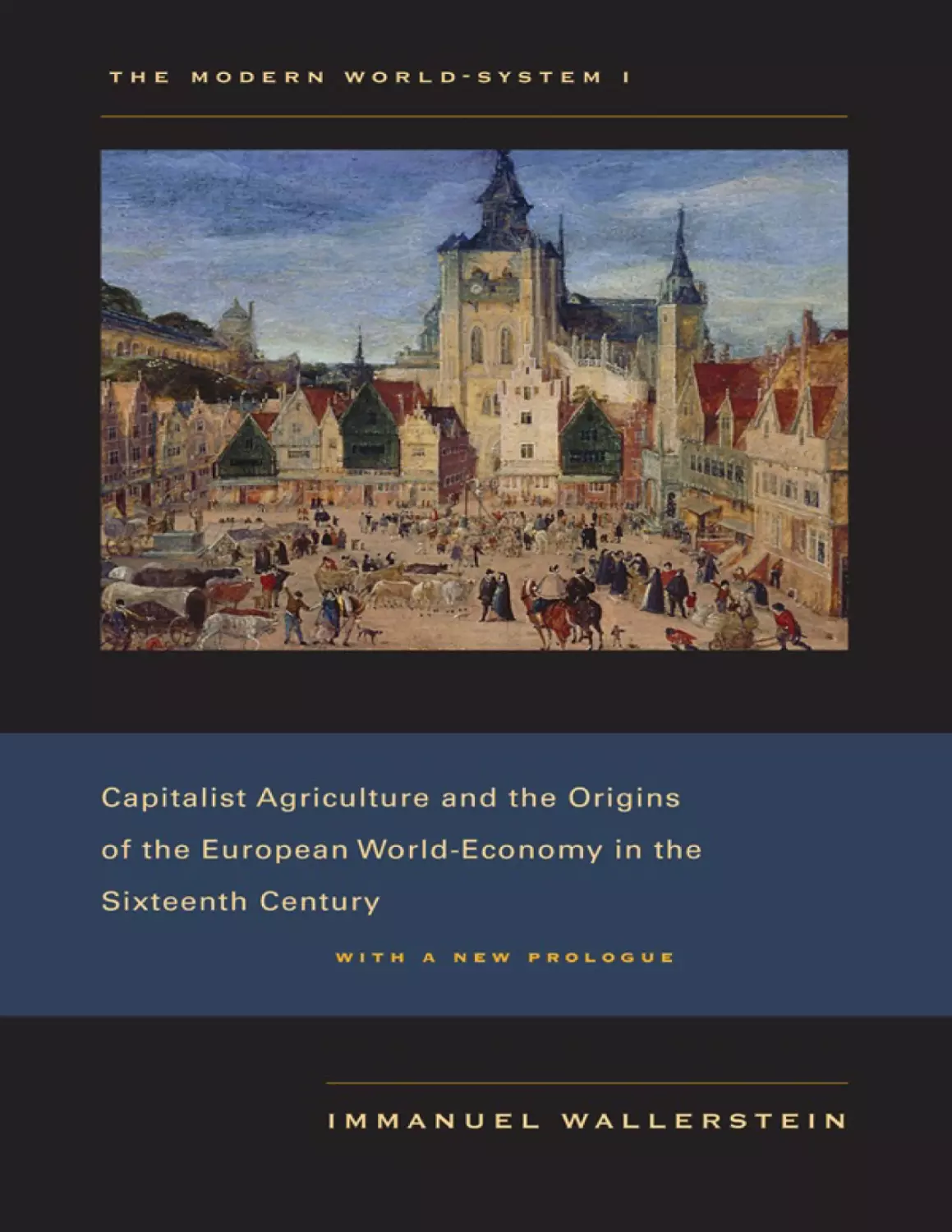


Автор: Wallerstein I.
Теги: capitalism economic history economy world economy history of capitalism
ISBN: 978-0-520-26757-2
Год: 2011


Текст
                    THE MODERN WORLD-SYSTEM I

“Allegory of Trade,” woodcut by Jobst Amman (1539–1591), who lived in
Nuremberg. He was one of the “Little Masters.” This bottom detail illustrated
the house of a merchant of Nuremberg, still a flourishing center of transEuropean trade.

THE
MODERN WORLDSYSTEM I
Capitalist Agriculture and the Origins of the European
World-Economy in the Sixteenth Century
WITH A NEW PROLOGUE

Immanuel Wallerstein

University of California Press, one of the most distinguished
university presses in the United States, enriches lives around the
world by advancing scholarship in the humanities, social sciences, and
natural sciences. Its activities are supported by the UC Press
Foundation and by philanthropic contributions from individuals and
institutions. For more information, visit www.ucpress.edu.
University of California Press
Berkeley and Los Angeles, California
University of California Press, Ltd.
London, England
Previously published in 1974 by Academic Press, Inc.
© 2011 by The Regents of the University of California
ISBN 978-0-520-26757-2 (pbk. : alk. paper)
The Library of Congress has catalogued an earlier edition
of this book as follows:
Library of Congress Cataloging-in-Publication Data
Wallerstein, Immanuel Maurice, Date.
The modern world-system.
(Studies in social discontinuity)
Bibliography: p.

1. Europe—Economic conditions. 2. Economic history—
16th century. 3. Capitalism. I. Title.
II. Series.
HC45.W35
330.9′4′022
73-5318
ISBN 0-12-785920-9
Manufactured in the United States of America
20 19 18 17 16 15 14 13 12 11
10 9 8 7 6 5 4 3 2 1
This book is printed on 50# Enterprise, a 30% post consumer waste,
recycled, de- inked fiber and processed chlorine free.
It is acid-free, and meets all ANSI/NISO (Z 39.48) requirements.

To TKH

CONTENTS

List of Illustrations
Acknowledgments
Quotation Credits
Prologue to the 2011 Edition
INTRODUCTION: ON THE STUDY OF SOCIAL CHANGE
1. MEDIEVAL PRELUDE
2. THE NEW EUROPEAN DIVISION OF LABOR: c. 1450–1640
3. THE ABSOLUTE MONARCHY AND STATISM
4. FROM SEVILLE TO AMSTERDAM: THE FAILURE OF EMPIRE
5. THE STRONG CORE-STATES: CLASS-FORMATION AND
INTERNATIONAL COMMERCE
6. THE EUROPEAN WORLD-ECONOMY: PERIPHERY VERSUS
EXTERNAL ARENA
7. THEORETICAL REPRISE

Bibliography
Index

LIST OF ILLUSTRATIONS

FRONTISPIECE:

“Allegory of Trade,” by Jobst Amman (1585-1586).

INTRODUCTION:

“The Sack of Rome by Charles V.” Illustration of book
published ca. 1535. London: British Museum

CHAPTER 1:

“The Foxhunt,” by the Master of the Housebook (between
1475-1490). Wolfegg (Schloss), Germany.

CHAPTER 2:

“The Negroes having exhausted the metallic veins had to be
given work making sugar,” by Theodore de Bry (1575). New
York: The Rare Books Collection of the New York Public
Library.

CHAPTER 3:

“The Grand-Duke has the port of Livorno fortified,” by
Jacques Callot (between 1614-1620). Paris: Bibliothèque
Nationale.

CHAPTER 4:

“Massacre of the Innocents,” by Pieter Breughel, the Elder (ca.
1565). Vienna: Kunsthistorisches Museum.

CHAPTER 5:

“Two Beggars Fighting,” by Jacques Bellange (between 16121617). Washington, D. C.: National Gallery of Art, Rosenwald
Collection.

CHAPTER 6:

“The (Dutch) fleet off Mozambique, and the capture of a
(Portuguese) carrack near Goa.” Illustration from a Journal
(publ. 1651). Ithaca: Cornell University Library.
“Richmond Palace,” an oil painting by David Vinckenboons

CHAPTER 7:

(first quarter of the seventeenth century). Cambridge:
Fitzwilliam Museum.

The illustrations were selected and annotated with the assistance of
Sally Spector.

ACKNOWLEDGMENTS

It is always difficult to list the immediate sources of ideas and
assistance—from authors, colleagues, and students—in the conception
and writing of a book, and particularly so in a book that pretends to
synthesize other people’s empirical work. The great risk is neglect.
In the case of this volume the two authors whose voluminous
writings most immediately inspired me on the path I finally decided to
go were Fernand Braudel and Marian Malowist.
Once I had written a draft, Fernand Braudel read it carefully and
gave me encouragement at a moment when I needed reassurance.
Charles Tilly also read it carefully, and by raising pertinent questions
forced me to clarify my argument. This was particularly so concerning
the role of state-power and “absolutism” in general, and its
counterpoint with the phenomenon of banditry in particular. Douglas
Dowd put me onto Frederic Lane for which I thank him, since
Frederic Lane is very worth being put onto.
As for Terence Hopkins, my debt is to our twenty years of
intellectual discussion and collaboration. There is no sentence that can
summarize this debt.
This book was written during a year’s stay at the Center for
Advanced Study in the Behavioral Sciences. Countless authors have
sung its praises. Aside from splendid surroundings, unlimited library
and secretarial assistance, and a ready supply of varied scholars to

consult at a moment’s notice, what the center offers is to leave the
scholar to his own devices, for good or ill. Would that all men had
such wisdom. The final version was consummated with the aid of a
grant from the Social Sciences Grants Subcommittee of the Faculty of
Graduate Studies and Research of McGill University.

QUOTATION CREDITS

Selections from Violet Barbour, Capitalism in Amsterdam in the
Seventeenth Century, appearing on pages 211-214, are reprinted by
permission of the University of Michigan Press. Copyright 1963 by
the University of Michigan Press.
Selections appearing on pages 303, 305-306, 315, 317-318, 320-322
from Jerome Blum, Lord and Peasant in Russia from the Ninth to the
Nineteenth Century (Copyright © 1961 by Princeton University Press;
Princeton paperback 1971), pp. 120-212, partly paraphrased.
Reprinted by Permission of Princeton University Press.
Selections appearing on pages 16-340 passim from Vols. I and II, The
Mediterranean and the Mediterranean World in the Age of Philip II
by Fernand Braudel (about 2600 words passim). Originally published
in France under the title La Méditerranée et le monde Méditerranéen
à l’époque de Philippe II.
© Librairie Armand Colin 1966.
English translation by Immanuel Wallerstein with special permission
of Harper & Row, Publishers, Inc.
Selections appearing on pages 26-27, 30-31, 34, 103, 105-106,
reprinted from Rural Economy and Country Life in the Medieval West,
by Georges Duby (Cynthia Postan, translator), by permission of the

University of South Carolina Press.
Selections appearing on pages 153, 161, 207, 232-234, 244 reprinted
from Christopher Hill, Reformation to the Industrial Revolution,
1530-1780, Vol. II of The Pelican History of Britain, pp. 25, 26, 27,
28, 34, 65-66, 96, 101. Copyright © Christopher Hill, 1967, 1969.
Selections appearing on pages 203, 206-209 from H. G.
Koenigsberger, “The Organization of Revolutionary Parties in France
and the Netherlands During the Sixteenth Century,” The Journal of
Modern History, XXVII, 4, Dec. 1955, 335-351. Copyright © by the
University of Chicago Press. Reproduced by permission.
Selections appearing on pages 215, 267-268 reprinted from H. G.
Koenigsberger, “Western Europe and the Power of Spain,” in New
Cambridge Modern History, III: R. B. Wernham, ed., The CounterReformation and the Price Revolution, 1559-1610 by permission of
the Cambridge University Press. Copyright 1968 by the Cambridge
University Press.
Selections appearing on page 40 from R. S. Lopez, H. A. Miskimin,
and Abraham Udovitch, “England to Egypt, 1350-1500: Long-term
Trends and Long-distance Trade,” in M. A. Cook, ed., Studies in the
Economic History of the Middle East from the Rise of Islam to the
Present Day. (London: Oxford University Press, 1970). Reprinted by
permission of the Oxford University Press and the School of Oriental
and African Studies.
Selections appearing on pages 102, 174, 185, 187, 216, 218, 306
reprinted from J. H. Parry, “Transport and Trade Routes,” in
Cambridge Economic History of Europe, IV: E. E. Rich and C.
Wilson, eds., The Economy of Expanding Europe in the 16th and 17th
Centuries, by permission of the Cambridge University Press.
Copyright 1967 by the Cambridge University Press.

Selections appearing on pages 150, 160-161, 227, 229 reprinted from
M. M. Postan, “The Trade of Medieval Europe: The North,” in
Cambridge Economic History of Europe, II: M. M. Postan and E. E.
Rich, eds., Trade and Industry in the Middle Ages, by permission of
the Cambridge University Press. Copyright 1952 by the Cambridge
University Press.
Selections appearing on pages 44, 48, 188, 327 reprinted from E. E.
Rich, “Colonial Settlement and Its Labour Problems,” in Cambridge
Economic History of Europe, IV: E. E. Rich and C. H. Wilson, eds.,
The Economy of Expanding Europe in the 16th and 17th Centuries, by
permission of the Cambridge University Press. Copyright 1967 by the
Cambridge University Press.
Selections appearing on pages 198-199, 211, 214, 218, 235 reprinted
from Frank C. Spooner, “The Economy of Europe 1559-1609,” in
New Cambridge Modern History, III: R. B. Wernham, ed., The
Counter-Reformation and the Price Revolution, 1559-1610, by
permission of the Cambridge University Press. Copyright 1968 by the
Cambridge University Press.

C’est par une crise des revenus seigneuriaux que se termine le moyenâge et s’ouvrent les temps modernes.
—MARC BLOCH
This collapse in real wage-rates [in Europe] formed the counterpart to
the revolutionary rise of prices in the sixteenth century. The operation was
fully paid for by the increased toil, hardships, impoverishments and
dejection of the majority. Contemporaries were often aware that the
deterioration was taking place.
—FERNAND BRAUDEL and FRANK SPOONER
The discovery of gold and silver in America, the extirpation,
enslavement and entombment in mines of the aboriginal population, the
beginning of the conquest and looting of the East Indies, the turning of
Africa into a warren for the commercial hunting of black-skins, signalised
the rosy dawn of the era of capitalist production. These idyllic proceedings
are the chief momenta of primitive accumulation. On their heels treads the
commercial war of the European nations, with the globe for a theatre.
—KARL MARX

PROLOGUE TO THE 2011 EDITION

The Modern World-System was published in 1974. It was actually
written in 1971–1972. I had some difficulty finding a publisher for it.
The book was about the sixteenth century, and it dealt with a virtually
unknown topic: a world-economy, spelled deliberately with a hyphen.
It was long, and it had an enormous number of substantive footnotes.
When it appeared, one less than friendly reviewer complained that the
footnotes crawled up and down the page. Finally, Academic Press,
and its then scholarly consulting editor, Charles Tilly, decided to take
a chance by putting it in their new social science series.
When it appeared, its reception surprised everyone, and in
particular both the publisher and the author. It received favorable
reviews in the New York Times Sunday Book Review (on the front
page) and in the New York Review of Books. In 1975, it received the
award of the American Sociological Association for the best scholarly
publication. At that time, the award was called the Sorokin Award.
The award was so unexpected that I was not even present at the
session at which the award was announced. The book was rapidly
translated into a large number of other languages. It sold remarkably
well for a scholarly monograph. By any measure, it was a success.
However, it also turned out right away that it was a highly
controversial book. The book received wonderful plaudits, but it also
was the subject of vigorous denunciations, and the latter came from

many different camps. Writing thirty-seven years after the initial
publication, I believe it is worth reviewing the critiques. What were
their sources? How well have the critiques survived? What do I think
myself today of the validity of the critiques? How have these critiques
influenced the succeeding volumes?
I should note at the outset one particular subtext of the critiques. I
was professionally a sociologist. This book seemed to many to be a
book of economic history. Sociologists were not presumed, at least in
the early 1970s, to be interested in writing about the sixteenth century
or about matters with which economic historians dealt. Historians, on
the other hand, were wary of intruders coming from other university
disciplines, especially if they relied, as I did, almost entirely on socalled secondary sources. Furthermore, the book dealt centrally with
global spatial relations, and this was supposed to be the purview of
geographers. And finally, among the early enthusiasts for the book
was an unexpected group: some archaeologists. So, I seemed to be
defying the categories that at that time defined scholarly work, and not
to fall into the usual boxes enshrined in the structures of knowledge.
I should start this discussion with my self-perception at the time I
wrote the book. I explained in the introduction to the book how I came
to write it. I was following a bad idea—that I might better understand
the trajectories of the “new nations” of the twentieth century by
studying how the nations that had been “new” in the sixteenth century
had come to “develop.” This was a bad idea because it presumed that
all states followed parallel independent paths to something called
“development.” This bad idea, however, was serendipitous. It got me
to read about western Europe in the sixteenth century and turned my
attention to realities I hadn’t anticipated.
In my mind at the time, I was arguing primarily with Weberian
sociologists—not with Max Weber himself, but with the use made of
his categories in U.S. (and to some extent world) sociology in the
period following 1945. Weber’s book on the Protestant ethic was very

widely interpreted to mean that the existence of certain kinds of
values was a necessary prerequisite to what in the post-1945 period
tended to be called modernization or (economic) development. The
usual scholarly procedure at the time was to examine, country by
country, the existence, or coming into existence, of such values. The
result was the creation of a sort of chronological pecking order of the
march of progress. Which country was the first? Which came next?
Which would now come next? And as a derived question, what did a
country have to do now in order to come next?
I sought to challenge that narrative in several ways. First of all, I
was insisting that this process could not be examined country by
country, but only within a larger category that I called a world-system
(the word world not being synonymous with global)—a world, not the
world, as Fernand Braudel would phrase it.
Second, I suggested that the values in question followed rather than
preceded the economic transformations that were occurring. I
suggested that it was only by placing the various states in their
relation to each other that we could understand why it was that some
became the leaders in productive efficiency and the accumulation of
wealth.
And third, I was rejecting the principal antinomy of the post-1945
Weberians, that of modern versus traditional. Rather, I shared the
evolving arguments of the so-called dependistas like Samir Amin and
Andre Gunder Frank that the “traditional” was as recent as the
“modern,” that the two emerged in tandem, so that we could speak, in
Frank’s famous phrase, of “the development of underdevelopment.”1
I expected to be denounced by the post-1945 Weberians. While
they tended not to accept what I was arguing, they also tended by and
large to receive my arguments civilly, despite what they seemed to
think was my resuscitation of Marxist arguments (which they believed
had been abandoned, or ought to have been abandoned, by serious
scholars). I think they were surprised by the fact that I had actually

plunged into sixteenth-century history, whereas many of them had
simply relied on an abbreviated (and sometimes distorted) summary
of the Weberian thesis in order to discuss twentieth-century material.
Furthermore, as Terence Hopkins and I noted in a joint article soon
thereafter, much of the so-called comparative analyses done by the
modernization adepts involved the comparison of contemporary data
on one non-Western country with presumed (but not empirically
studied) data on the United States (or perhaps some western European
country).2
In any case, the biggest brickbats came from elsewhere. There were
three major varieties of criticisms. There were those I think of as the
major critiques. These are the ones that reject world-systems analysis
as a mode of analysis on the grounds that it is not consonant with their
mode of analysis, which they think is obviously superior. Then there
were those I think of as the minor critiques. These are those by
persons who accept the legitimacy of world-systems analysis, at least
to some degree, but argue with my detailed historical descriptions on
the grounds that I am wrong in reporting or interpreting some
important empirical data, or that I omitted some major kinds of data.
And then there was a third variety, which emerged only in the 1990s:
those who sought to revise world-systems analysis by removing the
hyphen and the plural—that is, by insisting that there is and always
has been only one “world system” over the last five thousand years.
Let us consider each of these varieties, and their subvarieties, in turn.

The Major Critiques
If the post-1945 Weberians thought I was too Marxist, the “orthodox”
Marxists thought I was not Marxist at all, but quite the opposite: “neoSmithian.”3 What I mean by an orthodox Marxist is one that I think of
as a Marxist of the parties—Marxism as defined by the German
Social-Democratic Party, as defined by the Communist Party of the
Soviet Union, and indeed as defined by most of the Trotskyist parties.

Although these groups differed quite radically in their political
strategies, and in their interpretation of what had happened politically
in various countries in the twentieth century, they did share certain
fundamental premises. The first was the nature of the class struggle
under capitalism, which they defined as being fundamentally between
the emergent urban proletariat and the capitalist producers (primarily
industrial entrepreneurs). The second was the primacy of an economic
base in relation to a political and cultural superstructure. The third was
the primacy of internal factors (i.e., those endogenous to a country)
over external factors (i.e., those exogenous to a country) in causal
explanations. The fourth was the inevitability of progress in terms of a
sequence of different so-called modes of production.
The charge of the orthodox Marxists was that world-systems
analysis violated all of these premises in one way or another. This
charge was in fact justified to some extent. Speaking of volume 1 of
The Modern World-System, these critics argued that I had presented
what they called a “circulationist” argument whereas I should have
been explaining matters in terms of what was going on in the sphere
of production. That is to say, when I discussed core-peripheral
relations, I was ignoring the class struggle inside England as the
explanation of capitalist development in favor of crediting a factor
considered external, like the nature and flow of trade between the
Americas and northwestern Europe.
Of course, the immediate question is, Internal or external to what?
For the orthodox Marxists, internal was always defined as internal to
a country’s political boundaries. The “economy” was a national
construct. Classes were national. It was countries that could be labeled
either capitalist or not. This debate was fundamental. I was in the
process of developing an alternative view of capitalism. In my view,
capitalism was the characteristic of a world-system, of the specific
variety I called a “world-economy.” Classes were classes of this
world-system. State structures existed within this world-system.

My opponents from this camp were very intransigent about their
view. Over the years, however, they came to be fewer and fewer in
number. This had less to do with the impact of my writings than with
the evolving situation in the modern world-system. The political
movements that had held these views as late as the 1960s were
profoundly challenged by the forces that constituted the worldrevolution of 1968. They were put on the defensive by the emergence
of strong movements insisting on the importance of gender, race,
ethnicity, and sexualities in the analysis of social reality. They were
put on the defensive by the neoliberal political counteroffensive of the
1980s and the widespread acceptance of a concept called
globalization. As a result, there are relatively few today who espouse
the traditional analytic view of the orthodox Marxists of the 1960s.
There was also criticism from the proponents of what I considered
to be a last-ditch intellectual stand of the orthodox Marxist mode of
analysis. It was in the school of thought, quite vigorous in the 1970s,
called “articulation of the modes of production.”4 From my point of
view, what this group was doing was to accede to the argument that
one could not analyze social reality solely within the confines of a
single country. They saw that something was going on in the worldsystem, although they eschewed that term. Their revision was
essentially to suggest that whereas one country might be capitalist and
another still feudal, they somehow related to each other in specific and
important ways. They said that the two modes of production
“articulated” with each other, and therefore each was affected in some
way by the other.
I thought of this halfway house as neither very convincing nor
adding anything of significance to one’s ability to understand social
reality. In any case, this school, after flourishing somewhat for a
decade or so, simply waned. I am unaware of anyone who continues
today to utilize this framework.
Another school that was very hostile, almost totally hostile, to

world-systems analysis was that made up of the traditional nomothetic
economists and sociologists. For them what I was doing, when they
cared to take notice of it at all, was at best journalism, at worst
ideological argumentation. By and large, they treated world-systems
analysis to rejection by scorn. They seldom deigned even to discuss it
other than when they were called upon to be anonymous critics of
grant proposals.
Their studied neglect masked a fear. This group considered worldsystems analysis every bit as dangerous as did the orthodox Marxists,
albeit for quite different reasons. They did appreciate what was at
stake. Stephen Mennell correctly noted recently that my book
is in effect a massive attempt at an historical disproof of David Ricardo’s
apparently timeless “law of comparative advantage,” showing how
initially small inequalities in ties of interdependence between societies and
economies have been magnified over time to produce massive differences
today between what are euphemistically called the “North” and the
“South.”5

Since Ricardo’s law has indeed been a central and crucial premise of
mainstream macroeconomics, it is no wonder that my arguments were
treated so negatively by this camp.
However, to the extent that world-systems analysis gained strength
within the structures of knowledge, some of the nomothetic camp did
begin to produce analyses that were intended to refute empirically the
heretical premises being advanced by us. These critics were
particularly anxious to show that world-systems analysis did not
explain why, in the contemporary world, some countries were more
“developed” than others, nor why some so-called underdeveloped
countries were improving their national situation more than others.
This camp’s opposition is as unremitting as that of the orthodox
Marxists. It is probably more enduring.
There is a third major critique. It comes from a group I think of as

the neo-Hintzians. Otto Hintze was a German political historian who
was thought to demonstrate in his writings the autonomy of the
political sphere from the economic sphere of reality. I was subjected
to two major critical analyses,6 both of which specifically invoked
Hintze. They both said that I had falsely collapsed the political and
economic arenas of analysis into a single arena, giving in effect
primacy to the economic arena.
Of course, I had in fact insisted that political and economic
variables resided in a single arena. I had refused to accept the
argument that the political arena was autonomous, or the concept that
it was governed by rules that were somehow different from, even
antithetical to, those governing the economic arena. I had insisted in
my book on a holistic analysis, in which political institutions were
simply one institutional structure alongside others within the modern
world-system. Although I tried to spell out the fallacy of such a
separation of the two spheres in subsequent volumes, especially
volume 2, this critique has showed staying power, in the sense that
there are still many today who consider world-systems analysis too
“economistic,” which is often a way of saying that, in their opinion, it
is too “Marxist.”
In any case, the neo-Hintzians were no more faithful to Otto Hintze
than the neo-Weberians to Max Weber, the orthodox Marxists to Karl
Marx, or the Smithians to Adam Smith. In the case of Otto Hintze, he
concludes his essay “Economics and Politics in the Age of
Capitalism” (which appeared in 1929) with this summary of his
views:
All in all, the war years and the decade that has elapsed since offer no
evidence of an autonomous economic development of capitalism, wholly
detached from the state and politics. They show rather that the affairs of
the state and of capitalism are inextricably interrelated, that they are only
two sides, or aspects, of one and the same historical development.7

This is, of course, exactly the point that I was trying to make.
Finally, there are the critiques coming from the “cultural” camp,
which began to flourish in the 1970s. There are two things to
remember when analyzing the rise of the cultural camp. The first is
that the traditional liberal theoretical analysis of modernity broke
modern life down into three spheres—the economic, the political, and
the sociocultural. This was reflected in the creation of three separate
social science disciplines dealing with the modern world: economics,
concerned with the market; political science, concerned with the state;
and sociology, concerned with everything else (sometimes called the
civil society).
This liberal ideological predilection necessarily resulted in a debate
about causal priority among the three spheres. Both the orthodox
Marxists and the nomothetic mainstream economists gave causal
priority to the economic sphere. The neo-Hintzians gave it implicitly
to the political sphere. It was to be expected that there would be those
who would give causal priority to the cultural sphere.
The second thing to remember is the impact of the worldrevolution of 1968 on theoretical debates. For many, what had
happened in 1968 was the final debacle (and consequently intellectual
disavowal) of the economistic camp. Daniel Bell had earlier spoken of
the “end of ideology,” in a strong attack on the relevance of Marxism
and Marxist movements to the post-1945 world.8 After 1968, a new
group now took up the dismissal of Marxism from a different
standpoint. This group demanded conceptual “deconstruction” and
expounded the end (and uselessness) of “grands récits” or “master
narratives.”9 Basically, what they were saying is that the economistic
camp—in particular, the orthodox Marxists—had neglected the
centrality of discourse in evolving social reality.
There was at this time a second criticism of the orthodox Marxists.
They were accused, quite correctly, of having set aside the priorities
of those concerned with gender, race, ethnicity, and sexualities in

favor of the priority of the class struggle and the “revolution” whose
historical subject was the “proletariat.”
I was condemned for not joining this camp.10 When this group
condemned master narratives, they tended to throw world-systems
analysis into the same basket as orthodox Marxism and Weberian
modernization theory, despite the fact that world-systems analysis had
been making virtually identical criticisms of the orthodox Marxist and
modernization master narrative. But of course, world-systems analysis
was doing this by putting forward an alternative master narrative. We
refused to throw out the baby with the bathwater.
The fate of this culturalist critique is tied to the fate of the whole
movement of “cultural studies.” There was a fatal flaw in the
coherence of this camp. Half were primarily concerned with insisting
on the priority of culture—indeed, on its exclusive intellectual
interest. But the other half were interested in the “forgotten
peoples”—those that had been neglected in the previous master
narratives. The alliance broke down as the latter half began to realize
that they, too, were really interested in master narratives, just different
ones from those that were being used in the pre-1968 period. This
group began to create a new trinity of concerns—gender, race, and
class; or class, gender, and race; or race, gender, and class. And once
the new trinity came into widespread use in the university arena, some
of those who were primarily interested in the “forgotten peoples”
ceased to denounce world-systems analysis and began to try to find
ways in which they could come to terms with it or sought to tweak it
to take still more account of their priorities.11
In the years since 1974, the major critiques have all been made. By
the time we get to the 1990s, many of their proponents have dropped
from the scene, although some are still making the same critiques. But
the major critiques are now well known and have fallen into the
background of the discussion concerning world-systems analysis,
which is more and more seen as simply one competing paradigm in

contemporary world social science. It is the minor critiques that are
absorbing more and more attention.

The Minor Critiques
The minor critiques center around three different issues: the spatial
boundaries of the modern world-system, the temporal boundaries of
the modern world-system, and the institutional variables to be taken
into consideration. The first volume of The Modern World-System was
very clear about the spatial and temporal boundaries that it sought to
establish. It was perhaps less clear about the range of institutional
variables that were relevant.
Let us start with spatial boundaries. The argument of the book is
that there exist real boundaries of what is to be considered inside and
outside the capitalist world-economy. I asserted that inside these
boundaries, one could speak of core, periphery, and semiperiphery.
Chapter 6, however, is devoted to what is outside these boundaries,
which I termed the external arena. And I sought to specify how one
could tell the difference between a peripheral zone of the worldeconomy and the external arena.
The basic argument was that one could distinguish trade in bulk
goods and trade in preciosities, the former but not the latter being
based on unequal exchange. I later tried to argue this distinction in
further detail.12 Using this distinction, I suggested specific boundaries.
Poland and Hungary were part of the modern world-system in the
sixteenth century. Russia and the Ottoman Empire were not. Brazil
was within, and the Indian subcontinent outside.
There were two ways of contesting these empirical assertions. One
was to suggest that the distinction between bulk trade and preciosities
was much more blurry than I had suggested, and that this distinction
could not be used to establish systemic boundaries. The other was
quite different. It was to suggest that some of the areas asserted to be

outside were in fact engaged in bulk trade with parts of the capitalist
world-economy and therefore, on the very basis of my distinction,
should be seen as being “inside” the boundaries.
On what I call the major critiques, I gave no quarter. I still refuse to
accept the legitimacy of these objections to world-systems analysis.
On the critique about spatial boundaries, I have said from the
beginning that I was ready to listen carefully to the empirical
arguments and, when they seemed strong, to accept revisions of the
empirical argument. Hans-Heinrich Nolte has long argued that Russia,
in the sixteenth century, was as much part of the modern world-system
as was Poland.13 Frederic Lane argued the same for the Ottoman
Empire, without perhaps making the case in detail.14 However, much
later, Faruk Tabak outlined a very strong case for why one should see
the entire eastern Mediterranean (basically all part of the Ottoman
Empire) as an integral part of the modern world-system in the
sixteenth century.15
On the distinction between bulk goods and preciosities, various
attempts to break down the validity of this distinction were
advanced.16 I knew from the beginning that the distinction was a
difficult one to make. I have been chastened by the force of the
counterarguments. I still think my basic point is sound. But in any
case, as I suggested later,17 even if I had to recognize a more complex
picture of what constitutes “incorporation” into the capitalist worldeconomy, the concept that there were zones outside the functioning of
the system but in some kind of trade relationship with it remains a
crucial idea. It lays the basis for understanding how it is that the
modern world-system was not global in extent at its outset and
became that only later (in the mid-nineteenth century). In my view,
there is still room for a lot of both theoretical and empirical debate
about spatial boundaries.
The temporal boundaries are even more difficult. Many of the later
minor criticisms want to push the beginning dates of the modern

world-system to the thirteenth century.18 Janet Abu-Lughod sought to
do something slightly different.19 She wanted to look at thirteenthcentury Europe in its trade links with many different parts of the
Eurasian landmass in order to throw a somewhat different light on
what explained Europe’s “rise” in the sixteenth century.
Much of this debate about the temporal boundaries comes down to
a debate about the nature of European feudalism. I had made a
fundamental distinction between the “first” feudalism (of medieval
Europe), which I saw as what we usually mean by feudalism, and the
“second” feudalism of the sixteenth century, which I saw as an
incorrect label for coerced cash-crop labor. I myself recognized later
that the weakest chapter in volume 1 was chapter 1, “Medieval
Prelude.” I offered what amounted to a revised version of that chapter
in a volume devoted to China and capitalism.20
The basic problem here is that, in my view, no macrohistorical
theoretical framework has come up with a satisfactory explanation of
the nature of European feudalism in what is usually considered its
heyday, 1000–1500. Some analysts see it as a sort of protocapitalist
system, and hence move the dates of the modern world-system back to
include it inside the temporal frame. Others see it as the very
antithesis of capitalism and so move capitalism forward to the more
widely accepted date of the onset of the modern world, circa 1800.21
My own view is that the feudal system of medieval Europe is best
defined as a disintegrated world-empire, held together very thinly by
the Roman Catholic Church. Of course I do believe, as I suggest in
this volume, that there were forces inside it who tried to transform it
into a capitalist world-economy but failed. What I see as failures,
some others see as first steps.
What I think crucial is to see that creating a capitalist worldeconomy is something very difficult to do. I tried in a later article to
explain the exceptional conditions that made this possible.22 I tried in
volume 2 of The Modern World-System to explain how this frail

beginning was consolidated in the seventeenth century. I saw the
seventeenth century not as a “crisis,” which resulted in a sort of return
of “feudalism,” but instead as the hardening of the structure of the
capitalist world-economy. I believe that this consolidation is what
made it possible eventually to expand the system still further, both
intensively and extensively.
So, in the end, although I have bent somewhat in the face of these
minor critiques, I remain convinced of the essential correctness of
both my spatial and temporal boundaries for the beginning period of
the modern world-system.
It is the institutional parameters of the capitalist world-economy
that were perhaps insufficiently laid out in volume 1. I spent almost
all my energy trying to establish the sense in which what was
occurring in the economic arena was capitalist in nature. Although
industry was a small segment of the overall productive apparatus, I
insisted that one’s eyes should focus especially on agriculture. It is
true that wage labor was still a relatively small part of the mode of
remuneration of the workforce, but I tried to show that capitalism
involved more than wage labor. Although the bourgeoisie, as
classically defined, seemed to be a relatively small group, I insisted
that we see that the aristocracy was transforming itself into the
bourgeoisie. This was all part of my attempt to revise quite radically
the analysis of capitalism as a mode of production. I have written
extensively on all these themes since 1974, and there now exists a sort
of condensed summary of my views in World-Systems Analysis: An
Introduction.23
In the years following 1974, I was challenged for neglecting all the
non-economic arenas: the political arena, the cultural arena, the
military arena, and the environmental arena. All of these critics were
insisting that I was being too “economistic” in my framework. I have
already discussed my views on the critiques about the political arena
and the cultural arena. I would note that I tried to make clearer my

understanding of the political arena in volume 2 and of the cultural
arena in volume 4 as well as in Geopolitics and Geoculture.24
I was taken to task by both Michael Mann and William McNeill for
my neglect of the military arena, and in particular for my neglect of
the importance of military technology.25 I don’t think this was quite
correct. I talked of military technology and its role here and there in
this volume and in subsequent volumes of the work. But in general I
think Clausewitz was right in his famous statement that “war is a
continuation of politics by other means.” If this is so, then one should
be wary of giving the military too much analytic autonomy.26
Finally, I have been criticized for neglecting the environment.27 At
first, I was inclined to say that I certainly didn’t mean to do this. But I
have been saved from this mealy-mouthed excuse by Jason Moore,
who did a careful reading of volume 1 to show the degree to which I
had incorporated and made central to my analysis ecological factors
and their consequences in the construction of the capitalist worldeconomy.28 I was in fact astonished to realize the degree to which I
had done this.
The best answer to the critique about leaving out various
institutional parameters in volume 1 is that one can’t do everything at
once. I think that by reading the corpus of my work, a reasonable
person will see the degree to which I am faithful to my
epistemological premise that only a truly holistic analysis can tell us
anything important about how the real world works.

The Revisionist View of the World-System
Beginning in the 1990s, there emerged an important group of scholars
who, in different ways, argued that the role of China in the modern
world had been seriously neglected, which led, they argued, to a very
distorted view of the world. Some did this by emphasizing the
existence and persistence of a Sinic world from the fifteenth century

to today.29 Some did this by suggesting that the economic
comparisons between China and western Europe were considerably
off base.30
Andre Gunder Frank, however, went much further. He was an early
participant in world-systems analysis. He had himself written books
that argued the origins of the modern world-system in the sixteenth
century.31 However, in the 1990s he made a major shift in his analysis.
Both by himself and in joint writings with Barry Gills,32 he laid forth
the hypothesis that the world system (the only world system) had its
origins some five thousand years ago. He insisted that this world
system could be analyzed by using many of the basic tools of worldsystems analysis, such as long waves that were simultaneous
throughout the system.
He wished not only to insist that this singular world system had
existed for five thousand years. He wished also to insist that China
had always (or almost always) been the central hub of this singular
world system. He saw Europe’s “rise” as limited to the nineteenth
century and part of the twentieth, and saw it as a momentary
interruption in this China-centered system. He said that those of us
who argued that the modern world-system originated in Europe,
whether in the sixteenth century or earlier, were guilty of
Eurocentrism. The charge encompassed both Fernand Braudel and
me, but also both Marx and Weber.
His principal book, Re-Orient: Global Economy in the Asian Age,
has been widely read and discussed. Three of his colleagues in the
world-systems analysis camp—Samir Amin, Giovanni Arrighi, and I
—wrote lengthy critiques of the book in a special issue of Review.33
My own critique centered on three matters. First, I felt that Frank’s
argument was basically the same as that of neoclassical economics.
Unlike other works in world-systems analysis, it truly deserved the
label “circulationist.”
Second, I felt that his empirical analyses about the relations of

western Europe and China in the sixteenth to eighteenth centuries,
based primarily on the flow of precious metals, could be shown to be
incorrect by using the very data that Frank provided. Furthermore, I
tried to suggest that Frank’s earlier empirical analysis, which I found
essentially correct, undid the arguments in this later work.34
Third, however, and most important, his mode of analysis
eliminated capitalism from the whole historical picture. I had argued
that the sixteenth century marked the creation of a capitalist worldeconomy. There was no way in which Frank or anyone else could
argue that capitalism dates back five thousand years. It voided the
word of all meaning. Frank actually admitted this, saying that he no
longer thought that capitalism was a useful intellectual concept.
One last problem in this Sinocentric view of world history was the
ambiguous role Frank gave in the whole analysis to India, which
seemed sometimes to be included in an Asian-centric world and
sometimes to be excluded from a Sinocentric world. A recent book by
Amiya Bagchi exposes this ambiguity by placing his own analysis of
modern Indian history in the context of the emergence of the capitalist
world-economy.35
Whether this radical revision of world-systems analysis will
continue to play an important intellectual role cannot yet be seen
clearly. It may depend on the changing empirical realities of the
modern world-system itself in the coming decades.

Conclusion
For me, the writing of volume 1 of The Modern World-System was the
start of a great intellectual adventure, which has been in many ways
the central focus of my intellectual life ever since. I have now reached
volume 4. As may be seen in the introduction to that volume, there are
at least two volumes to come, possibly even a volume 7. I don’t know
if I shall be able to complete the writing of all the subsequent

volumes. I am perhaps saved by the fact that I have written many
essays that cover material that would be in volumes 5 and 6. So my
approach to the periods 1873–1968 and 1945–20?? is available in
print. But writing essays and constructing a systematic narrative are
not the same thing. I hope to be able to do the latter.
In any case, I am convinced—how could I not be?—that worldsystems analysis is a necessary element in overcoming the constrictive
paradigms of nineteenth-century social science. It is, as I have said in
a detailed intellectual itinerary, neither a theory nor a new paradigm
(even if others think it is both), but a “call for a debate about the
paradigm.”36 Volume 1 remains the original and still crucial linchpin
in this call.
1

Andre Gunder Frank, “The Development of Under-development,” Monthly
Review, XVIII, 4, Sept. 1966, 17–31.
2Terence Hopkins and Immanuel Wallerstein, “Patterns of Development of
the Modern World-System,” Review, I, 2, Fall 1977, 111–146. (Reprinted in T.
K. Hopkins, Immanuel Wallerstein, and associates, World-Systems Analysis:
Theory and Methodology [Beverly Hills, California: Sage, 1982, 41–82].)
3Robert Brenner, “The Origins of Capitalist Development: A Critique of NeoSmithian Marxism,” New Left Review, No. 104, July–Aug. 1977, 25–93.
Maurice Zeitlin, The Civil Wars in Chile, Or, The Bourgeois Revolutions That
Never Were (Princeton, New Jersey: Princeton Univ. Press, 1988).
4Harold Wolpe, Articulation of Modes of Production (London: Routledge &
Kegan Paul, 1980). See also Barry Hindess and Paul Q. Hirst, Pre-Capitalist
Modes of Production (London: Routledge & Kegan Paul, 1977).
5 Stephen Mennell, “Sociology,” in W. H. McNeill et al., eds., Berkshire
Encyclopedia of World History (Great Barrington, Massachusetts: Berkshire
Publishing Group, 2005), IV, 1746.
6Theda Skocpol, “Wallerstein’s World Capitalist System: A Theoretical and
Historical Critique,” American Journal of Sociology, LXXXII, 5, Mar. 1977,
1075–1090. (Reprinted in Theda Skocpol, Social Revolutions in the Modern
World [New York: Cambridge Univ. Press, 1994, 55–71].) Aristide R. Zolberg,

“Origins of the Modern World System: A Missing Link,” World Politics,
XXXIII, 2, Jan. 1981, 253–281. (Reprinted in Aristide Zolberg, How Many
Exceptionalisms: Explorations in Comparative Macroanalysis [Philadelphia:
Temple Univ. Press, 2009, 132–157].)
7Otto Hintze, The Historical Essays of Otto Hintze, edited with an
introduction by Felix Gilbert (New York: Oxford Univ. Press, 1975), 452.
8Daniel Bell, The End of Ideology, 2nd edition (Cambridge, Massachusetts:
Harvard Univ. Press, 2000; first published in 1960).
9Jean Baudrillard, The Mirror of Production (St. Louis: Telos Press, 1975);
For a Critique of the Political Economy of the Sign (St. Louis: Telos Press,
1981); The Jean Baudrillard Reader, Steve Redhead and Claire Abel, eds. (New
York: Columbia Univ. Press, 2008).
10Stanley Aronowitz, “Metatheoretical Critique of Immanuel Wallerstein’s
The Modern World System,” Theory & Society, X, 4, July 1981, 503–520.
11Ramon Grosfoguel, special ed., special issue of Review: Utopian Thinking,
XXV, 3, 2002. Walter D. Mignolo, Local Histories/Global Designs: Coloniality,
Subaltern Knowledges, and Border Thinking (Princeton, New Jersey: Princeton
Univ. Press, 2000); The Darker Side of the Renaissance: Literacy, Territoriality,
& Colonization, 2nd edition, with a new afterword (Ann Arbor: Univ. of
Michigan Press, 2006). See also Etienne Balibar and Immanuel Wallerstein,
Race, Nation, Class: Ambiguous Identities (London: Verso, 1991).
12lmmanuel Wallerstein, The Modern World-System, II: Mercantilism and the
Consolidation of the European World-Economy, 1600–1750 (New York:
Academic Press, 1980); The Modern World-System, III: The Second Era of Great
Expansion of the Capitalist World-Economy, 1730s-1840s (San Diego:
Academic Press, 1989).
13Hans-Heinrich Nolte, “The Position of Eastern Europe in the International
System in Early Modern Times,” Review, VI, 1, Summer 1982, 25–84.
14Frederic C. Lane, “Chapter 8, Economic Growth in Wallerstein’s Social
Systems, A Review Article,” Profits from Power: Readings in Protection Rent
and Violence-Controlling Enterprises (Albany: State Univ. of New York Press,
1979), 91–107.
15Faruk Tabak, The Waning of the Mediterranean, 1550–1870: A
Geohistorical Approach (Baltimore: Johns Hopkins Univ. Press, 2008).
16Jane Schneider, “Was There a Pre-Capitalist World-System?,” Peasant

Studies, VI, 1977, 20–29. (Reprinted in Christopher Chase-Dunn and Thomas
Hall, eds., Core/Periphery Relations in Precapitalist Worlds [Boulder, Colorado:
Westview Press, 1991, 45–66].) Thomas D. Hall, “Incorporation in the WorldSystem: Toward a Critique,” American Sociological Review, LI, 3, June 1986,
390–402; Social Change in the Southwest, 1350–1880 (Lawrence: Univ. of
Kansas Press, 1989). Christopher Chase-Dunn, Global Formation: Structures of
the World-Economy, 2nd revised edition (Lanham, Maryland: Rowman and
Littlefield, 1998).
17Terence Hopkins, Immanuel Wallerstein, Resat Kasaba, William G. Martin,
and Peter D. Phillips, special eds., special issue of Review: Incorporation into
the World-Economy: How the World-System Expands, X, Nos. 5/6 (supplement),
Summer/Fall 1987.
18Fernand Braudel, Out of Italy: 1450–1650 (Paris: Flammarion, 1991); The
Perspective of the World, Vol. III of Capitalism & Civilization, 15th to 18th
Century (Berkeley: Univ. of California Press, 1992). Giovanni Arrighi, The Long
Twentieth Century: Money, Power, and the Origins of Our Times, 2nd revised
edition (New York: Verso, 2010; first published 1994). Eric Mielants, The
Origins of Capitalism and the “Rise of the West” (Philadelphia: Temple Univ.
Press, 2008). See also Oliver Cox, Foundations of Capitalism (New York:
Philosophical Library, 1959).
19Janet Abu-Lughod, Before European Hegemony: The World System A.D.
1250–1350 (New York: Oxford Univ. Press, 1989).
20Immanuel Wallerstein, “The West, Capitalism, and the Modern WorldSystem,” in T. Brook and G. Blue, eds., China and Historical Capitalism:
Genealogies of Sinological Knowledge (New York: Cambridge Univ. Press,
2002, 10–56).
21Perry Anderson, Lineages of the Absolutist State (New York: Verso, 1974).
Alex Dupuy and Paul Fitzgerald, “Review Essays: A Contribution to the Critique
of the World-Systems Perspective,” Critical Sociology, VII, No. 113, 1977, 113–
124. Steve J. Stern, “Feudalism, Capitalism, and the World-System in the
Perspective of Latin America and the Caribbean,” American Historical Review,
XCIII, 4, Oct. 1988, 829–872. Immanuel Wallerstein, “AHR Forum: Comments
on Stern’s Critical Tests,” American Historical Review, XCIII, 4, Oct. 1988,
873–885. Steve J. Stern, “Reply: ‘Ever More Solitary,’ ” American Historical
Review, XCIII, 4, Oct. 1988b, 886–897.
22Immanuel Wallerstein, “The West, Capitalism, and the Modern World-

System.”
23Immanuel Wallerstein, World-Systems Analysis: An Introduction (Durham,
North Carolina: Duke Univ. Press, 2006).
24Immanuel Wallerstein, Geopolitics and Geoculture (Cambridge: Cambridge
Univ. Press, 1991).
25Michael Mann, States, War and Capitalism (New York: B. Blackwell,
1988). William H. McNeill, The Pursuit of Power: Technology, Armed Force,
and Society Since A.D. 1000 (Chicago: Univ. of Chicago Press, 1982).
26See also Giovanni Arrighi, “Capitalism and the Modern World-System:
Rethinking the Non-Debates of the 1970s,” Review, XXI, 1, 1998, 113–129.
27Sing Chew, “For Nature: Deep Greening World-Systems Analysis for the
21st Century,” Journal of World-Systems Research, III, 3, 1997, 381–402.
(Available at http://jwsr.ucr.edu/archive/vol3/v3n3a2.php.)
28Jason W. Moore, “ ‘The Modern World-System’ as Environmental History?
Ecology and the Rise of Capitalism,” Theory & Society, XXXII, 3, June 2003,
307–377.
29Takeshi Hamashita, “The Tribute Trade System and Modern Asia,”
Memoirs of the Toyo Bunko, No. 46, 1988, 7–25. Giovanni Arrighi, Takeshi
Hamashita, and Mark Selden, The Resurgence of East Asia: 500, 150 and 50
Year Perspectives (London: Routledge, 2003). Giovanni Arrighi, Adam Smith in
Beijing (New York: Verso, 2007).
30Kenneth Pomeranz, The Great Divergence: China, Europe, and the Making
of the Modern World Economy (Princeton, New Jersey: Princeton Univ. Press,
2000).
31Andre Gunder Frank, Capitalism and Underdevelopment in Latin America
(New York: Monthly Review Press, 1967); Mexican Agriculture, 1521–1630:
Transformation of the Mode of Production (New York: Cambridge Univ. Press,
2008; first published 1979); World Accumulation, 1492–1789 (New York:
Monthly Review Press, 2009; first published 1978).
32Andre Gunder Frank, “A Theoretical Introduction to Five Thousand Years
of World System History,” Review, XIII, 2, Spring 1990, 155–250. Andre
Gunder Frank, and Barry Gills, eds., The World System: 500 Years or 5,000?
(Lanham, Maryland: Routledge, 1996).
33Review, “ReOrientalism?” XXII, 3, 1999.
34Andre Gunder Frank, “Multilateral Merchandise Trade Imbalances and

Uneven Economic Development,” Journal of European Economic History, V, 2,
Fall 1976, 407–438.
35Amiya Kumar Bagchi, Perilous Passage: Mankind and the Global
Ascendancy of Capital (Lanham, Maryland: Rowman & Littlefield, 2005).
36Immanuel Wallerstein, “The Itinerary of World-System Analysis; or, How
to Resist Becoming a Theory,” in J. Berger and M. Zelditch, Jr., eds., New
Directions in Contemporary Sociological Theory (Lanham, Maryland: Rowman
and Littlefield, 2002), 358–376.

Figure 1: “The Sack of Rome by Charles V,” a woodcut illustrating a book
on “Imperial Practices and Prognostication . . .” published in Strassbourg circa
1535. This woodcut celebrates the event that brought the Holy Father to political
dependence on the Holy Roman Emperor, and made Charles the uncontested
power in Italy.

INTRODUCTION:
ON THE STUDY OF
SOCIAL CHANGE

Change is eternal. Nothing ever changes. Both clichés are “true.”
Structures are those coral reefs of human relations which have a stable
existence over relatively long periods of time. But structures too are
born, develop, and die.
Unless we are to use the study of social change as a term
synonymous to the totality of social science, its meaning should be
restricted to the study of changes in those phenomena which are most
durable—the definition of durability itself being of course subject to
change over historical time and place.
One of the major assertions of world social science is that there are
some great watersheds in the history of man. One such generally
recognized watershed, though one however studied by only a minority
of social scientists, is the so-called neolithic or agricultural revolution.
The other great watershed is the creation of the modern world.
This latter event is at the center of most contemporary social
science theory, and indeed, of the nineteenth century as well. To be
sure, there is immense debate as to what are the defining
characteristics of modern times (and hence what are its temporal
boundaries). Furthermore, there is much disagreement about the
motors of this process of change. But there seems to be widespread
consensus that some great structural changes did occur in the world in
the last several hundred years, changes that make the world of today
qualitatively different from the world of yesterday. Even those who
reject evolutionist assumptions of determinate progress nonetheless
admit the difference in structures.
What are the appropriate units to study if one wishes to describe
this “difference” and account for it? In a sense, many of the major
theoretical debates of our time can be reduced to arguments about this.
It is the great quest of contemporary social science. It is therefore

appropriate to begin a work that purports to analyze the process of
social change in the modern world with an intellectual itinerary of
one’s conceptual search.
I started with an interest in the social underpinnings of political
conflict in my own society. I thought that by comprehending the
modalities of such conflict, I might contribute as a rational man to the
shaping of that society. This led me into two great debates. One was
the degree to which “all history is the history of the class struggle.”
Phrased another way, are classes the only significant operating units in
the social and political arenas? Or, as Weber argued, are they only one
of a trinity of units—class, status-group, and party—which exist, the
interactions among which explain the political process? Although I
had my prejudices on the subject, I found, like others before me, that
neither the definition of these terms nor the description of their
relations was easy to elucidate. I felt increasingly that this was far
more a conceptual than an empirical problem, and that to resolve the
debate, at least in my own mind, I would have to place the issues
within a larger intellectual context.
The second great debate, which was linked to the first, was about
the degree to which there could or did exist a consensus of values
within a given society, and to the extent that such a consensus existed,
the degree to which its presence or absence was in fact a major
determinant of men’s actions. This debate is linked to the first because
it is only if one rejects the primordial character of social struggle in
civil society that the question can even be raised.
Values are of course an elusive thing to observe and I became very
uneasy with a great deal of the theorizing about values, which seemed
often to combine the absence of a rigorous empirical base with an
affront to common sense. Still it was clear that men and groups did
justify their actions by reference to ideologies. Furthermore, it seemed
clear also that groups became more coherent and hence more
politically efficacious to the extent that they were self-conscious,

which meant that they developed a common language and a
Weltanschauung.
I shifted my area of empirical concern from my own society to
Africa in the hope either that I would discover various theories
confirmed by what I found there or that a look at distant climes would
sharpen my perception by directing my attention to issues I would
otherwise have missed. I expected the former to happen. But it was
the latter that came to pass.
I went to Africa first during the colonial era, and I witnessed the
process of “decolonization,” and then of the independence of a
cascade of sovereign states. White man that I was, I was bombarded
by the onslaught of the colonial mentality of Europeans long resident
in Africa. And sympathizer of nationalist movements that I was, I was
privy to the angry analyses and optimistic passions of young militants
of the African movements. It did not take long to realize that not only
were these two groups at odds on political issues, but that they
approached the situation with entirely different sets of conceptual
frameworks.
In general, in a deep conflict, the eyes of the downtrodden are more
acute about the reality of the present. For it is in their interest to
perceive correctly in order to expose the hypocrisies of the rulers.
They have less interest in ideological deflection. So it was in this case.
The nationalists saw the reality in which they lived as a “colonial
situation,” that is, one in which both their social action and that of the
Europeans living side by side with them as administrators,
missionaries, teachers, and merchants were determined by the
constraints of a single legal and social entity. They saw further that the
political machinery was based on a caste system in which rank and
hence reward was accorded on the basis of race.
African nationalists were determined to change the political
structures within which they lived. I have told this story elsewhere and
it is not relevant to refer to it here. What is relevant here is that I

thereby became aware of the degree to which society as an abstraction
was heavily limited to politico-juridical systems as an empirical
reality. It was a false perspective to take a unit like a “tribe” and seek
to analyze its operations without reference to the fact that, in a
colonial situation, the governing institutions of a “tribe,” far from
being “sovereign,” were closely circumscribed by the laws (and
customs) of a larger entity of which they were an indissociable part,
the colony. Indeed this led me to the larger generalization that the
study of social organization was by and large defective because of the
widespread lack of consideration of the legal and political framework
within which both organizations and their members operated.
I sought to discover the general attributes of a colonial situation
and to describe what I thought of as its “natural history.” It quickly
became clear to me that I had to hold at least some factors of the
world-system constant. So I restricted myself to an analysis of how
the colonial system operated for those countries which were colonies
in the nineteenth and twentieth centuries of European powers and
which were “overseas possessions” of these powers. Given this
constant, I felt I could make generally applicable statements about the
impact on social life of the imposition of colonial authority, the
motives and modalities of resistance to this authority, the mechanisms
by which colonial powers entrenched and sought to legitimate their
power, the contradictory nature of the forces that were able to operate
within this framework, the reasons why men were led to form
organizations that challenged colonial rule, and the structural elements
that made for the expansion and eventual political triumph of
anticolonial movements. The unit of analysis in all of this was the
colonial territory as legally defined by the administering power.
I was interested equally in what happened to these “new states”
after independence. As the study of colonial territories seemed to
focus on the causes of the breakdown of existing political order, the
study of the postindependence period seemed to focus on the opposite
issue: How legitimate authority is established and a sense of

membership in the national entity spread among the citizenry.
This latter study ran into problems, however. In the first place, to
study the postindependence politics of Afro-Asian states seemed to be
a process of running after the headlines. There could perforce be
relatively little historical depth. Furthermore, there was the tricky
question of Latin America. There were many ways in which the
situations there seemed parallel, and more and more people began to
think of the three continents as a “Third World.” But Latin American
countries had been politically independent for 150 years. Their
cultures were far more closely linked with the European tradition than
anything in Africa or Asia. The whole enterprise seemed to be
wavering on very shaky ground.
In search for an appropriate unit of analysis, I turned to “states in
the period after formal independence but before they had achieved
something that might be termed national integration.” This definition
could be taken to include most or all of Latin America for all or
almost all of the time up to the present. But it obviously included
other areas as well. It included for example the United States of
America, at least in the period before say the Civil War. It surely
included eastern Europe, at least up until the twentieth century and
possibly up to the present. And it even included western and southern
Europe, at least for earlier periods of time.
I was therefore forced by this logic to turn my attention to early
modern Europe. This led me first into the question of what I would
take as the starting point of this process, a process I provisionally
formulated, for want of a better conceptual tool, as the process of
modernization. Furthermore, I had not only to consider the issue of
starting points but of terminal points, unless I wished to include
twentieth-century Britain or Germany as instances of this same social
process. Since that seemed prima facie dubious, terminal points had to
be thought about.
At this point, I was clearly involved in a developmental schema

and some implicit notion of stages of development. This in turn posed
two problems: criteria for determining stages, and comparability of
units across historical time.
How many stages had there been? How many could there be? Is
industrialization a turning point or the consequence of some political
turning point? What in this context would the empirical meaning of a
term like “revolution” mean, as in the French Revolution or the
Russian Revolution? Were these stages unilinear, or could a unit go
“backward”? This seemed to be a vast conceptual morass into which I
had stepped.
Furthermore, getting out of the conceptual morass was very
difficult because of the absence of reasonable measuring instruments.
How could one say that seventeenth-century France was in some
sense equivalent to twentieth-century India? Laymen might consider
such a statement absurd. Were they so wrong? It was all very well to
fall back on textbook formulae of the virtues of scientific abstraction,
but the practical difficulties of comparison seemed immense.
One way to handle the “absurd” idea of comparing two such
disparate units was to accept the legitimacy of the objection and add
another variable—the world context of any given era, or what
Wolfram Eberhard has called “world time.” This meant that while
seventeenth-century France might have shared some structural
characteristics with twentieth-century India, they were to be seen as
very different on the dimensions of world context. This was
conceptually clarifying, but made measurement even more
complicated.
Finally, there seemed to be another difficulty. If given societies
went through “stages,” that is, had a “natural history,” what of the
world-system itself? Did it not have “stages,” or at least a “natural
history”? If so, were we not studying evolutions within evolutions?
And if that, was not the theory getting to be top-heavy in epicycles?
Did it not call for some simplifying thrust?

It seemed to me it did. It was at this point that I abandoned the idea
altogether of taking either the sovereign state or that vaguer concept,
the national society, as the unit of analysis. I decided that neither one
was a social system and that one could only speak of social change in
social systems. The only social system in this scheme was the worldsystem.
This was of course enormously simplifying. I had one type of unit
rather than units within units. I could explain changes in the sovereign
states as consequent upon the evolution and interaction of the worldsystem. But it was also enormously complicating. I probably only had
one instance of this unit in the modern era. Suppose indeed that I was
right, that the correct unit of analysis was the world-system, and that
sovereign states were to be seen as one kind of organizational
structure among others within this single social system. Could I then
do anything more than write its history?
I was not interested in writing its history, nor did I begin to have
the empirical knowledge necessary for such a task. (And by its very
nature, few individuals ever could.) But can there be laws about the
unique? In a rigorous sense, there of course cannot be. A statement of
causality or probability is made in terms of a series of like phenomena
or like instances. Even if one were to include in such a series those
that would probably or even possibly occur in the future, what could
be proposed here was not to add a series of future possible instances
to a network of present and past ones. It was to add a series of future
possible instances to a single past-present one.
There had only been one “modern world.” Maybe one day there
would be discovered to be comparable phenomena on other planets, or
additional modern world-systems on this one. But here and now, the
reality was clear—only one. It was here that I was inspired by the
analogy with astronomy which purports to explain the laws governing
the universe, although (as far as we know) only one universe has ever
existed.

What do astronomers do? As I understand it, the logic of their
arguments involves two separate operations. They use the laws
derived from the study of smaller physical entities, the laws of
physics, and argue that (with perhaps certain specified exceptions)
these laws hold by analogy for the system as a whole. Second, they
argue a posteriori. If the whole system is to have a given state at time
y, it most probably had a certain state at time x.
Both methods are tricky, and it is for this reason that in the field of
cosmology, which is the study of the functioning of the system as a
whole, there are wildly opposing hypotheses held by reputable
astronomers. Just as there are in the explanations of the modern
world-system, a state of affairs likely to remain so for some time.
Actually, students of the operation of the world-system possibly have
it easier than students of the operation of the universe in terms of the
amount of empirical evidence at their disposal.
In any case, I was inspired by the epigram of T. J. G. Locher: “One
should not confuse totality with completeness. The whole is more than
the assembled parts, but it is surely also less.”1
I was looking to describe the world-system at a certain level of
abstraction, that of the evolution of structures of the whole system. I
was interested in describing particular events only insofar as they
threw light upon the system as typical instances of some mechanism,
or as they were the crucial turning points in some major institutional
change.
This kind of project is manageable to the extent that a good deal of
empirical material exists, and that this material is at least partially in
the form of contrapuntal controversial work. Fortunately this seems to
be the case by now for a large number of the themes of modern
history.
One of the major thrusts of modern social science has been the
effort to achieve quantification of research findings. Utilizing the
heavily narrative accounts of most historical research seems not to

lend itself to such quantification. What then is the reliability of such
data, and to what extent can one safely draw conclusions from the
material about the operation of a system as such? It is a major tragedy
of twentieth-century social science that so large a proportion of social
scientists, facing this dilemma, have thrown in the sponge. Historical
data seemed to them vague and crude, hence unreliable. They felt that
there was little to be done about it, and that hence it was best to avoid
using it. And the best way not to use it was to formulate problems in
such a way that its use was not indicated.
Thus the quantifiability of data determined the choice of research
problems which then determined the conceptual apparatuses with
which one defined and handled the empirical data. It should be clear
on a moment’s reflection that this is an inversion of the scientific
process. Conceptualization should determine research tools, at least
most of the time, not vice versa. The degree of quantification should
reflect merely the maximum of precision that is possible for given
problems and given methods at given points of time. More rather than
less quantification is always desirable, to the extent that it speaks to
the questions which derive from the conceptual exercise. At this stage
of analysis of the world-system, the degree of quantification achieved
and immediately realizable is limited. We do the best we can and go
forward from there.
Lastly, there is the question of objectivity and commitment. I do
not believe there exists any social science that is not committed. That
does not mean however that it is not possible to be objective. It is first
of all a matter of defining clearly our terms. In the nineteenth century,
in rebellion against the fairy-tale overtones of so much prior historical
writing, we were given the ideal of telling history wie es eigentlich
gewesen ist. But social reality is ephemeral. It exists in the present and
disappears as it moves into the past. The past can only be told as it
truly is, not was. For recounting the past is a social act of the present
done by men of the present and affecting the social system of the
present.

“Truth” changes because society changes. At any given time,
nothing is successive; everything is contemporaneous, even that
which is past. And in the present we are all irremediably the products
of our background, our training, our personality and social role, and
the structured pressures within which we operate. That is not to say
there are no options. Quite the contrary. A social system and all its
constituent institutions, including the sovereign states of the modern
world, are the loci of a wide range of social groups—in contact, in
collusion, and above all, in conflict with each other. Since we all
belong to multiple groups, we often have to make decisions as to the
priorities demanded by our loyalties. Scholars and scientists are not
somehow exempt from this requirement. Nor is the requirement
limited to their nonscholarly, directly political roles in the social
system.
To be sure, to be a scholar or a scientist is to perform a particular
role in the social system, one quite different from being an apologist
for any particular group. I am not denigrating the role of advocate. It
is essential and honorable, but not the same as that of scholar or
scientist. The latter’s role is to discern, within the framework of his
commitments, the present reality of the phenomena he studies, to
derive from this study general principles, from which ultimately
particular applications may be made. In this sense, there is no area of
study that is not “relevant.” For the proper understanding of the social
dynamics of the present requires a theoretical comprehension that can
only be based on the study of the widest possible range of phenomena,
including through all of historical time and space
When I say the “present reality” of phenomena, I do not mean that
in order to strengthen the political claims of a government, an
archaeologist for example should assert that the artifacts he uncovers
belong to one group when he in fact believes them to belong to
another. I mean that the whole archaeological enterprise from its
inception—the social investment in this branch of scientific activity,

the research orientation, the conceptual tools, the modes of resuming
and communicating the results—are functions of the social present. To
think otherwise is self-deceptive at best. Objectivity is honesty within
this framework.
Objectivity is a function of the whole social system. Insofar as the
system is lopsided, concentrating certain kinds of research activity in
the hands of particular groups, the results will be “biased” in favor of
these groups. Objectivity is the vector of a distribution of social
investment in such activity such that it is performed by persons rooted
in all the major groups of the world-system in a balanced fashion.
Given this definition, we do not have an objective social science
today. On the other hand, it is not an unfeasible objective within the
foreseeable future.
We have already suggested that the study of world-systems is
particularly tricky because of the impossibility of finding comparable
instances. It is also particularly tricky because the social impact of
statements about the world-system are clearly and immediately
evident to all major actors in the political arena. Hence the social
pressures on scholars and scientists, in the form of relatively tight
social control on their activities, is particularly great in this field. This
affords one further explanation to that of the methodological
dilemmas for the reluctance of scholars to pursue activities in this
domain.
But conversely this is the very reason why it is important to do so.
Man’s ability to participate intelligently in the evolution of his own
system is dependent on his ability to perceive the whole. The more
difficult we acknowledge the task to be, the more urgent it is that we
start sooner rather than later. It is of course not in the interest of all
groups that this be done. Here our commitment enters. It depends on
our image of the good society. To the extent that we want a more
egalitarian world and a more libertarian one, we must comprehend the
conditions under which these states of being are realizable. To do that

requires first of all a clear exposition of the nature and evolution of
the modern world-system heretofore, and the range of possible
developments in the present and the future. That kind of knowledge
would be power. And within the framework of my commitments, it
would be a power that would be most useful to those groups which
represent the interests of the larger and more oppressed parts of the
world’s population.
It is therefore with these considerations in mind that I have
embarked on this effort to analyze the determining elements of the
modern world-system. It will take several volumes to accomplish this
task, even in the preliminary format that this work must necessarily
be.
I have divided the work, at least initially, into four principal parts,
corresponding with what I think of as four major epochs, thus far, of
the modern world-system. This first volume will deal with the origins
and early conditions of the world-system, still only a European worldsystem. The approximate dates of this are 1450–1640. The second
volume shall deal with the consolidation of this system, roughly
between 1640 and 1815. The third shall deal with the conversion of
the world-economy into a global enterprise, made possible by the
technological transformation of modern industrialism. This expansion
was so sudden and so great that the system in effect had to be
recreated. The period here is roughly 1815–1917. The fourth volume
will deal with the consolidation of this capitalist world-economy from
1917 to the present, and the particular “revolutionary” tensions this
consolidation has provoked.
Much of contemporary social science has become the study of
groups and organizations, when it has not been social psychology in
disguise. This work, however, involves not the study of groups, but of
social systems. When one studies a social system, the classical lines of
division within social science are meaningless. Anthropology,
economics, political science, sociology—and history—are divisions of

the discipline anchored in a certain liberal conception of the state and
its relation to functional and geographical sectors of the social order.
They make a certain limited sense if the focus of one’s study is
organizations. They make none at all if the focus is the social system.
I am not calling for a multidisciplinary approach to the study of social
systems, but for a unidisciplinary approach. The substantive content
of this book will, I hope, make it clear what I mean by this phrase, and
how seriously I take it.
1Die

Überwindung des europäozentrischen Geschichtsbildes (1954), 15, cited
by G. Barraclough in H. P. R. Finberg, ed., Approaches to History: A Symposium
(Univ. of Toronto Press, 1962), 94.

Figure 2: “The Foxhunt,” from Das Mittelälterliche Hausbuch, ink drawing
by an anonymous German artist, active 1475–1490, known as the Master of the
Housebook.

1
MEDIEVAL PRELUDE

In the late fifteenth and early sixteenth century, there came into
existence what we may call a European world-economy. It was not an
empire yet it was as spacious as a grand empire and shared some
features with it. But it was different, and new. It was a kind of social
system the world has not really known before and which is the
distinctive feature of the modern world-system. It is an economic but
not a political entity, unlike empires, city-states and nation-states. In
fact, it precisely encompasses within its bounds (it is hard to speak of
boundaries) empires, city-states, and the emerging “nation-states.” It
is a “world” system, not because it encompasses the whole world, but
because it is larger than any juridically-defined political unit. And it is
a “world-economy” because the basic linkage between the parts of the
system is economic, although this was reinforced to some extent by
cultural links and eventually, as we shall see, by political
arrangements and even confederal structures.
An empire, by contrast, is a political unit. For example, Shmuel
Eisenstadt has defined it this way:
The term “empire” has normally been used to designate a political system
encompassing wide, relatively high centralized territories, in which the
center, as embodied both in the person of the emperor and in the central
political institutions, constituted an autonomous entity. Further, although
empires have usually been based on traditional legitimation, they have
often embraced some wider, potentially universal political and cultural
orientation that went beyond that of any of their component parts.1

Empires in this sense were a constant feature of the world scene for
5,000 years. There were continuously several such empires in various
parts of the world at any given point of time. The political
centralization of an empire was at one and the same time its strength

and its weakness. Its strength lay in the fact that it guaranteed
economic flows from the periphery to the center by force (tribute and
taxation) and by monopolistic advantages in trade. Its weakness lay in
the fact that the bureaucracy made necessary by the political structure
tended to absorb too much of the profit, especially as repression and
exploitation bred revolt which increased military expenditures.2
Political empires are a primitive means of economic domination. It is
the social achievement of the modern world, if you will, to have
invented the technology that makes it possible to increase the flow of
the surplus from the lower strata to the upper strata, from the
periphery to the center, from the majority to the minority, by
eliminating the “waste” of too cumbersome a political superstructure.
I have said that a world-economy is an invention of the modern
world. Not quite. There were world-economies before. But they were
always transformed into empires: China, Persia, Rome. The modern
world-economy might have gone in that same direction—indeed it has
sporadically seemed as though it would—except that the techniques of
modern capitalism and the technology of modern science, the two
being somewhat linked as we know, enabled this world-economy to
thrive, produce, and expand without the emergence of a unified
political structure.3
What capitalism does is offer an alternative and more lucrative
source of surplus appropriation (at least more lucrative over a long
run). An empire is a mechanism for collecting tribute, which in
Frederic Lane’s pregnant image, “means payments received for
protection, but payments in excess of the cost of producing the
protection.”4 In a capitalist world-economy, political energy is used to
secure monopoly rights (or as near to it as can be achieved). The state
becomes less the central economic enterprise than the means of
assuring certain terms of trade in other economic transactions. In this
way, the operation of the market (not the free operation but
nonetheless its operation) creates incentives to increased productivity
and all the consequent accompaniment of modern economic

development. The world-economy is the arena within which these
processes occur.
A world-economy seems to be limited in size. Ferdinand Fried
observed that:
If one takes account of all the factors, one reaches the conclusion that the
space of the ‘world’ economy in Roman antiquity could be covered in
about 40 to 60 days, utilizing the best means of transport. . . . Now, in our
times [1939], it also takes 40 to 60 days to cover the space of the modern
world economy, if one uses the normal channels of transportation for
merchandise.5

And Fernand Braudel adds that this could be said to be the time span
of the Mediterranean world in the sixteenth century.6
The origins and the functioning of such a 60–day European worldeconomy7 in the sixteenth century is our concern here. It is vital to
remember, however, that Europe was not the only world-economy at
the time. There were others.8 But Europe alone embarked on the path
of capitalist development which enabled it to outstrip these others.
How and why did this come about? Let us start by seeing what
happened in the world in the three centuries prior to 1450. In the
twelfth century, the Eastern Hemisphere contained a series of empires
and small worlds, many of which were interlinked at their edges with
each other. At that time, the Mediterranean was one focus of trade
where Byzantium, Italian city-states, and to some extent parts of
northern Africa met. The Indian Ocean–Red Sea complex formed
another such focus. The Chinese region was a third. The Central
Asian land mass from Mongolia to Russia was a fourth. The Baltic
area was on the verge of becoming a fifth. Northwest Europe was
however a very marginal area in economic terms. The principal social
mode or organization there was what has come to be called feudalism.
We must be very clear what feudalism was not. It was not a
“natural economy,” that is, an economy of self-subsistence. Western

Europe feudalism grew out of the disintegration of an empire, a
disintegration which was never total in reality or even de jure.9 The
myth of the Roman Empire still provided a certain cultural and even
legal coherence to the area. Christianity served as a set of parameters
within which social action took place. Feudal Europe was a
“civilization,” but not a world-system.
It would not make sense to conceive of the areas in which
feudalism existed as having two economies, a market economy of the
towns and a subsistence economy of the rural manors. In the twentieth
century, with reference to the so-called underdeveloped world, this
approach has gone under the label of the “dual economy” theory.
Rather, as Daniel Thorner suggests:
We are sure to deceive ourselves if we think of peasant economies as
oriented exclusively towards their own subsistence and term “capitalist”
any orientation towards the “market.” It is more reasonable to start by
assuming that, for many centuries, peasant economies have had both
orientations.10

For many centuries? How many? B. H. Slicher van Bath, in his major
work on European agrarian history, marks the turning point at about
1150 A.D.. Even before then, he does not think Western Europe was
engaged in subsistence farming, but rather from 500 A.D. to c. 1150 A.D.
in what he calls “direct agricultural consumption,” that is, a system of
partial self-sufficiency in which, while most people produce their own
food, they also supply it to the nonagricultural population as barter.
From 1150 A.D. on, he considers Western Europe to have reached that
stage of “indirect agricultural consumption,” a stage we are still in
today.11
What we should envisage then, when we speak of western
European feudalism, is a series of tiny economic nodules whose
population and productivity were slowly increasing, and in which the
legal mechanisms ensured that the bulk of the surplus went to the

landlords who had noble status and control of the juridical machinery.
Since much of this surplus was in kind, it was of little benefit unless it
could be sold. Towns grew up, supporting artisans who bought the
surplus and exchanged it for their products. A merchant class came
from two sources: On the one hand, agents of the landlords who
sometimes became independent, as well as intermediate size peasants
who retained enough surplus after payments to the lord to sell it on the
market12; on the other hand, resident agents of long-distance
merchants (based often in northern Italian city-states and later in the
Hanseatic cities) who capitalized on poor communications and hence
high disparities of prices from one area to another, especially when
certain areas suffered natural calamities.13 As towns grew, of course,
they offered a possible refuge and place of employment for peasants
which began to change some of the terms of relationship on the
manor.14
Feudalism as a system should not be thought of as something
antithetical to trade. On the contrary, up to a certain point, feudalism
and the expansion of trade go hand in hand. Claude Cahen suggests
that if scholars have often observed this phemonemon in areas other
than western Europe,15 perhaps they have failed to notice the same
phenomenon in Western feudalism because of ideological blinkers.
“Having thus noted the possibility of convergence, up to a certain
stage of development only, of the development of feudalism and of
commerce, we ought to reconsider, from this point of view, the history
of the West itself.”16
Yet a feudal system could only support a limited amount of longdistance trade as opposed to local trade. This was because longdistance trade was a trade in luxuries, not in bulk goods. It was a trade
which benefited from price disparities and depended on the political
indulgence and economic possibilities of the truly wealthy. It is only
with the expansion of production within the framework of a modern
world-economy that long-distance trade could convert itself in part
into bulk trade which would, in turn, feed the process of expanded

production. Until then, as Owen Lattimore notes, it was not really
what we mean today by trade:
As late as the time of Marco Polo (at least) the trade of the merchant who
ventured beyond his own district depended delicately on the whims of
potentates. . . . The distant venture was concerned less with the disposal of
goods in bulk and more with curiosities, rarities and luxuries. . . . The
merchant sought out those who could extend favor and protection. . . . If he
were unlucky he might be plundered or taxed to ruination; but if he were
lucky he received for his goods not so much an economic price as a
munificent largesse. . . . The structure of the silk trade and that of much
other trade was more a tribute structure than a trade structure.17

Thus, the level of commercial activity was limited. The principal
economic activity remained food and handicraft production traded
within small economic regions. Nonetheless, the scale of this
economic activity was slowly expanding. And the various economic
nuclei expanded therewith. New frontier lands were cultivated. New
towns were founded. Population grew. The Crusades provided some
of the advantages of colonial plunder. And then sometime in the
fourteenth century, this expansion ceased. The cultivated areas
retracted. Population declined. And throughout feudal Europe and
beyond it, there seemed to be a “crisis,” marked by war, disease, and
economic hardship. Whence came this “crisis” and what were its
consequences?
First, in what sense was there a crisis? Here there is some
disagreement, not so much as to the description of the process as to
the emphasis in causal explanation. Edouard Perroy sees the issue
primarily as one of an optimal point having been reached in an
expansion process, of a saturation of population, “an enormous
density, given the still primitive state of agrarian and artisanal
technology.”18 And lacking better plows and fertilizer little could be
done to ameliorate the situation. This led to food shortages which in
turn led to epidemics. With a stable money supply, there was a

moderate rise in prices, hurting the rentiers. The slow deterioration of
the situation was then rendered acute by the beginnings of the
Hundred Years War in 1335–1345, which turned western European
state systems toward a war economy, with the particular result that
there was an increased need for taxes. The taxes, coming on top of
already heavy feudal dues, were too much for the producers, creating
a liquidity crisis which in turn led to a return to indirect taxes and
taxes in kind. Thus started a downward cycle: The fiscal burden led to
a reduction in consumption which led to a reduction in production and
money circulation which increased further the liquidity difficulties
which led to royal borrowing and eventually the insolvency of the
limited royal treasuries, which in turn created a credit crisis, leading to
hoarding of bullion, which in turn upset the pattern of international
trade. A rapid rise in prices occurred, further reducing the margin of
subsistence, and this began to take its toll in population. The
landowner lost customers and tenants. The artisan lost customers.
There was turn from arable to pasture land because it required less
manpower. But there was a problem of customers for the wool. Wages
rose, which was a particular burden for small and medium-sized
landowners who turned to the State for protection against wage rises.
“The disaggregation to manorial production, which becomes ever
more severe after 1350, is proof of a continuous slump . . . [of]
mediocrity in stagnation.”19
Stagnation is, on the face of it, a curious consequence. One might
have expected the following scenario. Reduced population leads to
higher wages which, with rents relatively inelastic, would mean a
change in the composition of demand, shifting part of the surplus from
lord to peasant, and hence ensuring that less of it would be hoarded.
Furthermore, a reduction of population in an economy that was
largely agricultural should have led to parallel reductions in demand
and supply. But since typically a producer will normally reduce
production by eliminating the less fertile plots, there should have been
an increased rate of productivity, which should have reduced prices.

Both of these developments should have encouraged, not discouraged,
trade. Nonetheless trade “stagnated” in fact.
What went wrong in the calculation is the implicit assumption
about elasticity of demand. North and Thomas remind us that, given
the state of the technology and the range of the volume of
international trade, transactions costs were very high, and any
reduction in volume (due to a decline in population) would set in train
a process of rising costs which would lead to a further reduction in
trade. They trace the process like this:
[Previously] merchants found it profitable to reduce transactions costs by
stationing factors in a distant city to acquire information about prices and
possible trading opportunities; as the volume of trade shrank, this was no
longer expedient. Information flows dried up and trade volume was further
reduced. It is thus not surprising that economic historians have found
depression (for them meaning a decreased total volume of economic
activity) even in the midst of this world where higher per capita income
would presumably have followed the relatively increased real wage that
peasant and worker must have been experiencing.20

R. H. Hilton accepts Perroy’s description of events.21 But he takes
exception to the form of analysis which makes the crisis comparable
to one of the recurrent crises of a developed capitalist system, thus
exaggerating the degree to which financial and monetary dilemmas
affect a feudal system in which the cash-flow element is so much
smaller a part of human interaction than in capitalist society.22
Furthermore, he suggests that Perroy omits any discussion of another
phenomenon which resulted from the events Perroy describes, and
which to Hilton is central, that of the unusual degree of social conflict,
the “climate of endemic discontent,” the peasant insurrections which
took the form of a “revolt against the social system as such.”23 For
Hilton, this was not therefore merely a conjunctural crisis, one point
in an up and down of cyclical trends. Rather it was the culmination of
1000 years of development, the decisive crisis of a system. “During

the last centuries of the Roman Empire as during the Middle Ages,
society was paralyzed by the growing expense of a social and political
superstructure, an expense to which corresponded no compensating
increase in the productive resources of society.”24 Hilton agrees with
Perroy that the immediate cause of the dilemma was to be found in
technological limitations, the lack of fertilizer and the inability to
expand fertilizer supply by expanding the number of cattle, because
the climate limited the quantity of winter forage for cattle. But “what
we should underline is that there was no large reinvestment of profits
in agriculture such that would significantly increase productivity.”25
This was because of the inherent limitations of the reward system of
feudal social organization.
What Hilton’s emphasis on the general crisis of feudalism offers us
over Perroy’s sense of the conjunctural is that it can account for the
social transformation these developments involved. For if the optimal
degree of productivity had been passed in a system and the economic
squeeze was leading to a generalized seignior–peasant class war, as
well as ruinous fights within the seigniorial classes, then the only
solution that would extract western Europe from decimation and
stagnation would be one that would expand the economic pie to be
shared, a solution which required, given the technology of the time, an
expansion of the land area and population base to exploit. This is what
in fact took place in the fifteenth and sixteenth centuries.
That peasant revolts became widespread in western Europe from
the thirteenth century to the fifteenth century seems to be in little
doubt. Hilton finds the immediate explanation for England in the fact
that “in the 13th century most of the great estate-owners, lay and
ecclesiastical, expanded their demesne production in order to sell
agricultural produce on the market. . . . [As a result], labor services
were increased, even doubled.”26 Kosminsky similarly talks of this
period as being that of “the most intense exploitation of the English
peasantry. . . .”27 On the continent, there were a series of peasant
rebellions: in northern Italy and then in coastal Flanders at the turn of

the 14th century; in Denmark in 1340; in Majorca in 1351; the
Jacquerie in France in 1358; scattered rebellions in Germany long
before the great peasant war of 1525. Peasant republics sprang up in
Frisia in the twelfth and thirteenth centuries, and in Switzerland in the
thirteenth century. For B. H. Slicher van Bath, “peasant rebellions
went with economic recession.”28 Dobb suggests that when such
recession occurred, it fell particularly hard not on the lowest stratum
of workers who probably never were very well off but on “the upper
stratum of well-to-do peasants, who were in position to extend
cultivation onto new land and to improve it, and who accordingly
tended to be the spearpoint of revolt.”29
The sudden decline of prosperity involved more than peasant
discontent. The depopulation which accompanied it—caused by wars,
famines, and epidemics—led to the Wüstungen, the recession of
settlements from marginal lands, the disappearance of whole villages
sometimes. The desertion of villages should not be seen exclusively as
a sign of recession. For there are at least two other major reasons for
desertion. One, which was a continuing one, was the search for
physical security whenever warfare overtook a region.30 A second,
less “accidental” and more structural, was a change in agrarian social
structure, the “enclosure” or “engrossing” of land. It seems clear that
this process too was going on in the late Middle Ages.31 And it is
somewhat difficult at this stage of our knowledge to disentangle the
three.
Two things seem clear about the cessation of clearings and the
recession of settlements. It was, as Karl Helleiner remarks, a
“selective process with respect to size of holdings. The percentage of
small holdings abandoned in the course of the late Middle Ages
appears to have been higher than that of full-sized farms.”32 It was
also selective by regions. The Wüstungen seemed to have been
extensive not only in Germany and Central Europe,33 but also in
England.34 It was on the other hand far more limited in France.35 No
doubt this is in part explained by the fact that France was more

densely settled and earlier cleared than other areas of Europe for both
historical and pedological reasons.
At this time of contracting demand for agricultural products, urban
wages and hence industrial prices were rising, because of the shortage
of labor bred by population decline. This in turn raised the cost of
agricultural labor while reducing rents (insofar as they were fixed
while nominal prices were inflating). This led to what Marc Bloch has
called the “momentary impoverishment of the seigniorial class.”36 Not
only were profits diminished but the costs of management rose, as
they always do in difficult times,37 leading owners to consider
shedding direct management. The economic squeeze led to increased
exactions on the peasantry which were then counterproductive, and
resulted in peasant flight.38 One path to the restoration of income for
the nobility, one often efficacious for the wealthiest stratum, was to
involve themselves in new and remunerative careers with the
princes.39 It was not however sufficient to counteract the effects of
recession and therefore to stem the decline of the demesne.40 And it
may incidentally, by removing seigniors from residence, have
encouraged disinterest in management.
What then happened to the large estates? They were sold or rented
for money to the principal group ready and able to engage in such a
transaction, the better off peasants, who were in a position to obtain
favorable terms.41
We must however remember that the social organization of
agricultural production was not identical everywhere. The demesnes
were the largest in western Europe, in part because denser population
had required the relative efficiency of larger units. In central Europe,
the effects of economic recession led to the same desertion of
marginal lands, but the analysis of these Wüstungen is complicated by
the fact that they represented in part enclosures as well as
abandonment.42 Further to the east, in Brandenburg and Poland, as we
shall discuss later, where population density was even thinner, the

lords who collectively previously owned less land than the peasants
“saw their estates acquiring all the lands left deserted by the sudden
demographic collapse.”43 How profitable this would be for them in the
sixteenth century, how profoundly this would alter the social structure
of eastern Europe, how important this would be for the development
of western Europe—all this was doubtless outside the ken of the
participants in the fourteenth and fifteenth centuries. But in the
nonmarginal arable land areas of western Europe, the excessively
large demesne gives way to smaller landholdings. Thus,
simultaneously, there is the rise of a medium-sized peasantry on
arable land in western Europe, the beginning of enclosures of less
arable lands in western Europe (which would be the basis of expanded
animal husbandry), and the concentration of property into large estates
in eastern Europe (which would come to serve a new function as grain
export areas).
Was this period of economic “collapse” or “stagnation” good or
bad for the development of a capitalist world-economy? It depends on
the length of one’s perspective. Michael Postan sees the fifteenth
century as a regression from the developments of the fourteenth,44 a
setback which to be sure was later overcome. Eugen Kosminsky sees
it as part of the liquidation of feudalism, hence a necessary step in the
development of a capitalist economy.45 The facts are the same. The
theoretical perspective is different.
Thus far, in this discussion, we have scarcely mentioned the
developments in the political sphere, and in particular the slow rise of
the centralized state bureaucracy. In the heyday of western feudalism,
when the state was weakest, the landowner, the lord of the manor
thrived. However much, in a later era, the state machinery might be
utilized by the nobility to further their interests, they were doubtless
better served still by the weakness of kings and emperors. Not only
were they personally freer of control and taxation but they were also
freer to control and tax the peasants. In such societies, where there is
no effective link between the central authority with its legal order and

the masses, the effect of violence was double, since as Bloch noted,
“through the play of custom, an abuse might always by mutation
become a precedent, a precedent a right.”46
Lords of the manor then would never welcome the strengthening of
the central machinery if they were not in a weakened condition in
which they found it more difficult to resist the claims of central
authority and more ready to welcome the benefits of imposed order.
Such a situation was that posed by the economic difficulties of the
fourteenth and fifteenth centuries, and the decline of seigniorial
revenues.
Alongside the economic dilemmas occurred a technological shift in
the art of war, from the long bow to the cannon and the handgun, from
the cavalry war to the one in which infantry charged and hence in
which more training and discipline was required. All this meant that
the cost of war increased, the number of men required rose, and the
desirability of a standing army over ad hoc formations became ever
more clear. Given the new requirements, neither the feudal lords
individually nor the city-states could really foot the bill or recruit the
manpower, especially in an era of depopulation.47 Indeed, even the
territorial states were having a hard job of maintaining order, as the
frequency of peasant revolts shows.48
The fifteenth century, however, saw the advent of the great
restorers of internal order in western Europe: Louis XI in France,
Henry VII in England, and Ferdinand of Aragon and Isabella of
Castile in Spain. The major mechanisms at their disposition in this
task, as for their less successful predecessors, were financial: by
means of the arduous creation of a bureaucracy (civil and armed)
strong enough to tax and thus to finance a still stronger bureaucratic
structure. This process had started already in the twelfth and thirteenth
centuries. With the cessation of the invasions, which had previously
preoccupied and exhausted the princes, the growth of population, the
revival of trade and hence the more abundant circulation of money,

there was a basis for the taxation which could pay for salaried officials
and troops.49 This was true not only in France, England, and Spain but
in the principalities of Germany as well.
Taxes are to be sure the key issue. And it is not easy to begin the
upward cycle.50 The obstacles to an effective taxation system in the
late Middle Ages seem in retrospect overwhelming. Taxation can only
in reality be on net production, and net production was low, as was the
quantity of money, as well as its circulation. It was extremely difficult
to verify taxes both because of a lack of personnel and because of the
low level of quantified record keeping. It is no wonder that rulers
constantly resorted to alternatives to taxation as sources of income: to
confiscation, to borrowing, to selling state offices, to debasing the
coinage. But each of these alternatives, while they may have solved
financial dilemmas of the moment, had some negative long-term
effects on the politico-economic strength of the king.51 Still it would
be false to emphasize the difficulties. It is the magnitude of the
achievement that is impressive. The many compromises might be seen
as essential steps on the road to success. Tax-farming52 and the
venality of office53 can be seen precisely as two such useful
compromises. Furthermore, the increased flow of funds to the king not
only hurt the nobility by strengthening the state, but also by
weakening the nobility’s own sources of revenue, especially in the
tighter economy of the fourteenth and fifteenth centuries, and
especially for those not linked to the new bureaucracies. As Duby puts
it: “A large part of the revenues extracted from the soil by the peasants
still found its way into the lord’s hands, but the endless progress of
taxation had greatly enlarged the share taken by the agents of the
State.”54
And as the state grew stronger, monetary manipulation became
more profitable. When in the fourteenth and fifteenth centuries, the
financial crises of states beset by war were compounded by low profit
margins in the countryside that could be taxed, the states had to find
other sources of revenue, especially since depopulation meant that

princes were offering exemptions from taxation to those who would
recolonize devastated areas. Monetary manipulation thus had many
advantages. Léopold Génicot points out that there are three possible
explanations for the frequent debasements of the period: the reduction
of state debts (although debasement also thereby reduces fixed
revenues, which constituted the bulk of income from royal domains);
scarcity of means of payment, at a time when trade was growing more
than the stocks of silver and when public disorder encouraged
hoarding of bullion; or a deliberate economic policy of lowering the
exchange rate to arrest deflation, combat hoarders, facilitate exports
and thus revive commerce. Whichever the explanation of the
debasements, they were “very largely inflationary” and “reduced in
this way the real value of fixed revenues.”55 The principal recipients
of fixed revenues were the seigniorial classes, and hence they were
weakened vis-à-vis the state.
The state? What was the state? At this time, it was the prince, the
prince whose reputation was lauded, whose majesty was preserved,
who little by little was removed from his subjects.56 And it was the
bureaucracy which emerged now as a distinctive social grouping with
special characteristics and interests, the principal ally of the prince,57
and yet one which, as we shall see, was to remain an ambivalent one.
And it was the various parliamentary bodies the sovereigns created as
mechanisms to assist them in the legislating of taxes, bodies
composed largely of nobles, which the kings tried to use against the
nobility and the nobility against the king.58
This state was a creation which dates not from the sixteenth
century but from the thirteenth century in western Europe. Yves
Renouard has traced how the boundary lines that determine to this day
the frontiers of France, England, and Spain were more or less
definitively settled in a series of battles which occurred between 1212
and 1214.59 It was on the basis of these lines rather than some others
(for example, a Mediterranean Occitanian state including Provence
and Catalonia; or an Atlantic state including the western France of the

Angevins as part of England) that later nationalist sentiments were
constructed. First the boundaries, later the passions is as true of early
modern Europe as, say, of twentieth-century Africa. It was at this
period that not only were the boundary lines decided but, even more
important, it was decided that there would be boundary lines. This is
what Edouard Perroy calls the “fundamental change” in the political
structure of western Europe.60 In his view, it is between the middle of
the twelfth century and the beginning of the fourteenth, in short at the
height of commercial and agricultural prosperity of the Middle Ages,
that we can date the transformation of Europe.
Why nation-states and not empires? Here we must be prudent
about our terminology. Perhaps we should think of France of the
thirteenth and fourteenth centuries as a nation-state, of France of the
fifteenth and sixteenth centuries as an empire, of the seventeenth
century as a nation-state again. This is what Fernand Braudel seems to
think.61 Why this pattern of alternation? Braudel suggests that “there
was, with the economic expansion of the 15th and 16th centuries, a
conjuncture stubbornly favorable to vast, even very vast States, to
these ‘thick States’. . . . In fact, history is, in turn, favorable and
unfavorable to vast political structures.”62 Fritz Hartung and R.
Mousnier suggest the need for a minimum size (but also a maximum?)
for the establishment of an absolute monarchy, a form which did not
succeed in little States. “Doubtless, the latter could not constitute
military and economic units large enough to sustain an absolute
monarchy.”63 These are but hints at answers to a problem worth
considerable theoretical attention. V. G. Kiernan helps us perhaps the
most with the following conceptual clarification:
No dynasty set out to build a nation-state; each aimed at unlimited
extension . . . and the more it prospered the more the outcome was a
multifarious empire manqué. It had to be large enough to survive and
sharpen its claws on its neighbours, but small enough to be organized from
one centre and to feel itself as an entity. On the closepacked western edge

of Europe, any excessive ballooning of territory was checked by
competition and geographical limits.64

Unless, of course, they extended their empires overseas.
What would happen to those empires manqué was that they would
develop different raisons d’état from empires, different ideologies. A
nation-state is a territorial unit whose rulers seek (sometimes seek,
often seek, surely not always seek) to make of it a national society—
for reasons we shall discuss later. The affair is even more confusing
when we remember that from the sixteenth century on, the nationstates of western Europe sought to create relatively homogeneous
national societies at the core of empires, using the imperial venture as
an aid, perhaps an indispensable one, to the creation of the national
society.
We have discussed the crisis of western feudalism in the fourteenth
and fifteenth centuries as the background for, prelude to, the
expansion of Europe and its economic transformation since the
sixteenth century. Thus far the discussion and the explanations have
been largely in terms of the social structure (the organization of
production, the state machinery, the relationship of various social
groups). Yet many would feel that the “crisis” of the fourteenth
century and the “expansion” of the sixteenth could be accounted for,
let us say in significant part, by factors of the physical environment—
climate, epidemiology, soil conditions. These arguments cannot be
lightly dismissed and the factors should be assessed and given their
due weight in accounting for the social change that did occur.
The case for climate has been put most strongly by Gustaf
Utterström. The argument in summary goes like this:
Thanks to industrialism, thanks not least to technical progress, man in our
own day is less exposed to the whims of Nature than he was in previous
centuries. But how often is it considered that another factor is that we are
living in an age in which the climate, especially in northern Europe, is

unusually mild? During the last 1000 years, . . . the periods of prosperity in
human affairs have on the whole, though with important exceptions,
occurred during the warm intervals between the great glaciations. It is in
these same intervals that both economic life and the size of the populations
have made the greatest advances.65

To strengthen his case, Utterström reminds us that climatic change
might have had special bearing on the earlier periods in the
transformation of Europe. “The primitive agriculture of the Middle
Ages must have been much more dependent on favorable weather
than is modern agriculture with its high technical standards.”66
Utterström points for example to the severe winters of the
fourteenth and early fifteenth centuries, the mild winters from 1460 to
the mid-16th century, the severe winters of the second half of the
seventeenth,67 which corresponds grosso modo to economic recession,
expansion, and recession.
To regard population pressure as the decisive factor does not provide a
satisfactory explanation of these economic developments. The fact that the
population increased in the way it did raises a question which has not so
far been asked: why did the population increase? . . . The great increase in
population was . . . general throughout Europe. In northern and central
Europe it got well under way during the period when the climate was
unusually mild. This can scarcely be a chance coincidence: there must be a
causal connection.68

In addition, Utterström makes epidemiological factors intervening
variables. He explains the Black Plague by hot summers which led to
the multiplication of the black rat, the host to the rat flea, one of the
two carriers of the plague.69
Georges Duby acknowledges that this hypothesis must be taken
seriously. Certainly some of the fourteenth century abandonments of
cultivation (cereals in Iceland, the Scandinavian colonies in
Greenland, the lowered forest limit in Sudetenland, the end of

viticulture in England and its regression in Germany) are all plausibly
explained by climatic change. But there are alternative plausible
explanations. Most importantly, Duby reminds us that “agrarian
recession, like the demographic collapse, started before the beginning
of the fourteenth century,”70 hence before the presumed climatic
changes. Instead, Duby would see climatic factors and then
epidemiology as being cumulative woes which, in the fourteenth
century, “dealt a crushing blow to the already fragile demographic
structure.”71 Similar skepticism about the temporal primacy of
climatic change in explaining the ups and downs have been expressed
by Helleiner,72 Slicher van Bath,73 and Emmanuel Le Roy Ladurie.74
Obviously, to the extent that there was climatic change, it would
affect the operations of a social system. Yet equally obviously, it
would affect different systems differently. Though opinions differ, it is
probable that such glaciation as did occur was spread over the whole
Northern Hemisphere, yet social developments in Asia and North
America were clearly divergent from those in Europe. It would be
useful therefore to return to the chronic factor of resource strain
involved in the feudal system of social organization, or
overconsumption by a minority given the overall low level of
productivity. Norman Pounds reminds us of “how small the margin for
security was for the medieval peasant even under conditions that
might be termed normal or average. . . .”75 Slicher van Bath tends to
corroborate this hypotheses of prolonged undernourishment by
observing that it was precisely in protein-producing regions that men
were most resistant to the plague.76
If however there was first economic regression because of the
chronic overexploitation and resulting rebellions discussed previously,
and then climatic factors added on both food shortages and plagues, it
is easy to see how the socio–physical conjuncture could achieve
“crisis” proportions. The crisis would in turn be aggravated by the
factor that the plague, once it spread, became endemic.77 Furthermore,
although fewer men should have meant more food since the landmass

remained the same, it also meant a shift to pasturage and hence a
reduction of caloric output. The demographic decline thus became
endemic too.78 Pierre Chaunu adds that “the collapse of rent, the
diminution of profits and the aggravation of seigniorial burdens” may
have worsened the situation further by turning capital investment
away from the land.79 And Dobb suggests that the resulting
phenomenon of commutation may have further increased the burden
of the peasant, rather than mitigating it as usually assumed, thereby
adding to the dilemma.80 Thus, intruding the variables of the physical
environment does not undo our previous analysis. It enriches it by
adding a further element to help explain a historical conjuncture so
consequential in the future history of the world, a further instance in
which long-term stabilities and slow secular changes can account for
conjunctures which have the power to change social structures which
are intermediate from the perspective of temporal duration.
The analysis thus far is as follows. In Europe in the late Middle
Ages, there existed a Christian “civilization” but neither a worldempire nor a world-economy. Most of Europe was feudal, that is,
consisted of relatively small, relatively self-sufficient economic
nodules based on a form of exploitation which involved the relatively
direct appropriation of the small agricultural surplus produced within
a manorial economy by a small class of nobility. Within Europe, there
were at least two smaller world-economies, a medium-sized one based
on the city-states of northern Italy and a smaller one based on the citystates of Flanders and northern Germany. Most of Europe was not
directly involved in these networks.
From about 1150 to 1300, there was an expansion in Europe within
the framework of the feudal mode of production, an expansion at once
geographic, commercial, and demographic. From about 1300 to 1450,
what expanded contracted, again at the three levels of geography,
commerce, and demography.
This contraction following the expansion caused a “crisis,” one

which was visible not only in the economic sphere but in the political
sphere as well (internecine wars among the nobility and peasant
revolts being the two main symptoms). It was also visible at the level
of culture. The medieval Christian synthesis was coming under
multitudinous attack in all the forms which later would be called the
first stirrings of “modern” Western thought.
There are three main explanations of the crisis. One is that it was
the product essentially of cyclical economic trends. The optimal point
of expansion given the technology having been reached, there
followed a contraction. The second is that it was the product
essentially of a secular trend. After a thousand years of surplus
appropriation under the feudal mode, a point of diminishing returns
had been reached. While productivity remained stable (or even
possibly declined as a result of soil exhaustion) because of the
absence of structured motivation for technological advance, the
burden to be borne by the producers of the surplus had been
constantly expanding because of the growing size and level of
expenditure of the ruling classes. There was no more to be squeezed
out. The third explanation is climatological. The shift in European
metereological conditions was such that it lowered soil productivity
and increased epidemics simultaneously.
The first and the third explanation suffer from the fact that similar
cyclical and climatological shifts occurred at other places and times
without producing the consequence of creating a capitalist worldeconomy as a solution to the problems. The secular explanation of
crisis may well be correct but it is inherently difficult to create the
kind of serious statistical analysis that would demonstrate that it was a
sufficient explanation of the social transformation. I believe it is most
plausible to operate on the assumption that the “crisis of feudalism”
represented a conjuncture of secular trends, an immediate cyclical
crisis, and climatological decline.
It was precisely the immense pressures of this conjuncture that

made possible the enormity of the social change. For what Europe was
to develop and sustain now was a new form of surplus appropriation,
a capitalist world-economy. It was to be based not on direct
appropriation of agricultural surplus in the form either of tribute (as
had been the case for world-empires) or of feudal rents (as had been
the system of European feudalism). Instead what would develop now
is the appropriation of a surplus which was based on more efficient
and expanded productivity (first in agriculture and later in industry)
by means of a world market mechanism with the “artificial” (that is,
nonmarket) assist of state machineries, none of which controlled the
world market in its entirety.
It will be the argument of this book that three things were essential
to the establishment of such a capitalist world-economy: an expansion
of the geographical size of the world in question, the development of
variegated methods of labor control for different products and
different zones of the world-economy, and the creation of relatively
strong state machineries in what would become the core-states of this
capitalist world-economy.
The second and third aspects were dependent in large part on the
success of the first. The territorial expansion of Europe hence was
theoretically a key prerequisite to a solution for the “crisis of
feudalism.” Without it, the European situation could well have
collapsed into relative constant anarchy and further contraction. How
was it then that Europe seized upon the alternative that was to save it?
The answer is that it was not Europe that did so but Portugal, or at
least it was Portugal that took the lead.
Let us look now at what it was in the social situation of Portugal
that can account for the thrust toward overseas exploration which
Portugal began right in the midst of the “crisis.” To understand this
phenomenon, we must start by remembering that Europe’s
geographical expansion started, as we have already suggested, earlier.
Archibald Lewis argues that “from the eleventh to the mid-thirteenth

century western Europe followed an almost classical frontier
development.”81 He refers to the gradual reconquest of Spain from the
Moors, the recuperation by Christian Europe of the Balaeric Islands,
Sardinia, and Corsica, the Norman conquest of southern Italy and
Sicily. He refers to the Crusades with its addition first of Cyprus,
Palestine and Syria, then of Crete and the Aegean Islands. In
Northwest Europe, there was English expansion into Wales, Scotland,
and Ireland. And in eastern Europe, Germans and Scandinavians
penetrated the lands of, conquered, and converted to Christianity Balts
and Slavs. “The most important frontier [however] was an internal
one of forest, swamp, marsh, moor, and fen. It was this wasteland
which Europe’s peasants settled and largely put into cultivation
between the years 1000 and 1250.”82 Then, as we have seen, this
expansion and this prosperity was brought to an end by a “crisis”
which was also a contraction. In political terms, this involved the rally
of the Moors in Granada, the expulsion of the Crusaders from the
Levant, the reconquest of Constantinople by the Byzantines in 1261,
the Mongol conquest of the Russian plain. Internally, in Europe, there
were the Wüstungen.
The great explorations, the Atlantic expansion, was thus not the
first but the second thrust of Europe, one that succeeded because the
momentum was greater, the social and technological base more solid,
the motivation more intense. Why however a thrust whose initial
center was Portugal? In 1250 or even 1350, few would have thought
Portugal a likely candidate for this role. And retrospectively from the
twentieth century, it clashes with our sense of probability, our bias
against the minor power Portugal has been in modern times and
indeed throughout all of history.
We shall try to answer this question in terms of motivation and
capabilities. The motivations were European in scope, though some of
them may have been felt more acutely in Portugal. What were the
explorers looking for? Precious metals and spices, the schoolboy
textbooks tell us. And this was true, to be sure, up to a point.

In the Middle Ages, Christian Europe and the Arab world were in a
symbiotic relationship in terms of gold and silver. In Andrew
Watson’s phrase, “in monetary matters, . . . the two regions should be
treated as a whole.”83 The former minted silver, the latter gold. As a
result of a long-term disequilibrium in prices, whose origins are
complex and need not concern us here, the silver flowed eastward
leading to an abundance in the Arab world. Silver exports could no
longer lead to gold imports. In 1252, Florence and Genoa therefore
struck new gold coins. The motive was there. One fact which made it
possible was the expansion of the trans-Saharan gold trade in the
thirteenth century.84 Watson thinks it is implausible to talk of a gold
shortage, therefore, in western Europe between 1250 and 1500, for it
was a time of increasing supply. Still there remained a constant
outflow of precious metals from Europe to India and China via
Byzantium and the Arab world, although the disequilibrium was
lessening. Watson talks, somewhat mysteriously, of the “strong power
of India and China to attract precious metals from other parts of the
world.”85 The demand for bullion thus remained high. Between 1350
and 1450, the silver mines in Serbia and Bosnia began to develop86
and became an important source until the Turkish invasion of the
fifteenth century cut them off from western Europe. Similarly,
beginning in 1460, there was a sudden rise of silver mining in central
Europe, made possible by technological improvements which
permitted the exploitation of what had been theretofore marginal
mines. Perroy estimates that between 1460 and 1530 silver production
quintupled in central Europe.87 Nonetheless, the supply was not
keeping pace with the demand, and the search for gold by the
maritime route (thus, for Sudanic gold, circumventing North African
intermediaries) was unquestionably one consideration for the early
Portuguese navigators.88 When, therefore, the discovery of the
Americas was to give Europe a richer source of gold than the Sudan
and especially a far richer source of silver than central Europe, the
economic consequences would be great.89

The bullion was sought to provide a monetary base for circulation
within Europe but even more to export it to the Orient. For what?
Again, every schoolboy knows: for spices and jewels. For whom? For
the wealthy, who used them as the symbols of their conspicuous
consumption. The spices were made into aphrodisiacs, as though the
aristocracy could not make love otherwise. At this epoch, the
relationship of Europe and Asia might be summed up as the exchange
of preciosities. The bullion flowed east to decorate the temples,
palaces, and clothing of Asian aristocratic classes and the jewels and
spices flowed west. The accidents of cultural history (perhaps nothing
more than physical scarcity) determined these complementary
preferences. Henri Pirenne, and later Paul Sweezy, give this demand
for luxuries a place of honor in the expansion of European
commerce.90 I am skeptical, however, that the exchange of
preciosities, however large it loomed in the conscious thinking of the
European upper classes, could have sustained so colossal an enterprise
as the expansion of the Atlantic world, much less accounted for the
creation of a European world-economy.
In the long run, staples account for more of men’s economic thrusts
than luxuries. What western Europe needed in the fourteenth and
fifteenth centuries was food (more calories and a better distribution of
food values) and fuel. Expansion into Mediterranean and Atlantic
islands, then to North and West Africa and across the Atlantic, as well
as expansion into eastern Europe, the Russian steppes and eventually
Central Asia provided food and fuel. It expanded the territorial base of
European consumption by constructing a political economy in which
this resource base was unequally consumed, disproportionately by
western Europe. This was not the only way. There was also
technological innovation which increased the yield of agriculture,
innovation which began in Flanders as early as the thirteenth century
and spread to England, but only in the sixteenth century.91 But such
technological innovation was most likely to occur precisely where
there was dense population and industrial growth, as in medieval

Flanders, which were the very places where it became more profitable
to turn the land use to commercial crops, cattle-breeding and
horticulture, which consequently “required the import of corn [wheat]
in large quantities. Only then could the complicated interlocking
system of agriculture and industry function to its fullest advantage.”92
Hence, the process of agricultural innovation fed rather than
foreclosed the necessity of expansion.
Wheat was a central focus of new production and new commerce
in the fifteenth and sixteenth centuries. At first, Europe found in
northern forests and Mediterranean plains its “internal Americas,” in
the perceptive phrase of Fernand Braudel.93 But internal Americas
were not enough. There was expansion at the edges, first of all to the
islands. Vitorino Magalhães-Godinho has put forward as a working
hypothesis that agriculture was the major motivation of Portuguese
colonization of the Atlantic islands, a hypothesis pursued by Joël
Serrão, who noted that the development of these islands was speedy
and in terms of “the tetralogy of cereals, sugar, dyes, and
wine . . . . [There was] always a tendency towards monoculture, one
or the other of the four products always being preferred.”94 The new
wheat that was grown began to flow throughout the European
continent, from the Baltic area to the Low Countries beginning in the
fourteenth century95 and as far as Portugal by the fifteenth,96 from the
Mediterranean to England and the Low Countries in the fourteenth
and fifteenth centuries.97
Foods may be placed in a hierarchy in terms of their cost per 1000
calories. M. K. Bennett finds this hierarchy fairly stable over time and
space. Milled-grain products and starchy roots and tubers are at the
bottom of his eight tiers, that is, they are the cheapest, the most basic
of the staples.98 But on grains alone a good diet is not built. One of the
most important complements in the European diet is sugar, useful both
as a calorie source and as a substitute for fats. Furthermore, it can also
be used for alcoholic drinks (particularly rum). And later on, it would
be used for chocolate, a usage which the Spaniards learned from the

Aztecs, and which would become a highly appreciated drink, at least
in Spain, by the seventeenth century.99
Sugar too was a principal motivation for island expansion. And,
because of its mode of production, with sugar went slavery. This
started in the eastern Mediterranean in the twelfth century and then
moved westward.100 The Atlantic expansion was simply its logical
continuation. Indeed, E. E. Rich traces African slavery in Portugal
back to 1000 A.D., the slaves being acquired by trade with
Mohammedan raiders.101 Sugar was a very lucrative and demanding
product, pushing out wheat102 but then exhausting the soil, so that it
required ever new lands (not to speak of the manpower exhausted by
its cultivation).
Fish and meat are higher on Bennett’s list of categories. But they
were wanted as sources of protein. Godinho cites the expansion of
fishing areas as one of the key dynamics of early Portuguese
exploration.103 Meat no doubt was less important than grain, and was
considerably and steadily reduced in importance in the period from
1400 to 1750104—a proof of a point to which we shall return, that
European workers paid part of the costs of European economic
development.105 Nonetheless the desire for meat was one of the
motivations of the spice trade, not the Asian spices for the
aphrodisiacs of the rich but the West African grains of paradise
(Amomum melegueta), used as a pepper substitute as well as for the
spiced wine known as hippocras.106 These spices were “barely capable
of making thin gruel acceptable.”107
If food needs dictated the geographical expansion of Europe, the
food benefits turned out to be even greater than could have been
anticipated. World ecology was altered and in a way which, because
of the social organization of the emergent European world-economy,
would primarily benefit Europe.108 In addition to food, the other great
basic need was wood—wood for fuel, and wood for shipbuilding (and
housebuilding). The economic development of the Middle Ages, and

one must assume its crude forestry techniques, had led to a slow but
steady deforestation of western Europe, Italy, and Spain, as well as
Mediterranean islands. Oak became especially scarce.109 By the
sixteenth century, the Baltic area had begun to export wood in large
quantities to Holland, England, and the Iberian peninsula.
One other need of provisioning should be mentioned, the need of
clothing. There was of course the luxury trade, the demand for silks,
whose ancient history was linked with the demand for jewels and
spices. The growing textile industry, the first major industry in
Europe’s industrial development, was more than a luxury trade,
however, and required materials for processing: dye-stuffs for cotton
and wool textiles and gum used to stiffen the silks in the finishing
process.110
Bullion was desired as a preciosity, for consumption in Europe and
even more for trade with Asia, but it was also a necessity for the
expansion of the European economy. We must ask ourselves why.
After all, money as a means of payment can be made of anything,
provided men will honor it. And indeed today we almost exclusively
use nonbullion items as means of payment. Furthermore, Europe was
beginning to do so in the late Middle Ages with the development of
“money of account,” sometimes deceivingly called “imaginary
money.”
It would however take centuries before metallic money approached
the status of symbolic money.111 It is not yet totally there even today.
As a result Europe was beset by constant mutations of value through
debasement, so constant that Marc Bloch calls it “the universal thread
of monetary history.”112 Yet no one seriously suggested then
dispensing with bullion.
There were various reasons why not. Those who advised the
governments were self-interested in the system.113 We must not forget
that in the late Middle Ages, it was still the case that mints were
commercial propositions serving private interests.114 But more

fundamental than self-interest was the collective psychology of fear,
based on the structural reality of a weakly-articulated economic
system. The money of account might always collapse. It surely was in
no man’s hands, however wealthy, to control it either singly or in
collusion with others. Indeed, who knew, the whole monetary
economy might once again collapse? It had before. Bullion was a
hedge. The money of payment might always be used as a commodity,
provided only the two uses of money, as measurement of value and
means of payment, did not get too far apart.115 For this, the use of
bullion was essential. And hence without it, Europe would have
lacked the collective confidence to develop a capitalist system,
wherein profit is based on various deferrals of realized value. This is a
fortiori true given the system of a nonimperial world-economy which,
for other reasons, was essential. Given this phenomenon of collective
psychology, an integral element of the social structure of the time,
bullion must be seen as an essential crop for a prospering worldeconomy.
The motives for exploration were to be found not only in the
products Europe wished to obtain but in the job requirements of
various groups in Europe. As H. V. Livermore reminds us, it was the
Iberian chroniclers of the time and shortly thereafter who first noted
that “the idea of carrying on the Reconquista in North Africa was
suggested by the need to find useful employment for those who had
lived on frontier raids for almost a quarter of a century.”116
We must recall the key problem of the decline in seigniorial
income in the fourteenth and fifteenth centuries. M. M. Postan has
called the consequent behavior of the English nobility “gangsterism,”
the use of illegal violence to recover a lost standard of income.
Similar phenomena occurred in Sweden, Denmark, and Germany. One
of the forms of this violence was surely expansion.117 The general
principle that might be invoked is that if feudal nobles obtain less
revenue from their land, they will actively seek to have more land
from which to draw revenue, thus restoring real income to the level of

social expectations. If then we ask why did Portugal expand overseas
and not other European countries, one simple answer is that nobles in
other countries were luckier. They had easier expansions to undertake,
closer at home, using horses rather than ships. Portugal, because of its
geography, had no choice.
No doubt overseas expansion has been traditionally linked with the
interests of merchants, who stood to profit by the expanded trade, and
with the monarchs who sought to ensure both glory and revenue for
the throne. But it may well have been that the initial motivation for
Iberian explorations came primarily from the interests of the nobility,
particularly from the notorious “younger sons” who lacked land, and
that it was only once the trade network began functioning that the
more prudent merchants (often less entrepreneurial than nobles
threatened by being déclassé) became enthusiastic.118
Was the cause of expansion overpopulation? This is one of those
questions which confuse the issue. Braudel tells us that there was of
course overpopulation in the western Mediterranean, and as proof he
cites the repeated expulsion of Jews and later the Moriscos from
various countries.119 But E. E. Rich assures us that, as a motivation for
expansion in the fifteenth and sixteenth centuries, “overspill for
redundant population was negligible. . . . The probability (for it can be
no more) is that the increasing population went to the wars or to the
cities.”120 Yes, perhaps, but how were those who went to the cities (or
to the wars) fed—and clothed and housed, etc.? There was physical
room for the population, even the growing population, in Europe.
Indeed that was part of the very problem that led to expansion. The
physical room was one element in the strength of the peasantry vis-àvis the nobility, and hence one factor in the decline of seigniorial
revenues, in the crisis of feudalism. European societies could have
responded in various ways. One way was to define themselves (at
least implicitly) as overpopulated and therefore in need of a larger
land base.121 Actually, what the nobility (and the bourgeoisie) needed,
and what they would get, was a more tractable labor force. The size of

the population was not the issue; it was the social relations that
governed the interaction between upper and lower classes.
Finally, can overseas expansion be explained by the “crusading
spirit,” the need to evangelize? Again, the question obscures the
problem. No doubt Christianity took on a particularly militant form in
the Iberian peninsula where the national struggles had for so long
been defined in religious terms. No doubt this was an era of Christian
defeat by Moslem Turks in south-eastern Europe (to the very gates of
Vienna). And Atlantic expansion may well have reflected a
psychological reaction to these events, “a phenomenon of
compensation, a sort of flight forward,” as Chaunu suggests.122 No
doubt the passions of Christianity explain many of the particular
decisions taken by the Portuguese and Spaniards, perhaps some of the
intensity of commitment or overcommitment. But it seems more
plausible to see this religious enthusiasm as rationalization, one no
doubt internalized by many of the actors, hence reinforcing and
sustaining—and economically distorting. But history has seen passion
turn to cynicism too regularly for one not to be suspicious of invoking
such belief systems as primary factors in explaining the genesis and
long-term persistence of large-scale social action.
All that we have said of motivation does not conclusively answer:
why the Portuguese? We have talked of Europe’s material needs, a
general crisis in seigniorial revenues. To be sure, we here adduced a
particular interest of Portugal in solving this problem by Atlantic
exploration; but it is not enough to be convincing. We must therefore
turn from the issue of motivations to that of capabilities. Why was
Portugal, of all the polities of Europe, most able to conduct the initial
thrust? One obvious answer is found on any map. Portugal is located
on the Atlantic, right next to Africa. In terms of the colonization of
Atlantic islands and the exploration of the western coast of Africa, it
was obviously closest. Furthermore, the oceanic currents are such that
it was easiest, especially given the technology of the time, to set forth
from Portuguese ports (as well as those of southwest Spain).123

In addition, Portugal already had much experience with longdistance trade. Here, if Portugal cannot match the Venetians or the
Genoese, recent research has demonstrated that their background was
significant and probably the match of the cities of northern Europe.124
A third factor was the availability of capital. The Genoese, the
great rivals of the Venetians, decided early on to invest in Iberian
commercial enterprise and to encourage their efforts at overseas
expansion.125 By the end of the fifteenth century, the Genoese would
prefer the Spaniards to the Portuguese, but that is largely because the
latter could by then afford to divest themselves of Genoese
sponsorship, tutelage, and cut in the profit. Verlinden calls Italy “the
only really colonizing nation during the middle ages.”126 In the twelfth
century when Genoese and Pisans first appear in Catalonia,127 in the
thirteenth century when they first reach Portugal,128 this is part of the
efforts of the Italians to draw the Iberian peoples into the international
trade of the time. But once there, the Italians would proceed to play an
initiating role in Iberian colonization efforts because, by having come
so early, “they were able to conquer the key positions of the Iberian
peninsula itself.”129 As of 1317, according to Virginia Rau, “the city
and the port of Lisbon would be the great centre of Genoese
trade. . . .”130 To be sure, in the late fourteenth and early fifteenth
centuries, Portuguese merchants began to complain about the “undue
intervention [of the Italians] in the retail trade of the realm, which
threatened the dominant position of national merchants in that branch
of trade.”131 The solution was simple, and to some extent classic. The
Italians were absorbed by marriage and became landed aristocrats
both in Portugal and on Madeira.
There was one other aspect of the commercial economy that
contributed to Portugal’s venturesomeness, compared to say France or
England. It was ironically that it was least absorbed in the zone that
would become the European world-economy, but rather tied in a
significant degree to the Islamic Mediterranean zone. As a

consequence, her economy was relatively more monetized, her
population relatively more urbanized.132
It was not geography nor mercantile strength alone, however, that
accounted for Portugal’s edge. It was also the strength of its state
machinery. Portugal was in this regard very different from other west
European states, different that is during the fifteenth century. She
knew peace when they knew internal warfare.133 The stability of the
state was important not only because it created the climate in which
entrepreneurs could flourish and because it encouraged nobility to
find outlets for their energies other than internal or inter-European
warfare. The stability of the state was crucial also because it itself was
in many ways the chief entrepreneur.134 When the state was stable, it
could devote its energies to profitable commercial ventures. For
Portugal, as we have seen, the logic of its geohistory dictated Atlantic
expansion as the most sensible commercial venture for the state.
Why Portugal? Because she alone of the European states
maximized will and possibility. Europe needed a larger land base to
support the expansion of its economy, one which could compensate
for the critical decline in seigniorial revenues and which could cut
short the nascent and potentially very violent class war which the
crisis of feudalism implied. Europe needed many things: bullion,
staples, proteins, means of preserving protein, foods, wood, materials
to process textiles. And it needed a more tractable labor force.
But “Europe” must not be reified. There was no central agency
which acted in terms of these long-range objectives. The real
decisions were taken by groups of men acting in terms of their
immediate interests. In the case of Portugal, there seemed to be
advantage in the “discovery business” for many groups—for the state,
for the nobility, for the commercial bourgeoisie (indigenous and
foreign), even for the semiproletariat of the towns.
For the state, a small state, the advantage was obvious. Expansion
was the most likely route to the expansion of revenue and the

accumulation of glory. And the Portuguese state, almost alone among
the states of Europe of the time, was not distracted by internal
conflict. It had achieved moderate political stability at least a century
earlier than Spain, France, and England.
It was precisely this stability which created the impulse for the
nobility. Faced with the same financial squeeze as European nobles
elsewhere, they were deprived of the soporific and financial potential
(if they won) of internecine warfare. Nor could they hope to recoup
their financial position by internal colonization. Portugal lacked the
land. So they were sympathetic to the concept of oceanic expansion
and they offered their “younger sons” to provide the necessary
leadership for the expeditions.
The interests of the bourgeoisie for once did not conflict with those
of the nobility. Prepared for modern capitalism by a long
apprenticeship in long-distance trading and by the experience of living
in one of the most highly monetized areas of Europe (because of the
economic involvement with the Islamic Mediterranean world), the
bourgeoisie too sought to escape the confines of the small Portuguese
market. To the extent that they lacked the capital, they found it readily
available from the Genoese who, for reasons of their own having to do
with their rivalry with Venice, were ready to finance the Portuguese.
And the potential conflict of the indigenous and foreign bourgeoisie
was muted by the willingness of the Genoese to assimilate into
Portuguese culture over time.
Finally, exploration and the consequent trade currents provided job
outlets for the urban semiproletariat many of whom had fled to the
towns because of the increased exploitation consequent upon the
seigniorial crisis. Once again, a potential for internal disorder was
minimized by the external expansion.
And if these conjunctures of will and possibility were not enough,
Portugal was blessed by the best possible geographic location for the
enterprise, best possible both because of its jutting out into the

Atlantic and toward the south but also because of the convergence of
favorable oceanic currents. It does not seem surprising thus, in
retrospect, that Portugal made the plunge.
There is one last issue we must confront before we can proceed
with the main part of the book. Thus far we have been concerned with
explaining what it was that led Europe to the brink of creating a
capitalist world-economy. Since our emphasis will be on how
capitalism is only feasible within the framework of a world-economy
and not within that of a world-empire, we must explore briefly why
this should be so. The apt comparison is of Europe and China, which
had approximately the same total population from the thirteenth to
sixteenth centuries.135 As Pierre Chaunu elegantly states:
That Christopher Columbus and Vasco da Gama . . . weren’t
Chinese, . . . is something which is worth . . . some moments of reflection.
After all, at the end of the 15th century, insofar as the historical literature
permits us to understand it, the Far-East as an entity comparable to the
Mediterranean . . . is in no way inferior, superficially at least, to the farwest of the Eurasian continent.136

In no way inferior? This requires the traditional comparison of
technologies, and here the scholars are divided. For Lynn White, Jr.,
Europe expanded in the sixteenth century because Europe outstripped
the rest of the world in the technology of agriculture as early as the
ninth century A.D.:
Between the first half of the 6th century and the end of the 9th century
Northern Europe created or received a series of inventions which quickly
coalesced into an entirely novel system of agriculture. In terms of a
peasant’s labor, this was by far the most productive the world has seen.
[White is referring to the heavy plough, the three-field rotation system,
open fields for cattle, the modern harness and horseshoe]. . . . As the
various elements in this new system were perfected and diffused, more
food became available, and population rose. . . . And the new productivity
of each northern peasant enabled more of them to leave the land for the

cities, industry and commerce.137

White also argues that northern Europe pulled ahead in military
technology in the eighth century and in industrial production in the
eleventh. If one asks why this should be so, White attributes this to the
profound upheaval of the barbarian invasions, to which the West
presumably had a Toynbeean creative reaction.138
Other scholars however disagree on the factual assessment. Take
military technology. Carlo Cipolla argues:
It is likely that Chinese guns were at least as good as Western guns, if not
better, up to the beginning of the 15th century. However, in the course of
the
15th
century,
European
technology
made
noticeable
progress. . . . European artillery was incomparably more powerful than any
kind of cannon ever made in Asia, and it is not difficult to find, in [ 16th
century] texts echoes of the mixture of terror and surprise that arose at the
appearance of European ordnance.139

Similarly, Joseph Needham, who is still in the midst of his
monumental account of the history of Chinese science and technology,
dates the moment of European technological and industrial advantage
over China only at 1450 A.D.140 What accounts for the European surge
forward? Not one thing, says Needham, but “an organic whole, a
packet of change.”
The fact is that in the spontaneous autochthonous development of Chinese
society no drastic change parallel to the Renaissance and the “scientific
revolution” of the West occurred at all. I often like to sketch the Chinese
evolution as represented by a relatively slowly rising curve, noticeably
running at a much higher level than Europe between, say, the 2nd and 15th
centuries A.D. But then after the scientific renaissance had begun in the
West with the Galilean revolution, with what one might call the discovery
of the basic technique of scientific discovery itself, then the curve of
science and technology in Europe begins to rise in a violent, almost
exponential manner, overtaking the level of the Asian societies. . . . This

violent disturbance is now beginning to right itself.141

Some scholars insist on the crucial role of the development of the
rudder in Europe in the fifteenth century.142 But Needham argues the
existence of a rudder in China since ± first century A.D., an invention
probably diffused from China to Europe in the twelfth century A.D.143
If Needham’s account of Chinese technological competence and
superiority over the West until the latter’s sudden surge forward is
correct, then it is even more striking that Chinese and Portuguese
overseas exploration began virtually simultaneously, but that after a
mere 28 years the Chinese pulled back into a continental shell and
ceased all further attempts. Not for lack of success, either. The seven
voyages of the eunuch-admiral Cheng Ho between 1405 and 1433
were a great success. He traveled the breadth of the Indian Ocean
from Java to Ceylon to East Africa in his seven voyages, bringing
back tribute and exotica to the Chinese court, which was highly
appreciative. The voyages ceased when Cheng Ho died in 1434.
Furthermore, when, in 1479, Wang Chin, also a eunuch, interested in
launching a military expedition to Annam, applied to the archives to
consult Cheng Ho’s papers on Annam, he was refused access. The
papers were suppressed, as if to blot out the very memory of Cheng
Ho.144
The origins of the expeditions and the causes of their cession are
equally unclear. It seems to be the case that they were constantly
opposed by the official bureaucracy of Confucian mandarins.145 The
question is why. They seem, on the contrary, to have been supported
by the Emperor. How else could they have been launched? Further
evidence is found by T’ien-Tsê Chang in the fact that, at the beginning
of the fifteenth century, the function of the Bureau of Trading Junks, a
state institution since the eighth century A.D., was shifted from that of
collecting customs (which now became a provincial function) to that
of transmitting tribute, which was to be sure of considerable
importance in the era of Cheng Ho. Chang asks of the decentralization

of customs collections, which presumably permitted lowered barriers
in some regions: “[Did not the Emperor] have an eye to encouraging
foreign trade the importance of which to China was only too
evident?”146
Only too evident, yet soon encouragement ceased. Why? For
William Willetts, this has something to do with the Weltanschauung of
the Chinese. They lacked, it is argued, a sort of colonizing mission
precisely because, in their arrogance, they were already the whole of
the world.147 In addition, Willetts sees two more immediate
explanations for the cessation of exploration: the “pathological hatred
felt by Confucian officialdom toward the eunuchs”148 and the “drain
on Treasury funds occasioned by the fitting-out of overseas
missions.”149 The latter seems a strange reason, since the drain would
presumably have been compensated by the income colonial
enterprises might have generated. At least so it seemed to European
treasuries of the same epoch.
There are other explanations which argue in terms of alternative
foci of political attention diverting the initial interest in Indian Ocean
exploration. For example G. F. Hudson argues that the removal
northward of the capital, from Nanking to Peking in 1421, which was
the consequence of the growing menace of the Mongol nomad
barbarians, may have diverted imperial attention.150 Boxer sees the
distraction as having been the menace from the east in the Wako or
Japanese piratical marauding bands that preyed on the coast of
China.151 M. A. P. Meilink-Roelofsz suggests that the pull of
withdrawal may have been abetted by the push of expulsion by
Moslem traders in the Indian Ocean.152
Even if all these things are true, it does not seem enough. Why was
there not the internal motivation that would have treated these external
difficulties as setbacks rather than as definitive obstacles? Was it, as
some writers have suggested, that China simply did not want to
expand?153 Pierre Chaunu gives us a clue when he suggests that one of

the things that was lacking to China was a lack of “groups with
convergent wills” to expand.154 This is more telling, since we
remember that in Portugal what is striking is the parallel interests in
overseas exploration and expansion shown by varied social groups.
Let us review therefore the ways in which the European and Chinese
world differed.
There is first a significant difference in agronomy. We discussed
the emphasis on meat consumption in Europe, an emphasis which
increased with the “crisis” of the fourteenth century. And while meat
consumption for the mass of the population would later decline from
the sixteenth to the nineteenth century, this did not necessarily mean a
decline in the use of land for cattle rather than for grain. The absolute
size of the upper classes going up from the sixteenth century on in
Europe because of the dramatic rise in population, the same land area
might have been used for meat. This would not be inconsistent with a
relative decline in meat consumption by the lower classes, who would
obtain their grains by import from peripheral areas as well as by more
intensive cultivation in western Europe as the result of technological
advance.
China by contrast was seeking a stronger agricultural base by
developing rice production in the southeastern parts of the country.
The emphasis on cattle in Europe led to the extensive use of animal
muscular power as an engine of production. Rice is far more fruitful
in calories per acre but far more demanding of manpower.
Thus, Chaunu notes, European use of animal power means that
“European man possessed in the 15th century a motor, more or less
five times as powerful as that possessed by Chinese man, the next
most favored in the world at the time of the discoveries.”155
But even more important than this technological advance for our
problem is the implication of this different relationship of man to the
land. As Chaunu puts it:

The European wastes space. Even at the demographic lowpoint of the
beginning of the 15th century, Europe lacked space. . . . But if Europe
lacks space, China lacks men. . . .
The Western “take-off” occurs seemingly at the same date (11th-13th
centuries) as the Chinese ‘take-off of rice-production, hut it is infinitely
more revolutionary, to the extent that it condemns the great Mediterranean
area to the conquest of the Earth. . . .
In every way, the Chinese failure of the 15th century results less from a
relative paucity of means than of motivations. The principal motivation
remains the need, often subconscious, for space.156

Here at least we have a plausible explanation of why China might not
want to expand overseas. China had in fact been expanding, but
internally, extending its rice production within its frontiers. Europe’s
“internal Americas” in the fifteenth century were quickly exhausted,
given an agronomy that depended on more space. Neither men nor
societies engage in difficult tasks gratuitously. Exploration and
colonization are difficult tasks.
One last consideration might be that, for some reason, the fifteenth
century marked for China what Van der Sprenkel calls a “countercolonization,” a shift of population out of the rice-producing areas.157
While this may have relieved the “over-population,” a term always
relative to social definition, it may have weakened China’s
industrializing potential without the compensating advantages of a
colonial empire. The “take-off” may have thus collapsed.
There is a second great difference between Europe and China.
China is a vast empire, as is the Turco-Moslem world at this time.
Europe is not. It is a nascent world-economy, composed of small
empires, nation-states, and city-states. There are many ways in which
this difference was important.
Let us start with the arguments that Weber makes about the
implications of the two forms of disintegration of an empire:
feudalization, as in western Europe, and prebendalization, as in

China.158 He argues that a newly centralized state is more likely to
emerge from a feudal than from a prebendal system. Weber’s case is
as follows:
The occidental seigneurie, like the oriental Indian, developed through
the disintegration of the central authority of the patrimonial state power—
the disintegration of the Carolingian Empire in the Occident, the
disintegration of the Caliphs and the Maharadja or Great Moguls in India.
In the Carolingian Empire, however, the new stratum developed on the
basis of a rural subsistence economy. [Hence, it was presumably at a lower
level of economic development than its oriental counterparts.] Through
oath-bound vassalage, patterned after the war following, the stratum of
lords was joined to the king and interposed itself between the freemen and
the king. Feudal relations were also to be found in India, but they were not
decisive for the formation either of a nobility or landlordism.
In India, as in the Orient generally, a characteristic seigniory developed
rather out of tax farming [presumably because the central power was still
strong enough to insist on taxes and the economy developed enough and
with enough money-circulation to furnish the basic surplus for taxation; as
compared with the presumably less developed Occident of the early
Middle Ages] and the military and tax prebends of a far more bureaucratic
state. The oriental seigniory therefore remained in essence, a “prebend”
and did not become a ‘fief’; not feudalization, but prebendalization of the
patrimonial state occurred. The comparable, though undeveloped,
occidental parallel is not the medieval fief but the purchase of offices and
prebends during the papal seicento or during the days of the French
Noblesse de Robe . . . . [Also] a purely military factor is important for the
explanation of the different development of East and West. In Europe the
horseman was technically a paramount force of feudalism. In India, in
spite of their numbers, horsemen were relatively less important and
efficient than the foot soldiers who held a primary role in the armies from
Alexander to the Moguls.159

The logic of Weber’s argument runs something like this: A
technical factor (the importance of horsemen) leads to the strength of
the intermediate warriors vis-à-vis the center during the process of

disintegration of an empire. Hence the new social form that emerges is
feudalism rather than a prebendal state, in which the center is
relatively stronger than in a feudal system. Also, the economy of a
feudal system is less developed than that of a prebendal system. (But
is this cause or consequence? Weber is not clear.) In the short run,
feudalization is obviously better from the standpoint of landlords,
since it gives them more power (and more income?). In the long run,
however, a prebendal land-controlling class can better resist the
growth of a truly centralized monarchy than a feudal landowning
class, because the feudal value system can be used by the king, insofar
as he can make himself the apex of a single hierarchical system of
feudal relations (it took the Capetians several centuries to accomplish
this), to build a system of loyalty to himself which, once constructed,
can simply shed the personal element and become loyalty to a nation
of which the king is the incarnation. Prebendalism, being a far more
truly contractual system than feudalism, cannot be conned by such
mystical ties. (In which case, incidentally and in passing, we could see
the growing prebendalism of eighteenth century France as regressive,
and the French Revolution as an attempt to recoup the regression.)
Joseph Levenson, in a book devoted to the question, why not
China?, comes up with an answer not too dissimilar from that of
Weber:
Ideally and logically, feudalism as a sociological “ideal type” is blankly
opposed to capitalism. But historically and chronologically it gave it
stimulation. The very absence of feudal restraints in China put a greater
obstacle in the way of the expansion of capitalism (and capitalistic world
expansion) than their presence in Europe. For the non-feudal bureaucratic
society of China, a self-charging, persisting society, just insofar as it was
ideally more congenial than feudal society to elementary capitalist forms,
accommodated and blanketed the embryonic capitalism, and ruined its
revolutionary potential. Is it any wonder, then, that even in Portugal, one
of the least of the capitalist powers in the end, a social process quite the
reverse of China’s should release the force of expansion instead of

contracting it? It was a process in Portugal and Western Europe generally,
of a protocapitalist extrication from feudalism and erosion of feudalism.
And this was a process quite different from the persistence in China of a
non-feudal, bureaucratic society, a depressant of feudalism—and of
capitalism, too.160

Here we have an argument we shall encounter frequently: Initial
receptivity of a system to new forms does not lead to gradual
continuous change but rather to the stifling of the change, whereas
initial resistance often leads later on to a breakthrough.
Feudalization brought with it the dismantling of the imperial
structure, whereas prebendalization maintained it. Power and income
was distributed in the one case to ever more autonomous landlords,
rooted in an area, linked to a given peasantry, and in the other to an
empire-wide stratum, deliberately not linked to the local area, semiuniversalistic in recruitment but hence dependent upon the favor of
the center. To strengthen the center of an empire was a colossal job,
one only begun in the twentieth century under the Chinese Communist
Party. To create centralized units in smaller areas was impossible as
long as the center maintained any coherence, which it did under the
Ming and then the successor Manchu dynasty; whereas creating
centralized units in a feudal system was, as we know, feasible if
difficult. Weber outlined the reasons quite clearly:
A general result of oriental patrimonialism with its pecuniary prebends was
that, typically, only military conquest or religious revolutions could shatter
the firm structure of prebendary interests, thus creating new power
distributions and in turn new economic conditions. Any attempt at internal
innovation, however, was wrecked by the aforementioned obstacles.
Modern Europe, as noted, is a great historical exception to this because,
above all, pacification of a unified empire was lacking. We may recall that,
in the Warring States, the very stratum of state prebendiaries who blocked
administrative rationalization in the world empire were once its most
powerful promoters. Then, the stimulus was gone. Just as competition for
markets compelled the rationalization of private enterprise, so competition

for political power compelled the rationalization of state economy and
economic policy both in the Occident and in the China of the Warring
States. In the private economy, cartellization weakens ration?’ calculation
which is the soul of capitalism; among states, power monopoly prostrates
rational management in administration, finance, and economic
policy. . . . In addition to the aforementioned difference in the Occident,
there were strong and independent forces. With these princely power could
ally itself in order to shatter traditional fetters; or, under very special
conditions, these forces could use their own military power to throw off
the bonds of patrimonial power.161

There is another factor to consider in envisaging the relationship of
the regional center or the forward point of a system with the periphery
in a world-economy versus an empire. An empire is responsible for
administering and defending a huge land and population mass. This
drains attention, energy, and profits which could be invested in capital
development. Take for example the issue of the Japanese Wako and
their presumed impact on Chinese expansion. In principle, the Wako
were less of a problem to China than the Turks to Europe. But when
the Turks advanced in the east, there was no European emperor to
recall the Portuguese expeditions. Portugal was not diverted from its
overseas adventures to defend Vienna, because Portugal had no
political obligation to do so, and there was no machinery by which it
could be induced to do so, nor any Europe-wide social group in whose
interests such diversion would be.
Nor would expansion have seemed as immediately beneficial to a
European emperor as it did to a Portuguese king. We discussed how
the Chinese emperor may have seen, and the Chinese bureaucracy did
see, Cheng Ho’s expeditions as a drain on the treasury, whereas the
need for increasing the finances of the state was one of the very
motives of European expansion. An empire cannot be conceived of as
an entrepreneur as can a state in a world-economy. For an empire
pretends to be the whole. It cannot enrich its economy by draining
from other economies, since it is the only economy. (This was surely

the Chinese ideology and was probably their belief.) One can of
course increase the share of the Emperor in the distribution of the
economy. But this means the state seeks not entrepreneurial profits but
increased tribute. And the very form of tribute may become
economically self-defeating, as soon as political strength of the center
wanes, because under such circumstances, the payment of “tribute”
may be a disguised form of trade disadvantageous to the empire.162
There is a link too between military technology and the presence of
an imperial framework. Carlo Cipolla raises the question as to why the
Chinese did not adopt the military technological advantages they saw
the Portuguese had. He suggests the following explanation: “Fearing
internal bandits no less than foreign enemies and internal uprisings no
less than foreign invasion, the Imperial Court did its best to limit both
the spread of the knowledge of gunnery and the proliferation of
artisans versed in the art.”163 In Europe with its multiplicity of
sovereignties, there was no hope of limiting the spread of arms. In
China, apparently, it was still possible, and hence the centralized
system backed off a technological advance essential in the long run
for the maintenance of its power. Once again, the imperial form may
have served as a structural constraint, this time on technological
development.
One last puzzle remains. There emerged in China at this time an
ideology of individualism, that of the Wang Yang-ming school, which
William T. Du Bary sees as comparable to humanist doctrines in the
West, and which he calls a “near-revolution in thought,” that however
failed “to develop fully.”164 Did not individualism as an ideology
signal the strength of an emergent bourgeoisie, and sustain it against
traditionalist forces?
Quite the contrary, it seems, according to Roland Mousnier. His
analysis of the social conflicts of Ming China argues that
individualism was the weapon of the Confucian mandarins, the
bureaucratic class which was so “modern” in outlook, against the

eunuchs, who were “entrepreneurial” and “feudal” at the same time,
and who represented the “nationalist” thrust of Ming China.165
Mousnier argues as follows:
To advance their career [in Ming China], a large part of the educated
classes of middle-class origin voluntarily became castrates. Because of
their education, they were able to play a preponderant role and the Empire
was in reality ruled by these eunuchs.
Once having obtained high posts, they aided their families, created for
themselves a clientele by distributing offices and fiefs, became veritable
powers within the Empire itself. The large role played by eunuchs seems
to be therefore a function of the rise of the bourgeoisie. The princes of the
blood and the men of importance [les grands] sought to defend themselves
by creating a clientele also made up of educated men of middle-class
origin whom they pushed forward in the civil service. . . . [This latter
group] were sometimes disciples of Wang Yang-ming and invoked his
precepts to oppose the eunuchs who were established in power. The
eunuchs were for Chu Hi, defender of tradition and authority [to which the
eunuchs had, at this point, primary access]. These struggles were all the
more serious since princes of the blood, men of importance, and eunuchs
all had a power base as land-controllers [maîtres du sol]. The Mings had
sought to reinforce their position by creating a sort of feudalism of
relatives and supporters. . . . The victim of this state of affairs was the
peasant. The expenses of the State grew ceaselessly.166

So, of course, did they in Europe, but in Europe, these expenses
supported a nascent bourgeoisie and an aristocracy that sought
ultimately, as we shall see, to save itself by becoming bourgeois, as
the bourgeois were becoming aristocratic. In Ming China, the
ideology that served the western bourgeoisie to achieve its ultimate
conquest of power was directed against this very bourgeoisie who
(having achieved some power too early?) were cast in the role of
defenders of tradition and authority. There is much that remains to be
elucidated here, but it casts doubt on the too simple correlation of the
ideology of individualism and the rise of capitalism. It surely casts

doubt on any causal statement that would make the emergence of such
an ideology primary.
The argument on China comes down to the following. It is doubtful
that there was any significant difference between Europe and China in
the fifteenth century on certain base points: population, area, state of
technology (both in agriculture and in naval engineering). To the
extent that there were differences it would be hard to use them to
account for the magnitude of the difference of development in the
coming centuries. Furthermore the difference in value systems seems
both grossly exaggerated and, to the extent it existed, once again not
to account for the different consequences. For, as we tried to illustrate,
idea systems are capable of being used in the service of contrary
interests, capable of being associated with quite different structural
thrusts. The tenants of the primacy of values, in their eagerness to
refute materialist arguments, seem guilty themselves of assuming a far
more literal correspondence of ideology and social structure (though
they invert the causal order) than classical Marxism ever was.
The essential difference between China and Europe reflects once
again the conjuncture of a secular trend with a more immediate
economic cycle. The long-term secular trend goes back to the ancient
empires of Rome and China, the ways in which and the degree to
which they disintegrated. While the Roman framework remained a
thin memory whose medieval reality was mediated largely by a
common church, the Chinese managed to retain an imperial political
structure, albeit a weakened one. This was the difference between a
feudal system and a world-empire based on a prebendal bureaucracy.
China could maintain a more advanced economy in many ways than
Europe as a result of this. And quite possibly the degree of
exploitation of the peasantry over a thousand years was less.
To this given, we must add the more recent agronomic thrusts of
each, of Europe toward cattle and wheat, and of China toward rice.
The latter requiring less space but more men, the secular pinch hit the

two systems in different ways. Europe needed to expand
geographically more than did China. And to the extent that some
groups in China might have found expansion rewarding, they were
restrained by the fact that crucial decisions were centralized in an
imperial framework that had to concern itself first and foremost with
short-run maintenance of the political equilibrium of its world-system.
So China, if anything seemingly better placed prima facie to move
forward to capitalism in terms of already having an extensive state
bureaucracy, being further advanced in terms of the monetization of
the economy and possibly of technology as well, was nonetheless less
well placed after all. It was burdened by an imperial political
structure. It was burdened by the “rationality” of its value system
which denied the state the leverage for change (had it wished to use it)
that European monarchs found in the mysticality of European feudal
loyalties.
We are now ready to proceed with our argument. As of 1450, the
stage was set in Europe but not elsewhere for the creation of a
capitalist world-economy. This system was based on two key
institutions, a “world”-wide division of labor and bureaucratic state
machineries in certain areas. We shall treat each successively and
globally. Then we shall look at the three zones of the world-economy
each in turn: what we shall call the semiperiphery, the core, and the
periphery. We treat them in this order largely for reasons of historical
sequence which will become clear in the exposition of the argument.
It will then be possible to review the totality of the argument at a more
abstract level. We choose to do this at the end rather than at the
beginning not only in the belief that the case will be more convincing
once the empirical material has been presented but also in the
conviction that the final formulation of theory should result from the
encounter with empirical reality, provided that the encounter has been
informed by a basic perspective that makes it possible to perceive this
reality.

1S.

N. Eisenstadt, “Empires,” International Encyclopedia of the Social
Sciences, (New York: Macmillan and Free Press, 1968), V, 41.
2A discussion of the internal contradictions of empires which account for their
decline is to be found in S. N. Eisenstadt, “The Causes of Disintegration and Fall
of Empires: Sociological and Historical Analyses,” Diogenes, No. 34, Summer
1961, 82–107.
3And it was a mark of political wisdom to realize this. The first such sign of
wisdom was the refusal of Venice in the thirteenth century to take over the
political burdens of the Byzantine Empire. Mario Abrate observes:
“The political organism which emerged from the fourth Crusade, the Eastern
Latin Empire, placed its entire hope of survival on the continuity of its links with
the West.
“Venice, the naval power which had supported the Crusade, and furnished the
naval means to conduct it, did not wish to burden itself with the political
governance of the Empire (Doge Enrico Dandolo refused in fact the throne that
was offered to him) but assured itself, and that almost automatically, of the
monopoly of naval communications and markets for all the territories controlled
by the new Latin Dominion.” “Creta, colonia veneziana nei secoli XIII–XV,”
Economia e storia, IV, 3, lugl.-sett. 1957, 251.
4 Frederic C. Lane, “The Economic Meaning of War & Protection” in Venice
and History (Baltimore: Johns Hopkins Press, 1966), 389.
5 Ferdinand Fried, Le tournant de l’économie mondiale (1942), cited in
Fernand Braudel, La Méditerranée et le monde mediterranéen à l’époque de
Philippe II, 2e édition revue et augmentée (Paris: Lib. Armand Colin, 1966), I,
339.
6 See Braudel, La Méditerranée, I, 339–340. As for Europe in the fifteenth
century, Garrett Mattingly argues that it still required smaller-scale units: “At the
beginning of the fifteenth century Western society still lacked the resources to
organize stable states on the national scale. On the scale of the Italian city state it
could do so. Internally the smaller distances to be overcome brought the
problems of transport and communication, and consequently the problems of
collecting taxes and maintaining the central authority, within the range of
practical solution.” Renaissance Diplomacy (London: Jonathan Cape, 1955), 59.
But, says Mattingly, this changes by the following century: “[I]n terms of
commercial intercourse, or military logistics, or even of diplomatic

communication, European distances were perceptibly greater in the fourteenth
than in the sixteenth century. . . .” [Ibid., p. 60].
7 “When one says ‘world’, with reference to the 16th century . . . in fact,
usually one means Europe by the world. . . . On a world scale, geographically
speaking, the Renaissance economy is a regional aspect, no doubt primordial,
but nonetheless regional.” Michel Mollat, “Y a-t-il une économie de la
Renaissance?”, in Actes du Colloque sur la Renaissance (Paris: Lib.
Philosophique J. Vrin, 1958), 40.
8 “Before the constitution of a truly world economy (still uncompleted in the
twentieth century), each nucleus of population is found in the center of a
communications network. . . . Each of these worlds corresponds . . . to a nucleus
with a high population density. It is bounded by deserts, by seas, by virgin lands.
The case of Europe and that of China are particularly clear.” Pierre Chaunu,
L’expansion européenee du XIIIe au XVe siècle, Collection Nouvelle Clio, No.
26 (Paris: Presses Universitaires de France, 1969), 255.
9 Marc Bloch attacked the basic confusion head on: “Clearly from the fact
that a transaction stipulates a price in monetary equivalents or in kind, one
cannot legitimately deduce, without more precise evidence, that the payment was
really made or not in cash. . . .
Just as the political institutions of feudalism, characterized by a profound
weakening of the State, presumed nonetheless the memory and bore the traces of
a past when the State had been strong, so the economy, even when exchange had
become minimal, never ended its attachment to a monetary schema, whose
principles were inherited from preceding civilizations.” “Economie-nature ou
économie-argent: un pseudo-dilemme,” Annales d’histoire sociale, I, 1939, 13–
14. Bloch further states: “European feudalism should therefore be seen as the
outcome of the violent dissolution of older societies. It would in fact be
unintelligible without the great upheaval of the Germanic invasions which, by
forcibly uniting two societies originally at very different stages of development,
disrupted both of them. . . .” Feudal Society (Chicago, Illinois: Univ. of Chicago
Press, 1961), 443.
On the issue of the “money-economy,” see also M. M. Postan: “Thus from the
point of view of English history, and even from that of medieval and AngloSaxon history, the rise of the money economy in the sense of its first appearance
has no historical meaning. Money was in use when documented history began,
and its rise cannot be adduced as an explanation of any later phenomenon.” “The

Rise of a Money Economy,” Economic History Review, XIV, 2, 1944, 127.
10 Daniel Thorner, “L’économie paysan: concept pour l’histoire économique,”
Annales E.S.C., XIX, 3, mai-juin 1964, 422.
11 B. H. Slicher van Bath, The Agrarian History of Western Europe, A.D. 500–
1850 (New York: St. Martin’s, 1963), 24. The author notes that about 1850, a
second phase of indirect agricultural production begins, one in which the
majority of the population is no longer engaged in agricultural production.
12 Karl Bücher warns us of the confusion that the world “merchant” causes in
the medieval context: “Recent literature relating to the origin of the constitution
of German towns has overlooked the very wide significance of the word
Kaufmann and imagined that the innumerable towns existing within the German
Empire towards the close of the Middle Ages, from Cologne and Augsburg
down to Medebach and Radolfzell, were inhabited by merchants in the modern
sense of the term, that is, by a specialized class of professional tradesmen who
are as a rule still represented as wholesale merchants. All economic history
revolts against such a conception. What did these people deal in, and in what did
they make payment for their wares? Besides, the very terms used are opposed to
it. The most prominent characteristic of the professional merchant in his relation
to the public is not his custom of buying, but of selling. Yet the chapman
(Kaufmann) of the Middle Ages is named from the word for buying—kaufen. In
the State records of Otto III, for Dortmund from 990 to 1000 A.D. the emptores
Trotmanniae, whose municipal laws, like those of Cologne and Mainz, are said
to serve as a model for other cities, are spoken of in the same connection as
mercatores or negotiatores in other records. If the abbot of Reichenau in the year
1075 can with a stroke of the pen transform the peasants of Allensbach and their
descendants into merchants (ut ipsi et eorum posteri sint mercatores), no
possible ingenuity of interpretation can explain this if we have in mind
professional tradesmen. That in point of fact merchant meant any man who sold
wares in the market, no matter whether he himself had produced them or bought
the greater part of them, is evident, for example, from an unprinted declaration
of the Council of Frankfurt in 1420 regarding the toll called Marktrecht (in Book
No. 3 of the Municipal Archives, Fol. 80). There we find at the beginning that
this toll is to be paid by ‘every merchant who stands on the street with his
merchandise, whatsoever it be.’ Then follow, specified in detail, the individual
‘merchants’ or the ‘merchandise’ affected by this toll. From the lengthy list the
following instances may be given: dealers in old clothes, pastry-books, food-

vendors, rope-makers, hazelnut-sellers, egg and cheese-sellers with their carts,
poultry-vendors who carry about their baskets on their backs, strangers having in
their possession more than a matter of cheese, cobblers, money changers, bakers
who use the market-stalls, strangers with breadcarts, geese, wagons of witch
(fodder), straw, hay, cabbages, all vendors of linen, flax, hemp, yarn, who sell
their wares upon the street. Here we have a confused medley of small tradesmen
of the town, artisans and peasants. That buyers as well as sellers on the market
were designated as Kaufleute (merchants) is evident from numerous records; in
fact, passages might be cited in which, when the merchant is spoken of, it is the
buyer that seems to be chiefly meant.” Industrial Evolution (New York: Holt,
1901), 117–118, fn. 23.
13 There was “long distance” trade and very local trade, but no “intermediate”
trade. Carlo Cipolla gives this explanation: “A curious mixture of universalism
and particularism dominated the scene. It was economically convenient to get
precious silk from China or precious rugs from the Near East, but it was usually
not convenient to get poorer commodities from a few miles away. Since mass
transportation was impossible for technical reasons, freight costs remained
relatively high. Particularly when transportation by water route was impossible,
long distance trade had to rely mainly, if not exclusively, on precious objects.
For its basic daily needs any community had always to be as self-sufficient and
self-sustaining as possible. The interlocal division of labor had to rest mainly on
precious objects or other things that by no means could be made locally or were
not susceptible of easy substitution. And trade had to rest heavily on aristocratic
consumption of luxury goods.” Money, Prices, and Civilization in the
Mediterranean World: Fifth to Seventeenth Century (New York: Gordian Press,
1967), 57.
14 See Paul Sweezy: “[T]he rise of the towns, which was fairly general
throughout western Europe, did a great deal more than merely offer a haven of
refuge to those serfs who fled the manor; it also altered the position of those who
remained behind. . . . Just as wages must rise in a low-wage area, so concessions
had to be made to serfs when they had the possibility of moving to towns.” “The
Transition from Feudalism to Capitalism,” Science and Society, XIV, 2, Spring
1950, 145. It might be noted that in the course of this long debate between
Sweezy and Maurice Dobb, in which they disagree about a long list of things,
Dobb notes on this point: “Incidentally, I agree entirely with the important
consideration which Sweezy stresses that it was not so much the magnitude of
the flight to the towns which was significant, but that the threat of it

(accompanied perhaps by no more than a small movement) might suffice to
force the lords into making concessions, severely weakening to feudalism.”
“Reply by Maurice Dobb,” Science and Society, XIV, 2, Spr. 1950, 160.
15 “There is no doubt that forms nearest to feudalism appeared in all their
force, both in Byzantium and in the Moslem world, at moments of commercial
expansion and not at those of decline. The same thing is undoubtedly true for the
Russian and Polish worlds, with the particular feature that the men who
materially organized the international trade were by and large foreigners
(Hanseatic merchants), while the indigenous landowners took care of producing
and assembling the objects of commerce. The profits were divided between the
two groups, thus assisting the rise of the seigniorial class by enabling it to
acquire the means of dominating the peasants.” Claude Cahen, “A propos de la
discussion sur la féodalité,” La Pensée, No. 68, juil.–août 1956, 95–96.
16 Cahen, ibid. p. 96. A. B. Hibbert similarly argues that: “Both fact and
theory suggest that in earlier medieval times trade was by no means a solvent of
feudal society, but that it was a natural product of that society and that feudal
rulers up to a point favored its growth. . . . Feudalism could never dispense with
merchants. . . . There were two reasons why. . . . They had to provision large
private and public establishments, and they wished to gain profit from trade and
industry, either by becoming traders themselves or by tapping the wealth
produced by trade and industry through levies and charges upon goods or upon
those who produced and distributed them.” “The Origins of the Medieval Town
Patriciate,” Past & Present, No. 3, Feb., 1953, 17.
Hibbert further discusses the two sources of dominant strata in the towns:
“Two processes are involved in the formation of a patriciate, the internal
transformation of an old dominant class and the recruitment of new families
from the more successful merchants and artisans, who were often immigrants
and descendants of immigrants [p. 23].”
“[This explanation] allows for a source of mercantile capital additional to the
windfalls of petty pedlars and porters. Finally it will allow for the idea that the
novel techniques or fresh markets might first be exploited by new men who in
order to expand relied on association with wealthy men of older standing so that
capital was gradually shifted from an older to a new use [p. 26].”
17Owen Lattimore, “The Frontier in History”, in Relazioni del X Congresso
de Scienze Storiche, I: Metodologia—Problemi generali—Scienze ausiliare della
storia (Firenze, G. C. Sansoni, 1955), 124–125.

18Edouard

Perroy, “A l’origine d’une économie contractée: les crises du XIVe
siècle,” Annales E.S.C., IV, 2, avr.-juin 1949, 168. One piece of evidence that
Perroy may be right about saturation of population is the fact that English
archives indicate that in the Middle Ages, a working day in agriculture in fact
meant “from sunrise to noon.” See Slicher van Bath, Agrarian History, p. 183. In
fact Ester Boserup derives from this fact the conclusion that a significant aspect
of modern agricultural development is “a gradual lengthening of working hours
in agriculture.” The Conditions of Economic Growth (Chicago, Illinois: Aldine,
1965), 53.
19Perroy, ibid., p. 182.
20Douglass C. North & Robert Paul Thomas, “An Economic Theory of the
Growth of the Western World,” Economic History Review, 2nd ser., XXIII, 1,
Apr. 1970, 12–13. B. H. Slicher van Bath points to a similar pressure towards
“stagnation.” He says: “Despite the diminution of the cultivated area and a
reduction in the factors of production—which must have indicated a great
diminution in the total production of cereals—the price of cereals did not rise in
proportion to other merchandise. They even showed a slight tendency to go
down. Which indicates that consumption regressed further than production.”
“Les problèmes fondamentaux de la societé pré-industrielle en Europe
occidentale,” Afdeling Agrarische Geschiedenis Bijdragen, No. 12, 1965, 40.
How great the “stagnation” was is itself an issue. Eugen A. Kominsky doubts
that the description is valid other than for England and, to some extent, France.
See “Peut-on considérer le XIVe et le XVe siècles comme l’époque de la
décadence de l’économie européenne?” Studi in onore di Armando Sapori
(Milano: Istituto Edit. Cisalpino, 1957), I, 562–563.
21Michael Postan’s description is also close to that of Perroy. See M. M.
Postan, “Some Economic Evidence of Declining Population in the Later Middle
Ages,” Economic History Review, 2nd ser., II, 3, 1950, 221–246.
22Marc Bloch supports Hilton’s argument when he warns us against
exaggerating the extent of decline in seigniorial income which comes from
overestimating the role of cash-flow. It is true that to the extent that rents were
fixed, a devaluation of silver would in fact mean an increment to the tenant,
provided the tenant paid in silver. But these provisos are bothersome. Bloch
reminds us that at this time there was “a terrible famine of metallic money (to
such an extent that in England, some peasants, unable to procure the silver
needed to pay their rents, themselves asked to pay them in kind).” Seigneurie

française et manoir anglais (Paris: Lib. Armand Colin, 1960), 110. Hence, says
Bloch, there resulted a “lower limit [palier] of prices advantageous, obviously,
for those who earned fixed rents.”
23R. H. Hilton, “Y eut-il une crise générale de la féodalité?” Annales E.S.C.,
VI, 1, janv.-mars 1951, 25.
24Ibid., p. 27.
25Ibid., p. 28.
26R. H. Hilton, “Peasant Movements in England Before 1381”, in E. M.
Carus-Wilson, ed., Essays in Economic History (New York: St. Martin’s, 1966),
II, 79. Hilton points out that rent increases, in the case of poor peasants, might
cost him his reserve for the winter. For rich peasants, the result was different:
“More irritating to them must have been the hindrances to accumulation, rather
than the fear of starvation [p. 86].” Furthermore, legislation designed to hold
down costs by freezing wages benefited large landowners more than rich
peasants. “Now a large farm is useless without the hands to till it, so the tenant
was prepared to pay high prices for the labour he could not get otherwise. In so
doing he would also tend to put up the price of labour for the manorial lords. But
there was no need for the lords to suffer from the working of economic laws
because they had at their disposal the political power which enabled them to
circumvent them. They still had reserves of serf labour, and they controlled the
distribution of such available wage labour as there was, in their capacity as
Justices of Labourers, or of the Peace [p. 88].”
27Eugen A. Kosminsky, “The Evolution of Feudal Rent in England from the
XIth to the XVth Centuries,” Past & Present, No. 7, April 1955, 32. He
continues: “The growth of feudal exploitation began to exhaust peasant
agriculture and at the same time to whittle down the productive forces of feudal
society, destroying the conditions for reproduction of the labor force. . . . This
long drawn-out struggle . . . found its clearest expression in the rising of
1381. . . .”
28Slicher van Bath, A.A.G.B., No. 12, p. 190. He describes the mechanism in
this way: “The peasants felt discontented when they saw the low prices brought
by agricultural produce, and contrasted them with the high prices and relatively
high wages that obtained in industry. Often some further addition to the taxes,
which the government or landowner thought might still be borne, provided the
spark that set long-smouldering resentment aflame.”
29Maurice Dobb, Papers on Capitalism, Development, and Planning (New

York: International Publ., 1967), 11.
30See for example the discussion by Jean-Marie Pesez and Emmanuel Le Roy
Ladurie concerning France in the fourteenth and fifteenth centuries. “Le cas
français: vue d’ensemble,” Villages désertés et histoire économique, XIe-XVIIIe
siècles (Paris: S.E.V.P.E.N., 1965), 155. They also point out that the search for
security may sometimes be forced upon the peasants by nearby towns for
strategic considerations (see p. 156). See Carlo Cipolla, Clocks and Culture,
1300–1700 (New York: Walker & Co., 1967a), 115.
31See the discussion by Georges Duby in “Démographie et villages désertés,”
Villages désertés, et histoire economique, XIe-XVIIIe siècles (Paris: S.E.V.P.E.N.,
1965), 18–23.
32Karl Helleiner, “The Population of Europe from the Black Death to the Eve
of the Vital Revolution”, in Cambridge Economic History of Europe., IV, E. E.
Rich and C. H. Wilson, eds., The Economy of Expanding Europe in the 16th and
17th Centuries (London and New York: Cambridge Univ. Press, 1967), 15. See
Duby, Villages désertés, 14, 16; Pesez & Le Roy Ladurie, Villages désertés,
181–183.
33See Wilhelm Abel, Die Wüstungen des Ausgehenden Mittelalters, 2nd ed.
(Stuttgart: Verlag, 1955), 5–12.
34See Maurice W. Beresford, The Lost Villages of England (London:
Lutterworth Press, 1954). Beresford dates the high point of depopulation (both
total desertion of villages and reduction of population therein) as between 1440
and 1520 (see p. 166). He considers enclosure to be the single greatest
explanation of this phenomenon which he sees as a gradual development:
“[D]epopulation came to villages where there was already a good deal of
grassland alongside a diminishing number of husband-lands of
corn; . . . enclosure and depopulation [are] an aim only slowly achieved. . . . [p.
210].”
35Pesez and Le Roy Ladurie come up with a figure of 5 to 7% of villages of
eastern Languedoc deserted between 1328 and today. As they say: “These
figures are not insignificant, but we are far from the 40% rate observed by Abel
in Germany, and also from the figures calculated by Mr. Beresford.” Villages
désertés, p. 129. The rate differential tends to confirm the agrarian
reorganization theme rather than the population decline theme. We know there
was considerable difference in agrarian reorganization, and that France, for
example, saw the creation of far fewer large domains than either England or

Germany. Of course, there may have been differences in the rate of population
decline in the fourteenth and fifteenth centuries, but here we are on weaker
grounds, as so much of the evidence is inferential, from precisely such
phenomena as deserted villages. Hence, we cannot use this evidence, or we
would be involved in circular reasoning.
36Marc Bloch, Les caractères originaux de l’histoire rurale français (Paris:
Lib. Armand Colin, 1961), I, 122.
37Henri Lefebvre, “Une discussion historique: du féodalisme au capitalisme:
observations,” La Pensée, No. 65, janv.-févr. 1956, 22.
38“The result of this increased pressure was not only to exhaust the goose that
laid golden eggs for the castle, but to provoke, from sheer desperation,
movement of illegal emigration from the manors. . . . [So] considerable did the
problem of fugitives become and so great the hunger for labor, that, despite
treaties and mutual promises, an actual competition developed to entice and steal
the serfs of a neighboring domain—a competition which . . . involved the
making of certain concessions, and the existence of which imposed its own
limits on the further increase of feudal exploitation.” Maurice Dobb, Studies in
the Development of Capitalism (London: Routledge & Kegan Paul, 1916), 46–
47.
39“In fact the fall in fixed payments, together with the decline in direct
management and the necessity to spend money on repairs, significantly affected
the financial standing of all lords during [the fourteenth and fifteenth centuries].
Everywhere they appeared to be short of money and on the look-out for outside
profit, and for this reason often launched out into careers or adventures which
took them away from their estates. However, the various ways of supplementing
their incomes, such as taking employ with the more powerful princes who were
in search of allies, or the hazardous path of political intrigue and matrimonial
alliance, assured the maintenance of nearly all the great aristocratic fortunes.”
Georges Duby, Rural Economy and Country Life in the Medieval West
(Columbia: Univ. of South Carolina Press, 1968), 330.
40“[The] ever more pronounced decline in the price of grain compared to rural
wages, which were maintained at such a very high level by the competition of
town crafts and the spread of textile workers into many country districts of
Europe, sealed the fate of all excessively large agricultural enterprises. Indeed it
seems as if the eclipse of the demesne and the great decline in direct manorial
cultivation occurred in the years after 1380, at any rate in France and England.”

Duby, ibid., 311.
An earlier statement of Duby was more cautious: “It seems probable
consequently . . . that the large estate in the course of the second half of the 14th
and during the 15th century, if it was not notably reduced in size and sometimes
on the contrary enlarged, at least lost its cohesion.” “Le grand domaine de la fin
du moyen âge en France,” Première Confèrence Internationale d’Histoire
Economique, Stockholm, August 1960: Contributions (Paris: Mouton, 1960),
338.
41“The final establishment of money rent took place in circumstances
unprofitable for those who received it. It was to a great extent forced on them,
since it was the rise of the popular movement which compelled lords to be more
accommodating.” Kosminsky, Past & Present, No. 7, p. 33.
42See Duby: “We must constantly be on our guard against considering the
abandonment and regrouping in the fourteenth and fifteenth centuries of all
[italics added—I. W.] the fields into a few coherent village territories subject to
strict agrarian constraints as signs of economic malaise, agricultural failure or a
too sudden decline of the population. On the contrary, these topographical
transfers reflect a critical phase in the growth of the cereal economy, postponed
for a century or two, but quite comparable in their development and nature to
those of which the Ile de France was the scene in the thirteenth century. Thus, in
north-western Germania the lords enclosed their woods whose value was
increasing. They surrounded them with hedges, shut out the peasants’ swine and
henceforth forbade periodic heat burning. The power of the lords enforcing this
enclosure, caused the families who in these woodland zones drew much of their
subsistence from forest, animal husbandry and related cultivation to change their
objectives. They were obliged to alter their way of life and the Waldbauer
became an Ackermann, a genuine cultivator settled on permanent fields.” Rural
Economy, p. 309.
43Ibid., p. 315.
44“The great breeding season of English capitalism was in the early phases of
the Hundred Years War, when the exigencies of Royal finance, new experiments
in taxation, speculative ventures with wool. the collapse of Italian finance and
the breeding of the new cloth industry, all combined to bring into existence a
new race of war financiers and commercial speculators, army-purveyors and
wool-monopolists. But the race was as short-lived as it was new. The great
fortunes were lost as easily as they were made, and the period of reckless finance

and gigantic fiscal experiments, passed away with the first stage of war. . . .
The English merchant class responded to the stability and recession of trade
in the way of all merchants. They adopted a policy of regulation and restriction,
impeding the entry of new recruits into commerce and attempting to share out
the available trade. . . . What is sometimes regarded as evidence of a typical
medieval regulation is in fact nothing else than instances of fifteenth-century
departure from the freer and more speculative conditions of the earlier
centuries.” M. M. Postan, “The Fifteenth Century,” Economic History Review,
IX, 2, May 1939, 165–166.
45“We believe that it was not depopulation, but rather the liquidation of the
manorial economy, the commutation and the diminution of feudal rent which
brought about the improvement of the situation of the peasants and the
expansion of simple commercial production which prepared the way for
capitalist relations. A moderate reduction of population . . . could only intensify
and modify . . . the progress of this development.” Eugen A. Kosminsky, Studi in
onore di Armando Sapori, I, p. 567.
46Marc Bloch, “The Rise of Dependent Cultivation and Seigniorial
Institutions” in M. M. Postan, ed., Cambridge Economic History of Europe, I:
The Agrarian Life of the Middle Ages (London and New York: Cambridge Univ.
Press, 1966), 269.
47“The rival of the city-state, the territorial state, rich in hopes and in men,
showed itself to be more capable of meeting the costs of modern war; it
supported mercenary armies, procured the costly material for artillery; it soon
would permit itself the great luxury of large-scale maritime warfare. Its rise had
been for a long time an irreversible phenomenon.” Braudel, La Méditerranée, II,
p. 8.
We must of course be careful not to anticipate. Sir Charles Oman dates the
historical break in the art of war as occurring only in 1494. See A History of the
Art of War in the Sixteenth Century (London: Methuen, 1937), 30. For Oman the
two key “tendencies” [Note well, however, this word] were “the progressive
importance of firearms, and (partly in consequence of that progress) the
utilization of field entrenchments, which would make cavalry charges less and
less practicable [p. 33].” Indeed, some authors go further and suggest that the
social impact of the new military technology is exaggerated even for the
sixteenth century. See for example H. M. Colvin, “Castles and Government in
Tudor England,” English Historical Review, LXXXIII, 1968, 226. Nevertheless,

if we remember we are describing trends or tendencies, then we can ascertain a
cumulative and continuous impact beginning already in the fourteenth century.
48“The last two centuries of the Middle Ages, throughout western and central
Europe, was an era of rural malaise and of depopulation. . . . The large political
constructs of the preceding period . . . appeared provisionally to be unable to
fulfill their mission of police and order which was their very reason for being.”
Bloch, Caractères originaux, I, pp. 117–118.
49“Thus the State from this time onward began to acquire that essential
element of its supremacy—financial resources incomparably greater than those
of any private person or community.” Bloch, Feudal Society, p. 422.
50David Lockwood has isolated the theoretical problem involved: “The
relationship between bureaucracy and taxation is a highly interdependent one.
The efficiency of the bureaucracy depends upon the effectiveness of its taxation
system; and the effectiveness of its taxation system depends upon the efficiency
of the bureaucratic apparatus. Thus, for whatever reason, any increase in the
bureaucratic load or decrease in taxation capacity may generate a vicious circle
of decentralization of power. Indeed, it might be argued that the ‘taxation’ crisis
of patrimonial bureaucracy is essentially analogous to the ‘production’ crisis of
capitalism. . . . The points of tension are those which represent an actualization
of the potential for ‘feudalization’: the tendency of officials to ‘appropriate’ the
economic and political resources of the office; the struggle of large land-owners
to gain immunity from taxation and/or usurp fiscal and political functions; and
the economic and political dependency into which the peasantry are forced in
seeking protection against the tax burden of the bureaucratic center. These
‘centrifugal’ tendencies may be seen as both a cause and a consequence of the
possible failure of mechanisms for maintaining effective taxation capacity and
central control.” “Social Integration and System Integration” in George K.
Zollschan and Walter Hirsch, eds., Explorations in Social Change (Boston,
Massachusetts: Houghton, 1964), 254.
Gabriel Ardant’s formulation of this dilemma places greater emphasis on the
fiscal policy-choices of the state leading to structural change rather than the
reverse, although it is hard to separate the two. Ardant says: “Apart from
confiscation, which in all eras tempted governments that were unable to resolve
their fiscal difficulties, but which gave them only resources that were limited in
time and often wasted, whether we are talking of the profits of conquest, of
expropriation of the church’s property, or of the systematic persecution of certain

social categories, two types of solutions were available to the authorities:
“The first type, the feudal solution, often preceded by a manorial economy
and the venality of offices, tended to result in a significant number of cases in
actual dismemberment of the state.
“To these formulas we can oppose borrowing and inflation, financial
expedients which we shall see also depend on the structure of the economy.
“We are to be sure abstracting policies, of quite different dimensions, by
which the State transforms the social organization of the society.” Théorie
sociologique de l’impôt (Paris: S.E.V.P.E.N., 1965), I, 541 and ff.
51For example, Ardant points out that: “To obtain credits judged necessary
within the framework of an unfavorable financial situation, a state may be led to
make pledges (gages) in the broad sense of this term which signify a restriction
of its sovereignty: a specific source of income may be turned over to foreign
creditors; a degree of supervision of financial administration, extended then to
political administration, may be exercised by the creditors, or by the State which
backs them, etc. [Ibid., I, pp. 549–550].”
52Max Weber, in contrasting western Europe to India, states: “Also in the
occidental state at the beginning of modern times there appeared tax farming and
the commissioning of entrepreneurs with army recruitment—entrepreneurs to
whom finance had largely to be entrusted. In India, however, under the great
kingdoms those central institutions failed to develop which in the West allowed
the princes gradually to take back military and financial administration into their
own hands.” The Religion of India (New York: Free Press, 1958), 69.
53“The venality of offices, despite its very severe inconveniences, had then
the political consequence [of strengthening the state]. It is, for civil
administration, the equivalent of the system of paid military troops,
‘mercenaries’—a system denounced with equal vigor, . . . but one nonetheless
tied to the great and growing fortune of royal power, which thus no longer
depended only on the military force of feudal nobility.” F. Chabod, “Y-a-t-il un
état de la Renaissance?” in Actes du Colloque sur la Renaissance (Paris: Lib.
Philosophique J. Vrin, 1958), 66.
54Duby, Rural Economy, p. 331.
55Léopold Génicot, “Crisis: From the Middle Ages to Modern Times,” in
Cambridge Economic History of Europe, I: The Agrarian Life of the Middle
Ages, 2nd ed. (London and New York: Cambridge Univ. Press 1966), 699.

56“The

importance given to the reputation of the prince, both by theoreticians
and by men of action (for example, Richelieu), goes with the ever greater
attention paid to ‘Majesty’: all of which little by little created distance between
the prince and his subject, placing him on a plane where one could no longer
dare to be familiar.” Chabod, Actes, p. 72.
57“If the power of the prince was increasing, another, power also grew: that of
the bureaucratic ‘corps’. Thus was created esprit de corps, linking them one to
the other, despite all the personal and private personality disputes, and not only
among the officiers de justice, the most senior bureaucrats, but among the others
as well . . .
“This growing power of the ‘fourth estate’, the ally—in political terms—of
the prince’s power, which had been growing simultaneously (administrative
centralization and political absolutism going thus hand in hand) is in fact the
fundamental element to which we should pay attention [Ibid., pp. 68–69, 72].”
58Edward Miller has a brief discussion of how the now far more complex
interplay of interests began to take shape in the late medieval period in the
various European states. See “Government and Economic Policies and Public
Finances, 900–1500,” Fontana Economic History of Europe, I, 8, 1970, 34-40.
59See Yves Renouard, “1212–1216: Comment les traits durables de l’Europe
occidentale moderne se sont définis au début du XIIIe siècle,” Annales de
l’Université de Paris, XXVIII, 1, janv.–mars 1958, 5–21.
60“A large unified body, more or less congruent with Latin Christianity, and
composed of a multitude of small autonomous cells, the seigniories, gave way to
a juxtaposition of vast territorial sovereignties, quite distinctive, the first
beginnings of the States of modern Europe.” Edouard Perroy et al., Le Moyen
Age, Vol. III of Histoire Générale des Civilisations (Paris: Universitaires de
France, 1955), 369–370.
61“In fact, the wheel had turned. The [sixteenth] century in its early years
favored large States [Spain, Ottoman Empire], which were, as the economists
would say, the political enterprise of optimum dimensions. As the century went
on, and for reasons that we cannot adequately explain, these large bodies were
betrayed bit by bit by circumstances. Was the crisis transitional or structural?
Weakness or decadence? In any case, at the beginning of the 17th century, only
middle-sized states seemed vigorous. Thus the France of Henry IV, this sudden
splendor; or the little England of Elizabeth, pugnacious and radiant; or Holland
organized around Amsterdam; or that Germany invaded by material quiescence

from 1555 to the years preceding the Thirty Years’ War, in which she would
founder, body and soul. In the Mediterranean, such is the case of Morocco, once
again rich in gold, and of the Regency of Algiers, the story of a city becoming a
territorial state. It is the case as well of Venice radiant, glittering with luxury,
with beauty, with intelligence; or of the Tuscany of Grand-Duke Ferdinand. . . .
“In other words, the Empires must have suffered, more than the middle-sized
states from the regression of 1595–1621.” Braudel, La Méditerranée, II, p. 47.
62Ibid., II, p. 10.
63Fr. Hartung & R. Mousnier, “Quelques problèmes concernant la monarchie
absolue,” in Relazioni del X Congresso Internazionale di Scienze Storiche, IV:
Storia moderna (Firenze: G. B. Sansoni, 1955), 47.
64V. G. Kiernan, “State and Nations in Western Europe,” Past & Present, No.
31, July 1965, 35–36.
65Gustaf Utterström, “Climatic Fluctuations and Population Problems in
Early Modern History,” Scandinavian Economic History Review, III, 1, 1955,
47.
66Ibid., p. 5.
67Ibid., p. 24.
68Ibid., p. 39.
69See ibid., pp. 14–15. However Karl Helleiner, citing work by Ernst
Rodenwaldt, suggests that, although the human flea is a less important vector of
bubonic plague than the rat flea, it may have been more significant in the Middle
Ages, thus reducing the import of Utterström’s hypothesis. See Helleiner,
Cambridge Economic History of Europe, IV, p. 7.
70Duby, Rural Economy, p. 307.
71Ibid., p. 308.
72Helleiner, Cambridge Economic History of Europe, IV, p. 76.
73“It does not appear likely that the periodic ups and downs observed in the
economic life of western Europe after 1200 are the result of climatic
changes. . . .” Slicher van Bath, A.A.G.B., No. 12, p. 8.
74After pointing out that some of Utterström’s evidence is not a priori
climatic, he points to methodological flaws in the use of meteorological data. He
suggests that Utterström has not given enough long trend data to sustain his
generalizations. “Let us imagine a historian or an economist who would claim to

demonstrate a long and lasting rise in prices, arguing only from some
exceptional ‘cyclical’ points of the curve he wishes to interpret, while neglecting,
not even perhaps knowing, the general shape of the curve in question.”
Emmanuel Le Roy Ladurie, Histoire du climat depuis l’an mil (Paris:
Flammarion, 1967), 17.
75Norman J. G. Pounds, “Overpopulation in France and the Low Countries in
the Later Middle Ages,” Journal of Social History, III, 3, Spring 1970, 245.
Pounds talks of a “permanent condition of undernourishment.” Fernand Braudel
takes a similar position: “[In a primarily agricultural economy], the rhythm, the
quality, the inadequacy of harvests determine the whole of material life. There
can result from them brusque harm, like bites, in the sap-wood of trees or in the
flesh of men.” Civilisation matérielle et capitalisme (Paris: Lib. Armand Colin,
1967), 32–33.
76“The people of the Dutch coastal areas, who lived for the most part from
stock-farming and fishery and consequently ate more animal products and fats
than the arable-farming folk, perhaps for that reason, did not succumb to the
epidemics of the fourteenth century to anything like the same degree [as other
Europeans].” Slicher van Bath, A.A.G.B., No. 12, pp. 89-90.
77“For the plague, once it had been introduced [in 1347–1351] did not
disappear from Europe until about 350 years after its first outbreak. In endemic
or epidemic form it continued to exercise a profound influence both on the longterm average and on short-term fluctuations of the death rate.” Helleiner,
Cambridge Economic History of Europe, IV, p. 5.
78Karl Helleiner puts forth the following hypothesis: “[The] very
improvements in the economic position of the lower classes [following the
depopulation caused by the Black Death] may have militated against speedy
demographic recovery. It is to be assumed on a priori grounds, and there is some
evidence to support this view, that those improvements led to an upward revision
of the living standard, involving a partial shift from a cereal to a meat standard
of consumption. This change in consumers’ preference is reflected in the
movement of relative prices of animal products and grain, which must have
intensified [the] Wüstung process . . . , one aspect of which was a partial
‘decerealization’ of Europe in favour of animal husbandry. However, given a
certain level of agrarian technology, five or six more times as much land is
required for the raising of one calorie of animal food as is needed for the
production of one calorie of vegetable food. It follows that whatever relief from

pressure of population on land was afforded by the initial demographic slump
must have been partially offset by that change in the pattern of consumption and
production. This hypothesis helps to explain an otherwise puzzling fact, namely
that the later Middle Ages should have suffered scarcely less than previous
centuries from death and famine, even though man’s per capita supply of fertile
land was undoubtedly much bigger in this period [Ibid., pp. 68–69].”
79“The regression of population in the 14th and 15th centuries aggravated,
rather than resolved, the shortage of space. Therefore it did not diminish the
pressure which had been occurring during the 13th century. It may have
increased it, by the fall of rent, the diminution of profit, and the worsening of the
seigniorial burden. Capital which would have been tempted to turn to the land
was attracted to some degree by other horizons.” Chaunu, L’expansion
européenne, p. 349.
80“But there were also plenty of instances where commutation involved not a
mitigation but an augmentation of feudal burdens. Here it was merely an
alternative to direct imposition of additional services. Commutation was most
likely to have this character when resort to it was largely at the lord’s initiative;
the attempt to increase feudal revenue presumably taking this form because of a
relative abundance of labour. . . . Probably it was the pressure of population upon
the available land of the village, rendering it harder for the villager to obtain his
subsistence and hence making hired labour cheap and relatively plentiful . . . that
furthered the inducement to this commutation.” Dobb, Studies, pp. 63–64.
81Archibald R. Lewis, “The Closing of the European Frontier,” Speculum,
XXXIII, 4, Oct. 1958, 475.
82Ibid., p. 476
83Andrew M. Watson, “Back to Gold—and Silver,” Economic History
Review, 2nd ser., XX, 1, 1967, 1.
84“We forget that, in antiquity and during the Middle Ages, what we should
now consider as very poor mines were then held to be first rate. The Western
Sudan was, from the 8th century until the discovery of America, the chief
supplier of gold for the western world; the trade, commercialized first by Ghana,
came under that name to the Mediterranean and enhanced the prestige of the
kings who owned such a source of wealth:” R. A. Mauny, “The Question of
Ghana,” Africa, XXIV, 3, July 1954, 209.
Marian Malowist argues that it was the North African demand for gold (in
order to sell it to Europeans) rather than the need of the Western Sudan for the

salt they received in turn which was the primary stimulus for this expansion. See
“Quelques observations sur le commerce de l’or dans le Soudan occidental au
moyen âge,” Annales E.S.C., XXV, 6, nov.–déc. 1970, 1630–1636.
85Watson, Economic History Review, XX, p. 34. See the remarkable
collaborative article by R. S. Lopez, H. A. Miskimin and Abraham Udovitch in
which they argue very convincingly that the years 1350–1500 see a steady
outflow of bullion from north-west Europe to Italy to the Levant to India:
“Both luxury consumption by the non-agricultural population [of England]
and extensive investments in the ornamentation of churches . . . exacerbated the
already acute shortage of skilled craftsmen which followed the Black Death by
causing a relative increase in the demand for their services. As a result, the
wages of skilled artisans were considerably augmented and some of the new
demand for luxury, not satisfied domestically, was diverted to areas beyond
northern Europe by economic necessity as well as in search of the exotic; the
inevitable result of this demand was an increase in the export of money. Further,
since the use of scarce labour in the production of domestic luxury proscribes its
use for the manufacture of export articles, the potential foreign earnings of the
northern economies was reduced. . . .
“[W]here had [the money] gone? . . . [T]he papacy was indeed a major drain
of the metal supply of northern Europe. In addition to direct transfers of money,
however, the more conventional channels of commerce tended, through the
medium of luxury consumption, to produce the same result. . . . The continental
termini of [the] north-south route [leading from the Hanse cities] were Milan,
Genoa, and Venice; . . . it would seem there was an active and probably onesided trade connecting the northern economy with the southern in such a way as
to drain precious metals southward.
“In France, also, we find a widespread increase in the consumption of
southern luxuries during the fourteenth and early fifteenth centuries. . . .
“England and France complained bitterly about the drain of precious metals
by Italy, but this was largely the counterpart of the drain from Italy into the
Levant. . . . [I]n spite of gold imports from north-western Europe, a moderate
production of central European mines, and more substantial amounts coming
from Senegal, there are abundant indications that the supply of gold was at best
barely adequate and often scarce. Granted that man’s gold hunger is chronically
insatiable, it is. certain that trade with the Levant in the fourteenth and fifteenth
centuries drained from Italy an ever growing amount of gold. . . . [T]he

comparative ascendancy of luxury trade made Italy more dependent upon the
Levant and increased the drain of precious metals in that direction. . . .
“[There is] an absolute contraction of the Egyptian economy by the end of the
fourteenth century and . . . an absolute quantitative decline of all its
sectors. . . . Egypt’s economic crisis was accompanied by a breakdown of its
monetary system. Gold and silver currency became increasingly scarce, and
copper coins predominated in internal circulation and on all levels of
transaction. . . .
“Among the numerous factors contributing to Egypt’s shortage of specie in
the late fourteenth and fifteenth centuries, the most central was her persistent
unfavourable balance of payments in international trade. By the thirteenth
century, the Nubian gold mines were exhausted to the point that the gold
extracted barely covered expenses. A lively and profitable trade with the western
Sudan kept Egypt supplied with gold until the latter part of the fourteenth
century, at which time this trade declined and the African gold was siphoned off
toward Europe. . . . While the source of Egypt’s gold supply was contracting,
there are no indications of a correspondingly significant decline in consumption
of foreign products and luxury goods, or a parallel reduction of state
expenditures for imports. . . .
Throughout the fifteenth century, Europe was the only area with which Egypt
maintained a favourable balance of trade. . . . Egypt, at the beginning of the
fifteenth century, was virtually living off the profits of the spice trade with
Europe. . . . But only a fraction of this sum remained in the country. The spice
trade was a transit trade. In addition, Egypt was also contributing to [the] flow
[of gold toward India] by its own internal consumption of spices and other
imports from the Farther East. . . .
Thus, at least a good portion of the gold which began its long trek southward
from Northern Europe in search of luxury products, travelling via Italy and
Egypt, found its final resting place as additions to the already incredible gold
accumulations of India.” “England to Egypt, 1350–1500; Long-term Trends and
Long-distance Trade,” in M. A. Cook, ed., Studies in the Economic History of
the Middle East from the Rise of Islam to the Present Day (London and New
York: Oxford Univ. Press, 1970), 101, 102, 103, 104, 105, 109, 110, 114, 117,
123, 126, 127–128.
86“See Desanka Kovacevic, “Dans la Serbie et la Bosnie médiévales: les
mines d’or et d’argent,” Annales E.S.C., XV, 2, mars-avr. 1960, 248–258.

87“[There

was a] sudden rise of mineral production as of 1460, primarily in
Central Europe. In this domain, technology became scientific. The invention of
better methods of drilling, drainage and ventilation made possible the
exploitation of the mines in Saxony, Bohemia, and Hungary as far as 600 feet
down; the increased use of hydraulic power increased the strength of the bellows
and the drills such that the hearths could come down from the mountainsides,
and be located in the valleys. The building of the first blast-furnaces ten feet
high tripled the productive capacity of the old hearths. It is not impossible that,
between 1460 and 1530, the extraction of mineral quintupled in Central Europe.”
Perroy, Le Moyen Age, III, pp. 559–562.
88See V. M. Godinho, “Création et dynamisme économique du monde
atlantique (1420–1670),” Annales E.S.C., V, 1, janv.–mars 1950, 33; Pierre
Chaunu, Séville et l’Atlantique (1504–1650), VIII (1) (Paris: S.E.V.P.E.N.,
1959), 57.
89America which relieved, in the Mediterranean, the African gold sources was
an even more important substitute for German silver mines.” Braudel, La
Méditerranée I, p. 433.
90“In every direction where commerce spread, it created the desire for the
new articles of consumption which it brought with it. As always happens, the
aristocracy wished to surround themselves with the luxury or at least the comfort
befitting their social rank.” Henri Pirenne, Economic and Social History of
Medieval Europe (London: Routledge & Kegan, 1936), 81.
“When we take account of the fact that warfare took its main toll from the
upper orders (since they alone were permitted to bear arms) we may well doubt
there was a significant relative growth in the size of the parasitic class. . . . On
the other hand, there is no reason to doubt the reality of the growing
extravagances of the feudal ruling class. . . . But was this growing extravagance
a trend which can be explained by the nature of the feudal system, or does it
reflect something which was happening outside the feudal system? . . . . The
rapid expansion of trade from the 11th century on brought an ever-increasing
quantity and variety of goods within its reach.” Paul Sweezy, Science and
Society, XIV, pp. 139-140.
Maurice Dobb, however, argues: “The transition from coercive extraction of
surplus labour by estate-owners to the use of free hired labour must have
depended upon the existence of cheap labour for hire (i.e. of proletarian or semiproletarian elements). This I believe to have been a far more fundamental factor

than proximity of markets in determining whether the old social relations
survived or were dissolved.” Science and Society, XIV, p. 161.
R. H. Hilton sides with Dobb: “The economic progress which was inseparable
from the early rent struggle and the political stabilization of feudalism was
characterized by an increase in the total social surplus of production over
subsistence needs. This, not the so-called revival of international trade in silks
and spices, was the basis for the development of commodity production.” “The
Transition from Feudalism to Capitalism,” Science & Society, XVII, 4, Fall
1953, 347.
91See B. H. Slicher van Bath, “The Rise of Intensive Husbandry in the Low
Countries,” in J. S. Bromley & E. H. Kossman, eds., Britain and the Netherlands
(London: Chatto, 1960), 130–153.
92Ibid., p. 137.
93“These movements of improvement (bonification) were in response to the
requirements of the towns, whose population never stopped growing in the 15th
and 16th centuries. Urgent needs of provisioning these towns led them to
develop agricultural production in their environs, either by cultivating new
terrains, or by practicing irrigation” Braudel, La Méditerranée, I, p. 62.
94Joel Serrão, “Le blé des îles atlantiques: Madère et Açores aux XVe et XVIe
siècles,” Annales E.S.C., IX, 3, juil.-sep. 1954, 338.
95See J. A. van Houtte, “L’approvisionnement des villes dans les Pays-Bas
(Moyen Age et Temps Modernes),” Third International Conference of Economic
History, Munich 1965 (Paris: Mouton, 1968), 73–77.
96“In the 15th century, Portugal became more and more open to Hanseatic
traders and to Bretons who supplied the country with wheat and wood, the
import of which was already in that epoch indispensable.” Marian Malowist,
“Les aspects sociaux de la première phase de l’expansion coloniale:” Africana
Bulletin. I, 1964, 12.
97See Ruggiero Romano, “A propos du commerce de blé dans la
Méditerranée des XIVe et XVe siècles,” in Eventail de l’histoire vivante:
hommage à Lucien Febvre (Paris: Lib. Armand Colin, 1953), 149–161.
98The eight tiers Bennett lists are (1) milled-grain products and starchy roots
and tubers, including plantain; (2) vegetable fats and oils; (3) dried pulses
(beans, peas, lentils); (4) sugar; (5) milk and its products; possibly fish; (6) pig
meat; (7) beef, mutton, goat, buffalo, and poultry and eggs; (8) vegetables and

fruits. See M. K. Bennett, The World’s Food (New York: Harper, 1954), 127–
128. “Why should the general hierarchy exist? It is undoubtedly the reflection of
relative costs of production and the inherent calorie-bearing qualities of the
several foods [p. 128].”
99See G. B. Masefield, “Crops and Livestock,” Cambridge Economic History
of Europe, IV: E. E. Rich and C. H. Wilson, eds., The Economy of Expanding
Europe in the 16th and 17th Centuries (London and New York: Cambridge Univ.
Press, 1967), 295.
100Anthony Luttrell has traced the picture prior to 1500: “The Latins were
producing sugar with Muslim and other slaves in Syria, Cyprus and other
Levantine colonies from the 12th century onward and by 1404, when Giovanni
della Padua of Genoa received a royal licence to establish a plantation in
Algarve, the Genoese had apparently transferred it from Sicily to southern
Portugal. It was largely the Genoese who provided the initiative, the capital, the
milling and irrigation techniques for the introduction of sugar to the Azores and
Madeiras, and who exported it from the islands as far afield as Flanders and
Constantinople. They also helped provide the necessary labor; Antonio da Noli,
for example, was carrying Guineans to Cape Verde isles in the 1460’s.” “Slavery
and Slaving in the Portuguese Atlantic (to about 1500),” in Centre of African
Studies, University of Edinburgh, The Transatlantic Slave Trade from West
Africa (mimeo, 1965), 76.
101See E. E. Rich, “Colonial Settlement and its Labour Problems,” in
Cambridge Economic History of Europe, IV: E. E. Rich and C. H. Wilson, eds..
The Economy of Expanding Europe in the 16th and 17th Centuries (London and
New York: Cambridge Univ. Press, 1967), 308.
102For example, Serrão notes of Madeira: “About 1475, the wheat cycle
ended. . . . Sugar had killed wheat.” Annales E.S.C., IX, p. 340. Serrão points out
that when this happened, the Azores became Portugal’s wheat-growing area,
supplanting primarily Madeira. This cyclical pattern was “true in the 16th
century, as in the 17th, and still in the 18th.” Ibid., p. 341.
103See Godinho, Annales E.S.C., V, p. 33.
104“What people are generally less well aware of is that the situation sketched
in 1750—large rations of bread and a little meat . . . was itself the result of a
deterioration and does not apply when we go back in time to the Middle Ages.”
Fernand Braudel and Frank C. Spooner, “Prices in Europe from 1450 to 1750,”
in Cambridge Economic History of Europe, IV: E. E. Rich and C. H. Wilson,

eds., The Economy of Expanding Europe in the 16th and 17th Centuries (London
and New York: Cambridge Univ. Press, 1967), 414.
105“From 1400 to 1750 Europe was a great consumer of bread and more than
one-half vegetarian . . . Only this ‘backward’ diet allowed Europe to carry the
burden of a continually increasing population. . . . The consumption of bread put
that of meat more and more in the background until the mid-nineteenth century.”
Ibid. p. 413. See also W. Abel, “Wandlungen des Fleischverbrauchs and der
Fleischsrrsorgung in Deutschland,” Bericht über Landwirtschaft, n.s., 22, 1938,
411–452, cited in Slicher van Bath, Agrarian History, p. 204.
106“The early explorations of the Portuguese along the West African coast
yielded only one plant of immediate interest, grains of paradise. . . . They could
now be obtained more cheaply than by the overland trans-Saharan route, and the
trade gave its name to the ‘Grain Coast’; but the plants could not he acclimatized
in Europe.” Masefield, Cambridge Economic History of Europe, IV, p. 276.
107Chaunu, L’expansion européenne, p. 354.
108G. B. Masefield points out how the link between the Americas and the
Eastern Hemisphere changed the agrarian map of the world: “The dispersal of
crops and livestock which followed the establishment of these links was the most
important in human history, and perhaps had the most far-reaching effects of any
result of the Discoveries. Without the American crops, Europe might not have
been able to carry such heavy populations as she later did, and the Old World
tropics would not have been so quickly developed. Without the European
livestock, and especially horses and mules for transport and cultivation, the
American continent could not have been developed at the rate it had been.”
Cambridge Economic History of Europe, IV, p. 276.
109Braudel speaks of a “wood famine” with reference to various parts of Italy.
“The Mediterranean navies became accustomed, little by little, to go looking
further and further for what they couldn’t find in their own forests. In the
sixteenth century, Nordic wood arrived in Seville in boats filled to the brim with
planks and beams.” La Méditerranée, I, p. 131.
See Frederic Lane: “When this depletion of the oak woods was first clearly
recognized—in the last half of the fifteenth century—the shortage seems to have
been peculiar to Venice. At least the Ragusans and the Basques had a sufficiently
plentiful supply so that their competition was severely felt. At the end of the
sixteenth century the scarcity of oak timber appears to have been general
throughout Mediterranean countries.” “Venetian Shipping During the

Commercial Revolution,” in Venice and History (Baltimore, Maryland: Johns
Hopkins Press, 1966), 21.
H. C. Darby makes the same point for England: “The growth of England’s
mercantile marine and the development of the English navy from the Tudor age
onward depended upon an adequate supply of oaks for the hulls of ships; fir trees
for masts, together with such ‘naval stores’ as pitch and tar, were imported from
Baltic lands.” “The Clearing of the Woodland in Europe,” in William L. Thomas,
Jr., ed., Man’s Role in Changing the Face of the Earth (Chicago, Illinois: Univ.
of Chicago Press, 1956), 200.
110See Godinho, Annales E.S.C., V, p. 33.
111The key element in making metallic money symbolic is to make the coins
with a commodity value lower (preferably far lower) than their monetary value.
Yet Garlo Cipolla points out this was not adopted for petty coins in England until
1816 and in the United States until 1853. See Money, Prices, p. 27.
112Marc Bloch, Esquisse d’une histoire monétaire de l’Europe (Paris: Lib.
Armand Colin, 1954), 50.
113“The majority, if not the totality of experts consulted by the later Capetian
[monarchs in France] were merchants, often Italian merchants, at one and the
same time long-distance merchants and moneylenders to kings and notables;
frequently also mint farmers and sellers of precious metals [Bloch, ibid., p. 52].”
114“In most cases the mints were not operated directly by the State, but were
farmed out to private persons who coined money out of the metal that other
private persons brought to them. The controlling interest of these mint farmers
was naturally that of private profit, not that of public utility. In those cases in
which a king himself ran a mint he also acted more often as a private
entrepreneur than as head of the State.” Cipolla, Money, Prices, p. 28.
115Marc Bloch cites the striking fifteenth century example of the French
Chambre des Comptes itself which, “when it calculated the transfers from one
royal account to another, instead of simply inscribing the sum transferred in
livres, sous and deniers, took care to attach to it a coefficient intended to take
account of the modifications which had in the interim occurred to the metallic
worth of these units. ‘Due from the preceding account 416 livres 19 sous
tournois of weak money . . . which in strong i.e. current] money is worth 319
livres 19 sous tournois.’ ” Esquisse d’une histoire, p. 49.
116H. V. Livermore, “Portuguese History,” in H. V. Livermore, ed., Portugal

and Brazil, an Introduction (London and New York: Oxford Univ. Press
(Clarendon) 1953), 59.
Vitorino Magalhães-Godinho sees a direct link between the cessation of the
violent social struggle in Portugal (1383–1385) and the Portuguese expedition to
Ceuta in 1415. See L’économie de l’empire portugais aux XVe et XVIe siècles
(Paris: S.E.V.P.E.N., 1969), 40.
117“Historians see a connection between the great wars of the 14th and 15th
centuries (including the French descent into Italy) and the weakening of the
income-level of the nobility. . . . Does not the beginning of the great expansion
movements in the 15th century (even in the 14th century with the colonization of
the Atlantic islands) belong to the same group of events and was it not provoked
by identical causes? We could consider as parallel the expansion in Eastern
Europe, and the attempts of the Danish and German nobility to conquer
Scandinavia.” Marian Malowist, “Un essai d’histoire comparée: les mouvements
d’expansion en Europe au XV et XVI siècles,” Annales E.S.C., XVII, 5, sept.–
oct. 1962, 924.
118See Malowist: “It seems clear that in the first phase of Portuguese colonial
expansion . . . , the element of the nobility plays a dominant role. . . . As the
process of development of the Portuguese colonial empire went on, the share of
Portuguese merchants in the overseas trade grew. . . . It seems that the process of
Spanish colonization of America was analogous.” Africana Bulletin, No. 1, pp.
32–34. Similarly, Chaunu, citing Godinho as his authority, distinguishes two
kinds of Portuguese expansion: “an expansion that was primarily overland,
hence by the nobility and political in form, represented by the taking of Ceuta
and the extension of the Reconquista into Morocco; and an essentially
mercantile expansion, hence primarily by the bourgeoisie, along the coast of
Africa.” L’expansion européenne, p. 363. Chaunu adds, as had Malowist, that he
is tempted to extend this explanation to the Spanish conquest of America.
Luis Vitale is ready to go further in assessing the role of the bourgeoisie. He
argues: “Portugal, in 1381, witnessed the first bourgeois revolution, four
centuries before that of France. The commercial bourgeoisie of Lisbon,
connected through trade with Flanders, removed the feudal lords from power.
The ultimate failure of the revolution showed that conditions were unripe for the
triumph of the bourgeoisie, but their rise was reflected in the trade with the
North Atlantic, in the plans of Henry the Navigator, and above all, in the
discoveries of the fifteenth century.” “Latin America: Feudal or Capitalist?” in

James Petras and Maurice Zeitlin, eds., Latin America: Reform or Revolution?
(Greenwich, Connecticut: Fawcett, 1968), 34.
119“[R]eligion was the pretext, as much as the cause, of these
persecutions. . . . Still later, as Georges Pariset remarked a long time ago, [the
law of numbers also operated] against French Protestants in the age of Louis
XIV.” Braudel, La Méditerranée, I, p. 380.
120Rich, Cambridge Economic History of Europe, IV, pp. 302–303.
121This self-definition had of course a long history on the Iberian peninsula.
See Charles Julian Bishko: “[T]hose eight centuries of now slow, now rapid
southward advance against the Moors were not merely an Iliad of military and
political combat, but above everything else a medieval repoblación, or
recolonization, of the Iberian Peninsula.” “The Castilian as Plainsman: The
Medieval Ranching Frontier in La Mancha and Extremadura,” in Archibald R.
Lewis and Thomas F. McGunn, eds., The New World Looks at Its History
(Austin: Univ. of Texas Press, 1969), 47.
122Chaunu, Séville, VIII (1), p. 60.
123“There does not exist, in all of the North Atlantic, a place more ideally
suited for navigation in the direction of the warm waters than the coastal fringe
which goes from north of Lisbon to Gibraltar or possibly from Lisbon to the
northern tip of Morocco. There alone one will find, alternately, a sure wind to
take you from the coast and into the open seas, in the full heart of the ocean, at
the low point [racine] of the tradewinds, at the moment of the summer solstice.
and a wind to bring you back, the counterflow [contreflux] of the middle
latitudes from autumn to early spring [petit printemps.]” Pierre Chaunu, Seville
VIII (I), p. 52. A helpful map is to be found in Charles R. Boxer, The
Portuguese Seaborne Empire, 1415–1825 (New York: Knopf, 1969), 54–55. See
Braudel, Civilisation matérielle et capitalisme, pp. 310-312.
124“It is incontestable that the prodigious colonial and commercial
development of the Iberian countries at the dawn of Modern Times was made
possible in large part by a gradual growth in their external commerce during the
latter centuries of the middle ages.” Charles Verlinden, “Deux aspects de
l’expansion commerciale du Portugal au moyen âge,” Revista Portuguêsa de
História, IV, 1949, 170. See also Charles Verlinden, “The Rise of Spanish Trade
in the Middle Ages,” Economic History Review, X, 1, 1940, 44–59. A similar
point is made by Michel Mollat in “L’économie européenne aux deux dernières
siècles du Moyen-Age,” Relazioni del X Congresso Internazionale di Scienze

Storiche (Firenze: G. B. Sansoni, 1955) III, Storia del medioevo, 755.
António H. de Oliveira Marques spells out the nature of Portuguese trade with
Flanders in the thirteenth and fourteenth centuries in “Notas para a história da
feitoria portuguesa na Flandres no século XV,” Studi in onore di Amintore
Fanfani, II. Medioevo (Milano: Dott. A. Giuffrè-Ed., 1962), 437–476. He notes
that already in 1308 there was a Portuguese “nation” in Bruges and that goods
were transported on Portuguese ships. (See p. 451). See Godinho, L’écononie
portugaise, p. 37.
125K. M. Panikkar points to Genoa’s desire to capture the India trade from the
thirteenth century on. “Finally, through Spain and Portugal, the Genoese were
able to break through Venetian monopoly and Muslim blockade. . . .” Asia and
Western Dominance (London: Allen & Unwin, 1953), 26–27. While this account
of the decline of the Venetian monopoly is oversimple, as we shall see in
Chapter 6, Panikkar is correct to point to Genoa’s long-standing desire in this
regard.
126Charles Verlinden, “Italian Influence in Iberian Colonization,” Hispanic
American Historical Review, XXXIII, 2, May 1953, 199.
127Ibid., p. 200.
128See Virginia Rau, “A Family of Italian Merchants in Portugal in the
Fifteenth Century: the Lomellini,” Studi in onore di Armando Sapori (Milano:
Istituto Edit. Cisalpino, 1957), 718.
129Verlinden, Hispanic American Historical Review, p. 205. See also Charles
Verlinden, “La colonie italienne de Lisbonne et le développement de l’économie
métropolitaine et coloniale portugaise,” Studi in onore di Armando Sapori
(Milano: Istituto Edit. Cisalpino, 1957), I, 615–28.
130Rau, Studi in onore di Armando Sapori, p. 718.
131Ibid., p. 719. Italics added.
132“The creation of the internal market [in Portugal] reached its high point
and felt its first brutal limitations in the 14th century. Probably it was because
Portugal belonged to the rich Islamic zone that it had maintained exchange at a
rather high level of activity, higher than that of western Europe, one in which
there was a predominance of monetary payments. . . . Thus it was that the
peasantry, uprooted. rebelling against the growing violence of seigniorial
exploitation, ruined by the fall in purchasing power of currency, attracted by the
large cities on the coast, contributed to the enrichment of these mercantile cities

and to the extension of trade.” J.-G. DaSilva, “L’autoconsommation au Portugal
(XIVe–XXe siècles),” Annales E.S.C., XXIV, 2, mars–avr. 1969, 252. Italics
added.
133“An important contributing factor [to Portugal’s lead] was that during the
whole of the 15th century Portugal was a united kingdom, virtually free of civil
strife; whereas France was distracted by the closing stages of the Hundred Years’
War—1415 was the date of the battle of Agincourt as well as the capture of
Ceuta [by the Portuguese]—and by rivalry with Burgundy; England by the
struggle with France and the War of the Roses; and Spain and Italy by dynastic
and other internal convulsions.” C. R. Boxer, Four Centuries of Portuguese
Expansion, 1415–1825 (Johannesburg: Witwatersrand Univ. Press, 1961), 6.
134“Under feudalism a state was in a certain sense the private property of a
prince in the same way that the fief was the private property of a
vassal. . . . Princes and their vassals extended the jurisdictions of their courts, the
cultivation of their fields, and the conquests of their armies as profit-seeking
ventures. Later, much of the spirit and legal forms of feudalism were applied to
oceanic expansion.” Frederic C. Lane, “Force and Enterprise in the Creation of
Oceanic Commerce,” in Venice in History (Baltimore, Maryland: Johns Hopkins
Press, 1966), 401–402.
135See Fernand Braudel, Civilisation matérielle et capitalisme, p. 24.
136Chaunu, Séville, VIII (1), p. 50.
137Lynn White, Jr., “What Accelerated Technological Progress in the Western
Middle Ages?” in A. C. Crombie, ed., Scientific Change, (New York: Basic
Books, 1963), 277.
138“The chief factor making for innovation in a community is prior
innovation. Applying this hypothesis to the Middle Ages as a whole, it would
appear that to some extent the greater originality of the West is related to the fact
that Latin Christendom was far more profoundly shaken than the East
[Byzantium and Islam] ever was by wave after wave of barbarian invasion,
extending, with interruptions, from the 3rd century into the 10th. . . . The
West . . . was a molten society, ready to flow into new moulds. It was singularly
open to change, and agreeable to it [Ibid., p. 282].
139Carlo Cipolla, Guns and Sails in the Early Phase of European Expansion,
1400–1700. London: Collins, 1965, 106–107.
140See Joseph Needham, “Commentary on Lynn White, Jr., “What

Accelerated Technological Change in the Western Middle Ages?” in A. C.
Crombie, ed., Scientific Change (New York: Basic Books, 1963a), p. 32.
141Joseph Needham, “Poverties and Triumphs of Chinese Scientific
Tradition,” in Crombie, ed., Scientific Change (New York: Basic Books, 1963b),
139. Italics added.
142See Boies Penrose, Travel and Discovery in the Renaissance, 1420–1620
(Cambridge, Massachusetts: Harvard Univ. Press, 1952), 269–270.
143See Joseph Needham, “The Chinese Contributions to Vessel Control,”
Scientia, XCVI, 99, May 1961, 165–167. When Needham gave this paper at the
Fifth International Colloquium on Maritime History, he was specifically queried
on the possibility of independent invention by W. G. L. Randles. He responded
by affirming his doubts, although, as he said, it is inherently difficult to
demonstrate a negative. See “Discussion de la communication de M. Needham,”
in Joseph Needham, “Les contributions chinoises á l’art de gouverner les
navires,” Colloque internationale d’histoire maritime, 5e, Lisbonne, 1960 (Paris,
1966), 129–131.
144“See William Willetts, “The Maritime Adventures of the Great Eunuch
Ho,” in Colin Jack Hinton, ed., Papers on Early South-East Asian History
(Singapore: Journal of Southeast Asian History, 1964), 38.
145“In ± 1405, the eunuch admiral Cheng Ho left with a fleet of 63 oceangoing junks who visited many parts of the south seas. . . . During the next 30
years seven such expeditions set forth, returning each time with abundant
information concerning geography and sea routes as well as large quantities of
the produce of the isles and India. . . . The reasons for these expeditions are not
known; they may have been intended to counterbalance the foreign trade which
had dried up over the land routes, or to increase the grandeur of the imperial
court, or even, as the official annals said, to seek out the emperor’s predecessor
and nephew (who, in fact, had disappeared underground as a Buddhist monk and
was found many years later in a succeeding regime). In any case they stopped as
suddenly as they began, again for reasons which are now obscure. Whether or
not some feud between the eunuchs and the Confucian bureaucrats was involved,
the upshot was that the commerce of the Indian Ocean was left to the Arabs and
the Portuguese.” Joseph Needham, Science and Civilization in China, I (London
and New York: Cambridge Univ. Press, 1954), 143–144.
146T’ien-Tsê Chang, Sino-Portuguese Trade From 1514 to 1644 (Leiden,
Netherlands: Brill, 1934), 30.

147“The

question may be asked, what were the practical results of these
amazing expeditions, in which hundreds of ocean-going junks and several tens
of thousands of men were used? The short answer would be, absolutely none.
The Ming Chinese were not empire-builders. Their political pundits had no
conception of the horrors of realpolitik inseparable from a colonial regime. They
had no sense of mission, no idea of sturm and drang. Theoretically the Son of
Heaven ruled the whole world, t’ien hsia, ‘all under heaven,’ and his envoys
considered it enough to show themselves to the non-descript barbarians on the
fringes of the civilized world, in order to usher in a millennium activated by the
serene presence of the Son of Heaven upon the Throne.” Willetts, Papers on
Early South-east Asian History, pp. 30–31.
148Ibid., p. 37.
149Ibid., p. 38.
150See G. F. Hudson, Europe and China (London: Arnold, 1931), 197. May it
also have been the result of a population shift northward? “This regional analysis
shows that the loss of population by Southern China [during the Ming dynasty]
(12 millions, excluding Nanking) was almost exactly balanced by the gain in
Northern China (9 million) and the West and South-West (3 million).” Otto B.
van der Sprenkel, “Population Statistics of Ming China,” Bulletin of the SOAS,
XV, Part 2, 1953, 306.
151“The work of fortifying the coast between the Yangtze and Pearl rivers was
compared by contemporary Chinese historians to the building of the Great Wall
against the Tartar invaders from the north. This was an obvious exaggeration, but
the necessity of maintaining costly coast defenses to cope with these chronic
incursions was undoubtedly a severe strain on the Ming exchequer and
may . . . have contributed to the abandonment of the great Chinese maritime
expeditions to the Indian Ocean [p. 126].” C. R. Boxer, The Christian Century in
Japan (Berkeley: Univ. of California Press, 1967), 7.
George Sansom, looking at this phenomenon from the Japanese end, sees a
suggestive European parallel. “There is no doubt that both China and Korea
suffered from the depredations of the Wako. . . . The fault was partly that of the
Chinese, for they were opposed to foreign commerce, whereas the Japanese
authorities would have been glad to promote legitimate trade. But these were
also the reasons why the Bakufu [Japanese central authorities] was reluctant to
go to extremes in suppressing piracy. It was not entirely convinced of the
peaceful intentions of the Chinese, and looked upon the pirate chiefs probably as

Queen Elizabeth looked upon Sir Francis Drake—as a freebooter or a naval
captain according to circumstances. Moreover, action against the pirates
depended upon the Bakufu’s control over the Western warlords, and before 1400
Yoshimitsu was not yet firmly established in power.” A History of Japan: Vol.
11. 1334–1615 (Stanford, California: Stanford Univ. Press, 1961), 177–178.
152“[One] is struck by the significant part played by the Chinese in the
[Indonesian] archipelago in the 14th century. . . . As the hegemony of trade in
this ocean passed into the hands of the Moslems, the Chinese ships began to
disappear. There is probably a connection here. . . .” M. A. Meilink-Roelofsz,
Asian Trade and European Influence in the Indonesian Archipelago between
1500 and about 1630 (The Hague: Nijhoff, 1962), 25, 74.
153See R. Servoise, “Les relations entre la Chine et l’Afrique au XVe siècle,”
Le mois en Afrique, No. 6, juin 1966, 30-45.
154Chaunu, L’expansion européenne, p. 335.
155Ibid., p. 336.
156Ibid., pp. 338–339.
157The Ming period, once the power of the Mongols was broken, seems to
have witnessed a strong reaction against these compressive conditions on the
part of the over-populated south.” Bulletin of the SOAS, XV, Van der Sprenkel, p.
308. Note that van der Sprenkel, in contrast to Hudson, gives the declining
menace of the Mongols as the explanation for northward shift of emphasis.
158In the glossary to Max Weber, The Religion of China (New York: Free
Press, 1951), Hans Gerth writes: “Prebend: Right of an officeholder to yield
from state or church lands or from other public income. Weber terms such officeholders ‘prebendiaries’. A political social system based upon a staff of
prebendiaries Weber calls ‘prebendalism.’ [p. 305].” Eric Wolf discusses the
differences of a patrimonial (or “feudal”) domain and a prebendal domain from
the perspective of its meaning for the peasant in Peasants (Englewood Cliffs,
New Jersey: Prentice-Hall, 1966), 50–52.
159Weber, Religion of India. pp. 70–71.
160Joseph R. Levenson, ed., European Expansion and the Counter-Expansion
of Asia, 1300–1600 (Englewood Cliffs, New Jersey: Prentice-Hall, 1967), 131–
132.
161Weber, Religion of China, pp. 61–62. Italics added.
162Owen Lattimore shows how just such a tribute relationship of Manchuria

to Ming China worked in the sixteenth century: “In the period of Ming decline
the ‘tribute missions’ received at court became a method of taking advantage of
the Chinese. The ‘tribute-bearers’ came with retinues running into hundreds, at
the expense of the Chinese authorities, which inflated their political importance.
At the same time, they brought ‘non-tribute’ goods for trade, which cut the
profits of the Chinese frontier traders.” Inner Asian Frontiers of China, 2nd
edition (Irvington-on-Hudson, New York: Capitol Publishing Co. and American
Geographical Society, 1940), 124. Compare this self-defeating political
arrangement to the frank colonialism Portugal and other European countries
practiced on the overseas barbarians, what Weber called “booty capitalism.”
Ibid., p. 135.
163Cipolla, Guns and Sails, p. 117.
164 William Theodore de Bary, ed., “Introduction,” in Self and Society in
Ming Thought (New York: Columbia Univ. Press, 1970), 24. He develops this
theme further in his essay in this volume entitled “Individualism and Humanism
in Late Ming Thought”: “A type of individualistic thought with strikingly
modern features did arise, in conjunction with larger social and cultural forces,
out of a liberal and humanitarian movement within the Wang Yangming school
in the sixteenth century. Thus Confucianism, though the dominant tradition and,
to modern eyes, an authoritarian system, proved capable of fulfilling somewhat
the same function as . . . medieval Christianity in the rise of Western
individualism [p. 233].”
165“The insurrection which chased the Mongol dynasty of the Yuan from the
throne in 1368 and the coining to power of the Ming were Chinese national
reactions against the barbarians.” Roland Mousnier, Les XVIe et XVIle siècles,
Vol. IV of Histoire Générale des Civilisations (Paris: Presses Universitaires de
France, 1954), 520.
166Ibid., pp. 527–528

Figure 3: “The Negroes having exhausted the metallic veins had to be given
work making sugar.” This engraving of a sugar mill in Hispaniola was made in
1595 as part of a series begun by Theodore de Bry, a Flemish engraver, known
as Collectiones Peregrinationum, celebrating the “discoveries” of West and East
India. Reproduced by permission of the Rare Book Division, The New York
Public Library, Astor, Lenox, and Tilden Foundations.

2
THE NEW EUROPEAN
DIVISION OF LABOR
C. 1450-1640

It was in the sixteenth century that there came to be a European
world-economy based upon the capitalist mode of production. The
most curious aspect of this early period is that capitalists did not flaunt
their colors before the world. The reigning ideology was not that of
free enterprise, or even individualism or science or naturalism or
nationalism. These would all take until the eighteenth or nineteenth
century to mature as world views. To the extent that an ideology
seemed to prevail, it was that of statism, the raison d’état. Why
should capitalism, a phenomenon that knew no frontiers, have been
sustained by the development of strong states? This is a question
which has no single answer. But it is not a paradox; quite the contrary.
The distinctive feature of a capitalist world-economy is that economic
decisions are oriented primarily to the arena of the world-economy,
while political decisions are oriented primarily to the smaller
structures that have legal control, the states (nation-states, city-states,
empires) within the world-economy.
This double orientation, this “distinction” if you will, of the
economic and political is the source of the confusion and
mystification concerning the appropriate identification for groups to
make, the reasonable and reasoned manifestations of group interest.
Since, however, economic and political decisions cannot be
meaningfully dissociated or discussed separately, this poses acute
analytical problems. We shall handle them by attempting to treat them
consecutively, alluding to the linkages, and pleading with the reader to
suspend judgment until he can see the whole of the evidence in
synthesis. No doubt we shall, wittingly and otherwise, violate our own
rule of consecutiveness many times, but this at least is our organizing
principle of presentation. If it seems that we deal with the larger
system as an expression of capitalism and the smaller systems as

expressions of statism (or, to use the current fashionable terminology,
of national development), we never deny the unity of the concrete
historical development. The states do not develop and cannot be
understood except within the context of the development of the worldsystem.
The same is true of both social classes and ethnic (national,
religious) groupings. They too came into social existence within the
framework of states and of the world-system, simultaneously and
sometimes in contradictory fashions. They are a function of the social
organization of the time. The modern class system began to take its
shape in the sixteenth century.
When, however, was the sixteenth century? Not so easy a question,
if we remember that historical centuries are not necessarily
chronological ones. Here I shall do no more than accept the judgment
of Fernand Braudel, both because of the solidity of scholarship on
which it is based, and because it seems to fit in so well with the data
as I read them. Braudel says:
I am skeptical . . . of a sixteenth century about which one doesn’t specify if
it is one or several, about which ones gives to understand that it is a unity. I
see “our” century as divided in two, as did Lucien Febvre and my
remarkable teacher Henri Hauser, a first century beginning about 1450 and
ending about 1550, a second one starting up at that point and lasting until
1620 or 1640.1

The starting points and ending points vary according to the national
perspective from which one views the century. However, for the
European world-economy as a whole, we consider 1450–1640 the
meaningful time unit, during which was created a capitalist worldeconomy, one to be sure that was, in Braudel’s phrase, “vast but
weak.”2
And where was this European world-economy? That too is difficult
to answer. For the historical continents are not necessarily

geographical ones. The European world-economy included by the end
of the sixteenth century not only northwest Europe and the Christian
Mediterranean (including Iberia) but also Central Europe and the
Baltic region. It also included certain regions of the Americas: New
Spain, the Antilles, Terraferma, Peru, Chile, Brazil—or rather those
parts of these regions which were under effective administrative
control of the Spanish or Portuguese. Atlantic islands and perhaps a
few enclaves on the African coast might also be included in it, but not
the Indian Ocean areas; not the Far East, except perhaps, for a time,
part of the Philippines; not the Ottoman Empire; and not Russia, or at
most Russia was marginally included briefly. There are no clear and
easy lines to draw, but I think it most fruitful to think of the sixteenth
century European world as being constructed out of the linkage of two
formerly more separate systems, the Christian Mediterranean system3
centering on the Northern Italian cities and the Flanders–Hanseatic
trade network of north and northwest Europe, and the attachment to
this new complex on the one hand of East Elbia, Poland, and some
other areas of eastern Europe, and on the other hand of the Atlantic
islands and parts of the New World.
In sheer space, this was quite an expansion. Just taking into
account formal overseas colonies of European powers, Chaunu notes
that in the five years between 1535 and 1540, Spain achieved control
over more than half the population of the Western Hemisphere, and
that in the period between then and 1670–1680, the area under
European control went from about three million square kilometers to
about seven (to be stabilized at that point until the end of the
eighteenth century.4 However, expanding the space did not mean
expanding the population. Chaunu speaks of a “demographic scissors
movement” wherein demographic growth in Europe “is largely
nullified at the planetary level by the decline in immense extraEuropean sectors.”5 Hence, the land/labor ratio of the European
world-economy was immensely increased, one fundamental factor in
Europe’s ability to sustain continued economic growth in this critical

early period of the modern era. But expansion involved more than an
improved land/labor ratio. It made possible the large-scale
accumulation of basic capital which was used to finance the
rationalization of agricultural production. One of the most obvious
characteristics of this sixteenth century European world-economy was
a secular inflation, the so-called price revolution. The connection
between this particular inflation and the process of capital
accumulation has been a central theme of modern historiography. We
propose to try to sift through the complexities of this debate in order
that, in the light of the patterns we observe, we shall be able to explain
the particular division of labor that the European world-economy
arrived at by the end of this epoch.
The cyclical pattern of European prices has a voluminous history
behind it, and although scholars differ about dates and even more
about causes, the reality of the phenomenon is agreed. If we put
together two recent summaries6 of the prices of grains, we get the
following picture:
1160–1260—rapid rise
1260–1310 (1330, 1380)—consistently high
1310 (1330, 1380)–1480—gradual fall
1480–1620 (1650)—high
1620 (1650)–1734 (1755)—recession
1734 (1755)–1817—rise
If we take the more narrow segment with which we are presently
concerned, the sixteenth century, which appears on the above listing
as “high,” there were of course economic fluctuations within that.
Pierre Chaunu has uncovered the following cycle, based on his
monumental study of the records of the Casa de Contratación in
Seville, the key entrepôt of trans-Atlantic trade. By using measures of
volume (both overall and for specific merchandises) and of value,

Chaunu sees four periods:
1504–1550—steady rise
1550–1562/3—relatively minor recession
1562/3–1610—expansion
1610–1650—recession7
Volume and value measures are not to be sure identical. “The index of
flow is likened, in an exaggerated fashion, to the fluctuation of prices.
The peculiar price curve is flatter than that of trade-flow.”8 Chaunu
considers his breaking point of 1610 to fit in with those of Elsas for
Germany (1627) and of Posthumus for the Low Countries (1637) for,
as we shall see, the decline set in at different times for different parts
of Europe.9
These time discrepancies remind us that the world-economy was
only in the process of emergence. Chaunu points out that in the
fifteenth century, the three European trade areas (the Christian
Mediterranean, the northwest, and eastern Europe) were at three
different price levels, ranging respectively from expensive to
inexpensive. The creation of a world-economy can be precisely
measured by the “fantastic spread of prices at the beginning [of the
century], and in the long run the closing of the gap.”10 Though the
long run is longer than the sixteenth century, progress in closing the
gap can be seen. If in 1500, the price gap between the Christian
Mediterranean and eastern Europe was on the order of 6 to 1, by 1600
it was only 4 to 1,11 and by 1750 it was only 2 to 1. Henryk
Samsonowicz says that from the early sixteenth century on, Prussian
wages and prices came “closer and closer” to those in western Europe
“despite the diametrically opposed directions of their social and
economic development.”12 Despite? Should it not read “because of’?
One major explanation of the price rise of the sixteenth century has
been that of Earl J. Hamilton. He first argued it in relation to sixteenth

century Andalusian prices, later applying it more generally to western
Europe:
Throughout the period under investigation there was a close connection
between the imports of American gold and silver and Andalusian
prices. . . . Commencing with the period 1503–1505 there was an upward
trend in the arrivals of treasure until 1595, while from 1503 to 1597 there
was a continuous rise in Andalusian prices. The greatest rises in prices
coincide with the greatest increase in the imports of gold and silver. The
correlation between imports of treasure and prices persists after 1600,
when both are on the decline.13

By 1960, Hamilton’s theory had been subject to much attack, both
empirical and theoretical. Nonetheless, he reasserted it even more
vigorously:
[The increase of bullion supply since 1500] was probably much greater
percentagewise than the price upheaval. So rather than seek ancillary
causes of the Price Revolution, . . . one needs to explain the failure of
prices to keep pace with the increase of stock of precious metals. Increased
utilization of gold and silver for plate, ornamentation, jewelry and other
non-monetary purposes as they became relatively cheaper through rising
commodity prices neutralized some of the new bullion. . . . Liquidation of
the unfavourable trade balance [with the Orient] absorbed large amounts of
specie. . . . Conversion of produce rents into money payments, a shift from
wages partially in kind to monetary renumeration and a decline in barter
also tended to counteract the augmentation of gold and silver supply.14

As many of his critics have observed, Hamilton is working with
Fisher’s quantity theory of money which states that PQ = MV and
implicitly assuming that V and Q are remaining constant (P is equal to
prices; Q is equal to the quantity of goods and services; M is equal to
the quantity of money; and V is equal to the velocity of circulation).
They have doubted the assumption and called for empirical enquiry.
In a major attack on Hamilton, Ingrid Hammarström argued that

Hamilton had gotten his sequence wrong, that it was an increase in
economic activity which led to an increase in prices which then
accounts for the mining activities which produced the increased
supply of bullion. To which Hamilton retorts:
Obviously the “rise in prices” usually resulting from “economic activity
which somehow comes about” . . . would curb, not increase, mining of the
precious metal through rising costs of production in conjunction with fixed
mint prices of precious metals. Furthermore, the rise in prices would
decrease, not increase, the coinage of existing bullion by relatively
cheapening it for nonmonetary use15

But why need the mint prices have been fixed? This was a policy
decision and it would scarcely have benefited those who would profit
by the flow of bullion in expanding times (which included the Spanish
crown) to discourage its production when such a large quantity was
suddenly available at such low real cost (given the form of labor). As
Hammarström points out, the fundamental question is what explains
the use to which the bullion was put:
Why did Western Europe need the American bullion, not to be hoarded as
treasure nor to be used as ornaments in the holy places (the use to which it
was put in Asia and among the natives of America), but to form an
important addition to its body of circulative coin—that is, as a medium of
payment?16

Y.S. Brenner argues that a look at English data confirms
Hammarström. He finds that the changes in the commodity-price level
resulted “less from an increase, or lack of increase, in the European
stock of metal, than from the manner in which this stock was
employed.”17 He notes that the price rise antedates the arrival of
American treasure.18 Brenner argues that one should perceive that all
the factors in Fisher’s equation were variable at this time:
In conclusion, the rise in prices during the first half of the 16th century

was due to a combination of an increased velocity and volume of currency
in circulation with a relatively decreased supply of, and intensified
tightness of demand for, agricultural products. . . .
The velocity (V) of the circulation was increased by the development of
industry and the expansion of commerce; the sharp rise in the speculation
in land and in the legalized market for funds; and by the transition of
greater sections of society from rural self-sufficiency into urbanized
communities dependent on markets (money-supply) for their food.19

Hence, Brenner is arguing, it was the general rise of capitalist activity
that accounts for the use made of the bullion.
The bullion theory of economic expansion presumes, if not fixed
velocities (V) and quantities of goods (Q), at least upper limits. Is
there any evidence in support of this? On quantities of goods and
services, it does not seem very plausible. For one thing, it implies, as
Jorge Nadal reminds us, the hypothesis of full employment:
Only then when the volume of goods produced cannot be increased, will
any increase in expenditure (equivalent to the product of the quantity of
money and velocity [la masa monetaria en circulación]) be translated into
a proportionate increase in prices.20

Let us then not assume that an increase of bullion led to a price
increase directly but only via its ability to increase employment.
Miskimin argues, for example, that the “early mercantilist obsession
with bullion flows” made sense in that:
Inflows of precious metals would presumably have set men and resources
to work, and at the same time, tended to increase the funds available for
government finance and thus lower the cost of fighting wars.

In which case, we can analyze which countries utilized the bullion
most effectively
in terms of each country’s ability, whether institutionally or physically

determined, to extend the full employment constraint in order to convert
the influx of bullion into real economic growth.21

What about limits on velocity? W.C. Robinson in his debate with
Michael Postan takes up the question of whether bullion flows are
capable of explaining the fourteenth century downturn. He argues that
in an economy with primitive credit mechanisms, “the V was
something close to the actual physical turnover per coin per time
period. . . . ” Hence the thirteenth century expansion which was
stimulated by dehoarding and increases in velocity was subject to
inherent constraints:
Eventually . . . the money supply reached its upper limit, save for modest
annual increases, and velocity could increase no more. At this point trade
was constricted and downward pressure on prices was felt. The buoyant
optimism and high profits of the earlier period was replaced by pessimism
and retrenchment. Hoarding of money began as a hedge against falling
prices. In short, the downturn could become self-reinforcing.22

Postan, in his reply, argues that Robinson is factually wrong about a
limit having been reached since dehoarding was continuing, that credit
mechanisms were more flexible than Robinson suggests, and that the
psychological attitudes of businessmen were a minor economic
variable at that time.23 But basically he does not challenge the concept
of a limit. Miskimin does, and it seems to me effectively:
It is also true, in all probability, that, given the level of development of
credit institutions, there was a physical upper limit to the velocity of
circulation of any given quantity of bullion, once it was struck into a finite
number of coins. Debasement, however, by reducing the size of the units
in which bullion circulated, would have the effect of raising the physical
and institutional upper limits imposed on the velocity of circulation of
bullion. Under the combined pressures arising from internal migration,
urbanization, and specialization, it would appear possible, indeed likely,
that when debasement raised the technical limits on velocity, the new

freedom was used, and that the many European debasements of the
sixteenth century acted through the velocity term to increase prices more
than proportionally, relative to the level of debasement itself.24

Hence we come back to the fact that it is the overall system with its
structured pressures for certain kinds of political decisions (for
example, debasement) which is crucial to explain the expansion. It
was not bullion alone, but bullion in the context of a capitalist worldeconomy, that was crucial. For Charles Verlinden, it was specifically
the monopolistic forms of capitalism in this early stage that accounted
largely for the continued inflation of prices:
In the explanation of cyclical crises, we must reserve a large place for
speculation. “Monopoly” did not regulate price movements. It
“deregulated” them in the short run, except for certain luxury products
(wine). It is responsible for the catastrophic aspect of these movements.
Indirectly it affected doubtless the peculiar movement. After each rise,
partially artificial, prices did not come down to the pre-crisis level.
Monopoly thus contributed, to a certain degree, to the intensification and
acceleration of the long-term rise.25

Was the influx of bullion then good or bad? We are not posing a
sort of abstract moral question. Rather were the consequences of the
bullion inflow salutory for the creation of the new capitalist worldeconomy? Hamilton certainly seems to say yes. Joseph Schumpeter
however thinks quite the opposite:
Increase in the supply of monetary metals does not, any more than
autonomous increase in the quantity of any other kind of money, produce
any economically determined effects. It is obvious that these will be
entirely contingent upon the use to which the new quantities are
applied. . . . The first thing to be observed [about the sixteenth century] is
that, as far as Spain herself is concerned the new wealth . . . served to
finance the Hapsburg policy. . . . The influx provided . . . an alternative to
the debasement of currency to which it otherwise would have been
necessary to resort much earlier, and thus became the’ instrument of war

inflation and the vehicle of the familiar process of impoverishment and
social organization incident thereto. The spectacular rise of prices which
ensued was a no less familiar link in that chain of events. . . .
In all these respects, the evolution of capitalism was indeed influenced,
but in the end retarded rather than quickened, by that expansion of the
circulating medium. The cases of France and England were different but
only because effects were more diluted. . . . All the durable achievements
of English industry and commerce can be accounted for without reference
to the plethora of precious metals. . . . 26

This argument is predicated on Schumpeter’s firm conviction that “the
inflationary influence—which the writer thinks, as a matter of both
history and theory has been exaggerated, but which he does not deny
—was almost wholly destructive.”27 Without accepting Schumpeter’s
bias for the rationally controlled as against the possibly impulsive and
sometimes unpredictable consequences of inflation, his tirade does
force upon us an awareness that the global effects of inflation were far
less significant than the differential effects.28
Let us look first at food supply. Why, given a general economic
expansion, was there a decreased supply of agricultural products?
Well, first, there was not in an absolute sense.29 It is only if one
considers the figures for countries like England or Spain separately
rather than the European world-economy as an entity that there is a
decreased supply relative to increased population. In those countries
where industry expanded, it was necessary to turn over a larger
proportion of the land to the needs of horses.30 But the men were still
there; only now they were fed increasingly by Baltic grain.31 It was,
however, more expensive grain because of apparent shortage,
transport, and the profits of middlemen.
Was then the increased supply of bullion irrelevant? Not at all. For
it performed important functions for the expanding European worldeconomy. It sustained the thrust of the expansion, protecting this still
weak system against the assaults of nature. Michel Morineau points

out that in medieval Europe, wheat prices rose and fell in direct
response to harvests. What happened in the sixteenth century was not
so much that bullion raised prices but that it prevented their fall.32
Indeed Carlo Cipolla is skeptical there was any real price rise at all.33
Rather he believes that what is truly significant about the financial
structure of the sixteenth century was not the rise of prices but the
decline of the interest rate. He argues that in the late Middle Ages, the
interest rate was about 4–5%, rising to a high point between 1520 and
1570 of 5.5%, and then dropping suddenly between 1570 and 1620 to
an average of 2%. Bullion cheapened money.34
What this seems to indicate is that the critical factor was the
emergence of a capitalist system which, as Marx said, could be said to
date “from the creation in the sixteenth century of a world-embracing
commerce and a world-embracing market.”35 The key variable was
the emergence of capitalism as the dominant mode of social
organization of the economy. Probably we could say the only mode in
the sense that, once established, other “modes of production” survived
in function of how they fitted into a politico-social framework
deriving from capitalism. Still it is salutary to remember that, at least
at this point, “there was not one capitalism, but several European
capitalisms, each with its zone and its circuits.”36 Indeed, it is
precisely this existence of several capitalisms which gave importance
to the increased stock of bullion, for the velocity of its circulation was
precisely less in the beginning in northwest Europe than in
Mediterranean Europe. As Braudel and Spooner conclude, “the
quantity theory of money has meaning when taken with the velocity
of circulation and in the context of the disparities of the European
economy.”37
This brings us to the second half of the Hamilton argument. There
was not only a price rise, but a wage lag. Here too the controversy
about its existence and its causes is great.38 Hamilton argued that as
prices rose, wages and rents failed to keep abreast of prices because of
institutional rigidities—in England and France, but not in Spain.39

This created a gap, a sort of windfall profit, which was the major
source of capital accumulation in the sixteenth century:
In England and France the vast discrepancy between prices and wages,
born of the price revolution, deprived labourers of a large part of the
incomes they had hitherto enjoyed, and diverted this wealth to the
recipients of other distributive shares. . . . Rents, as well as wages, lagged
behind prices; so landlords gained nothing from labour’s loss. . . .
The windfalls thus received, along with gains from the East India trade,
furnished the means to build up capital equipment, and the stupendous
profits obtainable supplied an incentive for the feverish pursuit of
capitalistic enterprise.40

The assertion that rents lagged behind prices has been subject to
particularly heavy attack, notably by Eric Kerridge for sixteenth
century England,41 as well as by others for other places and times.42
By 1960, Hamilton had retreated on rents but asserted this did not
affect the thrust of the argument:
[O]ne may assume that at the beginning of the Price Revolution wage
payments represented three-fifths of production costs. . . . I guess that in
1500 the rent of land may have been one-fifth of national income in
England and France and that, with the tendency for rising agricultural
prices to raise rents and the infrequent removals of rent contracts to lower
them offsetting each other, rents rose as fast as prices during the Price
Revolution. The remaining fifth of national income went to profits,
including interest. With three-fifths of the costs lagging far behind soaring
prices, . . . profits must have reached high levels in England and France in
the sixteenth century, continued on a high plateau for four or five decades,
and remained high, into the great, though declining, gap between prices
and wages, until the close of the seventeenth century.43

There have been other criticisms of Hamilton’s wage lag
hypothesis.44 One important line of argument was contributed by John
Nef, who suggested that recorded money wages were not equivalent
to total wages, since there existed wages in kind which might have

expanded to fill the gap, and also rises in wheat prices might not have
been matched by rises in all basic commodity prices:
In the first place, the index numbers hitherto compiled exaggerate the
increase in the cost of subsistence during the price revolution. Secondly,
the increase in the cost of the workingman’s diet was borne to some extent
not by them but by their employers. Thirdly, many workmen held small
plots of land from which they obtained some of their necessary supplies. It
follows that they were probably able to spend a more than negligible
portion of the money wages on commodities other than food.45

Phelps-Brown and Hopkins agree that the deterioration in wages
might have been less bad than it seemed, since grain prices did rise
faster than manufactured products. Hence processed food products,
increasingly important, rose less in price than basic grains, and
improvements in manufacture further reduced the cost of such
processed items.46 Nonetheless more recent (1968) evidence, based on
better data than Hamilton originally used, including evidence offered
by Phelps-Brown and Hopkins, tends to confirm the general
hypothesis that there was a decline in real wages in sixteenth century
western Europe.47
The fall of real wages is strikingly exemplified in Table 1 compiled
from Slicher van Bath.48 It is the real wages of an English carpenter,
paid by the day, expressed in kilograms of wheat.
TABLE 1 Real Wages of English Carpentera
1251–1300

81.0

1300–1350

94.6

1351–1400

121.8

1401–1450

155.1

1451–1450

143.5

1501–1500

122.4

1551–1600

83.0

1601–1650

48.3

1651–1700

74.1

1701–1750

94.6

1751–1800

79.6

1801–1850

94.6

a1721–45

= 100.

Three facts are to be derived from this table. The real wages of an
English carpenter are not strikingly different in 1850 from 1251. The
high point of wages (155.1) was immediately preceding the “long”
sixteenth century, and the low point (48.3) was at its end. The drop
during the sixteenth century was immense. This drop is all the more
telling if we realize that English wages in the period 1601–1650 were
by no means at the low end of the European urban wage scale.
This dramatic drop in wages was itself the consequence of three
structural factors which were the remains of features of a precapitalist
economy not yet eliminated in the sixteenth century. Pierluigi Ciocca
spells out in careful detail how these structures operated to reduce real
wages in an era of sharp inflation and why each of these structural
factors was largely eliminated in later centuries. The three factors are:
money illusions, as well as the discontinuity of wage demands; wage
fixing by custom, contract, or statute; and delay in payment. By
money illusions Ciocca means the inability to perceive accurately
gradual inflationary rises except at discontinuous points in time. Even,
however, if they were perceived, wages could only be negotiated at
intervals. Furthermore in the sixteenth century, the state often
intervened, where custom or contract broke down, to forbid wage
raises. Finally, at that time, many workers were only paid once a year,
which in an inflationary era meant depreciated money. By the
twentieth century, money illusions would be counteracted by the

organization of trade unions, the spread of education, the existence of
price indexes, and the accumulation of experience with inflation.
Furthermore, the political organization of workers makes it more
difficult for the state to restrain wages. And of course frequency of
wage payment is a long-acquired right. But in this early capitalist era,
workers did not have the same ability to maneuver.49
What strengthens the plausibility of this analysis, that there was a
wage lag because of structural factors in the sixteenth century
European world-economy based on early forms of world capitalism, is
not only the empirical data which confirms it but the two known
empirical exceptions: the cities of central and northern Italy, and of
Flanders. Carlo Cipolla notes that in the late sixteenth and early
seventeenth centuries, “labour costs seem to have been too high in
Italy in relation to the wage levels in competing countries.” The
reason, according to Cipolla, was that “the workers’ organizations
succeeded in imposing wage levels which were disproportionate to the
productivity of labour itself.”50 Similarly, Charles Verlinden finds that
in the Belgian cities, wages followed the price of wheat products
closely in the sixteenth century.51 Why these two exceptions?
Precisely because they were the “old” centers of trade,52 and thus the
workers were relatively strong as a politico–economic force. For this
reason, these workers could better resist the galloping profiteering. In
addition, the “advance” of capitalist mores had broken the old
structures partially. It was, however, precisely as a result of the
“strength” of the workers and the progress of capitalist mores that
both northern Italian and Flemish cities would decline as industrial
centers in the sixteenth century to make way for the newcomers who
would win out: those of Holland, England and, to a lesser extent,
France.
The thought that some workers (precisely those in the most
“advanced” sectors) could resist the deterioration of wages better than
others leads us to consider what were the differentials in losses53
occasioned by the long-term inflation. Pierre Vilar suggests a simple

core-periphery alternation.54 This is however too simple a dichotomy.
For it is not only the workers of the periphery, those who engage as
we shall see in labor in Hispanic America and eastern Europe in the
sixteenth century, who lost. Simultaneously the wage workers in most
of western Europe lost as well, if not perhaps as much—do we know?
—as the workers in eastern Europe (the “loss” being immeasureable
for the workers of Hispanic America, since they had not previously
been in the same economic system at all). And J.H. Elliott argues that
the position of the Spanish worker in this decline more nearly
approximates that of the east European worker rather than that of
England.55
Thus if on some sort of continuum the Polish worker earned least
and the Spanish next and let us say the Venetian most, where exactly
was the English worker, representing the semiperipheral areas that
were in the process of becoming core areas. Phelps-Brown and
Hopkins suggest that one way to think of what was happening in these
countries is to see that “the contraction of the [English] wage earner’s
basketful was mostly due to the changed terms of trade between
workshop and farm.”56 On the one hand, the changed terms of trade
falls most heavily on the wage earner (either landless or whose
income from land is subsidiary). Phelps-Brown and Hopkins estimate
the number of such wage earners as already one-third of the occupied
population in England in the first half of the sixteenth century. As they
say, “the other side of the medal [of the impoverishment of the wage
earner] is the enrichment of those who sold farm produce or leased
farms at rents they could raise.”57 This throws some doubt on
Hamilton’s argument that the wage lag was a direct source of capital
accumulation, or at least alerts us to the fact that the landowner in
western Europe was a key intermediary in the accumulation of capital.
Still, Hamilton’s fundamental point, endorsed by John Maynard
Keynes, is well-taken. The inflation created a redistribution of
incomes—a complicated one, because of the multiple layers of the
European world-economy. It was nonetheless a method of taxing the

politically weakest sectors to provide a capital accumulation fund
which could then be invested by someone.58 The landlords in
particular kept finding new ways to extract payments from the
peasants.59 The argument, remember, is not only that there was a
profit windfall, but that inflation encouraged investment.60
This brings us to one further objection to the wage-lag hypothesis,
that of John Nef. He claims the argument falls because of the case of
France, where, although it had the same wage lag as England, it did
not make significant progress in industry at this time.61 Furthermore,
Nef points out that he is not dealing merely with a France–England
comparison, for in terms of the industrial development, France’s
situation was, he asserts, comparable to that of southern Germany and
the Spanish Netherlands, whereas England was comparable to
Holland, Scotland, Sweden, and Liège. That is, the former all slowed
down by comparison with the “age of the Renaissance” and the latter
all speeded up. Yet wood and labor were cheaper, not dearer, in
France than in England. Possibly the problem is that they were too
cheap.62
But this comparison of Nef only undoes the Hamilton thesis if
England and France are compared in vacuo. If, however, they are
taken within the context of the European world-economy, this
comparison merely places the French real wage level somewhere
between that of Spain and England. What we could then argue is that
within the world-economy as a whole there was an acute reduction of
the distribution of produced income to the workers. The rates varied
according to the country. The optimal situation for a local investing
class would be to have access to profits from low wages in the
periphery and further profits from medium (as opposed to high) wages
in their own area. A medium wage level was optimum since whereas
on the one hand a too high wage level (Venice) cut too far into the
profit margin, on the other a too low wage level (France, a fortiori
Spain) cut into the size of the local market for new industries. England
and Holland came closest to this optimum situation in the Europe-

wide system. The fact that it was a world-economy, however, was the
sine qua non for the likelihood that inflationary profits could be
profitably invested in new industries.
Inflation thus was important both because it was a mechanism of
forced savings and hence of capital accumulation and because it
served to distribute these profits unevenly through the system,
disproportionately into what we have been calling the emerging core
of the world-economy away from its periphery and its semiperiphery
of “old” developed areas.
The other side of this picture, as the reader may already have
gleaned from the discussion on the impact of inflation, is that there
emerged within the world-economy a division of labor not only
between agricultural and industrial tasks but among agricultural tasks
as well. And along with this specialization went differing forms of
labor control and differing patterns of stratification which in turn had
different political consequences for the “states,” that is, the arenas of
political action.
Thus far we have tried to explain why it was that Europe expanded
(rather than, say, China), why within Europe Portugal took the lead,
and why this expansion should have been accompanied by inflation.
We have not really faced up to the question of why this expansion
should be so significant. That is to say, why was the creation of this
world-economy the harbinger of modern industrial development,
whereas previous imperial creations in the history of the world,
apparently based on a relatively productive agricultural sector and a
relatively strong bureaucratic political machinery, failed to go in this
direction? To say it was technology is only to push us to ask what kind
of system was it that encouraged so much technological advance.
(Remember Needham’s metaphor of the sudden spurt of Western
technology.) E. L. Jones and S. J. Woolf see the distinctive features of
the sixteenth century precisely as the fact that, for the first time in
history, an expansion of agricultural productivity opened the way to

the expansion of real income:
One of the less palatable lessons of history is that technically advanced
and physically productive agricultures do not inevitably bring about a
sustained growth of per capita real income, much less promote
industrialization. The civilizations of Antiquity, with their elaborate
agricultures, provide a starting-point. None of them, in the Middle East,
Rome, China, Meso-America . . . led on to an industrial economy.
Technically their farming organization was superb. . . . Equally, the
physical volume of grain they produced was impressive. Yet their social
histories are appalling tales of production cycles without a lasting rise in
real incomes for the mass of people in either the upswings or the
downswings. . . .
The common fact, notably of the empires with irrigated agricultures,
was the immense power of a state apparatus based on a bureaucracy
concerned with defense against external threat and the internal
maintenance of its own position. Taking a grand view of history, it would
be fair to conclude that these bureaucracies aimed at, and succeeded in
maintaining, vast peasant societies through long ages and at all
population densities in a state of virtual homeostasis.63

The authors argue that in such a system, increase in gross production
results simply in “static expansion,”64 that is, an increase in the
supportable population with a maintenance of the same absolute
distribution of goods in the same relative proportions to different
classes of society.
What was it about the social structure of the sixteenth century
world-economy that accounts for social transformation of a different
kind, one that could scarcely be called homeostasis? No doubt the
bureaucracies of the sixteenth century did not have motivations very
different from those Jones and Woolf ascribe to earlier ones. If the
result was different, it must be that the world-economy was organized
differently from earlier empires, and in such a way that there existed
social pressures of a different kind. Specifically, we might look at the
kinds of tensions such a system generated among the ruling classes

and consequently the kinds of opportunities it provided for the mass
of the population.
We have already outlined what we consider to be the pressures on
Europe to expand. Expansion involves its own imperatives. The
ability to expand successfully is a function both of the ability to
maintain relative social solidarity at home (in turn a function of the
mechanisms of the distribution of reward) and the arrangements that
can be made to use cheap labor far away (it being all the more
important that it be cheap the further it is away, because of transport
costs).
Expansion also involves unequal development and therefore
differential rewards, and unequal development in a multilayered
format of layers within layers, each one polarized in terms of a
bimodal distribution of rewards. Thus, concretely, in the sixteenth
century, there was the differential of the core of the European worldeconomy versus its peripheral areas, within the European core
between states, within states between regions and strata, within
regions between city and country, and ultimately within more local
units.65
The solidarity of the system was based ultimately on this
phenomenon of unequal development, since the multilayered
complexity provided the possibility of multilayered identification and
the constant realignment of political forces, which provided at one and
the same time the underlying turbulence that permitted technological
development and political transformations, and also the ideological
confusion that contained the rebellions, whether they were rebellions
of slowdown, of force, or of flight. Such a system of multiple layers of
social status and social reward is roughly correlated with a complex
system of distribution of productive tasks: crudely, those who breed
manpower sustain those who grow food who sustain those who grow
other raw materials who sustain those involved in industrial
production (and of course, as industrialism progresses, this hierarchy

of productive services gets more complex as this last category is ever
further refined).
The world-economy at this time had various kinds of workers:
There were slaves who worked on sugar plantations and in easy kinds
of mining operations which involved skimming off the surface. There
were “serfs” who worked on large domains where grain was
cultivated and wood harvested. There were “tenant” farmers on
various kinds of cash-crop operations (including grain), and wage
laborers in some agricultural production. This accounted for 90–95%
of the population in the European world-economy. There was a new
class of “yeoman” farmers. In addition, there was a small layer of
intermediate personnel—supervisors of laborers, independent artisans,
a few skilled workmen—and a thin layer of ruling classes, occupied in
overseeing large land operations, operating major institutions of the
social order, and to some extent pursuing their own leisure. This last
group included both the existing nobility and the patrician bourgeoisie
(as well as, of course, the Christian clergy and the state bureaucracy).
A moment’s thought will reveal that these occupational categories
were not randomly distributed either geographically or ethnically
within the burgeoning world-economy. After some false starts, the
picture rapidly evolved of a slave class of African origins located in
the Western Hemisphere, a “serf” class divided into two segments: a
major one in eastern Europe and a smaller one of American Indians in
the Western Hemisphere. The peasants of western and southern
Europe were for the most part “tenants.” The wage-workers were
almost all west Europeans. The yeoman farmers were drawn largely
even more narrowly, principally from northwest Europe. The
intermediate classes were pan-European in origin (plus mestizos and
mulattoes) and distributed geographically throughout the arena. The
ruling classes were also pan-European, but I believe one can
demonstrate disproportionately from western Europe.
Why different modes of organizing labor—slavery, “feudalism,”

wage labor, self-employment—at the same point in time within the
world-economy? Because each mode of labor control is best suited for
particular types of production. And why were these modes
concentrated in different zones of the world-economy—slavery and
“feudalism” in the periphery, wage labor and self-employment in the
core, and as we shall see sharecropping in the semiperiphery? Because
the modes of labor control greatly affect the political system (in
particular the strength of the state apparatus) and the possibilities for
an indigenous bourgeoisie to thrive. The world-economy was based
precisely on the assumption that there were in fact these three zones
and that they did in fact have different modes of labor control. Were
this not so, it would not have been possible to assure the kind of flow
of the surplus which enabled the capitalist system to come into
existence.
Let us review the modes of labor control and see their relation to
product and productivity. We can then see how this affects the rise of
the capitalist elements. We begin with slavery. Slavery was not
unknown in Europe in the Middle Ages66 but it was unimportant by
comparison with its role in the European world-economy from the
sixteenth to the eighteenth century. One reason was Europe’s previous
military weakness. As Marc Bloch has put it:
Experience has proved it: of all forms of breeding, that of human cattle is
one of the hardest. If slavery is to pay when applied to large-scale
enterprises, there must be plenty of cheap human flesh on the market. You
can only get it by war or slave-raiding. So a society can hardly base much
of its economy on domesticated human beings unless it has at hand feebler
societies to defeat or to raid.67

Such an inferior mode of production is only profitable if the market is
large so that the small per capita profit is compensated by the large
quantity of production. This is why slavery could flourish in the
Roman Empire and why it is preeminently a capitalist institution,
geared to the early preindustrial stages of a capitalist world-

economy.68
Slaves, however, are not useful in large-scale enterprises whenever
skill is required. Slaves cannot be expected to do more than what they
are forced to do. Once skill is involved, it is more economic to find
alternative methods of labor control, since the low cost is otherwise
matched by very low productivity. Products that can be truly called
labor-intensive are those which, because they require little skill to
“harvest,” require little investment in supervision. It was principally
sugar, and later cotton, that lent themselves to the assembling of
unskilled laborers under brutal overseers.69
Sugar cultivation began on the Mediterranean islands, later moved
to the Atlantic islands, then crossed the Atlantic to Brazil and the West
Indies. Slavery followed the sugar.70 As it moved, the ethnic
composition of the slave class was transformed.71 But why Africans as
the new slaves? Because of exhaustion of the supply of laborers
indigenous to the region of the plantations, because Europe needed a
source of labor from a reasonably well-populated region that was
accessible and relatively near the region of usage. But it had to be
from a region that was outside its world-economy so that Europe
could feel unconcerned about the economic consequences for the
breeding region of wide-scale removal of manpower as slaves.
Western Africa filled the bill best.72
The exhaustion of alternative supplies of labor is clear. The
monocultures imposed on the Mediterranean and Atlantic islands
ravaged them, pedologically and in terms of human population. Their
soils were despoiled, their populations died out (for example, the
Guanches of the Canary Islands), or emigrated, to escape the
pressure.73 Indian populations on Caribbean islands disappeared
entirely. New Spain (Mexico) had a dramatic fall in population from
approximately 11 million in 1519 to about 1.5 million in circa 1650.74
Brazil and Peru seem to have had an equally dramatic decline.75 The
two immediate explanations of this demographic decline seem to be

disease and damage to Indian cultivation caused by the domestic
animals that the Europeans bred.76 But sheer exhaustion of manpower,
especially in the mines, must also have been significant.
Consequently, at a relatively early point, the Spaniards and Portugese
ceased trying to recruit Indians as slave labor in the Western
Hemisphere and began to rely exclusively on imported Africans for
plantation slaves. Presumably, the cost of transport still did not bring
the cost to a higher point than the potential cost of preventing
runaways by the remaining indigenous population. Besides the latter
were rapidly dying off.
And yet slavery was not used everywhere. Not in eastern Europe
which saw a “second serfdom.” Not in western Europe which saw
new forms of “rent” and the rise of wage labor. Not even in many
sectors of the economy of Hispanic America where, instead of slave
plantations, the Spaniards used a system known as encomienda. Why
not slavery in all production in Hispanic America? Probably because
the supply of African slaves, however large, was not unlimited. And
because the economies of supervising an indigenous slave population
(the amount of world-available nonindigenous slave labor making this
the only reasonable other possibility), given the high likelihood of
revolts, made it not worthwhile. This was especially the case since
grain production, cattle-raising, and mining required a higher level of
skill among the basic production workers than did sugar production.
These workers therefore had to be compensated for by a slightly less
onerous form of labor control.77
Since both the “second serfdom” in eastern Europe and the
encomienda system in Hispanic America—synchronous be it noted—
have been termed by many persons as “feudalism,” much useless
controversy has been generated as to whether and in what way these
systems are or are not comparable to the “classic” feudalism of
medieval Europe. The debate essentially revolves around whether the
defining characteristic of feudalism is the hierarchical relationship of
ownership (the awarding of a fief to a vassal, an exchange of

protection for rents and services), the political jurisdiction of a
seignior over his peasantry, or the existence of large domains of land
upon which a peasant is somehow “constrained” to work at least part
of his year in return for some kind of minimal payment (whether in
the form of cash, kind, or the right to use the land for his own
production for use or sale). Obviously, all sorts of combinations are
possible.78 Furthermore, not only the form of the subordinate’s
obligation to the superordinate may vary, but the degree of
subordination may vary also, and as Dobb notes, “a change in the
former is by no means always yoked with a change in the latter. . . .”79
From the point of view we are developing here, there is a
fundamental difference between the feudalism of medieval Europe
and the “feudalisms” of sixteenth century eastern Europe and
Hispanic America. In the former, the landowner (seignior) was
producing primarily for a local economy and derived his power from
the weakness of the central authority. The economic limits of his
exploitative pressure was determined by his need to furnish his
household with the limited degree of luxury determined as socially
optimal and by the costs of warfare (which varied over time). In the
latter, the landowner (seignior) was producing for a capitalist worldeconomy. The economic limits of his exploitative pressure were
determined by the demand–supply curve of a market. He was
maintained in power by the strength rather than the weakness of the
central authority, at least its strength vis-à-vis the farm laborer. To
avoid any confusion, we shall call this form of “serfdom” by the name
“coerced cash-crop labor,” although the term is imperfect and
awkward.
“Coerced cash-crop labor” is a system of agricultural labor control
wherein the peasants are required by some legal process enforced by
the state to labor at least part of the time on a large domain producing
some product for sale on the world market. Normally, the domain was
the “possession” of an individual, usually by designation of the state,
but not necessarily a heritable property. The state could be itself the

direct owner of such a domain, but in this case there was a tendency to
transform the mechanism of labor control.80 Using such a definition,
this form of labor control became the dominant one in agricultural
production in the peripheral areas of the sixteenth century European
world-economy.
Henri H. Stahl makes very clear the way in which East Elbia’s (and
more generally eastern Europe’s) “second serfdom” is “capitalist” in
origin.81 A number of other authors recognize that we are calling
“coerced cash-crop labor” is a form of labor control in a capitalist and
not a feudal economy. Sergio Bagú, speaking of Hispanic America,
calls it “colonial capitalism.”82 Luigi Bulferetti, speaking of
seventeenth century Lombardy, calls it “feudal capitalism.”83 Luis
Vitale, speaking of the Spanish latifundias, insists they are “very
capitalist enterprises.”84 Eric Wolf sees no inconsistency between a
lord maintaining “patrimonial controls within the boundaries of his
domain” and running his domain “as a capitalist enterprise.”85
The pattern already began with the Venetians in Crete and
elsewhere in the fourteenth century86 and became widespread by the
sixteenth century throughout the periphery and semiperiphery of the
European world-economy. The crucial aspects from our perspective
are twofold. One is to see that “coerced cash-crop labor” is not, as
Pietro Vaccari puts it, “of a form that may be defined as a true
reconstitution of the former feudal servitude;”87 it is a new form of
social organization. And second, it is not the case that two forms of
social organization, capitalist and feudal, existed side by side, or could
ever so exist. The world-economy has one form or the other. Once it is
capitalist, relationships that bear certain formal resemblances to feudal
relationships are necessarily redefined in terms of the governing
principles of a capitalist system.88 This was true both of the
encomienda in Hispanic America and the so-called “second
feudalism” in eastern Europe.
The encomienda in Hispanic America was a direct creation of the

Crown. Its ideological justification was Christianization. Its chief
function was to supply a labor force for the mines and cattle ranches,
as well as to raise silk and to supply agricultural products for the
encomenderos and the workers in towns and mines.89 The encomienda
was originally a feudal privilege, the right to obtain labor services
from the Indians.90
When the exaggeration of early encomenderos threatened the
supply of labor—for example, the Indians on the West Indian islands
died off—a royal cedula of 1549 changed the obligations of
encomienda from labor to tribute, thus shifting from a system akin to
slavery to one we may call coerced cash-crop labor. As Silvio Zavala
points out, the new version of encomienda was “free,” but the threat
of coercion lay in the background.91 When “freedom” resulted in a
significant drop in the labor supply, a further legal shift occurred, the
institution of forced wage labor, called the cuatequil in New Spain
and the mita in Peru.92
Consequently, although it is true that the encomienda in Hispanic
America (as well as the donatária in Brazil) might have originated as
feudal grants, they were soon transformed into capitalist enterprises
by legal reforms.93 This seems to be confirmed by the fact that it was
precisely to avoid the centrifugal character of a feudal system that the
cuatequil and mita were installed.94
Not only did the landowner have the Spanish Crown behind him in
creating his capital, in coercing the peasant labor. He normally had an
arrangement with the traditional chief of the Indian community in
which the latter added his authority to that of the colonial rulers to the
process of coercion.95 The strength of chieftaincy was of course a
function of pre-colonial patterns to a large extent.96 The interest of the
chief or cacique becomes quite clear when we realize how laborers
were in fact paid. Alvaro Jara describes the system established in 1559
as it worked in Chile. There the Indians working on gold washing
received a sixth of its value. This payment, called the sesmo, was

however made not to individual Indians but to the collectivity of
which they were members.97 One can guess at the kinds of unequal
division that were consequent upon this kind of global payment
system.
The creation of coerced cash-crop labor in eastern Europe was
more gradual than in Hispanic America, where it had been instituted
as a result of conquest. In the twelfth and thirteenth centuries, much of
eastern Europe (that is, East Elbia, Poland, Bohemia, Silesia,
Hungary, Lithuania) went through the same process of growing
concessions to the peasantry and growing transformation of feudal
labor obligations into money obligations as did western Europe, and
also Russia.98 The process was gone through everywhere for the same
reasons: the impact of prosperity and economic expansion on the
bargaining relationship of serf and lord.99 The recession of the
fourteenth and fifteenth centuries however led to opposite
consequences in western and eastern Europe. In the west, as we have
seen, it led to a crisis of the feudal system. In the east, it led to a
“manorial reaction”100 which culminated in the sixteenth century with
the “second serfdom” and a new landlord class.101
The reason why these opposite reactions to the same phenomenon
(economic recession) occurred was because, for the reasons we
previously explicated, the two areas became complementary parts of a
more complex single system, the European world-economy, in which
eastern Europe played the role of raw-materials producer for the
industrializing west, thus coming to have, in Malowist’s phrase, “an
economy which, at bottom, [was] close to the classic colonial
pattern.”102 A look at the nature of Baltic trade is sufficient to verify
this. From the fifteenth century on, the products flowing from east to
west were primarily bulk goods (cereals, timber, and later on, wool),
although the older exports of fur and wax continued. And from west
to east flowed textiles (both of luxury and of middling quality), salt,
wines, silks. By the end of the fifteenth century, Holland was
dependent on Baltic grain, Dutch and English shipping unthinkable

without east European timber, hemp, pitch, and grease. Conversely,
wheat had become the east’s most important export, reaching even the
Iberian peninsula and Italy.103
To be sure, this kind of colonial pattern of trade existed previously
in terms of trade relations in Europe. There was the relationship of
Venice and her colonies plus her sphere of influence.104 There was
Catalonia as a trade center in the late Middle Ages.105 In the thirteenth
and fourteenth centuries Portugal was a primary producer for
Flanders,106 as England was for the Hanse.107 The production of
primary products to exchange for the manufactured products of more
advanced areas was always, as Braudel says of grain, a “marginal
phenomenon subject to frequent [geographical] revisions.” And, as he
says, “each time, the bait [was] cash.”108 What was different in the
sixteenth century was the existence of a market for primary products
that encompassed a large world-economy. Slicher von Bath dates the
creation of the international cereals market, centering in the Low
Countries, only in 1544.109
If we take seriously Braudel’s notion of “frequent revisions,” then
we must ask how an area gets defined as periphery rather than as core.
In the Middle Ages, even the late Middle Ages, it was not at all clear
that eastern Europe was destined to be the periphery of a European
world-economy. A number of writers have emphasized the
comparability of developments, east and west. Reginald R. Betts, for
example, says of the fourteenth century: “Curiously [sic!], payments
in specie were preferred not only by French and English large
landowners . . . but by Czech, Polish and Hungarian landowners as
well. . . .”110 Similarly, Zs. S. Pach argues that as late as the fifteenth
century, “the trend of rural development [in Hungary] was
fundamentally concordant with that of the west European
countries. . . .”111
Why then the divergence? One can answer in terms of the factors
—geographical and social—which accounted for the spurt of western

Europe. To some extent, we have already done this. One can also
answer in part in terms of specific characteristics of eastern Europe.
For one thing, the weakness of the towns was an important factor.112
This was a small difference in the thirteenth century which became a
big one in the sixteenth, since, as a result of the complementary
divergence, western towns grew stronger and eastern ones relatively
weaker. Or one can emphasize the fact that there already was a
relatively more extensive cultivation of land in western Europe by the
end of the thirteenth century, whereas there remained much more
vacant space in eastern Europe.113 A process of coerced cash-crop
labor was relatively easier to institute on “new” lands.
But then we have to ask why even the slight differences between
west and east? There is perhaps a single geopolitical explanation: the
Turkish and Mongol-Tartar invasions of the late Middle Ages, which
destroyed much, caused emigrations and various declines, and above
all weakened the relative authority of the kings and great princes.114
What is at operation here is the general principle that in the course
of social interaction small initial differences are reinforced, stabilized,
and defined as “traditional.” The “traditional” was then, and always is,
an aspect of and creation of the present, never of the past. Speaking of
the modern world, André Gunder Frank argues: “Economic
development and underdevelopment are the opposite face of the same
coin. Both are the necessary result and contemporary manifestations
of internal contradictions in the world capitalist system.”115 But the
process is far more general than Frank indicates. As Owen Lattimore
puts it, “Civilization gave birth to barbarism.”116 Speaking of the
relationship between the sedentary and the nomadic at the frontiers of
the world, Lattimore argues that the way to conceive of their origin
and their relationship is to observe
the formation of two diverging types out of what had originally been a
unified society. These we may call, for convenience, “progressive”
(agriculture becoming primary, hunting and gathering becoming

secondary) and “backward” (hunting and gathering remaining primary,
agriculture becoming secondary, in some cases not advancing beyond a
desultory stage.117

Thus if, at a given moment in time, because of a series of factors at
a previous time, one region has a slight edge over another in terms of
one key factor, and there is a conjuncture of events which make this
slight edge of central importance in terms of determining social
action, then the slight edge is converted into a large disparity and the
advantage holds even after the conjuncture has passed.118 This was the
case in the fifteenth and sixteenth centuries in Europe. Given the great
expansion of the geographic and demographic scope of the world of
commerce and industry, some areas of Europe could amass the profits
of this expansion all the more if they could specialize in the activities
essential to reaping this profit. They thus had to spend less of their
time, manpower, land, and other natural resources on sustaining
themselves in basic necessities. Either eastern Europe would become
the “breadbasket” of western Europe or vice versa. Either solution
would have served the “needs of the situation” in the conjuncture. The
slight edge determined which of the two alternatives would prevail. At
which point, the slight edge of the fifteenth century became the great
disparity of the seventeenth and the monumental difference of the
nineteenth.119
The crucial considerations in the form of labor control adopted in
eastern Europe were the opportunity of large profit if production were
increased (because of the existence of a world market) plus the
combination of a relative shortage of labor and a large amount of
unused land.120 In the sixteenth century eastern Europe and in parts of
the economy of Hispanic America, coerced cash-crop labor was thus
desirable (profitable), necessary (in terms of the landowner’s selfinterest), and possible (in terms of the kind of work required). Slavery
was impracticable because of the relative shortage of labor.
Indigenous labor is always in short supply as slaves, as it is too

difficult to control, and long-distance importation of slaves was not
profitable for products that required as much supervision as wheat.
After all, the cost of slaves was not negligible.
While presumably the peasant prefers a system of coerced cashcrop labor to slavery because of the minimal dignity and privileges
involved in formal freedom, it is not necessarily the case that the
material conditions of the coerced cash-crop laborer were better than
those of the slave. Indeed Fernando Guillén Martinez argues that in
Hispanic America, the Indian on the encomienda was more poorly
treated than the slave, largely because of the insecure social situation
of the encomendero.121 Alvaro Jara argues similarly that the standard
of living of the Indians on the encomienda, in this case in Chile, was
“at a minimum level, using this concept in its strictest sense.”122
Thus, in the geo–economically peripheral areas of the emerging
world-economy, there were two primary activities: mines, principally
for bullion; and agriculture, principally for certain foods. In the
sixteenth century, Hispanic America provided primarily the former123
while eastern Europe provided primarily the latter. In both cases, the
technology was labor-intensive and the social system laborexploitative. The surplus went overall disproportionately to supply the
needs of the population of the core areas. The immediate profits of the
enterprise were shared, as we shall see, between groups in the core
areas, international trading groups, and local supervisory personnel
(which include, for example, both aristocrats in Poland, and civil
servants and encomenderos in Hispanic America). The mass of the
population was engaged in coerced labor, a system defined,
circumscribed, and enforced by the state and its judicial apparatus.
Slaves were used to the extent that it was profitable to do so, and
where such juridical extremism was too costly, the alternative of
formally free but legally-coerced agricultural labor was employed on
the cash-crop domains.124
In the core of the world-economy, in western Europe (including the

Mediterranean Christian world), the situation was different in a
number of respects. The population density was basically much higher
(even in periods of demographic decline such as the fourteenth and
fifteenth centuries).125 The agriculture was hence more intensive.126 In
addition, part of the land was shifted from arable to pastoral use. The
result was less coercion. In part, more skilled labor can insist on less
juridical coercion. Or rather, the coercion has to be more indirect, via
market mechanisms. In part, it was that in cattle breeding, it was
always a temptation, especially in winter, to shift food from cattle to
men. A manorial system was not able to deal with this problem
effectively.127 But the sixteenth century was a time of increased
demand for meat, the demand for meat being elastic and expanding
with a rising standard of living.128 Also given the expansion of
population, there was more demand for grain as well. The
consequences were simple. Cattle-raising, which was profitable,
required a different social organization of work. When it did not
develop, for whatever reasons, pastoralism actually decreased.129
Hence, Europe-wide, it became a matter of increased division of labor.
In the core area, towns flourished, industries were born, the
merchants became a significant economic and political force.
Agriculture to be sure remained throughout the sixteenth century the
activity of the majority of the population. (Indeed this was true until
the nineteenth century for northwest Europe and until the twentieth for
southern Europe.) Nonetheless, the inclusion of eastern Europe and
Hispanic America into a European world-economy in the sixteenth
century not only provided capital (through booty and high-profit
margins) but also liberated some labor in the core areas for
specialization in other tasks. The occupational range of tasks in the
core areas was a very complex one. It included a large remnant
parallel to those in the periphery (for example, grain production). But
the trend in the core was toward variety and specialization, while the
trend in the periphery was toward monoculture.
The expansion of the sixteenth century was not only a geographical

expansion. It was an economic expansion—a period of demographic
growth, increased agricultural productivity, and the “first industrial
revolution.” It marked the establishment of regular trade between
Europe and the rest of the inhabited world.130 By the end of the
century, the economy simply looked different and better.131
Thus far we have described the emergent forms of production and
of labor control in the periphery and treated it in explicit and implicit
contrast to the core areas. In fact, the core area structure is more
complicated than we have indicated to this point. However before we
treat this complexity we should look at the agricultural production of
that third structural zone, the semiperiphery. We have not yet
explicated the function of the semiperiphery for the workings of the
world-system. Suffice it to say at this point that on a number of
economic criteria (but not all), the semiperiphery represents a midway
point on a continuum running from the core to the periphery. This is,
in particular, true of the complexity of economic institutions, the
degree of economic reward (both in terms of average level and range),
and most of all in the form of labor control.
The periphery (eastern Europe and Hispanic America) used forced
labor (slavery and coerced cash-crop labor). The core, as we shall see,
increasingly used free labor. The semiperiphery (former core areas
turning in the direction of peripheral structures) developed an
inbetween form, sharecropping, as a widespread alternative. To be
sure, sharecropping was known in other areas. But it took primacy of
place at this time only in the semiperiphery. The mezzadria in Italy
and the fâcherie in Provence were already known from the thirteenth
century on; métayage elsewhere in southern France from the
fourteenth. And as economic difficulties of lords of the manor
increased in the fourteenth and fifteenth centuries the domains were
increasingly leased in this form not as an entity but in smaller units,
capable of sustaining a family rather than a whole village. Duby notes
that by the mid-fifteenth century “the large-scale cereal-producing
enterprises that were still able to exist in western Europe

disappeared. . . .” He calls this “one of the fundamental
transformations of country life. . . .”132
Why did the transformation, however, take this particular form?
That is, why, if a transformation was threatened, did not the seignior
turn to the state to force the peasants to stay on the land, as in eastern
Europe? And, on the other hand, why, if there were concessions, did it
take the form of sharecropping rather than the transfer of land to small
farmers who either bought the land outright or paid a fixed rent, the
principal (not, of course, the only) solution in northwest Europe?
Dobb, in comparing western and eastern Europe in terms of the
seigniorial reaction to the phenomena of desertion and depopulation,
and considering western Europe the arena of “concession” and eastern
Europe that of “renewed coercion,” attributes the different reactions to
the “strength of peasant resistance.”133 Ian Blanchard on the other
hand agrees that the degree of peasant unrest is a factor but in a less
direct way. The crucial factor was labor availability. He argues that up
to the 1520s there was a labor shortage in England and that legislators
did indeed seek to coerce laborers to remain on the land while
landowners reluctantly enclosed faute de mieux.134 Thus coercion,
Blanchard argues, was used in England as well, as long as there was
depopulation. It was only when population was growing that the
peasants erupted, demanding in effect land.
Whatever the case, the amount of peasant resistance explains little
since we would want to know why peasants resisted more in England
than in Poland—does Dobb really believe this?135—why lords were
stronger or weaker, why kings strengthened seigniorial authority or
weakened it. We are most likely to discover the reasons in the fact of
the complementary divergence within a single world-economy, for
which we suggested two explanations: the comparative strength of the
towns at the beginning point of the divergence, and the degree of
vacancy of land.
“Vacancy” of land can be restated in terms of a land/labor ratio. If

there is plenty of land, one can make do with relatively inefficient
means of production. One can engage in extensive agriculture. One
can use slaves or coerced cash-crop laborers. Intensive agriculture
requires free laborers. But why then sharecropping? Obviously
because the situation is somewhere inbetween.
Let us note that from the peasant’s point of view, sharecropping is
perhaps to be preferred to coerced cash-crop labor, but not by too
much. The net return is low, although in times of prosperity it may
rise. The coercion via debt mechanisms is often as real as legal
coercion. For H.K. Takahashi, métayers are “semi-serfs,” working for
“usurious landowners.”136 Bloch sees developments in France as a
process of slipping back from the gradual liberation of the peasant
from the seignior which had been taking place in the late Middle
Ages:
If—absurd hypothesis—the [French] Revolution had broken out in about
1480, it would have turned over the land, via the suppression of seigniorial
receipts (charges seigneuriales) almost exclusively to a mass of small
farmers. But, from 1480 to 1789, three centuries passed in which large
estates were reconstituted.137

Why sharecropping however and not tenantry on the one hand or
coerced cash-crop labor on the other? Although sharecropping had the
disadvantage, compared to coerced cash-cropping, of greater
difficulty in supervision, it had the advantage of encouraging the
peasant’s efforts to increased productivity, provided of course the
peasant would continue to work for the seignior without legal
compulsion.138 In short, when labor is plentiful, sharecropping is
probably more profitable than coerced cash-cropping.139
As for tenantry, no doubt by this logic it is more profitable still than
cash-cropping. However there is a proviso. Tenants have fixed
contracts and gain at moments of inflation, at least to the extent that
the contracts are relatively long-term. Of course, the reverse is true

when the market declines. Sharecropping thus is a mode of riskminimization.140 It follows that sharecropping is most likely to be
considered in areas of specialized agriculture where the risks of
variance outweigh the transactions costs.
But this was precisely a moment of high risk. Continued price
inflation is very unsettling. Sharecropping seemed the remedy.141 In
some areas, peasants were lucky enough to have legal defenses which
make the enforcement of sharecropping too expensive for the
landowner, who then found straight rental preferable. Such an instance
was England. Cheung suggests that the key was freehold tenure,
known in England but not for example in France.142
Legal factors are not alone determining. For we must still explain
the discrepancy between northern France which moved extensively
toward lease arrangements and southern France where sharecropping
was the pervasive mode. The law in both areas was substantially the
same. Duby locates the key differential in the relative affluence of the
farmer in the north as contrasted to “the depressed economic
conditions” of the southern peasant “working on land whose
productivity had probably not been increased by improvement in
techniques as in the north. . . .”143
If, however, it was just a question of technology, we are only
pushed one step back, to ask why technological advances made in one
area were adopted in another area not that distant either
geographically or culturally. Braudel suggests that soil conditions in
Mediterranean Europe and northwest Europe were fundamentally
different, the former being poorer.144 Porchnev suggests that a further
consideration is degree of involvement in the world-economy, the
existence of large estates (hence the absence of sharecropping) being
correlated with high involvement.145
May we not then consider sharecropping as a sort of second best?
Unable to move all the way to large estates based either on enclosure
and tenancy as in England or coerced cash-crop labor as in eastern

Europe, the landed classes of southern France and northern Italy chose
the halfway house146 of sharecropping, as a partial response to the
creation of a capitalist world-economy, in the form of semicapitalist
enterprises, appropriate indeed to semiperipheral areas.
If the semiperipheral areas remained semiperipheral and did not
become the total satellites into which peripheral areas developed, it
was not only because of the high land/labor ratio. It may also have
been because the existence of a strong indigenous bourgeoisie has a
particular impact on the development of agricultural production in
times of distress. Duby points out that in areas where city merchants
had been numerous and relatively powerful, many of the estates fell
into the hands of these townsmen seeking protection against famine
and the social status attached to land ownership, but not the trouble of
actual farming. Giving out the land to sharecropping was a reasonable
compromise.147 How “reasonable” the compromise was from the point
of view of the peasants is put into considerable doubt by G. E. de
Falguerolles, since the orientation of these town bourgeois was toward
short-run profit from their investment which had the effect of
desolating the land over the following century.148
A second paradox, then, about the most “advanced” area. We
already noted the strength of town workers keeping up the wage level,
thus putting northern Italy at an industrial disadvantage vis-à-vis
northwest Europe. Perhaps this same strength of workers accounted
for maintaining disproportionate numbers of laborers in the rural areas
by using guild restrictions to prevent their entry into urban
employment, that is, in the sixteenth century period of demographic
upsurge. This would have the result of weakening the bargaining
position of the peasant. In any case, the “strength” of the town
bourgeoisie seems to have led to a higher likelihood of sharecropping,
and thus to the nonemergence of the yeoman farmer who would play
such a large role in the economic advance of northwest Europe.
Let us now turn to those areas which would by 1640 be ensconced

at the core of the European world-economy: England, the
Netherlands, and to some extent northern France. These areas
developed a combination of pasturage and arable production based on
free or freer labor and units of relatively efficient size. As may be
noted, Spain started down this path and then turned off it to become
part of the semiperiphery. The reasons for this shift in economic role
we shall expound at length in a later chapter.
In the crisis of the late Middle Ages, when a decline in population
led to a lowered demand for agricultural products as well as higher
wages for urban workers (and hence a better bargaining position for
rural workers), the great demesnes declined in western Europe, as we
have already seen. They could not become cash-crop estates as in
sixteenth-century eastern Europe because there was no international
market in a generally dismal economic scene. They had only two
significant alternatives. On the one hand, they could convert feudal
obligations into money rent,149 which would reduce costs and increase
income to the demesne owner, but involved a gradual transfer of
control over the land. That is, it made possible the rise of the smallscale yeoman farmer, either as tenant on fixed rents or, if better off, as
independent owner (who can be seen as someone who has, in the
purchase of the land, paid a lump sum of rent for a number of
years).150 The alternative then open to the landlord was to convert his
land to pasture: cattle or sheep. In the fifteenth century, both wool
prices and meat prices had seemed to resist the effects of depression
more, and in addition the costs in then scarce, hence expensive, labor
were less.151
At this time, both England and Spain increased pasturage. With the
expanding economy of the sixteenth century, wheat seemed to gain an
advantage over wool,152 but not over cattle which gave not only meat
but tallow, leather, and dairy products, the consumption of all of
which expanded with prosperity.153 The most important thing to note
about pasturage in the sixteenth century, especially livestock, was that
it was becoming increasingly a regionally specialized activity. More

cattle here, an advantage to large landowners, also meant less cattle
elsewhere, which often meant a reduction in peasant consumption of
meat and dairy products, a deterioration in his diet.154 This
overemphasis on livestock occurred in Spain, precisely. The two
options—conversion of demesnes to leased land, and arable land to
pasture—went hand in hand. For the latter made arable land all the
scarcer, which made its rental value higher.155 Furthermore, as arable
land became scarcer, cultivation had to be more intensive, which
meant that the quality of labor was very important, a further
inducement to moving from labor services to money rent.156
The rise of sheep farming in the sixteenth century led to the great
enclosures movement in England and Spain. But paradoxically it was
not the large-scale proprietor who sought the enclosures but a new
type, the small-scale independent proprietor.157 It was of course the
economic renewal of the sixteenth century that made possible the
continued growth of these small-scale independent farmers.
For “sheep ate men,” as the saying went, the rise of sheep farming
thus creating the food shortages that had to be compensated both by
more efficient arable production in England (the yeoman) and by
Baltic grain (coerced cash-cropping).158
Furthermore, the increased enclosures made possible the growth in
the rural areas of handicraft industries.159 In Spain, however, the
Mesta was too entrenched for the small-scale proprietor to make too
much headway. And as we shall see later the imperial policies of
Charles V gave some added strength to these large landowners.
Instead of using its rural unemployed for industrial development,
Spain would expel them and export them.
We must persist a little longer on this question of the development
of western European agriculture and why it could not take the route of
eastern Europe: large estates with coerced cash-crop labor. It was, in
the end, because a capitalist world-economy was coming into
existence. Paul Sweezy argues a sort of ecological continuum: “Near

the centers of trade, the effect on feudal economy [of trade expansion]
is strongly disintegrating; further away the effect tends to be just the
opposite.”160 This is really too simple a formulation, as Postan argues
and Dobb agrees.161 The Sweezy case is based on the alternatives for
the peasant, the ability to escape to the city, the “civilizing proximity
of urban life.”162 He neglects the possibility that in many peripheral
regions, for example eastern Europe, the peasant had the alternative of
frontier areas, often quite as attractive as cities. Indeed, it was
precisely because the peasant used this alternative that juridical means
were introduced in the sixteenth century to bind him to the land.
The difference was less in the peasant’s alternatives, though this
played a role, than in the landowner’s alternatives. Where was he to
draw the largest and most immediate profit? On the one hand, he
could turn his land over to other uses (pasture land at a higher rate of
profit or lease for money to small farmers—both of which meant
dispensing with the feudal labor-service requirements) and using the
new profit for investment in trade and industry and/or in aristocratic
luxury. On the other hand, he could seek to obtain larger profits by
intensifying production of staple cash-crops (especially grain) and
then investing the new profits in trade (but not industry and/or
aristocratic luxury).163 The former alternative was more plausible in
northwest Europe, the latter in eastern Europe, largely because the
slight differential already established in production specialties meant
that profit maximization was achieved, or at least thought to be
achieved, by doing more extensively and more efficiently what one
already did best.164 Hence, the state authorities encouraged enclosures
for pasturing (and truck farming) in England, but the creation of large
domains for wheat growing in eastern Europe.
As for why labor was contractual in northwest Europe and coerced
in eastern Europe, it is insufficient to point to pasturage versus arable
land use. For in that case, Hispanic America would have had
contractual labor. Rather, demography plays the critical role, as we
have already suggested. The western European alternative was one

which assumed that there would be enough of a manpower pool at
cheap enough rates to satisfy the landowner’s needs without costing
too much.165 In eastern Europe and Hispanic America, there was a
shortage of labor by comparison with the amount of land it was
profitable to exploit, given the existence of world-economy. And in
the presence of such a shortage “the expansion of markets and the
growth of production is as likely to lead to the increase of labour
services as to their decline.”166 Indeed, in Hispanic America, the
decline in population was the very fact which explained the rise of
cattle and sheep raising, both of which became widespread in the
sixteenth century, and which took the form of large-scale enterprises
with an important component of forced labor because of the labor
shortage.167
Finally, let us look at what the rise of money tenancy meant.
Remember that in western Europe the conversion of feudal dues to
money rent became widespread in the late Middle Ages, as we
discussed in the last chapter, because of population decline. One must
not think of this as an either/or proposition. Feudal dues could be paid
in labor services, in kind, or in money. It was often to the landowner’s
advantage to switch back and forth.168 For this reason, the mere
change in the form of feudal rent was not by itself critical. Indeed,
Takahashi goes insofar as to argue that it is epiphenomenal,169 but this
seems to me to be quite overstating the issue. Even if it might be true
for the thirteenth and fourteenth centuries to some extent, the rise of
payment of dues in money terms certainly evolved into a meaningful
difference by the sixteenth century, precisely because the “extraeconomic” coercive forces were pressuring not the rural laborers but
instead the landowners to go further than they intended.170 Or at least
they were pushing some landowners. At a time of expansion, there
was competition for labor. The richest landowners could afford to buy
the labor away from others. The smallest often had little choice but to
settle for obtaining tenants on his land. It was those of inbetween size
who may have held on the longest to the old feudal relationships.171

England and France had followed the same path in the late Middle
Ages. In both there was manumission of serfdom, the rise of money
tenancy, and correlatively the rise of wage labor. Yet a curious thing
happened in the sixteenth century. England continued on this path.
Eastern Europe moved toward the “second serfdom.” Southern France
moved toward sharecropping. In northern France, transformation
seemed to stop short. As Bloch notes, “villages which had not by [the
sixteenth century] been able to obtain their liberty found it harder and
harder to do so.”172
One way to look at this is as a limitation on the ability of the serf to
free himself. Bloch regards it rather as a limitation on the ability of the
seignior to force the serf into a tenancy arrangement.173 Bloch
explains this crucial French–English differential in terms of prior
differences. France was more economically developed than England,
in the sense that the money economy had spread earlier and more
extensively. England was more politically “developed” than France, in
the sense that it had stronger central institutions, deriving ultimately
from the fact that royal power originated in England in a conquest
situation whereas French kings had to slowly piece together their
authority amidst true feudal dispersion. Let us see the logic of each of
these arguments.
First, France was more centrally located to the currents of
European trade and technology than England, and therefore its landed
classes developed earlier, the process of conversion of feudal dues to
money rents also occurring earlier.174 But since the counterpressures
to the breaking up of manors occurred more or less simultaneously in
England and France, it follows that English manors still remained
relatively more intact than French at the onset of the “long” sixteenth
century. Therefore, Bloch implies, English landlords were relatively
more free to take advantage of new commercialization possibilities of
large domains than French landlords. The English moved to a system
of wage labor and continued manumission. The French had to make
the best of a bad situation and landlords sought to increase their

incomes by renewed old-style pressures.
The second argument deals with the relationship of the king and
the nobility as early as the twelfth century. The English had
established a strong central control on the judiciary. The other side of
this achievement, however, was that within the manor the lord,
although he lost power over criminal offenses, obtained full authority
to do whatever he wished about tenure. In the fourteenth and fifteenth
centuries, the manorial courts downplayed copyhold in their
interpretation of customary law. When royal justice finally was able to
intervene in such questions toward the end of the fifteenth century,
they discovered that “customary law” permitted variable rents.
In France, however, there was no central criminal justice. On the
other hand, the lord of the manor never had exclusive authority over
land law. Hence patrimoniality could not be so easily undermined.
Who the true “owner” was became an obscure legal question. By the
sixteenth century, there were jurists who were willing to argue the
tenant could not be dislodged. Unable, therefore, to change the rents,
the seignior had to reacquire the land—by judicial manipulation of
documents, and by expanding via “rediscovery” the obligations of
feudal dues.175 Over the long run, this difference would be crucial.176
Hence, what Bloch seems to be arguing is that because the English
legal system allowed more flexibility to the landlord, money tenancy
and wage labor continued to expand, allowing both great pastoral
estates and the yeoman farmer becoming gentry to flourish. It also
would force more rural labor into urban areas to form the proletariat
with which to industrialize. In France, paradoxically the very strength
of the monarchy forced the seigniorial class to maintain less
economically functional, more “feudal,” forms of land tenure, which
would hold France back.
Resolving the tenure issue had in turn great consequences for the
role a country would play in the world-system. A system of estate
management as in eastern Europe requires large amounts of

supervisory personnel. Had English landlords moved in this direction,
there might not have been sufficient personnel to man the many new
administrative posts required in the emerging world-economy—
commercial managers, eventually overseas personnel, etc. It is not that
landowners ceded their personnel for these other uses, but that as
these other uses expanded, there were fewer persons left for
supervisory positions on estates. Tenancy was a way out.
Note then the overall picture. Northwest Europe is in the process of
dividing the use of her land for pastoral and arable products. This was
only possible as the widening market created an ever larger market for
the pastoral products,177 and as the periphery of the world-economy
provided cereal supplements for the core areas. The semiperiphery
was turning away from industry (a task increasingly confided to the
core) and toward relative self-sufficiency in agriculture. The
agricultural specialization of the core encouraged the monetization of
rural work relationships, as the work was more skilled and as
landowners wished to rid themselves of the burden of surplus
agricultural workers. Wage labor and money rents became the means
of labor control. In this system, a stratum of independent small-scale
farmers could emerge and indeed grow strong both on their
agricultural products and on their links to the new handicraft
industries. Given the increase in population and the decline in wages,
it would then follow, as Marx said, that these yeomen farmers “grew
rich at the expense both of their laborers and their landlords.”178 They
usurped (by enclosure) the lands of the former, arguing publicly the
need to guarantee the country’s food supply179 and then hired them at
low wages, while obtaining at fixed rentals more and more land from
the owners of large demesnes. We do not wish to overstate the
strength of this new yeoman class. It is enough to realize they became
a significant economic, and hence political, force. Their economic
strength lay in the fact that they had every incentive to be
“entrepreneurial.” They were seeking wealth and upward mobility: the
route to success lay through economic efficiency. But they were not

yet burdened down either by traditional obligations of largesse or
status obligations of luxury spending or town life.180
Obviously, such a redistribution of rural economic effort had a
great impact on the character of the urban areas. What was going on in
the towns? We know that the sixteenth century was a time of growing
population in general and of growing town sizes, in absolute terms
everywhere, but relatively in core areas. We know it follows, logically
and from empirical evidence, as Helleiner says, that “one has to
assume that, in the [16th century], the pressure of population on its
land resources was mounting.”181 In eastern Europe, some people
moved into frontier lands. From the Iberian peninsula, some went to
the Americas, and some were expelled (Jews, later Moriscos) to other
areas of the Mediterranean. In western Europe generally, there was
emigration to the towns and a growing vagabondage that was
“endemic.”182 There was not only the rural exodus, both the enclosed
and ejected rural laborer, and the migratory laborer who came down
from the mountains to the plains for a few weeks at harvest time, the
“true rural proletarians” for Braudel.183 There was also the
vagabondage “caused by the decline of feudal bodies of retainers and
the disbanding of the swollen armies which had flocked to serve the
kings against their vassals. . . .”184
What did all these wanderers do? They of course provided the
unskilled labor for the new industries. In Marx’s view, “the rapid rise
of manufactures, particularly in England, absorbed them gradually.”185
And as we have seen, their availability was one of the conditions of
the willingness of landlords to commute feudal services to rents.186
This picture of an expanding labor force, not producing food, is
hard to reconcile, however, with another fact. Jones and Woolf argue
that a precondition to industrial development, and one that was
historically met for the first time in sixteenth century northwest
Europe, is that, along with an increase in productivity and a wider
market, there was “a breathing space from intense population pressure

during which income rather than men might be multiplied. . . .”187
But what about the surplus population then that swelled the towns
of the core states, that wandered the countryside as vagabonds? Well,
for one thing, they kept dying off in large quantity. Some were hanged
for being vagabonds.188 Famines were frequent, especially given “the
slowness and prohibitive price of transport, [and] the irregularity of
harvests. . . .”189 As Braudel and Spooner put it, an analysis of this
economy “must take into account the ‘youth’ of this [vagabond]
population whose life-span was on the average short because of
famines and epidemics. . . .”190
This would then account for an otherwise puzzling phenomenon
noted by Braudel: “The proletariat of the towns could not have
maintained its size, still less have grown, were it not for constant
waves of immigration.”191 It also helps to explain the puzzling
circumstance noted by Phelps-Brown and Hopkins, that, despite the
significant fall in wages of the workers, there was so relatively little
social upheaval. They say: “Part of the answer may be that it was a
fall from a high level [of the 15th century], so that great though it was
it still left the wage-earner with a subsistence . . .”192
But this subsistence survival of the northwest European worker’s
wage level was only made possible by having a periphery from which
to import wheat, having bullion to make the flow possible, and
allowing part of the population to die off; which part would be a
fascinating subject to pursue. Is it not probable that, already in the
sixteenth century, there were systematic ethnic distinctions of rank
within the working class in the various cities of Europe? For example,
Kazimierz Tyminiecki notes precisely this phenomenon in the towns
of sixteenth century East Elbia, where German workers excluded
Slavic migrants from higher occupations.193 Not much research seems
to have been done on the ethnic distribution of the urban working
class of early modern Europe, but my guess would be that
Tyminiecki’s description might be shown to be typical of the whole of

the world-economy. It is not only that, within this world-economy,
towns were unevenly distributed, but that within the towns, ethnic
groups were probably unevenly distributed. We must not forget here
the concept of layers within layers.
If we must be careful to look at whom we mean by urban workers,
we must be careful when we look at the upper classes. In medieval
Europe, high status was held by warrior–landowners called nobles.
For the most part, they were an occupationally homogeneous group,
distinguished largely by rank which correlated roughly with size of
domain and the number of vassals. To be sure, individuals and
families moved up and down the rank scale. There were also a few
towns in which emerged an urban patriciate. We have already
discussed in the previous chapter some of the conceptual confusions
of identity to which this gave rise.
But, in the sixteenth century, was the landowner–merchant
aristocrat or bourgeois? It is clear that both generically and
specifically this was unclear. The picture had become murky with the
creation of a world-economy based on commerce and capitalist
agriculture. Let us look successively at the international merchants
and then the “industrialists,” and see both their geographic distribution
and their links to landowning classes.
In many ways the techniques of commercial gain used in the
sixteenth century were merely an extension of the methods the towns
learned to use vis-à-vis their immediate hinterland in the late Middle
Ages. The problem of the towns collectively was to control their own
market, that is, be able both to reduce the cost of items purchased
from the countryside and to minimize the role of stranger
merchants.194 Two techniques were used. On the one hand, towns
sought to obtain not only legal rights to tax market operations but also
the right to regulate the trading operation (who should trade, when it
should take place, what should be traded). Furthermore, they sought to
restrict the possibilities of their countryside engaging in trade other

than via their town. The result was what Dobb calls a sort of “urban
colonialism.”195 Over time, these various mechanisms shifted their
terms of trade in favor of the townsmen, in favor thus of the urban
commercial classes against both the landowning and peasant classes.
But the profits in this, while important, were small by comparison
with what might be earned by long-distance trade, especially colonial
or semicolonial trade. Henri Sée estimates the profit margins of the
early colonial commercial operations as being very high: “sometimes
in excess of 200 or 300% from dealings that were little more than
piracy.”196 There were really two separate aspects to this high profit
ratio. One was the “monopsony” situation in the colonial area, that is,
monopsony in the “purchase” of land and labor. This was arranged, as
we have seen, by the use of legal force, whether in Hispanic America
or in eastern Europe. The second was the effective lack of competition
in the areas of sales of the primary products, western Europe. This
lack of competition was the consequence, in part, of the lack of
technological development, and in part of vertical linkage chains of
merchandising.
To be sure, the technology of business transactions had seen some
very important advances in the late thirteenth and early fourteenth
centuries: deposit banking, the bill of exchange, brokers, branch
offices of central commercial organizations. Chaunu estimates that
these techniques enabled commercial capitalism to increase, “perhaps
tenfold,” its ability to skim surplus and thus have “the ships, the men,
the means needed to feed the adventure of exploration and then of
exploitation of new space, in close liaison with the state.”197
Nonetheless, the sum total of these commercial innovations was
insufficient to make it possible for long-distance traders to enter the
world market without substantial capital and usually some state
assistance. Hence, not many could so enter, and those who were
already in did not actively seek to alter this situation.198
Even more important were the vertical links. The sources of capital

were limited. Let us remember, even the state apparatuses were largescale borrowers. The profits of Portuguese sugar plantations based on
slave labor, for example, went not merely to the Portuguese directly
involved, but to persons in the more “advanced” European economies,
who provided both initial capital and an industrial outlet.199 It was not
merely that northwest Europe could develop the factories, but that
their vertical commercial links encouraged a financial dependence.
Indeed it would not be extreme to talk of a system of international
debt peonage, first perfected by Hanseatic merchants vis-à-vis
Norwegian fishermen and furtrappers in the late Middle Ages200 and
later by the Germanic merchants of such towns as Riga, Reval, and
Gdańsk vis-à-vis the east European hinterland. The technique was
known elsewhere, being used by the merchants of Toulouse, the
Genoese in the Iberian peninsula, and in parts of the wool trade of
England and Spain. What was the method? Very simple: it involved
the purchase of goods in advance of their production, that is,
payments in advance for supplies to be delivered in the future. This
prevented sale on an open market. It allowed the merchants rather
than the producers to decide the optimum moment for world resale.
And since the money lent tended to be expended by the time of
delivery of the goods, if not overspent, the producer was always
tempted to perpetuate the arrangement. In theory forbidden by law,
this system could only be applied by merchants who had the means
and influence to be able to sustain the practice, that is “foreign
merchants, or rich merchants who had easy access to foreign
markets.”201 These merchants could thereby take the profits of the
price revolution and multiply them. The way in which this system
involved a vertical network of exploitation and profit making is
clearly described by Malowist as it operated in Poland:
In the sixteenth and beginning of the seventeenth centuries, when the
Gdansk merchants were paying less attention to the sea trade, they began
to exert an increasing influence on agriculture in all parts of Poland.

Towards the end of the sixteenth century when conditions for the export of
grain were particularly favorable, agents of the Gdansk merchants were
regularly to be seen at the markets in the towns and villages of Poland,
where they bought up grain. . . . [In] the seventeenth century, the rich
merchants of Gdansk, like the merchants of Riga, made advance payments
not only to the lesser gentry, but even to the wealthy nobles of Poland and
Lithuania. . . . This great flourishing of Gdansk trade in the extensive
hinterlands can be explained by the immense increase in the wealth of the
Gdansk merchants during the time of the revolution in prices. . . . The
Gdansk merchants received advance payments from the Dutch, and . . . the
latter sometimes collected for that purpose certain sums from merchants in
Antwerp.202

This system of international debt peonage enabled a cadre of
international merchants to bypass (and thus eventually destroy) the
indigenous merchant classes of eastern Europe (and to some extent
those of southern Europe) and enter into direct links with landlord–
entrepreneurs (nobility included) who were essentially capitalist
farmers, producing the goods and keeping control of them until they
reached the first major port area, after which they were taken in hand
by some merchants of west European (or north Italian) nationality203
who in turn worked through and with a burgeoning financial class
centered in a few cities.
If the international merchants in the European world-economy
were largely of certain nationalities, was this also true of
“industrialists,” and what was the relation of these two groups?
Industrial production existed already in the Middle Ages, but it was
scattered, small-scale, and mostly geared to a luxury market. It was
only with the rise of a capitalist system within the framework of a
world-economy that there could emerge industrial entrepreneurs.204
It was precisely in the areas of greater agricultural specialization
that there was a thrust to industrialize, not only in moments of
expansion but in moments of contraction as well. Marian Malowist
talks to the conjuncture in these areas of the growth of a cloth industry

and agricultural crisis of the fourteenth and fifteenth centuries.205 Joan
Thirsk notes how the rural thrust, the need to find alternate
employment possibilities for ejected rural labor, continued to operate
in sixteenth century England.206
This rural pressure however did not operate in the most “advanced”
areas because the fact that many of these industries were then located
in rural areas was a function not only of the rural search for
employment, but of the urban rejection. Many of the centers of the
medieval textile industry in Flanders and northern Italy had their
capital invested in luxury good production and were unable or
unwilling to shift to the new market first made necessary by the
monetary crisis of the fourteenth and fifteenth centuries and then
made profitable by the creation of a world-economy in the sixteenth
century. These entrepreneurs were not concerned in this case about
frontiers.207 One famous and key move of this kind was the flight of
Flemish capitalists to England. What we must bear in mind is that at
this stage the industries all had a shaky base. They rose and fell. They
were like wanderers searching for a haven: “They resembled a
thousand fires lighted at the same time, each fragile, in a vast field of
dry grasses.”208 It is clear that the old advanced centers, the controllers
of international trade, were not necessarily the centers of imagination
and daring. It seems to bear out Henri Pirenne’s belief in the
noncontinuity of capitalist entrepreneurs.209
We are thus led to be prudent in the use of our terminology.
Bourgeois and feudal classes, in an explanation which uses class
categories to explain social change, should not be read, as it usually is,
to mean “merchants” and “landowners.” During the long period of the
creation of the European world-economy, in the core countries of this
world-economy, there were some merchants and some landowners
who stood to gain from retaining those forms of production associated
with “feudalism,” namely ones in which peasant labor was in some
way systematically and legally made to turn over the largest part of its
product to the landowner (e.g., corvée, feudal rents, etc.). And there

were some merchants and some landowners who stood to gain from
the rise of new forms of industrial production, based on contractual
labor. In the sixteenth century, this division often corresponded, as a
first approximation, to big and small. Big merchants and big
landowners profited more from the old feudal system; small (mediumsize? rising?) ones from the new capitalist forms. But the big-small
dichotomy should be used with caution and nuance and it only holds
at this point of historical time. Theoretically, of course, it makes a lot
of sense. New forms of social organization usually tend to have less
appeal to those doing well under an existing system than to those who
are energetic and ambitious, but not yet arrivé. Empirically, it is
complicated by other considerations.
Whatever their origins, this new class of “industrialists,” some
coming out of the yeoman farmer ranks and some reconverted
merchants, were committed to what Vilar terms the essential
characteristic of a modern economy: “the achievement of mediumsized profits in much larger markets: selling more selling in quantity,
while earning less on a per-unit basis.210 Part of the profit came from
the wage-lag.211 Part were windfall profits. Part were low real interest
rates. Part were profits borrowed against the future in terms of
noncalculated depreciation.212 But profit there was. And the amount of
profit not only created a political base for this class; it had an
immediate impact on the overall economy. This was felt in many
ways: as a stimulus to the production of raw materials and the
mobilization of manpower, as a way of meeting a growing demand
which became a mass demand. But in addition, it made possible the
industry responsible for the creation of many external economies:
roads, flood control devices, ports.213
It is clear, too, that the sixteenth century saw a remarkable shift of
locus of the textile industry. During the late fifteenth and early
sixteenth centuries, these industries expanded in the “old” centers:
northern Italy, southern Germany, Lorraine, Franche-Comté, SpanishNetherlands, and in England only in the southwest and only in woolen

cloth. Then, new centers arose, principally in England and the
northern Netherlands, in countries that had been, as Nef observed,
“industrially backward at the beginning of the sixteenth
century. . . .”214
We have sought to present the case in this chapter of the emergence
of a new economic framework of action in the sixteenth century—the
European world-economy based on capitalist methods. It involved a
division of productive labor that can only be properly appreciated by
taking into account the world-economy as a whole. The emergence of
an industrial sector was important, but what made this possible was
the transformation of agricultural activity from feudal to capitalist
forms. Not all these capitalist “forms” were based on “free” labor—
only those in the core of the economy. But the motivations of landlord
and laborer in the non-“free” sector were as capitalist as those in the
core.
We should not leave this theme without looking at the objections to
this analysis. Ernesto Laclau has taken André Gunder Frank to task
for arguing that sixteenth century Hispanic America had a capitalist
economy. He argues that this is both incorrect and un-Marxist.
Without diverting ourselves into a long excursus on Marxian
exegetics, let me say simply that I think Laclau is right in terms of the
letter of Marx’s arguments but not in terms of its spirit. On the
substance of the issue itself, Laclau’s main argument is that Frank’s
definition of capitalism as production for profit for a market in which
the profit does not go to the direct producer and feudalism as a closedoff subsistence economy are both conceptually wrong. He argues that
Frank’s definition, in omitting “relations of production” (that is,
essentially whether or not labor is “free”), makes it possible not only
to include sixteenth century Hispanic America but also “the slave on a
Roman latifundium or the gleb serf of the European Middle Ages, at
least in those cases—the overwhelming majority—where the lord
assigned part [my italics] of the economic surplus extracted from the
serf for sale.215 He then suggests that, if Frank is right, “we would

have to conclude that Elizabethan England or Renaissance France was
ripe for socialism. . . .”216 Finally he says far from feudalism being
incompatible with capitalism, the expansion of the external market in
Hispanic America served to “accentuate and consolidate
[feudalism].”217
Laclau precisely beclouds the issue. First, the difference between
the gleb serf of the Middle Ages and the slave or worker on an
encomienda in sixteenth century Hispanic America, or a “serf” in
Poland, was threefold: the difference between assigning “part” of the
surplus to a market and assigning “most of the surplus;” the difference
between production for a local market and a world market; the
difference between the exploiting classes spending the profits, and
being motivated to maximize them and partially reinvest them. As for
Laclau’s inference about Elizabethan England, it is absurd and
polemical. As for involvement in a capitalist world market
accentuating feudalism, precisely so, but “feudalism” of this new
variety.
The point is that the “relations of production” that define a system
are the “relations of production” of the whole system, and the system
at this point in time is the European world-economy. Free labor is
indeed a defining feature of capitalism, but not free labor throughout
the productive enterprises. Free labor is the form of labor control used
for skilled work in core countries whereas coerced labor is used for
less skilled work in peripheral areas. The combination thereof is the
essence of capitalism. When labor is everywhere free, we shall have
socialism.
But capitalism cannot flourish within the framework of a worldempire. This is one reason why it never emerged in Rome. The
various advantages merchants had in the emergent world-economy
were all politically easier to obtain than if they had sought them
within the framework of a single state, whose rulers would have to
respond to multiple interests and pressures.218 That is why the secret

of capitalism was in the establishment of the division of labor within
the framework of a world-economy that was not an empire rather than
within the framework of a single national state. In underdeveloped
countries in the twentieth century, K. Berrill notes that “international
trade is often much cheaper and easier than internal trade
and . . . specialization between countries is often much easier and
earlier than specialization between regions in a country.”219 This was
also true in sixteenth-century Europe. We shall try to demonstrate how
and why this worked in the course of this volume.
In summary, what were the economic accomplishments of the
sixteenth century and how have we accounted for them? It was not a
century of great technological advance, except for the introduction of
coal as a fuel in England and northern France. A. Rupert Hall sees
both industry and agriculture as “in the last phases of a series of
changes, both technological and organizational” which had begun in
the fourteenth century, with the “crisis.” But, he notes, it was in the
sixteenth century that there was a “diffusion of techniques from the
core to the periphery of European civilization.”220
Four things are striking about the sixteenth century. Europe
expanded into the Americas. This may not have been determinative by
itself, but it was important.221 The crucial fact about the expansion
was captured by Braudel: “the gold and silver of the New World
enabled Europe to live above its means, to invest beyond its
savings.”222
To invest beyond its savings, and to increase its savings, by the
price revolution and wage-lag. Whether or not the expansion of
bullion was responsible for the expansion of production, and to
whatever extent demographic expansion was the cause or
consequence, the bullion itself was “merchandise, and a general
expansion of trade underlay the ‘prosperity’ of the sixteenth century
which was neither a game nor a mirage, not a monetary illusion.”223
The third striking change was the pattern of rural labor—the rise of

coerced cash-crop labor in the periphery and of the yeoman farmer in
the core. Takahashi may exaggerate when he calls the yeoman farmer
the “prime mover”224 in the end of feudalism, but it is doubtful that
one could have had a capitalist system without him. But also not
without the coerced cash-crop labor.
Jean Néré attacks Dobb for putting exclusive emphasis on the
availability of proletarian labor in explaining the rise of capitalism. He
says one has to put this factor together with secular price
movements.225 Braudel and Spooner, on the other hand, caution
against confusing accidental fluctuations (the price revolution) for
structural changes.226 What is clear is that in the sixteenth century a
“capitalist era”227 emerges and that it takes the form of a worldeconomy. No doubt, “the fragility of this first unity of the world”228 is
a critical explanatory variable in the political evolution. But the fact is
that this unity survives and, in the seventeenth and eighteenth
centuries, did come to be consolidated.
One of the principal features of the European world-system of the
sixteenth century is that there was no simple answer to the question of
who was dominating whom? One might make a good case for the
Low Countries exploiting Poland via Gdańsk, and certainly Spain
exploiting its American possessions. The core dominated the
periphery. But the core was so large. Did Genoese merchants and
bankers use Spain or did Spanish imperialism absorb parts of Italy?
Did Florence dominate Lyon, or France Lombardy, or both? How
should one describe the true links between Antwerp (later
Amsterdam) and England? Note that in all these cases we deal with a
merchant city-state on the one hand and a larger nation-state on the
other.
If we are to untangle the picture any further, we must look to the
political side, the ways in which various groups sought to use the state
structures to protect and advance their interests. It is to this question
we now turn.

1Fernand

Braudel, “Qu’est-ce que le XVIe siecle?,” Annales E.S.C., VIII, 1,
janv.-mars 1953, 73. B. H. Slicher van Bath distinguishes the periods 1450–1550
and 1550–1650 in terms of cereal price levels: “rising slightly” and “rising
steeply.” Agrarian History, p. 113.
2Fernand Braudel, “European Expansion and Capitalism: 1450–1650” in
Chapters in Western Civilization, I, 3rd ed. (New York: Columbia Univ. Press,
1961), 260.
3For a discussion of the nature and extent of the Christian Mediterranean area,
see Jaime Vicens Vives, An Economic History of Spain (Princeton, New Jersey:
Princeton Univ. Press, 1961), 260.
4Chaunu, Séville, VIII (1), p. 148.
5Pierre Chaunu, “Réflexions sur le tournant des années 1630–1650,” Cahiers
d’histoire, XII, 3, 1967, 257.
6Eugen A. Kosminsky, Past & Present, No. 1, p. 18; B. H. Slicher Van Bath,
Britain and the Netherlands, p. 150.
7See Pierre Chaunu, Séville et l’Atlantique (1504-1650), VIII, (2): La
Conjoncture (1504-1592) (Paris: S.E.V.P.E.N., 1959), 14–25.
Jorge Nadal is skeptical of deriving statements about Spanish prices from the
volume of trade passing through Seville, because there is no way of determining
how much of the volume is in transit. “Finally, I believe, that in superposing the
tonnage curve on that of prices, Chaunu has been led into the same error as
Hamilton in superposing on the latter the shipments of the noble metal. In both
cases one compares an authentically Spanish phenomenon—the movement of
prices of articles of consumption—with others only tangential to the economy of
the country (merchandise largely of foreign provenance, consignments of silver
destined for shipment abroad.)” “La revolución de los precios españoles en el
siglo XVI: estado actual de la cuestión,” Hispania, revista española de historia,
XIX, No. 77, oct.-dic. 1959, 519-520, fn. 55.
8Chaunu, Séville, VIII (2), p. 19.
9Roughly speaking, in 1600 the change in the curve set in for Spain, Italy, and
southern France. It occurred only in 1650 in the northern lands, particularly in
the Low Countries, where Amsterdam was to assert her dominance on the world
scene.” Braudel, in Chapters, I, p. 263.
10Chaunu, L’expansion européenne, p. 343.
11“At the end of the 15th century, the three Europes stood in a relative [price]

ratio of 100, 77 and 16; at the end of the 16th, the ratio was 100, 76 and 25. The
movement towards closure had begun, but it only affected outer Europe. The
distance between Mediterranean and median Europe remained the same
throughout the century [Ibid., p. 343].”
The gaps for more peripheral areas might nonetheless remain quite large, as
Braudel notes: “The greater the extent of self-enclosure of these archaic
economies, the more gold and silver, when they unexpectedly appear on the
scene, are overvalued. Life in Sardinia, notes a Venetian in 1558, is four or five
times less expensive than in Italy, obviously for someone with a full purse.” La
Méditerranée, I, p.352.
12Henryk Samsonowicz, “Salaires et services dans les finances citadines de la
Prusse au XVe siecle et dans la première moitié du XVIe siècle,” Third
International Conference of Economic History, Munich, 1965 (Paris: Mouton,
1968), 550.
13Earl J. Hamilton, “American Treasure and Andalusian Prices, 1503–1660,”
Journal of Economic and Business History, I, 1, Nov. 1928, 34–35. For a
bibliography that contains all the major items of this literature, see Braudel and
Spooner, in Cambridge Economic History of Europe, IV, pp. 605–615.
14Earl J. Hamilton, “The History of Prices Before 1750,” in International
Congress of Historical Sciences, Stockholm, 1960. Rapports: I. Méthodologie,
histoire des universités, histoire des prix avant 1750 (Göteborg: Almqvist &
Wiksell, 1960), 156.
15Ibid., p. 157. Italics added.
16Docent Ingrid Hammarström, “The ‘Price Revolution’ of the Sixteenth
Century: Some Swedish Evidence,” Scandanavian Economic History Review, V,
1, 1957, 131.
17Y. S. Brenner, “The Inflation of Prices in Sixteenth-Century England,”
Economic History Review, 2nd, ser., XIV, 2, 1961, 231.
H. A. Miskimin, commenting on Brenner, says: “I would go even further, and
insist that the population’s distribution and its relation to a fixed land supply had
a great deal to do with a country’s propensity to retain such gold and silver as
came across its borders, since the more population pressure there was upon the
food-producing land, the greater was the relative share of the country’s monetary
stock directed toward domestically produced agricultural goods.” “Agenda for
Early Modern Economic History,” Journal of Economic History, XXXI, 1,

March 1971, 179.
18Y. S. Brenner, Economic History Review, XIV, p. 229.
Fernand Braudel makes the same point: “[If] the mines of the New World are
a factor, it is because Europe has the means to take advantage of [their
products].” La Méditerranée, II, p. 27. R. S. Lopez and H. A. Miskimin
emphasize however that the economic growth from about 1465 until ‘the
Reformation’ was a process of “slow recovery.” Thus the rapid rise after 1520 is
compatible with Hamilton’s arguments. “The Economic Depression of the
Renaissance,” Economic History Review, 2nd ser., XIV, 3, 1962, 417.
19Brenner, Economic History Review, pp. 238–339. Braudel and Spooner also
argue there is an increase in velocity: “This acceleration [of velocity], this rise in
the cost of living are the most noteworthy aspect of the Renaissance, or better of
the sixteenth century compared to earlier times . . . but that there was a
difference in proportions. . . . [There was] in Europe a powerful spurt of
‘growth’. . . . But this ‘growth’ pushed the whole world to the limits of the
possible and the impossible, that is to say to the edge of catastrophe.” “Les
métaux monétaires et l’économie du XVIe siècle,” in Relazioni del X Congresso
Internazionale de Scienze Storiche, IV: Storia moderna (Firenze: Sansoni,
1955), 245–246.
20Nadal, Hispania, XIX, p. 517.
21Miskimin, Journal of Economic History, XXXI, p. 183
22W. C. Robinson, “Money, Population and Economic Change in Late
Medieval Europe,” Economic History Review, 2nd ser., XII, 1, 1959, 67.
23See M. M. Postan, “Note,” Economic History Review, 2nd. ser., XII, 1,
1959, 78–79.
24Miskimin, Journal of Economic History, XXXI, p. 177.
25Charles Verlinden et al., “Mouvements des prix et des salaires en Belgique
au XVIe siècle,” Annales E.S.C., X, 2, avr.-juin, 1955, 198.
26Joseph A. Schumpeter, Business Cycles I (New York: McGraw-Hill, 1939),
231–232.
27Ibid., I, p. 233, fn. 1.
28Miskimin, Journal of Economic History, XXXI, suggests possible lines
along which to pursue this question: “In considering the structure of industry and
the changes in production processes over the course of the war-torn sixteenth
century, we might well ask what role was played by more abundant and perhaps

cheaper money. Was private industrial capital accumulation rendered easier
when governments could satisfy their needs at relatively lower interest rates
without competing with private industry, discouraging reinvestment of profits,
and creating a rentier class? Did lower capital costs in turn permit industries
such as Dutch shipbuilding to maintain larger inventories of timber and raw
materials or the English tanning industry to conserve labor by keeping more
hides in the tanning pits, thus raising labor productivity? Perhaps this analysis
might provide fruitful insights into the causes of the comparative economic
success of England and the Low Countries and the relative failure of Spain and
France, and in the process convert the term ‘profit inflation’ from an analytical
misconception to a much more useful tool [p. 183].”
29Was there even in a relative sense? Robinson argues that newly cleared land
is not necessarily marginal in the sense of being less productive or fertile. See
Economic History Review, p. 68. Postan retorts that, whatever the theory, the fact
is that new settlements tended to be on “inferior soils.” Economic History
Review, XII, p. 81.
30“A secondary factor which may have contributed to the rise of cereal prices
[in the sixteenth century] was the increasing number of horses [in western
Europe]. The great expansion of commerce and industry, with its attendant
transportation, called for more haulage and power, consisting largely of horses.
More horses meant a greater demand for fodder. Land used to grow fodder crops
is obviously no longer available for crops to feed men.” Slicher van Bath,
Agrarian History, p. 195.
31See Josef Petráň, “A propos de la formation des régions de la productivité
specialisée en Europe Centrale,” in Deuxième Conference Internationale
d’Histoire Economique: Aix-en-Provence, 1962, Vol II, Middle Ages and
Modern Times (Paris: Mouton, 1965), 219–220.
It is sometimes said that Baltic grain could not have been that important since
it represented only a small percentage of total consumption. There are two
responses to this. For certain areas of Europe, Baltic grain was a major source of
supply. “That one or two percent [of Europe’s total consumption] was
nevertheless exceptionally important, both because of the prosperity it brought to
such seafarers as the Dutch and because it represented the margin of survival for
capital cities like Lisbon.” Charles Tilly, “Food Supply and Public Order in
Modern Europe,” (mimeo, 45). See Pierre Jeannin, “Les comptes du Sund
comme source pour la construction d’indices généraux de l’activité économique

en Europe (XVIe-XVIIIe siècles),” Revue historique, CCXXXI, janv.–mars
1964, 62, Jeannin cites E. Scholliers as saying that, between 1562-1569, Baltic
grain provided 23% of Dutch consumption.
The second answer is that it was marginally crucial to the world-economy as
a whole: “Local and international traffic in grain is inextricably interwoven. It
would be wrong in the case of a commodity, like grain, to think in terms of a
dual economy with two mutually distinct sectors. If this argument is sound, then
supplies from the Baltic were marginal in relation to total demand and total
supply. From this it follows that relatively slight changes in the total quantities
supplied and/or demanded can produce relatively large changes in that marginal
sector where Baltic grain was to be found.” Glamann, “European Trade, 1500–
1700,” Fontana Economic History of Europe, II, 6, 1971, 44.
32“In the 16th century, the arrival of precious metals ‘sustains’ currency,
leading to the devaluation of the metal instead of the currency. Precious metals
are responsible for the increase in the silver-price (prix-argent) but not in the
increase of real price.” Michel Morineau, “D’Amsterdam à Séville; de quelle
réalité l’histoire des prix est-elle le miroir?” Annales E.S.C. XXIII, 1, janv.-fevr.
1968, 195.
Ruggiero Romano points out that crises appear and disappear according to
whether we calculate price increase in terms of gold and silver prices or in terms
of the money of account: “[The results of research on sixteenth century prices]
are in large part the fruit of an arbitrary transformation into metallic prices
originally expressed in money of account: these are therefore not prices, but
silver-prices and gold-prices and are expressions, to be exact, of aspects not of
monetary history but of ‘metallic’ history. . . . [As for the arguments about
whether or not there was a depression in the fifteenth century], the reasons for
the opposed interpretations are due in large part precisely to the different
constructions of the price curves. Prices in silver? ‘crisis’ of the 15th-century;
prices in money of account? the ‘crisis’ dissolves.” “Tra XVI e XVII secolo. Una
crisi economica: 1619–1622,” Rivista storica italiana, LXXIV, 3, sett. 1962,
481–482.
33“[American bullion] created a floor below which prices could no longer fall
in the course of the long phases of depression. Their role was to intensify or to
lessen general trends. This was to be sure an important role, but one which can
only be explained by and exist through other trends: investment trends for
example. These are the true mirrors [of change.] One cannot ignore them, nor

confine them to a secondary role.” Carlo M. Cipolla, “La prétendue ‘révolution
des prix’ ”, Annales E.S.C., X, 4, oct.–déc. 1955, 515.
34“Therefore if one takes the period 1570–1620 in its entirety, a period judged
to be on the whole an inflationary one—so much so that historians have called it
a ‘price revolution’—one has the optical illusion of a paradoxical decrease in the
interest rate during an inflationary phase.” Carlo M. Cipolla, “Note sulla storica
del saggio d’interesse—Corso, dividendi, e sconto dei dividendi del Banco di S.
Giorgio del secolo XVI,” Economia internazionale, V, 2, magg. 1952, 266.
35Karl Marx, Capital (New York: International Publishers, 1967) I, Ch. IV,
146.
36Braudel in Chapters, I, p. 286.
37Braudel and Spooner, Cambridge Economic History of Europe, IV, p. 449.
38Pierluigi Ciocca does say, as he ends his very long pair of articles on the
wage-lag hypothesis, that the wage-lag issue is less difficult to resolve than the
issue of accounting for the causes of inflation in the sixteenth century. See
“L’ipotesi del ‘ritardo’ dei salari rispetto ai prezzi in periodi di inflazione: alcune
considerazioni generali,” Bancaria, XXV, 5, maio 1969, 583.
39Jorge Nadal denies the empirical truth of this assertion of Hamilton, arguing
that Hamilton’s figures have a faulty methodological basis, in that he used
weighted figures for England and France, and unweighted ones for Spain. He
points out that when Phelps-Brown and Hopkins took the only published figures
available for a comparison of the wages of masons, all weighted in the same
way, the analysis was altered fundamentally. “The lesson of these figures is as
clear as it is unsuspected: over the 16th century, the purchasing power of the
nominal wages received by the mason in Valencia (the only computable Spanish
wage) suffered a progressive and very drastic decline, along the same lines as
that of the English and French mason.” Hispania, XIX, pp. 523–524.
40Earl J. Hamilton, “American Treasure and the Rise of Capitalism,”
Economica, IX, 27, Nov. 1929, 355–356.
Walter Prescott Webb adds the useful conceptual distinction of distinguishing
between primary and secondary windfalls, both of which occurred as the result
of European conquest of the Americas. “Leaving aside the land—the greatest of
all the windfalls—let us consider gold and silver, forest products, furs, and
ambergris in a first category. . . . The primary windfalls were those quickly come
at, things that could be had with a minimum of investment and little preliminary

work. The secondary windfalls involved a long time element of waiting, and
often great expense, too great for the endurance of a distant and impatient
investor. It was the primary windfalls that gave the impetus to capitalism in the
sixteenth and seventeenth centuries and the secondary ones which kept
capitalism going through the eighteenth and nineteenth centuries.” The Great
Frontier (Boston, Massachusetts: Houghton, 1952). 181–182.
Fritz Redlich reminds us that the booty resulting from European warfare, an
ancient form of windfall, also remained an important source of capital creation
in the sixteenth century, “De Praeda Militari: Looting and Booty, 1500-1815,”
Viertjahrschrift für Sozial-und Wirtschaftsgeschichte, Suppl. No. 39, 1956, 54–
57. The difference is that booty represent a redistribution of Europe’s existing
wealth, not an addition of new resources.
41See Eric Kerridge, “The Movement in Rent, 1540–1640,” in E. M. CarusWilson, ed., Essays in Economic History, II, 208–226. See also Ian Blanchard:
“The evidence so far available in print for the study of changes in rents during
the period 1485–1547 is not unambiguous, and nowhere is this more clearly
illustrated than in [Joan Thirsk, ed., Agrarian History of England and Wales,
Vol. IV] where on [p. 204] it is declared that from the 1470’s onward there was a
marked increase in the rents for arable land, whilst on [p. 690] it is stated that
there was no sharp upward movement until well into the sixteenth century. To
resolve this seeming contradiction one must consult studies of particular estates,
but few of these exist.” “Population Change, Enclosures, and the Early Tudor
Economy,” Economic History Review, 2nd Ser., XXIII, 3, Dec. 1970, 443.
42Pierre Vilar, “Problems on the Formation of Capitalism,” Past & Present,
No. 10, Nov. 1956, 25. In addition, Nadal says of Spain: “[W]e are forced to
conclude, in opposition to Hamilton, that the inflationary phase was not
unfavorable to the large Spanish landowners.” Hispania, XIX, p. 526.
43Hamilton, Int. Cong., I, 1960, p. 160.
44Ciocca summarizes them in Bancaria, XXV, 4, apr. 1969, 425–426
(footnote 13).
45John U. Nef, “Prices and Industrial Capitalism in France and England,” The
Conquest of the Material World (Chicago, Illinois: Univ. of Chicago Press,
1964), 254. Hamilton denies Nef’s point in “Prices and Progress,” Journal of
Economic History, XII, 4, Fall 1952, 333–334. But Ciocca comments: “The
[above] observation of Hamilton that the imporance of the two factors in
question is less in the historical phase of growing commercialization and the

birth of the proletariat, seems to us valid and reassuring. Still the greatest
prudence [is] called for.” Bancaria, XXV, p. 428.
46See E. H. Phelps-Brown and Sheila V. Hopkins, “Wage-Rates and Prices:
Evidence for Population Pressure in the Sixteenth Century,” Economica, XXIV,
No. 96, Nov. 1957; 293. See Jean Delumeau on prices in Rome: “Stated more
generally, the decennial wheat index was always higher than all others products
[various foodstuffs, wine, firewood, wax] throughout the 40 years from 1590 to
1629, with only one possible exception: that of raisins between 1610 and 1619.
And even there it is an exception that proves the rule, for the price of raisins was
abnormally high at the end of the 16th century and the beginning of the 17th.”
Vie économique et sociale de Rome dans le seconde moitié du XVIe siècle (Paris:
Boccard), II, 741–742.
47Phelps-Brown and Hopkins present evidence for real wage-shrinkage in the
sixteenth century for southern England, France, Alsace, Munster, Augsburg,
Valencia, and Vienna in Table II, “Builders Wage-rates, Prices and Population:
Some Further Evidence,” Economica, XXVI, No. 101, Feb. 1959, 21. Jean
Fourastié and René Grandamy are not sure how real the drop in living standards
was from the fifteenth to the sixteenth century, but they point out that between
the fifteenth century and the seventeenth and eighteenth centuries, the real price
of wheat quadrupled. “Remarques sur les prix salariaux des céréales et la
productivité du travailleur agricole en Europe du XVe and XVIe siècles,” Third
International Conference of Economic History, Munich 1965 (Paris: Mouton,
1968), 650.
48Slicher van Bath, Agrarian History, Table 1, p. 327.
49Ciocca, Bancaria, XXV, pp. 578–579.
50Carlo Cipolla, “The Economic Decline of Italy,” in Brian Pullan, ed., Crisis
and Change in the Venetian Economy in the Sixteenth and Seventeenth Centuries
(London: Metheun, 1968), 139, 140. See Brian Pullan, “Wage-earners and the
Venetian Economy, 1550–1630,” Economic History Review, 2nd ser., XVI, 3,
1964, 407-426; Domenico Sella, “Les mouvements longs de l’industrie lainière à
Venise aux XVIe et XVIIIe siècles,” Annales E.S.C., XII, 1, janv.–mars 1957,
esp. 40–45. Sella calls Venice a “rich city” where the high cost of living was due
to “burdensome rents and high wages.”
51See Verlinden et al., Annales E.S.C., X, p. 198. See Herman van der Wee:
“Hence Brabant did not experience a catastrophic collapse of real revenues of
the masses of wage-earners, as was the case in other European countries during

the sixteenth century.” The Growth of the Antwerp Market and the European
Economy (The Hague: Nijhoff, 1963), II, 386.
52This leads us back to the question of why the “old” centers of trade were the
centers. This is another story entirely. Sylvia Thrupp offers this brief
explanation: “Flanders and north Italy are by far the most interesting areas
because the fertility of their soil and the ease with which they could import extra
food from nearby ‘breadbasket’ regions had favoured high density of population.
This gave them not only a large reservoir of part-time peasant labour free for
country industrial work but enabled them also to urbanize a greater proportion of
their population.” “Medieval Industry, 1000–1500,” Fontana Economic History
of Europe, I, 6, 1971, 47.
53We are referring to differentials according to country. There also were
differentials of course according to social groups within countries, which are
reflected in our discussion of the relation of rents, profits, and wage-rates.
Between categories of wage-earners, however, there do not seem to have been
such differentials. Or at least this was the case for the relative pay of craftsmen
and laborers in the building industry in England, where “the building labourer’s
rate [changed] in the same proportion as the craftsman’s with great consistency
from the Black Death to the First World War.” E. H. Phelps-Brown and Sheila V.
Hopkins, “Seven Centuries of the Prices of Consumables, Compared with
Builder’s Wage-rates,” in E. M. Carus-Wilson, ed., Essays in Economic History
(New York: St. Martin’s, 1966), II, 189.
54“But might we not see [the ‘long waves’ of prices and economic activities]
in terms of a historic alternation between an increase in the exploitation of
colonial and European labor, recalling Marx’ profoundly suggestive phrase: ‘The
veiled slavery of the wage-workers in Europe needed for its pedestal slavery
pure and simple in the New World.’ ” Vilar, Past & Present, No. 10, p. 34.
55“[Hamilton’s] hypothesis that Spanish wages kept abreast of prices would
seem so far to be quite unfounded. Indeed, further investigation may well show a
marked deterioration in the living standards of the mass of the Castilian
population during the first half of the century. Such a deterioration, combined
with the high level of Castilian prices in relation to those of other European
states, would go a long way towards explaining the peculiar structure of
Castile’s economy by the end of the century: an economy closer in many ways to
that of an east European state like Poland, exporting basic raw materials and
importing luxury products, than to the economies of West European states.

Insofar as industries survived in Castile they tended to be luxury industries
catering for the needs of the wealthy few and subject to growing foreign
competition.” J. H. Elliott, “The Decline of Spain,” Past & Present, No. 20, Nov
1961, 62. Italics added. The developments in Catalonia were analogous. See the
“Comments” of Jaime Vicens Vives made on the “Rapport de M. Malowist” in
IXe Congrès Internationale des Sciences Historiques, II. Actes (Paris: Lib.
Armand Colin, 1951) in which Vicens makes the comparison between the
“second feudalism” in Catalonia and Poland.
56Phelps-Brown and Hopkins, Economica, XXIV, p. 298.
57Ibid., p. 299. Italics added.
This analysis is very close to that of Dobb: “It may be asked: how, in these
circumstances if the real consumption of the masses declined, could the pricelevel have risen and enabled the large profits of this period (depending
essentially on the margin between prices and money-wages, multiplied by the
commodity turnover) to be successfully realized. In other words, whence the
expanding demand? The answer apparently lies in the fact that it was the
expenditure of the rich and the middling-well-to-do (i.e., the new bourgeoisie
and the Crown, and also the rising class of provincial capitalists and larger
yeomen farmers) that supplied the expanding market; the increased expenditure
of this section in a sense creating the conditions for profit-realization. Many of
the expanding industries of the period catered for the luxury-consumption of the
more well-to-do. There was also an expanded investment in shipping, in building
(and to a very small extent) in machinery and craft-implements, also in ordnance
and military equipment. To this must be added the important effect of foreign
trade—foreign trade conducted on highly favorable terms and balanced by an
appreciable input of bullion into the realm.” Studies, p. 120.
Braudel adds an analysis of why the landowners were not necessarily hurt by
the price-inflation in the way initially implied by Hamilton: “The price
revolution . . . was not, as by a miracle, obstinately democratic. It lightened those
burdens and rents of the peasantry which were payable in money and fixed well
before the discovery of America. In fact, feudal claims on peasant holdings were
often slight, sometimes less than nothing. But not always. And especially given
the fact that the seignior often received payments in kind as well, and those
followed the course of the market. . . . Furthermore, in both the Mediterranean
area and Europe, the division of land was never made on a once-and-for-all
basis.” La Méditerranée, II, p. 51.

58“Capitalism

required capital, and it would not be easy to imagine a more
powerful instrument for providing it than forced savings through a highly
favorable price-wage ratio.” Earl J. Hamilton, Journal of Economic History, XII,
p. 338. See J. M. Keynes: “Thus a profit inflation is almost certain to bring about
a more unequal distribution of wealth—unless its effects are balanced by the
direct taxation of the kind which characterizes modern England [1930] but no
other place or period.” A Treatise on Money (London: McMillan, 1950), II, 162.
59“If this landowning class dominates Europe in the beginning of the 17th
century, it is because it has lost hold less than is ordinarily asserted. So it was not
madness for so many merchants and urban rich to buy lands or estates.” Braudel,
La Méditerranée, I, p. 479.
60“Rising prices penalized delay in investment and by lowering the effective
rate of interest encouraged borrowing for investment in anticipation of earnings.
In short, rising prices and lagging wages provided capital and gave strong
incentive to use it capitalistically.” Hamilton, Journal of Economic History, XII,
p. 339.
61“What we have to explain in the case of France is not, as in that of England,
why industrial capitalism made so much progress in the age of the price
revolution but why it made so little.” Nef, The Conquest of the Material World,
p. 242.
62“French history suggests that a prolonged decline in the real wages of labor,
while undoubtedly an incentive to enterprise, is not by itself a sufficiently
powerful influence to cause a great speeding-up in the rate of industrial growth.
It is possible that during the last quarter of the sixteenth century the fall in the
workman’s standard of living was so great as to prevent increases in the demand
for some industrial products and that the misery of the poor hindered more than
it helped the progress of manufacturers during the religious wars [Nef, ibid., p.
267].”
Nef is also supported by David Felix, “Profit Inflation and Industrial Growth:
The Historic Record and Contemporary Analogies,” Quarterly Journal of
Economics, LXX, 3, Aug. 1956. Especially see pp. 443–451.
63E. L. Jones and S. J. Woolf, “The Historic Role of Agrarian Change in
Economic Development” in Jones and Woolf, eds., Agrarian Change and
Economic Development (London: Methuen, 1969), 1. Italics added.
64Ibid., p. 2.

65See

discussin in François Mauro, Le XVIe siècle européen: aspects
économiques (Paris: Presses Universitaires de France, 1966—Collection
Nouvelle Clio, 32), 285–286.
66See Charles Verlinden, L’esclavage dans l’Europe midiévale, 2 vol.
(Brugge: De Tempel, 1955).
67Bloch, Cambridge Economic History of Europe, I, p. 247. See also Marc
Bloch, “Mediaeval ‘Inventions,’ ” in Land and Work in Medieval Europe
(Berkeley: Univ. of California Press, 1967), 180.
68The classic statement of this point of view is Eric Williams, Capitalism and
Slavery (London: Deutsch, 1964). For a more recent supporting statement, cf.
Sergio Bagú “La economía de la sociedad colonial,” Pensamiento crítico, No.
27, abr. 1969, 53–61.
69Eric Wolf notes that small-scale mining and small-scale cane-farming both
proved uneconomic for technological reasons in Middle America and quickly
gave way to large-scale capitalist enterprises. In the case of mining, the
technological advance was the introduction of the patio process in 1557 in which
silver is extracted from ore with the aid of mercury and which needs expensive
machinery especially since with the new process it became profitable to engage
in deep mining. In sugar production, it was the large-scale grinding mill or
ingenio which required such a large-scale capital outlay. Similar technological
requirements had similar social consequences for indigo production. See Sons of
the Shaking Earth (Chicago, Illinois: Univ. of Chicago Press, 1959), 177–180.
70“The first result of the extension of sugar cane production to Madeira and
the Canaries in the fifteenth century was severe competition with existing
European producers. This was accentuated as the American colonies came into
production. By 1580, . . . the industry in Sicily was moribund. . . . In Spain the
industry languished. . . . The small medieval sugar industries of southern Italy,
Malta, the Morea, Rhodes, Crete and Cyprus all underwent a similar decline and
eventually disappeared.
“In both Madeira and the Canaries sugar production involved the use of
African slave labor. . . . This use of slaves may have helped the islanders to
undersell other European sugar producers, but Madeira and the Canaries in their
turn succumbed respectively to Brazilian and West Indian competition. . . .
“In the American tropics the history of sugar and slavery is even more
intimately linked. Of all the tropical export crops of this period, sugar cane
demanded the most manual labor, especially for harvesting. The necessity for a

mill in close proximity to the fields, to which the transport of cane must be
organized within a few hours of cutting, required for the first time the
establishment of the plantation system. . . . Without doubt sugar cane was
primarily responsible for agrarian slavery in the tropics.” Masefield, Cambridge
Economic History of Europe, IV, pp. 289–290.
Islands as stepping-stones for trans-Atlantic settlement are not an exclusively
Iberian phenomenon. A. L. Rowse makes the case for the same thing being so in
north Europe in three steps: from the Continent to Britain, from Britain to
Ireland, and then from Britain to North America.
“We may regard the peopling of North America as an extension across the
Atlantic of the process a thousand years before, in the time of the
Volkerwanderungen, by which Britain was colonized by the original AngloSaxon stocks. . . .
“The unification of the islands [Britain and Ireland] gave the basis for the
great lunge forward across the Atlantic, the exodus of stocks to North America,
the open door for which the Elizabethans had fought. . . . [O]bserve, what has
been little observed by historians, that it was the very people who were most
deeply concerned with the plantation and colonization of Southern Ireland—
Humphrey Gilbert, Walter Raleigh, Richard Grenville—who took the leading
part in planting the first colonies in Virginia. It is as if Ireland were the blueprint
for America.” Rowse, “Tudor Expansion: The Transition from Medieval to
Modern History,” William and Mary Quarterly, 3rd ser., XIV, 3, July 1957, 310,
315.
71“Slavery and the slave trade had flourished in the Mediterranean for many
centuries before the Europeans began to expand into Africa, and the Atlantic
trade which developed during the fifteenth century was in no sense a mere
accidental by-product of African discovery . . . . The most important change, that
from trafficking chiefly for domestic consumption to slaving predominantly for
plantation or colonial markets was well under way before the discovery of
America. In general, the color of the slave changed during the fifteenth century
from white to black, and there was a growing tendency to treat slaves in the mass
as impersonal items of commerce rather than as individuals who worked for a
family or a farm as a domestic servant or agrarian labourer.” Anthony Luttrell,
The Transatlantic Slave Trade, pp. 78–79.
72Confirming evidence for the fact that slaves are drawn from outside one’s
own world-economy can be found in Charles Verlinden’s study of Crete in the

fourteenth and fifteenth centuries. Crete was then a Venetian colony, serving
both as a center of cash-crop agriculture and as an entrepot. In this latter capacity
it was a pivot in the slave trade. The slaves were drawn from various parts of
southeastern Europe, Russia, and southwest Asia, (all areas outside of the then
Mediterranean world-economy) for use in Crete and in other Venetian colonies
and for resale to Egypt, southern France, and eastern Spain. See “La Crête,
débouché et plaque tournante de la traite des esclaves aux XlVe et XVe siècles,”
Studi in onore di Amintore Fanfani, III: Medioevo (Milano: Dott. A. GiuffrèEd., 1962), 591–619.
73See Braudel, La Méditerranée, I, pp. 144–145.
74Sherburne F. Cook and Leslie Boyd Simpson document a fall front 11
million in 1519 in Mexico to about 6.5 million in 1540 to about 4.5 million in
1565 to about 2.5 million in 1600. See The Population of Central Mexico in the
Sixteenth Century, Ibero-Americana: 31 (Berkeley: Univ. of California Press,
1948), 10–16, 38, 43, 46. Woodrow Borah adds the figure of 1.5 million for
1650. See New Spain’s Century of Depression, Ibero-Americana: 35 (Berkeley:
Univ. of California Press, 1951), 3.
75“The wholesale destruction of Brazil’s aboriginal population was equally
drastic [to that of Mexico]. The Jesuit, José de Anchieta, observed that the
number of people used up in this place (Bahía) from twenty years ago until now
(1583) seems a thing not to be believed,’ and proceeds to give figures that reveal
a destruction of population on a scale similar to that carried out in Mexico.”
Celso Furtado, Economic Development of Latin America (London and New
York: Cambridge Univ. Press, 1970), 5, fn. 2.
For Peru, see Alvaro Jara: “The devouring mining enterprise would have
crumbled had there not existed the reserves of a mass of high density population,
capable of supporting for some time the declining demographic curve.”
“Estructuras de colonización y modalidades de tráfico en el Pacífico Sur
Hispano-Americano,” in Les grades voies maritimes dans le monde, XVe-XIXe
siècles. VIIe Colloque, Commission International d’Histoire Maritime (Paris:
S.E.V.P.E.N. 1965), 251.
76See J. H. Parry, The Age of Reconnaissance (New York: Mentor Books,
1963), 245–246.
77See Gabriel Ardant on the link between skill requirements and forms of
labor control, in his discussion of the gradual elimination of legal restrictions:
“The logic of a system which asked the serf to produce more while organizing

his own work-schedule led both to a system of fixed payments and to greater
liberation. . . . That the substitution of payments [redevances] for requisitions
might increase productivity was realized by the seigniors themselves.” Théorie
sociologique de l’impôt, I, pp. 46–47. See also Ibid., I, p. 194.
78See the discussions in Rushton Coulbourn, ed., Feudalism in History
(Princeton, New Jersey: Princeton Univ. Press, 1956). See Claude Cahen, ‘Au
seuil de la troisième année: Réflexions sur l’usage du mot ‘féodalité,” “Journal
of the Economic and Social History of the Orient, III, Pt. 1, April, 1960, 2–20;
Dobb, Studies, pp. 33–37; Lefebvre, La Pensée, No. 65; Henryk
Lowmianski,“The Russian Peasantry,” Past & resent, No. 26, Nov. 1963, 102–
109; Joshua Prawer and S. N. Eisenstadt, “Feudalism,” in International
Encyclopedia of the Social Sciences, (New York: Macmillan and Free Press,
1968), V, 393–403; George Vernadsky, “Feudalism in Russia,” Speculum, XIV,
3, July 1939, 300–323; Max Weber, Economy and Society (Totowa: Bedminster
Press, 1968), I, 255–256.
79Dobb, Studies, p. 66.
80See the discussion by Charles Gibson in which he indicates how those
encomiendas directly under Crown jurisdiction, and which were managed by
men called corregidores, evolved from what we are calling coerced cash-crop
labor into a mechanism for taxation of the peasantry in which the corregidores
became in effect tax-farmers. The Aztecs Under Spanish Rule (Stanford,
California: Stanford Univ. Press, 1964), 82–97.
81“This renewal of serfdom, which thus occurred in Germany, was not a
return to the former state of things, nor the simple repetition, east of the Elbe, of
outdated medieval forms. The influences of the capitalist world market which
had loosed ‘the second serfdom’ imposed new laws on local social development.
In the first place, it was necessary to ensure an increased quantity of cereal
products. To do that, the technique of ‘Dreifeldwirtschaft’ dating from the High
Middle Ages had to be given up in favor of a more modern technique borrowed
by the Junkers from the Dutch, that of ‘Koppelwirtschaft’ which they adapted to
their needs (the ‘Preussische Schlagwirtschaft’).
In the second place, the goal of agricultural production ceased being
consumer’s goods for a subsistence economy and became merchandise with a
price on the world market.
As a result the feudal exactions on the peasantry took on the character of the
‘primitive accumulation of capital’. . . .” Henri H. Stahl, Les anciennes

communuatés villageoises roumaines–asservissement et pénétration capitaliste
(Bucarest: Ed. de l’Académie de la République Socialiste de Roumanie, 1969),
15.
82See Bagú, Pensamiento crítico, No. 27, pp. 34–35, 42–53, 61.
83See Luigi Bulferetti, “L’oro, la terra e la società: une interpretazione del
nostro Seicento,” Archivio storico lombardo, 8th ser., IV, 1953, passim.
84Luis Vitale, “España antes y después de la conquista de America,
Pensamiento crítico, No. 27, abril 1969, 12.
85Wolf, Peasants, p. 54.
86“The fief was awarded [to Venetians] with full liberty of use; it could
therefore be exchanged or alienated except to Greeks and to Jews.” Abrate,
Economia e storia, IV, p. 262.
87Pietro Vaccari, “I lavatori della terra nell’occidente e nell’oriente
dell’Europa nella età moderna,” Studi in onore di Armando Sapori (Milano:
Istituto Edit. Cisalpino, 1957), II, 969.
88Henri Stahl, Les anciennes communautés: “Every ‘historical epoch’ is
characterized by the coexistence in a single cultural arena [aire] of many
countries having un-equal levels of development. There are always some
countries at the forward-point of progress and backward countries. An ‘historical
era’ necessarily takes on the character imposed upon it by the most advanced
countries. Those countries that are behind must submit to the law of the ‘epoch’
[p. 17.]”
89“The encomendero invested the tribute in enterprises of all kinds: mining,
agricultural, husbandry, industrial, commercial. But the investments were most
concentrated, as was to be expected, in mining, and later in husbandry,” José
Miranda, El tributo indígena en la Nueva España durante el siglo XVI (Mexico:
El Colegio de Mexico, 1957), 186. On the relation of tribute to silk production,
see pages 197–204. On the relation of tribute to basic provisioning of the needs
of the nonagricultural population, see pages 204–223.
90“In legal principle, encomienda was a benign agency for Indian
Hispanization. Its essential feature was the official consignment of groups of
Indians to privileged Spanish colonists. The grantees, called encomenderos, were
entitled to receive tribute and labor from the Indians delegated to them. The
Indians, though liable to the demands for tribute and labor during the effective
period of the grant, were regarded as free for the reason that they were not

owned as property by the encomenderos. Their freedom established a legal
distinction between encomienda and slavery. . . . A grant of encomienda
conferred no landed property, judicial jurisdiction, dominium, or señorío.”
Gibson, The Aztecs, p. 58. See the description of the jurisdiction, economic and
social condition of the Indians on ecomiendas in J. M. Ots Capdequí, El estado
español en las Indias (Mexico: Fondo de Cultura Económica, 1941),24–33.
91“The aim . . . was to establish a system of voluntary wage labor with
moderate tasks; but in anticipation that the Indians might not offer their services
voluntarily, the order further directed the royal authorities in the colony to
deliver laborers to colonists who needed them. From one point of view this order
was designed to prevent abuses arising from a direct relationship between the
Spanish master and the Indian encomenderos to compel the Indians to work.
From another point of view, however, its significance lies in the fact that if the
effort to establish a voluntary system should fail through the Indian’s refusal to
accept work, the state was ready to act as a mediator and to protect public
interest by compelling the laborer to work.” Silvio Zavala, New Viewpoints on
the Spanish Colonization of America (Philadelphia: Univ. of Pennsylvania Press,
1943), 94. See also his classic work Le encomienda indiana (Madrid: Centro de
Estudios Historicos, 1935). See the collection of viewpoints in John F. Bannon,
ed., Indian Labor in the Spanish Indies: Was There Another Solution?
(Indianapolis, Indiana: Heath, 1966).
See also Alvaro Jara on the encomienda in Chile: “The native was
constrained to participate in a systetn of production in which he was required to
furnish to Spain a surplus which exceeded considerably his own needs, which
were reduced.” Guerre et société au Chili: Essai de sociologie coloniale (Paris:
Institut des Hautes Etudes de l’Amérique Latine, 1961), 46.
92Zavala, New Viewpoints, p. 95.
93This seems to be the view of Bagú. See Pensamiento crítico, No. 27, pp.
32–33. The equivalent in Brazil to the abolition of personal servitude in the
encomienda by the Spanish Crown in 1549 was the process by which the
Portuguese crown took back the capitanias hereditarias, making them into
capitanias da coroa. The first such action was done in the very same year of
1549. See J. Capistrano de Abreu, Capîtulos de historia colonial (1500–1800)
(Rio de Janeiro: Ed. da Soc. Capistrano de Abreu, Typ. Leuzinger, 1928), 63–76.
94Luis Vitale argues: “During the first years of the conquest the
encomenderos attempted to assert their independence. The Spanish Crown,

anxious to avoid the emergence in America of a group of lords who might
eventually repudiate its authority, set up a strong administration with the aim of
counteracting any feudal outbreak. . . . The encomendero was not the master of
the Indians, nor could he impose justice, because ‘the Indian was not the
encomendero’s serf but was the king’s subject. . . .’ Thus the encomienda of
services was replaced by the encomienda of money tribute. . . . The salaried
worker signified an embryonic capitalist relationship between the classes, and
formed a new class of workers.” Latin America, pp. 37–38.
See José Miranda: “The encomendero is, first of all, a man of his time, moved
by a desire for profit and making wealth his objective. For his contemporaries,
the encomendero is the man of action in whom the ideas and desires of a new
world are most strongly reflected. He is very different from medieval
man. . . . He does not limit his aspirations, as did the feudal seignior, to the mere
enjoyment of tribute and service, but converts them into the foundation of
multiple gain. . . . Thus, the encomendero gives primacy to the element of
capitalist labor-conscription [repartimiento] of the encomienda, which is the
only element which can lead him to the objective he pursues with such ardor—
wealth.” “La función económico del encomendero, en los orígenes del regimén
colonial, Nueva España (1525–1531),” Anales del Instituto National de
Anthropologia e Historia, II, 1941–1946, 423–424. A capitalist in outlook and
mode of operation, but not one, as Miranda indicates (see pp. 431–444) who
brings financial capital to the enterprise. His initial capital is what the state gave
him, and he derived his further capital from his profits.
95Fernando Guillén Martinez goes so far as to say: “The fact is that
‘encomienda’ and ‘mita’ could only survive as institutions in those areas where,
by dint of numbers or force of inertia, Indian tribal institutions were preserved.
Insofar as there was the magic kinship of chieftancy (cacique) and collective
slavery in the soul of the people, the Indian went solemnly and in a resigned
fashion to his work and his slaughter. But when Christian evangelization and
miscegenation (mestizaje) disintegrated the tribe, making way for individualism,
the Indian would no longer permit himself to be subordinated to an organized
servility....” Raíz y futuro de la revolución (Bogotá: Ed. Tercer Mundo, 1963),
80. On the definition and origin of the ‘mita’, see Ots Capdequí El estado
español, pp. 31–32.
96Furtado, Economic Development of Latin America, argues in fact that where
the traditional local ruling class was weak, “the encomienda proved ineffective

as a form of social organization and the encomendero resorted to more direct
forms of slavery, forcing the men to perform intensive labour in conditions very
different from those to which they had been accustomed. This system resulted in
a rapid depletion of the population [pp. 10–11].”
97“Starting from the decree of the Tasa de Santillan in 1559, which assigned a
sixth of the gold placers, the sesmo, for the Indian of each encomienda paid out
annually for their labors, it has been possible to establish that such participation
acquired the very definite characteristic of a social or communal salary, which
came in a lump sum into the treasury of each Indian community or village.”
Alvaro Jara, “Una investigación sobre los problemas del trabajo en Chile durante
el periódo colonial,” Hispanic American Historical Review, XXXIX, 2, May
1959, 240.
98Some areas did not have a feudal system at all, properly speaking, during
the Middle Ages. They knew only the ‘second’, never the first feudalism. Stahl
argues this for Moldavia and Wallachia. See Les anciennes communautés, pp.
241–244.
99“The natural wealth of eastern Europe . . . demanded much effort in order to
profit by it. A certain balance of power between the states which had been
formed in the 12th and 13th centuries meant that reciprocal invasions could
bring significant gains to no one. And German pressure on Bohemia and Poland
constituted a very serious threat. In these circumstances the princes, the lay and
ecclesiastical aristocracy, were forced to take more interest in developing their
own resources. This was possible, however, only with the cooperation of the
peasants. All the while peasant obligations were uncertain and peasants were
afraid of being deprived of their surplus production, they had no interest in
improving their working methods. Lords, on the other hand, were in no position
to increase their demands on their serfs, for the latter could easily run away.
Princes and lords who wished to develop their property economically were thus
compelled to encourage their subjects to work more intensively and to introduce
new methods, particularly in connection with agriculture. They achieved these
aims by introducing the German or rather Western custom whereby peasant dues
were not only regulated but also reduced. Commutation of services and renders
in kind into money rents, began in Bohemia in the early 13th century and carried
into effèct a little later in Poland, already reflected the development of
agriculture and progress in the social division of labor.” M. Malowist, “The
Social and Economic Stability of the Western Sudan in the Middle Ages,” Past

& Present, No. 33, April 1966, 14–15. See Jerome Blum, “Rise of Serfdom in
Eastern Europe,” American Historical Review, LXII, 4, July 1957, 807–836.
100The Grundsherr, a rent receiver, became a Gutsherr, a direct producer. See
discussion in Hans Rosenberg, Bureaucracy, Aristocracy and Autocracy: The
Prussian Experience, 1660–1815 (Cambridge, Massachusetts; Harvard Univ.
Press, 1966), Ch. I. See the discussion concerning how in Slovenia the nobles
overcame their financial difficulties by extending their domain, raising rents due
them, and taking over commerce, in Ferdo Gestrin, “Economie et société en
Slovénie au XVIe siècle,” Annales E.S.C., XVII, 4, juil.–août 1962, 665.
101“Colonial East Elbia had [prior to the fifteenth century] its individual
Junkers but no Junker class, except for the Teutonic Knights. The formation of a
closely-knit noble landlord class with great political and social ambitions,
displaying solidity and class consciousness, a collective will manufactured in
concrete defense and aggression, and a caste-like self-assurance and esprit de
corps, was the work of the 15th and 16th centuries. . . . Chronologically it
coincides with the ascent of the gentry in England and Hungary, of the landed
nobility in Bohemia and Moravia, and of the szlachta in Poland, as well as with
the economic and political decline of the leisured noblesse of seigniorial rentiers
and absentee landlords in France and western Germany.” Hans Rosenberg, “The
Rise of the Junkers in Brandenburg-Prussia, 1410–1653,” American Historical
Review, XLIX, 1, Oct. 1943, 4. Note that Rosenberg includes England in with
the eastern European countries. As we shall see later on, this is understandable
but confusing. One of the bases of making this link of the English gentry with
east European landlords is given by Zs. P. Pach who says that both were
“bourgeois-like.” See “Die Abbiegun der Ungarischen Agrarenentwicklung von
der Westeuropaischen,” in International Congress of Historical Sciences,
Stockholm, 1960. Résumés des communications (Göteborg: Almqvist & Wiksell,
1960), 155.
102M. Malowist, “Poland, Russia and Western Trade in the 15th and 16th
Centuries,” Past & Present, No. 13, April 1958, 32. See also M. Malowist, “The
Problem of the Inequality of Economic Development in Europe in the Latter
Middle Ages,” Economic History Review, 2nd ser., XIX, 1, April 1966, 15–28.
Stanislaw Hoszowski quotes an English diplomat of the first half of the
seventeenth century, Sir George Carew, who said: “Poland had become the
granary of Europe and the storehouse of materials for shipbuilding.” “The Polish
Baltic Trade in the 15th-18th Centuries” in Poland at the Xlth International

Congress of Historical Sciences in Stockholm (Warsaw: The Polish Academy of
Sciences, The Institute of History, 1960), 118.
103See Malowist, Past & Present, No. 13, pp. 26–27.
104The exchange of primary products of the colonies against manufactured
goods of the metropole is described in Freddy Thiriet, La Romanie vénitienne au
Moyen Age (Paris: Boccard, 1959), 304–305. Crete is described as the
“breadbasket of the empire [p. 414].” As for similar relations with countries
outside the empire, “the wheats of the empire not sufficing,” see pp. 327–328.
105See Jaime Vicens Vives, An Economic History of Spain, ch. 17, esp. 211–
215.
106See Oliveira Marques, Studi in onore di Armando Sapori II, p. 449.
107See Phillìpe Dollinger, La Hanse (XIIe—XVIIe siècles) (Paris: Montaigne,
1964), 76–80.
108Braudel, Civilisation matérielle, p. 94.
109B. H. Slicher van Bath, A.A.G.B. No. 12, p. 28. See Karl Helleiner: “[B]y
the sixteenth century inter-regional sea-borne trade in victuals already had a long
history behind it. . . . What may be claimed, however, is that now owing to a
more elaborate marketing mechanism, and above all to a greatly increased
volume of disposable surpluses in East Elbia, Poland, and Estonia, areas of
permanent or temporary grain deficits could be provisioned from abroad more
amply and with greater regularity than in previous times. By the middle of the
sixteenth century the amount of grain exported annually through the port of
Danzig was from six to ten times more than the average in the years 1490–
92. . . . Two or three important new sources of animal food opened up to
European man in this periods: the rich fishing banks from Cape Cod to Labrador
were yielding increasing quantities of rich protein, while the Hungarian and
Wallachian plains as well as the Danish lowlands had for some times past
become breeding-grounds of vast numbers of oxen for export to Austria,
Germany, and Holland.” Carob. Eco. Hist. Eur., IV, pp. 77–78.
110Reginald R. Betts, “La société dans l’Europe centrale et dans l’Europe
occidentale,” Revue d’histoire comparée, n.s., VII, 1948, 173.
111Zs. P. Pach, “The Development of Feudal Rent in Hungary in the Fifteenth
Century,” Economic History Review, 2nd ser., XIX, 1, April 1966, 13.
112“The economic rise of western Europe became one of the most powerful
causes of the decline of towns in eastern Europe.” Hartung and Mousnier,

Relazioni del X Congresso Internazionale di Scienze Storiche, IV, p. 46. “From
the middle of the 15th century to the middle of the 18th century, the
characteristic feature of the Polish economy was the diffusion of demesne
economy based on serf labor. This in turn hampered the development of the
towns and had a negative effect on economic and social conditions in the country
generally.” Hoszowski, Poland at the Xlth International Congress of Historical
Sciences in Stockholm, p. 117.
113See Doreen Warriner, “Some Controversial Issues in the History of
Agrarian Europe,” Slavonic and East European Review, XXXI, No. 78, Dec.
1953, 174–175.
114Betts argues the parallel of these invasions and the “second feudalism” to
the earlier invasions and the creation of the “first” feudalism in Europe. See
Betts, Revue d’histoire comparée, p. 175. He spells out the impact of the later
invasions on the rulers of eastern Europe in pp. 175–180. Doreen Warriner,
Slavonic and East European Review, XXXI, speculates that “if the [European]
trade channels had not shifted [relatively speaking] westward [from eastern
Europe] in search of bullion overseas, eastern Europe might have continued to
follow the same development as Western Europe, with trade and town expansion
acting as solvents of the feudal society and economy. Or, alternatively, the
fifteenth-century depression in Western Europe might have shifted to the East [p.
176].”
115André Gunder Frank, Capitalism and Underdevelopment in Latin America
(New York: Monthly Review Press, 1967), 9. Frank continues: “Economic
development and underdevelopment are not just relative and quantitative, in that
one represents more economic development than the other; economic
development and underdevelopment are relational and qualitative, in that each is
structurally different from, yet caused by, its relation with the other. Yet
development and underdevelopment are the same in that they are the product of
a single, but dialectically contradictory, economic structure and process of
capitalism.”
116Owen Lattimore, “La civilisation, mère de Barbarie?” Annales E.S.C.,
XVII, 1, janv.–fevr. 1962, 99.
117Owen Lattimore, Relazioni del X Congreso de Scienze Storichi, I, p. 110. A
very similar point is made by Morton Fried: “[M]ost tribes seem to be secondary
phenomena in a very specific sense: they may well be the product of processes
stimulated by the appearance of relatively highly organized societies amidst

other societies which are organized much more simply. If this can be
demonstrated, tribalism can be viewed as a reaction to the creation of complex
political structure rather than as a necessary preliminary stage in its evolution.”
“On the Concept of ‘Tribe’ and ‘Tribal Society’ ” in June Helm, ed., Essays on
the Problem of Tribe, Proceedings of 1967 Annual Spring Meeting of the
American Ethnological Society, 15.
118In fact, awareness of this cumulative effect of small differentials provides a
bridge to overcoming the somewhat sterile argument about quantity and quality.
I agree with P. C. Gordon-Walker: “The distinction between changes in quality
and changes in quantity is an unreal one. If historians looked for changes in
quantity, in degree, they would find that ‘changes in quality’ only in fact result
from changes in quantity. This holds good both for changes in ideas and social
outlook, as well as for changes in economic organization. . . .
[C]hanges of quality are nothing else but a certain stage of intensity reached
by preceding changes in quantity.” “Capitalism and Reformation,” Economic
History Review, VIII, 1, Nov. 1939. 4–5.
119Traian Stoianovich argues the same growing disparity of western Europe
with southeastern Europe: “If in the fourteenth century, one discovers little
quantitative difference between the iron orientation of Balkan societies and
[western] Europe’s iron orientation, that distinction was significant in 1700,
much greater in 1800, and incredibly greater in 1850.” “Material Foundations of
Preindustrial Civilization in the Balkans,” Journal of Social History, IV, 3, Spr.
1971, 223.
120Evsey D. Domar hypothesizes: “[O]f the three elements of an agricultural
structure relevant [to the phenomena of slavery and serfdom]—free land, free
peasants, and non-working landowners—any two elements but never all three
can exist simultaneously. The combination to be found in reality will depend on
the behavior of political factors—governmental measures. . . .” “The Causes of
Slavery or Serfdom: A Hypothesis,” Journal of Economic History, XXX, I,
March 1970, 21.
121“The creation and constitution of castes, groups permanently subjugated to
others, did not succeed in receiving legal sanction [in Hispanic America] except
embryonically and provisionally. Official legislation on the personal labor of the
Indians never quite accepted intrinsic judicial inequality between whites, Indians
and mestizos. . . .
“Precisely because of its precautions and extra-legal charades, the exploiting

class (of land owners and allied bureaucrats) came to have characteristics of
moral irresponsibility, rapine, and inhuman violence, unknown where there
coalesced an aristocratic strata firmly supported by the State in its privileged
economic situation, as in Germany, France or Italy.
“Evidence of this is to be found in the fact that, when the importation of
Black slaves to New Granada was authorized, to work in the mines of Antioquía
and to be agricultural laborers in the region of Río Cauca or on the Atlantic
Coast, the paternal treatment they received from their masters was much less
cruel, immoral or barbaric than that which the Indian tribes assigned to the
encomenderos had previously received. The proprietor of the black slave was
guaranteed by law in his privileged situation and this consciousness of the
stability of slavery gave the owners a certain sense of concrete responsibility
lacking to the encomenderos to whom Indians were subjected.” Guillén, Raîz y
futuro, p. 81.
122Alvaro Jara, “Salario en una economía caracterizada por los relaciones de
dependencia personal,” Third International Conference of Economic History,
Munich 1965 (Paris: Mouton, 1968), 608.
Further evidence of the low standard of living of the Indian on the
encomienda can be found in Guatemala where the product was indigo. In 1563,
the Spanish Crown upheld a previous decision of the Audiencia to prohibit the
employment of Indians on the grounds that it was “very harmful work.” Robert
S. Smith points out that this decree was ineffective:
“In 1583 colonial officials found that growers had devised a subterfuge:
instead of hiring them for wages, the growers contracted with the Indians to haul
out indigo plants at so much per load, paying them in clothing with only one
tenth of what they should have received in money wages. . . . Seven years later
the fiscal found that ‘many mestizos, mulattoes and free Negroes and even
slaves’ (i.e., the laborers whom the government expected to do the work) were
violating the law by hiring Indians to harvest and carry xiquilite [the plant that
was the main source of indigo] at nominal wages.” “Indigo Production and Trade
in Colonial Guatemala,” Hispanic American Historical Review, XXXIX, 2, May
1959, 187. Even slaves were hiring Indians—there is the measure!
123“[The] initial goals [of Spanish conquest show] a strong convergence
towards the creation of mining economies in the different places of occupation
and settlement. . . . What the Indians gave to Europe was fundamentally precious
metals. Colonial products appeared relegated to a modest second place.” Alvaro

Jara, Grandes voies maritimes dans le monde XVXIXe siècles, pp. 249–250. Jara
points out that the tables showing volumes of sea traffic are very clear-cut in this
regard: “Except for the decades 1591–1600 and 1621–1630, all the others
between 1503 and 1660 seem to fit this formula: the greater the mining
production, the greater the maritime traffic as the commerical counterpart [p.
266].”
124Max Weber makes a distinction between plantation and estate economies, a
terminology frequently used. The main distinction seems to center on form of
labor control and typical products. See General Economic History (New York:
Free Press, 1950), 79–92. Plantations produce garden products (according to
Weber), typically sugar cane, tobacco, coffee, cotton. Estates are used for stockraising or wheat-growing or a combination of the two. I am not sure the
distinction thus stated is useful, as the “estates” (as herein defined) found in
eastern Europe were far more akin to the “plantations” of the Americas than to
the “estates” of England, for example.
125However the density declined in southern Europe as the process of
semiperipheralization, to be described later, occurred. Commenting on a paper of
Marian Malowist relating to developments in eastern Europe at this time, Jaime
Vicens Vives made this comparison with Catalonia: “In effect, we have noted, as
a specialist in the evolution of peasant classes in a country quite different from
15th-century Poland, that is Catalonia, that if there is in both areas a very
striking concordance in what we’ve called the ‘second feudalism’ this similarity
cannot be explained by identical causes. Mr. Malowist, following his Polish
precursors, [considers] as prime elements in the beginning of a new feudalization
in the 15th and 16th centuries the development of Poland’s Baltic commerce and
the enlargement of internal markets—normal outcome of the growth of cities. In
Catalonia, quite the contrary, the sources of the worsening of the juridicial status
of the peasant population was the decadence of Mediterranean commerce on the
one hand and the depopulation of the towns on the other. Thus, one arrives at the
identical results starting from opposed facts.” Comments made on the “Rapport
de M. Malowist,” p. 148.
Quite apart from the fact that I don’t believe Vicens characterizes Malowist’s
position with total accuracy, I believe he misses the point. The causes of the
peasant’s new status in Poland and Catalonia are identical. It is only their
starting-points that are different, Catalonia having been in the fourteenth century
one of the relatively most advanced areas in Europe. The depopulation of

Catalonia and the increase of Poland’s population may have brought the
resulting densities quite nearly in line with each other reflecting by the end of the
“long” sixteenth century their not too different statuses in the European worldeconomy.
Similarly, when Pierre Jeannin points out that Baltic ports in fact increase
their size and activity in the sixteenth century, cautioning us not to overstate the
decline of the town in the periphery, we must acknowledge this to be so. See
“Les relations économiques des villes de la Baltique avec Anvers au XVIe
siècle,” Vierteljahrschrift für Sozial- und Wirtschaftsgeschichte, XLIII, 3, Sept.
1956, 196. But there are various things to bear in mind. (1) An increase in
international trade of course leads to an increase in port activity. But what about
administrative centers and foci of local trade? (2) An increase in overall
population should normally have the consequence of an increase in the absolute
size of towns, but what are the relative urban proportions? (3) Even a relative
increase in the size of the urban population of the periphery may be (and
undoubtedly was) a relative decline in relation to the degree of urbanization of
western Europe.
126More intensive agriculture requires better terms for the peasant. See Ardant
on how tithes discourage productivity (Théorie sociologique de l’impôt, I, p.
208), and how fixed taxes or rents encourage it (Ibid., I, pp. 225–226).
127Witold Kula makes clear the theoretical dilemma: “[A] system which
places on the serfs the major responsibility in the function of ‘reproduction,’ that
is the care of the cattle, thereby creates the worst possible conditions for cattle
raising. Negligence by peasants towards the animals, a source of profit more for
the seignior than for them, is the constant worry of whoever runs a manor. The
years of food shortage, generally years of low rainfall, place the peasant before
the alternative of feeding the beasts or himself! The choice may easily be
guessed. Finally the low productivity of the oxen made necessary having a large
herd, which aggravated further the difficulties of supplying forage.” Théorie
économique du système fédal: Pour un modèle de l’économie polonaise, 16e–
18e siècles (Paris: Mouton, 1970), 31-32. This consideration was not merely
theoretical. Emmanuel Le Roy Ladurie shows that exactly this happened in
Languedoc between 1515–1530. Les paysans de Languedoc (Paris: S.E.V.P.E.N.,
1966), I, 323.
128See Kristof Glamann, Fontana Economic History of Europe, II, pp. 45–52.
“The heyday of the cattle trade coincided with the golden age of the nobility [p.

50].”
129As

in Languedoc. See Le Roy Ladurie’s description: “[T]he clearings
diminishes land for grazing; the plantations (olives, chestnut, etc.), the terraces,
and stone enclosures restrict the open fields with right of common. For all these
reasons, stock-breeding reaches a plateau, then declines. In this ancient
agriculture, which does not know fodder plants or which confines them to
gardens, it is not possible simultaneously to develop animal and vegetable
production. Their requirements are contradictory because they both seek the land
which is still free but becoming daily rarer. For want of a Mesta, as in Spain, to
defend the interests of the breeders, the development of cattle-breeding is soon
sacrificed, in a traditional society undergoing expansion.” Les paysans de
Languedoc, I, p. 324.
130See J. H. Parry, “Transport and Trade Routes,” in Cambridge Economic
History of Europe, IV, E. E. Rich and C. H. Wilson, eds., The Economy of
Expanding Europe in the 16th and 17th Centuries (London and New York:
Cambridge Univ. Press, 1967), 191.
131See this comparison of Europe 1600 with Europe 1500: “First of all, an
agricultural sector, still the principal activity, which is able to feed many more
men than in 1500, and to feed them better; trade with the overseas worlds, a
textile industry still greater than that of 1500, a mining and metallurgical
industry far larger.” Mauro, Le XVIe siècle européen, p. 257.
132Duby, Rural Economy, p. 325; see also p. 275. However in Castile the
situation seems to have developed somewhat differently: “In the fourteenth and
fifteenth centuries, the Castilian aristocracy reached a peak of power, an
importance so overwhelming that it became the ruler of the State. The Castilian
nobles did not adopt a defensive position as in the other Western kingdoms, but
quite the contrary, they changed dynasties, took over the royal patrimony, and
made the royal power an instrument of their ambitions. This phenomenon came
about because the monarchy could not count on solid support from the cities.
Many Castilian towns were on the side of aristocracy, and many more were
subjugated by it.” Vicens, an Economic History of Spain, p. 245. Hence, argues
Vicens, the sixteenth century saw the rise in Extramadura and Andalusia of great
latifundia, which had been prepared for by the great land grants of the fourteenth
and fifteenth centuries. See pages 247–248.
133And, Dobb adds, to the strength of peasant resistance, “the political and
military power of local lords, rendering it easy or difficult as the case might be to

overcome peasant resistance and forcibly to prevent the desertion of the manors,
and the extent to which the royal power exerted its influence to strengthen
seigneurial authority or on the contrary welcomed an opportunity of weakening
the position of rival sectors of the nobility. . . .” Studies, pp. 51–52.
134“From the late 1520’s onwards [however] the tenantry previously so silent
about enclosures became vociferous in their denunciations of those who held
land in pasture, thus preventing them acquiring new holdings which were needed
to satisfy a growing population. This anger was often organized through legal
channels but increasingly it became obvious that they would show no obedience
to the law and would cast down the enclosures of land.” Blanchard, Economic
History Review, XXIII, p. 440.
135One possible explanation for a different degree of effective resistance is
suggested by Braudel—differential density of population. In contrasting the
settlements of low density in central Europe to those of high density in Italy
(“village-cities”) and the large centers of the Rhine, Meuse and Parisian Basin,
Braudel says: “Now this low village density, in so many countries of central and
eastern Europe, may it not be one of the essential causes of the fate of the
peasantry? Vis-à-vis the seigniors, they found themselves all the more disarmed
in that they lacked the elbow-to-elbow feeling of large communities.”
Civilization matérielle, p. 42.
136H. K. Takahashi, “The Transition from Feudalism to Capitalism: A
contribution to the Sweezy–Dobb controversy,” Science and Society, XVI, 4,
Fall 1952, 324.
137Bloch, Caractères originaux, I, p. 154.
138See Duby: “Métayage offered the masters one great advantage. It allowed
them to profit from the hoped-for growth of demesne productivity, as well as
from the rise in agricultural prices. . . . Even when the lord’s participation was
minimal, the contract assured him an important share in the net profits.
[Presumably more than if he rented the land to the peasant.] For we must not
forget that the métayer had to deduct seed and sometimes tithes from the portion
which was left to him, and this was a heavy charge burdening the normally low
yields of agriculture. Nevertheless the system presented inconveniences of which
the lords were well aware. The wide fluctuations in crops necessitated close
supervision.” Rural Economy, pp. 275–276.
139As Duby says, the advantage of métayage to the landowner was that
“cultivation costs were low, returns in marketable goods . . . very high [Ibid., p.

280].
140Steven

N. S. Cheung states this proposition theoretically: “The terms in a
share contract, among other things, include the rental percentage, the ratio of
nonland input to land, and the types of crop to be grown. These are mutually
decided by the landowner and the tenant. For fixed-rent and wage contracts,
however, given the market prices, one party alone can decide how much of the
other party’s resources he shall employ and what crops shall be grown. And
since in a share contract the sharing of output is based on the actual yield, efforts
must be made by the landowner to ascertain the harvest yield. Thus negotiation
and enforcement are more complex for a share contract than for a fixed-rent or a
wage contract. . . .
“[I]f transaction cost is the only consideration then . . . share contracts will
never be chosen. Why, then are the share contracts chosen? . . . Under a fixedrent
contract, the tenant bears most, if not all, of the risk [of factors exogenous to the
production function causing high variance in yield]; under a wage contract, the
landowner bears most, if not all the risk. Share tenancy may then be regarded as
a device for risk sharing (or risk dispersion). . . .” The Theory of Share Tenancy
(Chicago, Illinois: Univ. of Chicago Press, 1969), 67–68.
141“Brusquely, beginning in the 16th century, sharecropping, before that so
unevenly distributed and even where it has been known in fact so rare, spread
throughout France and held an even larger place there, at least until the 18th
century. Against monetary fluctuations, there is no surer remedy. The Italian
bourgeoisie, subtle financiers, were first to realize this. Had they not gone as far
sometimes—for example, in Bologna beginning in 1376—to require by law this
sort of contract of every citizen of the ruling city who rented out land to the
inhabitants of the contado [surrounding countryside], who were dominated and
submitted to pressure. French owners did not take long to make the same
observation.” Bloch, Caractères originaux, I, p. 152, Italics added.
142“Under a perpetual lease [which resulted from freehold wherein a lease for
life was enforced by law], the cost of enforcing a share contract may be so high
as to make it undesirable, since tenancy dismissal is one effective device to
insure against poor performance by sharecroppers.” Cheung, The Theory of
Share Tenancy, p. 34.
143Duby, Rural Economy, p. 327.
144Contrasting the situation of the two areas, Braudel says: “It was rare that a
harvest [in the Mediterranean area] escaped all the successive dangers which

threatened it. The yields were poor and, given the small area used for seed-beds,
the Mediterranean was always at the edge of famine.” Civilisation matérielle, I,
p. 223.
Aldo de Maddalena does not agree: “In general, one must recognize that the
productivity of arable land [in Italy] was rather low, except in exceptional
circumstances. Braudel blames the climate for this low productivity of
Mediterranean soil, but there must also be entered into the balance the deficiency
of the technological apparatus, of the cultural system, of agrarian doctrine, of
business capacity, of the availibility of capital, of the administrative and social
structure, of the political and military vicissitudes in order to arrive at a more
valid and historically justified view of the phenomenon.” “Il mondo rurale
italiano nel cinque e nel seicento,” Rivista storica italiana, LXXVI, 2, giug.
1964, 423. No doubt one should take all these factors into account but running
the book is seldom a helpful way of narrowing down plausible causal
explanations. Note, however, the view of Sylvia Thrupp, cited previously in
footnote 52, on the high fertility of northern Italy in the Middle Ages.
145Boris Porchnev notes that it is true that large estates did not develop in
France in this period the way they did in England: “[Such estates] are to be
found nonetheless in feeble proportions, as an economic tendency still little
developed, especially in the peripheral provinces where the proximity of the seas
offer some advantageous commercial possibilities. The ports of Guyenne,
Languedoc, Provence, Saintonge, Poitou, Normandy and Brittany facilitated the
export of wine, of agricultural products, sometimes even wheat in contraband,
even attempts to export livestock particularly sheep. In short the nobles
attempted to taste the forbidden fruit of commerce.” Les soulevements
populaires en France de 1623 à 1648 (Paris: S.E.V.P.E.N., 1963), 289. Note,
however, that Porchnev includes Languedoc and Provence in his list. We shall
return to this question in a later chapter. For the moment, let us leave it that we
are in the midst of a case of multiple causation.
146Marx saw sharecropping as just such a halfway house: “As a transition
form from the original form of rent to capitalist rent, we may consider the
métayer system, or share-cropping. . . . On the one hand, the farmer here lacks
sufficient capital required for complete capitalist management. On the other
hand, the share here appropriated by the landlord does not bear the pure form of
rent. It may actually include interest on the capital advanced by him and an
excess rent. . . . Rent no longer appears here as the normal form of surplus-value

in general. On the one hand the share-cropper, whether he employs his own or
another’s labour, lays claim to a portion of the product not in his capacity as a
labourer, but as possessor of part of the instruments of labour. On the other hand,
the landlord claims his share not exclusively on the basis of his landownership,
but also as lender of capital.” Capital, III, ch. XLVII, sect, V, p. 803.
147“The contract of métayage, so widespread in the locality of Italian and
French Mediterranean towns on lands made vacant by migration [in the period of
fourteenth and fifteenth century demographic downturn] where the townsmen
had been able to assume control, was in fact one form of cooperation between
burgesses and peasants for the purpose of cultivating the arable and producing
cereals.” Duby, Rural Economy, pp. 356–357.
148“As it was practiced, sharecropping has the appearance of an essentially
capitalist regime responding to the needs of bourgeois owners: Their ideal was to
obtain from their lands a part of the revenue net and quit, convertible into
money. They brought to the management their enterprises a mercantile outlook:
they carefully entered into their Livres de Raison or Livres de Recettes the share
of the harvest received, the sales of grain or livestock, pellmell with the interest
on their loans [le produit de leur usure]. To these outsiders [forains], the interest
in profit was the primary consideration; they were more or less ignorant of
agricultural matters.” G. E. de Falguerolles, “La décadence de l’économie
agricole dans le Consulat de Lempaut aux XVIIe et XVIIIe siècles,” Annales du
Midi, LIII, 1941, 149.
149[“The liberation of serfs] was less given to them than sold to them.” Marc
Bloch, Caracteres originaux, I, p. 111.
150[Under a system of proprietorship of land parcels,], the price of land
[represents] nothing more than capitalised rent. . . .” Karl Marx, Capital, III, ch.
XLVII, sect. V, p. 805.
151See Slicher van Bath, A.A.G.B., No. 12, 164–168. See Peter J. Bowden: “It
was the profitablility of wool-growing as against corn production that was
largely responsible for the spread of sheep-farming, especially in central
England, between the mid-fifteenth and mid-sixteenth centuries. . . .
“As the output and export of cloth increased, wool prices rose. Taking the
decade 1451–60 as base, the price of home-grown wool had approximately
doubled by 1541–50. Grain prices remained comparatively stable during the late
fifteenth century and showed no marked tendency to rise until after 1520, when
prices in general moved upward.” The Wool Trade in Tudor and Stuart England

(New York: Macmillan, 1962), 4–5.
152“By the mid-sixteenth century, however, the urge to switch from grain to
wool was weakening. Land was becoming scarcer and labour more abundant.
Corn prices, which had been rising since the 1520’s, doubled in the 1540’s, when
the general price level moved sharply upward. Then, in 1557, the foreign market
for English cloth collapsed and wool prices tumbled [Bowden, ibid., p. 5].”
See Peter Ramsey: “Very broadly speaking then it might still pay to convert
arable to pasture [in England] up to about 1550, provided that economies in
labour could be made. To that extent the earlier commentators are confirmed.
But after 1570 it probably paid better to reconvert from pasture to arable,
provided the increase in labour costs did not offset the greater profit in selling
grain.” Tudor Economic Problems (London: Gollanc, 1968), 25.
153As Delumeau said of Rome: “To a city growing in population and wealth,
it seemed [to the barons of the countryside] more advantageous to sell meat and
cheese than wheat. Consequently, they systematically sabotaged all the efforts of
the authorities to force them to limit their pasturage. This avidity for profit on
the part of the nobility and the growing favor it accorded to stockbreeding
clearly seems to have been accompanied by a veritable seigniorial reaction—a
phenomenon that was not, furthermore, peculiar to the Roman countryside.”
Delumeau, Vie économique, II, pp. 567, 569.
Georges Duby links the expansion of stock-raising in France from the end of
the thirteenth century on to “the growing demand for meat, leather, and wool
originating in the cities.” In turn, the growing importance of cattle (and wine)
production “considerably accelerated the commercialization of the French
countryside. . . .” “The French Countryside at the End of the 13th Century,” in
Rondo Cameron, ed., Essays in French Economic History (Homewood, Illinois:
Irwin, Inc., 1970), p. 33.
154“[The] growing demand [Europe-wide] for cereals and wine deprived the
country of meat, especially the peasants, and thus of an important element of
their subsistence. The villages that had for a long time reserved their last
pasturages for the butcher, ended by losing them all. . . .
“Regions where the relative insufficiency of population meant an inability to
seek higher per capita production, as Aragon, abandoned the less fertile farms,
developed an export production, and the workers emigrated. . . . Thus, the
disappearance of a rich source of nourishment went along with the
impoverishment and subjection of the peasantry, stability in the rate of profit

[prix de revient] and contributed to under-employment. . . .” José-Gentil da
Silva, En Espagne: développement économique, subsistence, déclin (Paris:
Mouton, 1965), 169–170.
155See Dobb, Studies, p. 58; Douglass C. North and Robert Paul Thomas, “An
Economic Theory of the Growth of the Western World,” Economic History
Review, 2nd ser., XXIII, 1, Apr. 1970, 13.
156See Dobb, ibid., p. 53.
157Julius Klein shows why this should be so: “The English enclosure
movement and the similar process in Castile . . . synchronized to a surprising
degree. In each case the episode had its beginnings in a stimulation of the sheep
industry in the fourteenth century. . . . The exploitation of the confiscated
monastic lands in England and the acquisition of the great properties of the
military orders by the Crown in Castile contributed materially to the growth of
the pastoral industry in both countries during the middle decades of the sixteenth
century. Thereafter, however, in each of the two kingdoms there is apparent a
gradual increase of enclosures, not so much for large-scale sheep-raising
enterprises, as for the small copyholder in the case of England and for sedentary
flocks and peasant agriculture in the case of Castile. In each country the high
courts . . . protected the movement, and in each the motive to enclose the
common lands was supported by a desire to stimulate sedentary sheep raising.
The ultimate effect in both was to promote small-scale agriculture. . . . In the
peninsula the element which fought against the enclosure movement, and, in
fact, successfully obstructed its progress for two centuries, was the large-scale
migratory pastoral industry. In medieval and early Tudor England the antienclosure interests were very largely the agricultural classes.” The Mesta: A
Study in Spanish Economic History, 1273–1836 (Cambridge, Massachusetts:
Harvard Univ. Press, 1919), 314–315.
158“The cereal export trade from Prussia and Poland began at the end of the
thirteenth century, and was followed in the fourteenth by that of the Baltic
countries. Cereals were shipped to the Netherlands, northern Norway, and to the
parts of England where there was a shortage of corn, such as the Fen district and
the great sheep-grazing area.” Slicher van Bath, A.A.G.B., No. 12, 170.
159In explaining why these industries were found in some areas rather than in
others, Joan Thirsk notes:
“The common factors seem to be these: a populous community of small
farmers, often mainly freeholders . . . or customary tenants with a tenure almost

as good as a freehold . . ., pursuing a pastoral economy. This may rest upon
dairying in which case the farms are usually early enclosed, and manorial
organization and cooperative farming, in consequence, is weak or non-existent.
Or it may rest upon breeding and rearing on generous pasture commons, where
there is no practical incentive to enclose, where the arable land is meagre, and
there again there is no strong framework of open fields of cooperative
husbandry. . . . Underlying all this we may see a certain logic sometimes in the
way these common factors are linked together. Some of the land best suited to
pasture was not cleared until a comparatively late stage in local settlement
history. It was likely to be immediately enclosed. It was likely to give rise to a
community of independent farmers who recognized not the hamlet or the village,
but the family, as the cooperative working unit. If the land was suitable for
dairying, it had enough water to support a cloth industry too. In a less hospitable
countryside, where there were wide moorlands or large fenland commons, and
little suitable cornland, the husbandry was bound to consist in rearing and sheepkeeping. The commons attracted landless youths. The farming required less
labour than a corn-growing farm and left men time to engage in a subsidiary
occupation.” “Industries in the Countryside,” in F. J. Fisher, ed., Essays in the
Economic and Social History of Tudor and Stuart England (London and New
York: Cambridge Univ. Press, 1961), 86–87.
160Sweezy, Science and Society, XIV, p. 141. See also pp. 146–147. Joan
Thirsk contributes some support for Sweezy’s hypothesis: “But at the beginning
of the sixteenth century, clear contrasts could still be observed at the extremities
of the kingdom. Cornwall and Devon, Cumberland, Westmoreland, and
Northumberland had many communities dispersed in lonely farmsteads, some
still preserving vestiges of the clan spirit, still almost completely isolated from
the commercial world. Corn-growing villages in East Anglia and east Kent, on
the other hand, were deeply involved in large scale commercial dealings in food,
and conducted their business seemingly without regard for any social obligation
whether to clan, family, or manorial lord. Between the highland and the lowland
zones [for example, the west Midlands], the contrasts were blurred.” “The
Farming Regions of England,” in The Agrarian History of England and Wales,
IV, Joan Thirsk, ed., 1500–1640 (London and New York: Cambridge Univ.
Press, 1967), 15. For those who may feel that East Anglia is not exactly a point
that close to the center, we must remember that it is its position in fact in the
sixteenth century and not in the twentieth that is at issue. Here Thirsk observes:
“East Anglia nowadays occupies a somewhat isolated geographical position off

the main traffic ways between London and the north. In the sixteenth century, by
contrast its rivers reaching into the heart of East Anglia, its long coastline, and
its many ports, placed it in easy communication with the markets of London,
north-eastern England, Scotland, the Netherlands, and the Baltic. Its farming, in
consequence, developed early in the service of national and international
markets, and specialization was so far advanced that by the early seventeenth
century, even in years of good harvest, many many districts were far from
selfsufficient in corn. . . . [pp. 40–41].”
161“[I]n the more backward arts of [England], farthest from great markets,
above all in the northwest, labour services were shed first, and the more
progressive south-east retained them longest.” M. Postan, “The Chronology of
Labour Services,” Transactions of the Royal Historical Society, 4th ser., XX,
1937, 171; Dobb, Science and Society, XIV, p. 161.
162Sweezy, Science and Society, XIV, p. 147.
163This should be qualified. The noble capitalist landowners of eastern
Europe were of course interested in aristocratic luxury. Indeed, Jeannin goes so
far as to say: “It is certain that, despite the limitations placed on purchases by the
penury, passing or permanent, of the royal treasuries, the growth of sumptuary
consumption constitutes one of the significant changes that characterized the
evolution of aristocratic life in the North [of Europe, that is, in states bordering
the Baltic] in the 16th century.” Vierteljahrschrift für Sozial- und
Wirtschaftsgeschichte, XLIII, p. 215. But note Jeannin refers nonetheless to
penury as a limit. This is precisely the point. In an expanding economy, the
absolute indulgence in luxury increased, but compared to the increase in western
Europe, we can probably talk of a relative decline.
164Douglas C. North and Robert Paul Thomas in Economic History Review,
XXIII, note that: “The enclosure taking place at this time occurred . . . in
pastures producing raw wool and in areas suitable for truck farms. The former
was in response to an expanding demand for raw wool and the second to
increases in local demands for foodstuffs by the growing urban areas. The
sixteenth-century enclosure movement was most extensive in the highland
regions of England because the returns to enclosures were higher there than in
the arable regions, for two reasons. First, the areas suited to pasture had a lower
population density than did the arable ones; hence, . . . fewer people had to reach
agreement for the enclosure to occur. Second, and probably more important, the
increase in the price of wool would have caused individuals holding land in

common to use it inefficiently by each attempting to pasture more sheep. The
cost to the individual of pasturing another sheep on the common approached
zero, but the cost to society of everyone doing so was positive. The common
would tend to become overgrazed and the total output wool would actually
decline. . . . Individuals with the power to enclose the common could avoid this
occurence by enclosing areas and denying access to all others [p. 13].”
165Dobb calls such a manpower pool “proletarian or semiproletarian
elements.” Science and Society, XIV, p. 161.
166Postan, Transactions of the Royal Historical Society, XX, pp. 192–193.
167See François Chevalier, Land and Society in Colonial Mexico (Berkeley:
Univ. of California Press, 1963).
168“The development of money rent is not always connected with the
commutation of labor services. On a number of manors money rent arose as
commutation of rent in kind. Finally, money rent could appear side by side with
labor service, and rent in kind. Finally, money rent arose as a result of the leasing
of a part of the demesne.” Eugen A. Kosminsky, Past & Present, No. 7, pp. 16–
17. See Postan: “It has been tacitly assumed in this essay that rents and labour
services stood in a complementary relationship to each other, and that an
increase in one would, in normal circumstances, be accompanied by a decrease
in the other.” Transactions of the Royal Historical Society, XX, p. 191.
169“The change in the structure of feudal land property accompanying the
decline of the manorial system brought a change in the form in rent: in England
to money rent, in France and Germany to change in the nature of feudal rent.
The peasants had previously contributed surplus labor directly in the form of
work, and now paid it in realized forms—products or their money price. The
change came to nothing more than this. . . . In both cases the feudal landlords, in
virtue of their ownership, use ‘extra-economic coercion’ directly, without the
intervention of the laws of commodity exchange, to take the surplus from the
peasant producers (tenanciers, Besitzer) who actually occupy the land, the means
of production.” Takahashi, Science and Society, XVI, p. 327.
170Weber explains cogently why it was in the interest of a number of forces
outside the manor to push this process towards a more complete transformation
of the situation: “[T]he commercial interest of the newly established bourgeoisie
of the towns. . . promoted the weakening or dissolution of the manor because it
limited their own market opportunities. . . . Through the mere fact of the
compulsory services and payments of the tenants, the manorial system set limits

to the purchasing power of the rural population because it prevented the peasants
from devoting their entire labor power to production for the market and from
developing their purchasing power. . . . In addition, there was the interest on the
part of the developing capitalism in the creation of a free labor market. . . . The
desire of the new capitalists to acquire land gave them a further interest
antagonistic to the manorial system. . . . Finally, the fiscal interest of the state
also took a hand, counting upon the dissolution of the manor to increase the
taxpaying capacity of the farming country.” General Economic History, p. 94.
171See Dobb: “It frequently happened that the smaller estates . . . were much
less well supplied with serf-labour compared to their needs than was the case
with the larger estates, especially those of the Church. Moreover, when
‘enticements’ or forcible kidnappings of serfs by one estate-owner from another
occurred, it was the smaller estates that were most liable to suffer from the
competition and the depredations of their richer and more powerful neighbors,
and hence were most anxious to acquire protection from the law. . . . But
sometimes . . . this had an opposite effect. If the amount of serf-labour that an
estate could command fell below a certain crucial figure, its lord, if he found it
worthwhile to cultivate the demesne at all, was of necessity forced to place
reliance in the main on hired labour; and the question of the amount of
compulsory services he could command from each of his serfs was a relatively
little concern to him, at any rate of much less concern to him than to his richer
neighbour. If hired labour was not available, the alternative open to him was not
to increase or extend labour-services (since these would have been inadequate in
any case), but to abandon demesne cultivation and instead to find such tenants
for the land as he could to pay him a rent for its use.” Studies, pp. 59–60.
172Bloch, Caractères originaux, I, p. 117.
173“In east Germany beyond the Elbe, and in the Slavic countries east of
there, the whole seigniorial system changed and made way for a new one. Feudal
dues are no longer lucrative. No matter! The squire became himself a producer
and merchant of wheat. In his hands are reassembled fields taken from the
villagers, . . . the demesne devoured or bled the tenures. In England, events took
another course. There too, it is true, direct development [by the squires] grew
apace at the expense of peasant and communal land. Nevertheless, the squire
remains largely a rentier. But most of his rents cease to be immutable.
Henceforward small holdings would at most be given out for a limited term,
more usually at the pleasure of the seignior. Nothing simpler, at each renewal,

than to adjust the rent to the economic circumstances of the moment. At the two
ends of Europe, the fundamental trait is the same: the regime of perpetual
tenures, which was largely responsible for the [thirteenth and fourteenth century
feudal] crisis, was dispensed with.
Now, in France, in such a bald way, this was impossible [Bloch, ibid., I, 131–
132].”
174“[The] movement [in England] tending towards the diminution of manors
had occurred much later [than in France]: end of the 13th-14th-15th, instead of
11th–12th–beginning of the 13th (roughly). A natural delay, since the seigniory
had been created later.” Marc Bloch, Seigneurie française et manoir anglais, p.
114.
175See Bloch, Caractères originaux, I, 132–139. A. D. Lublinskaya says of
this analysis: “These explanations of Marc Bloch seem to me superficial.” She
does not however offer better in her article. “Préface à l’édition russe des
Caractères originaux de l’histoire rurale française,” Annales E.S.C., XIV, 1,
janv.–mars 1959, 201.
Edouard Perroy goes even further along these lines than Bloch, because he
argues that while England was shedding its feudal character in the late Middle
Ages, it is precisely at this time that France is actually reinforcing hers, and with
the concurrence, nay the very initiative, of the king. His argument runs as
follows: France had been the country most affected by feudal decomposition in
the early Middle Ages. Hence the king had virtually only the powers of a
landowner, primus inter pares. The Capetian solution to this dilemma was to
extend the seigniory of the king to include all of France which became a vast
feudal pyramid with the king as the only summit. Ergo, in the thirteenth century
and afterward, the kings encouraged the transformation of allodial land into
fiefs, thus bringing them under their ultimate authority. See Perroy, Le Moyen
Age, pp. 370–371.
176We must run ahead of our story to indicate it: “In England, the fall of
absolutism permitted, to the profit of the gentry, the spread of the celebrated
‘enclosure’ movement, the transformation of technical methods, but also, in
practice, because of this transformation and of its effects, the ruin and
dispossession of innumerable tenants. In France, by an analagous but inverse
development, the victory of the absolute monarchy limited the extent of the
‘feudal reaction.’ ” Bloch, Caractères originaux, I, p. 139.
177The means by which the growing food-market of London encouraged

pastoral production in further and further reaches of England and Wales is
described by F. J. Fisher, “The Development of the London Food Market, 1540–
1610,” in E. M. Carus-Wilson, ed., Essays in Economic History, I (New York:
St. Martin’s, 1965), pp. 135–151.
178Marx, Capital, I, ch. XXXIX, p. 744.
179“[In England] the spread of the new industrialism gave strength to the
copyholder’s plea that the substitution of small-scale farming for large-scale
grazing was the only solution to the country’s food problem.” Klein, The Mesta,
p. 344.
180“Marc Bloch notes that there did emerge in France in the sixteenth century
the new social type of “gentleman farmer,” the domain owner who supervised
his own lands. “Nothing could be more advantageous, if done in an intelligent
manner, than this supervision by the master himself. But it presumed
residence. . . . But exile [from Paris], after all, was a solution of desperation;
furthermore, many large landowners, nobles or bourgeois, had neither the taste
nor the free time to live on their fields; not to speak of the fact that rich people
usually owned many different fields, dispersed far and wide, which made it
possible for them to supervise them all in person.” Caractères originaux, I, p.
149.
181Helleiner, Cambridge Economic History of Europe, IV, p. 24.
182Braudel and Spooner, Relazoni del X Congresso Internazionale di Scienze
Storiche, IV, p. 242.
183Braudel, La Méditerranée, I, p. 67. “Subjected to terrible health and
hygienic conditions, the peasant, here, had to live on very little. He had masters;
what he produced was for his masters. Often newly arrived, a simple man torn
from his mountain home, he was often duped by the proprietor or his agent. He
was, in many ways, in a sort of colonial enclave, whatever his exact juridical
situation was. . . . The plains belonged to the seignior.”
184Karl Marx, The German Ideology (New York: International Publ., 1947),
51.
185Ibid., 51–52.
186Dobb, Studies, p. 55. Dobb adds: “One has, indeed, the paradox that,
provided only that this crucial level of productivity (relative to the price of hired
labour) had been reached, hired labour might even have been less efficient than
bond-labour, and its use might still have proved an advantage [p. 56].” He adds

as a footnote: “The surplus available from hired labour did not need to be larger
than that yielded by serf-labour (= the product of serf-labour when working for
the lord), since, although we are assuming that hired labour is being substituted
for serf-labour on the demesne, it is not being substituted for, but added to, serflabour as a source of surplus. If we assume that the lord has commuted labourservices at an equivalent of what the surplus labour-time of serfs could produce
when devoted to demesne cultivation, then the lord will gain from the change if
the new hired labour produces any surplus at all above their wages, since he will
now have this surplus as an addition to what he received as commuted dues from
his serfs.”
Furthermore, as Marc Bloch reminds us, “corvée-labor was not always
absolutely free [to the landlord]. It was usual especially during ‘boon-works’ to
feed the laborer [tenancier]. It therefore wasn’t worth it if the price of food
exceeded the worth of the labor. It may appear absurd to suggest that wages
could be less than the cost of food for the wage-earner. But we must remember
the poor quality of work. . . . [Furthermore] when services were not required of
the peasant subject to the corvée, it meant the latter had bought them back; that
is, a payment was demanded in their place. Thus we must place in one column
the value of the replacement payment that might reasonably be expected,
meaning as the result of sufficient social pressure, plus where relevant saving of
the cost of the meals. In the other column, we shall place the price of the days of
wage-labor which would take the place of corvée-labor. As the total of the one
column exceeds or does not exceed the other, one would consider whether or not
to dispense with corvées.” Seigneurie française, pp. 116–117.
187Jones and Woolf, Agrarian Change and Economic Development, p. 4.
188Marx, German Ideology, 51.
189Braudel, La Méditerranée, I, p. 300.
190Braudel and Spooner, Relazioni del X Congresso Internationale di
Storiche, IV, pp. 241–242.
191Braudel, La Méditerranée, I, p. 306. “These indispensable immigrants
were often not men in distress or of mediocre quality. Often, they brought with
them new techniques, no less indispensable than their persons to urban life. The
Jews, forced to leave because of their religion and not their poverty, played an
outstanding role in these transfers of techniques.”
192See Phelps-Brown and Hopkins, Economica, XXVI, p. 294. The
comparative differences in lifestyles of various classes of townsmen may not

have been all that different from contemporary Europe. A suggestion of this may
be gleaned from a 1559 study of 3,096 households (circa 12,000 persons) in
Malaga. This study found a class division as follows:
well-to-do [razonables], not necessarily rich, 10 per cent
little people [pequeños], 70 per cent
poor people [pobres], 20 percent
Would a twentieth century survey of Málaga, or even Paris, come up with
something strikingly at variance with this? The survey is cited by Braudel, La
Méditerranée, I, p. 413.
193“In the part of Germany east of the Elbe, from Lusatia through
Brandenburg to Mecklenburg—thus in area there despite a long domination by
Germans (or Germanized princes) the Slavic element was still strong especially
in the countryside—one sees that in this period, that is from the 14th century on,
but especially in the 15th and first half of the 16th centuries, there typically came
into existence in the towns restrictions on the admission of Slavs into the
handicraft guilds. Thus, in addition to discriminations on the basis of nationality,
we see others which are ‘social’ directed against the [Slavic] population. This is
occasioned by the strong tendencies of the latter to emigrate to the towns.”
Kazimierz Tyminiecki, “Le servage en Pologne et dans les pays limitrophes au
moyen âge,” La Pologne au Xe Congres International des Sciences Historiques
à Rome (Warszawa: Académie Polonaise des Sciences, Institut d’Histoire, 1955),
25.
194In some ways one can think of the aristocrat in business as simply
“stranger-merchant” from the point of view of the urban bourgeoisie. See Fritz
Redlich’s analysis: “[T]he bulk of restrictive regulations and codes of sanctions
[against aristocrats in commerce] seem to have been issued and to have
originated at a rather late date, namely by 1600. . . . Actually, it seems that the
restrictions determined by occupations of younger sons rather than the activities
of the heirs. . . . [I]n quite a few cases restrictions on noble business activities
were issued to protect city merchants endangered by noble competition and not
because
these
activities
were
considered
inappropriate
for
noblemen. . . . [P]rohibitions seem to have generally pertained to retailing and
handicrafts; they always left room for what we call entrepreneurial activities in
agriculture, large-scale industry . . . and in many cases also in overseas trade.”
“European Aristocracy and Economic Development,” Explorations in
Entrepreneurial History, VI, 2, Dec. 1953, 83.

195Dobb,

Studies, p. 95. The move from “urban colonialism” to “national
colonialism” might then be seen as a natural step, once technology had expanded
the size of what Frederic Lane calls a “natural monopoly” of force: “In much of
medieval Europe, governing more territory than one province brought
disadvantage of scale. In contrast, by the seventeenth century it had become
almost impossible for a government to maintain against outsiders its monopoly
of even a single province unless its military establishment was strong enough to
conquer a national kingdom. The size of the natural monopolies has changed,
and there have been periods of competition and higher costs of protection while
new natural monopolies in accord with new techniques were being established.
In our age of atomic weapons there is perhaps no natural monopoly smaller than
the whole world.” “Economic Consequences of Organized Violence,” in Venice
and History (Baltimore, Maryland: Johns Hopkins Press, 1966), 415–416, fn. 4.
196Henri Sée, Modern Capitalism (New York: Adelphi Co., 1928), 41. Dobb
similarly argues: “Internally the market was expanding [in England], not only
through the growth of towns and the multiplication of urban markets, but also by
the increased penetration of money economy into the manor with the growth of
hired labour and the leasing of demesne for a money-rent. Nevertheless it was
foreign trade which provided the greater opportunities for rapid commercial
advancement, and it was in this sphere that the most impressive fortunes were
made.” Studies, p. 129.
Lenin also argued the essential role of international trade in the development
of national capitalism: “The need for a capitalist country to have a foreign
market is not determined at all by the laws of the realization of the social product
(and of surplus-value in particular) but, firstly, by the fact that capitalism arises
only as a result of widely developed commodity circulation, which transcends
the limitations of the state. It is therefore impossible to conceive a capitalist
nation without foreign trade, nor is there any such nation.” V. I. Lenin, The
Development of Capitalism in Russia (Moscow: Foreign Languages Publishing
House, 1956), 44.
It is as a result of this primacy of world trade that François Mauro can say
that it is “commercial capitalism which distinguished Western Civilization
between 1500 and 1800, between the Renaissance and the Industrial
Revolution,” “Towards an ‘Intercontinental Model’: European Overseas
Expansion Between 1500–1800,” Economic History Review, 2nd, ser., XIV, 1,
1961, 1–2.

197Chaunu,

L’expansion européenne, p. 311.
198It was precisely the lack of development of the market—the inability of the
producers to effect an exchange of their products on any more than a parochial
scale—that gave to merchant capital its golden opportunity. . . . So long as these
primitive conditions continued, so did the chances of exceptional gain for those
who had the means to exploit them; and it was only natural that the perpetuation
of such conditions, and not their removal, should become the conscious policy of
merchant capital.” Dobb, Studies, p. 89.
199“[The] system of sugar-cane plantations which existed [in São Tomé] was
closely tied to large-scale international commerce in which first the great
companies of Antwerp and then those of Amsterdam took part. In those great
centers of economic life were established numerous sugar refineries functioning
in the 16th century thanks to the increasing deliveries of molasses from São
Tomé. We should observe that, despite the very active role of Portuguese
merchants in the export of sugar from the island, the process of refining was not
undertaken by Portugal whose economy was weak, but by the countries then
thriving economically, which had important capital resources, skilled and free
labour, that is, countries already on the road to development.” Marian Malowist,
“Les débuts du système des plantations dans la période des grandes
découvertes,” Africana Bulletin, No. 10, 1969, 29.
200“This was a system of purchasing goods by paying in advance for supplies
yet to be delivered. . . . It is known that for 250 years the Hanseatic merchants in
Bergen managed by means of this method to keep in their own hands almost the
entire trade in fish and furs from northern Norway. The Hanseatic merchants
made the fishermen in northern Norway directly dependent on them giving them
payments in advance. At the same time this enabled them to eliminate for a long
time the Norwegian burghers from this trade.” Marian Malowist, “A Certain
Trade Technique in the Baltic Countries in the Fifteenth to the Seventheenth
Centuries,” Poland at the XIth International Congress of Historical Sciences
(Warsaw: Polish Academy of Sciences, The Institute of History, 1960), 103.
201Ibid., p. 104.
202Ibid., p. 114.
203See Dobb, Studies, p. 71.
204“Before capitalist production, i.e., in the Middle Ages, the system of petty
industry obtained generally, based upon the private property of the laborers in
their means of production; in the country, the agriculture of the small peasant,

freeman, or serf; in the towns, the handicrafts organized in guilds. . . . To
concentrate these scattered, limited means of production, to enlarge them, to turn
them into the powerful levers of production of the present day—this was
precisely the historic role of capitalist production and of its upholder, the
bourgeoisie.” Frederick Engels, Socialism: Utopian and Scientific (New York:
International Publishers, 1953), 28.
205“[In] England, in the Low Countries, in southern Germany and in Italy, it is
precisely in the fourteenth and fifteenth centuries . . . that we find a very marked
development of a rural textile industry. The peasants engage in it on behalf of
entrepreneurs living in towns, or sometimes also on their own account. It seems
to me that this fact proves that agriculture did not suffice to give them a
living. . . . In effect, while in Flanders, Brabant and Tuscany, we can observe a
gradual decline in the production of luxury goods during this period, yet in
Flanders itself, in Hainault, Holland, England, southern Germany and in parts of
Italy, a new type of textile production grew up in the small towns and in the
countryside. These textiles were not of the highest quality, but they were cheaper
and therefore within the reach of the impoverished nobility and other less wellto-do consumers. . . . During the fourteenth and fifteenth centuries, both in
industry and in long-distance trade, the role of articles in common use became
more and more important as against that of luxury articles.” M. Malowist, “The
Economic and Social Development of the Baltic Countries from the 15th to the
17th Centuries,” Ecommlic History Review, 2nd ser., XII, 2, 1959, 178.
See Marx: “The original historical forms in which capital appears at first
sporadically or locally, side by side with the old modes of production, but
gradually bursting them asunder, makes up manufacture in the proper sense of
the word (not yet the factory.) This arises, where there is mass-production for
export—hence on the basis of large-scale maritime and overland trade, and in
the centres of such trade, as in the Italian cities, Constantinople, the Flemish,
Dutch cities, some Spanish ones such as Barcelona, etc. Manufacture does not
initially capture the so-called urban crafts, but the rural subsidiary occupations,
spinning and weaving, the sort of work which requires least craft skill, technical
training. Apart from those great emporia, in which it finds the basis of an export
market, and where production is, as it were by its spontaneous nature, directed
towards exchange-value—i.e. manufactures directly connected with shipping,
including shipbuilding itself, etc.—manufacture first establishes itself not in the
cities but in the countryside, in villages lacking gilds, etc. The rural subsidiary
occupations contain the broad basis of manufactures, whereas a high degree of

progress in production is required in order to carry on the urban crafts as factory
industries. Such branches of production as glassworks, metal factories, sawmills,
etc., which from the start demand a greater concentration of labour-power, utilise
more natural power, and demand both mass-production and a concentration of
the means of production, etc. These also lend themselves to manufacture.
Similary, paper-mills, etc,” Pre-capitalist Economic Formations, p. 116.
206“One could reasonably postulate some association between the rise of
population and pressure on the land in the sixteenth century, and the rise of the
handknitting industry in the Yorkshire dales.” Thirsk, Essays in Economic and
Social History of Tudor and Stuart England, p. 88.
207“When the industrial capitalists, yearning to have a cheap cloth to vend,
tried to have such cloths produced in their towns, they found they were not
allowed to do so. So they put out their work more and more to rural workmen. If
that was forbidden by their city guilds and governments, they even moved their
industry to other countries. The ‘countries’ on the Continent were not so very
large.” Robert L. Reynolds, Europe Emerges (Madison: Univ. of Wisconsin
Press, 1967), 399.
208Braudel, La Méditerranée, I, p. 399.
209“I believe that, for each period into which our economic history may be
divided, there is a distinct and separate class of capitalists. In other words, the
group of capitalists of a given epoch does not spring from the capitalist group of
the preceding epoch. At every change in economic organization we find a breach
of continuity. It is as if the capitalists who have up to then been active recognize
that they are incapable of adapting themselves to conditions which are evoked by
needs hitherto unknown and which call for methods hitherto unemployed. They
withdraw from the struggle and become an aristocracy, which if it again plays a
part in the course of affairs, does so in a passive manner only.” Henri Pirenne,
American Historical Review, XIX, 3, Apr. 1914, 494–495.
210Pierre Vilar, in Actes du Colloque de la Renaissance, p. 50.
211Even J. D. Gould, a skeptic on this hypothesis, does recognize nonetheless
that there was “a very sharp decline in the real income of the wage-earner” in
this period. See “The Price Revolution Reconsidered,” Economic History
Review, 2nd ser., XVII, 2, 1964, 265. See also Dobb: “[The] remarkable gains of
merchant capital in the fourteenth and fifteenth centuries, while the fruit of
monopoly, were acquired by an exclusion of the mass of producers from the
benefits of an expanding volume of trade rather than by any actual depression of

the general standard of life. In other words, the lavish profits of the new trading
class owed their source to a relative, rather than an absolute, reduction in the
income of the producers. But in the second half of the sixteenth century (and
probably also in the seventeenth, at least during the first half of it) there is
evidence that this ceased to be the case.” Studies, pp. 119–120.
212For Gould, this factor was particularly important: “It is widely recognized
today that in the mid-twentieth century, the impact of rising prices on industrial
profits has come less from any lag of wages behind prices—in most cases there
has been no such lag—than from the lag of capital costs behind them. . . . [P]art
—an increasing part—of the apparent profit is unappropriated depreciation
which will have to be made good somehow when the machine ultimately has to
be replaced. The day of reckoning does finally come. But if the life of the
machine or structure is a long one—and this way well have been the case with a
very substantial part of the fixed capital of the Tudor and Stuart periods:
waterwheels, salt pans, furnaces, and so on—then high apparent profit ratios
may have been widespread in those centuries.” Ibid., p. 264.
213See Mauro, Le XVIe siècle européen, p. 298.
214Nef, Conquest of Material World, p. 116.
215Ernesto Laclau(h), “Feudalism & Capitalism in Latin America,” New Left
Review, No. 67, May—June 1971, 25.
216Ibid., p. 30.
217Ibid.
218Talcott Parsons argues that the original development of industrialism had
to be in the form of capitalism, that is a system in which there were “institutional
restraints on the exercise of political power and which independently of the
political structure would provide specific impetus to economic development.”
Structure and Process in Modern Societies (New York: Free Press, 1960), 101–
102. The reason according to Parsons, is that: “Political influence as
such . . . seems either to be oriented to relatively short-run ‘constituency
interests,’ or to fall readily into traditional stereotyping. These seem to be the
reasons Weber spoke of the ‘economically irrational’ influence of political
interests [p. 107].”
This is plausible reasoning but does not seem to jell with the empirical fact
that the state’s role in capitalist development has been constant throughout
modern history. Parsons has missed the essential geographical component of the

structural differentiation, that economic activity took place within a worldeconomy, while the authority of political leaders, if not their power, was limited
to arenas smaller than those encompassed by economic enterprise. It is this
crucial structural disparity that gave the capitalists their essential leeway.
219K. Berrill, “International Trade and the Rate of Economic Growth,”
Economic History Review, 2nd ser., XII, 3, 1960, 352.
220A. Rupert Hall, “Scientific Method and the Progress of Techniques,”
Cambridge Economic History of Europe, IV, E. F. Rich and C. H. Wilson, eds.,
The Economy of Expanding Europe in the 16th and 17th Centuries (London and
New York: Cambridge Univ. Press, 1967), 100.
221“The opening of a new frontier on the far shore of the Atlantic therfore
created new opportunities, and a climate of thought which encouraged
confidence in the possibilities of success. The opportunities existed; but so also
did the individuals who were ready and able to seize them. . . . America may
well have hastened the tempo of Europe’s advance. It is even possible that the
advance would not have occurred without America. But if this extreme
proposition is accepted, it would still be advisable to remember the lapidary
warning of Professor Braudel: “L’Amérique ne commande pas seule.’ America is
not in sole command.“J. H. Elliott, The Old World and the New, 1492–1650
(London and New York: Cambridge Univ. Press, 1970), 78.
222Braudel, in Chapters, p. 268.
223Braudei and Spooner, Relazioni del X Congresso Internazionale di Scienze
Storiche, IV, p. 243.
224“The prime mover which has abolished the feudal order of production and
property, and which brings about very naturally the formation of capitalist
society, is to be found in the development of small and commodity production
(petty bourgeoisie and independent peasants as commodity producers), and
consequently in their economic ‘polarization’ between the industrial capitalists
and the wage-earning labourers deprived of their land and obliged to sell their
labours. This type of capitalistic evolution, we believe, must be classical and
specifically characteristic of the economic history of western Europe.” “On the
‘Transition’ from Feudalism to the Bourgeois Revolution,” Indian Journal of
Economics, XXXV, 140, 1955, 149-150.
225“Mr. Dobb . . . chooses as the clue in the maze (fils conducteur) of
economic history the ‘variations in available manpower’; that would surely be an
interesting phenomenon to study, but our author . . . neglects almost entirely that

other clue, the long-term movements of prices; . . . he does not consider the
possibility of combining the two approaches.” Jean Néré, ‘Le développement du
capitalisme,” Revue historique, CCIII, janv.—mars 1950, 68.
226“Every economic fluctuation, even when decisive, or violent, or creative,
still remains an accident in a long-term, ‘structural’ history—the development of
capitalism—which by its nature transcends accidents.” Braudel and Spooner,
Cambridge Economic History of Europe, IV, p. 450.
227“Although we come across the first beginning of capitalist production as
early as the fourteenth and fifteenth centuries, in certain towns of the
Mediterranean, the capitalistic era dates from the sixteenth century.” Marx,
Capital, I, ch. XXVI, p. 715.
228Braudel, in Chapters, p. 285.

Figure 4: “The Grand-Duke has the port of Livorno fortified,” engraving by
Jacques Callot from a collection called The Life of Ferdinand I of the Medicis.
Ferdinand was Grand-Duke of Tuscany from 1587–1609. The engraving was
made between 1614–1620.

3
THE ABSOLUTE MONARCHY
AND STATISM

It is evident that the rise of the absolute monarchy in western
Europe is coordinate in time with the emergence of a European worldeconomy. But is it cause or consequence? A good case can be made
for both. On the one hand, were it not for the expansion of commerce
and the rise of capitalist agriculture, there would scarcely have been
the economic base to finance the expanded bureaucratic state
structures.1 But on the other hand, the state structures were themselves
a major economic underpinning of the new capitalist system (not to
speak of being its political guarantee). As Braudel says, “Whether or
not they wanted to be, [the states were] the biggest entrepreneurs of
the century.”2 Furthermore, they were essential customers of the
merchants.3
There are several different arguments about the role of the state in
capitalist enterprise. One concerns its extent, a second, its economic
impact, and a third, its class content. The third argument we shall
discuss later. First, while there is much disagreement about the extent
of state involvement in the world-economy of the nineteenth century,
there seems to be widespread consensus that in the earlier periods of
the modern world-system, beginning at least in the sixteenth century
and lasting at least until the eighteenth, the states were central
economic actors in the European world-economy.
But if most agree that the states did play this role, some feel it was
an unnecessary and undesirable role. For example, Schumpeter, true
to his belief in the long-range superior efficiency of private enterprise,
denies that the state was good for business as purchaser of goods or
credit. He says it is an “unpardonable [error] to think that in the
absence of the extravagance of courts there would not have been
equivalent goods from the peasants and the bourgeois from whom the
corresponding means were taken.”4 Unpardonable it may be, but error

perhaps not. Why is it not conceivable that, to meet tax demands, a
peasant produces a surplus which he might otherwise either consume
or not produce? Does Schumpeter really assume that in the sixteenth
century the peasants of Europe were totally oriented to a commercial
market?
As for the thesis that court expenditures were vital in the creation
of credit, Schumpeter has two responses. One is that any benefit
obtained in developing a “credit-engineering machine” must be
weighed “against all the destruction wrought and all the paralysis of
economic activity spread, both by the methods of raising that revenue
and by the uses it financed.”5 This involves a tremendous
counterfactual argument, whose validity can only be assessed in terms
of the entire argument of this book. The view expounded herein will
be that the development of strong states in the core areas of the
European world was an essential component of the development of
modern capitalism. His second response is that the counterpart of
loans to courts was economic privileges which were most probably
economically unsound from the perspective of the interests of the
larger community.6 No doubt this is true, but to me this seems a
description of the essence of capitalism, not an accidental distortion of
its operations, and hence an assertion which in fact provides a good
part of the refutation of Schumpeter’s previous one.
We have already reviewed previously the various aspects of the
economic crisis of the fourteenth and fifteenth centuries which
contributed to the slow but steady growth of state bureaucracies. We
have also mentioned the evolution of military technology which made
obsolete the medieval knight and thereby strengthened the hand of
central authorities who could control large numbers of infantrymen.
The main political objective of the monarchs was the restoration of
order, a prerequisite to economic resurgence. In Génicot’s succinct
summary, “by revealing the evil effects of a breakdown in authority,
the troubled times established the case for centralization.”7

But why should such political regimes come to the fore at this
particular time? One classic response is to talk in terms of the
centrifugal phenomena of new states, an argument often used about
twentieth-century new states.8 The initial thrust of the fifteenth
century “restorers of order” came out of the “crisis of feudalism.” The
economic squeeze on the seigniors had led to increased exploitation of
peasants and consequently to peasant rebellions. It had also led to
internecine warfare among the nobility. The weakened nobility looked
to the kings to preserve them from the threats of greater disorder still.
The kings profited from the circumstances to enhance their own
wealth and power vis-à-vis this very nobility. This was the price of
their provision of security, what Frederic Lane calls their “protection
rent” and which he reminds us were at that time both “a major source
of the fortunes made in trade [and] a more important source of
profits . . . than superiority in industrial technique or industrial
organization.”9
Of course, the king’s advance was not merely a function of
opportunity but of the pressures he was under himself. Eisenstadt
argues that what he calls “bureaucratic politics” come into existence
when “the political rulers cannot rely on the facilities available to
them through their own resources (e.g., the king’s domains), or
through the unquestioning commitments of other groups. . . .”10 But
were commitments ever unquestioning? And as for the availability of
resources, the fact that the kings’ personal resources were insufficient
for their objectives was a function of more ambitious objectives. We
must then look to the pressures that led rulers to seek to implement
more ambitious objectives.
One suggestion comes from Archibald Lewis, who ties it to the
availability of land: “When . . . the sovereign has given out all the free
land and none remains, it is necessary for him to begin to tax—taking
back in another form the wealth he earlier showered out upon his
people.”11 This need for national taxation did not immediately lead to
“absolutism.” Rather, the sovereign had to create parliaments to obtain

the assistance of the nobility in the taxation process but only “until
such time as the rulers felt powerful enough to dispense with such
assistance.”12 Dobb has a different emphasis. He sees the pressure on
the king as having come not from the shortage of land but from “labor
scarcity.” The growth of the state machinery served to promote
“control of the labor market.”13
It might follow from this analysis that if economic crisis led to
greater power for the monarchs, the economic expansion of the
sixteenth century would have had the inverse effect. To a certain
extent, as we shall see, this was true. The “first” sixteenth century was
the era of imperial strivings, not of strong states, as we shall discuss in
the next chapter. It was not until the “failure of empire,” of which we
shall speak then, that strong states once again came to the fore. And
indeed it would only be the eighteenth century that historians would
deem “the age of absolutism.”14
In fact, however, despite fluctuations in the curve, we are faced
with a secular increase in state power throughout the modern era. The
capitalist world-economy seems to have required and facilitated this
secular process of increased centralization and internal control, at least
within the core states.
How did kings, who were the managers of the state machinery in
the sixteenth century, strengthen themselves? They used four major
mechanisms: bureaucratization, monopolization of force, creation of
legitimacy, and homogenization of the subject population. We shall
treat each in turn.
If the king grew stronger, it was unquestionably due to the fact that
he acquired new machinery to use, a corps of permanent and
dependent officials.15 Of course, in this respect, Europe was just
catching up with China. Hence we know that a bureaucratic state
structure is by itself insufficient to demarcate the great changes of the
sixteenth century, much less account for them. Nevertheless, the
development of the state bureaucracy was crucial, because it was to

alter fundamentally the rules of the political game, by ensuring that
henceforth decisions of economic policy could not be easily made
without going through the state structure. It meant that the energy of
men of all strata had to turn in significant part to the conquest of the
political kingdom. To be sure, we are still talking in this era of a
relatively small bureaucracy, certainly by comparison with
contemporary Europe.16 But the difference of size and structure by
comparison with the late Middle Ages represented nonetheless a
qualitative jump.
How did a king acquire these men? He bought them. The problem
of the king was not that he had no agents. There were persons who
performed administrative and military functions in the realm, but they
were not previously for the most part dependent on him, and hence
were not bound to carry out his dispositions in the face of adverse
pressure deriving from their own interests or from that of their peers
and families. The king turned to persons, usually “of modest origin”17
to become a paid, full-time staff. The major institution which made
this possible has come to be known as the “venality of office.” By
contrast with bureaucracies based on a norm of financial
disinterestedness and universalistic recruitment, no doubt these forms
underline the limited power of the king, and the likelihood that state
income would be diverted to increased payments to this venal
bureaucracy. But by contrast with the preceding feudal system,
venality made possible the relative supremacy of the state-system. As
Hartung and Mousnier say, “Despite appearances, the venality of
offices was most often favorable to the absolute monarch.”18
The political choice was made by the king between realistic
alternatives. In order to establish a rational bureaucracy, the state
needed a sure source of prior funds other than that which the
bureaucracy would bring in. K. W. Swart suggests that what monarchs
lacked in the sixteenth century, unlike later governments, was the
possibility to “issue loans without assigning a special part of their
income as security for the interest.”19 They were caught in a cycle

because in order to acquire this possibility they first had to create a
stronger state machinery. Venality of office had the virtue of providing
both immediate income (sale of office) and a staff. Of course this then
went hand in hand with the development of a self-interested corporate
group of venal officers.20 To be sure, venality creates a “vicious
circle” as Richard Ehrenberg points out, in which the increased
bureaucracy eats up revenue and creates debts, leading to still larger
fiscal needs by the state.21 The trick was to transform the circle into an
upward spiral wherein the bureaucracy was sufficiently efficient to
squeeze out of the population a surplus larger than the costs of
maintaining the apparatus. Some states succeeded at this. Others did
not. The crucial distinguishing factor would be their role in the worldeconomy.
The upward spiral operated something like this: The momentary
advantages acquired by the king in the late Middle Ages because of
the economic squeeze on the nobility created the funds that made it
possible to begin to “buy” a bureaucracy. This in turn made it possible
both to tax more and to borrow more. In those areas of the worldeconomy where economic transformation was proceeding in such a
way as to ensure a disproportionate share of the world surplus, states
found it easier to tax and to borrow, a sheer reflex of future-oriented
confidence of money-possessing elements. The states used these
increased revenues to increase their coercive power which in turn
increased what might be termed “confidence in the coercive potential”
of the state.
This made it possible for national debts to come into existence, that
is, deficitary state budgets. National debts were unknown in the
ancient world, and impossible in the Middle Ages because of the
weakness of the central governments and the uncertainty of
succession. It is only with the regime of Francis I in France in the
sixteenth century that we first encounter this economic phenomenon.22
For national debts can only exist when the state can force people to
delay collecting them or at opportune moments refuse to pay them,

while simultaneously forcing groups to lend, in specie or by various
paper transactions, the current excess. It is part of the drive to ensure
increasing revenues to the Crown. The Crown needed money with
which to build up its state machinery, and had enough state machinery
to obtain the money. The system employed was not yet mercantilism,
a policy aimed at strengthening the long run tax base of the state, so
much as “fiscalism,” in Martin Wolfe’s phrase,23 a policy aimed at
increasing the immediate income of the state.
At this point in time, nonetheless the lack of serious financial state
machinery was still striking, “another sign of weakness,” as Braudel
calls it, of the sixteenth-century state, compared to later states.24 Still,
the weakness of the State as financial manipulator does not detract
from the fact that national debts reflected the growing autonomous
interests of the states as economic actors, as actors however with a
special ability to pursue their economic ends.
Perhaps the most important use to which the surplus of money was
put, once one deducted the cost of the administrative machinery used
in collecting it, was in the creation of standing armies. Once again the
way states got personnel initially was to buy them. The counterpart of
“venal” bureaucrats was “mercenary” soldiers.
Who however was available to be purchased? Not just anyone,
since being a mercenary was a dangerous albeit occasionally
rewarding occupation. It was not an occupation generally speaking of
choice. Those who could do better did so with alacrity. It was
consequently an occupation whose recruitment was geographically
and socially skewed, part and parcel of the new European division of
labor.
The population growth in western Europe led as we have
mentioned to the phenomenon of “vagabondage.” There was a growth
everywhere of a “lumpenproletariat.” They were a threat to the not too
well established order of the new states. Incorporating some of them
into the armies served multiple functions. It provided employment to

some, and used this group to suppress the others.25 It gave the kings
new weapons to control the lords, but also to sustain them. V. G.
Kiernan has indicated how many of the mercenaries came from the
“less-developed” corners of western Europe: from Gascony, Picardy,
Brittany, Wales, Corsica, Sardinia, Dalmatia. “Altogether, a striking
number of these recruiting-grounds lay in mountainous regions on the
fringes of Europe, inhabited by alien peoples such as Celts or
Basques.”26 And, it seems, above all, from Switzerland.27
Kiernan argues that this pattern of recruitment was not only
directly responsible for controlling the social explosion of the
sixteenth century;28 it also had a second subtler impact, albeit one just
as important, if we remember that, in our terms, we are dealing with a
world-economy:
The reservoirs of mercenary recruitment remained politically stagnant,
compared with their neighbors, somewhat as Nepal and the Panjab, two
great recruiting-grounds for the British army, long did. For Switzerland the
three centuries of symbiosis with despotic France had evil consequences.
Cantonal politics were corrupted by the fees received for licensing the
export of soldiers, and rings of patricians increased their power at the
expense of common people. . . . As Alfieri was to remark bitterly, these
free-men of the hills became the chief watchdogs of tyranny. European
history might have taken a different turn if the Swiss had still been as
revolutionary a force in 1524, when the Peasants’ War was fought, as fifty
years earlier.29

The mercenaries were not even recruited directly by the state in
most cases. The existing machinery did not permit it. Rather the state
contracted with “military entrepreneurs,” who sought profit. Redlich
is dubious that this was an optimal means of capital accumulation
since if their income was “extraordinarily high . . . typically their
expenditures were tremendous.”30 But it is one more piece of evidence
on how state building affected the rise of capitalism. In the short run
at least, “in a society where there is chronic underemployment of

resources, increased military expenditure has often stimulated more
production of other kinds so that the amount of surplus rose in time of
war.”31 But more than commerce and production was involved in the
military enterprise. The system was credit-creating. For not only did
princes borrow from bankers; so did the military entrepreneurs, whose
capital was supplied by the large merchant bankers such as the
Fuggers. This would remain true as late as the Thirty Years’ War.32
Furthermore, it is not only that mercenary armies offered
employment for the poor and entrepreneurial opportunities. Armies
had to be fed. Typically, food merchants accompanied armies in the
field, also serving as intermediaries for the booty.33 Alan Everitt
argues that army victualling was a major stimulus to regional grain
specialization in Tudor England34 and that it even stimulated the
export trade.35 This is all the more plausible if one takes into account
that states also felt a responsibility to make sure that their growing
bureaucracies had sufficient food as well.36 The expansion of
capitalism came thus to serve the short run needs of the state.
Here as with the civil bureaucracy the monarch was in a dilemma.
The military entrepreneur was a necessary adjunct in the monarch’s
search for power. He also drained a goodly part of the surplus. No
doubt the military entrepreneur was a more reliable agent of the prince
than a noble vassal, but ultimately he too pursued his own interests
primarily. Woe to the prince whose liquidity failed!37 The likelihood,
however, of this happening was once again a direct function of the
state’s role in the world-economy.
Up to a point, in any case, the armies paid for themselves. For they
made possible more taxes. Since the “weight of [these taxes] fell
almost entirely on the people—especially those who lived in the
country,”38 the people chafed, and to the extent that they could, they
rebelled.39 The armies were then there to suppress these rebellions, to
the extent that they could. The easiest form of rebellion, because the
most difficult for the states to counteract, was banditry, which was of

course the easier the more mountainous the region.40 The police of the
state was still too thin to do too much about it, except in central areas,
and this banditry often found a resonant chord in the opposition of
some traditional seigniors to the new states.41
No doubt, as Delumeau puts it, “banditry was often the insurrection
of the country against the city.”42 But who in the country and most
importantly when? It is clear that peasant involvement in banditry
seems to be highly correlated with moments of grain shortage.43 Of
course when a food riot occurred, the very poor were involved, but in
banditry as a movement, especially in the Mediterranean area, it was
not the very poor who made up the heart of the movement. It was
more clearly the nascent yeoman farmers, who in the late sixteenth
century, found in banditry their form of protest against the
“refeudalization” that was occurring, against the semiperipheralization
of their countries.44 In such countries, it was particularly the small
entrepreneurs, like the massari of southern Italy, who having fewer
means of resistance to poor harvest years than larger landowners,
feared a precipitous fall into the ranks of the rural poor, and hence
employed banditry against these large landowners whom they saw as
their immediate enemy.45
The other element involved in banditry was a part of the nobility,
but again which ones? It seems to be those who were squeezed out by
the economic upheaval. In our discussion of mercenaries, we pointed
out that the growth of population along with various thrusts toward
enclosure created the problem of vagabondage, and that the rise of
mercenary armies served, among other purposes, to employ some of
these “vagabonds” to hold the rest in line. Mercenary armies
strengthened the princes. By the same token, they weakened the
traditional nobility, not only by establishing forces strong enough to
enforce the royal will, but also by creating an employment vacuum for
the lesser nobility.46 There was of course an alternative for
impoverished knights in many areas. They could join the king’s
service. Furthermore, where the king was stronger, banditry was more

difficult. But in areas where the prince was weak, his weakness made
banditry more profitable and alternative service less available. It is in
this sense that banditry implicitly was a demand for a stronger state
rather than a flight into “traditional” resistance. It was a form of
opposition, in some cases “the greatest force of opposition existing
within the kingdom,”47 but an opposition within the framework of the
modern state.
It would hence be a serious error to see banditry as a form of
traditional feudal opposition to state authority.48 It was the
consequence of the inadequate growth of state authority, the inability
of the state to compensate for the dislocations caused by the economic
and social turbulence, the unwillingness of the state to ensure some
greater equalization of distribution in times of inflation, population
growth, and food shortages. Banditry was in this sense created by the
state itself, both by depriving some nobles of traditional rights (and
hence sources of wealth) and some peasants of their produce to feed
the new bureaucracies, and by creating in the state itself a larger
concentration of wealth such that it became more tempting to try to
seize part of it. Banditry was a symptom of the dislocations caused by
the tremendous economic reallocations resulting from the creation of
a European world-economy.
Political organisms are always more stable to the extent that they
achieve even partial legitimacy. There is much mystification in the
analyses of the process of legitimation caused by an almost exclusive
look at the relationship of governments and the mass of the
population. It is doubtful if very many governments in human history
have been considered “legitimate” by the majority of those exploited,
oppressed, and mistreated by their governments. The masses may be
resigned to their fate, or sullenly restive, or amazed at their temporary
good fortune, or actively insubordinate. But governments tend to be
endured, not appreciated or admired or loved or even supported. So it
surely was in sixteenth-century Europe.

Legitimation does not concern the masses but the cadres. The
question of political stability revolves around the extent to which the
small group of managers of the state machinery is able to convince the
larger group of central staff and regional potentates both that the
regime was formed and functions on the basis of whatever consensual
values these cadres can be made to believe exist and that it is in the
interest of these cadres that this regime continue to function without
major disturbance. When such circumstances obtain, we may call a
regime “legitimate.”
Legitimacy furthermore is not a once-and-for-all matter. It is a
matter of constant compromise. In the sixteenth century, the ideology
which arose as a means of legitimating the new authority of the
monarchs was the divine right of kings, the system we have come to
call absolute monarchy. Since absolutism was an ideology, we must
beware of taking its claims at face value. It would be useful to
examine therefore exactly what were the claims and how they
corresponded to the realities of the social structure.
First, to what extent did “absolute” mean absolute? The theory that
there were no human agencies that could, under most circumstances,
make any legitimate claim of refusing to implement the proclaimed
will of the monarch was not altogether new. However, it did get more
widespread exposition and intellectual acceptance in this era than in
earlier and later epochs. “Absolute” is a misnomer, however, both as
to theory and as to fact. In theory, absolute did not mean unlimited,
since as Hartung and Mousnier point out, it was “limited by divine
law and natural law.” They argue that “absolute” should not be read as
“unlimited” but rather as “unsupervised” (pas contrôlée). The
monarchy was absolute by opposition to the past feudal scattering of
power. “It did not signify despotism and tyranny.”49 Similarly,
Maravall says that “in neither the initial nor subsequent phases of the
modern state did ‘absolute monarchy’ mean unlimited monarchy. It
was a relative absoluteness.”50 The key operational claim was that the
monarch should not be limited by the constraints of law: ab legibus

solutus.
Whatever the claims, the powers of the monarch were in fact quite
limited, not only in theory but in reality. In most ways, the power of
the king was far less than that of the executive of a twentieth-century
liberal democracy, despite the institutional and moral constraints on
the latter. For one thing, the state apparatus of the twentieth century
has a degree of organizational capacity behind it that more than
compensates for the increased constraints. To understand the real
power of an “absolute” monarch, we must put it in the context of the
political realities of the time and place. A monarch was absolute to the
extent that he had a reasonable probability of prevailing against other
forces within the state when policy confrontations occurred.51 But
even the strongest states in the sixteenth century were hard pressed to
demonstrate clear predominance within their frontiers of the means of
force, or command over the sources of wealth,52 not to speak of
primacy of the loyalty of their subjects.
The rise of the state as a social force, and absolutism as its
ideology, should not be confused with the nation and nationalism. The
creation of strong states within a world-system was a historical
prerequisite to the rise of nationalism both within the strong states and
in the periphery. Nationalism is the acceptance of the members of a
state as members of a status-group, as citizens, with all the
requirements of collective solidarity that implies. Absolutism is the
assertion of the prime importance of the survival of the state as such.
The former is by definition a mass sentiment; the latter by definition
the sentiment of a small group of persons directly interested in the
state machinery.
No doubt the proponents of a strong state over time would come to
cultivate national sentiment as a solid reinforcement for their
objectives. And to some extent they had something to work with in
the sixteenth century already.53 But this collective sentiment was
usually primarily geared, to the extent it existed, to the person of the

prince rather than to the collectivity as a whole.54 The absolute
monarch was a “heroic” figure,55 the process of deification getting
ever more intense as time went on. This was the era in which the
elaborate court ceremonial was developed, the better to remove the
monarch from contact with the banal work (and incidentally the better
to provide employment for court aristocrats, keeping them thereby
close enough to be supervised and checked).
It was only in the late seventeenth and eighteenth centuries within
the framework of mercantilism that nationalism would find its first
real advocates amongst the bourgeoisie.56 But in the sixteenth century,
the interests of the bourgeoisie were not yet surely fixed on the state.
Too large a number were more interested in open than in closed
economies. And for state builders, premature nationalism risked its
crystallization around too small an ethno-territorial entity. At an early
point, statism could almost be said to be antinationalist, since the
boundaries of “nationalist” sentiment were often narrower than the
bounds of the monarch’s state.57 Only much later would the managers
of the state machinery seek to create “integrated” states,58 in which the
dominant ethnic group would “assimilate” the outlying areas.
In the sixteenth century, a few states made substantial progress in
centralizing power and achieving acceptance at least partially of the
legitimacy of this centralization. It is not too difficult to outline the
conditions under which this was likely to occur. Whenever the various
cadres, the various groups who controlled resources, felt that their
class interests were better served politically by attempting to persuade
and influence the monarch than by seeking their political ends in
alternative channels of action, then we can talk of a relatively
effective monarchical system, a relatively “absolute” state.
“Absolute” conveys the wrong tone, the one of course kings hoped
to convey. Absolutism was a rhetorical injunction, not a serious
assertion. It might be perhaps wise to de-emphasize the concentration
on the person of the king and simply talk of a strengthened state, or

more “stateness.”59 We might better call the ideology “statism.”
Statism is a claim for increased power in the hands of the state
machinery. In the sixteenth century, this meant power in the hands of
the absolute monarch. It was a claim to power, the claim being part of
the attempt to achieve it. Nobody, then or now, took it or should take
it as a description of the real world of the time. This claim was
validated up to a point in certain states, those that would make up the
core of the European world-economy. It failed elsewhere, for reasons
we shall elucidate later.
One of the major indications of success as well as one important
mechanism in the process of centralizing power was the degree to
which the population could be transformed, by one means or another,
into a culturally homogeneous group. Once again it is less the masses
that are relevant than the cadres in the broadest sense: the king, his
bureaucracy and courtiers, the rural landowners (large and small), the
merchants. In the sixteenth century, while core states are moving
toward greater “ethnic” homogeneity among these strata, peripheral
areas are moving precisely in the opposite direction.
Let us start by looking at the attitude of the state machinery toward
the trader who belonged to a “minority” group. First, there were the
Jews, a group which played a large role in trading activities
throughout the Middle Ages. One of the things to note is that in both
social and economic terms, there was “a steady deterioration of the
Jewish status in the late Middle Ages.”60 On the one hand, as England,
France, and Spain created stronger centralized structures, they began
to expel the Jews: England in 1290, France at the close of the
fourteenth century, Spain in 1492. But this phenomenon also occurred
in Germany, where, if not expelled, the Jews were in many ways
weakened in their role as trading groups. It was Jews who had
conducted much of the international trade between western and
eastern Europe along the northern transcontinental route between 8001200 A.D., and were its mainstay.61 During this period, in both regions,
their legal status was reasonably favorable.62 In the thirteenth and

fourteenth century, there is a general decline in both the legal status
and the economic role of the Jews throughout Europe.63 However, by
the sixteenth century, we can speak of a geographical imbalance: their
virtually total absence in western Europe but, on the other hand, their
presence in increased numbers in eastern and parts of southern
Europe, that is an absence in the core and an increase in the periphery
and semiperiphery.64
Although Jews played an ever increasing role in east Europe’s
economic life, they were permitted only the role of merchant among
professions above the status of working-class. For them alone, the
classic route of entrepreneur to rentier was impossible.65 Similarly in
northern Italy, as a result of the decline of the financial strength of the
city-states, which was due in part to their small size with consequent
small tax base and inability to protect their citizens outside the
country,66 the position of the Jews began to improve somewhat, once
again playing principally the role of merchants.67 The Jewish issue, as
it presented itself to rulers, was a dilemma of “fiscalism” versus
nascent “mercantilism.” On the one hand, these Jewish merchants
were an important source of state revenue; on the other hand, nonJewish merchants saw them as competitors and landowners as
creditors, both groups often combining in pressure on the ruler to
eliminate the Jews. The former consideration prevailed at first, as
often as the kings were in a position to arrange it.68 As the indigenous
bourgeoisie grew stronger in the core states, intolerance to Jews made
substantial legal progress.
The Jews were an easy target for their competitors because an
ideological cause could be made of them. One could argue against
their economic role on religious grounds. One way monarchs handled
this in western Europe was to expel the Jews, but substitute another
group which was less vulnerable on religious grounds although, from
the point of view of the indigenous merchants, an equal competitor.
For example, P. Elman describes how, when the English monarch was
finally forced to expel the Jews in 1290, he welcomed Italian

moneylenders in their place. Since the king often did not repay loans,
“for practical purposes, the Italian loans may not have differed greatly
from Jewish tallages.”69 Still, by the sixteenth century, the Italians
were ousted from their role as entrepreneurs inside England,70 if not in
Spain,71 but the Jews were ousting Poles in Poland.72 How was this
possible?
In western Europe, the increasingly diversified agricultural base
along with the nascent industries strengthened the commercial
bourgeoisie to the point where the king was obliged to take them
politically into account. The other side of it was that they were able to
serve as fiscal underpinning of the monarchy—as taxpayer,
moneylender, and commercial partner—as well, if not better than
foreign merchants. The “nationalist” reflex was thus natural.73 In
eastern Europe, however, the issue presented itself very differently.
The monarchs were weaker, the merchants weaker, the agricultural
producers stronger. The issue in eastern Europe in the sixteenth
century, as in all other parts of the capitalist world system who came
increasingly to specialize in the production of cash crops, was not the
existence or nonexistence of a commercial bourgeoisie. If there is a
money economy, there must be people to serve as funnels for the
complex exchange of goods and services which the use of money
encourages. The issue was whether this commercial bourgeoisie was
to be largely foreign or largely indigenous. If it were indigenous, it
added an additional important factor in internal politics. If it were
foreign, their interests were linked primarily to those of the emerging
poles of development, what in time would be called metropoles.
Was not a critical reason for the “welcome” given to the Jews in
eastern Europe in the sixteenth century the fact that the indigenous
landowners (and perhaps also merchants in western Europe) preferred
to have Jews as the indispensable local merchants in eastern Europe
rather than an indigenous commercial bourgeoisie?74 The latter, if it
gained strength, would have a political base (totally absent for Jews)
and might have sought to become a manufacturing bourgeoisie. The

route they would doubtless have chosen would have involved
reducing the “openness” of the national economy, which would
threaten the symbiotic interests of the east European landownermerchant. While we know that the early modern period was a time of
decline for the indigenous bourgeoisie in eastern Europe,75 “in the
countryside, on the other hand, Jews played an increasing role as both
the agents of the landlords and the traders and craftsmen in the small
hamlets.”76 This illustrates a more general phenomenon of a worldeconomy. The class alliances within the political system of the state
are a function of whether the ruling group is dominated primarily by
those persons whose interest is tied to sale of primary products on a
world market or by those whose interests are in commercial-industrial
profits.
It is not the Jews alone who were the plaything of these
transnational politico-economic alliances. Merchants in Catholic
countries were often “Protestants.” The central pan-European
ideological controversy of the sixteenth and seventeenth centuries—
Reformation versus Counter—Reformation—was inextricably
intertwined with the creation both of the strong states and of the
capitalist system. It is no accident that those parts of Europe which
were re-agrarianized in the sixteenth century were also those parts of
Europe in which the Counter-Reformation triumphed, while, for the
most part, the industrializing countries remained Protestant. Germany,
France, and “Belgium” were somewhere “in between,” the long-term
result being an ideological compromise. Germany divided between
Protestants and Catholics. France and “Belgium” came to have few
“Protestants” but developed an anticlerical, free-thinking tradition to
which certain groups could adhere.
This is no accident, not because, following Weber, we think
Protestant theology is somehow more consonant with capitalism than
Catholic theology. No doubt one can make a case for this argument.
On the other hand, it seems to be true in general that any complex
system of ideas can be manipulated to serve any particular social or

political objective. Surely Catholic theology, too, has proved its
capacity to be adaptable to its social milieu. There is little reason at
the abstract level of ideas why one couldn’t have written a plausible
book entitled “The Catholic Ethic and the Rise of Capitalism.” And
Calvinist theology could be taken to have anticapitalist implications.77
The point I am making is a different one. By a series of intellectually
accidental78 historical developments, Protestantism became identified
to a large extent in the period of the Reformation with the forces
favoring the expansion of commercial capitalism within the
framework of strong national states, and with the countries in which
these forces were dominant. Thus when such forces lost out in Poland,
or Spain, or “Italy,” or Hungary, Protestantism declined too and often
rapidly. The factors which favored the expansion of export agriculture
favored the reassertion of Catholicism.
One must look at the Reformation as it developed. As Christopher
Hill notes:
The Church had long been a source of power, patronage and wealth to
rulers of major powers like France and Spain. Those governments which
broke with Rome in the early sixteenth century were on the fringes of
catholic civilization, secondary powers whose rulers had not been strong
enough to drive so hard a bargain with the Papacy—like England, Sweden,
Denmark, Switzerland, Scotland.79

There was clearly at this point an element of the chafing of northern
Europe against the economic weight of the more “advanced” Christian
Mediterranean world.80 But as we know, by the end of the extended
sixteenth century, northwest Europe had become the core of the
world-economy, eastern Europe the periphery, and southern Europe
slipping fast in that direction.
P. C. Gordon-Walker seeks to tie the evolution of Protestantism—
first Luther, then Calvin—to the two phases of the Price Revolution:
1520–1540/50—mild and limited to Germany and the Netherlands

(Central European silver production); 1545 on for about a century
(American silver). He argues that the paired phases are further linked
to the successive structural needs of the new capitalist system:
The social problem, presented by the Price Revolution, was really a
problem with two parts. The first need was primary accumulation. . . . The
second, subsequent, and really basic need was the acclimitisation of the
classes of capitalist society into the new positions made necessary by the
resources of primitive accumulation . . .
These two phases controlled the importance of various parts of Europe.
From 1520–40 the leading areas were Spain (which inherited no strong
middle class from the Middle Ages)81 and Germany (which had a strong
feudal bourgeoisie). From 1545–80, both Spain and Germany fell away,
and the lead was taken by England, the Netherlands, and parts of France
and Scotland. The parallelism between these areas and the areas of the
Reformation is striking; as also the parallel in time between the first phase
of the Price Revolution and Luther (both about 1520–40); and between the
second phase and Calvin (both about 1545–80).82

One does not have to accept all the historical details to see that it is a
relevant hypothesis.
What is more, we have further evidence on the close tie of religious
and politico-economic conjunctures when we turn to the triumph of
the Counter-Reformation in Poland. Stefan Czarnowski makes a
careful analysis of why Poland shifted back to Catholicism from a
Reformation that seemed to be gaining ground, and why it shifted
with great rapidity. He notes a synchronization between the moment
when the landed nobility (noblesse territoriale) took over political
power in what he terms a “class dictatorship” and the moment of the
Catholic offensive. In his analysis, he distinguishes between the
aristocracy, the landed nobility, and the lesser (petite) nobility. He
argues that it was in the ranks of the aristocracy (as well as the
bourgeoisie) that the partisans of the Reformation were located. He
sees the aristocracy as lusting after Church lands. The smaller

landowners found it more difficult to fight the local curate, supported
as he was by the still powerful Catholic episcopacy. So there was less
advantage to them in embracing Protestantism and, hence they tended
not to do so. Czarnowski and others point out that in Poland while it
was the seigniors who favored Calvinism, the king and the
bourgeoisie were inclined to Lutheranism.83 This is quite a twist on
the Weberian theme, but reminds us of the argument of Erik Molnar
who saw an alliance of the monarchy, lesser nobility, and bourgeoisie
against the aristocracy. Czarnowski further argues that the
“bourgeoisie” was in this case split. The “upper bourgeoisie” of the
towns, especially of Cracow (an “old” commercial center), was allied
to the aristocracy. He is speaking here of the town patriciate, those
who from the end of the fifteenth century to about the middle of the
sixteenth century “were part of that class of money-handlers and
merchants which came into existence with the rise of nascent
capitalism.”84 But Poland was not destined to take the path of England
as a locus of the bourgeoisie of the European world-economy. The
great crisis of 1557, of which we shall speak later, ruined not only
financiers in Lyon, in Antwerp, in southern Germany, but the bankers
of Cracow as well:
[From] that moment on, the elan of the aristocracy and of Calvinism was
weakened. . . . The goods which allowed the great commercialism of
previous times to flourish: the silver of Olkusz, Hungarian copper,
industrial products, continuously declined in value. The money with which
the peasants paid their rent depreciated with a despairing rapidity.
Meanwhile the international demand for Polish wheat, potassium, oak
bark, skins, and horned beasts grew greater. The more that the producer of
these latter goods could do without coins, use forced unpaid labor of serfs,
and barter his products against those he needed, the better he resisted [the
effects of the financial crisis]. This was precisely what the small and
medium-sized landowners/nobility were able to do.85

This did not mean, notes Czarnowski, that there was no bourgeoisie

in Poland. The Cracovian bourgeoisie may have been ruined, but they
were replaced by Italians, Armenians, and Germans. In 1557, one
international network fell and the Polish bourgeoisie–aristocracy who
were tied into it fell with it. After that, another came into existence.
The Poles who worked with it—the “nobility”—accepted Poland’s
new role in the world-economy. They gave their children to the Jesuits
to educate, to keep them out of the influence of the old aristocracy:
“Thus the Church of Poland ended by being, one might say, the
religious expression of the nobility.”86 And this nobility now
triumphant could define Polish “national” sentiment as virtually
indistinguishable from Catholic piety.
Thus it was that Poland became securely Catholic because she
became definitively a peripheral area in the world-economy. The
Counter-Reformation symbolized (not caused) the “social regression”
that Protestants viewed it as being. But their pious shock was
misplaced. For the social advance of northwestern Europe was made
possible by the “regression” of eastern and southern Europe as well,
of course, as by the domination of the Americas. The CounterReformation was directed not merely at Protestantism but at all the
various forces of humanism we associate with the Renaissance. This
is illustrated by the tensions between Venice and Rome in the
sixteenth century. The controversy culminated in 1605 when Venetian
actions in limiting certain rights of the Church led to an
excommunication by Rome of the Venetian Senate. The CounterReformation was in Italy a Counter-Renaissance,87 and its triumph
there was a function of the transformation of northern Italy into a
semiperipheral arena of the world-economy.
It is because the Church as a transnational institution was
threatened by the emergence of an equally transnational economic
system which found its political strength in the creation of strong state
machineries of certain (core) states, a development which threatened
the Church’s position in these states, that it threw itself
wholeheartedly into the opposition of modernity. But paradoxically, it

was its very success in the peripheral countries that ensured the longrun success of the European world-economy. The ultimate abatement
of the passions of the battle of the Reformation after 1648 may not
have been because both sides were exhausted and there was a
stalemate, but rather because the geographical division of Europe was
the natural fulfilment of the underlying thrusts of the world-economy.
As to the role of the Protestant ethic, I agree with C. H. Wilson:
If Protestantism and the Protestant ethic seem to explain less of economic
phenomena than they seemed at one time to do, it also appears there is, in
the Reformation era, less to be explained. . . . Leadership in economic
matters passed slowly from the Mediterranean to the north, and as the
Italian cities declined, those of the Netherlands rose; but there was little in
the way of business or industrial technique in use in northern economies
that would have been unfamiliar to a Venetian merchant or a Florentine
clothier of the fifteenth century.88

In the sixteenth century, some monarchs achieved great strength by
means of venal bureaucracies, mercenary armies, the divine right of
kings and religious uniformity (cuius regio). Others failed. This is
closely related, as we have suggested, to the role of the area in the
division of labor within the world-economy. The different roles led to
different class structures which led to different politics. This brings us
to the classic question of the role of the state vis-à-vis the leading
classes of the new capitalist era, the capitalist landlords and the
capitalist merchants, sometimes not too helpfully abbreviated as
aristocracy and bourgeoisie, since some aristocrats were capitalists
and others not. Unfortunately, what role the state played, whose agent
it was, the degree to which it could be thought to be a third force all
are questions upon which no consensus exists. Pierre Vilar has well
stated the basic underlying theoretical issue:
A question of particular relevance is how feudal revenues were divided, by
means of a system of “adjudications” and in other ways, between an idle

aristocracy and an intermediary class of “merchant-cultivators” or similar
types who transformed seigniorial revenues and held them ready for new
types of investment; in other words how feudal revenues came to be
mobilized for capitalist investment.89

One aspect of this is the degree to which the absolute state should
be seen to be the last resort of a feudal aristocracy facing the “crisis”
of feudalism, the reduction of seigniorial revenues, and the onslaught
of other classes (the commercial bourgeoisie, the yeoman farmers, the
agricultural laborers). One view is that of Takahashi, who sees
absolutism as “nothing but a system of concentrated force for
counteracting the crisis of feudalism arising out of this inevitable
development [in the direction of the liberation and the independence
of the peasants].”90 This view is substantially shared by Christopher
Hill,91 V. G. Kiernan,92 Erik Molnar,93 and Boris Porchnev.94
A second point of view argues that the politics of the absolute
monarchy is one upon which the aristocracy had a considerable,
perhaps determining, influence, but one in which the monarch was
more than a simple extension of the needs of this aristocracy. For
example, Joseph Schumpeter argues:
Thus the aristocracy [under the absolute monarchs] as a whole was still a
powerful factor that had to be taken into account. Its submission to the
crown was more in the nature of a settlement than a surrender. It resembled
an election—a compulsory one, to be sure, of the king as the leader and
executive organ of the nobility. . . .
The reason [the nobles did not resist, even passively, the regime] was,
in essence, because the king did what they wanted and placed the domestic
resources of the state at their disposal. . . . It was a class rather than an
individual that was actually master of the state.95

Braudel similarly insists that the conflict of king and aristocracy was a
limited one, which included an effort by the king, on the one hand, to
bring the nobility under his discipline, but, on the other hand, to

protect its privileges against popular pressure.96 The position of A. D.
Lublinskaya seems very close to Braudel.97 J. Hurstfield emphasizes
the dilemma of the monarchies which “found it hard to rule without
the nobility; but they found it equally difficult to rule with them.”98
A third point of view, perhaps the most traditional one, is that of
Roland Mousnier, in which the monarchy is viewed as an autonomous
force, often allied with the bourgeoisie against the aristocracy,
occasionally mediating the two.99
But is there a necessary conjuncture of these two propositions, that
of the relatively autonomous role of the state machinery and that of
seeing the class struggle as one between aristocracy and bourgeoisie?
Molnar does not seem to think so. In the first place, he uses more
categories. He talks of a feudal aristocracy to whom the monarch was
in clear opposition. In addition, there was a “nobility” and a
bourgeoisie, both potential allies. The nobility seems to be smaller
landowners and those more oriented to capitalist agriculture, but it is
not entirely clear. He points out that while absolutism seemed to
involve heavy taxation upon the peasantry, it is less clear how the
money was distributed. On the one hand, the increased state budget
was used to pay the tax collectors and the bureaucracy, pay off the
state loans, and purchase military equipment, all of which benefited
the bourgeoisie. But on the other hand, all the current expenses of the
state—that is, the maintenance of court and army—were payments to
the nobility. He sees this as a tactic of “maneuvering . . . between the
nobility and the bourgeoisie.”100 Engels similarly points to the ways in
which the state machinery comes to play, in some ways against its
inner will, a mediating function, at least during “exceptional
periods.”101
One source of this unclarity about the relationship of monarch and
aristocracy is the vagueness that exists about the composition of the
nobility. No doubt family membership in the nobility varies over time;
the situation is one of perpetual mobility in all societies with a

nobility. But the sixteenth century was an era in which there was not
only family mobility but occupational mobility. For example, the
status of noble was presumably incompatible in Western feudalism
with the occupation of entrepreneur. This was probably already a
myth to a considerable extent in the municipalities of the late Middle
Ages. By the sixteenth century, this was simply untrue in the whole of
Europe, and in both urban and rural areas. Everywhere—in Italy,
Hungary, Poland, East Elbia, Sweden, England—members of the
nobility had become entrepreneurs.102 This was so much the case that
the nobility successfully sought to eliminate any formal impediments
to this occupational role wherever it existed, as happened in Spain.103
Nor should we forget that, although in Protestant countries the Church
was seeing its lands confiscated, the sixteenth century was an era of
the Church as a capitalist agricultural entrepreneur, especially in
Italy.104
The other side of this coin was that the successful bourgeois was
constantly becoming a landowner and a noble, and thirty years later, it
surely became difficult to draw clear lines separating the two. R. H.
Tawney sees it as a normal process which was however much
accelerated in the sixteenth century.105 Both Braudel106 and Postan107
agree with the perception of a continuing pattern of transition from
entrepreneur to rentier for those of non-noble status and see in it a
search for long-run security. What is crucial, however, is to appreciate
that despite this occupational mobility, the strength of the landowning
class did not disintegrate. As Marc Bloch put it: “The seigniorial
regime had not been undermined. Indeed it would soon take on a
renewed vigor. Rather seigniorial property, to a large extent, changed
hands.”108 It was the absolutism of the monarch which created the
stability that permitted this large-scale shift of personnel and
occupation without at the same time, at least at this point in time,
undoing the basic hierarchical division of status and reward.
What then of the presumed key role of the state in assisting the
commercial bourgeoisie to assert itself, to obtain its profits and keep

them? The liaison was surely there, but it was a question of degree
and timing, the mutual support of the early liaison developing into the
stifling control of later years. It is no accident that the symbiotic
relationship of merchant and king would come in the seventeenth and
eighteenth centuries to seem one of direct opposition. Hartung and
Mousnier see signs of this tension already in the sixteenth century.109
Douglass C. North and Robert Paul Thomas, in seeking to outline the
rise of various judicial and economic institutions which had the effect
of encouraging entrepreneurial activity based on rising productivity as
opposed to forms of commerce which merely redistributed income,110
try to elucidate the conditions under which it made sense to have
emphasized the institutional role of the state. They argue that
alongside the economic distortions that state intervention brings to the
market and hence to the likelihood of innovation, one must place the
fact of “coercive power which permits government to undertake
policies even though they may be strongly objected to by a part of the
society.”111 This way of formulating the issue alerts us to seeing the
functions of statism for capitalism in terms of a cost-benefit analysis.
Whereas for the aristocracy the absolute monarchy represented a sort
of last-ditch defense of privilege, for those deriving their income
through the maximization of the economic efficiency of the firm the
state machinery was sometimes extremely useful,112 sometimes a
major impediment.
We have now outlined the two main constituent elements of the
modern world-system. On the one hand, the capitalist world-economy
was built on a worldwide division of labor in which various zones of
this economy (that which we have termed the core, the semiperiphery,
and the periphery) were assigned specific economic roles, developed
different class structures, used consequently different modes of labor
control, and profited unequally from the workings of the system. On
the other hand, political action occurred primarily within the
framework of states which, as a consequence of their different roles in
the world-economy were structured differently, the core states being

the most centralized. We shall now review the entire sixteenth century
in terms of a process, one in which certain areas became peripheral or
semiperipheral or the core of this world-economy. We shall thereby
try to give flesh and blood to what has risked thus far being abstract
analysis. We shall also hopefully thereby demonstrate the unity of the
whole process. The developments were not accidental but, rather,
within a certain range of possible variation, structurally determined.
1“The

States, in the sixteenth century, corne more and more to assume the
role of large-scale collectors and redistributors of income; they seize via taxes,
the sale of offices, rents, confiscations, an enormous part of the various ‘national
products.’ This multiple seizure is effective since the budgets vary more or less
with the state of the economy and follow the ups and downs of the price-level.
The rise of the States thus follows the grain of economic life, is not an accident,
or a disturbing force as Joseph A. Schumpeter a bit hastily considered it to be.”
Braudel, La Méditerranée, I, p. 409.
2Ibid., I, pp. 409–410.
3“Without the profitable business made possible by loans to the State, the
raising of taxes, the exploitation of royal domains, the expenditures for warfare
and for the court, commercial capitalism would never have had such a
spectacular rise in the first half of the sixteenth century.” Hartung and Mousnier,
Relazioni del X Congresso Internazionale di Scienze Storiche, IV, p. 44.
4Joseph A. Schumpeter, Business Cycles, I, p. 236.
5Ibid.
6“Lending to a court was, in spite of the exorbitant interest usually promised,
very rarely a good business in itself. But precisely because such loans could, as a
rule, not be repaid, they led to the acquisition of privileges and concessions in
the field of commerce and industry which were the great business of the
time. . . . The rise of the Fuggers to a position never again equalled by any
financial house has . . . much to do with Charles V’s emobarassments [Ibid., I, p.
236, fn. 1].”
7Génicot, Cambridge Economic History of Europe, I, p. 700. Joseph Strayer
similarly argues that a causal link exists between the breakdown of order in the
late Middle Ages and the new willingness of the aristocracy to “accept royal

leadership” in the sixteenth century. He suspects the intervening variable may lie
in a change in collective social psychology:
“It is difficult to decide what factors changed the behavior of the possessing
classes. Some of them, especially the lesser landholders, had suffered as much
from internal violence as had the poor, and like the poor, wanted peace and
security. Some of them realized they could profit most fully from the economic
revival that was beginning by supporting stable governments. Some of them may
have been impressed by the failure of most late fifteenth-century revolutions.”
On the Medieval Origins of the Modern State (Princeton, New Jersey: Princeton
Univ. Press, 1970), 91.
8Mousnier says of sixteenth-century western Europe: “The necessity of a
strong [central] power comes from the very composition of the nations [i.e.,
states]. They are a juxtaposition of territorial communities, provinces, countries
(pays), municipalities, village communities, and corporative structures, such as
the Orders, . . . the officer corps, the universities, the guilds. . . . The King had to
be strong enough to arbitrate their conflicts and coordinate their efforts with a
view to the common good. But their divisions give him the possibility of playing
one against the other.” Les XVIe et XVlle sicles, p. 97. Italics added.
Had to be? Why so? A functional explanation seldorn resolves the genetic
problem, since not only are functional alternatives possible to envisage, but
failure to meet the functional need is not only a possible contingency but often a
very plausible one. Let us therefore momentarily withhold judgment on the
“cause.”
9See Lane, Venice and History, pp. 421–422.
10S. N. Eisenstadt, “Political Struggle in Bureaucratic Societies,” World
Politics, IX, 1, Oct. 1956, 17.
11Archibald Lewis, Speculum, XXXIII, p. 483.
12Ibid., p. 483. See Edward Miller: “The attempt to establish general direct
taxation was one of the principal influences behind the appearance from the
thirteenth century onwards of representative assemblies bringing together the
various groups of taxpayers in the persons of their proctors or delegates.”
Fontana Economic History of Europe, I, p. 14.
13Dobb, Studies, p. 24. Dobb contrasts “state intervention” and “freedom” as
two modes of political organization within capitalist societies—a strangely
liberal view for a Marxist. He explains their alternation in terms of labor scarcity.

“[F]reedom flourishes most under Capitalism when, by reason of a
superabundant proletariat, the mode of production is secure, whereas legal
compulsion stands at a premium as soon as jobs compete for men and the mode
of production grows less profitable as a source of income on capital and less
stable [pp. 24–25].”
14See, for example, Max Beloff, The Age of Absolutism, 1660–1815 (New
York: Harper, 1962).
15What then accounted for the difference between an actual absolutism in the
16th century and a theoretical absolutism in the middle ages, one which never
became actual or only momentarily, noncontinuously, and intermittently?
“We must seek our answer in a new internal structural organ of the State, that
is in the reinforcement and extension of and the power acquired by the corps of
public servants, the ‘officers’ of the King (or of the Prince)—what we call today
the ‘bureaucracy’—which had come to the forefront of public life, and was
involved in the daily activity of the State. Above all, as regards external affairs.”
Chabod, Actes du Colloque, pp. 63-64.
Edouard Perroy argues this process began in France as early as the thirteenth
century: “The progress of the private authority of the king of France, both
seigniorial and feudal, led to the development of the organs of [central]
power. . . .
“[In] the last quarter of the thirteenth century, royal power, without ceasing to
become ever stronger, began to be transformed in its nature, under the influence
of two factors. One was the idea of absolutism, that of public power
[sovereignty]. . . . The other, equally important, was the pressure of the king’s
own men, whose numbers grew greatly with the growing complexity of
administration and the ever expanded use of writing: a new class was coming
into existence, that of the agents of power, of the men of the law and the
pen. . . . At that moment, in effect, the corps of governmental personnel,
collectively the depositary of an authority which was now capable of moving on
its own steam, began to eclipse the royal personage. . . .” Le Moyen Age, pp.
372-373.
16“The spectacle of great political machineries may be a misleading image.
Comparing those of the sixteenth with those of the fifteenth century, we see them
inordinately increased in size. But it is still relative. If one thinks of
contemporary times and the enormous mass of civil servants working for the
State, the number of ‘officers’ in the sixteenth century is laughably small.”

Braudel, La Héditerranée, II, p. 37.
17Ibid., p. 29.
18“It is what permitted the Kings of Spain to bring the municipalities under
their protection, what gave in France to Louis XII, Francis I and Henry II, Henry
IV and Louis XIII, such a powerful means of influence over the Court and the
companies. . . . It’s only after the War of the Austrian Succession [1748] that
venality . . . became unbearable. . . . Hartung and Mousnier, Relazioni del X
Congresso, IV, p. 48.
19K. W. Swart, Sale of Offices in the Seventeenth Century (The Hague:
Nijhoff, 1949), 117.
20“As the rule of fiscality in monarchy grows, so does the importance of
finance officials in the state. As venality develops, the finance officials multiply,
organize, join together in associations which leads to extending the scope of their
authority with a view to assuring themselves further profits.” G. Pagès, “Essai
sur l’évolution des institutions administratives en France du commencement du
XVIe siècle à la fin du XVIIe,” Revue d’histoire moderne, n.s., No. 1, janv.–
fevr., 1932, 26.
21“Excessive indebtedness on the part of the princes was made necessary by
the conditions we have seen. It could not be borne without the system of farming
out the taxes or the pledging of individual branches of revenue. This led to a
frightful degeneration of the financial system, which was unavoidable while the
circumstances lasted, which led to the repeated heaping up of debts.” Richard
Ehrenberg, Capital and Finance in the Age of the Renaissance (New York:
Harcourt, 1928), 39.
22See Earl J. Hamilton, “Origin and Growth of the National Debt in Western
Europe,” American Economic Review, XXXVII,, 2, May 1947, 118–130. This
statement is true if we are speaking of presently existing states. Actually, as with
most modern phenomena, there was a pretaste in the Renaissance Italian citystates. Marvin B. Becker traces the growth of a public debt in Florence from a
“trifling sum” in 1303 to a sum in 1427 approximately equal to the total wealth
of the Florentine populace. See “Economic Change and the Emerging Florentine
Territorial State,” Studies in the Renaissance, XIII, 1966, 7–9.
23Martin Wolfe, “Fiscal and Economic Policy in Renaissance France,” Third
International Conference of Economic History, Munich 1965 (Paris: Mouton,
1968), 687-689. See Fernand Braudel: “Beginning in the sixteenth century and
with more éclat in this century of renewal, the States—at least those who would

live, prosper, and especially resist the exhausting expenses of land and sea
warfare—the States dominate, deform economic life, subject it to a network of
constraints; they capture it in their net. The temptation is great to explain
everything by the desires and the weaknesses of the States, by their unstable
games. But history is never one-sided. One can however defend the proposition,
with solid arguments, that the part of economic hfe that was at that point most
modern, that which we would readily designate as operating within the
framework of large-scale merchant capitalism, was linked to these financial ups
and downs of the State; stimulated and sought after by the State, it is
progressively paralyzed by the latter’s gluttony and the inevitable sterility of too
heavy public expenses. This gluttony and this inefficacity—great forces of
history—played a role in what would be the setback (repli) of the sixteenth
century.” “Le pacte de ricorsa au service du roi d’Espagne et de ses preteurs à la
fin du XVIe siècle,” in Studi in onore di Armando Sapori (Milano: ístituto Edit.
Cisalpino, 1957), II, 1115.
24“[The] vast States are not yet in total contact with the mass of taxpayers,
and therefore able to exploit them at will: hence the peculiar fiscal, and
consequently financial, weaknesses. Except for [a few places in] Italy, at the tail
end of the sixteenth century, the States still did not have either Treasuries or
State Banks.” Braudel, La Méditerranée, II, p. 39.
25Fritz Redlich points out that there were two sorts or mercenaries. There
were to be sure the uprooted individuals—in the language of time, fahrendes
Volk, or roving people. There were also in Switzerland and Germany a more
“sedentary” variety who “remained rooted in their home communities.” These
were akin to a militia called up in emergencies. “The German Military
Entrepriser and His Work Force,” I, Vierteljahrschrift für Sozial- und
Wirtschaftsgeschichte, Supp. No. 47, 1964, 115–117.
26V. G. Kiernan, “Foreign Mercenaries and Absolute Monarchy,” Past &
Present, No. 11, April 1957, 70.
27“In France, whose example was decisive for Europe, Louis XI inaugurated
a system destined to survive down to the Revolution when, in 1474, he enlisted
Swiss auxiliaries by arrangement with the Cantons. From now on Switzerland,
conveniently close at hand, was to the French kings what Wales had been to the
English [Ibid., p. 72].”
Otton Laskowski attributes the popularity of Swiss mercenaries to their
military competence. See “Infantry Tactics and Firing Power in the XVIth

Century,” Teki Historyczne, IV, 2, 1950, 106–115.
They were all the more required by France since at this time the French
infantry was notoriously inferior. The explanation, according to Sir Charles
Oman, was that “outside the standing force of Swiss, the units were perpetually
being raised in a hurry, and disbanded when a crisis was over.” A History of the
Art of War, p. 45. This leads us to ask why the French infantry was disbanded at
a more rapid rate than elsewhere. The answer is not clear, nor is the fact sure.
But, if true, it is one more indication of the uphill fight of the French monarchy
to create a strong state.
28“European governments thus relied heavily on foreign mercenaries. One of
the employments for which they were particularly well-suited was the
suppression of rebellious subjects, and in the sixteenth century, that age of
endemic revolution, they were often called upon for this purpose. ‘Where are my
Switzers?’ was the cry of many a harassed monarch besides
Claudius. . . . Rebellions headed by moneyed men could hire their own
mercenaries. . . . However, in general, governments could outbid rebels at this
game.” Kiernan, Past & Present, No. 11, pp. 74-75.
There is a second sense in which the use of mercenaries contained social
explosion. It limited the devastation of war. Oman points out that mercenaries
quit when not paid. This had a direct impact on military tactics. Instead of frontal
assault, a waiting-game was often more successful than pressing a military
advantage. Military commanders seeing “signs of distress in the hostile camp”
often simply let time pass because “a few more weeks of privations and
bankruptcy would ruin the opponent.” Oman, A History of the Art of War, p. 38.
29Kiernan, Past & Present, No. 11, p. 76.
30°Redlich, Vierteljahrschrcft für Sozial- und Wirtschaftsgeschichte, p. 401.
31Frederic Lane attributes this view to H. John Habakkuk. Lane adds this
reservation: “But can it not be said that over the long run, other things being
equal, a society that is able to attain a high level of employment of resources
only by high military expenditure produces less surplus than if it were able to
attain that same level of employment of resources with less military
expenditures.” Venice & History, p. 422, fn. 11. Of course, but the issue resides
in the final “if.”
32See Fritz Redlich, “Military Entrepreneurship and the Credit System in the
16th and 17th Centuries,” Kyklos, X, 1957, 186–188.

33See

Redlich, Vierteljahrschrift für Sozial- und Wirtschaftsgeschichte, Suppl.
No. 39, pp. 49–50.
34See Alan Everitt, “The Marketing of Agricultural Produce,” in The
Agrarian History of England and Wales, IV: Joan Thirsk, ed., 1500-1640
(London and New York: Cambridge Univ. Press, 1967), 521-522.
35“English farmers who in wartime increased their production or extended
their acreage to meet the requirements of Tudor armies found themselves
saddled, when peace was restored, with a considerable surplus. In all probability
their wartime experience suggested the expedient of exploiting European
markets, and their surplus was switched from the English soldier to the French or
Flemish artisan [Ibid., p. 524].”
36“The creation of specialized staffs of government employees—emphatically
including standing armies—multiplied the number of hungry mouths for which
the government had direct responsibility.” Charles Tilly, “Food Supply and
Public Order in Western Europe” (mimeo.), p. 20. See also pp. 36-40.
See C. S. L. Davies: “Few problems facing governments in a pre-industrial
age could have been as difficult as that of provisioning sufficient food for an
army in the field.” “Provisions for Armies, 1509-50: A Study in the
Effectiveness of Early Tudor Governments,” Economic History Review, 2nd ser.,
XVII, 2, 1964, 234.
37“Actually the war lord’s worst risk was that the military enterpriser and,
incidentally, also the labor force might try to get themselves paid at the expense
of the political goals of their master. By the nonpayment or belated payment of
his debts (the usual accompaniment of military entrepreneurship and its foremost
business risk), the war lord created for himself the risk of losing the war carried
on for him by an unpaid enterpriser and labor force.” Redlich, Vierteljahrschrift
für Sozial- und Wirtschaftsgeschichte, p. 69.
38Génicot, Cambridge Economic History of Europe, I, p. 700.
39Braudel notes that the first part of the sixteenth century was particularly
lively, and that then it was rather quiet from 1550 to 1600. He comments: “It is
therefore possible . . . that the solidity of the States at the time of Philip II
explains this mutism, this popular discretion. The police were too tough. . . .” La
Méditerranée, II, p. 80.
40“Thus, when the sixteenth century comes to an end, the Mediterranean
mountainside, everywhere overburdened by men and constraint, exploded in

order to liberate itself. This diffuse warfare is confused with and blurs in our
eyes with that form of disguised and interminable social warfare we call
banditry, a vague word if there ever was one. In the Alps and in the Pyrenees, in
the Apennines or the other mountain-ranges, Christian or Moslem, a common
destiny may be sketched along these enormous mountainous wreaths, in the
middle of which breathes the sea [Braudel, ibid., p. 93].”
41“Behind the maritime pirates (la course maritime) were the towns, the citystates. Behind the highway robberies (la course terrestre), was the continous
assistance of seigniors who propped up the adventurers. The brigands often had
at their head or behind them an authentic seignior. . . .
“Let us not oversimplify: widespread and of many varieties, brigandage was
used by some nobles, but just as often directed against others. . . . For banditry is
not only linked to the crisis of a certain element of the nobility. It is a mass,
peasant-based movement [Ibid., II, pp. 88–90].”
42Delumeau, Vie économique, II, p. 547.
43See Ibid., II, pp. 543, 546–547, 608, 625.
44Rosario Villari expounds the impact of agricultural involution on southern
Italy: “The southern countryside, not touched by the waves of rural revolt which
had accompanied the diffusion of the Protestant Reformation, reacted now to the
ever more accentuated reimposition of feudal land dues and to the contemporary
force of the economic and financial reorganization of the Church. The important
fact is that those who participated in the movement were, more than the poor
laborers, groups that played a role of management and social aggregation in the
countryside.
“They were the agricultural entrepreneurs, the massari, semi-capitalist
organizers of cereals production: forces in the countryside that had been able to
profit throughout the secular phase of favorable conjuncture during the 16th
century, reaping in part the fruit of the wage-depression and taking advantage
indirectly of the financial crisis of the nobility and the development of the urban
bourgeoisie. They are at that time wage-laborers, small or medium owners,
agricultural entrepreneurs. With a physiognomy quite distinct from that of the
wealthy bourgeosie, the massari had an organizational function of great
importance in the primary production of the kingdom and in pasturage.” La
rivolta antispagnola a Napoli: Le origini (1581-1647) (Bari: Laterza, 1967), 61.
45Ibid., pp. 61-62.

46George

Rusche and Otto Kirchheimer draw the consequences of this
situation: “The cheap supply of mercenaries made the knights superfluous and
cost them an important part of their income. Some suffered doubly, especially
among the lower ranks, because the exhaustion of the soil and the growing
misery of the peasants made it impossible for them to pay their rents. . . . Many
of these hereditary, but landless, knights took to highway robbery just as their
subjects were doing on a smaller scale. The main difference was that the
destitute peasants had to rob openly, whereas the knights could conceal their
aims under the pretext of legitimate warfare or of avenging the pauperized
masses on the rich city merchants. . . .” Punishment and Social Structure (New
York: Russell & Russell, 1939), 13.
47Villari, La rivolta antispagnola a Napoli, p. 58.
48“Linking the phenomenon [of banditry] to the concept of feudal resistance
to the state does not fit the facts of this historical situation. . . . The end of the
sixteenth century is not a period of especially great anti-baronial pressure by the
state; even in Rome the attempt by the Pope to recover the goods and rights
usurped by the large landowners [feudatari] ended in 1581 with the definitive
success of the usurpers [Ibid., p. 60].”
49Hartung and Mousnier, Relazioni del X Congresso, IV, p. 8.
50José A. Maravall, “The Origins of the Mordern State,” Cahiers d’histoire
mondiale, VI, 4, 1961, 800.
51Erik Molnar gives this careful definition: “[A]bsolutism is a political regime
in which the power of the State is exercised essentially and effectively, by the
sovereign over the whole of the territory, with the assistance of the militarybureaucratic organization which he has under his control. This definition
includes as an essential criterion effective power which usually, when contested,
prevails against adverse aspirations, as for example those formulated by a
parliament or by a hereditary bureaucracy.” “Les fondements économiques et
sociaux de l’absolutisme,” in XIIe Congrès Internationale des Sciences
Historiques: Rapports, IV: Méthodologie et histoire contemporaine (Wien:
Verlag Ferdinand Berger & Sohne, 1965), 155.
52“Nothing so clearly indicates the limits of royal power in the sixteenth
century as the fact that governments were perennially in financial trouble, unable
to tap the wealth of those most able to pay, and likely to stir up a costly revolt
whenever they attempted to develop an adequate income.” William J. Bouwsma,
“Politics in the Age of the Renaissance,” in Chapters in Western Civilization, 3rd

ed. (New York: Columbia Univ. Press, 1961), I, 233.
53“There was no real national tradition in either the fifteenth or the sixteenth
centuries; but there was a feeling of community which the kings were able to
turn to their own purposes, making their hold on power acceptable and
something in which everyone freely collaborated.” Maravall, Cahiers d’histoire
mondiale, VI, p. 796.
54“[We should] avoid the temptation to interpret this new orientation of
political thought [the idea of the State] as a consciousness of collective national
solidarities. . . .
“We should note the fact that the jurists and the ideologists who progressively
elaborated the idea of the State in the 16th century spoke much more often of the
Prince (in the usage of Machiavelli) than of the people, of authority more than
of collectivity.
“We ought therefore to reflect on this point of departure: the ‘State’ does not
exist in itself. It is first of all essentially the affirmation of a new form of
authority: the public power of the sovereign.” Georges de Lagarde, “Réflexions
sur la cristallisation de la notion d’Etat au XVIe siècle,” in Enrico Castelli, ed.,
Umanesimo e scienza politica (Milano: Dott. Carlo Marzorati, 1951), 247-248.
55“The vogue of Antiquity announces, in the sixteenth century, a new strength
of Roman law and it adds to that the ancient idea of the ‘hero,’ of the demi-god,
all-powerful and beneficent. . . . The hero is the model of the being to whom the
peoples feel the need to deliver themselves.” Mousnier, Les XVI et XVII siècles,
pp. 96-97.
56“There is a place, at the antipodes of pure economics, for the very supple
mixed formula: ‘the market is the school in which the bourgeoisie first learns
nationalism:’ ” Pierre Vilar, La Catalogne dans l’Espagne moderne, I (Paris:
S.E.V.P.E.N., 1962), 34.
57“A good many of [the] people [of Western states], especially in or close to
the capital, were coming to think of themselves as the king’s own particular
subjects, with something like the status of what would today be called a
Staatsvolk. . . . A monarch struggling to bring over-mighty subjects under his
control could bring against them the middle-classes, but he could also hope to
achieve his purpose by expansion, outflanking the feudalism of the home
province by mastering outlying ones.” Kiernan, Past & Present, No. 31, p. 33.
58“[The] idea that a society should be integrated, that there should be, if

possible, only one race, one language, one culture in a state, and that all or
almost all people with political borders should have a right to determine what
should be done—all this is new, the result of 19th-century Western thinking.”
Wolfram Eberhard, Conquerors and Rulers: Social Forces in Medieval China
(Leiden: Brill, 1965), 2nd rev. ed., 6.
59Charles Tilly measures “stateness” by “formal autonomy, differentiation
from nongovernmental organizations, centralization, and internal coordination.”
From this it follows that “extreme stateness neither guarantees political stability
nor assures power in the international arena. One might guess that an increase in
stateness does ordinarily increase a government’s command of the mobile
resources within its subject population, does increase its capacity to free
resources to objectives at a national or international scale.” “Reflections on the
History of European Statemaking,” mimeographed draft of chapter 9 of Charles
Tilly, ed., The Building of States in Western Europe, (Princeton, New Jersey:
Princeton University Press), 18-19. In press.
60Salo W. Baron, A Social and Religious History of the Jews, 2nd ed., XI:
Citizen or Alien Conjurer (New York: Columbia Univ. Press, 1967a), 192.
61“At the end of the thirteenth century, the position of the Jews in
international trade had weakened in Germany also as a result of a series of
prohibitions directed against them. From that time onwards the entire trade with
the east flowed along the later and better-known channels: the ItalianMediterranean in the south and the Hanseatic in the north. The trans-continental
route across Russia and Poland as it had functioned in earlier centuries ceased to
figure in historical sources.” J. Brutzkus, “Trade with Eastern Europe, 8001200,” Economic History Review, XIII, 1943, 41.
62Of Poland, Salo W. Baron states: “We know very little about Jewish life
during [the eleventh and twelfth centuries] but Jews evidently enjoyed full
freedom of action and were subjected to few, if any, legal restrictions.” A Social
and Religious History of the Jews, 2nd ed., III: Heirs of Rome and Persia
(Philadelphia: Jewish Publication Society of America, 1957a), 219. In Western
Europe, the feudal system tended to be favorable to Jews by making them “a
new group of royal vassals, somewhat akin to Christian nobles.” Salo W. Baron,
A Social and Religious History of the Jews, 2nd ed., IV: Meeting of East & West
(Philadelphia: Jewish Publication Society of Ameria, 1957b), 50. This was true
of Spain (see pp. 36–43), Carolingian France (see pp. 43–53), Germany (see pp.
64–75), England and Normandy (see pp. 75–86). Although feudalism “greatly

complicated Jewish life in Western Europe by both its anarchical diversity and
its strengthening of the Church’s authority over Jews,” it is also the case that
“the central and provincial organs of the Church significantly contributed to
Jewish security by their continued insistence on basic toleration, their
strengthening of the royal power through emphasis on the divine right of kings,
their injunctions to kings to rule justly, and their tireless propagation of compacts
aimed at establishing the ‘divine truce’ for the more defenceless groups in the
population, including clerics and Jews [pp. 53–54].”
63In the early Middle Ages, Jews had profited from being “royal vassals.” In
the late Middle Ages, these same kings became stronger. Yet the position of the
Jews began to decline. Baron comments: “Since their respective princely masters
derived ever greater fiscal benefits from that relationship, it is doubly
astonishing that they failed to employ their increasing power for more effective
protection of their Jewish ‘serfs’ [p. 198].” Baron finds the explanation in “the
new type of nationalism gradually taking shape in the late Middle Ages [p.
199].” In addition, “the growing laicization of the medieval societies intensified
their ethno-religious intolerance [p. 200].”
64“Forced out from one country after another [in the fourteenth and fifteenth
centuries, . . . the Jews] moved in increasing numbers to the opening frontiers of
east-central Europe and established growing and ever more self-assertive
communities in Slavonic, Hungarian, and Lithuanian territories. In many such
endeavors they found their usefulness to the respective societies as suppliers of
cash and credit and to the states as ready, often helpless, objects of taxation was
one of their greatest economic assets.” Salo W. Baron, A Social and Religious
History of the Jews, 2nd ed., XII: Economic Catalyst (New York: Columbia
Univ. Press, 1967b), 30–31.
Germany was a marginal area: “After the catastrophe of the Black Death,
however, German Jewry, decimated and impoverished, was forced more and
more to concentrate on money-lending. Though its financial returns steadily
diminished, it incurred thereby the intense animosity of the population. . . . The
very rulers who, through their taxation, were in many respects silent partners of
the Jewish bankers, now defended their wards less and less
vigorously. . . . Conditions went from bad to worse in the stormy decades at the
beginning of the sixteenth century, when social unrest and religious dissensions
prepared the ground for the civil and religious wars [pp. 151-153].”
65“It seems that the situation was different for the numerous Jews in Poland,

for whom the path to landed property and social advancement was in principle
barred. In this case, we believe, investing capital [in industrial and mining
activities] was more often engaged in.” Marian Malowist, “L’évolution
industrielle en Pologne du XIVe au XVIIe siècle: traits généraux,” Studi in onore
di Armando Sapori (Milano: Istituto Edit. Cisalpino, 1957), I, 601.
66“But how can we explain this fall [of the mercantile lead of the Italian citystates]? The elements which contributed to it are the following: the class struggle
which flourished in the city-states, the bankruptcies through insolvency of royal
debtors (bankruptcy of the Bardi Peruzzi), the absence of a large state which
would protect its citizens abroad; that is, the fundamental cause is in the very
structure of the city-state which could not transform itself into a large territorial
State.” Antonio Gramsci, Il Risorgimento (Roma: Giulio Einaudi Ed., 1955), 9.
67“So long as the North-Italian republics served as world centers of banking,
Jews were effectively kept out of the homeland of these ‘Lombards’ whose
financial resources so frequently exceeded their own even in the rest of Europe.
After the financial crises of the thirteenth century, however, which led to the
breakdown of [various] great firms . . . new opportunities opened up for
Jews. . . .
“Italian principalities, too, before long appreciated the presence of Jews as an
additional source of economic strength.” Baron, A Social and Religious History
of the Jews, XII, pp. 161, 163.
When the Jews of Spain and Sicily were expelled in 1492, “Italy was the only
land in Christian Europe open to the refugees. . . .” Cecil Roth, The History of
the Jews of Italy (Philadelphia: Jewish Publication Society of America, 1946),
178–179.
68“If the Jews had not been totally expendable in certain regions [of western
Europe] . . . this was owing to a very large extent to the fiscal interests of the
respective governments in the revenue they collected, directly or indirectly,
through Jewish money lending via the growingly exhorbitant Jewish taxation.”
Baron, A Social and Religious History of the Jews, XII, p. 197.
See J. Lee Shneidman on thirteenth and fourteenth century Aragon: “Usually
when one lends money one expects the money to be returned. This is not entirely
true when one lends to the state. While the kings frequently did repay a small
loan, the normal practice was to repay by reborrowing or by making another loan
from a different individual to repay the first. Usually, the money that the Jew
loaned the state was lost, and he had to recoup by the profits from tax collecting.

Since these profits became the source of further loans, the monarchs were most
anxious to insure that the Jews recovered the value of the loan plus profit.” The
Rise of the Aragonese-Catalan Empire, 1200–1350 (New York: New York Univ.
Press, 1970), II, 433.
69P. Elman, “The Economic Causes of the Expulsion of the Jews in 1290,”
Economic History Review, VII, 1, Nov. 1936, 151. Elman further argues that it is
because the Jews were “sucked dry” that the Italians were asked to take their
place.
70“By that time, . . . English overseas merchants had joined forces with
English townsmen and urban xenophobia was broadening into economic
nationalism. In the late fourteenth century the attempts of English cloth
merchants to penetrate the Baltic met with small welcome in the Hanse towns. In
these circumstances the privileges of the Hansards in England (which included
duties on cloth lower even than those paid by denizens) seemed grossly
unjustified, and the English traders demanded either reciprocity in the Baltic or
the curtailment of Hanseatic privileges in England. . . . Meanwhile the Italians
became the centre of a similar controversy. . . . [The townsmen turned] against
the bullionist notions which were coming into common currency. Their banking
and exchange operations were said to lead to an export of gold and silver, and
the character of their trade [luxury ‘trifles’] to a constant drain of bullion.”
Edward Miller, “The Economic Policies of Governments: France and England,”
in Cambridge Economic History of Europe, III: M. M. Postan, E. E. Rich, and
Edward Miller, eds., Economic Organization and Policies in the Middle Ages
(London and New York: Cambridge Univ. Press, 1963), 330–331.
711492 is the key date. Before that, Vicens notes: “There was no urban
bourgeoisie, as in the other countries of the West. This gap was filled by a social
class outside the Christian religion: the Jews.” An Economic History of Spain, p.
248. After that, the Genoese dominated: “The turning point in the history of
Genoese merchants in Spain was the discovery of America and the subsequent
opening of trading relations with the new continent. From then on, their ascent to
economic predominance in Spain paralleled that nation’s growing emergence as
the dominant power of the sixteenth-century world. Fortune gave Spain two
empires simultaneously, one in the Old World, the other in the New. Spain’s
unpreparedness for imperial responsibilities, particularly in the economic sphere,
was the springboard for Genoese advancement.” Ruth Pike, “The Genoese in
Seville and the Opening of the New World,” Journal of Economic History. XXII,

3, Sept. 1962, 348. See Chaunu, Séville, VIII, (1) 285–286.
See also Javier Ruíz Almansa: “Each of the three racial groups (Christians,
Jews, Moors) had taken upon itself, in the social and economic structure of the
time, a determinate function. The elimination created a vacuum difficult to fill
and produced a veritable organic upheaval of Spanish society. The Genoese and
Flemish merchants took over the functions previously performed by the Jews,
but not entirely. The handicraftsmen of southern France fitted a large part of the
gap left by the Moriscos. . . .” “Las ideas y las estadísticas de población en
España en el siglo XVI,” Revista internacional de sociología, I, 1947, cited by
Juan Reglá, “La expulsión de las moriscos y sus consecuencias,” Hispania,
revista española de historia, XIII, No. 52, 1953, 445.
72“[In] Poland, which burst suddenly into modernity at the beginning of the
fifteenth century, there is a growing Jewish ascendancy, the result of numbers,
and almost a Jewish nation and state, all of which will be swept away in the
economic difficulties and pitiless repression of the seventeenth century. . . .”
Braudel, La Méditerranée, II, p. 137.
73“By the turn of the thirteenth and fourteenth centuries, the great Italian
houses . . . were dominating the English wool exports and in some years
exercised a total monopoly of exports and entire control of the royal Customs.
“From this position the Italians were eventually ousted by syndicates of
native merchants and finally by the English Company of Staple. . . .
“By 1361 the English Company of Staple was in possession of a virtual
monopoly of ‘wool exports’ to Northern Europe. . . .
“The monopoly suited . . . the wool merchants . . .; it suited the rising interest
of the clothmakers for it created wide discrepancies between wool prices at
home and abroad, Above all, it suited the king. The custom and subsidy on the
export of wool was the best possible security which he could offer, and a
chartered company enjoying a monopoly of trade was a much safer source of
loans than the series of firms and syndicates which had, one by one, gone
bankrupt in the early years of the Hundred Years’ War. . . . The only interest
which suffered was that of the wool-growers; and this may have been one of the
reasons why the production of wool declined.” M. M. Postan, “The Trade of
Medieval Europe: The North” in Cambridge Economic History of Europe, II: M.
M. Postan and E. E. Rich, eds., Trade and Industry in the Middle Ages (London
and New York: Cambridge Univ. Press, 1952), 238.
74Forced conversions occurred in Spain and Portugal. This was ideal for

semi-peripheralization. The Jews were allowed to perform as Marranos. This
allowed them to play a far more important role within the bourgeoisie than
previously. When developments on the Iberian peninsula reached the point
where it seemed desirable to squeeze out a local bourgeoisie, the coincidence
between “bourgeois” and “new Christians” made the latter an easy target of
persecution. See I. S. Revah, “L’hérésie marrane dans l’Europe catholique du
15e au 18e siècle,” in Jacques Le Goff, Hérésies et societés dans l’Europe
préindustrielle, 11e-18e siècles (Paris: Mouton, 1968), esp. p. 333 with reference
to Portugal.
75See Malowist, Past & Present, No. 13; Ferdo Gestrin. Annales E.S.C.,
XVII, (1962).
76Salo W. Baron, personal letter, Nov. 16, 1970. See D. Stanley Eitzen: “The
Jews were further disliked because of the work they did for the nobles and
princes [in the 16th century]. They served as financial agents for the princes,
leased and administered crown domains and estates of the gentry, and often
worked as tax collectors.” “Two Minorities: The Jews of Poland and the Chinese
of the Philippines,” Jewish Journal of Sociology, X, 2, Dec. 1968, 227.
77“Nonetheless, it is often regarded as axiomatic nowadays that Calvinism
emerged as the religion which encouraged the strivings of the business man. In
its cruder forms this doctrine asserts that Calvinism glorified acquisitive zeal, or,
at the least, that it encouraged a belief that success in business might he regarded
as a sign of being numbered amongst God’s elect. Such a perversion of
Calvinism is not unthinkable, though it is worth noting, not only that it would
have been a perversion, but that it would have been a perversion particularly
repulsive to strict Calvinists, as involving the sinful presumption of attempting to
uncover the inscrutable workings of Providence. A more likely popular
perversion of Calvinism would have been of quite a different nature. This would
have been to let one’s belief in Predestination lapse into fatalism, and lead to
lethargy and lack of interest in one’s work through a sense of powerlessness of
individual efforts in the face of The Lord’s will. Some years ago, the
Commissioners appointed by the Carnegie Corporation to enquire into the ‘Poor
White’ problem in South Africa seriously debated whether one factor causing a
lack of gumption and of self-reliance amongst ‘Poor Whites’ was not this type of
fatalism bred by a ‘wrong Calvinism.’ This forms an interesting commentary on
the widely accepted belief in Calvinism as a stimulant to business enterprise. It
suggests, very strongly indeed, that influences other than doctrinal ones

determine the Calvinist’s reaction to economic opportunities and stimuli.” H. M.
Robertson, “European Economic Developments in the Sixteenth Century,” South
African Journal of Economics, XVIII, 1, Mar. 1950, 48.
78I am not seeking to deny that it may have been easier to use Calvinist
theology to justify capitalist activity than Catholic theology. Not only does
Weber think so, but some of his strongest critics think so too. For example,
Christopher Hill argues: “Doctrines employing the motives of the heart, allowing
social pressures to influence individual conduct more freely, flourish
especially . . . in periods of rapid social change, and among those persons most
exposed to its effect. Christianity arose in such a period; St. Augustine, on whose
theology the reformers drew so heavily, also lived in an age when old standards
were breaking down; and he too stressed inner motive rather than external
action. . . . There appears to be a permanent tendency for established Churches to
revert to ceremonial, and for opposition groups to stress the internal element.”
“Protestantism and the Rise of Capitalism,” in F. J. Fisher, ed., Essays in the
Economic and Social History of Tudor and Stuart England (London and New
York: Cambridge Univ. Press, 1960), 34–35.
What I am arguing is that, given the social need, Catholicism could have been
used to justify capitalism, and Protestantism need not have been. At the very
most, I would agree with Hill’s formulation: “But there is nothing in
Protestantism which leads automatically to capitalism; its importance was rather
that it undermined obstacles which the more rigid institutions and ceremonies of
Catholicism imposed [p. 37].”
79Christopher Hill, Reformation to the Industrial Revolution, 1530–1780, Vol.
II of the Pelican Economic History of Britain (London: Penguin Books, 1967),
34.
80“Then, in the 1520’s, came the great revolt, the revolt of Luther. It was not a
revolt within the old mature economy of Europe: it was a revolt of the
‘underdeveloped,’ ‘colonial’ areas of northern and central Europe, long taxed,
frustrated and exploited (as they felt) to sustain the high civilization of the
Mediterranean and the Rhine.” H. R. Trevor-Roper, “Religion, the Reformation,
and Social Change,” in The European Witch-Craze of the Sixteenth and
Seventeenth Centuries, and other Essays (New York: Harper, 1969b), 32–33.
81See Baron, A Social and Religious History of the Jews, XII, p. 18.
82P. C. Gordon-Walker, Economic History Review, VIII, 1937, p. 14. “The
concrete results of the Lutheran phase . . . were destruction of the Catholic hold

upon the middle and lower classes, and sanction for the seizure of Catholic and
feudal property. . . .
“[In the second stage] the chief problem now became classacclimatisation. . . . The bourgeoisie had to exchange its subservience for the
will to govern. . . . The working class had to exchange its loose, extensive labour
for disciplined, regular and organized work. . . . Capitalist society . . . needed
individualism to cloak the class-structure of society, which was nearer the
surface than in feudalism. . . . The class-structure was both justified (from
eternity) and obscured by the stress upon the individual’s spiritual behavior as
the sole criterion of social division; and that the correct social ethic and methods
for its enforcement were ready-made for self-imposition amongst the Elect, and,
if necessary, coercive imposition upon the Reprobate. . . .
“[As] class-acclimatisation which was the highest task of the Reformation
was gradually accomplished, Protestants had to yield to other activities which
became more important; above all, it had to give place to the secular state and to
science [pp. 16–17, 18].”
83See Stefan Czarnowski, “La réaction catholique en Pologne à la fin du
XVIe siècle et au début du XVIIe siècle,” La Pologne au VIIe Congrès
Internationale des Sciences Historiques (Société Polonaise d’Histoire, Varsovie:
1933), II, 300. See Thadée Grabowski: “The principal proponents of
Lutheranism [between 1530 and 1555] were members of the clergy, bourgeois of
German descent, and Polish students returning from Wittenberg and Königsberg,
then centers of university education.
“The nobility were hardly involved at all. Lutheranism was too moderate for
them and sustained . . . the royal power. . . . Being too dogmatic and
monarchical, it displeased . . . the seigniors which were dreaming about a
republic in the style of the ancient Roman republic.” “La réforme religieuse en
Occident et en Pologne,” La Pologne au VeCongrès Internationale des Sciences
Historiques, Bruxelles, 1923 (Warsaw, 1924), 67–68.
Stanislaw Arnold however argues that this is not quite accurate: “It is certain
that a part, but only a part, of the magnates became adepts of the Reform,
especially of Calvinism. But Calvinism attracted particularly the most
progressive elements of the middle nobility who were in power at this time in the
country, especially in the Diet.” “Les idées politiques et sociaux de la
Renaissance en Pologne,” La Pologne au Xe Congrès International des Sciences
Historiques à Rome (Warszawa: Académie Polonaise des Sciences Institut

d’Histoire, 1955), p. 160. Arnold criticizes Czarnowski specifically. See p. 159ff.
Fox and Tazibir however offer pictures close to those of Czarnowski and
Grabowski. See P. Fox, “The Reformation in Poland,” in The Cambridge History
of Poland, I. W. F. Reddaway et al., eds., From the Origins to Sobieski (to 1696)
(London and New York: Cambridge Univ. Press, 1950) 329, 345–346; J. Tazbir,
“The Commonwealth of the Gentry,” in Aleksander Gieysztor et al., History of
Poland (Warszawa: PWN—Polish Scientific Publishers, 1968), 185–186.
84Czarnowski, p. 301.
85Ibid., p. 304.
86Ibid., p. 308. J. Umiński emphasizes the non-Polish ingredients of
Protestantism in Poland: “Lutheranism attracted chiefly the population of
German descent inhabiting the Polish towns. . . . The so-called antiTrinitarianism, which soon began to displace Calvinism among the nobility, was
properly speaking not Polish. Polish anti-Trinitarianism was organized and
directed mainly by foreigners.” “The Counter-Reformation in Poland,” in The
Cambridge History of Poland, I, 412.
Janusz Tazbir points out the international implications of religious
nationalism: “Catholicism marked Poland off from Protestant Sweden, Orthodox
Russia and Mohammedan Turkey [p. 228].” Conversely, “the Papacy sought to
realize, through Poland, not only its own political aims but often those of the
Hapsburgs [p. 229].”
87“For behind the new heresies of Lutheranism and Calvinism lurked enemies
potentially even more dangerous, of whose existence the Catholic authorities
were well aware. And the Curia was in the long run probably less concerned to
suppress Protestantism (a passing challenge) than to turn back the growing
political particularism of the age, to centralize an ecclesiastical administration
almost everywhere becoming increasingly federal and autonomous, to
subordinate an assertive laity to clerical authority, to end the dangerous freedoms
of artistic and intellectual culture, to reassert the validity of the objective,
hierarchical and philosophic conception of reality that supported its claims to
oversee the manifold activities of Christendom; in short, to bring to a halt all
those processes that historians have come to associate with the age of the
Renaissance.” William J. Bouwsma, Venice and the Defenses of Republican
Liberty (Berkeley: Univ. of California Press, 1968), 294.
88C. H. Wilson, “Trade, Society and the State,” in Cambridge Economic
History of Europe, IV, 490.

89Vilar,

Past & Present, No. 10, pp. 33–34.
90Takahashi, Science and Society, XVI, p. 334.
91“[The] absolute monarchy is a form of feudal state.” Christopher Hill, “The
Transition from Feudalism to Capitalism,” Science and Society, XVII, 4, Fall
1953, 350.
92“Absolute monarchy in the West grew out of feudal monarchy of a
particular sort.” V. G. Kiernan, Past & Present, No. 31, p. 21.
93“All the forms of European absolutism have served the interests of the class
of nobles or landowners and have expressed their political domination over the
other classes of society, first of all over the peasantry, who were the most
numerous class.” Erik Molnar, XIIe Congrès International des Sciences
Historiques: Rapports, IV, p. 156.
94Porchnev seeks to explain the bourgeois origins of the bureaucracy as
deriving precisely from the inherent contradictions of a feudal system where the
indivisibility of political and economic phenomena mean that each noble pursues
specific interests not necessarily in accord with those of the totality of his class.
“There results a strange difficulty: the power structure of an aristocratic state
[état nobiliaire] cannot be placed in the hands of aristocrats, for the taking of
power by any specific group of aristocrats must inevitably provoke an overt
struggle with the other elements of the seigniorial class.” Les soulèvements
populaires, p. 563.
95Joseph A. Schumpeter, “The Sociology of Imperialism,” in Social Classes,
Imperialism (New York: Meridian Books. 1955), 57–58.
96“In Christianity as in Islam, the nobility occupy the top position and they
will not give it up. . . . Everywhere the State, a social as well as political
revolution, but one just getting under way, has to struggle against these
‘possessors of fiefs, masters of villages, fields, and roads, guardians of the
immense rural population.’ To struggle means to come to terms with them, to
divide them and also to preserve them, for it is not possible to retain power in a
society without the complicity of the ruling class. The modern State takes this
weapon in hand; were it to break it, everything would have to be redone. And the
recreation of a social order is not a small affair, all the more since no one thought
seriously of this possibility in the sixteenth century.” Braudel, La Méditerranée,
II, p. 50 (cf. also p. 54).
97“In relation to both groups of the nobility the policy of absolutism aimed at

defending their basic class interests, that is, their property. The absolute
monarchy did not meet the openly reactionary demands of the noblesse d’epée,
and in many cases it directly opposed them—but this is still a long way from
‘egalitarianism.’ ” A. D. Lublinskaya, French Absolutism: The Crucial Phase,
1620–1629 (London and New York: Cambridge Univ. Press, 1968), 26.
98“J. Hurstfield, “Social Structure, Office-Holding and Politics, Chiefly in
Western Europe,” New Cambridge Modern History, III: R. B. Wernham, ed.,
The Counter-Reformation and the Price Revolution, 1559–1610 (London and
New York: Cambridge Univ. Press, 1968), 130. He goes on: “But all over
Western Europe the function of the aristocracy in society was inherently selfcontradictory. As barons they had traditional ambitions and rivalries which
frequently ran counter to the interests of the king’s peace. But as hereditary
officeholders—as many of them were—they were expected to enforce a legal
system whose continuing strength depended upon the curbing of their own
selfish powers.”
99“[The] absolute monarchy results from the rivalry of two classes, the
bourgeoisie and the nobility. . . .
“This class struggle is perhaps the principal factor in the development of
absolute monarchies.” Mousnier, Les XVIe et XVIIe siècles, pp. 97, 99.
100Molnar, XIIe Congrès International des Sciences Historiques: Rapports,
IV, p. 163.
101“In possession of the public power and the right of taxation, the
officers . . . present themselves as organs of society standing above society. . . .
“As the state arose from the need to keep class antagonisms in check, but also
arose in the thick of the fight between the classes, it is normally the state of the
most powerful, economically ruling class, which by its means becomes also the
politically ruling class, and so acquires new means of holding down and
exploiting the oppressed class. . . . Exceptional periods, however, occur when the
warring classes are so nearly equal in forces that the state power, as apparent
mediator, acquires for the moment a certain independence in relation to both.
This applies to the absolute monarchy of the seventeenth and eighteenth
centuries [but not the sixteenth?] which balances the nobility and the bourgeoisie
against one another.” Frederick Engels, The Origins of the Family, Private
Property and the State (London: Lawrence Wishart, 1940), 195–196.
102In discussing the phenomenon of aristocrats in business in the fifteenth
century in various Italian cities, Paul Coles says: “The nobility were rehearsing

the major role which they were to play in European business activity of the
sixteenth century. . . .” “The Crisis of Renaissance Society: Genoa, 1448–1507,”
Past & Present, 11, April 1957, 19.
“[Toward the end of the fifteenth century there begins] a new tendency of
Hungarian development [which] can be summed up economically as the growing
participation of the seigniorial class in market-trading and later in the very
production of these commodities [wine, cattle, wheat].” Zs. P. Pach, “En Hongrie
au XVIe siècle: l’activité commerciale des seigneurs et leur production
marchande,” Annales E.S.C., XXI, 6, nov.–déc. 1966, 1213.
“The participation of the nobility in the export trade of agricultural and
livestock products, beginning at the end of the fifteenth century and increasing
over time, constitutes another of those interesting phenomena linked to the
development of direct exploitation of the land by the nobility. . . . The factor
which facilitated this development [of nobles as importers of cloth and luxury
goods] in the sixteenth century was the gradual suppression of customs duties in
the largest towns, under the pressure of the nobility.” Marian Malowist, Studi in
onore di Armando Sapori, I, pp. 587–588.
“The range of the Junker’s entrepreneurial activity widened during the
sixteenth century with the assault on the industrial production and trading
monopolies of the towns. . . . The emergence of the Junker as a trader, a
smuggler, and an industrialist definitely smashed the traditional balance between
town and countryside.” Hans Rosenberg, American Historical Review, XLIX, p.
236.
Beginning with the late sixteenth century, most of the Roman countryside was
in the hands of a dozen landowners. Their appellation was mercanti di
campagna, merchants of the countryside. See Delumeau, Vie économique, II, p.
571.
The military entrepreneurs discussed previously were for the most part of
noble origin. If not, this sort of entrepreneurial activity usually led to
ennoblement.
See
Redlich,
Vierteljahrschrift
für
Sozialund
Wirtschaftsgeschichte, Suppl. No. 47, pp. 411, 427–428.
See also Goran Ohlin, “Entrepreneurial Activities of the Swedish
Aristocracy,” Explorations in Entrepreneurial History, VI, 2, 1953, 147–162;
Lawrence Stone, “The Nobility in Business, 1540–1640,” Explorations in
Entrepreneurial History, X, 2, Dec. 1957, 54–61.
103“To avoid any future difficulties, and to establish a uniform rule, a papal

bull was obtained in 1622, which extended to all [Military] Orders the statute of
Santiago, to the effect that the prohibition on commercial activity [for members
of the Orders] applied not to large-scale entrepreneurs, but only to the small
shopkeeper or common money-lender. . . . Trade was clearly a vital factor for
Spain’s continuance as an imperial power, and it could not be dismissed as
vulgar money-making.” L. P. Wright, “The Military Orders in Sixteenth and
Seventeenth-Century Spanish Society,” Past & Present, No. 43, May 1969, 66–
67.
104“In the race for investment in land the Church and the non-profit
associations [gli enti morali] (for the most part under the influence of the
[Church]) found themselves in an advantageous position because they had
entered it earlier than the laymen and the ‘private parties.’ At the end of the
1500’s half of the landed property of Milan was in their hands with well-known
social and religious consequences.” Bulferetti, Archivio storico lombardo, IV,
pp. 21–22.
105“From a very early date the successful merchant has bought dignity and
social consideration by investing his savings in an estate. The impecunious
gentleman has restored a falling fortune of his house by commercial
speculations, of which marriage into a commercial family, if not the least
speculative, is not the least profitable. At the beginning of the sixteenth century
both movements were going on simultaneously with a rapidity which was before
unknown and which must be explained as the consequence of the great growth
of all forms of commercial activity. The rise of great incomes drawn from trade
had brought into existence a new order of businessmen whose enterprise was not
confined to the seaport and privileged town, but flowed over into the purchase of
landed estates, even before the secularization of monastic endowments made
land speculation the mania of a whole generation.” R. H. Tawney, Agrarian
Problems in the Sixteenth Century (New York: Longmans, 1912), 187.
106“The bourgeoisie, in the sixteenth century, tied to the monarchy and in the
service of the king, was always on the verge of disappearing. It risked not only
ruin. Were it to become too rich, or fatigued by the hazards of merchant life, it
bought offices, rents, titles or fiefs and allowed itself to be tempted by the life of
the noble, with its prestige and its tranquil indolence. Service for the king led
quite rapidly to ennoblement; by this path also, which does not leave out other
paths, the bourgeoisie disappeared.” Braudel, La Méditerranée, II, p. 68.
107“The propensity to retire into a life of rentier is not difficult to account for.

The physical hazards of active trade abroad were not always matched by
opportunities for enrichment, and the opportunity grew poorer as the foreign
markets grew smaller. At the same time it is probable that capital was still
sufficiently scarce to command a high rate of interest. . . . [This process]
accounted only for one component of the new bourgeoisie, and there were other
components as well. Above all, there were the men who looked for and found
security not outside but within occupations still largely commercial. They did so
by trading in a smaller way, within well-organized and protected
markets. . . . The bulk of the trade was in the hands of men of middling
substance. And being middling they looked for safety and found it in
cooperation, in combination, and more generally in numbers.” M. M. Postan, in
Cambridge Economic History of Europe, II, p. 218.
108 Bloch, Caractères originaux, I, p. 129.
109 “The liaison of capitalism and absolute monarchy was not always
favorable to capitalism. It is certain that from the 60’s of the 16th century,
bankruptcies that affected all of Europe and state regimentation were by no
means minor contributing factors to the slowing down of the progress of
commercial capitalism on the continent. This slowing down was in the long run
favorable on the other hand to the absolute monarchy. It prevented a too rapid
growth of the bourgeoisie and helped to maintain a relative equilibrium of
bourgeoisie and nobility, which is certainly one of the features of absolutism in
western Europe.” Hartung and Mousnier, Relazioni del X Congresso
Internazionale di Scienze Storiche, IV, p. 45.
Christopher Hill makes a similar argument: “Monopolies were not bad in
themselves: they were a form of protection for new industries in a backward
country. The earliest monopolies were concerned with national defense—the
Elizabethan Mines Royal aimed to make England independent of foreign copper
for the manufacture of cannon. There were similar monopolies for saltpetre and
gunpowder. But monopolies rapidly became noxious when they were used for
fiscal purposes by governments hostile to capitalist development. In the
seventeenth century monopolies were created, in order to be sold. . . .”
Reformation to the Industrial Revolution, p. 96.
110They refer not only to economies of scale but to the reduction of
transactions costs by means of “internalizing” externalities (via the
reorganization of property rights), reducing costs of information (via brokerage),
and reducing costs of risk (via joint stock-companies). See Douglass C. North

and Robert Paul Thomas, Economic History Review, XXIII, pp. 5–7.
111Ibid., p.8.
112Simon Kuznets puts his finger on the key element in the usefulness of the
state for entrepreneurs: “The existence of sovereign government definitely
implies the possibility of decision where conflicts that quite often bear directly
and explicitly on major alternatives of economic growth may exist within the
country and among the people.” “The State as the Unit of Study of Economic
Growth,” Journal of Economic History, XI, 1, Winter 1951, 28.

Figure 5: “Massacre of the Innocents,” oil painting by Pieter Brueghel, the
Elder. It was painted about 1565 as a protest against Spanish atrocities in the
Netherlands.

4
FROM SEVILLE TO AMSTERDAM:
THE FAILURE OF EMPIRE

The European world-economy in creation was a great prize, and it
is understandable that men should seek to control it. The route of
imperial domination was the classical route, familiar to the men of the
era. Many dreamed of the possibility. The Hapsburgs under Charles V
made a valiant attempt to absorb all of Europe into itself. By 1557, the
attempt had failed. And Spain steadily lost not only its political
imperium but its economic centrality as well. Many cities aspired to
be the hub of the European world-economy. Seville, Lisbon, Antwerp,
Lyon, Genoa, and Hamburg all had aspirations if not claims. But in
fact it would be Amsterdam, an unlikely candidate in 1450, which by
1600 had achieved preeminence. We turn now to this story of the
failure of empire, entailing the decline of Spain and all of her allied
city-states in favor of the successful rebels of Amsterdam.
The upward economic swing beginning circa 1450 created a
buzzing prosperity first of all in all the old centers of trade, in what
has been called the dorsal spine of Europe—Flanders, southern
Germany, northern Italy—and, of course, as a result of the
discoveries, Spain. It is striking how precisely these areas came to
make up the Hapsburg empire under Charles V. In this expansion, the
newest significant element was the sixteenth-century transatlantic
trade of Spain, centering on Seville and her Casa de Contratación de
las Indias, a trade which became so important that “all of European
life and the life of the entire world, to the degree that there existed a
world, could be said to have depended [on this traffic]. Seville and her
accounts . . . should tell us the rhythm of the world.”1
How did Spain come to play such a central role? After all, as we
discussed in Chapter One, it was Portugal, not Spain, which took the
lead in the fifteenth century overseas expansion of Europe.
Furthermore, the fifteenth century was not a tranquil era in the history

of Spain. Indeed, Jaime Vicens Vives says that “the word crisis sums
up the history of Spain in the fifteenth century.”2
The crisis was political (a period of rebellion and of internal
warfare) and economic (the Europe-wide recession). Spain’s reaction
to the crisis in economic terms was to develop her sheep industry and
to gain, as a result of low prices, a considerable share of the (reduced)
world market.3 The strength of the combine of wool producers in
Spain, the Mesta, was such that attempts by potential Castilian
bourgeois to have the king adopt protectionist policies in the
fourteenth and fifteenth centuries all failed.4 Even under the Catholic
Monarchs, Ferdinand and Isabella, presumed partisans of industrial
activity, Vicens finds that the industries mentioned produced “either
luxury items or had only a local market.”5 Unlike England, Spain was
not moving toward developing an important textile industry.6
Ironically, it may have been the very fact of Castilian competition,
combined with the depression of the late Middle Ages, that
encouraged England to move on the road to industrial growth. The
fact was, however, that Spain did not take this road.
But then, if the Spanish economy was structurally so weak, how do
we explain the central economic position of Spain in the first half of
the sixteenth century? Partly because the weaknesses were long-term,
not short run, and partly because at some levels the political system
was strong. Castile had a clear “national” task throughout the Middle
Ages. On the one hand, there was the Reconquista, the gradual
expulsion of the Moors from the Iberian peninsula, which culminated
in the fall of Moslem Granada and the expulsion of the Jews from
Spain, both in 1492, the year of Columbus. On the other hand, there
was the drive to unify the Christian states of Hispania. This drive
culminated in the union at the summit only, Aragon retaining a
separate legislature, state budget, and socio-legal system.
Because Spain was built on a reconquest, feudalism as a political
form was weak.7 Consequently, as José Maravall states it, “having a

political and social order which was not based on the feudal structure
provided favorable terrain for the development of ‘state’ forms.”8 A
first-rate road system made political and economic liaison of the
center and the periphery relatively easy.9 Ferdinand and Isabella aided
the Mesta to create a strong system of national markets.10 They
provided a system of individual mobility, albeit within a context of
maintaining the values of rank and hierarchy.11 They strengthened the
bureaucracy, making of it one that was “rooted in the
community . . . of which it is . . . ‘pars rei publicae.’ ”12 They
nationalized, so to speak, the Catholic clergy.13 Above all, they
created “conditions in which Castile’s existing economic potential
could be amply realized.”14
If the bullion flowed through Spain, if Castile could soar into the
center of the European sky, it was, says Pierre Vilar, “consequence as
well as cause.”15 But consequence of exactly what? Of in fact a long
series of facts centering around the economic role of metals: the weak
bullion base of the Mediterranean world, the previous centrality of the
Sudan as supplier of gold, the impact of Portuguese expansion on the
northern African intermediaries of the Italian city-states, the role of
the Genoese in Spain, and the Genoese drive to find a non-Portuguese
source of bullion (a drive which only Spain was in a position to
implement).
Let us trace this complex story. We have already spoken of the role
of bullion in medieval trade, and how Sudanic gold came to Europe
via North Africa to the Christian Mediterranean world. Suddenly in
the middle of the fifteenth century, the North African role diminished
greatly. The extent of this diminution seems to be a matter of some
debate. Braudel speaks of a collapse of the North African position.16
Malowist acknowledges reduction but calls it not catastrophic.17 The
sudden shortage of bullion aggravated the Spanish state’s financial
burden, which had been rising steadily because of growing military
and court expenses, by leading to a fall of value in the money of
account, the maravedi.18

The financial crisis was serious, and it caused the Genoese of Spain
to react, both because they were Spain’s bankers and the purchasers of
the gold. We have already spoken of Genoa’s role in Spanish
commerce. The Genoese were involved in many ways, not only as
financiers.19 But why could not the Genoese have gotten their gold via
Portugal? Perhaps Portugal’s strength, as the lead country in
exploration, meant that its terms were not as advantageous for Genoa
as those Spain would offer.20 Perhaps also because its very strength
led to a lack of imagination. Imagination is usually nothing but the
search for middle run profits by those to whom short run channels are
blocked. When channels are not blocked, imagination suffers.
Portugal was already doing well enough with navigation down the
African coast. It felt no pressure to set out on risky westward
navigational ventures.21 Chaunu eloquently argues the sensible
proposition that it was not luck that accounts for Spain’s discovery of
America. She was the country best endowed in the context of the
times “not only to seize opportunities that were offered, but to create
them for herself.”22 England employed the Italian, John Cabot, but his
second “English” expedition required Spanish support. It was not until
the seventeenth century that France and England became countries of
overseas exploration and not until the eighteenth that they really
succeeded.23
Spain succeeded, however, in the sixteenth century in creating a
vast empire in the Americas, one as large as the cost of maritime
transport would permit.24 It meant a lightning growth of transatlantic
trade, the volume increasing eightfold between 1510 and 1550, and
threefold again between 1550 and 1610.25 The central focus of this
trade was a state monopoly in Seville, which in many ways became
the key bureaucratic structure of Spain.26 The central item in the
transatlantic trade was bullion. At first the Spaniards simply picked up
the gold already mined by the Incas and used for ritual.27 It was a
bonanza. Just as this was running out, the Spaniards succeeded in
discovering the method of silver amalgam which enabled them

profitably to mine the silver which existed in such abundance, and
which represented the truly significant inflow of bullion to Europe.28
The “lightning growth” of trade was accompanied by a spectacular
political expansion in Europe as well. Upon the coronation of Charles
V as Holy Roman Emperor in 1519, his domain in Europe included
such varied and noncontiguous areas as Spain (including Aragon), the
Netherlands, various parts of southern Germany (including Austria),
Bohemia, Hungary, Franche-Comté, Milan, and Spain’s
Mediterranean possessions (Naples, Sicily, Sardinia, the Balaerics).
For a moment, this empire, parallel in structure to the
contemporaneous Ottoman Empire of Suleiman the Magnificent and
the Moscovite Empire of Ivan the Terrible, seemed to be absorbing the
political space of Europe. The nascent world-economy seemed as
though it might become another imperium. Charles V was not alone in
the attempt to absorb the European world-economy into his imperium.
Francis I of France was trying to do the same thing,29 and France had
the advantages of size and centrality.30 But France had less resources
for the attempt, and the election of Charles V over Francis I as
Emperor was a great setback. Nonetheless France, located “in the
heart”31 of the Spanish Empire, was strong enough to make the story
of the following 50 years one of virtual constant warfare between the
two imperial giants, Hapsburg and Valois, a struggle that would result
eventually in the exhaustion of both in 1557, and the end for a long
while of dreams of imperium in Europe.
The long struggle of the two giants, France and Spain, was fought
out in military terms principally on the Italian peninsula, first in the
Franco-Spanish wars of 1494–1516, and then in the Hapsburg–Valois
rivalry that continued until 1559.32 The reason for the struggle over
Italy, from the viewpoint of the empires, was clear. The northern
Italian city-states had been in the late Middle Ages the centers of the
most “advanced” economic activities, industrial, and commercial, on
the European continent. If they no longer monopolized long-distance
trade they were still strong in their accumulated capital and

experience,33 and an aspiring world-empire needed to secure control
over them. In the scattered political map of Italy,34 only Lombardy had
developed a relatively strong state machinery over a medium-sized
area,35 but one apparently still too small to survive politically.36
We are in fact speaking of a relatively small area, “a narrow urban
quadrilateral, Venice, Milan, Genoa, Florence, with their
discordances, their multiple rivalries, each city having a somewhat
different weight. . . .”37 The political problem for these city-states (as
for those of Flanders) had long been to “[emancipate] themselves
from feudal interference and [at the same time to keep] at bay the
newer threat of more centralized political control offered by the new
monarchies.”38 One of the ways they kept the monarchies at bay was
to be linked to an empire.39 So although Gino Luzzatto describes what
happened between 1530 and 1539 as Italy coming under the
“domination direct or indirect of Spain over the largest part of the
peninsula,”40 and Paul Coles similarly says that “the dominant theme
of international history in the first half of the sixteenth century was the
struggle for Italy between French and Spanish imperialism,”41 it is not
clear that the city-states resisted this form of “domination” all that
much. They may well have considered it their best alternative. We
should remember that this was a world-economy and that the
economic loci of activities and the “nationalities” of key economic
groups were not related in any one to one fashion with the foci of
political decision-making. Within such a framework, the linkup of the
city-states and the empire was primarily a “marriage of interests.”42
Whereupon metaphor became reality. Ruth Pike points out that the
greatest increase of Genoese in Seville occurs between 1503 and 1530
and that by the middle of the century they “largely controlled the
American trade and exerted a powerful influence over the economic
life of Seville.”43 However, as the Portuguese had done to an earlier
wave of Genoese, the Spaniards dissolved them by absorption: “With
naturalization came stability and assimilation, which in sixteenthcentury Spain could only lead to the abandonment of trade by their

descendants.”44
In addition to controlling three of the four main Italian city-states
(Venice remained outside its dominion), the empire of Charles V had
two other economic pillars: the merchant-banking houses of southern
Germany (in particular the Fuggers), and the great mart of the
European world-economy of the “first” sixteenth century, Antwerp.
The situation of the merchant cities of southern Germany, on the
other side of the Alps, was not really too different from those in
northern Italy. R. S. Lopez, for example, notes that: “In the fifteenth
century, the most rapidly advancing region lay in the towns of
Southern Germany and Switzerland.”45 From 1460 to about 1500 or
1510 silver mining grew at a very rapid rate in central Europe,
providing a further source of economic strength.46 The sixteenthcentury expansion of trade only seemed to reinforce the German role
as a conduit of trade between northern Italy and Flanders.47 At first
not even the growth of Atlantic trade and the relative decline of
Mediterranean trade seemed to affect their economic prosperity,
especially once they were able to participate in the benefits of the
Atlantic trade within the framework of the Hapsburg Empire.48
This was the era of the flourishing of those most spectacular of all
modern merchant-capitalists, the Fuggers. The apogee of their
strength, the era of Charles V, has sometimes been called the Age of
the Fuggers. The Fuggers bought Charles’ imperial throne for him.49
They were the financial kingpins of his empire, his personal bankers
par excellence. A contemporary chronicler, Clemens Sender, said of
them:
The names of Jakob Fugger and his nephews are known in all kingdoms
and lands; yea, among the heathen, also. Emperors, Kings, Princes and
Lords have sent to treat with him, the Pope has greeted him as his well
beloved son and embraced him, and the Cardinals have risen up before
him. All the merchants of the world have called him an enlightened man,
and all the heathen have wondered because of him. He is the glory of all

Germany.50

The Fuggers and Charles gave each other their power and their base.
But this also meant that they rose and fell together. For, in reality, the
activity of the Fuggers was “limited to the confines of the Empire of
Charles, and was international only to the extent . . . that empire can
be regarded as international. . . .”51 When Charles and his successors
could not pay, the Fuggers could not earn. In the end, the total loss of
the Fuggers in unpaid debts of the Hapsburgs up to the middle of the
seventeenth century “is certainly not put too high at 8 million Rhenish
gulden.”52
But even more important than northern Italy or the Fuggers was
Antwerp, which “played in the economic life of the sixteenth century
a leading role.”53 J. A. van Houtte has traced the great difference
between Bruges in the fourteenth century, a “national” market center
(that is, primarily for Flanders) and Antwerp in the sixteenth century,
an “international” market center, which linked the Mediterranean and
Baltic trades with the transcontinental trade via southern Germany.54
Not only did Antwerp coordinate much of the international trade of
the Hapsburg Empire, but it was also the linchpin by which both
England and Portugal were tied into the European world-economy.55 It
served among other things as England’s staple.56 If it was able to play
this role despite the fact that Anglo–Italian trade, for example, would
have been less expensive in transport costs had it transited via
Hamburg, this was precisely because it offered the multiple side
advantages to merchants that only such an imperial mart had
available.57
In addition, at this time, Antwerp became the supreme money
market in Europe, “caused mainly by the increasing demand for shortterm credit, chiefly occasioned by the Emperor Charles V’s world
policy. . . .”58 Antwerp not only served as the securities exchange of
the empire; the city itself as a collectivity became one of Charles’s
chief moneylenders.59 Since empires had no firm tax base, they found

it difficult to obtain the kind of credit modern states manufacture with
relative ease. A sixteenth-century empire had credit to the extent that
its sovereign did.60 Thus he had to turn to the cities as “centers of
public wealth”61 to guarantee his loans. But cities too were limited in
credit, and they in turn needed the guarantee of some large house such
as the Fugger, as this account by Lonchay illustrates:
The credit of the towns, as that of the provinces, as those of the receivers,
was limited. That is why some financiers demanded the guarantee of a
solvent commercial house, preferably that of a large bank, before agreeing
to a loan to the government. Thus, in 1555, the merchants asked as a
guarantee for a loan of 200,000 pounds letters of obligation from the states
or the “responsion” of the Fugger. Maria of Hungary asked Ortel, the
factor of that house to give his approval and promised to give him in
exchange a counter-guarantee of income from taxes (le produit des
aides).62

Thus Charles V, Castile, Antwerp, the Fuggers were all imbricated in
a huge creation of credit laid upon credit, cards built upon cards, the
lure of profits based on hope and optimism.
From the 1530s on, the growing trans-Atlantic trade gave Antwerp
a new phase of expansion.63 The combination of the two foci of
commercial expansion—the transcontinental trade in which southern
German merchants were so central and the Atlantic trade of the
Spanish (cum Genoese), both coming together in the Antwerp market
which was also a money market created the atmosphere of “a feverish
capitalistic boom.”64 This boom had its own dynamic which
overwhelmed the politico-administrative framework of the Hapsburg
putative world-empire. Beset by the incredible financial strains caused
on the one hand by the social crisis that was raging in the Germanies
and the military expenditures resulting from the desire to encompass
the rest of Europe, either the empire had to go bankrupt or the
capitalist forces. The latter turned out to be stronger. Let us review the
two strains under which the empire operated.

In political terms, the years 1450–1500 were a time of
“consolidation of the principalities” of Germany, a difficult task but
one which succeeded in part. Geoffrey Barraclough writes: “The
princes . . . raised Germany out of its inherited anarchy. . . .”65 The
consolidation was however too partial. When the Reformation and the
Peasants’ War of 1525 came along to perturb the new prosperity, the
political divisions made it impossible to contain the turmoil, as other
countries could do at this time.66 The failure of the German “nation”
has been variously explained. Napoleon once said that it was the
failure of Charles V to put himself as the head of German
Protestantism.67 Engels has argued at length that it was the fear of
Luther and the middle class of the revolutionary aspirations of the
peasantry.68 Tawney has pointed out the contrast with England where
the peasants (that is, the yeomen) found significant allies among other
classes and were considered sufficiently important “to make them an
object of solicitude to statesmen who were concerned with national
interests.”69
What caused the social crisis with its politically self-defeating
qualities, not too different in consequences from the outright
subjection which large parts of Italy suffered? Probably the same
factor: lack of prior political unity, that is, the absence of even an
embryonic state machinery. “Germany” in the early sixteenth century
is an excellent illustration of how deeply divisive “nationalist”
sentiment can be if it precedes rather than grows within the
framework of an administrative entity. Charles V could not lead
German Protestantism because he was involved in an empire. German
statesmen could not take into account the needs of the yeomen within
the framework of national interests when no state existed within
which to register whatever political compromise might be achieved.
Men turned to the political arenas in which they might achieve their
ends. These were the principalities and, since these were too small to
be economically meaningful, they turned to their outside benefactors.
The result was floundering and disaster.

The critical moment seems to have been in the early years of
Charles V’s rule. A. J. P. Taylor argues somewhat dramatically but not
unpersuasively:
The first years of Charles V were the moment of Goethe’s phrase which,
once lost, eternity will never give back. The moment for making a national
middle-class Germany was lost in 1521 perhaps forever, certainly for
centuries. By 1525, it was evident that the period of national awakening
had passed, and there began from that moment a steady advance of
absolutism and authoritarianism which continued uninterruptedly for more
than 250 years. . . .70

In any case, the turmoil went on in a very acute form until the Treaty
of Augsburg in 1555 and its solution of a divided Germany, based on
cuius regio eius religio. Nor was the turmoil to end even then. In the
early seventeenth century, Germany became the battleground of the
Thirty Years War, and underwent severe regression, both
demographically and economically.
The social turmoil of the Germanies was however only one
problem for Charles V and not perhaps the greatest. It is surely
insufficient to explain the collapse of his empire. Why then did it split
apart? Why was it ultimately reduced essentially to Spain plus
Hispanic America? And why did this latter Spain lose its preeminence
and become part of the semiperiphery of Europe? Pierre Chaunu sees
the rise of the economic importance of Hispanic America, its
centrality to the economic life of the Hapsburg Empire, and indeed all
of Europe, as “not the consequence but the cause of the partition of
the states of Charles V.”71 J. H. Elliott and Ramón Carande similarly
argue that the European imperialism of Charles V came to be unduly
expensive for Spain, especially for Castile.72 Indeed, Braudel argues
that even the reduced empire (Spain and the Netherlands without
central Europe) would turn out to be “too vast” in terms of its ability
to keep its financial head above water, given the great price
inflation.73 The argument seems to be that the political extremities are

a financial burden in moments of inflation that are greater than their
value as income, especially perhaps in this early stage of capitalism.74
Spain was an empire when what was needed in the sixteenth century
was a medium-size state. The bureaucracy was inadequate because
imperial Spain required a larger one than it could construct given its
resources, human and financial. This is the fundamental cause of what
historians have called the “slownesses” of the Spanish bureaucracy.75
Once again, the structural advantage of the world-economy as a
system over a world-empire as a system seems to thrust itself upon us.
For example, H. G. Koenigsberger describes Spain’s inability to
exploit its Sicilian colony, attributing it to an absence of a political
theory.76 This seems to me to invert horse and chariot. Spain had no
theory that encouraged her to establish a trade monopoly in Sicily
because, bureaucratically, she was already spread too thin to exploit
her empire properly. She devoted primary energy to maintaining an
empire in the Americas, as well as conducting wars in the Netherlands
and governing Hispania. To maintain her empire in America, she had
to invest in a growing bureaucracy to keep the Spanish colonists and
their allies among the Indian nobility under control.77
Could the Spanish empire have worked? Perhaps if it was
structured differently. As Koenigsberger says: “Its fundamental
weakness was . . . the narrowness of its tax base. Castile and the silver
financed and defended the empire; the other dominions were, to a
greater or lesser degree, onlookers.”78 Ferran Soldevila documents
how the Castilians deliberately excluded even such a “close” group as
the Catalans from the Hispano–American trade.79 But if it were
structured differently, it would not have been an empire, which is
precisely our point. If the Catalans were incorporated into a single
state with the Castilians, which they were not, and if Charles V’s
imperial ambitions had not both drained Castile and drew him into
inevitable conflicts of interest with portions of his empire, conflicts
that were self-defeating,80 then Spain might indeed have had some
chance of becoming a core state in the European world-economy.

Instead, overextension merely exhausted Charles V and his
successors.
In 1556 the empire split apart. Charles V abdicated. Philip II of
Spain, son of Charles V, received the Netherlands, but the lands in
central Europe became a separate realm. In 1557 Philip declared
bankruptcy. Within the Spain–Netherlands, the center of political
gravity then shifted back to Spain when Philip moved there in 1559.
Thereupon came the Netherlands Revolution81 which ended, some
eighty years later after much ado and to and fro, in the division of the
area into the northern, Calvinist, independent United Provinces (more
or less contemporary Netherlands) and the southern, Catholic, socalled Spanish Netherlands (more or less contemporary Belgium). But
this crisis was more than a Spanish crisis, or a Hapsburg imperial
crisis. It was a turning point in the evolution of the European worldeconomy. For a crucial element in this revolution was the peace of
Cateau–Cambrésis entered into by Spain and France in 1559. To
understand the import of this treaty we first must look at the other
aspirant to imperial rule, France.
No country illustrates better than France the dilemmas of western
European states in the “first” sixteenth century. On the one hand,
probably no European state emerged from the late Middle Ages with a
relatively stronger monarchy.82 We have already reviewed in a
previous chapter Bloch’s explanations of the differences between
France, England, and eastern Europe in terms of the tenure
arrangements as they emerged in the sixteenth century, based on the
differing dynamics of their juridical structures in the late Middle
Ages. While the English system permitted, as we saw, a legal
redefinition of tenure to satisfy the new needs of landowners in the
fourteenth to sixteenth centuries, these definitions were more frozen in
France. Hence the nobility had to be politically more militant to retain
their advantages. Thus whereas Bloch rightly points to the “decadence
of seignorial justice”83 in France by the sixteenth century, it is also
true, as Rushton Coulbourn points out, that the political strength of the

nobility led to an economic structure which was less able to maneuver
in the new world-economy.84
The consequences of the fact that there was not the relative merger
of the nobility and the new merchant-gentry in France as in England
were many. For the moment, let us concentrate on its implications for
state policy in the world-system. Edward Miller points out that the
political strength of trading interests was greater in England than in
France. As a consequence, French trade policy was far more open in
the late Middle Ages.85 The end result was that, despite a stronger
bureaucracy, France in the early sixteenth century had acquired fewer
“powers of economic direction”86 than England. The pressures of
fiscalism in such a situation pushed the French monarch to imperial
ambitions, a fortiori because the Hapsburgs also had them. They could
have tried overseas expansion as did Spain, but they lacked the
backing of international capital, that is northern Italian capital, for
that.87 The alternative was imperial expansion within Europe itself,
directed precisely against northern Italy.
France had a competing international network of finance and trade,
which centered on Lyon. In the early Middle Ages, the fairs of
Champagne were for a while the great meeting point for the
merchants of northern Italy and Flanders. They also served as an
international financial center. Then in the late thirteenth, early
fourteenth centuries, decline set in.88 In the fifteenth century, the
French monarchs carefully nurtured the growth of Lyon89 and
encouraged its links with Florence90 who were the great bankers of the
time.91 By bringing together enormous amounts of capital in the early
sixteenth century, both Lyon and Antwerp “reduced the power of the
individual financiers within bearable limits [and thus] made it possible
to raise large masses of capital at moderate rates. . . .”92 Lyon was not
quite the international center Antwerp was because the French kings
sought simultaneously to make it “their financial arsenal.”93 Nor did
Lyon ever match Antwerp as a commercial center. It was in short a
second best.

Nonetheless, France tried. The Hapsburg and Valois empires both
failed and fell together. Not only Spain but France also declared itself
bankrupt in 1557. The Hapsburg however were first as if to emphasize
their primacy even in defeat. The two financial failures led very
rapidly to the cessation of military fighting and the treaty of CateauCambrésis in 1559, which was to change the political terms of
reference of Europe for a hundred years. These bankruptcies thus
were more than a financial readjustment. A whole world had come
tumbling down.
What tumbled was not merely a particular state structure. It was
more than the tragic abdication of Charles V amid the tears of his
knights. What tumbled was the world-system. For a hundred years,
Europe was enjoying a new prosperity. Men had tried to profit from it
in the ways of old. But technological advance and the upsurge of
capitalist elements had already progressed too far to make it possible
to recreate political empires that would match the economic arenas.
The year 1557 marked, if you will, the defeat of that attempt, and the
establishment of a balance of power in Europe which would permit
states which aimed at being nations (let us call them nation-states) to
come into their own and to batten on the still flourishing worldeconomy.
Crises are symbolic turning points. As many historians have
pointed out, many of the organizational features of the “first”
sixteenth century do not disappear until much later: 1576, when the
Spanish authority collapsed in the Netherlands, or 1588 with the
defeat of the Armada, or 1598 with the Peace of Vervins (and the
Edict of Nantes). It is not worth debating the most appropriate date,
since a shift in organizational emphasis is always gradual, because the
underlying structural factors move glacially.
But shift there was, and it is worth our while to spell out the
implications this had for the European world-economy. Let us start
with R. H. Tawney’s description of the organizational emphasis of the

“first” sixteenth century:
In its economic organization the machinery of international trade had
reached a state of efficiency not noticeably inferior to that of three
centuries later. Before the most highly-organized economic systems of the
age were ruined by the struggle between Spain and the Netherlands, and
by the French wars of religion, there were perhaps ten to twelve
commercial houses whose money-markets were the financial powerhouses
of European trade, and whose opinion and policy were decisive in
determining financial conditions. In the Flemish, French, and Italian cities
where it reached its zenith, and of which England was the pupil, the
essence of the financial organization of the sixteenth century was
internationalism, freedom for every capitalist to undertake every
transaction within his means, a unity which had as its symptoms the
movement of all the principal markets in sympathy with each other, and as
its effect the mobilisation of immense resources at the strategic points of
international finance. Its centre and symbol was the exchange at Antwerp,
with its significant dedication, “Ad usum mercatorum cujusque gentis ac
linguae,” where, as Guicciardini said, every language under heaven could
be heard, or the fairs at Lyons which formed, in the words of a Venetian,
“the foundation of the pecuniary transactions of the whole of Italy and of a
good part of Spain and of the Netherlands.”94

Tawney says that this system collapsed because of ruinous wars. This
is true, but the causal sequence is too immediate. We suggested in the
last chapter that the efficient cause was the inability to make an
imperial system viable given the economic thrusts of sixteenthcentury Europe but its structural limitations, that is, the relatively low
level of productivity and thinness of bureaucratic framework faced
with an expanding economy based on scattered medium-size
enterprise.
One crucial bottleneck became the growing financial demands of
imperial state machineries and the consequent inflation of public
credit which led to the imperial bankruptcies of mid-century. Charles
V had run through states and their merchants as sources of finance:

Naples, Sicily, Milan, Antwerp, Castile.95 The classic exposition of
this argument was made by Henri Hauser who argued that the
European financial crisis of 1559 “probably hindered the evolution of
commercial capitalism, and gave the impetus to the transformation of
economic geography.”96 Hauser argues that the war between Spain
and France that began in 1557 simply stretched the state credits too
thin, led to defaults, and forced both states to make a hasty peace at
Cateau-Cambrésis in 1559.
The consequences for the extended Hapsburg Empire were great. It
led directly to the beginning of Spain’s decline.97 The crisis would
lead to a definitive break of Antwerp and England, leaving the latter
free to develop its new and winning economic alliance with
Amsterdam.98 In Antwerp itself, the boom which was based on the
axis with Spain ended. “The bankruptcy of Philip II of 1557 brought
the rupture which finally decided Antwerp’s fate.”99
Throughout Flanders, the crisis would lead to a reinforcement of
Calvinist tendencies, especially among the skilled workers. In 1567,
the Spanish sent the Duke of Alva to repress the new socio-political
unrest but this simply resulted in the long run in an exodus of the
Calvinist merchants and craftsmen to Protestant countries,100 and by
1585 there was a collapse of Flemish industry and commerce, which
“were at a standstill for years.”101 The Netherlands revolt, combining
social and political unrest consequent on this disaster, created a viable
political base in the northern half of the Low Countries for its role as
the center of world commerce beginning in the late sixteenth
century.102
Southern Germany was hard hit too. Luzzatto points out that “the
most severe blow came to them from first the insolvency then the
bankruptcy of the Spanish crown which swept totally away the
personal fortunes not only of the Fuggers but of the larger part of the
great merchant-bankers of southern Germany.”103 As the situation
worsened economically, the former commercial allies of southern

Germany and northern Italy, began to invade each other’s territory in
competitive search of business, which was a mutually destructive
affair.104
The political consequences of this collapse for the Germanies were
enormous. What Barraclough calls the “revolutionary ferment of
Protestantism which, in reaction against the decline of the empire . . .,
was strongly national in character”105 swept Germany. But, as we have
already mentioned, Charles V’s involvement in his empire meant that
he could not invest his political fortunes in German unification, no
more than he could take the perspective of a Spanish nationalist. The
compromise of cuius regio entrenched the German principalities,
undermined the German bourgeoisie, and put off all hope of
unification for centuries. Germany would come to be largely divided
into a Lutheran north and northeast, the latter at least economically
part of the eastern European periphery, and a wealthier, Catholic
southwest (including parts of the Rhine country). As A. J. P. Taylor
says: “Both developments were a retreat from the flourishing days of
the Renaissance, which had embraced all Germany. . . .”106 Even in
the relatively wealthier southwest, there would come to be a reversion
to handicraft industries by the seventeenth century.107 Taylor may
exaggerate the extent of Germany’s prosperity and economic
leadership in the early sixteenth century, but he is undoubtedly correct
in noting the dramatic collapse of nascent economic development.108
The effort of Charles V. to dominate politically the European
world-economy thus redounded negatively upon Spain and upon the
Germanies, upon the cities of Flanders and of northern Italy, and upon
the merchant houses which linked their fate to empire. The
construction of an empire had seemed a reasonable thing to attempt,
even a possible one. But it was not.
We have already told in large part the story of the Spanish colonial
enterprise in the Americas. It would be best simply to describe here
the situation as a phenomenon internal to the Spanish empire, in order

to measure the impact of Spanish decline upon the Americas. Spain
had established colonies in the Caribbean and some of the littoral
surrounding it (contemporary Mexico, Guatemala, and Colombia) as
well as in Peru and Chile. These colonies were conceived as economic
complements not only of Europe as a whole, but of Spain in
particular.109 Spain did not have the administrative energy to create a
large bureaucracy in the Americas. Therefore they used the old
expedient of empires, the cooptation of local chieftains into the
political system as intermediary agents of the Crown and the Spanish
settlers.110
Nor did Spain have the energy to control entirely its own settlers.
To keep their political loyalty, it made many economic concessions.
One of these was to forbid Indians independent bases of economic
power by barring them from raising cattle, the one activity in which
they might have been able to compete effectively in the new capitalist
economy.111 Furthermore, not only were the Indians barred from this
profitable activity, but its very success weakened them economically,
for sheep ate men, in middle America just as in England.112 The
settlers were nonetheless dependent on continued Spanish support, not
so much against Indian and African slave rebellions, as against
English and other intrusions into their trade and hence their profit
margins.113 Hence, though they were occasionally unhappy with the
Crown and its bureaucracy, they did not organize as an autonomous
force. Besides, the settlers, many of humble origin, profited from the
fact that the colonies were export economies.114
Indeed, as often happens, in imperial structures, subimperialisms
grew up—layers within layers. We can speak of the ways in which
Mexico (that is, the Spaniards in Mexico) “colonized” Peru. Mexico
had a far larger population. There was a constant disparity in price
levels throughout the sixteenth and seventeenth centuries. Mexico
exported manufactures, luxuries, and slaves to Peru and received in
return specie and mercury.115 When the Philippines entered the
Spanish trading sphere, the Spaniard in Mexico became the

middleman between Manila and Lima, cutting out the Spanish
Manileños.116 This re-export of Chinese wares via Manila from
Mexico to Peru became the mainstay of the intercolonial trade.117 The
Spanish Crown tried unsuccessfully to break Mexico’s role, as it was
cutting into the profits of Castile.118 “No one will contest,” says
Chaunu, “that during the 16th century Mexico behaved towards Peru
as a metropole towards its colony.”119
One of the effects of political overextension in Europe combined
with economic contraction in the “second” sixteenth century was that
there was an increased emigration of Spaniards to America.120 It
provided a job outlet for Spaniards who needed it and an immediate
source of income for the Spanish state, since positions in the
American colonial bureaucracy were sold.121 On the other hand, the
growing population of Spaniards living off the land in America in the
face of economic contraction, along with the disastrous demographic
decline of the Indians under early Spanish rule, combined to create a
“century of depression” in Hispanic America122 and as a result
gradually to give rise to the system of haciendas based on debt
peonage.123 But the hacienda was oriented to a smaller economic
world than the plantation,124 one of relative self-sufficiency of a settler
elite.125 Spain itself found the developing system of lessening
economic benefit to her and of increasing political difficulty. It would
be easy later for other European states to obtain the economic benefits
of Hispanic America while Spain continued to bear its imperial
political costs.126
Hence, in the post-1557 era, Spain not only lost the central
European parts of her empire and after a long struggle the northern
Netherlands. She was losing some of the benefits of her remaining
colonies. Furthermore, the very fact that the Americas had become
such an important source of revenue for Spain, as much as 10% of the
total, led to Spain’s slowing down the process of expansion in order to
consolidate the gains already won.127 But the slowdown turned out to
be more than temporary.

The decline of Spain has been one of the great topics of modern
European historiography. The cause, in our terms, seems to be that
Spain did not erect (probably because she could not erect) the kind of
state machinery which would enable the dominant classes in Spain to
profit from the creation of a European world-economy, despite the
central geographical-economic position of Spain in this worldeconomy in the sixteenth century. This indicates that the “core” areas
need not be those that are most “central,” either in geographical terms
or in terms of trade movements.
Spain already suffered from some underlying faults of economic
structure as she entered the sixteenth century. First, as we previously
mentioned, the relative organized strength of the migratory
sheepherders was an important barrier to the rise of a yeomanry,
because they were able to retain their prerogatives against enclosures
of arable land. In England, sheep raising was less migratory and more
compatible with an enclosures system which permitted the slow rise
of copyhold.128 Second, there was the lack of a significant industrial
sector, and such as there was (cloth and silk industries in Castile)
would collapse in the crisis of 1590.129 Vicens attributes this a bit
mystically to “Castile’s failure to comprehend the capitalist world.”130
In any case, his empirical description of what happened after the crisis
indicates that the pattern of expenditure represents at least an
intervening variable of decline:
Precisely those who did possess money (aristocrats, gentry in Andalusia
and Extremadura, and retired government officials) petrified it in
construction (churches, palaces, and monasteries) or sanctified it in works
of art. But none of them succumbed to the temptation to engage in
industry, or even simply in commerce.131

A similar shift in investment pattern affected the Catalan bourgeoisie
who were far more oriented to the new capitalist economy. Braudel
notes their increasing shift away from commerce to investment in

cultivable land. “Is this not one of the aspects of the economic drama
of Barcelona? The bourgeoisie of Barcelona began to place its money
in land rather than continuing to risk it in maritime enterprise.”132
Does this not cause us to reflect: How is it that in a center of the most
important empire in Europe at this time its bourgeoisie is turning from
overseas investment to grain growing, instead of building up their
industrial base?133 There is another puzzle. Many writers make
statements similar to Vilar: “For the metals which enriched Spain
parasitically . . . flowed out into those countries where its purchasing
power was greatest.”134 Or Vicens: “True, Castile did rely upon the
injection of precious metals from America at critical moments in the
struggle with the rest of Europe.”135
Surely one factor here was the continued key financial role of
foreigners: Genoese, Dutch, Portuguese Jews, French.136 Another was
the unwillingness of Charles V to take a Spanish nationalist
perspective and adopt a mercantilist policy137 before the Castilian
bourgeoisie was overwhelmed by the impact of rising prices, luxury
expenditure of the aristocracy, and the inflationary and
antiprotectionist effects of the Emperor’s borrowings,138 all of which
were tied to Spain’s involvement in the pan-European Hapsburg
empire. The results of these two factors, the large role of non-Spanish
financial interests within Spain and the unwillingness (or inability) of
the government to take appropriate protective measures, led to an
inversion of Spain’s economic role.139
Instead of moving against foreign merchants, Spain pursued the
path of expelling Spanish non-Catholics, a self-destructive course.
Spain’s international position as the leading opponent of the forces of
Protestantism in Europe and of Islam in the Mediterranean, led, once
having suffered the defeat of the Great Armada in 1588,140 to follow
through on the logical internal conclusions of international policy.
Having expelled Jews in 1492, Moors in 1502 and 1525, and having
persecuted marranos and “Erasmians” throughout the sixteenth
century, Spain expelled the last pseudo-religious minority, the so-

called Moriscos in 1609.141 The Moriscos numbered 300,000 and
were mostly agricultural workers, disproportionately located in
Valencia and Andalusia.142 The explusion of the Moriscos tore at the
internal social structure of Spain. It originated as a consequence in
part of the economic setbacks of the first decade of the seventeenth
century,143 in part as a result of the declining international situation of
Spain.144 It was a move aimed at the landed aristocracy of the
latifundias by the bourgeois elements of Spain, a last effort as it were
to break the hold of this class not geared to capitalist growth.145 But
the aristocracy saved itself by finding a compensation for its lost
income in a refusal to pay its loans owed to the bourgeoisie, a move in
which the state supported them.146 Pierre Vilar sums up the result by
saying: “Instead of hurting the feudal economy, it thus boomeranged
on their creditors: well-to-do yeomen (laboureurs riches), and
bourgeois.”147 The net result was twofold. On the one hand, “the
expulsion of the Moriscos had the consequence of disequilibrating for
more than a century the Iberian peninsula. Decided in Castile, it broke
the back of Valencia and Aragon.”148 On the other hand, it deepened
the economic difficulties still more149 and sent Spain looking for ever
more ephemeral scapegoats of its decline.150
Meanwhile, the government found itself ever more indebted
abroad, ever more prone to meet budgetary crisis by debt repudiation
(1557, 1575, 1596, 1607, 1627, 1647) and finally “unable to raise
more money and therefore unable to go on fighting.”151 And at home,
the “fantastically expensive foreign policies of Charles V and his
dependence on credit to finance them” had the consequence, argues J.
H. Elliott, not only of establishing “the dominance of foreign bankers
over the country’s sources of wealth” but also of ensuring that “within
Castile the brunt of the burden was borne by those classes which were
least capable of bearing it.”152 The resulting dilemma of Spain was
captured as early as 1600 by a lawyer-theologian named Martin
González de Cellorigo: “Thus it is, that if there is no gold or silver
bullion in Spain, it is because there is; the cause of her poverty is her

wealth.”153
The growing economic difficulties of Spain combined with the
inability to create a strong state machinery led to extensive brigandage
with which the state was not coping well.154 The “slowness” of the
bureaucracy got worse, not better, as these very difficulties created a
structural rigidity in which “Spanish kings were able to go on and on,
and rule with a minimum of change and reform.”155 And despite the
decline in state income, the state maintained, perhaps even increased,
the high level of luxury expenditures of a parasitical court
bureaucracy.
The crowning blow may have been demographic (which enters,
when it does, as an intervening variable, as we have argued). If in the
“first” sixteenth century, Spain’s population (or at least that of Castile)
was large and growing,156 this ceased to be true in the “second”
sixteenth century for multiple reasons: emigration to the Americas,
military deaths, famine and plague in 1599–1600 in Andalusia and
Castile, and, as we have seen, expulsion of the Moriscos in 1609. It
was not therefore that Spain was somehow less entrepreneurial than
other parts of Europe.157 It is that, for reasons we have adduced, the
state machinery was not adequately and properly constructed, and
hence that “adverse circumstances proved too strong,” in Elliott’s
phrase,158 and that Spain demonstrated a “hypersensitivity . . . to the
phenomenon of secular contraction,” in Chaunu’s phrase.159 In any
case, Spain did not become the premier power of Europe. On the
contrary, she was destined to become first semiperipheral and then
peripheral, until in the twentieth century she tried slowly to begin to
move back upward. Nor had Spain declined alone. She had brought
down in her wake all those parts of Europe that had been linked to her
ascension: northern Italy, southern Germany, Antwerp, Cracow,
Portugal. With the exception of Portugal, all of these were essentially
city-states servicing both the Hapsburg (and Spanish) empires as well
as the world-economy as a whole. Their prosperity did not long
survive the restructuring of the world-system in the “second”

sixteenth century.
The new system was to be the one that has predominated ever
since, a capitalist world-economy whose core-states were to be
intertwined in a state of constant economic and military tension,
competing for the privilege of exploiting (and weakening the state
machineries of) peripheral areas, and permitting certain entities to
play a specialized, intermediary role as semiperipheral powers.
The core-states themselves had drawn a salutary financial lesson
from the economic catastrophes of the Hapsburg and Valois empires.
They were determined not to get caught out again in a financial maze
out of their control. First, they sought to create the kind of import
controls which would enable them to maintain a favorable balance of
trade, a concept which came into currency at this time.160 But the
states did more than worry about the balance of trade. They worried
also about the gross national product, though they did not call it that,
and about the share of the state in the GNP and their control over it.
The result was that, by the end of the “second” sixteenth century, as
Carl Friedrich points out, “the state itself had become the source of
credit, rather than the financial houses which had hitherto loaned
funds.”161
Thus began a period of turning inward. Overall, the following
period may perhaps be considered, as R. B. Wernham does, “one of
the most brutal and bigoted in the history of modern Europe,”162 but
the conflicts at first were more within than between states. Between
the states, there reigned for the moment a relative calm, born of
weariness—“a bickering and still explosive co-existence.”163
This political turning inward of the state—that is, statism, because
it was not necessarily nationalism—was intimately linked to the
nature of economic development. It is important to start by
remembering comparative demography. France in 1600 was estimated
at 16 million population, the largest in Europe, although the various
German principalities added up to 20 million. Spain and Portugal

(united after 1580) were about 10 million, England and Wales 4.5
million. Densities are in quite a different order. The areas with the
traditional merchant–industrial city-states headed the list: Italy with
114 per square miles and the Low Countries with 104. France had 88
and England and Wales 78. Spain (and Portugal) had only 44.164
The meaning of both absolute figures and densities is ambiguous.
Numbers meant strength in war and industry. They also meant people
to rule and mouths to feed. The optimal size is far from clear, as our
previous discussion already indicated. For the “second” sixteenth
century, Frank C. Spooner registers skepticism about the economic
benefits of expanding population. He speaks of “diminishing
returns.”165 At first after Cateau-Cambrésis, “the economic activity of
western Europe enjoyed a period of prolonged ease and
recuperation.”166 This was the period of silver inflation which
undercut German mining, appreciated gold, and stimulated Europe’s
economy.167 One consequence of the silver inflation was that, as
Tawney observes, “by the latter part of the sixteenth century,
agriculture, industry and foreign trade were largely dependent on
credit.”168 A second consequence is that it definitely shifted the
economic center of gravity from central Europe to the new Atlantic
trade to the west. Spooner says of the Treaty of Cateau-Cambrésis that
it “was not so much the closing of a period as an opening on the
future,” and he adds: “The path of the future lay . . . across the
Atlantic and the seven seas of the world.”169
Economically, the most striking event of this time was however not
located in the Atlantic but to the north. Astrid Friis argues it was
rather “the exceptional expansion of the sea trade in the Netherlands
and England coeval with a rapid rise in the imports of Baltic goods,
especially grain, into other parts of Europe.”170 In her view, crises in
bullion, credit and finance are not the motor of economic (and
political) change, but its consequence.171 In this case, she says, it was
the grain penury that was the immediate cause of the strain on the
money market.172 One of the outcomes of this was to strengthen

enormously the hand of Amsterdam which was already at that time
the pivot of the Baltic grain market and which, thereby, was able to
remain more solvent than Antwerp and other cities of the southern
provinces.
Thus we go from Seville to Amsterdam. The story of the “second”
sixteenth century is the story of how Amsterdam picked up the threads
of the dissolving Hapsburg Empire, creating a framework of smooth
operation for the world-economy that would enable England and
France to begin to emerge as strong states, eventually to have strong
“national economies.”
These developments were for the most part the consequence of the
fact that the first expansionist phase of the European world-economy
was drawing to its close in this period. It was the moment when the
“great tide began to ebb, as if its rise lacked the requisite momentum
to overcome the obstacles and impediments which it itself had
raised.”173 We shall turn now to the responses of the traditional centers
of population and finance, the Low Countries and northern Italy.
Then, in the next chapter we shall deal both with the emergence of
England not only as the third political power of Europe (alongside
France and Spain) but as the one most rapidly advancing in the
industrial sphere, and with the ways in which France, in making the
shift from an imperial to a statist orientation, was constrained from
obtaining the full benefits of the organizational shift.
How important were the Low Countries at this time? Lucien
Febvre, in his introduction to Chaunu’s magnum opus on the Atlantic
trade, suggests—no, affirms—that the trade to and from the
Netherlands pales in comparison:
From the point of view of an economic history seen from on high, from the
point of view of world and cultural history on a grand scale, what is there
in common between this coastal trade of bulk goods, useful, but in no
ways precious, going from North to South and from South to
North . . . this coastal trade of foodstuffs, the barter, the modest purchases,

the short-haul transport to which it gave rise—and, considering only the
trade going from America to Europe, the contribution of precious metals in
quantities theretofore unknown, which was to revive both the economy
and the polity, the “grand policies” of European powers and, thus, to
precipitate and accelerate social upheavals of incalculable scope:
enrichment of a merchant and financial bourgeoisie rising, as did the
Fuggers and so many others, to princely rank; progressive decadence of a
nobility which maintains its status and its brilliance only by exploiting
parasitically the benefits acquired by the creators of wealth; the long
supremacy in Europe of the Hapsburgs, masters of the overseas gold and
silver: Beside so many great things, what is the importance of this local
trade (trafic casanier), this potluck trade of the Sound and its barges,
dragging prudently their fat stomachs under foggy skies?174

What indeed? This is the question. Even if Febvre’s facts were totally
correct—and there seems reason to believe that he has seriously
underestimated the northern trade175—we should hesitate before
accepting the intimidating flourish of Febvre’s prose. For this potluck
local trade carried raw materials for the new industries and food for
the townsmen.176 As we have seen, it ensconced and codified a new
European division of labor. Precious metals after all must be used to
buy real goods, and as we have also seen, the precious metals may not
have done too much more for Spain than pass through its ledgers.
Nor was it only a question of the economic centrality of the trade
which revolved around the Low Countries. It was also a question of
specialization in the new skills required to run a financial and
commercial focus of the world-economy. It was the command of such
skills that enabled the Dutch to seize control of the world spice trade
from the Portuguese as we move from the “first” to the “second”
sixteenth century.177
The importance of the Low Countries for intra-European trade is of
course nothing new. As S. T. Bindoff reminds us, “from the eleventh
to the seventeenth century the Netherlands . . . were one of the nodal
points of European trade. . . . 178 We have noted the key role of

Antwerp in the “first” sixteenth century.179 Antwerp fell in 1559,180
and the important thing to note is that the succession was by no means
obvious. As we know, Amsterdam stepped into the breach, but
Lawrence Stone argues that one way to read this fact is to see it as the
failure of England as much as the success of the Dutch, a failure that
would “retard” England’s ascendancy in the world-system.181
Amsterdam’s success then was politically as well as economically
important. But what was the political framework that made this
success possible? The last five decades of the sixteenth century mark
not only the rise of Amsterdam but the so-called Netherlands
Revolution, whose boundaries in time and space are as amorphous (or
rather as contested) as its social content.
To begin with, was it a revolution? And if it was a revolution, was
it a national revolution or a bourgeois revolution? And is there any
difference between these two concepts? I shall not now begin a long
excursus on the concept of revolution. We are not yet ready in the
logic of this work to treat that question. I should like merely to
underline at this point that it seems to me this question is no more
ambiguous (and to be sure no more clear) in the case of the
Netherlands “Revolution” than in the case of any other of the great
“revolutions” of the modern era.
The historical literature reveals one very great schism in
interpretation. Some consider the Revolution essentially the story of
the “Dutch” nation—that is, of the northern Netherlanders, Calvinists,
struggling for liberty and independence against the Spanish crown, the
latter aided and abetted by the “Belgian” (southern Netherlander)
Catholics. Others consider it essentially a revolt of the all-Netherlands
(“Burgundian”) nation, supported by persons from all religious
groups, which succeeded in liberating only half a nation. J. W. Smit
ends a survey of the historiography with this very sensible comment:
These problems, however, can only be resolved if we stop treating the
Revolt as a bloc and if we become aware that there were a number of

revolts, representing the interests and the ideals of various social,
economical and ideological groups: revolts which sometimes run parallel,
sometimes conflict with one another, and at other times coalesce into a
single movement.182

From the point of view of the world-system as it was developing
we must ask why it was the Netherlands and in the Netherlands alone
that a complex national-social revolution occurs in the “second”
sixteenth century, an era of relative quiet and social order elsewhere
(except, most importantly, for France) and how it was that the revolt
was largely successful.183
During the era of Charles V, Netherlands internal politics was not
remarkably different from the politics of other parts of Europe. The
nobility was in an ambivalent relationship to its prince, fearing his
growing political and economic power, seeing him as a protector of
their interests both against the bourgeoisie and popular revolt, finding
service for the prince a financial salvation for the “younger sons” or
distressed peers, ultimately siding with the prince.184 Then, suddenly,
we get a situation in which “the frustrated prosperous bourgeois of the
booming towns joined the desperate declassed craftsmen and thriving
or declining nobles, and local riots coalesced into a general
revolution.”185 How come?
I think the key to the outbreak of revolution is not in the social
discontent of artisans and urban workers, nor in the bourgeoisie who
were doubtless to be the great beneficiaries of the revolution, but in
the fact that large parts of the “Netherlands” nobility were suddenly
afraid that the prince was not their agent, that his policies would in the
short and medium run threaten their interests significantly and that it
was outside their political possibility to persuade him to make
alterations in his policy, since his political arena (the Spanish empire)
was so much larger than one which, if established, they might
control.186 In short, they had a reflex of “nationalist” opposition.187
Let us look at some of the evidence. The nobility there, as

elsewhere, was in increasing debt. Furthermore, the Emperor was
steadily cutting into their sources of current income.188 When Philip II
came to power, he discovered sudden resistance to his fund raising.189
The last years of Charles V were trying ones—great financial
demands of the Emperor combined with a decline in real income of
the nobility caused by the price inflation. The bankruptcies and the
economic difficulties resulting from the peace treaty of CateauCambrésis made the situation suddenly worse.190
Then, on top of the economic grievances, Philip II obtained
Rome’s permission in 1559 to create new bishoprics. The move was
intended to rationalize political and linguistic boundaries, increase the
number of bishoprics, and require that bishops be technically skilled
(that is, theologians rather than sons of great lords). For good
measure, the plan required that the funds to endow the new bishoprics
were to be taken from the revenues of certain historic and hitherto
financially independent abbeys, the new bishops replacing the abbots
in the various political assemblies. No doubt, as Pieter Geyl remarks
tersely it showed Philip to be a “diligent” state builder.191 Still, “it is
not to be wondered at that there arose a storm of opposition to a plan
which involved such a strengthening of the King’s authority at a
moment when his designs were viewed with mistrust on all sides.”192
In the other direction, the nobility sought to transform the Council
of State into “an exclusively aristocratic executive body.”193 Philip
refused but compromised by withdrawing Spanish troops, leaving his
government in the Netherlands with only forces supplied by the local
nobility and the urban centers to maintain order. If one adds to this
picture the general grievances of the lower classes and middle
bourgeoisie brought on by the recession of the 1560s194 and the
general weakness of the Church under attack now for forty years, a
revolt became possible:
Religiously indifferent mobs attacked prisons, the hated symbols of
oppression, and freed Protestants. Toleration became the general slogan

and in conjunction with the demand for a free Estates-General, became the
core of the opposition’s political program. For some time these slogans
worked as perfect generalized beliefs of a national, or interprovincial,
scope; they were simple principles and above all were socially neutral.195

We must not forget that this is shortly after the peace of CateauCambrésis, that this peace permitted the sessions of the Council of
Trent to resume, and thus for the Counter-Reformation to become
institutionalized.196 Hence Catholicism and the Spanish Crown were
more closely identified than previously.
The “Revolution” went through a number of phases: the first
uprising (in both north and south) and its suppression (1566–1572);
the second uprising (more “Protestant”) of only Holland and Zeeland
in the north (1572–1576) ending in the Pacification of Ghent; a radical
uprising in Flanders in the south (1577–1579); a division of the
country into two from 1579 on (United Provinces in the north, a
loyalist regime in the south); an attempted reunification in 1598;
conclusion of a lasting truce in 1609.
Over this period, what should be noticed is that the conflict—
amorphous and multisided in the beginning—took on an increasingly
clear form as the struggle of the Protestant, or rather “Protestantized,”
north for national independence of the north with a regime in the latter
consonant with the needs of the commercial bourgeoisie, whose
strength on a worldwide scale grew throughout the struggle and
subsequently in the seventeenth century. Once started, there probably
was very little that Spain, given “the failure of empire,” could do to
stop it,197 especially given, as we shall see, the new European balance
of power. Indeed, the constraints on Spain are clearly indicated by the
fact that virtually every major political turning point in the Spanish–
Netherlands relationship from 1557 to 1648 was immediately
preceded by a financial crisis in Spain.198
Though the Netherlands Revolution was a “nationalist” movement,
it involved a religious component from the beginning. While the

nobility sought in the beginning to monopolize the form and nature of
the quarrel with the King, the Calvinist community broke through
their prescribed passive role into a frenzy known as the Breaking of
the Images which swept the country, north and south. Geyl describes
the authorities as “paralyzed with fright” and the Calvinist leaders
themselves showing “surprise and discomfiture.”199 It was religion
that added the note of ideological passion to the Revolution and
enabled I. Shöffer to compare the Breaking of the Images to the
storming of the Bastille and the street riots in Petrograd in March
1917.200
Though this phase quickly passed, the strength of the Calvinists as
a revolutionary party, as sixteenth-century Jacobins in the analogy of
H. G. Koenigsberger,201 meant that they had the stamina to persist
when others fell by the wayside, to use a policy of “terrorizing the
population,”202 and to be able “to mobilize the mob at strategic
moments.”203 When in the Pacification of Ghent, the authorities tried
to solve the conflict by religious partition, they merely entrenched the
Reformed party in Holland and Zeeland and reinforced the
identification of the political and religious cause,204 which led
eventually to the “Protestantization” of areas under Protestant control.
The division of the country in 1579 led to a consolidation on each side
and thus to a lasting religious polarization.205 The actual lines of
administrative division were the result of geo-military factors. The
southern Netherlands was open country where Spanish cavalry could
prevail. The northern part was covered with waterways and other
barriers to cavalry movement. It was, in short, ideal guerilla
country.206 In the course of time, those to the north became Protestant,
those to the south became Catholic.
Hence it is not that, as many have already argued, Protestantism is
particularly consonant with social change—no more with nationalism
than with capitalism. It is rather, as Sir Lewis Namier is quoted,
“religion is a sixteenth-century word for nationalism.”207
Protestantism served to unify the northern Netherlands. We noted in

the previous chapter how and why Catholicism became linked with
Polish national sentiment. And Catholicism did the same thing for
Ireland.208 Wherever a religion was not firmly linked to the national
cause, it did not prove capable of surviving, as Calvinism in France.209
What was going on was that, in the maelstrom of conflicting
interests, new organizational structures could only be built by strange
and unstable alliances. Men sought to secure these alliances. H. G.
Koenigsberger captures the point precisely:
Religion was the binding force that held together the different interests of
the different classes and provided them with an organization and a
propaganda machine capable of creating the first genuinely national and
international parties in modern European history; for these parties never
embraced more than a minority of each of their constituent classes.
Moreover it was through religion that they could appeal to the lowest
classes and the mob to vent the anger of their poverty and the despair of
their unemployment in barbarous massacres and fanatical looting. Social
and economic discontent were fertile ground for recruitment by either side,
and popular democratic tyranny appeared both in Calvinist Ghent and
Catholic Paris.210

If religion then serves as a national cement, it tells us little about
the social content of the resulting state structures. J. W. Smit argues
that the Netherlands Revolution was essentially, despite the
ambiguities, a bourgeois revolution, bringing the bourgeoisie to
power, and the partition of the Netherlands and the resulting state
boundaries are a measure of the degree of its strength in the face of its
enemies.211
To be sure, the nobility were involved at various places and times,
particularly in the beginning, but they were frightened away from the
nationalist cause by the recurring undercurrents of social
radicalism.212 But if radical social movements had a sufficient base in
the lumpenproletariat of the towns born of economic expansion cum
recession, as exemplified by the brief control of Ghent by Jan van

Hembyze from 1577–1579,213 they were rapidly isolated and
destroyed themselves by losing sight of the national theme and turning
against the bourgeoisie, and hence, paradoxically, toward alliance with
the king’s forces.214
Thus, slowly, emerged a confederation of town governments who
quickly shed any “democratic” trimmings but who also were free from
the economic burdens which their participation in the old Spanish
system inflicted.215 The merchants created for themselves a loose
confederation without the administrative apparatus of most other
states. Many have termed this a weakness but Smit is closer to the
point when he reminds us that the state machinery of the Dutch
Republic “permitted the achievement of a higher degree of economic
integration than any of the monarchies of Europe. The bourgeoisie of
Holland had carried through exactly the degree of reform it needed to
promote economic expansion and yet feel free from
overcentralization.”216 Thus, the Netherlands Revolution may never
have started without the defection of many nobles from the
established order. It may never have gotten a second wind without the
radical currents from below. But in the end it was the bourgeoisie who
held firm to the reins and emerged the beneficiaries of the new social
order.
Why, however, the Netherlands and not elsewhere? We said that
the “second” sixteenth century was the era of turning inward, the
rejection of the imperial ideal in favor of seeking to create the strong
state. There was still, however, during part of this period one arena in
which all the great powers intervened, one arena of general
entanglement. It was the Netherlands. One way to interpret the
Netherlands Revolution is to see it as the effort of the local dominant
groups to achieve the same exclusion of outsiders from political
interference, the same control of self, that Spain, France, and England
at least were striving to enjoy.
Another way to interpret it is to say that because after 1559, Spain,

France, and England balanced each other off, the Netherlanders had
the social space to assert their identity and throw off the Spanish yoke.
This was particularly true after the defeat of the Spanish Armada in
1588.217 It was not that any of these countries stood for the
independence of the Netherlands. Spain did not want to lose part of
her dominions. France, although it wanted to weaken Spain, vacillated
because of the implications for the internal religious struggle in
France. England wanted to get Spain out but not let France in, and
preferred therefore Netherlands autonomy under nominal Spanish
sovereignty.218 The point however is that this conflict within the
world-system, this weakening of Spanish world dominance, made it
possible for the bourgeoisie of the United Provinces to maneuver to
maximize its interests. By 1596, they could enter as equals in a treaty
with France and England, when only shortly before they had offered
themselves as subjects to the one or the other. As Geyl comments:
“Once more the mutual jealousies of France and England where the
Low Countries were concerned proved a benefit.”219
The significance of the Netherlands Revolution is not that it
established a model of national liberation. Despite the romantic liberal
historiography of the nineteenth century, the Dutch example did not
serve as a generator of ideological currents. The importance lies in the
economic impact on the European world-economy. The Netherlands
Revolution liberated a force that could sustain the world-system as a
system over some difficult years of adjustment, until the English (and
the French) were ready to take the steps necessary for its definitive
consolidation.
Let us recall the prior economic history of Amsterdam and other
towns of the northern Netherlands. The Dutch had been playing an
increasing role in Baltic trade.220 They gained a footing in the late
Middle Ages and by the early sixteenth century were replacing the
Hanseatic cities. Their total Baltic trade was on a rising curve in the
sixteenth century, reaching a point, in about 1560, when they
controlled about 70% of the trade. Although the Revolutionary period

interfered somewhat with the level of Baltic trade, the Dutch recouped
their temporary decline by 1630.221
The effect of the Revolution was not only to ensure the economic
decline of Flanders but to strengthen the north in personnel because of
the migration of many Flemish bourgeois north. “If Holland and
Zeeland flourished, it was partly because they fed on the best vital
forces of Flanders and Brabant.”222 Furthermore, the principle of
religious toleration proclaimed by the United Provinces in 1579 led to
the arrival of Sephardic Jews beginning in 1597. “Bringing their
riches and business acumen to supplement the prosperity of the
mercantile states of the north, such an emigration became by
definition a European phenomenon.”223
As soon as the political struggle within the Netherlands seemed to
stabilize, the Dutch surged forward from being merely a center of
Baltic trade to being a center of world trade.224 Furthermore, the new
trade increased rather than decreased the importance of the Baltic
trade, which the Dutch themselves called the “mother trade.” After all,
eastern Europe supplied both the grain to feed Dutch cities and the
naval supplies essential to Dutch fishing interests and shipbuilding.225
Shipbuilding in turn was a key to Dutch success elsewhere.226
This illustrates once again the cumulating quality of economic
advantage. Because the Dutch had an edge in Baltic trade, they
became the staple market for timber. Because they were the staple
market for timber, they reduced shipbuiding costs and were
technologically innovative. And in turn they were thus still better able
to compete in the Baltic trade. Because of this edge, they could
finance still further expansion.227 On this basis Amsterdam became a
threefold center of the European economy: commodity market,
shipping center, and capital market, and it became “difficult to say
which aspect of her greatness was most substantial, or to dissociate
one from dependence on the other two.”228 This process of cumulating
advantage works most in an expansionist stage of economic

development before the leading area suffers the disadvantages of outof-date equipment and relatively fixed high labor costs.
There was another reason for the ability of the Dutch to prosper.
Braudel poses the question of why, after 1588, the English did not
come to dominate the seas, as they would eventually. He finds it in the
Dutch economic ties with Spain, relatively unbroken despite the
political turmoil.229 Could not England have created the same link
with Spain’s American treasure? Not yet, England was still too much
of a threat to Spain to be permitted this kind of relationship.230 And
Spain was still strong enough to resist England. The Empire may have
failed, but control of the European world-economy still depended on
access to Spain’s colonial wealth. Holland, albeit in revolt against
Spain, was still part of her. And in any case, Holland was no political
threat, unlike France and England.
Holland thus profited by being a small country. And she profited by
being a “financially sound” state.231 She offered the merchants who
would use her arena maximum advantages. Her route to riches was
not that of the incipient mercantilism of other states232—essential for
long-run advantage but not for maximizing short-run profit by the
mercantile and financial classes. Her route was the route of free
trade.233 Or rather this was her route in the “second” sixteenth century
when she predominated on the seas. When Amsterdam was still
struggling for a place in the commercial sun, she had been
protectionist in policy.234
From the point of view of the European world-economy as a
whole, with its era of expansion coming to an end, Dutch world trade
becme a sort of precious vital fluid which kept the machine going
while various countries were concentrating on reorganizing their
internal political and economic machinery. Conversely, however, the
success of the Netherlands policy was dependent on the fact that
neither England nor France had yet pushed their mercantilist
tendencies to the point where they truly cut into the market for Dutch

merchants operating on free trade assumptions.235 This may be
because the Dutch still were too strong because of their relative
control of the money market by their continuing Spanish links.236
If Amsterdam succeeded Seville, if the northern Netherlands
became the commercial and financial center of the European worldeconomy in the “second” sixteenth century, how may we describe
what happened to the city-states of northern Italy, particularly Venice
and Genoa which seemed to expand, rather than diminish, their
commercial and financial roles at precisely this time? What we may
say is that this expansion was short-lived and masked a process of
decline hidden beneath the glitter so that, by the end of the “second”
sixteenth century, these areas were relegated to the semiperiphery of
the European world-economy.
The true forward surge of Amsterdam did not occur until 1590.
Between the crisis of 1557 and 1590 came the Netherlands
Revolution. The Netherlands role in world commerce was necessarily
less during that period. As a result, Genoa picked up some of the
functions formerly played by Antwerp and, in banking, by the
Fuggers.237 Curiously, England which had most to lose by the fall of
Antwerp, because it threatened to deprive England of access to
American bullion,238 engaged in impetuous short run military seizures
of treasure that led the Spaniards to ship the bullion through Genoa.239
Genoa’s strength thus partly derived from the turmoil of the
Netherlands, partly from its total devotion to the primacy of economic
considerations,240 partly from their continuing close ties with the
Spanish monarchy and commercial system,241 ties whose origins we
spelled out previously.
As for Venice, whereas the “first” sixteenth century was an era of
the decline of Mediterranean trade (the impact of the Turkish conquest
of Constantinople and Egypt, and the new Portuguese sea routes to the
east), the “second” sixteenth century saw a great revival of its trade,
especially in the eastern Mediterranean.242 This revival had already

begun about 1540 and was due in part to Portuguese inability to
control the Indian Ocean trade,243 in part to some competitive
advantages of Venice over Portugal,244 and in part to Portuguese
weakness in Europe245 as well as Spain’s crisis in the Netherlands.246
But the revival of northern Italy could not last. Neither its
agricultural nor its industrial base were sound, unlike the northern
Netherlands and a fortiori England, and by the seventeenth century,
we talk of the decline of Italy.
The weakness of the agricultural base was multifold, given the
growth of population in the sixteenth century, particularly accentuated
in the period 1580–1620.247 We have already mentioned the relative
difficulty of soil conditions. It is true that, during the “first” sixteenth
century, as profits from trade declined, there was a shift of investment
to agriculture, particularly wheat.248 This was especially true of
monastic orders which were not permitted to engage in urban
commerce. This trend was accentuated, particularly in the Terraferma
around Venice249 between 1570 and 1630, as local investors responded
to the rise in agricultural prices and the decline in industrial profits.
Nevertheless, despite increased production, there was famine. Part
of the explanation lies in a factor which, from the point of view of the
social system, is accidental and external: a sudden increase of rain and
cold in the last decades of the sixteenth century which led to the
increase of swampland, and hence of malaria.250 The latter was
particularly serious since Italy was already suffering from its increase
as a result of the extension of land cultivation in the process of
internal colonization.251 Still one would have thought that a region
having so much bullion would have imported wheat. This seems to
have happened to some degree, enough to spread the effects of the
famine by creating shortages elsewhere,252 but not apparently enough
to maintain an agricultural base for industrial production. Why not?
One can speculate that the new large agricultural producers (such as
the monasteries) did not lend their political weight to expanded grain

imports.253 There was of course the cost factor. Baltic grain was far,
and Egyptian and Syrian grain was often unavailable, either because
they too were suffering shortages or because of a state of war with the
Turks.254
Furthermore, to the extent that they were importing grain, it was
under the worst bargaining conditions possible and via their
commercial rival, the Dutch. For Amsterdam controlled the Baltic
stocks and could dole them out at its pleasure.255 This conjunctural
advantage of Holland over northern Italy could then be transformed
into something more permanent because of the linkages created by the
world-economy. Spooner notes the role of the new sophisticated credit
techniques—endorsement of bills of exchange, patto di ricorsa (a
form of short-term credit), and public banks—all of which were
emerging just at this point. This credit system was international, and,
as northern Italy began to decline, the locus of these activities was
shifted without ado.256 For the merchant financiers saved themselves,
in Genoa as elsewhere, without too much worry about geographical
loyalties.
But industry? Was not northern Italy an industrial center, and
indeed one that was infused with new life, especially in Venice? J. H.
Elliott mentions new investment between 1560 and 1600, and a
moment of “opulent splendour.”257 The opulence however did not last.
From being one of the most advanced industrial areas in Europe in
1600, northern Italy became a depressed agricultural region by 1670.
We have already suggested that the prosperity was deceiving.
Domenico Sella says of Venice’s economic prosperity in the late
sixteenth century that it could not “conceal the fact that the base on
which it rested was somewhat narrower than in the past and that,
accordingly, her economy had become somewhat more vulnerable.”258
There are two main considerations here. One is the loss of France and
England as customers becauses of the rise of their own textile
industries. Hence the market was now confined more or less to
northern Italy and Germany. The second is that sea transport was now

more and more in the hands of non-Venetian ships. As Carlo Cipolla
puts it: “The whole economic structure of the country was too
dependent upon its ability to sell abroad a high proportion of the
manufactured articles and the services that it could offer.259
What does it mean to be too dependent on sales of manufactured
goods? After all, the secret of the success of core areas of a worldeconomy is that they exchange their manufactures for the raw
materials of peripheral areas. But that simple picture leaves out of
account two factors: politico–economic ability to keep down prices of
raw materials imports (which we argued was more possible for the
Netherlands than for northern Italy), and ability to compete in the
markets of core countries with the manufactured products of other
core countries.
The story here was quite simple. While the Dutch could undersell
the English in England, the Italians by contrast were probably
outpriced260 and old-fashioned.261 The Italian guilds kept the labor
costs up. State taxation was comparatively high. The Italians produced
for the quality market. Others came along with lighter and more
colorful cloths—less durable, of inferior quality, but cheaper. The
secret of modern industrial success was revealing itself early. When
the Thirty Years War interfered with the German market as well,
disaster followed: decline in production of textiles; disinvestment of
capital; migration of industries to the rural areas to escape guild labor
costs and the tax collector. Since the industries were noncompetitive,
they died out.262
Could northern Italy at least have played the role of the northern
Netherlands? Possibly, but there was probably not room for them
both, and Holland was better suited for the task for a host of reasons
than Venice or Milan or Genoa. Nor could Italy follow the path of
England and France, for one thing for lack of political unity.263 When
the plague hit Italy in 1630,264 it reduced the pressure on food supply,
but it also drove wages up still higher. It served as a last straw.

Northern Italy thus completed the transition from core to
semiperiphery. We already noted previously that Spain had been
making the same transition at this time. No doubt northern Italy never
fell as far as some other Mediterranean areas like southern Italy265 and
Sicily,266 but this was to be a small consolation in the centuries ahead.
R. S. Lopez in recounting all the things that went wrong for the
Christian Mediterranean since 1450, concludes sadly: “Obviously the
primacy of the Mediterranean peoples could not survive so many
adversities.”267
1Chaunu,

Séville, VIII, (1), p. 14.
2Jaime Vicens Vives, Approaches to the History of Spain, 2nd ed. (Berkeley:
Univ. of California Press, 1970), 76.
3“Without the crisis of the 14th and 15th centuries, without the attractiveness
of the probably low prices of Castilian wool, without the well-known slowdown
of the exports of English wool, without the active cloth industry of the Italian
towns, the rise of sheepherding in Castile with its millions of wandering sheep
would have been impossible, unthinkable.” Braudel, La Méditerranée, I, p. 84.
4“The fact that the cloth industry had attained considerable development in
the 15th century is shown, in fact, by the proposal of the Cortes of 1348, held in
Madrigal, requesting a ban on imports of foreign cloth and on exports of
Castilian wool. This decidedly protectionist policy was not accepted by John II
because of the firm intervention of the Mesta and those who were profiting from
the wool trade: merchants, collectors, traders, and usurers. It was then that a
violent struggle was begun by the great landowners to prevent the development
of the Castilian bourgeoisie. This is the sense in which we must understand the
agreement made by the Cortés of Toledo in 1462, when Henry IV fixed at onethird the proportion of the Mesta’s total exports that could be retained by the
Castilian cloth industry. This was a low proportion if there was any intention of
keeping inside the country the wealth which was going abroad and making the
fortune of so many aristocrats.” Jaime Vicens Vives, An Economic History of
Spain, pp. 259–260.
5Ibid., p. 305.
6“Castile was basically an exporter of primary materials, wool, and not of

cloth, and . . . one of the foundations of the mercantilist policy of the Catholic
Monarchs was the encouragement of the merino wool of the mesta flocks.
England, on the other hand, which also had a flourishing sheep industry, ninetenths of whose fleece had traditionally been exported to Flanders, commenced
already in the fourteenth century, as the flock began to grow in size, a policy of
parallel industrial transformation of the primary materials.” José Larraz, La
época del mercantilismo en Castilla (1500–1700) (Madrid: Atlas, 1943), 20.
7Luis Vitale lists five reasons why feudalism was weaker in Spain than in
other west European countries. They center around the impact of the ArabMoslem conquests, the role of the Mesta, and the early role of the bourgeoisie.
See Latin America: Reform or Revolution? pp. 34–36.
8Maravall, Cahiers d’histoire mondiale, VI, p. 791. This is not necessarily to
say that the economic role of large landowners was weak. On the contrary Pierre
Vilar argues on the basis of this fact that Spanish imperialism was “the highest
stage of feudalism.” “Le temps de Quichotte,” Europe, 34, No. 121–122, janv.–
févr., 1956, 8.
However, we have already argued in the previous chapter why the emergence
of such phenomena as latifundia should not be considered a “second feudalism”
but rather “capitalist agriculture.” See nonetheless Vilar: “In Spain, . . . or rather
in Castile, the ruling classes engaged in the Conquista in the manner of the
Reconquista: in the feudal manner. The occupation of lands, forcing men into
submission, gathering up treasures, all this does not prepare one to ‘invest’ in the
capitalist sense of this word. A nascent bourgeoisie could have done it. And from
about 1480 to 1550, it did not hesitate to do it. However, because of its location
on the money circuit, it first tried the unstable capitalism of ports and fairs.
Furthermore, the ‘productive forces’ at its disposition—land, men, technical
innovations—came quite quickly up against the law of diminishing returns on
the plains of Castile. Thereupon, after 1550, it felt the sterilizing effect of
monetary injections. One spends, one imports, one lends at interest. One
produces little. Prices and wages jump up. Parasitism develops and enterprise
wanes. It means poverty on the morrow [ibid., pp. 9–10].”
Vilar’s discussion of the “unstable capitalism of ports and fairs” seems to
refer to Marx’s skepticism about the progressive quality of merchants’ capital:
“Yet its development . . . is incapable by itself of promoting and explaining the
transition from one mode of production to another. . . . On the contrary, wherever
merchants’ capital still predominates we find backward conditions.” Capital, III,

Ch. XX, p. 327. Italics added.
9“It was ‘truck transport’ which permitted Castile to ensure links between the
peripheral regions of the Peninsula which surrounded it and which often
separated it from the sea. It is this phenomenon, not Castile by itself, which as
[Ortega y Gasset] said, ‘made Spain’. . . . [F]or is not the case of communication
the first requirement for effective government? Castile . . . for all these reasons,
became the center of gravity, the heart of Spain.” Braudel, La Méditerranée, I, p.
49.
10“The special interest of Ferdinand and Isabella in restricting and regulating
the portazgos [ancient tax levied by towns on goods and animals en route to
market] on the flocks of the Mesta was due to the greatly increased importance
of this organization as an instrument for the encouragement of internal
communication. The nationalization of trade, the evolution from local and
metropolitan to national markets, was a stage of economic advance the profound
importance of which these enlightened sovereigns were the first in the peninsula
to appreciate.” Klein, The Mesta, p. 223.
11“The effect of Ferdinand and Isabella’s policies was therefore to confirm
and consolidate the importance of rank and hierarchy in Castilian society, but at
the same time to offer opportunities of social advancement to many who would
have had much less hope of acquiring a privileged status in earlier reigns. One of
the keys to advancement was education, which might eventually lead to a place
in the royal service. The other was wealth, particularly urban wealth, which
made possible the alliance between the rich merchant families (including those
of Jewish origin) and families of respectable aristocratic lineage.” J. H. Elliott,
Imperial Spain, 1469–1716 (New York: Mentor, 1966), 113–114.
12Maravall, Cahiers d’histoire mondiale, VI, p. 805.
13“The Catholic Kings wanted no foreigners in the ecclesiastical positions in
their kingdom, partly in order to preserve their privileges, but partly also in view
of the little which foreigners knew about things in their kingdom [Ibid., p. 86].”
14Elliott, Imperial Spain, p. 117. Elliott notes on the other hand a number of
negative features about their reign. See pp. 123–127.
15Vilar, Past & Present, No. 10, p. 32. And, adds Alvaro Jara, Spain soars
ahead because it conquers Hispanic America: “Spain was not insulated from the
framework of Europe; it received, in its turn, the influence of and reflection of
the economic necessities which came out of the latter’s financial centers and
were communicated to her in one way or another. Whether these were the needs

of Spanish consumption (understanding consumption in the general sense of
provisions) or the requirements of the military campaigns of the monarchy, the
Indian colonies formed a protective backdrop, without whose help it would be
impossible to explain Spanish predominance. Thus we do not need to hesitate to
speak of a coincidence of parallel interests between the broad thrusts (rasgos) of
the Spanish conquest in America—based on private enterprise—and the needs of
the metropolitan state-machinery, which encouraged a form of conquest that
permitted it to amass prodigious treasures with neither risk nor great outlay.”
“Estructuras de colonización y modalidades del tráfico en el Pacifico sur
hispano-americano,” Les grandes voies maritimes dans le monde, XV-XIXe
siècle, VII Colloque, Commission Internationale d’Histoire Maritime (Paris:
S.E.V.P.E.N., 1965), 251.
16“From the last decade of the 15th century, Sudanese gold begins no longer
to arrive, at least not in the same quantity, in the cities of North Africa. . . . [The]
Mediterranean is suddenly deprived of an important part of its supply of
gold. . . . Thereupon, the local prosperity of North Africa falls like a house of
cards. . . . What happened? . . . Only this: in 1460, the Portuguese explorers
reached the approaches to the Gulf of Guinea. . . . [B]eginning in 1482, São
Jorge da Mina . . . is constructed. . . . This commences a veritable ‘capture’ of
Saharan economic traffic, a reversal of direction and a diversion.” Fernand
Braudel, “Monnaies et civilisation: de l’or du Soudan à l’argent d’Amerique,”
Annales E.S.C., I, 1, janv.-mars 1946, 12–13.
17“Much misunderstanding has arisen concerning the influence of the
Portuguese trading-posts (comptoirs) of Arguin (after 1448) and of São Jorge da
Mina (1482–1484) on the African gold commerce. We must admit that the
trading-post of Arguin to some degree modified the direction of export of
Sudanese gold, without however damaging the interests of the trans-Saharan
countries and their populations. . . . The Sudanese suppliers as well as the Berber
nomads occupied in this trade had, upon the arrival of Europeans in Arguin, new
purchasers of the mineral, but this in no way affected their position in this trade.
This was not true for the traditional purchasers of the gold, that is to say, the
Maghrebians and the Egyptians who, it seems, were to feel the effects of the
appearance of European competitors on the coasts of West Africa. . . .
At the present stage of research, we think rather that the export of Sudanese
gold to the Maghreb and Egypt had perhaps lessened in fact, but that this
phenomenon was not of catastrophic proportions for the Arab world. It seems to

us doubtful as well that the decrease in the circulation of gold at Ouardane can
be attributed to the activity of trading-post at the port of Mina, which was
located too far away. . . .
Whatever the case, at the end of the sixteenth century and at the beginning of
the seventeenth, Djenné was still, according to the author of the Tarikh esSoudan, a great center of exchange of Sahara salt for gold.” Marian Malowist,
“Le commerce d’or et d’esclaves au Soudan Occidental,” Africana Bulletin, No.
4, 1966a, 56–59.
18See Miguel Angel Ladero Quesada, “Les finances royales de Castille à la
veille des temps modernes,” Annales E.S.C., XXV, mai-juin 1970, 784.
19The Genoese and other non-Spaniards played a large role not only in the
search for bullion and in commerce in Spain, but in primary production in the
Canary Islands. See Manuela Marrero, “Los italianos en la fundación de Tenerife
hispánico,” in Studi in onore di Amintore Fanfani, V: Evi moderni e
contemporaneo. (Milano: Dott. A. Giuffrè-Ed., 1962), 329–337.
20“It is to the honor of Genoa, if honor there be, to have been the only one
then to search for an anti-Portuguese solution,” Braudel, Annales E.S.C., I, p. 14.
21“The failure of Columbus in Portugal may be explained by the very advance
of geographical knowledge of the milieux of government and commerce in the
country. No one was willing to entrust money and human lives on the basis of
such obviously erroneous hypotheses, if one was sensible and took into account
especially the distances that had to be covered.
“Portugal moreover was too deeply committed to the successful policy of
African exploration, to the search via the Sudan of a direct maritime route to the
Spice Islands, to take so thin a chance as the unlikely route proposed by
Columbus.” Chaunu, Séville, VIII (1), pp. 89–90.
22Ibid., p. 235.
23“From the moment that one refuses to recognize that there has been a
technological revolution between the early 16th century and the 18th century,
that one refuses to admit that the role of Castile was logically favored by its
position as the spearhead of the ‘Reconquista,’ at the intersection of the
Mediterranean and the Ocean, at the intersection of the highpoint of the
tradewinds to the north and the point of counterflow (contreflux) of the middle
latitudes to the south, then one attributes to chance, that is to absurdity, the
discovery of America by a Genoese navigator setting out from Palos, and, in the

same spirit, the monopoly of Andalusia, once one neglects to consider the winds,
the life of Andalusia in the 16th century, the long, and learned, effort of the
southern Iberians of the peninsula, becomes the absurd fruit of an absurd
caprice. . . .” Chaunu, Séville, VIII (1), pp. 236–237.
24“Hispanic America attained its dimensions in less than half a century. The
failure to conquer Araucanian Chile proves it. Colonial America, in order to
grow and to survive, soon began to base itself on an efficient system of maritime
commerce. The cost of transport demanded a large production of riches. It
condemned the first America to the only systems capable of producing these
riches immediately.” Pierre Chaunu, L’Amérique et les Amériques (Paris: Lib.
Armand Colin, 1964), 85–86.
25“How astonishing the dynamism of this first phase of expansion: We are
truly in the presence here . . . of a structural break. This disparity is easily
explained: 1504–1550, is this period not the transition from nothingness to
being?” Chaunu, Séville, VIII (2), p. 51.
26“The Spanish State unable to free itself, in its oceanic policy, from the
influence of the group of men in Andalusia who controlled the situation, sought
with all its might to ensure a strict respect for a monopoly [that of Seville] which
favored, among its other virtues, the efficacy of its control.” Huguette and Pierre
Chaunu, “Economie atlantique, économie-monde (1504–1650)” Cahiers
d’histoire mondiale, I, 1, juil. 1953, 92.
27See Alvaro Jara, “La producción de metales preciosos en el Perú en el siglo
XVI,” Boletín de la Universidad de Chile, No. 44, nov. 1963, 60. See the Table
on p. 63.
28“It is probable that without the use of the technique based on the properties
of mercury, the whole European inflationary process would have been stopped
and American mining would have entered a phase of stagnation and decadence.”
Alvaro Jara, “Economía minera e historia económica hispano-americana,” in
Tres ensayos sobre economía minera hispano-americana (Santiago, Chile:
Centro de Investigaciones de Historia Americana, 1966), 37.
29“There is [in the sixteenth century] a French imperialism. First of all the
French refused to acknowledge any dependence on the [Holy Roman] Emperor.
‘The king is emperor in his kingdom.’ Then Charles VIII went down to Italy
[1494] to reach the Orient, lead a crusade, obtain some new titles in the Empire
of Constantinople. He entered Naples, golden crown on his head, holding in his
hands the imperial scepter and globe, everyone shouting: ‘Most august Emperor.’

Whereupon there was panic in Germany where they thought that he was desirous
of the title of Emperor of the Germanic Holy Roman Empire. This French
imperialism, which took the form of attempts to dominate Italy and of the
candidacy of Francis I in the [election of the] Holy [Roman] Empire of 1519,
was replaced, after the election of Charles V by a defensive policy against the
Hapsburgs.” Mousnier, Les XVe et XVIe siècles, pp. 132–133.
Michel François similarly speaks of the “double heritage” of Francis I, on the
one hand as a monarch whose authority had been created by the hard work of the
political philosophers (légistes) and the men of government, and on the other
hand as the heir to the imperial Italian enterprises of Charles VII and Louis XII
which had “opened singularly enlarged perspectives for the French monarchy.”
“L’idée d’ empire sous Charles-Quint,” in Charles Quint et son temps, Colloques
internationaux du C.N.R.S., Paris, 30 sept.-3 oct. 1958 (Paris: Ed. du C.N.R.S.,
1959), 25.
30As of 1500, it could be said that: “England, Spain and Burgundy-Austria
swung as it were in a kind of orbit around the first and greatest European power,
France. . . . [T]he chief advantages of France were its size and central position.
For Western Europe at the beginning of the modern period, France was the
heartland. England, Spain, Italy and the German Empire lay arranged
symmetrically about it, so that France commanded interior lines. And the
heartland was also the most populous kingdom.” Garrett Mattingly, Renaissance
Diplomacy, pp. 129, 131.
31The expression is that of a sixteenth-century Spaniard, A. Pérez, in L’art de
gouverner. Discours addressé à Philippe II, cited in Ruggiero Romano, “La pace
di Cateau-Cambrésis e l’equilibrio europeo a metà del secolo XVI,” Rivista
storica italiana, LXI, 3, 1949, 527.
32See Oman, A History of the Art of War, p. 14, who comments on what a
large percentage of the military struggle took place in Italy.
33R. S. Lopez suggests that the parallel to England after 1870 is apt, and adds:
“If all this implied decadence, neither the Italians nor their new competitors fully
realized it.” “The Trade of Medieval Europe: The South” in Cambridge
Economic History of Europe, II: M. M. Postan and E. E. Rich, eds., Trade and
Industry in the Middle Ages (London and New York: Cambridge Univ. Press,
1952), 351.
Amintore Fanfani also observes the glory of Italy in the late Middle Ages and
its decline in the fifteenth and sixteenth centuries: “The good fortune of Italy in

the Middle Ages is linked to the fact that the ports on the Peninsula were the
base of western trade to the Levant and of Levantine trade to the West;
furthermore it is linked to the fact that the commercial links with the Levant
were of a colonial nature while the links to the west were those of an exporter of
industrial goods. It is not quite true that the Italians possessed their own colonies
overseas and lacked them across the Alps, but in fact all or nearly all the Italians
enjoyed the benefits of a purely economic colonization, not very apparent, hence
rather greatly tolerated, but substantial, and therefore extremely fruitful. . . .
Beginning in the 14th century two facts began to perturb the situation on
which was based Italian prosperity. . . . With the Turks who advanced, and the
French and the English who liberated themselves, the perspectives of prosperity
for the Italian economy were reduced, although throughout the sixteenth century,
they managed not to be eliminated entirely.” Storia del lavoro in Italia dalla fine
del secolo XV agli inizi del XVIII (Milano: Dott. A. Giuffrè-Ed., 1959), 24–25.
34Why Italy was so disunited politically is not relevant to this analysis. The
answer probably lies in the political developments of the early Middle Ages
combined with the relative economic success in the late Middle Ages of some of
the city-states. One classic explanation is that offered by Jacob Burckhardt: “The
struggle between the Popes and the Hohenstaufen left Italy in a political
condition which differed essentially from that of other countries of the West.
While in France, Spain, and England the feudal system was so organized that, at
the close of its existence, it was naturally transformed into a unified monarchy,
and while in Germany it helped to maintain, at least outwardly, the unity of the
empire, Italy had shaken it off almost entirely. The Emperors of the fourteenth
century, even in the most favorable case, were no longer received and respected
as feudal lords, but as possible leaders and supporters of powers already in
existence; while the Papacy, with its creatures and allies, was strong enough to
hinder national unity in the future, not strong enough to bring about that unity.
Between the two lay a multitude of political units . . . whose existence was
founded simply on their power to maintain it.” The Civilization of the
Renaissance in Italy (New York: Modern Library, 1954), 4.
See Wallace Ferguson: “The states of Renaissance Italy were necessarily
different from those of the North, because the past history of Italy was so
different, and that difference was partly the result of two purely political facts:
first, the fact that from the tenth to the thirteenth century Italy was annexed to
the German Holy Roman Empire, and, second, the fact that the Popes ruled a

territorial state stretching right across the center of the peninsula.” “Toward the
Modern State,” in Wallace Ferguson, ed., Renaissance Studies, No. 2 (London,
Ontario: Univ. of Western Ontario, 1963), 147–148.
35“What set Lombardy off from the rest of Italy in the 14th and 15th centuries
was its political transformation. . . . [The] signoria [is] the fundamental
‘innovation’ underlying the vast economic changes in Lombardy in the
period. . . . In more ways than one, the economic policies of the time in
Lombardy, reaching out well beyond the policies of the commune, foreshadowed
the mercantilism of England, not least in the treatment accorded the Church and
its lands. . . .
“In what might be called their public works, their policies encouraging
industry and trade, their improvements in agriculture, and in their population
policies (material encouragements for large families, and for repatriation and
migration to Lombardy), the Milanese dukes in many, perhaps all, significant
ways anticipated the so-called mercantile states still in the offing.” Douglas F.
Dowd, “The Economic Expansion of Lombardy, 1300–1500: A Study in
Political Stimuli to Economic Change,” Journal of Economic History, XXI, 2,
June 1961, 147, 160.
36For evidence that this phenomenon was more general than just Lombardy,
see Mousnier, Les XVIe et XVIIe siècles, p. 93.
37Braudel, La Méditerranée I, p. 354.
38C. H. Wilson, Cambridge Economic History of Europe, IV, p. 492.
39Henri Pirenne points out the two-step process of emancipation of some of
the towns: “A municipal republic did not, as a matter of fact, enjoy an absolute
independence when it had thrown off its allegiance to its immediate lord. It only
escaped the power of the count or bishop by putting itself under the direct power
of the higher suzerain. The German town was only free in the sense that it
exchanged the neighbouring and very active authority of its lord for the distant
and very feeble authority of the Emperor.” Early Democracies in the Low
Countries (New York: Norton, 1971), 183.
The consequences for the creation of strong states were clear: “While in
France and England the modern state found its chief adversaries in the great
nobles, in the Low Countries it was the towns that hindered its progress [p.
187].”
40Gino Luzzatto, Storia economica dell’età moderna e contemporanea, Part I,

L’età moderna (Padova: CEDAM, 1955), 116. He adds: “Venice alone remained
independent in Italy, but she was immobilized by the ever more serious pressure
of the Turks [p. 117].” Still, Domenico Sella feels that “Venice found her own
luck in the crisis that struck the other cities of the Peninsula.” Annales E.S.C.,
XII, p. 36.
41Coles, Past & Present, No. 11, 41.
42“Sixteenth-century imperialism in Italy involved more than the initial
military conquest. A measure of economic compensation for the forfeiture of
political independence by the Italian republics was a necessity, rendered
especially urgent in the case of Genoa, whose citizens were eager to repair losses
caused by the contraction of Levantine trade. Compensation of this sort, Spain,
through her possessions in the New World and later Flanders, was admirably
fitted to provide. The history of relations between Spain and the Italian states in
the sixteenth century is basically that of a marriage of interests, the Spanish
crown battening politically upon Italy, Italian businessmen battening
economically upon Spain [Ibid., p. 41].” See his references in footnote 57, pp.
46–47.
43Ruth Pike, Journal of Economic History, XXII, p. 370.
44Ibid., p. 351.
45Lopez, Cambridge Economic History of Europe, II, p. 349.
46See John U. Nef, “Silver Production in Central Europe, 1450–1618,”
Journal of Political Economy, XLIX, 4, Aug. 1941, 575–591. On the links
between the role of the southern Germans in the new colonial worlds of Spain
and Portugal and industrial operations in southern Germany, see Jacob Streider,
“Origin and Evolution of Early European Capitalism,” Journal of Economic and
Business History, II, 1, Nov. 1929, 18.
47“Throughout most of the 16th century northern Italy and Flanders were the
two chief areas of industrial and commercial activity in Europe, and contact
between them was essential to the prosperity of both. . . . For all except very
bulky goods, [the] overland routes had many advantages. . . . The flourishing
trans-Alpine trade between northern Italy and southern Germany did not long
survive the 16th century.” Parry, Cambridge Economic History of Europe, IV, p.
185.
48Gerald Strauss says of the reaction of German merchants to the
geographical reorientation of their trade: “[They] had adjusted to this

development by intensifying their ancient connections with these centers of
European traffic [Antwerp and Lisbon]. For about half a century after 1500 the
new commerce quickened the international trade of Nuremberg and Augsburg
and other cities, and it more than compensated for the rapid decline of the
transalpine carrying trade on which they had formerly depended.” Nuremberg in
the Sixteenth Century (New York: Wiley, 1966), 148. Parry, cited just above,
seems to think there was not a “rapid decline” until a century later. Both authors
agree however that, at least up to about 1550, commerce was flourishing in
southern Germany. See also Streider, Journal of Economic and Business History,
14–15.
49See Richard Ehrenberg, Capital and Finance, pp. 74–79.
50Cited in ibid., p. 83.
51Lublinskaya, French Absolutism, p. 8.
52Ehrenberg, Capital and Finance, p. 131.
53Emile Coornaert, “La genèse du système capitaliste: grande capitalisme et
économie traditionelle au XVIe siècle,” Annales d’histoire économique et
sociale, VIII, 1936, 127.
54See J. A. van Houtte, “Bruges et, Anvers: marchés ‘nationaux’ ou
‘internationaux’ du XIVe au XVIe siècles,” Revue du Nord, XXXIV, 1952, 89–
108. Herman van der Wee (1963): “Antwerp’s emergence as Western Europe’s
commercial metropolis and the growth of transcontinental trade centered on
Central Germany were linked inseparably.” The Growth of the Antwerp Market
and the European Economy (The Hague: Nijhoff, 1963), II, 119. He argues that
this occurs c. 1493–1520 and that the southern Germans consequently took “the
commercial lead” in Antwerp during the first half of the sixteenth century [p.
131]. See Pierre Jeannin: “[T]he overland commerce of Antwerp in the 16th
century attained an importance equal to, if not superior to, that of maritime
commerce.” Vierteljahrschrift für Sozial- und Wirtschaftsgeschichte, XLIII, p.
198. See Ehrenberg, Capital and Finance, pp. 112–113.
55“The cloth trade of England had a decisive impact on the prosperity of
Antwerp. Its curve coincided with that of the general development of the
Antwerp market. . . . Portuguese, Southern Germans, and Englishmen
constituted the three pillars of Antwerp’s world commerce.” J. A. van Houtte,
“Anvers aux XVe et XVIe siècles: expansion et apogée,” Annales E.S.C., XVI,
2, mars–avr. 1961, 258, 260.

See Philip de Vries: “[A]t the beginning of the 16th century, England
constituted . . . with the Hapsburg countries of Burgundian heritage an economic
unity, of which Antwerp and Flanders were the financial and industrial centers.”
“L’animosité anglo-hollandaise au XVIIe siècle,” Annales E.S.C., V, 1, janv.mars 1950, 43.
On the other hand imperial rivalry hurt Antwerp’s economic relations with
France. “Quite naturally Antwerp’s trade with Lyon and particularly her export
of Portuguese spices suffered severely.” Van der Wee, The Growth of the
Antwerp Market and the European Economy, II, p. 144.
56Jan Craeybeckx defines the concept of a staple thus: “Whoever interests
himself more in reality than in abstract distinctions will easily agree that the
staple was before anything else a market. Only a market of some importance
could claim to make its ‘staple’ obligatory and force merchants to subject
themselves to its rules. . . . Privileges, which only a few cities were able to offer,
were not therefore essential. Any city having a market or ‘staple’ (in the narrow
sense of the term) sufficiently to impose its domination, de jure or de facto, on a
more or less extended region should be considered a staple.” “Quelques grands
marchés de vins français dans les anciens Pays-Bas et dans le Nord de la France
à la fin du Moyen Age et au XVIe siècle: Contribution à l’étude de la notion
d’étape,” Studi in onore di Armando Sapori, II. (Milano: Istituto Edit. Cisalpino,
1957), 819.
57See Wilfred Brulez, “Les routes commerciales d’Angleterre en Italie au
XVIe siècle,” Studi in onore di Amintore Fanfani, VI: Evo moderno (Milano:
Dott. A. Giuffrè-Ed., 1962), 181–184.
58Van der Wee, The Growth of the Antwerp Market and the European
Economy, II, p. 362. He argues that, despite a relative decline in the later years,
“the Antwerp money market remained the strategic center of Hapsburg finances
even in the early fifties [p. 206].”
Capital flowed by means of arbitrage between Antwerp, Venice, Lyon,
Plaisance, Florence, Séville, and Rouen. See José-Gentil da Silva, “Trafics du
Nord, marchés du ‘Mezziogiorno,’ finances génoises: recherches et documents
sur la conjoncture à la fin du XVe siècle,” Revue du Nord, XLI, 1959, 140.
59See Fernand Braudel, “Les emprunts de Charles-Quint sur la Place
d’Anvers,” Charles Quint et son temps, Colloques internationaux du C.N.R.S.,
Paris, 30 sept.-3 oct., 1958 (Paris: Ed. du C.N.R.S., 1959), 197–198.
60“Because of the development of wealth in general, States today enjoy

almost unlimited credit. A nation, that is a productive nation, obtains money
easily. . . .
“Public offerings, facility, rapidity are the characteristics of the loans obtained
by modern states. It was different in the 16th century. Because of the rarity of
capital, its dispersion, high finance offered its services only at an onerous price
to the borrower; the lack of its knowledge concerning the country’s resources
made it distrustful of the sovereign. It made no distinction between the Chief of
State and the person of the prince, or if you wish, between a king and a private
person.” H. Lonchay, “Etude sur les emprunts des souverains belges au XVIe et
au XVIIe siècles,” Académie Royale de Belgique, Bulletins de la Classe des
Lettres et des Sciences Morales et Politiques et de la Classe des Beaux-Arts
(1907), 926, 928.
61Ibid., p. 941.
62Ibid., p. 943.
63“The new commercial expansion was very advantageous to the Netherlands.
This was no coincidence. The Hispano-Netherlandish contacts had been given a
solid dynastic union, backed by the increasing consumption of Spanish wool by
the Netherlandish textile industry. The precious metals of the New World started
to play a dominant role in Hapsburg world politics from the thirties onward.
Since their financing was largely based on the Antwerp money market, this was
a further important stimulus. In 1539 the Netherlandish economy was already so
strongly linked with Spain via Antwerp that van der Molen wrote during the
crisis, caused by the devaluation: ‘if large orders do not come soon from Italy or
Spain, most of the Flemish clothiers will go bankrupt.’ ” Van der Wee, The
Growth of the Antwerp Market and the European Market, II, p. 178.
64Ibid., p. 317.
65Geoffrey Barraclough, The Origins of Modern Germany (Oxford:
Blackwell, 1962), 352.
66Antwerp too suffered from great social tensions during the first half of the
sixteenth century, that is during the era of Charles V, though here the main
complaints seem to come from urban workers suffering the problems of the
wage-lag which would not be overcome till 1561. See Charles Verlinden, “Crises
économiques et sociales en Belgique à l’époque de Charles Quint,” CharlesQuint et son temps, Colloques internationaux du C.N.R.S., Paris, 30 Sept.-3 Oct.
1958 (Paris: Ed du C.N.R.S., 1959), esp. p. 183. Antwerp however had no
political up-heaval at this time, a demonstration perhaps of Fanon’s hypothesis

that urban workers are less likely than peasants to resort to spontaneous
uprisings. See Frantz Fanon, The Wretched of the Earth (NewYork: Grove Press,
1966), 85–117.
67Cited by A. J. P. Taylor, The Course of German History (London: Hamilton,
1945), 163. See Hurst-field: “The Protestant Reformation which might have
unified Germany against the Pope divided Germany against the Emperor.” New
Cambridge Modern History, III, p. 130.
68Friedrich Engels, The Peasant War in Germany, in The German Revolutions
(Chicago, Illinois: Univ. of Chicago Press, 1967), passim.
69Tawney, Agrarian Problem, p. 347.
70Taylor, The Course of German History, p. 162.
71Pierre Chaunu, “Séville et la ‘Belgique,’ 1555–1648,” Revue du Nord,
XLII, 1960, 269. He adds: “Have we paid sufficient attention to the fact that this
so-called division is in reality a multiplication? Have we realized to what extent
the States of Philip II after 1560 were, despite the impressions given by
historians too attentive to Europe only, immeasurably vaster than the empire of
Charles V before 1540, that is before the fundamental changes caused by
America. . . ?
“Once this perspective is accepted, the partition of 1555–1559 is placed in its
true perspective. Charles V did not consider his son incapable of continuing in
Europe the tasks he had begun. It seemed impossible to hold together states ever
more vast, ever more numerous, extended beyond the seas, at the level of a
world which measured in terms of the suffering, fatigues and time of men is far
more nearly akin to a cosmos than to our very small planet of the 20th
century. . . . It is under the impulsion of America at the end of the conquista that
the empire of Charles V was split or more precisely that it was constituted
around its axis of nourishment, the traffic between Seville and the Caribbean
[pp. 270–271].”
72“Charles V’s imperialism, unlike that of his son, was essentially a Europebased imperialism. Among the European territories of Charles it was the
Netherlands and Italy which bore the brunt of the Imperial expenditure during
the first half of the reign. But as each in turn began to be squeezed dry, Charles
was compelled to look elsewhere for further sources of revenue. . . . [After 1540]
the financial contributions of Spain—which meant essentially Castile—assumed
a constantly increasing importance in relation to that of the Low Countries. . . .

“The Emperor’s failure to extract larger contributions from the Crown of
Aragon inevitably made him increasingly dependent on the fiscal resources of
Castile, where the Cortes was far less powerful, and where there were a number
of important sources of revenue outside the Cortes’ control.” Elliott, Imperial
Spain, pp. 197, 199.
“Charles V, faced with the torment of penury, as perpetual as hell, knew that
the economy was the servant of his designs, but did not have at his disposal a
policy congruent with Spanish hegemony which he brought to its zenith. Neither
he nor the Castilians began to perceive, even barely, the glimmerings of a
national policy. His powers were not as great as his aspirations were elevated,
and had he been able to conceive an adequate policy, which in the imperial
sphere Gattinara proposed to him, it is doubtful that, given the situation, he could
have implemented it. The multiple causes of these burdensome acts left Castile
impoverished, despite the arrival, and swift transshipment, of the largest
quantities of treasure of the modern economy.” Ramon Carande, Carlos V y sus
banqueros: La vida económica en Castilla (1516–1556), 2a ed. corr. y aum.
(Madrid: Sociedad de Estudios y Publicaciones, 1965), I, 140.
73[I]n this storm of prices, were the Mediterranean states, or those close to the
Mediterranean, more affected than the others, or were they not? An affirmative
response seems to us probably correct, as far as Spain is concerned. Especially if
one bears in mind the enormous expenses of warfare for this too vast empire.”
Braudel, La Méditerranée, I, p. 486.
74“Another movement can be seen within the Empire, . . . the isolation within
Europe of Castile, whose prosperity would in the end be ruined by the ‘treason’
of the other members of the Empire and the multiplicity of burdens which,
because of this isolation, were eventually to be hers.
One can note an analogous phenomenon in America, where the dynamic
mining sectors of Mexico and Upper Peru finally go under, under the rapidly
growing exigencies of a more and more financially deficient periphery. It is as
though the edges, ready to detach themselves from the main body, become
extremely heavy, as though the cost of imperial cohesion, as the economy shifts
from expansion to long-term contraction, grows out of all proportion to the unit
of cohesion and of domination, Castile in the one case, mining Mexico or Upper
Peru in the other. This is true to such an extent that when, in the 18th century, the
Italian and Flemish periphery detach themselves from Castile, this spurs an
economic revival in the latter, discharging it of its burdens of imperial cohesion

in which it ended by using itself up, profiting no one. . . .
For Castile, its Mediterranean extensions, dynamic elements in the first half
of the 16th century, become gradually, by the beginning of the 17th century,
passive elements for which one must pay, maintained by means of soldiers and
money, always ready to rebel (as Aragon in 1640) whenever one asks of them an
extra effort for the common defense.” Chaunu, Séville, VIII (1), pp. 248–249.
75See Braudel, La Méditerranée, I, p. 343.
76“Since Sicily was an old established kingdom enjoying traditional
commercial relations with her neighbours, it never occurred to Spanish
statesmen to treat her like the American colonies. The absence of a developed
Spanish theory of empire in Europe saved Sicily from the trade monopoly which
Spain imposed on the colonists in the new world. Failing a genuine coordination
of economic resources, such a trade monopoly would have been the only way in
which a Spanish economic imperialism could have manifested itself. Sicily was
unable to emancipate herself from the financial tutelage of Genoese bankers and
from her commercial and industrial dependence on Florentine and Venetian
manufacturers; but her citizens were, at least, able to sell the greater part of their
wheat and silk to those who could supply them with finished goods.” H. G.
Koenigsberger, The Government of Sicily Under Philip II of Spain (London:
Staples Press, 1951), 143.
77“From the 1570’s onward it was evident that the operations of private
enterprise and colonial administration would have to be modified to curb the
unrestricted ruthlessness of Spaniards and their allies, the caciques of
Amerindian nobility through whom they operated to obtain tribute and labor. For
the efficient preservation, organization, and manipulation of Indian communities
it was necessary to urbanize, Christianize, and incorporate them into the West
European economy.” Stanley J. and Barbara H. Stein, The Colonial Heritage of
Latin America (London and New York: Oxford Univ. Press, 1970), 71.
78H. G. Koenigsberger, “The European Civil War,” in The Hapsburgs and
Europe, 1516–1660 (Ithaca, New York: Cornell Univ. Press, 1971), 257.
79See Ferran Soldevila, “Barcelona demana a I’Emperador Carles V
L’autorització per a comerciar directament amb America (1522),” in Studi in
onore di Amintore Fanfani, V: Evo moderno e contemporaneo (Milano: Dott. A.
Giuffrè-Ed.), 638–641.
80For example see Malowist: “Every disturbance in the delivery of grain and
timber from the coast of the Baltic, that is, especially from Poland, produced a

rise in the cost of living in Holland and the other provinces of the Low Countries
and paralysed the foreign trade of Holland by preventing the exchange of goods
with the countries of the Iberian peninsula, with Brittany, and with England.
Thus the merchants of Amsterdam and the neighboring towns tried to maintain
good relations with Danzig and Poland, and they opposed energetically Charles
V’s policy of hostility toward Denmark during the first half of the sixteenth
century, a policy which caused the closing of the Sound and consequently
rendered access to the Baltic impossible.” Economic History Review, XII, p.
185.
Similarly the merchants of Antwerp were hurt by Charles V’s attempts to
keep a gold-silver fixed ratio, which led at various points to outflows of gold
from the Netherlands to France. See Florence Edler, “The Effects of the
Financial Measures of Charles V on the Commerce of Antwerp, 1539–42,”
Revue belge de philogie et d’histoire, XVI, 3–4, juil.—dec. 1937, 665–673.
81 For an account of its social content, and an assessment of its causes, see J.
W. Smit, “The Netherlands Revolution,” in Robert Forster and Jack P. Greene,
eds., Preconditions of Revolution in Early Modern Europe (Baltimore,
Maryland: Johns Hopkins Press, 1970), 19–54. The article contains a good brief
bibliography.
82 “It is in France that the bases for an absolute monarchy were best
laid. . . . In effect, ever since the failure of the Estates-General of 1484, no claim
to liberty, private or public, could be made against [the authority of] the king.”
Mousnier, Les XVIe et XVIIe siècles, p. 100.
See Eli F. Heckscher: “Geographically, [France] was a unified and compact
kingdom as early as the first half of the 16th century, almost entirely free from
enclaves and overlapping sovereign states. Her monarch had, perhaps, greater
power over his country than anyone else in Europe and, finally, her statesmen
had from early times followed a conscious economic policy in which tolls had a
definite purpose to fulfill. . . . The persistence of feudal forms of organization
really manifested itself only in the river and road tolls, péages (pedagia), but in
addition, the tolls of cities survived—here, just as in other countries, relics of the
more or less autonomous city economy.” Mercantilism, I, rev. ed. (London: Geo.
Allen & Unwin, 1955), 78–79.
83 Bloch, Caractères originaux, I, p. 107.
84 “In the fifteenth century, the [French] nobility had shown the same
tendency to merge with the roturiers [commoners] as their opposite numbers in

England did, but in the sixteenth century the government sought deliberately to
stop this, and succeeded in doing so by legislation barring commerce and certain
other lucrative activities to noblemen. The trouble was that in France, as in most
continental countries, the nobility had built up an immunity to taxation, and, if
they went into trade, they carried their personal immunity with them, and the
state lost some of its important new revenue. . . . [The] Crown in France
remained sufficiently afraid of the nobility not to dare to take away their
immunity. . . . Rushton Coulbourn, “A Comparative Study of Feudalism,” Part
Three of Rushton Coulbourn, ed., Feudalism in History, p. 316.
85 “[Louis XI’s] dominant intention was to make France once again a
meeting-place of trade routes, in the light of his conviction that ‘fairs and
markets enrich the country’ and that wealth would accrue from ‘multiplying’
traffic and merchandise within the kingdom. . . . In France, then, government
support was only to a limited extent enlisted on the side of native trading
interests and failed to establish those interests in a permanently organized form.”
Miller, Cambridge Economic History of Europe, III, pp. 334–335.
86Ibid., p. 338. Joseph Strayer similarly argues that the French formula of
greater centralization of administration masked far less uniformity of law, and
hence far less possibility for a national economic policy: “For France as for
England, the two essential areas of development were justice and finance. But
the French kings had to build slowly, and their early institutions were far simpler
and less formalized than those of England. . . .
“[The] series of annexations [by France in the twelfth and thirteenth
centuries] posed serious questions for the French government. The relatively
simple institutions which had been adequate to run a small royal domain would
clearly have to be expanded and refined to deal with the greatly increased area
and populations now subject to the king. The new provinces had their own
institutions and customs which were often more sophisticated and specialized
than those of the royal government. . . .
“The basic solution for these problems was discovered by Philip Augustus
(1180–1223), the king who was the real founder of the French state. He allowed
each province to keep its own customs and institutions but sent men out from
Paris to fill all important provincial offices. Thus Norman courts continued to
enforce Norman law, but the presiding officers were not Norman but royal
agents drawn largely from the old royal domain. Provincial pride was placated,
while the king kept effective control of his new possessions. . . .

“(By way of contrast, the English state, with its insistence on uniform
institutions and laws, had great trouble in assimilating regions which had
separate political traditions, such as the principalities of Wales or the petty
kingdoms of Ireland.) But the emerging French state had to pay a heavy price for
its flexibility. Local leaders were primarily concerned with the preservation of
local customs and privileges; they distrusted the central government just as the
central government distrusted them. They could not be used, to any great extent,
in the work of local administration. In fact the basic rule of French
administration was that no one should hold office in his native province.” On the
Medieval Origins of the Modern State, pp. 49–51.
87 “In the 15th and the 16th centuries, France failed twice on the seven seas of
the world. . . . [F]ailure in the 15th century when the great discoveries were
made without its sailors—or almost. Failure again in the 16th century when
France. . . . gives up in the struggle for routes, islands, coasts, and profits in the
Atlantic, Africa, and America. . . .
“The overriding consideration, even before the Hundred Years’ War, had
been, ever since the Genoese galleys had made the successful liaison between
the Mediterranean and the North Sea, the exclusion from the grand circuits of
trade of the transcontinental routes and of the French economy. The Champagne
fairs had lasted only a while. Now, without taking into consideration this
collaboration of the general economy, I mean without in the 15th century the
support of Venice or Genoa, without the complicity of Italian or Nordic
international capital, how can one explain Lisbon or the seizure of Ceuta, or
these roots that the Genoese were establishing in Andalusia, or much later the
voyage of Magellan? Behind the Iberian good fortune there is this thrust of the
14th and 15th centuries, this complicity of international capitalism and its
driving forces with Seville, Lisbon, later Antwerp, cities with linked destinies,
whose linkages bypassed France. On top of all this. . . . the dramas of the
Hundred Years’ War made everything worse. Made worse, but it did not create a
crisis which had been set off already by the revolution in trade routes.” Fernand
Braudel, “La double faillite ‘coloniale’ de la France aux XVe et XVIe siècles,”
Annales E.S.C., Iv, 4, oct.-déc. 1949, 454. Perhaps it was not only the absence of
external backing. Braudel concludes: “The colonial vocation calls into question
the entire life, the whole structure of a country, to its very innards. Sixteenthcentury France. . . . is not ready for this (ouverte aussi profondément) [p. 456].”
88Robert-Henri Bauthier gives the following explanation: “In our opinion the

causes of the decadence and decline of the fairs of Champagne are linked with
the general transformation of the Western economy at the end of the 13th and the
beginning of the 14th century. Important changes occurred in two essential areas:
(1) Italian industrialization; and (2) the revolution in the market for precious
metals. . . .
Since the main purpose of the fairs of Champagne was the provision of specie
for the Italian purchases of French and Flemish draperies, their decadence
became inevitable, for the drapery of all of northern France incurred the same
crisis. . . .
The international economy rested traditionally on silver; at the end of the 13th
century gold began to play a role, and the sudden variations in the ratio of the
two metals completely disorganized the balance of the companies whose activity
rested on foreign exchange and specie sales.” “The Fairs of Champagne,” in
Cameron, ed., Essays in French Economic History, 62–63.
89See Ehrenberg, Capital and Finance, pp. 281–306.
90See ibid., pp. 202–220.
91See ibid., p. 193.
92Ibid., p. 333.
93Ibid., p. 307.
94 R. H. Tawney, “Introduction” to Thomas Wilson, A Discourse Upon Usury
(London: Bell & Sons, 1925), 62.
95Braudel, Charles Quint et son temps, p. 199.
96 Henri Hauser, “The European Financial Crisis of 1559,” Journal of
European Business History, II, 2, Feb. 1930, 241. For the description of the
credit inflation, see pp. 242–250.
97 “But it would make it impossible to realize the state of latent crisis from
the very beginning of the reign of Philip II if we ignored the deceleration of the
inflationary rhythm starting in the period 1560–65. It is no accident that the first
bankruptcy of the State had already occurred in 1557 nor that the first great shift
in Philip’s policy occurred in 1568.” Nadal, Hispania, XIX, p. 513. Nadal points
out, contrary to Hamilton’s assertion that the Spanish price-rise culminated at the
end of the century, the data show a greater increase from 1501–1550 (107%)
than from 1551–1600 (98%). See ibid., pp. 511–512.
98 “The crisis of 1557 had already affected the basis of Antwerp’s position in
the field of public finances disastrously. In later years the decline continued.

Under Gresham’s impulse the English Crown detached itself completely from
Antwerp’s tutelage in the course of the sixties. . . .
“When in 1569 the Anglo-Netherlandish embargo led to a complete rupture,
England felt strong enough to free herself from the commercial and financial
influence of Antwerp. Hamburg received the latter’s commercial, and London
her financial legacy. Both places were assured of a brilliant future. Thus
Antwerp lost for good the last basis of her first expansion.” Van der Wee, The
Growth of the Antwerp Market and the European Economy, II, pp. 222, 238.
99Ibid., p. 207.
100See ibid., pp. 232–236. See Parry: “The ‘Spanish fury’ of 1576 damaged
Antwerp severely. Parma’s siege and the capture of the city in 1585 resulted in
the removal or bankruptcy of many business houses and the exile—mostly to
Amsterdam—of thousands of Protestant artisans. . . . The seaborne trade which
Antwerp had handled moved to Amsterdam.” Cambridge Economic History of
Europe, IV, p. 169.
101Van der Wee, The Growth of the Antwerp Market and the European
Economy, II, p. 183. Two recent writers assert however that the decline of
Antwerp is exaggerated and that it remained relatively strong for a long time to
come. See Jan Craeybeckx, “Les industries d’exportation dans les villes
flamandes an XVIe siècle, particulièrement à Gand et à Bruges,” Studi in onore
di Amintore Fanfani, IV: Evo moderno (Milano: Dott. A. Giuffrè-Ed., 1962),
415. Nonetheless, Craeybeckx admits that Antwerp’s new post-1585 enterprises
“did not, of course, prevent the slipping of the center of gravity of international
commerce towards Amsterdam and London [p. 416].”
Jean A. van Houtte is even stronger. He calls the picture of decline “gravely
deformed.” “Déclin et survivance d’Anvers (1550–1700),” Studi in onore di
Amintore Fanfani, V: Evi moderno e contemporaneo (Milano: Dott. A. GiuffrèEd., 1962), 706. He points out that if wartime blockade hurt Antwerp’s sea trade,
it did not affect her overland trade. See ibid., 720. He asserts that throughout the
seventeenth century, Antwerp’s merchant classes would remain “not of
negligible importance [p. 722].”
102See Verlinden in Charles Quint et son temps. Jaime Vicens Vives in the
discussion following the paper argues that the same thing held true in Catalonia.
See ibid., p. 187. See J. W. Smit: “In summary, we cannot fail to be impressed by
the socioeconomic situation as a precondition of the Netherlands revolution.”
[Preconditions of Revolution, p. 43].

103Luzzatto,

Storia economics, p. 151.
104See Strauss, Nuremberg in the Sixteenth Century, p. 150.
105Barraclough, Origins of Modern Germany, p. 370.
106Taylor, Course of German History, p. 20.
107 R. Ludloff describes German developments thus: “technical advances and
a decided progress toward capitalist organization in the sixteenth century, a
check—due in part to the growing exactions of the feudal power of the territorial
lords and a reversion to petty methods of production in the seventeenth century.”
“Industrial Development in 16th–17th Century Germany,” Past & Present, No.
12, Nov. 1957, 58.
108 “Germany was at this time the life-line of European commerce, and her
towns towered above all others in prosperity. Indeed the national monarchies in
other countries sprang even more from resistance to the German commercial
supremacy than from resistance to the Empire. . . .
“Every trading community experiences its ups and downs attendant on the
world market; but no trading community in modern Europe has ever experienced
such a profound and lasting disaster as did the German middle class just at the
moment when their financial power was at its greatest and their national
consensus fully asserted—just at the moment, indeed, when they might have
expected to become the dominating political force, as they were already the
dominating economic force in central Europe.” Taylor, The Course of German
History, pp. 17–18.
109“The settlers imported from Spain the goods they needed to maintain their
Spanish mode of life in an American environment. They developed, to pay for
these imports, a ranching, plantation and mining economy, producing goods for
sale in Europe. For their plantations they required slaves, and so created a
market for a whole new trade with West Africa. Finally, in the middle of the
century they stumbled upon the richest silver mines in the world, which enabled
them to pay for still more imports, and which nourished trade with Europe by
supplying the specie necessary for the purchase of eastern products.” Parry,
Cambridge Economic History of Europe, IV, p. 199.
110“Within the various indigenous societies, the end of the supremacy of the
authorities of pre-Columbian times led on the one hand to a growth in the abuses
of power by traditional chiefs (caciques, curacas) over the mass of the
population, and on the other hand to a self-serving collaboration of these chiefs

with the settlers, especially the encomenderos. . . .
Just like England, France, Belgium, etc., in Africa or Asia in the 19th century,
the Spanish state in 16th century America adjusted the ancient territorial
subdivisions of indigenous societies, displaced the centers of population, and
claimed to recognize only one hierarchy of chiefs, that which was appointed
(investie) and controlled by it. In the 16th as in the 19th centuries, colonial
authority thus was led to make compromises, but the chiefs, whether traditional
or new, were in the end only the instruments of its tax-gathering.” Charles
Verlinden, “L’état et l’administration des communautés indigènes dans l’empire
espagnole d’Amérique,” International Congress of Historical Sciences.
Stockholm 1960. Résumés des communications. (Göteborg: Almquist & Wiksell,
1960), 133.
111See Wolf, Sons of the Shaking Earth, pp. 182–183.
112See ibid., pp. 197–198.
113See E. E. Rich’s description of the economics of the slave-trade: “It was
almost an inevitable feature of dependence on slave-labour that the demand
should never be fully and cheaply met, for the labour-force is the most easily
expended factor in a slave-owning system.. . . . In such circumstances it is not
surprising that smuggled and connived shipments should be numerous and
attractive. . . . In general it was assumed that such shipments would seriously
invade a real property of Portugal when they went to the African coast to get
slaves, but that in taking them to sell in the Spanish possessions they would be
merely evading a formal veto; Portugal was the serious barrier to free trade
rather than Spain. So far did this approach to the slave trade carry sixteenthcentury merchants that a powerful group of English merchants saw the
possibility of setting up an Anglo-Spanish partnership for the trade in such terms
as would satisfy the settlers’ need for slaves, the Spanish government’s desire for
economic strength and control, and the English merchants’ desire for the profits
entailed. . . . John Hawkins began to trade in slaves to the West Indies in the
hope that he might establish a regular commercial cooperation between England
and Spain.” Cambridge Economic History of Europe, IV, pp. 325–326. We must
ask ourselves why the Spanish authorities were not receptive to Hawkins’
projects which seemed aimed primarily at Portuguese merchants. Was it not
possibly because English intrusion seemed in the long run more dangerous for
Crown and settler, and the Crown saw this proposal as an opening wedge?
114“From the very beginning of its colonial existence [sixteenth century],

Chile has had an export economy. . . . Quite typically, Chile began her existence
as an exporter of gold. But the mines . . . were not rich and did not last very
long. . . . Yet, untypically among Spanish mainland colonies, though perhaps not
unlike Guatemala, even at that time, Chile exported a product of her land: tallow
from her livestock.” André Gunder Frank, Capitalism and Underdevelopment in
Latin America, p. 29.
115See Woodrow Borah, Early Colonial Trade and Navigation Between
Mexico and Peru, Ibero-Americana: 38 (Berkeley: Univ. of California Press,
1954), 81–82, 86–88.
116See William C. Schurz, “Mexico, Peru, and the Manila Galleon,” Hispanic
American Historical Review, I, 4, Nov. 1918, 391.
117See Borah, Early Colonial Trade, p. 121.
118See ibid., pp. 118–120, 124–127.
119Pierre Chaunu, “Pour une histoire économique de l’Amérique espagnole
coloniale,” Revue historique, LXXX, 216, oct.–déc. 1956, 218.
120The extent of the emigration is explored by Jorge Nadal in La población
española (siglos XVI a XX) (Barcelona: Ed. Ariel, 1966), 73–80. There was to be
sure overpopulation. “[The] image [of an overpopulated Castile] is inseparable
from that of Spanish grandeur,” affirms José-Gentil da Silva. “Villages castillans
et types de production au XVIe siècle,” Annales E.S.C., XVIII, 4, juil.-août
1963, 735. Is emigration thus to be linked to decline? Perhaps, but not in a
simple correlation.
121“[C]olonial office-holding . . . furnished opportunities to Spaniards of all
ranks and income for employment and enrichment denied them by the
contracting metropolitan economy. Moreover, the augmented colonial
administration tables of organization gave the Spanish monarchy the chance to
sell colonial offices to eager placemen who in turn found other Spaniards ready
to advance loans to newly-appointed administrators bound for their positions of
control over submissive Amerindian masses.” Stein & Stein, The Colonial
Heritage of Latin America, pp. 71–72. Swart underlines the fact that Spain
extended venality to its colonies, which France did not, a sign of the burden of
colonies at this time. See Swart, The Sale of Offices, p. 41.
122“All of the data available point to the conclusion that only in the best years
after 1576–1579 through much of the seventeenth century were the white
inhabitants able to secure easily sufficient food to feed themselves and the

servants and workmen directly dependent upon them. Factors other than the
labor supply were probably operative in this period; the unexplained drop in
numbers of livestock at the end of the 16th century and in the early decades of
the 17th century can hardly have been due to lack of herdsmen alone; but labor
supply was probably the most important factor present in a continuing shortage
of foodstuffs and other items of urban supply. . . . In mining, the evidence also
points unmistakeably to a severe and continuing shortage of labor owing to the
shrinkage in Indian population. . . .
“The economic difficulties besetting the cities of New Spain . . . were almost
certainly paralleled by similar developments in the major Spanish colonies in the
New World. . . . Fewer economic opportunities and a worsening of living
conditions in Spain meant that numbers of Spaniards migrated to the colony,
where, bad though the economic conditions may have been, food was still more
abundant throughout the late 16th and most of the 17th centuries than in Spain.
Because of the nature of colonial society, these immigrants meant little if any
addition to the labor force in New Spain, but rather an increase in the number of
people to be fed. . . . Through their coincidence in time, the economic and
demographic crises of Spain and her colony . . . interacted to the disadvantage of
both.” Borah, New Spain, pp. 25–26, 29. See Alvaro Jara on the crisis of the end
of the century in Chile in Guerre et société en Chili: essai de sociologie
coloniale, pp. 105–119.
123“One may conclude that the rise of the hacienda was essentially a
development rather than a struggle. The evolution of the great estate responded
to such realities as the size of cities and Spanish populations, the degree of
acculturation among the Indians, and the nature of Spanish society in early
modern times. . . . wherever it might appear that the Crown or the Church
became a prime mover in its development, one will find on close examination
that deeper forces were at work. Crown policy has been credited with the
destruction of the encomienda, but natural developments in the colonies had
doomed the institution. On the one hand, the fortunes arising from commerce
and mining were not directly dependent upon the encomienda; on the other hand,
the sheer growth of Spanish society produced newly powerful families who
began to carve out estates of their own, undermining the inflexible encomienda
system.” James Lockhart, “Encomienda and Hacienda: The Evolution of the
Great Estate in the Spanish Indies,” Hispanic American Historical Review,
XLIX, 3, Aug. 1969, 428.

124The

Steins distinguish between hacienda and plantation in this manner:
“[The hacienda is an] estate of large dimensions raising grains or cattle [whose]
products were consumed locally at the mining centers or large urban areas such
as Mexico City and Lima. Amerinds constituted the labor force, dependent,
relatively immobile, constrained by a special form of wage labor, debt
peonage. . . . Unlike the hacienda, the plantation was an independent economic
unit created to produce staples for external, that is, European consumption.” The
Colonial Heritage of Latin America, p. 40.
125“By the early 1590’s, the formation of Spanish-owned estates apparently
reached a point at which, provided they could secure enough labor, their
production could meet the food requirements of the Spanish cities. This is not to
say that the cities were freed of all reliance upon Indian production, but rather
that in a pinch they could squeeze through upon food produced by the farms
owned and controlled directly by their own vecinos.” Borah, New Spain, p. 33.
See Huguette and Pierre Chaunu who note that exports from Spain to the
Americas shift from being composed principally in the sixteenth century of
primary goods destined for the settlers to manufactured goods in the seventeenth
century, goods manufactured in Italy or northern Europe and transshipped by
Spain. They ask: “How can we explain this major shift? By the fact that Spanish
colonization, as it developed, became more the master of its natural conditions.
One example, among others: the successful planting of wine-grapes on the
Pacific coast, in the dry oasis of Peru, despite the somewhat platonic
interdictions which the Andalusian aristocracy obtained from a complacent
government. And not less by the further fact that the Spaniards of later
generations, born in the Indies amidst the Indians, no longer held the same
culinary prejudices towards local food that their fathers felt, when transplanted
from one universe to another. Finally and especially, because of the economic
folly of transporting, at enormous cost, products of low value, by definition
untransportable over the long distances between Spain and America, a folly that
was no longer made possible by the very high returns of the silver mines of the
New-World. When these returns lessened for a host of reasons (exhaustion of the
most accessible lodes, scarcity of manpower in the mining areas, increased price
for mercury necessary for the amalgam, and especially the reduced purchasing
price of silver as a result of the price revolution of the 16th century), silver was
exported less to Europe and served rather to create in America a better
equilibrated and more diverse economy.” Cahiers d’histoire mondiale, I, pp. 99–
100.

126“The

imperialism of Philip II’s reign had been based on a Spanish-Atlantic
economy, in that it was financed out of the resources of America and of a Castile
which had itself received regular injections of silver from the silver-mines of the
New World. . . .
“From the 1590’s . . . the economies of Spain and of its American possessions
began to move apart [that is, became competing rather than complementary
economies], while Dutch and English interlopers were squeezing themselves into
a widening gap.” Elliott, Imperial Spain, pp. 285, 287. This is another way of
saying that Spain was becoming part of the semiperiphery of the European
world-economy.
André Gunder Frank notes the degree to which the economic surplus
generated in Chile in the sixteenth century was spent on luxury goods which
could be seen as equivalent to a “drain on Chile’s foreign exchange and domestic
resources,” one not necessarily to the advantage of Spain. Capitalism and
Underdevelopment in Latin America, p. 33.
127“It was natural that Philip [II] should wish, in the interests of security, to
hold up further conquest until existing provinces could be peopled with
industrious Spaniards and settled Indians, and administered by methodical and
obedient civil servants. Above all, the discouragement of expansion arose from
recognition of the growing importance of the Indies as a source of royal
revenue. . . . At the time of Philip II’s accession his income from the Indies was
nearly 10 per cent of his total revenue and was increasing. In the light of Philip’s
vast debts and enormous commitments in Europe, it inevitably became a major
aim of royal policy to increase the Indies revenue more and more rapidly; to
concentrate Spanish capital and ingenuity and Indian labour upon silver-mining
and other revenue-producing activities; and to insist upon the development of
existing and profitable provinces, rather than allow the dissipation of energy in
distant and speculative new entradas.” J. H. Parry, New Cambridge Modern
History, III, pp. 510–511.
128”[The large Spanish cities in the sixteenth century] were already noting a
fundamental truth in agrarian economy which, most unfortunately for Castile,
was not to be fully appreciated until two disastrous centuries had elapsed. The
fact was that arable and pastoral life could very well be combined, and that the
two were by no means hostile and mutually exclusive.” Klein, The Mesta, pp.
327–328.
129“From the 16th to the 17th century, the Netherlands, England, France

imported from Spain primary materials: olive oil, dyes, wool, while Spain
received in exchange, their manufactures, but also cereals. The international
specialization defined thereby eliminated Spanish industry from obtaining
lasting investment. Only small artisanal enterprise remained to struggle for its
existence.” Da Silva, En Espagne, pp. 177–178.
130“Vicens Vives, Approaches, p. 98. Ramón Carande is perhaps more
relevant when he points out that, throughout the sixteenth century, Spanish cloth
production was steadily declining in quality. See Carlos V, I, pp. 191–192. See
Elliott, Imperial Spain, p. 193.
131Vicens Vives, Approaches, p. 99.
132Braudel, La Méditerranée, I, p. 63.
133Spain was increasingly turning to agricultural crops which were suitable to
estate-production. One major such instance was wine which became “work of
wage-earning peasants, rural laborers.” Da Silva, En Espagne, p. 159. In
addition, the wage-levels of these laborers were being further depressed by the
influx of French migrants (p. 113). See Nadal, La población española, pp. 80–
88.
Conversely, it was losing out in fisheries as a producer while remaining in the
consumption-market. H. A. Innis spells out the implications of this: “The decline
of the Spanish fishery [in Newfoundland] is the reverse side of the opening of
the Spanish market to France, England and New England fisheries. It ushered in
the trade which for centuries meant to England the development of
Newfoundland, the continuation of a nursery for seamen, the consumption of
British manufactured goods, and the means of drawing Spanish specie. It is
probably not too much to say that in the sixteenth and seventeenth centuries the
cornerstone of the British Empire had been truly laid in Spanish trade. Protestant
England’s consumption of cod declined with the changing standard of living but
Catholic Spain presented a steady and increasing market. The toast of
Newfoundland fishermen, ‘To the Pope and ten shillings,’ is a toast which all
good citizens of the British Empire will join.” “The Rise and Fall of the Spanish
Fishery in Newfoundland,” Proceedings and Transactions of the Royal Society
of Canada, 3rd ser., XXV, Section II, 1931, 167.
134Vilar, Past & Present, No. 10, p. 32 (fn. 88).
135Vicens Vives, Approaches, p. 97.
136“The principal beneficiaries of this crisis were the foreigners—the hated

Genoese (‘white Moors’ as an irate Catalan called them), the Portuguese Jews
and the heretical Dutch. Foreign bankers ran the Crown’s finances; foreign
merchants had secured a strangehold over the Castilian economy, and their
tentacles were wrapping themselves round Seville’s lucrative American trade.”
John Elliott, Past & Present, No. 20, p. 69.
“The profound scorn for terrestrial matters, the ideal of an ecumenical
mission for Spain, definitively interred any program for the economic recovery
of Castile. Genoese bankers monopolized the profits from the exploitation of
American mines; Genoese outfitters controlled the provisioning of the fleets.
Meanwhile, Italian, Flemish, and French merchants seized control of the colonial
trade by means of the fairs at Medina del Campo and the embarkations from
Seville and Cádiz. Far from reacting, the monarchy became more and more
involved in dangerous financial disorders that tied it to the capitalist machinery
on the far side of the Pyrenees; at first this tie was indispensable, then ruinous,
and finally sterile. . . . We find no capital invested in the country either to
increase the productivity of the agricultural soil or to form commercial
companies to exploit the oceanic world—not even to exploit the slave trade,
which was left in the hands of the Portuguese and the French.” Vicens Vives,
Approaches, pp. 97–98.
Ramón Carande makes it very clear that this dependence of sixteenth-century
Spain on foreign bankers is a direct consequence of the expulsion of the Jews:
“Before the 16th century, foreign bankers were not present in Castile and
Aragon, as they were in England and France, for example. Not that there had not
been for a long time, throughout the 13th, 14th, and 15th centuries, exotic
merchants in these kingdoms. . . . Nevertheless, our kings, those of Castile and
of Aragon, did not need bankers foreign to the kingdom. The Abrahams, Isaacs,
and Samuels sufficed. The Jews in the economic sphere, and especially in the
field of credit, did not find throughout the Middle Ages, within the country,
competitors capable of displacing them. The Jews were simultaneously the
treasurers and the moneylenders to the kings.” El crédito de Castilla en el precio
de la política imperial, discurso leído ante la Real Academia de la Historia
(Madrid, 1949), 24. See Klein, The Mesta, p. 38.
137Elliott, Imperial Spain, p. 196. This is also the thrust of Ramón Carande’s
chapter entitled, “The mercantilist crossroads.” Carlos V, I, ch. vii. See therein:
“In the pursuit of his objectives, Charles V made of Spain, as he himself
admitted, his larder. He wrote these words to Ferdinand: ‘I can only sustain

myself because of my kingdoms in Spain;’ but he did not therefore institute any
scheme of national unification. The various territories were so many provinces
having incompatible interests, as in classical times. Although not involved in the
empire as a whole, their collective economic interests were dependent on the
decision-making of the emperor and hence did not receive the needed attention
within the national market [p. 159].”
Luis Vitale argues that Spanish policy was not “mercantilist” but “exchangist”
[cambiaria]. Pensamiento crítico, No. 27, p. 23. Indeed he argues that the roots
of Spain’s decline were in her failure to adopt a protectionist policy.
“Paradoxically, Spain converted herself into the principal impetus for industry in
the enemy countries of England and France [p. 24].”
138See Elliott, Imperial Spain, pp. 192–193. Klein indicates the way in which
the emperor’s borrowing impinged upon his ability to adjudicate internal
Spanish conflicts. In the early sixteenth century, the privileges of the Mesta,
having led to rising prices for food, were combatted in the Cortes by various
interests who wished to encourage more arable farming: “Charles himself was in
a somewhat trying position with reference to the whole pasturage problem. In
the first place he proposed, naturally, to exploit the Mesta and its industry as his
grandparents had done—which meant unrestricted pasturage. His policy in this
direction was encouraged also by the fact that in 1525 he had farmed out to his
creditors, the Fuggers, the very valuable pasture lands of the maestrazgos or
grand masterships of the military orders; and to permit any considerable inroads
of cultivation upon these lands might lead to embarrassing queries from his
bankers. On the other hand, as his financial necessities had increased, special
subsidies or servicios had to be requested from the Cortes. In order to secure
these sums he was compelled to grant licenses for the enclosure of public lands
to several larger cities whose influence was needed to carry the vote of the
subsidies through the Cortes. . . .
“Charles was not long, however, in making his decision, for his plans and
ambitions were not of the type that could wait patiently upon the development of
a whole new industry. He must have funds at once, and one of the most
exploitable resources available in his Spanish realms was the long established
and now most flourishing pastoral industry, which was at just that time more
prosperous than it had ever been before, or indeed was ever to be
again. . . . Forest conservation and arable land were both to be subordinated to
the interests of pasturage.” Klein, The Mesta, pp. 327–328.

And if this were not enough, the decline in silver imports after 1590 led the
Spanish government to attempt to recoup its losses by a disastrous policy of
overtaxing the remaining Spanish bourgeoisie. See Elliott, Past & Present, No.
20, p. 71.
139“Philip II seems to me to have regularly found himself in the position of a
19th-century South American government, rich in its production and its mines,
or in its plantations, but disarmed all the more vis-à-vis international finance.
The government was free to become angry, even to strike out, but then it was
forced to submit, to turn over its resources, its command posts, to be
‘understanding.’ ” Braudel, La Méditerranée, I, p. 464.
140“For some time it had been apparent that Spain was losing its battle against
the forces of international Protestantism. . . . If any one year marks the division
between the triumphant Spain of the first two Hapsburgs and the defeatist,
disillusioned Spain of their successors, the year is 1588.” Elliott. Imperial Spain,
pp. 282–283.
141“Morisco is the term for Muslims living in Christian territory who were
forced to accept Christian baptism or leave Spain, from 1502 in Castile and from
1525 in Aragon. Most complied, minimally, but retained the Arabic language
and old customs.” Footnote written by Joan Connelly Ullman in Vicens Vives,
Approaches, p. 31.
142See Vicens Vives, Approaches, pp. 102–103. Vicens bases his figures on
the work of Henri Lapeyre, Géographie de l’Espagne morisque (Paris:
S.E.V.P.E.N., 1959).
143“[In] the course of the early years of the 17th century [in Spain, there
occurred a] reversal of the principal trend of prices in 1601–1604, [and a]
reversal of the principal trend [of] the overall volume of trade between the
Spanish Atlantic areas and Hispano-America in 1608–1609. The precise location
in time of the expulsion of the Moriscos [1609] owe much to this Spanish
modality of conjuncture.” Pierre Chaunu, “Minorités et conjoncture: L’expulsion
des Morèsques en 1609,” Revue historique, CCXXV, 1, janv.–mars 1961, 93.
144Juan Reglá points out that in the 16th century, Moriscos were considered a
potential “fifth column” and that fears of Ottoman advance redounded on the
treatment of the Moriscos. See “La cuestión morisca y la conyuntura
internaciónal en tiempos de Felipe II,” Estudios de historia moderna, III, 1953,
222–228.
145See Juan Reglá “La expulsión de los moriscos y sus consecuencias,”

Hispania, revista española de historia, XIII, No. 51, 1953, 222. Klein however,
sees it as being in part a defense of pastoral against arable production interests:
“[It] may be said that it appears not unlikely that the Mesta used its influence
with the monarchs to secure the expulsion of the Moriscos in 1609. The records
of its litigations against individual enclosures of pasturage for arable purposes
show, during the last years of the reign of Philip II, a surprisingly large number
of Morisco defendants. Although a considerable part of the Moriscos were
peddlers, traders and mendicants, by far the greater number were peasant
agriculturists. Their expulsion . . . was . . . unquestionably one of the severest
losses ever known in Spanish agrarian history.” The Mesta, p. 338. See Jorge
Nadal: “The motives for this persecution can be reduced to two: on the one hand,
the Moor minority, ideologically unbudgeable, emerged better in economic terms
than the Christian minority from the growing economic difficulties; on the other
hand, the Muslim vassals, more docile than their opponents, favored the interests
of the feudal aristocracy.” La población española, p. 63.
146See Juan Reglá, Hispania, revista espanol de historia, XIII, No. 52, 1953,
446.
147Vilar, Europe, 34, p. 6.
148Chaunu, Revue historique, CCXXV, p. 97. See Juan Reglá, “La expulsión
de los moriscos y sus consecuencias en la economia valenciana,” Studi in onore
di Amintore Fanfani, V: Evi moderni e contemporaneo (Milano: Dott. A.
Giuffrè-Ed., 1962), 525–545. J. H. Elliott, if he is somewhat reserved on the
negative economic impact on Spain overall of the explusion of the Moriscos,
concedes that: “At least for Valencia, then, the expulsion of the Moriscos was an
economic disaster.” “The Spanish Peninsula, 1598–1648,” New Cambridge
Modern History, IV: J. P. Cooper, ed., The Decline of Spain and the Thirty Years’
War. 1609–48/59 (London and New York: Cambridge Univ. Press, 1970), 455.
149“It is probable that one of the immediate consequences of the expulsion of
the Moriscos was that the volume of trade of the Carrera in the period 1614–
1622 was unable to match that of the record period 1605–1613. . . .” Chaunu,
Revue historique, CCXXV, p. 93.
150“Have we paid sufficient attention to . . . the extent of [object-]transfer
which occurs in the course of the conjunctural deterioration of seventeenth
century Spain, when the useful Morisco scapegoat was suddenly lacking, to Jews
or those accused of being Jews?” Chaunu, ibid., p. 94.
151G. N. Clark, The Seventeenth Century (London and New York: Oxford

Univ. Press (Clarendon), 1929), 42.
152Elliott, Imperial Spain, p. 204.
153Cited by Vilar, Europe, 34, p. 10. H. G. Koenigs-berger makes the same
point in more modern language: “Thus, to the amazement of foreigners, all the
silver from Peru could not make Spain a rich country. American treasure helped
to pay for the emperor’s wars and made the fortunes of Genoese bankers, but far
too little of it was invested in production so as to overcome the country’s
economic backwardness. As Charles V’s empire became more and more a
Spanish empire, the economic weakness of Spain became an ever more serious
handicap in her struggle with her west-European rivals.” “The Empire of Charles
V in Europe,” in the New Cambridge Modern History, II: G. R. Elton, ed., The
Reformation, 1520–1559 (London and New York: Cambridge Univ. Press,
1958), 322–323.
154Da Silva attributes the rise of brigandage to the fact that “the extreme
tensions of sales prices and the market placed the peasants at the mercy of local
seignoirs. . . .” En Espagne, p. 161. Juan Reglá considers it to be one of the
byproducts of the French crisis: “Futhermore, the French crisis projected into
Catalonia and Aragon copious surges of Gascon emigrants who engaged in
banditry with great vigor.” Hispania, XIII, p. 233. No doubt it’s a bit much to
place it all on the Gascons. But Enrique Serraima notes that in 1582, the
situation in the Pyrenees becomes calamitous because the Huguenots and the
indigenous mountain bandits “make common cause.” “Hugonotes y bandidos en
el Pirineo catalán,” Estudios de historia moderna, IV, 1954, 211.
155V. G. Kiernan, Past & Present, No. 31, p. 37.
156“Spain’s great imperial successes of the sixteenth century had been
achieved primarily by the courage and vitality of the surplus population of an
overcrowded Castile. Figures for the population of sixteenth-century Spain are
scanty and unreliable, but it could probably now be generally agreed that
Castile’s population increased during much of the century, as it increased
elsewhere in Europe, with the fastest rate of increase in the 1530’s.” Elliott, Past
& Present, No. 20, p. 57.
157See Elliott’s arguments in Imperial Spain, pp. 194–195.
158Ibid., p. 195.
159Chaunu, Séville, VIII, (1), p. 244.
160“The financial collapse of all the great powers under the strain of war in

the late 1550’s and the consequent peace of Cateau-Cambrésis had impressed all
governments with the need for amassing a war-chest in bullion.” Lawrence
Stone, “Elizabethan Overseas Trade,” Economic History Review, 2nd ser., II, 1,
1949, 35. Stone cites the new French guiding principle: “Les choses desquelles
les hommes se peuvent passe ne doibvent estre jugées nécessaires.” (“The things
men can do without should not be thought to be necessary.”)
161Carl J. Friedrich, The Age of the Baroque (New York: Harper, 1952), 8.
162“Introduction,” New Cambridge Modern History, III: R. B. Wernham, ed.,
The Counter-Reformation and the Price Revolution, 1559–1610 (London and
New York: Cambridge Univ. Press, 1968), 1.
163“So the great conflicts that had torn Europe during the first half of the
sixteenth century died away as the combatants one by one sank down exhausted.
In the east the long struggle between Christians and Moslem Turks slowly
cooled into a bickering and still explosive co-existence. In the centre, in the Holy
Roman Empire, the Augsburg settlement of 1555 consecrated a triple balance,
precarious but generally treasured, between Lutheran princes, Catholic princes,
and a Hapsburg emperor whose power (such as it was) rested more and more
upon the far eastern frontiers of the empire, in the Austrian duchies and
Bohemia. In the west the settlement of Cateau-Cambrésis in April 1559
recognised a rough and unstable balance between the French monarchy and the
Spanish branch of the house of Hapsburg, the two leviathans that still towered
over all the other powers and whose long quarrel was now rather suspended than
ended. Each of these conflicts, as it died away, thus left behind it its own
particular political system and after 1559 each of these systems went more and
more its own way in growing isolation from the rest.” Ibid., p. 2.
164These figures are to be found in Frank C. Spooner, “The Economy of
Europe, 1559–1609” in New Cambridge Modern History, III: R. B. Wernham,
ed., The Counter Reformation and The Price Revolution, 1559–1610 (London
and New York: Cambridge Univ. Press, 1968), 33. See Braudel, La
Méditerranée, I, pp. 361–362; Cipolla, Guns and Sails, p. 86 (fn).
165“Yet changes in population were not always as favourable to economic
development as may at first be imagined. More men brought more vagabonds
and bandits to live on the fringe of society and the law; they also raised the
demand for employment, which created another difficult problem. In short, the
growth of population implied a whole series of advantages, mixed with burdens
and inconveniences. It is possible . . . that at a given moment human production

follows the laws of diminishing returns, a process of deterioration. . . . Europe at
the end of the sixteenth century had become relatively overpopulated, more
especially in the western countries, the most dense and the most wealthy. A
technological revolution such as the Industrial Revolution might have saved the
situation but this came two centuries later. In other words, it is possible that the
level of production could not reach the required capacity, and was insufficient
for the population. In effect, supply did not respond to the increasing demand.”
Spooner, New Cambridge Modern History, III, p. 34.
166Ibid., p. 14.
167See ibid., p. 26.
168Tawney, A Discourse Upon Usury, p. 86.
169Frank C. Spooner, “The Hapsburg-Valois Struggle,” New Cambridge
Modern History. II: G. R. Elton, ed., The Reformation 1520–1559 (London and
New York: Cambridge Univ. Press, 1958), 358.
170Astrid Friis, “An Inquiry into the Relations between Economic and
Financial Factors in the Sixteenth and Seventeenth Centuries,” Scandinavian
Economic History Review, I, 2, 1953, 193. See also pp. 209–213.
171Addressing herself specifically to Hauser’s thesis about the crises of 1557–
1559, she asserts: “[T]he root of evil development is rather to be found in the
prevailing economic conditions than in the financial policy. Not that I shall
bestow any praise on the latter. Probably a breakdown in the finances of the
Netherlands-Spain could not have been avoided in the long run. But certainly the
ability of the inhabitants to pay taxes and to advance loans by which the income
from taxes could be anticipated was an important factor in the financial system
of the ruler of the Netherlands. . . .
“W. R. Scott who . . . has concerned himself much with the depressions of
early modern times, especially in England, says that among simultaneous factors
that may have speeded them bad harvests, plagues, and interruptions of
commerce by war are too marked to be ignored. Precisely these three factors can
be traced in the Netherlands in the fateful year 1557.” Ibid., p. 195.
172See ibid., pp. 213–217.
173Spooner, New Cambridge Modern History, III, p. 42.
174Lucien Febvre, “Préface” to Huguette & Pierre Chaunu, Séville et
l’Atlantique (1504–1650), I: Introduction méthodologique (Paris: Lib. Armand
Colin, 1955), xiii.

175See

Jan Craeybackx’s review of the book by Emile Coornaert, Les français
et le commerce internationale à Anvers (fin du XVe–XVIe siècles) in which he
remarks that Coornaert’s book “provides abundant proof that the traffic between
the various parts of the old continent was far more than a small-scale daily grind
(train-train quotidien) as described by Lucien Febvre in his preface to the first
volume of the work, a remarkable work, by H. and P. Chaunu on Séville et
l’Atlantique. The statement must be considerably revised when we realize that
merely the arrivals of wine from Middlebourg often equalled, even exceeded, at
least in tonnage if not in value, the annual volume of traffic between Spain and
the New World.” “Les français et Anvers au XVIe siècle,” Annales E.S.C.,
XVII, 3, mai–juin 1962, 543.
176See the description by Aksel E. Christensen: “The Baltic exports . . . beside
the corn practically exclusively consisted of raw materials and auxiliary
materials for the Dutch and South-Western European industry. Among the
industries which it supported ship-building was the most prominent. . . . Hemp
was the raw material for rope-making, a distinct auxiliary industry for shipbuilding and the fishery (fishing-nets), while flax i.a. was the basis of the other
auxiliary industry, the making of sail. [Also pitch, tar, and metals for shipbuilding]. . . .
“Indeed, the Baltic trade was the ‘mother’ and ‘soul’ of Dutch commerce, not
only the earliest and still the most important wholesale trade, but also the
fundamental basis for the prosperity and growth of the mercantile marine.”
Dutch Trade to the Baltic about 1600 (Copenhagen: Munksgaard, 1941), 365–
366. See J. G. van Dillen, “Amsterdam’s Role in Seventeenth-Century Dutch
Politics and its Economic Background,” in J. S. Bromley and E. H. Kossman,
eds., Britain and the Netherlands, II (Groningen: Wolters, 1964), esp. pp. 133–
135.
177“A new world-economy was . . . created [in the second half of the fifteenth
century], an economy in which Lisbon and the Casa de Contratación controlled
the spice-trade of the world and directed the fleet of spice-ships to their entrepôt
at Goa and then to the anchorages of the Tagus. Portuguese administration and
financial techniques proved inadequate for such lucrative burdens, [and] the
Dutch proved their capacity as interlopers. . . . [T]he spice trade under Dutch
control formed an invaluable adjunct to their trade to the Baltic and to
northwestern Europe. The new and expanded trade in spices and eastern produce
was geared into a trade system which spread throughout Europe and, indeed,

across the Atlantic.” E. E. Rich, “Preface,” in Cambridge Economic History of
Europe, IV: E. E. Rich and C. H. Wilson, eds., The Economy of Expanding
Europe in the 16th and 17th Centuries (London and New York: Cambridge Univ.
Press, 1967), xii.
See also E. E. Rich again: “The Dutch, meanwhile, had reaped the advantages
of the trade of the New World without finding it necessary to participate actively
in voyaging and trading either to the east or to the west. Much of their energy
was absorbed in their religious disputes and in the long struggle with Spain; and
they were able by virtue of their geographical position and of their commercial
acumen to make their country, and their great city of Antwerp, the entrepôt for
the spices of the East and the bourse for the treasures of America. The North Sea
herring trade, too, brought them into profitable commercial touch with Portugal
and the Mediterranean, and their Baltic trade in timbers, flax, tar and furs made
them indispensable to the other states of western Europe, in particular to
England.” “Expansion as a Concern of All Europe,” New Cambridge Modern
History, I: G. R. Potter, ed., The Renaissance, 1493–1520 (London and New
York: Cambridge Univ. Press, 1957), 468.
178S. T. Bindoff, “Economic Change: The Greatness of Antwerp,” New
Cambridge Modern History, II: G. R. Elton, ed., The Reformation, 1520–1559
(London and New York: Cambridge Univ. Press, 1958), 51.
179Hanseatic trade to France and later to the Iberian peninsula passed via
Bruges as early as the thirteenth century. By the sixteenth century, Antwerp
could not be bypassed. In general, by this time, Hanseatic ships survived more as
transporters than as merchants in the Atlantic trade. See Pierre Jeannin, “Anvers
et la Baltique au XVIe siècle,” Revue du Nord, XXXVII, avr.-juin 1955, 107–
109. Jeannin notes that “the Antwerp milieu acted as a dissolvant on Hanseatic
traditions and institutions [p. 97].”
180Not everyone agrees. Frank J. Smolar, Jr. argues that its decline is
exaggerated in “Resiliency of Enterprise: Economic Causes and Recovery in the
Spanish Netherlands in the Early Seventeenth Century,” in Charles H. Carter,
ed., From the Renaissance to the Counter-Reformation (New York: Random
House, 1965), 247–268. The detailed argument is on pp. 251–252, and he
concludes: “Indications of inherent economic strength and potential for
extensive recovery are strong; the evidence for it is large, and largely
unexploited [p. 253].”
181“England succeeded in reorganizaing her commerce in such a way as

adequately to compensate for the shattering blow of the collapse of Antwerp.
But she failed—indeed she hardly tried—to take on the mantle of Elijah. The
unique opportunity that was offered in the period between the fall of Antwerp
and the rise of Amsterdam was let slip. There are indications that in the critical
period of English economic history, she did in fact succeed in taking over from
Germany the leadership in mining and industrial techniques. But she lost the
race for supremacy in commerce and shipping to the more enterprising, more
efficient and better organized Dutch. It is not too much to suggest that this
failure to profit by the collapse of Antwerp retarded the rise of England to a
position of world greatness by at least a century.” Stone, Economic History
Review, II, p. 54.
182J. W. Smit, “The Present Position of Studies Regarding the Revolt of the
Netherlands,” in Bromley & Kossmann, eds., Britain and the Netherlands
(Groningen: Wolters, 1964), I, 28.
183“The political development that . . . took place [in the late sixteenth
century], combined with the dramatic rise of an economy conducted by a
merchant class led by the regent families, explains to a large extent the
remarkable position which they came to hold in Holland in the seventeenth
century.” D. J. Roorda, “The Ruling Classes in Holland in the Seventeenth
Century,” in Bromley & Kossman, eds., Britain and the Netherlands
(Groningen: Wolters, 1964), II, 112–113.
184“The nobility had the option to seek the prince’s help against their common
bourgeois enemy or to ally with the bourgeoisie against the prince, who was no
less prone to want to curtail the power of the nobles. During the reign of Charles
V the nobility seemed to have opted for the prince. The higher nobility rose
rapidly in the emperor’s service, while the lower nobility was content either with
lesser administrative functions or with service in the army.” J. W. Smit,
Preconditions of Revolution, p. 31.
185Ibid., p. 41.
186“Are not great revolutions due to the conjunction of prosperous classes
who want to become revolutionary, and wretched classes who are obliged to do
so, whereas revolutions of pure poverty are actually short-lived?” Comments by
Pierre Vilar in Charles-Quint et son temps, p. 188.
187“In the sixteenth century, almost for the first time, opposition movements
became nation-wide and included classes, or elements of classes, ranging from
princes of the blood to unemployed artisans.” H. G. Koenigsberger, “The

Organization of Revolutionary Parties in France and the Netherlands During the
Sixteenth Century,” The Journal of Modern History, XXVII, 4, Dec. 1955, 336.
188“The central government and the hated lawyers were, moreover, steadily
encroaching on their remaining seigneurial rights. In 1520, a proclamation
prohibited the levying of new tithes and sought to abolish feudal rights existing
for less than 40 years. In 1531, the Crown forbade lords to exact gifts or new
services from their tenants. The decline of income from the exercise of the rights
of jurisdiclion has already been mentioned.” H. G. Koenigsberger, “Property and
the Price Revolution (Hainault, 1474–1573),” Economic History Review, 2nd
ser., IX, 1, 1956, 14.
See Smit: “But it is difficult to determine whether such hostility was inspired
primarily by concern to preserve their economic standing or by the desire to
maintain their social status. The higher nobility still received considerable
income, but its relative economic position, like that (to a lesser extent) of the
lower nobility, seems to have been declining because of conspicuous spending.
Obviously, economic pressures were only one of the nobility’s many grievances,
but they constituted a major incentive to revolution in a class which felt
beleaguered on all sides.” Preconditions of Revolution, pp. 41–42.”
189“See Pieter Geyl, The Revolt of the Netherlands (1559–1609) (London:
Williams & Norgate, 1932), 69–70.
190“If the decline in the real income of the lower nobility was, in fact, due to
rising prices, then it was probably not spread evenly throughout the first three
quarters of the sixteenth century but concentrated in the 15 or 20 years before the
outbreak of the great revolt, the years after 1550, when prices rose much more
rapidly than before. Thus, if there was a crisis, it was a comparatively sharp and
sudden one, aggravated by demobilization from the bandes d’ordonnances, the
aristocratic Netherlands cavalry, after the treaty of Cateau-Cambrésis, in 1559.”
Koenigsberger, Economic History Review, IX, p. 14.
191“It was a striking instance of what the monarch could do in the way of state
building, and exhibits Philip as a diligent worker in the tradition of his house.”
Geyl, The Revolt of the Netherlands, p. 71.
192Ibid., p. 72.
193Smit, Preconditions of Revolution, p. 47.
194See ibid., pp. 42–43.
195Ibid., p. 48.

196“The

peace between France and Spain was the political foundation upon
which rested the Trentine reorganization of Catholicism. A fact of especial
transcendence, not only for one people alone, but for all of Christianity.” Manuel
Fernandez Alvarez, “La Paz de Cateau-Cambrésis,” Hispania, revista española
de historia, XIX, No. 77, oct.-dic., 1959, 544.
197Koenigsberger comes to the defense of Philip II: “Philip II has been almost
universally condemned for sending Alva to the Netherlands. But have not these
judgments been based largely on the historian’s hindsight? Could a strong
sixteenth-century ruler have acted differently when faced with the double
opposition of the high nobility (albeit a constitutional opposition) and a
revolutionary religious movement with a military organization (albeit in its
infancy)? In France and in Scotland the Calvinists had built up their formidable
organizations because of the weakness of the French and Scottish governments.
It was a commonplace of sixteenth century statecraft that rebellion should be
crushed in its infancy. Moreover, this policy very nearly succeeded. It failed
because it was, perhaps, already too late, even in 1567, and because Alva did not
command the sea power to crush the Water Beggars. Undoubtedly, Philip
misunderstood the complexity of the situation, and Alva proved to be the wrong
choice for his purposes. But that also was not so obvious as it became later; for
Alva had behaved with considerable tact in the war against Pope Paul IV.
Yet, . . . even Alva’s cruelty did not raise a spontaneous outburst of rebellion
from an oppressed people; the revolt of 1572 became possible only through the
action of the highly organized and ruthless Water Beggars and their equally
highly organized ‘fifth column’ in the Holland and Zeeland towns.” journal of
Modern History, XXVII, p. 341.
198The link of internal developments in Spain to the ups and downs of the
Netherlands Revolution is neatly spelled out by H. Lonchay: “Not only did these
[Spanish financial] crises interest the exchanges of Antwerp, London, and
Amsterdam, but they had an impact on the events of [Belgium] which has not
been noticed. That of 1557 explains why, despite the victories of Saint-Quentin
and Gravelines, Philip II was in such a hurry to conclude peace with France.
That of 1575 makes us understand the Spanish Fury and all the excesses of the
foreign soldiers so long deprived of their pay. The transaction of 1596 precedes
the handing-over of the Low Countries to the archdukes, which Philip II decided
upon only because he thought it easier to establish peace thereby in the Low
Countries than by the use of force. The decrees of 1607–1608 give us the reason
why Philip III resigned himself to signing the truce of Twelve Years, so

wounding to his pride. That of 1647 was certainly not irrelevant to the sudden
willingness of Philip IV to recognize definitively the independence of the United
Provinces. Thus the fate of Belgium was tied to that of Spain and often one
cannot understand the political history of the one without knowing the financial
situation of the other.” Académie Royale de Belgique, pp. 994–995.
199Geyl adds: “In any case it was a truly Calvinistic work, fierce and honest,
restrained by no respect for art and beauty, striving to purge the land for God’s
elect from the devilish ornaments of idolatry, and to pull down at one blow a past
of a thousand years. Nor did the deed once done lack dour approbation from the
side of the intellectual leaders of Calvinism.” Geyl, The Revolt of the
Netherlands, p. 93.
200See I. Schöffer, “The Dutch Revolution Anatomized: Some Comments,”
Comparative Studies in Society and History, III, 4, July 1961, 471.
201See Koenigsberger, Journal of Modern History, XXVII, p. 335. Gordon
Griffiths suggests similarly that the Dutch Revolution may be seen to be
analogous to the French Revolution in terms of the categories developed by
Crane Brinton. See “The Revolutionary Character of the Revolution of the
Netherlands,” Comparative Studies in Society and History, II, 4, July 1960, 452–
472.
202Koenigsberger, Journal of Modern History, XXVII, p. 342.
203Ibid., p. 343.
204See Geyl, The Revolt of the Netherlands, p. 161.
205Pieter Geyl argues: The true explanation. then, of the division of the
Netherlands into a Protestant North and a Catholic South is the exact opposite of
the current one. It is not because the South was Catholic and the North Protestant
that the rebellion failed here and succeeded there: it is because the rivers enabled
the rebellion to entrench itself in the North, while Spain recovered the provinces
situated on the wrong side of the strategic barrier, that in course of time there
sprang into existence this dual system of the Protestant Northern Republic and
the Catholic Southern Netherlands, or Protestant Holland and Catholic
Belgium.” Debates with Historians (New York: Meridian, 1958), 209. See Henri
Iapevre. Les monarchies européernes du XVIe sîecle, Collection Nouvelle Clio
39 (Paris: Presses Universitaires de France, 1967), 188–189.
Thus, administrative separatism leads to religious polarization. Furthermore it
was not that Calvinists became capitalists but that capitalists became Calvinists.

H. R. Trevor-Roper makes the case: “If the great Calvinist entrepreneurs of the
mid-seventeenth century were not united by Calvinist piety, or even by its
supposed social expression, what did unite theist? if we look attentively at them
we soon find certain obvious facts. First, whether good or had Calvinists, the
majority of them were not native of the country in which they worked. Neither
Holland nor Scotland nor Geneva nor the Palatinate—the four obvious Calvinist
societies—produced their own entrepreneurs. The compulsory Calvinist teaching
with which the natives of those conmuinities were indoctrinated had no such
effect. Almost all the great entrepreneurs were immigrants. Secondly, the
majority of these immigrants were Netherlanders. . . . Moreover, when we look
closer still, we discover that these Netherlanders came generally from a
particular class within the Dutch Republic. Even there they were, or their fathers
had been, immigrants. Either they were ‘Flemings’—that is, immigrants from
the southern provinces now under Spanish rule—or they were Liégeois, from the
Catholic prince-bishopric of Liège.” The European Witch-Craze, pp. 15–16.
206“Belgium (to use a modern term) was for the most part a ‘cavalry country’
lit for great battles in the open, from Gemblours to Waterloo. ‘The Cockpit of
Europe’ is a region that can be lost and won in the field. Not so Holland (to use
again a modern word) which is for the greater part of its extent so cut up by arms
of the sea, rivers, canals, and marshes, that it is hard to find within its borders
room to set a large army in formal array.” Oman, A History of the Art of War, p.
541.
207Cited in Christopher Hill, Reformation to the Industrial Revolution, p. 23.
In a personal communication, Hill states that “Namier made the remark on one
of several discussion evenings which undergraduates of [Balliol] College had
with him in 1934 when he was delivering the Ford Lectures in Oxford.” See F.
Chabod: “If there are sentiments which play a role in the life of the state in the
16th century, they are religious in nature rather than national or patriotic. In the
case of France, this applies to internal politics only, as foreign policy was early
on unbound from ideology. But in the case of the Hapsburgs, did this not also
apply to foreign policy?” Actes du Colloque, p. 620.
208“Catholicism in Ireland, like Protestantism in the Netherlands, had drawn
new strength from its identification with a national cause. Although Irish society
was infinitely less sophisticated than that of the Netherlands, its struggle against
English domination was characterized by many of the same features as the Dutch
struggle against the domination of Spain. In both societies a religious cause

enhanced, and was enhanced by, a sense of national identity. In both, the
affiliation of national leaders to an international religious movement provided
new opportunities for securing international assistance.” J. H. Elliott, Europe
Divided, 1559–1598 (New York: Harper, 1968), 302.
209“There was . . . one essential difference between the régimes in France and
the Netherlands which profoundly affected the respective characters of their
political opposition. Catherine [of France] herself was half foreign, but she
headed a royal government which remained a symbol of national unity in a
divided country. Margaret, as the daughter of Charles V and a Flemish woman,
was a Netherlander by birth; but she headed a royal government that was
increasingly regarded as alien. This proved in the long run to be a fact of
incalculable importance, for it allowed the opposition to appear—as it could
never convincingly appear in the France of the 1560’s—as the defender of
national traditions against foreign innovations.” Elliot, ibid., p. 126.
If we ask why Calvinism was not revolutionary in England under Elizabeth as
it was in the Netherlands and France at this time, once again the position of the
royal authority made a difference: “To begin with, England had already
expended much of her nationalist spirit against the Papacy under Henry VIII’s
quarrels with the Roman Church. . . . In England, the question of foreign
influence after Queen Mary was never a serious problem again until Charles II’s
reign. But even more important in the English situation was the absence after
1588 of a Catholic sovereign, who, as in France and Holland, served as a
constant reminder of the Roman Antichrist.” Leo F. Solt, “Revolutionary
Calvinist Parties in England Under Elizabeth I arid Charles I,” Church History,
XXVII, 3, Sept., 1958, 235.
210Koenigsberger, Journal of Modern History, XXVII, pp. 350–351. Sec
Robert M. Kingdon on Calvinism as a transnational movement: “[T]he revolts of
the sixteenth century cannot be viewed solely as chapters in separate national
histories; they must be considered as in part at least the work of a revolutionary
international religious organization—the Calvinist Church.” “The Political
Resistance of the Calvinists in France and the Low Countries,” Church History,
XXVII, 3, Sept. 1958, 233.
211“After all, in spite of the qualifications we must make, the new republic
became the first real capitalist and bourgeois nation with a strongly marked, very
mercantile national identity. The key to an [interpretation of the contradictory
facts] resides, I think, in the fact that the revolution succeeded in only part of the

Netherlands. I would like to defend the proposition that the Netherlands
Revolution was indeed, among many other things, an innovative, progressive,
societal revolution. But the mercantile bourgeois class . . . was too weak to
establish its government in all of the Netherlands; . . . It could found a state in its
own image only in Holland, where the market economy, already in an advanced
stage of development, was swollen by southern capital, people, and skills, and
where it had no major opposition from rival social groups.” Smit, Preconditions
of Revolution, pp. 52–53. See T. Wittman: “[T]he war of independence of 1566–
1605 against Spain constituted a coherent process and entirely fulfills the criteria
of a bourgeois revolution. The anti-feudal struggles of the urban and peasant
masses blended into their resistance to Spanish oppression and to the Catholic
Church; and these mass movements brought to the fore of the Estates-General a
leadership which, especially after the formation of the Union of Utrecht, and
despite all its limits and contradictions, expressed the social aspirations of the
bourgeoisie.” “Quelques problèmes relatifs à la dictature révolutionnaire des
grandes villes de Flandres, 1577–1579,” Studia historica, No.40 (Acadetuicae
Scientarum Hunitaricae), 1960, 3–4.
212“Whenever there was a serious threat of social revolution—from the
breaking of the images in 1566, to the aggressive democratic dictatorship of the
Ghent Calvinists, in the late 1570’s—the Hainault nobility closed their ranks and
united for the preservation of the social status quo, even if this meant submission
to the rule of Spain.” H. G. Koenigsberger, Economic History Review, IX, p. 15.
“In the long run, not even religion was able to reconcile the nobility with
democratic dictatorships, and one side or the other was driven into alliance with
the formerly common enemy. The result was, in every case, the breakup of the
revolutionary party and the defeat of the popular movement.” H. G.
Koenigsberger, Journal of Modern History, XXVII, p. 351.
213see Wittmann: “The corporations . . . were not at all behind the leftward
thrust of the revolution; they were rather its beneficiaries, and even, more than
once, its fetters. In the big Flemish towns the conditions for radicalization
existed: pauperization and accelerated social differentiation provoked by the
decomposition of the feudal regime in a situation in which the factors making for
a rapid transition to capitalist production did not yet exist. The plebeian masses
formed out of the ranks of ruined masters, journeymen, apprentices, petty
merchants and various elements of the lumpenproletariat reflected in their
political behavior, albeit only instinctively, this stage of evolution.” Studia

historica, p. 16. Wittmann adds in a footnote: “With regard to the enormous
growth of the lumpenproletariat in the 16th century, . . . Engels made some
pertinent remarks in The Peasant War in Germany. . . . In analyzing mass
movements in the Middle Ages, Marxist historians have not yet given this factor
a close examination [p. 16].”
Smit comments on the religious views of these lumpenproletarians as follows:
“At the same time we must ask ourselves how far indifference towards dogmatic
religion had spread among the masses too: how far the people who had been the
iconoclasts of 1566 and the revolutionary unemployed of 1572 were a floating
group of indifferents, rather the future recruits than at that moment the vanguard
of Protestantism or Catholicism. The answer to the question whether the Revolt
was Calvinist in character or purely political, modern or conservative, depends
largely on the examination of the social and ideological structure of the
population.” Britain and the Netherlands, I, p. 24.
214“Nowhere was the revolution carried so far as in Ghent.” Koenigsberger,
Journal of Modern History, XXVII, p. 344. See also Wittman: “Nevertheless
there existed neither the objective condition, a revolutionary bourgeoisie guided
by its own interests, nor the subjective condition, a more consequential policy on
the part of Hembyze and his supporters. Lacking these the radicalization led to
its own negation when in 1583, after the ‘French Fury,’ Hembyze, who had
totally undermined the authority of the Orangists, placed himself at the head of
the forces of Ghent against William of Orange and appealed for help to the
Spaniards. The treason of Hembyze does not raise a moral issue—contrary to the
way in which it has been usually treated heretofore by historians. It is rather a
process that may be found in all precocious bourgeois revolutions. In England,
also, at the time of the Protectorate of Cromwell, some Levellers, once their
party had collapsed, established relations with the royalists and the Spaniards,
just as Hembyze and Dalthenus had done.” Studia historica, p. 36.
215“Thus the patricians of the Republic were not kept in check from below.
However, it is still more noticeable that the Revolt also caused nearly every
restraint from above to disappear. In the first half of the sixteenth century, the
central administration had backed the local patricians against any coalition of
ambitious men of prominence and discontented small citizens in their towns. The
central administration had also seen to it that the regents should not exercise
power outside their own towns. After the Revolt, on the other hand, the urban
magistracies came to be in practice completely independent. They ruled without

anybody’s interference, all but unbridled.” Roorda, Britain and the Netherlands,
II, pp. 114–115.
216Smit, Preconditious of Revolution, p. 52.
217See Geyl, The Revolt of the Netherlands, pp. 217–219.
218On France, see G. N. Clark, “The Birth of the Dutch Republic,”
Proceedings of the British Academy, 1946, 191. On England, see R. B.
Wernitam, “English Policy and the Revolt of the Netherlands,” in Bromley and
Kossman, eds., Britain and the Netherlands, (Groningen: Wolters, 1964), I, 30–
31.
219Geyl, The Revolt of the Netherlands, p. 225.
220“[I]n the course of the fifteenth century, the fishing and shipbuilding towns
of the provinces of Zeeland and Holland prospered slowly but irresistibly,
extended their coasting trade farther and farther east until they became most
dangerous rivals of the Hanse in just those Prussian quarters upon which rested
the chief economic strength of the L.eague.” Carl Brinkmann, “The Hanseatic
League: A Survey of Recent Literature,” Journal of Economic and Business
History, II, 4, Aug. 1930, 591.
At the same time, Holland was gaining a large share of Scotland’s overseas
trade, about one-half of the tonnage toward 1560. The statistics are not that
strong: “In any event the number, or even the aggregate tonnage, of vessels
following the different trade routes would be an imperfect guide to the real
significance of the trade between Scotland and the Low Countries because, apart
from coal and salt, the goods entering that trade were of relatively high value as
compared, for example, with the Norwegian trade [of Scotland].” S. G. E. Lythe,
The Economy of Scotland in its European Setting, 1550–1625 (Edinburgh:
Oliver & Boyd, 1960), 245.
221“An analysis of the ship figures in the Dutch trade to the Baltic leads to the
preliminary conclusion that neither the revolt against Spain nor the great
expansion to the new far routes during the years before and after 1600 involved a
lasting decline in the Dutch command of the Baltic trade.” Christensen, Dutch
Trade, p. 90.
Oscar Albert Johnsen shows that the Norwegians took advantage of the 1572
Dutch uprising against the Spanish to inaugurate “direct and regular commercial
relations with the countries of the King of Spain. . . .”However, after the end of
the Twelve Years Truce in 1621, the Dutch fleet was strong enough to attack the

Norwegians: “[T]his piracy and these confiscations practically ruined our
navigation in the Mediterranean entirely.” “Les relations commerciales entre la
Norvège et l’Espagne dans les temps modernes,” Revue historique, 55e année,
fasc. 1, sept.-déc. 1930, 78. Johnsen admits it was not merely Holland’s naval
strength that undid Norway but their commercial strength. See p. 80.
As Pierre Jeannin says: “One can debate the exact moment when Dutch
commerce won out over the Hanse, but in about 1600 the triumph was
complete.” Vierteljahrschrift für Sozial- und Wirtschaftsgeschichte, XLIII, p.
193–194.
222Geyl, Revolt of the Netherlands, p. 239.
223Spooner, New Cambridge Modern History, III, p. 31. Braudel goes further:
“As the secular regression of 1350–1450 pushed the Jewish merchants towards
Italy and its sheltered economy, the crisis of 1600–1650 finds them in the shelter
again, this time of the North Sea. The Protestant world saved them by preferring
them and they, conversely, saved the Protestant world by preferring them. After
all, as Werner Sombart remarked, Genoa was as well placed as Hamburg or
Amsterdam in terms of the maritime routes which went to America, India, or
China.” La Méditerranée, II, p. 151.
224“During [the] brief period between 1590 and 1600 the Dutch . . . created a
completely new trading system. Although still in their swaddling clothes the
routes of Dutch colonial and Levantine trade . . . had at once been established.
The new trade, principally the Indian trade, at once became the centre of interest
both of the reigning institutions, of the leading merchants, and of the whole
contemporary public.” Christensen, Dutch Trade, p. 19.
Violet Barbour suggests that the rapidity of Amsterdam’s rise was visible to
contemporaries: “Foreigners observed Amsterdam’s rise to supremacy in world
trade with surprise not unmixed with resentment. Suddenly, as it seems, the city
was there.” Capitalism in Amsterdam in the Seventeenth Century (Ann Arbor,
Michigan: Ann Arbor Paperbacks, 1963), 17. See Da Silva, Revue du Nord,
XLI, p. 143, who dates the Dutch supremacy very exactly between 1597 and
1598.
225Christensen, Dutch Trade, p. 424. See Barbor: “The mainspring of the
city’s new wealth, as of her earlier modest eminence, seems to have been the
trade in grain and naval supplies, and the carriage, storage, and marketing of
these and other heavy goods. Circumstances—famine, war, and the altered
technique of warfare which called for more and bigger guns, sea adventure

which called for more, bigger, and better-armed ships—greatly increased the
demand for goods and services which Amsterdam was equipped to supply.”
Capitalism in Amsterdam, p. 26. She also talks of Amsterdam’s role in marine
insurance after 1592 (pp. 33–35) and in the supply of arms and munitions after
1609 (pp. 35–42).
226“Amsterdam being the staple market for timber, shipbuilding in Holland
was cheaper than elsewhere. Whereas the English clung to large and armed
merchantmen, the Dutch about 1595 began to build a new type of ship called the
flyboat [fluyt], a light but practicable ship, long, narrow and speedy, employed to
carry a ponderous and clumsy cargo. The flyboat was easy to work with a small
crew. The low freightage explains why other seafaring nations could hardly
compete with Dutch shipping to the Baltic, Norway and Muscovy.” J. G. van
Dillen, Britain and the Netherlands, II, p. 136. See Violet Barbour, “Dutch and
English Merchant Shipping in the Seventeenth Century,” in Carus-Wilson, ed.,
Essays in Economic History (New York: St. Martin’s, 1965), I, 227–253.
There is a brief description of the technical advantages of the Dutch fluyt in J.
H. Parry, The Age of Reconnaissance (New York: Mentor Books, 1963), p. 83.
Herbert Heaton argues that the superiority of Dutch shipbuilding is explained by
financial and economic considerations: “(1) Raw materials were bought in bulk
for cash at low prices; . . . (2) In constructing the vessels there was some
standardization of design, parts, and building methods. . . . (3) The builder was
able to borrow money at a much lower rate than his foreign rival.” Economic
History of Europe, rev. ed. (New York: Harper, 1948), 275.
227“Grain provided cargoes and paid freights to keep Amsterdam’s merchant
marine moving, and so made possible cheap transport of commodities less shipfilling in bulk. . . . As late as 1666 it was estimated that three-fourths of capital
active on the Amsterdam bourse was engaged in the Baltic trade.” Barbour,
Capitalism in Amsterdam, p. 27.
228Barbour, ibid., p. 18. André-E. Sayous spells out the advantage of
Amsterdam’s role as a financial center: “On the other hand, Amsterdam
improved its techniques: it became easier to spread sea risks among groups of
capitalists and to obtain credit in modern forms. Marine insurance developed
thanks to the participation of many persons dividing the dangers and taking a
more exact reading of their extent in fixing the rates; . . . As for credits, if the
methods did not improve, at least the amounts lent for merchandise increased;
and the letter of exchange was utilized not only in transferring payments from

one place to another, but as true anticipatory credit: it still however did not serve
for arbitrage following the demands of the market.” “Le rôle d’Amsterdam dans
l’histoire du capitalisme commercial et financier,” Revue historique,
CLXXXIII, 2, oct.–déc. 1938, 263. See also pp. 276–277. For Sayous, the key
factors in Amsterdam’s rise are, in fact, the “new forms of grouping capital and
of speculation [p. 279].”
229“Only one explanation is plausible: Holland, thanks to its location next to
the Catholic Low Countries and by its insistence in forcing the doors of Spain,
remained more than [England] linked to the [Iberian] peninsula and to its
American treasures without which it could not feed its own
commerce. . . . Between Spain and Holland, there is the link of money,
reinforced by the peace of 1609 to 1621, broken as is the entire fortune of Spain
about the middle of the seventeenth century, at the moment when—is it pure
coincidence?—the wheel begins to turn against Holland.” Braudel, La
Méditerranée, I, pp. 572–573.
Barbour lays emphasis on Amsterdam’s control of grain: “It is possible that
the rise of Amsterdam as a bullion market owed much to war trade with Spain,
and something to war loot. Thus in 1595, and in several subsequent years down
to 1630, the Spanish government was obliged to authorize export of the precious
metals in return for grain imports.” Capitalism in Amsterdam, p. 49. And once
again, we find advantage to cumulative: “But direct remissions of silver from the
bar of Cadiz to Holland were only part of the story. There was also indirect
remission from countries whose nationals had shared in the treasure discharged
at Cadiz—remissions payments for services of commodity purchases, attracted
by speculative possibilities, or merely in quest of security and freedom of
disposition [pp. 50–51].”
230See Braudel, La Méditerranée, I, p. 209.
231Friedrich, The Age of the Baroque, p. 8.
232As José Larraz (1943) says, if there was a Dutch mercantilism, it “was a
rather liberal version of mercantilism.” La época del mercantilismo, p. 186.
233“The Dutch were in favor of the widest possible open trade everywhere;
the English preferred a tightly restricted trade, especially between England and
its colonies, but also between outside countries and England.” Robert Reynolds,
Europe Emerges (Madison: Univ. of Wisconsin Press, 1967), 442.
See also Barbour: “Freedom to export the monetary metals, rare elsewhere in
the seventeenth century, helped to stabilize exchange rates in Amsterdam and so

encouraged the circulation of bills of exchange as negotiable instruments of
credit, the discounting and sale of which became a lively business in the city.”
Capitalism in Amsterdam, p. 53.
234“An essential condition for Amsterdam’s imposing role as the commodity
exchange of western Europe appear to have been provided by the protectionist
line, followed in its maritime policy during the second half of the fifteenth
century. In accordance with this, all shipmasters arriving from the Baltic who
were citizens of Amsterdam were required to call at the city. The same applied to
Amsterdam citizens co-owning a vessel with a non-citizen skipper. This rule,
which is a navigation law in embryo, was aimed against Lübeck and against the
direct traffic from the Baltic to Flanders, especially Bruges.” Glamann, Fontana
Economic History of Europe, II, p. 35.
235“Large purchases, liberal credit, and cheap transport combined to keep
Amsterdam prices on a level with those prevailing in places of origin. In 1606 a
member of the House of Commons maintained that the Dutch could sell English
cloth dressed in the Netherlands and re-exported thence, more cheaply than the
English trading companies could do.” Barbour, Capitalism in Amsterdam, p. 95.
236For example, see Barbour on Dutch foreign investment and its strength:
“[In the seventeenth century] for the most part foreign goods seeking credit for
purchases, or short-term advances, addressed themselves to private capital in
Amsterdam. . . .
“In a succession of wars between the northern crowns for supremacy in the
Baltic, Dutch capital, like Dutch shipping, fought on both sides. . . .
“England and France offered less virgin soil to foreign capitalism than the
countries of the North, the commercial and industrial aptitudes of their own
middle classes being vigorous and competitive, and finding aggressive support
for their respective goods. But in both countries Dutch capital was at work.”
Ibid., pp. 105, 111, 119. See Braudel in footnote 229 above.
237“[T]he century of the Genoese bankers from 1557 to 1627 which, in the
clock of grand capitalism, fits in between the brief century of the Fuggers and
that of the mixed capitalism of Amsterdam. . . . It is clear that the fortune of the
Genoese did not suddenly come into existence by the wave of a magic wand in
1557, in the wake of the strange bankruptcy of the Spanish State, and did not
disappear overnight in 1627, on the occasion of the fifth or sixth Spanish
bankruptcy. . . . Genoa remained for a long time yet one of the pivots of
international finance.” Braudel, La Méditerranée, I, pp. 454–455.

See also Elliott: “Genoese bankers moved in alongside the Fuggers as
creditors of Charles V, and, as the influence of the Fuggers declined after the
royal bankruptcy of 1557, so that of the Genoese grew.” Europe Divided, pp. 59–
60.
And Spooner: “After about 1570 the heyday of the Genoese began, opening a
century when they took over the running from the Fuggers, whose financial preeminence declined with the fading prosperity of the German mines after 1530.”
New Cambridge Modern History, III, p. 27.
Venice also played a key financial role at this time: “Venice had become in
the long economic expansion of the sixteenth century a decisive relay-point in
the international circulation of bills of exchange. . . . Since 1587, Venice had had
a deposit bank, the Banco della Piazza di Rialto. By the decree of 1593, the
Senate stipulated that hills of exchange should be settled by entries in its ledgers.
As a result, a great instrument in international transactions was thus created. In
effect, the Republic had a double monetary system: [the moneta corrente and the
moneta di banco].” Frank C. Spooner, “Venice and the Levant: An Aspect of
Monetary History (1610–1614),” in Studi in Onore di Amintore Fanfani, V: Evi
moderno e contemporaneo (Milano: Dott. A. Giuffrè-Ed., 1962), 646–647.
238“A policy of entente between Philip II and Elizabeth had been possible, as
long as the queen and the English merchants were permitted, via their borrowing
on the exchange of Antwerp, to participate in the American goldmine (pactole).
However, precisely that order, that equilibrium was jeopardized by the crisis of
1566 and the threatening landing of the Duke of Alva into the Netherlands in
1567. . . . Everything henceforward changed in the enormous sector of the
Atlantic.” Braudel, La Meditérannée, I, p. 438.
239“In the financial realm, . . . Antwerp began to lose its position in the center
beginning in 1568, when Elizabeth of England confiscated the treasure found
aboard a fleet of Spanish galleys which had taken refuge in the port of
Plymouth. . . . The English Channel was no longer safe; hence the Genoese
bankers decided to change the itinerary of the precious metals by having them
pass through Genoa and the fairs of Besançon. Thus, the latter town became
towards the end of the 16th century the leading banking place in western Europe
and the distribution center of the arrivals of silver which continued to flow in
from the New World.
From a banking point of view, it was therefore not Amsterdam which reaped
the succession of Antwerp; . . . Amsterdam did not become the world center of

precious metals until 1640. . . .” Raymond de Roover, “Anvers comme marché
monétaire au XVIe siècle,” Revue Belge de philologie et d’histoire, XXXI, 4,
1953, 1044–1045.
See Braudel “[B]eginning in 1580, the true distribution center of the white
metal, as much and more than Spain itself, was the great cities of Italy. They
derived from this role enormous benefits, on condition of exporting to the
Levant, something both easy and profitable, a part of the overabundant silver
coins of Spain.” La Méditerranée, I, pp. 450–451.
240“I think it unnecessary to insist upon the well-known fact that Genoa was a
monetary market exceptionally free from the intrusion of any noncommercial
element. There never existed for example any noticeable ecclesiastical pressure
on financial activity.” Carlo M. Cipolla, Economia internazionale, V, p. 256.
241Lonchay demonstrates that the real interest rate charged the Spanish crown
by Italian bankers was from 16–20%. See Académie Royale de Belgique, pp.
950–951. H. G. Koenigsberger says that: “More than any other state, Genoa had
staked her fortunes on that of the Spanish monarchy. . . . As long as Peru sent her
silver to Seville, the Genoese plutocracy flourished.” “Western Europe and the
Power of Spain,” New Cambridge Modern History, III: R. B. Wernham, ed., The
Counter-Reformation and the Price Revolution, 1559–1610 (London and New
York: Cambridge Univ. Press, 1968), 257.
242“Thanks to the convergence of several different forces, towards the middle
of the sixteenth century, the markets of Levant were well furnished in oriental
merchandise and Venice recovered her previous commercial prosperity. But the
depression had been profound during the first half of the century.” Vitorino
Magahlães-Godinho, “Le repli vénitien et égyptien et la route du Cap, 1496–
1533,” in Eventail de l’histoire vivante: hommage à Lucien Febvre, Vol. II
(Paris: Lib. Armand Colin, 1953), 300. See Frederic C. Lane, “The
Mediterranean Spice Trade: Its Revival in the Sixteenth Century,” in Venice and
History, (Baltimore, Maryland: Johns Hopkins Press, 1966), 581–590, and his
earlier article, “Venetian Shipping During the Commercial Revolution,” in
Venice and History, 13–24; see also E. E. Rich, New Cambridge Modern
History, I, esp. p. 447.
243“It is probable that Mediterranean commerce, tied to Arab intermediaries,
was able to keep for itself, by offering higher prices, the products of higher
quality. The Portuguese probably overdid it by holding to extremely low
purchase prices in Asia. . . . Mediterranean commerce to the Orient, having lost

none of its interest for the intermediaries, could only be stopped by force, which
meant overseeing the points of origin. The Portuguese succeeded in doing this
on several occasions. . . . But the rigor of their surveillance lasted but a limited
time, and then relaxed of its own accord.” Braudel, La Méditerranée, I, pp. 459–
496.
244“At the beginning of the 16th century, the Mediterranean Spanish trade
passed through a severe crisis, in consequence of the opening of a direct
Portuguese trade with India by way of the Cape of Good Hope. . . . The
Portuguese monopoly, however, proved short-lived. Formidable though they
were at sea, the Portuguese could not hope, with a few warships operating from
widely-scattered bases, to suppress permanently a whole flourishing commerce
which supplied Egypt and the Turkish empire as well as European
customers. . . . The Indian Ocean Spanish trade—or the greater part of it—soon
reentered its old channels; with it revived the Mediterranean trade in Venetian
ships. In straight competition over price and quality the advantages were by no
means all on the side of the Portuguese ocean trade. The costs and risks of the
Cape route were great, and tended to increase; and the Portuguese had no goods
to offer which could make a profitable outward freight. They bought spices with
bullion, and the proceeds of the homeward passage had to cover the costs of the
outward passage also. . . . There may also have been a difference in quality of
spices, Portuguese spices tending ‘to spoil and to lose their aroma on the long
sea voyage.’ ” J. H. Parry, Cambridge Economic History of Europe, IV, pp. 164–
165.
245See S. T. Bindoff on the impact of the discontinuance of the Portuguese
royal factory as a permanent institution in 1549. “Whatever the reasons for this
step, or its immediate consequences, it symbolised the passing of an age.” New
Cambridge Modern History, II, p. 68.
246See J. B. Harrison, “Colonial Development and International Rivalries
Outside Europe, II: Asia and Africa.” New Cambridge Modern History, III: R.
B. Wernham, ed., The Counter Reformation and the Price Revolution, 1559–
1610. (London and New York: Cambridge Univ. Press, 1968), 533–534.
247For example, Carlo M. Cipolla notes that in Milan between 1580 and
1610–1620, “there was an intensive demographic expansion.” Mouvements
monétaires dans l’Etat de Milan (1580–1700) (Paris: Lib. Armand Colin, 1952),
31. An analogous expansion is noted for Florence, with 1619–20 being the point
of downturn, in Ruggiero Romano, “A Florence au XVIe siècle: industries

textiles et conjoncture,” Annales E.S.C., VII, 7, oct.-dec. 1952, 508–512.
248“Wheat, by itself, established the overwhelming superiority of agricultural
production over all other [economic activities in the 16th century]. Agriculture is
the prime industry of the Mediterranean, although wheat represents but one part
of agricultural income.” Braudel, La Méditerranée, I, p. 385.
249“The fundamental reason [for this shift] must surely be what profits the
Venetians hoped to make from the land. . . . An early incentive was probably the
example of the profits made by the great monasteries through land reclamation,
already in the fifteenth century . . . .
The crucial period of change to landed activities would seem to be between
about 1570 and 1630, when Venetian possession increased by probably 35%.” S.
J. Woolf, “Venice and the Terraferma: Problems of the Change from Commercial
to Landed Activities,” in Brian Pullan, ed., Crisis and Change in the Venetian
Economy in the Sixteenth and Seventeenth Centuries (London: Methuen, 1968),
194–195.
See Bouwsma: “Throughout, Italian ownership of land by the church had
been expanding in the period of the Counter-Reformation; and special conditions
had carried this tendency further in Venetian territory than elsewhere.
Ecclesiastical corporations had participated enthusiastically with their special
accumulations of capital in the great reclamation projects of the age.” Venice and
the Defenses, p. 343.
250“Braudel concludes his account of the relationship of the rains and
recession with this comment: “The whole of the social drama of hunger, which
dominated the century in its closing years, has perhaps its true origin in this
unsettling, perhaps a rather slight one, of the atmospheric conditions. This
hypothesis is put forward at the extreme limit of our prudence, but it had to be
stated.” La Méditerranée, I, p. 248.
251“One cannot escape anywhere the impression of a recrudescence of the evil
[of malaria] in the 16th century. Perhaps because man engaged at that time in the
development of his old enemy, the lowlands. The whole 16th century, even the
15th century, was a quest for additional land. Where was one more likely to find
it than in the humid and loose-soiled plains? But nothing is more harmful than
the stirring of infested land. . . . The internal colonization which went on
everywhere in the Mediterranean in the 16th century involved a high cost. . . . It
was particularly high in Italy. If the latter missed out on the conquest of faroff
lands, remaining outside that great movement, is it not, among other reasons,

because she was occupied with the conquest at home of the entire area that could
be cultivated by the technology then available from the flooded plains to the tops
of the mountains?” Braudel, La Méditerranée, I, 59. See P. J. Jones, “Per la
storia agraria italiana nel medio evo: lineamenti e problemi,” Rivista storica
italiana, LXXVI, 2, giugno 1964, 307–308.
252“The food situation in the Mediterranean area would in all probability have
been much more serious if the flow of precious metals from America had not
provided means of payment for the large purchases of grain. Thus the climate
fluctuation became one of the factors which helped to spread the effects of the
influx of precious metals all over Europe. The expansion of commerce and
shipping which had been going on since the middle of the fifteenth century must
also have helped to mitigate the effects of the crop failures. Nevertheless, the
climatic changes did a great deal to weaken the Mediterranean countries in
relation to the rising nations on the Atlantic and North Seas.” Utterström,
Scandinavian Economic History Review, III, p. 44.
253“[B]efore as after the [food] crisis [of 1591], the Mediterranean lived
essentially from the products of its own agriculture. Nothing occurs comparable
to what develops in the Low Countries in the case of Amsterdam or to what will
take place even more extensively, but much later, in the England of freeexchange. The urban universes do not give over to anyone else the task of
supplying them with provisions.” Braudel, La Méditerranée, I, p. 387.
Nonetheless the import of grain did increase. It was in fact Braudel who,
along with Romano, pointed out the role wheat played in the expansion of
Leghorn: “[I]s not the rise of Leghorn linked to its increasing role as a wheat
port? The great famine of 1591 and the influx of wheat from the north . . . mark,
we believe, the major turning-point.” Fernand Braudel and Ruggiero Romano,
Navires et marchandises à l’entrée du Port de Livourne (1547—1611) (Paris:
Lib. Armand Colin, 1951), 22.
254How important this cutoff of the Levant as a source of grain is is indicated
by J. H. Parry’s description of the situation in the fifteenth century: “In the West,
more populous and less productive, the situation was more difficult. Florence,
Genoa, Venice, Ragusa, Naples, and the cities of the east coast of Spain—these
last mostly set in country producing wine, or oil, or wool—all were importers of
grain by sea, since their local supplies were inadequate or unreliable, and local
land transport was costly. The principal western sources were Apulia and Sicily,
both controlled politically by the rulers of Aragon, who were regular importers;

but the western Mediterranean as a whole was rarely self-sufficient in grain, and
the importing cities also had constant recourse to the cheap and plentiful grain of
the Levant. Venice, particularly, relied upon eastern grain; its Aegean colonies
were a useful source of supply, and the republic also regularly imported grain
from Egypt. There existed in the eastern Mediterranean therefore, a specialized,
complicated, and necessarily flexible sea-borne trade in grain. The ships,
Venetian, Genoese, Ragusan, were large, were designed to carry their bulky
cargo, and usually carried nothing else.” The Age of Reconaissance, p. 53.
255“In the Mediterranean, conditions were different: because of the danger
constantly threatening from the Algerian corsairs, large and armed ships were
indispensable in that area. . . . Nevertheless, Amsterdam succeeded in capturing
part of the Mediterranean trade, owing to her large stocks of grain. Many years
of the late sixteenth and the first half of the seventeenth century happened to be
times of shortage of grain in Italy and Spain, whereas the Amsterdam
warehouses were well stocked with Polish and East Prussian rye and wheat, so
that the Dutch merchants could make large profit.” Van Dillen, Britain and the
Netherlands, II, p. 136.
See Parry, Cambridge Economic History of Europe, IV, pp. 158–159. Parry
adds one further consideration for the cause of the grain-shortage in the
Mediterranean: “The massive scale of Turco-Spanish hostilities in the 1570’s,
and the association of Venice with Spain, also dislocated the normal trade in
grain and at the same time increased the demand for victualling navies, armies
and garrisons [p. 159].
256“In another respect, the extent of credit was intimately linked with the
network of trade, with the associations of merchants, in ports, markets and fairs
all over Europe. The activity of the merchant financiers of Genoa was an
outstanding example. Established in Italy, the traditional focus of Europe, and
involved in the great Atlantic venture of Spain, with agents all over the
continent, they were the channels through which the shift in emphasis was
effected in the international economy from the south to the north of Europe and
the Atlantic. Thus they prepared the way for the extraordinary success of
Holland.” Spooner, New Cambridge Modern History, III, p. 31.
257“At a time when other parts of Europe were devoting more of their
attention and resources to maritime trade, Venice chose to move in exactly the
opposite direction. The Venetian fleet began to decline in the years after
1560. . . . But, this maritime retreat coincided with a great shift of Venetian

capital from seafaring to the mainland. Here it was used, not for trade, but for the
acquisition of land and the building up of a large-scale textile industry capable of
competing successfully with the North Italian and Netherlands textile industries,
both of which suffered from the European wars. This policy, at least in the short
run, yielded rich rewards. For the rest of the century, . . . [Venice] basked in an
opulent splendour which made it seem as if the days of its former glory had
miraculously returned.” Elliott, Europe Divided, pp. 58–59.
258Domenico Sella, “Crisis and Transformation in Venetian Trade,” in Brian
Pullan, ed., Crisis and Change in the Venetian Economy in the Sixteenth and
Seventeenth Centuries (London: Metheun, 1968), 90.
259Carlo M. Cipolla, “The Decline of Italy: The Case of a Fully Matured
Economy,” Economic History Review, V, 2, 1952, 180–181. This is true not only
of Venice but of Milan as well. See Cipolla, Mouvements monétaires, pp. 33–34.
The details of this decline of Venice are admirably spelled out in the symposium
covering the period 1620–1720: Aspetti e cause della decadenza economica
veneziana nel secolo XVII. Atti del Convergno (27 giugno-2 luglio 1957)
(Venezia-Roma: Istituto per la Collaborazione Culturale, 1961).
260E. J. Hobsbawm is somewhat reserved on the validity of this argument
about Italian over-pricing. See “The Crisis of the Seventeenth Century,” in
Trevor Aston, ed., Crisis in Europe, 1560–1660 (London: Routledge & Kegan
Paul, 1965), 19. Barry Supple however gives some confirming evidence of
Cipolla’s hypothesis in Commercial Crisis and Change in England, 1600–1642
(London and New York: Cambridge Univ. Press, 1959), 159–160. See also
Ruggiero Romano’s explanation of the decline of Venetian shipbuilding,
especially after 1570: “[The policy of loans for construction] could not counterbalance the high prices charged by the Venetian arsenals, high in comparison
with those of naval construction elsewhere, especially in northern Europe.” “La
marine marchande vénitienne au XVIe siècle,” in M. Mollat et al., eds., Les
sources de l’histoire maritime en Europe, du Moyen Age an XVIIIe siécle, Actes
du IVe Colloque International d’Histoire Maritime (Paris: S.E.V.P.E.N., 1962),
46.
261“The success of Northern cloth was due to two factors: they cost less and
their quality, perhaps less estimable than that of Venetian products, responded
more to the new exigencies of fashion.” Sella, Annales E.S.C., XII, p. 39.
One should remember that quality work in the sixteenth century mean more,
not less, industrialized work. In an era in which factory work is associated with

production for the masses as well as mass production, and artisanship survives as
a mode of fine craftsmanship for a specialized market, it requires a leap of
imagination to realize that the opposite was true before the industrial era. Then it
was that factories, that is, assemblages of workers cooperating together in one
place under direct supervision, were used only in those rare cases where quality
was of the essence as in some luxury items or where accuracy was highly valued
for reasons of safety, or where there was some other problem necessitating a
large measure of control. Such was the case, for example, of rope (cordage)
production in sixteenth-century Venice, where the Senate worried about “the
security of our galleys and ships and similarly of our sailors and capital.” The
Senate did not trust such an enterprise to private hands, moreover. The statement
of the Senate is cited by Frederic Lane in “The Rope Factory and Hemp Trade in
the Fifteenth and Sixteenth Centuries,” in Venice and History, (Baltimore,
Maryland: Johns Hopkins Press, 1966), 270.
262“When a country is in the unfortunate position in which Italy found itself
at the beginning of the seventeenth century, sooner or later a number of forces,
either natural or induced, come into operation to bring about a readjustment. The
steps necessary to correct the disequilibrium may be varied: the development of
new types of production, the search for new markets, the discouragement of
certain types of consumption, the lowering of the relation between the domestic
price level and the world price level, and so on. If a country is able to develop
new types of production or exploit new markets, it can, broadly speaking,
maintain both its level of employment and its standard of living. Otherwise it
must naturally acquiesce in a drastic reduction in its standard of living and very
probably, in its level of employment.” Cipolla, Economic History Review, V, pp.
186–187.
E. J. Hobsbarvm doubts whether it was possible for northern Italy to do
otherwise than it did: “The decline of Italy . . . illustrates the weaknesses of
‘capitalism’ parasitic on a feudal world. Thus sixteenth-century Italians probably
controlled the greatest agglomerations of capital, but misinvested them
flagrantly. They immobilized them in buildings and squandered them in foreign
lending during the price-revolution (which naturally favored debtors) or diverted
them from manufacturing activities to various forms of immobile
investment. . . . Yet Italian investors, who had long been aware that too large
cathedrals hurt business, were acting quite sensibly. The experience of centuries
had shown that the highest profits were not to be got in technical progress or
even in production. . . . If they spent vast amounts of capital non-productively, it

may simply have been because there was no more room to invest in
progressively on any scale within the limits of the ‘capitalist sector’. . . . [T]he
general boom of the later sixteenth century . . . and the suddenly expanded
demands of the great absolute monarchies which relied on private contractors,
and the unprecedented luxury of their aristocracies, postponed the evil day.”
Crisis in Europe, pp. 18–19.
263Amintore Fanfani makes this the first, though not the only, explanation for
the decline: “In Italy there was no other possibility than seeking refuge in
agriculture, and on the other hand they could not succeed in slowing down the
decadence because of the lack of three things: (1) lack of a large unitary market
or of a strong tendency towards unification; (2) the absence of Italy from the
great movement of European oceanic expansion; (3) lack of an important
economic program adequate to the real needs of the Italian economy.” Storia del
lavoro, p. 48.
264The severity of the plague is indicated by its impact on population: “The
pandemics of 1630 and 1657 cancelled the gains of the period 1580–1629 and
1631–55 and brought back the Italian population to the level of about 11
million.” Carlo M. Cipolla, “Four Centuries of Italian Demographic
Development,” in D. V. Glass & D. E. C. Eversley, eds., Population in History
(London: Arnold, 1965), 573.
265“The sale of land [and consequently the rise of feudal capitalism] took
place throughout the [Italian] peninsula, from Piedmont . . . to Sicily. . . .”
Bulferitti, Archivio storico lombardo, IV, p. 21, fn. 30. Villari describes the
process for southern Italy of what he calls the “commercialization of feudal
lands [feudo].” La rivolta antispagnola a Napoli, p. 164. The sale of such lands
by the state facilitated the rise of new groups who were ennobled. “It was a
complex movement of expansion and consolidation of feudal domains to which
the higher bourgeoisie gave a strong impulse and which coincided with a very
energetic affirmation of the economic and social power of the traditional nobility
[p. 192].” One consequence was the “feudalization of towns [p. 168]” which was
strongly but ineffectively resisted. The style of life in the towns changed: “One
of the most visible consequences of feudal expansion was the increase in the
consumption of luxury and unproductive goods, with the construction of palaces,
chapels, villas, gardens in the urban centers of the province of a new phase of its
urban development [pp. 193–194].”
266“Seriously under-industrialized, with most of its banks and credit

controlled by foreigners, with the profits of its export trade enriching Genoese,
Venetian, and Catalan merchants, and with an agricultural system which
combined the disadvantages of the feudal economy with those of a modern credit
system, Sicily remained a poor country and was never able to catch up on the
lead which the North of Italy had gained in the later Middle Ages.”
Koenigsberger, The Government of Sicily, p. 82.
267Lopez, Cambridge Economic History of Europe, II, p. 353. Braudel writes
of an “ebb [reflux] of the economy” throughout the Mediterranean beginning in
the 1620’s. “L’économie de la Méditerranée au XVIIe siècle,” Les Cahiers de
Tunisie, IV, 14, 2e trimestre, 1954, 195. Emmanuel Le Roy Ladurie speaks of
this “leper of decline [décroissance] which afflicts [from 1620 on] the Italians,
the Castilians, and the Hispano-Americans.” Paysans, p. 636.

Figure 6: “Two Beggars Fighting,” etching by Jacques Bellange, official
painter, engraver, and decorator of the Court of Lorraine at Nancy from 1602 to
1616. The etching was made between 1612–1617 (Washington, D.C.: National
Gallery of Art, Rosenwald Collection).

5
THE STRONG CORE STATES:
CLASS-FORMATION AND
INTERNATIONAL COMMERCE

One of the persisting themes of the history of the modern world is
the seesaw between “nationalism” and “internationalism.” I do not
refer to the ideological seesaw, though it of course exists, but to the
organizational one. At some points in time the major economic and
political institutions are geared to operating in the international arena
and feel that local interests are tied in some immediate way to
developments elsewhere in the world. At other points of time, the
social actors tend to engage their efforts locally, tend to see the
reinforcement of state boundaries as primary, and move toward a
relative indifference about events beyond them. These are of course
only tendencies and not all actors are bound to observe the dominant
tendency, nor is consistency obligatory or likely for the actors.
I should stress that I am talking of an organizational tendency, not a
structural one. The issue is not whether the world-economy is more or
less integrated, whether the trends are inflationary or deflationary,
whether property rights are more or less concentrated. These structural
variables underpin the organizational options but the correlation
between the two is long run, not middle run. Organizational options
are political choices, are decisions men make about the forms which
are most likely to support their interests.
In the “second” sixteenth century, after the peace of CateauCambrésis, the economic balance would swing. Northwest Europe
became the economic heartland of the European world-economy. It is
now time to look at what gave England and France such fundamental
strength. Since the rise of the industrial sector is an important element
in this picture, let us see what kind of industrial transformation was
going on and how it was that England especially seemed to benefit
from it so greatly.
The most important aspect of the industrial transformation of the

“second” sixteenth century is not in the novelty of its technology
(although there was some), nor in its social organization. The factory
and mass production were still essentially unknown. Nor did the
overall level of industrial production of the European world-economy
rise that much. Domenico Sella reminds us that despite all the
economic development of the “long” sixteenth century, “Europe’s
industrial sector as it stood in 1700 bore far greater resemblance to its
medieval antecedent than to its nineteenth century successor.”1
The key change was in the geographical distribution of industry.
Up to about 1550, there were nodes of industrial activity in various
parts of Europe. The “industrial backbone of Europe ran . . . from
Flanders to Tuscany,”2 but there was some industry everywhere. From
about 1550, industrial activity began to concentrate in certain states of
“northwest” Europe and decline in other European states. It is striking
the extent to which this decline hit one area after another of the
territories that made up Charles V’s empire.3
As industry drastically declined in some areas, it seemed to divide
itself into two varieties in the remaining areas of Europe. John Nef
distinguishes between northern Italy, France and Switzerland on the
one hand and the “north” of Europe (England, the Dutch Republic,
Sweden, Denmark, and Scotland) on the other. According to Nef:
In the [former] there was a notable growth in the products of the artistic
and the luxury industries, a fresh development of art and artisanry, but only
a slight increase in the output of the heavy industries, and consequently no
remarkable change in the volume of output. In the [latter] there was an
expansion of the heavy industries, and consequently of output, for which
there had been no precedent.4

Sella draws his geographical lines a bit differently. He includes
Flanders and southern Germany along with northern Italy among the
areas of decline, for which as we have seen he has good reason. He
makes no mention of Switzerland. He distinguishes rather between

Sweden and France which show some gains and England and the
Dutch Republic where the gains achieved were “far more
remarkable”5 and in each of which was established “a broad spectrum
of industrial activities.”6
Both authors agree however on the great rise of England. This is all
the more startling when we recall that many describe the relation of
medieval England to the European continent as “colonial,”7 and that
Nef contends that as late as 1547 England was “industrially in a
backwater compared with most continental countries, including
France.” Yet, because of England’s industrial expansion, particularly
between 1575 and 1620, “the positions of the two countries [came to
be] reversed. . . .”8
The late Middle Ages saw a major shift in the composition and
hence destination of England’s export trade. She started out as a
supplier of raw materials—cereals, wool, and to a lesser extent metals
and leather. By the sixteenth century, the export of these items had
declined relatively, and in the case of cereals absolutely, and cloth had
become the major export of England.
Cereals (in particular wheat) played a diminishing role from the
fourteenth century on. This was due, partly, to the fact that eastern
Europe began to export grain and came to absorb a very large part of
the international grain market. This may have served to dampen any
tendency to expand English production unduly.9 Instead, as we also
know, England moved toward the breakup of the demesnes, a factor
usually explained by demographic decline, fall in the price level
(especially of cereals), and high cost of living. To be sure, the growth
of the London market in the fifteenth and sixteenth centuries led to a
new demand for wheat,10 but by that time the English demesnes were
broken up and the grain was supplied in part from abroad.11 Ireland
and Norway became economic “colonies” of England although
England was still a “colony” of the continent.12 This was the period
too of the legal incorporation of Wales into the English Crown which

provided England with an internal colony, devoted at this time in
particular to raising cattle.13
The wool export trade was “already steadily declining”14 in the
fifteenth century, because of Spanish competition, the rise of textile
exports, and the absorption of the wool by the cloth industry in
England itself. In particular, the export taxes on wool, used as a fiscal
device by the state, “acted as a tariff shelter for the nascent English
cloth industry.”15 By 1614, the export of wool was formally
prohibited, at which time England attempted to regulate Ireland’s
trade in wool, turning Ireland into an exporter of wool but not cloth,
and only to England.16
The English textile industry had two features very important for the
emergent world-economy. It was more and more a rural industry in
England, and it involved England in a search for widespread export
markets.
We have referred, in a previous chapter, to the theory of Marian
Malowist that in England, as in some other parts of Europe, the
recession of the fourteenth and fifteenth centuries, which had caused a
sharp reduction in agricultural income, led to the creation of rural
textile industries to supplement income. From the point of view of the
capitalists, rural industries also had the virtue of avoiding the high
wages imposed by city guilds17 and taking advantage of the cheaper
water power to run fulling mills.18 These rural industries produced
textiles “not of the highest quality but . . . cheaper and therefore
within the reach of the impoverished nobility and other less well-to-do
customers.”19 This expansion of the rural textile industry in England
more than compensated for any decline in the urban centers.20 But in
time of economic contraction, the internal market was far too small to
sustain the industry. “Hence, this industry had to look for markets
abroad. This . . . it did not fail to do in England and Holland from the
second half of the fourteenth century on.”21
Thus, textiles became the hub of English export trade, a shift from

the thirteenth century when grain export played a larger role, and this
within the context of what Postan calls “precocious mercantilism.”22
One aspect of this was the squeezing out of alien merchants, the
Italians in particular, a process that was carried out in the fifteenth
century,23 not to be sure without difficulty.24 It was even harder to
squeeze out the Hanseatic merchants, but that too was accomplished
by the sixteenth century.25
The cloth trade created great difficulties for England. The need to
sell in many markets meant that England was subject to more loss as a
result of competition and political difficulty than from the relatively
sheltered wool trade.26 In fact, the cloth industry received a number of
setbacks in the fifteenth century because of its exposed position. Both
Postan and S. T. Bindoff see these setbacks as the major explanation
of the creation of the new commercial organization of overseas
traders, the Fellowship of Merchant Adventurers of London, formally
created in 1486 and monopolizing the export links with Antwerp.27
But what the English lost in breadth of market, they made up in
quantity. Furthermore, they were pressed to rationalization and
efficiency since, as Bindoff notes, “the new situation meant not only
an increased demand for cloth, especially for the particular lines
favoured by the foreign buyer, but—what was more important—a
demand for more cloth to be delivered at an overseas market at a
particular time.”28 In addition, the English side was more unified than
the Netherlands side which was beset by intercity competition, and
hence the Merchant Adventurers could engage in a “calculated
avoidance of any commitment to a sole use of one of the towns,”29
remaining thereby in an economically advantageous bargaining
position.
There is one further positive aspect to England’s trade position. Her
taxation was less oppressive than that of some of the older centers of
commerce (Flanders, northern Italy) and her technical organization
was up-to-date and hence more economical, thus giving her
competitive advantages as early as the beginning of the “first”

sixteenth century.30 So it was that in the beginning of the “second”
sixteenth century, England had a flourishing export trade, two-thirds
of it going to Antwerp, the other third to France and the Iberian
peninsula. Its net deficit with France was covered by the bullion
resulting from its favorable balance with the Hapsburg areas. At the
beginning of the Elizabethan era, England’s overseas trade could
already be described in glowing terms.31
England had political as well as economic advantages as the
“second” sixteenth century began. It could be argued that England
internally was exceptionally unified and from a relatively early
period.32 We shall not review here the reasons for this, which we
discussed to some extent previously, except to notice that the
explanations fall into two main camps: The form of medieval social
structure was said to have lent itself particularly well to the
development of a strong monarchy,33 and the natural geography of
insular England posed fewer obstacles to the centralizing thrust of the
monarch than areas on the continent.34
Given such explanations, let us see in what ways did the Tudor
monarchs make the most of these “natural” opportunities, and thus
explain England’s ability to pursue its tentative industrial advantages
in the “second” sixteenth century.
One factor was what is sometimes called the Henrician or Tudor
“administrative revolution” which G. R. Elton put forward as having
occurred between 1530–1542 under the genius of that “most radical of
modernizers,”35 Thomas Cromwell. Elton argues that this period was
one of real change, one which saw the creation of the modern
sovereign state: “The Tudor state was a national monarchy to a degree
new in England, and while the apparent emphasis lay on the monarch
the real stress was already on its national character.”36 The
administrative revolution was a concomitant of the greater
coordination required by emerging capitalist interests. If England
were to be a coherent entity within the framework of the world-

economy, it could no longer be several somewhat separate
economies.37
Elton sees a series of new procedures instituted—a new mode of
managing finances, the centralization of administration under the
principal secretary, the organization of the privy council as a sphere of
coordination, the rationalization of the king’s household—each of
which involved a reorganization “in the direction of greater definition,
of specialization, of bureaucratic order.”38 Elton’s work has given rise
to one of those endless controversies in which historians debate,
without the aid of quantitative data, the degree to which some
“differences” add up to a qualitative jump.39
Was the Henrician Reformation really new or not? Was the
administrative change truly revolutionary, or was it simply one more
step in a process going on continuously from the fourteenth to the
seventeenth centuries? Christopher Hill seems to me to hold a sensibly
balanced view of what was going on:
Throughout the Middle Ages [the] see-saw continued: more “bureaucratic”
government under baronial control when the king was weak or a minor;
“Household” government under the king’s personal control when he was
strong. But in the sixteenth century this cycle was broken. Departments
“went out of court” without the king’s losing control over them. . . .40

This period of administrative strengthening of the state was at the
same time, as Hill also reminds us, “the only period in English history
since 1066 when the country had no overseas possessions (except
Ireland).”41 So the administrative talent could all be focused inward.
The results are very straightforward and very important.
England was able to develop a strong capital city as a cultural and
economic unifying force.42 And England was able to maintain internal
peace at a time of turmoil on the continent, without a standing army,
which accounts in part for its industrial advance.43 Why should
England have escaped the religious wars of the continent when it

could be argued, as R. B. Wernham does, that in the period following
the treaty of Cateau-Cambrésis, “the internal instability of the British
Isles [caused largely by the uncertainty of the English succession]
made them . . . the danger area and focal point in the rivalries of
Western Europe.”44 Mainly it was this very rivalry and the relative
exhaustion of the French and Spanish empires (which we already
spelled out) combined with the boldness of the Act of Supremacy of
1559 in establishing England as an Anglican state45 that “made
possible the emergence of a third great power in western Europe and
the eventual supersession of the twin imperialisms of Hapsburg and
Valois by a multiple balance of powers..”46
Relative internal peace and no standing army also meant a lower
need for taxation and of a bureaucracy swollen beyond its efficient
size by the sale of offices.47 The expansion of central power was by
means of a more efficient bureaucracy more than through a much
larger (and more burdensome) one. It was also made possible by the
economic position of the monarch himself, England’s greatest
landowner.48 But as greatest landowner in a relatively isolated and
unified national economy whose strength was to be built on the new
industries, where lay the interests of the king? No doubt the king’s
interests were ambiguous, since as landowner the king sought to
maximize his income from his lands, and as king he sought to
maximize his income from the landowners.49 One way to try to solve
the dilemma was for the Crown to try to reduce its role as a landlord.
But then the monarchy had to find a substitute source of income.
Toward this end, in 1610, the Crown offered Parliament the “Great
Contract”—an exchange of its feudal rights for an annual allowance.50
This proposal failed because of disagreement about the size of the
annual amount. As the amount of income from royal rent was then
diminishing, this failure was to contribute to the political strains of the
era.
Internal instability and internal peace, an administrative revolution
but a relatively small bureaucracy, a national network of markets and

the king as a great landowner—a curious combination, leading to G.
E. Aylmer’s “paradox and truism that early Stuart England was at one
and the same time a ‘much-governed’ country and a country with very
little government.”51 This paradox is in fact the secret of England’s
relative success. To understand it, we must turn to a central debate of
modern English historiography: the nature of the English upper
classes in the century preceding the English Revolution, and the role
of the much disputed “gentry.”
Going through the literature of this debate, what J. H. Hexter has
called “the storm over the gentry”52 gives one the sensation of
watching a fast and seemingly endless pingpong volley, where each
play is brilliantly riposted ad infinitum. It requires distraction rather
than concentration to realize that there are two debates intertwined:
one over the substantive issues of English history in the “second”
sixteenth century, and the other over the fundamental lines of battle in
modern social science. Armed with this insight, it then requires
concentration to notice that some people are in fact switching sides
very fast in the middle of the debate, thus creating the illusion of a
single straightforward ball game.
If the debate is difficult to unravel, it is because the story itself is so
complex. Let us start by seeing what is thought to have happened in
terms of landownership.
Frank C. Spooner argues that the profound economic crisis that
shook Europe from about 1540 to 1560 “was particularly severe in the
case of England. . . .”53 This was no doubt one of the factors that led
to the official proclamation of the Reformation which made possible
the confiscation of the monasteries and of other church properties.
The Crown then sold most of this land, both to provide immediate
income and as a means of political consolidation, giving the
purchasers what Christopher Hill calls “a vested interest in
Protestantism.”54 This political decision dramatically expanded the
amount of land available on the market, which accelerated the whole

process of extension of capitalist modes of operation in a way and to a
degree that no other European country (except possibly the northern
Netherlands) was experiencing at that time.55 The lands once sold
were sold again (and often a number of times over). Where did this all
lead to over the next 75 years? This seems to be one of the
cornerstones of the debate.
There seems to be relatively little debate about two arguments that
R. H. Tawney put forward in his initial essays. One argument was
“that the tendency of an active land-market was, on the whole, to
increase the number of medium-sized properties, while diminishing
that of the largest.”56 Note however that this does not necessarily say
anything about who, peers or “gentry,” own these “medium-sized”
properties.57 The second point that Tawney makes is that this land
shift resulted in “a more businesslike agriculture.”58 Again, relatively
little argument here.
But what was the social classification of those who controlled the
land? There is the storm. It is far more than a semantic issue but
semantics plays its role, as everyone proceeds to give varying
meanings to aristocracy, gentry (upper gentry, lower gentry, mere
gentry, gentlemen), and yeomen. It is no accident that the scholars
debate furiously here, because the whole point is that this period in
English history is not only a moment of economic change and great
individual social mobility, but of the change of categories. Not only
are we unsure how to designate the meaningful social groupings; the
men of the time also were.59 To point however to the fluidity of a
concept in a given epoch is not to point to its uselessness. It should
urge the scholar on to skeptical boldness.
To untangle the threads, we must start by following the terms of
discourse. Let us go successively through aristocracy, gentry, and
yeomen. But as we do it, let us remember that “economic changes
were hurrying the more enterprising among [those who controlled the
land, whatever their designation,] into novel methods of estate

management. . . . They stood to gain much if they adapted their
farming to meet the new commercial conditions. They stood to lose
much if they were so conservative as to adhere to the old methods.”60
It seems fairly clear that there was no across-the-board correlation of
social status and adaptability to the demands of capitalist agriculture.
Lawrence Stone paints a picture of the aristocracy as guilty of
“incompetent management” on large estates and with a “spreading
taste for conspicuous waste,” such that “the gap between income and
expenditure grew from a tiny crack to a vast chasm.”61 In addition, the
aristocracy had to bear the high costs of litigation and public service,
for “the Tudors operated through an unpaid bureaucracy.”62 But their
efforts to increase income were to no avail: they traded away long
leases for quick cash returns; they overborrowed; they depended on
state favors until the state could or would give no more. All to no
avail:
The process of attrition of the economic resources of the
aristocracy . . . was one that continued without interruption throughout the
Elizabethan period. . . . By 1603, it would seem as if the whole hierarchic
structure of Tudor society was on the verge of imminent dissolution.63

Yet it is this same author who, a few years later, sings the
imagination and enterprise of these same aristocrats in this same
Elizabethan era:
[I]n this period the peerage fulfilled a role that no other class, neither the
gentry nor the merchants, was able or willing to rival. . . . The importance
of the aristocracy at this period is due rather to their willingness to
encourage and finance new ventures, which were regarded as risky and
therefore failed to secure the backing of more cautious social groups. Since
large-scale mining and metallurgical industries were still novelties in the
Tudor period they took the lead in their expansion. Since oceanic trade and
exploration were novelties they again played a prominent part.64

Nor was this initiative, it seems, absent on their demesnes:

[T]he older nobility showed a surprising readiness . . . to develop new
resources on their own estates. . . . The economic and social decline of the
peerage relative to the gentry between 1558 and 1642 is certainly not due
to any lack of entrepreneurial initiative.65

It is hard to reconcile the two portraits by Stone. Since Stone’s
statistics on the degree of financial crisis of the aristocracy have been
subject to so much attack, and since he has partially but not wholly
retreated,66 we may well ask with H. R. Trevor-Roper:
If “over two-thirds of the English aristocracy were in 1600, not merely
living above their means but poised on the brink of financial
ruin,” . . . how are we to explain the fact that they not merely recovered
from this imminent ruin, but survived the far greater crisis of the next sixty
years? Their extravagance did not diminish in those years. . . . How did
they do it?67

Trevor-Roper’s explanation is that the predicament of the aristocracy,
“though genuine, was nothing like so serious as Mr. Stone, with his
swollen figures, supposes,” that they “clung” to their lands, and that
the rise in value of land after 1600, did “more than King James did, or
any king could do,” to sustain their fortunes.68 It turns out, however,
that Stone does not disagree. Although he dates it from 1620, he says
that:
Even the most incompetent [member of the landed classes] could not fail
to profit from the massive rise in average rents in the early seventeenth
century, and thereafter the levelling off of prices reduced the importance of
inefficient estate management.69

As for J. H. Hexter who attacks both Stone and Tawney on the one
hand and Trevor-Roper on the other, he argues:
Around the 1580’s the land market began to boom, and it seems to have
continued to boom for the next half century. . . . [O]n the whole a general

increase in land values is likely to be most profitable in gross to the men
who have the most land to profit from, that is, to the very segment of the
landed class which both Tawney and Trevor-Roper have consigned to
economic debility.70

Aside, however, from a quibble about dates, the position Hexter takes
on this item is not at variance with Stone and Trevor-Roper. Finally,
let us turn to a fourth point of view, differing in many ways from the
three others, that of Christopher Hill. On this question, he says:
So for a section of the aristocracy the Reformation brought economic loss,
though not for the class as a whole. We should be careful not to see
anything “anti-feudal” in this process [of land transfers]. Indeed, in a sense
the dissolution [of the monasteries] led to an intensification of feudalism,
since it multiplied tenures in chief. . . . The ecclesiastical property which
passed to [the monarchy] was soon dissipated. . . . In the short run, then,
the Reformation strengthened the position of the lay landed ruling class as
a whole, though it weakened some of those members of it hitherto
powerful.71

If then there turns out to be less argument about the aristocracy
than it seemed on first glance, can we say the same about the gentry
who were the original focus of the debate? Gentry is of course a much
vaguer term. Cooper spells out some of the difficulties:
The peerage is a group of individuals enjoying a legally defined status
which belongs . . . to only one male member of each family. Thus the
younger sons of peers and their descendants will appear as gentry in
Professor Tawney’s classification. Great landowners, whenever they could
afford it, were usually more generous to their sons in cash or land than is
sometimes supposed. . . . Such provision certainly influenced the
distribution of property. . . . [T]he gentry were not only, like the peerage,
recruited
from
below,
they
were
also
recruited
from
above. . . . Furthermore, the groups are non-compatible in another respect:
the peerage is a group strictly defined by legal status, while the gentry is
not definable in any such fashion. It is a classification by wealth and to

some extent by mode of life. . . . Although peerages were sold after 1603,
entry to the peerage was never by a simple test of wealth and style of
life.72

Who then are the gentry? The gentry are not yet peers, and are
more than “yeomen,” the latter a term as difficult to define as gentry.
But then we discover that included among “gentry” are not only
younger sons of peers, but various categories such as knights,
esquires, and gentlemen. This should make it clear what is happening.
In the hierarchical order of feudal society a large number of categories
evolved which prescribed rank, duties, privileges, and honors. The
ranks were constantly evolving, the family continuity of course
unstable, the income correlates of rank varying. The expansion of
capitalist agriculture was reflected in the stratification system by a
new category of “landowner” (which to be sure might be subdivided
by size of holding). Gentry emerged as a term covering capitalist
landowners. The other terms did not disappear. But the “gentry” was a
group label which expanded slowly to absorb and obliterate other
terms. In the Elizabethan period, there were still “aristocrats” and
“yeomen” in addition to “gentry” at the very least. In the twentieth
century, there are only really “farmers.” We get nowhere if we reify
“gentry” be defining it either as it was defined at a certain moment in
time or as we determine the social reality to have been at that moment
in time. The whole point about “gentry” is not only that it was a class
in formation but a concept in formation. It was, however, a case of
new wine in old bottles. F. J. Fisher seems to me to put it exactly
right: “The effect of the economic changes of the new sixteenth and
seventeenth centuries was less to create new categories of men than to
offer the existing categories new opportunities and to inspire them
with a new spirit.”73
Christopher Hill, by contrast, seems to me to add to the confusion
in this formulation of the problem:

We must surely start from the fact that “the gentry” were not an economic
class. They were a social and legal class; economically they were divided.
The inflationary century before 1640 was a great watershed, in which, in
all sections of the community, economic divisions were taking place. Some
yeomen were thriving to gentility; others were being submerged. Some
peers were accumulating vast estates; others were on the verge of
bankruptcy. It is easy to argue that “the gentry” were either “rising” or
“declining” if we take samples of the class; for some families were doing
the one and others the other.74

Though the empirical description of the social facts seems to me
faultless, the theorizing seems to me to miss the point, precisely the
Marxist point. “The mark of the gentry,” says Julian Cornwall, “was
the ownership of land.”75 The term gentry was coming to cover a
group of men all in the same relationship to the means of production:
owners of unentailed land producing for the market. The clarity of this
process was confused by the fact that men still valued the social
perquisites of an older legal category76 but it was the common
economic thrust that was the dominant unifying theme of this category
in the sixteenth century and later. Within an economic class, some can
be more wealthy than others, more successful than others in the
market. Variation in income does not demonstrate that a group is not a
class.
What light does this then throw on the now classic debate on the
gentry? Tawney’s essential point was that the gentry were a group
with a style of life better adapted to survival in the age of inflation
than the spendthrift peerage and the fly-by-night speculators.
“Compared with the adventurers who dealt in properties they had
never seen, the local gentry was a settled population confronting mere
marauders.”77 Their advantage over their French counterparts was that
they were “kept few and tough by the ruthlessness of the English
family system, which sacrificed the individual to the institution.78
They were politically far stronger than their Dutch counterparts,
“wholly severed from their rural roots”79 because they “combined the

local and popular attachments essential for a representative role with
the aristocratic aroma of nobiles minores, and played each card in turn
with tactful, but remorseless, realism.”80 Hence they epitomize the
process of succession of elites which Pirenne argues was the essence
of the social history of capitalism.81 The outcome was that “political
institutions [were not in] accord with economic realities,” which led
inexorably to an English Revolution led by the “rising” gentry and
caused by “impersonal forces too strong for both [Parliament and ruler
to control].”82
The basis of Trevor-Roper’s attack, as is well-known, aside from
challenging Tawney’s statistics and coding operations,83 was to
suggest that the basic model of the political arena was off base:
I have already suggested that office rather than land was the basis of
many undoubtedly “rising” families. I would now go further. Instead of the
distinction between “old” and “new” landlords, between peers and gentry,
I would suggest as the significant distinction of Tudor and Stuart landed
society, the distinction between “court” and “country,” between the
officeholders and the mere landlords. . . .
What fortunes were made by the officials of Henry VIII who carried out
the nationalization of monastic property! Naturally the best bargains went
to them and to their local agents, the office-holding gentry in the
counties. . . .
But what of the mere gentry who had no such positions? As each prize
came more valuable it moved farther away from their reach.84

Hence, the English Civil War can be seen, at least in part, as the
rebellion of the overtaxed “mere” gentry against a Renaissance court.
Finally J. H. Hexter insists that there is a “third group of English
landlords.”85 He says a look at the Parliamentary opposition to the
Stuarts shows they are drawn not from the “power-hungry rural
middle class” of Tawney, for they are “rich country gentry” (is that
really so different from Tawney?); nor are they the “angry hardpressed yokels” of Trevor-Roper, for they were an “unusually well-

educated group of men” (is that really incompatible with TrevorRoper?)86
However if we follow Hexter’s positive assertions, we shall in fact
be led to a fairly clear picture of the social role of the gentry, though
not to the one he apparently thinks he leads us. He says at one point in
his critique: “We are still left with the problem that started Tawney on
his quest. . . . Why at this particular historical juncture did the
‘country’ find its leadership in social strata beneath the top? Why
among the gentry rather than among the nobility?”87 Hexter’s answer
is essentially that the political rise of the gentry is to be explained by
the growing military power of the king and concurrent decline of the
military power of the territorial magnates. “Consequently the gentry
of the Tudor period acted with greater independence than their
predecessors in the days of Lancaster and York. . . .”88 As many have
observed, who ever said otherwise? And as Stone pointedly remarks:
“Mr. Hexter’s deus ex machina to explain the rise to political power of
the gentry is altogether too superficial: he says that the aristocracy lost
military control. Of course; but why did this happen?”89 We are thus
returned to those central variables we have been discussing (as have
Tawney and Trevor-Roper): the growth of a bureaucratic state
machinery and the development of capitalist agriculture—and the link
between the two.90
Hexter next takes off against “the myth of the middle class.” But
here he is really challenging nineteenth-century liberalism and not the
“unconscious” Marxism which he suggests underlies so much of
modern economic history.91 In fact his own analysis is not in reality so
far away from that of Tawney and Trevor-Roper. The Tudors, he says,
were not promiddle class, except for “a small inner coterie of Tudor
merchant-bankers,” a group of “Court-bound capitalists.”92
Tudor policy was really very consistent:
[It] was usually quite tender of vested interests. It protected old ones and
created new ones in the emergent forms of enterprise. . . . It was not the

policy of the Tudors either to stand mulishly athwart the path of change, or
to allow it free rein, but to guide it, to bring it as they said to some rule
conformable with good order.93

And, for good measure, Hexter adds, “the Tudors regarded the middle
class as the milch herd of the commonwealth.”94
But it was precisely Lawrence Stone who emphasized the degree to
which the Tudors exercised economic control, favored a handful of
entrepreneurs, but not the bourgeois classes as a whole, and placed the
strengthening of the state’s military power at a premium,95 and it is the
essence of Trevor-Roper’s argument that the gentry rebelled against
being a milch herd.
Finally, says Hexter, it is not the case that the capitalist spirit only
emerged in the sixteenth century for it had long been in existence, nor
that “the sixteenth-century landowners waited for the example and
inspiration of town merchants”96 to engage in capitalist agriculture.
Precisely so. But then we are back to the picture of an emerging
capitalist class recruited from varying social backgrounds.97
Why should this be strange? It was, as we have seen, happening
throughout the European world-economy.98 No doubt, there were
varying political expressions of different subgroups within the
“gentry.” Barrington Moore for example has a suggestion about the
political opposition of Trevor-Roper’s “declining gentry” which
makes that phenomenon totally compatible with the political
opposition of Tawney’s “rising gentry.” He quotes Tawney: “There are
plenty of gentry who stagnate or go downhill. It would be easy to find
noble landlords who move with the times, and make the most of their
properties.”99 Moore then says of those who “stagnated”:
These “growlers and grumblers” may have supplied a portion of the
radical element behind Cromwell and the Puritan Revolution, though this
impetus had its main origins farther down the social scale. Thus, under the
impact of commerce and some industry, English society was breaking

apart from the top downward in a way that allowed pockets of radical
discontent produced by the same forces to burst temporarily into the
limelight. . . . In this process, as the old order breaks up, sections of society
that had been losing out due to long-run economic trends come to the
surface and do much of the violent “dirty work” of destroying the ancien
régime, thus clearing the road for a new set of institutions. In England the
main dirty work of this type was the symbolic act of beheading Charles
I.100

Probably Hexter is right in suggesting there were three types of
landlords—“rising,” “declining,” and others. And it’s very plausible
that political opposition tends to correlate with the first two types
more than with the third. In an explanation of the politics of the early
Stuart era these details are crucial.101 In assessing the trends of social
change, it is far more important to see the rise of the gentry not as an
economic force nor as a political entity but as a social category.
Concentration on detail, while it often lays bare the vacuousness of
weak generalization, can also obscure secular change. Lawrence
Stone, after making just such a detailed analysis of the complexities of
social mobility in England at this time, points out that the form of this
analysis tended to drop from view two important shifts of English
society:
The first was a polarization of society into rich and poor: the upper classes
became relatively more numerous, and their real incomes rose; the poor
became relatively more numerous and their real incomes fell. The second a
greater equality among the upper classes: firstly the wealth and power of
the greater gentry increased relative to that of the aristocracy; and secondly
members of the trades and professions rose in wealth, number and social
status relative to the landed classes.102

J. Hurstfield makes a similar point with emphasis on its impact on the
politics of the “second” sixteenth century:
In England the aristocracy never became a caste and the landed gentry

never became a lesser nobility. Hence the middle and upper classes stood
in much closer relation to each other than they did to the monarchy; and, in
times of crisis, had much more in common with each other than they had
with the Crown.103

Stone and Hurstfield are both demonstrating the crucial point here: the
process of emergence of a new class category within which the “old”
distinction of aristocrat–gentry was losing its significance. As Perez
Zagorin sums up the situation, the general tendency of the long
sixteenth century in England, “was to give to men . . . in a position to
deploy capital in agriculture, trade, and industry . . . the command of
social life.”104 And this combined class gained at the expense of the
peasantry.105 The English situation is a good illustration of Lattimore’s
generalization: “[I]n any gradually changing society it is always those
who rule that hang onto the best of what is left of the old order, and at
the same time take the best of what is offered by the new, [leading in
time to] a considerable diversification. . . .”106
If the “gentry” were simply the name for the capitalist farmers as
they became a class, what are yeomen? Yeomen is a term just like
gentry, a pre-existing socio–legal term whose content was evolving in
the sixteenth century. Mildred Campbell, in her book on the English
yeomen, sifts through the various uses of the word and its relation to
such terms as farmer, gentleman, freeholder, husbandman, and
laborer, noting acerbically: “There is nothing, one may say at the
outset, as explicit as the distinction just discarded.”107 Her conclusion
is that
yeomen status viewed in terms of its relationship to other groups in the
social structure assumes a fairly definite character. They were a substantial
rural middle class whose chief concern was with the land and agricultural
interests, a group who lived “in the temperate zone betwixt greatness and
want,” serving England, as it was given a “middle people” . . . in condition
between the gentry and the peasantry to serve.108

To appreciate the role of this group we must return to a theme
discussed in a previous chapter, the evolution of the tenure system in
English agriculture. Marx in his discussion of the genesis of capitalist
ground rent makes a crucial point which is often overlooked in the
exegesis of his views:
[A]s soon as rent assumes the form of money-rent, and thereby the
relationship between rent-paying peasant and landlord becomes a
relationship fixed by contract—a development which is only possible
generally when the world-market, commerce and manufacture have
reached a certain relatively high level—the leasing of land to capitalists
inevitably also makes its appearance. The latter hitherto stood beyond the
rural limits and now carry over to the country-side and agriculture the
capital acquired in the cities and with it the capitalist mode of operation
developed—i.e., creating a product as a mere commodity and solely as a
means of appropriating surplus-value. This form can become the general
rule only in those countries which dominate the world-market in the period
of transition from the feudal to the capitalist mode of production.109

The relevance of Marx’s point is that the process of transformation
in the land tenure system is not unique to England, as is obvious. But
as England (and the Dutch Republic) become more and more the core
territories of the European world-economy in the “second” sixteenth
century (and even more in the late seventeenth and eighteenth
centuries), the process goes further and faster in these areas precisely
because they are the core. It is crucial that resources be used more
efficiently in order to benefit from the central trading and financial
position in the world-economy. In England, it paid the landed classes
to move to a system of fully alienable land just as it paid the landed
classes in Poland (and even say in southern France) to restrain moves
in this direction.
To make land fully alienable, to have production for commodity
sale as the overriding consideration of agriculture, one has to
eliminate not only various kinds of feudal tenure systems. One has to

eliminate also the peasant farmer, for the peasant may hold on to the
land and engage in marginal kinds of production activities for
considerations that do not maximize short-run profitability. How was
in fact such elimination accomplished?
H. John Habakkuk points out that there are three ways of
expropriating peasants: chasing them from their tenures and
incorporating their land into the domain; forcing them to yield life
tenures for limited rentals; whittling away at the communal rights of
the peasants. He argues that in the “second” sixteenth century only
those peasants who were tenants for a limited term or for life without
right or renewal were effectively subject to such forms of
expropriation, and he estimates that this added up to only about 35%
of the peasantry.110 As for the sale of lands, the picture is far from onesided:
During [this] period . . . there were certainly lords (seigneurs) who bought
land from the peasants; there were also some peasants who accumulated so
much goods that they were elevated to the rank of gentry. In both cases,
the result was a diminution of peasant property. But there were also
peasants who bought the great domains when they were put on sale, or
who obtained copyhold lease. The net result of these transactions is not
known. But it is altogether possible that those acquisitions added up to a
gain rather than a loss for the peasantry; whereas, on the one hand, the
lords expropriated the peasants, on the other the peasants, in acquiring
goods nibbled at the domains of the lords.111

The full capitalization of agriculture was yet to come in England. In
the sixteenth century, the yeoman still had his role to play. The
increasing commercialization of agriculture at this time offered the
small landowner not only “dangers” but “opportunities.” Campbell,
who waxes a bit romantic, sees the yeomen as rather heroic:
Scheming landlords and land-hungry neighbors were ever ready to take
advantage of a man’s misfortunes. Though prices in the main steadily went

up, there were sometimes fluctuations that came without warning and in
uncertain sequence. Other evils added to the insecurity of the times.
Uncontrolled epidemics were a constant dread. Loss by fire was common,
and insurance of any kind practically unknown. Either a man must have
savings in hand for such rainy days or else go in debt. . . .
But when it is a case of sink or swim, unless the odds are too great
against a man he usually tries to swim. . . . And despite the uncertain
conditions depicted above, more than ever before in the history of English
landholding the little man who had industry and an abundance of
enterprise was getting his opportunity. Those who could weather the
storms found in the higher prices and better market opportunities for profit
that urged them on to still greater effort. Gain begets the desire for more
gain.112

If the yeomen was not the direct beneficiary of the dissolution of the
monasteries, he might eventually get a piece of the pie.113
As many have pointed out, there were two kinds of enclosure going
on in that era: enclosure of large domains for pasture, and small land
consolidation for more efficient tillage. It is in this latter process that
the yeomen played the central role, a role all the more important
because it had important social consequences in terms of increasing
food supply without incurring the kind of political opposition which
pasturage enclosures encountered.114 Part of the improvements came
from other factors that increased efficiency of labor. Thirsk attributes
it to:
the use of more intensive rotations, accompanied by heavier manuring; the
use of improved varieties of grain; and, probably most important of all, the
impressive increase in the total acreage of land under the plough as a result
of the reclamation of waste and the conversion of pasture. . . . Heavier
manuring of the arable, of course, was made possible by keeping larger
numbers of animals, which resulted in a great increase in the supply of
meat and wool and other animal products. Heavier rates of stocking were
made possible by the improvement of pastures and meadows by fertilizers,
by the improved supply of spring grazing, through the watering of

meadows in the west country, the growing of tares elsewhere, and by the
increased supply of summer grazing through the use of bogs and the
reclamation of coastal marshland and fen. Thus improvements in arable
and pastoral husbandry went hand in hand, each helping the other, and
both serving to promote the specialization and interdependence of
regions.115

The inclusion of Wales in the English division of labor at this time
aided this process of agricultural improvement. For one thing, the
imposition of English legal forms, particularly primogeniture, led to
great uncertainty about the land tenure system. This was propitious for
the creation of large domains in Wales. “From one end of Wales to the
other it was a time of estate-building and the laying of family
fortunes.”116 This was particularly true in the “anglicized lowlands”
which showed “marked inequality in the size of holdings. . . .”117 I
would suspect the landlords were disproportionately English. The
degree of agricultural improvement brought about by enclosures in
Wales seem to have been greater than in England. Wales had still been
suffering until that time from “predatory techniques.”118 This meant,
however, even greater displacements of population, who migrated to
England, there most probably to become part of the lumpenproletariat,
and many of them ending up as mercenaries as we have already
mentioned.
Campbell says that the age was an age of “land hunger.”119
“[A]mong the land hungry none were more avaricious than the
yeomen.”120 It obviously paid off by the evidence we have from rural
housing in England from 1570 to 1640, the period of “The Great
Rebuilding,” the work, according to W. G. Hoskins, of “the bigger
husbandmen, the yeomen, and the lesser gentry, all largely of the same
social origin in medieval centuries.”121 Lawrence Stone cites this same
fact, however, as further evidence of the “rise of the gentry,”122 an
indication once again of the fluidity of the designations we are using.
Are not these yeomen simply the less well-capitalized version of the

gentry who are capitalist farmers?123
This becomes clearer if we see who in fact loses out in the process
of enclosures (of both varieties). As the enclosures proceeded—
whether the large-scale enclosures of sheepherders or the small-scale
enclosures of improving yeomen—a number of men who formerly
lived on and off the land were forced to leave it, and others were
reduced to the status of landless rural laborers working for wages.124
This has long been considered to be a central element in the creation
of the labor surplus that is a critical element in the “commercialising
of English life.”125 This shift occurred between 1540 and 1640. In the
economic squeeze, some small men gained but many more lost.126
Indeed, the very process of fulfilling the liberation of the peasant from
the constraints of feudalism may have served as an additional mode of
impoverishment. Alexander Savine, in his article on the remains of
feudal villeinage in Tudor England, notes the paradox “that for the
bondman of the sixteenth century his personal dependence upon the
lord became most burdensome at the moment he got his freedom.”127
The paradox is very simple to unravel. Manumission was not free. It
was bought. Indeed, it must have bought high, because Savine notes:
Manumission of bondmen was regarded as a regular source of seigniorial
income. . . . The enfranchisement of the last bondsmen was a paying
policy. The thing was done so openly in the sixteenth century that
Elizabethan courtiers could receive as a special sign a favour from the
sovereign a commission to enfranchise a definite number of villein
families on the Crown manors; that is to say, they were enabled to repair
their fortunes with the payments for enfranchisement.128

Villeins no longer gave work-week service to the lord on the
demesne.129 Rather, the “personal dependence of the bondman became
a mere pretext for extortion.”130 Thus, in the process, no doubt, many
became landless paupers.
We find further evidence of this pauperization in the virtual
disappearance of the husbandman category. On the one hand, some

husbandmen were “rising to be yeomen and the distinctions between
husbandmen and yeomen were being blurred.”131 And on the other
hand, the poorer husbandman was getting to be worse off than many
rural laborers who were cottagers, and needed to engage in part-time
wage labor to make ends meet.132 Might not husbandmen
spasmodically employed have thought it desirable to become laborers
regularly employed?
In any case, both these categories of farmworkers were those
vulnerable to enclosure and encroachment on their commons’ right.
Encroachment, in particular, led to abandonment of villages and
migration.133 Everitt points out that the growing distinction between
the peasant–yeomen and the “poor squatters and wanderers, virtually
landless, often lately evicted from elsewhere” was a phenomenon to
be observed particularly in the more recently-settled forest areas of the
countryside134 and that “it was from this latter group, in consequence
of their semi-vagrant origins, that the growing army of seasonal
workers was largely recruited, called into being by the needs of
commercial farming.”135
Thus arose the crucial political problem of begging and
vagabondage, a notorious feature of Elizabethan England.136 Frank
Aydelotte sees three separate factors combining to explain the upsurge
of vagabondage in Elizabethan times: enclosures to be sure and most
importantly; but also Tudor peace and hence the disbanding of
enormous bands of retainers kept by nobles; and also the dissolution
of the monasteries and the disappearance of their role as dispensers of
charity. Aydelotte’s view of these vagabonds, which cannot be far
different from that of the rulers of the day, is to see them as a social
problem:
Far from being either an impotent or a harmless class, the vagabonds of the
sixteenth century represented much of the solid strength of medieval
England. Many of them came from good stock, but in the economic
scheme of modern England they found no useful place. They had brains to

plan villany and audacity to execute it. Their ranks contained political,
religious and social malcontents and agitators. Hence it was that they were
a danger as well as a pest in the England of Elizabeth. The vagabonds were
menace enough to cause the lawmakers, from Henry VII onwards, to give
their best thought to a remedy, both by framing statutes and providing for
their execution, until the problem was finally solved, as far as legislation
could solve it, by the admirable poor laws of 1572, 1597, and 1601.137

Admirable? Perhaps, although doubtless not in the simple sense
Aydelotte wants us to admire them.
These laws do however throw light on the role the state machinery
was playing. First let us note that “social welfare” legislation,
previously unknown in Europe, appears on the scene in many places at
this time. Furthermore, it is not even a matter of simultaneous
invention, but of conscious cultural diffusion.138 Second, the
relationship of such legislation to economic transformation is
ambiguous. It was to be sure a response to a social crisis brought on
by economic change, a means of averting political rebellion.139 But its
economic meaning was not one of straightforward support for the
capitalist classes. It was a form of political stabilization whose effect
was as constraining to the employers as to the laborers, perhaps even
more.140 This policy of monarchical constraint on the free play of
capitalism in the sixteenth century is in marked contrast with the
collaboration of the state to intervene in the process of the great and
definitive enclosures of the eighteenth century.141
The Tudors and early Stuarts are often thought to have “failed,”
because the ultimate outcome of their policy was the English
Revolution. But perhaps the English Revolution should be viewed as a
measure of the “success” of the Tudor–Stuart monarchs, in that they
held off rebellion so long. Let us look at the reactions of sixteenthcentury English peasants under stress. Many chose vagabondage.
Another possibility was peasant rebellion, and rebellions there were,
to be sure. But it should be noticed that there were fewer in England at

this time than earlier, and fewer at this time in England than in France
or elsewhere on the continent.
Each of these contrasts is worth looking at. R. H. Hilton argues that
the sixteenth-century enclosures had a “pre-history.” The process of
leaving the land goes back to the thirteenth century. There was of
course the phenomenon of depopulation, but Hilton feels that poverty
was a more basic explanation for the rural exodus.142 Then came the
inflationary, “long” sixteenth century. Whereas in eastern Europe the
landlords forced the laborers back onto the land because the expanded
cash-crop production required it, England took a route of pasturage
(which required less labor) and increased efficiency of arable
production (which required less labor). Far from wanting to farm
estates directly, large landowners sought tenants, and preferred
“capitalist farmers” as tenants to “peasants.”143 Since this was to the
disadvantage of many in the rural areas, why did the peasants not
resist more than they did? Hilton argues that they were too weak to
resist.144 Further confirmation is to be found in the observation by C.
S. L. Davies that there was relatively more peasant resistance in the
“first” sixteenth century than in the “second,” whereas if harshness of
conditions were sufficient to explain peasant outbreaks, the opposite
would have occurred. It is only after 1590 that rent rises surge ahead
of price increases. Davies gives two kinds of explanations for this. On
the one hand, the concept of variable rent was relatively new and
therefore outrageous in the “first” sixteenth century, whereas by the
“second,” the peasants were habituated to this concept.145 And second,
and perhaps more importantly, the “yeomen” were not negatively
affected by the enclosures.146
Let us now turn to a comparison of the lot of the “yeomen” in
England and France at this same period. Here Davies notices that it
was the burden of taxation which led most directly to rebellion against
the central authority, and that this burden was less in England than in
France because of the smaller size of the state, the relatively less venal
and hence less extractive bureaucracy, and the institutional weakness

of the regions which reduced the weight of state machinery as well as
eliminating foci of rebellion.147
Finally, let us look at one last contrast, peasant revolts in sixteenthcentury England and those of the eighteenth century. Tawney points
out that this is a contrast between their “prevalence . . . in the middle
of the sixteenth century” and their “comparative rarity two hundred
years later,” although the same potential cause, the enclosures, was
there.148 Tawney argues that the agrarian disturbances of the sixteenth
century “mark the transition from the feudal revolts of the fifteenth
century, based on the union of all classes in a locality against the
central government, to those in which one class stands against another
through the opposition of economic interests.”149
What then is it we are saying? It seems that the sixteenth century,
particularly the period between 1540–1640, is a period of class
formation, a capitalist agricultural class (whose wealthier members
are called “gentry” and whose lesser members are called “yeomen”).
The social process of land consolidation in England at this time is one
of increasing income to this class as a whole including to the lesser
members of it, while it involves the beginnings of the creation of a
proletariat, most of whom was still not firmly settled in the towns but
rather were “vagabonds,” seasonal wage workers with subsistence
plots, and lumpenproletariat in the towns.
The state machinery was not a coherent strong independent force
but a battleground of two conflicting trends—those persons of high
traditional status who were at best partially adapting to the new
economic possibilities, and those rising elements (whatever their
background in terms of traditional status and whatever their relative
wealth in the present) who pushed toward the full commercialization
of economic life.
While both these elements sought and from time to time received
the assistance of the state, neither was sure that it stood to profit from
a greatly strengthened state machinery, largely because both sides

feared that the other side would dominate the state bureaucracy. A
policy of “social welfare” served the interests of preserving order and
interfering with the full play of market forces. It eased the transition,
and thus had advantages for all the forces in play.
England’s position in the world-economy precisely made this
balancing game possible. It was sheltered from too much outside
interference by the struggle of the two great military powers: Spain
and France. It was unencumbered by imperial obligations.150 It was
free therefore to pursue its economic specialization, especially with
the assistance of eastern Europe’s raw materials, fed to it in part by its
commercial alliance with the Dutch Republic, which also wanted
shelter from the military giants, and which “paid the costs” of keeping
the world trade machinery operating. The English state machinery was
just strong enough to fend off baneful outside influences, but still
weak enough not to give too great an edge either to “traditionalist”
elements or to the new parasites of the state bureaucracy, so that
neither the one nor the other were able to eat up totally the surplus of
the most productive forces. In short, it was a question of optimal
position: relative political insulation while having the economic
advantages of the world-economy, a relative balance of forces
internally which maximized internal peace, but minimized the errors
of an overbearing state machinery.
How come, then, one might properly ask, the English Revolution?
It might be said now that we are arguing that the proof of the
“success” of England during this era is that the English Revolution
occurred when it did—neither earlier nor later—and that the forces of
modern capitalism emerged clearly triumphant, despite their presumed
“defeat” and a presumed “Restoration” of the old. To appreciate this
issue of timing, we should look at three related phenomena: the
politics of alliance in this era, the patterns of migration, and the socalled commercial crisis of the early Stuart era. This will enable us to
talk about the “real issues” that were the background to the English
Revolution.

H. R. Trevor-Roper insists that the essential conflict is that of court
and country. If this is his key point, then he has won, because this
presumed opponents—for example, Stone and Hill151—have conceded
the case. The issue however is not there. It is what political game was
the Court playing, how was this game related to the social and
economic transformation going on, and in what ways was it
consequence and cause of England’s role in the European worldeconomy.
The state-machinery, the Court, was at one and the same time a
protagonist of the drama and a mediating agency, a vector of different
forces. This was true of all the so-called absolute monarchies. They
balanced forces; they served as power brokers; they effected
compromises. But one of the outcomes they hoped for was to
strengthen themselves, to become absolute in deed rather than merely
in theory and in aspiration.
Given the ambiguity of its role and its objectives, the Court was
ambivalent about the onsurge of capitalist elements. On the one hand,
the Crown courted the “bourgeoisie,” that is to say, the conglomerate
of landed capitalist proprietors and well-to-do farmers, professional
men (lawyers, divines, and medical practitioners), the wealthier
merchants.152 “Haunted by the fear of feudal revolts,”153 as Tawney
puts it, the State saw in them allies for its own ends. But the Court,
when all is said and done, was dominated by the aristocracy, the king
first among them—old aristocrats, men newly come to the titles and
valuing them all the more for it, others in the service of the king
aspiring to the peerage—and the Court could not be sanguine about
the undermining of the hierarchical status system of which it was the
apex. Nor was it sanguine. It cherished this system, reinforced it,
elaborated it, paid for it. The Renaissance Court outshone all others
that Europe had known.
Its need for money and political allies led the Court to further
commerce and commercialization. Its need for stability and deference

led it to be uneasy about the aggressive successes of the new class. To
the extent that it was competent, the Court sought to apply a slow
brake to an accelerating process of capitalist transformation while at
the same time increasing the political centrality of state institutions.
This was no different in Tudor England than in Valois France or
Hapsburg Spain. What was different was both the historical
background and the international position in the sixteenth century
which made the new English capitalist class both relatively stronger
and more able to absorb within it very large elements of the old
aristocracy.
Many writers note that, about 1590–1600, there was a critical
moment in the politics of England. Tawney writes:
Few rulers have acted more remorselessly than the early Tudors on the
maxim that the foundations of power are economic. They had made the
augmentation of the royal demesne, and the protection of the peasant
cultivator, two of the keystones of the New Monarchy. By the later years
of Elizabeth, the former policy was crumbling badly, and the latter, always
unpopular with the larger landowners, was encountering an ever more
tenacious opposition.154

Over time the weight of the Crown’s decisions was leaning toward the
capitalist farmers, as opposed to the aristocracy as such.155 The latter,
in order to survive, became more and more like “rising gentry” and
hence, from the point of view of the peasantry, more and more
exploitative.156 Hence the ties grew thinner between lord and peasant,
and the latter were no longer likely to respond to regional vertical
appeals of loyalty in national conflicts.157 The Crown bureaucracy
itself however was becoming overblown and “wasteful,” a process
which had its natural limits, as Trevor-Roper argues.158 Then, agree
Stone and Trevor-Roper, by 1590, overexpenditure led to cutback.
Peace in Europe (the interval between 1598 and 1618) reduced the
costs for all the states.159 In England, the sale of titles by James I
increased the income160 and crisis was thereby averted. Crisis averted

but extravagance increased, because of the logic of the Crown’s dualstranded policy.161
A century of Tudor rule may not have caused a sharp decline in the
ownership of land by peers as Tawney originally thought. It seems in
the end that all that happened is that the royal demesne was partially
parceled out to non-peer capitalist farmers.162 The beneficiaries of
Tudor rule were doubtless both peers and non-peers who were able to
master the new economy.163 Tudor juggling kept them on top of the
situation. But the “long” sixteenth century was nearing its end. And
the strains of its contradictions would be felt under the early Stuarts.
This is the point which Trevor-Roper makes:
Even in the 1590’s, even a far less expensive, more efficient
bureaucracy had been saved only by peace: how could this much more
outrageous system [of the Stuarts and other European monarchs of this
time] survive if the long prosperity of the sixteenth century, or the saving
peace of the seventeenth, should fail?
In fact, in the 1620’s they both failed at once. In 1618 a political crisis
in Prague had set the European powers in motion. . . . Meanwhile the
European economy . . . was suddenly struck by a great depression, the
universal “decay of trade” of 1620.164

So we are once more back to the workings of the world-system.
England’s reaction to the so-called “crisis of the seventeenth century”
was somewhat different from that of others. This is why she could
enter the era of mercantilism with so much greater strength. One
aspect of this strength was the high degree of commercialization of
her agriculture, a process we have been describing. The other side was
her “industrialization.”
John Nef argues that England underwent an “early industrial
revolution” in the period 1540–1640, and that by comparison France
did not.165 He asserts there were three main developments in England.
A number of industries previously known on the Continent but not in
England were introduced (paper and gunpowder mills, cannon

foundries, alum and copperas factories, sugar refineries, saltpeter
works, brass making). New techniques were imported from the
Continent, especially in mining and metallurgy. Finally, the English
made their own positive contribution to technology, especially in
connection with the substitution of coal for wood.166 Furthermore, Nef
argues that “capital investment along with technical inventive
ingenuity, was being oriented as never before in the direction of
production for the sake of quantity.”167 If, however, one asks of Nef,
why this sudden shift of England from being an industrial
“backwater” to being relatively advanced, Nef offers principally a
geographical explanation. The large internal market, a prerequisite for
industrial concentration, was made possible “by the facilities for
cheap water transport which Great Britain, by virtue of her insular
position and good harbors, enjoyed to a greater degree than any
foreign country except Holland.”168 No doubt this is true, but since the
geography was the same in earlier centuries, we are left uncertain as
to why the sudden spurt.
What does seem to be clear is that there was a spurt: in industrial
technology, in degree of industrialization, and correlatively in
population. K. W. Taylor, in observing the doubling of the English
population under Tudor rule, offers two explanations: domestic peace
and the new geography of world trade which changed England’s
location in the “world” and hence ended the concentration of its
population in the south and east. “Like a potted plant, long left
undisturbed on a window-sill and then transferred to an open garden,
the economy of England threw out new leaves and branches.”169
Taylor’s geographical explanation, because it speaks of England’s
position relative to the world-economy as opposed to Nef’s argument
of internal geographic advantages, is more satisfying since it deals
with an element that precisely changed in the sixteenth century.
Furthermore, if we remember the new importance of the Baltic as well
as of the Atlantic trade, the argument is further strengthened. Still by
itself, it is not enough to explain the discrepancy with France. Perhaps

we shall have to look to factors within France that prevented her from
taking as much advantage of the new geography as did England.
Let us further note that England’s doubling of population was
selective, because it involved not only demographic growth but
quality immigration and helpful emigration. On the one hand, there is
the oft-noted influx of continental artisans—Flemish clothiers,
German metallurgists, etc.—whose arrival is usually attributed to the
upheavals of the religious wars. But, if they went to England, it is
because, as G. N. Clark argues, England had become “the place where
capital and management could earn a better remuneration.”170 Let us
however remember that the end of the Elizabethan era was a moment
of economic and social strain—too great expenditures of the court,
plus population growth combined with enclosures and hence the rise
of vagabondage. As F. J. Fisher reminds us, contemporaries thought of
Elizabethan England “as a country in which population pressure was
gradually reducing many to poverty and possibly diminishing the
national income per head.”171
There are two ways to handle the problem of surplus population
within a country: remove them from the cities (that is, geographically
segregate them), or remove them from the country altogether. In
Tudor–Stuart England, both were tried. On the one hand, the poor
laws, the “laws against the poor” as Braudel calls them,172 pushed
them to the rural areas to exist in a borderline fashion. On the other
hand, it is just at this time that England begins to think of overseas
colonization—to Ireland first from about 1590, then to North America
and the West Indies. In the case of external emigration, the temptation
for the emigrants was social mobility.173 Malowist suggests we look to
an explanation of the second wave of European expansion which
begins in the end of the sixteenth century—that of England, Holland,
and to a lesser extent, France—not only in the commercial factors
often cited, but in the need to dispense with surplus population. He
notes that many see demographic expansion as a stimulus of economic
expansion, but he reminds us that there is an optimal point. “Difficult

economic situations and certain social situations unfavorable to
economic progress seem therefore to create conditions which favor
emigration, even the most risky.”174 Once again, only optima can be
considered in a country “prematurely overpopulated.”175 Like
England, France exported its population, to Spain in the sixteenth and
seventeenth centuries (to replace the expelled Moriscos), later to the
“islands” of America, and killed many off in the persecutions of the
Protestants.176 By the end of the eighteenth century, to be sure,
France’s population was once more balanced.177 But it took far longer
to arrive at this balance than England. And it was only at a price of
internal warfare which strengthened some of the wrong forces and
expelled some of the right ones—wrong and right, that is, from the
point of view of industrial transformation. These pluses of English
development become clear in the outcome of the European economic
crisis of the 1620s. Before however we deal with that, we must look at
what happened in France between Cateau-Cambrésis and the crisis.
For Frank C. Spooner, “the decade 1550–1560 is decisive [for
France].”178 It is marked by a sudden gold shortage which turns
France’s attention to African exploration and leads to a development
of the western maritime regions. It marks the rise of Paris as a
financial center (as against Lyon which definitively declines by
1580).179 Furthermore, it is marked by the outbreak of the religious
civil wars which were to preoccupy France for the rest of the century.
This double development (of the maritime regions and Paris) and the
religious wars are not unconnected.
The inflation affected the income of the nobility, particularly the
lesser nobility who lived on fixed rents. But the peasants did not
benefit, as might normally be expected, because of the devastations
wrought by civil war. One major consequence was the vastly
increased importance of the state machinery not only because of the
vast expansion of tax farming that occurred at this time, but also
because nobles who wished to survive economically sought financial
refuge in attaching themselves to the court.180

France at this time was faced with one major problem in seeking to
reorient itself to the new European world after Cateau-Cambrésis. It
was neither fish nor fowl, no longer empire, but not quite a nationstate. It was geared half to land transport, half to sea transport. Its state
machinery was at once too strong and too weak.
There are two arenas in which this ambiguity of option can be seen
most clearly. One is in the arena of trade, the other is in politics and
religion. The facts of the economic trading zones did not mesh with
the political boundaries. This was to some extent true everywhere in
Europe of course (and to some extent always true), but it was
particularly glaring for France, especially if one compared France
with what is the case for her great economic rivals-to-be: England and
the northern Netherlands. Emile Coornaert describes the situation at
the beginning of the sixteenth century in this way:
In the region which, in rapid outline, runs from Paris and the bend of the
Loire to the Mediterranean, France was part of an economic zone which
still was heavily under the influence of the Italians, the principal men of
affairs, masters of commercial techniques, since the last of the Middle
Ages in all of western Europe. Thanks especially to them, this zone was
the most developed from the point of view of organization and modes of
work. In France, the pole and, at the same time, the port of exit in this part
of the country was Lyon, which put it in contact with the south and centre
of the continent and contributed rather actively to its links with the northwest. The latter which included the north of France and the French
maritime front of the Ponant, the Low Countries, England, and the Rhenish
fringe of the Empire constituted another zone. Its pole was Antwerp,
which controlled contacts with northern Europe and, in large part, with
Germany. From the point of view of techniques, it was on the way to
reaching the level of the Southern European zone.181

This economic split meant that France was further from having a
national economy than England, far closer in this regard to Spain. But
whereas Spain’s problem was that Spain was part of a larger Hapsburg

Empire which, at least under Charles V, she did not really control,
France’s problem was that, after 1557, she was attracted in at least
three different directions. The political heart of the country—roughly
the northeast and including the capital—was attracted to a continental
land mass, the economy that had been dominant in the “first”
sixteenth century, that is, linked to Antwerp even after her decline.182
The northwest and west of France was attracted to the new European
world-economy and its Atlantic and Baltic trades.183 The south of
France was developing the system of métayage we previously
discussed, part of the general movement of the Christian
Mediterranean toward primary production, toward export-oriented,
capitalist agriculture.184
For Henri Hauser this motley assortment of activities and
orientations adds up to a “happy condition in which [France] could
dispense with her neighbours while they could not do without her.”185
He even wishes to call this “autarchy.” To me, it seems quite the
opposite, a situation in which France is the sum of centrifugal
economic forces. It is in order to counter this fractionation that the
controllers of the state machinery move so strikingly to reinforce it, to
create Europe’s strongest state, what will become under Louis XIV
the very model, for contemporaries and for history, of the absolute
monarchy.
One of the critical sources of the economic dilemma of France
arises out of a change in the technological substratum of the European
world-economy. To appreciate its importance, we must first dissect
some conflicting evidence on the relative costs of sea and land
transport in pre-industrial Europe. On the one hand, there are the
frequent and seemingly obvious statements that in pre-industrial
Europe, “land transport was still extremely expensive and the nations
which had the best command of sea-borne trade secured the fastest
economic growth.”186 Furthermore, as Kristof Glamann suggests, the
theory of widening circles as a result of economic intercourse
particularly applies to maritime trade. Indeed, he says, “international

trade [via water routes] is in many cases cheaper and easier to
establish than domestic trade.”187 On the other hand, Wilfrid Brulez
points out:
In the 16th century, . . . land transport retained a primordial role. This fact
is indisputable for the trade between the Low Countries and Italy: although
they had Antwerp, a first-rate maritime outlet and what’s more a world
center, the Low Countries undertook the overwhelming majority of their
commercial relations with Italy by land route. [Shipments by sea] occurred
between the two countries, but their importance remained minimal.188

The situation seemed to be different by the seventeenth century. What
had happened? Very simple. It seems that, although there was
technological advance in both land and sea transport at this time, the
rate of improvement was different, such that it came to be the case
that “for very heavy and bulky goods water transport was the most
economical under all circumstances [with the exception of live
cattle].”189 The development of the Dutch fluyt referred to previously
was probably of central importance in this regard. Conversely, in the
sixteenth century, land remained a cheaper, more efficient, and safer
means of transport for men, for light and expensive manufactures, and
for precious metals.190
What is the significance of this for France? We presented the
politics of the “first” sixteenth century as revolving around the
attempts by Spain and France to transform the European worldeconomy into a world-empire. Despite the Atlantic explorations, these
attempts were primarily oriented to land routes. Indeed, this may be a
supplementary reason for their failure. The politics of the “second”
sixteenth century was oriented to the creation of coherent nation-states
obtaining politico—commercial advantages within the framework of a
nonimperial world-economy. These attempts were primarily oriented
to the maximum utilization of sea routes (external and internal). The
natural geographic advantages of the northern Netherlands and
England served them well here. The politics of France was a tension,

often inexplicit, between those who were land-oriented and those who
were sea-oriented.191 The critical difference between France, on the
one hand, and England and the United Provinces, on the other, was
that in the latter cases, to be sea-oriented and to wish to construct a
strong polity and national economy were compatible options, whereas
for France, because of its geography, these options were somewhat
contradictory.
The first strong hint we have of this comes in the religious
controversies and civil wars that racked France from the death of
Francis II in 1560 to the truce enshrined in the Edict of Nantes in
1598.
Let us just look briefly at some of the class and geographic
coordinates of the religious struggle. As long as France was primarily
oriented to a struggle with the Hapsburg empire and counted on Lyon
as their contestant for chief international trading center, religious
toleration was possible.192 After Cateau-Cambrésis the international
financial need for religious toleration disappeared. At the same time,
the prosperity of Lyon declined, both because of its lessened
importance as a financial center and because it was a major
battleground of the Wars of Religion.193 The wars had brought
together many disparate forces whose politics often became detached
from their original motivations, as usually happens in the heat of
extended political turmoil. Nonetheless, it should be possible for us to
disentangle some of the strands. Hurstfield’s account of the origins of
the civil wars in the New Cambridge Modern History runs as follows:
In France during this period the tension between monarchy and nobility
flared up into a long and bloody struggle. It is, of course, well known that
the French civil wars derived from powerful secular no less than religious
causes. . . . The Calvinist movement in France had first, in the midsixteenth century, taken hold upon the merchant and the artisan; and its
early martyrs—as in Marian England—came from the humblest stock. But
by the time the civil wars began in 1562 the nobility, both high and
provincial, had joined in and indeed taken over control. Contemporaries in

France recognized the importance of distinguishing between the wings of
the movement describing the one group as “Huguenots of religion,” and
the other group as “Huguenots of state.” These latter stood for much more
than religious dissent. They represented the long-standing hostility of the
ruling families of provincial France to the power of Paris; to the crown and
its ally, the Catholic church; and above all, to the Guises, the family most
closely identified with that church and most bitterly opposed to the aims
and interests of those provincial and often decaying noble houses. (The
traditional use of the expression “provincial nobility” in part confuses the
issue: most of its members would be regarded in England as belonging not
to the nobility but to knightly and gentry families.)194

Hurstfield thus draws a picture of France close to that Trevor-Roper
draws of England, of the Country versus the Court. And such a picture
evokes all the unclarity that the English analogy does—were nobility
(or gentry) “rising” or “declining?” In whose interests did the state in
practice operate?
Let us put next to Hurstfield the picture as drawn by Koenigsberger
in the same volume of the Cambridge History:
After the bankruptcy of 1557, Henry II squeezed another seven million
livres in extraordinary taxes out of his unfortunate subjects. Nevertheless,
the limit had been reached. There were peasant revolts in Normandy and
Languedoc. The nobles, though exempt from taxation, had spent their
incomes and mortgaged or sold their estates in the king’s service on the
heavy ransoms demanded of noble prisoners after the disaster of St.
Quentin (1557). . . .
In the towns, the small artisans and shopkeepers had been hit by heavy
taxation and by the periodic collapse of rural purchasing power that
followed bad harvests such as that of 1557. The journeymen saw food
prices rising faster than wages and found that the growing influence and
rigidity of the guilds blocked the advance of the majority to
mastership. . . .
After 1559 the nobility joined the movement in large numbers,
especially in the south. . . .

It was only [in 1573] that Huguenot organization reached its full
development, in a broad arc stretching from Dauphiné through Provence
and Languedoc to Béarn and Guienne. As in the Netherlands, the
successful revolution tended to become localised, both by an alliance with
provincial feeling against an interfering central government and by the
hopes of the military situation.195

In reaction to this, Catholic local unions arose, also emphasizing their
regional identity and claims to (traditional) provincial autonomy. Paris
localists sided with the Catholic League.196 Furthermore, both camps
were linked to outside forces, the Huguenots to England and the
Protestant princes of Germany, the Catholics to Rome and the rulers
of Spain and Savoy. “Thus, all revolutionary movements of the period
were linked to powers and interests outside their national
boundaries.”197
King Henry III, attempting to arbitrate the struggle, in the end dealt
blows to and alienated both camps. In a sense, it was a brilliant
tactical coup to seek to de-escalate the conflict by recognizing the
Protestant pretender, Henry of Navarre (Henry IV), as his successor,
provided he became a Catholic. It was then that Henry IV issued his
famous: “Paris vaut une messe.” Note that it was Paris, not France,
and it was Navarre who said it.
Henry IV switched camps which was easy enough since his
motivation was different from that of his mass base. The nobility then
by and large withdrew from the conflict and became Catholicized.
This defused the religious content of the conflict and hence weakened
the strength of the political opposition.198 It also frustrated the lower
classes who turned to angry but relatively ineffectual jacqueries.199 In
the end, the Huguenots were more strongly regionally based than ever.
They had lost their congregations in the north and east and remained
strong in the south.200
One of the underlying tensions clearly was regional. On the one
hand, Normandy and Brittany were pulling away; on the other hand,
so was the whole of the south whose separatism had remained latent
since its defeat in the thirteenth century. The reasons for the pulls
were in both cases that the creation of a strong national economy
served to limit rather than expand profit opportunities for the local
notables: the bourgeoisie of the maritime west who sought to use their
money to break into the Atlantic–Baltic trade rather than construct a

state bureaucracy and army; the landed capitalists of the south who
sought a free international market. The partisans of the center were
not anticapitalist in orientation. They had essentially a middle-range
orientation: first strengthen the state and commercial possibilities will
follow.
As in England, the monarchy was caught in the contradiction of
wishing to create a national economy based on new forces that could
compete successfully in the new world-economy and being the apex
of a system of status and privilege based on socially conservative
forces. Wishing not to choose rashly, the king—in France as in
England—felt more comfortable in his aristocratic penchant than in a
role as the harbinger of the new. What was different however was that
in England the nascent capitalist elements, both rural and urban, felt
they stood to gain from a stronger national economy. France however
had merchant elements who felt they were being sacrificed to a
remote Paris, and capitalist agriculture in the south whose structure
and hence needs were nearer to those of landowners in peripheral
countries like Poland (who needed an open economy before all else)
than to landowners in England within whose domains the new cottage
industries were growing up. In England, there was a sense in which
the king could count on his opponents to restrain themselves since his
“national” stance was in their “short-run” interests. The king in France
could not, and had to use sterner means to hold the country together:
hence civil war in the second half of the sixteenth century, and
bureaucratic centralism, which was to come in the first half of the
seventeenth century.
The price however was heavy. The Wars of Religion would
facilitate the rise of absolutism, to be sure. But as Mousnier adds:
“Unlike in England, the development of trade, of industry and of the
bourgeoisie was retarded (freiné).”201 Nor had the price been yet fully
paid. The era of Louis XIII and Richelieu was to see a further cost
exacted. In order, however, to assess this price, we must now shift
back to the general situation of the world-economy.

The “long” sixteenth century was now drawing to an end. And, so
say most historians, the evidence is that there was a crisis. Crisis or
crises? For there was an economic recession in the 1590s, an even
bigger one in the 1620s, and what some see as a coup de grâce around
1650. We shall not dwell too long on the debate of dates—whether the
ideal cutting point for the story is 1622 or 1640 or 1650. Spooner
indeed argues that one of the key phenomena to notice about this
“culminating point and watershed” of the long sixteenth century was
that the turning point “was spread over a fairly wide period of
time.”202 We have chosen 1640 as the terminal date for a variety of
reasons, and do not pledge even so not to transgress this boundary.
The main point is nonetheless that, virtually without exception,
historians accept the idea that there was some kind of critical turningpoint somewhere around this time.203
Of what did it consist? First, a price reversal, the end of the price
inflation which had sustained the economic expansion of the
European world-economy. The price trend did not reverse itself all at
once. It is crucial to the understanding of this period and to the
subsequent development of the world-economy to see that, in general,
the reversal occurred earlier in the south than in the north, earlier in
the west than in the east, and earlier in areas on the sea than inland in
the continent.204 There was a gap, and of not a few years.
Trouble began in Spain shortly after the defeat of the Spanish
Armada. Trade still had however its ups and downs. Chaunu’s data
show 1608 as the highpoint of the Spanish Atlantic trade. Then a sort
of plateau until 1622, which Chaunu attributes to the economically
relieving qualities of temporary peace,205 followed by the definitive
downturn. The military–political defeat of the Armada merely
however punctured a balloon, stretched thin by the exhaustion of the
resource base of Spanish prosperity. Spanish exploitation of the
Americas had been of a particularly destructive variety, a sort of
primitive hunting and gathering carried out by advanced

technology.206 In the process, Spain exhausted the land and its men.
Furthermore, Spain not only used up Indian labor; she used up, in
other ways, as we have seen, her own labor.207
One very important consequence was the fall in bullion import. For
example, bullion annually imported on the average into Seville from
the Americas in the period 1641–1650 was 39% of that imported in
the period 1591–1600 in the case of silver and only 8% in the case of
gold. The output of bullion had fallen “victim to the relentless law of
diminishing marginal returns and declining profits.”208 Since however
trade did not suddenly diminish—indeed it was still expanding—
devaluation was inevitable.
Here for the first time the existence of a single world-economy of
uneven national development made a crucial difference. The countries
of northwest Europe devalued far less than those of southern, central,
and eastern Europe.209 These are of course bullion prices. René
Baehrel has a very brilliant excursus in which he demonstrates that
shifts in bullion prices bear no necessary relationship to shifts in
prices and that men make their real economic decisions primarily in
terms of the latter.210 It is significant, however, that he does this in a
book devoted to discussing the economy of the seventeenth and
eighteenth centuries. A. D. Lublinskaya makes the point that what
distinguishes the seventeenth from the sixteenth century is precisely
the fact that, after 1615 for the first time, there is “an independent
movement of prices, not dependent on the influx of gold and
silver.”211 She asserts that this fact defines the end of the “price
revolution.” Ruggiero Romano insists that there occurs a sudden
aggravation of devaluation in the years 1619–1622: “What matters is
the intensity of the phenomenon. . . .”212 There was such an abundance
of money in 1619 that the interest fell to 1.2%, “the absolute
minimum interest rate for the whole period 1522–1625.”213
From the general depression, only Holland and to some extent (to
what extent we shall soon see) England escape.214 Indeed Romano

argues that Holland not only escapes, but that plus or minus
1590–1670 are a period of Dutch agricultural expansion.215
Why should northwest Europe have been relatively so insulated
against the winds of ill fortune? Chaunu has an explanation which is
rather complex. In the sixteenth century, prices in northwest Europe
rose less sharply than those in Spain because of the time lag in the
arrival of bullion. Northwest Europe however always obtained part of
its bullion in contraband. The proportion of contraband bullion rose as
time went on. Hence the inflationary impact of the contraband bullion
was rising in percentage of total impact just as Spanish prices were
beginning to drop. “The prices of northern Europe, by a lesser
receptivity to depressive factors, tend thus to come closer to the
Spanish price-levels.”216 This seems a bit farfetched, since it depends
for its plausibility on assuming that there was no significant decline in
the absolute as opposed to relative supply of contraband bullion,
which, it can be inferred from Spooner’s figures, was probably not the
case.
Pierre Jeannin seems nearer the mark in analyzing the resistance of
northwest Europe to depressive forces as deriving from advantages
this region had within the world-economy.217 He cites geographic
location (on the Atlantic at a crossroads between the breadbaskets and
forests of the northeast and the countries in need of their exports);
industrial aptitudes (rooted in the past, as Dutch and English textiles;
or in economic potential released by the extension of the international
economy, as Swedish iron). Furthermore, the very expansion of
productive forces in the north meant a continued rise in population at
the very moment of demographic decline in the Mediterranean region.
Pierre Chaunu estimates that between 1620 and 1650 the population
of the Empire went from 20 to 7 million, Italy declining by 2 million
between 1600 and 1650. Relatively sheltered from the demographic
decline were England and, this time, France.218
As a geopolitical phenomenon, this meant the end of the Spanish

Atlantic and the establishment of a European Atlantic.219 The war
whose resumption in 1624 marks in fact a crushing blow to the
Spanish economy began with the Dutch attack on the Portuguese
colony of Brazil, Portugal at the time belonging to the Spanish
crown.220 In terms of the Asian trade, and especially pepper, between
1590 and 1600, the Dutch and English invaded what was hitherto a
Portuguese–Spanish monopoly, which accounts for a collapse in spice
prices.221 One can well understand how it was that the men of that era
developed a mercantilist perspective that led them to feel that “the
sum of prosperity in the world was constant, and the aim of
commercial policy . . . was to secure for each individual nation the
largest possible slice of the cake.”222
But it was not in fact constant. On the one hand, one could argue
that the end of the sixteenth century meant for all of Europe “collapse
of profit, the flight of rent, economic stagnation.”223 But one must be
specific. Romano insists that the sixteenth century was “just like the
12th and 13th centuries, a century of large agricultural profits.”224 It is
the decline of the easy agricultural profits that is going to explain the
increased role of large-scale capitalist agriculture based on ever more
coerced and lowly-paid agricultural labor in the late seventeenth and
eighteenth century. Romano’s comments are apt:
These vast phenomena, which Fernand Braudel has called on the one hand
“faillite,” “trahison de la bourgeoisie,” and on the other hand “réaction
seigneuriale,” do not seem to be, on closer inspection, two separate and
distinct types, but only one: almost the very same people, or at least, the
descendants of one family who betrayed their bourgeois origins (and
above all their bourgeois functions), and entered the system of the réaction
seigneuriale, a phenomenon which when dealing with the Italian case I
have called “refeudalization.”225

But once again, as Romano observes, Holland and to a lesser extent
England are exceptions.
We must not however get ahead of our story. It is crucial to

understanding the subsequent era to look closely at how England and
France coped with the closing convulsions of the “long” sixteenth
century. The consolidation of the European world-economy which
was to occur in the seventeenth and eighteenth centuries would center
around the competition of England and France for primacy. But in a
sense the crucial cards were dealt in the period 1600–1640.
When G. N. Clark seeks to explain the “remarkable” advance of
industry in England in the “second” sixteenth century, he suggests that
the root lay in international commerce. And when he analyzes
England’s international commerce in this period, he finds three main
contrasts between the end of the period and the beginning: (1)
although England’s international trade expanded absolutely, it
declined in relation to internal industry in providing for consumption
needs; (2) although Amsterdam succeeded Antwerp as the pivot of the
European world-economy, England’s relationship to the Netherlands
shifted from one of dependence and complementarity to one of
rivalry; (3) England’s external trade became far more diversified
within Europe, and England began systematic trade with Russia, the
Levant, the Indian Ocean area, and the Americas.226
Before the end of Elizabeth’s reign, however, these changes had
not yet occurred to a noticeable degree. Nor did they develop in so
smooth a fashion as Clark implies. For these changes upset the
delicate social and political equilibrium that the Tudors had attempted
with so much skill to create and laid bare the conflicting interests that
were to tear the English political system apart. Let us take each of
these changes in turn.
It is no doubt true that international trade declined as a proportion
of the gross national product, and that this might be interpreted as a
sign of England’s long-term economic health. But this misses the
point that the very process of internal industrialization made
England’s social structure more, not less, dependent on the vagaries of
the world market. Barry Supple points out that, unlike in the period

after the Industrial Revolution, fixed capital played a small role in the
industrial economy and hence fluctuations in the national economy
were not caused by excess capacity nor were they intensified by
fluctuations of a capital goods industry. Fluctuations in credit also
were a lesser factor than later. Hence the prosperity of the home
market was largely a function of harvest fluctuations (induced by
climate variations) and “overseas demand which was frequently the
strategic determinant of alterations in internal activity.”227 And such
alterations were politically critical precisely because of England’s
industrial development:
Cloth production was sufficiently far advanced to have ceased, in the
main, to be a by-employment for a predominantly agrarian population.
Hence for the government and for the community at large the existence of
the textile industry meant the perennial threat of an outbreak of distress
and disorder among a landless, and even propertyless, class. The situation
had helped produce the Elizabethan Poor Law and made generations of
statesmen wary of encouraging industrial growth.228

What might England then do to assure economic, hence political,
stability? One solution Supple indicates: It was to draw back still
further. F. J. Fisher observes that “Bacon looked back on the reign of
Elizabeth as a critical period during which England had been
dangerously dependent on foreign grain. . . .”229 Over time, this is the
path of deindustrialization which northern Italy took. Another solution
might be to push outward and overcome the supply squeeze by
obtaining additional sources of supply and the demand squeeze by
securing new markets.230 This is the path on which the northern
Netherlands was embarking. To try one or the other solution meant
making critical options in terms of England’s internal social structure.
These were precisely the decisions that the Tudors spent all their
energy avoiding. The result was a halfway house. Lawrence Stone’s
examination of the volume of Elizabethan overseas trade leads him to
conclude that the “famous expansion of trade in the reign of Elizabeth

appears to be a pious myth.”231
If then we turn to degree to which England had liberated itself from
Dutch economic tutelage by 1600, we find to be sure that the process
of growing control by the English commercial bourgeoisie over
English internal trade had been more or less completed by such acts as
abolishing Hanseatic privileges first in 1552 and definitively in
1598.232 This was to the advantage of closed monopolies like the
Merchant Adventurers.233 The interest of such groups lay largely in
the uneasy equilibrium of the halfway house.
When, under the Stuarts, other merchants obtained the legal rights
to make a more forthright challenge of the Dutch role in industrial
finishing of textiles—the so-called Alderman Cockayne’s Project234—
they failed. For Supple this failure demonstrated that
the international division of labour by which the Dutch dyed and dressed
England’s semi-manufactured textiles was not an arbitrary phenomenon
sustained by artificial survivals of company regulation. On the contrary, by
the early seventeenth century it reflected economic realities against which
England might tilt only at her peril.235

Hence, Elizabethan constraint in hesitating to expand outwardly may
not have been so unwise.236 The Tudors had been thereby postponing
internal social conflict until they had strengthened the political
autonomy of the state machinery from outsiders, so that England
would have the strength to tolerate the explosive but inevitable
readjustment of political and social forces.
Finally, to what extent was the Elizabethan era one of
diversification overseas? To be sure, it was at this time that the
English ships returned to the Baltic and began to make voyages to the
Mediterranean, to Russia, to Africa. And this was the time of the
constitution of the first chartered companies. But we must be careful
not to exaggerate. On the one hand, eastern Europe was still more
closely linked with the economies of France and Spain (via

Amsterdam) than with England237 and, on the other hand, it is the
trade with France and the rebel Dutch provinces that is still
fundamental to England in the period of Elizabeth.238
The realities of the English commercial scene are both cause and
consequence of the policies of the Tudor monarchs. They were
straddling a fence.239 The international economic crisis of the period
1590–1640 made this fence-straddling increasingly impossible, and
hence the political stability of the monarchy and the monopolies it
sheltered increasingly tenuous. Stability is not always everyone’s
summum bonum. To some it was “irksome.”240 By 1604, the chafing
of those merchants who sought to pursue the possibilities of
commercial expansion found expression in various free trade bills
pushed in Parliament. The immediate impetus was probably the peace
with Spain which had opened changed trade perspectives as peace is
wont to do, both by eliminating certain obstructions to trade, and by
dint of the unemployment, so to speak, of the previously flourishing
band of privateers.241
For the next decade, things looked bright for the English cloth
industry which reached an export peak in 1614. But it was to be, in
Supple’s phrase, “a transitory Indian summer.”242 It was followed by
an “unrivalled” economic depression, which “ensured a permanent
restriction of the overseas market for old draperies.”243 What caused
this sudden downfall? Actually it was not so sudden, but rather as R.
W. K. Hinton says, “a sudden worsening of a situation that had been
deteriorating for some time.”244 What happened was that the
devaluation of continental currencies by reference to England created
highly unfavorable terms of trade which “priced the [English] cloth
out of [their north and central European] markets.”245 This led to an
outflow of bullion which was made worse by the need for foreign
grain as a result of bad harvests in 1621 and 1622.246 The dramatic
loss of bullion “was of great significance in an unsophisticated
economy dependent on steady supplies of a secure metallic
coinage.”247

J. D. Gould argues that England now paid the price of having
“wasted” her international price advantage of 1550–1600 “in a
scramble for privileges.” Consequently, now that the price advantage
had been reversed, “England was left saddled with a rigid,
ologopolistic, high-cost economy, ill-fitted to cope with a competitor
[the Dutch] who throve on low costs, adaptability, and up-todateness.”248 The Dutch were now able to break into England’s own
import trade,249 and textile exports to Germany and eastern Europe
were hit by both Dutch and local competition.250
Both the merchants and the government were alarmed. The
merchants reacted by demanding more protection, such as limiting the
rights of non-English to import the goods into England, increased
mandatory use of English shipping, the freedom to re-export Baltic
grain which both enlarge the cloth trade and bring in bullion for the
grain.251 The government had quite a different perspective. First, the
agricultural interests well represented in parliament were pushing for
a ban on the import of corn, because of their need for protection
against low prices.252 Second, the government concentrated on how to
reconcile its needs “to alleviate local destitution, in order to prevent
riots and tumults, and to revive commerce, in order to maintain
economic stability and power.”253 To do the first, the government was
tempted by the solution of governments of twentieth-century
underdeveloped countries, the creation of employment. But, like
today, such a solution is not easy.254 Rather than provide new
protection, the government moved in the direction of loosening
monopolies, to see if that would revive commerce and industry.255 But
they could not go very far in this direction because the arrangement of
privileged companies had too many advantages for the government. It
secured the loyalty of a quasi-public bureaucracy which performed
consular and customs functions, was a source of income via loans and
taxation, and even substituted for the navy as a protective device in
international commerce.256 “The patents and monopolies, the cloaking
of selfish aims beneath verbose platitudes, were an integral part of the

fabric of Stuart government.”257 If the government moved at all in the
direction of antimonopolism, it was in fact only under the pressure of
parliament, “vociferously representative of the outports and the lesser
gentry.”258
Nor was England in luck as far as the gods were involved. The
trade revival of 1623–1624 was set back by the plague of 1625 as well
as by a poor harvest. The resumption of war with Spain, so harmful to
Spain as we have seen, was no aid to England. The renewed need for
grain led to another balance of payments crisis.259 Thus the traditional
heart of English industry came to find itself “in the middle of an
extended history of decline, painful adaptation, and widespread
redundancy.”260 Crown interference did not solve the problem; it only
aggravated the situation by creating a “crisis of mercantile
confidence.”261
It was apparently not so easy for the English textile industry to cut
costs. It was partly that the merchants were too closely imbricated in
the state-machinery for the Crown to be able to force the industrialists
to run a leaner shop.262 Also it must have been that the workers were
relatively strong enough to withstand the introduction of significant
wage cuts.263 The only solution, therefore, other than deindustrialization, was to circumvent the vested interests by the
development of new industries. It was here in fact that England found
its commercial salvation, in the so-called “new draperies,”264 which
saw a remarkable rise as an export item precisely as the “old
draperies” fell.265
There was a second solution to the dilemma of high prices:
England developed a re-export trade. And it was this aspect of
England’s commercial policy that stimulated the two most striking
new features of the seventeenth century: the interest in colonial
expansion, and the Anglo–Dutch rivalry. Both trends would crystallize
after the Civil War but both were in evidence before it.266
New products required new markets. And it was Spain and the

Mediterranean area in general that provided the most important new
arena of English export,267 an area relatively free from the
constrictions of the old English monopolies.268 The Spanish market in
particular was attractive because of “internal inflation and colonial
purchases.”269 England was beginning to eat off the carrion of the
Spanish Empire. And as Italian industry declined, English exports
partially filled the gap.270
As for colonization, we must remember that for a long time it was
not necessary for England (France, or Holland) to engage in direct
colonial enterprises. The Treaty of Cateau-Cambrésis, no doubt as a
sign in part of weariness with imperial expansion, included the
extraordinary clause which read: “West of the prime meridian and
south of the Tropic of Cancer . . . violence done by either party to the
other side shall not be regarded as in contravention of the treaties.”271
This concept, popularly known as “No peace beyond the line,” was
reaffirmed at Vervins in 1598. It allowed, to be sure, the freedom to
create new settlements, but also the freedom to plunder. And for fiftyodd years plunder was far more profitable than settlement would have
been.272 Colonization, by contrast, seemed a dubious venture. It was
assumed that the Spaniards had already gotten the good spots and
“even the mercurial Elizabethans—and most certainly the queen
herself—were aware of the hopelessness of prospecting at random
over a vast continent.”273 Besides, England had Ireland as an outlet for
homestead emigrants.274
These attitudes changed in the period after 1600. England
consolidated her links with Scotland by the union of the two thrones
in the person of James I. The colonization of Ireland took on a new
seriousness, both for England and for Scotland.275 Ireland became
integrated into the British division of labor. Her woods were used up
to supply England with timber.276 She would become in the course of
the next 100 years the site of a major iron industry controlled by
Englishmen.277 And England would begin to create settlements in
North America. Parry ascribes the change to the decline of Spanish

prestige, and to the search for raw materials—cheap food, especially
fish,278 and strategic supplies (timber, hemp and pitch) whose Baltic
sources might be cut off in wartime. In addition, they would be a new
market for manufactures and a place to export paupers.279 All true no
doubt but, except for the consideration of Spain’s military strength, all
would have been largely true a century earlier. Is not the new
scramble for colonies by the three powers of northwest Europe merely
a sign of their competitiveness? Was it not largely a pre-emptive
colonization, especially in the wake of Spain’s decline?
The impact of these international economic convulsions forced a
political crisis in England. I think Perez Zagorin has caught quite
accurately the nature of the conflict:
[T]he genesis of the English revolution is not to be found in a class
struggle—for the leading sections of both sides in the Civil War included
many who were drawn from the same economic class, whose development
had been steadily proceeding during the preceding century. It is to be
found, rather, in a conflict within this class among England’s governing
groups.280

And this internecine warfare within the governing class was not
merely forced by the exigencies of international economic arena but
made possible by prior elimination of two great dangers to the English
political system, as Stone asserts: “The ring [had been] cleared of
interference by the poor or by the Spaniard. . . .”281
There are two somewhat silly arguments relating to the onset of the
Civil War. One is whether it was or was not inevitable. To Tawney’s
assertion that “the fall of the monarchy was hastened by the measures
taken by the Tudors to preserve it,”282 Trevor-Roper asserts that the
main problem was a wasteful administration, which could have been
reformed by Parliament. “For, of course, monarchy itself was no
obstacle. It is absurd to say that such a policy was impossible without
revolution.”283

We shall see shortly the consequences for France of the
administrative reforms Trevor-Roper retrospectively recommends to
the Long Parliament. But “inevitability” is a pointless game to play. If
one element had been different, of course the results would have been
different. But if one, why not two, three? The reality is that the Civil
War did in fact occur and the task of the student is to explain it.
The other silly question is whether or not the “real” issues dividing
England were not beliefs about liberty and religion. Mr. Hexter insists
that these were the issues and affects some surprise that so many of
his partners and antagonists in the controversy agree (Hinton, Stone,
Pocock, Hill, Trevor-Roper speaking for himself and Tawney.) He
welcomes them to his “Whiggish” company.284 J. G. A. Pocock at
least takes umbrage, insisting he is a “post-Marxist” rather than a
“neo-Whig.”285 But it is a silly argument because of course the
protagonists of the Civil War expressed many of their divisions in
ideological terms revolving around political freedom and religious
perspectives. And of course they meant it. And of course the outcome
of the Civil War was to have consequences for the normative system
governing English political life.
To dissect the ideological coordinates of a political and social
conflict is however never meaningful unless one can root that analysis
in the social relations prevailing at the time and thereby comprehend
the implication of ideological demands for these relationships. The
debate is really about the totality of these relationships, about whether
they should remain as they are or change in some specific direction.
The English Civil War was a complex conflict, as all major social
upheavals are. One major thrust of it was that between those who
emphasized the role of the monarchy, who hoped thereby to hold on to
a slipping system of privilege and deference,286 whose fears of social
revolution outweighed other considerations, who were somewhat
paralyzed before the forced choices of the world-economy, and those,
on the other hand, who gave primacy to the continued

commercialization of agriculture, who welcomed some change in
social patterns, who saw little virtue in the extravagance of the Court,
who were oriented to maximizing England’s advantage in the worldeconomy.
Let us turn to France, where things were the same, but most
importantly were not the same. Davis Bitton says of the years 1560–
1640 that they were “a crucial phase of the transition from the French
nobility of the late Middle Ages to the French nobility of the Old
Regime.”287 So were they in England. But what a different transition
was made in France. In the great debate between Boris Porchnev and
Roland Mousnier—which we shall get to in a moment—Porchnev
argues in essence that what happened in France in this era was that
“the venality of offices brought about not the ‘embourgeoisement’ of
power, but the ‘feudalization’ of the bourgeoisie.”288 To which
Mousnier replies: “There was no such thing as a ‘feudal-absolutist’
order. To the extent that there was a tendency toward absolutism, it
was involved in a struggle against the feudal order. What remained of
the feudal order tended to paralyze absolutism.”289 Although I think
the debate is partially semantic, and that for the rest Porchnev had the
better of the argument, what might be said is that Mousnier is closer to
the truth if one applies his reasoning to explain England and that of
Porchnev to explain France. That is to say, schematically and in an
oversimplified fashion, one might assert that in England the
aristocracy lost in the short run and gained in the long by transforming
itself into bourgeois capitalists, while in France the aristocracy gained
in the short run and lost in the long run by forcing the bourgeoisie to
abandon its proper function and thus to some extent contribute to
economic stagnation. Why this should have been so, we are arguing,
is essentially a function of their differing relationship to the worldeconomy.
But first let us review once again to what extent this is a fair
description of the French social system. For reasons we have already
outlined, the French state in 1600 was stronger than the English state.

This meant that the bureaucracy was “for the bourgeoisie the main
means of rising in the social hierarchy,”290 much more so than in
England. In turn this venality led to a greater direct interest of the
bourgeoisie in the French monarchy.291 This leads Mousnier to argue
that there was a relatively open class situation in France at this time.292
But Mousnier himself shows how difficult was the ascent. He points
out that for a roturier to make it up to the status of ma tre des requêtes
required normally four generations.293 I think in fact Porchnev catches
the class situation with more subtlety. It is less that there is very much
interclass mobility than that there exist strata of people for whom the
sentiments of class attachment vary according to the concrete
situation. The most significant such stratum is the bureaucracy of
bourgeois origin, the noblesse de robe:
At the moment that a worker, who has retained his links to his village,
loses his job in the factory, he becomes once again a peasant. In the same
fashion, when one sought to take back from the officiers their property
rights and privileges, that is to say deprive them of their status as
privileged nobility, they automatically fell back virtually into their original
status as bourgeois. . . . [The] officiers negatively affected by [the
decisions of] Mazarin felt themselves to be bourgeois and, at the beginning
of the Fronde, their attitude was the same as that of the whole of the
bourgeois class.294

It is precisely because of the relative ease of acquiring formal
aristocratic status in France (true in England under the Stuarts, too,
but less so) that there arose in the sixteenth century that “ambiguity of
noble status” of which the French aristocracy complained and which
led to their “intense, obsessive concern with honorific privileges,”295
and also to the very great emphasis on strict rules of behavior and the
theory of dérogeance.296
The traditional description of the absolute monarchy as being in
alliance with the bourgeoisie against the nobility always ran up
against the fact that the so-called classic regime of the absolute

monarchy of Louis XIV was also the prime example of the reassertion
of the seigniorial privilege. Marc Bloch solved this dilemma by
arguing that the seigniorial reassertion was the more fundamental of
the two antipathetic phenomena, and that without the absolute
monarchy, this tendency would have had full force. In other words,
one could say that “the victory of the absolute monarchy limited the
extent of the ‘feudal reaction.’ ”297
A. D. Lublinskaya essentially agrees,298 drawing this picture of
France in the “second” sixteenth century. After 1559, the role of
foreign bankers declined in France, both because of the decline of
Italy and Germany and the religious wars. These wars however
prevented the French commercial bourgeoisie from filling the gap. In
order to obtain funds, therefore, the French government created a
system of tax farming. Eventually the tax farmers became fused into
the state’s financial machinery. “Tax farming was a profitable
business. It was on this fact that the government founded its system of
forced loans from the chief tax-farmers, turning the latter into its
creditors.”299 Hence the intimate links between “financiers” and the
state, so much so that their own survival depended on the strength of
the state, provided that the “strong government which they
wanted . . . remained strongly in need of credit from them.”300
Although it was perhaps not true that the monarchy imposed no taxes
on the nobility,301 it was the very dependence on the venal officiers
that made this most difficult since, Lublinskaya asserts, tax reform
necessarily would have involved the cash outlay of repurchasing the
offices, which was far too expensive.302 Anything which increased
state indebtedness reinforced the position of these officiers. In
particular, “war was very profitable to the financiers.”303
That some of the reasoning here is very ad hoc can be seen by
quick reference to England where “fiscal feudalism” or revenue
farming by syndicates of businessmen became common practices
under Elizabeth and the early Stuarts,304 with no religious wars to
explain it and no large-scale growth of a venal bureaucracy

subsequent upon it. Furthermore, to the extent that tax profiteering
was constrained, this was the result of administrative reform whose
immediate motivation was the exigencies of war finance and the need
to reduce significantly the cut of the fiscal intermediaries between
state and taxpayer.305
No matter, however. There was a more fundamental attack on this
line of reasoning launched by Boris Porchnev. Porchnev unleashes a
full-scale assault on the argument that “venality was a form of the
political supremacy of the bourgeois,”306 a theory he attributes to
Pagès and then Mousnier. Porchnev wishes to argue that seventeenth
century France was “in its main features, still a feudal society
characterized by the predominance of feudal relations of production
and feudal forms of economy.”307
Porchnev argues that capitalist forms exist but that the bourgeoisie
“participated in the political power of the feudal state only to the
degree that it did not act as a class of capitalist society.”308 The
bourgeoisie sought titles for reasons of vanity and cupidity and also
adopted an aristocratic life style. In addition, they were induced to
abandon true bourgeois economic activities because of the fiscal
advantages of using money as credit capital rather than as industrial or
agricultural capital.309
Hence when peasant uprisings occurred in the period 1623–1648
(to which we shall come in a moment), the bourgeoisie vacillated. On
the one hand, they too were unhappy about high taxes. On the other
hand, they identified with the interests of the aristocracy and feared
the plebeians. Some revolted; some fled the country; and others came
to terms with the state by purchasing offices and putting their money
into credit operations.310
If one asks how come that England and Holland produced a
nobility that was “embourgeoisée” but France did not, the answer is
that “in France, feudalism had a perfection and a classical vitality
which prevent any embourgeoisement of the nobility.”311 It was not

that France was more backward, but that “the qualitative
particularities of the French economy made impossible a grouping of
classes that would have permitted a bourgeois semi-revolution on the
English model.”312 The lucidity of Porchnev’s arguments flounders at
this crucial comparison where he has to fall back on unexplained
perfections, undefined particularities, and the conceptual vagueness of
“semi-revolution.”
It is just at this point in the argument that Corrado Vivanti offers a
helping hand to Porchnev. Agreeing completely with Porchnev’s
rejection of Mousnier’s arguments that the Fronde was an isolated
element in French history, he suggests that Porchnev has not followed
the logic of his own argument to the end, but instead gets bogged
down in denouncing the bourgeoisie for betraying the revolution.
They could do no other, for they “did not yet form a social group
sufficiently strong and autonomous” to do otherwise.313 Vivanti poses
this hypothesis in the form of a question:
To what extent can the “feudal reaction” or “restoration” and the very
“betrayal of the bourgeoisie” in the 17th century be said to lay the base—
in a different fashion from what one may find elsewhere, in analogous
conditions of crisis—for that capital accumulation which the [French]
economy of the 16th century had not succeeded in creating?314

That is to say, given “those objective obstacles which finally
precluded the Third Estate from engaging in autonomous action in the
political and social arenas,”315 was this path not second best? If it did
not permit France the degree of development which England would
come to have, it nonetheless prevented France from descending to the
role of a semiperipheral state like Spain and Italy. Even southern
France, which went down the road of sharecropping, did not regress
economically to the extent of neighboring Mediterranean areas. Le
Roy Ladurie insists that one can say of southern France (and
Catalonia), unlike northern Italy and Castile, that the state of the

economy “is becalmed and restrained, is modified and grows heavy,
but it does not yet turn around. . . . The drama of Languedoc is not the
fall, but the inelasticity, the rigidity of agricultural production; not
regression [décroissance] but absence of marked growth.”316 It would
happen to southern France eventually, but 50 years later than to other
areas.
Lucien Goldmann makes a parallel critique of the theory of the
alliance of the absolute monarchy and the bourgeoisie. He argues that,
on the contrary, the basic alliance was between the monarchy and the
nobility, with, however, the monarchy safeguarding its flank by
creating a new bourgeoisie. Then, however, Goldmann argues,
precisely to keep this bourgeoisie bourgeois and not pseudoaristocratic, the monarchy introduced the reform of the paulette in the
early seventeenth century.317 The paulette by instituting in effect a tax
on offices kept the bureaucracy venal and hence kept the bourgeoisie
bourgeois,318 and thus also dependent on the monarchy.319
Goldmann’s explanation centers on distinguishing between two
varieties of state officials: an older one made up of notables and the
noblesse de robe, the officiers and members of the Cours souverains
and parlements, and a newer one, who were the commissaires and
Conseillers d’Etat, and who served as intendants and ma tres de
requêtes. Goldmann sees the latter as displacing the former “in the
first half of the seventeenth century, and especially from 1620 to
1650.”320 Goldmann analyzes the impetus behind this new system as
an attempt of the monarchy “to regain ground after the coming to
power of Henry IV in 1598,”321 ground that had been lost during the
religious wars.
Since the officiers had been a great aid to the monarchy during the
religious wars and hence expected that their power and importance
would grow not fall, they were upset both by the paulette322 and the
rise of the commissaires. The tension between officiers and
commissaires grew, reaching a high point around 1637–1638. This

Goldmann links up with the rise of Jansenism among the officiers, an
ideology that “insisted upon the essential vanity of the world and upon
the fact that salvation could be found only in solitude and
withdrawal.”323
While Goldmann’s portrait of the monarchy is close to that of
Porchnev, his portrait of the bourgeoisie is closer to that of Mousnier,
who avows “feeling an extreme repugnance to considering the 17th
century as a ‘feudal’ epoch, since it was rather one in which
‘commercial capitalism’ has profoundly penetrated the country”324—
the whole of the country and not just the towns. The monopolies were
not a break in the rise of capitalism but “a condition of its
development at this stage.”325 But Mousnier is most outraged at the
assimilation of the officiers to nobility. He reacts with the flair of a
true aristocrat.
An officier of some importance is judicially a noble. A noble, but not a
gentleman nor a seignior (un féodal). Porchnev never makes the
distinction. Would we call the Venetian nobility, those great merchants, a
feudal corps? In France, the public insisted on the distinctions. An officier,
ennobled by his office, remained a bourgeois. People deplored the fact that
the true nobility, that of gentlemen, was without employ by the state and
public office was the prerogative of those who were called ironically the
“gentlemen of pen and ink.” Bourgeois, that is what one still was, whether
officier or commissaire, even seated on the fleur de lys and wearing the
purple of office, even rigged out in a title of knight, even baron, even
president of Parliament or member of the Royal Council.326

Mousnier concludes by denying that either he or Pagès had ever
suggested that the bourgeoisie controlled the monarchy. “It is the
monarchy which subjected all the classes in reconstructing the state.
But in this work it was aided by the bourgeoisie. . . .”327
It is important to notice that in this debate a number of issues have
gotten scrambled together. One is the nature of the system. Another is
the nature of the relations between the classes. A third is the role of

the monarchy. We have already explained in a previous chapter why
we believe the term “feudalism” with respect to agricultural
production at this time (market-oriented cash crops, even if based on
coerced or semicoerced labor) is confusing and unhelpful to analysis.
To insist that France is primarily involved in a capitalist worldeconomy at this time does not necessarily entail arguing, however,
that the bourgeoise wielded substantial political power. Obviously it
did not. In eastern Europe, the aristocrats were capitalist farmers and
the indigenous commercial bourgeoisie was on its way to extinction.
Nor does it speak necessarily to the particular role the monarchy
played in France as opposed to other states in this world-economy. J.
H. M. Salmon observes that “like the debate over the gentry and
aristocracy in England, the controversy [concerning early seventeenthcentury France] is concerned with the character of early modern
society and government.”328 Precisely!
Mousnier is probably more right than Porchnev in seeing the
monarchy as an institution which, far from clearly dominating the
situation, was struggling to assert its political preeminence, even in
France. But Porchnev is more right than Mousnier in seeing that one
of the developments that most clearly distinguishes France from
England is the comparative political success in France of the old
aristocracy whose short-run interests were not conducive to the longrun ability of France maximally to profit from the division of labor in
the world-economy.
Let us now turn to the closing “crisis” of the “long” sixteenth
century and see exactly what impact this had on the French political
arena. We start with the fact that the fall of prices in France in the
period 1600–1610 was in fact economically favorable to France and
its bourgeoisie.329 Even Porchnev admits that it would be too much to
argue that industrial capitalists were of no significance in France. He
accepts the fact that “the evolution of capitalism continued on its path,
but at a slower pace.”330

The problem was in large part in foreign trade, the importance of
which to national economies we argued previously when discussing
England’s reaction to the commercial crisis. Although France between
1600–1610 had somewhat recouped the losses occasioned by the
disruptions of the religious wars, another great decline set in after
1610, this time largely the consequence of Dutch and to some extent
English competition. And what made the Dutch and even the English
able to outprice the French in this period was that, at a moment of a
contracting world market, the accumulated edge of industrial capital
and technology of the prior 50–60 years was critical:
France lagged behind her competitors in respect of all the important
indices. The division of labour in French manufactories was at a lower
level; the shortage of skilled workers did not allow the entrepreneurs to
establish an adequate hierarchy of wage-levels. State subsidies, which
were absolutely necessary at that time, were casual and sporadic, and small
in amount, while accumulation of money was not on a large enough scale;
France was excluded from that direct plundering of colonies which
nourished primitive accumulation in Holland and Spain, and industry in
England as well.
The consequences of this was that French industrial products were
comparatively expensive. As a result, the French commercial and
industrial bourgeoisie was unable to compete successfully with the Dutch
and the English in its own home market, and to some extent also in foreign
markets. It was obliged to use its capital in other ways. . . . French
shipbuilding and navigation, and therefore also French trans-oceanic trade,
was behind English and Dutch, technically and economically. . . .
For all these reasons, the French bourgeoisie was very interested indeed
in increased protection, and the government of France endeavored to meet
its needs in this respect.331

This then fitted France into the world-economy at a middle layer.
While the French were able to exploit to some extent Spain and
Germany, the English and Dutch could exploit the French market as
well as that of Spain.332

The relative strength of the French state machinery compared to
England and the United Provinces did not necessarily serve it well in
regard to this dilemma. Had the French monarchs of the time been
unreservedly committed to the development of industry and the
interests of the bourgeoisie, no doubt France might have overtaken the
after all not so great lead that the other two countries had. But the
French monarchs were ambivalent. Their intrusion was not always
conducive to maximizing national commercial interest in the worldeconomy. Indeed, Nef attributes one of England’s secrets of success
not to a difference of royal intent but to the fact that the French were
more efficient in their interference with bourgeois enterprise.333
Similarly, Nef argues, England’s comparative isolation from European
wars in this period meant less emphasis on the “habits of obedience of
the royal authority”334 than in France. The ability of the French
monarch to tax combined with the ability of the nobility to be
exempted from taxation meant a heavier burden not only on the
populace, but on the bourgeoisie as well.
Finally, we must not miss the link between achieved position in the
world-economy as of say 1610 and future position. The French
difficulties in competing with the Dutch and the English in their home
markets encouraged them to concentrate in the production of those
goods in which they had some historical edge and a relatively larger
home market than other European countries—luxury products,
especially silks.335 But the cheaper goods for the wider markets would
in the long run provide a surer industrial base.
The Thirty Years’ War placed great pressures on the French. As the
military expenses rose and the armies expanded, so did the size of the
state bureaucracy and, as cause and consequence, the degree of
taxation, both directly by the state and de facto in addition by means
of the depredations of the troops in the countryside.336 The impact of
war on the price of Baltic grain and hence on food prices in general
we have already mentioned. This was all considerably aggravated by
the great epidemics that raged between 1628 and 1633, and especially

in 1630–1631. Whether poor harvests led to the spread of disease, or
disease led to a grain shortage, the two occurred together and hit
France badly.337
Given this analysis, it is easy to see why peasant uprisings should
have been so extensive in France at this time. Not only were state
exactions of the peasantry rising but the nobility was having difficulty
getting its rents and dues from the peasants because of their economic
squeeze.338 No doubt this meant in many instances that the nobles and
the peasants of an area were simultaneously upset with the monarchy,
and that to some extent “the sense of loyalty and mutual obligation
[between seignior and peasant] did persist”339 in early seventeenthcentury France, but it would be an error to push this idea too far, as
some are inclined to do. For surely it is not only present-day analysts
but peasants of the time who could perceive that, after the Wars of
Religion, the seignior, as Salmon puts it, “whether of the old noblesse
or the new, was less a companion in peasant misery than its partial
cause.”340 It was after all precisely the political doing of the nobility
that accounts for the slow progress of economic development.341 At
the same time, the partial industrialization of France ensured that such
discontent spread from rural to urban areas, the two being linked by
the growing numbers of persons, a sort of lumpenproletariat without
fixed employment, who moved back and forth and whose margin of
existence was too small to endure much aggravation of crisis.342
Robert Mandrou contributes to this debate by asking us to consider
the popular uprisings of 1623–1648 in the context of the ongoing
history of France which saw such uprisings both earlier and later. He
reminds us that the various taxes “must be seen as the signs of a
greatly deteriorated economic situation and not simply as the only or
most immediate cause of the revolts.”343 Mandrou then urges us back
to a most fruitful route. He asks us to be:
attentive to localizations, to cartography: the West, Normandy, Guyenne,
the Center (Marché, Berry, Bourbonnais), this is the area most often

affected, the most stimulated by these chain-reactions of troubles. May we
see in this a consequence of the greater participation of these provinces
that face the break in the rise of the “long 16th-century”: the ebb of the
years 1620–1680 leading to a more evident depression here than in the
areas that are more continental, more undeveloped (fruste)? But are not
these zones of rural and urban agitation of the 17th century also the
provinces in which the religious wars were the most ardent in the
preceding century?344

This is indeed a precious clue and one that fits very well into our
overall hypothesis, furthermore one on which both Mousnier and
Porchnev agree. Mousnier says:
The study of each uprising cannot be separated from research on the local
economies and social structures. Why did the rural uprisings occur
principally in the West, the Center, and the Southwest? Would it not be
possible to classify towns according to the degree of development of
capitalism therein and to examine whether it does not correlate with some
constants in the revolts?345

Porchnev notes that the uprisings of 1623–1648 were preceded by
three series in the sixteenth century. The first two were those of 1520–
1550, linked to the Reformation, and those of 1570–1590, during
which the popular movements “placed their hopes in the Catholic
League of which they declared themselves to be partisans.” Then,
from 1590–1600, there was a last wave which had now become nonreligious in format.346 Indeed, Porchnev argues further that the popular
disgust with the religious wars led to the desanctification of authority,
which in turn accounts for the great need felt to reassert state authority
in the early seventeenth century.347
This argument of Porchnev raises once again some questions about
the meaning of religious movements and affiliations in early modern
Europe, their links to the assertion of national entities and conversely
to religious centrifugal forces. We have earlier spoken of
Koenigsberger’s treatment of the Huguenots as a French national

revolutionary movement.348 It is certainly within the realm of
reasonable speculation that the Huguenots might have consolidated in
the south and west of France in a manner parallel to the consolidation
of the Calvinists in the north of the Netherlands, which could have
resulted in a partition as in the Netherlands. This was certainly a fear
at the time.349 Within the framework of such a perspective, it is not
surprising that the Huguenots at one point called upon Catholic Spain
for aid. The liquidation of the Huguenots was then part and parcel of
the drive to maintain the integrity of France as a state,350 and
Mousnier points out the role that the venality of office played after
1620 in buying off the Calvinist cadres.351
That the regionalism was more fundamental than the religious
schism is clearly indicated in the way in which southern France, the
Occitania of old, switched from being a Huguenot stronghold. Henri
Espieux speaks of the Reformation finding its strongholds “both in
Occitania and in the fringes of the ancient Roman Gaul of the 6th
century, while Catholicism is essentially northern. . . .”352 But, he
notes, when Henry of Navarre becomes king “to the detriment of the
Occitan cause,” then “by a singular turnabout, Occitania became
sympathetic to the League (ligeuse)—the only way remaining to it to
pursue its difference. . . .”353 Finally, Espieux argues, the Occitans
embraced Jansenism in the same “non-conformist spirit,” a cause that
“contributed to the maintenance of their rebellious attitude (humeur
frondeuse).”354 Espieux sees this rebelliousness as Occitania’s method
of resisting the integration into France imposed upon it in the
sixteenth century, achieved and reinforced by the fiscal burdens it was
made to bear, and made more unpalatable still by the economic
decline of Marseilles and Bordeaux in the “second” sixteenth century,
not only with regard to Paris, but even in relation to Barcelona and
Genoa—once again layers within layers.355
Porchnev’s description of the uprising in Normandy in 1639
records similar themes. As he traces the story, peasants in Normandy
had a heavier seigniorial burden in the fourteenth and fifteenth

centuries than elsewhere in France. Because of this fact as well as the
destructions of the Hundred Years’ War, peasants fled, thus creating an
acute labor shortage, which led to the relatively rapid decline of
perpetual leases in favor of term leases more favorable to the
peasantry. The price revolution, and France’s emerging role in the
world-economy, led to a setback for the peasant proprietors—higher
rents, smaller plots, the partial return to a natural economy, in short, a
brake on capitalist development.356 At a time when the English
yeoman farmer was benefiting from the enclosures of arable land, his
Norman equivalent was losing out. As for the bourgeoisie, Porchnev
points to the division between its two segments: the magistrates, tied
to local interests, and hence playing with rebellion; and the financiers,
firmly tied to the state and hence bent on sustaining the local
aristocracy.357 The rebellion can be seen as discontent with the politics
of the center which was depriving the Norman peasant proprietor (and
local bourgeois) of the benefits of fuller participation in the new
world-economy.
In the west as in Occitania, the monarchy was being viewed as
pursuing a French “national” perspective that was economically
regressive. In the name of the traditional, the outer provinces were
demanding more not less economic progress.358 It was no accident
then that the Normandy uprising of 1639 was followed by uprisings in
Provence, Bretagne, Languedoc, and Poitou.359 Nor was it an accident
that the immediate background of the Normandy uprising was the
monarch’s unwillingness to relieve the tax burden of Normandy in the
wake of the economic difficulties following upon the epidemic of
1632–1633 because: “His Majesty being burdened by too heavy
expenses cannot relieve his people as he would wish.”360 This he
could not do, because the money was being spent on creating the
French national entity.
Suppose—great historical game—that France had been a
differently shaped geographical entity, covering only the north and
west of France with Rouen as the capital. Suppose Occitania had been

a separate state from the thirteenth century on. Might not such a
truncated France have found that the national interests of the central
state machinery and the commercial interests of the bourgeoisie were
somewhat more in harmony one with the other? Might not such a
France, seemingly weaker, have been able to do what England did—
respond to the emerging world-economy by creating an industrial
base? Perhaps.
But such a France did not exist. The France that did exist was, as
we said, neither fish nor fowl, and rent by religio-regional strife. The
pressure toward a one-religion state was as powerful in sixteenthcentury Europe as the pressure toward a one-party state in twentiethcentury Africa, and for the same reason, the need to combat
centrifugal forces. But the price was heavy. For France the price was
coming to terms with the aristocracy largely on its terms—the
“réaction seigneuriale,” the “féodalisation” of the bourgeoisie. There
was to be no civil war in the seventeenth century, only the Fronde.
The bourgeois revolution would come in 1789, at another epoch, for
another purpose, and in some ways too late. In the seventeenth
century, the French administrative bourgeoisie, the noblesse de robe,
was constrained to remember that it could not afford the luxury of
pursuing its narrow interests too far since, if it did, the integrity of the
state and hence the economic foundation of this administrative
bourgeoisie was threatened.
The differing roles (roles, not intents) of the monarchies in England
and France was in the end a critical factor. One way to look at this is
to define the political struggle as one in which the monarchies of the
era were trying to erode the privileges of all non-state groups and to
observe, as Cooper does, that by and large they succeeded better
against the towns (and hence segments of the bourgeoisie) than
against the landed classes.361 Braudel speaks of the towns being “held
in check” or “disciplined” by the monarchies.362 In this view, the
landed classes were seeking to use the state to aid them to stay out in
front in the swift currents of economic expansion. In this perspective,

the Frondeurs, though they lost, won, whereas the English aristocracy,
though there was a Restoration, lost. In the end, Braudel argues,
English primacy in the world would be that of London, “which
constructed England to its requirements (à sa guise) after the peaceful
revolution of 1688.”363
In the vacillation between the demands of the bourgeoisie and the
aristocracy, the monarchies of both England and France moved ever
closer to the demands of the aristocracy. The difference was that in
England the interests of the commercial bourgeoisie were linked with
a strong center, whereas in France to some extent they were linked to
the national periphery. This difference was a consequence of
geographical considerations within the framework of the European
world-economy.
One consequence was that, in order to hold an intrinsically more
rambunctious bourgeoisie in check, the French monarchy had both to
strengthen itself and to buy them off by the venality of office, which
in turn diverted them from industrial investment. In England, the
aristocracy to survive had to learn the ways of and partially fuse with
the bourgeoisie. In France, the pressure was on the bourgeoisie to
survive. In France and England, the center won out against the
periphery. But in England, this meant furthering the cause of the
national bourgeoisie, whereas in France it was a setback for the
bourgeoisie.
The English Civil War occurred at the last possible moment. The
resurgence of the landed classes in the next 150 years was to be great
everywhere, even in England. But there at least the bourgeoisie had
won droit de cité. And the landed classes meant less the aristocracy
and more the gentry who were in the end bons bourgeois. In France,
the bourgeoisie was far too weak in the seventeenth century to
produce a Cromwell. It would not be until 1789 that they would find
their interests consonant with those of the state as state. By then, the
world-economy had evolved and it would be too late for France to

achieve primacy within it.
1Domenico

Sella, “European Industries, 1500–1700.” Fontana Economic
History of Europe, II, 5, 1970. 5. Ruggiero Romano asserts that there were very
few “real” industries in the sixteenth century, only: “essentially textile products,
mineral extraction industries, and naval construction. All the remaining
productive activity was in essence based on the work of the individual artisans.”
Revista storica italiana, LXXIV, p. 500.
2Sella, Fontana Economic History of Europe, II, 5, p. 64.
3“[T]here was a marked decline in the volume of output, a diminution in the
scale of industrial enterprise, and a shrinkage in the relative importance of
industry . . . [in] a large part of Europe, the Imperial and the Spanish dominions,
including Franche-Comté and the southern Netherlands—all territory which had
been nominally united for a generation under the Emperor Charles V. . . . ” John
U. Nef, War and Human Progress (New York: Norton, 1963) 6. Nef gives dates
for the decline in each of the parts of the former Hapsburg imperial complex on
pp. 6–7.
4Ibid., p. 6.
5Sella, Fontana Economic History of Europe, II, 5, p. 65.
6Ibid., p. 66. See Heaton, Economic History of Europe, pp. 314–319. The
picture Eli F. Heckscher draws of Sweden in what he calls the “maturity of the
medieval economy,” a period between 1520 and 1600, tends to confirm Sella:
“What is remarkable about the Swedish economy in the sixteenth century is not
that at length there was a change, but that the change was so late in coming.
Sweden remained essentially medieval throughout the period. Isolated as it was
politically, economically, and intellectually, the country still looked to the past
rather than to the future. The tasks performed by the government were still so
minor that neither rulers nor taxpayers felt hampered by the continued existence
of natural economy. Since the government did not defray any substantial
expenses abroad, it had no need to acquire foreign currencies through exports.
The way of life of the population at large remained so unchanged that, except for
salt, import trade was of little general concern.” An Economic History of Sweden
(Cambridge, Massachusetts: Harvard Univ. Press, 1954), 77–78.
François Mauro insists on the phenomenon of key industries to explain the

leading role of England and Holland: “[I]t was . . . the mining and metallurgical
industries which played a role in the commercial revolution analogous to that
which the steel industry plays in the contemporary Third World. Alongside the
merchant class appeared the class of industrialists. The great fortune of England
and the Netherlands was to have both of them: the one aiding the other, the one
furnishing machines, the other the consumption products for the mass of the
workers. Antwerp-Liège-Hondschoote: that is the triangle of Belgian success in
the 16th century. London-Newcastle, that is the axis of the British pre-industrial
revolution under the reign of Elizabeth.” Le XVIe sîecle européen, pp. 298–299.
7Postan, Cambridge Economic History of Europe, II, p. 233. Elsewhere,
however, Postan manifests greater reluctance to see the relations of England to
Italy in the Middle Ages as parallel to twentieth century colonialism’s cycle of
borrowing techniques and capital, followed by expulsion of the colonial ruler.
He argues that the difference lies in the gradualness of English growth, whose
cause is found primarily in population expansion and other domestic factors,
combined perhaps with a little borrowing and foreign investment. He argues here
that the rule of Italians was “very secondary and relatively unimportant when set
against the picture of national economy as a whole. Indeed it may well be that
where the impact of the Italians was most effective was not in their direct
investment nor in their lessons of higher technique, but in the part they played in
helping the kings to unsettle the economic life of the country. Royal taxation and
royal finance extracted from landowning and land-working classes large
amounts of wealth previously immobilized and decanted it into the hands of
merchants, financiers, contractors to the armies, and war profiteers. In this way
some of the wealth of the country which would otherwise have been hoarded
was made available for commerce and industry.” “Italy and the Economic
Development of England in the Middle Ages,” Journal of Economic History, XI,
4, Fall 1951, 345.
8John U. Nef, Industry and Government in France and England, 1540–1640
(Ithaca: Great Seal Books, 1957), I.
9Throughout the earlier Middle Ages, but more especially in the 13th century,
England was an exporter of foodstuffs, including grain. Later still, another and
much more important source of grain appeared. As a result of German
colonization of the Slavic lands beyond the Elbe vast new agricultural resources
were opened up, and from the end of the 13th century onward East German and
Polish rye flowed to the west. By the beginning of the 14th century Baltic grain

began to contribute to the Flemish food supplies, and by the time it ousted
English grain from the Scandinavian markets.” Postan, Cambridge Economic
History of Europe, II, p. 121.
See A. R. Myers: “Until the sixteenth century English exports, except for
cloth, consisted mostly of raw materials—metals, wheat and other foodstuffs,
wool, and leather—and by the fourteenth century English exporters of some of
these commodities, especially wheat, were facing the increasingly powerful
competition of the newly-colonized lands of East Germany.” England in the Late
Middle Ages, Volume IV of the Pelican History of England (London: Penguin
Books, 1952), 57.
10See F. J. Fisher, Essays in Economic History, II, pp. 197–207.
11“See M. M. Postan, “The Economic and Political Relations of England and
the Hanse (1400 to 1475)” in Eileen E. Power and M. M. Postan, eds., Studies in
English Trade in the Fifteenth Century (New York: Barnes & Noble, 1966), esp.
139–141. See N. S. B. Gras: “In the Tudor period, there occurred a change of the
greatest importance. . . . London had broken the continuity of its early
independence of foreign corn. . . . The growth of London had created a large
demand which in turn gave rise to an organized import trade. . . . All this is the
more interesting when it is realized that there was a great increase in general
corn exportation in the sixteenth century.” The Evolution of the English Corn
Market (Cambridge: Harvard Univ. Press, 1915), 101–102. See Marian
Malowist, “Histoire sociale: époque contemporaire,” in IXe Congrès
International des Sciences Historiques. I: Rapports (Paris: Lib. Armand Colin,
1950), 310.
But cf. van Dillen: “[In the seventeenth century,] England was self-supporting
but the Netherlands were not. That is why originally the grain imported was
chiefly destined for the Netherlands.” Britain and the Netherlands, II, p. 134.
See also Alan Everitt in Agrarian History, IV, pp. 524–527.
12G. N. Clark, The Wealth of England from 1496 to 1760 (London: Oxford
Univ. Press, 1946), 27–28. But Norway was also exporting primary products to
Scotland, Denmark, and the Netherlands, which decreased her dependence on
England. See Lythe, The Economy of Scotland, p. 147.
13“The administrative changes in Wales during the Tudor period favored the
development of the cattle trade by putting down disorder in the Marches.”
Caroline Skeel, “The Cattle Trade Between Wales and England From the
Fifteenth to the Nineteenth Centuries,” Transactions of the Royal Historical

Society, 4th Ser., IX, 1926, 138.
14Eileen E. Power, “The Wool Trade in the Fifteenth Century,” in Eileen E.
Power and M. M. Postan, eds., Studies in the English Trade in the Fifteenth
Century (New York: Barnes & Noble, 1966), 39.
15Myers, England in the Late Middle Ages, p. 132.
16See P. J. Bowden, The Wood Trade in Tudor & Stuart England (London:
Macmillan, 1962), pp. 203–212.
17See Postan, Cambridge Economic History of Europe, II, p. 244. See
Ramsey, Tudor Economic Problems, p. 101.
18“The rapidly expanding use of fulling-mills from the late twelfth century
onward achieved by water-power what had so far been done by hand or foot.
Running water to work the mills was found in the Cotswolds, the Pennines, and
the Lake District and by the beginning of the fourteenth century the cloth
industry was already moving to these districts. Worsted cloth, made particularly
in East Anglia, did not need fulling, and was therefore not so dependent on
waterpower, but even worsted manufacture tended to move into the villages,
because of the restrictive policy of the town crafts. Their attempts to keep up the
price of their wares hastened their decay, for the unorganized village clothworkers were willing to take lower wages. . . . The development of the rural
cloth industry in late medieval England was thus due rather to this advance in
technique and organization than (as is sometimes alleged) to Edward III’s
invitation to Flemish weavers to settle in England.” Myers, England in the
Middle Ages, p. 56.
19M. Malowist, Economic History Review, XII, p. 178.
20“The decline of the [cloth] industry in the thirteenth century in what had
been its most flourishing urban centres is as striking as its expansion in rural
regions during the same period, but it is the urban side of the matter which had
hitherto attracted the attention of historians, and from it they have falsely
deduced a decline in the industry as a whole.” E. M. Carus-Wilson, “An
Industrial Revolution of the Thirteenth Century,” Economic History Review, XI,
1941, 59. See Edward Miller: “Output [of the English textile industry] increased
rapidly during the fourteenth century in what many scholars have considered to
be an age of economic contraction.” “The Fortunes of the English Textile
Industry During the Thirteenth Century,” Economic History Review, 2nd ser.,
XVIII, 1, Aug., 1965, 39–60.

21Malowist,

Economic History, p. 179. See Postan: “As long as English
exports consisted mainly of wool, there was no need for English merchants to go
far afield in search for market and customers. Wool was a raw material of
industry; its customers were foreign cloth manufacturers; and the only cloth
manufacturing centres were not only highly localized but also situated near at
hand, mainly in the Low Countries. On the other hand, finished cloth had to be
sold to potential customers, and in the main centers of potential consumption, or
in other words, to men and women all over continental Europe and beyond.”
Cambridge Economic History of Europe, II, p. 245.
22Postan, in Power and Postan, eds., Studies in English Trade, p. 103; cf.
Clark, Wealth of England, pp. 39–40.
23See Alwyn A. Ruddock, Italian Merchants and Shipping in Southampton,
1270–1600 (Southampton: University College, 1951), passim.
24See Jacques Heers, “Les Génois en Angleterre: la crise de 1458–1466,” in
Studi in onore di Armando Sapori (Milano: Instituto Edit. Cisalpino, 1957), II,
812, 824.
25See Postan, Studies in English Trade, p. 101.
26“An outstanding difference between the trade in wool and that in cloth in
the fifteenth century lay in the conditions under which each commodity was
marketed. Except for Italian shipments, wool was sold to continental buyers by
Englishmen at Calais, a mart in English possession, and professedly cherished
by the government. In contrast, cloth, sold on the continent by aliens as
extensively as by Englishmen, was marketed in regions extending from Prussia
round the western coast of Europe to Italy. This outspread and unprotected
market-area was more exposed to disturbance than was the concentrated and
sheltered wool market at Calais with its supplementary Italian trade. The larger
markets for English cloth were the Baltic regions, especially Prussia and Poland,
the Low Countries and the lower Rhine, finally northern France and Guienne. It
happened that, during the period 1448-76, not only was Guienne lost to England,
but the markets of the Baltic and of the Low Countries were unsettled through
political dissensions. The conditions of the three market areas should therefore
be noted in assessing responsibilities for the decline in the cloth trade.” H. L.
Gray, “English Foreign Trade from 1446 to 1482,” in Eileen E. Power & M. M.
Postan, eds., Studies in English Trade in the Fifteenth Century (New York:
Barnes & Noble, 1966), 25.
27“By the middle of the fifteenth century, the English cloth merchants had

been excluded from all their more distant outposts. The Scandinavian market had
been lost at the turn of the century. Connexions with Prussia, and, through that
country, with the whole of central and eastern Europe were finally lopped off by
the successive Anglo-Hanseatic conflicts in the 30’s and 50’s. The concentration
of English trade in the Netherlands, the specialization of English industry on
unfinished cloth, the rise of the company and of the monopoly of the Merchant
Advanturers—all these familiar features of English trade at the close of the
Middle Ages could be traced to the break-up of England’s medieval empire at
the end of the Hundred Years’ War.” Postan, Economic History Review, XII,
1942, 3. See also Postan in Power & Postan, eds., Studies in English Trade, p.
153.
“But it is undoubtedly the English who hold price of place among the
Antwerp ‘nations’ of this time, and the choice of Antwerp as the ‘mart town’ for
English cloth ranks second only to the establishment of the spice-staple as the
reason why merchants were drawn there from all over Europe. It was in the face
of many discouragements that the English cloth trade had struggled to acquire an
entrepôt in the Netherlands during the fifteenth century. The persistence which it
displayed, and which was to be so amply rewarded, was a virtue born of
necessity, for it was their failure to maintain themselves elsewhere along the
coast of Europe which drove so many English merchants to try their fortunes in
the Netherlands; there is much to be said for the view that the rise of the English
cloth-trade to Antwerp, like the rise of the Merchant Adventurers’ Company
which came to dominate it, was a function not of growth but of the contraction
of English overseas trade as a whole.” S. T. Bindoff, New Cambridge Modern
History, II, pp. 53–54.
28S. T. Bindoff, Tudor England, Vol. V of The Pelican History of England
(London: Penguin Books, 1950), 20.
29Bindoff, New Cambridge Modern History, II, p. 54.
30“In the case of either international trade or internal transactions, the costs of
packing, transport, unloading, legal proceedings, and taxation added up to but a
small part of the cost price. This is a fact worthwhile underlining; this western
commerce, in the 15th century, was subject to more favorable conditions than
that of Genoa, which maintained a far heavier tax policy. In any case certain
commercial techniques (transports or accessory operations) were sufficiently
advanced to permit relatively low prices. Whether it is a question of expensive
goods like English cloth or a cheap product like alum, these costs stayed low: a

mark of a more modern economy. . . .
“Conditions of credit are also very important. In London, one obtained money
easily, without excessive formalities and without having to utilize more or less
under-the-table methods.” Heers, Studi in onore di Armando Sapori, II, p. 832.
31“England’s overseas trade . . . consisted of bartering a single product, cloth
—the result of what, for the age, was a truly gigantic industrialization, involving
a great agrarian revolution and a change in the whole pattern of internal
economy—in return for a number of articles, many of which [England] was
climatically unable to produce, together with a range of industrial finished
products of every kind to serve the growing needs of the civilized and luxuryloving upper and middle classes. England clothed the Northern European
peasant and in return absorbed a great proportion of the products contrived by
Europe’s technical skills and imported from the East and South by Europe’s
merchant marine. The balance of trade hung entirely upon the capacity of
Europe to handle, transport, and purchase the cloth of which England was an
almost unlimited purveyor.” Lawrence Stone, Economic History Review, II, p.
39.
32See Strayer, On the Medieval Origins of the Modern State, pp. 44–45. Eli F.
Heckscher notes that England had a unified coinage under Henry II in the second
half of the twelfth century, whereas France only achieved this in 1262.
Mercantilism, I, p. 119.
33For example, Marc Bloch: “[The conquest of William] had taken place at
the very moment when the transformation of economic and intellectual
conditions throughout the West began to favor the struggle against
disintegration. It is significant that almost from the very first this monarchy, born
of a successful war, seems to have had at its disposal at an early date an educated
personnel and bureaucratic machinery. . . .
“Although [should it not read because?] in certain respects no state was more
completely feudal, the feudalism was of such kind as ultimately to enhance the
prestige of the crown. In this country where every piece of land was a tenement,
the king was literally the lord of all the lords. Nowhere was the system of
military fiefs more methodically applied.” Feudal Society, pp. 429–430.
34For example, Hecksher: “One of the two main causes of [difficulties in
creating a centralized state in the Middle Ages] was the existing condition of
communication facilities, in particular land communication, which, under
primitive technical conditions, always offered greater difficulties before the great

inventions than inland waterways or coastwise traffic. A country such as
England, with its remarkably long coast line in proportion to its land area, had,
for this reason, far greater possibilities of achieving political union than
continental states, and of these none was worse than Germany.” Mercantilism, I,
p. 36. See Clark, The Wealth of England, pp. 4–5, 44–45.
35The phrase is that of H. R. Trevor-Roper, to be found in “England’s
Modernizer: Thomas Cromwell” in Historical Essays (New York: Harper, 1966),
74.
36G. R. Elton, The Tudor Revolution in Government (London and New York:
Cambridge Univ. Press, 1953), 4.
37“[D]ifferent regions of England (and to some extent even different towns)
had in . . . the fourteenth and fifteenth centuries their different economic
histories, in the same way as the economic development of different nations of
Europe in the nineteenth century, is rightly treated as largely separate
stories. . . . In this respect the appearance of capitalism is itself a powerful
coordinating influence.” Dobb, Studies, p. 21.
38Elton, Tudor Revolution, p. 415. Also, the “fundamental change [was] the
change from a bureaucracy trained in the church or the king’s household to a
bureaucracy trained in a minister’s household and then employed in the service
of the state [p. 308].”
39See Penry Williams and G. L. Harriss, “A Revolution in Tudor History?”
Past & Present, 25, July 1963, 3–58; G. R. Elton, “The Tudor Revolution: A
Reply,” Past & Present, 29, Dec. 1964, 26-49; G. L. Harriss and Penry Williams,
“A Revolution in Tudor History?” Past & Present, 31, July 1965, 87–96; G. R.
Elton, “A Revolution in Tudor History?” Past & Present, 32, Dec. 1965, 103–
109.
40Hill, Reformation to Industrial Revolution, p. 28. This is better as a
summary, I think, than Elton’s somewhat more extreme version: “The reforms of
the 1530’s, the bureaucratization of government, succeeded in obtaining that
continuity which marks modern government and prevents real anarchy even in
the days of civil war.” Tudor Revolution. p. 417.
41Hill, ibid., p. 25.
42“The sixteenth century saw the integration of English towns into a single
national unit, to an extent that was not paralleled on the continent. . . . The
significant expansion of London, and its growing power as a unifying force, may

be dated to the post-Reformation era. . . . Taking advantage of the establishment
of law, order, and internal police, the ending of private war in Wales and the
North, the elimination of franchises and the slow improvement of
communications, merchants from the City gradually broke down the privileges
of the local corporations. At the same time Protestant preachers, financed from
London, worked to bring the dark corners of the kingdom to a real understanding
of the religion accepted by the capital.” Hill, ibid., pp. 25–27.
The exceptional position of England compared to the continent is stressed
also by Heckscher: “In no other country was the task of establishing a unified
toll system relatively so easy as in England, and two factors were in the main
responsible for this. The first, as in all other spheres, was the united and
unbroken strength of the English monarchy, and the second was the
overwhelming importance of sea transport, making land routes and inland
waterways far less important than was the case in such compact geographical
blocks as Germany and France. . . .
“England occupied a unique position not only through the insignificance of
her road and river tolls. She was also able to evolve a national customs system,
entirely independent of the municipal tolls and completely in the hands of the
state, the customs being neither modified by numerous exemptions nor normally
farmed. . . .
“It was, moreover, characteristic that not only were the customs in the hands
of the state, but they showed a precocious distinction between foreign and
domestic trade.” Mercantilism, pp. 46, 51, 52.
See Gino Luzzatto, L’età moderna (Padova: CEDAM), p. 14.
Barry Supple formulates the question of economic integration more
conservatively: “We cannot yet speak of a national market for the factors of
production or for most consumer goods. But regional specialization and trade
were sufficiently far advanced to create an economic balance which would be
alarmingly susceptible to commercial disturbance.” Commercial Crisis. p. 3. On
the growth of the London market as a stimulus to national economic
development, see two articles by F. J. Fisher: “The Development of the London
Food Market, 1540–1640,” in Carus-Wilson, ed., I, 135–51; “The Development
of London as a Centre of Conspicuous Consumption in the 16th and 17th
Centuries,” in Carus-Wilson, ed., II, 197–207.
43“At the transition from medieval to modern times the English people were
in arrears, culturally, as compared with the rest of west and central Europe,

including west and south Germany; whether that epoch is to be dated from the
close of the fifteenth century or from any earlier period, and whether this
comparison is to be made in industrial and material civilisation or in immaterial
terms of intellectual achievement and the arts of life. But during the succeeding
century the English community had made such gains that by its close they stood
(perhaps doubtfully) abreast of their Continental neighbours. This British gain
was both absolute and relative, and was due both to an accelerated advance in
the Island territory, although the retardation is more visible on the Continent
during the seventeenth century than even towards the close of the sixteenth
century. . . .
“Elizabethan England had the differential advantage given it in the matter of
enterprise that the rest of Christendom was presently involved in destructive
wars, which, fortunately for the English industrial community, fell with
exceptional severity on the most capable of their industrial and commercial
rivals.” Thorstein Veblen, Imperial Germany and the Industrial Revolution (Ann
Arbor, Michigan: Ann Arbor Paperbacks, 1966), 92, 98.
44R. B. Wernham, “The British Question 1559–69,” New Cambridge Modern
History, III: R. B. Wernham, ed., The Counter-Reformation and the Price
Revolution, 1559–1610 (London and New York: Cambridge Univ. Press, 1968),
209.
45See ibid., 212.
46Ibid., 233.
47See Hurstfield on the general problem for all Europe, including England:
“Then governments of sixteenth-century Europe found themselves faced with
relatively slender resources against ever-mounting commitments. . . . [They]
were faced with a situation in which the middle classes could not, or would not,
carry the major share of the costs of national government. But if the middle
classes proved uncooperative, the monarchies themselves, in relations to the
middle classes, were ambiguous to a degree. . . . [Thus there resulted] a
widespread series of attempts . . . throughout Europe to tax the economy by
subterfuge; to use existing commercial and industrial processes as a fiscal
sponge. They necessarily involved the distortion of the economy; and this was
proceeding on a massive scale. The best manifestation is the widespread sale of
office.” J. Hurstfield, New Cambridge Modern History, III, pp. 139–140.
But see Christopher Hill on England: “The Tudor peace, and the lack of a
standing army in England, meant that taxation was relatively light by the

standards of the continent. . . . [T]he small sums contributed in their turn to the
failure of England to evolve a bureaucracy of comparable strength to that, say, of
France.” Reformation to Industrial Revolution, p. 101.
48“The fundamental fact in the restoration of royal power was the restoration
of royal wealth; in order to be the most powerful man in the kingdom the king
had to be the richest. In effect this meant towards the end of the fifteenth century,
that he had to be the greatest landowner.” Elton, Tudor Revolution, p. 25.
49“The period of absolutism was inaugurated by the dissolution of the
monasteries, which economically refloated the ruling class and recruited it from
below by endowing new families. For some time before this the landlords had
been seeking to reconstruct their economic power by means of enclosures and
rent-raising, but such measures provoked peasant discontent and made necessary
a strong central government to reinforce politically the economic and social
power of the landlords. However, this led the absolute monarchy into the
dilemma which it never solved and which caused its downfall. If it gave the
landlords a free hand it was faced with peasant revolts which might overthrow
the ruling class; if it restrained the landlords and protected the peasants it was
confronted by a revolt in the ruling class which might endanger the monarchy.”
Brian Manning, “The Nobles, the People, and the Constitution,” Past & Present,
9, Apr. 1956, 48.
50See Gordon Batho, “Landlords in England. A. The Crown,” in The
Argarian History of Englnd and Wales, Joan Thirsk, ed., IV: 1500–1640
(London and New York: Cambridge Univ. Press, 1967), 273.
51G. E. Aylmer, The King’s Servants (New York: Columbia Univ. Press,
1961), 7.
52J. H. Hexter, “The Myth of the Middle Class in Tudor England,”
Reappraisals in History (New York: Harper, 1963), 117–162.
53Spooner, New Cambridge Modern History, III, p. 15. Lawrence Stone says
that from 1540 there was “a period of three cycles of increasingly dizzy booms
and abysmal slumps, ending in fiscal collapse in 1553.” “State Control in
Sixteenth-Century England,” Economic History Review, XVII, 1, 1947, 106.
54Christopher Hill, “Some Social Consequences of the Henrician
Revolution,” in Puritanism and Revolution (New York: Schocken Books, 1958),
44. Marc Bloch asserts that “the dissolution of the monasteries (1536–1539)
hastened the fusion of classes. The Crown gave or sold the largest part. All the
classes, nobility, gentry (many of whom had served the monks as administrators

or farmed their lands), merchants (London syndicates of merchants), were
beneficiaries.” Seigneurie française, p. 122.
55See Clark, Wealth of England, pp. 64–65. Lawrence Stone argues that, in
addition, the exigencies of the family system led to considerable sales by the
nobility of their land. See The Crisis of the Aristocracy, 1558–1641, abr. ed.
(London: Oxford Univ. Press, 1967), 76–88.
56R. H. Tawney, “The Rise of the Gentry, 1558-1640,” in E. M. CarusWilson, ed., Essays in Economic History (New York: St. Martin’s, 1965), I, 202.
57This is particularly the point of one of Tawney’s severest critics, J. P.
Cooper, who suggests that many peers owned medium-sized estates and many
laymen held more than ten manors. See “The Counting of Manors,” Economic
History Review, 2nd. ser., VIII, 3, 1958, 381–383.
58Tawney, Essays in Economic History, I, p. 189.
59“One cannot, without being misleading, envisage the beginnings of modern
society in rigorous ‘class’ terms, especially if one insists on restricting the notion
of class to the Marxist tripartite classification. At a given moment, the wageworkers may act against their masters, after which they may, on the contrary, act
with their masters against the oppression of commercial capital or the
government; the peasants might very well rise up at one and the same time
against the maneuvers of the king to diminish the power of their nobles, and
against the attempts of the nobles to increase the rate of feudal dues. At the level
of the country as a whole, the peasants never succeeded in establishing a real
solidarity; and, on the contrary, one often finds city-dwellers their oppressors.
Every person belonged to several social groups: his family, his guild (corps de
métier), his town or village, his county—called “country” in the 16th century—
his country in the modern sense of the term, and his economic class. Most often,
doubtless, he defined himself in terms that were a combination of these diverse
social memberships. One spoke of the ‘cloth workers of Norfolk’ rather than of
the cloth workers as a whole, or of men of Norfolk as a whole. The notion that
individuals had of themselves, of their memberships and their allegiances,
depended simply on the circumstances of the moment. The question of knowing
what was the ‘fundamental’ allegiance of an individual is a question to which
there is no answer, not only because the data are difficult to evaluate, but also
because these choices are rarely made in the abstract rather than in relation to
particular circumstances.” C. S. L. Davies, “Les révoltes populaires en
Angleterre (1500–1700),” Annales E.S.C., 24, I, janv.-févr. 1969, 59–60. What

Davies says about the mode and complexities of self-designation of social
affiliation is of course true, but in no way contradicts a Marxist model of classes.
Marx allowed for precisely the same considerations. Davies is useful, however,
in reminding us that at this time, for many, class memberships were regional
rather than national.
60Tawney, The Agrarian Problem, p. 195.
61Lawrence Stone, “The Anatomy of the Elizabethan Aristocracy,” Economic
History Review, XVIII, 1 & 2, 1948, 3–4.
62Ibid., p. 15.
63Ibid., pp. 37–38. See Tawney: “The materials for generalisation have hardly
yet been put together; but to say that many noble families—though not they
alone—encountered, in the two generations before the Civil War, a financial
crisis is probably not an overstatement.” Essays in Economic History, I, p. 181.
64Lawrence Stone, “The Nobility in Business, 1540–1640,” Explorations in
Entrepreneurial History, X, 2, Dec. 1957, 61.
65Ibid., p. 60.
66See H. R. Trevor-Roper, “The Elizabethan Aristocracy: An Anatomy
Anatomized,” Economic History Review, 2nd ser, III, 3, 1951, 279–298, and
reply: “But Mr. Trevor-Roper is probably correct in accusing me of exaggerating
the long-term gravity of the crisis of the 1590’s.” Lawrence Stone, “The
Elizabethan Aristocracy—A Restatement,” Economic History Review, 2nd ser.,
IV, 1, 2, & 3, 1951–52, 311. In the concluding section, Stone says: “[TrevorRoper’s] denial that a majority of the Elizabethan aristocracy was in full
economic decline seems to be contradicted by the evidence . . . [p. 320].” See
also Cooper, Encounter, XI, p. 388; Lawrence Stone, “Letter to the Editor,”
Encounter, XI, 1, July 1958, 73; J. H. Hexter, “Letter to the Editor,” Encounter,
XI, 2, Aug., 1958, 76.
67Trevor-Roper, Economic History Review, III, pp. 290–291.
68Ibid., 291–292. P. J. Bowden gives a further explanation of why the decline
was less serious than some suppose: “Even under such circumstances as these,
however, it did not necessarily follow that the landlord was bound to suffer a
decline in real income. The assumption made earlier, that rent was the landlord’s
only source of revenue, does not, in fact, represent the true position. Landlords’
receipts in the sixteenth and seventeenth centuries came from a variety of
sources. Most landlords probably engaged in direct farming to fill the needs of

the household, if not for the market. . . .
“Apart from rent income and the proceeds of direct-farming, . . . by far the
most important source of receipts for the majority of landlords was timber.”
“Agricultural Prices, Farm Profits, and Rents,” in The Agrarian History of
England and Wales, Joan Thirsk, ed., IV: 1500–1640 (London and New York:
Cambridge Univ. Press, 1967), 675, 677. Bowden asserts that because some
rents were fixed and others were not, the real consequences were two: “The
range of rents, as between different holdings [widened];” and “the differential
between rates for poorer and better qualities of land [narrowed] [pp. 689, 693].”
69Stone, The Crisis of the Aristocracy, p. 94.
70J. H. Hexter, “The Storm Over the Gentry,” in Reappraisals in History
(New York: Harper, 1963), 133. If one were to believe Hexter, there may once
have been two sides to this controversy—Tawney and Trevor-Roper—but he,
Hexter, has more correctly perceived that both the contestants were “pseudoMarxians,” against which he placed his own “Whig interpretation.” It is all the
more curious, then, to discover upon close inspection that Hexter’s arguments
can in fact be dissected into three categories—one in fact pro-Tawney (and
“worse,” in accord with Christopher Hill), a second pro-Trevor-Roper, and a
third different from both. It is not at all sure that the third of these slices is the
largest. Furthermore, as the citation demonstrates, Hexter sometimes invents
nonreal differences.
71Hill, Puritanism and Revolution, pp. 36–37.
72Cooper, Economic History Review, VIII, p. 381. Hexter wishes too to
distinguish between the peerage and the aristocracy, counting younger sons of
peers as “aristocrats” and not “gentry.” Reappraisals in History, p. 127.
73F. J. Fisher, “The Sixteenth and Seventeenth Centuries: The Dark Ages in
English Economic History?” Economica, n.s., XXIV, 93, 1957, 17. Fisher also
reminds us, however, that the old meaning of the categories were not yet bereft
of social consequences: “And if land by itself was not a sufficient passport to
social bliss, gentility was not out of reach. At first sight it is true, the statussystem of the sixteenth and seventeenth centuries does not seem highly
favourable to the rising man. As I understand it that system, at least in its cruder
manifestations, was essentially biological. It was based upon a colour bar;
though the relevant colour was that of the blood rather than of the skin. A man’s
status depended less on his own distinction than of the possession of an ancestor
who had been distinguished before him. And the more remote that ancestor, and

hence presumably the less of his blood which flowed through an Elizabethan’s
veins, the higher the status of that Elizabethan was. One of the most pathetic
stories of the sixteenth century is that, I think, of the efforts of Lord Burleigh—a
man of distinction by any rational criteria—to prove his descent from a Welsh
princeling who probably never existed and who, if he did exist, was probably
hardly distinguishable from the sheep of his native hills [pp. 13–14].”
74Christopher Hill, “Recent Interpretations of the Civil War,” in Puritanism
and Revolution (New York: Schocken Books, 1958), 8.
75Julian Cornwall, “The Early Tudor Gentry,” Economic History Review, 2nd
ser., XVII, 3, 1965, 470. He adds: “They were in fact the chief landowning class,
far outstripping the peerage who in any case were few in number at this time.”
76Tawney incidentally argues that the gentry, or rather at this point in the
argument the squirearchy, held “a position determined, not by legal distinction,
but by common estimation. . . .” Essays in Economic History. I, p. 174.
77Ibid., p. 197.
78Ibid., p. 174.
79Ibid., p. 175. This assessment of the Dutch situation is contradicted in a
recent doctoral dissertation, a brief summary of which has been published, and
which argues that the rural sector was every bit as important in the Dutch
economy of the time as it was in the English. See Jan de Vries, “The Role of the
Rural Sector in the Development of the Dutch Economy: 1500–1700,” Journal
of Economic History. XXXI, 1, Mar. 1971, 266–268.
80Tawney, Essays in Economic History, I, p. 175.
81“Professor Pirenne, in a well-known essay, has argued that the capitalists of
each successive era are normally recruited, not from those of the preceding one,
but from individuals of humble origin, who fight their way upwards; form in
time a new plutocracy; relapse, having done so, into dignified torpor, and in their
turn are superseded. There are periods when somewhat the same alternation of
progression and stagnation can be observed in the history of the landed classes.
The three generations before Harrington wrote were one of them.” R. H.
Tawney, “Harrington’s Interpretation of His Age,” Proceedings of the British
Academy, 1941, 218.
82ibid., p. 207.
83See H. R. Trevor-Roper, “The Gentry, 1540–1640,” Economic History
Review, Supplement 1, 1953, 4–24. For the continuation of this part of the

debate, see R. H. Tawney, “Postcript,” in E. M. Carus-Wilson, ed., Essays in
Economic History (New York: St. Martin’s, 1965), I, 206–214; Cooper,
Economic History Review, VIII, pp. 377–81; Hexter, Reappraisals in History,
pp. 124–129; Hill, “Recent Interpretations,” p. 9.
84Trevor-Roper, Economic History Review, pp. 26, 27, 30.
85Hexter, Reappraisals in History, p. 131.
86Ibid., pp. 135–136. At another point Hexter, who is never at a loss for
images but dislikes statistics, says of early Stuart England: “Into the vacuum
caused by the temporary incapacity of the magnates poured the country gentry—
not the brisk hardbitten small gentry of Professor Tawney, nor yet the mouldy
flea-bitten mere gentry of Professor Trevor-Roper—but the rich, well-educated
knights and squires who sat in the Parliaments of James I and Charles I [p.
148].” See Cooper’s comment on Hexter’s attitude toward statistics: “Finally, as
against Professor Hexter, I believe if there had been more careful study of
accounts and rentals in the first instance and less counting of manors, the
controversy need never have taken its present form. In fairness to Mr. Stone I
should add that, since his first incursion into the subject, he has devoted a great
deal of time to such studies. I imagine that Mr. Stone and I can at least agree on
the necessity for continuing such studies, instead of abandoning them, as
Professor Hexter suggests.” “Letter to the Editor,” Encounter, XI, 3, Sept. 1958,
74.
87Hexter, Reappraisals in History, p. 142.
88Ibid., p. 147.
89Lawrence Stone, Encounter, p. 74.
90“If we can no longer accept unreservedly Professor Tawney’s thesis that the
gentry rose at the expense of the peerage between 1540 and 1640, or that the
Jacobean peerage differed markedly in its estate management from the
Elizabethan, there is no gainsaying the rise within the landed class of certain
families, or that many of these families, especially in the early Stuart period,
owed their improved status to the profits of office, profession, or trade rather
than to the yields of their lands.” Gordon Batho, “Landlords in England. B.
Noblemen, Gentlemen, and Yeomen,” in The Agrarian History of England and
Wales, IV: Joan Thirsk, ed., 1500–1640 (London and New York: Cambridge
Univ. Press, 1967), 285. But, adds Batho: “The importance of office-holding and
of political influence in raising some families in the social hierarchy must not,
however, be exaggerated. While large incomes were enjoyed by the fortunate

few, the majority of household and central government posts were poorly paid
and did not permit of large gains apart from the official fees, even in Stuart times
[p. 289].”
91J. H. Hexter, “A New Framework for Social History,” Reappraisals, p. 14.
92J. H. Hexter, Reappraisals in History, pp. 103, 105.
93Ibid., p. 109.
94Ibid., p. 110.
95“The first half of the sixteenth century was a period of tentative but ever
more numerous experiments in economic control, but there is no evidence for an
increase in commercial freedom. . . .
“Security, not prosperity, was the main object of Tudor economic rule. . . .
“But the paradox of Tudor administration and perhaps the ultimate cause of
the collapse of the whole system is to be found in the extent to which its
programme of the paternalist state, or social justice and conservatism was
sacrificed to the implementation of the more pressing needs of planned autarky
and opportunist war finance. All Tudor governments were the most resolute
theoretical opponents of those social changes and those new bourgeois classes
from which they are supposed to have derived most support.” Stone, Economic
History Review, XVIII, pp. 109, 111, 115.
96Hexter, Reappraisals in History, p. 91; cf. also pp. 83–84.
97It may be the case, as Christopher Hill suggests, that: “In the inflationary
century, it seems to have been farmers, yeomen, lesser landlords, which first
developed the bourgeois qualities necessary to success—thrift, industry,
readiness to rack rents and watch markets, moderate consumption and
reinvestment of profits. Peers and greater gentlemen with traditional standards of
expenditure to maintain were slower to adapt themselves, and continued to spend
sums for which their rent-rolls gave no justification. Such men became
increasingly dependent on the court for economic survival.” Reformation to
Industrial Revolution, pp. 65–66. But it is at most a question of degree.
98See Zs. S. Pach’s specific comparison of Hungary and England:
“[Landowners as merchants] are not an original phenomenon if we compare
[Hungary] to the developments in England in this period, where an analogous
process was taking place. We are thinking of the ‘new nobility,’ of the English
‘gentry’ who essentially received in rent-form what had been due to them as
feudal dues. They engaged in the sale of wool, of wheat, and of other goods and,

having expropriated the small peasants and farmers, entered into the direct
exploitation of their property characteristic of the bourgeoisie.” Annales E.S.C.,
XXI, p. 1230.
99Tawney, Essays in Economic History, I, p. 186.
100Barrington Moore, Jr., Social Origins of Dictator-ship and Democracy
(Boston: Beacon Press, 1966), 16.
101In this connection, Christopher Hill is absolutely right: “[W]e should stop
generalizing about the gentry,” Puritanism and Revolution, p. 27.
102Lawrence Stone, “Social Mobility in England, 1500–1700,” Past &
Present, 33, April 1966, 28–29.
103Hurstfield, New Cambridge Modern History, III, p. 148.
104Perez Zagorin, “The Social Interpretation of the English Revolution,”
Journal of Economic History, XIX, 3, Sept. 1959, 388. He adds: “The class
whose formation is the present focus of interest was being continuously
recruited, and it naturally comprised diverse elements as to status, wealth, and
source of income. But despite these and other differences, its members were
species of the same genus. They constituted a single economic class, for what
they had in common was the possession of capital that they employed for the end
of profit and further accumulation [p. 389].”
105“Between 1500 and 1700 the end result of great activity in land transfer
seems to have been something like a net movement of a quarter of the land
across the social boundaries, sometimes by an owner crossing a boundary and
taking his land with him, sometimes by land crossing the boundary on change of
ownership. The gainers in this process were the great landowners and the gentry,
the losers the institutional holders, crown and church, and the peasants, probably
in roughly equal proportions. . . .
“In the sixteenth century the structure of land-ownership responded to the
pressures of the market, the growing demand for agricultural produce, with a
trend away from subsistence farming and towards more commercial farming,
and this had its effect upon the peasant element; not only did it create the
situation in which many manorial lords exploited their legal rights to the utmost
but also it offered the opportunities for the fortunate and enterprising yeoman to
prosper. But the structure also responded to the pressures of the competitive
world of status, and the drive of newly-made mercantile wealth to find security
in land. Status needed new defences, in expenditure rather than in numerous

bodies of retainers and followers, and this was another source of pressure on the
peasants’ position.” F. M. L. Thompson, “The Social Distribution of Landed
Property in England since the Sixteenth Century,” Economic History Review,
2nd ed., XIX, 3, 1966, 515.
106Owen Lattimore, Inner Asian Frontiers of China, p. 123.
107Mildred Campbell, The English Yeoman Under Elizabeth and the Early
Stuarts (New Haven, Connecticut: Yale Univ. Press, 1942), 25.
108Ibid., p. 61.
109Marx, Capital, III, chap. XLVII, Sect. IV, p. 799. Italics added. He adds:
“This appearance of capital as an independent and leading force in agriculture
does not take place all at once and generally, but gradually and in particular lines
of production. It encompasses at first, not agriculture proper, but such branches
of production as cattle-breeding, especially sheep-raising, whose principal
product, wool, offers at the early stages constant excess of market-price over
price of production during the rise of industry, and this does not level out until
later. Thus in England during the 16th century [p. 801].”
110See H. John Habakkuk, “La disparition du paysan anglais,” Annales
E.S.C., XX, 4, juil.—août 1965, 652–654. Tawney points out how the legal
situation worked to permit this situation: “If economic causes made a new
system of farming profitable, it is none the less true that legal causes decided by
whom the profits should be enjoyed. . . . [M]any customary tenants practiced
sheep-farming upon a considerable scale, and it is not easy to discover any
economic reason why the cheap wool required for the development of the clothmanufacturing industry should not have been supplied by the very peasants in
whose cottages it was carded and spun and woven. The decisive factor . . . was
the fact that the tenure of the vast majority of small cultivators left them free to
be squeezed by exorbitant fines, and to be evicted when the lives for which most
of them held their copies came to an end. It was their misfortune that the
protection given by the courts since the fifteenth century to copyholders did not
extend to more than the enforcement of existing manorial customs. . . . Living,
as they did, with the marks of villein tenure still upon them, the small cultivators
of our period were fettered by the remaining remnants of the legal rightlessness
of the Middle Ages, without enjoying the practical security given by medieval
custom, and felt the bitter breadth of modern commercialism, undefended by the
protection of the all-inclusive modern state which alone can make it tolerable.”
Agrarian Problems, pp. 406–408. (Note that Tawney speaks of “the vast

majority of small cultivators.” He did not look into this empirical question,
however, as closely as Habakkuk.)
The ambiguities of the tenure system was in addition a major factor in the rise
of a lawyer class in the towns. As more land became de facto alienable, a more
exact definition of individual rights was sought. For the small cultivator, one
alternative to forced sales or other undesirable changes in his tenure was to
defend himself against the semilegal incursions into his rights by hiring lawyers.
“In addition to private merchants and their factors and servants, a small but
powerful élite of professional men emerged in the sixteenth century. Every
provincial town of any size had its corps of notaries, lawyers, and scriveners;
boroughs of the size of Northampton or Maidstone might have half-a-dozen such
men, often styling themselves ‘gentlemen’ and descended from minor landed
families. . . .” Everitt, Agrarian History, IV, p. 555.
111Habakkuk, Annales E.S.C., XX, p. 657.
112Campbell, English Yeomen, pp. 68–69. Eric Wolf is more hard-nosed in his
analysis of the conditions under which peasants become oriented to increased
production for the market: “The perennial problem of the peasantry thus consists
in balancing the demands of the external world against the peasants’ need to
provision their households. Yet in meeting this root problem peasants may
follow two diametrically opposed strategies. The first of these is to increase
production; the second, to curtail consumption.
“If a peasant follows the first strategy, he must step up the output of labor
upon his own holding, in order to raise its productivity and to increase the
amount of produce with which to enter the market. His ability to do so depends
largely on how easy it is for him to mobilize the needed factors of production—
land, labor, capital (whether in the form of savings, ready cash, or credit)–and, of
course, the general conditions of the market. . . .
“First, [this strategy] becomes possible when traditional liens on the peasants’
funds of rents have weakened—a condition likely to occur when the power
structure through which funds have been siphoned off to traditional overlords
has become ineffective. Second, we may expect to find this phenomenon where
it has become possible for the peasant to escape the demands placed on him to
underwrite with ceremonial expenditures the traditional social ties with his
fellows. If he can refuse to commit his surplus to ceremonial outlays, he can use
the funds so released to support his economic ascent. The two changes
frequently go together. As the overarching power structure weakens, many

traditional social ties also lose their particular sanctions. The peasant community,
under such circumstances, may see the rise of wealthy peasants who shoulder
aside their less fortunate fellows and move into the power vacuum left by the
retreating superior holders of power. In the course of their rise, they frequently
violate traditional expectations of how social relations are to be conducted and
symbolized—frequently they use their newly won power to enrich themselves at
the cost of their neighbors. Such men were the rising yeomen of sixteenth
century England, the rich peasants of China, the kulaki or ‘fists’ of prerevolutionary Russia.” Peasants, pp. 15–16.
113“Probably few yeomen in the earlier years after the dissolution profited by
the release of monastic lands; for this property went at first to large landholders
as gifts and in payment of services, or was purchased. But large quantities of it
came early into the hands of speculators and so on the market, where after
division and redivision it was by the late sixteenth century being brought within
reach of the small buyer.” Campbell, English Yeomen, pp. 70–71.
Joyce Youings cautions against overstatement: “A great deal of the monastic
land was resold by the original grantees, some of it changing hands many times,
but the market was not so brisk, nor the speculation so rife, as many writers have
suggested. . . . Not all these changes of landownership were clear sales. Releases
of parts of property between partners to a grant have been ignored, but some of
the ‘resales’ clearly may have been simply releases by agents to their principals.”
“Landlords in England. C. The Church,” in The Agrarian History of England,
and Wales, Joan Thirsk, ed., IV: 1500–1640 (London and New York: Cambridge
Univ. Press, 1967), 349–350. Furthermore she points out that: “For the majority
of laymen, whether gentlemen or yeomen farmers, quicker profits were to be
made by leasing than by buying monastic lands [p. 348].”
114“But usually the yeomen were among the land nibblers who were relatively
free from opprobrium among their contemporaries, and for the most part among
later writers. The fact also that the small inclosures were usually for benefit of
tillage rather than conversion to pasture helped the men who made them to
escape much of the abuse heaped upon those who assisted in the process of
depopulation.” Campbell, English Yeomen, p. 91.
115Joan Thirsk, “Farming Techniques,” in Agrarian History of England and
Wales, IV: Joan Thirsk, ed., 1500–1640 (London and New York: Cambridge
Univ. Press, 1967), 199. Italics added. Within England, however, as opposed to
between England and Wales, it is less sure there was too great a regional

specialization. At least E. J. Buckatzsch shows in his study of tax assessments
that “the pattern of geographical distribution of wealth in England . . . remained
essentially unchanged from the end of the thirteenth century to the end of the
seventeenth century, [only changing] fundamentally during the eighteenth
century.” “The Geographical Distribution of Wealth in England, 1086–1843,”
Economic History Review, III, 2, 1950, 195.
116Frank Emery, “The Farming Regions of Wales,” in The Agrarian History
of England and Wales, Joan Thirsk, ed., IV: 1500–1640 (London and New York:
Cambridge Univ. Press, 1967), 124.
117Ibid., p. 152.
118T. Jones Pierce, “Landlords in Wales. A. The Nobility & Gentry,” in The
Agrarian History of England and Wales, Joan Thirsk. ed., IV: 1500–1640
(London and New York: Cambridge Univ. Press, 1967), 380.
119Campbell, English Yeomen, p. 65.
120Ibid., p. 72.
121W. G. Hoskins, “The Rebuilding of Rural England, 1570–1640.” Past &
Present, No.4, Nov. 1953, 30.
122Stone, Past & Present, No. 33, p. 26.
123Peter Laslett sees the key division in class between gentlemen (nobles plus
gentry) and the others (yeomen plus common laborers.) See The World We Have
Lost (New York: Scribner’s, 1965), chap. 2, esp. 26–27. But in this same chapter
he reproduces Gregory King’s schema (pp. 32–33) for 1688 which draws the
line, more correctly in my view, between, in King’s terminology, those who
‘increase’ the wealth of the kingdom (nobles, gentry, merchants, freeholders,
artisans) and those who ‘decrease’ it (laborers, cottagers, common soldiers,
vagrants). (That is, I hold King’s line of division to be correct, not his
characterization of the nature of work on each side of the line.) Laslett does
acknowledge that yeoman “was the status name of the most successful of those
who worked the land,” and observes that it “became sentimentalized very early
[p. 43].” But he seems to be stuck with the gentry’s preference to exclude those
who were not ‘idle’ rather than the analyst’s observation of their economic and
political interests.
“From Elizabethan times onwards there are plenty of domestic inventories to
show the style of life of the lesser gentry; it was of course indistinguishable from
that of the wealthier yeoman.” M. W. Barley, “Rural Housing in England,” in

The Agrarian History of England and Wales, Joan Thirsk, ed., IV: 1500–1640
(London and New York: Cambridge Univ. Press, 1967), 713.
See Gordon Batho: “But there was no sharp difference between the lesser
gentry and the richer yeomen. . . . In fact, the [legal] definition [of a yeoman]
was virtually meaningless, for many a yeoman in Tudor and early Stuart times,
like Latimer’s father, had no land of his own, but was a copyholder or
leaseholder. In innumerable wills and legal documents of the age a man is
described in one place as a yeoman and in another as a gentleman, or a man
describes himself as a gentleman but is described by others as a yeoman. For it
was not gentility of birth or degree of wealth which distinguished the classes.
Many of the younger sons of the lesser gentry became yeomen; many gentry
were newly risen from the yeomanry or, with the aid of business and
professional profits, from humbler origins still. Few gentry could have traced
their ancestry back for three centuries, as some yeomen families like the
Reddaways of Devon could.” Agrarian History, IV, p. 301.
124The point is that the squeeze was on one way or the other: “To sum up: a
substantial number of small farmers were dangerously placed in Tudor England.
They were liable to dispossession in those counties where the incentive to
enclose was strong, and this was true of the Midlands at the beginning and end
of the 16th century. Where enclosure was not the rule, they were liable to rackrenting, arbitrary fines, and the invasion of their rights of pasture on the
commons. . . . [I]nsecurity was very general, and the copyholders, who formed
(as contemporaries agreed) the backbone of agrarian England, could expect only
partial and intermittent protection from Tudor governments.” Ramsey, Tudor
Economic Problems, p. 36.
125“From a wider point of view the agrarian changes of the sixteenth century
may be regarded as a long step in the commercialising of English life. The
growth of the textile industries is closely connected with the development of
pasture farming, and it was the export of woollen cloth, that ‘prodigy of trade’
which first brought England conspicuously into world-commerce, and was the
motive for more than one of those early expeditions to discover new markets, out
of which grew plantations, colonies, empire. . . . The displacement of a
considerable number of families from the soil accelerated, if it did not initiate,
the transition from the medieval wage problem, which consisted in the scarcity
of labour, to the modern wage problem, which consists in its abundance.”
Tawney, Agrarian Problems, p. 3. See Joan Thirsk, “Enclosing & Engrossing,”

in The Agrarian History of England and Wales. Joan Thirsk, ed., IV: 1500–1640
(London and New York: Cambridge Univ. Press, 1967), 210; Bowden, Agrarian
History, IV, p. 598.
126“A small minority of farmworkers was still possessed of relatively
extensive holdings or common-rights and was able to profit by the new
commercial openings of the age, working their way up, in a generation or two,
into the yeomanry. The middle and lower ranks of cottagers, however, were
losing their modest property-rights and sinking to the level of a landless
proletariat.” Alan Everitt, “Social Mobility in Early Modern England.” Past &
Present, 33, Apr. 1966, 57.
127Alexander Savine, “Bondmen Under the Tudors,” Transactions of the
Royal Historical Society, n.s., XVII, 1903, 268.
128Ibid., pp. 270–271.
129See Ibid., p. 275.
130Ibid., p. 276.
131Batho, Agrarian History, IV, p. 303.
132“[T]here was sometimes no sharp distinction between the better-off
labourer working his own holding and supplementing his income with seasonal
wage-work, and the poor husbandman whose holding was insufficient to support
his family and who turned to occasional wage-work to augment his resources.
All that can be said is that the employment of the former tended to be regular,
and of the latter spasmodic.” Everitt, “Farm Labourers,” in The Agrarian History
of England and Wales, Joan Thirsk, ed., IV: 1500–1640 (London and New York:
Cambridge Univ. Press, 1967), 397.
133See ibid., p. 409.
134One of the attractions of the forest areas was the availability of byemployments (forest & woodland crafts; spinning & weaving of flax, hemp, or
wool). See Everitt, Agrarian History, IV, pp. 425–429; Thirsk, Agrarian History,
IV, pp. 109–10.
135Everitt, Past & Present, No. 33, p. 58.
136“Begging and vagabondage in England did not begin in the sixteenth
century. . . . Nevertheless there is abundant evidence that in the sixteenth century
the numbers of rogues and vagabonds were larger in proportion to the population
than they have ever been before or since. . . .” Frank Aydelotte, Elizabethan
Rogues and Vagabonds, Volume I of Oxford Historical and Literary Studies

(London and New York: Oxford Univ. Press (Clarendon), 1913), 3.
“The unruly vagrants and the fearsome beggar bands, familiar to students of
Elizabethan England, had their counterpart in the ‘idill lymmaris and harlottis
falslie calling thame selffis egiptianis,’ who roamed Scotland, extorting food and
money, robbing and threatening and bringing panic to isolated farms and
clachans.” Lythe, The Economy of Scotland, p. 29.
137Aydelotte, Elizabethan Rogues and Vagabonds, p. 17.
138See Robert M. Kingdom, “Social Welfare in Calvin’s Europe,” American
Historical Review, LXXVI, 1, Feb. 1971, 50–51.
139“Most of the anti-inclosure legislation of the sixteenth century coincides
with periods of dearth. Complaints of dearth are audible at the time of the risings
of 1536, 1548-9, and 1596.” Edwin F. Gay, “The Midland Revolt and the
Inquisitions of Depopulation of 1607,” Transactions of the Royal Historical
Society, n.s., XVIII, 1904, 213, fn. 2.
140G. N. Clark, in describing the Tudor economic code which can be gleaned
from the Statute of Artificers (or Apprentices), the tariff, the laws to encourage
shipbuilding, the Acts against enclosures, and the poor law, has this to say: “The
new Legislation accepted and even furthered money economy: it carried forward
the limiting of trade, or paying wages in kind. But the general tendency of these
enactments was conservative: they aimed at providing an adequate supply of
labour first for agriculture, then for the simpler crafts, and at restricting entry
into the occupations of higher social standing and into those which were thought
to be carried on in unsuitable places. . . .
“The Elizabethan code thus aimed at stabilizing the existing class structure,
the location of industry and the flow of labour supply by granting privileges and
by putting hindrances in the way of mobility and freedom of contract; but it was
not the product of a simple doctrinaire economic policy; it reconciled or effected
a compromise between conflicting interests.” Wealth of England, pp. 84, 86.
141“England withstood without great damage the calamity of the [sixteenthcentury] enclosures only because the Tudors and the early Stuarts used the power
of the Crown to slow down the process of economic improvement until it
became socially bearable—employing the power of the central government to
relieve the victims of the transformation, and attempting to canalize the process
of change so as to make its course less devastating.” Karl Polanyi, The Great
Transformation (Boston: Beacon Press, 1944), 38.

142“[L]apses

of holdings into the lord’s hands were not simply due to the
failure of the population to replace itself naturally. . . . Poverty . . .—not the lack
of land but lack of equipment and money reserves—may have been a factor [in
the surrender of holdings], not incompatible with a drift to towns or to country
industry.” Rodney H. Hilton, “A Study in the Pre-History of English Enclosure
in the Fifteenth Century,” Studi in onore di Armando Sapori (Milano: Istituto
Edit. Cisalpino, 1957), I, 678–679.
143“The demesne could be rented to large-scale capitalist farmers, who would
draw the largest part of their income from the products of the land, and not from
their own property. For the landlords, this method was, from every point of view,
preferable. The capitalist farmer had a larger capital base than the peasant, and
he was not tempted, as was the peasant, to give greater care to his own farm, at
the expense of the land he rented from the landlord. One sees why therefore the
landlord preferred to give limited leases to a small number of capitalist farmers
than to a large number of peasants.” Habakkuk, Annales E.S.C., XX, p. 650.
144“English peasant communities in the thirteenth and fourteenth centuries
had been capable of great resistance, even successful resistance to attacks on
their conditions by the landlords. If they allowed themselves to be evicted in the
fifteenth and sixteenth centuries it was because economic and social changes had
destroyed the cohesion that had been their strength in the past.” Hilton, Studi in
onore di Armando Sapori, p. 685.
145See C. S. L. Davies, Annales E.S.C., XXIV, p. 35.
146However, “this was not at all the case obviously with those who had to live
by their wages nor with those small tenantholders who had to supplement their
means with additional wages from industrial or agricultural work. The latter lost
heavily during this period.” Ibid., pp. 36–37.
147See ibid., pp. 54–55. See Tawney, Agrarian Problems, pp. 340–342.
148Ibid., p. 321.
149Ibid., p. 322.
150“The end of the Middle Ages in England was marked by contraction rather
than expansion: withdrawal from the long dream of conquest in France, and,
what is particularly significant, a marked shrinkage of area of English control, of
English language and civilization, in Ireland. Gaeldom came once more lapping
like lake water up to the walls of the towns—Dublin, Waterford, Cork, Galway,
last outposts of earlier Anglo-Irish. In the early fifteenth century, with Owen

Glendower’s rebellion, Wales achieved a temporary quasi independence; though
it was defeated and crushed, Wales remained resentfully aloof, unabsorbed. Nor
was any real progress made with the integration of Cornwall or the Scottish
Borders, where they ‘knew no king but a Percy,’ into the fabric of the state.” A.
L. Rowse, “Tudor Expansion: The Transition from Medieval to Modern
History,” William and Mary Quarterly, 3rd ser., XIV, 3, July 1957, 312.
151Stone, Encounter, XI, p. 73; Hill, Puritanism and Revolution, p. 28.
152See Tawney, Essays in Economic History, I, p. 176.
153Tawney, Proceedings of the British Academy, p. 211
153Ibid., p. 216. See Tawney, Essays in Economic History, I, pp. 176–177.
155See Stone, Crisis of the Aristocracy, pp. 124, 133.
156See Tawney, Agrarian Problems, 191–192. Tawney concludes: “The
brilliant age which begins with Elizabeth gleams against the background of
social squalor and misery. . . . [A]ll that the peasants know is that his land-agents
are harsher [p. 193].”
157See ibid., p. 229.
158“A booming economy can carry many anomalies, many abuses. It could
even carry—provided it went on booming—the incredibly wasteful, ornamental,
parasitic Renaissance court and Churches. Provided it went on booming—But
how long would it boom? Already, by 1590, the cracks are beginning to appear.”
H. R. Trevor-Roper. “The General Crisis of the Seventeenth Century,” in The
European Witch-Craze of the 16th and 17th Centuries and Other Essays (New
York: Harper, 1969a), 68–69.
159See ibid., p. 69.
160See Stone, Economic History Review, XVIII, p. 39.
161When Elizabeth sought to respond to the economic crisis of the 1590s, the
aristocracy itself was menaced. See Stone, Crisis of the Aristocracy, pp. 124,
133. Not yet ready to eliminate “the buttress which only an aristocracy can offer
it” (Tawney, Proceedings of the British Academy, p. 212), the Crown renewed
and expanded its extravagance. See Trevor-Roper, The European Witch-Craze, p.
69.
162See R. W. K. Hinton, “Letter to the Editor,” Encounter, XI, 1, July 1958,
74–75.
163See H. R. Trevor-Roper, “Letter to the Editor,” Encounter, XI, 1, July

1958, 73–74. Even if it is true that, as J. P. Cooper argues, “there is still no good
evidence that the total landed wealth of the peerage was less [in 1642 than in
1559].” (Encounter, XI, p. 74) it is likely that the land shifted toward peers who
were oriented to the capitalist market.
164Trevor-Roper, The European Witch-Craze, p. 70.
165See John U. Nef, “A Comparison of Industrial Growth in France and
England from 1540 to 1640,” in The Conquest of the Material World (Chicago,
Illinois: Univ. of Chicago Press, 1964), 144–212. See however, the reservations
of P. J. Bowden on this hypothesis in Agrarian History, IV, pp. 608–609. A more
sympathetic appraisal of Nef’s theses from a French source is to be found in
Gaston Zeller, “Industry in France Before Colbert,” in Rondo Cameron, ed.,
Essays in French Economic History (Homewood, Illinois: Irwin, Inc., 1970)
128–139.
166The production of coal in Newcastle went from 30,000 tons annually in
1563–64 to 500,000 in 1658-59. See Braudel, Civilisation matérielle, p. 281.
167John U. Nef, The Progress of Technology and Growth of Large-Scale
Industry in Great Britain, 1540–1640,” in Conquest of the Material World
(Chicago, Illinois: Univ. of Chicago Press, 1964), 136.
168Ibid., p. 142. See Nef again: “England owed her increasing economic
independence and power most of all to the phenomenal expansion of coastwise
trade and of trade by land and river. That expansion was made possible by the
vigorous exploitation of the natural resources and markets within the island of
Great Britain, so rich in minerals and good soil and so well provided with
harbors that made possible shipment of commodities by water at relatively low
costs to every port in the British Isles.” War and Human Progress, p. 111.
169K. W. Taylor, “Some Aspects of Population History,” Canadian Journal of
Economics and Political Science, XVI, Aug. 1950, 308.
170Clark, Wealth of England, p. 51. See Edward Taube, “German Craftsmen
in England During the Tudor Period,” Journal of Economic History, IV, 14, Feb.
1939, 167–168. A description of the varied ways in which the Flemish
immigrants “altered patterns of English life in both basic and trivial matters” is
to be found in John J. Murray, “The Cultural Impact of the Flemish Low
Countries on Sixteenth and Seventeenth Century England,” American Historical
Review, LXII, 4, July 1957, 853ff. This is also the period of the first major
Welsh immigration into England. See Bindoff, Tudor England, p. 24.

171Fisher,

Economica, XXIV, p. 16.
172Braudel, Civilisation matérielle, p. 56, G. N. Clark notes: “From the year
of the Spanish Armada the Crown tried to stop the expansion of London, first by
Acts of Parliament, then by proclamations, commissions, and judicial
proceedings.” Wealth of England, p. 94.
173See Stone, Past & Present, No. 33, pp. 32–33.
174Malowist, Annales E.S.C., XVII, p. 929.
175Braudel, Civilisation matérielle, p. 37. Lublinskaya notes that this was
argued by A. de Montchrétien as early as 1615. See French Absolutism, p. 132.
176Note however that Pierre Goubert argues that French population grew
steadily during the sixteenth century despite the religious wars. “Recent Theories
and Research in French Population between 1500 and 1700,” in D.V. Glass and
D.E.C. Eversley, eds., Population in History (London: Arnold, 1965), 465.
177The great epidemic of 1628–1633 no doubt helped in this respect. See J.
Meuvret, “Demographic Crisis in France from the Sixteenth to the Eighteenth
Century,” in D.V. Glass and D.E.C. Eversley, eds., Population in History
(London: Arnold, 1965). 509. The plague raged also in Germany and Italy.
178Frank C. Spooner, “A la côte de Guinée sous pavillon français (1559–
1561).” Studi in onore di Armando Sapori (Milano: Istituto Edit. Cisalpino,
1957), II, 1001.
179See Braudel, La Méditerranée, I, 449. See Emile Coornaert, “Les échanges
de la France avec l’Allemagne et les pays du Nord au XVIe siècle,” Revue
d’histoire économique et sociale, XXXV, 3, 1959, 244.
180See Henri Hauser, “The Characteristic Features of French Economic
History from the Middle of the Sixteenth Century to the Middle of the
Eighteenth Century,” Economic History Review, IV, 3, Oct. 1933, 261–262.
181Coornaert, Revue d’histoire économique et sociale, XXXV, p. 242.
182“That Antwerp continued powerfully to attract the French, long after 1550,
is explained by the economic splintering (morcellement) of France, a country
whose industrial equipment was furthermore still largely insufficient.” Jan
Craeybeckx, “Les français et Anvers au XVIe siècle,” Annales E.S.C., XVII, 3,
mai juin 1962, 548. Indeed, Nef argues, of increasing insufficiency: “[The] fifty
years of rapid, growth in English industry [1550–1600] were in France a period
of retrogression . . . . ” Conquest of the Material World, 1964a, p. 146.

183See

J. H. Parry, “Colonial Developments and International Rivalry Outside
Europe, I. America,” New Cambridge Modern History, III: R. B. Wernham, ed.,
The Counter-Reformation and the Price Revolution, 1559–1610 (London and
New York: Cambridge Univ. Press, 1968), 530. H. A. Innis notes that: “In the
first half of the sixteenth century, the fishing fleets in the New World had
belonged chiefly to France. . . . ” The Cod Fisheries (New Haven: Yale Univ.
Press, 1940), 49. Both Channel and Biscay ports were involved. The trade was
so extensive that they could support “production of a surplus of dry fish for the
English market.”
Similarly, Jeannin notes: “In the French maritime expeditions to the Baltic,
the primary role is . . . surely that of Dieppe. . . . The French ships that crossed
the Sound in the 16th century are overwhelmingly from Normandy, and among
Normans, the people of Dieppe are dominant. Vierteljahrschrift fiir Sozial- und
Wirtschaftsgeschichte, XLIII, p. 329.
The extensive French trade with Scotland had two segments: a Normandy
trade in which manufactures and services were exported, and a Biscay trade in
which salt and wine were exported, and a Biscay trade in which salt and wine
were exported. See Lythe, The Economy of Scotland, pp. 172–182. The former
trade was very like that the Low Countries had with Scotland at the time. “Both
[north France and the Low Countries] had their own distinctive vegetable
products, both had a relatively high level of industrial technique, both served as
entrepôts for exotic goods from further afield [pp. 174–175].”
184“As it was practiced, métayage appeared to be an essentially capitalist
mode of production, meeting the needs of the bourgeois proprietors. . . .” G. E.
de Falguerolles, “La décadence de l’économie agricole dans le Consulat de
Lempaut aux XVIIe et XVIIIe siècles,” Annales du Midi, LIII, 1941, 149. De
Falguerolles argues that the origin of this system is to be found in the debts
accumulated by the small landholders as a consequence of the rise in royal
taxation and the price inflation of the late sixteenth century. See pp. 142–146. He
sees the system as putting an enormous burden on the land, by requiring it to
make possible: (1) payments of taxes by wheat exports; (2) rent payments to the
bourgeoisie (sharing of grain, vegetables, animal products, bricks, fall harvest,
first tree harvest); (3) allowing men and cattle to subsist. The combination of the
three burdens led by the eighteenth century to catastrophe: “exhaustion of the
land, ruin of the bourgeoisie, misery of the rural population [p. 167].”
185Hauser, Economic History Review, IV, p. 260.

186K.

Berrill, Economic History Review, 2d ser., XII, 3, p. 357.
187Glamann, Fontana Economic History of Europe, II, p. 7.
188Wilfrid Brulez, Studi in onore di Amintore Fanfani, IV, 125. Furthermore,
Brulez adds, it seems to be the same factors which account for the majority of
English-Italian trade going overland at this time: “Certainly textiles, which were
the heart of Anglo-Italian trade, never used the sea route except secondarily, and
continued, through out the century, to be transported overland [p. 126].”
189Glamann, Fontana Economic History of Europe, II, p. 31.
190See Jacques Heers, “Rivalité ou collaboration de la terre de l’eau? Position
générale des problèmes,” Les grandes voies maritimes dans le monde, XVe–XIXe
siècles, VIIe Colloque, Commission Internationale d’Histoire Maritime (Paris:
S.E.V.P.E.N., 1965), 47–50.
191See this discussion by A. L. Rowse of how the French state failed to serve
the interests of the sea-oriented groups in the mid-sixteenth century: “In the
1550’s French interlopers were increasingly active in the West Indies. But by the
truce of 1556 France accepted Philip II’s demand for prohibition of the trade,
except by special licence from him—which was not readily forthcoming, we
may suppose. The French sea-captains refused to accept this, but they were
without the support of their government. Contrast England under Elizabeth: the
fact that England was Protestant was an inestimable advantage; it gave us a free
hand, and we were no longer hampered and held back as the French were. By the
definitive treaty of Cateau-Cambrésis (1559), Henry II, in the interests of
Catholic unity, renounced all French enterprise in South America. . . . What
France lost by the miserable (and orthodox) Valois! The torch passed to the
hands of Admiral Coligny, the Huguenot leader, the true and far-seeing exponent
of the interests of France.” The Elizabethans and America (New York:
Macmillan, 1959), 7–8. Rowse’s Protestant passions are no doubt to be
discounted. But the description of the internal conflict of different groups in
France, and their consequences for France’s role in world-economy seem to me
sound. The point about Protestantism, as we already discussed when treating of
its decline in Poland, is that those with interests in the new thrust of nation-states
operating within a world-economy tended to find cognitive consonance in being
Protestants, thus symbolizing an opposition to the imperial power and
Weltanschauung of the Hapsburgs, which was especially closely linked to the
Counter-Reformation after Cateau-Cambrésis.
192“In 1552, to cover the expenses of the ‘German journey,’ the King, or

rather Tournon, applied not only to the Italians but to two Augsburgers, the
Zangmeister brothers, and to Georg Weikman of Ulm, all three established at
Lyon. The king took these agents of German anti-imperialist finance under his
protection, guaranteed their religious liberty, and promised them secrecy.” Henri
Hauser, Journal of European Business History, II, p. 247.
193“In France the crisis of St. Quentin was followed almost immediately by
the outbreak of the wars of religion. Now the city of Lyon was particularly
exposed on account of its geographical position. It was occupied, besieged, and
sacked in turn by Catholics and Huguenots, and threatened by all the enemies of
France, with the Duke of Savoy in the first line.” Hauser, ibid., p. 255.
194Hurstfield, New Cambridge Modern History, III, p. 131.
195H. G. Koenigsberger, “Western Europe and the Power of Spain,” New
Cambridge Modern History, III: R. B. Wernham, ed., The Counter-Reformation
and the Price Revolution, 1559–1610 (London and New York: Cambridge Univ.
Press, 1968), 281–282, 290. Italics added. Note that Koenigsberger speaks of the
growing influence of the guilds. John U. Nef makes the following comparison:
“But during the late sixteenth and early seventeenth centuries the gild system
was beginning to break down in England, at the very time it was being
strengthened and extended in France.” Industry and Government, p. 25.
196See Koenigsberger, New Cambridge Modern History, III, pp. 302–303.
197Ibid., p. 292.
198“Religion was the binding force that held together the divergent interests of
the different classes and provided them with an organisation and a propaganda
machine capable of forming the first genuinely national and international parties
in modern European history; for these parties never embraced more than a
minority of each of their constituent classes. It was through religion that they
could appeal to the lowest classes and the mob to vent the anger of their poverty
and the despair of their unemployment in fanatical looting and in barbarous
massacres.” Koenigsberger, New Cambridge Modern History, III, pp. 306–307.
199“When the parties lost their revolutionary impetus and their preaching its
social content, they rapidly lost the support of the lower classes. The
devastations caused by the wars of the League and the increasing misery of the
French peasants produced a growing number of peasant movements directed
against the seigneurs and their rents, against the clergy and their tithes, and
against the tax collectors and their taille; but they took no account of religion or
the political parties. These jacqueries culminated in the movement of the

Croquants in central and southern France in 1594-5. They fought a pitched battle
against a league of seigneurs, formed for the sole purpose of defeating them.
This and many similar outbursts in the seventeenth century throw a sombre light
on the rural society and the tax system of France; but they remained without
political effect until the revolution of 1789.” Ibid., p. 307.
The jacqueries are not hard to explain in view of what Le Roy Ladurie
describes as the “double pauperization” suffered by the lowest levels of the
peasantry of Languedoc in the years 1550–1590: “that which afflicted the small
landowners, whose number was increased by the division of lands, without the
real income per unit showing a true increase to compensate for the diminution of
the size of lots; and that which afflicted the wage-workers, as the result of the
fall of real wages.” Paysans du Languedoc, I, p. 317.
200See Koenigsberger. New Cambridge Modern History, III, p. 314.
201Mousnier, Les XVIe et XVIIe siècles, p. 103. The negative economic effect
of the Wars of Religion had a cumulative effect, because as H. M. Robertson
argues, “where economic conditions took an unfavorable turn, the use of the
state as a protective agency for existing but threatened interests became common
practice.” In Germany the multiplicity of authorities meant shrinking markets
and let to the reemergence of the guilds and urban monopoly. “In France, also,
the power of the gilds had been considerably strengthened by the end of the
century, through the ordinances of 1581 and 1597.” “European Economic
Developments in the Sixteenth Century,” South African Journal of Economics,
XVIII, 1, 1950, 46.
202Frank C. Spooner, “The European Economy 1609–50,” New Cambridge
Modern History, IV: J. P. Cooper, ed., The Decline of Spain and the Thirty Years’
War, 1609–48/59 (London and New York: Cambridge Univ. Press, 1970), 69.
203Except perhaps René Baehrel, who goes against the current and designates
a price phrase as running from 1594 to 1689, in which 1628–55 is simply the
intermediate period. See Une croissance: la Basse-Provence rurale (fin XVIe
sîecle-1789) (Paris: S.E.V.P.E.N., 1961), 50–57.
204See Pierre Chaunu, “Le renversement de la tendance majeure des prix et
des activités au XVIIe siècle,” Studi in onore di Amintore Fanfani, IV: Evo
moderno (Milano: Dott A. Giuffré-Ed., 1962), 231.
205“peace is perhaps the principal secret of this very paradoxical sustenance
of the traffic beyond 1608-12 up to 1619-22, of these slightly more than ten
years which separate by a long hesitation the clear end of the phase of

ascendancy of a prosperity that was no more and the clear beginning point of the
phase of descent for the Spanish Atlantic.” Pierre Chaunu, Séville et l’Atlantique
(1504–1650), Vol. VIII (2 bis): La conjoncture (1593–1650) (Paris:
S.E.V.P.E.N., 1959), 889. See also pp. 1404–1405.
206“All of America in the 16th century had been thought of as a gigantic field
in which to pick produce (champ de ceuillette). The gathering, either by a simple
transfer into commercial circuits of potential riches hoarded by centuries of
sterile labor, or by scratching of surface lodes or of those soils closest to routes
of transport, was only possible through an intermediary, only thanks to the
cushion of Indian humanity. But the first use of the Indians, to this end, had been
destructive of men without any care to conserve them, used as riches that one
does not intend to restore. Hence rapid exhaustion of the area sown in forty
years, of the entire surface in seventy years. To the point that the great
plantations of the 17th century had to make use entirely of imported labor.”
Chaunu, ibid., pp. 1422–1423.
207See ibid., pp. 1423–1425.
208Spooner, New Cambridge Modern History, IV, p. 79.
209Spooner makes this crystal clear in ibid., Table II (p. 86) and Map I (p. 87).
England and Holland are the most resistent to devaluation, Poland, Genoa, and
Spain the least. France is only very slightly better than Spain.
210See Baehrel, Une Croissance, pp. 2–20; also René Baehrel, “Economie et
histoire à propos des prix,” in Eventail de l’histoire vivante: hommage à Lucien
Febvre (Paris: Lib. Armand Colin, 1953) I, 287–310. Baehrel concludes this
article: “Pay attention to ‘social screens,’ Marc Bloch recommended. Must we
also speak of ‘economic screens?’ Lucien Febvre taught me once that Luther’s
objection to the indulgences was that they provided a false security.’ Can we say
as much about bullion-prices? [p. 310]”
211Lublinskaya, French Absolutism, p. 15.
212Romano, Rivista storica italiana, LXXIV, p. 522.
213Ibid., p. 525. Romana draws his figures from Cipolla, “Note sulle storia del
saggio d’interesse,” Table III. I believe Romano has copied Cipolla’s figure
wrong. It should be 1.1%.
214See Ruggiero Romano, “Encore la crise de 1619–22.” Annales E.S.C.,
XIX, 1, janv.–févr. 1964, 33.
215See Romano, Rivista storica italiana, LXXIV, p. 516. Glamann

incidentally indicates why this eventually ends. He notes that the role of Baltic
grain in Europe declines in significance after 1650, and hence the Dutch
economic role declines, because of the rise of a new self-sufficiency in grain in
southern and western Europe. Fontana Economic History of Europe, II, p. 42.
This in turn may be explained in part by a reduction in population (perhaps) and
in larger part by the increase of both the productivity and extent of arable land,
which for southern Europe was part of its peripheralization. Furthermore in the
contraction of the European world-economy of 1650–1750, England found it
profitable to maintain its own high trade balances by taking back some of the
international trade in grains she had yielded in more profitable eras to peripheral
areas.
216Chaunu, Séville, VIII (2 bis). p. 90.
217“The ‘prosperity’ enjoyed by the north-west is not a form of grace
bestowed by one does not know which mysterious power; it results from internal
causes, among which a summary inventory distinguishes quickly between
structural and conjunctural elements.” Pierre Jeannin, “Les comptes du Sund
comme source pour la construction d’indices généraux de l’activité économique
en Europe (XVIe-XVIIe siècles),” Revue historique, CCXXXI, avr.–juin 1964,
p. 325.
218See Pierre Chaunu, “Réflexions sur le tournant des années 1630–1650,”
Cahiers d’histoire, XII, 3, 1967, 259–260.
219See Lublinskaya, French Absolutism, p. 52.
220See Chaunu, Séville, VIII (2 bis), 1535–1537 for the impact on the
Spanish economy.
221See H. Kellenbenz, “Autour de 1600: le commerce de poivre des Fuggers
et le marché internationale de poivre,” Annales E.S.C., XI, 1, janv.–mars 1956,
esp. 23, 27.
222Glamann, Fontana Economic History of Europe, II, p. 5. Is this so wrong
even from the perspective of today? H. M. Robertson’s view is: “In the 19th
century there was, perhaps, a tendency to minimise or even to neglect the costs
of economic progress; at present there is, perhaps, a tendency to pay them an
exaggerated respect. In the 16th century these costs were so much to the fore as
to make it appear that almost axiomatic that one man’s or one country’s gains
was another’s loss; that greater activity here meant less employment there; that,
as the Dutch proverb succinctly puts it, De éen man zijn brood is de ander zijn
dood.” South African Journal of Economics, XVIII, p. 46.

223Chaunu,

Cahiers d’histoire, XII, p. 264.
224Romano, Annales E.S.C., XIX, p. 33. Italics added.
225Romano, Rivista storica italiana, LXXIV, pp. 511–512. For Holland as an
exception, see p. 512; for England as a more limited exception, see pp. 517, 519.
226See Clark, Wealth of England, pp. 103–107.
227Supple, Commercial Crisis, p. 9.
228Supp1e, ibid., 6–7. See Astrid Friis, Alderman Cockayne’s Project and the
Cloth Trade (Copenhagen: Levin & Munksgaard, 1927), 22.
229F. J. Fisher, “Tawney’s Century,” in Fisher, ed., Essays in the Economic
and Social History of Tudor and Stuart England (London and New York:
Cambridge Univ. Press, 1961), 4–5.
230Fisher outlines the squeeze as follows: “In primary production, the
obstacles to expansion lay mainly in the field of supply and arose largely from
the limitations of contemporary techniques. . . .
“[I]n the sixteenth and seventeenth centuries, as in the Middle Ages, men
looked to the land not only for their food but also for their drink, for their fuel,
and for such basic, industrial materials as timber, wool, hides, skins, and
tallow. . . . Under such circumstances economic and demographic expansion
tended to place upon the land a strain that in later ages and under different
circumstances, they were to place upon the balance of payments. . . .
“In secondary production, by contrast, the obstacle to expansion seems to
have lain in the field of demand rather than in that of supply. . . . In most
industries, the main factor of production was labour and labour was both
plentiful and cheap. . . . The labourer and cottager, irregularly employed and
miserably paid, were poor customers.” Ibid., pp. 3, 4, 6.
231Stone, Economic History Review, II, p. 50.
232“In a symbolic way this latter event of 1598 was a sign that England was
moving from the periphery towards the centre of a new trading system.” W. E.
Minchinton, “Introduction,” The Growth of English Overseas Trade in the
Seventeenth and Eighteenth Centuries (London: Methuen, 1969), 3. “Was
moving . . . towards.” but not yet there—that is the point!
233See Rich, New Cambridge Modern History, I, pp. 461–462.
234The standard account is to be found in Friis, Alderman Cockayne’s Project,
p. 22.

235Supple,

Commercial Crisis, pp. 49–50.
236Stone himself admits: “It is very significant of the new pattern of English
economy that the two great consumer markets for which the expanding
production catered were the military needs of the State and the basic essentials
of life for the poorer classes.” Economic History Review, XVII, p. 108
237See R. W. K. Hinton, The Eastland Trade and the Common Weal in the
Seventeenth Century (London and New York: Cambridge Univ. Press, 1959), ixx.
238See Stone, Economic History Review, XVII, p. 51.
239“Stability depended on restricting the growth of capitalism, and that was
the economic policy of the absolute monarchy. . . . [At the same time,] the
military and strategic requirements of the absolute monarchy led it to foster in
some degree the emergence of industrial capitalism.” Manning, Past & Present,
No. 9. 49.
240“By the end of the sixteenth century, the stability that had seemed so
desirable a generation earlier had been found irksome; as conditions for trade
expansion once more came into being the feeling against such expansion
declined; and the uprooting of these vested interests that had grown behind the
restrictions of the great depression become one of the major tasks of the
seventeenth century.” Fisher, in Carus-Wilson, ed., Essays in Economic History,
I, p. 172
241See Friis, Alderman Cockayne’s Project, pp. 149–150.
242Supple, Commercial Crisis, p. 29.
243Ibid., p. 52.
244Hinton, The Eastland Trade, p. 20. See Supple: “For it is well to remember
that the full impact of the depression can only be explained by reference to the
harm derived from the Cockayne project, the growth of rival industries, the
financial burdens of English cloth, the disturbances provoked by continental
warfare, and the widespread pre-existing difficulties for English merchants.
These meant that the economy, once any untoward event took place, would
experience yet another of those periods of extreme economic decline which are
perpetual historical rivals for the appelation ‘the Great Depression.’ ”
Commercial Crisis, p. 64.
245Supple, ibid., p. 80.
246See ibid., pp. 89–96.

247Ibid.,

p. 162.
248J. D. Gould, “The Trade Depression of the Early 1620’s,” Economic
History Review, 2nd ser., VII, 1, 1954, 87.
249See Hinton, Eastland Trade, pp. 18–19. Also see his account of a particular
empirical study: “The years 1611 to 1618 were the only years of our period when
both England and the United Provinces were at peace, and when, therefore, their
ships and merchants competed in this respect on equal terms. It is apparent that
in competition on equal terms the Dutch were rapidly establishing absolute
commercial mastery, doubtless mainly through their notoriously low freight
rates. The year 1615 is the first year we see in the Boston [Lines.] port
books. . . . [W]e find that in 1615–18 the value of all dry goods (i.e., except
wine) imported from the United Provinces was greater than the value of all dry
goods imported from all other places together, whereas the reverse is true at
every other time. Similarly in the same period more ships came into Boston
every year from the United Provinces than from all other places together, which
is not true of any other year in the series except 1628, a year of very small
trade. . . . [These facts] lend colour to the contemporary explanation of the
depression of 1620, that it was attributable in large measure to the effect of the
Dutch entrepôt on English import trades.” “Dutch Entrepôt Trade at Boston,
Lines., 1600–40,” Economic History Review, 2nd ser., IV, 3, Apr. 1957, 470.
250Hinton, Eastland Trade, p. 45.
251See ibid., pp. 28, 31–32.
252See ibid., p. 29.
253Supple, Commercial Crisis, p. 64.
254“In attempting, with varying degrees of success, to find some means of
persuading traders to continue buying cloth at a time when they claimed they
were unable profitably to sell it abroad, the [Privy Council] found itself in a
hornets’ nest of controversial issues.” Ibid., p. 237.
255See ibid., pp. 68–69.
256See ibid., pp. 242–243.
257Ibid., p. 227.
258Ibid., p. 71.
259See ibid., pp. 99–102. See W. B. Stephens: “Less predictable from literary
evidence is that the later ‘twenties were to many outports the real years of crisis

while the setback suffered in the early ‘twenties was limited, short, and followed
by something of a boom.” “The Cloth Exports of the Provincial Ports, 1600–
1640.” Economic History Review, 2nd ser., XXII, 2, Aug. 1969. 241.
260Supple, Commercial Crisis, p. 119.
261Ibid., p. 125.
262“The government, from the start, was presented with a hopeless task. Were
legal requirements to be enforced, then costs would rise to such an extent as to
augur wholesale unemployment. If a change in production methods was the
result of economic depression, as most often seems to have been the case, then it
was no answer to the latter to attempt to restrain the former. Given contemporary
industrial techniques there might have been some cases where English cloth was
losing ground abroad primarily because it was corrupt. But there seem to have
been many more instances where the causal process was reversed; and in this
case, since false manufacture was only a limited and hopeless form of cutting
costs, the answers to England’s problems lay in other directions.” Ibid. p. 147.
263“Where unskilled labour was inexpensive and abundant, low-quality goods
could be manufactured at a low cost. This was especially likely to apply where
widespread poverty typified a region in which the production of textiles
provided only a by-employment for the labourers concerned. Labour in an
employ not expected to produce the where-withal of total subsistence is
normally cheaper than that in a full-time occupation. This was the reason
adduced by Adam Smith to explain the historical cheapness of coarse, relative to
fine, cloths. In the early seventeenth century economic conditions in eastern
Europe approximated to this situation, and this meant that that area was
eminently suited to the effective production of cheap cloth if the quality
expectations of market demand were lowered.” Ibid., p. 140.
264The varieties of cloth were multiple. There seem to have been (a)
woollens: warm and heavy; that is, broadcloth; relied for strength on felting
qualities of wool; used curly short-staple fibers; often the yarn was carded, that
is converted into a maze; the wool was fulled, that is, soaped and beaten in damp
state to make it warmer, more opaque and durable; monotonous in design;
suitable for colder climates; (b) “newer types” of cloths (but still basically
woollens): narrower and cheaper; includes kersies, dozens, straits; early shift in
direction of new southern markets; (c) worsteds proper: spun from combed,
long-staple wool; relied on strength of warp and weft; lighter than broadcloth
and used less wool per yard; not fulled; well suited to non-tropical

Mediterranean climate; (d) “new draperies” or “stuffs”: basically a variant of
worsteds; lightest of all; wide variety of patterns; occasionally fulled; sometimes
silk, linen, or cotton constituted the weft: includes bayes, sayes, serges,
perpetuanas, stammetts, tammies, rashes, fustians, and many others. See
Bowden, Wool Trade, pp. 41–43; Friis, Alderman Cockayne’s Project, p. 2;
Supple, Commercial Crisis, p. 5; D. C. Coleman, “An Innovation and its
Diffusion: The ‘New Draperies,’ ” Economic History Review, 2nd ser., XXII, 3,
Dec. 1969, 418–423.
265The cause of this rise has been attributed by P. J. Bowden to technological,
rather than commercial, factors. He argues: Pasturage had a far greater influence
than temperature upon the fineness of the fleece and the length of its staple. The
more nutriment which a sheep received the larger it became. The staple of the
wool was no exception and like every other part of the animal, increased in
length and bulk as a result of better feeding. . . . The enclosures for sheepfarming made life easier, both for the farmers and his sheep. As Lord Ernle has
already stated, ‘as enclosures multiplied, sheep were fed better, and the fleece
increased in weight and length though it lost something of the fineness of its
quality.’ Thus throughout the sixteenth and seventeenth centuries there was a
gradual diminution in the supply of fine, short wool grown in England and an
increase in the supply of longer and coarser wool.” “Wool Supply and the
Woollen Industry,” Economic History Review, 2nd ser., XI, 1, 1956, 45–46.
Supple replies that Bowden “fails to take into account either the expansion of
continental industry, against which an inferior product had to be measured, or the
remarkable growth in European wool supplies, upon which continental
industrialization was based. Further, competition was at its keenest not directly
in the high-quality market, but in the market for relatively coarser textiles—
which presumably expanded to the extent that inferior goods produced abroad
were being substituted for the traditional English broadcloth. It was a series of
radical changes in the market and in alternative supplies, not solely a
deterioration in the English industry, which had such unfortunate repercussions
for the old draperies.” Commercial Crisis, p. 143.
266See F. J. Fisher, “London’s Export Trade in the Early Seventeenth
Century,” Economic History Review, 2nd ser., III, 2, 1950, 159–161.
267“The growing strength of the English economy in the half century or so
before the Civil War is nowhere more clearly expressed than in its relations with
the Mediterranean. In this period English industry solved technical problems

which had hitherto held it back, and flooded the markets of the eastern and
western Mediterranean with woollen goods, incidentally reducing Turkey and
Italy to the role of suppliers of industrial raw materials.” Ralph Davis, “England
and the Mediterranean, 1570–1670,” in F. J. Fisher, ed. Essays in the Economic
and Social History of Tudor and Stuart England (London and New York:
Cambridge Univ. Press, 1961), 117.
268See Fisher, Economic History Review, III, p. 336. See Bowden: “The [old
woollen fabrics] were best fitted for wear in northern, central and eastern
Europe, whilst the [new worsted fabrics] were admirably suited for the warm,
but non-tropical, Mediterranean. It was England’s fortune that she possessed a
quasi-monopoly of long-staple wool. . . .” Economic History Review, IX, p. 57.
Monopoly now in the sense of absence of competition, not in the sense of legal
restrictions of entry. By the mid-seventeenth century, long-staple wool was
grown in Ireland, and by the end of the century, it was grown in limited amounts
in Holland, Zeeland and Flanders. (See p. 53, fn. 3.)
269Fisher, Economic History Review, III, p. 155.
270See Charles Wilson, “Cloth Production and International Competition in
the 17th Century,” Economic History Review, 2nd ser., XIII, 2, 1960, 212.
271Cited in Rich, New Cambridge Modern History, I, p. 467.
272“The [New World Spanish] colonists—avid for slaves and manufactured
goods of all kinds, with a good deal of specie at their disposal, yet confined in
law to dealing with a rapacious and inefficient monopoly—offered a perfect
interlopers’ market, with considerable risk to enter.” Parry, New Cambridge
Modern History, III, pp. 516–517.
John Maynard Keynes was one of the first to recognize the importance of
privateering in the process of capital accumulation in England. He reproached an
earlier generation of historians for neglecting this major source of bullion: “It is
characteristic of our historians that, for example, the Cambridge Modern History
should make no mention of these economic factors as moulding the Elizabethan
Age and making possible its greatness.” Treatise on Money, II, p. 156, fn. 1.
Webb designates the process, “hit [ting] a wind-fall once removed.” That is:
“Instead of taking the gold and silver from its source as the Spaniards had done,
they took it by short shrift after the Spaniards had acquired it. . . .” The Great
Frontier, p. 196.
273Parry, New Cambridge Modern History, III, p. 524.

274See

ibid., p. 526. Even in Ireland, England’s attitude was relaxed at this
time. Ireland traded extensively with Spain. If the English were unhappy and
suspicious, they did not seek to repress the trade. “England under Elizabeth was,
in this matter at least, easier-going than in later years. Nor were Irish Catholics
subject to economic disabilities.” Cyril Falls, Elizabeth’s Irish Wars (London:
Methuen, 1950), 20.
275See Lythe, The Economy of Scotland, pp. 63–70. A corresponding Scottish
attempt to establish settlements in Nova Scotia at this time failed because “after
1603 Scotland no longer had an independent foreign policy, she had not yet
acquired the wholehearted goodwill of England and, in Nova Scotia, she fell foul
of France, the one other nation which might have championed her ambitions [p.
75].”
276In 1600 Ireland was covered for one-eighth of its territory by woodlands.
They had all virtually disappeared by 1700. Quick profits were forthcoming
from the sale of timber for tanning of leather, shipbuilding, pipe and barrel-stave
making and iron smelting. Timber was also cut down for domestic purposes
(building materials, firewood). In addition to economic motives, there was the
military consideration of eliminating bogs and woods in which Irish resisters
could not be pursued by English horsemen. See Eileen McCracken, “The
Woodlands of Ireland circa 1600,” Irish Historical Studies, XI, 44, Sept. 1959,
273, 287, 289.
277“It has been generally assumed that the rise of the English-controlled iron
industry in Ireland coincided with a shortage of fuel in England. It now seems
probable that the cost of fuel rather than the shortage of fuel was the difficulty
that beset the English industry. . . .
By the end of the sixteenth century fuel and labor were the dearest items in
the cost of running an English works. . . . During the same period in Ireland it
was much cheaper. . . .” Ibid., p. 295.
278In the period 1550–1600, the English had begun to displace the Spanish in
the fisheries of North America. This was all the more true after 1580 when
Denmark began to enforce a system of licence fees to fish in Icelandic waters.
By the end of the century, England was established on the Avalon peninsula. It
was not until 1600–1650, however, that England was securely ensconced in
Newfoundland and New England and could capture the Spanish market. See
Innis, The Cod Fisheries, pp. 30–81.
279See Parry, New Cambridge Modern History, III, p. 527.

280Zagorin,

Journal of Economic History, XIX, pp. 391–392. This argument
is very similar to that originally put forward by Tawney: “It was primarily a
struggle between economies of different types, which corresponded more closely
with regional peculiarities than with social divisions.” Essays in Economic
History, I, p. 186.
281Stone, Economic History Review, XVII, p. 120. Surely it is only in such an
ambiance of relative security that we can find the curious picture of chartered
companies turning on their benefactor, the state. See Robert Ashton’s
explanation: “[I]t is difficult to avoid the conclusion that many of the companies
had reached a stage in their development, when they were inclined to take a large
measure of government support for granted, and to be more conscious of those
of their aims which remained unfulfilled than of the substantial gains which were
actually achieved. Given such an attitude of mind, apparent breaches of privilege
were all the more likely to assume a disproportionate importance in the eyes of
the concessionnaires.” “Charles I and the City,” in Fisher, ed., 151. Had the
social structure been under real attack from within or without, it is hard to
imagine that the chartered companies would have thus indulged themselves.
282Tawney, Proceedings of the British Academy, p. 212.
283Trevor-Roper, The European Witch-Craze, pp. 86–87.
284Hexter, Encounter, XI, p. 76.
285J. G. A. Pocock, “Letter to the Editor,” Encounter, XI, 4, Oct., 1958, 70.
286See Stone, Crisis of the Aristocracy, pp. 349–351.
287Bitton, The French Nobility in Crisis (Stanford, California: Stanford Univ.
Press, 1969), 1.
288Boris Porchnev, Les soulèvements populaires en France de 1623 à 1648
(Paris: S.E.V.P.E.N., 1963), 577.
289Roland Mousnier, ed., Lettres et mémoires addressés au Chancelier
Séguier (1633–1649), Vol. I (Paris: Presses Universitaires de France, 1964), 82–
83.
290Roland Mousnier, La vénalité des offices sous Henri IV et Louis XIII.
(Rouen: Ed. Maugard, n.d., ca. 1945, 58.) See also pp. 518–532.
291See G. Pagès, “La venalité des offices dans l’ancienne France,” Revue
historique, CLXIX, 3, 1932, 493–494.
292“If there remained the maintenance of distance between the hierarchy of

classes, sometimes even class struggle, there was no clear-cut separation of
classes. The passage from one of the other occurred by minute graduations via
multiple and nuanced relationships,” Mousnier, Vénalité, p. 532.
293See Mousnier, Lettres et mémoires, I, pp. 168–169.
294Porchnev, Les soulèvements populaires, p. 578.
295Bitton, The French Nobility in Crisis, p. 100.
296See ibid., pp. 70–76,
297Bloch, Caractères originaux, I, p. 1 39.
298“The main line of the policy of the absolute monarchy followed a direction
favorable to the bourgeoisie, which badly needed a strong central authority, able
to defend its economic interests beyond the frontiers of France as well as within
them.” Lublinskaya, French Absolutism, p. 330.
299Ibid., p. 240.
300Ibid., p. 271.
301“It would be totally inexact to imagine the nobility to be completely
protected from the fiscal pressures imposed on the country by the governments
of louis XIII and the Regency.” Pierre Deyon, “A propos des rapports entre la
noblesse et la monarchie absolue pendant la première moitié du XVIIe siècle,”
Revue historique, CCXXXI, avr.-juin 1964, 342.
302See Lublinskaya, French Absolutism, p. 226. Corrado Vivanti adds that
such a move would have been politically as well as financially dangerous for the
state, since it would have “brought about a coalition of the entire Third Estate
against the absolute monarchy.” “Le rivolte popolari in Francia prima della
Fronde e la crisi del secolo XVII,” Rivista storica italiana, LXXVI, 4, dic. 1964,
966.
303Lublinskayn, French Absolutism, p. 271.
304See J. Hurstfield, “The Profits of Fiscal Feudalism, 1541–1602,” Economic
History Review, 2nd ser., VIII, 1, 1955, 53–61; Robert Ashton, “Revenue
Farming under the Early Stuarts,” Economic History Review, 2nd ser., VIII, 3,
1956, 310–322.
305See Hurstfield, Economic History Review, VIII, p. 60.
306Porchnev, Les soulèvements populaires, p. 39.
307Ibid., p. 43.
308Ibid., p. 545.

309See

ibid., pp. 545–561.
310See ibid., pp. 282–285, 446.
311Ibid., p. 580.
312Ibid., pp. 580–581.
313Corrado vivanti, Rivista storica italiana, LXXVI, p. 966.
314Ibid., p. 965.
315Ibid., p. 965.
316Le Roy Ladurie, Paysans, pp. 636–637.
317The paulette was named after the financier Paulet who conceived of it.
Before the decree of 1604 which installed the paulette, offices could be sold by
one person to another, but not passed on to heirs, because if an official died less
than 40 days after his resignation, the transaction was invalidated. The decree of
1604 made it possible to leave an office to one’s heirs, provided that the official
paid at the beginning of each year a tax (the paulette) worth one-sixtieth the
value of the office. See Swart, The Sale of Offices, pp. 9–10.
318“The government of the limited monarchy depended upon the officiers and
the Cours souverains, and therefore presupposed a close understanding between
the King and the Third Estate. The government of the absolute monarchy
depended upon the Conseils and the Intendants, and therefore presupposed a
balance of power between the different classes, between the nobility on the one
side and the officiers and the Third Estate on the other. The development of
absolute monarchy thus involved . . . a policy of alliance between the Crown and
the nobles. This brought with it the risk that the aristocracy would find its way
into the apparatus of government in the same way as the bourgeoisie had done
when the king was allied with the Third Estate. The Crown therefore had first of
all to see that this apparatus remained above all social classes, and secondly, to
ensure that the offices remained the exclusive province of the middle class.”
Lucien Goldmann, The Hidden God (New York: Humanities Press, 1964), 127–
128. Ergo, the paulette.
319See ibid., p. 120.
320Ibid., p. 141.
321Ibid., p. 106.
322Upset, that is, at first. Once they lost their early hopes of power and
influence, they saw the beneficial side of the paulette. See Goldmann, The

Hidden God, p. 129.
323Ibid., p. 120.
324Roland Mousnier, “Recherches sur les soulèvement populaires en France
avant la Fronde,” Revue d’histoire moderne et contemporaine, V, 1958, 107.
325Ibid., p. 108.
326Ibid., p. 110. Corrado Vivanti responds to Mousnier: “Besides when
Mousnier, seeking to show the extreme consequences and abuses of such
terminology, asks: ‘would we call the Venetian nobility, those great merchants, a
feudal corps?,’ by analogy there jumps to mind the famous lines of verse: ‘You
who are a king in Sardinia and but a bourgeois in Pisa.’ [‘voi the re siete in
Sardegna/ed in Pisa cittadini’] and one is led at the very least to reply that, in
effect, the Venetian patriciate also engaged in the takeover of feudal domains in
the Eastern [i.e. Byzantine, later Ottoman] Empire and in the Terraferma.”
Rivista storica italiana, LXXVI, p. 969.
327Mousnier, Revue d’histoire moderne et contemporaine, V, p. 110.
328J. H. M. Salmon, “Venality of Office and Popular Sedition in Seventeenth
Century France,” Past & Present, No. 37, July 1967, 43. Almost the same
language is used by Minna Prestwick in a review of Porchnev’s book and of one
by Robert Mandrou: “Thus what began as a controversy on the nature of the
risings in seventeenth century France has moved on into a debate about the
structure of society and the character of government. . . .” English Historical
Review, CCCXX, July 1966, 572.
329“The low prices did not affect industry adversely. In France, for instance,
the first decade of the seventeenth century was a period of boom in manufacture,
craft production and agriculture, a period in which the State debt was reduced,
the State budget was balanced, and so on. The profits of merchants and
manufacturers increased, and they succeeded in becoming considerably richer in
these years.” Lublinskaya, French Absolutism, p. 13.
330Porchnev, Les soulèvements populaires, p. 560.
331Lublinskaya, French Absolutism, pp. 144–145. Zeller points out that the
whole system of manufactures royales which flourished in sixteenth century
France, especially under Henry IV, was based on the desire to prevent precious
metals from leaving the country. Thus, the king encouraged the establishment of
luxury industries, in order to avoid importing them. Essays in French Economic
History, pp. 130–131.

The consequences were serious in the contractions of the early seventeenth
century. “[T]he deflation was particularly difficult for the French economy. The
products that France exported did not provide striking profit margins. Its exports
rested mainly on the differences between French and Spanish prices. From the
day the influx of precious metals slowed down, that difference shrank.
“From another viewpoint, the deflationary period was marked by a notable
attempt at economic rationalization in countries that had resolutely set out in the
direction of capitalistic production: the United Provinces and England.
Capitalistic production meant an attempt to take advantage of the accumulation
of money to maximize profits in a market with adequate monetary means.
“It is easy to understand, in comparison, why French manufacturing efforts,
from Henry IV to Louis XIV, were but a series of more or less successful
attempts to develop luxury industries aimed at limiting imports. In spite of all,
the country as a whole remained in that state of monetary poverty observed by
Desmarets but which Colbert, as early as 1670, had recognized when he
admitted to the king ‘the general difficulty’ experienced by the farmers and
receivers-general of taxes in ‘drawing money from the provinces’ and when he
concluded that there was even less of it ‘in public commerce.’ ” Jean Meuvret,
“Monetary Circulation and the Economic Utilization of Money in 16th- and 17Century France,” in Rondo Cameron, ed., Essays in French Economic History
(Homewood, Illinois: Irwin, Inc., 1970), 148–149.
332See Lublinskaya, French Absolutism, p. 328.
333“But the great difference between [France and England] was not in the
nature of the [industrial] laws; it was in their enforcement. In France the officials
were so vigorous about enforcing the laws that craftsmen sometimes tried to
massacre them for their zeal. In England the officials were so lax that workmen
sometimes struck in an effort to remind them of their duty. . . . [M]ost of the
regulations were of a kind that interfered with the progress of capitalist industrial
enterprise. . . .” Nef, Industry and Government, p.56.
334Ibid., p. 98.
335See Sella, Fontana Economic History of Europe, II, p. 26.
336Both Porchnev and Mousnier agree. See Porchnev, Les soulèvements
populaires, pp. 458–463. See Roland Mousnier, Peasant Uprisings in
Seventeenth-Century France, Russia, and China (New York: Harper, 1970),
306–311.

“The war, coinciding as it did with the long years of economic depression,
made demands on the financial resources and administrative machinery of these
states [of western and northern Europe] which forced their governments both to
extend their administrative competence and to increase taxation. But while these
two policies were logically complementary, they proved to be politically
incompatible. The bureaucratic machinery for the extension of royal power
either did not exist at all, or where it did, was inefficient and ill-controlled. The
greater the financial pressure, the more central governments were thrown back
on the voluntary cooperation of the privileged classes and corporations. . . .
“In theory the French monarchy was absolute. Its legislative and executive
authority and its almost unfettered powers of taxation were generally accepted
throughout the country. In practice, however, the monarchy was limited by the
virtually untouchable immunities of classes, corporations, and individuals, and
by the lack of effective central control over the large and heterogeneous bodies
of royal officials. As everywhere else, the production of war demanded both
greater centralization and made it more difficult to carry this out.” H. G.
Koenigsberger, The Hapsburgs and Europe, pp. 279–280.
337See J. Meuvret, Population in History, esp. 511–512. “In France the tax
burden went from 43 to 80 million pounds from 1623 to 1640. The price of
wheat, however, went down markedly beginning in the period 1638–40. This
conjunction of fiscal increase and economic regression explains the great revolts
of the end of Richelieu’s ministry.” Ardant, Impôt, II, p. 754.
338See Porchnev, Les soulèvements populaires, p. 119.
339Elizabeth S. Teall, “The Seigneur of Renaissance France,” Journal of
Modern History, XXXVII, 2, June 1965, 150.
340Salmon, Past & Present, No. 37, p. 43.
341“France remained a land of poor peasants overlaid by a class of rentier
lords; she remained a poor and poorly developed country relying on traditional
economic methods. The trends which began in the period of peace before the
outbreak of the religious wars did not mature, whereas in England they
underwent a straightforward development.” Friedrich Lütge, “Economic
Change: Agriculture,” New Cambridge Modern History, II: G. B. Elton, ed., The
Reformation 1520–1559 (London and New York: Cambridge Univ. Press, 1958),
p. 47.
342See Porchnev, Les soulèvements populaires, pp. 268–275. Porchnev
borrows the term “plebeians” from Engel’s Peasant War in Germany to describe

these townsmen. He says: “Plebeians do not yet constitute the pre-proletariat, but
a disparate mass, which has roots in different groups of feudal society, and
which, little by little, is fusing together to become a true unity [p. 269].”
343Robert Mandrou, “Les soulèvements populaires et la société française du
XVIIe siècle,’ Annales E.S.C., XIV, 4, oct.-déc. 1959, 760.
344Ibid., p. 761.
345Mousnier, Revue d’histoire moderne et contemporaine, V, p. 112.
346“Towards the end of the 16th century, convinced of the uselessness of the
banners of the Reformation and Catholicism to defend their interests, the popular
masses rejectred any religious cover for their class struggle, after having
undergone all the various political and confessional disillusionments. It is in part
for this reason that, at the end of the 16th century, when the French popular
masses spoke simply and frankly in terms of the language of class that the
French feudal classes hastened to ‘put an end to the internecine religious wars,’
and, forgetting their quarrel, rallied to the monarchy of Henry IV.” Porchnev, Les
soulèvements populaires, p. 47. See also pp. 280–281.
347See Ibid., pp. 572–573.
348See Koenigsberger, Journal of Modern History, XXVII, pp. 338–340.
349See Lublinskaya, French Absolutism, p. 166.
350Georges Duby and Robert Mandrou speak of “the Catholics who are
defending the political unity of the kingdom.” Histoire de la civilisation
française, Vol. I: Le Moyen Age et le XVIe siècle (Paris: Lib. Armand Colin,
1958), 341. See Victor-L. Tapié “[T]he France of the Regency and the first years
of Louis XIII . . . was a prey. . . . Several provinces of France remained the
object of territorial contestation. . . .
“[A]t that time, no state was strong enough or rich enough to create around
itself a shield (concours) of peace and economic progress, but a resolute State
could safeguard the conditions of its territorial independence and permit its
natural resources the possibility of bearing their own fruition. Richelieu’s merit
was in seeing this, and that of Louis XIII was to understand that his minister
served him well.” La France de Louis XIII et de Richelieu (Paris: Flammarion,
1952), 524–526.
351See Mousnier, Vénalité, pp. 601–602.
352Henri Espeiux. Histoire de l’Occitanie (Nímes: Le Centre Culturel
Occitan. Collection Cap-e-Cap, 1970), 155.

353Ibid.,

p. 159.
354Ibid., p. 161.
355See ibid., pp. 146–154.
356See Porchnev, Les soulèvements populaires, pp. 402–403, 418–419.
357See ibid., p. 578.
358A 20th-century example of this phenomenon is described by Jeanne Favret
in “Le traditionalisme par excès de modernité,” European Journal of Sociology,
VIII, 1, 1967, 71–93.
359See Porchnev, Les soulèvements populaires, p. 470.
360Ibid., p. 425.
361J. P. Cooper, “General Introduction,” New Cambridge Modern History, IV:
J. P. Cooper, ed., The Decline of Spain and the Thirty Years’ War. 1609–48/59
(London and New York: Cambridge Univ. Press, 1970) 15.
362Braudel, Civilisation matérielle, p. 399.
363Ibid., p. 396.

Figure 7: “The (Dutch) fleet off Mozambique, and the capture of a
(Portuguese) carrack near Goa,” an illustration from the “Journal of
Observations of an East Indian Voyage by Cornelis Claeszoon of Purmerent,
steersman of the ship Bantam, which sailed in the service of the mighty Lords of
the United Company,” published in 1651.

6
THE EUROPEAN WORLD-ECONOMY:
PERIPHERY VERSUS
EXTERNAL ARENA

The boundaries of an entity defined in political terms are relatively
easy to ascertain. If we want to know the territory covered by the
Chinese empire in the year 1600, we need to consult some archives
which tell us of the juridical claims as of that date. To be sure, there
will always be marginal regions, where sovereignty is contested by
two rival state structures, or one in which the imperial authority can
scarcely be perceived as existing de facto which may lead us to
consider the claim to be juridical fiction. But the criteria are fairly
straightforward: The combination of asserted authority with some
measure (however gross) of effective authority (however thin) will
generally give us what we need.
But what shall we say of the boundaries of a social system not
defined in political terms, of a “world-economy” such as we have
been dealing with here. By saying that in the sixteenth century there
was a European world-economy, we indicate that the boundaries are
less than the earth as a whole. But how much less? We cannot simply
include in it any part of the world with which “Europe” traded. In
1600 Portugal traded with the central African kingdom of
Monomotapa as well as with Japan. Yet it would be prima facie hard
to argue that either Monomotapa or Japan were part of the European
world-economy at that time. And yet we argue that Brazil (or at least
areas of the coast of Brazil) and the Azores were part of the European
world-economy. There was a transit trade across Russia between
western Europe and Persia.1 Yet we argue that Persia was certainly
outside this world-economy and so even was Russia. Russia outside,
but Poland inside. Hungary inside, but the Ottoman Empire outside.
On what basis are these distinctions determined?
It is not a question of the simple volume of trade or its
composition. Celso Furtado says:

Apart from gold and silver, little that could be produced in the Americas
during the first century of colonization was marketable in Europe. Unlike
the East Indies, which produced articles of great value per unit of weight,
such as spices, silks and muslins, the Americas produced nothing that
could become the basis of a lucrative trade.2

Nonetheless, the Americas inside, and the East Indies outside, or at
least so we contend.
We shall denote this distinction as one between the periphery of a
world-economy and its external arena. The periphery of a worldeconomy is that geographical sector of it wherein production is
primarily of lower-ranking goods (that is, goods whose labor is less
well rewarded) but which is an integral part of the overall system of
the division of labor, because the commodities involved are essential
for daily use. The external arena of a world-economy consists of those
other world-systems with which a given world-economy has some
kind of trade relationship, based primarily on the exchange of
preciosities, what was sometimes called the “rich trades.” We shall try
to demonstrate this distinction primarily by analyzing the differences
between Russia and various parts of eastern Europe and those between
the Indian Ocean area and Hispanic America in the sixteenth century.
At first glance, both Russia and eastern Europe seem to have great
similarities. They both seem to experience the rise of large domains
engaged in cash-crop production and based on coerced labor. Indeed,
as Braudel points out, this occurs also in the Ottoman Empire at this
time.3 In both areas, the coercion of the peasants is primarily the result
of actions by the state authorities. In both areas, the landlord class
seems to emerge from this era greatly strengthened and the
bourgeoisie weakened. Furthermore, both areas seem to be affected by
the Price Revolution and to conform to its general parameters with
reasonable faithfulness. Yet a closer look will reveal some
differences.4
We shall treat the differences between Russia’s relations with

western Europe and eastern Europe’s relations with western Europe as
coming under three principal headings: (a) a difference in the nature
of the trade, (b) a difference in the strength and role of the state
machinery, and (c) as a consequence of the two prior points, a
difference in the strength and role of the indigenous urban
bourgeoisie.
The great prerevolutionary Russian historian, V. O. Kluchevsky,
constructed his history of Russia on the assumption that “the principal
fundamental factor in Russian history has been migration or
colonisation, and . . . all other factors have been more or less
inseparably connected therewith.”5 To the extent that this is true, it is a
phenomenon of the sixteenth century when, just as the rest of Europe,
Russia “entered upon a new era of economic growth. . . .”6 It is
commonly asserted that the conquest of the Volga khanate of Kazan in
1552 followed by that of Astrakhan in 1556 was a turning point.7 In
the following century Russia colonized the forest-steppe zone to the
south, along the Don to the Azov Sea and along the Volga to the
Caspian. It also pushed a large part of the way across Siberia. At that
same time, the Ukrainians (then under Polish rule) advanced along the
Dnieper, all of which would become part of Russia in 1654. The
expansion southward and eastward by Russia was an important event
in modern world history and it is important to note that the direction
of the expansion is a function of the strength of the regimes in the
regions surrounding Russia. As George Vernadsky reminds us, it was
at “the very time when the Russians were checked and thrown back in
the west [that] they started advancing in the east toward Siberia.”8
Hence, in the case of Russia, Western traders were faced with a
country far more immense than Poland or Bohemia or Mecklenburg,
and one that was itself clearly an imperial structure. Whereas the
external trade of Poland was almost exclusively with western Europe,
Russia traded both westward and eastward and, as Jerome Blum says,
the “Eastern trade was probably of more importance to Russia than
her commerce with the West.”9

It is not only that the trade eastward was larger in volume but that it
was of such a nature and volume that it tended to create a worldeconomy, or as some writers put it, working in a slightly different
theoretical framework, a national market. A. G. Mankov points to the
crucial role of grain production, a concept with which we are already
familiar: “One cannot speak of the effective development of
commercial relations within feudal society before the time when
cereals become merchandise—which testifies to a certain level of
differentiation between agriculture and crafts (métiers).”10 Let us
therefore examine the phenomenon of expanding wheat production,
known both in Poland and in Russia in the 15th and 16th centuries.
Poland, as we have already argued, is by the sixteenth century
integrated into the European world-economy, on whose markets wheat
is sold, and for whose markets wheat is grown. As Braudel and
Spooner put it: “The dominating feature of the end of the [sixteenth]
century is clearly the fact that Polish wheat is now absorbed into the
general pool of European prices.”11 This was crucial both for Poland
and for the rest of Europe, for which Poland had become at that time
“the greatest exporter of cereals.”12
The rise of a Polish wheat-exporting economy meant, as we have
seen, the rise of large domains with coerced cash-crop labor. It meant
also the rise of the political strength of the nobility, whose economic
interest in removing obstacles to trade matched that of western
European merchants. Their combined efforts maintained Poland as an
open economy.13 How dependent the prosperity of the Polish nobility
was on this open trade was clearly illustrated by the economic
difficulties provoked by the blockade of the Vistula by Gustavus
Adolphus of Sweden between 1626–1629, who sought thereby to “cut
the nerve” of Poland.14 The fact that “cereal export via the Baltic ports
had rapidly taken on [in Poland] proportions such that it dominated
the entire economic structure of the country”15 is used by Jerzy
Topolski then to explain the devastating effects of seventeenth-century
regression in Poland, effects that varied in different parts of Poland

according to the degree to which the local economy was exportoriented.16
It may be objected that the value of the wheat involved is rather
small as a proportion of the total product of the European worldeconomy, but Boris Porchnev replies that “it is not the quantities of
merchandise exported (not too great in point of fact) which ought to
be the object of the attention of scholars, but rather the rate of profit
which was shared between the merchant middlemen and the landed
proprietors exploiting the labor of the serfs.”17 And Stanislaw
Hoszowski points out that in the overall inflation of the sixteenth
century, not only did Polish prices start to rise even before those of
western and central Europe, before the impact of American treasure
on prices,18 but also, within Poland, it was the “landed proprietors
who obtain(ed) the maximum benefit of [the rise in prices] while
peasants and the townsmen only los(t) by it.”19 The counterpart of this
economic squeeze of the peasants was the frequency of peasant
revolts.20
Let us now compare the role of wheat production in Russia at this
time. Let us start with Mankov’s assertion about sixteenth-century
Russia: “one can speak at this time only of an internal cereals
market.”21 That is, although almost no wheat is exported, “there
existed already, in the sixteenth-century, a link between local markets,
sometimes very far apart from each other.”22 Thus capitalist
agriculture emerged at this time, and in similar forms, both in Poland
(and other countries of eastern Europe) on the one hand, and Russia
on the other. But whereas the former produced for an expanding west
European market, in Russia, “seigniors produced for the expanding
domestic market.”23 Indeed, in the sixteenth century, “special
permission was required of the tsar to ship [grain] out of the
country.”24 The specialization of the sixteenth-century European
world-economy was being replicated in smaller form within the
Russian world-economy. The core of the Russian world-economy was
exporting manufactured goods (metal wares, textile products, leather

goods, weapons, and armor) in return for luxury goods, cotton cloth,
horses, and sheep.25 In addition, they reexported Western
manufactured goods eastward, “though this activity was apparently
not of much significance in the sixteenth century.”26 Russia was
feeling the happy effects of being the focal point of an economic
community: “Furs, salts, hides, and other wares streamed into the
older regions from the colonies, creating new wealth and stimulating
commercial and industrial activity.”27
But what about Russian trade with the West? Did it not parallel
Polish trade? We must be careful not to read back into the sixteenth
century phenomena of the eighteenth and nineteenth centuries, by
which time a separate Russian world-economy had indeed
disappeared and Russia had become one more peripheral area of the
European world-economy.28
It is true, on first glance, that what was happening in the sixteenth
century was that “in her trade with the West, Russia exchanged raw
materials and semi-finished goods for manufactured wares.”29 Russia
exported various raw materials used for naval stores (flax, hemp,
grease, wax) plus furs and imported luxury articles and metal goods
(including munitions). But in neither direction does it seem the trade
was critical. For western Europe, not until the seventeenth century
could it be said that Russia was important as a “reservoir of grain and
forest products.”30 T. S. Willan sees Russia’s chief value for England,
the western country with which Russia traded most in the sixteenth
century, “as a source of essential materials for the navy.” But he adds:
It is a little difficult to say whether the trade was equally valuable for the
Russians. Their equivalent for the naval stores exported to England was
perhaps the arms and munitions which the company was alleged to be
sending to Russia, especially in the “fifties” and the “sixties.”31

“Especially in the ‘fifties’ and the ‘sixties’ ”—we shall return to that
observation. A. Attman suggests that the crucial import was not the

metal goods but rather silver in form of bullion and of art objects. He
offers as verification of this hypothesis the extraordinary
accumulation of silver in the churches, monasteries and palaces as
well as important finds of metal bars.32 If one remembers that a major
export was that of furs, “then the livery of dignity and wealth,”33 one
of the so-called “rich trades,” we can consider the major portion of
Russian–Western trade in the sixteenth century to be an exchange of
preciosities, a method of consuming surplus rather than producing it,
hence dispensable at moments of contraction, and consequently not
central to the functioning of the economic system. This is not to say it
was unimportant. Middlemen profited by it. No doubt the state
obtained some customs revenue from it. No doubt also it reinforced
the system of social prestige accumulation. The point however is that
if a blockade had occured equivalent to that of Gustavus Adolphus of
the Vistula in 1626, the impact on Russia’s internal economy would
have been far less than on Poland’s.
We have been using Poland as our example of a country in the
periphery of the European world-economy (as opposed to being in the
external arena). But Poland was in many ways an extreme case.
Would there be any difference if we looked at other countries in the
periphery? The answer is there would be some but it does not seem
crucial.
For example, in both Bohemia and Hungary, the “forced labor” of
the “serfs” was not always exclusively in the form of the corveé but
sometimes in the form of “forced wage labor.”34 Josef Válka notes
that this intermediate form of labor service in Bohemia is linked with
the fact that agricultural production is diversified and directed to an
internal market.35 Josef Petráň similarly points out in various of the
smaller territories of central Europe (Bohemia, Silesia, Saxony,
Austria), there was less of a tendency for the growth of large estates
and he suggests that we are witnessing the birth of specialization not
only between agriculture and industry but within agriculture itself,
where however “naturally the specialization could not be complete.”36

Malowist points out that agricultural specialization in Denmark
parallels that of eastern Europe, for, during the sixteenth century, the
Danish and Holstein nobility “developed an economy based on the
labour of serfs, as well as on the trade of agricultural and dairy
products, and also on the product of their serfs, whose chances of
engaging in commerce were limited to a minimum.”37 But he says that
this social process of aristocratic appropriation “which can be seen
most clearly in Poland, Brandenburg, Pomerania, Mecklenburg and
Livonia, showed itself more feebly in Denmark.”38
What we can say about these examples is that they show the
texture of the European division of labor to be getting more complex
already in the sixteenth century. However, the meaning of a low
export ratio for Bohemia, a small country surrounded by the rest of
the European world-economy and a similar low ratio for Russia, a
large empire on the edge of the European world-economy, must have
been quite different. Bohemia’s freedom of political action was
ultimately far smaller and hence her economic dependence ultimately
far greater. This is a case where the analyst must look at absolutes for
minima and proportions for maxima.39 Bohemia had less give in case
of a trade cutoff than Russia. Therefore its economic activities had to
be developed more consciously within the framework of the needs of
the European world-economy.
Let us now return to the remark of Willan about the 1550s and
1560s. It should be obvious from our exposition thus far that the line
between periphery and external arena is fluid, both in the sense that it
is hard for an analyst to fix it and in the sense that it shifts easily. One
way to look at the history of Russia in this period is to see it as
reacting to a tentative attempt of Europe to include it within the
world-economy. This attempt failed then because Europe’s technology
and economy was not yet sufficiently strong. Eventually, in a later era,
it would succeed. Robert Reynolds states this process somewhat
ethnocentrically:

As far as we can tell, it was the English who opened a gateway and
detonated Russian expansion. . . . England’s opening of the [northern]
route [in 1553] gave Russia a tremendous market for furs, which
stimulated the Cossacks on the frontier and the Stroganovs with their
capital and managerial talent to push as fast as possible to the eastward and
the northward. Each year they took up new sections for the fur trade,
exactly as the French and English furtraders, and then the Americans,
pushed farther and farther to the west in North America. With the great
market for fur, the possibility was opened to buy fine textiles, metal goods,
and other things from western Europe.40

How did this English thrust into the Russian world fit in with the
latter’s internal political developments? It is to this picture we must
now turn, to see how Russia reacted to “bringing it into Europe” and
how this reaction further differentiated Russia from eastern Europe.
Malowist notes that the grain grown in central Russia was sold in the
north and northeast of European Russia and in Siberia.41 Thus the
development of Russian wheat production “had facilitated the
colonization and conquest” of its own very rich territories of the north
and east which in turn “furnished immense riches, first of all for the
treasure of the Czars, and later, for the merchants.”42
To appreciate the role of the Russian state, we should recapitulate
what we argued in the previous chapter about the role of the state in
the core states of western Europe, proceed to look at the role of the
state in the peripheral states of eastern Europe, and then compare both
with the role of the state in Russia. We presented the absolute
monarchy as a structure in which the king and his entourage aspired to
political primacy with the direct assistance of a patrimonial and venal
bureaucracy and mercenary standing armies. On the one hand, the
king sought the assistance of favored segments of the urban
commercial bourgeoisie who supplied him with money and some
political counterweight to the centrifugal tendencies of the old
nobility. On the other hand, the king was the pinnacle of the system of
traditional social status and was ultimately the protector of the nobility

against the corrosive effects of the developing capitalist system.43
In terms therefore of the two social strata, the old nobility and the
commercial urban bourgeoisie, the absolute monarchy was for each a
lesser evil, and its strength grew on the basis of their lack of
alternatives. For it served them both well by creating the possibility of
enabling the country as an entity to get a disproportionate share of the
surplus product of the entire European world-economy. In the
sixteenth century, we can speak at most of state “fiscalism” or
“precocious mercantilism.” From about 1650 on, the Western states
engaged in a full-scale mercantilist policy designed to strengthen their
relative position in the world-economy even further.
While the sixteenth century was a period of the rise of state power
in western Europe, it was an era of decline for state power in eastern
Europe, both cause and consequence of the latter’s economic position.
This is a further instance of the cumulative impact of social changes.
As the landed aristocracy of Poland grew stronger through its
profitable role in international trade and the indigenous bourgeoisie
grew weak, the tax base of the state frittered away which meant that
the king could not afford to maintain an adequate army.44 The
magnates then needed to assure their own protection, but this in turn
made for the possibility of private wars.45 Some of these private
armies equalled in size that of the Crown.46 The king became an
elected king, and the central legislature, the Seym, began to turn over
much of its authority to local diets.
From this point on, disintegration of the state machinery proceeded
apace. Janusz Tazbir shows how one step led to the next:
From 1613 decisions concerning taxation were, as a rule, transferred to
the local diets. This decentralization of the fiscal system led to a situation
in which some districts had to pay bigger taxes than others. The chaos was
further deepened when the local diets were entrusted with the voting of
taxes even for the defense of the State (1640). All this was bound to result
in a decline of the revenues of the treasury which, in turn, rendered

payments to the army virtually impossible.
The soldiers, who [were] owed arrears of pay, organized military
leagues or confederations which ravaged the country constituting
dangerous centres of political ferment.47

In western Europe, royal property grew at the expense of church
property, even in Catholic Spain, but not in Poland. During the first
impact of the Reformation some parochial Church lands were
confiscated by Protestant gentry, but even then the bulk of major
Church property was untouched. Then the Counter-Reformation
triumphed for reasons we have already elucidated. However because
of the very weakness of the State, royal property declined.48
Similar processes were occurring elsewhere in eastern Europe.
Most people today associate the state of Prussia with two phenomena:
the strong state and a strong Junker class. The sixteenth century
precisely saw the rise of a strong Junker class in the areas that would
later constitute Prussia. But it was also a century in which the state
grew weaker, not stronger.
For one thing, the system of estates based on tiny cottage holdings
and corvee49 which grew up in east Elbia at this time and was called
Gutsherrschaft, replacing the older feudal form called Gutswirtschaft,
differed from the older form most markedly, as the very name would
indicate, in the internal system of authority. In the new system, as
Friedrich Lütge puts it, “the estate [was] something like a small
political unit within the State: its inhabitants [were] only indirectly
subjects of the territorial prince.”50 Second, as in Poland, the
Hohenzollerns were using their crown estates and even the former
church lands51 as security for loans, a process which steadily
undermined their strength. These measures, taken in extremis by the
Crown, were extremely beneficial to the Junker class.52
This process of decline of princely power in Germany continued
throughout the sixteenth century and reached a low point in 1648 with
the Peace of Westphalia, which concluded the Thirty Years’ War, a

peace which A. J. P. Taylor argues was “not the cause of German
decline and weakness, but rather the result. . . .” Although peace was
“imposed” by foreign powers, without their intervention matters
would have been still worse. “The only alternative in 1648 was not
less foreign interference but more—the continuance of the war until
most of Germany was actually partitioned between Sweden, France,
and the Habsburgs.”53
The position of Sweden is worth brief attention, as the evolution of
Sweden’s state machinery approached the model of western Europe
rather than that of the periphery, although it was economically very
underdeveloped at this time. It was strong, not because its commerce
and industry was strong, although iron production grew steadily
beginning in 1540;54 it was paradoxically rather that its agriculture
was weak, and its aristocrats wished to take hold of the profits of other
lands for want of being able to create them on their own. Or, so at
least, Malowist argues:
[I]t would be worth our while to go over certain aspects of Swedish
domination of the Baltic. In fact, the beginnings of Swedish expansion,
modest at first, are also to be found in the 15th century. Furthermore,
Sweden in the 15th and 16th centuries was economically a very backward
country, not only by comparison with western Europe, but even by
comparison with east Germany or Poland. . . . Thus it should be noted that
there was nothing in the situation of the Swedish merchants which can
explain Sweden’s aggression against its neighbors, since these merchants
made infinitesimal profit out of Sweden’s conquests and even, on
occasion, sought to oppose the policy of conquest, considering it to be
rather a source of ever-increasing taxation.
On the contrary, the group which strongly supported expansion was the
aristocracy, the nobility, unable to increase its income, rather small at that
time, at the expense of a peasantry that was strong and well-organized.
And it was precisely to the great lords and the nobility that the conquests
and the administration of conquered territories brought important sources
of new revenue.55

And if we ask why the peasantry was so strong, may it not be
precisely the fact that Sweden at that time was endowed with “an
agriculture which could barely supply its own needs,” and hence its
only real source of immediate wealth was to be “something of a
parasite living on the weakness of her neighbours, a consequence of
the enormous growth in the power of the nobility.”56
Sweden as a mild deviant case thus illustrates the process well. As
a peripheral state with a weak bourgeoisie, it was an arena in which
the political power of the aristocracy grew with the economic
expansion of the sixteenth century. But the growth of wheat was
hindered by the climatic downturn of the time which affected
negatively in particular the Scandinavian countries.57 The nobility
hence needed conquest and for that they needed a strong, not a weak,
state. Once they had the strong state, they would be able in the
seventeenth and eighteenth centuries to use mercantilism as a lever of
industrial advance, and hence be spared the fate of Poland.
We are now ready to look at Russia. One key piece of evidence for
the hypothesis that Russia was not part of the European worldeconomy is precisely the growth of the absolute monarchy in Russia
in a manner that bears substantial parallels to developments in western
Europe and is strikingly different from eastern Europe.
What are the facts? The rise of coerced cash-crop labor in
sixteenth-century Russia was the product of state intervention in the
economy, directly linked to the creation of military benefices called
pomestia, used to reward supporters of the tsar. In a sense, there is
some parallel here to the encomiendas in Hispanic America. Unlike in
Hispanic America, however, the system of coerced labor could not be
as suddenly introduced because land first had to be expropriated from
the old nobility (the boyars) and the monasteries. Nor was there any
equivalent to the cacique as an intermediary, except insofar as the
Russian Orthodox priest might be considered to play an analogous
role in some areas. Rather, legislative enforcement of “serfdom” came

at the end of a process in which the “refeudalization” had been set in
motion by a process of growing peasant debt. V. O. Kluchevsky
describes how this worked:
[T]he landlord’s loan gave rise to relations wherein the seigniorial
peasant had to choose between a definite term of insolvent peasanthood
and an indefinite term of slavery [that is, working off the debt in the form
of personal labor]. Yet this restriction was not [a] police attachment to the
place of domicile . . . but a mere industrial dependence, through debt, upon
an individual (i.e. upon the landowner) under the general civil law of the
country. Thus the close of the sixteenth century saw the peasant’s right of
removal expire of itself, and without any abrogation by law. . . .
[The] peasant, when bargaining with the landowner for a plot and a
loan, of himself, and in perpetuity, renounced (through his tenancycontract) the right of ever, or by any means whatsoever, terminating the
obligations which by that contract he assumed.58

Voluntary enserfment, however, became insufficient in Russia
when the military successes of Ivan the Terrible in the middle of the
sixteenth century led to the incorporation of large vacant lands in the
southeast of what is today European Russia. To keep the peasant
population from running away to these new lands, which meant for
the holders of pomestia losing their manpower and thereby for the
government its taxpayers, “restrictions on peasant liberty to move
were introduced.”59 As Alexander Gerschenkron remarks, “the
process of enserfment is almost inconceivable without the power of
the state. How else could it be achieved in a country so open towards
the vast empty space in the south and the east as was the great Russian
plain?”60 The active role of the state machinery was hence very
closely linked with the fact that Russia was involved in a conquest
operation.
So of course was Spain. But Spain, because of the bullion, the
Italian creditors, and the Hapsburg links, was and remained intimately
linked with the European world-economy. Russia sought to create its

own world-economy. Nonetheless the original process of Russian
state creation had some parallels to that of Spain. Spain was created as
the result of a reconquista of its territory by a Christian crusade
against Moslem conquerers from North Africa. Russia was created as
a process of overthrowing the “Tartar yoke,” of reconquering its
territory by a Christian crusade against Moslem (or Islamized)
invaders from Central Asia. Muscovy’s role paralleled that of Castile
and the élan of a common struggle greatly aided Muscovy’s triumph.61
As part of the price of getting the assistance of the traditional
warrior class, the boyars, in this reconquest, the Muscovy tsars had to
concede to them a claim to perpetual primacy according to a rank
order early in historical time.62 This system, known as mestnichestvo,
was one of those important traditions created by the process of
change. In order to balance off this new strength of the aristocracy,
Ivan III in the late fifteenth century created a new system of
nonallodial fiefs called pomestia which were granted as a prebend in
return for military service. The pomestia were created out of
conquered frontier lands, from land confiscated from monasteries and
errant boyars, and also from free peasant land.63
For lack of a Reformation, however, the Church was able to fight
back and the existence of two kinds of land tenure, pomestia and the
old manorial form known as votchina, gave the monasteries a great
opening, as owners of votchini began to sell or donate their lands to
the Church, especially after 1550, in return for life tenancies. There
were religious justifications to be sure, but the key factor seems to be
socio–political.64
It was the creation of new forms of tenure, the pomestia, not based
on traditional reciprocal feudal obligations and often in frontier areas,
combined with the fact of territorial expansion and hence the ready
availability of land, that led the government down the path of making
peasant work and residence obligations increasingly compulsory
throughout the sixteenth century, beginning with the Code of 1497

and culminating in the Assembly Code of 1649.65 Without such
restrictions, the peasants would have refused service. The political
strength of the Church meant that the state was unable to stem this
drain of land out of the taxation system. The only alternative was to
increase the taxes on the remaining land, further squeezing the
peasants.66 Since, in addition, peasants were offered more favorable
terms on monastic lands, increased taxation served as a further
impetus to peasant emigration.
This is the background to the question of “the fifties and the
sixties.” The reign of Ivan IV (the Terrible) from 1547–1584 was a
critical period in Russian history, for Ivan by a single-minded
concentration on the objective of increasing state authority
crystallized the form of internal social structure that Russia was to
know for several centuries to come, while trying to establish the
autonomy of the Russian state from the European world-economy. As
we shall see, he was successful in the latter goal in the short run. Or to
put it another way, he held off the wolves at the door long enough to
make it certain that when Russia would later be absorbed into the
world-economy, it came in as a semiperipheral state (like seventeenth
and eighteenth century Spain) rather than as a peripheral state (like
Poland).
Within Russia, the main weapon of the tsar in increasing state
power was by the creation of a patrimonial state machinery (as in
western Europe), linked in the case of Russia even more than in the
case of France and England to the redistribution of land rights. One
key reform was the abolition of the kormlenie system of regional
administration, a system of tax-farming prebends, and replacing it
with a bureaucracy paid partly in cash and partly by the grant of
land.67 This reform not only created a central bureaucracy; it created
at the same time its tax base.68 This was combined with the creation of
local government institutions firmly in the hands of local gentry
whose rise was favored by and part of the expansion of the tsar’s
authority.69 It was at this time (1556) that military service was firmly

linked to the holding of pomestia, thus giving the tsar an assurance of
a relatively loyal standing army.70 The growing of pomestia and hence
the growing complexity of supervising the operations of the system
led to the creation of a central land office in Moscow for the
pomestia.71
Meanwhile, externally Ivan IV was pursuing a policy of expansion
not only toward the frontier lands in the south (at the time, the
Crimea) but in the west toward the Baltic, the so-called Livonian war
which dragged on for twenty-five years (1558–1583). Its object was to
establish Russia as a Baltic power. It was a long and essentially
inconclusive war.72 Had it been more conclusive, Russia might have
been definitively drawn into the European world-system at that time.
One can understand why expansion westward tempted the tsar in
his capacity as entrepreneur. Unlike the rulers of the various countries
of eastern Europe, the tsar was in a position to profit directly from the
expansion of trade because of the already stronger state machinery. In
Poland it was the aristocracy which managed to gain a monopolistic
control on the export trade; in Russia it was the tsar. He reserved these
rights for himself and those he favored.73 Thus foreign trade was of
interest to the tsar not only as a source of customs revenue but as an
outlet for the very large amount of goods delivered to him in kind by
his peasants. As the city served the medieval feudal lord, so Ivan IV
sought to use all of Europe. Since the enterprise was vast, he found it
convenient and profitable to enlist the cooperation of a commercial
bourgeoisie (both foreign and indigenous) to handle the merchandise.
When Polish aristocrats eliminated Polish commercial middlemen,
they thereby escaped paying certain taxes on their goods. Thus the
state lost revenue and the Polish bourgeoisie declined. When the
landlord is the sovereign, any taxes dispensed or saved are simply
bookkeeping transactions. Ergo, in Russia, there were no great
financial advantages in making the individuals who supervised the
transfer of goods members of the firm’s staff as opposed to
independent entrepreneurs. Since they were the latter to start with, it

was easier to let them remain that.
Hence, in Russia as in western Europe, the indigenous commercial
bourgeoisie survived, and the state machinery was strengthened at the
same time.74 Had Tsar Ivan IV succeeded, it is not certain that the
Russian merchants would have fared quite as well as they anticipated.
We shall never know, since when the Livonian war ended in stalemate
externally, all that had really been accomplished was to bring to a
head an internal social and economic crisis within Russia.
In the intrinsically unstable political arenas of the time, lack of
continuous success by a state in the international area led to open
clashes of interest at home which always bore the risk of
disintegration of the state. To counteract this inner turbulence, Ivan IV
resorted to strong police measures—the notorious Oprichnina for
which he earned the title of “the Terrible.” It essentially involved the
creation of a special palace guard, with the aid of which the tsar
drastically purged his enemies, especially among the aristocracy. The
weapons were two: death and confiscation of property, the latter
enabling the tsar to redistribute land to those whose loyalty he hoped
to keep.
It was politically successful in that it ended the fear of coup d’état.
But, in the opinion of many, it backfired. Blum for example says:
The shock of the Oprichnina, together with the steady drain of the long
and unsuccessful Livonian War . . . upon the country’s resources, deranged
the social and economic structure of the realm. . . . The confiscation of the
great landed complexes and their subdivisions into pomestia did violence
to the agricultural system upon which the nation’s economy was based,
setting back techniques, cutting down on production, and creating new
tensions between seigniors and peasants.75

Blum also blames the heavy taxation combined with plagues, crop
failure, and invasions for mass flights of peasants.76 A sharp and
sudden inflation between 1575 and 1590 reflected these happenings

and accentuated them. A. G. Mankov, on the basis of his study of
Russian price movements in the sixteenth century, is willing to go so
far as “to see in the crisis of the years 1580–1590 a generalized crisis
of the national economy,”77 a view he asserts he shares with Soviet
historical writing generally.78
Vernadsky argues in a similar vein that the Livonian War was a
dreadful error, because Russia had no choice but to continue fighting
on the Crimean front and hence by opting to fight in Livonia, Russia
was opting for a two-front war, a policy with disastrous results.79 This
seems to me to miss the crucial point that Russia may equally well
have had no choice in Livonia. Vernadsky views the Livonian War as
a failure, one in which the Russians were “lucky to be able to
conclude an armistice with Sweden on August 5, 1583, even though
the terms of it were highly unfavorable.”80 Perhaps, alternatively, we
could think of it as a gigantic success. Russia was not pulled into the
European world-economy. Her bourgeoisie and her monarch were
spared, at least for the moment, the fate of their Polish counterparts.
This is not entirely fanciful. Boris Porchnev analyzes the grand
pattern of international relations in Europe in the sixteenth century as
one in which the opponents of the Hapsburg–Catholic objective of
creating a single imperial system sought to encourage the creation of
an eastern barrier of states—Sweden, Poland (later Poland-Lithuania),
and the Ottoman Empire, “directed primarily against central Europe”
but which also became “a barrier isolating, from the rest of Europe,
Russia which was becoming ever stronger.”81
As Catholicism regained ground in Poland, however, the state of
Poland-Lithuania became an ally of Spain. When, in the years
following Ivan IV, the Russian state was rent by internal quarrels
culminating in the so-called “Time of Troubles” (1610–1613), Poland,
secretly supported by the Hapsburgs and, for separate motives,
Sweden, engaged in an “attempt to dismember and subjugate
Russia,”82 an attempt which failed. Furthermore, Vernadsky asserts

there was also English interest at this time in establishing “a
protectorship over all or part of Russia.”83 No doubt a major
contributing factor to the failure was the existence of the sharp
divisions of the Thirty Years’ War which constantly diverted Russia’s
immediate enemies into more pressing tasks.
But Russia was coming ever nearer to absorption by Europe. Ivan
IV’s “disastrous” policies delayed this. See Kluchevsky’s description
of what was happening at the end of the “long” sixteenth century:
We see England and Holland helping [Tsar] Michael [1613–45] to become
reconciled to his enemies, Poland and Sweden, for the reason that
Muscovy was a valuable market for the former, and also a convenient road
to the East—to Persia, and even to India. Again, we see the French King
proposing to conclude an alliance with Michael, in order to meet the
commercial interests of France in the East, where she was the rival both of
England and of the Dutch. . . . The Empire of Tsar Michael was weaker
than the Empire of Tsar Ivan [IV] and Theodor [1584–98], but far less
isolated in Europe.84

Should not the “but” read “and therefore?” What Ivan had been
seeking was the creation of a Russian Empire, not a piece of the
European pie. That was to be the objective at a later time of Peter the
Great.
The third great difference between Russia and eastern Europe was,
as we have indicated, the direct consequence of the different structure
and direction of commerce and the differing strengths of the state
machinery. In Russia the cities and the indigenous bourgeoisie
survived the “long” sixteenth century whereas in eastern Europe they
very largely did not. And the land, although for the most part in the
same large estate form as developed in eastern Europe, was in Russia
in the hands of “new men,” sometimes called “gentry,” sometimes
“lesser nobility” (we have already seen how little relevant this
distinction is). These were men descended not from the old boyar
class, but drawn from two groups, the dvoriane (a sort of court

nobility) and the so-called “sons of boyars” who were in earlier
epochs minor and outlying aristocrats. Those boyars who survived
were largely “non-royal kinsmen of the tsar.”85 Thus, especially after
the Time of Troubles, when Tsar Michael was able to carry through to
their logical conclusion the policies of Ivan IV, a new class of
magnates emerged.86 Eventually the new aristocracy took over all the
formal appurtenances of the old. Mestnichestvo was abolished in
1682. The pomestia became de facto transferable by sale and
inheritance, thus vitiating the distinction from the votchini.87 The
Code of Laws of 1649 lessened considerably the distinction between
the two forms of property88 and in 1731 the two forms would be
legally merged.89
The rise of “new men” of course occurred everywhere—certainly
in western Europe as we have seen, in many ways in eastern Europe
as well. But Blum catches the essential point:
The Russian experience . . . differed in one important respect from the rest
of Eastern Europe (and resembled that in the West). In the other Eastern
lands the ascent of the lesser nobility was made possible by the decline in
the powers of the sovereigns. In Russia the gentry owed its rise to the
increase in the tsar’s power. It was the tail of the kite of the new
absolutism.90

Finally, the contrast between eastern Europe and Russia is clear in
the urban areas. Towns declined more in eastern Europe, the
indigenous urban bourgeoisie declined more and native industry
declined more. It was to be sure a relative matter. Russia in
comparison to western Europe may be considered to have declined,
relatively if not absolutely. And the decline was not total in eastern
Europe. Yet the evidence seems to indicate a qualitative gap between
eastern Europe and Russia.
The difference may have been less in the “first” sixteenth century.91
But as the landed proprietors engaged more and more in direct trade,

they pursued openly “antiurban” activities in eastern Europe.92 With
the rise of “kinglets” in Poland and Gutsherrschaft in east Elbia, the
prince as landowner found little in his own immediate needs to make
him sympathetic to townsmen.93 And as the towns declined the
nobility grew still stronger.94 In Russia, Kluchevsky might speak of
the “extraordinarily slow and painful growth of Russian towns and
town industries during the sixteenth and seventeenth centuries,”95 but
at least it was growth not decline. Blum is more positive. He says:
The new importance of exchange in economic life [in the 16th century]
was signalized by the reemergence of the city as a center of industry and
commerce and as a market for farm goods and other wares produced in
Russia and in foreign lands. Old towns were revivified, new ones
established, and some rural settlements (as Novgorod land registers show)
began to abandon agriculture for trade and industry.96

Along with the strength of the towns went the strength of the
indigenous commercial bourgeoisie. The local aristocracies not only
took over the export trade from the local merchants, “depress[ing]
them into the role of agents”97 but shared the import trade with a
foreign bourgeoisie.98 The indigenous bourgeoisie of one country was
the foreign bourgeoisie of another. German merchants who could find
no place in the economies of east Elbia were more than welcome in
Poland, and were appropriately grateful politically.99 Indeed one might
speculate as to whether the later recuperative power of the German
bourgeoisie is not due to the fact that they survived in places like
Poland and Slovenia. In Russia, on the contrary, though indigenous
merchants ran into competition from large landholders, including the
monasteries, and most especially the tsar himself, they nonetheless
survived.100 One factor that helped was that the leading merchants,
known as gosti, were allowed to play the double role of agents of the
tsar, both commercial and fiscal, and merchants on their own
account.101 Eventually then they could break away from their
connections with the tsar, even became effective rivals to him. And in

the end, “private enterprise did carry, in point of fact, a large share of
the Russian expansion to the Pacific, though rarely supported by the
state, but rather competitive with it.”102
As for the handicrafts industries, these seemed to decline
everywhere, largely because the absence of tariff barriers allowed the
ever more economical products of western European industry to
outsell the local products.103 To the extent that local industries
survived, as for example lace in Czechia, it was by serving as rural
cottage industries for merchant houses outside their area.104 Still and
all, this made some difference as it encouraged a diversification of
agriculture and prepared the way for the later industrial development
of Bohemia.105 In Russia, however, because it was its own worldeconomy, some of the accumulated capital went into industrial
development.106 Even in the case of the most important export
industry of the European world-economy, textiles, where one would
have thought the Russian industry would have collapsed before the
competition, the local industry retained most of the mass market and
even a part of the quality market.107
We could make a similar analysis of why the Ottoman Empire was
not part of the European world-economy.108 It is perhaps more to the
point to turn our attention to the issue of the Portuguese Indian Ocean
trade and how that differed from the Spanish Atlantic trade.
We must begin by dispensing with the myth of the role of the Turks
in the rise of the Portuguese Indian Ocean trade. Far from the rise of
the Ottoman Empire having led to a closure of the eastern
Mediterranean to western Europe and hence having motivated
Portugal’s search for the Cape route to Asia, it is now generally
recognized both that Portugal’s overseas explorations predated the rise
of the Ottomans and that the decline of the eastern Mediterranean
spice trade predated Portugal’s entry into it. Indeed, A. H. Lybyer
precisely attributes the Levant’s “decline” not to cultural resistances to
modern technology, but to the structural diversion of trade and hence

its noninclusion in the expanding European world-economy.
[The Turks] were not active agents in deliberately obstructing the routes.
They did not by their notorious indifference and conservatism greatly, if at
all on the whole, increase the difficulties of the oriental traffic. Nor did
they make the discovery of new routes imperative. On the contrary, they
lost by the discovery of a new and superior route. Had there been no way
around Africa the whole story of the Levant since 1500 might have been
very different. In the first place, the Mameluke sultans might have found in
their uninterrupted trade sufficient financial support to enable them to
resist successfully the attack of the Turks in 1516. But if the Turks had
conquered Egypt while the full steam of oriental trade still ran through it,
they must either have been deprived far sooner than was actually the case
of the control of these routes, or they would have had to accomodate
themselves to the great and increasing trade through their dominions. In
the latter case they might have been forced into adopting modern ways,
and into adding to their wonderful capacity for territorial unification a
parallel scheme of organizing their trade. . . . The shifting of the traderoutes was done, not by the Turks, but in their despite and to their
disadvantage.109

We have, in an earlier chapter, sought to explain the complex of
forces within Portugal (and Spain) which led to the explorations of the
fifteenth century and the overseas trade and empires of the sixteenth.
It is striking when one reflects upon how the economic motivations of
the Iberian expansion pointed heavily to Atlantic areas (the Western
Hemisphere, though they did not know it, and West Africa) but not to
Asia, even though the ideology of the explorations set great stock on
the search for a route to the Indies. For example, when Vitorino
Magalhães-Godinho makes a long list of the factors which dominated
the early phase of Portuguese expansion (from the lack of gold, to the
grain shortage, to land and slaves for sugar production, to the need for
fishing areas), there is no mention of pepper or spices or drugs, of
silks or porcelain or precious stones, in short, of all that the
Portuguese would in fact import from Asia in the sixteenth century.110

But in the last quarter of the fifteenth century Portuguese interest in
the spice trade awakened,111 and the search for Prester John became
linked to this interest in the mind of King John II, “for [the] kingdom
[of Prester John] would serve him as a way-station on the route to
India, from whence Portuguese captains would bring back those riches
heretofore distributed by Venice.”112 And the gold of West Africa plus
the pepper and spices of Asia would in fact make up more than half
the revenue of the Portuguese state by 1506 with the portion of the
Asian trade growing thereafter, constituting thus the “underpinning of
the imperial economy.”113
Vasco de Gama came, saw, and conquered far more and far faster
than Julius Caesar. It is indeed extraordinary that, in a very few years,
Portuguese ships comletely dominated the extensive trade of the
Indian Ocean. What was the structure of this enterprise and how did it
come to be so quickly established?
The answer to the latter is relatively easy: the technological
superiority of the gunned ship that had been developed in Atlantic
Europe in the two prior centuries, and to which a crucial technological
innovation—the cutting of ports for guns in the actual hulls of the
ships as opposed to the superstructure—had been achieved in 1501.114
Was this technological advantage enough to explain Portuguese
success, or must we add thereto the belief that Portugal “went to Asia
in a spirit of determination to succeed, which was stronger than the
will of the Asiatic peoples to resist,” as George B. Sansom insists?115
Perhaps, although I tend to feel that cultural qualities, such as a spirit
of collective psychology, are the product of very specific social
structural conjunctures and do not long outlive their base.
In any case from about 1509 when the Portuguese defeated the
Egyptian fleet at Diú, the Portuguese navy held “uncontested
hegemony”116 in the Indian Ocean. In addition, during the sixteenth
century (but only until 1570 for the Straits of Malacca) Portuguese
traders were to be found not only there but in the China Sea, on the

coasts of Africa east and west, in the south Atlantic, in Newfoundland,
and of course in Europe. “Thus, present everywhere, a Portuguese
economy.”117
The Portuguese system of control in Asia was basically very
simple: a fleet of two squadrons (one to block the Red Sea and one to
patrol the western coast of India), a Governor-General at Goa and
seven fortresses on the periphery.118 For commercial purposes they
maintained a series of trading posts (feitoria) and established three
great intermediate markets: Malacca, Calicut, and Ormuz, and a
subsidiary stop at Aden.119 The greatest of them was Malacca which
became a giant store house and entrepôt, located there almost
obligatorily because the monsoons forced the sailing ships coming
from points east to unload there.120 This structure was evolved by
Portugal’s leading figure on the scene, Affonso Albuquerque, who
worked it out as a solution to the military dilemmas of the
enterprise.121
By and large the trade was in the hands of the state,122 and when
Portugal’s role began to wane in the latter part of the sixteenth
century, the private sector pulled out of the reduced trade entirely
because of the increased risk.123
In a few small areas, the Portuguese exercised direct sovereignty.
In several areas, such as Cochin or Ceylon, the local ruler was under
Portuguese “protection.” But in most places, the Portuguese made no
pretense at political rule, instead “circulating and trading in
conformity with the laws, usages, and customs of the states in which
they found themselves.”124 As Donald F. Lach puts it, the Europeans
at that time were “mainly interested in those countries where effective
unity and central authority help(ed) to provide stable conditions for
trade and a favorable climate for evangelizing.”125
To appreciate why we do not consider the Indian Ocean trading
area to be part of the European world-economy despite the fact that it
was so completely dominated by a European power, we must look

successively at the meaning of this dominance for the Asian countries
affected, its meaning for Europe, and how it compares with those
parts of the Americas under Iberian rule.
There seems little doubt that a major element in Portugal’s
lightning ascendancy first in the Indian Ocean then in the China Sea,
was the “vacuum in sea-borne trade,” as Trevor-Roper calls it, that
existed at this time in both areas: “The vast trade of Asia—of which
the long-distance trade with Europe was but a fragment—lay open to
the first comers. The Portuguese came and took it; and while the
vacuum lasted—until Europe overtook them or Asia resisted them—it
was their monopoly.”126 The vacuum was not economic but political,
for it is central to the understanding of the situation that the
Portuguese did not create the trade. They took over a pre-existing
trade network, in the hands at that point of time of Moslem merchants
(Arabs and Gujeratis) in the Indian Ocean and Wako pirates in the
China Sea.127 The ouster of the Moslem traders, which comes first in
time, was “by brute force and not by peaceful competition.”128 It was
primarily due to politico-naval superiority.129
The great import from Asia to Lisbon was pepper, or pepper and
spices. Already at the end of the fifteenth century before Portugal was
in the picture, Europe probably consumed a quarter of Asia’s
production;130 and, to meet the increased demand of Europe, Asian
production doubled over the course of the century.131 In return, what
Asia principally got from Europe was bullion, silver and gold.132 The
silver came largely from the Americas and Japan.133 The gold seems
largely to have come at first from West Africa,134 then from southeast
Africa, Sumatra and China.135
Given Europe’s passionate hoarding of bullion, it is strange indeed
that this kind of formal imbalance of payments should persist for so
long. But if Europe wanted Asia’s offerings, it seems that this was the
price they had to pay. This points to one fundamental sense in which
Asia was not part of the European world-economy at this time, since

from 1500 to 1800 Europe’s relations with Asian states “were
ordinarily conducted within a framework and on terms established by
the Asian nations. Except for those who lived in a few colonial
footholds, the Europeans were all there on sufferance.”136 And this
despite Europe’s military superiority. For we must remember that this
military superiority was only a naval superiority.137
From an Asian point of view, the Portuguese traders differed in one
fundamental respect from those that had preceded them historically.
The buyers were “not merchants—private entrepreneurs—but a
formidable naval power, acting, in the name of a foreign state, on
behalf of its merchants and itself.”138 This meant that trade relations—
indeed prices—were fixed by treaties recognized under international
law. But states had to deal with states. And it took the Portuguese a
while to accustom themselves to the high level of state dignity they
encountered.139 Initially, the Portuguese were willing to make the
enormous profits that seizures would bring, but after 10 short years,
they realized this was a very shortsighted policy.140 They turned
instead to becoming the arbiters of and intermediaries for intra-Asian
trade, the profits from which they used to capitalize the Cape route
trade, bringing both spices and bullion to Portugal. It was, as Godinho
says, a “grandiose dream,” an “enterprise beyond her possibilities
(démesurée).”141 They sacrificed the bullion (and more) for the spices,
but they did achieve a “centralized intra-Asian trade,” and that was
“something quite new in Asia.”142 Translated into terms of the
European world-economy, the Portuguese role as middlemen meant
that “a good deal of European imports derived from invisible exports
of shipping and commercial services.”143 The degree to which intraAsian trade was central to the economics of Portuguese involvement
in Asia is highlighted by the fact that it was only after 75 years, in
1578, that the first nonstop express ship (une ‘carrière’ de droiture)
went from Lisbon to Malacca.144
Thus, for Asia, Portuguese traders meant two things: Asian traders
had to deal with a state as the agent for traders, and intra-Asian trade

was rationalized. Yet J. C. van Leur does not think this adds up to
enough to warrant the designation of social change:
The Portuguese colonial regime . . . did not introduce a single new
economic element into the commerce of Southern Asia. . . . The
Portuguese regime only introduced a non-intensive drain on the existing
structure of shipping and trade. The next period [that of the Dutch] would
in its time organize a new system of foreign trade and foreign shipping, it
would call into life trenchant colonial relationships, and it would create
new economic forms in Europe—not perhaps as a direct result but rather
as a parallel development bolstered by the system. . . .
The international Asian character of trade was maintained, while the
political independence of the Oriental states remained practically
uninfringed upon by European influence. The great intra-Asian trade route
retained its full significance.145

The literature tends to support van Leur’s assessment.146 The
Portuguese arrived and found a flourishing world-economy. They
organized it a little better and took some goods home as a reward for
their efforts. The social organization of the economy as well as the
political superstructures remained largely untouched. The major
change occurs in the production of pepper, the only spice which “gave
rise to mass production.”147 But the technology of pepper is so simple
that it required very little labor to expand production by more
extensive production, for pepper has an important quality: “Once
planted, it does not need to be cared for.”148 Hence, a century of
Portuguese dominance meant for most of Asia principally that
Portuguese rather than Arabs made the profit. The Indian historian K.
M. Pannikkar sums up this perspective by saying:
It made no difference to Indian rulers whether their merchants sold their
goods to the Portuguese or to the Arabs. In fact, the Portuguese had an
advantage in that they were able to sell to Indian rulers arms and
equipment that they required. So far as the Indian merchants were
concerned, very soon they worked out a system of permits by which they

were able to carry on their trade without the competition of Arab
merchants, and in that sense the Portuguese monopoly may be said to have
helped them.149

This is why despite the fact that “the enterprises of the Portuguese
kings . . . combined monopolies of protection, of transportation, and
of products transported,”150 Charles Boxer can call Portuguese
maritime dominance an “inherently brittle superstructure.”151 Asia, or
even Indian Ocean border regions, did not become part of the
European world-economy in the sixteenth century. Asia was an
external arena with which Europe traded, on somewhat unequal terms
to be sure. That is to say, elements of monopoly imposed by force
intruded on the market operations. There was, in Chaunu’s phrase, a
“thalassocratic Conquista”152 by Portugal. But Asia’s inner life
remained basically unchanged by the contact. Surely it would be hard
to argue that Asian primary production was an integral part of this
time of the European division of labor.
Further evidence can be found if we look at the impact of
Portuguese Asian trade on Europe. Europe did not conquer Asia in the
sixteenth century because she could not. Her military advantage was
only at sea.153 On land she was still retreating in the face of Ottoman
attack,154 and this military balance would only change with the
Industrial Revolution.155
What Asia provided for Europe at this time was luxuries. Now
luxuries are important and not to be sneered at, but they take second
place to food (grain, cattle, fish, sugar) and the manpower needed to
raise them. They took second place also to bullion, not hoarded
bullion but bullion as money (although it was only magic that bullion
could be used as money, the magic lying in the possibility of its
eventual use as a commodity, if need be). Compared to food and even
to bullion, a world-economy can adjust relatively easily to the shifts in
luxury supply.
Pepper, it may be argued, was not quite a luxury, nor even spices,

for they were essential to the preservation of food and as medicine.156
Once again, it was a matter of degree. The food that was preserved
was largely meat, not quite a luxury but not quite destined either for
those on subsistence diets. Likewise the medicines.157 Of course, as
Chaunu argues, with a rising standard of living in Europe and a
changing balance of power in the world, pepper was becoming less of
a luxury. The question, I suppose, is how much less:
When does [pepper] first appear in West? Traditionally one points to
several turning-points [jalons]. The first of them are the contacts between
East and West in the 12th and 13th centuries in the Mediterranean, at the
time of the Crusades. To tell the truth, two factors must be taken into
account. The rise of the consumption of pepper must certainly be tied to
the increase in the 14th and 15th centuries of meat consumption, a
phenomenon that has been clearly established. Much more lasting however
the development of consumption-patterns involving far-off and costly
products seems to me inseparable from the shift in the power-situation
from the 12th and 13th centuries. The spices procured in the conditions of
the 13th [century] constituted a luxury. To get them required developing
that power which would permit Western Christianity to develop slowly its
potential [le lent décollement de ses moyens]. This power allowed the West
to come to have one after the other those various stimulants to the tastebuds and the nervous system that Latin Christianity had been less clever in
producing than Oriental civilizations.158

In any case, to the extent that pepper was not a luxury but a
seminecessity, it was precisely the malaguette of West Africa, not
Asian products, which was the most important in quantity, if not in
price.159
There is of course no question that the Asian trade was profitable
to Portugal. That after all was the point of it. Godinho spends 25
pages evaluating this. One example, perhaps spectacular, will suffice.
The merchandise which returned was evaluated in 1512 by
Albuquerque as eight times the worth in Portuguese currency of that
sent out.160 It is easy to see therefore why pepper was “the most

notable speculative commodity of the [sixteenth and seventeenth
centuries], attracting the attention of the greatest merchants and
capitalists of the age.”161 The divisibility and durability of pepper, as
well as its profit margin, “rendered it an excellent object for
speculation.”162
This speculation was not simply that of the capitalists as individual
entrepreneurs. It was preeminently that of the Portuguese state which
sought “to increase national wealth by the use of military power,” in
the formulation of Frederic Lane.163 We shall consider below the costs
of this policy. It is pertinent however at this point to insert Lane’s
evaluation of this collective “speculation”:
In the long run of fifty or a hundred years, a more peaceful policy,
fostering a greater development of the Eastern trade, might have made the
nation richer. Although the conquest of India increased Portuguese
national income for a time, it was followed by a decrease later in the
productivity of the nation’s labor. It does not therefore supply a clear case
of success in using armed force to increase the nation’s prosperity.164

But could Portugal have pursued a “more peaceful policy?” This is
doubtful, partly as Lane himself suggests, because of the kind of
capital and labor that existed in Portugal in 1500.165
Nonetheless, the discussion on profitability makes clear the
limitations to profit by trade in an external arena. The profits, when all
is said and done, are those of plunder. And plunder is over time selfdefeating, whereas exploitation within the framework of a single
world-economy is self-reinforcing.
Perhaps this will be clearer if we now seek to compare
systematically Iberia in Asia and Iberia in the Americas. A word
should be said first about the relations of Portugal and Spain. The
papal bull, Inter Coetera, in its second version of June 1493 drew a
famous line, supposedly allocating various parts of the non-European
world to the care of Portugal and Spain for the purposes of

evangelization.166 For the Atlantic regions, this came to mean that
Portugal’s sovereignty was recognized over Brazil and the Atlantic
non-Caribbean islands but that of Spain over the bulk of the continent.
Presumably Asia was “allotted” to Portugal. But Magellan convinced
Charles V to reinterpret the map, it being difficult in the sixteenth
century to estimate longitudes, and he laid claim on behalf of the
Spanish Crown to the Philippines in 1520,167 which however was not
in fact occupied until 1564. Indeed it is only when Portugal begins to
falter as a source of pepper supply because of the revival of Venice’s
role that Spain sends her expedition to the Philippines in search of
pepper, there and in China.168
Thus we have a largely Hispanic role in the Americas with a
Portuguese corner, and a largely Portuguese role in Asia with a
Spanish corner. It is striking how Iberian policy was roughly similar
in both areas. For in the sixteenth century, Iberia establishes colonies
in the Americas, but trading-posts in Asia.169
We have already written of Spanish policy in the Americas and
Portuguese policy in Asia. It is noteworthy that each sought to
generalize from its dominant experience to the other area but,
realizing its error, each came to adapt itself to the requirements of the
area. The Portuguese sought to limit their involvement in Brazil to an
entrepôt arrangement, but were forced to colonize it as a preemptive
measure as of 1530.170 Similarly the Spaniards sought to utilize an
encomienda system in the Philippines, but the international commerce
was insufficient to sustain the costs and they reverted to the
Portuguese pattern. “The trade of Manila thus settled down to a
straight exchange of silver from New Spain against Chinese wares.”171
The reasons for the two different policies seem to be, as we have
already hinted, twofold. On the one hand, the rewards of American
colonization were in some sense greater. On the other hand, the
difficulties of colonizing Asia were much greater. The combination of
the two meant that the Americas became the periphery of the

European world-economy in the sixteenth century while Asia
remained an external arena.
By rewards we do not mean short-run profit, although even here
the Americas seem to do better than Asia by about 50%,172 but longrun profits in terms of opportunity costs. The Asian trade was an
import trade, especially that part of it which bypassed the Levant.173
Indeed one of the reasons Spain eventually gave up the Manila
Galleon was precisely opposition at home to the bullion drain it
represented.174 To be sure, this is not, as we have indicated, without
some exceptions. It seems for example that Indian teak forests were to
some extent incorporated into the European world-economy as
suppliers of timber for ships built in dockyards at Goa.175
But this is minor compared to the harvest of bullion, wood, leather
and sugar from the New World, which evolved during the century
from a gathering technique to a stable form of production using cheap
labor and European supervision,176 and thus transformed the social
structure of the areas involved, incorporating them into the European
world-economy.177
It is only when Europe had no choice, could not get a product
within the framework of its own world-economy that it went to the
outside arena to get it at higher cost. Take for example silk. Woodrow
Borah has described the reasons for the collapse of Mexican raw silk
production in the late sixteenth century.178 It is just then, as Chaunu
points out, that we have “the apogee of the Galleon trade, the massive,
brusque and ephemeral arrival of Chinese silk on the Indies
market.”179 Of course, when the Spaniards have no more American
silver to offer the Chinese, they cannot buy the silk and the Manila
Galleon trade collapses about 1640.180
As a general rule, the geographical bounds of a world-economy are
a matter of equilibrium. The dynamics of forces at the core may lead
to an expansionist pressure (as we saw happened in Europe in the
fifteenth century). The system expands outward until it reaches the

point where the loss is greater than the gain. One factor is of course
distance, a function of the state of the technology. Early on, we
mentioned the concept of a sixty-day world. There are many ways of
estimating time. Compare Chaunu’s description of time from Iberia to
the Americas, and time from Iberia to Asia. Of the first he says:
“Outward passage one month, return six weeks, round trip including
loadings and unloadings, in an annual cycle including everything
between the winter dead periods.”181 Of the other he says:
At the point of maximum distance—let us say the Seville-Manila axis as of
1565—the universe born of the long transformation of the 15th and 16th
centuries is a five-year universe. That is, five years is the average time
necessary for a round trip from Spain to the Philippines.182

Clearly the difference was considerable.
But the resistance of distance was compounded by the resistance of
estabished authority. The Americas were easily conquered. Even the
structured states, like the Aztecs and the Incas, were no match for
European arms. Asia was another matter altogether. Neither Portugal,
nor even its seventeenth-century successors, were able to summon the
firepower to make significant land conquests. For lack of this, they
could not establish a system, as in the Americas or eastern Europe,
where a little force permits a large expropriation of surplus. On the
contrary, it required a lot of force (the Portuguese against their
maritime rivals) to achieve the acquisition of a lesser amount of
surplus (because the local rulers could insist on a far larger
percentage). One way to look at this is to estimate the profitability of
alternative uses of force. Frederic Lane conceptualizes it thus:
I venture to propose as a hypothesis that the [colonial] enterprises which
used force to plunder and to prevent the trade of rivals [for example, the
Portuguese in Asia] were in general subject to diminishing returns, but that
many enterprises using force to create protection [against the destruction
or seizure of its capital and the disruption of its labor force], including

many that imposed forced labor [for example, the Portuguese in Brazil],
enjoyed the advantage of increasing returns.183

Handling oneself in the periphery and in the external arena are
different skills. It is only in the periphery that the economically more
powerful group is able to reinforce its position by cultural domination
as well. The Portuguese understood this far better than the Spanish.
The latter took Christian evangelization as a greater priority than did
the Portuguese, who were more sensitive to the limits of their power
in this great Christian–Moslem encounter in sixteenth-century Asia.
Chaunu points out that the Spanish put great effort into stopping
Moslem penetration of the Philippines. They succeeded to some
extent, but they paid an economic price: “This deep-seated hostility to
Islam, this inability to make deals with the Moslem princelets of the
Moluccas, is this not the true explanation, far more than Portuguese
hostility, why the Spaniards in the Philippines could not make a
success of the spice trade?”184 Compare this with the Portuguese
decision in the Kongo where first they played with evangelization,
colonization, even cash-crop agriculture, then later realized the costs
were too high and retreated to an entrepôt relationship in which they
sought primarily slaves and ivory.185
In Asia, the Portuguese dominance of the Indian Ocean and the
Straits of Malacca faced increasing challenge as the “long” sixteenth
century went on—from the Arabs cum Venice (the old Levant route),
from the rising stars of northwest Europe (England and Holland), and
from resurgent indigenous forces in Asia.
In an earlier chapter, we already treated the revival of the Eastern
Mediterranean in the “second” sixteenth century. Thus, let us merely
briefly review the matter here. To cut off the Levant required a costly
blockade. The core of the matter was that the “Portugal was not rich
enough to maintain this vast network, its fortresses, its costly
squadrons, its functionaries.186 By the 1530s, the Turks were once
again able to land in the Persian Gulf, and from that point on the

Portuguese share of the trade declines.187 By 1560, Alexandria was
exporting as much spices to Europe as in the late fifteenth century,188
though, to be sure, it was proportionately less. The Portuguese
furthermore were unwilling or unable to lower their prices to meet
Venetian competition.189 And of course we are only referring to the
pepper trade, since the trade in drugs seems at no point to have
become a Portuguese monopoly.190 Indeed Portuguese decline is to be
measured by the fact that eventually, after 1580, they sought for a cut
in the Venetian trade itself.191 The decline of Portugal was therefore
very real. Godinho warns us not to go to the other extreme and see a
rosy picture for Venice in its upswing,192 a view we have already had
occasion to expound. For Venice could not pick up all that Portugal
dropped.
An even more effective rival was northwest Europe. We should not
forget that when the Crowns of Spain and France both declared
bankruptcy in 1557, the Portuguese Crown followed suit in 1560. We
shall not review the reasons for the rise of Holland and England. But
we should take note of one crucial factor in the spice trade, which is
that there were in fact two spice trades, often called “the Asian
contract,” and “the European contract.” That is to say, there were
profits on the spices brought from Asia to Lisbon (or Venice or later
Amsterdam) and there were profits on these same spices as they were
resold to their ultimate European consumers, who were principally to
be found in northern Europe.193
The Portuguese did not have the network to sell the pepper in
Europe, especially after the decline of Antwerp, with whom they had
had close relations. Chaunu says of Portugal in 1585:
Cut off from the North, the king of Spain, who rules in Lisbon since
1580, offers in vain the contract of Europe. Italy is not strong enough
[n’est pas du taille]. No one in Spain can dream of it. He must substitute
for Antwerp all the strength of German capitalism, that of the Welsers and
the Fuggers.

How can it be said more clearly? The contract of Europe in the end
takes priority over the contract of Asia.194

But the Welsers and the Fuggers, in turn, are not strong enough to
stand up to the English and the Dutch.195 And the rise of the Dutch is
in fact the final blow to Venice because Amsterdam, “more efficient
than [Lisbon], breaks the neck of the old Mediterranean
commerce.”196
The Dutch (and English) not only had advantages in Europe. Their
naval superiority in the Indian Ocean had an extra financial
advantage. They could make profits not only from the trade but from
plundering Portuguese ships as well.197 Even so, the Dutch (and
English) did not yet intrude a new element on the Asian scene. They
continued the Portuguese role of middlemen.198
This brings us then to what is happening in Asia. As the Portuguese
collapse, some control is recovered by Asian rulers. For example,
from 1570 on in the Straits of Malacca, the Javanese take over the
spice trade, at least until the intrusion of the Dutch in 1596.199 For a
while the Portuguese compensated for this by their new monopoly of
carrying trade between China and Japan.200 But as the Japanese came
to overcome internal anarchy, they no longer needed the Portuguese.
Originally the Ming Emperors had forbidden the Japanese to trade
because of anger at the Wako pirates. Once the Wako were under
control, direct trading was once again possible. Furthermore, now the
Dutch and English came on the scene with no kind words for Spain(–
Portugal). The Japanese grew uncomfortable with the Jesuits, and it
was possible now for Japan to withdraw from the world, especially
since indigenous manufacturers were eliminating the need for Chinese
silk.201
It is perhaps the case that Japan’s withdrawal was occasioned by
the evangelistic overaggressiveness of the Christian Church, as C. R.
Boxer asserts.202 One has to take seriously an hypothesis which comes
from Boxer, whose breadth of knowledge and historical judgment

command respect. However, there is little concrete empirical evidence
presented by him to back up this judgment. Might they not have
withdrawn in any case, given their growing internal strength and the
thinness of the links they had to any world-economy?
Portuguese citizens themselves drew the lesson of the decline of
the entrepôt boom. They began to cut themselves off from the home
country, and adjust to survival in Asia. They became, in economic
terms, largely Asians of European extraction, though less so in
political terms and doubtless not at all in cultural terms. J. B. Harrison
describes the ever-increasing military and political autonomy of the
Estado da India in the course of the sixteenth century, a process that
went along with the growing importance for the Portuguese of the
intra-Asian trade.203 With the growing conflict of interests between the
Portuguese at home and in India,
the Portuguese encrust themselves into the worlds of the Orient, installing
themselves everywhere as casados [literally, those who maintain a
household], fit themselves into local or regional interests, give themselves
over to local or inter-regional operations.204

When Spain absorbs Portugal in 1580, this accentuates the process
further. The local Portuguese do not wish to cut the Castilians into
their market, and the King of Spain has not got the strength to force
them.205 But this means that instead of edging into the status of a
peripheral area, a century of Iberian involvement pushed Asia further
away. It would not be until a century or so later that Europe would be
strong enough to begin to incorporate these regions.
1For

a summary of this trade, see H. Kellenbenz, “Landverkehr, Fluss- und
Seeschiffahrt im Europäischen Handel,” in Les grandes voies maritimes dans le
monde, XVe-XIXe siècles, VII Colloque, Commission Internationale d’Histoire
Maritime (Paris: S.E.V.P.E.N., 1965), 132–137.
2Celso Furtado, Economic Development of Latin America, II.

3“If

the historians speak, for the West between the 16th and 18th centuries, of
a ‘refeudalization,’ . . . an analogous phenomenon takes place in Turkey. . . . The
pioneering work of Busch-Zantner pointed out . . . these tschiftliks, demesnes
created in his opinion as part of a process of improvement and in grain-growing
regions. Ömer Lutfi Barkan and his students . . . have observed this growth of
modern property to the benefit of the sultans and pashas whom we know to have
been involved in the grain ‘boom;’ . . . they reserved for themselves the sale of
wheat to western buyers, which they forbade to the ‘people.’ We can guess at the
extent of the transformation. Turkey is living, as is western Europe, in the era of
the price ‘revolution’ and the agricultural revolution that came as a result, there
as elsewhere, of demographic growth.” Braudel, La Méditerranée, I, p. 537.
4The essence of our position was stated by J.H. Elliott. He recognizes that
“several of the features of life in the marchlands of Europe [i.e., eastern Europe]
repeated themselves on Russian soil.” By this he is referring to the fact that in
both areas there developed at this time large demesnes producing for the market
with coerced cash-crop labor. Nonetheless, says Elliott: “The serf society of
Muscovy, however, remained a world on its own, threatening to its neighbours
because of its growing military power, but still economically unrelated to the
European world. On the other hand, Poland, Silesia, Brandenburg and Prussia
were being inexorably drawn into the orbit of West European life. . . .” Europe
Divided, p. 47. See George Vernadsky: “Geopolitically speaking, the Russian
background is not European but Eurasian. Medieval Russia is not so much
Eastern Europe as it is Western Eurasia.” “Feudalism in Russia,” Speculum, XIV,
p. 306.
5V. O. Kluchevsky, A History of Russia, I, (London: Dent, 1911), 2.
6Jerome Blum, Lord and Peasant in Russia from the Ninth to the Nineteenth
Century (Princeton, New Jersey: Princeton Univ. Press, 1961), 120. He adds:
“Among the most conspicuous evidences of this were the increases in area and
population of the realm. Russia, like the Atlantic states of West Europe,
embarked in the sixteenth century upon an ambitious program of colonial
expansion. The collapse of Mongol power, and the emergence of the unified
Russian state under the leadership of Moscow, offered the opportunity for
seemingly limitless territorial acquisition in the vast Eurasian land mass that lay
beyond Muscovy’s borders.”
7“The conquest of Kazan was a tremendous military victory and a great
political achievement. From the religious point of view, it was understood as a

triumph of Christianity over Islam.” George Vernadsky, The Tsardom of
Muscovy, 1547–1682, Vol. V of A History of Russia (New Haven, Connecticut:
Yale Univ. Press, 1969), Part 1, 58.
“The fall of Kazan suddenly eliminated the barrier of the progression of the
Slavs to the East.” Roger Portal, Les Slaves (Paris: Lib. Armand Colin, 1965),
110.
8Vernadsky, Tsardom, V, 1, p. 175.
9Blum, Lord and Peasant, p. 128. See M. V. Fechner, Torgovlya russkogo
gosudarstva so stranani voctoka v XVI veke, who is cited by M. Mollat et al as
saying that the Russian trade with the East, by river and caravan, was “much
more important” than its trade with the West (“always overestimated.”).
Relazioni del X Congresso Internationale di Scienze Storiche, III, p. 780. Mollat
et al. themselves hesitate to take a position on relative volume “without figures.”
10A. G. Mankov, Le mouvement des prix dans l’état russe au XVIe siècle
(Paris: S.E.V.P.E.N., 1957), 28.
11Braudel and Spooner, Cambridge Economic History of Europe, IV, p. 398.
12Stanislas Hoszowski, “L’Europe centrale dans la révolution des prix: XVIe
et XVIIe siècles,” Annales E.S.C., XVI, 3, mai–juin 1961, 446.
13“The economic policy of the nobility found however its fullest expression
in the famous parliamentary decree of 1565, forbidding Polish merchants to
export Polish products and import foreign goods, and officially encouraging
foreign merchants to enter Poland. To be sure this law remained a dead letter.
Nonetheless it is an eloquent illustration of the tendencies in those days of the
Polish nobility in political and economic policy, and, we believe, the tendencies
of the nobility of other Baltic countries, with the exception of Sweden. We may
consider that what characterizes the attitude of the nobility of that time vis-á-vis
the trade and industry of the bourgeoisie was a sui generis anti-mercantilism.”
Marian Malowist, “Über die Frage des Handelspolitik des Adels in den
Ostseeländern im 15, und 16. Jahrhundert,” Hansische Geschichtsblätter, 75Jh.,
1957, 39.
14“The export of Polish cereals found itself thereupon to be prohibited.
Gustavus Adolphus understood perfectly the importance of this deed for the
Polish nobility. ‘Occupato hoc flumine [the Vistula],’ he said to the envoy of
Bethlen Gabor, ‘praecluso etiam portu Dantiscano et omni maris Baltici aditu
prohibito, ipse iam nervus rei gerendae Poloniae incisus est.’ He was right.

Stopping the export of wheat led to a fall of prices within the country, felt both
by the nobility and the peasants, the principal taxpayers of Poland. Raising the
taxes became all the more difficult as the expenses of the state rose because of
the necessity of paying for the calling up of the troops. It was only due to the
efforts of the king and his entourage that Poland could fight, for all of three years
and despite financial difficulties, this war which required so much effort.”
Wladyslaw Czalpinski, “Le problème baltique aux XVIe et XVIIe siècles,”
International Congress of Historical Sciences, Stockholm, 1960. Rapports, IV:
Histoire moderne (Göteborg: Almqvist & Wiksell, 1960), 41.
15Jerzy Topolski, “La régression économique en Pologne,” Acta poloniae
historica, VII, 1962, 46.
16See ibid., pp. 47–48.
17Boris Porchnev, “Les rapports politiques de l’Europe Occidentale et de
l’Europe Orientale à l’époque des la Guerre des Trente Ans,” XIe Congrés
International des Sciences Historiques, Stockholm, 1960. Rapports, IV: Histoire
moderne (Göteborg: Almgvist & Wiksell, 1960), 137.
18See Hoszowski, Annales E.S.C., XVI, p. 446.
19Ibid., p. 453.
20See S. Pascu, V. V. Mavrodin, Boris Porchnev, and I. G. Anteleva,
“Mouvements paysans dans le centre et le Sudest de l’Europe du XVe au XXe
siècles,” XIIe Congrès International des Sciences Historiques, Rapports, IV:
Méthodologie et histoire contemporaine (Wein: Verlag Ferdinand Berger &
Söhne, 1965), 21–35.
21Mankov, Le mouvement des prix. p. 28.
22Ibid., p. 38. See discussion on pp. 38–43.
23Blum, Lord and Peasant, p. 205.
24Ibid., p. 128.
25See ibid., 128–129. See R. H. Hilton and R. E. F. Smith: “It should be
noted, incidentally, that the development in the sixteenth century of regional
trade in a wide range of goods with Iran, Turkey, the Nagai Horde and the Uzbek
khanates was particularly important. While Russia has sometimes been regarded
as a semi-colonial supplier of raw materials to the West at this time, to the Orient
Russia was a supplier of manufactured goods as well as of raw materials.”
“Introduction” to R. E. F. Smith, The Enserfment of the Russian Peasantry
(London and New York: Cambridge Univ. Press, 1968), 27.

26Blum,

Lord and Peasant, p. 129.
27Ibid., p. 122.
28“From the time of Ivan the Great at the close of the fifteenth century, we
can easily trace the growing connexions of Russia with western Europe . . . . In
this respect Peter the Great’s reign brings no sudden change. But it remains true
that the impression on the minds of people outside—and no doubt also within—
Russia was henceforward very different.” Geoffrey Barraclough, History in a
Changing World (Oxford: Blackwell, 1957), 192–193.
29Blum, Lord and Peasant, p. 128.
30Malowist, Economic History Review, XII, p. 180.
31T. S. Willan, “Trade Between England and Russia in the Second Half of the
Sixteenth Century,” English Historical Review, LXIII, No. 247, July 1948, 320.
32Cited in Mollat et al., Relazioni del X Congresso Internazionale de Scienze
Storiche, III, p. 782.
33Parry, Cambridge Economic History of Europe, IV, p. 167.
34“[The Czech seigniory in the sixteenth century] utilizes, in fact, not only the
corvée, but also wage-labor and forced wage-labor. . . . There existed therefore
wage-labor. But it is a form of wage-labor heavily overlain with feudal relations:
wage-labor on the lord’s domain becomes simply one more obligation for the
serfs.” Josef Válka, “La structure économique de la seigneurie tchèque au XVIe
siècle,” Deuxième Conference Internationale d’Histoire Economique, II: Middle
Ages and Modern Times (Paris: Mouton, 1965), 214–215.
“Wage-labor was combined with the corvée, but always, despite everything,
under a feudal regime and by constraint. Thus, the new tendencies of Hungarian
agriculture in the 16th century were characterized by the extension of seigniorial
domains, at the expense of peasant holdings, by the extension of seigniorial
market production, and by the recourse to forms of wage-labor.” Zs. S. Pach,
Annales E.S.C., XXI, p. 1229.
35See Válka, Deuxième Conference Internationale, II, pp. 212–213.
36Josef Petráň, Deuxième Conférence Internationale d’Histoire Economique,
II, p. 222.
37Malowist, Economic History Review, XII, p. 180.
38Ibid., p. 188. Italics added.
39See for example Malowist: “The great importance of foreign manufactures

did not hinder the development of Russian industry in the same way as in the
Baltic countries, because of the immense area of the country, even though, at
first, Russian industry had been little developed. “Economic History Review,
XII, p. 189.
40Reynolds, Europe Emerges, pp. 450, 453.
41See Malowist, Past & Present, No. 13, pp. 35–36.
42Malowist, Economic History Review, XII, p. 189.
43Joseph A. Schumpeter catches the inner contradictions of the absolute
monarchy very acutely: “The king, the court, the army, the church and the
bureaucracy lived to an increasing extent on revenue created by the capitalist
process, even purely feudal sources of income being swelled in consequence of
contemporaneous capitalist developments. To an increasing extent also, domestic
and foreign policies and institutional changes were shaped to suit and propel that
development. As far as that goes, the feudal elements in the structure of the socalled absolute monarchy come in only under the heading of atavisms which in
fact is the diagnosis one would adopt at first sight.
Looking more closely, however, we realize that those elements meant more
than that. The steel frame of that structure still consisted of the human material
of feudal society and this material still behaved according to precapitalist
patterns. It filled the offices of state, officered the army, devised policies—it
functioned as a classe dirigente and, though taking account of bourgeois
interests, it took care to distance itself from the bourgeoisie. The centerpiece, the
king, was king by the grace of God, and the root of his position was feudal. . . ,
however much he availed himself of the economic possibilities offered by
capitalism. All this was more than atavism. It was an active symbiosis of two
social strata, one of which no doubt supported the other economically but was in
turn supported by the other politically.” Capitalism, Socialism and Democracy
(London: Allen & Unwin, 1943), 136.
44“What [Poland] lacked in the sixteenth century was not a lively spirit, of
which there was much evidence, but a large and active monetary economy. If the
Polish state was so profoundly fragile, and the king existed ‘more to be
repressive than to exercise power,’ the explanation is to be found in the social
and political order of the ‘Republic,’ as well as in the impossibility of
accumulating significant resources in silver and hence of having a modern
army.” Braudel, La Méditerranée, I, p. 184.
45“The reformating [sic!] aspirations of the Court induced the magnates to

seek a further weakening of the administration. The gradual restriction of the
royal prerogative was coupled with the growth of the privileges of the great
nobles, especially the magnates of the eastern marches, who had at their disposal
their own armed forces, great wealth and numerous clients among the dependent
local gentry. Thus, the individual magnates had everything that the reigning
monarch was refused—abundant financial resources, a strong army and the
support of a political party. . . . Already at the beginning of the seventeenth
century, individual magnates’ families were engaged in private wars against one
another, devastating the country and devouring its resources.” Janusz Tazbir,
History of Poland, p. 209.
46See ibid., p. 224.
47Ibid., p. 225.
48“In marked contrast to ecclesiastical, particularly monastic estates, royal
property in the modern period continued to shrink. The Statute of King
Alexander (1504) had restricted the royal right to give, sell, or mortgage royal
domains, but chronic scarcity of money compelled his successor, Sigis-mund I
(1506–1548), to continue the policy of his brother although on a somewhat
smaller scale. Royal estates were the chief security of towns. In Western Europe,
where money was lent mostly by merchants and bankers, creditors used to take
over as security royal revenue—customs or taxes. In Poland, however, noble
creditors as well as a few rich merchants-bankers made the most of the
opportunity to secure royal estates.” Antoni Maczak, “The Social Distribution of
Landed Property in Poland from the Sixteenth to the Eighteenth Centuries,”
Third International Conference of Economic History (Paris: Mouton, 1968), I,
456–457.
49“Gutsherrschaft involved the gradual elimination of the old manorial
tenantry and the creation of numerous tiny cottage-holdings. . . .” Helleiner,
Cambridge Economic History of Europe, IV, p. 26.
50Lütge, New Cambridge Modern History, II, p. 36. Similar language is used
by J. Siemenski about Poland: “In short [in the sixteenth century] the large
landed estates became petty States ruled by their lords and squires who decided
on the levies imposed on the peasantry (in the form of services and use of
monopolies) and on the scope of the peasants’ self-government. . .”
“Constitutional Conditions in the Fifteenth and Sixteenth Centuries,” Cambridge
History of Poland, I: W. F. Reddaway et al. eds., From the Origins to Sobieski
(to 1696) (London and New York: Cambridge Univ. Press. 1950), 427.

51Not

even the confiscation of church lands helps, unless the economic base
of the area is strong enough to supply an adequate tax base: “Exactly as in
England, the dissolution of the monasteries [in east Elbia] did not make the
rulers independent of the votes of credit granted by the Estates. The princes’
growing needs of money and the quickly rising prices forced them to sell or
pawn many of the monastic estates to noblemen. . . . Thus, contrary to a widely
held opinion, the princes’ power was not strengthened by the Reformation, but it
continued to decline,” F. L. Carsten. Origin of Prussia (London and New York:
Oxford Univ. Press (Clarendon), 1954), 166.
52“The payment of debts in form of land, especially demesnes, was obviously
most profitable to the lender in the era of the Price Revolution. The prevalent
system of credit creation through the pledge of crown estates and the turning
over of their management as security to the creditor based the contraction and
repayment of loans on a combination of money economy and natural economy.
From the landlord’s viewpoint the demand for ‘public’ credit opened up the
chance of making capital reproduce itself at an exceptionally high rate through
the medium of speculative investments in land. The cash received by the
borrower usually was far below the real capital value of the pawned assets. The
margin tended to widen on account of the continuous upward trend of the price
of land and of agricultural commodities. The creditor, therefore, was indemnified
with an exorbitant and flexible economic rent which, while in possession of the
security, could be further increased by more efficient utilization or ruthless
exploitation. Only the persistence of acute fiscal maladjustment and the
restricted character of the capital market, which in consequence of the economic
decline of the cities and burgesses had been increasingly subject to the influence
of the large landowners and the higher government officials, forced the
Hohenzollerns to resort again and again to this method.” Rosenberg, American
Historical Review, Part 1, XLIX, p. 22.
The same decline of princely power in favor of the landed nobility can be
found in the Spanish kingdom of Naples, thus giving further evidence of the
close link between emergent economic role and political structure. There, the
landlords turned towards grain production, especially in the early 17th century.
They maintained and increased their parliamentary prerogatives, effectively
reduced the scope of power of the Spanish viceroy, maintained control of the
bureaucracy by placing their own people in its high posts, retaining venality only
for the lesser posts, and maintained absolute supremacy in the military
organization of the state. See Villari, La rivolta antispagnola, pp. 3–5, 14, 17,

24–25, 28.
53Taylor, Course of German History, p. 23.
54See Frank C. Spooner, New Cambridge Modern History, IV, p. 97.
55Malowist, Annales E.S.C., XVIII, p. 926.
56Malowist, Economic History Review, XII, p. 189.
57“It seems therefore that the case of the Nordic countries must be considered
a special one: a too severe winter cold there is extremely harmful to the
cultivation of grains, and a series of rigorous winters can have serious
consequences, while it would be practically harmless or even beneficial in
France.” Le Roy Ladurie, Histoire du climat. p. 281
58Kluchevsky, A History of Russia, II, pp. 233, 241.
59Marc Szeftel, “Aspects of Feudalism in Russian History,” in Rushton
Coulbourn, ed., Feudalism in History (Princeton, New Jersey: Princeton Univ.
Press., 1956), 176.
60Alexander Gerschenkron, “Review article: Lord and Peasant in Russia from
the Ninth to the Nineteenth Century,” Journal of Economic History, XXIV, 1,
Mar. 1964, 56.
61“Such were the new phenomena prominent in Moscow’s absorption of Rus
from the middle of the fifteenth century onwards. First the local communities
began openly to turn to Moscow, either of their own accord, or at the instance of
their respective governments; which caused the Muscovite unification of the
country to acquire a different character and a faster rate of progress. That is to
say, it ceased to be a matter of seizure or of private negotiation, and became a
national, a religious movement.” Kluchevsky, A History of Russia, II, p. 8.
62See ibid., II, p. 44.
63“The transformation entailed more than just a curtailment of the hereditary
allodial estate (votchina) and emergence of the temporary land holding
(pomestye) which was predicated upon performance of service to the state on the
part of the holder. In the course of the process considerable areas of formerly
‘black’ [that is, free] peasant lands were reassigned by the state to its servants.
This eminently political process is quite incomprehensible save within the
framework of the expanding state and its growing needs.” Alexander
Gerschenkron, “An Economic History of Russia,” Journal of Economic History,
XII, 2, Spring 1952, 131. On the fiscal origins of the system, cf. Ardant, Impôt,
II, pp. 1089–1097.

64Land

acquisitions by the monasteries reached their zenith during the
political and economic crises of the latter part of the sixteenth century. Many
votchinniks, to preclude the loss of their land through economic disaster or royal
confiscation, gave their property to monasteries in return for life tenancies of all
or part of the land they donated, or of some other land owned by the monastery.
Thereby the erstwhile proprietor was able to live out his life peacefully under the
protection of the monastery, enjoy the income from his property, and escape the
perils that beset the votchinnik class during Ivan the Terrible’s reign.” Blum,
Lord and Peasant, pp. 191–192.
65See ibid., pp. 247–268. Hilton and Smith date its onset from 1460 (see
Enserfment pp 18–19, 42–46, 73–75), but agree it became definitive in 1649 (see
pp. 25, 141–152).
66“The connection between the question of monasterial votchini and the
fortunes of the peasantry was a dual one. On the one hand, the fact that it was
from the stock of fiscal, court and service lands that monasterial votchini were
formed, and that all attempts to arrest the leakage of those lands to the
monasteries, and to restore them to the exchequer and to service, proved futile
compelled the Government to make good on peasant labor (through increased
taxation) what it lost on monasterial ownership; while, on the other hand, the
fact that the leasehold lands of the monasteries constituted a perpetual menace to
the revenue-producing possibilities of fiscal and service estates (owing to the
easy leasehold terms of the former luring peasantry from the latter) obliged the
Government to attempt to lessen the evil by imposing restrictions upon the
peasant’s right of migration.” Kluchevsky, A History of Russia, II, 197. For the
general plight of the peasantry, cf. Blum, Lord and Peasant, pp. 219–246.
67See ibid., pp. 142–143. The word kormlenie is translated as a “living” by R.
E. F. Smith, The Enserfment of the Russian Peasantry (London and New York:
Cambridge Univ. Press, 1968), 156.
68It was in the regime of Ivan the Terrible that Russia first saw the
establishment of a system of direct taxation by the state. See A. Miller,
“Considérations sur les institutions financières de l’état moscovite au XVIe et
XVIIe siècles,” Revue internationale de sociologie, XL, 7–8, juil.-août 1932,
374–378. Miller shows clearly how this was linked to the abolition of the
kormlenie: “Since the population no longer had to make payments to the
‘kormlenshchiki,’ one substituted for them a series of taxes which henceforth
were raised for the benefit of the central government [p. 378].”

69See

Vernadsky, Tsardom, I, pp. 84–85.
70See ibid., pp. 85–86.
71“It became necessary to introduce standardization and bureaucratization
into the serving relationship to ensure its proper functioning. . . . The movement
toward uniformity was especially evident in the normalization of the size of the
holdings turned over to the pomeshchiks.” Blum, Lord and Peasant, p. 179.
72See Vernadsky, Tsardom, I, pp. 87–174.
73“Tsar Ivan IV was considered, in the opinion of foreigners, one of the
richest feudal lords in Europe. . . . The very profitable royal-trade monopolies
applied to foreign trade relied exclusively on the manorial economy of the Tsar
himself and his entourage.” Peter I. Lyashchenko, History of the National
Economy of Russia to the 1917 Revolution (New York: Macmillan, 1949), 213–
214.
This may explain why Ivan IV at first seemed so favorable to the
development of commercial links with England. Indeed, Inna Lubimenko argues
that he wanted it far more than Elizabeth, and that it was England’s reserve
which led to Ivan’s strong reaction. See Les relations commerciales et politiques
de l’Angleterre avec la Russie avant Pierre le Grand (Paris: Lib. Ancienne
Honoré Champion, 1933), 40–53.
74“It is thus clear that maritime trade not only favored capital accumulation in
Russia, but strengthened those forces whose interest lay in the unity of the
country and the might of its state. . . . [The increasingly numerous and wealthy
merchants were] interested both in free trade within the country and political and
commercial expansion abroad; for such expansion would enable [them] to make
contact with the West via Lithuania and the Baltic, and would throw open the
wealth of Siberia, and perhaps of the Middle and Far East.” Malowist, Past &
Present, No. 13, pp. 38–39.
75Blum, Lord and Peasant, pp. 146–147. Blum also speaks of “a calamitous
drop in production in the 1570’s and 1580’s.” Jerome Blum, “Prices in Russia in
the Sixteenth Century,” Journal of Economic History, XVI, 2, June 1956, 196.
See Lyashchenko: “The transition from the old form of the large, feudal, selfcontained economy to the new form of the serf-operated pomestye, rooted in the
drive for a maximum exploitation of labor, could not fail to produce a rather
protracted general decline in the whole national economy of the Moscow state of
the sixteenth century. . . .

“Through their immunities the votchini had so many privileges for attaching
the peasants to their land that they could easily gather to themselves large labor
forces and bring about the gradual enslavement of the peasants. . . . The average
pomestye economy could not be operated by kholop [‘villein’—see Smith, p.
162] labor, little of which was owned, to say nothing of its poor quality,
particularly under conditions of a money economy. But neither was it able to
base its production entirely on economically dependent peasant labor, since the
economic strength of the pomestye economy was often not very great. The
necessary organization of labor of the pomestye could be achieved only by extraeconomic compulsion, ‘binding’ the labor power to the pomestye by enslaving
the toilers not only through indebtedness, loans, duration, and so forth, but also
through the recognition of the pomeshchik’s ‘right’ to the compulsory labor of
the peasant. . . .
“The ruin of the peasantry and the increase of economic pressure on the part
of the pomeshchik forced the peasants to reduce their arable land [having
reached “more than 95% by the middle of the sixteenth century,” it declined “in
the central province . . . to 31.6 percent and in the Novgorod province to a mere
6.9 percent” by the 1580s] and to seek salvation in running away from the
enslaved to the ‘free’ lands. As a result, a decline not only of the pomestye itself,
but also of the peasant economy connected with it, became evident during the
sixteenth century.” National Economy of Russia, pp. 191–193.
76See Blum, Lord and Peasant, pp. 158–159.
77“Mankov, Le mouvement des prix, p. 126. The French text reads 1570–
1580, but a contextual reading seems to indicate that this is a typographical error,
which I therefore have corrected.
78“The situation changed brusquely in the course of the following decade
[1580–1590], in connection with the economic crisis well-known to have
occurred at that time. Soviet historical literature gives a primordial role to this
crisis. Its causes, its nature, and its geographical scope have been amply
developed. The hypertension of all the forces of the national economy during the
painful Livonian War, its unfavorable outcome, the ruin and abandonment of
entire regions where the agricultural economy had just previously been very
developed, the creation at this moment of the ‘Oprichnina,’ which dislocated the
landholdings of the boyars and the princes, the forced reallocation of land and
the ‘scattering of the little people.’ . . . The decadence of agriculture and the ruin
of the peasants who lived on the reserved territories led in particular to the

reduction of the cereals market. Demand rose sharply for want of cereals, and
prices increased.” Mankov, ibid., p. 36.
Mankov, incidentally, is sure that Russia is more or less part of Europe’s price
revolution. Jerome Blum offers this caution: “There may well have been [an
analogous price rise in Russia] but [Mankov’s] data do not prove it. . . .” Journal
of Economic History, XVI, p. 185.
79See Vernadsky, Tsardom, I, pp. 94–95.
80Ibid., p. 166. He adds: “Thus ended the Livonian War which had lasted for a
quarter of a century, required many hardships and sacrifices on the part of the
Russian people, and, together with the after effects of the oprichnina, plunged
Russia into a deep socioeconomic crisis.”
81Porchnev, International Congress of Historical Sciences, 1960, IV, p. 140.
82Ibid., p. 142.
83Vernadsky, Tsardom, I, p. 291.
84Kluchevsky, A History of Russia, III, p. 128. Italics added.
85“The magnates of the seventeenth century were predominantly new men.
Just nine of the twenty-three wealthiest men in the tsar’s service at the middle of
the century were descendants of old princely families. The rest were non-royal
kinsmen of the tsar (whose family was of Moscow boyar origin) and other
members of the untitled serving class, including men who came from the lesser
gentry.” Blum, Lord and Peasant, p. 212. See Malowist, Economic History
Review, XII, p. 189; Lublinskaya, French Absolutism, p. 60.
86“But as a class the gentry shared in the victory of absolutism. Loyal
instruments of the tsars in the fight against the great nobility, leaders in the
national revival in the Time of Troubles [first years of the seventeenth century],
and the electors of [Tsar] Michael [1613], they were rewarded by being made the
ruling class in place of the kniazhata [princes] and boyars. Those members of the
old aristocracy who had managed to retain part of their power fought in vain
against this conquest by the gentry of the highest posts in the state. They tried to
prevent it by insisting upon the now hopelessly antiquated mestnichestvo system,
but the claims of genealogy could no longer withstand the will of the tsar.
Appointments and promotions were made at the order of the throne, and were
based on merit and probably more often on favoritism, but not on lineage.
Finally, in 1682, the long obsolete mestnichestvo system was abolished.” Blum,
Lord and Peasant, p. 151.

87“In

the seventeenth century boiar and pomeshchik became nearly
indistinguishable, the land of both became heritable and bore no necessary
relationship to service actually done.” C. M. Foust, “Russian Expansion to the
East Through the Eighteenth Century” Journal of Economic History, XXI, 4,
Dec. 1961, 470. “[In 1731] another imperial ukase ordered that henceforth the
pomestye was to be known as a votchina.” Blum, Lord and Peasant, p. 185.
88See Vernadsky, Tsardom, I, pp. 394–411.
89See Vernadsky, Speculum, XIV, pp. 321–322.
90Blum, Lord and Peasant, p. 151. Note incidentally how Blum slips into
using the term “gentry” as synonymous with “lesser nobility.” See Tazbir on the
relation of the Polish gentry with the monarchy: “This gave rise in 1537 to the
‘Hen’s War,’ when the open display of opposition by the gentry gathered near
Lwów in preparation for an armed expedition forced the King, Queen Bona and
the magnates around them to accept a compromise. At the root of the gentry’s
success lay also the consolidation of their economic position. This was the result
of the development of estates worked by serf labour, the size of which grew at
the expense of the peasants who were removed from their holdings and given
either smaller or less productive plots of lands.” History of Poland, p. 176.
91Tazbir, for example, argues of Poland: “The economic prosperity of the
towns could not be thwarted by the laws of the Seym which exempted all goods
purchased by the gentry and those manufactured on their estates from taxation.
Identical laws in other countries did not have any adverse effects on the situation
of the townspeople. There existed also in Poland, at the time, numerous mixed
burgher-gentry companies which were faring quite well. The law of 1565, which
barred the burghers from trading in grain and forbade Polish merchants to sell
Polish goods abroad and import foreign goods to Poland, placed the big towns in
a rather advantageous position as they thus became the only intermediary in this
trade. Foreign merchants were only allowed to display their goods there.
Moreover, the law of 1565 never went into effect. Nor could the ban on the
purchase of land by the burghers, which was enacted several times by the Seym,
hinder the development of towns. On the contrary, it favoured investment of
capital derived from trade in manufacturing enterprises.” History of Poland, pp.
177–178.
But then he notes as well: “At the turn of the sixteenth century Polish towns
began to feel the effects of the steady development of the manorial farm
economy based on serf labour. . . . A different kind of town were those founded

at the turn of the sixteenth century on the lands of the magnates’
latifundia. . . . These townships being the property of the local lords were
naturally subjected by them to increased exploitation. The supremacy of the
nobility had made itself felt also in other urban centres. . . . The adverse effects
on Polish towns and handicrafts of the political supremacy of the gentry and of
the expansion of farm economy based on serf labour were to become evident
only in later years, but the first signs of an economic crisis had been apparent
already in the first half of the seventeenth century [pp. 226–227].”
92“[The] decline of the cities was much accelerated by the anti-urban policies
followed by the East German, Livonian, Polish and Bohemian nobility. . . . One
of their primary aims was to break urban monopolies of foreign and domestic
trade. They were also determined to put an end to the cities’ practice of receiving
runaway peasants. . . .” Jerome Blum, American Historical Review, LXII, p.
834.
93“The Reformation had another consequence [in east Elbia]: outside Prussia,
the rulers became the owners of large domains, so that their interests as landlords
henceforth coincided with those of the nobility and were opposed to those of the
towns in matters of commerce.” Carsten, The Origins of Prussia, p. 166.
94“Above all, it was the long-lasting decline and the subjugation of the
eastern towns which eliminated all resistance to the rise of the nobility. . . .
“The subjugation and the decline of the towns fundamentally changed the
medieval balance of society and made way for the rule of one class over another.
In Prussia, the same result was achieved by the cession of all important towns to
Poland in 1466 [except Königsberg].” Ibid, pp. 116, 147.
95Kluchevsky, A History of Russia, II, p. 145.
96Blum, Lord and Peasant, p. 23.
97Malowist, Economic History Review, XII, p. 186. See Carsten: “Until the
sixteenth century the corn exports of Brandenburg were handled by the towns
and their burghers who benefited considerably from this trade. When the nobility
became more interested in producing corn for the market it began to invade the
sphere of urban enterprise [p. 170].”
See Ferdo Gestrin: “The Slovenian bourgeoisie evolved in an opposite sense
to what might be expected given the general process. More than to nonagricultural production, it remained tied to commerce, especially to transit trade,
but they were defeated in this arena by the double competition of the peasants

and the lords. That is why throughout the [sixteenth] century . . . they never
ceased to decline slowly despite some passing improvements in their situation.”
“Economie et société en Slovénie au XVIe siècle,” Annales E.S.C., XVII, p.
687.
See Hoszowski: “[The Polish gentry] wanted not only an income from the
produce of their land, but also from trade in these products. For this reason they
managed, by appropriate Seym legislation, to secure freedom of transit on the
Vistula and its tribuaries, then freedom from customs duties on agricultural and
forest products being exported abroad from their own demesnes, as well as from
having to pay customs dues on all goods imported from abroad for use on their
own estates and farms. In actual practice, the feudal class extended this customs
privilege, and without paying customs dues they exported grain, cattle, and other
farm products bought from the peasants in the villages or at the country markets.
They also brought some foreign commodities into the country along the Vistula
without paying customs dues, and then sold these goods to the people living on
their estates. In this way, the gentry gathered into their own hands the trade in
agricultural products, timber and forest products, ousting the burghers from this
trade, and severely cutting down the town merchants’ opportunities to take a
profit on imported goods.” Poland at the XIth International Congress, p. 127.
98“The economic policy of the nobles of the Baltic countries also contributed
in great measure to the decline of the towns. This policy consisted in intensifying
the export of foodstuffs and primary products and favoring the import of
manufactures by giving strong support to foreign trade in their own territories.
This course of action was intended to assure the abundance of foreign goods and
to keep their prices down.” Malowist, Economic History Review. XII, p. 188.
Malowist calls this policy “anti-mercantilism.”
“A primary characteristic of Poland’s export trade was that it was dominated
by the gentry as far as the whole country was concerned . . . whereas imports
from abroad came largely to be in the hands of foreign merchants.” Hoszowski,
Poland at the XIth International Congress, p. 129.
“More fearful than competition in the rural areas for the commercial
bourgeoisie and urban prosperity was the arrival of foreign capital [from Italy
and southern Germany].” Gestrin, Annales E.S.C., XVII, p. 680.
99“The townspeople of Gdańsk were well aware of the economic advantages
to be derived from political union with Poland, and therefore, in spite of their
German origin and use of the German language, among the majority of the

patricians, merchants and tradesmen of Gdańsk there was a strong leaning
towards Poland. . . . [The people of Gdańsk] were anxious to maintain their
union with Poland, which was the source of their prosperity.” Hoszowski,
Poland at the XIth International Congress, p. 141.
100“Unlike Western Europe where trade was predominantly a middle-class
occupation, persons from all levels of Russian society engaged in
commerce. . . . The Tsar himself, like his ancient forebears, the princes of Kiev,
was the single most important businessman in the entire empire. . . . Nor did the
tsars limit themselves to dealing in the products of their own holdings. They
maintained monopolies on many articles. . . . Sometimes the tsar, through his
commercial agents and officials, engrossed the entire output of a commodity,
raised its price, and then compelled merchants to buy.” Blum, Lord and Peasant,
p. 129.
101“Besides trading on their own account, [the gosti] were the tsar’s business
agents, being chosen for this function from among the most successful traders in
the realm. They also were given responsibility for gathering certain taxes and
were required to turn in a sum fixed by the government. In return for these duties
they were accorded a special status akin to that of the serving nobility. Among
the merchants the Stroganovs were the most famous. Of peasant origin, they
began their rise in the latter part of the fourteenth century in the salt trade. As
time went on they expanded their activities to other industrial and commercial
enterprises. They became great landowners in the colonial north and played the
leading role in the commercial exploitation of the riches of Siberia.” Ibid., pp.
130–131.
102Foust, Journal of Economic History, XXI, p. 475.
103“These active commercial relations of the Netherlands, as well as of other
Western states, with the Baltic countries, lead us to note in passing that if the
wealth of Polish nobles, for example, was closely linked to the export of wheat
to Holland, conversely the free import of Western merchandise selling at lower
cost and of higher quality (especially the Dutch and English cloths) contributed
to the ruin of the national industry. Along the same lines the ever greater
monopolistic tendencies of the Dutch fleet gradually led to the ruin of the fleets
of the Baltic towns, including that of Gdańsk, Poland’s chief port. . . .
“Drawing great profits from their privileged economic position in the Baltic,
the Netherlands, England, and early on France took more and more of a serious
interest in what went on in this part of Europe. First of all, these states wished to

preserve their trade from the inconveniences of war. That is why one can note
new efforts at mediation in conflicts [in 1617, 1629, 1635]. . . .” Czalpinski, XIe
Congrès International des Sciences Historiques, Rapports, IV, p. 37.
104“From the second half of the sixteenth century on, there begin to be
concluded collective contracts between the German commercial houses of
Nuremberg and of other cities on the one hand and Czech lace corporations on
the other hand, which involved a pledge by the corporations to deliver specified
quantities of lace having a determinate level of quality, at prices fixed in the
contract.
“After the Thirty Years’ War, it seems to be the case that the form of
collective delivery by corporations to commercial houses could no longer
ensure, under the new conditions of the time, a sufficient quantity, or
merchandise for the overseas exports. One had to develop new forms of
production and commerce. This was to be the system called putting-out
(Verlagssystem), whose beginning may be found already in the 16th century, but
whose full development only came about in the second half of the 17th and the
18th centuries.” A. Klíma and J. Macůrek, “La question de la transition du
féodalisme au capitalisme en Europe centrale (16e-18e siècles),” International
Congress of Historical Sciences, Stockholm, 1960, Rapports, IV: Histoire
moderne (Göteborg, Almqvist & Wiksell, 1960), 87.
105“A special characteristic marked out the large Czech estate of the 16th and
early 17th centuries. There too one sees the development of grain production and
of primary agriculture, but at the same time, they went on to the processing of
agricultural products, for example beer from grain, and other beginnings of
industrial production. It was especially the brewery which gave to the large
Czech estates, as distinguished from the large estate of neighboring Germany,
Poland, and northern Hungary (that is, Slovakia), its special
features. . . . Another distinguishing trait of Czech agricultural production as
compared to neighboring countries, particularly in the sixteenth century, was the
development of fish-breeding in ponds. . . . Furthermore, the large feudal estate
sought in the Czech lands to penetrate also into industrial production. In the 16th
and 17th centuries, they were particularly involved with the search for metallic
minerals, with mining, and with iron-production.” Ibid., pp. 99–100.
106“The conditions for capital accumulation in the hands of a native class of
merchants were therefore much more favorable in Russia than in Poland, an
advantage which was even greater, because the Russian nobility, which

underwent serious, very serious crises in the sixteenth and early seventeenth
centuries, took no great part in large-scale trade.
“Again, it seems that the capital accumulated locally was used for productive
purposes to a much greater extent than in Poland. Its investment accelerated the
tempo of colonization in the economically backward regions of Russia and along
its northern and south-eastern frontier. It certainly helped to increase the quantity
of products essential both for the country’s internal needs and its foreign trade.
Merchants, moreover, invested heavily in certain industries, such as salt-mining
and the iron-industry of the Urals, which was to prove of considerable
importance for the equipment of the Russian armies. The quantity of
commodities essential to the country’s population as a whole therefore grew;
even large numbers of peasants were drawn into the web of the commodity
economy.” Malowist, Past & Present, No. 13, p. 39.
107“Our conclusion therefore is that, among woollen cloths, it is the linseywoolsey and the svitka cloths which were the most common in the 16th century;
this is corroborated by the testimony of the foreign visitor, Barberini. He
emphasizes, not without arrogance, that Russians do not know to manufacture
cloths and they import from abroad, for us: ‘All the same, in the Russian
countryside, they make ordinary cloth for the use of the lower classes,
principally rural, of the population. These are the linsey-woolsey cloths; they
distinguish between better, average, and poorer quality, and they are sold in the
village marketplaces.’
“A second group, considerably less important, included the quality cloths,
used by the highest classes of the population, as well as the Tsar’s court. These
were principally imported cloths: Flemish (from Bruges, Ypres, Brabant), and
later English. But this category included also cloths made in Russia. Novgorod,
in particular, was noted for its high quality cloth.” Mankov, Le mouvement des
prix, p. 102.
108Two articles which discuss the Ottoman Empire of the sixteenth century in
relation to Europe are Bernard Lewis, “Some Reflections of the Decline of the
Ottoman Empire,” Studia islamica, XI, 1958, 111–127, and Ömer Lutfi Barkan,
“ ‘La Méditerranée’ de Fernand Braudel vue d’Istamboul,” Annales E.S.C., IX,
2, avr.-juin 1954, 189–200.
See the comment by Otto Brunner: “In its close link between political power,
long-distance commerce and the luxury-trade, Byzantium stood undoubtedly far
closer to the Russian type [of economy] than to the Western European [type].”

“Europäisches und Russisches Bürgertum,” Vierteljahrschrift für Sozial- und
Wirtschaftsgeschichte, XL, 1, 1953, 15.
109A. H. Lybyer, “The Ottoman Turks and the Routes of Oriental Trade,”
English Historical Review, CXX, Oct. 1915, 588.
110Godinho, L’économie de l’empire portugaise, pp. 40–41. For one thing,
Europe seemed to be well provided with spices via the Levant (see p. 537) and
Godinho doubts that at that time the Portuguese had more than fleeting and
romantic interest in spices: “Did [Henry] or other Portuguese of his time truly
orient their activities towards these countries of marvels [in the Orient]? It hardly
seems so; why should Portuguese commerce have been interested at that time in
trying to divert to its profit the spice routes? [p. 548]”
111See ibid., pp. 43, 550–551.
112Ibid., p. 551.
113Ibid., p. 831. See Table on p. 830.
114“The [cutting of ports] was of very great importance. It gave the bigger
ships the possibility of increasing their armament vastly. Mounting the guns on
the main deck not only made it possible to mount many more, but it also made
possible the use of much bigger pieces without imperilling the stability of the
vessel. . . .
“When the sailing vessels of Atlantic Europe arrived [into the Indian Ocean],
hardly anything could resist them. As Albuquerque proudly wrote to his King in
1513, ‘at the rumour of our coming the (native) ships all vanished and even the
birds ceased to skim over the water.’ This was not rhetorical prose. Within
fifteen years after their first arrival in Indian waters the Portuguese had
completely destroyed the naval power of the Arabs and the King could
justifiably style himself ‘Lord of the Conquest, Navigation and Commerce of
Ethiopia. Arabia, Persia and India.’ ” Carlo M. Cipolla, Guns and Sails, pp. 82,
137.
For a detailed description of Portuguese ships in this era, see François Mauro,
“Types de navires et constructions navales dans l’Atlantique portugais aux XVIe
et XVIIe siècles,” Revue d’histoire moderne et contemporaine, VI, juil.-août
1959, 185–193.
115Cited approvingly by C. R. Boxer who gives this reason for doubting the
sufficiency of the technological explanation: “The monopoly was not, however,
so all-embracing as it sounds. Apart from the fact that the Portuguese never had

enough warships of their own to enforce it in all times and places, the corrupt
colonial officials were easily bribed, and native shipping was often freighted by
(or in the name of) Portuguese merchants.” “The Portuguese in the East, 1500–
1800,” in H. V. Livermore, ed., Portugal and Brazil, an Introduction (London
and New York: Oxford Univ. Press (Clarendon) 1953). 193.
116Godinho, L’économie de l’empire portugais, p. 18.
117Ibid., p. 19.
118See ibid., p. 574.
119See ibid., pp. 591, 595.
120See ibid., p. 594.
121“As European rivals with equal maritime power challenged the Portuguese
claims, the defence of the vast trade which had been won demanded close
organization, and the garrison posts needed troops who would stand up to
European attack and who could hold on when naval support was lacking. The
Portuguese answer was worked out in thesis form by their Governor, Affonso
Albuquerque, who developed a plan for a series of independent forts and for
channeling trade through the entrepôt of Goa on the Malabar coast and to Europe
through the sole port of Lisbon, who concentrated his defensive system on the
vulnerable area of the Persian Gulf and the Gulf of Aden, and who advocated a
solution to the manpower question by the evolution of a half-breed population.”
Rich, Cambridge Economic History of Europe, IV, pp. 204–205.
122“The most extensive overseas commerce carried on by the state was
Portugal’s trade with Indian and the intermediate ports on the Africa coast—a
trade which broke entirely new ground. From its earliest days and until 1577,
this colonial trade was carried on and to the extent that the legal forms regulating
the trade were adhered to, it was undertaken entirely on the king’s account, at his
own risk, and in his own ships, and licences to private merchants for the Indian
trade were given only in exceptional cases, though somewhat more frequently in
the African trade.” Heckscher, Mercantilism, I, p. 341.
123“However, from the end of the 16th century, misfortune fell upon the Cape
route, whose traffic declined considerably. Now the English and the Dutch
brought large cargos of pepper and other spices and drugs to Europe. That is the
essential reason why, beginning in 1597, trade came back into the hands of the
state: private entrepreneurs no longer dared take the risk of forming companies
for the ‘harvest’ of the returning merchandise [‘la ferme de trazida’]. . . . The

Dutch engaged in their early operations with certainty as to their profit from both
trade and the seizure of Portuguese ships; their ships traveled, there and back, in
no fear of attack, which was not true for the Portuguese. Private entrepreneurs
therefore did not wish to invest their capital; putting together only small sums,
most of the capital being invested by the state, was not sufficient to constitute a
company.” Godinho, L’économie de l’empire portugais, pp. 696–697.
124Ibid., p. 656.
125Donald F. Lach, Asia in the Making of Europe, Vol. I: The Century of
Discovery (Chicago, Illinois: Univ. of Chicago Press, 1965), Book II, 827–828.
126H. R. Trevor-Roper, Historical Essays, p. 120.
127On the ouster of the Moslems in the Indian Ocean, see Godinho,
L’économie de l’empire portugais, p. 630; C. R. Boxer, The Portuguese
Seaborne Empire, pp. 45–48. On the Portuguese as replacements for the Wako
pirates, see Trevor-Roper, Historical Essays, p. 120, which in turn is based on C.
R. Boxer, The Christian Century in Japan, and Sansom, A History of Japan, II,
p. 268.
128Boxer, Portuguese Seaborne Empire, p. 46.
129“Fortunately for the Portuguese, at the time of their appearance in Asian
waters the empires of Egypt, Persia, and Vijayanagar had no armed shipping in
the Indian Ocean, if indeed they possessed any ships at all, and Chinese ships
were officially confined to navigation along the China coast by imperial decree.”
Boxer, in Livermore, Portugal and Brazil, pp. 189–190.
130See Godinho, L’économie de l’empire portugais, p. 596.
131See ibid., pp. 581–582, 591; Boxer, Portuguese Seaborne Empire, p. 59.
132Pepper was the principal commodity imported from the East, and silver
bullion was the principal export to ‘Golden Goa’. . . . For most of the second half
of the sixteenth century the Malabar pepper traders refused to accept payment in
anything but gold. . . .” Boxer, Portuguese Seaborne Empire, pp. 52, 60.
It should be noted that Chaunu feels that this trade was a good bargain for
Europe: “120 to 150,000 tons of spices were bought, almost without
merchandise in return, for 150 tons of gold, which the weight of domination had
seized from the feeble African societies, and a quantity of specie difficult to
calculate, but not at all comparable to the 6000 tons of equivalent silver which
remained to be made up.” Conquête et exploitation des nouveaux mondes (XVIe
sîecle), Collection Nouvelle Clio 26 bis (Paris: Presses Universitaires de France,

1969), p. 323.
133“[It] is the trade with America which alone permitted Europe to develop its
Asian trade. For without the silver of the New World, spices, pepper, silk,
precious stones, later China porcelain, all these precious luxuries could not have
been acquired by the West.” Chaunu, Séville, I, pp. 13–14.
“Trade with the West reached a turning point in the period after the opening
of the Mexican-Peruvian silver mines, for their yield flowed in considerable
portion to China in exchange for silk, porcelain, and tea.” Max Weber, Religion
of China, p. 5. Weber points out that silver depreciated in relation to gold in
China at this time, going from 4 : 1 in 1368 to 8 : 1 in 1574 to 10 : 1 in 1635 to
20 : 1 in 1737.
“Next to China the principal country with which Portugal traded was Japan.
The prosperity of Macao [in the sixteenth century] was in a great measure owing
to the export of bullion from that country.” Chang, Sino-Portuguese Trade, p.
117. It was Portugal’s ability to control the trade between China and Japan that
gave her some of the bullion with which to trade in southeast Asia and India.
“The sudden increase in the production of gold and silver, particularly of
silver, after the sixteenth century, was closely connected with new developments
in foreign trade.
“The development of trade with Japan by Portuguese ships and the
consequent increase of profits were in fact a result of the intermediary trade
consisting of the exchange of Japanese silver for Chinese raw silk and other
commodities.
“It was the main purpose of the trade licenced by Hideyoshi to secure Chinese
commodities in a third country because of the Ming policy of forbidding
landings of foreign ships, especially of Japanese ships, on the mainland.
Japanese foreign trade enjoyed a brilliant period of development, and it was in
this period that the production of precious metals in Japan reached its most
flourishing peak.” A. Kobata, “The Production and Uses of Gold and Silver in
16th and 17th Century Japan,” Economic History Review, 2nd ser., XVIII, 2,
Oct. 1965, 245–246.
134See Chaunu, Conquête, p. 316.
135See Boxer, Portuguese Seaborne Empire, p. 60.
136Lach, Asia in the Making of Europe, Book I, p. xii. See Braudel: “In the
16th and following centuries, in the vast Asiatic area which produced spices,

drugs, and silk, there circulated therefore precious coins of gold and especially
of silver [minted in the Mediterranean]. . . . [T]he great discoveries might turn
routes and prices topsy turvy; they could change nothing of the fundamental
reality [of a payments deficit.]” La Méditerranée, I, p. 422.
137“Although the Europeans traveled with seeming ease along the maritime
routes of Asia, they penetrated the main continental states infrequently and with
difficulty. And, in the sixteenth century, they were never in a position to force
their will upon the imperial rulers of India or China; the great political and
cultural capitals of the Asiatic continent in no way felt threathened by their
arms.” Lach, Asia in the Making of Europe, Book I, p. xii.
138Godinho, L’économie de l’empire portugais, p. 619.
139See the marvelous story of Vasco da Gama’s faux pas upon first meeting
the king of Calicut in Godinho, ibid., pp. 588–590.
140See ibid., pp. 627–629.
141Ibid., pp. 630–631.
142Meilink-Roelofsz, Asian Trade, p. 119.
143Cipolla, Guns, and Sails, p. 136.
144See Godinho, L’économie de l’empire portugais, p. 655.
145J. C. Van Leur, Indonesian Trade and Society (The Hague: Hoeve Ltd.,
1955), 118–119, 165. Even Meilink-Roelofsz, who in general is reserved about
van Leur’s analysis, sees a major change occurring only as of the seventeenth
century: “The present study only proposes to show that as early as the first half
of the seventeenth century. . . . European ascendancy was beginning to manifest
itself, even though—let it be readily admitted—this was not so yet everywhere
or in every respect.” Asian Trade, pp. 10–11.
146“The Portuguese couldn’t have succeeded, in fifteen years, to control half
the trading in the Indian Ocean had they not incorporated and went beyond a
thousand-year-old experience, had they not been able largely to build upon what
already existed. Their routes superimposed a new hierarchy; they diverted the
most important currents of trade. But essentially, they left intact a thousand years
of communications and exchanges. The Portuguese revolution is rapid because it
is restricted to the summit.” Chaunu, Conquête, p. 177.
“The presence of the Portuguese in India was scarcely felt except by a few
individuals in a few places. . . . [I]t is probable that had the Portuguese
abandoned their Indian empire at the end of the sixteenth century they would

have left even less trace than did the Greeks, Scythians, and Parthians—perhaps
some coins, some mutilated words in the language of the bazaars, some
dwindling communities of mixed blood, and some fading traditions of foreign
warriors and priests.” George B. Sansom, The Western World and Japan (New
York: Knopf, 1950), 87.
“Malacca as a vital nexus of trade continues, even after its capture by the
Portuguese, to follow long-established commercial practices.” Lach, Asia in the
Making of Europe, Book II, p. 829.
“Only their navies enabled the Portuguese to hold their own, and even then
their position was a precarious one. On land warfare, their superior armament
was of little avail, being in fact less suited than the native weapons to fighting on
tropical terrain. The Europeans, moreover, were confronted with greatly superior
numbers of natives who were familiar with the countryside and accustomed to
the climate. Thus throughout the entire sixteenth century Portuguese influence
remained confined to a small area around the settlements on the coast.” MeilinkRoelofsz, Asian Trade, p. 124.
147Godinho, L’economie de l’empire portugais, p. 577.
148Ibid., p. 578.
149K. M. Pannikar, Asia and Western Dominance, p. 53.
150Frederic C. Lane, Venice and History, pp. 426–427.
151Boxer, Portuguese Seaborne Empire, p. 57.
152Chaunu, Conquête, p. 205. See C. R. Boxer: “The old Portuguese colonial
empire was essentially a thalassocracy, a maritime and commercial empire,
whether mainly concerned with the spice of the East, the slaves of West Africa,
or the sugar, tobacco and gold of Brazil. It was, however, a seaborne empire cast
in a military and ecclesiastical mould.” Race Relations in the Portuguese
Colonial Empire, 1415–1825 (London and New York: Oxford Univ. Press
(Clarendon), 1963). 2.
153“The relative advantage of Europeans was upon the seas. On land they
remained for a long time highly vulnerable. . . . [The] Europeans were unable to
produce an effective mobile field artillery until the fourth decade of the
seventeenth century. . . .
“Europeans generally felt that any attempt to extend their control over Asian
hinterlands had no chance of success. . . .
“As late as 1689 the forces of the East India Company were completely

routed on land in India.” Cipolla, Guns, and Sails, pp. 138, 141, 145.
154“While Europe was boldly expanding overseas and was aggressively
imposing her predominance over the continents of Asia, Africa and the
Americas, on her eastern border she was spiritly retreating under the pressure of
Turkish forces.” Ibid., p. 140.
155“The Europeans’ effective conquest or control of vast hinterlands came
later as one of the by-products of the Industrial Revolution.” Ibid., p. 146.
156“We find it difficult, nowadays, to imagine the importance of spices in the
16th century. . . . Yet, when sugar was all but unknown, when neither
refrigeration nor winter stock-feed was available to provide anything but spiced
or salted meat in winter, when there were few vegetables to add vitamins and
variety to the diet, and when spices or other Eastern drugs formed the main
materia medica, they held a really important place in Europe’s commerce.”
Robertson, South African Journal of Economics, XVIII, p. 42. It is not true,
however, as we have seen, that sugar was virtually unknown at this time. It was
being grown extensively on Mediterranean and Atlantic islands, and was being
introduced into Brazil and later the Caribbean.
157One should however bear in mind the hierarchy of importance. Pepper was
relatively more important than the spices. Chaunu observes: “Pepper was not
considered, in 16th-century trade, a spice. Pepper, this infantry of the palace and
of the conservation of meat, did not have the prestige of spices in the narrower
meaning of the term, nor of drugs.” Conquête, p. 200.
158Ibid., pp. 316–317. Italics added.
159“The African spice trade represented for Portugal a volume of traffic
noticeably higher than any of the Asiatic spices other than pepper and ginger,
and often greater than their sum total. By itself, malaguette almost constantly
exceeded ginger. Of course, the price of the grains only was a fraction of the
price of the Oriental spices: in March 1506, a quintal cost 8 cruzados, while that
of pepper sold for 22, of cinnamon for 32 and 33, and of ginger for 18 to 19.
Despite its low price, the total value of the malaguette often equalled, sometimes
was greater than, that of each of the other spices, pepper and ginger excepted: for
200 quintals of grains at 8 cruzados (and as of 1506, 11) were equal in value to
500 of cinnamon at 32 cruzados or of 840 of ginger at 19 cruzados.” Godinho,
L’économie de l’empire portugais, p. 547. See pp. 539–542 for the botanical
descriptions and geographic locations of the West African products.
160The evaluation can be found in ibid., pp. 683–709. The example is on p.

699.
161Glamann,

European Trade, p. 52.
162Ibid., p. 53.
163Frederic C. Lane, “National Wealth and Protection Costs,” in Venice and
History (Baltimore, Maryland: Johns Hopkins Press, 1966), 376.
164Ibid., p. 381.
165“The activity in which the Portuguese then displayed superiority over other
nations was not shrewd trading but bold adventuring both in navigation and in
war. Because of the military and religious traditions of the Portuguese and their
class structure, the crusading policy pursued in India may well have stimulated
energies which obtained more wealth than the Portuguese could have gained by
less bellicose means. A Venetian of 1500 was likely to believe that the
Portuguese could gain more by a more peaceful policy because such might have
been the case had the Portuguese ruling class been similar in character to the
Venetian in 1500. At that date many Venetian nobles had become wedded to
peaceful trade or to the management of country estates. They were no longer, as
they had been three or four hundred years earlier when bullying Byzantium,
equally efficient either as merchants or as sea raiders.” Ibid., pp. 395–396.
166The story is complex because of diplomatic intrigues. See Samuel Eliot
Morison, Admiral of the Ocean Sea (Boston: Little Brown, 1942), 367–374;
Chaunu, Conquête, pp. 251–254.
167See Pierre Chaunu, “Le galion de Manille,” Annales E.S.C., VI, 4, oct.déc. 1951, 449.
168See ibid., pp. 450–451.
169Spain originally intended to establish trading-posts, not colonies, in the
Americas. It was only the absence of the kind of political economy that would
have permitted such a relationship that drew Spain on to colonization. Luis
Aznar describes this development: “Neither the rudimentary gold placers nor the
slave traffic nor the capitation . . . brought in enough to equal the expenses of the
first three expeditions undertaken by Columbus in the 15th century and to pay
the salaries of the first settlers. News of the misfortune in Hispaniola quickly
spread and led to discredit in the circles of the court. . . .
“[The Court changed its policy and thus] in this manner, what began as a
feudal enterprise, became in the beginning of the sixteenth century an organic
system of government, prototype of what the colonizing countries would

establish in the course of the first two centuries of the modern era.” “Las etapas
iniciales de la legislación sobre indios,” Cuadernos americanos, VII, 5, sept.oct. 1948, 177–178.
170“[D]uring the first half of the sixteenth century the Portuguese considered
the discovery of Brazil (1500) as a matter of secondary importance. In fact,
efforts to consolidate control over the seaboard of what is now Brazil, roughly
between the present ports of Santos and Recife, were largely a reflex action
taken to prevent France and England from establishing competitive coastal
enclaves for the export of Brazilian dyewood used in the manufacture of
woollens in the Low Countries and England. Only the fear of competition led to
sustained occupation in the latter half of the century and the establishment of a
plantation economy.” Stanley J. Stein and Barbara H. Stein, The Colonial
Heritage of Latin America, p. 22; Chaunu, Conquête, p. 222.
See this analysis of Portugal’s attitude toward Brazil at this point in time:
“The absence of treasures which could be easily plundered lessened Portugal’s
interest in Brazil in the early years, particularly as her trade with the East Indies
was then at its height. To attract private capital for her American colony, the
Portuguese Crown divided it into twelve hereditary captaincies (donatários),
who took over many of the royal privileges. The want of any economic base,
except in the region where the cultivation of sugar cane had been introduced, led
to the collapse of this experiment. The Crown had to assume direct responsibility
for the cost of defending vast territories which long remained of little economic
value. Although formally modelled on Portuguese feudal institutions, the system
of hereditary captaincies should be seen as an endeavour to attract private capital
for the task of commercial expansion directed by the Crown, comparable to the
trading corporations set up in England and Holland during the latter half of the
sixteenth century.” Celso Furtado, Economic Development of Latin America, pp.
9–10, fn. 2.
171Harrison, New Cambridge Modern History, III, p. 554.
172“We have nonetheless for the 16th century order of magnitude. . . . If
Lisbon, with the Far East, is worth 1, Brazil is worth between .05 and .1, and
Seville 1.5. At the beginning of the 17th century, Seville is worth more or less
one and a half times Lisbon.” Chaunu, Conquête, p. 269.
This tells us nothing however about the importance of this trade to Europe as
a whole. “It is difficult to measure the share of Seville and Lisbon, that is the
share of the monopoly, the share of the southwest quarter of the Iberian

peninsula, because the monopoly is easier to measure than the European world
on which it rests. The differences in the possibilities of measurement in relation
to the evaluation of the importance of the American trade dominated by Seville
and the Asiatic trade dominated by Lisbon do not result from some intrinsic
inability to measure monopolies but far more from our temporary inability to
measure the rest [that is, what is not part of the monopoly.]” Ibid., p. 273.
173“While most imports from overseas were paid for by the export of bullion
and coin—the East Indian trade was decidedly an import trade with the principal
object of satisfying a European demand rather than of finding markets for
European products—imports via the Levant presented a rather different face.
The worlds of Araby and the Indies coveted a number of articles from the
countries of the Mediterranean. Copper was a metal in particular demand and
was despatched eastwards from central Europe via Venice. Coral from the
fisheries off the Tunisian coast was exported eastwards, some of it by the French
Compagnie du Corail that operated from Marseilles in the second half of the
sixteenth century. Fabrics, quicksilver and saffron, together with opium from
Egypt, entered into the stream of goods exchanged between the Mediterranean
countries, the Levant and the Indies. This circumstance undoubtedly explains
also why the caravan trade did not come to a standstill when the Portuguese
found the sea route to the Indies and tried to redirect pepper transport.”
Glamann, Fontana Economic History of Europe, pp. 56–57.
174“The greatest adversary of the Manila galleon was without a doubt the
Spanish administration itself. In the eyes of the merchants of Seville, whose
complaints easily reached the Councils of the King, in the eyes of the bullionist
orthodoxy of the Court, the galleon trade was the worst of all the trades with the
Far East; its deficit was made up for by the export of precious metals.” Chaunu,
Annales E.S.C., VI, p. 458.
Another reason to oppose this outflow of bullion was that it increasingly did
not even pass through Lisbon and Seville: “By the Cape route, the [silver] reales
flowed out over the whole of the Orient. Thanks to them, the China trade—
porcelain, raw silk and silk fabrics, gold—won out over other trades, and led to
frequenting Japan, outlet for the silk, source of silver. The depth of desire of
China for the white metal on the one hand and the development of Spanish
America on the other, led to the creation of a direct route from Acapulco to
Manila, which aroused the hostility of Goa and of Lisbon and brought them both
closer to Seville, equally hurt by it.” Godinho, L’économie de l’empire

portugais, p. 833.
The Spanish case makes a striking contrast nonetheless with that of England.
In the early seventeenth century, the English East India Company similarly came
under attack for the efflux of silver which accompanied its trade and which many
deemed responsible for the trade depressions of the time. “To this the stock
answer was that, since the Company’s re-exports to the Continent and the
Middle East exceeded in value the treasure sent to the Indies, the whole question
was inseparable from the country’s balance of payments as a whole.” K.M.
Chaudhuri, “The East India Company and the Export of Treasure in the Early
17th Century,” Economic History Review, XVI, 1, Aug. 1963, 25. The Company
was of course perfectly right. “Europe” was losing bullion, but not England. It
was Spain’s inability to place herself at the nexus of interregional trade in
Europe, as had England at that time, that made the difference.
175See Boxer, Portuguese Seaborne Empire, pp. 56–57; also Godinho,
L’économie de l’empire portugais, p. 683.
176See Chaunu, Conquête, pp. 290–296, 300–311.
177See Boxer’s description of the impact of sugar on the Brazilian social
structure. Portuguese Seaborne Empire, pp. 84–105. As for the mining
operations, see Alvaro Jara: “It is unquestionable that in many regions of the
Americas mining had a tremendous power to reorganíze, even undermine, the
structure that the people had had in the pre-colonial era. The new concentration
of the indigenous population produced by the creation of mining centers—and
we are not thinking only of Potosí but of many other centers of silver, gold, and
mercury production—created probably for the first time the social phenomenon
of those floating and dispossessed masses, uprooted of everything, without a
future or any security for the morrow, grouped in pseudo-urban zones, in which
the conception of the city had no significance for them as such, at least insofar as
urban life might entail an increase in their former standard of life.” Jara, Tres
ensayos sobre economía minera hispano-americana, p. 28.
178Woodrow Borah points out that silk was originally raised because it was
“compact and easily moved by carrier or mule, promised low transportation
costs, a sure outlet in the colony or in Spain, and large profits.” Silk-raising in
Colonial Mexico, Ibero-Americana: 20 (Berkeley: Univ. of California Press,
1943), 15. Borah offers three explanations of this decline: decline in Indian
population because of maltreatment; overtaxation and exploitation of Indians
which led to their withdrawal and destruction by them of the mulberry groves;

cut in profits because of the additional supply to the world market from the
Philippines. See his long discussion of these causes of decline on pp. 85–101.
179Chaunu, Annales E.S.C., VI, p. 462 (fn. 1). Although Borah seems at one
point to indicate that the rise of the Philippine trade was one of the causes of the
decline of Mexican silk, at another point he suggests that the inverse is true, thus
supporting Chaunu: “In contrast, development of the Philippine trade coincided
with the decay of Mexican silk-raising; large-scale importations of Chinese silks
began in 1579, and about that time domestic silk culture began to decline.”
Borah, Silk-raising, p. 90.
180See Chaunu, Annales E.S.C., VI, pp. 460–461.
181Chaunu, Conquête, p. 290.
182Ibid., p. 277. A long discussion of distance-time is to be found on pp. 277–
290.
183Lane, Venice and History, p. 28.
184Chaunu, Annales, E.S.C., VI, p. 455 (fn. 2).
185Alfredo Margarido notes: “[T]he ‘pagan’ Congo refused the imprint of
Catholicism and resisted the exigencies of a colonial economy (économie de
traite). The Portuguese were obliged to dismantle the kingdom, in order to create
there the indispensable surplus needed to pursue their colonization policy in
South America.” “L’ancien royaume du Congo,” Annales E.S.C., XXV, 6, nov.déc. 1970, 1725.
Boxer also says that what he calls the “promising experiment” broke down
after the death of King Dom Affonso I in 1543 “partly because of Portugal’s
growing commitments in Asia and South America, but mainly owing to the
spread and intensification of the slave-trade.” Race Relations, p. 20. See also
Boxer, Portuguese Seaborne Empires, pp. 97–103; Georges Balandier, Daily Life
in the Kingdom of the Kongo (New York: Pantheon, 1968).
186Braudel, La Méditerranée, I, p. 496. Another factor in this high profit trade
was corruption: “For some decades after 1500 the Portuguese put serious
obstacles in the way of the Red Sea trade and forced the prices of spices at
Alexandria up above the fifteenth-century level. Later the Portuguese officials in
India became so inefficient, or so easily corrupted, that they no longer placed
costly obstacles in the way of trade through the Red Sea and the Persian Gulf.”
Frederic C. Lane, Venice and History, p. 33.
187See Lybyer, English Historical Review, XXX, p. 586.

188Lane,

Venice and History, p. 31.
189Godinho cites a sixteenth-century Venetian merchant, Cesare de Fedrici:
“The pepper that goes to Lisbon is not as good as that which comes through the
straits of Mecca [presumably the Red Sea]; because the envoy of the King of
Portugal many years ago made a contract with the King of Cochin in the name of
the King of Portugal, and fixed the price of pepper, with the consequence that the
price could neither rise nor fall. Thus the price is very low, such that the peasants
give it over very reluctantly, and it is unripe and dirty. Since the Arab merchants
pay better, they are given better pepper, better treated.” L’économie de l’empire
portugais, pp. 638–639.
Godinho insists that losses on the Cape route are not an explanation of
Portuguese decline: “In conclusion: in the course of 136 years, the losses add up
for the outward voyage to less than 11%, and for the return voyage to less than
15%. When, in 1558, in drawing up a sort of budget for the spice trade, there
was included an item for an annual loss of one out of five ships (20%) on the
return trip, the calculation was very generous. The Italian Sassetti, who was
acquainted with the Mediterranean, and who had had the experience of having
been forced to return to his port of departure the preceding year, wrote from
Cochin that it was less dangerous to go from Lisbon to India than from
Barcelona to Genoa [p. 671].”
It may be asked, as Guy Chaussinaud-Nogaret does in a review of Godinho’s
book, why it was that the Portuguese at this time never developed great private
companies, as did later the English and the Dutch, that might have been able to
use more efficient commercial methods to outbid their European competitors.
(The attempt to create such a company in 1628 failed.) “Why did Portugal,
which seemed to have been at the forefront of the great movement which saw the
coming into being of modern commercial capitalism, find itself at the beginning
of the 17th century incapable of following the northern [European] models [by
then in existence]? Does not part of the answer lie in the role of international
capitalism in Lisbon, what Virginia Rau has called ‘cosmopolitan speculation’
[‘agiotage’]? Which brings us back to the question of who were the great
beneficiaries of the spice trade. Apparently not the country which held the
monopoly: the ‘king of pepper’ saw his finances eaten away by the enormity of
the required investments.” “L’or, le poivre, le Portugal et l’économie mondiale,”
Annales E.S.C., XXV, 6, nov.-déc. 1970, 1595. See, in the light of this comment,
Furtado’s view, already recorded in footnote 170.

The one attempt of the Portuguese to establish such a private company was
virtually at the initiative of the state. Founded in 1628, it was dissolved by 1633.
See Da Silva, En Espagne, pp. 140–141.
190See Godinho, L’économie de l’empire portugais, pp. 596–616. He says that
Portuguese actions in the Indian Ocean, even at their high point of efficacity,
“had almost no impact on the drug supply [p. 616].”
191See ibid., p. 771. Since the Turks forbade subjects of the King of Spain
(which included the Portuguese after 1580) to trade in their dominions,
Portuguese merchants assumed French, English, or Venetian names.
192See ibid., p. 714. Also Godinho says of the initial Venetian difficulties in
1502: “The crisis was not caused by the Portuguese voyages, because it precedes
them. . . . That is to say that the establishment of the Indies route and the action
undertaken against Red Sea commerce were taken against a body with extremely
sensitive open wounds which, outlasting the immediate cause of the outbreak of
crisis, transformed it into a lasting depression [p. 729].”
193See H. Kellenbenz, Annales E.S.C., XI, p. 8.
194Chaunu, Conquête, p. 358.
195“Hamburg enjoys only briefly its primacy in the international spice trade.
The 1590’s were of great importance in the enlargement of colonial trade. The
Dutch and the English sought successfully to enlarge their participation in the
world spice market.” Kellenbenz, Annales E.S.C., XI, p. 23.
The Dutch network in Europe was also used to horn in on the Brazilian sugar
trade at this time: “Brazil was the chief source of the sugar consumed in Europe.
Most of the trade in sugar and slaves between Brazil and Portugal or between
west Africa and Brazil was still in the hands of Portuguese merchants and
contractors, many of them of Jewish origin; but the export of sugar from
Portugal to the rest of Europe was handled by Dutchmen, and Dutch skippers
also plied a clandestine trade with the Brazilian ports. The local Portuguese
connived at this trade, and resisted the attempts of the Spanish bureaucracy to
prevent it. Merchants in Portugal, also, lent their names to Dutch commercial
enterprises, on a commission basis, during the periods when Dutch trade to
Iberian ports was officially forbidden.” Parry, Age of Reconnaissance, p. 277.
196Chaunu, Séville, I, p. 13.
197See Godinho, L’économie de l’empire portugais, pp. 696–697. But
Godinho provides prudential warning against the importance of this very factor,

at least from a Portuguese perspective, on p. 671.
The Dutch and English begin to move into the Americas as well at this time.
When Spain caused a blockade of Dutch shipping in the Iberian Peninsula in
1595, the Dutch suffered an acute shortage of salt, an Iberian export product.
Hermann Kellenbenz underlines the fact that salt, “was very important for the
[Dutch] herring industry. . . .” “Spanien, die nördlichen Niederlande und die
Skandinavisch-baltische Raum in der Weltwirtschaft and Politik um 1600,”
Vierteljahrschrift für die Sozial- und Wirtschaftsgeschichte, XLI, 4, 1954, 293.
The Dutch discovered that salt was available on the peninsula of Araya on the
Caribbean shores of South America. They began to exploit it, and the returning
ships engaged in smuggling and raiding for good measure. The result was
serious for Spain: “For Spain herself, first of all, it meant that her restrictive
European salt policy [political pressure on the northern Netherland ‘rebels’] had
proved a fiasco. She lost outright the sales price and the duties she formerly
obtained through disposing of Peninsular salt to the Dutch. Now the latter
received American salt cost-free and tax-free, which they estimated to be worth
one million florins a year.” Engel Sluiter, “Dutch-Spanish Rivalry in the
Caribbean Area, 1594–1609,” Hispanic American Historical Review, XXVIII,
2, May 1948, 181.
Spain sought to oust the Dutch and succeeded in doing so temporarily, but
only at the cost of manning a large armada and reopening the Iberian Peninsula
to the Dutch by the Truce of 1609. It was in a sense too late to undo the damage.
“For Spain, the large-scale intrusion of the Dutch in the Caribbean, which was
synchronized with their heavy maritime-commercial pressure in the Far East,
West Africa, Brazil, Guiana, and the Peninsula itself, was one more factor to
complicate Iberian defense of the tropical colonial world. . . . Spain temporarily
mended her fences in the Caribbean and, to a certain extent, elsewhere, but at
what price! Thrown sharply on the defensive there and everywhere in the
colonial world by the Dutch in this period, she so exhausted herself in protecting
the vital tropical zone that she had no energy left to assert her exclusive claims in
still unoccupied areas upon the fringes of her empire. Only when seen in this
context does it become intelligible, for example, why England was able to found
and to maintain Virginia, her first slender outpost in America, without
interference from the Spaniards, who were solidly based in the Caribbean and in
Florida.” Sluiter, Hispanic American Historical Review, XXVIII, pp. 195–196.
198See Cipolla, Guns, and Sails, p. 136. See Chaudhuri: “Both the English

and the Dutch found participation in the ‘country trade’ of Asia extremely
lucrative, and their normal pattern of trade was to invest their silver in
purchasing piece goods in India which were then exchanged for the spices of the
East Indies. Economic History Review, XVI, p. 26.
199See Godinho, L’économie de l’empire portugais, pp. 814–817.
200See Boxer, Portuguese Seaborne Empire, p. 63.
201See Trevor-Roper, Historical Essays, pp. 120–123.
202“But for the introduction, growth, and forcible suppression of militant
Christianity in the 16th and 17th centuries, it seems probable that Tokugawa
Japan would not have retired into its isolationist shell. This in turn implies that
Japan’s overseas expansion in that period would not have proved abortive. The
Japanese, whether peacefully or otherwise, would have established themselves in
the Philippines, Indo-China, and in parts of Indonesia by the turn of the 17th
century; and they would, in all probability, have been able to share in the fruits
of Europe’s industrial revolution, for several decades before they actually did.”
C. R. Boxer, The Christian Century in Japan, p. vii. It is always difficult to deal
with “what if” analyses. But it seems to me one can interpret the subsequent
sequence quite differently. Could one not argue that only because Japan went
into its shell so effectively at that time was it able to emerge in the 19th century
in a form strong enough to resist playing a peripheral role in the world-system,
and hence to industrialize rapidly.
A similar point of view to Boxer on the motive for seclusion is expressed by
Eijiro Honjo: “[E]vils attending the spread of Roman Catholicism in Japan
caused the Tokugawa shogunate to adopt the seclusion policy. . . .” “Facts and
Ideas of Japan’s Over-sea Development Prior to the Meiji Restoration,” Kyoto
University Economic Review, XVII, 1, Jan. 1942, 1.
203See Harrison, New Cambridge Modern History, III, pp. 538–543. Godinho
says of the captaincy of the Moluccas about 1570 that it was “practically
independent.” L’économie de l’empire portugais, p. 812.
204Godinho, L’économie de l’empire portugais, p. 783.
205The first move of the panic-stricken Portuguese inhabitants at Macao
[when they learned in 1582 of the 1580 union of Portugal and Spain] was to
place the colony beyond the reach of Spanish Governors. For if the Portuguese at
Macao were to be reduced to the status of ordinary Spanish subjects and if the
Port of Macao then would be open to Spaniards as might be expected, the

Portuguese ‘monopoly’ of the China trade would immediately come to an end
and their loss would be beyond repair.” Chang, Sins-Portuguese Trade, p. 100.

A compromise was reached. The Portuguese of Macao were
granted a semi-independent status, swearing allegiance to the Spanish
Crown but flying the Portuguese flag and obtaining from the Chinese
the status of a second-class mandarinate. Chang is clear on the
motives of the Spanish for accepting this compromise: “The Castilian
king . . . fearing interference with the internal affairs of Macao might
lead to defiance or even open revolt, acquiesced in its nominal
allegiance.” Ibid., p. 101.

Figure 8: “Richmond Palace,” or “The Thames at Richmond,” an oil painting
of the first quarter of the seventeenth century, done by David Vinckenboons
(1578–1629), a Flemish artist who migrated to England and painted on Royal
Commissions in the time of both James I and Charles I.

7
THEORETICAL REPRISE

Theorizing is not an activity separate from the analysis of empirical
data. Analyses can only be made in terms of theoretical schema and
propositions. On the other hand, analyses of events or processes must
include as a starting point a whole series of specific values of certain
of the variables, on the basis of which one can explain how the final
outcomes were arrived at. In order to convey the historical
explanation with clarity, it is often the case that one has to assume or
glide over the exposition of the formal interrelations between
variables.
Consequently, it often makes sense to review the material a second
time more briefly and abstractly at the conclusion. No doubt this
should be useful to the reader. But it is even more important for the
author, in forcing a degree of rigor in the analysis whose absence
might readily pass unnoticed amidst the complexity of detail. The
empirical material treated thus far has surely been complex—indeed,
far more complex than it was possible to portray. Hence, I propose to
review what I have been arguing in this book.
In order to describe the origins and initial workings of a world
system, I have had to argue a certain conception of a world-system. A
world-system is a social system, one that has boundaries, structures,
member groups, rules of legitimation, and coherence. Its life is made
up of the conflicting forces which hold it together by tension, and tear
it apart as each group seeks eternally to remold it to its advantage. It
has the characteristics of an organism, in that it has a life-span over
which its characteristics change in some respects and remain stable in
others. One can define its structures as being at different times strong
or weak in terms of the internal logic of its functioning.
What characterizes a social system in my view is the fact that life
within it is largely self-contained, and that the dynamics of its

development are largely internal. The reader may feel that the use of
the term “largely” is a case of academic weaseling. I admit I cannot
quantify it. Probably no one ever will be able to do so, as the
definition is based on a counterfactual hypothesis: If the system, for
any reason, were to be cut off from all external forces (which virtually
never happens), the definition implies that the system would continue
to function substantially in the same manner. Again, of course,
substantially is difficult to convert into hard operational criteria.
Nonetheless the point is an important one, and key to many parts of
the empirical analyses of this book. Perhaps we should think of selfcontainment as a theoretical absolute, a sort of social vacuum, rarely
visible and even more implausible to create artificially, but still and all
a socially-real asymptote, the distance from which is somehow
measurable.
Using such a criterion, it is contended here that most entities
usually described as social systems—“tribes,” communities, nationstates—are not in fact total systems. Indeed, on the contrary, we are
arguing that the only real social systems are, on the one hand, those
relatively small, highly autonomous subsistence economies not part of
some regular tribute-demanding system and, on the other hand, worldsystems. These latter are to be sure distinguished from the former
because they are relatively large; that is, they are in common parlance
“worlds.” More precisely, however, they are defined by the fact that
their self-containment as an economic-material entity is based on
extensive division of labor and that they contain within them a
multiplicity of cultures.
It is further argued that thus far there have only existed two
varieties of such world-systems: world-empires, in which there is a
single political system over most of the area, however attenuated the
degree of its effective control; and those systems in which such a
single political system does not exist over all, or virtually all, of the
space. For convenience and for want of a better term, we are using the
term “world-economy” to describe the latter.

Finally, we have argued that prior to the modern era, worldeconomies were highly unstable structures which tended either to be
converted into empires or to disintegrate. It is the peculiarity of the
modern world-system that a world-economy has survived for 500
years and yet has not come to be transformed into a world-empire—a
peculiarity that is the secret of its strength.
This peculiarity is the political side of the form of economic
organization called capitalism. Capitalism has been able to flourish
precisely because the world-economy has had within its bounds not
one but a multiplicity of political systems.
I am not here arguing the classic case of capitalist ideology that
capitalism is a system based on the noninterference of the state in
economic affairs. Quite the contrary! Capitalism is based on the
constant absorption of economic loss by political entities, while
economic gain is distributed to “private” hands. What I am arguing
rather is that capitalism as an economic mode is based on the fact that
the economic factors operate within an arena larger than that which
any political entity can totally control. This gives capitalists a freedom
of maneuver that is structurally based. It has made possible the
constant economic expansion of the world-system, albeit a very
skewed distribution of its rewards. The only alternative world-system
that could maintain a high level of productivity and change the system
of distribution would involve the reintegration of the levels of political
and economic decision-making. This would constitute a third possible
form of world-system, a socialist world government. This is not a
form that presently exists, and it was not even remotely conceivable in
the sixteenth century.
The historical reasons why the European world-economy came into
existence in the sixteenth century and resisted attempts to transform it
into an empire have been expounded at length. We shall not review
them here. It should however be noted that the size of a worldeconomy is a function of the state of technology, and in particular of

the possibilities of transport and communication within its bounds.
Since this is a constantly changing phenomenon, not always for the
better, the boundaries of a world-economy are ever fluid.
We have defined a world-system as one in which there is extensive
division of labor. This division is not merely functional—that is,
occupational—but geographical. That is to say, the range of economic
tasks is not evenly distributed throughout the world-system. In part
this is the consequence of ecological considerations, to be sure. But
for the most part, it is a function of the social organization of work,
one which magnifies and legitimizes the ability of some groups within
the system to exploit the labor of others, that is, to receive a larger
share of the surplus.
While, in an empire, the political structure tends to link culture
with occupation, in a world-economy the political structure tends to
link culture with spatial location. The reason is that in a worldeconomy the first point of political pressure available to groups is the
local (national) state structure. Cultural homogenization tends to serve
the interests of key groups and the pressures build up to create
cultural-national identities.
This is particularly the case in the advantaged areas of the worldeconomy—what we have called the core-states. In such states, the
creation of a strong state machinery coupled with a national culture, a
phenomenon often referred to as integration, serves both as a
mechanism to protect disparities that have arisen within the worldsystem, and as an ideological mask and justification for the
maintenance of these disparities.
World-economies then are divided into core-states and peripheral
areas. I do not say peripheral states because one characteristic of a
peripheral area is that the indigenous state is weak, ranging from its
nonexistence (that is, a colonial situation) to one with a low degree of
autonomy (that is, a neo-colonial situation).
There are also semiperipheral areas which are in between the core

and the periphery on a series of dimensions, such as the complexity of
economic activities, strength of the state machinery, cultural integrity,
etc. Some of these areas had been core-areas of earlier versions of a
given world-economy. Some had been peripheral areas that were later
promoted, so to speak, as a result of the changing geopolitics of an
expanding world-economy.
The semiperiphery, however, is not an artifice of statistical cutting
points, nor is it a residual category. The semiperiphery is a necessary
structural element in a world-economy. These areas play a role
parallel to that played, mutatis mutandis, by middle trading groups in
an empire. They are collection points of vital skills that are often
politically unpopular. These middle areas (like middle groups in an
empire) partially deflect the political pressures which groups primarily
located in peripheral areas might otherwise direct against core-states
and the groups which operate within and through their state
machineries. On the other hand, the interests primarily located in the
semiperiphery are located outside the political arena of the core-states,
and find it difficult to pursue the ends in political coalitions that might
be open to them were they in the same political arena.
The division of a world-economy involves a hierarchy of
occupational tasks, in which tasks requiring higher levels of skill and
greater capitalization are reserved for higher-ranking areas. Since a
capitalist world-economy essentially rewards accumulated capital,
including human capital, at a higher rate than “raw” labor power, the
geographical maldistribution of these occupational skills involves a
strong trend toward self-maintenance. The forces of the marketplace
reinforce them rather than undermine them. And the absence of a
central political mechanism for the world-economy makes it very
difficult to intrude counteracting forces to the maldistribution of
rewards.
Hence, the ongoing process of a world-economy tends to expand
the economic and social gaps among its varying areas in the very

process of its development. One factor that tends to mask this fact is
that the process of development of a world-economy brings about
technological advances which make it possible to expand the
boundaries of a world-economy. In this case, particular regions of the
world may change their structural role in the world-economy, to their
advantage, even though the disparity of reward between different
sectors of the world-economy as a whole may be simultaneously
widening. It is in order to observe this crucial phenomenon clearly
that we have insisted on the distinction between a peripheral area of a
given world-economy and the external arena of the world-economy.
The external arena of one century often becomes the periphery of the
next—or its semiperiphery. But then too core-states can become
semiperipheral and semiperipheral ones peripheral.
While the advantages of the core-states have not ceased to expand
throughout the history of the modern world-system, the ability of a
particular state to remain in the core sector is not beyond challenge.
The hounds are ever to the hares for the position of top dog. Indeed, it
may well be that in this kind of system it is not structurally possible to
avoid, over a long period of historical time, a circulation of the elites
in the sense that the particular country that is dominant at a given time
tends to be replaced in this role sooner or later by another country.
We have insisted that the modern world-economy is, and only can
be, a capitalist world-economy. It is for this reason that we have
rejected the appellation of “feudalism” for the various forms of
capitalist agriculture based on coerced labor which grow up in a
world-economy. Furthermore, although this has not been discussed in
this volume, it is for this same reason that we will, in future volumes,
regard with great circumspection and prudence the claim that there
exist in the twentieth century socialist national economies within the
framework of the world-economy (as opposed to socialist movements
controlling certain state-machineries within the world-economy).
If world-systems are the only real social systems (other than truly

isolated subsistence economies), then it must follow that the
emergence, consolidation, and political roles of classes and status
groups must be appreciated as elements of this world-system. And in
turn it follows that one of the key elements in analyzing a class or a
status-group is not only the state of its self-consciousness but the
geographical scope of its self-definition.
Classes always exist potentially (an sich). The issue is under what
conditions they become class-conscious (für sich), that is, operate as a
group in the politico-economic arenas and even to some extent as a
cultural entity. Such self-consciousness is a function of conflict
situations. But for upper strata open conflict, and hence overt
consciousness, is always faute de mieux. To the extent that class
boundaries are not made explicit, to that extent it is more likely that
privileges be maintained.
Since in conflict situations, multiple factions tend to reduce to two
by virtue of the forging of alliances, it is by definition not possible to
have three or more (conscious) classes. There obviously can be a
multitude of occupational interest groups which may organize
themselves to operate within the social structure. But such groups are
really one variety of status-groups, and indeed often overlap heavily
with other kinds of status-groups such as those defined by ethnic,
linguistic, or religious criteria.
To say that there cannot be three or more classes is not however to
say that there are always two. There may be none, though this is rare
and transitional. There may be one, and this is most common. There
may be two, and this is most explosive.
We say there may be only one class, although we have also said
that classes only actually exist in conflict situations, and conflicts
presume two sides. There is no contradiction here. For a conflict may
be defined as being between one class, which conceives of itself as the
universal class, and all the other strata. This has in fact been the usual
situation in the modern world-system. The capitalist class (the

bourgeoisie) has claimed to be the universal class and sought to
organize political life to pursue its objectives against two opponents.
On the one hand, there were those who spoke for the maintenance of
traditional rank distinctions despite the fact that these ranks might
have lost their original correlation with economic function. Such
elements preferred to define the social structure as a non-class
structure. It was to counter this ideology that the bourgeoisie came to
operate as a class conscious of itself.
But the bourgeoisie had another opponent, the workers. Whenever
the workers became conscious of themselves as a class, which was not
too frequently in the sixteenth century, they defined the situation as a
polarized two-class situation. In such circumstances, the bourgeoisie
found itself in a deep tactical dilemma. To the extent that they
maintained their own class-consciousness, they abetted by this fact
workers’ class-consciousness, and thereby risked undermining their
own political position. To the extent that, in order to deal with this
problem, they muted their class-consciousness, they risked weakening
their position vis-à-vis the tenants of traditional high rank.
The process of the crystallization of class-consciousness of a
bourgeoisie, thinking of itself as a universal class, drawing its
members from all social ranks, has been illustrated in our discussions
of the emergence of the gentry as a social category in Tudor England
or the rise of the burghers in the northern Netherlands. One of the
ways they supported their claim to be a universal class was by the
development of national sentiment, which gave a cultural veneer to
their claim.
The deep dilemma of a bourgeoisie trapped by insurrection on the
left, so to speak, and fearing an alliance between its two sets of
opponents taking the form of regionalist claims, has been illustrated in
our discussions of France in the “second” sixteenth century. The
bourgeoisie there opted for temporary retreat. They perhaps had no
viable alternative. But this retreat was to have its long term

consequences in the later social radicalism of the French revolution
(however momentary), and in the long-run lag in economic
development of France behind England.
Our examples here are of bourgeoisies that became conscious, but
conscious within the bounds of a nation-state. This was clearly not the
only choice. They could have become conscious of themselves as a
world class. And many groups pushed for such a definition. On the
one hand, there were the various communities of international
merchant–bankers. On the other hand, there were the many sets of
capitalist farmers in the peripheral areas.
In the heyday of Charles V, there were many in the Low Countries,
in southern Germany, in northern Italy and elsewhere who tied their
hopes to the imperial aspirations of the Hapsburgs (some prudentially
keeping a foot in the door of the Valois as well). If these groups
remained a social stratum and did not yet form a conscious class, they
were moving in that direction, and it seemed only a matter of time.
But with the failure of empire, the bourgeoisies of Europe realized
that their economic and social future was tied to the core-states. And
those who, by virtue of their ethnic–religious affiliations, could turn to
the national state as their arena of political operation did so.
As for the capitalist farmers of the periphery, they would gladly
have thought of themselves as part of an international gentry class.
They willingly sacrificed local cultural roots for participation in
“world” cultures. But to constitute an international class, they needed
the cooperation of the capitalist strata of the core-states, and this was
not to be forthcoming. So increasingly these peripheral capitalist
farmers became the antiquated and snobbish Spanish-American
hacenderos or east European nobility of later centuries, retreating
from potential international class-consciousness into local status
solidarities—which served well the interests of Western European
bourgeoisies.
Geographic concentration of particular economic activities serves

as a continuing pressure to status-group formation. When the local
dominant strata are threatened by any incipient class-consciousness of
lower strata, emphasis on local culture serves well to deflect local
internal conflict, creating instead local solidarity against the outside.
If, in addition, these local dominant strata feel themselves oppressed
by higher strata of the world-system, they are doubly motivated to
pursue the creation of a local identity.
Obviously, one does not construct an identity out of thin air. One
builds on what one finds—in terms of language, religion, and
distinctive life-styles. Nonetheless it is quite clear that both linguistic
and religious homogeneity and passion (a fortiori devotion to separate
life-styles) are social creations which cannot be accounted for as
simple continuities of tradition eternal. They are social creations
molded with difficulty in times of travail.
The sixteenth century was such a time of travail in much of
Europe. It was of course the era of the Reformation and the Counter–
Reformation. It was the era of great religious civil wars. It was the era
of international religious “parties.” But in the end, as the dust settled,
all the religious upheaval resulted in a pattern of relative religious
homogeneity of the various political entities within the framework of
international laissez-faire—cuius regio eius religio.
We have tried to indicate in our discussion of various specific
developments why various forms of Protestantism ended up as the
religion of the core-states (except France, and again why) and
Catholicism as the religion of the periphery and semiperiphery. We
have been skeptical that the tenets of the various theologies had too
much to do with it, although they may have facilitated the task. Rather
the tenets of the theologies, as they evolved in practice as opposed to
their original conception, reflected and served to sustain the roles of
the various areas in the world-system.
It is often said that Charles V missed a great opportunity of
creating a united German Protestant state by attempting to remain an

arbiter of the religious split instead of a protagonist. But such a
critique neglects the fact that Charles V sought to create a worldempire, not a core-state within a world-economy. Empires thrive on
multiple religions reflecting multiple roles, few of which are
concentrated within specific political boundaries. National
homogeneity within international heterogeneity is the formula of a
world-economy.
At least this is the formula at the simple beginnings. Core-states
because of their complex internal division of labor begin to reflect the
pattern of the system as a whole. In the sixteenth century, England
was already moving in the direction of becoming Britain, which
would have regional homogeneity within a relative heterogeneity for
the nation as a whole.
Religion does not have to be the defining cultural trait of the major
status-groups; one can use language. Language indeed began to play
such a role in the sixteenth century, and its importance was to increase
as the centuries passed. Religious reinforcement of role specialization
in a world-economy has, however, advantages over linguistic
reinforcement. It interferes less with the ongoing communications
process within the world-economy. And it lends itself less (only less)
to isolationist closures, because of the underlying universalist themes
of world religions.
The European world-economy of the sixteenth century tended
overall to be a one-class system. It was the dynamic forces profiting
from economic expansion and the capitalist system, especially those
in the core-areas, who tended to be class-conscious, that is to operate
within the political arena as a group defined primarily by their
common role in the economy. This common role was in fact defined
somewhat broadly from a twentieth-century perspective. It included
persons who were farmers, merchants, and industrialists. Individual
entrepreneurs often moved back and forth between these activities in
any case, or combined them. The crucial distinction was between

these men, whatever their occupation, principally oriented to
obtaining profit in the world market, and the others not so oriented.
The “others” fought back in terms of their status privileges—those
of the traditional aristocracy, those which small farmers had derived
from the feudal system, those resulting from guild monopolies that
were outmoded. Under the cover of cultural similarities, one can often
weld strange alliances. Those strange alliances can take a very activist
form and force the political centers to take account of them. We
pointed to such instances in our discussion of France. Or they can take
a politically passive form that serves well the needs of the dominant
forces in the world-system. The triumph of Polish Catholicism as a
cultural force was a case in point.
The details of the canvas are filled in with the panoply of multiple
forms of status-groups, their particular strengths and accents. But the
grand sweep is in terms of the process of class formation. And in this
regard, the sixteenth century was indecisive. The capitalist strata
formed a class that survived and gained droit de cité, but did not yet
triumph in the political arena.
The evolution of the state machineries reflected precisely this
uncertainty. Strong states serve the interests of some groups and hurt
those of others. From however the standpoint of the world-system as a
whole, if there is to be a multitude of political entities (that is, if the
system is not a world-empire), then it cannot be the case that all these
entities be equally strong. For if they were, they would be in the
position of blocking the effective operation of transnational economic
entities whose locus were in another state. It would then follow that
the world division of labor would be impeded, the world-economy
decline, and eventually the world-system fall apart.
It also cannot be that no state machinery is strong. For in such a
case, the capitalist strata would have no mechanisms to protect their
interests, guaranteeing their property rights, assuring various
monopolies, spreading losses among the larger population, etc.

It follows then that the world-economy develops a pattern where
state structures are relatively strong in the core areas and relatively
weak in the periphery. Which areas play which roles is in many ways
accidental. What is necessary is that in some areas the state machinery
be far stronger than in others.
What do we mean by a strong state-machinery? We mean strength
vis-à-vis other states within the world-economy including other corestates, and strong vis-à-vis local political units within the boundaries
of the state. In effect, we mean a sovereignty that is de facto as well as
de jure. We also mean a state that is strong vis-à-vis any particular
social group within the state. Obviously, such groups vary in the
amount of pressure they can bring to bear upon the state. And
obviously certain combinations of these groups control the state. It is
not that the state is a neutral arbiter. But the state is more than a
simple vector of given forces, if only because many of these forces are
situated in more than one state or are defined in terms that have little
correlation with state boundaries.
A strong state then is a partially autonomous entity in the sense that
it has a margin of action available to it wherein it reflects the
compromises of multiple interests, even if the bounds of these
margins are set by the existence of some groups of primordial
strength. To be a partially autonomous entity, there must be a group of
people whose direct interests are served by such an entity: state
managers and a state bureaucracy.
Such groups emerge within the framework of a capitalist worldeconomy because a strong state is the best choice between difficult
alternatives for the two groups that are strongest in political,
economic, and military terms: the emergent capitalist strata, and the
old aristocratic hierarchies.
For the former, the strong state in the form of the “absolute
monarchies” was a prime customer, a guardian against local and
international brigandage, a mode of social legitimation, a preemptive

protection against the creation of strong state barriers elsewhere. For
the latter, the strong state represented a brake on these same capitalist
strata, an upholder of status conventions, a maintainer of order, a
promoter of luxury.
No doubt both nobles and bourgeois found the state machineries to
be a burdensome drain of funds, and a meddlesome unproductive
bureaucracy. But what options did they have? Nonetheless they were
always restive and the immediate politics of the world-system was
made up of the pushes and pulls resulting from the efforts of both
groups to insulate themselves from what seemed to them the negative
effects of the state machinery.
A state machinery involves a tipping mechanism. There is a point
where strength creates more strength. The tax revenue enables the
state to have a larger and more efficient civil bureaucracy and army
which in turn leads to greater tax revenue—a process that continues in
spiral form. The tipping mechanism works in other direction too—
weakness leading to greater weakness. In between these two tipping
points lies the politics of state-creation. It is in this arena that the skills
of particular managerial groups make a difference. And it is because
of the two tipping mechanisms that at certain points a small gap in the
world-system can very rapidly become a large one.
In those states in which the state machinery is weak, the state
managers do not play the role of coordinating a complex industrial–
commercial–agricultural mechanism. Rather they simply become one
set of landlords amidst others, with little claim to legitimate authority
over the whole.
These tend to be called traditional rulers. The political struggle is
often phrased in terms of tradition versus change. This is of course a
grossly misleading and ideological terminology. It may in fact be
taken as a general sociological principle that, at any given point of
time, what is thought to be traditional is of more recent origin than
people generally imagine it to be, and represents primarily the

conservative instincts of some group threatened with declining social
status. Indeed, there seems to be nothing which emerges and evolves
as quickly as a “tradition” when the need presents itself.
In a one-class system, the “traditional” is that in the name of which
the “others” fight the class-conscious group. If they can encrust their
values by legitimating them widely, even better by enacting them into
legislative barriers, they thereby change the system in a way favorable
to them.
The traditionalists may win in some states, but if a world-economy
is to survive, they must lose more or less in the others. Furthermore,
the gain in one region is the counterpart of the loss in another.
This is not quite a zero-sum game, but it is also inconceivable that
all elements in a capitalist world-economy shift their values in a given
direction simultaneously. The social system is built on having a
multiplicity of value systems within it, reflecting the specific
functions groups and areas play in the world division of labor.
We have not exhausted here the theoretical problems relevant to the
functioning of a world-economy. We have tried only to speak to those
illustrated by the early period of the world-economy in creation, to
wit, sixteenth-century Europe. Many other problems emerged at later
stages and will be treated, both empirically and theoretically, in later
volumes.
In the sixteenth century, Europe was like a bucking bronco. The
attempt of some groups to establish a world-economy based on a
particular division of labor, to create national states in the core areas
as politico-economic guarantors of this system, and to get the workers
to pay not only the profits but the costs of maintaining the system was
not easy. It was to Europe’s credit that it was done, since without the
thrust of the sixteenth century the modern world would not have been
born and, for all its cruelties, it is better that it was born than that it
had not been.
It is also to Europe’s credit that it was not easy, and particularly

that it was not easy because the people who paid the short-run costs
screamed lustily at the unfairness of it all. The peasants and workers
in Poland and England and Brazil and Mexico were all rambunctious
in their various ways. As R. H. Tawney says of the agrarian
disturbances of sixteenth-century England: “Such movements are a
proof of blood and sinew and of a high and gallant spirit. . . . Happy
the nation whose people has not forgotten how to rebel.”1
The mark of the modern world is the imagination of its profiteers
and the counter-assertiveness of the oppressed. Exploitation and the
refusal to accept exploitation as either inevitable or just constitute the
continuing antinomy of the modern era, joined together in a dialectic
which has far from reached its climax in the twentieth century.
1

Tawney, Agrarian Problems, p.340.

BIBLIOGRAPHY

Abel, Wilhelm, Die Wüstungen des Ausgehenden Mittelalters, 2d ed.
Stuttgart: Fisher Verlag, 1955.
Abrate, Mario, “Creta, colonia veneziana nei secoli XIII-XV,”
Economia e storia, IV, 3, lugl.–sett., 1957, 251–277.
Actes du Colloque de la Renaissance. Paris: Lib. Philosophique J.
Vrin, 1958.
Ardant, Gabriel, Théorie sociologique de l’impôt, 2 vol. Paris:
S.E.V.P.E.N., 1965.
Arnold, Stanislaw, “Les idées politiques et sociaules de la
Renaissance en Pologne,” La Pologne au Xe Congrès International
des Sciences Historiques à Rome. Warszawa: Académie Polonaise
des Sciences, Institut d’Histoire, 1955, 147–165.
Ashton, Robert, “Revenue Farming under the Early Stuarts,”
Economic History Review, 2d ser., VIII, 3, 1956, 310–322.
Ashton, Robert, “Charles I and the City,” in F. J. Fisher, ed., Essays in
the Economic and Social History of Tudor and Stuart England.
London and New York: Cambridge Univ. Press, 1961, 138–163.
Aspetti e cause della decadenza economica veneziana nel secolo XVII.
Atti del Convegno (27 giugno–2 luglio 1957). Venezia-Roma:
Istituto per la Collaborazione Culturale, 1961.
Aydelotte, Frank, Elizabethan Rogues and Vagabonds, Vol. I of

Oxford Historical and Literary Studies. London and New York:
Oxford Univ. Press (Clarendon), 1913.
Aylmer, G. E., The King’s Servants. New York: Columbia Univ. Press,
1961.
Aznar, Luis, “Las etapas iniciales de la legislación sobre indios,”
Cuadernos americanos, VII, 5, sept.–oct., 1948, 164–187.
Baehrel, René, “Economie et histoire à propos des prix” in Eventail de
l’histoire vivante: hommage à Lucien Febvre. Paris: Lib. Armand
Colin, 1953, I, 287–310.
Baehrel, René, Une croissance: la Basse-Provence rurale (fin XVIe
siècle-1789). Paris: S.E.V.P.E.N., 1961.
Bagú, Sergio, “La economía de la sociedad colonial,” Pensamiento
crítico, No. 27, abril 1969, 30–65.
Balandier, Georges, Daily Life in the Kingdom of the Kongo. New
York: Pantheon, 1968.
Bannon, John F., ed., Indian Labor in the Spanish Indies: Was There
Another Solution? Boston, Massachusetts: D.C. Heath, 1966.
Barbour, Violet, “Dutch and English Merchant Shipping in the
Seventeenth Century,” in E. M. Carus-Wilson, ed., Essays in
Economic History. New York: St. Martin’s, 1965, I, 227–253.
(Originally in Economic History Review, II, 1930.)
Barbour, Violet, Capitalism in Amsterdam in the Seventeenth Century.
Ann Arbor, Michigan: Ann Arbor Paperbacks, 1963.
Barkan, Ömer Lutfi, “La ‘Méditerranée’ de Fernand Braudel vue
d’Istamboul,” Annales E.S.C., IX, 2, avr.–juin 1954, 189–200.
Barley, M. W., “Rural Housing in England,” in The Agrarian History
of England and Wales, IV: Joan Thirsk, ed., 1500–1640. London
and New York: Cambridge Univ. Press, 1967. 696–766.
Baron, Salo W., A Social and Religious History of the Jews, 2nd ed.,
III: Heirs of Rome and Persia. Philadelphia: Jewish Publication
Society of America, 1957.

Baron, Salo W., A Social and Religious History of the Jews, 2nd ed.,
IV: Meeting of East and West. Philadelphia: Jewish Publication
Society of America, 1957.
Baron, Salo W., A Social and Religious History of the Jews, 2nd ed.,
XI: Citizen or Alien Conjurer. New York: Columbia Univ. Press,
1967.
Baron, Salo W., A Social and Religious History of the Jews, 2nd ed.,
XII: Economic Catalyst. New York: Columbia Univ. Press, 1967.
Barraclough, Geoffrey, History in a Changing World. Oxford:
Blackwell, 1957.
Barraclough, Geoffrey, The Origins of Modern Germany. Oxford:
Blackwell, 1962.
Barraclough, Geoffrey, “Universal History,” in H. P. R. Finberg, ed.,
Approaches to History: A Symposium. Toronto: Univ. of Toronto
Press, 1962, 83–109.
Batho, Gordon, “Landlords in England, A: The Crown,” in The
Agrarian History of England and Wales, IV: Joan Thirsk, ed.,
1500–1640. London and New York: Cambridge Univ. Press, 1967,
256–276.
Batho, Gordon, “Landlords in England, B: Noblemen, Gentlemen, and
Yeomen,” in The Agrarian History of England and Wales, IV: Joan
Thirsk, ed. 1500–1640, London and New York: Cambridge Univ.
Press, 1967, 276–306.
Bauthier, Robert Henri, “The Fairs of Champagne,” in Rondo E.
Cameron, ed., Essays in French Economic History. Homewood,
Illinois: Irwin, 1970, 42–63.
Becker, Marvin B., “Economic Change and the Emerging Florentine
Territorial State,” Studies in the Renaissance, XIII, 1966, 7–39.
Beloff, Max, The Age of Absolutism, 1660–1815. New York: Harper,
1962.
Bennett, M. K., The World’s Food. New York: Harper, 1954.

Beresford, Maurice W., The Lost Villages of England. London:
Lutterworth Press, 1954.
Berrill, K., “International Trade and the Rate of Economic Growth,”
Economic History Review, 2nd ser., XII, 3, 1960, 350–359.
Betts, Reginald R., “La société dans l’Europe centrale et dans
l’Europe occidentale,” Revue d’histoire comparée, n.s., VII, 1948,
167–183.
Bindoff, S. T., Tudor England, Vol. V of the Pelican History of
England. London: Penguin Books, 1950.
Bindoff, S. T., “Economic Change: The Greatness of Antwerp,” New
Cambridge Modern History, II: G. R. Elton, ed., The Reformation,
1520–1559. London and New York: Cambridge Univ. Press, 1958,
50–69.
Bishko, Charles Julian, “The Castilian as Plainsman: The Medieval
Ranching Frontier in La Mancha and Extremadura,” in Archibald
R. Lewis and Thomas F. McGann, eds., The New World Looks at
Its History. Austin: Univ. of Texas Press, 1967, 47–69.
Bitton, Davis, The French Nobility in Crisis. Stanford, California:
Stanford Univ. Press, 1969.
Blanchard, Ian, “Population Change, Enclosures, and the Early Tudor
Economy,” Economic History Review, 2nd ser., XXIII, 3, Dec.
1970, 427–445.
Bloch, Marc, “Medieval ‘Inventions’ ” in Land and Work in Medieval
Europe. Berkeley: Univ. of California Press, 1967, 169–185.
(Translated from Annales d’histoire économique et sociale, No. 36,
Nov. 1935.)
Bloch, Marc, “Economie-nature ou économie-argent: un pseudodilemme,” Annales d’histoire sociale, I, 1939, 7–16.
Bloch, Marc, Esquisse d’une histoire monétaire de l’Europe, Cahiers
des Annales, 9, Paris: Lib. Armand Colin, 1954.
Bloch, Marc, Seigneurie française et manoir anglais. Paris. Lib.

Armand Colin, 1960.
Bloch, Marc, Feudal Society. Chicago, Illinois: Univ. of Chicago
Press, 1961.
Bloch, Marc, Les caractères originaux de l’histoire rurale française, 2
vol. Paris: Lib. Armand Colin, 1964.
Bloch, Marc, “The Rise of Dependent Cultivation and Seigniorial
Institutions,” Cambridge Economic History of Europe, I: M. M.
Postan, ed., The Agrarian Life of the Middle Ages, 2nd ed. London
and New York: Cambridge Univ. Press, 235–290.
Blum, Jerome, “Prices in Russia in the Sixteenth Century,” Journal of
Economic History, XVI, 2, June 1956, 182–199.
Blum, Jerome, “Rise of Serfdom in Eastern Europe,” American
Historical Review, LXII, 4, July 1957, 807–836.
Blum, Jerome, Lord and Peasant in Russia from the Ninth to the
Nineteenth Century. Princeton, New Jersey: Princeton Univ. Press,
1961.
Borah, Woodrow, Silk-raising in Colonial Mexico, Ibero-Americana:
20. Berkeley: Univ. of California Press, 1943.
Borah, Woodrow, New Spain’s Century of Depression, IberoAmericana: 35. Berkeley: Univ. of California Press, 1951.
Borah, Woodrow, Early Colonial Trade Between Mexico and Peru,
Ibero-Americana: 38. Berkeley: Univ. of California Press, 1954.
Boserup, Ester, The Conditions of Economic Growth. Chicago,
Illinois: Aldine, 1965.
Bouwsma, William J., “Politics in the Age of the Renaissance,” in
Chapters in Western Civilization, 3rd ed. New York: Columbia
Univ. Press, 1961, I, 199–244.
Bouwsma, William J., Venice and the Defenses of Republican Liberty.
Berkeley: Univ. of California Press, 1968.
Bowden, P. J., “Wool Supply and the Woollen Industry,” Economic
History Review, 2nd ser., IX, 1, 1956, 44–58.

Bowden, P. J., The Wool Trade in Tudor and Stuart England. New
York: Macmillan, 1962.
Bowden, P. J., “Agricultural Prices, Farm Profits, and Rents,” in The
Agrarian History of England and Wales, IV: Joan Thirsk, ed.,
1500–1640. London and New York: Cambridge Univ. Press, 1967,
593–695.
Boxer, C. R., The Christian Century in Japan. Berkeley: Univ. of
California Press, 1951.
Boxer, C. R., “The Portuguese in the East, 1500–1800,” in H. V.
Livermore, ed., Portugal and Brazil, an Introduction. London and
New York: Oxford Univ. Press (Clarendon), 1953, 185–247.
Boxer, C. R., Four Centuries of Portuguese Expansion, 1415–1825.
Johannesburg: Witswaters-rand Univ. Press, 1961.
Boxer, C. R., Race Relations in the Portuguese Colonial Empire,
1415–1825. London and New York: Oxford Univ. Press
(Clarendon), 1963.
Boxer, C. R., The Portuguese Seaborne Empire, 1415–1825. New
York: Knopf, 1969.
Braudel, Fernand, “Monnaies et civilization: de l’or du Soudan à
l’argent d’Amérique,” Annales E.S.C., I, 1, janv.–mars 1946, 9–22.
Braudel, Fernand, “La double faillite ‘coloniale’ de la France aux XVe
et XVIe siècles,” Annales E.S.C., IV, 4, oct.–déc. 1949, 451–456.
Braudel, Fernand, “Qu’est-ce que le XVIe siècle?,” Annales E.S.C.,
VIII, 1, janv.–mars 1953, 69–73.
Braudel, Fernand, “L’économie de la Méditerranée au XVIIe siècle,”
Les Cahiers de Tunisie, IV, 14, 2e trimestre 1956, 175–196.
Braudel, Fernand, “Le pacte de ricorsa au service du roi d’Espagne et
de ses prêteurs à la fin du XVIe siècle,” in Studi in onore di
Armando Sapori. Milano: Istituto Edit. Cisalpino, 1957, II, 1115–
1125.
Braudel, Fernand, “Les emprunts de Charles-Quint sur la Place

d’Anvers,” Charles Quint et son temps, Colloques internationaux
du C.N.R.S., Paris, 30 sept.–3 oct., 1958. Paris: Ed. du C.N.R.S.,
1959, 191–201.
Braudel, Fernand, “European Expansion and Capitalism: 1450–1650”
in Chapters in Western Civilization, 3rd ed. New York: Columbia
Univ. Press, 1961, I, 245–288.
Braudel, Fernand, La Méditerranée et le monde méditérranéen à
l’époque de Philippe II, 2e éd. revue et augmentée, 2 vol. Paris:
Lib. Armand Colin, 1966.
Braudel, Fernand, Civilisation matérielle et capitalisme (XVe–XVIIIe
siècle). Vol. I. Paris: Lib. Armand Colin, 1967.
Braudel, Fernand, and Romano, Ruggiero, Navires et marchandises à
l’entrée du Port de Livourne (1547–1611). Paris: Lib. Armand
Colin, 1951.
Braudel, Fernand, and Spooner, Frank C., “Les métaux monétaires et
l’économie du XVIe siècle,” in Relazioni del X Congresso
Internazionale di Scienze Storiche, IV: Storia moderna. Firenze: G.
B. Sansoni, 1955, 233–264.
Braudel, Fernand, and Spooner, Frank C., “Prices in Europe from
1450 to 1750,” in Cambridge Economic History of Europe, IV: E.
E. Rich and C. H. Wilson, eds., The Economy of Expanding Europe
in the 16th and 17th Centuries. London and New York: Cambridge
Univ. Press, 1967, 374–486.
Brenner, Y. S., “The Inflation of Prices in Early Sixteenth-Century
England,” Economic History Review, 2nd ser., XIV, 2, 1961, 225–
239.
Brinkmann, Carl, “The Hanseatic League: A Survey of Recent
Literature,” Journal of Economic and Business History, II, 4, Aug.
1930, 585–602.
Brulez, Wilfrid, “Les routes commerciales d’Angleterre en Italie au
XVIe siècle,” in Studi in onore di Amintore Fanfani, IV: Evo

moderno. Milano: Dott. A. Giuffrè-Ed. 1962, 121–184.
Brunner, Otto, “Europäisches und Russísches Bürgertum,”
Vierteljahrschrift für Sozial- und Wirtschaftsgeschichte, XL, 1,
1953, 1–27.
Brutzkus, J., “Trade with Eastern Europe, 800–1200,” Economic
History Review, XIII, 1943, 31–41.
Bücher, Karl, Industrial Evolution. New York: Holt, 1901.
Buckatzsch, E. J., “The Geographical Distribution of Wealth in
England, 1086–1843,” Economic History Review, 2nd ser., III, 2,
1950, 180–202.
Bulferetti, Luigí, “L’oro, la terra e la società: una interpretazione del
nostro Seicento,” Archivio storico lombardo, 8th ser., IV, 1953, 5–
66.
Burckhardt, Jacob, The Civilization of the Renaissance in Italy. New
York: Modern Library, 1954.
Cahen, Claude, “A propos de la discussion sur la féodalité,” La
Pensée, No. 68, juil.–août 1956, 94–96.
Cahen, Claude, “Au seuil de la troisième année: Réflexions sur
l’usage du mot ‘féodalité,’ ” Journal of the Economic and Social
History of the Orient, III, Pt. 1, Apr. 1960, 2–20.
Campbell, Mildred, The English Yeomen Under Elizabeth and the
Early Stuarts. New Haven, Connecticut: Yale Univ. Press, 1942.
Capistrano de Abreu, J., Capîtulos de história colonial (1500–1800).
Rio de Janeiro, Ed. da Soc. Capistrano de Abreu, Typ. Leuzinger,
1928.
Carande, Ramón, El crédito de Castilla en el precio de la politica
imperial, discurso leîdo ante la Real Academia de la Historia.
Madrid, 1949.
Carande, Ramón, Carlos V y sus banqueros: La vida económica en
Castilla (1516–1556), 2a. ed corr. y aum., 2 vol. Madrid: Sociedad
de Estudios y Publicaciones, 1965.

Carsten, F. L., The Origins of Prussia. London and New York: Oxford
Univ. Press (Clarendon), 1954.
Carus-Wilson, E. M., “An Industrial Revolution of the Thirteenth
Century,” Economic History Review, XI, 1941, 39–60.
Chabod, F., “Y a-t-il un état de la Renaissance?” in Actes du Colloque
sur la Renaissance. Paris: Lib. Philosophique J. Vrin, 1958, 57–74.
Chang, T’ien-Tsê, Sino-Portuguese Trade from 1514 to 1644. Leiden,
Netherlands: Brill, 1934.
Chaudhuri, K. N., “The East India Company and the Export of
Treasure in the Early 17th Century,” Economic History Review,
2nd ser., XVI, 1, Aug. 1963, 23–38.
Chaunu, Pierre, “Le galion de Manille,” Annales E.S.C., VI, 4, oct.–
déc. 1951, 447–462.
Chaunu, Huguette & Pierre, “Économie atlantique, économie-monde
(1504–1650),” Cahiers d’histoire mondiale, I, 1, juil. 1953, 91–
104.
Chaunu, Huguette & Pierre, Séville et l’Atlantique (1504–1650), I:
Introduction méthodologique. Paris: Lib. Armand Colin, 1955.
Chaunu, Pierre, “Pour une histoire économique de l’Amérique
espagnole coloniale,” Revue historique, LXXX, 216, oct.–déc.
1956, 209–218.
Chaunu, Pierre, Séville et l’Atlantique (1504–1650), VIII (1): Les
structures géographiques. Paris: S.E.V.P.E.N., 1959.
Chaunu, Pierre, Séville et l’Atlantique (1504–1650), VIII (2): La
conjoncture (1504–1592). Paris: S.E.V.P.E.N., 1959.
Chaunu, Pierre, Séville et l’Atlantique (1504–1650), VIII (2 bis): La
conjoncture (1593–1650). Paris: S.E.V.P.E.N., 1959.
Chaunu, Pierre, “Séville et la ‘Belgique,’ 1555–1648,” Revue du Nord,
XLII, 1960, 259–292.
Chaunu, Pierre, “Minorités et conjoncture: l’expulsion des Morèsques
en 1609,” Revue historique, CCXXV, 1, janv.–mars 1961, 81–98.

Chaunu, Pierre, “Le renversement de la tendance majeure des prix et
des activités au XVIIe siècle,” Studi in onore di Amintore Fanfani,
IV: Evo moderno. Milano: Dott. A Giuffrè-Ed., 1962, 219–255.
Chaunu, Pierre, L’Amérique et les Amériques. Paris: Lib. Armand
Colin, 1964.
Chaunu, Pierre, “Réflexions sur le tournant des années 1630–1650,”
Cahiers d’histoire, XII, 3, 1967, 249–268.
Chaunu, Pierre, L’expansion européenne du XIIIe au XVe siècle,
Collection Nouvelle Clio 26. Paris: Presses Universitaires de
France, 1969.
Chaunu, Pierre, Conquête et exploitation des nouveaux mondes (XVIe
siècle), Collection Nouvelle Clio 26 bis. Paris: Presses
Universitaires de France, 1969.
Chaussinand-Nogaret, Guy, “L’or, le poivre, le Portugal et l’économie
mondiale,” Annales E.S.C., XXV, 6, nov.–déc. 1970, 1591–1596.
Cheung, Steven N. S., The Theory of Share Tenancy. Chicago, Illinois:
Univ. of Chicago Press, 1969.
Chevalier, François, Land and Society in Colonial Mexico. Berkeley:
Univ. of California Press, 1963.
Christensen, Aksel E., Dutch Trade to the Baltic about 1600.
Copenhagen: Munksgaard, 1941.
Ciocca, Pierluigi, “L’ipotesi del ‘ritardo’ dei salari rispetto ai prezzi in
periodi di inflazione: alcune considerazioni generali,” Bancaria,
XXV, 4, apr. 1969, 423–437; 5, maio 1969, 572–583.
Cipolla, Carlo M., Mouvements monétaires dans l’Etat de Milan
(1580–1700). Paris: Lib. Armand Colin, 1952.
Cipolla, Carlo M., “Note sulla storia del saggio d’interesse—Corso,
dividendi, e sconto dei dividendi del Banco de S. Giorgio nel
secolo XVI,” Economia internazionale, V, 2, magg. 1952, 255–
274.
Cipolla, Carlo M., “La prétendue ‘révolution des prix,’ “Annales

E.S.C., X, 4, oct.–déc. 1955, 513–516.
Cipolla, Carlo M., “Four Centuries of Italian Demographic
Development” in D. V. Glass & D. E. C. Eversley, eds., Population
in History. London: Arnold, 1965, 570–587.
Cipolla, Carlo M., Guns and Sails in the Early Phase of European
Expansion, 1400–1700. London: Collins, 1965.
Cipolla, Carlo M., Clocks and Culture, 1300–1700. New York:
Walker & Co., 1967.
Cipolla, Carlo M., Money, Prices, and Civilization in the
Mediterranean World: Fifth to Seventeenth Century. New York:
Gordian Press, Inc., 1967.
Cipolla, Carlo M., “The Economic Decline of Italy,” in Brian Pullan
ed., Crisis and Change in the Venetian Economy in the Sixteenth
and Seventeenth Centuries. London: Methuen, 1968, 126–145.
(Revised and expanded version of “The Decline of Italy: The Case
of a Fully-Matured Economy,” Economic History Review, V,
1952.)
Clark, G. N., The Seventeenth Century. London and New York:
Oxford Univ. Press (Clarendon), 1929.
Clark, G. N., “The Birth of the Dutch Republic,” Proceedings of the
British Academy, 1946, 189–217.
Clark, G. N., The Wealth of England from 1496 to 1760. London:
Oxford Univ. Press, 1946.
Coleman, D. C., “An Innovation and its Diffusion: the ‘New
Draperies,’ ” Economic History Review, 2nd ser., XXII, 3, Dec.
1969, 417–429.
Coles, Paul, “The Crisis of Renaissance Society: Genoa, 1448–1507,”
Past & Present, No. 11, April 1957, 17–47.
Colvin, H. M., “Castles and Government in Tudor England,” English
Historical Review, LXXXIII, No. 327, Apr. 1968, 225–234.
Cook, Sherburne F., and Simpson, Lesley Boyd, The Population of

Central Mexico in the Sixteenth Century, Ibero-Americana: 31.
Berkeley: Univ. of California Press, 1948.
Cooper, J. P., “The Counting of Manors,” Economic History Review,
2nd ser., VIII, 3, 1956, 376–389.
Cooper, J. P., “Letter to the Editor,” Encounter, XI, 3, Sept. 1958.
Cooper, J. P., “General Introduction,” in New Cambridge Modern
History, IV: J. P. Cooper, ed., The Decline of Spain and the Thirty
Years’ War, 1609–48/59. London and New York: Cambridge Univ.
Press, 1970, 1–66.
Coornaert, Emile, “La genèse du système capitaliste: grande
capitalisme et économie traditionelle au XVIe siècle,” Annales
d’histoire économique et sociale, VIII, 1936, 127–139.
Coornaert, Emile, “Les échanges de la France avec l’Allemagne et les
pays du Nord au XVIe siècle,” Revue d’histoire économique et
sociale, XXXV, 3, 1959, 407–427.
Coulbourn, Rushton, ed., Feudalism in History. Princeton, New
Jersey: Princeton Univ. Press, 1956.
Coulbourn, Rushton, “A Comparative Study of Feudalism,” Part III of
Rushton Coulbourn, ed., Feudalism in History. Princeton, New
Jersey: Princeton Univ. Press, 1956, 183–395.
Craeybeckx, Jan, “Quelques grands marchés de vins français dans les
anciens Pays-Bas et dans le Nord de la France à la fin du Moyen
Age et au XVIe siècle: Contribution à l’étude de la notion d’étape,”
Studi in onore di Armando Sapori. Milano: Istituto Edit. Cisalpino,
1957, II, 849–882.
Craeybeckx, Jan, “Les français et Anvers au XVIe siècle,” Annales
E.S.C., XVII, 3, mai–juin 1962, 542–554.
Craeybeckx, Jan, “Les industries d’exportation dans les villes
flamandes au XVIIe siècle, particulièrement à Gand et à Bruges,”
Studi in onore di Amintore Fanfani, IV: Evo moderno. Milano:
Dott. A. Giuffrè-Ed., 1962, 411–468.

Cromwell, Julian, “The Early Tudor Gentry,” Economic History
Review, 2nd ser., XVII, 3, 1965, 456–471.
Czalpinski, Wladyslaw, “Le problème baltique aux XVIe et XVIIe
siècles,” International Congress of Historical Sciences, Stockholm,
1960. Rapports, IV: Histoire moderne. Göteborg: Almqvist &
Wiksell, 1960, 25–47.
Czarnowski, Stefan, “La réaction catholique en Pologne à la fin du
XVIe siècle et au début du XVIIe siècle,” La Pologne au VIIe
Congrès Internationale des Sciences Historiques, Varsovie: Société
Polonaise d’Histoire, 1933, II, 287–310.
Darby, H. C., “The Clearing of the Woodland in Europe,” in William
L. Thomas, Jr., ed., Man’s Role in Changing the Face of the Earth.
Chicago, Illinois: Univ. of Chicago Press, 1956, 183–216.
da Silva, José–Gentil, “Trafics du Nord, marchés du ‘Mezziogiorno,’
finances génoises: recherches et documents sur la conjoncture à la
fin du XVIe siècle,” Revue du Nord, XLI, 1959, 129–152.
da Silva, José-Gentil, “Villages castillans et types de production au
XVIe siècle,” Annales E.S.C., XVIII, 4, juil.–août 1963, 729–744.
da Silva, José-Gentil, En Espagne: développement économique,
subsistence, déclin. Paris: Mouton, 1965.
da Silva, José-Gentil, “L’autoconsommation au Portugal (XIVe-XXe
siècles),” Annales E.S.C., XXIV, 2, mars–avr. 1969, 250–288.
Davies, C. S. L., “Provisions for Armies, 1509–50: A Study in the
Effectiveness of Early Tudor Government,” Economic History
Review, 2nd ser., XVII, 2, 1964, 234–248.
Davies, C. S. L., “Les révoltes populaires en Angleterre (1500–
1700),” Annales E.S.C., XXIV, 1, janv.–févr. 1969, 24–60.
Davis, Ralph, “England and the Mediterranean, 1570–1670,” in F. J.
Fisher, ed., Essays in the Economic and Social History of Tudor
and Stuart England. London and New York: Cambridge Univ.
Press, 1961, 117–137.

de Bary, William Theodore, “Introduction,” to William Theodore de
Bary, ed., Self and Society in Ming Thought. New York: Columbia
Univ. Press, 1970, 1–27.
de Bary, William Theodore, “Individualism and Humanitarianism in
Late Ming Thought,” in William Theodore de Bary, ed., Self and
Society in Ming Thought. New York: Columbia Univ. Press, 1970,
145–247.
de Falguerolles, G. E., “La décadence de l’économie agricole dans le
Consulat de Lempaut aux XVIIe et XVIIIe siècles,” Annales du
Midi, LIII, 1941, 142–168.
de Lagarde, Georges, “Réflexions sur la cristallisation de la notion
d’Etat au XVIe siècle,” in Enrico Castelli, ed., Umanesimo e
scienza politica. Milano: Dott. Carlo Marzorati, 1951, 247–256.
Delumeau, Jean, Vie économique et sociale de Rome dans la seconde
moitié du XVIe siècle, 2 vol. Paris: Boccard, 1957.
de Maddalena, Aldo, “Il mondo rurale italiano nel cinque e nel
seicento,” Rivista storica italiana, LXXVI, 2, giug. 1964, 349–
426.
de Oliveira Marques, António H., “Notas para a história da feitoria
portuguésa na Flandres no século XV,” Studi in onore di Amintore
Fanfani, II: Medioevo. Milano: Dott. A. Giuffrè-Ed., 1962, 437–
476.
de Roover, Raymond, “Anvers comme marché monétaire au XVIe
siècle,” Revue belge de philologie et d’histoire, XXXI, 4, 1953,
1003–1047.
de Vries, Jan, “The Role of the Rural Sector in the Development of
the Dutch Economy: 1500–1700,” Journal of Economic History,
XXXI, 1, Mar. 1971, 266–268.
de Vries, Philip, “L’animosité anglo-hollandaise au XVIIe siècle,”
Annales E.S.C., V, 1, janv.–mars 1950, 42–47.
Deyon, Pierre, “A propos des rapports entre la noblesse et la

monarchie absolue pendant la première moitié du XVIIe siècle,”
Revue historique, CCXXXI, avr.–juin 1964, 341–356.
Dobb, Maurice, Studies in the Development of Capitalism. London:
Routledge & Kegan Paul, 1946.
Dobb, Maurice, “Reply,” Science and Society, XIV, 2, Spring 1950,
157–167.
Dobb, Maurice, Papers on Capitalism, Development, and Planning.
New York: International Publ., 1967.
Dollinger, Philippe, La Hanse (XIIe–XVIIe siècles). Paris: Montaigne,
1964.
Domar, Evsey D., “The Causes of Slavery or Serfdom: A
Hypothesis,” Journal of Economic History, XXX, 1, Mar. 1970,
18–32.
Dowd, Douglas F., “The Economic Expansion of Lombardy, 1300–
1500: A Study in Political Stimuli to Economic Change,” Journal
of Economic History, XXI, 2, June 1961, 143–160.
Duby, Georges, “Le grand domaine de la fin du moyen âge en
France,” Première Conférence Internationale d’Histoire
Economique, Stockholm, August 1960: Contributions. Paris:
Mouton, 1960, 333–342.
Duby, Georges, “The French Countryside at the End of the 13th
Century” in Rondo E. Cameron, ed., Essays in French Economic
History. Homewood, Illinois: Richard D. Irwin, Inc., 1970, 33–41.
(Translated from Bolletino dell’Istituto Storico Italiano per il
Medio Evo, No. 74, 1962.)
Duby, Georges, “Démographie et villages désertés,” Villages désertés
et histoire économique, XIe–XVIIIe siècles. Paris: S.E.V.P.E.N.,
1965, 13–24.
Duby, Georges, Rural Economy and Country Life in the Medieval
West. Columbia: Univ. of South Carolina Press, 1968.
Duby, Georges, and Mandrou, Robert, Histoire de la civilisation

française, I: Le Moyen Age et le XVIe siècle. Paris: Lib. Armand
Colin, 1958.
Duby, Georges, and Mandrou, Robert, Histoire de la civilisation
française, II: XVIIe–XXe siècle. Paris: Lib. Armand Colin, 1958.
Eberhard, Wolfram, Conquerors and Rulers: Social Forces in
Medieval China, 2nd ed. Leiden: Brill, 1965.
Edler, Florence, “The Effects of the Financial Measures of Charles V
on the Commerce of Antwerp, 1539–42,” Revue belge de
philologie et d’histoire, XVI, 3–4, juil.–déc. 1937, 665–673.
Ehrenberg, Richard, Capital and Finance in the Age of the
Renaissance. New York: Harcourt, 1928.
Eisenstadt, S. N., “Political Struggle in Bureaucratic Societies,” World
Politics, IX, 1, Oct. 1956, 15–36.
Eisenstadt, S. N., “The Causes of Disintegration and Fall of Empires:
Sociological and Historical Analyses,” Diogenes, No. 34, Summer
1961, 82–107.
Eisenstadt, S. N., “Empires,” International Encyclopedia of the Social
Sciences. New York: Macmillan and Free Press, 1968, V, 41–49.
Eitzen, Stanley D., “Two Minorities: The Jews of Poland and the
Chinese of the Philippines,” Jewish Journal of Sociology, X, 2,
Dec. 1968, 221–240.
Elliott, J. H., “The Decline of Spain,” Past & Present, No. 20, Nov.
1961, 52–75.
Elliott, J. H., Imperial Spain, 1469–1716. New York: Mentor, 1966.
Elliott, J. H., Europe Divided, 1559–1598. New York: Harper, 1968.
Elliott, J. H., The Old World and the New, 1492–1650. London and
New York: Cambridge Univ. Press, 1970.
Elliott, J. H., “The Spanish Peninsula, 1598–1648,” in New
Cambridge Modern History, IV: J. P. Cooper, ed., The Decline of
Spain and the Thirty Years’ War, 1609–48/59. London and New
York: Cambridge Univ. Press, 1970, 435–473.

Elman, P., “The Economic Causes of the Expulsion of the Jews in
1290,” Economic History Review, VII, 1, Nov. 1936, 145–154.
Elton, G. R., The Tudor Revolution in Government. London and New
York: Cambridge Univ. Press, 1953.
Elton, G. R., “The Tudor Revolution: A Reply,” Past & Present, No.
29, Dec. 1964, 26–49.
Elton, G. R., “A Revolution in Tudor History?” Past & Present, No.
32, Dec. 1965, 103–109.
Emery, Frank, “The Farming Regions of Wales,” in The Agrarian
History of England and Wales, IV: Joan Thirsk, ed., 1500–1640.
London and New York: Cambridge Univ. Press, 1967, 113–160.
Engels, Frederick, Socialism: Utopian and Scientific. New York:
International Publishers, 1935.
Engels, Frederick, The Origins of the Family, Private Property and
the State. London: Lawrence & Wishart, 1940.
Engels, Frederick, The Peasant War in Germany, in The German
Revolutions. Chicago, Illinois: Univ. of Chicago Press, 1967.
Espeiux, Henri, Histoire de l’Occitanie. Nîmes: Le Centre Culturel
Occitan, Collection Cap-e-Cap, 1970.
Everitt, Alan, “Social Mobility in Early Modern England,” Past &
Present, No. 33, Apr. 1966, 56–73.
Everitt, Alan, “Farm Labourers,” in The Agrarian History of England
and Wales, IV: Joan Thirsk, ed., 1500–1640. London and New
York: Cambridge Univ. Press, 1967, 396–465.
Everitt, Alan, “The Marketing of Agricultural Produce,” in The
Agrarian History of England and Wales, IV: Joan Thirsk, ed.,
1500–1640, London and New York: Cambridge Univ. Press, 1967,
466–592.
Falls, Cyril, Elizabeth’s Irish Wars. London, Methuen, 1950.
Fanfani, Amintore, Storia del lavoro in Italia della fine del secolo XV
agli inizi del XVIII. Milano: Dott. A. Giuffrè-Ed., 1959.

Fanon, Frantz, The Wretched of the Earth. New York: Grove Press,
1966.
Favret, Jeanne, “Le traditionalisme par excès de modernité,”
European Journal of Sociology, VIII, 1, 1967, 71–93.
Febvre, Lucien, “Préface” to Huguette & Pierre Chaunu, Séville et
l’Atlantique (1504–1650), Paris: Lib. Armand Colin, 1955, I. ix–
xv.
Felix, David, “Profit Inflation and Industrial Growth: The Historic
Record and Contemporary Analogies,” Quarterly Journal of
Economics, LXX, 3, Aug. 1956, 441–463.
Ferguson, Wallace, “Toward the Modern State,” in Wallace Ferguson,
ed., Renaissance Studies, No. 2. London, Ont.: University of
Western Ontario, 1963, 137–153. (Originally in The Renaissance:
A Symposium, 1953.)
Fernández Alvarez, Manuel, “La Paz de Cateau-Cambrésis,”
Hispania, revista española de historia, XIX, No. 77, oct.–dic.
1959, 530–544.
Fisher, F. J., “The Development of the London Food Market, 1540–
1640,” in E. M. Carus-Wilson, ed., Essays in Economic History.
New York: St. Martin’s, 1965, I, 135–151. (Originally in Economic
History Review, V, 1935.)
Fisher, F. J., “The Development of London as a Centre of
Conspicuous Consumption in the Sixteenth and Seventeenth
Centuries,” in E. M. Carus-Wilson, ed., Essays in Economic
History. New York: St. Martin’s, 1966, II, 197–207. (Originally in
Transactions of the Royal Historical Society, 4th ser., XXX, 1948.)
Fisher, F. J., “London’s Export Trade in the Early Seventeenth
Century,” Economic History Review, 2nd ser., III, 2, 1950, 151–
161.
Fisher, F. J., “The Sixteenth and Seventeenth Centuries: The Dark
Ages in English Economic History?,” Economica, n.s., XXIV, 93,

1957, 2–18.
Fisher, F. J., “Tawney’s Century,” in F. J. Fisher, ed., Essays in the
Economic and Social History of Tudor and Stuart England. New
York and London: Cambridge Univ. Press. 1961, 1–14.
Fourastié, Jean, and Gradamy, René, “Remarques sur les prix
salariaux des céréales et la productivité du travailleur agricole en
Europe du XVe et XVIe siècles,” Third International Conference of
Economic History, Munich, 1965. Paris: Mouton, 1968, 647–656.
Foust, C. M., “Russian Expansion to the East Through the Eighteenth
Century,” Journal of Economic History, XXI, 4, Dec. 1961, 469–
482.
Fox, P., “The Reformation in Poland,” in The Cambridge History of
Poland, I: W. F. Reddaway et al., eds., From the Origins to
Sobieski (to 1696). London and New York: Cambridge Univ. Press,
1950, 322–347.
François, Michel, “L’idée d’empire sous Charles-Quint,” Charles
Quint et son temps, Colloques internationaux du C.N.R.S., 30
sept.–3 oct. 1958. Paris: Ed. du C.N.R.S., 1959, 23–35.
Frank, André Gunder, Capitalism and Underdevelopment in Latin
America. New York: Monthly Review Press, 1967.
Fried, Morton, “On the Concept of ‘Tribe’ and ‘Tribal Society,’ ” in
June Helm, ed., Essays on the Problem of Tribe, Proceedings of
1967 Annual Spring Meeting of the American Ethnological
Society, 3–20.
Friedrich, Carl J., The Age of the Baroque. New York: Harper, 1952.
Friis, Astrid, Alderman Cockayne’s Project and the Cloth Trade.
Copenhagen: Levin and Munksgaard, 1927.
Friis, Astrid, “An Inquiry into the Relations between Economic and
Financial Factors in the Sixteenth and Seventeenth Centuries,
Scandinavian Economic History Review, I, 2, 1953, 193–241.
Furtado, Celso, Economic Development of Latin America. London and

New York: Cambridge Univ. Press, 1970.
Gay, Edwin F., “The Midland Revolt and the Inquisitions of
Depopulation of 1607,” Transactions of the Royal Historical
Society, n.s., XVIII, 1904, 195–244.
Génicot, Leopold, “Crisis: From the Middle Ages to Modern Times,”
in Cambridge Economic History of Europe, I: M. M. Postan, ed.,
The Agrarian Life of the Middle Ages, 2nd ed. London and New
York: Cambridge Univ. Press, 1966, 660–741.
Gerschenkron, Alexander, “An Economic History of Russia,” Journal
of Economic History, XII, 2, Spr. 1952, 146–154.
Gerschenkron, Alexander, “Review article: Lord and Peasant in
Russia from the Ninth to the Nineteenth Century,” Journal of
Economic History, XXIV, 1, Mar. 1964, 53–59.
Gerth, Hans, “Glossary” in Max Weber, The Religion of China. New
York: Free Press, 1951, 298–308.
Gestrin, Ferdo, “Economie et société en Slovénie au XVIe siècle,”
Annales E.S.C., XVII, 4, juil.–août, 1962, 663–690.
Geyl, Pieter, The Revolt of the Netherlands (1559–1609). London:
Williams & Norgate, 1932.
Geyl, Pieter, Debates with Historians. New York: Meridian, 1958.
Gibson, Charles, The Aztecs Under Spanish Rule. Stanford,
California: Stanford Univ. Press, 1964.
Glamann, Kristof, “European Trade, 1500–1700,” Fontana Economic
History of Europe, II, 6, 1971.
Godinho, Vitorino Magalhães, “Création et dynamisme économique
du monde atlantique (1420–1670),” Annales E.S.C., V, 1, janv.–
mars 1950, 32–36.
Godinho, Vitorino Magalhães, “Le repli vénitien et égyptien et la
route du Cap, 1496–1533,” in Eventail de l’histoire vivante:
hommage à Lucien Febvre, Paris: Lib. Armand Colin, 1953, II.
283–300.

Godinho, Vitorino Magalhães, L’économie de l’empire portugais aux
XVe et XVIe siècles. Paris: S.E.V.P.E.N., 1969.
Goldmann, Lucien, The Hidden God. New York: Humanities Press,
1964.
Gordon-Walker, P. C., “Capitalism and the Reformation,” Economic
History Review, VIII, 1, Nov. 1937, 1–19.
Goubert, Pierre, “Recent Theories and Research in French Population
between 1500 and 1700,” in D. V. Glass and D. E. C. Eversley,
eds., Population in History. London: Arnold, 1965, 457–473.
Gould, J. D., “The Trade Depression of the Early 1620’s,” Economic
History Review, 2nd ser., VII, 1, 1954, 81–90.
Gould, J. D., “The Price Revolution Reconsidered,” Economic History
Review, 2nd ser., XVII, 2, 1964, 249–266.
Grabowski, Thadée, “La réforme réligieuse en Occident et en
Pologne,” La Pologne au Ve Congrès International des Sciences
Historiques, Bruxelles, 1923. Warsaw: 1924, 67–72.
Gramsci, Antonio, Il Risorgimento. Roma: Giulio Einaudi, 1955.
Gras, N. S. B., The Evolution of the English Corn Market. Cambridge:
Harvard Univ. Press, 1915.
Gray, H. L., “English Foreign Trade from 1446 to 1482,” in Eileen E.
Power and M. M. Postan, eds., Studies in English Trade in the
Fifteenth Century. New York: Barnes & Noble, 1966, 1–38.
Griffiths, Gordon, “The Revolutionary Character of the Revolution of
the Netherlands,” Comparative Studies in Society and History, II,
4, July 1960, 452–472.
Guillén Martinez, Fernando, Raíz y futuro de la revolución. Bogotá:
Ed. Tercer Mundo, 1963.
Habakkuk, H. John, “La disparition du paysan anglais,” Annales
E.S.C., XX, 4, juil.–août 1965, 649–663.
Hall, A. Rupert, “Scientific Method and the Progress of Techniques,”
Cambridge Economic History of Europe, IV: E. E. Rich and C. H.

Wilson, eds., The Economy of Expanding Europe in the 16th and
17th Centuries. London and New York: Cambridge Univ. Press,
1967, 96–154.
Hamilton, Earl J., “American Treasure and Andalusian Prices, 1503–
1660,” Journal of Economic and Business History, I, 1, Nov. 1928,
1–35.
Hamilton, Earl J., “American Treasure and the Rise of Capitalism,”
Economica, IX, 27, Nov. 1929, 338–357.
Hamilton, Earl J., “Origin and Growth of the National Debt in
Western Europe,” American Economic Review, XXXVII, 2, May
1947, 118–130.
Hamilton, Earl J., “Prices and Progress: Prices as a Factor in Business
Growth,” Journal of Economic History, XII, Fall 1952, 325–349.
Hamilton, Earl J., “The History of Prices Before 1750,” in
International Congress of Historical Sciences, Stockholm, 1960.
Rapports, I: Méthodologie, histoire des universités, histoire des
prix avant 1750. Göteborg: Almqvist & Wiksell, 1960, 144–164.
Hammarström, Ingrid, “The ‘Price Revolution’ of the Sixteenth
Century: Some Swedish Evidence,” Scandinavian Economic
History Review, V, 1, 1957, 118–154.
Harrison, J. B., Colonial Development and International Rivalries
Outside Europe, II: Asia and Africa,” New Cambridge Modern
History, III: R. B. Wernham, ed., The Counter-Reformation and
the Price Revolution, 1559–1610. London and New York:
Cambridge Univ. Press, 1968, 532–558.
Harriss, G. L., and Williams, Penry, “A Revolution in Tudor History?”
Past & Present, No. 31, July 1965, 87–96.
Hartung, Fr., and Mousnier, R., “Quelques problèmes concernant la
monarchie absolue,” in Relazioni del X Congreso Internazionale di
Scienze Storiche, IV: Storia moderna. Firenze: G. B. Sansoni,
1955, 1–55.

Hauser, Henri, “The European Financial Crisis of 1559,” Journal of
European Business History, II, 2, Feb. 1930, 241–255.
Hauser, Henri, “The Characteristic Features of French Economic
History from the Middle of the Sixteenth Century to the Middle of
the Eighteenth Century,” Economic History Review, IV, 3, Oct.
1933, 257–272.
Heaton, Herbert, Economic History of Europe, rev. ed. New York:
Harper, 1948.
Heckscher, Eli F., An Economic History of Sweden. Cambridge,
Massachusetts: Harvard Univ. Press, 1954.
Heckscher, Eli F., Mercantilism, 2 vol., rev. ed. London: Allen &
Unwin, 1955.
Heers, Jacques, “Les Génois en Angleterre: la crise de 1458–1466,”
Studi in onore di Armando Sapori. Milano: Istituto Edit. Cisalpino,
1957, II, 809–832.
Heers, Jacques, “Rivalité ou collaboration de la terre et de l’eau?
Position générale des problèmes,” in Les grandes voies maritimes
dans le monde, XVe–XIXe siècles, VIIe Colloque, Commission
Internationale d’Histoire Maritime. Paris: S.E.V.P.E.N., 1965, 13–
63.
Helleiner, Karl, “The Population of Europe from the Black Death to
the Eve of the Vital Revolution,” in Cambridge Economic History
of Europe, IV: E. E. Rich and C. H. Wilson, eds., The Economy of
Expanding Europe in the 16th and 17th Centuries. London and
New York: Cambridge Univ. Press, 1967, 1–95.
Hexter, J. H., “Letter to the Editor,” Encounter, XI, 2, Aug., 1958.
Hexter, J. H., “The Myth of the Middle Class in Tudor England,”
Reappraisals in History. New York: Harper, 1963, 71–116.
Hexter, J. H., “A New Framework for Social History,” Reappraisals in
History. New York: Harper, 1963, 14–25.
Hexter, J. H., “Storm Over the Gentry,” Reappraisals in History. New

York: Harper, 1963, 117–162. (Originally appeared in Encounter,
X, 5, May 1968.)
Hibbert, A. B., “The Origins of the Medieval Town Patriciate,” Past
& Present, No. 3, Feb. 1953, 15–27.
Hill, Christopher, “The Transition from Feudalism to Capitalism,”
Science and Society, XVII, 4, Fall 1953, 348–351.
Hill, Christopher, “Recent Interpretations of the Civil War,” in
Puritanism and Revolution. New York: Schocken Books, 1958, 3–
31.
Hill, Christopher, “Some Social Consequences of the Henrician
Revolution,” in Puritanism and Revolution. New York: Schocken
Books, 1958, 32–49.
Hill, Christopher, “Protestantism and the Rise of Capitalism,” in F. J.
Fisher, ed., Essays in the Economic and Social History of Tudor
and Stuart England. London and New York: Cambridge Univ.
Press, 1960, 15–39.
Hill, Christopher, Reformation to the Industrial Revolution, 1530–
1780, Vol. II of The Pelican Economic History of Britain. London:
Penguin Books, 1967.
Hilton, R. H., “Peasant Movements in England before 1381,” in E. M.
Carus-Wilson, ed., Essays in Economic History: New York: St.
Martin’s, 1966, II, 73–90. (Originally in Economic History Review,
II, 1949.)
Hilton, R. H., “Y eut-il une crise générale de la féodalité?” Annales
E.S.C., VI, 1, janv.–mars 1951, 23–30.
Hilton, R. H., “The Transition from Feudalism to Capitalism,” Science
and Society, XVII, 4, Fall 1953, 340–348.
Hilton, R. H., “A Study in the Pre-History of English Enclosure in the
Fifteenth Century,” Studi in onore di Armando Sapori. Milano:
Istituto Edit. Cisalpino, 1957, I, 673–685.
Hilton, R. H. and Smith, R. E. F., “Introduction” to R. E. F. Smith,

The Enserfment of the Russian Peasantry. London and New York:
Cambridge Univ. Press, 1968, 1–27.
Hinton, R. W. K., “Dutch Entrepôt Trade at Boston, Lincs., 1600–40,”
Economic History Review, 2nd ser., IX, 3, Apr., 1957, 467–471.
Hinton, R. W. K., “Letter to the Editor,” Encounter, XI, 1, July 1958.
Hinton, R. W. K., The Eastland Trade and the Common Weal in the
Seventeenth Century. London and New York: Cambridge Univ.
Press, 1959.
Hobsbawm, E. J., “The Crisis of the Seventeenth Century,” in Trevor
Aston, ed., Crisis in Europe, 1560–1660. London: Routledge &
Kegan Paul, 1965, 5–58.
Honjo, Eijiro, “Facts and Ideas of Japan’s Over-sea Development
Prior to the Meiji Restoration,” Kyoto University Economic
Review, XVII, 1, Jan. 1942, 1–13.
Hoskins, W. G., “The Rebuilding of Rural England, 1570–1640,” Past
& Present, No. 4, Nov. 1953, 44–57.
Hoszowski, Stanislaw, “The Polish Baltic Trade in the 15th–18th
Centuries,” Poland at the XIth International Congress of Historical
Sciences in Stockholm. Warsaw: The Polish Academy of Sciences,
The Institute of History, 1960, 117–154.
Hoszowski, Stanislaw, “L’Europe centrale dans la révolution des prix:
XVIe et XVIIe siècles,” Annales E.S.C., XVI, 3, mai–juin 1961,
441–456.
Hudson, G. F., Europe and China. London: Arnold, 1931.
Hurstfield, J., “The Profits of Fiscal Feudalism, 1541–1602,”
Economic History Review, 2nd ser., VIII, 1, 1955, 53–61.
Hurstfield, J., “Social Structure, Office-Holding and Politics, Chiefly
in Western Europe,” New Cambridge Modern History, III: R. B.
Wernham, ed., The Counter-Reformation and the Price Revolution,
1559–1610. London and New York: Cambridge Univ. Press, 1968,
126–148.

Innis, Harold A., “The Rise and Fall of the Spanish Fishery in
Newfoundland,” Proceedings and Transactions of the Royal
Society of Canada, 3rd ser., XXV, Section II, 1931, 51–70.
Innis, Harold A., The Cod Fisheries: The History of an International
Economy. New Haven, Connecticut: Yale Univ. Press, 1940.
Jara, Alvaro, “Una investigación sobre los problemas del trabajo en
Chile durante el periodo colonial,” Hispanic American Historical
Review, XXXIX, 2, 1959, 239–244.
Jara, Alvaro, Guerre et société au Chili: essai de sociologie coloniale.
Paris: Institut des Hautes Etudes de l’Amérique Latine, 1961.
Jara, Alvaro, “La producción de metales preciosos en el Perú en el
siglo XVI,” Boletín de la Universidad de Chile, No. 44, nov. 1963,
58–64.
Jara, Alvaro, “Estructuras de colonización y modalidades del tráfico
en el Pacífico sur hispanoamericano,” Les Grandes voies maritimes
dans le monde XV-XIXe siècles, VIIe Colloque, Commission
Internationale d’Histoire Maritime. Paris: S.E.V.P.E.N., 1965, 247–
275.
Jara, Alvaro, “Economía minera e historia económica
hispanoamericana,” in Tres ensayos sobre economía minera
hispanoamericana. Santiago de Chile: Centro de Investigaciones
de Historia Americana, 1966, 15–54.
Jara, Alvaro, “Salario en una economía caracterizada por las
relaciones de dependencia personal,” Third International
Conference of Economic History, Munich 1965. Paris: Mouton,
1968, 601–615.
Jeannin, Pierre, “Anvers et la Baltique au XVIe siècle,” Revue du
Nord, XXXVII, avr.–juin 1955, 93–113.
Jeannin, Pierre, “Les relations économiques des villes de la Baltique
avec Anvers au XVIe siècle,” Vierteljahrschrift für Sozial- und
Wirtschaftsgeschichte, XLIII, 3, Sept. 1956, 193–217; 4, Dez.

1956, 323–355.
Jeannin, Pierre, “Les comptes du Sund comme source pour la
construction d’indices généraux de l’activité économique en
Europe (XVI–XVIIIe siècles),” Revue historique, CCXXXI, janv.–
mars 1964, 55–102; avr.–juin 1964, 307–340.
Johnsen, Oscar Albert, “Les relations commerciales entre la Norvège
et l’Espagne dans les temps modernes,” Revue historique, 55e
Année, CLXV, 1, sept.–déc. 1930, 77–82.
Jones, E. L., and Woolf, S. J., “The Historic Role of Agrarian Change
in Economic Development” in E. L. Jones and S. J. Woolf, eds.,
Agrarian Change and Economic Development. London: Methuen,
1969, 1–21.
Jones, P. J., “Per la storia agraria italiana nel medio evo: lineamenti e
problemi,” Rivista storica italiana, LXXVI, 2, giugno 1964, 287–
348.
Kellenbenz, Herman, “Spanien, die nördlichen Niederlande und die
Skandinavisch-baltische Raum in der Weltwirtschaft und Politik
um 1600,” Vierteljahrschrift für Sozial- und Wirtschaftsgeschichte,
XLI, 4, 1954, 289–332.
Kellenbenz, Herman, “Autour de 1600: le commerce de poivre des
Fuggers et le marché internationale de poivre,” Annales E.S.C., XI,
1, janv.–mars 1956, 1–28.
Kellenbenz, Herman, “Landverkehr, Fluss- und Seeschiffahrt im
Europäischen
Handel
(Spätmitterlalter-Anfang
des
19.
Jahrhunderts),” in Les grandes voies maritimes dans le monde,
XVe–XIXe siècles, VIIe Colloque, Commission Internationale
d’Histoire Maritime. Paris: S.E.V.P.E.N., 1965, 65–174.
Kerridge, Eric, “The Movement in Rent, 1540–1640,” in E. M. CarusWilson, ed., Essays in Economic History. New York: St. Martin’s,
1966, II, 208–226. (Originally in Economic History Review, VI,
1953.)

Keynes, J. M., A Treatise on Money, 2 vol. New York: Macmillan,
1950.
Kiernan, V. G., “Foreign Mercenaries and Absolute Monarchy,” Past
& Present, No. 11, Apr. 1957, 66–83.
Kiernan, V. G., “State and Nation in Western Europe,” Past &
Present, No. 31, July 1965, 20–38.
Kingdon, Robert M., “The Political Resistance of the Calvinists in
France and the Low Countries,” Church History, XXVII, 3, Sept.
1958, 220–233.
Kingdon, Robert M., “Social Welfare in Calvin’s Europe,” American
Historical Review, LXXVI, 1, Feb. 1971, 50–69.
Klein, Julius, The Mesta: A Study in Spanish Economic History,
1273–1836. Cambridge, Massachusetts: Harvard Univ. Press, 1919.
Klíma, A., and Macůrek, J., “La question de la transition du
féodalisme au capitalisme en Europe centrale (16e-18e siècles),”
International Congress of Historical Sciences, Stockholm, 1960.
Rapports, IV: Histoire moderne. Göteborg: Almqvist & Wiksell,
1960, 84–105.
Kluchevsky, V. O., A History of Russia, 5 vol. London: J. M. Dent,
1911.
Kobata, A., “The Production and Uses of Gold and Silver in 16th and
17th Century Japan,” Economic History Review, 2nd ser., XVIII, 2,
Oct. 1965, 245–266.
Koenigsberger, H. G., The Government of Sicily Under Philip II of
Spain. London: Staples Press, 1951.
Koenigsberger, H. G., “The Organization of Revolutionary Parties in
France and the Netherlands During the Sixteenth Century,” The
Journal of Modern History, XXVII, 4, Dec. 1955, 335–351.
Koenigsberger, H. G., “Property and the Price Revolution (Hainault,
1474–1573),” Economic History Review, 2nd ser., IX, 1, 1956, 1–
15.

Koenigsberger, H. G., “The Empire of Charles V in Europe,” in New
Cambridge Modern History, II: G. R. Elton, ed., The Reformation,
1520–1559. London and New York: Cambridge Univ. Press, 1958,
301–333.
Koenigsberger, H. G., “Western Europe and the Power of Spain,” New
Cambridge Modern History, III: R. B. Wernham, ed., The CounterReformation and the Price Revolution, 1559–1610. London and
New York: Cambridge Univ. Press, 1968, 234–318.
Koenigsberger, H. G., “The European Civil War,” in The Habsburgs
and Europe, 1516–1660. Ithaca, New York: Cornell Univ. Press,
1971, 219–285. (Originally in H. R. Trevor-Roper, ed., The Age of
Expansion.)
Kosminsky, Eugen A. “The Evolution of Feudal Rent in England from
the XIth to the XVth Centuries,” Past & Present, No. 7, Apr. 1955,
12–36.
Kosminsky, Eugen A., “Peut-on considérer le XIVe et le XVe siècles
comme l’époque de la décadence de l’économie européenne?”
Studi in onore di Armando Sapori. Milano: Istituto Edit. Cisalpino,
1957, I, 551–569.
Kovacevic, Desanka, “Dans la Serbie et la Bosnie médiévales: les
mines d’or et d’argent,” Annales E.S.C., XV, 2, mars–avr. 1960,
248–258.
Kula, Witold, Théorie économique du système féodal: pour un modèle
de l’économie polonaise, 16e–18e siècles. Paris: Mouton, 1970.
Kuznets, Simon, “The State as the Unit of Study of Economic
Growth,” Journal of Economic History, XI, 1, Winter 1951, 25–41.
Lach, Donald F., Asia in the Making of Europe, Vol. I: The Century of
Discovery, 2 books. Chicago, Illinois: Univ. of Chicago Press,
1965.
Laclau (h), Ernesto, “Feudalism and Capitalism in Latin America,”
New Left Review, No. 67, May–June 1971, 19–38.

Ladero Quesada, Miguel Angel, “Les finances royales de Castille à la
veille des temps modernes,” Annales E.S.C., XXV, 3, mai–juin
1970, 775–788.
Lane, Frederic C., “The Rope Factory and Hemp Trade in the
Fifteenth and Sixteenth Centuries,” in Venice and History.
Baltimore, Maryland: Johns Hopkins Press, 1966, 269–284.
(Originally in Journal of Economic and Business History, IV,
1932.)
Lane, Frederic C., “Venetian Shipping during the Commercial
Revolution,” in Venice and History. Baltimore, Maryland: Johns
Hopkins Press, 1966, 3–24. (Originally in American Historical
Review, XXXVIII, 1937.)
Lane, Frederic C., “The Mediterranean Spice Trade: Its Revival in the
Sixteenth Century,” in Venice and History. Baltimore, Maryland:
Johns Hopkins Press, 1966, 25–34. (Originally in American
Historical Review, XLV, 1940.)
Lane, Frederic C., “National Wealth and Protection Costs,” in Venice
and History. Baltimore, Maryland: Johns Hopkins Press, 1966,
373–382. (Originally in Jesse Clarkson and Thomas C. Cochran,
eds., War as a Social Institution, 1941.)
Lane, Frederic C., “The Economic Meaning of War and Protection,”
Venice and History. Baltimore, Maryland: Johns Hopkins Press,
1966, 383–398. (Originally in Social Philosophy and
Jurisprudence, VII, 1942.)
Lane, Frederic C., “Force and Enterprise in the Creation of Oceanic
Commerce,” in Venice and History. Baltimore, Maryland: Johns
Hopkins Press, 1966, 399–411. (Originally in Journal of Economic
History, Supplement X, 1950.)
Lane, Frederic C., “Economic Consequences of Organized Violence,”
in Venice and History. Baltimore, Maryland: Johns Hopkins Press,
1966, 412–428. (Originally in Journal of Economic History, XVIII,
1958.)

Lapeyre, Henri, Géographie de l’Espagne morisque. Paris:
S.E.V.P.E.N., 1959.
Lapeyre, Henri, Les monarchies européennes du XVle siècle,
Collection Nouvelle Clio 39. Paris: Presses Universitaires de
France, 1967.
Larraz, José, La época del mercantilismo en Castilla (1500–1700).
Madrid: Atlas, 1943.
Laskowski, Otton, “Infantry Tactics and Firing Power in the XVI
Century,” Teki Historyczne, IV, 2, 1950, 106–115.
Laslett, Peter, The World We Have Lost. New York: Scribner’s, 1965.
Lattimore, Owen, Inner Asian Frontiers of China, 2nd edition.
Irvington-on-Hudson: Capitol Publishing Co., and New York:
American Geographical Society, 1940.
Lattimore, Owen “The Frontier in History,” in Relazioni del X
Congresso di Scienze Storiche, I: Metodologia–Problemi generali–
Scienze ausiliare della storia. Firenze: G. C. Sansoni, 1955, 103–
138.
Lattimore, Owen, “La civilisation, mère de Barbarie?,” Annales
E.S.C., XVII, 1, janv.–févr. 1962, 95–108.
Lefebvre, Henri, “Une discussion historique: du féodalisme au
capitalisme: observations,” La Pensée, No. 65, janv.–févr. 1956,
22–25.
Lenin, V. I., The Development of Capitalism in Russia. Moscow:
Foreign Languages Publishing House, 1956.
Le Roy Ladurie, Emmanuel, Les paysans du Languedoc, 2 vol. Paris:
S.E.V.P.E.N., 1966.
Le Roy Ladurie, Emmanuel, Histoire du climat depuis l’an mil. Paris:
Flammarion, 1967.
Levenson, Joseph R., ed., European Expansion and the CounterExpansion of Asia, 1300–1600. Englewood Cliffs, New Jersey:
Prentice-Hall, 1967.

Lewis, Archibald R., “The Closing of the European Frontier,”
Speculum, XXXIII, 4, Oct. 1958, 475–483.
Lewis, Bernard, “Some Reflections on the Decline of the Ottoman
Empire,” Studia islamica, IX, 1958, 111–127.
Livermore, H. V., “Portuguese History,” in H. V. Livermore, ed.,
Portugal and Brazil, an Introduction. London and New York:
Oxford Univ. Press (Clarendon), 1953, 48–81.
Lockhart, James, “Encomienda and Hacienda: The Evolution of the
Great Estate in the Spanish Indies,” Hispanic American Historical
Review, XLIX, 3, Aug. 1969, 411–429.
Lockwood, David, “Social Integration and System Integration,” in
George K. Zollschan and Walter Hirsch, eds., Explorations in
Social Change. Boston, Massachusetts: Houghton, 1964, 244–257.
Lonchay, H., “Etude sur les emprunts des souverains belges au XVIe
et XVIIe siècles,” Académie Royale de Belgique, Bulletins de la
Classe des Lettres et des Sciences Morales et Politiques et de la
Classe des Beaux-Arts, 1907, 923–1013.
Lopez, R. S., “The Trade of Medieval Europe: the South,” in
Cambridge Economic History of Europe, II: M. M. Postan and E.
E. Rich, eds., Trade and Industry in the Middle Ages. London and
New York: Cambridge Univ. Press, 1952, 257–354.
Lopez, R. S., and Miskimin, H. A., “The Economic Depression of the
Renaissance,” Economic History Review, 2nd ser., XIV, 3, 1962,
408–426.
Lopez, R. S., Miskimin, H. A., and Udovitch, Abraham, “England to
Egypt, 1350–1500: Long-term Trends and Long-distance Trade,”
in M. A. Cook, ed., Studies in the Economic History of the Middle
East from the rise of Islam to the present day. London: Oxford
Univ. Press, 1970, 93–128.
Lowmianski, Henryk, “The Russian Peasantry,” Past & Present, No.
26, Nov. 1963, 102–109. Lubimenko, Inna, Les relations

commerciales et politiques de l’Angleterre avec la Russie avant
Pierre le Grand. Paris: Lib. Ancienne Honoré Champion, 1933.
Lublinskaya, A. D., “Préface à l’édition russe des Caractères
originaux de l’histoire rurale française,” Annales E.S.C., XIV, 1,
janv.–mars 1959, 91–105.
Lublinskaya, A. D., French Absolutism: The Crucial Phase, 1620–
1629. London and New York: Cambridge Univ. Press, 1968.
Ludloff, R., “Industrial Development in 16th-17th Century Germany,”
Past & Present, No. 12, Nov. 1957, 58–75.
Lütge, Friedrich, “Economic Change: Agriculture,” New Cambridge
Modern History, II: G. R. Elton, ed., The Reformation, 1520–1559.
London and New York: Cambridge Univ. Press, 1958, 23–50.
Luttrell, Anthony, “Slavery and Slaving in the Portuguese Atlantic (to
about 1500),” in Centre of African Studies, University of
Edinburgh, The Transatlantic Slave Trade from West Africa
(mimeo, 1965), 61–79.
Luzzatto, Gino, Storia economica dell’età moderna e contemporanea,
Part I, L’età moderna. Padova: CEDAM, 1955.
Lyashchenko, Peter I., History of the National Economy of Russia to
the 1917 Revolution. New York: Macmillan, 1949.
Lybyer, A. H., “The Ottoman Turks and the Routes of Oriental
Trade,” English Historical Review, XXX, Oct. 1915, 577–588.
Lythe, S. G. E., The Economy of Scotland in Its European Setting,
1550–1625. Edinburgh: Oliver & Boyd, 1960.
Maçzak, Antoni, “The Social Distribution of Landed Property in
Poland from the Sixteenth to the Eighteenth Centuries,” Third
International Conference of Economic History, Paris: Mouton,
1968. I, 455–469.
Malowist, Marian, “Histoire sociale: époque contemporaine,” IXe
Congres Internationale des Sciences Historiques, I: Rapports.
Paris: Lib. Armand Colin, 1950, 305–322.

Malowist, Marian, “L’évolution industrielle en Pologne du XIVe au
XVIIe siècle: traits généraux,” Studi in onore di Armando Sapori,
Milano: Istituto Edit. Cisalpino, 1957, I, 571–603.
Malowist, Marian, “Über die Frage des Handelspolitik des Adels in
den Ostseeländern im 15. und 16. Jahrhundert,” Hansische
Geschichtsblätter, 75 Jh., 1957, 29–47.
Malowist, Marian, “Poland, Russia and Western Trade in the 15th and
16th Centuries,” Past & Present, No. 13, Apr. 1958, 26–39.
Malowist, Marian, “The Economic and Social Development of the
Baltic Countries from the 15th to the 17th Centuries,” Economic
History Review, 2nd ser., XII, 2, 1959, 177–189.
Malowist, Marian, “A Certain Trade Technique in the Baltic Countries
in the Fifteenth to the Seventeenth Centuries,” Poland at the XIth
International Congress of Historical Sciences. Warsaw: Polish
Academy of Sciences, The Institute of History, 1960, 103–116.
Malowist, Marian, “Un essai d’histoire comparée: les mouvements
d’expansion en Europe au XVe et XVIe siècles,” Annales E.S.C.,
XVII, 5, sept.–oct. 1962, 923–929.
Malowist, Marian, “Les aspects sociaux de la première phase de
l’expansion coloniale,” Africana Bulletin, No. 1, 1964, 11–40.
Malowist, Marian, “Le commerce d’or et d’esclaves au Soudan
Occidental,” Africana Bulletin, No. 4, 1966, 49–72.
Malowist, Marian, “The Problem of the Inequality of Economic
Development in Europe in the Latter Middle Ages,” Economic
History Review, 2nd ser., XIX, 1, Apr. 1966, 15–28.
Malowist, Marian, “The Social and Economic Stability of the Western
Sudan in the Middle Ages,” Past & Present, No. 33, Apr. 1966, 3–
15.
Malowist, Marian, “Les débuts du système des plantations dans la
période des grandes découvertes,” Africana Bulletin, No. 10, 1969,
9–30.

Malowist, Marian, “Quelques observations sur le commerce de l’or
dans le Soudan occidental au Moyen Age,” Annales E.S.C., XXV,
6, nov.–déc. 1970, 1630–1636.
Mandrou, Robert, “Les soulèvements populaires et la société française
du XVIIe siècle,” Annales E.S.C., XIV, 4, oct.–déc. 1959, 756–
765.
Mankov, A. G., Le mouvement des prix dans l’état russe au XVIe
siècle. Paris: S.E.V.P.E.N., 1957.
Manning, Brian, “The Nobles, the People, and the Constitution,” Past
& Present, No. 9, Apr. 1956, 42–64.
Maravall, José A., “The Origins of the Modern State,” Cahiers
d’histoire mondiale, VI, 4, 1961, 789–808.
Margarido, Alfredo, “L’ancien royaume du Congo,” Annales E.S.C.,
XXV, 6, nov.–déc. 1970, 1718–1726.
Marrero, Manuela, “Los italianos en la fundación de Tenerife
hispánico,” Studi in onore di Amintore Fanfani, V: Evi moderno e
contemporaneo, Milano: Dott. A. Giuffrè-Ed., 1962, 329–337.
Marx, Karl, The German Ideology. New York: International Publ.,
1947.
Marx, Karl, Capital, 3 vol. New York: International Publishers, 1967.
Masefield, G. B., “Crops and Livestock,” in Cambridge Economic
History of Europe, IV: E. E. Rich and C. H. Wilson, eds., The
Economy of Expanding Europe in the 16th and 17th Centuries.
London and New York: Cambridge Univ. Press, 1967, 276–301.
Mattingly, Garrett, Renaissance Diplomacy. London: Jonathon Cape,
1955.
Mauny, R. A., “The Question of Ghana,” Africa, XXIV, 3, July 1954,
200–213.
Mauro, François, “Types de navires et constructions navales dans
l’Atlantique portugais aux XVIe et XVIIe siècles,” Revue
d’histoire moderne et contemporaine, VI, juil.–août 1959, 185–

193.
Mauro, François, “Toward an ‘Intercontinental Model’: European
Overseas Expansion Between 1500–1800,” Economic History
Review, 2nd ser., XIV, 1, 1961, 1–17.
Mauro, François, Le XVIe siècle européen: aspects économiques,
Collection Nouvelle Clio 32. Paris: Presses Universitaires de
France, 1966.
McCracken, Eileen, “The Woodlands of Ireland circa 1600,” Irish
Historical Studies, XI, 44, Sept. 1959, 271–296.
Meilink-Roelofsz, M. A., Asian Trade and European Influence in the
Indonesian Archipelago between 1500 and about 1630. The
Hague: Nijhoff, 1962.
Meuvret, Jean, “Monetary Circulation and the Economic Utilization
of Money in 16th- and 17th-Century France,” in Rondo E.
Cameron, ed., Essays in French Economic History. Homewood,
Illinois: Irwin, Inc., 1970, 140–149. (Translated from Etudes
d’histoire moderne et contemporaine, I, 1947.)
Meuvret, Jean, “Demographic Crisis in France from the Sixteenth to
the Eighteenth Century,” in D. V. Glass and D. E. C. Eversley, eds.,
Population in History. London: Arnold, 1965, 507–522.
Miller, A., “Considérations sur les institutions financières de l’état
moscovite aux XVIe et XVIIe siècles,” Revue internationale de
sociologie, XL, 7–8, juil.–août 1932, 369–421.
Miller, Edward, “The Economic Policies of Governments: France and
England,” in Cambridge Economic History of Europe, III: M. M.
Postan, E. E. Rich and Edward Miller, eds., Economic
Organization and Policies in the Middle Ages. London and New
York: Cambridge Univ. Press, 1963, 290–340.
Miller, Edward, “The Fortunes of the English Textile Industry During
the Thirteenth Century,” Economic History Review, 2nd ser.,
XVIII, 1, Aug. 1965, 39–60.

Miller, Edward, “Government Economic Policies and Public Finance,
900–1500,” Fontana Economic History of Europe, I, 8, 1970.
Minchinton, W. E., “Introduction,” The Growth of English Overseas
Trade in the Seventeenth and Eighteenth Centuries. London:
Methuen, 1969, 1–57.
Miranda, José, “La función económica del encomendero en los
orígenes del régimen colonial, Nueva España (1525–1531),”
Anales del Instituto Nacional de Antropología e Historia, II, 1941–
1946, 421–462.
Miranda, José, El tributo indígena en la Nueva España durante el
siglo XVI. México: El Colegio de México, 1957.
Miskimin, H. A., “Agenda for Early Modern Economic History,”
Journal of Economic History, XXXI, 1, Mar. 1971, 172–183.
Mollat, Michel, “Y a-t-il une économie de la Renaissance?” in Actes
du Colloque sur la Renaissance. Paris: Lib. Philosophique J. Vrin,
1958, 37–54.
Mollat, Michel, Johansen, Paul M., Postan, M. M., Sapori, Armando,
and Verlinden, Charles, “L’économie européenne aux derniers
siècles du Moyen-Age,” Relazioni del X Congresso Internazionale
di Scienze Storiche, III: Storia del medioevo. Firenze: G. B.
Sansoni, 1955, 655–811.
Molnar, Erik, “Les fondements économiques et sociaux de
l’absolutisme,” in XIIe Congrès International des Sciences
Historiques: Rapports,
IV:
Méthodologie
et
histoire
contemporaine. Wien: Verlag Ferdinand Berger & Söhne, 1965,
155–169.
Moore, Jr., Barrington, Social Origins of Dictatorship and
Democracy. Boston: Beacon Press, 1966.
Morineau, Michel, “D’Amsterdam à Séville: de quelle réalité
l’histoire des prix est-elle le miroir?,” Annales E.S.C., XXIII, 1,
janv.–fevr. 1968, 178–205.

Morison, Samuel Eliot, Admiral of the Ocean Sea. Boston: Little
Brown, 1942.
Mousnier, Roland, La vénalité des offices sous Henri IV et Louis XIII.
Rouen: Ed. Maugard, n.d., ca. 1945.
Mousnier, Roland, Les XVIe et XVIIe siècles, Vol. IV of Histoire
Générale des Civilisations. Paris: Presses Universitaires de France,
1954.
Mousnier, Roland, “Recherches sur les soulèvements populaires en
France avant la Fronde,” Revue d’histoire moderne et
contemporaine, V, 1958, 81–113.
Mousnier, Roland, ed., Lettres et mémoires addressées au Chancelier
Séguier (1633–1649), 2 vol. Paris: Presses Universitaires de
France, 1964.
Mousnier, Roland, Peasant Uprisings in Seventeenth-Century France,
Russia, and China. New York: Harper, 1970.
Mundy, John H., and Riesenberg, Peter, The Medieval Town.
Princeton, New Jersey: Van Nostrand, 1958.
Murray, John J., “The Cultural Impact of the Flemish Low Countries
on Sixteenth and Seventeenth Century England,” American
Historical Review, LXII, 4, July 1957, 837–854.
Myers, A. R., England in the Late Middle Ages, Vol. IV of The
Pelican History of England, London: Penguin Books, 1952.
Nadal, Jorge, “La revolución de los precios españoles en el siglo XVI:
estado actual de la cuestión,” Hispania, revista española de
historia, XIX, 77, oct.–dic. 1959, 503–529.
Nadal, Jorge, La población española: siglos XVI a XX. Colleción de
ciencia económica, VII. Barcelona: Ed. Ariel, 1966.
Needham, Joseph, Science and Civilization in China, I. London and
New York: Cambridge Univ. Press, 1954.
Needham, Joseph, “Les contributions chinoises à l’art de gouverner
les navires,” Colloque international d’histoire maritime, 5e,

Lisbonne, 1960 (Paris, 1966) with discussion, 113–134.
Needham, Joseph, “The Chinese Contributions to Vessel Control,”
Scientia, XCVI, 98, April 1961, 123–128; 99, May 1961, 163–168.
Needham, Joseph, “Commentary” on Lynn White, Jr., “What
Accelerated Technological Change in the Western Middle Ages?”
in A. C. Crombie, ed., Scientific Change. New York: Basic Books,
1963.
Needham, Joseph, “Poverties and Triumphs of Chinese Scientific
Tradition,” in A. C. Crombie, ed., Scientific Change. New York:
Basic Books, 1963, 117–153.
Nef, John U., “Silver Production in Central Europe, 1450–1618,”
Journal of Political Economy, XLIX, 4, Aug. 1941, 575–591.
Nef, John U., Industry and Government in France and England,
1540–1640. Ithaca: Great Seal Books, 1957. (Originally in
Memoirs of the American Philosophical Society, XV, 1940.)
Nef, John U., War and Human Progress. New York: Norton, 1963.
Nef, John U., “The Progress of Technology and Growth of LargeScale Industry in Great Britain, 1540–1640,” in The Conquest of
the Material World. Chicago, Illinois: Univ. of Chicago Press,
1964, 121–143. (Originally in Economic History Review, V, 1934.)
Nef, John U., “A Comparison of Industrial Growth in France and
England from 1540 to 1640,” in The Conquest of the Material
World. Chicago, Illinois: Univ. of Chicago Press, 1964, 144–212.
(Originally in Journal of Political Economy, XLIV, 1936.)
Nef, John U., “Prices and Industrial Capitalism in France and
England,” in The Conquest of the Material World. Chicago,
Illinois: Univ. of Chicago Press, 1964, 240–267. (Originally in
Economic History Review, VII, 1937.)
Nef, John U., “Industrial Europe at the Time of the Reformation, c.
1515–c. 1540,” in The Conquest of the Material World. Chicago,
Illinois: Univ. of Chicago Press, 1964, 67–117. (Originally in

Journal of Political Economy, XLIX, 1941.)
Néré, Jean, “Le développement du capitalisme,” Revue historique,
CCIII, janv.–mars 1950, 64–69.
North, Douglas C., and Thomas, Robert Paul, “An Economic Theory
of the Growth of the Western World,” Economic History Review,
2nd ser., XXIII, 1, Apr. 1970, 1–17.
Ohlin, Goran, “Entrepreneurial Activities of the Swedish
Aristocracy,” Explorations in Entrepreneurial History, VI, 2, Dec.
1953, 147–162.
Oman, Sir Charles, A History of the Art of War in the Sixteenth
Century. London: Methuen, 1937.
Ots Capdequi, J. M., El estado español en las Indias. México: Fondo
de Cultura Económica, 1941.
Pach, Zs. P., “Die Abbiegung der Ungarischen Agrarentwicklung von
den Westeuropäischen,” XIe Congrès International des Sciences
Historiques, Stockholm, 1960. Résumés des communications.
Göteborg: Almqvist & Wiksell, 1960, 154–156.
Pach, Zs. P., “The Development of Feudal Rent in Hungary in the
Fifteenth Century,” Economic History Review, 2nd ser., XIX, 1,
Apr. 1966, 1–14.
Pach, Zs. P., “En Hongrie au XVIe siècle: l’activité commerciale des
seigneurs et leur production marchande,” Annales E.S.C., XXI, 6,
nov.–déc. 1966, 1212–1231.
Pagès, G., “Essai sur l’évolution des institutions administratives en
France du commencement du XVIe siècle à la fin du XVIIe,”
Revue d’histoire moderne, n.s., No. 1, janv.–févr. 1932, 8–57; No.
2, mars–avr. 1932, 113–151.
Pagès, G., “La vénalité des offices dans l’ancienne France,” Revue
historique, CLXIX, 3, 1932, 477–495.
Pannikar, K. M., Asia and Western Dominance. London: Allen &
Unwin, 1953.

Parry, J. H., The Age of Reconnaissance. New York: Mentor Books,
1963.
Parry, J. H., “Transport and Trade Routes,” in Cambridge Economic
History of Europe, IV: E. E. Rich and C. H. Wilson, eds., The
Economy of Expanding Europe in the 16th and 17th Centuries.
London and New York: Cambridge Univ. Press, 1967, 155–219.
Parry, J. H., “Colonial Developments and International Rivalry
Outside Europe, I. America,” New Cambridge Modern History,
III: R. B. Wernham, ed., The Counter-Reformation and the Price
Revolution, 1559–1610. London and New York: Cambridge Univ.
Press, 1968, 507–532.
Parsons, Talcott, Structure and Process in Modern Societies. New
York: Free Press, 1960.
Pascu, S., Mavrodin, V. V., Porchnev, Boris, and Anteleva, I. G.,
“Mouvements paysans dans le centre et le Sudest de l’Europe du
XVe au XXe siècles,” XIIe Congrès International des Sciences
Historiques,
Rapports,
IV:
Méthodologie
et
histoire
contemporaine. Wien: Verlag Ferdinand Berger & Söhne, 1965,
21–35.
Penrose, Boies, Travel and Discovery in the Renaissance, 1420–1620.
Cambridge, Massachusetts: Harvard Univ. Press, 1952.
Perroy, Edouard, “A l’origine d’une économie contractée: les crises du
XIVe siècle,” Annales E.S.C., IV, 2, avr.–juin 1949, 167–182.
Perroy, Edouard, et al., Le Moyen Age, Vol. III of Histoire Générale
des Civilisations. Paris: Presses Universitaires de France, 1955.
Pesez, Jean-Marie, and Le Roy Ladurie, Emmanuel, “Le cas français:
vue d’ensemble,” Villages désertés et histoire économique, XIe–
XVIIIe siècles. Paris: S.E.V.P.E.N., 1965, 127–252.
Petráň, Josef, “A propos de la formation des régions de la productivité
spécialisée en Europe Centrale,” in Deuxième Conference
Internationale d’Histoire Economique, Aix-en-Provence, 1962, II:

Middle Ages and Modern Times. Paris: Mouton, 1965, 217–222.
Phelps-Brown, E. H., and Hopkins, Sheila V., “Wage-Rates and
Prices: Evidence for Population Pressure in the Sixteenth Century,”
Economica, XXIV, No. 96, Nov. 1957, 289–306.
Phelps-Brown, E. H., and Hopkins, Sheila V., “Builders’ Wage-Rates,
Prices, and Population: Some Further Evidence,” Economica,
XXVI, No. 101, Feb. 1959, 18–38.
Phelps-Brown, E. H., and Hopkins, Sheila V., “Seven Centuries of
Building Wages,” in E. M. Carus-Wilson, ed., Essays in Economic
History, New York: St. Martin’s, 1966, II, 168–178. (Originally in
Economica, XXII, 1955.)
Phelps-Brown, E. H., and Hopkins, Sheila V., “Seven Centuries of the
Price of Consumables, Compared with Builders’ Wage-Rates,” in
E. M. Carus-Wilson, ed., Essays in Economic History, New York:
St. Martin’s, 1966, II, 179–196. (Originally in Economica, XXIII,
1956.)
Pierce, T. Jones, “Landlords in Wales, A.: The Nobility and Gentry,”
in The Agrarian History of England and Wales, IV: Joan Thirsk,
ed. 1500–1640. London and New York: Cambridge Univ. Press,
1967, 357–381.
Pike, Ruth, “The Genoese in Seville and the Opening of the New
World,” Journal of Economic History, XXII, 3, Sept. 1962, 348–
378.
Pirenne, Henri, “The Stages in the Social History of Capitalism,”
American Historical Review, XIX, 3, Apr. 1914, 494–515.
Pirenne, Henri, Economic and Social History of Medieval Europe.
London: Routledge & Kegan Paul, 1936.
Pirenne, Henri, Early Democracies in the Low Countries. New York:
Norton, 1971.
Pocock, J. G. A., “Letter to the Editor,” Encounter, XI, 4, Oct. 1958.
Polanyi, Karl, The Great Transformation. Boston: Beacon Press,

1944.
Porchnev, Boris, “Les rapports politiques de l’Europe Occidentale et
de l’Europe Orientale à l’époque de la Guerre des Trente Ans,”
International Congress of Historical Sciences, Stockholm, 1960.
Rapports, IV: Histoire moderne. Göteborg: Almqvist & Wiksell,
1960, 136–163.
Porchnev, Boris, Les soulèvements populaires en France de 1623 à
1648. Paris: S.E.V.P.E.N., 1963.
Portal, Roger, Les Slaves. Paris: Lib. Armand Colin, 1965.
Postan, M. M., “The Chronology of Labour Services,” Transactions of
the Royal Historical Society, 4th ser., XX, 1937, 169–193.
Postan, M. M., “The Fifteenth Century,” Economic History Review,
IX, 2, May 1939, 160–167.
Postan, M. M., “Some Social Consequences of the Hundred Years’
War,” Economic History Review, XII, 1 & 2, 1942, 1–12.
Postan, M. M., “The Rise of a Money Economy,” in E. M. CarusWilson, ed., Essays in Economic History. New York: St. Martin’s,
1965, I, 1–12. (Originally in Economic History Review, XIV,
1944.)
Postan, M. M., “Some Economic Evidence of Declining Population in
the Later Middle Ages,” Economic History Review, 2nd ser., II, 3,
1950, 221–246.
Postan, M. M., “Italy and the Economic Development of England in
the Middle Ages,” Journal of Economic History, XI, 4, Fall 1951,
339–346.
Postan, M. M., “The Trade of Medieval Europe: The North,” in
Cambridge Economic History of Europe, II: M. M. Postan and E.
E. Rich, eds., Trade and Industry in the Middle Ages. London and
New York: Cambridge Univ. Press, 1952, 119–256.
Postan, M. M., “Note” (on article by W. C. Robinson), Economic
History Review, 2nd ser., XII, 1, 1959, 77–82.

Postan, M. M., “The Economic and Political Relations of England and
the Hanse (1400 to 1475),” in Eileen E. Power and M. M. Postan,
eds., Studies in English Trade in the Fifteenth Century. New York:
Barnes & Noble, 1966, 91–153.
Pounds, Norman J. G., “Overpopulation in France and the Low
Countries in the Later Middle Ages,” Journal of Social History,
III, 3, Spring 1970, 225–247.
Power, Eileen E., “The Wool Trade in the Fifteenth Century,” in
Eileen E. Power and M. M. Postan, eds., Studies in English Trade
in the Fifteenth Century. New York: Barnes & Noble, 1966, 39–90.
Prawer, Joshua, and Eisenstadt, S. N., “Feudalism,” in International
Ecyclopedia of the Social Sciences, New York: Macmillan and Free
Press, 1968, V, 393–403.
Prestwick, Minna, review of Boris Porchnev in English Historical
Review, CCCXX, July 1966, 565–572.
Pullan, Brian, “Wage-earners and the Venetian Economy, 1500–
1630,” Economic History Review, 2nd ser., XVI, 3, 1964, 407–26.
Quinn, D. B. “Ireland and Sixteenth-Century European Expansion,” in
T. Desmond Williams, ed., Historical Studies. London: Bowes &
Bowes, 1958, 20–32.
Ramsey, Peter, Tudor Economic Problems. London: Gollancz, 1968.
Rau, Virginia, “A Family of Italian Merchants in Portugal in the
Fifteenth Century: the Lomellini,” Studi in onore di Armando
Sapori. Milano: Istituto Edit. Cisalpino, 1957, I, 715–726.
Redlich, Fritz, “European Aristocracy and Economic Development,”
Explorations in Entrepreneurial History, VI, 2, Dec. 1953, 78–91.
Redlich, Fritz, “De Praeda Militari: Looting and Booty, 1500–1815,”
Vierteljahrschrift für Sozial- und Wirtschaftsgeschichte,
Supplement No. 39, 1956.
Redlich, Fritz, “Military Entrepreneurship and the Credit System in
the 16th and 17th Centuries,” Kyklos, X, 1957, 186–193.

Redlich, Fritz, “The German Military Enterpriser and His Work
Force,”
Vol.
I,
Vierteljahrschrift
für
Sozialund
Wirtschaftsgeschichte, Suppl. No. 47, 1964.
Reglá, Juan “La cuestión morisca y la conyuntura internacional en
tiempos de Felipe II,” Estudios de historia moderna, III, 1953,
219–234.
Reglá, Juan, “La expulsión de los moriscos y sus consecuencias,”
Hispania, revista española de historia, XIII, No. 51, 1953, 215–
267; No. 52, 1953, 402–479.
Reglá, Juan, “La expulsión de los moriscos y sus consecuencias en la
economia valenciana,” Studi in onore di Amintore Fanfani, V: Evi
moderni e contemporaneo. Milano: Dott. A. Giuffrè- Ed., 1962,
525–545.
Renouard, Yves, “1212–1216: Comment les traits durables de
l’Europe occidentale moderne se sont définis au début du XIIIe
siècle,” Annales de l’Université de Paris, XXVIII, 1, janv.–mars
1958, 5–21.
Revah, I. S., “L’hérésie marrane dans l’Europe Catholique du 15e au
18e siècle,” in Jacques LeGoff, Hérésies et sociétés dans l’Europe
pré-industrielle, 11e–18e siècles. Paris: Mouton, 1968, 327–337.
Reynolds, Robert L., Europe Emerges. Madison: Univ. of Wisconsin
Press, 1967.
Rich, E. E., “Expansion as a Concern of All Europe,” New Cambridge
Modern History, I: G. R. Potter, ed., The Renaissance, 1493–1520.
London and New York: Cambridge Univ. Press, 1957, 445–469.
Rich, E. E., “Colonial Settlement and its Labour Problems,” in
Cambridge Economic History of Europe, IV: E. E. Rich and C. H.
Wilson, eds., The Economy of Expanding Europe in the 16th and
17th Centuries. London and New York: Cambridge Univ. Press,
1967, 302–373.
Rich, E. E., “Preface,” in Cambridge Economic History of Europe,

IV: E. E. Rich and C. H. Wilson, eds., The Economy of Expanding
Europe in the 16th and 17th Centuries. London and New York:
Cambridge Univ. Press, 1967, xi–xxxii.
Robertson, H. M., “European Economic Developments in the
Sixteenth Century,” South African Journal of Economics, XVIII, 1,
Mar. 1950, 36–53.
Robinson, W. C., “Money, Population and Economic Change in Late
Medieval Europe,” Economic History Review, 2nd ser., XII, 1,
1959, 63–76.
Romano, Ruggiero, “La pace di Cateau-Cambrésis e l’equilibrio
europeo a metà del secolo XVI,” Rivista storica italiana, LXI, 3,
sett. 1949, 526–550.
Romano, Ruggiero, “A Florence au XVIIe siècle: industries textiles et
conjoncture,” Annales E.S.C., VII, 7, oct.–déc. 1952, 508–512.
Romano, Ruggiero, “A propos du commerce de blé dans la
Méditerranée des XIVe et XVe siècles,” in Eventail de l’histoire
vivante: Hommage à Lucien Febvre, Paris: Lib. Armand Colin,
1953, II, 149–161.
Romano, Ruggiero, “La marine marchande vénitienne au XVIe
siècle,” in M. Mollat et al., eds., Les sources de l’histoire maritime
en Europe, du Moyen Age au XVIIIe siècle, Actes du IVe Colloque
International d’Histoire Maritime. Paris: S.E.V.P.E.N., 1962, 33–
55.
Romano, Ruggiero, “Tra XVI e XVII secolo. Una crisi economica:
1619–1622,” Rivista storica italiana, LXXIV, 3, sett. 1962, 480–
531.
Romano, Ruggiero, “Encore la crise de 1619–22,” Annales E.S.C.,
XIX, 1, janv.–févr. 1964, 31–37.
Roorda, D. J., “The Ruling Classes in Holland in the Seventeenth
Century,” in J. S. Bromley and E. H. Kossman, eds., Britain and
the Netherlands. Groningen: Wolters, 1964, II, 109–132.

Rosenberg, Hans, “The Rise of the Junkers in Brandenburg–Prussia,
1410–1653,” American Historical Review, Part I, XLIX, 1, Oct.
1943, 1–22; Part II, XLIX, 2, Jan. 1944, 228–242.
Rosenberg, Hans, Bureaucracy, Aristocracy and Autocracy: The
Prussian Experience, 1660–1815. Cambridge, Massachusetts:
Harvard Univ. Press, 1966.
Roth, Cecil, The History of the Jews of Italy. Philadelphia: Jewish
Publication Society of America, 1946.
Rowse, A. L., “Tudor Expansion: The Transition from Medieval to
Modern History,” William & Mary Quarterly, 3rd ser., XIV, 4, July
1957, 309–316.
Rowse, A. L., The Elizabethans and America. New York: Macmillan,
1959.
Ruddock, Alwyn A., Italian Merchants and Shipping in Southampton,
1270–1600. Southampton: University College, 1951.
Ruîz Almansa, Javier, “Las ideas y las estadísticas de población en
España en el siglo XVI,” Revista internacional de sociología, I,
1947, 89–107.
Rusche, Georg, and Kirchheimer, Otto, Punishment and Social
Structure. New York: Russell & Russell, 1939.
Salmon, J. H. M., “Venality of Office and Popular Sedition in
Seventeenth Century France,” Past & Present, No. 37, July 1967,
21–43.
Samsonowicz, Henryk, “Salaires et services dans les finances
citadines de la Prusse au XVe siècle et dans la première moitié du
XVIe siècle,” Third International Conference of Economic History,
Munich 1965. Paris: Mouton, 1968, 533–551.
Sansom, George B., The Western World and Japan. New York: Knopf,
1950.
Sansom, George B. A., A History of Japan: II: 1334–1615. Stanford,
California: Stanford University Press, 1961.

Savine, Alexander, “Bondmen under the Tudors,” Transactions of the
Royal Historical Society, n.s., XVII, 1903, 235–289.
Sayous, André-E., “Le rôle d’Amsterdam dans l’histoire du
capitalisme commercial et financier,” Revue historique,
CLXXXIII, 2, oct.–déc. 1938, 242–280.
Schöffer, I., “The Dutch Revolution Anatomized: Some Comments,”
Comparative Studies in Society and History, III, 4, July 1961,
470–477.
Schumpeter, Joseph A., Business Cycles, 2 vol. New York: McGrawHill, 1939.
Schumpeter, Joseph A., Capitalism, Socialism and Democracy.
London: Allen & Unwin, 1943.
Schumpeter, Joseph A., The Sociology of Imperialism, in Social
Classes, Imperialism. New York: Meridian Books, 1955.
Schurz, Walter L., “Mexico, Peru, and the Manila Galleon,” Hispanic
American Historical Review, I, 4, Nov. 1918, 389–402.
Sée, Henri, Modern Capitalism. New York: Adelphi Co., 1928.
Sella, Domenico, “Les mouvements longs de l’industrie lainière à
Venise aux XVIe et XVIIe siècles,” Annales E.S.C., XII, 1, janv.–
mars 1957, 29–45.
Sella, Domenico, “Crisis and Transformation in Venetian Trade,” in
Brian Pullan, ed., Crisis and Change in the Venetian Economy in
the Sixteenth and Seventeenth Centuries. London: Methuen, 1968,
88–105.
Sella, Domenico, “European Industries, 1500–1700,” Fontana
Economic History of Europe, II, 5, 1970.
Serraîma Cirici, Enrique, “Hugonotes y bandidos en el Pirineo
catalán,” Estudios de historia moderna, IV, 1954, 207–223.
Serrão, Joël, “Le blé des îles atlantiques: Madère et Açores aux XVe
et XVIe siècles,” Annales E.S.C., IX, 3, juil.–sept. 1954, 337–341.
Servoise, R., “Les relations entre la Chine et l’Afrique au XVe siècle,”

Le mois en Afrique, No. 6, juin 1966, 30–45.
Shneidman, J. Lee, The Rise of the Aragonese-Catalan Empire, 1200–
1350, 2 vol. New York: N.Y. Univ. Press, 1970.
Siemenski, J., “Constitutional Conditions in the Fifteenth and
Sixteenth Centuries,” Cambridge History of Poland, I: W. F.
Reddaway et al., eds., From the Origins to Sobieski (to 1696).
London and New York: Cambridge Univ. Press, 1950, 416–440.
Skeel, Caroline, “The Cattle Trade between Wales and England From
the Fifteenth to the Nineteenth Centuries,” Transactions of the
Royal Historical Society, 4th ser., IX, 1926, 135–158.
Slicher van Bath, B. H., “The Rise of Intensive Husbandry in the Low
Countries,” in J. S. Bromley and E. H. Kossman, eds., Britain and
the Netherlands. London: Chatto, 1960, I, 130–153.
Slicher van Bath, B. H., The Agrarian History of Western Europe,
A.D. 500–1850. New York: St. Martin’s, 1963.
Slicher van Bath, B. H., “Les problèmes fondamentaux de la société
pré-industrielle en Europe occidentale,” Afdeling Agrarische
Geschiedenis Bijdragen, No. 12, 1965, 3–46.
Sluiter, Engel, “Dutch-Spanish Rivalry in the Caribbean Area, 1594–
1609,” Hispanic American Historical Review, XXVIII, 2, May
1948, 165–196.
Smit, J. W., “The Present Position of Studies Regarding the Revolt of
the Netherlands,” in J. S. Bromley and E. H. Kossman, eds.,
Britain and the Netherlands. Groningen: Wolters, 1964, I, 11–28.
Smit, J. W., “The Netherlands Revolution,” in Robert Forster and Jack
P. Greene, eds., Preconditions of Revolution in Early Modern
Europe. Baltimore, Maryland: The Johns Hopkins Press, 1970, 19–
54.
Smith, R. E. F., The Enserfment of the Russian Peasantry. London and
New York: Cambridge Univ. Press, 1968.
Smith, Robert S., “Indigo Production and Trade in Colonial

Guatemala,” Hispanic American Historical Review, XXXIX, 2,
May 1959, 181–211.
Smolar, Jr., Frank J., “Resiliency of Enterprise: Economic Causes and
Recovery in the Spanish Netherlands in the Early Seventeenth
Century,” in Charles H. Carter, ed.: From the Renaissance to the
Counter-Reformation. New York: Random House, 1965, 247–268.
Soldevila, Ferran, “Barcelona demana à l’emperador Carles V
l’autorització per a comerciar directament amb America (1522),”
Studi in onore di Amintore Fanfani, V: Evi moderno e
contemporaneo. Milano: Dott. A Giuffrè-Ed., 1962, 633–641.
Solt, Leo F., “Revolutionary Calvinist Parties in England Under
Elizabeth I and Charles I,” Church History, XXVII, 3, Sept. 1958,
234–239.
Spooner, Frank C., “A la côte de Guinée sous pavillon français (1559–
1561),” Studi in onore di Armando Sapori. Milano: Istituto Edit.
Cisalpino, 1957, II, 1001–1008.
Spooner, Frank C., “The Habsburg-Valois Struggle,” New Cambridge
Modern History, II: G. R. Elton, ed., The Reformation, 1520–1559.
London and New York: Cambridge Univ. Press, 1958, 334–358.
Spooner, Frank C., “Venice and the Levant: An Aspect of Monetary
History (1600–1614),” in Studi in onore di Amintore Fanfani, V:
Evi moderno e contemporaneo. Milano: Dott. A. Giuffrè-Ed., 1962,
643–667.
Spooner, Frank C., “The Economy of Europe, 1559–1609,” in New
Cambridge Modern History, III: R. B. Wernham, ed., The CounterReformation and the Price Revolution, 1559–1610. London and
New York: Cambridge Univ. Press, 1968, 14–93.
Spooner, Frank C., “The European Economy, 1609–50,” New
Cambridge Modern History, IV: J. P. Cooper, ed., The Decline of
Spain and the Thirty Years’ War, 1609–48/59. London and New
York: Cambridge Univ. Press, 1970, 67–103.

Stahl, Henri H., Les anciennes communautés villageoises roumaines—
asservissement et pénétration capitaliste. Bucarest: Ed. de
l’Académie de la République Socialiste de Roumanie, 1969.
Stein, Stanley J. and Barbara H., The Colonial Heritage of Latin
America. London and New York: Oxford Univ. Press, 1970.
Stephens, W. B., “The Cloth Exports of the Provincial Ports, 1600–
1640,” Economic History Review, 2nd ser., XXII, 2, Aug. 1969,
228–243.
Stoianovich, Traian, “Material Foundations of Preindustrial
Civilization in the Balkans,” Journal of Social History, IV, 3,
Spring 1971, 205–262.
Stone, Lawrence, “State Control in Sixteenth-Century England,”
Economic History Review, XVII, 1, 1947, 103–120.
Stone, Lawrence, “The Anatomy of the Elizabethan Aristocracy,”
Economic History Review, XVIII, 1 & 2, 1948, 1–53.
Stone, Lawrence, “Elizabethan Overseas Trade,” Economic History
Review, 2nd ser., II, 1, 1949, 30–58.
Stone, Lawrence, “The Elizabethan Aristocracy—A Restatement,”
Economic History Review, 2nd ser., IV, 1, 2, & 3, 1951–52, 302–
321.
Stone, Lawrence, “The Nobility in Business, 1540–1640,”
Explorations in Entrepreneurial History, X, 2, Dec. 1957, 54–61.
Stone, Lawrence, “Letter to the Editor,” Encounter, XI, 1, July 1958.
Stone, Lawrence, “Social Mobility in England, 1500–1700,” Past &
Present, No. 33, Apr. 1966, 16–55.
Stone, Lawrence, The Crisis of the Aristocracy, 1558–1641, abr. ed.
London: Oxford Univ. Press, 1967.
Strauss, Gerald, Nuremberg in the Sixteenth Century. New York:
Wiley, 1966.
Strayer, Joseph, On the Medieval Origins of the Modern State.
Princeton, New Jersey: Princeton Univ. Press, 1970.

Streider, Jacob, “Origin and Evolution of Early European Capitalism,”
Journal of Economic and Business History, II, 1, Nov. 1929, 1–19.
Supple, Barry, Commercial Crisis and Change in England, 1600–
1642. London and New York: Cambridge Univ. Press, 1959.
Swart, K. W., The Sale of Offices in the Seventeenth Century. The
Hague: Nijhoff, 1949.
Sweezy, Paul, “The Transition from Feudalism to Capitalism,”
Science and Society, XIV, 2, Spring 1950, 134–157.
Szeftel, Marc, “Aspects of Feudalism in Russian History,” in Rushton
Colbourn, ed., Feudalism in History. Princeton, New Jersey:
Princeton Univ. Press, 1956, 167–182.
Takahashi, H. K., “The Transition from Feudalism to Capitalism: A
Contribution to the Sweezy–Dobb Controversy,” Science and
Society, XVI, 4, Fall 1952, 313–345.
Takahashi, H. K., “On the ‘Transition’ from Feudalism to the
Bourgeois Revolution,” Indian Journal of Economics, XXXV, 140,
1955, 143–151.
Tapié, Victor-L., La France de Louis XIII et de Richelieu. Paris:
Flammarion, 1952.
Taube, Edward, “German Craftsmen in England During the Tudor
Period,” Journal of Economic History, IV, 14, Feb. 1939, 167–178.
Tawney, R. H., The Agrarian Problem in the Sixteenth Century. New
York: Longmans, 1912.
Tawney, R. H., “Introduction” to Thomas Wilson, A Discourse Upon
Usury. London: Bell & Sons, 1925, 1–172.
Tawney, R. H., “Harrington’s Interpretation of His Age,” Proceedings
of the British Academy, 1941, 199–223.
Tawney, R. H., “The Rise of the Gentry, 1558–1640,” in E. M. CarusWilson, ed., Essays in Economic History. New York: St. Martin’s,
1965, I, 173–206. (Originally in Economic History Review, XI,
1941.)

Tawney, R. H., “Postscript,” in E. M. Carus-Wilson, ed., Essays in
Economic History. New York: St. Martin’s, 1965, I, 206–214.
(Originally in Economic History Review, VII, 1954.)
Taylor, A. J. P., The Course of German History. London: Hamilton,
1945.
Taylor, K. W., “Some Aspects of Population History,” Canadian
Journal of Economics and Political Sciences, XVI, Aug. 1950,
301–313.
Tazbir, Janusz, “The Commonwealth of the Gentry,” in Aleksander
Gieysztor et al., History of Poland. Warszawa: PWN—Polish
Scientific Puslishers, 1968, 169–271.
Teall, Elizabeth S., “The Seigneur of Renaissance France,” Journal of
Modern History, XXXVII, 2, June 1965, 131–150.
Thiriet, Freddy, La Romanie vénitienne au Moyen Age, Bibliothèque
des Ecoles Française d’Athènes et de Rome, fasc. 183. Paris:
Boccard, 1959.
Thirsk, Joan, “Industries in the Countryside,” in F. J. Fisher, ed.,
Essays in the Economic and Social History of Tudor and Stuart
England. London and New York: Cambridge Univ. Press, 1961,
70–88.
Thirsk, Joan, “Enclosing and Engrossing,” in The Agrarian History of
England and Wales, IV: Joan Thirsk, ed., 1500–1640. London and
New York: Cambridge Univ. Press, 1967, 200–255.
Thirsk, Joan, “The Farming Regions of England,” in The Agrarian
History of England and Wales, IV: Joan Thirsk, ed., 1500–1640.
London and New York: Cambridge Univ. Press, 1967, 1–112.
Thirsk Joan “Farming Techniques,” in The Agrarian History of
England and Wales, IV: Joan Thirsk, ed., 1500–1640. London and
New York: Cambridge Univ. Press, 1967, 161–199.
Thompson, F. M. L., “The Social Distribution of Landed Property in
England Since the Sixteenth Century,” Economic History Review,

2nd ser., XIX, 3, Dec. 1966, 505–517.
Thorner, Daniel, “L’économie paysanne: concept pour l’histoire
économique,” Annales E.S.C., XIX, 3, mai–juin 1964, 417–432.
Thrupp, Sylvia, “Medieval Industry, 1000–1500,” Fontana Economic
History of Europe, I, 6, 1971.
Tilly, Charles, “Food Supply and Public Order in Modern Europe,”
mimeo, forthcoming in Charles Tilly, ed., The Building of States in
Western Europe. Princeton, New Jersey: Princeton Univ. Press.
Tilly, Charles, “Reflections on the History of European Statemaking,”
mimeo., forthcoming in Charles Tilly, ed., The Building of States in
Western Europe. Princeton, New Jersey: Princeton Univ. Press.
Topolski, Jerzy, “La régression économique en Pologne,” Acta
poloniae historica, VII, 1962, 28–49.
Trevor-Roper, H. R., “The Elizabethan Aristocracy: An Anatomy
Anatomized,” Economic History Review, 2nd ser., III, 3, 1951,
279–298.
Trevor-Roper, H. R., “The Gentry, 1540–1640,” Economic History
Review, Supplement 1, 1953.
Trevor-Roper, H. R., “Letter to the Editor,” Encounter, XI, 1, July
1958.
Trevor-Roper, H. R., “England’s Moderniser: Thomas Cromwell,” in
Historical Essays. New York: Harper, 1966, 74–78.
Trevor-Roper, H. R., “The Jesuits in Japan,” in Historical Essays.
New York: Harper, 1966, 119–124.
Trevor-Roper, H. R., “The General Crisis of the Seventeenth
Century,” in The European Witch-Craze of the 16th and 17th
Centuries and Other Essays. New York: Harper, 1969, 46–89.
Trevor-Roper, H. R., “Religion, the Reformation, and Social Change,”
in The European Witch-Craze of the Sixteenth and Seventeenth
Centuries and other Essays. New York: Harper, 1969, 1–45.
(Previously published as part of The Crisis of the Seventeenth

Century: Religion, the Reformation, and Social Change.)
Tyminiecki, Kazimierz, “Le servage en Pologne et dans les pays
limitrophes au moyen âge,” La Pologne au Xe Congres
International des Sciences Historiques à Rome. Warszawa:
Académie Polonaise des Sciences, Institut d’Histoire, 1955, 5–28.
Ullman, Joan Connelly, “Translator’s footnotes,” in Jaime Vicens
Vives, Approaches to the History of Spain, 2nd ed. Berkeley: Univ.
of California Press, 1970.
Umiński, J., “The Counter-Reformation in Poland,” in The Cambridge
History of Poland, I: W. F. Reddaway et al., eds., From the Origins
to Sobieski (to 1696). London and New York: Cambridge Univ.
Press, 1950, 394–415.
Utterström, Gustaf, “Climatic Fluctuations and Population Problems
in Early Modern History,” Scandinavian Economic History Review,
III, 1, 1955, 3–47.
Vaccari, Pietro, “I lavatori della terra nell’occidente e nell’oriente
dell’Europa nella età moderna,” Studi in onore di Armando Sapori.
Milano: Istituto Edit. Cisalpino, 1957, II, 969–978.
Válka, Josef, “La structure économique de la seigneurie tchèque au
XVIe siècle,” Deuxième Conference Internationale d’Histoire
Economique, II: Middle Ages and Modern Times. Paris: Mouton,
1965, 211–215.
van der Sprenkel, Otto B., “Population Statistics of Ming China,”
Bulletin of the SOAS, XV, Part 2, 1953, 289–326.
van der Wee, Herman, The Growth of the Antwerp Market and the
European Economy, 3 vol. The Hague: Nijhoff, 1963.
van Dillen, J. G., “Amsterdam’s Role in Seventeenth-Century Dutch
Politics and its Economic Background,” in J. S. Bromley and E. H.
Kossman, eds.: Britain and the Netherlands. Groningen: Wolters,
1964, II, 133–147.
van Houtte, J. A., “Bruges et Anvers: marchés ‘nationaux’ ou

‘internationaux’ du XIVe au XVIe siècles,” Revue du Nord,
XXXIV, 1952, 89–108.
van Houtte, J. A., “Anvers aux XVe et XVIe siècles: expansion et
apogée,” Annales E.S.C., XVI, 2, mars–avr. 1961, 248–278.
van Houtte, J. A., “Déclin et survivance d’Anvers (1550–1700),”
Studi in onore di Amintore Fanfani, V: Evi moderno e
contemporaneo. Milano: Dott. A. Giuffrè-Ed., 1962, 703–726.
van Houtte, J. A., “L’approvisionnement des villes dans les Pays-Bas
(Moyen Age et Temps Modernes),” Third International Conference
of Economic History, Munich 1965. Paris: Mouton, 1968, 73–77.
van Leur, J. C., Indonesian Trade and Society. The Hague: van Hoeve,
Ltd., 1955.
Veblen, Thorstein, Imperial Germany and the Industrial Revolution.
Ann Arbor, Michigan: Ann Arbor Paperbacks, 1966.
Verlinden, Charles, “The Rise of Spanish Trade in the Middle Ages,”
Economic History Review, X, 1, 1940, 44–59.
Verlinden, Charles, “Deux aspects de l’expansion commerciale du
Portugal au moyen âge,” Revista portuguesa de história, IV, 1949,
169–209.
Verlinden, Charles, “Italian Influence in Iberian Colonization,”
Hispanic American Historical Review, XXXIII, 2, May 1953,
199–211.
Verlinden, Charles, L’esclavage dans l’Europe médiévale, 2 vol.
Brugge: De Tempel, 1955.
Verlinden, Charles, “La colonie italienne de Lisbonne et le
développement de l’économie métropolitaine et coloniale
portugaise,” Studi in onore di Armando Sapori. Milano: Istituto
Edit. Cisalpino, 1957, I, 615–628.
Verlinden, Charles, “Crises économiques et sociales en Belgique à
l’époque de Charles Quint,” in Charles Quint et son temps,
Colloques internationaux du C.N.R.S., Paris, 30 sept.-3 oct. 1958.

Paris: Ed. du C.N.R.S., 1959, 177–190.
Verlinden, Charles, “L’état et l’administration des communautés
indigènes dans l’empire espagnol d’Amérique.” International
Congress of Historical Sciences, Stockholm, 1960, Résumés des
communications. Göteborg: Almqvist & Wiksell, 1960, 133–134.
Verlinden, Charles, “La Crète, débouché et plaque tournante de la
traite des esclaves aux XIVe et XVe siècles,” Studi in onore di
Amintore Fanfani, III: Medioevo. Milano: Dott. A. Giuffrè-Ed.,
1962, 593–669.
Verlinden, Charles, et al., “Mouvements des prix et des salaires en
Belgique au XVIe siècle,” Annales E.S.C., X, 2, avr.–juin 1955,
173–198.
Vernadsky, George, “Feudalism in Russia,” Speculum, XIV, 3, July
1939, 300–323.
Vernadsky, George, The Tsardom of Muscovy, 1547–1682, Vol. V of A
History of Russia, 2 parts. New Haven, Connecticut: Yale Univ.
Press, 1969.
Vicens Vives, Jaime, “Discussion” of Charles Verlinden, “Crises
économiques et sociales en Belgique à l’époque de Charles-Quint,”
in Charles Quint et son temps, Colloques internationaux du
C.N.R.S., 30 sept.-3 oct. 1958. Paris: Ed. du C.N.R.S., 1959.
Vicens Vives, Jaime, An Economic History of Spain. Princeton, New
Jersey: Princeton Univ. Press, 1969.
Vicens Vives, Jaime, Approaches to the History of Spain, 2nd ed.
Berkeley: Univ. of California Press, 1970.
Vilar, Pierre, “Le temps de Quichotte,” Europe, 34, Nos. 121–122,
janv.–févr. 1956, 3–16.
Vilar, Pierre, “Problems on the Formation of Capitalism,” Past &
Present, No. 10, Nov. 1956, 15–38.
Vilar, Pierre, La Catalogne dans l’Espagne moderne, 3 vol. Paris:
S.E.V.P.E.N., 1962.

Villari, Rosario, La rivolta anstispagnola a Napoli: le origini (1585–
1647). Bari: Laterza, 1967.
Vitale, Luis, “Latin America: Feudal or Capitalist?,” in James Petras
and Maurice Zeitlin, eds., Latin America: Reform or Revolution?
Greenwich, Conn.: Fawcett, 1968, 32–43.
Vitale, Luis, “España antes y después de la conquista de América,”
Pensamiento critico, No. 27, abril 1969, 3–28.
Vivante, Corrado, “Le rivolte popolari in Francia prima della Fronde e
la crisi del secolo XVII,” Rivista storica italiana, LXXVI, 4, dic.
1964, 957–981.
Warriner, Doreen, “Some Controversial Issues in the History of
Agrarian Europe,” Slavonic and East European Review, XXXI,
No. 78, Dec. 1953, 168–186.
Watson, Andrew M., “Back to Gold—and Silver,” Economic History
Review, 2nd ser., XX, 1, 1967, 1–34.
Webb, Walter Prescott, The Great Frontier. Boston, Massachusetts:
Houghton Mifflin, 1952.
Weber, Max, General Economic History. New York: Free Press, 1950.
Weber, Max, The Religion of China. New York: Free Press, 1951.
Weber, Max, The Religion of India. New York: Free Press, 1958.
Weber, Max, Economy and Society. Totowa, New Jersey: Bedminster
Press, 1968.
Wernham, R. B., “English Policy and the Revolt of the Netherlands,”
in S. Bromley and E. H. Kossman, eds., Britain and the
Netherlands, Groningen: Wolters, 1964, I, 29–40.
Wernham, R. B., “The British Question, 1559–69,” New Cambridge
Modern History, III: R. B. Wernham, ed., The CounterReformation and the Price Revolution, 1559–1610. London and
New York: Cambridge Univ. Press, 1968, 209–233.
Wernham, R. B., “Introduction,” New Cambridge Modern History,
III: R. B. Wernham, ed., The Counter-Reformation and the Price

Revolution, 1559–1610. London and New York: Cambridge Univ.
Press, 1968, 1–13.
White, Jr., Lynn, “What Accelerated Technological Progress in the
Western Middle Ages?,” in A. C. Crombie, ed., Scientific Change.
New York: Basic Books, 1963, 272–291.
Willan, T. S., “Trade Between England and Russia in the Second Half
of the Sixteenth Century,” English Historical Review, LXIII, No.
247, July 1948, 307–321.
Willetts, William, “The Maritime Adventures of the Great Eunuch
Ho,” in Colin Jack-Hinton, ed., Papers on Early South-East Asian
History. Singapore: Journal of Southeast Asian History, 1964, 25–
42.
Williams, Eric, Capitalism and Slavery. London: Deutsch, 1964.
Williams, Penry, and Harriss, G. L., “A Revolution in Tudor History?”
Past & Present, No. 25, July 1963, 3–58.
Wilson, C. H., “Cloth Production and International Competition in the
17th Century,” Economic History Review, 2nd ser., XIII, 2, 1960,
209–221.
Wilson, C. H., “Trade, Society and the State,” in Cambridge
Economic History of Europe, IV: E. E. Rich and C. H. Wilson,
eds., The Economy of Expanding Europe in the 16th and 17th
Centuries. London and New York: Cambridge Univ. Press, 1967,
487–575.
Wittman, T., “Quelques problèmes relatifs à la dictature
révolutionnaire des grandes villes de Flandres, 1577–1579,” Studia
historica, Academicae Scientarum Hungaricae, No. 40, 1960.
Wolf, Eric, Sons of the Shaking Earth. Chicago, Illínois: Univ. of
Chicago Press, 1959.
Wolf, Eric, Peasants. Englewood Cliffs, New Jersey: Prentice-Hall,
1966.
Wolfe, Martin, “Fiscal and Economic Policy in Renaissance France,”

Third International Conference of Economic History, Munich
1965. Paris: Mouton, 1968, 687–689.
Woolf, S. J., “Venice and the Terraferma: Problems of the Change
from Commercial to Landed Activities,” in Brian Pullan, ed.,
Crisis and Change in the Venetian Economy in the Sixteenth and
Seventeenth Centuries. London: Methuen, 1968, 175–203.
Wright, L. P., “The Military Orders in Sixteenth and SeventeenthCentury Spanish Society,” Past & Present, No. 43, May 1969, 34–
70.
Youings, Joyce, “Landlords in England, C: The Church,” in The
Agrarian History of England and Wales, IV: Joan Thirsk, ed.,
1500–1640. London and New York: Cambridge Univ. Press, 1967,
306–356.
Zagorin, Perez, “The Social Interpretation of the English Revolution,”
Journal of Economic History, XIX, 3, Sept. 1959, 376–401.
Zavala, Silvio, La encomienda indiana. Madrid: Centro de Estudios
Históricos, 1935.
Zavala, Silvio, New Viewpoints on the Spanish Colonization of
America. Philadelphia: Univ. of Pennsylvania Press, 1943.
Zeller, Gaston, “Industry in France Before Colbert,” in Rondo E.
Cameron, ed., Essays in French Economic History. Homewood,
Illinois: Irwin, Inc., 1970, 128–139. (Translated from Revue
d’histoire économique et sociale, XXVIII, 1950.)

INDEX

The index that appeared in the print version of this title was
intentionally removed from the eBook. Please use the search function
on your eReading device for terms of interest. For your reference, the
terms that appear in the print index are listed below
The use of this index is complicated by the fact that the same terms
were often used to denote somewhat different phenomena in the
feudal and capitalist systems. This failure of terminology to follow
institutional change is discussed in the book, and therefore reading the
book is a desirable preliminary to using the index. As a general rule,
we have tried to separate the different institutions under distinct
headings: for example, Manors versus Estates (capitalist).
There are three other general principles used in constructing this
index. Time periods, such as the Middle Ages or the sixteenth century,
are not indexed, except when referring to a specific regime (for
example, the Tudor Monarchy).
All names of peoples are included under the corresponding name
of the country, except when there is no such corresponding name (for
example, Slavs) or at least none in the time periods covered (for
example, Turks).
Each manufactured product may be listed in four ways: as a raw
material, as a product, as an industry, as a trade. A good example is:
Wool; Textiles, woollen; Industries, textile; Clothier.

A
Abel, Wilhelm
Abbeys, see Monasteries
Ab legibus solutus
Abrate, Mario
Absolute monarchy, see State, absolutism
Acapulco
Act of Supremacy, see also Anglican Church
Aden
Gulf of
Aegean Islands
Affonso I, Dom, King of the Kongo
Africa
coast of, see Africa, West
East
North (or northern)
southeast, see Africa, East
West
Agincourt
Agriculture
arable production
capitalist, see also Coerced labor, Farmers, Laborers, Slavery
cash-crops, see Agriculture, capitalist
enclosures
expansion of cultivated areas, see also Europe, expansion of
extensive
fertilizers, use of
horticulture improvements in
innovation in

intensive
irrigated
land consolidation
land-markets
pasturage, see also Livestock, Meat
re-agrarianization
retraction of cultivated areas
rotation systems
subsistence
Albuquerque, Affonso
Alcoholic drinks, see also Beer, Hippocras, Rum, Wine
Alderman Cockayne’s Project, see also England
Alexander (the Great)
Alexandria
Alfieri, Count Vittorio
Algarve
Algiers, Regency of
Alienable land, see Tenure, allodial
Allensbach
Allodial tenure, see Tenure, allodial
Alps
Alsace
Alum
Alva, Duke of
Ambergris
America (the Americas)
American Indians, see Amerindians
discovery of
Hispanic, see also America, Iberian; Antilles; Chile; Colombia; Cuba;
Guatemala; Hispaniola; Mexico; Peru
Iberian, see also America, Hispanic; Brazil
“internal Americas”, see Agriculture, expansion of cultivated areas

Latin
MesoMiddle
North
South
Amerindians
chiefs (caciques)
Amsterdam, see also Holland; Netherlands, northern
Andalusia
Angevin monarchy
Anglican Church, see also Christianity, Protestantism
Anglo-Irish
Animals, domestic
Annam
Anteleva, I. G.
Anticlericalism
Antilles
Anti-mercantilism, see also Open economy
Antiquoía
Antiquity, vogue of
Anti-Trinitarianism
Antwerp, see also Flanders
Apennines
Apulia
Arabia (Araby)
Arabs, see also Islam
Aragon, see also Catalonia
Araucanian Indians, see also Amerindians
Araya
Ardant, Gabriel
Arguin
Aristocracy, see also Landlords, Peers, Seigniors

debts, see also Seigniors, seigniorial income, decline in
feudal, see Seigniors
Armada, see Spain, Spanish Armada
Armaments, see also Army; Artillery; Industries, military equipment and
ordnance; Munitions
Armenians
Army, (standing), see also Artillery; Cavalry; Industries, military equipment and
ordnance; Infantry; War
contractors to, see also Merchants
mercenaries, see also Capitalism, entrepreneurs, military
private armies
victualling, see also Army, contractors to
Arnold, Stanislaw
Art objects
Artificers, Statute of, see England, Statute of Artificers
Artillery, see also Armaments, Army, Cannons
Artisans (artisanal enterprises)
Ashton, Robert
Asia
Central
southern, see also Ceylon, India
southeast
southwest, see Levant
Assimilation
Aston, Trevor
Astrakhan
Atlantic
islands
oceanic currents
south
Atlantic (world), see also Trade, Atlantic; World-economy
Atlantic economy, see Trade, Atlantic

Attman, A.
Augsburg
Treaty of
Austria, see also Germany, southern
Austrian Netherlands, see Netherlands, Southern
Austrian Succession, War of the
Avalon Peninsula
Aydelotte, Frank
Aylmer, G.E.
Aznar, Luis
Azov Sea
Azores
Aztecs
B
Bacon, Sir Francis
Baehrel, René
Bagú, Sergio
Bahía
Bakufu, see Japan
Balaeric Islands
Balandier, Georges
Balliol College, Oxford
Baltic (region)
Balts
Banco della Piazza di Rialto, see also Banking, deposit
Bandes d’ordonnances, see also Cavalry
Banditry, see also Piracy
Bankers, see Financiers
Banking, see also Financiers; Merchant-Bankers; Morley; State, banks
deposit
Bankruptcy, see State, bankruptcy

Bannon, John F.
Barberini, Raffaelo
Barbour, Violet
Barcelona
Bardi Peruzzi
Barkan, Ömer Lutfi
Barley, M. W.
Baron, Salo W.
Barons, see Peers
Barraclough, Geoffrey
Barrel-stave making, see Industries, wood products
Basques
Bastille, storming of
Batho, Gordon
Bauthier, Robert-Henri
Béarn
Becker, Marvin B.
Beer
Belgium, see Netherlands, southern
Beloff, Max
Bennett, M. K.
Berbers
Beresford, Maurice W.
Bergen
Berrill, K.
Berry
Besançon
Besitzer, see Farmers, tenant
Betts, Reginald R.
Bills of exchange, see Money, bills of exchange
Bindoff, S. T.
Biscay, Bay of

Bishko, Charles Julian
Bitton, Davis
Black Death
Blacks, see also Africa
Blanchard, Ian
Bloch, Marc
Blum, Jerome
Bohemia, see also Czechia
Bologna
Bona, Queen of Poland
Bond-labor, see Serfs
Booty, see Plunder
Borah, Woodrow
Bordeaux
Boserup, Ester
Bosnia
Boston (Lincs.)
Bourbonnais
Bourgeoisie, see also Burghers; Capitalism, entrepreneurs; Farmers, capitalist;
Financiers; Gentry; Industrialists; Merchants; Classes, middle; Patriciate;
Trade
betrayal of
commercial, see Merchants
embourgeoisement of power
feudalization of
foreign
indigenous
manufacturing, see Industrialists petty
Bouwsma, William J.
Bowden, P. J.
Boxer, C. R.
Boyars, see also Seigniors

Brabant
Brandenburg
Brass
Braudel, Fernand
Brazil, see also America, Iberian
Bread, see also Cereals
Breaking of the Images, see also Revolution, Netherlands
Brenner, Y. S.
Brigandage, see Banditry
Brinton, Crane
Brittany
Broadcloth, see Textiles, woollens
Brokers, see Financiers
Bromley, J. S.
Bruges, see also Flanders
Brulez, Wilfrid
Brunner, Otto
Brutzkus, J.
Bücher, Karl
Buckatzsch, E. J.
Building materials, see Wood
Bulferetti, Luigi
Bullion, see also Gold, Money, Silver
dehoarding
drain of
hoarding
Burckhardt, Jacob
Bureaucratic politics
Bureaucracy, see State, bureaucracy
Bureaucratization, see State, bureaucracy
Burgesses, see Burghers
Burghers, see also Bourgeoisie, Towns, Patriciate

Burgundy (if referring to the Low Countries, see Low Countries; if referring to
province of France, see hereafter)
Burleigh, William Cecil, Lord
Busch-Zantner, R.
Byzantium
C
Caciques, see Amerindians, chiefs
Cabot, John
Cádiz
Caesar, Julius
Cahen, Claude
Calais
Calicut
Caliphs
Calvin, John, see Calvinism
Calvinism, see also Christianity, Huguenots, Protestantism
Cameron, Rondo E.
Campbell, Mildred
Canary Islands
Cane-farming, see Sugar
Cannons, see also, Armaments; Artillery; Industries, military equipment and
ordnance
Cape Cod
Cape of Good Hope, (Cape route)
Cape Verde Islands
Capetian monarchy
Capistrano de Abreu, J.
Capitalism, see also Agriculture, capitalist; Bourgeoisie; Companies; Industries;
Money; Trade; World-economy
accumulation of capital, (primitive)
availability of capital
“booty capitalism,” see Plunder

capital market, see Money, financial centers
capitalist agriculture, see Agriculture, capitalist
“colonial capitalism”
entrepreneurs, see also Bourgeoisie
military, see also Army, mercenaries
“feudal capitalism”
investments
merchants’ capital
monopolies, see also State, monopoly
Capitalists, see Bourgeoisie landed, see Farmers, capitalist
Capitation, see Taxes, capitation
Captaincies (capitanias), see Estates, donatário
Carande, Ramon
Carew, Sir George
Caribbean, see also Antilles, Colombia, Guatemala, Mexico
Carolingian Empire, see Empire, Carolingian
Carpenters, see Workers
Carrera, see Trade, Atlantic
Carsten, F. L.
Carter, Charles H.
Carus-Wilson, E. M.
Casa de Contratación de las Indias
Casados
Cash-crops, see Agriculture, capitalist
Caspian Sea
Castelli, Enrico
Castes, see also Status-groups
Castile, see also Spain
Catalonia
Cateau-Cambrésis, Treaty of
Catherine, Queen of France
Catholic Church, see also Christianity

Council of Trent
Counter-Reformation
divine truce
Jesuits
Papacy, see also Rome
Catholic League, see also France, Wars of Religion
Catholic Monarchs, see Ferdinand and Isabella
Cattle, see also Livestock
cattle-raising, see also Agriculture, pasturage
ranches
Cavalry, see also Army
Celts
Cereals, see also, Bread, Food, Rye, Wheat
shortage of, see Food, shortage of
Ceuta
Ceylon
Chabod, F.
Champagne
Chang, T’ien-Tsê
Charles I. King of England
Charles II, King of England
Charles V, Holy Roman Emperor
Charles VII, King of France
Charles VIII, King of France
Chartered companies, see Companies, Chartered
Chaudhuri, K. N.
Chaunu, Pierre
Chaunu, Huguette
Chaussinaud-Nogaret, Guy
Cheese, see Dairy products
Cheng Ho
Chestnuts

Cheung, Steven N. S.
Chevalier, François
Chile
China, see also Orient
Bureau of Trading Junks
Confucian mandarins, see also State, bureaucracy
China Sea
Chocolate
Christensen, Aksel E.
Christianity, see also Anglican Church; Calvinism; Catholic Church; Europe,
Christian; Lutheranism; Mediterranean, Christian; Protestantism; Russian
Orthodox Church
Christianization, see Christianity, evangelization
clergy, see also Catholic Church, Papacy
evangelization
Latin, see Catholic Church
new Christians, see Marranos
Western, see Catholic Church
Chu Hi
Church, the, see Catholic Church (except if referring to Russia, in which case,
see Russian Orthodox Church)
Churches
Cinnamon
Ciocca, Pierluigi
Cipolla, Carlo M.
Cities, see Towns
Citizenship, see also Status-group
City-states, see State, city-states; Towns
Civilization (as opposed to barbarism)
“Civilization,” a
Clandestine trade, see Contraband
Clark, G. N.

Classes
class-consciousness
class formation
class-struggle
gentry, international
landed, see Seigniors
lower (lowest), see also Poor, the; Workers
middle, see also Bourgeoisie
ruling, see Classes, upper
universal
upper, see also Aristocracy, Nobility, Peers
wretched, see Poor, the
Clearings, see Agriculture, expansion of cultivated areas
Climatic changes
Closed economy, see State, mercantilism
Cloth, see Textiles
Clothier
Clothing, see Textiles
Coal, see also Fuel
Cochin
Coerced labor, see also Slavery
cash-crop, see also Agriculture, capitalist; Estates; Farmers, capitalist
forced wage-labor
Coffee
Coinage, see Money
Coins, see Copper coins, or Money, according to context
Colbert, Jean-Baptiste
Coleman, D. C.
Coles, Paul
Coligny, Gaspard de, Admiral of France
Cologne
Colombia

Colonial pattern, see Colonies, economic
Colonial situation, see Colonies
Colonial vocation, see Colonies
Colonies, (overseas)
economic
internal
internal colonization, see Agriculture, expansion of cultivated areas
semi-colonial trade, see Colonies, economic
settlers
trade, see Trade, colonial
“urban colonialism,” see Towns, “urban colonialism”
Colonization, see Colonies
Columbus, Christopher
Colvin, H. M.
Commerce, see Trade
Commercial Crisis, see Trade, recession of
Commercial crops, see Agriculture, capitalist
Commercial houses, see Merchants, merchant houses
Commissaires
Commoners (as opposed to Peers or Seigniors)
Communities
Commutation, see Feudalism, feudal dues, commutation of
Compagnie du Corail, see also Companies
Companies, see also Merchants, merchant houses
chartered
joint-stock
Comptoirs, see Trading-posts
Confiscation, see State, confiscation
Confucianism
Congo, see Kongo
Conseillers d’Etat
Conspicuous consumption

Constantinople
Contado, see Country
Contraband
Contraction, see Agriculture, retraction of cultivated areas; Population, decline
of; Trade, recession of
“Contracts,” see Trade, “contracts”
Cook, M. A.
Cook, Sherburne F.
Cooper, J. P.
Coornaert, Emile
Copper
Copper coins, see also Bullion
Copperas
Copyholder, see also Tenure, copyhold
Coral
Core-states, see also World-economy
Cork
Corn, see Wheat
Cornwall
Corporations, see Guilds
Corregidores
Corsairs, see Pirates
Corsica
Cortes, see Spain, Cortes
Cossacks
Cotswolds
Corvée-labor, see Feudalism, feudal dues, labor services
Cottagers, see also Husbandmen; Laborers, rural
Cotton, see also Industries, textile; Textiles, cotton
Coulbourn, Rushton
Council of Trent, see Catholic Church, Council of Trent
Counter-Renaissance

Counter-Reformation, see Catholic Church, Counter-Reformation
Country (as contrasted with Town or Court)
Cours souverains, members of
Courtiers, see Aristocracy
Cracow
Craeybeckx, Jan
Crafts, see Artisans
Credit, see Money, credit
Crete
Crimea
Crisis of seventeenth century
Crombie, A. C.
Cromwell, Julian
Cromwell, Oliver
Cromwell, Thomas
Croquants, movement of
Crown, the, see State
Crusades, see also Christianity, evangelization
Cuatequíl, see Coerced labor, forced wage-labor
Cuius regio eius religio, see also Augsburg, Treaty of; State, homogenization
Cultivated areas, see Agriculture
Cumberland
Curia, see Catholic Church, Papacy
Cyprus
Czalpinski, Wladyslaw
Czarnowski, Stefan
Czechia, see also Bohemia, Moravia
D
Da Gama, Vasco
Dairy products
Dalmatia

Dalthenus, Petrus
Da Noli, Antonio
Danzig, see Gdánsk
Darby, H.C.
Da Silva, José-Gentil
Dauphiné
Davies, C.S.L.
Davis, Ralph
De Anchieta, José
De Bary, William Theodore
Debasement of coinage, see Money, debasement
Debt peonage
international
Decay of trade, see Trade, recession of
De Falguerolles, G. E.
De Fedrici, Cesare
Deforestation, see also Wood, famine
Deindustrialization, see Industries, deindustrialization
De Lagarde, Georges
Della Padua, Giovanni
Delumeau, Jean
De Maddalena, Aldo
Demesne, see Manor; Estates, (capitalist)
Demi-god, see Hero, prince as
Demography, see Population
Denmark
De Oliveira Marques, António H.
Depreciation
Depression, see Trade, recession of
Dérogeance, see also Aristocracy, France
De Roover, Raymond
Deserted villages, see Wüstungen

Desmarets de Saint-Sorlin, Jean
Devon
De Vries, Jan
De Vries, Philippe
Deyon, Pierre
Dieppe
Diet, see Poland, Seym
Disease, see Epidemics
Diú
Divine right of kings, see State, absolutism
Divine truce, see Catholic Church, divine truce
Djenné
Dnieper
Dobb, Maurice
Dollinger, Philippe
Domar, Evsey D.
Don
Donatário, see Estates, donatário
Dowd, Douglas F.
Drake, Sir Francis
Draperies, see Textiles
Dreifeldwirtschaft, see Agriculture, rotation systems
Drugs
Dry goods
Dual economy
Dublin
Duby, Georges
Dutch, see Netherlands, northern
Dvoriane, see also Nobility, lesser
Dyes (dyestuffs)
Dyewood, Brazilian, see also Wood

E
East, the, see Orient
East Anglia
East India Company, see also Companies, chartered; England
East Indies, see Indies, East
Eastern Hemisphere
Eberhard, Wolfram
Economic regression, see Trade, recession of
Economies of scale
Edler, Florence
Edward III, King of England
Egiptianis, see Vagabondage
Egypt
Ehrenberg, Richard
Eisenstadt, S. N.
Eitzen, Stanley D.
Elbia, East, see Germany, East Elbia
Elizabeth, Queen of England
Elizabethan era
Elizabethan Mines Royal
Elliott, J. H.
Elman, P.
Elsas, M. J.
Elton, G. R.
Emery, Frank
Emigration, see Migration
Empire
British, see Great Britain
Carolingian
Eastern, see Byzantium
failure of
Hapsburg

Holy Roman
imperial economy
imperialism
manqué
Moscovite, see Russia
Ottoman, see also Levant, Turks
political overextension of
subimperialism
within world-economy
worldEmployment, see also Artisans; Coerced Labor; Laborers, Rural; Sharecropping;
Slavery; Workers
full
selfunemployment
Enclosures, see Agriculture, enclosures
Encomienda, see Estates, encomienda
Engels, Frederick
England
Civil War
east
Long Parliament, see also England, Parliament
north (north-east)
Parliament, see also Parliamentary bodies
Privy Council, see also State, bureaucracy
Protectorate of Cromwell
Southern (and southwest)
Statute of Artificers
English Channel
English Company of Staple
Engrossing, see Agriculture, enclosures
Entradas, see also Colonies; Europe, expansion of

Entrepreneurial ability, see Capitalism, entrepreneurs
Epidemics, see also Black Death
Erasmians
Ernle, Lord, (R.E. Prothero)
Espieux, Henri
Esquires, see Squires
Estado da India, see also Goa, India
Estates, see also Parliamentary bodies
(capitalist), see also Manors, Tschiftliks
donatário
encomienda
hacienda
latifundia
pomestia
Estates-General, see France; Netherlands, northern
Estonia
Ethiopia
Ethnic groups, see also State, homogenization; Status-groups
Eunuchs
Eurasia
Europe
central
Christian, see also Christianity
cockpit of, see also Netherlands, southern
dorsal spine of, see Europe, old developed areas
east-central, see Europe, eastern
eastern
expansion of, see also Agriculture, expansion of cultivated areas
invasions of
marchlands of, see also Europe, eastern
Mediterranean, see Europe, southern
northern

northwest
old developed areas, see also Flanders; Germany, southern; Italy, northern
southeastern
southern
southwestern
western, see also West, the
Evangelization, see Christianity, evangelization
Everitt, Alan
Eversley, D.E.C.
Expansion, see Agriculture, expansion of cultivated areas; Europe, expansion of;
Population, expansion of; Trade, expansion of
Explorations, see Europe, expansion of; Cheng Ho
Export economies, see also Colonies, economic; Periphery
External arena
External economies
Extremadura
F
Fabrics, see Textiles
Fâcherie, see Sharecropping
Fahrendes Volk
Fairs, see also Trade
Falls, Cyril
Famines, see Food, shortage of
Fanfani, Amintore
Fanon, Frantz
Far East, see Orient
Farmers, see also Gentry, Landlords, Peasants
capitalist, see also Agriculture, capitalist
gentlemen
tenant
yeomen, see also Husbandmen, Gentry

Favret, Jeanne
Febvre, Lucien
Fechner, M. V.
Feitoria, see Trading-posts
Felix, David
Fen district
Ferdinand, Grand-Duke of Tuscany
Ferdinand and Isabella, King and Queen of Spain
Ferguson, Wallace
Fernández Alvarez, Manuel
Fertilizers
Feudal order, see Feudalism
Feudalism, see also Manor, Seigniors, Serfs
bargaining relationship of serf and lord
commons’ right
crisis of
feudal-absolutist order
feudal dues
commutation of
labor services
money-rent, see Rents, money
rent in kind, see also Rents
feudal lords, see Seigniors
feudal rents, see Feudalism, feudal dues
feudal revolts
feudalization of bourgeoisie, see Bourgeoisie, feudalization of
fiefs, see also Tenure, villein
fiscal, see also Taxes, tax-farming
refeudalization, see Seigniors, seigniorial reaction
royal vassals
second, see Coerced labor, cash-crop
tolls

Feudatori, see Seigniors
Field entrenchments
Financiers, see also Banking; Bourgeoisie; Merchants, merchant-bankers;
Money
Finberg, H.P.R.
Fish, see also Food
Fish-breeding (in ponds)
Fisher, F. J.
Fir, see also Wood
Firearms, see Armaments
Firewood, see Fuel
Fiscalism, see State, fiscalism
Fisher, Irving
Fisheries
Fishermen
Fishing fleets
Flanders, see also Europe, old developed areas; Low Countries; Netherlands,
southern
Flax
Fleet, see Navy
Florence
Florida
Fluyt, see also Industries, shipbuilding; War, naval technology; Transport,
maritime
Flyboat, see Fluyt
Fodder, see Forage
Food, see also Cereals, Fish, Meat, Staples
calories
fats
processed food products
proteins
shortage of

Forage
Foust, C. M.
Force, (natural) monopoly of, see State, force
Forced wage-labor, see Coerced labor, forced wage-labor
Forest areas, see Woodlands
Forest crafts
Forest products, see also Wood
Forster, Robert
Fourastié, Jean
Fox, P.
Franche-Comté
France
central
Estates-General
French Fury, see also Revolution, Netherlands
Fronde
manufactures royales
northern (northeast)
Regency
southern, see also Languedoc, Occitania, Provence
southwest
Third Estate, see also Bourgeoisie
Wars of Religion
western (northwest)
Francis I, King of France
Francis II, King of France
François, Michel
Frank, André Gunder
Frankfurt
Free labor, see Workers
Free trade, see Trade, free
Freeholder, see also Farmers, yeomen

Fried, Ferdinand
Fried, Morton
Friedrich, Carl J.
Friis, Astrid
Frisia
Fronde, see France, Fronde
Frontiers
internal, see Agriculture, expansion of cultivated areas
Fuel, see also Coal, Wood
Fuggers, see also Merchants, merchant houses
Fulling mills, see also Industries, textile
Furnaces
Furs
Furtado, Celso
Furtrappers
G
Gabor, Bethlen
Gaeldom, see Celts
Galway
Galileo
Garden products, see Agriculture, horticulture
Gascony
Gattinara, Mercurino da
Gaul, (Roman)
Gay, Edwin F.
Gdansk
Gemblours
Geneva
Genicot, Leopold
Genoa
Gentlemen, see also Gentry

of pen and ink, see State, bureaucracy
Gentry, see also Farmers, capitalist; Farmers, yeomen; Landlords
storm over
Geographical expansion, see Europe, expansion of; Russia, expansion of
Germanies, the, see Germany
Germany
east, see Germany, East Elbia
East Elbia
German Empire, see Empire, Holy Roman
northeast, see Germany, East Elbia
northern, see also Hanse, the
northwestern
principalities of
southern (south), see also Europe, old developed areas; Trade,
transcontinental
southwest
west (western)
Gerschenkron, Alexander
Gerth, Hans
Gestrin, Ferdo
Geyl, Pieter
Ghana
Ghent, see also Pacification of Ghent
Gibraltar
Gibson, Charles
Gieysztor, Aleksander
Gilbert, Humphrey
Ginger, see also Spices
Glamann, Kristof
Glass, D. V.
Glendower, Owen
GNP, see State, gross national product

Goa
Godinho, Vitorino MagalhaesGoethe, Johann Wolfgang von
Gold, see also Bullion
Goldmann, Lucien
González de Cellorigo, Martin
Gordon-Walker, P. C.
Gosh, see also Merchants
Goubert, Pierre
Gould, J. D.
Grabowski, Thadée
Grain, see Cereals
Grain Coast, see Africa, West
Grains of paradise, see Malaguette
Gramsci, Antonio
Granada
Grandamy, René
Gras, N.S.B.
Gravelines
Gray, H. L.
Grease
Great Britain, see also England, Scotland, Wales
Great Contract, see also England
Great Rebuilding, the, see also Industries, construction
Great Wall
Greeks
Greene, Jack P.
Greenland
Grenville, Richard
Gresham, Sir Thomas
Griffiths, Gordon
Guanches

Guatemala
Guerilla country
Guiana
Guienne (Guyenne)
Guilds, see also Workers, organizations
restrictions
Guillén Martinez, Ferdinand
Guinea, Gulf of
Guises, the, see also France
Guicciardini, Francesco
Gujeratis
Gum
Gunpowder, see Munitions
Gustavus Adolphus, King of Sweden
Gutsherrschaft, see also Estate, (capitalist)
Gutswirtschaft, see also Manor
H
Habakkuk, H. John
Hacienda, see Estates, hacienda
Hainault
Hall, A. Rupert
Hamburg
Hamilton, Earl J.
Hammarström, Ingrid
Handgun, see also Armaments
Handicrafts, see Artisans
Hanse, the
Hapsburg dynasty (empire), see Empire, Hapsburg
Harrington, James
Harrison, J. B.
Harriss, G. L.

Hartung, Fr.
Harvests, bad, see Food, shortage of
Hauser, Henri
Hawkins, John
Heaton, Herbert
Heckscher, Eli F.
Heers, Jacques
Helleiner, Karl
Helm, June
Hemp
Henrician administrative revolution, see State, bureaucracy, administrative
revolution
Henry II, King of England
Henry II, King of France
Henry III, King of France
Henry IV, King of Castile
Henry IV, King of France
Henry VII, King of England
Henry VIII, King of England
Henry of Navarre, see Henry IV, King of France
Henry the Navigator, Prince (Portugal)
Hens War
Hero, prince as
Herring, see also Fish
Hexter, J. H.
Hibbert, A. B.
Hides
Hideyoshi
Highway robberies, see Banditry
Hill, Christopher
Hilton, R. H.
Hinton, R.W.K.

Hippocras
Hirsch, Walter
Hispania, see Spain
Hispaniola, see also Antilles
Hispanization, see State, homogenization
Hobsbawm, E. J.
Hohenstaufen dynasty, see also Empire, Holy Roman
Hohenzollern dynasty
Holland (if refers only to province; otherwise, see Netherlands, northern)
Holstein
Holy Roman Empire, see Empire, Holy Roman
Homogenization (of national society), see State, homogenization
Hondschoote
Honjo, Eijiro
Hopkins, Sheila V.
Horned beasts
Horticulture, see Agriculture, horticulture
Horsemen, see Cavalry
Horses, see also Livestock
Hoskins, W. G.
Hoszowski, Stanislaw
Housebuilding, see Industries, construction
Housing
Hudson, G. F.
Huguenots, see also Calvinism
Humanism
Hundred Years War, see also War
Hungary
northern, see Slovakia
Hunting and gathering
Hurstfield, J.
Husbandmen, see also Cottagers; Farmers, yeomen

Hydraulic power
I
Iberian peninsula, see also Portugal, Spain
Iceland
Ideology
Ile de France, see Paris
Immigration, see Migration
Imperialism, see Empire, imperialism
Incas
India, see also Orient; Trade, Indian
Maharadja or Great Moguls
western coast of
Indian Ocean (areas)
Indians (if referring to Western Hemisphere), see Amerindians
Indies, see also Orient
East, see also Orient
West, see Antilles
Indigo
Individualism
Indo-China
Indonesian archipelago
Industrial Revolution
“first,” see also England
Industrialism, see Industries
Industrialists, see also Bourgeoisie, Industries, Manufactured goods
Industrialization, see Industries
Industries, see also Manufactured goods
brewery
construction, see also Wood
cottage
deindustrialization

geographical distribution of
glassworks
iron, see also Iron; Industries, metallurgical
luxury
machinery
metallurgical
military equipment and ordnance, see also Armaments, Army, Munitions
mining, see also Gold, Salt, Silver
putting-out system
rural
shipbuilding, see also Navy; Transport, maritime; Wood
silk, see also Silk
steel
tanning, see also Leather, Leather goods
textile (cloth), see also Textiles
wood products
Infantry, see also Army
Inflation, see Prices, rise of
Innis, Harold A.
Intendants
Inter Coetera
Interest rates, see Money, interest rates
Interlopers, see Trade, interlopers
Internal colonization, see Colonies, internal colonization
Internationalism
Internecine warfare among nobility, see Seigniors, internecine warfare
Investments, see Capitalism, investments
Iran, see Persia
Ireland
Iron, see also Industries, iron
Islam, see also Mediterranean, Islamic; Moors; Moriscos; Moslem world
Italy, (northern), see also Europe, old developed areas; Florence; Genoa;

Lombardy; Milan; Venice
central
decline of
southern
Ivan III (the Great), Tsar of Russia
Ivan IV (the Terrible), Tsar of Russia
Ivory
J
Jack-Hinton, Colin
Jacobean era, see also James I
Jacobins
Jacqueries, see also Peasants, rebellions
James I, King of England
Jansenism, see also Catholic Church
Japan
Jara, Alvaro
Java
Jeannin, Pierre
Jesuits, see Catholic Church, Jesuits
Jewels
Jews
expulsion of
Portuguese, see also Jews, Sephardic; Marranos
Sephardic, see also Marranos
John II, King of Aragon
John II, King of Portugal
Johnsen, Oscar Albert
Joint-stock companies, see Companies, joint-stock
Jones, E. L.
Jones, P. J.
Journeymen

Junkers, see also Aristocracy; Farmers, capitalist; Seigniors
Junks, see Transport, maritime
K
Kazan
Kellenbenz, Herman
Kent
Kerridge, Eric
Keynes, J. M.
Kholop labor, see Coerced labor, cash-crop
Kiernan, V. G.
Kiev
King, Gregory
King, the, see State
Kingdon, Robert M.
Kinglets, see also Aristocracy
King’s household, see State, bureaucracy
Kirchheimer, Otto
Klein, Julius
Klima, A.
Kluchevsky, V. O.
Kniazhata, see also Aristocracy
Knights
Kobata, A.
Königsberg
Koenigsberger, H. G.
Kongo
Koppelwirtschaft, see Agriculture, rotation systems
Korea
Kormlenie system, see also Taxes, tax-farming
Kosminsky, E.
Kossman, E. H.

Kovacevic, Desanka
Kula, Witold
Kulaki, see also Peasants
Kuznets, Simon
L
Labor
division of, see also Capitalism, World-economy
European or international
national
shortage of
Labor control, modes of, see also Coerced labor; Farmers, tenant, Laborers;
Sharecropping; Slavery
Labor force, see Workers
Laborers, (common)
migratory
rural, see also Coerced labor, Cottagers, Farmers, Husbandmen, Peasants
seasonal wage-workers
urban, see Workers
Labrador
Lace
Lach, Donald F.
Laclau (h), Ernesto
Ladero Quesada, Miguel Angel
Lake district (England)
Lancaster, House of
Land/labor ratio
Landlords, see also Farmers, capitalist; Gentry; Seigniors
Landowners, see Seigniors; Landlords
Lane, Frederic C.
Language
Languedoc, see also France, southern

Lapeyre, Henri
Larraz, José
Laskowski, Otton
Laslett, Peter
Latifundia, see Estates, latifundia
Latimer, Hugh, Bishop of Worcester
Latin America, see America, Latin
Latins, see also Italy, (northern)
Lattimore, Owen
Lawyers, see also Professions, members of
Lease, see Tenure
Leaseholder, see Farmer, tenant
Leather, see also Industries, tanning; Leather goods
Leather goods
Lefebvre, Henri
Leghorn
Legitimacy, see State, legitimacy
Lenin, V. I.
Le Roy Ladurie, Emmanuel
Levant, see also Empire, Ottoman; Mediterranean, eastern; Orient; Trade,
Levantine
Levellers
Levenson, Joseph R.
Lewis, Archibald R.
Lewis, Bernard
Liberalism
Liège
Lima
Liquidity crisis, see Money, liquidity crisis
Lisbon
Lithuania
Livermore, H. V.

Livestock, see also Agriculture, pasturage; Cattle; Dairy products; Horses; Meat;
Mules; Sheep
Livonia
Livonian War
Locher, T.J.G.
Lockhart, James
Lockwood, David
Loire
Lombardy
Lonchay, H.
London
Long bow
Lopez, R. S.
Lords, see Seigniors, Aristocracy
Lorraine
Louis XI, King of France
Louis XII, King of France
Louis XIII, King of France
Louis XIV, King of France
Low Countries
Lowmianski, Henryk
Lubimenko, Inna
Lublinskaya, A. D.
Ludloff, R.
Lübeck
Lütge, Friedrich
Lumpenproletariat
Lusatia
Luther, Martin, see Lutheranism
Lutheranism, see also Christianity, Protestantism
Luttrell, Anthony
Luxury goods, see also Trade, luxury; Industries, luxury

Luzzatto, Gino
Lwow
Lyashchenko, Peter I.
Lybyer, A. H.
Lyon
Lythe, S.G.E.
M
Macão
McCracken, Eileen
McGann, Thomas F.
Machiavelli
Mac rek, J.
Maçzak, Antoni
Madeira
Madrigal
Maestrazgos, see also Agriculture, pasturage
Magellan, Ferdinand
Maghreb, see Africa, North
Magistrates, see Notables
Magnates, see also Aristocracy
Maidstone
Mainz
Maître des requêtes
Majorca
Malabar coast
Malacca
Straits of
Malaga
Malaguette, see also Pepper
Malaria
Malowist, Marian

Malta
Mameluke sultans
Management, (estate)
capitalist
costs of
direct
Managers of state-machinery, see State
Manchu dynasty
Manchuria
Mandrou, Robert
Manila
Manila Galleon
Mankov, A. G.
Manning, Brian
Manors
counting of
manorial economy (system), see Feudalism
manorial reaction, see Seigniors, seigniorial reaction
tenants, see Serfs
votchini
Manufactured goods
Manumission, see Serfs, liberation of
Maravedi, see also Money, money of account
Maravall, José A.
Marché
Margaret of Austria, Regent of the Netherlands
Margarido, Alfredo
Maria of Hungary
Marian era (England)
Marine insurance, see also Transport, maritime
Market-economy, see Money, money-economy
Markets, see Trade

Marranos, see also Jews, Sephardic
Marrero, Manuela
Marseilles
Marx, Karl
Marxism
Mary, Queen of Scots
Masefield, G. B.
Massari, see also Farmers, yeomen
Mattingly, Garrett
Mauny, R. A.
Mauro, François
Mavrodin’, V. V.
Mazarin, Jules, Cardinal
Meat, see also Food, Livestock
Mecca, Straits of, (Red Sea)
Mecklenburg
Medebach
Medical practitioners, see also Professions, members of
Medicine
Medina del Campo
Mediterranean (region), see also Africa, north; Europe, southern; Levant; Trade,
Mediterranean
Christian, see also Christianity
eastern, see also Levant
Islamic, see also Islam Moslem world
islands
western
Meilink-Roelofsz, M. A.
Mercanti di campagna, see also Merchants
Mercantile marine, see Transport, maritime
Mercantilism, see State, mercantilism
Mercenary armies, see Army, mercenaries

Merchant Adventurers of London, Fellowship of, see also Companies
Merchants, see also Bourgeoisie, Trade
capital, see Capitalism, merchants’ capital
foreign, see Bourgeoisie, foreign
indigenous, see Bourgeoisie, indigenous
merchant-bankers, see also Financiers
merchant (-banking) houses
shopkeepers
Mercury
Mesta, see also Sheep, sheep-farming
Mestizos
Mestnichestvo
Metal(s), see also Brass; Copper; Industries, metallurgical; Iron; Metal wares
Metal wares
Metallurgists, see also Industries, metallurgical
Métayage, see Sharecropping
Meuse
Meuvret, Jean
Mexico
Mexico City
Mezzadria, see Sharecropping
Michael, Tsar of Russia
Midlands
Middle East, see Levant
Middlebourg
Migration
Milan
Military expenditure, see War, economic aspects of
Military orders
Miller, A.
Miller, Edward
Minchinton, W. E.

Ming dynasty
Mining, see Industries, mining
Minority groups, see also State, homogenization
Mints, see also Bullion; State, finances
mint farmers
Miranda, José
Miskimin, H. A.
Mita, see Coerced labor, forced wage-labor
Molasses
Moldavia
Mollat, Michel
Molnar, Erik
Moluccas, see also Indonesian archipelago
Monarch, the, see State
Monasteries, see also Catholic Church, Russian Orthodox Church
dissolution of (confiscation of)
Money, see also Banking, Bullion, Financiers
balance of payments
bills of exchange
circulation of, (velocity of)
credit, see also Banking, Financiers
debasement
devaluation, see also Money, debasement
financial centers
illusions
imaginary, see Money, money of account
interest (rates)
liquidity crisis
manipulation of
metallic, see also Bullion, Copper coins, Gold, Silver
money-economy
moneylenders, see Financiers

moneylending, see Banking
money-market, see Money, financial centers
money of account
quantity theory of
volume of, see also Bullion
Mongols
Monoculture, see also Agriculture
Monomotapa, see also Africa, East
Monopolies, see Capitalism, monopolies
Monopsony
Monsoons
Montchrétien, A. de
Moore, Barrington, Jr.
Moors, see also Islam, Reconquista, Spain
expulsion of
white, see Genoa
Moravia, see also Czechia
Morea, the
Morineau, Michel
Moriscos, see also Islam, Moors, Spain
expulsion of
Morison, Samuel Eliot
Morocco
Moslems, see Islam
Mousnier, Roland
Mulattoes
Mulberry groves, see also Woodlands
Mules, see also Livestock
Munitions, see also Armaments; Army; Industries, military equipment and
ordnance
Munster
Murray, John J.

Muscovy, province or duchy of (otherwise see Russia)
Muslins, see also Textiles, cloth
Myers, A. R.
N
Nadal, Jorge
Nagai Horde
Namier, Sir Lewis
Nanking
Nantes, Edict of
Naples
Napoleon
Nation-states, see State, nation-states
National debt, see State, debts
National economy, see Trade, national markets
National society
Nationalism, see also Religion, religious nationalism
Natural economy, see Agriculture, subsistence
Naturalism
Navy, see also Industries, shipbuilding; War
naval supplies
victualling
Near East, see Levant
Needham, Joseph
Nef, John U.
Negros, see Blacks
Nepal
Néré, Jean
Netherlands (if referring to both north and south, see Low Countries; if referring
to north only, see Netherlands, northern)
Austrian, see Netherlands, southern
northern

Estates-General
southern
Spanish, see Netherlands, southern
Netherlands Revolution, see Revolution, Netherlands
New draperies, see Textiles, new draperies
New England
Newfoundland
New Granada, see Colombia
New Monarchy, see Tudor monarchy
New Spain, see Mexico
New World, see America
Newcastle
Nobiles minores, see Nobility, lesser
Nobility, see Peers (for early modern period); Seigniors (for medieval period);
see also Aristocracy
embourgeoisement of
higher, see Aristocracy
landed, see Aristocracy
lesser (or as distinguished from Aristocracy)
provincial
younger sons of
Noblesse
d’épée, see also Aristocracy
de robe, see also State, bureaucracy
territoriale, see Aristocracy
Nordic
capital, see Hanse, the
countries, see Scandinavia
wood, see Baltic
Norfolk
Normandy
North, the, see England, north

North, Douglass C.
North Sea Northampton
Northern Hemisphere
Northumberland
Norway
Notables, local, see also Bourgeoisie; Farmers, capitalist; Peers; Seigniors
Notaries, see also Professions, members of
Nova Scotia
Novgorod
Nubia
Nuremberg
O
Oak, see also Wood
Oak bark
Occident, see West, the
Occitania, see also France, southern
Offices, see State, bureaucracy
Officiers
Ohlin, Goran
Oil, (olive)
Olives
Olkusz
Oman, Sir Charles
Open economy
Opium
Oprichnina, see also Ivan IV
Order, see State, order, internal
Orient, see also China, India, Indies, Levant
Ormuz
Ortega y Gasset, José
Ortel

Ots Capdequi, J. M.
Oxen, see Cattle
P
Pach, Zs. P.
Pacific Ocean
Pacification of Ghent, see also Revolution, Netherlands
Pagès, G.
Palaces
Palatinate, the
Palestine
Palos
Panjab
Pannikar, K. M.
Papacy, see Catholic Church, Papacy
Paper mills, see Industries, wood products
Paris
Pariset, Georges
Parisian Basin
Parliament, members of
Parliamentary bodies
Parma, Duke of
Parry, J. H.
Parsons, Talcott
Parthians
Party, transnational, see Revolution, revolutionary movements
Pascu, S.
Pastoralism, see Agriculture, pasturage
Patio process, see Silver, amalgam
Patriciate, see also Bourgeoisie, Towns
Patrimonialism, see also State, bureaucracy
Patto di ricorsa, see also Money, credit

Paul IV, Pope
Paulet, Charles
Paulette
Pauperization, double
Paupers, see Poor, the
Payments, balance of, see Money, balance of payments
Pearl river
Peasants, see also Cottagers; Farmers; Husbandmen; Laborers, rural
peasant economy
peasant rebellions (resistance), see also Peasants’ War; Slavery, slave
rebellions
Peasants’ War
Pedological conditions, see Soil conditions
Peers
Peking
Pennines
Penrose, Boies
Pepper, see also Malaguette, Spices
Percy family, Earls of Northumberland Pérez, Antonio
Periphery, see also World-economy
Perroy, Edouard
Persia
Persian gulf
Peru
Pesez, Jean-Marie
Peter the Great, Tsar of Russia
Petráň, Josef
Petras, James
Petrograd
Phelps-Brown, G. H.
Philip II, King of Spain
Philip III, King of Spain

Philip IV, King of Spain
Philip Augustus, King of France
Philippines
Picardy
Piedmont
Pierce, T. Jones
Pike, Ruth
Pipe-making, see Industries, metallurgical
Piracy, see also Banditry; Trade, interlopers
Pirenne, Henri
Pisa
Pitch
Plague, see Black Death, Epidemics
Plaisance
Plantations, see Estates
Plebeians, see also Bourgeoisie, petty; Lumpenproletariat; Workers
Plows
Plunder
Plymouth
Pocock, J.G.A.
Poitou
Poland
local diets
Seym, see also Parliamentary bodies
Statute of King Alexander
Polanyi, Karl
Police, see State, order
Pomerania
Pomestia, see Estates, pomestia
Ponant, see France, western
Poor, the, see also Classes, lower
Poor laws

Population
decline of (depopulation)
density
expansion of
overpopulation (pressure, saturation)
Porcelain
Porchnev, Boris
Portal, Roger
Portugal
Postan, M. M.
Posthumus, N. W.
Potassium
Potosí
Potter, G. R.
Pounds, Norman J. G.
Power, Eileen E.
Prague
Prawer, Joshua
Prebendalism
Preciosities, see Trade, luxury
Precious metals, see Bullion
Precious stones
Prester John
Prestwick, Minna
Preussische Schlagwirtschaft, see Agriculture, rotation systems
Prices
Price Revolution, see Prices, rise of
reduction of
rise of
Primogeniture, see Tenure, primogeniture
Prince, the (if head of state, see State; if prince within kingdom, see Aristocracy)
Private enterprise, see Capitalism

Privateers, see Piracy
Privy Council, see England, Privy Council
Productivity
Professions
members of, see also Lawyers, Notaries, Scriveners
Profits
windfall
Proletariat, see Workers
Protection rent
Protectionism, see State, mercantilism
Proteins, see Food, proteins
Protestantism, see also Christianity
Provence, see also France, southern
Prussia, see also Germany, East Elbia
East
Pullan, Brian
Pyrenees
Q
Quantity theory of money, see Money, quantity theory of
Quicksilver
R
Radolfzell
Ragusa
Raisins
Raleigh, Walter
Ramsey, Peter
Randles, W.G.L.
Rau, Virginia
Recife
Reclamation of waste, see Agriculture, expansion of cultivated areas

Reconquista, see also Christianity, evangelization; Moors; Spain
Red Sea
Reddaway, W. F.
Reddaways of Devon
Redlich, Fritz
Re-exports, see Trade, re-exports
Reformation, see also Catholic Church, Counter-Reformation
Reformed party, see also Calvinism; Revolution, Netherlands
Reglá, Juan
Reichenau
Religion, see also Christianity, Jews, Islam
conversions, forced
religious enthusiasm, see also Crusades; Christianity, evangelization
religious nationalism
religious polarization
religious toleration, (lack of)
religious uniformity, see State, homogenization
theology
Renaissance, see also Counter-Renaissance
Renouard, Yves
Rents, see also Feudalism, feudal dues
capitalist ground rent
fixed
in kind, see Feudalism, feudal dues, rent in kind
money, see also Farmers, tenant
rack-renting
rentiers, see also Landlords, Seigniors
rent struggle, see also Classes, class-struggle
variable
Restoration
Revah, I. S.
Reval

Revolution
bourgeois, see Revolution, social
English, see England, Civil War
French
national
Netherlands
Puritan, see England, Civil War
revolutionary movements (parties)
Russian
semisocial
Reynolds, Robert L.
Rhine
country, see also Germany, west
Rhodes
Rice, see also Food
Rich, E. E.
Richelieu, Armand de Wignerod, Cardinal
Riga
Río Cauca
Risk-minimization (risk-sharing)
Robertson, H. M.
Robinson, W. C.
Rodenwaldt, Ernst
Roman law
Roman republic
Romano, Ruggiero
Rome
ancient empire of
Church, see Catholic Church, Papacy
city of, see also Italy, central
Roorda, D. J.

Rope-making
Rosenberg, Hans
Roth, Cecil
Roturiers, see Commoners
Rouen
Rowse, A. L.
Royal borrowing (debt, loans), see State, debt
Royal finance, see State, finance
Rudder
Ruddock, Alwyn A.
Rugs
Ruiz Almansa, Javier
Rum
Rus, see also Russia
Rusche, Georg
Russia
Assembly Code of 1649
central land office
Code of
expansion of
great Russian plain
northern
southeast (European)
“Time of Troubles”
Russian Orthodox Church, see also Christianity
Rye, see also Cereals
S
Saffron
Sail
St. Augustine
Saint-Quentin

Saintonge
Salmon, J.H.M.
Salt
Salt pans
Saltpeter
Samsonowicz, Henryk
Sansom, George B.
Santos
São Jorge da Mina
São Tome
Sardinia
Sassetti, Filippo
Savine, Alexander
Savoy, Duke of
Sawmills, see Industries, wood products
Saxony
Sayous, André E.
Scandinavia
Scholliers, E.
Schumpeter, Joseph A.
Schurz, Walter L.
Science
Scotland
Scottish borders
Scott, W. R.
Scriveners, see also Professions, members of
Scythians
Sea raiders, see Piracy
Securities exchange, see Money, financial centers
Security, search for physical, see also State, order, internal
Sée, Henri
Seigniors, see also Aristocracy, Landlords

internecine warfare
seigniorial income, decline in
seigniorial reaction
seigniorial revenues, see Feudalism, feudal dues
Seigniory, see Manor
Sella, Domenico
Semiperiphery, see also World-economy
Semiproletariat, see Workers
Sender, Clemens
Senegal
Serbia
Serfs
liberation of
“second serfdom,” see Coerced labor, cash-crop
“semi-serfs,” see Sharecropping
Serraíma Cirici, Enrique
Serrão, Joël
Servoise, R.
Sesmo
Settlers, see Colonies, settlers
Seville, see also Spain, Andalusia
Seym, see Poland, Seym
Sharecropping
Sheep, see also Livestock
sheep-farming, see also Agriculture, pasturage; Mesta
sheepherders, see also Farmers
Shipbuilding, see Industries, shipbuilding
Ships (shipping), see Transport, maritime
Shneidman, J. Lee
Shöffer, I.
Shortage of foodstuffs, see Foods, shortage of
Siberia

Sicily
Siemenski, J.
Sigismund I, King of Poland
Silesia
Silk
raw
textiles, see Textiles, silk
Silver, see also Bullion
amalgam
Simpson, Leslie Boyd
Sixty-day world
Skeel, Caroline
Skilled labor, see Workers
Skins
Slavery, see also Coerced labor
debt
slave rebellions
slave-trade, see Trade, slave-trade
Slavs
Slicher van Bath, B. H.
Slovakia
Slovenia
Sluiter, Engel
Smit, J. W.
Smith, Adam
Smith, R.E.F.
Smith, Robert S.
Smolar, Frank J., Jr.
Smuggling, see Contraband
Social struggle, see Classes, class-struggle
Social system
Social welfare (legislation), see Poor laws

Socialism
Soil conditions
Soldevila, Ferran
Soldiers, common
Solt, Leo F.
Sombart, Werner
“Sons of boyars,” see also Nobility, lesser
Sound, the, see also Baltic
South Africa
Sovereign state, see State, nation-states
Spain, see also Castile
Cortes, see also Parliamentary bodies
decline of
Hispanic America, see America, Hispanic America
Spanish Armada
Spanish Empire, see Empire, Hapsburg
Spanish Fury, see also Revolution, Netherlands
Spanish Netherlands, see Netherlands, southern
Specie, see Bullion
Spice Islands
Spices, see also Pepper; Trade, spice
Spooner, Frank C.
Squatters
Squires
Staatsvolk, see also Ethnic groups
Stagnation
Stahl, Henri H.
Standing army, see Army
Staple (emporium), see also Trading-posts
Staple (fiber), see Wool
Staples (products), see also Agriculture, capitalist
State

absolutism
aristocratic (état nobiliaire)
bankruptcy, see also State, debts, repudiation of
banks, see also Banking
bureaucracy (civil), see also China, Confucian mandarins
administrative revolution
hereditary
military, see Army
sale of offices (venality)
capital city
centralization of, see State, strengthening of
city-states
confiscation
court ceremonial
customs (tariffs)
debts
repudiation of
domains, royal
finances (budget), see also Mints; State, debts; State, customs; Taxes
financial collapse, see State, bankruptcy
fiscalism, see also State, finances
force, (monopoly of), see also Army
gross national product
homogenization
integration of
judiciary
legitimacy
mercantilism
military power, see Army
monopoly
nation-states
order, internal

per capita national income
revenues, see State, finances
state-machinery, see State, bureaucracy
statism
strengthening of (strong)
tax base
unification of, see State, strengthening of
weakening of
“Stateness,” see State, centralization of
Static expansion
Statism, see State, statism
Status-groups, see also Castes, Ethnic groups
formation
solidarities, see also Nationalism
Stein, Stanley J. & Barbara H.
Stephens, W. B.
Stock-farming, see Agriculture, pasturage
Stock-feed, winter
Stoianovich, Traian
Stone, Lawrence
Stranger merchants, see Bourgeoisie, foreign
Stratification, see Classes
Strauss, Gerald
Strayer, Joseph
Streider, Jacob
Stroganovs
Stuart monarchy
Stuffs, see Textiles, new draperies
Subsistence economy, see Agriculture, subsistence
Sudan, (Western)
Sudetenland
Sugar

grinding mill (or ingenio)
refineries
Suleiman the Magnificent
Sumatra
Supple, Barry
Surplus
Swart, K. W.
Sweden
Sweezy, Paul
Switzerland
Syria
Szeftel, Marc
Szlachta, see Gentry
T
Tagus
Takahashi, H. K.
Tallow
Tapié, Victor-L.
Tar
Tarikh-es-Soudan
Tartars
Tartar yoke
Taube, Edward
Tawney, R. H.
Taxes, see also State, finances
capitation
in kind
tax base, see State, tax base
tax-farming
tithes
Taylor, A.J.P.

Taylor, K. W.
Tazbir, Janusz
Tea
Teak, see also Wood
Teall, Elizabeth S.
Tenanciers, see Farmers, tenant
Tenant farmers, see Farmers, tenant
Tenure (system), see also Estates: Gutsherrschaft; Gutswirtschaft; Manors;
votchini
allodial
copyhold
cottage holdings
freehold, see Tenure, allodial
life
limited term
perpetual leases
primogeniture
villein, see also Feudalism, fiefs
Terraces
Terraferma, Americas, see also Colombia
Italy, see also Venice
Territorial state, see State, nation-states
Teutonic Knights, see also Military orders
Textiles, see also Industries, textile
coarse (inexpensive)
cotton
fine (luxury)
new draperies
old draperies
semi-manufactured, see also Industries, textile
silk, see also Industries, silk
woolens

worsteds
Thalassocracy, see also Navy
Theodor, Tsar of Russia
Theology, see Religion, theology
Thiriet, Freddy
Third World
Thirsk, Joan
Thirty Years War, see also War
Thomas, Robert Paul
Thomas, William L., Jr.
Thompson, F.M.L.
Thorner, Daniel
Thrupp, Sylvia
Tilly, Charles
Timber, see Wood
“Time of Troubles,” see Russia, “Time of Troubles”
Tithes, see Taxes, tithes
Tobacco
Tokugawa shogunate
Toledo
Topolski, Jerzy
Toulouse
Tournon, François de, Cardinal
Towns, see also Burghers; Patriciate; State, city-states
“urban colonialism”
Toynbee, Arnold J.
Trade, (world), see also Bourgeoisie, Fairs, Merchants
American, see Trade, Atlantic
Asian, see also Trade, Indian Ocean
Atlantic
balance of, see Trade, terms of
Baltic

bulk
China, see also Trade, Asian
colonial
commercial centers
commercial revolution
“contracts” (of Asia, of Europe)
East Indian, see Trade, Indian Ocean
Eastern, see Trade, Asian
expansion of
free
Hispano-American, see Trade, Atlantic
Indian (Ocean)
intercolonial
interlopers, see also Piracy
intra-Asian, see also Trade, Indian Ocean
intra-European
invisible exports
Levantine
long-distance
luxury, see also Luxury goods
Mediterranean
“mother trade,” see also Trade, Baltic
national markets
oriental, see Trade, Asian
recession of
Red Sea
re-exports
“rich trades,” see Trade, luxury
slave-trade
spice, see also Trade, “contracts”
terms of
trans-Alpine

trans-continental
trans-Saharan, see also Sudan
transit
war, see also War, economic aspects of
Trade unions, see Workers, organizations
Trading-posts, see also Staple
Traditional, the
Transactions costs
Transport
costs of
land
maritime, see also Fluyt; Industries, shipbuilding
shipping centers
truck, see also Transport, land
Treasure, see Bullion
Trevor-Roper, H. R.
Tribes
Tribute
Truce of 1609, see Truce of Twelve Years
Truce of Twelve Years, see also Revolution, Netherlands
Tschiftliks, see also Estates
Tudor monarchy
Tunisia
Turco-Muslim world, see Empire, Ottoman
Turkey, see Empire, Ottoman
Turks
Tuscany
Tyminiecki, Kazimierz
U
Udovitch, Abraham
Ukraine

Ullman, Joan Connelly
Ulm
Umiński, J.
Unemployment, see Employment, unemployment
Unentailed land, see Tenure, allodial
United Provinces, see Netherlands, northern
United States of America
University
Unskilled labor, see Workers
Urals
Urban centers, see Towns
Utrecht, Union of, see Netherlands, northern
Utterström, Gustaf
Uzbek khanates
V
Vaccari, Pietro
Vagabondage
Valencia
Válka, Josef
Valois monarchy, see also France
Van der Molen, Pieter
Van Dillen, J. G.
Van der Sprenkel, Otto B.
Van der Wee, Herman
Van Hembyze, Jan
Van Houtte, J. A.
Van Leur, J. C.
Veblen, Thorstein
Velocity of circulation, see Money, circulation of
Venality of office, see State, bureaucracy, sale of offices (venality)
Venice

Verlagssystem, see Industries, putting-out system
Verlinden, Charles
Vernadsky, George
Vervins, Treaty of
Vicens Vives, Jaime
Vienna
Vijayanagar
Vilar, Pierre
Villari, Rosario
Villeins, see Serfs
Virginia
Vistula
Vitale, Luis
Viticulture, see Wine
Vivanti, Corrado
Volga
Votchina, see Manors, votchini
W
Wages
decline in, see also Wages, wage-lag
fixed
in kind
money-wages
rising
wage-fixing
wage-lag
wage-workers, see Laborers
Wako pirates
Wales
Wallachia
Wang Chin

Wang Yang-ming
War
civil wars, see also England, Civil War; Fronde
economic aspects of, see also Trade, war
military tactics, see also Army
military technology, see also Army
naval technology, see also Navy
religious wars, see also France, Wars of Religion
strategic supplies, see also Navy, naval supplies
War of the Roses
Warriner, Doreen
Water Beggars, see also Revolution, Netherlands
Waterford
Waterloo
Water power
Water-wheels
Watson, Andrew M.
Wax
Weapons, see Armaments
Weavers, see also Clothiers
Webb, Walter Prescott
Weber, Max
Weikman, Georg
Welsers, see also Merchants, merchant-houses
Weltanschauung
Wernham, R. B.
West, the, see also Europe, western
West Indies, see Antilles
Western Hemisphere, see America
Westmoreland
Westphalia, Peace of
Wheat, see also Cereals

Whig (interpretation of history)
White, Lynn, Jr.
Willan, T. S.
Willetts, William
William the Conqueror
William (the Silent) of Nassau, prince of Orange
Williams, Eric
Williams, Penry
Wilson, C. H.
Wilson, Thomas
Wine
Wine-grapes
Wittenberg
Wittman, T.
Wolf, Eric
Wolfe, Martin
Wood, see also Forest products; Fuels; Industries, construction; Industries,
shipbuilding; Industries, wood products; Woodlands
famine, see also Deforestation
Woodlands
Wool
Woolf, S. J.
Workers, (urban wage-), see also Laborers, rural
organizations
World-economy, (European), see also Capitalism; Core-states; Labor, division
of; Periphery; Semiperiphery
World-empire, see Empire, world-empire
World-government
World-system, (modern)
World time
World view, see Weltanschauung
Wright, L. P.

Wüstungen, see also Agriculture, retraction of cultivated areas
X
Xiqilite
Y
Yangtze river
Yeomen, see Farmers, yeomen
York, House of
Yorkshire
Yoshimitsu
Youings, Joyce
Ypres
Yuan dynasty
Z
Zagorin, Perez
Zangmeister brothers
Zavala, Silvio
Zeeland
Zeitlin, Maurice
Zeller, Gaston
Zollschan, George K.