/

















Текст
A GUIDE TO MORE THAN 350 PESTS
OF HOME, GARDEN, FIELD, AND FOREST
..
GOLDEN NATURE GUIDES
BIRDS • FLOWERS • INSECTS • TREES • SPIDERS
REPTILES AND AMPHIBIANS • STARS • MAMMALS • SEASHORES
FISHES • FOSSILS • GAMEBIRDS • EXOTIC PLANTS
ORCHIDS • ZOO ANIMALS • SEASHELLS OF THE WORLD
ROCKS AND MINERALS • BUTTERFliES AND MOTHS
NON-FLOWERING PLANTS • INSECT PESTS • POND LIFE
GOLDEN SCIENCE GUIDES
ZOOLOGY • BOTANY • WEATHER • INDIAN ARTS
FlYING • FAMiliES OF BIRDS • LANDFORMS • GEOLOGY
GOLDEN FIELD GUIDES
BIRDS OF NORTH AMERICA
SEASHELLS OF NORTH AMERICA
TREES OF NORTH AMERICA
GOLDEN REGIONAL GUIDES
EVERGLADES NATIONAL PARK
MEXICO • YOSEMITE • WASHINGTON, D .C .
GOLDEN HANDBOOKS
SAILING • PHOTOGRAPHY • GUNS
FISHING • CAMPING • SCUBA DIVING
HENRY GASSER'S GUIDE TO PAINTING • KITES
THE SKY OBSERVER'S GUIDE • ANTIQUES
GoLDEN, GoLDEN NATURE GUIDE, and GOLDEN PREss®
are trademarks of Western Publishi ng Compa ny, Inc.
�.
INsE�T PESTS
._)
by GEORG E S. FICHTER
M.Sc., Entomol ogy
North Carolina State College
Raleigh, North Carolina
Under the Editorshi p of
HERBERT S. ZIM, Ph. D .
Illustrated by
NICHOLAS STRE KALOV S KY
A GOLDEN NATURE GUIDE
@ GOLDEN PRESS • NEW YORK
Western Publishing Company, In c.
Racine, Wisconsin
FO REWORD
Despite modern technology, man still depends wholly
on the products of nature for survival. Hence the battle
to control insect pests is a never-ending necessity.
This book describes more than 350 pests that are
fo und in middle North America. The illustrations, skill
fully rendered by Nicholas Strekalovsky, wil l help iden
tify the pest, its life stages, and the kind of damage it
does. The best times and methods of control are sug
gested, but as these vary locally, get the advice of an
entomolog ist or an agricultural agent before attempting
major controls. The pest groupings in this
'
book are
based on where usual damage occurs. At times when
they are abundant, however, pests become less se
lective . A field p
'
est then, fo r example, may become
bothersome in gardens. Insecticides are the best means
to get immediate results, but remem ber: insecticides are
poisonous. Follow directions and heed all precautions
on the label.
A number of people gave advice and assista nce in
the preparation of this book. These included Dr. J . F.
Gates Clarke and his staff at the U.S. National Museum.
Also of great help were Robert H. Nelson and members
of the Entomological Society of America . Dr. Jean L.
Laffoon was es pecially helpful, as were Dr. George
Anastos, Dr. R . M. Baranows ki, Dr. Ralph Crabill, Dr.
Richard l. Doutt, Dr. Richard C. Froesch ner, Dr. Herbert
W. Levi, Dr. Franklin B. Lew is, and Dr. Howard V.
Weems.
G.S.F.
© Copyright 1966 by Western Publishing Company, Inc. All rights reserved,
including rights of reproduction and use in any form or by any means, in·
eluding the making of copies by any photo process, or by any electronic or
mechanical device, printed or written or oral, or recording for sound or vis·
ual reproduction or for use in any knowledge retrieval system or device,
unless permission in writing is obtained from the copyright proprietor.
Produced in the U.S .A . by Western Publishing Company Inc. Published by
2 Golden Press, New York. library of Congress Catalog Card Number: 66-22595.
CONTENTS
ANINTRODUCTIONTOINSECTPESTS•.••••• 4
Number of insects, relatives, and development.
CONTROLLING INSECTS ..•...••.••••...•• • 10
Natural, biological, mech anical, chemical, and
new methods.
HOUSEHOLDPESTS................•...•.. • 24
INSECTSTHATBITEORSTING..........•.•. 38
PESTS OF PETS, POULTRY, AND LIVESTOC K • • 48
INSECT PESTS OF VEGETABLE CROPS .......• 61
PESTSOFFLOWERSANDSHRUBS•........•• 86
FIELDANDFORAGECROPPESTS•.....••. •
98
PESTS OF FRUITS AND FRUIT TREES •.•....•••120
PESTS OF FOREST AND SHADE TREES ........139
INSECT PESTS OF STORED PRODUCTS ....•.••1 46
SCIENTIFIC NAMES ..•.....•...•••••...••••15 4
INDEX ••....••••••.••.•••••••••••••••••••157
4
Insects exist in enormous nu mbers . The average insect
population per square mile is estimated to be equal to
the total world population of people, and in severe
outbreaks a pest species far exceeds its normal num
bers . In one fly infestation, experts P.sti mated 15,000
flies per cow. Bil lions of hungry grasshoppers may
darken the sky and devour all vegetation in their path .
Insect destruction of crops in the United States ranges
from 4 billion to 15 billion dollars annually. Damage
to cotton by one insect, the Bol l Weevil, amounts to
more than 300 million dollars a year. Termites consume
about 1 00 million dollars' worth of wood structures,
whi le forest insects destroy more wood th an do forest
fires. Insect damage cancels out the tota l year's efforts
of about one million workers.
Fortunately, less than one percent of the nearly one
million insect species are pests of man, his domestic
animals, and useful plants. Of the 1 00,000 insect spe
cies that occur in the United States, only about 600
are considered serious pests.
Damage done by insect pests is easy to appraise.
The value of beneficial species is harder to esti mate .
Bees, wasps, flies, butte rflies, and other insects pollinate
flowers that provide us with fruits and vegetables.
Honey, wax, and silk are important commercial products
obtained from insects . Some insect species are vital
links in the food chains of fishes, birds, and other
animals. Other insects are parasites or predators of
damaging pests or are scavengers of animal and veg
etable debris. Control measures used against harmful
insects must be weighed carefully to determine the ulti
mate effect on all living things, including man.
5
6
PARTS OF A TYPICAL INSECT
INSECTS AND THEIR CLOSE RELATIVES are arth ro
pods, or "jointed-legged " animals, a large group that
incl udes more than 85 percent of the know n species
of animals. About 90 percent of all the arthropods are
insects. An insect's body has th ree distinct reg ions
head, thorax, and abdomen. Attached to its thorax
are three pairs of legs, and in most species, two pairs
of wings. Its head bears a pair of antennae. This com
bination of fe atures disti nguishes insects (class Insecta)
fro m such closely related land animals as spiders, ticks,
mites, centipedes, and millipedes.
The largest groups of insects are called orders . Six
teen orders of insects that include important pest species
are summarized on page 7, as are the identifyi ng char
acteristics of the other arth ropod classes .
Orders are divided into families and the fa milies into
genera and species. An insect's scientific n ame usually
consists of two words, its genus and species. The scien
tific names of the pests in this book are listed on pages
154-156. The common names used in the text are those
approved by the Entomological Society of America.
MAJOR ORDERS OF INSECTS
CLASS NAME OF ORDER COMMON EXAMPLES WINGS, MOUTHPARTS
Thysanura
silverfish, firebrots
wingless; chewing
Collembola
springtails
wingless; chewing
Orthoptera
grasshoppers, crickets, 2 prs. wings or wingless;
cockroaches
chewing
Dermaptera
earwings
2 prs. wings or wingless;
chewing
lsoptera
termites
2 prs. wings or wingless;
chewing
Psocoptera
barklice, booklice
2 prs. wings or wingless;
chewing
Mallophaga
chewing lice
wingless; chewing
Anoplura
sucki ng lice
2 prs. wings or wingless;
<
piercing-sucking
..
..
Thysanoptera
thrips
2 prs. wings or wingless;
uw
rasping-sucking
"'
�
Homoptera
aphids, leafhoppers
2 prs. wings or wingless;
scales, mealybugs
piercing-sucking
Hemiptera
bed bugs, stink bugs,
wingless; piercing-sucking
chinch bugs
Coleoptera
beetles, weevils
2 prs. wings or wingless;
chewing
Lepidoptera
moths, butterflies
2 prs. wings; chewing
(larvaeL sucking, or
siphoning (adults)
Hymenoptera
wasps, bees, ants
2 prs. wings or wingless;
sawflies
chewing
Diptera
mosquitoes, flies,
1 pr. wings; chewing
gnats
(larvae), piercing-sucking,
or sponging (adults)
Siphonaptera
fleas
wingless; chewing (larvae),
ARACHNIDA
CHILOPODA
DIPLOPODA
piercing-sucking (adults)
CLASSES OF OTHER ARTHROPOD PESTS
spiders, ticks, mites,
scorpions
centipedes
millipedes
4 prs. legs; 2 body regions
cephalothorax and abdomen;
no antennae; chewing or suck
ing mouthparts
1 pr. of legs per body segment;
1 pr. of antennae; 2 body re
gions-head, trunk; body flat
tened; chewing mouthparts
2 prs. of legs per apparent
body segment; 1 pr. of anten
nae; 2 body regions-head,
trunk; body rounded; chewing
mouthparts
7
egg
IJ
8
SILVERFISH grow larger but do not change
in appearance or structure.
young
adult
INSECT DEVELOPMENT An insect pest can be con
trolled most easily at a specific sta ge of its life history,
sometimes not the one in which it does its greatest dam
age. Destroying the insect's eggs is often the most
effective control measure. But to do this you must know
where and when the female lays her eggs. Hence life
histories are emphasized in this book.
Nym phs are young insects that, as soon as they
hatch, resemble miniature adults. If the adult has wings,
wing buds soon appear on the nym ph's thorax. These
grow each time the nymph sheds, or molts, and by the
time the insect is mature, the wings are fully developed .
Nymphs are active. They commonly live in the same
place and have the same feeding habits as the adults.
True bugs, grasshoppers, cockroaches, and lice are
among the insects that have a nymph stage. These
change (metamorphose) gradually through three de
ve lopmental stages-egg, nymph, and adult. This type
of metamorphosis is called simple. Primitive insects,
such as silverfish and springtails, also develop by a
simple meta morphosis, but there are almost no changes
in their structure as they grow, only an increase in size.
Nym phs of some aquatic insects are called naiads; they
differ considerably from adults in appearance and
habits but change from naiads directly into adults.
egg
CH INCH BUGS have three stag es, Nym phs
resemble adults, but Jack wings.
nymphs
JAPANESE BEETLES develop through four
disti nct stages, each differing in appear
This is co mplete metamorphosis.
adult
More kinds of insects develop through a complete
meta morphosis. The insect changes in appea ra nce and
habits from one st age to the next through four distinct
stages-eg g, larva, pupa, and adult. The egg hatches
into a larva, an active, feeding st age. The mature larva
forms a pupa; a resting, or nonfeed ing, stage from
which the insect emerges as an adult. Caterpil lars are
the crawling larvae of butterflies and moths. They have
chewing mouthparts. Some are major pests of pla nts
and stored prod ucts. The adults have sucking, or nectar
feeding, mouthparts and never do damage. Maggots
are the larvae of flies; grubs, the larvae of beetles.
9
10
CONT ROLLING INS ECT S
Insects become pests when they damage crops, destroy
products, transmit dise ases, are annoying , or in other
ways conflict with man's needs or interests. In man's
continuous battle against insect pests through the cen
tu ries, no insect species has ever been eradicated,
though some have been red u ced in nu m ber, at least
temporarily. At the same ti me, other pest species have
actually become more abund ant and are now a greater
problem because man has provided inc reasing ly favor
able conditions for them . The modern one-crop system
of agriculture often supplies food for an insect pest in
large quantity over many sq uare miles. As new crop
plants were introduced from other countries, their insect
pests often came with them, but not the pred atory
spec ies that kept the pests under control in their home
land . Some varieties of crops are more susceptible to
pests than were the origina l wild plants, which over the
years developed a deg ree of resist ance to insect attack.
NATURAL CONTROLS ordinarily keep insect popula
tions in balance. Weather factors, such as temperature
and rainfall, limit the distribution of an insect species,
as do such geog raphic barriers as large bodies of water,
deserts, or mountain ranges .
Toads, lizards, frogs, moles, and sh rews are among
the many anim als that feed mainly on insec ts. Some
birds may eat their own weight in insects every day.
Pred atory insects usually feed on whatever insects are
available. Larvae of parasitic insects devel op in the
eggs, young, or adults of other insects. Vi rus, fung us,
and bacterial diseases also help hold insect popu lations
in check. Man has often upset these natural balances.
Because insect-eating birds tend to eat the most available insects,
they are especially helpful in control ling pests in outbrea ks.
TACHINID FLY
Braconid wasps lay eggs
in aphids or other insects.
Larvae develop inside.
ARMYWORM
The Tachinid Fly lays its eggs
on the Armywo rm. Fly larvae
eat ond soo n kill the worm .
These tiny rove beetles
feed on maggots. The
larvae also burrow into pupae.
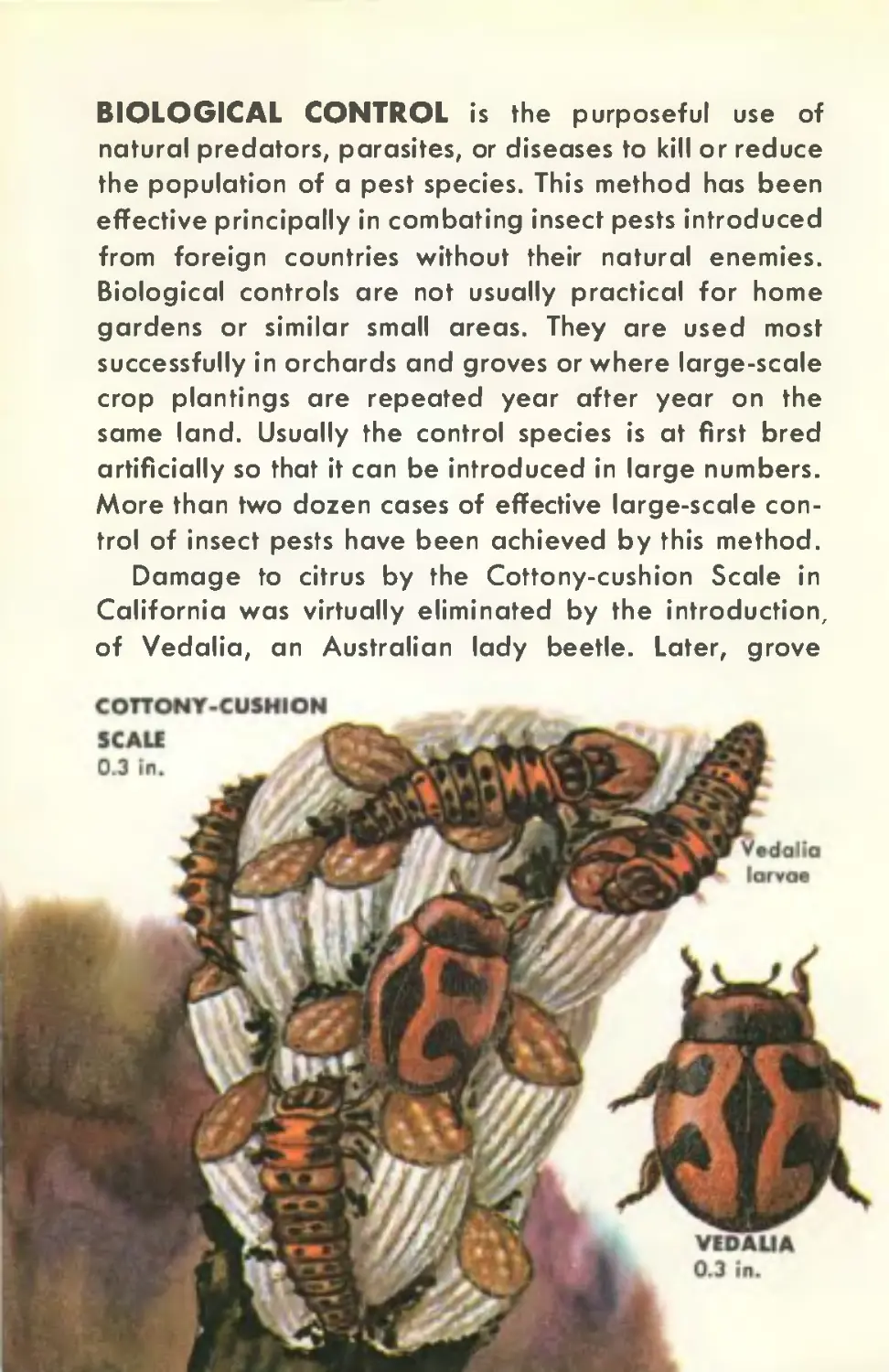
BIOLOGICAL CONTROL is the purposeful use of
natural pred ators, parasites, or diseases to kil l or red uce
the populatio n of a pest species . This method has been
effective principa lly in combating insect pests introd uced
from fo reig n countries without their natural enemies .
Biological controls are not usually practical for home
gardens or similar small are as. They a re used most
successfully in orchards and groves or where large-scale
crop plantings are repeated yea r after yea r on the
same land. Usually the control species is at first bred
artifi cially so that it can be introd uced in large numbers .
More than two dozen cases of effective large-scale con
trol of insect pests have been achieved by this method .
Damage to citrus by the Cotto ny-cushion Scale in
California was virtually eliminated by the introductio n,
of Ved alia , an Australia n lady beet le. Later, grove
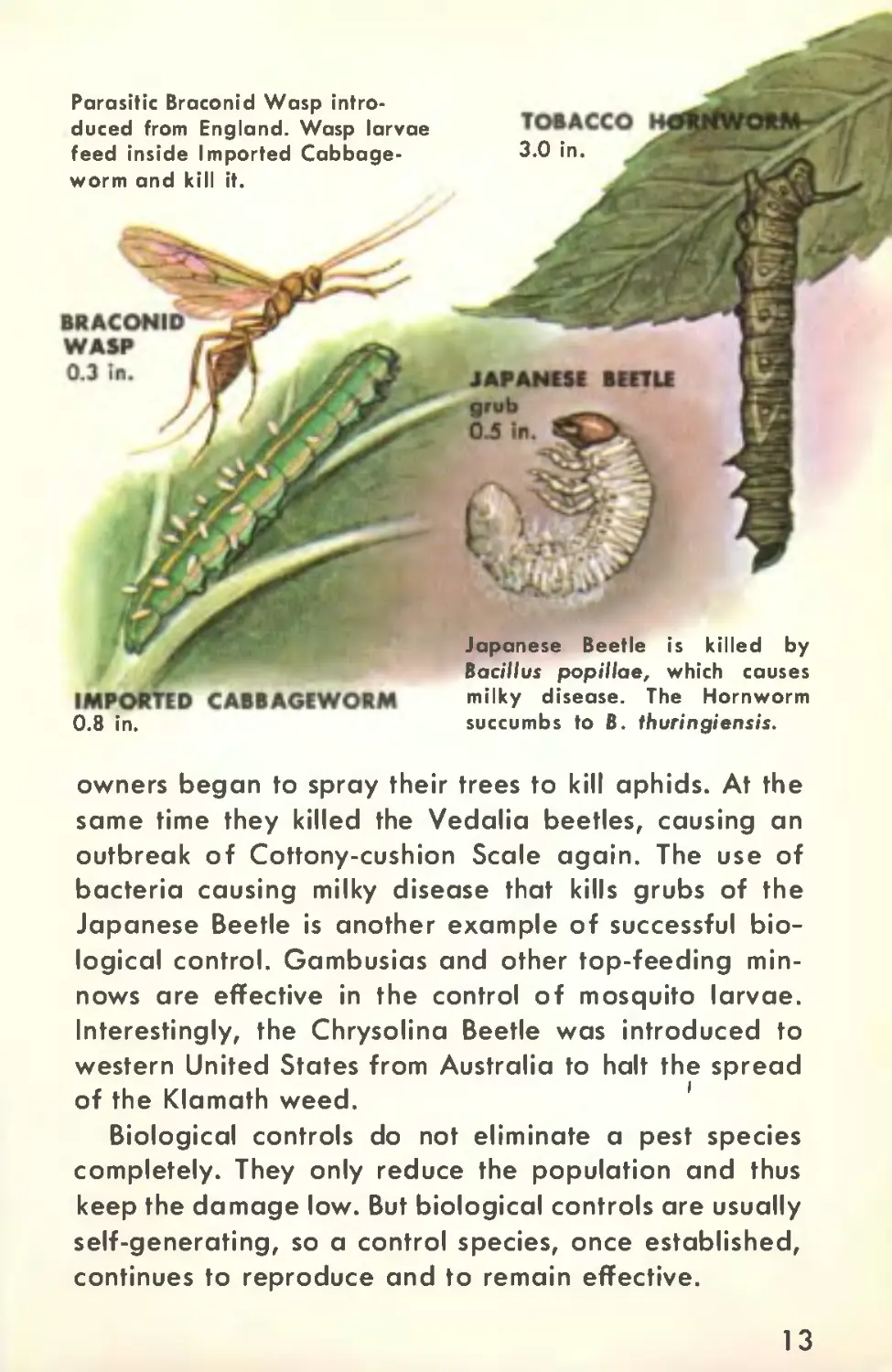
Parasitic Bracanid Wasp intro
duced from England. Wasp larvae
feed inside Imported Cabbage-
3.0 in.
worm and kill it.
Japanese Beetle is killed by
Bacillus papillae, which causes
milky disease. The Hornworm
0.8 in.
succu mbs to 8. thuringiensis.
owners began to spray their trees to kill aphids. At the
same time they killed the Vedalia beetles, causing an
outbreak of Cottony-cushion Scale again. The use of
bacteria causing milky disease that kills grubs of the
Japanese Beetle is another example of successful bio
logical control. Ga mbusi as and other top-feeding min
nows are effective in the control of mosquito larvae .
Interesti ngly, the Chrysolina Beetle was introd uced to
western United States from Australia to halt the spread
of the Klamath weed .
1
Biological controls do not eliminate a pest s pecies
completely. They only reduce the population and thus
keep the damage low. But biological controls are usually
self-generating, so a control species, once established,
continues to reproduce and to remain effective .
13
PHYSICAL AND MECHANICAL CONTROLS are the
si mplest, most obvious, and at times most effective: wit
ness the old-fashioned fly sw atter. Pests of stored prod
ucts are co mmonly destroyed by heat or cold. Few can
survive long in a temperature of 120 degrees F. or
higher. Cold either kills or stops activity. Draining off
st and ing water to eliminate breed ing places is a stan
dard mosquito control method, while many plant pests
are killed by flooding. Lig hts are used to attract so me
kinds of pests, which may then be electrocuted on
charged screens. Pests that col lect in large numbers
may be lured to baits or caught in ditches. The gardener
who picks Japanese Beetles off his roses by hand uses
an effective method for small areas.
CULTURAL CONTROL is an inexpensive method of
checking or preventing damage by insect pests by com
bining mechanical or physical controls with a knowledge
of the pest 's life histo ry. Crop rotation prevents the
build-up of a pest population that feeds on one kind
of plant. Burying stal ks, weeds, and other residues after
harvest destroys eggs, pupae, or hibernating larvae and
adults. Similarly, e arly or late plowing may destroy a
part icular life stage of a pest. Planting and harvesting
Go lden Regent, a
resista nt variety
of sweet corn.
c an sometimes be timed to escape
periods of egg ·laying or of pest
abund ance. Varieties of plants re
sistant to particular pests can be
planted . Healthy, vigorously grow
ing plants can withstand insect at
tacks better than those that ore
wea k or diseased . Likewise, ani
mals in good health are not as
greatly disturbed by pests.
INSECTICIDES are poisons used to kill insect pests .
Their great advantage is speed . Biological control
meth ods, while safer and longer lastin g, may require
several seasons to become effective.
More than 350 million pounds of insecticides are
sold annually in the United States . Their use increases
agric ultural yields by an average of about 25 percent
and in many cases prevents complete crop losses. In
secticides are highly important, too, in the control of
pests that are annoying or are disease carriers .
Most insecticides are dangerous to people and other
animals as well as to pests . Rea d and follow carefu lly
the instruction on labels. Consult a county agent or an
entomologist or employ the servic es of a professional
pest- control operator.
APPLICATIONS of insecticides are rarely made full
strength . Dusts are dry mixtures of from 0. 1 percent to
25 percent of the poison mixed with fine particles of an
inactive materia l, such as ta lc. Wettable powders are
dusts that form a suspension in water fo r spraying; the
powd er may consist of from 1 0 to 95 percent insecticide.
Emulsifiable concentrates, the most common form ulation
for applying insecticides, consist of oil or a similar or
ganic solvent containing the insecticide and an emul
sifier that aids the mixing of the droplets of oil and
insecticide in water. The co mponents may separate on
standing but can be remixed by shaking. Special sol
vents, such as kerosene, pine oil, and other liquids of
organic compounds, are used with the water-insoluble
organic insecticides. Most solvents are toxic to plants,
are inflammable, and may damage wallpaper, tile, and
other materials. For all appl ications, fo llow printed di
rections with care.
Aerosol Bomb
SPRAYERS use a pump to build
up air pressure that forces the
liquid insecticide from the noz
zle. The size of the nozzle open
ing creates either a foglike mist
or a steady strea m.
DUSTERS are powered by hand
or by motor and use either a
fan or com pressed oir to force
out the dust in a cloud.
AEROSOL BOMBS, the most
com mon household applicators,
consist of an insecticide dis
solved in a liquefied gas under
high pres sure. A fine mist is pro
duced when these are allowed
to escape from a small opening.
Aerosols ore convenient but are
relatively expensive.
Bean beetles and their larvae
(p. 76) feed an the underside of
leaves. They can be rea ched with
insecticide dusts.
STOMAC H POISONS are used principally to kill insects
with chewing m outh parts. They may be sprayed or
dusted directly on the insect's food or may be mixed
with baits to attract the pests. To be useful a stom ach
poison must kill fairly quickly, as the pest is already
doing damage when it ta kes in the insecticide. Too
heavy an application of these chemicals may kill the
plants . The residues are poisonous to man and domes
tic animals. Contact insecticides (p. 18) act as stomach
poisons if eaten. Arsenic compounds are the most com
mon inorganic stomach poisons. Paris green (calcium
acetoarsenite) was the first chemical insecticide used
successfully on a large scale. Lead arsenate, white
arsenic (arsenious ox ide), sodium arsenate, and calcium
arsenate are other arsenic stomach poisons. Fluorine
compounds that act as stomach poisons are sodium fluo
silicate, sodium fluoride, and sodium fluoaluminate
(cryolite) . Thallium sulfate, highly poisonous, is mixed
with food to make ant baits. Do not store any insecticide
where children can reach it. Ma ke certain the con
tainers are properly labeled and marked POISON.
INSECTICIDES 17
CONTACT INSECTICIDES are sprayed or dusted di
rectly on pests or are spread where pests will pick them
up. They are especially useful in controlling insects with
piercing-sucking mouthparts. Al l contact poisons act as
stomach poisons (p. 17) if eaten. Most of them are also
poisonous to people and animals and thus are a serious
hazard if not used as directed. In excess amounts many
contact insecticides are poisonous to plants. Some are
used as fumigants. Always read the label before even
opening the insecticide container. When in doubt
obout how to use an insecticide safely and most effec
tively, ask the advice of your dealer or of a county or
agricultura l agent.
Most of the many thousands of tradenamed insec
ticide formulations belong in the contact-insecticide
group. These are divided into the followi ng groups
inorganics, natural organics or plant poisons, synthetics,
and oils. Each of these groups is described separately
on the fo llowi ng pages. Most of the contact insecticides
now u sed have appeared since the World War II de
ve lopment of DDT, the first widely used synthetic or
ganic insecticide.
INORGANIC CONTACT INSEC
TICIDES, consisting mainly of
sulfur dusts, mixtures of lime
and sulfur, or sulfur compounds,
were the forst contact poisons
used on a large scale and still
rank among the most importa nt.
Sulfur dust is one of the main
chem ical controls for mites, for
the crawling stages of scales,
and for some kinds of caterpil
lars. Finely grou nd sulfur is us
able as a wetta ble powd er for
spray applications. Lime-sulfur
solution is a liquid, sol uble in
1 8 INSECTICIDES
water. Lime-sulfur is also dehy
drated and sold in concentrated
powd er form. It is used to con
trol plant pests such as scales
and also as a dip for cattle,
sheep, and other livestock. Bor
deaux mixture is a co mbination
of copper sulfate and lime in
water. In addition to their use
as insecticides, sulfur and sul
fur compounds are valued as
fungicides. In hot weather, heavy
applications of sulfur will burn
fo liage and fru it and so must be
applied sparingly.
NATURAL ORGANICS were
the earliest compounds used in
killing insect pests. With the ex
ception of nicotine, highly toxic
to man and other mammals, they
are the least dangerous of the
insecticides to use on food plants
or in the house.
Nicotine is obtained from the
waste leaves of tobacco plants
and waste tobacco products. It
is used principally as nicotine
sulfate, with a 40-percent nico
tine content. The 40-percent con
centrate is ordinarily diluted in
800 to 1,000 parts of wafer
(about one teaspoon to a gallon)
and is applied as a spray to kill
aphids or other soft-bod ied in
sects. Nicotine sulfate is used
also as a stack dip for control
of mites, ticks, and lice. Finely
ground tobacco stems and leaves
are used as a dust or burned as
a fumigant. Nicotine may be
added to aerosol form ulations.
Pyrethrum comes from the
flowers of several species of chry
santhemums. It is produced com
mercially from a species grown
in East Africa. Fast-acting pyre
thrins ore the "' knockdow n"
agents in most household sp rays,
with slower-acti ng DDT or other
synthetics ocluolly killing the in
sect. Allethrin, produced syn
thetically, is much the same os
pyret hrum in action.
Rotenone is obtained from the
dried and grou nd roots of the
South American cube and from
the roots of two species of der
ris that grow in the East Indies.
As prepared for an insecticide,
Tobacco plant, sou rce of
highly toxic nicotine
rote none is relatively nontoxic to
humans, but as an insecticide it
acts both as a stomach and as a
contact poison. Another use of
rote none by biologists is as a
poison to eliminate trash fish in
lakes and ponds.
Other bota nicals, or natural
organic contact insecti cides, in·
elude ryania, produced from the
pu lverized stems and roofs of a
South American plant. Ryania is
less tox ic to mam mals than ro
tenone and so is recommended
for food plants where residues
might be a problem. Sabadilla,
which also has low toxicity, is
mode by grinding the seeds of a
lily-fa mily plant of Venezuela.
INSECTICIDES 1 9
SYNTHETIC ORGANIC CO N
TACT INSECTICIDES are the
mast important group of chemi
cals used today in the control of
insect pests. There are two
groupo: chlori nated hydrocarbons
and organo-phosphates.
CH LORINATED
HYDROCARBONS
DDT is the leader in the chlo
rinated h ydrocarbon group.
Though first sy nthesized in 1874,
DDT was not recog nized as an
insecticide until World War II,
when its initial large-sca le use
halted a typhus epidemic spread
by lice in Italy. It was later va lu
able during the war years in the
control of flies and mosquitoes
and came into widespread use
in the control of agricultural and
household pests after the war.
DDT is highly effective in killing
many kinds of insects but is
relatively nontoxic to aphids,
spider mites, and some other
species. Some cockro aches, flies,
and oth er insects h ave devel
oped resistance to DDT. When
an insect co mes in contact with
DDT, it first appears to lose con
trol of its vo luntary actions; later
it becomes paralyzed. Death
comes slowly, sometimes several
days later. DDT has a rather low
tox icity Ia man and other verte
brates but may be stored in the
fatty tissues of the body and
cause death months later when
the fat reserves are utilized.
DDT is applied as a dust,
wettable powd er, water emul
sion, or in an oil base. Verte
brates absorb the oil-base DDT
most rapidly. DDT is insoluble
in water. Its residues may re-
20 INSECTICIDES
main effective outdoors for many
months or even years, indoors
for even longer. Methoxychlor,
related to DDT, is effective
against the Mex ican Bea n Beetle
and works more rapidly in killing
the House Fly. TDf (or DOD), also
a relative of DDT, is co mmonly
used in mosquito control be
cause it is less toxic than DDT to
vertebrates. TOE is also less poi
sonous to insects, however.
Benzene hexachloride (BHC),
also in the chlori nated-hydro
carbon group, was discovered
as a useful insecticide about the
same time as DDT. BHC kills
faster than DDT and is com monly
used in the control of crop pests.
It has a distinctive musty odor
and sometimes taints food. BHC
is usually used as a dust or a
wetta ble powd er. Lindane is BHC
that differs only in the arrange
ment of its atoms, but as it lacks
the objectionable heavy odor, i t
is used more commonly in
houses. Though its residual life
is shorter than DDT's, lindane
is about twice as toxic to many
insects and apparently is not
stored in the body tissues. Toxa
phene, insoluble in water but
sol uble in many organic sol
vents, is an excellent insect killer
but is also poisonous Ia verte
brates. Toxaphene is one of the
most co mmon insecticides for
controlling pests of cotto n.
Chlordane, dieldrin, aldrin,
endrin, and heptachlor form an
oth er group of �losely related
chlorinated hydrocarbons. All are
insol uble in water but are solu
ble in many organic solvents.
Scales may be killed with organa
phosphate sprays (below and p. 86).
Use these insecticides with great care.
They are also used in dust or
pellet form, particularly as soil
poisons for the control of ter
mites and ants. They are highly
effective insect killers and are
residual. They are also poi son
ous to vertebrates, including
man and other mammals.
ORGANO-PHOSPHATES
The organo-phasphate group
of contact insecticides ste ms
from chemical research just be
fore World War II, when same of
these compounds were devel
oped as poisonous gases for use
in warfare. Most of them are ex
tremely lethal to man and ani
mals as well as to insects. They
can be taken into the body
through the mouth or the skin or
by inhaling their fumes. Resi
dues an foods are a sou rce of
danger. Because these insecti
cides are very poisonous, they
must be handled w ith the great
est care.
Parathion, a brownish-yellow
liquid with a garlic odor, is toq
poisonous for household use or
for applying near livestock and
pets, but it is widely used on
fruit and vegetable crops. Resi
dues disappear rapidly. Deme
ton, about as poisonous as para
thion, acts as a syste mic poison,
being absorbed by the tissues of
the plant. It kills pests that feed
on the plant's juices without af
fecting predators and pollinators.
TEPP, eve n more poisonous than
parathion, decomposes rapidly
and leaves no residue. It is used
reg ularly on food crops.
Malathion, mast com manly
used organa-phosphate, is not
highly toxic to vertebrates. Mala
thion wi ll kill many i nsect species
that have developed a resista nce
to the insecticides of the DDT and
ch lordane groups. Diozinon,
DDVP, ronnel, and dicopthon are
ather organo-phosphates that are
excellent insect killers. DDVP is
the most highly toxic of these
chemicals to man and animals.
INSECTICIDES 21
Oils are applied to citrus to kill
young stages of Purple Scale (p. I 33)
and Citrus Whitefly (p. 136).
OILS, principally petroleum but
also some animal and vegeta ble
oils, serve as carriers for in
secticides or may be used as
insecticides themselves. Dormant
oils, rather heavy and sem ire
fined, are applied in late wi nter
or early spring to trees or shrubs
that ore not in foliage to kill
scales, mites, eggs, and some
larvae. Summer oils ore lighter
and more highly refi ned, hence
less damaging Ia plants; they
ore used to control a ph ids, scale
insects, and mealybugs. As the
oils themselves are toxic to plants
if applied full stre ngth, they ore
mixed with water by add ing on
emulsifier, such as soap. Th is
distributes the oil eve nly as small
droplets. Oil baths may be used
to kill such parasites as fleas,
lice, ticks, and mites on dom estic
animals and pels. Form ulations
that req uire shaking with a small
amount of water before final
mixing ore called miscible oils.
A n emulsible-oil form ulation con
be pou red directly into the
water.
FUMIGANTS ore gases used to
kill insects in enclosures, as in
2 2 INSECTICIDES
buildings or containers, in the
soil, or under such temporary
covers as tarpaulins and tents.
Many fu migants are inflammable.
Nearly all fumigants ore more
poisonous Ia man than to the
insects and should be used only
by a professional pest-control
operator. Their adva ntage is
their penetration to all ports of
buildings, into stored products
or plants. They leave no residue.
Carbon disulfide (carbon bisul
fide), highly inflam mable, is used
mainly as a soil fumigant for
ants, te rmites, and grubs. For in
�oor use it may be mixed with
carbon tetrachloride to reduce
the danger of fire or explosion.
Dichloropropene and dichlaro
propane are also used as soil
fumigants. Hydrogen cyanide,
which has a distinctive nutty
odor and is deadly poisonous, is
used to fum igate mills and ware
houses or fruit trees under tents.
Methyl bromide, a noninflamma
ble fum igant, is valued beca use
of its power to penetrate tightly
packed materials. Paradichloro
b enzene ("para " crystals) and
naphthalene (both sold as moth
bolls) vaporize slowly and act
as a fumigant and a rep ellent.
REPELLENTS are chem icals that
by their odor or taste prevent
insect attacks. They are used
mainly to protect man, animals,
or stored products; less co mmon
ly, plants. Some repellents are
poisonous if touched, eaten, or
breathed. Mothballs are repel
lents that protect clothes from
insect damage. Creosote is used
as a barrier agai nst crawling in
sects, while smoke screens ward
of! flies and mosquitoes. Among
the most successf ul of dozens of
repellent chemicals ore diethyl
toluamide, dimethyl phthalate,
and ethyl hexanediol. These or
ganic chemicals are diluted with
oils and disguised with per
fumes. They are sold under many
tradenam es. Most will repel in
sects for one to five hours.
''
NEW METHODS of combating
insect pests are being developed
every year. Some are useful only
in large-sca le control progra ms,
others in home and garden.
Among the most promising are
sterilants that render insects in
capable of reproducing. This
method was first used with suc
cess to control the Screw-worm .
Mi llions of males, sterilized by
ra diation, were released in areas
of infestation to male with fe·
males, which then prod uced in
fertile eggs. Hormones are used
to cause an insect to pass from
one stage of its development to
the next irrespective of season.
Thus, pupae can be made to
transform into adults in mid
winter or larvae may be made
to pupate before they are full
grown. Insect hormones are ap·
parently harmless to other living
things. Also safe are such non·
toxic insecticides as finely ground
sil ica, which abrades the outer
covering from an insect and
causes it to dry up, or desiccate,
as its body fluids escape.
The soil in seed beds can be fumigated by releasing methyl-bromide
gas under plastic cover.
INSECTICIDES 23
widespread in U.S., give off a
sweet odor when crushed. Travel
definite trails ta fond food .
ARGENTINE ANTS are common
in southern U.S.; worst ant pests
in houses. Prefer sweets but eat
oil foods. Bile, do not sting.
HOU EHOLD P
Insect pests may dest roy the timbers of a house, tunnel
into furniture and fa brics, or raid the contents of the
kitchen, fro m the spice cabinet to the garbage pail.
Some kinds bite, sting, or transmit diseases. Others are
simply annoying, uninvited guests .
The basic step in control ling household pests is to
keep them out. Screen windows and doors, seal cracks,
and remove debris in w hich pests can hide or multiply.
If pest" infestations are heavy, persistent, or unexplain
able, services of a professional pest-co ntrol operator
may be necessary. Make certain the man employed
represents a licensed, bonded organization.
Many pests can be recog nized and controlled with
out expert help. Since insecticides are poisonous and
will be used where there are people, pets, and food,
follow carefully the directions given on the label.
THIEF ANTS often live in other
onl nests and feed on larvae.
They prefer cheese, meals, or
other greasy food .
PHARAOH ANTS also like
meal. May nest in walls and then
invade all parts of house. Poison
baits are best control method.
CRAZY ANTS, native to India
but now widespread, run 11Craz.
ily" on their long legs. They eat
meat, greasy foods, and sweets.
CORNFIELD ANTS are the com
mon "red ants" of northern
states. Nest mounds ofte n nu
merous on lawns. Invade houses.
ANTS live in colonies in the ground, in the foundations
or walls of buildings, beneath bark or stones. A colony
contains numerous workers (sterile fe males), one to sev
eral queens, and a few males during part of the year.
Workers do not have wings, but males and fe males are
winged at swarming ti me. Males die after mating, and
the queens drop their wings and flnd a place to start a
colony. After mating, queens re main ferti le, living as
long as 25 yea rs. Queens are usually seve ral times
larger than workers, which atte nd their every need . Ants
belong to same insect order as bees and wasps. They
have elbowed antennae and a thin waist, distinguishing
them from te rmites (p. 26).
The most effective control is to d estroy the nest if
it can be found. Chemical barriers, using a residual
contact insecticide, can be placed around fo undations
of buildings. Workers will ca rry poisoned baits to the
colony and thus kill even the queen.
SOUTHERN FIRE ANTS occur in
warm parts of U.S . Often nest
near buildings. Invade houses.
Stings are painful.
BLACK CARPENTER ANTS exca
vate galleries and nest in wood.
They enter houses to get sweets.
Bite but do not sting.
TERMITES are primitive social insects, more closely re
lated to cockroaches (p. 28) than to ants (p. 25). A
colony consists of numerous whitish, wingless, blind
workers; a lesser number of soldiers, with large brown
ish heads e q uipped with powerful jaws or with a bellows
shaped snout that expels a sticky or odorous fluid; and
reproductives, the king and queen. Ad ditional winged
males and fe males are produced for swa rming, which
ta kes place in spring or afte r rains in warm weather.
After a short flight they break off their wings and mate.
Each mated pair then crawls off in search of a suitable
place to establish a new colony.
More than 50 species of termites occur in the U.S.
Th eir spread as fa r north as Mi nnesota in recent years
is a ttributed to increased use of central heating in build
ings, enabling them to survive winters. Nearly all U.S.
species live in the soil; many of the more than 2,000
species of the tropics build aboveg round nests .
Te rmites eat wood but cannot absorb it until the
cel lulose is converted into soluble substances by proto
zoans that live in the termite's digestive tract. Neither
animal is able to survive alone.
damaged woad
SUBTERRANEAN TERMITES
live in colonies in soil, and
workers travel through tunnels
or mud tubes to the wood above.
Fungi that grow in moist, dark
tunnels ore eaten by termites,
supplying protein and vitamins.
Swarming flights or mud tubes
up a foundation ore evidence of
a termite infestation. In late
stages, floors sag as eaten-out
beams crumble.
To control, no wood of a build
ing should touch so il. Preventive
measures should be to ken as a
building is being constructed.
Place metal shields between the
foundation and sills and allow
air to circulate under buildi ngs_
Beca use of the special equip
ment needed, use a professional
pest-control operator, especially
in treating a building already
erected . He will force penetrat
ing insecticide into the wood or
fo undation, Treat the soil be
neath buildings, or use a fumi
gant. Inspect regularly to detect
ren ewed activity.
worker
0.2 in.
reproductive
0.5 in_
DRYWOOD TERMITES ore prev
alent in the southwestern U.S .
No contact with soil is necessary.
Often they invade a house at
roof level and may infest furni
ture or books. Piles of brown
ish, seedlike excrement pellets
pushed from tunnels ore signs
of their presence. Preventing en
try is not economical. Control,
which should be done only by
experts, consists of forcing in
secticide into tunnels. Poison is
spread as workers groom each
other. House or infested object
moy be fumigated, but this does
not preve nt rei nfestotion.
EASTERN SUBTERRANEAN TERMITE
GERMAN COCKROACHU
0.5 in.
COCKROACHES feed on a great variety of foods
meats, cheeses, sweets, and starches, including the
starch in clothing or in the glue of book bindings and
stamps: When very abundant, they may also eat
human hair, skin, and nails. Cockroaches secrete a
stic ky, odorous fluid that may be left on foods or mate
rials. Fortun ately, cockroaches appear to be only
incidental carriers of diseases.
Most of the more than 3,000 species of cockroaches
live in the tropics or subtropics. About 55, occur in the
U.S.; only four species are common household pests.
Normally cockroaches are active only at nig ht. They
develop by a gradual meta morphosis-e gg, nymph,
and adult. Egg cases contain two rows of eggs, and
the nym phs escape through a seam along the side.
Nym phs look like adults but lack wings and may be a
lighter color. After a period of growth and several
molts they become adults. The time required for them
to mature varies with the species and also with the
season and the region . Temperature and moisture as
well as food are importa nt factors in their development.
The best permanent control for cockroaches is elim
inati ng accessibility of foods which they eat.
28 HOUSEHOLD PESTS
GERMAN COCKROACHES, or
Croton Bugs, ore common in
U.S ., especially in northern
stoles. Dork stripes on shield be
hind heod ore disti nguishing.
Both sexes wi nged ond active.
German Cockroaches com mon·
ly enter houses in bags or boxes
from grocery stores. They tend
to cluster in warm, moist places,
os arou nd hot-water pipes, and
stay hidden when not feed ing.
Females carry the egg cap
sule, containing 24 to 48 eggs,
until hatching time. Nymphs may
emerge while the capsu le is sti ll
attached to the female.
In most areas German Cock·
roaches ore resistant to DDT,
ch lordane, ond other chlori nated
hyd roca rbons. They can be con
trolled with organo-phosphates,
such os malathion.
BROWN-BANDED COCK
ROACH has two light bonds
across the bose of its wings.
Unlike other cockroaches, it is as
co mmon in the bedroom as in
the kitchen , requiring warmth
but not as much moisture. Control
is difficult because these cock
roaches are found so widely
through the house. The most
effective woy to reach them is
with fumigants, keeping room or
house closed for several hours.
ORIENTAL COC KROACHES,
also called Block Beetles or Wa
ter Bugs, are most sluggish of do
mestic cockroaches. Females have
short useless wings and are
slightly larger than males. Cam
manly infest damp basements.
Contact-insecticide barrier
arou nd a foundation blocks en
try of these cockroaches and
other crawl ing pests.
AMERICAN COCKROACHES
are the largest cockroaches in
the U.S . Bot h sexes are winged,
their flight gliding and fluttery.
The female deposits her egg
capsule soon after it forms,
someti mes gluing it to a surface.
In the South these cockroaches
ore co mmon outdoors, wh ere
they live under bark or in vege
tation. They can be control led
with contact insecticides or lured
to poison baits.
CLOTHES MOTH larvae fe ed on woolen fabrics, feath
ers, fur, mohair, and other animal products such as dried
milk and meals. The adult moths, commonly called
"millers, " do not eat, and unlike most other moths, are
not attracted to lights.
Material likely to be attacked should be cleaned and
exposed frequently to light. Brushing clothes dislodges
the eggs and larvae. Storage of furs at a temperature
of 45 degrees or cooler prevents dev elopment of moths
or will kill them if the temperatu re is raised and lowered
seve ral ti mes during the storage period . Items can be
sprayed with residual contact insecticides or wa shables
rinsed in an insecticide solution. Th ese treatments kill
the insects as they fe ed. Mild fumigants such as para
dichlorobenzene crysta ls or naphthalene flakes discour
age moth atta cks. These insecticides will also kill moths
already in the fabrics but are effective only when used
in tight containers or closets . An infesta tion may persist
and spread from larvae that feed and develop on lint
in cracks in the floor, beneath baseboards, or in vents.
In heavy infestations an entire house may be fumigated .
This should be done only by a professional exterminator.
DERMESTID BEETLES are pests of fabrics and up
holstered furniture and also infest cured meats, meals,
cheeses, hides, hair, flour or other grain prod ucts, and
spices. Th ey are serious pests in museums. Outdoors they
are va luable as scavengers . Larvae of dermestid beetles
are more active than the larvae of clothes moths. Ad ults
fly in daytime. They co mmonly feed on the pollen of
flowers and also breed outdoors . Treatments effective
for clothes moths also control carpet beetles. In both
cases, good housekeeping to e liminate breeding places
is the most important preve ntive .
30 HOUSEHOLD PESTS
WEBBING CL OTHES MOTHS
are com mon fabric pests that oc
cur throughout the world. Fe
males lay eggs about 0.02 of an
inch long (barely visible), either
singly or in small groups, stick
ing them to the threads of fab
rics. Eggs hatch in a few days
to several weeks, depending on
tem perature and humidity. The
larvae are so tiny they can crawl
betwe en the woven threads of
fabrics. They spin a silky web
bing or tunnel as they feed,
sometimes moving to another
spot if their food runs short.
Damage is most common under
col lars, in cuffs, or in other
dark areas of garments. Full
grown larvae spin a silken co
coon from which they emerge as
adults in three to six wee ks.
CA SEMAKING CLOTHES MOTH
larvae spin a case of silk and
fabric, carrying it with them as
they feed. The case splits and
the "V" of the split is filled in
as the larva grows. Common in
northern states. Plaster Bag
worms of southern slates build
a portable case of bits of plaster
or fabric woven into the silk of
the case.
CA RPET BEETLES, also called
Buffalo Beetles, are derm estids
that infest woolen fabrics, feath
ers, and other animal prod ucts.
Rel ated pests include the larger
Hide Beetle and the larder Bee
tle. Hides and skins are treated
with arsenic powders or similar
stomach poisons. Ch eese, cured
meats, and other fatty foods
should be kept in tight con
tainers ar under refrigeration.
wingspread
eggs, larvae ana cocoons on fabric.
CA SEMAKING CLOTHES MOTH
1. LARDER BEETLE, 0.3 in.; 2. CA RPET
BEETLE, 0.2 in.; 3. HIDE BEETLE, 0.3 in.
House Fly can eat only liquids.
It salivates on solids to dissolve
them, then sponges up liquid.
pupariu m
3-10 days
HOUSE FLIES are bothersome, dangerous pests, trans
mitti ng diseases and parasites from the filth in which
they breed to the foo ds man eats. Females may lay half
a dozen or more clusters of 100 to 150 eggs in a sea
son. In favorable conditions a life cycle is completed
in about two weeks but may take many months in cold
weather. Wi nter is ordinarily passed in the larva or pupa
stage, but adults may ove rwinter in warm niches. Dis
posal of garbage, manure, sewage, and similar decay
ing or fermenting wastes in which the flies breed and
the maggots develop is most important. Windows and
doors should be fitted with tight screens. Flies that enter
can be killed with aerosol sprays . Walls, sills, and
screens can be treated with resid ual surface sprays. As
flies in most areas are resistant to DDT, oth er contact
insecticides must be substituted. Poison baits (mixtu res
of syrup- or sugar-water with an insecticide) are effec
tive in places that cannot be screened or where sprays
cannot be used because of danger of conta mination.
32 HOUSEHOLD PESTS
LITTLE HOUSE FLIES are smaller
and more slender than the Hause
Fly. They hover or fly back and
forth without settling on food.
The similar, closely related La
trine Fly breeds in human ex
crement. Maggots of both have
a flattened, spiny body.
BLOW FLIES are large and
noisy. Most species are metallic
blue or green, like the Green
Bottle and Blue Bottle flies shown
here. The gray Cluster Fly, sim
ilar in appearance to House Fly,
is a blow fly com mon in houses.
Blow fly maggots develop in
garbage or carrion.
MOTH FLIES, their wings and
body covered with hair, often
appear in sink or bathtub drai ns.
The maggots develop in the
gelatinous sludge in the bends
of pipes. Sometimes large num
bers invade from outdoors,
where they develop in garbage
or sewage. They are so tiny they
can crawl through screens.
FRUIT FLIES can enter houses
through ordi nary scree ns. They
are attracted to rotting or fer
menting fruits or liquids. A co m
plete life cycle req uires less
than two weeks. Other common
names for them are Vi negar Flies
or Pomace Flies.
DROSOPH ILA FRUIT
BL UE BOTTLE FLY
0.5 in.
CLUSTER FLY
0.3 in.
GNAT is a name used for many
kinds of small flies, most of
which are only nuisances. The
Eye Gnat, attracted to eye secre
tions, transmits pinkeye. These
persistent tormentors are most
active in early morning or eve
ning hours.
EYE GNAT
MANY OTHER KINDS of insects, as well as spiders,
and their kin enter houses, where they are either nui
sances or potentially dangerous pests. Some of these
are discussed in the section on insects that bite or sting
(p. 38), others in the section on stored prod ucts (p. 146).
Often an invasion of insects is only temporary, as when
they are attracted to lights. When a lawn is mowed, a
vacant lot is cleaned up, or a crop is harvested nearby,
insects disturbed from their normal living places may b e
temporary pests. Others are regular visitors and com
panions in dwellings.
34 HOUSEHOLD PESTS
SILVERFISH are scaly, wingless
insects that prefer foods with a
high starch or sugar content.
They eat the glue in book bind
ings or from wa llpaper and often
damage pai ntings or paper. Sil
verfish prefer cool, damp places;
the closely related Firebrat lives
in wa rm, drier spots. Residual
sprays ar dusts are effective in
keeping down infestations.
EARWIGS are easily r ecog
nized by forceps ot end of ab
domen. Someti mes occur in large
numbers in houses. They can
bite and also pinch, but seldom
brea k the skin. They hide during
the day, feed at night. Use resid
ual sprays or dusts.
HOUSE CRICKETS sing on the
hearth or wh erever they can find
warm th. When cold, they are
sluggish and quiet. Field Crickets
also enter houses in autumn. As
house pests, crickets eat o variety
of food s and may be destructive
to clothes. Household sprays,
dusts, and poison baits are
usually effective.
WOOD-BORING BEETLES of o
number of species may infest
wood used in houses or furni
ture. larvae of the Southern
lyctus Beetle reduce wood to a
fine powd er, which is pushed
outside through small holes.
Dro ppings of the Furn iture
Beetle and others are round pel
lets. As some kinds feed, a tick
ing noise in the wood can be
heard. Fumigation by a qualified
pest-control operator is the best
control.
BOOKLICE, or Psocids, some
times became abundant in stored
furniture, books, or papers, par
ticularly if damp. They feed
mainly on molds but also ea t
cerea ls. Booklice are so small
that it is difficult to keep them
out af a house. Use contact
sprays or dusts.
BOXELDER BUGS do not bite,
sting, or ca rry diseases, but ore
annoya nces when large numbers
occur near or in houses. Can be
killed with household sprays.
CR ANE FLIES look like Iorge
mosquitoes but are harmless.
Their larva e, or maggots, some
times called leatherja ckets, de
velop in damp vegetation or in
the soil. Adults commonly are
attracted to the lights in houses.
They can be killed with house
hold fly sprays.
SPRINGTAIL$ often congregate
in cellars or in bathrooms or
kitchens, wherever there is
dampness. They are harmless
and can be killed with household
sprays or dusts.
SOUTHERN LYCTUS BEETLE
0.1
HOUSEHOLD PESTS 35
HOUSE CENTIPEDE
1.0-1 .5 in.
CENTIPEDES are flat-bodied,
with long antennae and one
pair of legs an nearly every
trunk seg ment. The House Cen
tipede feeds on ants, flies, cock
roaches, and other pests, hence
is beneficial. Its bite, though
rare, is painful. Use residual con
loci insect icides or treat joists,
subflaors, and cracks with creo
sote or ather repellents.
MILLIPEDES are almost cyl in
drical, with two pairs of short
legs per apparent body seg
ment, and short antennae. They
move slowly. These features dis
tinguish them from swift-crawl
ing centipedes. Normally milli
pedes are fou nd only outdoors,
feed ing on decaying vegetation ,
but they may invade houses after
ra ins or to escape cold in fall.
PILLBUGS AND SOWBUGS
are land-dwelling crustacea ns.
They can survive only in damp
places, as in leaf mold or in
base ments. They feed mainly on
decaying vegetat ion but also
eat tender roots of plants. Con
trols: cleanup of debris in which
they thrive; contact insecticides;
poison baits in heavy infesta
tions, as in greenhouses.
SCORPIONS are spider rela
t ives found only in warm cli
mates. Two species in south
western U.S. are highly poison
ous. Scorpions are nocturnal and
feed mainly on insects, which
they catch in their pincers, then
paralyze or kill with their sting.
Eliminate debris close to build
ings and use contact insecticides
that have residual action.
body 0.2 in.
2-3 in. across legs
DADDYLONGLEGS, or Harvest
men, rese mble spiders but hove
a distinctly segmented abdomen
and stink glands. They lack silk
glands. Their long stiltlike legs
are easily shed when the animal
is touched. Daddylonglegs are
harmless, feeding mainly on
dead in sects. They will kill and
eat small insects, however, and
may feed on fruits or vegetables.
JUMPING SPIDERS of severa l
species often enter houses. They
do not make webs. Instead they
hunt actively for prey, search·
ing over cei lings, walls, sills, and
floors. They can jump quickly,
and freq uently use their silk as
a payout line to let themselves
down from high levels. These
lines may be a nuisance, but the
spiders are helpful.
BLACK WIDOW SPIDERS are
widely distributed and rather
abundant. Their bites are pain
ful and may cause death. A doc
tor should be called immed iately
to give treat ment. Fortu nately,
Black Widows are shy and do
not bite without great provoca
tion. They usually build their
webs in or beneath objects close
Ia the grou nd.
HOUSE SPIDER
0.3 in.
HOUSE SPIDERS bother house
wives beca use of their webs.
Their bites may be very poison
ous. House Spiders prey on the
House Fly and other insects.
Their webs are usually built in
corners, where they collect dust
as well a s prey. These and other
spiders can be killed with con
tact sprays or dusts; residual in
secticides preve nt reinfestation.
38
INSECTSTH BE0 5NG
Biting flies feed on the blood of their victims. They cut
or stab through the skin with their knife-sharp piercing
mouthparts, then lap up blood that flows from the
wound. They may also be carriers of diseases.
Insects that sting usually do so as a defense when
disturbed or annoyed. Stings of bees or wasps may be
extremely painful and also dangerous. In the United
States more deaths result from insect sti ngs than from
the bites of poisonous snakes. Medical knowledge about
the effect of insect venoms and how to treat stings is
sti ll limited . Usually there is swelling and in many cases
a throbbing ache that may last for several days . Sti ngs
vary in severity with the species of insect and also with
the amount of poison injected . A sting in an arm or a
leg is less dangerous than a sti ng in the neck, where the
poison may pa ralyze the vocal cords or hamper breath
ing. The effect of a sti ng also varies with individuals
and with their physiological condition. Beekeepers com
monly build up an immunity to sti ngs.
HORSE FLIES, active only in the
daytime, are mainly pests of
livestock (p. 56) but may also
bite people. The bite, only from
females, is very painful. Females
lay egg masses on leaves, stems,
or rocks.. On hatching, larvae
BLACK HORSE
0.8-1 .0 in.
drop to ground and complete
development in damp soi l or in
water. Maggots may overwi nter
in mud, pupate in early spring,
and em erge as adults a few
weeks later. Equally pestering
are closely related Deer Flies.
DEER FL
0.4 in.
BLACK FLIES, also called Buf
falo Gnats, are most abundant
in late spring and summer in
wooded regions of Canada and
t he U.S. These humpbacked
bloodsuckers (only the females
bite, causing a persistent irrita
tion) crawl annoyingly into the
eyes, ears, and nostrils. Females
fasten their egg masses Ia rocks
or vegetation in strea ms, in
which the larvae develop and
spin cocoons. A life cycle is com
pleted in about six weeks. Re
pellents are effective.
STABLE FLIES, like Horse Flies,
are principally pests af livestock
but may at times bother people.
They occur most abundantly in
lowlands and seashore areas,
becoming especially aggressive
when the barometer is falling.
Both sexes bite. Their mouth
parts are sharp and stiletto- like
rather than sponging, as in
House Flies. In cool areas, they
overwinter as larvae or pupae;
in warmer climates, active the
year around. In houses, can be
killed with sprays. Eliminate
breed ing places (manure or de
cayi ng organic matter).
SAND FLY
SAND FLIES, or No-See-Ums,
are tiny bloodsucking flies, so
small they ca n go through or
dinory screens. They are most
active in evening or early
morning hours, and their bites
are extre mely painful. Screens
and areas a round lights can be
sprayed or painted with an oil
emulsion contact insecticide. Re
pellents will keep the flies off in
dayti me. The maggots develop
in moist vegetation or in pools
(some species in soli water,
others in fresh).
House Fly
abdomen
39
MOSQUITOES total more than 2,500 species. Many
are carriers of diseases (malaria, yellow fever, dengue,
and filariasis). Others, as annoyances, cause costly
losses of man-hours to outdoor workers or reduce the
pleasure of being outdoors.
Adult fe males lay their eggs on or near the surface of
permanent pools or in moist or te mporarily flooded
locations. Some species lay their eggs singly; others
deposit them in "rafts" of as many as several hundred.
In most species the fem ale must have a meal of blood
before she can prod uce eggs. Males are nectar feed
ers and do not bite. The larvae, also called "wigglers, "
swi m or rest just beneath the surface. They feed on
microscopic organic matte r. Development may be com
pleted in as short a time as five days or may require
several months; the average is a week to 10 days. Then
the larvae transform into pupae, also known as
"tumblers" because they continue to be active. The
adults emerge in from two days to two weeks or longer,
depending on the species and the water conditions.
Adults live for a few days to seve ral months, and most
species do not travel more than a mile. Some hibernate
in the adult stage.
Large-scale mosquito control consists of eliminating
breeding areas by drainage, spre ading oil films over
the surface of the water, using insecticides to destroy
the larvae or pupae, or sprayi ng with contact insec
ticides to kill th e adults. All of these controls may also
destroy habitats or kill fish, birds, or other va luable wild
life and should be undertaken only after ca reful study
by professionally trained peop le. Around houses, get
rid of breeding places, such as ditches, low spots where
water stands in lawns, or containers . Screening will
keep adults out of houses.
40 BITING OR STINGING PESTS
eggs laid singly
COMMON MALARIA MOS
QUITO and the Western Ma
laria Mosq uito, known to migrate
25 miles in spring flights, trans
mit malaria in N.A.
SALT-MARSH MOSQUITOES
breed in large numbers along
Atlantic and Gulf coasts. A re
lated black species occurs in
South, others in West.
SALT-MARSH MOSQUITO
eggs laid singly
YELLOW-FEVER MOSQUITO,
found mainly in port areas in
South, is recog nized by silvery
stripes. Unlike most mosquitoes,
it bites during day.
HOUSE MOSQUITO, worldwide
in distribution, becomes active
and bites at night. Mem bers of
this genus carry the virus caus
ing encephalitis.
HOUSE MOSQUITO
BITING OR STINGING PESTS 4 l
BED BUGS feed on the blood of birds and mammals,
including man. Both males and fe males bite, and as a
rule, are active only at night. They pierce the skin and
inject saliva th at later causes the bite to itch o r swell,
the deg ree of irritation va ryi ng with the sensitivity of
the individual. After becom ing engorged, in five minutes
or less, the bugs crawl away to hide. Bed Bugs breed
the year around. Each fe male lays fo ur to five eggs a
day over a period of about two months, gluing them to
rugs, furniture, or wa lls or laying them in cracks or
crevices. The nymphs rese mble the adults but are pale.
After feeding and shedding (five molts), they become
adults, living as long as a year. Bed Bugs are trans
ported in bedding, furniture, or clothing. Heavy infes
tations can be detected by the odorous secretions given
off by the bugs. Related species such as the Bat Bug,
Chimney-swift Bug
·
and Swa l low Bug may also become
pests in houses at times. To eliminate, spray floors, fur
niture, and walls with a residual contact insecticide in
oil or water emulsion. Fumigation, necessary if infesta
tions are spreading from chimneys or similar locations,
should be done by a professional.
42 BITING OR STINGING PESTS
LICE are wingless insects parasitic on a variety of host
animals. Those infesting pets, poultry, and livestock are
described on pages 52-53. Th ree ty pes may occur on
humans. The Head louse co nfines itself almost excl u
sively to the hair of the head, to which it glues its eggs or
nits. The Body louse, similar to the Head louse in
appearance, hides in clothing when not feeding. It lays
its eggs in the clothes, especially in the seams. The Crab
louse, nearly as broad as it is long, lives among the
coarse hairs of the body. The stout, curved claws on its
first pair of legs do not form a locking device, as do
those of the Head louse and the Body louse. All three
ty pes are bloodsuckers that may become abundant in
unsanitary conditions. Their bite is not felt immediately
but later becomes an itchy swelling. lice are carriers
of ty phus feve r and other diseases, transmitted throug h
their bites. Young lice resemble the adults both in
appearance and habits. Complete development, fro m
egg to mature adult, takes about a month. lice can be
killed by dusting the clothing and body with a contact
insecticide, such as DDT. Clothing can also be washed
in an insecticide solution. livi ng quarters should be
fumigated or subjected to a heat of 160 degrees F.,
steam or dry, for six hours or longer to destroy eggs.
HEAD LOUSE
BODY LOUSE
CRAB LOUSE
ASSASSIN BUGS also go by the name of Conenoses
because their head and mouth parts form a conelike
beak. These insects bite quickly when disturbed . They
should be brushed off swiftly but gently, and no attempt
should be made to pick them up. They are bloodsuckers,
thrusting their beaks forward to pierce the skin of their
victim. The bite of some species is painless; the bite of
others is extre mely painful, the effects of the venom
often lasti ng for months. Some are carriers of diseases,
such as the very dangerous Chagas' disease of the
American tropics. Some live in the nests of bats, rats,
and other mammals. Where conenoses are abundant,
sprayi ng around doorways and lights with a residual
contact insecticide will help to control them .
MASKED HUNTERS prey on
Bed Bugs and ather insects, from
which they suck blood. The
nymphs are covered with a
sticky secretion to which lint and
other camouflaging debris ad
heres to "mask" them. Also
known as Kissing Bugs, the adults
feed on warmblooded animals
and may bite man. Occurs in
eastern and midwestern U.S .
BLOODSUCKING CONENOSES,
of southern and southwestern
United States and Mexico, are
known in so me areas as Mexican
Bed Bugs. At times they become
locally abundant and may enter
houses. They feed at night. Out
doors the eggs are laid on
plants; indoors, in dark, dusty
cracks or corners. The nymph
stage may last a year or long .
BLOODSUCKING
CONENOSE
0.5-1 .0 in.
CHIGGERS, also called Jiggers or Red Bugs, are par
asitic mites, more closely related to ticks and spiders
than to insects. Some of the many species of mites are
pests of poultry, pets, and livestoc k (p. 54). The tiny
red dish adult chiggers, just visible to the naked eye,
may be seen scurryi ng about in litter or in soil. The
smaller larval stage that attacks man is the first of two
stages before the mites become adults. The larvae wait
on grass, leaves, or in litter for a victim. They u sually
crawl until they reach a belt line, an armpit, or similar
obstruction, and there stop to feed by inserting their
mouthparts into the skin to draw out fluids. When full,
they drop off. As they feed, they release into the bite
a digestive fluid containing a toxin that liquefies the
cells and tissues and later causes swelling and intense
itching. Dusting the clothing, part icularly the cuffs,
sleeves, and neckline areas, with sulfur helps to dis
courage chiggers, as do insect re pellents. Or, before
going into grassy or brushy areas, cove r your arms and
legs with a soapy lather and allow it to dry. Treat
lawns infested with chiggers with a residual contact
insecticide, and eliminate such breeding spots as
weedy patches or plant debris. The chigger bites can
only be soothed with ointments.
ITCH MITES spend their entire
life on their host. Females bur
row into the skin, so metimes
making a tunnel an inch long,
in which they lay as many as
two dozen eggs. Both the tunnel
ing and the feeding cause the
itching, or scabies, and the bite
spot com monly becomes infected.
Ointments prescribed by a doc
tor will get rid of the mites and
re lieve the itching. Clothing and
bedding should be sterilized.
46
TICKS of severa l species are bloodsucking pests of man
and his pets and livestock (p. 48). They are m ore closely
related to spiders than to insects. Some ticks transmit
diseases, the most dangerous of which is spotted fever.
Bites of some ticks cause paralysis. When a tick is
attached, do not try to pull i t off, as the head and
mouthparts usually break off and are left in the wo und.
Alcohol or ammonia applied to a tick's posterior will
cause most ticks to release. Wait for 15-20 minutes
before tryi ng to remove tick. Engorged females drop
from their host and lay their eggs on the ground or in
debris. The larvae of most species feed on small animals,
then become dormant until the follow ing spring. They
feed again and in about two months become adults,
which in tem perate climates do not feed until the next
spring. It is at this stage that ticks feed also on man.
Insect repellents will help to keep ticks off outdoors .
After an outing in a tick-infested area, clothing should
be removed and wa shed. lawns or gardens can be
sprayed with a contact insecticide.
MOUNTAIN WOOD TICK
DOG TICK
STINGING CATERPILLARS have hollow hairs (setae)
connected at their base to cells that secrete a poison .
They may be in tufts or scattered ove r the body. When
one of these spinelike hairs contacts the skin, the poison
goes into the wound and causes either an itching or a
painful swelling. Le arn to recog nize caterp illars that
have stinging hairs and avoid to uching them .
WASPS AND BEES have a sti nger at the end of their
abdomen. It is connected to a poison gland. These in
sects do not sting unless molested and are most trouble
some when they nest in places where disturbing them
is unavo idable. The occasional wasp or bee that gets
indoors can be let out or killed . Sprayi ng the nest with
a resid ual contact insecticide, either as a dust or in an
oil or water emulsion, will get rid of those few that
become problems outdoors . It is best to spray at night,
when the nest is fully occupied and the insects are not
active. Stings can be soothed with ice packs or with a
bicarbonate-of-soda paste . If the effects of a sting are
severe, a doctor should be consulted promptly.
PESTS 0 F PETS, POU LTRY,
AND LIVESTOC K
Insect pests of pets and domestic animals may be car
riers of deadly diseases or of parasites that weaken
the animals. Some of the diseases may be tra nsmitted
to man. Even pests that only bite or cause itching may
reduce an animal's productiveness. Also, the animal's
resista nce to diseases may be lowered .
TICKS are more closely related to spiders than to in
sects. In addition to being annoya nces or in extre me
infestations causi ng anemia, these bloodsuckers carry
such diseases as spotted fever and tularemia. The com
plex life cycle of ticks may require three years or
longer. Females, afte r a blood meal, lay as many as
6,000 eggs, which hatch into tiny six-legged la rva e, or
seed ticks. Nymphs feed on mice or other small animals,
and in most species only the adults att ack such large
animals as dogs, cats, horses, cattle, or man. Other
species are discussed on p. 46.
AMERICAN DOG TICK
Al
lf:;:-
seed ti ck
"(9'\ 0.1 in.
AMERICAN DOG TICK, most
common wood tick east of the
Mississippi, is especially abun
dant in moist brushlands. Ad ults
are active from early spring
through late summer.
CATTLE TICKS of southern U.S.,
Central and South America,
Africa, and parts of Europe
transmit tick fever (Texas fever
or collie fever). The disease,
spread only by licks, may be
fatal in a high percentage of
cases. Tiny one-celled animals
passed info the host's blood
strea m by the tick destroy red
blood corpuscles. Sheep, horses,
mu les, goals, deer, and other
large animals are also suscep
tible. Callie licks wi nter in pas
lures in the egg stage or as seed
ticks, or they may spend the
winter as nym phs or adults on
host animals. A rotation use of
pasture may starve seed licks,
though they can live for months
without feeding. Callie in tick
.
infested areas are quarantined,
and are dipped (usually forced
to swim through vats of insecti
cide solution) to kill ticks.
EAR TICKS, of southwestern
U.S., are parasites only as
nymphs, which crawl into the
outer ear of sheep, horses,
collie, or other animals to gorge
on blood. When full, they drop
off and shed to become adults,
which do not feed. Heavy infes
tations may cause deafness. Ear
Ticks are killed with insecticides
applied to the ear or head.
FOWL TICKS feed only at night,
afla ching to the bare skin under
wings or arou nd head. During
the day they hide in cracks or
crevi ces near roost. Worldwide
in distribution in warm, dry
climates, they transmit poultry
diseases. Roosts are sprayed with
a res idual contact insecticide.
female laying eggs
CAT FLEAS and Dog Fleas are
similar in appearance and hab
its. Neither is restri cted to the
animal for which it is named,
and both will bite humans.
HUMAN FLEAS are pests of man
but also occur on rats, dogs,
cats, and other animals. like the
Oriental Rat Flea, they may be
carriers of bubonic plague.
FLEAS are wingless, bloodsucking parasites of pets,
livestock, and man. A flea's body is co mpressed or flat
tened from side to side, enabling th e insect to move
with ease between the hairs on an animal's body. Its
stiff hairs and spines (setae) project backward. When
off its host, a flea trave ls rapidly by jumping.
An adult fe male flea lays small, whitish eggs on her
host's body or in the host's den or nest. The eggs drop
from the hair as the animal moves about or shakes
itself and are commonly abundant where the animal
sleeps. In about two weeks the eggs hatch into tiny,
eyeless, wo rmlike larvae that feed on the droppings of
adult fleas or other organic matter in an animal's bed
ding, in dust or lint, or in carpeting. Depending on the
species, weather, and availability of food, the larvae
co mplete their growth in a few days to six months or
longer. When full grown, each spins a silken cocoon in
which it pupates for a few days to several months before
5 0 PETS AND LIVESTOCK
STICKTIGHT FLEAS, of southern
U.S., ore flat-bodied and cling
like ticks. They cluster on combs
or bore skin of poultry, also on
dogs, cots, and man.
CHIGOES ore tropical fl eas, not
related to chiggers (p. 45), found
rarely in southern U.S. Females
burrow under the skin to loy
their eggs.
emerging as an adult. Ad u lts can live for long periods
without food, especially in cold weather. In warm
weather fleas may breed outdoors in dry places.
Fleas have piercing-sucking mouth parts. The painful
bites may become swollen or inflamed. Some people or
animals are more sensitive to the bites than others are.
Before it begins to feed, a flea usually spits out a spot
of pa rtly digested blood near the bite. It may also leave
wastes. These, with whateve r disease organisms they
contain, may spread into the bite.
Control of fleas consists of getti ng the adults off the
infested animal by bathing it or dusting it with a con
tact insecticide. Equally important, the eggs, larvae,
and pupae must be destroyed and the places where
they develop cleaned and treated with a residual con
tact insecticide. Cats, because they lick themselves
reg ularly, are especially susceptible to insecticide poi
son ing. R ead labels. Consult a veterinarian if in doubt.
PETS AND liVESTOCK 51
LICE, of which there are several thousand species, are
divided into two groups-biti ng or chewing lice, prin
cipally pests of poultry and other birds; and sucking
lice, parasites on mammals. Sucking lice feed only on
blood, hence may be carriers of disease. Both kinds are
wi ngless and have poorly developed or no eyes. A
louse's body is flat, and its claws are developed for
clinging. At hatching, yo ung lice look like the adults,
but are smaller. Before becoming adults, they molt
several times, the number varyi ng with the species.
Most lice are confi ned to a single or to closely related
host species. Some occur only on a particular body
area. Lice move to a new animal if the host dies, if
th ey become too numerous, or by contact. Those that
infest humans are sucking lice (p. 43).
POULTRY LICE feed by chewi ng
on feathers or dried skin, caus
ing discomfort or irritation
mostly as a resu lt of their crawl
ing. Louse-infested poultry are
poor egg layers and are sus
cepti ble to diseases. Their wings
droop, and they become drowsy.
Young birds may die. The
Chicken Head Louse occurs
mainly on the head and neck
areas, Chicken Body Lice on
body feathers. The lice are
spread from one bird to another
52 PETS AND LIVESTOCK
either by direct contact or in
heavy infestations by swarming
over the roast. Female lice at
tach eggs (nits) to down feath
ers with a gluey secretion. The
eggs hatch in about 10 days,
and the yo ung become adults
about 10 days later. Poultry lice
can be killed by dusting or
sprayi ng with a contact insecti
cide while birds are on roost.
Birds can be treated individually
by dipping in an insecticide so
lution or by dusting.
SHEEP
BITING
LOUSE
SHEEP-BITING LICE infest both
sheep and goats. Infested ani
mals scratch and rub themselves,
often ca using sores. The wool on
sheep becomes tangled. Contact
insecticides applied as wettable
powd ers or dips ore the best
means of control.
HORSE-BITING LICE chew on
skin, dried excretions, or hair,
causing an animal great discom
fort. Lice are most com monly
spread by contact with other in
fested animals. They are usually
most abundant in wi nter, when
an animal's hair is thickest.
Treat ment in the fall therefore
is both a cure and a preventive.
Animals should be inspected
reg ularly in winter months and
treated again if necessary.
Dusts, sprays, or dips are effec
tive, the best method depending
on the num ber of animals to be
treated. A related species occurs
on cattle. Check with veteri nar
ian about best treatment.
HOG LICE, related to sucking
lice that infest cattle, co mmonly
collect about the ears or in folds
of skin. They never leave their
host except to crawl onto another
hog. Control with res idual con
tact insecti cides applied as wet
ta ble powd ers or as dips.
SHORT-NOSED CATTLE LICE
are blood suckers, and heavily
infested animals may be wea k
ened from loss of blood. Dairy
cattle do not produce as much
milk; beef cattle do not put on
as much weight. Controls are
the same as far Horse-biting
Lice, but insecticides that may
conta minate milk cannot be used
near dairy cattle. Burlap bags
treated with an insecticide may
be wrapped around a cable and
stretched between two posts to
give cattle a place to rub them
selves and at the sa me time give
themselves a treatment. Check
with a veteri naria n. A closely
related species infests horses.
IJI�-.,s•tollT-NOSED
CATTLE LOUSE
PETS AND LIVESTOCK 53
MITES, including ticks, are more closely related to
spiders than to insects . Many species are barely visible
to the naked eye . Some mites are free-living, others
are pests of plants, and some are parasites of animals,
including man (p. 45). Itch mites insert their piercing
mouthparts into the skin to draw out blood or lymph. As
the mites multiply, the feeding areas become larger.
Scabs form, and hair or fe athers drop out. As they
feed, mites also sec rete a poison that causes an intense
itching. In most species the fe males burrow into the
skin, making a tunnel up to an inch long, in which they
Jay their eggs and then die. The nymphs shed and
become adults in about two wee ks. Most mites never
leave their host except to crawl onto another animal.
Infested animals must be quarantined until cured, and
their living quarters must be thoroug hly disinfected, as
mites are highly contag ious and difficult to control . It
is best to consult a veteri narian.
ITCH MITES cause an inflamed,
scabby skin (mange) an dag s,
horses, hogs, cattle, and other
animals. The hair drops out as
an animal scratches or rubs itself
for relief from the itch ing. In·
festations usually start where the
skin is tender and hair is thin.
Scab Mites cause so-coiled
"wet mange" (psoroptic scabies)
of sheep, cattle, horses, and
other animals. They feed on the
surface, not burrowi ng under the
skin as Itch Mites do.
Ear Ma nge Mites live inside
the ears of dogs, cats, and wild
animals, feed ing on the salt skin
near the eardru m. The irritation
causes the animal to run about
wildly, shaking its head. Con·
trolled by swabbing the ears with
sweet oil ar glycerin.
CHICKEN MITE
O.Q l in.
CHICKEN MITES feed on the
blood of chickens or other poul
try at night, hiding about the
roost during the day. Infested
birds beco me listless and are
poor egg layers. Some fowl, par
ticularly the yo ung, are killed.
Chicken Mites ore most active
in spring through summer. Fe
male mites lay their eggs in
debris near the roost; nymphs
reach the adult stage in about
10 days. Chicken Mites ore con
trolled by treat ing the poultry
house rather then the birds.
Clean it thoroughly, then dusl,
spray, or point with a residual
contact insecticide.
FOLLICLE MITES cause mange
of cots, dogs, hogs, cattle, and
other animals. The long, worm
like mites burrow deep into hair
follicles or into oil glands, com
monly around the eye s. Red, pus
filled pimples or nodules form,
often becoming infected. To pre
vent spread of mites in live
stock, infected animals ore fat
tened for market and killed.
Pens ore disinfected thoroughly.
Red mange, a serious disease of
dogs, is caused by a follicle
mite. Co nsult a veterinarian.
SCALY-LEG MITES stay on the
body of their host, like ticks or
itch mites, tu nneling under the
scales of the legs or into the
skin of the co mb. The sca les
stand up, and seeping scabs
form. In time the infected bird
becomes unable to wa lk. The
tiny mites con be killed by soak
ing the host's legs in soapy water
to loosen the scales, then greas
ing them with oil containing 15
percent sulfur. The Depluming
Mite, a related and smaller spe
cies, burrows into the skin· at the
bose of the toil feathers. The
infected bird pulls out its toil
feathers. Use a sulfur dip.
PETS AND LIVESTOCK 55
FLIES of some species bite painfully in getti ng their
meal of blood . Those that do not bite worry or annoy
animals by getti ng into their eyes or crawl ing over their
body. Some flies tra nsmit diseases. Many species, in
cluding mosquitoes, to rment both man and his animals
(pp. 32, 39, 40).
HORSE FLIES bite viciously and
may alsa transmit such diseases
as anthrax and tularemia. There
are more than 100 species in the
u.s . (p. 38).
FACE FLI ES look like House Fl ies
but are slightly larger. They feed
on mucous secretions around the
eyes and nostrils of livestock. In
some areas they are pests in
houses. They Jay their eggs in
fresh manure, in which the mag·
gots develop and then pupote
in the soil nearby. Adults com
monly hibernate in the wa lls of
buildings. There is no com p letely
effective control for these pests,
which have spread widely
throughout the U.S. from Canada
since the early 1950's .
Face Flies hiber
nating in wall
56 PETS AND LIVESTOCK
HORSE BOT FLIES glue their
eggs Ia the hair af the h.ind legs
ar belly of horses or mules, rare
ly to smaller animals. Each fe
male may Jay 500 or more eggs,
which hatch in about two weeks,
but only if their tem perature
rises to 100 deg rees F. or high
er. This will happen if the ani
mal touches them with its langue.
Newly hatched larvae tunnel i m
med iately into membranes af the
hast 's mouth. In about a month
they malt and are swallowed.
They feed on mucous secretions
from the irritated stomach lin
ing Ia which they fasten them
selves. In about 10 months the
maggots are full grown and are
discharged in wastes. They pu
pate in the soil and emerge as
adults in about three weeks. The
Throat Bot Fly Jays its eggs an
hairs of the neck. The maggots
emerge without special sti mula
tion. They crawl to the mouth,
often attaching Ia the pharynx
and making it difficult for ani
mal to swallow. Later they enter
digestive tract. Eggs of Nose Bot
Fly are laid near the lips and
will hatch only if kept moist. Lip
and throat guards help prevent
bat fly infestations. Maggots in
digestive tract can be killed with
fumigants or with systemic insec
ticides given by a veterinarian.
SHEEP BOT FLIES occur wher
ever sheep are ra ised and moy
also infest goats or deer. Adult
female flies dart ra pidly about
!he sheep, sometimes hoveri ng
near the nostri ls. Pestered sheep
shake !heir heads, stam p their
feel, or run to escape. The fe
male deposits already hatched
larvae, or maggots (not eggs),
near !he sheep's nostrils. She
lays only a few al a lime but
several hundred in her lifetime.
Maggots crawl info outer nasal
passages, where they feed on
mucus. Aller about two wee ks
!hey shed, becoming a size
larger, and move deeper info
nasal passages. Irritation af
membranes by !he crawl ing of
spiny-bodied maggots causes a
greater flow of mucus, which
hinders breathing and may cause
death in older ar wea kened ani
mals. Full-grown maggots (1 in.)
crawl out of nasal passage and
burrow info soi l to pupate,
emerging as adults in about a
month. In cold climates the small
larvae become dormant in outer
nasal passages in winter.
Control of Sheep Bot Flies is
difficult, especially since if is
harmful Ia kill the grubs in the
nasal passages, where their de
cay will cause an abscess. Small
grubs can be killed in the outer
passages by irrigation with a
J percenl- lysol solution. Pine
far applied to !he sheep's snout
discourages female II ies from
depositing maggots.
CATTLE
CAnLE GRUBS, or Ox Warbles,
are maggots of bot flies. Infes
tations lower milk prod uction of
dairy cattle. The maggots cause
a loss of meat in beef cattle, be
cause the flesh must be trimmed
around the grubs. Grub holes
also red uce value of hides for
leather. The Com mon Cattle Grub
(also called Heel Fly) occurs
throughout the U.S., the North·
ern Cattle Grub in Canada and
all but southernmost U.S. Fe male
Northern Cattle Grubs approach
noisily and lay eggs, one at a
time, on the hair of belly or legs.
The cattle often stam pede to es·
cape bomber-like attacks, though
the flies neither bite nor sting.
The female Co mmon Cattle Grub,
in contrast, approaches victims
stealthily, landing on ground
nearby and backing up un·
noticed to lay her eggs on the
5 8 PETS AND LIVESTOCK
heel, or if the animal is lying
down, on hair near the grou nd.
She lays many eggs at one visit
to her victim.
On hatching, the maggots
(wolves) of both burr<;>w iolto the
skin and, over months, migrate
through the tissues to the
animal's back, where knotlike
warbles fo rm. The maggots de
velop in these cysts during the
winter. The swellings are forst
noticeable in late fall or early
winter, becoming large and pus
filled by spring. The spiny mag
gots feed on mucus that form s in
the cysts, and they brea the
through a small hole cut in the
hide. In spring the maggots
squeeze out through the hole and
drop to the grou nd, where they
pupate, emer ging as adults in
two weeks to two months.
Control is most effective if all
NORTHERN
CAnLE GRUB
cattle owners in an area partic
ipate in an eradication pro
gram, as adult grubs can travel
severa l miles to find victims and
start re infestatians. Formerly,
cattle grubs co uld be controlled
only in the warble stage, after
they had done their dam age.
This was a safeg uard against an
increased infestation the next
year, however. A 5 percent
rote none dust, sprayed or ap
plied by hand, was used to kill
the maggots. The best time for
these applications varies with the
loca lity and con be learned by
consulting a local agricultural
agent. Better controls are pos
sible today with systemic insec
ticides given orally or applied
to the skin. They kill the maggots
as soon as they begin to feed
on their victim and before they
can do damage.
HORN FLI�S are common, per
sistent sum mertime pests of cat
tle. Horn Fly bites are painful,
as the fly sucks out its meal of
blood. Each cow may harbor
several thousand flies, which
stay with the cow constantly and
torment it. To rmented beef cattle
lose valuable market weight;
dairy cattle give less milk.
Horn Flies lay reddish-brawn
eggs in fresh manure, on which
maggots feed. They pupate in
or beneath the dung, a life cycle
req uiring about 10 days in warm
months.
In hot weather the Horn Flies
usually rest on an animal's belly
or on its shaded side. In cooler
weather the flies ride on its back
or sometimes on its horns. Horn
Flies can be killed by sprayi ng,
dusting, or dipping cattle with
a resi dual contact insecticide.
Consult a veteri narian or local
agricultural agent before apply
ing any insecticide. Avoid espe
cially the use of chlorinated hy
drocarbons arou nd dairy cattle,
as milk may be conta minated.
PETS AND liVESTOCK 59
SCREW-WORMS occur in worm
climates, from southern United
States southward through the
tropics. They infest cattle, swine,
sheep, goats, and deer. Females
lay clusters of eggs in fresh
wounds-such as the bites of
the Horn Fly or scratches from
thorns or wi re-or in the navel
of newborn animals. The mag·
gots eat into the flesh, creating
a foul-s melling larger wou nd
that attracts Screw-worms or
blow flies to lay more eggs in
the rolling flesh. If untreated,
infested animals will die. Full
grown maggots, with ridges of
spines circling the body seg
ments, drop to ground to pupate,
completing a life cycle in about
30 days in warm weather. Con
trol of these flies has been suc
cessful in Florida ond on Cura
�ao, W.l., by release of millions
of sterilized males (p. 23). In
other areas animals are treated
with an ointment, such as EQ
355, to kill maggots and allow
wo und to heal.
60 PETS AND LIVESTOCK
BLOODSUCKING FLIES of a
number of species pester live
stock. Included are the Black
Blow Fly and the Secondary
Screw-wo rm, which deposit mag
gots in open wo unds. Infesta
tions may become infected.
Sprays are effective but use only
if prescribed by veterinarian.
SHEEP KEDS are wingless flies
commonly thought to be ticks.
Adults pierce the skin of their
host and suck blood, irritating
the animal so that it rubs, bites,
or scratches itself and ruins the
woo l. Sheep Keds spend their
entire life on their host. Fe
males give birth to fully devel
oped maggots, gluing them to
hair. Within a few hours the lar
va forms a reddish pupari um.
Adults emerge in about three
weeks. Sheep Keds are found
most abundantly on the neck or
belly. Infested sheep are sprayed,
dipped, or dusted with residual
contact insecticides, usually after
they have been sheared.
INSECT PESTS OF
VEG BL
No vegetable crop is entirely safe from insect pests.
Some pest species feed on only one kind of plant;
others are general feeders. Some suck the juices from
plants; others chew on the roots, leaves, stems, flowers,
buds, or fruit. Often a crop is attacked by several pest
species at the same ti me, and in some cases more than
one stage in the life cycle of an insect pest is damaging
to the same crop.
Some insect pests of vegetable crops can be con
trolled without the use of chemicals. Crops can be ro
tated so that pests depending on only one plant species
do not build up a large population. Weeds, crop stalks,
and other debris in which pests may breed or hibernate
can be plowed under. Disking or shallow plowing in
winter exposes hibernating stages to freezing te mpera
tures. Some pests can be picked off by hand, or you ng
plants can be covered until large enough to withsta nd
attacks. In many cases crop planting can be timed to
miss heavy infestations. Despite these precautions,
chemical controls are often the only way now available
to protect a crop. Chemicals must be used with great
care, for they are dangerous to the person who applies
them and also may be absorbed by the vegetable or
re main as a poisonous residue.
MOLE CRICKETS, abundant in
warm cli mates, use their stout
paddlelike front legs for bur
rowing. They disturb the roots
of young plants and also feed
on them. Mole Crickets can be
killed with contact insecticides
or poison baits applied to the
soil before planting.
FLEA BEETLE
STRIPED FLEA
BEETLE 0.1 in.
FLEA BEETLES chew small, rou nd holes in leaves, giving
a plant the appearance of being peppered with shot.
Grubs (larva e) of some species feed on leaves or stems,
others on the roots . The many species of flea beetles (so
called because of their enlarged hind legs for jumping)
feed on a variety of plants, but many, as indicated by
the specific names, occur on only one kind or on closely
related plants. Most species overwinter as adults
beneath debris and thus get an early start in spring.
Flea beetles are especially damaging to seed lings, and
the holes they eat in the foliage are entry ave nues for
diseases. Usually there are two generations a y e ar.
Eliminate places where the beetles can hibernate by
plowing under weeds or plant stalks. Infested plants
can be dusted or sprayed with contact or stomach-poison
insecticides to kill adult or immature stages. Do not use
insecticides immediately before an edible crop is ready
for harvest because of poisonous residues. Follow
directions carefully.
WIREWORMS are the grubs, or larvae, of click beetles.
Those of pest species feed on the underg rou nd stems,
roots, or tubers of such plants as carrots, beets, pota
toes, onions, turnips, beans, and corn. Wirewo rms may
be especially abundant in land recently in grass, though
some species live exclusively in cultivated land. Adult
female beetles lay their eggs in the soil, and the larvae
(wi reworms) mi grate vertically in the soil, stayi ng at the
level where the tempe rature and mo isture are most com
forta ble for them. Some species become full grown in
two years; others do not mature fo r as long as six years.
They change into pupae in the soil. A few wee ks later
they become adults but do not eme rge until fo llowing
spring. Cultivation from midsumme r until freezing
weather destroys many larvae and pupae. Infested soil
can be fumi gated, which kills the worms but gives no
lasti ng protection, or treated with a contact insecticide.
Insecticides absorbed by root crops may cause objec
tionable odors or leave poisonous residues. Check fo r
best method in your
EASTERN FIELD
63
CUTWORMS are the fat larvae of a large fa mily of
dull-colored, medium-sized moths. More than two
dozen species are pests of fleld and garden crops. Cut
worms are classified by their method of feeding
whether underground, at the surface, or above the
ground. The most damaging to vegeta ble crops are
· species that cut off plants at the surface. Cutworms feed
mainly at night. During the day they rest in the soil,
coiled in a ball. When full grow n, they burrow deeper
to pupate. They may emerge as adults in a few weeks
or may ove rwinter as pupae. In warm climates cutworms
have several generations a ye ar. Collars of tin cans
with the ends removed or of stiff cardboard inserted at
least an inch into the soi l and sticking above the surface
about two inches will protect you ng plants. Deep plow
ing or spading in late summer or fall destroys eggs and
also exposes the pupae. Poison baits used for grass
hoppers (p. 99) are also useful. The soil ca n b e treated
with contact insecticides such as chlordane or DDT, but
use precauti ons as noted for Flea Beetles and Wire
worms (pp. 62-63 ) when applying to edible crops.
64 VEGETABLE CROPS
WHITE GRUBS, the larvae of several s pecies of beetles
known as May Beetles or June Bugs, are widely dis
tributed in the U .S. but are most abundant in the Mid
west and South . Ad ult beetles feed on the foliage of
trees and are commonly attracted to lights. Females lay
their eggs on the ground, commonly in grassy areas.
The grubs feed on roots, burrowi ng deeper into the soil
in winter and rem aining dormant until spring. Depend
ing on the species, a second, third, or eve n a fourth
summer may be spent as grubs before they pupate. They
transfo rm into adults in th e fall but do not emerge
until spring. Soil infested with white grubs can be
treated with a co ntact insecticide before a crop is
planted. I n late summer or fall, soil can be turned to
expose grubs and pupae to weather and
ASIATIC GARDEN BEETLES
are introduced pests that feed
on a great variety of plants, in
cluding many garden vegeta
bles. First found in 1922 in New
Jersey, they have since spread
north in coastal slates as far as
Ma ssachusetts and south to the
Carolinas. Apparently they sur
vive only where there is heavy
summer ra infall. Asiatic Garden
Beetles winter as grubs in the
soil, burrowing 8 to 10 inches
deep. In spring they move back
to the surface to feed on roots,
then pupate in late spring or
summer. Adults, which look like
small, hairy May Beetles, appear
in midsummer and feed on fo
liage until frost. Females usually
Jay their eggs in grassy or weedy
soi l. Soil or plants infested with
adults or grubs can be treated
with a contact insecticide. Adults
are attracted to light traps.
ASIATIC
GARDEN
BEETLE .-.-.••
0.4 in.
larva
to 0.8 in.
VEGETA BLE CROPS 65
APHIDS, OR PLANT LICE, are small (average 0.2 in.),
soft- bodied insects that feed on plants by sucking their
fluids or sap. They pierce ste ms, leaves, buds, roots,
and fruit with the slim, needle-sharp stylets in their beak.
In abundance, aphids may cause leaves to curl or may
stunt a plant's growth and stall its prod uction of flowers
or fruit. Eve ntually the plant may die. Aphids also intro
duce fungus, bacterial, and virus diseases that can be
as damaging as the aphids.
Aphids expel from the end of their abdomen a
sticky, sweet substa nce called honeydew, a favorite
food of some species of ants. These ants move the
aphids to productive plants and take them into their
nests below ground to protect them at night or when
the weather is bad (p. 1 00). Black molds grow on
honeydew that drops to the ground beneath plants
where aphids are feeding.
In the typical life cyc le of aphids that live in temper
ate climates, winter is passed in the egg stage, glued to
the stem or to other parts of plants. Nymphs that hatch
from the eggs the fo llowi ng spring grow rapidly to be
come wingless adults, called stem mothers. Stem mothers
give birth to their yo ung, holding the eggs inside their
body until they hatch. Within about a week these aphids
prod uce young in a similar manner. More than a dozen
generations appear in a short time, forming a feeding
cluster on the plant. At interva ls some or all of the young
develop wings and migrate to other plants, starti ng new
colonies. In some species the winged stages settle on
plants of the sa me kind; in ot hers they always settle on
different kinds of plants. In autumn ma les and fe males
are produced, and the fe males lay ferti lized eggs that
ove rwinter. In warm climates reproduction is continuous.
Aphids are eaten by birds, preyed on by various lady
66 VEGETABLE CROPS
beetles, and parasitized by wasps. Chemical controls
may be necessary, however, to protect crops when
aphids are abundant. Contact insecticides applied as
dusts or sprays are effective . Precautions regarding the
use of these poisons should be fo llowe d, as noted on
labels or advised by agricultura l agents.
VEGETABLE CROPS 67
LEAFHOPPERS are small, active insects that damage
plants by sucking sap from their leaves . The leaves
curl, due either to the loss of sap or possibly to a
toxin introduced by the leafhoppers as they feed. Some
leafhoppers also spread virus diseases. When disturbed,
adult leafhoppers hop into the air and fly away, their
wings appearing white in flight. The wingless nymphs
run sideways to dodge out of sight on the opposite side
of a leaf. Like a phids, leafhoppers excrete from the
end of their abdomen a sticky, sweet substa nce called
honeydew. A population of seve ral million leafhoppers
may build up on plants on an acre of land in favora ble
conditions. Contact insecticides sprayed or dusted on
the plants will kill the leafhoppers, but the insecticide
must reach insects feeding on the underside of the
leaves. Do not use insecticides after edible parts of
plant have fo rmed, because poisonous res idues may
remain. local county agent can give information on
best times and the proper dosages of insecticides. To
guard against the spread of a virus disease by these
pests, it may be necessary to control the leafhoppers
on their wintering plants.
BEET LEAFHOPPERS are pests
in western U.S., ranging east to
Illinois. They transmit the virus
causing curly top, a disease of
sugar beets, beans, spinach,
peppers, squash, and other veg
etables. Adults winter on wild
plants, and in early spring fe
males lay eggs in stems or on
the leaves. This generation feeds
and matures on wild plants. The
second generation invades culti
vated crops. As many as five
generations may be produced in
a season.
POTATO LEAFHOPPERS are
damaging pests of potatoes east
of the Rocky Mountains. They
winter in southern states, mi
grating as far northward as
Canada in spring and summer.
Potato leafhoppers com manly at
tack young bean plants before
appearing on potatoes, because
young bean plants apparently
contain a greater amount of sug
ar than do the yo ung potato
plants. Females lay their eggs in
the ste ms of leaves, depositing
twa to three eggs a day over
three to four weeks. The nymphs
hatch in 10 days and are full
grawn in about two weeks. Tip
burn, or hopperburn, is caused
by the feeding of Potato leaf
hoppers. First a triangular brown
spot appears on a leaf tip; then
similar spots show elsewhere,
always at end of veins. Even
tually entire leaf turns brown
and curls.
SIX-SPOTTED LEAFHOPPERS
transmit the virus disease called
aster yellows. In diseased plants,
the yo ung .leaves turn yellow,
and older leaves become curled
and reddish. lettuce, cel ery, to
matoes, onions, and carrots are
common vegeta ble crops injured
by aster yellows. The Six-spotted
leafhopper winters on weeds or
flowers, spread ing in spri ng.
SOUTHERN GARDEN LEAF
HOPPERS, sim ilar and closely
related to the Potato leafhopper,
range as far north as New York,
though they are most abundant
in southern states. They infest
ornamentals as well as vege
ta ble crops.
potato leaf
with tipburn
0.1 in.
SOUTHERN GARDEN LEAFHOPPER
sweet potato
leaf
69
HARLEQUIN BUGS are pests of
cabbage, turnips, rad ishes, and
related plants. They have spread
from Mexico through most of
the U.S. Females lay barrel·
shaped eggs on the underside
of early planted crops. Nym phs,
which hatch in about a week,
may kill young plants by sucking
aut sap. In the South they breed
year around; in the North adults
hibern ate under vegetation.
STINK BUGS do damage, both as adults and as
nym phs, by sucking sap fro m plants and causing them
to wilt. Peas, beans, or fruit on which stink bugs have
fed become pim pled or malformed . The bugs also give
off a strong odor that may be detected on edible parts
of plants ove r which they have crawled . The wingless
nymphs generally resemble the adults, though in some
species they differ in color. In both, the tria ngular area,
or scutellum, is large and conspicuous. Infested plants
can be sprayed with contact insecticides, but this
should not be done after edible parts are formed. The
bugs are large enough to be picked off by hand.
GREEN STINK BUGS com monly
feed on beans, causing pods to
fall before they are fully formed.
In the South they are alsa pests
of cotton.
STINK BUG
nymph
SOUTHERN GREEN STINK
BUGS are most abundant in
southeastern U.S. They feed on
most legume crops and on many
garden vegeta bles.
SOUTHERN GREEN
ST INK BUG
TARNISHED PLANT BUGS feed
on more than 50 species of culti
vated plants, including beets,
ery, and other garden venPtn t\IP•v
A toxin injected into the plant
the bug sucks out its sap defo rms
the leaves, stems, or fruit. Both
adults and nym phs can be killed
with contact-insecticide sprays or
dusts, but do not use poisonous in
secticides after the plant begins to
form edible parts. In te mperate cli
mates, where the adults hibernate
in winter, we eds or similar hidin
places should be destroyed.
SQUASH BUGS injure pumpkins,
cucumbers, squash, and related
plants, flrst causing the leaves to
wilt and then the vine to turn black.
Crush�d Sq uash Bugs give off an
odorsimilar to a stink bug's. Squash
Bugs are difficult to control, as
squash plants are burned by many
contact insecticides. Adults can be
picked off plants by hand. leaves
that show egg-laying scars should
also be removed. Adults may con
gregate under boards placed be
tween crop rows. In the fall, get rid
of all debris under which adults
may hibernate.
0.1 in.
E BUGS have a broad thorax
and transparent wings with an at
u rnrt•v<> lacelike pattern. lace Bugs
re known to carry a virus disease
of sugar beets, and their feeding
in large numbers stunts a plant's
growth. Contact insecticides are an
effective control.
THRIPS are slender insects with stout, cone-shaped
mouthparts. They rasp or scrape the stem or leaf of a
plant, then suck out the sap that flows into the wound.
If an infestation is heavy a plant's growth is slowed;
edible parts of vegetables are poorly formed. Thrips
are known also to transmit a virus causing wilt. Most
th rips ' legs end in a bladder-like swelling that helps
them in crawling over smooth surfaces. Most species of
thrips have narrow, bristle-like fringed wings. Nymphs
are wingless. Of the several thousand species, only
a few are pests of specific plants.
ONION THRIPS
0.04 in.
ONION THRIPS are especially
injurious to onions but feed also
on ca rrots, bea ns, peas, and
other vegeta ble crops. In winter
they hibernate but begin feed
ing on yo ung plants in early
spring, producing a new gener
ation approximately every two
weeks in warm weather. Onion
leaves turn pale to white, a con
dition known as silver top. Well
cultivated crops may grow faster
than the thrips can do damage.
In the fa ll, bury debris under
which thrips might hibernate.
Contact insecticides will kill
thrips, but they crawl deep into
leaves and are hard to reach.
TORTOISE BEETLES often go by the name of Gold
Bugs because of their metallic colors. Adult beetles
hibernate under leaves or other debris on the ground.
They emerge in late spring, and the females lay eggs
on the stems or underside of leaves of sweet potatoes
and other plants of the morning-glory fa mily. The lar
vae are spiny and cove red with a dirty-looking mass
consisting of their shed skins mixed with silk and excre
ment. They feed on the underside of leaves and do the
greatest injury to young plants. When full grown the
larvae (someti mes called peddlers) form spiny pupae
attached to the underside of a leaf. The adult beetle
emerges in about a week. Both adults and larvae can
be killed with either stomach-poison or contact insec
ticides applied as dusts or sprays. Cleaning up vines
in the fall destroys the hibernating place of the adults.
VEGETABLE CROPS 73
COLORADO POTATO BEETLES are pests principally
of potatoes but also attack tomatoes, peppers, and
other garden veg eta bles. They occur throughout the
United States and in Europe, having spread in the
1800's from a limited ra nge on the lower slopes of the
Roc kies . There they fed on the buffalo or sand bur,
a plant related to the potato . Adults emerge from hiber
nation in early spring and begin feeding on young
plants. The fe males lay their eggs on the lower surface
of the leaves. The larvae feed on foliage for two to
three weeks, then pupate in soil. Adults emerge in about
two weeks and start cycle again. Two generations in
a season are usual; sometimes there are three. Both
adults and larvae (grubs or slugs) can be picked off by
hand, or plants can be sprayed or dusted with a contact
or stom ach-poison insecticide. Start treatment as soon
as beetles appear.
BLISTER BEETLES, or Old-fashioned Potato Bugs, eat
the foliage of potatoes, beans, peas, and other veg
etables. Only the adults are damaging. Females lay
their eggs in the soil, and the burrowing larvae feed on
grasshopper eggs. With each of its four molts the larva's
legs and mouthparts become smaller com pared to the
remainder of its body. Winter is passed in an inactive
pseudopupa stage. Most species molt the followi ng
spring, and the larva becomes active for a short time
before entering the true pupa stag e. Adu lts emerge in
midsummer. Blister beetles can be brushed into pans of
kerosene. Do not touch the beetles with bare hands,
as they give off a blistering secretion. The beetles can
also be herded along crop rows and trapped in steep
sided ditches. Can be killed with stomach-poison or
contact insecticides (except arsenic compounds).
74 VEGETABlE CROPS
COLORADO
BEETLE
VEGETABLE CROPS 75
MEXICAN BEAN BEETLES and their larvae feed on
the foliage of bean plants, eating away the lower
surface and leaving only a skeleton of a leaf. When
the beetles are abundant, they feed also on bean
pods and stems. Native to southwestern U.S. and
Mexico, the beetle has spread th roughout the U .S .,
except along Pacific coast. Ad ult beetles hibernate be
neath veg etation and begin feeding in early spring.
The eggs, laid on the underside of bean leaves, hatch
in about two wee ks. When fu ll grown, about a month
later, the larvae fasten themselves to the underside of
a leaf, shed, and become pupae. Adults emerge in
about two weeks and start a second cycle. Three or four
generations are com mon in warm climates. Insecticide
sprays or dusts such as rote none are applied to under
side of leaves where insects feed . After beans are
harvested, plants should be buried or burned .
BEAN LEAF BEETLES are most
abundant in southeastern U.S.
but occur also in midwestern and
eastern states. Ad ults chew holes
in bea n-plant leaves; the larvae
feed underground on the roots
or on the stems at the soil line.
Bean Leaf Beetles can be con
trolled by the methods used far
the Mexican Bea n Beetle.
SPOnED
BEETLE
damaged
leaf
0.2 in.
CUCUMBER BEETLES, both Spotted and Striped, are
general feeders as adults. They chew holes in the foliage
and eat on the stems. Adult beetles come out of hiber
nation in early spring, and fe males lay their eggs in
t h e soil at the base of plants. These hatch into the worm
like larvae which bore into the roots, where they feed
and become mature by midsummer. Spotted Cucum ber
Beetles are also known as Southern Corn Rootwo rms, as
the larvae bore out young corn plants, and cause them
to break off. Larvae of the Striped Cucumber Beetle
feed only on the roots of plants in the cucum ber or
melon fa mily. Adults of both species transmit virus and
bacterial diseases. To prevent damage to corn, spring
plowi ng and late planting are recommended, or treat
soil with insecticides before planting. Adults can be
killed by methods used for Mexica n Bean Beetle. Do
not use sulfur compounds on cucumber or melon vines.
VEGETABLE CROPS 77
WEEVILS are a large fa mily of beetles with long,
usually down-curved snouts that may in some species
be as long as the beetle's body. The snout, an elonga
tion of the head, has the beetle's small chewing mouth
parts at its tip; the ante nnae are located along its sides.
The snout is used to puncture leaves, stems, or fruit, for
feeding beneath the surface, and also to make holes
in which the eggs are laid .
VEGETABLE WEEVILS are dar
mont in summer but became ac
tive in fall. Grubs feed at night
on many vegetables. Do not
spray veg eta bles to be eaten.
PEPPER WEEVILS, from Mexico,
feed inside the buds or in the
peppers, causi ng them to drop
off. Several generations may be
prod uced every year.
SWEETPOTATO WEEVILS are
pests only in the Gulf states.
Adults lay their eggs singly in
holes on the stems or in the
sweet potatoes, and for 2 or 3
weeks the grubs feed and grow
either in the vines or in the
potatoes. They become pupae in
the cavity hollowed by their
feed ing ond emerge as adults
in about a week. The adults also
feed on the leaves and stems of
the sweet potato vine. Pu lling
dirt high arou nd vines helps to
prevent weevils from reaching
the potatoe s. Plants can be
treated with a contact insecticide
before planting. After an infes
tation, burn vines and destroy
all infested sweet potatoes. Do
not replant sweet potatoes in
same field or within one mile of
infestation for a year.
WHITE-FRINGED BEETLES, fro m
South America, are gen eral gar
den pests of southeastern U.S .
Adults appear fro m May through
August and feed sparingly. The
females reproduce without mat
ing and lay their eggs in sticky
masses of 50 or more on rocks,
sticks, ar ste ms. The larvae bur
row into the soil, where they
feed on roots or underground
stems. They wi nter as grubs,
fo rming pupae in the spring.
Adults cannot fly (hard outer
wings are fused) and can be
trapped in sleep-s ided ditches.
Treat soil with a contact insecti
cide to kill grubs or adults as
they emerge.
CARROT WEEVILS damage car
rots, celery, parsnips, and re
lated plants. The grubs cut ir
reg ular furrows in the roots or
may tunnel inside the roots or
stems. In winter adults hibernate
beneath debris and lay their
eggs in early spring. Two and
som etimes three gen erations are
prod uced every season. Early
spraying of plants with insecti
cide will kill adults. Because they
feed inside roots or stems, grubs
are difficult to kill.
STRAWBERRY ROOT WEEVILS
are widely distributed in the
U.S. and Europe. In the grub
stage they feed on the roots and
crown of strawberry plants, which
become stunted or die. Adult
weevils often hibernate in the
crown of the plant; the larvae
burrow deep into the soil. Ro
tate plants to new beds reg ular
ly to prevent pest buildup.
CATERPILLARS, the larvae of butterflies and moths,
feed on leaves, ste ms, flowers, or fruit. Some species
tunnel inside , but most species eat fro m the outside.
Large caterpillars can be picked by hand and destroyed .
Fall cleanup of debris and turning the soil to expose
wi ntering stages are effective . Among natural controls
are wasps that lay eggs on the caterpillars, which
become food for wasp larvae. Both stomach-poison
and contact insecticides are effective controls.
1.5 in.
80 VEGETABLE CROPS
IMPORTED CABBAGEWORMS
are pri marily pests of cabbage
fa mily plants but may at times
feed on other garden vegeta
bles, chewi ng holes in leaves.
They hibernate as pupae and
em erge as the fa miliar White
Cabbage Butterfl ies. Several
broads a year in warm climates.
CABBAGE LOOPERS, co mmon
throughout the U.S., feed on
th e underside of the leaves of
cabbage and related plants.
They crawl with a disti nctive
looping, or measuring-wo rm,
movement. Cabbage Loo pers
wi nter as pupae attached to the
underside of a leaf and emerge
in spring as brown moths. Usually
there are two or more genera
tions a year.
DIAMONDBACK MOTH cater
pillars eat small holes in the
leaves of cabbage and related
plants. Though seldom abunda nt,
there may be local outbreaks.
When disturbed, the wo rms wrig
gle rapidly and drop from the
plant, hanging by a silken
thread. Adult moths winter on
the leaves of plants or in debris.
SQUASH VINE BORERS eat out
the center of the ste ms of squash
vines, ca using them to wilt.
They also attock pumpkins and,
less co mmonly, cucum bers and
musk melons. Squash Vine Bor
ers wi nter in the soi l in silken
cocoo ns. The moths, active dur
ing the day, loy their eggs at
the bose of plants, and the lar
vae burrow into the stems. Like
ot her borers, these wo rms ore
hard to control because they
work inside stems. Presence con
be detected by the excrement
(fross) pushed from hole in vine.
Wo rms should be cut out by a
lengthwise slit. After crop har
vest, turn soil to expose the
cocoo ns.
PICKLEWORMS bore into
squash, muskmelons, and cu
cum bers, causing them to rot.
Full grown after about two weeks
of feeding, the wor ms roll the
edge of a leaf over themselves
and spin a thin Ioyer of silk to
fo rm a pupa. Some cocoo ns re
main attached to the plant;
others drop to the ground.
Adults emerge in about 10 days.
Pickleworms rea ch a population
peak late in the season; there
fore, crops planted early ore
damaged least. Three or four
generations ore produced in a
season. The related Melonworm
feeds mostly on fo liage. Both
species ore abundant pests in
so uthern slates, and the Pickle
worm ranges as for north as
Canada. To protect melons,
squash ore planted between the
rows to collect the worms, which
prefer the squash to the melons.
pupa
1.0 in.
POTATO TUBERWORM
BEET WEBWORM
POTATO TUBERWORMS that
hatch early in the season feed
an leaves and stems af the pa
lata plant. When full graw n, in
twa Ia three weeks, each spins
a silken cacaan in which it pu
pates an the ground. Adults
emerge in about 10 days. Warms
that hatch later in season tunnel
into palalaes. Six generations
may be produced in a year. Pull
sail high around plants, as
warm s will nat burrow deep.
Cut, burn infested vi nes. Stare
palataes where night-flyi ng
moths canna! lay eggs an them.
Fumigate infested palalae s.
WEBWORMS af several species
are general feeders an garden
vegetables. In large infestations
the worms migrate from one
food plant to another. Web
worms winter as larvae in silk
lined tubes and enter the pupa
stage in the spri ng. Adults of the
first generation emerge from
March through June. The feed
ing worm spins a silken web
that pulls together the edges of
a leaf and anchors it to the
ground. The worm hides in dirt
at bottom of funnel. Can be
killed with stomach -poison or
contact insecticides.
TOMATO HORNWORMS, also
pests of tobacco, potatoes, and
ather related plants, pass the
winter as hard-shelled pupae.
The adults are large hawk moths
that feed harm lessly on the nec
tar of deep-throated flower s
such as petu nias. Female moths
lay their eggs an leaves of to
malo plants, and the larvae feed
rave nously, becoming full grown
in about a month. They burrow
into the soil to pupate. Two gen
e ra tions may be produced in a
year in warm climates. The Corn
Earworm (p. 1 09) and a number
of cutwo rms (p. 64) burrow into
tomatoes and feed inside.
CELERY LEAF TIERS infest cel
ery, spi noch, beets, and re
lated plants, feeding on the
leaves and lender growing ports
and cove ring them with webs.
When full grown, the worm pulls
tog ether the edges of a leaf and
fastens them with silk. II pupates
in o silken cocoon inside this
roll. A complete life cycle tokes
about a month and a half, and
in worm climates there may be
severa l broods a year. Cel ery
Leaf Tiers con be controlled
with stomach -poison or contact
insecticides, which should not be
used on edible ports of plants.
WOOLLYBEARS ore orange- or
yellow-a nd-block caterpillars
that feed on all kinds of garden
veg eta bles. They may prod uce
two broods per year. None of
the several species are serious
pests of particular plants. Some
species hibernate as larvae,
others in a cocoon mode portly
from their body hairs. They con
be hand picked or killed with
either contact or stomach-poison
insecticides. The caterpillars ro ll
into a boll when distu rbed. In
folklore the width of the bonds
on the caterpillar's body is said
to forecast the winter-the more
block, the colder the wi nter.
CELERYWORMS feed on the
leaves of celery, parsnips, car
rots , parsley, and related plants.
When disturbed, the caterpillars
protrude two orange horns near
their head. The horns ore soft
and harm less, but at the some
time the warm gives off a sweet
ish odor that apparently dis
courages predators. The butter
flies (Block Swallowtails) over
wi nter in southern slates. In the
North the worms enter the pupa
stage in winter. Celerywor ms are
seldom serious pests, and as
they ore Iorge, they con be
picked off the plants by hand.
Isabella Moth
1.5 in.
BANDED
WOOLLYBEAR
83
MAGGOTS (larvae) of some flies bore into stems or
roots . Oth ers, called leaf miners, feed on the tissues
of leaves. The larvae pupate i',l. the soil, and the adults
lay their eggs on ste ms or leaves. Use contact insecti
cides to kill the adults, and stomach-poison insecticides
for the maggots. Do not apply poisonous insecticides
to pla nt parts that are to be eaten.
CABBAGE MAGGOTS ore pests
in northern U.S., where they feed
on the roots of cabbage, turnips,
radishes, broccoli, and similar
vegetables. Infested plants wilt
and may die. Several genera
tions ore prod uced in a year.
SPINACH LEAF MINERS infest
beets, spinach, and other leafy
vegeta bles, causing yellowi sh
channels in leaves.
CARROT RUST FLIES loy their
eggs at the bose of plants, and
the maggots work into the soil
to feed on roots. Entire root sys
te ms of carrots, celery, parsnips,
and related plants may be de
stroyed by these maggots.
ONION MAGGOTS, especially
bod pests in wet years, tunnel
into onion bulbs. They are most
abundant in northern states.
MITES, more closely related to spiders and ticks than
to insects, are major pests of plants and also of man
(p. 45) and his pets and domestic animals (pp. 54-5 5 ).
Plant feed ers suck the sap from leaves or tender parts
of stems, causing them to become discolored. The injury
wea kens and may kill young plants. Many species spin,
on the undersurface of leaves, a fine web containing
their eggs and shed skins. Mites are most damaging in
hot, dry weather, when a life cycle may be completed
in as short a time as one week. Mites can b e reduced
in numbers by getting rid of weeds or other debris in
which they pass the winter as adults or in the egg stage.
Infested plants can be sp rayed with a contact insecti
cide. Special miticides are also available. Consult a local
agricultural agent.
SLUGS AND SNAILS are mollusks that sometimes feed
on the foliage of vegeta bles. The damage may be mis
taken for the feeding of insect pests . Slugs lack shells.
Both slugs and snails leave a slimy trail. They usually
feed at night and hide under debris during the day.
Spread poison baits of calcium arsenate or metaldehyde
mixed with bran, molasses, and water.
BROWN GARDEN SNAIL SPOnED GARDEN SLUG
P ST OF FLOWERS AN SHRUBS
Some insect pests of flowers and shrubs feed on a wide
variety of plants, including vegeta ble and field crops.
Others attack only one kind of plant. A greater ra nge
of chemicals can be used to kill insect pests on flowers
and shrubs than can be risked on food plants, but
fo llow carefu lly the directions for applying insecticides.
Nearly all of these poisons are dangerous to people,
pets, and domestic animals as we ll as to insects.
SCALES AND MEALYBUGS are among the most dam
aging of all insect pests of flowers and shrubs. Males
of both mealybugs and scales can fly; fe males are wing
less. Female mealybugs have legs and crawl slowly over
stems and leaves as they feed . Soft scales, though leg
less, can move sluggishly but seldom do. Female
armored scales, covered with a tou gh scale of wax
mixed with shed skins of the nym ph stages, fasten
themselves permanently to a plant. A mealybug's body
is covered with a cotto ny mass of wax that fo rms thread
like extensions. Scales and mealybugs suck the sap
from leaves or stems, sometimes causing plants to wilt.
If infestations go unchecked, a plant may die. Both
mealybugs and scales produce large amounts of honey
dew. The sweet excretion attracts ants, and patches of
sooty mold grow where the honeydew drops beneath
the infested plants. Mealybugs and scales can be killed
with th iocyanate or nicoti ne-su lfate sprays, usually
applied in white-oil emulsion. Parathion and malathion
are also excellent controls but must be used with
extraord inary caution. Rinse plants with a stro ng spray
of water about an hour after application to prevent
damage to the plant by chemical
86 FLOWERS AND SHRUBS
winged
male
0.3 in.
LONG-TAILED
have long filaments at the tip
of the body. Females give birth
to nym phs. The Mex ican Mealy
bug lays eggs.
MEXICAN MEALYBUGS are
common pests in greenhouses
and in warm climates atta ck
plants outdoors. Hollyhocks, ger
aniums, and chrysa nthemums are
freq uent vi eli ms.
FERN SCALES are pests of ba
na nas, orchids, citrus, and other
plants outdoors in wa rm climates.
In cool climates they occur in
doors on ferns and other plants.
CACTUS SCALES are abundant,
armored scales, fo und outdoors
in southwestern U.S. or indoors
on plants in greenhouses and
homes.
HEMISPHERICAL SCALES are
pests in warm climates or on in
door plants. Oval scales become
strongly convex. Flat you ng
scales are notched at rear.
BROWN SOFT SCALES, flat and
close to the color of their host,
are pests in greenhouses; out
doors on gardenias and olean
ders in warm climates.
GREENHOUSE ORTHEZIAS, re
lated to scales and mealybugs,
are pests in greenhouses and
outdoors, attacking more than
100 species of plants.
with
c
FLOW ERS AND SHRUBS 87
WHITEFLIES in large numbers may feed unnoticed on
the underside of leaves until the wh ite-winged adults
are disturbed and take flight. Both the adults and
nymphs suck sap from stems and leaves, causing an
infested plant to wilt. In warm climates whiteflies are
pests outdoors the year around; in cool climates they
are principally pfi!sts in greenhouses or on plants kept
in the home. Some species, such as the common Green
house Whitefly, spread outdoors during the warm
months. Like aphids, whiteflies excrete honeydew. These
pests can be killed with oil sprays and also with the
organo-phosphate insecticides.
APHIDS are pests of flowers and shrubs. All aphids
have similar life histories and habits. A few species
feed on the roots of plants, but most kinds suck sap
from leaves or stems. Control of aphids on ornamentals
is the same as for vegetables (p. 66).
CORN ROOT APHID
0.2 in.
wingless
nymph
CHRYSANTHEMUM APHID
BANDED
THRIPS
THRIPS, pests of a variety of plants, are much alike
in appearance and life history (p. 72). Most thrips
attack shrubs and flowers, particularly in warm climates,
and they are especially damaging in greenhouses. The
Greenhouse Thrips is found throughout the world. The
Banded Greenhouse Thrips is a preva lent pest in west
ern U.S ., while the Gladiolus Thrips is distributed
throughout the U.S . on gladioli, irises, and lilies. The
leaves of infested plants turn white or silvery and then
brown due to the loss of sap drawn out by the feeding
thrips. Thrips can be killed with contact insecticides,
and bulbs can be dusted with insecticide when stored .
TREEHOPPERS, related to leafhoppers (p. 68), lay
eggs in crescent-shaped slits cut in tw igs. Fungi develop
in the slits, and the scarred twi gs do not grow well.
Nymphs of treehoppers suck the juices from grasses,
lilies, and other plants. Spray with contact insecticide.
egg scars on rase stem
LACE BUGS, both the handsome adults and the spiny
nymphs, suck juices from leaves or stems. They damage
ornamentals and also vegeta ble plants (p. 73). Leaves
of infested plants are spotted with dark, shiny excre
ment. Lace bugs overwinter as eggs attached to leaves
and in warm weather produce two or more broods in a
season. Contact insecticides should be used to kill
adults or nymphs as soon as they appear.
MITES damage plants in greenhouses and attack a
great many kinds of plants outdoors in warm weather.
They are pests also of vegeta bles (p. 85), man (p. 45),
and domestic animals (p. 54 -55).
CYCLAMEN MITES attock cy
clamens, delphiniums, marigolds,
other garden flowers, and also
strawberries. They feed on ten
der leaves in the plant's crown
and also overwinter there. Fo
liage turns block. Immerse sus
pected seedlings in water at 110
degrees F. for about 20 minutes
before setting them out.
CYCLAMEN
MITE
BULB MITES atto ck roots, corms,
and bulbs of such plants os lilies,
crocuses, hyaci nths, gladioli, and
tulips. Infested bulbs turn soft,
and the stem of the plant breaks
over. Destroy infested bulbs by
burning or burying them deeply.
Or immerse bulbs in water at
110 to 115 degrees F. for an
hour and a half.
BULB FLIES attack bulbs of lilies, narcissuses, 1nses,
hyacinths, and such root .c rops as onions, carrots, and
potatoes. The maggots feed inside the bulbs, opening
them to fu ngi. They pupate in the bulb or in the soil.
The Lesser Bulb Fly prod uces two broods a year, the
Narcissus Bulb Fly one. Maggots of the Lesser Bulb Fly
usually infest already weakened or injured bulbs, and
many maggots may occur in one bulb. Only one maggot
of the Narcissus Bulb Fly is ordinarily fo und in a bulb.
In early spri ng, when the adult flies lay their eggs, cover
plants with cheesecloth . At harvest, destroy bulbs that
feel soft and are probably infested . Treat the others in
hot water, as for Bulb Mites (p. 90).
MIDGES are small flies. Some species, such as larvae
of the Chrysanthemum Gall Midge, form galls on stems
or leaves . Maggots of the Rose Mi dge feed on buds and
new shoots, deforming and causing them to die. Full
grown maggots burrow into the soil to pupate. Remove
and destroy infested parts of plants. Treat soil with a
contact insecticide; spray plant to kill larvae.
LEAF MINERS, the larvae of certain moths, flies,
beetles, or sawflies, feed between the epidermal layers
of a leaf, causing blisters, blotches, or tunnels. In time
the leaves turn brown and drop off.
0.5 in.
AZALEA LEAF MINERS, the cat
erpillars of a small moth, feed
in the leaf tissues until about
half grown, then em erge and
feed at the tip ar margin. The
caterpillar rolls or folds the leaf
over itself and feeds inside this
cover, in which it also pupates.
Leaf rolls can be pulled off and
destroyed. Dust plants with a
stomach-poison insecticide to kill
larvae feed ing on surface.
ARBORVITAE LEAF MINERS eat
out the inside of needles at the
branch tips. The caterpillars
overwinter in the branches and
emerge in late spring or early
summer. Females lay eggs on the
foliage. Cut and destroy infested
tips. Adults and newly hatched
larvae should be killed with a
contact insecticide.
COLUMBINE LEAF MINERS, also
pests on asters, are fly larvae.
As many as a dozen larvae at
tack one leaf. Infested leaves
should be burned or buried.
Spray plants with a contact in
secticide.
LARKSPUR LEAF MINERS mine
in leaf tissues of delphiniums.
Ad ult flies puncture the under·
surface of leaves, t urning them
brown. Destroy infested leaves.
Spray or dust plants with a con
tact insecticide. Cultivate soil Ia
kill pupae.
BORERS feed inside stems, leaves, fruit, or roots . They
are difficult to reach with sprays or dusts. An infected
plant wilts and in time dies or breaks off. Bacteria and
fungi enter the plants through the holes made by borers.
COLUMBINE BORERS lay eggs
on the grou nd or in debris near
plants. A fall cleanup of debris
destroys many eggs. Contact in
secti cides in soil at base of
plants kill caterpillars.
LILAC BORER caterpillars win
ter inside the stem. Cut off and
burn infested stems. Or kill
borers inside holes in stems with
a wire probe or squirt in a few
drops of carbon bisulfide.
LI LAC
BORER
LEAF ROLLERS twist or roll a portion of a leaf over
themselves and fa sten it togeth er with silk. They feed
on the surface or at the edge of the leaf, and when full
grown, pupate inside the roll. The two most common
species of leaf rollers, attacking a wide variety of
flowers and shrubs, are the Oblique-banded a nd the
Red-banded. Both stomach-poison and contact insecti
cides are effective controls and should be applied as
soon as damage is discovered .
OBLIQUE-BANDED LEAF ROUER
RED-BANDED LEAF ROLLER
LEAF CUTTERS are bees, caterpillars, ants, or other
insects that cut large pieces from leaves . Leaf-cutter
ants, fo und in Louisiana, Texas, and southwa rd, take
the pieces of leaves to their nest and chew them up to
make a mulch on which fungus grows . Leaf-cutting bees
roll the piece of leaf into a thimble shape to line the stem
cavity in which the larva is feeding. The Morning Glory
Leaf Cutter cuts off the leaves of morning glories, zin
nias, dahlias, and other flowe rs . The caterpillars feed
at night and hide during the day in the wilted leaves.
Use stomach poisons as dusts or sprays .
BAGWORMS move about in a
bag of tough silk, covered with
needles or tw igs. Especially dam
aging to conifers. In late summer
the caterpillars form pupae inside
the bags. Winged males emerge in
the fa ll and mate with the wingless
females, which lay their eggs inside
the bag and never emerge. Bags
can be picked by hand, or plants
sprayed with a stomach-poison in
secticide wh ile larvae are feeding.
SAWFLIES belong to the same order of insects as bees
and wasps. Instead of sti ngers, the fe males have a saw
tooth-edged ovipositor with which they cut slits in leaves
or bore holes into stems to lay eggs. The larvae of saw
flies resemble caterpillars of moths and butterfl ies and,
like them, feed on foliage.
VIOLET SAWFLY
VIOLET SAWFLIES, pests of
both violets and pansies, feed at
night. They first eat out the un
derside of the leaf and skeleton
ize it. Then they eat holes
through the leaf and may com
pletely defoliate a plant. Blisters
are formed on the leaves where
the females lay eggs. Spray
plants with a stomach-poison in
secticide.
ROSE-SLUGS are the larvae of
severa l species of sawfl ies.
Bristly Rose-s lug larvae feed first
on the undersurface of the
leaves, skeletonizing them, then
eat holes through the leaves. As
many as six broods are prod uced
in a season. The Ro se-Slug feeds
on the upper surface of the leaf
and produces one generation in
a season. larvae of the Curled
Rose Sawfly eat the whole leaf,
usually feeding in a curled po
sition like a grub. Slugs can be
killed with stomach-poison insec
ticides applied to leaves in early
stages of the feeding.
The Bristly Rose-slug and the
Rose-Slug pupate in debris or
loose soil; hence a fall cleanup
destroys the pupae. The Curled
Rose Sawfly larvae pupate in
woody or pithy stems. Paint
pruned ends of stems and get
rid of debris.
BLACK BLISTER BEETLES are
pests of asters, zin nias, chry san
themums, anemones, and ather
flowers. They commonly eat the
petals in preference to the
leaves. The Black Blister Beetle
resembles the Striped Blister
Beetle (p. 74) in life history and
habits and is controlled by the
sa me methods.
of the many species of beetles feed on
the foliage, flowers, stems, roots, or fruit of shrubs and
flowers. Some are damaging only in the larva, or grub,
stage; others do their greatest damage as adults. Both
larvae and adults have chewing mouthparts. S o me are
pests in both stages. Many beetles are general feeders;
others attack only one kind or related plants.
ROSE LEAF BEETLES feed on the
blossoms of irises and peonies
as well as ro ses. They also eat
leaves, blossoms, buds, and
yo ung fruit of pears, plums, ap·
pies, peaches, strawberries, and
others: They can be hand-picked
or jarred into o pail of kerosene
and water. They feed deep in
flowers or buds and are hard to
reach with insecticides. Pyre
thrum or other contact insecti
cides are effective.
ROSE CHAFERS are general
pests of flowers and shrubs and
also of many fruit and vegetable
crops. Adult beetles appear in
late spring or early summer,
feed ing first on the flowers and
then on foliage. The larvae feed
on the roots of grass ond burrow
deep into the soil to hibernate.
Adults can be hand-picked, or
infested plants can be sprayed.
Rose Chafers are deadly poison
ous to chickens.
FULLER ROSE BEETLES are wee
vil pests (p. 78) of roses, carna
tions, geraniu ms, gardenias,
chrysa nthemums, azaleas, and
many other shrubs and flowers.
Adults feed at night, eating the
margins of the leaves. The grubs
feed on the roots, causing the
fol iage to turn yellow. They can
be controlled by the same meth
ods used for the Rose Curcul io.
BLACK VINE WEEVILS are pests
of gardenias, azaleas, begonias,
spirea, arborvitae, rhododen
dron, and many other flowers and
shrubs. The larvae feed first on
the root hairs of plants and
then on larger roots, stripping
them of bark. The grubs hiber
nate in winter, feed again on the
roots in spring, then form pupae
and emerge as adults in early
summer. The adult weevils (p. 78)
are active at night, eating foliage
for about a month before layi ng
eggs in sail. Spray or dust with
a stomach-poison or a contact
insecticide.
ROSE CURCULIOS are weevils
(p. 78) with especially long
snouts, or bea ks. They eat holes
in the stems or unopened buds
of roses. Injured buds may not
open, or if they do, the petals
are filled with holes. The larvae
develop in the yo ung fruit or
hips, and when full grown, drop
to the ground to pupate. Bee
tles can be hand-picked or
jarred from the plant into a con
tainer of water and kerosene.
Dust plants with a stomach
poison or contact insecticide.
Destroy infested rose hips.
FIELD AN D FO AGE CROP PESTS
All field crops are food for insects. Losses ave rage 10
percent, but in epidemic outbrea ks entire crops are lost.
GRASSHOPPERS About 600 species of grasshoppers
inhabit North America. Ninety percent of the damage
is due to five species that attack field crops; more than
20 species are damaging to grasslands. The dry grass
lands east of the Roc ky Mountains, where the annual
rainfall is less than 30 inches, periodically have grass
hopper outbreaks in which the crop losses amount to
millions of dollars. Most species of grasshoppers are
general feeders, though they prefe r yo ung, green plants.
In epidemic outbreaks the hungry hordes will eat any
food available. They wi ll strip a tree or bush of its
fo liage and then feed on the bark. In heavy outbreaks,
with 50 or more grasshoppers to the square yard, grass
is cropped close and permanently injured, exposing
the land to wind and water erosion .
Most grasshoppers lay eggs in late summer or early
fa ll. The fe male pushes her ovi positor as deep as two
inches into the soil, depositing her eggs in packets con
sisting of as many as 1 00 eggs. These masses of eggs,
glued together with particles of soil, are cal led pods.
Each female may lay as many as a dozen pods. The
eggs hatch in the spring, and the nym phs begin e ating
immediately. The number of times they shed before
becoming adults varies with the species but is usually
five or six. Most species prod uce only one generation a
year, but the Migratory Grasshopper and several others
may produce two generations in warm climates. Plowing
or disking the land in the fall buries some of the eggs
so that the nym phs cannot make their way to the surface.
98 FIELD AND FORAGE CROPS
TWO-STR IPED GRASSHOPPER
1.5 in.
RED-LEGGED GRASSHOPPER
These five species of grasshop·
pers are the most damaging to
field and forage crops in the
United States. The ear of corn
above has only a few scattered
kernels because grasshoppers
ate off silks before pollination.
..
..
.
..
..
Bare ra nge land was scoured by foraging grasshopper
horde. Grass still grows heavy under screened plot.
Oth�rs are exposed to the weather or to predators .
Poisoned baits (sweetened bran containing arsenic,
chlordane, or similar poisons) are used effectively to
kill adults, a nd large areas in western states are sprayed
with contact insecticides from airplanes.
FIElD AND FORAGE CROPS 99
APHIDS damage plants by sucking the sap from the
stems, leaves, or roots. They stunt the plant's growth,
or in heavy infestations cause it to die. Aphids have
complex life cycles (p. 66).
GREENBUGS are aphid pests of
grains. In warm climates they
are active throughout the year.
In cool climates males and fe
males are produced in late sum·
mer. They mate , and the females
deposit eggs in the folds of
leaves. Gree nbugs are parasit
ized by a small wasp that Jays
its eggs in the aphid's body.
The wasp's larvae feed on the
aphid's internal organs. In o
cool spring , the aphids build up
a Iorge population before the
wasps become active. Plow un
der vol unteer crops. Plant resis
tant varieties. Use contact insec
ticides to check infestations of
Green bugs.
CORN ROOT APHIDS infest the
roots of corn . The corn grows wel l
until about a foot tall and then
becomes stunted and yel lowed.
The aphids winter in the egg
stage, stored in the nests of the
Cornfield Ant. As soon as they
hatch in spring, the young are
pastured first on the roots of
weeds or grasses, then on corn
plants. The aphids produce
winged generations that fly to
other plants, where they are cap
lured by ants a nd put to work.
The ants eat the honeydew ex
pelled by the aphids. Ant nests
should be destroyed by plowi ng
or by treating the soil with a
contact insecticide.
SPITTLEBUGS damage plants as nymphs, sucking the
juices from stems or leaves. The nymphs surround them
selves with a mass of froth, or spittle, as they feed . The
squat, broad adults are sometimes called froghoppers.
The Meadow Spittlebug, a pest of alfalfa and other
legumes and also of many ornamentals, produces only
one generation in a season. The nymphs hatch from
eggs laid in stubble. Spray plants with contact insec
ticides before fa ll harvest to kill egg-laying adults or
in early spring to kill young nymphs.
PLANT BUGS, also called leaf bugs, are a fa mily of
true bugs containing many species that damage and
deform plants by sucking out juices. Some feed on only
one group of plants, such as grasses; others, such as
the Tarnished Plant Bug (p. 71 ), are general feed ers .
LEGUME BUGS ore pests of le
gumes and other plants. Nymphs
ore most damaging, but adults
also feed on plants. Both intro
duce a tox in causing deformities.
Adults overwi nter, and females
loy their eggs in plant tissues in
spring, with four or five genera
tions produced in a season. Use
a contact insecticide in spring
when nymphs begin to feed. Do
not spray plants in flower, thus
killing bees that pollinate crop.
FIELD AND FORAGE CROPS 1 01
CHINCH BUGS are major pests of corn but also dam
age other grains and grasses . Adults overwinter in de
bris, and in the spring the fe males lay eggs at the base
of plants, on which the nymphs feed by sucking out
juices. Young plants are com monly killed; older plants
survive but may not produce. As food plants are
exhausted in one place, the nymphs migrate in droves
to find new food plants. Chinch Bugs can be killed with
contact insecticides sprayed or dusted on infested
plants, or the insecticides may be used as a chemical
barrier to preve nt entry of crawling nymphs. Some crop
varieties are resistant to Chinch Bugs. Crop rotation
prevents population buildup.
CEREAL LEAF BEETLES, from Europe, were first fou nd
in the U.S . in 1962 and are now a potential major pest
of grain crops in the Midwest. Adults survive cold winters
by hibernating under debris. The larvae hatch from
eggs laid in early spring and feed on the leaves of
young plants. They pupate in June, and adults appear in
July, feeding until winter.
ROOTWORMS are grubs, or beetle larvae, that injure
plants by feeding on or in their roots . Ofte n the adults
damage entirely different plants.
NORTHERN CORN ROOT
WORMS, which feed only on
corn, ore pests from New Yo rk
westward to the Rocky Mou n
ta ins, especially in the northern
Mississippi Valley. Infested plants
grow slowly and are wea kened
so that they topple in wind or
heavy ra in. The larvae also trans
mit wilt, a bacterial disease. In
midsummer the larvae leave the
roots and pupate in the soil.
The adults, which feed on a
variety of plants, die after lay
ing eggs around roots of corn
stalks in the fall. Eggs hatch the
followi ng spring. Rotating crops
is effective. Chemical controls
include soi l treatment with con
tact insecticide before plowi ng,
or sprays or dusts on adults.
SOUTHERN CORN ROOT
WORM damage is similar to
injury by the Northern Corn
Rootworm, but wor ms also bore
into stalks at soil line. Ad ults
are equally damaging.
GRAPE COLASPIS grubs (Clover
Rootworms) feed on the ste ms
and foliage of grapes and other
plants. Ad ult beetles emerge in
midsummer and lay their eggs
arou nd roots of cover crops such
as clover. The grubs feed on the
roots until cold weather, then
hibernate until spring, when they
conti nue feed ing. If a field is
plowed in spri ng and then
planted in corn, the half-grown
grubs feed on roots. Fall plow
ing exposes grubs to freezing.
0.7 in.
WHEAT
WIREWORM
FLEA BEETLES, especially abun
dant in cool, wet seasons, attack
many fleld and garden crops. In
addition to eating leaves and gen
erally wea kening a plant, they
transmit the bacteria for Stewart's
disease, a wilt. Heavy infestations
sometimes cause a c o mplete loss of
crops. Keep flelds free of weeds
under which the beetles hibernate
in winter. For other controls see
p. 62.
WHITE GRUBS of a number of
species eat the roots of lawn
grasses, corn, wheat, and forage
crops. Infested corn plants may
die after growi ng to a height of
about two fe et. In addition to the
grubs of May and June beetles,
larvae of the Oriental Beetle are
serious pests. Control by soil fumi
gation and by other methods de
scribed on p. 65.
WIREWORMS of several species
injure corn, wheat, lawn grasses,
and root crops. The Plains False
Wireworm, particularly damaging
to wheat, is a darkling beetle larva
rather than a click beetle as are
true wireworms. Controls are given
on p. 63.
WEEVILS, the largest fa mily of beetles, are easily rec
ognized by their long snout, at the end of which are
their chewing mouthparts. When disturbed, many wee
vils "play dead." Some weevi ls are pests of vegeta ble
crops (p. 78), fruits (p. 125), and stored products
(p. 146). Many are as damaging in the grub, or larva,
stage as they are as adults.
ALFALFA WEEVILS, importa nt
pests in western U.S., winter as
adults in debris on the ground.
In spring they emerge and feed
on alfalfa or ather legumes . The
females lay their eggs in cavities
ch ewed into the stems. At first
the grubs feed where they hatch;
later they move up Ia the tips.
Often the plant is stunted, and
the entire first-growth crop may
be last. When full grown, the
larvae spin cocoons, and the
adults appear in about ten days.
Ad ults can be killed with con
tact insecticide. Co nsult agricul
tural agent for best time to
apply and for advice on use of
sprayed crop as livestock feed.
BILLBUG is a name used for sev
eral species of snout beetles tho!
attack corn, wheal, and other
grains. Adult Maize Billbugs eat
holes in the stems and leaves of
corn. The grubs, even more dam
aging, feed on the ta proots and
in the pith of the stalks, forming
pupae in late summer or early
fall. Adults hibernate in winter.
Crop rotation is an effective con
trol for the Maize Billbug and
the similar, more southern Cur
lewbug. Ma ize Billbugs can be
destroyed in hibernation by
ra king a field and burying de
bris. The Bluegrass Billbug feeds
on wh eal, timothy, and other
grasses in the grub stage.
MAIZE
BILLB UG
0.6 in.
0.3 in.
105
grub
to 0.5 in.
SWEETCLOVER WEEVIL
CLOVER LEAF WEEVILS, also
pests of alfalfa, are mast dam
aging in early spring and may
destroy an entire crop. The grubs
feed on leaves at night and hide
beneath plant during the day.
They complete growth by late
spring and spin a cocoon in the
soil or on the plant. Adults
emerg e in early summer. After
a brief period af feed ing they
become relatively inactive until
fa ll, then mate and the females
lay eggs. Larvae that hatch in
the fall hibernate until spring.
Some eggs do not hatch until
spring. In wet seasons many lar
vae are killed by fungus disease.
A field can be plowed and
planted in grass, or crap sprayed
with a contact insecticide.
SWEETCLOVER WEEVILS and
closely related Clove r Root Cur
culios are pests of nearly all
legumes. The grubs burrow into
the roots, causing plants to wilt
and die. These weevils usually
overwi nter as young larvae,
though in some regions they
pass the winter in the egg or
adult stage. Larvae complete
their development by late spring,
then form pupae and emerge
as adults by summer. Adults feed
on foliage for about a month,
after which they become less ac
tive until fall, when they begin
to feed again. At this time they
mate and females lay e ggs an
food plant. Control is difficult.
Fields ca n be plowed in early
spring or late fall ond planted
in grass or other non-legume
plant. Contact insecticides will
kill weevils but may make crop
unusable as a livestock food.
LESSER CLOVER LEAF WEE
VILS are most damaging to red
clover but may also attack al
falfa and sweetclovers. The dam
age, greatest in dry seasons, is
done largely by the grubs, which
feed on the stems, leaves, and
buds. An infested plant wilts
and dies. No goad control meth
ods hove been discove red.
BOLL WEEVILS are one of the
more than 100 insect pests of
cotton. As many as seve n gen
erations of Bo ll Weevi ls ore pro
duced in a season, damaging
the plont at all stages of its
growth. Each generation com
pletes its development in about
three wee ks in good weather.
Adults that emerge from hiber
nation in debris near cotto n
fields beg in feeding on the buds
of young cotto n plants. The fe
males loy one egg in a deep
puncture in each developing
flower bud, or squore. If not
enough sq uares are available,
more than one egg may be laid
in a squore. The larvae feed in
the square, causing it to turn
yellow and drop. In heovy infes
tations the bloom of an entire
crop is destroyed. When bolls
do form , the weevils feed in
side. Yo ung bolls drop from the
pion!; older ones are stai ned or
decoy. Controls consist of de
stroying cotton stalks or debris
in which adults hi.bernole, plant
ing eorly maturing varieties of
cotto n, and using contact insec
ticides to kill the feeding larvae
and adults. Timing is critical in
the success of these controls and
varies with local conditions. Con
sult reg ional agricultural agent.
108
CATERPILLARS of moths ·and butterflies are common
pests of field and fo rage crops. Methods of combating
them are much the same as those used in controlling
caterpillars that damage vegetable crops (p. 80). All
have strong chewing mouthparts .
COnON LEAFWORMS crawl
by looping their body, like
measuring worms. Unlike almost
all other moths, the adults may
be pests, using their spiny
mouthparts to make slits in
grapes, peaches, or other fruit
to gel the ·sweet juices. The lar
vae hatch from eggs laid on the
underside of colto n leaves.
Later they pupate in folded
leaves. A life cyc le is co mpleted
in about a month, with as many
as three or four generations a
season. No st age survives win
ter in the U.S., the pest invad
ing each year from Centra l
Ameri ca. Both stomach-poison
and contact insecticides are ef-
LEAFWORM
PINK BOLLWORMS feed on
cotton blossoms, or squares,
causing them to wilt and drop.
Later they feed in the bolls. Pink
Bollworms winter in cocoons in
the soil, inside bo lls, or in the
seed. Larvae may remain in this
resting stage for more than two
years, which accou nts for the
world-wide spread of this pest.
Each generation req uires about
a month, with as many as six
generations a season. Wo rms
in the seed are killed by heal
(145 degrees F.) or by fumiga
tion. Early crops give harvests
before the pests are numerous.
Plow under crop residues or use
contact insecticides. Consult lo
cal agricultural agent for timing.
\
CORN EARWORMS, known as
Bollworms and Tom ato Fruit
wo rms, are the major pests of
sweet corn in the U.S . From 500
to more than 2,000 eggs are laid
by each female. The larvae feed
on the unfolding leaves, same
limes stunting the plants. Great
est damage occurs when the corn
i s in the ta ssel, or silk, stage,
as the larvae that hatch on the
silks feed there and also on the
developing kernels. In addition
to destroyi ng the kern els, the
larvae open avenues for molds
and for other insect pests. The
worms feed also on the flowers
of tomatoes and eat the green
fruit. They feed on the buds of
tobacco plants and in the seed
pods. In calion-gro wing areas
they feed on the lips of the
plants, on the blossom, and in
the bolls. Up to seven genera
tions ore produced each year in
warm cli mates; three or four in
the Corn Bell, only one in north
ern states. Corn Earworms over
winter in the soil in a pupa case,
hence plowing in late fall de
stroys many or exposes them to
freezing te mperatures. Feeding
wo rms can be killed with confacf
insecficide dusts. Some hybrid
corn varieties are resistant to
Corn Earworms. Early maturing
va rieties can be harvested before
the pest population builds up.
FIELD AND FORAGE CROPS 109
ARMYWORM
ARMYWORMS hibernate as
half-g rawn caterpillars that be
gin feeding in spring and are
full grawn by early summer.
They burrow into the soi l, pu
pate, and emerge as night-flyi ng
moths tho! are identified by the
white dot on each front wing.
Female moths, offer a period
of feeding on nectar or decay
ing fruit, lay their eggs on grass
or other plants. larvae hatch in
about a week and begin feeding
ravenously on the pla nts around
them. If conditions have been
favorable, many thousands of
caterpillars are produced. When
the plants are consu med in one
area, the hungry hordes move
in "arm ies" to find a new sup�
full-grown
larva
1.5 in.
ply. Caterpillars of this second,
or summer, gen eration become
full grown in late summer. They
pupate, and the adults emerge
in the fall, each female laying as
many as 2,000 eggs, in clusters
of 25 to 100. These hatch into
the larvae that overwinter.
The summer generation does
the greatest damage, and in the
years of severe outbreaks many
crops are attacked and co m
pletely destroyed. Th e caterpil
lars hide during the day and
feed at night; hence a crop may
be destroyed com pletely before
the caterpillars are noticed.
Armyw orms are parasitized by a
fly that lays its eggs on the cat
erpillar's back; the fly's larvae
FALL ARMYWORM
egg cluster
on corn leaf
110 FIELD AND FORAGE CROPS
then feed on
caterpillar and
kill it. A tiny wasp that lays its
eggs inside the Armyworm's eggs
is an even more effective natural
control of this pest.
Advancing "armies" of these
caterpillars can be trapped in
deep furrows containing kero
sene or a contact insecticide.
Poison-bran baits such as those
used for grasshoppers (p. 98)
can be spread in the path of
the migrating caterpillars, or
fields can be sprayed with con
tact insecticides. When the
wor ms disappear, indicating that
they have burrowed into the
ground to pupate, shallow plow
ing will expose the pupae to
predators and to weather.
southern species closely related
to the Armywor ms. Sometimes
the moths fly into northern slates,
appearing there in the fall. They
do not survive northern winters,
however. In the South as many
as six generations are produced
in one season. The caterpillars
feed first on grass, then move to
corn or other field and vegetable
crops. In the South the caterpil
lars go by the name of Grass
Wor ms. Fall Armyw orms do not
hide during the day as do Army
worms. In addition to the con
trols effective against the Army
worm, it is importa nt to keep
fields free of grass on which
the larvae feed first.
FIELD AND FORAG E CROPS 111
EUROPEAN CORN BORERS are
the mast injurious pests of corn
in the U.S. From their point of in
trod uction in the Boston area,
just before 1917, they have
spread across the continent to
the Rocky Mou ntains.
Originally the European Corn
Borer produced only one genera
tion each season, but in the East
it now usually produces two.
Though corn is preferred, the
caterpillars, particularly those of
the second generation, will feed
on many other kinds of plants.
Europea n Corn Borers overwinter
as caterpillars in the ste ms of
food plants. In the spring they
pupate in the stem, emerging as
night-fl ying adult moths in about
10 days. During the day the
moths stay in hiding under the
corn leaves or in weeds nearby.
The female moth lays her eggs
in flat clusters of a dozen or
more on the underside of the
112 FIELD AND FORAGE CROPS
leaves of food plants. Each fe
male may lay a tota l of nearly
2,000 eggs, which are at first
wh ite but later turn yellowish.
Newly hatched larvae are yel
lowi sh. They feed first an the
leaves, then bore into the ste m
or the ear, where they feed unti l
full grown, in about a month.
Where there are two generations
per year, the first is co mpleted
by midsum mer, and the larvae
of the second generation are
full grown by winter.
Often many borers attack a
single pla nt, weakening it and
causing it to fall over. Food
canals in the cornstalk are cut
off so that ears of corn do not
form properly. Borings are also
openings for ather insect pests
and for rot fungi.
Stems and stalks in which
borers might hibernate should be
plowed under in the fall or early
spring. Resistant varieties of
corn should be planted. Some
hybrid varieties give a goad
yield of corn even though in
fested with borers. Late plant
ing of any variety will reduce
the infestations but may also
lower the yield of corn. Where
eco nomical to do so, corn may
be rotated with legumes. Of the
many natural enemies that biola
gists have introduced from Eu
rope, the most effective are three
species of wasps and a species
of fly, all of which parasitize the
caterpillars. Contact insecticides
can be applied Ia infested plants
either as dusts or sprays, but
their effectiveness depends to a
great degree on proper timing.
Generally the insecticide is ap
plied when 70-80 percent of the
plants in a field show signs of
infestation. Local agricultural
agents can advise the time and
recom mended rates of spray per
acre for use in a particular area.
TOBACCO HORNWORMS (Ire
the large caterpillars of attrac
tive moths. They overwi nter as
a distinctive chrysalis, with its
tongue in a separate handlelike
projection. The handle is longer
than the closely related Tomato
Hornwor m's (p. 82). The giant
caterpillars are ravenous feed
ers on the leaves of many
plants. They can be destroyed
by hand-picking them, or if es
pecially abundant, with insecti
cides. Fall plowing to expose
the pupae is also effective. At
rest, caterpillars hold front of
body erect in a s tiff sphinxlike
pose. The naked pupa has a dis
tinctive handle in which the pro
bosc is fits. Swift-flying adults are
called sphinx or hawkmoths.
CAROLINA SPHINX
4-5 in.
LESSER CORNSTALK BORER
1.0 in. wingspread
caterpillar
0.8 in.
114
STALK BORERS are moths that
overwi nter as eggs attached to
grass or weeds. The eggs hatch
in early spring, and the larvae
bore immediately into the stem
of a plant, usually the one on
which the eggs were laid. later
the caterpillars move to giant
ragweeds, corn, and other large
plants. In August they pupate,
either in the stem or in the soil
nearby, and emerge as adult
moths in late summer or early
autumn. The females lay eggs
before winter. Stalks and debris
should be plowed under in fall.
SOUTHERN CORNSTALK BOR
ERS are pests from southern
U.S . to Sou th America. The simi
lar Southwestern Cornstalk Borer
occurs only in southwestern Unit
ed States and Mexico. Infested
corn is stunted, the stalks en
larged or swollen. Ears are poor
ly formed and may drop. The
caterpillars overwinter in the
cornstalks, change to pupae in
early spri ng, and emerge as
adults before summer. As many
as three generations are pro
duced in a season. Destroy st alks
harboring hibernating larvae; ro
tate corn with legumes.
LESSER CORNSTALK BORERS,
pests in southern U.S., bore into
the base of corn sta lks and also
legumes, stunting and deform
ing the plants. They usually over
winter as larvae, form ing pupae
in late winter and emerging as
adults in early spring. Two gen
erations are produced in a sea
son. Destroy stalks in which lar
vae overwi nter.
WEB!WORMS are general feed
ers, though some species are es
pecially damaging to lawns or
to particular field crops. Blue
grass Webworms and related
species are lawn pests. They
feed only at night, cutti ng off
blades of grass and dragging
them into their silk-lined tun
nels formed along the surface of
the ground. The adult moths,
which have a prominent snout,
are commonly seen flying over
grassy areas at dusk. The Corn
Root Webworm (illustrated) at
tacks corn, tobacco, and other
crops as we ll as grasses in which
they hibernate. Plowing is an
effective control for pests of field
crops. Lawns can be treated with
a contact insecticide.
ALFALFA CATERPILLARS feed
on alfalfa and other legumes.
Winter is passed in the pupa
stage, from which butterfl ies
emerge in early spring. Females
lay eggs on the leaves of plants,
on which the larvae feed. There
may be seven generations a
year. Plants can be sprayed with
a contact insecticide if the crop
is not used for hay.
CLOVER HEAD CATERPIUARS
feed in the clover head, pre
venting flowers from opening, or
on green developing seeds. First
generation moths appear in
early summer and lay eggs on
clover plants, where the larvae
feed and pupate. Th ree genera
tions may be produced each
seaso n. Early cutting of crop de
stroys many larvae. The larvae
are also parasitized by a wasp.
CLOVER HEAD
CATERPILLAR
0.3 in.
FLY MAGGOTS of only a few species are serious pests
of field and fo rage crops. Th ey damage plants in the
same ways as do larval pests of vegetable crops
(p. 84). feeding inside the ste m, flowers, or seeds.
CLOVER SEED MIDGES winter
as larvae in a thin cocoon in the
soil or under debris. They enter
the pupa stage in the spring
and emerge as adult flies in late
spring. Within a few days the
females deposit eggs in young
clover heads, using their long
ovipositor to reach deep inside.
The developing larvae feed by
sucking the sap from the flower
parts, thus preventing the for
mation of seed. When full
grown, in about a month, the
larvae drop to the ground to
pupate. Adults of this genera
tion appear in midsummer and
lay eggs that hatch into the over
wi nteri ng larval farms. The best
means af control is cutting the
clover before it is in full bloom.
0.1 in.
maggot,
0. 1 in.,
feeding
in ovu le
WHEAT STEM MAGGOTS are
minor pests of wheat. In the fall
they feed in the lower stem of
the plant. Their damage is sim
ilar Ia that dane by the Hes
sian Fly (p. 117). In sum mer the
maggots feed near the wheat
heads. Infected ste ms eve ntually
turn white and die. Oats, barley,
rye, and other grasses are also
attacked. Wheat Stem Maggots
overwi nter as larvae inside the
stem of their food plant. They
form pupae in the spring and
emerge as adult flies in early
sum mer. A second generation
starts in sum mer, and these lar
vae overwi nter. Crop rotation
and destruction of straw in which
the larvae are feeding are ef
fective controls.
HESSIAN FLIES are the most
damaging pests of wheat. They
also attack barley, rye, and some
species of wild grasses. The
feeding of the larvae stunts the
plant's growth or kills it if the
infestation is heavy. Plants that
survive give poor yields. Secon
dary fungus infections also oc
cur. The life history of the Hes
sian Fly varies with the region
and the wheat-growi ng method.
In winter-wheat plantings,
eggs are laid on leaves of wheal
that come up in late summer or
fall, and the maggots move
down the leaf to where it joins
the stem and begin sucking
out the plant"s juices. Growth
is co mpleted in two to six weeks.
The larvae then form pupae in
their last larval skin. The flat
puparia look like flaxseeds.
Adult flies emerge in the spring,
and within a few days the fe
males begin laying eggs on the
leaves af the wheat plants. Again
the larvae feed at the point of
juncture of the leaf with the
stem and form pupae before the
wheat is ready for harvest. Adult
flies emerge in late sum mer and
lay eggs that sta rt a second gen
eration on the wi nter wheat.
Where spring wheat is grown,
the second generation is com
pleted earlier, and the flies over
wi nter also as pupae. If fall
planting can be delayed, the
flies are unable to lay their eggs
an the leaves in time far the
larvae to complete development
before cold weather. A local
agricultural agent can specify the
proper time for planting. Volun
teer wheat should be destroyed,
as should the stubble after a
harvest. Resista nt varieties of
wheat have been developed, and
crops should be rotated where
possible. Syste mic insecticides
are now available.
FIElD AND FORAGE CROPS 117
SAWFLIES AND CHALCIDS are among the few insect
pests of plants that belong to the large order contain
ing bees, wasps, and ants.
WHEAT STEM SAWFLIES are
destructive to wheat and other
small grains. The larvae feed in
side the stems, wo rking from
the top of the plant, where the
eggs are laid, toward the bot
tom. Near the ground level the
larvae eat out the inside of the
stem co mpletely, causing it to
brea k off. The larvae plug the
open base with droppings and
then pass the winter in this
cham ber. Pupae are formed in
the spring, and adult sawflies
emerge in early summer. The
best control is plowi ng under
stubble. Planting corn, legumes,
or other crops not attacked by
the Wheat Stem Sawfly prevents
buildup of pests. Resista nt va
rieties of wheat are available.
WHEAT JOINTWORM damage
is similar to the injury done by
the Hessian Fly, causing the
wheat plants to brea k over. The
brea k occurs at a gall-like sw ell
ing on the inside of which are
the feeding maggots. Adult fe
males have a stiff ovi positor,
with which they drill a hole into
the stem of a wheat plant just
above a joint. Inside the stem
they lay from one to two dozen
eggs. The feeding of the larvae
on the tissues causes the stem
to swell and twist. The full
grown larvae remain in the stem ,
wintering either as larvae or as
pupae. Adults emerge in spri ng.
Wheat stubble should be plowed
under or burned.
WHEAT STRAW-WORMS have
twa generations a year. Ya ung
plants are attacked in the spring
and stunted by larvae that eat
into the stem and developing
heads. larvae of the first gen
eration, full grown by May, form
pupae in the plant stem and
emerge as winged adults by
early June. The females deposit
their eggs in wheat stems, usual
ly only one egg per stem, and
the larvae feed inside through
the summer. They pupate in the
fall and emerge from the straw
or stubble as wingless adults in
early spring. They look much like
ants. The females lay eggs on
you ng wheat, thus renewing the
cycle. Crop rotation is effective.
Stu bble and volu nteer wheat
should be plowed under.
CLOVER SEED CHALCIDS de
stroy the seeds of alfalfa and
clovers. The larvae winter inside
the seeds on the ground, form
ing pupae in early spring and
emerging as adults in late
spring. The tiny adults lay their
eggs in the formed but still soft
seeds, which then become food
for the larvae. Adults are pro
duced from this generation by
midsummer, and another gen
eration is started. In warm cli
mates there are as many as three
generations. There is no good
control for this pest.
THIEF ANTS are not only house
hold pests (p. 24) but may also
be field pests. They prefer pro
tein foods, but will eat corn and
other seeds. Best control is cul
tivation of field to brea k up ant
nests.
PESTS OF FRUITS AN D
FRU IT TREES
Entire fruit crops are sometimes lost because of insect
pests. Some species atta ck through the roots, trunk,
branches, or leaves. Other insects attack only the fruit.
Some do damage in only one stage of their life history,
while others are pests both as larvae and as adults .
CATERPILLARS of moths and butterfl ies form the
largest group of insect pests attacking fruit and fruit
trees. A few caterpil lars feed only on the fruit. Many
oth ers are leaf feeders.
CODLING MOTHS are the most
damaging pests of apples. They
also attack pears, quinces, and
other fruits. Adults appear in
the spring and are active at
dusk, the females laying their
eggs on leaves, twigs, or fruit
spurs. The worms at first feed
on the leaves but soon crawl to
the developing fruit and burrow
inside, feeding near the core
and on the seeds. When their
growth is completed, usually in
about a month, the larvae crawl
to the outside and either drop
to the ground or crawl down the
trunk. They spin a cocoon under
debris or loose bark and pass
the winter in full-grown larva l
stage, transform ing in spri ng
into pupae and emerging as
adults in about two weeks. In
most areas there are two gen
erations a year. The first is co m
pleted in midsummer; larvae of
second generation overwinter.
Control consists of cleaning up
debris, including the loose bark
on trees, to eliminate places
where larvae spin cocoons.
Trees can be sprayed with con
tact insecticides to kill larvae
before they enter fruit. Do not
spray until petals have fa llen
from flowers, as early spraying
wi ll kill honeybees visiting the
blossoms. Do not spray within
two weeks of harvest.
CANKERWORMS eat leaves of
trees and shrubs, often defol iat
ing them. The caterpillars move
with a looping motion. Inch
worm s and Measuring Worms
are other names for these cater
pillars. Spri ng Cankerw orms
have three pairs of true legs on
the thorax and two pairs of pro
legs on the abdomen. In crawl
ing, the rear of the body is
brought forward so that the
hind legs are against the front
legs, the center of the abdomen
forming a loop. Then the front
part of the body is stretched for
ward full length. If disturbed,
worm drops on a silk thread.
Adult moths of the Spring
Cankerworm emerge from the
pupae in early spring. Males are
winged, females wingless. The
females lay their eggs in clus
ters on the bark of trees. As soon
as they hatch, the larvae move
to the leaves, which are usual
ly just coming out, and begin
feeding. After about a month
the full-grown caterpillars drop
to the ground and pupate,
emerging the following spring.
Fall Cankerworms have a sim
ilar life history, but the adult
moths emerge from the pupae in
the fall and lay eggs that do
not hatch until spring. The cater
pillars have three pairs af pro
legs at the end af the abdomen
rather than two as in the Spring
Can kerworm.
Both pests can be controlled
by painting a band of contact
insecticide around trunk of tree
to kill wingless females that
crawl up the trunks to lay eggs.
Spray foliage to kill larvae.
BUD MOTHS of several species
feed an the young buds af pear,
apple, and ather fruit trees. The
caterp illars overwi nter in silken
cases attached to twigs and be
gin feeding in early spring.
They form pupae and emerge
as adults by midsum mer, starting
a seco nd generation. They can
be controlled by spraying with
contact insecticides.
EYE-SPOTTED BUD MOTH
PEACH TREE BORERS are the
most damaging pests of peaches.
The larvae winter in burrows in
the tree trunk, from a foot above
the surface to just beneath the
soil level. When full grown, the
caterpillars change into pupae,
spinning a silken cocoon mixed
with their excre ment and gum
from the tree. Adult moths
emerge during summer and early
fall. Unlike most moths, they fly
by day. The females lay their
eggs on the tru nk of trees, co m
monly on injured or previously
infested trees. The larvae bore
immediately into the bark and
beg in feeding. If an infestation
is not stopped, the tree dies.
Simple controls are effective,
however. The trunk of the tree
can be sprayed with a contact
insecticide. Or crystals of para
dichlorobenzene spread in a cir
cle around the base of the tree
trunk and covered lightly with
soil will give off a gas and kill
you ng borers in their burrows.
Co nsult an agricultural agent for
the best time to apply controls.
LESSER PEACH TREE BORERS
are similar to the Peach Tree
Borer in appeara nce and in type
of damage, though they general
ly attack higher on the tru nk or
in large branches. To control
these pests, injured parts of tree
must be sprayed in the fall, after
the eggs have hatched. Larvae
can also be dug out with a
knife, as can Pea ch Tree Borers.
PEACH TWIG BORERS feed on
the new growth of peach twigs,
causing them to wilt and die.
If a twig dies before a larva
completes its growth, the larva
moves to another tw ig. When
about half an inch long, the
larva spins a cocoon on the
branch of a tree and transforms
into a moth. Females lay eggs on
twigs. As many as four genera
lions are produced in a season,
the later generations also alla ck·
ing fruit. Apply a lime-sulfur
or oil-em ulsion spray to infested
trees to kill larvae in cocoons.
Check with yo ur local agricul·
lural agent.
ORIENTAL FRUIT MOTHS,
closely related to the Codling
Moth, are pests principally of
peaches but also allack apples,
plums, pears, and other fruits.
The full-grown larvae overwinter
in silken cocoo ns attached to the
bark of the tree or in debris on
the grou nd. They tra nsform into
pupae and emerge os adult
moths in the spring. In a few
days the fe males lay their eggs
on leaves or twigs. The larvae
of the first generation feed on
the young twigs, ca using them
to die. In about a month the lar
vae are full grown . They spin
cocoo ns, pupate, and emerge as
adults about a week later. In the
South there are as many as
seven generations a year; in the
North, four. Later generations
feed inside the fruit. Oriental
Fruit Moths are controlled to
so me degree by an introd uced
wasp that parasitizes the cater
pillars. Many overwinteri ng lor-
vae can be killed by cultivati ng
the orchard in the spri ng. Apply
contact insecticides to the trees
approx imately every three weeks.
FRUITWORMS The Green Fruit
worm, though seldom abundant,
feeds on apples and other fruits
or on tender foliage and buds.
The larvae, usually full grown by
June, crawl down the tree and
transform into the pupal stage
in a silken cocoon in the soi l.
The adult moths emerge in late
summer or fa ll and hibernate in
winter. They die the fol lowi ng
spring after mating and laying
eggs. The worm s can be killed
with conoact insecticides applied
FRUIT-TREE LEAF ROLLER
in early spring before the buds
have opened. The Green Fruit
worm occu rs in eastern U.S.; the
Cherry Fruitworm, si milar in hab
its, mainly in the Northwest.
Cherry Fru itworm larvae feed in
side cherries until full grown.
They hibernate under the bark
and transform into pupae in the
spring. Adult moths emerge in
early summer, and females lay
their eggs on developing fruit.
Trees should be sprayed with a
contact insecticide at this time.
LEAF ROLLERS eat leaves, green
tw igs, and buds, injuring many
kinds of trees and shrubs (p. 93).
Species that attack fruit trees
feed on the developing fruit.
Fru it-tree leaf Roller caterpillars
hatch in the spring fro m eggs
laid on the bark ar tw igs the
previous fall. They pupate in a
ro ll of leaves held together with
silk. The adult moths em erge in
midsu mmer, and within a few
days the females lay eggs. The
most successful control is ob
tained with the use of an oil
spray insecticide applied to each
of the brownish egg masses on
the bark or twigs.
WEEVILS that damage fruit or fruit trees do so both as
adult beetles and as larvae, or grubs. Many kinds of
weevils are pests also of vegetables (p. 78), field and
fo rage crops (p. 1 05), and stored products (p. 146).
PLUM CURCULIOS are pests af
apples, cherries, peaches; plums,
and other stone fruits. Ad ults
hibernate beneath trash under
trees and in early spring feed
on buds and young leaves. The
female chews a hole in a de
veloping fruit, then lays an egg
inside. The beetle uses her snout
to push the egg deep into the
hole. Finally she cuts a crescent
shaped slit in the skin of the
fruit below where the egg is
laid. Hundreds of eggs may be
laid in one fruit; the spots and
crescents are a telltale sign of
an infestation. The eggs hatch in
about a week, and the grubs
PLUM CURCULIO
0.2 in.
burrow into flesh toward the
stone or seeds, around which
they feed. The fruit usually drops
before the larvae are full grown.
When the larvae reach full
growth, they emerge and bur
row into the soil Ia pupate.
Adults appear in midsummer
and feed on fruit on the ground
until cold weather, when they
hibernate. Orchards should be
cleaned of tra sh under which the
adults might hibernate. Plow or
disk the orchard in early sum
mer to kill the pupae. Destroy
any dropped fruit. Spray the
trees with a contact insecticide
after they have bloomed.
FRUIT AND FRUIT TREES 125
APPLE CURCULIOS are >imilar
to Plum Curculio• in the damage
they do to fruit. The Apple Cur·
culio ha• a much longer •nout
and a broader body. Female• do
not make cre>cent·•haped •car>
on the fruit when they lay egg>,
and the larvae pupate inside the
fruit. The fruit become• >tunted,
knotty, and mummified. In heavy
infe>tation• fruit drop• before
ripening. Adull$ emerge in mid·
•ummer and feed until cold
wea ther, then hibernate under
debris until >pring. Be•t control
i• a thorough cleanup of the or·
chard when an infe>tation i• di•·
covered. Chem ical control• are
difficult, a• beetle• feed deep in
fruit. A variety of the Apple
Curculia attack• cherrie>.
APPLE FLEA
WEEVIL
APPLE FLEA WEEVILS are pe>ts
mainly in the Midwe>t. Ad ulb
feed on bud• and young leave•
in the >pring. The grub, ar larva,
mine• through the leaf tiuues.
At the edge af the leaf the larva
for m• a bli.ter·like cell in which
it transform• into the pupa.
Adult beetle> appear in late
May or June, feed on the foliage
for a few week>, and then be·
come inactive through the >Um·
mer. They hibernate in winter
and beg in feeding again in
early >pri ng. Contact in>ecticide•
applied beneath the trees will
kill many of the hibernating
adull$ in the fall, ar trees can be
sprayed in early spring. Check
with your agricultural agent for
the best time for spraying local ly.
IMBRICATED SNOUT BEETLES
eat bud>, you ng fruit, and leave•
of apple• and other fruit tree>.
Adull$ appear in June, feed for
several week•, then become in·
active until spring. The larvae
feed in rooh of legu me• and
other planh. Control is by the
same methods u•ed far Apple
Flea Weevil.
BORERS that feed on the inner bark and sapwood of
fruit and shade trees ore the grubs, or larvae , of beetles.
Usually they attock only the young or injured and
already wea kened trees.
ROUNDHEADED APPLE TREE
BORERS burrow into apple,
pear, and ather trees. The soft
bod ied grubs have an enlarged,
ro und area just behind their
head and make round tunnels.
Small trees are girdled and
killed. Two (som eti mes three)
winters ar.e spent as grubs. Full
grown grubs pupate in spring,
and adults emerge in early sum
mer. They feed on leaves ' and
twigs but do little damage. Fe
males lay eggs in slits cut in
bark at base of trunk. Yo ung
grubs usually work near soil
line; older grubs feed higher,
bore deeper. Dig grubs from
burrows with knife or wire probe
or fumigate burrows. Contact in
secticides kill adults.
FLATHEADED APPLE TREE
BORERS attack nearly all kinds
of trees and shrubs. The grubs
burrow through the inner bark
and sapwood and are especi ally
damaging to young trees. The
grubs, which work mainly on the
sunny side of the tree, have a
flattened enlargement just be
hind the head. The grubs hiber
nate in their burrows, which are
filled with excrement and saw
dust. They form pupae in the
spring and emerge in early sum
mer. Like the larvae, the adult
beetles congregate on the sunny
side of the tree, the females lay
ing their eggs in cracks in the
bark. The trunks of you ng trees
should be wrapped in paper or
cloth. Borers can be dug out.
SHOT-HOLE BORERS tunnel in
the inner bark of fruit and shade
trees. The grub tunnels are
branches from a parent gallery,
about twa inches lang, in which
the female beetle laid her eggs.
When full grown the grubs form
pupae at the end of the tunnel,
and the adults bore straight aut
through the bark, making the
identifying "s hot holes."
The
adult beetles fly from tree Ia
tree. Females usually lay eggs
SHOT-HOLE BORER
in an already injured tree. The
leaves of an infested branch
turn yellow and drop; small trees
are killed. Infested trees should
be sprayed with a contact in
secticide in late spring, when
the adults are emerging, or in
the fall, when the adults are
laying eggs. Healthy trees are
seldom attacked, as the females
cannot find places to enter to
lay eggs. The beetles overwinter
in the grub stage.
PEACH BARK BEETLES are
closely related to the Shot-hole
Borer and their damage is sim
ilar. The parent gallery runs
across the grain of the trunk; the
Shot-hole Borer 's gallery runs
with the grain. Peach Bark
Beetle grubs tunnel with the
grain; Shot-hole Borer grubs
wo rk across the grain. Peach
Bark Beetles are controlled by
the same methods used for the
Shot-hole Borer.
SINUATE PEAR TREE BORERS
tunnel through the inner bark
of pear, hawthorn, and other
trees. The larvae, or grubs, hi
bernate in the burrows, which
cause the bark of the tree to
split and darken. Full-grown
grubs pupate in the spring and
emerge in early summer as
adults. The beetles feed on the
foliage but do little damage at
this stage. The fe males lay their
eggs in cracks in the bark, and
the grubs bore inside. Two years
are re quired to com plete a life
cycle. Yo ung trees are co mmonly
killed. Dead or infested limbs
should be cut off and destroyed.
Trees should be sprayed twice
-late May and early June.
JAPANESE BEETLES feed on the foliage of many kinds
of shade and fruit trees and also destroy fruit. Many
beetles congregate on one plant. The grubs are major
pests in lawns and greens, feeding on grass roots. In
most areas two years are spent as grubs. The larvae
then pupate in the soil, emerging as adults in midsum
mer. Adults are killed with contact-insecticide sprays
or lured to traps. Grubs are killed by treating the soil
with insecticides and also with "milky spore" (p. 13).
JAPANESE BEETLE
MAGGOTS, the larvae of flies, are sometimes serious
pests of fruits. Maggots feed deep inside fruit; hence
to be effective controls must be applied when the adults
are laying eggs.
through apples, blueberries, and
other fruits, red ucing the flesh
to a brown, decaying pulp. When
f ull grown-and usually after
the fruit has dropped-the mag
gots emerge and pupate in de
bris or in loose soil. Adults
appear in late June or July the
following sum mer. In about ten
days the females lay their egg1
in fru it, pu ncturi ng the skin with
their sharp ovipositor. Lead ar
senate or contact insecticides are
effective. An ag ricultural agent
can advise best time to spray.
CHERRY FRUIT FLIES infest
pears, plums, and other fruits as
well as ch erries. The mag gots
hatch from eggs laid in slits cut
in the fruit by the female flies.
They feed on the flesh of the
fruit and cause it to be dwa rfed ,
misshapen, or decayed. When
full grown, the wor ms drop to
the ground and pupate in loose
soil or under debris. Adults
emerge late the following spri ng
and feed on leaves or develop
ing fruit by scraping surface
and sucking juices. Stomach
poison or contact insecticides,
appl ied in spring are effective.
puparium
MEDITERRANEAN FRUIT FLY
larvae feed on citrus fruits,
peaches, plums, and other fleshy
fruits. This dangerous pest has
gained entry to continental U.S .
several times through introduc
tions in Florida, but each time
has been exterminated. Mex ican
Fruit Fly has been kept in check
by inspection and control along
Texas-Mexico border.
hatch from eggs laid on the
leaves of curra nt or gooseberry
bushes. The larvae eat from
margin of leaf toward center.
When full grown, they drop to
the ground to pupate. In wa rm
reg ions there are two and a par
tial third generation every year.
PEAR SLUGS are slimy, sluglike
larvae that eat the foliage of
pears, plums, cherries, and other
fruit trees. Only the veins of
the leaves re main. The full
grown worms pupate in the soil.
A second generation appears in
midsummer, in heavy infestations
completely defoliating trees.
SAWFLY LARVAE are leaf feeders (p. 95) attacking
many plants. They are easily killed with stomach-poison
or contact insecticides.
APHI DS, or plant lice, are all similar in habits and
life history, which is ofte n complex (p. 66). All are
injurious pests of plants, and some species are espe
cially injurious to fruits.
WOOLLY APPLE APHIDS se
crete a woolly, white wax over
their body as they feed. They
overwinter either in the egg
stage in crevi ces on the bark of
elms or as nymphs hibernating
on roots of apple trees. Nymphs
that hatch from the e ggs on elms
feed on the leaves and buds. In
the third generation winged
forms appear and migrate to
apple trees, where they feed on
roots, causing galls to form.
Sometimes they stay on the roots
for two seasons, through sever
al generations. They stunt the
tree's growth and moy kill it.
These pests are difficult to con
trol. Stomach-poison or contact
insecticides are effective if ap
plied heavily. An introd uced
wasp parasite is also effective.
APPLE APHIDS overwinter os
eggs on the bark of trees.
Nymphs hatch in early spring
and feed first on buds. A con
tact insecticide applied at this
time gives good control, es
pecially since all of the eggs
hatch at about the sa me time.
Trees can be sprayed a second
time in late summer to kill
winged adults that may have
migrated fro m nearby orchards
or from wild host trees.
ROSY APPLE APHIDS are pests
principally of apples but may
also infest pears, hawthorns, and
such nonwoody plants as plan
tains. Leaves and tw igs of an
infested tree curl and the fruit
becom es hard and knotty.
The eggs hatch over a period of
severa l wee ks in early spring
about the time the trees begin
to bud. Dormant oil sprays (p. 22)
will destroy both the eggs and
newly hatched nymphs.
SPIREA APHIDS col lect in large
num bers on the new growt h af
spirea and other plants. Also
known as the Green Citrus
Aphid, this species commonly at
tac ks citru s in Florida and Cali
fornia. It causes leaves to curl,
deforms fruit, and covers the
ground with honeydew, on which
black sooty mold grows. It also
transmits a virus disease.
Winged forms, produced when
ever a colony becomes crowd ed,
migrate to other trees. Use con
tact insecticide sprays in early
spring, before the population of
aphids has built up.
SCALES AND MEALYBUGS are so modified in body
form that they are often not recognized as insects
(p. 86). All of the thousands of species damage plants
by feeding on their juices, thus stunting their growth
and deforming the fruit. Scales and mealybugs are the
most destructive insect pests of citrus.
CALIFORNIA RED SCALE is the
most damaging scale pest of
citrus in California, occurring less
abundantly in Texas, Arizona,
and the Gulf stoles. California
Red Scale is also a pest of many
other fruit trees and ornomen·
lois. It feeds on the stems and
leaves as well as on the fruit.
Nymphs crawl over the plant for
severa l hours before settl ing to
feed and secreting a waxy cov
eri ng over their body. Mo les ma
ture in about two months and
emerge from scale as yellow
winged adults. Each in·se minotes
on im mobile female, then dies.
Fertile females 9ive birth to two
or three yo ung every day for
several months. Four gen erations
ore produ ced every season. Trees
ore fumigated with hydrog en
cyanide gas or ore sprayed with
a contact insecticide to kill the
"crawler" nym phs.
infested
orange
female
SCALE
0.1 in.
PURPLE SCALE, a widely dis
tributed species, is the most
damaging citrus scale pest in
Florida. It also occurs in Ca li
fornia. In addition to citrus, this
scale infests avocados, pecans,
and many ornamentals. In Flor
ida, controlled by spraying with
oil to kill the young still crawl
ing and before they secrete a
protective armor. Parathion and
other contact insecticides ore
used in California.
CALIFORNIA RED SCALE
FRUIT AND FRUIT TREES 133
SAN JOSE SCALE is damaging
to apple, pear, peach, cherry,
and many other fruit and shade
trees and orna mental plants.
Heavy infestations may kill the
trees, which are first wea kened
and their fol iage yel lowed. In
fested fruit is spotted . San Jose
Scales overwi nter as partly
grown nym phs, or crawlers, that
cling to the bark of the tree.
They begin to feed in early
spring, as soan as the sap starts
to flow, and are full grown by
the time the trees bloom. The
winged males inseminate the fe-
males, which never emerge from
under their scale. Females give
birth to as many as 500 nymphs
in 1 '12 months. The tiny mitelike
crawlers move aver the plant for
severa l hours before settling to
feed, secreting a waxy scale
over themselves. In the crawling
stage they may be blown by the
wind or carried by man or other
animals to infest other plants. As
many as six generations are pro
duced each year. A dormont spray
in late wi nter or early spring
kills ove rwi ntering nym phs. Wasp
parasites also effective.
BLACK SCALE infests citrus, ap
ples, figs, grapes, pears, and
many ornamentals in warm re
gions ond is also a greenhouse
pest in cold climates. In addi
tion to the damage done by
sucking the plant's juices, large
amounts of honeyd ew are ex
creted on which sooty mold
grows. Controlled principally
with oil sprays. An introd uced
wasp parasite is also effective.
COTTONY-CUSHION SCALES
are pests of citrus and many
ather fruit trees and ornamen
tals. The female, which has a
brown ar reddish body, secretes
a large cottony mass containing
as many as 1,000 red eggs. Both
the young and the adults can
move, although the female slaps
moving after her egg sac forms.
The tiny males are winged.
Cottony-cush ion Scale, once
the most damaging pest of cit
rus in California, was brought
under control by Vedalia, a
predatory lady beetle introduced
from Australia. The use of in
secticides to kill other pests has
destroyed the Vedalia in some
areas, where insecticides must
be used now to control the Cot
tony-cushion Scale until the bee
tles are again established.
CITRUS MEALYBUGS suck the
juices from the leaves, stems,
and fruit of citrus and many
other plants. In warm climates
they are outdoor pests, some
times infesting potatoes and veg
etable crops. In cool climates
they are pests of house plants
and in greenhouses. Citrus Mea ly
bugs expel large amounts of
honeydew. Females are covered
with wax; males are winged. On
small plants they can be picked
oft by hand, washed oft with
water, or killed with contact in
secticides. In groves lady beetles
and parasitic wasps have been
effective controls for Citrus
and related Citrophilus, Gra pe,
and Long-tailed mealybugs.
WHITEFLIES are tiny insects in a fa mily closely related
to aphids and scale insects. Two dozen or so species,
including the Gree nhouse Whitefly (p. 88), are dam
aging to ornamentals and fruit trees, part icularly citrus
and other plants that grow in warm climates. Fruit on
an infested tree is discolored by sooty mold. If an in
festation is allowed to persist, the plant's growth is
stunted and its yield is greatly red uced. All whitefl ies
have a similar life history. The fe male lays her eggs on
short stalks attached to the underside of leaves. The
nymphs hatch in 4- 1 2 days and are called "crawlers "
beca use they move about over the plant. Soon, how
ever, they insert their beaks into a stem or leaf and
begin to feed on the plant
;
s juices. When the nymphs
shed, they lose their legs and their antennae are greatly
reduced in size. At this stage the nym phs are immobile
and resemble scales. On the fo urth molt the adults
emerge. Both males and fe males are winged and are
cove red with white, powdery sca les. As many as three
or fo ur generations are prod uced in a season in warm
climates . Infested plants should be sprayed in spring
and fall with an oil emulsion or with a contact insecti
cide, such as malathion or pa rath ion. Consult local
agricultura l agent for best time to spray.
136 FRUIT AND FRUIT TREES
TREE CRICKETS lay eggs in the branches or stems of
trees and shrubs. The fem ale drills a hole, lays an egg,
then moves forward and repeats the process, sometimes
laying several dozen eg gs in a row. The stem beyond
the punctures usua lly dies. Spray with lead arsenate or
oth er stomach poison in summer before egg laying
begins. Remove and burn punctured ste ms in the fall.
CITRUS THRIPS is a serious pest in Ca lifornia but does
not occur in Florida. It feeds on buds, new growth and
yo ung fruit, scraping away outer tissues and sucking up
juices. Infested trees grow slowly and fruit shows dis
ti nct ring scar. Thrips winter in the egg stage on leaves
and stems. A life cycle is completed in about three
weeks or less. Both stomach-poison and contact insec
ticides are effective.
detail of
ring scar
on orange
138
CITRUS RED MITES, called Pur
ple Mites in Florida, cause the
leaves of infested trees to be
speckled, finally turning brown
and dropping. The fruit is dis-
colored. The Citrus Red Mite is
an especially serious pest in
California. Six-spotted Mites are
more abu ndant in Florida. They
collect on underside of leaves.
MITES, relatives of spiders and ticks, have become
more serious pests in recent years. Some of the newer
insecticides kill the predators and parasites of mites.
Only those mites especially damaging to citrus are de
scribed here. Oth er pests include the European Red
Mite, Pacific Spider Mite, and Pear Leaf Blister Mite,
which infest pear, cherry, apple, and other fruit trees
of te mperate regions. Mites are also pests of man
(p. 45), domestic animals and pets (pp. 54-55), veg
etable crops (p. 85), and flowers and shrubs (p. 90).
Oil sprays, sulfur dusts, and lime-sulfur sprays are
effective controls, as are special miticides. Your agri
cultural agent can tell you the best chemical and time
of application in your area.
CITRUS BUD MITES, pests main
ly in California, feed on buds
and blossom s of lemons, Jess
com monly on other citrus. Fruit
leaves" and twigs are deformed.
CITRUS RUST MITES, serious
pests in Florida, damage mainly
ora nges but also injure grape
fruit, limes, and lemons. Females
lay eggs on fruit and leaves.
PESTS OF FOREST AN D
S AD TREES
Insect pests destroy more timber than do forest flres.
Ordinarily the damage is not conspicuous, but in severe
outbrea ks whole sta nds of timber may be killed in one
season. Some species spread plant diseases. State
and national government agencies battle forest insects
in large-scale control progra ms.
BEETLES are damaging to trees both as adults and as
larvae (grubs). Most injurious are the borers that work
in the wood of the trunk or in the branches.
SMALLER EUROPEAN ELM BARK BEETLE
grub
to 0.3 in.
ELM BARK BEETLES are carriers
of the deadly Dutch elm disease,
caused by a fungus. The Smaller
European Elm Bark Beetle was
introduced to North America in
1909, the disease in 1930. The
Native Elm Bark Beetle is now
also a carrier. Adults of both
species appear in late spring
or early summer and feed on
branches or twigs. Eggs are laid
only in dead or dying wood.
Keeping trees healthy and elim
inating damaged or diseased
portions gives partial control.
0.2
ELM LEAF BEETLES overwinter
as adults and in early spring lay
clusters of eggs on underside of
elm leaves. Grubs and adults
feed on leaves. Grubs are full
grown in about three weeks. They
pupate in debris under tree and
emerge as adults in about two
weeks. Three or more genera
tions are completed in a year.
Spray leaves with stomach
poison or contact insecticides Ia
destroy grubs and adults, and at
base of infested tree to kill grubs
descendi ng to pupate.
BRONZE
BIRCH
BORER
BRONZE BIRCH BORERS are
mainly injurious to birches but
may also attack willows, poplars,
and cottonwoods. The larvae
overwinter in the sapwood, form
ing pupae in early spring and
emerging as adults in late spring
or early summer. Females lay
their eggs in crevices in the
bark. On hatching, the grubs im
mediately burrow into the wo od.
Their tunnels, sometimes 4 feel
long, may cut off the flow of
sap. First the tips of the branches
turn brown, then the tree dies.
The Bronze Birch Borer, related
to the Flalheaded Apple Tree
Borer (p. 127), is most likely to
attack sick or injured trees. Use
canlact insecticides for adults.
LOCUST BORERS winter as
small larvae in the bark and
start their tunneling into the
wood in spring, causing swollen
areas to appear on the tru nk.
The borers commonly kill the
tree. Full-grown grubs pu pate in
cells in the wood in midsum mer.
Adult beetles appear in late
summer or early fall. They fly
actively, feed ing on flowers. The
females lay their eggs in cracks
in bark, most often attacking
small or weakened trees. Spray
trunks with a contact insecticide
before tree starts spring growth.
140 FOREST AND SHADE TREES
POPLAR BORERS are long·
horned beetles. The grubs tunnel
in the tru nk and large limbs of
trees, weakening the wood so
that limbs break off. Ev entually
an infested tree dies. larva e are
usually full grown in two years
but may lake three years to com
plete development. They pupate
in the burrows and emerge as
adults in late summer or early
fall. The fe male beetle deposits
eggs in cracks in the bark. The
newly hatched grubs immediate
ly burrow inside. larvae can be
killed with probes ar by fumi
gating tunnels with carbon bi
sulfrde (see Roundheaded Apple
Tree Borer, p. 127). Badly in
fested trees should be cut and
burned to preve nt spread.
ENGELMANN SPRUCE BEETLES
bore through the outer bark of
living trees, cutting egg galleries
parallel Ia the surface. Each gal
lery contains about 125 eggs.
The grubs feed on the wood near
the chamber until cold weather,
rest until spring, then feed
again. They pupate in midsum
mer and beca me adults in late
sum mer or fall, spending the
wi nter under the bark of the
girdled and dying or dead
trees. The fallowing spring the
beetles infest new trees. Normal
ly the beetles are controlled by
natural predators . Foresters
check constantly for infestations.
Bark of infested trees is peeled
off and burned, or trees treated
with a penetrating insecticide.
BARK BEETLES of several spe
cies damage conifers, and less
commonly, deciduous trees.
Among these are the Hickory
Bark Beetle, Douglas Fir Engrav
er, Western Pine Beetle, and
Southern Pine Beetle. Ty pically
the beetles mine, or tunnel, just
beneath bark to make galleries
for eggs. More extensive tu nnels
ra mify from galleries as the
grubs feed. Sap occasionally
flows from tunnels, and dust af
borings collects around base af
tree. Tunnels open way far fun
gus diseases, and destruction of
cambium ev entually kills tree. In
street and yard plantings, prune
dead wood of trees to destroy
breeding places. Kill adults with
contact insecticide.
FOREST AND SHADE TREES 141
CATERPILLARS, the larvae of moths and butterflies,
feed on the leaves, buds, and flowers of many kinds of
trees and shrubs. Certa in species of moths are among
the most damaging pests of forests . Control of the most
serious pests may involve several states or an entire
reg ion . Such large-scale control prog rams are conducted
by state and federal agencies. Infestations of shade
trees may be controlled locally.
SPRUCE BUDWORM
SPRUCE BUDWORMS, of the
conifer forests of eastern United
Stoles and Canada, are among
the most injurious of all insect
pests. Yo ung caterpillars over
winter beneath bark and become
active in early spri ng, feeding
an buds and new growth. They
are full grown by early sull
l
mer,
forming pupae and transform ing
into adults. Moths lay eggs in
late summer. Heavy infestatio ns
kill trees; light infestations turn
needles bro wn. Control with
stomach-poison or contact in
secticides.
GYPSY MOTH caterpillars feed
on leaves of deciduous trees,
conifers, and many other plants.
They form pupae in midsummer
and emerge as adults in July
and August. The Gypsy Moth
overwinters in the egg stage. As
the fe males can not fly well, the
Gypsy Moth is spread long dis
tances principally by man--an
cars, trucks, trains, or other ve
hicles. The caterpillars spin silk
en threads and may be blown
by the wind. Egg masses can be
dest royed or the tru nks of trees
treated with a contact insecti
cide to kill caterpillars.
FOREST TENT CATERPILLARS
at limes migrate in armies of
millions, defoliating frees and
shrubs in their path. They usual
ly feed on the leaves of oaks,
maples, elms, ash, and con ifers.
Winter is passed in the egg
stage, and the larvae hatch in
early spri ng. Adult moths ap
pear in midsummer. Forest Tent
Caterpillars, despite their name,
do not make Ients, as do the
closely related Eastern Tent Cat
erpillars . Foliage of infested
frees can be sprayed with a
stomach-poison or contact insec
ticide to kill caterpillars.
TUSSOCK MOTH caterpillars
are hairy and usually have sev
eral long luffs of black hairs on
the head and tail. The caterpil
lars hatch in late spring from
egg masses laid on bark and
leaves or on the cocoon case
from which the nearly wingless
females emerged. They feed on
the foliage of a great variety
of trees and shrubs and are full
grown by midsummer. In many
reg ions there are two genera
lions a year. Egg masses ca n be
painted with creosote or gath
ered and burned. The larvae
can be killed with stomach
poison or contact insecticides.
The While-marked Tussock Moth
is a common and widespread
species; others are the Hickory
Tussock Moth, Douglas Fir Tus
sock Moth, and Western Tussock
Moth. The Gypsy Moth (p. 142)
and the Brown-fail Moth belong
to the same fa mily. The Brown
tail Moth, once a damaging pest
in eastern United States, is now
largely under control.
CARPENTERWORMS burrow
into the wood of oa ks, elms,
maples, and other deciduous
trees. The holes wea ken the trees
so that limbs break oft in heavy
winds. The damaged wood is
greatly reduced in value. The
full-grown larvae pupate in the
wood. When it is time for the
adults to emerge, the pupae
wriggle their way partly out of
the tree. The adult moth leaves
the shed pupal skin in the hole.
Each g eneration req uires three
years or longer. Best control is
fumigation of burrows.
CASEBEARERS are a fa mily of
moths in which the caterpillars
build portable cases carried
with them as they feed. The
caterpillars can be killed by
spraying the foliage with either
stomach-poison or contact insec
ticides. Some species are espe
cially damaging to fruit trees,
others to shade or forest trees.
Ma ny attack only one kind of
tree. The Pecan Cigar Case
bearer is a pest of peca n, hick
ory, and walnut trees in eastern
U.S., the California Casebearer
damages willows in Ca lifornia.
OAKWORMS are foliage feed
ers. The California Oa kworm is
a pest of live oaks in California.
The Orange-striped Oa kworm, of
a different family, infests oaks
of eastern U.S . Both will feed
on other deciduous trees. In
wa rm reg ions there may be two
generations a year. Spray with
stomach-poison or else with a
CALIFORNIA OAKWORM contact insecticide.
chrysalid
SCALES that injure forest and shade trees are similar
in life history to species damaging flowers and shrubs
(p. 86) and citrus (p. 133). In heavy infestations the
foliage turns brown and drops. Young plants may be
killed . Oyste rshell, Pine Needle, Cottony Maple, and
European Elm scales are common, widespread species.
Scales are killed by applying a dormant oil spray befo re
the plant buds in spring or by sprayi ng with a contact
insecticide when scales are in the crawling stage.
SAWFLY larvae look like caterpillars, though the adults
belong to the same order of insects as bees, wasps, and
ants. The larvae feed on foliage. Some species damage
shade and forest trees. Kill larvae by sprayi ng with
eith er stomach-poison or contact insecticides when they
are actively feeding.
INSECT PESTS OF
STORED PRO DUCTS
Pest infestations in stored products are difficult to detect
and control. The pests not only eat the grain or other
stored prod ucts but may also create damp, warm con
ditions in which equally destructive molds can grow.
Cheese, cured meats, furs, and woo l fa brics are among
the animal products attacked by insect pests. Other
pests of stored products are described in the section on
Household Pests (p. 24).
WEEVILS may destroy an entire
storage of grain. Most dam
aging and widely distributed
are Granary and the Rice wee·
viis. The Gra nary Weevil does
not fly, hence does not infest
groin in the field. It thrives in
northern climates; the Rice Wee·
vii is most abundant in warm
climates. The Rice Weevil can
fly and often infests grain before
storage. Adults of both species
will eat whole grain or grain
products. The larvae can de·
velop only in whole kernels, in
sizable pieces, or in flour that
GRANARY
WEEVIL
0.1 in.
has become moist and caked.
A life cycle is completed in one
to two months, and the weevils
overwinter either as larvae or as
adults. Each female lays about
400 eggs in her lifetime. She
chews a hqle in a kernel and then
deposits one egg inside. Adults
live two years or longer and can
survive long periods without
food . In households, infested
prod ucts should be burned, and
the storage area cleaned thor
oughly. Similar sanitary measures
are ta ken in granaries, or the
grain is fumigated.
MEALWORMS teed on oil types
of g roin and grain products, par
ticularly if stared in dark, damp
places. After six ta nine months,
larvae form pupae in grain and
transform into adults. Yel low
Mealworms are more abundant
in cool climates, Dark Mealworms
in wa rmer climates. In storage
bins or elevators, larvae are
killed by superheating, freezing,
or fumigation.
FLOUR BEETLES feed on grain
or grain products, spices, nuts,
dried fruits, chocolate, and other
stored foods. They give flour a
disag reeable, moldy flavor. The
Red Flour Beetle is most abun
dant in warm regions, the Con
fused Flour Beetle in cool cli
mates. Both are worldwide in
distribution and are among the
most fa miliar of the stored
product pests to reach the home
from the grocery store. Note
RED
FLOUR
CADELLES are beetles that in
fest grai ns and seeds in storage.
The larvae feed on the grain,
but the adult beetles attack and
eat other inescts or their larvae.
Both the eggs and pupae are
killed by low temperatures, but
the adults and larvae survive
lang periods of cold. The adults
and larvae tunnel into soft wood
in storage areas and are most
easily killed by fumigation.
that the Red Flour Beetle's an
tennae are enlarged abruptly,
while the Confused Flour Beetle's
antennae enlarge gradually. In
the house, infested products
should be destroyed and cup
boards cleaned thoroughly. If a
product must be saved, larvae
can be killed if kept for several
hours at 40 deg rees F. or if
heated to about 130 degrees F.
for two hours. Destroying flour
is usually mast practical.
SAW-TOOTHED
GRAIN BEETLE
GRAIN BEE
TLES, wo rldwide in distribution,
feed on a wide variety of foods
but especially on flour, cereals,
and other grain products. The
beetles are so flat they can
crawl into sacks or boxes that
appear Ia be tightly sea led. The
females deposit their eggs in the
food, and when full grawn, the
wingspread, 0.5 in.
ANGOUMOIS
GRAIN MOTH
Parasitic wa sp
laying eggs in
the egg of an
ngoumois Moth
148 STORED PRODUCTS
larvae form pupae and trans·
form into adults. A life cyc le
usually takes about two months,
with six or seven generations a
year. All life stages are killed
by cooling to 0 degrees F. for
one day or heating to 125 de·
grees F. for an hour. Clean star- I
age areas. Avoid contaminating
foods with insecticides.
ANGOUMOIS GRAIN MOTH
caterpillars attack grain in star·
age and also in the field. They
prefer tender, damp grain rather
than grain that is hard and
dried. The larvae tunnel into
the kernels and seal the en
tra nce holes with silk. When full
grown the larvae spin a cocoon
in the cavity. If the seed is small,
as in sorghums, several are t ied
tog ether with silk, and the lar
va lives and feeds outside the
seed in the silken ball. Life cy
cles are completed in about a
month in warm weather. The lar
vae re main dormant in winter,
prolonging life cycle to six
months or more. Mills, bins, or
warehouses are cleaned thor
oughly, then pests killed by
superheati ng, freezing, or fumi
gation. A tiny parasitic chalcid
wasp is also an effective control.
LESSER GRAIN BORERS, pests
of stored groins, particularly
wheat, are damaging both as
larvae and as adults. They also
feed on wood and paper. The
closely related Larger Grain Bor
er feeds mainly on corn and is
a pest pri ncipally in southern
United States. Both cold and
heat, as used for the Saw
toot hed Grain Beetle, are effec·
live, as are fumigants for non
food substances.
MEDITERRANEAN FLOUR
MOTH caterp illars are especial
ly serious pests in flour mills.
The caterpillars spin a silken
tube in which they live as they
feed, and the web masses clog
the machinery in the mills. In
the home, the caterpillars are
fo und in beans, dried fruits, a nd
many other foods as well as in
flour and grain products. As
many as six generations may be
co mpleted in a year. Destroying
the infested food material and
cleaning storage areas are best
home controls. In mills, pests are
killed by fumigation.
INDIAN-MEAL MOTH caterpil
lars feed on a vari ety af stored
foods, particularly dried fruits
and cereals, spinning webs as
they feed. In an abundance of
food and with proper warmth
and moisture a life cyc le is com
pleted in a month, with as many
os six generations a year. Sani
tation and continuous checking
to catch infestations early are
the best controls in the home.
Bins, elevators, ar other large
storage areas are fumigated.
larva
0.5 in.
INDIAN-MEAL MOTH
STORED PRODUCTS 149
grub in
bean
in.
BEAN AND COWPEA WEEVILS
eat out the center of stored
beans, leaving only the shells.
Bean Weevils are fou nd through
out the U.S., the Cowpea Wee
vil most abundantly in southern
states. The grubs, or lorvae,
hatch from eggs laid in holes
chewed into stored beans or into
pods in the field. In heavy in
festations there may be two doz
en or more tiny, newly hatched
larvae in one bean. When full
grown the larvae form pupae in
the eaten-out cavity. As many
as six generations are produced
in a season. Infested bea ns
should be destroyed. If the
beans are to be planted rather
than eaten, they should be fu mi
gated first to kill the grubs. The
larvae can also be killed by
heating the seeds to 145 degrees
F. for two hours. Bury vines and
pods in the field.
PEA WEEVILS infest only peas.
Adult beetles that overwinter in
the field feed on the leaves and
flowers of the pea plants in the
spring. The female beetles lay
their eggs on the pea pods, and
the spiny larvae burrow inside
and begin feed ing an a develop
ing seed. The entry hole made
by the grub is sealed with silk.
The full-grown grub farms a
pupa in the seed and in about
two weeks emerges as an adult.
In cold climates adults may hi
bernate in stored peas and
em erge in the spring. Vines,
pods, and other debris should be
buried. Plants can be sprayed
with a contact insecticide when
in bloom to kill adults, or peas
can be fumigated at harvesti ng.
CIGARETTE BEETLE grubs feed
on stored tobacco leaves and to
bacco products. A life cycle is
comp leted in about 1 V2 months,
with as many as six generations
a year. Tobacco warehouses are
cleaned and fumigated, or to
bacco is exposed to a freezing
tem perature for a week or longer
or heated to 135 degrees F.
Beetles also feed on books,
spices, upholstered furniture, and
seeds. Use fumigants or contact
insecticides but do not contam
inate foods.
RED-LEGGED HAM BEETLES
feed on cured meats, fish, cheese,
and other dried foods. Most
damage is done by the larvae,
which bore into meat, partic
ularly the lot, and col lect around
the bones. The adults feed at the
surface. A life cycle may be
completed in as short a time as
30 days. In the home infested
foods should be destroye d. Care
ful cleaning to eliminate bits of
food that might support develop
ing larvae is important. The
Larder Beetle (p. 31) is also a
pest of cured meats.
TOBACCO MOTHS are closely
related to Mediterranean Flour
Moth and to the Indian-meal
Moth. but do not infest groins or
flour co mmonly. They are most
damaging to stored tobacco, the
caterpillars eati ng holes through
the leaves. They ore also com
mon pests of stored chocolate
and are som eti mes referred to
as Chocolate Moths. Nuts and
other dried foods may be in
fested too. Control by methods
used for Cigarette Beetle.
RED-LEGGED
HAM BEETLE
0.3 in.
grub
0.1 in.
STO RED PRODUCTS 1 51
CHEESE SKIPPERS are so named
because they someti mes flip into
the air to move from one spot
to another. To do this the mag
got curves its body and holds its
ta il with the hooks arou nd its
mouth, then suddenly releases its
hold. Normally the maggots
crawl in a wormlike manner.
Cheese Skippers infest cured
meals as com monly as they do
cheeses. When full grown the
larvae leave the food and pu
pate in dark crevices nearby.
Adult flies are attracted to the
odor of cheese or meal, on
CHEESE MITES and closely re
lated species feed on cheese,
cereals, flour, c ured meals, and
other foods, giving them a
sweetish odor. Infested flour ap
pears to seethe, though the mile s
themselves are nearly micro
scopic. The shed skins, dead
bod ies, and excrement form a
brownish powd er. "Grocer's
itch " is a skin irritation produced
from handling mite-infested
flour. Mites do not thrive in dry
conditions; hence do not permit
stored food to gel damp.
which they feed and lay their
clusters of eggs. A life cycle re
quires about 2% weeks. Infested
portions of meat or cheese
should be cut off and burned.
A fine-mesh screen or cloth over
storeroom windows and vents
will keep out the adult flies.
Where infestations have oc
cu rred, fumigation may be neces
sary. In co mmercial storage of
meals, all stages af the Cheese
Skipper can be killed by heati ng
meats Ia 125 degrees F. for an
hour or by storage of meals and
cheeses at 43 F. or lower.
DRUGSTORE
BEETLE
0.1 in.
DRUGSTORE BEETLES ore com
mon house and storage-area
pests. They eat on amazing
variety of substa nces-bread,
spices, drugs (including strych
nine), and books. They even bore
into lead or tinfoil. In cool eli
moles there is one generation
per year; in warm climates, four.
Burn infested material or expose
to about 150 degrees F. for sev
eral hours. Fumigation may be
necessary in warerooms.
SPIDER BEETLES feed on dried
foods and on feathers, hides,
books, drugs, and spices. Un
usually resistant to cold, they
ore active at temperatures as low
as 40 degrees F. and are com
mon pests in Canada and north
ern United Stales. Many species
can not survive above 80 degrees
F. Some, such as the Golden
Spider Beetle, are wingless and
ore spread only by crawling or
by man. Clean the infested area
and spray with a residual contact
insecticide if there is no danger
of food contamination.
DRIED-FRUIT
BEETLE
DRIED-FRUIT BEETLES infest
both fresh and dried fruits. They
ore especially serious pests of
dotes and figs in California,
transmitting the spores of fungi
and bacteria that cause the fruit
to sour. Female beetles loy their
eggs on ripe fruit, in which the
larvae feed and develop. A life
cycle is completed in three weeks
in warm weather. Destroy fruit
dropped from trees as it will
serve as a breeding a rea.
SCIENTIFIC NAMES
4 Melonoplus differen tialis
36 House: Scutigera coleoptrota
8 Lepisma socchorina
Millipede: Pora julus impressus
9 Chinch: Blissus leucopterus
Sowbug: Porce llio laevis
Japanese: Popillia japonico
Pil lbug: Armodillidium vulgare
11 fly: Winthemio quodripustulata
Scorpion: Centruroides gertschi
Armywo rm: Pseudaletia
37 Oaddylonglegs: Liobunum
unipuncfo
vittotum
Broconid: Aph idius testaceipes
House: Achaearaneo
Cotton Aphid: Aphis gossypii
tepidariorum
Ca bbage: Hylemya brassicae
Jumping: Phidippus audox
Rove: Aleochara bimaculoto
Widow: Latrodectus moctans
12 Vedalia: Rodolia cordinolis
38 Horse: Tabanus otratus
Cottony: lcerya purchosi
Deer: Chrysops vittatus
13 Braconid: Apante les glomeratu5
39 Black fly: Sim ulium venudum
Tobacco: Protoparce 5exta
Sand: Culicoide5 ca nithorax
Jap. Beetle: Popillia japonica
Stable: Stomoxys calcitrans
Imported : Pieris ropae
41 Mo I, Anopheles
15 Tobacco: Protoparce sexta
quadrimacu latus
Tarn ished: Lygus Uneolaris
Yel l ow-fever: Aedes aegypti
21 Rose Scale: Aulocospis rosae
Salt-marsh: A. sollicitans
24 Odoro us: Tapinomo sessile
House: Culex pipiens
Argentine: lridomyrmex humilis
42 Bed Bug: Cimex ledularius
Thief1 Solenopsis molesta
Swallow: Oeciocus vicarius
Pharaoh: Monomorium
Swift: Cimexopsis nyctalis
pharaon is
43 Head: Pediculus h. capitis
25 Crazy: Paratre�hina long icornis
Body: P. humanus
Co rnfield: Lasius alienus
Crab: Phthirus pubis
Fire: Solenop5is xyloni
44 Hunter: Reduvius personafus
Block: Camponofus
Conenose: Triatoma sanguisuga
pennsylvanicus
45 Itch: Sarcoptes scabiei
27 E. Sub: Reticulitermes IJavipes
Chig: Eutrombicula
W. Orywood: Kalotermes minor
alfreddugesi
28 Blattella germanica
46 Rky. Mt: Dermacentor andersoni
29 Oriental: Blatta orienfalis
Star: Amblyomma americanum
Brown : Supella supellectilium
Dog : Rhipicephalus sanguineus
Amer: Periplaneta am ericana
47 Puss: Megolopyge opercularis
31 Webbing: Tineola biss elliella
Hog: Phobetron pithecium
Cosemaking: Tinea pellionella
Sadd lebock: Sibine stimu lea
Pla�ter: Tinea/a walsinghami
Ba ld -faced: Vespula maculata
larder: Dermestes lardarius
Pa per-nest: Polisles spp.
Carpet: Anthrenus scrophulariae
Mud: Sceliphron cementarius
Hide: Oermesfef maculatus
48 Dermacentor voriabilis
32 Musca domestica
49 Catt le: Boophilus annulatus
33 little: Fannia canicularis
Ear: Otobius megnini
Green: Phoen icia sp.
Fowl: Argas persicus
Blue: Calliphora vomitoria
50 Cat: Ctenocephalides felis
Cluster: Pollenia rudis
Human: Pulex irritans
Moth: Psychoda alternata
Rat: Xenopsylla cheopis
Fruit: Drosophila melanogaster
51 Stick: Ech idnophaga gallinacea
Eye: Hippelates collusor
Chigoe: Tunga penetrans
34 Silver fish: Lepisma saccharina
52 Head: Cuclotogaster
Firebrat: Thermobia damestica
heterogrophus
EarwJg: Forficula auricu laria
Body: Menacanthus stramineus
Cricket: Acheto domesticus
53 Sheep: Bovicola ovis
35 lyctus: lyctus planicollis
Horse: B. equi
F urniture: Anobium punctatum
Hog : Haematopinus suis
Book: Liposcelis divinatorius
Cattle: H. eurysternus
Box: leptocoris triviltatus
54 Scab: Psoroptes equi
Crane: Tipula abdominalis
Itch: Sarcoptes scabiei
Springtail: Sira buski
Ear Mange: Otodectes cynotis
55 Chicken: Dermanyssus gollinae
78 (cont.)
Sca ly: Knem idokoptes mutans
Sweetpotato: Cylas
Oepluming: K. ga llinoe
form icorivs elegontulus
Hog: Oem odex phyl/oides
79 White: Graphognothus
56 Striped: Tabanus lineola
leucoloma
Face: Musca autumnalis
Car: Listronotus oregonensis
57 Horse: Gasterophilus intestinalis
Straw. : Brachyrh inus ovotus
Nose Bot: G. haemorrhoidalis
80 Ca bbageworm: Pieris ropae
Sheep Bot: Oestrus avis
Cab. looper: Trichoplusia ni
58 Hypoderma lineatum
Moth: Plutello maculipennis
59 N. Cattle: Hypoderma bovis
81 Squash: Melittia cucurbitae
Horn: Haematobio irritans
Pickle: Diophanio nitidalis
60 Screw: Ca llitroga hominivorax
Melonworm: 0. hyolinata
Sheep Ked : Melophagus ovinus
82 Potato: Gnorimoschema
Black Blow: Phormia regina
operculella
61 Gryl/otalpa hexadacty/a
Beet: Loxostege sticticalis
62 Potato flea: Epitrix cucumeris
Garden: L. 1im ilalis
Eggplant: f. fuscu/a
To me: Protoparce
Sweet: Chaetocnema confinis
quinquemaculata
Striped: Phyllotreta striolata
83 Celery leaf: Udea rubiga lis
Pale: Systena blanda
Celeryworm: Papilio polyxenes
Strawberry: Altica ignita
asterius
Spinach: Disonycha xa nthom elas
Banded Woolly: lsia isabella
63 Gulf: Conoderus amplicollis
84 Ca bbage: Hyfemya brassicae
Pacific: Limonius co nus
Carrot: Ps ilo rosoe
E. field: L agonus
Spi nach: Pegomya hyoscyami
64 Variegated: Peridroma saucia
Onion: Hylemya antiquo
Black: Agrotis ipsilon
85 Tomato: Vasates lycopersici
Spotted : Amathes c-n igrum
Spider: Tetranych us telarius
Pa le: Asrotis orthogonio
Brown Garden : Helix asperse
65 May: Phyllophaga rugosa
Spotted : Limax maximus
Asi'atic: Autoserica castanea
87 Long: Pseudococcus adonidum
67 Pea : Acyr thosiphon pisum
Mexican: Phenacoccus gossyp ii
Bean: Aphis fabae
fern: Pinnaspis aspidistrae
Cabbage: Brevicoryne brassicae
Cactu s: Diaspis ech inocacti
Melon: Aphis gossypii
Hem i: Saissetia hemisphaerica
68 Circulifer tenellus
Brown Soft: Coccus hesperidum
69 Potato: Empoasca fabae
Greenhouse: Orthezia insignis
Six: Macrosteles fascilrons
88 Greenhouse: Trioleurodes
S. Garden: Empoasca solana
vaporariorum
70 Harl: Murga ntia histrionica
Corn: Anuraphis moidiradicis
Green : Acrosternum hi/are
Chrys: Macrosiphoniella
Southern : Nezara viridula
sanborni
71 Tarn ished: Lygus lineolaris
89 Banded: Hercinothrips femora/is
Sq uash: Anosa tristis
Greenhouse: Heliothrips
72 Eggplant: Gorgaphio so/ani
haemorrhoidalis
Onion: Thrips tabaci
Glad: Taeniothrips simplex
73 Argus: Chelymorpha cassidea
Buff: Stictocephala bubolus
Jamaica: Eurypepla
90 Chrys: Corythucha marmorate
jomaicensis
Aza lea: Stephon itis pyrioides
75 Co l: Leptinotarsa decem lineota
Cyc: Steneotarsonemus pallidus
Striped: Ep icauta vittata
Bulb: Rhizoglyphus echinopus
Gray: E. cinerea
91 Lesser: fumerus tuberculatus
Spotted: E. mocu loto
Narcissus: Lampetia equestris
Marg ined: E. pestifera
Chrys: Diorthronomyio
76 Bean: Cerotomo trifurcate
chrysonthem i
Mex: Epi lochno varivestis
Rose: Oasyneuro rhodophoga
77 Spotted : Diabrotica
92 Aza lea: Grocilorio ozoleello
undecimpunctoto howordi
Arbor: Argyresthio thuiello
Striped: Acalymmo vittata
Co lum: Phytomyzo minuscule
78 Vegeta ble: Listroderes
larkspur: P. delph inioe
costirostris obliquus
93 Col um: Popoipema purpurifascia
Pepper: Anthonomus eugenii
lilac: Podosesia syringoe
155
93 (cont.)
115 Corn : Crambus caliginosellus
Oblique: Arch ips rosaceanus
Alfalfa: Colias eurytheme
Red : Argyrotaenio velutinana
Clov: Grapholitha interstinctona
94 Texas : Atto texano
116 Clover: Dasyneuro leguminicola
leaf: Megach ile lotimanus
Wheat: Meromyza americana
Morn : L.oxostege obliteralis
117 Phytophoga destructor
Bag : Thyridopteryx
118 Wheat Stem : Cephus cinctus
ephem eraeformis
W. Joint: Hormolita tritici
95 Violet: Ametasfegia pa llipes
119 Wheat : Hormol ita grandis
Bristly: Cladius is omerus
Clover: Bruchophagus gibbus
Rose: Endelomyia aethiops
Thief: Solenopsis molesta
Curled: Allantus cinctus
120 Corpocopso pomonella
96 Black: fpicouta pennsylvonica
121 fa ll: Alsophilo pometario
Rose: Nodonoto puncticollis
Spri ng: Poleacrita vernata
Rose Chafer: Macrodactylus
Eye: Spitonota ocellana
subspinosus
122 Peac h: Sa nninoiclea exitiosa
97 Fuller: Pantomorus godmani
lesser: Synanthedon piclipes
Black: Brachyrhinus sulcatus
123 Peach: Anarsio lineatella
Rose: Rhynch ites bicolor
Oriental: Groph olitha molesta
99 Two: Melonoplus bivittatus
124 Green: lithophone antennata
Differ: M. differen tialis
, Cherry : Grapholitha pockardi
Clear-wi ng: Ca mnu/o pellucida
Fruit: Arch ips orgyrospilus
Migra: M. sa nguinipes
125 Conotrachelus nen uphor
Red-legged: M. femurrubrum
126 Apple: Tachyptere llus
100 Para: Lysiphlebus testaceipes
quadrigib bus
Greenbug: Toxoptera grominum
Flea: Rhynchaenus pollicornis
Aphid: Anuraphis maidiradicis
Imbrie: fpicaerus imbricatus
Cornfield: Losius alienus
127 Roundheaded: Saperdo candida
101 Mead: Philaenus
Flat: Chrysobothris femorata
leucophthalmus
128 Shot: Scolytus rugulosus
Legume: Lygus hesperus
Peach : Phloeotribus lim inaris
102 Chinch: Blissus leucopterus
129 Sinuate: Agrilus sinuatus
Cerea l: Oulema melanopa
Japanese: Popillia iaponico
103 Southern Co rn: Diobrotica
130 Cherry: Rhagoletis cingulato
undecimpunctata howordi
Apple: R. pomonello
N. Corn : D. longicornis
Med. Fruit: Ceratitis copitato
Grape: Maecolaspis flavido
131 Imported : Nemafus ribesii
104 Corn : Choetocnema pulicario
Pear-slug: Coliroa cerosi
Toothed : C. denticulata
Wool ly: Eriosomo lonigerum
Orienta l: Anomala orienta/is
132 Apple Aphid: Aphis pom i
Wheat: Agriotes moncus
Spirea : A. spiraecola
Plains: Eleodes opaco
Rosy: Anurophis roseo
105 Alfalfa : Hypera postica
133 Purple: Lepidosophes beckii
Ca lif: Aonidiella aurantii
Maize: Sph en ophorus mo idis
134 San Jose: Aspidiotus pern iciosus
Bluegrass: S. par vulus
Black: Soissetio oleoe
Curlewbug: Calendro callosa
106 Clover Leaf: Hypera punctate
135 Cottony: lcerya purchosi
Sweet: Sitona cylindricollis
Veda lia: Rodolio cordinalis
Clover Root: S. hispidulo
Citrus: Pseudococcus citri
107 lesser: Hypera nigrirostris
Citrophilus: P. gahani
Bo ll: Anthonomus grandis
136 Dialeurodes citri
108 Cotton: Alabama orgillaceo
137 Snowy: Oeconthus niveus
Pink: Pectinophora gossypiella
Citrus: Scirtothrips citri
109 Heliothis zea
138 Citrus Red: Panonych us citri
110 Army: Pseudo letio unipuncto
Citrus Bud: Acerio she/doni
Rust: Phyllocoptruto oleivora
Fal l: Lophygma lrugiperdo
139 Eur: Scolytus multistriatus
112 Pyrausto nubilalis
Elm leaf: Galerucello luteolo
113 Tobacco: Protoporce sexta
140 Bronze: Agrilus anxius
114 Stalk: Popaipemo nebris
Poplar: Saperda cofcarota
S. Co rn: Diatroea crombidoides
Locust: Megacyllene robiniae
lesser: Elosmopalpus lignose llus
141 Engel: Dendroctonus engelmanni
156
141 (cont.)
147 (cont .)
Hick: Scolytus quadrispinosus
Cadelle: Tenebroides
142 Spruce: Choristo neura
mouriton icus
lum ilerona
Red : Triholium costoneum
Gypsy: Porthetria dispar
Confused: T. conlusum
143 Forest: Mo lacosomo disstrio
148 Saw: Oryzaephilus surinamensis
Eastern : M. americonum
Angou mois: Sitotrogo cerea lella
White: Hemerocampo
Chalcid: Trichogrommo minutum
leucosfigmo
149 lesser: Rhyzopertha domin ica
Brown : Nygmia phaeorrhoea
Med : Anagasta kUhniella
144 Carpen: Prionoxystus robiniae
Indian: Plodio interpu nctella
Peca n: Coleophora
150 Bean: Aconthoscelides obtectus
caryaeloliella
Cowpea : Callosobruchus moculatus
145
146
147
Ca lif: Phrygan idia colilornica
Oyster: Lepidosaphes ulmi
151
Pine: Phenocospis pinilol ioe
Europea n: Gossyporio spurio
Cotto ny: Pulvinario
152
innumera bilis
Elm: Cimbex americana
153
Granary: Sitophilus gronorius
Rice: S. oryzae
Dark: Tenebrio obscurus
INDEX
Beet Webworm, 82
Billbug, 105
Pea: Bruchus pisorum
Cig: Lasiodermo serricorne
Red : Necrobio ru lipes
Tobacco: Ephestio elutello
Mite: Tyro glyphus longior
Skipper: Piophilo cosei
Drugstore: Stegobium paniceum
Dried: Carpophilus hemipterus
Mezi um: Mezium affine
Humpback: Gibbium psylloides
Alfalfa Caterpillar, 115
Alfalfa Weevil, 105
American Cockroa ch, 29
American Dog Tick, .48
Angoumois Grain Moth,
Bioi. Control, 12-1 3
Biting Insects, 38--47
Black Beetles, 29
Brown Soft Scale, 87
Brown-toil Mot h, 1.43
Bud Moths, 121
Buffolo Tree hopper, 89
Bulb Fl ies, 91
148
Bulb Mite, 90
Ants, 24 -25
Aphids, 11, 66 -67, 88,
100, 131
Apple Aphid, 132
Apple Curcu lio, 126
Apple Flea Weevi l, 126
Apple Maggot, 130
Arbor. leaf Miner, 92
Argentine Ant, 24
Black Blister Beetle, 96
Black Cutworm, 64
Black Flies, 39
Black Horse Fly, 38
Black Scale, 134
Block Swallowtail, 83
Black Vine Weevil, 97
Block Widow Spider, 37
Bl ister Beet les, 74, 75,
Cobbage Aphid, 67
Cabbage looper, 80
Cabboge Maggot, 11, 84
Cactus Sca le, 87
Argus Torto ise, 73
Armyw orm, 11, 110-1 11
Asiat. Garden Beetle, 65
Assassin Bugs, 44
Azalea lace Bug, 90
Azalea leaf Miner, 92
Bagworm, 94
Banded Green house
Thrips, 89
Banded Woollybear, 83
Bark Beetles, 141
Bean Aphid, 67
Bean leaf Beet le, 76
Bean Weevil, 150
Bed Bugs, 42
Bees, 47
Beet leafhopper, 68
96
Bloodsucking Conenose,
44
Blood sucking flies, 60
Blow Flies, 33, 60
Blue Bott le fly, 33
Bluegrass Bill bug, 105
Body louse, 43
Boll Weevil, 107
Book lice, 35
Borers, 93, 127 -1 29
Bot Fl ies, 56 -57
Boxe lder Bug, 35
Bracon ids, 11, 13
Bristly Rose-slug, 95
Bronze Birch Borer, 1.40
Brown -banded
Cockroa ch, 29
Brown Dog Tick, 46
Codelle, 147
Ca lif. Casebeorer, 144
Colif. Ookworm, 144
Co lif. Red Scale, 133
Can kerworms, 121
Carolina Sphinx, 113
Carpenter Ant, 25
Carpenterworm , 1 .44
Carpet Beet les, 31
Carrot Rust Fly, 84
Carrot Weevil, 79
Casebearers, 14.4
Casemaking Moth, 31
Cot Fleo, 50
Cottle Gru bs, 58-59
Cattle Ti cks, 49
Celery leaf Tier, 83
Celeryworm, 83
Centipedes, 36
Cerea l leaf Beetle, 102
Cholcid, 118 , 148
Cheese Mite, 152
157
Cheese Ski pper, 152
Curled Rose Sawfly, 95
Gladiolus Thrips, 89
Cherry Fruit fly, 130
Curlewbu g, 105
Gnats, 33
Cherry Fruitworm, 124
Cutworms, 64
Granary Weevil, 146
Chi cken Body louse, 52
Cyc lamen Mite, 90
Grope Colospis, 103
Chicken Head louse, 52
Grope Mea lybug, 135
Chicken Mite, 55
Doddyl ong legs, 37
Grasshoppers, 4, 5, 6,
!:! Ch igger, 45
Dark Mea lworm, 147
98-99
Chigoe, 51
Deer fly, 38
Grass Worms, 111
Chim ney-swift Bug, 42
Oe pluming Mite, 55
Gray Blister Beet le, 74
Chinch Bug, 9, 102
Dermestid Beet les, 30
Green Bott le fly, 33
Chocolate Moth, 151
Diamondback Mot h, 80
Green bug, 100
::
::
Ch rys. Aphid, 88
Differential Grasshopper,
Green Citrus Aphid , 132
Chrys. Gall Midge, 91
4-5, 99
Green Fru itworm, 124
Chrys. lace Bug, 90
Dried-fru it Beet le, 153
Greenhouse Orthez.ia, 87
Chrysolino Beet le, 13
Drosoph ila Fruit Fly, 33 Greenhouse Thrips, 89
0
Cigarette Beet le, 151
DrugsJore Beet le, 153
Greenhouse Wh itefly, 88
Citroph ilus Mealybug,
Drywood Term ites, 27
Green St ink Bug, 70
135
Gulf Wire worm, 63
Citrus Bud Mite, 138
Ear Mange Mite, 54
Gypsy Moth, 142
E
Citrus Mealybug, 135
Eor Tick, 49
..
.
Citrus Red Mite, 138
Earwig, 34
Hog Moth, 47
t; Citrus Rust Mite, 138
E. Field Wireworm, 63
Harleq uin Bug, 70
:1 Citrus Th rips, 137
E. Subterra nean Term ite,
Head louse, 43
;:
:
Citrus Whitefly, 22 , 136
27
Hemispherical Scale, 87
� Clear-winged
E. Tent Caterpil lar, 143
Hession Fly, 117
..u
Grasshopper, 99
Eggplant Flea Beetle, 62 Hick. Bark Beet le, 141
a Clothes Moths, 30-3 1
Eggplant loco Bug, 72
Hick. Tussock Moth, 143
z
• Cl over Head Caterpillar,
Elm Bark Beetle, 139
Hide Beetle, 31
"'
115
Elm leaf Beet le, 139
Hog Follicle Mite, 55
..
..
: Clover leaf Weevj l, 106 Elm Sawfly, 145
Hog louse, 53
.. Cl over Root Curcu lio
Engel. Spruce Beet le,
Hornets, 47
; 106
141
Horn Fly, 59
3 Clover Seed Chalcid, 119 Eur. Corn Borer, 112,
Horse Biting louse, 53
i Cl over Seed Midge, 116
113
Horse Bot Fly, 56 , 57
..
.
z Cl uster fly, 33
Eur. Elm Sca le, 145
Horse Flies, 38, 56
::
:>
Cockroa ches, 28-29
Eye Gnat, 33
House Centi pede, 36
w Codling Moth, 120
Eye-spotted Bud Moth,
House Cricket, 34
-'
• Co lo. Potato Beet le, 74,
121
House Fly, 32, 39
"'l;:75
Face fly, 56
Household Pests, 24-37
Co lumbine Borer, 93
House Mosq uito, 41
� Co lum. leaf Miner, 92
Fall Armyworm, 110, 111 House Spiders, 37
ii
i
Conenoses, 44
Fa ll Ca nkerworm, 121
House Springtail, 35
� Confused Flour Beetle,
Fern Sca le, 87
Human Flea, 50
•
•
147
Field Wi reworm, 63
Humpback Beet le, 153
; Corn Earworm, 109
Fire Ant, 25
Corn fleld Ant, 25, 100
Firebrat, 34
Imbricated Snout
Corn Flea Beetle, 1 04
Flatheaded Borer, 127
Beetle, 126
Corn Root Aphid, 88, 1 00 Flea Beetles, 62, 104
Imp. Cabbageworm, 13,
..
.
Corn Root Webworm, 115 fleas, 50-51
80
Cotton Aphid, 1 1
Flour Beet les, 147
Imp. Currontworm, 131
Fo llicle Mites, 55
Cotton leafw orm, 108
forest Tent Caterpill. ,
Indian-meal Moth, 149
Cottony- cushion Scale,
143
Insect icides, 15-23
N
12, 135
Fowl Tick, 49
aeroso ls, 16
Cottony Maple Scale, 145 Fruit Flies, 33, 130
a ldrin, 20
Cowpea Weevil, 150
Fruit-tree leaf Rol ler,
allethrin, 19
Crab louse, 43
124
applications, 16
Crane Fly, 35
fru itworms, 124
benz.ene hexachloride,
20
Crazy Ant, 25
Fuller Rose Beetle, 97
Bordea ux mixtu re, 18
Cri ckets, 34, 137
Furn iture Beet le, 35
carbon bisulflde, 22
Croton Bugs, 29
Gambusias, 13
chlordane, 20
Cucumber Beetles, 77
Garden Webworm, 82
chlori nated hydro-
Cultural Contro ls, 14
German Cockroa ch, 28, 29
carbons, 20
158
Insect icides (cont .)
contact insecti cides,
18
creosote, 23
Dl>D, 20
DDT, 20
DDVP, 21
demeton, 21
diazinon, 21
dicapthon, 21
dichloropropa ne, 22
dichloropropene, 22
dieldrin, 20
diethyl to luamide, 23
di methyl phthalate, 23
dusters, 16
endrin, 20
ethyl hexanediol, 23
fumigants, 22
heptachlor, 20
hormones, 23
hydrogen cya nide, 22
inorganics, 18
lead arsenate, 17
lime·su lfur, 18
lindane, 20
malathion, 21
methoxychlor, 20
methyl bromide, 22
moth balls, 22, 23
naphthalene, 22
natural organics, 19
nicotine, 19
nicotine sulfate, 19
nontoxics, 23
oils, 22
organo·phosphates, 21
paradichlorobenzene,
22
parathion, 21
Paris green, 17
pyrethrum, 19
repellents, 23
ron nel, 21
rote none, 19
ryania, 19
sabadilla, 19
sodium arsenate, 17
sodium fluoride, 17
sodium fluosilicate, 17
sprayers, 16
steri lants, 23
stom ach poisons, 17
sulfur, 18
synthetics, 20-2 1
TOE, 20
TEPP, 21
thallium sulfate, 17
toxaphene, 20
white arsenic, 17
Insects, generaI
beneficial, 4
Insects (cont.)
classification, 6-7
controls, 1 0-23
damage, 4
deve lopment, 8-9
Isabella Moth, 83
Itch Mite, 45, 54
Jamaica Tortoise Beetle,
73
Japanese Beet le, 9, 13,
14, 129
Jumping Spiders, 37
June 8ug, 65
Kissing Bug, 44
lace Bugs, 72, 90
larder Beet le, 31
larger Grain Borer, 149
larkspur leaf Miner, 92
leaf Bugs, 1 01
leaf·cutter Bee, 94
leaf Cutters, 94
leafhoppers, 6B , 69
leaf Mi ners, 92
leaf Ro llers, 93, 124
legume Bug, 101
lesser Bulb Fly, 91
lesser Clover leaf
Weev il, 107
lesser Cornstalk Borer,
114
lesser Grain Borer, 149
lesser Peach Tree Borer,
122
lice, 43, 52
lilac Borer, 93
little House Fly, 33
locust Borer, 140
lone Star Tick, 46
long.toi led Mea lybug,
87, 135
Maggots, 84, 116, 117 ,
130
Maize Billbug, 105
Malaria Mosquito, 41
Marg ined Blister Beetle,
75
Masked Hunter, 44
May Beetle, 65
Meadow Spittlebug, 101
Mea lworms, 147
Mea lybugs, 86, 87, 133-
135
Medii. Flour Moth, 149
Medit, Fruit F l y, 130
Melon Aphid, 67
Melonworm, 81
Mexican 'eon Beetle, 76
Mexican Bed Bug, 44
Mexican Fruit Fly, 130
Mexican Mealybug, 87
Mezium Spider Beetle,
153
Midges, 91
Migrat. Grassh opper, 99
Millipedes, 36
Mites, 54-55, 85, 90,
138
Mole Cricket, 61
Morn ing·glory leaf Cut.
tor, 94
Mosq uitoes, 40-4 1
Moth Fly, 33
Mud-dauber, 47
Narcissus Bulb Fly, 91
Natural controls, 10
N. Corn Rootworm, 103
Nose Bot Fly, 56, 57
No·See· Ums, 39
Oakworms, 144
Oblique-banded leaf
Rol ler, 93
Odorous House Ant, 24
Onion Maggot, 84
Onion Thrips, 72
Orange·striped Oak·
worm, 144
Orienta l Beet le, 104
Oriental Cockroach, 29
Orienta l Fruit Moth, 123
Orienta l Rat Flea, 50
Oyste rshell Scale, 145
Poe. Coast Wireworm, 63
Poe. Spider Mite, 138
Pale-stri ped Flea Beetle,
62
Pale West . Cutworm , 64
Paper-nest Wasp, 47
Pea Aphid, 67
Peach Bark Beet le, 128
Peach Tree Borer, 122
Peach Twig Borer, 123
Pear leaf Blister Mite,
138
Pear-sl ug, 131
Pea Weevil, 150
Pecan Casebearer, 144
Pepper Weevil, 78
Pharaoh Ant, 24
Pickl eworm, 81
Pillbugs, 36
Pine Need le Sca le, 145
Pink Bollworm, 108
Plains false Wireworm ,
104
Plant Bugs, 101
Plant lice, 66-67, 131
Plaster Bagworm , 31
Plum Curculio, 125
Poplar Borer, 140
Potato flea Beetle, 62
159
"'
Potato leafhopper, 69
Smaller Eur. Elm Bark
Te nt Caterpil lars, 143
Potato Tuberworm, 82
Beet le, 139
Termites, 26-27
Poultry Li ce, 52
Snails, 85
Texas Leaf-cutter Ant,
Psocids, 35
Snowy Tree Cri cket, 137
94
Purple Scale, 22, 133
Soft Scale, 87
Thief Ant, 24, 119
Puss Caterpillar, 47
S. Corn Rootworm, 77,
Thrips, 72, 89
Red-banded leaf Roller,
103
Throat Bot Fly, 56, 57
S. Corn sta lk
.
Borer, 114
Ticks, 46 , 48
93
S. Garden Leafhopper,
Tobacco Hornworm, 13,
Red Flour Beetle, 147
69
15, 113
..
Red-legged Grasshopper,
S. Green Stink Bug, 70
Tobacco Moth, 151
99
S. lyctus Beet le, 35
Tomato Hornworm, 82,
Red-legged Ham Beetle,
S. Pine Beetle, 141
113
151
Sowbugs, 36
Tomato Russet Mite , 85
Rice Weevil, 146
Spider Beet les, 153
Toothed Flea Beetle,
Rocky Mountain Tick, 46 Spiders, 37
104
Rootworms, 1 03
Spinach Flea Beetle, 62 Tortoise Beet les, 73
Rose Choler, 96
Spinach leaf Miner, 84 Tree Cri ckets, 137
Rose Curculio, 97
Spirea Aphid, 132
Treeh oppers, 89
"' Rose Leaf Beet le, 96
Spittlebugs, 101
Tussock Mot h, 143
u Rose Midge, 91
!
Spot. Blister Beet le, 75
Two-spotted Spider Mite,
z
Rose Scale, 21
Spot. Cucumber Beet le,
85
,., .. Rose-slugs, 95
77
Two-striped Grasshopper,
0 Rosy Apple Aphid, 132
Spotted Cutworm, 64
99
..
Roundheaded Apple Tree Spotted Garden Slug, 85
"'
Borer, 127
Spring Ca nkerwo rm, 121 Variegated Cutworm, 64
..
Rove Beet le, 11
Veda lia, 12, 135
�
Springtail, 35
Vegetable Weevil, 78
! Sadd leback, 47
Spruce Budworm, 142
Violet Sawfly, 95
Salt-marsh Mosquito, 41 Squash Bug, 71
.. Sand flies, 39
Squash Vine Borer, 81
Wasps and Bees, 47
� San Jose Scale, 134
Stable Flies, 39
Water Bugs, 29
:.: Sawflies, 95, 118, 131, Sta lk Borer, 114
Webbing Clothes Moth,
..
145
Sticktig ht Flea, 51
31
N � Saw-toothed Grain
Sti nging Insects, 38-47
Webworms, 82, 115
;: Beetle, 148
Sti nk Bugs, 70
Weev ils, 78, 105, 125,
:! Scab Mite, 54
Strawber. Flea Beetle,
126, 146
"' Scales, 12, 86-87, 133-
62
West. Pine Beet le, 141
135, 145
Strawber. Root Weevil,
West. Tussock Moth, 143
Scaly-leg Mite, 55
79
Wheat Jointworm, 118
Scorpions, 36
Striped Bl ist. Beetle, 75 Wheat Stem Maggot, 116
Screw-worm, 60
Striped Cucum. Beetle,
Wheat Stem Sawfly, 118
Secondary Screw-worm,
77
Wheat Straw-worm, 119
60
Striped Flea Beetle, 62
Wheat Wireworm , 104
Sheep Biting louse, 53
Striped Horse fly, 56
Whiteflies, 88 , 136
Sheep Bot Flies, 57
Su bterranean Term ite,
White-fri nged Beetles, 79
Sheep Ked, 60
27
White Grubs, 65, 104
Short-n osed Cattle
Swa llow Bug, 42
White Marked Tussock,
louse, 53
Sweet Clover Weevil,
143
Shot-hole Borer, 128
106
Wireworms, 63, 104
Silverfish, 8, 34
Sweetpotato Flea Beetle,
Wood -boring Beetles, 35
Sinuate Pear Tree Borer,
62
Woolly Apple Aphid, 131
129
Sweetpotato Weevil, 78 Woollybears, 83
Six-spotted leafhopper,
69
Tachinid Fly, 11
Yel l ow-fever Mosquito,
Six-spotted Mite, 138
Tarnished Plant � ug, 15,
41
Slugs, 85
71
Yellow Mealworm, 147
160
H
K
INSECT PESTS
A GOLDEN NATU RE GUIDE
GEORGE S. FICHTER rece ived his trai ning in
entomology at North Carolina State College,
Raleigh and taught zoology at Miami University
in Oxfo rd, Ohio. He was editor of a national
sports magazine, has written articles for many
magazines, and is author of more than a dozen
books on natu ral history subjects.
HERBERT S . ZIM, Ph.D., Sc.D ., an originator
and former editor of the Golden Guide Series,
was also an author for many years. Author of
some ninety books and editor of about as many,
he is now Adjunct Professo r at the University of
Miami and Educational Consultant to the Ameri
can Friends Service Com mittee and other or
ganizat ions. He works on educational, popula
tion and envi ronmental problems.
NICHOLAS STREKALOVSKY studied art in
England. Afte r working fo r the British Museum,
he went to Egypt where he did illustrations of
natu ral history and medical subjects for the gov
ernment. His fi rst work in the United States was
for the Agassiz Museum at Harvard University.
INSECT PESTS is the first book he has done for
Golden Press.
THE GOLDEN NATURE GUIDES
are an introduction to the world of nature, a guide
to the most common, most easily seen, and most in·
teresting aspects of the world around us. Each guide
combines the auth ority of eminent scientists and ex
perts in science education. These 160 page hooks
overflow with accurate full color illustrations and
concise, double-checked information which makes
identification and understanding the subject easy
and enjoyable.