/





Текст
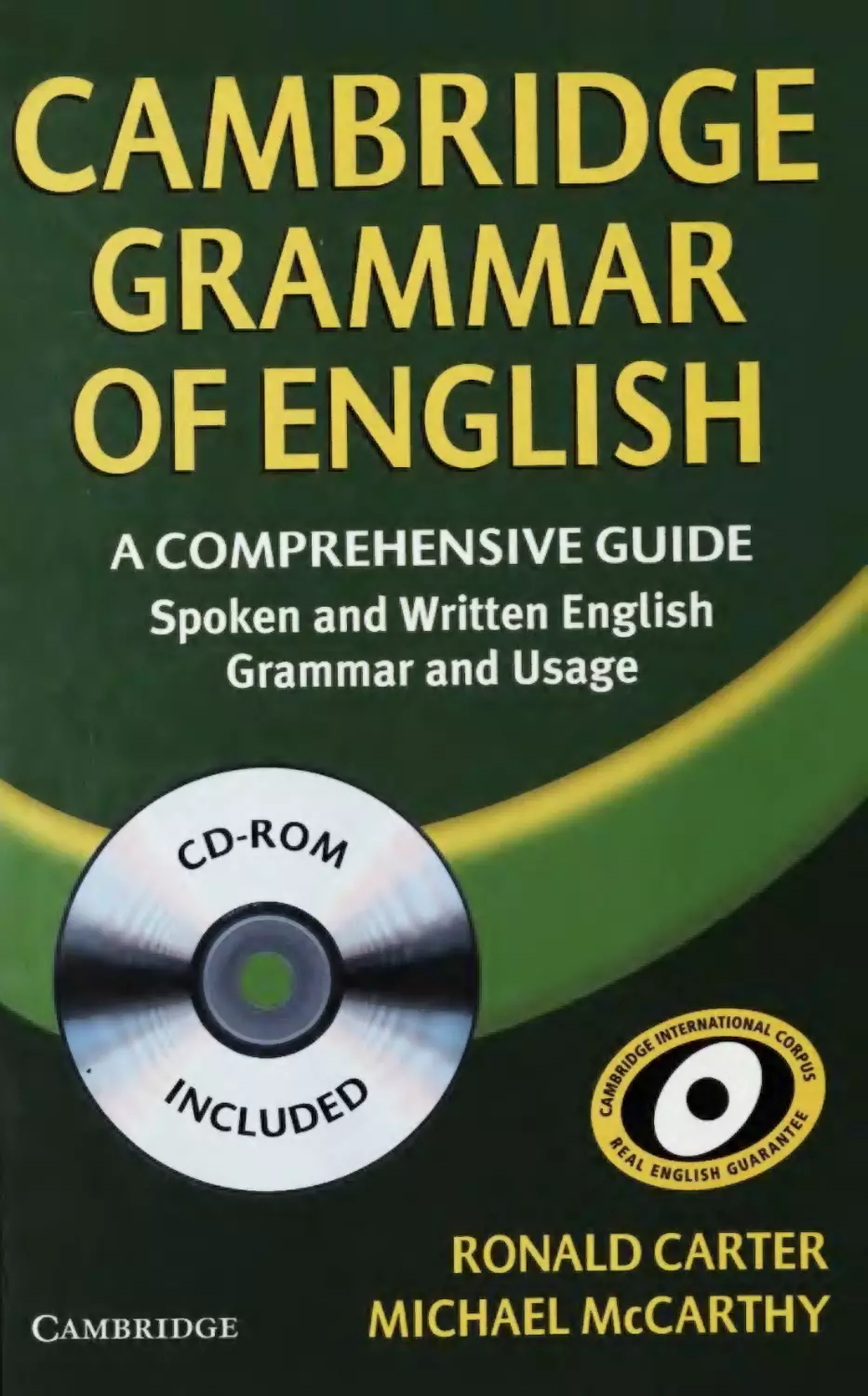
CAMBRIDGE
GRAMMAR
OF ENGLISH
A C O M P R EH E N SIV E G U IDE
Spoken and Written English
Grammar and Usage
Ca
m b r id g e
RONALD CARTER
m ic h a e l M c C a r t h y
CAMBRIDGE
GRAMMAR
OF ENGLISH
A COMPREHENSIVE GUIDE
Spoken and Written English
Grammar and Usage
RONALD CARTER
m ic h a e l M cCa r t h y
M C a m b r id g e
U N IV ER SITY PRESS
CAMBRIDGE UNIVERSITY PRESS
Cambridge, New York, Melbourne, Madrid, Cape Town, Singapore, Sâo Paulo
Cambridge University Press
The Edinburgh Building, Cambridge CB2 2RU, UK
www.cambridge.org
Information on this title: www.cambridge.org/9780521588664
© Cambridge University Press 2006
This book is in copyright. Subject to statutory exception and to the provisions of relevant
collective licensing agreements, no reproduction of any part may take place without the
written permission of Cambridge University Press.
First published 2006
Printed in Italy by Mtr Grafica Veneta S.p.A.
A catalog u e record fo r this b o o k is a v a ila b le from th e B ritish Library
Paperback ISBN -13 978-0-521-58846-1
Paperback ISBN -10 0-521-58846-4
Hardcover ISBN -13 978-0-521-58166-0
Hardcover ISBN -10 0-521-58166-4
Paperback and CD ROM ISBN -13 978-0-521-67439-3
Paperback and CD ROM ISBN -10 0-521-67439-5
Hardcover and CD ROM ISBN -13 978-0-521-85767-3
Hardcover and CD ROM ISBN -10 0-521-85767-8
Network CD ROM ISBN -13 978-0-521-58845-4
Network CD ROM ISBN -10 0-521-58845-6
The Authors
Professor Ronald Carter is Professor of Modern English Language in the School
of English Studies, University of Nottingham. He has published extensively in the
fields of language education, applied linguistics and literary-linguistic studies.
He is co-author of Exploring Spoken English and Exploring Grammar in Context,
and co-editor of The Cambridge G uide to Teaching English to Speakers o f Other
Languages for Cambridge ELT.
Professor Michael McCarthy is Emeritus Professor of Applied Linguistics in the
School of English Studies, University of Nottingham. He has also published
extensively on corpora, vocabulary and discourse. He is the co-author of several
of the Vocabulary in Use titles, Exploring Spoken English and Exploring Grammar
in Context as well as a number of applied linguistics titles for Cambridge ELT.
The Cambridge Grammar Reference Panel
The Cambridge Grammar Reference Panel is a group of eminent and experienced
applied linguists and teachers of English who have collaborated with the publisher
and authors in the development of the Cambridge Grammar o f English.
The panel members have contributed to workshops, commented on draft chapters
and generously offered their time, advice and support during various stages of the
project.
Professor Karin Aijmer, Gothenburg University
Dr Franz Andres Morrissey, University of Bern
Dra. Pilar Aguado Giménez, Universidad de Murcia
Dr Jean Hudson, Malmö University
Professor Susan Hunston, University of Birmingham
Dr Anne O’Keeffe, Mary Immaculate College, University of Limerick
Dr Marilyn Lewis, University of Auckland
Mr Keith Mitchell, Edinburgh University
Professor Sophia Papaefthymiou-Lytra, University of Athens
Professor Svetlana Ter-Minasova, Moscow State University
Professor Masanori Toyota, Kansaigaidai University
Ms Geraldine Mark, Project manager, UK
To Jane and Jeanne
Acknowledgements
AUTHORS'ACKNOWLEDGEMENTS
In relation to a huge book such as this one, which has been some seven years in the
writing, many colleagues and other scholars have been influential in our thinking and
have directly or indirectly influenced the content and wording of the grammar as it is
now published. Some names deserve a special expression of our gratitude.
First and foremost we thank the Cambridge Grammar Reference Panel, whose names
are listed on the preceding page. Without the input and inspiration of the panel, the book
would have lacked much in terms of accuracy, organisation and detail. In particular we
thank Karin Aijmer, Franz Andres Morrissey, Susan Hunston, Marilyn Lewis, Keith
Mitchell and Anne O’Keeffe for their most thorough and meticulously detailed reports on
the various versions of the manuscript and their suggestions, always an improvement on
our attempts, for revision. Special thanks also go to Jean Hudson, who began as our
research assistant for the project and taught us a great deal about searching corpora, and
who later became a member of the Cambridge Grammar Reference Panel in its initial
stages.
Cambridge University Press has given us outstanding and unfailing support from the
outset. First and foremost, thanks must go to Colin Hayes, Group Director of ELT at the
Press from 1988 to 2003, whose vision and willingness to back this project effectively
started the whole enterprise. It was Colin, along with Jeanne McCarten, to whom we also
owe a huge debt, who saw the significance of developments in corpus linguistics and their
implications for English Language Teaching and, as a result, was prepared to make the
commitment on behalf of CUP to the building of the CANCODE spoken corpus and the
commissioning of this grammar. In its latter phase of development, we have enjoyed
continued support and unstinting commitment from Colin Hayes’ successor, Andrew
Gilfillan, and from our commissioning editor, Alison Sharpe. Alison has steered the
project with immense skill and provided us with inspiration, encouragement and good
advice. The day-to-day running of the project has been expertly managed by Geraldine
Mark, who brought to it her considerable experience as an English language teacher and
ELT editor, along with an unerring instinct for how best to present the grammar. By a
small-world coincidence, Michael McCarthy was first introduced to the complexities and
pleasures of English grammar as a schoolboy by Geraldine’s father, Brian Mark, who
taught English at Saint Illtyd’s College Grammar School, Cardiff, when Michael was a
pupil there. Brian Mark, like his daughter, deserves a special thank-you.
CUP also supplied us with corpora and expert computational support from Patrick
Gillard, Paul Heacock, Andrew Harley, Ann Fiddes and Dominic Glennon, to all of
whom we say thank you. In the final stages of preparing the bulky manuscript for
publication, we were privileged to have the editorial expertise, vast experience and eagleeye of Thérèse Tobin to assist us; Thérèse made invaluable suggestions for clarifying our
sometimes unclear statements. Linda Matthews steered the book through its final stages
of production; she too deserves our thanks, as do Jane Durkin and Alex Priestley for sales
and marketing campaigns. Thanks are also due to Linda Hardcastle for showing such
understanding of a long and complex book in the compilation of the index.
A huge amount of background research went into the grammar, and, in addition to
Jean Hudson, who worked as a researcher on the project in its earliest stages, we wish
particularly to thank Svenja Adolphs, Julia Harrison and Jane Evison for their work in
developing the CANCODE spoken corpus and their insightful investigations of it.
Without their support as co-researchers, we would have been overwhelmed by the sheer
volume of data.
Among university colleagues both authors have shared over the years, certain figures
stand out as having profoundly influenced us. John Sinclair was, and remains, the most
important inspiration and mentor for us both; his scholarship is unmatched in its
originality, breadth and depth. He and other colleagues at the universities of Birmingham
and Nottingham have moulded us academically into what we are today; those figures
include Margaret Berry, David Brazil, Malcolm Coulthard, Michael Hoey and Walter
Nash.
Other British-based colleagues and friends who have supported us and given
us ideas and inspiration over the years include Dave Allan, Michael Baynham,
Bethan Benwell, Chris Brumfit, Martin Bygate, Lynne Cameron, Joanna Channell,
Caroline Coffin, Guy Cook, Sandra Combleet, Justine Coupland, David Crystal, Joan
Cutting, Zoltân Dömyei, Amorey Gethin, Sarah Grandage, Peter Grundy, Michael
Handford, Martin Hewings, Ann Hewings, Sue Homer, Rebecca Hughes, Howard
Jackson, Martha Jones, Almut Koester, Geoffrey Leech, Michael Lewis, Janet Maybin,
Tony McEnery, Neil Mercer, Ros Mitchell, Louise Mullany, Felicity O’Dell, David Oakey,
Kieran O’Halloran, Antoinette Renouf, John Richmond, Mario Rinvolucri, Paul Roberts,
Norbert Schmitt, Mike Scott, Alison Sealey, Paul Simpson, Roger Smith, Peter
Stockwell, Michael Swan, Paul Thompson, Ivor Timmis, Brian Tomlinson, Alistair West,
Janet White, David Willis, Jane Willis, Alison Wray and Martin Wynne.
From universities and other institutions overseas, inspiration, ideas and friendly
support came to us from Jens Allwood, Carolina Amador Moreno, Gabriela Appel,
Michael Barlow, Douglas Biber, James Binchy, Anne Bums, Dermot Campbell,
Christopher Candlin, Marianne Celce-Murcia, Wallace Chafe, Angela Chambers, Winnie
Cheng, Margaret Childs, Brian Clancy, Sylvia de Cock, Susan Conrad, Fiona Farr, Tony
Fitzpatrick, Loretta Fung, Sylviane Granger, Carmen Gregori Signes, Michael Halliday,
Kieran Harrington, Ruquiya Hasan, Kent Hill, San San Hnin Tun, Paul Hopper, Ken
Hyland, Yoshihiko Ikegami, Karen Johnson, Celeste Kinginger, James Lantolf, Diane
Larsen-Freeman, Anna Mauranen, Nigel McQuitty, John McRae, Marty Meinardi, Freda
Mishan, Brona Murphy, David Nunan, Aisling O’Boyle, Mana Palma Fahey, Aneta
Pavlenko, Scott Payne, Luke Prodromou, Nikoleta Rapti, Randi Reppen, Antonia
Sânchez Macarro, Helen Sandiford, Elana Shohamy, Rita Simpson, Anoma Siriwardena,
Diana Slade, Carol Spöttl, Jeff Stranks, Susan Strauss, Merrill Swain, John Swales, Gerry
Sweeney, HongyinTao, Steven Thome, Elena Tognini-Bonelli, Geoff Tranter, Amy Tsui,
Koen Van Landeghem, Elaine Vaughan, Mary Vaughn, Steve Walsh, Shih-Ping Wang,
Martin Warren, Linda Waugh, Fiona Wheeler, Geoff Williams, Brent Wolter
andXuelianXu.
Others too many to mention have inspired us with conference papers and published
work, and to all of them we owe a debt of gratitude. Whatever shortcomings remain in
the book, they must rest entirely at our door.
Ronald Carter
Michael McCarthy
Nottingham, 2005
PUBLISHERS' ACKNOWLEDGEMENTS
Development of this publication has made use of the Cambridge International Corpus
(CIC). The CIC is a computerised database of contemporary spoken and written
English which currently stands at 700 million words. It includes British English,
American English and other varieties of English. It also includes the Cambridge
Learner Corpus, developed in collaboration with the University of Cambridge ESOL
Examinations. Cambridge University Press has built up the CIC to provide evidence
about language use that helps to produce better language teaching materials.
The author and publishers are grateful to the following for permission to reproduce
copyright material. It has not always been possible to identify the source of material
used or to contact the copyright holders and in such cases the publishers would
welcome information from the copyright owners.
Advertisement for Satellite trainers, with the kind permission of Reebok International
Limited; Unilever UK for, ‘I can’t believe it’s not butter’; Nabisco Foods for, ‘Fruitful
from Shredded Wheat’; Kraft Foods for, ‘Enjoy the smooth, silky taste of Creamery
butter’; extracts from the online website of Save the Children Fund, reproduced with
the permission of Save the Children; extracts from The Guardian and The Observer
© Guardian Newspapers Limited; for extracts from Absolute Truths by Susan
Howatch, The Black Opal by Victoria Holt, The Conviction of Guilt by Lew Matthews,
Codebreaker by Alastair MacNeill, The Devil’s Door by Alastair MacNeill, Dreams of
Innocence by Lisa Appignanesi, Family Blessings by Lavyrle Spencer, Final Resort by
Ian St. James, For the Love o f a Stranger by Erin Pizzey, The Glasgow Girls by Francis
Paige, The Open Door by Alan Sillitoe, Rushing to Paradise by J.G.Ballard, Testimonies
by Patrick O’Brian and Walking Back to Happiness by Helen Shapiro,
© HarperCollins Publishers; for extracts from Desperadoes by Joseph O’Connor,
reproduced by permission of HarperCollins Publishers and Blake Friedmann Literary
Agency © Joseph O’Connor, 1994; for extracts from Lost Children by Maggie Gee by
permission of HarperCollins Publishers and Curtis Brown Group, © Maggie Gee; for
extracts from Yellow Bird by Trudi Pacter, by permission of HarperCollins and the
author; for extracts from An Indecent Act by Maria Barrett, The Ambassador by
Edwina Currie, Dead & Gone by Dorothy Simpson, Siena Summer by Teresa Crane,
Two Gentlemen Sharing by William Corlett, Solomon Grundy by Dan Gooch, The
Scholar by Courttia Newland and What Treasure did Next by Gina Davidson, © Little,
Brown and Company; for extracts from The Keepers by Pauline Kirk, by permission
of Little, Brown and Company and David Grossman Literary Agency on behalf of the
author; for extracts from Another Kind of Cinderella by Angela Huth, © Angela Huth
1995, reproduced by permission of Little, Brown and Company, Felicity Bryan Agency
and the author; for extracts from Every Man for Himself by Beryl Bainbridge, by
permission of Little, Brown and Company and Johnson and Alcock on behalf of the
author; for extracts from Like by Ali Smith, by permission of Ali Smith, Xandia Hardie
and Little, Brown and Company; extracts from The Waiting Game by Bernice Rubens
are reproduced by permission of Little, Brown and Company and PFD
fwww.pfd.co.uk) on behalf of The Estate of Bernice Rubens; for extracts from
Transgressions by Sarah Dunant, by permission of Little, Brown and Company and
Gillon Aitken on behalf of the author; for extracts from The Angry Mountain by
Hammond Innes, Arcadia by Jim Crace, Cam by Patrick McCabe, and Ever After by
Graham Swift, © Macmillan; for extracts from Cast the First Stone by Jane Adams, by
permission of Macmillan and the author; for extracts from A Green Bag Affair by Paul
Geddes, Harvey Angell by Diana Hendry, Flight from the Dark, Lone Wolf 1 by John
Denver © The Random House Group Ltd; for extracts from The Tenancy by Eva Figes
by permission of The Random House Group Ltd and Rogers, Coleridge & White Ltd
on behalf of the author; for texts from Act of Valour by Emma Drummond, Charlotte
Street by Juliette Mead, Death Before Dishonour by Barnaby Williams, Fault Lines by
Natasha Cooper, The Keeper by Eileen MacDonald, Miles & Flora by Hilary Bailey, Mr
MacGregor by Alan Titchmarsh, Sentimental Journey by Juliette Mead and Sour
Grapes by Natasha Cooper, © Simon & Schuster.
Excerpts from the following works are also included:
Emma, Mansfield Park and Northanger Abbey, by Jane Austen; The Tenant of Wildfell
Hall, by Anne Brontë; A Tale of Two Cities, Dombey and Son and Great Expectations,
by Charles Dickens; The Mill on the Floss, by George Eliot; The Mayor of Casterbridge,
Far from the Madding Crowd and Tess of the D’Urbervilles, by Thomas Hardy; Lady
Chatterley’s Lover, by D H Lawrence; Anna Karenina, by Leo Tolstoy; Lord Arthur
Savile’s Crime, by Oscar Wilde; To the Lighthouse, The Waves and Mrs Dalloway, by
Virginia Woolf.
The following are reproduced with permission of Cambridge University Press:
extracts from Behavioural and Cognitive Psychotherapy (2002); Cambridge Advanced
Learners’ Dictionary; Cambridge Encyclopaedia, Crystal; Contemporary European
History, 2001,10 (3); Environmental Conservation, (2001); Environment and
Development Economics (2002); International Review of Social History, 46 (2001);
Issues in Applied Linguistics, McCarthy; Journal of American Studies, 2001 35 (1):
Journal of Fluid Mechanics, 2002; Journal of Nutrition, 1993; Journal of Social Policy
(2002); Journal of Zoology (2002); Materials Development in Language Teaching,
Tomlinson; More Grammar Games, Rinvolucri and Davis; New Cambridge English
Course, Swan and Walter; New Horizons/Science; Key stage 3 Science, 1995; Review of
International Studies (2001), 27:265-272 Cambridge University Press Copyright © 2001
British International Studies Association; Revolutions, Todd; The Historical Journal
(2001); The Politics of the Picturesque, Copley; Vocabulary, Schmitt and McCarthy.
Thanks go to the British National Corpus for extracts from the following works:
A Song Twice Over by Brenda Jagger, Imprint: Fontana Press, 1994; Billion Dollar
Brain by Len Deighton, Imprint: Arrow Books; Chymical Wedding by Lindsay Clarke,
Imprint: Jonathan Cape; The Child Bride by Philippa Wait, Imprint: Robert Hale Ltd;
Daughters o f the Moon by Susan Sallis, Imprint: Corgi Books; Frankenstein by Patrick
Nobes, Imprint: OUP, 1994; Green and Pleasant Land by Howard Newby, Imprint:
Wildwood House; House of Cards by Michael Dobbs, Imprint: HarperCollins, 1994;
Jan e’s Journey by Jean Bow, Imprint: Hodder & Stoughton Ltd, 1994; Murder Makes
an Entrée by Amy Myers, Imprint: Headline Book Publishing pic, 1994; Nice Work by
David Lodge, Imprint: Seeker & Warburg, 1994; Roads that Move by Walter Perrie,
Imprint: Mainstream Publishing Co. Ltd; Sons of Heaven by Terence Strong, Imprint:
Hodder & Stoughton Ltd.
Contents
\ i> U
! ! * '. г
i l l . ' n u n i b c l ' S a l V M ' C t i o 1! l l U Ü t l l C I ' N . I l ■) L paji-.: I H i n i b c f -
:
: i ■) : 4. ü о '.a I ! c ' J ^ u i u . i u s j X it .L ' s a ; i . к
ч
I î'I i 11 'j л с i ; с n a p l с г.
Introduction to the Cambridge Grammar of English 1-4
From word to grammar: an A -Z 5-18
Spoken language
Introduction to grammar and spoken English 82-91
From utterance to discourse 92-103
From discourse to social contexts 104-122
Grammatand discourse
Grammar across turns and sentences 123-139
Grammar and academic English 140-154
Word and phrase classes
Introduction to word classes and phrase classes 155-166
Nouns
The noun phrase 167-175
Nouns and determiners 176-196
Pronouns 197-212
Verbs
Verb phrase 1: structure of verb phrases 213-216
Verb phrase 2: tense and aspect 217-226
Types of verb 227-235
Adjectives and adverbs
Adjectives and adjective phrases 236-241
Adverbs and adverb phrases 242-249
Prepositions and particles
Prepositions and prepositional phrases 250-257
Word form ation
Word structure and word formation 258-268
Sentence and clause patterns
Introduction to sentences and clauses 2 6 9-280
Verb complementation 281-289
Clause types 290-303
Clause combination 304-318
Adjuncts 319-337
Introduction to the C a m b rid g e G ra m m a r o f E n g lis h j ix
x I Introduction to the Cambridge Grammar of English
Time
Present time 338-345
Past time 346-360
Future time 361-376
Notions and functions
Modality 377-407
Speech acts 408-423
Questions 424-433
Negation 434-447
Condition 448-459
Comparison 460-471
Information packaging
Word order and focus 472-475
The passive 476-487
Speech representation 488-502
Appendices
Word clusters and grammar 503-505
Punctuation 506
English spelling 507-511
Numbers 512-525
Referring to the time 526
Units of measurement 527
Nationalities, countries and regions 528
Irregular verbs 529
North American English grammar 5 3 0 - 5 3 8
Glossary 5 3 9
Bibliography 5 4 0
Index 5 41
Cambridge Grammar of English
Introduction to the Cambridge Grammar
of English
What is grammar? 1
Arrangement of items (syntax) la
Structure of items (morphology) lb
Acceptable and unacceptable forms lc
Vocabulary (lexis) Id
Phrases le
Clauses If
Classes of word, phrase and clause lg
Functions lh
Sounds (phonology) li
Choices lj
What is the Cam bridge G ram m ar o f English? 2
Usage and acceptability 2a
Grammar rules: deterministic and probabilistic 2b
Descriptive versus prescriptive approach 2c
Grammar as structure and grammar as choice 2d
Grammar and lexis 2e
Grammar and discourse 2f
Grammar and variation: the importance of context 2g
Grammar and the spoken language 2h
Grammar and corpus data 3
What is a corpus? 3a
Using the corpus 3b
Information on frequency 3 c
Information on concordance 3d
Deciding what to include 3e
Insights into use 3f
Word clusters 3g
Frequent, common and preferred patterns 3h
Learner corpus 3i
How CGE is organised 4
From word to grammar: an A-Z 4a
Topic chapters 4b
Appendices 4c
Glossary 4d
Index 4e
Introduction to the Cambridge Grammar of English
WHAT IS GRAMMAR?
1
Grammar is concerned with how sentences and utterances are formed. In a
typical English sentence, we can see the two most basic principles of grammar, the
arrangement of items (syntax) and the structure of items (morphology) :
I gave my sister a sw eater for her birthday.
Arrangement of items (syntax)
1a
The meaning of this sentence is obviously created by words such as gave, sister,
sw eater and birthday. But there are other words (I, my, a, for, her) which
contribute to the meaning, and, additionally, aspects of the individual words and
the way they are arranged which enable us to interpret what the sentence means.
For example, we know it is I who gave the sweater, not my sister, because I comes
before the verb (gave). In English, subjects (the doers of actions) come before
verbs in statements. We also know the relationship between the indirect object,
my sister, and the direct object, a sweater, (that the sw eater was given and my
sister was the recipient) because indirect objects come before direct objects. We
also expect my to come before sister, not after. These aspects of the arrangement
of things in sentences is referred to as syntax. Syntax is one of the two basic
principles of grammar.
Structure of items (morphology)
1b
The example sentence also illustrates the other basic principle of grammar. I and
my are two different forms, one with a subject meaning, the other with a
possessive meaning, even though they both refer to the same person. G ave refers
to past time, in contrast to give(s), which refers to present time. Sw eater is
singular; if there were more than one sweater, the form would be sweaters. These
small items of meaning, such as I, my, the past form gave, a plural -s ending, are
called grammatical morphemes, and come under the heading of morphology.
Morphology is concerned with the structure of words and phrases. It is the second
basic principle of grammar.
Acceptable and unacceptable forms
1с
Grammar is concerned with acceptable and unacceptable forms and the
distinctions of meaning these forms create. The fact that sw eater means ‘knitted
outer garment worn on the upper part of the body for warmth’ and that sister
means ‘female sibling’ are matters of vocabulary (lexis), but the distinction
between present and past, one and more than one, subject and object, possession
2 1Cambridge Grammar of English
Introduction to the Cambridge Grammar of English 13
and non-possession, etc., are matters of grammar. In every language, some forms
are acceptable and others are not. So, in English, we can create arrangements of
our example sentence which are not acceptable, either syntactically or
morphologically:
I my sister gave a sw eater for birthday her.
G ave I my sister a sw eaters for his birthday.
/gives my sisters sw eater a for her birthday.
In this grammar book, we indicate unacceptable forms with a line through the
text:
I my-sister-gave a sweater for birthday her.
Vocabulary (lexis)
1d
Although some aspects of our example sentence are concerned with lexis, lexis
and grammar are not totally independent. A ‘sweater’ is the kind of thing in the
world that English treats as countable (we may have one, two or more of them).
However, if I gave my sister ‘information’, the fact that information is an abstract
entity, which English considers to be uncountable, affects the grammar, and the
sentence would have to be I gave my sister som e information. ‘I gave my sister an
information’ would be an unacceptable form.
Phrases
1e
Our initial example sentence may also be seen as composed of units or building
blocks of different sizes, not just individual words and their endings. For example,
the sentence could be divided up thus:
I Igave I my sister \a sw eater \for her birthday.
We have now divided the sentence into its constituent phrases (items which have
individual functions in the sentence). It is the phrase a sw eater which acts as the
object, not just the word sweater, and the whole phrase for her birthday indicates
the reason or circumstances of the giving.
Clauses
If
We could extend the example sentence:
I gave my sister a sw eater for her birthday an d she bought me a CD for mine.
We can now see two larger building blocks (in green) in the sentence, connected
by and. These are clauses (separate units containing their own verbs:
gave/bought). Grammar is concerned with how the constituent units of sentences
(morphemes, words, phrases and clauses) are put together to form sentences.
•*£ 539 Glossary for any unfamiliar terms
4 1Introduction to the Cambridge Grammar of English
Classes o f w ord, phrase and clause
1g
Words are not all of the same type. Some, such as sw eater and sister, are nouns
(words referring to entities: persons, things, animals, abstract concepts); some,
such as gave and bought, are verbs (words referring to actions, events or states);
and so on. These words belong to different classes.
Equally, the phrases belong to different classes: for her birthday and for mine
are prepositional phrases (phrases introduced by prepositions).
Clauses too belong to classes: some are declarative(they havethe subject first
and typically make statements), some are interrogative(they have a verb such as
do, be or have first, and typically ask questions). Grammar is concerned with how
units and classes relate to one another.
Functions
Ih
The noun phrases my sister, a sw eater are types of object in our example sentence
in If, and for my birthday and for m ine are operating as phrases indicating the
circumstances. They are referred to as adjuncts. The terms subject, verb, object,
adjunct refer to the functions the different phrase-types carry out in the clause.
Grammar describes what the acceptable functions are.
Sounds (phonology)
1i
How sentences are spoken is also relevant. The sentence I do like your car, on the
face of it, seems to break the rule that do is not used in statements. However, if the
sentence is spoken with appropriate stress, then it becomes acceptable. This is the
emphatic do, which may be used in statements:
I do lik e your car.
Phonology (the sound systems of a language) is therefore also connected in important
ways with grammar and lexis, and influences the interpretation of sentences.
Choices
1j
Throughout the construction of a sentence, the speaker/writer makes choices.
Choices involve things such as number (singular or plural), tense (present or past),
definiteness (a sweater versus the sweater), etc. Every choice carries a different
meaning, and grammar is concerned with the implications of such choices.
WHAT IS THE CAMBRIDGE GRAMMAR OF ENGLISHl
Usage and acceptability
2
2a
This book is a grammar of standard British English. Standard British English is a
variety of English defined by its grammar, lexis and phonology. There are, of
course, other standard varieties of English, for example, standard North American
English or standard Indian English or standard Australian English, which may
Cambridge Grammar of English
Introduction to theCambridgeGrammarof English 15
differ quite considerably in terms of pronunciation, but only minimally as far as
grammar is concerned.
Appendix 530-538 for particular differences in North
American English grammar.
However, issues of acceptability are never far from the surface when there is
reference to what is standard in grammar or in language use in general. In this
book, the following main categories of British English are adopted:
• acceptable in standard written and spoken English (most forms are in this
category)
• acceptable in standard written and spoken English but not approved in more
prescriptive grammar books and often avoided by many writers of formal
English; for example: split infinitives, stranded prepositions, choices between
w ho and whom
• unacceptable in standard written English but acceptable in standard spoken
English (-£ for example 9 6 and 97 on headers and tails)
• unacceptable in standard written and spoken English but acceptable in many
regional varieties of English (-£ for example 119b on the use of ain ’t) ; such
forms are not included in the main description in this book, and are simply
referred to occasionally
• unacceptable in all varieties of English (for example a structure such as he did
must speak); such forms are excluded from this book.*
Where possible in this book, we always give an indication if a particular
grammatical usage is likely to be considered non-standard, but we also indicate in
which contexts such usage may nonetheless pass unnoticed.
Grammar rules: deterministic and probabilistic
2b
The general lay person’s perspective is that grammar is about rules of speaking
and writing, but not all ‘rules’ given by grammarians are of the same kind.
Some rules are deterministic, that is, they are rules which always apply. For
example, the definite article always comes before the noun (we say the cup, not
cup the), or indicative third person singular present tense lexical verbs always end
in -s (we say sh e works, not she work).
Other rules are probabilistic, that is to say, they state what is most likely or least
likely to apply in particular circumstances. For example, in the overwhelming
majority of cases, a relative pronoun (e.g. w ho, w hich, that) must be used to refer
to the subject of a relative clause:
We met a w om an who h ad lived in Berlin during the 1980s.
However, in informal spoken styles, the relative pronoun may often be omitted,
especially after a there construction:
There was a shop in the village sold hom e-m ad e ice cream.
(or: There was a shop in the village which/that sold home-made ice cream.)
*
Our thanks to Susan Hunston for suggesting this list of categories.
539 Glossary for any unfamiliar terms
б I Introduction to the Cambridge Grammar of English
It is not a rule that the relative pronoun must be omitted; it can be omitted. The
rules concerning its use are therefore probabilistic (it is most probable in most
cases that the relative pronoun will be used). In this book, many of the rules given
are probabilistic, since they are based on observations of what is most likely and
least likely in different contexts in real spoken and written data.
Descriptive versus prescriptive approach
2c
A descriptive approach to grammar is based on observations of usage; it states
how people use the grammar of a language. A prescriptive approach to grammar is
based on the idea that some forms are more ‘correct’ or more associated with
‘good usage’ than others. Prescriptive rules are often social rules that are believed
to mark out a speaker or writer as educated or as belonging to a particular social
class. Examples of prescriptive rules are:
Do N O T EN D A S E N T E N C E W IT H A P R E P O S IT IO N .
(e.g. Do not say This is som ething you shou ld not be involved in; say This is
som ething in which you sh ou ld not be involved)
Do N O T S P L IT AN IN F IN IT IV E .
(e.g. Do not say I expect to shortly w elcom e him h ere; say I expect to welcom e
him here shortly)
Examples are given throughout the book of contexts of use in which prescriptive
rules do or do not apply, where this is useful to language learners. The book also
contains a number of specially written panels that highlight common prescriptive
rules, discuss attitudes to the rules and examine how they do or do not apply in
different contexts of use (•••:•for exam ple 3 3 7 ).
The main approach taken in this book is descriptive. The emphasis throughout
the book is on describing the ways in which speakers and writers of English use
the language to communicate with one another, as evidenced in large numbers of
spoken and written texts from all over the British English community. The
approach taken is, we believe, compatible with a pedagogical grammar which is
written primarily for advanced learners of English. It is therefore important that
learners are aware of the social importance which attaches to certain prescriptive
rules while at the same time being aware of the way in which English is used by
real speakers and writers of the language. Issues relevant to a learner’s grammar
are explored further at several places below.
Grammar as structure and grammar as choice
2d
The book regularly draws attention to the implications of different grammatical
choices and gives the user opportunities to observe and learn about grammatical
choices in relation to particular contexts in which the language is used.
The Cambridge Grammar o f English (CGE) makes a distinction between grammar
as structure and grammar as choice. Grammar as structure means: What rules does
one need to know in order to construct a sentence or clause appropriately? An
example of a structural rule would be that the determiner none must be followed
by o f (non e o f my friends, as opposed to none my friends).
Cambridge Grammar of English
Introduction to the Cambridge Grammar of English |7
On the other hand, grammar frequently involves ellipsis, which is the absence of
words which can be understood from the surrounding text or from the situation.
For example the ellipsis of the subject noun or pronoun in expressions such as
L ookin g forw ard to seeing you, D on ’t kn ow and Think so is largely the speaker’s/
writer’s interpersonal choice. Interpersonal choices are choices which are
sensitive to the relationship between the speaker/writer and the listener/reader.
In such a case as this, grammar as choice means: When is it normal to use ellipsis?
Are some forms of ellipsis more likely to be used in spoken than in written modes?
What kinds of relationship does it project between speakers and listeners? Are the
forms linked to greater or lesser degrees of intimacy and informality?
Another example of grammar as choice would be the use of the past simple and
the past progressive tense in reported speech. For example, the most frequent
form of speech report is the past simple, as in:
She said the central heating n eeded to be repaired.
But the past progressive form can also be used. This is especially common in
spoken rather than in written English as speakers can choose to express reports as
‘pieces of news’ rather than as representations of people’s words:
She was saying that s h e ’s going to quit her job.
Both forms of say are acceptable but the progressive form is less frequent. It is,
however, a choice which speakers or writers can make in particular contexts. In
this book, both grammar as structure and grammar as choice are treated, and the
grammar of choice is as important as the grammar of structure.
Grammar and lexis
2e
Grammar does not exist separately from other levels of language. There is a
close link between grammar and lexis and in this book attention is given to the
meaning, structure and formation of individual words. There are also many places
in the book where grammatical choices entail particular choices of vocabulary,
or vice versa.
The book reflects recent computer-assisted research, which shows the
patterned relationship between vocabulary and grammar. For example, the
pattern of about twenty verbs in English is verb + by + -ing, where the verb is
followed by the preposition by and an -ing clause. Most verbs of this kind fall into
two main groups, one group meaning ‘start’ or ‘finish’, the other group meaning
‘respond to’ or ‘compensate for’ something. For example:
They started off by collecting money for ch ild ren ’s charities.
She concluded by singing three songs in Italian.
They responded to the new s by cutting o ff a ll com m unication with the
outside world.
H e allowed for the bend by braking sharply.
539 Glossary for any unfamiliar terms
8 1Introduction to the Cambridge Grammar of English
Experienced users of English recognise such patterns intuitively but it is often only
when computer analysis demonstrates the patterns across many examples of use
that they are fully acknowledged. Description of such patterns is becoming a more
established feature of many modern grammar books. CGE is no exception and
lists of words which behave in similar ways to one another are frequently given.
Grammar and discourse
2f
Another important level of language organisation that has received detailed
investigation in recent years is the level of discourse. Discourse refers to the
patterns of language used beyond the level of the sentence or beyond the
individual speaking turn. There has been much description of spoken discourse
patterns (e.g. how people open and close conversations; how they organise their
speaking turns) and also attention to the ways in which sentences combine to
form coherent texts in writing. This book pays attention to such patterns and
describes the cohesion of sentences - that is, the ways in which grammatical links
across sentences or speakers’ turns create coherent texts (••* 214). Two chapters in
this grammar (123-139 and 140-154) are devoted to grammar and discourse and
to the way in which larger units of meaning are created.
In CGE it is not our aim to take a text and then extract atomised, grammatical
points from it. Rather, texts are used to illustrate how grammatical meanings are
created in actual use. The place, distribution and sequencing of the grammatical
feature in its text and context are as important as its actual occurrence. This book
is based on insights from the fields of text and discourse analysis, rather than just
traditional sentence grammars. The emphasis in CGE is, wherever appropriate,
on the relationship between choice of form and contextual factors.
In parts the book represents a first step towards a context-based or discourse
grammar of English. For example, where it is appropriate, extracts from different
written sources are clearly indicated and spoken exchanges are marked and
explained with reference to particular contexts and speaker roles. Examples
are drawn here from section 000.
[public notice]
Vehicles p arked here will be tow ed away.
[notice in a train compartment]
These seats are reserved for disabled customers.
[at a travel agent’s; the customer has just received his tickets]
Customer: Right well this is all right now is it?
Agent: That's the ticket yes.
(what is this for the customer is that for the agent)
Grammar and variation: the importance of context
2g
Language variation takes many different forms. Language can vary in levels of
formality; it can vary according to the regional or social groups to which speakers
belong; it can vary over time; it can vary according to the uses to which it is put.
Cambridge Grammar of English
Introduction to the Cambridge Grammar of English 19
Certain types of language use are associated with particular forms of activity or
registers and are marked by distinctive patterns of use, including distinctive
patterns of grammar.
For example, cookery books and instructional manuals use many imperatives;
newspaper headlines often deploy highly compressed forms of language; some
forms of academic English make particular use of the passive voice; incomplete
sentences are commonly used to highlight key information in advertisements and
in radio and television news broadcasts. In conversation, too, the choice of one
grammatical feature rather than another can depend on the speaker’s perception
of the relationship they have with other speakers, the formality of the situation or
their assessment of the context in which they are communicating.
An important factor that affects the context of communication is whether the
medium is spoken or written. Several parts of this book describe differences and
distinctions between spoken and written grammar and indicate the different
degrees of formality that affect choices of grammar. Wherever necessary to avoid
ambiguity, information about the context in which examples typically function,
whether predominantly spoken or written, is given. In CGE we are assisted in this
practice by access to a corpus (••>•3 a), which is very carefully annotated with
reference to contexts of use.
Grammar and the spoken language
2h
Most books on the grammar of English have had a bias towards the written
language. For many centuries dictionaries and grammars of the English language
have taken the written language as a benchmark for what is proper and standard
in the language, incorporating written, often literary, examples to illustrate the
best usage.
Accordingly, the spoken language has been downgraded and has come to be
regarded as relatively inferior to written manifestations. Both in the teaching and
learning of first, second and foreign languages, and in educational institutions and
society in general, oral skills are normally less highly valued, with linguistic
expertise being equated almost exclusively with a capacity to read and write.
Until recently, the forms and structures typically found in spoken
communication have not been highlighted. It is only recently that advances in
audio-recording and associated technology have enabled sufficient quantities of
spoken language to be used for analysis. CGE draws for its examples of spoken
English on the CANCODE corpus (-|> 3a). The CANCODE corpus is a collection
of everyday informal spoken texts which provides very useful evidence of
significant structures, especially as they are found in spontaneous, unplanned,
conversational usage. Although the corpus has not been systematically coded for
phonetic features and features of intonation, this book has an accompanying
CD-ROM in which key sentences, conversational exchanges and patterns
of use can be listened to.
A bias towards written grammar means that in some cases appropriate terms
for describing particular features of spoken grammar are not available within
existing grammatical frameworks. In some cases new ways of describing language
539 G lossary for any unfamiliar terms
10 1Introduction to the Cambridge Grammar of English
(metalanguage) have to be introduced. An example is the use of the terms
‘headers’ and ‘tails’ (•••>96 and 97). Thus, structures such as:
header
Her friend , Jill, the one we met in Portsm outh, she said they’d m oved house.
tail
H e always m akes a lot o f noise an d fuss, Charlie.
are unlikely to be found in written contexts but are standard spoken forms. These
have, in the past, often been described using metaphors such as left- and rightdislocation, based on the way words are arranged on a page in western writing.
We consider these inappropriate to describe spoken grammar, which exists in
time, not space.
Another example of differences between spoken and written use involves voice
(the choice of active or passive). Voice is more subtle and varied in the grammar of
everyday conversation than is indicated in grammar books that focus only on
written examples. There is, naturally, a focus on the core fee-passive in contrast to
the active voice, but when we look at a large amount of conversational data, we
see that the gei-passive form is much more frequent in spoken data than in
comparable amounts of written data. At the same time it adds a further layer of
choice, reflecting speakers’ perceptions of good or bad fortune, or of the degree of
involvement of the subject. For example:
I ’m afraid his car window got broken.
(an unfortunate outcome)
She got herself invited to the official opening.
(she is seen as partly instrumental in being invited)
Detailed attention needs to be paid to such complex phenomena, which might
otherwise be underplayed in a book based only on written examples. Where it is
appropriate to do so, in CGE there is a thorough examination of spoken examples side
by side with balanced written examples so that relevant differences can be revealed.
Some people argue that learners of English should not be presented with
details of how native speakers speak. The position taken in this book is that such
an approach would disadvantage learners. This book presents information about
spoken grammar because it is important for learners to observe and to understand
how and why speakers speak as they do. To describe these features does not mean
that learners of English have to speak like native speakers. CGE presents the data
so that teachers and learners can make their own informed choices.
GRAMMAR AND CORPUS DATA
What is a corpus?
3
3a
The word corpus has been used several times already in this introduction. A
corpus is a collection of texts, usually stored in computer-readable form. Many of
the examples in this book are taken from a multi-million-word corpus of spoken
and written English called the Cambridge International Corpus (CIC). The corpus
Cambridge Grammar of English
Introduction to the Cambridge Grammar of English 111
is international in that it draws on different national varieties of English (e.g. Irish,
American). This corpus has been put together over many years and is composed of
real texts taken from everyday written and spoken English. At the time of writing,
the corpus contained over 700 million words of English. The CIC corpus contains
a wide variety of different texts with examples drawn from contexts as varied as:
newspapers, popular journalism, advertising, letters, literary texts, debates and
discussions, service encounters, university tutorials, formal speeches, friends
talking in restaurants, families talking at home.
One important feature of CIC is the special corpus of spoken English - the
CANCODE corpus. CANCODE stands for Cambridge and Nottingham Corpus of
Discourse in English, a unique collection of five million words of naturallyoccurring, mainly British (with some Irish), spoken English, recorded in everyday
situations. The CANCODE corpus has been collected throughout the past ten
years in a project involving Cambridge University Press and the School of English
Studies at the University of Nottingham, UK. In CGE dialogues and spoken
examples are laid out as they actually occur in the transcripts of the CANCODE
recordings, with occasional very minor editing of items which might otherwise
distract from the grammar point being illustrated.
The CANCODE corpus is a finely-grained corpus. The CANCODE research
team have not simply amassed examples of people speaking; they have tried to
obtain examples from a range of sociolinguistic contexts and genres of talk. There
is considerable advantage in being able to demonstrate statistical evidence over
many millions of words and broad general contexts.
Using the corpus
3b
Grammar, like vocabulary, varies markedly according to context, allowing
speakers considerable choice in the expression of interpersonal meanings (that is,
meanings realised in relation to who one is speaking to rather than just what one
is saying). A carefully constructed and balanced corpus can help to differentiate
between different choices relative to how much knowledge speakers assume, what
kind of relationship they have or want to have, whether they are at a dinner party,
in a classroom, doing a physical task, in a service transaction in a shop, or telling a
story (for example, our corpus tells us that ellipsis is not common in narratives,
where the aim is often to create rather than to assume a shared world). By
balancing these spoken genres against written ones, our corpus can also show
that particular forms of ellipsis are widespread in certain types of journalism, in
magazine articles, public signs and notices, personal notes and letters and in
certain kinds of literary text. In descriptions of use, the most typical and frequent
uses of such forms are described in relation to their different functions and in
relation to the particular contexts in which they are most frequently deployed.
(~ÿ 3h below)
CGE is a grammar book that is informed by the corpus. The word ‘informed’ is
used advisedly because we are conscious that it is no simple matter to import real
data into a reference book in the belief that authentic language is always the right
language for the purposes of learning the language. In places, this means that
corpus examples which contain cultural references of the kind that are so
common in everyday language use are either not selected or, while ensuring that
539 Glossary for any unfamiliar terms
1 2 1Introduction to the Cambridge Grammar of English
the key grammatical patterns are preserved, are slightly modified so that they do
not cause undue difficulties of interpretation. It is our strong view that language
corpora, such as the Cambridge International Corpus, can afford considerable
benefits for language teaching but the pedagogic process should be informed by
the corpus, not driven or controlled by it.
Information on frequency
3c
The corpus was analysed in a variety of ways in the preparation of this book. One
way was to compile frequency lists. A frequency list simply ranks words, phrases
and grammatical phenomena (e.g. how many words end in -ness or -ity, or how
many verb phrases consist of h av e + a verb ending in -en) in a list. In this way,
we are able to see not only which items are most and least frequent, but also how
they are distributed across speech and writing and across different registers (e.g.
newspapers, academic lectures, conversations at home). For example, the list of
the twenty most frequent word-forms in the CIC for spoken and written texts
(based on five-million-word samples of each) are different.
The tw enty most frequent word-forms in spoken and w ritte n texts
spoken
1
2
3......
4
5
6
7
8
9
i o "...
11
12
13
14
15
16
17
18
19
20
the
I
an d
you
it
to
a
yeah
that
of
in
was
it’s
know
is
mm
er
but
so
they
written
1
2
3
4
5
6
7
8
9
10
11
12
13
14
15
16
17
18
19
20
the
to
and
of
a
in
was
it
I
he
that
she
for
on
her
you
is
with
his
had
In the spoken list, I and you rise to the top, indicating the high interactivity of
face-to-face conversation. Know is at number 14, indicative of the high frequency
of the discourse marker you kn ow (•••:•106b), and mm and er reflect the frequency
with which listeners vocalise their acknowledgement of what the speaker is
saying, or whereby speakers fill silences while planning their speech in real time
or while hesitating. It’s and yeah reflect the informality of much of the talk in the
CANCODE spoken corpus.
Cambridge Grammar of English
Introduction to the Cambridge Grammar of English 113
Information on concordance
3d
Another way the corpus was analysed was in terms of concordance.
Concordances help researchers see how words are actually used in context. Words
or phrases which researchers are interested in are displayed in a vertical
arrangement on the computer screen along with their surrounding co-text: we see
what came just before the word and what came just after. For example, these
sample lines from a concordance for the adverb yet in the spoken corpus show us
that a negative environment is very common, but not in questions (negative items
and question marks in bold), and that as yet is a recurrent pattern. The A -Z entry
for yet in this book, and much of our grammatical description, is based on this
type of observation.
Sample lines from a concordance for yet___________________________________________________
<$2> Yeah. We haven’t got any answer yet. We’d like it trimming. <$E> laughs
the wedding. <$2> I haven’t got any yet. Em < $069> Janet looked lovely <\$06
but we haven’t made er any arrangements yet it’s sort of er a bit too early yet
? <$1> Sorry? <$2> Has FX arrived yet? < $l> W h o is this? <$2> MX’s f
be in. <$2>They haven’t arrived as yet. < $ l> < $= > Itisaw h o le < \ $= > it
yet? <$1> No not a price breaker as yet. Just their own winter programme.
ame in. <$E> laughs <\$E> Erm but er as yet it’s not available in every store.
11 over the place. Em we haven’t got as yet a timetable to show you as to what’s
haven’t come have they? <$2> Not as yet. No. Normally about two weeks before
. Well I said I don’t know the story as yet <$2> Mm. <$1> <$=> I said But
. But they’re not putting anybody up as yet because they have an appeal launch r
ms. Er that’s still not p= er set up as yet though. Erm we’re gonna do something
n’t managed to mark any of your work as yet but 1 1 promise I’ll have it back to
manda are you ready for your assessment yet? <$F> I think so yeah. <$1> I’
Anyway you obviously haven’t gone back yet so <$=> erm I won’t be er <\$=> you
tknow. <$G ?> <$1> Oh he’s not back yet. <$2> No. <$1> Oh right. <
eeks ago. And he he hasn’t written back yet. So <$E> laughs </$E> <$1> No. Mm
G?>. <$4> Have you changed your bank yet? <$3> My turn. <$E> sighs <\$E>
< $l> B ye. Cheers. <$3> Won’t be yet until I’ve < $ 0 1 3 > lost <\$013>a lit
<$2> Have you seen Beauty And The Beast yet? <$1> No I was wanting to go.
p to see me every year. She hasn’t been yet. And she and I like to trip out on a
tomorrow <$6> No. No. Not for a bit yet. <$3>Good. <$6> We we thought
71094002.dcx
90127004.dcx
80339001.inx
90449020.dcx
70752001.dnx
70764003.dnx
90089007.knx
90003001.dnx
70765004.dnx
70365004.dcx
70502001.dfx
70499001.dfx
71232001.kpx
71229001.kpx
70515012.imx
70584004.dcx
70645001.dcx
71031003.kmx
90082002.knx
70056002.dcx
71094002.dcx
70499004.dfx
The concordance also gives us a code on the right of the screen (in green here)
which tells us what type of conversation each line occurs in, and leads us to the
corpus database where we can verify who the speakers are, what age, gender, and
social profile they have, how many people were involved in the conversation,
where it took place, etc. We are therefore able to say something is in common
usage as we see it represented across a range of texts and users in the corpus.
Deciding what to include
3e
In deciding on priorities with regard to the description of items and patterns, both
quantitative and qualitative approaches are important. On the quantitative side,
the corpus evidence can often show striking differences in distribution of items
539 Glossary for any unfamiliar terms
1 4 1Introduction to the Cambridge Grammar of English
between speaking and writing. For example, the forms no on e and nobody are, on
the face of it, synonymous, yet their distribution across five million words each of
spoken and written data is very different, with nobody greatly preferred in the
spoken corpus, as shown below.
Use of no one and nobody in spoken and written English
900
800
700
600
500
400
300
200
spoken
written
100
0
no o n e
nobody
The interpretation of such statistics then depends on a more qualitative
interpretation of the data, observing how nobody tends to correlate with the more
informal end of the spectrum. A similar pattern of usage, in this case more clearly
related to formality, can be seen for w ho and w hom , where whom is shown to be
relatively rare in conversation, only occurring in more formal contexts.
Whom in written and spoken English
600 .........- ..........
500
400
300
200
100
0
zvritten
Insights into use
spoken
3f
Statistical evidence from the corpus can also give insight into the communicative
acts most typically performed by particular items. The next diagram shows the
different functions of w hat abou t and how abou t in the CANCODE corpus. Both
forms are used to change the topic in conversation, with w hat abou t being used to
do this more frequently than how abou t (W hat abou t this new airport plan; w hat
do you think o f that?). Another common function for both items is in the turntaking system, where there is a strong preference for how abou t as a way of
selecting the next speaker (H ow abou t you Jean ; w hat do you think?). When
suggestions are being made, both forms seem more or less equally available (How
abou t a w alk before lunch?) (••$• also 421a).
Cambridge Grammar of English
Introduction to the Cambridge Grammar of English 115
What about and how about in conversation
%
70
60
50
40
30
20
10
0
W hat a b o u t
И
®
H ow a bou t
I ■I
topic changing
selecting sp eak er
suggesting
W ord clusters
Searching a corpus also continually reveals new insights into language structure
and use. For example, research for this book has revealed the importance of word
clusters and grammar.
Word clusters are groups of words that often occur together; some consist of
just two words, e.g. you know , some are longer, e.g. on the other hand. Some of
the most frequently repeated clusters reveal grammatical regularities. They often
merit special consideration outside of the normal structural rules as described in
the rest of this book, since they perform important basic functions in everyday
usage, such as a turn-taking function in a conversation. These word clusters are
sometimes different in spoken and written texts but such clusters are an important
overall component in speaking and writing a language fluently since they can
operate as the frequent and regular building blocks in the construction of
meaning.
Research has highlighted patterns that include a range from two-word to
six-word clusters and different patterns exhibit different ranges of meaning. It is
possible that further research will demonstrate that lines between the vocabulary
and the grammar of a language need to be drawn less sharply. The research is
ongoing and new descriptions of the functions of clusters are being formulated. In
CGE the main findings concerning clusters are presented in 503-505 Appendix:
Word clusters and grammar; however, readers will find a number of observations
placed in key places throughout the book (particularly, for example, in chapters
on spoken grammar, on the noun phrase, and on prepositions and prepositional
phrases). The appendix on word clusters highlights possibilities in description, but
corpus research is a constant and ever-developing feature of the study of grammar,
and subsequent editions of CGE may well contain a separate chapter or chapters
devoted to word clusters.
Frequent, common and preferred patterns
3h
Throughout CGE particular patterns are said to be frequent or common, either
in the language as a whole or in speech rather than in writing or in formal rather
than informal contexts of use. Sections 3a-3g above indicate how in this book
a corpus is consulted before statements concerning the frequency of grammatical
patterns are made.
539 G lossary for any unfamiliar terms
1б I Introduction to the Cambridge Grammar of English
As we have seen, some patterns are frequent but not acceptable in standard
grammar while some patterns are non-standard in written usage but frequent in
informal spoken varieties and perfectly acceptable in those varieties. Section 2a
above indicates the range of possibilities. We believe information about frequency
is important, especially for learners of a language.
A corpus also enables us to indicate which patterns are ‘preferred’. Speakers
and writers have choices and some choices are more typical in some contexts than
in others. Preferences are attested with reference to the corpus and in several
places throughout the book the choices open to a speaker or writer are described
with an indication of which choices most typically occur. The fact that a speaker
may choose the form which is the most typical does not mean that the alternative
forms are incorrect or non-standard. The term ‘preferred’ as used in CGE
highlights the most frequent choices made by users of the language.
Learner corpus
3i
We also had access during the writing of this book to a large learner corpus
consisting of texts produced by learners of English from a wide range of
lingua-cultures, coded for error and inappropriate use. This, along with our
own language-teaching experience and that of our reference panel, has enabled
us to give warnings of common areas of potential error where appropriate.
These error warnings are signalled by the О symbol.
CGE is organised differently from other contemporary books on the grammar of
English. Our coverage is, we believe, extensive, and major areas of description of
the grammar of English are treated. However, as argued in section 2b above, this
book is unique in the attention devoted to the spoken language. A high proportion
of illustrative examples in CGE are drawn from a spoken corpus, a unique A -Z
section covers many key words and phrases that have particular prominence in
spoken English, and there are several chapters specifically devoted to the
structural features of spoken grammar. The organisation of CGE reflects this
orientation and the first chapters in the book are therefore those most saliently
devoted to spoken grammar and to differences and distinctions between spoken
and written English grammar. This is not to say that spoken grammar is not
treated throughout the book, including the appendices, but it is to underline the
belief that spoken and written language need, as far as is practicable, to be
accorded equal priority. Previous grammar books have given greater attention to
written grammar. CGE offers a more balanced approach.
Throughout the book, we make much use of cross references. This is because
some of the most common grammatical items in English have many different
meanings and uses and their descriptions will consequently be found under
different headings in the book. For example, the word anyway is used as an
adverb, and is also used as a discourse marker in spoken language; the modal verb
Cambridge Grammar of English
Introduction to the Cambridge Grammar of English |17
co u ld is used to express possibility but it is also common in the performance of
everyday speech acts such as requesting and suggesting. It is rarely possible to say
everything that needs to be said about an item in one place in the book. The
cross-references also allow further exploration of any item you may be interested
in, and may be useful to lead you to more precise information when you look up
an item.
From word to grammar: an A -Z
4a
The first part of CGE (5-81) is the A -Z, where individual words are described.
These words have been selected for special attention because they are:
• very frequent in everyday language
• often polysemous (that is, they have more than one meaning)
• individual in some way in their grammar, possessing characteristics that are
worthy of particular note
• known to be difficult for learners of English and often lead to errors.
4b
Topic chapters
The A -Z is followed by the topic chapters. These are organised as follows:
Spoken language
82-91 Introduction to grammar and spoken English
92-103 From utterance to discourse
104-122 From discourse to social contexts
The three chapters here are a major focus of CGE. They are devoted to aspects of
the grammar of everyday speech, including the effects of social context.
Grammar and discourse
123-139 Grammar across turns and sentences
140-154 Grammar and academic English
These two chapters take us beyond the sentence. How grammar creates links
across sentences and speaker turns is described, and there is a special chapter on
the discourse conventions of academic English.
Word and phrase classes
155-166 Introduction to word classes and phrase classes
This chapter acts as an introduction to the sections on Nouns, Verbs, Adjectives
and adverbs, and Prepositions and particles.
Nouns
167-175 The noun phrase
176-196 Nouns and determiners
197-212 Pronouns
These three chapters first look at the construction of noun phrases; they then
focus on nouns, pronouns and determiners (e.g. the, a, som e, my).
5 39 Glossary for any unfamiliar terms
Всероссийская
государственная библиотека
иностоанной литепатеоы
1 8 1Introduction to the Cambridge Grammar of English
Verbs
213-216 Verb phrase 1: structure of verb phrases
217-226 Verb phrase 2: tense and aspect
227-235 Types of verb
The three chapters here look at how verb phrases are constructed, including the
use of modal verbs and auxiliary verbs, and at the different types of verb.
Adjectives and adverbs
236-241 Adjectives and adjective phrases
242-249 Adverbs and adverb phrases
Here there are two chapters; they look at how adjectives and adverbs are formed
and how they are used.
Prepositions and particles
250-257 Prepositions and prepositional phrases
This chapter deals with prepositions and the phrases they form (e.g. in the
morning, on the floor).
Word formation
258-268 Word structure and word formation
This chapter describes the ways in which words are formed, including the use of
prefixes and suffixes and the process of compounding.
Sentence and dause patterns
269-280 Introduction to sentences and clauses
281-289 Verb complementation
290-303 Clause types
304-318 Clause combination
319-337 Adjuncts
The five chapters here introduce the notion of the sentence and the clause,
describe different clause types and illustrate how different verbs require different
clause elements to be present (the process of verb complementation). How
clauses combine to form sentences and the role of adjuncts are also dealt with.
Time
338-345 Present time
346-360 Past time
361-376 Future time
These three chapters look at how time is expressed in English, dealing with
present, past and future time, and with how English expresses different
perspectives on time.
Cambridge Grammar of English
Introduction to the Cambridge Grammar of English |19
Notions and functions
377-407 Modality
4 08-423 Speech acts
4 24-433 Questions
434-447 Negation
4 48 -4 5 9 Condition
460-471 Comparison
In the six chapters here, core conceptual notions such as negation, condition and
comparison are described. The important communicative functions performed
by modal verbs and other items are explained in chapters on modality and
speech acts.
Information packaging
472-475 Word order and focus
476-487 The passive
4 88-502 Speech representation
Here the three chapters are concerned with how speakers and writers decide to
present information in clauses, by using active and passive voice choices, different
word orders and other ways of emphasising things. How speech is represented
and reported is also dealt with.
Appendices
4c
The appendices give detailed information on punctuation, spelling, irregular
verbs, numbers, measurement, time, nationalities and countries, as well as
important differences between British and North American grammatical usage,
and an insight into the functions performed by word clusters.
Glossary
4d
The glossary contains brief definitions of all the key grammatical terms used in
this book. The glossary also recognises that different grammar books use different
terms. The CGE glossary refers to terms that are not employed in this book but
which are a part of the language used to talk about grammar. Throughout, the aim
is to provide an easy navigation between different terminologies and the
description of the grammar of English contained in this book.
Index
4e
The comprehensive index is designed to provide access to a wide range of topics
and key words covered in CGE.
539 G lossary for any unfamiliar terms
From word to grammar: an A -Z
About 5
Above 6
According to 7
Across 8
Actual, actually 9
After, afterwards 10
After all 10
Afterwards 10
Against 11
All 12
Allow 48
Already 13
Also, as well (as), too 14
Although, though 15
Always 16
Among 26
Anyway 17
Apart from 39
Around, round 18
As 19
Ask (for) 20
As well (as) 14
At 21
Back 22
Because/cos 23
Before 24
Below 25
Beneath 25
Besides 39
Between, among 26
Bit, a bit (of) 27
Both 28
Bring, take, fetch 29
By 24
Come, go 30
Cos 23
Do 31
Down 32
During 33
Each 34
Especially 35
Even 36
Ever 37
Every 38
Except 39
Expect 40
Explain 41
Fairly 66
Fall 42
Fell 42
Fetch 29
Few, Fewer 50
For 43
Get 30
Go 30
Hardly 44
Here, there 45
Hope 40
In 21
In fact 46
In front (of) 62
fust 47
Less 50
Let 48
Like 49
Little, a little, few, a
few 50
Make 51
Mean 52
Mind 53
Now 54
Of 55
Of course 56
Oh 57
Okay/OK 58
On 21
Once 59
One 60
Only 61
Opposite, in pont (of) 62
Over 63
Own 64
Person 65
Pretty 66
Quite 66
Rather 67
ReaUy 68
Right, rightly 69
Round 18
Since 70
So 71
Still 72
Stuff 74
Take 29
Then 73
There 45
Thing, stuff 74
Though 15
Too 14
Under 25
Until 24
Wait for 40
Want 75
Well 76
Whatever 77
While 78
With 79
Worth, worthwhile 80
Yet 81
From word to grammar:an A -Z
The individual words described here have been selected for special attention
because they are:
• very frequent in everyday language
• often polysemous (that is, they have more than one meaning)
• individual in some way in their grammar, possessing characteristics that are
worthy of particular note
• known to be difficult for learners of English and often lead to errors.
ABOUT
A 5
Preposition about
5a
The most frequent meaning of abou t as a preposition is ‘on the subject of’ or
‘connected with’:
Er, I ’m not too sure about that
H e becam e very anxious about the condition o f two of his patients.
We’ve only just started m aking enquiries about him.
I ’ve already told you w hat I feel about the appointment
Why is sh e alw ays going on aboutit?
A less frequent use is as a synonym of round or arou n d:
The dog was running about the garden a ll day.
A bout can be contrasted with on, which focuses on more specific and detailed
content:
H e gave a lecture about Karl Marx.
She gave a lecture on the position of English adverbs in spoken language.
Adverb about
5b
A bout is used as an adverb in expressions of time, number and quantity. It is used
to express approximation and can be replaced by around. It also occurs in the
phrase round about. It is more common in spoken than in written English:
I ’ll see you about six then?
That was about sixyears ago w asn ’t it?
The suspect was about 1.7 metres tall
The m ain changes to o k p la ce round about I8 60 at the tim e o f the shift away
from agriculture as m ain source o f employm ent.
121
2 2 1From word to grammar: an A -Z
About is rare without a complement. Particular uses are:
Is John about?
(Is John here/in the neighbourhood/in town?)
There’s a lot of flu about at the moment.
18 Around, round
103b Approximations
Sc
Be about to
Be about to means ‘be on the verge of doing something’:
We were just about to leave
She looks as if she’s about to burst into song
Common spoken uses of about
5d
About is common in spoken English when a speaker is orienting a listener to a topic:
About that car ofyours, do you still want to sell it?
About Fran, she can call in to see your grandmother, can’t she?
What about is common in questions when the speaker points out something or
wishes to orient the listener to a topic:
What about all the cuts in education and in housing?
What about Andreas? Isn’t he coming with us?
What about, how about, and very informally, how’s about are commonly used to
make suggestions:
What about moving that bookshelf into the other room ? It would give us a bit
more space.
How about an ice-cream?
How’s about going to Kyoto for the day?
421a What about, what if, how about
About after nouns
5e
Some common nouns are frequently followed by about. These include:
anxiety
argument
assertion
assumption
complaint
concern
debate
discussion
doubt
Cambridge Grammar of English
enquiry
feeling
fuss
idea
information
joke
misgiving
news
point
qualm
question
reservation
scepticism
speculation
statement
story
talk
uncertainty
worry
From word to grammar:an A -Z 123
It is dangerous to m a k e too many assumptions about basic cognitive processes.
S h e’s alw ays m aking a fuss about our bedroom s being untidy.
Is there any news about the p eop le trapped in that avalanche?
About after verbs
5f
Many common verbs are followed by about. They include:
agonise
ask
bother
care
chat
com plain
enquire
feel
forget
fret
hear
know
learn
m oan
qu ibble
read
rem inisce
sp eak
specu late
talk
think
w onder
worry
write
They agonised fo r ages about changing their car.
More an d m ore p eop le are beginning to speculate about a change o f
management.
О A bout is not used with the verb discuss :
We w anted to discuss the arrangements fo r Chinese New Year.
(We wanted to discuss about the arrangements for Chinese New Year.)
I w anted to discuss ways o f improving the essay.
Note, however, that a bou t is used with the noun d iscu ssion :
Discussions about the situation took p la ce yesterday.
A bout is used after com p lain :
They didn ’t kn ow w hat to do when p eo p le cam e to complain about the
goods they h a d bought.
(They didn’t know what to do when people came to complain the goods they
had bought.)
About after adjectives
5g
Many common adjectives are followed by about. They include:
apprehensive
bla sé
cautious
concerned
coy
enthusiastic
excited
fussy
happy
kn ow ledgeable
nervous
optim istic
pessim istic
sceptical
snobbish
sorry
sure
unhappy
upset
uptight
worried
The minister w as far too blasé about p u blic opinion an d in the end the m edia
forced his resignation.
S h e’s very nervous about flying in charter aircraft.
539 G lossary for any unfamiliar terms
2 4 1From word to grammarian A-Z
Ah, I ’m really sorry about this.
She is m ore worried than she shou ld be about her exam results.
Preposition above
6a
A bove means ‘higher than’. It has a meaning that is close to the preposition over.
Its opposites are below and beneath. In both the following sentences over can be
substituted for above:
There was a faded sign above the door.
Once the p lan e got above the clouds an d levelled out, they started to relax.
A bove is preferred when things are at an upper level:
They lived in a sm all bungalow above the village.
(They lived in a small bungalow over the village.)
Above can only be used when there is no contact between the people or things
referred to. Over or on top o f have a more general meaning and can be used
whether or not one person or thing touches or covers another:
He put a light plastic raincoat over his jacket
(or: on top of his jacket)
(He put a light plastic raincoat above his jacket.)
A bove can be used to refer to a higher part, usually of a building, or to a higher
structure or place. It can also be used to refer to an increase in size or scale:
Nairobi is abou t 2000 metres above sea level
Their perform ance was distinctly above average.
A bove is also used metaphorically, often meaning ‘a long way from’ or ‘is superior
to’. It can also have a sense of being difficult to understand. B eyond is also
possible in such phrases:
She is above suspicion and above reproach.
I’m afraid that type o f m athem atics is a ll rather above me.
Above modifying nouns
6b
A bove can be used in writing as a premodifier to refer to something which has
already been mentioned in the text. The fixed phrase the abov e means ‘the
foregoing text’. B elow cannot be used in this way as a premodifier, and the below
is not possible:
As we can see from the above figures, the profits are likely to be significantly
lower this year.
As we have argued in the above, the results are not convincing.
Cambridge Grammar of English
From word to grammar: an A -Z 1 25
Both abov e and below can postmodify a noun:
There w as n oise com ing from the room above, so I cou ldn ’t sleep.
The picture below is a striking exam ple o f new m ethods o f advertising.
Q A bove is not normally used with numbers. Over is normally preferred:
You can only buy a lco h o lic drinks here if you are over 18.
(You can only buy alcoholic drinks here if you arc above 18 .)
It’ll cost over a thousand pounds to repair.
25 Below, 63 Over
• а щ
к » ............................
,, .
According to meaning 'as reported'
7a
The most frequent use of according to is when reference is made to external
evidence to support a statement or an opinion:
According to the safety experts, it was a ll right w hen they left it.
It’s the sam e in every block, according to Cliff, the caretaker.
This delay, according to M r Mckay, probably v iolated federal law.
It’s going to be delayed, according to what Nick told us.
According to is frequently used to refer to statistics, official reports, surveys,
opinion polls, studies, research, etc., especially in more formal contexts:
According to a recent report by the N ational F o o d A lliance, children are being
saturated with advertisem ents for sugar-rich confectionery.
And regional government, according to a poll taken last m onth by Gallup,
attracts the support o f less than on e in three o f the public.
P Note that according to refers to evidence from someone or somewhere else. As
such, it usually has a third person referent. It cannot be used to refer to one’s
own views or statements:
In my opinion all those sites shou ld b e m ad e green-field sites.
(According to me/according to my opinion^all those sites should be ...)
According to meaning 'in agreement with'
7b
According to is also used to mean ‘in line with’, ‘in harmony with’ or ‘depending
on’. In this meaning it is most typically not used in front position:
And is it a ll going according to plan so far?
539 G lossary for any unfamiliar terms
2 6 1From word to grammarian A -Z
If the p o lice acted according to the law, then they sh ou ld arrest him.
[talking about placing people on a salary scale]
I ’m sure they probably grade p eop le according to their experience.
Prices vary very slightly according to whether y ou want ‘h o tel’ or ‘h o stel’
service.
A closely related phrase is in accordan ce with, which is used in formal, written
contexts to mean ‘in obedience to’, or ‘strictly following (rules and regulations)’:
The Socialist government, elected in 1994, resigned in December, but, in
accordance with the constitution, the President h a d to call on the Socialist party
to form an oth er government.
ACROSl
I
Across is used as a preposition and as an adverb:
It’s just not enough time to get across London.
(preposition)
[giving directions]
A: You k ee p going down until you get to the m assive traffic-light com plex. You
know y o u ’re at it. It’s sort o f bright an d there’s a big m ain road running
across.
B: Right.
(adverb)
О Across is not a verb. The verb form is cross :
Every tim e you cross the road, y o u ’re worried y o u ’re going to get kn ocked
over.
(Every time you acro6S the road» you’re worried you’re going to get knocked
eves)
Across can be used to indicate movement or position relative to two sides or
extremes of something:
[referring to a newspaper article]
In the p a p er there’s som ebody w h o ’s going to swim across the Atlantic four
thousan d miles.
She sat facing m e across the table.
When indicating position relative to another person or thing, with the meaning of
‘opposite’, ‘on the other side of the road to’, across is used with from :
The Town H all is across from the cathedral
Cambridge Grammar of English
From word to grammar: an A -Z 1 27
A cross is often used in contexts of comparisons to indicate a range of something:
The researchers carried out a study across 20 countries.
A cross is also used to refer to the width or diagonal measurement of something. It
follows the unit of measurement:
First, a copy; h e slipped a m inidisk into the port, form atted an d la belled it.
Barely two centimetres across - easy to lose, but easy to hide.
Across is also used to refer to an area in which things are distributed:
There are other sm aller sites, scattered across the Caribbean an d even in the
Mediterranean.
Across and over
8a
A cross and over are sometimes interchangeable with little difference in meaning:
She w alked on across the bridge in the bitter wind.
She put her arm aroun d his w aist an d led him over the bridge.
However, when the meaning is ‘from side to side’ of a surface, across is preferred:
Draw a line across the middle of the page.
(Draw a line over the middle of the page.)
H e glanced at his w atch an d strode across the room, Ju lian ’s dressing-gown
flapping around his legs.
(... and strode over the room ,...)
Across and through
8b
When there is a surrounding environment, movement is usually expressed by
through, not across:
It’s very pretty in the sum m er walking through the orchards.
(It’s very pretty in the summer walking across the orchards.)
63 Over
G A ctual and actually refer to whether something is true or factual. They do not
refer to time:
They went into a restaurant ...o r it w as actually a café.
(it was in fact/in reality a café)
I ’m not really sure a b o u t the actual procedure.
(This means ‘the right/correct procedure’; if the meaning had been ‘the
procedure that is used now’, the speaker would have said I ’m not really sure
abou t the present/current procedure, or I ’m not really sure abou t the
procedure now/nowadays.)
539 G lossary for any unfamiliar terms
2 8 1From word to grammar: an A -Z
S h e’s actually working for a com puter firm.
(This means something like ‘She is in fact working for a computer firm’, or
‘Surprisingly, she is working for a computer firm’, depending on the context;
if we mean ‘She is at the present time working for a computer firm’, we
would say S he’s working for a com puter firm at the moment/(right)now.)
Actual
9a
A ctual usually has a meaning similar to ‘true’, ‘real’, ‘precise’, ‘right/correct’ or
‘the thing/person itself/himself/herself’:
I cou ld n ’t get an appointm ent for that actual day.
(that precise/exact day)
My actual involvement with the project itself was negligible really.
(my real/true involvement)
[sales assistant (A) talking to a customer in a camera shop]
A: You d o n ’t know w hich m odel it is, do you?
B: No, I can look it up. M aybe I ’ll com e in with the actual camera.
(the camera itself)
A very common expression with actu al is in actual fact, which is an emphatic
form of in fact-.
But in actual fact, a year ago the situation was the sam e.
ШШГЛ 46 In fact
Actually
9b
Actually can often be used emphatically, especially to refer to something which is
in sharp contrast with expectations:
He actually admitted that h e enjoyed it.
(this was unexpected, not normal behaviour for him)
There actually is a plant that produces w hat is know n as ‘the curry le a f’.
The original connection with D ave was actually more through jazz than
through fo lk music.
Actually often implies a contrast between a desirable and an undesirable
situation:
So, here is a practical sem inar that actually offers solutions to the challenges
wom en m anagers face.
(implied: in contrast to most other seminars)
Unlike a blender or liquefier, the juicer actually separates the juice from the
pulp.
Cambridge Grammar of English
From word to grammarian A -Z 129
Actually often operates as a discourse marker in spoken language, signalling topic
openings, contrasts in topics, specifying within topics, etc.:
[customer (A) at the information desk in a large bookshop enquiring about a
technical manual]
A: Could you tell m e where your m anuals are kept? Actually I ’m looking for a
Haynes manual.
B: Er what on?
A: It’s on washing machines.
[beginning of a one-to-one student tutorial at a university; A is the student]
A: Where w ould it be best for m e to sit?
B: Urn, anywhere there’s a space.
[pause]
A: Well actually there’s a cou ple o f things really really quickly to ask you. One
is abou t the draft o f my history o f English essay.
When used in questions, actually can often focus on ‘missing’ information which
the speaker desires or needs for the purposes of the conversation:
[speakers are already talking about B ’s father]
A: W hat did your d a d do actually?
B: Well h e was a railway man.
Actually is often used to hedge statements, making them less direct or less
threatening:
I think Sandra w ould win hands down actually.
We h a d an argument actually, a few w eeks ago.
In spoken language actually is frequently used in end position, though it may also
occur in front and mid positions:
A: In the afternoon w e ’ll continue with the tour into the training department
an d on through into the m achine division.
B: I ’d be quite interested in that actually.
After is most frequently used with noun phrases referring to time or to timed
events:
You get used to that, strangely enough, after a while.
So I ’ll do those two classes. I ’ll start probably after the holidays.
539 Glossary for any unfamiliar terms
3 0 1From word to grammarian A -Z
I was sick an d tired o f being on my own. I wanted to get hom e. I mean, after
nine m onths I was hom esick.
References to place may also be made with after, especially when they are seen as
part of a sequence of events in time:
[giving directions to someone]
And after th e fifth roundabout, you turn off, and there’s an other roundabout.
Adverb after
10b
After postmodifying a noun
After may postmodify nouns such as day, morning, w eek, m onth, year, especially
in informal speech:
I ’ve got on e interview, then, er, a secon d interview the w eek after.
(or, more formal: ... the following week)
A: And you see yourself as staying round in the London area for the next year
or so?
B: O hyeah. Definitely. I mean, for probably the year after as well.
After premodified by another adverb
After does not normally occur alone as an adjunct. It is almost always premodified
by adverbs such as shortly, soon, straight:
[from a text about the young of the shrew, a small mouse-like animal]
B o m blind an d naked, the young quickly develop a thin coat o f hair at around
nine days old and their eyes open soon after.
[a student talking about a difficult period of study]
It’s just at this real crossroads at the m om ent when y ou ’re just abou t to start an
essay an d then y ou ’ve got to do som ething else straight after.
Occasionally, in informal speech, after may occur alone, with the meaning of
‘later’:
That just reminds m e o f something, [laughs] I ’ll tell you the jo k e after.
Afterwards
10c
Where there is no premodifying adverb (••£ 10b above), afterwards, not after, is
normally used:
Suddenly a black cat ran in front o f her. In surprise, sh e cried out aloud.
Afterwards, she felt rather foolish.
(preferred to: After, she felt rather foolish.)
They laughed together over their tea, but afterwards Esther was quiet,
analysing w hat she h a d been told.
Cambridge Grammar of English
From word to grammarian A -Z 131
Afterwards may be premodified by adverbs such as im mediately, (not) long,
shortly and soon, and other time expressions involving words such as days, w eeks,
m onths, years:
She heard a m uffled bang, then a car starting almost immediately afterwards.
W hen the p h on e rang again shortly afterwards, h e p icked up the receiver with
regret.
A few days afterwards, Italy join ed the war, a n d with im m ense relief, w e gave
up the idea o f our rescue.
After+ -ing clause
10d
When used to link two clauses, after followed by a verb in the -ing form is many
times more frequent in writing than in speech. In informal speech there is a strong
preference for a full finite clause:
The p o lice claim h e d ied after falling an d hitting his head.
After graduating h e becam e a lecturer a t the university.
I w as out o f work for six m onths after being m ad e redundant.
Q After having + -ed participle, although it occurs, is rare in both speech and
writing. Where it does occur, it often serves to emphasise a contrast between
two situations in time:
[part of a speech welcoming a new member of staff in a company]
And after having worked very closely with G erald for so many years, an d
havinghadso m any p eop le actually believing that h e w as a m em ber o f the
com pany staff, it’s very nice finally to be a b le to w elcom e him as a real
m em ber o f staff, [applause follows]
In most cases, after + the -ing form of a lexical verb is preferred:
After journeying m ore than 11,000 m iles, R ussell fou n d the man for whom
h e was searching.
(preferred to: After having journeyed more than 11,000 miles, Russell found
the man for whom he was searching.)
After+ finite clause
10e
After may be used with a variety of tense forms and time references to link two
clauses:
• Present simple with general present time reference:
[from an article about John Daly, a well-known American golfer]
H e uses at least a dozen balls per round becau se they lose their sh ap e after h e
hits them.
••J 539 G lossary for any unfamiliar terms
3 2 1From word to grammar: an A -Z
• Present perfect with general present time reference:
All adults, after they have told o ff a teenager for not doing his hom ew ork, say
‘D o I m ake myself clear?’.
[that refers to the timing of questionnaires to patients concerning their
experience of treatment in the National Health Service in Britain]
And I think p eop le w ould get a better service if that was done, say, a month
after they’ve been having treatment.
• Present simple with future time reference:
Ideally, I ’d lik e to m ove in straight after that, afteryou m ove out.
(... after you will move out.)
• Present perfect with future time reference:
We w ould love to see you tonight, if it’s possible, after you’ve visited D avid’s
mum.
(... after you will have visited ... )
• Past simple:
A: And it w as only afteryou m arriedyou discovered all this?
B: Yes.
• Past perfect:
She was glad that sh e h ad resisted an im pulse to ring H al again after sh e had
read his note.
The perfect aspect versions stress the completion of the event in the after-clause
and a break in time between the events in the two clauses. The present simple or
past simple versions suggest a closer connection between the two clauses, as with
before (•••:•24d).
Other uses of after
10f
In informal contexts, after is occasionally used as a preposition with the meaning
of ‘because of’ or ‘as a consequence of’:
[talking about a furniture shop]
After the experience with the duiir, I d o n ’t think I ’ll buy anything else there.
L o o k at Brian, how healthy h e lo o k s after all that sun.
In informal speech, the expression to be after som ething often means ‘to want’ or
‘to look for, to seek’:
[customer in a hardware shop]
I ’m after a metre o f strong chain. Just a metre. It’s for a b ik e you see. You know,
just to tie a bik e up. I ’ve got a lock and everything.
(I want/I’m looking for-...)
Cambridge Grammar of English
From word to grammarian A -Z 133
[customer (A) in a bookshop; Rough G uides are a very popular type of travel
guide book]
A: D o you have any o f these travel guides, Rough G uide to ... wherever?
B: Yes, w e do. W here in particular were you after?
A: Erm, the south-w est o f America.
10g
After all
After a ll as a conjunction has a concessive meaning, similar to ‘besides’, or the
meaning of ‘one should not forget/ignore the fact th a t...
After a ll may occur in front, mid or end position in the clause. It is normally
separated from the rest of the clause by a comma or commas:
The garage on the m ain road h as been board ed up for som e time. It’s been
boarded up now fo r nearly seventeen m onths. It just seem s silly. I mean,
after all, it’s unusual to h av e a petrol station in a fairly quiet residential area.
(front position)
B ut I stuck at it, pretending to get on an d ta k e no notice. B ecau se it was, after
all, none o f my business.
(mid position)
I d o n ’t m ind w hat you buy. It is your money, after att.
(end position)
The other main use of after a ll is as an adverb meaning ‘contrary to what was
believed or expected’. In this meaning, it occurs almost always in end position,
and frequently together with m aybe or perhaps. It is not usually separated by
a comma in writing:
M aybe s h e ’s not dating him. I m ean, m aybe they’re just friends after all
(I thought they were dating. Maybe I was wrong.)
A nd then at intervals during the interview, I fo u n d him ... well, er, creepy really
an d rather worrying, but then again, at the end, I felt a s though I ’d don e him
an injustice an d that perhaps h e w as lik ea b le after all
Jerem y lo o k ed genuinely p lea sed to see her a n d sh e w ondered if they might
becom e friends after att.
AFTER A U
110 After, afterw ards
AFTERWARDS
10 After, afterw ards
539 G lossary for any unfamiliar terms
3 4 1From word to grammar: an A -Z
11
AGAINST
Against denoting reactions
11 a
Against is used after verbs and nouns denoting (often negative) reactions to
situations, beliefs, people, events, etc.
Some common verbs frequently followed by against include:
act
advise
argue
be
cam paign
decide
dem onstrate
discrim inate
fight
go
guard
have som ething
m ilitate
react
rebel
sp ea k out
struggle
testify
vote
[talking about speaker B ’s computer]
A: One thing you could do is you cou ld actually upgrade this machine.
В: I know but I decided against it.
A: So you think it’s fair to discriminate against age?
B: After a certain age, I think.
We will vote against it but w e will be in the minority.
Some common nouns frequently followed by against include:
accusation
action
aggression
allegation
appeal
argument
battle
campaign
case
charge
com plaint
crusade
defen ce
dem onstration
discrim ination
evidence
fight
grievance
grudge
law
prejudice
protection
protest
reaction
rebellion
safeguard
She em phasised the n eed for concerted action against poverty and inequality
which force children into exploitative work.
There is not a scrap o f evidence against her.
There’s a law against m urder but p eop le go out an d still murder d on ’t they and
rob banks and w hat h ave you.
Against denoting physical contact
Against is frequently used to indicate physical contact between two or more
things:
There was a man leaning against the zvall
Cambridge Grammar of English
11 b
From word to grammarian A -Z J35
[swimming instructor to a learner]
Right, I want to see your arm. That’s right. No the other orte. Face that way.
That one. That’s it. Right, I want to see your arm brushing against your ear.
Against denoting competition
11c
Against occurs frequently with verbs and nouns connected with sport and
competing, such as com pete/com petition, final, gam e, match, play, sem i-final.
A: We used to go there for football. And cricket we used to play on the
recreation ground.
B: Yes. Mm. And did you h ave a sch ool team ? Play against other schools?
A: No we used to play football against other team s but not cricket.
[the Clifton Downs is an area of open land near the city of Bristol in England]
In the holidays som etim es we played a h ockey m atch against the Clifton
College boys on the Clifton Downs.
О Against, not with, is used in sporting contexts with play when two teams or
individuals compete:
It was three years ago when my volleyball team was selected to play against
an Italian one.
(It w q s three years ago when my volleyball team was selected to play with anItalian one.)
About, not against, is used with do to refer to taking action to solve problems:
[speaker is talking about a very noisy party]
They were all out on the street and Jim an d Sally cou ld n ’t sleep. They h ad to
p h on e the police. The p o lice cou ld n ’t do anything about it.
(The police couldn’t do anything against it.)
Do not confuse against and contrary to-.
Contrary to w hat you may read in the gu idebooks, very few o f the locals
actually sp eak English.
(Against what you may-read m-the guideb o o k s,...)
ML
Determiner all
12a
A ll is mainly used as a determiner:
All the tickets are sold out.
We’ll have to get rid o f all our old furniture.
539 Glossary for any unfamiliar terms
3 6 1From word to grammar: an A -Z
As a determiner, all comes before articles, possessives or demonstratives, and
before numerals.
article, possessive or
numeral
head noun
four
children
clothes
boxes
b o o ks
demonstrative
all
all
all
all
the
my
those
© When all refers to an entire class of people or things, the is not used:
AU dogs love meat.
(every dog in the world)
(All the dogs love meat.)
Everybody/everyone is preferred to ‘all people’.
Everyone has to die soon er or later.
(All-people have to die sooner or later.)
All o f is used before personal, demonstrative and relative pronouns. The object
form of the pronoun is used:
Thanks to all ofyou for giving up your time to help us.
That’s very bad news. AU of this is just too upsetting.
They have three sons an d two daughters, all of whom are married.
( ... all of who are married.)
Of is optional before definite noun phrases:
I left all (of) my money in an accou n t invested in the stock market.
W ho’s going to eat all (of) this food?
Time expressions like all afternoon, a ll day, a ll night are a special case. They have
definite reference but do not require the definite article. However, the definite
article is permitted with or without o f :
I spent all afternoon at the gym.
I spent all the afternoon at the gym.
I spent all of the afternoon at the gym.
Q All, not all of, is used before indefinite plurals and non-count nouns:
AH prisoners o f war h av e rights under international law.
(All o f p risoners-of we f have rights under international law.)
All tobacco is heavily taxed.
All processed food is fattening.
Cambridge Grammar of English
From word to gram manan A -Z 137
All is not used with singular indefinite count nouns; a w hole is used:
They m anaged to ea t a w hole chicken.
(They managed to eat all a chicken.)
Pronoun all
12b
A ll can be used as an unmodified pronoun, but such usage is formal and
infrequent:
AU are w elcom e.
AU were con cern ed that som ething sh ou ld be done.
(more typically: Everyone was concerned ...)
AU is not lost.
AU will be revealed in the course o f time.
[newspaper headline]
M inister’s ex-secretary tells aU.
A ll is most typically either premodified or postmodified:
In the United Kingdom in 1988, there were nearly 25,000 m aintained primary
schools, including 586 m iddle sch ools d eem ed primary. A lm ost a ll were mixedsex schools.
It d oesn ’t m atter if the car’s dam aged. AU that matters is that y ou ’re okay.
I p a id him a ll that h e wanted.
When followed by a relative clause, all has a similar meaning to ‘everything’. That
may be omitted before a personal pronoun:
They lost aU that they h a d earned in the stock m arket crash.
I told her to forget aU that h a d h ap p en ed
She taught m e aU I know abou t computers.
Adverbe//
12c
A ll referring to the subject of a clause usually occupies the normal mid position
for adverbs (~£ 325):
The m em bers a ll knew w hat w as going on.
W eaU try our best to be on time.
This is som ething that they can a ll do.
We’ve aU been waiting for ages.
We could a ll h av e m ad e the sam e m istake.
They are aU qu alified so cia l workers.
539 G lossary for any unfamiliar terms
38 \ From word to grammanan A -Z
When a ll refers to a personal pronoun, there is a choice between pronoun + all
and all o f + pronoun:
We’re all thinking the sam e thing.
(or: All of us are thinking the same thing.)
A: Are there any cakes left?
B: No, th e kids ate them att.
(or: No, the kids ate all of them.)
However, in short elliptical responses, the o f construction must be used:
A: W hich bo o k s do you want to ta k e with you?
B: AU of them if that’s okay with you.
(Them all, if that’s okay with you.)
All is also used as an adverb to mean ‘entirely’, ‘completely’ or ‘extremely’,
especially in spoken English:
I ’ve left them all alone in the house.
When I a sk you where y ou ’ve been, you get all upset and agitated
H e to o k on e o f the cans from the sh elf an d the w h ole sh elf all went down.
I got lost an d it’s all because they gave m e the wrong directions.
H e got all excited when h e heard the news.
All in fixed expressions
All is particularly common in fixed expressions, especially in spoken English.
These are the most common:
All right
All right meaning ‘acceptable’ or ‘okay’:
Is it all right if she just pops along tomorrow?
(also spelled as a single word: alright)
At all
At all as an intensifier in negative and interrogative clauses:
No, it isn ’t exactly modesty. I am not at all certain that I am modest.
Are you at all concerned abou t interest rates rising?
When placed at the end of questions, at all can also function as a marker of
politeness:
Do you h av e any sparkling w ater at all?
And all that
And all that is used as a marker of deliberate vagueness and imprecision:
H e’s into rock m usic and all that
Cambridge Grammar of English
12d
From word to grammar: an A -Z 139
And all
A nd a ll (usually pronounced /э'пэ:!/) can mean ‘as well’ in informal spoken
language:
T hey’ve already h a d on e holiday this year an d now they’re o ff to France and all
Discourse markers
All occurs in a range of fixed expressions which function primarily as spoken
discourse markers. In most cases, the markers function to signpost the direction in
which a stretch of talk is going or has gone:
Above all, the election w as won on a sym pathy vote.
(meaning: primarily)
First of all, let m e thank you for attending this evening.
(meaning: the first thing I want to say)
All right, tell m e why you think w e sh ou ld change the schedule?
(meaning: seeks to establish a new direction in the discourse)
All the same, I think there are other points o f view.
(meaning: despite this)
All in all, the best team won.
(meaning: to summarise)
So you did decid e to go to L eeds after all, d id you?
(meaning: nevertheless)
Ш Я Г Л 3 4 E a ch ; 3 8 E v e ry
■ И я Р 4 8 Let
ALREADY
■
- у
! ' ч ,
/'
;
’ 'P
Already refers to things that have happened or will have happened at a given point
in time, and often (but not necessarily) contrary to expectations. It usually occurs
in mid or end position; it is particularly frequent in end position in spoken
language:
There are abou t ten p eo p le here already.
(more than we might expect at this time)
W hat m akes you think h e h asn ’t don e it already?
[The Com m ons refers to the elected part of the British Parliament]
The Commons has already agreed that there shou ld be a referendum in which
Londoners are a s k e d w hether they w ant a new council an d a separately elected
mayor.
539 G lossary for any unfam iliar terms
4 0 1From word to grammarian A -Z
7 shall think about it when I get there. ’
‘By w hich time, it will be too late to d ecid e where you want to g o,’ she pointed
out.
‘B ecau se you will already be there. ’
Front position is uncommon in informal spoken language, but does occur in more
formal, written styles:
Already younger wom en without children are m ore likely than their m ale
counterparts to use the video recorder daily.
Already is often used with a verb in the past perfect to stress that something was
completed before something else happened:
They had already made their plans for various visits before they arrived.
Do not confuse already with y et:
H ave you booked a flight already?
(You’ve done it so soon, have you? It seems very early to book.)
H ave you booked a flight yet?
(We know you have to book one, but I have no idea if you have done it up to
this point in time.)
9 Я а I 72 Still, 81 Yet
ALSO, AS WELL (AS)t TOO
Also
14
14a
Also is twice as frequent in writing as it is in speech. It may occupy a variety of
positions.
Front position
In this position, also is used to add a new point or topic to what has been said:
She felt a little uncertain on her legs. Also, it seem ed to her that the sounds o f
traffic were abnormally loud, giving her an od d sensation o f vertigo.
[on the telephone]
I will give you a ring instead o f sending it to you. I can do that. That’s no
problem . Also, how are things dow n there in Bristol?
In front position, also occurs frequently together with and, especially in speech:
I ’ll fax through to you the two sheets that have the adverts on, and the address
o f w here you want us to send it. And also I ’ll fax through to you the letter I ’ve
received that has the address on.
Cambridge Grammar of English
From word to grammarian A -Z 141
Mid position
A lso may be used in the normal mid position for adverbs (•••:•325). In this position,
the meaning of also usually refers to the whole clause:
The boy needs a bath an d som e food. I d o n ’t think h e ’s eaten in a while. He
also needs clean clothes, which I d o n ’t think y o u ’ll find at his home.
So I ’ve been doing that this w eek, and I’ve also been reading. I ’ve don e a lot o f
reading.
She is very ap p roach able an d treats everyone equally, but s h e ’s not soft. She is
also very good to staff with dom estic problem s.
End position
In end position, also normally links two phrases. Items linked by also are in green
in the examples below:
Pollution can cau se trees and bushes an d other things like that to die. And
then anim als that were in them, like birds an d squirrels and things, can die
also.
She replaced it [the telephone receiver] an d this time it stayed silent. She went
over to the window. The world outside w as silent also.
In these end-position examples, as well and too may be used instead of also,
especially in speech.
Linking phrases
A lso may be used to link various types of phrase:
[in an article about the numbers of people visiting theme parks in Britain]
B ut Chessington World o f Adventures in Surrey slipped from fourth to fifth as
attendances fell 4 p er cent to 1.7 million. Thorpe Park, also in Surrey, fell by
m ore than 2 per cent, although it still h a d w ell over 1.1 m illion visitors.
H e h a d been nervous as h e w ished them goodbye at the departure lounge, and
also at the river.
Too and as well cannot normally substitute for this use of also.
As well
14b
/Is w ell is many times more frequent in speech than in writing, and it is more than
twice as frequent in speech as also.
As w ell almost always comes at the end of a clause:
I just ignored it. I think everybody else did as well
(I just ignored it. Аз well I think everybody else did.)
[in a restaurant; A is the customer, В is the waiter]
A: And can I h av e special fried rice please.
B: Yes.
A: Could I have a fried b eef in black bean sau ce as well
(Could I as well have a fried beef in black bean sauce.)
539 G lossary for any unfamiliar terms
4 2 1From word to grammar: an A -Z
As well as
14c
As well a s may join different types of unit to one another.
• Noun phrases:
My father was an artist as zvell as a priest, w hich was his profession.
• Verb phrases:
/ was going to write it myself, so I was going to write as well as publish.
• Clauses:
When a s well as links a finite clause to another clause, the as well as clause has
its main verb in the -ing form:
I am the press officer as well as being the person that has a link in with all of
those other com m unications issues.
(I am the press officer-аз well аз I am the person th a t. . .)
As well as working out a post-w ar settlement, the Paris P eace Conference
also gave birth to the League o f Nations, w hich w as designed to create a
com pletely new fram ew ork o f international relations.
(As well as it worked out a post war settlement,... )
>4s well as can be used at the beginning of a sentence. This use is much more
frequent in formal writing than in informal speech:
As well as the castle an d cathedral, there are other Norman buildings in
Lincoln, such as these stone-built houses with round arches.
,4s well as journalistic skill, being editor teaches you abou t dealing with
stress.
Front-position as well as may occur together with also in the second clause:
.4s well as pointing towards the m agnetic north, the com pass also points
dow n into the Earth in the northern hem isphere an d up out o f the Earth in
the southern hem isphere.
As well as visiting the centre o f the city to buy goods, many peop le also visit
it to enjoy them selves in the theatre or the art gallery, to visit historic
buildings, or eat an d drink at various restaurants, clubs and cafés.
Too
14d
Too is much less frequent in speech than either also or as well. In writing, too is
only half as frequent as also, but many times more frequent than as well.
Too is not used at the beginning of a clause. It occurs mostly at the end of the
clause, or, in more formal styles, in mid position.
Cambridge Grammar of English
From word to grammarian A -Z 143
End position
Most occurrences of too are in end position. Which part of the clause it refers to
depends on context. In the examples below, linked items are in green:
K aren ’s having pâté. I ’ll probably have p â té too.
That was the way she lo o k ed at it. And she w as d ead right, too.
[talking about reading a boring work document]
It’s as joyful as reading a telephone directory, and as useful too.
End-position too often occurs in speech after a clause with a fronted complement
beginning with a n d :
One o f her friends w as a sort o f pioneer at this new school o f study. And I
d ecid ed that was for me. And very interesting it was, too.
[talking about a library book which the speaker has mislaid]
It’s probably around here then, hiding from me. And a very good b o o k it was,
too.
A lso would not normally be used in these examples. As well is possible.
Mid position
In more formal styles, too occurs in mid position. In written texts, it is often
separated by commas before and after:
H er personal life, too, seem s happier.
The meaning, once again, depends on context. This example, out of context, could
mean ‘her personal life as well as her professional life’, or ‘her personal life, as well
as someone else’s personal life’.
Too can occur immediately after the subject, even where auxiliary verbs are
present, if it refers directly to the subject:
He, too, was coming to a decision.
(he and someone else were coming to a decision)
(He was too coming to a décision.)
Isa bel put her han d to her h ea d and fou n d that her own hat, too, h a d gone.
(hers and someone else’s hat had gone)
(... and found that her own hat had too gone.)
However, if too links a verb phrase or a whole clause with another, it occurs in the
normal mid position, after the first auxiliary verb (••••325):
A form al letter w ould be sent, and Victor w ould be grateful if Signor Busi
w ould extend his stay for three m ore days so that a press conference cou ld be
arranged and the tim escale for construction plotted. H e would, too, be sending
Signor B usi sketches o f a sm all statue w hich was a birthday gift to Victor from
how appropriate! the leading m arket traders.
(he would send a letter, and he would send sketches)
539 G lossary for any unfamiliar terms
4 4 1From word to grammar: an A -Z
Choosing between also, as well and too
14e
Looking at all three expressions together, in speech as w ell is by far the most
frequent, also is half as frequent, and too is the least frequent. In writing also is the
most frequent, too is much less frequent, and as well is the least frequent.
In addition to the cases already mentioned, where one of the three expressions
may be preferred to the others (e.g. speech versus writing), there are other cases of
differences in the use of also, as w ell and too.
In imperative clauses, as well and too are normally preferred to a ls o :
[customer in a post office, buying first-class and second-class stamps]
Give m e a book o f ten first and a bo o k o f ten secon d as well then please.
(preferred t o :... a book of ten second also then please.)
D ave fou n d her the key. ‘H ave my ring too,’ h e said, taking it o ff his finger.
(preferred to: ‘Have my ring also,’ he said ...)
As w ell and too are normally preferred in short responses and elliptical structures:
A: I ’m looking forward to it. It’s going to be good.
B: Yes, I am too.
(or: Yes, I am as well.)
(preferred to: Yes, I am also.)
A nd usually, if I can ’t see w ho it is when I go to the door, I always a sk w ho it
is, an d my daughter d oes as well
( o r :... and my daughter does too.)
(preferred t o :... and my daughter does also.)
Too is especially common in responses to fixed expressions (e.g. extending good
wishes, salutations) and in responses consisting of a single object pronoun:
A: All the best. Take care.
B: You too.
(preferred to: You as well./You also.)
A: Right. Have a nice w eekend.
В: I sh all try. You too.
(preferred to: You as well./You also.)
A: I n eed to do som e serious work.
B: Yeah, m e too.
(preferred to: Yeah, me also./Yeah, me as well.)
Negative clauses
14f
Where two negative ideas are linked, either takes the place of also, as w ell and too :
B ill’s not here. I don ’t think D ave is either, is he?
(I don’t think Dave is also/аз well/too.)
Cambridge Grammar of English
From word to grammar:an A -Z 145
A: That’s not in p ap erback yet. It’s not been in any bo o k clubs either, h as it?
B: No.
(It’s not been in any book clubs also/as well/too, has it?)
С З Э 3 6 Ezien
T5
ALTHOUGH, THOUGH
Subordinators although, though
15a
Both although and though can introduce subordinate clauses; although is the
more formal of the two. Though is much more frequent than although in spoken
and written language taken together.
When used with a subordinate clause before a main clause, the meaning is
something like ‘in spite of the fact that
Although a lot o f m oney was thrown into the N ational H ealth Service, that
m oney w as not being u sed effectively, w hich is why they n eeded m ore
managers.
Though at long last sh e was by herself on ce more, sh e knew this w ould ta ke
som e getting used to.
When used to introduce a clause following a main clause, the meaning is
something like ‘but it is also true th a t...
We work fo r w hat they want, not the other way round, although obviously w e
advise them.
It was really funny actually, though I d o n ’t kn ow why.
In all four examples above, although and though are interchangeable.
Although, though + reduced clauses
15b
In formal styles, although and though may be followed by a reduced clause
without a verb:
Miss D., although a most tragic case, h ad not been dying.
Though a grandfather twice over, h e is tanned, fit and attractive, with keen
brown eyes an d a lot o f hair - except on the top o f his bald head.
Although, though + non-finite clauses
15c
In formal styles, although and though may introduce a non-finite clause:
‘The UK, although starting from a higher base than many other countries, has
ach iev ed approxim ately the sam e rate o f growth as the USSR, an d that shou ld
worry us, ’ Sir D enis said.
••ÿ 539 Glossary for any unfamiliar terms
4 6 1From word to grammarian A -Z
Edith, though regretting the accident, was m indful o f the irony.
The tracks, though produced a y ear ago, are getting top reviews, which, as Mark
points out, is vindication o f the m usical direction they chose to go in.
15d
Even though
Even is frequently used with though (but not with although) for emphasis:
Do you fin d that you get tired w hen y ou ’re working, even though you ’re a parttimer?
Even though I h ad now here to go, I m oved out o f the flat.
WiA a 3 6 c Even if, even though for a com parison of even if and even though
Though in non-front clause positions
15e
Though (but not although or even though) can be used in other positions in the
clause apart from at the beginning, with a meaning similar to how ever or
nevertheless. In spoken language it is particularly common at the end of the clause:
(mid position)
He know s w hat’s happening. Ken, though, d oesn ’t seem to know w hat’s going on.
(end position)
[speaker is talking about his job]
It’s a bit panicky but I ’ve not got any deadlines lik e you have, though.
15f
As though
The expression as though is very frequent, and has a meaning very close to as if:
You lo o k as thoughyou’re feeling a bit distracted.
You feel as thou ghyou ’re battering your h ea d against a brick w all m ost o f the
time.
In both cases, as if would be equally acceptable.
ALWAYS
" _
^
,v,
.к-,,,
.
> .. . „>•
Position of always
Always usually occurs in the normal mid position for adverbs (••$■325):
I always try and give a taxi driver ten per cent o f the fare.
H e’s always been very good to me.
There was always som eone in the class that w as abov e everyone else.
Cambridge Grammar of English
- ,«
16a
From word to grammar: an A -Z 147
© Always is not normally used at the beginning of a declarative or interrogative
clause:
I always m a k e sure my doors are locked.
(Always I make sure my doors arc locked.)
D o you always finish your hom ew ork on time?
(Always do you finish your homework on time? )
However, always often comes first in an imperative clause:
Always give way to pedestrians. Always be prepared to slow down an d stop if
necessary.
Always gather herbs for storing on a dry day after the dew has evaporated.
Some literary styles may occasionally use front position for emphasis:
Always, if I ask ed Mair anything, she w ould refer the decision to Bronwen.
Always, all the time, men are forcing them selves to do w hat they do not want to
do, an d keeping them selves from w hat they d o want to do.
Always + progressive aspect
16b
Although always refers to general states of affairs or to repeated events, and is
therefore mostly used with simple tense forms, it also occurs with progressive
aspect. Such uses often refer to regular events or states which are problematic or
undesired:
Her group arealways b lam in g each other. It’s aw ful, isn’t it?
I was always lacking in self-confidence a n d lacking in the confidence to think
that I ’m acceptable.
H e’s always moaning abou t money.
Other uses of always
16c
Always is often used with can and cou ld to refer to options and choices of action
which the speaker considers to be freely available:
Of course, if the worst com es to the worst, I can always m ove in there an d rent
my hou se out.
We could always p h on e up the ferry p eo p le an d a sk them if they’ve got any
deals going.
Always frequently occurs as an intensifier with mental verbs such as think and
remember:
A: They lo o k g ood dow n there d o n ’t they, th ose tiles?
B: Yeah.
A: I always think they lo o k lovely.
I always remember w hen I was fourteen, fifteen, I w anted to be in the Navy.
••jb 539 Glossary for any unfamiliar terms
4 8 1From word to grammar: an A-Z
16d
As always
As always is used to refer to a particular event which is seen as typical of all such
events:
yls always, she was doing all the talking.
As always, it’s a pleasure to get an em ail from you.
For good, for ever and for always
16e
References to things which will be permanent are usually made with for good, and,
more formally, with for ever (sometimes written as forever), rather than for alw ays:
If w e reject her now, w e’ll lose her fo r good.
(preferred to: If we reject her now, we’ll lose her for always.)
/ determ ined to enjoy every m om ent that I might carry it fo r ever in my memory.
(preferred t o :... that I might carry it for always in my memory.)
For always does occur, but it is rare:
7 loved no one before y ou ,’ she said. ‘I thought we were going to be together fo r
always. I took it for granted. ’
Forever and always
16f
Forever (usually written as one word; compare for ever, 16e above) has a meaning
close to always when it is used with progressive aspect to refer to regular and
repeated events, but carries an even stronger meaning of undesirability (see 16b
above) :
[darting about means ‘moving very fast’]
A: You know, I mean, your d ay ’s gone, so y o u ’re not relaxing really.
B: No.
A: You’re forever darting abou t here there and everywhere you know. And it’s
just too much.
ШкЁЕМШм±
Q2DS9 26 Between, am ong
17
Anyway has two main uses: it is used with the meaning ‘in spite of other
circumstances mentioned’, and it is used as a discourse marker to indicate
boundaries in the discourse. Because of this second use, it is much more frequent
in spoken language than in written.
Cambridge Grammar of English
From word to grammarian A -Z j 49
When used to contrast two sets of circumstances, anyway normally occurs in
end position:
Som e kids will do things an d it d o esn ’t m atter w hat they do because the
parents w on ’t care anyway.
(despite what they do)
[customer (B) and server (A) talking about a suit]
A: Do you want m e to wrap it up again for you?
B: No it’s only got to com e out again anyway.
A: Oh, all right then.
(even if you do wrap it)
As a discourse marker in spoken language, anyway occurs in front position,
and is used to move to a new phase of a narrative or argument, or to resume a
conversation after an interruption or diversion, or to signal a move towards
closing the talk:
... she went back to her seat an d stood up an d sort o f started again. Anyway,
when I got off the bus the teacher cam e to m e an d h e said ‘Thank you for th at’.
(moving to a new stage in the narrative)
... I ’m not that stupid. Anyway, w hat I was saying was, when I first typed it up,
it was like norm al spacing an d norm al character size and I ’d don e nine pages.
(resuming the narrative after a diversion or interruption)
But anyway w e’ll continue this discussion w hen we get into the regulations. I
must run cos I h ave to give a lecture.
(signalling closure)
Anyway can also have a concessive meaning similar to ‘at least’, and can be used
to limit or restrict a statement or to concede a point. In this meaning it most
typically occurs in end position, but may also occur elsewhere in the clause.
I do like where I am, I ’ve noticed there’s never really any trouble down here.
Well not where I am anyway.
It was a quiet place, Portland Close. That w as the general consensus,
anyway.
Northampton, that’s where I live. Well, anyway, that’s where I live at the
moment.
'ШЁЯШНШ
39 Except
539 G lossary for any unfamiliar terms
5 0 1From word to grammarian A-Z
Around is used as a preposition and as an adverb. It is alternatively written as
round. R ound is more common in spoken English. The primary meaning of
around/round is that of surrounding or covering all sides of something.
As a preposition
The plan e h ad to circle around the town twice before it cou ld land.
They were a ll sitting round the fire and singing songs.
The w hole organisation was built around him
Do you kn ow if there is a florist round here?
Her w hole life revolved round her mother.
Jeff always seem s to know a way round the problem.
As an adverb
They just sit around a ll day an d never seem to do any studying.
S he’s clearly been around
(been to many places/is experienced)
He was around earlier this morning but h e ’s probably gone hom e now.
(in the area where the speaker is)
B e careful not to leave any purses and w allets lying around
That’s on e o f the best cars around at the moment.
(one of the best available/on the market)
With numbers
Around is often used for numerical approximations. It can occur in the structure
around abou t or, more frequently, round a b o u t:
There were around 20,000 people at the concert but w e could still see
everything on the stage.
You have to pay around £70 a week for rented accom m odation near the
university.
I ’ll see you around four then.
I think it was round about 1994 w hen they m oved here from Germany.
Round and round
Round and round is a common fixed expression:
We just seem ed to be going round and round in circles and getting nowhere.
also 000 Numerals and vague quantifiers
Cambridge Grammar of English
From word to grammarian A -Z 151
Preposition as
19a
/4s is used as a preposition, with a meaning of equivalence or comparison:
She was thinking o f you, as m uch as herself.
His chairm anship may well be criticised as anti-dem ocratic.
The preposition as is often used to talk about the role or function of a person,
event or thing. When the noun denotes a specific or definite entity, the determiner
is usually optional:
Can you rem em ber as a child w hether your parents h ad any am bitions for you ?
\Judi D ench is a well-known actress]
Judi Dench, as the long-suffering wife, w as outstanding.
So, so it com es as a bit of a shock
I used that as a guideline an d m odified it accordingly.
As (the) captain, I have a responsibility to the w hole team.
9 /4s + noun can have the meaning of ‘in the role of’. It is not the same as like +
noun, which means ‘similar to’ or ‘in the same way as’. Compare:
1 /4s your tutor, I w ant to give you the best p ossible advice.
2 Like your tutor, I w ant to give you the best p ossible advice.
In 1 the speaker is the listener’s tutor. In 2, the speaker is not the tutor, but
wishes to act in a similar way to the tutor.
Comparisons of appearance or behaviour are made with like, not as:
That dog looks like a wolf.
(That dog looks as a wolf.)
Than, not as, is used to complete a comparative construction with m ore:
We h a d more freedom than many kids today.
(We had more freedom as many kids today.)
Conjunction as
19b
The conjunction as can have comparative or temporal and consequential
meanings. In its temporal meanings it is a synonym for when and w h ile; in its
consequential meanings it is a synonym for sin ce or b ecau se:
The news from M oscow, as everyone predicted w as excellent.
(comparative meaning: like)
539 G lossary for any unfamiliar terms
52 I From word to grammarian A-Z
As it fell, it sm ashed to pieces.
(temporal meaning: when)
Drivers are warned to expect m assive jam s at the w eeken d as families return
home.
(temporal meaning: while)
As it zvas getting late, they d ecid ed to b o o k into a hotel.
(consequential: because)
467a As ...as for detailed discussion of as and as ... as ... in comparisons
g r a 49 Like
ASK [FOR)
'
v
Й
Ask has the meaning of requesting somebody to do or say something or to tell
somebody about something. A sk for has the meaning of requesting somebody to
give something.
The basic complementation pattern with ask is ditransitive (ask som ebody
something) (••$■286), and it is frequently used in reporting structures:
Can I ask you a question?
Why d on ’t you ask that man the way?
Why d o n ’t you ask them how much it costs?
Can I ask you who I shou ld go an d see?
She asked me if I needed anything.
A sk for is used with a direct object or an object + prepositional complement
construction:
She’s not the kind of person w ho asks for help.
We’ll have to ask the caretaker for the keys to the room.
A sk can be followed by a direct object, especially in the expressions ask a
question and ask the way /a s k the tim e:
The audience asked a lot o f questions.
I ’m not so sure of the roads round here. I think w e’d better ask the way.
A sk is often used with a direct object with reference to sums of money, usually for
selling and renting things:
[speaker В wishes to rent out a flat and a garage]
A: H ow much are you asking?
B: We’re asking £180 per week for the flat plus £30 a w eek for the garage.
Cambridge Grammar of English
From word to grammar:an A -Z 153
A sk + direct object + o f occurs in some common expressions:
I need to ask a big favour of you.
I know it’s asking alot of Ranji but ca n ’t h e cover my shift for m e tomorrow?
Both a sk and a sk for can be used with object + fo-infinitive:
I asked the whole group to wait in the m arket square.
(asked somebody directly)
I asked for the car to be repaired on the sam e day.
(requested that something should happen)
In very formal contexts, a sk (with the meaning of ‘request’) may be followed by a
i/zai-clause with a verb in the subjunctive mood:
In his will, h e asked that his ashes be scattered upon the open sea.
AS WELL (AS)
M M 14 Also, as well (as), too
AT
. ,
.4.
. - ■
At commonly refers to time and place. The basic meanings and uses of at are best
understood by comparing it with in and on.
At, in, on (time)
21a
A basic distinction between at and in depends on whether reference is made to a
point (at), or an extended place or time (in):
The Edinburgh train leaves a t seven thirty in the morning.
(seven thirty is a point in time; the morning is an extended period of time)
Some further examples of at and in, referring to time__________________________________________
things seen as a specific point in time (at)
things seen as an extended period of time or as a location
I d id n ’t know if you w ould h ave tim e o ff at
half-term.
I ’m sorry, Jenn has got som eon e with her at
the moment
I ’m wondering w hen I cou ld com e an d pick
up visiting cards that I ordered p o m you at
the beginning o f October.
Okay, w e could m eet at 4 o’clock but why
d o n ’t w e m eet at lunchtime instead?
Retirem ent for all civil servants is at 65.
H ere are som e references to Russian poetry
written in the early 20th century.
H e’ll be p e e at a b o u t three. Could you wait
here in the meantime?
M aybe w e sh o u ld aim for a little bit of
caution in the beginning, an d try an d get
it right.
Okay, h e ’ll give you a ring in a few days,
within longer periods of time (m)
I retire in three years’ time.
539 G lossary for any unfamiliar terms
5 4 1From word to grammarian A-Z
With particular days, or parts of particular days, on is used:
We alw ays lik e to m eet for lunch on a Friday.
They love to have their grandparents with them, especially on a birthday.
You ca n ’t beat a w alk on a fine spring morning
(compare a more general reference: You can’t beat a walk in the morning.)
References to important days are seen in terms of whether they are points on the
calendar, parts of the day in general, or as particular days:
calendar points, specific periods, or location within
particular days (on)
longer periods (at, in)
The sem i-finals are in the morning an d the
finals in the afternoon.
Unemployment fell in April in a ll regions
and age groups.
We h a d croissants on the morning of the
wedding.
At half-past four on the afternoon of 8th
April 1912 - the w eather mas m ild an d
hyacinths blo om ed in w indow boxes ...
At, on, in (place)
21b
At is used to describe a position or location seen as a point:
H e w as standing at the ticket barrier, holding a bunch o f red roses.
We’re going to m eet at the service station an d then go on to Bristol in on e car.
At is used to describe locations at firms, companies, workplaces and educational
institutions in a particular place:
[Boots is a UK pharmaceutical company]
She w orks at the Boots warehouse in Beeston.
[Next is a UK high-street clothing store]
I think you can buy the sam e thing cheaper at Next
B oth our childen are at Leeds Metropolitan University.
At is used to refer to activities which involve a group of people:
H e’s at a concert until abou t eleven this evening.
H ow many are going to be at the lecture?
On is used to describe a position along a road or river or by the sea or by a lake:
We can stop o ff at a c a fé on the way, ca n ’t we?
It w ould be nice to live on the coast, w ouldn’t it?
The nicest hotel is on Lake Garda.
In is used to talk about locations within a larger area:
L o o k it up. I think you ’II fin d it on page 32, in lines 24 to 28.
Cambridge Grammar of English
From word to grammarian A -Z 155
S h e’s always sitting in the back row.
(the row is a larger area and she occupies one point in it)
We’re planning to spend a fortnight w alking in the mountains.
H e was born an d brought up in South Wales.
Here are som e w orksheets that the teachers use in class.
At after verbs and nouns
21c
At is used after a number of verbs in order to underline actions towards somebody
or something. It is common after verbs of perception and communication:
I shouted at him but h e took no notice.
Stop looking at m e lik e that!
She frowned at the suggestion an d went rather pale.
My com m ents w eren’t aim edatyou .
Q At is used after adjectives referring to skills, competencies and reactions:
She is bad at com m unicating her ideas.
(She is bad in communicating her ideas.)
I ’m not very good at m aking decisions.
(I’m not very good in making decisions.)
When h e was at sch ool h e was brilliant at French.
H e was indignant at their unruly behaviour.
H e is angry at being left out o f the squ ad for the European matches.
22
BACK
General meanings of back
22a
B a c k refers to the rear area of something (the opposite of ‘the front’) and can be
used as a noun or as a noun modifier:
Put the nam e an d address on the back.
(noun: the rear side of the envelope/paper)
D o you kn ow y ou ’ve left your back door open?
(noun modifier: the rear door of a house or car)
When referring to the human body, back describes the rear surface between the
shoulders and the waist:
It was very uncom fortable for a long time. I h a d to sleep on my bade.
I ’ve been experiencing back pain the last few days.
539 G lossary for any unfamiliar terms
5 6 1From word togrammar:an A-Z
One of the commonest meanings of back is when something returns to an earlier
situation or position, or moves in the opposite direction to how it moved before:
We went by coach and came back by train.
Anyway, the bank said, ‘Well, Mrs Hogan, come back next w eek and w e’ll see
zvhat we can do for you. ’ So I went back the follow ing w eek an d they
reim bursed m e for most o f it.
О B a ck does not mean the same as again. Again implies repetition, back simply
means returning something to its former position or situation:
[discussing a jumper damaged in the wash; sen d it back means ‘send it back
to the shop/manufacturer from where it was bought’]
A: I ’ve just noticed. D o you kn ow w hat’s happened to your jum per? H ave
you seen it?
B: What, on there? That alw ays happens to my jumpers.
A: Ah, that’s dreadful though. Could you not send it back?
(...■send it again?)
B: Send it back?
(Send it again?)
A: Yeah. Brand new, isn’t it?
B: I ’ve only w ashed it once.
I ’m sorry. Could you say that again?
(Could you repeat that?)
(I’m sorry. Could you say that back?)
B ack can also mean ‘moving away from something or keeping one’s distance from
something’:
Why shou ld I stand back an d watch my kids have to go through this at age
sixteen?
Back + dynamic and stative verbs
22b
B a ck may be used with dynamic verbs such as com e, drive, go, get, look, take,
travel, as well as stative verbs such as be and lie:
I rem em ber a few years ago I was driving back from W imbledon ...
M oham m ed’s taken Said to visit a friend and will be back later.
At the back and in the back
22c
When back refers to a point or position in space, at is used. When it refers to an
area or enclosed space, in is used:
[speaker at a conference]
Can you hear me at the back? I just want to check that the microphone’s working.
(speaker considers the ‘back’ of the hall as a position or point)
Cambridge Grammar of English
From word to grammar: an A -Z 157
[offer to a passenger in a car]
W ould you prefer to sit in the back?
(the back is seen as a part of, or area in, the car)
Back + here, there, home
22d
B a c k is often used with the adverbs here, there and h o m e:
Meet m e back here at five o ’clock.
I got back home at quarter to eleven, w hich w as okay.
Back + time expressions
22e
B a c k can be used with time expressions to emphasise that something happened a
long time ago:
And I got involved in quality circles back in 1988.
Well I used to leave my bik e around Truro, I was so naive back then, I just used
to leave it unlocked.
B a c k can also be used with a w hile instead of ago in informal contexts:
A while back h e told m e all abou t a long talk the two o f you h a d when you
were w alking through the art gallery.
B eca u se is a subordinating conjunction which introduces clauses of cause and
reason:
The government will not act because economic factors influence their thinking.
Because the snow had set in, we decid ed to aban don the excursion to the
m ountain top.
B eca u se o f is a two-word preposition:
Because of the heat, w e spent m ost o f the tim e in the pool.
I ’m only here because of you
Cos (which can also be spelt ’cause) is a reduced form of because. It can be used in
all the examples above. It is widely used in spoken and more informal varieties of
English. Cos is a way of representing in writing the reduced pronunciation (/kaz/
or /koz/) of the word that is common in informal speech across the range of ages,
social classes and educational background:
We’re not going to the clu b cos it’s just too expensive.
[two teachers speculating about the salary of a colleague]
S h e’s probably on the first allow an ce cos she w as probably earning abou t
eighteen thousand.
•■J 539 G lossary for any unfamiliar terms
5 8 1From word to grammarian A-Z
In spoken English cos often functions more like a coordinating than a
subordinating conjunction. In these instances cos invariably follows the main
clause and functions to add to the information in the main clause:
She d o esn ’t like anim als cos she says we shou ld keep the house clean. And she
does, d o esn ’t she?
W hat does h e lo o k like? Cos I ’ve never actually m et him.
(cos here explains why the speaker is asking the question)
BEFORE
Preposition before
24
24а
B efore is most frequently used with noun phrases referring to timed events:
[speaking to a tennis player]
W hat kin d o f thoughts com e into your m ind before a match?
[travel agent to customer]
The tickets normally com e abou t ten to fourteen days before departure.
References to place may also be made with before, especially when they are seen
as part of a sequence of events in time:
[university literature seminar]
And it’s clear I think before the end of the first chapter, probably before the end
of the first paragraph, that actually that is not Jan e A usten’s point o f view nor
is it an objective factu al point o f view.
О Before, by, till/until
If something has to be done before a certain point in time, then when that point
arrives, the specified action must already be completed:
[tutor to student concerning handing in assigned work]
You’ll have to give it to m e before Tuesday cos I’m going away on Tuesday.
If something must be done by a certain point in time, that point is the last
moment at which the specified action can be completed:
I n eed to be back in Cardiff by eight o’clock on the Friday morning.
(no later than eight o’clock)
(I need to-be back in Cardiff till eight o’clock on the Friday morning.)
If something is done or happens till/until a point in time, it starts before that
point and continues up to that point:
I ’m going to be away till August.
(my absence will continue up to August)
Cambridge Grammar of English
From word to grammarian A -Z 159
Compare:
I w on’t be there till three o’clock
(I will be there at three o’clock but not before)
I ’ll be there by three o’clock
(I may arrive before three o’clock and will be there no later than three
o’clock)
Adverb before
24b
Postmodifying a noun
B efore often postmodifies nouns such as day, morning, night, w eek, month, year.
A: There was a dreadful tragedy in Australia just yesterday I think.
B: Was there?
A: Or the day before. Yes.
A: Delia h ad her secon d day o ff sch ool ill a w eek last Wednesday.
B: A w eek last Wednesday. So did she get to the concert?
A: Yes. We got to the concert. That was the week before.
B: Ah yes. Yeah.
As adjunct
B efore relates earlier events to the moment of speaking or to a point of time in the past:
A: D oes this lo o k different to you?
B: Yeah. We h av en ’t been in this building before.
(up to the moment of speaking)
It was a new team. They h a d n ’t w orked together before
(up to that point in the past)
Before + -ing clauses
24c
When used to link two clauses, before followed by a verb in the -ing form is many
times more frequent in writing than in speech. In informal speech there is a strong
preference for a full finite clause:
As they talked, Sonia w alked past. She spied them an d waved, before walking
on, heading towards Denver.
A dd the lem on juice, an d stir. Before serving rem ove the red chilli.
Before + finite clauses
24d
B efore may be used with a variety of tense forms and time references to link two
clauses:
• Present simple (with future meaning) :
A: When you go an d vote, w hat sort o f consideration do you give before you
actually decide w ho y ou ’re going to vote for?
B: Well it’s very hard really.
539 G lossary for any unfamiliar terms
6 0 1From word to grammarian A -Z
• Present perfect:
A: The instructions are on there.
B: Okay.
A: And it’s quite im portant to get them w ell-boiled cos otherwise w e’ll die o f
poisoning.
B: Right. What from beans?
A: Yeah. If you eat those before they’ve even been soaked or anything, it can kill
you I believe.
B: Right.
• Past simple:
A: W hat did she d o before sh e married?
B: Hm?
A: W hat sort o f work did sh e do before she married? Did she ever tell you?
B: I d o n ’t think she ever did anything.
• Past perfect:
He died in hospital. A nd before h e ’d gone into hospital, he kept saying to my
m other ‘I ’ve got som ething I ’ve to sort out. I ’ve got to go to the solicitors’.
The perfect aspect versions stress the completion of the event in the beforeclause and a break in time between the events in the two clauses. The present
simple or past simple versions suggest a closer connection between the two
clauses, as with after (•••>24d).
Premodification of before
24e
B efore may be premodified by adverbs such as just, im m ediately, shortly and long,
and by time expressions involving words such as days, w eeks, months, years:
We arrived just before y ou.
She was lying in bed sick an d I ’d know n her about two years before.
Beforehand
24f
B eforehan d is often used as an alternative to before as an adverb, especially when
the reference to timed events is less specific. It is more frequent in informal speech
than in writing:
[talking about an overseas teaching scheme and an information booklet about it]
And this is good becau se it tells you abou t the history an d w hat the
requirements are. And it says also this is to be used as a resource book. So it’s
good to read that beforehand
(before doing anything else in connection with the scheme)
Cambridge Grammar of English
From word to grammarian A -Z 161
B eforehan d may be premodified by adverbs such as im mediately, just and shortly,
and other time expressions involving words such as days, w eeks, m onths, years:
H e’d bought his tickets months beforehand an d was really looking forward to it.
He will get the bill a week or two beforehand
Other uses of before
24g
In more formal contexts, before is often used with the meaning of ‘in front of’:
Gertie an d I h a d said goodbye to all our old schoolfriends, to the sch ool itself,
an d the way o f life w hich h a d com e to an en d after more than six years. The
long end-of-term holiday w as before us - only it w as m ore than the end o f term
for us.
When the case cam e up before the Crown Prosecution Service, it was returned
for lack o f evidence.
We prom ise today, before the w hole country, that free elections will be
establish ed as soon as it is safe to do so.
B efore long is a common expression meaning ‘after a short time’:
[about the breeding of calves for their meat]
The newly-born ca lf is put into a tiny w ooden crate. Before long, it will be
unable to stand properly or turn around in its cram ped ‘h o m e’, an d will
develop deform ed joints. B ecau se p eop le lik e their veal to be very white, the
calves are fed solely on an iron-deficient liquid diet.
They were lying in a long line near the entrance, their faces covered by their
blankets. They were so very quiet it w as hard to know w hether any on e o f them
was still alive. Many did die before long an d were replaced by others w hose
tim e h ad com e.
BllOW
_
________
Preposition below
25
25a
B elow is most commonly a preposition and means ‘lower than’. It has a meaning
which is close to under. Its opposite is above. In both the following sentences
under can be substituted for belo w :
The water was now just below her waist an d sh e was beginning to pan ic a little.
Once the p lan e got below the thunderclouds, the turbulence subsided.
B elow is preferred when things are not literally or directly under but at a lower level:
We were 784 metres a b o v e sea level an d 160 metres below the actual summit
(Wo were 78 *1 metres above sea level-nnd 160 metres under the actual summit.)
539 G lossary for any unfamiliar terms
6 2 1From word to grammarian A -Z
Under is preferred to below when one thing touches or covers or hides something
else. Underneath is only used to refer to physical position:
H e put a thick winter vest under his ja ck et
(underneath is possible but not below )
[describing a flood]
Som e cars p arked near the river were alm ost com pletely under the water.
B elow is also used to refer to lower levels of more abstract notions and to
numbers, especially statistics:
The D ead Sea is abou t 400 metres below sea level
When they reached the summit, it was already several degrees below zero.
[about the population of Scotland]
By 2025 it w ill be approaching 4.9 m illion and by 2040 it cou ld fall below 4.6
million.
The s c h o o l’s exam ination results were distinctly below average.
© B elow is not used in references to people’s age:
You can only buy a ticket here if you are under 18.
(You can only buy a ticket here if you arc below 18.)
B elow is used metaphorically, often meaning that something is beneath or inferior
to something else or that something has less power or authority. With this
meaning belo w can be substituted by ben eath :
H e w on ’t ta k e on any jo b w hich h e thinks is below him
She is in charge o f the w hole hospital an d has three sm aller units below her.
Adverb below
25b
B elow is also used as an adverb, especially with reference to the lower decks of a
boat or ship:
[talking about being on a ferry]
It was getting cold on deck so we went below.
B elow may postmodify a noun:
The village below was silent in the m idday sun.
Below is used in writing to refer to something that will be mentioned later in the text:
As we can see from the export data cited an d sum m arised below, the results are
very different from what the com pany was expecting.
As w e w ill argue below, the history o f this d ecad e tells a different story.
( 2 9 6 Above
Cambridge Grammar of English
From word to grammarian A -Z 163
BENEATH
ttÜ M 25 Below
BESIDES
R W 4 39 Except
26
BETWEEN, AMONG
Betw een and am ong are prepositions. B etw een focuses typically on two things
which are clearly separated. Among focuses on things which are not clearly
separated because they are part of a group or crowd or mass of objects and
entities:
They built a hotel between the hills.
(probably with one hill on either side)
It is a lovely h otel set am ong the hills.
(probably surrounded by hills)
Most commonly, betw een introduces a prepositional phrase in which two singular
or plural noun phrases are joined:
In many cam eras, the distance between the lens an d the film can be altered so
that the focu s o f the picture is sharp.
There is a distinction between w hat’s written an d w hat’s spoken, o f course.
The managing director was determ ined to set a distance between h im self an d
his employees.
The complement of betw een can also be a comparison of times or of a numeric
value, which is not possible with am on g:
She lived in Japan between 1994 an d 2000.
(She lived in Japan among 1994 and 2000.)
Three years ago the television com panies agreed to pay a royalty o f between 15
per cent an d 55 p er cent to m usicians an d actors on a ll tapes sold.
A large number of nouns, and some verbs, are often followed by between. The
most frequent nouns are: connection, difference, distinction, link, relationship.
Verbs frequently followed by betw een are: ch oose, differentiate, distinguish,
divide. Among is not strongly related to preceding nouns or verbs:
Unfortunately, h e cou ld see no connection between his behaviour that night
an d the fact that his friends no longer p h o n ed him.
W hat’s the difference between writing for children an d writing for adults?
•ф 539 G lossary for any unfamiliar terms
6 4 1From word to grammanan A-Z
Among creates a sense of being a part of or surrounded by or included in
something else. Among is typically followed by a plural noun phrase:
I grew up among the most majestic pine forests . . . I took them for granted, never
kn ew how beautiful they were.
She w as far from hom e, living among strangers, but sh e w as very happy there.
D o you happen to have my copy o f M acbeth amongyour books?
I ’d put h er among the top 20% of students in the class.
Note also the two phrases am ong others and its variant am ong other things:
One o f their hopes, among others, is that more fin ancial inform ation will have
to be disclosed, and more p eop le will be m ade pu n ishable for breaking the
rules.
The review body will discuss this, among other things; but the broad outline o f
the new system has been approved.
Amongst is sometimes used as an alternative to among. It is more formal and
generally less frequent:
Industrial organizations are amongst the m ost fragile in the world.
Betw een can sometimes be used to refer to more than two people or things,
especially where the people or things are seen as individually separated from one
another:
I gave her money for the three children to divide between them.
There are som e big gaps between the floorboards in our living room.
Bit+nouns
27a
Bit often has a deliberately vague and informal meaning:
I ’ve d on e a few bits o f shopping.
The unit is over in the accident an d emergency bit o f the hospital.
A bit (of) /bits (of) can denote large and small quantities and can refer to both
abstract and concrete things. It is an informal alternative to som e, or a piece
of/p ieces of, or a part of, depending on the type of noun it occurs with:
It’s a n ice bit of land you have here.
(or: piece of land)
D on ’t they need a bit of furniture before they can m ove in?
(or: some furniture)
Cambridge Grammar of English
From word to grammarian A -Z 165
We went to the auction and got three nice bits o f furniture.
(or: three nice pieces of furniture)
It’s okay. You gave m e a bit of your sandwich an d I ’ll give you a bit of mine.
(or: a part of your sandwich ... a part of mine)
We only w atched a bit of that documentary, but it lo o k ed interesting.
I n eed a bit of peace and quiet
It lo ok s like y o u ’ve lost a bit of weight already.
A bit o f a is used with nouns which have a gradable meaning, and has a meaning
similar to ‘quite a’:
It’s a bit of a problem, I ’m afraid.
D on ’tyou think s h e ’s been a bit of a fool a bou t all this?
Adverb a bit
27b
A bit commonly functions as an adverb. It is a more informal alternative to a little:
They h ad got a bit tired working at the computer.
Wait a bit, can you. I ’ll be down in a minute.
A bit is used to modify comparative adjectives and comparative determiners. It is
not normally used to modify comparative adjectives before nouns:
It was a bit more entertaining than the last play we saw.
(It was a bit more entertaining play.)
The beach was a bit nicer than w e’d been led to believe.
A bit less n oise please!
She needs to show a bit more enthusiasm fo r h er work.
When used with non-comparative adjectives and determiners, the meaning is
often negative and critical:
It’s a bit extravagant, isn ’t it?
H e’s a bitold to be driving, I think.
S h e’s been trying to tell him w hat to buy. That’s a bit much, I think.
(a bit much is an idiom meaning ‘unreasonable’)
A bit (or a little bit) often has a hedging function:
It still hurts a bit
(It still hurts, but not much.)
I w as a little bit annoyed, to tell you the truth.
(... slightly annoyed ...)
539 G lossary for any unfamiliar terms
6 6 1From word to grammar:an A-Z
The phrase not a bit is used in responses to deny or repudiate something:
A: I h op e h e didn’t hurt your feelings?
B: Not a bit
(Not at all.)
27c
Agood bit, a fair bit, quite a bit
A good bit, a fair bit and quite a bit are fixed phrases. Unlike most other
meanings with a bit (of), these phrases refer, often by means of understatement, to
large quantities:
He left quite a bit of money, you know, in his will.
S h e’s a fair bit older than h e is. About 15 years, I think.
t.W I 50 Little, a little, few, a few
With nouns preceded by determiners, both and both o f occur:
both
We have, in both those markets, spent a lot
o f tim e an d effort on p ublic relations.
This year w e’ve h a d both your nieces here,
hav en ’t we?
both of
The problem is both of those statem ents are
true, aren ’t they?
And w hat changes have you h a d to m ak e to
both of your lives in order to a ccom m odate
your baby?
However, determiners are often omitted after both:
I also told both neighbours on both sides that I was going to be away for that
fortnight an d could they keep an eye out in the day becau se there w ouldn’t be
anyone in during the daytime.
When both is part of a subject or object which has a pronoun head, it may be
followed by o f + an object pronoun. Alternatively, both may postmodify a subject
pronoun or an object pronoun:
both of + pronoun
pronoun + both
Both of them were sitting there lookin g
We both play the violin,
up at it lik e that.
object
D o you two want a lift? I can ta k e both
W hich do you prefer? Cos I lik e them both.
_______ of you.__________________________________________________________________________
subject
The both o f + object pronoun construction is generally preferred after
prepositions:
I think there’s different information on both of them.
(preferred t o :... different information on them both)
Cambridge Grammar of English
From word to grammar: an A -Z 167
T hat’s going to be helpful for both of us, really, isn’t it?
(preferred to: ... helpful for us both)
The object pronoun + both construction is not used:
1 where a pronoun is the complement:
A: There’s nothing new happening.
В -.No.
C: You know.
A: And that’s both ofyou?
(And that’s you both?)
C: Yes.
2 in elliptical short answers:
A: Which one w as that? Is that the eldest?
B: Both of them.
(Them-beth:)
A: They both cam e over did they?
B: Yeah.
3 where there is a pronoun phrase in apposition:
Were your mum an d d a d Irish, both of them?
(Were your mum and dad Irish, them both?)
In informal speech, the may precede both o f + pronoun:
Oh, look, I d o n ’t know. You decide, the both of you.
If both refers to the subject of a clause, it may be used in the normal mid position
for adverbs (••$■325):
We both decided h e was going to be a ballet dancer.
[addressing two little children]
Shall I sit in betw een so you can both look at the story together?
These are both £79.
B oth may be used alone in short questions and answers. The both is not used:
A: Do you want rice, B ob, or noodles?
B: Both.
(The both.)
N either o f is usually preferred to both ... not in negative clauses:
Neither of them can w alk very far.
(preferred to: Both of them can’t walk very-far.)
539 Glossary for any unfamiliar terms
6 8 1From word to grammarian A-Z
Both ... an d is used to emphasise the link between parallel constructions, and is
stronger than simple coordination with a n d :
Knowing both Pat and Fran Powell, I w ould be careful if I were you.
(Knowing both-Pat-and knowing Fran Powell, I would ...)
Military technology being used for cordless phon es will both cut out static and
prevent eavesdropping.
BRING, TAKE, FETCH
_______________
______
Bring, take
29
29a
To understand the difference between bring and take, it is important to observe
how the direction of the action relates to the speaker and listener.
Bring typically means movement with something or someone either from the
listener’s location to the speaker’s or vice versa:
[a bottle of water has just been opened; speaker goes towards the kitchen]
I ’ll bring som e fresh glasses.
(she will come back with the glasses to the place where the listener is)
(ГН take some fresh glasses.)
/ h ad a lo a d o f equipm ent and stuff I cou ld n ’t possibly bring on a bicycle so I
just brought the m inibus here.
(movement to where the speaker is now)
Bring can also mean movement with something or someone from a third-party
location to the speaker’s or listener’s location:
They’ve been very kin d to m e over the year an d h e ’s just brought m e a turkey.
So I c a n ’t grumble.
(movement with something by a third person to the speaker’s location)
[B’s sister has just returned from a holiday]
A: Did sh e bringyou a present?
B: Yes, sh e did.
(Did she take you a presen t?)
(movement with something by a third person to the listener’s location)
Take typically means movement with something or someone from the speaker’s or
listener’s location to a third-party location:
A: W hat tim e’s your flight? I can takey ou to the airport.
B: Oh, thanks.
(I can bring you to the airport.)
(movement to a third-party location; neither the speaker nor the listener are at
the airport)
Cambridge Grammar of English
From word to grammarian A -Z 169
A: She was sick all Saturday. She was sick Saturday night.
B: So it’s gone on for quite a long time really, h asn ’t it?
A: Well it has. T hat’s why I took her to the doctor’s.
(movement with someone from the speaker’s location to a third-party location)
Where both parties involved in the action are third parties, either tak e or bring
may be used, depending on whether the speaker sees things from the agent’s
(take) or the recipient’s (bring) viewpoint:
Every morning sh e brings (or takes) d a d a cup o f tea in bed.
© The most common errors with bring and ta k e involve a failure to orientate to
the direction of the action:
I take my cat to my neighbour’s hou se on ce a w eek, to play with my
neighbour’s cat, to let it h ave fun with other cats.
(I bring my cat to my neighbour’s house once a week :..)
(the movement is to a third-party location, not to the speaker’s location)
I always encourage my children to bring their friends h om e an d to invite
them for birthday parties.
(I always encourage my children to take their friends home ... )
(the movement is to the speaker’s location, not to a third-party location)
29b
Fetch
Fetch means to go to another place to get something or someone and bring them
back:
Will you go an d fetch som e m ilk from the fridge, please.
I can fetch M ick from the station tomorrow if you like.
30 Come, go
BY
ШХГЛ 24 Before
COME,60
To understand the difference between com e and go, it is important to observe how
the direction of the action relates to the speaker and listener.
Com e typically means movement either from the listener’s location to the
speaker’s or vice versa:
A: Are you com ing round for co ffee tomorrow? I ’m here on my own.
B: Oh are you?
(movement from listener’s to speaker’s location)
539 G lossary for any unfamiliar terms
7 0 1From word to grammar: an A -Z
[speaking on the phone]
I ’ll come to your place at abou t six and pick you up.
(movement from speaker’s to listener’s location)
(I’ll go to your place at about six and pick you up.)
Come can also mean movement from a third-party location to the speaker’s or
listener’s location:
A student came to me last night an d com plained abou t noise upstairs.
(movement by a third person to the speaker’s location)
A: I was talking to Gary an d Olivia.
B: They’re coming to see you next w eeken d I gather.
A: That’s right. Yes.
(movement by a third person to the listener’s location)
Come is also used with the meaning of accompanying the speaker or listener to a
place:
We’re going to the cinem a Robin. Areyou coming?
[Super-buy is a large supermarket]
A: We were thinking o f trying to h ave a trip to Super-buy at som e point.
B: I ’ll come zvith you.
G o typically means movement from the speaker’s or listener’s location to a thirdparty location:
A: Every time I go to Super-buy, no matter w hat time I go, I have to queue.
B: Mm.
A: There’s two things that put m e o ff the idea o f going to big supermarkets like
that. One is finding som ew here to park an d the other is queuing to pay for
your goods.
(movement to a third-party location; neither the speaker nor the listener are at
a supermarket)
A: We drove up into M alaysia.
В : And did you go to Kuala Lum pur then ?
A: No. We went to Melaka.
(movement to a third-party location; neither the speaker nor the listener are in
Malaysia)
Where both parties involved in the action are third parties, either go or com e may
be used, depending on whether the speaker sees things from the agent’s (go) or the
recipient’s (come) viewpoint:
Much as h e had come to her w hen life got too com plicated an d sad, sh e now
turned to him.
(seen from the recipient’s (her) viewpoint; if gone had been used, the
movement would be seen from the agent’s (his) viewpoint)
Cambridge Grammar of English
From word to grammarian A -Z 171
О Do not use go o n /o ff for get o n /o ff :
He put his new spaper down and got off the train at the next station.
(He put hie newspaper down and went off the train at the next station.)
When you get on the plan e they offer you a drink.
i
When reference is made to a whole trip to and from a place in the present
perfect, been to is used, not gone to:
A: Have you been to Bristol recently?
B: No. Not for years.
(Have yea gone to Bristol recently?)
I
' Present perfect with go typically indicates that the subject is still absent:
j
A: W hat abou t L ou? Did you ring Lou?
B: / h av en ’t rung Lou, no. Actually. No, h e’s gone to Edinburgh this w eeken d
so h e w on ’t be at h om e now.
(Lou is in Edinburgh at the moment of speaking)
i
;
Go in, go into and com e in, com e into mean to enter. Go to and com e to mean
to visit or make a trip to a place:
The idea is that p eo p le w ho go to foreign countries shou ld have a lot o f
respect for other races an d different religions.
(The idea is that people who go in foreign countries should have a lot of
respec t ...)
He h a d come to Greece in the sum m er on vacation.
(He had come in Greece in the summer on vacation.)
i r a
29 Bring, take, fetch
COS
■ M M 23 Because/cos
do
^ /.
Forms of auxiliary verb do
•
.
,
, ' '
31a
Do is used to form the interrogative and negative of lexical verbs (except copular
verb be and some uses of lexical verb have).
539 Glossary for any unfamiliar terms
7 2 1From word to grammar: an A -Z
person
interrogative
negative declarative
negative interrogative
present tense:
Do I know H elen?
I don’t eat much meat.
Don’t I know you?
What do you want?
You don’t loo k old enough.
Don’t you think
Do vie really have to
do it?
We don’t think abou t it.
all persons
except third
d a d ’s lookin g better?
singular
Do they sell posters?
present tense:
Does anybody want
third person
boiled rice?
Why don’t we put it
They don’t get back till
Tuesday.
She doesn’t eat lunch.
to a vote?
Don’t they loo k
after her?
Doesn’t anybody a sk
you about that tee-shirt?
singular
past tense:
Did I get my change?
I didn’t say that.
Didn’t I sign it?
Did you hear what
I said?
You didn’t try hard enough.
Didn’t you tell them the
dates?
all persons
Roger didn’t have any coffee.
Where did he work?
Did we talk abou t that
last time?
Didn’t he turn up?
We didn’t go upstairs.
Didn’t we have a
leaflet?
They didn’t hear anything.
Did they hire a car?
Didn’t they com e
from an a cad em ic
background as well?
In more formal styles, or careful speech, or when auxiliary do or not is stressed,
d on ’t, d oesn ’t and didn ’t may be spoken and written as do not, does not and did not:
• Formal styles:
At an acrim onious meeting, 182 m em bers voted for his adoption, 35 against,
four put up their hands as abstentions and 61 did not vote.
The public affection for the Queen does not extend to her family.
• Careful speech, stressed auxiliary or stressed not:
If I never have to see another doctor’s surgery or hospital outpatient clinic,
then I would be extremely, extremely happy. I do not like being ill.
Other contracted forms of do and did
31b
In informal speech, do you and did you may be contracted to /dju/ and written as
d ’you:
W hat abou t roads? D ’you think less shou ld be spent on the roads?
(Do you thin k...)
D’you get my m essage?
(Did you get my message?)
Cambridge Grammar of English
From word to grammarian A -Z 173
After where, w ho, w hat, why and how , did may be contracted to /d/in informal
speech, and written as ’d :
W here’d y ou put the scissors?
(Where did you put the scissors?)
A: W hat’d y ou say?
(What did you say?)
В: I said why are you depressed?
Why’d s h e ring back?
(Why did she ring back?)
Emphatic declarative form of do
31c
Do, does, did are also used for the emphatic declarative:
I ’ve got som e nice shrubs here which I d e like.
But I think it does affect the quality a little bit.
He did m ention that getting the public involved som etim es w as a w aste o f time.
Do in tags and as a substitute verb
31d
The forms of do in the table above (31a) and the infinitive to do are used in tags
and checks, and in substitute clauses to repeat the idea of the main clause:
You like lem on chicken, don’t you, M aureen?
She d oesn ’t go short o f anything, does she?
A: It went straight into his eye.
B: Did it?
A: Yeah.
I w ouldn’t intrude in any way on any acad em ic problem becau se I d o n ’t have
the necessary qualification to do so.
also 98 Questions and tags and 130 Substitution
Lexical verb do
31e
D o as a lexical verb is used to indicate activity of some kind. It collocates strongly
with nouns denoting physical and mental activities:
They think the w om en are the ones w ho go ou t an d do the shopping.
H e kept asking m e if I ’d do a painting o f him.
Other everyday nouns of this type include:
cleaning
course
decorating
degree
diplom a
dishes
hom ew ork
housew ork
jo b
project
research
washing (up)
work
••}► 539 Glossary for any unfamiliar terms
7 4 1From word to grammar: an A -Z
A very common pattern is do + quantifying expression + activity noun:
D o you do a lot of skiing?
I m anaged to do a bit of theatre-going and concert-going
L et’s now m ake the beds an d do some hoovering if that’s all right.
Other everyday nouns that occur in this construction include:
cooking
exercise
fishing
gardening
reading
sightseeing
singing
studying
swimming
walking
writing
Do and make
31f
Do is often used with nouns that can also be used with m ake. Do focuses on the
activity itself, while m ake focuses on the end product of the activity:
Do you want me to make som e p otato salad? Cos M ick said h e ’d do a potato
sa la d an d another sort o f sa la d an d I ’ve just been on the p h on e to Jan e as well,
she says s h e ’s gonna do a rice salad.
K B M 51 M ake
DOWN
ÂÎfcLj
Down is used as a preposition indicating movement or position:
They drove down the hill too quickly and didn’t see the bend.
The supermarket's down the hill then turn right. You ca n ’t miss it.
P am ela lives just down the road.
Down is also used as an adverb:
They were waving a flag up an d down an d lookin g very anxious.
You’ve come down from Portland, have you?
Down can also be used as an adjective. It is almost exclusively used predicatively
and it has a wide range of meanings which are often metaphoric and often
negative:
S h e’s a bit down
(sad)
The com puter’s down again.
(not working)
D on ’t be too down on them. They hav en ’t don e this before.
(critical)
Cambridge Grammar of English
From word to grammarian A -Z 175
Down can also be used as a verb:
He dow ned his opponent in the third round.
(knocked down, defeated)
чб«р.!Л'з-!1
rav s
.08 у#ьв- Ж
During is used to refer to extended events or periods of time. Reference may be to
the whole time of the event, or to something that occurred while the event was
taking place:
You’re not allow ed to sm oke during the flight.
(the whole flight)
During that w eek it was the birthday o f our son.
(at a point in the week)
Q During and for are different. During is not used with numbers and quantitative
time expressions:
I w orked there fo r three years.
(I worked there during three years.)
However, during is used with the last + quantitative time expressions:
H ave you seen him at all during the last few days?
During is not used to introduce clauses:
While I was sitting there, the nurses were talking in the corridor.
(During I was sitting there, the nurses were talking in the corridor.)
т ш л 43 For
Each other
34a
By far the most common construction with each is each other, which is used to
refer to a reciprocal event or state, where the subject and object are both agents
and recipients of the same process:
I m ean, you two have know n each other for a long time, h av en ’t you ?
[talking about the subjects of study at a university]
The Business Studies an d the Computing actually com plem ent each other
very well.
••Jh 539 G lossary for any unfamiliar terms
7 6 1From word to grammarian A -Z
A: We d o n ’t mind being with each other in the day.
B: Yeah.
A: Som e couples ... I ’ve got friends w ho say I ’m happily married but I cou ld n ’t
be lo ck ed in a hou se for five years with my husband.
Although each other most frequently refers to only two people or things, this is not
necessarily so, and it may refer to larger groups, especially in informal speech. In
this way, it is an alternative to on e an other:
Our next generation in the family, they’re all very close to each other, if you
know w hat I mean.
She said it was all right at the beginning o f the year, they all m oved in together,
but this is the third year they’ve a ll lived together, an d she said, ‘Oh so many
arguments’. She said, cos they know each other so w ell now, instead o f talking
abou t each other behind their back, they just have full blown arguments to
their face.
Each other’s can be used as a possessive determiner:
We like each other’s company.
0 Each other cannot be used as the subject of the clause. Each of u s/each o f
you /each o f them, or w e each/you each/they each is used:
Each of us must return to continue the fight in our own towns.
(Each other must return to continue the fight in our own towns.)
We each m ake our own decisions.
E ach other and one another are often used interchangeably, with little difference
in meaning:
His last w ife was Chinese, and they lived in separate houses, but not far aw ay
from one another.
(o r :... not far away from each other.)
Oh this is Peggy Ann. We’ve know n one another now for, what, fifteen years.
However, while each other can be used to emphasise the individuality of the
relationship between one person or thing and another, on e another can be used to
focus on people and things as groups:
It is natural for p eop le to be interested in one another’s affairs in the country,
an d anything o f that nature was sure to be talked abou t: but this time there
was m uch more talk than usual.
(people seen as an undefined group)
The high valleys o f Graubünden were virtually isolated from one another until
well into the nineteenth century.
(all the valleys seen as a group)
Cambridge Grammar of English
From word to grammarian A -Z 177
Each and every
34b
Each refers to individual things in a group or list of two or more entities. It is often
similar in meaning to every, but every refers to a group or list of more than two
entities. Compare:
1 We each m ake our own decisions.
(stresses individual members of a group)
2 Everyone m akes their own decisions.
(stresses the group as a totality)
While example 1 could refer to two people or more than two people, example 2
can only refer to more than two people.
Adverbs such as alm ost, practically and nearly are used with every, but not
with e a c h :
You w alk down any street and basically almost every building is falling down.
(... and basically almost each building is-fatiing down.)
Each, each of and each one of
34c
О E ach is followed by a singular noun:
He turned up fairly regularly at the sam e tim e each day.
(... at the same time each day6.)
E ach o f is used before other determiners and before object pronouns:
W hat we did was carry out group discussions in each of the countries within
the target market.
These are bookm arks. I have one for each of you.
The hotel manager charged each of them £10 for three single rooms, totalling £30.
E ach o f with a plural noun as subject is normally followed by a singular verb,
though this rule is sometimes ignored in informal speech:
Each of those parallel dim ensions is equally possible.
For greater emphasis, each one o f may be used with determiners and pronouns.
If the phrase with each on e o f is the subject, the verb is singular:
Well, there’s six doctors now. Six. And each one of them has a com puter station.
Each + pronouns/possessives
34d
E ach may be used with plural pronouns and possessives, especially in order to
express neutral gender:
Each person sh ou ld contribute to old-age care insurance, which w ould be
triggered if they becam e in need of care.
(preferred to :... if he became in need of care.)
539 G lossary for any unfamiliar terms
7 8 1From word to grammarian A -Z
H ow can w e lay the foun dation o f children’s ed u cation al achievem ents within
the confines o f the N ational Curriculum w hile sim ultaneously helping each
child ta k e pride in their cultural accom plishm ents, care for others an d care for
the world in which they live?
Each referring to a subject
34e
When each refers to the subject of the clause, it can occur in the normal mid
position for adverbs (••<•325):
They each agreed to pay £20.
We each have a responsibility.
We had each been given a w hole lo a f o f bread.
Д К 1 12 All; 2 8 Both
ESPECIALLY
35
Do not confuse especially and specially. Especially means ‘particularly’ or
‘above all’. Specially is not normally used in this way:
The most damaging econ om ic an d political effects o f the Depression were
felt in Japan, and especially in Germany.
(... were felt in-Jap an and specially in Germany.)
The dem ands o f putting a ll children through the N ational Curriculum m a ke
it more difficult for teachers to cop e with disruptive behaviour. This is
especially true o f primary schools.
Specially is used to indicate the specific intention(s) behind an action:
[referring to the processing of applications for political asylum]
All asylum claim s are con sidered by specially trained caseworkers.
(the caseworkers are trained intentionally for this job)
Cows are also specially bred to create genetically g ood m ilk makers.
I did that specially for you.
However, in informal spoken language, specially is sometimes used to mean
‘particularly’ or ‘above all’:
A: If som ebody is ill do you think, if the treatment isn ’t going to work, do
you think that hospitals shou ld stop treating patients?
B: I think specially in the case of children they sh ou ld n ’t stop.
Cambridge Grammar of English
From word to grammarian A -Z 179
EVEN
36a
General meaning and use of even
Even refers to extreme or unexpected things. When it refers to a whole event, it
operates as a mid-position adverb ( •••:•325) :
Som e o f the m em bers thought I was being very disloyal. They even accused me
o f being in the pay o f European dealers, w hich I h a d to get them to deny
becau se it was certainly not true.
Sadly h e ca n ’t drive, h e c a n ’t w alk, h e can’t even answer the door.
[speaker talking about fears for his children]
There are even drugs at school, so I really fear for them an d h o p e that they
d o n ’t get caught up with it.
Even can come before the verb in a non-finite clause:
The potatoes grow w ithout even looking after them. We just plant them.
Even can come before any particular clause element that the speaker/writer wants
to focus on:
Even a ship made with prim e materials and the best British engineering cou ld
hardly stand such a battering.
(focus on subject noun phrase)
Queen Street today drove m e absolutely m ad, you know. B ecau se you cou ld
hardly w alk around there. And it was never lik e that years ago, even on a
Saturday.
(focus on the adjunct)
One o f the targets is for p eo p le to take m oderate exercise, typically w alking and
cycling, for around 30 minutes, five times a w eek. Yet studies suggest that few er
than on e in 20 children achieves even this.
(focus on the object noun phrase)
When used to focus on a particular clause element, the negative form of even is
not even :
[speaking of someone bom in 1915]
When Ann was bom , the idea o f space travel, that men could go to the moon,
w as considered pure scien ce fantasy. Not even science fiction.
In informal speech even may occasionally occur in end position:
H e h a d loads o f injections an d then they gave him proper stitches an d it was
really bad, it w as really traumatic for m e an d my brother even.
539 G lossary for any unfamiliar terms
8 0 1From word to grammar: an A -Z
Even + comparatives
36b
Even frequently occurs with comparative adjectives and adverbs:
We finish at three but som e p eop le have to leave even earlier than that.
By saying even earlier, the speaker is implying that three o’clock is already very
early. Compare:
We finish at three but som e p eop le have to leave earlier than that.
Here there is no necessary implication that three o’clock is ‘early’, and the speaker
could have said ‘some people have to leave before that’.
Other examples with comparatives:
You kn ow y ou ’ve gone a long way this year. You’ll go even further next year.
The alternatives were scratched becau se they were even more time-consuming.
also 460-471 Comparison
Even if, even though
36c
Even if can have either a hypothetical meaning (i.e. the speaker does not know if
something will be the case or not) or a concessive meaning (the speaker concedes
that something may well be the case). Even though tends to be used only in
concessive contexts:
We’ll go fo r lots o f walks, even if the weather’s horrible.
(hypothetical)
So I kn ow something abou t the d ea l even if my information is rather out of date.
(concessive: I accept my information may be out of date)
I kin d o f have the impression that I really lik e London now, even though I
didn’t enjoy it at the time.
(concessive)
In informal speech, where the meaning of even if is obvious, even is sometimes
omitted:
I ’ll finish that skirt tomorrow if it kills me.
(even if it kills me)
Even and also
36d
9 Even refers to extremes. A lso simply adds another piece of information, but
does not cany the meaning of surprising, unexpected or extreme events.
Compare:
[said by a speaker at the closing ceremony of a big international conference]
I ’ve enjoyed the conference very much. I also learned a lot from the talks I
attended.
Cambridge Grammar of English
From word to grammarian A -Z 181
I ’ve enjoyed the conference very much. I even learned a lot from the talks I
attended.
(That surprised me. I thought I knew everything already!)
14 Also, as well (as), too
36e
Even so, even then
Even so has the meaning of ‘nevertheless’, ‘despite this’, or ‘however’. It occurs
mostly in front position in the clause, but may also occur in end position,
especially in informal speech:
A: I m ean originally it w as going to start on the first o f January, an d then they
realised they simply cou ld n ’t do it becau se Rita was going to be away
anyway all o f December.
B: Right.
A: But even so, I still think it was quite hurried.
Even then can also mean ‘despite something that was/is/will be already true’. It is
most typically used in front position in the clause:
[woman talking about how she went into labour when pregnant]
So I was adm itted to hospital, but even then it was another two days before she
was actually born.
E\fU)
X
">.• ^
.
' •-
Щ
__ * - ____________________________________________ ___________—__ La____......У ___ :___1 _ ___:____________ ____,_________
Ever is used in interrogative clauses and negative declarative clauses to mean ‘at
any point in a given period of time’:
[talking about childhood]
Did you ever play fo o tb a ll in the streets?
I haven’t ever had any thing like that happen to me.
Ever occurs in affirmative relative clauses in superlative contexts, and often with
expressions such as the first time, the only tim e:
Yet h e still adm ired her more than any w om an h e h a d ever met.
It is the funniest film I have ever seen in my w hole life.
It was the first time I ’ve ever seen him get nasty.
Not ever (and the contracted form n ’t ever) is generally equivalent to never.
However, in declarative clauses it is far less frequent than the equivalent form
with never:
But, given that h e is so bright an d capable, w as h e not ever enticed to m a ke
m oney legally?
I haven't ever flown.
539 C lo ssary for any unfamiliar terms
8 2 1From word to grammar: an A -Z
Ever can be used immediately after if or separated from it in the clause:
H ere’s my address. If ever y ou ’re in Glasgow you must com e and see us.
I tell him outrageous things abou t Kevin which I shou ldn ’t and Kevin w ould
kill m e if h e ever heard.
Ever can premodify the intensifiers so and such for extra emphasis:
I ’m ever so thirsty.
My grandm a was ever so sweet.
H e’s ever such a nice guy.
Do you know, I heard ever such a funny story.
Ever may premodify since used as a time preposition or conjunction to emphasise
that something has been true right from the beginning of a specified period of
time:
We’ve been a bit nervous ever since we got burgled
Ever since may also be used as an adverb:
I lost touch with him abou t ten years ago an d I ’ve been trying to get back in
touch with him ever since.
Ever is used with comparative as ...a s ... to indicate a persistent or permanent
characteristic of someone or something:
A: I saw H arold the other day.
B: Oh yeah. How is h e these days?
A: H e’s as crazy as ever.
Ever may be used as an adverb (most typically occurring before adjectives and
noun phrases) meaning ‘always’, in more formal styles:
She w as a small, handsom e woman, m odestly dressed and ever ready with a
sm ile or a word o f encouragem ent if you were feeling down.
‘Oh dear, w hat’s up with you guys now ?’ sh e asked, ever the nosy one.
Yours ever and as ever may be used in leave-takings in letters, emails, etc. Yours
ever is rather formal; as ever is informal:
I will let you know a s soon as I have m ore news.
Yours ever,
Charles (Bowen)
Anyway, I ’ll talk to you later.
As ever,
Jen
•4 208 Whatever, whoever, whichever
Cambridge Grammar of English
From word to grammarian A -Z 183
*
EVERY
If.
____________________ — _____ _____ ___ ___:______ ' . -__ :______________ ...•..... -_________________________________________________ if. f r fa
О Every refers to the total number of something. It is followed by a singular noun
and, if it refers to the subject of the clause, by a singular verb:
Every area o f the country has got a Community H ealth Council.
( Every areas ... have g o t... )
Every day w e went som ew here different, d id n ’t we?
(Every days ...)
The negative of every is normally not every :
Certain m em bers o f this family h a d a curiously shaped low er lip, which stuck
right out; it even becam e know n as the Habsburg lip. But not every m em ber of
the fam ily h a d this.
(preferred t o :... every member of the family did not have this.)
A: Do you buy lottery tickets every w eek?
B: Not every w eek.
Every cannot be used alone, without a noun or without one:
Unable to fin d it, sh e then ch ecked the p o n t door, an d every zvindow in the
hou se: as yesterday, all locked.
(... as yesterday, every locked.)
[someone describing how he made sure a paved area in his garden was level]
All I did w as form ed sections. We just put pegs in the ground an d a p iece o f
wood, to m a k e sure every one was level.
(every one = every section)
Every one o f is used before pronouns and determiners. Every on e is written as two
words (compare everyone;
38a):
I agree with every one of them.
There were no newcom ers. Every one of the refugees was know n to her by sight.
34 Each
Pronouns and possessives that refer back to every are normally singular, especially
in more formal styles, and especially when the referent is non-human:
Every generation a n d every decade throws up its own particular set o f
problem s.
In less formal styles, the pronoun or possessive may be plural:
In som e com panies every group has to m ove every two years to force them to
get rid o f m aterial w hich they're not using.
(instead of :... to force it to get rid of material which it’s not using.)
539 G lossary for any unfamiliar terms
8 4 1From word to grammarian A -Z
If the subsequent reference applies simultaneously to all members in the group,
plural pronouns and possessives are used:
Every woman walking dow n the m ain shopping street pau sed outside Henry’s
plate-glass windows. As the jackets caught their eyes, they assessed them,
coveted them and quite a num ber o f window shoppers m ade a decision to buy.
(As the jackets caught her eyes, 6he aesessed-them)
When every is used with a numeral expression and a plural noun, it refers to
regular intervals of time or numbers:
There’s on e teacher to every forty-five kids.
I go to my doctor regularly. I go an d see him every four weeks.
Compare the typical use of every with a singular noun:
I put my money in the ban k every Friday.
(every Fridays)
Single is often used to emphasise every.
Every single word has been ch eck ed to m a k e sure that it reflects m odem usage.
We h ave to log every single com plaint an d pass it on to our district office.
Every one and everyone
38a
Every one, written as two words, is used to refer back to a noun already
mentioned:
Then taking deep breaths sh e gathered up the fallen CDs, taking great care and
attention with every one, checking it for dust or dam age, reuniting it with its
box an d putting them all back on the shelf.
(every on e = every CD)
Everyone, written as one word, means ‘every person’:
Say h ello to everyone.
Everyday and every day
Everyday, written as one word, is an adjective meaning ‘routine’, ‘normal’,
‘ordinary’:
We d o n ’t discuss everyday boring things, you know, w e try and discuss the
things that are m aybe out o f the norm a little bit.
Written as two words, every day is an adverb phrase of frequency:
And w e went every day into the zoo.
Cambridge Grammar of English
38b
From word to grammar: an A -Z 185
38c
Every other
Every other means ‘every second one’, ‘alternate’:
Every other Thursday w e get together an d hav e a briefing session for h a lf an
hour.
38d
Everybody/everyone, everything, everywhere
Everybody/everyone, everything and everywhere are written as one word. They are
used with singular verbs:
Everybody gets up an d dances an d has a g ood laugh.
In the sum m er everything gets relocated.
It w as after midnight and everywhere was closed.
Everybody and everyone may be the subject of imperative clauses, in which case
the base form of the verb is used:
Com e on! Everybody sing together!
Everybody and everyone are very close in meaning. However, everybody is very
much more frequent in spoken language than in written language, and everyone is
more frequent in written language than in spoken language.
EXCEPT
Except as a preposition is used to exclude people or things from a generalisation:
Nothing now rem ains except the factory itself.
There was no noise, except the sound of cutlery on plates.
Everyone seem s to be in on it except me.
(be in on it = know what’s happening)
I ’ve never seen any policem an on foot except on football match nights an d that’s
when they’re leaving the police station an d heading towards the football ground.
E xcept may be followed by an infinitive without to when a general statement or
general category is modified to include an exception of some kind:
W hat cou ld you do, except try an d put them a ll behind you ?
(infinitive without to)
An infinitive with to is used in other situations, when the meaning is ‘except in
order to’:
I never got in touch with that doctor again, except to pay his bill.
(I never got in touch with that doctor again-, except pay his bill.)
539 G lossary for any unfamiliar terms
8 6 1From word to grammar: an A -Z
An infinitive with to is normally used when reporting that someone withholds
information or action:
H e w ou ldn ’t tell m e w hat h e w as up to, except to say that it was a secret.
The other things I cou ld not talk about, except to joke a little abou t him being
near with the money.
An -ing form may follow except if the clause refers back to a verb normally
followed by an -ing form:
[M alahide is a beach area]
We went into the railroad station then an d went to M alahide an d h a d a lovely
day out, which I d on ’t remember very much except collecting a w hole lot o f shells.
(I rem em ber collecting shells.)
Exceptfor
39a
Except is often followed by for + noun phrase:
We went up and down the main street and we cou ld n ’t find a proper restaurant
except for one Italian place.
He an d his m other were living quite happily over on the other side o f the
island. There was no involvement from me except for an annual phone call to
check they were okay.
When except is used without for, it normally occurs after generalising words such
as all, everything, everyone, no, anybody, w hole, etc. (•••>the examples in 39
above). If there are no such generalising words, except for must be used:
The church was silent and dark, except for the rustle o f leaves against the door.
(The church was silent and dark, except thc-rustlc of leaves against the door.)
The river was deserted, except for a couple o f sm all boats.
(The river was deserted, except a couple of-small boats.)
When there is a generalising word, there is usually a choice of except or except for.
I met all the England football team except (for) D avid B eckham .
(generalising word: all)
Conjunction except
39b
Except (that) is often used to introduce clauses, with the meaning of ‘but’ or
‘however’. This is particularly so in informal spoken language:
It w as quite a happy time, except that I was very lonely.
H e looks, more or less, just like a norm al lad. Except he isn’t.
[a Tamagochi is a kind of electronic ‘pet’]
A: We’d prefer you to have a ham ster than a Tamagochi. And it’s not going to
cost that much m ore for a hamster.
B: Except you need to buy food
Cambridge Grammar of English
From word to grammar: an A -Z 187
Except and apart from
39c
Q Apart pom does not always mean the same as except.
Apart p o m often means ‘in addition to’ or ‘besides’. In such cases, it cannot
substitute for ex cep t:
There are other p eo p le I have to think o f apart from you.
(There are other people I have to think of except (for) you.)
Anybody else want ice cream apart from the kids?
(in addition to/besides the kids)
On other occasions, the two expressions are interchangeable:
We’ve got no other holidays plan ned apart from Copenhagen.
(o r :... except for Copenhagen)
EXPECT
m
If someone expects something to happen, it means there is a strong probability or
belief that it will happen or be true:
A: I expect you know Paris.
B: Mm, a bit, yes.
(You probably know Paris. It would surprise me if you did not.)
A: Oh, I hope we do a ll right.
В: I expect you will You’ve establish ed quite a form idable reputation now.
A: Do you think so?
(You probably will do all right; I predict you will do all right.)
О Expect, h op e and wait
H ope refers to what someone desires/wants/wishes:
[A is making an informal speech at B ’s birthday party]
A: I ’m very p lea sed to be here an d I wish you many happy returns o f the day
and I hope you have a happy birthday an d a happy time.
B: Thank you very much.
(I want you to have a happy birthday)
(I expect you have a happy-birthday)
[announcement as a plane is coming in to land]
Captain Martinez an d his crew hope you have had a pleasant flight
(Captain Martinez and his crew expect you have had a pleasant flight.)
Wait for refers to time. If one waits for something, one passes time until it arrives:
Come on! Hurry up! I ’m waiting for you!
(Come on! Hurry up! I’m expecting-yotri-)
I gave him the essay a w eek ago, an d now I ’m waiting fo r feedback
(I have to just pass the time until he gives me his comments on the essay.)
••^539 G lossary for any unfamiliar terms
8 8 1From word to grammarian A -Z
Constructions following expect
40a
• Same subject for expect and verb following: expect + fo-infinitive:
[referring to returning a pair of trousers to the shop where they were bought]
They said, ‘When did you buy them ?’ I said, ‘Well it w as in the summer, so I
d o n ’t expect to have my m oney back, but, you know, I w ould like to change
them please, cos they’re falling apart.’
The new appointment is expected to commence in early 1996.
• Different subject for expect and verb following: expect + object + to-infinitive:
I didn ’t expect them to contact me.
His life w as very pure, an d he expected other people to be as pure as h e was.
• Same or different subject for clause following: expect + (</zat-)clause:
I expect it’s from Russia. It’s lik e one o f those Russian dolls.
I expect I ’ll get to m eet all o f them soon.
When a
clause is used, I expect often occurs in end position in informal
spoken language:
It w ould be less trouble for them, I expect
P Expect + (ffta<-)clause normally refers to predictions. If expect refers to
assumptions about how things are or should be, then the infinitive
construction is used:
I do expect to be respected by my younger colleagues.
(I-do expcet (that) I’m respected by my younger colleagues.)
Children expect to get expensive presents for their birthdays.
(Children expect {-that) they get expensive presents for their birthdays.)
• With an object:
If I’d written to him, I w ould have expected a reply back in writing.
His w ife’s expecting a baby.
(= is pregnant)
This latter use (referring to pregnancy) can be intransitive in informal contexts:
S he’s expecting.
• With adverbs:
B ack, here and in often occur after expect + direct object:
I didn ’t expect you back quite so soon.
[shopkeeper to customer]
I think w e’ve sold out actually. Som eone a sk ed us for this the other day. I
know w e’re expecting som e in
(we are expecting to get some in stock soon)
Cambridge Grammar of English
From word to grammarian A -Z 189
Expect so, expect to
40b
Expect so may be used in short answers instead of repeating a that-clause:
A: Will we have to w ait until h e changes his swimming routine?
В: I expect so.
130 S u b s t it u t io n
Expect to, like h op e to, lik e to and want to, is used in short answers instead of
repeating an infinitive construction:
A: Well we've m anaged to get through it.
B: Yes. Good.
A: Really, cos we d id n ’t expect to.
(Really, cos we didn’t expect.)
Д В 5 > 4 9 Like; 75 Want
Expect and progressive form
40c
Progressive forms of expect normally occur with a direct object or with the
fo-infinitive construction, not with a that-clause:
H e seem s to be expecting some kind of response.
(+ direct object)
I let m yself in with my key, not expecting to find anyone working late on a
Tuesday evening.
(+ fo-infinitive)
However, a fftûf-clause may follow the progressive form occasionally in informal
speech:
There w as never on ce that sh e said, ‘Oh, go on w ithout me, ’ you know. Cos I
w as fully expecting that we w ould som e days leav e her behind at the hotel,
w hile we went o ff on a trip.
Expect of, expect from
40d
Expect o f refers to what someone thinks others ought to do, or how things ought
to be:
A: I thought you m eant that was your personal discipline, to work until eight at
night.
B: Oh yeah. Well it is an d it isn ’t. You n eed to do it just to keep up with the
amount of work that’s expected of you.
(the amount of work your employer/your teachers think you ought to do)
I d o n ’t think you sh ou ld expect too much of it too soon.
539 G lossary for any unfamiliar terms
9 0 1From word to grammarian A -Z
Expect from refers to what someone predicts or thinks is likely about a person or
situation:
It was run with the efficiency y o u ’d expect from Hilary.
(because we know Hilary, one could predict that)
He lo o k ed very much as I ’d expected from his voice over the phon e: a little man
in his late fifties.
(... as I had predicted from his voice)
41
EXPLAIN
9 The complementation pattern for explain is object + prepositional phrase, not
an indirect and direct object:
object
prep phrase
Do you think you cou ld explain \this paragraph \to me?
(Do you think you-eould expiai» me this paragraph?)
Explain can simply be used with an object noun phrase or a clausal object:
H e explained the situation.
I ca n ’t think o f any other way to explain it
They wrote m e a long letter explaining why it took eighteen months.
In informal speech, explain is sometimes followed by abou t + noun phrase when
it refers to a general topic or event:
[referring to making a complaint at a hospital]
So w hen you com plained, did you explain about the injection?
FAIRLY
66 Quite
42
FALL
9 Do not confuse the past tense forms of fall and feel.
present
fall
fe e l
past
fell
felt
-erf participle
fallen
felt
Their dad h a d a crash and their car fell into the sea.
(Their dad had a crash and their caf-felt into the-sea.)
H e fell in love with one o f his classm ates.
(He felt in love ...)
/ com pletely forgot to ph on e her back. I felt really awful abou t that.
Cambridge Grammar of English
From word to grammar: an A -Z J91
О Fall and fall dow n are used differently. Fall simply implies downward
movement. Fall dow n implies falling or collapsing suddenly from one’s normal
position, often including damage or injury:
H ouse prices feU. by five p er cent last month.
(House prices fell down by five per cent last month.)
Now it was winter an d the leaves h a d fallen from the trees.
(Now it was winter and the leaves had fallen down from the trees.)
!
[speaker is worrying about not having health insurance]
W hat if you fall down an d break a bon e ? Then you ’re o ff work sick and all
that an d your treatm ent’s at the hospital.
FELL
f r a
42 Fall
FETCH
ШЯГЛ 29 Bring, take, fetch
FEW, FEWER
W XfA 50 Little, a little, few, a few
FOR
43
For is commonly used to express the recipient of an action or a thing:
L o o k w hat Kathy m ad e for Heather.
I ’ve bought som ething foryou.
For is used with expressions indicating a period of time:
We went to Ireland for a week.
Let it dry for a few moments.
For is used to refer to specific periods of time such as public holidays and seasons:
I usually go there for the New Year.
We’ll be in Scotland for the whole summer.
О Do not confuse for and in when referring to time:
I ’m going on holiday for a month.
(‘I’m going on holiday in a month’ would mean ‘I leave one month from now’)
33 During; 70 Since
539 G lossary for any unfamiliar terms
9 2 1From word to grammar: an A -Z
For + -ing form may refer to the purpose or function of something or how
something is used:
[referring to a conversation with a shop assistant]
He said ‘W hat sort o f kn ife do you w ant?’ I said ‘Oh just som ething for
camping.’
For + -ing form may refer to the reason for an event:
He got called an idiot for being honest
О For is not normally used to express one’s intention:
My wife and I go there to see my mum.
(My wife and I go there for seeing my mum/for to see my mum.)
In very formal styles, for followed by a finite clause can be used to indicate the
reason for something, and is a synonym of b eca u se:
It was a pity that I cou ld not understand her, for I am sure she would have been
most interesting
GET
ШЁК1 30 Come, go
GO
^ 2 9 30 Come, go
HARDLY
s
Hardly is a negative adverb; it normally means ‘almost not at all’. It is not the
adverb form of the adjective hard:
I cou ld hardly get out o f the car.
(I almost could not get out at all)
The p oor w om an can hardly walk.
(she can almost not walk at all)
P The adverb form of hard is hard:
I ’ve been working hard an d I ’ve been travelling all the time.
(I’ve been working hardly and I’ve ...)
Cambridge Grammar of English
44
From word to grammarian A -Z 193
Because hardly has a negative meaning, it is used with any, anyone, anybody,
anything and ever in negative clauses, not with no, none, no one, nobody, nothing
or never:
There h a d been hardly any contact betw een them for years.
(There had been hardly no contact between them ...)
Hardly anybody turned up today, actually.
(Hardly nobody turned up today, actually.)
I hardly ever see her. We're not very close.
(i-hardly never see her )
At all may be used with hardly for greater emphasis:
I hardly sm oke at all
Another use of hardly is to reject or to distance oneself from an idea:
H e cou ld hardly say no to such a request.
(it was virtually impossible to say no)
Well, y o u ’re hardly g ood friends with Jenny, are you?
(it would be wrong/absurd to say that you were good friends)
In more formal styles, hardly ... when is used in front position with subject-verb
inversion to refer to something happening immediately after something else:
Hardly had the tour come to an end when we were o ff to Japan, w hich was a
very different experience to my first visit.
HERE, THERE
45
Here typically refers to the speaker’s location and sees the position of people and
things from the speaker’s point of view. It may be used with static and dynamic
verbs:
We’ve lived here over 16 years now.
Come here, Max.
There typically refers to the listener’s location or a third-party location and sees
the position of people and things from the listener’s or a third-party point of view.
It may also be used with static and dynamic verbs:
[on the phone]
Oh, y o u ’re in R om e! W hat are you doing there?
(listener, not speaker, is in Rome)
I f we leave here at six, we shou ld get there by eight or eight-thirty.
(at a place where neither listener nor speaker is at present)
539 G lossary for any unfamiliar terms
9 4 1From word to grammarian A -Z
Here and there correspond in their speaker-listener relationship to this/these and
that/those respectively, and frequently accompany the related demonstrative:
[teacher addressing a computer class]
I think the idea today is that everyone will have a go at this m achine here. It’s
quite sim ple to use.
Is that co ffee there mine?
Here and there also correspond in their speaker-listener relationship to
com e/bring and g o /take respectively, and frequently accompany the related verb:
They came here abou t 15 years ago.
She has a cottage on the coast and goes there to paint.
Bring that tray here, w ould you.
[talking about a restaurant]
She took Lars th erefor a m eal w hen h e cam e to stay.
2 9 Bring, take, fetch; 3 0 Come, go
Here, there in front position
45a
Both here and there are used in constructions which involve subject-verb
inversion. These include everyday routine patterns such as here is x, here com es x,
and there is x, there goes x, and subject-verb inversion in more formal styles where
here and there are used emphatically in front position.
• Everyday usage:
Hurry up! Here comes the bus.
H ere’s my taxi I ’ll have to go now.
[speakers approaching a train platform, just as their train is leaving]
There goes our train! We’ve m issed it.
[handing someone a cup of coffee]
H ere’s your coffee
[pointing to a book on the table]
There’s that book I zvas telling you about if you want to have a lo o k at it.
• More formal styles:
She w as attracted by this place, and here was her opportunity of rem aining
The d oor opened slowly an d there stood Miss Louise.
Subject-verb inversion of the types exemplified above do not occur when the
subject is a pronoun:
A: W here’s the tin-opener?
В : Oh I saw it earlier ... here it is.
A: Thanks.
(Oh I saw it earlier ... here is it.)
Cambridge Grammar of English
From word to grammarian A -Z 195
There goes our train! W e’ve m issed it.
There it goes! We’ve m issed it.
(There goes it! We’ve missed it.)
H ere’s, said when handing or giving something to someone, is often used instead
of here are with plural noun phrase subjects in informal contexts. Similarly,
there’s, when indicating or pointing to something, is also used with plural noun
phrase subjects in informal contexts:
[parents trying to persuade young children to write some placards welcoming
their pop music idols to their home town]
Com e on, write out the sign that says ‘We love y ou ’ on it. Come on, go on, here’s
your pens and h ere’s your paper, go an d write it out because w e’ve got to go now.
There you are. There’s your pills.
Initial here and there with a subject + be and without subject-verb inversion often
occur as emphatic markers, especially in spoken narratives:
[an elderly person who has just developed a skin rash has been told she may be
allergic to something]
Well I ’ve never been allergic to a thing in my life. And here I am, seventy-odd,
just starting.
[health worker talking about eating garlic]
I stink of garlic again. It’s very embarrassing. This p oor patient was really ill
an d there I was, breathing garlic over her.
Here and there both have more abstract uses. They can refer to parts of the
surrounding text. Here tends to be used cataphorically (referring forward in the
text), while there tends to be used anaphorically (referring back in the text):
[writing about the British Government’s annual budget; Kenneth Clarke was at
the time the Minister responsible for the budget]
The Budget was rem arkable for m issed opportunities rather than new
measures. In my opinion, here is w hat Kenneth Clarke shou ld have done.
Childcare: At the moment, em ployers are the only ones to receive tax incentives
for this. ... Far better w ould be a system o f vouchers for parents w ho cou ld
them selves ch o o se the childcare they prefer an d the location.
[Tony A dam s and Stuart Pearce are footballers]
Tony A dam s im pressed me, along with Stuart Pearce. And there lies the big
problem . B oth put in g ood perform ances, but they are not the long-term future
o f English international football.
There is often used to signal the end-point of a conversation in more formal
contexts such as meetings and interviews:
[BBC radio interviewer, concluding an interview with Jack Straw, a British
Government Minister]
And there w e must leave it. Mr Straw, Many thanks.
539 G lossary for any unfamiliar terms
9 6 1From word to grammarian A -Z
Here, there after prepositions
45b
Here and there both frequently follow prepositions:
[assistant to customer in a café where customers can choose to eat food in the
café or take it away]
Is it for here or to take away ?
There’s been a lot of crim e round here.
(in this neighbourhood)
Ugh, it’s quite hot in here, isn’t it?
A: W here’s the dog’s squeaky toy?
B: There it is, under there.
[speaker В has just asked where a particular restaurant is]
A: You know that area where the theatre and the Casino is?
B: Yeah. Yeah.
A: It’s near there.
Here/there you are
45c
Here you are and there you are are both used when handing or giving something
to someone, often something which has been requested or sought:
A: W here’s the dictionary?
B .H ereyou are
A: Ah, thanks.
[A hands В some money]
A: There you are Jessica.
B: Oh, w hat’s that for?
A: To help you w hen you have your holidays.
B: Oh thanks, Edward.
In informal contexts, here you go/there you go are used instead of here you
are/there you are when handing or giving things to people:
A: Can you pass me the butter?
B: Thereyougo.
A: Thanks.
People often announce their own or others’ arrival with here + subject pronoun
+ be:
A: Hi! Here we are! Sorry w e’re late.
B: Hi there!
There + subject pronoun + be is often used to announce the moment of finding or
meeting someone or something the speaker has been looking for:
Ah, there you are, Nick! I ’ve been looking for you all morning.
Cambridge Grammar of English
From word to grammarian A -Z 197
On the telephone
45d
Here is often used by speakers to identify themselves on the telephone or in
voicemail messages:
[voicemail message]
H ello, Terry Fitzmauricehere, calling to sp eak to Ja ck at 10.35am Tuesday.
45e
Hello there
There is often used in informal situations after h ello and hi:
A: Hello there. Hozo’s things?
B: Hi. Fine. A nd you?
HOPE
40 Expect
IN
R W
21 At
46
INFACT
In fact is normally used to say that expectations were not fulfilled and that
assumptions may need to be modified or corrected. It is typically used in front
position, and occasionally, in more formal contexts, in mid position. In spoken
language it may be placed in end position:
A: Did sh e p ass the exam ?
B: She did. In fact, she got a distinction.
Since 1989 the em ission o f pollutants has in fact fallen, but only becau se the
econom y h as collapsed.
That w asn’t a very nice thing to say to me, w as it? Quite horrible, in fact
In fact is also used to supply additional information:
We met Ja n e fo r lunch. In fact, we spent the w hole afternoon with her.
Related phrases used in similar ways include in actu al fact, as a matter o f fact, in
poin t o f fact :
They lived som ew here near here, in actual fact
(more emphatic version of in fact)
•*y 539 G lossary for any unfamiliar terms
9 8 1From word to grammarian A -Z
As a matter offact, m ore p eo p le are going to New Z ealand now than ever.
9 Actual, actually
IN FRONT (Of )
62 Opposite, in front (of)
JUST
47
Just has a number of meanings.
Just for emphasis
Just has a meaning of ‘simply’ or ‘absolutely’. It is used to create emphasis, and is
especially common with reference to negative situations:
It’s just not right
B ecau se otherwise Saturday will be just a nightmare.
It’s just terrible, isn’t it, the way they ignored all the protests.
The w eather was just perfect
Just one of those things, isn ’t it?
Just be quiet, will you!
Just meaning 'exactly'
Another meaning of just is ‘exactly’:
That’s just what I wanted.
It’s just right for you.
A: W here does it hurt?
B: [pointing to one side of her wrist] Just here.
Just meaning 'only'
Another meaning is ‘only’:
The eighteenth century reveals a com plex overlapping not just of economic and
aesthetic but also o f p olitical issues.
[doctors talking about doing late-night calls to patients]
... an d I ca n ’t see that just one doctor is sufficient really.
Just meaning 'recently'
Just can also mean ‘a very short time ago, recently’:
I ’ve just finished painting the bathroom .
They h a d just appointed her to the post o f supervisor.
[to a little child]
You want more? You just said y ou w eren’t hungry!
Cambridge Grammar of English
From word to grammar: an A -Z 199
Just with expressions of time and place
fu st frequently occurs before expressions of time and place. It often functions to
minimise the time and distance involved:
Can you w ait fust a minute?
It’s just at the end o f the Clifton road.
I alw ays ca lled at my m other’s just doom the road
Just as a softener
A common function of just in spoken English is to downtone or soften utterances:
Could I just a sk y o u som ething?
My d a d ’s am bitions really are ... are for us a ll to be religious an d just sort of to
be happy an d erm h av e enough m oney an d things.
I was just wondering when you thought w e sh ou ld m eet tomorrow?
Do you think you ... can you just pop this in the post on your way hom e?
L E S S ______ ______________
J _____ _ _
У .Д М 5 0 Little, a little, few , a few
LET
___________________
___________
______________
48
L et is followed by an infinitive without to:
I ’ll let you have a lo o k at it.
(I’ll let you to have a look at it.)
H e let them put som e boxes in the basem ent.
L et is not normally used in the passive when it means ‘allow/permit’:
The fam ilies were not allowed to see the children.
(The families were not let see the children.)
Imperative let
48a
L et’s is used to form the first person plural imperative, often used for making
suggestions:
Let’s talk abou t cricket.
Don’t let’s quarrel abou t it; it’s not worth it.
*•> 539 G lossary for any unfamiliar terms
1001From word to grammar: an A -Z
L et’s is also used frequently in informal speech with a singular meaning referring
to the speaker. In this situation, let’s is more informal and less direct than let me:
Let’s h ave a look on the com puter for you.
(more formal: Let me have a look on the computer for you.)
The full form let us occurs in formal contexts:
Let us pray.
(used in Christian religious ceremonies to announce the beginning of prayer)
Let us fight together to overthrow the last remnants o f the cruellest regime in
English history.
Let is also used for third person imperatives:
A: Sylvia is outside. She wants to see you.
B: Oh, let her wait.
Imperatives with let may form their negatives in two ways: let’s/let us + not and
d on ’t let’s. The first is more common:
Let’s not be silly abou t it.
Let us not be blind to the true facts.
(more formal)
Don’t let’s fall out.
Third person imperatives with let form their negative with d o n ’t:
Don’t let anyone fo o l them selves that’s the en d o f it.
Let meaning 'rent'
48b
Let used alone with a direct object means ‘to rent something to someone’:
They let their house for a thousand pounds a m onth w hile they were abroad.
Let alone
48c
The expression let alon e is used after a negative statement or with reference to a
problematic context, to refer to how unlikely something is by comparing it with
something even less likely:
I have no idea w hat I ’ll b e doing in five months, let alone fioe years.
(to predict five years ahead is impossible because even to predict five months
ahead is impossible)
Cambridge Grammar of English
From word to grammarian A -Z 1101
LIKE
:
49
L ik e means ‘similar to’. It often occurs with verbs of sensation such as look,
sound, feel, taste, seem :
P eople like him sh ou ld be put aw ay in prison.
S h e’s like her father.
That looks like a winner.
It tastes like pineapple.
L ik e has functions similar to those of an adjective. It is gradable and has
attributive uses:
H e’s so like his father.
She is more like her sister than her daughter.
We are com pletely of a like mind on this issue.
L ik e is also used as a conjunction. It is an informal alternative to as. In some
traditional grammar books and style manuals, using like as a conjunction is
considered incorrect:
He involved the staff in everything, like a g o o d manager shou ld do.
L ik e is used as a noun-suffix meaning ‘similar to’:
She lo o k ed ill an d was wearing a ghost-like cream cloak.
Like in spoken English
49a
One of the most frequent uses of like in spoken English is to focus attention,
usually by giving or requesting an example:
A: I fancy going som ew here really h ot fo r holiday this year.
В : What, like the Equator or the M editerranean or like ... ?
When examples are asked for, a common structure in English conversation is like
w hat?:
A: W hat did you get up to today?
B: Not a lot. There were a few com puter things going on.
A: Hmm, like what?
L ik e can be placed in end position in order to qualify a preceding statement. It
also indicates that the words chosen may not be appropriate:
Then sh e got out o f the car all o f a sudden like, and this b ik e hit her right in the
back.
It was a shattering, frightening experience like.
*y 539 G lossary for any unfamiliar terms
102 I From word to grammarian A -Z
L ike is very commonly used (particularly among younger speakers) as a marker of
reported speech, especially where the report involves a dramatic representation of
someone’s response or reaction:
So this bloke cam e up to m e an d I’m like ‘Go azvay, I d o n ’t want to d a n ce’.
And my mum’s like non-stop three or four times ‘Com e an d tell your grandma
abou t your holiday’.
In some cases like acts as a ‘filler’, enabling the speaker to pause to think what to
say next or to rephrase something. Pauses (...) can occur either side of the word:
They think that ... like ...b y now we shou ld be married and if we were married
then it’s okay like ...to get on with your life an d do w hat you want.
L ike is also used in the structure it + be + like, a phrase which introduces an
example or analogy of some kind:
It’s like if you go to an other country you always get m uddled up with the
currency in the first few days.
It’s like when I go to the doctor’s there’s always loads o f p eople in the surgery
breathing germs all over you.
О B e lik e and lo o k like are not the same. B e like refers to someone’s character or
personality, look like refers to their appearance:
A: W hat’s your new teacher like?
B: Oh, h e ’s nice. Very patient with us.
A: Would you recognise her again? W hat does sh e look like?
B: Mm. Short dark hair, quite tall.
Я Й
19 As
u m i,A tim e,FtW rA fm
*9
Determiner (a) little, (a) few
50a
A little is used with singular non-count nouns. A few is used with plural count
nouns. They have a meaning similar to ‘a small quantity/number of’:
Can you give m e a little help with the garden?
All tom atoes benefit from a little fertiliser.
There are still a few names left on the list.
I ’ve m et him a few times at our m usic sessions.
Cambridge Grammar of English
From word to grammar: an A -Z 1103
Little (without a) is used with singular non-count nouns. Few (without a) is used
with plural count nouns. They both have negative meanings. They suggest ‘not as
much as may be expected or wished for’:
There was little chance o f them winning.
She has little real enthusiasm for yoga; sh e only goes becau se her friends go.
Few supporters turned up at the meeting.
Compare:
H e m ade a few films during his career in London.
(several)
H e m ade few films during his career.
(not many)
Of is employed after a little and a few when they come before definite noun phrases:
Thanks, I ’ll have a little of the soufflé, please.
I wish m ore p eo p le h a d a little of your enthusiasm .
Only a few of the m em bers turned up.
I ’ll have a few of those strawberries, please.
Pronoun (a) little, (a) few
50b
(A) little and (a) few can be used as pronouns. Little and few (without a) only
occur in more formal contexts:
A: D ’you want som e m ore soup?
B: Give m e just a little.
A: D id everyone turn up?
B: Well, a few cam e, but a lot o f them d id n ’t.
Little has been written on this topic.
Few w ould disagree with his election to the chair o f the association.
She said little but it h a d an im pact on everyone there.
Fewer and less
50c
Although, traditionally, few er is the comparative form used with plural count
nouns and less is used only with singular non-count nouns, increasingly, in
informal spoken situations, less is used with plural count nouns:
So w ould you say you h a d less ambitions then, ten years ago?
(traditionally correct usage: fewer ambitions)
[complaining about poor conditions in schools in Britain]
They n eed g ood teachers, they n eed warm classroom s an d they n eed less
children in the class.
(traditionally correct usage: fewer children)
539 G lossary for any unfamiliar terms
10 4 1From word to grammarian A -Z
Adverb (a) little
50d
A little functions as an adverb of degree, and is a more formal alternative to a bit:
[physiotherapist talking to a patient]
Try stretching your left leg a little.
[garage mechanic talking to a customer]
We’ve re-tuned, the engine a little, so it shou ld be starting okay now.
A little is not used as an adverb in negative clauses. A bit is used instead. The
meaning is ‘(not) at all’:
You h av en ’t changed a bit! You still lo o k twenty.
(¥eu-haven't ehangcd a little! You still look twenty.)
A little premodifies adjectives, determiners and adverbs, including comparative
forms, and is a more formal alternative to (a) bit:
S he’s just a little agitated abou t it so p lease try to persuade her to talk.
They are both a little confused an d disoriented.
Was the plot a little thin?
‘I ’m leaving now!’, sh e said a little angrily.
[talking about a washing-machine]
This m odel is a little less efficient an d econom ical.
A: H ow do you feel today?
B: Er, a little better thanks, (more formal)
A: H ow do you feel today?
B: Er, a bit better thanks, (less formal)
I ’m still hungry so I ’ll have a little more spaghetti, please.
If little is used as an adverb in front position, subject-verb inversion occurs:
Little did we think six months ago w e’d be going to another funeral in the sam e
family now.
Not a little as a premodifier can be used as a more formal alternative to ‘rather’ or
‘very’:
The m anagement team were not a little frustrated by the lack o f progress in the
negotiations.
4 4 7 0 Comparison and other word classes for further discussion of comparative
and superlative forms less, least
27 Bit, a bit (of)
Cambridge Grammar of English
From word to grammarian A -Z 1105
MAKE
■
_
______________ ____
S1_
A number of constructions follow m ake.
• Object:
L ook, I made a mistake. I ’m sorry.
• Object and adjective complement:
Travelling makes m e hungry.
• Object and noun complement:
W hen we d ecid ed that w e’d b o o k the holiday, we cam e hom e an d abou t two or
three days later we decid ed that it w as tim e that we got married. We made it a
honeymoon
• Indirect and direct object:
She made me a cup of coffee in the kitchen.
• Object + prepositional phrase with for.
You've got to see your own doctor an d h e ’ll make an appointment for you.
• Object + adjective/noun complement + prepositional phrase with fo r:
D on ’t make it difficult for us.
(adjective complement)
So w hat w ould make it a good quality experience for you?
(noun complement)
MaAre + infinitive without fo
51a
О When m a k e means ‘force to do’ or ‘cause to feel’ something, it is not followed
by to in the active voice:
H e makes m e laugh.
(He makes me to laugh.)
What m ad ey ou ch o o se this job?
(What made you to choose this job?)
However, in the passive voice, the <o-infinitive is used:
Why shou ld I be made to feel guilty fo r things I d idn ’t do?
I was made to sign the statement.
Make and do
51b
M ake, rather than do, emphasises the end product of an action more than the
activity itself:
Shall I just make a pot of tea then ?
I went an d w orked in a factory making plastic bags.
539 Glossary for any unfamiliar terms
10 6 1From word to grammarian A -Z
M ake, not do, collocates strongly with noun objects referring to speech acts
connected with communication. These include:
apology
com m ent
com plaint
decision
enquiry
excuse
generalisation
list
note
p h on e call
point
remark
request
speech
statement
I make this comment becau se there may be som e students w ho have
experienced the sam e experience as I have.
(I do this commen t ...)
I rang the sw itchboard an d a sk ed if they cou ld put m e through to the person I
cou ld make a complaint to.
(. .. the person I could do a complaint to.)
Other common noun collocations with m a k e rather than do include attempt,
effort, fuss, improvement, m istake, noise, profit.
Many nouns can collocate with both do and m ake. D o tends to emphasise the
activity involved, while m ake emphasises the result or end product:
I had n ’t done a tour for three years, so I was a bit apprehensive, but decided to go.
(the writer is probably apprehensive about the work and activity involved)
We made a tour o f the old printing house. It was quite an experience.
(emphasis on the experience that resulted from the tour)
iE B S f c 3 i n o
Made from, made of, made out of, made with
51 с
M ade from is often used to describe manufacturing processes:
Paper is made from fibres which have som e tensile strength.
A traditional-style ch ef’s hat, made from 100% cotton, com pletes the look.
M ade o f emphasises the inherent material or qualities of something, and has a
meaning similar to ‘composed of’:
A large ship floats although it is made of heavy metal
Different m etals are made of different kinds of atoms.
M ade out o f usually refers to something that has been transformed from one thing
into another:
[speakers are talking about a kind of bag that is made using the stalks of rice plants]
A: It’s rice.
B: Made out of rice?
A: Yeah.
B: How can it be?
A: Well it’s out of the rushes, isn ’t it? It’s made out of the green, the reed. The
plants, isn ’t it? Twisted.
Cambridge Grammar of English
From word to grammar: an A -Z 1107
According to the Aztecs, the world is made out of a goddess who was tom apart
by some gods.
(she was a goddess, but she was re-made)
M ade with is most often used to describe the ingredients of food and drink:
I went aw ay an d sat in a nearby c a fé where they served m e slices o f tortilla
made with aubergines and garlic
D id you make this with fresh mushrooms or dried ones?
MEAN
52
Talking about language
52a
Mean is used to talk about understanding language:
W hat does ‘cla im ’ mean?
© A very common error is forgetting that m ean is used with d o /d o es in the
interrogative:
W hat does ‘cla im ’ mean?
(What means ‘elaim’? )
If we want to refer to someone’s intended meaning in saying or writing something,
we use m ean by.
A: So how well do you think you knew them ?
B: W hat do you mean by ‘k n ew ’?
Mean when referring to intended meaning is normally only used in simple tense
forms, but in informal spoken language it is used occasionally in progressive
aspect:
I’m not meaning to sound derogatory here.
The bathroom w indow may be missing but th at’s not w hat I was m eaning
Discourse marker I mean
52b
I m ean is a very frequent discourse marker in spoken language, used when a
speaker elaborates, expands on or clarifies what they are saying:
See w hat I ’m getting at here? I mean, can you see the principle?
Portsm outh’s bigger than Worcester, I mean P ortsm outh’s a big place.
Speakers also use it for self-correction:
I know h e ’s Portuguese, I mean Brazilian, but h e ’s probably read quite widely
in Latin Am erican literature.
•••> 539 Glossary for any unfamiliar terms
108 [ From word to grammarian A -Z
When I m ean occurs at the end of a sequence, it usually indicates that the
immediately preceding statement is a clarification:
S h e’s very young to be a chef, to be training as a chef, I mean.
D oes sh e sm oke? Heavily, I mean?
I m ean can function as a hesitation marker and is often followed by a pause. In
such instances I mean is often used to soften statements or to correct
understandings:
A: W hat did you m ake o f the m atch?
B: Well, I mean, it was a bit too competitive.
S h e’s a bit upset at the moment. I mean, erm, ... s h e ’s h a d a bad time recently
so I d o n ’t really want to bother her.
I m ean commonly occurs with the phrase you know in the very frequent spoken
expression (you) know what I m ean, which functions primarily to check
comprehension and to indicate that the speaker and hearer share a point of view:
S h e’s very nervous, you know what I mean, she just c a n ’t concentrate properly.
© I m ean is not used to preface a statement of one’s opinion:
I think Britain shou ld join the single currency as soon as possible.
(I mean Britain should join the single currency as soon as possible.)
Expressing intentions
52c
When followed by a to-infinitive, m ean is used to express intentions or to refer to
intended outcomes:
A: W here were you? I ’ve been worried sick?
B: Sorry Anne, I didn ’t mean to worry you. I just lost track o f time.
[about the Russian Space Station, Mir]
Mir was only meant to last for five years.
The past progressive and perfect progressive forms are often used for indirectness
or politeness when expressing intention, especially with ask:
I was meaning to ask you, did you learn anything useful from that gunman you
caught at the docks this morning?
I’ve been meaning to a sk y o u if you ever fou nd out abou t Larry.
K eep is also used with m ean to in informal spoken language to express long
standing intention:
So it’s just rusted now. I keep meaning to get it fixed, but that’s another
expense.
Cambridge Grammar of English
From word to grammar:an A -Z 1109
52d
The passive
The passive, be m eant to, often has the meaning of ‘be supposed to’:
You ’re forty m inutes late. You ’re meant to p h on e an d let m e know what you ’re
doing.
Expressing necessity
52e
Mean in the active voice is often used with a modal meaning, expressing necessity.
In this case verbs which follow are in the -ing form:
The race usually starts at three, so that often means leaving the hou se at two.
(I have to leave at two)
[Shepperton is a famous film studio]
We h ad to be on the set at Shepperton by seven a.m. That meant being in
m ake-up by six.
52f
Expressing significance
Mean can be used to refer to how important or significant people and things are in
our lives. In this sense, the preposition to follows:
Money? W hat d oes it mean to m e? A bsolutely nothing.
I also know how m uch your career meant to you at that time.
MIND
53
The verb m ind is most commonly used in two interrogative forms, do you mind
and w ould you mind, to ask permission and to make polite requests. Both forms
may be followed by if or an -ing form:
Do you mind if I sm oke?
Wouldyou mind if I open the window?
Do you m indputtingyour dog back on a lead?
Wouldyou m ind checking that for us, p lease?
Mind is also used in the negative declarative form to ask permission and to make
polite requests, frequently with a tag:
You don’t mind if I sm oke, do you?
You wouldn’t mind carrying this? Thanks.
539 G lossary for any unfamiliar terms
11 0 1From word to grammar: an A -Z
Would you mind and do you mind
53a
Both w ould you mind and do you m ind are used to make polite requests. No as an
answer indicates willingness:
A: Would you mind feeding the cats w hile w e’re away?
B: No, no problem.
A: Erm, abou t this press release. I was thinking you w ould be the better
authority to write it than me, actually. Do you mind putting something on
paper?
B: No, I ’ll do that.
A: That’ll be great.
W ould you m ind is more frequent in requests in everyday conversation than do
you mind.
Most occurrences of do you m ind in conversation are followed by if 1/if we ...,
and involve asking for permission:
A: Do you mind if I sit here?
В No.
9
No, not yes, is the normal, polite answer to requests with w ould you m ind/do
you m ind (to mind means ‘to object’, therefore the listener answers: ‘No, I do
not object to, or have any problem with, your request.’):
A: Would you mind photocopying these for me?
B: No.
(B:¥efc)
Other expressions with mind
53b
The expression if you d o n ’t m ind is also used to make statements less direct, or a
little more polite, and to protect the feelings or dignity of the listener:
If you don’t m ind I w on ’t h ave any coffee this morning.
If you don’t mind me saying so, she shou ldn ’t sp ea k to her m other lik e that.
I d o n ’t m ind can be used to sound politely non-commital when responding to
suggestions, enquiries about preferences, and offers:
A: W hat d o you want to d o this evening?
В: I don’t mind
A: Would you like tea or coffee?
В: I don’t mind
Cambridge Grammar of English
From word to grammarian A -Z 1111
The expressions I w ou ld n ’t m ind (+ -ing clause or a noun phrase) and / d on ’t
m ind if I d o indicate a positive preference or desire for something:
I wouldn’t mind having two w eek s’ holiday right now.
(I would really like to have two weeks’ holiday right now.)
I must say I wouldn’t mind a coffee.
(I would really like a coffee.)
Л: Want to try som e hom e-m ade pasta?
B: Yes. I don’t mind if I do.
(Yes. I’d like to.)
Mind is used to issue warnings:
[public announcement on London Underground as train doors are closing]
Mind the doors!
(Be careful of the doors.)
[warning passengers of a gap between the train and the platform edge]
Passengers are requested to mind the gap w hen alighting from this train.
Mind you pay the bill each month.
(Be sure to pay the bill each month.)
Never mind is used, mainly in spoken language, to make someone feel better about
something or to tell them not to do something because it is no longer important:
Nevermind, you can try again next year.
Never mind abou t the cups, just collect up a ll the glasses.
Mind you is used as a discourse marker in informal spoken language, with a
meaning of ‘however’ or ‘on the other hand’. When used without you, it most
typically occurs at the end of the utterance:
The car is a bit too expensive. Mindyou, it’s got a diesel engine so th at’s good
for economy.
H e’s putiing on m ore weight each w eek. He did go to the gym this w eek, m ind
'
NOW
....... ..............
-V'. •
...........................................
54 I
. ..................... .. ....
Now is most commonly used as an adverb of time. It can also take on nominal
functions such as subject in a clause and as complement of a preposition:
We should go now. We’re late.
(adverb of time)
Now is the tim e to act.
(subject in a clause)
I h ad n ’t realised until now.
(complement of a preposition)
Use this old box for now. I ’ll fetch a new on e later.
(complement of a preposition)
539 G lossary for any unfamiliar terms
1 1 2 1From word to grammarian A -Z
Now also has a general meaning of ‘nowadays’:
People used to c o o k three m eals a day. Now nobody cooks. They just eat out o f
a microwave.
Now may be premodified. Just now, right now and only now are common:
A: W hen did you see her?
B: Ju st now in the café.
(very recently, in the immediate past)
I want you to go to bed right now.
(straight away, in the immediate future)
In formal contexts, when front-position now is preceded by only, subject-verb
inversion occurs:
Only now do I really understand w hat she meant.
(at this moment and not before)
Now ... now is used in more formal literary contexts to describe an altered
sequence of actions. In such a structure now occurs at the beginning of a clause:
Now splashing each other noisily, now just serenely floating on the surface,
they were all swimming in the lake.
Now (that) can also be used as a conjunction. In spoken and informal uses that is
often omitted:
Now that it’s stopped raining, we can get on with repairing the wall.
Now Ia n ’s left university an d is earning som e m oney at last, we can have a
proper holiday ourselves.
Now can be used for emphasis. It frequently occurs at the beginning or end of an
imperative clause:
Now hurry up. We’re already h a lf an hour late.
D on ’t forget now. It’s a very important day for the family.
The expression now now is used to calm somebody down when they are agitated:
Now now, d on ’t get too upset, it’ll all get sorted out, I ’m sure.
Now (or sometimes now then) is used as a discourse marker to indicate that a new
idea is being introduced, to mark a topic shift or to mark a boundary between
stages of a conversation:
Now, w hat we want to d o today is to cover the workings o f the personnel
departm ent of the company.
Right, now, let m e see, you hav en ’t visited the church before have you?
Now then, which of you wants to go to the Them e Park?
Cambridge Grammar of English
From word to grammarian A -Z 1113
They lived, in Shanghai an d h a d two grown-up sons, George an d Matthew.
Now, M atthew h a d w orked in the USA an d trained as an investment banker,
whereas George h ad left sch ool at 16.
55
OF
Of is a preposition that introduces a relationship between words, phrases and
clauses. It is one of the most frequent words in English. One of its most frequent
functions is to introduce prepositional phrases which are complements of nouns.
The noun + o f + noun phrase pattern is very common:
These are the important institutions ofjustice and law enforcement.
There is unlikely to be any loss of electrical power during this time.
She kept a diary of the events of every day.
Why do you have such a low opinion of British newspapers?
The most frequent examples of o f in informal spoken English are in structures
such as Hina o f and sort o f :
S h e’s kind of concentrating on her diet at the moment.
H e’s kind of interested in starting a new course, isn ’t he?
It’s a sort of apple. They’re really quite nice and sweet.
Of commonly occurs in the pattern noun + o f + noun phrase to denote groups,
parts and quantities:
That’s a very g ood cup of tea
A member of staff will m eet you at reception to answ er any questions you may
have.
The av alan ch e started right at the top of the mountain
H asn’t h e earn ed loads of money from investing in South East Asian banks?
Of also indicates that something belongs to something or else has particular
attributes:
The roof of the house was blown off.
I ca n ’t say I lik e thecolourofherhair.
Of frequently occurs in descriptions to mark identity:
It is a novel of considerable wit and intelligence.
The thief was identified as a girl of thirteen
•у 539 Glossary for any unfamiliar terms
11 4 1From word to grammar: an A -Z
The structure determiner + o f + noun is also frequent in expressions of quantity
( 4 191):
45% of salaries ex ceed £50,000.
Some of my best friends are musicians.
Twenty of the applicants are EU nationals.
Of is optional with all, both, half, except before the object pronouns me, you, it,
him, her, us, them :
Both (of) the dogs have been prize winners at top dog shows.
All of you will be h eld responsible for the results.
(All you will be held responsible for the results.)
i r a
12 All; 28 Both
Of occurs after certain adjectives (when used predicatively) and verbs. Among the
most common adjectives are afraid of, aw are of, fon d of, tired of, full of, capable
of. Among the most common verbs are think of, talk of, accu se (som eone) of, rob
(som eone) o f :
I was very aware of your objections to the plan.
She h ad grown fond of her new life in Spain.
What do you think of his new girlfriend?
The p olice accused him of taking the m oney w ithout permission.
The structure be + o f+ noun phrase occurs in formal contexts:
Her decision was of no comfort to him.
Here is an offer which will be of interest to all am ateur golfers.
We are glad to be of service to our customers.
Of course is used to indicate that someone knows something or is assumed to
know something or should not be surprised to know something:
Of course, y ou ’ll have to get up before six o ’clock each day.
You should, of course, not try to do too much until y o u ’ve got over the illness.
I d id n ’t stay there long, of course.
Of course is used as a polite and positive reply to questions that ask for agreement,
even if the answer disagrees, and to requests:
A: I suppose I was stupid to marry him in the first place?
B: Ofcourseyou w eren’t.
Cambridge Grammar of English
From word to grammarian A -Z 1115
A: Can I borrow the car tonight?
B: Yes, o f course, but I n eed it back by ten thirty.
Q Of course is not used in reply to genuine information questions where the
asker could not be expected to know the answer:
A: Where did you go for your holidays?
B: We went touring in southern Spain.
A: Nice. D id you get to G ranada?
B: Yes, we certainly did.
(Yes, of courser)
A: Is this the bus for the city centre?
B: Yes, it is.
(Yes, of course.)
Of course is used to show concession in an argument. It is sometimes preceded by
but. It has a meaning of ‘needless to say’ or ‘it goes without saying’:
I think they’ll probably n eed at least two m ore staff. Of course, they will have to
prove first that they are overworked.
Nobody understood the arguments he was m aking abou t the history o f science
but o f course not a single student was brave enough to adm it it.
_______ _________________
.
»
Oh is used as an interjection and as a discourse marker. As an interjection it
expresses surprise, disappointment and pain. As a discourse marker, oh is used in
particular to respond to new information or to indicate that a speaker has just
discovered something surprising. The extent of the surprise can sometimes be
indicated by a marked tone of voice which is represented in writing by o h oh and
oooh:
A: Tim ’s com ing tonight as well.
B: Oh, I d id n ’t realise.
A: I know y o u ’ve got to get a visa for China first.
B: Oh, I see.
Oh, yeah, that’s right. Okay, I ’ll write to them right away.
Oooh no!!! P lease d o n ’t say we have to go through that tunnel again.
Oh often occurs together with other interjections or with discourse markers. It
commonly occurs at turn boundaries, mainly to indicate that a speaker is responding
to a previous stretch of discourse and is introducing a new phase of talk:
Oh well, I suppose w e’d better be leaving. It’s getting rather late.
Oh, what was I going to a sk you ? Oh yes. И h o ’s in charge o f car parking?
539 G lossary for any unfamiliar terms
1 1 6 1From word to grammarian A -Z
In some cases oh combines with expletives to indicate an intense expression of
feeling:
Oh my goodness. L o o k at her dog. It’s bigger than her.
Oh hell! I ’ve left my credit cards in the shop.
fiB M
69 Right, rightly. 76 Well
Oh is used to indicate that the speaker is making a direct quotation from the
words of another. The interjection oh functions to mark that the quotation is
beginning:
So mum cam e rushing in an d s h e ’s oh, y ou ’ve really don e it now hav en ’t you?
I thought to myself oh, I ’d better start improving or I ’m not going to keep the job.
Oh is also used in wish constructions, usually in more formal contexts:
Oh for a nice cup o f tea! I ’m exhausted.
Oh that they could d o som ething abou t it!
OKAY/OK
____' _ _
_
_____
5*
Okay (also spelled OK) is an informal word with a range of uses. Okay indicates
that what is said is accepted or agreed with:
A: H ow about a drink?
B: Okay, I ’ll join you in ten minutes.
Okay, I was probably wrong to react like that but I w as angry.
Okay frequently functions to indicate a change of topic or to signal that a new
stretch of discourse is beginning. When used in this way, okay often occurs
together with other discourse markers such as right and now:
Okay, let’s now m ove on to the history o f colon ial expansion in that region in
the late eighteenth century.
Okay, right, I think we sh ou ld try som ething different.
Now, okay, you go first.
Speakers also use okay to check that they have been understood. It usually occurs
at or near the end of an utterance:
Now are you all sure you understand why this happened. Yes? Okay? G ood.
Okay is used in closing sequences:
Okay, so, it was nice talking to you.
Okay, well, I ’d better be getting on or I ’ll be late.
Cambridge Grammar of English
From word to grammarian A -Z 1117
Okay is also used as an informal adjective (usually predicative) to denote a
satisfactory or unproblematic state or situation:
He was ill for quite a time but it looks lik e h e ’s okay again now.
A: Are you sure it’s no trouble?
B: No, th at’s quite okay.
Is it okay for us to sm oke in here?
H e’s an okay teacher, isn’t he?
(attributive use: less common)
Okay is used as an adverb in informal speech, meaning ‘all right’:
She did okay in her exam s, so sh e ’s going to college in the autumn.
Okay can also be used in informal contexts as a verb, meaning ‘officially to
approve something’:
H as he okayed your essay draft?
I ’m phoning to a sk if y ou ’ve been a ble to okay my car insurance?
Й В 5 1 21 At
ONCE
_____________ ________________
-•.....-- ■•
_________ ■
1
'•
•ЛЧ-'r:,vi. .
Adverb once
A-.**»’ -1,59a
Once is used as an adverb with a meaning of ‘on one single occasion’:
I only went to London once. Never again.
Take three tablets once a day after m eals.
In formal contexts, on ce can refer to an indefinite time in the past with a meaning
of ‘at onetime’:
The swords once belonged to a tribe o f warriors living in the mountains.
H e knew that future generations w ould not com prehend the horrors o f war that
once so ap p alled him.
9 Once is not used to talk about an indefinite time in the future. Normally the
phrases ‘some time’ or ‘one day’ are used:
Why d o n ’t you com e down som e tim e to D evon to see the fam ily?
(Why don’t you come down once to Devon to see the family?)
539 G lossary for any unfamiliar terms
1 1 8 1From word to grammar: an A -Z
Noun once
59b
Once can be used as a noun in the expressions the on ce and this once, usually with
just. This structure is more common in informal spoken contexts:
A: H ow many times did you go there?
B: Ju st the once.
Ju st this once I ’ll let you have the CD player.
Conjunction once
59c
Once is used as a conjunction meaning ‘as soon as’ or ‘when’.
9 Future or conditional forms occur in the main clause, not in the once-clause:
W hat’s h e going to do once h e finds out h e has been left out o f the team ?
(as soon as he finds out/when he finds out)
(What’s he going to -do once he will find o u t.. .)
Once y o u ’ve passed your exam s, w e’ll pay fo r a holiday for you.
О The structure on ce that is not used:
Once I know when s h e ’s arriving, I ’ll let you know.
(Once that I know ...)
Once is used for all times other than the immediate present. In this meaning it is
replaced by now that:
Now that I ’m lying down, I feel a lot better.
Once I ’m lying down, I usually feel better.
Once I w as lying down, I felt a lot better.
Once y o u ’re lying down, y ou ’ll feel a lot better.
In formal written styles, on ce may occur with clausal ellipsis:
Once inside the house, the three men were arrested immediately by police officers.
(Once they were inside the house ...)
Once in fixed expressions
59d
Once occurs in many fixed expressions. Most of these are expressions of time.
Some common examples are:
at once (immediately, simultaneously)
all at once (suddenly)
once upon a tim e (used at the beginning of traditional stories)
Cambridge Grammar of English
From word to grammarian A -Z 1119
once in a blue moon (rarely, seldom)
once in a while (not very often)
once or twice (very occasionally)
once and for all (completely, finally)
ONE
60
One can be a numeral, a personal pronoun, and a noun-substitute.
Numeral one
60a
As a numeral, on e can be a determiner or a pronoun:
I just have one question to a s k you.
(determiner)
One morning h e just got up an d left. We’ve never seen him since.
(determiner)
My one regret is that I never visited Thailand w hen I lived in the region.
(determiner)
I d o n ’t need a lot. fu st give m e one for now.
(pronoun)
One can also be a substitute form for a singular or plural count noun:
A: How abou t a coffee?
B: OK, I ’ll just have a sm all one.
Are these the ones you ordered?
A: Can you p ass m e the shoes?
B: Which ones?
A: The red ones.
One is not used to substitute for non-count nouns:
A: H ave you got any sugar?
B: Yes.
A: Can I borrow some?
(Can I borrow one? )
When one substitutes for a noun, it refers back to a previous noun and cannot
normally be used to refer forward:
I saw a b lack car at the traffic lights. But it w as a very o ld one.
(I saw a black one at the traffic lights. But the car was a very old.)
60c
*••>539 G lossary for any unfamiliar terms
1 201From word to grammarian A -Z
Personal pronoun one
60b
As a generic personal pronoun, one can be used with the meaning of people in
general and is common in making generalisations, especially in more formal
styles. It has third person singular concord:
One never knows, does one?
One shou ld not let dogs into the country without proper checks. I think those
quarantine laws are quite right.
Retirem ent allow s one to pursue new interests an d hobbies.
You and they are also used in a similar way. However, one includes the speaker in
the generalisation:
D oes one eat durian in M alaysia?
(includes the speaker, who is there or has an interest in going there)
D o they eat durian in M alaysia?
(refers to others)
One’s functions as a possessive determiner:
One’s country is important but it is in one’s family that true loyalty is to
be found.
O neself is the reflexive pronoun formed from on e (•••:•201 and 202 for possessive
and reflexive pronouns):
One shou ld give oneself m ore credit, shouldn’t one?
In traditional formal usage, it is considered inappropriate to mix on e with other
third person singular pronouns:
One sh ou ld always be careful before giving one’s address to som eone.
(Оне should always be careful before giving his/her address to someone.)
Noun substitute one
60c
When on e is used as a noun substitute, it is not used immediately after som e, any,
both and numbers, unless there is a modifier of the noun:
A: Are there any yoghurts for breakfast?
В: I bought som e yesterday.
(I bought some ones yesterday.)
A: W hich one do you want?
B: I ’ll take both if that’s okay.
(I’ll take both ones if that’s okay.)
A: H ow many o f those ribbons did you get?
В: I bought six red ones an d three blue ones. Is that enough, do you think?
Cambridge Grammar of English
From word to grammar: an A -Z 1121
One is not normally used after noun modifiers:
Do you need lettuce or carrot seeds?
Do you n eed lettuce seeds or carrot seeds?
Do you n eed lettuce seeds or carrot?
(-Do you need lettuce seeds or carrot ones?)
However, on e is used with noun modifiers that denote what something comprises
or contains:
That’s the b o o k I wanted. It’s the Economic History one.
A: D o you want the ch eese roll?
B: No, I ’ll have the salad one please.
Note also that in informal styles on e can be premodified by a possessive
determiner:
A: I cou ldn ’t use the copier today.
B: Neither cou ld I. My one was broken too.
© When on e refers back to a previous noun and is modified by an adjective, a
determiner must be used:
The h otel that we h a d b o o k e d turned out to be a luxury one.
The French dictionary is totally different from the Spanish one.
(The French dictionary is totally different from Spanish one.)
A or one
60d
A /an is the unmarked indefinite article. One may be used as an emphatic
alternative to a /a n :
There was a car p arked outside her house.
(unmarked)
There was one car in the car park.
(emphatic: ‘only one’, where there might typically be more)
tfntl
' '■___
1
' '
•
Adverb only
'*, '
'’
*
*
61a
Only is primarily an adverb. With numerical expressions it has a meaning of ‘no
more than’ and in temporal expressions it has a meaning of ‘not until’ and ‘no
longer ago than’. Another meaning is ‘cannot but’:
There were only six o f us at the seminar.
They are really sorry but they are only com ing on Sunday.
I w as talking to them on the p hon e only last night
••J- 539 G lossary for any unfamiliar terms
122 I From word to grammar: an A-Z
Travellers to this rem ote village can only wonder at its com plete p ea ce an d
serenity.
(cannot but wonder; cannot do anything other than wonder)
Only can indicate an undesirable outcome:
D on’t go and see the film. You’ll only be disappointed.
As an adverb, the position of only varies, and often intonation or context is
required to make clear what is modified by only. Its most common position is,
however, mid position (•••>325). When only modifies a subject noun phrase, it has
to precede it:
He only rinsed the cups; h e d o esn ’t even know how to wash up properly.
Such investments are only some of the ways in w hich you can prepare for
retirement.
Only I saw D avid leave; the others were too busy to notice.
Only a small num ber of banks stay open after 4 p.m.
Adjective only
61b
Only can be an adjective with a main meaning of ‘single’:
My only complaint w as that the service was slow.
She’s the only one they are prepared to con fide in.
Did you know h e ’s an only child?
(he has no brothers and sisters)
Only if
61c
When only is used before if, either immediately before or in a previous clause, the
meaning is ‘provided that’ or ‘n o t... unless’:
Visitors will only be adm itted if the proper attire is worn.
(or: Visitors will be admitted only if the proper attire is worn.)
If only
61 d
If only is used to express a strong wish:
If only I could get enough m oney together, I cou ld go and work in Australia for
a year.
Only + fo-infinitive
61 e
Only is used before a <o-infinitive in order to introduce an action or event which is
sudden and a little unexpected. This use is usually formal and literary:
The m usic shop ordered 50 copies o f the CD, only to discover that the songs
were sung in a foreign language.
Cambridge Grammar of English
From word to grammarian A -Z 1123
H e stopped the car, only to start it again violently.
When the S econ d World War broke out, h e tried to enlist, only to be rejected on
the grounds o f ill-health.
Only + subject-verb inversion
61f
When only modifies an adverbial phrase or clause in front position, subject and
verb are inverted. This style is very formal and occurs mainly in writing:
Only in sum m er do you see p eo p le m aking such fools o f themselves.
Only when w e got h om e did we realise w e ’d left the keys behind.
Onlyjust
61 g
Only commonly modifies just in references to very recent events:
We’ve only just got here. W hen did you arrive?
Only just can also have a meaning of ‘with very little to spare’ or ‘barely managed’:
A: Is there enough for everyone?
B: Only just.
There was so m uch traffic I only just m anaged to m a ke the flight.
Conjunction only
61 h
Mainly in informal spoken English, only is also used as a conjunction with the
meaning of ‘but’:
I w ould com e, only I d o n ’t know w hat to wear.
Okay, I ’ll let you bring your golf clubs. Only p lease hurry up.
It’s m ore or less the sam e in Cyprus, only even hotter in July.
62
OPPOSITE, M FRONT (OF)
9 Do not confuse opposite and in front (of).
If two people, A and B,sit opposite each other (e.g. at a table in a
restaurant), then A and В arefacing each other (i.e.they are looking towards
each other).
If A sits in front o f В (e.g. in a cinema or lecture hall), then В is behind A (i.e.
looking at the back of A’s head) :
A: W here’s this pizza p la ce w e’re going to?
B: It’s opposite P hilips’, next to the Lyons coffee shop.
A: Oh right.
(on the other side of the street from Philips’)
[talking about a minor road accident]
The car in front o f m e stopped suddenly an d I went into the back o f it.
(my car was driving behind the car I hit)
539 G lossary for any unfamiliar terms
12 4 1From word to grammar: an A -Z
In front o f is often used for things people have in their hands or immediately
before them and which are connected with an activity they are engaged in. It is
also used to mean ‘in the presence of someone’:
[doing business over the phone]
A: Have you got that price list in front o f you?
В: I have. Er, hold on a minute. Yes.
Som e peop le spend all evening in front o f the television.
(watching television)
[talking about a gift]
I don ’t want you to open it in fron t o f a ll your family.
(in the presence of all your family)
63
OVER
Preposition
over
63a
As a preposition, over typically refers to movement or position at a higher level
than something else:
The plan es flew low over the village.
D idn’t the designer recom m end hanging the lam ps over the tables?
The movement can also be ‘across’:
They cam e over the road to say hello to us.
I lost my wallet on the train com ing over from Paris.
Over and all over have a meaning of covering something or being ‘throughout’
something:
Why do prisoners always arrive at prisons an d p o lice stations with a blanket
over their heads?
Put a cloth over that fo o d There are flies everywhere.
Her bo o k s were a ll over the ro o m
They have offices a ll over the w orld
Over also occurs with reference to extended periods of time:
Over the past three months the situation on both sides has improved
considerably.
R ead it over the holidays. You’ll enjoy it.
Over also has a meaning of ‘more than’ a particular number, or limit:
They must be over seventy. It’s great, isn ’t it, that they still fly to Australia twice
a year.
That’s the second tim e h e ’s been caught driving over the speed limit.
He now earns over £100,000 per year.
Cambridge Grammar of English
From word to grammarian A -Z 1125
Adverb over
63b
Over used as an adverb usually indicates movement above something or someone:
I didn ’t hear w hat sh e said becau se a p lan e flew over just at that moment.
B e over is a very common construction meaning ‘finished’, ‘at an end’:
The interviews sh ou ld be over by abou t three, so I ’ll see you then.
You’re too late. The m atch is over.
In informal spoken English in particular, over has a meaning of ‘some distance
from the location of the speaker or listener’:
Over in Australia, they h ave Christmas dinner on the beach.
Why d o n ’t you com e and sit over here?
We’re going over to Jack’s for the afternoon.
/Is
you com e round the corner, y ou ’ll see the church over to the right
Prefix over
63c
Over is also frequently used as a prefix referring to an excess of something:
The government h as laun ched its most stinging criticism yet o f overpaid
directors o f pu blic utility com panies.
H e’s a good trainer but is know n for overworking his horses.
His approach to the w hole topic was over-elaborate.
OWN '
:
'и Д ,,,
.
-
,
Own most commonly postmodifies possessive determiners. It emphasises
exclusive possession:
She has her own room on the top floor.
They have alw ays w anted to have their own h ou se in France.
It’s the company’s own logo and we think it w orks w ell to help sell the product.
I suppose w e h av e to learn from our own m istakes.
9 Own is not used after a or the and not used alone. The use of o f + possessive
determiner + own allows a preceding use of determiners in the noun phrase:
They h ave their own apartm ent in the centre o f Athens.
(They have an own apartment in the centre of Athens.)
(They have own apartment in the-centre-of Athens.)
They have two ad op ted children an d two children of their own
(They have two adopted children and two own children.)
It’s nice for them to h ave a garden of their own
H e w anted to have some music of his own so h e bought 20 CDs all at once.
539 G lossary for any unfamiliar terms
12 6 1From word to grammar: an A -Z
Own can be intensified by very:
H e’s just bought his very own car.
It was L au ra’s very own engagem ent present to them.
PERSON
65
The noun person has two plural forms, persons and people. Persons is used in
more formal, legalistic contexts; p eop le is the more widely used plural:
S he’s just a horrible person.
There are a lot o f nice people at our school, aren ’t there?
(There are a lot of nice persons at our school, aren’t there? )
During the 1980s, less than 5 per cent o f the US federal budget was spent on
programmes that supported fam ilies with children, w hile nearly 24 per cent of
federal resources were spent on persons over the age o f 65.
(formal)
PRETTY
66 Quite
QUITE
Quite + gradable adjectives and adverbs
66
66a
Quite can be used as an intensifying adverb with gradable adjectives and adverbs,
with a meaning similar to ‘rather’, ‘fairly’ or ‘to a considerable degree’:
But it’s going to be quite interesting driving h om e tonight, cos it’s the first time
I ’ve used it in the dark since I put my headlights back in.
[showing someone round a house]
H ere’s the front room ... secon d reception room ... large kitchen ... quite
pleasant, isn’t it?
Things began to get w orse quite quickly.
Quite + non-gradable adjectives and adverbs
Quite can also be used with non-gradable adjectives and adverbs, with the
meaning of ‘totally/completely’:
It was quite impossible to have a conversation with him.
I d on ’t know w hose coat it is, but it’s quite definitely not mine.
Cambridge Grammar of English
66b
From word to grammar: an A -Z 1127
Quite + nouns
66c
Quite a /a n is used before a noun or before a noun modified by a gradable
adjective.
When used before a noun, it is very emphatic, and means ‘a considerable’ or ‘a
noteworthy example of’:
It’s quite a drive from here to north Wales, abou t five hours.
You’ve got quite a garden here, wow.
When used with a gradable adjective + noun, quite a means the same as ‘a fairly/a
rather’:
You also n eed to be flex ible an d have quite a strong stomach.
(o r :... a fairly strong stomach)
1 thought h e was quite a nice person
(o r :.. . a rather nice person)
With non-gradable adjectives and adjectives of extreme or intensified meaning
followed by nouns, the word order is often a quite + adjective + noun:
She was a quite superb teacher.
The foundations o f the English Channel, its geological fram ew ork, form ed
gradually, but its fin al shaping was a quite different an d perhaps even
catastrophic event
Quite the + adjective + noun may also occur in affirmative clauses in very formal
styles, with the meaning of ‘absolutely’. It is most common with superlatives:
[referring to a TV review in the Guardian, a British daily newspaper]
“‘A fter D ark’”, the Guardian on ce said, w as ‘quite the best idea for television
since men sat around the cam p-fire talking while, in the darkness round them,
watching eyes glow ed red. ’
Quite + comparatives
66d
Quite is not used alone before a comparative. Normally a lot or a bit is added:
H e was quite a lot older than her, an d h a d children that n eed ed looking after.
(He was quite older than her ..-.)
As I say, I ha d my babies quite a bit earlier than these ladies.
(... I had my babies quite eariier than these ladies.)
Quite + verbs
66e
In informal spoken language, the only verbs which commonly occur with quite in
affirmative clauses are like, enjoy, understand and agree. Quite occupies the
normal positions for mid-position adverbs (•••:•325). It can have a range of
meanings from ‘a bit’ to ‘totally/completely’, depending on context:
But your d ad quite likes people to have an opinion so then he can argue with them.
(likes a great deal)
••i 539 G lossary for any unfamiliar terms
1 2 8 1From word to grammar: an A -Z
I quite enjoy working in a team.
(enjoy a great deal)
I quite agree that the p eo p le in p u blic sch ool get a better education because
their parents can afford it.
(agree totally)
In formal written styles, quite occurs with a wider range of verbs in affirmative
clauses:
[referring to beehives]
He has quite forgotten to replace the roof on the secon d hive an d quite omitted
to inspect the remaining hives.
(completely forgotten ... completely omitted)
It w as a solem n am usem ent, and I preferred to fish in rem ote places: it quite
spoiled my pleasure if other p eop le were near, to watch, to a sk w hether I had
caught anything.
(totally spoiled my pleasure)
Not quite
66f
Not quite means ‘not completely’. It may be used with adjectives, adverbs, nouns,
prepositional phrases and
-clauses:
Well, if I com e I ’ll just turn up, but, er, as I say, I ’m not quite sure yet.
(not 100% sure)
It’s not quite on the same scale.
I think she looks a bit ill in it. Not quite her colour.
It’s not quite what I’m looking for.
Not quite may also be used with verbs:
I don’t quite understand that.
(I don’t understand that completely.)
Quite a bit, quite a few, quite a lot
66g
Quite a bit and quite a few refer to large amounts and quantities, just as quite a lot
does:
H e’ll probably be a b le to contribute quite a bit, I think.
(he will contribute a lot/a great amount)
It’s a sort o f w ell-established place. It’s been there quite a few years.
(it’s been there a considerable number of years/many years)
We talked abou t it quite a lot, you know.
Cambridge Grammar of English
From word to grammar:an A -Z 1129
Short responses with quite
66h
Quite may be used in short responses in more formal spoken styles, especially
with yes and well, to express strong agreement:
A: Of course, I d o n ’t kn ow many o f them now. I only know those that have had
older children, you know, lik e Maria.
B: Yes quite.
A: Probably the ‘Sun’ is the m ost popu lar paper, isn’t it, unfortunately.
B: Well quite.
A: And this probably says quite a lot abou t English people, I suppose, in
general.
Quite right is commonly used in short responses to show agreement:
A: Though there may be som e p eop le w ho are not very at ea se with writing and
w ho might prefer to sp eak to som eone.
B: Yeah. Quite right
Quite, pretty, fairly and rather + gradable adjectives and adverbs
66i
Quite, pretty, fairly and rather can have very similar meanings when premodifying
gradable adjectives and adverbs with the meaning of ‘to a considerable degree’.
The main difference between them is the words they collocate with. There is
overlap in collocation (e.g. they all collocate frequently with good and easy),
but there are also noticeable differences.
Pretty tends to collocate more with subjective words describing negative aspects
of situations (e.g. awful, bad, boring, dire, grim, nasty, rough), and is
much more frequent in informal spoken contexts than in formal writing:
[speaking of an emergency on an underground rail system]
A: And a ll o f a sudden the pow er went o ff an d we went into pitch blackness.
B: Oh. My goodness me.
A: And w e were a long way down underground.
B: Yeah. Yeah. I bet that was pretty aw ful
Fairly is also much more frequent in informal spoken contexts than in formal
writing. It collocates with a wide range of adjectives and adverbs:
Everything sh ou ld be fairly straightforward on ce you get the hang o f it.
I think it was on TV fairly recently.
Quite is many times more frequent than pretty and fairly, in both spoken and
written language, and has a wide range of collocates.
Rather tends to collocate with gradable adjectives and adverbs of negative
meaning (e.g. unpleasant, alarming, aw kw ard, disappointing), especially words
relating to lack of colour or excitement/vitality (e.g. bland, dull, drab, seedy,
••y 539 G lossary for any unfamiliar terms
1 3 0 1From word to grammarian A -Z
shabby, soulless, run-down, unexciting), or words relating to unexpectedness/
strangeness/eccentricity (e.g. odd, unusual, com ical). It is much more frequent in
formal written contexts than in informal spoken contexts:
George was dressed in a rather dull dinner suit cut in a fashion o f twenty years
earlier.
We do lo o k rather comical, d o n ’t w e?
67 Rather
© D o not confuse the spelling of quite with the adjective qu iet:
It’s quite cold today.
(It’s quiet cold today.)
A common error involves the confusion of quite and very in negative clauses:
We m oved becau se the hotel was not very good.
(We moved because the hotel was not quite good.)
RATHER
_________
Intensifying function of rather
67
67a
With adjectives and adverbs
Rather can be used to intensify an adjective or adverb. It has a meaning similar to
quite when quite is used with gradable adjectives, but rather often occurs in
negative contexts, or in contexts indicating an unexpected or surprising degree of
something:
I ’ve got a rather dominating mother.
We p assed som e rather nice old houses on the m ain road.
We got it dished out rather quickly, d idn ’t we?
R ather may also modify a prepositional phrase:
I ’m afraid I find m yself rather out of my depth.
With noun phrases
Rather can modify a noun phrase with a /a n :
I thought it was rather a nuisance really.
The room was rather a mess, the counter still covered with ca k e pans.
When rather modifies a noun phrase with an adjective and indefinite article, the
word order may be a rather + adjective, or rather a + adjective. Rather a is more
common in written style:
H e looks like the owner o f a rather posh G reek restaurant.
This conference takes a rather different line to those w e have h ad in the past.
Cambridge Grammar of English
From word to grammar:an A—Z 1 131
You w ondered suddenly if you h a d n ’t m ad e rather a rash decision.
This puts m e in rather a rebellious m ood.
The expression a long tim e is not normally interrupted by rather-.
It was rather a long time ago, but never mind.
(preferred to: It was a rather long time a g o ,...)
W ith verbs and clauses
Rather as an intensifying adverb can modify a verb or clause. It occupies the
normal positions for mid-position adverbs (••$•325):
Dorothy’s conversation rather led m e to believe that sh e thought it was time
Law rence married.
[to ‘blot your copybook’ means to do something that causes someone to be
angry with you]
He h a d rather blotted his copybook by charming her mother.
Rather is often used in this way with verbs such as enjoy, hope, like, want:
He rather hoped she w ould throw the w hole thing into the garbage and dem and
to be taken to the Ritz.
Bill Partridge was definitely coming. M ick M acBride rather liked that.
6 6 Q u ite
Rather + comparisons and too
67b
R ather can occur in a variety of constructions related to comparisons. They tend
to occur in more formal contexts:
The Minister seem ed in rather better spirits than his hosts, an d apologised for
keeping them all up so late.
He was tall and thin, with a fa ce rather like a sad o ld horse.
You were rather less p lea sed to see your brother this morning than you were
last night.
It can also be used with too:
‘You ca n ’t go, ’ h e said rather too desperately.
Would rather for expressing preference
67c
W ould/’d rather + infinitive without to means ‘would prefer’. When two
alternatives are stated, it is used with than:
S h e’d rather struggle on with w hat m oney sh e can raise from the banks.
(She’d rather to struggle oh^ tt)
I’d rather read a b o o k than a profession al magazine.
I ’d rather stay dirty than w ash in that water.
539 Glossary for any unfamiliar terms
132 I From word to grammar: an A -Z
When it is used with past time reference, w ould rather is followed by infinitive
have (without to) + -ed participle:
The p eop le would rather have died than let the old-style conservatives back into
pow er again.
If the preference is for someone or something else to do something, then a past
tense is used in the reported clause, even when the reference is present or future
time:
You’d rather they didn’t say m uch abou t it then ?
(You would prefer them not to say much about it then.)
I ’ll call M adeleine if you’d rather she was present.
(I’ll call Madeleine if you’d prefer her to be present.)
However, in informal speech, an object pronoun plus infinitive without to may
occur:
I ’d rather them give it to a younger person.
I ’d rather it beyour career than my career that is affected.
When the reference is past time, the past perfect may be used:
You’d rather he’d waited a few days, w ould you, Sergeant?
Negative
When the subject of the main clause and the reported clause are the same, the
negative of w ou ld/’d rather is w o u ld /’d rather n ot:
I ’d rather not sm oke in front o f them.
(I woalén ’4 rather smoke in front o f them.)
Doctors have to do a lot o f things that p eop le would rather not know about.
Tags
Tags following would rather are simply formed with w ou ld:
You’d rather do som ething else, would you?
I ’d rather go now, I would.
Rather modifying a clause
67d
In formal written styles, rather as an adverb may link two clauses, where the
situation in the second clause is seen as preferable to that in the first:
Let no self-reproach weigh on you becau se o f me. It is I, w ho shou ld rather
reproach myself for having urged my feelings upon you.
Do not confuse this formal use of rather with better.
[from a student essay]
In conclusion, I sh all say that it is not a good idea to keep anim als, we
shou ld rather leave them free an d observe them in their natural habitats.
(...w e should better leave them free and observe them .- )
Cambridge Grammar of English
From word to grammarian A -Z 1133
Rather than
67e
R ather than is used to link two parallel words, phrases or clauses where one is
considered preferable to the other. It occurs most commonly in mid position
between the two compared items, but can be used in front position:
Linda just p h o n ed m e wondering w hether sh e should com e over in the near
future rather than in the summer.
[customer enquiring about hi-fi in a shop]
I w as just wondering w hether it w ould be better to get a really expensive
portable one rather than a very cheap stack system
The p eop le w ould be a lot fitter if they d id n ’t have a car becau se they’d have to
walk places rather than just get the car to go round the corner shop or
something.
Rather than encouragement, h e w ould h ear words such as ‘You will not do
anything in life’.
9 R ather than, not just than alone, is used when there is no other comparative
form present in the sentence:
A doctor may ask, then, w hether it is fair to prolong the life o f an o ld person
rather than to save that o f a child.
(A doctor may ask, then, whether it is fair to prolong the life of an old person
than to save that of a child.)
Or rather
67f
Or rather is often used for self-correction:
Apparently in this situation the decision to stop treatment was taken by the
ch ief authority, or rather, the H ealth C hief o f the Dunbridge H ealth Authority.
Rather as a response token
67g
R ather may occur in responses to indicate enthusiastic acceptance or agreement.
This usage is more associated with speakers of higher social classes or with older
speakers:
[A is explaining to В how university websites often have email addresses listed
for staff and students]
A: So, say you want to contact a professor in Birmingham, you cou ld fin d out
his em ail address.
B: Oh right. That’s a ll right.
A: And this is the sam e for students now, so it’d be good for friends if they want
to find you.
B: Oh yes rather. Yeah.
539 Glossary for any unfamiliar terms
13 4 1From word to grammar: an A -Z
m t t r _________________
•
•
-
•
■
v
- y -ry ç щ
Really is an adverb that is commonly used to emphasise or question the factuality
or truth of what is said:
Do you really have to go now? C an’t you at least w ait until the evening?
Do you think h e is really hungry or is h e just pretending?
H e calls him self her personal assistant but h e is really just the driver.
Really is often used to intensify gradable adjectives and adverbs:
I m ad e a really delicious soufflé. It was easier than I thought.
I did n ’t expect to lose but sh e played a really excellent game.
She lo o k s really sweet in that outfit, d oesn ’t she?
He drove really fast all the way an d it certainly frightened me.
Really is used to reduce the force of negative utterances:
I ’m not really angry, just a bit cross.
Really is commonly used to soften what has just been said. In this function it can
occur at the end of utterances:
A: W hat do you think they shou ld do abou t it?
B: Oh, I d o n ’t kn ow really.
I d o n ’t think we can do that sort o f thing really.
Not really is also commonly used to soften a bare no-answer.
[in a travel agent’s; A is the customer]
A: Erm I ’m looking to get away mid, en d o f June, thereabouts.
B: Right. Anywhere in particular?
A: Erm no, no not really. But I want to be in a hotel.
Really also has a concessive meaning of ‘despite what has just been said’:
H e’s got a terrible temper, but h e ’s a lovely guy really.
Really is also used as a response token to show interest and surprise. It contrasts
with minimal response tokens such as uhuh or mmm and indicates greater
interest in what is being said:
A: We stayed at a hotel on the south coast.
B: Realty?
A: Yes, it’s very pretty, isn ’t it?
В: I think w e’ve stayed there.
A: Shares have fallen m ore than 20% over the past decade.
В Really?
Cambridge Grammar of English
From word to grammarian A -Z 1135
Really can also function to invite continuation by a speaker or offer a
confirmation that the conversation can continue:
A: That e-travel com pany we used last year went bust last week.
B: Did they really?
A: ’Fraid so.
A: I ’ve j u s t ... I ’ve been sorting out those tapes. And erm filling in application
forms for the Tower o f London job.
B: Er which?
A: The Tower o f London. It’s a conservation job.
B: Oh really?
A: Yep.
B: Wonderful.
Really is sometimes used as an adjectival modifier in a shortened form, real, in
very informal spoken language:
Why d o n ’t you try? It’s real easy to work.
It was real good, that sandwich. I think I ’ll order another one.
RIGHT, RIGHTLY___________________________________________________________ 69 ,
The two main lexical meanings of right are 1 the opposite of ‘left’; 2 ‘correct’ and
‘appropriate, fair’. Right is used as an adjective and as an adverb. The adverb form
rightly corresponds only to the meaning of ‘correctly’ and is normally only used as
an adverb showing stance (•••>111 ) :
Take a right turn at the next crossroads.
He injured his right eye in the accident.
Bear right at the road junction.
You are right an d sh e is wrong.
I got the num ber right this tim e when I p h on ed her.
I rightly assumed that I was going to be sacked.
She was scared to death and, quite rightly in my opinion, called the police.
When used predicatively, right only has a meaning of ‘correct’ or ‘fair’:
It is entirely right to insist on high training standards for the diving instructors.
A: Is this the train for N ew castle?
B: Yeah, that’s right.
When modifying prepositional phrases, right normally means ‘exactly’ or ‘just’:
Give m e a couple o f minutes. I ’ll be right zvith you.
She arrived right after they did, just a few minutes before midnight.
539 G lossary for any unfamiliar terms
13 6 1From word to grammarian A -Z
Right as a modifier also means ‘all the way’, ‘completely’:
Cut the grass right doom. It’ll grow again in a few days.
We drove right up to the very north o f Scotland.
H e must be a right idiot You m ean h e didn ’t back a ll the files up?
Right also occurs adverbially in certain fixed expressions, where rightly might be
more normally expected. Here right cannot occur before the verb:
It serves you right.
(you deserve that punishment)
We guessed right They’re closing the shop next w eek.
Right is particularly common in spoken English as a discourse marker to indicate
that a new action or sequence of thought is about to begin:
Right, let’s try to d ecide how w e shou ld change the traffic light system in the
city centre.
Right, let’s go.
Right also occurs as a synonym for ‘okay’, ‘we agree’:
A: See you tomorrow, then.
B: Right.
A: I think sh e’s just gone too far this time.
B: Right I ’ll have a word with her abou t it.
In the above four examples all right can be used as well.
Right can also function to check understanding or to check that someone agrees
with what is said. It functions in a manner similar to a tag question and has a
meaning similar to ‘okay’:
It’s av ailable as a CD-Rom, right?
So I kn ocked at the d oor an d it seem ed like no one was in —so I kn ocked
again, right, and it was just so quiet an d I got a bit scared, even though I knew
it was silly.
Now, w e’ve covered the origins o f the War o f Independence, right, and next
w eek we go on to the consequences.
Right also functions as a backchannel marker. It does not engage with the speaker
as directly as markers such as really, and can provide a more neutral response to
what has been said:
A: I told them I w ould resign.
B: Right
A: But I ’m not sure w hether I ’ll go through with it.
B: Oh right.
Cambridge Grammar of English
From word to grammar: an A -Z 1137
_____________________________ _______________________________
roun d
18 Around, round
SINCE____ '
• : ■ ’
Since has two main meanings, referring to time and referring to reasons.
Since referring to time
I haven ’t seen Paul since Ken and Margaret got married
(I haven’t seen them from that point in time until now)
S h e’s been doing it since the beginning of M arch
(from that point in time until now)
9 Do not confuse since and for. Since refers to points in time, for refers to
extended periods of time:
S h e’s been aw ay for a couple o f days.
(She’s been away since a couple of days?)
I ’ve been here for three weeks.
(seen as a period of time)
I ’ve been here since three weeks ago.
(seen as a point in the past)
Since referring to reasons
Since is used when the reason for something is presumed to be already known to
the listener:
Since around 30°/o o f the contents o f the average dustbin is m ade up o f kitchen
waste, it m akes sense to encourage m ore p eo p le to com post rather than
dump it.
(or: As we know, around 30% of the contents of the average dustbin is made up
of kitchen waste, so ...)
Compare because, where there is no necessary implication that the reason is
already known:
It may be because they d o n ’t kn ow w hat the guidelines are.
(this is a possible reason, we do not know)
Tense-aspect patterns with since
70a
Tense-aspect in the main clause
• Present perfect or past perfect:
I’ve been a w a k e since h a lf past fou r this morning.
(I’m awake since half past four this morning.)
I hadn’t been to B arcelon a since 1988 so I was looking forward to it.
539 G lossary for any unfamiliar terms
13 8 1From word to grammar: an A -Z
• Present tense or past tense:
You’re looking better since you got back from the north.
Joe’s the one person Martha really cares abou t since she lost her mother.
Present simple and past simple are often used instead of present perfect and past
perfect with the construction it + be + time period + since:
It’s months since I ’ve been out for a co ffee anywhere.
(or: It’s been months since I’ve been o u t...)
It zvas years since I ’d seen him.
(or: It had been years since I had seen him.)
Tense-aspect in the smce-dause
• Past tense; since refers to a point in time:
Can you tell m e w hat’s happened since we last met?
(from that point in time until now)
• Present perfect; since refers to an event leading up to now or still relevant:
Since I ’ve been at Durford, w hich is two years now, R od ’s been a tremendous
support in putting through som e o f the changes that w e’ve needed in managing
our production systems.
(during the two-year period of time)
In informal speech, the present perfect may sometimes be used to refer to
completed events in the past:
When I went back, it was when I was still at school. My dad took m e back
when I was abou t fifteen. I think I was abou t fifteen, fourteen, som ew here
round there. It’s a very long time since I ’ve been back.
Since + -ing form
70b
Since referring to time may be followed by the -ing form of a verb where the
subject is the same in both the main and subordinate clause:
S h e’d only h a d a cou ple o f hours’ sleep since arriving in Oxford the previous
day.
Since having don e that big p iece o f work, I ’m finding it quite difficult to get
back into working really.
This does not occur when since refers to reasons:
Since I didn’t have m edical insurance, I w ould have to pay for everything out
o f my pocket.
(Since not having medical insurance ...)
Cambridge Grammar of English
From word to grammar: an A -Z 1139
Since, since then
70c
Since referring to time may be used alone as an adverb when the time reference is
understood:
And then a bit later on, the next-door neighbour on this side h a d the son and
daughter-in-law over for a m eal, an d w hen they got outside, their car was
missing an d it h a sn ’t been fou n d since.
(understood: since that day)
More specific reference may be made with since then :
I m ean that’s twenty years ago. Traffic h as obviously dou bled or trebled since
then
When since is used in this way, it normally occurs in end or mid position in the
clause with present perfect tense:
She’s since had a burglar alarm installed.
(understood: since the time she was burgled)
The consultant w ho was in charge o f your case has since retired
(understood: since the events we are talking about)
Since then normally occurs in front or end position, but not normally in mid
position:
But since then, w e ’ve been up and down the country to a ll these other places.
It’s grown enorm ously since then.
(It’s since then grown enormously.)
Ever since
70d
Ever since is a more emphatic form of since in its references to time (not in its
reference to reasons):
Ever since I w as 12, I ’ve thought abou t being Olympic cham pion.
S h e’s been a bit nervous ever since w e got burgled.
It may also be used as an adverb phrase:
And p eop le say sh e was murdered down at the lake. And s h e ’s haunted the
castle ever since.
(understood: ever since the day she was murdered)
Questions with since when
70e
Questions with sin ce when do not normally allow separation of when and sin ce:
Since zvhen have you spent so m uch tim e with your son ? Since when have you
two been such close friends?
(When have you two-been such close friends since? )
539 G lossary for any unfamiliar terms
1 4 0 1From word to grammarian A -Z
Long since
70f
Long since normally means ‘a long time ago, a long time before that’:
Spontaneous adventures, the essence o f her youth, h a d long since ceased.
(understood: had long ago ceased/had ceased long before that time)
His hair had long since thinned, an d as h e offered his hand, I noticed the blue
rivulets o f age.
(His hair had thinned long before that mom ent...)
Since and from
70g
From is sometimes used instead of since, especially with reference to distant
historical times:
This unhappiness has been going on from the earliest historical times: our
w hole history is a tale o f unhappiness, with war follow ing war, each crueller
an d bloodier than the last, until in our day w e w ipe out a hundred thousand
with on e bomb.
(or: This unhappiness has been going on since the earliest historical times ...)
However, from also refers to the starting point of completed periods of time,
whereas since refers to periods of time continuing up to the point of speaking or
writing:
[Margaret Thatcher’s period as British Prime Minister was finished when this
text was written; since would have suggested it was still continuing at the time
of writing]
Italy has h ad the fastest rate o f growth o f the big four European econ om ies
during the past d ecad e - yes, even faster than Margaret Thatcher’s Britain if
on e takes the full period o f her office from 1979.
4 3 For
SO
■' ‘
‘
:i r
Adverb so
So is a degree adverb, and typically modifies adjectives and adverbs. It has a
meaning of ‘to this extent’:
I ’m sorry I ’m so late. The traffic was just a nightmare.
It d o esn ’t always w ork out so neatly.
Why is h e so grumpy first thing in the morning?
So also has an intensifying meaning similar to ‘very’ or ‘really’:
I spent the morning in Foxton Park an d it was so nice and peaceful
That’s so kind o f you. Thanks very much.
Cambridge Grammar of English
71a
From word to grammar: an A -Z 1141
You must m eet him. H e’s so good-looking.
You shou ld have heard her. She sang so wonderfully.
So + adjective/adverb + fAai-complement clause indicates that something is of
such a degree that it produces the outcome described in the that-clause:
I felt so upset that I just didn’t know what to say.
It a ll happen ed so quickly we hardly noticed it.
So may also premodify quantifiers such as much, many, little, few :
There were so many p eop le in the queu e I just gave up an d went home.
She just h as so little sympathy for others.
So is often used to indicate size or extent in the same way as this is used, and is
typically reinforced by hand gestures which roughly indicate size:
[indicating the size of a garden plant container, with the hand held palmdownward about half a metre above the ground]
It’s abou t so big
(or: It’s about this big.)
So is also occasionally used as a manner adverb, with a meaning of ‘like this’:
Just bend your kn ees - so.
In informal spoken language, especially in the usage of younger speakers, so may
occur as an intensifier before an adjective negated with not. In such cases, so is
heavily stressed. In traditionally correct and more formal usage, an adjective with
a negative prefix is the preferred form. So can also be used as a more intense and
expressive alternative to the adverb phrases just or just like, and can be followed
by any class of item (e.g. verb, noun, prepositional phrase) :
[BBC radio travel reporter recounting a tough mountaineering expedition]
And I ’m thinking ‘I ’m so not fit for this expedition ’.
(preferred formal usage: I’m so unfit for this expedition.)
I was so not ready to take an exam that day.
(preferred formal usage: I was so unready/unprepared to take an exam that day.)
I ’m so not going to do that.
(preferred formal usage: I’m just not going to do that.)
Younger speakers also use so as an intensifier with noun phrases, though such
usage is considered incorrect by many speakers:
[teenager commenting on a mobile phone]
That p h on e is so last week.
(it is out of date, not the latest model)
T hat’s so Sandra. I kn ew she w ouldn’t help us.
(That’s typical of Sandra.)
••ÿ 539 G lossary for any unfamiliar terms
1421From word to grammar: an A -Z
Q S o is not used before an adjective that is used attributively. Such must be used
instead:
I took such nice photos in the park yesterday.
(I took so nice photos in the park yesterday.)
So is not used to modify noun phrases:
She is such a quiet girl
(She is so a quiet girl.)
It took such a long time to get to Scotland.
(It-took so long time to get to Scotland.)
And there were such tall buildings!
(And there were зо tall buildings!)
Pro-form or substitute word so
71b
So is also used as a pro-form or substitute word. As a pro-form, so occurs in
reduced clauses with modal and auxiliary verbs and copular verb be, to express
the meaning ‘also’ or ‘similarly, in the same way’. This use of so is followed by
inversion of the subject and verb:
Her luck ran out w hile sh e was away from hom e. So did his.
Ia n ’s a teacher, an d so is his sister.
A: I ’ve got loads o f work to do though.
B: So have I.
A: D onald can stay at a local hotel.
B: Well, so can I if it’s inconvenient to stay at your place.
So is used as a clausal substitute after verbs such as assum e, be afraid, believe,
hope, imagine, reckon, think:
A: Is Thom as com ing to the meeting tomorrow?
В: I believe so.
A: Will you still be here next time I call?
В: I hope so!
(note that the opposite of so in this type of construction is not, e.g. I h op e not.)
You’re very bright, Zoe. Everybody says so.
So they say, so everybody says, so they tell m e, so everybody tells me, so I ’m told,
so I gather/believe/understand and similar expressions indicate that the listener
has already been informed of something. They are common in responses. With
these verbs, so often precedes the verb:
A: It was the Am erican w ho got the job.
В : Mm, so I understand
Cambridge Grammar of English
From word to grammarian A -Z 1143
Subordinatorso
71c
As a subordinating conjunction, so introduces clauses of result, consequence and
purpose. Purpose clauses may include an optional th at:
I h ad nothing to eat at lunchtim e so I’m very hungry now.
L et’s talk her into com ing for her birthday so she won’t be alone.
(or: Let’s talk her into coming for her birthday so that she won’t be alone.)
So as and so as not introduce non-finite to-infinitive clauses of purpose, and
normally occur in more formal contexts. Often the ‘purpose’ is to avoid an
undesired consequence:
They d ecid ed to go a h ea d with the wedding, so as to avoid upsetting everyone.
H e said h e was busy, so as not to hurt her feelings.
Discourse marker so
71d
In spoken English the most common use of so is as a discourse marker. Typically,
it functions as a connecting or summarizing marker, usually in front position:
I said - Well h ave you bo o k ed m e an am bulance. So she says - Oh I ’ll put you
through to the am bu lan ce department. They said that an am bu lan ce h a d been
b o o k ed for m e but it h a d n ’t.
[discussing whether to eat a pudding or keep it till the following morning]
A: I ’m not having it cold in the morning. Oh.
В .Oh.
A: So what sort o f pudding is it?
A: So, w hat are w e going to do tonight?
B: Well, I ’d lik e to stay at home. I ’ve load s to do.
Right, so, let’s get going. L et’s say goodbye to everyone.
With yes-по questions it is often an appeal for confirmation: ‘am I right in
thinking th a t...? ’:
[discussing a complaint letter written by speaker A]
A: It just isn ’t right.
B: Mm. So did you feel that the points that you m ad e in your original letter
were all covered in this reply?
A: Oh yes. I think they’ve answ ered m e very w ell indeed.
A: Things have changed then.
B: They have certainly changed.
A: Okay. S oyou c a n ’t really remem ber your parents having any sort o f
am bitions for you or even for them selves?
B: No.
- y 539 G lossary for any unfamiliar terms
14 4 1From word to grammarian A -Z
So is not used alone in responses to express surprise. Really is typically used in
such cases:
A: She d oesn ’t have a TV set at all. She never has h a d one.
B: Oh, really?
(Ah, so ?)
The expression Is that so? occurs in responses to express surprise:
A: When I cam e back she was in the car waiting for m e!
B: Oh, is that so?
A: Yes!
72
STILL
Still has three main meanings as an adverb:
1 that something is continuing, often for a longer time than expected
2 that something is true in spite of something else, or in contrast to something else
3 that something is not moving or should not move.
StilHor something continuing in time
72a
[beach huts are small wooden huts which people own or rent at seaside resorts]
Do they still have beach huts down in Weymouth?
[speakers are talking about a cinema, The Regal, which has since closed]
I cam e here in 1966 and The Regal was still going then.
Still can indicate that the speaker/writer thinks that the continuation of a
situation is not desired or is surprising in some way, especially when stressed and
in negative constructions:
I still don’t know w hat w e’re going to do with those tins.
(I wish I did know)
They bought an old co o k er months ago and they still haven’t installed it.
О Note the word order in these emphatic negative constructions: still comes
between the subject and the first auxiliary or modal verb. Compare the
normal mid position for adverbs, which is after the first auxiliary or modal
verb (•••>325).
The negative of still is no longer, not any longer or no more, not any m ore:
A: Are you still working in Birmingham?
B: No, not any more/not any longer.
(No, not still.)
Cambridge Grammar of English
From word to grammarian A -Z 1145
Still, yet, already
Still does not mean the same as yet or already. Yet is used mostly in questions and
negatives to talk about things which may be expected but which have not
happened, or things about which the speaker wonders if they have happened up
to that point in time:
A: H ave you lo o k ed in that journal you got from Mrs Martin yet?
B: No. I will, honestly.
Already refers to things that have happened, often to the surprise of the speaker:
A: Have you already eaten that?
B: Sorry, yes, I was really hungry.
(Have you still eaten that?)
13 Already
Still for something that is true in spite of other things
72b
[speaker is complaining about the cost of birthday presents for children]
I said we w ould spend £70 per child, w hich is still a lot o f money.
[talking about an old motorbike]
I offered him £300 but h e still w ouldn’t sell it.
Ç Note the word order with this negative emphatic use of still (••;> 72a above).
Still indicating lack of movement
72c
We just cou ld n ’t sit still any longer. We just h a d to get up an d dance.
Apparently you ’re supposed to stand still an d shou t an d scream as lou d as
possible.
Front-position still
72d
Front-position still often has a meaning similar to on the other han d or
nevertheless:
I w orked in the co a l m ines but I w as out o f w ork at 50 becau se the mines
closed. But still, w ho isn ’t out o f work these days?
I d o n ’t really lik e weddings. Still, I ’ll have to go or they’ll be offended.
STUFF
'
.
,
•.
'
, -д.
Q Q f 74 Thing, stuff
JUKI
"t.
_____________ :_____________■
■:■ ------ --- -•
<*г *,
.y't"Vr;• •i.:-.-'.
..
1•i»
. V,1
■1.-' ■
'/»w.-.-a . Uo.-''* ак
У
'
W XfA 29 Bring, take, fetch
539 G lossary for any unfamiliar terms
14 6 1From word to grammar: an A -Z
n ;;.
then
Then is an adverb which refers to a particular time in the past or future:
We used to go to Italy every year by car. But we were very young then.
The new carpet ca n ’t b e delivered for six w eeks so I suppose w e’ll just have to
wait until then.
Then also has a meaning of ‘next’ or ‘after that’ and commonly occurs with a n d :
The guides took us all over the city. First to the castle and then to the museum
and then to the cathedral.
Tidy your room first. Then you can both go out. Okay?
Then sometimes occurs in the main clause of a conditional sentence when the main
clause comes after the ÿ-clause, to emphasise the conclusion drawn from that condition:
If you w ear that outfit, then I ’m going to have to w ear a jacket.
If there is a town called Cordoba in Spain, then there will probably be cities
with the sam e nam e a ll over South America.
If you feel you shou ld do it, then do it.
In spoken English, then often occurs in responses with a meaning of ‘in that case’:
A: I c a n ’t really afford it but I think I n eed it.
B: Then why d o n ’t you buy it?
A: How did she play?
B: She was the best in the team.
A: So you think she might get a further trial then?
9 Then and so can both have a meaning of ‘since that is the case’ or ‘because that
is so’. They are both common in responses where they indicate that something
logically follows from what has just been said:
A: It costs much less to run a d iesel car.
B: Then I guess w e should get a diesel.
(or: So I guess we should get a diesel.)
However, then is not used when the same speaker connects two statements and
the second statement follows from the previous one. In such cases so is used:
It’s going to cost us too much to fly, so w e’re going by train.
(It’s going to cost us too much to fly, then we’re going by tram.)
Then also frequently co-occurs with the discourse markers well, now, right and okay :
Well then, w hat shou ld we do abou t it?
Now then, I think it’s probably time to take a break.
Okay then, you go first. You’ve given many talks lik e this before and I ’m just a
bit nervous.
g r a 7i
so
Cambridge Grammar of English
From word to grammar: an A -Z 1147
THERE
Q Q f 45 Here, /Aere
THING,STOFF
' ;. . s^
74
74a
Thing
General noun
Thing is a general noun which is widely used to refer to physical objects,
abstractions such as ideas and statements, and situations, events, actions,
experiences and states:
Can you pass that thing over there on the bed?
What shall I do? I h av en ’t a thing to wear.
Can you put a ll your things in the suitcase?
Love is a very pecu liar thing
L et’s see how things develop.
These things ta k e time.
A holiday? T hat’s just the thingforyou.
They’re interested in a ll things Japanese.
/Is things stand now, the p lan e w on ’t be taking o ff for another cou ple o f hours.
A: Hi, Pat. H ow ’s things?
B: Fine, thanks. H ow are you?
Referring back
Thing is commonly used to refer back to something that has already been
mentioned. It may also refer back generally to actions:
W hile I was away, my parents sold all my m usic CDs an d cassettes - these
were things I ’d h a d since I was a sch ool kid.
She was really shouting at him, a thing I ’ve never seen her do.
Alternative to something, etc.
Thing can be used instead of common pronouns such as som ething, anything and
nothing. When used as part of a negative expression, thing is more definite and
emphatic. The pronouns something, anything are less open to modification than
the noun thing:
I c a n ’t think o f one thing we could have d on e to prevent it.
(more emphatic than ‘I cannot think of anything we could have done’ or ‘I can
think of nothing we could have done’)
I cou ld not think o f a single thing to say.
539 G lossary for any unfamiliar terms
1481From word to grammarian A -Z
In cleft constructions
Thing is particularly commonly used in cleft constructions. It is also common with
to and that-clauses:
The thing I want to kn ow is how they m anaged to miss the bus.
The thing she said to rem em ber was to a sk for a discount as soon as w e arrive.
The m ost obvious thing to d o is to contact your insurance company.
О
In cleft constructions which involve comparison, thing is needed:
The m ost obvious thing to do is to keep out o f the rain.
(The most obvious to do is to keep out of the rain:)
The thing is
The phrase the thing is is frequent in spoken English and functions as a discourse marker
which focuses attention on what follows and usually signals that there is a problem. The
verb form is tends to be stressed. The is commonly ellipted in informal use:
The thing is ... erm ...w e d o n ’t h ave any m oney left.
Yeah, but, you know, thing is, s h e ’s left it rather late.
The expression the thing is is treated by speakers as a fixed item, and in many cases
in informal speech an ‘extra’ is is added as speakers feel a need to have a verb in
the clause. When this happens, the first is is stressed:
The thing is is no one wants to ta k e responsibility for paying for it all.
Vague reference and hedging
Thing enables speakers, in particular, to avoid precise reference and to hedge
statements so that they are neither too assertive nor too direct. The word occurs in
phrases such as things lik e that, kin d o f thing, sort o f thing, which enable speakers
to refer vaguely to categories, on the assumption that the listener will understand
what is included in the category:
There isn’t time for sending invitations out an d that kind of thing, is there?
A: So, er, you want the suitcase left upstairs?
B: Yeah cos I ’ve got things like plates and stuff to p a ck yet.
S he’s m aking a lot o f ca k es an d goodies and things fo r Chinese New Year.
I was a wrestling coach an d things like that an d in New York I used to be a
bouncer.
I ’ll see you next w eek then; perhaps we can, like, h ave lunch, sort of thing
Thing is commonly used with a preceding noun modifier to describe phenomena
which are either recent, difficult to categorise or best described in deliberately
vague terms:
I think the whole Euro thing has got com pletely out o f control.
This new man thing may have gone too far. More o f them than ever are going
shopping.
Cambridge Grammar of English
From word to g ram m arian A - Z j 149
[referen ce to public re a c tio n after th e d eath o f P rin cess D ian a]
The whole Diana thing is very unBritish. It show s they are not cold and
unem otional after all.
Thing m arks b oth p ositive (usually affectio n ate) and n egative attitu d es, m ainly
w hen a cco m p an ied by ap p ro p riate ad jectives:
Our d og ’s getting a bit old now, poor thing.
You lucky thing! I suppose you are on your third holiday this year.
We found the b o o k distasteful and d o n ’t intend to stock the thing on our
shelves.
T h i r r w et c.
T h e w ords thingy, thingummy, thingam abob and thingamajig are also used in
sim ilar ways and offer a m o re colloq u ial altern ative. Such w ord s are n orm ally
used w ith referen ce to ob jects in th e im m ediate situ ation and are n o t w idely used
as altern atives to
thing:
Can you get me that little m etal thingy over there on the w orkbench?
S tu ff
74b
Stuff is also on e of the m o st frequ en t n ou ns in spoken English. It fu n ctio n s in very
sim ilar w ays to thing, th ou gh it is a n o n -co u n t n o u n . It co m m o n ly o c c u rs in vague
e xp ressio n s such as stuff like that:
W here can I put my stuff?
(o r: W h e re can I put my th in g s?)
I c a n ’t remember. All that chemistry stuff is just too hard to learn.
Don't give m e all that stuff. You’ve nothing to apologise for.
There w asn ’t much to do really, fust a few shops, a sm all beach, a few sailing
boats and all that kind o f stuff.
He just told us to try hard and stuff like that.
THOUGH
15
Although, though
14
Also, as u cll (as), too
TOO
o
a
UNDER
0 Ш Л 25 Bel071
•*v 5 3 9 G lo s s a r y for a n y u n fa m ilia r te rm s
15 0 1From word to grammar: an A -Z
mm
É if a
2 4 Before
WAItFOR
4 0 Expect
75
WANT
Want has three basic meanings:
1 Tell m e w hat you want to do. (wish/desire)
2 My hair wants cutting, (needs - always with -ing form)
3 You want to sign that credit card immediately, (you should/I advise you to)
2 and 3 are more associated with informal spoken language. Only meaning 1
occurs with want in the progressive form.
Want + infinitive
75a
О Want is used with an infinitive, including when the subject of the verb in the
complement clause is another person or thing; it is not used with a that-clause:
I w ant him to think abou t his future.
(I want that he thinks about hi» future.)
Want always requires complementation, either an object or an infinitive toclause, even in reduced clauses (e.g. short answers):
A: W hat shall I do with the k n ife?
B: L eav e it there. Gladys wants it
(Leave it there. Glady3 want3.)
A: Why aren’t you eating?
B: B ecau se I d o n ’t w ant any.
(Because I don’t want.)
A: I ’ve m ade som e cakes, d ’y ou w antone?
A: Yes, please.
(D’you want?)
A: Are you com ing with us tonight?
B: No thanks, I d o n ’t w ant to.
(understood:... come with you)
(No thanks, I don’t want.)
Cambridge Grammar of English
From word to grammar: an A -Z 1151
A: Well, th at’s w hat she said, anyway.
В: I d o n ’t kn ow why sh e keep s saying that. It’s not as if I want her to.
(It’s not as if I want her.)
Wont + it
75b
In informal spoken language, even when the object is first mentioned as an
indefinite entity, the object of w ant can be it, rather than on e/som e/an y :
There’s olive oil if you want it.
I can h ave a day o ff w hen I want it
There’s a toilet there if you want it
Want with w/i-words, want with if
75c
With wh-words, it is often not necessary to use the infinitive marker to after w ant:
Later in life you can d o what you want, go out when you want, study when you
want
You can com e in an d p ick it up wheneveryou want
You can go wherever you want an d still be bored.
However, in such cases, to can be used:
You can leave wheneveryou want to.
With if the infinitive marker to is often omitted in affirmative clauses:
You can com e later if you want
However, to is normally used with if in negative clauses:
You d o n ’t h ave to do it if you d o n ’t want to.
Want with progressive verb forms
75d
Although want mostly occurs in simple tense forms, in informal spoken language
it often occurs with progressive forms. The use of progressive often expresses
tentativeness, indirectness or politeness:
W hat we’re really wanting to do is to m a k e sure p eop le have on e nam e they
can contact.
[telephone enquiry to travel agent]
Oh, hello, my h u sban d an d I are wanting to go to the H ook o f H olland next
w eekend.
I ’m wanting desperately to do the right thing.
The progressive is also used to emphasise an ongoing or repeated process:
[tennis player speaking]
The coach was wanting us to win big m atches an d things lik e that.
539 G lossary for any unfamiliar terms
15 2 1From word to grammar: an A -Z
We’ve been wanting to get it under way for years, an d now I think it’ll go in
leaps an d bounds.
A: H ow do you encourage your own children as regards education?
B: It all depends on w hat they’re wanting to do.
Want + -ing form
75e
Want is often used in informal contexts with a verb in the -ing form to express a
meaning of necessity:
The grass wants cutting
(needs to be cut)
The fridge wants cleaning out.
The meaning of want + -ing form can also correspond to a pseudo-passive
construction:
I ’ve got som e pictures I want enlarging.
(which I want to have enlarged)
Want and speech acts of advice/warning
75f
Want to is used in informal spoken language to advise, recommend or warn (most
commonly with a second person subject). It is almost always in present tense, and
is often followed by a be + -ing verb form:
Put som e more water in. You don’t want to make it too strong.
[talking about whether young people should look to the future or more to their
present needs]
At that age you need a bit o f both. You want to be looking ah ea d an d you want
to be improving your skills as well.
76
Wm
Well is an adverb and a discourse marker.
Adverb well
76a
As an adverb, well has the meaning of ‘satisfactorily’:
I slept really well last night.
She talks well for a two-year-old, d oesn ’t she?
Discourse marker well
76b
A main function of well as a discourse marker is to indicate that the speaker is
thinking about things:
A: W hat do you think o f the departm ent’s plan?
B: Well, let’s see, it’s certainly better than the last one, I ’ll say that.
Cambridge Grammar of English
From word to grammarian A -Z 1153
A: Why did sh e say that?
B: Well I d o n ’t know, I mean, m aybe sh e wants to m ove house.
Well normally occurs at the beginning of a turn. But it can occur in the middle of
an utterance if a speaker is revising what is said or is searching for an alternative
expression:
I never said I w as happy, well, all right then, I might have said I w as not
unhappy.
Well also indicates that the speaker is saying something which contrasts with what
has just been said or which does not follow the expectation of what was said:
A: You always go out to your evening class on a Tuesday.
B: Well, tonight I ’m too tired and I ’m staying in.
A: D ’you live in Cambridge?
B: Well, near Cambridge.
(B cannot answer the yes-по question with a yes or a no ; well shifts the
predicted direction)
Well can also signal that something surprising is about to be announced:
You know I said I went to Jill’s last night, well, y o u ’ll never guess w ho I saw
there.
Well can sometimes signal the opening or closing of a topic or speech event:
Well, let’s get started, sh all we?
Well, that’s all for now. We’ll see you again at the sam e tim e next w eek.
Well commonly clusters with other discourse markers, adverbs and adverbial
phrases:
Well, actually, I d o n ’t think sh e has agreed.
Well, as a matter of fact, I ’ve bought a flat in the village.
Well is also used, often in a cluster with other words, to mark attitudes and
feelings, usually in response to a situation:
Well, well, well, I never kn ew that.
(surprise)
Well really, th at’s aw ful behaviour.
(anger)
Oh well, there’s not m uch w e can do abou t it.
(resignation)
A good dictionary will give further information about the range of attitudes that
are conveyed by well.
•ф 539 G lossary for any unfamiliar terms
1541From word to grammarian A -Z
WHATEVER
77
W hatever is a determiner, a pronoun and an adverb.
Determiner whatever
77a
As a determiner, whatever commonly appears in a noun phrase with a clausal
complement:
Whatever money I have has to go on food.
Whatever choice you make will be the right one.
They h ad to rely on whatever food they were given by the villagers.
Pronoun whatever
77b
As a pronoun and head of a noun phrase, w hatever can occur in interrogatives:
Whatever does she see in him?
Whatever is h e doing with that car?
Whatever meaning 'regardless of'
77c
W hatever also occurs in subordinate clauses and has a meaning of ‘no matter
what’, ‘regardless of’, ‘it makes no difference’:
Whatever you d ecide to do in the future, you can rely on our support.
Okay, let’s go, whatever the weather.
Whatever new clothes she bought, she always en ded up taking them back.
Adverb whatever
77d
W hatever can also function as an adverb in negative and interrogative clauses
with a meaning of ‘at all’. It can be substituted by the form whatsoever, which
adds further emphasis, especially in negative phrases:
He has no respect whatever from the p eop le h e w orks with.
Are there any objections whatever to his proposal?
They have no interest whatsoever in football.
Whatever for vagueness
77e
W hatever is used, especially in spoken English, to indicate a deliberately vague or
non-committal reference, especially when the exact name or meaning of
something or someone is not known. It can be used to continue a list:
So you log on an d just click the songs an d artists you n eed using that search
tool or whatever.
Cambridge Grammar of English
From word to grammarian A -Z 1155
Now to prepare the soup w e n eed shallots, tom atoes, chillies, red peppers and
vegetable stock an d then a ll those herbs and whatever.
Whatever for lack of interest
77f
W hatever can indicate agreement but it can also create a negative tone and
indicate either lack of interest or that agreement is a token or unwilling
agreement. In such examples the form is often ellipted:
A: I thought w e’d go to southern Italy this year. I think that those southern
parts are a lot less crowded.
B: Yeah, whateveryou think That’s fine.
(whatever it is you think)
A: So, shall I invite them round?
B: Sure. Whatever.
(whatever you like)
WHILE
'::.
и .--.л «
. « - - n , , : : ■■■
W hile is a subordinating conjunction and a noun.
Conjunction while
78a
As a conjunction, w hile corresponds in meaning to the preposition during:
While y ou ’re at the swimming pool, I think I ’m going to pop into town.
I m ade three p h on e calls while they were at lunch.
Som e mem bers o f the au dien ce fell asleep while h e was talking to them.
(Some members of the audience fell asleep during his talk.)
Within a sentence, w hile is used to refer to a simultaneous time relationship
between two actions or states:
G eoff p h on ed zvhile you were w alking the dog.
While I w atched the m atch, Jill w atched a film on the other TV.
Was the packag e delivered while I was working out at the gym?
W hile can be used in clauses where the subject and the verb to be are ellipted:
While holidaying in M alaysia, they received the news that their daughter had
secretly married.
(While they were holidaying in Malaysia ...)
While on the subject, why d o n ’t w e write a join t letter o f com plaint to the
hotel?
(While we are on the subject...)
D o not depress the button while dialling.
(... while you are dialling ...)
•ф 539 Glossary for any unfamiliar terms
1 5 6 1From word to grammar: an A -Z
W hile can also be used to contrast two ideas or statements; a clause with w hile is
put first and is then followed by a contrast. In this meaning, no time relationship is
expressed:
While it is clearly a good idea to involve them, I d o n ’t think they shou ld be
included in everything.
While the university regrets the incident, it cannot be h eld responsible for cars
parked in its car parks.
Whilst
Whilst is a more formal alternative to w hile and is normally only found in writing:
Whilst the company accepts the apology, it is still to decide whether to take
matters further.
q As and w hile are sometimes confused. As not w hile is used to describe two
situations which change in parallel:
As they get m ore experience, their tactics will becom e more sophisticated.
(While they get more cxperienee; their tacticä will become more
sophisticated.)
^ @ 1 9 As
Noun while
78b
As a noun, w hile frequently occurs in a number of fixed phrases. Most of the
phrases have a temporal meaning:
It’ll take quite a while before they’re finished.
(a period of time)
The captain will be there in a while to help out.
(in a short time)
And all the while they continued the protest an d even began to shout as the
councillors went into the building.
(during this time)
We’ll definitely m a k e it worth your while.
(worth your time)
Other uses of the noun w hile include: a good/long/short/little while, som e w hile
ago, after a while.
I
ÿfflf
*
-y- '>*:-tA--fS
With is a preposition which has a basic spatial meaning of ‘in the same place as’ or
‘being alongside’:
Coffee with cream £1.50.
With the tip, the bill cam e to over £100.
Cambridge Grammar of English
From word to grammar: an A-Z| 157
We are zvith you a ll the way in this. You are quite right to insist that sh e stops
smoking.
(with is metaphorical here, meaning ‘we agree’)
I ’m sorry, I ’m not zvith you.
(with is also metaphorical here, meaning ‘I don’t understand you’)
In many uses, with indicates particular personal attributes:
That girl zvith the red hair lo o k s like a fash ion model.
With can also be used to show an instrument. This meaning can be extended to
include a reference to ‘means’ and ‘manner’:
They open ed the p ackag e zvith a knife.
They reacted zvith great excitement.
H andle zvith care.
With can also mean ‘because of having’ or ‘as a result of having’. These meanings
are especially common in spoken English:
With all this work, I ’d better stay in tonight.
With John azvay, w e’ve got a spare bed after all.
We found it difficult to sleep in the hotel with all those kids on motorbikes
down in the plaza.
In reports (e.g. sports reports, weather reports) with can have a meaning of ‘as
well’ or ‘and additionally’. It is followed by a verb in the -ing form:
R om a com pleted a m uch deserved victory with di Canio scoring again in time
ad d ed on for injury.
The w eather for the south o f England is likely to remain unsettled zvith showers
crossing m ost regions in the late evening.
When indicating reasons and outcomes, with or w hat with is often linked to
giving reasons and explanations about adverse or problematic circumstances.
With commonly occurs in subordinate clauses with an -ing form of the verb. The
verb can sometimes be omitted:
A: D o you still listen to Scottish music?
B: Since this pair have arrived, very very little, cos you just d on ’t have the time,
and with the new hou se an d with the garden.
With friends lik e this, w ho needs enem ies?
With there being no buses, we h a d to get a taxi, which cost us a fortune.
What with it being student night as well, there were no tickets left to get in to
the club.
With h a lf the staff (being) at the conference, several classes h a d to be taught
together.
With (having) all this work, I ’d better stay in tonight.
539 G lossary for any unfamiliar terms
15 8 1From word to grammarian A -Z
As a preposition, with commonly occurs with words which express emotions:
She was green zvith envy.
The group leader beca m e very angry zvith their drunken behaviour.
Down zvith socialism !
Come on, into the bath zvith you!
80
WORTH, WORTHWHILE
Worth
80a
Worth is used with anticipatory it + a verb in the -ing form (not a to-infinitive) to
state whether the speaker thinks something is a good idea:
If you get a good reliable car, it’s worth keeping it, isn ’t it, because if you get a
bad car, it keeps costing you money.
(here the first it is the anticipatory it; the second it is the object of keep, i.e. the car)
(it’s worth to keep it)
A person or thing may also be the grammatical subject of a clause with be worth +
-ing form:
He might not be worth marrying if h e works for the railways. They don ’t earn
much.
It’s an interesting book. It’s worth reading
(here it refers back to the book)
It (be) worth it can be used to refer to clauses or sentences:
I ’m not going to argue a b o u t semantics. It’s just not worth it.
I went without all the luxuries to stay with the children. But it was worth it.
I think it was worth it, giving up w hat I was doing.
Worthwhile
80b
The adjective worthw hile is commonly used with anticipatory it + -ing form:
It might be worthwhile taking the car, you know.
It (be) worthwhile is used in a similar way to it (be) worth it (•••:•80a above), to
refer to clauses or sentences:
A: It’s not that far aw ay from London. And there are lots o f villages where you
can rent w orkshops, a n d out in the countryside.
B: Mm. I bet that’s expen sive round here, though. I im agine it cou ld be very
expensive. I d on ’t k n ow w hether it would be worthwhile.
Worthwhile is occasionally written as two words (worth while) when it is used
predicatively, and, especially in informal spoken language, w hile may be preceded
by a possessive determiner:
It might be worth their while to just buy a m obile phone, to be honest.
Cambridge Grammar of English
From word to grammar: an A -Z 1159
m
\.
....
81
Time adverb yet
81a
Yet as a time adverb is used most frequently in negative clauses and in
interrogative clauses, especially in informal spoken language. Its other uses
account for only a small number of occurrences.
Interrogative clauses
Yet as a time adverb means ‘from an indefinite moment in the past up to the
moment of speaking’, and it includes the notion that events were expected to have
happened or are expected to happen at some point in the future, or that their
occurrence was or is desirable in the view of the speaker:
H ave you heard from your husband yet?
(I/you were expecting this to happen or considered it desirable)
A: H ave you p h on ed up your sister yet?
B: No I h av en ’t.
Negative questions with yet can express an even stronger expectation or desire
that something should happen or should have happened:
Is he h om e yet?
(affirmative question: expectation that he will be home at some point)
H asn ’t R ichard arrived yet?
(negative question: even stronger expectation at the moment of speaking that
he should have arrived)
Sam antha, h av en ’tyou fin ished yet?
(speaker feels Samantha should have finished by now)
Negative clauses
Statements with yet express an expectation on the part of the speaker that events
should or will take place at some point in the future. Most statements with yet are
negative, especially in informal spoken language:
[speaker B, Deirdre, is asked what she wants to study at university]
A: W hat abou t you, Deirdre? W hat are you going to do?
B: Erm, I ’m going to go for Arts as well, but I d o n ’t know.
A: Yeah. But you d o n ’t have to m a k e a decision yet.
B: Yeah.
A: I mean, you cou ld spend the first two m onths going to every single lecture
till you m ade up your mind, you know.
A: W hat tim e is it?
B: It’s not even four o ’clock yet
A: Oh, that’s fair enough.
B: It’s quarter to four.
539 Glossary for any unfamiliar terms
1601From word to grammar: an A -Z
Affirmative clauses
Affirmative statements with yet are closer in meaning to still (see below), and yet
most typically occurs in end position. It expresses the persistence or continuation
of a situation, even when one might have expected it not to persist or continue:
[ships and boats are often referred to as sh e rather than it]
Toby said: ‘She should b e ca lled the Old Lady o f the Seas. Do you know, sh e is
thirty-five years old? Most w ould h ave been thinking o f retiring. But there is
life in the old lady yet. She is the finest ship I ever sailed in
(or: there is still life in the old lady/there is life in the old lady still)
[speaker В has returned from a holiday]
A: D id you take enough m oney in the end?
B: Oh yes. I brought a lot back. B ecau se I d idn ’t pay for my trip to Grenada. I
have that to pay for yet
(or: ‘I still have that to pay for’; one might reasonably have expected the trip to
Grenada to have already been paid for, like the rest of the speaker’s holiday)
With superlatives
Yet as a time adverb often follows superlatives:
His latest film is his best yet
(His latest film is the best one he has made up to now.)
[about an artist named Keith Ball]
But back to his work as an artist: this summer B a ll got his biggest break yet
when h e was aw arded $15,000 p o m the P ollock Krasner Foundation in
New York.
Future plans are on a much bigger scale, with vast segments o f the sea
recreated in som e o f the largest aquaria yet to be seen in Britain.
Have yet to, be yet to
The modal expression have to, and less frequently the modal be to, occur in more
formal styles with yet in the fixed sequences have yet to and be yet to to refer to
events which are considered necessary or due to happen but which have not
happened so far:
[review of a new computer program]
Pricing has yet to be fin alised but it will sell in the US for $49.95, so a £49.95
price tag is more than likely.
For reasons Neil had yet to understand, Caroline seem ed pleased that Dr
Barbara h ad becom e m ore authoritarian.
Compulsory seat-belts have yet to have any n oticeable effect on road accident
statistics in Britain, despite many exaggerated press reports. Experts agree that
it is far too soon to tell how many lives the belt law has saved.
Of all the seasons, spring is perhaps the finest for w alking as the crowds are yet
to arrive and the cliff-top flora is at its m ost vivid.
The international community is yet to declare w hat m easures it intends to
im plem ent to help to resolve this crisis. There is now a real concern that any
escalation in the conflict could lea d to a m ajor refugee crisis in an already
overloaded region.
Cambridge Grammar of English
From word to grammarian A -Z 1161
As yet
As yet only occurs in negative statements (not in questions) :
[A is the store assistant; D elta and Switch are types of debit card]
A: We will be taking Delta and Switch in every store by the end o f the year.
B: Oh right.
A: As yet it’s not av ailable in every store.
Concessive conjunct yet
81b
Yet is used with a concessive function, with a meaning close to ‘but’,
‘nevertheless’, to indicate that the action, state or event in the previous clause
should be seen or evaluated in the light of the yef-clause. It often occurs after a n d :
Connie felt dim with terror, yet she stood quite still, touching the flowers.
All this sounds a very old story now! And yet it is not such a long time ago.
This meaning of yet is more frequent in written language.
Intensifier yet
81c
Yet often occurs as an intensifier, with a meaning similar to ‘even’, especially with
more, another and again :
Nature is already taking a hammering from intensive farming an d the
introduction o f genetically m odified crops may push yet m ore species over the
edge.
The co o k arrived with yet another plate o f cake.
A: I mean, the big superm arkets stayed open till twelve o ’clock at night.
B: So sm all businesses lost out yet again becau se o f the supermarkets.
A: Mm.
Yet,still,already
81 d
Still with affirmatives refers to the continuation of an action, state or event:
A: I h av en ’t any great desire to go abroad actually, you know.
B: Yes, there’s still a lot o f p laces in this country I ’d like to see.
A: We’ve still got a pot o f rice pudding in our fridge from A ndrew ’s last visit.
B: Have you?
A: So w e’ll have to eat it.
B: D on ’t you lik e it?
A: Yeah I do, I just d o n ’t think o f eating it.
Yet or already cannot replace still in such contexts.
4 also 81a
539 G lossary for any unfamiliar terms
1621From word to grammarian A-Z
With negatives, still indicates that the speaker considers the continued absence or
non-occurrence of something to be undesirable:
I still hav en ’t foun d M arie’s p h on e number. I know I wrote it down.
(‘I haven’t found it yet’ would simply mean that it is missing up to the moment
of speaking; ‘I still haven’t found ... ’ emphasises the continued inability to find
the phone number)
Note also the difference in position between yet and still in negative clauses. Yet
normally occurs after the lexical verb:
I haven ’t fin ished yet.
More formally, yet occurs after the first auxiliary verb or modal verb and after n ot:
The contractors h a d not yet fin ished work on the road.
(written: more formal)
Still normally occurs before the first auxiliary or modal verb:
You know, it’s dark now and she still h asn ’t arrived.
More formally, still occurs after the first auxiliary verb and before not :
An agreem ent has still not been reached.
(more formal)
Informally, still occurs before copular verb b e ; more formally, still occurs after
copular be and before not:
The man still w asn’t satisfied.
(informal)
She was still not certain that she believed him.
(more formal)
Я Й
72 Still
Already refers to an action, state or event which has occurred or may have
occurred before the moment of speaking. Already may sometimes suggest surprise
on the part of the speaker or that something is unexpected:
Is it seven o ’clock already?
(the speaker did not expect it to be so late; compare ‘Is it seven o’clock yet?’,
which would be more neutral, with the expectation that seven o’clock may be
not far off)
13 Already
Cambridge Grammar of English
Introduction to grammar and spoken English
Spoken language 82
Everyday informal conversations 83
The notion of standard spoken grammar 84
Panel: Grammatical acceptability 85
Spoken grammar and real-time communication 86
Unplanned speech 86a
Simple phrasal structures 86b
Clause combination 87
Real-time communication 87a
Subordinate clauses 87b
Clausal blends 87c
Position of items 88
Pausing, repeating and recasting 89
Pausing 89a
Repeating and recasting 89b
Organising the discourse 90
Spoken grammar and interpersonal communication 91
Introduction to grammar and spoken English
SPOKEN LANGUAGE
_________________________ _______
82
Until recently, items and structures most typically found in spoken
communication have not been fully described. Most grammars of English have
had a bias towards the written language. It is only recently that advances in audio
recording and associated technology have made it possible for sufficient quantities
of spoken language to be used for analysis.
This chapter focuses on spoken English in its own right. Most chapters of this
grammar book include mention of differences between spoken and written
grammar and aspects of context that affect choices of grammar. Those chapters
give more detailed examples of items and structures described in this chapter.
It is difficult fully to represent spoken grammar in a written book. Although the
corpus used as the source of examples in this book provides useful evidence of
spoken usage, the corpus has not been systematically coded for phonetic and
prosodic features. Variations in stress, intonation contour, voice quality and other
aspects such as loudness and tempo, rhythm and length of pauses are not
indicated. And the citations from the corpus are presented in written form so that
there always remains an underlying bias towards writing in the transcription itself.
This bias towards written language also means that appropriate terms for
describing special features of spoken grammar are not always available in existing
grammatical frameworks. In some cases new terminology has to be introduced.
An example is the use of the terms headers and tails in 96-97.
The chapters on spoken English in this book are constructed on the basis of
four main features of spoken language:
1 Spoken language happens in real time and is typically unplanned.
2 Spoken language is most typically face to face.
3 Spoken language foregrounds choices which reflect the immediate social and
interpersonal situation.
4 Spoken language and written language are not sharply divided but exist on a
continuum.
The four features overlap. For example, the very fact that spoken language typically
occurs face to face means that it is usually unplanned. It should also be acknowledged
that written language involves social and interpersonal choices, for example in the
writing of personal letters or emails, or in constructing persuasive arguments.
EVERYDAY INFORMAL CONVERSATIONS
'
83
The following extract from an informal, casual conversation illustrates several
of the important features of informal spoken grammar. The features are used
regularly by speakers of British English across different regions and contexts of
164 I
Introduction to grammar and spoken English 1165
use and by speakers of different ages, genders, social classes and occupations.
Potentially problematic areas for a traditional, written-based grammar book are
highlighted in bold.
[Four speakers are sitting at the dinner table talking about a car accident that
happened to the father of one of the speakers. At the end of this sequence they
switch to another topic. I ’ll just take that o ff and H ave you got h o ld o f it? are
references to a large pan which is on the dinner table.]
The = sign indicates an utterance which is cut short
The + sign indicates an interrupted turn which continues at the next + sign
A: I ’ll just take that off. Take that off.
B: A ll looks great.
C: [laughs]
B: Mm.
C: Mm.
В: I think your d a d w as am azed w asn’t h e at the damage.
A: Mm.
B: It’s not so m uch the parts. It’s the labou r charges for=
D: Oh that. For a car.
B: H ave you got h old o f it?
A: Yeah.
В : It was a bit erm =
A: Mm.
C: Mm.
В A bit.
A: That’s right.
В: I m ean they said they’d h ave to take his car in for two days. A nd he said all
it is is straightening a panel. And they're like, ‘Oh no. It’s all new panel. You
ca n ’t do this’.
C: Any erm p ro blem
В : As soon as they h ea r insurance d a im Oh. L et’s get it right.
С : Yeah. Yeah. Anything to do with+
A: Wow.
C: Л-coach w ork is er+
A: Right
C: + fatal isn ’t it.
A: Now.
The following features can be observed:
1 Sentences in the written sense (i.e. units beginning with capital letters,
consisting of at least one main clause and ending in a full stop) are difficult to
identify in spoken language. What seems more important is the production of
adequate communicative units and the taking of turns rather than the
transition from one sentence to another.
2 Speech is marked by small units of communication often consisting of just
single words or phrases, rather than complete sentences, and these units may
be separated by pauses, intakes of breath, falls and rises in pitch, and so on (e.g.
Oh that. I I Right. 11 Any problem .).
539 G lossary for any unfamiliar terms
1661Introduction to grammar and spoken English
3 The minimal unit of communication is the tone unit, which consists of at least
one intonation contour which ends in a rising or falling tone. If a unit does not
have one such intonation contour, it is heard as incomplete. A tone unit
typically coincides with a clause, hence the clause may be considered the basic
unit of grammar in spoken language, but tone units can also be phrases or
single words:
Complete tone units: stressed syllables in bold capitals
I ’m LOOking for a PENcil.
AHEn’t you REAdy ?
I KNOW! it’s CRAzy!
(two tone units: two falling tones)
B ID she?
ÄNYway.
Dtâ?
Incomplete tone units: stressed syllables in capitals____________________________________________
I ’m LOOking fo r a ...
(incomplete because no rising or falling tone is present, only a level tone)
■Di'D sh e ...
4 Speakers’ turns, unlike written sentences, are not neat and tidy. The speakers
regularly interrupt each other, or speak at the same time, intervene in another’s
contribution or overlap in their speaking turns. And any transcript of a real
conversation is much less tidy than the layout of a dialogue in a drama script or
in a course book for learning a language.
5 Listeners are not just passive recipients. There are back-channel items (e.g.
Mm, Yeah), by which listeners give feedback, and other (normally supportive)
responses (e.g. Right).
6 There are abandoned or incomplete structures (e.g. It w as a bit erm ...A bit.).
‘Incomplete’ structures rarely cause any problem of understanding, and can be
collaboratively completed by others. For example, the utterance For a car
shows one speaker completing the utterance of another.
7 References to people and things in the immediate situation may be
incomprehensible to an outsider reading the transcript. The speakers say Take
that o ff and Have you got h old o f it?. Without being present at the time of
speaking or without a considerable amount of previous text, it is not clear at all
to an outsider what that and it refer to, or o ff where it is supposed to be
removed.
8 ‘Subordinate’ clauses are present but they are not always obviously connected
to any particular main clause (e.g. the clause As soon as they hear insurance
claim ).
9 There are structures which are difficult to label (is the second Take that o ff an
ellipted form of I ’ll just take that o ff ? Is it an imperative? What is the status of
And they’re lik e ? L ike appears to function here to mark a direct speech report
(i.e. And they said ...). (For this use of like,
49 and 501e.)
Cambridge Grammar of English
Introduction to grammarand spoken English 1167
10 Ellipsis is common (e.g. [it] All looks great.). Ellipsis occurs when words
usually considered ‘obligatory’ (e.g. a subject for a verb in a declarative clause)
are not needed because they can be understood from the immediate context
or from the knowledge which is shared between speakers. For speakers and
listeners, there are no words ‘missing’, and what we call ellipsis is simply an
economical and sufficient form of communication which is different from the
typical grammar of written English, where greater elaboration and
specification is usually necessary because the written text is usually being read
at a different time and place from when it was created.
11 Some ‘words’ have an uncertain status as regards grammar, (e.g. Wow. Now.)
For example, w ow has an exclamative function, showing the speaker’s
reaction to something that has been said or that has happened, and seems to
stand on its own. Right and now at the end of the extract seem to be
organisational or structural (rather than referring to time), functioning to
close down one topic or phase of the conversation and to move on to another
phase. This use of right and now is a discourse-marking use. Such frequent
words often connect one phase of the discourse with another and are outside
of ‘grammar’ when grammar refers to the structure of phrases, clauses and
sentences. •••>113 Interjections and 106 Discourse markers
12 Despite these special characteristics of spoken transcripts, it is important to
remember that the majority of grammatical items and structures are equally
at home in speech and writing. In this chapter the emphasis will be on
those structures which are most frequently found in the everyday informal
conversations in the spoken corpus used in the creation of this book and which
differ most markedly from the grammar of the texts in the written corpus.
THE NOTION OF SÎÂNBAR&SPOKfN GRAMMftft
' 84
The term ‘standard grammar’ is most typically associated with written language,
and is usually considered to be characteristic of the recurrent usage of adult,
educated native speakers of a language. Standard grammar ideally reveals no
particular regional bias. Thus ‘Standard British English’ grammar consists of items
and forms that are found in the written usage of adult educated native speakers
from Wales, Scotland and England and those Northern Irish users who consider
themselves part of the British English speech community.
The typical sources of evidence for standard usage are literary texts, quality
journalism, academic and professional writing, etc. Standard grammar is given the
status of the official record of educated usage by being written down in grammar
books and taught in schools and universities.
Spoken transcripts often have frequent occurrences of items and structures
considered incorrect according to the norms of standard written English. However,
many such forms are frequently and routinely used by adult, educated native speakers.
Examples of such structures are split infinitives (e.g. We decided to immediately seUit),
double negation (e.g. He zvont be late I don’t think, as compared to I don’t think he will
be late), singular nouns after plural measurement expressions (e.g. H e’s about six foot
tall), the use of contracted forms such as gonna (going to), wanna (want to), and so on.
539 G lossary for any unfamiliar terms
1681Introduction to grammar and spoken English
Standard spoken English grammar will therefore be different from standard
written English grammar in many respects if we consider ‘standard’ to be a
description of the recurrent spoken usage of adult native speakers. What may be
considered ‘non-standard’ in writing may well be ‘standard’ in speech.
Speech and writing are not independent. Although some forms of spoken
grammar do not appear in writing (unless in written dialogues), there is
considerable overlap and there is an increasing range of forms appearing in
informal written texts which previously were only considered acceptable in
speech. In 120 the presence of typically spoken grammatical forms in such
contexts as emails and internet chat-room exchanges is discussed.
Grammatical acceptability
85
In this book the following criteria* are adopted for grammatical acceptability in British
English to determine whether or not an item or structure is included.‘Widespread’ here
means across speakers of both genders and across a wide range of ages and social and
regional backgrounds.
• Included: in widespread use in both the written and spoken corpus (most forms are in
this category).
• Included: in widespread use in both the written and spoken corpus but not approved in
more prescriptive grammar books and often avoided by many writers of formal English,
for example, split infinitives, stranded prepositions (e.g. That’s the woman I gave it to,
compared with That’s the woman to whom I gave it).
• Included: rare or not occurring in the written corpus but widespread and normal in the
spoken corpus (~£ for example, 96 Headers and 97 Tails), and vice versa.
• Not included: regionally or socially marked in the written and/or spoken corpus but
widespread and normal within major regional/social varieties of British English
(••£ for example, the use of ain ’t, 119b).
• Not included: non-occurring and unacceptable in all varieties of British English
(for example a structure such as he did must speak).
SPOKN Ш Щ 1И AHO«Щ-ПИЕ communication
_____________ M
Unplanned speech
86a
Spoken language is normally unplanned. There are occasions when what is said is
memorised or read aloud from a script, but speech mainly takes place in real time.
It is ‘online’ communication, it is spontaneous and there is normally very little
time for advance planning.
Because thinking time is limited, pauses, repetitions and rephrasings are
common. The flow of a communication may also be affected by interruptions or
by overlaps with other speakers or by external factors in the speech situation
(e.g. a phone ringing may take someone temporarily away).
In writing there are usually opportunities to plan and hierarchically structure
the text. The writer can usually rephrase or edit what is written. In speech,
utterances are linked together as if in a chain. One piece of information follows
after another and speakers have few opportunities for starting again.
*
Our thanks to Susan Hunston for suggesting this list of categories.
Cambridge Grammar of English
Introduction to grammarand spoken English 1169
Simple phrasal structures
86b
Structures which are often quite complex in writing (e.g. heavily modified noun
phrases, embedded clauses) are often simplified in real-time informal speech.
Some examples are discussed here and in 94 Situational ellipsis.
Pronouns
The ‘online’ nature of spoken communication means that pronouns are often
preferred to nouns. Pronouns are only rarely modified and are therefore easier to
construct and allow speed of communication. They also indicate the shared
context of the speakers and reflect the face-to-face nature of the communication,
where references are often to persons and things in the immediate situation.
Pronouns referring to things in the shared context are in bold in this extract:
[four people are assembling a child’s portable bed, for which they have
instructions]
A: It shou ld fit there cos i f s not that big I d o n ’t think.
B: It’s warm in here, sh all I turn that dow n?
A: We’ve got the instructions anyway.
С : / thought y ou ’d organised i t ... just put it by the window or something.
D: D you want m e to ta k e that?
B: Ooh ... then there’s bedding for abou t ten p eo p le here [laughs].
Full noun phrases
The use of multiple modifiers before a head noun in a noun phrase rarely happens
in everyday informal speech. Speakers are alert to the constraints which listeners
are under in processing information. In informal conversation there is an
overwhelming preference for a very simple structure of determiner (+ one
adjective) + noun such as:
Yeah it’s a big house, six bedrooms.
(compare the possible alternative: It’s a big, six-bedroom house.)
It’s a large house, lovely, just right.
However, in writing, it is not difficult to find more complex adjectival structures:
Living in a big, dirty, com m unal hou se eating rubbish ...
The cosy, lace-curtained h ou se ...
Simple noun phrases are not a rule of spoken grammar, but it is a very strong
tendency. Any speaker may use a structurally complex noun phrase in spoken
communication (for example in a public speech or presentation), but in casual
conversation they will probably be heard as rather formal. Similarly, a writer may
wish to create a more informal, interactive and dialogic style and may make such
choices for different expressive purposes.
Phrasal chaining
The constraints of thinking-time mean that speaker turns typically contain
phrasal chunks of information built up in stages, often by means of sequences of
adjective phrases or of simple noun phrases. This accounts for the basic
••ÿ 539 Glossary for any unfamiliar terms
1701Introduction to grammar and spoken English
characteristic of spoken grammar as being more like the strung-together coaches
of a train or links of a chain rather than a carefully constructed hierarchy of
embedded structures, one inside the other:
For that time o f year you n eed a polo-shirt or something, light, co o l you know
short sleeves, cotton.
(compare: a light, cool, short-sleeved, cotton shirt)
I mean Andy is very talented ... g ood teacher, g ood diplomat, nice b lo k e
(compare: Andy is a nice, talented, good, diplomatic person and teacher.)
•••:•167-175 The noun phrase. 197-212 Pronouns and 140-154 Grammar and
academic English for a w id er range of exam p les of p rem o d ificatio n and
p ostm od ification with referen ce to nouns and p ron ou n s in both spoken and
w ritten co n texts
••jalso
236-241 Adjectives and adjective phrases
CLAUSE COMBINATION
Real-time communication
87
87a
One of the most notable features of clause combination in informal spoken
English is the way in which clauses are strung together in a sequence with one
clause unit added to another in a non-hierarchical way.
The needs of real-time communication do not allow the speaker time to
construct over-elaborate patterns of main and subordinate clauses. Much more
common are sequences of clauses linked by coordinating conjunctions (and, but,
or) or by simple subordinating conjunctions such as becau se (frequently
contracted to cos) and so, which often function more like coordinating rather
than subordinating conjunctions:
[the speaker is talking about her friend, Melanie, who was looking for a parttime job]
Well, no, M elanie’s actually still a student an d sh e still has ten hours o f
lectures a week, so she w orks in M cD onald’s in her spare time cos she needs
the money and she w orks in M cD onald’s in H atfield ...
[the speaker is describing a motor accident in which she was involved]
I was driving along talking to Sue an d w e’d, like, stopped at som e traffic lights
and then - bang - there w as this almighty crash an d w e got pu shed forw ard all
of a sudden.
[speakers are talking about discrepancies in a colleague’s wages]
A: I bet they’ve paid her for Sunday not p a id her for the B an k Holiday, Friday
and Monday. Cos that w ould m a k e your nine hours w ouldn’t it.
B: Yeah. Cos sh e ’s got the Saturday down the sam e as I did cos we all d id the
Saturday.
23 Because/cos
Cambridge Grammar of English
Introduction to grammar and spoken English 1171
Subordinate clauses
87b
Informal spoken English includes subordinate clauses that occupy complete
speaker turns. Such clauses often occur in conversation when one speaker takes
over and maintains another speaker’s topic or when another speaker provides a
further comment. They often occur after a pause, or after brief feedback from a
listener and often function to evaluate what has been said (such clauses are in
bold in the examples below):
A: So I turned round an d ch ased after him.
В : Ju st as I would have done.
[talking about what is covered in an insurance policy]
A: Oh I - I don ’t remember.
В: I just got liability.
A: Just liability.
B: Which is g ood enough. At least it’s insured.
(comment after feedback from the listener)
A: Well actually on e person has applied.
B: Mm.
A: Which is great.
A: They charge nearly a hundred pounds a w eek. But that’s the average there,
you know.
B: Mm.
A: Though it’s a ll relative I suppose.
F o r fu rth er exam p les
•••:•123-139 Grammar across turns and sentences
Clausal blends
87c
Sometimes clausal ‘blends’ occur. A blend is a syntactic structure which is
completed in a different way from the way it began. The blend is, however, usually
communicatively complete, effective and easily understood:
In fact, that’s why last year they rented a nice house, in er Spain, was it, is that
it was near the airport.
(more likely in writing or careful speech: The reason they rented a nice house
in Spain last year was that it was near the airport.)
They’ve nearly fin ish ed all the building work, h a sn ’t it?
(more likely in writing or careful speech: They’ve nearly finished all the
building work, haven’t they? Or: All the building work has been finished,
hasn’t it?)
>•> 539 G lossary for any unfamiliar terms
172 I Introduction to grammar and spoken English
POSITION OF ITEMS
88
The nature of spontaneous speech means that items often appear in positions that
are dictated by communicative needs and by people’s thoughts as they unfold.
Compared with written English, in much casual conversation in English,
positioning is generally more flexible.
Adjuncts may occur after tags, and adjuncts which do not normally occur in
end position in written text regularly occur in end position in informal speech:
Spanish is more widely used isn’t it outside o f Europe?
(compare: Spanish is more widely used outside of Europe, isn’t it?)
I was worried I was going to lose it and I did almost.
(compare: I was worried I was going to lose it and I almost did.)
You know which on e I m ean probably.
(compare: You probably know which one I mean.)
Are my keys in the door still?
(compare: Are my keys still in the door?)
PAUSING, REPEATING ANDRECASTING
Pausing
89
89a
Pauses can be unfilled or filled. An unfilled pause is simply a silence, normally
only a silence of a second or two. Longer silences are rare in casual conversations
and may be heard as problematic by participants. Unfilled pauses tend to occur
when a shift in topic or a change in direction is about to occur. They often
coincide with syntactic boundaries such as clause units:
Pauses of longer than one second are indicated by dots [... ]
A: I sp o k e to her last night an d ... well, sh e ’s not going to take the job.
B: H ow is h e taking the divorce thing?
A: Okay, I suppose ... A reyou planning on shopping this afternoon?
A filled pause is marked by a vocalisation such as er or erm (also written as uh and
um) or a lexical form such as like, well, you know . A filled pause can mark a shift
in topic, especially when accompanied by discourse markers such as right or well
or okay (which commonly initiate a new stretch of discourse). They may also often
indicate that speakers have not finished what they want to say and wish to
continue:
I suppose, er, s h e ’ll, sh e’ll take over next w eek then?
[A is on the telephone, then finishes that conversation (Bye bye.) and speaks to
В (Sorry abou t that.)]
A: Thanks ever so much. Bye bye. Sorry about that.
B: That’s okay. Er, right, where were we?
Cambridge Grammar of English
Introduction to grammar and spoken English 1173
Filled pauses frequently precede important lexical choices underlining that the
speaker takes time to select the appropriate expression:
I, erm, I ’m not sure w hat we shou ld do here, are you?
It was the, er, the director, w asn ’t it?
I was on my way there and, erm, got lost, I ’m afraid.
I think sh e was a bit er upset.
Repeating and recasting
89b
Under the pressure of real time, speakers may repeat words or phrases or recast
what they are saying. This is perfectly normal in spontaneous speech, and is not to
be taken as a sign of sloppy or lazy performance:
The = sign indicates an utterance which is cut short
The + sign indicates an interrupted turn which continues at the next + sign
[speaker is an insurance salesperson explaining different kinds of cover]
A: With third party fire an d theft in fact if y o u ’d h a d that cover+
B: Mm.
A: +in the event o f an accident erm you you w ouldn’t have to pay anything. But
erm you’d h a= I m ean y ou ’d have You w ouldn’t have to pay anything towards
the claim but y ou ’d have to sort your own dam age to your car ou t
B: Right.
A: W hereas w e’d pay for the third party, like, the other others involved.
В: I see right yeah.
(despite hesitations and recasting, the message is clearly comprehensible to the
listener)
Repeats are one way in which speakers may buy more time for thought. Repetition
often occurs at the beginning of an utterance or clause:
I, I ’m, I ’m not sure h e ’ll h e ’ll be a ble to arrange that at such short notice.
I c a n ’t tell you, I ’m afraid. It, i t ... w ould cau se too much em otional damage.
Recasting is another feature of real-time communication. Sometimes speakers say
things too quickly and need to backtrack, in the process reformulating words and
phrases; sometimes they need to qualify what was said previously:
That’s such a lim ited attitude, well, okay, I know it’s cautious an d sensible and
not just lim ited but I think w e’ve got to ta k e m ore risks.
(rephrasing and modifying the word limited)
[OHP = overhead projector]
B efore we s t a r t ... before we go into that level o f detail, I ’m going to write it on
the OHP.
(rephrasing the subordinate clause)
539 G lossary for any unfamiliar terms
1741Introduction to grammar and spoken English
Sometimes speakers search for the right phrasings and do not find them. The
desired word may be supplied by another speaker. Sometimes speakers choose not
to find the right phrasings, or utterances are left incomplete, with an implicit
understanding formed between the speakers:
A: I really like the G reek salad, it’s the cheese, the the
B: Feta
A: The Feta, that's it It’s strong but I really really like it.
[The = sign indicates an utterance which is cut short]
A: There zoas sort o f like a concrete er er sea er w a= what's it called?
B: Defence.
A: Sea defe= thank you. Sea defence.
A: H ave you got h old o f it?
B: Yeah.
A: It was a bit erm=
B: Mm.
C: Mm.
A: A bit=
B: That’s right.
. ,ч ' 4 4
**
■
’*
* •
< . n '«V' О
-'*s 90
Spoken language often looks chaotic and unorganised, as many of the examples
above might suggest. However, speakers do need to organise their discourse. They
need to preface what they are going to say, and to reflect back upon what they
have said. They also need to mark the openings and closings of topics and of
whole conversations.
Specific words and structures are often used to mark boundaries in
conversation between one topic, one stage or phase of the conversation, or one bit
of business and the next: for example, items such as anyway, right, okay, you see,
I mean, mind you, well, so, now. These items are called discourse markers.
Discourse markers help with the planning and organisation of speech.
Structurally, discourse markers function outside the boundaries of the clause.
Brief examples are given here; for more detailed treatment,
108.
It is their function as organisers of larger stretches of spoken language that
qualifies words or phrases or other structures for classification as discourse
markers. For example, anyway may be used as an adjunct within the clause, but
can also function as a discourse marker indicating some sort of shift in the
direction of the conversation:
I shou ld n ’t be jealou s but I am anyway.
(adjunct modifying the second main clause)
A: Sorry. You know what I mean. Sounds like y ou ’re gonna post it or something.
B: No.
A: Oh dear. Anyway, I ’ll have to go cos I ’ve got to ring Bob.
B: Right.
(discourse marker, signalling a desire to close the conversation)
Cambridge Grammar of English
Introduction to grammar and spoken English 1175
Similarly, right can be an adjective or adverb, but as a discourse marker it often
signals that a speaker is ready to move on to the next phase of business:
Right, w e’d better try to p h on e an d see w hat they have to report.
For further discussion of discourse organisation,
123-139 Grammar across
turns and sentences and 2 42-249 Adverbs and adverb phrases
17 Anyway, 52 M ean; 54 Now; 57 Oh; 58 Okay/OK; 68 Realty;
69 Right, rightly; 71 So; 76 Well
SPOKEN GRAMMAR AND INTERPERSONAL COMMUNICATION
91
Spoken language is most commonly an interactive, face-to-face process. Meanings
are often created by referring to shared knowledge or by an understanding based
on context or because what is referred to is physically and visually present before
the speakers. Many items and structures in spoken grammar, therefore, reflect the
interpersonal dimension rather than the content of the message. They are outlined
here and dealt with in detail in the chapters and sections referred to.
Deictic expressions such as in here, over there, that one, this here, right now,
then are common (•••>93). Situational ellipsis (e.g. someone asking someone:
Finished?) is common because points of reference are often obvious to
participants (•••:•94). Speakers also perform regular checks that understanding is
shared and they work hard to provide orientation for listeners and engage them
by means of headers (•••:•96), tails (•••:•97) and tags ( •••:•98). Discourse markers
(••>• 108) also play a vital part in maintaining a listener’s involvement.
In informal, face-to-face conversations speakers are often careful not to sound
too assertive or direct; normally they do not wish to seem impolite to their
listeners. They are also careful not to sound over-precise, which might be taken to
be threatening or pedantic. Consequently, polite forms and indirect language,
purposefully vague language and approximations (••£ 103) are much in evidence
and in ways which would be unusual in most written contexts.
539 G lossary for any unfamiliar terms
From utterance to discourse
Introduction 92
Deixis: viewpoint and time and
place references 93
General 93a
This, that, these, those 93b
Situational ellipsis 94
Situational and other kinds of
ellipsis 94a
Initial elements 94b
Interrogatives with no auxiliary or
subject 94c
Interrogatives: subject pronoun
and no auxiliary verb 94d
Copular verb be 94e
Declaratives: no subject
pronoun 94f
It and demonstratives 94g
Existential there 94h
Verb ellipsis in directives 94i
Determiners 94j
Conditional if 94k
Fixed expressions 941
Prepositions 94m
Response tokens 95
General 95a
Premodification 95b
Negation 95c
Pairs and clusters 95d
Headers 96
Headers and clause structure 96a
Types of header 96b
Headers and clause elements 96c
Tails 97
Tails and clause structure 97a
Types of tail 97b
Tails and clause elements 97 c
Questions and tags 98
General 98a
Question tags and intonation 98b
Tag patterns in requests 98c
Position of question tags 98d
Fixed tags in informal
speech 98e
Echo questions 99
Follow-up questions 100
Two-step questions and
responses 101
Preface question: (Doyou) knozv
what? 102
Vague expressions and
approximations 103
Vague language 103a
Approximations 103b
From utterance to discourse
INTRODUCTION
92
Sections 82-91 outlined some key features of spoken language, especially the way
face-to-face conversations are tied to the participants and the immediate situation
in which they are speaking in real time.
In this chapter, 92-103, we consider how grammatical features in spoken
utterances reflect the creation of discourse rather than just the internal
construction of phrases, clauses and sentences. We use the term ‘utterance’
to refer to complete communicative units, which may consist of single words,
phrases, clauses and clause combinations spoken in context, in contrast to the
term ‘sentence’, which we reserve for units consisting of at least one main clause
and any accompanying subordinate clauses, and marked by punctuation
(capital letters and full stops) in writing.
This chapter considers how speakers orient themselves to the situation of
speaking, centred on the notion of deixis. Deixis concerns the way speakers refer
to people and things in terms of time and space, all in relation to the moment and
situation of speaking. For example, the basic meanings of I and you in English are
‘person speaking’ and ‘person addressed’, respectively, and who the words refer to
will change every time the speaker changes. Similarly, an object which is this cup
for a speaker may be referred to as that cup by a listener who is separated from the
speaker in space or time:
A: W hat’s this box here?
В: I d o n ’t know. Trash.
[at a travel agent’s; the customer (A) has just received his tickets]
A: Right well this is all right now is it?
B: T h ats the ticket yes.
(what is this for the customer is that for the agent)
•••:•93
This chapter also considers how speakers encode assumptions about what can be
understood from the situation without being said, and what cannot, as reflected in
the phenomenon of situational ellipsis. Ellipsis, or absence of references to
entities which are obvious to all participants, is common in informal speech:
A: Finished yet?
B: Not yet.
(obvious to the listener that the speaker means ‘H ave you finished yet?’)
94
|177
1 7 8 1From utterance to discourse
This chapter also examines how listeners respond to messages and show their
‘listenership’, for example by the use of response tokens, i.e. single words and
phrases that represent much more personally and affectively engaged alternatives
to bare yes and no:
[talking about food preparation]
A: Actually these things shou ld be m arinated the night before.
B: Exactly. Oh absolutely. Actually er yeah. Even the vegetables, Karen.
The chapter then describes how speakers package the information in their
messages with the listener firmly in mind (e.g. by the use of headers, informative
items that precede the conventional clause structure and make the clause easier to
process):
(header)
My father, h e ’s been in h ospital three times already.
■7 96
In addition, the chapter considers how speakers create interactive exchanges by
the use of questions and tags (short structures typically found at the end of
clauses, such as You like m ushroom s, d on ’t you?) (•••>98).
Another important feature of spoken discourse is the purposive use of vague
language (such as sort of, w hatever) to project particular kinds of relationships
between speakers (••;> 103).
The way speakers organise their utterances into coherent discourse and
monitor it in relation to its reception by listeners is covered in the next chapter,
in the section on discourse markers (••*> 108).
PEIffliïlEW POHff AMD TIME AND WACE REFERENCES
General
93
93a
Deixis refers to the way speakers orient themselves and their listeners in terms of
person, time and space in relation to the immediate situation of speaking. Deictic
features occur in both written and spoken language. For example, a written notice
might say Vehicles must not be p arked here, where here most likely refers to the
immediate environment of the notice itself. However, deictic items are more
common in spoken English as the relationship between the discourse and the
situation is typically more immediate.
References to the immediate situation are achieved mainly by means of
determiners such as this, these, that, those, adverbs such as here, now, there, then,
ago and personal pronouns such as I, we, him, us. Deictic words are especially
common in situations where joint actions are undertaken and where people and
things referred to can be seen by the participants. The following examples contain
deictic items (in bold) which orient the listener interpersonally (who is referred
to), temporally (when) and spatially (where). Note how the meaning of we can
differ between being inclusive and exclusive:
Cambridge Grammar of English
From utterance to discourse 1179
[message left on an answerphone]
I ’m phoning up abou t this trying to set up a meeting and various other things I
believe. Erm there’s a centre staff meeting at two on Friday twenty fourth. And I
was thinking perhaps we cou ld m eet in the morning beforehand if you’re going
to be free that day. Anyway er give me a ring. I ’m around tomorrow. Though
tomorrow afternoon I ’m not about becau se I ’ve got an appointm ent at the
hospital. So I d o n ’t know how long I ’ll be there. But I ’m here tomorrow
morning Friday so ring.
We in this case includes the speaker and the listener. Note also how references
such as around and abou t could mean the speaker’s home or place of work,
depending on where the speaker is or on what the common understanding of
around and abou t are between the speaker and listener:
[in a restaurant]
Waiter: Right ladies.
Customer A: Shall we order som e starters?
Customer B: Yeah.
Customer C: Yeah.
Customer A: Er, sesam e prawn toast.
Waiter: Yeah.
[we in this case includes A, В and C, but excludes the waiter)
A: W hat are you doing at Christmas?
B: We’re having my brother an d a friend for lunch on Christmas Day.
A: Right. Mm.
B: But otherw ise w e’re not doing a great deal.
A: Okay. And New Year’s Eve or New Year’s Day?
B: No we d on ’t really bother.
A: Right.
(we excludes the listener)
I ’d lik e to pop in to that little shop over there before we leave.
(we in this case may or may not include the listener(s), depending on context)
This, that, these, those
93b
Referring to physical closeness and distance
This and these are used to refer to things which are close in space and time:
I like this hotel, d o n ’t you?
I ’m sorry, h e ’s not here. H e’s aw ay this w eek.
In this lecture we sh all be looking in particular at S h akespeare’s History Plays.
H ave you finished with these new spapers?
That and those refer to objects and people that speakers may not easily identify
from the immediate situation or that are more distant in space and time:
Could I see that video on the sh elf up there?
We shou ld m ove those chairs into the co m er o f the room.
Do you rem em ber that Sunday in Jed d ah ? It w as the busiest day o f the week.
539 G lossary for any unfamiliar terms
18 0 1From utterance »d iscou rse
On the telephone
Especially in telephone calls and in answerphone messages this is used as a
demonstrative pronoun to identify the speaker and that is used to ask the identity
of other speakers:
Hello, this is D avid Locastro speaking. I ’m calling at 12.30 your time on
N ovem ber 9th to leave a m essage for Virginia Cortes.
Is that Nicola? Hi, this is Carol Jordan here.
Referring to psychological closeness and distance
This can be used to underline or highlight that the speaker thinks something is
important or newsworthy and will probably be familiar to the listener, instead of
using unmarked th e:
One o f the strategies is this new attack on long-term unemployment.
This focuses or highlights new topics, making them more immediate and significant:
A quarter o f peop le in the group resigned, didn ’t they, an d this has led to other
p eople protesting too. But w hat can we do?
That can distance the speaker from aspects of the topic:
You ca n ’t say women sh ou ld n ’t be allow ed to drive trucks because they ca n ’t
work the long hours. That’s just sexist.
This and that sometimes express contrasts in emotional distance (sometimes
called emotional deixis) and can signal different attitudes. This normally conveys
a more positive and involved attitude whereas that suggests a more detached and
possibly critical attitude:
Now tell me what you think o f this new girlfriend h e ’s got?
(compare the more disapproving: Now tell me what you think of that new
girlfriend he’s got?)
Similarly, that sometimes carries a feeling of dismissal or rejection of something as
problematic:
[speakers are discussing new parking restrictions which have been introduced
and a proposal to change the existing voucher system for parking]
A: They’ve just brought all that parking in. There’s nothing much you can do
abou t it.
B: Yeah. Abolition o f the car-parking voucher schem e. H ow can h e do that? He
ca n ’t do that It’s not in his pow er to do that.
С : W hat’s h e saying?
B: He says h e ’s gonna abolish the parking schem e. W hich is obviously stupid.
You know the voucher schem e.
C: Mm.
B: Which, obviously everyone wants to get rid o f that stupid voucher schem e.
Cambridge Grammar of English
From utterance to discourse 1181
In narratives
In narratives, anecdotes, jokes and similar forms, this can be used instead of the
indefinite article a /a n to create a sense of immediacy when introducing important
people and things in the story:
This girl Susanna kn ew in New York, she went to live with this guy called Ché.
That can be used in narratives instead of the definite article the to refer to things
that are well known to listeners:
Then we drove round that big roundabout an d over that bridge, you know the
on e just as you com e into Norwich.
196f, 196g
SITUATIONAL ELLIPSIS
.*1
Situational and other kinds of ellipsis
94a
Ellipsis can be either situational, textual or structural. Situational ellipsis means
not explicitly referring to people and things which are in the immediate situation,
such as the participants themselves:
A: D on ’t know w h at’s gone wrong here.
B: Oh. N eed any help?
(situational; understood: I don’t know ... Do you need ...)
H e applied and got the job.
(textual; understood from previous clause:... and he got the job.)
The car he was driving was stolen.
(structural; optional use of th at: The car that he was driving ...)
Although ellipsis is often defined as the absence of elements normally required by
the grammar (e.g. a subject before a tensed verb form), in reality nothing is
‘missing’ from elliptical messages; they contain enough for the purposes of
communication. It makes more sense to say that writing and formal speech
typically need to elaborate more for the sake of readers/listeners and so ‘add’
items that might otherwise be unnecessary in everyday informal speech.
Situational ellipsis may involve understood references to a range of expressions
relating to people and things:
Didn’t know that film was on tonight.
(understood: I didn’t know ...)
Sounds good to me.
(understood: It/that/something obvious in the situation sounds ...)
Lots of things to tell you abou t the trip to B arcelona.
(understood: There are/I’ve got/we’ve got lots of things ...)
[at a dry-cleaner’s; speaker В is leaving a pair of trousers for cleaning]
A: Wednesday at four be okay?
В : Er, yeah, that’s fine ... Just check the pockets a minute.
(understood: Will/would Wednesday at four be ... I’ll/let me just check ...)
539 Glossary for any unfamiliar terms
18 2 1From utterance to discourse
Initial elements
94b
In spoken language, the most common kind of situational ellipsis involves initial
elements in phrases and clauses, especially at the beginning of a speaker’s turn.
A normally expected determiner may be absent from a noun phrase, or the initial
preposition from a prepositional phrase, or an initial auxiliary verb and its subject
may be unnecessary where the meaning is obvious to all participants. This is
particularly common in informal conversation:
A: W here’s that ch eese w e bought?
B: Fridge I think.
(understood: In the fridge I think.)
A: Seen that photo? The p h oto o f mum when sh e was young?
B: Yes.
(understood: Have you seen that photo?)
Interrogatives with no auxiliary or subject
94c
Auxiliary verbs and second person subject pronouns are often considered
unnecessary in interrogative clauses:
Started yet?
(understood: Have you started yet?)
Hi Jim. Playing tonight?
(understood: Are you playing tonight?)
Hi, Colin, been working?
(understood:... have you been working?)
G ot any money?
(understood: Have you got any money?)
Interrogatives: subject pronoun and no auxiliary verb
94d
In interrogatives, an initial auxiliary is often unnecessary, even when the subject is
present:
You been eating the biscuits again?
(understood: Have you been eating ... ?)
The dog botheringyou ? Shall I throw him out?
(understood: Is the dog bothering you?)
A: Anybody want soup ?
B: No than k you.
(understood: Does anybody want soup?)
О This type of ellipsis does not normally occur with I:
Am I interfering?
(in te r fe ring?)
Cambridge Grammar of English
From utterance to discourse 1183
Copularverbèe
94e
In interrogatives, initial copular verb be is often not needed before you (and less
frequently we or they) :
A: You all right for coffee, mum?
B: Yes, I ’m all right, thanks.
(understood: Are you all rig ht...?)
You sure you d o n ’t want a lift?
(understood: Are you sure ...?)
You the person w ho w anted a ticket?
We the p eop le you were looking for?
They your friends or are they just p eo p ley o u w ork with?
In interrogatives, initial b e and the subject may both be unnecessary before
adjectival complements:
[waiter to customers]
Ready to order?
[host to child during a meal]
Too spicy for you?
Declaratives: no subject pronoun
94f
Initial/
Initial I is often unnecessary in declaratives in informal speech, both with
auxiliary and modal verb structures and with lexical verbs (especially mental
process verbs such as think, reckon, guess, hope, like, love, wonder, suppose):
A: W hat’s the matter?
B: Can’t fin d my glasses.
(understood: I can’t find my glasses.)
Like your new car.
(understood: I like your new car.)
A: Chocolate?
B: No. Don’t want any more, thanks.
[guest (A) and host (B) at dinner table; afters is an informal word for dessert]
A: That was lovely.
B: Hope y o u ’ve got a little bit o f room left for afters.
[talking about a house infested with mice]
A: They used to w ake us up in the night d id n ’t they, scurrying up the walls.
B: Yeah. Wonder how they got up walls.
This also occurs frequently in short replies such as: d o n ’t know , c a n ’t remember,
think so, h op e so:
A: Can you m a k e those changes to the list?
B: Yeah. Think so, yeah.
•y 539 Glossary for any unfamiliar terms
1 8 4 1From utterance to discourse
Both I and the auxiliary verb may be absent from initial position in declaratives:
[end of conversation]
Okay then. Talk to you later.
(understood: I’ll talk to you later.)
Love to m eet her.
(understood: I’d love to meet her.)
О Pronouns cannot be omitted in all cases. Note that the examples above are all
informal, and involve mostly auxiliary and modal verbs, and verbs such as
think, hope, wonder. In most other cases, a subject pronoun must be used:
D id you m eet R obbie? H e was there at the sam e tim e as you.
(Did you meet Robbie? Was there at the same time aa you.)
A: Will your m other be here too?
B: Yeah, sh e’s coming.
(Yeah, is coming)
IVeand other subject pronouns
We and second and third person subject pronouns are less likely to be absent, but
may be if the referent is obvious (but •••>it in 94g) :
A: H ow ’s Fiona?
B: Oh s h e ’s fine. Works too hard, that’s her only problem .
I ’ve never h ad a holiday like it in my life. Never sp oke to me. H e never sp ok e to
m e a ll the time we were there.
(understood: He never spoke to me.)
A: My brother an d his son built the patio for us.
B: Really?
A: Yeah. Came here a couple o f summers ago an d did it.
Question tags
Subject pronouns are most typically absent in declarative questions when
accompanied by a question tag:
[brothers here refers to a religious order of teachers]
A: And did you ever, did you ever know any o f the brothers down at the school
w hen Bernard went there?
В \No, I didn ’t.
A: Never m et any o f them, did you?
B: No, no.
A: G ot lost, did they?
B: Yes, they did and it was not for the first time.
N eed a ticket, do we?
F ooled you then, didn’t I?
Cambridge Grammar of English
From utterance to discourse 1185
Not all cases of this kind are genuine ellipsis. The following may be seen simply as
a variation on typical word order:
Get the hang of it, did you ?
(Not: You get the hang of it, did you?)
(understood: Did you get the hang of it?)
Looking much better, h e was.
/fand demonstratives
94g
Subject pronoun it and demonstrative pronouns are often not needed:
A: Oh is this a new one?
B: Looks lik e it, yeah.
(understood: It looks like it, yeah.)
A: It says Duscellier.
B: Doesn’t m a k e any sense.
(understood: It/that doesn’t make any sense.)
[students talking about a party]
L ik e that one we went to in B irchfield Road. Turned out to be som ething Dave
h a d som ething to do with.
Initial it is frequently unnecessary in short replies such as cou ld be, might be,
shou ld be, probably is, usually is, must have been, cou ld have been, might have
been, shou ld have b ee n :
A: It was w hite chicken in something.
B: Chilli, was it?
A : Could be.
A: He was stuck for eleven hours at H eathrow airport.
В : Must have been awful.
Initial it plus auxiliary verb are often omitted in references to weather and
temperature:
Raining again.
(understood: It’s raining again.)
Looking brighter at last.
Been cold lately.
Initial it and copular verb be may both be unnecessary when the referent is obvious:
A: What do you think o f it?
B: Excellent
(understood: It is excellent.)
A: I just thought it might help others.
B: Yes yes.
A: No good for m e now. It’s too late.
539 G lossary for any unfamiliar terms
1 8 6 1From utterance to discourse
The same applies to initial pronoun subject that in conventional responses such as
that’s true, that’s correct, that’s g o o d :
A: I ’m sure Tony d oesn ’t get m uch sleep.
B : T ru e .
A: So, how are you doing?
B: I ’m all right.
A : Good.
Existential there
94h
Initial existential there (and its accompanying verb be) may be considered
unnecessary:
Must have been h alf a m illion people.
(understood: There must have been half a million people.)
Nobody at hom e, by the lo o k o f it.
[talking about the activities of mysterious neighbours]
Yeah, they do seem to be dragging stuff about. It’s really weird. Seems to be
more stuff com e out than gone in.
Verb ellipsis in directives
94i
Occasionally the verb may be understood in a directive:
[teacher to pupils]
Hands up.
(understood: Put your hands up.)
Everyone into the garden. We want to take a photo.
(understood: Everyone come/go into the garden.)
[airport public announcement]
Mr Ken Wilson to airport inform ation please.
(understood: Will Mr Ken Wilson go to airport information please.)
Determiners
94j
Articles considered obligatory in formal speech and especially in writing may be
unnecessary in informal speech when the referent is obvious:
[customer in a café]
Black coffee, please.
(understood: A black coffee, please.)
A: W here do you want this?
B: Bottom shelf, please.
(understood: (On) the bottom shelf, please.)
[doing a job; addressing the person helping]
Right, hammer please.
(understood: Right, the hammer please.)
Cambridge Grammar of English
From utterance to discourse 1187
[BBC radio news anchorman]
Time is twenty to nine.
(understood: The time is twenty to nine.)
Other determiners may also be similarly unnecessary:
A: Hi Brian.
В : Hi.
A: H ow ’s it going. Flat ready yet?
(understood: (Is) your flat ready yet?)
A: Ooh, w hat’s the matter?
B: Mm. N eck’s aching. I d o n ’t kn ow w hat I ’ve done. Must have twisted it.
(understood: My neck’s aching.)
[talking about a dog]
L o ok at him. Tail’s wagging. H e’s happy.
(understood: His tail’s wagging.)
Conditional if
94k
Conditional if, where considered obligatory in formal speech and especially in
formal writing, may occasionally be absent from initial position:
They turn up at any point, just let m e know.
(understood: If they turn up ...)
[host at table]
You want anything else, just help yourself.
Fixed expressions
94I
Many everyday fixed expressions are prone to ellipsis of initial elements, since
these can be assumed to be known by all participants:
[said just as rain starts to fall]
G ood thing I rem em bered the umbrella.
(understood: It is a /It was a good thing ...)
Oh, g ood jo b I ’ve left a little hole, then.
(understood: It’s a good job ...)
Other common expressions that occur with initial ellipsis include:
(There’s) no point in ...
(It’s) not worth ...
(It w ould be) best if you ...
(I’ll) see you later/tom orrow /soon ...
(I’ll) be seeing you ...
(You) never know, ...
539 G lossary for any unfamiliar terms
1 881From utterance to discourse
94m
Prepositions
Prepositional meaning is often obvious in context and prepositions may not be
necessary:
A: W here does she live?
B: D on’t know. The south I think.
(understood: In the south ...)
A: W here is the post office actually?
B: Top o f Churchill Street, on your right.
(understood: At the top ...)
Absence of prepositions is particularly common in informal styles, in expressions
which refer to place and especially to time, including expressions of duration and
frequency:
I ’ve got to m ake a num ber o f trips this May, Dubai, Hong Kong, Berlin just for
starters.
(understood:... to Dubai, to Hong Kong, to Berlin ...)
S he’s been like that two or three days a w eek.
(understood: She’s been like that for two or three days a week.)
Why d on ’t you both pop round Saturday evening?
(understood: Why don’t you both pop round on Saturday evening?)
In informal speech prepositions often do not occur in expressions of measurement
and in precise expressions of time:
H e’s the same level as you.
(understood: He is at the same level as you.)
A: What time are we meeting?
B: Ten o’clock Is that okay?
(understood : At what time ..., At ten o’clock ...)
Stranded prepositions (••* 257) may sometimes be unnecessary with expressions
of place and time:
They have no place to go.
(understood: They have no place to go to.)
You’ve got less than an hour to finish the job.
(or, more form al:... less than an hour in which to finish the job.)
RESPONSE TOKENS
General
Ч .У
95a
Some adjectives and adverbs are many times more common in spoken language
than in written language because of their frequent use as response tokens. These
include absolutely, certainly, definitely, fine, good, great, indeed, really. In spoken
Cambridge Grammar of English
From utterance to discourse 1189
grammar, the term ‘response token’ better describes their function of referring to a
whole preceding utterance rather than their word-class identity as adjectives or
adverbs:
A: We’ve decid ed to go to G reece this year, probably in early June.
B: Really. That sounds nice.
A: That’s a fair com m ent, isn’t it?
B: Absolutely.
A: It’s m ore for the kids, isn’t it?
B: You think so?
A: Yeah definitely.
A: I reckon she w on ’t last long in that job.
B: Possibly.
A: S h e’s obviously going to tear it up an d throw it in the bin.
B: Precisely.
A: Well, you w ear a little black dress to clubs or to a party.
B: Yeah exactly.
Some response tokens are strongly associated with particular contexts. Fine most
typically occurs in making arrangements and reaching decisions. Certainly most
typically occurs in reply to a request for a service or favour (compare definitely in
the example above, which, although close in meaning to certainly, strengthens the
force of a response and would be inappropriate in the restaurant context below):
A: Okay. I ’ll see you a bit later then.
B: Fine.
A: In the morning, whenever.
[to a waiter]
A: Can I have the bill p lease?
B: Yes, certainly.
(B: Yes, definitely.)
Adjectives such as excellent, fine, great, good, lovely, right, perfect offer positive
feedback to the speaker and often mark the boundaries of topics where speakers
express their satisfaction with phases of business such as making arrangements,
agreeing on courses of action, and marking the satisfactory exchange of
information, goods and services:
[at a travel agent’s; A is the assistant]
A: There you go. T here’s your ticket. And your accom m odation there.
Insurance, an d just som e general information.
B: Excellent. R ight
[dealer (A) and customer (B) in a car spare-parts depot]
A: I ’ll get one o f the lads in to com e and do it fo r you.
B: Lovely.
539 Glossary for any unfamiliar terms
1 9 0 1From utterance to discourse
Response tokens also frequently occur at the beginning of longer responses,
typically as a preface to a comment on the preceding utterance:
[colleagues at work]
A: You can m ake it, you can m eet m e later if you want.
B: Fine. Whatever. I ’ve got nothing new.
Premodification
95b
Many response tokens may be premodified by intensifying adverbs which add
further emphasis:
[woman talking about giving birth]
A: D ick was very excited cos at one point they a sk ed for hot towels.
B: Oh.
A: Just like the movies. So h e skipped o ff down the corridor to get the hot
towels.
B: Oh jolly good.
[discussing tenancy problems in rented accommodation]
A: Isn ’t there som ething in your tenancy agreem ent abou t it? You have a
written agreement d o n ’t you?
В : Most definitely.
Negation
95c
Absolutely, certainly and definitely may be negated as response tokens by adding
n ot:
[speaker A is considering buying a CD player for the first time]
A: ... but then I ’d have to go out and buy lots o f CDs w ouldn’t I?
B: Well yes. I suppose you would.
A: There’s no point in having a thing if you c a n ’t play them. H aven’t got any.
B: Absolutely not Absolutely not
[discussing the difficulty of studying in the evenings after working all day in a
day job]
A: Seven o ’clock in the evening after a day at w ork is not really quite w hat you
need, is it?
B: No.
A: Hm.
B: Definitely not.
A: No.
Pairs and clusters
95d
Response tokens often occur in pairs. This is particularly evident when a topic is
being closed down or at a boundary in the talk when another topic is introduced.
The pair function both to signal a boundary and to add satisfaction or agreement
or simply to express friendly social support. Occasionally, triple response tokens
occur:
Cambridge Grammar of English
From utterance to discourse 1191
[waiter (A) and customer (B) in a restaurant]
A: If you n eed som e m ore just order som e more. All right?
B: Right. Fine.
A: Okay. Thank you.
B: Thank you.
A: You’re w elcom e.
[couple asking permission to look at a disused railway line]
A: It went through, it goes through. Straight, straight on.
B: Right. Wonderful Great. Can we lo o k round then?
A: Yes certainly.
B: Thank you.
Response tokens may also cluster in consecutive series across speakers, providing
multiple signals that a conversation is about to be terminated while at the same
time consolidating interpersonal relationships. Often they occur together with
other markers of closure such as thanks, checks, confirmations and greetings.
Clustering is especially frequent in telephone conversations, where there are often
pre-closing and closing routines:
The = sign indicates an utterance which is cut short
[te le p h o n e c a ll c o n c e rn in g a p rin tin g o rd er]
A: Do you think it needs editing?
B: Erm I sh ou ld n ’t think so.
A: Good Brilliant Okay, well I ’ll be round to pick it up.
B: Okay.
A: Pick it up today.
B: Okay Jack.
A: H ave you got the com plim ent slips?
B: Yes.
A: On all er=
B: They they lo o k very good.
A: Great. Yes.
B: Fabulous.
A: All right, [laughs]
B: Okay. Thanks for that.
A: Okay Len.
B: Cheers.
A : Bye.
{all right and okay may be seen as pre-closing; cheers and bye close the call)
[giving street directions]
A: You’ll com e to a stop sign, take a right an d just follow it a ll the way out.
B: Oh. Perfect.
C: Great
B: That’s excellent Thank you very m uch
C: Thank you so m uch Thanks.
••J 539 G lossary for any unfamiliar terms
19 2 1From utterance to discourse
Other types of phrase and short clause also function as response tokens. Common
ones include:
Is that so?
Not at all
Of course
By all m eans
True enough
What a pity!
Fair enough
•••Jalso 242-249 Adverbs and adverb phrases
56 Of course; 58 Okay/OK; 69 Right, rightly
HEADERS
_ _ _ _ _ _ _ _ _ _
Headers and clause structure
96
96a
The dominant word order in English in both speech and writing is the declarative
s-v-x where s is the subject of the clause, v is the verb and x is any other item that
may be present, e.g. an object (o) or an adjunct (a). The theme (what the speaker
wants to talk about or the point of departure of the message) is usually the subject
of the clause (•••>472).
Fronting may be used to emphasise what the speaker considers to be especially
significant. The word or phrase which is fronted and which comes first in the clause
is highlighted or ‘thematised’ by the word order. Adjuncts are frequently fronted
for emphasis in both spoken and written language (•••:•473), and objects and
complements can also be fronted. This is particularly common in spoken
language:
I lik e D avid but Pat I find rather odd.
(fronting of the object Pat)
I think w e tried to see too much. N aples I rem em ber but all those other towns
along the coast are a bit o f a blur.
(fronting of the object Naples)
[trying to find a library book that is on short loan, i.e. must be returned after
only a very short period]
A: There’s another short-loan bo o k round here som ew here that I have to get in
and I d o n ’t know where it is. Yes. That on e an d there’s another one. Not one
on the floor down there is there?
B: No.
A: It’s probably around here then. Aha. Hiding from me. And a very g ood b ook
it was too.
(fronting of subject complement)
These fronted elements still remain within the clause structure:
[c = subject complement]
C
S
V
A
a very g ood bo o k |it \was \too
(non-fronted: it was a very good book too)
Cambridge Grammar of English
From utterance to discourse 1193
However, in spoken English a particular type of structure is common where an
item within the clause structure is placed before the clause and repeated (usually
as a pronoun) in the clause itself. When such an item occurs before the clause, the
structure is called a header:
- < ------------header------------ ► - < ------- clause-------- ►
S V
С
The teacher with glasses, he seem s very nice.
(non-fronted: The teacher with glasses seems very nice.)
Types o f header
96b
A header most typically consists of a noun phrase followed by one or more
pronouns which refer back to the noun phrase. In some grammar books this
feature is called left-dislocation. In this book the term ‘header’ is preferred,
because the word ‘dislocation’ suggests that a very common spoken structure is
odd or in some sense ‘in the wrong place’. Also, there is no left or right in spoken
English. These are metaphors of the space on a typically western, written page.
Spoken language exists in time, not space:
That leather coat, it lo o k s really nice on you.
The white house on the comer, is that w here sh e lives ?
[talking about a baby called Jam ie]
Jamie, normally, you put him in his cot an d he’s asleep right away.
Paul, in this jo b that h e ’s got now, when h e goes into the office, h e ’s never quite
sure where h e’s going to b e sent.
Headers may be complex, with semantically connected noun phrases (NP1, NP2,
etc.) strung together in apposition or simply adjacently, leading to the noun
phrase which is the subject of the following clause:
NPl
NP2
NP3
Madge, one of the secretaries at work, her daughter got m arried last week.
My friend, Janet, her sister has just em igrated to Brazil.
[a Ford Escort is a model of car]
His cousin in London, her boyfriend, his parents bought him a Ford Escort.
Such strings of noun phrases help to provide orientation for the listener, who can
then more easily identify the main topic. They often lead the listener from given or
known information to new topical information. Headers of this kind do not
normally occur in written English, and though they may look strange when
transcribed and written on the page, they are normal, frequent, and pass without
comment by participants.
Headers may also be non-finite clauses:
Going round museums and art galleries, its w hat my mum an d d ad like doing.
Walking into that room, it brought back a lo a d o f memories.
539 G lossary for any unfamiliar terms
1 941From utterance to discourse
Headers may also occur in interrogative clauses:
Your sister, is she coming too?
That new motorway they were building, is it open yet?
Headers can occur with a (normally stressed) there subject pro-form:
Now Rio de Janeiro, there’s a fabu lous city.
Headers and clause elements
96c
Headers commonly refer to the subject, object, object complement or
prepositional complement in a following clause:
Owen, he’s my favourite nephew.
Joe, I ’ve never seen him at a single fo o tb a ll m atch this season.
[talking about a local character’s nickname]
‘The Great Maurice’, they used to always call him that, didn’t they?
Anita, you should at least feel sorry for her.
The preposition is not included in the header:
They b o o k ed the hotel for Pam ela but, Dave, they left it to him to find a room
for himself.
(They booked the hotel for Pamela but, to-Davo, they left it tohim to find a
room for himäclf.)
Headers often function like titles or headlines in narratives or in jokes:
The time we were living in HongKong, I suppose we were a lot w ealthier then ...
[story continues]
The = sign indicates an utterance which is cut short
A: Well, the tim elnearty crashed the car, I was driving late one night=
B: You’d forgotten to turn your lights on =
A: Yes, an d I just d idn ’t see the car in front.
TAILS
____ _________________________ .________________
Tails and clause structure
97
97a
Tails are similar to headers in that items are placed outside the s-v-x clause structure
(•••:•above. 96), but they occur after the clause. Tails are typically noun phrases. They
clarify or make explicit something in the main clause. Most commonly, a tail consists
of a full noun phrase which clarifies or repeats the referent of a pronoun in the
clause that comes before it. Like headers, tails feature only very rarely in written
English but are a standard feature of informal spoken grammar:
-< ---------- clause------------ ► - < --------tail--------- ►
H e’s amazingly clever, that dog of theirs.
Cambridge Grammar of English
From utterance to discourse! 195
Tails are sometimes referred to as ‘right-dislocated’ structures, but in this book
we do not use that term for the same reason that we do not use the term ‘left
dislocated’.
Types of tail
97b
Tails are most typically noun phrases, but may also be prepositional phrases or
clauses:
They’re incredibly nice, our neighbours.
I put it there, on the fridge.
I find it very frustrating that, not being able to remember people’s names.
I find it annoying that they didn’t tell us.
More complex noun phrases can also form tails:
It never occurred to me, the danger I was in
(preferred in writing: The danger I was in never occurred to me.)
That was our only chan ce o f a holiday, that weekend in Rome seeing Rita
(preferred in writing: That weekend in Rome seeing Rita was our only chance
of a holiday.)
Tails may also occur in interrogative clauses:
Are they both at university, your brother’s kids?
Tails often occur with statement tags. Sometimes the tail noun phrase may be
accompanied by an auxiliary verb or copular verb be in the same form and
polarity as in the main clause:
It’s an exciting place, I long Kong is.
(or: It’s an exciting place, Hong Kong.)
They’re from a ll over the world, those photos are.
[two friends in a restaurant]
A: W hat are you going to have?
В: I ca n ’t decide.
A: I’m going to have a burger with chilli sauce, I am. (statement tag)
B: Mm yeah, it’s a speciality here, the chilli sau ce is. (tail)
She hasn’t been here before, Judith hasn't.
It’s not very good, that ca k e isn 4.
Tails also frequently occur with tag questions and can be placed either before or
after the tag:
They do take up a lot o f time, I suppose, kids, don’t they?
Cos they tend to go cold, don’t they, pasta?
It’s not easy to eat, is it, spaghetti?
539 G lossary for any unfamiliar terms
19 6 1From utterance to discourse
Where the tail consists of a pronoun alone, the object pronoun, not the subject
pronoun, is used:
Tm hungry, me. I d o n ’t know abou t you.
(I’m hungry, I.)
H e’s crazy, him.
When demonstratives are used in the tail, they must agree in number with the
preceding pronoun:
It’s a speciality o f the region, that.
They’re lovely potatoes, these.
Tails and clause elements
97c
Tails most typically refer back to subjects in the preceding clause. They can also
refer to objects or complements or adjuncts:
S he’s never had one before, a m osquito bite.
I reckon w e’d been there before as children, d o n ’t you, to Lowestoft?
Tails are listener-sensitive. The tail clarifies what may not have been understood
by the listener. The tail can also reinforce and add emphasis to an already explicit
referent:
A: Did Max help you?
B: Yes, h e m oved all my books.
A: H e said h e ’d try an d help out.
B: Yeah, h e was very helpful, Max.
They’re an odd couple, those two.
They lo o k good down there, d o n ’t they, those tiles?
That’s w hat I like most, p eop le with real team spirit.
Tails frequently occur in statements in which the speaker is evaluating a person or
thing or situation:
She’s a great tennis player H iroko is, isn’t she?
A: It’s not nice juice, that isn’t.
B: I ’ll still try some.
A: W here’s your glass?
Cambridge Grammar of English
From utterance to discourse 1197
QUESTIONS AND TAGS
General
98a
The formation of questions is treated in 424-433. Here in section 98 the question
forms examined are more likely to occur in informal speech than in formal speech
or writing and therefore more properly belong to the grammar of spoken English.
In particular, question tags feature frequently in spoken English and serve to
engage the listener and invite convergence with the speaker.
Question tags and intonation
98b
The forms and functions of question tags are described in 431.
Rising and falling intonation may combine with question tags to produce a
variety of meaning types. Bold type indicates where the tone might typically occur.
Falling tones (
)
type
polarity
falling tone
falling tone
expected answer
1
2
3
affirm. + neg.
neg. + affirm.
neg.* + affirm.
You’ve w orked hard,
H e d id n ’t get it,
N obody knows,
haven'tyou ?
didfte?
do they?
Yes.
No.
No.
* In this case, the negative element is contained in the subject n o bo d y (similarly: ‘Nothing
happened, did it? ’ ‘We hardly see her, do w e?’).
Type 1 contains an affirmative statement by the speaker in the main clause, and an
expectation of a yes-answer as confirmation in the tag.
Types 2 and 3 contain a negative statement by the speaker in the main clause,
and an expectation of a ио-answer as confirmation in the tag.
Falling tone plus rising tone (
type
polarity
falling tone
rising tone
expected answer
4
affirm. + neg.
neg. + affirm.
neg.* + affirm.
affirm. + affirm.
You’ve w orked hard,
He d id n ’t get it,
N obody knows,
K ate h a s gone,
haven t you?
Neutral (yes or no)
Neutral (yes or no)
Neutral (yes or no)
Yes.
5
6
7
d id he?
d o they?
h a s she?
' Clausal negation with n obod y .
Type 4 contains an affirmative statement by the speaker in the main clause, and a
more neutral expectation (i.e. of a yes- or a ио-answer) in the tag.
Types 5 and 6 contain a negative statement by the speaker in the main clause,
and a more neutral expectation (i.e. of ayes- or a ио-answer) in the tag.
Type 7 contains an affirmative statement by the speaker in the main clause, and
a more affirmative expectation (i.e. of a yes-answer) in the tag.
539 Glossary for any unfamiliar terms
1 9 8 1From utterance to discourse
Tag patterns in requests
98c
Interrogatives that function as requests often have the pattern of negative clause +
affirmative tag, with the fall and rise intonation pattern. Requests expressed with
tag questions are usually quite informal. Bold type indicates where the tone might
typically occur.
Interrogatives as requests
polarity
falling tone
rising tone
neg. + affirm.
neg. + affirm.
You couldn’t carry this for me,
You haven’t got any chocolate biscuits,
couldyou?
have you?
Position of question tags
98d
Question tags typically come at the end of the clause, but in informal spoken
language, they can interrupt the clause:
That’s odd, isn’t it, from a tutor?
It was perhaps your team, was it, that zvas round there?
In reporting structures, the question tag may occur before the reported clause,
especially if the reported clause is felt to be unusually long:
[commenting on the recipes of a famous cookery-book writer]
You alw ays know, d o n ’t you, that w hat you m ake will be suitable, an d light,
and that it will taste all right too.
Anticipatory it clauses may also be interrupted by a question tag:
It’s true, isn’t it, w hat they said abou t him?
Fixed tags in informal speech
98e
Some tags in informal spoken language do not vary in form. They include items
such as (all) right, okay, yeah, eh, d o n ’t you think?. They are normally used to
check that something has been understood or to confirm that an action is agreed:
So w e’re meeting at 7 outside the pizza place, okay?
L et’s stop talking in circles, right?
D on ’t tell anyone abou t this, yeah?
Oh well, what on earth can we do abou t it, eh?
О No is not normally used in this way:
H e’s a really nice person, isn ’t he?
(He’s a really nice person, no?)
1 Я М
6 9 Right, rightly
Cambridge Grammar of English
From utterance to discourse 1199
ECHO QUESTIONS
99
Echo questions are very common in spoken language. They typically have
declarative word order and include a wh- word:
A: Big day tomorrow. G ot to go to the Phoenix.
B: Got to go to where?
A: Got to go to this very form al meeting o f a ll these acad em ic people.
•••Jalso 4 3 2
One common type of echo question involves requests to clarify noun phrases or
parts of them which may not have been heard correctly. They are formed with a
determiner and w hat:
[talking of problems with European bureaucracy]
A: W hat was it? The European Comm ission?
B: Mm. Ti'anslation service.
A: The what, sorry?
B: Translation service. A nd they were just so badly organized. It w as just
unbelievable.
A: That lo o k s lik e a dinosaur.
B: L ik e a what?
A: A dinosaur.
A: But apparently the president o f the guild, h e ’s a really nice b lo k e Alex says,
cos, you know, sh e does a ll the party stuff.
B: D oes the w hat stuff?
A: She does a ll the politics o f the departm ent stuff.
B: Politics.
FOLLOW-UP QUESTIONS
100
A variety of common follow-up question-types occur in speech.
Reduced questions w ith wh- words
Reduced questions with wh- words and stranded prepositions (•••:•257) are
particularly frequent:
A: Margaret wants to talk to you.
B: Oh, w hat about?
(or, more formal: About what?)
A: You’re not staying in tonight, y ou ’re going out for dinner.
B: Oh. W hereto?
A: I ’m not telling you, a surprise.
539 G lossary for any unfamiliar terms
200 { From utterance to discourse
The follow-up question may consist of a w h- word alone or a wh- word + a
substitute word:
A:
B:
A:
В:
Is h e warden o f the w hole thing?
Who?
D octor Thornton.
I d o n ’t know.
[in a restaurant; A is the customer, В is the waiter]
A: I ’ll h ave that one.
B: Which one?
A: The king prawn in lem on sauce.
Tag questions
The follow-up question may function as a signal of engagement and attention by the
listener. Such questions are typically tag questions. Their function is often very similar
to that of supportive responses such as uhum ?, yeah ? and really ?(•••:• 95) :
A: I went to school with her.
B: Did you?
A: Mm.
A: And on m am a’s tree s h e ’s got som e raspberries an d tom atoes.
B: Does she? T hat’s great.
The follow-up tag question may consist of a doubling of this type of structure for
emphasis, most typically with a negative clause followed by an affirmative tag, but
occasionally with two affirmatives. This usually expresses a strong reaction. A
typical intonation pattern is shown:
[talking of firms taking over other firms]
A: And they’ve taken over W alker’s too.
B: Oh they haven’t, have they?
A: H e thinks y ou ’re com ing to p ick him up.
B : O h h e dees, does he?
A: Yeah, that’s w hat h e said.
Follow-up tag questions in informal spoken language often simply function to
keep the conversation going by inviting further responses from the listener. A
typical intonation pattern is shown:
[talking about how quickly a popular type of cake gets eaten by family
members]
A: H ave you noticed it always disappears?
B: Yeah, it does, dbe^t’tit?
A: I ’ve got two now, yes, it dees always disappear, doesn’t it?
B: Yeah
Formulaic questions
A number of follow-up questions are formulaic and serve as ways of expanding
the discourse or requesting further specification. These include How com e? So
what? W hat for? and L ike w h at?:
Cambridge Grammar of English
From utterance to discourse 1201
[the shuttle here is a train which carries cars constantly back and forth between
Britain and France]
A: The shuttle w ould be out o f the question, you see.
B: How come?
A: Well, the shuttle is where you take your car on.
(Hozv com e —Why?)
A: I fin ished load s o f odds an d ends.
B: Did you? Like what?
A: Like, my programs. Finished that off.
(L ike w hat = What, for example?)
TWO-STEP QUESTIONS AND RESPONSES
101
Questions in spoken English can involve a two-step process. One question may
act as a preface for another question. In such cases, the listener may feel that the
first question is too direct or too general and so the speaker shows sensitivity to
the listener’s reaction by anticipating a response:
What does stalking consist of? I mean, w hat w as sh e doing exactly?
Yes-по questions are only rarely self-contained. While they may function to elicit
specific information, such questions are normally asked as a preface to further
questions. For example, the question Are you going to the m atch tonight?
anticipates an answer which may then be followed by a further more personal or
specific question:
A: Are you going to the match tonight?
B: Yeah, I am.
A: Do you mind if I tag along?
B: Sure. We’re leaving around seven.
A : Are you in this Sunday afternoon?
В: I expect so. I think w e might be going out later.
A: Okay, do you mind if I pop round to pick up the drill?
B: Of course not.
Another form of two-step question is the pre-question:
A: I wondered if I might ask something?
B: Sure.
A: W ould you be a b le to write a reference for me?
Can you tell m e something? W hat tim e is the rubbish collection on Mondays?
Another type of two-step question involves projected answers in a two-step
process:
W here are you going? Into town?
W hat tim e did you say they were com ing ba ck? Seven?
539 G lossary for any unfamiliar terms
2 0 2 1From utterance to discourse
PR£fACEQUESTlON:|D0 YOU) KNOW WHAT?
102
The formulaic question (Do you) know what? is used as a preface to what the
speaker considers newsworthy or important information:
A:
B:
A:
B:
Do you knozv what?
What?
Roger’s m um ’s bought R achel a jumper. Isn ’t that sweet?
Yeah.
VAGUE EXPRESSIONS AND APPROXIMATIONS
Vague language
103
103a
Being vague is an important feature of interpersonal meaning and is especially
common in everyday conversation. It involves the use of words and phrases such
as thing, stuff, or so, like, or something, or anything, and so on, or whatever, kin d
of, sort of.
Vague language softens expressions so that they do not appear too direct or
unduly authoritative and assertive. It also is a strong indication of an assumed
shared knowledge and can mark in-group membership: the referents of vague
expressions can be assumed to be known by the listener.
There are times where it is necessary to give accurate and precise information;
in many informal contexts, however, speakers prefer to convey information which
is softened in some way. Such vagueness is often wrongly taken as a sign of
careless thinking or sloppy expression. Vagueness is motivated and purposeful
and is often a mark of the sensitivity and skill of a speaker:
Betw een then and like nineteen eighty four I just spent the w hole time, I m ean
for that w hole sort of twelve year period or whatever, erm I was just working
with just lots and lots and lots o f different people.
I was down in er a p lace called erm, down in the Urals as well, erm
Katherineburg. It’s kind of directly east o f Moscow.
There are occasions where vague language is necessary and where its absence
would make the message too blunt. In the following example it would be pointless
to list every available drink and the vague usage simply keeps options open. Both
speakers know from their shared cultural knowledge just what is included in or
som ething and what is excluded:
[speaker В has suggested taking a visitor to a local coffee shop]
A: She d oesn ’t lik e coffee.
B: Well, she can have an orange ju ice or something
Purposefully vague language occurs in writing and in speech. For example,
academic writing contains vague expressions which enable writers to hedge the
claims for their theories and research findings.
Cambridge Grammar of English
From utterance to discourse 1203
The vague expressions and things, an d stuff and an d that are particularly
flexible and can be used to refer to a wide variety of phrases and whole clauses.
These expressions are extremely frequent in informal spoken language. In the
following examples, all relevant vague expressions are in bold:
The + sign indicates an interrupted turn which continues at the next + sign
[describing a craft shop]
A: It’s m ore lik e a sort of gallery. Just sort of arty. Well no it’s sort of arty things.
It’s got jew ellery and+
B: Oh right.
A: +erm loads o f really nice greetings cards. Sort of hand-m ade greetings cards
and things.
A: And erm again I say that there isn ’t anyw here for children to play an d if they
do the way the cars com e round som etim es+
B: Mm.
A: +they can easily be k n o ck ed over and things.
B: Mm.
A: They run from the grass over onto the back onto the pavem ent an d it’s very
easy for children to get k n o ck ed over lik e that.
I really d o n ’t know abou t their environment m anagem ent systems and stuff.
They’ve got a form. They give you a form. You have to fill it in and stuff, cos if
you d o n ’t you w on ’t get an interview.
All university is abou t is opportunity, isn ’t it. You know it’s just having h a d the
time an d the m oney an d without the com m itm ent or responsibilities lik e a
fam ily an d a h ou se and that
[to have a lump in o n e ’s throat means to feel very sad and ready to cry]
A: I h a d a big lump in my throat an d I cou ld n ’t understand it. I m ean there
was no reason for m e to cry or anything Nothing really horrible happening.
I guess I must be really tired though cos like+
B: Oh yeah y o u ’ve been working quite hard and that
A: +I’ve been working hard an d I ’ve been travelling all the time and all that
sort of thing
B: Yeah.
A: So I just cou ld n ’t cop e with it.
Wi&A 74 Thing, stuff
Approximations
103b
There is a wide range of expressions used with numbers and quantities which
enable speakers to give approximations rather than being absolutely precise and
perhaps being heard as pedantic. Approximations are used for the same
interpersonal reasons as the vague expressions in 103a.
Adverbs and prepositions
Adverbs and prepositions are most commonly used to express approximation:
I ’ll see you around six.
•••>539 G lossary for any unfamiliar terms
2 0 4 1From utterance to discourse
There were roughly twenty peop le turned up.
I h a d the goldfish for about three years.
That laser printer can do round about six pages a minute.
Up to three hundred new cars h a d been delivered before the fault was
discovered.
The basic meaning of most of the common expressions is ‘approximately’,
although the word approxim ately itself is more commonly used in writing and
only normally occurs in formal speech. Prepositional phrases indicating
approximation are also more common in formal speech and in writing:
The p lan e will settle at its cruising altitude o f approximately 11,000 metres.
(spoken, formal)
L osses which were in the region of thirty thousand pounds daily were reported
by three o f the airlines.
(spoken, formal)
...odd;...orso
Number + o d d is used when the figure quoted may be slightly higher than the
actual number. A hyphen is used when the expression is written:
We’ve got sixty-odd p eop le coming later in the day.
They’ll charge thirty-odd pounds.
Number + head noun + or so /o r thereabouts/or som ething are also used in such
situations. Or thereabouts is more formal than or so, and or something is the most
informal:
They’d been playing maybe, what, five minutes or so.
OK, w e ’ll pay the higher deposit. W hat was it again? It was three hundred and
eighty pounds or thereabouts, w asn’t it?
It w eighed abou t twenty kilos or something
Odd is not used in this way:
They’ll only take twenty minutes or so, w on ’t they.
(They’ll onIy-take4wenty minutes odd, won’t they?)
...or;... -ish
Or between numerals also indicates that it would not normally be appropriate to
specify more precisely:
It’ll cost you five or six pounds to park but it’ll save you a long w alk into the
town.
The suffix -ish is also used, especially in informal speech:
So, er, w e’re meeting seven-ish or maybe a bit later.
I think h e ’s fifty-ish but h e looks a lot younger actually.
Cambridge Grammar of English
From utterance to discourse 1205
Exaggeration
Deliberately exaggerated reference to numbers and quantities is another form of
approximation:
A: How much w ould it cost to re-lay the lawns?
B: It’ll cost thousands. I d o n ’t think we sh ou ld even think abou t it yet.
I ’ve told him hundreds o f times to put the alarm clock on but he just d oesn ’t
listen.
S h e’s very well qualified. S h e’s got loads and loads o f letters after her nam e an d
qualification s an d things.
Similar expressions include:
ages
heaps
crowds
lots
dozens
m asses
oceans
tons
zillions
Clusters
Vague markers and approximations sometimes cluster together:
The room will ta k e up to two hundred or so people, w on ’t it, or something like
that?
© More or less is common as a vague expression in spoken language, but it is
hardly ever used before numerical expressions. It is generally used to refer
vaguely to completion of an action or event, or to hedge (i.e. be less assertive
about) a description of something. It may be used before or after the phrase it
refers to. It often means something like ‘virtually’, ‘practically’, ‘just about’:
I think s h e ’s sort o f more or less fin ished with it.
They’re more or less the same.
They’ve got everything, more or less.
They’ll charge thirty-odd pounds.
(They’ll charge more or less thirty pounds.)
18 Around, round-, 49 Like; 71 So; 74 Thing, stuff; 77 Whatever
539 G lossary for any unfamiliar terms
From discourse to social contexts
Introduction 104
Discourse functions of vocatives 118
Pragmatic markers 105
Summons 118a
Discourse markers 106
Turn management 118b
General characteristics 106a
Ritual and sociable contexts 118c
Forms 106b
Softening and lessening threats to
Typical functions 106c
dignity 118d
Common spoken discourse
Topic management 118e
markers 107
Joking, banter 118f
Discourse markers: organising the
Positions of the vocative 118g
discourse 108
Standard and non-standard spoken
Opening up and closing down 108a
grammar 119
Sequencing 108b
General 119a
Topics: marking boundaries and
Common forms of spoken
linking segments 108c
grammar 119b
Topics: focusing attention, diverting,
Representing speech in writing 120
shifting, resuming 108d
Speech into writing: the spokenMonitoring the discourse 109
written continuum 121
Reformulations 109a
Informal writing 121a
Monitoring shared knowledge 109b
Postcards and other short written
Discourse marking in responses 110
messages 121b
Stance markers 111
Clauses and sentences in informal
Hedges 112
writing 121c
Interjections 113
Advertisements and slogans 121d
Swearing and taboo expressions 114
New modes: internet discourse 122
General 114a
Taboo naming expressions 114b
Taboo intensifiers 114c
Greetings and farewells 115
Vocatives 116
Types of vocative 117
Names and titles 117a
Terms of kinship and endearment 117b
General plural vocatives 117c
Impersonal vocatives 117d
Honorifics 117e
9-
From discourse to social contexts
INTRODUCTION
104
Spoken interaction may range from being intimate and informal to being formal
and distant. Often the distance between speakers is dictated by social factors such
as interpersonal relationship, the setting or the respective power and social status
of the participants.
There is a variety of grammatical options open to speakers to mark intimacy or
distance. These range from different formulaic greetings and farewells to the ways
in which people address or name one another, or the way they use clause types or
tense and aspect choices to show degrees of politeness. Writers typically cannot
see who they are speaking to and often have to ‘project’ an ideal reader for their
purposes (e.g. typical educated reader of novels, or typical teenage magazine
reader).
The more dynamic and face-to-face nature of spoken communication also
means that speakers have to choose the best ways to organise and sequence their
messages for the benefit of their listeners and in collaboration with them. This
involves ‘marking’ the discourse, signalling for the listener what is happening
using the discourse-marking resources of the language.
Speakers also express stances, attitudes and feelings towards their messages
and reactions to what others say, all in real-time face-to-face interaction, with
listeners’ sensitivities in mind. Spoken grammar therefore also has important
affective features.
Speakers choose how to address others. For example, when do speakers use sir
or m adam ? When do they address people directly by name?
This chapter looks at some of these central social, contextual and affective
functions of grammar and spoken English. Sections 105-113 are concerned with
the general class of pragmatic markers (items which mark speakers’ personal
meanings, their organisational choices, attitudes and feelings). These include:
discourse markers and how speakers use them to structure and organise the
discourse and to monitor the state of the unfolding talk ( •••:•106-110) ; stance
markers, which express speakers’ attitudes and positions (•••:• 111); hedges, which
enable speakers to make their utterances less assertive (•••:• 112); and common
interjections, which encode speakers’ affective reactions (•••:• 113). The chapter
then considers taboo language (•••:• 114), and greetings and farewells (•••:• 115),
and examines vocatives and other aspects of personal address (•••:• 117-118).
Lastly, the chapter returns to a focus on the differences between speech and
writing and the notion of standards, concluding with a look at how the
grammars of speech and writing are becoming blended in new forms
of electronic communication (•••:• 119-122).
I 207
2 0 8 1From discourse to social contexts
PRAGMATIC MARKERS
105
Pragmatic markers are a class of items which operate outside the structural limits
of the clause and which encode speakers’ intentions and interpersonal meanings.
Pragmatic markers include discourse markers, which indicate the speaker’s
intentions with regard to organising, structuring and monitoring the discourse
106), stance markers, which indicate the speaker’s stance or attitude vis-à-vis
the message (••>• 111), hedges, which enable speakers to be less assertive in
formulating their message (•••:• 112), and interjections, items which indicate
affective responses and reactions to the discourse (•••> 113).
DISCOURSE MARKERS
106
General characteristics
106a
Discourse markers are words and phrases which function to link segments of the
discourse to one another in ways which reflect choices of monitoring,
organisation and management exercised by the speaker. The most common
discourse markers in everyday informal spoken language are single words such as
anyway, cos, fine, good, great, like, now, oh, okay, right, so, well, and phrasal and
clausal items such as you know , I m ean, a s I say, for a start, mind you (for a more
complete list,
107-110 below).
Phrases as discourse markers
Discourse markers are outside of the clause structure. They serve to indicate
various kinds of relationship between utterances, and simultaneously indicate
social relations regarding power and formality. In the following examples, the first
group show highlighted items used within the clause; the second group show the
same items used as discourse markers:
• In-clause use; non-discourse-marking:
I didn ’t really need it but I bought it anyway.
(anyway functions as a concessive adjunct meaning ‘despite [not needing it]’)
You know what w e need? A nother helper.
(You know functions as reporting verb with the clause w hat we n eed as its
object)
I bought extra fo o d so w e’d have enough in case m ore p eop le turned up.
(so functions as a subordinator introducing an adverbial clause of purpose)
• Discourse-marker use:
[speaker is describing the different types of house in his neighbourhood]
You’ve got high rises, y ou ’ve got terrace houses, you know, bungalows on the
edge an d everything.
(you kn ow monitors the state of shared knowledge and projects an assumption
that the listener shares the speaker’s perspective on typical kinds of house)
Cambridge Grammar of English
From discourse to social contexts 1209
[speaker A has been telling a story about a long, difficult drive from England to
Wales; the speakers digress for a while to talk about whether you have to pay to
cross the suspension bridge which links England and Wales]
A: But you only pay on e way.
B; Oh do you?
A: Yeah you only pay going into Wales. You d o n ’t pay com ing out.
B: Oh. Right.
A: But er yeah, anyway, we drove in the rain an d the dark for eight hours.
(ianyway functions to signal a return to the main narrative after a digression)
[speaker A is a financial adviser who is advising В and С on borrowing money
to buy a house; a first-time buyer is a person who has never owned a house
before]
A: You’ve probably got som e burning questions to ask me. ‘H ow much can we
borrow an d how m uch is it gonna cost? ’ Am I right?
B: Yes.
A- Okay, so, if you just tell m e a little bit abou t yourselves. Are you first-time
buyers?
B: Yeah. We’re first-time buyers.
(so marks a transition between the opening part of the discussion and the main
business)
Use of discourse markers
In social terms, discourse markers enable the speaker to exercise control in the
discourse and they are power-related (e.g. in classrooms, it is usually only the
teacher who can exercise such control with utterances such as Right, let’s do an
exercise). In this example of a university lecturer teaching, it would be odd and
socially inappropriate for any student to use discourse markers in the way the
lecturer does. The lecturer’s role is to sequence the material coherently and
carefully monitor its reception:
[university science lecture]
We can then have toxic effects. Right. These again can be direct. They can be
subtle. But they cau se lots an d lots o f injuries. Right. H ere’s an exam ple o f one.
There’s a section o f norm al liver. Right. The thing to notice is that all cells, all
the cells lo o k roughly the same. Right. So w e’ve got at the top w e’ve got portal
triad. At the bottom w e’ve got central vein. Right.
Forms
106b
Discourse markers are a lexical rather than a grammatical category, but their
classification in terms of the conventional major word classes (noun, verb,
adjective, adverb) is problematic since they stand outside of phrase and clause
structures, and they are best considered as a class in their own right.
Phrases as discourse markers
A variety of types of word and phrase commonly function as discourse markers.
Most typically, certain words otherwise classed as adverbs and adjectives
•*5* 539 G lossary for any unfamiliar terms
2 1 0 1From discourse to social contexts
frequently function as markers (anyway, good, zoell, right) and some (e.g. right,
well) function more frequently as markers than as adjectives or adverbs. Other
items can also function as discourse markers, for example phrases (at the end of
the day, in other words), clauses (you see, you know , to put it another way, look,
listen, there you go) and miscellaneous other items (okay, cos, no, now then, so,
yes/yeah). Many of these are exemplified below.
Clauses as discourse markers
Whole clauses can function as discourse markers. For example, the clause as I
was saying typically relates one statement to a preceding statement and can be
used either to mark backward reference to an earlier stage in the discourse or to
resume after an interruption. Similarly, the clause talking abou t X typically marks
the linking of a current or earlier topic to a new one introduced by the speaker:
The = sign indicates an utterance which is cut short
[A has been talking about the internet; В interrupts to give back A’s change
after purchasing drinks with A’s money]
A: Not bad hey. We cou ld do that.
B: There’s your change.
A: Oh cheers. Yeah, the scar= as I zvas saying, er, talking about the internet, the
scariest thing I ’ve seen on the internet [laughs] is Ted’s page.
B: Oh I ’ve not seen it.
I mean, you know and you see can sometimes be used within clauses as subject verb (s - v) structures, or outside of the clause structure, as discourse markers.
When these expressions are inserted parenthetically within a sentence, then their
function as discourse markers is clearer:
• Non discourse marking:
S-V
0 (clause as object)
I m ean
w hat I say.
You know
that I want to sp eak abou t it to him privately first.
You see
loads o f p eop le at clubs that h aven ’t got good figures wearing
short skirts.
• Discourse marking:
[5.1 is the name of a version of a computer programme]
A: She h asn ’t got 5.1 on her m achine but her partner can load it if w e can lend
her the disks. I mean, am I at liberty to let these disks go outside the
com pany?
B: Erm.
A: I d o n ’t know how many they’re licensed for either?
B: Eight.
(I m ean as discourse marker, marking the statement following as a rewording
or clarification or expansion of the previous one)
Cambridge Grammar of English
From discourse to social contexts |211
The + sign indicates an interrupted turn which continues at the next + sign
[complaining about restaurant prices]
A: But w hen you say have a co ffee or som ething or a soft drink it just mounts
up actually.
B: Mm. Yes. A nd you see prices going up er say to four ninety nine+
A: Mm.
B: + orfive ninety nine.
A: Yeah. Yeah. Yeah.
B: You know an d p eop le d o n ’t sort o f perceive that er it’s really expensive. But
zvhen you think abou t it, you know, just the basic dish, four ninety nine or
five ninety nine. Five or six pounds.
A: Yeah.
B: Plus, you know, the little bits and pieces.
A: Yeah. Yeah.
(you know as discourse marker, marking statements as assumed shared
knowledge or uncontroversial or logically linked)
A: Do you not normally com e here for your D elenia products?
B: Oh well it varies.
A: Right.
В: I d o n ’t have a set place. You see I m ove around quite a lot with work so I
just go w herever I can pop into.
(You see as discourse marker, linking a statement with its explanation)
Grammatical forms of discourse markers
Different grammatical forms can fulfil the same marking function. For example,
the following forms can all be used to prepare the listener for a new topic or for a
shift in the current focus of the topic:
Incidentally, R ita’s going to com e round tonight.
(adverb)
By the way, R ita’s going to com e round tonight.
(prepositional phrase)
While I think of it, R ita’s going to com e round tonight.
(finite clause)
Speaking of which, R ita’s going to com e round tonight.
(non-finite clause)
Listen, R ita’s going to com e round tonight.
(imperative clause)
Hey, R ita’s going to com e round tonight.
(interjection)
Spoken features of discourse markers
Prosodic information can sometimes help to indicate differences between
discourse markers and other parts of speech or clausal functions. For example, if
the word or phrase occupies its own tone unit, and if there is a brief silent pause or
breath pause after the expression (e.g. You know [pause] she d id n ’t lik e it), this
usually indicates that the function is that of a discourse marker (•••:•also 106c).
539 G lossary for any unfamiliar terms
2 1 2 1From discourse to social contexts
Typical functions
106c
Discourse markers not only organise the discourse but can indicate degrees of
formality and people’s feelings towards the interaction. A selection of discourse
markers is indicated in bold in the extracts below and their typical functions are
commented on in the tables that follow them.
Informal interactions
T h e = sign ind icates an u tte ra n ce w h ich is cu t short
[end of a sales transaction in a shop; A is the assistant, В is a customer]
A: Right that com es to er seventy three eighty six. Thank you. Right I just need
you to sign there.
B: Thank you.
A: Well the w eather’s turned up today anyway.
B: Mm, it’s nice isn ’t it.
A: It’s breezy though.
B: [laughs] Dick said it’s been going on forever. H e said it’s been raining for
about=
A: It’s been raining, w e h a d a snow blast, we h a d a snowstorm last w eeken d
there.
B: Mm.
A: Amazing stuff.
B: Great Thanks.
A: Good. I ’ll give you a receipt for that. Thereyougo.
B: G reat Thanhs. T hank you.
Functions of discourse markers
marker
comment
right (x2)
mark the boundaries between stages of the discourse (between the handing over
of money and the signing of the sales invoice)
well
marks a topic shift (to the topic of the weather)
great (x2) and mark both the conclusion of the transaction and (simultaneously) both parties’
good
mutual satisfaction and informal sociability
there you go
marks the completion of the handing over of goods and receipt in an informal,
friendly way
Formal interactions
Such informal markers as occur in the shop transaction may not be appropriate in
other social contexts (e.g. transacting a last will and testament with a lawyer,
receiving a parking fine from a traffic warden), even though the same
organisational functions may be performed.
Discourse markers often indicate power relationships in the ways they are used
to structure and control the discourse. In the following extract from a
conversation between a university professor and a PhD student, the professor uses
discourse markers which indicate his authority in the conversation and his ability
to control it (marked in bold). The student does not have the same access to
conversational control in this situation. Also, neither of the two speakers uses
Cambridge Grammar of English
From discourse to social contexts 1213
markers such as great or there you go, which might project too informal a
relationship in this context:
The = sign indicates an utterance which is cut short
The + sign indicates an interrupted turn which continues at the next + sign
[A is a university professor, В is a PhD student]
A: I told you officially if y ou ’re registered for a PhD all along+
B: Yeah.
A: +then we d o n ’t n eed to worry. I just n eed to confirm that progress is
satisfactory.
В: I see. My worry is, is the feeling, my worry is, is w hether you lik e w hat I ’m
doing or not. T hat’s my feeling.
A: A h well if I did n ’t lik e it, I w ould h ave told you.
В: I see.
A: Mm. I ’m very happy. I w asn ’t happy a year ago+
B: I know.
A: +but now I ’m happy.
B: So I ’m going to apply for another year in—
A: Yes.
B: So this is only till the end o f June+
A: Good.
B: +so I h o p e +
A: G ood
B: +you kn ow that by June we can =
A: Well by Jun e I shou ld be a b le to say that everything is in place. The
hypotheses are form ulated. E vidence is produced. You know, forty thousand
words have been written, which nearly they have.
B: Uhuh.
A: Erm literature review com pleted. Er an d som e analysis com pleted. And so
on. And that the remaining year will be spent putting the finishing an d final
touches to the thesis becau se y o u ’ll have to subm it it in abou t April next
year so that we can exam ine you in Jun e next year an d you can have time to
do any corrections that are deem ed before going hom e in August. Or
September. Er. That’s the way to see it isn ’t it. Yeah.
B: Yeah. Mm.
A: Okay. Er, I must go o ff to a meeting.
Functions of discourse markers
marker
comment
ah well
marks a shift to a ‘dispreferred’ or divergent next utterance: the professor
diverges from the student’s line of argument
mark conclusions reached by the student
mark the professor’s satisfaction with the direction of the discussion
marks the professor interrupting or pre-empting the student’s conclusion in
order to present his own conclusion
marks the professor’s assumption that the student will concur with his view of
the situation
marks the professor’s desire (and power) to end the conversation
so (x3)
good (x2)
well
yeah
okay
539 G lossary for any unfamiliar terms
2 1 4 1From discourse to social contexts
COMMON SPOKEN DISCOURSE MARKERS
107
The most frequent discourse markers in spoken English are the single-word items
anyway, cos, fine, good, great, like, now, oh, okay, right, so, well.
Some discourse markers (e.g. oh, m ind you, right, you know ) are restricted to
spoken English or to written reports of speech or written texts imitating a spoken
style. Others, such as well, may occasionally occur in informal writing but are
otherwise exclusive to spoken English.
Discourse markers occur in writing, and some types of marker for organising
written texts are very rare in everyday speech (e.g. the end, section 3, introduction,
in sum, thirdly). In this chapter we focus only on those markers which are
common in speech.
DISCOURSE MARKERS: ORGANISING THE DISCOURSE
Opening up and closing down
108
108a
Openings
Openings and closings are opportunities for speakers to manage the discourse in
terms of launching and concluding topics, opening, concluding or temporarily
closing a whole conversation, re-opening previously closed or interrupted
conversations. Some of the most common and frequent markers function to
facilitate openings and closings of these kinds, for example, so, (all) right, right
then, now, good, well, okay, anyway, fin e:
[opening an academic discussion]
Right, I suppose we shou ld begin by considering the tricky question o f the
Norman invasion.
[two friends in a café; small talk about different types of coffee]
A: H ave you ever tried the different coffees?
B: No.
A: No. I h aven ’t either.
B: Flavoured coffees?
A: Yeah. Er well even the ones that they have here.
B: You know I w ouldn’t kn ow the difference I d o n ’t think.
A: I d o n ’t know if I w ould either. No. I thought you know the way you just you
know you a sk for co ffee an d they just give you something.
B: Yeah. No. I ’ve never tried them.
[Pause]
A: So h o w ’s Laura getting on?
В: I think s h e ’s just looking forw ard to com ing home.
(pause, then So marking the opening of the speaker’s main topic: Laura)
Cambridge Grammar of English
From discourse to social contexts 1215
In more formal speech, now can occur to mark the opening of a phase of talk or of
a new topic, or to mark a rhetorical shift of some sort from one important aspect
of a topic to another almost like paragraph changes in written texts:
[beginning of a university lecture in medicine]
Now, can you all hear? Er if it is too loud d o let m e know. Erm two w eeks ago I
h ad a patient w ho h a d difficulty swallowing. I operated on her six years ago
because she h a d a nasty cancer o f the stom ach. We’d don e quite a big
operation an d s h e ’s done rem arkably well. But now sh e cam e back unable to
swallow. Now, we did lots o f tests on her an d it’s pretty obvious s h e ’d got a
cancer back again. Very near where the previous one was. Right in the m iddle
there [points to diagram]. Now, w hat do you do? S h e’s quite elderly. Er her life
was becom ing a misery.
Closings
Pre-closings and closings can also be facilitated by the use of discourse markers.
These typically involve (all) right, so, anyway, okay, w ell and, particularly at the
pre-closings of service encounters, fine, lovely, good, great:
[on the telephone]
So, I thought I ’d better just ring an d check, [other speaker speaks] I see. Right
Anyzvay, I ’d better go, cos I ’m actually ringing from the m edical room.
(signals of pre-closing)
[conclusion of a discussion concerning a printing job]
A: And then w e actually want overheads, not just colou r copies.
B: Yeah.
A: Six sets.
B: Six sets o f each.
A: Fine.
B: Fine.
A: Right I ’ll see you tomorrow.
B: Okay.
A: Okay. Lovely.
B: Yeah.
A: Thanks Jim.
B: Bye.
A: Bye.
The = sign indicates an utterance which is cut short
A: H aven’t I m issed som ething? A car went out o f control or something?
Wendy went i= I don ’t know. My daughter went into the Post Office and
they were all discussing it. A car ha d gone out o f control I think. Oh well
B: Er anyway I ’d better get back.
A: Anyzvay see you later.
B: Bye.
A: Bye.
B: Ta ta.
•ф 539 G lossary for any unfamiliar terms
2 1 6 1From discourse to social contexts
The + sign indicates an interrupted turn which continues at the next + sign
A: Well I ’d better go an d finish this lu n ch +
B: Okay then.
A: +cos w e’re rather hungry.
B: Yeah.
A: And Paul is waiting by the door.
B: Oh I see. Right
A : Okay.
B: Okay then. See you later.
A: Bye bye.
B: Cheers. Bye.
Sequencing
108b
Relationships of sequence can be signalled by discourse markers. Such markers
indicate explicitly the order in which things occur or how different segments of a
discourse are being organised. They also mark how one thing leads to or leads
back to another. Among the words and phrases which mainly signal such
relationships in spoken language are:
and
in general
second
an d then
in the end
finally
in the first p lace
secondly (more formal
than second)
first (of all)
last o f all
firstly (more formal
than first)
lastly
for a start
going b a ck to
next
on top o f that
so
there again
third(ly)
to sum up
w hat’s more
[enquiring about flights at a travel agent’s]
A: Erm I w as wondering if you cou ld give m e som e information abou t flights to
Spain please.
B: W hereabouts in Spain?
A: Erm w ell first of all do you know if er B ilbao is the closest airport to San
Sebastian?
В: I think it is actually, o ff the top o f my head, cos er, there’s not many that we
do up in the north at all. I kn ow you can get a flight there from Luton.
A: Right.
B: Right.
A: All right. Erm er er er I ’d like to go to ... from London to B ilbao on Sunday
the third o f May.
B: Yeah.
(first o f all marks that the question must be dealt with before the customer can
state the desired booking)
Cambridge Grammar of English
From discourse to social contexts 1217
[talking about problems connected with giving money to charities]
You kn ow you give them money and y o u ’re trying to be nice an d kind but it
d oesn ’t work out lik e that. B ecau se fo r a start h alf the m oney that goes over
there, there’s som e eaten up in adm inistration costs. That’s not charity is it.
That’s paying p eop le to supposedly help others.
(for a start suggests this is the first and probably most important of a number of
points)
[university lecturer discussing forces that can operate negatively on the human
body; he has just been discussing pressure, in connection with deep-sea diving]
I ’ve only seen it on ce when som ebody cam e up like that and er your lungs are
actually dropping out o f your mouth. So it’s quite a serious diving injury. Next
we have radiant energy. Right. You’re all fam iliar with sunburn which is an
exam ple o f radiant energy. Right.
[tutor commenting on a student’s essay; several points have already been made]
Finally, the argument needs supporting with more evidence concerning the
tactics ad op ted by the Spanish invaders.
Speakers often use the letters of the alphabet, A and В (and occasionally
extending to C, but not beyond), to sequence points or arguments:
[recounting a negative experience of making a complaint at a clinic]
A: Yes I m ean really they w anted m e out o f the way so they cou ld get on A with
the clinic that w as really going on w hich was a totally different clinic.
B: / see.
A: And В get m e out o f the way before anybody else arrived and com plained as well.
The marker going back to X enables speakers to jump back to a topic that was
talked about earlier. It is often preceded by bu t:
The = sign indicates an utterance which is cut short
The + sign indicates an interrupted turn which continues at the next + sign
[speakers were talking about the writer, Faulkner; now they are discussing the
writer, Chandler, author of The Big Sleep]
A: The Big Sleep w as 1946.
B: Yeah. I think h e w orked on that.
A: I think it w as yeah.
B: And it= B asically it a lso distracted from work h e was doing on his novels.
H e d id n ’t h ave time. There was a big sort o f hiatus betw een forty two an d
forty eight w here h e did no+
A: Yeah.
B: +he did com pletely no w ork on his novels. So.
A: Right.
B: Yeah.
A: But erm going back to Faulkner 1 1 m ean I ’m I d o n ’t know much abou t him.
W hen did h e actually die or where? Or=
B: Sixty two. Erm h e went to a sanatorium.
••|>also 123-139 Grammar across turns and sentences for more detailed
treatment of such items with particular reference to written text
539 G lossary for any unfamiliar terms
2 1 8 1From discourse to social contexts
Topics: marking boundaries and linking segments
108c
One of the main functions of discourse markers in spoken language is to mark
topic boundaries, indicating the beginning or end of a topic or a transition from
one topic or bit of business to another:
[answerphone message]
Hiya. It’s Nora. Erm I think you probably rang m e earlier this evening. Erm if
you h aven ’t gone to bed, you can ring m e back. Okay bye bye.
(marking the boundary between the message and the goodbye)
A: A nd how ’s Ricky, your boyfriend?
B: H e’s fine. Yeah.
A: T hat’s good. So what are you doing at the w eekend? Anything?
B: Er R icky’s, h e ’s working.
(marking the boundary between asking about the boyfriend and introducing
the new topic: the weekend)
Another main purpose of discourse markers is to signal coherent links between
one part of a topic and the next part. Discourse markers help speakers to
negotiate their way through talk, checking whether they share a common view of
the topic and of the nature of the unfolding discourse with their listener:
The = sign indicates an utterance which is cut short
The + sign indicates an interrupted turn which continues at the next + sign
[speaker A resumes a phone call after an interruption by another caller]
A: Hi. Sorry abou t that m ad w om an on the line, [laughs] Erm w hat’s erm = Oh
yeah er do you have a contact num ber for A m anda Short+
B: Yeah.
A: +erm cos I ’m trying to firm up delivery dates an d I think everyone’s on
schedule for a first o f April delivery, w hich is brilliant.
B: Yeah.
A: A nd erm s h e ’s the only on e that I h av en ’t heard from so+
B: Right.
(oh yeah marks a link between the interrupted topic and its resumption; cos
marks the reason/justification/explanation for asking the question, rather than
acting as a causal subordinator; an d marks the continuation of the explanation;
right marks the listener’s satisfactory reception of the message)
Q j Q 17 Anyway, 58 Okay/OK; 69 Right, rightly, 71 So
Topics: focusing attention, diverting, shifting, resuming
108d
Focusing attention
Attention or focus can be directed to a topic or to a phase of the talk by a number
of discourse markers. Common examples are now, hey, ah, oh and imperative
verb forms (look, listen, ju st think, remember). The main function is to focus the
attention of the listener on what the speaker feels is important:
Hey, I wanted to ask you something. W hat was it?
Listen, w e’ve been talking abou t this for ages. We need a decision.
Cambridge Grammar of English
From discourse to social contexts 1219
[discussing earrings which speaker В wants speaker A to wear at B ’s wedding]
A: No. I d o n ’t lik e them.
B: You’re going to w ear them.
A: No I ’m not.
B: Yes you are.
A: Sam please.
B: L o o k it’s our wedding.
A: L o o k [sighs] P lease w ill you just hum our me? I ’ve h ad a terrible day.
B: Oh. And I h av en ’t?
A: Do you kn ow w hat tim e I h a d to get up this morning? Six o ’clock.
Diverting
Oh often indicates that the speaker is about to create an unexpected diversion in
the conversation:
The + sign indicates an interrupted turn which continues at the next + sign
A: So you get the prestige o f working for the University o f Bristol with living in
the country in a nice big open environm ent w hich is+
B: Yeah.
A: +more appealing w hen you ’re a bit older isn ’t it?
B: Suppose so.
A: That’s my theory anyway.
B: Never really thought abou t it like that. Oh I forgot. Your w ashing’s up there.
Sorry just noticed it.
A: Oh y o u ’ve not even put it out or anything.
B: Sorry, I forgot abou t it.
The = sign indicates an utterance which is cut short
A: Anyway h e ’s not that much younger. I m ean h e ’s older than M ark an d Mike.
But erm h e ’s erm=
B: Oh w h at’s M ark’s other nam e?
A: Hubbard.
B: Hubbard.
iSBSfc 57
Oh
Shifting
Well most typically signals a shift in the projected or expected direction of the
discourse, or a response which might not have been anticipated by the
speaker:
A: Did you enjoy the film ?
B: Well, w e enjoyed the first h a lf but after that I ’m not sure.
(y es-по question, but В feels the question cannot be answered by just yes
or no)
A: W hat do w e do abou t the traffic?
B: Well, how abou t leaving earlier so w e miss the worst o f it?
(against the anticipation that the question represented a serious
problem)
539 G lossary for any unfamiliar terms
2 2 0 1From discourse to social contexts
Resuming
So and anyway, often accompanied by expressions such as where was I?, where
were we?, what was I saying? or oh yes/yeah, can be used to resume an
interrupted or diverted topic:
The = sign indicates an utterance which is cut short
[in the middle of telling a story]
A: She says ‘Oh darling do wear som ething nice. ’ You know. ‘Mark Darcy will
be here.’ And she turns up and sh e ’s wearing something hideous an d they’ve
told him that sh e ’s very bookie. That sh e ’s a secretary to a publisher or
som ething like that.
B: B ookie?
A: B ookie.
B: W hat’s that?
A: L ikes books.
B: Oh right. Oh.
A: Anyway erm. W here was I?
B: Mm. You were e r m A: Oh y ea h She goes to this Christmas party an d h e ’s been told to talk to her
abou t books becau se s h e ’s a secretary or something.
(resuming the story after a diversion to explain the unusual use of the word
bookie)
[interrupted anecdote]
A: Is that your writing?
B: No. D on’t know why that’s there. Cos I put that on. But I lent it to this= Do
you know that girl I hate, ca n ’t rem em ber her name, whatever. So what was
I saying?
A: That annoying one, Joan.
B: Yeah. So he went to this thing an d presented all these proposals that h e ’d
got.
(resuming the main topic after trying to remember someone’s name)
MONITORING THE DISCOURSE
109
Reformulations
109a
Some discourse markers enable speakers to monitor and manage the ongoing
discourse by commenting explicitly on the process of talking itself.
Discourse markers can signal reformulations or alternative expressions,
indicating that the speaker has not selected the most appropriate way of
expressing things and is adding to or refining what they say with a more apt
word or phrase. Among such markers are:
as I was saying
if you like
in other words
as it were
in a m anner o f
not to say
I m ean
$Peakin Z
or rather
Cambridge Grammar of English
From discourse to social contexts 1221
so to speak
that’s to say
strictly speaking
to put it an other way
to put it bluntly/
mildly
well
Jim was exhausted an d dehydrated. To pu t it an other way, he w as com pletely
knackered.
H e’s been too easy-going, not to say careless and stupid, w alking across that
m ountain at nightfall an d on his own too.
The hotel simply h asn ’t don e its jo b properly. In other words, w e’re very
unhappy an d w e’d lik e a refund.
The cottage is in a sm all town, w ell a sm all industrial town, if you like.
Monitoring shared knowledge
109b
Two of the most common discourse markers are you know and (you) see. Both
these markers signal that speakers are sensitive to the needs of their listeners and
are monitoring the state of shared knowledge in the conversation.
(You) see projects the assumption that the listener may not have the same state
of knowledge as the speaker:
You see, since I ’ve dam aged my back in that fall, I find it difficult to clim b the
stairs w ithout help.
(speaker cannot assume the listener knows this)
You do it lik e this. Cut the branches right back, see, then cut them into sm aller
pieces.
You know projects the assumption that knowledge is shared or that assertions are
uncontroversial, and reinforces common points of reference, or checks that the
listener is following what is being said:
If you got the earliest train in the morning an d then, you know, like, got the last
train back at night, it might be cheaper that way.
DISCOURSE MARKING IN RESPONSES
110
Discourse markers are an important resource for listeners to indicate their
involvement with what is being said and to manage their own responses.
(All) right can be used to indicate positive responses and to signal agreement to
a proposed action:
A: I think w e sh ou ld go to the garden centre first.
B: Right, that’s fin e by me.
Response tokens such as (all) right, I see, good, great, fin e and okay show that the
listener is receiving the message and is at the same time channelling back support
539 G lossary for any unfamiliar terms
2 2 2 1From discourse to social contexts
for what the speaker is saying. The response token can simultaneously signal
boundaries in the discourse and send back signals of sociability. Such markers are
a sign of active and cooperative listening:
A: So first o f all, we have to m eet Kulvinder cos s h e ’s got the car.
В \I see.
A: Then w e’ll p ick up Sue.
B: R ight
A: So w e’ll com e round to your p lace around seven.
B: Okay, I see, right, thanks a lot.
•••:•also 95, Response tokens
ШХГЛ 69 Right, rightly
STANCE MARKERS
111
A number of common expressions mark the speaker’s stance or attitude towards
the message. Among the expressions which most frequently signal stances,
attitudes and points of view towards segments of discourse are:
actually
hopefully
predictably
admittedly
ideally
amazingly
if you a sk me
putting (or to put) it
mildly/bluntly
basically
I ’m afraid
certainly
I must adm it
clearly
I must say
confidentially
I think
doubtless
in fact
essentially
indeed
frankly
literally
to be frank
naturally
fortunately
no doubt
honestly
obviously
to be honest
o f course
(quite) rightly
really
sadly
seriously
(I’m) sorry
strictly speaking
surprisingly
thankfully
to tell you the truth
understandably
undoubtedly
unfortunately
The team are doing badly and, quite frankly, I think he shou ld be replaced by
som eon e who know s what h e ’s doing.
I ’ll have to call you back, I ’m afraid. Okay?
Cambridge Grammar of English
From discourse to social contexts 1223
[explaining to someone how to use dial-up internet on a home computer]
A: So now obviously w hen y ou ’re on the internet, if som eon e tries to ph on e you,
they’ll just get an engaged tone.
B: Right.
A: Okay. But if you wanna use the telephon e you just log off. P ick up the
telephone an d dial. A nd that’s it.
B: Okay. So basically if I ’m on the internet for an hour or something, p eople
ca n ’t p h on e in for an hour.
A: Yeah.
B: Okay.
A: That’s just som ething you get used to.
The = sign indicates an utterance which is cut short
[at a travel agent’s; A is the assistant]
A: Is it okay to send the inform ation to your mother? I m ean it’s not a surprise
holiday or anything?
B: Oh, w ell to be honest actually sh e d o esn ’t know that I ’m m aking these
arrangements.
A: Oh lovely.
В : So it w ould actually be better if it w as—
A: So if you cou ld give m e your postcode.
B: Oh, it’s the sam e actually.
A: It is?
B: Yeah.
ШЛ^ГЛ 9 A ctual, actually, 4 6 In fact-, 5 2 M ean; 6 8 Really
HEDGES
112
Speakers are often careful not to sound too blunt and assertive, and a variety of
markers exist to hedge (i.e. to express degrees of assertiveness). A range of
expressions are used in everyday spoken language to downtone the assertiveness
of a segment of discourse. These include:
apparently
kin d of
probably
arguably
like
roughly
by any chan ce
m aybe
sort o f
I think
perhaps
surely
just (about)
presum ably
A: I just turned round to her an d said ‘Let m e use your phone. ’ It w asn’t
aggressive. I w asn ’t violent.
B: Well apparently you sn atched the p h on e o ff the lady.
A: No I d idn ’t.
’у 539 G lossary for any unfamiliar terms
2 2 4 1From discourse to social contexts
[talking about spring flowers in speaker A’s garden]
A: Angela planted them. There’s crocuses around the base o f the trees but
they’re ju st abou t gone I thin k
B: Oh right. Yeah. Cos it’s been very m ild h asn ’t it.
A: It’s been very mild.
B: Yeah.
A: We h a d snowdrops but the frost kind o f killed them I thin k
A: It’s warm in here isn ’t it.
B: It is warm in here now. Yeah.
A: Turn the radiator down a little bit perhaps.
B: Yeah.
I m ean roughly it’s going to cost about another thousand pounds.
•••Jalso 103a Vague language
47 Just, 49 L ike
INTERJECTIONS
113
The term interjection normally refers to exclamative utterances consisting of
single words that do not easily fit into the major word classes (noun, verb,
adjective, adverb) such as: bother, crikey, dam n, god, goodness (me), gosh,
(good) heavens, hooray, jeez, ooh, oh no, oops, ouch, ow, ugh, tut-tut, w hoops,
wow, yippee, yuk.
All these items express positive or negative emotional reactions to what is being
or has just been said or to something in the situation. Interjections are especially
common in spoken language and rare in writing except in written representations
of speech:
A: You know Hilary? She got m arried last week.
B: Gosh! That’s quick. H ow long has she know n him?
(expresses surprise; Crikey/wow are alternatives here)
Ouch, that hurt.
(expresses a reaction to pain)
Oops, I sh ou ld n ’t have said that, shou ld I?
(expresses a reaction to having unintentionally done something inappropriate)
A: The bus has already gone.
B: D am n Now I ’m going to have to w alk hom e.
(expresses irritation at bad luck or inconvenience)
Ugh, I c a n ’t eat any m ore o f this.
(expresses a negative reaction to unpleasant sensations)
They’re here at last. Yippee!
(expresses excitement)
Cambridge Grammar of English
From discourse to social contexts 1225
A: Com e an d lo o k at the sunset.
B: [goes to the window] Wow, yeah, fantastic.
(expresses strong surprise or a reaction of awe and wonder)
Tut-tut. T hat’s the secon d tim e this w eek y o u ’ve forgotten my coffee.
(expresses disapproval, often in a mock-humorous way)
Other items include:
phew (expresses relief)
hooray (indicates delight at a particular outcome)
aargh (indicates general displeasure or unhappiness)
urgh (expresses a strong negative reaction of displeasure)
p oo (reaction to an unpleasant smell)
yuk (reaction to something unpleasant, e.g. a taste)
o o o (reaction of pleasure or delight)
SWEARING AND TABOO EXPRESSIONS
General
114
114a
Swearing and the general use of taboo words is increasingly heard in spoken
English both in private and in public settings (including radio, TV and films).
Although there are some forms of swearing that are less offensive than others,
most features of swearing involve taboo words. Learners of English should
exercise great care concerning such usages.
The use of taboo words and phrases projects either a close, intimate
relationship with the person or group to whom they are addressed (so that
one feels free to use taboo words) or else a threatening and hostile relationship.
In such contexts it is difficult for learners of a language to know the precise
strength of such expressions.
Most taboo words and phrases in English exist under two main headings of
religion and parts of the body and bodily processes, especially those associated
with either sexual activity or with using the toilet. The most common taboo
expressions in this category involve the words fu ck (to have sexual intercourse the word is used as a noun and verb forms) and shit (bodily excrement - the word
is used as a noun and a verb).
A good dictionary will cover the main meanings of these and similar words; this
section pays particular attention to grammatical patterns. A rough guide is also
given here concerning the relative strength of swearing expressions. A very strong
expression, which is likely to be shocking or threatening in most non-intimate
situations, is given five stars (* ****); a less strong expression, likely to cause little
or no offence, is given only one star (*).
In general, swearing which involves ‘religious’ taboo expressions is likely to be
weaker than swearing that involves ‘parts of the body’ taboo expressions,
539 G lossary for any unfamiliar terms
2 2 6 1From discourse to social contexts
although people with strong religious views may be offended by both. Learners are
advised against using such expressions, although, especially in informal contexts
and in films and on TV, etc., it is likely that such uses of language will be heard.
Swearing often takes the form of interjections (•••> 113). This can involve single
words or short phrases or clauses that are used to express a variety of strong
feelings, in particular, annoyance, frustration and anger:
Damn! That’s the third time this w eek the car has broken down. (*)
Christ! Why d idn ’t you tell me? I cou ld have stopped them!! (**)
Shit! I sh ou ld n ’t have used that kin d o f nail. I ’ve broken the lock. (****)
Oh fu ck it! I can ’t find the address. (*****)
Christ almighty! They’ve actually won their first match. (**)
Well, I ’ll be buggered! How did you m anage to find that? (****)
Fuck me! That’s not w hat she told me. H ow can that possibly be true? (*****)
W7z-exclamatives with taboo words are also sometimes used:
What the h ell are you doing letting that dog out w ithout a lead on! (*)
What the fu ck have I don e with my glasses! (*****)
[said in response to the phone ringing very late in the evening]
Who the fu ck is that! (*****)
Taboo naming expressions
114b
Taboo naming expressions are commonly used to insult another person.
Sometimes the insult is serious and sometimes it can be playful and affectionate.
Only the immediate context of the use of the expression will indicate which
meaning is intended. Insulting by swearing is particularly common with vocatives
H -116):
Lucky bastard! H ow did you m anage to get the day off? (***)
Com e here, you daft p rick (***)
Ruth, you bitch! Why did you tell her? C an’t you keep a secret? (***)
Taboo naming words such as arsehole, bastard, bugger, bitch, cow, get/git, prick,
tit, twat/twot, are preceded by you when addressed directly at the listener, while
the is most commonly used to refer to third parties:
I ho p e it’s your horm ones, you stupid cow. ('**'*)
I alw ays give him money, an d then when I a s k him, h e never gives it, the
bastard. (***)
I m ean when he d oesn ’t sort o f trust his own kids sort o f thing. Do you know
w hat I m ean? I m ean h e might be disappointed in m e som etim es but I still love
the o ld bugger. And there’s no two ways abou t that really, is there. H e’s always
dad. (***)
Cambridge Grammar of English
From discourse to social contexts |227
You and the are sometimes ellipted, since the referent is usually obvious:
Get up, lazy cow! (***)
(Get up, (you) lazy cow.)
I lent the key to Dave. D aft bastard lost it. (***)
((The) daft bastard lost it.)
Taboo intensifiers
114c
Taboo expressions are frequently used as intensifying adverbs or adjectives. The
words bloody and fucking are especially common in this function. When these are
used as adverbs, post-intensifier w ell is often used for further emphasis:
W here’s the bloody key? (*)
That’s fuckingm arvellous, that is, isn’t it? It’s fucking-well snowing again. (*****)
Unlike shit, fu ck and bugger, bloody is not used on its own as an interjection.
B loody hell! is the usual interjection form:
Oh fuck! I forgot to post that letter. (**'***)
(or: Oh shit/bugger! But not: Oh bloody!)
A: Do you kn ow how much they’re going to cost? Hundred thousand pound.
B: Bloody hell! Crazy isn ’t it? (**)
GREETINGS AND FAREWELLS
115
Greetings usually involve an exchange of the same or very similar words and
expressions. Different expressions mark different levels of formality. In general,
the briefer the structure, the more informal the greeting or farewell is:
G ood morning
G ood evening
(more formal)
A
Hello
Morning
Evening
Hi
Hi there
Hiya
Y
(less formal)
9 Note that g ood evening but not goodnight may be used as a greeting. Goodnight
is used either when leaving someone in the late evening or night, or just before
going to bed or to sleep for the night:
[B has just arrived at A’s house]
A: H ello Terry.
B: G ood evening
(not: Goodnight.)
•ф 539 G lossary for any unfamiliar terms
2 2 8 1From discourse to social contexts
When leaving people, the same conventions regarding formality apply as when
meeting and greeting people:
(more formal)
Goodnight
11
G oodbye
Bye
Bye bye
See you later
See you (often pronounced see ya)
^
Cheers
Ta-ta (often pronounced /ta ra:/)
VOCAIWES
(less formal)
H
116
Unlike many other languages, English does not have ways of addressing people
formally or informally by means of different pronouns or other grammatical
devices. In English, the relative formality of terms of address is managed by means
of vocatives, i.e. the use of the addressee’s name (Jane, Mr Lambert) or a term of
kinship (mum, grandad) or endearment (darling, love).
Vocatives occur frequently in spoken English. They occur in written English
but in more restricted contexts such as salutations in letters (Dear X) or in directspeech reports. In spoken English they are more closely connected with social
intimacy and distance in interpersonal relationships and with the marking of
discourse boundaries (they occur frequently at topic boundaries, •••:•118e).
English also does not have any standard polite way of addressing strangers. For
example, in British English it is very difficult to know how to attract the attention
of a stranger in the street who may have dropped something. Sir! M adam! are not
commonly used in this situation, and hello, sorry or excuse m e are most likely to
be used to attract attention.
TYPESOF VOCATIVE
117
Names and titles
117a
Vocatives include various forms of people’s names and titles:
People's names and titles
_________________________________________
form
full first name
abbreviated first name
nickname
title plus family name
title alone
example
Laura, have you got a minute?
Can you give me a hand, Pete. (Peter)
Hi, R ed How are you? (to a red-haired man)
M r Roberts, could I have a word with you?
Thank you, doctor.
Cambridge Grammar of English
From discourse to social contexts 1229
Abbreviating first names
First names can be familiarised by abbreviating the name (often to a single
syllable) or by ending the name with an -ie or -y form. Among names created in
this way are:
Anthony (Tony)
Jennifer (Jenny, Jen)
Antonia (Toni)
Judith (Jude, Judy)
Devinder (Dev)
M atthew (Matt,
Matty)
Jam es (Jamie)
M ichael (Mike, Mick,
Mickey)
Rajiv (Raj)
Susan (Sue, Susie)
The following abbreviated or ‘short’ forms are less transparent:
Catherine (Kate,
Katie, Kit, Kitty)
D eborah (Debbie,
Debs)
Dorothy (Dolly, Dot)
Edw ard (Ted, Teddie)
Elizabeth (Betty, Liz)
R ichard (Dick, Rick,
Ricky)
R obert (Bob, Bobby)
G eraldine (Gel)
Terence (Terry, Tel)
Ju lie (Jules)
Degrees o f form ality
Using full, unabbreviated first names is more formal than using abbreviated forms.
Using full family names and family names with titles is more formal still,
indicating a greater social distance between speakers:
Now, Jennifer, y o u ’ve p assed the test. So w ell don e ... but w e’d lik e you to do
just one part again.
May I introduce you? Professor Jackson, this is Martine, our new secretary.
D octor Jones, there’s a telephone call for you on line 3.
Family-name-only vocative is rarely used among adults in British English, except
in strict institutional contexts, and generally only by a senior person addressing a
junior person (e.g. teacher to school student, army officer to subordinate,
employer to servant).
P The use of the academic titles doctor or professor as vocatives is not normal
without the family name of the individual:
Professor Smith, cou ld I give you my essay?
(Professor, could I give you my essay?)
Doctor can be used as a vocative without the family name only to a medical doctor:
D o you think it’s serious, doctor?
Some other titles of rank and profession can be used alone:
[radio interviewer interviewing a military general]
Now general, you have considerable experience o f guerrilla warfare.
[addressing a Roman Catholic priest]
Father, can I buy a ticket for the charity dinner?
••y 539 G lossary for any unfamiliar terms
2 3 0 1From discourse to social contexts
Terms of kinship and endearment
117b
Family terms include m other (usually formal), mum, m am , mummy (to refer to a
mother), father (usually formal), dad, daddy, pap p a (to refer to a father), pops,
grartpa, granpy, gramps (to refer to a grandfather), gran, granma, папа, nan (to
refer to a grandmother), bruv (a brother), sis (a sister), cuz (a cousin). Such
vocatives indicate degrees of intimacy and closeness between speakers:
I ’ll tell you what, mum, y o u ’re going to be a bit cross abou t it.
You can lend m e five pounds, ca n ’t you sis?
Terms of endearment include: darling, dear, poppet (usually to a little child), love,
luvvie, sweetheart. They may combine with names:
Can you put the co ffee on, sweetheart?
Mike, lave, cou ld you ta k e this out to the back yard for me. Та.
General plural vocatives
117c
General plural vocatives (e.g. folks, everyone/everybody, children, boys, lads, girls,
guys, ladies, gentlemen) are used to address groups:
What are you planning to do tonight, folks?
Children, could you all pay attention please.
[announcement at a conference lecture]
Everybody, could you all han d in your evaluations as you leave, please.
Impersonal vocatives
117d
Som eone/som ebody can be used as an impersonal vocative to summon any one of
a known group of people:
Answer the door, som eone! I ’m in the bathroom .
Honorifics
117e
Honorifics such as sir or m adam are respectful and deferential. They most
commonly occur in service encounters. Sir and miss are generally used to address
male and female school teachers (but not teachers in higher education):
[in a shop]
W hat can I get you, m adam ?
[in a school classroom, to the teacher]
Sir, he w on’t let m e finish the experiment.
Cambridge Grammar of English
From discourse to social contexts 1231
Sir and m adam are rare as vocatives in British English outside of service
situations. Male strangers may be addressed as m ate, but this does project a high
degree of informality and should be used with care:
Excuse me, mate, do you know where Parton Street is?
There is no equivalent accepted term for addressing a female stranger, though love
(often written as luv) is sometimes used in this way. However, many women object
to this use of love or (my) dear as patronising or sexist.
Calling people by the name of their occupation is less common and depends on
the social status of the occupation. Some which do occur include doctor (medical),
driver, nurse, minister, officer, w aiter:
[passenger to bus driver]
Can you let m e o ff here please, driver.
[radio interview with a government minister]
Now, minister, how w ould you explain this to the electorate?
Excuse me, waiter, sorry, cou ld we have som e m ore water, please?
DISCOURSE FUNCTlOMSOfVOCATlVES
Summons
118a
Vocatives are used to call or summon a person:
Sue! Your cup o f tea is poured.
Turn management
118b
Vocatives function in the management of speaker turns, although this is not an
especially common function in face-to-face spoken discourse. They are used to
identify an addressee, to nominate a next speaker or to soften an interruption:
A: I shou ld h av e som e change.
В: I ow e you too d o n ’t I, J o d ie
C: Yes you do.
The = sign indicates an utterance which is cut short
The + sign indicates an interrupted turn which continues at the next + sign
[speakers are looking at a document about the rules of credit unions]
A: W hereas the the ban k er the credit union m ade provision with disclosure
may be a b le to enter into contracts w ith= In other words if the ban k want to
see the—to find out where m oney+
B: Hang on Geoff. I ’ve not got a seventy six two now.
C: Yeah.
B: Is that w hat y o u ’re up against?
A: Yeah. It says that any m em ber= any person can erm any er er m em ber+
В: Any m em ber or any persons having an interest in the funds.
••Jh 539 G lossary for any unfamiliar terms
2 3 2 1From discourse to social contexts
Vocatives occur frequently in radio phone-ins and similar non-face-to-face
contexts. The vocative is used for managing the talk - that is bringing callers in,
controlling their talk and dismissing them when their contribution is deemed to be
sufficient:
A: W elcom e back to the programme. Alistair, thanks for your call. Enjoyed
talking to you. Now it’s Ja c k on line 2. Hi, Jack? G ood afternoon to you.
H ello there.
B: Hello.
A: Hi how are you?
Ritual and sociable contexts
118c
Vocatives often occur ritualistically, for example, to identify participants when
food is being served, even though it may be obvious from gaze and body
orientation who is being addressed. In such contexts vocatives can occur alone as
a single turn:
[a hostess is offering and serving food at a dinner table]
A: Bits o f everything here. Richard?
B: No thank you.
A: No? Pauline?
C: Fine thank you.
A: Kevin?
D: No. I ’m full.
Vocatives also often occur in contexts where the purpose is purely sociable and
where no real information is exchanged (phatic contexts), e.g. greetings, how -areyou ’s, remarks about the weather:
The = sign indicates an utterance which is cut short
The + sign indicates an interrupted turn which continues at the next + sign
[two colleagues, A and B, are talking informally about vocational courses they
may be allowed to go on and С enters in the middle of the conversation; hiya
and hey are very informal alternatives to hello]
A: I mean it’s obviously been p assed okay by Pat Cromwell and ultimately
that’s the person w h o ’s m aking the decisions+
B: Mm.
A: +as to w ho goes on it as far as I ’m concerned. And=
С: Hiya Lynn.
B: Hey Pat.
A: Hiya Pat. Erm.
B: So that’s=
A: that’s the+
B: Yeah.
A: +decision out o f my hands.
Cambridge Grammar of English
From discourse to social contexts 1233
Softening and lessening threats to dignity
118d
Vocatives are commonly used to mitigate a threat to the listener’s dignity or to
soften an utterance. A vocative is not normally threatening and indicates
solidarity and membership of a group:
[group of female young friends discussing eating and weight problems]
A: You’re not fat Jane.
В: I will be if I ’m not careful.
Vocatives can soften utterances which may possibly threaten, challenge or offend
another speaker. In these functions the vocative typically occurs at or near the
front of an utterance or in a mid position:
A: So s h e ’s gonna try an d go into school. B ut sh e ’s got an arrangement that
sh e ’ll com e for er er if she ca n ’t m anage next week.
B: But Sally, s h e ’s old to be teaching.
I ’m sorry to have to tell you, Daria, that you hav en ’t been successful.
Vocatives are also used to make requests more indirect and to lessen the
imposition:
A: Will you put on the fish, Nancy, so that it’ll heat, the fish now.
B: Oh yeah.
Topic management
118e
Vocatives also function similarly to some discourse markers (••;> 106). They mark
the way in which a topic is managed between speakers in so far as they occur at
boundaries where topics are launched, expanded, shifted, changed or closed. As
part of the management of a topic, speakers may name another conversational
participant in order to validate or confirm an assertion:
The + sign indicates an interrupted turn which continues at the next + sign
[the speakers are discussing A’s deceased mother; a G eordie accent is the
accent associated with the area of Newcastle in north-east England]
A: And she said w hen she cam e down here to Bristol she er sh e h a d a G eordie
accent an d all the kids used to+
B: Well she w ould have.
A: +m ake fun o f her.
B: She w ould have.
A: Yeah.
B: Of course.
A: W here were you bom then, Mary?
B: In Bristol.
A: You’re a Bristol girl.
B: Yeah.
(Mary is already the addressee; the vocative coincides with a topic shift)
539 G lossary for any unfamiliar terms
2 3 4 1From discourse to social contexts
A: It w as the right place, was it?
B: Yes. The right place. Yeah. Yeah.
C: They were horrible.
D: D o you kn ow the people, dad?
C: Yeah.
In the above examples the vocatives do not simply identify the addressees. A shift
of conversational topic or an encouragement to continue and expand a topic is
indicated. In both the above extracts the vocative occupies end position. In the
following extract it occurs close to the topical information that needs to be
confirmed. In this example A calls on his wife, B, to confirm certain information:
[speakers are discussing a well-known family of traditional Irish musicians]
A: Er we we were in er Cork w eren’t we, Barbara, and we heard his brother.
Which brother was it we heard?
B: Er, Sean, I think.
Joking, banter
118f
The vocative frequently co-occurs with light-hearted joking talk and supports the
friendship and intimacy normal on such occasions:
[three female students share a house; one has a new kitchen whisk]
A: Seen my new w hisk?
B: Oo.
C: Oo.
A: Nice, isn’t it?
B: Is that to m ake your om elettes with?
C: Very dom esticated, Tracy.
The = sign indicates an utterance which is cut short
A: Are you not studying today or whatever?
В: I d o n ’t know.
C: No. I m ean we study yeah. We study ghost stories.
D: Yeah, [laughs] We study how to frighten ourselves.
A: S ocial hi= social history is it?
D: I ’ll tell you something, m u m Social scary. S ocial scary.
B: Social mystery. Not social history. Social mystery.
In such instances vocatives are commonly in end position.
Cambridge Grammar of English
From discourse to social contexts 1235
118g
Positions of the vocative
Several positions are available for the vocative. It may occupy the whole speaker
turn. It may occur at the beginning of a speaker’s turn (front position) or in the
course of the turn (mid position), or at the end (end position). End position is by
far the most frequent. Mid-position vocatives are not so frequent and are normally
preceded by some sort of discourse marker prefacing the main utterance:
Tell me, M argaret Er, you m ore or less got where you are today m ore or less o ff
your own bat.
[North West Tonight is the name of a TV news programme; Old Trafford is a
sports ground]
fust, just on that, Lilian. It may have occurred to you already, but North West
Tonight are doing som e filming at Old Trafford.
STANDARD AND NON-STANDARD SPOKEN GRAMMAR
119
General
119a
In 84 the notion of standard spoken grammar was described in relation to
standard written English. In this section some features of non-standard spoken
grammar are described. Learners of British English are likely to hear these forms.
In 85 five main categories or levels of acceptability for spoken and written
forms of grammar were outlined. For purposes of discussion in this section, each
category has a number to mark the different levels. ‘Widespread’ here means
across users of both genders and across a wide range of ages and social and
regional backgrounds.
1 In widespread use in both spoken and written language (most forms are in this
category).
2 In widespread use in both written and spoken language but not approved in
more prescriptive grammar books and often avoided by many writers of formal
English, for example, split infinitives, stranded prepositions (e.g. T hat’s the
w om an I gave it to, compared with That’s the w om an to w hom I gave it).
3 Rare or not occurring in writing but widespread and normal in spoken
language (•••>for example, 96 Headers and 97 Tails ), and vice versa.
4 Regionally or socially marked in writing and/or spoken language but
widespread and normal within major regional/social varieties of British
English ("■'• for example, the use of a in ’t, 119b).
5 Non-occurring and unacceptable in all varieties of British English (for example
a structure such as h e did must speak).
It is important, however, to note that what is acceptable may vary from one
context or from one personal relationship to another.
539 G lossary for any unfamiliar terms
2 3 6 1From discourse to social contexts
Common forms of spoken grammar
119b
Accusative personal pronoun as subject
I d o n ’t know how but m e an d my sister got lost in the market, (level 3)
(the level 1 form would be: my sister and I got lo s t...)
Zero plural for nouns of measurement
That’s twelve foot long. You need something a lot shorter, (level 3)
(level 1 form: twelve feet long ...)
What as a relative pronoun
That’s the house what sh e rented, (level 4)
(level 1 form: the house that/which ...)
Themas demonstrative determ iner and pronoun
Did you get them p h otos we sent round? (level 4)
(level 1 form: get those photos ...)
A: W hat are the right plants then?
B: Them over there, the peonies, (level 4)
(level 1 form: those over there .. .)
Ain't as a negative contraction
I know something. That ain’t the answer, (level 4)
(level 1 form: that isn’t ...)
••❖also 120 for in nit. which may be regarded as a variant of a in ’t it
Double and m ultiple negation
She h a sn ’t got no sen se at all, she h a sn ’t, (level 4)
I haven’t got nothing to say to no one (level 4)
-j-a ls o 4 3 8 a D o u b le n e g a tiv e s a n d u sag e
Patterns w ith past and -ed participle verb forms
These range from past forms used as -ed participle forms, -ed participle forms used
as past forms and base forms used as past tenses:
S he’s been so worried s h e ’s hid in her room, (level 4)
Yeah, it’s good, innit, I seen it there yesterday, (level 4)
S he’s already give it to me, thanks, (level 4)
Subject/verb concord
This is a very common area of variation in spoken grammar. Patterns occur
involving singular noun + plural verb, plural noun + singular verb and structures
involving existential there, in particular, in which a singular verb is followed by a
plural complement. This last structure is very common in spoken English and is
becoming established as a standard form:
It were too heavy to move. You need a winch o f som e sort, (level 4)
We was frightened like. That’s why we didn ’t call her. (level 4)
There’s three other p eo p le still to come, (level 2)
Cambridge Grammar of English
From discourse to social contexts 1237
120
REPRESENTING SPEECH IN WRITING
In writing, the expressive character of spoken language is represented by
reproducing the sound of core words and phrases as accurately as possible. There
is a wide variety of possible variants but the most common transcriptions are:
I d on ’t w anna do it. (want to)
Havva nice day. (have a)
That’s great innit? (isn’t it?)
I dunno an d sh e dunno. (don’t/doesn’t know)
I ’m gonna h ave an iced coffee, (going to)
Dad, you just gotta lo o k at this, (got to)
I hafta go now. (have to)
121
SPEECH INTO WRITING: THE SPOKEN-WRITTEN CONTINUUM
121a
Informal writing
It would be a mistake to assume that the forms of grammar common in spoken
English are exclusive to speech. Though rare in written English, situational
ellipsis, in particular, appears appropriately in written contexts and is especially
common in signs and notices as well as faxes, email and internet communications.
The relative immediacy of email communication means that informality is the
preferred style and ellipsis marks both informality and a relative symmetry of
relationship in the exchange:
[inter-company fax]
Could you em ail Kyle B arber an d ask him for a quote for a laptop? Said w e’d
let Tatchell have one for him self as part o f the deal. Com paq or Toshiba. At
least 40gb hard disk and 528Mb RAM. Good deal, tell David. Worth the laptop.
More in the pipeline.
In the structure G ood deal, tell David, the ellipsis and word order (more typically
in writing: Tell D avid (that) it is a good deal) are grammatical features which are
much more common in speech than in writing but which are becoming
standardised in many written communications.
Email messages and personal letters may often display ellipsis of initial
elements, especially the pronoun I, indicating their status as something midway
between written and informal spoken messages:
[email message]
Hi, Anne. Just got back from a terrific conference in Stockholm .
(understood: I’ve just got back ...)
[personal letter closing]
Well, must go a n d b a k e som e bread now. Will write again soon. Love, Jane.
(understood: I must go and bake .../I will write again soon.)
539 G lossary for any unfamiliar terms
2 3 8 1From discourse to social contexts
Formality in letter closings can be lessened by using ellipsis.
Ellipsis in letter closings
neutral/more formal
less formal (ellipted)
/ loo k forward to hearing from you
L o o k forw ard to hearing from you
H ope to h ear from you soon
Regards
B est w ishes or Best
Sincerely
I h ope to hear from you soon
With regards from
With best wishes
Yours sincerely
Postcards and other short written messages
121b
Postcard greetings texts conventionally use a great deal of ellipsis of the verb be
and of initial elements:
Ireland as green as everyone said it zvas. Having a great time. Weather up and
down, but beats w ork any day. Love, Nigel and Louise.
(understood: Ireland is as green as everyone said it was. We’re having a great
time. The weather is up and down, but it/this beats work any day.)
Clauses and sentences in informal writing
121c
Headers and tails, along with tags, so common in speech, also occur increasingly
in informal writing:
H e’s a man w ho loves to play tricks on p eop le is TV presenter Noel Edmonds.
(a more ‘written’ version of this sentence would be: ‘TV presenter Noel
Edmonds is a man who loves to play tricks on people’. The tail not only adds
emphasis to the statement but it also imparts an informal character to the
writing.)
The following examples, taken from an advertisement for the Chrysler Jeep
Cherokee vehicle, indicate the spread into written text of irregularly punctuated
clause fragments more commonly associated with spoken grammar (••£ 87b) :
In these parts, y ou ’ll need a car that’ll keep you on the road as well as tak e you
o ff it. Which is why the locals drive a Jeep Cherokee ... Instead o f the usual soggy
4 x 4 handling, the C herokee is taut and responsive. Not only does this m ak e it
safer to drive, it a lso m akes it more exciting to drive. As does the 4 litre engine
under the bonnet.
Journalists also achieve impact and get on a ‘conversational’ wavelength with
their readers by using common spoken discourse markers and purposefully vague
language as well as response tokens such as definitely, certainly, exactly, which in
the following examples serve as ‘replies’ in projected conversational exchanges:
[magazine article]
So there I w as sitting in Mick Jagger’s kitchen w hile he went abou t m aking us
both afternoon tea. Well, you can im agine how long it took to get him to talk
abou t the b a n d ’s latest album . Exactly. You’ve got it. Over two minutes.
Cambridge Grammar of English
From discourse to social contexts 1239
[magazine article]
H e was talking abou t sport, W imbledon, the World Cup, US Open G olf and
that sort o f stuff.
A dvertisem ents and slogans
121d
Advertising copy writers in their advertising slogans often imitate the kinds of
situational ellipsis found in conversation. By these means they attempt to achieve
impact and a casual, almost chatty informality in the promotion of their products:
[magazine advertisement]
Thinking abou t cosm etic surgery?
(understood: Are you thinking about cosmetic surgery?)
[magazine slogan]
Coming soon ...t h e one y ou ’ve been waiting for!
(understood: It’s coming soon.)
NEW MODES: INTERNET DISCOURSE
122
Informal emails are most typically exchanged between participants who know
each other. Chat-room messages may involve ‘conversations’ which are built up
over a period of time; or they may involve participants who behave as if they are
in a virtual space or ‘room’, often with an assumed name or identity.
Emails and instant messages are often informal and can be written online with
only a few seconds between one response and another. Similarly, chat rooms
involve almost immediate speaking turns. They are written but they have the
character of spoken language. They are a new and distinct mode of writtenspoken English.
The following transcript is an example of how spoken and written forms
overlap. It is from an internet chat in which two people with the log-in
pseudonyms of Cato and Regent talk with each other (the use of dots ... indicates
that the dialogue has been edited for reasons of overall length):
Cato: hi buddy!!! ;-)
Regent: hiya, w assup?
Cato: / been working SOOOO HARD!
Regent: did you kn ow that your warning level is 0°/o [see below] *
Cato: w ell when I was on with Ju lia sh e gave m e a 20°/o warning
Regent: w hat d oes it m ean?
Cato: if som eon e m isbehaves you can send them a warning ...
Regent: o k how do you do it
Cato: click on the warn button ... [15 second pause]
Cato: have you d ied or something?
Regent: all right h o ld your horses stop rushing me
Cato: sorry ;-)
Regent: SLOW DOW N
Cato: ok, slow
Regent: s lo o o o o o o o w dn
•y 539 G lossary for any unfamiliar terms
240 j From discourse to social contexts
C ato:sssssllllllooooooow w w w w w ...
Regent: bye everyone, bye bye
Cato: tarra luv!
Regent: good init?
Cato :yeh h eh eh e
Regent: ;-)
Cato: hooorah!
Regent: amazing
Regent: silly tune aint it
Cato: you can go now you p assed the smiley test
Regent: bye
Cato: byyyyyeeeee.
The exchange is marked by attempts to represent speech in writing. Examples are:
wassup (what’s up?), tarra luv (goodbye love), init, aint it (isn’t it?).
Although the medium used is written and responses are typed on a keyboard, a
number of features of the chat-room language are very close to spoken English:
• A ‘smiley’ © is created using the punctuation marks ;-) to imitate a human
smile.
• Laughter is represented (hehehe).
• Spelling is creatively manipulated in order to reproduce particular sounds and
familiar intonation patterns (e.g. sssssllllllooooooow w w w w w ).
• Non-verbal reactions and farewells (e.g. SOOOO and byyyyyeeeee) and
punctuation, in particular, are used to act as a channel for the expression of
feelings.
• Capitalisation and exclamation marks are exploited to underline what both
participants see as an interaction in which emotional reactions and responses
are given.
It is likely that such new modes will continue to create new forms of spoken
English in writing.
• [In this particular chat room the software technology allows the creation of a ‘buddy’ list
which participants can store electronically; it also sends a ‘clanging’ message every time a
new chatter (chat-room term for a person who chats) enters the chat room; and a ‘warn’
button is available by which participants can send each other warnings if they use
offensive language such as swearing. Excessive use of offensive language can
mean that the offender is automatically removed from the chat room.]
Cambridge Grammar of English
Grammar across turns and sentences
Introduction 123
Cohesion and coherence 124
Reference 125
Referring expressions 126
Endophoric reference 127
Panel: It, this and that referring to segments of text 128
Textual ellipsis (Y esldid.) 129
Substitution 130
General 130a
Substitute forms 130b
Ellipsis versus substitution 131
Substitution for nouns 132
One, some, ones 132a
That, those 132b
None, enough 132c
Substitute verb do 133
So as a substitute form 134
Cohesion and comparative forms 135
Cohesion and linking adjuncts (in addition, however ) 136
General 136a
Additive (also, likewise) 136b
Resultative (so, therefore) 136c
Contrastive (rather, on the contrary) 136d
Time (eventually, then) 136e
Concessive (anyway, though) 136f
Inference (then, in that case) 136g
Summative (overall, in short) 136h
Listing (firstly, lastly) 136i
Meta-textual (namely, so to speak) 136j
Panel: Coordinating conjunctions (and, but, or) and sentence boundaries 137
Parallelism and repetition 138
Cohesion and coherence in paragraphs 139
Grammar across turns and sentences
INTRODUCTION
123
This chapter (123-139) looks at grammar beyond the level of the sentence. In
particular, it examines how grammatical links across sentence boundaries in writing
and across speaker-tum boundaries in spoken language create textual cohesion.
Cohesion is the sense of semantic unity possessed by texts as opposed to random
sequences of sentences. Cohesion is created by cohesive links between sentences.
The following extract is from a written text - an encyclopedia - about the process
of mining. Examples of cohesive links between sentences are marked in bold:
Mining
The extraction o f useful mineral substances from the earth, either near the
surface or at som e depth. It was practised in prehistoric times, widely used in
classical times, an d became highly d ev elop ed after the introduction o f
m echan ical power. In surface, strip, and open-cast mining, the soil is stripped
away, an d the ore, coal, day, or mineral is dug directly. At greater depths the
deposits are approached by horizontal tunnels dug from vertical shafts (drifts).
Variants o f these digging methods are ad op ted for different geological
situations. Other methods o f mining may be devised for particular substances.
Marked in bold are examples of lexical items which repeat or restate earlier
content (mining m ineral; substances
substances; dug dug), or which are
semantically linked in some way (mining extraction
tunnels shafts; the
earth
the soil). Also marked are grammatical words which refer the reader to
entities in the text (mining
it; these digging m ethods -*■ other m ethods) and
examples of grammatical repetition (e.g. past tenses). This chapter describes such
grammatical links which enable a string of sentences in sequence to be read as a
semantically cohesive text.
COHESION AND COHERENCE
124
Cohesion refers to the grammatical and lexical means by which written sentences
and speakers’ utterances are joined together to make texts. A text may be written
or spoken, and spoken texts are typically constructed by more than one person.
A text is cohesive if, as a whole, the sentences and spoken utterances are
semantically linked and consistent. A random set of unconnected sentences or
spoken utterances just thrown together will probably not be cohesive; readers and
listeners will not be able to see links between each sentence/utterance.
The coherence of a text depends on more than its lexical or grammatical
properties. A text is coherent if its semantic and pragmatic meanings make sense
in its real-world context to readers/listeners. Coherence depends on the
reader/listener being able to interpret the message in relation to its context.
242 I
Grammar across turns and sentences 1243
Coherence depends partly on the way that a writer or speaker assumes
knowledge of the world and of the context on the part of readers or listeners, and
partly on what sorts of clues and signals the writer/speaker puts into the text.
Such clues and signals include the linguistic items which provide cohesive links
between sentences, as exemplified in 123, above.
Cohesion is largely a grammatical property of texts, but lexis can also play a
part in linking sentences (••* the text extract in 123 above). For example:
I went to the dentist. 1 was nervous. I d o n ’t lik e injections.
Among these sentences there is grammatical cohesion which results from the
parallel sequence of personal pronouns and past tenses, but the text coheres
because of our knowledge that dentists administer pain-killing injections before
dental treatment and that these can be painful and make some patients nervous.
Thus the lexical items dentist, nervous and injections are linked coherently
through semantic associations made by the reader.
Likewise, punctuation and the layout of the text can indicate how it should
cohere,
506 Appendix: Punctuation
In this chapter the emphasis is on the grammar of texts and the part played by
grammar in achieving textual coherence.
REFERENCE
125
Speakers and writers can make reference to people, places, things and ideas in a
variety of different ways, as in these examples:
1 A: Abigail d id n ’t go ?
B: No, sh e was at h er mum and d a d ’s.
2 [these sentences are the opening sentences of a chapter in a novel]
They pressed round him in ragged fashion to take their money. Andy, Dave,
Phil, Stephen, B ob.
3 [speakers are looking at photographs]
A: That’s a lovely on e o f you, that is.
B: Yes. I lik e that one.
In 1, she and her refer to a person already identified in the text (Abigail).
In 2, they refers to people who are identified later in the text (the names in the
second sentence).
In 3, that and that one refer out from the text to things in the situation itself
(the photos that the speakers are holding).
The references in 1 and 2 are endophoric (they operate within the text). The
references in 3 are exophoric (they operate between the text and the external
world).
Endophoric references are of two types: anaphoric (those which refer back to
something earlier in the text) and cataphoric (those which refer forward to
something later in the text).
539 G lossary for any unfam iliar terms
2 4 4 1Grammar across turns and sentences
Different kinds of reference
reference
\
/
endophoric
/
anaphoric
exophoric
\
cataphoric
REFERRING EXPRESSIONS
126
Endophoric (anaphoric and cataphoric) and exophoric references are made using
referring expressions. The people and things they refer to are called referents.
There are a number of types of referring expression. Among the most common
are:
pronouns (for example, he, she, it, mine, yours, this, that, these, those, some, none)
determiners (for example, the, this, that, these, those)
adverbs (for example, here, there, then).
In the following examples the referring items are in bold, and the referents are
in green:
The children looked tired. They’d been travelling all day.
(anaphoric reference)
A smartly-dressed lady entered the shop. This lady had spent over one hundred
pounds the day before.
(anaphoric reference)
They arrived at the resort. Here at last was a place they could relax.
(anaphoric reference)
[blurb on the back cover of a paperback novel]
For a split second, she saw her own death, a gunmetal face fixed on the sky, all
around the faces and voices of Cam as she had known it. jo sie Keenan had
come home to the town of Cam, the only hom e she knew.
(cataphoric and anaphoric reference)
[public notice]
Vehicles parked here will be towed away.
(exophoric reference)
[notice in a train compartment]
These seats are reserved for disabled customers.
(exophoric reference)
[on a sign, accompanied by a direction arrow]
More antiques this way.
(exophoric reference)
Cambridge Grammar of English
Grammar across turns and sentences 1245
ENDOPHORIC REFERENCE
127
Anaphoric reference
Anaphoric references are by far the more common type of endophoric reference,
and are created most typically by pronouns and determiners:
New talks are under way. The ou tcom e o f these discussions may w ell determine
future US attitudes towards trade with the EEC.
There is lexical cohesion in this example between the two synonymous words
talks and discussions, but the cohesion of these two sentences also depends on
the anaphoric reference of the determiner these, which makes talks and
discussions со-referential (i.e. they refer to the same thing, they have the same
referent).
Cataphoric reference
Cataphoric references are considerably less common, especially in informal
spoken language:
[radio phone-in programme host]
This is the num ber to call if you want to give us your opinion: 0207600600N ow here is a recipe w hich you are certain to find tempting. It’s on e my mum
used for m aking pecan pie. [recipe then follows]
In fiction and journalism, cataphoric reference to a person or thing by means of a
pronoun often creates a sense of suspense and involvement:
He was arrested late last night. Jam es Gregg knew little abou t the
circum stances o f his arrest becau se at the tim e h e was unconscious.
Fixed expressions
A number of other fixed expressions allow anaphoric and cataphoric reference.
Words and expressions such as the former, foregoing, previous create anaphoric
reference, while words and expressions such as below , as follow s and the
follow ing create cataphoric reference:
All o f the foregoing needs o f course to be put in its social an d political context.
On the previous page you will fin d details o f our new offer as well.
See belozv for m ore detailed instructions.
I regret to inform you that your application is invalid for the following reasons.
Longer reference
Words such as this, which and such can also be used to refer endophorically to
segments of the text longer than just a noun phrase. That is, they may refer to
preceding or following words and phrases, a previous or upcoming whole
sentence or, sometimes, a whole stretch of text:
He is very experienced. This is why we sh ou ld invite him.
It’s the best low -fat spread. Which is why you shou ld keep loads in your fridge.
539 G lossary for any unfamiliar terms
2 4 6 1Grammar across turns and sentences
N obody has a bad word to say abou t her. Such is her popularity.
Well, this is what the tim etable says: buses every other hour but no service on
Sundays.
It, this and that referring to segments of text
128
The impersonal pronoun it and the demonstrative pronouns this and that are used in
different ways to refer to segments of text or to ideas in the text.
It
It is used to continue reference to an entity which has already been established as a topic in
the text:
The girl was so ecstatic afterwards, she h a d such a wonderful sm ile on her face. It w as a
sight I shall never forget.
(It refers neutrally to the girl’s ecstatic behaviour and smile)
P It cannot be used to refer back to a title/heading or sub-title/sub-heading of a text. In such
cases this is used or the full noun phrase is repeated:
[oeggies means vegetarians]
Quorn orMycoprotein
This is a relatively new foodstu ff w hich is sold as a m eat substitute with a chicken
lik e texture. It’s rich in protein and contains no anim al fat an d many veggies ea t it
(note how it is used to refer back once ‘quorn’ is established as a topic, but it cannot
be used in the first sentence to refer back to quorn in the title.)
Or:
Quorn orMycoprotein
Q uom is a relatively new foodstu ff ...
But not:
Quorn orMycoprotein
■it is a relatively new food stu ff ...
It is not used when the referring pronoun is stressed:
S he’s proved herself a s a writer, Mel. That you ca n ’t deny.
(stressed fronted pronoun object; this could have been used, but not it)
This, that
This is used to signal that an entity is a new or important topic in a text, or to refer to entities
which the writer wishes to highlight or closely identify with:
I f there is som ething that you particularly lik e that is fortified with vitam ins you could
try writing to the m anufacturer an d asking w here they’ve com e pom . This not only helps
you, it also lets th e m anufacturer know that p eop le d o care abou t w hat they’re eating.
That highlights entities less emphatically than this, and is often used to refer to facts,
assertions, etc. which are of temporary interest but which are not major topics in the text.
There is often a sense that the writer wishes to indicate a distance from the proposition or
entity referred to:
Then, feeling rather foolish, he turned and hurried away dow n the drive. That w as a
hopeless beginning, h e thought, as h e returned to the house.
Cambridge Grammar of English
Grammar across turns and sentences 1247
That is also frequently used to refer to events and entities remote in time and space, or to
ideas and propositions associated with another person or another participant in the
discourse:
When I left that place, I realized there was something I could do about it - I could m ake
sure I didn’t eat those pigs or those hens or any animals. I also decided there and then to
work to end this exploitation. That was a few years ago but my feelings haven’t changed
one bit.
After a while Norrie suggested his brother, Alan Paramor, the music publisher, should
help look after me. That seemed fine to us.
129
TEXTUAL ELLIPSIS (YESIDID.)
Textual ellipsis refers to items which are normally treated as required by the
grammar to complete the meaning but which are not present because they can be
recovered by a listener or reader from the preceding or following text.
Verbs, especially the verb be (as copular or auxiliary verb), modal verbs, and do
and have as auxiliary verbs, are regular triggers for ellipsis of complements and
linked lexical verbs:
A: I think you ’re right to find out m ore before you decide.
В : I know I am
(understood : I know I am right to find o u t... )
A: Can you h ear that noise?
B: Yes, I think I can W hat is it?
(understood: I think I can hear that noise.)
A: Did you ring Jeff?
В : No I didn’t. Sorry, I forgot.
She used to heap fo o d onto his p late so as h e ’d get fat. But h e never did
An auxiliary or modal verb, or copular verb be, often make repetition of a lexical
verb unnecessary when contrasting subjects (in green in the examples) are
present:
But I still d o n ’t see how you can help me, or how anybody can
He was a football fa n l was as well.
Sometimes a contrast in tense/modality/polarity can prompt ellipsis:
The idea o f sending her into a m ental h om e is dreadful an d we know that it
would do her no good. There is only on e thing that zvill That is the only chance
for her, if sh e cou ld be with you.
(understood: There is only one thing that will do her good.)
I feel that if you can help som ebody you should
•••>94 Situational ellipsis for further examples and discussion of ellipsis
539 G lossary for any unfamiliar terms
248 I Grammar across turns and sentences
130
SUBSTITUTION
General
130a
When substitution occurs, a substitute form is used instead of repeating a word,
phrase or clause which occurs elsewhere in the text. In the following extracts,
substitute forms are marked in bold:
Mrs Smith h ad been a b le to tell her zvhat no one else cou ld have d on e
(done = told her)
A: Matthew, h av ey ou counted the plates?
B: There are twenty two.
A: Twenty two.
C: Oh my.
A: Oh there’s still som e underneath there. Can you get those out.
B: Twenty two yeah. I did check.
A: There should be a few little ones around.
D: They’re big ones, aren’t they?
C: There’s som e big ones over there, Pauline.
(ones in each case is understood as substituting for ‘plates’.)
A: I ’ll see you in the morning before I go hom e.
B: Well, I hope so.
(understood: Well, I hope you’ll see me/we’ll see each other.)
Substitution may be anaphoric (referring back) or cataphoric (referring forward)
in the text. Cataphoric substitution is considerably less frequent than anaphoric,
and is usually only found across clause boundaries rather than sentence
boundaries:
• Anaphoric:
A m odem is the equivalent o f a p hon e for your PC. You’ll need on e if you want
to use em ail or connect to the net.
• Cataphoric:
If y ou ’re ever looking for one, there’s a screwdriver in that drawer.
B H M 60 One
Substitute forms
130b
There are several different types of substitute form. They include indefinite
quantifying pronouns, substitute do, substitute so, and expressions such as the
sam e, thus.
Indefinite quantifying pronouns
(a) little
any
either
another
both
enough
all
each
few
Cambridge Grammar of English
Grammar across turns and sentences 1249
h alf
neither
several
less
none
som e
many
one(s)
much
other(s)
In w ealthier countries, p eo p le tend to eat m ore food s lik e sweets, chocolate,
cakes, crisps an d sn acks - a ll fo o d s that are high in fat or sugar, or often
both
A: D ’you know a lot o f p eop le there?
B: Mm, not many.
A: D o you like the yellow roses?
В: I prefer the red ones, actually.
The substitute verb do
Do may substitute for a verb and any elements of complementation
accompanying it:
Many o f the ren ew able sources o f energy are ‘clea n ’ sources. They do not
cause pollution, as coal, gas, oil and nuclear energy do.
(do substitutes for ‘cause pollution’)
A: Who p icked her up at the airport, you?
B: No, D iane did
(•••> 133 below )
Substitute so
So may substitute for a that-clause complement, especially when it is the
complement of a reporting verb:
A: It’s difficult to manage, isn ’t it?
B: Yes, very m uch so.
A: D ’you think they’ll be interested?
В: I w ould say so, yes.
(so substitutes for ‘(that) they’ll be interested’)
(•••:• 1 3 4 below )
Complement phrases: the same, likewise, similarly, thus
The sam e, likew ise, similarly and thus typically substitute for predicative
complement phrases and clauses:
A: Nice to m eet you anyway.
B: Likemse.
It’s just really depressingyou know. For m e it is anyway. No, not only for m e
really, it is for the rest o f the staff as w ell becau se everyone feels the same.
539 Glossary for any unfam iliar terms
2 5 0 1Grammar across turns and sentences
ELLIPSIS VERSUS SUBSTITUTION
131
Often it is difficult to distinguish between ellipsis and substitution, since forms
such as som e, any, much can perform both functions (compare ones and none,
which are clearly substitute forms):
A: D o you seek any guidance from me?
В: I a s k none, sir. But I have thought it p ossible that you might have it in your
power, if you shou ld deem it right, to give m e some.
(none is clearly a substitute for ‘no guidance from you’; som e could be seen as a
substitute for ‘guidance’ or as ellipsis of ‘some guidance’)
SUBSTITUTION FOR NOUNS
One,some,ones
132
132a
One and som e/on es are the most common items used to substitute for count
nouns.
One can be used alone as a substitute or with premodification and/or
postmodification :
I want a decent notebook anyway. W here can I get one?
(understood: Where can I get a decent notebook?)
Most diseases have been around for a very long time, but not a ll o f them. There
is a new one called Lyme disease. Lyme disease has been studied only since 1975.
‘Well, I shall get a manager som ew here, no d ou bt,’ said Henchard, with strong
feeling in his tones. ‘But it will be long before I see one that would suit me so well!’
Ones cannot be used alone in this way. Where there is no premodification or
postmodification, som e or any are used as a plural substitute:
A: D o you want som e stam ps?
B: Well I hav en ’t got any. H ave you got some?
A: I ’ve got some. I d o n ’t know if I ’ve got enough for all those letters.
(Well, I haven’t got ones. Have you got ones?)
Ones is always premodified and/or postmodified:
[a punt is a flat-bottomed boat]
A: Apparently they cost abou t £8,000, those punts.
B; They’re incredibly expensive.
A: Mm.
B: You can get them cheaper. Fibreglass ones are cheaper than w ood.
[A comments on B ’s socks]
A: They lo o k like your d a d ’s.
B: No they’re not actually. They’re m ine but they’re boys’ school socks really.
Cos I just w anted some grey ones that were long enough to come out of the top
of my boots.
Cambridge Grammar of English
Grammar across turns and sentences |251
9 For non-count nouns, som e, not on e/on es, is used as a substitute:
We need a bit m ore furniture in here. We’ll have to get some w hen the sales
are on.
(We’ll have to get one(s) when the sales are on.)
A: W hat’s it like, that tea, then?
B: Mm, nice.
A: Can I try some?
That, those
132b
That and those are used as substitutes in formal contexts instead of the on e/the
ones for non-count nouns where the substitute noun phrase is taking the place of
a definite noun phrase:
[from a text about computer storage media]
The most com m only used rem ovable drive technology is derived from that
fou n d in conventional hard disks, w hich not only gives you high capacities but
a lso provides fast perform ance.
(... is derived from ‘the technology’ found in ...)
There are several different kinds o f sign language. The m ost widely used are
those which have d ev elop ed naturally in a d ea f community, such as the
American, British, French, and Swedish Sign Languages.
(or, less formal: The most widely used are the ones which have developed
naturally...)
The results were com pared with those obtained from the best research laboratories.
In more formal styles, and especially in academic style, that o f/th o se o f is used
instead of the one o f/th e ones o f or the ... on e/th e ... ones, and is preferred to the
possessive X ’s o n e/X ’s ones. This usage is frequent within and across clauses.
It is much less frequent across sentences:
H e foun ded a sch ool m odelled on that of Confucius.
(He founded a school modelled on the one of Confucius.)
(preferred to: He founded a school modelled on Confucius’s one.)
Comic bo o k s are generally collaboration s betw een a writer an d an artist. In a
process sim ilar to that of m aking movies, writers’ scripts are im plem ented and
interpreted by artists.
The ch ief sea-connecting can als are those of Suez and Panam a.
(The chief sea connecting canals arc the Suez and Panama ones.)
That can only substitute for a thing, and not normally for a person or animal.
Those may substitute for persons, animals or things:
I overheard them talking. They’re lookin g for the girl. The one w ho w as in all
the papers.
(I overheard them talking.- They’re looking for the girl. That-who was in all
the papers.)
~3> 539 G lossary for any unfamiliar terms
252 I Grammar across turns and sentences
Today m ost o f the Greenlanders live near the coast, particularly in the south
west. Here, snow lies only in the winter and peop le can graze sheep, cow s and
reindeer and grow crops. Those w ho live further north earn their money mainly
p o m fishing.
None, enough
132c
Indefinite quantifying pronouns (•••:•207) are also used to substitute for noun
phrases:
The survivors then sp oke up, backing the corporal’s claim that they were left in
a copse facing overwhelming machine-gun fire w hile their leaders went o ff
supposedly to m ake contact with each other. N one h ad heard an order to
retreat, so they stayed until all their com rades h ad been killed and the options
were die or run.
Spencer’s getting a huge lot of money. The others d o n ’t get that much.
(informal; more formal: The others don’t get so much.)
A: D o we have bread?
B: Yes, but not enough for breakfast.
They h a d fou nd each other’s com pany delightful, stimulating. Yet each was
wary o f using the other; and, paradoxically, that h ad turned them into
com rades, co-conspirators, almost.
SUBSTITUTE VERB DO
133
Do, do so, do it, do the sam e are used to substitute for a verb and whatever
complementation accompanies it:
[reminiscing about olden days]
A: We h ad a m ilkm an that h ad a horse and cart.
B: Yes. We did too yes.
(understood: We had a milkman that had a horse and cart too.)
[assistant at a cosmetics counter in a store, explaining the qualities of a face
cream to a customer]
A: That will definitely offer you som e protection. And even in the coldest
w eather it’s alm ost like putting a cushion across the face to repel the harsh
winds and things and stop your skin drying out as well.
B: Right. Okay. I ’ll have a think about it.
A: Yes do.
B: Thank you very much.
A: Can I borrow these scissors?
B: Yes, o f course, do so.
(more formal; understood: Yes, of course, borrow the scissors.)
I a sk e d him if he h a d ever b s t his temper with the press. He replied that he had
never done it in pu blic but always m ade sure that the journalist concerned
knew how h e felt.
Cambridge Grammar of English
Grammar across turns and sentences |253
A: I em ployed a lawyer. W ould you try to defen d yourself or not?
B: I w ould do the sam e as you.
•••:•also 129 Textual ellipsis for uses of do
Substitution of a lexical verb and its complement also occurs with a modal or an
auxiliary verb + do:
A: You could resign.
B: Yes, I could do, I suppose.
A: H ave you rung Jo ?
B: Yes, I have done but sh e w asn ’t in.
D o so occurs in tensed and non-tensed forms (•••:•215)- Do so is generally used in
more formal contexts:
If you are intending to do a reason able am ount o f cycling, it is advisable to
bring your own bike as the ones av ailable for hire are o f an inferior quality. If
you do so, bring a good lock as bike theft is a problem here.
(tensed)
One o f the m ain problem s h as been clearing away the many unexploded bom bs
left from the war. Many villagers have been killed doing so.
(non-tensed)
[neural netw orks are a type of information network in a computer]
Neural networks, on the other hand, d o n ’t lo o k for absolutes, but for patterns
in data ■Having done so, they can then try and establish relationships between
those patterns.
(non-tensed)
D o so, do it and do that are often interchangeable, but there are occasions
where one form is preferred over the others. D o so is generally the most formal
of the three.
Do so is often preferred for making general reference to a series of actions
or events:
[talking about a famous horse race in the streets of Siena, Italy]
For the best view you need to have foun d a position on the inner rail by 2pm
(ideally at the start an d finish line), an d to k eep it for the next six hours. If you
h aven ’t done so, there’s really no rush, as y ou ’ll be a ble to see a certain am ount
p o m anywhere within the throng.
Do it is often preferred for making a more direct or precise reference to an action
or event:
A: I ca n ’t eat any kind o f buttery stuff on pasta. It m akes m e feel sick.
B: Really.
A: I did it on ce an d I w oke up in the m iddle o f the night an d was sick.
539 G lossary for any unfamiliar terms
2 5 4 1Grammar across turns and sentences
Do that is often preferred in contrastive situations:
A: I also think that if som eon e know s that they are terminally ill ...a t the
m om ent they’ve not got that right to ask the doctor to switch the m achine
off.
B: Euthanasia.
A: I think they ought to be a b le to do that rather than suffer.
SO AS A SUBSTITUTE FORM
134
So substituting for an adjective
So can substitute for an adjective predicative phrase:
It was the house that h ad been empty, years ago. It h a d rem ained so for a long
time.
I am angry. I have been so, many years.
Cataphoric reference to an adjective complement is also possible with so, but it is
very infrequent and rather formal:
H e was, and rem ains so, very conscious of his responsibilities.
More so, less so
More so and less so operate as comparative substitutes:
The prospect o f a sum m er here, in the drowsy warmth of the south, h ad always
been a pleasan t one. Now it was m ore so.
Som e dangers, like industrial spying or sabotage, are obvious. Others less so.
So substituting for that -clause
So is also used as a that-clause substitute:
And I know sh e ’s fon d o f Nicky. She told m e so.
(understood: She told me that she is fond of Nicky.)
A: D oes the hotel have room service?
В: I believe so.
The negative of so when substituting for a that-clause is not:
A: Are they all arriving at the sam e time?
В: I hope not.
A: Did she say when s h e ’d be back?
B: No, I ’m afraid not.
This type of substitution with so and not is common after the following verbs,
especially in conversational responses:
appear
be afraid
expect%
assum e
believe
guess
Cambridge Grammar of English
Grammar across turns and sentences |255
hope
reckon *
suppose
im agine*
seem
th in k*
presume
Those verbs with an asterisk (*) often occur with so but are less likely to be used
followed by n ot:
A: Is Ja k e com ing too?
В: I don ’t think so.
(‘I think not’ is also possible, but infrequent and very formal)
A: I zvonder if sh e went with them?
В: I w ouldn’t im agine so.
9 But note that h op e is always used with substitute not, rather than negative
declarative:
A: You’ve spelt her surnam e wrong, h av en ’t you ?
B: Oh, I h op e not.
(Oh, I don’t hope so.)
So with reporting verbs
Substitute so sometimes occurs in initial position in short responses with
reporting verbs (e.g. say, tell, hear, read):
[talking of problems of obtaining home insurance]
A: There’s so many p laces that w on ’t insure you now unless y o u ’ve got locks on
your doors an d windows.
B: So I heard.
A: Alex Pruitt h as been the subject o f an internal investigation at Langley.
B: So Ruiz told me.
So in exclamations
In exclamative responses, substitute so can precede the subject and verb be or a
modal or auxiliary verb:
A: The water-butt’s com pletely empty.
B: Oh yes, so it is!
A: Oh, y ou ’ve got oil stains on your trousers.
B: Oh, so I have!
So meaning as well
Initial so often occurs, with a meaning similar to as well or additive too. This is
particularly common in short responses and with pronoun subjects. Subject-verb
inversion follows:
A: I love those red tulips.
B: So do I.
(or: I do too.)
539 Glossary for any unfamiliar terms
2 5 6 1Grammar across turns and sentences
A: Well, w e’re ready.
B: So are we- L et’s go.
Well, I ’ve p a ck ed my case, and so should you, I think. We haven ’t got that
much time.
The negative is formed with initial neither or nor, or with n o t ... either. In the case
of negatives beginning with neither or nor, subject-verb inversion follows:
Frank d idn ’t go and neither did we in the end.
A: Oh, I h av en ’t got any sm all change at all.
B: Nor have I.
A: I h av en ’t got a fork.
B: Oh, Anne h a sn ’t either. I ’ll get some.
r f r i f 71 So for further examples
COHESION AND COMPARATIVE FORMS
135
Comparative forms across clauses and sentences can signal cohesion:
Jim can play p o o l better than me. H e’s h ad m ore practice.
(understood:... more practice than I have)
Continuing south, y o u ’ll feel like an insignificant speck at the feet o f the city’s
tallest structures. For a better view o f them an d their surroundings, ta ke the
short m onorail ride to Harbor Island.
•••>460-471 Comparison
COHESION AND LINKING ADJUNCTS {IN ADDITION, HOWEVER)
General
13«
136a
Linking adjuncts explicitly indicate the semantic relationship between two clauses
or sentences or paragraphs (••* 335):
[description of the city of Cardenas in Cuba; bite its lip an d bide its time means
‘be patient and wait (to get regeneration funds)’]
Many o f its buildings, particularly the fortifications overlooking the harbour,
are in n eed o f renovation, but, with H avana an d Trinidad eating up m ost o f the
regeneration budget, it seem s that Cardenas will h ave to bite its lip an d bide its
time. It is, nonetheless, a charming little city an d worth a look.
His fa ce an d hands were black with dirt. In spite o f this, Catherine w as very
glad to see him an d rushed up to kiss him.
Cambridge Grammar of English
Grammar across turns and sentences 1257
[from a book about how second-language learners acquire vocabulary]
Second-language learners usually have to learn at a rate faster than the
‘natural’ rate o f first-language acquisition. In addition, early stages o f secondlanguage acquisition involve a relatively sm all num ber o f high-frequency
words, for which there is a greater pay-off instructionally. However, secondlanguage learners may also have a greater n eed to use context.
Linking adjuncts can co-occur with coordinating conjunctions (in green in the
examples below), in which case they follow the conjunction:
So I w ould lik e you to read the docum ents in order to im prove or at least
confirm your own know ledge and understanding o f the netw ork set up here.
Bat secondly, it’s important not only that you can answ er students’ questions
but you can tell them where the inform ation is av ailable to them.
Something happen ed to you and as a resultyour arm w as broken.
Linking adjuncts are a large class which includes single-word and phrasal items.
The most common ones are listed in 136b-136j (classified according to the
semantic relations which they signal). Most of these linking adjuncts are more
frequent in tormal styles and in writing, but some (marked with *) are more
frequent in informal spoken contexts.
A dditive (also, likewise)
136b
Additive linking adjuncts indicate that the second text segment adds to, gives
further or more specific information on, reinforces or expands in some way the
information in the first. These include:
Single-word
again
correspondingly
likew ise
also
equally
m oreover
besides
furthermore
too
And I should have told you abou t things here. I often thought ab o u t it, then I
thought no, it’s too com plicated. I d id n ’t want to involve you. Besides, you
d o n ’t tell m e m uch these days. It’s not like it used to be.
Phrasal/clausal
above all
in particular
to crown it a ll*
as w ell*
on top o f it a ll*
in addition
to cap it a ll*
w hat’s m ore*/w hat is
more
(*particularly frequent in informal spoken contexts)
•••/539 G lossary for any unfamiliar terms
2 5 8 1Grammar across turns and sentences
[about a network of young people in Scotland who call themselves Article 12,
and who speak out on issues affecting children and young people’s lives]
The nam e Article 12 com es from Article 12 o f the UN Convention on the Rights
o f the Child, w hich says that young p eop le have the right to express their views
on any m atter affecting them. Above a l l young p eop le want politicians to listen
to their opinions an d to use their experience to build a better future.
Resultative (so, therefore)
136c
Resultative linking adjuncts indicate that the second text segment expresses a
result or outcome of the events or states described in the first. These include:
Single-word
accordingly
consequently
so
therefore
then
thus
hence
After a few years riding the crest o f an econ om ic wave, New Z ealand has
recently seen a downturn in the econom y an d a resulting dive in the value o f
the New Z ealand dollar. Consequently, m ost things will seem fairly cheap by
European an d North American standards.
Phrasal/clausal
as a consequ en ce
as a result
o f course
My friend Jessica alw ays w anted to be ca lled Jessie but she introduced herself
as Jessica. As a result everybody called her that.
Contrastive (rather, on the contrary)
136d
Contrastive linking adjuncts indicate a contrast between the information in the
first text segment and that in the second. These include:
Single-word
alternatively
otherw ise
rather
instead
We’ll h ave to invite him. Otherzvise, h e ’ll be offended.
Phrasal/clausal
in/by com parison
in/by contrast
m ore accurately/m ore
on the other hand
precisely
on the contrary
then again *
(* particularly frequent in informal spoken contexts)
Few countries have satisfactory legislation on pesticides or the trained
m anpow er to enforce it. In contrast, extensive use o f pesticides in Europe,
North A m erica an d Japan is b acked by government legislation or voluntary
schem es that provide farmers with d etailed advice.
Cambridge Grammar of English
Grammar across turns and sentences 1259
We’ve got com puter facilities in the student union. And w e’ve hopefully got
som e p eop le from the Computer Centre w ho might be a b le to help a bit. But
then again if y o u ’re interested in com puters it’s very easy to learn quickly by
yourself.
Time (eventually, then)
136e
Time linking adjuncts indicate a relationship of sequence in time between the
information in the first text segment and that in the second. These include:
Single-word
afterwards
m eanw hile
subsequently
eventually
originally
then
m eantim e*
(*particularly frequent in informal spoken contexts)
When thousands o f seals began dying in European waters during 1988,
pollution was first blam ed for the tragedy. Tests subsequently sh ow ed the
actual cau se was a virus.
Phrasal/clausal
after that
in the m eantim e
Her printer is useless, it takes like 45 minutes to print anything out. In the
meantime I ’ve lent her mine.
Concessive (anyway, though)
136f
Concessive linking adjuncts indicate that the speaker or writer is prepared to
accept part of an argument or proposition (that part expressed in the second text
segment) which typically in some way contrasts with what has already been
stated. These include:
Single-word
admittedly
how ever
still
anyhow *
nevertheless
though
anyway
nonetheless
yet
besides
only*
(*particularly frequent in informal spoken contexts)
[talking about the risks of a serious industrial accident at a nearby factory]
I m ean they c a n ’t just close their eyes an d say ‘Oh no, it d o esn ’t exist’. That’s
my opinion, anyhow.
They sat in Mrs C onstantine’s overcrow ded parlour, where each sm all table
bore its burden o f photographs and ornam ents and the w alls were crow ded
with pictures. Nevertheless, it was cosy an d com fortable with a fire burning
cheerfully
539 G lossary for any unfamiliar terms
2 6 0 1Grammar across turns and sentences
Phrasal/clausal
after all
for all that
mind you*
all the sam e
in any case
o f course
at any rate
in any event
on the other hand
at the sam e time
in spite o f that
that said
(*particularly frequent in informal spoken contexts)
D on ’t get too excited! This cou ld com e to nothing. On the other hand, it might
work.
Inference {then, in that case)
136g
Inference linking adjuncts indicate that the speaker/writer infers or concludes
something in the second text segment, based on the evidence of the first text
segment. These include:
Single-word
otherw ise
then*
(‘ particularly frequent in informal spoken contexts)
[at a travel agent’s; A is the assistant]
A: [showing a brochure] Perhaps I cou ld give you this actually. There’s som e
suggestions for destinations.
B: Oh right.
A: And so to go out via Taipei. Out to Tokyo. And then back via B angkok. And
D elhi as well by the looks o f it.
B: Yes. Oh right. Can I take this brochure then?
A: Oh, certainly yes.
Phrasal
in that case
If we try to im agine w hat’s the worst p ossible accident we can imagine, right, it
w ould be if a ll o f this store o f gas got released, you know, for w hatever reason,
if everything went wrong and the w hole lot got out. Now in that case w e’d end
up with a much bigger cloud o f gas that w ould travel further before it got
com pletely blown away, right, an d cou ld n ’t affect anybody.
S um m ative (overall, in short)
136h
Summative linking adjuncts indicate that the second text segment represents a
summary or summing-up of the first. These include:
Single-word
altogether
so
therefore
overall
then
thus
Cambridge Grammar of English
Grammar across turns and sentences 1261
[speakers talking about how they spent their holiday]
A: And I m ean that was secon d-han d the bik e that I bought for Jenny becau se I
cou ldn ’t see the point in spending for a brand new on e when s h e ’s going to
have outgrown it, you know, in a little w hile anyway. A nd sh e d oesn ’t go out
that m uch anyway.
B: So overall y o u ’d say you h a d a fairly happy holiday this year?
A: Oh yeah. Yeah.
C: Yeah we enjoyed it. Yeah.
Phrasal/clausal
all in all
in sum
to sum up
in conclusion
in summary
to sum m arise
in short
to conclude
[beginning of final paragraph in a book review]
In sum, this is a g ood bo o k to have in your reference library - providing you
have other sources o f inform ation on w hich to draw.
Listing (firstly, lastly)
136i
Listing linking adjuncts indicate that the text segments in which they occur form
part of a list of segments. These include:
Single-word
a, b, c, etc.
finally
first(ly)/second(ly)/
third(ly), etc.
next
lastly
then
one, two, three, etc.
There are two problem s with assuming that our figure applies to the w hole
Chinese population.
First, we ‘m easu red’ lefthandedness by looking at which h an d each student
wrote with. This is only a restricted definition o f lefthandedness.
Secondly, the student population may not be representative o f the population
as a whole. But w e do not believe that any bias in the sam ple w ould account
for the difference betw een G ooch ’s figure o f 18 per cent an d ours o f 3 per cent.
Phrasal/clausal
first o f all
for a start*
for on e thing ...fo r
another thing
in the first p lace/in
^ e secon d p la ce
on the on e han d
the other hand
...o n
last ° f al1
to begin w ith/to
witfl
start
(*particularly frequent in informal spoken contexts)
A: But do you think these hopes and am bitions for the children now are very
different from the ones your parents w ould have h a d for you?
B: Yeah. Definitely.
A: In w hat way?
B: Well, I d o n ’t think they’d have been worried so m uch abou t us going out
an d getting a job, for a start
•ф 539 Glossary for any unfamiliar terms
2 6 2 1Grammar across turns and sentences
Meta-textual (namely, so to speak)
136j
Meta-textual linking adjuncts indicate that the text segment they introduce either
explains, paraphrases, exemplifies or relates topically to the previous segment or
represents a temporary digression from the previous segment or a shift in topic.
These include:
Single-word
incidentally
namely
indeed
now
w ell*
(*particularly frequent in informal spoken contexts)
A: We never do much at Arthur and Clarissa’s in the mornings, as you know.
B: H ow is he, incidentally?
A: Oh Arthur is better than h e was two years ago.
Phrasal/clausal
by the w ay*
in other words
that is
for exam ple
or rather
that is to
for instance
so to sp eak
to put it another way
say
(*particularly frequent in informal spoken contexts)
A: I ’m wallpapering this w eek an d doing all the little jobs, you know, that need
doing.
B: Oh I know. I know.
A: Isn ’t it boring.
B: Yeah. Oh, how did you get on by theway at the doctor’s? Er you went on Friday.
A: Oh I ’ll tell you abou t it over the w eekend.
[review of the technical features of a digital camera]
You can even autom atically p lace images in prespecified positions in
docum ents. In other words, it is the shape o f digital cam eras to come.
с т а 54 Now; 76 Well
Coordinating conjunctions (and, but, or) and sentence boundaries
137
In writing, the coordinating conjunctions and, but and or are traditionally viewed as being
inappropriate as the first item in a sentence. However, they frequently occur as sentence
beginners in both speech and writing, though less so in very formal and academic writing
styles. In this way they provide important cohesive links between sentences, and should not
be thought of as ‘bad style’:
A universal cry of horror and fury arose: Vengeance! The bodies of the victims were
loaded on a cart lit with torches. The cortege mooed back amidst curses at a funeral
pace. And in a few hours Paris was covered with barricades.
Glass could be impregnated with inorganic pesticides, then ploughed into the land.
Or pellets impregnated with trace elements could improve the diets of cattle; in
impoverished pastures similar pellets would protect cattle from parasites.
Cambridge Grammar of English
Grammar across turns and sentences 1263
PARALLELISM AND REPETITION
138
Often sentences and utterances may be seen to be cohesively linked because of
parallel grammatical features. Such features are common in literary and other
creative styles (e.g. music lyrics):
[text from a novel; parallel tense/aspect choices are in bold]
From being afraid o f nothing h e had become wary o f everything, yet h e was
exalted on realising that all his actions so far had been rooted in an alien
timidity. He hadn’t been bom that way. Circumstances had made him so. The
jungle he had been brought up in had instilled nothing but fear, which had
shaped all his decisions. The Malayan forest had been congenial.
In the following extracts, lexical repetition combines with parallel structures
and repeated grammatical items (comparatives, reporting verbs, modal verbs,
-ing forms and -s forms) :
They were Z o e’s age. Older. Not m uch older. Smarter, harder than A lm a’s
daughter but how w ould I know ? she thought, despairing, she might have
changed, she must be changing... She might be in love. She might love a
stranger. A lm a tried to reconstruct her train o f thought. It w as som ething to do
with love, she thought. Loving the picture. Loving the painter. Love som ehow
lets you into the picture. A llow s you to enter. Love allows.
[a group of young female students are chatting on a Sunday evening in their
shared accommodation]
A: I like Sunday nights for som e reason, I d o n ’t know why.
B: [laughs] Cos you come home.
С: I come home.
B: You come home to us.
A: And we d o n ’t go out.
B: Yeah yeah.
C: Sunday’s a really nice day, I think.
B: It certainly is.
C: It’s a really nice relaxing day.
В : It’s an earring, it’s an earring
C: Oh lovely, oh, lovely.
B: It’s fallen apart a bit b u t ...
C: It’s quite a nice on e actually, I lik e that.
COMCSlOif AND COHERENCE IN PARAGRAPHS
_i
______________ ___________________________и __________ __________ ‘, ч у
................. ..... * *
1
^
- • n
,
-v
ч, ^ 139
.± ... _____________________*-
_____
Paragraphs consist of an indeterminate number of sentences, but often a
particular sentence may stand out as being more important than the others and
provide important clues as to textual coherence. For example, the first sentence of
a paragraph often indicates what the whole paragraph will be about, and is
sometimes called the topic sentence. Equally, the final sentence in a paragraph
may represent the logical conclusion or a summary of all the previous sentences.
539 G lossary for any unfamiliar terms
2 6 4 1Grammar across turns and sentences
In the following extract, the first sentence in the paragraph flags what the
whole paragraph will be about (forming a friendship with one’s dictionary) and
sets the syntactic framework (the initial modal adjuncts in bold) for the
subsequent sentences:
[new paragraph in the introduction text to a learners’ dictionary of English]
M aybe p eop le see their dictionary as a friend■Perhaps a bond is created in all
the hours that a learner spends together with a dictionary. Perhaps som e o f the
character o f the b o o k rubs o ff on the reader.
W7j-cleft structures and similar foregrounding structures (••* 475d, 475) may signal
that the sentence in which they occur is a key sentence in the paragraph:
[UFO = unidentified flying object]
Of course many pitfalls may lie in w ait at this point o f the research. But it is
possible, with caution, to isolate categories o f UFO with general
characteristics. An exam ple o f one category o f UFO, which som e researchers
have pinpointed, is o f objects with an ovoid sh ap e from 1 to 3 metres in
diameter, which rotate on a vertical axis, close to the ground, and which
appear to em it a w ide range o f electrom agnetic radiation. Perhaps zvhat is most
important is that the nature o f such identifiable UFO categories, an d the
conditions under w hich they might be observed, are predictable, after careful
analysis o f the data. Scientific searches, with appropriate instrumentation, are
now a ble to prove on ce and for all that these UFOs do exist, an d can provide
inform ation abou t their nature. To distinguish such phenom ena from more
dubious data, we propose that they shou ld b e renam ed ‘UAPs’, for unidentified
atm ospheric phenom ena, as this seem s to be an appropriate and adequ ate
description.
What is ladling at this stage is for som e im aginative research laboratory or
university departm ent to contact serious UFO researchers an d design an
experim ental study for these UAPs. In the US, Harley Rutledge, h ea d o f the
physics departm ent at Southeast Missouri State University, has conducted a
pilot study, with som e encouraging results.
Cohesive ties may operate across paragraph boundaries as well as sentence
boundaries, especially determiners, comparative expressions and linking adjuncts:
[from a book discussing different types of language-teaching material]
With international m aterials it is obvious that the needs o f individual students
an d teachers, as well as the expectations o f particular schools in particular
countries, can never be fully m et by the m aterials themselves.
Indeed, most users seem to accept that w hat they ch oose will in many ways
be a com prom ise an d that they will have to adapt the m aterials to their
situation.
Cambridge Grammar of English
Grammar across turns and sentences 1265
[from a book of tasks and activities for second-language learners]
Competitive activities that pit pairs against pairs and threes against threes are
excellent for fostering collaboration an d m utual help within each team. In this
heightened atm osphere a lot o f learning takes p la ce w ithout the students
noticing they are ‘studying’.
In many o f these activities the students’ language task is to lo o k at a set o f
sentences an d d ecid e w hich are correct an d which are wrong. We believe that
this testing o f their own criteria is central to students building up a strong
internal m onitor to help them sp eak an d write correctly.
Pronoun ties alone may often be felt to be too weak across paragraph boundaries,
and a definite determiner + noun may be preferable, as in the example above,
where these used alone, without repeating activities in the second paragraph, may
not have provided a strong and clear enough link. Equally, to have said ‘their
language task’ instead of the students’ language task in the second paragraph may
not have been felt to be a strong enough tie.
539 G lossary for any unfamiliar terms
Grammar and academic English
Introduction 140
Integrating information in the noun phrase 141
Premodifying: classifying and evaluating 141a
Premodifying: coordination and hyphenation 141b
Premodification of adjectives 141c
Post-head elements: defining and specifying 141d
Noun phrases in spoken academic styles 141e
Nominalisation 142
Textual signals 143
Signalling with it, this and that 143a
Textual signals: the verb phrase 144
General 144a
The present simple 144b
The past simple 144c
The present perfect 144d
Modal expressions 144e
Verb phrases: contractions 144f
Active and passive voice in academic discourse 145
Hedging and boosting 146
Modality and tense-aspect 146a
Hedging: modality 146b
Hedging: other expressions 146c
Hedging and impersonal constructions 146d
Boosting 146e
Personalising and de-personalising: pronouns 147
/versus we 147a
You and on e 147b
Other impersonal constructions 148
/^-constructions 148a
Existential there 148b
Third person self-reference 148c
Imperatives and rhetorical questions 149
Sentence patterns 150
Panel: Clauses with as ... 151
Linking adjuncts 152
Panel: Problems with linking adjuncts 153
Other aspects of academic style 154
The grammar of titles and sub-titles 154a
Punctuation 154b
Bibliographies and lists of references 154c
Grammar and academic English
INTRODUCTION
140
Academic writing and speaking take place in a variety of contexts. Student essays,
assignments, presentations, dissertations and theses, lectures, tutorials,
conference papers, books and articles by professional academics, all have
different formal conventions, but all have a great deal in common in terms of
grammar.
Academic writers and speakers mainly communicate with other academics and
therefore can refer to things in complex and condensed ways, taking for granted
that their readers and listeners share the grammatical conventions and contextual
frames of reference to interpret them.
In general, academic language, especially writing, has quite complex structures
and is more formal and impersonal in style than everyday language. The
structuring and signposting of academic texts is important, and in spoken
academic language, such as lectures and demonstrations, the spoken words are
often accompanied by handouts, projected images, the whiteboard, etc., all of
which have an effect on the grammar used (e.g. deictic words referring to
diagrams and visuals: here, above, see Table Two, in this chart, etc.).
Much of the grammar of academic English is shared with that of English as a
whole, and there are no special structures which are unique to academic English
and never found elsewhere. On the whole, the grammar of academic English is
closer (in both its spoken and written forms) to the grammar of general written
English than to the grammar of general spoken English.
Where grammatical structures and items have been indicated as associated with
written language in this book, then by and large such features are appropriate to
academic English, with the exception of places where we have mentioned specialist
registers such as journalism, advertising and specific literary conventions.
This chapter (140-154) focuses on items and structures which are common in
academic language and which characterise it. We distinguish where appropriate
between written and spoken academic styles. The chapter examines how
information is packaged (typically in rather dense noun phrases), how tense,
aspect, voice and modality are used to structure and signpost texts and to create
an appropriate relationship with the listener/reader, how pronouns create such
relationships, how sentences are typically linked, and how specific conventions
are used (e.g. citing, abbreviations).
INTEGRATING INFORMATION IN THE NOUN PHRASE__________________________________ 141
The noun phrase is an important structure in academic English. Academic style,
especially in writing, packs a great deal of information quite densely into noun
phrases.
I 267
2 6 8 1Grammar and academic English
Noun phrases in academic writing tend to be more complex than in everyday,
non-academic speech (••>• 141e) or informal writing, especially in terms of
modification and the embedding of elements, all of which serve to integrate
different types of information in the noun-phrase structure.
Premodifying: classifying and evaluating
141 a
Adjectives of classification (i.e. those which refer to the type or category of
something, e.g. ch em ical, Asian, m etallic, conical, prehistoric) and noun phrase
premodifiers (•••> 170a) are frequent, especially in scientific and technical writing.
Unlike in informal conversational language, several premodifiers often occur,
combining both adjectives and noun phrase modifiers.
In the examples, noun phrases are in green, premodifiers are in bold type:
[fluid mechanics text]
The effect o f bottom scattering on swell propagation is illustrated with
num erical m od el com putations for the North Carolina continental shelf using
high-resolution bathymetr}' and an efficient sem i-im plicit schem e to evaluate
the bottom scattering source term and integrate the energy balance equation.
[about C.P. Scott, Editor of the M anchester Guardian newspaper]
At the sam e time, Scott rejected the prevailing contemporary notion that the
press sh o u ld merely ‘represent’ the readers’ interests.
Thornes & S hao (1991b) tested the sensitivity o f individual m eteorological
param eters in a road w eather inform ation system by using a range o f input
values.
Evaluative adjectives (those which give subjective judgements, such as interesting,
ground-breaking, misguided, excellent, etc.) are more frequent in humanities
subjects, where opinion and personal stance are often foregrounded. Such adjectives
are normally gradable and may be premodified by adverbs of degree:
(noun phrases in green, premodifiers in bold type)
The literature o f Latina writers, lik e other ethnic literatures, exam ines in very
com m anding an d provocative ways the construction o f identity in the American
context.
In the fa m ilia r territory o f women ’s work, oral histories o f societies at war have
op en ed up a fa r m ore fragm ented past experience than the narrative o f social
progress might suggest.
Premodifying: coordination and hyphenation
141 b
Premodifiers are often coordinated in academic styles, thus avoiding repetition of
the noun head:
(noun phrases in green, coordinated premodifiers in bold type)
For both n orm al and oblique incidence, the stochastic and deterministic
theories are equivalent in the limit o f long propagation distances.
(compare with the uncoordinated alternative: For normal incidence and
oblique incidence,...)
Cambridge Grammar of English
Grammar and academic English 1269
... an d that so le parents an d disability support pensioners shou ld be required
to dem onstrate som e form o f social o r econom ic participation in return for
receiving incom e support.
Hyphenated compound adjectives are frequent, and these also contribute to the
integration and condensation of information. They often reflect the condensation
of a noun and its complement phrase:
(noun phrases in green, hyphenated premodifiers in bold type)
Spiral galaxies h ave a disc-like appearance, with distinct, spiral-shaped arms
on which m ost o f the stars reside.
(compare the noun-complement alternative: Spiral galaxies have an
appearance similar to a disc, with distinct arms in the shape of a spiral on
which most of the stars reside.)
These unusual outcom es have a num ber o f policy-relevant im plications for
sustainable developm ent.
(com pare:... a number of implications (which are) relevant to policy for
sustainable development.)
Premodification of adjectives
141 с
Adjectives are frequently premodified by adverbs in academic style:
[SMS = ‘safe minimum standard’ for the conservation of endangered species]
Arguments for the SMS are typically in voked in settings involving considerable
uncertainty an d potentially irreversible losses.
[describing an experiment to test people’s anxiety levels, involving them
making a speech while looking at a computer monitor screen where an
‘audience’ is displayed; the subjects have to imagine the audience is real]
High an d low socially anxious individuals were a sk ed to m a k e a speech to
a m onitor displaying six p eo p le w hom they believed to be watching them
live.
Post-head elements: defining and specifying
141d
Postmodified and complemented noun phrases are extremely frequent in
academic English because of the frequent need for definition and specification.
All the types of postmodification and complementation described in The noun
phrase are used;
171-172.
Prepositional phrases are very frequent, and may consist of several occurring
together:
(noun phrases in green, prepositions beginning post-head elements in
bold type)
From their differing positions within the family, men an d w om en separately
w eighed the potential benefits an d risks o f migration.
••^539 G lossary for any unfamiliar terms
2 7 0 1Grammar and academic English
The Bragg scattering o f random, non-stationary surface gravity waves by
random topography on a gently sloping bottom is investigated.
Embedded prepositional phrases are common. This is another important aspect of
integrating the maximum amount of information in the noun phrase:
(noun phrases in green, prepositions beginning embedded phrases in bold type
in the examples)
[a vole is a small, mouse-like creature]
In a field study on the behavioural response o f grey-sided voles Clethrionomys
rufocanus to predator odour, ear tattoos were used for individual marking o f
the voles in the field.
This article dem onstrates the connection betzveen journalism, patriotism, and
the culture o f public discussion in late Victorian Britain.
the connection
in late Victorian Britain
Postmodification by non-finite clauses is frequent in academic style:
(noun phrases in green, postmodifying clauses in bold type)
The Latina writers interviewed consider their work to have a legitim ate pla ce in
the canon o f North American literature.
(compare the finite alternative: The Latina writers who were interviewed ...)
[from an article on nutrition, involving giving restricted amounts of food to
laboratory rats]
In previous studies the precise m easurem ent o f spontaneous activity was not
possible in experiments involving the laboratory rat and, therefore, the energy
expended in relation to activity an d its role in adaptation to feed restriction
cou ld not be assessed.
Cambridge Grammar of English
Grammar and academic English 1271
Noun phrases in spoken academic styles
141e
Spoken academic styles vary from being rather formal (e.g. large, formal lectures)
to quite informal (e.g. small-group tutorials where teacher and students have built
up a relaxed, friendly relationship). Noun phrases more typical of written styles,
with much premodification and postmodification, occur in formal lectures, etc.
(noun phrases in green, premodificaton and postmodificaton in bold type)
[lecture on English literature]
But despite the apparent diversity o f opinion, Anti-Pamelists were united on
what they saw as three serious problem s. All o f which pertained to the earlier
apparently subversive part o f the novel
[endocrinology lecture]
So you ought to be a b le to work out w hat seventy per cent o f sixteen point eight
m illim oles per m inute is in terms o f the proxim al tubular sodium reabsorption
p er minute.
In more informal lecturing styles and in informal tutorials and classes, typical
spoken noun phrases are common, where information is added incrementally
rather than integrated into a single noun phrase:
(noun phrases in green, noun heads in bold type)
[informal literature seminar]
It is a fascinating question. It’s a question o f the kind that I d o n ’t think we
pursue enough. A nd it’s one that I’m still wrestling with.
(compare an integrated alternative: It is a fascinating and under-researched
question which is the subject of continuing investigation.)
•••>also
142 Nominalisation and 175 Formation of nouns (nominalisation)
NOMINALISATION
142
Noun phrases are often used in academic style as an alternative to longer, clausal
constructions, thus enabling the writer/speaker to integrate a considerable
amount of information into the noun-phrase subject slot or object slot in the
clause. This process, using a noun phrase to express a meaning more typically
associated with an item from another word class, is called nominalisation.
Nominalisations include nouns which express verb-type meanings and adjectivetype meanings. They are more frequent in written academic styles than in spoken:
[ZR = the academic discipline International Relations]
The result w as an IR canon, o f the ‘P lato to N ato’ variety, which was
substantially anachronistic. Its dismantling over the last twenty years has
much to do with efforts in the area o f conceptual history. D espite this, an d the
keenness o f post-positivist IR theorists to display an historical consciousness,
IR an d history m aintain an uneasy association
(compare: It w as dism antled over the last twenty years, and this has much to
do with efforts in the area of conceptual history. Despite this, and the fact that
post-positivist IR theorists are keen to display the fact that they are historically
conscious, IR and history continue to be associated uneasily with one another.)
•••> 539 G lossary for any unfamiliar terms
272 I Grammar and academic English
[marking and recapture refer here to capturing and marking animals for
scientific research]
The time lag betw een m arking and first recapture was higher than the lag
between second and third recapture, which indicates a trauma cau sed by the
marking procedure.
(compare: The time lag between when we m arked the anim als and when we
first recaptured them was higher than the lag between when we recaptured
them for the secon d an d third time ...)
TEXTUAL SIGNALS
143
Textual signalling refers to how certain types of word signal the structure or
organisation of the text. Textual signals guide the reader around the text and point
to how the writer/speaker wants the text to be interpreted.
Signalling with it, this and that
143a
Reference to textual segments is an important aspect of academic style. The
impersonal pronoun it and the demonstrative pronouns this and that are used in
different ways to organise references to text segments and are frequently not
interchangeable:
For example, interacting with native speakers is obviously a Social Strategy,
but if it is part o f an overall language learning plan, it could also be a
Metacognitive Strategy.
Lozv-luminance flickering patterns are perceived to m odulate at relatively high
rates. This occurs even though p ea k sensitivity is shifted to relatively low
temporal frequencies.
(the whole of sentence one is the topic of sentence two)
(Й occurs even though peak sensitivity is shifted to relatively low temporal
frequencies.)
[anatomy lecture]
And then that’s w hat’s ca lled acoustic shadow ing, you see, nothing getting
through the back, there's a black shadow behind it. This is becau se this is a
densely calcified gallstone sitting in his gall bladder.
(This refers to ‘acoustic shadowing ... nothing getting through the back, there’s
a black shadow behind it’ and makes those clauses the new topic for
discussion)
[genetics lecture]
As I say, you ’ll learn m ore about the genetic codes which relate GAG to
glutamate and GUG to thyamine in one o f the other lectures in the course.
That is another way o f expressing the flow o f information from DNA to
proteins. Right.
•••>128 for a full account of these uses of it, this and that
C a m b rid g e G ra m m a r o f E n g lis h
Grammarand academic English 1273
TEXTUAL SIGNALS: THE VERB PHRASE___________ _____
144
General
144a
The verb phrase is important in academic discourse as the place where a number
of textual signals of various kinds occur. These include using tense-aspect choices
to mark the status of a quotation or citation vis-à-vis the writer’s/speaker’s
current position (••* 144b-144d below), or the use of modal verbs for hedging
propositions (altering their level of assertiveness;
146 below) as a way of
forestalling a challenge to or rejection of a claim.
Academic language has characteristic uses of tense and aspect which relate to
important academic textual functions. These include:
Signposting
Tense-aspect choices refer the reader/listener backwards and forwards in the text.
For example : In this chapter we have lo o k ed at the process o f com pound formation.
Structuring
Particular tense-aspect choices tend to be associated with particular parts of
academic texts. Abstracts, summaries, concluding sections of academic books,
papers and presentations, etc. usually have typical tense-aspect patterns
associated with them (e.g. present simple in abstracts, •••>144b).
Reporting/narrating
Tense-aspect choices have become institutionalised for reporting and narrating
experiments and studies, and for stating findings and conclusions, etc. (e.g. past
simple narrating experimental procedures, •••:•144c).
Citation
Tense-aspect choices have become institutionalised for citing and quoting one’s
own work and the work of others in different ways (••* 144d).
The present sim ple
144b
Abstracts/summaries
The present simple form often appears in abstracts and summaries of academic
works such as articles, chapters, dissertations, theses, essays:
This article looks at the effect o f transoceanic migration on rural Sicilian
fam ilies. The author focuses on the conflicts, stresses an d transformations
experienced by m em bers o f transnational fam ilies.
Reporting findings
The present simple form is often used to report the outcome, results or findings of
a piece of research ("••• 144c to compare the use of the past simple to narrate
details of experiments);
This paper discusses som e asym ptotic uniform linearity results o f randomly
weighted em pirical processes based on long-range dependent random variables.
These results are subsequently used to linearize nonlinear regression quantiles
in a nonlinear regression m odel with long-range dependent errors, where the
design variables can be either random or nonrandom. These, in turn, yield the
limiting behavior o f the nonlinear regression quantiles. As a corollary, we
•* 539 Glossary for any unfam iliar terms
2 7 4 1Grammar and academic English
obtain the limiting behavior o f the least absolu te deviation estim ator an d the
trimmed m ean estim ator o f the param eters o f the nonlinear regression model.
Reporting significant aspects of people's work
The present simple form is often used to report major tenets or central aspects of
the work of other academics, especially where such work is considered important
or relevant to the present context:
As Wittgenstein suggests, there is no such thing as a private language.
[lecture on text linguistics]
H alliday argues that there are three basic transitivity choices. Okay. And he
calls them process options.
However, where the citation reports experiments and specific studies, the past
simple is preferred.
Unlike previous work, our study personally followed subjects rather than
relying on record linkage m ethods to obtain information on death. In addition,
we examined mortality differences for men an d women at several points from
the beginning o f the illness an d over its course.
Creating synopses of fictional plots in works of literature
The present simple is used to summarise the plot/events in e.g. novels and plays:
Four men on ce close to Jack D odds, a London butcher, meet to carry out his
pecu liar last w ish: to have his ash es scattered into the sea. For reasons best
know n to herself, J a c k ’s widow, Amy, declines to join them.
The past simple
144c
Referring to the procedures used in individual studies
The past simple form is common when academics refer to the procedures used in
their own and others’ individual experiments and studies:
[reporting one’s own experiment/study]
In two studies, 65 three-year-olds, 57 five-year-olds, and 74 adults viewed
video clips o f anim als or inanim ate objects being transported by a person. For
each clip, the child zvas a sk ed w hether the anim al or object w as moving.
[reporting experiments/studies by others]
Bogren et a l (2000) statistically modelled the m agnitude o f such temperature
deficits with respect to solar elevation.
The present perfect
144d
Citing
Citing with the present perfect simple is similar to the use of the present simple form
144b), and can sometimes occur as an alternative to the present simple, but the
present perfect is especially used to emphasise current relevance or continuing debate:
Berg an d H udson (ch. 6; Hudson 1989) have emphasised that m odem factories
n eed not h ave been large, yet the factories nonetheless were closely divided in
their labour.
Cambridge Grammar of English
Grammarand academic English 1275
Schneirla (1966) has used the concept o f ‘experien ce’ to m ean a ll kinds o f
stim ulative effects from the environment.
Recapitulating
The present perfect simple is used to summarise or recapitulate points or arguments
in the discourse up to a particular moment, especially in concluding sections:
What is more, the qualitative analyses in this chapter have iüustrated crucial
aspects o f the lexical characteristics o f everyday spoken language, an d although
w e have argued against over-generalisation from on e-off analyses, it is true that
one does not n eed much data to see the sam e features constantly recurring.
[literary stylistics seminar]
But o f course we have talked abou t the sh ap e o f the poem an d th at’s where I
want to go next. So if you have a lo o k on the next sheet. We’ve talked abou t
lexis. We’ve talked abou t m orphology so far, and w hat w e’re looking at now is
graphology. That is the actu al sh ap e on the page.
Ongoing processes
The present perfect progressive is not typically used in concluding sections of
academic texts, but may be used to refer to an ongoing process in the discourse up
to a given point:
[discussing the way the playwright, Samuel Beckett, uses the space of the
theatre stage]
This pure space, w hich has only extension but no location, is quite different
p om the theatrical spaces I ’ve been discussing so far.
[embryology lecture]
And probably the surgical procedures that w e’ve been talking abou t w hile
thinking o f ways o f correcting before birth can h ave a m ajor effect.
In general, progressive verb forms are not frequent in academic citations and in
the structuring of academic texts (••£ 144e), since academic texts are usually
concerned with things that have permanent and long-lasting relevance, rather
than temporary or unfolding relevance.
Modal expressions
144e
Will/shall/'ll
An academic writer/speaker may use w ill/sh a ll/’ll to refer forward in a written
text or in an academic presentation (e.g. a lecture), to outline or point to things
which are to be found later in the text.
Both simple and progressive forms are used. Progressive aspect is especially
used when the writer/speaker refers to events which will be repeated or be
constant over longer stretches of text.
Shall, especially, indicates an undertaking by the writer/speaker to do the
action referred to:
Radiant energy plays a vital role in astrophysical scenarios, an d often appears
a s an equ al partner to m atter in determining the nature o f physical processes
which govern different structures. So w e shall next consider different types of
radiant energy w hich exist in nature an d how they interact with matter.
••jh 539 Glossary for any unfamiliar terms
2 7 6 1Grammar and academic English
It seem s to m e that this secon d case, in w hich coordination gives way to
subordination, often holds in the w orks o f P ascal that I shall be discussing.
[discussing the body displays and vocal displays made by animals]
In the different subsections o f this section, I will discuss different possible
m echanism s underlying aspects o f display developm ent and their
interrelationship.
[immunology lecture]
L et’s now just concentrate on the В cells for a few minutes. And then w e’ll
com e back to the T cells.
О As is true with all verb contractions, the contracted form ’II is not normally
used in written academic style (•••>144f ).
Be going to
B e going to is often used for forward reference in spoken academic style but is
generally not used for this purpose in written academic style:
[law lecture]
But do you think that there is a point where the position o f consum ers has to
be lo o k ed at very differently from businesses? [pause] We’re going to talk abou t
this m ore next w eek becau se we’re going to be talking about the Unfair Term.
Verb phrases: contractions
144f
Contracted verb forms are generally avoided in academic writing:
It is doubtful that such a project ever existed.
(I£6-<kmbtful th a t... )
[discussing the influence of the philosopher Schopenhauer on the novelist
D.H. Lawrence]
la m not saying that Law rence did not read the other essays or even ‘The World
as Will and Id e a ’; la m saying that there is no evidence that h e did, an d we
cannot assum e any but the brief est fam iliarity with Schopenhauer’s system.
(44» not saying that Lawrence didn’t read the other essays or even ‘The World
as Will and Idea’; -ft»saying that thefe^s-no evidence that he did, and we can’t
assume any but the briefest familiarity with Schopenhauer’s system.)
Spoken academic presentations, however, often use contracted forms:
[university tutorial group; lecturer speaking about the writer, Jane Austen]
Maxims usually express a com m on sen se point o f view and Jan e A usten’s full of
that com m onsense.
[immunology lecture]
And you can see that this is very sim ilar to the picture w e’ve lo o k ed at
previously but w e’ve ad d ed on two m ore m olecules. So h ere’s our surface o f the
T cell.
Cambridge Grammar of English
Grammar and academic English |277
ACTIVE AND PASSIVE VOICE IN ACADEMIC DISCOURSE
145
Passive voice is common in academic discourse since it is often felt necessary to
shift the focus from human agency to the actions, processes and events being
described. In academic writing in particular, foregrounding the writer/researcher
in such processes is often felt to be inappropriate (•••:• also 148):
A total o f 14 ca se studies were recorded. The data were analysed using
principles o f conversation analysis an d them atic analysis set within a
herm eneutic interpretative fram ework. In order to illum inate presentations of
autonom y in practice, focus-group discussions with nurses an d older p eop le
were used as part o f the interpretative process. I discuss the factors that
prevented the operationalisation o f an individualised rights-based concept of
autonom y for older people.
Note how the research process is described in the passive voice (were recorded,
were analysed, were used), while the author changes to active voice (I discuss)
when signposting the section dealing with personal stance and evaluation of the
research.
Passive voice (along with the present tense,
abstracts to academic papers and articles:
144b) is particularly prevalent in
The urban hierarchy o f an English region in the period 1300-1540 is defined,
using both docum entary an d archaeolog ical evidence. The part o f the East
M idlands studied - Leicestershire, N ortham ptonshire and Rutland - contained
twenty towns. ‘B en ch m arks’ for placing towns in the hierarchy are explored,
including population, topography, social structure, occu pational diversity,
m arketing an d migratory networks, adm inistration, and civic an d m aterial
culture. The conclusion emphasizes the com m on urban characteristics o f all of
the towns studied, the com patibility o f written an d unwritten evidence, and the
stability o f the urban system.
Note here that active voice (em phasizes) occurs with the impersonal subject the
conclusion (compare the alternative constructions which would foreground the
researcher: I conclude/1 em phasize in the conclusion).
However, personal subjects and active voice verbs do occur frequently in
academic discourse, particularly where a researcher is laying claim to a different
or new approach to something, or contrasting their approach with that of others:
The acquisition o f the English past tense inflection is the paradigm exam ple of
rule learning in the ch ild language literature an d has becom e som ething o f a
test case for theories o f language developm ent. This is unfortunate, as the
idiosyncratic properties o f the English system o f marking tense m a ke it a rather
unrepresentative exam ple o f m orphological developm ent. In this paper, I
contrast this fam iliar inflection with a m uch m ore com plex m orphological
subsystem, the P olish genitive.
539 G lossary for any unfamiliar terms
278 I Grammarand academic English
Personal subjects and active voice are also common where speakers/writers
provide textual signposting:
Throughout the literature, these pedagogical them es emerge: build a large sight
vocabulary, integrate new words with the old, provide a number o f encounters
with words, prom ote a deep level o f processing, facilitate imaging and
concreteness, use a variety o f techniques, an d encourage independent learner
strategies. I zvill now discuss each item in turn.
(compare: Each item will now be discussed in turn.)
О I think is less commonly used in academic writing than in everyday language,
and expressions such as in my view /opinion, I w ould argue/suggest, it is
reason able to suppose/conclude/su ggest/etc. are preferred when the writer is
giving a personal opinion:
For exam ple, the counting system, with its d ecad e structure, certainly helps
us to m ake com plicated arithm etical calculations, but the experience of
doing so also transforms our understanding o f quantity, according to
Vygotsky. It is a simple, testable an d provocative idea w hose time, in my
view, has still to com e.
I would argue that different m odels are appropriate at different times.
(I think (that) different models arc-appropriate at different times.)
Gei-passives are very rare in academic writing, but are more frequent in spoken
academic style:
[lecture about the alimentary system]
So particularly in m iddle-aged p eop le w ho take Amatrozol, they’re at a great
risk o f fo o d poisoning becau se the bugs w hich the acid kills o ff do n ’t get killed
an d they m ake it dow n through the gastrointestinal tract and give them a nasty
case o f fo o d poisoning.
(‘... are not killed’ would be expected in written academic style)
Gei-passives and fre-passives may occur side by side in spoken academic style:
[microbiology lecture]
Many viruses get taken up by cells o f the im m une system o f on e sort or another.
And they get transported to the lymph nodes an d swollen lymph nodes is a
com m on feature o f many virus infections. And w hat’s happening is that as the
virus is taken to the lymph nodes, there is an intense immune response within
the lymph nodes so the lymph node swells in an attempt to try and elim inate
the virus infection.
Cambridge Grammar of English
Grammar and academic English 1279
HEDGING AND BOOSTING
146
Academic texts are most frequently characterised by a desire to avoid making
claims and statements that are too direct and assertive, since academic discourse
is often about theories, conclusions drawn from evidence, exchanging viewpoints,
and so on, rather than hard, indisputable facts. Therefore, hedging (making a
proposition less assertive) is very important in academic styles. Less often, it is
sometimes also necessary to assert a claim or viewpoint quite directly and more
confidently, a process we shall refer to as boosting.
Hedging and boosting are principally realised through modal expressions and
through the use of simple tense forms. We also examine the role of adverbs and
other constructions in asserting (boosting) and hedging.
Modality and tense-aspect
146a
Will is used to make confident predictions or to assert known or accepted facts:
Represented as a value betw een zero an d one, X will approach unity in
perfectly flat an d open terrain, w hereas locations with obstructions such as
buildings and trees will cau se X to becom e proportionally less (Oke, 1992).
[pathology lecture]
Right. R ed blood cells leaving the capillaries an d then entering the tissues.
They ’II break dow n there an d haem oglobin will be released an d the tissue will
turn black an d eventually will go.
Must is used to make confident predictions or conclusions:
Such changes must be due to changes in m otivational organization o f social
behaviour.
Must is also used in boosted directives to the reader/listener to pay attention to
particular points:
We must remember, however, that migrants may not need inform ation about
m ore than on e destination.
(compare the weaker: We should remember, however,...)
It is useful to try to apply these general stages when considering any p iece o f
w orked stone. As always, they are m eant to help us understand the processes
and as such are merely an intellectual fram ew ork. Therefore on e must not
apply them too rigidly.
The unmodified simple forms of verb tenses are used to make non-hedged
assertions:
Attachment, then, results in close an d prolonged proximity o f bacterial
digestive enzymes with the substrate.
(compare the hedged: Attachment, then, may/can/could/might/should result
in close and prolonged proximity of bacterial digestive enzymes with the
substrate.)
539 G lossary for any unfamiliar terms
2 8 0 1Grammar and academic English
A dam s believed that the Washington government must, for m aterial as well as
m oral reasons, fight an aggressive war for American commerce.
(compare: Adams may have believed/Adams probably believed ...)
Hedging: modality
146b
Can, could, might and may
Broadly speaking, can, could, might and may are used in academic style in the
same way as they are used in general English, but one or two usages which are
more frequent in academic style are worth noting. Academic English often needs
to state possibilities rather than facts, and academics frequently hypothesise and
draw tentative conclusions.
Can is often used to make fairly confident but not absolute assertions, in
contrast with could, might or may (see below):
These new insights into the m ultiple m eanings o f family can help us
understand the experience o f transnational migration.
(asserting a claim of what is normal, i.e. almost equivalent to ‘these new
insights ... help us understand . . but framed as ‘usually/normally’ rather than
‘always’)
Could and might are used for more tentative assertions:
One could say that our concept o f selfh ood is radically contam inated by the
mind-set o f ‘this is m in e’, ‘I am this’.
[consultant (A) tutoring a student doctor]
A: Right. Very good. W hat do you think might have happened since h e left
hospital that cau sed this ulcer to break down yet again?
B: H e could have either occlu ded his graft.
A: Yes.
B: Or the area could have becom e infected.
A: Okay. Now is there any clinical evidence that h e might have occlu ded his
graft?
[on the behaviour of young birds]
Thus, one might conclude that the predisposition to respond to pattern or
flicker only affects the further developm ent o f a preference in that it might help
to guide the young bird towards objects having these characteristics.
A particular use of may, which is very common in academic texts, is to describe
things which are likely to occur or which normally do occur. In this usage it is a
formal equivalent of can :
Parallel vertical pipes, several centimetres long an d 1 -2 mm thick, are com m on
in much o f the unit, but especially in the m iddle part, where there may be
several in each cm horizontal section.
[on mental health and mental retardation]
The anger experience may culm inate in a variety o f behavioural reactions,
including aggression or withdrawal.
Cambridge Grammar of English
Grammarand academic English 1281
May is also widely used in a more general way in academic texts to make a
proposition more tentative. May is less tentative than cou ld or might:
This change may also have been in progress in other counties.
[CFS = chronic fatigue syndrome]
Overall, one may conclude that the present study has show n that patients with
CFS have psychom otor impairments, problem s maintaining attention, an d are
visually sensitive.
Would
W ould is frequently used to hedge assertions which someone might challenge and
to make argumentative claims less direct when used with speech-act verbs such as
advocate, argue, assum e, claim , propose, suggest:
Given this, w e would argue that the Iow a sam ple has provided a unique
opportunity to exam ine a num ber o f important questions regarding
schizophrenia, including the issue o f mortality.
Theoretically, one would assume that this increased bacterial m ass w ould
synthesize m ore enzymes.
[lecture on the teaching of language and literature]
And students think that by reading a text, getting the inform ation from it, they
have understood it. They are, I would suggest, full o f the understanding o f one
level: the referential meaning.
W ould is also frequently used with appear and seem :
It would seem that in this dom ain, as in so many others, the north was m ore
favoured than the south.
(compare the more assertive: It seems that in this domain ...)
Should and ought to
Should allows the writer/speaker to describe desired or ideal situations. It is less
strong than must:
However, to assess different advantages an d disadvantages in other
circum stances, the chosen m ethod should be exam ined critically before use.
(compare the stronger:... the chosen method must be examined ... )
Ought to is occasionally used in this way in academic style, but is much less
frequent than should:
Our use o f the term ‘sta b le’ ought to be defin ed here.
Should is used to hedge conclusions and predictions, but it expresses confidence
in the probability that a situation will occur in a particular way:
The overall agreem ent o f the results should allow us to accept them with som e
confidence.
(compare the more d irect:... the results allow us to accep t...)
539 Glossary for any unfamiliar terms
282 I Grammar and academic English
[English literature lecture]
Okay. You should b e a b le to see the connections already an d hopefully you can
see w hat Anderson is saying in this extract.
Hedging: other expressions
146c
Hedging in academic texts is often carried out by the use of a range of adverbial
and prepositional constructions (plus some other types of expression). Their full
effect can often best be observed by removing them from the example sentences
quoted here.
Common hedging expressions include adverbs such as:
apparently
generally
roughly
arguably
likely
seemingly
broadly
normally
surely
evidently
partially
typically
frequently
probably
usually
It was, arguably, the strongest leadership the department had ever had an d it
used its resources well.
They are both from roughly the sam e period in the m iddle o f the sixteenth
century.
Yet, seemingly for B akhtin , though m aterial forces no doubt exist, w hat
determines that w e kn ow abou t them at all are intersubjective human
relations.
Common prepositional phrases and other expressions used as hedges include:
as a (general) rule
in a way
broadly speaking
in m ost cases/in the
majority o f cases
generally speaking
in a sense
in principle
in som e respects/in
many respects
m ore or less
roughly speaking
in som e senses
Survey researchers have as a rule understandably preferred to m ake use o f
established diagnostic categories, rather than have to develop their own new
ones and then try to persuade clinicians to accept these.
[critique of a collection of political essays]
Thus the essays were, in a sense, out o f date when they appeared, yet the
cultural tradition w hich they articulate an d to w hich they contribute rem ains a
part of the German scen e to this day.
This summary more or less encapsulates the thesis advanced by Glynn in his
new and wide-ranging history o f arms races an d arms control.
Cambridge Grammar of English
Grammar and academic English 1283
Hedging and impersonal constructions
146d
Propositions may be hedged by the use of impersonal zi-constructions with
passive voice which enable the writer/speaker to avoid the more direct
commitment to a proposition which a first person I/w e + active voice
may create:
It is suggested that the analytic procedures illustrated in this paper be applied
to m ore w idely-used oral testing instruments in order to evalu ate their utility in
eliciting conversational interaction.
(compare the more direct and personal: I suggest th a t...)
Such impersonal ^-constructions may also be used simply to hedge a proposition
by attributing it to other, unnamed experts:
It is claimed, or tacitly assumed, in narrative studies that temporality shou ld be
explored in narrative texts where it functions as a dom inant principle of
organization.
A range of impersonal г'г-expressions are common in academic texts to attribute
propositions to unnamed people. These include:
it is (widely) accepted
it is believed
it is/h as been said
it is generally agreed
it is/h as been claim ed
it is/h a s been
suggested
It is generally agreed that on e o f the m ost influential reports pu blished during
the war was the Beveridge Report, pu blish ed in 1942, w hich m apped out the
future w elfare state.
Literature, it is claimed, seeks to recapture an d reconstruct tradition.
The use of a raised subject as an alternative to anticipatory it, similarly, enables
the writer/speaker to make a less direct commitment to a proposition. Common
passive expressions of this type include:
be believed to
be fou n d to
be show n to
be claim ed to
be said to
be thought to
be considered to
be seen to
The value p la ced on children is believed to have changed from pre-industrial
societies to the present time.
Operating practices are said to have been a m ajor obstacle to improvement.
Boosting
146e
Boosting in academic texts, to make a claim more assertively, is often carried out
by the use of a range of adverbial and prepositional constructions (plus some
other types of expression).
539 G lossary for any unfa miliar terms
2 8 4 1Grammar and academic English
Common boosting expressions include adverbs such as:
categorically
indisputably
plainly
certainly
inevitably
undeniably
clearly
irrefutably
undoubtedly
definitely
observably
unquestionably
em phatically
obviously
This is clearly a very restrictive hypothesis, w hich requires verification, and
Lightfoot suggests that language change represents a useful testing ground.
W hile m ost p eop le were indisputably poor, the econom y h ad a considerable
surplus a bov e basic subsistence needs, although much o f that surplus was
concentrated in the hands o f those in the top 10 per cent or so o f the incom e
distribution.
Yet utilities and transport unquestionably provide a service rather than a
commodity.
Other expressions used in boosting include:
for sure/for certain
there is/w as no doubt that
it is/w as clear/obv iou s/
indisputable/etc. that
w ithout doubt
It was clear that the Danes w ould remain neutral, although they offered to
approach Catherine II in order to sound her out on a possible settlement.
In the early nineteenth century this was without doubt true o f much o f the
Nord region and the Normandy textile area.
PERSONALISING AND DE-PERSONALISING: PRONOUNS
.
/versus we
И7
147a
The personal pronoun I is used in academic discourse for self-reference, particularly
when referring to one’s own stance (one’s position or viewpoint) or conclusions, or
when contrasting one’s own approach with that of others. It commonly occurs with
verbs expressing stance, particularly in humanities disciplines, and particularly in
spoken academic style. Such verbs include:
accept
assum e
suggest
ad v ocate
believe
suppose
agree
consider
suspect
argue
propose
think
Cambridge Grammar of English
Grammar and academic English 1285
I consider it unlikely that instruction accounts for anywhere near as much
vocabulary growth as does incidental acquisition from context during reading.
[pathology lecture]
Right. We’ve got production o f toxins. An endotoxin or an extra toxin. Right.
I assum e you know the difference betw een the two. So w e w on ’t go into it.
I can occasionally be used with a generic meaning, particularly in the discipline
of philosophy:
To guarantee the truth o f my belief that you are in pain, I n eed only
determ ine w hether the relevant physical, criterial conditions are satisfied.
But if I believe that being in pain involves som ething distinguishable from
the satisfaction o f such p ublic conditions, la m in serious ph ilosop h ical
trouble. Could it be that w hat I assum e to be other p eop le are p eop le in
appearance only?
(I here refers to any person who thinks/acts in the way described)
We is typically used to refer to more than one author of an academic paper or
article. Nowadays it is becoming less frequent for single authors to refer to
themselves in the first person plural:
[paper by two authors]
In this paper we report our experience with ear-tattooing in order to com pare
it with other m ethods used for marking sm all m am mals.
The other characteristic use of we is to refer to the speaker/writer and
listener/reader together, creating a sense of an academic community shared by
all participants in the discourse:
[virology lecture]
We know the m olecular biology o f this virus in very great detail. We know the
sequence o f the genom e from en d to end. N ow we know the proteins en coded
by that genome.
Single authors may sometimes use we as an inclusive strategy to carry the reader
along with them in the unfolding argument or presentation of facts, even though
it is the single author who has presented the arguments or facts:
In describing the process o f gravitational instability we have oversim plified
matters a little.
We also occurs in textual signposting, where the writer/speaker is orienting
the reader in some way, or pointing to links within the text to other parts of
the text:
It is true, as we have seen elsew here in this b o o k , that individual changes may
a id or im pair com m unication to a lim ited extent.
539 Glossary for any unfamiliar terms
2 8 6 1Grammarand academic English
You and one
147b
You and one can both be used to refer to people in general, and to the academic
community of writer(s)/speaker and readers/listeners. You is less formal than one.
You in these generic uses is frequent in both written and spoken academic style,
although it is considerably less frequent than w e in written academic texts:
We could argue, however, that the probability o f an uptake event is not fixed,
but varies in a predictable way. It is possible, for exam ple, that the m ore words
you already know, the easier it is to acquire the meaning o f new words that you
encounter.
[from a text about the architecture of cathedrals]
If you consider, for exam ple, the plan o f the Cistercian monasteries, w here the
church was designed to receive abbot, m onks, lay brothers and the
congregation, it w as the position allocated to each o f these elem ents within the
edifice which led to its being partitioned.
[virology lecture]
We’ll see in som e detail in a bit, viruses are quite unique in the way that they
carry their genetic m aterial an d the most important feature is that viruses will
only carry RNA or DNA. You never find both in the sam e virus particle.
One is also used with generic reference to people in general or to the academic
community of a particular discipline, but it is considerably less frequent than we
or you, especially in spoken academic style:
On biological grounds one might suspect that the changes induced by early life
experience are in an evolutionary context adaptive.
[lecturer in History of English tutorial session]
I m ean this theory that show ed through analogy, now I think it’s absolutely
right, but I suppose one has to say ‘probably’ becau se o f course no on e exactly
know s how this happened.
Mixing of one and you occurs in the same discourse, especially in spoken contexts:
[immunology lecture]
One has to actually h av e the T cells there to isolate the T cells an d show that
they are reacting against a specific antigen. And are therefore said to be the
m ain m ediators o f cell m ediated immunity. You actually need the T cells
them selves to dem onstrate that they are responding to the antigen an d having
an immune effect.
OTHER IMPERSONAL CONSTRUCTIONS
/f-constructions
It
148
148a
Anticipatory it is frequently used in passive-voice clauses with or without an
explicit agent to create an impersonal structure. This enables writers/speakers to
distance themselves from assertions (•••:• also 146d Hedging and impersonal
constructions):
Cambridge Grammar of English
Grammar and academic English 1287
It has generally been accepted by scientists that m odels with few er parameters
an d which m a k e predictions are better m odels.
(compare the more direct: scientists generally accep t...)
It is argued that in the latter two cases, the default-like character o f one o f the
affixes is attributable to the properties o f the relevant inflectional subsystems,
not to the predispositions that children bring to the language-learning task.
(compare: I argue th a t...)
See also the next example below in 148b Existential there.
Existential there
148b
Existential there constructions are also regularly used instead of personal ones
(note also impersonal it in this example):
[;marking and recapture refer here to capturing and marking animals for
scientific research]
The tim e lag betw een marking an d first recapture was higher than the lag
between secon d an d third recapture, w hich indicates a trauma cau sed by the
marking procedure. However, there was no evidence o f any weight loss as
reported for other m arking m ethods, an d m ost o f the tattooed anim als did not
show any behaviou r indicating irritation after being m arked. It is concluded
that ear-tattooing, as an alternative to other m ethods o f marking sm all
m am m als, is useful even in the field.
(compare the more personal: However, I/we found no evidence ...)
[endocrinology lecture]
So as the flu id fluxes through this segment o f the nephron its osm otic
concentration goes from two ninety up to twelve hundred milliultinals per kilo
an d then back dow n to on e eighty m illiultinals per kilo. Now there are certain
things to note as a con sequ ence o f that.
(compare: We/you should note certain things as a ...)
There + exist is also found in formal academic styles:
This is sim ilar to cognitive know ledge, in w hich there exist universally valid
concepts to w hich each individual object cou ld belong.
Third person self-reference
148c
Academic writers often refer to themselves as ‘the author’, ‘the (present)
researcher’, and often refer to their own work impersonally. This is especially the
case in abstracts and other types of summary:
[article abstract, written by the article’s author]
This article lo o k s at the effect o f transoceanic migration on rural Sicilian
fam ilies. The author focu ses on the conflicts, stresses, an d transformations
experienced by m em bers o f transnational fam ilies. ... This essay highlights the
deeply gendered nature o f transnational migration, an d the role o f the fam ily in
altering ideas o f husband, wife, m other an d father.
539 Glossary for any unfamiliar terms
2 8 8 1Grammar and academic English
IMPERATIVES AND RHETQRICALQUESTIQNS
149
Imperatives
Imperatives occur in academic contexts most typically when the reader/listener is
invited to consider or pay particular attention to something.
Some verbs in the imperative are particularly common in written texts. These
include consider, note, notice, observe, recall, remember, see:
For exam ple, consider the way p eop le often construe behaviour problem s in
boys w ho do and w ho do not h ave m ental retardation.
[text linguistics lecture]
But the gram m atical subject is also the agent, that is if the subject is doing
som ething to the object. Okay. Remember, the gram m atical subject is not
always the agent.
Let us, and in spoken contexts let’s, are also common in academic discourse to
direct a collective focus of attention on the part of writer(s)/speaker and
readers/listeners:
First, let us perform a com parative exam ination o f two examples.
[lecture on the alimentary system]
So let’s look now at their targets and in particular the dietary carbohydrates.
First person let m e is also common when the speaker/writer is signalling
some upcoming aspect of the text. It is similar in function to I sh a ll/I will
(••£ above, 144e):
[referring to the William Shakespeare play, R om eo and Juliet]
With all this context in mind, let me return to the final scene o f ‘R om eo and
Ju liet’ and to my questions (1) and (3): w hat w ould an audience in the mid
1590s actually have seen; and, equally important, so what?
Rhetorical questions
Rhetorical questions and questions which the questioner immediately answers are
frequent in academic contexts, since writers and speakers often wish to anticipate
questions readers and listeners may be posing in their minds, or else wish to raise
those same questions in the mind of the reader/listener prior to answering them:
If the northwest-European-origin slaveow ners h a d operated as if the slaves
resem bled life-cycle servants, what might we expect to observe?
Why is it that quasar activity declined in the universe both at higft redshifts and
at low redshifts? If the conventional picture o f quasars is correct, then ...
SEHTEWCE PjffTEBHSTJ -
Щ
In general, academic writing displays quite complex sentence patterns, including
frequent use of all the types of subordination which occur in general English usage
(••i> 310-317).
Cambridge Grammar of English
Grammar and academic English 1289
Non-finite subordinate clauses are particularly common:
Surprisingly, the pioneers o f modern urban healthcare supported a ‘return to
nature’ by m obilizing anti-urban an d pro-rural discourse. Comparing
Nottingham and Saint-Étienne, this article addresses the politics that produced
this paradox.
To explore further the perceptual com ponent, w e m easured perceived temporal
frequency in hum an subjects with unilateral optic neuritis for w hom optic
nerve transmission is know n to be relatively slow and generally sim ilar to the
norm al physiological state under low luminance.
Ellipted subordinate clauses are also frequent:
Specifically, when asked in the post-use interviews how using the computertutor influenced their behaviour, students m ost com m only m entioned an
increase in their level o f effort.
This approach cou ld adm it the possibility o f conflict between an individual’s
use o f freedom an d the attainm ent o f happiness w hile denying that happiness
could be attain ed w ithout freedom .
Clauses with as...
151
О y4s-clauses referring to the works of other academics are an alternative to a reporting +
reported clause structure:
By contrast, as Gombrich has remarked, little value was placed on clarity in
Renaissance iconography.
(or: By contrast, Gombrich has remarked that little value was placed on clarity in
Renaissance iconography.)
(By contrast, aa Gombrich-hae-remarked that little value was placed on clarity in
Renaissance iconography.)
As-clauses often occur in the passive in academic style to exemplify or compare or to cite
something/someone. In such cases, an if-subject is not used:
Hume’s contention can be avoided by the use o f inverse probability, as was seen in
Chapter 7, and although the justification o f induction has always been a notorious
problem, yet empirically, as Ramsey argued (Sahlin, 1990), induction is convincing
because it is successful.
(Hume’s contention can be avoided by the use of inverse probability, aa-it-was-seen in
Chapter 7,...)
The same is true when subject-verb inversion occurs after as:
When total study time was limited but local study time was free, as was the case in
Experiment 2, the experimental subjects allocated more study time to items in the
non-mobilized category, whereas the control subjects allocated an equal amount of
time to items in both categories.
(When total study time was limited but local study time was free, na it was the case in
Expérim enta,...)
539 G lossary for any unfamiliar terms
2 9 0 1Grammar and academic English
LINKING ADJUNCTS
152
The use of linking adjuncts (•••:• 136) is important in academic language, especially
in writing, to give coherence to the text and to organise it.
Academic English uses many linking adjuncts which are not frequent in
everyday conversational English. The following occur frequently in academic
contexts but only very infrequently in day-to-day conversational language:
• Additive: adding further ideas (••£• 136b):
additionally
in addition
equally
likew ise
furthermore
m oreover
similarly
The national incom e grew roughly 2.5 times betw een 1945 and 1990 and
earnings in real terms grew, if anything, even m ore rapidly. H ousehold incom e
gained additionally from the higher proportion o f women in p aid jobs.
• Resultative: expressing causes, reasons, results, consequences (•••:• 136c):
accordingly
h en ce
in view o f this/that
as a consequence
in con sequence
therefore
as a result
in (the) light o f
thus
consequently
this/that
The behaviour of dark m atter is governed entirely by gravitational forces, and
hence is easy to incorporate theoretically - both in calculations an d in
com puter simulations.
• Contrastive: contrasting, opposing (•••:• 136d):
by/in contrast
nevertheless
on the on e han d
conversely
nonetheless
the other han d
how ever
on the contrary
...o n
Histories o f literacy an d print culture h a d a lso cultivated an interest in visual
m edia. These studies nonetheless generally focu sed on print rather than
writing.
• Organisational: organising and structuring the text, listing:
finally
in conclusion
firstly, secondly,
in its/in their turn
thirdly
щ short
in brief
-n sum
in summary
lastly
respectively
subsequently
This reviewer might wish to question particular judgements here an d there, but
in sum this is a fascinating an d thought-provoking book.
Cambridge Grammar of English
Grammar and academic English |291
Note also that a number of non-finite clausal constructions are used in academic
texts to signal summaries (to sum up, summing up, to conclude, to summarise).
••£also 123-139 Grammar across turns and sentences eind 335 Linking
Problems with linking adjuncts
153
Q Certain linking adjuncts typical of academic style are often misused.
On the contrary, by contrast, on the other hand
On the contrary, by contrast and on the other hand are different. On the contrary rejects
a previous statement in favour of an opposite one:
Such complex impressions on the part of teachers by no means arise pom ignorance
or prejudice: on the contrary, they are the result o f powerful, historically informed,
shared perspectives on musical reality.
By contrast and on the other hand hold two statements up for consideration and
comparison/contrast, but do not reject the first one:
Criminality in pre-industrialized Europe is thus characterized more by violence
against persons than by property crimes such as theft. M odem society, by contrast, is
thought to experience more theft than violence.
Athenian public buildings and spaces were magnificent. Private houses, on the other
hand, seem to have been small, and minimally furnished.
(both statements are true, but are presented for contrast with each other)
First(ly) and at first
First or (more formally) firstly, not at first, is used to label the first item or point in a list:
In this paper we firstly review the empirical studies carried out by Annett. We then
discuss the ways in which genotypes are identified within the Annett studies, we
show that this is inefficient, and then describe a more powerful and sensitive method
that we use in our own empirical study.
At first is used to contrast two different situations in time:
Employment had at first been only too full, and the economy was overloaded. But by
the end o f the period the very idea o f full employment seemed illusory and even
Keynes’ view that 5 per cent was a reasonable level to aim for would have seemed
highly optimistic.
Last(ly) and at last
Last(ly), not at last, is used to label the final item or point in a list:
/Is a rule the multiple-function centres were the first to acquire the innovation; they
were followed by the préfectoral towns, then by industrial towns, and lastly by those
not dominated by any single activity.
(..., then by industrial towns, and at last by those not dominated by any single-activity;)
At last is used to indicate that something happens, but later or after a longer period of
time than was hoped or expected:
By 1937 activity was 70 per cent higher than five years earlier. Much more than a
recovery from the depression, or even a result of substituting hom e production for
imports, the upsurge has been interpreted as being the structural change that the
1920s failed to achieve (Richardson 1967). New industries were at last replacing
the old staples.
539 G lo ssa ry for any unfamiliar terms
2 9 2 1Grammar and academic English
OTHER ASPECTS OF ACADEMIC STYLE
154
The grammar of titles and sub-titles
154a
Titles of academic works often use the -ing form of the verb in a non-finite clause
to indicate research activity directed towards a stated goal or some ongoing
process. Examples of titles of books and papers:
[book title]
N egotiating Service: Studies in the D iscourse o f B o ok sh op Encounters
[title of a paper in a musical education journal]
R aising standards in perform ance
[title of a paper in a behavioural sciences journal]
Varying the scale o f financial incentives under real and hypothetical
conditions
The preposition towards is often used in academic titles to indicate tentative
proposals or initial explorations in new theory. Examples of book titles:
EC Regionalism at the Turn o f the M illennium: towards a new paradigm?
Towards m ore Effective Supplementary an d Mother-tongue Schools: guidelines
Towards a R eference Architecture for Natural Language Generation Systems
Punctuation
154b
Academic writing has developed punctuation conventions which are normally
observed when writing essays, papers, articles and books.
Quotations
For punctuating quotations, a variety of conventions exists, often depending on
individual publishers or journal styles, or the rules of individual institutions. Some
typical examples are given here.
No punctuation of the quoted words if indented
Longer quotations from people’s works often occupy their own paragraph and are
usually indented further than the current paragraph indentation. In this case, no
quotation marks are used.
Single or double quote marks within the body of the text
Although considerable variation exists, there is a tendency to prefer single
quotation marks, particularly when citing single words or short phrases. If double
quote marks are used, they are more likely to enclose longer quotations. Single
quotes may also be used to draw attention to a particular nuance of a word or an
unusual use of it, or to question a term or concept:
Com m unication in the ELT classroom is a highly com plex, com plicated an d
elusive phenom enon: ‘a problem atic m edium ’ (Cazden, 1986:423).
Cambridge Grammar of English
Grammar and academic English 1293
Pomerantz reports (1986:227) that form ulations “assert the strongest case in
anticipation o f поп-sym pathetic hearing” an d h en ce are frequently used in
complaining.
Use of the colon to introduce quotations
The colon is often used to introduce quotations where they do not form a
continuous sentence with the author’s own text (see also the example beginning
‘Communication in the ELT classroom ...’ above):
As Young rem inded his au dien ce: In the beginning o f the war we advertising
men h a d very little standing.
Where the quotation forms a continuous sentence with the author’s own text, no
punctuation other than quote marks is necessary:
Robert Crassweller, Trujillo’s biographer, notes that A m erica’s unfamiliarity
with the D om inican R epublic is “a fact that must be included am ong the
curiosities o f the region”.
Bibliographic citations
There are different ways of punctuating bibliographical citations. Most typically, a
citation appears within round brackets in the text:
Thornes & Shao (1991b) tested the sensitivity o f individual m eteorological
param eters in a road w eather information system by using ...
Where the whole citation is already within parenthesis, commas typically separate
authors’ names and dates, and the semi-colon is used to separate different
citations:
The dom inan ce o f X as a controlling param eter for RST has also been fou n d in
many other studies (e.g. Barring et al., 1985;E lliasson, 1996; Upmanis, 1999).
The im pact o f X will be m ost n oticeable during times o f high atm ospheric
stability, when potential radiation losses are at their greatest.
Where specific page numbers are given in a citation, the colon is normally used:
‘Situation’ an d ‘sequ en ce’ are two concepts w hich Winter, working with written
sentences, sees as fundam ental in the interpretation o f sequ ences o f clauses in
text (Winter; 1982:2).
Titles and sub-titles
A title and sub-title are often separated by a colon. This usually indicates that the
sub-title is an explanation or paraphrase of the title:
[title of an article in an academic book]
Focus on the language learner: motivation, styles and strategies
[title of a chapter sub-section in an academic book]
D ark m atter: weight w ithout light
539 G lossary for any unfamiliar terms
2 9 4 1Grammar and academic English
Bibliographies and lists of references
154c
Conventions exist for the ways in which bibliographies and lists of references are
laid out in academic books, papers and essays. These sometimes depend on
individual publishers or conventions adopted by colleges and universities, but
some are widely used internationally, for example the APA (American
Psychological Association) system, which lays out bibliographical references in
the following ways (note the use of commas, full stops, colons, italics and
brackets). The examples given here are APA style; other systems (e.g. Harvard,
MLA) may be quite different.
Books
author
date
title of book
place of
publication
publisher
Biber, D. (1995). Dimensions of Register Variation. Cambridge: Cambridge University Press.
(APA)
Biber, D. (1995) Dimensions of Register Variation, Cambridge University Press, Cambridge.
(Harvard)
Biber, D. Dimensions of Register Variation. Cambridge: CUP, 1995.
(MLA)
Papers in academic journals
author
date
title of article
journal
volume
and
issue pages
Sinclair, J. (1996). The search for units of meaning. Textus, 9(1), 75-106.
Articles/chapters in books
author
date
title of article/chapter
name(s)ofbookeditor(s)
Bakhtin, M. M. (1986). The problem of speech genres. In T. W. McGee & C. Emerson & M. Holquist
(Eds.), Speech Genres and Other Late Essays (pp. 60-102). Austin: University of Texas Press,
title of book
page numbers place of publisher
of the article
publication
Abbreviations used
The following abbreviations often appear in textual and bibliographical
references:
& - and
ms. = manuscript
cf. = compare
no. = issue number
edn. = edition
op. cit. = the work already referred
to
ed(s). = editor(s)
et al. = and other authors
ibid. = the same place in a work
already referred to
p. = page
pp. = pages
Trans. = translator/translated
by/translation
vol. = volume
Cambridge Grammar of English
Introduction to word classes and
phrase classes
Introduction 155
Nouns 156
Nouns: forms 156a
Nouns: types 156b
Nouns: syntactic characteristics 156c
Noun phrases 157
Noun phrases: form 157a
Noun phrases: functions 157b
Verbs 158
Verbs: forms 158a
Verbs: types 158b
Verbs: characteristics 158c
Verb phrases 159
Verb phrases: forms 159a
Verb phrases: tensed and non-tensed forms 159b
Verb phrases: aspect 159c
Verb phrases: voice 159d
Verb phrases: mood 159e
Adjectives 160
Adjectives: forms 160a
Adjectives: gradability 160b
Adjective phrases 161
Adjective phrases: forms 161a
Adjective phrases: attributive and predicative 161b
Adverbs 162
Adverb phrases 163
Adverb phrases: forms 163a
Adverb phrases: functions 163b
Prepositions 164
Prepositional phrases 165
Conjunctions 166
Introduction to word classes and phrase classes
INTRODUCTION
155
This chapter (155-166) explores the types and functions of words and how they
form phrases. The chapter introduces terminology and definitions and lays a basis
for more detailed treatment in a number of subsequent chapters. The main word
classes dealt with in this chapter are: noun, verb, adjective, adverb, preposition
and conjunction. Word classes are traditionally called parts of speech.
A further word class, determiner, is dealt with in 176-196 Nouns and
determiners. There are also minor word classes such as interjections (ouch, oi,
oh, ah). However, these minor types operate outside of the clause and sentence
structure.
•••>113 Interjections
Word classes can be either open or closed. Open classes admit new words,
whereas closed classes are a more limited set and only rarely admit new words.
For example, nouns are an open class and new nouns are created all the time;
pronouns, however, are a closed class and it is not easy to create new pronouns.
Thus, the growth of the internet has resulted in many new nouns such as blog
(from ‘web-log’), smiley, spam , hypertext, but the new written pronoun s/h e has
failed to become universally established.
Many languages use word endings to distinguish between nouns and verbs and
other word classes. In English different word classes can be formed by the process of
derivation using suffixes. For example, the suffix -ment, when added to the verb
am aze, changes the word class to the noun amazement. However, although English
uses such word endings, they are not a reliable guide to word class; for example,
augment is a verb, and comm ent can be a verb or a noun, depending on context.
Word endings can also be inflections, which indicate categories such as tense,
person and number. The inflection -ed can change a verb from present to past
tense (w alk/w alked), and the inflection -s can indicate third person singular
concord with a subject. But inflections do not change the word class. Walk and
w alked are both verbs.
•••>258-268 Word structure and word formation
A word may have more than one grammatical form. For example, sing belongs to
the word class of verb and yet has several different forms such as: sings, singing,
sung, sang. We refer to the word sang as the past form of the word sing. It is
common for a single form to have different grammatical functions. For example,
in the case of the verb cut the present and past form of the verb are the same.
There is, however, only one underlying form in each case: sing and cut.
Items within a particular class may consist of more than one word. For
example, the phrasal verb take o ff (as in take o ff your co a t/ta ke your coat off)
consists of two words but operates syntactically and semantically as a unified item.
296 I
Introduction to word classes and phrase classes |297
Underlying forms are called lexemes. For example, the word water has a similar
meaning when used as a noun (I drank the water) and when used as a verb (I must
water the plants) but it is a different lexeme in each case. A lexeme can only
belong to one word class. So I watered the plants involves the same lexeme as I
must water the plants, but a different lexeme from I drank the water. Forms such
as water, waters, watering and w atered are grammatically distinct forms of the
same lexeme, the verb water.
Sometimes differences in pronunciation distinguish words with identical forms.
For example, refuse (/ri'fjuiz/ verb, meaning to decline) and refuse (/'refjuiz/
noun, meaning household rubbish) or row (/гэи/ noun, meaning a line of seats)
and row (/гаи/ verb, meaning to quarrel).
Words can be converted from one class to another and new words are often
formed in this way. For example, the noun fax has been converted into a verb to
fax. The adjective hopefu l has been converted into a noun and is used in contexts
such as There were three hopefuls being interview ed for the job.
Words combine to form phrases. Each word class has a corresponding phrase
class. This book has chapters dealing with noun phrases, verb phrases, adjective
phrases, adverb phrases and prepositional phrases. Because of the complexity of
determiner phrases, a special chapter is devoted to them.
Sections 156-166 contain basic definitions of six major word classes: nouns,
verbs, adjectives, adverbs, prepositions and conjunctions.
NOUNS
156
Nouns: forms
156a
Nouns are the largest class of words. They denote classes and categories of things
in the world, including people, animals, inanimate things, places, events, qualities
and states. For example, accident, cat, club, com petition, conscience, garage,
soldier, pride, Jam es, Paris are nouns.
Suffixes
Nouns are not usually identifiable by their form. However, common derivational
suffixes which may enable words to be recognised as nouns include:
suffix
nouns
suffix
nouns
-age
-al
-ant
-dom
-ее
-er, -or
-hood
-ing
-ism
wastage, postage, mileage
approval, withdrawal
deodorant, disinfectant, itinerant
kingdom, wisdom
referee, tutee
trainer, runner, actor, vendor
childhood, girlhood
building, fencing
socialism, idealism
-ist
artist, realist, pessimist
practicality, identity
amazement, containment
fitness, toughness
ownership, studentship
addition, caption, extension
altitude, multitude
entry, discovery
-ity
-ment
-ness
-ship
-tion, -sion
-tude
-y
539 Glossary for any unfamiliar terms
2 9 8 1Introduction to word classes and phrase classes
The suffixes can be added to verbs and adjectives to form nouns:
verb
noun
adjective
noun
amaze
contest
refer
survive
write
amazement
contestant
referee
survivor
writer
bright
happy
loyal
rapid
brightness
happiness
loyalist
rapidity
Conversion
Conversion can also occur from verbs to nouns. Examples include:
a desire to do som ething
a lack o f som ething
a cheat
a long walk
a pay rise
Occasionally, adjectives may be converted to nouns:
H e’s a regular at our local pub.
The clubs are mostly full o f young singles.
Prefixes and compounds
New nouns can be formed by other means, for example by prefixes (e.g. non-event,
pre-m eeting) and by compounding (e.g. m ousepad, website).
••£•258-268 Word structure and word formation for further details
Singular and plural
Most nouns have a singular and plural form which can be distinguished by
different inflectional endings. The most common plural form is -(e)s. For example,
cat-cats, w ish-w ishes. Some nouns have irregular plurals, mainly because they
reflect older English forms or are derived from foreign words. Examples of these
are: ox-ox en , alum nus-alum ni.
Gender
The gender of nouns is significant in some languages. Nouns in English do not in
themselves have masculine or feminine gender. They do, however, sometimes
refer to male or female people or animals, or consist of a pair where one is used as
the neutral term covering both sexes and the other is more marked. For example,
h ost-h ostess, father-m other, w idow er-w idow , dog-bitch (where dog is the neutral
term).
Nouns: types
156b
Nouns differ in their types of meaning, for example common nouns (e.g. table, boy
and most nouns) versus proper names (e.g. Joan n a, New York), or concrete nouns
(cup, bus) versus abstract nouns (love, beauty).
Cambridge Grammar of English
Introduction to word classes and phrase classes 1299
The major grammatical distinction in English nouns is between count nouns
and non-count nouns. English treats some things as units which can be counted
and some things as indivisible wholes. Count nouns refer to people and things
which can be counted. Non-count nouns refer to things which are treated as
indivisible wholes which cannot be broken down in order to be counted:
count nouns
non-count nouns
a dog - dogs
church - churches
butter, oil, advice, furniture, belongings, trousers
For some nouns the singular and plural forms are the same (e.g. sheep, series, deer).
Nouns: syntactic characteristics
156c
Nouns can be recognised by the following syntactic characteristics:
• They may be preceded by determiners:
theyoun gboy
my twocats
• They may be modified by adjectives:
a large pizza
those lovely flowers
• They may be premodified by other nouns:
a university degree
a computerprogram m er
When a noun is head of a subject noun phrase, it agrees in person and number
with the tensed verb of the clause:
My throat is sore.
(agreement between singular noun and the present tense of be)
Their apologies were accepted.
(agreement between plural noun and the past tense of be)
NOUN PHRASES
Noun phrases: form
S
157a
Nouns act as the main words, or heads, of noun phrases. A noun phrase usually
consists of a head along with modifiers or a complement. Modifiers occur before
the head (premodifiers) and after the head (postmodifiers).
Premodifiers include determiners (words such as a, an, the, this, all, any, som e),
adjectives (blue, cautious, econom ic, old) and other nouns (government, school).
••ÿ 539 G lossary for any unfamiliar terms
3 0 0 1Introduction to word classes and phrase classes
Postmodifiers include prepositional phrases (the cafeteria in the building, an
insurance policy with profits), relative clauses (the student who needed to speak to
you, the report that was published in 1997) and adverb phrases (the room upstairs,
the lecture yesterday).
Complements occur after the head and function to complete the meaning of the
noun (the body ofayoung woman, the suggestion that we should refuse to pay).
Postmodifiers give extra information and are not necessary for the meaning to be
completed. Complements complete the meaning of the noun.
In the following examples, the whole of the noun phrase is green and the head
is in bold:
The problem cannot be solved.
All the offices in the building are closed.
He is an old man w ho lives near us.
Divorce was inevitable.
The head of a noun phrase can also be a pronoun instead of a noun:
She was very unhappy in her new job.
Someone was looking for you earlier.
Noun phrases: functions
157b
Noun phrases can act as the subject (s), object (o) or complement (c) of a clause
(noun phrase in green, head in bold):
s
о
Her brothermended our car.
С
You’re a good friend
Noun phrases can be the complements of prepositions:
1 did it for the children
Less often, noun phrases may occur as clause adjuncts (modifying the clause in
some way, most typically in terms of time) :
I saw him the follow ing day.
167-175 The noun phrase; 176-196 Nouns and determiners;
197-212 Pronouns
Cambridge Grammar of English
Introduction to word classes and phrase classes 1301
VERBS
158
Verbs: form s
158a
Verbs are the second largest class of words. Typically, verbs denote actions, events,
processes and states. For example, sing, consult, eat, argue, break, sleep, encounter.
Suffixes
Some verbs are recognised from their endings, but most verbs are not identifiable
from their form. Suffixes which can denote verbs include:
suffix
verbs
-ate
-en
-iate
hyphenate, chlorinate
widen, sadden
differentiate, appreciate
suffix
-ify
-ize, -ise
verbs
beautify,
identify
realize,industrialise
Conversion
Verbs may be formed by conversion from other word classes. Examples include:
• verbs related to nouns:
to cornera thief
to hand som ething to som eon e
to position a table
• verbs related to adjectives:
to calm som eon e
to empty o n e ’s glass
to humble on eself
Verbs which have the same form as other word classes are recognised as verbs by
their syntactic functioning in context:
W hat sort o f cam era have you got?
(noun)
Can you sort the potatoes into large ones an d sm all ones?
(verb)
It’s a narrow, twisty road.
(adjective)
That w ould narrow our options considerably.
(verb)
D id you go up the tower?
(preposition)
They’re going to up the wages o f a ll the part-timers.
(verb)
••f 539 G lossary for any unfamiliar terms
3 0 2 1Introduction to word classes and phrase classes
Prefixes
Prefixes are also used with verbs to create new verbs. The most common prefixes
used with verbs are: un-, out-, over-, under--.
verbs
new verbs with prefixes
verbs
new verbs with prefixes
pack, lock
live, do
unpack, unlock
outlive, outdo
eat, charge
estimate
overeat, overcharge
underestimate
Regular and irregular
Verbs are either regular or irregular. The regular form simply adds inflections to
the base form without internal change. Verb inflections indicate number
agreement and whether the form shows tense (present or past) or not:
base form
cough
present form
cough
-s form
coughs
-ing form
coughing
past form
coughed
-ed participle
coughed
Only the verb be has separate inflectional forms for all of the different categories
of form:
base form
be
present form
am, are
-s form
is
-ing form
being
past form
was, were
-ed participle
been
Irregular verbs have a variety of types of ending and internal change applied to
the base form. There are approximately two hundred and fifty irregular verbs in
English. Almost all irregular verbs are irregular only in terms of their past form
and -ed form. For example:
base form
sp eak
present form
speak
-s form
sp eaks
-ing form
speaking
past form
sp o k e
-ed participle
spoken
529 Appendix: Irregular verbs
Cambridge Grammar of English
Introduction to word classes and phrase classes 1303
M ulti-w ord verbs
Multi-word verbs are verbs which consist of more than one word. The most
common type of multi-word verb comprises a verb followed by one or more
particles (usually prepositions or adverbs or both) which combine with the verb to
form a single syntactic and semantic unit. In all respects multi-word verbs behave
in the same way as single-word verbs and are lexical verbs in their own right.
Examples of multi-word verbs are: give in, lo o k after, loo k up to, put up with,
catch up on.
•••>235 Multi-word verbs
Verbs: types
158b
There are three main grammatical classes of verb: lexical, auxiliary and modal.
Lexical verbs are the biggest class and include most verbs. Lexical verbs denote
types of action, state or event (e.g. w alk, shine, think, drive, feel, shout, buy, fall).
They are an open class, and new verbs are frequently created.
Auxiliary verbs are a closed class consisting of be, do and have. Auxiliary verbs
add information to the lexical verb, indicating clause type (e.g. interrogative,
negative), aspect (progressive and/or perfect) and passive voice. B e, do and have
can also be used as lexical verbs.
Modal verbs are a closed class consisting of core modal verbs (can, could, shall,
should, will, would, must, might, may), semi-modal verbs (dare, need, ought to,
used to) and modal expressions (be a ble to, h ave (got) to). Modal verbs add
information to the lexical verb, mainly concerning degrees of certainty and
necessity. Modal verbs do not inflect for tense, person or number, and only display
historical remnants of tense contrasts, such as can -cou ld, w ill-w ould.
Verbs: characteristics
158c
A typical verb can be recognised because it follows the subject noun phrase,
agrees with the subject noun phrase in person and number and can indicate tense
(except for the modal verbs,
158b). For example, dream and w alk can be either
nouns or verbs but can be identified by their respective syntactic properties:
That was a very frightening dream
(noun)
The character dreamed that she was in outer space.
(verb in past tense)
The space walk was the m ost exciting event.
(noun)
She walks too quickly for me.
(verb in present tense, agreement in person and number with subject)
also 260 Word formation; 529 Appendix: Irregular verbs for full list of
irregular verbs; 213-216 The verb phrase 1 for further details concerning verb
structure and morphology, and word order for verbs and verb phrases
539 Glossary for any unfamiliar terms
3 0 4 1Introduction to word classes and phrase classes
VERB PHRASES
159
Verb phrases: forms
159a
Verbs act as the heads of verb phrases. The head is the first verb in the verb
phrase, and it determines the form of what may follow.
A verb phrase may consist of a lexical verb only but may also include auxiliary
verbs or modal verbs. In the following examples verbs are in bold:
I asked you.
(main verb only: lexical verb ask)
I could
(main verb only: modal verb could)
I have asked you.
(auxiliary verb have + main verb)
I must askyou.
(modal verb must + main verb)
Modal verbs and auxiliary verbs precede lexical verbs. A modal verb (modal) and
auxiliary verbs (aux) can occur together. The modal verb comes first. More than
one modal is not permitted but there may be several auxiliary verbs:
modal
aux
A: We should have bought it there an d then.
modal
aux
В: Yes, we should have.
modal aux
aux
They must have been talking a b o u tit for ages.
modal
aux
aux
aux
It might have been being used at the time.
Where there are combinations of modal verbs and auxiliary verbs, the order of
these is modal verb -►perfect have
progressive be
passive be lexical verb:
modal
perfect progressive
It might have
been
passive lexical verb
being
used at the time.
Each element requires a particular kind of complementation to follow it:
a
b
с
d
The
The
The
The
modal verb must be followed by the bare infinitive (without to).
perfect have must be followed by the -ed participle,
progressive be must be followed by the -ing form,
passive be must be followed by the -ed participle.
••ÿ217-226 The verb phrase 2
Cambridge Grammar of English
Introduction to word classes and phrase classes 1305
Auxiliary do is required to form negatives, interrogatives and emphatic forms
when the lexical verb is not preceded by any other auxiliaries:
She doesn’t sm oke.
(negative)
Did you buy a newspaper?
(interrogative)
I do like your skirt.
(emphatic)
The verb phrase (in bold below) begins the predicate part of the clause (in green
below). This is the part which elaborates what the subject is, does or experiences:
subject
predicate
Josh I might need to leave early.
Verb phrases: tensed and non-tensed forms
159b
Verb phrases are either tensed or non-tensed. Tensed verb phrases show contrasts
in tense. They also show contrasts in number and person:
She works hard now but sh e worked even harder during the w hole year.
(contrast in tense: w orks/w orked)
H e’s too old but we’re not.
(contrast in number and person: singular/plural; 3rd person/lst person)
Non-tensed forms of the verb are:
• the base form (e.g. w ork) used as the imperative form
(Come on! Work!) or
as the subjunctive (They insisted she work the sam e hours as everyone else.)
(••* 229)
• the infinitive with to (e.g. sh e tried to work)
• the -ing form (sh e’s working)
• the -ed participle (she has worked)
The time references of non-tensed verb phrases are understood in terms of the
time references of main-clause verbs:
Exercising every day, h e still did not lose weight.
(past reference understood from did)
Attracted by low prices, tourists flo ck to the islands every year.
(present reference understood from flock)
To be there for eight o ’clock w e’ll have to leave at abou t six.
(future reference understood from modal ’II)
•ф 539 Glossary for any unfamiliar terms
3 0 6 1Introduction to word classes and phrase classes
Verb phrases: aspect
159c
Verb phrases can also indicate aspect. The two aspects are progressive and
perfect. Aspect adds information about the speaker’s perspective on time.
Progressive
The progressive aspect is formed with auxiliary be form and the -ing form of a
lexical verb. It adds information to the verb concerning the speaker’s perception
of events as unfolding in time, without reference to starting or finishing points:
We 're having now.
I was walking into town yesterday, and I saw Sue outside the cinem a.
Progressive aspect may occur in verb phrases involving modal verbs:
We could be waiting for ages.
I might be working next Saturday.
Progressive aspect does not combine with non-tensed verbs in the -ing form:
Sitting there lik e that, you remind m e o f my father.
(Being sitting there like that, you remind me of my father.)
Progressive aspect may combine with a to-infinitive verb phrase:
To be buying shares, you need to know the stockm arket really well.
Perfect
The perfect aspect is formed with auxiliary h ave and the -ed form of a lexical verb.
It gives information about the duration of events and the relationship of events to
one another in time:
I ’ve made a lot o f friends since I m oved here.
We’d forgotten all abou t it.
The perfect aspect may occur in verb phrases which include modal verbs:
H e could have rung me.
The perfect aspect may occur with non-tensed verbs in the to-infinitive and the
-ing form:
7b have read my em ails, sh e’d have n eed ed to kn ow the password.
Having bought it, we ought to use it.
Perfect and progressive combined
Perfect aspect and progressive aspect may combine in the verb phrase:
I’ve been looking for you.
She should have been studying, not watching TV.
Cambridge Grammar of English
Introduction to word classes and phrase classes 1307
Verb phrases: voice
159d
Verb phrases also indicate voice. The passive voice is usually formed with
auxiliary be and the -ed participle of a lexical verb (••>•479 on the passive with
get). Voice gives information about the roles of different participants in an event
(e.g. who the agent was, who the recipient was):
I was stung by a wasp.
Was sh e promoted?
Passive voice may occur in verb phrases involving modal verbs:
He cou ld be charged with murder.
Passive voice may occur in non-tensed verb phrases involving the -ing form and
the infinitive:
Being left here waiting like this, I ’m inclined to w alk out an d say ‘forget it’.
To be accepted completely, you have to live here a long time.
Passive voice may combine in the verb phrase with progressive and perfect aspect:
Our car was being repaired at the time.
I ’ve been asked that question many times.
Verb phrases: mood
159e
The verb phrase also expresses contrasts of mood. Mood refers to the factual or
non-factual status of events. Non-factual here means events which do not happen
or are only desired. The moods of English are indicative, imperative and
subjunctive.
The indicative is a factual mood. It is by far the most frequent mood, and
involves all the choices of person, tense, number, aspect, modality and voice
discussed above:
I ’ll give you a call in the w eek.
We were talking abou t this the other day.
The imperative mood is a non-factual mood and is used to issue directives. It
involves the base form of the verb:
Sign here, please.
fust leave it on the table.
The subjunctive mood is a non-factual mood and is very rare in English. It refers
to wishes, desires, etc. It is used after a very limited number of verbs (e.g. suggest,
insist, recom m end, dem and), occasionally after conditional subordinators (e.g. if,
lest, on condition that, whether) and occasionally after expressions of necessity
(e.g. it is im portant/im perative/essential that).
539 Glossary for any unfamiliar terms
3 0 8 1Introduction to word classes and phrase classes
The subjunctive occurs only in very formal styles. It involves the base form of
the verb, with no inflections:
They insisted that she consulta psychiatrist and, fortunately, Laura h a d the
strength to insist that it be a wom an.
The subjunctive form of the verb be may occur as the base form be or as
hypothetical were (for all persons). The were subjunctive is especially used after if,
as if, though and as though:
[from a hotel workers’ manual, describing how to deal with customer
complaints in the restaurant]
The kitchen and restaurant staff must be contacted immediately an d the cau se
for com plaint dealt with. The guests must b e persuaded to return to the
restaurant, where it is im perative they be served with a m ore than satisfactory
m eal and be com pletely pacified.
I can remember it as if it zvere yesterday.
(or, non-subjunctive: I can remember it as if it was yesterday.)
217-226 The verb phrase 2 on tense and aspect; 377-407 Modality on modal
verbs and related forms
Ml
Adjectives: forms
i..„ .
И Я «
> .» - f
M l160a
Adjectives describe properties, qualities or states attributed to a noun or a
pronoun.
Adjectives cannot necessarily be identified by their form. However, some
suffixes are associated with adjective formation, and many adjectives can be seen
to be derived from nouns and verbs:
suffix
adjectives related to nouns
suffix
adjectives related to nouns
-al
-ful
-ic
-ish
accidental, professional
beautiful, useful
heroic, optimistic
foolish, boyish
-less
-ly
-ous
-y
hopeless, harmless
brotherly, friendly
virtuous, courteous
sandy, watery
suffix
adjectives related to verbs
suffix
adjectives related to verbs
-able
drinkable, understandable
-ive
attractive, explosive
Adjectives may also be derived from other adjectives, through the use of suffixes
or, more commonly, prefixes:
greenish
shortish
im possible
Cambridge Grammar of English
Introduction to word classes and phrase classes 1309
disrespectful
irresponsible
unfortunate
A group of adjectives with the prefix a- are derived from verbs:
afloat
asleep
aw ash
ablaze
aw ake
Adjectives: gradability
160b
Adjectives are either gradable or non-gradable. Gradable adjectives can be seen as
existing along a scale. For example, it is possible to say that something is a bit
dangerous or extremely dangerous. Dangerous is a gradable adjective. Most
adjectives are gradable. Gradable adjectives tend to have an antonym (opposite),
for example, h o t-co ld , high-low , strong-w eak.
Non-gradable adjectives cannot be modified on a scale. A person is either
married or not, fem ale or not, dead or not, and one cannot be very married or
rather fem ale. Non-gradable adjectives classify and categorise things.
An inflectional property of gradable adjectives is that they can occur in a
comparative or superlative form. Some common everyday adjectives add -er or
-est to form the comparative and superlative:
larger, largest
sillier, silliest
fast, fastest
Other adjectives require m ore and m ost (or less and least) to convey the same
gradable contrasts:
the more difficult task, the least difficult task
the most interesting person
the m ore expensive o f the two
A few gradable adjectives change form completely (e.g. good, better, best;
bad, worse, worst).
••}>539 Glossary for any unfamiliar terms
3 1 0 1Introduction to word classes and phrase classes
ADJECTIVE PHRASES
Adjective phrases: forms
161
161a
An adjective phrase can consist of a single adjective or an adjective which is
modified or complemented.
Adjectives are typically modified by adverb phrases (in bold):
That’s really interesting.
H e’s avery tall man.
That’s not good enough.
It’s too expensive.
They were only very slightly injured.
Occasionally, modification may be by a noun phrase (in bold) :
S h e’s only seven years old .
His farm is 300 acres bigger than his brother’s.
Adjectives can be followed by complements, most commonly in the form of
a prepositional phrase (in bold), or also by a that-c\ause (in bold). Different
adjectives require different complementation patterns:
Lucy is proud o f you.
Lucy isgood with children.
Lucy is keen on golf.
Lucy is safe from criticism from h er fam ily.
Lucy is clever at avoiding work.
Lucy is sure that she saw som eone .
Adjective phrases: attributive and predicative
161b
Two main syntactic functions of adjective phrases are attributive and predicative.
An adjective phrase is attributive when it modifies a noun or pronoun:
the tall, grey building
an interesting idea
poory ou !
a court m artial
An adjective phrase is predicative when it occurs in the part of the sentence which
says what the subject is, does or experiences (the predicate):
The teacher was ill
That’s very g o o d
It m ade m e really nervous.
Cambridge Grammar of English
Introduction to word classes and phrase classes 1311
Most adjectives can be used in either way, but some adjectives have only an
attributive or only a predicative function (•••:•240).
ADVERBS
162
Adverbs are a class of words which perform a wide range of functions. Adverbs
are especially important for indicating the time, manner, place, degree and
frequency of an event, action or process.
Adjectives and adverbs are frequently based on the same word. Most adverbs
have the form of their related adjective plus -ly ending:
S h e’s a beautiful girl.
(adjective)
She sings beautifully.
(adverb)
They were careful not to w ake the baby.
(adjective)
They w alked carefully across the narrow bridge.
(adverb)
Other suffixes which denote adverbs are -ward(s) and -wise:
-ward(s)
-wise
hom ew ard(s)
clockw ise
northward(s)
lengthwise
onward(s)
edgew ise
outward(s)
A number of adverbs have the same form as adjectives (e.g. hard, outside, right,
straight, late, well). A number of adverbs (e.g. just, quite, so, soon, too, very) are
not related to adjectives at all.
Some adverbs may inflect for comparative and superlative forms:
soon - sooner - soonest
hard - harder - hardest
little - less - least
far - farther/further - farthest/furthest
539 G lossary for any unfamiliar terms
3 1 2 1Introduction to word classes and phrase classes
ADVERB PHRASES
Adverb phrases: forms
163
163a
An adverb acting as the head of an adverb phrase may be modified by another
adverb (in bold) and/or followed by a complement (in bold):
It all happen ed rather suddenly.
Funnily enough I didn ’t notice it.
Most surprisingly fo r her, she decid ed to em igrate to Australia.
Complement patterns of some adverbs may be the same as the complement
patterns of their related adjectives:
It w as unfortunate for us that we got there too late.
(adjective)
Unfortunately for m e, they’d closed early that day.
(adverb)
Adverb phrases occur as the complement of be, typically indicating location:
Is the dog upstairs ?
Your glasses are there, on the table.
Adverb phrases frequently occur as modifiers of verbs:
She w orks really slowly.
I swim regularly.
Adverb phrases frequently modify adjectives and other adverbs:
It w as extremely cold out there.
They did the test very competently.
Adverb phrases can also modify noun phrases (including pronouns) and
prepositional phrases:
That w as quite a m atch .
(adverb + noun phrase)
D idn ’t h e m anage to sp eak with nearly everyone there ?
(adverb + pronoun)
We follow ed the path right to the end.
(adverb + prepositional phrase)
Adverb phrases may also modify determiners, especially quantifiers:
Alm ost all o f those books are useless.
There’s very little chan ce o f that happening.
Hardly any o f his colleagues believes him.
Cambridge Grammar of English
Introduction to word classes and phrase classes j 313
163b
Adverb phrases: functions
As well as giving information on the time, place, manner and degree of an action,
event or process, adverb phrases can also have a commenting function, indicating
the attitude and point of view of the speaker or writer towards a whole sentence
or utterance. In such cases they are referred to as sentence adverbs:
Actually, it’s nearly midnight.
Officially, I c a n ’t tell you the results but I ’ll find a way.
Adverb phrases can often indicate a relationship between two clauses or
sentences (e.g. one of cause and effect, one of concession, one of temporal
sequence). In such cases they are called linking adverbs:
Although in principle agriculture ought to be a net producer o f energy,
converting the su n ’s energy into the calorific value o f food, m odem agriculture
is actually a net consumer. We are consequently eating up our energy resources.
Philip got the sack an d then we heard Liam w as sacked too.
Adverb phrases can occupy a range of positions at the front, in the middle and at
the end of a clause.
•••>242-249 Adverbs and adverb phrases
w
PREPOSITIONS
Prepositions are a closed word class. New prepositions cannot easily be formed.
Prepositions express a relation in time between two events or a relation in
space between two (or more) things or people. They can also express a variety of
other, abstract relations:
They left after six o ’clock.
During the film sh e fell asleep.
They d ecid ed to m eet in a park.
He dealt with the problem .
The most common prepositions are: about, after, as, at, by, during, for, from, in, of,
off, on, to and with. Most prepositions consist of a single word but some
prepositions may be considered as consisting of more than a single word (e.g. in
front of, outside of, out of, next to).
Some of these words may also be used as adverbs (e.g. about, round/around,
by, off, out, over):
We were just touring around, stopping o ff here an d there.
S h e’s not here. S h e’s out
••J 539 Glossary for any unfamiliar terms
3 1 4 1Introduction to word classes and phrase classes
Prepositions are almost always followed by a prepositional complement. Usually,
the complement is a noun phrase but it can also be a whole clause:
The doctor gave her a lot o f inform ation about the tablets.
(noun phrase)
I ’ll take her to where they last m et.
(clause)
© A particularly common prepositional complement is the nominal -ing form of a
verb. Prepositions may not be followed by other forms of a verb:
He was jailed for murdering his close friend and flatmate.
(He was jailed for murder/murdered his close friend . . .)
By talking to all the witnesses, the p olice eventually m anaged to reduce the
number of suspects.
An adjective or an adverb may sometimes act as complement to a preposition:
in short
by far
until now
at first
before long
Prepositions may be modified by a small set of adverbs (e.g. right, straight):
We went right dozvn the coast.
Will you go straight to your sister’s hou se or stop on the way?
Some verbs require prepositional complements, and are termed prepositional
verbs. The verb determines what preposition must follow. Different verbs require
different prepositions. Examples are con fide in, cope with, depend on, lo o k after.
(••y 235f Prepositional verbs):
You shou ld learn to confide in у our friends.
They will have to look after their father.
PREPOSITIONAL PHRASES
165
Prepositions act as the head of a prepositional phrase. A prepositional phrase is
formed when a preposition combines with a complement. Prepositional phrases
can function as a postmodifier or complement of a noun, as an adjunct in the
clause and as a complement of a verb or adjective:
We saw a girl with a small dog.
(noun phrase postmodifier: a girl with a sm all dog = a girl who had a small
dog; additional information about the girl, but not necessary to complete the
meaning of ‘girl’)
C a m b rid g e G ra m m a r o f E n g lis h
Introduction to word classes and phrase classes 1315
We saw the outline o f a man against the window.
(noun phrase complement: outline needs a complement to complete its
meaning - an outline must be an outline of something)
He writes well on the whole.
(adjunct, modifying the clause)
I ’ll d eal with that.
(complement of a verb)
I must adm it I felt very sorry fo r her.
(complement of an adjective)
••£250-257 Prepositions and prepositional phrases
(ЙВМММК 'V L. ..
_________________’«
Conjunctions express a variety of logical relations between phrases, clauses and
sentences. Conjunctions can be divided into coordinating conjunctions and
subordinating conjunctions.
Coordinating
A coordinating conjunction is used to link elements of equal grammatical status.
A coordinating conjunction can link elements of any size, from morphemes (e.g.
prefixes) to sentences. The main coordinating conjunctions are and, or, but:
He collects pre- and post-war cameras.
(linking prefixes)
There are two or three houses nearby.
(linking words)
The wind was really cold and absolutely biting
(linking phrases)
You can join now oryou may prefer to wait anddiscuss things with your
partner.
(linking clauses)
If sh e h ad been in London she would have w alked out and taken a taxi home.
Butshe was on R ichard’s territory now and she cou ldn ’t do that.
(linking sentences)
Correlative conjunctions consist of two items, each of which is attached to an
element to be coordinated. The most common correlatives are either ...o r ...,
neither ... nor ..., both ... and ... :
The class can m eet \either on Friday at 9 1 or on Thursday afternoon at 4 .3 0 1.
I Neither I \nor my family \feel that an interview is appropriate at this time.
She I neither eats m eat \nor drinks coffee |. What a dreary existence.
539 Glossary for any unfamiliar terms
3 1 6 1Introduction to word classes and phrase classes
Subordinating
Subordinating conjunctions only relate clauses to one another. They make the
clause they introduce a subordinate clause (one which is dependent on a main
clause). Common subordinating conjunctions are: after, although, as, before, if,
since, that, until, when, whereas, while. Some subordinating conjunctions consist
of more than one word: as long as, as soon as, except that, in order to, in order
that, provided that:
They h ad to cancel their holiday in Brazil because A nne’s m other was
seriously ill.
As you have not explained your action, the sch ool will be m aking a form al
report on your behaviour.
In order to reach the village, w alkers need to be prepared for a steep climb.
Some subordinating conjunctions may be modified by adverbs:
Just when I arrived, I got a p h on e call.
Ever since I heard abou t it, I ’ve been afraid to go out after dark.
•ф304-318 Clause combination
Cambridge Grammar of English
The noun phrase
Introduction 167
Structure 167 a
Function 167b
Heads 168
Simple heads 168a
Compound heads 168b
Pronoun heads 168c
Dependent elements 169
Determiners, modifiers and complements 169a
Pre- and post-head dependent elements 169b
Complements versus postmodifiers 169c
Order of pre- and post-head elements 169d
Modifiers 170
Types of premodifier and postmodifier 170a
Premodification involving noun phrases 170b
Noun modifier versus prepositional phrase 170c
Postmodifiers 171
Clauses as postmodifiers 171a
Prepositional phrases as postmodifiers 171b
Complements 172
Clauses as complements 172a
Prepositional phrases as complements 172b
Noun phrases occurring together (in apposition) 173
The noun phrase in speech and writing 174
Panel: Formation of nouns (nominalisation) 175
The noun phrase
INTRODUCTION______________________________ ______________
167
Structure
167a
Noun phrases consist minimally of a noun or pronoun, which acts as the head of
the noun phrase. The head may be accompanied by dependent elements before or
after it. The following are examples of noun phrases; heads are in green, words in
black are dependent elements:
music
summer
we
him
a dog
the old man
that table in the com er
a nice day at the beach
the sofa we bought in the sale
••;>also 1 7 6 - 1 9 6 N o u n s a n d d e t e r m i n e r s ; 1 9 7 - 2 1 2 P r o n o u n s
Function
167b
Noun phrases are referring expressions and are used to refer to particular
instances or general classes of people and things.
Noun phrases typically function in the clause as subjects, objects, complements
and occasionally as adjuncts:
Functions of noun phrases in the clause (noun phrases in green; heads in bold)
subject
verb
object
My father
She
The children
hi is body
used to play
was
loved
was found
the. piano.
complement
a fairly average swimmer.
him.
Noun phrases frequently occur as the complements of prepositions:
We usually go to our local gym a t the w eekends.
3181
adjunct
the next day.
The noun phrase 1319
Noun phrases also occur in the noun phrase + ’s possessive determiner
construction:
the average nieat-eatei’s diet
the biotechnology department’s long-aw aited new building
•••:•176-196 Nouns and determiners
Other less frequent functions of noun phrases include:
The train w as an hour late leaving Milan.
(premodifier of adjective)
Two days before we left, we still h a d n ’t heard p o m her.
(premodifier of conjunction)
We agreed that two meetings ago.
(premodifier of adverb)
H e lives three hou ses along our street
(premodifier of prepositional phrase)
She w atches children’s TV in the afternoon.
(the ‘descriptive’ use of the ’s construction)
•••:•197-212 Pronouns, 236-241 Adjectives and adjective phrases,
242-249 Adverbs and adverb phrases for premodification and
poslmodification of pronouns and the role of adjectives and adverbs in
postmodi tying structures
HEADS
168
The head of a noun phrase may be a noun or a pronoun:
My father w orked there three years ago.
(noun as head of noun phrase)
H e was a friend o f Je a n ’s.
(pronoun as head of noun phrase)
Simple heads
168a
A simple head consists of one noun. The following noun phrases have simple
heads:
my sister
the larger size
a new home for the children
a government report
this year’s budget
539 Glossary for any unfamiliar terms
3 2 0 1The noun phrase
Compound heads
168b
Structure of compound nouns
Compound nouns consist of a noun head with another item (most typically a
noun, but it may also be an adjective or verb) placed before it in a very close
syntactic and semantic relationship. The initial item most typically identifies a
type of the class of entities denoted by the final noun. For example, a video shop is
a type of shop; orange ju ice is a type of juice:
video shop
w indow box
blackboard
orange juice
sports centre
grindstone
petrol station
greyhound
The elements in compounds are closely bound to each other syntactically and
cannot normally be interrupted by other elements (e.g. a motorway petrol station,
not a petrol motorway station). Compounds are therefore best considered as single
heads in the noun phrase. Their typical stress pattern is with stress on the first
item {petrolstation, blackboard, grindstone).
Compound nouns and noun modifiers
The borderline between compound nouns and noun phrases acting as
premodifiers of noun heads is not always clear. However, the preferred stress
pattern for compounds, with stress on the first item, is usually an indication that
the nouns are considered as an ‘institutionalised’ unit (stressed items in bold):
carpark
bus stop
safety helm et
The noun modifier construction has the stress on the noun head:
a fur coat
that government report
several volunteer helpers
bathroom door
Meaning of compound nouns
The compound noun structure is extremely varied in the types of meaning
relations it can indicate. It can be used to indicate what someone does (language
teacher), what something is for (w aste-paper basket, grindstone), what the
qualities of something are (w hiteboard), how something works (immersion
heater), when something happens (night frost), where something is (doormat),
what something is made of (w oodpile), and so on.
Proper names
Compound nouns are common in proper names and titles. Most typically, these
have the stress on the final noun:
Narita Airport
Headteacher
New York City Hall
R onald Bickerton
The London Underground
Mary Prosser
Prime Minister
Cambridge Grammar of English
The noun phrase 1321
Writing compound nouns
Familiar compound nouns (usually those involving short, monosyllabic nouns)
are normally written as one word:
postm an
bathroom
lam pshade
There is some inconsistency, however. Some compounds are written with a
hyphen:
pen-friend
tee-shirt
belly-dancing
In the case of some pairs, hyphens, separate words and words joined together are
all equally possible:
post-box
post box
postbox
Normally, if a compound is perceived as a single word, it tends to be written as a
whole word without a space or a hyphen. Hyphenation is less common in
American than in British English.
••^265 Compounds for further information on noun compounds
••^507-511 Appendix: English spelling for spelling and use of hyphens and
apostrophes involving noun compounds and other types of compound
Other categories of compound noun
Nouns combine less frequently with other units including adverbs, prepositions
and other parts of speech to form compound nouns. The most common categories
of compound are nouns which are joined by of, at or in, compound nouns formed
from phrasal verbs, and compound nouns which are linked by an d or are
otherwise hyphenated.
• Examples of compound nouns joined by of, at or in:
right-of-way
stay-at-hom e
brother-in-law
com m ander-in-chief
• Examples of compound nouns formed from phrasal verbs:
runner-up
passer-by
stand-by
lay-by
take-over
• Noun + an d + noun compounds are often called binomial phrases. The nouns
in such pairs may be singular or plural in form, and are usually fixed in their
order. Frequently occurring examples are:
aim s an d objectives
research an d developm ent
ladies an d gentlem en
size an d shape
health an d safety
policy and resources
presence an d absen ce
theory and practice
strengths and w eakn esses
trial an d error
539 Glossary for any unfamiliar terms
322 I The noun phrase
Plurals
Some countable compound nouns do not form plurals in entirely regular ways.
The most common plural form is made by adding -s. So the plurals of lay-by and
take-over are lay-bys and take-overs.
In certain noun + adverb/prepositional phrase combinations, the plural -s is
usually added to the noun. So the plural of mother-in-law is mothers-in-law,
com m ander-in-chief has the plural com m anders-in-chief, and passer-by has the
plural passers-by. However, occasionally, plurals of some of these compounds
may be attached to the final item of the compound, especially in informal speech:
I ’ve got two brother-in-laws.
Pronoun heads
168c
A pronoun may act as the head of a noun phrase. The pronoun may be a personal,
possessive or demonstrative pronoun:
She hates me.
It happens all the time.
I ’ll take that.
Is this yours?
DEPENDENT ELEMENTS
Determiners, modifiers and complements
169
169a
A noun acting as the head of a noun phrase is often accompanied by one or more
dependent elements, before and/or after the head. Pronoun heads are only rarely
accompanied by other elements.
Noun heads may have three types of dependent element: determiners,
modifiers and complements.
Determiners
Determiners indicate the type of reference made by the noun phrase (e.g. definite,
indefinite, possessive) (•••> 176-196 Nouns and determiners). Examples of
determiners:
The tall woman
(definite reference)
My old school
(possessive reference)
That person
(demonstrative reference)
Cambridge Grammar of English
The noun phrase 1323
Modifiers
Modifiers indicate qualities and attributes of the noun head (e.g. subjective
qualities, physical attributes such as size, colour, material, location in space and
time, restricted reference to a particular entity). Examples of modifiers:
those big boxes in the garage
a little red lever which controls the temperature
Complements
Complements complete the meaning of the noun head. For example, nouns such
as fact, claim , suggestion, idea, thought, statem ent are always ‘about something’
and the complement completes the necessary information. Examples of
complements (in green):
the fact that h e was no longer a little boy
an American expert’s claim that the monsters were w iped out after a massive
meteorite created devastating clim atic changes 65 m illion years ago
the body o f a young man
Pre- and post-head dependent elements
169b
Two types of dependent element may come before the head in the noun phrase
(i.e. they act as pre-head elements): determiners and premodifiers.
Two types of dependent element may come after the head in the noun phrase
(i.e. they act as post-head elements): postmodifiers and complements.
Complements versus postmodifiers
169c
Complements and postmodifiers are different in their function. Postmodifiers
specify which person or thing or type of person or thing is being referred to. The
major postmodifier is the relative clause. All the other postmodifiers can be
paraphrased by a relative clause. For example, ‘the house nearby’ can be
paraphrased as ‘the house which is nearby’; ‘the girl in jeans’ can be paraphrased
as ‘the girl who is wearing jeans’.
Complements complete the meaning of the noun phrase. In the noun phrase
the claim that they have nuclear w eapon s, the underlined words complete the
meaning of claim (a claim must be ‘about something’). Complement prepositional
phrases cannot be paraphrased with relative clauses:
a rise in interest rates
(a rise which is in interest rates)
the mother o f three little children
(tho mother who is of three little children)
More than one complement can occur together:
The gift I o f the estate \to the N ational Trust \m eant m ore p eop le cou ld visit it.
The statement \by the driver o f the vehicle \that he did not see the lorry \was
rejected by the Court.
539 Glossary for any unfamiliar terms
3241The noun phrase
More than one postmodifier can occur together:
The girl I iii jean s \in the corner \with that tall American student |.
Complements and postmodifiers can occur together. The complement comes first
because it is so closely associated semantically with the head:
complement
postmodifier
Students I o f astronomy |at Cambridge \all get very high grades.
(Students at Cambridge of astronomy all get very high grades.)
Order of pre- and post-head elements
169d
The table below shows the order of the pre- and post-head elements in the noun
phrase. Because they indicate the type of reference for the whole noun phrase,
determiners come before premodifiers. Because complements complete the
meaning of the head and are therefore closely associated with the head, they
precede postmodifiers.
Order of elements in the noun phrase
pre-head
determiners
head
post-head
complements
premodifiers
postmodifiers
silence
books
those
its
my own
som e
many
the
all
the
cheap I red
smooth I wood
personal
baked
big
first
university
shoes
surface
space
potatoes
towns
chapter
students
killer
mother
nearby
o f the book
o f seventeen-yearold Maria Nixon
o f two children
under five
the
recent
films
letter
a
a
long-awaited \government
report
drawer
his
recent
daim
that he was
innocent,
(that) he was
driving
which have been on
general release and
which have made
millions of dollars
saying when it will
happen
published last week
full o f pens and
pencils
which was
broadcast on state
radio and TV
•••>1 7 6 - 1 9 6 N ou n s an d d e te rm in e rs ; 2 3 6 - 2 4 1 A d jectiv es an d a d je ctiv e p h ra se s
Cambridge Grammar of English
The noun phrase 1325
MODIFIERS
fit
Types of premodifier and postmodifier
170a
The main types of premodifier are:
• adjective phrases:
a different bus; a very important meeting; a stabbing pain; a hastily zvritten
request
• noun phrases:
a stone w all; media hype; a first-year undergraduate seminar
The main types of postmodifier are:
• full relative clauses:
the new spaper I have always bought; the fighting which accompanies every
international football match between the two countries
• -ing relative clauses:
that short fat man walking through the shop
• -ed relative clauses:
the six Cuban nationals held in custody by rebel soldiers
• to-infinitive relative clauses:
We h a d a long journey to make before nightfall
• prepositional phrases:
Those piles on the floor are exam papers from last year.
• adjective phrases which include a complement of the adjective:
a ja ck et similar to yours; parents eager to support their children’s efforts
Noun phrases can involve several of the above elements. The table shows
examples of noun phrases which include premodification and postmodification
occurring together:
Noun phrases with premodification and postmodification
determiner
premodification
head
postmodification
the
an
a
som e
many
small \stone
ancient market
new 1staff
very sudden
brave
cottage
town
structure
changes
soldiers
which he bought three years ago
in the heart o f the country
for the company
caused by an area o f low pressure
willing to volunteer
•••>2 3 6 - 2 4 1 A d je c tiv e s an d a d je ctiv e p h ra se s
539 G lossary for any unfamiliar terms
3 2 6 1The noun phrase
Premodification involving noun phrases
170b
Even though premodifying noun phrases may have plural reference, they are
singular in form:
the postgraduate regulations
(i.e. the regulations for postgraduates)
(the postgraduates regulations)
? This is particularly notable with expressions of measurement:
a three-day journey
(a three days journey)
a 300-seat auditorium
(a 300-seats auditorium)
Several noun premodifiers often occur together. This occurs frequently where it is
important to compress as much information as possible in a limited space:
cottage-style kitchen window
two-button cotton summ er ja ck et
(product description)
Italian pesto chicken pasta
(menu or description of a food dish)
Such structures also occur in everyday usage when speakers need to convey
detailed information economically:
That first floor flat front door key needs replacing.
I ’ve got twenty year-three geography essays to mark.
Sometimes this kind of information packing can cause ambiguities, though
alternative interpretations are usually resolved in context:
a French Canadian literature professor
This phrase could be interpreted as ‘a professor of Canadian literature who is
French’ or ‘a professor of literature who is a French Canadian’ or ‘a professor of
French Canadian literature’.
also 174 The noun phrase in speech and writing
Noun modifier versus prepositional phrase
In general, noun modifier and compound structures are preferred to noun +
prepositional structures when referring to familiar, everyday entities:
a world map
(a familiar object)
Cambridge Grammar of English
170c
The noun phrase 1327
a map o f the N ile Delta
(a less common combination; preferred to ‘a Nile Delta map’)
road signs
(familiar and everyday sights)
signs o f frustration
(occurring in more specific circumstances - preferred to ‘frustration signs’)
In the case of phrases which refer to units, parts and collections of things,
normally referred to as partitive expressions (a p iece o f paper, a bunch o f roses,
fou r slices o f ham ), noun + preposition + noun forms are preferred. Thus four
slices o f ham is preferred to four ham slices.
g r a 55 Of
••{•also
179 Partitive expressions
POSTMODIFIERS
171
Clauses as postmodifiers
171a
Finite relative clauses
Clauses acting as postmodifiers are relative clauses. Finite relative clauses are
introduced by the pronouns who, whom, w hose, w hich, that or a ‘zero’ relative
pronoun:
T hat’s the group to whom they should consider m aking an incentive payment.
The p o lice h av en ’t even interviewed those people w hose h o u se was burgled.
I ’ve left som e books which y ou ’ll need in the m ain office.
That car that she w anted has been sold.
Did you m a k e the call he a sk ed you to m ake?
(‘zero’ relative pronoun)
•••>204 Relative pronouns
Postmodifying relative clauses are of two types: defining and non-defining. A
defining relative clause identifies the noun which it postmodifies and distinguishes
it from other nouns. In the following sentence, w ho lives ab roa d tells us that there
is more than one sister and identifies the one who lives abroad as the one who is ill:
His sister zvho lives abroad got taken seriously ill.
Non-defining relative clauses provide further information about the preceding
noun but do not identify it. In the following sentence, the relative clause simply
adds extra information about the sister, rather than defining her:
His sister, who lives abroad, got taken seriously ill.
The different punctuation reflects these differences in meaning.
•*>539 G lossary for any unfam iliarterm s
3 2 8 1The noun phrase
Defining and non-defining relative clauses are also termed restrictive and
non-restrictive clauses.
•••:*317 Relative clauses
N on-finite relative clauses
Postmodifying relative clauses may also be non-finite. The common types of
non-finite relative clause are (in green):
• -ing clauses:
It’s got a walled garden consisting of a stone arch and two sections for
vegetables.
The guy running the event looks pretty well-off, d oesn ’t he?
• -ed clauses:
The effortrequired to lift these weights is considerable.
The protests cau sed by the lack o f tickets were the responsibility o f the
organisers.
• fo-infinitive clauses:
H e certainly is an actor to watch out for.
Pictures to be seen in the gallery include a fine eighteenth-century watercolour.
Non-finite relative clauses can be defining or non-defining:
I ’m looking for a house to buy.
(defining)
A large sum of money, donated by Petsmart foods, has also been invested in
im proved kennel facilities.
(non-defining)
Prepositional phrases as postmodifiers
171b
Prepositional phrases are an extremely common type of postmodifier. They
function in a manner similar to defining relative clauses:
Cars with disc brakes on all four w heels h av e been proved to be safer.
(Cars which have disc brakes on all four wheels ...)
The five main proposals in the plan were considered at yesterday’s meeting.
(The five main proposals which are in the plan ...)
H e h as lots o f friends but that was a friend o f long standing.
(... but that was a friend who was of long standing)
Cambridge Grammar of English
The noun phrase 1329
Clauses as com plem ents
172a
Types of noun th a t take complement clauses
The majority of the nouns that take complement clauses are nouns which are
derived from verbs (e.g. suggestion is derived from suggest) or nouns which are
semantically related to verbs (e.g. the nouns author and writer are related to the
verb write).
Г/ia f-d a iis e s
Clauses acting as complements are often that-clauses. On the surface these may
resemble postmodifying defining relative clauses with that. However, the
difference can be demonstrated:
The suggestion that they put forward w as accepted.
The suggestion that he should resign w as accepted.
In the first sentence, which involves a postmodifying relative clause, the
suggestion is defined and identified, and that can be substituted by which or it can
be omitted (i.e. the clause can have a zero relative pronoun). In the second
sentence, that cannot be omitted (i.e. the clause cannot have a zero relative
pronoun), w hich cannot substitute for that, and the whole clause completes the
meaning of the ‘suggestion’.
Noun complement clauses with that are very common in formal written
contexts, especially academic writing and journalism:
The fact that he was calm did not influence the jury.
Why has the impression that he is about to give large sums of money to the
cause grown up so quickly am ong his supporters?
The belief that prejudice is largely an ethnic issue has dom inated the political
agenda.
O ther types of clause
Less common types of noun complement clause include:
• to-infinitive clause:
The decision to go a h ea d was not a popular one.
• defining »^-interrogative clause:
That’s part o f the reason why we bought it.
• as to + w h-clause (mainly with whether) :
There were a num ber o f reservations as to w hether they shou ld be allow ed to
participate.
The as to structure is particularly common in writing in more formal contexts.
•••>539 G lossary for any unfamiliar terms
3 3 0 1The noun phrase
Prepositional phrases as complements
172b
The most frequent prepositions used in prepositional complement structures are
to, of, in, for and with:
Has she forgotten abou t h er right to com pensation ?
fust d on ’t lose your b elief in his talent, will you.
The relationship with neighbouring countries has m arkedly im proved in recent
years.
A noun may take more than one prepositional phrase complement:
Let there be governm ent \o f the people \by the people \for the people \.
The statement \by the driver |to the police \abou t the incident \w as crucial.
•••>250-257 Prepositions and prepositional phrases
NOUN PHRASES OCCURRING TOGETHER (IN APPOSITION)____________ 173
Noun phrases which refer to the same entity can occur together in a clause. The
feature is called ‘apposition’. The nouns can follow each other in sequence (often
separated by commas in writing).
Apposition states the relationship between the nouns, or indicates the
relationship with a name, or expresses the first noun phrase as an attribute of the
second noun phrase. The second (appositive) noun phrase has the same
grammatical status as the preceding noun phrase and the phrases can normally be
reversed without altering the meaning:
IThe Queen |, |the h ea d o f the Com m onwealth \, will be accom pan ied to the
conference by the Prime Minister and the Foreign Secretary.
IThe h ead o f the C om m onw ealth |, |the Queen \, will be accom pan ied to the
conference by the Prim e Minister and the Foreign Secretary.
Other examples of apposition are:
I ’m going to see |my tutor \, \Dr Johnson \, abou t a change o f course.
I saw Ithe clerk in charge |, |a very dubious-looking individual \.
ISeamus D ean e’s novel |Reading in the Dark \h as been nom inated for the
B ooker Prize.
In written English, apposition is more likely to occur at the beginning of a clause,
as in several of the above examples. In spoken English, apposition regularly
occurs at the end of a clause but its position within a clause is generally a little
more flexible:
When you went in through the apartm ent door the first thing you saw was
Ithe harbour |- \Sydney Harbour \.
She got m e to d o |the jo b \for her, \her fen ce |.
(the job = repair her fence)
Cambridge Grammar of English
The noun phrase 1331
Equivalent information in written discourse is normally given by means of
premodifiers:
They’ve bought \a new jeep |, |a new 2.6 litre turbo-diesel \.
(preferred in written style: They’ve bought a new 2.6 litre turbo-diesel jeep.)
In journalistic styles, a characteristic order of common nouns preceding proper
nouns often occurs:
I hornier Prime Minister and scourge o f Europe |, |Margaret Thatcher \spoke
out today.
••*96 Headers and 97 Tails for ap p o sitio n -related stru ctu res
THE NOUN PHRASE IN SPEECH AND WRITING
174
There are differences in spoken and written uses of modifiers and complements.
Speech
In spoken English, especially in informal contexts, the clauses are sometimes
strung together in a sequence. In narratives, in particular, information is built up
more gradually and in smaller units. In the following examples post-head
elements are in bold and the head is in green:
[spoken]
There’s just so many things that we’ve got to tell them about and that they’ve
got to just sit down and listen to and that they’d better do something about
[spoken narrative]
W hile we were on one o f those Breton holidays she swam so far out that she
met the only other person who could swim, who turned out to be an Austrian
an d that was only the beginning of our link with Austria.
Writing
In some registers of written English, especially those where space is restricted,
complex premodifiers are more common than simple ones and in certain written
varieties pre- and post-head elements are likely to occur together. In many of the
following examples, a lot of information is compressed into the noun phrase, often
because space has to be saved (e.g. in the case of newspaper headlines). In the
following examples, pre- and post-head elements are in bold and the head is in
green:
[advertisement]
Lightweight training shoes with dual density midsole.
[menu]
Lightly battered prawns with a spicy Thai red curry sauce.
[personal contact advertisement - newspaper]
Attractive, fun-loving m ale of independent means seeks mid-thirties partner
with a view to marriage.
••y 539 Glossary for any unfamiliar terms
3 3 2 1The noun phrase
[small advertisement offering things for sale, etc. - magazine]
Delightful lakeside country house hotel zvith ozvn frontage, jetty and yacht for
hire
[personal contact advertisement - newspaper]
Slightly balding but fit and active divorcee zvith two young children, nine and
seven, seeks sport-loving, energeticcompamon.
•••>236-241 Adjectives and adjective phrases
•••>also
82-91 Introduction to grammar and spoken English
с т а 55
Of
Post-head elements enable the user to define and specify things more precisely. In
written styles, post-head elements help to create a characteristic descriptive style
of the kind found, for example, in guide books and in promotional information
about services and products. In the following examples post-head elements are in
bold and the head is in green:
[text on a cereal packet; the cereal is called Fruitful]
Fruitful from Shredded W heat
Full o f Fruit
Enjoy succulent sultanas combined zvith plump raisins dried in the Californian
sun and blended zvith hazelnut pieces. Crunchy slices of golden banana, mixed
zvith juicy pieces of papaya and tender toasted coconut D iscover the tempting
taste that’s bursting zvith delicious fruits and crunchy zvholezvheat goodness.
[estate agent’s particulars]
Imaginatively restored Georgian terraced house zvith fitted kitchen leading to a
spacious patio and a large vegetable garden
In technical and scientific English, heavy use of post-head elements involving
clauses and prepositional phrases serves to elaborate and package a lot of
information within the noun phrase:
[an advertisement which in this case sells the product it advertises by means
of a more technical register]
The arm chair design allow s in fin ite com binations of seat tilt, leg support
and back rest angle, providing every facility from fireside chair to full-length
single bed
Cambridge Grammar of English
The noun phrase 1333
Formation of nouns (nominalisation)
175
Nouns can be formed from other parts of speech, most commonly verbs. For example, the
verb fly can be converted into the nouns flying and flight. The adjectives bright and long form
the nouns brightness and length. The process is called nominalisation. The nominalised
form is used more in written and formal contexts:
We fly at seven o ’clock this evening.
Our flight is at seven o ’clock this evening.
Mr Hamson donated £2000.
Mr Hamson made a donation of £2000.
I was dazzled by the extremely bright lights.
I was dazzled by the extreme brightness o f the lights.
They partied all night and we decided to complain to the hotel.
We decided to m ake a complaint to the hotel about their all-night parties
In each example here, the second sentence contains one or more nominalised forms. This
results in a more formal expression of the equivalent meaning in a different word class.
Sometimes the noun is derived from another part of speech to which it is related. Sometimes
the noun is formed metaphorically rather than derived (morphologically) from another part
of speech:
They were able to get to the computer once a week.
Access to the computer was once a week.
Mobile phones are getting much better technically.
There have been many technical advances with mobile phones.
Nominalised forms can sometimes be used without reference to an agent and in certain
contexts this can mean the cause or agent can be concealed or made less important:
The closure o f the factory caused 200 workers to lose their jobs.
(compare: Meteorcorp closed the factory and 200 workers lost their jobs.)
The dismissal of the union leaders was immediate.
(compare: The director of the company dismissed the union leaders immediately.)
Another type of nominalised structure, common in everyday usage, is the delexical verb
phrase + noun phrase structure. Delexical verbs include go, get, make, do, take (•■<•475a).
Delexical structures often offer an informal equivalent to a full lexical verb phrase:
They got a divorce in 1998.
(compare the more formal: They divorced in 1998.)
He hasn’t done any painting since he retired.
(compare: He has not painted since he retired.)
"£■ 142 Nominalisation in Grammar and academic English
* 539 G lossary for any unfamiliar terms
Nouns and determiners
Introduction 176
Count nouns 177
Count nouns and determiners 177a
Count nouns: same singular and
plural forms 177b
Sort of, type of, kin d of, class o f +
count noun 177c
Non-count nouns 178
General 178a
Singular non-count nouns 178b
Non-count nouns ending in -s 178c
Plural non-count nouns 178d
Partitive expressions (я bit of,
a p a ir o f) 179
Non-count nouns used countably 180
Count nouns used as non-count
nouns 181
Noun phrase agreement 182
Noun + verb agreement 182a
Agreement with quantifying
expressions 182b
Panel: Gender and animate/
inanimate reference 183
Proper names 184
Panel: Names of geographical
features 185
Panel: Names of regions, countries,
nationalities and languages 186
Determiners: introduction 187
Determiners: characteristics of
use 188
Determiners and types of head
noun 189
No restrictions 189a
Restricted to singular count or
non-count noun 189b
Restricted to singular count
noun 189c
Restricted to singular non-count
noun 189d
Restricted to plural count noun 189e
Restricted to plural count or plural
non-count noun 189f
Restricted to non-count or plural
count noun 189g
Determiners and pronouns 190
Determiners used as pronouns 190a
Determiners replaced by
pronouns 190b
Possessive determiners and
pronouns 190c
O f+ definite noun phrase 191
O f+ possessive pronoun after the
head noun 192
Possessive ’s 193
Numerals 194
Agreement problems with
determiners 195
Important distinctions in the use of
determiners 196
The and zero article 196a
Som e and any : strong versus weak
forms 196b
Som e, any and zero determiner 196c
Weak form som e and any and
clause types 196d
No and not a/n o t any 196e
This, that, these, those 196f
Panel: This and that and discourse
segments 19 6g
Much, many and a lot/lots 196h
Nouns and determiners
INTRODUCTION
17«
This chapter is divided into two main parts. The first part (177-186) pays
particular attention to the features of nouns, and the second part (187-196)
describes the features of determiners.
Nouns
Nouns can be divided into two major grammatical types, count nouns and
non-count nouns. Their grammar differs principally in terms of whether they
can express contrasts of number.
Count nouns are the largest group of nouns. They denote entities which are
treated as units. They refer to objects, people, abstract entities, etc. which are seen
as easily counted (e.g. leaves, cups, footballers, cousins, results, ideas). Count
nouns are also known as countable nouns.
Non-count nouns denote things treated as non-divisible. They refer to entities
which do not have clear boundaries (e.g. cheese, music, sand, water, love, advice,
air, progress, hom ew ork, ice, coffee). They show no contrast in number between
singular and plural. Non-count nouns are also known as uncountable nouns.
Some things that English treats as non-divisible are easy to perceive that way
(e.g. sand or water) but English also treats as non-count things such as luggage,
money, furniture, which are composed of elements which can be counted
(e.g. someone’s ‘luggage’ may consist of two cases and a bag; ‘money’ may consist
of six coins and two notes) but which are treated as single indivisible entities.
Count and non-count are not mutually exclusive terms. Many nouns have both
count and non-count uses.
There are also other grammatical and semantic types of noun (proper names,
plural-only nouns and collective nouns) referred to in this chapter.
Determiners
Determiners indicate the type of reference a noun phrase has; for example
whether the determiner is definite or indefinite (the, a), possessive (my, her, etc.),
demonstrative (this, those, etc.). Determiners can also indicate number or
quantity (som e, many, twenty, etc.).
Determiners come first in the noun phrase, before other elements such as
adjectives and noun modifiers. They include words like: a, each, his, my, several,
som e, the, those, which, and numerals such as one, two, first:
This is a m essage for Helen Crawford.
I ’m just abou t to eat my pizza.
I ’m his best friend.
There have been three recent government reports which have lo o k ed into the
matter.
|335
3 3 6 1Nouns and determiners
The rules for the use of determiners depend on the grammatical type of the head
noun of the noun phrase. For example, a/art cannot be used with singular or plural
non-count nouns such as furniture, information, outskirts or belongings (•••> 178b
and 178d).
COUNT NOUNS
Count nouns and determiners
177
177a
Count nouns denote people and things which are treated as units. They refer to
objects, people, abstract entities, etc. which are perceived as easily counted. Count
nouns have both a singular and a plural form. The indefinite article a /a n can be
used with count nouns in the singular. Numerals can also be used in front of count
nouns:
I ’d prefer a cat to a dog. Cats are interesting.
Three cars were involved in the accident.
Singular count nouns cannot stand without a determiner:
W ouldyou pass the teapot p lease?
(Would you pas&teapot please?)
Have you ever w orked in a hotel?
This book is interesting.
Plural count nouns are used with determiners when a specific meaning is
indicated, but without determiners when a general meaning is indicated:
These hotels offer you every comfort.
(specific)
Your books have arrived.
(specific)
Rats terrify me.
(general: all members of that class)
Hotels in the area o f the Conference Centre are usually b o o k ed w ell in advance.
(general: the number of hotels in the area or which hotels in the area is not
specified)
Count nouns: same singular and plural forms
A limited number of count nouns have an identical singular and plural form:
We encountered a series o f problem s on the way.
The BBC are planning two new drama series for the autumn.
Cambridge Grammar of English
177b
Nouns and determiners 1337
Other examples of identical singular and plural forms include:
aircraft
gasworks
species
chassis
p récis*
rendezvous*
corps (/кэ:/)*
series
* Although the written forms are identical, singular is usually pronounced without the /s/ at
the end, plural is pronounced with the /s/ at the end.
Agreement with singular and plural verbs and/or with singular and plural
determiners indicates whether the noun is being used with singular or plural
meaning:
The aircraft is the sam e one we flew out to G reece in.
These aircraft were used in the Second World War and are too o ld to fly now.
It’s a new series. They took the previous series o ff because it wasn’t suitable
viewing for children.
There are three different series o f the computer. We think they were all m ade in
South Korea.
Many count nouns which refer to animals or birds also have an identical singular
and plural form. When an individual creature is referred to, singular determiners
and verbs are used, but when referring to several animals in a group or in large
numbers, plural determiners and verbs are used:
H e saw a grouse moving very slowly across the field.
Grouse are alw ays shot at this time o f year.
A deer attacked a motorist late last night.
There are many lovely deer in the royal park.
This salmon is not very fresh.
These salmon return to the sam e stream every year.
Other examples are: bison, reindeer, sheep, fish (cod, halibut, herring, m ackerel,
trout and other fish names).
In the case of many tree- and plant-name count nouns, the singular and plural
forms may both be used to express more than one example of the class:
Several beech lined the long path leading to the palace.
[rookeried means ‘containing rooks’ nests’]
When h e rode back over the hill to Burlford and took in the tim eless cluster of
rooftops an d church tower, the rookeried beeches behind the Rectory, how did it
seem ?
[text about the spread of different types of tree across Europe in prehistoric
times]
In time, a broadleaved band o f hazel, wych-elm, oak an d alder grew across
southern Britain an d m ainland Europe, displacing the original forests o f birch
an d pine as winters becam e less severe an d summers lasted longer.
••y 539 Glossary for any unfamiliar terms
3 3 8 1Nouns and determiners
B og-like conditions prevail with mosses, ferns and heathers attracting fox
m oths and heather beetles. In dam per ground orchids also thrive, sending up
spectacular stalks o f flowers. Trees too may take root, the stands o f grey willow
an d alder providing still m ore shelter.
The women sported thistles in their hats or heather in their lapels.
Sort of, type of, kind of, class of + count noun
177c
With expressions such as sort of, kin d of, type of, class of, category of, singular
count nouns normally occur without a/an\
W hat type of shop do you think peop le use instead o f the corner shops?
[the Firth o f Forth is a wide river channel in Scotland]
A fam ous exam ple o f this kind of bridge is the road bridge across the Firth o f
Forth.
However, in informal spoken contexts, a /a n may be used:
W hat kind of a dad are you ?
W hat sort o f a bird was it that you saw?
It went away, then it cam e back. It was that kind of a flu.
When the plural forms sorts of, kinds of, types of, classes of, categories o f are used,
either a singular or plural noun may follow:
[advertisement for a security firm]
All types of locks and security devices fitted, an d estim ates given.
There are two types of microphone: condenser m icrophones (otherw ise known
as electret) which require a battery, and dynam ic m icrophones w hich do not.
W hat kinds of ambitions did you have when you were younger?
The banks give different interest for different classes of deposits.
Various categories of vehicle are exempt from the need to obtain an operating
licence.
NOIKOUNT NOUNS
General
478
178a
Non-count nouns show no contrast in number between singular and plural. They
refer to things treated as indivisible entities, not as separate units. They typically
refer to things such as materials and liquids, states of mind, conditions, topics,
processes and substances.
There are two types of non-count nouns: singular and plural.
Cambridge Grammar of English
Nouns and determiners 1339
Singular non-count nouns
178b
Singular non-count nouns are not used with the indefinite article a/an or in the
plural:
I can hear m usic
(I can hear a music.)
The furniture was very old.
(The furnitures were very old.)
They got g ood adziice from the student counsellor.
(They got a good advice from the student counsellor.)
(They got good advices-feom the student counsellor.)
Some common examples of singular non-count nouns are:
advice
help
sand
baggage
inform ation
snow
bread
know ledge
soap
cem ent
luck
truth
cheese
luggage
water
electricity
paint
w eather
fun
patien ce
violence
furniture
progress
happiness
rain
Singular non-count nouns may have concrete meanings (ch eese, furniture,
luggage, sand) or more abstract meanings (ad v ice, know ledge, patience, progress).
When concrete nouns are singular non-count, it is usually because they are
seen as an undifferentiated mass. The names of many common items of food and
drink are treated as singular non-count nouns, as are the names of materials. The
nouns in the lists below that are liquids, gases and solids consist of collections of
small particles that are not usually divided and so are seen as a whole:
• Food and drink:
bread
ju ice
spaghetti
ca k e
m ilk
spinach
cheese
oil
sugar
coffee
pasta
tea
curry
rice
water
fruit
salad
yoghurt
jam
salt
539 Glossary for any unfam iliar terms
3 4 0 1Nouns and determiners
• Liquids, gases and solids:
adhesive
fog
petrol
air
fuel
plastic
cement
fur
sand
cloth
gravel
sm oke
concrete
lotion
soap
cotton
m edicine
soil
deodorant
metal
toothpaste
dye
ointment
w ool
fabric
paint
9 Other languages divide masses and entities differently from English. For
example, in some languages hair, spaghetti, spinach and money are treated as
plural units rather than a singular mass.
The following examples of singular non-count nouns are count nouns in
many other languages:
accom m odation *
harm
publicity
advice
health
research*
applause
hom ew ork
rubbish
assistance
housew ork
safety
baggage
housing
shopping
camping
information
spaghetti
cash
know ledge
spinach
chaos
leisure
traffic
clothing
luck
transport
cutlery
luggage
travel
equipment
money
underwear
evidence
m usic
violence
furniture
news
w eather
hair
progress
work
* may occur as count nouns in non-British varieties of English
Where have you left your luggage?
(Where have you-left your luggages-?)
There is not much information abou t the college.
(There are not many informatiens-about the college.)
Cambridge Grammar of English
Nouns and determiners 1341
H ow is your knowledge o f the British ja il system?
(How are your knowledges of the British jail system?)
Your hair looks nice.
(¥our- hairs look nice.)
Non-count nouns ending in -s
178c
Some non-count nouns end in -s but are grammatically singular. They include
names of some school/university subjects, physical activities, diseases, and
games:
Non-count nouns which end in -s
school/university
physical activities
diseases
games
shingles
measles
mumps
bowls
billiards
darts
dominoes
draughts
skittles
subjects
civics
classics
economics
ergonomics
ethics
linguistics
maths/mathematics
mechanics
physics
politics
pragmatics
athletics
aerobics
callisthenics
gymnastics
Another very common word that is singular but ends in -s is news
Aerobics is really popu lar these days, particularly with older people.
Shingles lays you low for anything up to six months, d oesn ’t it?
Bowls is played by many younger p eop le these days.
This news is not so good.
(These news are not so good.)
Exceptionally, plural verbs may occur with such nouns when the noun phrase has
a more specific reference:
D avid’s politics keep getting him into trouble.
(political views)
They’ve been running the country for two years now but their econom ics are
all wrong.
(economic beliefs/policies)
539 G lossary for any unfam iliar terms
342 I Nouns and determiners
178d
Plural non-count nouns
The following commonly occurring non-count nouns are always grammatically
plural:
belongings
outskirts
riches
congratulations
particulars
savings (money)
dregs
pictures (cinema)
stairs
earnings
premises (buildings)
surroundings
goods
proceedings
thanks
likes
proceeds
mains
remains
I understand congratulations are due on the new job, by the way.
The outskirts o f the city are rather drab an d uninteresting.
The proceeds o f the concert are all going to charity.
Some nouns with plural forms have different meanings. For example:
pictures = cinema (now becoming outdated)
pictures = plural of picture
prem ises = a building or buildings
premises = plural of premise (meaning ‘ideas or theory on which an argument
is based’)
Some plural non-count nouns refer to things perceived as having two parts,
e.g. trousers have two legs (‘bipartite’ items) :
A: Where are my jeans?
B: They’re in the wash.
Bipartite nouns include garments with two legs worn around the waist (e.g. jeans),
instruments worn over both eyes or both ears related to sight and hearing
(e.g. headphones) and tools consisting of two similar parts on a pivot (e.g. scissors) :
Bipartite nouns
instruments
garments
tools
binoculars
glasses
goggles
headphones
spectacles
briefs
jeans
jodhpurs
knickers
overalls
pants
pyjamas
shorts
trousers
underpants
pincers
pliers
scissors
shears
tongs
tweezers
Cambridge Grammar of English
Nouns and determiners |343
This group of nouns is productive in that new nouns (including the names of
manufacturers) which fit into these categories generally take on the same
syntactic features. Recent examples include:
com bats, chinos, Levis (types of trousers)
boxers (underwear shorts)
shades, Ray-bans (types of sunglasses)
In order to refer to more than one example of this type of noun, the partitive
expression a pair of/pairs o f is commonly used:
H e needs a new pair of glasses, I think.
(or: He needs new glasses, I think.)
We bought a sm all pair of binoculars.
(or: We bought some small binoculars.)
I ’m going to take abou t four pairs of trousers.
(I’m going to take about four trousers.)
In some cases it is difficult to tell whether a singular or plural reference is made:
I didn ’t buy much but I did buy some trousers.
(one pair or several could be indicated)
PARTITIVE EXPRESSIONS (A BIT OF, A PAIR OF)
179
Sometimes it is necessary to be able to count the things denoted by singular and
plural non-count nouns, and especially to count concrete things. Partitive
expressions allow this. Examples of partitive expressions are: bit of, item of, pair
of, p iece of. Of these, the most neutral and widely used expressions involve bit,
p iece and item:
I gave her two bits of advice.
Som e items of furniture were destroyed.
W ould you like this piece of cheese?
Partitive expressions collocate strongly with particular non-count nouns:
a loaf of bread
two slices of b rea d /ca k e/ch eese/ch ick en breast
a bar of ch ocolate!soap
a bit of fun
a piece of furniture
a stroke o f luck
a spell of bad w eather
••>539 Glossary for any unfam iliar terms
3 4 4 1Nouns and determiners
Examples of informal everyday partitive expressions commonly occurring with
non-count nouns, both concrete and abstract, are:
bit o f
m ass o f
sliver o f
chunk of
sheet o f
spell of
dash o f
p ile o f
spot of
drop of
portion o f
touch of
lump of
slice o f
trace of
There are two piles o f dirty w ashing over there. W hose are they?
He always adds a nice touch o f hu m our to the commentary.
They say we might just get a spot o f rain in the late afternoon.
We h ad a spell o f very m ild w eather in January.
Shall I get six slices o f cheese, or is that not enough?
Partitive expressions commonly refer to the shape, size, movement or the amount
of something:
There’s a w hole stream o f p eo p le queuing outside the post office.
He gave us a torrent o f abuse.
At the end o f the evening several jets o f coloured water an d light were sent
flying up into the sky.
One m assive final gust o f wind blew the tree over on its side.
Some partitive expressions with -ful refer to containers or spaces which
commonly hold the item referred to. These include bow lful of, cupful of, fistful of,
handful of, m outhful of, spoonful of:
H e gave m e a fistful o f cash. I d o n ’t kn ow how much it was all together.
I always ad d a spoonful o f salt to the p asta water.
The plural of such expressions is usually formed by adding -s after -ful:
Just put three teaspoonfuls o f olive oil an d one o f vinegar and you have a
perfect salad dressing.
Partitive expressions are often used metaphorically to describe more abstract
quantities:
They h ad a slice o f luck w hen the coach went o ff the road but did n ’t hit
anything.
One had to a d d a dash o f realism an d a great big dollop o f gratitude to a
situation like this.
Only a handful o f p eop le turned up at the concert. It was very disappointing.
Ш.W b 55 Of
Cambridge Grammar of English
Nouns and determiners j 345
NON-COUNT NOUNS USED COUNTABLY
180
Massesand units
A number of singular non-count nouns can refer both to masses and to units.
These nouns can be used with the indefinite article or in the plural when they refer
to a particular unit or to units of something, or to different types and qualities of
something.
Nouns in this class include those referring to food and drink and other
materials and substances. The class also includes some abstract nouns such as
difficulty, experience, failure, injustice, success. They are often referred to as
‘dual class’ nouns, because of their ability to operate in two different ways:
D o you drink tea?
(general, non-count use)
Three teas and a coffee please.
(particular instance(s): a cup/cups of tea/coffee)
‘D azzle’ is an excellent washing powder.
(a particular type or quality)
Do you want som e cake?
(general, non-count use; a piece of a big cake)
Do you want a cake with your coffee?
(an individual item)
These cakes are delicious.
(a number of individual items)
[describing puffins, a type of sea-bird]
Since they find difficulty in taking o ff from flat ground, they tend to colonise
the steeper slopes first.
An addition al difficulty, as som e see it, is that the country now has multi-party
democracy.
(one individual problem or difficulty)
I d o n ’t foresee any difficulties.
(any set of problems or difficulties)
Experience must count for som ething in such situations.
(a person’s accumulated life experience or work experience)
It was a great experience.
(an individual event as lived through by someone)
S h e’s h a d som e very od d experiences, I must say.
(odd events have happened to her)
•y 539 Glossary for any unfam iliar terms
3 4 6 1Nouns and determiners
Mental states
Some of these dual-class nouns referring to mental states can be used with a/an
but cannot be used in the plural. These include anger, bitterness, courage,
determ ination, hatred, know ledge, patience, pride, resistance. When used with
a/an , such nouns must be modified or used with a complement:
Count/non-tount nouns with and without a/an
used without a/an
... and many members o f the middle class
still harboured deep anger over the economic
losses that they had suffered during the ‘great
inflation’.
The offer from the IRA*, to which Blair** has
responded with courage and determination,
was on the table last October.
used with a/an
[literary critic describing a book]
There is wit and candour as well as sorrow,
and a good, controlled anger, which never
displays itself in censure or rancour.
She had locks on her doors and, above all,
a determination to be a burden to no one.
[* Irish Republican Army]
["‘T o n y Blair, British Prime M inister at the time]
They had extensive knowledge of ‘best buy’
And she acquired an in-depth knowledge of the
food and food shops within their areas.
hotel business.
It was conversation that proved the downfall
of our relationship; that and wounded pride.
Senna* not only has a much-improved car but
a wounded pride to fire him today.
[* famous m otor-racing driver]
Different meanings
A small number of singular non-count nouns are also used as count nouns but
with a change in meaning:
I ’ve got load s o f work I could be doing.
(non-count: tasks, jobs, things to do)
The an nou n ced aim is to display m odem works o f art to a vast new audience.
(count: creative products by artists, e.g. books, paintings, music)
This will involve extensive engineering works on public roads.
(count: large-scale engineering activities, e.g. road-w orks [building and
repairing roads])
Strangely, sh e d isliked travel She said she h a d alw ays w anted to be ‘hom e
a lo n e ’.
(non-count: the activity or process of moving over longer distances from one
place to another)
It has been my privilege to travel, to see a lot of country, and in those travels I
have learned o f several ways to becom e intim ate with the land, ways I try to
practise.
(count: often refers to major expeditions and journeys of exploration, for
example, the famous English novel Gulliver’s Travels)
Cambridge Grammar of English
Nouns and determiners |347
COUNT NOUNS USED AS NON-COUNT NOUNS
181
Count nouns can be used as if they were non-countable. This often applies to
countable food items such as potatoes, onions, eggs, and to any other count nouns
which can be seen as a whole:
Do you use egg when you m ake your own pasta?
After the storm, there were bits o f tree all over the garden.
Sometimes there is a shift in meaning when a count noun isused non-countably:
When we lived in the US, wild turkeys used to com e into our garden.
Do you alw ays have turkey for lunch?
(reference to the meat rather than to the bird)
NOUN PHRÀSE AGREEMENT
182
Noun + verb agreement
182a
Collective nouns, such as com m ittee, government, team, can be followed by either
a singular or a plural verb form. When the singular verb form and/or singular
pronouns are used, the group is treated as a unit; when the plural verb form
and/or plural pronouns are used, the noun treats a group as a number of
individuals:
The government has said it will take action.
(treated as a unit)
The government have said they will ta k e action.
(treated as composed of different individuals/departments)
The team is in g ood spirits.
(treated as a unit)
The team are in g ood spirits.
(treated as composed of individual team members)
Plural concord is more common than singular in informal contexts. Further
examples of collective nouns which behave similarly are:
au dien ce
com pany
group
board
congregation
jury
com m ittee
crew
public
community
enemy
staff
Other nouns with variable or otherwise noteworthy agreement patterns include bulk,
couple, majority, minority, number, pair, percentage, proportion, rest, remainder.
While som e patients in the special hospitals are dangerous, the majority are not.
(typical usage: treated as composed of separate individuals; plural agreement)
••j» 539 Glossary for any unfamiliar terms
3 4 8 1Nouns and determiners
Over 100,000 supporters w aited to see the gam e but the majority was outside
watching on a large screen.
(less typical usage: treated as a unified body; more formal)
[from a film review]
The rest o f the cast are okay as well but no on e really stands out, an d the
special effects are merely okay, too.
(treated as composed of separate individuals)
The rest o f the European Union now seems ready to reluctantly bow to British
pressure that justice an d hom e affairs remain primarily a matter for
intergovernmental cooperation.
(treated as a unified body)
There were a num ber o f strange facts that were difficult to explain, and the
judge decided that sh e was the murderer.
(almost always plural agreement even though singular in form)
A couple of boys were standing at the corner.
(almost always plural agreement even though singular in form)
Agreement with quantifying expressions
182b
The quantifying expressions a good d eal of, a great deal of, plenty o f and
constructions with quantity o f and am ount o f are restricted to use with certain
types of noun.
A good deal of, a great deal of
These are normally restricted to singular non-count nouns:
Recent com m ent has been disfigured by a good deal of misinformation.
He had lost a great deal of weight an d it m ade him look taller than ever.
However, in informal speech, a good/great deal of may be used with plural count nouns:
[talking about how men might behave badly when out in all-male company but
differently when at home]
I ’m quite convinced that a good deal of those men w ould go hom e to their wives
and fam ily an d be very loving to their, to their wives and family, be respectful of
their neighbours.
[talking about a tennis club]
There are a couple o f adults there that like to play but really there w eren’t really
a great deal of players other than the juniors to play with.
Amount of
In general, constructions with am ount o f are restricted to use with non-count
nouns:
We still have a huge amount of work to do.
However, in more informal spoken and written contexts, am ount o f may occur
with plural count nouns:
For the cost, the m achine seem s very good value, especially with the amount of
accessories supplied.
Cambridge Grammar of English
Nouns and determiners 1349
Plenty of and quantity of
Constructions with plenty o f and quantity o f may be used with either non-count
nouns or plural count nouns:
No n eed to rush, w e’ve got plenty of time.
There are plenty of reasons for not doing it.
[describing materials for use with aquarium plants]
A mixture o f coarse sand and clay with a small quantity of charcoal or charcoal
incorporated in granulated clay is suitable.
H e h a d a huge quantity of new spaper cuttings h e ’d collected over the years.
A sizeable quantity of drugs, including heroin, h a d been fou n d an d seized also,
along with a veritable arsenal o f guns an d ammunition.
Gender and animate/inanimate reference
183
English nouns are not, as they are in some languages, masculine, feminine or neuter. Only
pronouns and possessive determiners are marked grammatically for gender (e.g. he, she, it,
his, hers). However, English does distinguish living (animate) from non-living (inanimate)
things. For example, he, she and who are used to refer to animate nouns; it and which are
used to refer to inanimate nouns:
She’s a famous actress. Isn’t she the one who was in ‘Four Weddings’?
Here’s the bag. Don’t forget it’s the bag which has already been stolen twice this week.
Animate nouns can refer either to people (personal) or animals (non-personal). Personal
animate nouns can be used to refer to both males and females. There are different forms for
a small number of personal animate nouns:
actor
actress
host
hostess
policeman
policewoman
steward
stewardess
waiter
waitress
Some female forms of nouns are no longer used (e.g. poetess, murderess), and in some cases
the (formerly) male noun is now used to refer to both sexes (e.g. actor, host). Usually,
gender-neutral nouns are preferred (e.g. police officer, firefighter, flight attendant).
Sometimes male and female terms are used as premodifiers to distinguish the genderreference of the head noun. Examples are: male model, male nurse, fem ale plumber, boy
soprano, women novelists. These terms are all socially sensitive and should be used carefully.
In some contexts, the word person is preferred to man or woman :
She was elected chairperson o f the committee.
He was the best spokesperson we’ve had in a long time.
v 539 G lossary for any unfamiliar terms
3 5 0 1Nouns and determiners
Most non-personal animate nouns refer to animals. Animals which have a special place in
human society can be referred to by the pronouns he, she and who, especially in spoken
language. A degree of subjectivity in labelling the gender of an animal is usually present:
There’s a black dog in the street. He looks lost.
Is shea big eater, your cat?
Some animals are given separate male and female words. These words are mainly used in
specific contexts, for example by breeders or vets, or other experts and people working in
the field. Common examples are listed below, with the common general name for the animal
given alongside.
male
female
common name
lion
lioness
lion
fox
vixen
fox
dog
bitch
dog
tiger
tigress
tiger
bull
cow
cow
drake
duck
duck
When used with human reference, the pronoun it normally only applies to babies or to small
children and is used both for general reference and for occasions when the gender may not
be known:
Every child misses its mother.
That baby upstairs. It’s always crying.
[said to a mother about a forthcoming birth]
Are you going to have it at home or in hospital?
PROPER NAMES
184
Proper names are nouns which give names to people and things. For example,
Mary, Jakarta or March are proper names. These nouns are typically used without
determiners and do not vary in number. They are written with a capital letter.
Proper names may consist of more than one word: The Straits Times (name of an
Asian newspaper), Princess Diana, The Hague, K ai Tak Airport, The Lord o f the
Rings, Mount Kilimanjaro, the Nile, Shannon International Airport. When proper
names consist of more than one word, the words work together as a single unit.
In some contexts proper names can be treated as count nouns:
I ’m meeting the Grays at nine this evening.
(Gray is a family name, and therefore a proper name; the Grays refers to the
family as a whole, or to specific members of the Gray family)
There were three Sues in my class at school.
(three single instances of the same name - three girls called Sue)
Cambridge Grammar of English
Nouns and determiners 1351
Do you have my Jane Austen?
(my copy of a novel by Jane Austen)
He has Picassos in his gallery.
(paintings by Picasso)
You d o n ’t n eed to be an Einstein to work that out.
(Einstein was a scientist)
I rem em ber the New Year’s Eves we spent together.
[looking at a baby and commenting on its facial features]
S h e’s a real O’Donnell, isn ’t she?
Some proper names are singular non-count nouns, e.g. Marmite (a food product),
Dulux (a brand of paint):
Would you lik e som e Marmite on your toast?
Some proper names are plural non-count nouns, e.g. L evis® (a brand of jeans),
Ray-Bans (a brand of sunglasses):
Those Ray-Bans were on sale at the duty free at the airport.
In most cases the proper name is capitalised but some common everyday product
names are not capitalised (e.g. brie, cheddar, sellotape).
Proper names and agreement
Proper names also involve agreement choices. When specific organisations,
institutions and countries are mentioned, plural and singular verb forms tend to
be used interchangeably, depending on whether the entity is treated as a single
unit or as composed of individuals:
The CIA is only acting in the public interest.
The CIA are only acting in the pu blic interest.
Vietnam is refusing to re-join the econ om ic summit.
Vietnam are refusing to re-join the econ om ic summit.
The BBC has a new World Service channel.
The BBC have a new World Service channel.
Names of geographical features
185
The English names of rivers have the definite article before them. Note that the article is
normally written in lower case:
the Colorado River
the Amazon
the River Thames
the Yangtse
the Danube
the Ganges
The names of lakes and of individual mountains do not have the definite article before
them. L ake or Mount often comes before the specific name:
L ake Ontario
Mount Fuji
Popocatepetl
L ake Geneva
(Mount) Everest
Snowdon
Exceptions: the Matterhorn, the Eiger
•£•539 Glossary for any unfamiliar terms
3 5 2 1Nouns and determiners
The names of ranges of mountains have the definite article before them:
the Alps
the Himalayas
the Andes
The names of deserts, oceans, seas, groups of islands and major areas and regions have the
definite article before them:
the Sahara (Desert)
the Mediterranean (Sea)
the Bahamas
the Pacific (Ocean)
the Florida Keys
the Steppes
Some names of buildings, monuments and cathedrals can take a definite article; some do not:
the Houses of Parliament
the Bundestag
Stonehenge
the White House
the Taj Mahal
Westminster Abbey
Some names of streets and roads can take a definite article; some do not:
Princes Street
Piccadilly
the Great North Road
Oxford Street
Abbey Road
the M5, the A34
Names of regions, countries, nationalities and languages
186
Reference to regions, countries, nationalities and languages is made in English by proper
names, adjectives, singular and plural nouns.
Proper names indicate the names of regions and countries:
Asia
Brazil
China
Africa
Germany
Norway
Adjectives are used to indicate nationalities or regional identities (bold) ; some also refer to
the languages spoken in the country (in green):
Peru : Penm an
America : American
China : Chinese
Asia : Asian
France : French
Spain : Spanish
Some nationality adjectives can be used as nouns to refer to the nationality of a person:
a Norwegian
an Iraqi
a Belgian
a Brazilian
an Egyptian
a Canadian
(an Irish, a Dutch,a French)
Plural nouns based on the adjective form are used to refer to the population of a country as
a whole:
the Norwegians
the Algerians
the Greeks
the Malaysians
the Israelis
the Venezuelans
Nationality adjectives ending in -ese,-(i)sh or -ch do not inflect in this way:
the Chinese
the Spanish
the French
the Japanese
the Welsh
the Dutch
(the Chineaco, the Spanishes)
528 Appendix: Nationalities, countries and regions for a full list
Cambridge Grammar of English
Nouns and determiners 1353
DETERMINERS: INTRODUCTION
187
Determiners indicate the type of reference made by the noun phrase (e.g. definite,
indefinite, possessive); they also indicate number or quantity (e.g. six, much,
som e). Determiners come in front position in noun phrases, before adjectives and
noun modifiers. They include words such as a, all, each, five, many, my, no, som e,
the, those, w h ich :
This is a com plete mess.
W here are my glasses ?
Euch lim e I ’ve tried to sell the house I ’ve h a d no buyers.
I ’m his best friend.
I ’ve h a d several blood lests.
All the determiners in English are dealt with in this book. They are:
a/an
half
several
all
(a) little, less, least
the
another
many, more, m ost
this, that, these, those
any (strong form)
much, more, most
zvhat (interrogative)
any (weak form)
my, your, his, Jim ’s,
etc.
what (quantitative)
both
each
either, neither
enough
every
(a) few, fewer, few est
what, such
(exclamative)
no
one (numeral) two,
three, etc.
which
w hose
som e (strong form)
zero determiner
(i.e. no determiner)
som e (weak form)
such (anaphoric)
Determiners may occasionally be premodified or postmodified:
Almost all libraries h ave got quite a lot o f inform ation on those sorts o f things.
Many m ore profession al couples are opting for larger fam ilies.
All but one o f the 16 stockm arkets continued to recover this w eek.
More than one determiner may occur in the noun phrase:
I do a ll the housew ork, I lo o k after my two children at the sam e time, an d I ’m
studying.
A: We’ve h a d lots o f visitors as well h av en ’t we?
B: Yeah.
A: This year w e’ve h a d both your nieces, h av en ’t we?
•••/539 Glossary for any unfamiliar terms
3 5 4 1Nouns and determiners
Where more than one determiner can be used together, there is a fixed order in
which they occur. The table illustrates the sequence:
The order of determiners
quantifier
article or demonstrative
or possessive
numeral
head
all
all
both
half
my
five
three
cousins
pages
nieces
litre
exam
girls
your
a
my
those
first
two
All, both and h a lf can come before articles and demonstratives and possessives,
but quantifiers such as any, few , many, more, som e, etc. and numerals cannot.
Where these quantifiers and numerals do occur first, o f must be used (••$• 191):
Can I borrow m ore o f those disks?
I ’ve ach iev ed som e o f my am bitions.
(I’ve achieved some my ambitions.)
Two o f his children are getting m arried around the sam e time.
DETERMINERS: CHARACTERISTICS OF USE
Determiners have particular ways of occurring in noun phrases. In 189-192, four
principal ways in which determiners can occur are described:
1 which determiners can occur with which types of head noun (189)
2 whether the determiner can also be used as a pronoun (190)
3 whether the determiner can occur as a pronoun followed by o f + definite noun
phrase (e.g. som e o f her friends, but not this o f my food) (191)
4 whether the determiner can occur with o f and a possessive determiner (e.g. a
cousin o f m ine arrived, but not all best friends o f hers were there) (192)
No restrictions
189a
Some determiners may be used with any type of head noun, whether singular or
plural, count or non-count.
The determiners which have no restrictions on use with head nouns are:
any (strong form)
som e (strong form)
which
my, your, his, noun
phrase + ’s, etc.
the
. ... .
.
w hat (interrogative)
w hose
no
Cambridge Grammar of English
Nouns and determiners 1355
The following are examples with any, no, the strong form of som e, and w hose:
• Singular count:
So that’s no problem, is it?
H e was driving along up there som ew here, to some village or other, an d all o f a
sudden this dou ble-decker bus cam e dow n the lane.
Whose idea w as this?
• Plural count:
They’ve got no beds for the children.
It w asn ’t as bad as some places, becau se it’s quite a big shop, an d we didn ’t
qu eu e at all.
I c a n ’t rem em ber whose names were on it.
• Singular non-count:
Unfortunately, the flight’s av ailable but no accommodation.
Some chocolate m akes m e sneeze, but I h av en ’t w orked out why.
Whose land are w e on?
• Plural non-count:
Why d o esn ’t h e have any scissors?
H e answ ered the d oor with no trousers on.
Restricted to singular count or non-count noun
189b
This and that are singular and are used with singular nouns. The noun may be
count or non-count:
She arrived h om e this morning
(count)
W hat’s that book, Nigel?
(count)
It’ll take us ages in this weather.
(non-count)
Restricted to singular count noun
189c
Some determiners may only be used with a singular count noun. These are:
a /a n
each
every
another
either, neither
on e (numeral)
Can I have a stamp for this, please?
Each task sh ou ld ta k e a couple o f m inutes to do.
539 Glossary for any unfamiliar terms
3 5 6 1Nouns and determiners
It was in the south part o f Dublin an d I used to go by tram every day all across
Dublin. I got to know the city so well.
(I used to go by tram every days ...)
Quietly Esther ch ecked that neither child w as watching, then locked the
kitchen door.
Restricted to singular non-count noun
189d
Much and (a) little, less, least may only be used with a singular non-count noun:
It’s not much pay. There isn’t much work for him these days.
Those anim als exported abroad for slaughter are subject to sim ilar
mistreatment, as well as long, arduous journeys over hundreds o f miles with
little food or water.
Restricted to plural count noun
189e
Both, many, (a) few , the numerals two, three, four, etc. and several are restricted
to use with plural count nouns:
I ’ve been my own boss for many years.
Brighton is a few hours away by train.
Few books are, in a strict sense, necessary.
Restricted to plural count or plural non-count noun
189f
These and those are used with plural count or plural non-count nouns:
These trousers d o n ’t fit m e any more.
Those beans are cooked.
Restricted to non-count or plural count noun
189g
Some determiners may only be used with a non-count (singular or plural) noun or
with a plural count noun. These are:
all
som e (weak form)
any (weak form)
such (anaphoric)
enough
w hat (quantitative) +
relative clause
what, such
(exclamative)
zero determiner
(i.e. no determiner)
We w eren’t given enough information.
(singular non-count)
Rising costs o f living and mounting unemploym ent in the afterm ath o f war
fu elled discontent with the colon ial state. Such discontent cou ld be exploited
by nationalist politicians.
(singular non-count)
Cambridge Grammar of English
Nouns and determiners 1357
What money they made went entirely to lo ca l charities.
(singular non-count)
[public announcement to passengers about to leave a train]
Please m a k e sure to take all personal belongings with you.
(plural non-count)
All kids learn through play.
(plural count)
Well, first o f all, have we got enough envelopes?
(plural count)
But I lo o k ed at my father and h e laughed like m ad an d said, ‘Oh, she means
offer o f marriage. ’ And my m other said, ‘D on ’t put such ideas in the ch ild ’s
head. ’
(plural count)
DETERMINERS AND PRONOUNS
190
Determiners used as pronouns
190a
Some determiners may also be used as pronouns (i.e. as the head of their own
noun phrase):
H ave you fin ished with those videos?
(determiner)
A: D ’you want these sunglasses?
B: Yes, I ’ll n eed those.
(pronoun)
Would you lik e some teriyaki chicken?
(determiner)
[offering cake to someone]
Would you like some?
(pronoun)
The next train took us a stage further until it just stopped. We got out and
w aited for hours at the railway station for another.
(pronoun, i.e. another train)
The sight o f him was a gift o f greater value than any s h e ’d ever received in her
life.
(pronoun, i.e. than any gift)
H e’s not my first teacher. I ’ve h ad several
(pronoun, i.e. several teachers)
•••> 5 3 9 G lo s sa r y for any unfamiliar terms
3 5 8 1Nouns and determiners
Determiners which may also be used as pronouns in this way are:
another
enough
som e (weak form)
any (strong form)
(a) little, less, least
these, those
any (weak form)
many, more, most
this, that
both
much, more, most
two, three
each
one (numeral)
which
(a) few, fewer, few est
several
w hose
either, neither
som e (strong form)
Determiners replaced by pronouns
190b
The and a /a n do not occur as pronouns, but their meanings may be expressed
pronominally in different forms.
He, she, it and them are used as anaphoric pronouns in place of a noun phrase
beginning with th e:
H ave you m et the new boss? He’s very nice.
I am thrilled to win the race this year, becau se o f all the great horses in it.
A dd the potatoes an d roll them around in the spices.
One is used as a pronoun in place of a noun phrase beginning with a/an :
H e has lost a son. I have fou nd one.
Possessive determiners and pronouns
190c
The possessive determiners have the following forms as pronouns (••* 201a):
possessive determiner
my
your (singular)
his
her
its
one’s
our
your (plural)
their
possessive pronoun
mine
yours
his
hers
(no form)
(no form)
ours
yours
theirs
My dad w ould beat yours in a fight.
I ’ve lived my life. S h e’s just starting hers.
You see, they go to their church first an d we go to ours, an d then we meet, you
know, afterwards.
Cambridge Grammar of English
Nouns and determiners 1359
If possessive determiners are postmodified with own, they retain their form when
used pronominally:
/ always forget birthdays. I have enough trouble remembering my own.
(I have enough trouble remembering--mine-ow-n.)
Singular all + noun may be substituted by it all or all o f it. Plural all + noun may
be replaced by w e/you /they/u s/them a ll or all o f us/you/them :
We’ve got so m uch stuff, there’s no way w e ’re going to eat it all (or all of it).
(... there’s no way we ’re going to eat all.)
[to a taxi driver]
There are four people. Can you take us all (or all of us) ?
They’ve a ll been together from secondary school. Well som e o f them from
primary school. And there’s a really strong bond between them aU. And they all
care abou t one another.
It /you /u s/them all cannot be used in a reduced clause when there is no verb:
A: H as h e eaten the cauliflow er?
B: Not all of it
(N otit all.)
A: W hose are a ll the books ?
B: H arold’s.
A : All of them?
B: Mm. All of them
A: Wow!
(Them all? Mm. Them all.)
When a subject pronoun + a ll is used, all occupies the mid position for adverbs
(•••:•325):
We’ll all m eet again tomorrow.
(preferred to: We all will meet again tomorrow.)
•••/also 201 Possessive pronouns
OF + DEFINITE NOUN PHRASE
191
Some combinations of determiners are not permitted (e.g. som e/any followed by
m y/the/this). However, some pronoun forms of determiners may combine with of
+ definite noun phrase (or definite pronoun) to produce partitive meanings (i.e.
expressing a partial quantity or number out of a totality) :
determiner of definite noun phrase
D o you want I som e |o f \that stuff?
55 Of
539 Glossary for any unfamiliar terms
3 6 0 1Nouns and determiners
Determiners which operate in this way are:
a /a n (in the form of
enough
several
on e
al1
every (in the form of
every one of)
som e (strong form)
some (weak form)
another
any (strong form)
(a) few, fewer, few est
(a) little, less, least
Qne (numeral), two,
three, etc.
any (weak form)
many, more, m ost
both
much, more, most
each
no (pronoun form
either, neither
none)
the (in the form those
which
It was yet another of those things that you cou ld n ’t describe, but y o u ’d know it
when you saw it.
H e’s not going to go back on any of his decisions.
I d o n ’t think we have enough ofthat
Every one of my friends turned up.
(Every of my friends turned up.)
Neither of the men h ad said a word.
At one time, alm ost all the drugs in use were extracted directly from plants.
Some of the plants in your garden may contain essential m edical drugs.
I ’d also like to say thanks to those o f my colleagues w ho can ’t be here tonight.
(I’d also like to say thanks to the of my colleagues who can’t be here tonight.)
Two of the boys h a d nine children betw een them.
Which of those policies w ould seem the best?
OF + POSSESSIVE PRONOUNAFTERTHE HEAD NOUN
192
Some determiners may combine with o f + possessive pronoun used after the head
noun:
of possessive pronoun
\ friend |o f \mine.
determiner head noun
I run a company with | a
Note that the pronoun is in the possessive form, not the object form:
I run a com pany with a friend o f mine.
(I run a company with a friend ef-me-.)
Determiners which may be used in this way are those listed in 191 and in addition
the, zero determiner, noun phrase + ’s (the so-called possessive ’s construction),
this/that/these/those, what and su ch :
She w as moving out and she gave the keys to some friends of hers.
If every word of yours is in there, the person has inpinged your copyright.
Cambridge Grammar of English
Nouns and determiners 1361
A friend of my sister’s took that photo.
Besides, you want any child ofyours to live a long and healthy life.
That house of theirs must have cost a fortune to build.
What money of hers that was left went to her children.
I w as just thinking o f old friends of mine w ho I grew up with.
(zero determiner)
POSSESSIVE 'S
191
The possessive ’s construction is used to describe the possession or attribution of
particular things, features, qualities or characteristics. It operates syntactically like
the possessive determiners my, your, his, etc., and is best considered as a determiner:
g o a t’s ch eese
c o w ’s m ilk
the sc h o o l’s
developm ent plan
m en ’s jackets
Je a n ’s bicycle
Vietnam’s econom y
Am erica ’s foreign
policy
The possessive ’s construction occurs with more complex noun phrases as well as
with simple ones:
The Prince of Albania’s daughter
The director of the company’s statem ent
D r Smith’s patients
The use of possessive ’s is sometimes arbitrary. For example, la m b ’s liver is said but
not lam b liver. On the other hand, chicken breast (not ch icken ’s breast) is said.
The possessive ’s is common in general measurements of time:
tod ay ’s news
yesterday’s p olitical party
three w eek s’ holiday
twenty m inutes’ delay
The possessive ’s rather than the noun + noun construction is also used when the
reference is more precise and specific:
I always spend ages reading the Sunday paper.
(general reference)
The recipe you want was in last Sunday’s paper.
(specific, unique reference)
••*506 Appendix: Punctuation
539 G lossary for any unfamiliar terms
362 I Nouns and determiners
num erals
m
Numerals can be either cardinal (e.g. two, sixteen) or ordinal (e.g. first, third).
Cardinals
Cardinal numbers are used as determiners, but they are also used as head nouns
and pronouns. As heads, cardinals are inflected like nouns:
Only fifteen p eop le attended the meeting.
(determiner)
Two cats are always better than one cat.
(determiner)
Twenty o f our group were German.
(determiner with o f + definite noun phrase)
Troubles always com e in threes.
(head noun)
A: How many screws do you need?
В: I just n eed two.
(pronoun)
When dozen, hundred, thousand, m illion and billion are premodified, no final -s
is used. When they are not modified, plural -s + o f occurs:
five hundred pounds
(five hundreds pounds)
hundreds o f pounds
several thousand p eop le
thousands o f p eop le
a few million years
m illions o f years
Ordinals
Ordinal numbers refer to entities in a series or sequence. They are used as
determiners and are normally preceded by other determiners such as the definite
article or a possessive determiner:
It was the tenth an d final album in a long career.
We celebrated his first birthday in Hong Kong.
Ordinals can also be used as the heads of noun phrases:
I like all o f them but the fourth was the best.
It was calculated in hundredths an d thousandths.
Ordinals can also be used as adverbs:
Merry cam e third in the race.
First, we n eed to clear the chairs away.
C a m b rid g e G ra m m a r o f E n g lis h
Nounsand determiners |363
AGREEMENT PROBLEMS WITH DETERMINERS
195
Some determiner phrases present choices of agreement. This principally concerns
the use of none of, either of, neither of, any of, half, and numeral expressions
between one and two (e.g. one an d a half). There are also cases where singular
determiners are used with plural numerals.
None of
In traditional views of grammar and in more formal styles, none o f + plural count
noun has singular concord with a verb. In such usage, none o f is seen as a negated
form of one :
The other assistants in the sh oe shop seem ed to m anage on their wages. Of
course, none of them was supporting a child, an d the m ale assistant got sixty
per cent m ore than the women.
In everyday spoken and written informal usage, none o f + plural count noun
typically has plural concord with a verb. The plural head noun is treated as the
notional subject of the verb:
None of our children play any m usical instruments.
Either of, neither o f are also used in two ways. Singular concord is more
traditional and formal, treating either/neither as referring to one of two individual
entities. Plural concord sees either/neither as implying a pair of entities, therefore
greater than one:
[from a book about sleeping and dreaming]
D ream s o f being chased, or o f flying, are also m ore frequent than on e might
expect, given that neither of these events happens very frequently in real life.
Do either of you play golf?
Any of
Variable concord occurs with any of. Singular concord treats any as referring to
an individual entity. Plural concord can imply either an individual or several
individual entities:
W hat right does any of us have to play G od?
Do any of you want a ticket for the club dinner?
(could be one or more than one individual implied)
One
Variability of agreement occurs with expressions involving one. The phrase more
than one is normally followed by a singular head noun and has singular verb
concord:
B ut w hat we have seen so far is that for every jo b lost, more than one job has
been created
( . .. more than one jobs have been created.)
539 Glossary for any unfamiliar terms
3 6 4 1Nouns and determiners
However, in more informal spoken styles, plural head nouns and plural verb
concord may occur:
[informal discussion at a meeting]
A: But there are more than one approaches. There are many different conflicting
approaches.
B: Yeah. But w e’re just reduced to using only one.
© T h e expression on e and a h a lf is followed by a plural head noun:
That bottle holds about one and a half litres.
(.. .one and a half litre.)
However, when a /o n e + head noun + an d a h a lf is used, the head is singular:
That bottle holds abou t a litre and a half.
Numerals
© Another, not other, is used with numerals:
I paid him fifty pounds, now we ow e him another fifty pounds.
(... now we owe him other fifty pounds.)
In informal styles, singular determiners can occur with plural numerals when they
are modified:
Let m e give you back that ten pounds I owe you
That same three milk bottles were still standing on his doorstep after a w eek.
Expressions such as a good (meaning ‘at least that number’) and a fu ll (meaning ‘a
completed number’) may be used with plural numerals:
It’s a good ten miles or more from here.
S he’s a full three years younger than the next child up.
Ш Х Г А 3 8 Every
IMPORTANT DISTINCTIONS IN THE USE OF DETERMINERS
The and zero article
196
196a
When general reference is made to all members of a class of count nouns or all
examples or manifestations of a non-count noun, the is not used:
I d on ’t think the internet will ever com pletely replace books.
(refers to all books)
(I don’t think the internet will ever completely replace the books.)
Salt is bad for you.
(all salt is bad for you)
(The-salt is bad for you.)
C a m b rid g e G ra m m a r o f E n g lis h
Nouns and determiners |365
Life has its moments o f frustration for all o f us.
(The life has its moments of frustration for all of us.)
A postmodified noun does not necessarily require the; the presence or absence of
the still depends on whether the reference is general or to a defined sub-class:
Furniture ofthat quality is too good for a student flat.
(all and any furniture of that quality)
[speakers are gluing together a piece of wooden furniture]
A: D oes this stuff really work, this glue?
B: Yeah. That’s w hat I ’ve used on the furniture I’ve made, you know, the TV
table an d stuff.
(specifically refers to only the items of furniture the speaker has made)
The is most commonly used to refer to things which are part of the speakers’
shared world. It is a way of saying ‘You know which x I am referring to’:
If y ou ’re going to pain t the wall, w e’ll have to m ove the furniture.
(speaker and listener know which wall and which furniture they are talking about)
A: How are the children?
B: Fine thanks. Yes, they’re doing fine.
(speaker A does not need to say ‘your children’ if it is obvious to both speakers
whose children are being referred to)
A: Are you going into the university today?
В: I may do. Why?
A: Could you drop som e bo o k s o ff at the library for me?
(the university and the library are understood as the ones known to both
speakers; it is unlikely В would reply ‘Which university? Which library?’)
Some and any: strong versus weak forms
196b
Som e and any each have strong forms, which are stressed, and weak unstressed
forms. The weak form of some is pronounced /sam/.
The weak forms indicate an indefinite quantity of something:
Would you like some cheese?
Are there any messages on the answ erphone?
The strong forms have different meanings. The strong form of som e most typically
means ‘a certain’ or ‘a particular’ when used with singular count nouns:
Some child was crying behind m e throughout the w hole flight an d I never slept.
Strong form som e contrasts with others, all or enough when used with plural
count nouns and with non-count nouns:
[talking of student grants]
Some students get substantial am ounts an d others get nothing.
539 Glossary for any unfamiliar terms
3 6 6 1Nouns and determiners
[talking of dried beans that need to be soaked before use]
A: B ut dry ones you have to so a k them overnight and then get rid o f that water
an d stuff.
B: Right. And lentils as well?
A: Some of them. Not all.
We’ve got some bread but not enough for three people.
Strong form any is used most typically with singular count nouns and with
non-count nouns to mean ‘it does not matter which’:
If you have the warranty, any authorised dealer can get it repaired for you.
Any fruit juice will m ake you sick if you drink enough o f it.
Some, any and zero determiner
196c
Although som e and any indicate an indefinite quantity, they are not used for large
or unlimited indefinite quantities. The zero determiner indicates an indefinite
quantity without reference to size when used with non-count nouns and with
plural count nouns:
There are some extra blankets in the w ardrobe if you need them.
(an indefinite but limited number)
[government spokesman after a major earthquake]
We n eed help from the international community. We need tents an d medicines
an d blankets.
(We need some-help from the international community. We need some tents,
some medicines and some blankets.)
Are there any frogs in that pond?
(indefinite but probably limited expectation of quantity)
Do you have red ants in your garden?
(no expectation about quantity)
Weak form some and any and clause types
196d
The use of the weak forms of som e and any depends on whether the clause is
declarative or interrogative, and whether it is affirmative or negative:
T here’s some m ilk in the fridge.
(There’s any milk in the fridge.)
There isn’t any m ilk in the fridge.
(There isn’t some milk in the fridgeO
Is there any m ilk in the fridge?
Is there some m ilk in the fridge?
Isn ’t there any m ilk in the fridge?
Isn ’t there some m ilk in the fridge?
C a m b rid g e G ra m m a r o f E n g lis h
Nouns and determiners 1367
A ffirm ative and negative clauses
In declarative clauses, som e occurs with affirmatives but does not occur with
negatives. Any occurs with negatives but does not usually occur with affirmatives:
I ’ve got som e nice French ch eese for us.
(I’ve got any nice French cheese for us.)
A: I ’d like som e apple ju ice please.
B: You’d like som e apple juice.
A: Yes.
B: Right.
(I’d like any apple juice please.)
I d o n ’t have any questions.
(I don’t have some questions.)
[talking about a recently typed document]
There aren ’t any glaring errors. I m ean Ja m ie’s read through it an d he h asn ’t
seen any.
(There aren’t some glaring errors. I mean Jamie’s read through it and he hasn’t
seen some.)
Any can occur in affirmative declarative clauses with an implied conditional
meaning and in subordinate conditional clauses:
[radio weather forecast]
Any rain w ill clear by midday.
(if there is any rain, it will clear by midday)
If anyone h as any questions during the day, ask Sam.
Interrogative clauses
With interrogatives, som e and any are both used to ask questions. Som e suggests
the speaker thinks the answer will fit neatly with the question; any is more openended and does not necessarily project an answer which the speaker expects:
[hostess to dinner guest at the beginning of the meal]
A: Would you like som e soup?
B: Mm, please.
(at this point in the meal, the expectation is that the guest will want soup)
[hostess to dinner guest towards the end of the main course]
A: Do you want any m ore sa la d or anything?
B: No I ’m full thanks Jill.
(it is less obvious whether the guest will want more or not; the question is more
open-ended.)
[in a post office; A is the postal agent, В is a customer]
A: You want it first class. L et’s just weigh it for you then. First class is fifty seven.
B: Is there som e kin d o f recorded delivery I cou ld send it by?
A: Yes, it’s an other fifty five.
(the customer’s expectation is that there is a recorded delivery system; compare
‘Is there any kind of recorded delivery I could send it by?’, which would suggest
the customer is far less certain whether such a possibility exists)
•••>539 Glossary for any unfamiliar terms
3 6 8 1Nouns and determiners
Because of the difference between a suggestion of agreement with the question
and a more open-ended question, som e is more common than any in situations
where polite or friendly offers are made, especially offers of food, even though
the response may be negative:
A: Do you want som e pudding now Chris?
B: No. I ’ll h ave it in a minute thank you.
Negative interrogative clauses
Negative interrogatives with som e and any are used to check the speaker’s
understanding of a situation.
Negative interrogatives with som e typically indicate that speakers wish to
confirm their positive expectations or assumptions about the situation:
Wasn’t there som e trouble in the village last night?
(speaker has reason to think there was, and seeks confirmation)
[speaker is sharing out a bar of chocolate]
D on’t you want some, Lee?
(I would expect you to want some, please confirm)
Negative interrogatives with any typically indicate that speakers wish to confirm
their negative expectations or assumptions about the situation:
[at the dinner table]
A: Do you want som e water? D on’t you want any juice?
B: No.
A: No?
B: Mm.
(I sense you do not want juice, please confirm)
•••:-also
435c Negative interrogatives and speech acts
No and not a/not any
196e
Affirmative verb + no is often used as a more emphatic form of negated
verb + any.
I c a n ’t see any reason at all for his behaviour.
I can see no reason at a ll for his behaviour.
These two things aren ’t in any way connected.
These two things are in no way connected.
When no + noun is used as the subject of a main clause, not any is not normally
an alternative:
No vegetables taste as g ood as ones straight from the garden.
C a m b rid g e G ra m m a r o f E n g lis h
Nouns and determiners 1369
196f
This,that,these,those
This, that, these and those are the only determiners which express contrasts of
number. This and that are used with singular nouns; these and those are used with
plural nouns:
I saw the three students in my office this morning.
H ow are we going to afford that type o f accom m odation?
Those young kids will cau se trouble unless som ething is don e soon.
Conveying physical distance
The most common function of this and these is to point to things and people
which are close to the speaker/writer in time and space. In general, this and these
can be said to be speaker-oriented, as with here (•••>
45 Here, there) :
I lik e this hotel, d o n ’t you ?
Will h e be com ing this Wednesday?
In this lecture we sh all be looking in particular at S h akespeare’s History Plays.
H ave you finished with these newspapers?
You’ll need these coins for the parking ticket.
The most common use of that and those is to refer to objects and people which
may not be easily identified from the situation. That and those are used to refer to
things which are more distant in time and space, even though it may be possible to
see such things. In general, that and those can be said to be listener-oriented or
oriented towards a third person, place or entity (•••> QQgf 45 Here, there to
compare there):
W hat’s th a tred m ark on your face?
The bo o k h a d two endings. I prefer the secon d but that ending is a bit too
sentim ental for me.
Could I see those videos on the sh elf up there?
We shou ld m ove those chairs into the com er o f the room.
In more formal styles, pronoun that and those may be complemented or
postmodified:
Those of you who have registered for the course will be able to obtain booklists
from the departm ental office tomorrow morning.
(complemented)
[quote from the writer George Bernard Shaw]
Those who can, d o; those who can’t, teach.
(postmodified)
- f 539 Glossary for any unfamiliar terms
3 7 0 1Nouns and determiners
Conveying attitude
T his/these and that/those may also express contrasts in emotional distance
and can signal different attitudes. T his/these can convey a more positive and
involved attitude whereas that/those suggest a more detached and possibly
critical attitude:
I love these new phones that you can take pictures with.
(can be said even if the speaker is nowhere near one of the phones
referred to)
I ’m not going to wear this brown sw eater any more. I hate that colour.
W hen are you going to finish that thesis o f yours?
I h ate those big four-wheel-drive cars.
Use in narratives
This and these are used in narratives, anecdotes, jokes and similar contexts to
create a sense of immediacy and to encourage a listener or reader to become
involved. In these contexts, this/these may be seen as highly dramatised
alternatives to a/an and zero article/some:
Listen, there was this Irishman an d h e m et this Englishman w ho was wearing
a kilt, right, ...
(com pare:... there was an Irishman and he met an Englishman ...)
That also has an involving function in narratives; as an alternative to the, it refers
the listener to something familiar or known to them:
A nd w e lost our way at that big roundabout just outside Norwich.
(You know the roundabout. Compare:... the big roundabout just outside
N orw ich...)
ГЛ/s for highlighting
In stories and reports, this is also used in order to underline or highlight that
something is important:
One o f the central planks o f the governm ent’s programme is this new attack on
long-term unemployment.
This and that for identification
This and that are used to identify oneself or to ask the identity of other speakers,
especially in telephone calls and in answerphone messages:
H ello, this is M ike calling to leave a m essage for David.
Is that Jenny Chapman? Hello, this is Sarah Bennett here.
C a m b r id g e G ra m m a r o f E n g lis h
Nouns and determiners |371
This and that and discourse segments
196g
T his and that are used to refer back to things which have already been spoken or written
about and to refer forward to things which are yet to be said or written. When used in this
way, both determiners signal that something significant has been said or is about to be said.
T his and that both refer back but this is more frequently used to refer forwards and that is
generally more emphatic:
‘W oodbrook’ by D avid Thom pson: this is a novel for anyone interested in Ireland and
Irelan d ’s history.
T he w hole area needs to b e m ade a traffic-free zone. T h afs the problem .
This is the m ain problem . Organic foo d s are alw ays going to b e m ore expensive.
W hat d o you think o f this? We leave at 8 this evening rather than tom orrow morning.
It can also refer back or forward to a specific noun or segment of discourse. But it is not
normally used to refer in a general way and is not particularly emphatic:
A: I seem to get so many o f these sales p h o n e calls. D o you get them ?
B : No.
A : I t s usually d o u ble glazing firms.
(it = the phone calls)
also 128 It, this and that referring to segments of text; 143a Signalling with it, this and that
Much, many and a lot/lots
196h
Although a lot of/lots o f are not determiners (they are best seen as partitive noun
p hrases in their own right), they are used in situations where m uch and many
w ou ld be inappropriate.
As with weak forms som e and any, m uch and many are used differently with
different clause types.
Declaratives
Affirmative declarative clauses prefer a lot /lots. Lots o f is more informal than a
l o t of. A lot o f and lots o f can both be used with plural count nouns and with
singular non-count nouns:
A lot of/lots of students get into debt.
(preferred in informal contexts to: Many students get into debt.)
I ’ve got a lot of/lots of w ork to get through today.
(preferred to: I’ve got much work to get through today.)
[tutor in informal university seminar]
C om pounding is on e o f the m ain form s o f word form ation in the Germ anic
languages. That is you just take lots of words an d stick them together. Erm,
Jo y c e has an exam ple in just before this passage actually. H e has a word which
h e totally invents. Contransmagnificandubantangiality. A nd a ll h e ’s don e is
s tick lots of words together. You get the idea?
(m any would sound far too formal here)
539 Glossary for any unfamiliar terms
3 7 2 1Nouns and determiners
Much and many do occur in affirmative declarative clauses, but only in more
formal styles:
There will be much com petition am ong all those involved to han d out
sweeping verdicts on history. The British will be credited (particularly by the
British) with having don e a splendid and disinterested job.
However, Lincoln itself is an area o f urban land-use. This m eans there are
many buildings tightly p a ck ed together and a large population o f over 80,000
people.
Much is more restricted than many in affirmative declarative clauses. For
example, it is more restricted to abstract nouns such as com petition, controversy,
effort, discussion. Much as a determiner and pronoun also occurs mostly in
subject position:
Much has been written on this topic.
(They have written much on this topic.)
Much time has already been devoted to this question.
Much and many are used in negative declarative clauses:
I h av en ’t got much room in my flat, well it’s just an open-plan flat. So there’s
literally one room and a bathroom . And it’s got a kitchen but it’s all open plan.
There’s not much space.
The children do play out on the Green. There are n otm an yplaces that they can
go. And I d on ’t lik e not having a front w indow so I can ’t see them out there.
Many a + singular noun is used as an emphatic form with a similar meaning to
many + plural noun, especially with time expressions:
Oh, I ’ve said many a time I ’m going to go on a diet.
It’s one o f the most dangerous jo bs in the world an d the firefighters have been
grossly underpaid for many a decade.
Interrogatives
Much and many are used in interrogatives. There is no necessary implication that
a large quantity or number are involved:
A: Is there much w ork to do in the garden?
B: Yes, there’s a lo tto do.
(Yes, there’s much to do.)
A: Were there many p eop le at the pool?
B: Mm, there were a lot of kids there.
(Mm, there were many kids there.)
A lot o f and lots of are also used in interrogatives, but with more of an expectation
that the quantity or number may be large:
Were they m aking a lot of noise? Is that w hat kept you aw ake?
Have lots of p eop le been congratulating you on your prom otion?
C a m b rid g e G ra m m a r o f E n g lis h
Nouns and determiners |373
Negative interrogatives are more complex. Negative interrogatives with
m uch/m any typically seek to confirm the absence of a large quantity of
something:
Aren’t there many students taking that course?
(It seems there are a small number of students; please confirm.)
A: Did you not get m uch inform ation from them?
В \No.
Negative interrogatives with a lot/lots typically seek to confirm the presence of a
large quantity of something:
Aren’t there lots o f students taking that course?
(It seems there are a large number of students; please confirm.)
Note that, although much and many are restricted in the syntactic environments
in which they occur, a lot/lots are far less restricted.
я г а 27 Bit, a bit (of); 50 Little, a little, few, a few
539 Glossary for any unfamiliar terms
Pronouns
Introduction 197
Personal pronouns 198
General 198a
I/m e 198b
You 198c
H e/him , she/her, they/them 198d
It 198e
One 198f
We/us 198g
They/them 198h
Personal pronouns and notions of correctness 199
Panel: Personal pronouns and spoken English 200
Possessive pronouns 201
General 201a
Possessive determiners 201b
Possessive pronouns 201c
Reflexive pronouns 202
Reciprocal pronouns 203
Relative pronouns 204
Interrogative pronouns 205
Demonstrative pronouns 206
Indefinite pronouns 207
Panel: -one, -body, -thing 207a
Whatever, whoever, whichever 208
Substitute one 209
Empty it and existential there 210
Anticipatory it 211
Archaic forms 212
Pronouns
INTRODUCTION
197
Pronouns are a closed class of words. Pronouns may substitute for or stand for the
references to entities which full noun phrases make:
Your boxes o f photos have been delivered. They’re in the kitchen.
(used instead of repeating the noun phrase in green, to refer to the same thing)
Could you carry this for me?
(used to refer to people or things in the immediate situation: you, the listener;
me, the speaker; this, an object in the immediate environment)
Is there som ething wrong?
(reference to a general notion, potentially realised by several noun phrases)
They’ve got sp eed cam eras everywhere these days so you’ve got to be careful.
(vague, general reference to groups of people or to everyone)
The interpretation of the meaning of individual pronouns depends heavily on the
context in which they occur.
Like nouns, pronouns can act as the heads of noun phrases and function
as subject, object or complement of the clause, or as the complement of a
preposition:
I miss you.
(pronoun as subject and object)
[identifying someone in a photograph]
T h afs him, there, standing behind you.
(pronouns as subject, complement and complement of preposition)
There are several different classes of pronoun: personal pronouns, possessive
pronouns, reflexive pronouns, reciprocal pronouns, relative pronouns,
interrogative pronouns, demonstrative pronouns, indefinite pronouns. Each is
treated in a separate section in this chapter.
Although pronouns have noun-like characteristics, they are only rarely
modified. Exceptions to this rule normally involve postmodification:
I ’m talking to him over there.
Youin the com er. Com e here please.
Premodified examples usually involve adjectives:
H ave you got a cold
a g a in ?
Poor you.
Oh, silly me! I went to the post office and still forgot to post that letter.
|375
3 7 6 1Pronouns
PERSONAL PRONOUNS
198
■ ■____________ L___ ■' ■■ 1 ■
____ _ _ _ _____________
_____________________ __ ___
General
198a
Personal pronouns have subject and object forms:
Personal pronouns: subject and object forms
subject
object
I
you (singular/plural)
he, she, it, one
we
they
me
you (singular/plural)
him, her, it,
one
us
them
The subject forms of personal pronouns most typically act as the subject of a
clause:
I met a cousin o f mine.
We’re late again.
•••>198e for ‘anticipatory’ it
The object forms of personal pronouns most typically act as the object (direct and
indirect) or complement in a clause or as the complement of a preposition:
I invited them.
(direct object)
Give him the map.
(indirect object)
That’s her. She’s wearing the black beret.
(complement in a clause)
I left it to them
(complement of a preposition)
Personal pronouns indicate person, number and gender. You is used for singular
and plural reference. Only he, him, she, her express gender contrasts:
Personal pronouns: person, number and gender
subject
object
person
number
I
you
he
she
it
one
we
they
me
you
him
her
it
one
us
them
first
second
third
third
third
always generic
first
singular
singular or plural
singular
singular
singular
always generic
plural
plural
C a m b rid g e G ra m m a r o f E n g lis h
third
gender
masculine
feminine
Pronouns I 377
Personal pronouns are most typically used for backward (anaphoric) reference:
The manager p h on ed me back. H e zvas extremely apologetic.
Occasionally a personal pronoun may be used to refer forward (cataphorically).
Such uses are common in openings to written stories:
She was walking along a tree-lined suburban road, unaware o f what was about
to befall her. Gillian Dawson h ad never been very aware of the people around her.
•••>123-139 Grammar across turns and sentences lor further examples
••yalso 198d He/him, she/her, they/them
I/me
198b
I and m e refer to the speaker/writer:
[on the phone]
Hi Ken. It’s me, B ob. Can I sp eak to Hilary?
(speaker)
In this paper, I challenge the dom inant understanding o f autonom y as
‘individualism ’.
(writer)
•••>147a I versus we for the special academic generic use of /
You
198c
You does not distinguish between singular and plural reference, but, in context,
the reference is usually clear:
D ’you want som e m ore tea, Paul?
(singular reference)
[host to group of dinner guests]
W ould you com e to the table now please.
(plural reference)
You refers most frequently to the immediate addressee(s). But it can also refer
more generally to any potential listener(s) or reader(s). This is especially so in
advertising texts and public notices. You can also have generic reference (to
people in general, including the speaker/writer) :
W ould you all follow m e please?
(listeners)
[slogan of the British National Lottery]
It cou ld be you.
(any individual addressee could be a winner)
They do these throw-away cam eras. They’re abou t £8. You can get a panoram ic
on e an d you can get a sort o f party on e with a flash. And you can get an
underwater one.
(generic reference)
••Jh 539 Glossary for any unfamiliar terms
378 I Pronouns
He/him,she/her,they/them
198d
In general, he/him and sh e/h er are only used to refer to humans or animals.
In traditional formal usage, he/him may occur with reference to both sexes.
Increasingly, however, gender-neutral pronoun forms are preferred, such as
(subjcct forms) he/sh e, h e or she, they, or (in writing) (s)he, or s /h e ; (object
forms) him /her, him or her, them :
A judgment by an Australian court which curtailed the pow ers o f Senate
com m ittees prodded the Senate into reform. Now anyone who believes he has
been injured by a senator’s words can a sk to have a response written into the
Senate’s records.
(traditional formal usage)
Any student w ho thinks (s)he has been unfairly treated can appeal.
(preferred neutral usage)
The use of they /them is particularly common when the reference involves words
such as person, som eone, anyone. It is also used in this book for gender-neutral
reference:
How can you expect a person to rem em ber w hat they were doing five years ago ?
(preferred neutral usage in more informal contexts)
[from the section on will in this book, 387]
A rarer use o f will is in declarative clauses which com m and som eon e to do
something or insist that they do something.
•••:•also 198h They/them
It
198e
It is used to refer to things as well as to anything which is not obviously either a he
or she :
The aerial on your car is broken off. L o o k at it
Ships, planes, vehicles and other machines (e.g. steam engines) and countries are
sometimes referred to by people within the relevant field with a feminine
pronoun. However, such usage is considered inappropriate by many people:
She is the finest yacht I have ever sailed.
How long have you been flying her?
In very formal styles, countries may be referred to with she/her. Again, such usage
is considered inappropriate by many people:
In 1783, France regained Senegal, w ihch she h a d lost at the conclusion o f the
Seven Years War.
More commonly, it is used for countries and machines:
L ik e most European countries, France imports m ore fo o d than it exports.
It has proved in tests to be a quieter p lan e than the DC-10.
C a m b rid g e G ra m m a r o f E n g lis h
Pronouns I 379
It is also used as an empty pronoun in anticipatory structures and in references to
the weather and the time, as well as more general references to situations:
It’s nice that you were a ble to come.
(anticipatory; preferred to: That you were able to come is nice.)
It’s raining again.
I f s getting late.
We’re going to have to pay all over again. I f s crazy.
••<•211 Anticipatory it
One
198f
One is rare in modern usage, especially in speech, and is confined to formal styles.
It may refer to people in general including the speaker/writer, or, more rarely, as
an oblique reference to the speaker/writer but excluding the listener/reader:
[description of the facilities offered by a hotel]
Table tennis is on offer, and on e can also hire bicycles.
I don ’t kn ow w hether there are any aspects o f the countryside that I d on ’t like,
you know. O ccasionally there are horrible sm ells. Well, one d oesn ’t like that.
But on the w hole I lik e it.
(oblique reference to the speaker)
60 One
We/us
198g
W e/us may be used to refer to different groups of people.
• The speaker/writer(s) and the listener(s)/reader(s):
A: Shall w e h ave lunch outside?
B: Mm, yes, great idea.
• The speaker/writer(s) and a third party or parties but excluding the
listener/reader:
A: We’re having som e friends around on Saturday, w ould you like to join us?
B: Oh, thanks. Yes. W hat time?
• People in general (generic we) :
I ’m sounding lik e a Communist now but we shou ld all have the sam e housing.
We’re all equal. You kn ow it’s sa d that there are these divisions.
We is sometimes used with singular reference, especially by people in authority,
for example by teachers to children or by medical staff when addressing patients:
H ow are w e today, Mr M aclean? Still got chest pains?
(meaning: How are you today, Mr Maclean?)
••уalso 147a / versus we in Grammar and academic English
539 Glossary for any unfamiliar terms
3 8 0 1Pronouns
They/them
198h
They is used to refer to a specific group of people, animals or things, or,
generically, with vague reference to wider groups of people, bodies, institutions,
authorities, etc. which exclude the speaker:
Tell your brother and sister they’re always w elcom e to com e and stay. We’d love
to see them.
(specific group of people)
[the M25 is a motorway around London]
They’re going to widen the M25.
(generic reference to a body or authority - here the Highways Agency)
•••>285f Verbs normally only followed by -mg for use of object/subject pronouns
and -mg forms
PERSONAL PRONOUNS AND NOTIONS OFCORRECTNESS
ч ,■199
Users of English (even highly educated users) regularly disagree about what is
correct or acceptable and incorrect or unacceptable with reference to certain uses
of personal pronouns. Choices often depend on whether the context is formal or
informal or written or spoken. In very formal usage, subject forms of personal
pronouns are used as the complement of be or when subject pronouns are joined
with an d or or (coordinated) :
A: W ho’s calling?
B: It is I.
(not often used)
It is h e w ho is causing all the trouble.
(not often used)
la n d all the fam ily wish you well for the future.
(formal)
Especially in informal spoken contexts, object pronouns are widely used in similar
positions:
[on the phone]
A: W ho’s calling?
B: It’s me.
(almost universally used)
It’s him that owns that red car.
(almost universally used)
Me and my wife always go shopping on a Saturday.
(or: My wife and m e always go shopping on a Saturday.)
(usually only found in speech)
Cambridge Grammar of English
Pronouns 1381
Some pronoun forms may be used in a hypercorrect way. Hypercorrect forms
occur when a speaker chooses a highly formal option and uses it universally,
without reference to context. The phrase you and. I can occur as an object and
even after prepositions such as between and for, which normally demand an object
pronoun:
She wants you and I to be there with her.
(hypercorrect form)
Between you and I, h e keep s m aking m istakes w hile driving.
(hypercorrect form)
Between you and me, h e keep s m aking m istakes w hile driving.
(preferred, following the rule of preposition betw een + object pronoun)
I ’ve taken notes for Mike and I.
(hypercorrect form)
I ’ve taken notes for Mike and me.
(preferred form: object form after a preposition)
In the case of short answers, object pronouns are used in informal contexts. In
more formal contexts, subject pronouns are used along with a verb:
A: I play the piano.
B: Me too.
(informal)
A: I swim regularly.
B: Yes, I swim regularly too.
(more formal)
••*also 200 Personal pronouns and spoken English
Occasionally, in very formal styles, subject personal pronouns may occur as
complements in anticipatory it structures. However, object forms are more
common in everyday usage:
It was she w ho w anted fam e, not me.
It was me w ho left those boxes there. Sorry.
(typical everyday usage)
When the pronoun is both the object of a previous verb (or the complement of a
preposition) and the subject of a following verb, then the object form of the
pronoun is used:
Do you want Jess or me to p h on e her?
(Do you want Jess or I to phone her?)
It’s for h er to choose.
(It’s for she to choose.)
•••>539 Glossary for any unfamiliar terms
382 I Pronouns
Personal pronouns and spoken English
200
In informal spoken English, particular patterns of personal pronoun usage can be observed.
• The structure m e and you is heard in informal speech, but it is traditionally not
considered polite for speakers to put themselves first:
Me and you should have a talk.
(preferred: You and me/You and I should have a talk.)
• Us is sometimes used very informally to mean me. It is commonly used when making
requests, perhaps to soften the force of the request:
Can you lend us five pounds?
(normally: Can you lend me ...)
Give us a kiss.
Could you do us a favour? Could you give Joe a message?
• After as, like, than, but, and except, subject forms are used in more formal contexts. They
are normally followed by auxiliary, modal or lexical verbs:
She does the sam e job as he does.
(more formal)
She can swim better than he can.
We certainly work as hard as she works.
• The object forms of pronouns are used in informal contexts:
She lives in the same house as him.
He keeps his bedroom almost as untidy as me.
She can swim better than him.
POSSESSIVE PRONOUNS
201
General
201a
There are two classes of possessive pronoun: possessive determiners and
possessive pronouns.
possessive determiner
possessive pronoun
my
your (singular)
his, her, its
our
your (plural)
their
on e’s
mine
yours
his, hers, its *
ours
yours
theirs
on e’s *
*
only when complemented by (very) own (••;> 201c below)
Cambridge Grammar of English
Pronouns 1383
Possessive determiners and independent possessive pronouns may be
postmodified by (very) ow n :
It’s his own fault.
Now that y ou ’ve got your very own flat, how does it feel?
Possessive determiners
201b
Possessive determiners are also called possessive adjectives in some grammar
books.
Possessive determiners occur before a head noun and before any modifiers in
the noun phrase:
H ere’s their ticket
H er fin a l exam results were better than expected.
[proverb]
D on ’t count your chickens before they are hatched.
When a possessive determiner and a possessive ’s form modify the same head
noun, the possessive determiner normally comes second:
The best man at Ja n e ’s an d my wedding cou ld n ’t stop telling jokes.
(preferred to: The best man at my and Jane’s wedding ...)
Possessive pronouns
201c
Possessive pronouns can stand alone as the head of a noun phrase:
Is this coat yours?
I c a n ’t believe that the h ou se is ours at last.
Its and o n e’s only occur as possessive pronouns when complemented by (very)
ow n :
H ave you given the rabbit its dinneryet?
(possessive determiner)
Is this cage the rabbit’s? It is th e rabbit’s, surely?
(It is its, surely?)
A cat will use every garden except its own as a toilet.
It was a new sense o f freedom , o f a life o f on e’s own.
64 Own
••^also 192 O f+ possessive pronoun after the head noun
••^also 190c Possessive determiners and pronouns for possessive determiners
postmodified by own used pronominally
539 G lossary for any unfamiliar terms
3 8 4 1Pronouns
REFLEXIVE PRONOUNS
202
Reflexive pronouns typically refer back to subject forms of personal pronouns.
They always end in -self or -selves.
Reflexive pronouns
myself
yourself
himself, herself, itself
oneself
ourselves
yourselves
themselves ___________________
Reflexive pronouns for same subject and object
Reflexive pronouns are commonly used to refer to actions where the subject and
object are the same person:
He hurt himself quite badly in the fall.
(‘He hurt him quite badly’ would mean subject h e and object him were two
different people)
I ’m going to get myself a drink? Anyone else want one?
When are you going to stop pushing yourself so hard?
A reflexive pronoun is used to differentiate reference to a subject from reference to
somebody else:
She looks very pleased with herself.
(reference to being pleased ‘with her’ would indicate reference to somebody else)
Children always hurt themselves when they play that game.
Children always hurt each other when they play that game.
(one child hurts another child)
Reflexive pronouns for emphasis
Reflexive pronouns cannot occur as the subject of a clause. They may only be used
in subject position as emphatic complements of subject personal pronouns:
He himself told m e h e was intending to retire.
(Hknself-toki me he was intending to retire.)
Reflexive pronouns may also function to emphasise a subject or object consisting
of a full noun phrase. In such cases, stress is normally on the reflexive pronoun:
The Head of Department herself know s that the staff are unhappy.
The head of the company wrote to us himself to explain why they h ad been so
slow in sending us the toys.
H ave the children paid for it themselves?
Cambridge Grammar of English
Pronouns 1385
In spoken English, the reflexive pronoun is sometimes used as a header or as a tail:
Myself, I think it’s crazy.
He’d prefer wine, himself.
•ф96 Headers a n d 97 Tails
Reflexive pronouns for politeness
Reflexive pronouns are sometimes used instead of personal pronouns, especially
to mark politeness:
Most p eop le were late, including us.
(more informal)
Most o f the au d ien ce arrived late, including ourselves.
(more formal/polite)
After as for, like, but for, except for, reflexive pronouns are particularly common,
although personal pronouns are also possible in each case. The reflexive use here
indicates greater politeness and deference:
These holidays are designed for p eop le like yourself, young, fancy-free and
unattached.
(or: These holidays are designed for people like you ,... )
[shop assistant addressing a customer who is considering a garment]
Is it for yourself?
As for myself, I h av en ’t decid ed yet.
Reflexive pronouns meaning alone
Reflexive pronouns, with or without the preposition by, are also used to mean
‘alone, from one’s own resources, without help’:
D id she draw that herself?
I think it w ould be better if you did it yourself.
H e did it all by himself.
I can help until 4, then they’ll h ave to m anage by themselves.
• • ❖ a ls o 283c Reflexive construction
О Reflexive pronouns in other languages
In languages other than English, verbs referring to basic everyday actions often
take reflexive pronouns. Such verbs are reflexive in English only if there is a
reason to emphasise the action:
H e got up, w ashed, shaved, dressed an d h a d breakfast.
(‘washed himself, shaved himself, dressed him self would mean that this
is surprising because he is usually unable to do these things on his own)
S he’s seven now. S h e’s old enough to w ash herself.
(she doesn’t need any help)
■ф 539 Glossary for any unfamiliar terms
3 8 6 1Pronouns
Other common verbs often used reflexively in other languages but which are
not reflexive in English include concentrate, feel, lie down, sit (down), hurry,
op en :
You must really concentrate if you want to learn how to play it.
(You must really concentrate yourself if you want to learn how to play it.)
D oes she feel sick?
(Does she feel herself sick?)
RECIPROCAL PRONOUNS
203
Reciprocal pronouns are used to indicate mutual relationships.
Reciprocal pronouns
reciprocal
reciprocal possessive
each other
each other’s
one another _____________ one another’s_______________________
They are always criticising each other.
A: They both lo o k like one another, d o n ’t they?
B: So they should, they’re sisters.
Both pronouns maybe used with the ’s possessive determiner construction:
My neighbour an d I are always borrowing one another’s/each other’s bikes.
These pronouns may be compared with reflexive pronouns:
We entertained ourselves when it rained.
(either the whole group is entertained or each member of the group entertains
himself or herself)
We entertained each other when it rained.
(each member entertains the other members)
Щ
/ j g ^ 34 Each
RELATIVE PRONOUNS
.......
...
..
. . ......... 3 M
..
Relative pronouns link noun phrases to a relative clause.
Relative pronouns_______________________________________________
who
whom
whose
_______ which
that
________
___ ______
The relative pronoun w ho has an object form w hom and a possessive form whose.
In general w ho and whom are only used personally (to refer to people). Who is
Cambridge Grammar of English
Pronouns 1387
commonly used in both object and subject functions. Whom is used as object or as
the complement of a preposition in more formal contexts:
That’s the guy w ho sold us the tickets.
The minister, w ho the m edia h a d criticised, eventually resigned his post.
After years o f drifting apart, h e and Helen, w hom h e first m et at art college, and
with w hom h e h as three children, were divorced.
W hose is not restricted to people. Animals and things can also be referred to:
Koalas, w hose nocturnal habits are well know n, are unique to Australia.
Those are the cars w hose windows got broken.
W hich is used non-personally (to refer to animals and to things); it is not used
personally:
Why d o n ’t you just go to a city which is by the sea? W hat abou t B arcelona?
That is more informal than w ho or which and refers to people, animals and things:
That’s the guy that sold us the tickets.
(more form al:... the guy who sold us the tickets)
Can you suggest a bo o k th a fs for lighter reading?
(more formal: ... a book which is for lighter reading)
That is only used in this way in defining relative clauses, not in non-defining
relative clauses.
Omitting a relative pronoun in defining relative clauses is more common in
informal than in formal contexts:
H ere’s the bo o k you were looking for.
(or: Here’s the book that/which you ...)
The com pany we invested all that m oney in h as been taken over.
(or: The company that/which we ...)
W hich can refer to a whole clause or sentence. This usage is frequent in evaluative
statements. What, that and how are not used in this way:
The w hole office entered the fun-run m arathon, which is pretty g ood for people
w ho sit dow n all day.
They’ve won their last three m atches, which I fin d a bit surprising actually.
••}*317a Types of relative clause for sentential relative clauses
Personal pronouns are not used to repeat or extend relative pronouns:
H e’s the runner w ho won the 5000 metres.
(He’s the runner who he won the 5000 metres.)
H ere’s the pen that you lent me.
(Here’s the pen that you lent me it.)
•ф 539 Glossary for any unfamiliar terms
3 8 8 1Pronouns
INTERROGATIVE PRONOUNS
205
Interrogative pronouns are used to ask questions.
Interrogativ« pronouns
who
whom
whose
which
what
W ho and whom are used alone as noun-phrase heads. W hose, w hich and what
may be used with a noun head or may themselves act as noun-phrase heads:
Who’s next?
And zvhom does Margaret meet?
Whose are these socks?
Which colour do you like best?
(interrogative pronoun used here as determiner)
What number did you write down?
Who can be used in both subject and object forms. Whom is used in object forms
and following prepositions in more formal contexts:
Who is your favourite footballer?
Who did the prim e minister prom ote to the cabinet?
(or more formal: Whom did the prime minister promote to the cabinet?)
Who do you have m ost confidence in?
(informal)
(or more formal: In whom do you have most confidence?)
Which can be either personal or non-personal:
Which is your brother’s girlfriend, the on e with the black jeans?
Which of the ju ices do you prefer? Orange or pin eapple and mango?
What is only used non-personally:
She is just abou t the m ost persistent person I ’ve met. What does sh e want?
Q What versus which
W hat is used when specific information is requested from a general or openended possible range. W hich is used when specific information is requested
from a restricted range of possibilities:
A: I ’ve got your address. What’s your p h on e number?
B: Oh it’s 267358.
(Which is your phone number?)
(an open-ended range of possible information)
Cambridge Grammar of English
Pronouns 1389
[looking at a pile of coats]
A: Which is your coat?
B: That black one.
However, where the number of options is shared knowledge among speakers
and listeners, w hat + noun is often used in informal contexts. Here, w hat is an
interrogative pronoun used as a determiner:
[talking about a shop]
W hat side o f the street is it on, left or right?
(or: Which side of the street is it on?)
A: D id you see that docum entary abou t the SARS virus last night?
B: No, w hat channel was it on?
(or: Which channel was it on?)
•■yalso 427 WA-queslions
••*292d Мг-interrogatives
DEMONSTRATIVE PRONOUNS
206
Demonstrative pronouns are used to point to things. The demonstrative pronouns
are this, that, these and those. This and that have singular reference; these and
th ose have plural reference.
Demonstrative pronouns express contrasts between what is ‘near’ and what is
‘distant’, whether in space, time or emotional distance, in terms of the speaker and
listener. This and these are speaker-oriented; that and those are listener-oriented:
This is w hat we want, a big house with a big garden.
[shop assistant referring to two sets of earrings, one of which she is holding
{these) and another set which a customer is holding (those)]
Why d o n ’t you ta k e these? Those lo o k far too large.
•••:•190 Determiners and pronouns
INDEFINITE PRONOUNS
207
Indefinite pronouns refer to things in a general and open way. They indicate either
quantity or the absence of quantity.
There are two main types of indefinite pronoun. The first type consists of compounds
which have a second part: -one, -body, -thing linked to any, some, no and every.
Indefinite pronouns -one, -body, -thing
som eone
anyone
no one
everyone
somebody
anybody
nobody
everybody
something
anything
nothing
everything
•••:*207a -one, -body, -thing
•*ÿ 539 G lossary for any unfamiliar terms
3 9 0 1Pronouns
The second type is a much larger group of determiners which can be used as
pronouns and which can be followed by an o f construction:
a few
few
most
a little
few er
much
all
few est
neither
another
least
none
any
less
both
little
numerals (cardinal
and ordinal)
each
many
either
more
one
several
som e
•••:•also 190 Determiners and pronouns, for further examples of these words used
as pronouns
All are waiting outside the bus station.
Many apply to join but few are chosen.
You want tickets for the concert. Right, well, m ost of them have gone already,
I ’m afraid.
N either o f them has the right qualifications.
Cardinal and ordinal numbers can be used as indefinite pronouns:
I was w oken at six every morning by those birds.
The mortar bom b hit the m ain hospital building, leaving twenty two seriously
injured.
Jane, the third o f our children, is the brightest.
•••:•also 194 Numerals
g g l 12 All; 28 Both; 34 Each
wÆ tA
12 All for further distinctions between a ll and all of
-one,-body,-thing
207a
There are no significant differences in meaning between indefinite pronouns ending in -one
and those ending in -body. However, somebody, anybody, nobody are used more frequently
in informal contexts.
When used as subjects, these indefinite pronouns take a singular, not a plural verb.
Somebody and someone normally only refer to one person:
Does anyone want a lift?
(Do anyone want a lift?)
Cambridge Grammar of English
Pronouns 1391
Is nobody interested?
Someone has left a message for you.
However, when pronouns are used to refer to these words, plural forms are commonly used:
If anybody knocks at the door, tell them I ’m out.
You’ll have to tell them I ’m busy if anyone calls.
Nobody resigned, did they?
Someone has lost their ticket.
Although indefinite pronouns are most commonly used for vague and general reference,
somebody /som eone and anybody /anyone can have both general and specific reference:
Will somebody be there to meet you at the airport?
(specific)
Somebody isn’t telling the truth.
(general)
I didn’t see anybody.
(specific)
Anyone can learn to play the guitar, if they work at it.
(general)
The pronouns someone/somebody, something and anyone/anybody, anything are
distinguished in similar ways to the determiners som e and any (••£• 196d ). For example,
som eone/somebody is more assertive and is used in questions in which the speaker thinks
that the answer will follow neatly from the question. The pronouns anyone/anybody are
more open-ended and when used in questions do not anticipate a particular answer:
Has your mum bought you something for the journey?
Do you want to buy anything?
Hasn’t anyone called a taxi?
Something and anything can be used to ask negative questions. They contrast in meaning:
Didn’t she contribute somethingto the appeal?
(suggests that she probably did)
Didn’t she contribute anything to the appeal?
(indicates greater uncertainty)
The indefinite pronouns no one (which is also written no-one) and nobody are more definite
than not anyone or not anybody. Anyone and anybody are used in conjunction with uses of
nothing:
I heard that no one said a good word about the trip.
I didn’t hear anybody say a good word about the trip.
Nothing anybody says is accurate.
(Nothing somebody says ib accurate,)
196b-196d for fuller discussion of some and any
Every for discussion of the determiner every, which is included mainly for purposes
of contrast with each, but which also contains examples of the use of the indefinite
pronouns everything and everyone.
-J- 539 Glossary for any unfamiliar terms
392 I Pronouns
WHATEVER, WHOEVER, WHICHEVER
208
W hatever, w hoever and whichever can be used as pronouns, especially in speech:
Take w hateveryou want.
If I talk to an Irish person or whoever, my accen t changes.
A: W hich one shall I get for you ?
B: Whichever. I d o n ’t mind.
In formal use (and often in proverbial expressions) a subject personal pronoun +
w ho may be used instead of whoever. More commonly, w hoever or the person w ho
are used:
H e w ho hesitates is lost.
Will w hoever borrowed my dictionary p lea se return it to my office?
(or: Will the person who borrowed my dictionary please return it to my office?)
••y317c Who and whom
SUBSTITUTE ONE
209
Substitute one has a plural form ones:
W hich one w ou ldyou like?
W hich ones are you taking with you?
••y 123-139 Grammar across turns and sentences
EMPTY IT AND EXISTENTIAL THERE
The so-called empty it and existential there do not refer to any object or
entity. They are used as dummy subject forms (since a subject is required in
non-imperative clauses) and refer generally to situations:
It’s very h ot today, isn’t it.
(empty it used for weather, time and general references to situations)
It loo k s as if the sh o p ’s closed early.
It seem s as though we might have m isjudged her.
I f s tim e to call a halt to all the arguing.
I f s no use complaining.
There were a lot o f peop le in the town centre.
There’s som ething I want to talk to you about.
Cambridge Grammar of English
210
Pronouns 1393
ANTICIPATORY IT
211
If an infinitive or a that-clause is the subject of a sentence, it is often used as a
preparatory or anticipatory subject:
It’s been nice to m eet you.
(‘To meet you has been nice’ is unusual and, at the least, very formal indeed)
It’s silly to let such things upset you.
(preferred to: To let such things upset you is silly.)
It was a great sh am e that they arrived late and m issed the start o f the play.
(preferred to the more formal: That they arrived late and missed the start of the
play was a great shame.)
It can also be used as a preparatory or anticipatory subject when the subject of the
clause is an -ing form:
It’s no trouble m eeting them at the station.
It can also be used as a preparatory object:
I consider it a com plim ent getting such a positive response from him.
(preferred to: I consider getting such a positive response from him a
compliment.)
H e m ade it very difficult to like him an d his sister.
It is also used in cleft constructions:
It was Sunita w ho reported them to the police.
(Sunita, not Jane)
475c Cleft sentences
•••:•128a It, this and that referring to segments of text
ARCHAIC FORMS
212
Some older forms of second person singular pronouns such as thou, thee, thy,
thyself, thine are only found in religious texts, in poetry and in some dialects of
English. In contemporary English the equivalents are:
thou : you (subject)
thee : you (object)
thy : your
thyself : yourself
thine : yours
•ф 539 Glossary for any unfamiliar terms
Verb phrase 1 : structure of verb phrases
Simple verb phrases 213
Complex verb phrases 214
Elements of complex verb phrases 214a
Ordering of elements in complex verb phrases 214b
Indication of person and number 214c
Indication of tense 214d
Tensed and non-tensed verb phrases 215
General 215a
Non-tensed verb phrases 215b
Non-tensed verb forms 215c
Catenative verb phrases (seem to, m anage to) 216
Verb phrase 1: structure of verb phrases
Affirm ative
A simple verb phrase has just one verb, which is a lexical verb indicating an
action, event or state. The lexical verb shows tense (present or past) and clause
type (declarative, imperative or subjunctive:
She lives opposite me.
(declarative present, affirmative)
They took it hom e with them.
(declarative past, affirmative)
Take a seat.
(imperative, affirmative)
I insist that she com e along.
(subjunctive, affirmative)
Interrogative and negative
Simple verb phrases are not used to form interrogatives or negatives. Interrogatives
and negatives are complex verb phrases (•••:•214), in which auxiliary do must be used:
Do you know Shirley’s number?
(interrogative)
(Know -fou Shirley’s number?)
Going up to university just does not ap p eal to me.
(negative declarative)
(Going up to university just not appeals to me.)
D on’t tell Brian.
(negative imperative)
(Tell not Brian.)
B e and have used as lexical verbs are exceptions, forming negatives and
interrogatives using simple verb phrases:
A reyou ready?
(lexical verb be: interrogative)
H as she n o ta right to be jealous?
(lexical verb have: interrogative and negative)
COMPLEX VERB PHRASES
Elements of complex verb phrases
214
214a
A complex verb phrase may include one or a combination of the following structures:
I 395
3 9 6 1Verb phrase 1: structure of verb phrases
• Auxiliary or modal verb + lexical verb:
I do like pizza.
(emphatic auxiliary do)
I can’t take any more.
(modal can)
Only one modal verb may occur in a verb phrase:
H e’ll be able to get a lift.
(He will can get a lift.)
••£378 Modal forms for a full list of modal verbs
• Perfect aspect (auxiliary h ave + -ed participle of lexical verb) :
We’ve talked abou t that.
• Progressive aspect (auxiliary be + -ing participle of lexical verb) :
Tears were rolling down my face.
• Passive voice (auxiliary be + -ed participle of lexical verb) :
A Laurel an d Hardy film was banned.
Ordering of elements in complex verb phrases
214b
The table shows (from left to right) how the different elements that may occur in
complex verb phrases are ordered. The elements are labelled 1 to 5.
The maximum number of different elements is five, but to find all five in one
verb phrase is extremely rare.
Ordering of elements in complex verb phrases
1
2
examples A it
might
В she
has
С they
D Jamie
had
E it
might
have
F we
may
have
3
4
5
been
been
being
rain
arrived
working
looking
used
followed
progressive
auxiliary
passive
auxiliary
were
been
type of verb
modal
verb
perfect
auxiliary
have
be
be
ordering
principles
must be
followed by
base form
verb phrase
has modal
meaning
must be
followed
by -ing
participle
verb phrase
has
progressive
aspect
must be
followed by
-ed participle
meaning
must be
followed
by -ed
participle
verb phrase
has perfect
aspect
Cambridge Grammar of English
verb phrase
is passive
voice
lexical verb
Verb phrase 1: structure of verb phrases |397
The ordering principles in the table mean that if, for example, there is just a modal
verb + the lexical verb, the base form of the lexical verb must be used (example A in
the table). If the modal is followed by auxiliary have and a lexical verb, then the
next auxiliary or the lexical verb must be in the -ed participle form (example E).
Example A consists of (1) modal verb (might) + (5) base form.
Example В consists of (2) auxiliary verb (has) + (5) -ed participle.
Example С consists of (3) auxiliary verb (were) + (5) -ing participle.
Example D consists of (2) and (3) two auxiliary verbs (h ad + been) + (5) -ing
participle.
Example E consists of (1) modal verb (might) + (2) and (4) two auxiliary verbs
(have + been) + (5) -ed participle.
Example F consists of (1) modal verb (may) + (2) and (3) and (4) three auxiliary
verbs (have + been + being) + (5) -ed participle.
Here are further examples of ordered combinations of the elements. The numbers
refer to the table opposite:
combination
example
modal + progressive
I might be seeing Bob.
modal + perfect
They should have finished a long time ago.
modal + passive
If I may be allowed to say so, ...
perfect + progressive
Two men had been plotting to rob the train.
1
3
1
1
progressive + passive
perfect + passive
modal + perfect + progressive
modal + perfect + passive
modal + progressive + passive
perfect + progressive + passive
4
5
2
5
5
2
3
5
We’re being fooled.
3 4
5
I’ve been asked to write this report.
2 4
5
She must have been talking to Anthea.
1 2
3
5
But, I mean, I could have been killed.
1 2
4
5
The nucleic acid may be being reproduced in the nucleus ...
1 3
4
5
It’s been being repaired for the last two years.
2 3
4
5
539 Glossary for any unfamiliar terms
3 9 8 1Verb phrase 1: structure of verb phrases
Indication o f person and num ber
214c
The first element of the verb phrase indicates person (first, second or third) and
number (singular or plural). However, modal verbs do not show person or
number.
Verb phrases indicating person and number
example
person and number
example subject pronouns
work
first person singular or plural
I, we
you
they
he, she, it, one
I, we
you
they
he, she, it, one
works
have worked
has worked
was working
were working
m il work
second person singular or plural
third person plural
third person singular
first person singular or plural
second person singular or plural
third person plural
third person singular
first person singular
third person singular
first person plural
second person singular or plural
third person plural
no person or number indicated
Indication o f tense
I
he, she, it, one
we
you
they
any subject pronoun
214d
The first element of the verb phrase indicates tense (present or past). Modal verbs
do not show tense.
Verb phrases indicating tense
example
tense
look
has spoken
lifted
were laughing
might break
present
present
past
past
no tense
380b Modal verbs and tenses for h isto rical ten se co n trasts betw een can /cou ld,
shall/should, w ill/w ould and may/might.
TENSED AND NON-TENSED VERB PHRASES
General
215
215a
Tensed verb forms indicate whether a verb is present or past tense. The -s form
and the past form of the verb are tensed forms.
The -ing participle and the -ed participle are non-tensed forms.
The base form may be tensed or non-tensed. When it has a subject, it is tensed
(and is called the present form); when it is used as the infinitive form (with or
without to), it is non-tensed.
Cambridge Grammar of English
Verb phrase 1: structure of verb phrases 1399
Verb phrases which begin with a tensed verb form are tensed verb phrases.
They must have a subject, except when they are in the imperative. Verb phrases
with modal verbs are treated as tensed (•••>2 1 5 b , below). Verb phrases which begin
with a non-tensed verb form are non-tensed verb phrases. Examples are given in
the table.
Examples of tensed and non-tensed verb phrases
examples
tensed
I hate carrots.
She was very nice.
We spoke a few months ago.
They may get here by six o ’clock.
non-tensed Pointing at my forehead, he asked if I
had been fighting.
Accompanied by Professor Saito, she
strode round the island.
To get there, you take the lift to the
third floor.
comments
first person singular, present tense
third person singular, past tense
first person plural, past tense
modal verb phrase
-ing participle; no person, tense or
number indicated
-ed participle form; no person, tense or
number indicated
base form used as infinitive with to; no
person, tense or number indicated
N on-tensed verb phrases
215b
Although non-tensed verb phrases do not indicate tense, person or number and
usually do not have a subject, their person, tense, etc. are normally understood in
relation to items in the main clause:
Waking up in the m iddle o f the night, he will jot down thoughts on a
com plicated case.
(assumed to mean: when he wakes up in the middle of the night)
Introduced last year by the Ministry o f Health, the ban forbade doctors to
perform the operation.
(assumed to mean: the ban was introduced last year)
Core modal verbs do not occur in non-tensed verb phrases. However, the modal
expressions be able to and have to may occur in non-tensed verb phrases:
Being able to run fast is w hat you m iss as you get older.
It’s not nice having to get up at five o ’clock in the morning.
Non-tensed verb form s
215c
-ing participle
-ing participle non-tensed verb phrases may be simple phrases:
P lease listen carefully to all the options before m akingyour choice.
Buying from Save the Children’s gift catalogue is easy.
*•> 5 3 9 G l o s s a r y f o r a n y u n f a m i lia r t e r m c
400 I Verb phrase 1: structure of verb phrases
Complex -ing participle verb phrases may occur with perfect aspect or with
passive voice or a combination of both. They are more frequent in writing and in
formal styles than in informal speech:
Having finished her breakfast, she pu shed her plate noisily across the table an d
the waitress appeared.
(perfect aspect)
He was released from prison in 1958, after being pardoned by West Germany’s
president, T heodor Heuss.
(passive voice)
Having been asked a few times before to do it and said no, I can ’t say no this time.
(perfect aspect and passive voice)
© Progressive aspect does not occur in non-tensed -ing participle verb phrases:
Living on my own, I d o n ’t c o o k very often.
(B eing living on my own, I don’t cook very often.)
-ed participle
-ed participles may occur as simple (non-tensed) phrases:
Danzig (Gdansk) becam e a free city’, linked by a customs union to the new
Polish state, w hich also gained Upper Silesia, a m ajor industrial area.
In complex phrases, they combine with the -ing participle and to-infinitive forms of
be and have to create passive voice and perfect aspect, or a combination of both:
Being consulted on the matter w ould have been nice too.
(passive)
To be forced to leave, be rejected by his own people, must have been a double blow.
(passive)
Having written so many letters and not got an answer, I ’m not sure it’s worth
writing another one.
(perfect)
To have worked so hard and then to have that done to them overnight!
(perfect)
Having been fired only the day before for not doing any work, I w as eager to
appear busy.
(perfect and passive)
It was petty o f me, I know, to have been irritated by such a fellow, but I was.
(perfect and passive)
Го-infinitive
Го-infinitives may occur as simple non-tensed phrases:
To cope with the extra traffic cau sed by the university, a new £7-million road
bridge will be built over the River Witham.
Cambridge Grammar of English
Verb phrase 1: structure of verb phrases 1401
They may also be used with be and the -ed participle as passive voice phrases:
To be deprived o f even one hour o f sleep w as another step towards total
exhaustion an d collapse.
They also occur with have and the -ed participle to indicate perfect aspect:
To have got the 8 o ’clock flight w ould have m eant getting up at 4.30.
They also occur with the -ing participle to indicate progressive aspect:
H ow cruel to be having it now, when it was too late.
Combinations of these structures may also be found:
Well I ’ve heard they’re supposed to be being pulled down.
(progressive and passive)
And you felt that she ought to have been informed about that?
(perfect and passive)
W hales an d other m arine anim als are thought to have been being killed as a
result o f the military tests.
(perfect, progressive and passive)
CATENATIVE VERB PHRASES (SEEM TO, MANAGE TO)
216
Meaning
A catenative verb phrase is one which includes a verb such as appear to, com e to,
fa il to, get to, happen to, m anage to, seem to and tend to with a lexical verb. These
verbs have meanings similar to some of the modal verbs or meanings similar to
those indicated by aspect choices. However, unlike modal and auxiliary verbs,
they behave like lexical verbs in that they construct their complex forms with
auxiliary do, be and have.
The catenative verbs express modal meanings, indicating whether something is
probable or certain, and aspectual meanings, indicating whether something is
achieved or completed:
‘You appear to be a man o f many parts, ’ sh e said.
(could also be expressed with a modal adverb such as: You are probably a man
of many parts.)
D o you happen to know Suzie’s number?
H e didn’t manage to get Anna on the telephone.
(He wasn’t able to/couldn’t get Anna on the telephone.)
We seem to have been this way before.
We d o n ’t tend to go to London very often.
539 Glossary for any unfamiliar terms
4 0 2 1Verb phrase 1: structure of verb phrases
The quasi-modal meanings of catenative verbs may be illustrated by the fact that
they can be removed without any major change to the meaning:
Do you happen to know Suzie’s number?
(or: Do you know Suzie’s number?)
D o you happen to have a spare pen?
(or: Do you have a spare pen?)
We d o n ’t tend to go to London very often.
(or: We don’t go to London very often.)
In the case of fail to, a simple negative may be substituted:
The p ackag e failed to arrive on time.
(The package did not arrive on time.)
However, non-catenative lexical verbs cannot be removed in this way without
major changes to meaning:
I often long to change my job.
(compare: I often change my job.)
285a w here n o n -caten ativ e lexical verbs w h ich are follow ed by th e to-infinitive
are d ealt with
О Passive
Catenative verbs do not occur in the passive. Voice is indicated in the verbs
following the catenative verb:
Large sums appear to have been removed from the fund without adequ ate
explanation.
(Large sums have been appeared-toremove from the fund ...)
England’s m arket-led success in the last century, for example, failed to be
matched in equally m arket-oriented Ireland.
(England’» market led success in the last centuryrfor example, was failed to
m atch...)
Progressive aspect
Progressive aspect may sometimes be indicated on the catenative verb itself, and
sometimes on the lexical verb which follows it. The table below shows which
verbs allow one or both of the options. In cases where both options are possible,
the more frequent is marked with (+).
Cambridge Grammar of English
Verb phrase 1structure of verb phrases 1403
Examples of progressive aspect in catenative verb phrases
indicated on catenative verb
appear to
failto
get to
happen to
manage to
seemto
tendto*
no
indicated on lexical verb
The mood appears to be changing slightly.
Leeds University professor Robin
Alexander said the latest methods were
failing to teach children properly.
I ’m getting to know Damien better.
no
I think it’s remarkable that we’re
managing to keep in touch. (+)
The university were hanging on and
seeming to think the changes would
not happen.
Outside London, where jobs are scarce,
they are tending to accept lower pay
rather than fewer staff.
I hope you don’t mind. I happened to be
passing and I used to live here once.
Some students even manage to be
‘working on a play’ for their entire three
years at university without anyone ever
actually seeing so much as a page.
You seem to be losing weight rapidly. (+)
It’s a bit infuriating cos you tend to be
paying the Post Office a lot o f extra
money, or British Telecom.
* O ccurrences of tend to with progressive aspect are infrequent in either combination.
Perfect aspect
Perfect aspect may also be indicated on the catenative verb itself or on the lexical
verb. The table below shows which verbs allow one or both of the options. In
cases where both options are possible, the more frequent is marked with (+).
Examples of perfect aspect in catenative verb phrases
indicated on catenative verb
appear to
failto
getto
happen to
manageto
seem to
tend to
The furore surrounding Mr Harvey had
appeared to threaten East 17’s
commercial future.
Sam’s team had failed to get through the
first round and faced a humiliating defeat
at the hands of the African team. (+)
By then I had got to know David quite
well.
... Julia, who had happened to pop in
unexpectedly at precisely the wrong
moment, looking for a packet of
cigarettes ...
They had managed to have a quick
coffee together on the last day of term,
Robert hadn’t seemed to need him of
late, and it had annoyed him.
It’s something we have tended to try
and focus on. (+)
indicated on lexical verb
He appeared to have forgotten I was
there. (+)
Add the kind of guilt most people will
feel about failing to have provided
enough protection, or being responsible
for an accident, and you have a very
dangerous cocktail of traumas to adjust to.
But she happens to have gone off for
the weekend with friends. (+)
It seems to have worked. (+)
If we’re lucky enough to own our own
homes, we tend to have borrowed either
our first mortgage or sometimes a second
against it.
539 Glossary for any unfamiliar terms
Verb phrase 2: tense and aspect
Introduction 217
Tense 218
The present simple 219
The past simple 220
Types of time reference 221
Establishing the time frame 222
Aspect and meaning 223
Progressive aspect 224
The present progressive 224a
The past progressive 224b
The future progressive 224c
Perfect aspect 225
The present perfect 225a
The past perfect 225b
Perfect infinitive 225c
Combining perfect and progressive aspect 226
Verb phrase 2: tense and aspect :
INTRODUCTION
217
English verb phrases give information of different kinds. Verb phrases indicate:
tense, which gives information about time, e.g. I sp eak (present tense) versus
I sp o k e (past tense); aspect, which gives information about the speaker’s
perspective on time, e.g. I sp oke (simple aspect) versus I was speaking
(progressive aspect) ; voice, whether active (e.g. She destroyed it) or passive
(e.g. It was destroyed), which gives information about agents and recipients of
verb processes. This chapter deals with contrasts between the different tenses
(present and past), and the different aspects (progressive and perfect). Voice
is dealt with in 476-487 The passive.
Progressive (also known as continuous) aspect is formed with auxiliary verb
be + the -ing participle of a lexical verb. Perfect aspect is formed with auxiliary
verb have + the -ed participle form of a lexical verb.
Although English does not have a future tense, the term ‘future’ is often used to
refer to modal and aspect combinations, such as ‘future perfect’ (e.g. I will have
studied for three hours by the tim e 1 finish.) or ‘future progressive’ (She w ill be
arriving tomorrow. ).
Tense and aspect are combined in the verb phrase. The tense is shown on the
first verb in the verb phrase (unless it is a modal). All subsequent verbs have nontensed forms (-ing participle, -ed participle, or infinitive). A verb phrase may
include both aspects, progressive and perfect.
Examples of aspect in present and past tense
aspect
present tense
Why ishe smiling like that?
perfect
They havechanged the time.
(have is present)
perfect and progressive He has been doing som e research.
progressive
past tense
Why was he smiling like that?
They hadchanged the time.
(had is past)
He hadbeen doing some research.
combined
The perfect auxiliary have comes before the progressive auxiliary be when the two
are combined:
perfect progressive
H e I h as \been w orking \on Mrs G reen’s case for alm ost six years.
(He is having worked on Mrs Grcen’e ease ...)
•ф214Ь Ordering of elements in complex verb phrases
TENSE
218
English verbs can show two tenses, present and past. Examples are given in the
table overleaf.
1405
4 0 6 1Verb phrase 2:tense and aspect
Examples of present and past tenses______________________
verbform
tense
I work here.
She is working in London.
They have left.
We worked all day.
1 was working in the garden.
It had worked well.
present
present
present
past
past
past
The marking of tense on irregular verbs often involves internal sound changes
(e.g. sit-sat, sp ea k -sp o k e).
529 Appendix: Irregular verbs
Present tenses are mostly concerned with talking about present time, and past
tenses are mostly concerned with talking about past time.
The present tense forms are also used to talk about other kinds of time,
especially the future. Present tense forms can also refer to the past. This is
particularly true of narratives, where past events may be recounted partly or
wholly in the present tense (for example, jokes are often told entirely in present
tense). This is sometimes referred to as the ‘historic present’. Examples of present
tense forms with future and past reference are given in the table below.
Examples of present tense forms referring to future and past time
example
tense
time referred to
They are coming to see you next weekend,
I gather.
Her daughter finishes school tomorrow evening,
And his mum says, ‘Homework never killed
anybody, ’ and then he said, ‘No, and I ’m not
going to be the first. ’
Emma, this friend of mine, brought out these
photographs o f the family through the years
and h e’s looking at them, and he said ‘Oh!’
present
future time (••■>362 )
present
present
future time (••;> 369 )
the past (frequently used for
dramatising speech reporting in
spoken stories,
360e )
the past (frequently used for
dramatising important events
in spoken stories,
360a)
present
The past tense forms are also used to refer to present time, especially for reasons
of politeness or indirectness. This is because the past tense distances an event
from the present, and distancing an event can make it more indirect. Examples are
given in the table below.
Examples of past tense forms referring to present time
example
tense
time referred to
A: I wondered if you felt it would m ake a
past
present time
past
present time
difference if more people wrote or telephoned
or said what they thought.
B: Well yes.
[customer on the telephone to a travel agent]
We were wondering about going to Amsterdam.
We were wanting to stay in tents or in a caravan
or in a bed and breakfast to see what the different
prices were.
Cambridge Grammar of English
Verb phrase 2:tense and aspect 1407
As can be seen in the table above, past tense may combine with progressive
aspect (we were w ondering/we were wanting) to further emphasise politeness,
indirectness or tentativeness.
"v 408
THE PRESENT SIMPLE
219
The present simple is formed using the present tense form of a lexical verb (the
same as the base form) for all persons except third person singular. Third person
singular is formed by adding -s or -es to the base form.
The present simple: formation
1st and 2nd person singular/plural.
3rd person singular
3rd person inflection
I/you/w e/they/the children
talk a lot.
l/you/w e/they/the children
worry about it.
H e/she/it/one/the
child talks a lot.
H e/she/it/the child
worries about it.
l/you/w e/they/the children
miss her.
H e/she/it/the child
misses her.
in most verbs -s is added to
base form
verbs ending in consonant + y:
y changes to i, and -es is added to
base form
verbs ending in s, z, ch, sh or x : -es is
added to base form
3rd person plural
For a small number of verbs ending in a single -s, variations are possible in which
the -s is doubled:
To fo cu s: H e/sh e/it focuses (or focusses) on the problem o f unemployment.
To bu s: The primary sch ool buses (or busses) children in from m iles around.
(brings them in a bus)
To b ia s : The question biases (or biasses) p eop le against voting ‘y es’.
There are also some other special cases of spelling and/or pronunciation:
be
do
say
I am
you/w e/they are
h e/sh e/it is
I/you /w e/they d o
h e/sh e/it does (ld\zl)
I/you /w e/they say
H e/sh e/it says (/sez/)
have
go
I/you /w e/they h ave
h e/sh e/it h as
I/you /w e/they go
h e/sh e/it goes
The declarative and interrogative forms of the present simple are shown in the
table overleaf.
539 G lossary for any unfamiliar terms
408 jVerb phrase 2: tense and aspect
The present simple: declarative and interrogative forms
declarative
affirmative
I /you/we/they work.
negative
interrogative
affirmative
negative
I/you/we/they don’t
work
Do I /you/we/they
work?
Don’t I/you/we/they
work?
(informal)
(informal)
I/you/we/they do not
work
Do l/you/w e/they not
work?
(more formal)
(more formal)
H e/she/it/one works.
H e/she/it/one doesn’t
work
Does he/she/it/one
work?
Doesn’t he/she/it/on e
work?
(informal)
(informal)
H e/she/it one does
not work
Does he/she/it/on e not
work?
(more formal)
(more formal)
THE PASTSIMPLE
220
Regular verbs form the past simple by adding -ed to the base form:
The flight lasted ten hours an d we lan ded at 6.30 in the morning.
We talked for hours on the phone.
Negative and interrogative forms are constructed with auxiliary did.
The past simple: affirmative, negative and interrogative forms_____________________________
affirmative
negative
interrogative
I missed it.
I did not/didn’t miss it.
He looked well.
He did not/didn’t look well.
Did I miss it?
Didn’t I miss it?
(informal)
Did I not miss it?
(more formal)
Did he look well?
Didn’t he look well?
(informal)
Did he not look well?
(more formal)
For irregular verbs, the past simple form is the second of the three parts of a
verb, which are usually listed as base form - past form - -ed participle.
Irregular verbs
baseform
pastform
-eJparticiple
see
take
put
saw
took
put
seen
taken
put
Cambridge Grammar of English
Verb phrase 2:tense and aspect 1409
I saw her earlier.
She took it h om e yesterday.
••y529 Appendix: Irregular verbs lor a list of irregular verbs
Negative and interrogative past simple forms of irregular verbs are formed in the
same way as with regular verbs, using auxiliary did + the base form:
I didn ’t ea t my lunch.
(I didn’t ate my lunch.)
W hat did h e sing for you?
(What did he sang for you?)
•••>508e Rule 5: Spelling of verb forms and -erf forms
TYPES OFTIME REFERENCE
221
The types of time that the verb forms may refer to are quite complex. For example,
the present tense forms may refer to a variety of different types of time. A wide
range of references is made possible by combining the present tense with
progressive aspect (be + -ing) and/or perfect aspect (have + -ed participle). The
same applies to past time references. Examples are given in the table below.
Examples offenses for a variety of time references
example
type of time reference
This soup tastes nice.
Come on! I ’m waiting for you.
I work in a big office.
He is getting old.
Water freezes at zero degrees Celsius.
the actual moment of speaking (‘present time’)
the actual moment of speaking (‘present time’)
time around the moment of speaking (‘present time’)
time around the moment of speaking (‘present time’)
general time, always true (in this book included in
‘present time’)
the future, based on a present arrangement or fact
(in this book dealt with under ‘future time’)
the future, based on a present fact or already made
decision (in this book dealt with under ‘future time’)
the past, reporting what was said (in this book, dealt
with under ‘past time’)
time beginning in the past and continuing till now
(in this book dealt with under ‘past time’)
time beginning in the past and continuing till now
(in this book dealt with under ‘past time’)
time beginning in the past and continuing till a point
in the past (in this book dealt with under ‘past time’)
time beginning in the past and continuing till a point
in the past (in this book dealt with under ‘past time’)
We leave for Italy next week.
He is leaving London tomorrow.
I said ‘You all right, Bill?’ He says, ‘Give
m e a cigarette. ’
She has aged a lot. She doesn’t look well.
I ’ve been working hard.
They’d sold the house som e years before.
I ’d been swimming so my hair was wet.
■ф 539 Glossary for any unfamiliar terms
4 1 0 1Verb phrase 2:tense and aspect
• Present time may be seen as the moment of speaking or writing, or the idea of
‘time around now’, or the more general, permanent time relating to truths and
general facts.
• References to present time are made through the simple and progressive forms
of the present tense. However, some references to present time may be made
using past tense forms (••* 343).
• Past time refers to an earlier time separated from the present. References to
past time are usually made with the past tenses (past simple, past progressive,
past perfect). However, some past time references may be made using present
tense forms (••* 360).
• Future time refers to time after the present, either separated from the present,
or seen as starting from the present and continuing forward. References to
future time may be made with modal verbs (e.g. will, shall, may) or with the
present tense forms (••* 362 and 369).
• References to time beginning in the past and continuing until now are usually
made with the present perfect forms, which are dealt with under past time
(->■ 351-354).
• References to time beginning in an earlier past and continuing until a
determined point in the past are usually made with the past perfect forms,
which are dealt with under past time (•••:•355-357).
ESTABLISHINGTHETIME FRAME
222
Explicit tim efram e
The time frame for the choice of verb tense can be established by the presence of
an adjunct or an adverbial clause.
Examples of adjunct or adverbial clause to establish tim efram e_____________________________________
timeframe
example
They’re travelling through Italy at the moment
She’s arriving in Bogota next week.
Her daughter finishes school tomorrow evening.
She started last Monday.
Plymouth has changed in the last few years.
His mother had died years previously.
I ’ve known Jill since I came here in about 1975.
I really didn’t even concentrate on it when Ï was
present time
future time
future time
past time
time leading up to the moment of speaking
time before a point in the past
time leading up to the moment of speaking
past time
doing it
Im plicit tim efram e
The time frame may be implicit or already established, and simply understood in
the context.
Cambridge Grammar of English
Verb phrase 2: tense and aspect 1411
Examples of implicit time frame
example
form
implicittimeframe
Why is he smiling like that?
I think you’ve probably got the
wrong number. What number
did you dial?
B en ’s moving to Manchester so
he's selling his house.
A: Have you rung dad?
B: No, not yet.
present progressive
simple past
present time (moment of speaking)
past time (you dialled at some point
separated from the moment of
speaking)
future time (he will move at some
point soon)
time leading up to the moment of
speaking, during which you may
have rung
time before a point in the past
(before I told her)
I told her I ’d invited you.
ASPECTAND MEANING
present progressive
present perfect
past perfect
223
Aspect refers to the speaker’s/writer’s perspective on the time of an event.
In English, aspect is concerned mainly with how the speaker perceives the
duration of events, and how different events relate to one another in time.
An event may be referred to in different ways, even though the point in time
when it occurs may be unchanged. For example, the same event in the past can be
referred to by either the past simple or the present perfect, depending on the
speaker’s perception of the importance or relevance of an event:
A: They've sold their house there, you know.
B: Oh have they. W here have they gone?
A: Oh s h e ’s a bit fed up really. They sold the house becau se he wants a jo b up
north.
The speaker uses perfect aspect (have sold) to announce the news of the house
sale (a typical use of the present perfect to mark ‘newsworthiness’) but then uses
the past simple (sold) when expanding on the details, even though both verbs
refer to the same event.
The choice of aspect may also reflect an emphasis on whether an event was
long-lasting or just a point in time. It may also reflect whether it is to be seen as
temporary or permanent, whether it is/was already in progress when something
else happened, whether it is generally or always the case, whether it happens
regularly, etc.
English has two aspects: progressive (sometimes called continuous) aspect and
perfect aspect.
■* 539 Glossary for any unfamiliar terms
412 I Verb phrase 2:tense and aspect
PROGRESSIVE ASPECT
224
With progressive aspect, the focus is principally on the duration of the event. It
may therefore be used to indicate that something is ongoing, unfinished, or that it
is extended but temporary. It may indicate that something is/was/will be already
in progress when something else happens/happened. In other words, the focus is
not on the starting or finishing point of an event, but on the event as seen from its
centre. Examples are given in the table below.
Progressive aspect involves the use of auxiliary be and the -ing form of a lexical
verb.
Examples of progressive aspect_______________________________________________________
example
1
[on the telephone]
form
present progressive
type of duration
an ongoing process at the
moment of speaking
It’s about half past two and
I ’m approaching Lyon.
2 [MP = Member of Parliament]
He has been doing some
research for an MP for about
a year.
3 My knees were shaking
present perfect progressive
continuing from a year ago till
now and possibly into the
future
past progressive
4 This had been going on since
past perfect progressive
an ongoing process at the
point in the past the speaker is
referring to
continuing from September till
the moment in the past the
speaker is talking about
will be an ongoing process at
the point in the future the
speaker is referring to
will continue from twelve
years before till the point in
the future referred to (‘soon’)
an ongoing process probably
occurring over a period of
time leading up to now or up
to a point in the past
September.
5
6
I ’U be working when you
get home.
We’ll have been living here
twelve years soon.
7 It must have been going on
for years.
will/shall + progressive
(often called future
progressive)
will/shall + perfect
progressive (often called
future perfect progressive)
modal perfect progressive
Some of the sentences in the table above are best understood in contrast with
possible meanings of their simple form equivalents.
2 H e has done som e research for an MP for abou t a year. This sees the action
more as a completed event, and could - but not necessarily - mean the action is
finished.
3 My knees shook. This could mean my knees shook for a defined period of time
(e.g. a few seconds) then stopped.
5 I ’ll work when you get hom e. This could mean ‘I’ll start work when you get
home’.
Cambridge Grammar of English
Verb phrase 2:tense and aspect 1413
The infinitive form of the progressive (following verbs such as hope, intend,
like, seem , want, and other structures requiring an infinitive) is formed with
to be + -ing form of the verb:
He just seem ed to be doing the sam e thing we were doing.
I d o n ’t want to be walking round on my own at nights.
It’s a peculiar essay to be doing at university, I w ould have thought.
The present progressive
224a
The present progressive is formed with the present tense forms of be + -ing form of
a lexical verb. Examples are given in the table below.
The present progressive: declarative and interrogative forms
declarative
affirmative
negative
interrogative
affirmative
negative
I ’m doing it right.
I ’m not doing it right.
Am I doing it right?
Aren’t I doing it right?
(informal)
(informal)
(informal)
I am doing it right.
I am not doing it right.
Am I not doing it right?
(more formal)
(more formal)
You/we/they’re
working on Friday.
You/we/they’re not
working on Friday.
You/we/they aren’t
working on Friday.
(informal)
You/we/they are
working on Friday.
(informal)
(more formal)
You/we/they are not
working on Friday.
H e/she/one it’s
working today.
H e/she/it/on e’s not
working today.
H e/she/it/one isn’t
working today.
(more formal)
Are you/we/they
working on Friday?
Aren’t you/we/they
working on Friday?
(informal)
A reyou/we/they not
working on Friday?
'
(more formal)
(more formal)
(informal)
Is he/she/it/one
working today?
Isn’t he/she/it/on e
working today?
(informal)
H e/she/it/one is
working today.
(informal)
Is he/she/it/on e not
working today?
(more formal)
H e/she/it/one is not
working today.
(more formal)
(more formal)
•••:•508f Rule 6: Spelling o f verb forms: -mg forms
The past progressive
224b
The past progressive is formed with w as!w ere + -ing form of a lexical verb:
The wind was blow ing from the north.
Wereyou expecting som eone?
539 Glossary for any unfamiliar terms
4 1 4 1Verb phrase 2:tense and aspect
The table below shows the declarative and interrogative forms of the past progressive.
The past progressive: declarative and interrogative fo rm s ______________________________ ____________
declarative
affirmative
negative
interrogative
affirmative
I/he/she/it/on e was
running late.
I/he/she/it/one wasn’t Was I/he/she/it/one
running late.
running late?
Wasn’t I/he/she/it
running late?
(informal)
(informal)
I/he/she/it/on e was not
running late.
Wfcs I/he/she/it/on e not
running late?
(more formal)
You/we/they were
sleeping (informal)
You/we/they weren’t
sleeping (informal)
negative
(more formal)
Areyou/we/they
sleeping?
Aren’t you/we/they
sleeping? (informal)
You/we/they were not
sleeping
Areyou/we/they not
sleeping?
(more formal)
(more formal)
224c
The future progressive
Progressive references to the future are formed with w ill/’U/shall + be + -ing form
of the lexical verb. The table below shows the declarative and interrogative forms
of the future progressive.
The future progressive: declarative and interrogative forms
declarative
affirmative
negative
interrogative
affirmative
(Subject) ’it be waiting
at the station.
(Subject) won’t be
waiting at the station,
(informal)
(informal)
(Subject) will be
waiting at the
station.
(Subject) will not be
waiting at the station.
Will (subject) not be
waiting at the station?
(more formal)
(more formal)
Will (subject) be
waiting at the
station?
negative
Won’t (subject) be
waiting at the station?
(informal)
(more formal)
Will not (subject) be
waiting at the station?
(very formal and now
considered archaic)
I/w e shall be minding
the children.
(more formal)
I/w e shan’t be
minding the
children.
Shall I/w e be
minding the
children?
Shan’tiJw e be minding
the children? (informal)
(informal)
Shall I/w e not be
minding the children?
I/w e shall not be
minding the children.
(more formal)
(more formal)
Shall not I/w e be
minding the children?
(very formal and now
considered archaic)
Cambridge Grammar of English
Verb phrase 2:tense and aspect 1415
Where there is a choice between will and shall (i.e. with first person pronouns),
the forms with shall are more formal than those with will.
•••>492d The past progressive on progressive aspect in indirect reports
PERFECT ASPECT
Л
225
Perfect aspect is concerned with the speaker’s perspective on the relationship
between one time frame and an event that takes place in another time frame.
An event which took place in the past may be seen as relevant to the present
moment. Likewise, an event due to take place in the future may be seen as
linked to the present moment. The table below gives examples of different time
frame relationships.
Perfect aspect involves the use of auxiliary have + -ed participle of a lexical
verb. The tense may be present or past. Future perfect forms are created using
w ill/’ll/shall.
Examples of perfect aspect
example
form
timerelationship
I ’ve lived here about 25 years.
present perfect
The flight is at 7.15. They've
changed the time.
present perfect
I had finished just before I
went to work.
That was about 1936. That
zvas when we cam e to Stockport
We had lived in Manchester
before that.
Yesterday and tomorrow all
together I will have spent
£100 on train fares.
In three years’ time, we’ll have
lived here 20 years.
past perfect
the whole period from 25 years ago
till now
the time change happened between
some unspecified point in the past
and now
the time I finished in relation to the time
(in the past) when I went to work
the time we lived in Manchester in
relation to 1936
They may have been confused.
past perfect
future perfect
yesterday and the period up to and
including tomorrow
future perfect
the time between when we started living
here and three years in the future from
now
a possible event during a time leading up
to now or up to a point in the past
modal perfect
••ÿ 539 G lossary for any unfamiliar terms
41 6 I Verb phrase 2:tense and aspect
The present perfect
225a
The declarative and interrogative forms of the present perfect simple are shown in
the table below.
Thepresent perfect:declarativeandinterrogativeforms
interrogative
declarative
negative
affirmative
affirmative
I/you/we/they’ve
worked.
(informal)
I/you/we/they
haven’t worked.
1/you/we/they’ve not
worked.
Havel/you/we/they
worked?
negative
Haven’t I/you/we/they
worked?
(informal)
I/you/we/they
have worked.
(informal)
Have I/you/we/they not
worked?
(more formal)
I/you/we/they have not
worked.
(more formal)
H e/she/it/one’s
worked.
H e/she/it/one hasn’t
worked.
H e/she/it/one’s not
worked.
(more formal)
(informal)
Has he/she/it/one
worked?
Hasn’t he/she/it/one
worked?
(informal)
H e/she/it/one has
worked.
(informal)
Has he/she/it/one not
worked?
(more formal)
He/she/it/one has not
worked.
(more formal)
(more formal)
225b
The past perfect
The past perfect simple forms are the same as the present perfect, but with had
being used instead of have and has, an d ’d being used as the contracted form. The
table below shows the declarative and interrogative forms of the past perfect
simple.
Thepast perfect:declarativeandinterrogativeforms
declarative
interrogative
affirmative
negative
affirmative
negative
I/you/we/they’d
already started.
Hadn’t I/you/we/they
already started?
(informal)
I/you/we/they hadn’t
already started
I/you/we/they’d not
already started
Had I/you/we/they
already started?
(informal)
I/you/we/they had
already started.
(informal)
Had I/you/we/they not
already started?
(more formal)
I/you/we/they had
not already started
(more formal)
(more formal)
Cambridge Grammar of English
Verb phrase 2: tense and aspect 1417
continued
declarative
affirmative
H e/she/it/on e’d
already started
(informal)
negative
H e/she/it/one hadn’t
already started
H e/she/it/on e’d not
already started.
H e/she/it/one had
already started
(informal)
(more formal)
H e/she/it had not
already started
interrogative
affirmative
negative
Had he/she/it/one
already started?
Hadn’t he/she/it/one
already started?
(informal)
Had he/she/it/one not
already started?
(more formal)
(more formal)_______
Perfect infinitive
225c
The infinitive form of the perfect aspect (following verbs such as hope, intend,
like, seem , and other structures requiring an infinitive) is formed with to have +
-ed participle:
I w as hoping to have finished by now.
They d o n ’t seem to have solved all the other problem s.
Are you su pposed to have fed the dog?
The perfect aspect may also occur in a non-tensed -ing form:
Having arrived eventually in Salt L a k e City at 5.30 a.m. an d w alked around for
a cou ple o f hours, I w andered into a dow ntow n supermarket.
COMBINING PERFECT AND PROGRESSIVE A S P E C T ____________________
226
The present and past perfect may both combine with progressive aspect:
I ’ve been cyclingfor years through busy traffic.
This had been going on since September.
•*ÿ 539 Glossary for any unfamiliar terms
Types of verb
Introduction 227
Lexical verbs 228
Regular verbs 228a
Irregular verbs 228b
The base form 229
The -s form 230
The -ing form 231
The-erf form 232
Auxiliary verbs 233
General 233a
Negative forms and auxiliary verbs 233b
Interrogative forms and auxiliary verbs 233c
Contracted forms of auxiliary verbs 233d
Ellipsis and substitution with auxiliary verbs 233e
Modal verbs 234
General 234a
Negative forms of modal verbs 234b
Interrogative forms of modal verbs 234c
Contracted forms of modal verbs 234d
Ellipsis and substitution with modal verbs 234e
Multi-word verbs 235
General 235a
Particles 235b
Phrasal verbs 235c
Transitive phrasal verbs 235d
Intransitive phrasal verbs 235e
Prepositional verbs 235f
Phrasal-prepositional verbs 235g
Types of verb
INTRODUCTION
227
There are three basic types of verb in English: lexical verbs, auxiliary verbs and
modal verbs.
Lexical verbs
Lexical verbs can stand alone. Lexical verbs have meanings denoting actions,
events and states, and belong to an open class (i.e. new verbs are frequently
created):
They laughed.
It rained all night.
We had to catch a bus.
Some lexical verbs such as appear, be, becom e, feel, get, look, remain, seem , smell,
sound, taste, which are followed by predicative complements, are called copular
verbs:
H e’s a teacher.
That smells good.
•••>288 Copular complementation
A uxiliary verbs
The auxiliary verbs are be, do and have. Auxiliary verbs add extra information to
the lexical verb.
• Auxiliary be is used to indicate progressive aspect (••;> 224) and passive voice
(•••:•478).
• Auxiliary do is used in the creation of interrogative, negative and emphatic
structures.
• Auxiliary have is used to indicate perfect aspect (••;>225).
Auxiliary verbs are usually followed by a lexical verb, but they may occur without
a lexical verb in reduced clauses (i.e. clauses with ellipsis). They may also occur in
clauses where do substitutes for a lexical verb:
A: Are you hoping to get it fin ished today?
B: Yes, w e are.
(ellipsis: Yes, we are hoping to get it finished today.)
A: Will you ring the electrician?
В: I already have done.
{do as substitute verb: I already have rung the electrician.)
I 419
4 2 0 1Types of verb
B e, d o and have can be used as auxiliary verbs or as lexical verbs. In these
examples of be, do and have as auxiliary verbs, the lexical verbs are in green:
H e was working over there.
W hat do they call them?
H aveyou been hom e?
I ’ve been a sk ed that question a number o f times.
Examples of be, do and have as lexical verbs:
That was a good meal.
(also referred to as copular be)
H e w ould need to do his exam s before h e went.
Can I have a receipt for it?
Modal verbs
Modal verbs belong to a closed class of verbs whose core members are can, could,
may, might, shall, should, will, w ould and must, along with semi-modals such as
dare, need, ought to and used to. Modal verbs generally encode meanings
connected with degrees of certainty and degrees of necessity:
We could go up and get one.
A: I ’m sure one day y ou ’ll go back to teaching.
В: I might.
We ought to do something abou t that missing roof-tile.
Modal verbs are usually followed by a lexical verb, but they may occur without a
lexical verb in clauses with ellipsis. They may also occur in clauses where do
substitutes for a lexical verb:
A: I ’ll give her a ring.
B: Yes, you must.
(ellipsis: Yes, you must give her a ring.)
A: You know the Philips?
B: Well I should do.
{do as substitute verb: Well I should know them.)
•••:•377-407 Modality
LEXICAL VERBS
____
Regular verbs
___________ 22»
228a
Regular verbs, the class to which most lexical verbs belong, have four different
forms. These forms realise a variety of functions. The most typical functions are
shown in the table below.
Cambridge Grammar of English
Types of verb 1421
Regular verbs: form and function
form
function
example
base form
present tense
infinitive (with or without to)
-s form
present tense (3rd person singular)
progressive aspect
non-tensed in non-finite clause
People always look at me.
I want to look
Let me look
She looks at everyone.
What are you looking at?
Looking ahead, we should book flights
for the summer holidays.
Looking shouldn’t offend anyone.
They had to work in freezing
temperatures.
We looked for a taxi.
I ’ve looked everywhere.
Looked at in that way, it seemed less
problematic.
We had some wonderful Irish smoked
salmon.
-mg form
gerund (nominal form)
-ing form adjectives
-erf form
past tense
-ed participle
non-tensed in non-finite clauses
-ed form adjectives
The present tense form is the same as the base form for all persons except third
person singular, which takes the -s form:
I/w e/you /they look
(present tense form)
H e/sh e/it/o n e looks
(-s form)
Irregular verbs
228b
Irregular verbs, like regular verbs, have a base form, an -s form and an -ing form,
but they vary in how the functions of the regular verb -ed form are realised.
Some irregular verbs have the same form for the base form and for all the
functions of the -ed form.
All three forms the same
base form
-erfform as past tense
-erfform as -ed participle/adjective/non-tensed
cut
set
shut
cut
set
shut
cui
sei
shut
Some irregular verbs have the same form for the base and -ed form as
-ed participle/adjective/non-tensed, but a different form for the -ed form as
past tense.
Base form and -ed participle, etc. the same; past tense different
base form
-erfform as past tense
-erfform as -erf participle/adjective/non-tensed
com e
become^
run
cam e
becam e
ran
come
become
run
•> 539 Glossary for any unfamiliar terms
4 2 2 I Types of verb
Some irregular verbs have three different forms which correspond to the functions
of the base and the -ed forms of regular verbs.
All three forms different
base form
-erfform as past tense
-«/form as -ed participle/adjective/non-tensed
speak
spoke
spoken
take
took
taken
swim _________________ swam ________________________ swum________________
There are other variations too.
529 Appendix: Irregular verbs
f o r a l ull l ist o f
irregular verbs with their base and -e d form s
Be, have, do
Be, have and do have irregular forms for the present tense:
be
have
I am
I/w e/you /they have
you/w e/they are
h e/sh e/it/o n e has
do
I/w e/you /they do
h e/sh e/it/o n e does
h e/sh e/it/o n e is
B e also has irregular past tense forms:
1 /he/sh e/it was
w e/you/they were
THE BASE FORM
229
The base form functions as the present tense form for all persons and numbers
except the third person singular (which uses the -s form). (Modal verbs do not
show these contrasts of tense, person and number.) :
They work on exactly the sam e principle.
I hate carrots.
The base form functions as the infinitive (with or without to) :
I hop e to see you tomorrow.
I ’ll let you know w hat’s to be done.
The base form is used for the imperative mood:
Sit here then.
The base form also functions as the subjunctive mood (••? 159e) for all persons,
including third person singular:
The doctor insisted that h e go to the hospital for a series o f tests.
Cambridge Grammar of English
Types ofverb 1423
THE-S FORM
230
The -s form is used with third-person-singular subjects {h e/sh e/it/o n e and
singular nouns) to indicate the present tense:
He lives at 27 W ebber Close.
It depends on w hat you want to do.
The coffee smells good.
THE-/M FORM
,
231
The -ing form is used with auxiliary be to form progressive aspect:
I was doing som e work for Sally.
H e’s looking w ell these days.
The -ing form also occurs in non-finite clauses:
Getting no reply, she rang the bell again.
H e stared at me, as if trying to m ake up his mind.
The -ing form functions as the gerund, which is a noun-like (nominal) form which
can occur as the head of a noun phrase or as the complement of a preposition:
When I was a lad, I h ad to m ilk cow s by hand. Now all m ilking is don e by
machines.
It was a g ood play, with som e very good acting.
Thank you for coming
You can get back to the car park by going up to the first floor.
In its nominal function, the -ing form is frequent in noun compounds:
We need a new washing machine.
Where are my walking-boots?
The -ing form can also act as an adjective:
Fallingprocessor prices m eans this is a g ood tim e to buy a new computer.
THE -ED FORM
232
The -ed form indicates the past tense:
I just phoned your place.
It looked a bit big.
539 Glossary for any unfamiliar terms
4 2 4 1Types ofverb
The -ed form functions as the -ed participle, which is used with auxiliary have and
b e to form perfect aspect and passive voice:
I ’ve broken my glasses.
(perfect aspect)
I w asn ’t offended by w hat she said.
(passive voice)
The -ed form also occurs in non-finite clauses:
Encouraged by our progress, we d ecid ed to go on.
W henever asked, show all your docum ents.
The -ed form is often used as an adjective:
D ’you want fried rice or plain?
AUXILIARY VERBS
General
233
233a
Be
Auxiliary b e is used with the -ing form of a lexical verb to indicate progressive
aspect and with the -ed form of a lexical verb to indicate passive voice:
She was w orking in Glasgow.
(progressive aspect)
She was ru shed to hospital last w eek.
(passive voice)
Do
Auxiliary d o is used with the base form of a lexical verb in negative, interrogative
and emphatic structures, and as a substitute for a lexical verb or clause predicate:
I do not trust p eop le w ho change so abruptly.
(negative)
D idyou see Sarah at school?
(interrogative)
I ’m a g ood complainer. I do com plain a lot.
(emphatic)
A: I cried.
B: Yes I did too.
(substitute)
Have
Auxiliary h av e is used with the -ed participle to indicate perfect aspect:
We have looked down there.
They had already eaten w hen w e got there.
Cambridge Grammar of English
Types of verb 1425
Negative forms and auxiliary verbs
233b
N ot is placed after the auxiliary verb to form the negative:
Pupils were not turning up.
(Pupils not were turning up.)
I hazie not left the house.
The contracted form of the negative {n’t) is very frequent in spoken language and
is also used in informal writing. In writing it is attached to the auxiliary verb,
without a space:
It hasn’t got any particular sort o f name.
You weren’t here yesterday.
The locals don’t mix that well with the students.
When the contracted forms of be (’m, ’re and ’s) and the contracted forms of have
{’ve, ’s an d ’d) are used, n ’t is not used:
I ’m not doing that one.
(I’mn’t doing that one.)
W e’ve not aban d on ed you.
(or: We haven’t abandoned you.)
Interrogative forms and auxiliary verbs
233c
Interrogative structures involving auxiliary verbs consist of auxiliary + subject +
lexical verb:
Are the children looking forw ard to it?
H as sh e fin ish ed her room now?
W hat did your m other do?
(What did-do-уода mother?)
Auxiliary verbs also occur in corresponding question tags:
A nnabel h a s lost a lot o f weight actually, h asn ’t she?
You know w hat it’s like, d on ’t you?
Contracted forms of auxiliary verbs
233d
Auxiliary verbs have contracted forms which are widely used in spoken language
and in informal writing. The contracted forms are written with an apostrophe (’)
and without a space. The contracted forms are:
be
do
have
I ’m
d ’you (do)
I/w e/th ey ’ve (have)
W e/you/they're (are)
H e/sh e/it/o n e’s (has)
H e/sh e/it/o n e’s (is)
I/w e/y ou /h e/sh e/it/on e/th ey ’d (had)
539 G lossary for any unfamiliar terms
426 |Typesofverb
I think they’re starting it again.
(they are)
She’s paying for everything.
(she is)
Apparently it’s w hat h e’s w anted to do all his life.
(it is/he has)
Do you frequently contracts to d ’you. In very informal spoken language, did you
may also contract to d ’you :
D’you normally h a v e to book?
(do you)
D ’you hear w h at’s h a p p en ed to Ted?
(did you)
The interpretation of ’s depends on what follows it. It represents is in the present
progressive if it is followed by the -ing form (s h e ’s eating = sh e is eating), or if it is
followed by an adjective or a noun (sh e’s lovely = she is lovely; s h e ’s a girl = sh e is
a girl). If it is followed by an -ed participle, it can represent is in the be passive
(she’s forgiven = sh e is forgiven) or has in the present perfect (s h e ’s started = she
has started). It represents h as if it is followed by got {s h e ’s got —sh e has got) :
S he’s turning into a friend.
(She is turning ...)
It’s pu blished by Cam bridge University Press.
(passive : It is published by ... )
H e’s left. He left Sunday.
(He has left.)
The contraction’d represents h a d if it is followed by the -ed participle (I ’d left = I
h ad left) or by better (I ’d better = I h a d better). It represents w ould if it is followed
by the base form (I ’d lik e = I w ould like; I ’d h ave don e it = I w ould have don e it),
or if it is followed by rather or sooner {I ’d rather not g o = I w ould rather not go) :
I ’d ph on ed an d h e w asn ’t there.
{-e d participle: I had phoned ...)
I ’d agree with Jim w ith w hat h e ’s said there.
(base form: I would agree with Jim ...)
Ellipsis and substitution with auxiliary verbs
Auxiliary verbs occur in clauses with ellipsis and in substitute clauses. The
contracted forms are not used:
A: Are you lookin g forw ard to the N ew Year?
B: Oh yes. Yes, I am
(B: Oh yes. Yeo, I’m-.)
Cambridge Grammar of English
233e
Types ofverb 1427
H e wondered, why h e ’d been put where h e had.
(ellipsis:... where he had been put.)
I saw her across a crow ded room an d thought she was really beautiful and that
I must sp ea k to her, so I did
(ellipsis:... so I did speak to her.)
H e cou ld n ’t go so I did instead.
(substitution:... so I went instead.)
MODALVERBS
234
General
234a
The core modal verbs are can, could, may, might, shall, should, will, w ould and
must. Core modal verbs are used with the base form of a lexical verb, without to:
Could I speak to Maureen please?
(Could I to speak to Maureen please?)
Core modal verbs are not preceded by the auxiliary verbs:
Can you help me, please?
(Do you can help me, please?)
You mustn’t put it near a n aked flam e.
(You don’t must put it near a naked flame:)
Modal verbs may be followed by auxiliary be and have indicating aspect and
voice:
We could be w aiting here for hours. L et’s go home.
(progressive aspect)
I might have got killed.
(perfect aspect)
These gates zvill be lo ck ed at 8pm.
(passive voice)
There are also semi-modal verbs such as dare, need, ought to and used to
(•••:•395).
Negative forms of modal verbs
234b
N ot is placed after the modal verb to form the negative:
She could not shut her eyes to the daylight.
I would not wish to disagree.
539 Glossary for any unfamiliar terms
4 2 8 1Types ofverb
The contracted negative n ’t is used in spoken language and in informal writing
with can, could, should, would, might and must, and with the semi-modals ought,
n eed and d a re:
I couldn’t believe it.
He shouldn’t h ave been irritated by them.
I ’m told I mustn’t eat too quickly.
She needn’t worry if she ca n ’t get back to me.
The contracted negative forms of shall and will are sh an ’t and w on ’t:
I shan’t ask you again.
My white shirt probably won’t fit me.
Negative forms, uncontracted and contracted, for the core modal verbs_______________________________
verb
uncontractednegative
contractednegative
can
could
may
might
must
will
shall
would
should
cannot; can not
could not
may not
might not
must not
will not
shall not
would not
should not
can’t
couldn’t
mayn’t (very rare)
mightn’t
mustn’t
’II not; won’t
’II not; shan’t
'd not; wouldn’t
shouldn’t
Interrogative forms of modal verbs
234c
Interrogative structures involving modal verbs consist of modal verb + subject +
lexical verb:
Will you b e a t h om e Saturday morning?
Can my friend come too?
Auxiliary do is not used:
Can you tell m e where the m arket is please?
(Do-you can tell-me where the market is please?)
Modal verbs also occur in corresponding tags:
They will m a k e it on time, won’t they?
He mustn’t shou t like that, must he?
He could win, h e could.
Cambridge Grammar of English
Types ofverb 1429
Contracted forms of modal verbs
234d
W ill and w ould have contracted forms which are especially common in spoken
language and informal writing. Will and sh all are frequently shortened to ’II in
declarative clauses:
We’ll see w hat happens.
(We will/shall see ...)
•••J365 on ' i ndependent’ 7/
••y377-407 Modality
Ellipsis and substitution with modal verbs
234e
Modal verbs occur in clauses with ellipsis. The contracted forms are not used in
ellipted clauses and clauses with substitute do:
A: We cou ld get a video cou ld n ’t we?
B: Yeah, we could.
A: So will you lo o k after that for us?
В : I will.
№
A: But it might be worth just giving that num ber a ring.
B: Yeah, I will do.
(Yeah, I’ll do.)
MULTI-WORD VERBS
General
235
235a
A lexical verb may combine with a particle to form a multi-word verb which
behaves as a single unit of meaning. The particle may be an adverb or a
preposition. In the following examples, verbs and their accompanying particles
are in bold:
This calls for a celebration.
(calls for = demands/requires)
They’ve been turned dozvn on ce already.
(turned down = refused)
D id mum an d d a d getaway all right?
(get aw ay = leave/depart)
I think I ’m going to drop off soon.
(drop off —fall asleep)
539 Glossary for any unfamiliar terms
4 3 0 1Types of verb
Some multi-word verbs have two particles:
H e never looks dawn on her for w hat s h e ’s doing.
(looks down on = disrespects, considers less worthy)
I d o n ’t see why I should have to put up zvith that.
(put up with = accept, tolerate)
The particle is linked closely to the lexical verb, and cannot be separated and
fronted in the way it can in other structures:
Off she ran
(verb run plus adverb off; non-fronted version: She ran off.)
Mum an d dad got away all right.
(Away got mum and dad all right.)
(multi-word verb get away = leave, depart)
For Jill I bought a necklace.
(verb buy plus prepositional phrase for Jill; non-fronted version: I bought a
necklace for Jill.)
This calls for a celebration.
(For a -eeiebration this calls .)
(multi-word verb call for plus object a celebration ; calls for = demands)
The most frequent verbs and the particles they combine with to form multi-word verbs
virb
exampleparticles
verb
exampleparticles
come
get
give
go
hold
keep
knock
let
look
into, off, out, up
at, away, on
in, off, up
'
into, off, on
against, on, to
on, up, to
about, down, over
off, out, up
after, into, over
make
pick
pull
put
run
set
take
turn
work
for, out, up
on, out, up
over, through, up
across, forward, out
into, over, up
off, out, up
back, off, to
over, round, up
on, out, up
Multi-word verbs fall into three main classes, which are described in subsequent
sections:
• phrasal verbs (235c, d, e)
• prepositional verbs (235f)
• phrasal-prepositional verbs (235g)
Particles
235b
The most common particles which combine with lexical verbs to form multi-word
verbs are shown in the table below, along with a selection of verbs (and verbs +
particles) they combine with.
Cambridge Grammar of English
Types of verb 1431
The most common particles and the verbs they combine with to form muiti-word verbs
particle
exampleverbs(+partides)
particle
exampleverbs(+partides)
about
ahead
around
at
away
back
down
for
in
into
go, hang, knock, mess
forge, go, keep, move
come, get, go, knock
come, get, look, play
get, put, run, take
come, get, go, take
break, come, go, put
care, go, look, stand
come, get, go, take
break, get, go, run
off
on
out
over
round
through
to
together
up
with
come, go, get, take
come, get, go, put
break, come, go, put
come, get, go, turn
come, drop, go, hang
come, get, go, run
come, get on, go back, keep
get, go, pull, put
come, open, pick, take
deal, do away, go, put up
Other particles include about, across, after, against, along, apart, aside, astray,
away, by, for, forw ard(s),from , onto, under, u pon :
She also came across as being stupid as well.
(cam e across = appeared)
The fridge has fallen apart.
(fallen apart = broken into pieces)
A day d idn ’t pass by when I d idn ’t know w hat was going on.
Multi-word verbs are written as separate words, not as a single word or with
hyphens:
I think I ’m going to drop off soon.
(Not: I think I’m going to dropoff soon.)
(Not: I think I’m going drop-off soon.)
Phrasal verbs
235c
Phrasal verbs consist of a lexical verb and a particle. Phrasal verbs may be
intransitive or transitive (••* 282). In the case of transitive phrasal verbs, the
position of the object (in green in the examples below) may vary:
You’re not going to sort out your problem s in a month.
(sort out = solve)
[to a small child reaching for a drink at table]
Careful, darling, d o n ’t knock that over!
(knock it over = make it fall)
A number of phrasal verbs are intransitive, i.e. they do not require an object:
The radio alarm zvent off at the sam e tim e as usual.
(went o ff = rang)
I w aited till the n oise o f the train died away then w alked home.
(died away = became inaudible)
•••>539 Glossary for any unfamiliar terms
4 3 2 1Types of verb
Many verbs may be used both transitively and intransitively. There may be a
difference in meaning between the transitive use and the intransitive use:
Oh, better get back to reality now I suppose!
(intransitive: return)
H e w ouldn’t be a ble to stand losing Sonnie now. He had to get her back.
(transitive: regain her/re-possess her)
I ’ve got to s e t o ff at fiv e o ’clock.
(intransitive: begin a journey)
,4s soon as h e moves, h e ’s going to set the alarm off.
(transitive: cause it to ring)
Transitive phrasal verbs
235d
Many phrasal verbs can be used with a direct object. The most frequent include:
blow up
give up
sort out
break down
han d in/out
take back
bring up
h old up
take over
carry on
leave out
take up
check out
lo o k up
tell off
close down
m a k e up
throw away
drink up
p h on e up
try on
drop off
put off
turn down
eat up
put on
w ake up
fill up
ring up
work out
find out
rub out
write down
finish off
save up
give away
shut down
In most cases, the particle may come before or after the direct object (in green in
the examples below) if the object is not a personal pronoun:
In Kent, burglars blew up a fireworks factory after trying to break in using
oxyacetylene cutting equipment.
( o r :... .burglars blew a fireworks factory up ... )
(blew up = made it explode)
We decided to put the meeting o ff for a couple o f weeks.
(or: We decided to put off the meeting for a couple of weeks.)
(put off = postpone)
Cambridge Grammar of English
Types ofverb 1433
As usual it will be left to m e to sort everything ou t
(sort out = organise)
But d o n ’t throwaway th a t fur c o a ty e t.
(throw aw ay = dispose of)
When the direct object is a personal pronoun, the pronoun always comes before
the particle:
A: I ’ve got a nice home.
B: Yes.
A: But I ’ve got to alm ost give it azvay.
(But I’ve got to almost give away it.-)
(give it aw ay = take no money for it)
A: Leave me ou t
B: W hat do you m ean ‘leave you ou t’?
A: I d o n ’t want to go.
(Leave out me.)
(leave out = don’t include)
They cou ld n ’t w ake her up.
(They couldn’t wake up her.)
If a pronoun object is coordinated with a full noun phrase or another pronoun,
the objects may occur before or after the particle:
The noise w oke me and my wife up.
(or: The noise woke up me and my wife.)
He d id n ’t p h on e her or me up.
(or: He didn’t phone up her or me.)
[the OED = the Oxford Dictionary o f English]
I ’ll have to lo o k up that word and its derivation in the OED.
(or: I’ll have to look that word and its derivation up in the OED.
Longer objects tend to come after the particle:
Yesterday w e were just finishing o ff lookin g at the structure and the land use of
city and town(Yesterday we were just finishing looking at the-structure and the land use of
city and town off.)
Intransitive phrasal verbs
235e
Intransitive phrasal verbs consist of a verb and a particle without an object.
Frequent phrasal verbs which are used intransitively include:
break dow n
go o ff
run away
carry on
hang on
set off
drop o ff
join in
w ake up
eat out
m ove in/out
get back
ring off
••&539 Glossary for any unfamiliar terms
4 3 4 1Types of verb
It w as a disastrous day, becau se the coach broke down.
(broke dow n = stopped working)
H e buys a ll his own fo o d and he very rarely eats out.
(eats out = eats at a restaurant)
H ang on. Let m e write all this down.
(hang on = wait)
A: We h ave to set o ff at the crack o f dawn.
B: That’s gonna be fun!
(set o ff = leave, start the journey)
Prepositional verbs
235f
Prepositional verbs consist of a verb and a preposition which are closely
syntactically linked with each other. As with other multi-word verbs, fronting of
the prepositional complement is not normally possible:
I do n ’t approve o f his views on war and military things.
(Of his views on war and military-thmgs I don’t approve.)
Prepositional verbs follow different rules from phrasal verbs. The direct object
(in green in the examples below) must follow the preposition, even if it is a
pronoun:
/ cou ldn ’t sell my car. I just cou ldn ’t do withoutit.
(... I just couldn’t do it without.)
(couldn’t do w ithout = need/have to have)
Frequent prepositional verbs include:
approve o f
cop e with
get over
break into
d eal with
go into
call on
depend on
lea d to
care for
do without
listen to
ch eck into
get into
lo o k after
com e across
get on
loo k at
com e upon
get off
lo o k for
Common prepositions and some verbs which combine with them to form prepositional verbs
preposition
verbs
preposition
verbs
across
after
at
for
into
come, cut, run, stumble
ask, inquire, look, take
get, glance, laugh, look
ask, care, go, live
break, bump, delve, launch
of
off
on
to
with
become, consist, despair, hear
feed, get, give, go
bet, depend, lean
amount, belong, keep, object
agree, break, deal, go
Cambridge Grammar of English
Types ofverb 1435
B eca u se loads o f p eop le break into cars, d oes that m ak e it right?
(Because loads of peeple-break cars into, does that make it right ?)
(break into = enter by using force)
You said y ou ’d already come across that sort o f stuff in the library.
(com e across = found)
H e says it’s the pills that’s doing it. ‘But I ca n ’t do without them, ’ h e says.
(can’t do w ithout = must have)
I m anaged to look after everybody for a day an d a half.
(look after = take care of)
Some prepositional verbs allow an adverb or discourse marker to be used between
the verb and the preposition:
It depends entirely on w hat’s going on at the time.
I agree, I think, with m ost o f his reasons.
Verbs in this category include:
agree with
ch eck into
keep to
apologise for
consist of
laugh at
approve of
cop e with
lea d to
a sk for
deal with
lean on
belong to
depen d on
live for
bet on
disagree with
lo o k at
break with
glance at
lo o k for
care for
go with
object to
>me prepositional verbs take a direct object after the verb as well as an
e preposition. These include
associate ... with
deprive ...o f
rem ind ...o f
bom bard ... with
p r o te c t... p o m
rob ...o f
confine ...to
provide ... with
than k ...fo r
You d o n ’t bombard them zvith new stuff.
L ocal white rulers enforced racial segregation by ‘J im Crow law s’ to deprive
black p eop le of civil rights.
Just remind m e of your surnam e again.
•••> 539 G lossary for any unfamiliar terms
4 3 6 1Types ofverb
235g
Phrasal-prepositional verbs
Phrasal-prepositional verbs consist of an adverb particle and a preposition.
Common phrasal-prepositional verbs include:
catch up on
get along with
lo ok out for
catch up with
get on with
lo ok up to
com e up against
listen out for
put up with
do away with
lo o k forw ard to
watch out for
face up to
lo o k down on
get away with
lo o k in on
These verbs normally occur in informal contexts:
I ’ll catch up withyou in a minute.
(catch up with = reach, join)
Let her get on zvith it .
(get on with = continue doing)
I ’m looking forw ard tothe w eekend.
(looking forw ard to = anticipating with pleasure)
You have to zvatch o u tfo rth e things coming along behind that you c a n ’t see.
A small number of such verbs also take a direct object after the verb as well as an
object of the preposition. These include:
fix ... up with
let ... in on
fob ...o ff with
put ... dow n to
put ...u p to
take ... out on
She’s going to try an d fix me up zvitha bit o f part-time w ork.
(fix me up with = arrange for me)
Do you putthat down tolu ck or judgem ent ?
(put down to = think the cause or reason is)
He was just takinghis frustration o u t оп т е, shouting at m e an d stuff.
(taking ... out on m e = causing me to suffer)
Cambridge Grammar of English
Adjectives and adjective phrases
Adjectives 236
Introduction 236a
Suffixes and prefixes 236b
Comparative and superlative inflections 236c
-ing and -ed form adjectives 236d
Meanings of adjectives 237
Types of meaning 237a
Oppositeness (antonymy) and gradability 237b
Adjective phrases 238
Structure of adjective phrases 238a
Premodification and postmodification of adjectives 238b
Premodification and gradability 238c
Gradable opposites (antonyms) 238d
Cross-classification of gradable and non-gradable adjectives 238e
Implicit superlatives (filthy, starving) 238f
Fixed modifiers (bone dry, as dry as a bon e) 238g
The functions of adjective phrases 239
General 239a
Adjectives modifying nouns (attributive function) 239b
Restrictions on the functions of adjectives 240
Adjectives restricted to noun phrases (attributive-only) 240a
Adjectives restricted to copular complement (predicative-only) 240b
Different attributive and predicative meanings 240c
Complex attributive adjective phrases 240d
Order of attributive adjective phrases 241
Adjectives and adjective phrases
ADJECTIVES
_________
____ _________
Introduction
236
236a
Adjectives are the third major open word class in English. They describe the
features of persons or things denoted by nouns or pronouns (••* 237 below);
It’s a
n ic e r o o m .
The service was aw ful
Her father is German.
S h e ’s
beautiful
Adjectives cannot be automatically identified by their form, although certain
suffixes typically occur with adjectives (••;> 236b below). Many common, everyday
adjectives have no form which identifies them as such (e.g. good, nice, old, wet).
Adjectives are identified most typically by their functions in a sentence.
Suffixes and prefixes
236b
Some suffixes occur typically or exclusively with adjectives.
Suffixes that occur with adjectives_______________________________________________________________
suffix
examples
-able,-ible
-al,-ial
-ed
-ful
-ic
-ical
-ish
-ive, -ative
-less
-eous, -ious, -ous
acceptable, usable, inedible
normal, comical, radial
timbered, aged
masterful, wishful
frantic, heroic
hysterical, political
amateurish, childish
active, attractive, talkative
endless, priceless
erroneous, anxious, famous
angry, busy, windy, wealthy
-y
As can be seen from the table, adjectives may be derived from nouns (hero-heroic,
wind-windy) or verbs (a ccep t-a ccep ta b le, attract-attractive) by the addition of
suffixes.
The prefix a- also identifies certain adjectives (e.g. aw ake, alive, ablaze).
•••>also 258-268 Word structure and word formation
4381
Adjectives and adjective phrases 1439
Comparative and superlative inflections
236c
Many one-syllable adjectives, and two-syllable adjectives ending in an unstressed
syllable, have inflections to show the comparative and superlative.
Adjectives that inflect
baseform
comparative
superlative
fine
small
young
funny
gentle
finer
smaller
younger
funnier
gentler
finest
smallest
youngest
funniest
gentlest
However, two-syllable adjectives ending in a stressed syllable and longer
adjectives do not inflect. Comparatives and superlatives are formed using more
and m ost ("? 462 and 463).
Adjectives that do not inflect
baseform
comparative
superlative
correct
memorable
more correct corrceter
more memorable memorablcr
most correct eorrcctcst
most memorable memombiest
••<•460-471 Comparison
-ing and -ed form adjectives
236d
The -ing and -ed forms of verbs may also function as adjectives:
[cooking instructions on food packet]
Just ad d boiling water.
They only want to travel to English-speaking countries.
It’s not sm oked salm on, it’s sm oked trout.
Even superm arkets now sell hom e-m ade jam s.
MEANINGS OF ADJECTIVES
Types of meaning
237
237a
Adjectives describe features and qualities of entities (people, animals and things)
denoted by nouns or pronouns.
• Some adjectives denote characteristic or inherent properties and qualities which
are long-lasting or permanent: tall, heavy, old, good, rough, true, ugly, red.
• Some adjectives express transient states and conditions: hungry, cold, absent,
ill, dry, full, lonely.
• Some adjectives denote relations between entities. These are among the
adjectives that require complements (•*:••238a below)\fond (of), sim ilar (to),
aw are (of), keen (on/to), far (from).
539 G lossary for any unfam iliar terms
4 4 0 1Adjectives and adjective phrases
• Some adjectives describe entities in terms of their actions: generous, cruel,
talkative, polite, cooperative.
• Some adjectives classify entities into types: w ooden (spoon), Swedish (film),
departm ental (meeting), detached (house), organic (vegetables), impressionist
(painter), w ild (salmon).
Oppositeness (antonymy) and gradability
237b
Most common adjectives (except the classifying type in 237a above) are members
of a pair of opposites (antonyms). For example:
tall-sh ort; heavy-light; g o o d -b a d ; dry-w et; d ead -aliv e; absent-present
Many of these are also gradable, i.e. one can differentiate between different
degrees of the same property along a scale (•••:•238c and 238d b e lo w ):
H e’s quite tall for his age, isn’t he?
Your h air’s going to be very wet.
ADJECTIVE PHRASES
238
Structure of adjective phrases
238a
Just as nouns and verbs function as the heads of noun phrases and verb phrases,
adjectives function as the head of adjective phrases. An adjective phrase consists
minimally of an adjective acting as head. The head may be accompanied by
modifiers (pre- and post-head) and complements (post-head).
•••:•the tables at 169d and 214b for c om p arison with noun phrases and verb phrases
The structure of adjective phrases (adjective phrases are in green; adjective heads are in bold)
example
structure
She has a lovely apartment.
It’s a rather unfortunate name, isn’t it?
Shall we see if that’s big enough ?
She’s advanced for her age.
Are you willing to volunteer ?
He was very keen on sport and nature.
I ’m not really sure that I can advise you .
head only
premodifier + head
head + postmodifier
head + postmodifier
head + complement
premodifier + head + complement
premodifier + head + complement
Some adjective phrases have more complex structures than those in the table.
In particular, there are phrases which are split into two parts (discontinuous
adjective phrases). These are dealt with in 240d below.
Premodification and postmodification of adjectives
The most typical premodifiers of adjectives (in green) are adverb phrases
expressing degree (bold):
I w as pretty upset at the time.
That’s an extremely good camera.
I think my jean s are a bit d am p .
Cambridge Grammar of English
238b
Adjectives and adjective phrases 1441
The major exception is the degree adverb enough, which is a postmodifier:
It’s not long enough
(It’s not enough long.)
Adverbs other than adverbs of degree may also premodify adjectives:
The h ou se was unusually silent that day.
It was wonderfully p eacefu l at Gelli.
I d o n ’t know how seriously ill they are.
Premodification and gradability
238c
Most everyday adjectives are gradable, i.e. they denote qualities, properties, states,
conditions, relations, etc. which vary in their degree or extent.
Gradable adjectives can be premodified by degree expressions (usually adverb
phrases) which specify different degrees of the feature in question.
Premodification of gradable adjectives
example
comments
H e’s very tall
H e’s fairly tall.
H e’s this tall
This tall would be typically spoken with a
gesture indicating a specific height.
I didn’t realise he was that tail
He is over two metres tall
That tall might refer to a statement made by
someone about someone’s height or to the
moment of seeing someone very tall.
Over two metres is a noun phrase. Certain
adjectives expressing numerically measurable
properties may be modified by such noun
phrases: She is ten years old; The w ood is two
centimetres thick; You’re ten minutes late.
Q S f 80 Worth, worthwhile
He is so tall that he can touch the ceiling.
He is too tall to drive.
He is as tall as his father.
He is taller than his sister.
How tall is he?
How tall he is!
Some degree adverbs (so, too, as) need a
complement (underlined) to complete their
meaning. The complement may be a clause or a
phrase; it occurs after the head adjective. The
structure is discontinuous (split into two parts,
one part pre-head, the other post-head).
The comparative with as ...a s and the suffix -er
have the same function of specifying degree as
the various premodifiers. The structure with as
is discontinuous.
Interrogative how is used to ask questions or to
utter exclamations about degree, but with an
important difference in word order.
539 Glossary for any unfam iliar term s
442 I Adjectives and adjective phrases
Non-gradable adjectives cannot normally be premodified in these ways.
Non-gradable adjectives include: autom atic, dead/alive; fem ale/m ale;
Irish/Brazilian/Thai/etc.\ m arried/unm arried/single:
This cat is male.
(This cat is more male than that one.)
This plant is dead.
(This plant is rather dead?)
Gradable opposites (antonyms)
238d
Open-ended
The most common gradable adjectives occur as pairs of antonyms that denote the
upper and lower parts of an open-ended scale:
-<----------
tall ------------------------------- s h o r t ----------- ►
---------- hot ------------------------------- cold ----------- ►
There are no maximum and minimum points on such a scale. Therefore, adjectives
of this kind may not be premodified by degree adverbs indicating totality, such as
com pletely, absolutely, entirely, utterly, totally, w holly:
It’s going to be an extremely sm all stadium.
(It’s going to be a totally small stadium.)
I think it’s a very beautiful statue.
(I think it’s a completely beautiful statue.)
•••>238e below for how adjectives m a y b e cross-classified, h ow ever
Maximum and minimum
Some other gradable adjectives can denote properties on scales which have a
maximum and/or minimum (zero) value:
fu ll-* ------------------------------------------ ► empty
possible
----------------------------------- ► im possible
Such adjectives can be premodified using degree adverbs like absolutely,
com pletely, entirely, totally, utterly and other synonyms:
It was absolutely fu ll with fam ilies with kids.
He is completely blind, you know.
So it’s utterly im possible, isn’t it?
Other degree adverbs which can premodify gradable adjectives of this second type
include alm ost, barely, half, scarcely:
[talking about the colour of water coming out of a tap]
When it com es out it looks alm ost white, you know.
I realised I was half-n aked an d fum bled with the buttons o f my pyjam a jacket.
Cambridge Grammar of English
Adjectives and adjective phrases 1443
Quite
The degree adverb quite means ‘fairly’, ‘to some extent’ when it premodifies
gradable adjectives which occur on open-ended scales, but means ‘absolutely’
when it premodifies gradable adjectives which occur on a scale which has a
maximum and/or minimum (zero) value:
S h e’s quite tall for her age, isn ’t she?
(fairly)
You were quite right to refuse to pay.
(absolutely)
66 Quite
Cross-classification of gradable and non-gradable adjectives
238e
Although adjectives can generally be classified as gradable or non-gradable,
they can be used (often with a shift in meaning or connotation) as if they were
members of the other class. For example, if an adjective normally classified as
non-gradable is premodified as if it were gradable, it is usually interpreted
non-literally:
They were a ll being very Scottish.
(probably interpreted as ‘behaving in an exaggeratedly or stereotypically
Scottish manner’)
Similarly, gradable adjectives can be treated as if they were non-gradable and
premodified by items associated with non-gradable meanings:
The w eather was absolutely beautiful
(i.e. it was beautiful to the highest possible degree)
That suggestion is totally stupid.
Implicit superlatives (filthy, starving)
238f
Often, to express an extreme or maximum degree of a property (e.g. dirty), an
implicit superlative adjective (e.g. filthy) is used instead of a more neutral
adjective. Such adjectives are often used for special effect or exaggeration, or in
intensified responses, and are often premodified by absolutely.
Examples of implicit superlatives
more neutral adjective
implicit superlative
I’m very hungry.
I’m very cold.
His room is very smaU.
Their house is very big
We got very wet
It was very hot in Nevada.
The kitchen was very dirty.
I ’m starving/ravenous.
I’m (absolutely) frozen.
His room is tiny/minute.
Their house is (absolutely) enormous/huge/vast
We got soaked/drenched
It was (absolutely) boiling/scorching in Nevada.
The kitchen was (absolutely) filthy.
539 Glossary for any unfam iliar terms
■4441Adjectives and adjective phrases
The use of such implicit superlatives in responses is an important way of showing
agreement in conversations:
A : Oh it’s fantastic.
B: It sounds absolutely amazing.
[tasting food]
A : Is it all right?
B: Lovely.
C: Yes, it’s absolutely delicious.
Fixed m odifiers (bone dry, as dry as a bone)
238g
M odifier + adjective collocations (bone dry)
There are a large number of idiomatic expressions for indicating maximum degree
which consist of fixed modifier + adjective collocations. These are very common
in informal spoken language. They include:
bone dry
pure w hite
stone d eaf
brand new
rock hard
w ide aw ak e
fast asleep /sou n d
asleep
soaking wet/sopping
wet
pitch black/pitch dark
stark n aked
Her throat was bone dry.
Very soon h e was fast asleep.
The flat w as pitch dark, with all the blinds shut, blocking out the street-lights
an d the moon.
Comparative expressions (as dry as a bone)
Similarly, there are a number of idiomatic comparative expressions, which
include:
as blind as a bat
j e
,
as d e a f as a post
as dry as a bon e
,
, j
as heavy as lead
as w hite as sn ow /as
white as a sheet
You desperately fight to stay on your feet, but you feel w eak an d dizzy from
your ordeal, and your legs are as heavy as lead
They were clutching each other in shock, and the woman particularly was as
w hite as a sheet
In informal spoken language, the first as is often omitted in these constructions:
She went w hite as a sheet when they told her.
Cambridge Grammar of English
Adjectives and adjective phrases 1445
THE FUNCTIONS OF ADJECTIVE PHR A S E S ____ ____________________
General
239
239a
Noun m odifiers and copular complement
Adjective phrases have two main functions within larger structures: they modify
nouns (attributive function) and they complement copular verbs (predicative
function).
Adjective phrases in the attributive function (bold) modify nouns (in green),
normally as premodifiers:
Only rich people can afford a flat in central London.
Enjoy the smooth, silky taste o f Creamery butter
An adjective phrase has a predicative function when it occurs in a clause as the
complement (bold) of a copular verb (in green) such as appear, be, becom e, feel,
get, look, remain, seem , smell, sound, taste:
They were, always popular with the rest o f the team.
The daily rates for the hotel seem a bithigh, d o n ’t they?
That chicken fastes very odd.
Object complements
Adjective phrases (bold) may also occur as object (in green) complements:
I m ade him nervous before the interview. I suppose he w anted the jo b too
much.
W e’ve m ade the room tidy so they can m ove in when they like.
A djectives m o d ifyin g nouns (a ttrib u tiv e fu n c tio n )
239b
An adjective phrase (bold) has an attributive function when it occurs as a modifier
in a noun phrase (in green) :
She h a d a huge suitcase .
It really is uu incredibly beautiful place.
Students keen to get the best degree will pay to go to m ore expensive colleges.
Position o f adjective
Most typically, an attributive adjective phrase occurs as a premodifier in the noun
phrase, coming between any determiners and the head noun:
determiner
adjective phrase
head
And so you ’re not sure what | the |really im portant |things are.
E lsie’s got her best hat on.
539 G lossary for any unfam iliar terms
4 4 6 1Adjectives and adjective phrases
If the head of the noun phrase is one of the pronouns som eone, som ebody,
something, som ew here; no one, nobody, nothing, nowhere', anyone, anybody,
anything, anyw here; everyone, everybody, everything, everywhere, the attributive
adjective phrase occurs as a postmodifier:
There’s nothing good about being poor.
There w asn ’t really anyone fam ous at Lordsborough [University].
There’s something definitely wrong here.
Position of adjective and complement
If an attributive adjective has a complement, the whole adjective phrase or just its
complement must follow the head noun.
Examples of attributive adjectives with complements
example
type
Are they a similar age?
Hardin reached under the counter and brought
out о badge similar to the one he zvas already
zvearing on his waistcoat.
A: So how do you see yourselves in twenty
years’ time?
B: 1 would imagine very much in a similar
position to my mum and dad now.
adjective with no complement
adjective and complement both after the noun
head
adjective before the noun head; complement
after the noun head
H elsinki h as a character quite different from the Scandinavian capitals.
You can buy a com puter system good enough fo r most tasks for less than £500.
It’s a very different room from the old one.
I hav en ’t got a g ood enough voice to sing it.
For a number of adjectives, the whole adjective phrase must follow the noun when
a complement of the adjective is used. These include closed, eager, full, happy,
keen, open, ready, responsible, (un)willing, w orth:
Fans keen to get their hands on the new book ha d queued all night.
(K een fans-to get their hands on the new boe k - ..)
Events open to the public are listed overleaf.
By the tim e we got there, the person responsible forgiving refunds h ad gone
hom e.
It’s a film worth seeing
Some fixed expressions include postmodifying adjectives, for example chairperson
designate, court martial, President Elect.
Cambridge Grammar of English
Adjectives and adjective phrases 1447
RESTRICTIONS ON THE FUNCTIONS OF ADJECTIVES
240
Adjectives restricted to noun phrases (attributive-only)
240a
Adjectives in the following meaning categories occur only in noun phrases (the
attributive function) :
• Degree (intensifiers and downtoners), such as: absolute, com plete, mere,
perfect, proper, pure, real, sheer, true, utter, veritable:
It w as pure nonsense.
(The nonsense was pure.)
This is sheer heaven.
240c
• Temporal ordering, such as: former, latter, present, future, old (meaning ‘of
many years’ standing’, e.g. an old friend), early (meaning ‘of the initial period in
the history of something’, e.g. early English literature), late (meaning ‘died
recently’, e.g. the late Mrs Thompson):
In 1816 h e m arried Charlotte, daughter o f the future George IV o f England, and
lived in England after her death in 1817.
The only perm anent display is the late actor William I iold en ’s collection o f
Asian an d African art.
(late = recently deceased/dead)
• Restrictive adjectives, such as: certain, chief, main, major, only, particular,
principal, sole, very :
You know, the m ain reason for being in business at all is profit an d th at’s what
you ought to be judging.
H e pu blish ed m ajor works on logic and political theory.
Adjectives restricted to copular complement (predicative-only)
240b
Some adjectives can be used only as a complement to copular verbs (the
predicative function), and not attributively. The majority of these are adjectives
with the prefix a-, and include: ablaze, afloat, alive, asleep, aw ake, aw ash:
The building was ablaze, an d w e were trapped.
(It was an ablaze building,...)
I zvas asleep in bed when she cam e to tell me.
Other adjectives that usually occur predicatively are well (and unwell), and ill,
referring to states of health:
His younger brother was ill.
A: You’re looking well.
B: And you are.
••y 539 Glossary for any unfamiliar terms
4 4 8 1Adjectives and adjective phrases
Very rarely w ell and ill may occur attributively with non-specific nouns such as
man, woman, child, patient, etc., and health may occur with ill:
D ad h ad n ’t been a well man for years.
W hatever feelings a wife may have, she m ust not ad d to her ill husband’s
problem s.
Two critically ill patients were adm itted by the hospital late last night.
H e retired because o f ill health.
Adjectives with similar meanings can be substituted in the attributive function for
some of the predicative-only adjectives. For example, live can substitute for alive;
lone can substitute for alon e; sick can substitute for ill and unwell; sleeping can
substitute for asleep:
It’s better for digestion if the yoghurts are m ade with live cultures.
(alive)
It’s very much a bo o k for the lone traveller;
! n I
q \
I U1U11VI
Her sick child keep s stopping her p o m working.
m
[proverb]
Let sleeping dogs Це.
(asleep)
Different attributive and predicative meanings
240c
Some of the adjectives used attributively in 240a above have a different meaning
when used in the predicative function:
It’s sheer chaos.
(intensifier meaning: attributive only)
Care is needed on som e o f the stretches o f path because the cliffs are sheer;
(very steep/vertical; may be used attributively or, as here, predicatively)
. . . the late actor William H olden . . .
(deceased/dead; attributive only)
The train was late again.
(behind schedule; may be used attributively or, as here, predicatively)
Of course there’s going to be a certain am ount o f risk involved, but y o u ’ve got
to trust m e on this.
(particular but not specified; attributive only)
I ’m not absolutely certain but I think it’s very unlikely.
(sure/definite; normally predicative only)
Cambridge Grammar of English
Adjectives and adjective phrases 1449
Complex attributive adjective phrases
240d
When degree modifiers are used in attributive adjective phrases, their position
varies. Different degree modifiers require different positions for the adjective
phrase in relation to the indefinite article.
Positions of indefinite article and degree modifiers
example
comments
a/an very/fairly/moderately/extremely tall man
typical position: indefinite article + intensifier +
adjective
quite and rather are special cases
quite a tall man
a quite tall man
a rather tall man
rather a tollman
for quite:
most frequent position: intensifier + indefinite
article + adjective
less frequent position: indefinite article +
intensifier + adjective
for rather:
most frequent position: indefinite article +
intensifier + adjective
less frequent position: intensifier + indefinite
article + adjective
с т а
as/so tall a man as him
6 6 Q uite; 6 7 R ath er
as/so + adjective + indefinite article + noun +
complement
a man as/so tall as him
a man this/that tall
indefinite article + noun + as/so + adjective +
complement (less frequent in writing but more
frequent in informal speech)
indefinite article + noun + this/that + adjective
this/that tall a man
this/that + adjective + indefinite article + noun
How tall a man is he?
I don ’t know how tall a man he is.
how + adjective + indefinite article + noun
(less frequent)
We kept in touch for quite a long time.
H e seem ed a rather childish, impetuous fellow.
But this is not as big a problem as it might first appear.
H e was willing enough, but my sister was good and virtuous, an d hated his
brother with a hatred as strong as m ine
It’s not that big a place.
'? 539 Glossary for any unfamiliar terms
4 5 0 1Adjectives and adjective phrases
ORDER OF ATTRIBUTIVE ADJECTIVE PHRASES
241
Lists of adjectives
When a noun phrase is premodified by more than one adjective, there is a
preferred order for the adjectives. For example, colour normally precedes
material:
A yellow plastic container was fou nd at the scene o f the crime.
(A plastic yellow container was found ...)
Shape normally precedes material and material normally precedes purpose:
You need one o f those round, wooden, bathing tubs.
References to place or origin usually come after colour or shape and before
material:
You need one o f those round, Swedish, wooden, bathing tubs.
(You need one of those bathing, Swedish, wooden, round tubs.)
Evaluative adjectives which describe opinions or attitudes often come before more
neutrally descriptive ones:
S he’s a remarkable old woman. S h e’s just got such a fantastic, long memory.
(She’s an old remarkable woman. She’s just got such a long fantastic memory.)
The most neutral sequence of adjective types may be summarised as:
(determiner)
evaluation (e)
size (s)
physical quality (q)
shape (sh)
age (ag)
colour (c)
participle (pa)
origin (o)
material (m)
type (t)
purpose (p)
*
head noun
An example including a number of these types would be:
(e)
(s)
(q) (ag) (c)
(o)
(p)
These wonderful, monumental, strong old, grey, Indian, log-carrying elephants
o f Northern Thailand ...
(an invented example to illustrate the possibilities)
A noun phrase which included all these types would be extremely rare.
Cambridge Grammar of English
Adjectives and adjective phrases 1451
Examples of multiple attributive adjectives involving beau tifu l:
(e)
(sh)
You can also sit in the beautiful sem icircular courthouse an d listen to the trial
o f a farmer accu sed o f fraud.
It was designed by Bror M arklund an d the w hole hall unbelievably won the
(e)
(o)
(p)
1964 aw ard for the m ost beautiful Swedish public building.
...
(e)
(pa)
the beautiful w alled city o f Avila, birthplace o f Saint Teresa; ...
(e) (s) (ag)
It was a beautiful little old church.
(e)
(c)
(pa)
W here was that just most beautiful black-and-w hite tim bered house?
Adjectives joined by and
Some lists of adjectives are joined by and. When a list of adjectives occurs
predicatively, the penultimate and final adjectives are normally joined by an d :
It was wet, w ild an d windy. H ow can anyone forget a night lik e that?
A nd occurs less commonly when the list of adjectives is in an attributive position:
A tall, dark, mysterious stranger entered the room.
A nd can occur when two or more adjectives of the same category are used, or
when the adjectives refer to different parts of the same thing:
H e drives a red an d black Ferrari.
539 Glossary for any unfamiliar terms
Adverbs and adverb phrases
Introduction 242
Adverb phrases 243
Types of meaning 244
Adverbs modifying phrases 245
Types of modification 245a
Degree adverbs and focusing adverbs 245b
Evaluative adverbs 245c
Evaluative, viewpoint and linking (disjunct and conjunct) adverbs 246
Copular verbs (be, seem) and complementation 247
Adverbs used as short responses 248
Adverbs and discourse markers 249
Adverbs and adverb phrases
242
INTRODUCTION
Adverbs, the fourth major open word class, have strong affinities with adjectives.
Many adverbs are derived from adjectives, mostly by adding the suffix -ly.
(••<• 162 Adverbs for a full description of the construction of adverbs.)
adjective
adverb
nice
beautiful
fond
slow
nicely
beautifully
fondly
slowly
Most adverbs, like most adjectives, are gradable: they can be modified by other
(degree) adverbs, including comparative forms, to form adverb phrases which are
very similar in their structural characteristics to adjective phrases:
She sings really beautifully.
(compare: She has a really beautiful voice.)
He played m ore skilfully this time.
(compare: He was more skilful this time.)
Adverb phrases most typically function as adjuncts in the clause structure, but
may also occur as complements:
I ate my dinner very slowly.
(adjunct)
Could you put it ju st there please?
(complement, required by put)
Your sister’s here.
(complement of be)
However, adverb phrases differ from adjective phrases in their function. Adjective
phrases most typically modify noun phrases (or are used in the predicate of the
clause to state a quality of a noun phrase). Adverb phrases typically modify verb
phrases, adjectives and other adverbs. Some adverbs modify whole clauses or
sentences:
I think a doctor or a nurse shou ld be a careful person, an d sh e isn ’t.
(adjective: modifying the noun person)
I was alw ays very careful not to offen d them.
(adjective: predicative, describing the subject I)
1453
4 5 4 1Adverbs and adverb phrases
They w alked carefully along the edge o f the canal.
(adverb: modifying the verb phrase; answers the question ‘How did they walk?’)
(They walked careful along the edge of the canal.)
О Adjectives cannot modify verbs:
She sp o k e angrily.
(She spoke-angry.)
Here are some examples of how adverbs modify different items:
Talk properly;
(modifying a verb - talk)
An extremely tall man cam e round the comer.
(modifying an adjective - tall)
The business in H olland went rem arkably sm oothly .
(modifying another adverb - sm oothly)
Only som eone very stupid zvould say that.
(modifying a noun phrase - som eon e very stupid)
We've got our silver wedding sooni so w e’re planning a few days away.
(modifying the whole clause)
Frankly, when he smiles, it terrifies me.
(modifying the whole sentence)
Adverbs do not normally have inflected forms, but a few, most of which are
identical in form to adjectives, inflect for comparison (e.g. far, fast, hard, high,
long, low):
We haven’t got very far with that yet.
That’s probably the area where they’ve gone furthest.
But the happy life did not last long.
You know, sh e’d be quite happy to stay longer.
••i'465 Comparative and superlative adverbs
Cambridge Grammar of English
Adverbs and adverb phrases 1455
ADVERB PHRASES
243
Adverbs function as the head of adverb phrases.
An adverb may function alone as the head of the adverb phrase or it may have
dependents of various kinds.
In general, these dependents are similar in type to those found in adjective
phrases - partly because most adverbs are related to adjectives and partly because
many adverbs, like many adjectives, are gradable.
Examples of simple adverb phrases (head only) and complex adverb phrases
(head + dependents) are given in the table below.
Simple and complex adverb phrases (adverb phrases are in green, adverb heads are in bold)
example
dependents
You rarely get a full break.
Personally I ’m not fond o f ice cream.
The six weeks went by very quickly.
Dr Smith wrote back fairly promptly.
It’s amazing how quickly you get used to it.
But luckily enough, neighbours did see them and
called the police.
He plays really u ell for a beginner.
Unfortunately for m e, I started to get ill.
Its body seems to move alm ost independently of the head
head only
head only
premodifier + head
premodifier + head
premodifier + head
head + postmodifier
premodifier + head + postmodifier
head + complement
premodifier + head + complement
Occasionally, the structure may be more complex:
adverb phrase
premodifier
head
adverb phrase
/X
premodifier
I was Ivery
head
nearly |there.
The structure of the adverb phrase may also be discontinuous, i.e. it may consist of
a structure which commences before the adverb and is completed after it:
I think h e put it more succinctly than that.
[than that is the complement of more)
I
f
'
I
▼
N uclear pow er stations produce electricity much m ore cheaply than other types
of pow er station.
539 Glossary for any unfamiliar terms
4 5 6 1Adverbs and adverb phrases
TYPES OF MEANING
244
There are a number of different types of meaning adverb phrases can have. The
important general types are shown in the table below.
Main types of meaning of adverb phrases
type
manner
function
refers to how something happens
place
refers to where something happens
time
refers to when something happens
duration
refers to length of time over which
something happens
refers to how often something happens
refers to how much, to what degree
something happens
focuses on or specifies an entity
frequency
degree
focusing
modal
evaluative
viewpoint
linking
example
Those flowers grow quickly, don’t they?
The vicar spoke very nicely.
Many locally owned bookshops are
cutting prices.
Sign here please.
Her father died recently.
expresses degrees of truth, possibility,
necessity, etc.
judges or comments on the event, gives
the speaker’s opinion
expresses the perspective or standpoint
from which the speaker sees things
links and relates clauses and sentences
to one another
He cam e in very early.
No, I’m not staying there permanently.
I often go and see them.
I was greatly relieved when we were
finally rid of her.
Waiter: What about you, sir?
Customer: fust ice cream please.
She most probably thinks I ’m joking.
I stupidly forgot to mention the meeting
to him.
I personally don’t think you would hate
it, Elaine.
She wanted to study but there wasn’t
any provision. However, her younger
sisters are now studying.
•••>326b and 3 2 6 c on the o rder of adverbs
ADVERBS MODIFYING PHRASES
_
Types of modification
V
"
_
24*
245a
The following types of modification are common. (Adverb phrases are in bold,
modified phrases are in green.)
• Adverb phrase modifying verb phrase:
H e ’s p l a y e d
extremely well
She b a sh e d
furiously.
Cambridge Grammar of English
Adverbs and adverb phrases 1457
• Adverb phrase modifying adjective phrase:
It was perfectly « ccep table.
Her heartbeat w as very slightly erra tic .
• Adverb phrase modifying adverb phrase:
S h e’d w orked extremely hard.
It seem s to affect different p eop le completely differently.
• Adverb phrase modifying noun phrase:
It’s a ch ap el but it’s almosta cave.
It takes quite и d ose to reach fatal levels.
• Adverb phrase modifying prepositional phrase:
It’s really rightout in the country.
The situation was com pletelyout o f control.
Degree adverbs and focusing adverbs
245b
Degree adverbs and focusing adverbs are the most common type of adverb
modifiers of phrases. These include (adverbs in bold, modified phrases in green):
Degree
absolutely
fairly
slightly
a (little) bit
highly
som ew hat
alm ost
a lot
terribly
awfully
lots
too
com pletely
perfectly
totally
doubly
pretty
utterly
enough
quite
very
entirely
rather
extremely
rem arkably
I w ouldn ’t m ind living a bitlonger.
Oh that will m a k e it doubly attractive w on ’t it?
The fo o d w as prettyaw ful actually.
Quiteobviously they d o n ’t want to push anything under the carpet.
They d o n ’t normally have three together so it seem ed ratherstrange.
H e’s going to be terribtyupset.
His sister is totallydifferent from his brother.
539 Glossary for any unfamiliar terms
4 5 8 1Adverbs and adverb phrases
Focusing
especially
largely
generally
only
just
particularly
simply
They’d be upset, especially my father, if I didn ’t try.
I just feel generally fed up.
Evaluative adverbs
245c
Evaluative adverbs are also used to modify phrases:
But som ething has gone oddly wrong in the meantime.
The family, two brothers and a sister, lived curiously isolated.
EVALUATIVE, VIEWPOINT AND LINKING (DISJUNCT AND CONJUNCT) ADVERBS
246
Often adverbs are fully integrated in the clause (•••>244 above, the exam ples of
m an n er, place and time adverbs). However, adverbs maybe less integrated in the
clause structure and may modify the whole sentence or utterance. Evaluative and
viewpoint adverbs often function in this way. Adverbs of this type are referred to
as disjunct adverbs:
W hat was more, oddly, he seem ed to have bought enough for two.
(evaluative)
Personally, I think it’s a waste o f time.
(viewpoint)
Linking adverbs express a logical relationship (e.g. cause and consequence,
sequence in time, contrast) between two clauses or sentences. These maybe
referred to as conjunct adverbs:
The overwhelming majority o f big-пат е French chefs are, as they have always
been, men. There is one place, however, that for 100 years and m ore has
provided an exception - Lyon, close to the Swiss and Italian borders and
France’s secon d city.
The bad news is that your shares are alm ost certainly overvalued at present, as
is the entire banking sector. The good new s is that they are probably zoorth
keeping anyway.
Cambridge Grammar of English
Adverbs and adverb phrases 1459
COPULAR VERBS {BE, SEEM) AND COMPLEMENTATION
247
Copular verbs such as be, seem , becom e, get, grow, look, smell, taste describe the
state of people and things, and are complemented by adjectives, not adverbs:
Hmm, it smells a bit funny.
(It smells a bit funnily.)
It looks interesting
It seems odd that w e were not told.
But some of these verbs can also be used to denote actions, in which case they
may be used with adverbs:
I looked briefly through the papers.
(action of looking)
She smelt it carefully before drinking it.
(action of smelling)
ADVERBS USED AS SHORT RESPONSES
248
Some degree, modal and focusing adverbs occur very frequently in spoken
language as single-word responses indicating the respondent’s attitude or stance:
A: That’s a fair com m ent, isn ’t it?
B: Absolutely.
A: It’s m ore for the kids, isn ’t it?
B: You think so?
A: Yeah, definitely.
A: H e might h ave been aw ay at the time.
B: Well, possibly.
A: D idn’t you think it was just a jo k e?
B: Yeah, probably.
A: S h e’s obviously going to tear it up an d throw it in the bin.
B: Precisely.
A: Well, you w ear a little black dress to clubs or to a party.
B: Yeah, exactly.
A: Not easy, m ind you, accom m odating everything in our bedroom.
B: Well, yes, quite.
Not really is also very commonly used in this way to soften a bare no-answer:
A: H ave you been in sm aller classes before?
B: Not really.
539 G lossary for any unfamiliar terms
4 6 0 1Adverbs and adverb phrases
Note that certainly most typically occurs as a single-word reply to a request for a
service or favour (compare definitely above, which strengthens the force of an
utterance):
[to a waiter]
A: Can I have the bill please?
B: Certainly.
Intensifying adverbs often occur alone in responses:
A: It’s h ot in here.
B: Yes, very.
A: S h e’s a very bright kid.
B: She is, yes, incredibly.
•••>95 Response tokens
ADVERBS AND DISCOURS! MARKERS
249
Most discourse markers belong to the general class of adverbs. However, it is their
function as organisers of larger stretches of conversation or text which qualify
them for classification as discourse markers. The discourse marking functions of
adverbs include signalling closure and pre-closure, labelling of text segments,
topic changes, asides.
Compare the use of anyway as a linking (conjunct) adverb and as a discourse
marker:
I shou ld n ’t be jealou s but I am anyway.
(conjunct)
A: Sorry. You know what I mean. Sounds like y o u ’re gonna post it or
something.
В -.No.
A: Oh. Anyway, I ’ll have to go cos I ’ve got to ring Bob.
B: Right.
(discourse marker, signalling closure)
•••:•108 Discourse markers
Cambridge Grammar of English
Prepositions and prepositional phrases
Introduction 250
Simple prepositions 251
Complex prepositions 252
Prepositions and other word classes 253
Prepositions and conjunctions 253a
Prepositions and adverbs 253b
Prepositional meanings: literal and metaphorical 254
Structure of prepositional phrases 255
Premodification 255a
Complementation by a verb 255b
Function of prepositional phrases 256
Panel: Preposition stranding 257
Prepositions and prepositional phrases
INTRODUCTION
250
Prepositions express a relation in space between two or more entities or a relation
in time between two events, or various other abstract relations:
D on’t w alk on the grass.
She fell asleep during the film.
After the interview, they ph on ed the police.
She sent m e an em ail abou t the conference.
Prepositional phrases (in green) consist of a preposition as head (bold), and a
complement. The complement is usually a noun phrase, though it may sometimes
be an -ing clause or, less frequently, a a/A-clause:
They decided to m eet in a park.
During the war they m oved to Wales.
They left just after six о 'clock.
It’s a good way o f losing weight.
He passed the exam by working every night.
She went back to where she used to work.
The complement of a preposition may also be an adverb phrase (usually one of
place or time) :
Just com e through here an d I ’ll show you where the problem is.
Many o f these treatments were used until quite recentlyPrepositional phrases as complements of a preposition are less common:
He lo o k ed at m e from behind the treeI ca n ’t see you until after lunch■
Q Prepositions are not followed by the base form of a verb or by iAaf-clauses:
W here’s that thing fo r chopping vegetables?
(Where-’s that thing fer-chop vegetables? )
They were disappointed that we cou ld n ’t com e.
(or: They were disappointed by the fact that we couldn’t come.)
(They were disappointed by that we couldn’t come :)
462 I
Prepositions and prepositional phrases 1463
We’re relying on him being there to help us.
(We’re relying on that-he will be there to help us.)
We’re looking forw ard to seein gyou soon.
(preposition to + -ing form)
(We’re looking forward to see you soon.)
To plus the base form of a verb is called the fo-infinitive and is not a
prepositional phrase:
We’re hoping to seey ou soon.
(fo-infinitive)
SIMPLE PREPOSITIONS
251
There are over 100 prepositions in English, including complex and marginal
prepositions. A list of more than 50 common simple prepositions is given here.
Some word pairs have over time become fused as simple prepositions (e.g. upon,
into):
aboard
but
past
about
by
round
above
despite
since
across
down
than
after
during
through
against
except
to
along
for
toward
am id
from
towards
am ong
in
under
around
inside
underneath
as
into
unlike
at
like
until
before
near
up
behind
of
upon
below
o ff
via
beneath
on
with
beside
onto
within
besides
opposite
without
betw een
outside
beyond
over
5 3 9 G lo s sa r y for any unfamiliar terms
4 6 4 1Prepositions and prepositional phrases
COMPLEX PREPOSITIONS
252
Although most prepositions are single words, some pairs and groups of words
operate like single prepositions:
As form e, I ’d rather have a holiday in January, when it’s co ld an d wet.
The street below was empty except for a girl w alking along sobbing quietly and
a boy behin d her trying to explain.
I ’d never say that in front of the children.
There’ll be up to 50 p eop le there, I w ould think.
Pairs and groups of words which function in this way include:
ahead of
for lack of
near to
apart from
in addition to
on accoun t of
as for
in a id of
on top o f
as o f
in exchange for
out o f
as w ell as
in favour o f
outside o f
becau se o f
in front o f
owing to
but for
in line with
prior to
by m eans o f
in p la ce o f
subsequent to
by virtue o f
inside of
such as
d u e to
in spite o f
thanks to
except for
instead of
up to
PREPOSITIONS AND OTHER WORD CLASSES
Prepositions and conjunctions
253
253a
Some words which are prepositions also function as conjunctions. Among the
most common are after, as, before, since, until. When followed by a noun phrase,
they act as prepositions; when followed by a clause, they act as conjunctions:
After the meeting h e rang m e to apologise.
(preposition)
After w e sp o k e this afternoon, h e rang m e to apologise.
(conjunction)
H as m orale improved, since his explanation?
(preposition)
H as m orale im proved since h e explain ed everything to them?
(conjunction)
Cambridge Grammar of English
Prepositions and prepositional phrases 1465
Prepositions and adverbs
253b
Several words which are prepositions also belong to the word class of adverbs.
These are often called prepositional adverbs. Common prepositional adverbs are:
about, across, around, before, beyond, down, in, inside, near, on, opposite, past,
through, under, up, within. Prepositional adverbs normally stand alone:
Too many visitors were left to w alk in the castle unsupervised.
(preposition)
We stayed in last night.
(prepositional adverb: in = at home)
PREPOSITIONAL MEANINGS: LITERAL AND METAPHORICAL
254
Many common prepositions can indicate a wide range of relations in space and
time and other more abstract relations. For example, at, in and on can express
relations in time and space as well as abstract relations:
at 6.30
in the garden
on New Year’s Day
to feel at ea se
the wom an dressed in white
a b o o k on the history o f aircraft
The more abstract relations indicated by prepositions can often be seen as
metaphorical extensions of their literal meanings. This is particularly the case
with prepositions which refer to space. Basic spatial prepositions are often
extended metaphorically to more abstract meanings:
That m ap you n eed is behind the filing-cabinet.
(basic spatial sense)
The w hole nation w as behind the team.
(gave support)
The socialists are behind the com m unists in the polls.
(competition as a race)
W ho’s behind his plan?
(describing agency: Who is responsible for his plan?)
W hat’s the reason behind his resignation?
(describing causes)
Beyond the gardens, there were open fields.
(basic spatial sense)
•❖539 Glossary for any unfa miliar terms
4 6 6 1Prepositions and prepositional phrases
Trigonometry w as just beyond me.
(Trigonometry was just too difficult for me.)
You’ll need to put a ja ck et over that blouse. It’s cold.
There was a serious dispute over perform ance-related pay.
Note that, when used metaphorically, the preposition can usually be modified by
an adverb of degree:
The team was completely zvith the manager.
(was with = supported)
(metaphorical)
I went on holiday zvith an old friend o f mine.
(I went on holiday completely with an old friend of mine.)
STRUCTURE OFPREPOSITIONAL PHRASES
Premodification
255
255a
Prepositions may be premodified. This applies mainly to prepositions with a
gradable spatial or temporal meaning:
They went deep into the forest.
She d oesn ’t lik e flying an d only started to relax when we were high above the
clouds.
It was too foggy to see but the hotel was only a short distance in front o f them.
B e careful. The lam p’s just aboveyou r head.
They arrived just before the guests.
Complementation by a verb
255b
The form of the verb which follows a preposition is the -ing form:
Is she responsible for handling a ll the p h o n e calls an d for managing the office?
The new director has devoted herself to raisingfunds.
Do you think they have any interest in selling the house?
Sometimes the subject of the verb occurs between the preposition and the -ing
form. If this subject is a pronoun, in everyday informal styles the object form of
the pronoun is used:
Within a few hours of us putting the a d in the paper, we h a d over twenty p h on e
calls.
Because of them being so reasonable, at least com pared with the rest o f the
group, the airline m ade them w ait to catch the next flight.
Cambridge Grammar of English
Prepositions and prepositional phrases 1467
In more formal styles the possessive pronoun form is used:
Well, this may result in his receiving lots o f unwanted ju n k mail.
(less formal: This may result in him receiving lots of unwanted junk mail.)
•••:-also 2851’ Verbs normally only followed by -ing
A number of verbs, such as arrange, ask, long, wait, are followed by the
preposition for + noun/pronoun + <o-infinitive. In such cases, for is not followed
by an -ing form:
They’ve arranged for the cases to be transferred direct onto the flight.
D idn’t you ask for it to be delivered by m idday?
S h e’s been longing for D avid to call her.
I ’ve been waiting for the ban k statem ent to d ea r it all up.
(I’ve been waiting for the bank statement clearing it-all up.)
43 For
FUNCTION OF PREPOSITIONAL PHRASES
256
Adjuncts
Prepositional phrases commonly function as adjuncts in the clause:
During the visit the inspectors will review the factory very thoroughly.
Prepositional verbs
Prepositional phrases also commonly function as the complements of verbs.
Where a special preposition is required to introduce the complement of the verb,
such verbs are called prepositional verbs:
It depends on the weather.
P lease listen to me.
She h as d ecid ed to confide in her doctor.
I prom ise to look at the results this afternoon.
->*235f, 2 3 5 g
Phrasal-prepositional verbs
Sometimes the preposition is preceded by an adverb particle, and the verb +
adverb particle + preposition structure forms a verb with a unitary meaning.
These verbs are called phrasal-prepositional verbs:
I d o n ’t kn ow how s h e ’ll put up with the noise.
We’re looMngforward to the match.
••y 539 Glossary for any unfamiliar terms
4 6 8 1Prepositions and prepositional phrases
Predicative complements
Prepositional phrases also act as predicative complements, most typically of
place:
I was at the office all day.
fust put it on my desk, please.
Postmodifiers and complements
Prepositional phrases act as postmodifiers or as complements in noun phrases (in
green):
That guy in the pub last night was getting on my nerves.
(postmodifier)
It was in the shape o f a triangle.
(complement)
They also act as postmodifiers and complements in adjective and adverb phrases
(in green):
S he’s quite tall fo r a five-year-old, isn’t she?
(postmodifier)
B oth brothers were good at football.
(complement)
H e perform ed quite tvell on the whole.
(postmodifier)
Luckily fo r m e there was another train just h a lf an hour later.
(postmodifier)
Premodifiers
Numerals may be premodified by a prepositional phrase:
Children o f under fourteen years o f age will not be admitted.
It’ll cost just over two hundred pounds.
Preposition stranding
257
A preposition is described as stranded when it is separated from its complement:
complement
preposition
What was she referring to?
(preposition stranding)
prep+ comp
To what was she referring?
(more formal, without preposition stranding)
In traditional style guides, advice is often given never to end a sentence with a preposition,
meaning that prepositions should not be stranded. However, the situation concerning the
usage of prepositions is rather more complex than such advice suggests.
Cambridge Grammar of English
Prepositions and prepositional phrases 1469
Preposition stranding occurs in the following main structures:
Who did you talk to?
(иЛ-interrogatives)
I need som eone to go with,
(relative clauses)
It’s the only garage which we have any confidence in.
Tell me what they are so afraid of.
It’s being looked into,
(relative clauses)
(indirect o>/z-interrogatives)
(passives)
It’s too slippery to walk on.
(infinitive complements)
Preposition stranding is common in informal styles. In formal structures, prepositions tend
to occur with their complements:
He is the officer w e’d been talking zvith.
(informal)
He is the officer zvith whom we’d been talking,
(formal)
Which building was the sm oke coming out of?
(informal)
Out of which building was the sm oke coming?
(formal)
When a prepositional phrase is the complement of a verb (went to the match in the example
below), the stranded preposition may occur before or after the prepositional phrase:
H e’s the friend I went to the match with last Wednesday.
(or: H e’s the friend I went with to the mutch lost Wednesday.)
If the context allows for ellipsis, a reduced шй-question may consist simply of а г«/г-word +
stranded preposition:
A: We’re going on holiday next week.
B: Oh, where to?
A: I ’ve got to buy a birthday card
B: Oh yeah. Who for?
When the meaning is obvious from the text, stranded prepositions of place may occasionally
be omitted, especially in informal conversation:
A: Do you like Tokyo?
B: Yes, it’s a very safe place to live.
(understood: Yes, it’s a very safe place to live in.)
A: I ’m going out tonight.
B: Oh yeah, where?
(understood: Where to?)
Some prepositions, including frequent prepositions such as during and since, resist
stranding:
During which of the terms did it happen, spring or autumn?
(preferred to: Which of the terms did it happenduring?)
Since when has the train service stopped?
(When has the train service atoppcd amee?)
••y also 472-475 Word order and focus; 94 Ellipsis
5 About; 6 Above; 7 According to; 10 After, afterwards; 11 Against; 21 At;
24 B efore; 26 Between, am ong; 32 Down; 33 During; 43 For; 55 Of;
63 Over; 79 With
•••> 539 Glossary for any unfamiliar terms
Word structure and word formation
Introduction 258
Word structure (morphology) 258a
Word, stem and base 258b
Inflection 259
Word formation 260
Prefixes 261
Suffixes 262
Panel: -ish and -y in informal contexts 263
Conversion 264
Compounds 265
General 265a
Compound nouns 265b
Compound adjectives 265c
Compound verbs 265d
Hyphenation 266
Other types of word formation 267
Abbreviation 267a
Back-formation 267b
Other types 267c
Productivity 268
Word structure and word formation
INTRODUCTION
258
Word structure (morphology)
258a
The word is the basic unit which relates the grammar of a language to its
vocabulary. Words have internal structure which indicates their grammatical
identity (e.g. that the word is plural, or past tense) and their lexical identity (e.g.
that the word unhappiness is a noun with negative meaning referring to
emotions).
Grammar is generally divided into the study of the structure of sentences,
which is called syntax, and the study of the internal structure of words, which is
called morphology.
Words are composed of morphemes. A morpheme is the smallest unit of
meaning. Some words consist of just one morpheme; some consist of several.
In the table below, the words dog and drink cannot be broken down into
smaller meaningful units. They are words which consist of one morpheme.
Examples ofwords andtheir morphemes
morpheme(s)
word
dog
drink
dogs
drank
drinkable
impenetrable
intolerable
irregular
midday
homesick
homesickness
dog
drink
dog + s
drink + irregular past a
drink + able
im +penetr + able
in + toler + able
ir + regular
mid + day
hom e + sick
hom e + sick + ness
In the table we may note various kinds of morpheme.
Affixes
Some of the morphemes are attached to the beginning or the end of words. These
are affixes. Affixes attached to the beginning of words are prefixes; those attached
to the ends of words are suffixes.
Inflectional morphemes
Some of the affixes express grammatical relations (e.g. the -s on dogs indicates
plural; the past form drank contrasts with the present drink). These are
inflectional morphemes.
1471
472 I Word structure and word formation
Derivational morphemes
Some of the affixes express lexical relations by forming new or different words
when attached to basic words (e.g. -able indicates that something is possible;
mid- indicates the middle part of something). These are derivational morphemes.
Allomorphs
Some morphemes have a variation in form, even though their meaning is the same
(e.g. im-penetrable, in-edible, ir-regular, all meaning ‘not’; -ible and -able both
meaning ‘can be done’). These variations are known as allomorphs. Allomorphs
are also seen in inflections , e.g. noun plurals {books, glasses) and verb endings
{seems, watches).
Compounds
Whole words may combine with each other (e.g. hom e and sick). Such
combinations are called compounds.
Word, stem and base
258b
The form of a word to which prefixes and suffixes attach is called the stem. A
simple word of one morpheme consists of a stem only. Words consisting of a stem
plus prefixes and/or suffixes are complex words.
Examples of words showing stems and affixes
1
2
3
4
5
word
stem
prefixes/suffixes
snowy
untraceable
deduce, reduce, produce
capture, captive
recapture
snow
trace
-duce
captcapt-
-y
un- -able
de- re- pro-ure -ive
re- -ure
The stem may not necessarily be a whole independent word, as can be seen in the
table.
Snow and trace are free stems; they can stand alone. The forms -duce and captare bound stems; they can only be used in combination with prefixes or suffixes.
The stem on its own may be restricted to certain combinations. In example 5 in
the table the prefix re- can only attach to capture (we cannot say recaptive). In
recapture, capture is called the base. A base may already include an affix. In the
following words, the base is in bold:
grammarian
grammatically
ungrammatical
Inflectional morphemes (bold) attach to whole lexemes (in green) :
Grammarians have often disagreed on this point.
Poetry de-fam iliarizes the everyday.
We never send postcards.
Cambridge Grammar of English
Word structure and word formation 1473
Inflectional morphology of various kinds is central to many of the chapters in this
book. This chapter describes the main types of inflection, but deals mainly with
lexical morphology, i.e. in the four main word classes, noun, verb, adjective,
adverb. Grammatical morphology is dealt with under areas such as tense, aspect,
person, voice and number in other chapters.
259
INFLECTION
English does not make much use of word structure to express grammatical
meanings and, unlike other languages, the inflection of words is limited.
Inflections in English are realised by the suffixes in the table below.
Inflectional suffixes
suffix
examples
noun plurals (e.g. -s,-es,-en)
3rd person singular present tense -s
past tense -ed
-ing form as progressive aspect
-ed form as -ed participle
comparative forms -er, -est
negative verb inflection -n't
cars, bushes, oxen
he works, it rises
we walked; I sm oked
sh e’s running; we were laughing
they’ve landed, he was beaten
h e ’s smaller, I ’m smallest
I can ’t; they won’t______________
Inflection also sometimes occurs through internal vowel or consonant change.
Examples of inflection through vowel or consonant change
goose
hang
far
advise
geese
hung
further
advice
plural
past tense
comparative
verb to noun
Sometimes an inflected form is identical to its non-inflected form (for example,
where the singular and plural have the same form). This is called syncretism.
Examples of syncretism
deer
deer
plural
set__________________________ set___________________________ past tense, -ed participle
Sometimes, an alternative word is used for a particular inflectional meaning, a
process known as suppletion.
Examples of suppletion_______________________________________________________________________
be
am, are, is
present tense
go___________________________ went_________________________ past tense_________________
Inflections do not change the meaning of a word. Walk and walked, have the same
lexical meaning; they are forms of the same lexeme. R esponsible and irresponsible
have different meanings; they are different lexemes.
•y 539 G lossary for any unfamiliar terms
4 7 4 1Word structure and word formation
WORD FORMATION
260
Present-day English has four main processes of word formation: prefixation,
suffixation, conversion and compounding.
Prefixation
Prefixation involves adding a prefix to a base or stem:
antenatal, anteroom
decriminalise, deform
post-1945, postgraduate
pro-life, pro-Europe
untidy, unhappiness, unusual, undem ocratic
Suffixation
Suffixation involves adding a suffix to a base or stem:
ageism, terrorism
kingdom, freedom
identify
reasonable, unprofitable
unhappily, slowly
Conversion
Conversion involves the change of a word from one word class to another. For
example, the verbs to screen and to fax are formed from the nouns screen and fax.
The verb to narrow is formed from the adjective narrow, the noun love from the
verb to lo v e:
The film is an absolu te m ust for all lovers o f Westerns.
(noun from verb)
Can w e m icrowave it?
(verb from noun)
Internet dow nloads can be expensive.
(noun from verb)
They d ecid ed that they h a d to broaden his appeal.
(verb from adjective)
Less often, internal vowel change or one form replacing another (suppletion) may
indicate a change in word class or sub-class.
Examples o f change in word class through vowel change and suppletion
hot
heat
adjective -*■ noun
rise
raise
intransitive verbtransitive verb (change in sub-class)
deep
depth
adjective noun (plus suffix; similarly, wide
width)
mouth
oral
noun adjective (suppletion)
Some words can change class by a shift in stress from one syllable to another.
Typically, the stress is on the first syllable when the word is a noun and on the
second syllable when the word is a verb, e.g. record (noun, with stress on the first
syllable) becomes record (verb, with stress on the second syllable).
Cambridge Grammar of English
Word structure and word formation 1475
Compounding
Compounding involves linking together two or more bases to create a new word.
Normally, the first item identifies a key feature of the second word. For example,
the two bases h ea d and a ch e can combine to form the compound word headache-.
award-winning
helpline
house-proud
input
long-running
postcard
••*266 Hyphenation
In addition to the main processes, English allows words to be formed by
abbreviation (which includes clipping, acronyms and blends) (••* 267a), and backformation ("i> 267b).
261
PREFIXES
The main prefixes used in English
prefix
meaning
examples
a-
(i) in a particular way or condition
(ii) without (note different
pronunciation)
against or opposed to
before
self
to reverse, to alter
to reverse, to remove
to lower, to reduce
not regular or normal
(i) awake, asleep (first syllable pronounced /a/)
(ii) atypical, amoral (first syllable
pronounced leil)
antianteautodedisdowndysextrabeyond
half
one of two equal parts
hyperextreme
hypoless than usual, too little
il-, im-, not
in-, irinterbetween
intrawithin
introdirected within
megavery big, important
midmiddle
misincorrectly, badly
nonnot
overtoo much
continued overleaf
antibiotic, anticlimax, anti-nuclear
antenatal, antechamber
autobiography, autograph
decommission, deform destabilise
disarm, disagree, dismantle, disqualify __
downsize, downgrade
dyslexia, dysfunctional
extramural, extraordinary, extraterrestrial
halfway, half-moon
hyperactive, hyperinflation
hypothermia, hypotension
illegal, impossible, intolerant, irresponsible
interactive, intercontinental, international
intra-departmental, intramural
introvert, introspection
megabyte, megastar
midday, mid-September
misinterpret, misunderstand, misinform
non-smoker, non-stick, non-believer
overeat, overindulgent
539 G lossary for any unfamiliar terms
4 7 6 1Word structure and word formation
continued
prefix
outparapostpreproresemisubsuperteletransultraunupundervice
meaning
go beyond/exceed
(i) beyond; (ii) similar or connected to
elfter
before
in favour of
again
half
under, below, secondary
above, beyond, excessive
at a distance
across
extremely
(i) remove; (ii) reverse, not
make higher, increase
beneath, less than
deputy
examples
outdo, outshine, outbid
(i) paranormal, (ii) paramedic, paramilitary
post-war, postpone
pre-1990, predetermined, pre-set
pro-Europe, pro-nationalisation
reapply, refocus
semicircle, semiconscious
subway, subtitle, subzero, subnormal
superstructure, superhero, supersensitive
telecommunication, television, telepathy
transatlantic, transmit
ultralight, ultrasonic
(i) undress, undo-, (ii) unhappy, unlucky
upgrade, uplift, upscale
underworld, under-age, underestimate
vice-president, viceroy
Prefixes which change the class of a word
Prefixes do not typically change the class of a word. One example is the prefix be-,
which can change a noun into a verb (e.g. bewitch, besiege), or an adjective into a
verb (e.g. belittle, becalm ). Similarly, the prefixes em- and en- can create a verb
from a noun or adjective (e.g. embitter, em bolden, encode, endanger, enlarge,
enlighten).
SUFFIXES
262
Prefixes have a semantic role; suffixes also have a semantic role but they
additionally change the class of a word. The tables below show the common
suffixes by word class (together with an indication of the most common types of
class change where appropriate).
Suffixes which form nouns
suffix
-age
-al
-antt-ent
-ancet-ence
-arium/-orium
-dom
-ее
-ar/-er/-or
-ie/-y
-hood
-ism
-ist
-ity/-ty
examples
(count to non-count noun) baggage, mileage
(verb to noun) arrival, burial, withdrawal
assistant, coolant, deodorant, student
(verb to noun) defiance, insistence, pretence
aquarium, crematorium, sanatorium
boredom, freedom, stardom, wisdom
absentee, devotee, trainee
(verb to noun) registrar, singer, indicator
kiddie, daddy, puppy
childhood, motherhood, knighthood
defeatism, Marxism, pacifism
Buddhist, exhibitionist, impressionist
deity, rarity, similarity, cruelty, casualty
Cambridge Grammar of English
Word structure and word formation 1477
continued
suffix
examples
-let/-ette
-ment
-ness
-aryl-eryl-ory
-(r)y
-ship
-sion/-tion/-xion
-(at)ion
(diminutives) hamlet, booklet, kitchenette
(verb to noun) amazement, disappointment
(adjective to noun) friendliness, kindness
library, fishery, laboratory
(verb to noun) entry, inquiry, bribery
craftsmanship, membership
confusion, ammunition, expedition, infection, complexion
(verb to noun) formation, resignation
Suffixes which form adjectives
suffix
examples
-ble
-al
-ed
-en
-ese
-ful
-i
-ic(al)
-ish
-ive
-ian
-less
-like
-ly
-ous
-type
(verb to adjective) readable, workable, responsible
informal, criminal
(noun to adjective) bearded, long-sighted, short-tailed
(noun to adjective) woollen, golden, wooden
(noun to adjective) Japanese, Taiwanese, Vietnamese
grateful, helpful, mindful
(noun to adjective) Pakistani, Iraqi, Omani
(noun to adjective) heroic, poetic, historic(al)
(noun to adjective) foolish, Danish, Polish
(verb to adjective) adhesive, offensive, productive
(noun to adjective) Brazilian, Christian, Iranian
childless, priceless
business-like, rubber-like
(noun to adjective) monthly, yearly, manly
enormous, famous, nervous
A-type, Hollywood-type
windy, shaky, frosty
-y
Suffixes which form verbs
suffix
examples
-ate
-en
dominate, irritate
-ify
-ise/-ize
• • *5 0 7 -5 1 1
(adjective to verb) harden, lengthen, stiffen
identify, magnify
caramelise, Americanize
Appendix: English spelling for s and г spellings
Suffixes which form adverbs
suffix
examples
-ly
-ward(s)
-wise
slowly, aggressively
backwards, homeward(s)
clockwise, edgewise
Very occasionally, non-suffixed and suffixed forms may be used more or less
synonymously (e.g. disorient/disorientate; transport/transportation).
539 Glossary for any unfamiliar terms
4 7 8 1Word structure and word formation
Change of sub-class
Occasionally a suffix may change a word to a sub-class of the same word class. For
example, gun and gunner are both nouns but one is inanimate, the other animate.
Compare also co o k (person) -►cooker (thing), Berlin (place) Berliner (person),
m athem atics (thing) m athem atician (person).
-ish and -/ in informal contexts
263
The -ish suffix is used widely in informal spoken English to soften or hedge numbers and
quantities when precise reference is not necessary or is inappropriate:
So we’re meeting at eleven, well elevenish.
I think sh e’s thirtyish but she looks a lot younger.
-ish may occasionally be used on its own in informal conversation. It functions to make
something deliberately vague and is not used only to refer to numbers and quantities:
A: Did you say you’ll be here at five?
B: Well, -ish. It depends on the traffic.
A: Are you hungry?
B: -ish. What about you?
Although -ish is most commonly used with numbers, dates, times and quantities, it is a
productive suffix and speakers creatively attach it to a wide range of words from different
word classes.
Though not as frequent as - ish, the -y suffix functions in similar ways in informal contexts.
It is especially used with colours:
[the speaker is talking about a blouse and is trying to decide what to wear]
But I mean I love the collar and the short turn-up sleeves. You may see them in there in
your one pink deep pink and er this beautiful Ыиеу turquoise and a beigey colour which
I can’t wear. If they’d had white I might have tried. Well it still would have stuck out.
It has a sort o f woody taste, doesn’t it?
What’s that plasticky thing sticking out there?
[the speakers here are deciding about the colour of a pair of cushions]
A: Well it’s a kind of orangey red isn’t it.
B: Yeah.
A: Or is it a reddy orange?
B: It’s not a reddy orange.
A: Orangey red.
C: Or reddish.
Note also the changes in spelling which are sometimes necessary with these suffixes (red
reddish
reddy; plastic
Cambridge Grammar of English
plasticky)
Word structure and word formation 1479
CONVERSION
264
Conversion involves changing a word from one word class to another but without
adding any affix. For example, when the adjective solid is turned into the verb
to solidify, the suffix -ify is added. When the adjective dry is turned into the verb
to dry or when the noun fax is turned into the verb to fax, no affix is added and the
process is one of conversion. Most examples involve the conversion of verbs into
nouns or nouns into verbs. The main types of conversion are:
• Verbs converted into nouns:
cure, drink, doubt, laugh, sm oke, stop (as in bus stop), w alk, work
• Nouns converted into verbs:
to bottle, to bully, to elbow, to em ail, to glue, to group, to head, to ship, to ski,
to skin, to tutor
• Adjectives converted into verbs (including comparatives):
to better, to calm , to clean, to dry, to empty, to faint, to lower, to sm ooth, to tidy,
to wet
• Nouns converted into adjectives:
ju n k food , a rubbish explanation (common in spoken English)
Conversion is a process which continues to produce new forms constantly. For
example, conversion has most recently produced forms such as to em ail, to
impact, to text, a dow nload.
Less commonly, other word classes are involved in conversion:
That kin d o f remark only ups the stress for everyone.
(verb from preposition)
Seeing that play is an absolute must.
(noun from modal verb)
That’s a very big if.
(noun from conjunction)
You get both ups an d downs.
(nouns from prepositions)
The conversion of a sub-class of proper noun to common noun is also possible:
H as anybody seen my Galsworthy?
(copy of a book by Galsworthy)
He has two Ferraris.
( a car manufactured by Ferrari)
Whole phrases may also be converted, most commonly into adjective compounds:
I really fancy one o f those four-w heel-drive cars.
539 G lossary for any unfamiliar terms
4 8 0 1Word structure and word formation
Why d o n ’t you have a word with that good-for-nothing brother o f h is?
It was a fly-on-the-w all documentary.
COMPOUNDS
General
265
265a
Compounds are lexemes formed from more than one base. Compounds are found
in all word classes:
nouns: pop group, car park
adjectives: heartbreaking, guilt-ridden, hom esick
verbs: babysit, dry-clean
adverbs: good-naturedly, nevertheless, now adays
pronouns: anyone, everything, nobody
numerals: forty-seven, two-thirds
prepositions: into, onto
conjunctions: although, whenever
Compounds which have entered the language more recently tend to be nouns,
adjectives or verbs (e.g. answ erphone (n), hyperactive (adj), dow nsize (v)).
Compounds have a structure similar to the basic phrase classes such as noun
or verb phrases; the final element may be seen as the head, which is modified or
complemented:
daydream
(modifier-type: dream during the day)
guilt-ridden
(complement-type: ridden with guilt)
Some compounds involve identical or near identical or rhyming bases. Such
compounds are called reduplicative and are often very informal in usage or are
used in affectionate talk with and by children. For example, bow -w ow (dog),
clever-clever, easy-peasy, goody-goody, lovey-dovey, olde-w orlde, super-duper,
tick-tock (clock).
Compound nouns
265b
Compound nouns involve a range of different grammatical relationships. The
pre-head item is typically a noun, a verb or a word derived from a verb, or an
adjective:
noun: screwdriver
verb base form: answ erphone
verb -ing form: chewing gum
adjective: happy hour
Cambridge Grammar of English
Word structure and word formation 1481
The typical (unmarked) stress pattern is with stress on the first item (e.g.
screwdriver, happy hour), which helps to distinguish noun compounds from noun
modifier + head structures, where stress is on the noun head (e.g. university
degree, government report).
There is a wide range of possible semantic relationships between the pre-head
item and the head. These include:
subject + verb: h ead ach e (head that aches), rainfall (rain that falls)
verb + subject: warning sign (sign that warns)
verb + object: know -all (a person who thinks they know all), killjoy (‘kills joy’,
someone who spoils the enjoyment of others)
object + verb: carpet-sham poo (shampoos carpets), risk-taking (takes risks),
hair-dryer (dries hair)
predicative complement + subject: ju nk fo o d (the food is junk), girlfriend
prepositional complement: raincoat (the coat is for rain), ashtray
complement + noun: chairleg, fingertip (the tip of the finger)
Compound adjectives
265c
Most compound adjectives end in an adjective (e.g. air-sick), or in an -ing or -ed
adjective form (e.g. heart-breaking, short-sighted, w hite-w ashed). The main
relationships between the parts of compound adjectives are as follows:
object + -ing/-ed: English-speaking (speaks English), confidence-boosting
(boosts confidence), heart-broken (the heart is broken by
somebody)
verb complement + -ing/-ed: far-reaching (reaches far), hom e-m ade (made at
home)
subject + predicative complement: top-heavy (the top is heavy) (A is B)
comparative: paper-thin (as thin as paper) (as В as A)
adjective + complement: fat-free (free of fat), user-friendly (friendly to the user)
adjective + adjective head: royal-blue, light-green, bitter-sweet
Note also that some adjective compounds are formed by adding an -ed inflection
to an existing adjective + noun: right-angled (formed from right-angle), lefthan d ed (formed from left hand).
Compound verbs
265d
Compound verbs are far less frequent than compound nouns or adjectives. They
may be derived by conversion from another word class, normally an already
existing noun compound (e.g. to daydream, to blackm ail, to wait-list). They may
also be derived by a process of back-formation (•••:•267b below) by the removal of
a suffix (e.g. shoplift from shoplifting or shoplifter, babysit from babysitting or
babysitter). Examples include: chain-sm oke, dry-clean, housekeep, sight-see,
spring-clean.
539 Glossary for any unfamiliar terms
4 8 2 1Word structure and word formation
HYPHENATION
266
The use of hyphens in compounds and complex words involves a number of
different rules, and practice is changing, with fewer hyphens present in
contemporary usage. For example, compound words may be written as separate
words (post box), hyphenated (post-box) or written as one word (postbox).
However, in certain forms the rules governing the use of hypens are more regular.
Particular prefixes regularly involve a hyphen (e.g. ex-minister, post-war,
self-interest, quasi-public).
When a compound premodifies a noun head, a hyphen is normally inserted to
indicate which words are compounded (e.g. a well-known entertainer, twentiethcentury Danish architecture).
Hyphens are normally used in compounds in which the pre-head item is a
single capital letter (e.g. U-turn, X-ray), and hyphens are sometimes needed to
disambiguate different words (e.g. re-form = form again, reform = change
radically).
In numerically modified adjectives, all modifying elements are hyphenated.
Note that these forms are only used attributively (e.g. an eighteen-year-old. girl, a
twenty-ton truck, a twenty-four-hour flight).
••<•506 Appendix: Punctuation
OTHER TYPES OF WORD FORMATION
267
Abbreviation
267a
Abbreviation involves shortening a word. This can be done by means of three
main processes: clipping, acronyms and blends.
Clipping
Clipping is a type of abbreviation in which a word is shortened when one or more
syllables are omitted or ‘clipped’. Proper names for people are commonly clipped:
ad: advertisement, advert
d eca f : decaffeinated
m edic: m edical student, doctor
m em o: m emorandum
lab: laboratory
Liz: Elizabeth
Acronyms
Acronyms are a type of abbreviation formed when the initial letters of two or more
words are combined in a way that produces consonant and vowel sequences
found in words. Acronyms are pronounced as words:
RAM: Random Access Memory
NATO: North Atlantic Treaty Organisation /'neИзо/
Laser: light am plification (by) stim ulated em ission (of) radiation
Cambridge Grammar of English
Word structure and word formation 1483
Initials are similar to acronyms but are pronounced as sets of letters, not as words:
B BC : British Broadcasting Corporation
PC: personal computer, or politically correct
CD: com pact disc
Blends
Blends are a type of abbreviation in which parts of existing words are combined to
form a new word. The process is a notable recent phenomenon:
cam corder: blend of cam era and recorder
fa m in e: blend of fa n and magazine
heliport: blend of helicopter and airport
netiquette: blend of internet and etiquette
smog: blend of sm oke and fog
Back-formation
267b
Back-formation is a process of word formation in which what is thought to be a
suffix (and occasionally a prefix) is removed. It applies in particular to the process
of forming verbs from nouns. The two major sources are nouns and compound
nouns ending in -tion, or -ion and in -ar, -er, -or, -ing. But there is also a large
miscellaneous group which occasionally includes back-formation from adjectives:
em ote: derived from em otion
intuit: derived from intuition
legislate: derived from legislation
televise: derived from television
air-condition: derived from air-conditioner
com m entate: derived from com m entator
brainw ash: derived from brainwashing
sightsee: derived from sightseeing
enthuse: derived from enthusiasm
diagnose: derived from diagnosis
legitim ise: derived from the adjective legitim ate
Other types
267c
Occasionally the formation of words may occur by utilising sounds from words
with similar associations. For example, words ending in -ump such as dum p,
thump, lump can generate invented words with similar sound patterns and
associations of heaviness and hardness (e.g. whump, bubump, kerbum p).
Words can be formed from proper names. Examples include: braille, caesarian,
platonic, sadist, sandw ich (words formed, respectively, from the names of Louis
Braille, Julius Caesar, Plato, the Marquis de Sade and the Earl of Sandwich).
*•> 539 Glossary for any unfam iliar terms
4 8 4 1Word structure and word formation
Sometimes the names of products can be taken over into general use. For
example hoover and M ac are both the names of a company and the general name
applied to the object (M ac refers to the name of Apple-Maclntosh computers):
I ’m just going to hoover the lounge before w e go out.
I ’m sorry I ’ve got a M ac and. ca n ’t use those files.
It is very rare for new words to be formed without parts of existing words being in
some way involved. An exception to this rule is loan words. These are words that are
borrowed from other languages. Relatively recent loan words from the domain of
food include: pizza, salsa, tapas, chapatti. Loan words are most typically nouns and
are not normally subject to any of the processes of word formation, though they may
be inflected if they are singular count nouns (pizzas, chapattis).
PRODUCTIVITY
268
Not all prefixes and suffixes are equally productive. Some are frequently used to
create new words, while others are rarely, if ever, utilised in present-day word
formation.
The suffix -ion is particularly productive in English and is used to form a large
number of high-frequency nouns, e.g. reunion, confusion, extension, explosion,
direction, infection, inflation, intuition, relation, resignation.
The adjectival suffix -al produces a large number of high-frequency adjectives,
e.g. critical, crucial, dental, frontal, typical, vital.
Prefixes such as un- and de- and the -er!-or suffix are highly productive, with
new words constantly being formed.
Rare suffixes such as -ose (as in verbose, jocose) and -dom are rarely used to
form new words.
Conversion and compounding are productive in modern English, and new
forms occur regularly, especially in technical domains such as computing and in
the sciences in general. Almost any noun may potentially combine with any other
noun to form new noun compounds.
Acronyms, back-formations and loan words only account for a small amount of
the new vocabulary to appear each year in English, but the processes in
themselves are productive.
155-166 Introduction to word classes and phrase classes
•••:•507-511 Appendix: English Spelling
Cambridge Grammar of English
Introduction to sentences and clauses
The senlence and the clause 269
Main and subordinate clauses 270
Simple, compound and complex sentences 271
Sentence and utterance 272
The sentence in spoken language 272a
The utterance 272b
Senlence types 273
Basic features of clauses 274
Polarity 274a
Participants, processes and circumstances 274b
Subjects, verbs, objects, complements, adjuncts 274c
Central and peripheral elements 274d
Elements outside of the clause structure 274e
Basic clause structure 275
Central clause functions 276
Subject 276a
Panel: Dummy subjects 276b
Subject-verb concord 276c
Verb complementation 277
General 277a
No complementation 277b
Single complementation 277c
Dual complementation 277d
Object 278
General 278a
Direct objects 278b
Indirect objects 278c
Panel: Indirect object or prepositional complement? 278d
Complement 279
General 279a
Subject complements 279b
Panel: Number concord with subject complements 279c
Object complements 279d
Adjuncts 280
Panel: Adjuncts and complements 280a
Introduction to sentences and clauses
THE SENTENCE AND THE CLAUSE
269
The sentence is normally considered to be the largest unit of grammar. Longer
stretches of text, such as paragraphs and segments of conversations, are usually
regarded as units of discourse. The sentence is principally a unit of written
grammar and is normally easily identified by an initial capital letter on the first
word and a full stop after the last word. For spoken language, the sentence as a
grammatical unit is more problematic (•••:•272a below).
Sentences are composed of clauses. The clause is the core unit of grammar. A
sentence must include at least one main clause (•••>270 below). A clause consists
of two parts: a subject and a predicate. The subject is a noun phrase or its
equivalent (e.g. a nominal clause: writing novels is not easy) which indicates the
doer or agent of an action, state or event, and the predicate is a verb phrase and
any other accompanying elements (e.g. an object or complement):
subject
predicate
We I b a k e d som e potatoes in the fire.
The subject can be seen as representing a topic (who/what the clause is about - in
this case we) and the predicate can be seen as representing a comment (what is
said about the topic - that we b a k ed som e potatoes in the fire). The topic and
comment together constitute a proposition. Clauses combined together as
sentences express various types of relation between propositions.
The clause centres around a verb phrase (in the example above, baked), since it
is the verb phrase which largely determines what else must or may occur in the
clause. A clause most typically consists of a subject (which is a noun phrase), a
verb, and other elements which may or may not be necessary, such as an object
(which is a noun phrase), a predicative complement (most typically an adjective
or noun phrase), or an adjunct (which is typically an adverb phrase or a
prepositional phrase) :
S
V
0
noun phrase verb phrase noun phrase
I
I ’ve got
A
prepositional phrase
I a parcel for you \in my car.
Examples of clauses and non-clauses.
• Clauses (verbs in bold):
H e wrote a cou ple o f novels.
(one clause: one verb)
D idyou say tea or coffee?
(one clause: auxiliary verb [did] and lexical verb [sßy])
486 I
Introduction to sentences and clauses 1487
When you get there, \ring me.
(two clauses: two lexical verbs with their own accompanying structures)
• Non-clauses:
the green sofa
(noun phrase)
in the garden
(prepositional phrase)
H ello
(greeting formula)
hopefully
(adverb)
MAIN AND SUBORDINATE CLAUSES
270
The two main types of clause which can combine to form sentences are main
clauses and subordinate clauses. Main clauses are not dependent on any other
clause in the sentence, and a sentence must have at least one main clause.
The following are sentences, since they contain at least one main clause.
• Sentences (main clauses in bold):
I went to speak to them.
(whole sentence is one main clause)
I went down to the fish and chip shop an d I got fish and chips.
(two main clauses joined by and)
If I went down there, I could use the computer and the laser printer.
(one subordinate clause [//-clause] and one main clause)
The following are not sentences, since they do not contain a main clause. They
consist of subordinate clauses, which need to be accompanied by a main clause in
order to form a sentence.
• Non-sentences (no main clause):
before I went
when I went to Southam pton for the day with my friend
which arrived yesterday
• Further examples of main clauses (in green) with verbs in bold:
Oh, s h e ’s left som e money for you.
Richard got up an d w alked over to the window.
I ’ve dottea lot o f thinking w hile you were asleep.
As her con fiden ce grew, she started to get careless.
»•>539 Glossary for any unfamiliar terms
4 8 8 1Introduction to sentences and clauses
The clauses w hile you were asleep and as her confidence grew are dependent on
other clauses and cannot be sentences on their own. They are therefore not main
clauses.
The table below shows examples of sentences with one, two and three clauses.
The clauses in the shaded boxes are main clauses; they could form sentences on
their own. The clauses in the clear boxes are subordinate clauses; they could not
form sentences on their own.
Examples of main and subordinate clauses
clause
She took her duties seriously.
2 That was a few years ago
clause
clause
1
When I left college.
He turned round,
5 As soon as she opened the
envelope,
3
4
6
The water begins to freeze,eud
but my feelings have not
changed one bit.
I couldn’t find any work.
som eone pushed him
she knew something was
wrong,
OS it does so,
and he fell
for the first lines of Richard’s
letter were full of apologies
and regrets.
it expands
In the table, but and and are coordinating conjunctions joining clauses of equal status
to one another (in this case main clauses). When, as soon as, for and as are
subordinating conjunctions, indicating a dependent relationship between the clauses
they introduce and the main clauses. Coordination (•••:•307) and subordination
(•••>310) are two principal ways in which clauses are combined to form sentences.
Relative clauses (typically clauses with w ho, which, that modifying nouns) and
nominal clauses are also types of dependent clause. In these cases they are
embedded within larger structures:
------------------- subject-------------------- ►
verb complement
The points that I’m talking about are
similar.
- < — subject —► verb complement
W hat w e need is m ore time.
••£316-317
SIMPLE, COMPOUND AND COMPLEX SENTENCES
271
A sentence with one main clause is called a simple sentence:
- < — main clause — ►
It snowed last night.
••jalso sentence 1 in the table in 270
A sentence with two or more main clauses is called a compound sentence:
--------------- main clause --------------►
main clause - ►
H e should have been here at five an d he’s not here yet
•••Jalso sentence 2 in the table in 270
C a m b rid g e G ra m m a r o f E n g lis h
Introduction to sentences and clauses 1489
A sentence with a main clause and one or more subordinate clauses is called a
complex sentence. In the example below, ||indicates clause boundaries.
Subordinate clauses are in green; the main clause is in bold:
[automatic customer-answering-service at a company]
W elcome to [nam e o f company]. ||If you have a touch-tonc telephone, ||please
listen carefully to all the following options ||before you m ake your choice.
•••Jalso sentence 3 in the table in 270
•••>506 Appendix: Punctuation on the punctuation of sentences in writing
SENTENCE AND UTTERANCE
The sentence in spoken language
272
272a
Sentences in spoken language are more problematic than in written language.
Speakers take turns to speak, and turns are a basic unit of conversation. A turn
ends when the speaker changes.
Many turns in everyday speech consist of long strings of clauses (e.g. when
someone is telling a story), unfinished sentences, or just noun phrases, adjective
phrases or adverb phrases standing alone. We also find yes, no, interjections and
other miscellaneous word-types standing alone, or sentences ‘jointly constructed’
by more than one speaker.
A typical transcript of everyday conversation contains many complete and
communicatively sufficient units which are not sentences:
[speaker A is telling speaker В about a computer problem]
1 A: But h e ’s trying to send us an em ail and I ’m having som e trouble with the
com puter you see.
2 B: Right.
3 A: You know.
4 B: Yeah.
5 A: On my com puter when I try to get anything on it.
6 B: Mm.
7 A: It’s just saying that it’s not in the files. I d o n ’t know if ...
8 B: Mm.
9 A: And I ’ll have to get a disk.
Speakers often begin new topics or sub-topics with conjunctions such as but
(turn 1) and an d (turn 9), even after considerable silences.
A turn may consist of just a word or phrase indicating a response or
acknowledgement (turns 2 and 4).
It may not be clear which independent unit a dependent unit is attached to.
The prepositional phrase in turn 5 could be treated as attached to turn 1 or turn 7,
or simply as a free-standing and communicatively self-sufficient element.
The ‘sentence’ is therefore a problematic concept to apply to oral
communication.
•y 539 G lossary for any unfamiliar terms
4 9 0 1Introduction to sentences and clauses
The utterance
272b
Problems with identifying sentences in informal spoken language mean that it is
often useful to distinguish between a sentence and an utterance.
The sentence is a unit of grammar, and must be grammatically complete (i.e. it
must have at least one main clause). The utterance is a unit of communication. It
must be communicatively and pragmatically complete, but it does not need to be
grammatically complete. Communicative means that the utterance communicates
a meaningful message, and pragmatic means that it is fully interpretable in its
context. Thus a string of words standing alone such as over to you, though not a
sentence, can be communicative and pragmatically interpretable (e.g. telling
someone it’s their turn to take over the main speaking role), while a string of
words such as you if on is unlikely to be either communicatively or pragmatically
adequate.
Right and you kn ow (turns 2 and 3 in the conversation extract in 272a),
although they are not grammatically sentences, are complete utterances since
each one is communicatively and pragmatically complete.
However, in spoken language the general principles for combining clauses can
still be seen to operate in broad terms (but •••:•87b Subordinate clauses).
SENTENCE TYPES
273
The sentence types take their names from the names of the different types of main
clause. The four major types of sentence are:
(x = other elements e.g. objects, complements)
type
structure of the main clause
dedaratives
interrogatives
imperatives
exdamatives
subject + verb + x
auxiliary/modal verb + subject + verb + x
verb + x; no overt subject
(subject is understood)
introduced by a phrase with what or how and followed by a subject +
verb + x construction
BASIC FEATURES OF CLAUSES
Polarity
274
274a
Polarity, whether the clause is affirmative or negative, is an important feature of
clauses. The polarity of the main clause determines the overall polarity of the
sentence.
C a m b rid g e G ra m m a r o f E n g lis h
Introduction to sentences and clauses 1491
Examples of affirmative and negative polarity
main clause
clause polarity
She looked really
offended.
They don’t do it
during the summer.
I might want you to
do something for me
I’ll have it
I ’m not going
affirmative
subordinate clause
clause polarity
sentence polarity
affirmative
negative
negative
affirmative
while I’m away.
affirmative
affirmative
affirmative
negative
if you don’t want it.
if he goes.
negative
affirmative
affirmative
negative
P articipants, processes and circumstances
274b
Clauses express the relationship between processes (actions, states or events),
participants (the people and things who act or are involved in or affected by
actions, states and events) and circumstances (e.g. the time, place, manner and
surrounding circumstances of an action, state or event).
The process is typically expressed by a verb phrase:
I ’ll post the letter tonight.
The participants are most typically expressed by noun phrases:
I ’ll post the letter tonight.
The circumstances are most typically expressed by adverb phrases or
prepositional phrases:
I ’ll post the letter tonight.
(adverb phrase)
L et’s go there after lunch
(prepositional phrase)
Clauses consist of various arrangements of these types of phrase fulfilling the
functions of subject, verb, object, predicative complement and adjunct.
Subjects, verbs, objects, com plem ents, adjuncts
274c
A clause centres around a verb phrase and most typically consists of a subject
(which is a noun phrase), a verb (which is a verb phrase), and other elements
which may or may not be necessary or present. These other elements include an
object (which is a noun phrase), a predicative complement (which can be a
noun/adverb/prepositional/adjective phrase) or an adjunct (which is typically an
adverb phrase or prepositional phrase):
subject
verb
I
’II post the letter
object
subject
verb complement
I
feel very tired.
adjunct
tonight.
•> 539 G lossary for any unfamiliar terms
4 9 2 1Introduction to sentences and clauses
A clause may consist minimally of a verb in the imperative:
Run!
(imperative clause)
Arrangements of subjects, verbs, complements and adjuncts in clauses vary,
depending on the pattern of complementation required by the verb (•••:•281-289
Verb complementation). The variations in the table below typically occur.
Examples of verb complementation
example (verbs in bold)
pattern
No one I laughed.
She \took I a photograph.
I 1’II give Iyou Ia ring.
He I ’s working I this afternoon
We I signed j it \as a protest.
He I ’II get I angry.
It. I made \my clothes |dirty.
subject + verb
subject + verb + direct object
subject + verb + indirect object + direct object
subject + verb + adjunct
subject + verb + object + adjunct
subject + verb + subject complement
subject + verb + object + object complement
•••>275 Basic clause structure
Central and peripheral elements
274d
Central elements
The verb is the most central element in the clause as it tends to determine what
else must or may occur in the clause. Next in importance come the subject and
object or predicative complement, which express the relationship between
participants and the process expressed by the verb.
The central elements subject and verb are the basic obligatory elements of a
simple declarative clause. Central elements have a relatively fixed word order in
English. The verb, for example, cannot usually be moved:
You knozv the problem.
(You the problem knew-.)
Objects and predicative complements have slightly more flexibility and
occasionally occur in untypical positions for reasons of emphasis:
Every com puter that we lo o k ed at was near two thousand pounds. But this one
I got for twelve hundred, with two hundred pou n ds’ worth o f software.
(object (this one) placed before subject (I) for emphasis/contrast)
Well, rich they may be, but I ’m not sure they’re happy.
(complement (rich) placed before subject (they) for emphasis/contrast)
Peripheral elements
Adjuncts are normally regarded as peripheral elements in the clause; they are
always optional, they are the most mobile elements (they can occupy different
positions), and they do not determine what else must occur in the clause.
C a m b rid g e G ra m m a r o f E n g lis h
Introduction to sentences and clauses 1493
Adjuncts are even more flexible than objects and predicative complements, and
may occur in a variety of positions:
In the morning we h a d to pretend nothing happened.
(adjunct in front position; also possible: We had to pretend nothing happened
in the morning.)
We sometimes go to Rochester.
(adjunct between subject and verb; also possible: Sometimes we go to
Rochester.)
That young guy seem s to deliver the post quite often these days.
(adjuncts in final position; also possible: Quite often that young guy seems to
deliver the post these days./These days that young guy seems to deliver the post
quite often.)
Elements outside o f the clause stru ctu re
274e
Sometimes, especially in informal spoken language, elements occur which are not
contained within the clause structure. Items may occasionally occur before or
after the clause for emphasis and be repeated in some form within the clause
(most typically by a pronoun) :
Joe, I ’ve know n him for years.
(object placed outside the clause, repeated in the clause by pronoun him)
I f s a great city, Dublin
(subject it repeated after the clause as a full noun phrase)
96 Headers and 97 Tails
Pragmatic markers are also normally considered to be outside of the clause
structure. These include discourse markers (words and phrases indicating
boundaries in the discourse or words that monitor the state of the discourse in
some way), stance markers (words and phrases indicating a stance or attitude to a
segment or section of discourse) and interjections:
Well, w hat are you going to do with it?
(discourse marker)
Susie d oes aerobics, you know.
(discourse marker)
To be honest, I d o n ’t think I ’ll go this year.
(stance marker)
Frankly, I cou ld n ’t care less.
(stance marker)
Gosh, th at’s very cheap.
(interjection)
•••:•105 Pragmatic markers
•y
539 Glossary for any unfamiliar terms
494 j Introduction to sentences and clauses
Vocatives (addressing someone directly with a name or title) are also considered
to be outside of the clause structure:
W ould you like another drink, Molly?
BASIC CLAUSE STRUCTURE
275
In this and the following sections we deal with the basic structure of clauses,
focusing on simple declarative main clauses. A simple declarative clause consists
of a subject phrase, a verb phrase, any object or predicative complement phrases
and optional adjunct phrases.
Examples of simple declarative clauses
subject
verb
Everyone
She
He
I
laughed.
stole
’s
travelled
object
complement
adjunct
some money.
my brother-in-law.
for a year.
Subject + verb is the minimal structure for declarative clauses.
CENTRAL CLAUSE FUNCTIONS
276
The following sections (276-279) deal principally with the central clause
functions of subject, verb (focusing on verb complementation), object and
predicative complement. Adjuncts, the other main function in the clause, are
optional, mobile elements describing the circumstances of the action or event
(•••>280 below) and are peripheral to the structure of the clause.
A separate chapter deals with adjuncts (319-337).
Subject
276a
As indicated above (269), the clause may be divided into two main parts: the
subject and the predicate.
The subject in an active-voice declarative clause is the noun phrase which
precedes the verb, and which indicates the ‘doer’ or agent of an action, or the
participant that an event or state happens to or refers to. The subject noun phrase
agrees with the verb in person and number. The predicate in a declarative clause is
the rest of the clause after the subject, where what the subject is, does or
experiences is elaborated.
Examples of clauses showing subject and predicate
subject
predicate
My mother
I
Their dog
The garden
They
was a friend of hers.
ate too much last night.
died last week.
looks lovely.
made him a member o f their gang.
Cambridge Grammar of English
Introduction to sentences and clauses 1495
The predicate consists of the verb phrase followed by objects and predicative
complements (•••:•278 and 279).
The subject is most typically a noun phrase, though it may sometimes be a
zo/z-nominal clause, or, very occasionally, a prepositional phrase. The subject (in
green in the examples below) determines the person and number of the verb:
My sister d oes singing lessons.
(noun phrase: determiner + noun)
They have a matter-of-fact approach to everything.
(noun phrase: pronoun)
Skiing d oesn ’t ap p eal to me.
(noun phrase: the gerund -ing form of a verb functioning as a noun)
W hat w e’re doing is offering a scholarship.
(zw/z-nominal clause)
A: When sh all I ring you ?
B: After six w ould be best.
(prepositional phrase; less common)
The subject comes before the verb in a simple declarative clause, and it is
obligatory, except in high-context, informal situations where it may be
unnecessary and omitted if it is obvious to the participants:
A: H ave you been back to the ‘Shanghai P a la ce’?
B: Yeah, I went a few w eeks ago. It’s a really nice restaurant.
(Yeah, I went a few weeks ago. Is a-r-eally race restaurant.)
A: Need a hammer. Is there one in the garage?
B: Yeah, think so.
(subjects are obvious to the speakers in the context; more explicit forms: I need
a hammer/I think so)
••£94 Situational ellipsis
Subject pronouns are nominative in form: I, you, he, she, it, one, we, they.
Dummy subjects
276b
Since there must be a subject, ‘dummy’ subjects sometimes have to be used. Dummy
subjects, consisting of it or there, are subjects considered to have no semantic content but
which simply fill the necessary subject slot:
Its interesting the way these dresses are so similar.
(Is interesting the-way these dresees are eo-similaf.)
There are many ways in which you can use that.
(Are many way»m which you con use that:)
••£ 45f, 45g.
•ф 539 Glossary for any unfamiliar terms
4 9 6 1Introduction to sentences and clauses
Subject-verb concord
276c
Concord refers to the way words match each other in terms of number, tense, etc.
A present tense verb shows concord of number with a third person singular
subject by having a final -s on the verb:
It takes up a lot o f energy.
(It take up a lot of energy.)
My dad works there.
In the present tense, all other persons are followed by the uninflected form of the
verb:
We love Dublin.
(We loves Dublin.)
They never zvatch TV.
In the past tense, all persons are followed by the past tense form of the verb, with
no special indication of number. Only the verb be has special forms for different
persons and number: am, are, is, was, were.
The head noun of a subject noun phrase determines number, not other nouns in
the noun phrase:
The general quality of supermarket vegetables is very poor.
(The general-quality of supermarket vegetables are very poor:)
••i-also 177a Count nouns: 279c
A g i l 34 Each; 38 Every
VERB COMPLEMENTATION
General
277
277a
Complementation is concerned with elements which follow the verb in a
declarative clause and which are necessary to complete the meaning of the verb in
some way.
Some verbs are complete in themselves and require no complementation (they
are used as intransitive verbs), others require single complementation or dual
complementation and are used as transitive verbs:
She laughed.
(intransitive: no complement needed; the verb is complete in itself)
I spotteda taxi.
(transitive: single complementation needed; the speaker must say what was
spotted)
He putit in the rubbish bin.
(transitive: dual complementation needed; speaker must say what was put and
where it was put)
Cambridge Grammar of English
Introduction to sentences and clauses 1497
The different patterns of complementation (•••:• b e l o w , t h e t a b l e s i n 277c
are dealt with in greater detail in 281-289 Verb complementation.
and
No c o m plem enta tion
277d)
277b
Some verbs require no complementation. This is known as intransitive use:
She died last w eek.
H ouse prices have risen.
S ingle com p le m e n ta tio n
277c
Some verbs are used with single complementation. There are several common
types, as shown in the table below.
Examples of single complementation
structure of complementation
example
function of complementation
noun phrase
noun phrase
I hate hospitals.
I was the winner.
adjective phrase
prepositional phrase
She seemed very nice.
It’s near the Boulevard.
noun phrase
He lives next door.
noun phrase
It weighed about two and a
object
subject complement (gives more
information in the predicate
about the subject)
predicative complements of
place/measure/time
half pounds.
It lasted for 18 hours.
I know you think I ’m crazy.
I ’m where you should be.
prepositional phrase
clause
clause
object
subject complement
Dual com plem entation
277d
Some verbs require dual complementation. There are several common types, as
shown in the table below.
Examples of dual complementation (direct objects in green)
structure of
example
complementation
noun phrase +
noun phrase
noun phrase +
prepositional phrase
He gave me his
number.
She sent a letter to
Ivy Bolton.
function of
type of
complementation
complementation
two objects, indirect
and direct
object and
prepositional
complement
ditransitive (i.e. two
complements)
transitive-oblique (i.e. the
recipient is referred to
‘obliquely’ in a prepositional
phrase)
continued overleaf
•••>539 Glossary for any unfamiliar terms
4 9 8 1Introduction to sentences and clauses
continued
structureof
complementation
example
functionof
complementation
typeof
complementation
noun phrase +
noun phrase
With more than
50 victories
worldwide, golf has
made him a multi
millionaire.
direct object and
object complement
(gives more
information about
the object)
complex transitive
noun phrase +
adjective phrase
noun phrase +
prepositional phrase
noun phrase + clause
It made me very ill
direct object and
prepositional phrase
indirect object and
direct object
locative (locates the object
in terms of place or time)
clause (functioning as direct
object alongside indirect
object)
I want to put the
picture over here.
She told meivhat
it was.
OBJECT
General
278
278a
Objects are most typically noun phrases. They follow the verb. They may be direct
or indirect.
Direct objects indicate the person or thing that undergoes the action denoted
by the verb, or the participant directly affected by the action:
I like that restaurant
She k ick ed him.
They stole a van an d then they robbed a bank
Indirect objects indicate the recipient of a direct object. They are usually people or
animals. An indirect object (bold) is always accompanied by a direct object (in
green):
They handed m ea pile of forms.
Her mother sent her a cheque for her birthday.
Direct objects
278b
Direct objects are always noun phrases (or their equivalents, e.g. nominal
clauses). The direct object of an active clause can typically become the subject of a
passive clause:
Everybody hated the teacher.
(active: the teacher is direct object)
The teacher w as h ated by everybody.
(passive: the teacher is subject)
Cambridge Grammar of English
Introduction to sentences and clauses 1499
Examples of direct objects
subject
verb(+indirectobjectwhererequired)
directobject
She
He
The police
He
We
murdered
missed
cam e and arrested
loves
gave her
understand
her husband.
this morning’s class.
them.
cycling
the tickets.
what you mean.
I
О Adjuncts (in green) are not normally placed between the verb and the object:
Mum noticed a difference quite quickly.
(Mum noticed quite quickly a difference.)
However, in the case of longer phrases or clauses acting as objects, adjuncts
may sometimes occur before the object:
It was a bright room and I noticed im m ediately the door which opened on to
the balcony.
also 3 2 2
Indirect objects
278c
The indirect object ( 10 ) is the recipient of a direct object
an animate being:
10
and is most typically
(d o ),
DO
She gave \him \a large envelope.
An indirect object always has a direct object accompanying it.
Examples of indirect objects
subject
verb
indirectobject
directobject
Diana
I ’ll
Jeremy
is going to buy
give
had handed
Martha
you
her
a present.
a ring.
a card.
Indirect object or prepositional complement?
278d
With verbs such as give, buy, send, hand, when the recipient of the object is expressed as a
full noun phrase and the object is an unstressed pronoun, the structure object +
prepositional complement is used, not indirect object + direct object:
I gave it to Frank.
(I gave Frank it.)
They handed them to the teacher.
(They handed the teacher them-.)
277d on transitive-oblique in the table
539 G lossary for any unfamiliar terms
5 0 0 1Introduction to sentences and clauses
279
COMPLEMENT
General
279a
Predicative complements are most typically noun phrases and adjective phrases
which follow the verb and give further information about a subject (subject
complement) or an object (object complement):
H e’s my brother-in-law.
(subject complement: gives information about the subject)
The students seem pretty bright
(subject complement)
They labelled him a coward.
(object complement: gives information about the object)
It m ade me seasick.
(object complement)
Complements may also be adverb phrases or prepositional phrases:
S he’s upstairs.
The bus stop is near the shop.
The lecture is at three-thirty.
Subject complements
279b
A predicative subject complement adds information about the subject:
He ’s a maths teacher.
(gives information about the subject, he)
The subject complement here is not the same as an object. He and the m aths
teacher are the same person. Compare He m arried/visited/interview ed a m aths
teacher, where m aths teacher is the object, and a different person from he.
Subject complements are most typically noun phrases or adjective phrases.
Examples of subject complements_______________________________________________________________
subject
verb
subject complement
type
We
He
She
That
becam e
died
’s
smells
friends.
a very rich man.
very lucky.
good.
noun phrase
noun phrase
adjective phrase
adjective phrase
Verbs which do not take objects are followed by subject complements. These are
verbs such as the copular verb be, sense verbs such as feel, look, taste, smell,
sound, verbs of perception such as seem and appear, change-of-state verbs such as
becom e, grow, get, go, turn.
Cambridge Grammar of English
Introduction to sentences and clauses |501
Pronouns
Pronoun subject complements following the copular verb be are normally in the
object form {me, you, him, her, it, us, them) :
A: W ho did that?
B: It was me, sorry.
(It was I, sonyr)
There’s his m other now, that’s her.
(..., that’s she.)
However, in very formal styles, pronoun subject complements with be may occur
in the subject form, especially in cleft sentences:
It was I w ho told him to go.
(compare the more informal: It was me who told him to go.)
Number concord with subject complements
279c
In informal spoken language, speakers sometimes have a choice whether to use a singular or
plural verb when there is a difference in number between the subject and the complement:
singularsubject
pluralcomplement
Another topic of course is words that have changed their meaning.
[talking of a car that is proving difficult to sell]
The only good thing are the tyres.
Normally, and in more formal styles, the subject determines the number of the verb .
Apposition
Adjective and noun phrases separated from the rest of the clause by punctuation
or intonation may function in a way very similar to a subject complement:
The crowd pressed closer, unwilling to miss a thing
We’d just sit there, a couple trying to make it in the world.
Object complements
279d
An object complement adds information in the predicate about the object:
All that hard work has left me exhausted.
(gives information about the object, me)
An object complement is most typically a noun phrase or an adjective phrase. The
object complement follows the object.
539 Glossary for any unfamiliar terms
5 0 2 1Introduction to sentences and clauses
Examples of object complements_______
subject
verb
object
Ryan
He
This
had (always) called
makes
makes
her
Katy.
me
happy.
the time factor even more pressing.
•••:*473b Predicative complements
objectcomplement
type
noun phrase
adjective phrase
adjective phrase
for m a rk e d (untypical) p o sitio n s of
com plem ents
ADJUNCTS
280
All other elements in basic clauses which are not subjects, verbs, objects or
complements maybe classified as adjuncts. Adjuncts are peripheral, optional
elements in the clause, and have a variety of functions. They most typically relate
to the circumstances of an action or event, e.g. its time, place, manner, degree,
frequency, intensity:
In the summer w e often m ake our own ice cream.
He wrote a letter every day.
She was in love with him in a big way.
Adjuncts can occupy a variety of positions in the clause, either front position (In
the summer, above), mid position (often, above) or end position (every day, in a
big way, above).
Adjuncts and complements
280a
Adjuncts modify the verb or the clause but, unlike complements, they do not complete the
meaning of the verb and are not required elements:
It rained in the afternoon.
(adjunct: indicates the circumstances, i.e. the time when it rained)
I ’ll put it in my diary now.
(complement: completes the meaning of put, which must specify both an object and a
location)
169c Complements versus postmodifiers for th e distinction betw een com p lem en ts and
m odifiers
••*319-337 Adjuncts
f o r a f ul l a c c o u n t o f t h e d i f f e r e n t f u n c t i o n s a n d p o s i t i o n s o f
adjuncts
Cambridge Grammar of English
Verb complementation
Introduction 281
Complementation types 282
Intransitive 282a
Transitive 282b
Copular verbs 282c
Verbs which may be used
transitively or intransitively 282d
Other intransitive constructions 283
Pseudo-intransitive construction
283a
Reciprocal verbs 283b
Reflexive construction 283c
Types of complementation 284
Verb + direct object (monotransitive
complementation) 285
Monotransitive complementation
and voice: active and
passive 285a
77za£-clause as direct object 285b
WTz-clause as direct object 285c
№7z-clause with infinitive as direct
object 285d
Non-finite clause with or without
a new subject 285e
Verbs normally only followed by
-ing 285f
H ate, like, love and prefer 285g
Verbs with -ing or fo-infinitive
clauses and changes of
meaning 285h
Infinitive clause without a new
subject 285i
То-infinitive clause with a new
subject 285j
-ing clause with a new
subject 285k
Verb + indirect object + direct object
(ditransitive complementation) 286
Verbs used with indirect + direct
object construction 286a
Indirect objects and passive voice 286b
Indirect object + that-clause as direct
object 286c
Indirect object + a/A-clause as direct
object 286d
Direct object + prepositional
phrase 286e
Direct object + to-infinitive clause 286f
Complex transitive complementation 287
Direct object + object complement
(adjective) 287a
Direct object + object complement
(noun) 287b
Direct object + io-infinitive clause 287c
Direct object + infinitive clause
without to 287d
Direct object + -ing clause 287e
Panel: Verbs of perception with -ing
or infinitive without to 287f
Direct object + -ed clause 287g
Direct object + prepositional
complement of time or place
(locative) 287h
Copular complementation 288
Copular verbs 288a
Adjective phrase complements 288b
Noun phrase complements 288c
Adverb phrase complements 288d
Prepositional phrase
complements 288e
Other aspects of complementation 289
Complementation with sh ou ld and
subjunctive mood 289a
Consider, deem and fin d 289b
Complementation and prepositional
verbs 289c
Verb complementation
281
INTRODUCTION
Verb complementation refers to items which are required to follow verbs of
different types in order to complete the meaning of the verb. These items may be
noun phrases, adjectives, prepositional phrases or whole clauses, functioning as
objects or complements.
282
COMPLEMENTATION TYPES
282a
Intransitive
Some verbs are complete in themselves and do not require any further elements to
make their meaning complete; although there may be further elements in the
sentence, these are not essential. This is called intransitive complementation. It
involves verbs such as:
appear
drown
rise
arrive
fall
sneeze
begin
go
snow
break
happen
stop
com e
increase
swim
cough
laugh
wait
decrease
lie (tell an untruth)
work
die
matter
disappear
rain
She died when she was abou t twenty-one.
The passenger w indow closed an d the car disappeared up the driveway.
Nothing happened
She laughed loudly.
It rained
5041
Verb complementation 1505
Transitive
282b
Some verbs, when used in the active voice, require further information to
complete their meaning and are followed by objects. This is called transitive
complementation. In the examples below, the verbs are in bold, the objects are
in green. Everyday verbs of this type include:
ash
forgive
offer
believe
get
produce
blam e
give
put
bring
help
raise
buy
h old
receive
carry
k eep
rem em ber
catch
know
say
cut
like
see
describe
lose
suggest
do
love
take
enjoy
m ake
use
expect
m ean
want
find
need
watch
I ’ll have to get a new battery for it.
R aise your han d if you can hear me.
Take what you want.
Copular verbs
282c
Verbs such as be, seem , becom e, feel, remain, smell, taste are followed by
predicative complements, in the form of adjective phrases, noun phrases, adverb
phrases or prepositional phrases which give more information about the subject.
These verbs are called copular verbs. In the examples, the verbs are in bold, the
predicative complements are in green:
It seems strange, d o esn ’t it really.
You are the boss.
The ca t’s in the garden.
Verbs which may be used transitively or intransitively
282d
Few verbs must always be used intransitively, and many verbs can be used both
intransitively or transitively. Sometimes the meaning remains the same whether
the verb is used transitively or intransitively, but sometimes there is a change of
relationship between the verb and the subject.
539 Glossary for any unfamiliar terms
5 0 6 1Verb complementation
No change in meaning
Some verbs may be used with or without an object with no change in meaning.
Such verbs include:
approach
enter
play
drink
help
win
drive
leave
write
eat
pass
Examples of verbs with and without an object - same meaning
with object (in green)
without object
People m ake extra money by drivingtaxis.
Can I helpyou ?
All I need to do is win the lottery.
You drive along here about two miles.
How can I help?
You can’t win all the time.
Change of subject-verb relationship
Some verbs may be used with or without an object, but the subject-verb
relationship is different in each case. Such verbs include:
begin
drop
turn
change
increase
w alk
close (down)
open
work
decrease
slam
When these verbs are used with an object, the subject is the agent (doer) of the
action. When they are used without an object, the action or event happens to the
subject.
Examples of verbs with and without an object - different meanings
with object (in green)
without object
subject (underlined) is agent of the action/event
the action/event happens to the subject (underlined)
We closed the door and they knocked later.
Sony has increased overseas production.
She walks the clog every morning.
How do you workthis photocopier?
The door dosed.
Worldwide sales have increased bv 14°/n.
He walks everywhere. I don’t think he can drive.
The photocopier is not working.
OTHER INTRANSITIVE CONSTRUCTIONS
283
Pure intransitive constructions are those where there is a subject and no
requirement of any further elements. However, some intransitive constructions do
include information about subject-object relationships, or have parallel transitive
constructions with the same meaning.
These constructions include the pseudo-intransitive construction, reciprocal
verbs and reflexive verbs.
Cambridge Grammar of English
Verb complementation |507
Pseudo-intransitive construction
283a
Verbs which are normally transitive also sometimes occur intransitively in clauses
where the subject is in reality the recipient of the action or event, and where the
agent is not mentioned. This type of intransitivity is called pseudo-intransitive.
Verbs used in this way include:
clean
iron
read
close
keep
sell
cook
open
store
drink
p ack
wash
drive
photograph
fold
print
These verbs are typically complemented by adverb phrases or prepositional phrases:
This blou se h a sn ’t washed very well.
[The Independent is a newspaper]
Cusack said, ‘One other thing: ‘The Independent’ are carrying a shortened
version o f the Choltitz profile o f you, Prime Minister. It reads very well indeed.’
Jack Pritchards’ bo o k s sell by the million.
Sell also occurs with an object in this type of construction, usually referring to
number or quantity:
[referring to a pop music record]
It eventually sold about 500,000 copies so I got a silver disc.
Reciprocal verbs
283b
Reciprocal verbs such as divorce, meet, marry can have the same meaning as their
transitively constructed equivalents:
Frank an d D iane met in 1979.
(compare the transitive equivalents: Frank met Diane in 1979./Diane met
Frank in 1979.)
Lily and Tom m arried after a brief courtship.
(compare: Lily married Tom ... Tom married Lily ...)
Reflexive construction
283c
A small number of verbs may be used intransitively or with a reflexive pronoun
object, though meaning changes occur when the verb is reflexive (•••:•202 Reflexive
pronouns). These include brace, dress, undress, w ash:
Dolly, som ew hat excited, h a d dressed an d don e her hair with care.
H e dispatched a m essenger to the stables to inquire whether the coachm an was
there; an d w hile the man was gone, dressed him self very hurriedly.
•••>539 G lossary for any unfamiliar terms
5 0 8 1Verb complementation
[brace here means to tense one’s body ready for a negative physical impact]
Sturr braced, as if for a fight.
[brace on eself has a more abstract meaning of being mentally prepared for
something negative]
She took a deep breath and braced herself.
TYPES OF COMPLEMENTATION
_____________
284
Complementation primarily concerns transitive and copular constructions, since
the intransitive verb construction requires no complementation. There are four
general types of complementation:
1 Monotransitive:
verb + direct object
2 Ditransitive:
verb + indirect object and direct object
verb + prepositional phrase (the transitive-oblique construction; •••>286e)
3 Complex transitive:
verb + direct object + object complement
verb + direct object + locative complement
4 Copular:
copular verb (e.g. be, look, seem) + subject complement
1 Monotransitive complementation
examples (direct object in green)
structures
I love fish.
H e thinks j that j I ’m right.
We understand what you 're saying.
H ow did you know w ho to imite to?
They decided to buy it.
We love buying old furniture.
noun phrase as direct object
that-clause as direct object
zwÄ-clause as direct object; zw/г-clause with
(o-infinitive as direct object
non-finite clause as direct object (to-infinitive or
-ing clause, depending on verb)
2 Ditransitive complementation
examples (direct object in green, indirect
structures
object etc. underlined)
She gave m& her em ail address.
We told her It hat I she couldn't have them.
Oh, d o n ’t ask ms. w hat it is.
I offered rnv condolences to the familv.
W ho taught vou to plav the guitar?
Cambridge Grammar of English
noun phrases as indirect and direct objects
noun phrase as indirect object + that-clause as
direct object
noun phrase as indirect object + a;/г-clause as
direct object
noun phrase as direct object + prepositional
phrase as oblique complement
noun phrase as direct object + to-infinitive
clause
Verb complementation |509
3 Complex transitive complementation
examples (direct object in green, complement underlined)
structures
It used to drive
noun phrase as direct object + adjective phrase
as object complement
noun phrase as direct object + noun phrase as
object complement
noun phrase as direct object + to-infinitive
clause as object complement
noun phrase as direct object + infinitive without
to as object complement
noun phrase as direct object + -ing clause as
object complement
noun phrase as direct object + -ed clause as
object complement
noun phrase as direct object + prepositional
phrase as locative complement
me
crazy.
She used to call h e r Aunt Susie.
I certainly believe it to be very rare.
I heard
Inn
I noticed
L et’s get
scream.
them
dnine that.
IIns s in
You could put
//mashed.
the w ater
in a bottle.
4 Copular complementation
examples (complement underlined)
structures
It seems sillv.
S he’s my cousin.
My husband’s office is upstairs.
It was on the floor.
adjective phrase as subject complement
noun phrase as subject complement
adverb phrase as subject complement
prepositional phrase as subject complement
The next sections, 285-288, deal with these types of complementation.
VERB + DIRECT OBJECT (MONOTRANSITIVE COMPLEMENTATION)
285
When a verb requires a direct object, the structure is called monotransitive
complementation.
The direct object is typically a noun phrase, but it may also be a clause.
When the direct object is a pronoun, the object form (me, you, him, her, it, us,
them ) is used.
• Noun phrase as direct object:
I took the last p iece o f bread.
Do you remember her from last year?
• Clause as direct object:
I ’ve heard (that) y o u ’re retiring.
You always know zvhat I'm thinking.
I can’t remember if it was last m onth or the month before.
I remember staying a couple o f nights in the village.
539 Glossary for any unfamiliar terms
5 1 0 1Verb complementation
Monotransitive complementation and voice: active and passive
285a
Most verbs which can be used with a direct object in the active voice may also be
used in the passive.
Examples of monotransitive verbs in active and passive voice
active
passive
The postman brought it and apologised.
Do you want to keep the menu?
Our luggage was brought to the hotel.
Random access memory is a temporary storage
area where information is kept while the
computer is on.
The fire was started deliberately.
I ’ve just started a camera course at university.
The most common verbs of this type are:
begin
hear
receive
believe
help
remember
bring
hold
say
call
keep
see
carry
know
start
close
like
study
cut
lose
take
do
love
use
end
m ake
visit
enjoy
mean
want
expect
meet
wash
feel
move
watch
find
need
win
follow
pass
Fit, have, lack, resem ble and suit do not allow the passive construction:
I h a d a weird dream.
(A-weirddream was had (by me).)
That suits you.
(You’re suited by that.)
The passive voice gives the speaker/writer the option of omitting reference to the
agent of an action. Thus the passive voice alternative of the following newspaper
headline presents two options:
P r im e M in is t e r a n n o u n c e s n e w im m ig r a t io n r e s t r ic t io n s
(active)
Cambridge Grammar of English
Verb complementation 1511
N e w im m ig r a t io n r e s t r ic t io n s a n n o u n c e d b y P r im e M in is t e r
(passive with agent phrase)
N e w im m ig r a t io n r e s t r ic t io n s a n n o u n c e d
(passive with agent omitted)
•■valso 481 A g e n t p h r a s e s and 4 8 2 P a s s iv e s w ith o u t a n a g e n t p h r a s e
Tftaf-clause as dire ct object
285b
A class of verbs with reporting functions connected with speech and thought can
occur with that-clauses as direct object. The most common verbs are:
accept
find
prove
adm it
forget
realise
agree
gather
recall
announce
guarantee
reckon
argue
guess
recognise
assum e
hear
remark
believe
hint
remember
bet
h old
repeat
check
hope
reply
claim
imagine
report
com m ent
imply
say
com plain
infer
see
conclude
insist
show
confess
know
state
confirm
learn
suggest
consider
m ean
suppose
decide
mention
suspect
deny
notice
swear
discover
predict
think
dou bt
presum e
understand
expect
pretend
warn
explain
prom ise
write
feel
protest
I cou ld n ’t accept that he was never going to com e back.
Som e o f the girls complained yesterday that we're not cleaning the inside of the
fridges.
•••> 539 Glossary for any unfamiliar terms
5 1 2 1Verb complementation
I ’d forgotten that y o u ’d rung som ebody up.
Her therapist held that it was natural and healthy for human beings to assum e
that bad things happened only to other p eop le in remote areas.
So, every time, I rem arkthat h e ’s losing weight.
I can understand that she must have felt she was under som e pressure.
That is very frequently omitted in such constructions, especially in informal
spoken language. Omission of that is particularly common after th in k:
I th in k h e ’s bored with his job.
Omission of that is also common where the subject of the reporting clause and the
reported clause are the same:
The guy now claim she didn ’t do it.
I hope I ’ve got the right size. It lo o k ed a bit big.
He reckons h e ’s m ade a m istake.
There is a tendency to retain that in more formal contexts. The retention of that is
especially evident when the reporting verb is in the passive, and in coordinated
reported clauses:
[from a book about volcanoes]
In chapter three itwas mentioned that the effect of getting large volum es of
water m ixed up in a volcanic eruption is to m ake it more violent.
We kn ew very quickly that we could talk to each other about anything and that
w e’d be there for each other.
W%-clause as direct object
285c
Many of the verbs which are used with that-clauses (•••>285b) may also be used
with »^-clauses as direct objects. The most common verbs of this type are:
anticipate
depend
hear
arrange
discover
imagine
ascertain
discuss
inquire
ask
doubt
judge
care
enquire
know
check
establish
learn
ch oose
explain
mind
confirm
find out
notice
consider
forget
observe
decide
guess
predict
Cambridge Grammar of English
Verb complementation 1513
prove
say
tell
realise
see
think
rem em ber
show
wonder
Could I possibly ask why y o u ’re unable to attend?
You h ave to decide whether or not you want it.
I ’ll just find out w ho you need to sp eak to.
N obody can predict what 's going to happen in life.
[tell here means predict]
You can never tell what h e ’s going to do next.
W/j-dause with infinitive as direct object
285d
Many of the verbs which can be followed by a » й -clause (••>•285c) can also be
followed by a » й -clause with fo-infinitive. The most common verbs are:
arrange
establish
notice
ask
explain
observe
check
find out
rem em ber
ch oose
forget
say
consider
imagine
see
decide
inquire
show
discover
judge
tell
discuss
know
think
enquire
learn
wonder
Can you explain how to use this m achine?
I ’m just wondering w hat to say to you.
The com m ittee reports to the H ead o f Department, who can then choose
whether to take action.
Non-finite clause with or without a new subject
285e
Non-finite -ing clauses and fo-infinitive clauses occur as direct objects. The
non-finite clause may occur with or without a new subject.
• Same subject for verb and complement clause:
S h e’s regretted selling the house.
I ’d hate to swim in the Thames.
539 G lossary for any unfamiliar terms
5 1 4 1Verb complementation
• Different subject in complement clause:
D idn’t h e like you to sit in the room?
[a little sip means a small amount of a drink]
You d on ’t m ind m e having a little sip, do you ?
Note that the new subject is in the object form. (•••>also 285f )
Verbs normally only followed by -ing
285f
A number of common, everyday verbs are normally only followed by the -ing form
as opposed to the infinitive:
H aven’t you fin ished p ackin g y et?
(Haven’t you finished to раек yet?)
They keep changing the tim etable and it confuses everybody.
(They keep to change ...)
I fancy doing som e evening classes.
(I fancy to do some evening classes.)
The most common verbs only followed by -ing are:
admit
dread
miss
adore
endure
object
appreciate
enjoy
postpone
avoid
(can) face
practise
burst out (e.g.
laughing)
fancy
prevent
feel like
put off
finish
recall
give up
report
imagine
resent
involve
risk
keep (on)
sit
lie
stand (be on one’s feet)
loathe
ca n ’t stand (can’t bear)
mention
suggest
can ’t h e lp 1
com m ence
consider2
contem plate
defer
delay
deny
detest
dislike
m ind
1 Can’t help may also be followed by but plus the base form of the verb: You
couldn’t help but laugh at it.
2 In the meaning of ‘think about doing something’: H ave you considered
contacting Mr Stanfield?
Cambridge Grammar of English
Verb complementation 1515
I really appreciated having met them all before.
H e accepted that h e h ad been abusive but denied threatening to kill the
barman.
I d on ’t really feel like going out tonight.
Fewer students from p oor backgrounds will be put off going to university.
A different subject may occur with some of these verbs. If it is a pronoun, the new
subject is in the object form:
I can just imagine him saying that.
I d id n ’t m ind them playing in my garden.
D o you miss him being around?
In formal styles, the new subject may occur as a possessive form:
You m ean sh e w ould object to his com ing here if she knew ?
(less form al:... object to him coming here ...)
Hate, like, love and prefer
285g
H ate, like, love and prefer can be followed either by -ing or by a to-infinitive. The
difference in meaning is often not great, but -ing emphasises the action or event in
itself, while the infinitive places the emphasis more on the results of the action or
event.
The -ing form often implies enjoyment (or lack of it), and the infinitive is often
used for expressing preferences:
I really like my teacher and I like my class. I like being in year five.
(emphasis on the process itself and enjoyment of it)
I like hom e-m ade soup. I like to make a panful and then it lasts me a couple of days.
(emphasis more on result and the habit or preference)
However, when these verbs are used with w ould or should, only the infinitive is
used, not the -ing form:
I would lik e to go to Spain, or som ew here else, such as Italy.
(I would like going to Spain ...)
9 In the case of prefer, if alternatives are stated, they are linked by the preposition
to, not infinitive to:
W ould you prefer writing to telephoning if you w anted to put something
across?
(Would you prefer writing to telephone if you wanted to put something
across?)
-J- 539 Glossary for any unfamiliar terms
5 1 6 1Verb complementation
Verbs with -ing or fo-infinitive clauses and changes of meaning
285h
Some verbs have a different meaning depending on whether they are followed by
-ing or fo-infinitive. These include forget, go on, mean, need, regret, remember,
stop, try, want.
Rem em ber and forget with the infinitive refer to necessary actions and whether
they are done or not:
I must remember to ask the secretary for his phon e number.
Oh, what I forgot to bring was the candle.
With -ing they refer to memories of the past:
Do you remember going to that p lace in M anchester?
(Do you remember when we went to that place ... ?)
I ’ll never forget landing at Hong Kong airport for the first time.
(I’ll never forget when we landed ...)
Examples of contrasts in meaning between -ing and fo-infinitive
verb
-ing
fo-infinitive
go on
She went on sleeping as the sun crept
up. (she was sleeping, and continued)
Some people do go on to have two, three, or
even four face-lifts but this is rare, (after
mean
Getting the earlier flight means leaving
here at 6. (involves/necessitates leaving
they have had the first face-lift, they then
have a second, etc.)
I didn’t mean to offend her. (intend to
offend her)
regret
You’re really regretting volunteering now,
aren’t you? (you are sorry for what has
here at 6)
already happened)
However, I regret to say that I think his
judgments on the EC ... ought not to be so
readily accepted, (polite form meaning: I
am sorry for what I am about to say/do)
stop
Stop saying sorry! (you are saying sorry all
the time; do not do it any longer)
Now and then, one o f the players stopped to
light his pipe, (stopped playing in order to
light his pipe)
[about an alarm clock that does not seem
I will try to remember not to disturb you.
to work] Try re-setting it. (re-set it as an
(I will attempt not to disturb you)
________ experiment, to see if it works)_____________________________________________________
try
Infinitive clause without a new subject
285i
The most common verbs which may be followed by an infinitive clause without a
new subject are:
afford
attempt
continue
agree
(can’t) bear
d ecide
aim
begin
dem and
arrange
choose
fail
ask
claim
forget
Cambridge Grammar of English
Verb complementation |517
h ate
m ean
refuse
help
need
rem em ber
h op e
neglect
(ca n ’t) stand
intend
offer
start
learn
plan
try
lik e
prepare
want
long
pretend
wish
love
prom ise
m anage
propose
They co u ld n ’t afford to put the heating on.
But they are unlikely to forgive the com pany for failing to -earn them so many
things could go wrong,
I managed to m ake it sound a lot better thui; il ioi
Well, Laura, I c a n ’t promise to he up at four or jive in the morning.
/Ь-in fin itiv e clause w ith a new subject
285j
C hoose, hate, like, love, need, prefer and want are the most common verbs which
may be followed by a new subject + to-infinitive clause. If it is a pronoun, the new
subject is in the object form:
S h e’d hate me to remember/ust that sort oj thing.
They just wanted us to be happy.
-m g clause w ith a new subject
285k
H ate, like, love, m ind and rem em ber are the most common verbs which may be
followed by a new subject + -ing clause. If it is a pronoun, the new subject is in
the object form:
/ u sed to love him eomtng to visit us.
l e a n rem em ber them asking me to carry a bottle of water.
VERB + INDIRECT OBJECT + DIRECT OBJECT (DITRANSITIVE COMPLEMENTATION)
286
Ditransitive complementation refers to combinations of direct and indirect
objects, and direct objects and oblique complements (••>• 286e).
Some verbs are followed by an indirect and a direct object. An indirect object
always has a direct object accompanying it.
An indirect object (10) is the entity affected by (i.e. the recipient or beneficiary
of) the direct object ( d o ). The indirect object comes before the direct object:
S
V
I0
DO
H e Igave |m e \his number.
•••> 5 3 9 G lossary for any unfamiliar terms
5 1 8 1Verb complementation
Verbs used with indirect + direct object construction
286a
Common verbs which can be used with an indirect object + direct object
construction include:
allow
leave
save
ask
lend
send
bring
m ake
serve
charge
offer
show
envy
order
spare
find
owe
teach
fine
pay
tell
forgive
prom ise
throw
give
read
wish
grant
refuse
han d
reserve
In these examples, the indirect object is underlined, the direct object is in green:
H e brought them som e cakes.
I lent mv niece £500.
I offered him a drink.
I sh o w ed vou his photo, remember?
• ф 278 fo r a full a cco u n t of d irect and in d irect ob jects
Indirect objects and passive voice
286b
Some verbs allow two passive voice alternatives for active clauses with indirect +
direct object.
Examples of alternative passive constructions________________________________________________
example
type
10
DO
Thev gave the children presents.
The children were given presents.
Presents were given to the children.
a c tiv e
p a s siv e a lte r n a tiv e 1 ( 1 0 b e c o m e s s u b je ct)
p a s siv e a lte r n a tiv e 2 ( d o b e c o m e s s u b je ct)
Passive alternative 1 (indirect object becomes subject) is the more common.
Verbs which allow alternative passives include:
bring
grant
leave
give
han d
lend
Cambridge Grammar of English
Verb complementation 1519
offer
read
teach
ow e
send
tell
pay
serve
throw
prom ise
show
We were p a id lots o f money.
(less frequent: Lots of money was paid [to us].)
(active alternatives: They paid us lots of money./They paid lots of money to us.)
I w as taught English by her father.
(possible, but less common or likely, alternative: English was taught to me by
her father.)
The verbs in 286e do not have alternative passives, and only the direct object
noun phrase, not the noun phrase which is the complement of the preposition,
may become the subject of a passive alternative:
They w ere robbed o f all their belongings.
(possible active clause: Somebody robbed them of all their belongings.)
(All their belongings were robbed-{of] them.)
She w as charged with murder.
(possible active clause: They charged her with murder.)
(Murder was charged [with] her.)
Indirect object + f/iaf-clause as direct object
286c
Some verbs occur with an indirect object (underlined in the examples) plus a thatclause direct object (in green in the examples). For the following verbs the indirect
object is obligatory:
assure
notify
convince
persu ade
inform
rem ind
tell
The ban k m anager convinced them that it was not a good time to start a business.
(The bank manager convinced that it was-not a good time to start a business.)
Rem ind her that the com m ittee m eeting is on Monday.
With other verbs, the indirect object is optional. A subjunctive verb form (i.e. subject
+ base form of the verb for all persons) may also occur. These include:
advise
order
teach
a sk
prom ise
warn
bet
sh ow
write
Kum ara left a su icide n ote askin g th at h e be buried with his m ost cherished
possessions.
(subjunctive verb form be)
539 G lossary for any unfamiliar terms
5 2 0 1Verb complementation
This graph shows that clocks have got more accurate over the years.
They warned that this could com pletely transform the c ountryside.
Some verbs allow complementation with a prepositional phrase (underlined in
the examples below) plus a that-c\ause direct object (in green in the examples
below). These include:
acknow ledge
mention
state
admit
point out
propose
announce
prove
recom m end
complain
remark
suggest
confess
report
explain
say
He did not return to his seat but announced to the general assem bly that he
was very tired.
I want an education, to prove to society that I am no longer dangerous.
I sueeested to Charlie that he com e with me but h e turned p a le at the idea.
(subjunctive verb form com e)
Indirect object + tv/i-dause as direct object
286d
Advise, ask, inform, remind, show and tell may be used with an indirect object
(underlined) and a и/й-clause as direct object (in green) :
I asked him why he came.
Could you p lea se advise m e what I shou ld do.
[lecturer to students at beginning of lecture]
Just to rem indvou what we covered last time, ...
Advise, ask, instruct, remind, show, teach, tell and warn may be followed by an
indirect object (underlined) and a » й -clause in the infinitive (in green) :
I ’ll ask Anne what to wear.
The pastry ch ef showed him how to create exotic desserts.
They shou ld have told us what to do if w e were dissatisfied.
Cambridge Grammar of English
Verb complementation 1521
Direct object + prepositional phrase
286e
Give to, send to, etc.
Many of the verbs in 286a can also be used with an object noun phrase and a
prepositional phrase with to. This construction is sometimes called transitive
oblique. The verbs are:
bring
offer
serve
give
ow e
show
grant
pay
teach
han d
prom ise
tell
leave
read
throw
lend
send
In these examples, the direct object is in green, the prepositional phrase is
underlined:
George handed the bottle to W illiam.
She sent an em ail to him .
I taught English to adults.
Other verbs may not be used in this way (direct object in green, indirect object
underlined):
I envied him his success.
(I envied his success to him.)
The choice between using an indirect + direct object structure or an object +
prepositional phrase (oblique complement) depends on what the speaker wishes
to focus on in the message. As end position in English is generally associated with
greater focus, either the direct object (in green) of the verb can be put into focus
or the recipient of the direct object (underlined):
George handed W illiam the bottle.
(end-focus on the bottle)
George handed the bottle to William.
(end-focus on W illiam)
However, where two pronouns are involved, the prepositional (oblique)
construction is often preferred to an indirect object + direct object:
She wrote h er nam e and address on the card and gave it to m e.
( o r :... and gave me it; or, more inform al:... and gave it me)
I think my m other gave them to them.
(preferred t o : ... gave them them)
539 G lossary for any unfamiliar terms
5 2 2 1Verb complementation
Make for, save for
Not all the verbs in 286a can be used with the oblique construction with a
to-prepositional phrase. Some verbs are followed by a noun phrase (in green in
the examples below) together with a prepositional phrase with for (underlined in
the examples below). These include:
find
order
m ake
reserve
save
spare
Her mother made m e a lovely sweater.
Her mother made a lovely sw eater for m e.
(Her mother made a lovely sweater to me.)
I ’m going to be late. Can you save m e a seat ?
Can you save a seat for m e ?
(Can you 3avc a scat to me?)
Accuse of, congratulate on, provide with
Other verbs have special prepositions associated with them and are only used in
the oblique construction, not with indirect and direct objects. These verbs include:
accu se of
persuade o f
serve with
charge with
prevent from
subject to
com pare with
protect from
suspect o f
congratulate on
provide with
tell about
convince of
refer to
thank for
deprive of
relieve o f
treat to
inform o f
remind o f
warn of
interest in
rob of
introduce to
sentence to
The p olice charged him with dangerous driving.
Steven introduced him to m e.
(Steven introduced me him.)
She said sh e ’d provide me with a list o f all managers.
(compare: She said she’d give me a list of all managers.)
The stew ard tried to relieve me o f mv overcoat.
She thanked her colleagues for all the cards an d presents.
I want to treatyou to a drink.
Cambridge Grammar of English
Verb complementation 1523
Direct object + fo-infinitive clause
286f
Some verbs may be used with a direct object (in green in the examples below)
followed by a fo-infinitive clause (underlined in the examples below). These verbs
include:
advise
forbid
recom m end
ask
im plore
remind
beg
instruct
request
challenge
invite
teach
com m and
order
tell
direct
persuade
urge
D id they ever advise you to gо an d see a doctor?
Sally invited her to stay lots o f times.
COMPLEX TRANSITIVE COMPLEMENTATION
____
_________
2*7
Complex transitive complementation occurs when a direct object is followed by
an object complement or a locative complement (•••>287h).
Direct object + object complement (adjective)
287a
Many common verbs may be used with a direct object (in green in the examples
below) followed by an adjective phrase acting as object complement (underlined
in the examples below). These include:
call
h old
send
consider
keep
think
declare
leave
turn
drive
like
want
find
m ake
get
prefer
I must keep dad's dinner warm.
The w hole o f m ankind makes me an prv.
We found the garden sliehtlv disappointim .
Direct object + object complement (noun)
287b
Some verbs may be followed by a direct object (in green in the examples below)
and a noun phrase object complement (underlined in the examples below).
••i 539 Glossary for any unfamiliar terms
5 2 4 1Verb complementation
In the sentence H e m ade her a cake, her is the indirect object and a ca k e is the
direct object. In the sentence He m ade her a rich wom an, her and a rich wom an
refer to the same person; a rich w om an is the object complement.
Verbs which can be followed by a direct object and a noun phrase object
complement include:
appoint
deem
nam e
baptize
elect
proclaim
call
find
pronounce
christen
h old
rate
consider
keep
think
crown
leave
vote
declare
m ake
If I never saw them again, I w ould not consider it a loss.
They d ed a re d the festival a %reat success.
You will, I think, fin d it a com fort in the years ahead.
You’ve don e these different things an d it has m adeyou a slishtlv different
person.
Direct object + fo-infinitive clause
287c
A number of verbs may be used with a direct object (in green in the examples
below) followed by a fo-infinitive clause acting as the object complement
(underlined in the examples below). These verbs include:
allow
expect
permit
announce
feel
presum e
appoint
find
proclaim
assum e
force
prompt
believe
get
reckon
condem n
help
report
consider
im agine
require
declare
inspire
suppose
elect
intend
take
en able
know
think
encourage
lead
tip
entitle
m ean
understand
equip
oblige
Cambridge Grammar of English
Verb complementation 1525
H eathcote W illiams quite simply loathes the autom obile. H e believes it to be
the w orld’s prim e source o f disease, pollution an d war an d a destroyer o f mind,
nature and morality.
[Pickfords is a removal company]
A Pickfords van ploughed its way past m e en route from Cadiz to Marbella. I
imagined it to be transporting a retired English cou p le’s belongings.
She h a d never intended her work to cau se such controversy.
These constructions can be paralleled in the passive voice, especially with
reporting verbs:
H e is believed to have arrived in M oscow in the last two w eeks.
It has been known to happen.
The pollu ted waters were reported to be moving out to sea .
Direct object + infinitive clause without to
287d
Verbs followed by a direct object (in green in the examples below) and an
infinitive clause without to (underlined in the examples below) include:
feel
let
have
m ake
hear
notice
help
overhear
see
watch
I had him m end that fence for m e.
There’s a law firm that will helpyou m a k e a claim against the travel agent if
you ’ve h a d a bad holiday.
Hilary used to com e down here an d watch m e b a k e ca k es.
Direct object + -ing clause
287e
Verbs followed by a direct object (in green in the examples below) and an -ing
clause (underlined in the examples below) include:
catch
have
overhear
discover
hear
see
feel
leave
sm ell
find
notice
spot
get
observe
watch
539 Glossary for any unfamiliar terms
5 2 6 1Verb complementation
I found her bathing the babv. which w as lovelv.
At ten o ’clock every Friday they’d hear som eone walking up the stairs.
My next-door neighbour actually said to m e that the girl next door to her h ad
overheard them talkin e about breakine into this house on the corner.
Verbs of perception with -ing or infinitive without to
287f
Feel, hear, overhear, notice, see and watch may be used with -ing or the infinitive without to.
When used with -ing, the emphasis is on the action or event in progress; when used with the
infinitive without to, the emphasis is on the action or event seen as a whole, or as
completed:
Jeff saw something going on, so he ran out.
(emphasis is on the event in progress at that moment)
(preferred to: Jeff saw something go on, so he ran out.)
The girl next door to her had overheard them talking about breaking into this house on
the corner.
(she heard the conversation in progress, but probably not the whole conversation)
I ’ve not heard him mention Glasgow yet.
(emphasis on the event as a whole, or absence of it)
In the airport 1 w alked from the coffee bar without paying the bill after I saw a mouse
run unseen by anyone across the bar top.
(emphasis on the whole, completed event)
Direct object + -ed clause
287g
The following verbs may occur with a direct object (in green in the examples
below) plus -ed (-ed participle) clause (underlined in the examples below):
feel (oneself)
have
need
find
leave
want
get
like
I keep meaning to get it fixed.
H e had a few things stolen.
They want him buried there.
ШШ Я 51 Make-, 75 Want
Direct object + prepositional complement of time or place (locative)
287h
Some verbs, especially verbs of placement and direction, take a direct object (in
green in the examples below) and a prepositional phrase locating the object in
terms of time or place (locative complement) (underlined in the examples below).
Such verbs include:
Cambridge Grammar of English
Verb complementation 1527
bring
place
show
drive
put
stand
lay
send
take
lead
set
Edith led her through her own front door.
D id you putyour .stuff in our bedroom ?
H e took me to a club in M anchester.
288
COPULAR COMPLEMENTATION
288a
Copular verbs
Copular verbs describe states (e.g. appear, be, feel, look, seem, smell, sound, taste)
or changing states/results (e.g. becom e, get, go, grow, turn out).
Copular verbs link subjects with subject complements. Subject complements
may be adjective phrases, noun phrases, adverb phrases or prepositional phrases.
Adjective phrase complements
288b
Adjective phrase complements (in green) of copular verbs are very common:
• State:
They d o n ’t seem very happy up there, you know.
H e was too clever for them.
It looked a bit big.
• Change of state/result:
L eeds city centre has become better.
W hat m akes them go pink ?
It alw ays turns out black.
• Adjective complements and collocation:
Some adjective complements collocate strongly with particular verbs, and the
verb has a similar function to a copular verb:
We fell silent as w e tried to understand what h e was saying.
H e just lay flat on the bed, without moving.
They w on ’t succeed. Oh no. We’ll standfirm .
Other expressions of this kind include blush red, die young, freeze solid, keep
quiet, lie aw ake, loom large, slam shut.
539 Glossary for any unfamiliar terms
5 2 8 1Verb complementation
Noun phrase complements
288c
Many verbs which allow an adjective phrase complement also allow a noun
phrase complement (in green). These include appear, be, becom e, feel, look,
remain, seem and sound'.
Sam antha’s not my friend.
Well, it became a lia b ility .
This looks a delicious meal.
He seemed a nice enough lad.
Some verbs which allow an adjective complement do not normally occur with a
noun phrase complement. These include get, go, grow, sm ell and taste.
Adverb phrase complements
288d
B e, get, lie, live, remain and stay can all be used with adverb phrase complements
(in green):
Amy’s upstairs, isn ’t she?
I ’ll wait till I get hom e, I think.
Prepositional phrase complements
288e
B e, get, lie, live, remain, stand and stay can all be used with prepositional phrase
complements (in green):
Your glasses are on the table. D on ’t forget them.
A m em orial to him stands in the park which also bears his name.
OTHER ASPECTS OF COMPLEMENTATION
289
Complementation with should and subjunctive mood
289a
A group of verbs with meanings connected with requests and desires can be used
with a i/zai-clause (in green in the examples below) and the modal verb should, or
with a subjunctive form. The subjunctive form uses the base form of the verb, and
has no third person -s in present time reference.
Both forms are associated with formal styles, with the subjunctive form being
associated with very formal styles. The verbs include:
agree
con cede
insist
arrange
dem and
intend
ask
determ ine
prefer
beg
ensure
Cambridge Grammar of English
propose
Verb complementation 1529
recom m en d
require
request
stipulate
suggest
R obert h a d arranged that the visitors should be brought down to his office.
Right from the start h e w ould have insisted that his son em bark on a proper
profession.
(subjunctive)
[the H ollyhocks is the name of a hotel]
They agreed that they should stay at the Hollyhocks, an d blushingly suggested
that they be given an adjacent suite of rooms.
(here shou ld follows agreed; subjunctive follows suggested)
Consider, deem and find
289b
О When consider, deem or find are followed by adjective + to-infinitive clause or
*/zaf-clause, the object pronoun it must be used after the verb:
‘We considered it essential they be separated,’ continued Khan, unperturbed.
I find it very difficult to have my eyes dealt with.
(I find very difficult to-have-my-eyes dealt with.)
Complementation and prepositional verbs
289c
Prepositional verbs consist of a verb and a preposition which are closely
syntactically and semantically linked with each other (•••>235f), and as such they
are similar to simple lexical verbs. The object (in green) follows the preposition:
It all depends on how much it costs.
(prepositional verb)
N o-one cou ld disagree with that.
(lexical verb)
•••>235f for a list of common prepositional verbs
Some prepositional verbs take a direct object (in green) and a complement of the
preposition (underlined):
I associate Bristol with many happy m em ories.
The safety goggles are supposed to protect you from bits o f writ an d stones.
539 Glossary for any unfamiliar terms
Clause types
Introduction 290
Declarative clauses 291
Structure 291a
Affirmative declaratives 291b
Negative declaratives 291c
Declaratives used as questions, requests and directives 291d
Interrogative clauses 292
Polar interrogatives: yes-по, x or y 292a
Polar interrogatives with lexical verbs be and have 292b
Negative polar interrogatives 292c
Wft-interrogatives 292d
Panel: Prepositions and particles with и/й-interrogatives 292e
Negative »Л -interrogatives 292f
Indirect interrogatives 292g
Imperative clauses 293
Structure 293a
Negative imperatives 293b
Exclamative clauses 294
Main clauses 295
Subordinate clauses 296
Panel: Subordinate clauses in conversation 296a
Finite clauses 297
Non-finite clauses 298
lags 299
Question tags 300
General 300a
Question tag polarity: affirmative or negative 300b
Main clauses with am , may, used to, ought to 300c
Main clauses with indefinite pronouns 300d
Main clauses with there is/are 300e
Panel: Tag patterns in requests 300f
Question tags with reporting structures 300g
Question tags in non-final position 300h
Directive tags 301
Statement tags 302
Exclamation tags 303
Clause types
INTRODUCTION
290
Types o f fin ite clause
In the first part of this chapter (291-294) we consider the different basic types of
finite clause. These are declarative, interrogative, imperative and exclamative.
Declarative clauses are typically associated with statements:
She works in publishing.
I ’ve never m et his father.
Interrogative clauses are typically associated with questions:
D o you need any help at all?
H as K atie arrived yet?
Imperative clauses are typically associated with directives (commands, orders,
etc.):
G et som e kitchen paper, will you.
Sign here, please.
Exclamative clauses are associated with exclamations:
W hat a lovely dress y ou ’re wearing!
H ow ugly it all is!
Main and subordinate clauses
We then consider the characteristics of main clauses and subordinate clauses
(295-296). Main clauses are not dependent on any other clauses and can form
sentences on their own. Subordinate clauses are dependent on other clauses and
can only form sentences by combining with main clauses. Main clauses are in
bold:
It hasn’t lasted very long.
(one main clause, also one sentence)
I ’ll see you when I get back, then.
(main clause and time adverbial clause)
Will you be at home if I ring you tonight?
(main clause and conditional clause)
The guy w ho cam e this morning was very polite
(main clause and embedded relative clause)
|531
5 3 2 1Clause types
Push it right doom, as far as it’ll go.
(main clause and comparative clause)
Working all day lik e that you’ll exhaust yourself.
(non-finite -ing form conditional clause and main clause)
Finite and non-finite clauses
The next sections (297-298) look at finite and non-finite clauses. A finite clause
has a verb which indicates tense (i.e. a tensed verb form, •••:•215). A non-finite
clause has a verb with no indication of tense (i.e. a non-tensed verb form, •••:•215),
and depends for the interpretation of its time reference on other clauses in the
environment:
They jointly earned £60,000 a year.
(finite: past tense form)
Sally just p h on ed m e wondering w hether she should com e over in the near
future rather than at New Year.
(wondering is a non-tensed form, but its past time context is interpreted from
phoned\ the clause in green is non-finite)
Tags
The chapter also considers tags (299-303), which are short clauses added on to
main clauses either to create questions or to reinforce statements, directives and
exclamations:
You like mushroom s, don’tyou?
I ’m hungry, la m .
Pass me that pen, will you.
What a pretty girl, isn’t she!
DECLARATIVE CLAUSES
291
291a
Structure
The word order in declarative clauses is subject (s) - verb (v) - x , where x is any
other element present (e.g. object/complement).
Declaratives are most typically used to make statements and assertions:
sv
/ Isaw I him in the distance.
S
V
These days |h e |seem s \quite happy■
S
V
B ob I often I annoys \people.
S V
I I don ’t put I salt on my food.
Cambridge Grammar of English
Clause types 1533
Affirmative declaratives
291b
An affirmative declarative clause makes a statement about something that is, as
opposed to something that is not.
Examples of affirmative declarative clauses
subject
verb
x
He
I
She
He
is
’ve noticed
works
mentioned
a good teacher.
it.
in the mornings.
that.
Negative declaratives
291c
Negative declarative clauses negate a proposition. They have the word order
subject - auxiliary/modal verb - negative particle - verb - x, where x is any other
element present (e.g. object/complement).
Examples of negative declarative clauses
subject
auxiliary/m odal verb
negative particle
verb
X
The lights
He
He
I
were
could
did
was
not
not
n ’t (= not)
n’t
working.
afford
phone
allowed
it.
me.
in the room.
In informal language, especially spoken contexts, the negative particle not is
contracted to n ’t (though only very rarely with may and used to, •••:•380e
and 400).
••*437 Negation and mental process verbs for negation with verbs such as think,
h o p e, guess, wish
•••:•also 472-475 Word order and focus
Declaratives used as questions, requests and directives
291d
Affirmative and negative declarative clauses typically function as statements, but
may also occasionally function as questions or requests or directives:
A: You want it today?
B: Yes, as quickly as possible.
(question)
A : You could put that in the dishwasher for me.
B: Okay.
(directive)
A: I ’m going to have a cake. You haven’t got any cakes?
В: I h ave indeed.
(question)
•;>539 G lossary for any unfamiliar terms
5 3 4 1Clause types
[fixing an appointment]
A: You couldn’t m a k e it twelve o ’clock.
B: Yeah, twelve w ould be fine.
(request)
[talking about a child; the expression to go ballistic means to lose one’s temper
in an extreme way]
H e actually h a d h a d a temper tantrum for the first time yesterday an d his sister
took som ething o ff him an d h e went absolutely ballistic an d h e went ‘You d o n ’t
do that!’ an d p u sh ed her.
(directive)
•*>*also 430 Declarative questions and 410a Declarative clauses functioning as
questions
INTERROGATIVE CLAUSES
292
Polar interrogatives:yes-m), xory
292a
Polar interrogative clauses typically function to ask questions to which the answer
is yes or no (yes-по questions), or questions with x ory? (alternative questions),
where the respondent must choose between alternatives.
Normal word order for polar interrogatives is auxiliary/modal verb - subject verb - x, where x is any other element present (e.g. object/complement).
The auxiliary verb may be be, do or have.
Examples of polar interrogatives
be
do
have
modal
auxiliary/modal
subject
verb
X
Were
Are
Do
Did
Haven’t
Have
Shouldn’t
Could
you
you
you
we
you
you
we
we
staying
going
know
in Cardiff?
by boat o r train ?
the way to the market?
twice o r just once?
your sister yet?
a pair o f scissors o r a sharp knife?
it till tomorrow?
for lunch the following Tuesday?
go
p h o n ed
got
leave
m eet
Wherever there is no auxiliary be, auxiliary have or modal verb already present,
auxiliary d o /d o e s /d id is used.
Where there is more than one auxiliary verb or a modal verb plus auxiliary
verb(s), only the first auxiliary or the modal verb precedes the subject.
Cambridge Grammar of English
Clause types 1535
Examples of polar interrogatives with multiple auxiliary verbs
modal
subject
second
verb
verb/first
x
auxiliary
auxiliary verb
verb
Is
Has
Could
your violin
the flat
it
being
been
have
repaired?
painted or redecorated
been
Will
you
be
ordering
recently?
like the problem you had
before?
som e stuff,
then?
© Note that only auxiliary and modal verbs, not lexical verbs, may come before
the subject:
auxiliary subject
lexical verb
verb
When I was \the book \written, d o you know ?
(When was written the book, do you know?)
Sentences with modal verb - subject - verb - x structure also frequently function
as requests or as directives:
Could you give m e a call abou t nine o ’clock this evening?
(request)
Will you be quiet!
(directive)
•••>412 M o d a lit y a n d d ir e c t i v e s
Polar inte rro gative s w ith lexical verbs be and have
292b
Lexical verb be
Interrogatives with lexical verb be have verb - subject - x word order (verb in
bold, subject in green):
A rethey all the sam e?
Was the swimming p o o l busy?
Lexical verb have
With lexical verb have, verb - subject - x word order sounds rather formal.
Interrogatives with auxiliary d o and with have got are the preferred forms in
informal situations:
‘Has he his nam e on the door?’ Mr Laidlaw said suddenly.
(formal)
Do they have a lot o f toys?
(informal)
Has she got any brothers or sisters?
(informal)
539 Glossary for any unfamiliar terms
5 3 6 1Clause types
The choice between the inverted form, the d o /d o es/d id ... have form, and
h a v e/h a s/h a d ... got form depends on the meaning of have. When have refers to
possession/attribution, all forms are possible:
Has he got his nam e on the door?
(possession/attribution: most informal)
Does h e have his nam e on the door?
(possession/attribution : informal)
Has he his nam e on the door?
(possession/attribution: formal)
Interrogatives in the past tense show a marked preference for the did ... have form
rather than the h a d ... got form when referring to possession/attribution:
Did you have a car when you were younger?
(more frequent form)
A: Had he got a little girl?
B: A little boy.
(less frequent form)
When have means ‘to hold or take part in a habitual event’, the do-forms are used.
The inverted form and the go£-forms are not used:
How often do you have parties?
(refers to regularity of events)
(How often have yoH got parties?)
(How often have you parties?)
Does Nigel have butter?
(Does he normally use/eat butter?)
(compare: Has Nigel got butter?, which would mean ‘Does he possess/has he
received butter?’)
When have is used in the pseudo-passive (••£ 480), the d o/d o es/d id forms are
used, not the inverted form:
How often do you have your car serviced?
(How often have you your car serviced?)
403d Have to, have got to
Exclamations with be
Clauses with verb - subject - x word order with lexical verb be can occasionally
function as exclamations:
It was a very good school, but was I lam entably ignorant in maths!
472-475 Word order and focus and 408-423 Speech acts for further examples
Cambridge Grammar of English
Clausetypes|537
292c
N egative polar in terroga tive s
Negative yes-по interrogatives are typically used to ask questions which function
to check or confirm something which the speaker believes or expects to be the
case, or which the speaker considers to be a viable course of action.
The negative is formed with not, and is most frequently contracted to n ’t.
Sentences with the full form not are more formal than those with contracted n ’t:
Wasn’t h e here at the party?
D on’t you want any tea or coffee?
When the full form is used, not comes after the subject:
Could you not hear me?
(please confirm, yes or no)
Should we not photocopy it?
(I consider this a desirable action)
In very formal, rather archaic literary styles, full form not may occur before the
subject:
[from N orthanger A bbey by Jane Austen; speaking about open carriages]
D o not you think it h as an od d appearance, if young ladies are frequently
driven abou t in them by young men, to whom they are not even related?
Negative interrogatives with modal verbs are also often used to express polite
requests or polite commands:
‘Please, w on’t you both com e through?’ Carole said, leading them dow n the red
carpeted foyer an d into the dimly lit restaurant.
О Replies to negative interrogatives
Note that a reply which agrees with the proposition in a negative polar
interrogative is made with no, not yes:
A: Isn ’t Margaret here today?
B: No. S h e’s on holiday.
(Yes. She’s on holiday.)
A: D on’ty ou want any tea or coffee?
B: No. I ’ve just h a d breakfast. Thanks anyway.
However, negative polar interrogatives where the asker is simply checking
information believed to be true may be answered with y es:
A: Isn’t sh e older than her brother?
B: Yes, she is. There’s abou t three years between them, I think.
(speaker В confirms what speaker A believes to be true)
•? 539 Glossary for any unfamiliar terms
5 3 8 1Clause types
IVft-interrogatives
292d
W7i-interrogatives (clauses introduced by what, when, where, which, who, whose,
why, how) typically function to ask questions which seek information, and cannot
be answered simply with yes or no.
If the a//z-question-word is the subject or forms part of the subject, then
subject - verb - x word order is used, and auxiliary do is not used:
S
V
Who I wants I m ore coffee?
(Who docs want more coffee?)
S
V
Whose car \got stolen ?
(Whose car did get 3tolcn?)
In all other cases, interrogative word order is used:
0
AUX
S
V
Who I did Iyou \see \there?
(»/i-word refers to the object)
(Who you saw there ? )
0
MODAL S V
What I can \I \d o \to help?
[wh-word refers to the object)
(What I can do to help?)
A
AUX
S
V
Why I have \they \got to \sit and wait?
(дай-word refers to the adjunct)
(Why they have got to sit and wait?)
A
aux
s
V
When I are \you \leaving?
(wh-woxà refers to the adjunct)
(When you are leaving?)
C(SUBJ)
v
s
Whose shoes \are \those?
(wh-word refers to the subject complement)
(Whose shoes those arc?)
Wft-interrogatives with lexical verb have are formed with auxiliary do or the have
got construction when the wh-word refers to an element other than the subject.
The formal verb-subject construction is not used:
What do you have fo r m e? Anything?
(What have you for m e?)
Whyhazieyougot three em ail addresses?
(Why have you three email addresses?)
Cambridge Grammar of English
Clause types 1539
Prepositions and particles with itrft-interrogatives
292e
Wft-words and a/fc-phrases can be the complement of a preposition, in which case the
preposition and its complement typically occur together in more formal styles:
To whom did the last item belong?
(wh-word)
For what purpose could it be used?
(wh-phrase)
In informal styles, especially in spoken language, the preposition may be stranded
(separated from its complement, •■•>257) and placed at the end of the clause:
[writing a cheque]
Who do I m ake it out to?
Where do you get them from?
In the case of reduced questions, the preposition and its complement normally occur
together:
A: She was quite upset.
В : For what reason ?
(What reason for?)
A marriage of convenience, if ever there was one. But for what motive?
(But what motive for?)
With phrasal verbs, which are combinations of verbs and particles (•••:•235c), the particles
stay attached to the verb, rather than to the a>ft-word:
What did they get up to?
(What mischief/misbehaviour were they involved in?)
(Up to what did they get?)
Which dictionary shall I look it up in?
(or, in formal style: In which dictionary shall I look it up?)
(Up in which dictionary shall I look it?)
Negative wft-interrogatives
292f
In negative дай-interrogatives, auxiliary do is used in all cases where there is no
other auxiliary or modal verb, even when the дай-word is subject of its clause:
Who doesn’t zvant tea ?
Which on e didn’t you use?
Why can’t I say ‘G ood afternoon, gentlemen and lad ies’?
Indirect interrogatives
292g
Indirect polar interrogatives
When a polar interrogative is reported indirectly, if or whether is used. W hether
tends to be more formal.
The reported clause has subject - verb - x word order.
•*£* 539 Glossary for any unfamiliar terms
5 4 0 1Clause types
Examples of indirect polar interrogatives
direct interrogative
indirect interrogative
Will you be seeing them during the week ?
She asked me if/whether I would be seeing them
during the week.
I asked if/whether he had enjoyed himself.
I don’t know if/whether everybody went or just
the ladies.
He wondered if/whether he could phone me
bach.
She asked if/whether they had been helpful.
Did he enjoy himself?
Does everybody go or just the ladies?
Can I phone you back ?
Have they been helpful?
•••>493 Viewpoint: Time and place references in Speech representation for the
principles of back sh ift in tense and d eictic chan ges in in d irect in terro gatives
When or not immediately follows, w hether is preferred to if :
I d on ’t know whether or not y ou ’ll print this.
(preferred to : I don’t know if or n o t... )
When or not is placed later in the clause, then if may be used:
I didn’t know if I was going to do it or not.
In informal speech, interrogative word order may occur as an alternative to an
if/w hether clause:
When I a sk ed her was she looking for a job, sh e said, ‘Well, not really’.
(instead of: if/whether she was looking ... )
/ wonder is that form wrong.
(instead of: if/whether that form is wrong.)
Indirect w/i-interrogatives
When a »^-interrogative is reported indirectly, the word order in the reported
clause is normally subject - verb - x, not interrogative:
s
v
So I a sk ed him what \the arrangements \were.
s V
I phoned up the hospital and ask ed who \I \should address \the letter to.
However, in informal speech, interrogative word order is sometimes used:
AUX
S V
She w anted to kn ow why \didn’t \I \go \too.
(compare: She wanted to know why I didn’t go too.)
Where the subject of the reporting clause and the reported clause are the same, an
infinitive construction may be used in the reported clause:
[in a restaurant]
Oh, I d o n ’t know what to have. W hat are you having?
Cambridge Grammar of English
Clause types 1541
H ow do they d ecid e who to employ a n d w ho not?
(ithey decide and they employ)
•••Jalso
4 24-433 Questions and 4 08-423 Speech acts
IMPERATIVE CLAUSES
293
Structure
293a
Imperative clauses typically function to give directives (e.g. commands, orders,
instructions).
Imperative clauses do not have an overt subject. They have the word order
verb - x. The lexical verb is in its base form (•••:•229):
Give m e a clue.
Just leave it there.
Tell m e w hen y o u ’ve finished.
Be quiet!
D on’t move!
Let’s go h om e now.
Imperatives with subject pronoun
Imperatives may occasionally occur with an emphatic subject pronoun you. This
may be for contrastive emphasis, or simply to make the imperative stronger:
[speakers are clearing things from the table after a meal]
A: S hall I ta k e those out?
B: You take those two out on the tray. A nd I ’ll just put this m ilk away.
[parent to a child just about to play with a dog]
Don’t you start teasing him now!
In very informal spoken contexts, you may occur after the verb, especially where
speakers are being playful or mildly reproachful:
[mother to young child]
Com e on, you!
An indefinite subject such as som eon e/som ebod y , no on e/n obody, everyone!
everybody may also occur, especially in informal spoken language:
Somebody get on e m ore chair, please.
Quick! Everybody hide!
Imperative as invitation
The bare imperative may also function to make an offer or an invitation:
Have som e m ore coffee.
Next tim e y o u ’re in M anchester, come an d see us.
•••> 539 G lossary for any unfamiliar terms
542 I Clause types
О The bare imperative is a very direct form in English and should be used with
great care in order to avoid the perception of impoliteness. It is not generally
used to make requests/commands or give instructions (e.g. in service
encounters in shops or restaurants) except in cases where people are very
familiar with one another, and except where accompanied by please.
4 408-423 Speech acts for the most common ways of requesting, instructing
[to a waiter]
Could we hav e the bill p lease?
(Give us the bill.)
Just and/or p lea se can also soften an imperative:
[customer and market trader]
A: And som e peppers, please.
B: Yeah. H ow many?
A: Ju st give m e two big ones, please.
Imperatives with do
Imperatives with emphatic do-auxiliary are perceived as more polite than bare
imperatives:
[to guests who have just arrived]
Do takeyou r coats off.
Short imperative answers may consist of emphatic do without a lexical verb:
A: Can I leave this in your office?
B: Yes, do, by a ll m eans.
Imperatives with let
First person plural and third person imperatives are formed with let:
A: B o b ’s here to see you.
B: L et him wait. I d o n ’t want to see him yet.
Contracted let’s is the most frequent form for first person plural imperatives. In
very formal contexts, the full form let us is used:
L et’s start, sh all we.
L et us rem em ber those w ho d ied on this day, twenty-five years ago.
Emphatic do may be used with let’s:
D o let’s hurry up or w e’ll be late again.
L et’s may occur alone in short responses:
A: Shall we go for a w alk?
B: Yes, let’s.
Cambridge Grammar of English
Clause types |543
N egative im peratives
293b
Negative imperatives are constructed with auxiliary do. Contracted d o n ’t is the
most common form in spoken language:
P lease don’t tell him until h e rings me.
Don’t be silly.
In more formal styles the full form do not often occurs:
[instructions for keeping a cake fresh for a long time]
Do not store in a sealed plastic container or in the kitchen, as the humidity will
m ake it sw eat an d go mouldy.
Short negative imperative answers or reactions may consist of d o n ’t without a
lexical verb:
A: Should I tell her, do you think?
B: No, don’t. It’ll only upset her.
Negative imperatives w ith subject pronoun
Negative imperatives with emphatic subject pronoun you or with an indefinite
subject (e.g. nobody) may also occur, especially in informal spoken language:
You know w e’re com ing up again next year. Don’t you worry, Ursula, w e’ll be
up you know.
I ’ll tell her. Don’t you say anything.
Nobody say a word, okay.
Negative imperative of let's
The negative of let’s is most typically let’s not. Less frequently, d o n ’t let’s may
occur:
Let’s not be silly abou t it.
Don’t let’s confuse the issue.
In rather formal styles, let us not or do not let us may occur:
[Trade Union Annual Conference speech]
Let us not forget that w e’re not in business to remain in perpetual opposition.
[Trade Union Annual Conference speech]
Colleagues, do not let us shirk from our responsibilities to our fellow workers.
EXCLAMATIVE CLAUSES
294
Exclamatives consist of phrases with w hat and how (or a clause with how)
followed by a subject - verb - x construction.
They usually express a reaction of surprise or shock or the experience of a
strong impression on the part of the speaker.
539 Glossary for any unfamiliar terms
544 j Clause types
In writing, they are often punctuated with an exclamation mark (!).
•••>506 Appendix: Punctuation
W hat is followed by a noun phrase:
What a lovely cake they bought you!
What nonsense y ou talk!
How may be followed by an adjective phrase, an adverb phrase or a clause:
How happy they both seem!
How wonderfully it w orked out!
How I wished I cou ld have been there!
The exclamative clause may consist of the wh-word and a phrase alone, especially
in spoken language:
What a wonderful thing!
How sad! How terribly sad!
How awful!
© Simple exclamatives are not normally constructed with such followed by an
un-premodified noun:
Wow! W hat a view!
(Wow! Such a view!)
However, such may occur before a premodified noun:
W hat a beautiful house! And such a wonderful garden!
MAIN CLAUSES
295
A main clause is a clause which is not dependent on any other clause in the
sentence. A sentence must have at least one main clause.
A main clause must be finite; that is, it must have a verb which is inflected for
tense:
A sim ple diet suits me.
(sentence consisting of one main clause, not dependent on any other clause)
H e w as very quiet, and he h ad beautiful manners.
(two independent main clauses joined by and)
Cambridge Grammar of English
Clause types I 545
SUBORDINATE CLAUSES
296
A subordinate clause is dependent on another clause in the sentence. A sentence
may not consist of a subordinate clause alone.
A subordinate clause may be finite or non-finite (•••>297, 298). Examples of
subordinate clauses:
If people feel good about coming to work, they will work better.
(//-clause dependent on main clause)
I laughed at him when he first asked me.
(when-c\a\ise dependent on main clause)
To get the morning flight, w e’d have to leave here abou t eight.
(non-finite clause dependent on main clause)
To do it by hand w ould be difficult.
(non-finite clause as subject)
The p eo p le I work with are nice.
(relative clause functioning as postmodifier in the noun phrase)
It’s not really as bad as most people think
(clause as the complement of a comparative adjective phrase)
Subordinate dauses in conversation
296a
In conversation, subordinate clauses may appear to be used alone, but they are usually
dependent on a main clause nearby, spoken either by another speaker or by the same
speaker:
A: You’re coming on Friday?
B: Yeah. I f lean .
(understood: I’m coming on Friday if I can.)
[assembling a piece of flat-pack furniture]
A: This has got screw holes. Right?
B: Right.
A: Which is funny isn’t it It’s not at all obvious what they support.
(understood: that it has screw holes is funny)
87b Subordinate clauses
•••>310-317 for a full description of subordinate clauses
FINITE CLAUSES
297
A finite clause contains a verb which is inflected for tense (present or past). Finite
clauses typically have a subject, and can be main or subordinate clauses.
••'p 539 Glossary for any unfamiliar terms
5 4 6 1Clause types
Examples of finite clauses
clause
tense
He lives on his own.
Aren’t you going anywhere in between times?
I seriously considered private health care.
She always rings |when w e’re out.
We could go up and get one.
present
present
past
present 1present
modal*
* Some modal verbs have forms which can indicate present and past time
reference (e.g. can /cou ld , sh all/shou ld, w ill/w ould, may/might) (•••:• 380b). Past
forms in such cases are often used to make indirect statements about a present or
future situation, or to perform particular speech acts (• 408-423 Speech acts):
I thought I w ould w ait an d see w hat happened.
Couldyou h o ld this fo r me, please?
NON-FINITE CLAUSES
298
Non-finite clauses contain a lexical verb which does not indicate tense. Non-finite
clauses can normally only be subordinate, and typically combine with finite ones
in sentences.
References to time (and person and number) are normally interpreted from context
or from information in the finite clause to which the non-finite clause is related.
Examples of non-finite clauses (non-finite clauses are shaded, verbs are in bold)
type
clause
clause
comments
-ing clause
The documentary is
built like fictional
drama,
-ing clause
The London Stock
Market welcomed
the news o f the deal,
-ing clause
At ten o ’clock every
Friday they’d hear
someone
lb help the people who
travel into the city
by car,
to-infinitive
clause
-ed clause
Helped by her
children’s
schoolteacher,
-ed clause
You should read the
parts
Cambridge Grammar of English
follo/wing the parents’
anguish and the
doctor’s anxiety through
the months o f ups and
downs.
marking the company’s
shares up 50 pence.
walking up the stairs.
there are multi-storey
car parks around the
edge of the city centre.
Sue started out on the
learning process she
should have begun
30 years earlier.
highlighted in yellow.
the subject of following is the
documentary, and its time
reference is the same as is
(present time)
the subject of marking is the
London Stock Market, and its
time reference is the same as
welcomed (past time)
understood past time
references: ‘someone was
walking up the stairs’
the subject of help is multi
storey car parks, and its
time reference is the same as
there are (present time)
the (passive) subject of helped
is Sue, and its time reference is
the same as started (past
time)
understood present time
reference: ‘which are/have
been highlighted in yellow’
Clause types 1547
TAGS
299
Tags are a type of clause without a lexical verb but which relate to the verb in the
main clause of a sentence.
Tags consist of auxiliary be, do, have, lexical verb be or a modal verb and a
subject (most typically a pronoun). They may have declarative or interrogative
word order and may have affirmative or negative polarity.
The four main types of tag are question tags, directive tags, statement tags (also
known as copy tags) and exclamation tags:
• Question tags:
S h e’s a teacher, isn’t she?
I h av en ’t show n you this, have I?
You’ve met David, have you?
• Directive tags:
Shut the door, willyou.
D on ’t stay out too late, will you.
• Statement tags:
I ’m hungry, lam .
She was very kind, Rita was.
H e’s not so tall, Jim isn’t.
• Exclamation tags:
H ow strange, isn’t it!
W hat a laugh that was, wasn’t it!
QUESTION TAGS
300
General
300a
Question tags are used to check or clarify information, or simply to involve the
listener in a more interactive way.
Question tags consist of an auxiliary or modal verb or lexical verb be + subject
pronoun. The subject pronoun repeats the subject of the main clause to which it
refers, and agrees in number, person and gender with the subject of the main
clause.
Where the main clause contains an auxiliary or modal verb or lexical verb be, it
is repeated in the tag.
Examples of question tags with repeated auxiliary
1
2
3
4
5
dedarative clause
auxiliary/modal verb
subject pronoun
You've worked hard,
He didn’t get it,
We had talked about it,
I can do it now,
Kate is Irish,
haven’t
did
hadn’t
can
isn’t
you?
he?
we?
I?
she?
••ÿ 539 G lossary for any unfamiliar terms
5 4 8 1C lause types
Where there is no auxiliary or modal verb in the main clause, auxiliary
d o /d o es/d id is used in the tag.
Examples of question tags with added auxiliary verb_______________________________
declarative clause
6
7
8
auxiliary verb
subject pronoun
He said it’s basically the same, did
Patsy lives in Lincoln,
doesn’t
[lexical verb have]
They have one every year,
do
he?
she?
they?
Negative tags are normally contracted in informal styles (doesn ’t he?, d o n ’t they?,
w eren’t we?, isn ’t it?, etc.). In more formal styles, uncontracted not may occur:
You changed servants at that time, did you not?
So w e’re left with three possibilities, are we not?
Question tag polarity: affirmative or negative
300b
Polarity refers to whether a verb phrase is affirmative or negative. In examples 1,
2 , 3 , 5 and 7 in the tables in 300a, there is contrasting polarity between the main
clause and the tag:
affirmative
negative
You \’ve I w orked hard, \haven’t \you?
negative
affirmative
He I didn’t \get it, \did |he?
affirmative
negative
We I had \talked about it, \hadn't \we?
In examples 4 , 6 and 8, the polarity is affirmative in the main clause and the tag:
affirmative
affirmative
/ I can I d o it now, |can \I?
The different patterns of polarity combine with intonation patterns to produce a
variety of different meanings. •••:•431 for a full account
Main clauses with am, may, used to, ought to
300c
Am, may, used to and ought to do not follow the normal pattern of obligatory
repetition in the question tag. Typical usage is as follows.
Examples of tag questions with am, may, used to, ought to________________________________________
declarative clause
am
may
used to
oughtto
I’m crazy to even think about it,
Jim may be able to help,
He used to work with you,
We ought to ring her now,
tag auxiliary/modal
subject
aren’t
mightn’t
did*
shouldn’t or (less frequent) oughtn’t
he?
he?
we?
* The form used (he) (or its negative usedn’t) is now very rare (••$■ 400).
Cambridge Grammar of English
I?
Clause types 1549
Main clauses with indefinite pronouns
300d
When the indefinite pronouns som eone/som ebody, anyone/anybody, no on e/
nobody, everyone/everybody are used as subjects, the tag pronoun is normally
they.
Someone gets your breakfast, don’t they?
No one questioned it, did they?
In sm all towns in Ireland, everybody kn ow s everybody, don’t they?
Main clauses with there is/are
300e
Tag questions with there is/are have there as subject:
There’s a la k e near the house, isn’t there?
There were m ore younger p eop le in the café, weren’t there?
There should be som e continuity, shouldn’t there?
There’d be m ore choice, wouldn’t there?
Tag patterns in requests
300f
Interrogatives that function as requests often have the pattern of negative clause +
affirmative tag, with the fall and rise intonation pattern:
polarity
falling tone
neg. + affirm.
neg. + affirm.
You couldn’t carry this for me,
You haven't got any gingerbread men *,
rising tone y *
could you ?
have you ?
* A gingerbread man is a kind of biscuit.
Question tags with reporting structures
BOOg
With reporting structures, the question tag usually refers to the reporting clause:
I told you h e w ould be there, didn’t I?
(I told you he would be there, wouldn’t ho?)
She mentioned that Jo e was not well, didn’t she?
However, with verbs such as believe, guess, know , reckon, suppose, think, when
used with I, the question tag normally refers to the reported clause. This is because
expressions such as I guess, I suppose, I think are acting more like phrasal
discourse markers than main clauses:
I think it’s going to rain, isn’t it?
(I think it’s going to rain, don’t I? )
I suppose you think that’s clever, do you?
••J 539 G lossary for any unfamiliar terms
5 5 0 1Clause types
Question tags in non-final position
300h
Although question tags normally occur after the main clause, they may sometimes
interrupt the clause, especially in clauses with anticipatory it:
It’s odd, isn’t it, that h e should say that?
It zvas perhaps your team, was it, that was round there?
It’s true, isn’t it, what they said abou t him?
In reporting structures, the question tag may occur before the reported clause,
especially if the reported clause is felt to be unusually long. The early placement of
the tag can also serve to project or acknowledge a shared perspective with the
listener:
[commenting on the recipes of a famous cookery book writer]
You always know, don’t you, that w hat you m ake will be suitable, an d light,
and that it will taste a ll right too.
•">431 on question tags and intonation patterns
DIRECTIVE TAGS
301
Affirmative imperatives may be followed by tags involving w ill/w ou ld/can /cou ld
you. Such clauses typically function to issue directives:
Stop arguing, will you.
Hold this rope, would you.
Be back by five, please, could you.
Negative imperatives may be followed by will you:
Don’t forget my CD, will you.
Imperative clauses, in more formal styles, sometimes occur with the tag w on ’t you.
This softens a directive and the utterance may be heard more as a polite request:
Give Em m a w hatever she needs, won’t you, Hal.
‘I ’d very much like a black co ffee,’ Amy said. ‘Here’s the money. Choose
something for yourself too, won’t you?’
First person plural imperatives with let’s typically have shall w e as a tag:
Let’s go hom e, shall we.
Let’s not discuss it now, shall we.
Cambridge Grammar of English
Clause types 1551
302
STATEMENT TAGS
Declarative clauses may be followed by a tag with the same polarity and subject verb word order. These are called statement tags or copy tags. Such sentences
typically make emphatic statements, frequently in evaluative contexts:
affirmative
affirmative
S h e’s lovely, she is.
negative
negative
It’s not very good, that one isn’t.
They were pathetic-looking things, they were.
I ’m fe d up with it, l a m
The principle of same polarity operates with reduced (ellipted) clauses too:
[speakers are at a nature conservation area]
A: I d o n ’t think w e’ll see much w ildlife today.
B: Not w ithout binoculars we won’t.
[speakers are joking and engaging in word play]
A: D ’you know the definition o f a secret?
В \No.
A: A secret is som ething only on e person knows.
В : Not where I work it isn’t.
•••>also
434-447 Negation
Both it and that may occur as subjects in tags following main clauses with it. Main
clauses with that normally have that as the subject of the tag:
I f s abou t this big, it is.
Ah, it w as beautiful, that was.
That was the secon d time, that was.
••Jhalso 97 Tails
EXCLAMATION TAGS
303
W/z-exclamative clauses may be followed by negative tags with interrogative word
order:
How strange, isn’t it!
What a coincidence, wasn’t it!
How sa d w e were, weren’t we!
539 Glossary for any unfamiliar terms
Clause combination
Introduction 304
Independent and dependent clauses 305
Main and subordinate clauses 306
Coordinated clauses 307
Coordinators 308
Multiple coordination 309
Subordination 310
Simple subordinators 311
Complex subordinators 312
Ellipsis in subordinate clauses 313
Adverbial clauses 314
Introduction 314a
Adverbial clauses: time 314b
Adverbial clauses: place 314c
Adverbial clauses: condition 314d
Adverbial clauses: contrast 314e
Adverbial clauses: concession 314f
Adverbial clauses: reason 314g
Adverbial clauses: purpose 314h
Adverbial clauses: result 314i
Adverbial clauses: comment 314j
Embedded clauses 315
Nominal clauses 316
Relative clauses 317
Types of relative clause 317a
Relative pronouns 317b
W ho and w hom 317c
Panel: W hom 317d
Which 317e
That 317f
W hose 317g
Zero relative pronoun 317h
Panel: Punctuation and intonation of relative clauses 317i
Non-finite relative clauses 317j
Clauses and noun phrases in apposition 318
Clause combination
INTRODUCTION
304
This chapter (304-318) looks at the ways in which clauses combine with one
another to create sentences in written texts and sentence-like structures or clause
complexes in spoken texts.
The main ways in which clauses combine to form sentences are by joining
clauses of equal syntactic status (coordination) and joining main and subordinate
clauses (subordination) (•••:•307-317).
This chapter also describes the most common types of subordinate clause,
including adverbial clauses, nominal clauses and relative clauses. Comparative
clauses (e.g. We’re going to Spain for our holidays, the sam e as we always do.) are
described fully in 471 Comparative clauses.
This chapter also discusses embedded clauses, where a clause becomes a
constituent of a phrase (e.g. a postmodifying relative clause in a noun phrase)
rather than acting as a constituent of the sentence structure.
In this example, the phrase is in green, the clause is in bold:
T here’s one thing that needs changing.
INDEPENDENT AND DEPENDENT CLAUSES
30S
An independent clause is one which does not depend syntactically on another
clause. Independent clauses act as main clauses, that is clauses which can form
whole sentences on their own.
A dependent clause is one that is syntactically dependent on another clause.
Dependent clauses cannot in themselves form whole sentences. Dependent
clauses include subordinate clauses (which combine with main clauses to form
sentences) and embedded clauses (for example, relative clauses embedded in
noun phrases):
main clause dependent (subordinate) clause
I ’ll d o i t I w hen I ’ve h a d my lunch.
noun phrase
dependent embedded (relative) clause
This is I the video |that I said I ’d lend you.
I 553
5 5 4 1Clause combination
Examples of how independent and dependent clauses relate to one another
sentence
independent (main) clause
dependent ciause(s)
Ï / was going to take a photograph.
2 Could you just sign that for me please?
3 We would love to see you tonight
4 th a t’s the thing that annoys me most.
5 I ’ll get them to give you a ring.
6 I don’t believe what they told us.
if it’s possible, (subordinate conditional clause)
... that annoys me most, (embedded relative
clause, acting as postmodifier)
... to give you a ring, (embedded non-finite
clause acting as complement of get)
... what they told us. (embedded nominal
clause, acting as object)
Sentences 1 and 2 in the table are main clauses and complete sentences.
In sentence 3 in the table, the clause if it’s possible is a dependent clause. It
cannot in itself form a whole sentence, and is syntactically dependent on the main
clause we w ould love to see you tonight. It is a conditional clause, introduced by
the subordinator if (•••:•314d).
In sentence 4 in the table, That’s the thing that annoys m e most, the clause that
annoys m e m ost is a dependent clause. It cannot in itself be a sentence, and is
syntactically a postmodifier of the noun thing, and is a relative clause (•••>317f).
In sentence 5 in the table, I ’ll get them to give you a ring, the clause to give you
a ring is a dependent clause. It cannot in itself form a whole sentence, and is
syntactically dependent on the main clause. It is a non-finite clause, introduced by
the non-tensed infinitive verb form (•••>317j).
In sentence 6 in the table, I d on ’t believe w hat they told us, the clause what
they told us is a dependent clause. It cannot in itself be a sentence, and is
syntactically the object of the verb believe. It is a nominal clause (it serves a noun
like function) (•••>316).
MAIN AND SUBORDINATE CLAUSES
306
The clauses which combine to form sentences are of two kinds: main and
subordinate. A main clause can be a sentence on its own. A subordinate clause
can only be part of a sentence when it is dependent on the main clause. This can
happen either through the use of a subordinator (a word like as, because, if, since,
until, when) or by using a non-tensed verb form to create a non-finite subordinate
clause. Examples of main (bold) and subordinate (in green) clauses:
111 see you tomorrow.
(one main clause, one sentence)
I ’llcally o u w h en I get hom e.
(main clause, and subordinate clause introduced by subordinator when)
Looking at it now, I don’t think it’s such a good idea after all
(non-finite subordinate clause introduced by non-tensed form looking, and
main clause)
Cambridge Grammar of English
Clause combination |555
Examples of subordinate clauses preceding or following a main clause in the sentence
subordinate clause first
main clause
subordinate clause second
if she wanted.
when I ’ve had a think about it.
Until he died,
As I was going upstairs,
She could do a lot more
I’ll get back to you
nobody knew he was married.
I tripped on the carpet.______
In more formal styles, a subordinate clause may interrupt the main clause or
interrupt another subordinate clause.
Examples of subordinate clauses interrupting the main clause
main clause interrupted (formal styles)
main clause
subordinate clause
main clause (continued)
We should,
if we get there early enough,
The French in 1993 can,
if they wish,
be able to get seats near the
front.
vote for the same party in both
presidential and assembly
elections.
Example of subordinate clause interrupting another subordinate clause
subordinate clause interrupted (formal styles)
main clause
subordinate 1
subordinate 2
subordinate 1 (continued)
She worked there
although,
as she herself has
she was not happy in
for som e time,________________________________ told you,______________ her job._____________
The choice as to where to position a subordinate clause in relation to a main
clause is not a grammatical one as such, but is a question of discourse. In general,
subordinate clauses are more marked (i.e. used in an untypical way) when they
occur first, and even more marked when they interrupt the main clause.
Placing a clause in a marked position can create emphasis, or may be used to
signal a contrast with another clause or sentence. It may also serve to create a
coherent link between sentences, or to signal the importance of a piece of
information (•••> 123-139 Grammar across turns and sentences).
As in the table above, a subordinate clause may be subordinate to (i.e.
syntactically dependent on) another subordinate clause, rather than a main
clause:
sentence
main clause
She w orked there for som e time,
subordinate clause
although, (. . J s h e was not happy in her job.
subordinate clause
as she herself has told you,
539 Glossary for any unfamiliar terms
5 5 6 1Clause combination
COORDINATED CLAUSES
307
The relationship between two or more clauses in a sentence may be one of
coordination, not subordination. Coordinated clauses are clauses which have the
same syntactic status.
For example, coordination can take place between main clause + main clause,
or subordinate clause + subordinate clause, but not main clause + subordinate
clause, and not finite main clause + non-finite clause:
main
main
finite
finite
I was there and I saw it.
(I was there and if I saw it.)
(I was there and to see it.)
•••:•2 9 7 - 2 9 8 lor the difference between finite and non-finite clauses
Coordination most typically involves the central coordinating conjunctions and,
but and or:
Jirn brought me here and Phil's taking me home.
[talking about school grades (years) and class teachers]
It w ill b e different when you ’re in my year and when you 're in Mr Lane's m aths
group.
If 1 h av e an appointment in the morning and if I'm late, w hat do I do?
We d id n ’t want to be rude to her becau se she's a good custom er and because
she's such a nice person.
I've never ow ned a car before but I ’m considering buying one.
I'll p h on e you later or you can give her a ring.
[employee discussing the problem of freely expressing opinions about her work
situation to her employers]
If you com plain or if you dare to put com m ents that are not suitable for what
they w ant to hear, then you get a b a d reputation.
Coordination may occur without the explicit link created by a conjunction. This is
particularly true in literary style or for special effect in narrative texts. In the
following example, clauses are coordinated by the use of commas alone.
Coordinated clauses simply placed next to each other without conjunctions are
also known as contact clauses:
She m a d e m e a cup o f coffee in the kitchen, she kn ew where the cups and
spoon s were an d where the co ffee w as kept, she sat up on on e o f the stools an d
lea n ed on her elbow s on the breakfast bar and said, ...
Cambridge Grammar of English
Clause combination 1557
308
COORDINATORS
The most common coordinator is and':
main clause 1
coordinator
S h e’s definitely interested |and
subordinate clause 1
coordinator
Well, if you d o n ’t get a job, |and
main clause 2
\s h e ’s willing to drive all the way down.
subordinate clause 2
\if you want to com e here for a bit, |
main clause
y o u ’re w elcom e to stay.
The other most common coordinators are or and bu t:
She d o esn ’t know if she's right or if s h e ’s wrong.
If it's too expensive o r if it's costing me money, w e’ll think again.
I dialled a différent number but 1 didn't get a dialling tone.
Correlative structures are used to coordinate clauses. These are either ...o r ...,
neither ... nor ..., not only ... but also:
Either she could com e down here or I cou ld go to G atwick or Heathrow.
She w as desperate to play down the problem , not only to save face, but also to
spare you any embarrassment.
The neither ... nor construction requires subject-verb inversion in the «or-clause:
They [universities] shou ld neither remain a lo o f from what goes on in life, nor
should they spend all their time solving industrial problems.
The same applies to nor and neither when used singly to link clauses:
Fred Wolf did not com e in to join them, nor did h e appear in the hallway when
Edith left.
I don't know my parents, neither did they know theirs.
MULTIPLE COORDINATION
309
Coordination may involve more than two clauses, especially in informal spoken
language. This is called multiple coordination:
It happ en ed in front o f the p o lice station. It was the best p la ce to have an
accident anyway and o f course the p o lice officer cam e and I was a bit shocked
and h e sa id ‘G et in the passenger sea t’ and h e drove m e to the hospital you see.
[answerphone message]
I ’ll be driving o ff dow n to France and I ’ll try and ring again but remember I ’ll
be in my car m ost o f the day.
539 Glossary for any unfamiliar terms
5 5 8 1Clause combination
I ’d gone to the booksh op with a friend and h e went to collect m e and I w as just
sitting in the booksh op chatting and my husband said, ‘That co ffee shop over
the road, ’ and I thought, ‘Oh this is good. ’ Then you cam e in and Sylvia was
having a co ffee with us and poor Jam es was left running the booksh op and
nobody h a d m ade him a coffee and I said ‘I know what I ’m going to do. Can I
buy him a co ffee here?’
Such multiple coordination makes the concept of ‘sentence’ difficult to apply to
spoken language.
SUBORDINATION
310
A subordinate clause is dependent on a main clause or dependent on another
subordinate clause, and cannot in itself form a whole sentence.
Subordinate clauses are typically introduced by a class of words known as
subordinators (•••>311 and 312 below ). Subordinators indicate the semantic
relationship between the subordinate clause and the clause it is dependent on.
Subordinate clauses may be finite or non-finite.
••£297-298 for the difference between finite and non-finite clauses
SIMPLE SUBORDINATORS
,311
Simple subordinators are single words (bold in the examples below) which
introduce subordinate clauses (in green in the examples below). They include:
after
in order that
whenever
although
lest (formal styles
only)
where
once
wherever
as
becau se
before
for (formal styles
only)
since
that
though
how
till
how ever
unless
if
until
in case
when
whereas
which
w hile
whilst
w ho
w hoever
whom
w hose
The com pany’s director stated that the first six m onths were good, although
in t e r r u p t e d b y a o n e - d a y s t r ik e b y v a n d r iv e r s .
I want to b o o k it before w e
go,
O n c e y o u g et o ff th e e s c a la to r ,
Cambridge Grammar of English
really.
go round and towards the restaurant.
Clause combination 1559
The M ajor was concerned, at her sudden departure, though
You can com e an d p ick it up whenever y o u
h e kn ew
its c a u s e
w a n t.
[person explaining to a doctor how a child came to hurt himself while playing
on the bed]
H e w as okay while jumping on the bed, but I d id n ’t know he was going to jump
o ff the bed.
■y a l s o
204
317b Relative pronouns
and
for w h o . w h o m , w h ic h , w h o s e an d th a t
COMPLEX SUBORDINATORS
312
Complex subordinators consist of more than one word and include common
expressions ending in as and that (or optional that), plus a small number of other
expressions. These include:
as far as
given (that)
in the event that
as if
granted (that)
a s/so long as
in case
providing/provided
(that)
as soon as
in order for
as though
in order that
assum ing (that)
insofar as
considering
insom uch as (formal
styles only)
So, as fa r as
m y m o th er w as con cern ed ,
seeing as (informal
styles only)
seeing (that)
such that
supposing (that)
I was safe.
Assuming h e d i e s f i r s t , I get all the money. And assuming 1 d i e
just share the money.
You ta k e it in turns to be on duty in case
A: T hat’ll be fun.
B: Oh, Yes. It will w on ’t it, provided
ELLIPSIS IN SUBORDINATE CLAUSES
n ex t,
you two
th e fir e a la r m g o e s o f f o r w h a tev er.
i t ’s n o t t o o s n o w y f o r t h e p l a n e s t o g e t o f f .
______________________________ 313
Subordinators such as although, if, unless, when, whenever, w hile may be
followed by ellipsis of subject and copular verb be. Such usage is generally
associated with more formal styles:
Being part o f a group m eans that you can support each other whenever
necessary.
(understood :... you can support each other whenever supporting each other is
necessary.)
•••/539 G lossary for any unfamiliar terms
5 6 0 1Clause combination
[in a shop: customer buying nuts; Brazils are Brazil nuts]
A: Can I have a quarter o f those p lease?
B: Yes.
A: Er, not too heavy on the Brazils if possible.
(understood:. .. if it/that is possible.)
In reporting structures with common everyday verbs such as guess, hope, know ,
say, tell, think, omission of that is the norm, except in formal styles or very careful
speech:
[informal conversation]
/ think h e ’s a lovely man.
(less likely: I think that he’s a lovely man.)
[written text]
The Mayor hopes visitors will becom e involved with the village.
(less likely: The Mayor hopes that visitors will become involved with the
village.)
He says h e ’s sold his bike, everything h e owns, to get m oney together.
(less likely: He says that he’s sold his bike ...)
Backward-referring (anaphoric) ellipsis in subordinate clauses is more common
than forward-referring (cataphoric) ellipsis:
You can have that if you want to.
(anaphoric; understood: You can have that if you want to have that.)
I only go there w hen I have to.
(anaphoric; understood: I only go there when I have to go there.)
If you can, d o try different m ethods, techniques to see if you can get more.
(cataphoric; understood: If you can try different methods, techniques to see if
you can get more, do try ...)
If you wish, w e can fax it to you.
( cataphoric ; understood : if you wish us to fax it to you, we can ... )
Introduction
314a
Adverbial clauses act as modifiers in or of the main clause. They specify
circumstances such as manner, time, frequency, place, degree, reason, cause,
condition:
Tell m e after I’ve eaten my dinner.
(time: tell me after dinner)
I feel guilty today because I've not paid you that cheque.
(reason: I feel guilty today because of the delay)
Cambridge Grammar of English
Clause combination 1561
H e says h e ca n ’t repair the lea k unless the water is turned off.
(condition: the water must be turned off or he can’t repair the leak)
Adverbial clauses are sometimes divided into two types: adjuncts and disjuncts.
Adjuncts are more fully integrated into the clause (compare the general class of
adjuncts, 319-337), while disjuncts are more peripheral, and in writing are often
separated from the main clause by a comma:
Your evening class tonight has h a d to be can celled because the lecturer’s ill
(adjunct expressing reason)
Som ebody cou ld have left it in the corridor, because it does happen.
(disjunct expressing a justification/explanation for what the speaker has just
said)
The most common types of adverbial clause are described here. Adverbial clauses
of comparison are dealt with in 471 Comparative clauses
Adverbial clauses: time
314b
Adverbial clauses of time may indicate that events in the main clause occur earlier
than, simultaneously with, or later than events in the adverbial clause.
They may be placed before or after the main clause. After the main clause is the
more neutral position:
• Main clause event occurs earlier than adverbial event:
H e’d n eed to do his exam s before he went
(the exams must happen first, then he can go)
• Simultaneous events:
I got a sandw ich while 1 was out.
(I was out and got a sandwich at the same time)
• Main clause event occurs later than adverbial event:
[computer tutor to pupils]
Once you’ve typed that text in, can you all save the docum ent.
(type the text in first, then save the document)
Adverbial clauses: place
314c
Adverbial clauses of place are usually introduced by where or wherever. After the
main clause is the more neutral position:
Everybody kn ew everybody where I grew up.
H e alw ays carried them on him wherever he went
••J* 539 G lossary for any unfamiliar terms
562 I Clause combination
314d
Adverbial clauses: condition
Conditional adverbial clauses involve the use of if, unless and a number of other
subordinators. These include:
a s/so long as
m case
assuming
in the event that
providing/provided
(that)
given (that)
on condition that
supposing (that)
Conditional adverbial clauses may be placed before or after the main clause. After
the main clause is the more neutral position:
So, given that Church and politics have so much in common, is there anything
the form er can learn p om the latter?
I only s p o k e to the p olice on condition that I wasn’t going to be involved
Conditional clauses can also involve syntactic devices such as inversion with had,
shou ld and were. Such clauses may come before or after the main clause:
I ’d h av e gone there with you had I known Philip was going to be there.
Should you lose one o f your credit cards, call our emergency helpline.
•••>448-459
Condition
f o r a f ul l a c c o u n t o f c o n d i t i o n a l c l a u s e s
Adverbial clauses: contrast
314e
Contrastive adverbial clauses are usually introduced by w hereas or w hile/w hilst.
After the main clause is the more neutral position:
W ithout a car, if you want to go to the seaside then you have to pay for a coach
to ta k e you there or a taxi whereas if you’ve got your car, you just have to put
petrol in it and off you go.
H e lik es fried rice, while I prefer boiled
Adverbial clauses: concession
314f
Concessive adverbial clauses contrast expectations between the information in the
adverbial clause and the information in the clause it is dependent on. After the main
clause is the more neutral position. Concessive clauses are typically introduced by:
(a lth o u g h
no m atter wh-
w hile (+ nevertheless)
even though
w hatever
w hoever
if (+ at least/also)
wherever
how ever
w hether ...o r
He still plays tennis now and again, even though he’s in his eighties.
Her reputation was growing, and if her business wasn’t going to make her rich,
at least it m ade her happy.
Whatever I do, I ’m compromised.
Cambridge Grammar of English
Clause combination 1563
314g
Adverbial clauses: reason
Reason clauses are typically introduced by:
as
in that
becau se
seeing (that)
for (formal styles
only)
since
with (informal
spoken)
Reason clauses may come before or after the main clause:
As I trust myself, I d o n ’t n eed to write a num ber on it.
Without the colum ns, the hou se lo o k ed very different, in that it was the same as
any other house in the street.
H e’s very intense when it com es to his work. I su ppose you have to be, with
doing a PhD.
Adverbial clauses: purpose
314h
Purpose clauses may be introduced by in order to/that, so as to, so (that). Purpose
clauses may also simply be non-finite clauses with the fo-infinitive. The purpose
clause may occur before or after the main clause:
In order to survive under the water, fish and other creatures need to get oxygen,
just as p eop le do.
All the coordinates are m oved around so as to confuse us.
L ik e a ll boys, h e needs stability so that he can rebel but still know he has
security.
I w as ringing up to enquire whether you’ve got any news about Alice.
The negated forms of in order to and so as to are in order not to and so as not to:
I ’ll ta k e my shoes o ff so as not to dirty the carpet.
Adverbial clauses: result
314i
Adverbial clauses of result are mostly introduced by so, and so that (more formal).
Result clauses are placed after the main clause:
R oy’s up in M anchester tomorrow, so he can’t come tomorrow.
She tried to pull away, but h e tightened his fingers so that she could not get free.
539 Glossary for any unfam iliar terms
5 6 4 1Clause combination
314j
Adverbial clauses: comment
Comment clauses are similar to viewpoint adverbial phrases (••;> 246) in that they
express the speaker’s or writer’s opinion or viewpoint on the events in the main
clause. Frequent comment clauses include a s you know , I believe, I daresay,
I expect, I presum e, I suppose, I (don ’t) think, so they say/tell me, speaking as
to be honest.
Such clauses may occur before or after the main clause, or, in more formal
styles, in mid position in the main clause:
To be honest, I h av en ’t really thought abou t it.
I could ring him, I suppose.
In any case, my English master, as you know, was Tubby Baxter.
•••>319-337 Adjuncts for a full account of adverbial-clause types
EMBEDDED CLAUSES
315
Embedded clauses are dependent clauses which function as constituents of
phrases. They are most typically relative clauses, but may also be adverbial
clauses, nominal clauses or comparative clauses.
This phenomenon is sometimes called rankshifting since an item associated
with a higher rank in the grammar (e.g. clauses are a higher rank than phrases and
are constituents of sentences) may occupy a lower rank (e.g. a clause may act as
constituent of a phrase).
In the sentence Two p eo p le I kn ow h av e gone there, the clause I kn ow modifies
the noun p eop le, and is a constituent of the subject noun phrase (in green in the
diagram below) :
sentence
main clause
subject
verb
com plem ent
nounphrase
determiner
head
postmodifier
Two
p eo p le
I know
(embedded)
Cambridge Grammar of English
h ave gone
there.
Clause combination |565
(noun phrase is in green)
Lindum w as a town \w h e r e R o m a n
a f t e r t h e y h a d retired f r o m t h e a r m y .
s o ld ie r s
could settle w
ith t h e ir fa m ilie s
Lindum
postmodifier
adverbialclauseofplace
w h e r e R o m a n s o ld ie r s
could settle z v i t h
th e ir fa m ilie s
(embedded)
adverbialclauseoftime
a fter th ey
h a d retired f r o m
th e arm y.
(e m b e d de d )
NOMINAL CLAUSES
316
Nominal clauses function in a way similar to noun phrases, in that they may
function as subjects or objects/complements in the main clause. Compare the
following pairs of examples:
His sincerity ca n ’t be denied.
(noun phrase as subject)
That one British child in four is bom into poverty is a disgrace.
(nominal that-clause as subject)
I forgot his name.
(noun phrase as object)
I forgot to ask how long it would take.
(nominal infinitive clause to a s k h ow long it w ould ta ke as object of forgot, and
how long it w ou ld ta k e as object of ask)
The id ea w as a good one.
(noun phrase as subject complement)
Well the id ea w as that I made tea becau se Philip w as helping us out.
(nominal clause as subject complement)
539 G lossary for any unfamiliar terms
5 6 6 1Clause combination
Nominal clauses may also be indirect interrogatives:
What he didn’t know was the nam e o f the person standing by my side.
They have to d ecide who to give the treatment to.
RELATIVE CLAUSES
Types of relative clause
317a
Relative clauses are of two main kinds: embedded clauses which postmodify noun
heads, and w hich-clauses referring to a whole sentence or stretch of discourse
(sentential relative clauses).
Defining and non-defining relative clauses
Relative clauses (in green in the examples below) may define or describe a
preceding noun head (bold in the examples below).
Relative clauses which define the noun are called defining (or, in some
grammar books, restrictive):
1
I
The guy who shouted must have been on about the seventh floor.
(defines the guy; specifies which guy is being referred to)
I
1
This is the problem w hich w e’re having at the moment.
(defines the problem; specifies which problem is being referred to)
1
I
That woman that was here lost all her keys.
(defines the woman; specifies which woman is being referred to)
Relative clauses which describe the noun are called non-defining (or, in some
grammar books, non-restrictive) :
f
I
Have you ever heard o f Guy Preston, w ho h ad a hit song with ‘Loving Ways’?
(describes or gives extra information about Guy Preston)
1
I
Erm there’s Portugal, there’s Las Palmas, which is one o f the Canary Islands,
and there’s Rhodes.
(describes or gives extra information about Las Palmas)
Sentential relative clauses
Sentential relative clauses comment on a whole previous sentence or series of
clauses, or a speaker turn, or a longer stretch of discourse. They are introduced by
which. Their most frequent function in informal spoken language is to express
evaluation:
H e’s always in the office and then h e com plains abou t not having any time off
and how wonderful h e is to the company, which is his own fault.
(comments on the previous clauses)
Cambridge Grammar of English
Clause combination 1567
In conversation, sentential relative clauses may be added by a second speaker:
A: I shou ld use my qualification but you kn ow I think I ’ll probably lo o k back if
I h av en ’t done som ething with it an d think ‘Oh I wonder what, you know,
what if I ’d ...?’.
B: Which is nut good.
A: Mm.
(comments on previous clauses/a speaker turn)
[A is a travel agent, В is a customer, discussing flight schedules]
A: No th at’s coming back 12 o ’clock, coming h om e midday, but that one, the
on e going out, it gets in at 7 in the morning.
B: Which is fine isn ’t it?
Occasionally, the same speaker may add on a sentential relative clause after a
response by a listener:
A: It cost £20.
B: Oh right.
A: Which I know is quite a lot.
B: Mm.
Sometimes such clauses may be added by more than one speaker:
A: Any other ideas? Any way you could prop the business up or, you know take ...
B: Not at the moment.
A: Mm.
C: Not without having to go heavily into debt on a mortgage on a
re-mortgage or have a personal loan.
A: Mm.
B: Which is the one thing we don't want to do.
C: Which at the m om ent none o f us can afford.
(two sentential clauses commenting on the notion of ‘going heavily into debt’)
Relative pronouns
317b
Relative clauses are introduced by relative pronouns. The relative pronouns are
w ho, w hom , which, that and w hose. The choice of relative pronoun depends on
whether the reference is to:
• a person, animal or thing
• a subject or an object
• a possessive meaning
The choice of relative pronoun also depends on what type of relative clause is
involved, whether it is defining or non-defining, or sentential (••;> 317a above).
Sometimes the relative pronoun is omitted. This is referred to as zero relative
pronoun (•••:•317h):
It’s not a problem I’ve got. It’s a problem they’ve got
(compare: It’s not a problem which/that I’ve got. It’s a problem which/that
they’ve got.)
539 Glossary for any unfam iliar terms
5 6 8 1Clause combination
О The relative pronouns stand for the subjects, objects or prepositional
complements of their clauses, so those clause elements are not repeated in the
relative clause:
¥
I
H e’s the man who w r o t e b a c k t o m e .
(subject relative pronoun: He’s the man. The man wrote back to me.)
(Нс’з the man who he wrote back to me.)
¥
I
This is the problem which w e ' r e h a v i n g a t t h e m o m e n t .
(object relative pronoun: This is the problem. We are having the problem.)
(This i3 the problem which we’re having it at-the moment.)
The wom an who I g a v e t h e f o r m to was quite friendly.
(object of a preposition: I gave the form to the woman.)
(The woman who I gave the form to her was quite friendly.)
However, occasionally, in very informal speech, an element may be repeated
unnecessarily:
[DJ inviting listeners to call in and talk about songs which are very special to
them]
If you have one that y o u ’r e r e a l l y d e s p e r a t e t o t e l l u s a b o u t it, then give us a
ring on 01223 ...
(standard usage: if you have one you’re really desperate to tell us about, then
give us ...)
The + sign indicates an interrupted turn which continues at the next + sign
[customer speaking to a travel agent; Amtrak is an American rail company]
A: So with this Amtrak thing then, basically that’s just a voucher that 1 t a k e
it to the station +
B: Right.
A: +when I want to start using it.
Such usage may be explained by saying that sometimes speakers ‘change
direction’ during their utterances so that two standard structures blend. This is
a normal, common feature of speaking in real time and should not be seen as
deviant or ‘wrong’.
W hat is not used as a relative pronoun in standard usage:
But Simon Quigley was there, which w a s v e r y n i c e .
(But Simon Quigley wa3 there, what wa3 very nice.)
Cambridge Grammar of English
Clause combination j 569
317c
Who and whom
W ho refers to human beings, and occasionally to pet animals. It is used with
defining and non-defining relative clauses:
I ’m sure there’d be a lot m ore p eop le who'd be better qu alified than myself.
(defining)
We’ll a sk Dick, who's the oldest in the family, just to say a few words.
(non-defining)
That’s the dog who bit Tom.
(defining; referring to an animal)
In all three examples, who stands for the subject of the relative clause:
I ’m sure there’d be a lot m ore p eop le w ho’d be better qu alified than myself.
(I’m sure there’d be a lot more people. Those people would be better qualified
than myself.)
We’ll ash Dick, who's the oldest in the family, just to say a few words.
(We’ll ask Dick. Dick’s the oldest in the family.)
T hat’s the dog w ho bit Tom.
(That’s the dog. The dog bit Tom.)
In most styles, except very formal ones, w ho may also refer to the object of the
relative clause:
S h e’s the sister o f a good friend o f m ine who we visited in Oxford before coming
to you.
It was from a w om an who I know slightly.
When w ho refers to the complement of a preposition, the preposition is placed at
the end of the relative clause, and not immediately before w h o :
I m et B ill’s m ate Rob, who I went to school with; B ill’s in prison now.
(I m et B ill’s m ate Rob, with w ho I went to sch ool; B ill’s in p m e n n o w .)
•••:-317d Whom
Collective human nouns (e.g. cabinet, com m ittee, government, group, panel,
police, team
182a) tend to be used with who when followed by plural concord
and w hich when followed by singular concord. W ho with plural concord tends to
be used when the members of the groups are seen as individuals; which with
singular concord tends to be used when the group is seen as a whole:
• Plural concord (group seen as individuals):
The reports then go to a pan el who decide what action to take.
At the very beginning I h a d som e sympathy for the police, who were so
convinced they h a d fou n d their man.
•••>539 G lossary for any unfamiliar terms
570 j Clause combination
[World Cup here refers to the football championship]
The M onaco midfielder, a key m em ber o f the Scotland team zvho face Latvia in
a crucial fin al World Cup qualifier ...
• Singular concord (group seen as single body) :
Ignoring immigrants excludes a social group which already plays an important
role in social an d econ om ic developm ent.
The Disasters Emergency Committee, which coordinates overseas crisis
appeals, raised £3 m illion for the Bangladesh cyclone appeal.
[referring to the hypocrisy of governments supporting conservation of natural
resources while continuing to increase the use of them]
The sam e charge o f hypocrisy is levelled at the British government, which says
we must find m ore oil yet use less.
О Who is not used for inanimate reference:
This is a problem which occurs regularly.
(This is a problem who occurs regularly.)
Whom
317d
Whom, which was traditionally used to refer to the human object of a relative clause or
complement of a preposition, is now confined to very formal styles and mostly to writing. It
is used with both defining and non-defining relative clauses:
Was she another of the ex-soldiers whom Dennison hud recruited from the army?
(defining; formal, literary style)
It appeared she had struggled with her attacker, whom she alm ost certainly knew.
(non-defining; formal journalism)
Whom is used more extensively (but still only in formal styles and mostly in writing) when it
refers to the complement of a preposition, and is always used when the preposition is placed
immediately before the relative pronoun:
She taught piano and had three daughters, about whom she worried incessantly.
(She taught piano, and had three daughters^about who she worried inoessantly.)
I soon discovered that she was thirty-one, had three boys aged nine, eleven and fourteen,
whose father was a Norwegian from whom she was now separated.
There was also a bunch of Claire’s friends whom Cory had yet to be introduced to.
Whom is many times more frequent in writing than in speech.
Which
317e
Which is used to refer to a non-human subject or object of a relative clause. It is
used with both defining and non-defining clauses:
He d ialled a num ber which was answ ered imm ediately at the other end.
(defining; referring to the subject of the relative clause)
Cambridge Grammar of English
Clause combination 1571
He had given them a number which they could call, day or night, if they needed him.
(defining; referring to the object of the relative clause)
And I rem em ber sailing out o f Dublin Bav. which is a beautiful, beautiful bay
with the I lill of Howth on one side.
(non-defining)
•••/317c
Who Гог error warning
W hich can refer to the complement of a preposition, and the preposition may be
placed at the end of the relative clause (more informal) or immediately before the
relative pronoun (more formal):
She taught at the school which my nieces went to.
Why did h e keep asking questions to which you could not possibly be expected
to know the answer?
Sentential relative clauses are always introduced by w h ich:
We’ve been told not to tell him because he doesn ’t know yet, which is really stupid.
That
317f
In a wide range of informal styles, that is used instead of w ho/w hom or which in
defining relative clauses. It is used for reference to either a subject or an object.
In all of these examples of defining relative clauses from sections 317a-317e
above, that can be used.
Examples of that in defining relative clauses
example
alternative with that
The guy who shouted must have been on
about the seventh floor.
This is the problem which we’re having at
the moment.
He dialled a number which was answered
immediately at the other end.
Was she another of the ex-soldiers whom
Dennison had recruited pom the army ?
He had given them a number which they
could call, day or night, if they needed him.
She taught at the school which my nieces
went to.
I ’m sure there’d be a lot more people who’d
be better qualified than myself.
That’s the dog who bit Tom.
She’s the sister o f a good friend of mine who
we visited in Oxford before coming to you.
It was pom a woman who I know slightly.
This is a problem which occurs regularly.
The guy that shouted must have been on about
the seventh floor, (refers to the subject)
This is the problem that w e’re having at the
moment, (refers to the object)
He dialled a number that was answered
immediately at the other end.
Was she another o f the ex-soldiers that
Dennison had recruited pom the army?
He had given them a number that they could
call, day or night, if they needed him.
She taught at the school that my nieces went to.
I ’m sure there’d be a lot more people thatd be
better qualified than myself.
That’s the dog that bit Tom.
She’s the sister o f a good piend o f mine that we
visited in Oxford before coming to you.
It was pom a woman that I know slightly.
This is a problem that occurs regularly.
••«317c Who for e rr o r warning
539 Glossary for any unfamiliar terms
572 j Clause combination
That does not normally introduce non-defining relative clauses, except in informal
spoken usage:
[referring to a man arrested for football hooliganism]
Mr Collinson, w ho has never been in any kind o f trouble, h a d not been to an
England fo o tb a ll international before.
(Mr Collinson, that has never been in any kind of trouble, had not been to an
England football international before.)
The biggest tourist event in Lincoln is the Christmas market, which takes p lace
over four days in the castle and cathedral grounds.
(preferred t o : ... that takes place over four days ...)
And as you know, the meeting, that w e’d never wanted anyway, was just
foisted on us.
(informal spoken)
That may refer to the complement of a preposition, but not when the preposition
is placed immediately before the relative pronoun:
The other girl that I told you about also lives in Bristol.
I ’ve got som e exercises that you can practise with.
It was like a dream from which 1 feared I would w ake at any moment.
(It was like a dream from that I feared I would wake at any moment.)
Whose
317g
When the relative pronoun stands for a possessive determiner, w hose is used in
defining and non-defining clauses:
They’ve m oved now, the people zvhose car it was.
(it was the people’s car)
We’ve got a Spanish friend w hose family have an orange orchard.
[a theatre sister is a nurse who works in a hospital operating theatre]
A theatre sister, w hose blood group zvas the sam e as mine, bravely volunteered.
W hose is mostly used for possession by humans and animals, but in more formal
styles it can also be used for things:
He cou ld n ’t sh a k e aw ay the idea that sh e h a d survived a catastrophe, whose
details he was unable to imagine because her life h ad been so different.
(the details of the catastrophe)
An alternative to w hose in more formal styles is determiner + noun + o f w hich:
He cou ld n ’t sh a k e aw ay the idea that sh e h a d survived a catastrophe, the
details o f which h e zvas unable to im agine because her life had been so
different.
He wrote one novel, the title o f which I've forgotten.
(or, less formal: He wrote one novel, whose title I’ve forgotten.)
Cambridge Grammar of English
Clause combination 1573
Zero re la tive pronoun
317h
Referring to the object
In informal styles and especially in spoken language, a defining relative clause
referring to the object of the clause may occur without any relative pronoun:
T hat’s a job I cou ld never do.
(understood: a job which/that I could never do.)
A: W ho was present at this Sunday lunch?
B: Oh, som e peop le zve didn't even know.
(understood: some people that/who/whom we didn’t even know.)
As com plem ent of a preposition
Zero relative pronoun can also occur as the complement of a preposition, but only
when the preposition is placed at the end of the relative clause:
Is this the car Fiona was talking abou t?
(understood: Is this the car that/which Fiona was talking about?)
(or, more formal: Is this the car about which Fiona was talking?)
(But not: Is thi3 the car about-Fiona-was talking?)
[showing someone an old photograph in which they appear]
Huh, there’s you in the back garden o f the secon d house we lived in.
(understood:... the second house that/which we lived in.)
When the relative pronoun is the complement of a preposition, the preposition
and relative pronoun may both be omitted in informal styles:
That seem s to m e a sensible m om ent to m ake that decision.
(understood:... a sensible moment at which to make that decision.)
Referring to the subject
In informal speech, zero relative pronoun may occur with reference to the subject
of a defining or non-defining relative clause. This happens particularly with
existential there constructions:
There was a train cam e by every morning about half-past eight.
(understood: There was a train which/that came by every morning ...)
A: T here’s quite a lot o f colou r photocopying needs doing.
B: Er, right, when do you want it for?
A: Today if possible.
(understood: ... colour photocopying which/that needs doing.)
There was this strange guy, Harry Foster, was President o f the company. He
was tall an d thin.
(understood: ...Harry Foster, who was President o f ...)
Occasionally in informal speech a subject relative pronoun and an immediately
following auxiliary verb may both be omitted:
[talking about the activities of mysterious neighbours]
Yeah, they do seem to be dragging stuff about. It’s really weird. There seem s to
be m ore stuff com e out than gone in.
(understood:... more stuff that/which has come out than stuff which/that has
gone in.)
"5* 539 Glossary for any unfamiliar terms
5 7 4 1Clause combination
Non-defining relative clauses
Zero relative pronoun does not occur with non-defining relative clauses:
The lost-propertv office, which is on the floor below, is closed until next
Tuesday.
(The lost property office, is on the floor below, is closed until next Tuesday.)
Punctuation and intonation of relative clauses
317i
Punctuation
Defining relative clauses are not usually marked with commas:
Rosie knew he was a person that handled trouble casually.
(Rosie knew he was a person^ that handled trouble casually.)
But then the person zuho owned it decided they didn’t want to rent it until April.
(But then the person, who owned it, decided ...)
Non-defining relative clauses are normally separated off in writing by commas:
[about food additives, which have official European codes beginning with E-]
Tartaric acid, which is just made from grapes, is sometimes listed as E334.
The fields could be protected by hedees and trees, which could also be used to produce
fruit and nuts.
Tim Waites, who was hosting the evening, did his best to draw attention away from the
two o f them.
Sentential relative clauses are also marked off by a comma:
At the end of the day that gentleman finished up dead, which is very sad.
Intonation
In speech, especially in more careful and formal speech, non-defining relative clauses are
typically separated by breath pauses at the points where commas would normally be placed
in writing. There may also be a drop to a lower pitch level for the non-defining clause:
[university lecture]
normal pitch level
normal pitch level
X-rays have been around for a
long time, over a hundred years,
and the plain radiograph
lowered pitch level
[breath pause]
[breath pause]
which we’ll be looking
at today
in part at least really
hasn’t changed that
much over the last
hundred years.
Sentential relative clauses may be preceded by a breath pause or a slightly longer pause in
speech.
Non-finite relative clauses
317j
Many of the same principles which apply to finite defining and non-defining .
relative clauses apply to their non-finite equivalents. However, with non-finite
relative clauses, the zero relative pronoun is used:
The w om an sitting next to Marian is her sister.
(defining: specifies which woman)
(The woman who sitting next to Marian is her sister.)
Cambridge Grammar of English
Clause combination 1575
E ach cell will continue to divide to form a hum an com posed of millions of
cells.
T here’s fo o d to be served and drinks to be poured.
Preliminary investigations indicate that som e, if not all, o f the clients’ money.
b eliev ed to total £6 million, has instead fou n d its way into unquoted
com p an ies an d property purchases.
(non-defining: adds relevant information about the money)
In the case of -ing and -ed clauses, non-finite relative clauses only occur when the
subject of the non-tensed verb is the same referent as the head noun:
The m an I'm looking for has dark hair.
(T-he-man looking for has dark hair. Man is object, so the relative clause cannot
be non-finite -ing)
Relative -ed clauses correspond to passive voice finite equivalents:
The com pany she sold has m ade millions.
(‘The company sold has made millions’ is possible but can only be related to its
passive finite equivalent by ellipsis: The company which was sold has made
millions.)
-ing clauses are not just reduced forms of their equivalent progressive finite forms.
Verbs which are normally not used in progressive aspect may be used in non-finite
relative -ing clauses:
H alf a m ile later, they reached what appeared to be a derelict com plex
consist ing o f h alf a dozen buildings.
(Half a mile later, they reached what appeared to be a derelict complex-whiekwas consisting of half a dozen buildings.)
То-infinitive clauses may be used if the noun is subject or if it is the complement of
a preposition in the non-finite clause:
The person to answ er any questions about computers is Tania.
(the person is subject of answer)
Obviously the person to sit next to at a dinner party is the witty, charming and
attractive one.
(the person is the complement of the preposition (next) to)
There is often a choice between an active fo-infinitive clause and a passive one.
Sometimes the difference in meaning is hardly noticeable. With existential there
is/are, the difference is often negligible:
There are all those apples to peel.
(There are all those apples to be peeled.)
•y 539 Glossary for any unfamiliar terms
5 7 6 1Clause combination
With other constructions, especially where quantifiers occur, the passive is less
common:
We’ve got a lot o f c o o k im to do.
(less likely: We’ve got a lot of cooking to be done.)
/ have an essay to write for tomorrow morning.
(less likely: I have an essay to be written for tomorrow morning.)
In general, the active voice versions emphasise activity, while the passive voice
versions emphasise the existence or absence of something.
CLAUSES AND NOUN PHRASES IN APPOSITION
The placing of elements with identical reference next to each other is called
apposition:
I My cousin I Mary \w orked at that school.
(the two noun phrases, my cousin and Mary refer to the same person)
Most typically the adjacent elements are noun phrases:
I My friend \fim \works there.
(defining)
I Susan I, I a friend o f mine |, has just m oved here from Liverpool.
(non-defining)
A clause may also be in apposition to a noun phrase:
I Her answer \, \that site had forgotten to set her alarm clock \, was not a
convincing excuse.
•••:•173 N o u n p h r a s e s o c c u r r in g to g e th e r (in apposition)
Cambridge Grammar of English
318
Adjuncts
Introduction 319
Types of adjunct 320
Types of meaning 321
Position of adjuncts 322
End position 323
Front position 324
Mid position 325
Mid position and auxiliary/modal verbs 325a
Mid position and clause type 325b
Mid position and be, do and have 325c
Mid position in tags and reduced clauses 325d
Manner, place and time 326
Positions 326a
More than one adjunct in end position 326b
More than one adjunct of the same type 326c
Topical linking of clauses and sentences 326d
Duration 327
Definite and indefinite frequency 328
Reason and purpose 329
Degree and intensity 330
Focusing 331
Modal 332
Evaluative 333
Viewpoint 334
Linking 335
Panel: Linking in written and spoken English 335a
Inversion 336
Inversion after negative adjuncts 336a
Inversion after place adjuncts 336b
Inversion after linking adjuncts 336c
Inversion with direct speech reporting clauses 336d
Panel: Split infinitives 337
Adjuncts
319
INTRODUCTION
The adjunct is the fifth major clause function, the other four being subject, verb,
object and complement. Adjuncts modify, comment on or expand in some way the
meaning of the clause in terms of manner, place, time, frequency, reason, intensity,
etc. Adjuncts are never obligatory items in a clause.
TYPES OF ADJUNCT
320
The adjunct in a clause may be realised by an adverb phrase, a prepositional
phrase, or (less frequently) a noun phrase.
• Adjunct realised by an adverb phrase:
adjunct
subject
verb
complement
Luckily I the w eather \was \very nice.
subject
I
verb
object
adjunct
I m et I Prince Charles \fairly recently.
• Adjunct realised by a prepositional phrase :
adjunct
subject
After that \I
subject
They
verb
complement
|felt \really bad.
verb
object
adjunct
Iwere having \a conversation \ in the background
Adverb phrases and prepositional phrases are both commonly used as adjuncts,
and may often paraphrase each other in meaning:
I ’m going to have to drive very carefully.
Even where records are available, they h ave to be interpreted with care.
• Adjunct realised by a noun phrase:
subject
We
578 I
verb
object
adjunct
I ’re celebrating \our silver wedding \this year.
Adjuncts 1579
Adjuncts may also be compared to adverbial clauses. In this grammar book,
adverbial clauses are treated as elements of the sentence structure, rather than as
adjuncts in the clause structure. However, the meanings of adverbial clauses are
often similar to the meanings of adjuncts:
S he w rote to m e when she arrived in Oxford
(adverbial clause)
She w rote to m e upon her arrival in Oxford
(same meaning realised as prepositional phrase adjunct)
••$•304-518 C la u s e c o m b in a tio n
TYPES OF MEANING
321
There are a number of different types of meaning that adjuncts typically express.
Examples of important general typesof meaning expressedbyadjuncts
manner
326
refers to how something happens
A robin was singing beautifully from a
garden tree.
You’re going to have to encourage your
children to think about this in a serious
way.
place
326
refers to where something happens
Have you got all your family locally?
There’s a shortage of housing in the
neighbourhood
time
326
refers to when something happens
duration
327
refers to length of time over which
something happens
definite frequency
328
I ’ve had som e really weird dreams
lately.
states how often something happens
using specific time expressions
indefinite frequency states how often something happens
328
using non-specific time expressions
I retired last May.
We met her at your wedding very briefly.
Well, Pat said to me, ‘Go out and you
can leave the house for good!’
She gets paid monthly.
They meet every three weeks and they
discuss things.
She phones me quite often.
We bumped into each other from time
to time.
reason
329
states why
I told him o ff for all the mess on the
floor.
Going to the USA is cheap at the
moment because of the exchange rate
continued overleaf
539 Glossary for any unfamiliar terms
5 8 0 1Adjuncts
continued
purpose
states a goal or purpose
/ went to the café for a quick coffee.
329
You might think I ’m exaggerating for
degree and intensity refers to how much, to what degree
330
the purpose of this story.
Largely they looked after themselves.
something happens
focusing
focuses on or specifies an entity
331
modal
332
evaluative
333
That seems to be working, and does
seem to be helping to a certain extent
He specifically asked to meet with me
alone.
Wildlife which lives alongside wellused paths becomes accustomed to the
presence o f people. This applies in
particular to birds.
expresses degrees of truth, possibility, Probably the most famous desert plant
necessity, etc.
is the cactus.
judges or comments on the
event, gives the speaker’s opinion
Medical evidence at the post mortem
revealed without doubt that Mrs
Marline had died through an overdose
of the drug.
A: Did Charlie do anything?
B: No he didn’t actually, amazingly.
With luck we should be finished by
five-thirty.
viewpoint
334
linking
335
expresses the perspective or
standpoint from which the speaker
sees things
links and relates clauses and
sentences to one another
Personally I don ’t want to carry on with
what I ’m doing for ever.
It’s a disgrace, to my mind
So he dropped his hand from her
shoulder. And moreover left her side.
In 1990, girls accounted for fully two
thirds of the children globally without
access to schools. In addition, more
than two thirds of the children who
drop out o f school every year in
developing countries are girls.
There is some overlap in the types of meaning, and some adjuncts can be classified
in different ways, according to their context of use:
It has changed a lot.
(to a great degree)
We plan to go aw ay a lot you see. For w eekends an d things.
(frequently)
Cambridge Grammar of English
Adjuncts I 581
So w e sent Jo e up the street to go and fin d out w hat was happening. Meanwhile
Maria w as in her bedroom, looking out o f the window.
(time: at the same time)
[about a women’s golf tournament in Britain]
Total prize m oney for the w eek - to be shared am ong the players - is £150,000,
with £25,000 as the top prize; meanwhile in the States y ou ’re playing for up to
$700,000 a time. So what have the Am ericans got that we h aven ’t?
(used for expressing comparisons and contrasts)
POSITION OF ADJUNCTS
322
There are three positions that adjuncts are typically used in: end, front and mid
position.
End position is considered the most neutral position for most common
adjuncts of manner, place and time, and is by far the most common position for
such adjuncts in everyday conversational language:
• End position:
I ’ve h a d a lot o f funny dream s lately.
(neutral position for manner, place and time adjuncts)
• Front position:
Yesterday I did n ’t eat my lunch.
(Yesterday is given greater emphasis in front position)
• Mid position:
We usually eat around seven o ’clock.
(between subject and verb: typical position for common adjuncts of indefinite
frequency)
END POSITION
323
End position means after any object or predicative complement:
They d o n ’t have the right attitude in this country.
I ’ve been very tired lately.
Q Adjuncts do not normally come between a verb and an object:
They started to build the road in 1981.
(They started to build in 1981 the road.)
H e h a d to pass the shop on his way.
(He had to pass on his way the-shepr)
In written and spoken journalistic style, however, adjuncts are sometimes
found between verb and object, especially with reporting verbs:
Mr Ford an noun ced yesterday his resignation from the party.
* 539 G lossary for any unfamiliar terms
582 I Adjuncts
The same applies in general to predicative complements. Adjuncts follow them:
[tennis player talking about pre-match nerves]
You’d becom e nervous before the match
(You’d become before the match nervous.)
However, complements of the verb be may be preceded by adverbs of indefinite
frequency:
H e’s always happy.
FRONT POSITION
324
Front position means that the adjunct is the first item in the clause structure:
In the job description it says y ou ’ll get p aid a basic car allow ance.
A front-position adjunct comes after a conjunction:
He loo k ed tired but nevertheless m anaged a sm ile as he caught sight o f his two
em ployees and w alked over to join them.
(nevertheless but managed a smile ...)
Front position for adjuncts which normally occupy mid or end position gives
greater emphasis to the adjunct:
In the garden they grew all the fo o d they needed.
(adjunct of place, normally found in end position)
Quite often I d o n ’t have any breakfast at all.
(adjunct of indefinite frequency, normally found in mid position)
MID POSITION
325
Mid position means between the subject and verb. However, the exact position
varies depending on whether auxiliary or modal verbs are used, and on the type of
adjunct:
I usually stay at a hotel near the airport.
(between subject and verb)
I ’ve never h a d a holiday like it in my life.
(following the first auxiliary/modal verb)
Indeed in the past two months central banks have been modestly selling dollars
to check the currency’s rise.
(following the last auxiliary verb)
Cambridge Grammar of English
Adjuncts I 583
Well I certainly w ould join if I cou ld afford it.
(emphatic: preceding a stressed first auxiliary or modal verb)
Mid position and auxiliary/modal verbs
325a
Mid position normally means between subject and lexical verb or between an
auxiliary/modal verb and a lexical verb.
If there is more than one auxiliary verb or a combination of modal and
auxiliary verbs, then the adjunct normally comes after the first auxiliary verb (auxl)
or after the modal verb:
auxl adjunct
aux2
main verb
We I ’ve I always |been |striving \to improve the service.
modal
adjunct
aux
main verb
H e I sh ou ld \really \have \resigned.
However, for adjuncts of degree and for other adjuncts which modify the lexical
verb rather than the whole clause, mid position is immediately before the lexical
verb, following all modal and auxiliary verbs:
We have been totally rejected and we didn ’t expect that.
[the parliament of the Isle of Man, a region of the UK, debated a maritime
disaster near the island in its Parliament, the Tynwald]
The parliam ent, know n as the Tynwald, held a meeting at which unanim ous
approval w as given for the operation to return the bodies o f the crew to their
fam ilies ‘so that funerals can be h eld an d so that the pain o f their losses may
he. in som e degree, e a s e d ’.
Save the Children has been actively supporting farmers cultivating fields along
the S h abelle River B elet Weyne district since 1992.
Instead of coming after the first auxiliary or after a modal verb, mid-position
adjuncts can be placed before for extra emphasis:
I honestly d o n ’t know.
(compare neutral (or unmarked) position after the first modal or auxiliary verb:
I don’t honestly know.)
I probably cou ld have said if I ’d w anted to see it.
In speech, pre-auxiliary/pre-modal position is particularly the case when the
auxiliary/modal is stressed:
I never have w orked out which is which.
They know that they definitely are going to work.
I really w ill have to try harder next time.
539 Glossary for any unfamiliar terms
5 8 4 1Adjuncts
Mid-position adjuncts can sometimes occur after a modal verb followed by an
auxiliary verb, or after a second auxiliary verb (instead of the more normal
position after the first one). This is common in spoken language when the second
verb is contracted:
I think she w ou ld ’ve probably married him.
They m ight’ve actually h ad to alter the text. I d o n ’t know.
[the AA is the Automobile Association, a club for motorists]
S he’s been working for the AA since she left school, s h e ’s been just working,
she loves it.
Mid position and clause type
325b
In interrogative clauses, mid-position adjuncts follow the subject:
Did you seriously think abou t ringing up Gwen?
(Did ocrioualy you thmk-..:?)
In emphatic and negative imperatives, the adjunct usually comes between
d o/d on ’t and the verb:
Do always rem em ber that we only have one opportunity to clinch it.
D on’t just say ‘I ’m going to include that’ unless you can justify it.
Mid position and be, do and have
325c
It is necessary to distinguish between the auxiliary uses of be, do, and have and
their uses as lexical verbs with regard to the placing of adjunct elements in mid
position (see the table below).
When be, do and have are used as auxiliaries, the adjunct is placed in mid
position, after the auxiliary.
When be is a lexical verb, the adjunct is placed after the verb.
When do and h av e are lexical verbs, the adjunct is placedin mid position
between subject and verb.
Positions of be, do and have as auxiliaries and as lexical verbs_______________________________________
be
do
as auxiliary
I 'm often accused of being too strict.
We don’t usually get bach here till about
one o ’clock.
have You’ve hardly eaten anything.
Mid position in tags and reduced clauses
as lexical verb
He ’s often in a bad mood,
I always do it because I want to m ake sure
they’ve got what they want,
We usually have tea tor breakfast and coffee
later.
325d
In speech, when modal and auxiliary verbs and lexical verb be are used in tags or
in reduced clauses, the adjunct typically comes before the modal/auxiliary/be:
A: I h op e they’ll disappear.
В: I think they probably will.
Cambridge Grammar of English
Adjuncts 1585
A: Do you celebrate the New Year to o ?
B: Yeah we usually Jo.
I ’m not unhappy. I never have been.
(preferred to: I’ve never been.)
A: It’s not the same.
B: No it never is.
(preferred to: No it’s never.)
I thought it was glass. Probably is.
(ellipsis of subject: It probably is.)
However, extra emphasis can be placed on the adjunct by placing it after the
modal/auxiliary:
A: D oes the bus stop there?
B: Well it docsu 7 usually but you cou ld a sk him to.
I was worried I was going to lose the m oney and. I did almost.
In informal speech an adjunct belonging to the main clause may occasionally
follow the tag, almost as an afterthought:
We w on ’t rush dear, will we tomorrow?
Spanish is m ore widely used, isn ’t it, outside of Europe?
MANNER, PLACE AND TIME
326
Positions
326a
Most frequently, manner, place and time adjuncts are used in end or front
position. End position is considered the most neutral (unmarked) position, but
front position is also frequent, and a little more emphatic:
place
time
H e played the pian o \in the village hall |one night
The factors which determine choice of position have to do with the topical
development of the text and the cohesive linking of clauses, as well as the length
of the adjunct. They may be used in front position to emphasise them. This is
especially common with time adjuncts:
Oh tomorrow morning, er, w e’re going to get up abou t eleven.
(tomorrow is a special, different morning)
Thirty-one years w e’ve been together.
(the number of years is important)
Up near the church there was an old tree.
(helps to orient the listener)
•> 539 Glossary for any unfam ilui■terms
5 8 6 1Adjuncts
Without a car y ou ’ll never get there.
(emphasises the problem of being earless)
A man in a white coat was making a drill a bit longer. Near him there stood an
intriguing railway carriage.
In this last example, typical of literary style, the adjunct is brought to the front of
the sentence to link it topically with something important in the sentence before
(the man in the white coat).
•••>473c Adjuncts
Manner, place and time adjuncts can also be used in mid position to emphasise
them. The emphasis is even stronger than when they are used in front position.
Mid position is particularly common in formal written texts and journalistic and
literary styles:
[about Mark Knopfler, the rock musician]
H e has, in other ways, becom e an elder statesm an o f his profession.
Paul Parker yesterday chose to join M anchester United.
I cou ldn ’t stop thinking about the n oise o f the waterfall. It w as a noise that
would never stop. It w ould always be roaring, even now it was, in the middle of
the night, all the days and all the nights, shattering itself down the sides o f the
crevasse.
More than one adjunct in end position
326b
Where there is more than one adjunct in end position, the most neutral
(unmarked) order is manner - place - time.
Examples of more than one adjunct in end position
clause
manner (how?)
place (where?)
We were working
She played
An 18-year-old teenager
was arrested
She died.
Ä group o f women
protested
in th e garden
magnificently
in Cyprus
peacefully
angrily
in Hartlepool
General Hospital
outside the parliament
building
time (when?)
all morning.
the second time.
yesterday,
on Sunday.
yesterday,
Although the last two examples show that it is possible to have all three types of
adjunct in the same clause, this is rare in informal spoken language and is
associated with more formal registers such as journalism and formal writing.
More than one adjunct of the same type
326c
If there is more than one adjunct of the same meaning-class, there is usually a
choice of order, with more emphasis falling on the last adjunct.
Cambridge Grammar of English
Adjuncts I 587
Manner
1 We survived \quite well \without one \.
Or: 2 We survived \without one \quite well \.
However, the order in 1 is more common, with prepositional phrases (especially
longer ones) coming after shorter adjuncts:
I just w anted to live my life \quietly \, \independently \an d |with the
mini muni of disruption |.
Place
1 You’ll see the station \just round the com er \next to the library \.
Or: 2 You’ll see the station |next to the library \just round the corner \.
The order in 1, with the more general location followed by the more specific
location, is more common.
Time
1 I ’ll see you \at six o ’clock \on Wednesday \.
Or: 2 I ’ll see you \on Wednesday \at six o'clock |.
With time adjuncts there is little difference between the two orders, but the
second adjunct is felt to carry greater emphasis.
Topical linking of clauses and sentences
326d
Combinations of manner, place and time adjuncts in front position are flexible,
and the order may vary, often depending on topical links between clauses and
sentences:
[rubbering refers to the sound of the rubber tyres of a car on the road]
Only the o d d car rubbering by in the boulevard below an d the hum o f the
air-conditioning disturbed my sleep. \In the morning \, \at an international
new spaper stand \, I met my first M oroccan friend, Muhammad.
Here the choice of time adjunct (in the morning) before place adjunct (at an
international new spaper stand) is appropriate because of the contrast between
the two sentences (night/sleep, and morning).
In 1979 M ogador bought the house know n as the Creek overlooking the Orwell
estuary near Ipswich, where the fam ily h ad been holidaying for som e years.
I There \, \follow ing W illiam ’s death and her own 70th birthday |, Hetta
decid ed to organise an open-air perform ance o f A M idsummer Night’s D ream ’
for Ju n e 21,1986.
Here the choice of place adjunct (there) before time adjunct (follow ing W illiam ’s
death an d her own 70th birthday) is appropriate because of the topic of place
which is continued from the first to the second sentence.
539 Glossary for any unfam iliar terms
588 j Adjuncts
DURATION
327
Duration adjuncts, expressing how long an event lasts, are normally used in end
or front position. End position is the more neutral:
S he’s been going out with her current boyfriend for three years.
Throughout history, all com m anders h ave know n that no victory is com plete
until the ch ief o f the opposing side h as been killed, captured or fled.
They may be found less frequently in other positions, in more formal styles:
The church has throughout the ages given a moral lead to society.
Bruckner show ed, throughout his life, an attitude of deference, if not
abasem ent, towards established authority.
(between verb and object; characteristic of journalistic and literary styles)
DEFINITE AND INDEFINITE FREQUENCY
328
Definite frequency
Adjuncts of definite frequency most typically occupy end position:
The temperature is ch ecked twice daily.
The electoral register is com piled every October 10th.
They also occur in front position, for greater emphasis or for reasons of topical
linking. They do not normally occupy mid position:
Every day she spends hours on her personal fitness programme, w hich includes
gym sessions, aerobics and swimming.
(She every day spends hours on her personal fitness programme, ...)
Four times a year I get a magazine from them, which I never read.
(I four times a year get a magazine from them ,.. .)
Indefinite frequency
Adjuncts of indefinite frequency most typically occupy mid position when they
take the form of adverb phrases:
They quite often ask abou t you.
It usually turns out that way.
Common adverbs of indefinite frequency include:
always
never
regularly
frequently
occasionally
seldom
generally
often
som etim es
hardly ever
rarely
usually
Cambridge Grammar of English
Adjuncts I 589
Prepositional adjuncts and longer adjuncts in general expressing indefinite
frequency are normally used in front or end position:
Every now and again they w ould get her to fill in these forms for them.
(preferred to: They every now and again would get her to fill in these forms for
them.)
I see her from time to time.
(I from time to time see her.)
I ’ve been to Paris many a time.
(preferred to: I’ve many a time been to Paris.)
Formal written styles may sometimes have longer indefinite frequency adjuncts in
mid position:
[talking of aristocrats and their choice of servants (retainers)]
Many aristocrats preferred personal retainers w ho were more often than not
recruited from suspect sectors o f society.
(formal written)
For emphasis, indefinite frequency adjuncts can be used in front or end position.
End position is much more common in spoken language:
Sometimes w e w ould start teasing him.
Usually it’s a m atter o f discussing things till we reach agreement.
The decisions judges m ake in court cases, well it’s unbelievable sometimes.
We d o n ’t get a can didate for my party except at General Elections usually.
REASON AND PURPOSE
329
Reason and purpose adjuncts typically occupy end or, less frequently, front
position:
Pay negotiations are due to begin next month, with the aim of agreeing a
two-year deal from January.
Cycling is forbidden on the can al path for reasons of safely and security.
Because of all the confusion, I didn ’t tell them until the next morning.
Occasionally, in more formal styles, they may occupy mid position:
S ocial workers h ave to m ake extremely difficult decisions in cases where all
the facts, for reasons of privacy, cannot possibly be revealed.
539 Glossary for any unfamiliar terms
5 9 0 1Adjuncts
DEGREE AND INTENSITY
<•
330
Degree and intensity adjuncts express the degree, extent or intensity of an event.
They most typically modify the lexical verb rather than the whole clause, and
therefore come immediately before the lexical verb, after modal or auxiliary verbs,
especially when they take the form of adverb phrases:
I really enjoyed that party.
Sorry, I ’ve completely forgotten w here I got up to.
A lthough h e w ou ldn ’t have been directly blam ed if anything went wrong, it
w ou ld n ’t h av e d on e his flourishing career any good.
They may also occur in end position:
[Conservative here refers to the British Conservative Party; disenfranchised
means having no power to vote]
T here’s such a big Conservative majority w e’re disenfranchised completely.
I tak e your poin t entirely.
The stories h av e to be treated as allegories almost*.
* A lm ost in end position is very rare in formal written language.
О
Degree/intensifying adverbs such as entirely, alm ost and com pletely are not
normally used in front position:
I almost got killed.
(Almost I-got killed.)
I ’ve completely forgotten where I was.
(Completely I:ve forgotten where I was.)
When really and actually come in front or end position, they tend to have a
modal meaning (‘as a matter of fact’/ ‘the truth is’) rather than an intensifying
meaning, and comment on the whole clause:
A: H ow d o es that m a k e you feel?
B: Really it’s sickening.
(compare: It’s really sickening.)
Actually a friend o f m ine was there.
(compare: A friend of mine was actually there - emphasising the
unexpectedness of the action)
Longer degree adverbs normally occupy end or front position:
Only a country with a profound identity crisis cou ld pervert history to such an
extent
To some extent the problem has already been solved.
Cambridge Grammar of English
Adjuncts I 591
The government, arguing that nobody shou ld be treated as a refugee in their
own country, provided little com fort - calculating that this w ould encourage
them to disperse. It w orked up to a point.
FOCUSING
331
Focusing adjuncts specify or focus upon an event in some way. They occur in all
positions, but tend to be used immediately before or after the clause element they
are focusing upon:
The key to C uba’s distant past is fou n d in the area known as Oriente and, in
particular, the city of Baracoa.
I d o n ’t think I need it specifically.
B ut it is above all a family matter an d in taking my decision, I ’ve given priority
to fam ily considerations.
MODAL
332
Modal adjuncts judge events in terms of the speaker’s view of the probability of
things being or happening in a particular way. They indicate how things appear to
the speaker, and the speaker’s view of the necessity of things. In this respect, they
parallel the meanings of the modal verbs (•••>379).
Modal adjuncts frequently occupy mid position, especially when they consist of
adverb phrases:
He definitely needs six m ore months.
That co u ld n ’t possibly happen.
It isn ’t som ething that we necessarily have to spend all our time doing.
He obviously d id n ’t recognise you.
They may also be found in front position:
Apparently h e h a d a terrible childhood.
Obviously I ’m going to need a lot o f training to start with.
Probably ‘The Sun’ is the m ost popu lar newspaper.
Modal adjuncts may also occur in end position, especially in informal speech:
Without you, they w ou ldn ’t have a job, necessarily.
You know w hich on e I mean, probably.
[tennis player speaking]
I d o n ’t normally get uptight but in key situations with peop le I ’m supposed to
beat, possibly.
539 Glossary for any unfamiliar terms
592 I Adjuncts
As with other types of mid-position adjunct, longer modal adjuncts are more likely
to be used in front or end position, especially in spoken language:
In all probability, local opposition to such a proposal w ould be overwhelming.
I knew without a shadow of a doubt that something supernatural had
happened.
(preferred to: I without a shadow of a doubt knew th a t...)
You have to register by the end o f the month, to the best of my knowledge.
EVALUATIVE
333
Evaluation is an important type of adjunct meaning. It is possible to emphasise
that the adjunct is expressing an opinion, comment, or judgement of an action
(rather than a description of the way it is done) by putting it in mid position:
The most you can sensibly do is forget it.
(speaker’s opinion that it is sensible)
He wisely decided to k eep it to him self till h e got back.
(speaker’s opinion that it was wise of him)
In end position, such adjuncts can have quite a different emphasis, with the
possibility of a more objective interpretation as an adjunct of manner:
She believed she h ad acted sensibly.
Evaluative adjuncts are rather rare in positions other than mid, but they can occur
elsewhere:
Appropriately, he was wearing a long black coat.
Just like that, a common spoken evaluative adjunct, usually occurs in end
position:
[just like that means ‘abruptly, with no formalities or hedging’]
I was literally a sk ed if I fancied doing it, just like that.
VIEWPOINT
334
Viewpoint adjuncts express the personal perspective from which the speaker
views an event or a subject or topic. They may occur in all positions, but certain
positions are more frequent than others.
They are very often found in front and mid position:
Quite honestly, I think we need m ore representation.
In fairness, h e did say that h e ’d tried and spoken to local people.
Quite frankly, I d o n ’t think there are any advantages.
Cambridge Grammar of English
Adjuncts 1593
/ personalty fee! that within our departm ent the change was introduced too
quickly.
It’s som ething I ’ve not, in all honesty, thought about.
Viewpoint adjuncts can be used in end position for emphasis. End position is
much more common in spoken language than in written:
I ’d rather not have gone to Holland, personally.
We were entitled to use the material, quite frankly.
Viewpoint adjuncts that specify or restrict the topic in some way most typically
come in front position:
Also, culturally, if you can speak the language you tend to be better off.
(from the perspective/point of view of culture)
Architecturally, it was just fantastic.
A: So from a management point of view, then, it’s your problem .
B: It’s my problem .
Historically, such m ovements have h a d little im pact on society.
They may also occur in other positions:
The question is: given that this must, constitutionally, be his final term as
president - w hat does h e have to cam paign for now?
R eligious believers have historically been responsible for many political
reforms.
We were building up a g ood act, musically.
H ow d id it affect you in terms o f everyday life?
LINKING
'Ч/Ш
"
Linking adjuncts normally occupy front position:
[health visitor speaking to patient]
We arranged for you to be seen again in three months. Consequently, as
arranged, you were seen on the 17th o f July.
Linking adjuncts follow conjunctions:
English is obviously important, but at the same time it’s important to learn
an other language to broaden your horizons.
Linking adjuncts are also found in mid position, especially in more formal speech
and writing:
[university seminar]
France d o esn ’t n eed Africa an d is therefore trying to m ove away into other
areas.
*•>539 G lossary for any unfamiliar terms
5 9 4 1Adjuncts
[Hal is the name of a computer in the science-fiction film 2001, A Space Odyssey]
C om puters are there to help, an d that shou ld be all. Engineers may not w ant to
put m ach in es lik e H al into sp ace any more, but according to Mr H am m ond,
m ost o f H a l’s pow ers can nevertheless be m atched by com puters today.
Linking adjuncts may occur in end position, especially in informal contexts:
[students discussing the ‘upgrading’ process from one degree course to a higher one]
A report by Professor Logan w ould be okay. The form al upgrading is im portant
for us, however.
[The Quality Team is a group which monitors quality of performance at the
workplace]
1 very rarely use The Quality Team an d I ’m not popular because ofthat
C om parisons may be unavoidable. They are odious, nevertheless.
Linking in written and spoken English
335a
Some linking adjuncts are particularly associated with written or spoken styles and
particular positions in those styles. For example, on the contrary is very rare in informal
conversation. In written English it is more common and usually occurs in front (or much
less frequently in mid) position:
H e had no private understanding with Mr X. On the contrary, he knew very little o f him.
On the other hand occurs frequently in both spoken and written usage. But the concessive
adjunct then again (always in front position) is much more frequent in spoken than in
written language:
[speakers are discussing training in the use of a new computer program; Arrow is a
software supply company]
A: We’ve hopefully got som e people from Arrow who might be able to help a bit.
B: But then again, if you’re interested in computers, er, it’s very easy to leant quickly.
Other linking adjuncts more common in written than in spoken usage include:
accordingly
furthermore
a s a consequence
in the event
duly
moreover
therefore
Other linking adjuncts more common in spoken than in written usage include:
a s I say
because o f that
in the end
w hat’s more
108 Discourse markers: organising the discourse
Cambridge Grammar of English
Adjuncts I 595
INVERSION
336
Inversion after negative adjuncts
336a
Adjuncts of negative meaning (including negative frequency) which are normally
found in mid position cause the subject and modal/auxiliary verb (or copular
verb be) to be inverted when they are used in front position. This is normally a
feature only of very formal and literary styles, but does occasionally occur in
conversation:
Never could she understand how h e cared.
Rarely did anyone declare the true size o f his property.
Not only is it a rem arkable book, it is also a highly successful one.
Not one day this week have I been able to do any work on it.
(conversation)
Other expressions of this type include:
hardly
on no occasion
under no
little*
scarcely
circumstances
on no accou n t
seldom
(*in contexts such as: Little did I realise that I was being deceived.)
Inversion after place adjuncts
336b
Particularly in very formal and literary styles, inversion of subject and lexical verb
may occur after a front-placed adjunct denoting location:
In the com er stood another man o f the law, by his isolation an d beribboned
uniform clearly one o f a higher rank.
Out of the dark, away to my right, cam e the roar o f a pneum atic drill.
This does occur occasionally in informal speech, especially with frequent
expressions such as here com es and there g oes:
H ere comes the bus.
There goes the phone.
(often said when a phone starts to ring)
[telling a story about a crime and the arrival of a police helicopter]
Outcomes the helicopter, hovering over everybody’s house, waking
everybody up.
Ш Х ГЛ 4 5 Here, there
539 Glossary for any unfamiliar terms
596 I Adjuncts
Inversion after linking adjuncts
336c
Linking adjuncts such as first, next, now, then which organise lists and sequences
of events may be followed by inversion of subject and verb in very formal and
literary styles:
[a report on public opinion-poll findings]
[H ealth care] is still the most important problem in most p eo p le’s eyes, but
only 27 p er cent now put it top o f the list o f issues that will influence their vote.
Next com es unemployment - 25 per cent rate it most important, 4 per cent
down.
It began with iced melon. Then follow ed roast chicken.
Inversion with direct speech reporting clauses
336d
In literary style, sometimes the reporting verb and subject are inverted. In these
cases the adjunct comes in end position:
‘Cut it o ff short’ said the father rashly.
(... said rashly the father./:.. rashly said the father.)
Split infinitives
Many language purists believe that split infinitives are wrong or bad style. Split infinitives
are where an adjunct (usually an adverb phrase) is inserted between to and the verb (e.g. /
want to carefully check everything). In fact, in spoken English split infinitives are very
common and pass unnoticed, though they are often thought inappropriate in writing:
So if you'd like to perhaps continue...
It’s very common to actually not like the Birmingham accent isn’t it? People tend to
automatically laugh at it.
Cambridge Grammar of English
337
Present time
Introduction 338
Present time references with the present simple 339
General truths and facts 339a
Regular and habitual events 339b
Immediate reactions 339c
Immediate communication 339d
Mental process verbs 339e
Speech act verbs 339f
The present progressive 340
Events in progress at the time of speaking 340a
Repeated events in temporary contexts 340b
Processes of change 340c
With adverbs of indefinite frequency 340d
Verbs rarely used in the present progressive 340e
The verb be in the present progressive 340f
Indirectness and politeness 341
The present simple and progressive: summary 342
Present time references with the past tense 343
Will referring to general truths or used for politeness 344
The subjunctive 345
INTRODUCTION
338
Present time is seen either as the moment of speaking or writing, or as ‘time
around now’, or as the more general, permanent time relating to truths and
general facts.
References to present time are most typically indicated in the verb phrase
through the simple and progressive forms of the present tense.
Forms of the present tense
form
structure
examples
present simple
present tense forms of lexical
verbs or of auxiliary do
present progressive
present tense forms of be + lexical
verb in -ing form
I/you/we/they eat three meals a day.
H e/she/it/one eats three meals a day.
I don’t eat three meals a day.
Does she eat three meals a day?
I am eating right now.
H e/she/it/one is eating right now.
We/you/they areeatingright now.
The present tense is the most common way of referring to present time, and in
this chapter (338-345) we deal principally with the present simple and present
progressive. Past tense forms may occasionally refer to present time, often for
reasons of politeness or indirectness. These and the perfect forms (present perfect
simple and progressive, formed with have and the -ed. participle) are dealt with in
346-360 Past time.
PRESENT TIME REFERENCES WITH THE PRESENT SIMPLE
General truths and facts
339
339a
The present simple can be used to refer to a general or permanent state of affairs,
or facts which are considered true at the present time:
My daughter lives in Berlin.
(compare: ‘My daughter is living in Berlin’, which would suggest a less
permanent situation)
She’s Swedish. She comes from Stockholm .
(a permanent fact about her nationality)
(She’s coming from-Stockholm.)
My brother’s coming from Wales.
(this cannot be a statement of my brother’s origin/nationality, and can only
mean that he is in the process of travelling or has arranged to travel from Wales
to where the speaker is)
598 I
Present time 1599
I want a change. I ’ve been in this jo b for alm ost twenty years.
1 just love Thai curries.
[from a recruitment leaflet for the Friends of the Earth environmental
campaign]
By joining us, you make your voice h eard and help us to continue working.
The Earth needs all the friends it can get.
The present simple is also used to convey general truths and permanent facts
about the world:
2 plus 2 makes 4.
A boundless warm river, som e 80 kilom etres wide and 500 metres deep, the
G u lf Stream passes into the colder waters of the western Atlantic. There it
spreads into four m ain currents an d gradually loses momentum.
(the Gulf Stream is passing ... there it is spreading
A work of art or the activities of an artist from the past may be referred to in the
present simple, to emphasise their continued existence, relevance and availability
at the present time:
Ja n e Austen allows us to see within the minds not only o f her heroines but of
m any other characters as well.
It is, however, perhaps in the 55th Sonnet that S hakespeare gives to this idea
its fullest expression.
Plot summaries, book blurbs and reviews of novels, plays, etc. also use the present
simple:
[plot summary on the back cover of a novel]
One morning, R ebecca wakes up an d realises she has turned into the wrong
person.
Regular and habitual events
339b
Regular or habitual events are usually referred to in the present simple:
We alw ays have breakfast at around eight o ’clock.
(We’re tri-ways having breakfast at around eight o’clock.)
I get up before six o ’clock every day.
[this advertisement for running shoes is aimed at people who run regularly for
fitness]
s a t e l l i t e . You play, you lift, you train, you run. And you wear the R eebok
Satellite, a lightweight cross training sh o e with running profile.
•••>539 Glossary for any unfamiliar terms
6 0 0 1Present time
Immediate reactions
339c
The present simple can be used to talk about feelings and reactions experienced at
the moment of speaking:
That looks too risky.
It tastes very bitter. Are you sure it’s chocolate?
It can also be used to describe immediate perceptions and feelings:
Quick! Open the car window! I feel sick!
[child to parent trying to comb the child’s unruly hair]
Ow, mummy! That hurts!
Immediate communication
339d
The present simple is used in commentaries on sports events and on public
ceremonies. Commentators use the form to describe what they can see
immediately before them, especially if it forms a sequence of actions which are
completed as the commentator speaks:
[football match commentary]
Shearer to G illespie ... G illespie beats his man on the outside an d moves
forward.
A similar use occurs in demonstrations and in instructions:
[a plumber is showing a friend how to mend a tap which is leaking]
You put the w asher on first, then the m etal ring and then you tighten the screw.
Mental process verbs
Verbs such as hear, know , reckon, see, suppose, think, understand, are most
typically used in the present simple, not the progressive:
I heary ou went to see the rugby match.
(I’m hearing you went to sec the rugby match.)
My mum reckons it’s because h e ’s stressed out.
I see w hat you mean.
I think h e ’s lost a bit o f weight actually.
Progressive uses of these verbs usually have a slightly different meaning.
Think in present progressive often means ‘consider’ or ‘incline towards an
opinion’:
I ’m thinking o f the neighbours really.
S h e’s thinking o f moving to London.
I’m thinking m ore like, you know, the m iddle o f July.
Cambridge Grammar of English
339e
Present time 1601
S ee in the present progressive tends to mean ‘meet with’ or ‘have a romantic
relationship with’:
I ’m sorry, h e ’s busy. H e’s seeing a client at the moment.
S h e’s seeing som e guy she works with.
Speech act verbs
339f
The present simple is used with speech act verbs. These are verbs which explicitly
label the speaker’s communicative intention in the performance of speech acts
(e.g. promising, denying, apologising, demanding):
I w o n ’t forget this time, I promise.
(I won’t forget this time, I’m promising.)
I swear I saw tears in his eyes.
(I’m 3wcaring I-saw teara in his сусз.)
I agree dangerous drivers shou ld be put in prison rather than fined.
I nam e this ship B eatrice II.
In a similar way, the present simple is used in formal statements and in business or
legal communications:
We enclose our chequ e for £2,300 in settlem ent o f invoice no. 10878.
I write to inform you that you have been successful in your application to join
the service.
(‘I’m writing to inform you ... ’ would be less formal)
THE PRESENT PROGRESSIVE
>
;"
Events in progress at the time of speaking
lif t
340a
The present progressive is used to refer to events which are in progress or
happening at the moment of speaking.
Compare:
[someone on the telephone whilst being given directions]
Well er, I ’m looking across the road now and all I can see is a chem ist’s shop.
I lo o k at catalogues. I always read so many catalogues on the train.
(a regular event, but not necessarily happening at the moment of speaking)
Compare:
Why is h e smiling lik e that? It all lo o k s a bit suspicious.
S h e’s changed the way she smiles, h a sn ’t she?
(reference to her general behaviour, not necessarily what she is doing at the
moment)
539 G lossary for any unfamiliar terms
602 I Present time
The present progressive is also used to refer to things which are taking place or
which are true around the moment of speaking, though they may be only
temporary:
They are travelling through Italy at the moment.
S h e’s having a bad time right now.
(her life is difficult at the moment)
Repeated events in temporary contexts
340b
The present progressive is also used to describe actions which are repeated or
regular, but are either temporary or may be judged to be temporary:
S h e’s seeing him quite a bit at the moment.
(she’s meeting him regularly)
Is sh e still swimming three times a w eek?
(implies she has recently started swimming three times a week; compare: ‘Does
she still swim three times a week?’, which implies she has always swum three
times a week)
The present progressive is also used to describe regular actions in relation to a
particular time or a specified event, especially where those events interrupt things
already in progress (•••>348a to c o m p a r e the similar use of the past progressive):
I ’m alw ays having a show er when the new spaper comes.
(I have always already started my shower when the paper arrives; compare ‘I
always have a shower after a swim’, where having the shower follows on from
swimming.)
H e w on ’t answ er the phone when h e ’s working at the computer.
(... when his work at the computer is already in progress)
Processes of change
340c
The present progressive is used to refer to gradual processes of change:
H e’s been in hospital for three w eeks but is improving steadily.
They’re building a new by-pass. It’ll be good for the town but it’s taking ages to
finish.
With adverbs of indefinite frequency
340d
The present progressive is often used with indefinite frequency adverbs such as
always, constantly, continually and forever to describe events which are regular
but not planned, and often undesired:
I ’m always losing my car keys. I really must get one of those massive big key rings.
I ’m constantly telling the children not to go in there.
S h e’s forever doing hom ework.
Cambridge Grammar of English
Presenttime 1603
Verbs rarely used in the present progressive
340e
Some verbs in English are only rarely used in the present progressive. These
include:
• verbs which describe mental states and processes such as believe, know , think,
understand (•••:•339e above)
• verbs which describe responses of the senses such as smell, taste
• verbs expressing emotional responses such as adm ire, adore, detest, hate, like,
respect
• verbs which describe an ongoing process such as have to, need, want
• speech act verbs such as appreciate, deny, promise, swear (••>•3391' above)
• verbs describing permanent qualities or characteristics such as consist, contain,
hold, last, take
The + sign indicates an interrupted turn which continues at the next + sign
[in the kitchen, cooking]
A: This consists o f walnuts, garlic butter+
B: It smells nice.
A: +and th at’s abou t it really.
We need rain. The garden is so dry.
I promise I ’ll be there on time next time.
[to a waiter]
Er, does this dish contain m eat?
(Is this dish containing meat?)
However, when used to describe a current process at the moment of speaking, or
to give extra emphasis to the ongoing nature of the event, these verbs may occur in
the present progressive:
W hat are you thinking?
(What thoughts are passing through your mind at this moment?; compare
‘What do you think?’, which usually means ‘What is your opinion?’)
I’m understanding things better now, since I started going to the lectures.
(emphasises ‘understanding’ as a developing process; compare ‘I understand’,
which treats understanding as an achieved state)
[whilst preparing and tasting food]
I ’m tasting som ething very bitter on my tongue at the moment.
(there is a kind of tentativeness here; compare ‘it tastes bitter’)
The jo b for life has becom e a fantasy. Most people are having to take m ore
responsibility for their own careers an d for what they do.
The w hole m atch is being played at too slow a pace. It’s needing a goal.
C an’t you h ear what I ’m saying? I am promising to marry you.
•v 539 Glossary for any unfamiliar terms
6 0 4 1Present time
The verb be in the present progressive
340f
When the copular verb be is used in the present progressive with an adjectival
complement, it refers to the current actions or behaviour of the subject rather
than referring to a quality or attribute of the subject:
I think she is being awfully broadm inded and tolerant here.
(she is acting in a broadminded and tolerant way; compare ‘I think she is
broadminded’, which would be an expression of a general opinion about her
character)
Stop it! You're being silly.
(‘You’re silly’ would suggest a more general evaluation of the person’s
character)
INDIRECTNESS AND POLITENESS
341
The present progressive is often used to make a request, enquiry or statement of
opinion more indirect, often out of politeness:
[a muffin is a kind of cake]
Are you wanting a muffin, Peter?
(less direct than ‘Do you w ant...? ’)
I ’m wondering when I could com e an d p ick up the calendars that I ordered
from you at the beginning o f October.
(less direct than ‘I wonder when I could ...’)
We’re hoping that it will have som e practical benefits.
(less direct than ‘We hope that i t ...’)
In these cases, the past simple, and even more politely, the past progressive, may
also be used with present time reference:
D idyou want/were you wanting a muffin, Peter?
I wondered/was wondering when I cou ld com e and pick up the calendars that I
ordered from you at the beginning o f October.
We hoped/w ere hoping that it w ould have som e practical benefits.
THE PRESENT SIMPLE AND PROGRESSIVE: SUMMARY
342
The present simple sees time in terms of facts, truths, generalities and permanent
states of affairs. The present progressive sees time more in terms of its unfolding at
the moment of speaking, and observes actions and events from within, as ongoing,
in progress:
I love Dublin.
Cambridge Grammar of English
Present time 1605
This is a wonderful plant. It flowers all summer.
It’s raining now.
W e’re making progress.
Sometimes the differences may not be great, and may only suggest more of a sense
or possibility of permanence in the case of the simple form and a sense or
possibility of being only temporary in the progressive:
We live in a sm all village.
I feel m ore confident these days.
(focus is on facts, suggesting the possibility of greater permanence)
We’re living in a sm all village.
I ’m feeling m ore confident these days.
(focus is on present situation, with less focus on permanence)
PRESENT TIME REFERENCES WITH THE PAST TENSE
343
As seen in 341 above, for reasons of indirectness and politeness, the past simple
and the past progressive may sometimes be used with present-time reference,
especially with verbs such as be, h o p e, lo o k for, think, want, wonder.
[on the phone to train timetable enquiries]
Actually I wanted to ch eck if there’s a twenty-five-past train.
[at a cosmetics counter in a store, enquiring about face protection products; A
is the customer]
A: W hat’s the best kind?
B: Probably just a very light liquid.
A: Right. I was looking for on e for the cold weather, you know.
[customer in a travel agent’s]
We were wondering abou t going to Amsterdam. We were wanting to stay in
tents or in a caravan or in a bed and breakfast, to sort o f see w hat the different
prices were.
[dry cleaner’s store: customer (B) is leaving a jacket for cleaning]
A: Right. W hat was the nam e please?
B: Smith.
9 B e is not used in the past tense form in this way to comment on the immediate
situation:
[dinner guest to host, at the moment of tasting a fish dish]
A: Mm. This fish is delicious.
B: Thank you. I ’m glad you like it.
(This fish was delicious.)
•••>539 Glossary for any unfamiliar terms
6 0 6 1Present time
Note also the expression It’s time .... When used with a finite clause, the verb is
in the past simple form:
It’s time you got up.
(It’s time-you get up.)
It’s tim e that we did som ething abou t it.
WILL REFERRING TO GENERAL TRUTHS OR USED FOR POLITENESS
344
Will can be used to refer to generally accepted truths and to what we might always
expect to happen:
I suppose m ost p eop le zvill prefer to own their home.
In the evening h e ’ll sit all night watching TV.
Will can sometimes be used to soften a directive or to make it more polite:
I ’m sorry but 141 h ave to ask you to sit in the Waiting R oom for a few minutes.
(compare the more direct: I’m sorry but I have to ask you to sit in the Waiting
Room ...)
Will you turn the TV down please. I ’m on the phone.
also 387 Will
THE SUBJUNCTIVE
345
In formal and literary styles, present references to unfulfilled actions or events
may be in the subjunctive mood after verbs such as dem and, insist, recom m end,
require, stipulate. The subjunctive mood uses the base form of the verb for all
persons (i.e. no final -s on third person singular; •••:•159e):
The H ead o f Security has demanded that the guard resign.
I insist that she do these things herself.
It is recommended that they repay the am ount stolen in full within one year.
Cambridge Grammar of English
Past time
Introduction 346
The past simple 347
Definite time reference 347a
Definite time adjuncts 347b
The past simple without explicit
time markers 347c
Events and states 347d
The past progressive 348
Events in progress 348a
Background events 348b
Reasons and contexts for
events 348c
Ongoing and repeated
events 348d
The past progressive and definite
time 348e
The past progressive versus the past
simple 349
Verbs not normally used in the past
progressive 350
The present perfect 351
Time up to now 351a
Panel: For and since 351b
Now-relevance 351c
The present perfect simple versus
the present perfect progressive 352
Completed and punctual
events 352a
Events in the past still
continuing 352b
Mental process and sense
verbs 352c
The present perfect and definite past
time 353
The present perfect as a frame for
past time events 354
The past perfect 355
Time up to ‘then’ 355a
Reported clauses 355b
References to changed states 355c
The past perfect in conditional
clauses 355d
The past perfect and the past simple 356
The past perfect simple versus the past
perfect progressive 357
Time-frames: summary 358
Tense choice in complex sentences 359
Temporal subordinators (e.g. when)
and the past simple 359a
Temporal subordinators and the past
progressive 359b
Temporal subordinators and the
present perfect 359c
Temporal subordinators and the past
perfect 359d
Perfect infinitive clauses 359e
Present tense references to past
time 360
The present simple for dramatic
effect 360a
The present progressive for narrative
build-up 360b
News headlines 360c
Present tense references to historical
events 360d
Speech-reporting verbs 360e
Past time
INTRODUCTION
346
Past time is seen as time before the moment of speaking or writing, or as ‘time
around a point before the moment of speaking’.
References to past time are most typically indicated in the verb phrase through
the simple and progressive forms of the past tense.
Forms of the past tense
form
structure
p a s t s im p le
p a s t te n s e fo rm s o f le x ic a l v erb s
examples
o r o f a u x ilia ry
p a s t p r o g r e s s iv e
do
p a s t te n s e fo rm s o f
v e rb in
be + le x ic a l
-ing form
I/you/he/she/it/one/w e/they worked
eight hours a day.
We didn’t work eight hours a day.
Did he work eight hours a day?
I he/she/it was workingwhen it happened.
We/you/they were workingwhen it
happened.
The past tense is the most common way of referring to past time and in this chapter
(346-360) we deal with the past simple and past progressive forms. Past tense
forms may also occasionally refer to present time, often for reasons of politeness or
indirectness.
The perfect forms (present perfect and past perfect, simple and progressive)
refer to events in time from a point in the past up to the moment of
speaking/writing (present perfect), or events in time from one point in the past up
to another, later, point in the past (past perfect).
Forms of the present perfect and past perfect
form
structure
p resen t p erfe ct
p r e s e n t te n s e fo rm s o f
examples
sim p le
p a rtic ip le
p ast p erfect
p a s t te n s e fo rm s o f
s im p le
p a rtic ip le
p resen t p erfe ct
p r e s e n t te n s e fo rm s o f
p r o g r e s s iv e
been +
p ast p erfect
p a s t te n s e fo rm s o f
p r o g r e s s iv e
+ le x ic a l v e rb in
have + -ed
have + -ed
le x ic a l v erb in
have +
-ing fo rm
have + been
-ing fo rm
I /you/we/they have worked hard.
H e/she/it/one has worked hard.
We haven’t worked hard.
Has he worked hard?
l/you/w e/they had w orked hard.
He/she/it had worked hard.
I/you/we/they have been working hard.
H e/she/it/one has been working hard.
We haven’t been working hard.
Has he been working hard?
I/you/he/she/it/w e/they had been
working hard.
We hadn't been working hard.
Had he been working hard?
Modal w ould and semi-modal used to are also used for past time reference
(•••>402 Used to and would).
608 I
Past time 1609
THE PAST SIMPLE
347
Definite time reference
347a
References to definite past time clearly separated from the moment of speaking
are normally made using the past simple. The most common type of reference to
the past is through definite time adjuncts and definite time adverbial clauses:
Did you watch that film yesterday?
H e went at the end of November.
My grandfather died about four w eeks ago.
When I was a lad, I lived on a farm.
She came through for a coffee after s h e ’d finished cooking.
9 With such definite past references, the present perfect is not normally used:
My grandfather died about four w eeks ago.
(My grandfather has died about four weeks ago.)
When 1 was a lad, I lived on a farm.
(When4 -was-a -lad, I have lived-on a farm.)
Definite time adjuncts
347b
Common definite time adjuncts that indicate a clear break between the past and
present time include:
a year/tw o w eeks/five m inutes/etc. ago
last night/w eek/m onth/year, etc.
at two o ’c lo c k /h a lf past three, etc.
on M onday/W ednesday,
earlier today/this month, etc.
the other day/w eek
in the spring/summer, etc.
yesterday
(•••:• e x am p le s at
etc.
347a ab ove)
•••:-359a o n p ast simple with temporal subordinators (e.g. when) in c om p lex
se n te n ces
The past simple without explicit time markers
347c
Often there is no explicit time marker, but definite past time may be implied either
by the situation of speaking or writing, or by assumptions of shared and general
knowledge. In such cases, the past simple may be used:
Charles D ickens wrote ‘Great E xpectations’ in instalments.
(we know that Dickens lived and died a long time ago, separated from the present)
Do you kn ow Fiona? B ecau se I went to school with her.
(the speaker’s schooldays were long ago, in a time separated from the moment
of speaking)
539 Glossary for any unfamiliar terms
6 1 0 1Past time
Did you receive my fax?
(the speaker is looking back to the point of time when he sent the fax as
separated in his mind from the present; compare ‘Have you received my fax?’,
where the speaker is considering the event in terms of the present moment)
Events and states
347d
The past simple maybe used for single events or habitual events or states in the past.
• Single events:
He suffered a h e a d wound., for which h e went to hospital an d received ten
stitches.
And then sh e went out and she phoned my brother.
• Habitual events:
[hung out in means ‘spent time in’]
He visited the opera regularly and mostly hung out in local cafés.
We did a lot o f acting at school.
• States:
She looked a bit upset.
Where were you? I ’ve been worried sick.
Where more than one event is reported, a time sequence is normally assumed.
This can be shown by changing the word order in the sentence:
event 1
event 2
Then she went out an d she phoned my brother.
event 1
event 2
Then she phoned my brother and she went out
If the real sequence of events is different from the word order of the sentence, then
this must be indicated explicitly (e.g. by a temporal conjunction) :
event 2
event 1
She identified h erself when sh e answered the phone.
(she answered the phone first, then identified herself)
However, events may also be understood as simultaneous:
I w asn’t satisfied so I wrote to them an d complained
(the writing of the letter and the complaining were one and the same thing)
When the past simple is used to refer to habitual events, the meaning is similar to
used to :
We did a lot o f acting at school.
(or: We used to do a lot of acting at school.)
•••>402 Used to and would
Cambridge Grammar of English
Past time 1611
348
THE PAST PROGRESSIVE
348a
Events in progress
The past progressive may refer generally to events in progress around a particular
time in the past. It may highlight the temporary nature of events:
W here I was living in Leicester six m onths ago, I ha d a m assive room. It zvas
too big really.
I was working last night.
Fourteen hours later, we were entering Kingston Harbour.
(compare: Fourteen hours later we entered Kingston Harbour. The past simple
emphasises the whole event, from start to finish; the past progressive emphasises
the event as being in progress but unfinished at the time referred to)
Background events
348b
The past progressive may refer to past-time events occurring as a background to
other events which interrupt them.
The events which occur in the foreground are usually in the past simple:
background
foreground
She w as here once, an d I was baking a cake. And she said, ‘Can I help you?’
Two builders were working on our h ou se when it was being built, an d a ghost
passed them on the stairs, an d they refused to com e back an d finish the
building. It terrified them.
•••>347dThe past simple on sequences of events
Reasons and contexts for events
348c
The past progressive is often used to give a reason or context for an event:
Her hu sban d was doing a PhD at the university, an d that’s how I cam e to meet
him.
A: I rang you yesterday but there was no answer.
B: I was gardening
Ongoing and repeated events
348d
The past progressive may refer to ongoing or repeated events in the past. There is
often a suggestion that the situation was temporary or subject to change:
A: She only h a d a very sm all incom e w hich I gave her each w eek and that was
coming out o f my overdraft.
B: I see.
A: But the ban k were only prepared to support m e up to a point.
539 G lossary for any unfamiliar terms
6 1 2 1Past time
The past progressive may occur with adverbs such as always, constantly, to
describe repeated unplanned (or undesired) events:
People were always warning m e that my success w ouldn’t last.
I wasn’t constantly collapsing in flood s of tears, but I was in quite a bad way.
•••>340d The present progressive with adverbs of indefinite frequency
••j:-359b Temporal subordinators and the past progressive
•••>492d The past progressive in speech representation
The past progressive and definite time
348e
The past progressive can be used to refer to definite past time, usually to
emphasise the extended nature of an event:
I was talking to Mark last night.
We were working in the garden all day yesterday.
THE PAST PRQ6RESSIVE VERSUS THE PAST SIMPLE
349
Often there is little difference between the past progressive and the past simple,
except that the past progressive suggests that the events may be seen more as
background or of secondary importance, or their temporary nature may be more
emphasised:
Being an eye clinic, it was dealing with a very high proportion o f elderly people.
(or: Being an eye clinic, it dealt with a very high proportion ...)
[describing an archaeological dig]
And scattered throughout a lot o f the area h e dug, he fou n d iron slag, so, you
know, they were making quite a lot o f stuff. P hase one, under the ban k he
found som e crucibles and crucibles were used in bronze working. In the earlier
phase at least they were making bronze implements as well.
(o r:... so, you know, they made quite a lot of stuff.... In the earlier phase at
least they made bronze implements as well.)
350
VERBS HOT NORMALLY USED IN THE PAST PROGRESSIVE
Verbs which rarely occur in the present progr caaivc \ 340e) are similarly rarely
used in the past progressive, and the past simple is generally preferred. These
include:
believe
contain
hate
consist
d islike
have to
Cambridge Grammar of English
Past time 1613
know
like
'
sm ell
understand
taste
want
m ean
think
B reakfast consisted o f a mug o f tea an d a p iece o f fruit pudding each.
You didn’t have to explain it to me. I knew what you meant.
(You weren’t-having to e xplain it-to me. I was knowing what you weremeaning.)
The room still smelt o f sm oke from the last occu pan t’s cigarettes.
However, as with the present tense usage, the past progressive may occasionally
be used to emphasise an ongoing or unfolding process in the past, though this
happens much less frequently than in the present tense:
We h a d a pleasan t ride back. I was liking Jam es more and m ore and he was
very attentive to me, showing very clearly how much he enjoyed my visits to his
hom e.
Em m a h a d been worrying for som e time that she was going to crash her meagre
budget with all the m inicabs and taxis she was having to use.
THE PRESENT PERFECT
351
Time up to now
351a
The present perfect (simple and progressive) is used to refer to events taking place
in a past time-frame that connects with the present:
...............events...................
past-------------------------------------------------
So, w h a t’s been happening since the last time we met?
(from that moment till now)
In fact, alligators have killed only eight peop le in Florida in the last half-century.
(in the fifty years up to the time of writing)
The present perfect progressive can place greater emphasis on the duration of an
event up to the present moment and can indicate an uninterrupted action:
I ’ve been waiting for you for over an hour.
•••> 539 Glossary for any unfamiliar terms
6 1 4 1Past time
W ith tim e adjuncts
The time-frame may be indicated explicitly by an adjunct indicating ‘time-up-tonow’. Such expressions include:
before
recently
during/in the last x m inutes/hours/
w eeks /у ears/etc.
so far
in my life
lately
over the last x m onths/years
this w eek/m onth/year/century
to date
today
up to/till/until now
During the last 20 years there has been a big change from w ooden to plastic
w indow fram es in many houses.
We have q u i t e r e c e n t l y made som e important structural changes to our
E ditorial Department.
I kn ow I've lost a lot o f weight this w eek.
To date, the fam ilies o f at least 900 o f these children have been found.
W ith no tim e adjunct
The time-frame may be implied or understood, without any explicit time adjunct:
L ocal authorities have warned that they will be forced to sack teachers if the
Government refuses to fund next year’s pay settlement.
(understood: during recent days/weeks, during the time of the present
debate/crisis)
I’ve been working and am working at Amsterdam University, on several
projects.
(understood: from some point in the past, up to and including now)
Have you phoned your sister?
(from the point when you said you were going to do it up to this moment in
time; if the speaker had said ‘Did you phone your sister?’, there is a greater
expectation from the speaker that the phone call should have taken place or
did take place)
О The first time
Note that the expression this is the first tim e ... when referring to an immediate
event is normally used with the present perfect, not the present simple or
progressive:
[one passenger to another during a flight]
Is this the first tim e y ou ’ve flown on British Airways?
(Is this the first time you fly on British Airways? )
‘Is this the first time you’re flying on British Airways?’ is likely to be heard as
a reference to the future, i.e. ‘You’ve bought a British Airways ticket; will it
be your first flight with them?’
Cambridge Grammar of English
Past time 1615
The present p e rfe c t or the past simple
Some time adjuncts can be used with either the present perfect or the past simple,
depending upon the speaker’s/writer’s perspective. These include:
already
once
this m orning/w eek/etc.
before
recently
today
With this group of adjuncts, if the events are considered as happening at a definite
point in the past, then the past simple is used:
The h ou se was sold recently.
(speaker is thinking of a definite point in the past when the house sale took place)
I rang him this morning.
(said after midday, when ‘this morning’ has finished)
[referring to the day at work]
D idyou see everybody you w anted to see today?
(speaker considers ‘today’ finished as a work day)
If the events are seen as connected to or relevant to the moment of speaking or
writing, then the present perfect is used:
[loudspeaker announcement on a train]
To a ll passengers w ho have recently joined this service. My nam e is Chris and
I ’m your ch ief steward.
(speaker focuses on the fact that the passengers are on the train now)
I ’Ve been busy this morning.
(said during the morning)
I h av en ’t a sk ed her yet. I haven’t seen her today.
(speaker considers ‘today’ to be still current)
351b
For and since
For and sin ce both commonly introduce time expressions which can refer to ‘time up to
now’ and which are used with the present perfect.
For refers to periods of time, since refers to a previous point in time:
W e’ve had that TV set for fifteen years.
(We’ve haé that TV act since fifteen yea»:)
I ’ve been a w a k e since half past four this morning.
Expressions with for can also refer to periods of time separated from now, when the period
referred to has come to an end or lies in the past, in which case the past tense is used:
A: I lived in Sweden forfweyears.
B: W hen w as that?
A: Oh in the 1970s.
О
Since is not used with the present simple or progressive when referring to ‘time up to now’:
We’ve lived/been living in the village since 1987.
(Wc live/arc living in the village ainee 1087.)
539 Glossary for any unfamiliar terms
6 1 6 1Past time
Now-relevance
351c
A basic use of the present perfect is when the speaker considers an event to be still
important or relevant in some way to the moment of speaking:
Well, we were here in the house, an d the neighbour cam e in and said, ‘There’s
som ething going on up the street. I think som eone has stabbed som eone. ’
(a newsworthy event that is very important to the speaker)
A: I d o n ’t rem em ber seeing any cigarette adverts on TV, do you? Have they been
banned?
B: Yeah. They were banned, oh, years and years ago.
(a possible explanation for the speaker’s present understanding)
It’s too dangerous to touch. I think som ebody has been tampering with it.
(the effects of someone interfering with it are visible now)
The present perfect indicates that the speaker chooses to mark the event as
important/relevant to now, or may wish to stress that the event happened very
recently. Compare:
That’s probably why I’m so tired, because I ’ve been chattering to p eople I d o n ’t
really know.
That’s probably why I ’m so tired, becau se I was chattering to p eop le I do n ’t
really know.
The difference here may be an emphasis on how recently the chattering took place,
but both versions may also refer to the same event, with no difference in time
reference.
THE PRESENT PERFECT SIMPLE VERSUS THE PRESENT PERFECT PROGRESSIVE
Completed and punctual events
352
352a
The simple form of the present perfect can emphasise completion of an event when
used with verbs denoting actions or events:
Advertising agency FCB has carried out extensive research on how p eop le in
short-term contracts feel abou t their jobs.
The progressive form is not normally used with punctual verbs such as start, stop,
finish, which refer to actions that are completed at a single point in time:
My m obile p h on e has started working again.
(My mobile phone has been starting working again.)
Have you finished eating?
The progressive form is not used to refer to single, completed actions or punctual events:
Essex County Council has approved expenditure o f £50,000 on the project this year.
(Essex County Council has been approving expenditure of £50,000 on the
project this year.)
Cambridge Grammar of English
Past time 1617
N ow the government has admitted it h as been a ble to collect only h alf o f the
taxes planned.
Events in the past still continuing
352b
The progressive form is often used for events which started in the past and are still
continuing, or which have stopped, but whose effects are still continuing:
She's been worhingfor the com pany for years, h asn ’t she?
M aybe they can see I ’ve been crying
(the tears or the effects are still visible; ‘Maybe they can see I’ve cried’ would
not allow the possibility that the crying was still continuing right up to the
present moment)
Have you been watching ‘The Lonely P lanet’?
(the TV programme, The Lonely Planet, is still continuing each week, and
people continue to watch it)
References to things which have been true for very long periods of time often
prefer the simple form:
A church has stood on this site since the twelfth century.
(preferred to: has been standing)
References to events closed and completed at some indefinite point in the past
prefer the simple form:
A: D o you kn ow A Tale o f Two Cities’?
B: I have read it, but I d o n ’t rem em ber much abou t it.
(not: I have been reading i t ...)
(‘I’ve been reading A Tale o f Two Cities’ might mean that the speaker had not
finished it but was still reading it, though not necessarily at the moment of
speaking. It could also suggest that the speaker had finished the novel but had
been kept occupied by it: ‘I’ve been reading A Tale o f Two Cities, that’s why you
haven’t seen me all week. I had to write an essay on it.’)
The difference between the present perfect simple and the present perfect
progressive may sometimes be between an emphasis on the event itself as a
progressive, extended activity (progressive form), compared with the results of the
event, or some other, secondary reference to the event (simple form). Both forms
may refer to completed events:
[looking out of the window]
It’s been raining
(the rain has stopped)
In sub-Saharan Africa ...th e rate o f decline in infant mortality has slowed
noticeably: a ch ild ’s risk o f dying before reaching the age o f five is higher than
anywhere else in the world.
(the slowing of the rate may or may not have stopped; what is important are the
results)
539 Glossary for any unfamiliar terms
6 1 8 1Past time
Sometimes there is little difference between the two forms:
H e’s lived/been living there for years an d years.
I ’ve felt/been feeling better since I started taking those tablets.
The only difference here is that the simple form may suggest the possibility of
permanence, while the progressive form may suggest a more temporary state of affairs.
When the frequency of a repeated action or event is stated, the simple form is
preferred:
That’s happened to Lydia several times this morning.
(That’s-been happening to Lydia several times this morning.)
••*342 to c o m p a r t the present s im ple
M ental process and sense verbs
352c
Some verbs are rarely used in the progressive form. These include verbs of mental
process (know, like) and sense verbs (smell, taste):
I’ve knozvn Anne at least forty-odd years, I w ould think.
(I’ve been knowing-Anne- —.)
The w ater’s alw ays tasted m etallic to me.
Repeated or extended events which are felt to be developing, ongoing or perhaps
temporary may occasionally lead to the use of progressive for such verbs:
The w ater’s definitely been tasting better since we bought the filter.
THE PRESENT PERFECT AND DEFINITE PAST TIME
353
In spoken and written journalistic styles, the present perfect is sometimes used to
stress the current relevance of events, even though definite past time adjuncts may
be present:
[speaker is speaking in 1998, i.e. not ‘the early 1990s’]
We’ve lost so much o f our manufacturing industry in the 1980s and early 1990s.
A man has been arrested last night and will appear in court tomorrow.
THE PRESENT PERFECT AS A FRAME FOR PAST TIME EVENTS
354
The present perfect is often used initially to provide an overall frame for the
reporting of past events, in spoken and written narratives and reports. The present
perfect verb often provides a headline or statement of a newsworthy event,
followed by a series of verbs in the past tense reporting the details:
Poisonous black w idow spiders have invaded Britain by plane. They stowed
away in crates o f am m unition flow n from America to RAP Welford, Berks. A
US airm an at the b a se near Newbury captured on e o f the spiders in a jar after it
crawled out o f a crate.
Cambridge Grammar of English
Past time 1619
I ’ve been going to the weight-watchers but, wait till you hear this, I went first
tim e an d I ’d lost three an d a h a lf pounds, and I went last w eek and I ’d lost h a lf
a pound, so I went down to the fish shop and got fish an d chips. I was so
disgusted!
THE PAST PERFECT
355
Time up to'then'
355a
Just as the present perfect refers to a time-frame leading up to the moment of
speaking (••* 351 a), so the past perfect refers to a time-frame leading up to a point
in the past. The present perfect refers to ‘time up to now’; the past perfect refers to
‘time up to then’:
...............eventspast-------------------------------
then
That was in 1938.1 left in June with the children for a new hom e in Oxford,
w here my m other had bought a house. My father had died in 1936.
This can be illustrated as:
timebefore'then'
'then'(=1938)
I left in June
...m y m other h a d bought a h ouse
...m y father h a d died
The au pairs always used to call her Cruella. She was terrible. Her husband
had died o f cancer two years previously so I could see why she h ad a problem.
(two years before the events the speaker is recounting)
[speaker is talking about his tennis coach]
At my club there was Frank Parsons, w ho had coached sim ilar boys my age.
(during a time before the time he coached the speaker)
As sh e sat eating in the caged silence, sh e thought o f all the thousands of
m eals George must have h a d here, alone, in all these years. D id he ever co o k
him self som ething good? W hat had he been thinking all those silent w eekends
an d evenings on his own?
(the thoughts he had in the time before she sat there thinking of him)
Reported clauses
355b
The past perfect is very frequent in reported clauses where the reporting verb is in
the past:
Linda kept m e informed and sh e said that her husband had moved back in.
They’d got back together again. S h e’d got pregnant.
The p o lice told m e that h e ’d done it very often.
539 G lossary for any unfamiliar terms
6 2 0 1Past time
Reporting verbs include verbs of perception:
I noticed h e h ad hurt his leg.
He saw that she h ad been a ble to cure herself.
References to changed states
355c
The past perfect is often used to refer to situations which were true but which have
been or are to be changed. In such cases, h ad is often stressed in speech:
[telephone conversation between travel agent (A) and customer (B) ]
A: And you want to go London Hong Kong.
B: That’s right.
A: On the ... w hat date do you wish to travel now?
В: I had booked on the third. But erm ...
A: On the third.
B: Should be on the second. And this is the flight number.
I had planned to work till I was sixty but I can ’t any more.
At the m om ent Sarah is quite interested in tourism, anything to do with
tourism. So it looks like sh e will leave sch ool and go on to something like this.
I had hoped s h e ’d carry on for a bit longer.
The past perfect in conditional clauses
355d
The past perfect must be used when there is past reference in a hypothetical
conditional clause with if:
I ’d have been killed if I ’d been caught down there.
(I would have been killed if I had been caught...)
Well, even i f y o u ’d com e hom e tonight, y ou ’d have been upset anyway.
(... if you had come home, you would have been upset...)
О The past perfect is not used in the main clause in a hypothetical conditional
sentence:
If I had had m ore time I would have been in touch earlier.
(If I had had more time I had been in touch earlier.)
X iSiaB
Sometimes the past perfect may be necessary to resolve possible
misunderstanding or ambiguity as regards the sequence of events and the
semantic relationship between them:
They a ll left the room when she recited her poem.
(suggests they all left the moment she started reciting)
They a ll left the room when s h e ’d recited her poem .
(suggests they left after she’d finished reciting)
C a m b rid g e G ra m m a r o f E n g lis h
Past time 1621
The past simple often suggests a more immediate causal link between two events,
compared with the past perfect:
When h e opened his desk, h e discovered a dead bird.
(stresses the immediate result, rather than ‘When he had opened his desk ...’)
When h e ’d opened his third present, h e lo o k ed at the roller skates an d smiled.
(not such an immediate or direct relationship; the roller skates may not have
been in the third present)
THE PAST PERFECT SIMPLE VERSUS THE PAST PERFECT PROGRESSIVE
357
The principles for choosing between the past perfect simple and progressive are
the same as those which operate between the present perfect simple and
progressive (•••> 352):
W e’d been playing five minutes when you turned up.
(ongoing event continuing up to that point in the past)
After their departure Edith noticed the sm all white card lying on the
m antelpiece. She had been meaning to tell her brother abou t it, he h a d a right
to know, but their behaviour had put everything else out o f her mind.
(‘had been meaning ...’ refers to an extended event going on around that time;
‘had put’ refers to a single, completed event that occurred during that time)
And Thursday night I was so cold, an d I ’d been sneezing a lot an d blowing my
nose, an d I thought it was my hay fever.
(repeated events during the time up to then)
[talking about a man who had tried, unsuccessfully, to make an old clock work
again]
A nd h e went aw ay on holiday an d everything, and when h e got back the other
p eo p le that w orked in there said as soon as h e ’d gone it had started working.
(single, completed events)
•••>448-459 Condition
TIME-FRAMES: SUM MARY
358
The past tense forms refer to a time-frame that is in some way separated from the
present; there is a break between the completion of the event and the present
moment. This break may be explicitly stated by an expression of definite past time
(e.g. yesterday, last w eek, in 1975) or may be implicit, or indicated somewhere in
the context.
The past tense forms may be contrasted with the present perfect forms, which
are used to refer to events in a time-frame that is still connected to the present
moment, or to events which the speaker considers to be still current or relevant to
the present moment.
539 Glossary for any unfamiliar terms
622 I Past time
The basic difference between the speaker’s perception of time as past or as
extending until now, and the choice of past tense or present perfect forms can be
expressed thus:
Past tense forms
■time
events
I posted your letter.
We were working in the garden all day yesterday.
Present perfect forms
---------tim e —
events-
I ’ve posted your letter.
S h e ’s been feeling unzvell for the last few days.
Past perfect forms
A speaker may also refer to a time-frame in the past and to events from an earlier
past that are linked in some way to that time-frame. In these cases, the past perfect
forms may be used. This relationship may be represented thus:
- t im e —
events— ►
I h ad already told Margaret, so the news cam e as no surprise to her.
H e sa id h e had met m e before, but cou ld not rem ember where.
THiSE CHOICE W COMPLEX SENTENCES
Temporal subordinators (e.g. when) and the past simple
359
359a
Temporal subordinators such as after, as soon as, before, once, until, when and
w hile can refer to definite points and periods of time in the past separated from
the moment of speaking. In such cases, the subordinators are used with the past
simple:
/Is soon as I got home, I p hon ed my sister.
Once the initial shock was over, Mr Coldm an h a d to settle into his new role.
C a m b r id g e G r a m m a r o f E n g lish
Past time 1623
[speaker is recounting a fainting attack]
W hen I woke up, I didn’t know where I was.
Temporal subordinators and the past progressive
359b
The temporal subordinators as, when and while (or less frequently whilst) are
often used with the past progressive to indicate background events:
I read the letter on the Underground as I was coming into town.
H e m entioned it to Jan et when h e was making a cup o f tea.
My friend R achel cam e round w hile I was sorting things out.
W hile/w hilst may connect two clauses in the past progressive, to indicate
simultaneous or parallel events:
They were messing around m ost o f the time enjoying them selves w hile I was
looking after the children.
Temporal subordinators and the present perfect
359c
Temporal subordinators such as after, as soon as, before, once, until, when can
refer to finished events at points and periods of time in the future as seen from the
present moment. In such cases they occur with the present perfect simple:
Tell m e after I ’ve eaten my dinner, becau se I want to enjoy it.
I ’m going to start revising as soon as I ’ve done this project.
Once I ’ve become m ore fam iliar with the territory, m aybe I ’ll be a b le to find
things for myself.
S hall I give you a ring when I ’ve sorted the invoice out?
(Shall I give you a ring when I wiH-havc sorted the invoice out?)
The same subordinators may also refer to past events completed at the moment of
speaking, or to past events still relevant at the time of speaking/writing, especially
when such events are seen as generally true. Such references also occur with the
present perfect simple:
Once y o u ’ve bought a house, you start falling into trap after trap, you know,
mortgage an d bills, and buying things for the house, an d things th at’ll m ake it
com fortable, an d w hat have you.
You’re put into a m edical w ard after y o u ’ve been treated in the coronary care
unit.
When I ’ve been out to buy som ething and I see the price, it sh o ck s m e that
things are so expensive.
539 Glossary for any unfamiliar terms
6 2 4 1Past time
Temporal subordinators and th e past p e rfe ct
359d
Some time expressions occur with either the past simple or the past perfect, and it
is usually the choice of whether the information is considered background or
‘foreground’ that determines the choice, not the fact that something happened
before something else. Items in this category include after, as soon as, before,
until, w h en :
She cam e through for a coffee after s h e ’d finished cooking.
(‘after she finished cooking’ would also have been correct, but with greater
foregrounding of the subordinate clause than the version with the past perfect)
It ended up with her having to go back on the Saturday so that my son could
com e as soon as s h e ’d gone.
(‘as soon as she went’ would also be correct, but with a different, more
immediate emphasis)
О The construction after having + -ed participle is infrequent. After + -ing form is
more common, even in writing:
And after having worked very closely with M ichael B la k e for so many years
and having had so many p eop le I think actually believing that he was a
m em ber o f the Press staff, it’s very nice finally to be a b le to w elcom e him as
a real m em ber o f the Press staff.
(infrequent: formal public speech)
I feel a bit better after lying down for a bit.
(more frequent than: after having lain down)
Perfect in fin itiv e clauses
359e
A perfect infinitive clause can be used for events which did take place:
I am sorry for the Formans. To have worked so hard an d then to have that d on e
to them overnight!
(they did work hard)
It may also refer to events that have not taken place:
[Millie is a cat]
But this time the button was too close to the wall. To have activated it, Millie
w ould have n eeded to use her p aw like a finger.
(in this case, the following clause (w ould have needed) indicates that the event
was hypothetical; compare: To activate it, Millie would need to use her paw ...
etc., where the possibility of activating the button is still open)
C a m b rid g e G ra m m a r o f E n g lis h
Past time 1625
PRESENTTENSE REFERENCES TO PAST TIME
360
The present simple for dramatic effect
360a
For stylistic reasons, the present simple is often used for true and fictional past
events in narratives to create a sense of immediacy, and to suggest that past events
are unfolding at the moment of speaking or writing.
Story-tellers frequently shift from one tense to another. This use of the present
tense is often called the historic present:
[a woman is telling a story about a laser light show she went to in a theatre]
A: In the beginning there was darkness, an d we hear this scraping sound, and
you see this little colou red pattern, the coloured pattern gets bigger and
bigger and bigger.
B: W hat was this projected by? A m ovie projector or a video?
[from the novel ‘Twenty Years a Growing’, by Maurice O’Sullivan]
I felt a prod in my shoulder. ‘The bus is com ing,’ said George. She comes across
with a lou d grating noise. The crow d moves towards her, m yself an d my
com pan ion am ong them. She moves aw ay rapidly.
The present progressive for narrative build-up
360b
When a story builds towards a peak or climax, especially in spoken story-telling,
the verb form may change to the present progressive to describe the background
to the main event(s) or to dramatise an ongoing event:
A nd h e w alked right up in the pitch blackness, on the top edge o f this crane.
We’re all sitting there, an d the p olice turned up, and he said, ‘W hat’s going on,
boys?’
I said, ‘T here’s been a pigeon in here eating my sandw iches and I h ad to throw
a few things at it’. She used to have the windows wide open, you know, winter,
summer, everything. So, anyway, I ’m telling her off for a ll this mess on the floor,
I w ent to p ick the tail up, som e o f the bits the other side o f the bed, an d as I got
up I ’m looking straight into this p igeon ’s eyes.
News headlines
360c
News headlines (both spoken and written) often report (recent) past events in the
present simple.
T I D A L WAVE H IT S PAPUA N E W G U IN E A
PRIME m i n i s t e r sa y s t r a f f ic m u s t b e c u r b e d
Such headlines may refer either to a subsequent present perfect time-frame
(e.g. ‘A tidal wave has hit Papua New Guinea’) or to a definite past time-frame
(e.g. ‘A tidal wave hit Papua New Guinea late last night’).
539 Glossary for any unfamiliar terms
6 2 6 1Past time
Present tense references to historical events
360d
In lists or descriptions of important historical events, the present simple is often
used to refer to definite past time:
1939
15 March: Germany invades Czechoslovakia. Hitler claims that German troops
were invited to ‘k e e p order’.
31 March: Britain a n d France offer a guarantee to defend P oland from a
German attack. Sim ilar assurances are given to G reece an d Rom ania.
[from a TV football commentary]
2003 Arsenal sign A ntonio Reyes. 2004 Man United sign Wayne Rooney. It’s
just tit for tat, isn’t it?
Speech-reporting verbs
360e
Reports with extended relevance
When a speech report refers to something said in the past that is always true or
always relevant, the present simple is often used for the reporting verb:
[speaker reports verbal instructions she received from the owner of a
portable baby’s bed as to how to assemble it]
She says you ’ve got to twist these round and it m akes them solid or
something.
Her earliest memory, she tells me, is o f her father returning from the
First World War.
•••>492b The present simple in Speech representation
Hear, tell and understand as reporting verbs are also often used in the present
simple tense, to report or to query newsworthy past events:
W hat’s a ll this I h ear abou t you attacking Barbara?
Jane tells m e y o u ’ve not been too w ell since you got back from holiday.
[customer (A) and check-out assistant in a store; Switch is a kind of
charge-card]
A: I understand y o u ’re taking Switch soon.
B: We’re taking Switch now.
A: Oh.
(somebody told me, or I read it somewhere)
339e Mental process verbs
C a m b rid g e G ra m m a r o f E n g lis h
Past time 1627
Direct speech reports in spoken narratives
In informal spoken narratives recounting definite past time events, direct speech
reports often have a reporting verb in the present simple. Speakers may alternate
between present and past tenses, but usually reserve the present tense for quoting
speech that is in some way important in the story:
A nd som ebody saw her and she said, ‘Ooh Mrs Naylor, ’ she said, ‘H ave you
sent your little girl to sch ool? ’ she says. ‘Yes, ’ she says. ‘Well sh e’s on Grange
Street sat on top o f a load o f coal, throwing it!’
Speakers may add an -s ending to the present tense verb, even for first person
subjects:
H e says, ‘You alm ost killed m e there you know. ’ I said, ‘Why?’ H e says, ‘You
kn ow w ho those two men were?’ I says, ‘No I d idn ’t.’ And he told me.
(this is non-standard usage, but becoming increasingly frequent)
•••Jalso so le Use of /says, go, be and be like in Speech representation
539 Glossary for any unfamiliar terms
Future time
Introduction 361
B e going to and the present progressive 362
B e going to and w ill 363
Gonna 364
Independent 'II 365
Will/shalh intention and volition 366
Will versus sh all 367
Will/shall in requests, offers, etc. 368
The present simple 369
The future perfect simple 370
The future progressive 371
The future perfect progressive 372
Future in the past 373
Future reference in subordinate clauses 374
Other modal verbs and future reference 375
Other forms for referring to the future 376
Future time
INTRODUCTION
361
There is no future tense ending for English verbs as there is in other languages, but
English has several widely used ways of referring to future time. The most
common forms are:
W e’re going to buy a new camera.
{be going to + infinitive)
S h e ’s coming next Thursday.
(the present progressive form)
I ’ll be h om e abou t eight.
(shall/w ill)
My flight leaves in two hours’ time.
(the present simple form)
The government is to introduce a new funding system for universities.
(ibe to + infinitive)
W e’re about to have dinner.
{be abou t to + infinitive)
References to the future can depend on how much evidence there is for future
statements. It is often not possible to refer to the future with complete certainty,
even though some future events and actions are inevitable. Sometimes, therefore,
choices of form depend on how definite or certain the speaker wants to sound.
For this reason, a number of the ways of referring to the future involve modal
verbs. The most common verb used is will.
••<•377-407 M o d a lity
BE G0IN6 TO AND THE PRESENT PROGRESSIVE
362
B e going to and the present progressive are commonly used for referring to future
plans, decisions and arrangements. Sometimes either form can be used,
sometimes there are contrasts in meaning between them, and sometimes one form
is preferred. B e going to is more frequent in spoken and informal contexts.
In general, be going to and the present progressive can both be used to refer to
future events when there is greater involvement on the part of the speaker in the
decision-making process:
W hat are you going to drink?
W hat are you drinking?
I 629
6 3 0 1Future time
I ’m going to have a drink with Jill after the film.
I’m having a drink with Jill after the film.
S he’s not going to borrow my car.
S he’s not borrowing my car.
Karen ’s going to arrive tomorrow. I couldn 4 put her off.
K aren’s arriving tomorrow. I cou ld n ’t put her off.
B e going to usually indicates that a decision has been made and that the event will
take place soon, but that all the necessary plans have not yet been made. B e going
to stresses the subjective view of the speaker:
We’re going to pave over the front garden when we get round to it, so we can
park o ff the road.
I ’m going to a sk him to marry me.
The present progressive usually indicates that a decision has been made and that
arrangements are probably in place or have been made:
I’m starting a new jo b next week.
(typically means I have agreed terms and a starting date)
I shall actually be leaving earlier than expected. I’m flying on Friday.
(I have booked the flight and made all the arrangements)
9 The present progressive is not used when a prediction is made based on present
evidence:
It’s gone really dark. It’s going to rain any minute.
(It’s raining any-minute.)
[said to a little child who has just received a gift of money]
You ’re going to lose that money if you d o n ’t put it in your pocket.
(-YeH’rc losing that money ...)
Will may be used in such cases (•••:•363J.
S I G0IN6 TOAND WILL
363
B e going to and will can both be used to make predictions based on present
evidence or the present situation:
Hurry up or w e’re going to be late!
(or: Hurry up or we’ll be late!)
Normally, be going to is used when there is some outside evidence for what is said
or when the statement can be clearly interpreted:
R um iko is going to have a new baby.
(outside evidence)
H e’s going to burn that toast.
(it can be seen)
Cambridge Grammar of English
Future time 1631
W ill/sh a ll is preferred when evidence is not so obvious or is less immediately
relevant and when judgements or opinions have to be relied on:
T he baby will have black hair.
(statement based on the speaker’s judgement/knowledge)
D o n ’t let him cook. H e’llev en burn the toast.
(evidcncc is less obvious, but the speaker knows that the person mentioned
cannot cook)
I ’m sure that we shall have a good discussion.
(based on the speaker’s judgement)
W ill may be used to state absolute certainties about the future:
My birthday will fall on a Tuesday in 2007.
There are contrasts in formality between will and be going to. In general, will is
more formal. The following example shows a switch of formality from will to be
going to:
[TV weather forecast]
Temperatures will be below freezing ... an d it’s going to be icy on those country
roads, so do take care if y ou ’re driving.
The following example shows a speaker change from be going to (informal, in this
case gonna) to will (more formal) :
[to friend, while looking at a menu]
I ’m gonna have fried mushrooms, you like m ushroom s d o n ’t you?
[shortly afterwards, to the waiter]
I ’ll h av e deep fried m ushroom s with ... erm ...a n old timer burger.
9 When the future reference is based on decisions, plans and intentions, be going
to is used:
S h e ’s already going to buy som e new sh oes; sh e c a n ’t have the coat as well.
(She will already buy seme new shoes ...; she can’t have the-eeat as well.)
I d id n ’t realise you ’re going to apply for the jo b too.
(... that you plan/intend/have decided to apply)
G on n a (pronounced /'дэпэ/) is an informal alternative to going to in most
informal spoken contexts (see the example in 363 above). It is the normal way in
which going to is pronounced at normal speeds; going to is therefore often
represented in writing as gonna :
It’s not gonna take two minutes. Then w e’ll h av e finished.
W hat are you gonna do with them?
539 G lossary for any unfamiliar terms
6 3 2 1Future time
INDEPENDENT U
365
There are contexts involving decisions and arrangements where ’U is normally the
only choice. In such cases ’II is best not seen as a contraction of either will or
shall; it may be seen as an independent form.
As an independent form, ’II is often used to indicate an instantaneous personal
decision:
There’s a garage. We’ll just stop an d get som e petrol.
(There’s a garage. We shall/will just stop and get some petrol.)
[speaker A has just poured herself some water]
A: Anyone else want som e?
B: I ’ll have a drop, yes. Thanks.
Independent ’II is also used for indicating informal decisions or arrangements
where will or shall would sound too direct or imposing:
Okay. That’s it then. We’ll m eet next w eek, I suppose.
[Asda is the name of a supermarket chain]
Then w e’ll get a bus to Bridgford, the boys’ll get off near A sda and w e’ll all
w alk to the school.
WILL/SHALL: INTENTION AND VOLITION
366
When a speaker wants to make their will or intention clear, then will or shall is
normally used:
I m il not do it. You ca n ’t m ake me.
I prom ise I will not be beaten.
7 shaU be at the station to m eet you, ’ she said. ‘Friday w eek. ’
A: D on’t forget the party. You will com e, w on ’t you?
B: / certainly w ill I w ouldn’t miss it, w ould I?
I will definitely stop smoking. I really w ill
M I VERSUS SHALL
Will may be used for all persons, but shall often occurs with I and we. Will is
generally less formal when used with I and we:
A: Right. H ave a nice weekend.
В: I sh all try. You too.
A: Okay then. Bye bye sweetheart.
We sh all find som e other work for you to do.
Cambridge Grammar of English
367
Future time 1633
S h all also has a specialised legal usage for stating rules, laws, legal provisions, etc.
In such cases, it often occurs with third person subjects:
The insured sh all remain the sole owner o f the vehicle.
WILL/SHALL IN REQUESTS, OFFERS, ETC.
368
О W ill/’ll is often used to make offers of future action. In such cases the present
simple is not used:
Oh, that looks heavy. I ’ll carry it for you.
(That looks heavy. I carry it for you.)
S h all is frequently used to make first person suggestions regarding future actions:
S h all I close the door?
S h all w e go out for a m eal with them for their anniversary?
Note that will is becoming more frequent in such cases.
■•>•388 S hall
••J*408-4 2 3 Speech acts
IH E PRESENT SIMPLE
369
References to fixed events in the future (e.g. schedules, timetables and firm
arrangements) are often made using the present simple:
The = sign indicates an utterance which is cut short
[two people exchanging information about their respective travel
arrangements]
A: So you ’re going on the ...?
B: Twentieth. On the twentieth. And then I com e back=
A: N ovem ber the twelfth.
B: Yeah. Cos I leave on the eleventh but I do com e overnight so I should be
b ack here on the twelfth.
Î H f F U « |E PERFECT SIMPLE
370
The future perfect simple is formed with w ill/shall + have + -ed participle. It is
used when there is reference to something that is seen as already completed before
a certain time.
Future time adverbials are normally required to complete the meaning:
Send a fax to the hotel. H e’ll have left hom e by now.
539 G lossary for any unfamiliar terms
6 3 4 1Future time
In January I will have been at the com pany for twenty years.
Do you think you ’II have heard abou t the jo b by tomorrow ?
THE FUTURE PROGRESSIVE
371
The future progressive is formed with w ill/shall + be + -ing. It is used when there
is reference to something that will be in progress at some specified or understood
time in the future:
Next w eek I ’ll be swimming every day in the Caribbean.
I ’ll be having a word with him when h e returns.
S he’ll be starting sch ool soon, I suppose.
D on’t worry. I ’ll be waiting for you at the station.
The future progressive is also used to refer to events which are due to happen and
which may result in other events taking place or make other events possible:
I ’ll be seeing the boss tomorrow morning. D o you want m e to mention the
prom otion?
The future progressive can also be used to soften questions about the future and
make them more polite:
Willyou be coming back on Friday night or Saturday morning?
THE FUTURE PERFECT PROGRESSIVE
372
The future perfect progressive is formed with w ill/shall + have + been + -ing. It
indicates that an event will be in progress at a particular time in the future and
additionally highlights the duration of the event.
Time or duration adverbials are usually needed to show the time-frame:
By six o ’clock they will have been meeting for alm ost ten hours.
Next January the captain will have been playingfor the club for twenty years.
FUTURE IN THE PAST
373
References to events in the past which were still in the future from the point of
view of the speaker normally use past tense verb forms:
He was coming until this afternoon and then h e changed his mind.
(it was his plan/intention for the future until this afternoon)
Last time w e met, your wife was going to learn Japanese.
(refers to an earlier point in time when the listener’s wife said ‘I’m going to
learn Japanese’, or something similar)
Cambridge Grammar of English
Future time 1635
W ou ld/sh ou ld is used in such cases instead of w ill/sh all4.
Jo sep h lo o k ed at the building where h e would work for the next six months.
I kn ew then that I should never see him again.
(or less form al:... that I would never see him again.)
FUTURE REFERENCE IN SUBORDINATE CLAUSES
374
О In subordinate clauses with future reference introduced by subordinators such
as as, before, if, once, unless, until, when, the present tense is used, not
sh all/w ill:
[giving someone directions]
.4s you're coming into the village, y o u ’ll see a pu b in p o n t o f you. Turn right
there.
[tennis player speaking]
if I win this set, it will be a great result.
(If I will win this set, it will be a great result.)
So w hat are you going to do when you get back?
(So what arc you going to do when you will get back?)
In reported clauses involving verbs such as ask, insist, request, suggest, and after
conditional subordinators such as if, lest, on condition that, subjunctive mood
(involving the base form of the verb, •••>159e) may occur in formal contexts to
refer to unfulfilled future events in the past:
They suggested h e contacta different person.
In d eed so great was the press o f p eop le around us, that I gripped my brother’s
arm lest h e be tram pled underfoot.
OTHER MODAL VERBS AND FUTURE REFERENCE
375
Other modal verbs are also often used with future reference:
There might be a student dem o next w eek against the rise in fees.
D o you think you may go camping again this summer?
Can y ou cop e with the kids this afternoon?
She could arrive tonight, w e’re not sure.
You must com e here tomorrow at ten o ’clock.
•••:•377-407 Modality
5 3 9 G lo s sa ry for any unfamiliar terms
6 3 6 1Future time
OTHER FORMS FOR REFERRING TO THE FUTURE
376
Other forms can be used to refer to future events, particularly if they are to happen
in the near future.
Be to
B e to may be used for future reference in the context of obligations, requirements,
formal decisions, etc. B e to structures are common with conditional clauses:
It’s a very big problem . W hat am I to say to them?
If w e’re to get there by five, we shou ld get a m ove on.
If Tom’s to go and live with his mother, then his sister should too.
B e to for giving instructions, orders or commands is rare in informal conversation:
You 're to do your hom ew ork and to do it neatly this time.
S he’s not to com e back late.
B e to is common in specific styles such as newspaper headlines and news reports.
In headlines it often occurs in an ellipted form:
Pupils to sit new national exams.
(Pupils are to sit new national exams.)
[headline about laws to control gun ownership. MP = Member of the British
Parliament]
Police to challenge MPs on guns.
(The police are to challenge MPs on guns.)
The government is to introduce legislation to restrict immigration.
Be about to and other forms
The following forms enable reference to future events treated as occurring
immediately or in the near future. The forms are mainly used in more formal
contexts:
H e’s about to resign.
They are on the point of issuing a statement.
People are on the verge of despair.
Is that the flight th at’s due to arrive at 22.25?
We’re certain to run out o f time. I think w e should postpone the meeting.
It’s sure to rain. L et’s postpon e the match.
England are likely to lose their next m atch against Spain.
They’re supposed to m eet us at the station.
He is obliged to be there.
•••>404 Other modal expressions with be. where these are dealt with separately
Cambridge Grammar of English
Modality
Introduction 377
Modal forms 378
Types of meaning 379
Core modal verbs 380
General formal properties of modal
verbs 380a
Modal verbs and tenses 380b
Interrogatives 380c
Negative forms of modal
verbs 380d
Contracted forms of modal
verbs 380e
Can 381
Could 382
May 383
Can, could and may 384
M ight 385
Could, m ay and might 386
Will 387
S h a ll 388
Will, sh a ll and 41 389
Would 390
Past time 390a
Other uses 390b
Will and w ould 391
Should 392
Should and w ould 393
Must 394
Tense and time references with
m ust 394a
Negative of must 394b
Semi-modal verbs 395
D are 396
N eed 397
Semi-modal n eed and lexical verb
n eed 397a
Ought to 398
Ought to and shou ld 399
Used to 400
Panel: Used to, be used to and
expressions of typicality 401
Used to and w ould 402
Other modal verb phrases 403
B e to 403a
B e going to 403b
H ad better 403c
H ave to, have got to 403d
H ave (got) to and must 403e
Would rather 403f
Would sooner and w ould just as
soon 403g
Other modal expressions with be 404
B e abou t to 404a
B e ab le to 404b
B e bound to 404c
B e du e to 404d
B e likely to/that 404e
B e m eant to 404f
B e obliged to 404g
B e supposed to 404h
Other verbs with modal uses 405
Expressing possibility, etc. 405a
Expressing obligation, etc. 405b
Modal nouns, adjectives and
adverbs 406
For certain, fo r definite, fo r sure 407
Modality
INTRODUCTION
377
This chapter (377-407) describes the main modal forms and meanings. The
emphasis is on the core modal verbs but the chapter is also concerned with other
items which carry a modal meaning.
The term ‘modality’ refers to a speaker’s or a writer’s attitude towards, or point
of view about, a state of the world. In particular, modals are used to say whether
something is real or true, or whether it is the subject of speculation rather than
definite knowledge. For example, Charles is at hom e now is a statement of what is
believed to be true, and indicates a high degree of certainty on the part of the
speaker; Charles may be at hom e now, on the other hand, is more speculative and
an assessment of possibility rather than a statement of fact. Charles should be at
hom e now can be either a statement of what is probably true or a statement of what
is desirable or necessary. All of these statements, even the simple, neutral statement
of fact, can be said to carry modality, in other words the speaker’s point of view.
Modal items, especially the modal verbs, also play a very important part in
the expression of politeness and formality in English.
MODAL FORMS
378
The most significant expression of modality is by means of modal verbs. The core
modal verbs are: can, could, may, might, will, shall, would, should, must.
There is also a set of semi-modal verbs. These verbs behave in similar ways
to core modal verbs but share some characteristics with lexical verbs. The
semi-modal verbs are: dare, need, ought to, used to.
This chapter also describes other expressions of modality apart from the modal
and semi-modal verbs. For example we consider the role of other verbs which can
express modal meanings (e.g. hope, m anage, suppose, seem , wish, want) and
modal phrases which have become grammaticalised (e.g. h ad better, be m eant to,
be obliged to, be supposed to). The chapter also refers to expressions of modality
by means of adjectives, adverbs and nouns.
TYPES OF MEANING
There are two main types of modal meaning.
One meaning is to do with certainty, probability and possibility, with an
assessment of potential facts and with deductions or predictions based on
the assessment:
I might see you later.
(it is possible, not certain)
638 I
379
Modality 1639
I ’ll see you tomorrow.
(speaker is certain)
The other meaning involves getting things done or trying to control the course of
events. Modals used in this way express degrees of obligation and whether or not
something is necessary, desirable, permitted or forbidden. This use also refers to
volition, people’s will to do or not do things, and to their ability to do things:
You may go now.
(speaker grants permission)
I must be careful w hat I say.
(speaker expresses necessity/obligation)
Liz can work right through the night without getting tired.
(speaker refers to ability)
Often, the same modal form can be used with different meanings, depending on
context:
I d o n ’t know. You may be right.
(possibility: It is possible you are right.)
[spoken instruction to students taking a timed examination]
You may start now.
(permission: You are allowed to start now.)
Could it be the other one that’s causing the problem ?
(possibility: Is it possible that the other one is causing the problem?)
Could w e com e an d see it on Saturday?
(permission: request for permission to come)
CORE MODAL VERBS
General formal properties of modal verbs
380
380a
The forms of modal verbs differ from the forms of other types of verb in significant
ways. Modal verbs have only one form and do not inflect for person or number.
Modal verbs do not have infinitive forms, either with to or without. Modal
verbs have no -ing form and no -ed participle form and therefore lack progressive
and perfect forms:
I ’d lik e to be a ble to sp eak Japanese.
(I’d like to can speak Japanese.)
Modal verbs are placed first in the verb phrase and are followed by a verb in the
base form. The next verb may be a lexical verb or an auxiliary verb {be, do, have)
or the substitute verb do, but cannot be another modal verb:
We might stay an extra night.
We should be leaving soon.
539 G lossary for any unfamiliar terms
6 4 0 1Modality
It m ight have got lost in the post.
A: We can stick these in the letterbox tonight.
B: We could do, yeah.
(followed by substitute do)
© Modal verbs cannot be used as lexical verbs:
I must go to bed.
I can sp eak Italian.
(or: I know Italian.)
(Not: I can Italian.)
Modal verbs can only stand alone when the lexical verb is understood:
A: Karen might have his number.
B: Yes, she m ight
(understood: she might have his number)
Modal verbs cannot indicate voice or aspect, though they may precede
constructions with passive voice and/or progressive/perfect aspect:
I think Jim could have been offended.
I d o n ’t know when w e’ll be arriving yet.
We should have thought o f that earlier.
He m ight have been expecting it.
Modal verbs and tenses
380b
Some of the core modal verbs historically represent present and past tense forms
which are no longer in one-to-one contrast as tenses.
Historical tense forms of modal verbs
historical present tense forms
historical past tense forms
can
may
shall
will
could
might
should
would
The historical present tense forms are not used to refer to the past; however, all
of the forms may refer to either present or future time. In general, the historical
past tense forms are used to express greater tentativeness, distance and
politeness.
Cambridge Grammar of English
Modality 1641
In te rro g a tive s
380c
The interrogative with modal verbs is formed by inverting the subject and modal
verb. Auxiliary d o is not used:
Can they repair it?
(-B e they ean-r-epaif-it? )
Will your mother be offended?
N egative form s o f m odal verbs
380d
The negatives of modal verbs are formed by adding n o t/’nt (•••:•380e) after the
modal verb. Auxiliary do is not used:
I can’t understand w hat sh e ’s saying.
(I don’t can understand what she’s saying:)
(I not can understand what she’s saying:)
I just could not bear even talking to him.
Contracted form s o f m odal verbs
380e
Subject-verb contraction
Subject-verb contraction is only possible with shall and will (which become ’II),
and w ould (which becom es’d) :
They’ll alw ays be successful.
I ’ll let you know w hat’s going to happen.
(I shall/I will let you know ...)
H e’d be very cross if I told him.
Negative form contraction
Modal verbs are often used in contracted negative forms (sometimes causing a
change in the form of the verb).
Uncontracted and contracted negative forms of modal verbs
modal verb
uncontracted negative
contracted negative
can
could
may
might
will
shall
would
should
must
cannot
could not
may not
might not
will not
shall not
would not
should not
must not
can’t
couldn’t
mayn’t (very rare)
mightn’t
’II not, won’t
’II not, shan’t
’d not, wouldn’t
shouldn’t
mustn’t
••*387 Will and 390 Would
539 G lossary for any unfamiliar terms
6 4 2 1Modality
Uses
Can is the most frequent modal verb. It has a number of meanings; its most
frequent uses are for permission and ability.
Permission
Can is frequently used to seek permission, give permission or, in the negative,
to forbid:
You can borrow the car but be careful.
Students can hand in essays at any time before midday on February 3rd.
A: Can I sm oke in here?
B: No, I ’m sorry you can’t.
[adult to a very small child who has just picked up a glass]
No. You can’t have that. You might break it.
Ability
A very frequent use of can is to indicate ability. This is particularly so with verbs
of perception such as hear and see and with mental process verbs such as follow
(in the sense of ‘understand’), guess, imagine, picture, understand:
You can hear the atm osphere in the stadium.
Can you see the post office on the corner?
I can guess what y o u ’re thinking right now.
I can just imagine how surprised they looked.
Liz can work right through the night.
General truths
Can is used in statements about events and states which are true or which are
usually the case:
Steel can resist very high temperatures.
It can rain quite a lot in Ireland in August.
Thai can be a very difficult language for Westerners to pronounce.
9 Could is not normally used for general or current truths with present time
reference:
The verb ‘h elp ’ can be used with or without infinitive ‘to ’.
(stating a fact about English grammar)
(The verb ‘help’ could be used with ef-without infinitive ‘to’.)
Tommy can be really irritating at times. I d o n ’t think h e realises.
(the speaker believes this is true)
(Tommy could be really irritating at times. I don’t think he realises.)
Cambridge Grammar of English
Modality j 643
C ould is used in such contexts only in reference to past time:
Liam could be so stubborn, but at the end o f the day, he was a good
colleague.
•4 382 for the use of could as the past tense of can
Possibility
Can is used to indicate or assess logical possibilities:
H ow can they be there already? They only left ten minutes ago.
That can ’t be right.
••y384 Can, could and may
COULD
f 4
182
Uses
C ould has a number of meanings. The most frequent uses are for possibility/
probability and for making suggestions, and as the past tense of can.
Probability
One of the main uses of cou ld is for assessments of possibility or weak probability:
I think that could be the answ er to the problem .
We could a ll be having holidays on the m oon within thirty years.
[in a shop; A is the assistant]
A: We d o n ’t give refunds without a receipt I ’m afraid.
B: Really?
A: Yeah.
B: All right. That could be tricky.
Suggestions
C ould is often used in making suggestions:
A: I could just c o o k dinner tonight an d then you could c o o k it som e other night
and, you know, reciprocate.
B: Alright. Okay.
Permission
Could is used to ask for permission:
Could I talk to you for a moment?
Criticism
Could have + -ed participle is often used to express disapproval or criticism:
You could h ave told me. Why did you k eep it all to yourself?
539 Glossary for any unfamiliar terms
6 4 4 1Modality
The expression how cou ld you is often used to indicate disapproval or to issue a
reproach:
How could you forget that w e’re going out to dinner tonight?
‘You have quite ruined our day. How could you?’ she sobbed. ‘How could you?’
Past tense of can
Could is used as the past tense form of can when clauses with can are reported as
past events:
In tennis I w asn’t that g ood but I kn ew I could get better.
(at the time, the speaker thought ‘I know I can get better’)
(In tennis I wasH;t th at good but I knew I can get better.)
When I was a k id I couldn’t swim at all. I only learnt when I was thirty.
They said we could do w hatever we wanted.
We could hear that dog barking all through the night.
However, when actual achievements are indicated, w as/w ere a ble to, not could,
is preferred in past affirmative clauses. The negative forms cou ldn ’t or w asn’t/
weren’t able to are both used to indicate non-achievement:
The thieves escaped but the police were able to arrest them later that evening.
(The thieves escaped but the police could arrest them later that evening.)
[talking about a live concert by the Beatles in the 1960s]
Sharon an d I were able to get special seats but we couldn’t hear a thing. The
screaming was just som ething else. There were kids fainting, an d being taken
out, everything.
She was notable to m ove on her own.
(or: She couldn’t move on her own.)
Uses
May is used with a number of meanings.
Permission
May is used to ask for, grant and refuse permission:
May I see that?
(possible responses: Yes, you may./No, you may not.)
Probability
May is used to refer to weak probability:
[talking about a delivery]
There’s a bank holiday in between, so it may or may not get to you by the end o f
that week.
Cambridge Grammar of English
Modality j 645
General truths
May is used in formal written English to describe things which are likely to occur
or which normally do occur. In this sense it is a more formal equivalent of can :
Frog spawn m ay be foun d in river beds at that time o f year.
(is typically/normally found)
•••>146b Hedging: modality in Grammar and academic English
Concession
May often has a concessive meaning, especially when accompanied by well
and/or followed by bu t:
[talking about dunlins, a small sea-bird]
A few may well have nested in Britain, but the vast majority w ould have flown
in from their breeding grounds in the far north around arctic shores.
I may be in danger o f stating the obvious, but I shall state it anyhow.
Stalin may be long since dead, but Stalinism is not.
Good wishes and curses
May is used in formal expressions of good wishes and in formal curses:
[speech at a wedding, addressing the newly-married couple]
May you both have a long an d happy m arried life together.
May you rot in hell!
•••:•also
385 M ight; 384 Can, could and may, 386 Could, may and might
•••>408-423 Speech acts
CAN, COULD h M MAY
Probability
When assessing probabilities, can refers to what the speaker believes to be a fact
or to be usually the case. Could and may refer to possible events. Compare:
It can be very cold in Stockholm , so take a big coat.
(this is a known fact)
It could/may be very cold in Stockholm , so take a big coat.
(it is possible that it will be cold in Stockholm when you are there)
Could and may rather than can are used to speculate about whether something is
true or possible:
A: W here’s Julia?
B: She could be in the garden.
(or: She may be in the garden.)
(She can be in the garden.)
It could rain this afternoon.
(It can rain this afternoon.)
539 G lossary for any unfamiliar terms
6 4 6 1Modality
Permission
Can, could and may are all used to seek permission. Could is usually heard as
more formal and polite than can, and may is the most formal/polite of the three:
Can I use your phone?
Could I use your phone?
(more formal/polite)
May I use your phon e?
(even more formal/polite)
•••>385 Might
In giving permission, can and may, but not could, are used; may is more
formal/polite than can, and much less frequent:
[in a clothes shop; A is the customer]
A: Can I try a shirt on as well?
B: You can, sir, yes.
(You could, air, yes.)
‘You may go now ,’ sh e said.
[to a child]
You can watch TV for an hour, then o ff to bed.
(You could watch TV for an hour, then off to bed.)
Requests
A wide range of requests and directives are made with can and could (but not
may). As with seeking permission, cou ld is more polite than ca n :
Cany ou spell that for m e please.
Could you give m e a ring if you ca n ’t m ake it, Bob.
[adult to child]
Could you just shut up for a minute!
also 416 Requests in Speech acts
й тт
___________________________________ •>*.
*' - ■
Uses
Might has a number of meanings. In general, it is a more indirect and tentative
alternative to may. Its most frequent uses are for expressing probability; its uses
referring to permission are mostly formal and much less frequent.
Probability
The most frequent uses of might are for referring to probability:
A: So I ’m going to buy a digital camera.
B: Yeah.
A: And I m ight buy a video cam era as well.
Cambridge Grammar of English
Modality 1647
Permission
When used to refer to permission, might is very formal and infrequent:
Might I sp eak to Mrs Lutterworth?
Past tense o f may
Might is used as the past form of may in indirect reports:
W hen they reached the shore road, she said to him, ‘Mother may be expecting
y o u .’
The probable indirect report of this sentence would be:
She said that m other might be expecting him.
Suggestions
Might is also used to issue advice or suggestions politely or indirectly, especially
when used together with like or w ant:
[university tutor recommending a book to a student]
I w on ’t go any further with it now but you might like to take a copy o f it out
with you. It elaborates on a num ber o f the claim s that Wade m akes. And I do
recom m end that you lo o k at the book.
•••>414e Declaratives with may as well and m ight (just) as well in Speech acts
38«
COULD, MAY M O MIGHT
Could, may and might are all used to express degrees of certainty. May expresses a
slightly greater degree of certainty than could, and tends to be used in more formal
contexts. Might is more tentative than m ay or co u ld :
H e may also find som e graduate sch ool course that h e can do.
(expresses slightly greater likelihood than could)
[referring to the single European currency, the Euro]
Staying outside the single currency could be detrim ental to the UK.
It might take us months to find the right person.
387
WILL
Uses
Will has a number of uses, the most frequent being those used to refer to future
time and prediction.
Future tim e
One of the principal functions of will is to refer to future time, since English does
not have a separate, inflected future tense (•••:•361-376 Future time):
[talking of a plan to redesign an urban area]
Cars m il be banned. Coaches, bikes, w heelchairs an d pedestrians will be
catered for; drivers will not be w elcom e.
539 Glossary for any unfamiliar terms
6 4 8 1Modality
The referendum will take p lace on June 23rd.
I ’ll be sixty-five in a few years’ time an d I ’ll be retiring.
Will is used for first, second and third person subjects to refer to future time.
(••>• also 388 Shall)
Predictions
Will is used to make predictions about the future or deductions about a present
situation from the available evidence:
I think w e’ll do it but it won’t be easy.
If she gets the right grades, s h e ’ll go to university.
That’ll be Jim at the door.
(deduction about the present situation: it is very likely that the person
knocking/ringing at the door is Jim)
Will is used to make general predictions about things that always happen:
Dry twigs will burn easily.
A dog w ill growl when it’s angry or frightened.
Habitual events
Will is used to refer to habitual events:
On a Friday night w e’ll get a take-aw ay and w e’ll just relax.
Q Intentions and offers
Will is used to express intentions or decisions. The present simple form is not
used in such situations:
[in a photo shop; A is the assistant]
A: I ’m afraid they w on’t be ready till three o ’clock.
B: Okay. Er, I ’ll com e back at three.
(intention/decision to act)
(Okay. I come back at three.)
Will is used to express degrees of willingness to do something, and is often used
to make offers. The present simple form is not used in such situations:
I ’ll carry that for you.
(1 carry that for you.)
I w on’t lend him any money. Why should I?
(t don’t lend him any money.)
Requests and invitations
Requests and invitations are often made with w ill:
Willyou pass m e that new spaper please?
Will you join us for a drink after the concert?
Cambridge Grammar of English
Modality 1649
A rarer, more formal use of w on ’t occurs in polite requests and invitations:
The m anager will be here in a minute. Won’tyou take a seat, Mr Parker?
Directives
Strong directives can be issued using will in the interrogative:
[parent to child]
Will you sit down and just be quiet!
A rarer use of will is in declarative clauses which command someone to do
something or insist that they do something:
[adult to a child who is refusing to pick up an object she has thrown on the
floor]
You w ill pick it up an d you ’II p ick it up now!
You w ill ring m e as soon as you get there, w on’tyou?
Disapproval
W ill is often used in a disapproving way to refer to persistent actions of oneself or
of others. In this usage will is often stressed:
H e w ill leave that door open every tim e he goes through!
(more emphatic than: He leaves that door open every time he goes through.)
Oh, I w ill keep banging my elbow on that shelf.
Responding
W ill may be used to refer to inanimate objects and how they respond or fail to
respond to human intervention:
A: This w indow w on’t open.
В: I know. It’s been stuck ever since we painted it.
Will this printer do dou ble-sided copies?
[talking about a computer]
It w on ’t let m e save the file with a different name.
••y344 Will referring to general truths or used for politeness
SHALL
,
ЗвВ
Uses
S h all has two main meanings; one refers to future intentions, the other is
concerned with offers and advice.
Predictions and intentions
S hall is used instead of will with first person subjects in rather formal contexts to
make predictions and to announce intentions or decisions. It is much less frequent
than w ill:
W hile s h e ’s here, we sh all never be a b le to put the past behind us.
I sh a ll alw ays b e grateful for w hat h e did on that day.
(less formal: I will/I’ll always be grateful...)
539 Glossary for any unfamiliar terms
6 5 0 1Modality
‘I don ’t want anyone with me. I sh all do this on my ow n,’ B less said, and he
hurried out o f the room.
Shall n ot/sh an ’t is even rarer, but does occur in formal contexts to make
predictions and announce intentions or decisions:
I shan’t be here for much m ore than h a lf an hour.
Directives
Shall is also used to issue directives but this use is very formal and rare:
[notice in an aircraft cabin]
This curtain sh all be left open during ta k eo ff and landing.
‘You shall be punished, ’ said Mrs Marline. ‘You sh all go to your room and stay
there without a light when it is dark. ’
Making offers and seeking advice
Shall in first person interrogatives is much more frequent than other uses of shall
and is common in the making of offers and suggestions, and in seeking advice:
So as soon as B ob com es back, Ken, sh all I give you a ring?
Shall we go and have a w alk in the garden?
A: W hat sh all I do? Come in first thing in the morning then?
B: Mm, that’s probably the best thing, yeah.
WILL, SHALL AND 'LL
Will is almost ten times more frequent than shall in spoken and written texts
taken together. The contracted form ’II is almost three times more frequent than
the full forms will and shall taken together.
Shall is, in general, not very frequent, but is twice as common in spoken texts as
in written texts because of the use of shall I/w e to make suggestions or to seek
advice.
Although shall I/w e is the normal form for making suggestions, in informal
conversation will I/w e also sometimes occurs instead:
[a couple, A and B, are organising food for a dinner party]
A: Will I bring out the salads?
B: No. But, erm, is this fish cooked ?
•••Jalso 3 6 3 and 3 6 5 for discussion o f th e use of
’II and for co m p ariso n s betw een
will and be going to
WOULD
Uses
Would has many meanings. A number of its uses refer to past time. It is also used
in conditional sentences, and as a hedge to soften statements and requests.
Cambridge Grammar of English
Modality 1651
Past time
390a
Reported clauses
W ould can function as the past tense of will in reported clauses:
I kn ew that would cau se a problem .
(report of a thought or statement: I know that will cause a problem.)
Future-in-the-past
W ould can refer to future-in-the-past, when the speaker looks forward in time
from a point in the past:
Her funny crooked sm ile and short bouncy hair inspired him with exciting
id eas o f friendship. Perhaps one day h e would summon the courage to sp eak to
her, see how things went.
Habitual actions
W ould can refer to typical habitual actions and events in the past and often occurs
in narratives:
We stayed in an inn which h a d been built by a film company when they had
m ad e a film in the area. Every morning, the waiters would com e down the long
verandah, follow ed by two sm all but very active m onkeys, and leave us a tray
o f coffee, rolls and tropical fruit. The fruit lo o k ed divine, but I never tasted any
o f it. The m onkeys would sit there staring, and I cou ldn ’t resist their eyes
begging for food. The waiters would return, collect the tray and the m onkeys
would follow them to the next room an d do it all over again.
In this meaning, w ould is similar to used to, but tends to occur in more formal
contexts.
•••:•402 Used to and would
Volition
W ould may be used to refer to volition in past time situations:
Patsy was so kind. She would always help when we n eeded her.
I d id ask him, but h e wouldn’t give m e an answer.
Responding
W ould (especially the negative w ouldn’t) can refer in past time contexts to how
inanimate things responded or failed to respond to human intervention:
It w as a freezing cold morning an d the car wouldn’t start.
Other uses
390b
Conditional sentences
W ould is common in the main clause of hypothetical conditional sentences:
If I h a d to leave, I would probably go to India.
[talking about a flat the speaker was considering renting]
D ’you know w hat I m ean? If it h a d another little room, it would have been
quite nice.
•••>539 Glossary for any unfamiliar terms
6 5 2 1Modality
Hedging
Would is often used with verbs such as advise, imagine, recommend, say, suggest,
think as a softener or hedge:
A: I would imagine actually it’s still cold becau se it’s still quite windy isn’t it?
B: Yeah.
[shop assistant to customer who is buying a bed]
I would alw ays recommend a slightly softer bed than a harder one.
[advising a friend choosing a jacket in a shop]
I ’d say get the bigger one.
The total w ould be abou t £ 2 6 0 ,1 would think
Requests
Would is frequent in requests. It is a more polite or indirect form of will:
Would you give m e a call this evening?
I want you to have a lo o k at this, if you would
WILL A W W W W
^
391
Would functions as a more formal or polite alternative to will in requests:
Would you excuse m e just one second?
(heard as more polite than: Will you excuse me just one second?)
Wouldyou lo o k after my seat for m e please?
Will and w ould can both refer to willingness, with w ould functioning in past time
contexts:
Josh says h e ’ll d o it for you.
When h e was at hom e, his m other wouldn’t allow him to go out anywhere an d
do anything.
However, w ould is not used to refer to someone’s willingness to do something on
a specific occasion in a past time context:
I suggested sh e cam e on her own, an d she finally agreed to it
(I suggested she came on her own, and-sh-e finally would.)
Uses
Should has a number of meanings. It can refer to things that are likely or possible,
but it is more frequently used to refer to things that are desirable, and to give
advice and make suggestions. It is also used in conditional sentences.
Cambridge Grammar of English
Modality 1653
What is desirable
The most frequent uses of should are to indicate what the speaker considers to be
the ideal or desired state of affairs:
H e should have been here at five an d h e ’s not here yet.
She should be wearing glasses.
[complaining about the inadequacies of the English national school inspection
system]
A: I think there should be som e kin d o f system, Mary.
B: Yes. Oh I agree.
A: I think the authorities should do it and there should be, you know,
guidelines from a central place.
B: Uh huh.
A: Erm, an d er, it should be don e thoroughly.
B: Yes.
What is likely or possible
Another frequent use of shou ld is where speakers indicate what they think is
likely to occur:
[answerphone message]
H ello. Er, this is a m essage for Helen Mitchell. It’s Frampton College,
Allchester. Erm your evening class tonight has h ad to be can celled becau se the
lecturer’s ill but it should be back to norm al next week. Thank you.
[a teacher talking about the school day]
A: Tomorrow I ’ve got a lot o f sport. Cos I ’ve got gam es in the morning then I ’ve
got swimming for four lessons.
B: It should be a pleasan t day then.
A: Mm.
S hou ld can also be used in a more general way to refer to ‘possible worlds’ or
events which might possibly happen:
It seem s unfair that you should have to do all the driving. Let m e drive.
Why should anyone object to her getting the job?
Surprise
S hou ld is also used for events which did happen but to which the speaker reacts
with surprise or disbelief:
I ’m sorry that h e should be so upset by what I said.
I ’m am azed that he should have d on e something so stupid.
Suggestions
Should is very common in advice-giving and in making suggestions:
You should tell him straight w hat you think.
We should leave it till tomorrow, d o n ’t you think.
539 G lossary for any unfamiliar terms
6 5 4 1Modality
Thanking
S houldn ’t have is used conventionally to express gratitude for gifts:
[email message after the receipt of a gift CD]
Thanks so much for the CD. You really shouldn’t have.
Conditional sentences
Should occurs in hypothetical conditional clauses with if in formal contexts,
expressing tentative possibilities:
Som e peop le carry a card w hich says that if they should be killed in an
accident, they are willing for their organs to be used for transplantation.
If you should need anything else, do just let me know.
Should also occurs with subject-verb inversion as an alternative to if in more
formal contexts to refer to hypothetical situations:
[giving someone a mobile phone number]
I ’ll be contactable on this num ber should you need me.
[referring to a request to Cambridge City Council for building planning
permission by the University of Cambridge]
Cambridge City Council has specified that it will not permit further
developm ent of the teaching facilities without related student housing. Should
the Cromwell R oad plan be rejected, the University fears that students may end
up living in unsuitable residences paying higher rents than students elsew here.
•••>399 Ought to and should
SHOULD m W O U L D
393
Should occurs as a more formal alternative to w ould with first person subjects in
hypothetical clauses, in future-in-the-past clauses and in clauses where w ould can
occur as a softener or hedge:
[referring to the pleasures of living in a country cottage, despite the
disadvantages]
I h a d been there long enough to see the disadvantages, but even if they h a d
been d ou bled or trebled, I should still have been o f the sam e opinion.
She was aw are o f our feelings for each other and she guessed we should like to
be alone.
Things change, especially in your field, I should imagine.
MUST
394
Must has a number of meanings. It is used for different strengths of obligation,
from polite invitations to laws. It is also frequently used to express deduction.
Cambridge Grammar of English
Modality 1655
Deduction
The use of must to express a deduction is particularly common, especially to
express reactions in spoken contexts:
I ’m twenty-eight, so she must be twenty-seven.
A: There was a power-cut on the London Underground.
B: That m ust have been terrible. Er, I read abou t that. Yeah.
Obligation and invitations
Must expressing obligation is quite strong, but it is also used to express polite
invitations:
You m ust get those done by tomorrow.
I told her she m ust keep her door lo ck ed at all times.
A: You m ust com e down an d have a m eal with us sometime.
B: Yeah.
(polite invitation)
Rules and laws
Must and must not often occur in public signs and notices indicating laws, rules
and prohibitions:
[airline website information]
All passengers m ust present valid photo identification at check-in for a ll flights.
[public notice at a railway station]
Passengers must not cross the line.
Reproaches
Must in the interrogative form is used to issue reproaches and often expresses a
feeling of exasperation on the part of the speaker:
M ustyou h ave that m usic so loud?
Why m ust p eo p le always park right across our exit?
Tense and time references with must
394a
Must has no past form.
Obligation
Obligation in the past is expressed by h a d to:
[someone talking about their childhood home]
We did n ’t have w ater inside, we h a d to go to an outside pum p to pum p the
w ater to the house.
(Wc didn’t have water inside, wc must go to an outside pump ...)
References to obligations which will or may occur at a given point in the future
are made with the future forms of have to rather than must :
M aybe on e day h e w ill have to accept the inevitable truth.
If h e turns up after midnight, then h e ’ll have to eat w hatever h e can find in
the fridge.
••J 539 G lossary for any unfamiliar terms
6 5 6 1Modality
Must can be used to express the future-in-the-past, and occurs in reported clauses
in formal contexts:
She had little appetite for the fo o d on the tray, but she knew that she must eat
something or else she w ould faint with hunger.
Deduction
The perfect form must h ave always refers to deduction, not obligation:
I must have been on the phone.
(it is likely/probable that I was on the phone)
Negative of must
394b
Q Obligation: must not and need not
Must not is used to forbid something. N eed not or the negative forms of
have (got) to or the negative of the lexical verb need to are used to express
an absence of obligation:
[parent to child]
A: Sam antha?
B: What?
A: You must not leave stuff like this under the sofa!
(forbidding something)
[pharmacist advising a customer about a medical product]
This needn’t be kept in the fridge.
(there is no obligation or necessity to keep this in the fridge; ‘This must not
be kept in the fridge’ would mean it is forbidden/wrong/dangerous to keep it
in the fridge)
[speaker В is a pensioner who enjoys free bus travel]
A: The bus is going to be abou t £ 1.
B: Well I don’t have to pay.
(Well I mustn’t pay.)
We shou ld have a general discussion at this stage. Er, w e don’t need to reach
any final decisions.
397 Need and 403d Have to, have got to
Deduction
The negative of must when denying or negating logical deductions or conclusions
is can ’t/cannot'.
[speakers are measuring distances on a map]
A: There’s no way th at’s thirty miles.
B: That can’t be right. No it isn’t.
A: Maybe the s ca le’s wrong.
B: Mm, must be.
Cambridge Grammar of English
Modality j 657
M ustn’t is also used to express negative deductions, especially in more informal
spoken contexts:
[talking about time sheets to record work done]
B ut sh e said 'Oh you mustn’t have filled it in becau se I h aven ’t got any record
o f you working those two shifts. ’ But I ’m sure I did. I ’m sure I filled it in but
now I ca n ’t remember.
(or: You can’t have filled it in because ...)
SEM I-M O DA L VERBS
395
The semi-modal verbs are: dare, need, ought to and used to. (Dare and need are
also lexical verbs.)
These verbs are also sometimes called ‘non-typical’ or ‘marginal’ modal verbs.
In some ways they behave grammatically like lexical verbs; in some ways they
behave grammatically like the core modal verbs:
I dare not tell her w hat’s happened.
(as with core modal verbs, negative formed without auxiliary do)
M arie didn’t dare say anything to them.
(as with lexical verbs, negative formed with auxiliary do)
We ought to w ash this tray, oughtn’t we?
(unlike core modal verbs, followed by to; like core modals, can be used in a tag
question)
Often the different behaviour marks a difference between formal and informal
styles:
I ’ve learnt to becom e open-m inded. I didn’t used to be.
(negative formed with auxiliary do; the most common negative form of used to
in general contexts)
There is som ething rather secretive abou t Lucian at times. He used not to be
lik e that. H e was such a frank sort o f boy, if you know w hat I mean.
(negative formed without auxiliary do, but only usually found in formal styles)
D are as a semi-modal occurs frequently in negative and interrogative clauses.
When used as a semi-modal, it is followed by the infinitive without to;
I daren’t ring Linda again.
She dare not a sk her m other to lend her money.
Dare we write to them and com plain?
539 Glossary for any unfamiliar terms
6 5 8 1Modality
The negative of semi-modal dare may occur as dare not/daren’t or may be formed
with auxiliary do:
I dare not go in there becau se goodness know s w hat’s in there.
His eyes were a ll sw ollen up and everything, so h e didn’t dare go out.
Semi-modal dare is usually not inflected for person or tense. When dare is used as
a lexical verb, it may be followed by a io-infinitive and it may be inflected. The
non-inflected past form is rare and rather formal:
[expressing strong disapproval of someone’s criticism]
And she dare criticise the running o f the Centre!
I think they a ll feel the sam e but nobody ever dares to say it, you know.
She dared to h o p e that she h ad seen the last of him.
He was such a terrifying m an; no one dare contradict him.
(rare and formal)
NEED
W
Semi-modal n eed most commonly occurs in the negative declarative, to indicate
absence of obligation:
She needn’t ta k e the exam if she d oesn ’t want to.
At least the spare tim e on his hands cou ld be good fun. H e’d p lease him self
and no one else. His tie cou ld hang loose all the time. H e need not wear a tie.
He need not w ear a suit. That was the uniform o f servitude. H e need not hasten
through the city streets, his coffee hardly drunk, to be at w ork on time.
Affirmative declaratives with semi-modal need are much rarer and are associated
with formal styles and contexts. There is almost always some element of negation
in the clause, even if the verb phrase is affirmative:
No one else need see w hat he was doing either.
If we feel w isdom itself is lost, we need only enter a library.
(we need not do more than enter a library)
Interrogatives with semi-modal n eed are very rare and are associated with formal
styles and contexts:
[She here refers to a fishing boat which sank while at sea]
She was m ost likely run down by a larger ship which never stopped. Fishing is
dangerous - er, but need it be this dangerous?
Semi-modal n eed has no past tense equivalent, and the lexical verbs didn ’t n eed to
or didn’t have to are used to express absence of obligation in the past:
I got better quite quickly and I didn’t need to go back to the hospital.
She’d d on e h a lf the course the year before so she didn’t have to go to all the
lectures.
Cambridge Grammar of English
Modality 1659
Semi-modal need can be used with a future-in-the-past meaning:
I w as lo ck ed out but I knew I needn’t panic becau se Laura w ould be hom e at
five.
N eed n ’t have + -ed participle is used to refer to events which happened but which
the speaker considers were unnecessary:
I needn’t have bought so much fo o d now that Suzie w on ’t be with us for dinner.
(speaker did buy food but now considers it was unnecessary)
Semi-modal need and lexical verb need
397a
The meanings of semi-modal need and the lexical verb need often overlap and
lexical verb n eed can often be used as an alternative to semi-modal need:
Fishing is dangerous - but need it be this dangerous?
(or: Fishing is dangerous - but does it need to be this dangerous?)
[lecturer to students]
There is an intimate link betw een the presence o f the virus in these cells and
the production o f the tumour. We needn’t take the figures down here, erm, but
w hat this show s is the secon d transforming virus, which is hepatitis В virus.
(or: We don’t need to take the figures down ...)
The full lexical verb to need, not the semi-modal need, must be used when the
verb complement is a noun phrase or noun-phrase equivalent (e.g. an -ing
clause):
You don’t need an invitation.
(You needn’t ан-invitation.)
The hedge doesn’t need cutting.
(The hedge needn’t cutting.)
ouGHTTo
m
Uses
The meanings of ought to are similar to the meanings of should.
What is desirable
Ought to is used to refer to ideal or desired states of affairs. It is very similar to
should, but is far less frequent:
I really ought to go outside an d get som e fresh air for a bit.
You ought to put m ore m oney into your pension fund.
A: Well that isn ’t good enough. You ought to com plain.
B: / d o n ’t lik e complaining.
539 Glossary for any unfamiliar terms
6 6 0 1Modality
What is likely
Less frequently, ought to is used, again in a similar way to shou ld , to state what is
likely or probable:
I think it ought to take abou t three hours, if the traffic is not too bad.
[lecturer advising a student on which authors to read]
Er, lo o k at Brinton and if necessary go to R ow land’s book. But I think Brinton
ought to be a b le to give you the information.
Interrogative
Interrogatives with ought to are rare, and confined mostly to formal styles:
W ho do you think it is? Ought we to call the police?
Negative
The negative of ought to is ought not to or oughtn’t to, but both are infrequent,
especially in informal spoken language:
[speaker is talking about whether meetings at work are useful or not]
If I d o n ’t feel the sam e when I com e away as I did before I went, then I ought
not to have gone.
Oughtn’t is generally only found in question tags:
I ought to photocopy this, oughtn’t I?
An even rarer form of the negative, found only in formal styles, is not followed by to :
She ought not haue felt either surprise or offence at the discovery that Em m a
show ed Jag her letters, but she could not ignore the fact that sh e felt both an d
felt them sharply.
To is also omitted in question tags:
A: This picture ought to be hung som ewhere, oughtn’t it?
B: Yeah.
A: Erm. D on’t know where though.
Past form
Ought to has no past form. The perfect construction ought to have + -ed participle
is used to refer back to states of affairs which were desirable at points in the past:
We probably ought to have talked abou t it ages ago.
In informal conversation, question tags may occur with auxiliary did following
clauses with ought to have:
They ought to have told you, didn’t they?
Cambridge Grammar of English
Modality 1661
OUGHT TO AND SHOULD
399
___________________ г______ .......................................... _ _ _ _ _ ... ..-.................. ...- ____
Should is much more frequent than ought to, in referring to both what is desirable
and what is likely.
Tags for clauses with ought to often occur with should, instead of ought:
There ought to be criteria, shouldn’t there?
It oughtn’t to have been like that really, should it?
Interrogatives and negatives with ought to are rare; should is generally preferred
instead:
Should w e have this window open again now or not?
(preferred to: Ought we to have this window open ... ?)
It’s a tax form to say I ’m a student an d I shouldn’t be paying tax.
(preferred t o : ... I’m a student and I oughtn’t/ought not to be paying tax.)
USED TO
....... .....
400/
____________________________________________________________________________ _________ _____________________ :
Used to refers to past habitual behaviour or states of affairs in the past which are
no longer true:
A: S h e’s very tall isn ’t she?
B: Yes, sh e used to do ballet.
(she did ballet but no longer does it)
There used to be a railway going through the village but it was closed in the
1960s.
Negative
The negative of used to is most typically didn ’t use(d) to. In more formal styles,
used not to occurs. The contracted form u sedn’t to may occasionally occur, but is
very rare:
[talking of a married couple who grew to dislike each other over the years]
W hen h e w ent h om e sh e was nasty an d fe d up an d h e said som etim es she
never even lo o k ed up when h e went in an d yet they didn’t used to be lik e that.
But they grew to be like that.
She used not to be so censorious o f others’ behaviour but her own betrayal had,
she thought, seared her m ore than sh e understood.
The alternatives didn ’t used to/d id n ’t use to both occur as written representations
of the negative with d idn ’t, though in speech it is often impossible to hear a
difference and the most likely pronunciation is /didn(t) 'juista/.
••^539 Glossary for any unfamiliar terms
6 6 2 1Modality
Interrogative
The interrogative of used to has two forms; the more common form is with auxiliary
did. The alternative form involves subject-verb inversion, and is very rare:
Did you used to have am bitions when you were younger for the future?
A: Didn’t that big building on the com er used to be a cinem a?
B: Yes it was, years ago.
It looks different. Used it to be like that?
(very rare)
Emphatic
Emphatic did may occur with used to. The construction may be represented in
writing as did used to or did use to:
A: D o you stay up to celebrate the New Year?
B: When me an d my sisters used to get together before I got married we did used
to celebrate it, with my sisters.
She did use to cuddle me, my mother, not passionately, like Aunt Eileen did.
Tags
When a tag follows a clause with used to, it is normally constructed with auxiliary did:
You used to work in Manchester, didn’t you?
I used to go there every year, I did, when I was younger.
Usedto, be used to and expressions of typicality
401
О Used to a n d be used to a r e differen t.
Used to re fe rs
to h ab its a n d sta te s w h ich h a p p e n e d o r w e re tr u e in th e p a s t b u t a r e n o
lo n g e r th e c a s e .
Used to o n ly
h a s o n e f o r m , a n d c a n n o t re fe r t o t h e p r e s e n t o r fu tu re :
I used to szoim every morning before work.
(r e fe r s t o a p a s t h a b it w h ich is n o lo n g e r th e c a s e )
Be used to re fe rs t o h o w fa m ilia r s o m e th in g is f o r s o m e o n e ; it c a n o c c u r in d ifferen t
te n s e f o rm s. Be used to is fo llo w ed b y a n o u n p h ra s e o r a v e rb in th e -ing fo rm o r a
c la u s a l c o m p le m e n t:
She’s not used to the new system yet.
(s h e ’s n o t fa m ilia r w ith it)
[sa id b y s o m e o n e d riv in g a big c a r fo r th e first tim e]
I ’m not used to driving such a big car.
(I a m n o t fa m ilia r w ith d riv in g s u c h a big c a r ./ l d o n o t h a v e e x p e r ie n c e o f driving
s u c h a b ig c a r .)
( I ’m n o t u se d to d riv e suoh a b ig o ar.)
I tvas used togettingall my meals cooked for me.
(g e ttin g m y m e a ls c o o k e d fo r m e w a s a f a m ilia r /n o rm a l e x p e r ie n c e )
(c o m p a r e : ‘I u s e d t o g e t all m y m e a ls c o o k e d fo r m e ’, w h ic h w o u ld sim p ly m e a n th a t
th is w a s tru e in th e p a s t b u t is n o t tr u e a n y m o re )
I ’m not realty used to how they do it in America.
Cambridge Grammar of English
Modality 1663
To express habits or things which are normal and typical, in the present, past or future, the
simple forms of the present or past tense are used, or adverbs such as usually, normally,
typically. Such meanings are not expressed by the verb use in the present tense.
I usually have tea and toast for breakfast.
(I use to have tea and toast for breakfast.)
He normally comes round at about half past one.
(‘He used to come round at about half past one’ would mean that is what happened in
the past)
I swam three or four times a week when I was working in Bristol.
(or: I usually/normally swam three or four times a week.)
(‘I used to swim three or four times a week’ would emphasise that I no longer do it)
USED T o m WOULD
402
U sed to and w ould both refer to habitual actions and events in the past:
Sandra used to com e down here and watch m e b a k e cakes. And she used to
fin d it quite fascinating. She w anted to b a k e them herself but she never really
kn ew how. And her grandm other alw ays used to b a k e cakes an d she w ould go
an d watch you know.
However, with would, it is necessary to have an already established past time-frame.
The past time-frame is often established by a previous occurrence of used to (as in the
example above) or by time adverbial expressions (e.g. years ago, when I was a child) :
When I was a kid w e’d always go to my aunt’s hou se in the holidays.
W ould is not used to refer to states in the past which are no longer true:
Our village h all used to be a school years ago.
(Our village hall would be a school years ago.)
[pointing to a house]
A: See that cottage on the right?
B: Yeah.
A: I used to live there.
(I would live there.)
OTHER M ODALVERB PHRASES
_____________________
___________
403
Some common idiomatic verb phrases carry modal meanings. These include be to,
b e going to, h a d better, have (got) to and w ould rather. These verbs have no
non-tensed forms and cannot be preceded by other modal verbs or auxiliary verbs
(except for have to without got; •••>403 d):
She was to have m et a gentlem an friend at Southampton. H e did not show up.
(be to, referring to a fixed or pre-decided event)
•••>539 Glossary for any unfamiliar terms
6 6 4 1Modality
I thought I had better warn you now. B efore you get too hopeful.
(had better, referring to a desired or preferable course of action)
I’ve got to photocopy these stories.
(have got to, referring to an obligation)
I’d rather you cam e at three-thirty instead o f four, if you could.
(would rather, referring to a preferred state of affairs)
Be to
403a
Uses
B e to is rare in informal conversation, and only occurs in rather formal spoken
contexts such as meetings. It is used for directives, and to talk about events in the
future which are fixed, desirable or hypothetical.
Directives
B e to can be used to express orders and instructions:
The orders are to be carried out without delay.
(must be carried out)
[sign on a door]
This door is to remain locked at all times.
[business meeting; speaker A is announcing agreed actions]
A: R ob is to lo o k at it and Ann P ascoe to look at it and form al com m ents to be
collated an d sent back to David.
B: And one m onth for that.
A: Er, yeah.
B: I think that’s safest.
In the negative, be to can be used to prohibit or forbid something:
He is not to be disturbed, Ja ck ie instructed. He is sleeping. Let him sleep. He
is to see no one.
(He must not be disturbed.)
[parent scolding a small child]
Come here! You ’re not to do that!
Fixed events
B e to is used to refer to fixed or pre-decided events, or things destined to happen:
The first opera ever to be staged in England is to be recreated to celebrate its
300th anniversary.
[about planned changes to telephone charges]
International calls are to cost an average 10 per cent less - up to 20 per cent
cheaper in som e cases.
(this has been decided/is destined to happen)
[about someone who died just after retiring from work]
H e’d h op ed to travel and see the world in his retirement but it wasn’t to be.
(was not destined to happen)
Cambridge Grammar of English
Modality 1665
W hat is desirable
B e to is used to refer to necessary or desired states of affairs:
Children need access to a healthy diet if they are to achieve their full potential,
w hether physically or mentally.
( ... if it is desirable/considered necessary that they achieve, or if it is the goal
that they achieve ... )
[university literature seminar]
The text is fiction, and is to be read as such.
H ypothetical future
The subjunctive form were to (and its more informal alternative was to, used with
singular subjects) can be used to refer to a hypothetical future:
I ’d h ate it if anything were to happen to them.
(or: I’d hate it if anything happened to them/if anything should happen to
them.)
1 su ppose if I was to be honest, I ’d h ave to say no to it.
(more informal)
1 5 9 e o n s u b ju n c t iv e were
403b
Be going to
B e going to may be used to make firm predictions based on evidence at the time of
speaking:
[looking at a very cloudy, dark sky]
It’s going to rain any minute now.
I d o n ’t think there’s going to be any problem at all.
They rang m e to say it was going to cost £300, so I decided not to do it.
In this meaning, it is very similar to the predictive meaning of will. However, be
going to is not used when predictions or announcements about the future are
hypothetical and remote from present reality:
If we win the lottery, w e’ll buy a big house in Italy.
(‘If we win the lottery, we’re going to buy a big house in Italy’ suggests there is a
reasonable chance or hope of winning)
If y o u ’re looking for good restaurants in Waltisham, y ou ’re going to be
disappointed.
(going to suggests the listener may indeed be expecting to find good
restaurants)
539 Glossary for any unfamiliar terms
666 I Modality
Had better
403c
H ad better refers to desirable or advisable actions in particular situations. It is
particularly common in spoken language and is normally contracted t o ’d better in
informal contexts. The verb form is always had, not have:
[the phone rings]
A: I ’d better answer that.
B: Okay.
[looking at the clock]
If that’s the right time, w e’d better hurry.
(We have better hurry.)
О H ad better is not used to refer to general obligations or requirements. In such
cases, have to is used instead:
You have to get good exam grades to get into university.
(You’d better get good exam grades to-get- into university.)
H ad better is not used to express preferences:
A: Would you like a coffee?
B: I ’d better just have a co ld soft drink. I w on ’t be a ble to sleep otherwise.
(this means: it is advisable/desirable that I have a soft drink; it does not
mean ‘I’d prefer a soft drink’)
The negative of h ad better is h a d better not. It can be used to advise or to warn:
We’d better not stay too late tonight. We’ve got to be up at six tomorrow
morning.
You’d better not tell Rachel. S h e’ll be scandalised.
The interrogative of h ad better is formed by inversion of subject and h a d :
Shall I phon e through or had I better write?
Negative interrogatives are much more common than affirmative ones:
Hadn’t you better warn them?
Occasionally, h ad best may occur as an alternative to h a d better:
She had best talk to their lawyers before saying too much.
I thought perhaps it was me, perhaps I ’d been a bit rude, you know. So I
thought I ’d best apologise really.
Cambridge Grammar of English
Modality 1667
403d
Have to, have got to
Uses
H ave (got) to has similar meanings to must, referring to obligation and
deductions. The most frequent uses are for obligation.
O bligation
H ave to and the less formal have got to are used to refer to obligations which
come from outside of the speaker. H ave got to is far more frequent in spoken
language than have to :
[talking about working hours]
I have to be in at six every morning.
I ’ll be back in a minute. I ’ve just got to m a k e a p h o n e call.
W e’ve got to stay over a Saturday night to get the cheap flight.
Have you got to get up early tomorrow?
H ave got to does not have a non-tensed form and may not be preceded by other
modals or auxiliary verbs. H ave to, without got, may be used in a variety of forms:
I may be free. I ’ll have to check my diary.
(I’ll have got to check my diary.)
Do we have to go down to D evon on Tuesday?
(Do wc have got to go down to Devon on Tuesday?)
P eople want to use technology without having to be aw are o f it, which is still a
m ajor problem for the Web experience as a w hole.
(People want to use technology without having got to bo aware of i t , ...)
When future obligations and arrangements are already fixed and agreed, the
present tense of have (got) to is preferred, rather than will have to:
I ’ve got to go to the dentist at h a lf past ten tomorrow.
(an arrangement/obligation already fixed)
I ’ve chipped a bit off on e o f my teeth. I ’ll have to go to the dentist.
(obligation which will be fulfilled in the future; no arrangement is yet made)
Interrogative
The interrogative of have got to is formed by subject-verb inversion:
Have you got to do it all again ?
The interrogative of have to is formed most commonly with auxiliary do or, less
commonly, in formal contexts, by subject-verb inversion:
Do I have to pay the deposit im m ediately?
A: W hen haveyou to m eet them?
B: Eleven o ’clock.
539 Glossary for any unfamiliar terms
6 6 8 1Modality
Negative
The negative of have got to is formed by adding not after h a v e:
I haven’t got to go till five.
The negative of have to is normally formed with auxiliary do. In rare cases,
especially in formal contexts, it may occur as have/had. not to or haven’t/h ad n ’t to:
It doesn’t have to lo o k so perfect.
He had not to w ait many minutes, however, for he soon heard her dress rustling
in the hall, follow ed by a soft closing of the door.
(formal, literary style)
Deductions
H ave (got) to is also used, though less frequently, to make deductions or draw
logical conclusions. In this meaning it is similar to must:
[looking for a particular house]
He said a white h ou se next to the village shop. Er, this has got to be it.
(or: This must be it.)
[telling a story about getting on the wrong train]
So I said, ‘Maureen, this o n e’ll be our train,’ and o f course it had to be the
wrong one. So w e got o ff at the next stop.
(predictably, it was the wrong one)
Have (got) to and must
403e
Must generally refers to obligations which originate from the speaker, and is often
used to express a sense of obligation or necessity, or a directive aimed at the
speaker or the listener. H ave (got) to is generally more associated with external
obligations, originating from outside of the speaker:
I must buy a camera.
(directive to oneself)
I have to go back to the hospital for a scan next week.
(external obligation)
The negatives must not and d o n ’t have to/h av en ’t got to are quite different. Must
not expresses prohibition or a negative directive; d on ’t have to/h av en ’t got to
expresses an absence of obligation:
You mustn’t tell anybody what I ’ve just told you, okay?
I mustn’t forget to buy stamps when I ’m in town.
You don’t have to h ave insurance, but you w ould be wise to buy some.
I haven’t got to go to Oxford next week. They’ve cancelled the meeting.
•••>394b for the negative of must
Cambridge Grammar of English
Modality j 669
D on ’t have to can occasionally be used to reproach someone or to tell them not to
do something. In this usage, it is less direct than must not:
You don’t have to shout!
(Stop shouting.)
To make logical deductions, both must and have (got) to may be used (•••>394 and
403d). Must is more frequent than have to in this meaning.
Would rather
403f
W ould rather says that one state of affairs is preferable to another. In both its full
form and the contracted form, ’d rather, it occurs most commonly with /. Would
rather has two different constructions.
Same subject
When the subject is the same person in both clauses, w ould rather is followed by a
verb in the base form:
I ’d rather be a waiter than a barman.
H e felt h e ’d rather do something useful than sit about.
О W ould rather is not used with an -ing form or a fo-infinitive:
[speaking of a jacket with two buttons]
I didn ’t know it h a d two buttons, you know. I ’d rather have three.
(I’d rather having/to have three.)
I ’d rather stay here than travel any further tonight.
(I’d rather to stay here than to travel any further tonight.)
References to the past may be expressed with w ould rather plus a perfect infinitive
form:
The p eop le would rather have died than let the old-style conservatives back into
pow er again.
The negative is formed by adding not after rather:
A:
B:
A:
B:
If you get a jo b anyway, y o u ’ll probably get a car w on ’t you?
Yeah. Well, I d o n ’t know. I’d rather not have a car.
Oh, what, environm ental pollution?
Yeah.
I ’d rather not say w hat I really think abou t him.
D ifferent subjects
W ould rather may also be followed by a clause containing a different subject. In
this case, w ould rather is followed by a finite clause with the verb in past
subjunctive form (••<• 159e):
I ’d rather she came on Tuesday than Monday.
I ’d rather it were this way.
•••> 539 Glossary for any unfamiliar terms
6 7 0 1Modality
The negative occurs in the finite clause, not attached to w ould rather:
I ’d rather you didn’t say anything abou t it at all.
(14 rather not you said anything about it at all.)
In very informal usage, an object pronoun + infinitive without to construction
may occur:
I ’d rather him tell her the news than me.
(more formal equivalent: I’d rather he told her the news than me.)
Reduced responses
Would rather not is frequently used in reduced responses:
A: Do you want to go with Charlie?
B: I’d rather not, if you d o n ’t mind.
W ith much
Would rather may be intensified with much :
I ’d much rather be at hom e than here.
Declining requests
Would rather not or w ould rather + a negative reduced finite clause are often used
to decline invitations or requests:
A: Will you have another cup o f coffee?
B: I ’d rather not, if you d o n ’t mind. It keep s m e aw ake.
A: Would it be okay if h e left his things here?
B: Well I’d rather he didn’t Er, there’s not m uch room.
Would sooner and wouldjust as soon
403g
A less frequent alternative form of w ould rather is w ould soon er:
I d o n ’t really want to spend my holidays with the family. I ’d sooner be with
friends.
An even less frequent alternative form is w ould just a s soon :
If it’s okay with you, Lee, I ’d just as soon leave now. I ’m not very hungry any
more.
404
OTHER MODAL EXPRESSIONS WITH BE
A range of expressions with be have modal meanings. These include:
be abou t to
be du e to
be supposed to
be a b le to
be likely to/that
be sure to
be bound to
be m eant to
be certain to
be obliged to
Cambridge Grammar of English
Modality 1671
S h e’s obviously very upset so s h e ’s bound to say that.
Aren’t they meant to be at the restaurant by now?
There was supposed to be a sale here yesterday.
The most important of these are dealt with in 404a-404h.
Be about to
404a
B e abou t to refers to things which are arranged or destined to happen very soon
after the time of speaking:
[public announcement from the buffet car on a train]
We would like to advise all passengers that the third and final sitting of
breakfast is now about to start. Any further passengers who require breakfast,
you are advised to take your seats in the restaurant car now.
B e abou t to frequently occurs with just:
W e’re just about to go and have som ething to eat. W ouldyou like to join us?
The negative of be about to may refer to things which are not destined to happen,
but it also less frequently has the meaning of ‘not prepared to/not willing to’:
D on ’t worry, I’m not about to break down into flood s o f tears. I ’ve cried enough
for Rick. It’s time for m e to get on with my life.
Mrs Green was seen to p ale and it was clear that she was not about to open the
envelope in the presence o f witnesses.
(was not prepared/willing to open the envelope)
Be able to
404b
B e a b le to often means the same as can when referring to abilities (•••>381), but it
is much less common. It is often used in situations where can is not grammatically
possible:
I might not be able to get an eyesight test for tomorrow.
(I might not can get an eyesight test for tomorrow.)
Will you be able to carry that big box all on your own?
[giving directions]
Can you see that w hite building down there? It’s just next to that.
(preferred to: Are you able to see that white building ... ?)
The negative of be a ble to is formed with not or (more formally) with unable:
[university science lecture]
The virus is no longer able to attach to a target cell. It’s therefore not able to
cau se an infection.
We h av en ’t been able to contact her, I ’m afraid.
D id anybody ask you why you were unable to attend?
•y 539 Glossary for any unfamiliar terms
672 I Modality
Be bound to
404c
B e bound to means ‘be very certain to’, and expresses strong predictions or
inevitability:
You’ll have to remind m e to bring that book. I’m bound to forget otherwise.
She h ad to go through two lots o f X-rays. It zvas bound to be painful for her.
The negative of be bound to for making predictions is be bound not to, but it is
very rare:
[predicting the result of a sports competition between England and Scotland;
scrape a win means win by a narrow margin; two legs means two separate
events; stroll it means win easily]
England will probably scrape a win over two legs, but they will not stroll it an d
it’s bound not to be pretty.
B e bound to also less frequently has a meaning of ‘be obliged to’; the negative
form not bound to usually means ‘not obliged to/not committed to’:
I ’m bound to adm it that there could be serious problem s.
I ’m not bound to deliver a lecture on my family affairs, I have not undertaken
to do it, and I ’m not going to do it.
Be due to
404d
B e due to refers to things which are fixed or destined to happen within or at a
determined or known time after the time of speaking:
Britain’s second child prison is due to open next month.
I ’m due to retire next year.
The negative of be du e to is formed with not attached to be:
She h ad only just settled a £136 bill for the last quarter and zvas not due to
receive another on e until mid-October.
Be likely to/that
B e likely to/that means that something is probable:
A: When areyou likely to hear abou t the Chicago job?
B: I haven ’t been for the interview yet.
A: Oh. Right.
A: I ’m in every afternoon.
В .A ll right.
A: The only time I ’m likely to be out is say betw een ten and twelve.
Accidents are likely to happen, o f course.
Cambridge Grammar of English
404e
M odality 1673
B e likely is normally used with a preparatory it subject when followed by a
that-clause:
[text about global warming]
It is also likely that global rainfall patterns will shift away from the
subtropical areas towards higher latitudes, so disrupting present
agricultural patterns.
О Preparatory it is not used with the fo-infinitive construction:
I ’m likely to be out m ost o f tomorrow.
(It’s likely for me to be out most of tomorrow.)
The negative of be likely to/that is formed either with not or, in more formal
contexts, with unlikely.
[doctor reassuring a patient about possible side-effects of a medication]
In fact they’re not very com m on but they’re recorded, and I ca n ’t say whether
it’ll happen to you or not. Statistically they’re not likely to happen to you.
Then we should say goodbye to the p eop le with w hom we were travelling and it
was unlikely that we shou ld see any o f them again.
This opportunity is unlikely to occur again.
B e likely is often used comparatively, with more, most, less and least :
[.B lockbuster is a chain of video rental shops]
A: We’re more likely to get w hat we want at B lockbu ster cos er they’ve got like
fifteen thousand o f every film, d o n ’t they.
B: Oh yeah.
A: So if you practise deep breathing exercises you’re less likely to get a chest
infection. Is that right?
B: Yes.
Other verbs with modal meanings, such as seem and look, can be used instead of
be with likely to /th a t:
This year, pre-tax profits seem likely to fall to £165 m illion or less before
recovering next year.
[referring to the European single currency, the Euro]
There seem ed plenty o f tim e for EU m em ber governments to rein in inflation
an d put fiscal houses in order before the single currency was launched. It also
seemed likely that only seven or eight countries w ould join initially.
[weather forecast]
The south o f England looks likely to escape today’s wintry showers.
539 G lossary for any unfamiliar terms
6 7 4 1M odality
Be meant to
404f
B e m eant to refers to things which are destined, or generally accepted to be true:
I thought we were going to marry each other, but it wasn’t meant to be.
(it was not destined to happen)
[talking about ghosts]
A: Animals are more sensitive aren ’t they? B o b ’s dog has a fit when the ghost
com es out. It goes and hides under the bed. Or has a massive barking fit.
Animals are meant to be a ble to see them before hum ans can.
B: Yeah.
(it is generally accepted that animals can see them before humans can)
B e m eant to can also refer to what is desirable, necessary or intended:
We’re meant to reply before the end o f the month.
(it is desired or necessary)
[university lecturer explaining a difficult poem in a literature class]
It’s intentionally fragmented. It is meant to be difficult. Everything you ’re doing
is meant to be difficult. It’s suggesting som ething abou t the difficulty o f m odern
living, in the sense that it’s all fragmented. The p o em ’s fragmented but life h a s
becom e fragmented as well.
(it is intended to be difficult)
We were back here two hours before we were meant to be.
The negative is not meant to. It typically means ‘not supposed to/not intended to’:
It was not meant to be a criticism.
Be obliged to
404g
B e obliged to normally refers to obligations originating outside of the speaker. It
occurs mostly in formal contexts:
Washington, spacious and green, is a cosm opolitan and pleasing city. P eople
still com e here because they are obliged to; they stay on because they have
com e to love the place.
When y ou ’re on a pedestrian crossing, the driver’s legally obliged to stop.
The negative form not obliged to means that something is not necessary or
obligatory:
You are not obliged to answer.
The negative form obliged not to means that something must not be done/is
prohibited:
You are obliged not to inform anyone o f this decision.
Cambridge Grammar of English
Modality 1675
Be supposed to
404h
B e supposed to refers to what is planned or expected to happen, or to duties and
obligations:
Ben ’s supposed to be here at h a lf past ten.
(it is planned or expected)
They d idn ’t give me a tax code. As a casual em ployee I ’m supposed to have a
casual-em ployee tax code.
(referring to a duty or an obligation)
In the negative, be supposed to can refer to things which are prohibited or
unadvisable. The negative form is not supposed to:
You’re not supposed to put the coffee-pot in the dishwasher.
B e supposed to can also refer to what is generally believed to be true:
Isn’t dark chocolate supposed to be good for you?
OTHER VERBS WITH MODAL USES
405
Expressing possibility, etc.
405a
Other common verbs which express modal meanings of possibility and likelihood,
especially with a first person singular subject, include:
appear
guess
seem
believe
know
sound
expect
lo o k
suppose
feel
prom ise
tend
gather
reckon
think
I gather she may be back Sunday.
(I believe it is true, based on what I have been told)
I guess the bus service isn ’t too good, is it?
(I suppose/it is likely th a t...)
The fin al next w eek promises to be an exciting match.
(is likely to be/has the potential to be)
Anyway, I reckon I ’d better be going.
(I thin k...)
She seems to be quite clever for her age.
(it is reasonable to believe that from the evidence)
It d o esn ’t m ake any sense at all, Diane. It sounds a lo ad o f rubbish.
(typically refers to what someone has said or written: conclusion based on the
evidence)
539 Glossary for any unfamiliar terms
6 7 6 1Modality
Appear, feel, look, seem and sound occur frequently with dummy it as
subject:
It appears there was a technical fault.
It feels as if they’re all criticising me.
It looks like you didn ’t get very much sleep last night.
It seems as if you put these papers in the wrong order.
It sounds as if sh e ’s going to retire soon.
Tend to is increasingly heard in everyday spoken language to refer to what is
typically true or to habitual actions:
[hairdresser asking customer how she likes to have her hair]
Do you tend to like to have it forward like that, swept over, with a bit down,
like that?
I tend to like to save my money an d spend it when I go to London.
There is considerable flexibility in the complementation patterns allowed with
these verbs, though there are restrictions, sometimes determined by degrees of
formality.
Typical complementation patterns
+fo-infinitive
(fosb)+f/wf-clause
It appears to be an
error.
It appears that I have
some apologising to do.
they feel that they
have caused a lot of
trouble.
The poiice look to
have lost control of
the crowd,
they seem to have
caused a lot of
trouble.
It seems (to me) that
they need a lesson in
politeness.
It sounds to me that
the sort of theology
you’re describing is
one in which religion
is getting out of the
churches and into
people’s homes.
Cambridge Grammar of English
+like+clause(informal)
+asi f +clause
[describing a new audio
system]
He feit like he was
coming into his own
house as a guest.
It looks like we’ll need
another day to get
through everything.
It seems like you were
right all along.
It sounds like we
should think again.
It makes the music
appear as if it’s coming
from behind you.
I feel as if I ought to say
something to her.
It looks as if he’s lost
something,
It seems as if everything
is going wrong.
It sounds as if we ’re
getting a pay rise after
all.
M odality 1677
Expressing obligation, etc.
405b
Other common verbs which express modal meanings of obligation, necessity, etc.
include:
allow
involve
permit
dem and
let
prohibit
entail
m ake
require
forbid
m ean
want
force
necessitate
Living so far from work m eans getting up really early and driving for an hour.
(makes it necessary to get up early; always followed by -ing or a noun)
All these evaluations an d appraisals just mean m ore paperw ork for us and
m ore bureaucracy.
The w eather has necessitated a change in plans.
(formal)
[university lecturer in an applied linguistics class; the first four skills are
reading, writing, speaking and listening]
The fifth skill is the skill o f thinking, processing, negotiating with the language.
The skill that requires the student, the reader, to go beyond the referential
m eaning and bring his or her own meaning to the text.
Force and m ake are often used in the passive, with meanings referring to actions
made obligatory by external agents:
It’s not much o f a holiday if you ’re forced to w alk two miles every morning for
breakfast ... but I suppose it keep s you fit.
I rem em ber swimming lessons at sch ool when we were all made to jum p into a
freezing cold outside swimming pool.
Q S f 51 Make, where the uses with and without to are described
Want + fo-infinitive is used in informal contexts with a modal meaning of
shou ld/ou ght to or n eed :
[talking about how important it is that young people both plan for the future
and train for the future too]
At that age you need to think o f both things. You want to be looking a h ea d and
you want to be improving your skills as well.
[preparing a drink for a party]
Put som e m ore sugar in. It d oesn ’t want to taste bitter.
[post-office assistant, taking a package from a customer; first class is a fast,
more expensive system of delivery]
That one wants to go first class. Right.
•ф 539 G lossary for any unfamiliar terms
678 j Modality
Want + -ing is used in informal contexts with a meaning similar to n eed :
My hair wants cutting.
The w hole living room really wants redecorating.
MODAL NOUNS, ADJECTIVES AND ADVERBS
40«
Several nouns, adjectives and adverbs can express modal meanings. These
include:
clear(ly)
likelihood/likely
su pposedly)
definite(ly)
obvious(ly)
sure(ly)
doubtless
seeming(ly)
undoubted(ly)
Sometimes the same meaning can be expressed in all three word classes:
Nouns, adjectives and adverbs with modal meanings
noun
adjective
adverb
appearance
certainty
evidence
inevitability
necessity
possibility
probability
apparent
certain
evident
inevitable
necessary
possible
probable
apparently
certainly
evidently
inevitably
necessarily
possibly
probably
He took aim and fired, but it was a difficult shot with no certainty o f success.
There was no evidence that h e h ad been there or don e any work.
The most likely outcom e will be a compromise.
There’s not necessarily only one way o f doing these things.
Would it be possible for me to have a copy o f the docum ent?
I can probably finish the repair work by Friday, if that’s all right.
A less frequent use of likely (but one which is quite common in North American
English) is as an adverb:
A heavy week for econ om ic data will likely keep trading cautious.
FOR CERTAIN, FOR DEFINITE, FOR SURE
'
407
The expressions for certain, for definite and for sure are also frequently used. For
definite and for sure are especially common in informal speech. For certain usually
occurs with the verb know .
A: Did he say for definite whether h e ’s coming next w eek?
B: I ’m not sure. I ’ll a sk him again.
After a journey like that, I w on’t be flying in a two-seater plane again, that’s for sure
Do you know for certain that the bus is at ten?
Cambridge Grammar of English
Speech acts
Introduction 408
Ways of realising speech acts 409
Clause types and speech acts 410
Declarative clauses functioning as
questions 410a
Modal verbs and interrogative
clauses as directives 410b
Interrogative clauses as
exclamations 410c
Imperative clauses as offers and
invitations 410d
Modal expressions and speech acts 411
Modality and directives (commands,
requests, advice) 412
Commands, instructions 413
Declaratives with can 413a
Declaratives with must 413b
Declaratives with will and shall 413c
You ’re going to and w ould you like
to 413d
Interrogatives with can, could,
will and w ould 413e
Warnings, advice, suggestions 414
Declaratives with can, could, may
and might 414a
Negative interrogatives with can
and could 414b
Declaratives with must 414c
Declaratives with shou ld 414d
Declaratives with may as well and
might (just) as well 414e
Declaratives with ought to 414f
You want to 414g
H ad better 414h
Permissions, prohibitions 415
Declaratives with can and may 415a
Interrogatives with can, could, may
and might 415b
Negative forms of can, must and
may in prohibitions 415c
Negative forms of sh all and will in
prohibitions 415d
W ould you m ind and d o you
m ind 415e
Panel: Turn-taking and asking for
permission to speak 415f
Requests 416
Interrogatives with can, could, will
and w ould 416a
Negative declaratives with cou ldn ’t and
w ouldn’t 416b
Declaratives with might 416c
W ould you like to 416d
Want 416e
Panel: W ouldyou mind and do you
m ind 416f
Modality and commissives (offers,
invitations, promises) 417
Offers 418
Declaratives with can and cou ld 418a
Interrogatives with can, cou ld and
may 418b
Declaratives with ’II 418c
Interrogatives with shall and will 418d
D o you want, will you have and
w ould you like 418e
Negative d on ’t you want, w ouldn’t you
like and w on’t you have 418f
Invitations 419
W ould you like to 419a
D o you want to 419b
You must and you ’ll have to 419c
Promises, undertakings 420
Will, shall and ’II 420a
Non-modal expressions and speech
acts 421
W hat about, what if, how abou t 421a
Why d o n ’t and why not 421b
Speech act verbs (agree, insist,
prom ise) 422
Performative verbs 422a
Panel: Speech act verbs and
politeness 422b
Reporting verbs 422c
Politeness 423
Tense and aspect 423a
Negation 423b
Other syntactic features of
politeness 423c
Prefaces to speech acts 423d
Panel: P lease 423e
INTRODUCTION
408
This chapter (408-423) is concerned with interpersonal meanings of grammar,
that is, how language enables us to get things done by ourselves or by others.
The term speech act refers to what the speaker or writer is doing in uttering a
particular form of words. For example, an imperative form such as Come here!
usually has the meaning of directing the listener to act in a certain way, and a
clause such as Can you p a ss m e that book? is likely to be a request to someone
actually to pass the book, rather than an enquiry about the person’s physical
ability. Speech acts are concerned with the speaker’s intention rather than the
content-meaning of the utterance.
In everyday written and spoken interactions, common speech acts occur
such as informing, directing, questioning, requesting, exemplifying, offering,
apologising, complaining, suggesting, promising, permitting, forbidding,
predicting and so on.
Speech acts may be divided into five broad types:
• Constatives:
The speaker asserts something about the truth of a proposition, associated with
acts such as: affirming, claiming, concluding, denying, exclaiming, maintaining,
predicting, stating beliefs.
• Directives:
The speaker intends to make the hearer act in a particular way, associated with
acts such as: advising, asking, challenging, commanding, daring, forbidding,
insisting, instructing, permitting, prohibiting, questioning, requesting,
suggesting, warning.
• Commissives:
The speaker commits to a course of action, associated with acts such as:
guaranteeing, offering, inviting, promising, vowing, undertaking.
• Expressives (or acknowledgements):
The speaker expresses an attitude or reaction concerning a state of affairs,
associated with acts such as: apologising, appreciating, complimenting,
condemning, congratulating, regretting, thanking, welcoming.
• Declarations:
The speaker performs the speech act solely by making the utterance, for
example: I pron ou nce you man and wife-, I declare this meeting clo sed ; I nam e
this ship x.
Speech acts 1681
This chapter focuses particularly on directives and commissives, as these are the
speech acts in which grammatical choices figure most prominently, especially
involving modal verbs and clause types (e.g. declarative versus interrogative).
The chapter describes how the clause structure contributes to different kinds
of speech act (such as statements, questions, directives, etc.) (-|> 410). We also
consider the role of modal verbs in constructing speech acts such as requesting
(W ould you hold this for me?), offering (I’ll carry that for you), promising (I’ll buy
you on e for your birthday), suggesting (We cou ld stay in a bed-and-breakfast
p lace), permitting (You can stay up till ten o ’clock), and so on (•••:•411-420).
There are also verbs, referred to as speech act verbs, which a speaker can use to
label a speech act explicitly (I promiseyou I ’ll be there; He denied that he was
involved in any way) (•••>422). When these are used actually to perform the
speech act (e.g. I apologise), they are called performative verbs (••* 422a).
The way speech acts are realised also involves politeness and the efforts
speakers make to avoid loss of face, or dignity, for themselves and their
interlocutors. For instance, a speaker who says I was wondering if I could have a
w ord with you? will be heard as less direct, more polite and less imposing than
one who says I wonder if I can have a word with you, which in turn is more polite
and less imposing than someone who says I want to h ave a word with you. Tense
and aspect choices are therefore also implicated in speech acts (•••:•423).
On the larger scale, speakers need to perform functions such as opening
conversations, closing them, making sure they get their turn to speak, and so on.
These are referred to in passing in this chapter (•••:•423d) and are dealt with in
greater detail in 104-122 From discourse to social contexts.
Speech acts can only be interpreted in context, and so it is often necessary to
use quite long examples to illustrate how particular acts are realised, especially in
face-to-face conversation, where speech acts such as requests, invitations, advice,
etc. have to be carefully negotiated between speakers and listeners and are not
necessarily realised in one phrase or clause.
Although we also exemplify speech acts in written texts, and although there are
a potentially huge number of possible speech acts which could be discussed, our
emphasis in this chapter will be on the performance of the most common,
everyday, frequent speech acts which occur in spoken contexts, using grammatical
resources. We focus particularly on those speech acts which are interactive,
involving getting others to act in a particular way.
Typical speech acts which occur in academic contexts are covered in 140-154
Grammar and academic English.
WAYS ÖT REALISING SPEECH ACTS
409
Principally, speech acts are realised using the following resources:
• formulaic utterances (fixed expressions conventionally associated with
particular speech acts) : greetings such as Hi, G oodbye; expressions of reaction
to events such as Congratulations, Gosh!, Sorry, Excuse me, Pardon.
• explicit lexical items (speech-act verbs or speech-act nouns) to perform or to label
the speech act: I pronounceyou man and wife; My advice is not to use olive oil.
539 Glossary for any unfamiliar terms
682 I Speech acts
• syntax (e.g. clause types, tense and aspect choices) : Was I surprised! as an
exclamation; D idyou want to say som ething? as a polite invitation to someone
to take the speaking turn.
• modal constructions (typically modal verbs) : Can I get you a drink ? uttered as
an offer; You must be patient as a directive.
• prosodic means: a declarative clause plus rising intonation may indicate a
question rather than a statement, e.g. A: You’ll be arriving ЩЁ? B: Yes.
CLAUSE TYPES AND SPEECH ACTS
410
The chapter Clause types (2 9 0 -3 0 3 ) described the basic types of clause. The
clause types most directly correspond to common speech acts as shown in the
table below.
Typical correspondences between clause types and speech acts
clause type
typical speech act
examples
declarative
interrogative
imperative
exclamative
He works in Barsham.
How long did it take?
Put it ali in a pile here.
How nice you look!
statement
question
directive
exclamation
However, such a direct correspondence is not always the case, and the clause
types, especially declarative and interrogative, are used to perform other speech
acts too, as shown in the table below.
Other possible correspondences between clause types and speech acts
clause type
possible speech acts
examples
declarative
interrogative
imperative
question
A: So you’re going to be here about quarter past?
B: Yeah quarter past, twenty past, yeah.
command
You sit there.
offer
I ’ll hold that for you.
exclamation
command
There’s a rat!
Will you be quiet!
request
Could you carry this for me?
intensified statement,
or exclamation
warning about a
particular course of
action
Was I embarrassed when I realised what had
happened! (I’m telling you I was embarrassed)
Do that again and I’m going to smack you.
offer
Have a banana.
Cambridge Grammar of English
Speech acts 1683
Declarative clauses functioning as questions
410a
A declarative clause may function in context as a question. Although these are less
frequent than interrogative questions, a common type of declarative question is
when a speaker checks an assumption or inference drawn from the ongoing
conversation. Initial so and/or final then are common in such questions:
[speaker A is recounting how an elderly relative has found a good place to live
in her old age]
A: It’s a little terraced house. And sort o f very old fashion ed but spotlessly
clean and very cosy.
B: Oh well.
A: New kitchen new w hat not.
B: Yeah.
A: And a thousand an d som ething a month.
B: Yeah. So you’re pleased?
A: Oh I ’m relieved. Yes. Yes.
A : So you had a good day at work then?
B: Yes it was all right.
The declarative question may also be used as a comprehension check:
[speaker A is on the phone to a printing company to check on the progress of a
print job]
A: I ’m ringing just to see if everything was okay with the jo b when D ave got it
opened up an d printing out and everything.
B: Ah. No, h e said this morning there were som e fonts missing, Chris.
A : There were some fonts missing?
B: Yes.
•••:•430 Declarative questions on the intonation of declarative questions
Modal verbs and interrogative clauses as directives
41 Ob
Because the bare imperative is considered extremely forceful and in many cases
impolite in English, many directive speech acts (commands, instructions,
requests, etc.) involve interrogative clauses and modal verbs:
Will you lo o k at your handouts, now, please.
Can you shut that door?
These will be dealt with more fully in 412-413.
Interrogative clauses as exclamations
410c
Occasionally, clauses with affirmative or negative interrogative structure can also
be used as exclamations:
[speaker is recounting a long and problematic journey]
Oh God, was I exhausted by the time I got hom e!
539 G lossary for any unfamiliar terms
6 8 4 1Speech acts
[looking at a small child]
G osh! Hasn’t she grown!
S o m e t i m e s l i f e p l a y e d c r u e l t r ic k s ...
Didn’t itjust!
Imperative clauses as offers and invitations
410d
Friendly offers and invitations, which are commissive speech acts (•••:•417-419),
often occur in the imperative form:
A: H
a v e a n o t h e r d r in k .
B : O h , n o t h a n k s , I ’v e h a d e n o u g h t h a n k s .
A:
C o m e a n d s e e u s s o m e t i m e i f y o u ’r e i n t h e a r e a .
B : M m , y e a h , t h a t ’d b e n i c e . I w i l l .
MODAL EXPRESSIONS AND SPEECH ACTS
411
When modal expressions concerned with necessity, obligation, permission, etc.
(•••:•377-407 Modality) are used in declarative and interrogative clauses, they often
function as directives (realising speech acts such as commanding, instructing,
suggesting, advising, warning, requesting) and commissives (promising, offering,
inviting).
The modal verbs c a n / c o u l d , w i l l / w o u l d , s h a l l / s h o u l d , m a y / m i g h t , m u s t ,
o u g h t t o are used frequently in this way:
[swimming instructor to learner]
shouldn’t b e l o o k i n g a t m e J o s e p h ,
Y ou
you
should b e
lo o k in g o u t o f th e
w in d o w .
(s h o u ld
is heard as a directive: the swimmer must do what the instructor says)
Could y o u j u s t h a n g o n a s e c o n d , J o a n ?
( c o u l d is heard as a directive; Joan can hardly refuse to do what the speaker asks)
I ’ll c a r r y t h a t f o r y o u .
(’II is heard as an offer)
H ere,
W e ’l l g e t i t d o n e f o r y o u b y F r i d a y , n o p r o b l e m .
(’II is heard as a promise)
It is not just which modal verb is used but which clause type it occurs in that
affects the speech act being performed. In the subsequent sections on modal verbs
(412-420), declarative and interrogative uses are distinguished as the speech acts
they signal may vary.
Each type of speech act is described in terms of its modal verb choices and its
occurrence in declarative and interrogative clauses.
Cambridge Grammar of English
Speech acts 1685
MODALITY AND DIRECTIVES (COMMANDS, REQUESTS, ADVICE)
412
Directives are speech acts where the speaker intends the listener to act in a
particular way.
In sections 413-416, we divide directives into the more direct type (commands,
instructions) on the one hand and the more indirect type (warnings, requests,
advice, suggestions, permissions) on the other hand, and we look at the way
modal verbs are used to realise such acts.
COMMANDS, INSTRUCTIONS
413
Commands and instructions are speech acts which are intended to make the
receiver act in a particular way. The person who performs the speech act usually
needs to have authority to issue the command or instruction for the act to be
recognised by the receiver.
D eclaratives w ith can
413a
Declarative structures with can are occasionally used in polite commands and
instructions:
[in the kitchen, to a guest holding a used plate]
You can just leave that on the draining board. I ’ll wash it later.
(note the inclusion of softener just)
[travel agent (A) issuing tickets to a customer (B)]
A: That’s lovely. I ’ve actually debited your credit card.
B: Mm mm.
A: The price o f it is on e twenty four by two, an d sixty two pounds for the little
boy. So in total that’s three hundred and ten pounds. And it’s been debited
as a telephone order. I f you can just keep your receipt and check it against
your statement.
B: Okay.
(note the non-conditional polite use of if, which further softens the instruction)
Declaratives w ith must
413b
Must occurs in commands and instructions in declarative clauses:
[teacher (A) to class]
A: You must be clear o f what the right answ er is. B ecau se you ’re gonna m ark
som e o f these answers.
B: D o we write the answers in the b o o k sir?
A: Yeah you can put your answ er in the book.
539 G lossary for any unfamiliar terms
686 j Speech acts
[instructions to sales personnel at a training session]
This part o f the selling process is directed towards finding out about your client
and completing the client questionnaire. With all clients you must attempt to
com plete all relevant areas of the questionnaire. This includes gathering hard
facts, date o f birth, m arital status, dependants, h obbies and so on.
[university tutor to student, discussing how long she will have to study to get
her PhD]
I think you must aim for three years.
(note the softener I think)
Must in directives is very strong in English, and should be used with care,
especially in contexts such as suggesting and advising. It is normally only used
in directives by people in positions of power and authority, and even then may
be softened (e.g. the university tutor’s use of I think in the example above).
Declaratives with will and shall
413c
Declaratives with will occur in commands in very formal styles, but are rare in
everyday conversation:
‘You can ’t com e in here. W ho a sk ed you in ? You will p lease leave, this minute. ’
We protested, naturally, ...
Declaratives with sh all occur in very formal contexts, and in archaic, literary
styles to express commands:
‘Arthur, you must repent!’ cried I, in a frenzy o f desperation, throwing my arms
around him and burying my fa ce in his bosom . You shall say you are sorry’ for
what you have d on e!’
‘Well, well, I am. ’
There Fanny, you sh all carry that parcel for me - take great care o f it - do not
let it fall; it is a cream cheese, just like the excellent one we had at dinner.
You're going to and would you like to
413d
Declarative form you ’re going to/gonna and interrogative form would you like to
also occasionally occur as commands:
[swimming instructor to learners]
Legs nice and straight. N o kn ees popping out o f the water. And you’re gonna
look at that window for me. I d o n ’t want anybody looking at me. Or here.
You’re looking up. Right. Are you ready, crocodiles? Off you go.
[teacher to student]
Would you like to tell the rest of the class your own definition of what a tower
block is?
Cambridge Grammar of English
Speech acts j 687
Interrogatives with can, could, will and would
413e
One way to make a directive softer or more polite is to use an interrogative
structure with can, could, will or w ould rather than an imperative. Such
interrogatives are very frequent, and even people in power and authority
(e.g. superiors at the workplace) regularly soften commands and instructions
in this way.
In general, will is heard as most direct, with can, could and w ould being heard
as progressively less direct/more polite:
[mother to very small child who picks up a knife at the table]
Will you put that down darling. That’s dangerous, that is.
[adult carer to child]
B e careful David. No! Can you go and take that som ew here else p lease because
y ou ’re going to break som ething aren’t you?
[chiropractor (A) examining a patient (B)]
A: And how have you been Nigel? All right?
B: Well not too bad.
A: Could vou raise your left leg.
B: Ooh.
A: And your right leg.
B: Very difficult.
(compare the more direct: Raise your left leg.)
[chairperson at business meeting]
S hall we just lo o k at one or two docum ents that y ou ’ve already lo o k ed at
p lease, would you go to page twenty-nine.
WARNINGS, ADVICE, SUGGESTIONS
414
Warnings are speech acts in which the speaker states the possible negative
outcome of a particular course of action for the listener. The listener may choose
to heed or not heed the warning.
Advice is a speech act where the speaker expresses their view of how the
listener or others ought best to act to solve a problem or achieve a goal. The
listener may choose to heed or not heed the advice.
Suggestions are speech acts where the speaker proposes a course of action for
the listener or others, which may include the speaker. The listener may choose to
take up or not take up the suggestion.
539 G lossary for any unfamiliar terms
Declaratives with can, could, may and might
414a
Can, could
Can and cou ld in declarative clauses can be used to make suggestions. Could is
generally heard as less forceful than can and is much more frequent. Tags often
also occur:
[speakers are discussing possibilities for making framed pictures as craft items
to sell]
A: You can m ake little designs.
B: We can do like little designs to put in them can't we.
C: Mm.
B: A nd sell them o ff as like individual little pictures.
[speakers are discussing the problems of camping out, and the possibility their
tents could be stolen while they were away from them; wanna represents the
informal spoken form of ‘want to’]
A: We d o n ’t wanna have to p a ck them up every time we go out.
B: We could stay in a hotel.
A: Mm.
[speakers are planning how to organise a set of personal accounts]
A: We n eed a register for deposits.
B: You could have four columns. You could have ‘opening’ ‘deposit'
‘w ithdraw al’ ‘closing’.
Could always is often used in making suggestions in everyday conversation:
[speakers are discussing the need to have a guide book for a trip they are
planning; Lonely Planet is a popular series of guide books]
A: So w e need to loo k at if there’s a sort o f basic thing about different regions.
B: Most probably get this from the libraries. You should have that in your
Birmingham library. We’ve got it in Manchester.
A: Mm. Yeah. I ’ll go and get it out tomorrow.
B: Or you could always get Lonely Planet , Japan.
A: Yeah. Buy it.
B: Yeah you could.
May
May is used in advice-giving and suggestions, most typically in the formulaic
expressions may as well (••>•414e), may (well) find (that), may w ant/w ish to:
Travellers intending to fly from C anada are likely to find that, with less
com petition on these routes ... fares are som ew hat higher than they are for
flights wholly within the US. You may well fin d that it’s worth the effort to get
to a US city first, and fly on to California from there.
[advice to language teachers in a teaching manual]
Give students ten minutes or so to prepare and practise their conversations.
D on ’t let them m ake them too long. If they com e up with amusing dialogues,
you may want to let them perform for the class.
Cambridge Grammar of English
Speech acts 1689
Might
Might is also used in advice and suggestions, particularly in the routine expression
you might want to:
[during a university linguistics class, where students are analysing English
sentences; В is the tutor]
A: Erm, there’s a difficult sentence here.
В: I think there’s an argument for thinking th at’s part o f the verb phrase. But
you might look at that.
[interviewer (A), recording an interview, addressing interviewee (B)]
A: You might want to m ove your chair a little bit closer.
B: Right.
[advising an applicant for an educational course]
A: The only other person I think that you might want to com e and talk to is
Patricia Matthews. Now Patricia M atthews is our finance officer. So she
deals with anything to do with grants or awards. And you might want to
com e and talk to her about what are realistic options in terms o f funding
this course.
B: Right.
A: And it’s just a question o f ringing the college, m aking an appointm ent and
com ing to talk to Margaret.
B: Right.
N egative interro gatives w ith can and could
414b
C an’t/can not and cou ld n ’t/cou ld not often occur in suggestions and
advice-giving:
[talking about a houseplant with glossy leaves]
A: A nightmare to clean, becau se the leaves will fall off. They’re cactuses,
those ones. Like, where you get all the dust.
B: C an’t you get som e sprays like anti-dust sprays?
A: Oh yeah I could do.
B: Or can ’t you just spray it with water?
[A is complaining about travel arrangements made on his behalf by his
employer; BA means the airline, British Airways]
A: Stupid really. I ’d rather go econom y class on BA. Get there faster.
B: Yeah. Well did you not say that to them? Can you not organise your own
travel a bit ?
A: Not to get there, becau se I said abou t coming back that I ’d go any way
possible. Econom y class or anything. But they w ouldn’t let me. So now I
still have to com e back on a different flight than Tom. First class.
••^539 G lo s sa r y fo ra n y unfam iliarterm s
6 9 0 1Speech acts
[A notices how B ’s jumper has become prematurely faded]
A: I ’ve just noticed. D o you kn ow w hat’s h ap p en ed to your jum per? H ave you
seen it?
B: That always h ap pen s to my jumpers.
A: That’s dreadful though. Could you not s e n d i t b a c k ?
B: Send it back.
A: Yeah. Brand new isn ’t it?
B: I ’ve only w ashed it once.
A: I ’d send it back.
B: W ould you?
A: Mm.
B: W ould you really?
A: Mm. That sh ou ld n ’t happen for years.
Declaratives with must
414c
Must occurs in warnings and strong advice-giving contexts:
[A is a health visitor; speaker В has been unwell]
A: Oh how are you? Better?
B: A bit better than, w hat w as it? Last w eek.
A: Yes but you seem to be losing weight rapidly.
B: Well, I can only eat certain things.
A: I m ean you m ust t a k e c a r e .
A: I can give you som e oven cleaner. But the problem with it is you must m a k e
s u r e y o u g e t a l l o f i t o f f . A nd they mustn’t u s e i t w h i l e y o u ’r e d o i n g i t
becau se it’s very strong. D on ’t get it on your hands either. It’s really very very
strong. And you m ust m a k e s u r e i t a l l w a s h e s o f f b e f o r e t h e y u s e i t a g a i n .
B: Okay.
Must is considerably stronger and more forceful than sh ou ld or cou ld in advicegiving contexts and is less frequent in everyday conversational contexts.
Declaratives with should
414d
Declaratives with sh o u ld occur in warnings, advice and suggestions:
A: You know you sh ou ld n e v e r o p e n o n e o f t h e s e l i k e t h a t d on ’t you?
B: Mm.
A: Cos som eon e lost their eye.
B: Mm.
A: It never ever occu rred to m e till I saw that program m e abou t the num ber o f
p eop le w h o’ve lost eyes an d things.
Cambridge Grammar of English
Speech acts j 691
[speaker A is advising an out-of-work artist (B) on the best place to look for
jobs]
A: But London, I think you should try London.
B: Mm. I think y o u ’re probably right.
A: L on d on ’s definitely the place.
В: I think though they w ould understand w hat I ’m trying to do much more.
A: Mm.
[speakers are disturbed by a beeping noise]
A: It’s the sm oke alarm that’s beeping. Wc should put a new battery in.
B: Yeah.
[speakers are discussing a woman who has problems with her ex-partner, who
keeps returning to her home despite having been told never to come back]
A: Maybe she should d o a b le lock the doors.
B: Yeah.
Declaratives w ith may as well and might (just) as well
414e
May as well and might (just) as well are commonly used for making suggestions in
everyday conversation. Might (just) as well is more frequent. It is used to suggest
what the speaker considers the easiest/most logical course of action:
[speaker A is about to go to the counter in a café to buy a glass of orange juice
forB]
A: Do you want ice?
B: Er, no I ’m fine.
A: You sure.
B: Yep. That’s grand.
A: I ’m quite happy to go. I ’ll take that. I may as well take the tray back anyway.
[speakers are discussing whether to rent a video for home viewing]
A: They’re abou t three quid a day to rent though, aren ’t they?
B: Mm, that’s true. Yeah.
A: We might as well go to the cinem a.
A: You might as 7iell fill all the details you've got down on that front page.
B: Mm.
Declaratives w ith ought to
414f
Many occurrences of ought to in everyday conversation are associated with
suggestions and advice:
A: Er, I think we ought to turn these radiators down you know.
B: Do you?
С : It is roasting hot in here isn ’t it.
A: Yeah.
••£539 G lo s sa ry for any unfamiliar terms
692 I Speech acts
[speaker is recounting difficulties with the Health Service, concerning
appointments for treatment that were repeatedly cancelled]
A: They were am azed how many times it was cancelled and how many times I
got there and didn ’t have physiotherapy as well.
B: Mm. And was there anybody there that you felt you cou ld ’ve spoken to?
A: No becau se I ’m not the kind o f person that really com plains. And it was just
starting to get more and m ore an d I was getting more and more annoyed and
each time I cam e back on the am bulance the am bulance staff were saying,
‘Well this isn’t good enough, you ought to com plain■’ I said, ‘I just d on ’t like
complaining. ’
You want to
414g
You want to is used in informal contexts to make suggestions and to give advice:
[speaker A is complaining about poor sound-proofing in their terraced house]
A: I realise that they can hear everything through that wall.
B: Oh dear.
A: Cos I heard M ichael cough on ce and it was like he was sitting next to me
an d I thought, ‘Oh my God, I mean, w hat can he hear?’
B: You want to sound-proof your room with egg boxes.
A: Well. No. You live in a terrace. It’s a hazard o f life isn’t it?
B: Yeah. Yeah. That’s true.
(Note also the use of want following may and might, •••:•414a above)
•••:•also 421 a What about, w hat if, how about
в Ш Л 75 Want
Had better
414h
H ad better (not) is used to give warnings and strong advice:
A: You’d better move your car Pete cos I ’m sure som ebody’s gonna nip in and
steal that trailer. They’re terrible thieves o f trailers.
B: Oh right.
[lights here refers to car headlights]
You ’ve left your lights on. You’d better go and turn them off.
A: You’d better get an early night if y ou ’re going to be up early.
B: Mm.
You’d better not post that letter.
© H ad better is quite a strong expression, used when the speaker thinks there will
be negative consequences if the desired action is not taken; it is not appropriate
when making ordinary suggestions or recommendations:
I recom m end you go to the Tokyo Tower in Shibaura. If you go to the top o f
the tower you will see a view o f m ost o f Tokyo. At night go to A oyam a where
you can find many nice restaurants.
(At night you’d better go to Aoyama where you can find many nice
restaurants.)
Cambridge Grammar of English
Speech acts 1693
ISSIONS,PROfltBmONS
Permissions are concerned with requesting and granting freedom for someone to
act in a particular way.
Prohibitions deny freedom of action.
Declaratives with can and may
415a
Declaratives with can and may are used to give permission. May is more formal
than can, and is rare in everyday conversation for giving permission:
She a sk ed if she could com e and stay so I said ‘Of course you can■’
Mum says you can eat as much fruit as you want.
You acknow ledge that the m aterial and content contained within the Website
an d the Services is for your personal use only an d that you may dow nload such
m aterial and content onto only one com puter hard drive for such purposeInterrogatives with can, could, may and might
415b
Can, could, may and might are all used to ask for permission to do something.
Can I is the least formal and most direct, could I is more formal and less direct,
and may I is the most formal and least direct of the three. May I to ask permission
is infrequent in informal conversation. Might I is very formal and rare:
A: I h av en ’t read the com plete thing at all. I ’ve just I ’ve kind o f flick ed through
it an d read bits and pieces.
B: [reads the title] ‘The Teaching o f Languages in Linguistics’. Can I borrow it
for a w eek or so? And then I ’ll give it back to you then.
A: Yeah. Sure. Absolutely.
A: Could zve have this room for the next hour?
B: Yes, you can. D on’t forget to lock it though w hen you ’ve finished.
(note the positive reply: ‘Yes, you can’, not ‘Yes, you could’, which would
suggest hesitation, or perhaps that there is a problem: ‘Yes you could, but it may
be too small for you’)
She glanced around the kitchen, reluctant to m ove farther into the apartment,
com ing up with one m ore item o f business to delay it a few minutes. ‘May I use
your phone, Christopher? I ’d like to call the sh o p .’
‘Sure. ’
‘Might I sp eak to Mrs L u tterw o rth ? ’ said Willow.
‘I am not sure that sh e ’s in. W ho is it w ho wants her?’
‘My nam e is Woodruffe, Cressida Woodruffe. I ’m a writer an d I ’m doing som e
research for a novel abou t an architect. ’
539 Glossary for any unfamiliar terms
694 I Speech acts
Negative forms of can, must and may in prohibitions
415c
Prohibiting or forbidding something may be realised with c a n ’t, m ustn’t or (more
formally) m ay n ot:
[speaker A is talking about learning how to use a computer]
A: I ’m finding it fascinating, cos, like I say, I knew nothing about computers.
I ’ve played on games consoles but that’s it. I knew nothing about it. But o f
course, these computers, they tell you everything, you know, they’re totally
idiot-proof. You know, ‘No, you can’t do that! Press something else!’ you
know . So I like that. You see it’s teaching me as I ’m going along.
B: Mm.
The + sign indicates an interrupted turn which continues at the next + sign
[friends chatting]
A: Everybody says every time you pass the railwaymen on the track+
B: They’re not doing anything.
A: +they’re standing there.
B: Right.
A: B eca u se when the train is passing they can ’t be doing anything.
С: They c a n ’t, no. That’s right. Yeah.
A: Cos the law says they’ve got to stand in the tunnel.
D: But everyone always says ‘looking at them they never do any work. L o o k at
them all chatting’, [laughs]
A: You m ustn’t be within eight foot o f the train.
В -.Ah.
[in the classroom: teacher (A) and young pupils]
A: Now, this is what you can do if you want to. You may do som e m aths if you
want to. You may do your language work if you want to. If you d o n ’t want to
do either of those things and you are keen on writing a story, you may write
a story.
B: Miss, I ’ve written a story.
A: Right, [to another pupil] No you may not draw a picture. This has got to do
with work.
Negative forms of shall and №///in prohibitions
Shall not occurs in very formal/literary contexts in acts of forbidding or
prohibition. It is rare in such acts:
‘H e sh all not g o,’ she said slowly, one word at a time. ‘Do you hear me?
Crom well is not going to the front. ’
‘H e h as to. He is an officer o f the King, h e must do as he is ordered. ’
Cambridge Grammar of English
415d
Speech acts j 695
Will not is also very formal. It is more frequent than shall n ot:
Then the judge fold ed his arms and began to sp eak rapidly, staring down at
Frank. ‘I hereby grant the exclusion order, in the nam e o f Frank Little and
E leanor Little. You will give an undertaking to leave the jurisdiction within
seventy-two hours. You zvill not return to the jurisdiction for a period o f three
months. Thereafter you will not return to the jurisdiction without prior
notification to the Ministerio del Interior in writing. You will surrender your
visa to the clerk o f the court immediately. You will not approach any embassy,
consulate or honorary consulate of the Popular Republic of Nicaragua for the
purpose o f obtaining a visa for a period o f three months. ’
415e
Would you mind and do you mind
W ould you mind and do you m ind are most commonly followed by if when
permission is being requested. With w ou ldyou m ind the tense in the //-clause may
be past (more formal) or present (more informal):
A: Do y o u m ind if I take my shoes off?
B: No .
Wouldyou mind if one of our representatives com es and gives you a free
demonstration?
[referring to the tape-recorder being used to record the conversation]
Wouldyou mind if I turned this off just for a few minutes?
9 Note that the appropriate reply to give permission is no, not yes. Mind means
‘object’, so saying no means ‘I do not object to what you wish to do’.
A: Do you m ind if I sit here?
B: No, not at all P lease do.
Less frequently, an object pronoun or noun phrase and a verb in the -ing form may
follow mind:
Wouldyou m ind us com ing too?
Do you m ind me sitting in on the interview?
Do you m ind this towel being used?
In formal contexts, a possessive pronoun may be used instead of an object
pronoun:
‘Do you m ind my sm oking?’ h e asked. ‘Oh, not at all, sir. ’
The do-construction with object pronoun and -ing form may be used to check that
something is permitted or acceptable which is already happening or has already
happened:
Do you m ind m e com ing round?
(could be spoken when the person is already at the place referred to)
539 Glossary for any unfamiliar terms
6 9 6 1Speech acts
Turn-taking and asking for permission to speak
415f
A very frequent context for asking for permission or leave to do something in conversation
is connected with turn-taking (asking if one can speak, asking a question, mentioning
something, commenting on something, etc.). Very often, asking ‘permission’ to speak is a
mere formality and the speaker speaks anyway. The request for leave to speak simply acts as
a preface or softener to the taking of the turn by the speaker, or an apology for interrupting,
etc. This is particularly so in more formal contexts such as meetings and interviews. Can,
could, may and might often occur in these contexts:
[journalists’ production meeting]
A: Erm can I ask a question. With Susan's package is it possible to have a news clip as
well? Cos it’s in the morning.
B: Okay. Yeah. Yeah. Don’t see why not. Yeah.
A: Lovely.
B: Okay.
[formal meeting]
A: I think it would have to be som e time this week.
B: Yes. Right.
C: Chairman, could I also mention that the county council has a conference centre down
in Redwood, which I think is probably bigger than this particular room, and may well
also have catering facilities.
[final question in a semi-formal research interview]
A: And erm may I ask who lives in the house with you?
B: Yes. My husband and my youngest son.
A: Right. Right. Thank you. Right.
B: So my other sons are all away in various parts of the country.
A: Right. Well thank you very much indeed for talking to me about this.
B: Pleasure. Pleasure. Yes.
Might I is also used to ask leave to speak or just as a preface to taking the speaking turn, but
it is rare and sounds rather formal or dated:
[speaker В is an elderly speaker]
A: His mother was a character b u t ... she was not nice. Not nice but she had a strong
character.
B: Mm. This reminds me.
A: Mm?
B: Might I just say this, darling, ’cos I've just remembered. I ’ll forget. We have a video of
the last programme o f the Churchill series which a friend in London very kindly made
for us because we were out with her mother and couldn’t see it.
A: Mm.
REQUESTS
416
Requests are speech acts where the speaker desires a particular course of action
from the listener, but where, unlike commands, the listener has a far greater
choice whether to act in the way indicated. Requests and commands occasionally
overlap, as a command may be softened by making it seem more like a request.
Cambridge Grammar of English
Speech acts 1697
Interrogatives with can, could, will and would
416a
Interrogatives with can, could, will and w ould are very common in requests.
Could is generally heard as more polite than can, and would is heard as more
polite than will:
A:
B:
A:
B:
Canyon do a receipt in the nam e of Mrs M.A. Peters, please?
What nam e?
Mrs M.A. Peters.
[writes]
[in a car; passenger to driver]
A: Canyon drop me off at the garage on Long R oad?
B: Yeah, sure.
The + sign indicates an interrupted turn which continues at the next + sign
[on the phone]
A: B efore you m ove on+
B: Yeah?
A: +is my watch anyw here in your house?
B: Er, I haven’t seen it but I haven ’t really lo o k ed for it.
A: Could you h a re a look?
B: What, now?
A: Well er where are you speaking?
B: In the kitchen.
A: Are you on your m obile?
B: Yeah.
A: Can you go and see whether it's in those jeans?
B: Ah, jeans. W here are they then?
A: They’re hanging up on the rail.
B: Oh okay.
A: Wilt you net me a glass of water?
B: Yeah.
A: Thanks.
[talking of a ‘haunted’ house]
The thing is, right, this woman h ad lived there before us called Sue and she lived
there for eight years. And she said that the best way to control the ghost was to
talk to it and just say ‘Look. Look. Would you please be quiet, I ’m trying to sleep.’
Negative declaratives with couldn't and wouldn't
416b
You couldn’t and you w ouldn’t occur in polite requests, often followed by an
affirmative tag. These forms often suggest a request that is non-routine in the context:
A: Erm, you couldn’t find a copv o f ‘H am let’, could you, Ann?
B: Mm?
A: Oh sorry. Oh there’s one, look. I can see it.
(compare : ‘Could you find a copy ... ’, which would probably be heard as a
more routine request)
[speakers are trying to calculate bank interest on a sum of money]
A: It d o esn ’t tell you h ow you calcu late it. You w ouldn’t ring R oland and a sk?
B: Yeah.
539 Glossary for any unfamiliar terms
698 j Speech acts
Declaratives with might
416c
The declarative use of might in requests occurs in formal styles, but is rare in
everyday conversation:
Tim decid ed to k eep up the pressure. ‘You might tell me what this son o f yours
is like. I mean, does h e lo o k like a Waites? Or d oes he take after his m other?’
Would you like to
416d
Would you like to is also used to request someone to do something. It is less
forceful than will you or w ould y ou :
[adult carer to child]
A: H ave you finished? W hat did you have in there?
B: Juice.
A: Juice. Not fizzy juice.
B: No.
A: All right darling just leave it there. You’re not allow ed to leave anything on the
table either. There. Would you like to go and play with your toys now? Right,
you can eat those bits and no more. And then you go and play with your toys.
Want
416e
Want in the interrogative occurs occasionally in polite directives or requests. It is
frequently followed by just, which softens the directive:
[speakers are assembling a piece of flat-pack furniture]
A: Do you want to just bang gently on this side here.
B: There?
A: Yeah. [B hammers lightly on the furniture] T hat’s it.
Wouldyou mind and do you mind
Would you mind and do you mind are used in polite requests. Most occurrences of would
you mind in conversation are in requests:
[A and family are eating on their terrace; B, a guest, arrives]
A: Would you mind eating out here with us?
B: No, good heavens, no.
Do you mind speaking up, cos we can’t hear you.
О Note how speaker В answers no, not yes in the first example. This is the normal, polite
answer to requests with mind (to mind means ‘to object’, thus: No, I have no objection
to, or problem with, your request.).
415e above
P Note the use of the -ing form, not the infinitive:
Would you mind moving your car?
(Would you mind te move your car?)
f f l ä l 53 Mind
Cambridge Grammar of English
416f
Speech acts 1699
417
MODALITY AND COMMISSIVES (OFFERS, INVITATIONS, PROMISES)
Commissives are speech acts where the speaker commits to a course of action;
they are typically associated with offering, inviting, promising, etc.
In sections 418-420, we look at the way modal verbs are used to realise such acts.
418
OFFERS
Offers are speech acts in which the speaker volunteers to do something beneficial
for the listener (or a third party) or give something to the listener (or a third
party). The listener may accept or reject the offer. Offers may be offers to do
something or offers of physical things (e.g. food, drink).
Declaratives with can and could
418a
Can and could in declarative form may be used to make offers:
A: Do you know Liverpool Airport at all?
B: Never been.
A: No? I can get directions for you. That’s not a problem.
B: Right.
A: I was just wondering if I set my alarm and. get up ...
B: I could w ake you up at eight if you wanted.
A: I was thinking if you were coming in at, like, about half ten or something, you
could m ake sure I was up by then. But I think eight’s a little, a bit excessive.
Interrogatives with can, could and may
418b
Can, cou ld and may also occur in interrogative form in offers. Could is more
polite and indirect than can, and may is the most polite/indirect:
A: Can I get you a cold drink?
B: That w ould be nice, thanks.
A: Jim ’s arriving at six an d I ’m waiting for a call from Janet.
B: Could one o f us pick him up for you?
A: Well, that’d be very kin d o f you.
B: Mm. No problem.
May I get you som ething? A coffee perhaps?
Declaratives with 'II
418c
Declaratives with ’II are commonly used in offers to do something. A tag with
s h a ll I/w ill I may accompany the offer:
[in a coffee bar, speaker В is about to go to the counter to buy drinks]
A: I ’ll com e and give you a hand, shall I?
B: Yeah.
539 Glossary for any unfamiliar terms
7 0 0 1Speech acts
A: Sorry, w hat was the number?
B: You d o n ’t know the number? I ’ll check it now for you.
A: Oh right. Thanks.
Note the use of I ’ll check it now for you, not I ch eck it now for you. The present
simple form is not used to offer to do something.
T
The contraction I ’ll/w e’ll is different from I w ill/w e will or I shall/w e shall. The
full forms with will and sh all are not normally used to make offers. They usually
express a declaration or decision that the speaker has decided or is determined or
is promising to do something, and are more common in rather formal contexts:
I fear I am too old for you, but believe me I will take more care of you than
w ould many a man of your own age. I will protect and cherish you with all my
strength - I will indeed!
I shall introduce her, of course, very particularly to my brother and sister when
they com e to us. I am sure they will like her extremely.
Offers involving a third party may be made using ’II (or the full form will):
[speaker В is carrying a heavy suitcase]
A: Nick’ll carry that for you.
B: Oh thanks.
Interrogatives with shall and will
418d
Shall I is frequently used when the speaker is offering to do something or
suggesting a course of action involving the speaker:
A: Shall I m ake you a drink, w ould you like a tea or coffee?
B: Erm, black co ffee please.
A: B lack coffee.
B: No m ilk no sugar. T hat’d be wonderful.
A: Right.
[adult to children]
A: All right. L et’s read a story. How should we d o it? Shall I sit in the m iddle of
you? Yeah? Shall I sit in between you so you can both lo ok at the story
together? Is that all right? How about if I sit in between you ?
B: Mm.
(note here also: H ow abou t if ..., which is also used for making suggestions.
421a What about, w hat if, how about below)
Shall we eat out tonight?
Will I is used in several British and Irish English dialects (ones where shall is
rarely used, e.g. Scottish, Welsh) in offers to do something:
[friends together in an informal group]
A: Will I take a group photograph?
B: No. It w on’t com e out. [laughter]
A: Oh, I think I sh ou ld yeah.
C: Yeah.
Cambridge Grammar of English
Speech acts |701
Do you want, will you have and would you like
418e
D o you want, will you have and w ould you lik e are all used to offer physical
things, especially food and drink. Will you h av e is more polite than do you want,
and w ould you like is the most polite:
A: Jake, do you want som e fruit or anything now ? Have som e fruit, have a
banana or a tangerine or something. Ja k e, what would you like? A pple?
Would you like a banana ?
B: Yes please.
A: Would yon like som e soup ?
B: Mm, please.
A: Will you have a cup of coffee?
B: No thanks, no I ’m alright.
W ould you like to can also be used in a way which involves the speaker more
directly in an offer to do something, by adding a first person pronoun:
[customer (A) and travel agent (B)]
A: Is there the ch ild ’s discount for that one?
B: Would you like m e to check on a full costing for you now?
A: Yes please.
(compare: Shall I check on a full costing?/Would you like a full costing?)
Negative don't you want, wouldn't you like and won't you have
418f
The negative forms, don ’t you want, w ouldn’t you lik e and w on’t you have also occur
in the context of offering things, but far less frequently than their affirmative forms.
They occur mostly when the speaker thinks the listener does not want something or
may be holding back (perhaps out of politeness) from accepting something:
[at the dinner table; speaker A is the hostess, В is a guest]
A: Want som e water? D on’t you want any bread?
B: No, thanks.
W on’t you have also occurs in more formal contexts to make polite offers, again
particularly in contexts of food and drink:
An hour later, one o f the veterans brought in a simmering sam ovar and a
teapot. ‘M aksim M aksim ych,’ I called from the window, won’t you have som e
tea ? ’
‘Thanks, I d o n ’t want any particularly’.
INVITATIONS
__________
419
Invitations are concerned with offering someone an opportunity to do or share
something (usually pleasurable) with the speaker. The listener may accept or
reject the invitation.
539 Glossary for any unfamiliar terms
7 0 2 1Speech acts
Would you like to
419a
W ould you like to is often used to give invitations:
Katrina lo o k ed at him. ‘I ’ve got the tickets. You’ve met Gloria and Sophie,
they’re coming. Would you like to com e too?’ The opera? He had never been.
Opera h a d never a p p ealed to him.
A: Would you like to com e to dinner on Friday night?
B: Oh, I ’d love to, yeah.
(note the typical polite/friendly reply with love to)
Do you want to
419b
Do you want to is also used for invitations. It is less formal than w ould you lik e to :
[A and В are discussing plays which are on at London theatres; ‘Antony and
Cleopatra’ is a play by Shakespeare]
A: And w h en ’s ‘A ntony and Cleopatra’? Monday?
B: We’re going Monday.
A: Excellent.
B: Do you want to com e?
A: I ca n ’t cos o f work.
You must and you'll have to
419c
You must and y ou ’ll have to are often used to give non-specific invitations:
A: And you must com e down to Barr at som e stage or another.
B: It w ould be nice actually. I ’d like to.
A: You know, for a w eekend.
B: It w ould be good.
A: Or even a day or two.
B: Yeah. Yeah. I might do that.
A: You know. You should.
B: Yeah.
A: fust give m e a ring, cos I w on’t mind.
B: Yeah.
A: Go out for dinner or som ething as well.
B: Perfect. That’s great. Yeah.
(note the typical friendly, positive reply to a non-specific invitation: it w ould be
nice/good)
A: You’ll have to com e round for a coffee.
B: Yeah.
PROMISES,UNDERTAKINGS
420
Promises and undertakings are concerned with committing oneself to a particular
course of action which the listener usually believes will happen. If the course of
action is not followed, it will constitute a breaking of the promise.
Cambridge Grammar of English
Speech acts 1703
Will, shall and'//
420a
Promises and undertakings are most commonly realised by ’II and w ill:
Can you lend m e twenty pounds? I ’ll pay you back when I get to the bank.
[speakers are deciding what to give family members as birthday presents]
A: I hav en ’t thought o f anything for Raym ond actually.
B: H e’s a bit com plicated.
A: I'll g ive him fifty’ pounds towards his computer.
So see you Thursday. D on ’t worry, I will be there.
Very rarely, shall occurs with you, but only in contexts such as promises and
warnings, and only in very formal contexts:
‘W hen the w ar’s over, you sh all harte clean water, ’ Esther promised.
© T h e present simple form is not used to make promises and undertakings. This
includes clauses which are the object of speech act verbs such as guarantee,
prom ise, undertake:
I ’ll give you a call abou t seven o ’clock.
(I give you a call about seven o’clock.)
[teacher in a computer class addressing pupils]
A pologies to those o f you working on spreadsheets. I haven ’t m anaged to
m ark any o f your w ork as yet but I prom ise I ’ll have it back to you by next
week.
(I promise I have it back to you by next week.)
The speech act verbs (guarantee, prom ise, etc.) are in the present simple in such
contexts.
N0N -M 0DAL EXPRESSIONS AND SPEECH ACTS
421
What about, what if, how about
421a
W hat about, w hat if and how abou t may all be used to make suggestions or give
advice or make offers. They are common in everyday conversation:
A lot o f p eop le went to the meeting an d said, ‘Why d on ’t you, if you ’re going to
have all these extra concerts and it’s going to allow seven more thousand
p eo p le into the ground, w hat about putting dou ble glazing in cos of the noise?’
A nd they w ouldn’t.
(suggestion)
[deciding where to place the cooker in a new kitchen]
A: It’s going to becom e a little bit dangerous here.
B: [indicating a different place] Yeah well w hat if we had it here?
A: Er, well, yeah.
(suggestion)
" y 539 Glossary for any unfamiliar terms
7 0 4 1Speech acts
[house guest to host just before dinner]
A: W hat if I set the table?
B: Oh, thanks, yes, that’d be nice.
(offer)
[informal student meeting: deciding times to meet again]
A: I ’m available at eleven but if it goes on past, like, twelve, I ’ve got a tutorial
at twelve so er ...
В: No it w ouldn’t go past twelve.
A: Well that’s alright then.
B: Right. How abou t Thursday at twelve then?
C: We’ve got a class then.
D: Yeah everyone’s got ...
B: Anybody want to do Thursday at nine?
(suggestion)
In informal contexts, h ow ’s abou t occurs as an alternative to how about:
A: I ’ll fit it around your schedule.
B: Oh that’s very kin d o f you.
A: Erm how ’s abou t kind o f h alf eight-ish?
B: Yeah.
A: Yeah.
All three expressions realise other important functions too. How about (and to a
lesser extent what about) is frequently used to invite someone to speak or
comment, or to reciprocate a speaking turn. They are also used to raise new topics
of conversation or to shift the topic to a different sub-topic:
A: It was very interesting doing it.
B: It was all right was it. Yeah. Yeah. How did everybody else feel? Lucy, how
about you?
C: Er, well, the sam e really.
A: Are you Norwich born and bred?
B: Yeah I am. What about y ou? Where were you bom ?
A: No I ’m from Kent but I ’ve lived in Wales.
A: I think there shou ld be stronger government regulations to m ake the
industry reduce the risks to the public becau se they are admitting there are
risks.
B: Right.
A: So there should be som e. That’s my point o f view.
B: But how about the argument that industry know s its operations better than
anyone else?
Cambridge Grammar of English
Speech acts I 705
W hat if is also used to hypothesise or to imagine possible situations:
[friends chatting, dreaming of winning the national lottery]
A: W hat do you think is a reasonable am ount that you ’d like to win?
B: A couple o f million.
C: Enough to do you till you die. [laughs]
A: Planning a h e a d are we? [laughs]
B: Well that’s a g ood am ount [laughs] isn’t it.
A: Mm.
B: But what if you have a short life?
C: Then you write a big will, [laughs]
Why don't and why not
421b
Why don't
Most occurrences of why d o n ’t are concerned with making suggestions. Other less
frequent uses include asking for reasons and issuing invitations and directives:
[friends talking about a university course which has a language-learning
requirement; TEFL here means a qualification in teaching English as a foreign
language]
A\If I do it over two years, then I ’ll have to learn Russian. I ’ll have to do
Russian.
B: You know, you did the English stuff, why d o n ’t you go and teach English in
Russia. I ’ve seen load s o f jobs in the new spaper and som e o f them you don ’t
need TEFL for.
A: Yeah. I cou ld do.
(suggestion)
The + sign indicates an interrupted turn which continues at the next utterance,
[discussing the best time to go away for a holiday]
A: We w ould have that cottage which was right on the beach. So I m ean we
were thinking o f going next w eekend but it’s+
B: Really?
A: +it’s just the problem o f this work thing. H e goes to Brazil next Tuesday. So
if I took o ff like the Monday, Tuesday, I w ou ldn’t know what was going on.
B: Well why don ’t you wait until February or March.
A: Well, w e’re waiting now till Barney gets back cos he rang us the other day.
H e’s com ing back.
B: Oh Barney.
A: Yeah h e ’s coming back for just a few w eeks.
B: Oh great.
(suggestion)
539 Glossary for any unfamiliar terms
7 0 6 1Speech acts
[speaker A is a university academic; В is an ex-student who is looking for
occasional work]
A: I cou ld give you jo b s to do in the library for m e and you could save m e hours
and hours o f zvork.
B: I ’d really lik e to be still doing stuff like that actually. Cos I really miss that.
A: Well why d on ’t you com e up som e time,
B: Well I will, yes.
C: That’s a m arvellous idea.
B: Yeah.
A: Com e up in the spring when it’s at its loveliest.
(invitation)
Why d on ’t you just shut up for a moment and listen to me!
(directive)
Why d o n ’t in making suggestions is also followed frequently by / and we, and, less
frequently, by references to third parties:
Why d on ’t I m ake us a nice cup of tea. We’ll all feel better then.
A: Yeah. Well, look, use your lunch hour to find your way around.
B: By the time I ’ve fou n d my way around the p lace I ’ll be starving and my
lunch hour will be gone.
A: Well why don ’t I m a k e you lunch then, i ’ll m ake you som e sandw iches then.
B: We could use that meat.
A: Yeah.
B: Yeah.
A: So I said to Sarah why d on ’t we com e to New York with you for your first
w eek ?
B: Sounds good.
A: I think that’s w hat w e’re going to do.
B: Mm. Oh well th at’ll be all right w on’t it?
A: Yeah.
[speaking on the phone]
You’d think it’d be cheaper to get a little van. ... Oh. ... Well w ouldn’t it be
worth suggesting to Gary at som e stage why don ’t they get a sm all van so ...O h
right. Mm still seem s stupid.
Why not
Why not is also used to make suggestions. It differs from why d on ’t you in that the
suggestion is often a more general one, not necessarily directly aimed at the
listener. It is common in advertising and promotional contexts, where the
addressee is non-specific:
[local radio programme: promoting educational training courses]
If this is you an d y o u ’d lik e to get back into education and get on a course why
not go along to Fast Forward. They can help you with your training needs your
child care an d your travel and they can also provide the support you n eed if
y ou ’re not confident abou t going back to learning.
Cambridge Grammar of English
Speech acts |707
[public meeting to decide how best to run a local theatre and to encourage
more people to go to it]
A: H ere’s a sim ple suggestion. Why don't you m ove the facilities from the stage
door club down to the foyer bar so that a load o f p eop le can go in there.
You’d change the general atm osphere o f the foyer bar.
B: Yeah. Simple. Ambience.
A: I think there’s nothing, Chairman, that £150,000 w ouldn’t do.
B: Well, why not go outside for funding? So, m arketing exercise on ce again.
Although why d o n ’t you can be used to ask a question, why not is not normally
used to ask a question:
[B has been talking about cooking and how he never uses salt]
A: Why d on ’t you use salt?
B: Well, they say it’s bad for your heart.
(a genuine question as to why В chooses not to use salt)
Why not use salt?
(normally heard as a suggestion)
SPEECH ACT VERBS (AGREE, INSIST, PROMISE)
__ __________________________ 422
Speech act verbs are verbs which a speaker can use to explicitly label a speech act.
These include verbs such as advise, allow , apologise, ask, dem and, deny,
(dis)agree, forbid, insist, object, order, permit, predict, prom ise, state, suggest.
Performative verbs
422a
When these verbs are used to perform the speech act (i.e. in their performative
function), they occur with a first person subject and present simple tense form:
I n am e this ship ‘Fearless’.
(1 am-naming-this ship ‘Fearless’.)
A: You’re a bit late.
В: I apologise.
Many of the common functions associated with the modal verbs can also be
realised by explicit use of speech act verbs. Speech act verbs are more frequent
in formal contexts:
‘Just w hat are you going to d o abou t this?’ Pearson yelled at them. ‘I dem and
you arrest them a ll.’
(compare: Arrest them all!/You must arrest them all.)
[speakers are cleaning out a cupboard]
A: Er, I suggest we take everything out an d just lo o k at it, decide w hether we
want it. And if we really d o n ’t want it then just chuck it if we d o n ’t know.
B: Okay. But w e’ve got a bit o f a space problem.
A: T hat’s true.
(compare: We could/should take everything out./How/what about
taking/what if we take everything out.)
539 Glossary for any unfamiliar terms
7 0 8 1Speech acts
[meringues are a type of sweet confectionery]
Now w h o’s for more tea? I insist on you sampling som e of Bessie's meringues.
(compare: You must sample some of Bessie’s meringues.)
As soon as she com es back, I prom ise I'll ask her,
(compare: As soon as she comes back, I’ll ask her.)
A speech act verb may not necessarily correspond one-to-one with the speech act
being performed. For example, verbs such as suggest and prom ise can be used to
issue directives. The exact interpretation depends on context:
I promise y ou you’ll regret it later if you d o n ’t study now.
(I warn you that you’ll regret it)
Speech act verbs and politeness
422b
In g e n e ra l, in c o n v e rsa tio n , in situ a tio n s w h e re th r e a ts to th e liste n e r’s dignity an d
se lf-e ste e m a re high, sp e a k e rs av o id e x p lic it lab ellin g o f sp e e c h a c ts . V erbs su ch a s
forbid, refuse, reproach, accuse in
disagree,
u n m o d ified fo rm a re r a r e a s p e rfo rm a tiv e s p e e ch a c t
v e rb s; m o s t ty p ically th ey o c c u r to r e p o rt s p e e c h a c t s , o r a r e so fte n e d a n d m od ified in so m e
w ay . F o r in s ta n ce , th e cla u se
I disagree with you
o n ly o c c u r s o n c e (in a fo rm a l d is cu ss io n
a t a m ee tin g ) in a 1 5 -m illio n -w o rd s a m p le o f sp o k e n E n glish .
E x a m p le s w ith
disagree sh o w
h o w s p e a k e rs a r e c a r c f u l to a v o id d ir e c t ch a lle n g e s to th e
lis te n e r’s fa ce . M any u tte r a n c e s e x p r e s s d is a g re e m e n t w ith a n o n -p re s e n t th ird p a rty , o r
w ith a p ro p o sitio n o r a rg u m en t, th e re b y m a k in g th e a c t o f d is a g re e m e n t m o re im p e rso n a l.
O th e r s d o w n to n e o r hed ge th e d is a g re e m e n t:
I would disagree a huge amount.
(u s e o f m o d a l v erb as h ed ge)
Well I completely disagree with that.
(d isa g re e in g w ith an id e a o r p r o p o s itio n r a th e r th a n w ith th e s p e a k e r)
But what I disagree with, well to a degree, is that at school they don’t teach them the
basics any more.
(d o w n to n in g th e d isa g re e m e n t)
I, I would have to, I’d have to disagree with my colleague here.
(m o d a l v erb h ed ge plus su g g estio n o f th e a c t n o t b ein g th e sp e a k e r ’s p re fe rre d r e s p o n s e )
I hate to disagree with you, Peter.
(e x p re ssin g r e lu cta n c e a t h av in g to d is a g re e )
I hate to
complain, b u t ...;/ would askyou to m ake less noise; I ’m sorry but I have to object to what
you’re proposing; I regret to inform you that .I must admit t h a t I would insist th a t ...).
T h e s e sa m e p rin cip les o f m o d ific a tio n a p p ly to o th e r s p e e c h a c t v e rb s (e .g .
Reporting verbs
422c
Speech act verbs are frequent in reports of speech acts. They may be more neutral
reporting acts involving verbs such as say, tell, ask, or more evaluative reports
involving verbs such as com plain, m oan, m um ble:
‘You all right, Crom?’
‘Ooh, God, of course I ’m not all right, ’ he moaned. ‘I ’ve never felt so ill in my
life. I think I ’m going to die. ’
Cambridge Grammar of English
Speech acts 1709
‘...b y the time h e realises h e ’s w alked into a trap, it’ll be too late for him to do
anything abou t it. ’
‘I only wish I cou ld be there to see it,’ Dennison sneered, and w atched Amaya
cross to the door.
••i*also 489 Reporting verbs and 499 Reporting verbs and speech acts
POLITENESS
423
Many of the examples of speech acts in sections 413-421 have displayed aspects of
politeness and indirectness (e.g. w ould you mind ... -ing), while others are more
forceful and direct (e.g. imperatives).
Politeness serves to protect the self-esteem and dignity of the speaker and
listener, and to prevent speakers imposing on listeners or forcing them to act
against their will. It is an important aspect of interpersonal meaning, and enables
communication to proceed harmoniously.
Modal verbs often hedge or soften the force of a speech act which may threaten
the listener’s dignity or self-esteem. Past forms such as could instead of can, or
w ould instead of will, or might instead of may, or w anted instead of want, can
also soften speech acts and contribute to politeness. In sections 423a-423e we
summarise the use of tense and aspect for politeness and also consider some other
forms which soften or hedge speech acts.
Tense and aspect
423a
P ast te n se
Past tense forms can make a speech act more polite:
A: I wondered if y ou ’d help m e out in the garden, perhaps, like, if it’s still nice
when you com e h om e from school?
B: Yeah.
(compare the more direct: I wonder if you will help m e...)
A: How did you want to pay?
B: I ’ll pay cash.
(compare the more direct: How do you want to pay?)
[store assistant taking customer’s personal details to order goods]
W hat zvas the nam e an d address please?
••y 539 Glossary for any unfamiliar terms
710 I Speech acts
Progressive aspect
Progressive aspect can also contribute to soften the directness of a speech act, and
may combine with past tense to make an utterance doubly hedged:
A: Anybody here?
B: Mary. But no Sandra no Lisa. Not yet anyhow.
A: I was hoping Sandra’s not in cos Roger says to m e when he went, you know,
he was standing there, h e says to me, ‘It’ll h ave to be Thursday at h a lf past
ten. ’ Well Sandra says that she cou ldn ’t m ake it h a lf past ten Thursday, so
h e h ad to com e yesterday. So Pm wondering if either o f them are here. Or if
Sandra’s here. Mind you, it’s m ore likely to be Sandra than Lisa cos L isa’s
usually here at h a lf seven.
B: I was going to say, the blinds were still closed and I didn ’t see Sandra’s car
at all.
Perfect aspect
Perfect aspect may also occur in a softening/hedging function:
A: I’ve been wanting to ask you if y ou ’d help m e write a research proposal.
B: Sure. No problem.
[at a formal meeting]
A: The first thing I want to do is just obviously say thanks for filling in all those
exercises you did for me, the sorting things. And I say we had all the others
through in the post. So your secon d one will probably be waiting for me
when I get back Margaret. And thanks for bringing the other ones back
today. I just wanted to get your impressions, how y ou ’d found doing the two
exercises. Erm, had you found them okay to do? Or?
B: Yeah. Interesting.
A: They were okay, were they?
C: Yeah.
(compare: Did you find them okay to do?)
Negation
423 b
Boosting
Negative (most typically interrogative) forms can often boost a speech act (make
it more forceful) and say that the speaker thinks the listener really should act in a
particular way:
My son said, 7 don ’t think sh e ’s very well daddy. I think s h e ’s, s h e ’s ill, don’t
you thinkyou should go in and see w hat’s happening?’ I said, ‘No, I, I d o n ’t
think so, I think her husband will take care o f that.’
(compare : Do you think you should go in ... )
Can’t you turn that m usic down!
Cambridge Grammar of English
Speech acts 1711
H e d g ing/dow ntoning
Negation can also have the opposite effect to boosting, i.e. it can hedge or
downtone a speech act. This occurs in a number of formulaic declarative
structures with verbs such as have, know , su p p ose:
A: You don’t have Jan e Carey’s em ail address by any chance?
B: Yeah, sure.
T h e + sig n i n d ic a te s a n i n t e r r u p t e d tu r n w h ic h c o n t i n u e s a t t h e n e x t u t t e r a n c e
A: I don’t suppose y o u ’ve brought the saw back?
B: H ave I still got it?
A: Yes.
B: Oh yeah I took it last w eekend.
A: You borrowed it an d brought it back+
B: Yeah yeah.
A: л-and then you took it again.
You don’t know w hat tim e the shop opens, do you?
O th e r sy n ta c tic fe a tu re s o f p o lite n e s s
423c
In many of the examples in sections 413-421, speakers make their speech acts
more polite by using a variety of prefaces and other devices. Speech acts such as
questions, requests, invitations, suggestions, can be softened or made more polite
by using reporting structures:
Hope, think, wonder, to soften questions
Reporting structures with hope, think and wonder are commonly used to soften
questions and requests:
I was hoping I could sp eak to Roger.
(this seems to be a way of enquiring if Roger is in)
[M ichael is a small child]
A: Deana, do you thinkyou cou ld watch M ichael please?
B: Yes.
(compare: Deana, could you ...?)
I’m wondering if either o f them are here.
(the speaker is asking: Are either of them here?)
M o d a l expression + ask to soften com m ands, requests and questions
A modal expression + a sk is used to soften a request or question. A sk is not used
in this way without a modal or hedging expression:
A: C a n la s k y o u to sign that and then the ban ker’s order.
B: Yes. [signs]
(I ask you to sign that-. :.)
A: Mrs Smith, could I ask for your date o f birth as w ell please.
B: Yes, twenty-three, seven, forty-five.
A: And your occupation?
B: H ousewife.
*y 539 Glossary for any unfam iliar terms
7 1 2 1Sp eech acts
Prefaces to speech acts
423d
Speakers often delay or preface the performing of a speech act. A lead-in remark
or question (a preface) may occur before the speech act itself. This is particularly
so in the case of speech acts which impose on the listener or possibly put the
listener in the position of having to refuse, etc., such as invitations, requests,
advice, commands.
Speakers also use a wide variety of expressions to hedge or soften speech acts.
These include modifiers such as a bit, the use of if, the use of informal lexis (e.g.
p op in instead of visit/call on, a w ee favour instead of a (small) favour), adverbs
such as ideally, possibly, maybe, just, the -ish suffix, and a range of fixed
expressions such as let’s say, perhaps you could see your way to ..., if it’s/th a t’s
ok ay with you, if you like, if it’s a ll the sam e with you, sorry to bother you:
A: Are you doing anything Sunday?
B: No.
A: I m ight pop in on Sunday with the boys if that suits you?
B: Yes. Yes.
(note the preface: the listener is given the chance to say she is busy before the
speaker suggests she will visit her; note also the softener might, the informal
verb pop in, which suggests a brief, unimposing, informal visit, and if that suits
you)
[beginning a phone call; fire aw ay means ‘start talking’]
A: Is this a good time to talk?
B: Yes, fine, no problem. Fire away.
A: Are you free a bit later on this afternoon, probably around about threeish
possibly? No, erm any tim e any other time later on today? No? What abou t
early ish on Monday. I ’m free early ish on Monday. What about, is it a big
hassleyou getting in for nine?
B: No.
A: No, okay.
(note how speaker A negotiates his way gradually towards the potentially
imposing request to В to come in at 9am on Monday morning; note the
softening effect of the suffix -ish and the approximators a bit, around and
abou t, and the use of the hedges probably and possibly)
Thursday w e’re gonna do a m ajor evaluation task with text books you h a v en ’t
seen before, new ones. Do on e o f those before Thursday an d give it to m e then.
I ’ll give you som e feed back straightaway. Ideally i f you could do different ones
an d we could put them together in a little folder an d photocopy them, an d
y o u ’re gonna have exam ples o f different types.
[university tutor (A) to student]
A: Do you want to just com e in an d start becau se Claire’s cancelled her
appointment, if that’s okay zvith you?
B: Oh that’s okay.
Cambridge Grammar of English
Speech acts 1713
[message on an answerphone]
Hi Louise. It’s Rick. Sorry to bother you this late. Erm I was wondering if
tomorrow, and if it is portable, w hether or not y ou cou ld bring in that office
chair you wanted to give away.
Please
Please
423e
is u sed m o re to so ften d ire c tiv e s in E n glish th a n its e q u iv a le n t in so m e o th e r
la n g u a g e s.
C o m p a r e th e b a re im p e ra tiv e s w ith th e ir m o re p o lite re a lis a tio n s :
Come in.
Please come in.
Pass me the phone book.
Pass me the phone book, please.
Give me a call on the number I ’ve just given you.
Please give me a call on the number I ’ve just given you.
In in te r r o g a tiv e d ire ctiv e s,
please
is m o s t ty p ically u sed in e n d p o sitio n :
[g u e st h a s ju st b een se rv e d a c u p o f co ffee]
Can I have some sugar, please?
(p re fe rre d to : P le a s e c a n I h a v e s o m e s u g a r ? )
H o w e v e r , ch ild re n o fte n u se
please
in f ro n t p o sitio n in s u c h c o n te x ts :
[ch ild a t tab le]
Please can I have more bread?
Please is e sp e cia lly
freq u e n t in re q u e s ts d u rin g se rv ice e n c o u n te r s in sh o p s, re s ta u r a n ts ,
e t c ., a n d is u sed b y b o th c u s to m e r s /c lie n t s an d se rv e rs , e v e n th o u g h th e c u s to m e r /c lie n t
m a y c o n s id e r th em selv es m o r e im p o r ta n t th a n th e se rv e r:
[c u s to m e r (A ) to w a ite r ( B ) in a re s ta u r a n t]
Can I have the bill, please?
You want the bill?
A: Thank you.
A:
B:
[re n e w in g a n in s u ra n c e p o lic y o v e r th e te le p h o n e ]
Okay and what’s your first initial Mrs Leach?
G.
A: And your occupation please?
B : Housewife.
A: And your date o f birth please?
B : Twenty four, eleven, forty-nine.
A : All right, okay.
A:
B:
Yes please is o ften u sed in r e s p o n s e to o ffers:
A : Would you like some more coffee?
B:
Yes please.
-y 539 G lossary for any unfam iliar term s
Questions
Introduction 424
Question types 425
Complete and reduced forms 425a
Interrogative form 425b
Eliciting a verbal reply 425c
Eliciting information 425d
Eliciting new information 425e
Yes-по questions 426
Phonetic reduction and ellipsis in yes-по questions 426a
W/f-questions 427
Emphatic и/й-questions 427a
Phonetic reduction and ellipsis in w/г-questions 427b
Alternative questions 428
Questions and intonation 429
Yes-по questions 429a
W7z-questions 429b
Alternative questions 429c
Declarative questions 430
Tag questions 431
Echo and checking questions 432
Interpersonal aspects of questions 433
Questions
INTRODUCTION
424
Questions are broadly defined as utterances which require a verbal response from
the addressee. There are a number of types (•••:•425-425e), constructed using a
variety of structural patterns (•••>426-432). Some types are more central or
prototypical questions, while others are less prototypical and function differently.
Questions may range from forms involving imperatives, to simple
interrogatives, interrogatives with modal verbs, indirect interrogatives,
declaratives and reduced questions, all of which have different pragmatic
functions in terms of formality, politeness, directness, dependence on immediate
context, projections of degrees of shared knowledge, etc.
Examples of questions and typical contexts:
Tell m e what you want fo r dinner.
(imperative; informal)
Are you tired?
(simple interrogative; neutral)
Ready?
(reduced question; informal, highly context dependent)
W ouldyou be George, by any chance?
(modalised; polite, low assumption of shared knowledge)
Can I a sk if you know w hat this is?
(question with preface and modal verb; polite)
A: So you got here early?
B: Yes.
(declarative; high assumption of shared knowledge)
This chapter (424-433) describes the various question types, and the main
question forms, starting with the most prototypical ones. It excludes interrogatives
functioning as directives, which are dealt with in 413e Interrogatives with can,
could, will and would in Speech acts.
QUESTION TYPES
425
Five broad structural and functional aspects of questions can be used to
characterise the central and more marginal question types. These are:
1
2
3
4
5
whether the question is a complete clause or not
whether it has an interrogative structure
whether it elicits a verbal reply
whether it elicits information or not
whether it elicits new information, not known to the questioner.
|715
7 1 6 1Questions
Complete and reduced forms
425a
Prototypical questions are complete clauses:
Are you ready?
W hen are you going to M anchester?
Other types of question may be reduced clauses, phrases, or single words:
A: You hungry?
B: Mm, a bit.
A: So I ’d go to London if I were you.
B: A nd w hat about Leeds?
A: Oh hang on. Yeah. Yeah. That w ould be nearer.
A: I ’m very nervous.
B: Why?
A: Cos I ’ve never done anything like this before.
Interrogative form
425b
Prototypical questions have interrogative form:
D o you want one?
Are you nervous?
W ould you prefer Spain or Portugal?
W hat do you want?
W ho was looking for me?
•••>292 In te rro g a tiv e c la u s e s for the structure of interrogative clauses
Many questions do not have interrogative structure, and may be declarative or
imperative in form. Intonation and context indicate that the utterance is to be
heard as a question:
A: So you like the people round there?
B: Oh yes.
A: Tell m e w hat tim e you’re arriving again?
B: It’ll probably be around six, or six-thirty.
Eliciting a verbal reply
425c
Most questions desire and get a verbal reply from the addressee. However, one
type, the rhetorical question, simply raises a question in the recipient’s mind or is
a question which the asker, not the recipient, answers:
We a ll know that, statistically, w e’ve got m ore ch an ce o f winning the lottery
ja ck p o t than o f dying in a plan e crash, so why is it that the m ore I fly, the less I
w ant to? It’s not a question o f safety.
Cambridge Grammar of English
Questions 1717
Even the N ational Union o f Students, which h as vociferously cam paigned for
free university education, h as now formally recognised that student debt is a
way o f life. At its recent conference it voted in favou r o f backing a system o f
loans. So who is going to provide those loans in the future?
E licitin g in fo rm a tio n
425d
Prototypical questions seek information of some kind from the addressee.
However, many questions do not do this. One type which does not is the
rhetorical question (•••:• 149 Imperatives and rhetorical questions). Another, quite
common, type is when what appears to be a question is functioning as a request or
command, where a response in the form of action is required rather than an
informative reply:
Denise, could you pass m e my chocolate?
(Denise reacts by passing it; she does not say ‘Yes, I could’)
Will you stop messing about?
•••:•408-423 Speech Acts
Exclamatives may also share characteristics of questions (e.g. interrogative
structure), but do not necessarily demand any informative reply from the listener:
[opening a present]
I ’m going to open it cos I d o n ’t know what it is. Costa Rica. Coffee beans are
they? C offee beam . Oh isn’t that nice!
••:>410c
E licitin g new in fo rm a tio n
425e
Prototypical questions seek information which the asker does not know. Other
question types may not do this. Some questions simply seek confirmation of
something the speaker already knows:
I got very moody, d id n ’t I?
Display questions (questions to which the questioner already knows the answer)
are common in contexts such as classrooms, quiz shows and other tests of
knowledge, and media interviews. The purpose of a display question is to put
knowledge or information on public display. In the classroom, this is an important
way of transmitting and testing knowledge for teachers and pupils/students.
In situations where display questions are used, such as classrooms and quizzes,
the questioner follows up the answer by stating whether it is the desired/correct
answer or not (in green in the example):
[tutor (A) and students (В, C) in a university law seminar]
A: Right. Now, what about this reasonableness test? What criteria do the courts
take into account?
B: W hat is reasonably expected o f the parties at the time they m ade the
contract.
•••> 539 Glossary for any unfamiliar terms
7 1 8 1Questions
A: Well Section Eleven says ‘We lo o k at w hether it w as reasonable to
incorporate the term’. So we d o look at the time o f the contract. Butwhat
specific criteria do they take into account?
B: Is it, erm, bargaining pow er?
A: They certainly look at bargaining power. There’s no doubt. But what else?
C: Erm, insurance?
A: They lo o k at who's the best insurer.
In display questions in media interviews (e.g. a TV interview with a politician), the
questioner typically does not follow up in this way, and listeners are left to make
their own evaluation of the answer.
YE-NO QUESTIONS
426
Yes-по questions are one of the most common question forms. The reply either
affirms or negates the proposition of the question. The reply may simply be yes or
no, or yes/n o plus some sort of elaboration, or simply an implied yes or no.
Variants of yes and no in informal spoken language include yeah, mm, okay, yep,
and nah, n op e:
A: Is that all right?
B: Yeah.
A: Are you sure?
B: Yes.
A: Are there any shops nearby?
B: Yes. Shops, yes. The village centre is about a hundred metres away I shou ld
say. And there’s a shop across the road as well.
[in a camera shop; a cab le release is a cable which enables the camera to be
operated from a distance]
A: I ’ve got a Nikon F70 an d I w anted a cable release for it.
B: Erm, is it the remote one?
A: Mm. B elieve so.
A: There’s a nice yachting centre at West Ranby.
B: Oh is there?
A: Yep, yep.
A: W ould you like to hear the CD?
B: Okay.
A: Can you remember which com pany it was?
В -.No.
[trying to identify a travel brochure]
A: Was it a white cover?
B: No, no, it was som ething lik e that holiday on e there. Brown, and it h ad
holidays to Prague an d Vienna, it h a d holidays to Bulgaria, it was Eastern
Europe, I expect.
Cambridge Grammar of English
Questions |719
A: Are you coming round for coffee tomorrow?
В : Erm, I ’m here on my own.
A: Oh are you.
В : So 1 ca n ’t get round. Unless you want to call here.
(implied no)
The reply to a yes-по question may consist of an affirmative or negative response
tag instead of yes or no :
A: Did you break it?
В I did. I pressed the yellow button.
A: D id you say 7 told you so ? ’
В: I didn’t. I didn’t. A gentlem an never does that sort of thing [laughs].
The reply may contain repeated elements of the question which imply a yes or no:
A: Are you rushing abou t again?
B: I ’m always rushing about, I really am.
(implied yes)
Yes-по questions in informal conversation may end with or ..., which has the
effect of reducing any suggestion of pre-judgement of the answer on the part of the
asker. This use of or ... may be compared to question tags (•••:•300 and 431):
A: Did you go into hospital im mediately o r ...?
В: I did.
A: D id you reply to the letter when you got it at all o r ...?
B: No.
•••>292a for the structure of yes-no questions
Phonetic reduction and ellipsis in yes-no questions
426a
Phonetic reduction of do and did may occur in informal speech:
Dyou want a biscuit?
(/d3u:/ = do you)
D you get hom e all right last night?
(/d3u:/ = did you)
Often, especially in informal spoken contexts, it is not necessary to include all the
clause elements in the question: subjects and auxiliary verbs, or lexical verb be,
may not need to be present as references will be obvious to the speaker and
listener(s):
A: You want som e more bread, Nick?
B: Yes please.
(without auxiliary do)
” '*f 539 G lossary for any unfamiliar terms
7 2 0 1Questions
[teacher, to students]
There shou ld be three sheets com ing down. You shou ld have three by the time
y ou ’ve finished. Okay. Everybody got three sheets?
(without auxiliary has)
Finished?
(without auxiliary have or subject you)
A: Ready?
B: Yeah, in a minute.
(without lexical verb be or subject you)
••*94c In te rro g a tiv e s w ith n o a u x ilia ry o r s u b je c t
••❖429a on in to n a tio n and y c s-n o q u e stio n s
IIW-QU ESTIONS
427
Questions with what, when, where, which, who(m), w hose, why, how request
specific information about something, and the circumstances surrounding actions
and events (e.g. time, manner, place).
The anticipated response to such questions is not yes or no, but information
which provides the missing content of the zu/z-word:
[discussing a new type of cooking grill]
Whose turn is it to wash up?
How are you feeling?
Emphatic iv/j-questions
427a
A иг/г-question may include an emphatic do-auxiliary. In speech, the auxiliary is
stressed. Such questions often occur in contexts where the asker feels they have
not been given information they wanted or expected.
Non-emphatic w/г-questions do not use auxiliary do when the »/г-word is the
subject. Emphatic »/г-questions involve do-auxiliary even when the wh-word is
the subject of the verb:
Who wants coffee?
(non-emphatic)
(Who docs want coffee?)
Cambridge Grammar of English
Questions 1721
What did happen in the end?
(emphatic)
A: There was hardly anybody there.
B: Oh really? Who did turn up?
(emphatic)
W/z-questions involving what, who, why, when, w here and how (but normally
not whom or whose) can also be emphasised by the use of on earth, or, even more
emphatically, by using the devil/the h ell/the h eck/in h eav en ’s nam e after the
züA-word. The latter group should be used with care, and may cause offence,
though the heck is rather mild and less likely to cause offence:
What on earth are you doing?
Oh, what the hell does h e want?
Why on earth did it take so long?
How the heck did you com e to do that?
Phonetic reduction and ellipsis in w/i-questions
427b
Some phonetic reduction of auxiliary do may take place in a>/z-questions in
informal speech:
W here dyou work?
(/d3u:/ = do you)
A: Where dyou buy that?
B: In Barcelona.
(/d3u:/ = didyou)
In informal speech, occasionally, auxiliary verbs may not need to be present where
the meaning is obvious:
A: And Peter goes, like, ‘Whatyou talking abou t? ’ I thought that was weird.
B: Yeah.
(understood: What are you talking about?)
Where you going tonight? Anywhere special?
A w/z-question may be declarative in form, especially if the speaker is checking
information already given or checking on a particular detail:
A: So w hat do you do? You kind of arrive at what time?
B: Twelve o ’clock or something.
(compare the more formal: (At) what time do you arrive?)
A: So you just send it through the post?
B: Yeah.
A: And you address it to who?
B: Just the Manager.
(compare the more formal: And who do you address it to?, or most formal: And
to whom do you address it?)
•••>429b on intonation and и'/z-questions
’V 539 Glossary for any unfamiliar terms
722 I Questions
ALTERNATIVE QUESTIONS
428
Alternative questions give the answerer a choice between two or more items
contained in the question which are linked by or. Alternative questions may be
yes-no interrogatives or ^-interrogatives:
[waiter to customer, as the customer is about to be shown to a table]
A: Would you like smoking or non-smoking?
B: Smoking please.
A: How do you zvant to go to London, by coach or rail or are you driving?
B: Erm, oh, rail w ould be better.
An alternative question may offer the recipient the choice of one or all of the
alternatives:
A: D o you want tea or coffee?
B: I ’d prefer a cup o f co ffee thank you.
A: Sugar or milk?
B: Sugar and milk.
(choose one of tea or coffee/choose sugar, or milk, or both)
Alternative questions are often asked in reduced form in informal speech, with
just the alternatives being present:
[A is a swimming instructor, В is a pupil]
A: Right then, all go an d swim whichever stroke you want to swim for two
lengths. When the first two get back to the side the next two are gonna d o a
nice jump in and race. Swim back to the side. Then the next two are gonna
jum p in.
B: Length or zvidth?
A: Width.
(gonna = informal ‘going to’)
[waiter to customer in a restaurant]
A: Any tea or coffee?
B: Can I have som e tea please.
An alternative question does not normally produce yes or no as a reply, but no can
occur to emphatically negate one of the alternatives:
A: Are you actually som ebody w ho ’s working at the university or are you a
student?
B: Oh no. I ’m working there.
(I’m emphatically not a student)
[talking about a tourist trip to the Grand Canyon in the USA, starting from Las
Vegas]
A: D o they pick you up from Las Vegas or do you drive there?
B: Oh no. You leave from Las Vegas.
A: In a helicopter?
B: Yeah.
•••:•4 2 9 c on intonation and alternative questions
Cambridge Grammar of English
Questions j 723
QUESTIONS AND INTONATION
429
Note: the intonation for the examples here may be heard on the accompanying
CD.
Yes-по questions
429a
Yes-по questions most typically have a simple rising intonation ( ) or a complex
fall-rising intonation (
). Fall-rising intonation projects a greater assumption
of a shared perspective and/or that the addressee will agree with the proposition
of the question:
A: There’s a bank m achine in the other terminal.
B: Oh, right. Is it far from here?
(open question; no assumption whether it is near or far)
[listening to music]
A: It’s a great CD.
В : Yeah. D ’you want to borrow it? I can leave it with you.
A: Mm, thanks. Yeah, can I?
(projecting an assumption that the listener may like to borrow it)
Are you angry with me?
(speaker probably suspects the listener is angry)
Falling intonation can occur with yes-по questions, especially when they are
follow-up questions in a series of such questions:
A: D ’you want some soup?
B: No thanks. I ’m not very hungry.
A: Would you like some cheese and biscuits?
B: Mm, no, no thanks.
A: D’you want a cup of tea then?
B: Okay. Thanks.
IV/i-questions
429b
W7z-questions most typically have falling intonation:
Well w hose fault is it then?
Why do you need to see me?
W7z-questions which seek to check or clarify information already given may have
rising or fall-rising intonation:
W ho did you say was com ing?
(please tell me again)
W hat was his nam e again?
*•> 539 Glossary for any unfamiliar terms
7 2 4 1Questions
Alternative questions
429c
Alternative questions most typically have a rising intonation on each alternative
(
), a rise followed by a fall (
), a fall-rise followed by a fall (
), or
a rise followed by a fall-rise (
).
Examples of intonation with alternative questions
type
example
typical context
Could you go and work in France or Italy?
both alternatives are held up for equal
consideration by the speaker, and the
answer could be yes to both
Was it a CD-ROM or a DVD?
both alternatives are possible: only one of
them can be the right one
'
Are you hungry or do you want to eat later?
both alternatives are possible: there is a
possible assumption that the listener is
______________
___ hungry
______
Alternative questions with more than two alternatives can have more complex
intonation choices:
W ould you like tea or co ffee or water?
(suggests the listener may choose any of the three or none of the three; could
also be three fall-rises)
Do you want a san äm ch or a roll or something sweet?
(suggests a contrast between savoury food as a set and sweet food)
DECLARATIVE QUESTIONS
430
Not all yes-по questions have interrogative form, and a declarative clause may
function in context as a question:
A: You’re Philip?
B: Yes, that’s me.
The intonation is typically rising (
(strongly assuming something) :
) (asking for confirmation) or falling (
B: You’re busy a ll day?
A: Yeah.
A: So you’re going to be h ere abou t quarter past?
B: Yeah quarter past, twenty past, yeah.
A: T hat’s fine.
If a listener repeats a speaker’s utterance as a request for confirmation, it may
have rising intonation and be heard as a question:
A: I ’ve got her number.
B: You've got her number?
A: Yeah.
Cambridge Grammar of English
)
Questions 1725
The repeated utterance may also have a falling intonation and be heard as
expressing a doubt, which the speaker may also interpret as questioning:
A: I ’ve got her number.
B: You’ve got her number?
A: Yeah.
TAG QUESTIONS
431
A tag after a declarative clause can form a question.
Tag questions are highly interactive in that they may constrain the range of
possible or desired responses from the addressee. Some patterns are more
constraining than others.
Types of tag question
type
clause + tag polarity
falling tone
falling or rising
constrained or desired
tone:
answer
or
They’ve been affected
by it,
H e’s gone back,
haven’t they?
agreement with yes
has he?
agreement with yes
did she?
agreement with no
affirm. + neg.
She never talked to
anybody,
You’ve worked hard,
haven’t you?
anticipated agreement with
yes (Yes, I have.) but open to
challenge with no (No, I
neg. + affirm.
He didn’t get it,
did he?
1
affirm. + neg.
2
affirm. + affirm.
3
neg. + affirm.
4
5
(Yes, they have.)
(Yes, he has.)
(No, she didn’t.)
haven’t.)
anticipated agreement with
no (No, he didn’t.) but open
to challenge with yes (Yes, he
did.)
Types 1 and 2 contain an affirmative statement by the speaker in the main clause,
and an expectation of a yes-answer as confirmation in the tag.
Type 3 contains a negative statement by the speaker in the main clause, and an
expectation of a но-answer as confirmation in the tag.
Type 4 contains an affirmative statement by the speaker in the main clause, and a
more neutral possibility (i.e. of a yes- or a wo-answer) in the tag.
Type 5 contains a negative statement by the speaker in the main clause, and a
more neutral possibility (i.e. of a yes- or a rco-answer) in the tag.
••❖300 Q u e s tio n tags for a full account of the structures and patterns found in
tag questions
••yalso 10 0 F o llo w -u p q u e s tio n s
•■:* 539 Glossary for any u n fam iliar term s
726 j Questions
ECHO AND CHECKING QUESTIONS
432
Echo questions repeat part of the previous speaker’s utterance, usually because
some part of it has not been fully understood. They often have declarative word
order and a wh-word at the end of the clause:
A:
B:
A:
B:
Steve was singing with the group.
Who w as singing, sorry? (stressed)
Steve, Steve Jones.
Oh.
A: H e ’s called Oliver.
B: H e’s called what?
A: Oliver.
A: The m ap is in the rucksack.
B: In the what, sorry?
A: The rucksack.
In spoken language, an interrogative-form self-checking question may interrupt
an utterance in order to focus on specific information or to show uncertainty or
hesitation, or to ask for confirmation:
I w as talking to, oh, who was it, that that guy from Edinburgh.
[travel agent to customer]
Well, I ’ve got you on the flights that you required, i.e. coming back on the, what
was it, the twentieth.
•••>also 100 Follow-up questions
INTERPERSONAL ASPECTS OF QUESTIONS
433
Questions may be very direct and may threaten the dignity or face of the
addressee. To avoid such threats and to signal politeness, questions may be
prefaced with hedging expressions or other signals of politeness:
Can I ask you how old Fiona is?
Could you tell me where the nearest toilet is?
[student to university tutor]
I have a question. D oes the word-count for the assignment include the
appendix?
The use of bare no as a reply to a yes-по question may be considered impolite or
inappropriate, and in most cases, no is accompanied by an expansion, explanation
or justification:
A: W ould you like to live in London?
B: No, I d o n ’t think I could stand all the noise and pollution.
Cambridge Grammar of English
Questions 1727
Where the respondent feels they cannot answer a yes-по question with a
straightforward affirmative or negative answer, the discourse marker well is often
used to signal a shift in the desired or anticipated question-answer sequence:
A: Do you live in Bristol?
B: Well, near Bristol.
(B feels he cannot answer with just yes or no, and shifts the anticipated sequence)
Oh may be used to preface a reply, especially to indicate a range of emotive
reactions to the question, in the form of enthusiasm, surprise, shock, etc.:
A: W ould you like a receipt?
B: Oh, yes, please! G ot to have one o f those.
A: D o you feel y ou ’ve h a d a g ood treatment all o f the times that y ou ’ve been to
the doctor’s?
B: Oh definitely. Yes.
C: We think w e’ve got wonderful doctors.
A: I always go to a party on H allow e’en you know, just in the village hall.
B: Is it fancy dress an d all that?
A: Oh no! You’re joking aren ’t you?
Oh may also be used to express a polite hesitation or a need for thinking time, or
to preface an undesired reply which may be face-threatening to the asker:
A: W hat do you pay for b eef in the supermarket, a kilogram?
B: Oh I d on ’t know.
[in a restaurant; A is the waiter, В is a customer]
A: Are you ready to order the secon d course as well, or not?
B: Oh, can we do that later?
A: Yes, certainly.
A bsolutely, certainly and definitely frequently occur as interpersonally engaged
alternatives to bare yes or no (if followed by not) or together with yes or no:
A: D o you think that’s a g ood idea?
B: Absolutely.
A: Okay.
A:
B:
A:
B:
A:
Shall I leave my coat here?
Yeah certainly.
Is that all right?
Yeah. Yeah.
Thanks.
A: You d idn ’t find them uninventive or dull?
B : No, definitely not.
•••>248 Adverbs used as short responses for further examples of such usage
56 Of course; 57 Oh
••yalso 95 Response tokens; 101 Two-step questions and responses
••y 539 Glossary for any unfamiliar terms
Negation
Introduction 434
Clause negation 435
Negative declaratives 435a
Negative interrogatives 435b
Negative interrogatives and speech acts 435c
Negative imperatives 435d
Negative subjunctive 435e
Negation and tags 436
Negation and mental process verbs (believe, think) 437
Negative clauses with any, anyone, anything, anywhere, etc. 438
Panel: Double negatives and usage 438a
Not in non-finite and ellipted clauses 439
Negative prefixes and suffixes 440
No 441
None, none o f 442
Nothing, no one, nobody 443
Never, nowhere 444
Neither, neither of, neither ... nor, n o t ... or/nor, n o t ... neither/nor 445
Hardly, rarely, scarcely, seldom , etc. 446
Negation and discourse 447
Intensifying negation 447a
Not and hedging 447b
Repeated negation and affirmative statements 447c
Panel: Double negation and hedging 447d
434
INTRODUCTION
When a speaker or writer makes a negative statement, they normally say that
something cannot be the case or is not true or is not happening. Clauses, phrases
and words can be made negative. No and not are the core negative words in
English, but there are many other words that signal negation.
Primary negative words in English are:
neither
none
nothing
never
no one
nowhere
no
nor
nobody
not
Other secondary forms that are used to form negative or quasi-negative
statements include:
few
little
scarcely
hardly
rarely
seldom
The following affixes are also most commonly used for negation:
prefixes: de-, dis-, il-/im -/in-/ir-, mis-, non-, unsuffix: -less
In this chapter (434-447) clause negation is described first, followed by sections
on negative words, then we consider negation as a discourse feature. Several
individual negative words are treated in greater detail in A -Z entries.
Negation is more common in spoken than in written language. One of the main
reasons for this is that in spoken, face-to-face interaction there are
communicative risks in being too assertive; for example, asserting too much and
too definitely can be impolite. I ’m sure can sound very assertive whereas I ’m not
sure can keep options and channels of communication open. Using negatives
allows a speaker to remain non-committal.
44 Hardly; 50 Little, a little, few, a few
7 3 0 1Negation
CLAUSE NEGATION
Negative declaratives
435
435a
Negative declarative clauses are formed by using not after a modal or auxiliary
verb, or after the copular verb b e :
N ative speakers may not be aw are of the history o f their language.
George has not been here recently.
Ju lia was not happy abou t travelling alone at night.
Can + not is normally written as one word, cannot.
In informal contexts, the contracted form n ’t can be attached to modal and
auxiliary verbs and copular verb be, written without a space. Am and may are not
used with contracted n ’t:
You mustn’t shout.
We hadn’t met before.
My gloves aren’t warm enough for this weather.
I ’m not sure.
(I arrm-’-t sur-e)
She may not have arrived yet.
(She mayn’t have arrived yet.)
Exceptions which require a special spelling and pronunciation are: can ’t (cannot),
sh a n ’t (shall not) and w on ’t (will not).
••jalso 380e Contracted forms of modal verbs for further examples of negative
contractions with modal verbs and 233b Negative forms and auxiliary verbs
for negative contractions with auxiliary verbs and copular verb be
If there is no modal or auxiliary verb or copular verb be, auxiliary do is used with
not to form the negative. The contracted forms d o n ’t (for do not), doesn ’t (for d oes
not) and d idn ’t (for did not) are used in informal contexts:
I do not believe a word he says.
It did not occur to her that she was in any danger.
They go into town during the w eek but they don’t usually bother at w eekends.
His brother doesn’t like fish.
We didn’t see the notice until yesterday.
With the verb be (both as a lexical verb and as an auxiliary), there is a choice of
contracted negative form in the present tense between forms with isn’t/aren ’t and
forms with ’s n o t/’re not. In informal spoken contexts, when the subject is a
Cambridge Grammar of English
Negation |731
pronoun, the preference is overwhelmingly for the forms with ’s n ot/’re not. When
the subject is a lexical noun phrase, the choice is more open, but with a strong
preference for the isn’t/aren ’t forms:
S h e’s not here today.
(pronoun subject + ’s n o t/’re n ot: most frequent preferred form)
They aren’t going to change the form at o f these big meetings.
(pronoun subject + isn ’t/aren ’t: far less frequent)
The plans aren’t settled yet, h e was saying.
(lexical noun phrase + isn ’t/aren ’t: preferred form)
The h a n d le’s not very good, it’s loose.
(lexical noun phrase + ’s n o t/’re not: less frequent)
N egative interrogatives
435b
Negative interrogatives typically function as questions seeking agreement or
confirmation. They have a contracted n ’t negative. The word order is:
modal/auxiliary verb + n ’t + subject + lexical verb. If copular be is used, the word
order is be + n ’t + subject:
Shouldn’t the government do more to increase productivity?
(speaker thinks the government should do more and seeks agreement)
H aven’tyou got a kn ife an d fork?
(speaker sees that the listener apparently has no knife and fork and seeks
confirmation)
Isn ’t this coat yours?
Uncontracted negative questions have the word order: modal/auxiliary verb +
subject + not + lexical verb. If copular be is used, the order is be + subject + not.
Such questions sound very formal:
Might we not consider those less fortunate than ourselves?
D id you not feel offen ded by her comment?
Is sh e n otan acquaintance o f yours?
N egative interrogatives and speech acts
435c
Negative interrogatives can be used to make polite offers and suggestions:
W ouldn’tyou like som e m ore salad?
Isn ’t this a good point to en d the meeting?
Negative interrogatives with the forms w on’t you and cou ld n ’t you can be used to
make requests:
Won’t you lend me your bike? I prom ise you I ’ll lo o k after it.
Couldn’t you postpone your meeting until next Thursday?
Couldn’t she give us a lift into town?
v 539 G lossary for any unfamiliar terms
732 I Negation
Negative interrogatives with c a n ’t you are often used in directives:
Can’t you hurry up!
Can’t you do som ething ab o u t it!
•••>also 408-423 Speech acts for further exam ples of the speech ac t fu nctions of
negative interro gatives
Negative imperatives
435d
Second person imperatives are made negative by the forms d o n ’t/do not plus a
lexical verb:
Don’t be silly.
Don’t expect to learn how to drive in a few w eeks.
D o not is a more formal alternative:
Do not cross until the green light shows.
D on ’t + you also occurs in imperatives in informal contexts:
Don’t you try to do that.
Don’t you worry. We’ll d o that for you.
Imperatives may also be formed with a negative subject:
Nobody move!
Negative imperatives may also occur with never/not ev er:
Never forget w ho your real friends are.
Don’t ever do that again.
First person negative imperatives are formed with let’s not and d on ’t let’s. More
formal alternatives are let us not, and d o n ’t let us:
Let’s not get too carried away.
Don’t let’s panic. We’ve got anoth er few w eeks to decide.
Let us not forget the victim s o f this aw ful crime.
(more formal)
Don’t let us be severe, don’t let us be in a hurry to condem n him.
(more formal)
Very rarely, in mock formal styles, the full form of the lexical verb + not may
occur:
[said by a husband to his wife who has just phoned to say that the car has
broken down and that she is stranded by the roadside]
Worry not! Your knight-in-shining-arm our will soon be with you.
Cambridge Grammar of English
Negation |733
Negative subjunctive
435e
The subjunctive mood is rare in English, but it occasionally occurs following
verbs such as insist, recom m end, suggest, expressions of necessity such as it is
im portant/essential that, and conditional subordinators such as if, lest, on
condition that, unless. The negative is formed with not plus the base form
of the verb:
H e h a d tried to call her during the w eek, but sh e h a d insisted that he not call
her at hom e and there w as no other number h e cou ld try.
Her father had had a slight stroke and the doctors recommended that he not
travel
[TV presenter introducing a woman who has agreed to a secret interview]
She agreed to be film ed on condition that we not show her face.
NEGATION AND TAGS
436
Question tags which follow a negative main clause are affirmative:
You’re not on the sam e course as me, are you?
(You’re not on the same course as me, aren’t you?)
He mustn’t do that, must he?
They didn’t like Manchester, did they?
It’s not too late to pop over, is it?
Question tags which follow an affirmative main clause may be negative or
affirmative, depending on whether the speaker thinks the answer is probably yes
(affirmative + negative) or whether the speaker makes no assumption about
whether the answer is yes or no (affirmative + affirmative). The intonation of a
negative tag, whether rising or falling, also affects interpretation (•••>431):
They just gave the w hole class a warning, didn’t they?
H e has a house in Wales, doesn’t he?
S h e’s a colleague o f yours, is she?
You got here early, did you?
Negative statement tags and negative tails (•••:•97b) may follow a negative
declarative main clause in informal spoken language:
I ’m not at all hungry, I’m not.
H e’s just not the right person for the job, Joe isn’t.
•••> 539 Glossary for any unfamiliar terms
7 3 4 1Negation
An affirmative tag follows an affirmative or negative imperative. The tag is usually
formed with will for second person imperatives and shall for first person
imperatives:
Be quiet, zvillyou!
D on’t put the rubbish out y et, zvillyou.
L et’s not argue, shall we.
A negative tag following an affirmative imperative is rather formal:
Come again tomorrow, w on’tyou.
Exclamative clauses can also have negative tags which function to seek
confirmation:
W hat a storm that was, wasn’t it!
How lovely to be going hom e, isn’t it!
••<•300 Question tags
and
98 Questions and tags
for further description of the
f o r m a t i o n o f q u e s tio n tags a n d o t h e r tags
€ S ®
69
Right, rightly f o r right
a s a tag
NEGATION AND MENTAL PROCESS VERBS (BELIEVE, THINK)
437
When mental process verbs such as believe, imagine, suppose, think are used to
express uncertainty, it is more usual for the negation to be placed on these verbs
rather than on the complement clause:
We don’t imagine there are sufficient funds to expand the business this year.
(preferred to: We imagine there are not sufficient funds ...)
I don’t think dinner’s ready yet.
(preferred to: I think dinner’s not ready yet.)
Exceptions are the verbs h op e and wish, where the negation is placed in the
complement clause:
I hope y ou aren’t going to m a k e a mess in the kitchen.
(1 don’t hope you’re going to make a mess in the kitchen.)
We’re hoping England don’t lose their first match against Norway.
I wish h e wouldn’t m a k e so m uch fuss.
When mental process verbs are used in affirmative short replies, so is added:
Will Tim be at the party?
I ’m afraid so.
I guess so.
I hop e so.
I think so.
I suppose so.
Cambridge Grammar of English
Negation |735
If the reply is negative, there are different patterns. Not is used with be afraid,
guess, hope. With think, the usual form is I d o n ’t think so; I think not is a more
formal alternative. With suppose, both forms are possible:
Will Tim be at the party?
I ’m afraid not.
I guess n ot
I h op e not
I don ’t think so./I think n ot
I don ’t suppose so./I suppose not.
NEGATIVE CLAUSES WITH ANY, ANYONE, ANYTHING, ANYWHERE, ETC.
438
Words such as som e, som ebody, som eone, som ething, som ew here are not normally
used following not. Any, anybody, anyone, anything, anywhere are used instead:
There is som e room at the front o f the train.
There isn ’t any room at the front o f the train.
(There isn’t some room at the front of the train.)
T here’s som eone in the garden.
There isn ’t anyone in the garden.
(There isn’t someone -in-the garden.)
I ’ve found som ew here to stay tonight.
I ’ve not found anywhere to stay tonight.
(I’ve not found-somowherc to stay tonight.)
Following verbs with a negative meaning such as d eclin e or refuse, anything is
preferred to som ething:
I refused to have anything to do with him.
(I refused to have someth ing to de with him.)
After affirmative verbs no is used, and with negated verbs any is used. Compare the
following two sentences, both of which mean the opposite of We had som e money.
We h a d no money.
We d id n ’t have any money.
Although these sentences both mean the same, the structure with not ... any is
normally preferred in informal contexts. The structure with no is more emphatic
and more associated with formal contexts.
Oouble negatives and usage
438a
О Words such as never, nobody, no one, nothing, now here have a negative meaning and do
not require a negative verb form:
The company never told the new staff that they n eed ed a password.
(The company didn’t never tell the new staff that they needed a paaaword.)
539 Glossary for any unfam iliar terms
736 I Negation
W hen I got there, there w as nobody in the park.
(When 4g 6t-there, thef e-wasn^-nebody in the parle.)
However, in many non-standard dialects of English, double and multiple negatives are
frequent with words such as never, nobody, nothing and n ow here :
I didn’t see nobody nowhere.
Double and multiple negatives are used, especially in spoken English, in order to create
emphasis. Traditional grammar books prohibit them, and the use of double negatives
with words such as never, nobody, nothing and nowhere is a very sensitive issue.
Learners of English are advised not to use them.
However, a kind of emphatic double negative often occurs in reinforcing statement tags
(••}•436 above;
also 97b) and in end-position reporting clauses with verbs such as imagine,
suppose, think. In everyday speech these are accepted as standard:
You’re not going near the paper-shop, I don’t suppose?
A: We won’t be allow ed in, I shouldn’t think.
B: Not without an invitation w e won’t.
[deciding where to place a temporary bed]
It shou ld fit there, becau se it’s not that big I don’t think.
•••:■ See also 119 for the use of double negatives in many dialects of English
NOT IN NON-FINITE AND ELLIPTED CLAUSES
439
The negative not is placed before the verb phrase in non-finite clauses. Such
structures are common in formal, written styles:
Not having a strong enough defence, the team let in four goals at the end o f the
second half.
I wrote the address down, so as not to forget it.
In informal spoken English, not often follows the infinitive to. Such ‘split
infinitives’ are considered bad style in writing by many people, but they are
common in speech:
It took a lot of self-control to not hit him.
Sometimes verb phrases can be subject to ellipsis (••* 94 Situational ellipsis). Not
can be used to negate the understood element(s):
Come early in the morning, but not too early though.
(Come early in the morning but do not come too early though.)
The CD’s playing okay but not with the right sound quality.
(The CD’s playing okay but it is not playing with the right sound quality.)
Cambridge Grammar of English
Negation 1
It 's a pow erful cur though not us expensive on petrol us you d think.
(It’s a powerful car though it is not as expensive on petrol as you'd think.)
NEGATIVE PREFIXES AND SUFFIXES
440
Words can be made negative in English by the use of prefixes.
The main negative prefixes
prefix
exemptes
Q~
d é
am oral
deforestation
disil-
dissatisfaction
ilUr$uUy
im m odest: Im mature
inhum an
Tin
- ..................................................
in/7-
по
поиun-
irregular: irresponsible
no-go; no-w in
non-conform ist; non-believer
unhappy, unimportant
Many negative words are adjectives that are formed from nouns + the suffix less',
careless
endless
pointless
childless
harm less
useless
doubtless
hom eless
worthless
Words and phrases of negative or adverse meaning when negated with not can
often convey a positive meaning:
That pasta 's nut too bad
(it’s quite good)
(said during a car journey]
We're n ot fa r au>ay now. We'll soon b e there.
also 261 Prefixes and 262 Suffixes for further discussion
NO
441
In spoken English, no is most frequently used as a response to yes-по questions, as
a response agreeing with a negative assertion, or as an interjection:
A: Are you ready yet?
B: No. N ot yet. Can you give m e another cou ple o f minutes?
A: T he system d oesn ’t ta k e accou n t o f people's individual circumstances.
B: No. That 's right.
No. don't m ove! I want to ta k e a p h o to o f you tw o together.
539 G lossary
(01J 'ly untamjliai leim i
7 3 8 1Negation
No + noun is not the same as not a + noun, unless the noun has a gradable
meaning:
A w h ale is not a fish.
(A whale is no fish.)
{fish is non-gradable: it is either a fish or not; it cannot be ‘more of a fish’ than
another animal)
W hen it com es to computers, er, I ’m no expert.
(gradable: one person can be more of an expert than another person)
H e’s no fool, is he?
No is also a degree adverb. It premodifies comparative adjectives, adverbs and
determiners:
The secon d perform ance was no better than the first.
She h a d been fishing no more than three or four times in her life.
There were no less than four hundred people in the audience.
Similar meanings can be conveyed with a negation of a verb + any.
The secon d perform ance wasn’t any better than the first.
In some fixed expressions, no negates a following noun, adjective or adverb:
It’s no good phoning Arthur, h e w on ’t be at hom e yet.
(It’s not good phoning Arthur,-.-.-.)
A: W hat’s that woman N ancy’s secon d nam e?
В: I have no idea.
It’s no use phoning. He w on ’t be there.
A: Could we change our dinner-date to Friday?
B: Yes. No problem
H № ,H 0 H E 0 f
442
N one is a pronoun. It is more emphatic than not any.
The w eather forecast predicted showers all afternoon but there were none.
(more emphatic than: The weather forecast predicted showers all afternoon but
there weren’t any.)
N one o f is a quantifier and is used with pronouns and noun phrases introduced by
a determiner:
None of us h ad much m oney in those days.
None of my dogs are ever allow ed upstairs.
None of the book is abou t phonetics.
Cambridge Grammar of English
Negation |739
With plural noun phrases, not one o f is a more emphatic alternative to none o f :
Not one of these children has been to a dentist in the last five years.
t„
NOTHING,NO0N£,NOBODY
>,
,
W
The pronouns nothing, no on e (also written no-one) and nobody are more
emphatic than the parallel structures not ... anything/anyone/anybody. Compare:
I did nothing at all yesterday.
I d id n ’t do anything at a ll yesterday.
Not ... anything and not ... anyone/anybody are the neutral choices and are
therefore used more often than nothing and no on e/nobody, which are used in
more emphatic contexts:
I h av en ’t heard anything from Marie for ages.
D on’t ask me w hat’s happening. I know nothing
Don’t tell anyone I ’m coming. I want it to be a surprise.
I can think o f no one w ho sings as beautifully as Lisa.
It’s a big, big secret for the moment. Tell nobody.
N obody is a variant of no on e but, although the two forms mean the same, there is
a difference in the way they are used. In spoken language, nobody is far more
frequent than no one. In written texts, no one is much more frequent than nobody.
N obody and no on e can be used as emphatic alternatives to n o t ... anybody/not
anyone:
We knew nobody when we first cam e to London.
(or: We knew no one when we first came to London.)
(both are more emphatic than: We didn’t know anybody when we first came to
London.)
N obody and no one, rather than not anybody/not anyone are used as the subject
of a clause:
We n eed engineers but nobody wants to learn how to be one.
(preferred t o :... but not anybody wants to learn how to be one.)
You can describe the past, but no one can predict the future.
Nothing, no one and nobody can be followed by but, the whole phrase having the
meaning of ‘only’:
They must tell the truth an d nothing but the truth.
(... and only the truth)
No one but the h ead o f the com pany him self sh ou ld m eet the delegation a t the
airport.
(Only the head of the company ...)
••jy 539 G lossary for any unfamiliar terms
7 4 0 1Negation
NEVER,NOWHERE
4 4 *^ '
In negative statements n o t ... ever and not ... anywhere are normally preferred.
Never and now here are more emphatic alternatives:
I h a v en ’t ever eaten clams.
(less emphatic than: I’ve never eaten clams.)
I ’d never lie to you, you know that.
(emphatic)
H ave you seen my keys? I can’t fin d them anywhere.
(preferred t o :... I can find them nowhere.)
There’s nowhere to sit, is there?
Never sometimes occurs in marked mid positions for extra emphasis:
It never was very clear to me why sh e resigned.
(marked position between subject and lexical verb be)
A: Jan et got divorced last month.
B: R eally? She never said a word!
A: Well they never did get on together.
(marked position before first auxiliary verb)
Further emphasis for never is provided by ever:
They never ever go out, do they?
•••>336a for subjcct-verb inversion after negative adverbs such as hardly, never,
rarely, scarcely, seldom
NEITHER, NEITHER OF, NEITHER... NOR, NOT... OR/NOR, NOT... NEITHER/NOR
445
Neither
N either can be used on its own in replies to refer to two alternatives which have
already been mentioned:
A: D oes that mean they’re going to win or lose?
B: Neither. We think they’ll probably draw.
N either is also used as a determiner before singular countable nouns. It allows a
negative statement to be made about two things at the same time:
Neither party has shown any real com m itm ent to improving the environment.
Neither parent should be h eld responsible for what happened.
Cambridge Grammar of English
Negation 1741
Neither of
N either o f is used with pronouns and plural countable nouns preceded by a
determiner. Traditional grammar books state that it is followed by a singular verb,
but a plural verb is also common, especially in informal speech:
Neither of the two choices leaves us in any doubt.
Neither of them was a b le to get to sleep becau se o f the noise outside their
•window.
Neither of the teachers were present at the meeting.
Neither... nor
N either ... nor function as a correlative coordinator (•••>308). They are used to link
two or more alternatives:
Neither the American com pany nor its British subsidiary have prepared for the
takeover.
It’s neither p ossible nor likely that they will succeed.
A similar meaning is expressed by either ...o r plus a negative verb:
They d idn ’t have either still or sparkling water, so I just got tap water.
(or: They had neither still nor sparkling water, so I just got tap water.)
When two or more clauses are coordinated, there is subject-verb inversion in the
clause introduced by nor. Coordination with subject-verb inversion is associated
with formal styles:
They can neither understand practical causes, nor are they sym pathetic to the
relationship between theory an d practice.
Nor ... nor can occur after neither:
H e stood like a statue. H e neither sp oke nor m oved. Nor did he appear to be
listening to what w as happening around him.
Not... or/nor
Alternatives introduced by not can be linked with either or or nor. Nor is more
emphatic than or and less common:
It isn ’t good or bad. It’s just pretty mediocre.
She was not annoyed or offended. In fact sh e seem ed completely indifferent.
It is not sweet nor sour, but something in between.
Not... neither/nor
If a coordinated clause follows a negative clause, neither or nor can be used to
make the subsequent clause negative. In such cases the verb and subject are
inverted:
This is not your best set o f exam results by any m eans but neither is it your
worst.
■* 539 Glossary for any unfam iliar terms
742 I Negation
A: I don’t think their products are particularly reliable.
B: Neither do I.
(or: Nor do I.)
The cottage has no central heating, nor does it have a proper boiler.
HARDLY, RARELY, SCARCELY, SELDOM,IK.
446
Adverbs such as barely, hardly, rarely, scarcely, seldom have quasi-negative
meanings. They are used without not:
They cou ld hardly believe their eyes.
(‘They couldn’t hardly believe their eyes’ and similar sentences may occur, but
are considered non-standard)
Exam iners are only rarely generous in such circumstances.
The results felt scarcely worth celebrating.
The com m ittee only very seldom m akes such awards.
Scarcely anyone turned up, did they ?
(Scarcely no one turned up.)
Little and few function in a similar way:
They go out very little these days.
T here’s little point in asking him, is there?
Few w ould disagree with the party, I suppose.
There were very few peop le at the cricket match.
Note also that little and few are marked (more emphatic) when compared to
non-assertive equivalents not much and not many:
He d o esn ’t have much tim e for relaxation.
(non-assertive)
He has little time for relaxation.
(marked)
She d id n ’t have many opportunities w hile working for the previous company.
(non-assertive)
She h a d few opportunities w hile working for the previous company.
(marked)
••уЗЗба for subject-verb inversion alter negative adverbs such as hardly, never,
rarely, scarcely, seldom
50 Little, a little, few, a few
Cambridge Grammar of English
Negation 1743
NEGATION AND DISCOURSE
^ __________
Intensifying negation
447
447a
At all is the most common intensifier of negative items:
You’ve hardly eaten anything at all
Are there no tickets at all left?
They were running the econom y without any control at all from the
International Monetary Fund.
There’s just nowhere at all where you can get decen t coffee in this town.
K B M 12 All
W hatsoever, which is used after no, no one, none and nothing, has a similar
meaning to at all but is more emphatic. W hatsoever can be used to intensify any
negative noun phrase:
I want no interruptions whatsoever during this meeting. And no one whatsoever
is to know about it.
A: H ave you no ju ice in the fridge?
В : None whatsoever.
N ot a bit, a little bit, in the least, the least bit are also used to intensify negatives:
The students weren’t a bit interested in having extra classes in the evening.
I didn’t find his remarks am using in the least
The doctors weren’t the least bit worried abou t his health.
f r a
27 Bit, a bit (of)
Intensified negation can also be used as a mark of politeness:
A: Would it disturb you if I use your phone?
В : Not in the least.
Wofand hedging
447b
In negative clauses, not is often accompanied by actually, necessarily, really or
very in order to soften the force of the negative and to sound more polite or
tentative:
H er acting w asn’t actually convincing, was it?
Sorry, but I d o n ’t really feel lik e going out tonight.
I ’m not very fam iliar with this type o f printer. Can you help me?
539 Glossary for any unfamiliar terms
7 4 4 1Negation
Other words such as absolutely, altogether, entirely are used in the same way,
although they are more formal:
I ’m not altogether sure w hether we should support him for election.
The shopkeepers are not entirely against the idea o f twenty-four-hour shopping.
These structures are often used as short hedged replies:
A: D id you mind not being invited?
B: Not really, no. I didn’t.
A: I suppose you’ve m ade up your mind to buy the roses?
B: No, not necessarily.
447c
Repeated negation and affirmative statements
Two or more negative statements can be used to make a forceful affirmative
statement:
[said by a retired actor who is being asked if his day is now boring and difficult
to fill]
I d o n ’t do anything I d o n ’t want to do.
(more forceful than: I only do things that I want to do.)
[a brand name of a margarine-spread product which claims to taste no different
from butter]
I Can’t B elieve It’s Not Butter.
None o f the countries have no proper hygiene regulations.
(All of the countries have at least some proper hygiene regulations.)
Double negation and hedging
D o u b le n e g a tio n involvin g
not p lu s
447d
a n e g a tiv e -a ffix e d w o rd (••;> 4 4 0
above)
co m m o n ly
o c c u r s in m o r e fo rm al styles o f E n g lis h s u ch as a c a d e m ic w ritin g . It en a b le s s p e a k e rs a n d
w r ite rs to e x p re ss id eas ca u tio u sly :
The government is not blameless as regards the recent rise in unemployment.
This is a not uninteresting essay.
Unfortunately, it is not impossible that at least one third o f Shakespeare’s sonnets were
written by Sidney.
It is not unusual for people to see the film three or four times.
D o u b le n e g a tio n as a hed gin g o r d is ta n c in g d e v ice m a y ta k e th e fo rm o f tw o n e g a tiv e
e le m e n ts in a p h ra se , clau se o r s e n te n c e :
Not a day passes when he does not remember being the cause o f her unhappiness.
(E v e r y d a y h e re m e m b e rs b e in g th e c a u s e o f h e r u n h a p p in e ss.)
Cambridge Grammar of English
Negation 1745
[A is co m m e n tin g o n th e u n w illin g n ess o f В t o g o to a h o te l w h ich th e y b o th k n o w
suffers re g u la r e le c tr ic ity p o w e r failu res]
A:
So you went to the hotel in the end?
B: Yes but not m thout a powerful torch.
(Y es, b u t w ith a p o w e rfu l to r c h .)
W ith th e v erb
surprise, tw o
n e g a tiv e v e rb p h ra s e s in s e q u e n c e c a n a lso b e u sed t o h e d g e a n
o p in io n o r o th e r e x p re ss io n o f s ta n c e :
I shouldn’t be surprised if he didn’t retire soon.
(I th in k h e ’ll re tire s o o n .)
44 Hardly
••]> 539 G lossary for any unfamiliar terms
Condition
Introduction 448
The first, second and third conditionals 449
Real conditionals 450
Main clauses 451
Modal verbs in conditional clauses 452
Other conditional clauses with if 453
Unless and i f ... not 454
WA-conditional clauses 455
Other conditional expressions 456
Linking with then 457
Conditional clauses and formality 458
//and politeness 459
Condition
INTRODUCTION
448
Conditions deal with imagined situations: some are possible, some are unlikely,
some are impossible. The speaker/writer imagines that something can or cannot
happen or have happened, and then compares that situation with possible
consequences or outcomes, or offers further logical conclusions about the
situation.
Conditionality is conveyed chiefly by means of conditional clauses. Conditional
clauses are most typically introduced by the subordinating conjunction if:
conditional clause main clause
I f it rains,
I w e’re going to stay in the house.
Differences in tense and modality are important to a possible or imagined
situation. In the conditional clause, tense choices express different types of
potential event; in the main clause, modal verbs are used to indicate the
unfulfilled outcome of those events.
Examples of conditional sentences
conditional clause:
main clause:
possible situation
possible outcome
If they promote her,
(present tense)
If I had the money,
(past tense)
If h e had gone there,
(past perfect)
s h e ’ll get a big pay rise.
(w ill/shall)
I ’d go on a round-the-world cruise.
(w ould/shou ld)
h e might have enjoyed it.
(might have + -ed participle)
comments
there is a possibility that the event
will happen
the event is unlikely and is purely
hypothetical
the event is impossible; it did not
happen
Conditional clauses can be formed with other conjunctions than if: for example,
a s long as, unless (•••:•454-456). For the first part of this chapter (449-453)
examples are confined to clauses with if.
Conditional clauses typically precede main clauses but may also follow them:
conditional clause
main clause
I f I d o n ’t hear from you, \I ’ll assum e the meeting is still on for tomorrow
morning.
main clause
conditional clause
We can m anage \if you let us know in time.
If may also occur in substitute structures:
Are you coming? I f so, can you get ready quickly?
(with clause-substitute so)
If you want to join us, give m e a ring. I f not, then see you next week.
I 747
7 4 8 1Condition
Some conditional clauses are used to impose conditions by the speaker/writer on the
listener/reader or on the situation. These include clauses introduced by subordinators
such as as/so long as, only if, on condition that, providing/provided (that) -.
A: Can I borrow this dictionary?
B: Yeah. So lon g asy ou d o n ’t h o ld on to it.
He w as released from prison on condition that h e went into exile.
THE FIRST, SECOND AND ТЙЯГО COfjPITIQWAtS________ ___________ __
449
The most commonly described conditional clauses are often known as the first,
second and third conditionals. They have the following structures.
The first conditional
The structure of the first conditional is: if + present simple tense + modal verb
with future reference (e.g. w ill/shall/m ay).
In the first conditional, a speaker or writer predicts a likely result in the future
if the condition is fulfilled. There must be at least some chance of the condition
being fulfilled:
I f Sally comes too, there’ll be five o f us.
We won’t have enough time if we want to do som e shopping too.
Q Will and shall are used in the main clause, not the г'/-clause:
If h e moves to Manchester, h e w ill have to sell his h ou se in Bristol.
(If he will move to Manchester, he will have to sell his house in Bristol.)
The second conditional
The structure of the second conditional is: if + simple past tense + modal verb
with future-in-the-past reference (e.g. w ould/could/m ight).
In the second conditional, a speaker or writer responds to a possible or
hypothetical situation by indicating a possible outcome. The speaker or writer
states that the condition must be fulfilled for the present or future to be different:
I f I knew w hat you wanted, m aybe I could help you.
I would do a computer course if I h ad the time.
The third conditional
The structure of the third conditional is: if + past perfect tense + modal verb with
future-in-the-past reference (e.g. w ould/cou ld/m ight) + have + -ed participle.
In the third conditional, the speaker’s or writer’s attitude to an imagined past
situation is described. Here the speaker or writer is talking about a past event
which did not happen, and therefore things are different from how they might
have been:
I f I had seen you walking, I could have offered you a lift.
Tessa would have been furious if sh e had heard him say that.
Many conditional clauses occur in these structures, but there are also several
other possible structures.
Cambridge Grammar of English
Condition I 749
REAL CONDITIONALS
450
It can also be helpful to describe conditional clauses by the degree to which they
refer to real or unreal situations. Real situations are things that are true, have
happened, generally happen or are likely to happen. Unreal situations are things
that are untrue or are imagined, have not happened and are only remotely likely
to happen. Unreal situations are the basis of the second and third conditionals
(••* 449 above).
In conditional clauses which refer to real situations, tenses are normally used in
the same way as in other kinds of sentence. Present tenses are used to talk about
present and future events as well as about general truths and facts, and past tenses
are used to talk about past events:
I f you want to learn the guitar, you really need to practise for at least a couple
o f hours a day.
(for any person who does in fact want to learn)
I f I criticised her unfairly, then I always apologised
(it did sometimes happen that I criticised her, and I did apologise)
A wide variety of patterns occur with real conditionals. Some examples of
common patterns are given here:
• present simple //-clause and present simple main clause:
I f steel is exposed to air an d water, it resists rust fo r a considerable length o f
time.
I f I feel like som e exercise, I take the dog for a walk.
• be going to //-clause and be going to main clause:
I f you ’re going to buy a house, then you ’re going to need a lot o f money.
• present simple //-clause and modal verb in main clause:
I f y ou have toothache as bad as that, you must go to a dentist today.
I f th at’s on the disk, w e should have it on our system.
• present simple //-clause and present progressive main clause:
I f they think I ’m going to retire quietly, then they’re making a big m istake.
They are breaking the law if they give you that information.
• present progressive //-clause and present progressive main clause:
I f y ou ’re getting b a cka ch e all the time, then you ’re not sitting properly.
• present progressive //-clause and present simple main clause:
I f y o u ’re suffering from hay-fever, you need on e o f these sprays.
• past simple //-clause and past simple main clause:
I f I missed the last train, I just stayed over with friends.
(if here is synonymous with when)
539 G lossary for any unfamiliar terms
7 5 0 1Condition
• past simple //-clause and present perfect main clause:
I f you ate too much over the holidays, then it’s no surprise you ’ve put on
weight.
(you did eat too much and you have put on weight)
• past perfect //-clause and past simple main clause:
I f they ’d missed something out or had got it wrong, she showed them how to
correct it.
(if here is synonymous with when)
• past progressive //-clause and past simple main clause:
They alw ays took the dog with them if they were going anywhere.
MAIN CLAUSES
451
Although main clauses in //-sentences are most typically declarative, it is also
possible for interrogative and imperative clauses to occur.
• //-clause and interrogative main clause:
If you want to speak to him, why don’t you just give him a ring?
Wouldyou tell everyone, if you won a huge am ount o f money on the lottery?
I f y ou ’d lost your keys, what would you do?
• //-clause and imperative main clause:
If you get bad migraines, try a hom eopathic cure.
MODAL VERBS IN CONDITIONAL CLAUSES
452
Modal verbs (most typically will or would) may occur in conditional clauses if
they have a meaning of willingness or prediction, or where it is important to mark
politeness:
I f y o u ’ll wait a minute, I ’ll fetch the porter to help you.
I f you would all follow me, I ’ll show you to your rooms.
I f you would have allow ed them more time, I still think they would have don e
better.
(if you had been willing to allow them more time)
I ’ll take care o f the tea an d coffee, if it’ll help to get things done quicker.
(if the assumption is true/valid that things will get done quicker)
I ’ll do it for you, if you could just wait a minute.
Should can be used in a conditional clause where it has the meaning of ‘happen
to’/‘chance to’. Should suggests that the speaker thinks the possibility is remote:
If you should run into Peter, tell him to call me.
Cambridge Grammar of English
Condition I 751
OTHER CONDITIONAL CLAUSES WITH IF
453
If it were not for
If it w ere/w as n ot (h ad n o t been) for + noun phrase refers to hypothetical
situations and actions:
If it weren'tfor the police, I think those burglars w ou ld have got away with even more.
(if the police had not arrived/intervened)
If he were to
If + noun phrase + w a s/w e re to + verb (base form) also refers to hypothetical
situations and actions (with a singular subject, w as to is less formal than w ere to):
I f I was to say to you ‘B arcelon a’, w h at w o u ld you think of?
I f the headteacher were to resign, it w o u ld be a d isaster for the school.
The garden’s really special. I f Rick and Joan were to sell the house, p eo p le w o u ld
be queuing up to buy it.
Only if
O nly if is used to impose conditions:
You can go only if you are back by midnight.
O nly may be separated from if, with only in the main clause:
T hey’ll only let you check in if y o u ’ve got a p a ssp o rt or ph oto ID.
Even if
E ven if may be used as an emphatic form of if :
Even if you flew business class, it w o u ld still be an exhausting journey.
If only
If on ly is used to express a wish that things could be different. It refers to an unreal
condition. The clause often occurs without an accompanying main clause:
I f only w e cou ld get to a warm er country in the winter.
(I wish we could get to a warmer country in the winter.)
Ifm ellipted and non-finite clauses
If also appears in ellipted and non-finite clauses in more formal contexts:
I f wet, the m atch w ill be p la y ed on th e indoor courts.
(ellipted conditional clause)
I f paying by direct debit, p lea se m ake sure th at you notify you r bank a t lea st one
m on th in advance.
(non-finite conditional clause)
Q//and when
If and when are not the same. In unreal conditionals, only if, not when, may be
used. W hen is used to refer to something the speaker knows will happen at
some point in time:
I f w e win the lottery, w e ’ll g ive up our jobs a n d fly to the Caribbean.
(speaker does not know the event will happen)
When Georgina com es in, tell her I w an t to speak to her.
(speaker knows Georgina is coming)
*•> 539 G lossary for any unfam iliar terms
7 5 2 1Condition
UNLESS АНЬ IF.-., NOT
454
Unless has a meaning of ‘i f ... not’ or ‘except if’. Unless and if ... not, and unless
and except if are often, but not always, interchangeable. Unless can only normally
refer to things which have not happened or did not happen or probably won’t
happen:
Unless you can reduce the weight o f that case, I ’m afraid you w on’t be allow ed
on the flight.
(or: If you can’t reduce the weight of that case, I’m afraid you won’t be allowed
on the flight.)
C om e over tomorrow afternoon around five, unless my secretary contactsyou.
(or: Come over tomorrow afternoon around five, except if my secretary
contacts you.)
I alw ays think Dave w ould be happier if h e didn’t w ork so hard.
(unless cannot be used, since Dave does in fact work hard)
(I always think Dave would be happier unless he worked so hard.)
[speakers are talking about plants in their garden which they covered to protect
them from a severe frost which occurred]
A: I f w e hadn’t covered them, they’d have been ruined.
B: Yes, I think they’d have been d ea d by now.
(unless cannot be used, since the speakers did in fact cover the plants)
Unless is used, especially in spoken English, to introduce an additional comment
or afterthought:
We d o n ’t have anyone to captain the team, now Tina’s resigned - unless y o u ’re
interested, of course.
A: Do you want to take a break now?
B: Yeah, right.
A: Unlessyou want to go on for another h a lf an hour or so?
^«-CONDITIONAL CLAUSES
455
Clauses introduced by whatever, whenever, however, whoever, whichever can
introduce conditions which always seem to obtain and cannot seem to be changed:
Whatever she says, d on ’t believ e it.
Whenever the team loses, they are m iserable for the rest o f the w eekend.
However late they arrive, how can w e fin d the tim e to m eet them?
W hether ...o r and whether ...o r not can be used to link two different conditions
which the speaker regards as having the same likely outcome:
Whether we drive or go by train, it will still take abou t four hours.
I d o n ’t think it’ll m ake any difference whether J a k e com es with us or not.
Cambridge Grammar of English
Condition I 753
OTHER CONDITIONAL EXPRESSIONS
456
The other subordinating conjunctions listed here operate in a similar way to if: the
conditional clause typically contains a non-modal verb in the present or the past
tense, while modal verbs usually occur in the main clause.
Providing, provided that
Providing is more frequent in spoken language; provided that is more frequent in
writing. Both may be used for real and unreal conditions:
A: But presum ably y o u ’ve got som e sort o f senior citizen’s fare?
B: Yes, providing y o u ’ve got a railcard.
This article may be freely distributed provided that our copyright is fully
acknow ledged.
On condition that, in the event that, in the event of + noun phrase
On condition that and in the event that/in the event o f are much more frequent in
formal written contexts than in informal spoken contexts. They may be used for
real and unreal conditions:
[from a leaflet published by an anti-smoking campaign]
Many surgeons offer patients an operation only on condition that they give up
sm oking - an d often fin d that the ensuing improvem ent m akes surgery
unnecessary.
In the event that the p lan e lands on water, life-jackets are located under every
seat.
In the event o f a sudden loss o f cabin pressure, oxygen m asks will be low ered
autom atically from the p an el above your seat.
As long as, so long as
As long as and so long as occur frequently in informal spoken contexts. They may
both be used for real and unreal conditions:
As longasyou prom ise to be back by 6, you can borrow the car.
As long as it d oesn ’t rain, w e’ll have a great time.
I ’m always fine as long as I can get about six or seven hours o f sleep.
B ut I w on ’t m ind too m uch so long as sh e ’s com ing back.
Suppose (that), supposing, assuming
Suppose (that), supposing and assuming can be used to imagine unreal
conditions:
A: You just have to say yes.
B: But su p p osey ou ’re not sure? Supposeyou h av e to decide later? Supposeyou
feel you h ave to go but d o n ’t really want to?
Assuming we d o n ’t sell the house, we can still m ove next spring. There are
alw ays m ore buyers in the spring.
•v 539 Glossary for any unfam iliar terms
7 5 4 1Condition
Supposing and assuming do not impose conditions:
This article may be distributed if our logo is shown.
provided that our logo is shown.)
(or:
(or:
on condition that our logo is shown.)
as (so) long as our logo is shown.)
(or:
(but not:
supposing/assuming our logo is shown.)
But for
But for is a fixed expression meaning ‘if it were not for’. It is used in more formal
contexts and is followed by a noun phrase:
ButforSu nita, w e’d all have got lost ages ago.
H e w ould have gone to university but for the fact that his parents were poor
and cou ld n ’t afford it.
(He would have gone to university but for (that) his parents were poor and
could not afford it.)
Otherwise
Otherwise can be used to express an outcome which is likely if a condition is not
met. It may introduce the clause which indicates the outcome or, especially in
informal spoken language, it may come in end position:
I w on ’t tell Brenda, otherwise sh e ’ll be furious.
(If I tell Brenda, she’ll be furious.)
Take the umbrella. You’ll get so a k ed otherwise.
(If you do not take the umbrella, you’ll get soaked.)
In case, in case of
In case has a meaning of becau se x might be/happen or because there is a risk o f x:
I ’ll take these shoes with m e in case it rains.
(I will take the shoes whether it rains or not, because there is a risk of rain)
(compare: ‘I’ll take these shoes with me if it rains.’ i.e. ‘I will not take the shoes
if it does not rain.’)
In case is frequently premodified by just, indicating that the speaker thinks the
outcome is unlikely:
I ’ll give you the address to give Paul, just in case you bump into him.
In case may, in very formal and literary contexts, be followed by the subjunctive
form were to (•••:•159e):
Urquhart h ad taken the precaution of taking dow n the details from Sim on’s
driving licence, just in case h e were to continue to cau se trouble and n eed ed to
be tracked down.
(more typical:... just in case he continued to cause trouble ...)
Cambridge Grammar of English
Condition 1755
The phrase in case o f + noun phrase carries a slightly different conditional
meaning. It has negative connotations and is used for real conditions in formal
contexts such as warning notices:
In case o f fire, do not use the lift.
(Only if/when there is a fire ...)
© In case of is not used with an -ing form:
In case o f a breakdow n, call this number.
(In case of breaking down, call this number.)
Lest
Lest is used in very formal and literary contexts, and is a formal alternative to in
case. It is used to indicate that an action is done in order to prevent a possible
negative outcome. It is followed by should or, even more formally, by a
subjunctive form (••* 159e):
She threw on a ja ck et an d w alked quickly out, h e a d down into her collar, lest
anyone should later be a b le to recognise her.
L est she appear over-familiar, she n odded an d turned away.
Whatif...?
W hat if ... ? is used to imagine unreal situations and to pose questions about their
possible outcomes:
W h a tif she doesn ’t turn up? W hat shall we do?
A: W hat if w e’d w aited an d left later? We’d have m issed the flight with a ll that
traffic.
B: Yes, you ’re right.
No conditional subordinator
Conditions can also be conveyed without any overt conditional subordinator,
often using and, especially in informal spoken language:
W e’d better not be late. They’ll leave without us.
(They’ll leave without us if we’re late.)
[parent to misbehaving child]
D o that again and I ’ll get very angry.
(If you do that again, I’ll get very angry.)
Buy three CDs and get on e pee.
(If you buy three C D s,...)
LINKING WITH THEN
______
4S7
Then is often used to link a main clause following a conditional to add emphasis:
[from an Oxford City Council tourist brochure]
I f you are visiting Oxford, then why not take the opportunity to visit The
Oxford Story - a m useum o f Oxford life down the ages?
•■J1539 Glossary for any unfamiliar terms
7 5 6 1Condition
If sh e h a d prepared better for the interview, then sh e w ould have got the job.
As long as it’s okay with you, then I ’ll stay till Monday.
Unless y o u ’ve got certain qualifications, then you c a n ’t get a contract.
CONDITIONAL CLAUSES AND FORMALITY
,
458
Conditions can be expressed at different levels of formality. More formal structures
sometimes involve inversion and the omission of conjunctions such as if :
[extract from a letter concerning an application to join a Health and Fitness
Club]
Were you to apply before the 15th o f September, you w ould still be given a
preferential discount.
Inversion instead of using if is normally only possible in the case of the verb forms
had, sh ou ld and subjunctive were (i.e. were used for all persons, singular and
plural:
Had they not been so uncooperative, I might have forgiven them and not
com plained.
Should you wish to visit the factory and to inspect the plant, the best time for
our m anagem ent team w ould be in the early evening.
Were it not for help from a psychologist, she might h av e been a lot more unw ell
by now.
(Wa9 it not for help from a psychologist, she might have been-. .■.)
After if, the subjunctive forms were and be are sometimes used in second
conditional sentences in very formal contexts (•••:• 159e). Were is used in
hypothetical conditionals, be tends to be used more in real conditionals:
If there were any reason to doubt his word, we w ould a sk him to resign.
I am delighted to see you again, even if it be under such tragic circumstances.
In most informal contexts, indicative forms of be are preferred, except for the
semi-fixed expression if I were you:
If sh e was to sell her p lace now, s h e ’d probably m a k e a big profit.
(preferred to: If she were to se ll...)
If I were you, I ’d book a taxi the night before.
Cambridge Grammar of English
Condition I 757
f f AND POLITENESS
459
//-clauses do not always mark conditions; they can be used to issue polite
directives, especially in spoken contexts, where the //-clause often stands alone
and typically involves a modal verb:
[a headteacher speaking to a group of parents before a meeting begins]
If I could just have your attention for a m om ent please. Thank you.
[request to a friend to hold a computer cable which will be attached to a
printer]
If y ou ’d just like to h old this for me.
[extract from a letter from an insurance company]
If you w ould like to return your insurance certificate to us, we will issue a new
certificate for your vehicle within three working days.
Other common expressions involving if include if I may say so, if it’ll help, if you
see w hat I mean, if that’s all right with you, if / may put it like this, if it’s not rude
to ask, if you d on ’t mind. These expressions add a tone of politeness, and function
to soften statements and questions:
You’ve still got an aw ful lot o f work to do on this, if I may say so.
If it’s not rude to ask, how old are you ?
Could you move to the other room, please, if you don’t mind.
539 G lossary for any unfam iliar term s
Comparison
Introduction 460
One-syllable adjectives 461
Two-syllable adjectives 462
Multi-syllable adjectives 463
Irregular adjectives (bad, good, ill, well) 464
Comparative and superlative adverbs 465
Comparatives 466
Than 466a
Comparative meanings 466b
Premodification of comparatives 466c
Comparisons of similarity 467
As ...a s 467a
The sam e, similar 467b
L ik e 467c
Superlatives 468
General 468a
Useoff/ie 468b
Intensifying superlatives 468c
Comparisons over time 469
Comparison and other word classes 470
More and less 470a
Most and least 470b
Comparative clauses 471
General 471a
Clauses with as 471b
Clauses with as if and as though 471c
Clauses with so, too, enough 471d
Clauses with the sam e 47le
Clauses with like 471f
Clauses with rather than 471g
Clauses with superlatives 471h
Double the + comparative 47 li
♦
Comparison
INTRODUCTION
460
Comparative forms compare one entity or process with another. The most
common comparative forms are adjectives and adverbs used with the suffix -er
or premodified by more. The object of the comparison is most commonly
introduced with than.
Comparison involves both morphological patterns in the form of endings, and
syntax in the form of comparative clauses.
Comparatives often say that two things are different in quality or quantity or
that something becomes different by changing over time:
Your dog might be fat but our dog is lazier, I ’m sure.
In fact, I think that this sch ool has a brighter future than the private school has.
It’s getting hotter an d hotter.
Comparatives also say that two things are of the same quality and quantity.
A common structure used to indicate this function is as ...a s:
G eoff is as overweight as his wife.
L eeds has alm ost as many co ffee bars as London.
Superlative forms involve comparison by singling out one thing as having a unique
quality. A superlative defines a specific member of a set. An adjective or adverb
with an -est ending or which is premodified by m ost is a common marker of a
superlative form:
Taipei has the tallest building in the world.
(Taipei has the building which is taller than all the other buildings in the world)
I ’ve got four daughters. They are all sm all but C h loë is the smallest
Tiger Woods is definitely the most improved golfer in the year 2000.
Comparison can indicate choices and preferences:
B o b ’ll have salad rather than chips. H e’s trying to lose weight.
Comparative forms also allow attitudes to be expressed. The comparative form
sometimes refers to an assumed norm. For instance, in the following examples it is
normal to assume that people have one house and that ice cream is delicious:
Jill now has as many as five houses.
Italian ice cream is alw ays the most delicious.
I 759
7 6 0 1Comparison
[slower ski slopes are not as dangerous]
D on’t you think it’ll be dangerous for B ill to ski on the faster slopes?
ONE-SYLLABLE ADJECTIVES
461
One-syllable adjectives normally form comparatives and superlatives with -er and
-est.
Examples of the comparative and superlative of one-syllable adjectives
adjective
comparative
superlative
cold
colder
coldest
strong
stronger
strongest
fine
finer
finest
rich
richer
richest
big
bigger
biggest
thin
thinner
thinnest
© More and most are not normally used before one-syllable adjectives:
She is two years older than her sister.
(She i3 two years mof&old than her sister.)
The strongest businesses in the region have a lso contracted in the last six
months.
(The most strong businesses in the region ...)
That’s the fattest pigeon I ’ve ever seen.
In informal contexts, m ore and m ost can be used with some short adjectives,
often when followed by than. When spoken, the stress normally falls on the
word m ore:
It’s more cold in the North than it is in the South.
She lo o k ed more thin today than I ’ve ever seen her.
More and most do have to be used with the single-syllable adjectives apt, real,
right and wrong:
H e m ade what he was teaching seem more real, d id n ’t he?
(He made what he was-tcaehing seem realer, didn’t he?)
You cou ldn ’t be more wrong.
(YoH-eouldn’t be wronger.)
Cambridge Grammar of English
Com parison 1761
TWO-SYLLABLE ADJECTIVES
462
Two-syllable adjectives which end in -er, -le or -ow can have comparatives and
superlatives either with -er and -est or with m ore and most. Such adjectives
include able, clever, hollow , narrow, simple:
Peter is the cleverer brother.
(or: Peter is the more clever brother.)
The simplest approach is often the best approach.
(or: The most simple approach is often the best approach.)
The comparative and superlative forms of two-syllable adjectives ending in -y are
spelled -ier, -iest. Among the most frequent are: angry, busy, clumsy, easy, friendly,
funny, happy, lovely, lucky, pretty, silly, windy.
Examples of the comparative and superlative of two-syllable adjectives ending in -y
adjective
comparative
superlative
friendly
lucky
angry
friendlier
luckier
angrier
friendliest
luckiest
angriest
B e careful! H e’s clumsier than you think.
It’s been one o f the windiest days on record, with gusts reaching 100 m iles per
hour.
MULTI-SYLLABLE ADJECTIVES
463
Multi-syllable adjectives form their comparative and superlative with more and
most:
H e is more interesting than his brother.
(He is intcrcstingcr than his brothe r.)
The most intelligent solution w ould be to do nothing.
(The intelligentest solution would-be to do nothing.)
Some negatively prefixed forms are exceptions. They can take either more and
m ost or -er and -est:
S h e’s one o f the untidier guests.
(or: She’s one of the more untidy guests.)
Yesterday was the unpleasantest day o f my life.
(or: Yesterday was the most unpleasant day of my life.)
••j* 539 G lossary for any unfamiliar terms
762 I Comparison
444
IRREGULAR ADJECTIVES (BAD, GOOD, ILL, WELL)
Some very frequent adjectives have irregular comparative and superlative forms.
Examples of the comparative and superlative of irregular adjectives
adjective
comparative
good
better
well
better
bad
worse
ill
worse
old
older/elder
far
farther/further
little
smaller
superlative
best
best
worst
worst
oldest/eldest
farthest/furthest
smallest/littlest
The w eather in Scotland was better than we thought.
Com pared with the other team s in the division, they have had the worst results.
H e w as ill last w eek; this w eek h e is worse.
The same applies to the use of these words in compound adjectives:
It’s alw ays advisable to bo o k with the best-knozvn company.
D on ’t you think she is better-looking than her sister?
That w as one o f the worst-organised trips I ’ve ever been on.
О Older/elder; farther/further
Note that when talking about members of a family, elder/eldest may be used. In
other contexts older/oldest are used:
Jan et is my elder sister but Mary is the eldest.
Their eldest daughter has just won a swimming scholarship to an Am erican
university.
(preferred to: Their oldest daughter ...)
The cathedral is the oldest in Northern Europe.
(The cathedral is the eldest in Northern Europe.)
E lder may not be used with than :
My sister’s older than me.
(My sister’s elder than me.)
There is no difference in meaning between farther and further when both refer
to distances. However, only further is used when the meaning is ‘extra’ or
‘additional’:
I just can ’t w alk any farther.
The furthest road is som etim es the best road to take.
For further information, see your W eekend m agazine supplement this
Saturday.
(For farther information see ...)
Cambridge Grammar of English
Comparison 1763
COMPARATIVE AND SUPERLATIVE ADVERBS
465
Short adverbs normally have comparative and superlative forms with -er and -est.
The most common examples are: early, fast, hard, high, late, long, loud, low, near,
soon :
Isn ’t it possible for them to com e earlier?
W ho jum ped highest in last year’s Olympics?
They said they cou ld n ’t finish the jo b sooner than midday.
Adverbs with two or more syllables form the comparative and superlative with
m ore and most:
This bo o k explains things a bit more comprehensively than the other one.
The new hotel is the most elegantly designed building in the city.
The adverbs well and badly have the same comparative and superlative forms as
the adjectives good (better, best) and bad (worse, worst) :
The w hole team excelled themselves but Jan e perform ed better than I expected.
We all sang badly but I sang worst o f all.
COMPARATIVES
466
466a
Than
Than is used to introduce the second element in a comparative structure:
London is less crow ded than Paris.
D on ’t you think the painting looks better in the kitchen than it does in the
front room?
In the winter, I think hot drinks are better for you than cold drinks.
It was warmer yesterday than today.
H e is much more intelligent than he looks.
She goes there more often than I used to.
These days Jim buys more things for Anna than B ill buys for his daughter.
© That is not used to introduce the second element of a comparison:
She seem s thinner than she was the last tim e I saw her.
(■She seems thinner that 3hc was the last time I saw her.)
539 G lossary for any unfam iliarterm s
7 6 4 1Comparison
When than is followed by a personal pronoun acting as the head of a noun phrase,
the object forms (me, him, her, us, etc.) are used:
My sister is prettier than me.
(or: My sister is prettier than I am.)
(My sister is prettier than I.)
W hile she is training, they’ll all have better-paid jo bs than her, w on’t they?
(or: While she is training, they’ll all have better-paid jobs than she has, won’t they?)
(While she is training^they’ll all have better paid jobs than she, won’t they?)
R ather than stresses one element of a comparison to the exclusion of the other
(•••:• als« 471g below ):
I ’d say h e was incom petent rather than ignorant.
(I’d say he was incompetent, not ignorant.)
They should buy experience rather than youth an d energy if they want to
progress as a team.
(They should buy experience, not youth and energy ...)
C om parative meanings
466b
A comparative form relates one entity to another. If a person says I feel better
today, they are comparing their present state with how they felt before, which may
have been ‘not well/bad’, rather than ‘well/good’:
Their house is smaller than ours.
(both houses may be big, or both may be small, depending on context)
The use of even makes the meaning of the quality being compared inherent rather
than relative:
You’re there for a semester. It’s not just three months. It may be even longer
than that.
(speaker considers a semester, i.e. six months, to be a long time)
Still and yet are more formal alternatives to even :
The last lap o f the race w as still more exciting.
Yet m ore perplexing w as the loss o f £200 from the m ain company office.
Even and still are often used in end position, especially in spoken contexts:
They played badly d id n ’t they, worse than last w eek even.
The journey hom e w as more boring still
Traditional grammar books indicate that when two entities are compared, only
the comparative form {-er or more) can be used. However, in informal spoken
contexts the comparative and the superlative form are both used, with a general
preference for the superlative:
B oth brothers are very bright but Paul is the brightest
(or, more formal: Both brothers are very bright but Paul is the brighter.)
Cambridge Grammar of English
Comparison 1765
W hich o f these two photos do you think is the best? I need one for the passport
form.
(preferred to: Which of these two photos do you think is the better?)
In more formal contexts, the + comparative + o f may be used:
The more relaxed of the candidates didn’t in fact get the job.
(less formal: The more relaxed candidate didn’t in fact get the job.)
Promotional texts often use comparatives rather than superlatives to evaluate
products. The comparison is often implicit with other members of the class of
entities:
[review of a new car model; toss in means ‘add in’]
The Shelta is a more refined, keener-handling car th at’s a more restful
motorway mile-eater. And you can toss in the bonus o f greater exclusivity.
Premodification of comparatives
466c
A lot, far, much
To indicate a much greater degree on the scale of comparison, premodifiying
adverbs such as a lot, far, m uch and som ew hat are used. The most informal and
commonly used in speech is a lot:
Jo a n ’s been a lot happier since she m oved to London, h asn ’t she?
The film was actually far more entertaining than the review suggested.
No one m entioned that I w ould get much less money and w ould have to work
somewhat harder.
A bit, rather, slightly
To indicate a small degree on the scale of comparison, items like a bit, rather,
slightly are used. The most informal of these is a bit, which is very common in
conversation:
I think the coast is probably a bit cooler at this tim e o f the year.
I think w e’re rather more broadminded now adays, certainly in com parison to
the last generation.
It’s only slightly less humid here than in Sri L an ka.
g r a 27 Bit, a bit (of)
Not (all) that much
Not (all) that much is used with a comparative adjective ending in -er to mean
‘not as much as expected or indicated’. In all cases, the omission of all is optional,
especially in informal contexts:
The ferry isn’t all that much cheaper.
S h e’s not that much older than him, just a few years.
539 G lossary for any unfamiliar terms
7 6 6 1Comparison
More than, less than
More than and less than are both used before adjectives as alternatives to very and
not very :
They are more than satisfied with the pay rise they h ave received.
(very satisfied)
Her tutor was less than happy with the exam ination results.
(not very happy)
No, not any
No + comparative and not any + comparative can be used to indicate a limit to the
scale of a comparison:
Som e o f the roses in the garden were no bigger than sm all coins.
Three o f the children were not any older than six or seven.
(an equivalent alternative is: Three of the children were as young as six or
seven.)
Fixed phrases
A number of fixed phrases are used to indicate the extent (or otherwise) of the
difference between the degrees being compared. These include:
all the better
any the wiser
all the more
n on e the wiser
any the worse
no worse
none the worse
She is all the better for seeing him again.
The film was all the more im pressive because the ending left the mystery
unexplained.
T here’s no point telling him. H e w on ’t be any the wiser even if he knew the
truth.
They seem to be none the worse for having been interviewed by the police.
COMPARISONS OF SIMILARITY
As... as
467
467a
When comparisons of degree are made between things which are similar or the
same, then the comparative clause structure as + adjective/adverb + as + phrase
or clause is frequently used:
Is the Sultan o f Brunei as rich as the Queen o f England?
They are as keen to join in as we are.
Property in Guanzhou isn’t as expensive as in Hong Kong.
B ecau se o f the currents, they h a d swum out as far as they dared.
H e d oesn ’t sm oke as m uch as h e used to.
Cambridge Grammar of English
Com parison |767
The negative of as ...a s may be not as ... as, or not so ... as. The form not as ...a s
is by far the more frequent:
This new dentist is notas good as my old one.
It’s notas cold as it w as yesterday.
The second quiz was not so easy as the first.
These two extremes are not so contradictory as they might seem.
(or: These two extremes are not as contradictory as they might seem.)
When used with attributive adjectives in a noun phrase introduced by the
indefinite article a/an , the word order is as/n ot a s/n ot so + adjective + a /a n +
noun + as:
It was as happy a marriage as anyone could ever dream of.
It’s not as difficult a task as I thought.
It turned out to be not so big a room as they said it was.
ёМ гЛ 37 Ei er
The same, similar
467b
The sam e as or the sam e + noun phrase + as are used to say whether things are
identical:
Most shopping m alls are not the same as the ones back hom e in Chicago.
That woman over there has just bought the same video recorder as ours.
They’re both wearing the same jacket as my husband.
Sim ilar means ‘sharing many characteristics but not identical’. It is followed by to:
Your garden is similar to ours, long and narrow.
W hat h e ’s done is similar to what w e’re trying to do.
9 Than is not used with sam e or similar, because than indicates a difference:
Her Walkman is the same as the one I used to have.
(Her Walkman is the-sa-me than the one I used to have.)
Your kitchen is similar to ours.
(Your kitchen is similar than ours.)
S am e may be intensified using the following adverbs:
alm ost
m ore or less
exactly
much
just
nearly
precisely
roughly
Your ja c k e t’s exactly the same as mine.
We did more or less the same as we always do, just toured round and stayed in
bed-and-breakfast places.
539 G lossary for any unfamiliar terms
7 6 8 1Comparison
Very and exact may also intensify sam e, but they are used after th e:
They bought the very same DVD player as we did w ithout realising it.
(or: They bought the exact same DVD player ...)
Like
467c
L ike is used as a preposition and as a conjunction (but •••:•471f below) to indicate
similarity:
Your d og ’s like mine. H e’ll eat anything.
Are you going to France again, like you did last year?
The following adverbs are commonly used to modify lik e :
a bit
just
som ew hat
a little
exactly
quite (meaning
‘somewhat’)
very
Your ideas sound just a little like our ideas.
It feels just like a new car.
His nature is quite like my father’s.
Note that sentences with look, seem and sound may sometimes not be true
comparisons but may be hedged modal forms:
[identifying a coat among a pile of coats]
That looks like mine.
(could mean either: ‘It appears similar to mine.’ or ‘It probably is mine.’)
That sounds like Steve’s car.
(could mean either: ‘That car sounds similar to Steve’s car.’ or ‘That probably is
Steve’s car.’)
49 Like
SUPERLATIVES
General
468
468a
Superlative adjectives are used to compare an entity with a whole group of which
they are assumed to be a part:
N epal h as the w orld’s highest mountain.
Jap an is the second richest country in the world.
In the 1980s Jack N icklaus was the best golfer in the world.
Cambridge Grammar of English
Comparison 1769
When a superlative is used with the to refer to something or somebody in a group,
a prepositional phrase is often used to identify the group:
Henry was the tallest o f them all.
She was the fastest worker on the staff.
О Note the use of in, not of, when places are mentioned:
Ben Nevis is the highest mountain in Scotland.
(Ben Nevis is the highest mountain of Scotland.)
Superlative forms also occur in a range of common prepositional phrases:
S h e’s not been in the best of health this winter.
The storm was at its worst at 2 a.m.
Valencia were not at their best in the first h a lf but things improved later in the
game.
Note the non-superlative use of most, meaning ‘very’/'extremely’, which may
occur with the indefinite article a\
That really is most kin d o f you.
(That really is kindest of you.)
The group has com pleted the exercise most imaginatively and above a ll most
accurately.
It was a most interesting lecture.
Use oUhe
468b
The is obligatory before superlative adjectives used attributively:
It’s the most interesting novel I ’ve read in a long time.
(It’s most interesting novel I’ve read in a long time.)
S h e’s not the most approachable person, first thing in the morning.
(She ’s not most approachable person, first thing in the morning.)
When a superlative adjective is used predicatively in expressions which define an
entity, the is obligatory:
His brother is quite tall but Henry is the tallest o f them all.
(His brother is quite tall but Henry is tallest of them all.)
The is optional before predicative adjectives in a w h-clause or in adverbial uses of
the superlative:
L et’s see w h o’s (the) quickest at answering these questions.
It depends on w hat’s (the) best for you personally.
Patsy arrived (the) earliest.
539 Glossary for any unfamiliar terms
7 7 0 1Comparison
The + superlative adjective + o f is also used, particularly before indefinite nouns.
The structure is rather formal:
The best of ideas happen when you are not thinking.
In New York even the cheapest of apartments is not affordable.
The is optional with superlative adverbs modifying verb phrases:
A lot o f students work hard but mature students generally work (the) hardest.
The is used with superlative adverbs if the adverb modifies an adjective:
It is on e o f the most beautifully structured pieces o f music.
Intensifying superlatives
468c
Imaginable, possible, etc.
In more formal contexts, superlatives can be complemented by adjectives such as
conceivable, imaginable, possible, thinkable, etc., in the structure superlative
adjective + noun head + complement:
It’s the most beautiful landscape imaginable.
Superlative adjective complements of this kind can alternatively precede the noun
head:
The travelling conditions were designed to inflict the greatest possible suffering.
By far, easily, much, quite, etc.
The emphatic expressions by far, easily, much, quite (meaning ‘absolutely’), and
simply may premodify expressions with the + superlative:
By far the biggest island in Scilly is St Mary’s.
They were easily the best vegetables in the com petition.
We scaled many minor cliff faces during the expedition, but this was much the
most dangerous.
It was quite the most significant event in recent G reek history.
Very
Very is used to emphasise superlatives with best, worst, first and last:
This is the very best ch oice you will ever have.
We h a d to wait for ages. We were the very last in the queue.
The absolute
The absolu te may also be used to intensify a superlative adjective:
It w as the absolute biggest ice cream I ’d ever seen.
Yes, after 25 years of successful developm ent o f the North Sea, our expertise is
som e o f the best, if not the absolute best, in the world.
Cambridge Grammar of English
Comparison 1771
COMPARISONS OVER TIME
469
Comparatives and superlatives are often used to compare things at different times:
She looks healthier than the last time we saw her.
They are more optimistic than they were ab o u t the direction o f the economy.
It was the best summer holiday I ’d h a d in fiv e years.
In order to say that there is gradual or progressive change, either the comparative
adjective or adverb can be repeated or the phrase m ore and more can premodify
an adjective or adverb:
S h e’s hardly eating an d just getting thinner an d thinner.
I ca n ’t follow him. H e’s becom e more and more incoherent.
The team started to play more and more aggressively.
In more formal uses, the adverb modifier increasingly is used for similar purposes:
We are more optimistic, a little w ealthier an d enjoy the conviction that things
are changing for the better an d that the worst is som ehow behind us in an
increasingly distant past.
Ever is often used with comparative constructions with than and as ... a s :
The students scored more passes than ever this year, and the exam s were as
tough as ever.
Ever and yet can be used as the complement of a superlative construction to
indicate a time dimension. Ever may occur immediately following a superlative
adjective or after the noun. Yet normally follows the noun:
It was the biggest ever demonstration o f loyalty to the governing party.
That was my most difficult moment ever.
In tonight’s gam e the team fa ce their stiffest test yet
COMPARISON AND OTHER WORD CLASSES
470
The determiners (and their pronoun equivalents) little, many and much are used
in their comparative and superlative forms to make comparisons. They have
irregular comparative and superlative forms.
Comparative and superlative forms of determiners/pronouns
determiner/pronoun
comparative
superlative
little
many, much
less
more
least
most
It’s less exciting than the first book.
That’s the margarine that has the least fat content
539 Glossary for any unfam iliar terms
772 j Comparison
They h a v en ’t got much but I ’m afraid they can ’t offer you more.
T here’s more milk in the fridge.
W hich o f you could com e an d help us? W ho’s got the most spare time?
••*also 190 Determiners and pronouns
More and less
470a
More and less can be used with all the major phrase classes:
• Noun phrases:
They will go on strike unless they are offered more money.
P eople seem to have less money to spend nowadays.
• Verb phrases:
L eeds attack more than Milan but their defence will see them through.
It rains less here than in the west.
• Adjective phrases:
Their hou se is more spacious than ours.
I ’m less keen on seeing Oxford than London.
• Adverb phrases:
The garage over the road does repairs more quickly.
H e seem ed to answer the questions less honestly than the other witness.
• Prepositional phrases:
The problem lies more in her attitude than in her ability.
I h av e less in common with my cousins than with som e o f my colleagues at
work.
More o f and less o f can be used to modify countable nouns which are gradable
(i.e. which can be measured on a scale):
I ’m afraid sh e ’s being more of a hindrance than a help.
I ’m less of an expert than you are.
Less is used with singular non-count nouns. It is often followed by than:
Now I have less time than her to do jobs around the house.
I think I ’m getting old. I have a lot less energy than I used to.
Increasingly, in a wide range of spoken and written contexts, less is used with
plural countable nouns:
If there were less than six students in the class, they can celled it.
(or: If there were fewer than six students in the class, they cancelled it.)
Cambridge Grammar of English
Comparison |773
Most and least
470b
Most and least, like m ore and less, can be used with all major phrase classes:
• N ou n phrases:
W hoever has most m oney can pay now an d w e can pay it back later.
We h a d the least work to do o f any o f the groups.
• Verb phrases:
Restaurants and taxis - th at’s where we spent the most
I w ouldn’t like to say w ho works least in that family, no one seem s to have a
proper job.
• Adjective phrases:
They’re the most deliciou s chocolates I ’ve ever tasted.
She seem ed to be the least anxious o f all.
• Adverb phrases:
Of all o f them, she w orked the most intensely.
I think she sp oke the least sincerely o f all the women.
• Prepositional phrases:
In the case of prepositional phrases, mostly, not m ost is used, and has the
meaning of ‘more than in any other case’:
The dam age was mostly to the side o f the car.
This action prov oked a storm o f international criticism, not least pom the
United States.
190 D e te rm in e rs an d p ro n o u n s for
less and least as determiners
471
COMPARATIVE CLAUSES
General
471a
Comparative clauses are clauses which express the second part of a comparison of
degree. Comparative clauses (in bold type in the examples) are frequently
introduced by as, than, or w hich/that. They function as complements of
comparative expressions (in green in the examples):
The garden w asn’t as big as I had imagined it would be.
The interview was the sam e as I’d experienced several times before.
H e’s w orked here longer than I have.
In M alaysia we lived in a bigger hou se than we could ever afford in Britain.
•*y 539 Glossary for any unfamiliar terms
7 7 4 1Comparison
It was the ugliest dog that I’d ever seen.
The w eather w asn’t so bad that it spoiled the holiday.
Clauses with as
471b
/4s (or just as) is used in comparative clauses as a conjunction:
Do they drive on the left in Australia, as we do?
English uses m odal verbs to refer to future times, just as other languages use
verb endings.
Subject-verb inversion may occur after as with modal and auxiliary verbs, copular
be and substitute do. In such inverted clauses, just is not used with as:
I only w anted to help, as would anyone have done.
He was a train driver, as was his father before him.
[talking about a new computer]
It’s got two USB connections, as did the old one in fact.
In informal contexts, like is frequently used instead of as (•••:•471 f below):
Is he having a New Year’s party, like h e did last year?
Clauses with as if and as though
471c
/4s if and as though can introduce clauses operating as the second element in
comparisons of similarity. They may be used in finite, or, in more formal contexts,
non-finite clauses:
He took a deep breath before h e spoke, as if to keep him self calm.
W hat’s the matter? You’re acting as if y ou ’re in pain.
He lo o k ed round the table as if daring anyone to smile.
(non-finite; more formal)
When I resigned from my job, I felt as though a weight h a d been lifted from my
shoulders.
Chantai lo o k ed uncom fortable, as though forced to consider the matter for the
first time.
(non-finite; more formal)
She stood up as though to leave.
Ellipted clauses with adjectival complements are common with as if and as
though in more formal contexts:
She just sat there, as if totally unaware o f what was happening.
He took o ff his glasses and began to polish them as though afraid o f showing
som e emotion.
Cambridge Grammar of English
Comparison 1775
Clauses with so, too, enough
471d
Comparative clauses with so + adjective/adverb + as, too + adjective/adverb, and
adjective + enough are followed by non-finite clauses with the fo-infinitive:
W ould anyone be so irresponsible as to drink an d drive after a party like that?
They are just too upset to speak about it.
H e was driving too slowly to have h ad any ch an ce of getting there before us.
I f anyone is stupid enough to withdraw now, they’ll lose all their money.
When too is used with an attributive adjective in a noun phrase introduced by the
indefinite article a /a n , the word order is too + adjective + a/an + noun:
It’s too big a job to finish in one day.
Clauses with Me same
471e
The sam e as may introduce comparative clauses of equality:
We’re going to Spain for our holidays, the same as we always do.
A comparative clause may follow when the sa m e premodifies a noun. The
comparative clause may be introduced by as or by a relative pronoun
(w ho/w hich/that/zero relative, etc.):
H e gave the same reason as you did.
T hat’s the same w om an w ho I saw the other day.
It’s the same switch that broke the last time.
In informal use, when sam e is used in front position, the can be omitted:
A: W hat did you have to drink?
B: Same as I always do. Tea.
Clauses with //Are
471 f
L ik e can also be used to express similarity or identity either as a conjunction or as
a preposition. Traditional grammar books warn that only as can be used as a
conjunction and not like, but its use as a conjunction is widespread, especially in
spoken English. It is generally regarded as a less formal alternative to as:
But bees, even on chilly mornings, are c a p a b le o f m aking a cold start. They
shiver just as we d o to warm our muscles.
(formal, written)
D o you go to G iorgio’s every Friday, like w e d o?
(informal, spoken)
Ш&ГЛ 49 Like
••y 539 Glossary for any unfamiliar terms
7 7 6 1Comparison
Clauses with rather than
471g
R ather than is normally used to stress one element of a comparison to the
exclusion of the other. It is typically followed by a verb in the same non-tensed
form as the verb with which the comparison is made:
I alw ays prefer getting up early in the morning rather than lying in bed reading
the papers.
The editor has decided to cut the paragraph rather than rewrite it.
(also possible: ‘... rather than to rewrite it.’ or . rather than rewriting it.’)
R ather than is often fronted to emphasise the comparison. When fronted in this
way, the -ing form or the base form, but normally not the ïo-infinitive form, is used:
Rather than complain all the time, he decided to change to another hotel.
(or: Rather than complaining all the time, he decided to change to another hotel.)
(■Rather than to complain all the time, he decided to change to another hotel.)
Clauses with superlatives
471 h
Both finite and non-finite clauses may follow superlatives. The non-finite clauses
have a similar function to relative clauses (•••>317j):
That’s on e o f the best film s I've ever seen.
S he’s the youngest swimmer to qualify for the Olympics.
They were the fittest team finishing the course.
Double the + comparative
471 i
Two comparative clauses preceded by the more (or the less, or a combination of
both) are used to say that one situation, event or action results from another. The
entities compared are normally fronted:
The more I swim, the more energetic I feel.
The less I work, the less I feel lik e working.
The more I read it, the less im pressed I am.
The same structure can be used to coordinate noun phrases. The entities
compared are normally fronted:
The less effort they put in, the more money they earned. It was very unfair, really.
Similar structures are used involving the + comparative adjective/adverb. Again,
the entities compared are fronted:
The sooner we finish, the earlier we can go home.
The more important she becam e, the less we saw each other.
••*473b Predicative complement in Word order and focus on subject-verb
inversion after expressions of comparison in fronted complements
Cambridge Grammar of English
Word order and focus
Introduction 472
Fronting 473
Direct objects 473a
Predicative complements 473b
Adjuncts 473c
Verbs 473d
Headers and tails 474
Structural options 475
Indirect object versus prepositional complement 475a
Active versus passive voice 475b
Cleft sentences (It w as D avid w ho called.) 475c
Wz-cleft sentences (W hat we need is a hammer.) 475d
The thing, one thing, som ething 475e
Anticipatory it 475f
Existential there 475g
Raising (It was hard to understand.) 475h
Pseudo-intransitive constructions (Fish c o o k s quickly.) 475i
Nominalisation and adjectivalisation 475j
Word order and focus
INTRODUCTION
472
Word order in this chapter is principally concerned with how the elements of the
clause (subject, verb, object, complement, adjunct) are arranged. Word order
choices also affect phrases, and the chapters on phrase classes (155-257) specify
the patterns of word order found in noun, verb, adjective, adverb and
prepositional phrases.
Theme and rheme
Clauses may be considered as having two parts in relation to how information is
arranged within them: the theme (or topic) and the rheme (or comment). The
theme/topic is typically the starting point of the clause, who or what the clause is
‘about’. The rheme/comment is the main part of the message, the important
information given about that topic. In the sentence:
theme/topic
rheme/comment
I is starting a new jo b on Monday.
Sue
the clause is ‘about’ Sue, and the new or important information is that she is
starting a new job on Monday. In English, the theme/topic is located in the
beginning of the clause (and is most typically the subject), while the
rheme/comment occupies the latter part of the clause after the subject.
The end of the clause is important in English, as that is where the most ‘weight’
falls in terms of the focus on new information, sometimes referred to as
endweight.
Marked and unmarked word order
Unmarked word order refers to the normal, most typical sequence of elements.
For example, the unmarked word order for a declarative clause with an object is
s-v -o , where s is the subject, v is the verb and о is the object. In English, the word
order o -s -v is marked (possible but far less typical):
S
V
0
He loves football.
(unmarked, normal word order: the subject, he, is the theme)
0
S
V
That furniture we bought years ago, this lot is more recent.
(marked word order: that furniture is the theme, rather than we)
Marked (untypical) word order may be used to create various kinds of focus, that
is, special emphasis on particular elements for a variety of purposes.
The basic rules for clause and sentence structures (“J* 269-337) describe how to
build unmarked sentences. However, in connected discourse, other choices have to
be made concerning such things as introducing new topics, distinguishing between
778 I
Word order and focus |779
new and old information, linking events in particular ways, flagging or highlighting
the importance of something, foregrounding some things and backgrounding
others, all of which may have implications for choices of word order.
Simple word order choices
Some choices of word order simply rearrange elements without any other
grammatical changes. These include fronting and the use of headers and tails.
Fronting involves moving objects, complements and adjuncts to front position
in the clause, which, in unmarked word order, is typically occupied by the subject:
object
That bowl we got in Italy. The other on e’s from Spain, I think.
(fronting of the object in order to focus on a contrast between the two bowls)
adjunct
First thing tomorrow morning w e’ll have to ch eck all the plants for frost damage.
(fronting of the adjunct to emphasise when the task must be done)
The creation of headers and tails (•••>96,97 and 474), is another way of putting
extra focus on selected entities.
In the case of fronting, the elements remain fully integrated within the clause.
In the case of headers and tails, elements of the clause are placed outside of the
clause structure, either immediately before the first clause element or after all
other elements in the clause. This is a particular phenomenon of spoken grammar:
header
5
V
0
adjunct
That brown chair, w e bought thatyears and. years ago.
(header: gives extra focus to that brown chair)
S
V complement
tail
They’re awful people, my neighbours.
(tail: gives extra focus to the subject)
Choices o f structure
Some choices of word order involve choosing between alternative structures, for
example choosing whether to use an indirect object or a prepositional complement
with verbs such as give or bring, or choosing whether to use active or passive voice:
[talking about birthdays and activities associated with them]
D o you send birthday cards to your friends?
The new, important information here, which would be phonologically stressed, is to
your friends. Birthdays and things associated with birthdays are already the topic of
conversation; they are ‘old’ or ‘shared’ information. D o you send your friends
birthday cards?, using an indirect and direct object, is also possible and correct, but
would have suggested a focus on birthday cards as ‘new’, ‘non-shared’ information.
Some choices of word order involve more complex grammatical structures and
choices, for example embedded clauses or cleft sentences:
It was on Sunday I first noticed I had a rash.
(cleft sentence enabling emphasis on ‘on Sunday’)
So whatyou really want is a hotel that’s got the facilities for the children, isn’t it?
{wh-cleft enabling extra focus on the complement ‘a hotel that’s g o t...’)
•••>539 Glossary for any unfamiliar terms
780 j W ord ord er and focus
That they thought they cou ld use the computers w ithout permission is hard to
believe.
(that-clause as subject enabling extra focus on the object of ‘believe’)
FRONTING
473
Direct objects
473a
A direct object may be fronted, that is, made the theme (or ‘thematised’) in a
declarative clause, especially in spoken language; this occurs most typically when
the speaker wishes to contrast things. Phonologically, the fronted object (bold in
the examples below) is typically stressed:
[speaker is talking about the early days of computers, and how he bought one
type after another and occasionally upgraded the power]
0
S
V
And then we bought an Im pact, an d that we cou ld n ’t get upgraded.
(the ‘Impact’ is contrasted with other computers which the speaker upgraded)
0
S V
I must admit, my favourite books I d o r e a d over and over.
(here there is an implicit contrast with other books which the speaker would
not read over and over)
[talking about pipes a plumber is working on; contrasting different ones]
0
s
V
H e’s got those disconnected, but that one h e ’s still got connected.
Objects of prepositional verbs and phrasal verbs may also be fronted:
The other list we can look at later.
[wife talking about how she and her husband share the work in their garden]
I d o the flowers; the vegetables h e looks after.
Object fronting can also occur in interrogatives in informal speech, but this is not
very common:
[speaker is looking over someone’s shoulder while they are cooking]
0
aux S
V
Soup are you making? Wow, lovely!
Predicative complements
473b
Subject predicative complements are often fronted for extra focus or for contrast.
This may occur in declaratives and in interrogatives.
In informal spoken language, fronted noun subject complements are more
common than fronted adjective subject complements:
[looking at a photo of an old car]
complement
S
V
Mm, my very first car, that was.
C a m b rid g e G ra m m a r o f E n g lish
Word order and focus |781
С
modal
S V
Jack, could it have been?
(fronted noun complement)
С
S V
Ambitious it may be, but when a club sells 20,000 season tickets an d m akes
£3.3 million during the summer, it know s it is back in the big league.
(fronted adjective complement)
Fronted complements which are expressions of comparison may be followed by
subject-verb inversion, especially in more formal written styles:
[from a text about the Maastricht Agreement signed in 1992 by 12 member
states establishing the European Union]
Maastricht was not a triumph for any Government, although each o f the
Governments present claim ed it as one. Least of allw as it a triumph fo r the
British Prime Minister.
Children m ake a substantial contribution to the social, econom ic an d cultural
life o f their fam ilies, comm unities, and even to n ational econom ies. These
contributions are rarely recorded by official statistics and are usually ignored
when policy decisions are made. Equally unnoticedis the unpaid ‘w ork’ that
children do around the hom e, in the fields, or ut institutions o f learning.
[discussing a conference on debt and international development]
The conference was helpful in aiding my understanding o f the great m ass o f
inform ation that I am fa ced with in my volunteer role. But much more
important for me was to be exposed to the experience o f people working with
the poor in the Third World w hose suffering results from debt.
Object predicative complements may also occasionally be fronted:
A: Down our end in Victoria Street there w as a bookm aker they used to call
Ray, an d h e h a d just one arm. ‘Ray the Bookie’ we used to call him.
B: Yeah. I can rem em ber him.
Adjuncts
473c
Adjuncts may be fronted for emphasis or contrast:
Ten years w e’ve lived here.
Without my glasses I c a n ’t see a thing.
When adjuncts of negative meaning (e.g. never, not once, rarely, seldom ) are
fronted for emphasis, they are followed by subject-verb inversion:
Not once did she thank me.
(not once thanked-she me:)
S eldom h ad we w itnessed such bad behaviour.
•••:•319-337 Adjuncts
539 Glossary for any unfamiliar terms
782 I W ord order and focus
In rather formal styles, inversion may occur after initial thus, and after
expressions such as in this way, for this reason :
[at the time of writing, Mr Blair was the British Prime Minister, and Mr
Campbell was his press secretary, with whom he had a very close working
relationship]
Thus d oes Mr B lair find h im self ever more closely closeted zvith Mr Campbell.
••>•324 Front position in Adjuncts for a full a cco u n t o f fronting of adjuncts
Verbs
473d
A lexical verb with an accompanying complement or adjunct may sometimes be
fronted for purposes of focusing on some other element of the verb phrase:
[British Prime Minister Tony Blair, speaking when newly elected in 1997]
The British p eop le are a great people. There is no greater honour than to serve
them, an d serve them we will.
(creates strong endweight on will, since it must be phonologically stressed in
final position)
Sitting in the garden I ’ve been, all morning.
Occasionally, an auxiliary/modal verb and a lexical verb may both be fronted.
This typically occurs in spoken language:
Why didn ’t you phon e your mother? Been realty panicking she has.
HEADERS AND TAILS
474
Headers and tails stand outside of the normal subject - verb - object complement - adjunct clause structure. They typically occur in informal spoken
language.
Headers
Headers usually take the form of an initial noun phrase which refers to the same
entity as a later pronoun. They are used to focus on an entity, or to highlight
contrasts:
Paul, in this jo b that he’s got now, when h e goes into the office, h e ’s never quite
sure where h e ’s going to be sent.
(Paul is the speaker’s new topic or entity focused on)
Headers may also occur with interrogative clauses:
That key, did you put it there or did I?
C a m b rid g e G ra m m a r o f E n g lis h
Word order and focus 1783
Headers may involve more than one extra noun phrase used initially, to take the
listener step-by-step from familiar entities to the new entity the speaker wishes to
focus on or say something about:
given/old information---------------------------------- >-new information
I
t I
t
His cousin in Bedford, her boyfriend, his parents bought him a car for his
birthday.
Tails
Tails involve noun phrases used at the end of the clause, referring to the same
person or thing as a previous pronoun in the clause. Such word order is typically
used to highlight judgment, comment or evaluation rather than mere statement of
fact:
f
I
And he’s quite a com ic, the fellow, you know.
f
I
It’s really nicely done out, this place, all wooden.
The tail may involve a demonstrative pronoun rather than a full noun phrase:
It’s a speciality, that.
I f s driving m e crazy, this.
•••:•96 Headers; 97 Tails
STRUCTURAL OPTIONS
475
Indirect object versus prepositional complement
475a
In expressing the recipient or beneficiary of an action, there is often a choice
between an indirect object or a prepositional complement.
Unmarked word order is indirect object (io) + direct object ( d o ) :
10
DO
D id you give him the money?
If the recipient/beneficiaryis to receive more focus, it can be expressed as a prepositional
complement (p c ) and placed at the end ofthe clause, givingit endweight:
[speaker В has just given speaker A a present]
A: Oh, you didn’t hav e to do that!
DO
PC
В: I bought a present for R honda as well.
(Rhonda is the new, important information here; ‘presents’ are old, given
information)
DO
The plans were revised abou t 1974 but they still gave a disproportionate focus
PC
to Trance.
539 Glossary for any unfamiliar terms
7 8 4 1W ord o rder and focus
Where two pronouns are involved, a prepositional complement is often preferred:
DOPC
She wrote her nam e and address on the card an d gave itto me.
(or: . .. and gave me it./... and gave it me.)
DO
PC
I think my mother gave them to them .
(preferred t o :... gave them them.)
Delexical expressions, using verbs such as do, get, give, m ake, take enable a verbtype meaning to be expressed in a following noun object. In expressions where the
verb give is used delexically, 10 + d o is preferred to d o + p c :
10
DO
Well, I gave them a song.
(I sang)
(I gave a song to them.)
10
DO
The doctor gave him a quick examination.
(examined him)
(The doctor gave a quick examination to him.)
Prepositional complements may be fronted, especially in formal styles, creating
endweight on the direct object:
PC
To his wife he gave a pearl necklace.
Indirect objects are not normally fronted:
10
I gave Liam the wrong postcode.
(Liam I gave the wrong postcode.)
Active versus passive voice
475b
Unmarked active voice word order places the subject first, since the subject is
typically the theme (who or what the clause is ‘about’). Passive voice enables the
speaker either to omit reference to the agent/doer altogether (unless the agent is
required by the verb) or to place the agent/doer in a prepositional phrase after the
verb and thus create focus on it:
I was adm itted to hospital.
(focus is on the rheme, my being admitted to hospital; compare: ‘The hospital
admitted me’, where the hospital would be unmarked subject/theme, thus
losing its focus)
I w as just coming hom e an d five minutes after I left this friend I was with, he
was attacked by two men.
(the rheme includes the agents - two men)
C a m b rid g e G ra m m a r o f E n g lish
Word order and focus |785
H e got arrested.
(focus on the event of his arrest; there is no need to explicitly mention the
agent, understood as probably the police; compare: ‘He was arrested by a huge,
ugly police officer’, with focus on the agent)
The audio-lingual m ethod o f teaching was imposed upon us.
(no one is named or blamed for the event)
The hotel was owned by the Greek Church, w asn ’t it?
(obligatory agent phrase with the verb own; but compare: ‘The Greek Church
owned the hotel’, where the Greek Church loses its special focus)
•••:-aiso 480, 484, 485 in The passive for pseudo-passives with have
Cleft sentences (It was David who called.)
475c
A cleft sentence is one where a single message has been split/divided (or ‘cleft’)
into two clauses. Cleft sentences with it allow different clause elements to be
brought into focus. In a typical zY-cleft structure, the focus is on the final
element of the zY-clause (in green in the examples below), with the subsequent
дай-clause (underlined in the examples) reiterating given or previously known
information:
[talking of someone whose job it is to evict people from houses for unpaid
rents, mortgages, etc.; the dwellings are ‘repossessed’ by the bank or other
lender]
H e was telling m e h e w as called in for a repossession this week. It was an
elderly lady who h a d this hou se and they’d sent her umpteen letters and
appeals and sh e ’d ignored the lot.
(focus on the subject, an elderly lady; ‘who had this house’ is given/old
information in the context of house possession)
[talking about waiting for an eye operation]
A: I talked it over zoith my optician then went to my doctor and got a reference
to the hospital w hich w ould be about March an d he warned m e that it
w ould be abou t six months.
B: So it was in March that vou w ent?
(focus on the adjunct in March; ‘going (to the hospital)’ is already given/old
information in the context)
I dou bt peop le w ould h ave as many pets becau se it’s usually the children who
sav ‘Mum can I have a pet?’.
I ’ve always h ad morning stiffness, I accept that’s part o f my life. By the time
I ’ve h a d my pills for two hours in the morning, the stiffness eases and I ’d
soon er have a bit o f stiffness than I ’d have the pain. It’s the pain I ca n ’t
cop e with.
(focus on the object of the prepositional verb ‘cope with’: the pain)
539 Glossary for any unfamiliar terms
786 j Word order and focus
Wft-deft sentences (What we need is a hammer.)
475d
What...
VWz-cleft sentences are most often introduced by what. VWz-cleft structures shift
the focus to the end of the clause. The information in the wh-clause (bold in the
examples below) is typically old or given in the context, while the copular
complement (in green in the examples) contains the new, important information:
[speakers are discussing speaker B ’s banking needs]
A: What you need is a telephone bank account.
B: Mm.
(focus on the object; the listener’s state of ‘need’ is already given; the telephone
bank account is the new, important information)
[speakers are talking of someone they dislike]
A: It never happens really that I get angry with p eo p le er but I did with him last
night and I had to go for a w alk to calm down.
B: Well what gets me is the way h e spends his time being sexist and unpleasant.
(focus on the way he spends ...)
The zyft-cleft construction may itself receive end-focus by occupying the
complement slot in the main clause:
[university literature tutorial about the writer Samuel Beckett and a critic who
has written about Beckett’s work, Martin Eslin]
A: You aren ’t just saying Eslin is occupying a philosophically untenable
position therefore I ’m occupying one which is tenable.
B: No that’s what I don’t want to say.
A: T hat’s what you don’t want to say.
B: But I think that’s whatJames thought I wanted to say.
C: Yeah. What you’re saying is Eslin is occupying a philosophically untenable
position and also has m isread Beckett.
How ....where...
W7i-clefts with a what- clause as subject are far more frequent than » /г-cleft
sentences introduced by why, where, how, etc. as subject. One reason for this is
that the meanings of why, where, w ho, when and how are often expressed by
nouns such as the person, the p lace, the way, used in front position to create the
same kind of focus on the complement of the main verb:
Well, the way I see it going is that the European Union will expand to include
not only Lithuania but also other former Soviet R epublics.
(or: How I see it going is th a t...)
The p lace where I ’ve been is where they train local midwives.
(or: Where I’ve been is where they ...)
The reason it w asn’t sorted out earlier was becau se they were short of staff.
(or: Why it wasn’t sorted out earlier was because ...)
T heperson you need to talk to is the manager.
(preferred to: Who you need to talk to is the manager.)
Cambridge Grammar of English
W ord order and focus 1787
The day we w anted to travel w as a Monday, but it w as a ll b o o k ed up.
(more frequent than: When we wanted to travel was a Monday,...)
However, when the wh-c\eit clause is in complement position, zw/j-clauses are
often used:
[an elderly man, speaker A, is recounting how he was an apprentice railway
wagon-maker as a young man]
A: And, o f course, I gradually built up then to until I got the m ain overall jobs,
an d by the tim e I w as twenty-one, o f course, I w as considered a full wagon
repairer.
B: Twenty-one was when you finished your apprenticeship.
A: Yes, that’s right.
What... + clause
The w h -cleft may serve as a marker highlighting a whole clause or a longer stretch
of discourse instead of focusing on one clause element. This is especially common
in spoken language:
[speaker В is asking for advice about pensions and insurance, on the
telephone]
A: W ould you lik e m e to get on e o f the advisers to give you a call som etim e?
A nd they can go over with you basically w hat pensions are av ailable to you
an d w hat life insurance.
B: That w ould be g o od yeah.
A: Okay that’s fine. What I’ll do is I ’ll take all your details from you.
B: Uh-huh.
A: A nd then w e’ll sen d it out to your closest branch an d they give you a call in
the next few days.
[talking about arriving late for an interview for a teaching post]
B u t by the time I got to that sch ool I thought, well, nothing else can possibly go
w orse than this. A nd I w ent in an d I got m et at the front gate. And w hat
happened was I ’d arrived so late that I ’d m issed the tour round the school
which I ’d had previously when I ’d been up. And I got there the time that I was
du e to see the headm istress. So I went straight to see the headm istress, went in
an d apologised for being late.
This. . ./that... + clause
A clause introduced by this or that with a w h-cleft complement can also serve a
similar purpose. This clauses generally point forward, that clauses generally point
back in the text:
I
t
So this is w hat w e’ll do. Firstly, introduce the speakers.
So if you want to stay w arm in winter all you d o is you wear, instead o f wearing
on e thick layer o f cloth es, you w ear lots an d lots o f layers o f clothes. They may
be thin but lots of, lots o f layers an d what they’ll d o is they’ll trap air betw een
them an d th a fs w hat will keep you warm.
(in this example, several types of focusing structure occur together; note also
the construction with a ll : a ll you do is ...)
-J* 539 Glossary for any unfamiliar terms
788 j Word order and focus
What I did...
In spoken language, the connecting copular verb is often omitted:
What I did, I bought the m edium size and they said I can take it back if it
d o es n ’t fit.
What happened, I drove through one o f those speed cam eras and I w asn ’t
concentrating.
The thing, one thing, something
475e
Initial constructions with the, a, something plus a relative clause canbe used to
create focus on subsequent clause elements in a similar way to other cleft
constructions. These constructions occur typically in informal contexts:
The thinglwas struck by was their complacency.
(similar to: What I was struck by was their complacency.)
One thing she’s been doing recently is buying white shoes to decorate them for
p eople.
Somethingyou might like to look at is the sequ ence o f events in the story.
74 Thing, stuff
Anticipatory it
475f
Anticipatory it often enables a subject to appear at the end of the clause, thus
producing end-focus:
I
?
It am azes me how open and honest the staff are.
A: B eatrice says that it’s hard to insure antiques because, you know ...
B: It’s hard to put a value on it all for that, isn’t it?
A: Yeah.
It says that y ou ’ve got to pay certain legal fees if you leave. You know, we were
thinking it was wrong paying £25 a week.
4 7 4 ab o v e to co m p are tails with
it
Extra focus on fronted time adjuncts may be created with it is/w as not until, it
is/w as only w hen:
It’s not until we lift the carpet in our bedroom that w e’ll know what w e’ve got
to d ea l with.
(compare: ‘Until we lift the carpet in our bedroom, we won’t know ...’, or
‘We won’t know what we’ve got to deal with until we lift ...’)
It was only when he m entioned that he lived in Cambridge that I knew w ho
h e was.
Cambridge Grammar of English
Word order and focus |789
Existential there
475g
Existential there makes possible an optional (and often preferred) variant of
clauses with an indefinite subject. The pattern enables focus to be placed on the
subject by locating it in the rheme of the clause instead of its usual position as the
theme:
[talking about visiting a house with a view to buying it]
We drove p a st it one tim e a n d there w as a w om an standing outside, she said,
‘Oh w h at do you w a n t? ’ I said, ‘Oh, w ell, w e ’ve com e to see the house. ’
With verbs other than be, the there construction is confined to formal/literary
styles:
A few days after th a t m eeting w ith Lucian, there came the letter.
A ll signs of the m arket h a d van ish ed an d in its p la ce in front of the sq u a t tow n
hall, there stood only a platform.
Raising (It was hard to understand.)
475h
There are often different structural options available with adjectives such as
certain, difficult, easy, hard, im possible, likely, sure, verbs such as appear, look,
seem , and mental process verbs in the passive such as be considered, be estim a ted ,
be found.
Adjectives such as difficu lt, easy, hard, im p o ssib le most typically take an
infinitive-clause complement and most frequently occur with anticipatory it:
It w a s impossible to say hello to everyone.
I t s n o t easy to ride a monocycle.
The infinitive complement may, however, occur as the subject of the clause or as a
‘raised subject’, to create different types of focus:
• Infinitive clause as subject:
To sum m arise our w ork is impossible.
To fin d a shop open so early in the morning isn’t going to be easy.
• Infinitive clause as ‘object-raised-to-subject’:
In practice, however, th is distinction is impossible to make.
(this distinction is the object of m ake but becomes the grammatical subject of
the clause)
fin a ’s qu ite difficult to understand.
(Jina, the object of understan d, becomes the subject of the clause)
539 Glossary for any unfamiliar terms
7 9 0 1W ord order and focus
Verbs such as appear, look, seem present various structural options, which include
raising:
H e a lw a ys seems to com e a t som e unlucky m om ent.
(subject-to-subject raising: he is the subject of com e and is chosen as the subject
of seem \ compare the anticipatory it alternative: ‘It always seems (that) he
comes at some unlucky moment.’)
It seems th at nobody does anything.
(anticipatory it as subject; nobody is the subject of does-, compare: ‘Nobody
seems to do anything.’)
That looks to be the right place.
(subject-to-subject raising; compare: ‘It looks as if that is the right place.’)
Mental process verbs in the passive such as be considered, be estim ated, be
ob served and verbs reporting research results such as be discovered, be fo u n d also
present raising options, especially in formal and academic styles:
O verall, the scheme was found to produce clear benefits on an in d ivid u a l level,
largely in terms of teachers’ revised perceptions an d attitu des.
(subject-to-subject raising: the schem e is subject of produ ce and subject of zvas
foun d)
On an alysis of the w om en ’s diets, it was found th a t all the wom en in the
control group consum ed a m inim um of 500 ml of co w s' m ilk daily.
(anticipatory it as subject; compare subject-to-subject raising alternative: ‘All
the women in the control group were found to consume ...’)
[text about the relationship between brain hemispheres and left- and righthandedness in humans]
The proportion of right hem isphere speakers was estimated to be ab o u t 9.27 per
cent of the popu lation irrespective of handedness.
(subject-to-subject raising; compare anticipatory it alternative: ‘It was
estimated that the proportion o f ...’)
Pseudo-intransitive constructions (Fish cooks quickly.)
475i
Verbs which are normally used transitively are sometimes used intransitively in
clauses where the real recipient/beneficiary of the action becomes the
grammatical subject (••£ 475h above to compare raising), and where the agent is
not mentioned. This gives endweight to the verb (and any accompanying
complement/adjunct).
Verbs used in this way include:
clean
iron
print
clo se
keep
read
cook
open
sell
drive
pack
store
fo ld (up)
photograph
wash (up)
Cambridge Grammar of English
Word order and focus 1791
The base of the bed is still in the dining room, th ey ca n ’t get it up the stairs
although it folds up, you know, i t ’s standing like this in the dining room.
A: I like your ou tfit you h a d on on Sunday.
В : Frank bought it la st year for m y birthday.
A: I thought m aybe y o u ’d got it w hile you were abroad.
B : No, no, he bought it from a w om an, a friend, sh e m akes them an d she
k n itted it. Well, she k n ew m y size so ...
A: Yeah.
В : A n d it washes up lovely.
[looking at a photograph of a woman called Helen]
Helen photographs really w ell d o esn ’t she?
•••/also
283a Pseudo-intransitive construction in Verb complementation
Nominalisation and adjectivalisation
475j
An option which is often chosen in academic and more formal styles is to use a
noun-form of a verb as subject in order to turn the verb into the theme and to give
extra focus to the rheme.
Nominalisation may be seen as the opposite of clefting (•••:•475c, above) in that
two clauses are condensed into one. The nominalised clause (bold in the examples
below) typically represents old, background or given information, and the
complement (in green in the examples) represents new, important information:
The capture of the suspected terrorists is a m ajor breakthrough for the
authorities.
(compare: The suspected terrorists have been captured, and this is a major
breakthrough for the authorities.)
[about ex-US President Richard Nixon, whose presidency fell after the
Watergate crisis]
Ironically, his insistence on taping all White House conversations to ease the
writing of his future memoirs w as to be the m ajor stum bling block to his
surviving the crisis.
(compare: He insisted on taping ... and this was the major stumbling block ...)
Adjective forms of verbs along with their complements may also function in a
similar way to rearrange or condense information in the clause:
She seem ed m ost insistent th a t w e sh ou ld kn ow it.
(compare: She really insisted that we should know it.)
I am very desirous to serve a friend.
(compare: I very much desire to serve a friend.)
•••>also 142 Nominalisation in Grammar and academic English and 175
Formation of nouns (nominalisation)
539 Glossary for any unfamiliar terms
The passive
Introduction 476
Verb complementation and passive voice 477
The fee-passive: formation 478
The gef-passive: formation 479
Pseudo-passives with have: formation 480
Agent phrases 481
Passives without an agent phrase 482
General 482a
Detached/impersonal styles 482b
Anticipatory it 482c
Existential there 482d
Panel: Functions of the gef-passive 483
Functions of pseudo-passives with have 484
Get- and /шре-pseudo-passives 485
Verbs usually only found in the passive 486
Deserve, need, require, want with a passive meaning 487
The passive
INTRODUCTION
476
Choice of voice (active or passive) is one of several ways of organising the content
of clauses.
The active voice is the most frequent form, typically chosen to state something
about the agent of an action (i.e. who does what). The agent is expressed as the
grammatical subject and normally initiates the action:
Ken took th at photograph.
K en is here the grammatical subject and also the agent of the action. Ken is also
the starting point or theme of the message (•••>472). Took th at photograph is the
rheme; it describes the action, what the speaker wants to say about Ken.
If a passive voice is chosen, the starting point of the message is the person or
thing that is the affected participant of the action:
Those houses were b u ilt by John Walton.
Here th ose houses are the starting point or theme of the message. Those houses
becomes the grammatical subject of the clause. What is said about the houses here
includes information about the agent (the person who built them, John W alton).
In this case the agent is expressed in the prepositional phrase by John Walton.
Finite forms
Various forms of the passive exist (•••:•478-480 below). The most typical is the
passive with be:
I was approached a n d a sk e d to go along.
N o crim e has been committed
We were rung up by one of th ose consum er su rvey com panies.
N e w features are being added to the m achines a ll th e time.
Other forms share some characteristics with passive forms and are called pseudo
passive forms. They are based on get and h ave and are more common in spoken
language. They are similar to true passives with-be in that the grammatical subject
is typically the recipient, rather than the agent, of the action. However, they differ
from true passives in the functions they perform and the contexts in which they
are used, especially with regard to the degree of involvement of the recipient in
initiating the action, as can be seen in the table below (•••:•also 479 and 480):
The village is getting m ore a n d more built up.
She had her car stolen.
7 9 4 1The passive
In spoken language, the ge/-passive is especially common:
H e got thrown out of a restaurant in town.
I wrote a letter to a new spaper an d it got published.
Non-finite forms
Passive and pseudo-passive structures also occur in non-finite clauses:
I w as grateful for the privacy an d to be allowed to give in to the sadness that
enveloped me.
Having been diagnosed with cancer, I consulted both my acupuncturist, w ho
was also a m edical doctor, an d my nutritionist.
I assum e the matter to have been filed in the appropriate records.
Organised by the Norwegian Trade Union movement, the festivities were
attended by representatives from the church an d state.
D o you remember Jo a n ’s s o n ’s w ife getting killed at M ayheath?
(gef-passive)
[talking about a baby]
As soon as you pick her up, though, she shuts up. She d oesn ’t like having her
nappy changed.
(have-passive)
Passives may be seen as on a gradient from most typical, central passives to
pseudo-passives and purely adjectival constructions. Agents and recipients of
actions and events may be represented in a wide range of ways.
Examples of passives, pseudo-passives, and related constructions
example
•
comments
He was killed in the war.
They got arrested.
He got him self promoted to manager.
central fee-passive
central gei-passive
reflexive gei-passive (recipient more actively
involved)
We had some trees taken down.
Ziawe-pseudo-passive (causative: beneficiary of
the action initiated the action)
They had their garden furniture stolen last year. Zzape-pseudo-passive (non-causative: beneficiary
of the action did not initiate the action)
I got my car serviced in that garage once.
gei-pseudo-passive (causative: beneficiary of the
I ’ll get you set up on the computer and then
you can work away on your own.
I ’m quite fascinated by what you say.
H e’s totally obsessed with astrology.
The tape seems to have got stuck
The handle’s broken.
C a m b rid g e G ra m m a r o f E n g lish
action initiated the action)
get-pseudo-passive (describes a process initiated
by someone who may or may not be the agent)
semi-passive (like passive but also like adjectival
construction: may be modified like an adjective)
more adjectival; prepositional complement has
no active agent role
resultative; describes a state resulting from an
agentless process
adjectival; describes a state
The passive |795
VERB COMPLEMENTATION AND PASSIVE VOICE
477
Only transitive clauses and certain clauses where the verb has a prepositional
phrase complement may be made passive. Other active-voice clauses may not be
made passive:
Active: Som eone stole the car.
(monotransitive: direct object)
Passive: The car was stolen.
Active: Som eone gave him a warning
(ditransitive: direct and indirect object)
Passive 1 : He was given a warning.
Passive 2: A warning w as given to him.
Active: Som eone broke into their car.
(verb + prepositional phrase complement)
Passive: Their car was broken into.
Passives are not formed from copular verbs:
S h e’s a teacher.
(A teacher is been by her.)
Carol seems right for the job.
(The job is seemed right by Carol.)
P aula became a nurse.
(A nurse was become-by Paula.)
THE fif-PASSIVE: FORMATION
478
The be-passive is formed by making the object of an action or event the
grammatical subject of the clause and by using auxiliary be + the -ed. participle
(ed-p) of the verb.
The agent may be realised as a prepositional phrase, most typically with by
(••*481 below ):
subject
verb
object
Active: A police patrol \spotted \a suspicious vehicle.
subject
be + ed-p
agent phrase
Passive: A suspicious vehicle \was spotted \by a p o lice patrol.
Be-passives are different from lexical verb be plus -ed form adjectives, which
cannot normally have an agent phrase, and which may have particular
prepositional structures following them:
I ’m worried about my mother.
(-ed form adjective)
(I’m worried by my mother.)
••J* 539 Glossary for any unfamiliar terms
7 9 6 1The passive
M ost p eop le are worried by the thought of what a surgeon’s going to do.
(passive clause)
They’re just tired of each other.
(Th-e y^cj-Hat tired by each other.)
The table below gives examples of fee-passive structures (in green) in different
tense-aspect combinations. The passive elements are realised in the final
fee-auxiliary and the -ed participle (in bold). The examples marked with an
asterisk (*) represent very rare types.
Examples o f 6e-passive structures
tense-aspectform
example
present simple
present progressive
past simple
past progressive
present perfect simple
present perfect progressive
past perfect simple
past perfect progressive
They are sold in three sizes.
The h ou se is being sold.
Alison and Ja n e weren’t asked for their views.
D id you feel as if you were being ignored?
Has her father been told?
H e has been being watched by the p o lice for about three w eeks. I saw at on ce how it had been done.
The town had already been being visited by three coaches full o f
tourists. *
The top can be le/t on.
They'll be being interviewed w hen w e’re in our meeting.
He fears that a man may have been hanged becau se o f his
carelessness.
The h ou se might have been being w atched w hile we were away,
before they burgled it. *
modal simple
modal progressive
modal perfect simple
modal perfect progressive
THE Cff-PASSIVE: FORMATION
479
The gef-passive is formed with get + the -ed participle of the verb. As with be, a
range of tense-aspect forms is possible, though in fact a narrower range of forms
actually occurs. These are the most frequent:
Do you know how much lawyers get paid for an hour, the best ones?
[reference to a company receiving a fine for safety violations]
They’re getting fined by the H ealth and Safety Executive.
A ll o f a sudden they got raided by the police.
[student talking about upcoming hectic social timetable]
I ’ve got invited to the school ball as well.
We fou n d som e parcels that had got pushed into the corner.
They may have got mixed up the first time we used them.
C a m b rid g e G ra m m a r o f E ng lish
The passive |797
Reflexive structures occur with gei-passives when the recipient of an action/event
is felt to share at least some of the role of agent:
She got herself locked out
(it was an accident, but partly her fault; compare: ‘She got locked out’, which
was not her fault)
A gef-passive structure similar to the pseudo-passive with have occurs
occasionally in informal spoken language. The construction enables a person
affected by an action or event to be made the grammatical subject:
[talking of strict customs searches at airports]
I got my belt searched on ce when I went to Sweden.
(non-causative; similar to: I had my belt searched/my belt was searched ...)
I ’ll get you sorted out with som e boots for the w alk, cos it’ll be muddy.
(causative: I myself will give you the boots or I’ll find someone else to give them
to you)
Prepositional phrases expressing an agent, although they do occur with getpassives, are far rarer than with be-passives:
She got arrested by the Austrian police.
PSEUDO-PASSIVES WITH HAVE: FORMATION
480
Pseudo-passives with h av e are formed with h ave + an object + the -ed participle
of the verb (ed-p):
have object
erf-p
Hilary had her luggage searched at the airport.
D id we tell you abou t the incident with the next door neighbour w h o ’d had his
car kicked?
We had the house painted last year.
[complaining about someone who receives social security benefits and who
refused a job]
N ow that man should have his benefits stopped becau se there was a jo b for
£400 a w eek and h e sa id no.
© The pseudo-passive word order have + object + -ed participle is different from
that of active present and past perfect verb phrases:
I had my hair cut the day before the wedding.
(‘I had cut my hair the day before the wedding’ would mean I did it myself)
Do they have their car serviced regularly?
(‘Have they serviced their car regularly?’ would suggest they normally do it
themselves)
••> 539 G lossary for any unfamiliar terms
7 9 8 1The passive
AGENT PHRASES
481
Agent phrases most typically begin with by:
I was sort o f adopted by a wonderful family.
Pollution in cities is also cau sed by cars, lorries, big buses, trains.
Other prepositions are used when the grammatical subject of the equivalent active
clause is not the true active agent of an event. This often occurs with stative verbs:
The instructions are in clu ded on a separate sheet.
(active equivalent: ‘This sheet includes the instructions.’; the sheet is not the
true active agent - the agent is the person who included the instructions)
Clothes are sold in supermarkets these days.
(active equivalent: ‘Supermarkets sell clothes these days.’; the true agent of the
selling is ‘companies’ - supermarkets are the places where the clothes are sold)
I got covered in mud when I fell.
PASSIVES WITHOUT AN AGENT PHRASE
General
482
482a
Passives frequently occur without an agent phrase and are called agentless
passives. There are a number of reasons why such a choice might be made. The
entity responsible for an action may not be known or may not be considered
relevant, or may simply be obvious.
The agentless passive enables focus to fall on the process. What is or is not
done, or what happens, is important:
Swimming in the lake is prohibited
The interview is being televised tonight.
The town was rebuilt after the war.
Five o f us were sacked for no reason.
Applications should be received by Friday June 23rd.
Taxes will have to be put up again.
It was agreed that no action n eed ed to be taken.
There were twenty peop le arrested.
Gei-passives occur more frequently with no agent phrase than be-passives:
S h e’s been a bit nervous ever since we got burgled.
H e got conscripted into the army and h ad to go to Belgium.
C a m b rid g e G ra m m a r o f E n g lish
The passive |799
Reference to the agent(s) may be omitted in order to deflect possible criticism,
because it may be embarrassing/inappropriate to mention the agent, or because it
may be necessary to omit such reference:
I ’m sorry. It seem s that your forms got mislaid.
I ’ve been told that she is unreliable.
Students will be penalised for late subm ission o f assignments.
We w ould like a new approach to be worked out.
Detached/impersonal styles
482b
Agentless passives are conventionally used in impersonal speaking and writing
styles (e.g. academic and technical language) when processes are the focus of
attention:
H eat was applied until the mixture cam e to the boil.
The central heating system has to be regularly maintained
Vitamin tablets should be taken daily.
Such impersonal uses often involve reporting verbs such as believe, consider, find,
say, th in k:
W hat is poverty? Much o f the debate centres on w hat level o f incom e is
considered to be the poverty level.
[scientific text about birds: young here means ‘young birds’]
L osses o f eggs and young were found to be relatively constant throughout the
season, even though their numbers increased dram atically for a short time.
Anticipatory it
482c
Anticipatory it makes forward reference to a complement clause, and may be used
to express impersonal agency:
The German reply w as exactly what the Austrian government had wanted. It
zvas decided to issue an ultimatum to the Serbian government, fram ed in a
m anner that w ould be likely to provoke war.
It has been argued that rights are inevitably relative to each culture.
Existential there
482d
Existential there allows an indefinite subject to be placed later in a passive clause.
This has the effect of creating greater focus on the passive subject:
There were hundreds killed in the earthquake.
(Note the word order. There were killed hundreds in the earthquake.)
I did com plain, but there was no action taken at the time.
539 Glossary for any unfamiliar terms
8 0 0 1The passive
Functions of the gef-passive
483
The geZ-passive is used in more informal contexts and is more common in spoken than in
written English. It is only used with dynamic verbs (verbs denoting actions or events rather
than states):
A headm aster got stabbed a few w eeks ago. What is the w orld coming to?
(dynamie verb)
T he standard unit of m ass used by a ll scientists is kept at the International Bureau o f
W eights an d Measures at Sèvres, near Paris, France.
(non-dynamic verb: The ntandard unit of maso uaed by all scientists gets lcopt at the
International Вагеаи-erf Weights and Measured ...)
The geZ-passive enables a clear distinction to be made between a dynamic event and a state
or situation:
T he fen c e got damaged.
(dynamic event)
T he fen ce was damaged.
(not clear if it is a state or a dynamic event)
The geZ-passive places a little more emphasis on the grammatical subject or the entities
involved. For this reason it is often used to recount newsworthy events. The actions/events
most typically do not benefit the entity described and the form is often used when a
situation is judged to be problematic in some way:
[speaker who once worked for a tobacco company]
Well actually I got sacked b ecau se I was purposely trying to disrupt the business cos I
h a te sm oking so much.
A: My interview was su pposed to be on the fifteenth and then it got moved to the
nineteenth.
В '.Oh no.
A: A nd then guess what Martin.
B: W hat?
A: It got cancelled at five to eleven on the nineteenth.
The geZ-passive is not used exclusively in negative or problematic contexts, and positive
newsworthy events are also (though less often) described using the geZ-passive:
L iam got promoted again. H e’s now the sales and m arketing director.
[tennis player talking]
I got picked for the county so I played county matches.
When a reflexive construction is used with the get-passive, it often indicates the
involvement or responsibility of the grammatical subject:
S om ehow the key got itselfjammed in the door.
(speaker ‘blames’ the key)
For a ll his power, you see, Dr Primo N ebiolo has never su cceed ed in getting himself
elected to the International Olympic Committee.
C a m b r id g e G ra m m a r o f E n g lish
The passive 1801
The gei-passive is informal. In the following examples the gei-passive sentences would be
more likely to be used in informal contexts. The be-passive equivalents sound more
detached and neutral:
He dam aged the picture an d got sued by the owners, w ho sa id that it had lessened its
value.
(He damaged the picture and was sued by the owners, who said that it had lessened its
value.)
That town got really badly hit by an earth tremor.
(That town was really badly hit by an earth tremor.)
FUNCTIONS OF PSEUDO-PASSIVES WITH HAVE
484
The ftaye-pseudo-passive most typically enables a person affected by an action or
event to be made the grammatical subject, thereby making that person the starting
point for the message :
They had their keys stolen.
He had his window smashed.
Other alternatives make different participants the theme of the sentence:
Som eone stole their keys.
Their keys were/got stolen.
The meaning may be causative or non-causative:
I d o n ’t mind paying to go to the dentist or to have my eyes checked
(causative: I make it happen)
My friend round the corner recently had his video stolen.
(non-causative: it was not his intention or aim)
In the case of some verbs which take an object plus prepositional complement, the
ftaz/e-pseudo-passive compensates for the lack of a be-passive and enables the
affected participant to become the theme:
I’ve had some ideas suggested to me, but I need tim e to think.
(or: Some ideas have been suggested to me ...)
(I ’ve been suggested some ideas ...)
We’ll have that explained to us all over again at the next meeting, I ’ll bet.
(or: That will be explained to us all over again ...)
(We’ll bo explained that all over again ...)
*•> 539 G lossary for any unfamiliar terms
802 I The passive
9 The meaning of the /шяе-pseudo-passive is not the same as the perfect aspect
form of the verb:
Oh, you've had your hair cut. It looks nice.
(someone, a hairdresser, cut your hair; ‘Oh, you’ve cut your hair’ would
mean you did it yourself)
GET- AND Н Ж -PSEUDO-PASSIVES
485
Gei-pseudo-passives and ftawe-pseudo-passives can often both be used to express
causative and non-causative meanings. The /zape-passive is more formal than the
gei-passive:
We got our car radio stolen twice on holiday.
(or: We had our car radio stolen twice on holiday.)
They’ll have had the p h on e connected by now.
(or: They’ll have got the phone connected by now.)
I have my hair done abou t on ce a month.
(or: I get my hair done about once a month.)
VERBS USUALLY ONLY FOUND IN THE PASSIVE
486
Some verbs are most typically used in the passive rather than the active voice.
These include:
be born
be populated
be deem ed
be stranded
be strewn
be taken a b ack
Were you bom in Bristol, Mary?
(used in the past tense: Arc you born in Bristol, Mary?)
They were deemed unsuitable as foster-parents.
They were taken aback by the violence of the film ’s ending.
DESERVE, NEED, REQUIRE, WAhT WITH A PASSIVE MEANING
487
Deserve, need, require and want can be followed by an active -ing form structure
although the grammatical subject is the affected participant of the process
denoted by the verb, thus creating a meaning similar to a passive voice structure:
The picture’s dark, very dark. It needs restoring.
(similar to: It should be restored.)
Your ja ck et wants cleaning
(similar to: It should be cleaned.)
•••Jalso 475b Active versus passive voice in Word order and focus
75 Want
C a m b r id g e G ra m m a r o f E n g lish
Speech representation
Introduction 488
Reporting verbs 489
Panel: Say versus tell 489a
Punctuation 490
Punctuation and direct
speech 490a
Punctuation and indirect
speech 490b
Reporting and reported clauses 491
Position of the reporting
clause 491a
Tense and aspect in reporting
verbs 492
The past simple 492a
The present simple 492b
The present progressive 492c
The past progressive 492d
Viewpoint: time and place
references 493
Deictic expressions (nozo, here)
493a
Tense backshift 493b
Backshift and modal verbs 493c
Personal pronouns 493d
Reports of statements 494
Reports of questions 495
Reports of polar (yes-по) and
alternative questions 495a
Reports of дай-questions 495b
Voice in the reporting clause 496
Speech reports introduced by
nouns 497
Quoting and attributing 498
Reporting verbs and speech acts 499
Reports in speech and writing 500
Subject-verb inversion 500a
Reports of questions and answers
500b
Representing vocal and emotional
characteristics 500c
Adjuncts and reporting verbs 500d
Free direct and free indirect speech
and thought 500e
Reports in conversation 501
Direct versus indirect reports 501a
Topics, openings and closings 501b
Checking, recapping and
summarising 501c
Dramatisation and narrative 501 d
Panel: Use of I says, go, be and
be lik e 501 e
Use of discourse markers in direct
reports 501f
Speech reports in specific registers 502
Newspaper headlines 502a
Impersonal reports in formal
registers 502b
Speech representation
INTRODUCTION
488
Representations of speech are ways of reporting one’s own or another person’s
speech. Speech reports are normally divided into direct and indirect reports.
Direct reports
A direct report consists of a reporting clause and a reported clause. The reporting
clause contains a verb indicating speech, such as ask, dem and, say, shout, tell.
The reported clause represents or attempts to recreate the exact words someone
used, as they occurred at the moment of speaking, with the same pronouns,
tenses, clause types, etc. which the original speaker used. The reported clause is
separated by punctuation from the reporting clause, usually by means of commas
and speech marks (normally single or double inverted commas) :
clauses
reporting
reported
1 She said, “What shall I do?"
clauses
reported reporting
2
“W here are you going?” h e asked.
Indirect reports
An indirect report consists of a reporting clause, plus a reported clause which is
more fully integrated as the object of the reporting verb and not usually separated
by punctuation. The reported clause has a form which reflects the speech act of
the original utterance.
The reported clause may be a that-clause (reporting a statement), a w h-clause
(reporting a zwA-question or exclamation), a clause with if or whether (reporting a
polar question) or an infinitive clause (reporting a directive) :
• Reporting statements:
She inform ed me that she used to know my m other and was on friendly terms
7j>ith h a lf a dozen of my aunts.
I told him I h ad n ’t seen it.
(that-clause with zero-that)
• Reporting w/г-questions and exclamations:
Miguel told me what h ap pen ed at the farm house tonight.
She a sk ed who w e’d been talking to.
She rem arked what a beautiful house it was.
804 I
Speech representation 1805
• Reporting polar (yes-по) and alternative questions:
Pointing at my foreh ead , h e a sk ed if I h a d been fighting
She took his hand an d a s k e d w hether h e h a d slep t
I a s k e d her if she w as full-tim e or just part-tim e
• Reporting directives:
A: I told you to p h on e her up.
В: I know. Er, sorry, I forgot.
The doctor ordered him to rest for at least a m on th
When someone’s words are reported indirectly, pronouns, tenses, clause types,
etc. change to reflect the situation of the current report in relation to the original
moment of speaking of the words reported.
Example 1 above (S he said, “W hat sh all I d o ? ”) would typically be made into
an indirect report as in la :
l a S he a sk ed zvhat sh e sh ou ld do.
• I has now become she, as the speaker is reporting the words of a female third
person.
• S hall has become sh o u ld to reflect the time lapse since the words were uttered.
• The interrogative clause has become declarative as the clause is now an indirect
report and is no longer a direct question.
• S aid has become a s k e d as a question is being reported.
Example 2 above (“W here are you going?" h e ask ed .) would typically be made
into an indirect report as in 2a, with similar changes to the grammar of pronouns,
tenses and clause types:
2a H e a sk ed where I w as/w e w ere/they w ere going.
Other ways of reporting
In direct speech, the report represents or attempts to recreate or give the illusion
of the original speaker’s exact words. In indirect speech reports, the report is not
necessarily meant to be a recreation of someone’s exact words; it may function
just to report the content of what they said.
Speech reports, both direct and indirect, are most commonly made with
reporting clauses containing verbs such as a sk, say and tell with a reported clause.
There are also other, more indirect ways in which people’s speech can be
reported, by using nouns such as argument, com m ent, com plaint, observation,
rem ark to refer to someone’s words, or by quoting them, especially the words of
famous people:
I d id n ’t lik e his comment that we were spending too much money.
Well their biggest complaint was that the room w as too sm all
To quote S h akespeare: “All the w orld’s a stage, an d all the men and w om en
merely players.”
539 Glossary for any unfam iliar terms
8 0 6 1Speech representation
Speech reports may be reports of real, past speech events or they may be
hypothetical or be reports of things people will say or intend to say:
If h e a sks me to do it again, I think I’ll just say, “No. Do it yourself. ”
We should ask them w hat day they can deliver the fridge and things.
REPORTING VERBS
489
Say in its past tense form said is by far the most frequent reporting verb in direct
reports, especially in everyday spoken language:
I said, ‘Gran, I was only doing this while I was waiting for the kettle to boil. ’
‘So y o u ’re too busy for m e,’ h e said. 7 feared it h a d com e to that.’
Say and tell are also by far the most frequent reporting verbs in indirect reports in
everyday spoken language:
A nd after a moment h e said that h e h ad been in the valley for forty-seven years.
Mrs Johnson told her that Robert was part o f a consortium.
A sk is used frequently in informal conversation for indirect reports, but not for
direct reports:
They asked m e what I thought about the food.
The use of a sk in direct reports is mostly confined to written fictional styles:
‘Will you not tell me the truth now ?’ h e asked
Say venus tell
489a
Say and tell function differently in speech reports. Tell focuses on the content or message of
what was said:
She told him they were going on holiday.
(focus on the information)
Say focuses more on the words someone said:
‘Hello,’ she said.
(‘Hello,’ she told-mcv)
Say can introduce direct reports. Tell is not normally used in this way:
He said, ‘I ’m not paying £50 for that. ’
(He told m e;-lFm-TK)t-paying-£ 5 0 for that.1)
Say and tell have different rules of complementation. Say is used with an optional
prepositional complement and an object (which is the reported clause). Tell normally has an
indirect object, along with a direct object (which is the reported clause) :
I said to her, “When I ’m ready I ’ll tell you. ’
C a m b rid g e G ra m m a r o f E n g lis h
Speech representation 1807
She said •■hi: didn’t know anything about it.
(or: She told me she didn’t know anything about it.)
(She told she didn’t know anything about it.)
And then they told us w e h a d to do it.
(or: And then they said we had to do it.)
(And then they told wo had -to do it.)
Say is not used with an indirect object to refer to the person addressed:
I said to her, When I ’m ready I ’ll tell you. ’
(I said her, ‘When I’m ready I’ll tell you.’)
They told me I’d have to wait.
(or: They said I’d have to wait.)
(They said mo I’d have to wait.)
Generally, tell but not say is used with an infinitive clause to report directives:
The man from Foreign Affairs had told her to prepare for the worst.
But in informal spoken contexts, say may also be used with an infinitive clause to report a
directive:
I phoned up the hospital and they said to go down.
PUNCTUATION
490
Punctuation and direct speech
490a
A variety of punctuation conventions exist for direct speech reports. Direct speech
may be enclosed in single or double inverted commas:
‘I want to do it,' Anna said.
“Not always, ” replied Bobby.
As seen in these examples, a comma is used at the end of the direct speech, before
the closing speech marks. A comma is also used when the reporting clause comes
first. The speech marks close after the final full stop:
Anna said hastily, ‘She d o esn ’t m ean to be patronizing.’
The direct speech normally begins with a capital letter. Where a reported sentence
is interrupted (e.g. by a reporting clause or a discourse marker), the continuation
of the report does not have a capital letter:
‘Okay, com e on Pat, ’ sh e said, ‘let’s go and have som e tea. ’
A colon may also be used to separate the reporting and reported clause, especially
in quotations (e.g. in academic articles, journalism, quoting famous people) :
H e said : ‘If we want to m aintain our global role, w e must be a leading player in
Europe. ’
■y 539 Glossary for any unfamiliar terms
8 0 8 1Speech representation
О Subscript inverted commas («. . . . ”) and the symbols «... » are not used in English
to indicate direct speech:
I said, “Oh it’s very kin d o f y o u .”
(Not: I said, «Oh it’s very kind of you.” / « Oh it’s very kind of you »)
•••>506f Direct speech
in
Appendix: Punctuation
for fu rth er details c o n c e r n i n g
p u nctu atio n of direct sp ee ch
Punctuation and indirect speech
490b
In indirect speech, the reporting clause is not separated from the reported
clause by a comma when the reporting clause is first:
The lorry driver simply said that it was meat and bone m eal from another delivery.
(The lorry driver simply said, that it was meat and bone mea l ...)
(The lorry driver simply said that, it was meat and bone mea l . )
When the reporting clause is in end position, a comma is used to separate the clauses:
[referring to a picture]
It h a d been painted with love, h e said.
Indirect reports of questions do not have question marks:
So peop le com plained an d a s k e d him why we were waiting.
(... and asked him why we were waiting?)
REPORTING AND REPORTED CLAUSES
Position of the reporting clause
491
491a
A reported speech sentence typically consists of a reporting clause and one or
more reported clauses (••£ 488, a b o v e ) . The reporting clause most typically comes
before or after the reported clause.
Examples of reporting clause before reported clause
reporting clause
reported clause
I said,
She told him
He asked,
‘No, no, no, it’s Sunday.’
(that) they were going on holiday.
‘What can I tempt you with?’
Examples of reported clause before reporting clause
reported clause
reporting clause
‘Oh it’s been a real disaster!’
‘Why wasn’t I told?’
she said.
she asked.
In direct speech reports in informal spoken language, the reporting clause most
frequently comes first. In literary fiction, the reporting clause most frequently
comes after the reported clause. Reporting clauses may also interrupt the reported
clause; this type is most frequent in written fictional styles:
• Before:
H e said, ‘They’ve d o u b le-b o o k ed you for a wedding reception. ’
Cambridge Grammar of English
Speech representation 1809
• Interrupting:
‘W hat’s happened?’ Nicole demanded. ‘Please, I ’ve got to know. ’
• After:
‘H ave you found M ichelle?’ she asked anxiously.
In indirect speech reports, the reporting clause normally occurs before the
reported clause:
A: I told you that Ernie, her husband, died.
B: Yes.
Less frequently, the reporting clause may occur after the reported clause.
H e w asn’t going to see L ou ise leave school, he said
H e w as in the m iddle o f an enforced career change, he said
TENSE AND ASPECT IN REPORTING VERBS
492
The past simple
492a
When the report refers to a single past occasion of speech as a concluded event,
the reporting verb is usually in the past simple tense. This form is by far the most
frequent, in both spoken and written contexts:
‘Well, ’ he said, you ’re not 21. ’
They said that was exactly w hat they wanted.
The present simple
492b
In indirect speech reports, if the reported speech is seen as always true or relevant,
or likely to be said on any given occasion, the present simple may be used with the
reporting verb:
H e went to a lady doctor in there. He says s h e ’s very nice.
(he would probably always say that if asked)
B ut when she says water sports, what does sh e m ean?
(every time she says that word, not just one occasion)
•4360 The present simple for dramatic effect
The present progressive
492c
In indirect speech, if the speech reported represents someone’s current position or
opinion (which might possibly change), then the present progressive can be used:
H e’s saying it was a H ead Office decision but did h e know prior to that?
(that is his current position on the matter)
••i-360b The present progressive for narrative build-up
•••> 539 Glossary for any unfamiliar terms
8 1 0 1Speech representation
The past progressive
492d
The past progressive is frequent in indirect reports in spoken language. It is used
to focus on a new topic or to emphasise an important bit of news or information
which the speaker has heard first-hand. It takes the focus away from the actual
words reported and puts it on the content:
Jenny was saying that five m ortar bom bs have been fou n d at Heathrow Airport.
Don was telling me the M agdeburg students have lectures at seven o ’clo ck in
the morning.
H e was suggesting I sh ou ld travel.
Reports of newsworthy items that the speaker has read about also often occur
with the past progressive:
[Tony Blair was the British Prime Minister at the time of speaking]
I was reading in the p ap er that B lair’s going to the Caribbean for his holidays.
VIEWPOINT:TIME AND PLACE REFERENCES
Deictic expressions (now, here)
493
493a
Ways of pointing to time (e.g. tenses, and words such as today, ago), place (e.g.
here, this shop) and persons (I, you) at the moment of speaking are called deictic
expressions. Deictic meanings are relative to where the speakers are and when
they are speaking. Such meanings may undergo changes in indirect reports to
reflect the viewpoint of the person reporting the words spoken (since the person
reporting is frequently in a different time and place from the original situation and
reporting someone else’s words).
For example, the question ‘Will you be coming here tomorrow, Jan e?’ may be
reported indirectly in a variety of ways, depending on where and when the report
is made, and by whom. An illustration of some of the many possible changes to
deictic reference are given in the table below.
Examples of changes to deictic reference (original question: 'Will you be coming here tomorrow, Jane?')
indirect reports
explanation
I asked Jane if she mil be
coming here tomorrow.
I asked Jane if she would be
going there the next day.
He/she asked Jane if she
would be going there the
next day.
He/she asked me if I’ll be
coming here tomorrow.
reporter is the same person and is at the same place where the
original question was asked, and ‘tomorrow’ has not yet come
reporter is the same person but is at a different place from where
the original question was asked, and ‘tomorrow’ has gone
reporter is a different person and is at a different place from
where the original question was asked, and ‘tomorrow’ has gone
Cambridge Grammar of English
reporter is Jane herself. She is at the same place where she was
originally asked the question, and ‘tomorrow’ has not yet come
Speech representation 1811
Tense backshift
493b
When the indirect report is perceived as referring to the past, the tense in the
reported clause usually changes to a past form of the tense of the original speech.
This process is known as tense backshift.
Examples of tense backshift
direct report
‘Robert is part of a consortium, ’
Mrs Johnson said to her.
He said, ‘I’m just leaving for
the airport.’
She said, ‘We’ve lived here
fifteen years and we’ve never
met him. ’
‘I willgo,’ he said.
original
indirect report
backshifted
tense form
tense form
Mrs Johnson told her that
Robert was part of a consortium.
present
He said he wasjust leaving for
progressive
the airport.
present perfect She said they had lived there
fifteen years and they had never
met him.
‘future’ will
He said he wouldgo.
past simple
present simple
past progressive
past perfect
‘future-in-thepast’ would
For some tense-aspect forms, there may be no change between direct and indirect
speech.
Examples of no change in tense
direct report
tense form
indirect report
tense form
He said, ‘I was thinking of
getting my mum one for her
birthday. ’
She said, ‘We’d wanted to go
there for years.’
past
progressive
He said he was thinking of
getting his mum one for her
birthday.
She said they’d wanted to go
there for years.
same
past perfect
same
The past progressive may change to the past perfect progressive if the speaker
perceives the event as relating to a past before the moment of the direct speech.
Example of past progressive changing to past perfect progressive
direct report
tense
indirect report
backshifted tense
form
He said, ‘I was thinking of
getting my mum one for her
birthday. ’
past
progressive
He said he had been thinking
of getting his mum one for
her birthday.
past perfect
progressive
When the report refers to something treated as still relevant, or still true, or as yet
unfulfilled, the verb may not necessarily shift to the past:
I ’ve just talked to B arbara an d she said s h e ’s taking it on Monday.
(Barbara probably said, ‘I’m taking It on Monday.’)
H e said h e ’s going to do military service.
(he probably said, ‘I’m going to do military service.’)
Why is Joanna angry? A bout what? You said s h e ’s angry about a party.
539 Glossary for any unfamiliar terms
8 1 2 1Speech representation
Backshift and modal verbs
493c
Backshift changes to modal verbs are more complex.
Must
Must usually changes to h a d to, especially when reference is made to an
accomplished past event. However, if the event is still unaccomplished (i.e. the
future-in-the-past), must may be retained in the indirect report.
Must in indirect reports
direct report
indirect report
We must replace the cooker. ’
*Sh e said they had to replace the cooker.
**S h e said they would have to replace the cooker.
7
must read it. ’
He said he must read it. (future-in-the-past)
* The form with h ad to may refer to an unfulfilled obligation or a fulfilled one.
** The form with w ould have to can only refer to an unfulfilled obligation.
Shall
Shall with first person subject (and its short form ’11) changes to w ould in reports
of statements, but changes to shou ld when questions are reported.
Shall in indirect reports
direct report
indirect report
‘I’m not even certain this year whether I
shall bother. ’
‘Shall I try it?’
He said he wasn't even certain this year whether
he would bother.
She asked if she should try it.
Can
Can changes to could.
Can in indirect reports
direct report
7
can do it on Monday.’
indirect report
She said she could do it on Monday.
Other modal verbs
Could, might, should, would, ought to and used to do not change.
Other modal verbs in indirect reports
direct report
indirect report
could come here seven nights a week. ’
7 might need that money.’
‘Everybody should have a copy. ’
7 would like a refund if possible. ’
‘They ought to get an accountant to sort
it out. ’
7 used to take the dogs for a walk on the
path there. ’
He said he could come here seven nights a week.
She said she might need that money.
He said everybody should have a copy.
She said she would like a refund if possible.
He said they ought to get an accountant to sort
it out.
He said he used to take the dogs for a walk on
the path there.
7
Cambridge Grammar of English
Speech representation 1813
In the case of could, might, should, w ould and ought to, backshift does not
require a shift to the perfect infinitive of the lexical verb. Such a change, if made,
may produce a different meaning. Compare:
She said she would, like a refund.
(report of what she wished for at the moment of speaking but had not yet
received)
She said she would have liked a refund.
(understood: but they didn’t give her one; report of what she had wished for but
she did not in fact get it)
Personal pronouns
493d
References to people using personal pronouns in indirect reports depend on
whether the person reporting the speech and the person(s) whose speech is
reported are the same or different.
Examples of personal pronouns in indirect reports
direct report
indirect report
‘I’m spending the day in Glasgow with a
school friend,’ she said.
She said she was spending the day in Glasgow
with a school friend, (reporting someone else’s
words)
‘You can use the cotton dressing gown as a
nice tablecloth if you don’t want to wear it, ’
I said to her.
‘I have been in the valley for forty-seven
years, ’ he said.
‘I'll mention it,’ I said.
I told her she could use the cotton dressing gown
as a nice tablecloth if she didn’t want to wear it.
(reporting one’s own words)
He said that he had been in the valley for fortyseven years, (reporting someone else’s words)
I said Td mention it. (reporting one’s own
words)
••❖also th e tab le in 4 9 3 a
REPORTS OF STATEMENTS
494
That is often omitted in the reported clause, especially in informal contexts:
She said (that) sh e w as going to M ajorca on a w alking holiday.
I suggested (that) sh e actually invites a group o f p eo p le back.
When the report is the complement of the noun-form of a reporting verb, it is
normal to include th a t:
A nd w hat abou t the suggestion that George m ight get an earlier appointment?
Occasionally, especially in less formal spoken language, that may be omitted after
a reporting noun:
T here’s a hint the government's going to change its policy on house-building.
539 Glossary for any unfam iliar terms
8 1 4 1Speech representation
495
REPORTS OF QUESTIONS
Reports of polar (yes-no) and alternative questions
495a
When a yes-no question or an alternative question (a question involving a choice
of x or y) is reported indirectly, if or whether is used with a declarative clause
structure. In all the examples in the table below, if and whether can be used with
no change in meaning.
Examples of reported yes-no and alternative questions
direct report
indirect report
‘Wifi you work as a co-editor with us?’
‘Will you be able to do it?’
‘Should I come over in the near future?’
(possible question that was never asked)
‘Do you want to stay overnight?’
They asked me if I would work as a co-editor
with them.
1 asked him whether he would be able to do it.
Jules just phoned me wondering whether she
should come over in the near future.
I’m glad they didn’t ask me if I wanted to stay
overnight.
W hether is preferred when or not immediately follows:
Yeah, but they h av en ’t stated whether or n otit will be accepted.
(preferred to: ... stated if or not)
However, when or not comes at the end, either if or w hether can be used:
She a sk ed if'/whether w e h a d registered or not
In informal spoken style, a direct interrogative clause may occur instead of
if/w hether:
[speaker is talking of an experience while staying in hospital]
You know the sweetener, I a sk ed one o f the cleaners could she get me
something because it w as on a very bad day an d sh e h a d to ring down for
perm ission for som ebody else to get one.
At w hat point sh ou ld w e ask have they got any rooms?
Reports of wft-questions
495b
When a ^ -q u estion is reported indirectly, the word order is normally declarative
rather than interrogative:
So I a sk ed him what the arrangements were.
(So I a9kcd him what were the arrangements.)
I phon ed up the hosp ital and ask ed who I shou ld address the letter to.
(... who should I address the letter to)
In informal spoken style, interrogative word order is sometimes used:
I a sk ed him where zvas h e going but he w ouldn’t say.
(instead of: I asked him where he was going ...)
Cambridge Grammar of English
Speech representation 1815
VOICE IN THE REPORTING CLAUSE
49«
Most reporting verbs are active voice, but passive voice is also frequent in indirect
reports, especially indirect reports with ask and tell:
My husband had been told at the hospital that they were short-staffed.
They should have been asked if it h ad cost them m oney to get there.
Passive voice is much less frequent in the reporting clause in direct reports, but it
does occur (as be- and ge^-passive) in complement clauses of reporting nouns:
A question I’m often asked is, ‘Why do we need a pronouncing dictionary?’
One question we often get asked is, ‘Do the crew sleep on board?’
с т а 20 Ask (for)
SPEECH REPORTS INTRODUCED BY NOUNS
497
Speech reports may be introduced by nouns. Nouns used in this way include:
accusation
com plaint
point
advice
concern
remark
answ er
denial
response
argument
excuse
statement
assertion
explanation
suggestion
claim
news
com m ent
observation
The noun may be the subject of a clause with be, with the reported clause as
complement. Such reports may be direct or indirect:
A: I m ean if they d id n ’t insist on that, w ould w e bother?
B: Yeah.
A: And the answer’s probably, 'No, we w ouldn’t. '
Two w eeks ago Senator John D R ockefeller o f West Virginia abruptly
aban d on ed his exploratory cam paign for the D em ocratic nomination. His
explanation was that h e didn 7 have time to mount an effective bid.
The report may be the complement of the reporting noun:
The excuse that the com puter 7vas down was a bit w eak.
I h a d a place next to my father, and the news cam e down that war had broken
out.
I did m ake a suggestion as to w hether I should increase the price of the
property.
■V 539 Glossary for any unfamiliar terms
8 1 6 1Speech representation
The report may simply be an expansion or elaboration of the reporting noun in a
separate clause:
[electrical engineering university tutorial]
Well again we com e back to the point that we made earlier: are you actually
plotting it against T, you know haue you had to plot it against T o r against
som ething else?
QUOTING AND ATTRIBUTING
498
The speech of others, especially of famous people, and proverbs and conventional
sayings may be quoted, in order to support arguments, to invoke particular
emotions, etc. Different structures may occur:
[Tony Blair was the British Prime Minister at the time of speaking]
To quote Tony Blair, ‘Education, education, ed u cation ’.
(verb infinitive)
Dr Fanshaw has this, I quote, ‘m iracle cream ’ that he gives to all his ladies to
reduce the stretch marks, an d it really does work.
(present simple tense)
As the old proverb says, ‘T here’s no sm oke without fire. ’
(present simple tense)
As sh e put it, ‘I thought my tim e was up. ’
(past simple tense)
Speech may also be attributed to others by the use of expressions such as
according to X, so X says/said, or more vaguely or obliquely with adverbs such as
allegedly, apparently, evidently and expressions such as or so I w as/have been
told, I ’ve heard (that), they s a y /’re saying. These expressions are particularly
frequent in everyday conversation. Impersonal passive-voice expressions such as
it is said (that)/it is reported (that), it has been claim ed/suggested/proposed (that)
are more frequent in formal (especially academic) texts (••<• 502b. below):
A: W e’re not getting copies.
B: Well according to Gillian you are.
He happened to be an archer, or so he said
I was told that I look nineteen.
They say it 's a bad road, an accident black-spot.
In ironic contexts, speakers often use the expression quote-unquote to refer
obliquely to what is or has often been said in similar situations:
[ironic reference to a lifeguard’s considerable legal responsibility when
working with children]
A: Is Sarah all right with them ?
B: Yeah. B ecau se sh e ’s a qu alified lifeguard so sh e ’s been with the teachers.
S h e’s okay to cover them, quote-unquote.
Cambridge Grammar of English
Speech representation |817
REPORTING VERBS AND SPEECH ACTS
499
Speech acts (the communicative functions performed by utterances, •••:•408-423)
are often indicated by the choice of reporting verb.
The reporting verb may represent the reported clause as performing a specific
speech act. Verbs that are frequently used in this way include:
ad d
confirm
offer
adm it
continue
order
advise
deny
plead
agree
disclose
point out
announce
explain
protest
argue
hint
repeat
assert
inform
reveal
beg
interrupt
state
claim
intervene
suggest
com m ent
maintain
threaten
com plain
note
warn
confess
observe
These verbs are most frequently used to introduce indirect reports:
‘I ’ll call Janice, ’ Sylvia offered.
‘There’s that p hoto o f M ichelle you keep on your desk, ’ Carole suggested
I pointed out yesterday that sales so far this year are down.
A: Did they com plain?
B: No, no. We warned them we were doing it in advance.
REPORTS IN SPEECH AND WRITING
500
Subject-verb inversion
500a
In written direct speech reports, the subject and verb in the reporting clause may
be inverted. This occurs particularly in literary writing and in journalism. It is very
rare in informal speech:
‘A nd have we fou nd a tenant for that charming room upstairs?’ asked M r
Perkins.
‘This is certainly som eon e the city wants to celebrate, ’ said a spokesman for the
city council
*•> 539 Glossary for any unfamiliar terms
8 1 8 1Speech representation
This kind of inversion is even less frequent when the reporting clause comes
before the reported clause, but does occur in written journalism:
Says a spokesman cagtty: ‘P am ela is aw ay on holiday at the moment. ’
500b
R eports o f questions and answers
In direct speech reports in formal written styles, a question is normally reported
with a verb such as ask, dem an d, enquire, but in informal spoken language,
questions are often reported with say :
‘W hat happened?’ the p olicem an demanded
(written)
H e said, ‘A re you going to catch the bus h om e? ’ I said, ‘Yeah.’ He said, ‘A re you
paying?’
(spoken)
I said, ‘D ’you know an yone h ere? ’
Similarly, an answer to a question is often reported with verbs such as answ er and
reply in formal written style:
‘H as the chaplain inform ed the fam ily yet?’
‘No, ’ Captain Anderson answered.
Reply is often used in this way in literary style:
‘A m I allow ed back into the kitchen yet?’
‘No, ’ sh e replied with a grin.
In informal spoken language, reply is normally only used to refer to written
answers to letters and other written communications, and say is preferred for
reporting answers:
‘W hat d o you m ean?’ sh e said. ‘W ell,’ I said, 7 d o n ’t kn ow the w hole story y et.’
(spoken)
Verbs used in formal written styles to report questions and answers include:
answ er
enquire/inquire
reply
a sk
query
respond
dem an d
question
wonder
‘D idn’t your surveillance team see anything?’ G raham demanded
Rem em bering I h a d n ’t a receipt for the luggage transported by M elchett’s
chauffeur, I enquired if it w as to hand.
‘W ho is it?’ Smylie queried
Cambridge Grammar of English
Speech representation 1819
The use of such verbs for direct speech in informal spoken language is extremely
rare, except for ask:
Then they asked him, ‘Did you mean this?’ an d h e said, ‘No, I just zvrote it as a
jok e. ’
Representing vocal and em o tio n a l characteristics
500c
In written fictional styles, the reporting verb often indicates characteristics of the
way something was said (e.g. whether it was shouted or whispered), or something
about the emotional state of the original speaker (e.g. that they were angry or
excited). Using reporting verbs in this way in informal speech is extremely rare.
Verbs of this type include:
bark
moan
shout
bellow
mumble
shriek
call (out)
murmur
sigh
coax
mutter
snap
cry
retort
stammer
groan
roar
stutter
growl
rumble
whisper
grum ble
shoot back
yell
‘W hat fun!’ cried Camilla.
‘A m en,’ rumbled the men in answer.
‘Turn on the meter, ’ I sighed
‘No one dies here, ’ snapped Aunt Agatha.
A djuncts and reporting verbs
500d
It is also common in written literary style for adjuncts to modify the reporting verb
in order to indicate contextual features of the reported clause:
7 d on ’t know what this country is coming to,’ sh e stated firmly.
‘Not much harm d o n e,’ sh e ad d ed reassuringly.
‘I guess I ’ll have to b e lookin g after your m other now, ’ he ad d ed zvith a kind of
feeble cheerfulness.
I was politely inform ed that h e h a d left the building.
Free d ire ct and free in d ire ct speech and th o u g h t
500e
Literary style often omits the reporting clause, when it is clear who is speaking
and in what order. This is known as free direct speech:
His teeth slid out a s h e stared m e in the face.
‘W here? W here?’
‘I d o n ’t know. You tell m e.’
* 539 Glossary for any unf.miilirii to mis
8 2 0 1Speech representation
Free direct speech occurs in informal spoken contexts, especially in extended
reports and narratives where blends of different types of speech representation are
common:
A: So w e’d been wandering round in the morning doing the usual thing, cam e
b a c k an d had lunch an d I said, ‘What w ould you like to do this afternoon,
D oris?’ She said, ‘Oh, Annie, let’s go to bingo.’ Now bingo is never ever my
cu p o f tea, but seeing that I was supposed to be, with h er...
B: Supporting her yeah.
A: Exactly. I h ad to fall in with her. All right then, Doris, where do we go now to
bingo? ‘I d o n ’t know ,’ she said, ‘but w e’ll fin d ou t.’
Literary style also permits indirect speech reporting, or the indirect reporting of
inner speech or thoughts, with no explicit reporting verb. This is known as free
indirect speech:
Ju lie got up. She looked determined. She would go to Brighton after all
(implied: She said/thought, ‘I’ll go to Brighton after all.’)
REPORTS IN CONVERSATION
501
Direct versus indirect reports
501a
Speech representation in everyday informal conversation often mixes direct and
indirect reports, especially in extended informal spoken reports and narratives;
different reporting verbs, in different tenses, are often used side by side (indirect
reports within direct reports are in green):
A: I said, “I ’ll try and get a gam e o f squash on W ednesday,” and he was going
ab o u t ten. Said, “I ’ll try an d get a court. ” I said, “If I get a court w e’ll play, if
I d o n ’t we w on’t bother.”
B: Yeah.
A: I said, “I ’ll ringyou on Wednesday and say if I've got one.” So I rang him on
W ednesday and he said, “Oh I cou ldn ’t get a court on Monday so I b o o k ed
on e at the university. ” I said, “I ’ve organised other things. L ike I ’ve m ade
other plans now. ” He said, “Well I can celled things to play squash tonight. ” I
said, “Well I told you on Monday. I said, ‘D on’t bo o k one. If I d on ’t get one
I ’ll ringyou on the W ednesday and tellyou if I've got one or not’.” And he
says, “So you ’re letting m e down then.”
B: Mm.
A: And I went, “No not really. I ’ve just got other things here.” “So you ’re letting
m e dow n .” I said, “No I ’m n ot.” He says, “You are. You’re letting m e down.
Tell me. Are you letting m e dow n?” I said, “If you wanna put it like that a ll
right I ’m letting you dow n .”
B: Yeah.
A: Anyway what kind of attitude is that?
B: Oh, h e ’s a com plete idiot.
Cambridge Grammar of English
Speech representation 1821
[teachers talking about class discipline problems]
A: I told him to go out. I said, “Go out and listen. G o on. Leave this
classroom . ”
B: Did h e go?
A: Yeah, it was excellent.
Topics, openings and closings
501b
Self-reports and reports of what other participants in the conversation have said
are often used in spoken language to repeat a point already made, to signal a
desire to open or close a topic, or to return to an earlier topic, perhaps after a
diversion or interruption.
Opening or changing a topic
For signalling a desire to open a new topic or change the topic, past progressive
reporting verbs are often used:
The + sign indicates an interrupted turn which continues at the next + sign
[speakers have been talking about a forthcoming trip to New York]
A: So where are you staying?
B: Erm I think it’s Thirty-eighth Street. It’s just a couple of blocks south o f
Time Square.
A: Yeah. Yeah.
B: So it should be okay+
A: Yeah.
B: +shouldn’t it.
A: Erm Mark was saying h e ’s been in Exeter an d Swansea this w eek on a course.
B: W ho Mark?
A: Yeah. H e’s with a chap w ho used to work in the health service in Edinburgh.
Repeating a point or closing a topic
For repeating points already made, and for signalling the desire to close a topic, as
I say and as you say are the most frequent forms:
[A has been telling В about a village that was destroyed by an earthquake]
A: It was 1 9 0 9 1 think.
B: Mm.
A: And it was actually destroyed.
B: Mm, oh really?
A: And they rebuilt it again, this sm all village.
B: Mm.
A: But as I say it w as very very interesting.
Well as you say, it’s difficult to know what you might do next.
Resuming a topic
For resuming or returning to an earlier or interrupted topic, as I was saying and as
you were saying are frequently used:
[speaker at a company sales conference]
Those forms I m entioned in the last session, the m arket-specific forms. Oops!
Oops! We’ve lost the m icrophone. At least part o f it. Anyway. Er, yeah. As I was
saying, those two form s are on the table in front o f you, so you can tak e those.
•••> 539 Glossary for any unfamiliar terms
8 2 2 1Speech representation
Checking, recapping and summarising
501c
In spoken language, indirect reported speech can serve as a memory or
comprehension check. The most frequent forms are did you say and you say :
Did you say, Maggie, y ou ’d read som ething by Lessing before?
A: H ave you used that twice, did you say?
B: I ’ve sort o f used it twice, yeah.
A: Mrs Collett is a brilliant headteacher.
B: You say there’s 36 p eop le in your class?
A: Yeah.
Progressive reporting verbs are common when speakers are checking agreement
or mutual understanding of what is or was said:
If you’re saying we shou ld do the w hole thing, it’ll take six months.
I think we were saying at this point that there’d be no need to repeat it.
Speakers often recap or produce summaries of what was said, or repeat earlier
speech. Simple and progressive forms of reporting verbs may occur:
[Margaret, called away temporarily from an informal business meeting,
returns]
We were just saying Margaret, w e haven ’t left enough time to revise all the
components.
(just is particularly common with this type of report)
Like we said yesterday, it’s all a bit hypothetical.
(or, more formally: As we said yesterday,...)
Dramatisation and narrative
501 d
In narratives, especially spoken ones, the verb may occur in forms other than the
past simple. This dramatises the speech report, making it more vivid.
The past progressive is used to emphasise an ongoing or repeated event, or
simply to dramatise the reported speech:
He went in to the superm arket an d h e was singing dow n the aisles an d he was
saying ‘Come on everybody,’ you know, 'join in.’
Then it really surprised m e how she was saying ‘Oh, take this fifty pence, ’ an d I
was thinking gosh, did sh e really pay you for it?
Extra dramatisation can be created by using the historic present tense (i.e. present
simple form, but with past reference). This often occurs alongside the past simple:
So I go back to Doris an d sh e says, ‘A ll right, Annie, will the bingo be starting
soon? I can ’t see any chairs an d tables.’ ‘N o,’ I said, ‘w e’re in the wrong p la c e .’
(some speakers of English may consider this form non-standard)
Cambridge Grammar of English
Speech representation 1823
Even greater dramatisation can be produced by using the present progressive with
the reporting verb, with the possibility of shifting from the historic present (simple
form) to progressive at particularly important moments in the narrative:
[speaker is talking about Britain’s National Lottery; a ‘tenner’ is ten pounds
sterling]
H e says, ‘Oh no, I ’ve won a tenner twice,’ an d I’m saying, ‘W hen?’you know,
‘You didn ’t tell m e!’
Use o f Isays, go, be and
be like
SOle
I says and the use of go, be and be like to dramatise direct speech are considered by many
people to be non-standard and grammatically unacceptable. However, they are widespread
and normal within major social varieties of British English (••;>84 ).
Although many would consider it a grammatically unacceptable form, I says is very
common as a dramatising reporting clause in informal speech:
[narrating an incident where the speaker feels he was overcharged for a film for his camera]
A: 1 called in, they charged £9.99 for the same film, [tuts] I says ‘You ’re overcharging for
that film you know.’ So he says, ‘Oh that’s what the price says. ’ I says, 7 won’t com e
here again you know. ’
B: Yes. Yeah.
A: ‘You won’t get me in here again. ’ It’s only because I was in a bit o f a hurry.
In very informal spoken language, go, be and be like may be used to report direct speech.
They are often accompanied by dramatising body-language or a change in the speaker’s
voice to suggest a dramatic re-creation of the original speech.
Such usage is often considered non-standard and bad style. However, it occurs in a wide
range of informal conversations, especially among younger speakers.
Go, be and be like may be further dramatised by the use of the present simple form:
I was embarrassed and when we were out and I had a dress on, she went, ‘Look at her
legs, she’s got hairy legs. ’
He goes, ‘It will cost you 75 quid. ’ And Гт, you know, W e can’t afford that!'
He keeps coming and trying to kiss me and I’m like, ‘Go away! Go away!’
I was like, ‘Oh, thank G od for that!’you know.
Go also occurs in progressive aspect:
There were like magazines flying all over my room and I’m going, ‘Oh I can’t get up.
Can’t get up.’
In very informal contexts, first person I may occur with third person goes. This is likely to be
considered incorrect and unacceptable usage by many people:
[talking about looking after someone’s dog for the day]
She said, ‘You’ve got a little friend to look after tomorrow.’ And I goes, ‘Has he got four
legs?’ She said, ‘Yes.’
49 lik e
539 Glossary for any unfamiliar terms
8 2 4 1Speech representation
Use of discourse markers in direct reports
501f
Direct reports often contain discourse markers such as erm, oh, well, which may
or may not have been part of the original utterance:
W hen w e first m oved into the house we h ad a cup o f tea. You know, they m ade
us that horrible herbal tea stuff. And then of course we h ad to sit in the living
room . A nd they were just saying, ‘Oh zvell what are you doing today?’ L ike that.
A nd my mum and dad said, ‘Oh I think w e’ll just you know do a little bit o f
fo o d shopping. ’
[a w ork placem ent is when a person, typically a student, works somewhere
without pay for a short time to gain experience]
A bou t tw o or three w eeks ago I p hon ed them up an d said, ‘Can I do a work
p lacem en t? ’ And they said, ‘Well, fax us a letter saying when. ’ So I did.
SPEECH REPORTS IN SPECIFIC REGISTERS
Newspaper headlines
502
502a
Newspaper headlines have developed special conventions for reporting speech
not normally found elsewhere. A typical convention is an indirect report with the
reporting clause in end position, and an ellipted passive reporting verb:
STAND UP TO SCHOOL BULLIES, TEACHERS TOLD
(teachers have been told)
Inversion of subject and verb in reporting verbs in end position may occur, with or
without inverted commas:
BROCCOLI MAY PREVENT CANCER, вЛУ U.S. DOCTORS
Unattributed quotations also occur:
[NHS = British National Health Service]
RECORD SHORTAGE OF NURSES ‘COULD THREATEN NHS CARE’
(it is not clear who spoke the words could threaten NHS care)
Impersonal reports in formal registers
502b
Formal styles such as journalism and academic English often use impersonal
constructions to report and quote other people’s words. These include passive
voice constructions and constructions with it:
Someone once said that there’s nothing a s o ld as yesterday’s news.
Many royal watchers predicted then that Isabel’s chances o f becoming Queen of
Spain h a d been dashed by the embarrassing affair, and it was said that Felipe’s
mother, Queen Sofia, was particularly keen to bring an early end to the romance.
(we are not told who said this)
It is claimed that any sm all retailer w ho wants to cut prices is threatened with
the w ithdraw al o f supply.
•••:■146d Hedging and impersonal constructions in Grammar and academic English
Cambridge Grammar o f English
Appendices
Glossary
Bibliography
Index
Appendices
Appendix: Word clusters and
grammar
Introduction 503
Common types of cluster 504
Preposition + article 504a
Subject + verb 504b
Subject + verb with complement
items 504c
Noun phrase + o f 504d
Other types 504e
Functions of clusters 505
Relations of time and place 505a
Other prepositional relations 505b
Interpersonal functions 505c
Vague language 505d
Linking functions 505e
Turn-taking 505f
Clusters in academic English 505g
Appendix: Punctuation
Introduction 506
Common punctuation marks:
symbols and typographic
conventions 506a
Capitals and full stops 506b
Question marks and exclamation
marks 506c
Commas 506d
Colons and semi-colons 506e
Direct speech 506f
Citations 506g
Apostrophes 506h
Dashes and other punctuation
marks 506i
Numerals and punctuation 506j
Appendix: English spelling
Spelling and prefixes 507
Spelling and suffixes 508
Rule 1 : consonant is doubled before
a suffix 508a
Rule 2: dropping the final -e 508b
Rule 3: plurals of nouns and -s forms
of verbs 508c
Rule 4: changing y to i 508d
Rule 5: spelling of verb forms:
-ed forms 508e
Rule 6 : spelling of verb forms: -ing
forms 508f
Rule 7 : the suffix -ally 508g
Spelling and short and long
vowels 509
Doubling 509a
Addition of final e to indicate long
vowel 509b
Spelling checks 510
Panel: One word or two? 510a
Panel: i before e except after с 510b
Panel: British and American English
spelling 511
Appendix: Numbers
Ordinal and cardinal numbers 512
Fractions and decimals 513
Singular and plural with fractions
and decimals 513a
Percentages 514
Telephone numbers 515
Uses of an d 516
Uses of commas 517
A and one 518
Round numbers and dates 519
British pounds sterling 520
Measuring areas 521
Spoken calculations 522
Roman numerals 523
Panel: Spoken forms of 0 524
Panel: Singular forms with plural
meanings 525
Appendix: Referring to the
time
Appendix: North American
English grammar
Telling the time 526
The twenty-four-hour clock 526a
Introduction 530
Modal verbs and other modal
expressions 531
Shall 531a
Must 531b
H ave got to and have to 531c
H ad better 53Id
B e going to 53le
I guess, I suppose, I reckon 531f
Other verbs 532
B e 532a
H ave and have got 532b
Go (and) 532c
Get 532d
Fit 532e
Learn, burn, dream, etc. 532f
Other verbs 532g
Tags and tails 533
Adverbs, adjectives 534
Really, real 534a
Well, g ood 534b
L ikely 534c
The present perfect 535
Concord 536
Prepositional usage 537
Exclamative expressions 538
Appendix: Units of
measurement
Non-metric measures 527
Approximate values of non-metric
units 527a
Usage 527b
Appendix: Nationalities,
countries and regions
Introduction 528
Examples of countries and regions,
and associated adjectives and
nouns 528a
Some main exceptions 528b
Appendix: Irregular verbs
Introduction 529
Table of irregular verbs 529a
Appendix:Word clusters and grammar
INTRODUCTION
583
Language use is very repetitive. Words cluster together, those clusters of words
repeat themselves time and time again, and some of the most frequently repeated
clusters reveal grammatical regularities. However, the most frequently repeated
clusters often lack grammatical completeness, in the sense that they are not
complete phrases or clauses. They merit special consideration outside of the
normal structural rules as described in the rest of this grammar book, since they
perform important basic functions in everyday usage.
In this conversational extract, clusters of words which occur with high
frequency in the spoken corpus used in the preparation of this book are shown in
bold, with adjacent clusters separated by /:
fa tennis player is talking about his match tactics]
I think, erm, when I ’m on court som etim es there’s / a lot of things that kind of
determ ine how I play. If I ’m tired I might shout and that sort of thing Erm, I
think, I prepare better you know. Er, like, before, you know er, maybe I w ouldn’t
push myself like that / you know but now, erm, I ’ll go on court, right, with the
gam e plan, erm, and I ’ll use that as, like, the base o f what I’m going to do and
then if that’s not working then obviously I ’ve got to, kind of, I ’ve still got to / try
and stick with it because I know er, I know that that’s what / I’ve got to do. But
if the guy is, you know, finding it quite easy to cop e with, or I, kind of like,
break down or it’s, kind of, five four or something / and I ’m doing the right
thing but I ’m not doing quite w ell enough, I might / try and change a couple of
things / here and there. Erm, I might er try and put a bit more pressure on the
guy if er h e ’s serving and it’s fifteen thirty, and then / 1 might stand over a bit
more, / s o l / try and invite him to hit it to my forehand, that sort of thing
All informal conversations contain a high number of such clusters, and many of
the clusters occur more frequently than some of the common, everyday single
words. Clusters also occur in written texts; however, the most common clusters
differ between written and spoken texts. It can be argued that clusters such as
those highlighted are retrieved from memory as whole units; they are formulaic,
and are very possibly not assembled afresh each time they are used. They make an
important contribution to fluency. The language use of native speakers and expert
users always contains a high number of such clusters, especially in speech.
The 20 most frequent co-occurring pairs of words (two-word clusters) in
the spoken texts in the corpus used in this grammar book are shown in the table
below. Hesitant speech, recasts and exact repetitions, which often occur in
unplanned speech, such as a n d -a n d , or y ou -you -you are excluded from the
tables. Contractions such as d o n ’t and it’s are not counted as separate words.
828 I
Appendix:Word clusters and grammar 1829
Two-word clusters in spoken texts
1
2
3
4
5
6
7
8
9
10
you know
I mean
I think
in the
it was
I don’t
of the
and I
sort of
do you
11
12
13
14
15
16
17
18
19
20
I was
on the
and then
to be
if you
don’t know
to the
at the
have to
you can
A l l of these pairs occur more than 5 ,0 0 0 times in the spoken corpus, the top seven
occur more than 1 0 ,0 0 0 times and you know occurs more than 2 8 ,0 0 0 times.
In the case of three-word clusters, the top 2 0 clusters all occur more than 1 ,0 0 0
times, and I d on ’t know occurs more than 5 ,0 0 0 times.
Three-word dusters in spoken texts
1 I don’t know
2 a lot of
3 I mean I
4 I don’t think
5 do you think
6 do you want
7 one of the
8 you have to
9 it was a
10 you know I
11
12
13
14
15
16
17
18
19
20
you want to
you know what
do you know
a bit of
I think it’s
but I mean
and it was
a couple of
you know the
what do you
These clusters reveal how patterns are repeated time and time again in
conversation, even though they may be fragmentary and grammatically
incomplete. The same applies to writing, though the patterns are in many cases
different and the overall frequency of the top clusters is lower.
Two-word clusters in written texts
o f the
in the
to the
4 on the
5 it was
6 at the
7 and the
8 to be
9 for the
10 pom the
1
2
3
11
12
13
14
15
16
17
18
19
20
he was
in a
with the
of a
by the
was a
she was
I was
had been
with a
539 G lossary for any unfamiliar terms
8 3 0 1Appendix: Word clusters and grammar
Three-word dusters in written texts
1 one o f the
2 out o f the
3 it w as a
4 there w as a
5 the end o f
6 a lot o f
7 there w as no
8 as w ell as
9 end o f the
10 to b e a
11
12
13
14
15
16
17
18
19
20
it would be
in pont of
it was the
som e o f the
I don ’t know
on to the
part of the
be able to
the rest of
the first time
When we come to four-word clusters, all the clusters occur less than 1,000 times
and there are considerably fewer of them.
Four-word clusters in spoken texts
1 you kn ow what I
2 know w hat I mean
3 I d o n ’t know what
4 do you want to
5 do you know what
6 I d o n ’t know if
7 a bit o f a
8 I think it was
9 I d o n ’t know whether
10 w hat do you think
Four-word clusters in written texts
1 the end o f the
2 at the en d of
3 for the first time
4 the rest o f the
5 in the m iddle of
6 at the sam e time
7 the back o f the
8 at the top of
9 the top o f the
10 the bottom of the
11
12
13
14
15
16
17
18
19
20
I thought it was
I don ’t want to
you know I mean
that sort of thing
I d on ’t know how
if you want to
well I don ’t know
I was going to
have a look at
you don ’t have to
11
12
13
per cent of the
one of the most
the side o f the
the edge of the
the middle o f the
in front o f the
I don ’t want to
for a long time
is one o f the
on the other hand
14
15
16
17
18
19
20
The tables below show the top 20 five-word spoken and written clusters.
Five-word clusters in spoken texts
1 you know what I mean
2 at the en d o f the
3 do you know what I
4 the end o f the day
5 do you want me to
6 in the m iddle o f the
7 I m ean I don’t know
Cambridge Grammar of English
8
9
10
11
12
13
14
this that and the other
I know what you mean
all the rest o f it
and all that sort of
I was going to say
and all the rest of
and that sort of thing
Appendix: Word clusters and grammar |831
15
16
Ï7
1 don’t know what it
all that sort of thing
do you want to go
18
19
20
to be honest with you
an hour and a half
it’s a bit o f a
11
12
13
14
15
16
17
18
19
20
the other end of the
at the bottom of the
the rest o f the world
for the first time since
had nothing to do with
at the foot of the
in and out of the
in the direction o f the
is one o f the most
the end o f the year
Five-word clusters in written texts
1 at the end of the
2 by the end of the
3 for the first time in
4 at the top o f the
5 at the back o f the
6 on the other side of
7 in the centre of the
8 the end of the day
9 for the rest of the
10 the middle o f the night
Although there are four- and five-word clusters, and even six-word clusters
(do you knozu what I m ean, from the point o f view of), the most frequent clusters
consist of two and three words. It is also clear that there is often a relationship
between shorter and longer clusters as the longer cluster can be an extension of
the shorter cluster. The figures below show the total number of occurrences for
each size of cluster, up to six words in length, occurring 20 or more times in a
spoken and written corpus of five million words each.
Distribution of clusters occurring 20 or more times in spoken texts
25000
2-word
3-word
4-word
5-word
6-word
Distribution of clusters occurring 20 or more times in written texts
25000
20000
15000
10000
5000
________
2-word
Щт
________ _________________ , 227
3-word
4-word
5-word
:___ [....13...1
6-word
»•£ 539 Glossary for any unfamiliar terms
832 I Appendix: Word clusters and grammar
COMMON TYPES OF CLUSTER
504
P re p o sitio n + a rtic le
504a
The most frequent two-word clusters are prepositions followed by articles, such as
at the, in the, o f the, on the, o f a, with a. These are particularly frequent in written
texts:
H e stu d ied at the Royal A cadem y o f D ram atic Art, London.
My fa th er ’s birthday is on the fifth.
It can be d an ced either solo, with a partner, or in a group.
Some three-word prepositional patterns with articles are also very frequent,
especially on to the and out o f th e :
Screw th e top tight on to the bottle.
We w ere never allow ed out of the school.
•••>250-257 Prepositions and prepositional phrases
S ubject + verb
504b
Various combinations of pronoun subjects and verbs appear among the most
frequent clusters. These are particularly common in spoken texts. They include
subject + lexical verb patterns (you know , I think, I m ean), subjects with be
(which may occur as an auxiliary verb or a copular verb, e.g. it was, I w as) and
subjects with other auxiliary verbs and modal verbs (e.g. I d o n ’t, you can).
Interrogative do you is also very frequent in spoken texts:
I was working so desperately hard.
You can carry on if you want.
Do you w ant a chocolate?
Three-word subject and verb clusters include negatives, and interrogatives with d o
and w h a t:
I d o n ’t kn ow
you have to
d o you think
I d o n ’t think
you want to
d o you want
it w ou ld be
do you kn ow
w hat do you
I don’t know w hat tim e it starts.
You have to choose.
Do you think things are different now?
..j;. 4 2 4 -4 3 3 Questions; 377-407 Modality
Cambridge Grammar of English
Appendix:Word clusters and grammar |833
Subject + verb w ith com plem ent item s
504c
The three-, four- and five-word clusters in the spoken texts also show frequent
occurrences of subject-verb patterns followed by the beginning of a complement
structure (such words as w hat, how , if, whether). These include:
I mean I
you know what
you d o n ’t have to
I d o n ’t know if
do you know w hat I
I don ’t know w hat
do you want m e to
I d o n ’t know w hether
You know what it’s like when you ’ve got a family.
You don’t have to pay if y ou ’re a student.
If it was my kid, I don’t know what I ’d do.
•••:•304-318 ('lause combination
Noun phrase t of
504d
A number of high-frequency three-, four- and five-word clusters centre round a
noun phrase + of, where o f is the first element of the complement. In the longer
clusters, a further element of the complement (typically the) occurs. A number of
these noun phrases function as the complements of prepositions.
Especially in the written texts, this type is dominated by expressions which
often denote a metaphorical location and time:
a bit o f
the side o f the
a couple o f
at the end o f
at the foot o f the
a lot o f
at the top o f
at the top o f the
part o f the
in front o f the
the end o f (the)
in the m iddle o f (the)
the rest o f (the)
the back of the
at the bottom o f the
by the end o f the
in the direction o f the
on the other side o f
You’ll have a lot of fun with it.
She gathered up the rest of the plates, turned an d w alked towards Claudette.
She stood silent in the middle of the room, lookin g at him intently.
Ja k e stood at the top of the stairs and turned round.
•••:•167-175 The noun phrase
i r a
55 Of
O ther types
504e
Other, less frequent, types of cluster occur. These include:
• Verb infinitives (with and without to), e.g. to be (a), b e able to:
I used to be a bus driver.
We shou ld be able to say w hat we want, sh ou ld n ’t we?
•••> 539 Glossary for any unfamiliar terms
8 3 4 1Appendix: Word clusters and grammar
• Conjunction + noun-phrase element, adverb or subject + verb, e.g. and. I, an d
the, if you, and then, but I mean, and it zvas:
If you play well and you lose, it’s tough.
It’s not the most wonderful area, but I mean it was okay.
••<•304-318 Clause combination
• Grammatically complete prepositional expressions, especially those of time;
these occur with particularly high frequency in the written texts, and include:
at the m om ent
in the morning
for a long time
at the tim e
at the sam e time
on the other hand
in the end
for the first time
For the first time she tried to im agine herself in that situation.
After the meal, she sat for a long time at the window.
On the other hand, nothing was impossible.
•••>250-257 Prepositions and prepositional phrases
FUNCTIONS OF CLUSTERS
R elations o f tim e and place
505
505a
Some of the most frequent clusters, especially in the written texts, express
relations of time and place, particularly through prepositional expressions:
I ’ll see you in the morning.
There w as nobody on the beaches.
She sat on the edge of the bed, dialled the num ber for the Police Department ...
H e w as waiting at the bottom of the stairs.
In the middle of the night a noise w oke Henry.
•••>242-249 Adverbs and adverb phrases; 319-337 Adjuncts
O ther p re positional relations
505b
High-frequency preposition-based clusters such as o f a/the, to the, with a/the,
by the, for the express a variety of basic relations such as possession, agency,
purpose, goal, direction. These prepositional clusters are most frequent in the
written texts:
The am ount o f rainfall is m easured zvith a rain gauge.
In 1912 h e was arrested, an d som e o f his work was destroyed by the police.
It w as a surprise for the kids.
Cambridge Grammar of English
Appendix:Word clusters and grammar |835
Interpersonal functions
505c
One central aspect of clusters, especially in the spoken texts, is how they reflect
the interpersonal meanings (meanings which build and consolidate personal and
social relations) created between speakers and listeners, and between writers
and readers.
The high-frequency clauses and clause-fragments in the spoken clusters show
how speakers are constantly monitoring the state of shared versus new
knowledge, or assumptions about common ground between themselves and their
listeners, and how speakers can hedge their assertions and express degrees of
certainty about the world. This is reflected in the high frequency of clusters based
round the verbs know, m ean and think, together with their extensions, such as
the following:
you know
do you know w hat (I)
I mean
I d o n ’t know
I know w hat you
mean
I think
you know what (I)
you know I mean
you know w hat I
mean
I don ’t think
do you think
I d o n ’t know what (it)
I don’t know what h e ’s going to do.
I find French so hard, you know what I mean?
Doyou thinkyou’re going to carry on doing w hat you’re doing now?
I don’t think it does any harm for different p eo p le to be involved.
Vague language
505d
Among the most frequent spoken clusters, a number of items enable speakers to
refer vaguely to things without having to be explicit. This may be because it is
often impossible to be precise, or, more typically, because speakers can assume
that their listeners will understand what they are referring to because they have
experiences and viewpoints in common, or they share cultural reference points.
These items include:
kin d of
sort o f thing
(and) that sort o f thing
sort of
this an d that
this, that and the other
an d stuff
(or) som ething like
that
(and) all that sort o f
thing
(and) things like that
(and) all the rest o f it
an d things
an d so on
She kind of keeps herself hidden away, d o esn ’t she?
I m ean we have tow els an d toothbrushes and so on.
539 Glossary for any unfamiliar terms
8 3 6 1Appendix: Word clusters and grammar
[tennis player talking about how some players considered winning to be the
only important thing and would do anything to win]
I thought at the time, you know, they must just be concentrating on winning at
a ll costs sort of thing you know. And there was a lot o f cheating and all that
sort of thing and so yeah I ’d say they were focu sed on winning.
A nd the first time was, I think, February or something like that
•••:■103a Vague language
Linking fun ctions
505e
A number of clusters function to link clauses or sentences. In the spoken texts, the
most frequent clusters centre round the conjunctions an d and but, while longer
linking clusters tend to be more frequent in the written texts. Linking items
include:
an d I/th e/th en
at the tim e
in the first p lace
an d I said
but I m ean
on the other han d
a n d it was
but it w as
as a result o f (the)
as w ell as
at the sam e time
but at the sam e time
The kitch en ’s okay butlm ean it’d be nice if you h a d comfy chairs in there.
She w anted to turn around a n d run back to her room - run up the stairs an d
slam the door behind her. At the same time she w anted to tell them, tell them
everything.
In the first place, she persisted in disbelieving the w hole o f the matter; secondly,
sh e w as very sure that Mr Collins h a d been taken in.
/4s a result of the fuel shortage, Cuba has becom e a nation o f cyclists.
•••>335 Linking in Adjuncts
T u rn -ta kin g
505f
A number of the common clusters in the spoken texts function to hand the
speaking turn over to the listener or in some way demand a response from the
listener, even if the response is just a minimal, back-channel response. These
include (do) (you) know w hat I m ean?, interrogative fragments such as d o you
think ...? ,d o y o u want to ...?, w hat do you ... ?, and common tags such as ...d o
y o u ? ,... shall I ? ,... was it ? ,... d o n ’t you think?:
A: We have to have it becau se the law says we h ave to, do you know what I
mean?
B: Yeah.
A: N ow do you all see the view here? It’s quite beautiful, don’t you think?
B: Mhm.
A: I ’ll m ake som e lunch, shall I?
B: Mm, yes, please.
Cambridge Grammar of English
Appendix: Word clusters and grammar 1837
I was going to say features as a preface to a turn, drawing attention to what the
speaker is about to say, or to repeat or reinforce someone else’s turn:
A: W hat time does it start? Three?
B: No h a lf past.
A: Oh.
B: We ca n ’t expect to b e there on time though.
A: I was going to say, w ell you w ouldn’t w ant to be there on time.
Clusters in academic English
505g
Academic language possesses a large number of recurring clusters which have
become a conventional part of academic style, in speech and in writing. These
include:
such as
the im portance o f
at the sam e time
for exam ple
the nature o f
the way in which
m a k e sure that
likely to be
in the course o f
in terms o f
the use o f
one o f the things
the fact that
a (wide) range o f
in the case o f
in other words
has to do with
a large num ber o f
an d so on
take a lo o k at
you can see that
in order to
in the sam e way
if you lo ok at the
a variety of
it turns out that
there are a num ber o f
[university literature seminar]
I suppose w e’ve also tou ched on the fact that for modern readers works can
raise questions w hich perhaps they didn ’t raise for their original readers.
I then show how the nature o f observations lead s to the structure o f theories.
It consisted o f two m ain subsam ples designed to span a wide range o f age and
experience for both m ales an d fem ales.
[seminar discussing business law]
If I sell to on e o f you, are you a consumer? N ot unless you ’re acting in the
course o f a business.
140-154 Grammar and academic English
539 G lossary for any unfamiliar terms
INTRODUCTION
506
Punctuation exists in order to indicate the boundaries of grammatical units and to
indicate grammatical information that is marked in spoken language by means of
intonation, pitch, etc. Punctuation consists of both rules and conventions.
Punctuation rules have to be followed; but punctuation conventions give writers
greater freedom and allow choices.
There are many ways in which written text can be punctuated. The major
punctuation marks are full stops, question marks, commas, exclamation marks,
colons, semi-colons, apostrophes and dashes. The most frequent forms are the full
stop (‘period’ in American English) and the comma.
Common punctuatio n marks: sym bols and typographic conventions
. = full stop, period (US English), dot, (decimal) point
, = comma
: = colon
; = semi-colon
? = question mark
! = exclamation mark
- = dash
’ = apostrophe (as in Jim ’s, d o n ’t)
= quotation marks, double quotes
= single quotes
- = hyphen (when used to separate words)
* = asterisk
& = and
@ = at (in email addresses: jane34@opennet.com)
/ = forward slash (as in website addresses)
\ = backwards slash or backslash
o/o = per cent, percentage
(...) = (round) brackets
( = open bracket
) = close bracket
[. . .] = square brackets
(...) = chain brackets
< ...> = diamond brackets
London = underline
London = bold (on first letter)
London = italics
6.7 = six point seven
3.4
= three point four
506a
Appendix: Punctuation 1839
C apitals and fu ll stops
506b
A capital (sometimes called upper case) letter marks the beginning of a sentence.
A full stop marks the end of a sentence:
I went to the shops. I w as surprised they were open. But I ’d forgotten abou t late
opening times.
The ASEAN summit is to be held in Jakarta this year. Last year it was h eld in
Singapore.
Capi ta l letters
Capital letters are also used for proper nouns. Proper nouns include personal
names (including titles before names), nationalities and languages, days of the
week and months of the year, seasons, public holidays, geographical locations:
Ja c k D aw son’ll m eet them at King’s Cross railway station.
Sir Jam es an d Lady Wilson are holidaying in Antigua and St Kitts.
Can you sp eak Spanish?
I suggest we m eet on Monday.
W hat are you doing at New Year?
Capital letters are also used for titles of books, magazines, newspapers, etc. The
capitals normally apply only to content words, not grammatical words:
‘Pride and Prejudice’ is easily my favourite novel by Ja n e Austen.
They are performing B eethoven ’s ‘E roica’ symphony.
‘The Times’ has the best Sunday colour supplem ent, d o n ’t you think?
••*84 Proper names in The noun phrase
Full stops
In addition to closing sentences, full stops are also sometimes used to indicate
sentences that are not grammatically independent. These sentences are sometimes
called sentence fragments or simply orthographic sentences. They can involve
ellipsis but single words are also common, especially in advertisements, in
dialogue involving responses and in writing which seeks to create a dramatic
effect:
Our airline now flies you to Majorca. Daily. And to B arcelona. Five times a
w eek.
A: They’ve decided to ban him for three m atches.
B: Really. That’s awful.
A: So it’s okay if s h e ’s out till after midnight.
B: /4s long as she gets a taxi back.
W hat must she be feeling now? Deep anxiety. Loneliness. Despair.
•y 539 Glossary for any unfamiliar terms
840 j Appendix: Punctuation
Conventions change. Full stops used to be common after addresses or after dates
in letters but are now much less commonly used. It is, however, a rule that they are
not used after the name that ends a letter:
[typical address and date from a business letter]
D uffield Engineering
N etherfield Court
Longstone R oad
Ableton
SH5 5TW
15 July 2002
D ear Supplier,
Note that a comma is normally placed after the name of the addressee (••?■506d
below).
Full stops are used in initials for personal names, though increasingly they are
omitted:
J.D. Power
R ichard A. Johnston, Managing Director
A I Briggs
Full stops are also used after abbreviations. This practice is, however, becoming
less common:
The Microbiological Society
The annual lecture will be given by D avid Jam es M A . and will take p la ce in
Saint G eorge’s H all at 7 p.m . on Tues. Dec. 13th.
R.S.VJ>. to Prof. Lionel Jackson
NB.
(take note, from Latin ‘nota bene’; N.B. is also possible)
Cf.
(compare, from the Latin, ‘confer’)
Norwegian territories h ave been prohibited for the U.K. fishing industry for a
num ber o f years now.
(also possible:... for the UK fishing industry)
Where abbreviations are curtailed words (words with the end cut off), they take a
full stop. For example, Addr. (address), Arr. (arrival), Prof. (professor) and etc.
(etcetera). Where abbreviations of words include the last letter of the word, they
do not require a full stop:
St
Rd
Ltd
Dr
=
=
=
=
Street (also ‘Saint’ as in St John)
Road
Limited (company)
Doctor
Cambridge Grammar of English
Appendix: Punctuation 1841
A full stop is not used for common sets of initials or for acronyms (where the
initials are pronounced as a word) :
Millions o f pounds h av e been invested in the NHS in recent years.
(NHS = National Health Service; not: N.H.S.)
The B B C ’s coverage o f the events has been exemplary.
(not: B.B.C.)
AIDS affects p eop le in over three quarters of the countries o f the world.
(not: A.I.D.S.)
Full stops are not used in newspaper headlines, in headings and sub-headings in
books, magazines and newspapers or in the titles of books and other works:
Family Lost In Fishing B o a t Mystery
Econom ics and Business M anagement: Part on e: Personnel m anagem ent
Losing Your Way In Losing Weight
Computers For Fun: A B o o k For The W hole Family
Q uestion marks and exclam ation m arks
506c
Question marks
When question marks are used, full stops are not used at the end of the sentence:
H ow many times can w e afford to change our family car?
Question marks are also used in order to make clear that a declarative sentence
should be heard as a question. On the other hand, questions that are indirect
requests to do something do not normally take a question mark:
I w onder if you can help m e?
Karen, can you pass that chair over here.
Exclamation marks
Exclamation marks are used for exclamatives and after interjections:
W hat a nice coat!
W ow! Really?
G osh!D oes it cost that m uch?
Exclamation marks are used more in informal writing. One exclamation mark is
the norm but occasionally more than one may be used for emphasis:
Will you all p lease be quiet!
Oh по!!!I d o n ’t believe it!
Exclamation marks are not normally used with imperative clauses unless the
writer wishes to emphasise that a directive was or may have been shouted:
D on ’t get yourself too involved with the day-to-day management.
L et’s get going or w e’re gonna be late.
Stop! Push the door this way!
539 G lossary for any unfamiliar terms
842 I Appendix: Punctuation
Commas
506d
Separating main clauses
Commas are used to mark clause boundaries. Main clauses separated by an d or or
or but are not normally separated by commas, although commas may be used
between clauses which do not have the same subject. American English uses
commas before and, but and or more frequently than British English:
They were friendly and invited us back to their flat.
(same subject)
Students these days leave with large debts and have to repay loans.
(same subject)
It w as a restaurant a good distance from the city centre, but we decided it was
worth m aking such a long journey.
(different subjects)
Separating main and subordinate clauses
Normally commas are used if the subordinate clause comes before the main
clause. Subordinate clauses can be separated by a comma from a preceding main
clause, especially when the relation between them might be obscured because the
clauses are long. But it is not obligatory, particularly in short sentences.
Compare:
I f you get stuck, com e back and see me.
Com e back and see me i f you get stuck.
As long as she takes the exam ination, we will ov erlook the problem s with her
attendance.
We can get there for around six if there are no problem s with the traffic on the
motorway.
or
We can get there for around six, if there are no problem s with the traffic on the
motorway.
Subordinate or comment clauses that provide additional information or that
elaborate information given in the main clause are punctuated with commas:
It d oesn ’t suit you, to be honest.
You do need to use a m icrophone to be heard, if I m ay say so.
To tell you the truth, I thought she was wrong.
W ith relative clauses
Commas are also used to mark non-defining relative and non-defining non-finite
clauses. Such clauses normally add to, amplify or evaluate information
concerning a noun or noun phrase:
The tablets, which began to take effect after abou t twenty minutes, soon brought
the fever under control.
Cambridge Grammar of English
Appendix: Punctuation 1843
B arcelona, where the first conference was held, has changed out o f all
recognition.
The visiting supporters, treated like criminals by the local police, were grateful to
leave the country when the com petition was over.
The severe turbulence, lasting as it did fo r m ore than an hour, caused several
passengers to be quite ill.
•••>also 317i Punctuation and intonation of relative clauses
Defining relative and defining non-finite clauses do not add to or amplify a
statement. They postmodify a noun and specify or define properties associated
with the noun. Such clauses are not punctuated by a comma:
The p eop le who caused m ost trouble have left the area.
(The people, who caused most trouble, have left the area.)
The town house which they h a d bought was let out to tenants within a matter
o f days.
The best pictures to buy in Cuba are always by the street artists.
The city braced itself for the storms caused by a cyclone in the Pacific
Embedded clauses, however long and complex, that function as the subject of the
main clause, are not marked off by commas:
The decisions about congestion parking that h av e been pushed through by the
City Council without proper consultation are now beginning to cau se even m ore
problem s for motorists.
W hat w e’ve always been short o f is soup bowls.
(What we’ve always been short of, is soup bowls.)
Similarly, non-defining clauses in apposition are punctuated by commas, whereas
defining clauses in apposition are not punctuated. The most common form of
apposition involves nouns and noun phrases but non-restrictive apposition can
also refer back to an earlier part of the clause:
His brother, the one w ho lives in Osaka, h as just set up his own bo o k importing
business.
(His brother the one who lives in Osaka, has just set up his own book importing
bueinessr)
The London Eye, a revolving w heel on the banks o f the Thames, gives excellent
views across the w hole city an d has attracted many visitors.
P eople were beginning to put m oney into savings accounts, an early indication
o f econom ic uncertainty.
My sister’s daughter N ora an d her daughter R ita and the boys are all living
close by.
(defining noun phrase in apposition)
The group leader, a m an in his eighties, went swimming twice a day.
(non-defining noun phrase in apposition)
539 Glossary for any unfamiliar terms
8 4 4 1Appendix: Punctuation
W ith adjectives
Commas are used between adjectives in attributive and predicative positions. A
comma is not normally used before an adjective followed by a n d :
The town was cold, dark and inhospitable.
It w as an energetic, competitive and committed perform ance and the team
deserved its victory.
This is the lightweight, portable and wireless version.
W ith lists
Commas are used to separate items in a list, except for a final item preceded by
and. In American English, however, the norm is to have a comma before an d in a
list:
They bought a rail pass an d visited Rome, Milan, Venice and Verona.
She spent the w hole w eek watching videos, listening to CDs, reading detective
novels and writing postcards to friends.
They’ve got apples, pears, bananas, and peaches.
(American English preferred form)
W ith adjuncts
Commas play an important part in punctuating adjuncts, most markedly when
they provide a comment or linking function. In such cases the comma often
coincides with a pause in speech:
It w as, however, the best decision taken at that point in the company.
Unfortunately, the proposal w as turned down w ithout any explanation.
H ave you h ad any contact with Karin, by the way?
The econom ic gloom continued through the post-w ar period; on the other hand,
em ploym ent prospects were beginning to improve.
W ith tags and responses
Tags and yes-no responses are separated by commas:
H e is going to be there, isn’t he?
I ’m thirsty,!am.
Yes, thank you. I ’d be delighted to accept.
W ith vocatives, discourse markers and interjections
Vocatives, discourse markers and interjections are also punctuated with commas:
Open the door for them, Ja k e, can you. Thanks.
The trouble is, doctor, I ’ve stopped taking the prescription.
Ros, can you get me a paper w hile y ou ’re out.
Well, w hat do you suppose they did about it?
Oh, so, you ’II be off in abou t an hour, then?
Cambridge Grammar of English
Appendix: Punctuation 1845
In reporting speech
Commas are used to indicate that direct speech is following or has just occurred.
When the direct speech is first, the comma comes before the closing of the
quotation marks:
H e said, “Now it’s tim e for big changes. ”
“I ’m too old for that kin d o f thing," she said with a broad grin.
•••Jalso 5 0 6 f below
Commas are not used in reporting structures after that, what and where even
though stress and a consequent pause may fall on the verb immediately preceding
th at:
Everyone knew that sh e w ouldn’t pass the exam.
(Everyone knew, that she wouldn’t pass the exam.)
Certain fixed expressions with say do not have a comma or quotation mark:
Say h i to Jim for me.
I ’m really sorry but I ’m afraid I have to say no to your kind offer.
In letters
In letters, forms of address and signing off are marked by commas:
D ear David,
(addressing the recipient of the letter)
Thank you for your letter o f Feb. 14th.
Yours sincerely,
(signing off at the end of the letter)
Jill Paton
Colons and semi-colons
506e
Colons are used to introduce lists, to indicate a sub-title or to indicate a
subdivision of a topic:
There are three main arguments for the w ithdraw al o f the troops: military,
econ om ic and, abov e all, ethical.
The History o f Britain: A Personal View
Colons may also be used to mark a clause in which reasons or explanations are
given:
We decid ed against buying the DVD player: it w asn ’t lightweight enough to
ta k e on holiday with us.
Semi-colons are sometimes used to separate items included in a sequence or list:
The facility has a num ber o f features: a cin em a; two meeting room s; a fast-food
c a fé ; a sm all gymnasium.
539 Glossary for any unfamiliar terms
8 4 6 1Appendix: Punctuation
Semi-colons may also be used instead of full stops to separate two main clauses.
In such cases the clauses remain grammatically separate but are linked in
meaning. Semi-colons are not frequently used in contemporary English. Full stops
and commas are much more common:
Som e cats sleep during the night; most cats are active during the dark.
B an g kok is the capital city; Chiang Mai is the m ain tourist destination.
D irect speech
506f
In direct speech, a reconstruction of the actual words somebody has spoken or
written are indicated. Direct speech is normally enclosed within a pair of single or
double quotation marks, though single quotation marks are becoming more
widespread. Direct speech begins with a capital letter:
She said, “Who do you think you are?”
The reporting clause can appear in three different positions. Note the position of
commas and full stops:
The course tutor said to us, ‘D on ’t waste your time in your first term here.’
(quotation mark after comma introducing speech and after full stop)
‘D on ’t waste your tim e in your first term here,’ the course tutor said to us.
(comma before closing quotation mark)
‘D on ’t waste your tim e’, the course tutor said to us, ‘in your first term here. ’
(commas separating intervening reporting clause)
For direct speech inside direct speech, either single quotation marks inside double
or double quotation marks inside single may be used. Note that quotation marks
in English are superscript, not subscript plus superscript, as in some languages.
That is, they are marked ‘... ’ or “... ” :
D avid said, ‘H e was getting really cross and kept shouting “Get out!” ’
“It was getting really tense,” sh e said, “and everybody was yelling W hy d o n ’t
you go h om e?”’
Question marks normally occur inside the quotation marks unless the question is
part of the reporting clause:
‘D on ’t you know the way then?’ they asked.
So after all that, did she really say ‘Ip la n to resign’?
Occasionally, colons may be used to introduce direct speech. This is common in
dramatic transcripts or when a particularly long section of direct speech is
marked. Note also that in film and play scripts, quotation marks are not used:
Polonius: W hat do you read my Lord?
Hamlet: Words, words, words.
Cambridge Grammar of English
Appendix: Punctuation |847
The company secretary then turned to m e an d said: ‘The results o f this
com pany are better than in any time in the past five years and we object m ost
strongly to the negative reporting we have received in som e parts o f the m ed ia ’.
490a Punctuation and direct speech; 490b Punctuation and indirect
speech
— al so
C itations
506g
It is sometimes necessary to highlight individual words. This citation or special
mention may be punctuated in a number of ways. (In order to highlight the italics,
complete examples in this section (506g) are not, as elsewhere in the book,
italicised.)
The citation may be underlined or in italics or placed within quotation marks.
Definitions or translations are usually in single quotation marks:
Boot has several different meanings in English. And when it refers to storage
space in the rear of a motor car, it is ‘trunk’ in American English.
The marguerite or ‘common daisy’ is cultivated in a variety of different colours.
Weltanschaung means a ‘view of the world’, formed from the German noun
Welt (meaning ‘world’) and the verb anschau en (meaning ‘to look at’).
Single quotation marks are sometimes used to draw attention to a word, or to
indicate an unusual use of a word, or to suggest that the writer wants to be distanced
from the word in some way. In such cases the writer intends that the word or phrase
should be taken in a non-literal or non-obvious sense:
The bus broke down twice and, as far as I am concerned, I won’t be using the
city ‘transport’ system again.
[newspaper headline]
pm
‘a n g e r e d ’ b y o p p o s i t i o n a t t a c k
Titles of books, newspapers, magazines, videos or CDs also qualify as a special
form of citation. Such mentions are usually punctuated by italics or underlining.
Articles or chapters within books or titles of short stories are normally punctuated
by single quotation marks:
There’s a report all about it in The Times today.
[Hello! is a magazine dedicated to pictures of celebrities]
H ello! has some really good pictures of the wedding.
The best-argued chapter in the book is the one on ‘Arab Unity since 1956’.
[Moby is a musician who released a CD called 18]
Moby’s 18 has eighteen tracks. The most moving one is ‘Harbour’.
A character in a novel or play which has the same name is not highlighted but the
title of the work is:
Othello was manipulated as much by what Iago didn’t say as by what he did say.
O thello is one of Shakespeare’s most complex psychological tragedies.
539 G lossary for any unfamiliar terms
848 I Appendix: Punctuation
506h
Apostrophes
Apostrophes are used for three main purposes: to mark letters that have been
omitted in contracted forms; to mark possessive forms of nouns and pronouns;
and to mark special plurals.
Common contractions include:
it’s —it is
w here’s = where is, where has
I ’d = I w ou ld/had
w hat’s = w h a t is, what has
ca n ’t = cannot
h ow ’s = h o w is, how has
w h o ’s = w ho is, zvho has
Apostrophes with nouns are used before and after the possessive -s ending. The
main rules are:
1 For a singular noun, use ’s:
the cat: The c a t’s m ilk is in the fridge.
the student: The student’s views are most important.
Laura: Lau ra’s brothers are all younger than her.
year: This year’s fashion show is in Turin.
2 For a plural noun which does not end in -s, use ’s:
his m en: His m en ’s obsession with football is out o f hand,
the p olice: The p o lic e ’s action s cannot be supported.
3 For a plural noun which ends in -s, use s ’:
your colleagues: Your colleag u es’ decisions must be respected,
his dogs: His dogs’kennels n eed cleaning out.
two hours: Two hours’ w alk is too far at our age.
4 The apostrophe ’s is also added to names ending in -s. However, many writers
prefer simply to add an apostrophe mark after the final -s, especially to names
which have more than one syllable:
D icken s’s novels
or
D ickens’ novels (more common)
Socrates’s writings
or
Socrates’ writings (more common)
K eats’s poetry
or
K eats’poetry (more common)
5 An apostrophe is added to first names ending in -s:
Angus’s offer h ad to be turned down.
In my opinion, Iris’s car is too dangerous to go on the road.
The service is at St Augustus’s church at midday.
Cambridge Grammar of English
Appendix: Punctuation 1849
6 The apostrophe ’s is also added to whole phrases. In compound nouns the ’s is
added after the final noun:
The p eop le next d o o r’s dog is a nuisance.
You might have guessed. R ichard and P at’s new car is French.
It’s my brother-in-law ’s fault.
(brother’s in law).
7 In fixed expressions such as for goodness’ sa k e or for appearance’ sake, a single
apostrophe is added, though it is becoming optional.
8 Possessives can also be used without a following noun. If the reference is clear,
the noun is not normally needed. When referring to people’s names or when
people’s houses are meant, the apostrophe is retained:
D on ’t forget I ’m going to the doctor’s after work.
I ’m staying over at J a c k ’s this evening. Okay?
I think w e’d better go over to my m other’s before dinner.
Apostrophes can be used when referring to firms, shops and businesses. But the
rule is in flux and many shops drop the apostrophe in their names. The use of the
apostrophe in reference to decades is also in flux:
I ’m going over to B lu e ’s for coffee.
[name of a supermarket chain]
H e bought his TV at Sainsbury’s.
[name of a chain selling pharmaceutical products]
Are you getting the prescription at B oots?
Was that band really on tour in the 1960s?
(1960’s can also be found, even though it is not a possessive but a plural:
nineteen sixties)
The apostrophe ’s also occurs with particular indefinite pronouns: for example,
o n e and compounds ending in -one or -body. When combined with else, the
apostrophe ’s is added to else:
O ne’s responsibility is to o n e ’s family.
Is this som ebod y ’s jacket?
It’s a ll right. It’s n obod y ’s fault.
This must be som eon e e ls e ’s room.
The indefinite pronoun other has the same forms as nouns. The singular adds ’s to
‘other’, while the plural adds an apostrophe after the plural -s ending:
You two are always sharing each other’s secrets.
This is your room. The oth ers’room s are across the h all there.
••у 539 Glossary for any unfamiliar terms
8 5 0 1Appendix: Punctuation
Possessive pronouns ending in -s do not have an apostrophe:
That w as theirs.
W hich keys are yours?
W hose b o o k is this?
(W ho’s book is this?)
О The apostrophe is not used with the impersonal possessive pronoun its.
It’s means ‘it is’:
The cart h a d lost one o f its wheels.
(The cart had lost one of it’s wheels.)
Possessive noun phrases with o f normally retain the apostrophe form which
would occur if they preceded a noun:
T hat’s another cat o f N ell’s, isn’t it? She h ad over twenty at the last count.
(Nell’s cat)
I ’d lik e you to meet Bill. B ill is a partner o f my fath er’s.
(my father’s partner)
Dashes and other punctuation marks
506i
Dashes are more common in informal writing. They can be used in similar ways to
commas. Both single and multiple dashes may be used:
Our H ead o f Finance - w ho often loses his temper abou t travel expenses - w as
the calm est in the room. I cou ld n ’t believe it!
fu st to let you know w e’ve just got back from M allorca — we really loved it.
Brackets have a similar function to dashes. They can also function as a
punctuation of what are presented as afterthoughts:
We w ere up late most nights (not working, o f course!) and so never really got
up till after midday.
Hyphens are a form of dash and can be used within modifiers:
a twelve-year-old girl
(compare: she’s twelve years old)
Forward slashes are common in internet addresses and to act as an ‘and/or’
marker in academic references:
You can find more information on www. bbc.co. uk/sport.
Jen k in s 1991/1997 has given three reasons for this state o f affairs.
also 156 Punctuation in Grammar and academic English for further guidance
on punctuation conventions in academic writing.
•••>also 256 Compounds and 266 Hyphenation for further examples of word
compounds and hyphens
Cambridge Grammar of English
Appendix: Punctuation 1851
Numerals and punctuation
506j
Full stops are less commonly used in dates. Other punctuation conventions such
as forward slashes or dashes are becoming more common:
D ate o f birth: 12.7.1981
(also possible: 12/7/1981 or 12-7-1981)
Note that American usage reverses the day and the month so that July 12th 1981 is
written:
7-12-1981 or 7/12/1981 or 7.12.1981
Abbreviations used in science and technology follow an international system in
which full stops are not used:
NCI (chemical symbol for sodium chloride)
H20 (chemical symbol for water)
kg (kilogram s)
200zv bulbs (200 watt electric light bulbs)
Punctuation of weights and measures and of numbers follows the same rules:
2kg (2 kilograms)
3yds an d 3ins —lm ( 3 yards an d 3 inches = o n e metre)
5m dollars (5 m illion dollars)
Punctuation of times can involve full stops or colons:
I ’ll be there at 4.30.
(or 4:30)
Commas are used in numbers to indicate units of thousands and millions. Full
stops are used to indicate decimal points:
7,340
{seven thousand three hundred an d forty)
13,987,460
{thirteen m illion nine hundred an d eighty seven thousand four hundred and
sixty)
3.5
(three point five)
7.8
(seven point eight)
•••••also 512-525 Appendix: Numbers
••jh 539 Glossary for any unfam iliar terms
dix: English spelling
This appendix introduces some of the most basic spelling rules in British English,
with a panel showing some differences between British and American spelling. It
makes reference to the structure of words discussed in 258-268 Word structure
and word formation but can also be read independently.
SPELLING AND PREFIXES
507
When there is a prefix, letters are not normally added or taken away:
un + sure —unsure
un + necessary = unnecessary
dis + obey = disobey
dis + sim ilar = dissim ilar
mis + read = misread
mis + rule = misrule
over + hear = overhear
under + spend = underspend
in + hum ane = inhum ane
in + san e = insane
in + secure = insecure
il-, im-, ir-
When the first letter of a word is I, m, p, or r, the prefix in- is regularly changed to
il-, im- or ir-. For example: in becomes il- before I; in becomes im- before m or p;
in becomes ir- before r:
-il
-im
-ir
illegible
im m oral
irreparable
illegal
im m easurable
irreplaceable
illiberal
impartial
irrepressible
illiterate
im possible
irresolute
illogical
imprudent
irresponsible
Appendix: English spelling 1853
SPELLING AND SUFFIXES
508
There are two kinds of suffix.
A suffix can be attached to the end of a base form to create a new word. This
process typically changes the word class:
noun suffixes: action, trainee, freedom, arrival
adjective suffixes: informal, hom eless, grateful
verb suffixes: simplify, darken, internationalise
adverb suffixes: quickly, homezvard(s), clockw ise
However, inflectional suffixes express grammatical meanings and do not change
the class of the word. For example, -ed is added to paint to produce the past tense
painted. The spelling rules for suffixes below apply also to inflections.
also 262
Suffixes in Word structure and word formation
Rule 1 : consonant is doubled before a su ffix
508a
Consonants doubled
The final consonant of a word is often doubled when a suffix beginning with a
vowel is added. Examples of such suffixes are: -ed, -er, -est, -ing.
The rule applies in the case of the following single consonants: b, d, g, I, m, n,
p, r, t:
rub + e d = rubbed
red + ish = reddish
big + er = bigger
trav els er = traveller
slim + ing - slimming
sin + er = sinner
drop + e d = dropped
w ar + ing = warring
fit -I-ing = fitting
If the suffix is added to a word with more than one syllable, consonant doubling
follows a stressed syllable:
refer + ed = referred
om it + ing = omitting
su bm it + ing = submitting
occu r + ence = occurrence
upset + ing = upsetting
•••>539 Glossary for any unfamiliar terms
8 5 4 1Appendix: English spelling
Compare, however, the word visit, where the stress is on the first syllable:
visit = visiting
(■visitting)
Note too that in each case the vowel before the last consonant is a short vowel.
Consonants not doubled
The final consonant is not doubled before a suffix:
• if the word ends in two written consonants (export-exported, find-finding,
insert-inserting, insist-insisted, lift-lifted, persist-persistence)
• if there are two written vowels (meeting, rained, beaten, trainer, repeated)
• if the stress is not on the last syllable of the word to which the suffix is added
(ideliver-delivered, develop-developing (developping), open-opener)
Irregular forms and exceptions
Some monosyllabic words ending in -s are irregular and the s may be doubled or
not (busses/buses, gasses/gases). In a few polysyllabic words ending in -s, the s
may also be doubled, even though the final syllable before the suffix is unstressed
(either biased or biassed, either focusing or focussing). There is a preference for
the forms with a single s, and those with double s are relatively rare.
Some words with more than two syllables, several of them words ending in -I,
have a double consonant even though the last syllable is not stressed (m arvellous,
m odelling, traveller, equalled, handicapped, program m ed).
Words ending in a final -c change to -ck before a suffix; this mainly involves the
suffixes -ed, -er, -ing (m im ic-m im icking, panic-panicking, picn ic-picn icked,
traffic-trafficked).
Note, however, the single consonant spelling in American English of
worshiper, kidnaper, traveling.
Rule 2: dropping the final -e
508b
When a suffix beginning with a vowel is added to a word ending in -e, the e is
usually dropped:
h o p e + ing = hoping
invite + ation = invitation
d eb a te + e d = debated
note + a b le = notable
fa m e + ous —fam ous
approve + al = approval
lov e + able = lovable
There are exceptions to this rule. For example, where the e is kept before a vowel:
• the e in dyeing (from dye) and singeing (from singe) is kept in order to
differentiate them from similar words dying (from die) and singing (from sing)
• the e in ce and ge before a suffix beginning with a or о is kept to preserve the /si
and /d3/sounds (replaceable, noticeable, p ea cea b le, know ledgeable,
advantageous, courageous)
Cambridge Grammar of English
Appendix: English spelling 1855
However, the e is not dropped before a suffix beginning with a consonant, such as
-ful, -less, -ly (forceful, blam eless, widely).
Exceptions occur when the e is dropped before a consonant (argue-argument,
aw e-aw fu l, due-duly, n oble-n obly, true-truly, w hole-w holly).
Additionally, some words have alternative forms with or without an e
(abridgment/abridgement, acknow ledgm ent/acknow ledgem ent, and judgm ent/
judgement).
Rule 3: plurals of nouns and -s forms of verbs
508c
There are rules for the plurals of regular nouns and the -s forms of regular
verbs.
General rule: add s (w eek-w eeks, sp ea k -sp ea k s, eye-eyes, bring-brings,
sum m er-sum m ers, define-defines).
If the ending is pronounced as a separate syllable, es is added:
noun plurals
v e rb -I forms
church-churches
fetch -fetch es
fo x -fo x es
fizz-fizzes
bu sh-bu sh es
rush-rushes
However, if a word already ends in an -e, an s is added (base-b ases, lose-loses,
judge-judges, face-faces).
If the word ends in a consonant plus -y, y changes to i and the suffix es is
added:
noun plurals
verb-sform s
worry-worries
m arry-marries
fly -flies
try-tries
Some words ending in -o, require es:
noun plurals
noun plurals and verb -5 forms
bu ffalo-bu ffaloes
ech o -ec h o es
cargo-cargoes
em bargo-em bargoes
hero-h eroes
g o-g oes [go here = attempt]
potato-p otatoes
torpedo-torpedoes
tom ato-tom atoes
v eto-vetoes
Some of the words in this group have a less common alternative form in -s
(video-videos, rad io-rad ios).
For some nouns ending in -f or -fe, the plural is formed by changing the / or fe
to ves (thief-thieves, lo a f-lo a v es, w ife-w ives, h alf-h alves).
>£•539 Glossary for any unfamiliar terms
8 5 6 1Appendix: English spelling
Rule 4: changing y to/
508d
When a suffix is added to a word ending in a consonant plus -y, the y normally
changes to i :
easy + l y = easily
hurry + s —hurries
happy + l y = happily
mystery + ous = mysterious
am plify + er = am plifier
fury + ous = furious
beauty + ful = beautiful
busy + ness = business
reply + e d —replied
empty + ness = emptiness
spy + s = spies
amplify + cation = am plification
There are, however, exceptions where the y is kept after a consonant:
• a few words of one syllable keep the y before a suffix (dryness, shyness, slyness)
• the y is kept before -ing (studying, applying)
• the y is kept before -’s (the spy’s nam e, July’s weather)
The y is kept in most words that end in a vowel + -y:
buy + e r = buyer
grey + ish = greyish
destroy + s = destroys
play + fu l = playful
enjoy + ment = enjoyment
try + ing = trying
Exceptions occur where the y after a vowel is changed to i (day-daily, p ay -p aid ).
Rule 5: spelling of verb forms: -ed forms
508e
The past tense and -ed participle are the same in regular verbs. The following are
the spelling rules for regular verbs:
General rule: add ed (play-played, lo a d -lo a d ed , m ail-m ailed, ech o -ec h oed ).
If the word ends in -e, a d is added (agree-agreed, note-noted, save-saved,
tie-tied).
If the word ends in a consonant plus -y, the y is changed to i before -ed
(cry-cried, dry-dried, im ply-im plied, reply-replied).
There are three exceptions, where the y is changed to i after a vowel and just d
is added (lay-laid, p ay -p aid , say-said).
The rules for doubling a single consonant before -ed are as described above at
508a. For example (beg-begged, enter-entered, flo a t-floated , prefer-preferred).
Rule 6: spelling of verb forms: -ing forms
508f
General rule: add ing (cash-cashing, go-going, hurry-hurrying, play-playing).
If the word ends in -e, e is dropped before -ing (lose-losing, judge-judging,
save-saving, write-writing).
Cambridge Grammar of English
Appendix: English spelling 1857
But if the word ends in -ее, -oe or -ye, the e is kept:
see-seein g
h oe-h oein g
agree-agreeing
dye-dyeing (compare: die/dying)
the word ends in -ie, the i is changed to у and the e is dropped before the -ing
(die-dying, lie-lying, tie-tying).
See Rule 1 (508a above) for doubling a single consonant before -ing.
If
Rule 7: the suffix -ally
508g
The suffix -ally is added to adjectives ending in -ic to form adverbs
(b asic-ba sica lly , em phatic-em phatically, realistic-realistically, tragic-tragically).
Exception: publicly.
509
SPELLING AND SHORT AND LONG VOWELS
Doubling
509a
The vowels a, e, i, о, и have long and short pronunciations. Thus there is a long
vowel a in the word m ast and a short vowel a in the word mat.
When a long vowel is followed by a single consonant plus a vowel, the
consonant is not doubled when a suffix is added (scen e-scen ic,
enthuse-enthusiasm , skate-skatin g, w ide-w iden, h op e-hopefu l).
Doubling of consonants, where it occurs, enables words with similar forms to
be differentiated (diner, dinner, later, latter).
Addition of final e to indicate long vowel
509b
A final silent e is used to indicate that the preceding stressed written vowel is long:
long vowel
short vowel
hate, fate
hat, fat
theme, im pede
them, m oped
dine, bite
din, bit
There are some common exceptions, where the preceding vowel does not have the
regular pronunciation (have; there, where; were; com e, done, love, none, one,
som e; gone; live (as a verb), give).
The general rule applies also in the sequence vowel + consonant + -le. Hence,
in gable the vowel a is long whereas in gabble it is short. Further examples of the
long vowel in this position are: able, fable, ladle, bible, cycle, idle, trifle, noble.
Exception: label.
539 Glossary for any unfamiliar terms
858 I Appendix: English spelling
SPELLING CHECKS
510
One word or two?
510a
Some sound pairs are spelt either as one or as two words, depending on the meaning
intended:
one word
two words
one word
two words
already
all ready
however
how ever
altogether
all together
into
in to
always
all ways
maybe
may be
anybody
anybody
nobody
no body
anyway
any way
som eone
some one
aw hile
a while
somebody
som e body
everyone
every one
whatever
what ever
everybody
every body
whoever
who ever
/before e except after с
510b
If in doubt about ie or ei when the sound of the vowel is as in brief, spell it ie; but after c,
spell it ei:
ie
ei after с
brief
thief
ceiling
belief
achieve
conceive
believe
field
conceit
diesel
niece
deceive
relief
priest
receipt
relieve
siege
perceive
Exceptions for spelling ie:
• financier, species
• words in which у has changed to i end in -ies even after с [prophecies, democracies).
In most words that do not have the pronunciation as in brief, the usual order is e before i:
for example, neighbour, weigh, reign, leisure. The most common exception is friend.
Cambridge Grammar of English
Appendix: English spelling 1859
British and American English spelling
511
Some words are spelled differently in American English and British English.
For example:
British English
American English
centre
center
cheque
check
colour
color
defence
defense
labour
labor
theatre
theater
programme
program
Variants
There are several variants with -ise or -ize, -isation or -ization . Both variants are
acceptable, though the spelling with s is perhaps more common in British English
(criticise-criticize, colonisation-colonization).
The following words, and words formed from them, should be spelled with ise in British
English:
advertise
devise
revise
advise
disguise
supervise
arise
enterprise
surmise
chastise
exercise
surprise
televise
comprise
franchise
compromise
improvise
despise
merchandise
539 G lossary for any unfamiliar terms
Appendix: Numbers
ORDINAL AND CARDINAL NUMBERS
512
The conventional abbreviations for ordinal numbers are as follows. The suffix may
be written as superscript (1 st) or as normal script (1 st):
first
l s‘/ls t
secon d
2nd/2 n d
third
3rd
fourth
4th
fifth
5th
sixth
6th
seventh
7th
eighth
8th
ninth
9th
tenth
10th
sixteenth
16th
thirty third
33rd
twenty fifth
25th/25th
seventy first
71st
In handwriting, seven is typically written as 7, but may also be written as
Four
is most commonly handwritten as 4 but may also be written as 4.
A hyphen is used to separate tens and units (twenty-four, six hundred an d
forty-nine).
Both cardinal numbers and ordinal numbers are common with titles of books
and films and for referring to chapters and parts of documents. After the noun, a
cardinal number is used. Both cardinal and ordinal numbers are normally
acceptable, though the cardinal number is more informal:
I think the reference is in B o o k 7 o f ‘Paradise L o st’.
(or: the seventh book)
The play d idn ’t get started until the third act.
(or: Act 3)
I will return to these questions in the ninth chapter.
(or: chapter 9)
860 I
Appendix: Numbers 1861
О The definite article is not used when cardinal numbers occur after the noun:
I will return to these questions in chapter 9.
(I will return to these questions in the chapter 9.)
See figure 9 below.
(Sec the figure 9 below.)
Turn to page 28.
Ordinal numbers are used with the names of kings and queens and aristocrats:
H e is the fourth Earl o f Gloucester.
(He is Earl 4 of Gloucester)
King Henry VU/King Henry the Seventh
(King Henry Seven)
FRACTIONS AND DECIMALS
513
Simple fractions are normally said in the following ways:
y2
a h a lf
V 4
a quarter
Vs
a lo n e fifth
ъ/&
three eighths
2/з
two thirds
13/ l4
thirteen fourteenths
3Д hour
three quarters o f an hour
3/ю
three tenths o f a m ile
Decimals are normally said and written as follows:
0.245
nought point two four five
(in American English normally zero point two four five)
(nought point two hundred and forty five)
4.7
fou r poin t seven
More complex fractions can be expressed by using the word over:
4 2 3 /5o o
f ° ur hundred and twenty three over five hundred
S ingular and plural w ith fra c tio n s and decimals
513a
With fractions and decimals below 1, o f a + singular noun is commonly used:
2/5 k
two fifths of a kilogram
T hat’s alm ost three quarters of a pint o f m ilk that sh e’s drunk.
0.8cm
(nought) point eight of a centimetre
•••>539 G lossary for any unfamiliar terms
862 I Appendix: Numbers
When the decimals are below 1, they can also be followed by a plural noun:
0.255cm
nought point two five five centimetres
Fractions and decimals over 1 are normally followed directly by a plural noun:
two an d a quarter hours
(two and a quarter hour)
I ’ll have four and a h a lf bags, please.
(I’ll have four and a half bag, please.)
2 .7 millimetres
(2.7 millimetre)
Note that after fractions and amounts, singular verbs are normally used:
8 kilom etres is about 5 miles.
Note also the structure a ... an d a h a lf:
We’ve been waiting for delivery now for abou t a m onth an d a half.
PERCENTAGES
514
Percentages are written with a special symbol % and are spoken as per cen t:
Sales tax is added to a ll items. The current rate is 17.5°/o.
(seventeen point five per cent)
Interest rates reached an all-tim e low last month when banks and building
societies reduced mortgage rates by one h a lf p er cent to 4.75%.
(four point seven five per cent)
Note that in the previous sentence it is also possible to say h alf a per cent or
(a) h a lf o f one per cent.
TELEPHONE NUMBERS
515
Each figure in a telephone number is commonly indicated separately. Speakers
tend to pause after groups of three or four figures. When the same figure comes
twice, either it can be said twice or the word ‘double’ can be used:
9807 6933
nine eight oh seven, six nine double three
or: nine eight zero seven, six nine three three
524 Spoken forms of 0
Cambridge Grammar of English
Appendix: Numbers 1863
USES OF AND
516
And is commonly used before the tens in a number:
310
three hundred an d ten (or three ten)
5,642
five thousand, six hundred an d forty-two
However, and can be omitted in measurements that contain two different units.
A nd can be used before the smaller unit, but it is usually omitted:
two hours (and) ten minutes
two metres (and) thirty centimetres
USES OF COMMAS
517
In writing, commas are normally used to divide large numbers into groups of three
figures, usually in order to indicate the thousands and the millions. Full stops are
not used in this way:
5,139
8,577,184
Commas may be omitted from four-figure numbers. They are not used in dates:
7,934
(or: 7934)
the year 1738
•••>519 Round numbers and dates below
A AND ONE
518
It is possible to say a hundred or one hundred, a thou sand or on e thousand, a
m illion or one million. When on e is used, it is more formal:
I want to live for a hundred years.
(I want to live for hundred years.)
[on a formal notice]
The m em bership fee for the Club is one thousand pounds a year.
A can only be used at the beginning of a number:
a /o n e hundred
three thousand on e hundred
(three thousand a hundred)
•••>539 Glossary for any unfamiliar terms
8 6 4 1Appendix: Numbers
A thousan d can be used alone, and may be followed by and, but a is not normally
used before a number of hundreds:
a/one thousand
a !o n e thousand and forty-nine
one thousand, six hundred an d two
(more natural than: a thousand, six hundred and two)
A or on e are used with measurement words:
a/one kilom etre
(but: one kilometre six hundred metres)
an/one hour and thirteen minutes
(but: one hour thirteen minutes)
a/one pound
(but: one pound twenty-five)
ROUND NUMBERS AND DATES
519
The phrases eleven hundred, twelve hundred are often used instead of one thousand
one hundred, etc. The form with hundred is especially preferred in American
English. It is most common with round numbers between 1,100 and 1,900:
They only paid eleven hundred pounds for the w hole holiday.
It all cost twenty eight hundred dollars.
(preferred American form)
This form is used in historical dates. H undred is omitted in informal contexts:
Shakespeare was born in fifteen sixty four. (1564)
It was built in seventeen (hundred and) twenty-nine. (1729) (more formal)
When speaking, it is normal for the numbers to be pronounced in full. In writing,
numerical figures are normally preferred to written numbers.
Decades are commonly written as follows (usually without an apostrophe, but
may also occur with an apostrophe):
The 1980s were years w hen m oney becam e a key word.
BRITISH POUNDS STERLING
520
There are 100 pence in a British pound. Sums of money are named as follows:
IP
Юр
£5.45
one penny (informal one p o x a penny)
ten p en ce (informal ten p)
five pounds forty-five (pence) or five pounds and forty-five
p en ce (more formal)
P ound is often used informally as a plural:
They charged me nine pound fifty for parking.
Cambridge Grammar of English
Appendix: N um bers 1865
Singular forms are used in premodifying expressions like a five-pound note
(see above). However, p en ce is often used instead of penny (a five pence co in ;
a twenty-six pence stamp).
MEASURING AREAS
521
The most typical form is to say, for example, that a room is twelve feet by fifteen
feet, or that a garden is thirty metres by forty-eight metres.
A room twelve feet by twelve feet can be called twelve feet square, the total area
is 144 square feet.
SPOKEN CALCULATIONS
522
Common ways of saying calculations in British English are:
2 +2 =4
Two an d two is/are four, (informal)
Two plus two equ als/is four, (formal)
9 -4 =5
Four from nine is/leaves five, (informal)
Nine ta k e away four is/leaves five, (informal)
Nine minus four equ als/is five, (formal)
5 x 4 = 20
Five fours are twenty, (informal)
Five times four is twenty, (informal)
Five m ultiplied by four equ als/is twenty, (formal)
15 + 3 = 5
Three(s) into fifteen goes five (times), (informal)
Fifteen divided by three equ als/is five, (formal)
ROMAN NUMERALS
Roman numerals (I, II, III, IV, etc.) are not common in modern English, but they
are still used in a few cases - for example the names of kings and queens, page
numbers in the introductions to some books, the numbers of paragraphs in some
documents, the numbers of questions in some examinations, the figures on some
clock faces, and occasionally the names of centuries.
The Roman numerals normally used are as follows (large Roman and small Roman) :
1
I
i
10
X
x
40
XL
2
II
ii
11
XI
xi
45
XLV xlv
xl
3
III
iii
12
X II xii
50
L
I
4
IV
iv
13
X III xiii
60
LX
Ix
5
V
V
14
XIV xiv
90
XC
XC
6
VI
vi
19
XIX xix
100
С
с
7
VII
vii
20
XX xx
500
D
XXI xxi
1000
M
XXX xxx
1998
MCMXCV1U
8
VIII viii
21
9
IX
30
ix
539 Glossary for any unfamiliar terms
8 6 6 1Appendix: Numbers
It w as built in the time o f Henry V.
For details, see Introduction page ix.
D o question (vi) or question (vii), but not both,
a fin e XVIII-century English walnut chest o f drawers
Spoken forms of 0
524
0 is usually said as nought in decimal numbers where it occurs before the decimal point:
0.455 litres
(nought point four five five litres)
American English prefers zero, and this is becoming more common in British English too:
0.885 centimetres
(zero point eight eight five centimetres)
Оis typically said as oh where it occurs after a decimal point and in a wide range of numbers
such as telephone numbers, addresses, years:
7.05 seconds
(seven point oh five)
She lives at 205 Hills Avenue.
(two oh five)
His phone number is 470503.
(four seven oh five oh three)
She zoas born in 1908.
(nineteen oh eight)
Car registration number Y205 CNA
(two oh/zero five)
In giving the scores of sports games, other words are used:
• football:
Valencia lost 1-0.
(one nil)
• tennis:
Klisters leads Williams 40 -0 in the first game o f the second set.
(forty love)
• American team sports:
[American football]
The Seattle Sea Hawks beat the Cincinnati Reds 7-0.
(seven nothing or seven to nothing or seven zip - ‘zip’ is informal American English)
[baseball]
Miami Hurricances 7, Northern Colorado Bears 0
In measurements of temperature, zero is more common but nought is possible:
Zero degrees Celsius is thirty-two degrees Fahrenheit.
Cambridge Grammar of English
Appendix: Numbers 1867
Singular forms with plural meanings
525
After an expression of number, dozen, hundred, thousand, million and billion have no final
-s, and of is not used:
five hundred pounds
hundreds o f pounds
several thousand times
It cost thousands.
a few million years
millions o f years
Singular forms are used as modifiers before nouns in plural measuring expressions:
a five-pound note
a three-mile walk
six two-hour lessons
a three-month-old baby
a four-foot-deep hole
a six-foot-tall man
In an informal style, foot is often used instead of feet, especially with reference to people’s
height:
My father’s just over six foo t two.
•j- 539 Glossary for any unfamiliar terms
Appendix: Referring to the time
TELLING THE TIME
There are two common ways of saying what the time is
6.05
five past six or six (oh) five
6.10
ten past six or six ten
6.15
(a) quarter past six or six fifteen
6.20
twenty past six or six twenty
6.25
twenty-five past six or six twenty-five
6.30
h alf past six or six thirty
6.35
twenty-five to seven or six thirty-five
6.40
twenty to seven or six forty
6.45
(a) quarter to seven or six forty-five
6.50
ten to seven or six fifty
6.55
five to seven or six fifty-five
7.00
seven o ’clock
Most speakers prefer to say minutes past/to for times between the five minute
divisions (seven minutes past six, four minutes to seven).
In informal speech, past is often dropped from h a lf p a st:
Okay, see you at h a lf four.
(4.30 not 3.30)
If the hour is understood, then just h a lf past or quarter to are used in informal
speech:
Hurry up. We’ve got to be there at quarter to.
The expression o ’clock is only used at the hour:
The first meeting is at seven (o’clock).
W ake me at ten p ast six.
(Wake-me at ten past six o'clock.)
O’clock is often omitted in informal contexts when referring to the hour:
The concert starts at seven.
In American English, and increasingly in internet communication, colons are
used to mark clock time (3:40,10:05,13:25).
868 I
Appendix: Referring to the time |869
The tw e n ty -fo u r-h o u r do ck
526a
The twenty-four-hour clock is used mainly in transport timetables and official
announcements. In everyday conversation, people usually use the twelve-hour
clock:
[reading a rail timetable]
The last train leaves at 22.20.
(twenty-two twenty)
Check-in time is a quarter past six in the morning.
(preferred form in informal contexts)
[public announcement at a railway station]
The train abou t to leave from platform 13 is the fourteen forty-five departure for
Manchester.
When using the twenty-four-hour clock, times on the hour are normally
pronounced as follows:
The flight will depart at seventeen hundred hours.
(17.00)
In public announcements, the following pronunciations of numbers are common:
The oh nine hundred service is delayed an d will now depart at oh nine fifteen.
(09.00 and 09.15)
Times can be indicated by using in the m orning/afternoon/evening. In a more
formal style, am (Latin ante meridiem = ‘before midday’) and pm (post m eridiem
= ‘after midday’) are used:
09.00 = nine o ’clock in the morning or nine am
21.00 = nine o ’clock in the evening or nine pm
Note that punctuation is normally omitted in am and pm.
12.00 can mean at midnight or at midday. This is commonly distinguished by
reference to 12.00 noon and 12.00 midnight (spoken as twelve noon and twelve
midnight).
•J* 539 G lossary for any unfamiliar terms
Appendix: Units of measurement
NON-METRIC MEASURES
527
Metric measurement units are increasingly used in the United Kingdom, but
non-metric measures are also still widely used, especially by older people who still
use the older system of imperial units such as pounds, feet and gallons. Below are
some of the common terms along with their approximate values in the metric
system. Some of the units have the same names but mean different quantities in
the UK and the USA. The international system of metric measurements is not
commonly used in the USA.
Approximate values of non-metric units
527a
Units o f length and distance and th e ir abbreviations
1 inch (in) = 2.5 centimetres (cm)
1 foo t (ft) = 30 cm
I yard (yd) = 90 cm
5 miles (m) = 8 kilom etres (km)
Inches and feet are sometimes indicated in writing with ’ for feet and ” for inches:
The living room is 9 ’8 ” by 15’6 ”.
(nine feet eight inches by fifteen feet six inches)
Units o f area
I I square feet = 1 square metre (or 1 sq metre, or lm 2)
5 acres = 2 hectares
1 square m ile = 2 .6 square km
1 square inch = 6.4516 cm2
Units o f w eight
1 ou n ce (oz) = 2 8 g
1 pou n d (lb) = 4 5 0 g
14 pounds = (Br) 1 stone = 6.4 kg
1 ton = (Br) 1 tonne = (Am) 0.9 tonnes
Units o f volume and capacity
1 cu bic centimetre (cc) = 0.0610 cubic inch (cu in)
870 I
Appendix: Units of measurement 1871
There are 8 pints in a gallon:
British
1 pint (pt)
1 gallon (gall)
0.6 litres
4.5 litres
American
0.5 litres
3.8 litres
Units o f temperature
Except in the USA, temperatures are now more commonly given in degrees
Celsius (°C, sometimes called centigrade) than degrees Fahrenheit (°F):
°F
32
ice
warm room
70
hot day
85
body temperature 98
boiling water
212
°C
0
20
30
37
100
Usage
527b
Personal w eight and height
British English speakers usually measure their personal weight in stones and
pounds. American English speakers just use pounds. Stone is not commonly used
in the plural. The word pounds is typically omitted in informal contexts:
I weigh eight stone six.
(I weigh eight stones six.)
H e’s overweight. He needs to lose a cou ple o f stone.
Personal height is measured in feet and inches, with the word inches usually
omitted in informal contexts. Foot is normally preferred to feet (•••:•525):
I ’m five foot eleven.
H eight
The height of buildings and other structures, tall plants and trees, altitude and
elevation above sea level are typically measured in feet (but increasingly in metres
for elevation above sea level):
We are now flying at an altitude o f 28,000 feet.
That tree was only abou t four feet tall w hen w e planted it.
Distance
Distance can also be measured in feet, but longer distances along the ground are
measured in yards and miles:
I was standing abou t six feet away from the Prim e Minister.
The car p a rk ’s straight on, abou t 500 yards on the right.
From here to the airport is abou t 35 miles.
539 G lossary for any unfamiliar terms
Appendix: Nationalities, countries and regions
INTRODUCTION
528
Referring to a nation or region and its affairs normally requires four words:
• The name of the country or region:
Sweden, Japan, France, Venezuela, Asia
• The adjective:
Swedish, Japanese, French, Venezuelan, Asian
• The singular noun used for a person from the country or region:
a Swede, a Japanese, a Frenchm an/w om an, a Venezuelan, an Asian
• The plural expression the ... used for the population as a whole:
the Swedes, the Japanese, the French, the Venezuelans, the Asians
The name of a national language is commonly the same as the national adjective.
In this case the words are nouns and may be modified by adjectives. The definite
article the is not used, nor is the word language:
D o you sp eak Hungarian?
(Do you speak the Hungarian?)
(Do you speak Hungarian language?)
Thai is not easy to learn.
She sp eaks fluent English.
The singular noun is normally the same as the adjective (e.g. Japanese, M oroccan),
and the plural expression is the same as the adjective + -s (e.g. the M oroccans).
All words of this kind (including adjectives) begin with capital letters:
H e h as a degree in American literature.
(Ho has a degree-in-american literature.)
872 I
Appendix: Nationalities, countries and regions 1873
Examples of countries and regions, and associated adjectives and nouns
country/region
Âmerica/USA
Belgium
Brazil
China
The Congo
Europe
Greece
Hungary
Iraq
Israel
Italy
Kenya
Morocco
Norway
Portugal
Russia
Switzerland
Thailand
adjective
American
Belgian
Brazilian
Chinese
Congolese
European
Greek
Hungarian
Iraqi
Israeli
Italian
Kenyan
Moroccan
Norwegian
Portuguese
Russian
Swiss
Thai
person
an American
a Belgian
a Brazilian
a Chinese
a Congolese
a European
a Greek
a Hungarian
an Iraqi
an Israeli
an Italian
a Kenyan
a Moroccan
a Norwegian
a Portuguese
a Russian
a Swiss
a Thai
528a
population
the Americans
the Belgians
the Brazilians
the Chinese
the Congolese
the Europeans
the Greeks
the Hungarians
the Iraqis
the Israelis
the Italians
the Kenyans
the Moroccans
the Norwegians
the Portuguese
the Russians
the Swiss
the Thais
Some main exceptions
528b
country/region
Britain
adjective
British
Denmark
England
Danish
English
Finland
France
Finnish
French
H olland/
The Netherlands
Ireland
Dutch
New Zealand
Poland
Scotland
Spain
Sweden
Turkey
Wales
New Zealand
Polish
Scottish
Spanish
Swedish
Turkish
Welsh
Irish
person
a British man/
woman/person
population
the British
(more formally: a Briton)
a Dane
the Danes
the English
an Englishman
woman/person
the Finns
a Finn
a Frenchman/
the French
woman/person
a Dutchwoman/
the Dutch
man/person
an Irishman/
the Irish
woman/person
a New Zealander
the New Zealanders
a Pole
the Poles
a Scot
the Scots
a Spaniard
the Spanish
a Swede
the Swedes
a Turk
the Turks
a Welshman/
the Welsh
woman/person
539 G lossary for any unfam iliar terms
8 7 4 1Appendix: Nationalities, countries and regions
Notes
1 English referring to population is not the same as British', it is not used for
Scottish or Welsh or Northern Irish people.
2 The word Briton is unusual except in newspaper headlines (t w e l v e b r i t o n s
i n j u r e d i n c o a c h c o l l i s i o n ) . The noun Brit (the Brits) is sometimes used
informally. Most British people call themselves Scottish, Welsh or English.
3 (Great) Britain refers to the landmass of England, Scotland and Wales. The
United Kingdom (or the UK) refers to England, Scotland, Wales and the six
counties of Northern Ireland. Some people from Northern Ireland refer to
themselves as British in the context of the United Kingdom o f Britain an d
Northern Ireland. However, everyone from Northern Ireland has the right to
Irish nationality and can hold an Irish passport. Irish also refers to citizens of
the Irish Republic.
4 The Scots themselves prefer the adjective Scots and it also occurs in the
compounds Scotsm an/Scotsw om an. The adjective Scotch is normally only used
to refer to food and drink from Scotland (Scotch broth, Scotch egg).
5 Although America and Am erican are the normal English words for the United
States, its citizens and affairs, people from other parts of the north and south
American continent may object to this use. It is sometimes avoided for these
reasons. It is more usual to say: S he’s a US citizen-, I ’ve got som e US dollars to
change.
6 Arabic is used for the language spoken in Arab countries; in other cases, the
normal adjective is Arab. A rabian is used in a few fixed expressions and place
names (e.g. Saudi Arabian, the Arabian Sea).
7 The mostly monosyllabic non-compound words listed above under person
{Dane, Spaniard) are normally avoided when referring to a woman (a D anish
woman, a Spanish w om an are preferred).
Cambridge Grammar of English
Appendix: Irregular verbs
INTRODUCTION
529
With some irregular verbs, there is a choice of past form and -ed participle.
Table of irregular verbs
529a
base form
past form
-erf participle
arise
arose
arisen
aw ake
aw oke
aw oken
bear
bore
borne
beat
beat
beaten
becom e
becam e
becom e
begin
began
begun
bend
bent
bent
bet
bet
bet
bind
bound
bound
bite
bit
bitten
bleed
bled
bled
blow
blew
blown
break
broke
broken
breed
bred
bred
bring
brought
brought
build
built
built
burst
burst
burst
bum
burnt/burned
burnt/burned
buy
bought
bought
cast
cast
cast
catch
caught
caught
ch oose
chose
chosen
cling
clung
clung
com e
cam e
com e
I 875
8 7 6 1Appendix: Irregular verbs
base form
past form
-erf participle
cost
cost
cost
creep
crept
crept
cut
cut
cut
d eal
dealt
dealt
dig
dug
dug
draw
drew
drawn
dream
dream t/dream ed
dream t/dream ed
drink
drank
drunk
drive
drove
driven
eat
ate
eaten
fall
fell
fallen
feed
fed
fed
feel
felt
felt
fight
fought
fought
find
fou nd
found
flee
fled
fled
fling
flung
flung
fly
flew
flown
forbear
forbore
forborne
forbid
forbade
forbidden
forget
forgot
forgotten
forgive
forgave
forgiven
forsake
forsook
forsaken
forsw ear
forswore
forsworn
freeze
froze
frozen
get
got
got
give
gave
given
go
went
gone
grind
ground
ground
grow
grew
grown
hear
heard
heard
hide
hid
hidden
hit
hit
hit
Cambridge Grammar of English
Appendix: Irregular verbs 1877
base form
past form
■edparticiple
h old
held
held
hurt
hurt
hurt
keep
kept
kept
kn ow
knew
know n
lay
laid
laid
lea d
led
led
lean
lean t/lean ed
lean t/lean ed
leave
left
left
lend
lent
lent
let
let
let
light
lit/lighted
lit/lighted
lose
lost
lost
m a ke
m ade
m ade
m ean
m eant
m eant
m eet
met
met
mislay
m islaid
m islaid
m islead
m isled
m isled
pay
p aid
p aid
put
put
put
quit
quit
quit
read (/ri:d/)
read (/red/)
read (/red/)
rend
rent
rent
ride
rode
ridden
ring
rang
rung
rise
rose
risen
run
ran
run
saw
saw ed
sawn
say
said
said
see
saw
seen
seek
sought
sought
sell
sold
sold
send
sent
sent
set
set
set
539 Glossary for any unfamiliar terms
8 7 8 1Appendix: Irregular verbs
baseform
pastform
■edparticiple
sew
sew ed
sewn
sh a k e
sh ook
shaken
shed
shed
shed
shin e
shone
shone
sh oe
sh od
shod
sh oot
shot
shot
show
show ed
shown
shrink
shrank
shrunk
shut
shut
shut
sing
sang
sung
sink
sank
sunk
sit
sat
sat
slay
slew
slain
sleep
slept
slept
slide
slid
slid
sling
slung
slung
slink
slunk
slunk
sow
sow ed
sown
sp eak
spoke
spoken
spend
spent
spent
spin
spun
spun
spill
spilt/spilled
spilt/spilled
spread
spread
spread
speed
sped
sped
spring
sprang
sprung
stand
stood
stood
steal
stole
stolen
stick
stuck
stuck
sting
stung
stung
stink
stank
stunk
strew
strewed
strewn
stride
strode
stridden
strike
struck
struck
Cambridge Grammar of English
Appendix: Irregular verbs 1879
base form
past form
string
strung
-edparticiple
strung
strive
strove
striven
swear
swore
sw om
sw eep
swept
swept
swim
swam
swum
swing
swung
swung
take
took
taken
teach
taught
taught
tear
tore
torn
tell
told
told
think
thought
thought
throw
threw
thrown
thrust
thrust
thrust
tread
trod
trodden
understand
understood
understood
w ake
w oke
w oken
wear
wore
worn
weep
wept
wept
win
won
won
wind
wound
w ound
wring
wrung
wrung
write
wrote
written
•ÿ 539 Glossary for any unfamiliar terms
Appendix: North American English grammar
INTRODUCTION
530
The basic grammar of English speech and writing as used in North America is,
in almost all respects, the same as that in use across the islands of Britain and
Ireland. What marks American English out as different from the European variety
are mostly differences in pronunciation, spelling and vocabulary. Written grammar
displays fewer differences between American and British usage than spoken
grammar. However, North America is a vast continent which is home to many
different regional and social dialects of English, often reflected in distinct spoken
grammatical usage; we cannot hope to cover all this diversity within the limits of
one book. Across the islands of Britain and Ireland there are also differences in
usage, but this grammar has focussed on what is shared among the widest range of
speakers. This appendix therefore discusses those aspects of standard North
American spoken usage which are notably different from the spoken description as
presented in this book. The differences are usually differences of degree rather than
of kind: there seem to be very few forms that are the exclusive domain of one
variety, but there are often quite striking differences in frequency of use of everyday
items between the varieties. It must also be noted that American influence on the
grammar of Britain and Ireland is considerable, and changes in usage can often be
attributed to the influence of American popular culture, for example the use of
like as a marker of direct speech reporting (•••:•501e and к Ъ гЛ 49 Like). For
convenience, the spoken grammar presented in the main chapters of this book will
be referred to as BrE, and references to standard North American English will be
abbreviated to AmE. The spoken North American segment of the Cambridge
International Corpus (CIC) was consulted in the preparation of this appendix.
MODAL VERBS ANDOTHER MODAL EXPRESSIONS
531
Some modal verbs and other modal expressions are more frequent in BrE than
AmE, and vice-versa.
Shall
531a
Although quite frequent in BrE, shall is relatively infrequent in AmE. BrE usage
allows shall in first person declaratives about the future:
I sh all be in the office till five thirty. (BrE)
AmE prefers will or be going to in such situations. However, AmE does allow
shall in first person interrogatives, especially those functioning as suggestions and
in semi-fixed expressions such as How shall I say it?:
L et’s try to use words that are in the dictionary next time, shall we?
(AmE)
880 I
Appendix: North American English grammar 1881
[talking about whether to go to the cinema to see films or to wait till they are
available on video]
You know, and you have to start thinking about, is it, is it worth spending the
money to go see it, or shall I just wait?
(AmE)
Frequency o f shall (per 1 million words) in spoken AmE and BrE
140
......................
..................................................................................
120
100
80
..................... - • '
.......
...............................................
60
40
....................................................
20
0 ------ ^
....................................................................
-------------------------------- -------------------------------------------------AmE
BrE
M ust
531b
Must is overall much more frequent in BrE than in AmE. Although obligation and
predictive meanings occur in both varieties, the majority of uses of must in AmE
are predictive, and AmE tends to prefer have to for expressing obligation:
Something m u sfv e been on her mind. (AmE)
Everybody says I d o n ’t n eed to lose weight, but I feel I must. (AmE)
Frequency of must (per 1 million words) in spoken AmE and BrE
500
450
............................ -
............... —
- ......................................
400
350
........................................................
300
..................................................
........... -..................
.....................- ..................................
250
200
.............................................................................
AmE
.........................................................................
BrE
539 Glossary for any unfamiliar terms
8 8 2 1Appendix: North American English grammar
Have got to and have to
531c
Modal h ave got to is almost twice as frequent in spoken BrE compared with AmE.
H ave to (without got) is 50% more frequent in AmE than in BrE:
I've got to go and m eet my mum for lunch.
(preferred spoken form BrE)
I have to m eet my advisor at one.
(preferred spoken form AmE)
Had better
531d
H ad better is almost six times more frequent in BrE than in AmE, though it is used
in both varieties:
You’d better m ove your car, Pete.
(BrE)
I guess w e’d better get back to work.
(AmE)
Be going to
531 e
B e going to (and the contracted form gonna) is often used in direction-giving in
AmE, which is not a characteristic use in BrE, which typically uses imperatives
(with and without you), and present or future forms with w ill:
You ’re gonna go two blocks an d then you ’re gonna see a big white building.
(AmE)
A: Come to T-junction, turn left. Go down there abou t h a lf a mile, you come to
a right turn with a pub on the corner.
B: Yep.
A: You turn right there, that takes you straight into it.
B: Right lovely. Thank you very much.
(BrE)
I guess, I suppose, I reckon
531f
The modal expression I guess is about 30 times more frequent in spoken AmE
than in BrE. I suppose and I reckon are much more frequent in spoken BrE.
I reckon is relatively rare in AmE:
I guess I create a lot of stress in my life.
(AmE)
I reckon we should have som e co ffee after this.
(BrE)
I suppose w e could just go to a club som ewhere.
(BrE)
Cambridge Grammar of English
Appendix: North American English grammar 1883
OTHER VERBS
532
Be
532a
With the verb be, although both types of negated form exist in BrE and AmE, there
is a stronger preference in AmE for the negated forms with not in both the present
and the past tense (e.g. i s /’s not, were not), rather than the contracted forms isn’t,
aren ’t, w asn’t and w eren’t. Isn ’t, in particular, is many times more frequent in BrE
than in AmE:
Tim isn’t working there anymore.
(BrE)
J o e ’s not coming back anymore.
(preferred AmE form)
Have and have got
532b
The present tense form of have with got used for possession is more than twice as
frequent in spoken BrE as in AmE:
I've got one sister an d one brother.
(BrE)
Ihave a cousin w ho never married.
(AmE)
Go (and)
532c
The AmE equivalent to informal BrE go an d + infinitive without to occurs often
without a n d :
W here’s your tow el? Is it in the drawer? Go and see if you can find it.
(BrE)
I actually h ad n ’t h eard anything abou t it, an d som e friends called up an d said
do you want to go see this movie, and, an d they said it starred Meryl Streep and
Mel Brooks.
(AmE)
Get
532d
In AmE, get has an -ed participle form gotten, which is not used in BrE:
I mean, as poverty h as gotten worse, as, you know, education has gotten worse,
as there’s been m ore single-parent fam ilies, as there’s been more hom elessness,
there’s been more crime.
(AmE)
- J S39 G lossary for any unfamiliar terms
8 8 4 1Appendix: North American English grammar
A frequent use of get (followed by a verb in to-infinitive form) in AmE is to refer to
achievements. This usage occurs in BrE but is much rarer:
That’s great advice. I ’m so glad I got to talk to you.
(AmE)
A: It w as a lot of fun. I got to see Arkansas. I got to see that country.
B: Yeah.
A: It was really green dow n there.
B: No kidding.
(AmE)
[talking about an actress, a friend of speaker A’s, who was offered film work]
A: The thing is she cou ldn ’t have turned it down because she h ad n ’t don e any
work for two years so sh e h a d to.
B: Oh yeah absolutely.
A: And she got to film on location in Majorca.
(BrE)
Fit
532e
In AmE, the past tense of fit is most often fit, while standard BrE prefers fitted :
Jennifer says she never really fit in, and that m ade it easy for the other teachers
to be suspicious o f her.
(AmE)
(preferred BrE form: fitted in)
I fou n d a pair of boots that fitted m e and they w eren’t too bad-looking either.
(BrE)
Learn, burn, dream, etc.
532f
Verbs such as burn, dream, lean, learn, smell, spell, spill often allow a past tense
and -ed participle ending of either -ed (learned, spilled) or -t (learnt, spilt). AmE
overwhelmingly prefers the -ed ending:
One night I had a bad dream. I dreamt that som eon e was trying to attack me.
(BrE)
[discussing changing British dietary habits]
Well, in my grandm a’s day an d age they w ould never have dreamed o f eating a
curry, w ould they?
(BrE)
When I was a boy, I dreamed o f playing football.
(AmE)
Cambridge Grammarof English
Appendix: North American English grammar 1885
Other verbs
532g
Some other verbs display irregular past formsin AmE which are not used in BrE,
for example dove as the past tense of dive (BrE dived), and pled as the past tense
of p lea d (BrE pleaded) :
He pled guilty to av oid the death penalty.
(AmE)
The eagle just fo ld ed his wings, fold ed his legs, dove right dozvn and crashed
right into the guy an d alm ost killed him.
(AmE)
TAGS AND TAILS
533
Interrogative tags (••£ 300, 431) are around four times more frequent in BrE than
in AmE, but a wide range of interrogative tags occur in both varieties:
H e’s brilliant, isn’t he?
(BrE)
They w eren’t reading, were they?
(AmE)
In informal contexts, AmE speakers often use an interrogative copy tag with rising
intonation in responses denoting surprise or emotional involvement, which is not
common in BrE:
A: I changed sch ools three times.
B: You did?
A: In one year.
B: Wow. Wow.
(AmE; BrE prefers D id you? here, with fall-rise or rising intonation)
A: You know w hat guys? One o f my big w eakn esses is bags. I love bags. I d o n ’t
know why.
B: You do?
A: Yeah.
(AmE; BrE preferred form: Do you?)
BrE often adds substitute d o to reduced clauses with modal verbs, especially in tag
responses. AmE uses the modal verb only:
[Riverjazz is a jazz club]
A: D o you want to go to Riverjazz tonight?
B: D o I have to?
A: No.
B: Are you going?
A: I m ight do.
(BrE)
539 Glossary for any unfamiliar terms
886 I Appendix: North American English grammar
A: So uh what do you think you ’ll do for your twenty-first birthday? Are you
gonna go to a party or anything?
B: No. Yeah. Yeah. I might. I m ean ... Yeah. Maybe.
(AmE)
Affirmative copy tags occur in both varieties but are much rarer in AmE than in
BrE:
I think it’s really funny that they live together, I do.
(BrE)
[talking about car mechanics]
A: That’s hard work.
B: It is.
A: I think they earn their money, I do.
(AmE)
The universal tag, right? is almost four times more frequent in AmE than in BrE:
You lived in Canada, though, right?
(AmE)
I was hoping we cou ld change this one, right?
(BrE)
Tails are considerably less common in AmE than in BrE, but they do occur in
informal spoken AmE:
[talking of a US Senator; name disguised here]
H e’s a scary guy, that Dan Boland
(AmE)
The last car we h a d was a Grand Prix which, ... huh, never again! That w as a
nightmare, that one.
(AmE)
ADVERBS, ADJECTIVES
Really, real
534
534a
In informal spoken AmE, really as a modifier of adjectives and other adverbs is
often used without the -ly ending, in its adjective form. This is sometimes
considered non-standard by traditionalists:
They were real nice to us. The President o f the com pany took us and sh ow ed us
around.
(AmE)
We all get along real well.
(AmE)
Cambridge Grammar of English
Appendix: North American English grammar 1887
Well, good
534b
Similarly, good is often used in informal spoken AmE where BrE requires well.
However, the AmE form is increasingly heard in BrE:
Well I m ade it through college you know just cramming before the test kind of
thing but I always did good so I never h a d a problem with that part.
(AmE)
A: Hi, h ow ’reyou doing?
B: I ’m good.
(AmE)
Likely
534c
Spoken AmE allows the use of likely as an adverb (in the same way as probably,
possibly, etc.) or as an adjective. In BrE, likely is usually only an adjective:
[discussing the US economy]
So I think we created the conditions which will likely allow us to have a much
longer recovery than you w ould have otherw ise expected.
(AmE; BrE preferred form: which are likely to allow us ... which will probably
allow us ...)
The more things you have to remember, the m ore y o u ’re likely to forget.
(AmE; adjectival use, also typical of BrE)
THE PRESENT PERFECT
535
The frequency of use of the present perfect form is different in BrE and AmE, with
a tendency to use it less in AmE. AmE often allows the past simple in situations
which demand the present perfect in BrE:
[at a hotel; speakers have recently checked in]
A: W here’s the m ain p o o l at?
B: It’s in the other side o f the hotel.
A: Oh. Is it bigger than this?
B: We didn’t get that far yet [laughs],
(AmE; BrE would prefer: We h aven ’t got that far yet.)
[discussing how much money speaker В is allowed to take out of a cash
machine each day]
A: H ow much can you get out o f here?
B: Three hundred.
A: So you ’d have three hundred? You’ve got three hundred you can get out right
now?
B: Yeah.
A: But you already got some out So you can d o three hundred a day. You
already took out some today. How much did you take out?
B: A hundred. I can only ta k e another two hundred.
(AmE; already typically accompanied by perfect aspect in similar situations in BrE)
539 G lossary for any unfamiliar terms
888 I Appendix: North American English grammar
CONCORD
536
There is a tendency in spoken AmE to prefer singular verb concord with collective
nouns such as g o v e r n m e n t , t e a m , g r o u p , r e s t , etc., whereas BrE is more flexible in
allowing singular or plural verbs:
B y a n d la r g e
the government does a
g o o d jo b .
(AmE preferred form)
A: The government are m
B: N o,
a k in g a p r o fit.
the government aren’t.
I t ’s t h e p r i v a t e e n t e r p r i s e .
(BrE; allows greater flexibility of use of plural verb)
[talking about American football]
W h ile h e w a s w ith t h e t e a m , t h e
rest o f
th e team
zvas p r e t t y
p oor so you
c o u l d n ’t r e a l l y t e l l i f i t w a s j u s t h i m o r t h e t e a m a n d I a l w a y s j u s t a s s u m e d
th a t h e w a s to o g o o d fo r th e rest o f th e tea m .
(AmE; BrE likely to prefer t h e
rest o f th e tea m
w e r e p r e t t y p o o r ...)
PREPOSITIONAL USAGE
537
There are some differences in prepositional usage between BrE and AmE,
especially in time expressions:
I ’v e b e e n s t r a n d e d i n m y h o u s e f o r d a y s o n e n d . I g e t t o g o o u t
[laughs]
(preferred BrE)
a n d t h a t ’s i t .
at the weekend
T h a t ’s m y l i f e .
[talking about TV viewing habits]
D u r i n g t h e w e e k I d o n ’t h a v e m u c h t i m e , a n d I s p e n d a l o t o f t i m e w i t h m y
d a u g h ter
on the weekend a n d
s h e liv e s a w a y a w a y .
(preferred AmE)
AmE allows i n
+ tim e p e r io d
after negatives with greater flexibility than BrE:
I h a v e n ’t p l a y e d b a s k e t b a l l
in two years.
(AmE; BrE preferred form: f o r
tw o y ea rs)
AmE uses t h r o u g h in many situations where BrE uses t o or t i l l in references to the
end points of time periods:
[ d r e s s - d o w n - F r i d a y s refers to the practice of allowing employees to come to
work in informal dress on Fridays]
I t s t a r t e d w i t h d r e s s - d o w n - F r i d a y s , w h i c h w a s a c o u p l e o f y e a r s a g o . N o w i t ’s
r e a lly M o n d a y
through F r i d a y .
(AmE)
[at a travel agent’s]
Y o u c a n u s e t h a t t ic k e t o n a n y tr a in e x c e p t o n e s t h a t d e p a r t M o n d a y
b e f o r e n in e .
(BrE)
C a m b rid g e G ra m m a r o f E n g lis h
to F r i d a y
Appendix: North American English grammar 1889
AmE uses on with street names, whereas BrE prefers in :
A: She lives on Third Street and I lived on Third Street but we lived between
different avenues.
B: Hmm. Okay.
(AmE)
I think she was born in Leonora Street an d then m oved to Castle Street.
(BrE)
EXCLAMATIVE EXPRESSIONS
538
AmE uses some exclamative and intensifying expressions which are not common
in BrE. These include geez, goddam , oh my gosh:
But I went in there on e day and I had cream -of-chicken soup. It was the best
tasting goddamn stuff I ’d ever eaten in my life.
(AmE)
[talking about hot weather; 80 degrees Fahrenheit = approximately 27 degrees
Celsius]
A: It’s been eighty degrees here.
B: Oh my gosh!
(AmE)
539 G lossary for any unfamiliar terms
539
Glossary
Acronym A type of abbreviation where the initial letters of two or more words
are combined to produce consonant and vowel sequences that can be
pronounced as words (RAM: random access memory; NATO: North Atlantic
Treaty Organisation).
Active The most common and unmarked form of voice. The grammatical subject
and the agent/doer of the action are one and the same (The thief had stolen all
my money.). In contrast, the passive voice is formed with subject + be + -ed
participle, followed by an optional ‘by-phrase’. The recipient of the action is the
grammatical subject; the by-phrase indicates the agent/doer. A passive
construction gives less prominence to the agent (All my money h a d been stolen
(by the thief).).
Adjective, adjective phrase Describes the qualities, features or states attributed
to a noun or pronoun (a nice room, a happy girl, s h e ’s beautiful).
A phrase with an adjective functioning as the head is an adjective phrase
(Are you willing to volunteer?). An adjective phrase can have an attributive
function (used before a noun: It has a sm ooth texture.) or a predicative
function (used after a verb: That film zvas very strange.).
•••:•Discontinuous adjective phrase
Adjunct An optional element in a clause which modifies, comments on or
expands the circumstances of an action or event in terms of such entities as
time, place, manner, degree, intensity, reason, frequency. An adjunct can
occupy different positions and can be realised by an adverb phrase, a
prepositional phrase or, less frequently, a noun phrase or adverbial clause.
prep phrase
adv phrase
In the summer w e very often m ake our own ice cream.
•••:•Linking adjunct
Adverb, adverb phrase Indicates the time, place, manner, degree, frequency,
duration, viewpoint, etc. of an event, action or process. It is mostly realised by
the -ly suffix added to an adjective (beautifully, fortunately, angrily, actually).
A phrase with an adverb functioning as the head is called an adverb phrase
(The lecturer sp oke very clearly.). Adverb phrases can modify verbs, adjectives,
other adverbs and whole clauses.
Adverbial, adverbial clause Any word, phrase or clause that functions like an
adverb.
Adverbial clauses are clauses which act as modifiers to a main clause:
Tell m e after I've eaten my dinner, (time)
Drive carefully because it is snowing (reason)
•••:•Modification
Glossary I 891
Affirmative A grammatical construction with positive polarity that has an
assertive meaning. Affirmative contrasts with negative:
I have done my hom ew ork, (affirmative)
I hav en ’t done my hom ew ork, (negative)
Affix A syllable or group of syllables which are added to the beginning or end of a
word to make a new word. Affixes added to the beginning of a word are
prefixes. Affixes added to the end of a word are suffixes. In the adjective
unw orkable there are two affixes, un- (prefix) and -able (suffix).
Agent, agency Refers to the performer or ‘doer’ of an action. In the little girl
tidied up the playroom , ‘the little girl’ is the agent. In a passive clause, the agent
may be indicated by the noun phrase that follows the optional by-phrase (The
government is criticised by everybody.).
•••:• A c t i v e
Agreement •••:•Concord
Anaphora (adjective = anaphoric) A process whereby one word or phrase points
backwards to another and marks the relationship between what is being said
and what has been said. The reference can normally only be located in the
preceding context:
Jan et took the paper. She wrote a phone num ber on it.
(She refers anaphorically to Janet; it refers anaphorically to the paper)
Anaphora is contrasted with cataphora.
•••>Endophora; Exophora
Antecedent The unit of word(s) to which a following word refers back. In Janet
took the paper. She wrote a phone num ber on it., Jan et is the antecedent of she.
•••:• A n a p h o r a
Anticipatory structure Refers to structures that make forward reference to
produce an end-focus:
I
t
It am azes m e how open and honest the staff are.
(anticipatory it enables the end-focus to be placed on the subject)
It’s not until we lift the carpet in our bedroom that w e’ll know what w e’ve got
to deal with.
(anticipatory it enables the end-focus to be placed on the time adjunct)
It can, of course, be argued that the bank has been lucky in its timing.
(anticipatory it enables the end-focus to be placed on the complement clause)
Antonymy Refers to the most common type of gradable adjectives which occur as
pairs of opposites denoting the upper and lower parts of an open-ended scale
(tall-sh ort, h o t-co ld , heavy-light, g ood -bad ).
Apposition A relationship between two linguistic elements (usually noun
phrases) which have identical reference:
My boss, the woman in green, used to work in Beijing.
(my boss = the woman in green)
541 Index for individual terms not in the Glossary
8 9 2 1Glossary
Aspect Indicates the speaker’s perspective on time as indicated in a verb phrase,
particularly whether an action is treated as finished or is still in progress or still
relevant to the moment of speaking. English has two aspects: perfect and
progressive (sometimes known as continuous).
•••>Perfect; Progressive
Assertion Is associated with both positive and negative clauses (he is in fin an cial
difficulties; that is just not true). Assertions convey the truth of the
communication.
Attributive Refers to the role of an adjective phrase as a modifier before a noun
(she h ad a huge suitcase). The attributive function is in contrast with the
predicative function (her suitcase w as huge).
•••>Predicative
Auxiliary Refers to a closed set of verbs (be, do and have) that are usually
followed by a lexical verb. They typically help to denote grammatical contrasts
of aspect, voice, polarity and clause type (e.g. interrogative) :
H e was working over there.
I don't like garlic.
H aveyou been hom e?
Back channelling Verbal and non-verbal vocal devices used to provide feedback
and other supportive responses between speakers, normally as a way to
encourage the speaker to continue. Vocalisations, words and phrases such as
mm, uhum, yeah, right are typical back-channelling devices.
Backgrounding A device used to make something less important. For example,
nominalised forms (•••>Nominalisation) can be used to conceal or purposefully
make less important a cause or an agent. Backgrounding is contrasted with
foregrounding:
The closure o f the factory cau sed 200 workers to lose their jobs.
(agent backgrounded)
Meteorcorp closed the factory an d 200 workers lost their jobs.
(agent ‘Meteorcorp’ foregrounded)
Foregrounding
Backshift Refers to the process when there is a shift of tense. For example, when
an indirect report is perceived as referring to the past, the tense in the reported
clause usually changes to a past form of the tense of the direct report:
‘Robert is part o f a consortium , ’ Mrs Johnson said to her.
Mrs Johnson told her that R obert was part of a consortium.
(present simple past simple)
‘I w ill go,’ he said.
H e said he would go.
(‘future’ will ‘future-in-the-past’ would)
Cambridge Grammar of English
Glossary j 893
7 can do it on Monday. ’
She said she could do it on Monday.
(modal verb can
modal verb could)
Base form The form of verb used to mark the present tense form (People always
look at me.) and the infinitive with or without to (Let me look).
Base is also a term that refers to the form of a word which cannot be broken
down into further grammatical parts and where an affix can be added:
works = work (base) + -s (inflection)
playful = play (base) + -ful (suffix)
unusual = usual (base) + un- (prefix)
•••:•Word formation
Blend A type of abbreviation in which parts of existing words are combined
to form a new word: (smog = blend of sm oke and fog; heliport = blend of
helicopter and airport).
Boosting A technique used to express a claim or viewpoint more assertively.
Boosting is principally realised through a range of adverbial and prepositional
constructions (certainly, inevitably, unquestionably, definitely, em phatically,
without doubt) and modal and related expressions (must, for sure/for certain,
it is/w as clear/obv iou s/in d isp u table/etc. t h a t ...):
Yet utilities and transport unquestionably provide a service rather than a
commodity.
In the early nineteenth century this was without doubt true o f much o f the Nord
region and the Normandy textile area.
Case A grammatical category that marks the function of a noun or pronoun, for
example as subject (also known as nominative case: the boy, he, I, w ho), object
(also known as accusative case: him, me, w hom ) or genitive (also known as
possessive: the boy’s, his, mine, whose).
Cataphora (adjective = cataphoric) A process where a word or a phrase points
forward to another and marks the relationship between what is being said and
what is about to be said:
It’s delicious, that cake.
(It refers forward to that cake)
Cataphora is contrasted with anaphora.
Endophora; Exophora
Catenative A verb phrase which includes a verb such as appear to, com e to, fail
to, get to, happen to, m anage to, seem to or tend to followed by a lexical verb.
It expresses modal and aspectual meanings:
Do you happen to know Suzie’s number?
We seem to have been this way before.
541 Index for individual terms not in the Glossary
8 9 4 1Glossary
Causative Refers to the meaning of making something happen. For instance,
gef-pseudo-passives and Zzaz/e-pseudo-passives can be used to express causative
and non-causative meanings:
I think I ’m going to get my ears pierced.
(causative: to make it happen)
We h a d our house broken into w hile we were at the wedding.
(non-causative: it was not our intention or aim)
Class (open class, closed class) Refers to a group of words which have similar
functions. Word classes are divided into open classes and closed classes. Open
classes include lexical words such as nouns (dinner, place, Francis), verbs
(m eet, drive, go, pick), adjectives (old, angry, helpful), and adverbs (quickly,
carefully, fast) which admit new words. Closed classes have limited
membership. They include function words such as pronouns (it, he, who,
anybody, one), determiners (a, the, that, som e, each, several), modal verbs
(may, could, must), auxiliary verbs (be, have, do), conjunctions (and, but, if,
unless) and prepositions (in, at, of, by, with). They do not admit new words.
Clause A grammatical construction that expresses the relationship between
processes, participants and circumstances in actions, states or events. Clauses
are constituents of sentences. Most typically, a clause consists of a subject (s), a
verb (v), and any other required elements such as an object (o), a predicative
complement (c), or an adjunct ( a ) :
s
v
c
She I is Ia friend o f mine.
S
V
0
A
I I will post I the letter \today.
The basic types of clause are declarative, interrogative, imperative and
exclamative.
An embedded clause functions as a constituent phrase in a larger unit. For
example, it may be a relative clause (The points that I ’m talking abou t are
similar.), or a nominal clause (Buildingyour own hou se is cheaper.).
•••>Embedding
Cleft A cleft structure involves recasting a normal sentence pattern to give focus
to a particular topic. The pattern is it + be + focus + clause. Catherine plays
tennis can be recast into:
-►It is tennis that Catherine plays.
(focus on the sport)
It is Catherine w ho plays tennis.
(focus on the person)
-$■ Pseudo-cleft
Clipping Denotes a type of abbreviation where a word is shortened with one or
more syllables omitted or ‘clipped’. Proper names for people are commonly
clipped (ad = advertisement, advert; lab = laboratory; m edic = m edical student,
doctor; Liz = Elizabeth).
Cambridge Grammar of English
Glossary I 895
Cluster Refers to unitary or fragmentary and grammatically incomplete
structures, usually in patterns of two, three or more words, that repeatedly
occur. Clusters are usually retrieved from memory as whole units and
contribute to fluency. They help to indicate relations of time and place (I’ll see
you in the morning.), perform interpersonal functions (I find French so hard,
you know what I mean?) and linking functions (Going by train’s okay butl
mean I ’d prefer it if we could find a flight.), and mark turn-taking, etc. (A: I ’ll
m a ke som e lunch, shalll? B: Mm, yes, please.).
Coherence Refers to the relationships which link the meanings of utterances so
that they are perceived as a text rather than as a random, unconnected
sequence. The interpretation of coherence can be best derived from the
speakers’ shared knowledge and understanding of the speech acts being
performed:
Husband: The baby ’s crying.
(husband requests wife to perform an action - attend to the baby)
Wife: I ’m on the phone.
(wife states reason why she cannot comply with the request)
Husband: Okay. I ’ll go.
(husband undertakes to perform action)
Cohesion Refers to the grammatical and/or lexical links that mark relationships
between clauses or across larger units of text. Conjunction, ellipsis, reference,
repetition, substitution, etc. play a role in cohesion.
Collective noun A type of noun referring to a group of people, animals or things
{family, gang, com m ittee, crowd, cattle, fleet).
Collocation Refers to how lexical words co-occur regularly and in a restricted
way.
typical collocations
untypical collocations
blon de hair
lean m eat
perform a play
blon d e car
slim m eat
perform a meeting
Comment Comment refers to the main part of the message which indicates the
important information about the topic. A comment is typically associated with
the predicate in a clause:
topic comment
Sue is starting a new job on Monday.
‘Theme’ is also a term used to describe the topic or starting point for a message.
‘Rheme’ then refers to the information about the theme:
theme
rheme
Beijing has been chosen as the site for the Olympic Games.
541 Index for individual terms not in the Glossary
896 j Glossary
Comparative, comparison The comparative is the form of a gradable adjective or
adverb which is used to compare the different degree of qualities, properties,
states, conditions, relations, etc. between two entities. The comparative is
realised by the suffix -er, or by the use of more-.
Africa is bigger than Europe.
It is more difficult to get into a famous university than a little-known one.
Complement, complementation A word or phrase which is required to complete
the meaning of another word or phrase:
A rise in interest rates is inevitable.
The claim that he was innocently involved was not accepted by the judge.
Complementation is the process of completing the meaning of an item. For
example, the complementation requirement for the verb put is that it must
normally include an object and a phrase indicating location:
0
prepositional phrase
She put the book \on the shelf.
A predicative complement is a phrase which completes a clause with verbs such
as be, become, look, taste:
She’s away.
He became a teacher.
That looks very nice.
Transitive complementation
Complex verb phrase A phrase which includes a combination of different
elements with the lexical verb:
I do like pizza.
(auxiliary + lexical verb)
We’ve talked about that.
(perfect + lexical verb)
We ’re being fooled
(progressive + passive + lexical verb)
I might be seeing Bob.
(modal + progressive + lexical verb)
It’s been being repaired for ages.
(perfect + passive + progressive + lexical verb)
A complex verb phrase indicates person, number, tense (except in modal
verbs), aspect, voice and mood.
Verb phrase
Cambridge Grammar of English
Glossary j 897
Compound Compounding is a word-formation process which refers to two or
more words linking together to produce a form which creates a new, single unit
of meaning. Compounds are found in all word classes: Nouns (pop-group, car
park), adjectives (heartbreaking, hom esick), verbs (babysit, dry-clean),
prepositions (into, onto).
Compound sentences are sentences with two or more main clauses:
He should have been here at five and he’s not here yet, but he’ll come.
Concord (or agreement) Subject-verb concord refers to the agreement between
the verb and subject in a finite clause with respect to number and person:
It takes ages to get there.
(present tense, plus third person singular subject requires -s on a lexical verb)
Concordance A computer technique that allows searches to be conducted in a
corpus for specific target words or phrases in their original textual
environments. The most standard concordance type is called KWIC display
(Key Word in Context), which highlights the chosen keyword in the centre of a
line of words with its surrounding context on each side (•••:•3d for an example)
•••:•Corpus
Conditional clause A clause that expresses a condition or hypothesis about a
situation. It is typically introduced by the subordinating conjunction if, and
other conjunctions such as unless, as soon as:
If they promote her, s h e ’ll get a big pay rise.
Unless you try, y ou ’ll never do it.
Conjunction (another term for connector) Refers to items used to mark logical
relationships between words, phrases, clauses and sentences. There are two types
of conjunction: coordinating and subordinating. Coordinating conjunctions (or
coordinators) (and, but, or) join linguistic units with equal grammatical status:
Mary felt ill and cou ld not go to school.
Subordinating conjunctions (or subordinators) (although, after, as, because,
before, since, when) indicate the semantic relationship between a subordinate
clause and a main clause:
main
subordinate
H e failed the exam \although h e w orked hard.
Connector, connective
•••>Conjunction
Continuous
•••:•Progressive
Contraction, contracted forms A phonologically reduced or simplified form
attached to the preceding word: I ’ve is a contracted form of I have, haven’t is
contracted from have not, isn ’t is contracted from is not.
•••:•Phonetics
541 Index for individual term s not in the Glossary
898 j Glossary
Conversion A process of word formation which involves a change in the
functioning of a word from one word class to another without adding an affix:
The film is an absolute must for all lovers o f Westerns.
(conversion from verb to noun)
Can w e microwave it?
(conversion from noun to verb)
Coordination, coordinator Expresses a relation between linguistic units that are
of equal grammatical status. Coordinators such as and, but, are used to link
coordinated constructions:
Kay and Stuart got married last w eek.
Coordination is a principal way in which clauses are combined to form
sentences:
Jim brought me here but P h il’s taking me home.
Correlative coordinators refer to conjunctions such as either ...o r or n eith er... nor:
I ’ll either phone or em ail him about it.
Copula(r) verb Verbs such as be, becom e, feel, remain, seem, smell, taste that
describe the states of people and things. A copular verb is used to link the
subject and the complement of a clause:
I was very excited.
It seems strange, d oesn ’t it really?
It smeUs a bit funny.
Copy tag
Tag
Core modal verb These are can, could, may, might, will, shall, would, should,
must, which are used to express various kinds of modal meaning, mainly
referring to degrees of certainty and degrees of obligation. Modal verbs have
only one form and do not indicate person, number, voice or aspect. They are
placed first in the verb phrase and are followed by a verb (either an auxiliary
verb or a lexical verb) in the base form:
I might see you later.
(speaker denotes a possibility, but not with certainty)
I must phon e her to fin d out how long sh e’s staying.
(speaker states an obligation or necessity)
•••:•Modality; Modal expressions; Semi-modal verb
Corpus A large collection of written text or transcribed speech which is stored
and processed by computer so as to serve as a basis for linguistic analysis and
description.
Correlative
Coordination, coordinator
Cambridge Grammar of English
Glossary I 899
Count (or countable) A grammatical distinction of nouns that refers to objects,
people, animals and abstract entities that are treated as easily counted (a cat/two
cats, one egg/three eggs).
Count nouns are contrasted with non-count (or uncountable) nouns.
Declarative A clause type that is typically associated with statements to make
assertions and convey information. The word order in declarative clauses is
subject + verb + x, where x is any other element present (e.g. object or
complement):
subject verb
x
She I works I in publishing.
I
I saw
I him in the distance.
Defining relative clause (or restrictive relative clause) A relative clause which
defines or restricts the meaning of the head noun:
f
I
The guy who shouted must have been on abou t the seventh floor.
(defines the guy ; specifies which guy is being referred to)
It is contrasted with a non-defining relative clause.
In this grammar book the terms defining and non-defining are used in
preference to restrictive/non-restrictive.
Postmodification
Definite article Refers to determiner the which is used with a noun to define and
specify entities projected as known to speaker/writer and listener/reader. It is
contrasted with the indefinite article (a/an) :
The university is closed today.
I ’ll try to put you through to the right department.
Degree adverb
•••:•Adverb
Deixis (adjective = deictic) A term for words or expressions that depend for their
interpretation on the immediate external situation in which they are uttered.
Deictic words are orientational features and are typically realised by
determiners (a, the, this, that, these, those), adverbs (here, there), personal
pronouns (I, you, them ):
Could we just m ove that into this com er here?
Delexical verb Delexical verbs refer to common verbs (do, give, have, m ake,
take) that combine with nouns to describe an action. The lexical meanings
expressed by the verbs become weak (do som e listening, have a swim, ta ke a
w alk). In such constructions, the nouns are referred to as deverbal nouns.
541 Index for individual terms not in the Glossary
900 I Glossary
Demonstrative Grammatical term for the items this, that, these, those. The
demonstrative specifies whether the referent is close or distant in relation to
the speaker:
This is not correct.
I ’d lik e to have these not those.
S h all I put that into this box over here?
Deontic A characteristic of modality which involves the use of a modal verb to
mark necessity, permission or obligation:
You m ay go now.
(permission)
I m ust be careful w hat I say.
(necessity/obligation)
In this book, terms such as necessity and obligation are used in preference to
deontic.
•••:•Epistemic; Modality
Dependent clause Dependent clauses cannot stand alone, but depend on
another sentence constituent, typically a main clause. Subordinate clauses and
embedded clauses are dependent.
•••>Main clause
Derivation A main process of word formation by which one word is formed
(‘derived’) from another, most commonly by adding affixes to base forms. This
brings about a change of meaning (-able indicates that something is possible;
m id- indicates the middle part of something) and/or grammatical class
(midnight, unfortunate, redo, readable, p lay fu l hopeless).
Determiner Item which indicates the kind of reference a noun phrase has.
Determiners include words like a, the, som e, my, his, each, those, w hich,
several which express a range of meanings including definite/indefinite
(the dining room, aru ler), possessive (my study, their children), demonstrative
(this box, that man, these teenagers), quantifier (som e milk, every citizen), and
numeral (two soldiers, the second birth).
Deverbal noun
Delexical verb
Diminutive A form with an affix which has the meaning of ‘small’ or ‘little’. A
diminutive is used either literally or as a term of endearment (-let: leaflet,
b o o k le t; -ling: duckling, darling-, m ini-: m ini-cab, m ini-skirt; -y: Johnny, doggy),
Directive
•••>Imperative
Cambridge Grammar of English
Glossary 1901
Direct object Refers to the noun phrase indicating the entity directly affected by
an action:
S V
0
1 1 cut I my finger.
Object; Indirect object
Direct speech Refers to a reconstruction of the exact words a speaker has said,
usually involving quotation marks and without making any grammatical changes.
Actual utterance: ‘Keep quiet!’ Direct speech: The teacher said, ‘Keep quiet!’
Direct speech is contrasted with indirect speech.
Discontinuous adjective phrase Refers to an adjective phrase which is split into
two parts, with one part pre-head and the other post-head:
pre-head
H e is I as
post-head
\tall \as his father.
Discourse Any naturally occurring stretch of language, spoken or written. Some
linguists use the term to distinguish speech from writing, in which ‘discourse’ is
used to refer to speech, and ‘text’ is used for writing.
Discourse marker A lexical category made up of words (zveil, right), phrases (at
the end o f the day), or clauses (to be precise). Discourse markers function to
organise and monitor an ongoing discourse, most commonly in speech, by
marking boundaries between one topic and the next (so, right), by indicating
openings (well, right) and closure and pre-closure (okay) of topics, by
indicating topic changes (well) or by bringing a conclusion to the discourse
(anyway, so). They also function to mark the state of knowledge between
participants (you know, you see, I mean).
Disjunct An adverbial expression which indicates the speaker’s viewpoint
towards or evaluation of what is said (oddly, personally, fortunately, frankly,
indeed). Syntactically, it is less integrated in the clause structure and may
modify the whole sentence or utterance:
W hat was more, oddly, h e seem ed to have bought enough for two.
(evaluative)
Personally, I d o n ’t think s h e ’s cap able o f doing the job.
(viewpoint)
Ditransitive A term for verbs that are used with two objects to complete the
meaning. In My m other made \me \a cake.\, m ade is ditransitive, with a direct
object a ca k e and an indirect object me. Other verbs used ditransitively include
prom ise (I promised \the kids \a treat.|) and give (I gave \the beggar \som e
money.I ).
Downtoner A downtoner is a sub-class of intensifier that is used to mark a
lessening effect on a particular aspect of meaning. This is achieved by adverbs
such as barely, hardly, partially, slightly:
Her heartbeat was slightly erratic.
•••:•Intensifier
■v 541 Index for individual terms not in the Glossary
902 I Glossary
Dummy
•••:•Subject
Dynamic verb A verb which primarily expresses activity (drink, eat, play, work),
process (change, deteriorate, grow) and bodily sensation (ache, feel, hurt). A
dynamic verb can be used in the progressive aspect (My dad is watching TV.)
and in the imperative (Stop it!).
Dynamic verbs are contrasted with stative verbs.
Ellipsis The non-use of words or phrases whose meanings are understood or
implied between speakers and hearers, or are recoverable from the immediate
text or context. In spoken English, ellipsis is a linguistic indicator of informality:
R ig h t... w hat next?
(W hat is/will Ъе/could happen/etc. next? verb understood)
Mud on my shirt!
(There’s/i’v egot m ud on my shirt! subject and verb understood)
Embedding, embedded Refers to the use of a phrase or clause as a constituent of
a higher level phrase or clause:
I
noun phrase----------------- 1
I----------- embedded clause-----------1
The man w ho you spoke to on the p hon e is my uncle.
Clause; Subordinate clause
Empty it Occurs when it is used as an empty pronoun, a ‘dummy’ subject form in
anticipatory structures. Empty it does not refer to any specific object or entity:
It’s very hot today, isn ’t it?
(empty it as reference to weather)
It’s getting late.
(empty it as reference to situation)
•••*Anticipatory structure
Endophora (adjective = endophoric) A term meaning reference to people,
places, things and ideas within a text. Endophoric references are of two types:
anaphoric (pointing backward to something mentioned earlier in the text) and
cataphoric (pointing forward to something mentioned later in the text).
•••>Exophora
Endweight Indicates where the most weight falls in terms of the focus on new
information. In English, endweight is typically at the end of a clause.
Focus; Fronting
Epistemic A characteristic of modality concerned with the speaker’s judgement
about the certainty, probability or possibility of something. It involves an
assessment of potential facts:
I m ight see you later.
(it is possible, not certain)
Cambridge Grammar of English
Glossary 1903
I ’ll see you tomorrow.
(speaker is certain)
In this book, terms such as probability and possibility are used in preference to
epistemic.
Deontic; Modality
Exclamation mark A form of punctuation which is used after an exclamative
clause or when a sentence expresses emotive force (How nice! Well done! I
d o n ’t believe it!).
Exclamative A phrase or a clause type that expresses the speaker’s reaction of
surprise, shock or strong impression. Exclamatives usually consist of phrases
with what and how followed by a subject + verb construction. In writing, they
are punctuated with an exclamation mark (!):
What a nuisance!
Haw lovely you are!
-$• Interjection
Existential there Contains an indefinite subject which does not refer to any object
or entity:
There were a lot o f p eo p le in the town centre.
There’s som ething I want to talk to you about.
Sentence patterns with existential there enable a focus to be placed on the
subject by locating it in the rheme (••£ Comment) of the clause:
We drove past one tim e an d there was a wom an standing outside.
Exophora (adjective = exophoric) A term meaning reference to the situation
outside of the text:
[on a public sign]
This exit must be kep t clear at a ll times.
Exophora is contrasted with anaphora and cataphora.
••f Endophora
Filler Refers to vocalisations (er, erm, um, mm) or words that are used to fill gaps
in conversations. A filler can mark hesitation, a shift in topic (Okay, erm , let’s
m ove on.), or can indicate the speaker’s online process of thinking and
planning (Well, o f course, erm, I think w e shou ld take our time before taking
any action.).
Finite A finite clause contains a verb which signals a choice of tense (a tensed
verb). It typically has a subject, and can be a main or subordinate clause:
H e lives on his own.
(present tense)
Finite is contrasted with non-finite.
Non-finite
541 Index for individual terms not in the Glossary
9 0 4 1Glossary
Fixed expression A term for routinised and pre-formulated expressions. Fixed
expressions have a varying degree of fixity (at the end of the day, as far a s I am
concerned, once and for all, how do you do?).
Focus Enables special emphasis to be placed on particular elements of a clause
through the use of fronting, headers and tails, cleft sentences, etc. for purposes
such as introducing new topics, distinguishing between new and old
information, foregrounding and backgrounding things:
That bowl we got in Italy. The other one’s from Spain, I think.
(fronting of the object to show a contrast between the two bowls)
That brown chair, we bought that years and years ago.
(header gives extra focus to that brown chair)
H e’s quite a com ic that fellow.
(tail gives extra focus to the subject he)
It zvas on Sunday I first noticed I h ad a rash.
(cleft sentence gives extra focus to on Sunday)
•••:•Backgrounding; Cleft; Fronting; Foregrounding; Header; Raised subject;
Tail
Foregrounding Refers to grammatical structures used to highlight some
important information in a discourse:
Perhaps what is most important is the origin o f such ideas.
(the wh-cleft structure signals that this is a key sentence in what follows)
•••>Backgrounding; Fronting
Formal A term associated with variation in speech or writing style in which
choices of pronunciation, grammar and vocabulary are made which express a
polite distance between participants, as in formal situations such as debates
and official ceremonies:
I shou ld like to extend my warm w elcom e to a ll guests tonight.
(compare the more informal: I want to w elcom e you all here tonight.)
Free direct and indirect speech Free direct speech refers to a reconstruction of
the exact words a speaker has said without a reporting clause. It is common in
literary style and in informal spoken contexts when it is clear who is speaking:
They lo o k ed at each other knowingly.
‘O kay?’
‘Right, I ’ll com e with you. ’
Free indirect speech refers to a reconstruction of the words or thoughts of a
speaker conveyed in a reported clause without a reporting verb. This is
common in literary style:
D avid m oved slowly an d thoughtfully. He would not be deterred.
(implied: He said/thought, ‘I won’t be deterred.’)
•••:•Direct speech
Cambridge Grammar of English
Glossary 1905
Fronting Refers to the front-placing of words or phrases in a clause or sentence
which gives extra prominence to the items thus placed:
I really w ould lik e to see Berlin
(object in neutral position, after the verb)
Berlin I really w ould like to see.
(object fronted for greater prominence)
"‘f Focus; Header; Tail; Topic
Gender A grammatical distinction in which words are marked for masculine,
feminine or neuter. Only pronouns and possessive determiners are marked
grammatically for gender (he, him, she, it, his, hers). However, English does
occasionally distinguish gender in nouns for male or female people or animals
(She’s a fam ous actress, isn’t she?).
Generic, generic pronoun A term used for a class of entities rather than a
specific member of a class:
Leopards are dangerous animals.
(all leopards)
You never know w hat the future will bring.
(generic you : all humans)
Genitive A case that denotes a possessive relationship with another noun phrase
in a sentence. It is realised by an o/-phrase (the h eadteacher o f the school), or
by adding ’s to singular nouns (Lily’s toys, the w om an ’s husband) and s ’ for
plural nouns ending with -s (the Teachers’ Union, the girls’room).
Gerund A word derived from a verb form which ends in -ing and is used as a
noun. It is also referred to as a verbal noun or -ing noun:
Sm oking is hazardous to health.
No eating or drinking in the library.
Gradable Refers to adjectives or adverbs which can be set on a scale of ‘more’ or
‘less’ in terms of their qualities, properties, states, conditions, relations, etc.
(good, small, easily, nicely). Gradable adjectives and adverbs can be
premodified by degree adverbs (That’s an extrem ely good cam era.) and can take
the comparative and superlative inflections (smaller, smallest), or be preceded
by m ore or most (more easily, most superior).
Gradable is contrasted with non-gradable.
Non-gradable
Head, headword Refers to the central element of a phrase. The accompanying
constituents in the phrase have a grammatical relationship with the head: a
new h om e for the children (noun head), in the country (preposition head), very
nice (adjective head), rather slowly (adverb head).
541 Index for individual terms not in the Glossary
9 0 6 1Glossary
Header Headers are a type of fronting which serve an orienting function in
spoken utterances. They involve placing a noun phrase or a clausal
construction at the front of a clause, followed by one or more pronouns which
refer back to the noun phrase. A header indicates the main topic of the clause:
That leather coat, it looks really nice on you.
Walking into that room, it brought back a lot o f memories.
Headers are contrasted with tails. The terms ‘left dislocation’ and ‘pre-posed’
are sometimes used to refer to headers.
Hedging A linguistic strategy used to avoid sounding too authoritative or direct.
This can be achieved through negation, through short hedged replies, or by
using expressions such as kin d of, sort of, probably, actually, really :
Sorry, but I don’t realty feel like going out tonight.
A: I suppose y ou ’ve m ade up your mind to buy the roses?
B: No, not necessarily.
•••:•Softening
Historic present tense The use of present tense form for past reference. This
occurs particularly in narratives, stories or jokes, usually for purposes of
dramatising important events:
Emma, this friend o f mine, brought these photographs out o f the family
through the years an d h e ’s looking at them, an d h e said ‘Oh!’
Then suddenly h e picks up the bo o k and tears it into pieces. It was amazing, I
cou ldn’t believe it.
Homograph, homophone, homonym These terms describe relationships of
similarity between words. Homographs are words which have the same spelling
(sometimes with different pronunciations) but different meanings:
sazv (noun and past tense verb); row (/гэи/ and /гаи/)
Homophones are words which have the same pronunciation but different
meanings:
m eat-m eet, flour-flow er, bare-bear
Homonyms are unrelated words which share the same pronunciation and
spelling:
rose (flower and past tense of verb rise)
ban k (river bank and financial institution)
m ole (mark on a person’s skin and small animal)
Honorific Words such as sir or m adam . They are often respectful and deferential.
Hypercorrect A term used to describe excessive care in the production of speech
or writing in order to sound educated and native-like which can lead to over
generalisation of rules:
The chips sm ell nice.
(hypercorrect: The chips smell nicely.)
Cambridge Grammar of English
Glossary 1907
Imperative A clause type which is typically associated with directives,
commands, orders, instructions, etc. It consists of the base form of the verb,
typically with no overt subject, + any other required elements:
Get som e kitchen paper, quick!
Sign here, please.
Indefinite article, indefinite pronoun Indefinite article refers to the determiner
a/an that is used to express an indefinite meaning:
Give me a pen, please.
I went for an eye test.
An indefinite pronoun is a pronoun that expresses a non-specific or
non-definite meaning (som eone, anybody, everything, many, one, more, all).
Indicative A form of clause mood which expresses the factual or ‘indicative’
meaning of stating or questioning. It is the most frequent form and involves all
the choices of person, tense, number, aspect, modality and voice (I t ’s a nice
day. Are w e going out?).
Indicative is contrasted with imperative and subjunctive.
Indirect interrogative clause Refers to the use of дай-clause, a clause with
if/w hether or a nominal clause as object in a sentence. In order to avoid being
too assertive or threatening, a direct interrogative is not used:
Tell me zvhatyou want for dinner.
Could I possibly a sk why you’re unable to attend?
I a sk ed whether she wanted to stay overnight.
Indirect object Refers to the indirect recipient or beneficiary of an action which
has a direct recipient. An indirect object (10) always co-occurs with a direct
object ( d o ) :
S
V
10
DO
The teacher |gave \the pupils \som e hom ew ork.
•••:•Direct object; Object
Indirect speech (or reported speech) A reconstruction of the words of a speaker
conveyed in a reported clause, accompanied by a reporting clause with verbs
such as tell, say, reply, suggest, mention. For example, direct speech He said, ‘I
am unhappy. ’ contrasts with indirect speech H e told m e/said that h e was
unhappy.
Infinitive The non-tensed form of a verb that usually combines with to (It’s time
for m e to order now.). It can also occur without to (also known as the ‘bare
infinitive’) (I may see you tomorrow; let m e help).
Inflection A process of word formation in which items are added to the base form
of a word to express grammatical meanings. For example: the -s on dogs
indicates plural; the past form drank contrasts with the present drink; the -est
on cleverest indicates the superlative form.
541 Index for individual terms not in the Glossary
908 I Glossary
Informal A term associated with variation in speech or writing style in which a
more relaxed and colloquial choice of pronunciation, grammar and vocabulary
is made, projecting a closer relationship among participants:
I got into Oxford on law.
(informal)
I w as accepted by Oxford University to study law.
(formal)
-ing form A non-tensed verb form which is made by adding -ing to the base form,
and is used with auxiliary be to form progressive aspect (I was doing som e w ork
for Sally.). It also occurs in non-finite clauses (P lease listen carefully to a ll the
options before m akingyour choice.), and functions as a noun-like form
sometimes called the gerund (Smoking is not allow ed; I ’m tired o f shouting.).
Intensifier An adverb which strengthens, intensifies or focuses on a particular
aspect of the meaning of an item. Intensifiers are often subdivided into
amplifiers (very, really, completely, extremely) and downtoners (partially,
hardly, barely, slightly):
I was extremely annoyed.
Interjection A term for exclamatory words or expressive vocalisations used to
express emotional reactions such as surprise, shock, delight (crikey, gosh,
hooray, oh, ouch, wow):
Gosh! That’s quick.
Ouch, that hurts!
•••JExclamative
Interrogative A clause type that is typically associated with questions. The
normal word order is auxiliary/modal verb + subject + verb + x, where x is any
other element present (e.g. object/predicative complement):
Doyou need any help at all?
W here did you have your hair done?
Indirect interrogative clause
Intonation Use of variation in pitch, loudness, rhythm and syllable length
associated with different types of meaning. For example, in г»/г-questions, the
intonation is typically a falling tone (■% ) on the most important syllable:
When are you haying?
Intransitive Refers to the use of verbs without any other items being necessary to
complete their meaning, for example, verbs such as appear, begin, die, go,
laugh, rain, happen):
The o ld man died
We a ll laughed
Inversion A reversal of the usual sequence of constituents. For example, in an
interrogative clause, the subject and auxiliary/modal verb are inverted (Are we
going to have a party?).
Cambridge Grammar of English
Glossary 1909
Irregular verb Refers to the form of verb which has a variety of types of ending
and internal change applied to the base form. Irregular verbs are similar to
regular verbs in making their -s form and -ing participle (speaks, speaking;
meets, meeting; takes, taking; swims, swimming). But almost all irregular verbs
are irregular in their past form and -ed participle (spoke; spoken; met, met;
took, taken; swam, swum).
Left dislocation
•••>Header
Lexeme Refers to the underlying forms of words which can only belong to one
word class. For example, the word water has a similar meaning when used as a
noun (I drank the water.) and when used as a verb (I must water the plants.)
but it is a different lexeme in each case. Forms such as water, waters, watering
and watered are grammatically distinct forms of the same lexeme, the verb water.
Lexical Concerned with vocabulary rather than grammar, and concerned with
content meaning rather than grammatical meaning. Nouns, adjectives, adverbs
and most verbs are lexical items. Modal and auxiliary verbs, prepositions,
pronouns, etc. are treated as grammatical, not lexical, items.
Linking adjunct A single word or phrase which explicitly indicates the semantic
relationship between two clauses, sentences or paragraphs. The semantic
relations that are signalled by linking adjuncts include: additive (also, above
all) ; resultative (so, therefore); contrastive (rather, on the contrary); inference
(then, in that case); time (eventually, then); concessive (anyway, though);
summative (overall, in short); listing (firstly, lastly); and meta-textual (namely,
so to speak).
Locative, locative complement Refers to a prepositional phrase which locates
the object in terms of place or time. A locative complement occurs after certain
verbs of placement and direction such as bring, drive, lay, lead, put, show,
stand, ta k e:
verb object locative complement
Edith I led \her \through her own frontdoor.
verb object
locative complement
D id you \put Iyour stu ff \in our bedroom?
Main clause (another term for independent clause) This is a clause that can form
a sentence on its own. It must have a tensed verb (a verb indicating tense):
I went to speak to them
(one main clause as whole sentence)
I like ice cream but I don't like yoghurt
(main clause + main clause)
After you have returned hom e, please give me a ring
(subordinate clause + main clause)
••J- 541 Index for individual terms not in the Glossary
9 1 0 1Glossary
Marked Refers to an untypical use of something.
Marked word order in English refers to word order which is untypical; for
example, the word order o-s-v is marked:
0
S
V
That furniture we bought years ago, this lot is m ore recent.
(marked word order: that furniture is the theme, rather than we)
Marked word order is used to create various kinds of focus on particular
elements for a variety of purposes.
When a grammatical or semantic structure is distinguished by a contrast
between widespread, normal regional/social varieties of British English and
less widespread ones, it is referred to as regionally or socially marked (e.g. the
use of a in ’t).
Marked stress refers to the use of extra force in pronunciation or in
intonation to make words or syllables sound louder or more emphatic.
Middle construction
•••>Pseudo-intransitive
Modal expression Refers to expressions that carry modal meanings apart from
the modal and semi-modal verbs. These include:
• verbs (e.g. allow, dem and, hope, let, m ake, seem , want, wish):
She seems to be quite clever for her age.
• grammaticalised modal phrases (e.g. be going to, be m eant to, be obliged to, be
supposed to, had better) :
I thought I h a d better warn you now.
• modal adjectives, adverbs and nouns (e.g. certain(ly), definite(ly), possible,
probability, supposedly) :
W ould it be possible for m e to have a copy o f the docum ent?
Modality Refers to a speaker’s or a writer’s attitude towards, or point of view
about, a state of the world. It is centrally concerned with the expression of
certainty, volition, possibility and obligation. Core modal verbs (can, could,
may, might, will, shall, would, should, must) and semi-modals (dare, need,
ought to, used to) are the principal way in which modal meanings are
expressed.
Core modal verb; Semi-modal verb
Modification A term used to refer to the structural dependence of one
grammatical unit on another in which the meaning of the head of a phrase is
affected by words that are used to indicate qualities and attributes of the head.
For example, in the noun phrase those big boxes in the garage, both big and in
the garage modify boxes, performing premodification and postmodification,
respectively.
Cambridge Grammar of English
Glossary j 911
Mono-transitive Refers to verbs that require an object. In I took the last piece
of bread took is a mono-transitive verb, with its direct object the last piece
o f bread. The direct object is typically a noun phrase, but it may also be a
clause, as in You alw ays know what I ’m thinking
••yTransitive verb
Mood A grammatical category relating to the speaker’s or writer’s attitude to
express a factual, non-factual or directive meaning through the verb. The
three moods distinguished are indicative (She enjoys her new job.),
imperative (Enjoy your meal!) and subjunctive (We insist that h e enjoy the
m eal first before m aking his speech.).
••$•Imperative; Indicative; Subjunctive
Morpheme A morpheme is the smallest unit of meaning in a word. Some words
consist of just one morpheme (help), some consist of several (unhelpful consists
of three morphemes: the base form help, the prefix un- and the suffix -ful).
Morphology Morphology is the study of the internal structure of words, and
includes the study of base forms, affixes, compounding, derivation, etc.
Multi-word verb A lexical verb which may be combined with one or two
particles to function as a verb with a unitary meaning. There are three kinds
of multi-word verb. Phrasal verbs have adverb particles (sit down, go away,
get off, give in). Prepositional verbs take a preposition (go against, call on,
lo o k after), and phrasal-prepositional verbs take both an adverb and a
preposition (look forw ard to, look down on, catch up with, put up with).
Negation Refers to a grammatical construction with negative polarity. Negation
can be formed through affixes (unhealthy, irresponsible, non-existent, careless),
and through negative words like not, no, neither, never, no one, nobody, n o n e:
George h as not been here recently.
A: Aren’t you ready yet?
B: No. Not y et.
Negation is contrasted with affirmative meanings which have positive polarity.
Nominal clause A clause type that fulfils a noun-like function (e.g. an object):
nominal clause
complement
Writing novels |is \not easy.
subject verb
I
nominal clause
\know I what you mean
Nominalisation
Nominalisation Involves forming a noun from other parts of speech, most
commonly from verbs or adjectives (flying flight, bright brightness,
long length, industrial industrialisation).
The nominalised form offers the possibility of a more formal expression of
the equivalent verb or adjective meaning:
I was dazzled by the extremely bright lights.
I was dazzled by the extreme brightness o f the lights.
••J 541 Index for individual terms not in the Glossary
9 1 2 1Glossary
Nominative
Case
Non-count (or uncountable) A grammatical distinction of nouns which denote
things that are treated as indivisible wholes, for instance, materials and liquids,
states of mind, conditions, topics, processes and substances (water, cheese,
music, information, sand, love). With non-count nouns there is no contrast in
number between singular and plural:
They gave us som e information.
(They gave us some informations.)
Non-defining relative clause (or non-restrictive relative clause) This is a clause
that describes or gives additional information to the head noun in a noun
phrase. A non-defining clause usually begins with a relative pronoun who,
whom, which, w hose, and is marked off by a comma in writing:
f
I
H ave you ever heard o f Guy Preston, who had a hit song with ‘Loving Ways ?
(describes or gives extra information about Guy Preston)
Non-defining relative clauses are contrasted with defining relative clauses.
Postmodification
Non-finite Non-finite clauses contain a verb which does not indicate tense, for
example, an infinitive (We queu ed up early so as to get a good seat.), an -ed
participle (You sh ou ld read the parts highlighted in yellow.) or an -ing form
(Com inground the corner, w e spotted the old house.).
•••:•Finite
Non-gradable Refers to adjectives or adverbs that cannot be graded on a scale of
‘more’ or ‘less’ in terms of the property they describe (dead/alive, m ale/fem ale,
truly, main, married). Non-gradable adjectives and adverbs cannot take the
comparative or superlative inflection, nor can they be preceded or premodified
bywords like more, most, quite, rather, so, very (m ore male, rather dead, very
truly, very married are not possible).
Non-gradable is contrasted with gradable.
•••>Gradable
Non-restrictive relative clause
Non-defining relative clause
Non-standard A term that refers to the use of grammar, vocabulary and
pronunciation that does not conform to the norms used by educated native
speakers of the standard variety. An example is the use of ain ’t as a negative
contraction in speech:
I know something. That a in ’t the answer.
(standard form: isn ’t)
Non-tensed Any verb form which does not indicate present or past tense, e.g. the
-ing form or the infinitive.
Non-tensed is contrasted with tensed.
Cambridge Grammar of English
Glossary 1913
Noun (proper, common, concrete, abstract), noun phrase Refers to words
which denote classes and categories of things in the world, including people,
animals, inanimate things, places, events, qualities and states (accident, cat,
club, competition).
A noun phrase has a noun or pronoun as its head. Noun phrases can act as
the subject (s), object (o) or predicative complement (c) of a clause:
S
0
My fatheiused to play the p ia n e
С
You’re a good friend
Nouns can be divided into proper nouns and common nouns. Proper nouns
give names to people and things (Tony Blair, Greece, Oxfam). Nouns which are
not proper nouns are common nouns (table, boy, heat).
Concrete nouns refer to physical entities that can be observed and measured
(cat, garage, soldier). Abstract nouns refer to abstractions that cannot be
observed and measured (com petition, conscience).
•••:•Collective noun
Number A grammatical distinction which contrasts singular and plural in nouns
(story-stories), pronouns (I-zve), determiners (this-these) and verbs (he zvorks
hard-they work hard).
Object Refers to a clause element that follows the verb, and includes both direct
(bold in the examples) and indirect (in green) objects. Objects indicate the
direct and indirect recipients of actions. Objects are made up of noun phrases
(I lik e that restaurant. Jo e gave mea present.).
Orthography A term that deals with the writing system in a language: the
distinctive written symbols and their possible combinations.
Participle The non-tensed forms of verbs ending in -ing (working, joining, trying)
and -ed (worked, joined, tried) are called the -ing and -ed participles. In
irregular verbs, the -ed participles display variant forms (burnt, swollen, taught,
taken, gone).
Particle Refers to a small group of words mostly made up of adverbs and
prepositions. They are closely linked to verbs to form multi-word verbs (sit
doom, go away, go astray, lo o k forward to, lo o k down on). Other particles
include not, and to used with an infinitive.
Partitive A quantifying expression used before a non-count noun to specify the
units, parts and collections of things (a pair of trousers, a piece of paper, a
bunch of roses, four slices of ham ).
•••:•Quantifier
Part of speech Another term for word class, referring to the linguistic units that
realise sentence elements.
Class
541 Index for individual terms not in the Glossary
9 1 4 1Glossary
Passive
•••:•Active
Perfect A type of aspect that gives information about a speaker’s perspective on
the relationship of events to the moment of speaking or to some other point in
time. It is realised by auxiliary have + -ed participle of a lexical verb.
The present perfect relates events or states taking place in the past to a
present time orientation:
I ’ve m ade a lot o f friends since I m oved here.
The past perfect relates situations or events anterior to a time of orientation in
the past:
She had been unhappy for years and so decid ed to join the slimming class.
Performative A term that refers to a type of utterance that performs a speech act
simply by saying it (I n am e this ship ‘Victory’; I apologise).
Person A grammatical category which indicates the choice of personal reference
and number. Three kinds of contrast exist: first person (which includes the
speaker/writer, e.g. I, my, we, our), second person (which refers to the
addressee, e.g. you, yours), and third person (which refers to a third party, e.g.
he, she, it, they, him, her, its). These distinctions apply to personal, possessive
and reflexive determiners and pronouns.
Phatic Communication where participants are less concerned to convey
information than to build a relationship or to make social contact; for example,
talking about the weather is phatic in several cultures.
Phonetics, phonology Phonetics is concerned with the study of physical
properties of speech sounds in a language, and the actual articulation or
production of speech sounds. Phonology is the study of the sound system in a
language.
Phrasal verb, phrasal-prepositional verb
••j Multi-word verb
Phrase A word or group of words which form grammatical units such as noun
phrase, verb phrase or adjective phrase. Phrases are the constituents of clauses.
Pitch Refers to the way in which speakers vary their sound level. Pitch movement
is denoted by a rising or falling tone as a result of the vibration of the vocal cord.
Intonation
Plural A grammatical category in number that refers to more than one, in the
case of nouns (tables, computers), verbs (they com e), pronouns {we, they), etc.
Singular
Polarity (adjective = polar) A term used to mark affirmative/negative contrasts in
a clause:
The children are lovely.
(affirmative)
Cambridge Grammar of English
Glossary 1915
They don’t do it during the summer.
(negative)
Polar (or yes-по) questions demand the answer yes or no:
Are you a teacher?
(yes or no?)
Position (front, mid, end) Refers to the ‘location’ of a grammatical element in a
clause. The three possible positions are front, mid and end positions. For
example, adjuncts can occupy a variety of positions in a clause:
In the morning we h a d to pretend nothing happened.
(front position)
We sometimes go to Rochester.
(mid position)
That young guy seem s to deliver the post quite often these days.
(end position)
Objects and predicative complements have slightly less flexibility and
occasionally occur in less typical positions for reasons of emphasis.
Compared with written English, positioning in spoken conversation is generally
more flexible (Are my keys in the door still?/Are my keys still in the door?).
•••>Focus
Possessive A word or part of a word that describes possession: possessive
determiner (my, your, his, her, its, our, their)-, possessive pronoun (mine, yours,
his, hers, ours, theirs)-, genitive (cow ’s milk, m en ’s jacket)-, the o f construction
(the rules of the school, a student of this class).
Post-head Refers to the dependent elements that come after the head in a phrase.
They can be complements and postmodifiers. Complements complete the
meaning of the head and they precede postmodifiers:
post-head
head
complement
a I rise \in interest rates
head
post-head
complement
She was too |tired |to work
post head
head
complement
postmodifier
Students I of astronomy \at Cambridge a ll get very high grades.
Complement, complementation; Modification
Postmodification, postmodifier A term used to refer to the modification which
occurs after the head word in a phrase:
noun
postmodifier
The children |who are playing in the playground \live down the street.
adverb
postmodifier
Luckily I enough, \I h a d a spare key.
541 Index for individual terms not in the Glossary
9 1 6 1Glossary
Pragmatics (adjective = pragmatic) The study of communication in relation to
the intended meanings of particular utterances within particular situations. For
instance, It is cold here, is typically heard as a statement of fact; however,
depending on the intention of the speaker and the context of the utterance, it
can be a complaint, a challenge or a request to shut a window.
•••>Speech act
Predicate, predicative The part of a clause which elaborates what the subject is,
does or experiences. It consists of the verb and its object or complement:
subject
predicate
Susan Iwon the race.
Predicative refers to a clause element that occurs in the predicate:
predicative adj
The old lady is \very nice.
predicative subject complement
These books are \encyclopaedias.
Prefix An affix that is attached to the beginning of a base form to create a new
word (misunderstanding, post-war, recheck, unhappy, anti-social).
Derivation; Word formation
Pre-head Refers to the dependent elements that come before the head in a phrase.
In the noun phrase, they can be determiners and premodifiers. Determiners
indicate the type of reference for the whole noun phrase and they come before
premodifiers:
I-------pre-head-------- 1 head
det
premodifier
some I baked
\potatoes
-------pre-head--------1
1 head
det
premodifier
all I university \students
Modification
Premodification, premodifier A term used to refer to the modification which
occurs before the head word in a phrase. Modifiers which occur before the head
are premodifiers (a differeni>us , rathe£°od t verfiuickly t right*n the edge ).
Pre-posed, post-posed
Header; Tail
Preposition, prepositional phrase, preposition stranding Class of word used to
express relationships between two events, things or people in terms of time (at
2 o’clock), space (to the school) and other abstract relations (the capital city of
Brazil). Prepositions can occur as single words (about, at, by, into) or in pairs
(out of, next to, as for).
A phrase with a preposition as the head followed by a complement is called a
prepositional phrase (I’ll comé^ith you .).
Cambridge Grammar of English
Glossary 1917
Preposition stranding occurs when the preposition is separated from its
complement and placed at the end of the clause:
complement
preposition
What was she referring to?
Preposition stranding
•••:• P re p o sitio n
Present perfect Used to relate events or states taking place in the past to a
present time orientation. It has simple and progressive forms:
We've had that TV set for fifteen years.
(fifteen years ago till now)
So, w hat’s been happening since the last tim e w e met?
(from that moment till now)
The simple form is used to emphasise completed and punctual events:
Advertising agency FCB has carried out exten sive research on how people on
short-term contracts feel about their jobs.
The present perfect progressive can place greater emphasis on the duration of
an event up to the present moment to indicate an uninterrupted action:
I ’ve been waiting for you for over an hour.
Proform Proforms function to substitute for the object, complement, adjunct, or
the whole clause in a sentence. For instance, definite pronouns (he, this, those)
or indefinite pronouns (one, all, none), auxiliary verbs (do, have), or adverbs
(so, similarly) can be used as proforms:
A: Oh those cakes lo o k lovely.
B: They do, d on ’t they?
(they is a proform for those c a k es; do is a proform for look lovely)
-j:-E llip s is ; S u b s titu tio n
Progressive (or continuous) A grammatical aspect which sees time in terms of its
unfolding at the moment of speaking, and observes actions and events as
incomplete, in progress or developing. It is realised by auxiliary verb be and the
-ing form of a lexical verb:
We are leaving now.
They are travelling through Italy at the m om ent.
In this grammar book the term progressive is used in preference to continuous.
Pronoun An item used to substitute for the references to entities which lexical
noun phrases indicate:
Your boxes o f photos have been delivered. They’re in the kitchen.
(they = your boxes of photos)
The main sub-classifications include personal (he, you), possessive (his, yours),
reflexive (himself, yourselves), reciprocal (each other, one another), relative
(who, which, that), interrogative (who, w hat, w hich), demonstrative (this,
these, that, those), and indefinite (some, none).
541 Index for individual terms not in the Glossary
9 1 8 1Glossary
Proposition The topic and comment in a clause together constitute a proposition:
topic comment
We I b a k ed som e potatoes in the fire.
Prosody (adjective = prosodic) Refers to variations in spoken features such as
stress, rhythm, intonation, voice quality, pitch, loudness, tempo, pauses.
Prototypical Shows that a category or representation is the most typical, usual,
or characteristic. For example, prototypical questions have interrogative form
and function to elicit information.
Pseudo-cleft A grammatical structure which allows end focus to be placed on
the clause element. Pseudo-cleft sentences are most often introduced by a
what-c\mse which provides old or given information, while the copular
complement contains the new, important information:
What we need i$a h a m m e r .
What you want isa telephone bank a c c o u n t.
•deleft
Pseudo-intransitive (or middle construction) Refers to the use of verbs
intransitively which are normally used transitively in clauses (clean, close,
cook, drive, iron, photograph, read). In this construction, the agent is not
mentioned and the recipient/beneficiary of the action becomes the
grammatical subject. This gives endweight to the verb (and any accompanying
complement/adjunct) :
Fish cooks quickly.
Helen photographs really well, d oesn ’t she?
Transitive
Pseudo-passive Structures based on get and have which are more common in
spoken language. Pseudo-passives are similar to true passives in that the
grammatical subject is typically the recipient, rather than the agent/doer, of the
action:
They got deported.
She had her car damaged
» I Causative; Passive
Punctuation This involves conventions such as the comma (,), colon (:), semi
colon (;), full-stop (.), hyphen (-), question mark (?), exclamation mark (!),
quotation marks (‘ ’), dashes (-), parentheses ( ). Punctuation functions to
separate grammatical units and paragraphs in written language, and to specify
particular properties of units through quotation marks, italics, initial capitals,
bold face, etc.
Cambridge Grammar of English
Glossary j 919
Quantifier A word or phrase used before a noun to express a positive or negative
contrast in quantity. There are closed and open classes of quantifiers.
Closed class: all, som e, many, much, few, little, several, enough, etc.
Open class:
a lot of, plenty of, large am ounts of, a bottle of, two loaves of, etc.
P a rtitiv e
Question (yes-no, wh-, alternative, follow-up, echo, display, two-step) An
utterance (most typically in interrogative form) which requires a verbal
response from the addressee.
Yes-no questions ask if something is true, and require a response of yes
or no:
A: Are you ready?
B: Yes/no.
W-Tz-questions are introduced by words such as who, what, why, and require
information to be given in the response:
A: What time are you leaving?
B: Six o ’clock.
Alternative questions present options for the respondent to choose from:
A: Would you like tea or coffee?
B: Er, tea, please.
Follow-up questions serve to request further specification. They usually appear
as short questions with w h-words:
A: I ’ve done lots o f work.
B: Have you? Like what?
A: L ike writing a first draft o f my essay.
Echo questions seek confirmation or clarification of what has been said by
repeating part of the speaker’s utterance. They often have a declarative word
order and an end-position w/г-word:
A: Pay attention to this!
B: Pay attention to what?
Display questions seek confirmation of something the speaker already knows,
with the purpose of putting knowledge or information on public display.
Display questions are common in contexts such as classrooms, quiz shows and
other tests of knowledge:
Teacher: What is the capital of France?
Pupil: Paris.
Two-step questions involve a two-stage process in which one question may act
as a preface for another question:
A: Are you going to the match tonight?
B: Yeah, la m .
A: Do you mind if I tag along?
••J 541 In d e x for individual terms not in the Glossary
9 2 0 1Glossary
Raised subject Refers to the placing of items as subjects of their clauses in order
to create different types of focus. Very often adjectives (easy, difficult, hard,
likely, certain, im possible), verbs (seem, appear, look) and mental process verbs
in the passive (be found, be considered, be estim ated) are involved:
To sum m arise our worhis im possible .
(to sum m arise our work, the complement of im possible, is raised as the subject)
Jin a ’squite difficult to understand .
(Jina, the object of understand, is raised as the subject)
Itseem sthat nobody does anything .
(anticipatory it is raised as the subject)
••yFocus; Subject
Rank-shifting Refers to the phenomenon where an item associated with a higher
rank in the grammar shifts to a lower rank. In the sentence Two p eop le I kn ow
h av e gone there., the clause I know modifies the head noun people, and is a
constituent (an embedded clause) of a subject noun phrase which is of a lower
grammatical rank.
Recipient of action Refers to the person or thing that is the affected participant
of an action. In the passive sentence Those houses were built by John W alton.,
those houses is the recipient of action as well as the grammatical subject. The
agent is indicated by the by-phrase by John Walton.
In get- and /jape-pseudo-passive constructions, the grammatical subject is
typically the recipient, rather than the agent, of the action (The th ief got
arrested. Mary h a d her watch stolen.).
Pseudo-passive
Reciprocal, reciprocal verb, reciprocal pronoun A term that expresses a
two-way relationship. A reciprocal use of a verb suggests that the coordinated
subjects are doing the same thing to each other (meet, divorce, kiss, separate,
fight):
Frank and D iane m et in 1979.
A reciprocal pronoun refers to a mutual relationship between people or things:
They hate each other/one another.
Reduced clause, reduced question Reduced clauses refer to incomplete clause
structures where verbs are ellipted:
A: H as h e eaten the cauliflow er?
B: Not a ll o f it. (reduced clause)
Reduced questions refer to interrogative clauses where verbs are ellipted.
A: You hungry? (reduced question)
B: Mm, a bit.
They occur in very informal, highly context-dependent situations, especially
when meaning is very clear.
Ellipsis
Cambridge Grammar of English
Glossary 1921
Reduplicative compound, reduplication Л form of compound which involves
identical or near identical or rhyming bases. Reduplicative compounds are
often very informal in usage and are used in talk by or with children (goodygoody, tick-tock (clock), bow-wow (dog), easy-peasy).
Reference, referent, referring expression Terms used to indicate how speakers
and writers refer to people, places, things and ideas. The broad distinctions are
endophoric (reference to situation within the text) and exophoric (reference to
situation outside the text). Endophoric references are divided into anaphoric
and cataphoric. The referent is the entities referred to:
referent
referring expression
The children lo o k ed tired. They h ad been travelling all day.
referent
referring expression
They arrived at the resort. Here at last was a p lace they could relax.
•••:•Anaphora; Cataphora; Endophora; Exophora
Reflexive A construction that contains a verb with a reflexive pronoun object, or
a reflexive pronoun complement of a preposition where the referent of the
complement is the same as that of the subject:
Shall I serve myself?
D id you hurt yourself?
He kept it all for him self.
Reformulation Some discourse markers can signal reformulations or alternative
expressions, indicating that the speaker has not selected the most appropriate
way of expressing things and is refining what they say with a more apt word or
phrase. Among such markers are: I mean, so to speak, to put it another way.
Register Refers to the style of speaking or writing that is used in particular fields
of discourse or particular social contexts (e.g. academic writing, journalism,
advertising, legal, science and literary conventions).
Regular verb Refers to the form of verb which simply adds inflections to the
base form without any change (base form: cou gh; present form: cough-,
-s form: coughs; -ing form: coughing; past form: coughed; -ed participle:
coughed).
Relative clause Relative clauses are of two main kinds:
• embedded clauses used to postmodify noun heads (The bo ok that I want is
not av ailable in the library.)
• sentential relative clauses: w hich-clauses referring to a whole sentence or
stretch of discourse (She’s always out w hen I call, which is very
inconvenient.)
Normally they are preceded by a relative pronoun.
Defining relative clause; Non-defining relative clause
541 Index for individual terms not in the Glossary
922 j Glossary
Relative pronoun Refers to words {who, whom, w hose, which, that) which
introduce a relative clause:
The lady w ho runs this shop has just moved.
The book that I am reading is fascinating.
Sometimes the relative pronoun can be omitted, referred to as a zero relative
pronoun.
Reporting clause, reported clause A reporting clause introduces someone’s
speech or thoughts {Nick said, ‘Hello. ’) The speech or thought itself is
contained in the reported clause {She said sh e was leaving.).
Request A form of speech act where the speaker desires a particular course of
action from the listener, and the listener has a choice whether to act in the way
indicated. For example, it can be realised by can /could, will/would, w ou ld you
like to, would you mind in interrogatives:
A: Willyou get m e a glass o f water?
B: Yeah.
Would you take this letter to the post for me?
Response token Word or phrase used to acknowledge what a speaker says, and
to indicate on the part of the listener interest or engagement in what is being
said. Response tokens include minimal response tokens (sounds or words
like oh, mm, yeah, okay, no), and non-minimal response tokens, which are
frequently made up of adjectives and adverbs or short phrases or clauses
{great, exactly, very good, that’s true).
Restrictive relative clause
Defining relative clause
Rheme
Comment
Rhetorical question An interrogative clause used for rhetorical effect, posing a
question to which the reader or listener is not expected to give an informative
verbal response {W ho know s where I ’ll be next year?).
Right dislocation
••{•Tail
Semantics Refers to the study of meaning, which includes the meanings of words
and the meanings of larger semantic units, e.g. sentences.
Semi-modal verb A kind of marginal modal verb {dare, need, ought to, used to)
which expresses modal meanings. They behave like core modal verbs which do
not take auxiliary do in the negative {I dare not tell her w hat’s happened. ). But
they also behave like lexical verbs as they allow an auxiliary to precede them
{Marie didn’t dare say anything to them.).
Core modal verb; Modality
Sentence The largest independent unit of grammar. It consists of at least one
main clause. In writing, sentence boundaries are defined by an initial capital
letter and a full stop, an exclamation mark or a question mark at the end.
Sentences are composed of clauses.
Cambridge Grammar of English
Glossary 1923
Simple aspect Simple aspect is in contrast with progressive aspect. Simple aspect
involves base and inflected forms of verbs (she sings, they ran, w e have eaten,
h e ’ll leave) -, progressive aspect involves the use of be + -ing with a verb (she’s
singing, they were running, we have been eating, h e ’ll be leaving).
Singular The most common form of nouns (table, com puter), verbs (she cries),
pronouns (he, she, it), etc. It denotes only one in number. Singular contrasts
with plural.
Softening The effect of mitigating, or weakening, the force of what is written or
said to make a speech act more polite or less assertive. For example, the use of
tense and aspect (past tense, progressive or perfect aspect), lexical verbs
(reckon, wonder, hope, think) and modal verbs (may, should, can, could) can
help to achieve this effect:
I wondered if y o u ’d help me out in the garden.
I was hoping they were not here.
I reckon that’s what you should do.
(compare: That is what you must do.)
•••/He dg i n g
Speech act Refers to the speaker’s intention rather than the propositional
meaning (content) of the utterance. The sentence 1 am hot. has the
propositional meaning of a sensation of increased temperature by the speaker,
but it may be heard as a complaint, or a request or order to someone to open a
window. Common speech acts in everyday situations include informing,
directing, complaining, exemplifying, offering, apologising, promising,
permitting.
Speech reporting, speech representation A term for reporting one’s own or
another person’s speech by using a reporting clause (he said, I replied, they
asked). The accompanying speech, thought or writing is called the reported
clause and can be either direct or indirect speech.
Speech representation
•••>Speech reporting
Split infinitive Refers to the use of an adverb or other item between to and the
infinitive form of the verb (I want you to seriously consider his resignation.).
Some people have objections to this usage on stylistic grounds.
Stance Refers to a speaker’s or writer’s attitude towards the proposition of an
utterance. Among the expressions which commonly signal stance are:
admittedly, basically, frankly, if you ask me, obviously, sadly, to be honest.
Standard A term used to refer to the most prestigious variety of the language
based on the spoken and written norms adopted by educated native speakers in
domains such as the mass media, foreign language teaching, dictionary
compilation and similar institutionalised uses. Linguistic forms which deviate
from this norm are viewed as non-standard.
•ф 541 Index for individual terms not in the Glossary
9 2 4 1Glossary
Statement A sentence which conveys information, makes assertions, and describes
actions, feelings, or a state of affairs. A statement is most typically a declarative
clause (He works in Barsham.). Statements are contrasted with questions.
Stative verb, state verb A verb that describes a state or situation, in which no
obvious action takes place. A stative verb cannot normally be used with the
progressive aspect:
H e h ates me.
(He is hating me.)
I believ e you.
Dynamic verb
Stem Refers to the form of a word to which prefixes and suffixes are attached
(reduce, untraceable, snowy, captive).
Stranded preposition
Preposition
Sub-class Refers to elements of a class of word. For example, gradable and
non-gradable adjectives are sub-classes of adjectives.
Class
Subject, dummy subject Identifies the doer or agent of an action, a state or an
event, in the form of either a noun phrase or a nominal clause. It usually
precedes the verb in a declarative clause and determines the person and
number of the verb (My m other works there.).
Dummy subject refers to the use of it or there as a non-referential pronoun
which fills the required subject position:
It is g ood to be here.
(Isgood to be here.)
There’s a cat walking across the garden.
Empty it
Subjunctive A form of mood which expresses wished for or desired states, after
verbs such as insist, dem and, recom m end, require, stipulate. It is realised by the
base form of the verb for all persons, with no inflections. It is associated with
very formal styles (I insist that she do these things herself.).
Subordinate clause A dependent clause that cannot form a sentence on its own,
and is usually linked to a main clause by a subordinating conjunction such as
although, because, before, for, that, when. A subordinate clause may be finite or
non-finite (I spoke to h erbeforesh e le ft .).
Subordinator Another term for subordinating conjunction.
Subordinate clause
Substitution A term used to refer to the use of a proform to substitute a
previously mentioned entity. It is a device for brevity to avoid repetition.
Substitution can occur at phrasal and clausal levels:
Peter has boughta new ja ck et and Sam h as bought on e too.
Cam bridge is the most prestigious university in the U K . People say so.
Cambridge Grammar of English
Glossary 1925
Suffix An affix that is attached to the end of a base form to create a new word.
This process typically changes the word class: noun suffixes (action, trainee,
freedom, arrival); adjective suffixes (informal, hom eless, grateful); verb suffixes
(simplify, darken, internationalise) -, adverb suffixes (quickly, homeward(s),
clockwise).
Superlative The form of a gradable adjective or adverb which is used to specify
the most or the least of qualities, properties, states, conditions, relations, etc.
among entities. The superlative is realised by the suffix -est, or use of (the) m ost:
Of all o f them, Tom is cleverest.
Tom is the tallest boy in class.
Tom is the m ost handsom e boy in class.
Suppletion Refers to a word which completely changes its shape in its inflected
forms (good, better, best).
Swearing A form of taboo language that is considered to be rude or blasphemous.
People use swear words to express strong feelings like annoyance, frustration
and anger.
Syntax Concerns the rules that govern the arrangement of words in phrases,
clauses and sentences, i.e. the study of the structure of sentences.
Taboo language Contains swearing or other types of words or phrases which
carry an intensifying and often negative comment on people and events. They
are discouraged in a society owing to their offensive or embarrassing nature.
Tag, tag question, fixed tag, copy tag A type of clause without a lexical verb. It
normally consists of an auxiliary verb, a modal verb, or the verb be and a
subject pronoun; it shows concord with the main-clause subject. Tags occur
very frequently in spoken English.
A tag question consists of a tag after a declarative clause which changes the
clause into a question or request for confirmation. It may have affirmative or
negative polarity:
S h e’s a teacher, isn’t she?
We’ve never been to Stockholm , have we?
A fixed tag involves items such as (all) right, okay, yeah, eh, d on ’t you think? at
the end of a declarative clause. It functions to check that a statement has been
understood:
So w e’re meeting at 7 outside the pizza place, okay?
L et’s stop talking in circles, right?
A copy tag has the same polarity and subject-verb word order after a
declarative clause. It functions to make emphatic statements, frequently in
evaluative contexts:
affinnative
affirmative
S h e’s lovely, she is.
negative
negative
It’s not very good, that one isn’t
541 Index for individual terms not in the Glossary
9 2 6 1Glossary
Tail Refers to the word or phrase that occurs at the end of a clause through which
a speaker clarifies, strengthens, extends or emphasises a preceding topic entity.
Tails are a common feature of informal spoken English:
H e’s quite a com ic that fellow.
They d o tend to go cold, d on ’t they, pasta.
The terms ‘right dislocation’ and ‘post-posed’ are also sometimes used to refer
to tails.
Tense A grammatical category to indicate the relationship between the form of
the verb and the time reference of an event or action. English has two tenses,
present and past:
The players practise every day.
(present tense)
They had a football m atch yesterday.
(past tense)
•••:•Historic present tense
Tensed The form of a verb which indicates present or past tense:
H e loves fish.
They worked hard.
I was thinking about you.
It is contrasted with non-tensed.
Text A stretch of language, either in speech or in writing, that is semantically and
pragmatically coherent in its real-world context. A text can range from just one
word (e.g. a SLOW sign on the road) to a sequence of utterances or sentences
in a speech, a letter, a novel, etc.
Coherence; Discourse
Theme
Comment
Time (past, present, future) A non-linguistic concept which refers to the past,
the present and the future. Time can be expressed by tense, through a change of
verb forms. Time is also related to aspect, which represents speakers’
perspectives on time in relation to events.
Present time denotes time reference for actions, events or states at the
moment of speaking or writing, or at ‘time around now’.
Past time denotes time reference for actions, events or states before the time
of speaking or writing.
Future time denotes time reference for future actions, events or states. There
is no future tense ending for English verbs; future time is mainly expressed by
shall/w ill, be going to, present progressive form, be abou t to, be to, etc.
Cambridge Grammar of English
Glossary 1927
Tone unit Refers to the minimal unit of communication with at least one
intonation contour that ends in a rising or falling tone. Tone units typically
appear as clauses, but they can also be phrases or single words:
MÈ?
■AJSYway.
I ’m-LOsOking for a PtQIcil.
ARÇ’nt you № $ldy?
Topic Refers to the main subject matter a speaker or writer wants to talk about.
The topic is most typically associated with the grammatical subject.
-$• Comment
Transitive complementation, transitive oblique Transitive complementation
refers to the type of complementation a transitive verb requires to complete its
meaning. This can be single complementation or dual complementation:
I spotted a taxi.
(single complementation: the speaker must say what they spotted)
H e put it in the rubbish bin.
(dual complementation: the speaker must say w hat was put and where it was put)
Transitive oblique refers to a type of ditransitive complementation (direct
object + prepositional complement with to) in which the recipient of the direct
object is obliquely put into focus. Transitive verbs associated with this usage are
bring, give, grant, hand, leave, send, owe, etc.:
direct object transitive oblique prep complement
She sent \a letter
\to Ivy Bolton.
Transitive verb The use of a verb with one or two objects to complete its meaning
when used in the active voice. Verbs such as ask, bring, carry, find, get, give,
love, m ake, use, are typically used transitively:
I lovecarrots.
My m other gives \m e \pocket money \every w eek.
Turn A basic unit of conversation. Speakers take turns to speak, and a turn ends
when the speaker changes. A turn may be very short or very long:
Assistant: There you go. There’s your ticket. A nd your accom m odation there.
Insurance, an d just som e general information, (turn 1)
Customer: Excellent. Right, (turn 2)
Uncountable
-£N oun; Non-count noun
Unmarked
Marked
541 In d ex for individual terms not in the Glossary
928 j Glossary
Utterance Refers to a communicative unit in speech that is both communicatively
and pragmatically complete. An utterance may consist of single words, phrases,
clauses or clause combinations spoken in context. There are four utterances in
the following example:
1 A: But h e ’s trying to send us an em ail and I ’m having som e trouble with the
com puter you see.
2 B: Right.
3 A: You know.
4 B: Yeah.
The term ‘utterance’ is contrasted with ‘sentence’ in written language.
Vague language Words or phrases with very general meanings (thing, stuff, or
whatever, sort of, or something, or anything) which deliberately refer to people
and things in a non specific, imprecise way. Purposefully vague language is very
common in informal spoken language:
D oes h e think I ’m stupid or something?
S h e’s sort o f interested.
Softening
Verb In a clause, the verb is an obligatory and the most central element. It
denotes actions, events, processes and states. Verbs are either regular (cough,
coughs, coughing, coughed) or irregular (speak, speaks, spoke, speaking,
spoken). There are three main grammatical classes of verb: lexical (walk, love,
put, cook), auxiliary (do, be, have) and modal (can, must, will). Lexical and
auxiliary verbs indicate contrasts of tense, person and number:
She walls too quickly for me.
(lexical verb w alks in present tense, agreement in person and number with
subject she)
H e has been a good friend.
(auxiliary verb has, agreement of tense, person and number)
We must get there early.
(modal m ust: no inflection for tense, person or number)
Verb phrase A phrase with a lexical verb as its head:
I asked you.
We shou ld have phoned you.
A verb phrase introduces the predicate part of a clause, indicates the clause
type, and shows contrasts in tense, aspect, voice and mood.
Complex verb phrase
Vocative A noun phrase used to directly address the listener or reader, normally
in the form of a personal name, title or term of endearment:
P aul can you help us?
This is for you, daddy.
Cambridge Grammar of English
Glossary 1929
Voice Gives information about the roles of different participants (agent or
recipient) in an event. Voice may be active or passive. Voice changes the
semantic relationship between the grammatical subject and object of a verb.
Active voice: My sister co o k ed the m eal.
(grammatical subject as doer/agent)
Passive voice: The m eal was co o k ed by my sister.
(grammatical subject as recipient of the action)
Volitional Expresses a meaning of willingness, usually by means of modal verbs
such as will or w ould in offers and requests:
I would be grateful if you would lend m e a pound.
Wft-clause A declarative clause that is introduced by question words who(m),
whose, what, when, where, which, why or how . A a;/г-clause is often used as a
direct object after verbs such as advise, ask , inform, remind, show and tell and
in cleft sentences:
I asked him why h e came.
(as direct object)
Could you p lease advise m e w hat I sh ou ld do.
(as direct object)
It was an elderly lady w ho h a d this house.
(in cleft sentence)
Wh-cleft A w/г-cleft contains given information but shifts the focus of a clause to
the end to indicate new and important information. This is especially common
in spoken language:
given information
new, important information
So w hat you really w an tisa hotel that’s got the facilities for the children ,
isn’t it?
given information
new, important information
What 111 do is I ’ll ta k e all your details from y o u .
•••;Cleft; Pseudo-cleft
Wh-question
Question
Word The basic linguistic unit which relates the grammar of a language to its
vocabulary. Words can be categorised into lexical and grammatical words.
Lexical words (most of the vocabulary of a language) belong to open systems,
where new words are frequently added. Grammatical words (e.g. determiners,
conjunctions, prepositions) belong to closed systems, with new items only
rarely being formed. Words are bounded by spaces in writing.
Class
Word class
Class
541 Index for individual terms not in the Glossary
9 3 0 1Glossary
Word formation Refers to the process of the creation of words and new forms of
existing words. There are three main types of word formation:
• derivation: forming words by adding prefixes and suffixes
• compounding: combining words to form units of meaning
(car + park = car park, down + load = dow nload)
• conversion (a text -*■ to text: noun -*• verb)
Other minor word formation processes include:
• acronym: use of initial letters of a set of words pronounced as a word
(AIDS - acquired immune deficiency syndrome)
• blending: combining parts of existing words to form a new word
(sm oke + fog = smog; breakfast + lunch = brunch)
• clipping: reducing the number of syllables from a word
(ad - advertisement, lab - laboratory)
Word order The sequential arrangement of words in a sentence, for example,
subject - verb - object word order in declarative clauses:
S
V
0
B a b ies like milk.
A change in the word order normally indicates a change in function.
Fronting; Header; Tail; Topic
Yes-no question
Question
Zero (zero plural, zero article, zero relative pronoun) A zero plural has the
same form in both singular and plural. This happens in some animal nouns
(sheep, salmon, fish, deer, cattle), certain numerals (three hundred, ten
thousand, two dozen), etc.
A zero article refers to the use of no article or other determiner before a
noun (I like coffee; dinner is served).
A zero relative pronoun refers to the non-use of a relative pronoun in a
relative clause (That wom an [zero relative] I met last w eek could probably
help you.).
Cambridge Grammar of English
CANCODE PUBLICATIONS (1994-2006)
Publications by the authors and their co-researchers based round the five-millionword CANCODE spoken corpus. These publications have fed into the
construction of the present grammar. (CANCODE = Cambridge and Nottingham
Corpus of Discourse in English.) The following items have all been or are about to
be published as part of the CANCODE project.
Adolphs, S. and Carter, R.A. (2003) ‘Corpus stylistics: point of view and semantic
prosodies in To the Lighthouse’, Poetica 58: 7 -20
Carter, R.A. (1997) Investigating English D iscourse: Language, literacy an d
literature, London: Routledge
Carter, R.A. (1997) ‘Grammar, the spoken language and ELT’, in Hill, D.A. (ed)
Milan 95: English Language Teaching, Rome: The British Council: 2 6 -3 2
Carter, R.A. (1997) ‘Speaking Englishes, speaking cultures, using CANCODE’,
Prospect 12 (2): 4-11
Carter, R.A. (1998) ‘Orders of reality: CANCODE, communication and culture’,
ELT Journal 52 (1): 4 3 -5 6
Carter, R.A. (1999) ‘Common language: corpus, creativity and cognition’,
Language and Literature 8 (3): 1-21
Carter, R.A. (1999) ‘Standard grammars, standard Englishes: some educational
implications’, in Bex, A.R. and Watts, R. (eds) Standard English: The
Continuing D ebate, London: Routledge
Carter, R.A. (2002) ‘Spoken English, grammar and the classroom’ in Hughes, R.
(ed) At Full Stretch: Spoken English and the N ational Curriculum, London:
Qualifications and Curriculum Authority. Published at http://www.qca.org.uk
Carter, R.A. (2002) ‘Recognising creativity’, IH Journal o f Language and
Developm ent, 13: 9-14
Carter, R.A. (2004) ‘Spoken Grammar’, in Coffin, C., Hewings, A. and
O’Halloran, K. (eds) Applying English Grammar: Functional an d Corpus
A pproaches (London: Edward Arnold), 3 5 -4 9
Carter, R.A. (2004) Language and Creativity: The Art o f Common Talk London:
Routledge
Carter, R.A. and Adolphs, S. (2003) ‘Creativity and a corpus of spoken English’, in
Goodman, S., Lillis, T., Maybin, J. and Mercer, N. (eds) Language, Literacy and
Education: A Reader, Stoke-on-Trent: Trentham Books: 247-262
9 3 2 1Bibliography
Carter, R.A. and Adolphs, S. (2003) ‘And she’s like ‘it’s terrible like’: spoken
discourse, grammar and corpus analysis’, International Journal o f English
Studies 2 003,3 (1): 45-57
Carter, R.A. and Schmitt, N. (2004) ‘Formulaic sequences in action: An
introduction’ in Schmitt, N. (ed.) Form ulaic Sequences, Amsterdam: John
Benjamins: 1-22
Carter, R.A. and McCarthy, M.J. (1995) ‘Grammar and the spoken language’,
A pplied Linguistics 16 (2): 141-158
Carter, R.A. and McCarthy, M.J. (1995) ‘Discourse and creativity: bridging the gap
between language and literature’, in Cook, G. and Seidlhofer, B. (eds) Principle
an d Practice in A pplied Linguistics, Oxford: Oxford University Press: 303-321
Carter, R.A. and McCarthy, M.J. (1997) Exploring Spoken English, Cambridge:
Cambridge University Press
Carter, R.A. and McCarthy, M.J. (1997) ‘Written and spoken vocabulary’, in
Schmitt, N. and McCarthy, M.J. (eds) Vocabulary: Description, Acquisition,
Pedagogy, Cambridge: Cambridge University Press, 20-39
Carter, R.A. and McCarthy, M.J. (1999) ‘The English gef-passive in spoken
discourse: description and implications for an interpersonal grammar’, English
Language and Linguistics, 3 (1): 41-58
Carter, R.A. and McCarthy, M.J. (2001) ‘Size isn’t everything: spoken English, corpus
and the classroom’, in Research Issues, TESOL Quarterly (July, 2001): 337-340
Carter, R.A. and McCarthy, M.J. (2001) ‘Designing the discourse syllabus’, in Hall,
D. and Hewings, A. (eds) Innovation in English Language Teaching, London:
Routledge: 55-63
Carter, R.A. and McCarthy, M.J. (2004) ‘Talking, creating: interactional language,
creativity and context’, A pplied Linguistics, 25 (1): 62-88
Carter, R.A. and McCarthy, M.J. (2004) ‘If you ever hear a native speaker, please
let us know!’ in A. Pulverness (ed) IATEFL 2003 Brighton Conference
Selections, Kent: IATEFL: 116-23
Carter, R.A. and McCarthy, M.J. (2006) Cambridge Grammar o f English: A
com prehensive guide to spoken and written grammar an d usage. Cambridge:
Cambridge University Press
Carter, R.A., Hughes, R. and McCarthy, M.J. (1998) ‘Telling tails: grammar, the
spoken language and materials development’, in Tomlinson, B. (ed) M aterials
D evelopm ent in L2 Teaching, Cambridge: Cambridge University Press: 4 5 -6 8
Carter, R.A., Hughes, R. and McCarthy, M.J. (2000) Exploring Grammar in
Context, Cambridge: Cambridge University Press
Carter, R.A. and White, J. (2004) (eds) Introducing The Grammar o f Talk,
London: Qualifications and Curriculum Authority
Fung, L. and Carter, R.A. (2005) Discourse M arkers an d Spoken English: Native
an d Non-native Use in Pedagogic Settings, m/s School of English Studies,
University of Nottingham
Cambridge Grammar of English
Bibliography 1933
Hughes, R., Carter, R.A. and McCarthy, M.J. (1995) ‘Discourse context as a
predictor of grammatical choice’, in Graddol, D. and Thomas, S. (eds)
Language in a Changing Europe, Clevedon: BAAL/Multilingual Matters:
47-54
Hughes, R. and McCarthy, M.J. (1998) ‘From sentence to grammar: discourse
grammar and English language teaching’, TESOL Quarterly, 32 (2): 263-87
McCarthy, M.J. (1994) ‘What should we teach about the spoken language?’,
Australian Review o f A pplied Linguistics, 2 :1 0 4 -2 0
McCarthy, M.J. (1994) ‘Vocabulary and the spoken language’, in Longo H.P. (ed)
Atti del sem inario internazionale di studi sul lessico, Bologna: Clueb: 119-30
McCarthy, M.J. (1995) ‘Conversation and literature: tense and aspect’, in Payne, J.
(ed.) Linguistic A pproaches to Literature, Birmingham/University of
Birmingham: English Language Research: 58-73
McCarthy, M.J. (1998) Spoken Language an d A pplied Linguistics, Cambridge:
Cambridge University Press
McCarthy, M.J. (1998) ‘Taming the spoken language: genre theory and pedagogy’,
The Language Teacher, 22 (9) 21-23
McCarthy, M.J. (1998) ‘Talking their heads off: the everyday conversation of
everyday people’, SELL 0:107-128
McCarthy, M.J. (1999) ‘What constitutes a basic vocabulary for spoken
communication?’ SELL 1 :2 3 3 -2 4 9
McCarthy, M.J. (1999) ‘What is a basic spoken vocabulary?’, FELT Newsletter,
1999, 1 (4): 7 -9
McCarthy, M.J. (1999) ‘Turning numbers into thoughts: making sense of language
corpora technology and observing language’, The Language Teacher 23 (6) :
25-7
McCarthy, M.J. (2000) ‘Captive audiences: the discourse of close contact service
encounters’, in Coupland, J. (ed) Sm all Talk, London: Pearson: 84-109
McCarthy, M.J. (2001) ‘Discourse’ in Carter, R.A and Nunan, D. (eds) Teaching
English to Speakers o f Other Languages, Cambridge: Cambridge University
Press: 48-55
McCarthy, M.J. (2001) Issues in A pplied Linguistics, Cambridge: Cambridge
University Press
McCarthy, M.J. (2002) ‘What is an advanced vocabulary?’ SELL 3:149-163.
Reprinted in Tan, M. (ed.) Corpus Studies in Language Education, Bangkok:
IELE Press: 15-29
McCarthy, M.J. (2002) ‘Good listenership made plain: British and American nonminimal response tokens in everyday conversation’, in Biber, D., Fitzpatrick S.
and Reppen, R. (eds) Using Corpora to Explore Linguistic Variation,
Amsterdam: John Benjamins: 49-71
Cambridge Grammar of English
9 3 4 1Bibliography
McCarthy, M.J. (2003) ‘Talking back: ‘small’ interactional response tokens in
everyday conversation’ in Coupland, J. (ed.) Special issue of R esearch on
Language and Social Interaction on ‘Small Talk’, 36 (1): 33-63
McCarthy, M.J. (2004) ‘Lessons from the analysis of chunks’, The Language
Teacher 28 (7): 9-12
McCarthy, M.J. (2005) ‘Fluency and confluence: what fluent speakers do’, The
Language Teacher 29 (6): 26-28
McCarthy, M.J. and Carter, R.A. (1994) Language as Discourse: Perspectives for
language teaching, Harlow: Longman
McCarthy, M.J. and Carter, R.A. (1995) ‘Spoken grammar: what is it and how do
we teach it?’, ELT Journal 49 (3): 207-218
McCarthy, M.J. and Carter, R.A. (1997) ‘Grammar, tails and affect: constructing
expressive choices in discourse’, Text 17 (3): 231-252
McCarthy, M.J. and Carter, R.A. (2000) ‘Feeding back: non-minimal response
tokens in everyday English conversation’, in Heffer, C. and Sauntson, H. (eds)
Words in Context: a tribute to John Sinclair on his retirement, Birmingham:
ELR Discourse Monograph 18:263-283
McCarthy, M.J. and Carter, R.A. (2001) ‘Ten criteria for a spoken grammar’, in
Hinkel, E. and Fotos, S. (eds) New Perspectives on Grammar Teaching in
Second Language Classrooms, Mahwah, N.J.: Lawrence Erlbaum Associates:
51-75
McCarthy, M.J. and Carter, R.A. (2002) ‘From conversation to corpus: a dual
analysis of a broadcast political interview’, in Sânchez-Macarro, A. (ed.)
Windows on the World: m edia discourse in English, Valencia: University of
Valencia Press: 15-39
McCarthy, M.J. and Carter, R.A. (2002) ‘Ib is, that an d the other. Multi-word
clusters in spoken English as visible patterns of interaction’, TEANGA (2002)
(Yearbook of the Irish Association for Applied Linguistics) 2 1 :3 0 -5 2
McCarthy, M.J. and Carter, R.A. (2004) ‘There’s millions of them’: hyperbole in
everyday conversation’, Journal o f Pragmatics 36:1 49-184
McCarthy, M.J. and Handford, M. (2004) ‘Invisible to us’: A preliminary corpusbased study of spoken business English. In Connor, U. and Upton, T. (eds)
D iscourse in the Professions. Perspectives from Corpus Linguistics.
Amsterdam: John Benjamins: 167-201
McCarthy, M.J. and O’Dell, F. (1999) English Vocabulary in Use (elementary
level), Cambridge: Cambridge University Press
McCarthy, M.J. and O’Dell, F. (2002) English Vocabulary in Use (advanced level),
Cambridge: Cambridge University Press
McCarthy, M.J. and O’Dell, F. (2002) English Idiom s in Use (upper intermediate
level), Cambridge: Cambridge University Press
Cambridge Grammar of English
Bibliography 1935
McCarthy, M.J. and O’Dell, F. (2003) English Phrasal Verbs in Use (intermediate
level), Cambridge: Cambridge University Press
McCarthy, M.J. and O’Dell, F. (2005) English Collocations in Use, Cambridge:
Cambridge University Press
McCarthy, M.J. and O’Keeffe, A. (2003). ‘What’s in a name? Vocatives in casual
conversations and radio phone-in calls’, in Meyer, C. and Leistyna, P. (eds),
Corpus Analysis: language structure an d language use, Amsterdam: Rodopi:
153-185
McCarthy, M.J., Matthiessen, C. and Slade, D. (2001) ‘Discourse Analysis’, in
Schmitt, N. (ed) An Introduction to A pplied Linguistics, London: Arnold:
55-73
McCarthy, M.J. and Slade, D. (in press) ‘Extending our understanding of spoken
discourse’, in Cummins, J. and Davison, C. Kluwer H an dbook on English
Language Teaching, Dordrecht: Kluwer Academic Publishers
McCarthy, M.J. and Spöttl, С. (2003) ‘Formulaic utterances in the multi-lingual
context’ in Cenoz, J., Jessner, U. & Hufeisen, В. (eds) The Multilingual
Lexicon, Dordrecht: Kluwer: 133-151
McCarthy, M.J. and Spöttl, С. (2004) ‘Comparing the knowledge of formulaic
sequences across LI, L2, L3 and L4’ in Schmitt, N. (ed.) Form ulaic Sequences,
Amsterdam: John Benjamins: 191-225
McCarthy, M.J. andTao, H. (2001) ‘Understanding non-restrictive w hich-clauses
in spoken English, which is not an easy thing’, Language Sciences 23: 651-677
McCarthy, M.J. and Walsh, S. (2003) ‘Discourse’, in Nunan D. (ed) Practical
English Language Teaching, New York: McGraw-Hill: 173-195
Stanfield, C. (1996) ‘English as she is spoke’ (conversation with CANCODE
researcher Jean Hudson), Cambridge Language Reference News 2 :2
Cambridge Grammar of English
Index
N o te:
the num bers are section n um b ers, not page
num bers.
academ ic E n g lis h - c o n t .
’A "
a- 160a, 261, 440
a/an 187,189c, 191
with count nouns 177a
dual class nouns 180
with non-count nouns 178b
position in adjective phrases 240d
pronominal replacement of 190b
abbreviations 117a, 154c, 267a, 506b, 506j
able 215b, 404b
see also can/could ; modal verbs
-able 160a, 236b
about 1 6 4 ,235b, 253b
adjectives followed by 5g
as adverb 5b
be about to 5c, 376, 404a
common spoken uses of 5d
discuss, not used with 5f
nouns followed by 5e
as preposition 5a
verbs followed by 5f
above
metaphorical use of 6a
for noun modification 6b
and over 6a, 6b, 63a
above all 12d, 136b
absolute 468c
absolutely 238d, 238e, 238f, 245b, 248,
433,
447b
abstract nouns 156b, 178b
academic English
academic style 154
active/passive voice 145
bibliographies/lists of references 154b,
154c
boosting 146, 146a, 146e
hedging 144a, 1 4 6 ,146b, 146c, 146d
imperatives 149
impersonal constructions 148
existential there 148b
^-constructions 148a
third person self-reference 148c
linking adjuncts 152,153
Cambridge Grammar of English
modality and tense-aspect 146a
noun phrase, integrating information in
141
nominalisation 142,175
postmodification 141 d
premodification 141a, 141b, 141c
spoken academic styles 141 e
pronouns 147
/versus we 147 a
you and one 147b
punctuation 154b
raising 475h
rhetorical questions 149
sentence patterns
as-clauses 151
ellipted subordinate clauses 150
non-finite subordinate clauses 150
textual signals 143,144
contractions 144f
with it, this and that 143a
modal expressions 144a, 144e
past simple 144c
present perfect 144d
present simple 144b
tense-aspect choices 144a
titles and sub-titles 154a
vague language 103a
and written English 140
accept 285b
acceptable/unacceptable forms lc , 2a, 85,
119a
according to 7a, 7b, 498
accordingly 136c, 152, 335a
accusation 497
accuse 422b
accuse of 286e
acknowledge 286c
acronyms 267a, 506b, 539
across 235f, 253b
across from, meaning ‘opposite’ 8
area of distribution 8
in comparisons 8
and cross 8
diagonal measurement 8
Index 1937
across - cont.
movement or position relative to sides or
extremes 8
and over 8a
and through 8b
active voice 539
in academic discourse 145
word order, and focus 475b
see also passive voice
actual/actually
actual 9a
in actual fact 9a
actually 9b, 111, 330
meaning ‘true and factual’ 9
add 499
additionally 152
address, forms of 104
adjective phrases 161,238, 539
attributive function 161b, 239a
position of adjective 239b
fixed modifiers 238g
object complements 239a
predicative function 161b, 239a
restrictions on 240
attributive-only 240a
complex attributive 240d
different attributive/predicative
meanings 240c
predicative-only 240b
structure of 161a, 238a
adjective with complement 161a
adjective with modifier 161a
discontinuous adjective phrases
238a, 240d
adjectives 160, 236a, 539
antonymy 237b, 238d
attributive adjectives, order of 241
degree adjectives 240a
formation of 160a
gradability 66a, 66b, 66c, 160b, 237b,
238c, 2 3 8d, 238e
implicit superlatives 2 38f
-ing and -ed forms 236d
postmodification of 238b
p réfixa- 240b
premodification of 238b, 238c
suffixes and prefixes with 236b
types of meaning 237a
see also comparison, adjectives
adjuncts 280, 319, 539
before as 24b
and adverbial clauses 320
and adverbs 242
and complements 280a
definite frequency 3 2 1 ,3 2 8
adjuncts-cont.
degree and intensity 321, 330
duration 321,327
evaluative 321, 333
focusing 321, 331
indefinite frequency 321, 328
and inversion 3 3 6 ,336a, 336b, 336c
linking 321, 335, 335a
manner 321,326, 326b, 326c
modal 321,332
place 321, 326, 326b, 326c
position of 274d, 278b, 3 2 2 ,3 2 6 , 326a,
326b, 326c, 327,328, 329, 330, 331,
332, 333, 3 3 4 ,3 3 5
end position 323
front position 96a, 3 2 4 ,473c
manner, place and time 3 2 6 ,326b, 326c
mid position 325, 325a, 325b, 325c,
325d
reporting clauses 336d
split infinitives 337
in spoken language 88, 278b
reason and purpose 321, 329
time 321, 3 2 6 ,326b, 326c
types of 320
viewpoint 321, 334
see also adverbs
admit 285b, 285f, 286c, 499
admittedly 111, 136f
adore 285f
adverb phrases 1 6 3 ,2 4 3 ,5 3 9
copular verb complementation 247
functions of 163b
clause/sentence relationship 163b
commenting function 163b
modification functions of 245a
position in clause 163b
structure of 163a
complementation patterns 163a
discontinuous 243
modification 163a
simple and complex 243
adverbial clauses 539
adjuncts and disjuncts 314a
com m ent 314j
concession 314f
condition 314d
contrast 314e
function of 314a
place 314c
purpose 314h
reason 314g
result 314i
time 314b
Cambridge Grammar of English
9 3 8 1Index
adverbiale 539
adverbs 539
comparative/superlative forms of 162,
242
degree 244, 245b
as discourse markers 249
duration 244
evaluative 244, 245c, 246
focusing 244, 245b
form ation of 162, 242
frequency 2 4 4
functions of
as adjuncts/complements 242
modification 242
gradability 242
linking 244, 246
m anner 2 4 4
modal 2 4 4
place 2 4 4
as short responses 248
time 2 4 4
viewpoint 244, 246
see also adjuncts; response tokens
advice 497
advise 2 86c, 286d, 286f, 390b, 422, 499
affirmative 539
affixes 258a, 539
afford 285i
after 1 6 4 ,1 6 6 , 235f, 253a, 311, 359a, 359c,
359d
as adverb 10b, 10c
after having with -ed participle lOd
after with -ing clause lOd
to b e after something lOf
with finite clause lOe
meaning ‘because o f lOf
postmodifying a noun 10b
premodified by another adverb 10b
as preposition 10a
after all 10g, 12d, 136f
after that 136e
afterw ards 10c, 136e
again 22a, 136b
against
and with 11c
and abou t 11c
com petition 11c
and contrary to 11c
physical contact l ib
reactions 11a
-age 156a, 262
agent, agency 539
ago 22e, 93a
agree 285b, 285i, 289a, 499
Cambridge Grammar of English
agreement 539
demonstratives 97b
determiners 195
noun phrases 156c, 1 8 2 ,182a, 182b
proper names 184
ah w ell 106c
a h ea d 235b
a h ea d o f 252
aim 285i
ain ’t 119b
-al 156a, 160a, 236b, 262
all 130b, 187, 189g, 191, 207
as adverb 12c
and a ll o f 12a, 12c
as determiner 12a
in fixed expressions/discourse markers
12d
with possessive determiners/pronouns
190c
as pronoun 12b
all in all 12d, 136h
all o f 12a, 12c
all over 63a
all right 12d, 6 9 , 108a, 110
all the better 466c
all the m ore 466c
all the sam e 12d, 136f
allow 286a, 287c, 405b, 422
see also let
alm ost 238d, 245b, 330, 467b
already 351a
with past perfect 13
position of 13
and yet 13, 72a, 81d
a lso /a s w ell (as)/too 136b
a lso
end position 14a
front position 14a
linking phrases 14a
mid position 14a
choosing between
elliptical structures and short
responses 14e
fixed expressions, responses to 14e
imperative clauses 14e
negative clauses, and use of either 14f
too 14d, 136b, 245b
end position 14d
mid position 14d
as w ell 14b, 136b
as w ell as 14c, 252
alternative questions 292a, 428, 488, 495a
alternatively 136d
Index 1939
although/though
although 166,311, 313, 314f
even though 15d
with non-finite clauses 15c
with reduced clauses 15b
as subordinators 15a
though 15e, 136f, 311, 314f
a s though, meaning ‘as if’ 15f
altogether 136h
alw ays 328
as always 16d
with can and could 16c
and forever 16f
for good, for ever, for alw ays 16e
as intensifier with mental verbs 16c
position of 16a
with progressive aspect 16b
amazingly 111
American English see North American
English
am ong see betw een/am ong
am ount o f 182b
an item o f 179
anaphoric reference see reference,
anaphoric
-an cel-en ce 262
and 12d, 103a, 108b, 108c, 166, 270, 307,
308
announce 285b, 286c, 287c, 499
an other 130b, 187,189c, 190a, 191,195, 207
answ er 497, 500b
-ant 156a
ante- 261
antecedent 539
-ant/-ent 262
anti- 261
anticipate 285c
anticipatory it 146d, 198e, 539
academic English 148a
agentless passive 482c
in cleft constructions 211
interruption by question tags 98d
as preparatory subject/object 211
raising 475h
with subject personal pronouns 199
word order, and focus 475f
with w orth/w orthw hile 80a, 80b
anticipatory structures 539
antonymy 237b, 238d, 539
any 130b, 207, 438
and som e 196b, 196c, 196d
strong/weak forms 1 87,189a, 190a, 191
any the wiser 466c
any the w orse 466c
anybody 4 4 ,2 0 7 ,207a, 239b, 300d, 438,
443
anyhow 136f
anyone 44, 207, 207a, 239b, 300d, 438, 443
anything 4 4 ,2 0 7 ,207a, 239b, 438, 443
anyway 17, 9 0 , 106a, 107,108a, 108d, 136f,
249
anyw here 239b, 438
apart from 39c, 252
ap olo g ise 422
apostrophes
contracted forms 233d, 506h
possessives 167b, 1 9 2 ,1 9 3 ,201b, 203,
506h
apparent 406
apparently 1 1 2 ,146c, 406, 498
ap p ear 1 3 4 ,146b, 279b, 288a, 2 88c, 405a,
475h
see also copular verbs
ap p ear to 216
appearan ce 406
appoin t 287b, 287c
apposition
clauses in 318
noun phrases in 173, 318
and punctuation 506d
appreciate 285f
apt 461
-ar/-er/-or 262
arguably 1 1 2 ,146c
argue 285b, 499
argument 497
-arium /-orium 262
around/round
as adverb 18
around 235b, 253b
with numbers 18
as preposition 18
round 235b
round an d round 18
arrange 285c, 285d, 285i, 289a
-ary/-ery/-ory 262
as 1 6 4 ,1 6 6 ,253a, 311, 314g, 359b, 374
a s ...a s 37,467a
as conjunction 19b, 270
and lik e 19a
a s long as, so long as 166, 312, 314d,
448, 456
as preposition 19a
a s soon a s 166, 270, 312, 359a, 359c,
359d, 448
and than 19a
a s though 15f, 159e, 3 1 2 ,471c
see also comparison
Cambridge Grammar of English
9 4 0 1Index
as a con sequ en ce 136c, 152, 335a
as a (general) rule 146c
as a m atter o f fact 46
as a result (of) 7 9 , 136c, 152
a s far as 312
a s for 252
as I say 335a, 501b
a s I w as saying 106b, 109a, 501b
as if 15f, 312, 405a
as it w ere 109a
as o f 252
a s w ell (as) seealso/as well (as)/too
as you say 501b
ascertain 285c
a sk (for)
a s k 2 0 , 285c, 285d, 285i, 286a, 286c,
286d , 286f, 289a, 422, 500b
a sk for 20
a s k som ebody something 52
aspect 539
see a/soperfect aspect; progressive
aspect; verb phrase tense-aspect
assert 499
assertion 539
assertion 497
assu m e 1 3 4 ,285b, 287c
assum ing (that) 312, 314d
assure 286c
at 1 6 4 ,235b, 235f
after adjectives 21c
after verbs and nouns 21c
at, in, on, place 21b
at, in, on, time 21a
at all 12d
at any rate 136f
at the sam e time 136f
-ate 158a, 262
-(at)ion 262
-ative 236b
attem pt 285i
attributive 539
see a/soadjectives, attributive
auto- 261
auxiliary verbs 227,233, 539
adjuncts, position of 325a, 325c, 325d
b e for progressive aspect/ passive voice
227, 233a
contracted forms of 233d
d o for interrogative/negative/emphatic
structures 227,233a
ellipsis and substitution with 227, 233e
h av e for perfect aspect 227, 233a
interrogative forms 233c, 292a, 292d
negative forms 233b
Cambridge Grammar of English
auto- - cont.
in tags 233c, 300a
see alsdbe; d o; have; modal verbs
avoid 285f
aw ay 235b
awfully 245b
В
b ack 235b
and again 22a
with dynamic and stative verbs 22b
with here, there, h om e 22d
at or in the back 22c
with time expressions 22e
backchannelling 69, 8 3 ,5 3 9
backgrounding 539
backshift 539
bad/w orse/w orst 464
baptize 287b
barely 2 3 8d, 446
bark 500c
base form 228a, 228b, 2 2 9 ,258b, 539
basically 111
be 2 1 9 ,288a, 288c, 288d, 288e, 3 25c, 532a
as lexical verb 2 1 3 ,2 2 7 ,292b
see n/xcicopular verbs; passive voice
be- 261
be ab le to 215b, 404b
see alsocan /cou ld; modal verbs
be abou t to 5c, 3 7 6 ,404a
be afraid 134
be born 4 8 6
be bound to 404c
be d eem ed 486
be due to 404d
be going to 144e
for future reference 531e
in AmE 531e
for predictions 403b
versus present progressive 362
versus w ill/shall 363
see a/xofuture time
be likely to/th at 404e
be m eant to 404f
b e obliged to 404f
be popu lated 486
be stranded 486
bestrew n 486
b e su pposed to 52d, 404f
be taken a b a ck 486
be to 3 7 6 ,403a
Index 1941
b ecau se/cos 87a
because 23, 311, 314g
because o f 2 3 ,2 5 2
because o f that 335a
cos 2 3 ,1 0 7 ,108c
b ecom e 279b, 288a, 288c
sec alsa copular verbs
before 166, 253a, 253b, 311, 351a, 359a,
359c, 359d, 374
as adverb 24b, 24f
and by, till/until 24a
with finite clause 24d
before long 24g
meaning ‘in front of’ 24g
with non-finite -ing clause 24c
premodification of 24e
as preposition 24a
beforehan d 24f
beg 286f, 289a, 499
begin 285i
believe 134, 285b, 287c, 350, 405a, 437,
482b
see .//so mental process verbs
bellow 500c
below
and above 6a, 25a
as adverb 25b
and beneath 25a
for matter to be mentioned later 6b, 25b
with numbers 25a
as preposition 25a
and under/underneath 25a
ben eath 6a, 25a
ôe-passive sec passive voice
besides 136b, 136f
see a Isu except
bet 285b, 286c
betw een/am ong
between and am ong 26
am ong others/am ong other things 26
amongst 26
beyond 6a, 253b
bibliographies 154c
bit/a bit (of)
a bit as adverb 27b, 50d, 245b
bit with nouns 27a
comparatives, premodification of 466c,
467c
a good bit, a fair bit, quite a bit 27c
hedging 27b
intensifying negation 50d, 447a
a (little) bit 245b
partitive expressions, non-count nouns
179
-ble 262
blends 87c, 267a, 539
boosting 146a, 146e, 423b, 539
both /both o f
both 130b, 187,189e, 207
and neither o f 28
omission of determiners after 28
pronoun + both 28
in short answers 28
both ... an d 2 8 ,1 6 6
both o f with object pronoun 28
bring 286a, 286b, 286e, 287h
and fetch 29b
and take 29a
broadly 146c
broadly speaking 146c
burst out 285f
but 1 6 6 ,2 7 0 ,3 0 7 ,3 0 8
but for 252
by 164,481
by all m eans 95
by any ch an ce 112
by m eans o f 252
by the way 106b, 136j
by virtue o f 252
С
call (out) 287a, 287b, 500c
Cambridge and Nottingham Corpus of
Discourse in English (CAN CODE)
2h
Cambridge International Corpus (CIC) 3a
can /cou ld
with alw ays 16c
can
ability 381
general truths 381
permission 381
possibility 381
can, cou ld and may 384
permission 384
probability 384
requests 384
commands/instructions 413a, 413e
cou ld 382
criticism 382
degrees of certainty 386
as past tense of can 382
permission 382
probability 382
suggestions 382
Cambridge Grammar of English
9 4 2 1Index
can/could-cant,
cou ld versus w as/w ere a b le to 382
in indirect reports 493c
offers 418a, 418b
permissions/prohibitions 415a, 415b,
415c, 415f
requests 416a
speech acts 411
warnings/advice/suggestions 414a, 414b
see a/soconditional clauses; modal verbs
(can ’t) bear 285i
(can ’t) help 285f
(can ’t) stand 285f, 285i
care 285c
case 539
cataphoric reference seereference,
cataphoric
catch 2 8 7 e
categorically 146e
catenative verbs 539
auxiliaries do, be, have with 216
modal/aspectual meanings of 216
passive voice in verbs following 216
perfect aspect 216
progressive aspect 216
causative meaning 4 8 4 ,5 3 9
certain 406
certainly 111, 146e, 248, 406, 433
certainty 406
challenge 286f
charge 286a
charge with 286e
ch eck 285b, 285c, 285d
ch o o se 285c, 285d, 285i, 285j
christen 287b
claim 285b, 285i, 497,499
classes, open/closed 539
clause combination
apposition 318
coordination 307, 3 0 8 ,3 0 9
embedded clauses 30 5,315
independent/dependent clauses 305
nom inal clauses 316
subordination 131,270,290, 295, 296,
296a, 306, 310, 311,312, 506d
see a/soadverbial clauses; relative
clauses
clauses If, 539
as class lg
finite 2 9 0 ,2 9 7
see a/sodeclarative clauses;
exclamative clauses; imperative
clauses; interrogative clauses
functions of 2 6 9 ,2 7 6
Cambridge Grammar of English
dauses-cont.
main and subordinate 270, 290, 295,
296, 296a, 506d
versus non-clauses 269
non-finite 2 9 0 ,2 9 8
participants/processes/circumstances
274b
peripheral elements 274d
polarity 274a
structure of 2 6 9 ,274c, 274d, 274e, 275
verb complementation patterns 274c
clearly 111, 146e
cleft structures 74a, 139,211, 475c, 475d,
539
clipping 267a, 539
clusters seeword clusters
coax 500c
coherence 1 2 4 ,1 3 9 ,5 3 9
cohesion 123,539
and coherence 124
comparative forms 135
lexical repetition 138
linking adjuncts 136a-j
paragraph signals 139
parallelism 138
textual ellipsis 94a, 129
see û/soreference; substitution
collective nouns 182a, 539
collocation 539
com e/go
com e 235a
com e to 216
direction of action 30
go 2 1 9 ,235a, 279b, 288a, 288c
go in/go into, com e in /com e into, go
to /com e to 30
go on 285h
present perfect forms, use of 30
com m an d 2 86f
com m en ce 285f
com ment 539
com m ent 285b, 497,499
com pare with 286e
com parison 460, 466, 539
adjectives
comparative/superlative forms 236c,
4 6 0 ,4 6 8 ,4 6 8 a -c
inflected/not inflected 236c
irregular 464
multi-syllable 463
one-syllable 461
premodification of 466c
with than 466a
two-syllable 462
Index j 943
c o m p a r iso n - c o n t .
adverbs 16 2 ,2 4 2
badly 465
short, with -er and -est 465
two or more syllables, with more and
m ost 465
well 465
clauses 471a
w ith es 471b
with as, than or w hich, that 471a
double the + comparative 47 li
with as if and as though 471c
with lik e 471f
■with, rather than 471 g
with the sam e 471e
with so, too, enough 471d
with superlatives 471h
comparative meanings 466b
comparisons of similarity 467
as ...a s 467a
like 467c
the same, sim ilar 467b
comparisons over time 469
ever 469
increasingly 469
more an d more 469
repetition of comparative
adjective/adverb 469
yet 469
determiners/pronouns 4 7 0 ,470a
com plain 285b, 286c, 499
com plaint 497
complements 279, 539
adjective phrases 161a, 239b
and adjuncts 280a
adverb phrases 163a
apposition 279b
copular 161b, 239a, 247
general 279a
noun phrase com plementation 141d,
169a, 169c, 1 7 2 ,172a, 172b
object complements 279d
prepositions, complements of 164,250,
2 5 6 ,2 5 7
subject complements 279b, 279c
see also verb com plementation
com pletely 238d, 245b , 330
compound nouns
binomial phrases 168b
formed by phrasal verbs 168b
joined by of, at or in 168b
meaning of 168b
and noun modifiers 168b
plural forms 168b
com pound n o u n s-co n t.
pre-head item/head semantic
relationships 265b
proper names and titles 168b
structure of 168b
written form of 168b
compounding 539
c o n ced e 289a
concern 497
con clu d e 285b
concord 539
see also agreement
concordance 539
con dem n 287c
conditional clauses 448, 539
but fo r 456
in case, in case o f 456
on condition that 456
in the event that 456
first conditional 449
with if 448, 453
even if 453
if, and politeness 459
if, in substitution structures 448
if and when 453
if h e were to 453
if in non-finite clauses 453
if it were not for 453
if only 453
if with subjunctive forms were and be
159e, 458
only if 453
inversion, instead of if 458
lest 456
a s long as, so long as 166, 312, 314d,
4 48, 456
and main clauses 448
modal verbs in 452
no conditional subordinator 448
otherw ise 456
providing, provided that 456
real conditionals 450
second conditional 449
su ppose (that), supposing 456
then, linking with 457
third conditional 449
unless and i f ... not 454
w hat if ... ? 421a, 456
»^-conditional clauses 455
con fess 285b, 286c, 499
confidentially 111
confirm 285b, 285c, 499
congratulate on 286e
Cambridge Grammar of English
944 I Index
conjunctions 166, 539
see o/socoordination; subordination
connectors, connectives 539
consequently 136c, 152
con sider 285b, 285c, 285d, 285f, 287a,
287b, 287c, 289b, 482b
considering 312
consist 350
contain 350
con tem plate 285f
continue 285i, 499
continuous form 539
contracted forms 539
in academic texts 144e, 144f
apostrophes 233d, 506h
auxiliary verbs 31b, 233b
le t’s 293a
modal verbs 380e, 418c
negative declaratives 291c, 435a
negative interrogatives 292c, 435b
question tags 300a
textual signals 144f
w ill/w ou ld 234d
conversely 152
conversion 539
convince 286c
convince o f 286e
coordination 539
clauses 270, 307, 308, 309
coordinators 136a, 137,166, 270, 307,
308, 539
copular verbs 539
complementation 161b, 227, 239a, 247,
279b, 282c, 288a
situational ellipsis, copular verb be 94e,
94g
copy tags 302, 5 3 3 ,5 3 9
core modal verbs 539
corpus data
concordance information 3d
frequency information 3c
grammatical patterns 3h
insights into use 3f
quantitative and qualitative approaches
3e
spoken and written language variation
3c, 3d, 3e, 3g, 3h
use o f 3b
word clusters 3g
correlative structures 308, 539
correspondingly 136b
cos seebecau se/cos
cou ld seecan /cou ld
Cambridge Grammar of English
count nouns 176, 539
and determiners 177a
identical singular and plural forms 177b
sort of, type of, kind of, class o f with
177c
used as non-count nouns 181
see л/sonouns
country/region names 528a, 528b
crown 287b
cry 500c
D
dare
as lexical verb 396
negative form of 396
as semi-modal verb 227, 234a, 396
see fl/sosemi-modal verbs
de- 2 6 1 ,4 3 4 ,4 4 0
decide 285b, 285c, 285d, 285i
declarative clauses 290, 539
affirmative declaratives 291b
negative declaratives 291c
as questions, requests, directives 291d
structure of 291a
declare 287a, 287b, 287c
deem 287b, 289b
defer 285f
defining relative clauses 539
see «/sorelative clauses
definite article 539
see alsothe
definitely 146e, 248, 433
degree adverbs 71a, 441, 539
deixis 92, 93, 539
adverbs 93a
and determiners 93a, 93b
general 93 a
personal pronouns 93a
speech representation 493a
spoken grammar 91
delay 285f
delexical verbs 175, 475a, 539
dem and 159e, 285i, 289a, 345, 405b, 422,
500b
demonstrative adjectives 187,190a, 192
demonstrative pronouns 94g, 119b, 2 0 6
demonstratives 539
den ial 497
deny 285b, 285f, 422, 499
deontic 539
depen d 285c
dependent clauses 305, 315, 539
Index j 945
deprive o f 286e
d isco u rse m a rk e r s - cont.
derivation 539
deserve 487
determ ine 289a
determiners 169a, 176, 539
agreement problems 195
modification of 163a, 187
order of 187
position of 187
and pronouns 1 9 0 ,190a, 190c
and types of head noun 189
no restriction 189a
restricted to non-count or plural
count noun 189g
restricted to plural count noun 189e
restricted to plural count or non
count noun 189f
restricted to singular count noun
189c
restricted to singular count or non
count noun 189b
restricted to singular non-count noun
189d
zero determiner 187,189g, 1 9 2 ,196a
closings 108a
commas with 506d
common spoken 107
fin e 108a, 110
formal interactions 106c
functions of 106c
good 106c, 107,108a, 110
grammatical forms of 106b
great 106c, 107,108a, 110
if you like 109a
informal interactions 106c
in informal writing 121c
lik e 103a, 107
listen 106b, 108d
lo o k 108d
lovely 108a
m ean, I m ean 52b
mind, mind you 53b, 136f
monitoring shared knowledge 109b
now, now then 5 4 ,1 0 7 ,108a
oh 57,107,108d
okay 106c, 107,108a, 108c, 110
openings 108a
phrases as 106a, 106b
pragmatic markers 274e
with prepositional verbs 2 35f
reformulations 109a
in responses 110
right 69, 9 0 , 106a, 106c, 107,108a, 108c,
110
sequencing 108b
so 71d, 106c, 107,108a, 108b, 108c, 108d
spoken features 106b
in spoken language 90, 91
topic management 108c, 108d, 118e
use of 106a
w ell 76b, 106c, 107,108a, 108d, 109a
see also response tokens
discover 285b, 285c, 285d, 287e
discuss 285c, 285d
disjunct 2 4 4 ,2 4 6 , 314a, 539
d islike 285f, 350
ditransitive complementation 52, 284,
2 8 6 a -f
ditransitive verbs 539
d o 219
adjuncts, position of 325c
as auxiliary verb
contracted forms 31b, 233b
interrogative, negative and emphatic
structures 31a, 159a, 2 2 7 ,233a
uncontracted forms 31a
as lexical verb 31e, 227
see also a /a n ; a ll; another; any;
both/both of; ea ch ; enough; every;
little, a little/few, a few ; much,
m any/a lot, lots of; numerals; of;
several; som e; such; the;
this/that/these/those
detest 285f
deverbal nouns 172a, 539
difficult 475h
diminutives 539
direct 286f
direct objects 278a, 278b, 539
see also verb complementation
direct speech 539
see also speech representation
directives 539
dis- 160a, 2 61,434, 440
disagree 422, 422b
d isclose 499
discontinuous adjective phrases 539
discontinuous adverb phrases 243
discourse 2f, 539
discourse markers 83, 9 2 ,1 0 4 ,5 3 9
actually 9b
adverbs 249
all 12d
anyway 1 7 ,9 0 ,106a, 1 07,108a, 108d,
249
characteristics of 106a
clauses as 106b
Cambridge Grammar of English
946 j Index
do - c o n t .
either 130b, 207
either ...o r 166, 308, 445, 539
either o f 195
and m a k e 31f, 51b
in negative imperatives 435d
as substitute verb 31d, 2 2 7 ,233a
do, d o so, do it, do that, choice
between 133
do, d o so, d o it, do the sam e, for verb
+ complementation 133
d o so, tensed and non-tensed forms 133
modal or auxiliary + d o for lexical verb +
complement 133
modal verb with no substitute do 533
so d o I 134
-dom 156a, 262
doubly 245b
doubt 285b, 285c
dou btless 111
dow n 235b, 253b
as adjective 32
as adverb 32
as preposition 32
as verb 32
dow n- 261
downtoner 539
dread 2 8 5 f
drive 287a, 287h
dual class nouns 180
due to 252
duly 335a
dummy subjects 276b, 405a, 539
during 164,257,351a
and/or 33
and w hile 78a
dynamic verb 539
dys- 261
<, %r 4
^
*
each 130b, 187,189c, 190a, 191,207
each other 34a, 203
and on e another 34a
each other’s 34a, 203
ea ch /ea ch of/each on e o f 34c
and every 34b
with pronouns/possessives 34d
referring to subject 34e
subject of clause, not used as 34a
easy 475h
echo questions 9 9 ,4 3 2
-ed 236b, 2 6 2 ,508a
-ее 156a, 262
eh 98e
Cambridge Grammar of English
:
in negative clauses 14f
and neither 187,189c, 190a, 191
elder/older 464
elect 287b, 287c
ellipsis 2d, 539
auxiliary verbs in reduced clauses 227
clausal ellipsis with once 59c
contexts of use 3b
with as if and as though 471c
preposition stranding 257
in questions 426a, 427b
in subordinate clauses 313
and substitution 131
you and the in taboo naming expressions
114b
see a/sosituational ellipsis; textual
ellipsis
em - 261
embedded clauses 305, 315, 317a, 506d
embedded prepositional phrases 141d
em phatically 146e
empty it 210, 539
-en 158a, 262
en- 261
en able 287c
encourage 287c
endophoric reference «^reference,
endophoric
endure 285f
endweight 539
enjoy 285f
enough 130b, 187,189g, 190a, 191, 245b
enquire/inquire 285c, 285d, 500b
ensure 289a
en tail 405b
entirely 238d, 245b, 330
entitle 287c
envy 286a
-eous, -ious, -ous 236b
epistemic 539
equally 136b, 152
equip 287c
-er 156a, 508a
er/erm 89a
-ese 262
especially 245b
and specially 35
essentially 111
-est 508a
establish 28 5c, 285d
Index(947
even
e xclam ative clauses - c o n t .
and also 36d
in comparatives 36b
even if 36c, 453
even so, even then 36e
even though 15d, 36c, 314f
meaning and use of 36a, 466b
not even 36a
position of 36a
eventually 136e
interrogatives 292b, 410c
in AmE 538
speech acts 410
substitute form so in 134
with such 294
with w hat 187, 189g, 204, 290, 294, 303
excu se 497
existential there 94h, 148b, 210, 475g, 482d,
539
exophora see reference, exophoric
expect 134, 285b, 287c, 405a
constructions following 40a
expect o f and expect from 40d
expect so and expect to 40b
and h op e 40
with object + adverb 40a
with object + fo-infinitive 40a
and progressive forms 40c
with that- clause 40a
with fo-infinitive 40a
and wait for 40
explain 285b, 285c, 285d, 2 86c, 499
and explain abou t 41
explanation 497
extra- 261
extremely 245b
ever
as adverb 37
with comparative as ... as 37
as ever 37
ever since 37, 70d
if ever 37
not ever, never 37, 4 4 4
yours ever 37
every 34b, 187,189c, 191
cannot stand alone 38
every one o f 38
every other 38c
every single 38
not every, negative form 38
with plural nouns 38
pronouns and possessives referring to
38
with singular noun 38
everybody 12a, 38c, 117c, 207, 207a, 239b,
293a, 300d
everyone 12a, 38a, 38c, 117c, 207, 207a,
239b, 293a, 300d
everything 38c, 207,207a, 239b
and all 12b
everywhere 38c, 239b
evidence 406
evident 406
evidently 146c, 406, 498
exact 467b
exactly 47, 6 9 ,2 4 8 , 467b, 467c
except
and apart from 39c
and besides 136b, 136f
as conjunction 39b
except for 39a, 252
except that 166
with infinitive 39
with -ing form 39
with noun
as preposition 39
exclam ation marks 50 6 c, 539
exclamative clauses 273, 539
exclamation tags 299, 302
with how 2 9 0 ,2 9 4 , 303
F
fa c e 285f
fa il/fa il to 216, 285i
fair enough 95
fairly 245b
see also quite
fall
and fa ll down 42
and feel, past tense forms 42
fancy 285f
far 464
farewells 115
farther/further 464
feel 42, 279b, 285b, 287c, 287d, 287e, 287f,
287g, 288a, 288c, 405a
see also copular verbs
feel lik e 285f
fe el/fa ll 42
fell see fall
fetch 29b
few /few er/few est see little, a little/few, a
few
fillers 103a, 107,539
finally 108b, 136i, 152
Cambridge Grammar of English
9 4 8 1Index
find 285b , 286 a , 286e, 287a, 287b, 287c,
287e, 287g, 289b, 482b
find out 2 8 5 c , 285d
fine 107, 108a, 110, 286a
finish 2 8 5 f
finite clauses 290, 297, 539
first 336c
first o f all 12d, 108b, 136i
firstly 108b, 136i, 152
and at first 153
fit 532e
fixed expressions 539
focus .see word order, and focus
follow-up questions 100
for 164, 235b, 235f, 311, 314g
and during 33
as conjunction 270
with -ing form 43
meaning ‘because’ 44
periods o f time 43
recipient of action or thing 43
and sin ce 70, 351b
for a start 108b, 136i
for all that 136f
for certain 146e, 406
fo rd efin ite 406
for exam ple 136j
for instance 136j
for la c k o f 252
for on e thing ...fo r another thing 136i
for sure 146e, 406
forbid 286f, 405b, 422, 422b
force 287c, 405b
foregrounding 539
forget 285b, 285c, 285d, 285h, 285i
forgive 2 8 6 a
formality 539
fortunately 111
frankly 111
frequently 146c, 328
from 70g, 164
fronting 96a, 472, 539
adjuncts 473c
direct objects 473a
predicative complements 473b
verbs 473d
see also word order
-ful 160a, 236b, 262
functions lh
furtherm ore 136b, 152, 335a
future time 361
be a b ou t to 5c, 376, 404a
be going to versus present progressive
362
Cambridge Grammar of English
future tim e - c c n t .
be going to versus w ill/shall 363
be to 376
future in the past 372
future perfect forms with w ill/’II, shall
2 2 5 ,3 7 2
future perfect progressive 372
future progressive 371
gonna 364
independent ’II 365
modal verbs for 375
present simple for 369
shall/w ill for predictions 387, 388
subordinate clauses, future reference in
374
will, shall, and ’II for promises 420,
420a
will versus shall 367
w ill/shall for intention/volition 366
w ill/shall in requests/offers 367
G
gather 285b, 405a
gender 539
generally 146c, 245b, 328
generic pronouns 539
genitive 539
gerunds 539
get 235a, 279b, 287a, 287c, 287e, 287g,
288a, 288c, 288d, 288e, 532d
get on, off/go on, off, confusion between
30
get to 216
see also copular verbs; passive voice
gei-passive
in academic discourse 145
formation of 479
and pseudo-passive with hav e 479,
485
reflexive structures with 797
tense-aspect forms of 797
functions of 483
event/state distinction 483
informal contexts 483
newsworthy actions/events 483
reflexive constructions 483
give 235a, 286a, 286b, 286e
give up 2 85f
given (that) 312, 314d
go seecom e/g o
going b ack to 108b
good 106c, 107,108a, 110
Index 1949
g ood d ea l of, great d eal o f 182b
good/better/best 464
gotten 532d
gradability
adjectives 66b, 66c, 160b, 237b, 238c,
238d, 238e
adverbs 242
nouns 27a, 539
grammar
beyond sentence level 123
and context 2g, 3b
descriptive versus prescriptive 2c
deterministic versus probabilistic 2b
and discourse 2f
and lexis 2e, 3g
as structure versus choice 2d
see also spoken language
grant 286a, 286b, 286e
granted (that) 312
great 106c, 107,108a, 110
greetings 115
groan 500c
grow 279b, 288a, 288c
growl 500c
grum ble 500c
guarantee 285b
guess 134, 285b, 285c, 405a
H
^
h a d better 403c, 414h, 531d
h a lf 130b, 187, 238d, 261
h an d 286a, 286b, 286e
happen to 216
hard 475h
hardly 336a, 434, 446
with at all, for emphasis 44
with any/anyone/anybody/anything 44
for distancing 44
in front position with subject-verb
inversion 44
and hard 44
negative adverb 44
hardly ever 328
h ate 285g, 285i, 285j, 285k , 350
h av e 2 1 9 ,287d, 287e, 287g
adjuncts, position of 325c
as auxiliary verb 227,233
with catenative verbs 216
contracted forms 31b, 233b
polar interrogatives 292a
see also perfect aspect
delexical verbs 175, 475a, 539
Л о ге -c o n t.
and hav e got 532b
as lexical verb 213,227
polar interrogatives 292b
дай-interrogatives 292d
pseudo-passive forms with 292b, 476,
479, 4 8 0 ,4 8 4 , 485
and textual ellipsis 129
have to see m ust/have (got) to
h e 198a
headers 2h, 539
and clause structure 96a, 96c, 274e, 474
in informal writing 121c
interrogative clauses as 96b
non-finite clauses as 96b
noun phrase strings as 96b
reflexive pronouns as 202
there subject proform 96b
heads, headwords 539
h ear 285b, 285c, 287d, 287e, 287f, 360e
hedging 103a, 112, 539
in academic English 144a, 146b, 146c,
146d
actually 9b
bit/ a bit (of) 27b
expressions 146c
impersonal constructions 146d
modality 146b
can, could, might and may 146b
shou ld and ought to 146b
w ould 146b, 390b
and negation 447b, 447d
and politeness 423, 423a, 423b, 423d
thing 74a
help 285i, 287c, 287d
h en ce 136c, 152
her, hers 190c, 198a, 201a, 201b, 201c
see also possessive pronouns
here/there
abstract uses 45a
after prepositions 45b
com e/bring and g o/ta k e 45
in front position 45a
h ello there 45 e
here, on the telephone 45d
h ere/there you are 45c
there, for signalling endpoint 45a
h erself 202
hey 106b, 108d
highly 245b
him 198a
h im self 202
hint 285b, 499
his 190c, 201a, 201b, 201c
see also possessive pronouns
Cambridge Grammar of English
9 5 0 1Index
historic present tense 360a, 501d, 539
hold 235a, 285b, 287a, 287b
homographs 539
homonyms 539
hom ophones 539
honestly 111
honorifics 539
-h ood 156a, 262
h op e 134, 285b, 285i, 343, 437
see also expect
hopefully 111
how 311
how abou t 3f, 5d
how com e? 100
how (exclam ative) 294, 303
how ever 136f, 152, 311,314f, 455
hypo- 261
hyper- 261
hypercorrectness 199,539
hyphenation 141b, 2 6 0 ,2 6 6
I
/ 3c, 198a
I (don ’t) think 437
I m ean 52b, 106b, 109a
I must adm it 111
I must say 111
I see 110
I think 111,112,145
-ial 236b
-ian 262
-iate 158a
-ible 236b
-ic 160a, 236b
-ic(al) 236b, 262
ideally 111
-ie/y 262
if 166, 311, 313, 314d, 374
a s if 15f, 3 1 2 ,405a, 471c
if ever 37
if only 61d
if with at least/also 314f
if you a sk m e 111
if you d o n ’t mind, for indirectness 53b
if you lik e (discourse marker) 109a
and w hether 292%, 314f, 495a
see also conditional clauses
-ify 262
il- 261
-il 507
il-/im -/in-/ir- 160a, 261,434, 440
ill 2 40b
Cambridge Grammar of English
ill/w orse/w orst 464
-im 507
I ’m afraid 111
im agine 134, 285b, 285c, 285d, 285f, 287c,
3 9 0 b ,437
see also mental process verbs
imperative clauses 539
in academic English 149
bare imperative, directness of 293a
for directives 290, 301, 410
with emphatic do-auxiliary 293a
with emphatic subject pronoun 293a
form of 159e, 229, 293a
for invitations 149, 293a, 410d
with let/let’s 48a, 149, 293a, 293b, 435d
negative 435d
don ’t/d o not with lexical verb 293b,
435d
with emphatic subject pronoun 293b
let’s and d o n ’t let’s (let us not, d o n ’t
let us) 293b, 435d
lexical verb + not 435d
with negative subject 435d
with never/not ever 435d
sentence types 273
for warnings 410
impersonal constructions
existential there 94h, 148b, 210, 475g,
482d, 539
raised subject 146d
there is/are constructions 300e
third person self-reference 148c
see also anticipatory it
im plore 2 86f
imply 285b
im possible 475h
in 1 6 4 ,235b, 253b
and by 13 6d
at, in, on, place 21b
at, in, on, time 21a
in a m anner o f speaking 109a
in a sense 146c
in a way 146c
in accordan ce with 7b
in actual fact 46
in
in
in
in
in
in
in
in
see also actual/actually
addition 136b, 152
addition to 252
aid o f 252
any ca se 136f
any event 136f
brief 152
ca se 311, 3 1 2 ,314d
conclusion 136h, 152
Index 1951
in consequence 152
in exchange for 252
in fact 9b, 46, 111
in favour of 252
in front o f 6 2 ,1 6 4 , 252
in general 108b
in its/their turn 152
in line with 252
in most cases 146c
in order for 312
in order to/that 166, 311, 312, 314h
in other words 109a, 136j
in particular 136b
in p lace o f 252
in principle 146c
in short 136h
in som e respects 146c
in som e senses 146c
in spite o f 136f, 252
in sum 136h, 152
in summary 136h, 152
in that 314g
in that case 136g
in the end 108b, 335a
in the event 3 1 2 ,314d, 335a
in the first p lace 108b, 136i
in the m eantim e 136e
in/by contrast 136d
incidentally 106b, 136j
indeed 111, 136j
indefinite article 539
see also a/an
indefinite pronouns 539
and apostrophes 506h
cardinal and ordinal numbers 207
-one, -body, -thing differences in
meaning 207a
indicative mood 159e, 539
indirect interrogative clauses 292g, 495a,
539
indirect objects 278a, 278c, 539
see also verb complementation
indirect speech see speech representation
indisputably 146e
inevitability 406
inevitable 406
inevitably 146e, 406
infer 285b
infinitives 539
inflections 155, 258b, 259, 539
inform 286c, 286d, 499
inform o f 286e
-ing (suffix) 156a, 508a
initials 506b
inquire 285c, 285d
inside/inside o f 252, 253b
insist 159e, 285b, 289a, 345, 422
insofar as 312
insom uch as 312
inspire 287c
in stead/in stead o f 136d, 252
instruct 286d , 2 86f
intend 285i, 287c, 289a
intensifiers 12d, 16c, 67a, 68, 81c, 95b,
114c, 447a, 468c, 539
inter- 261
interest in 286e
interjections 113, 274e, 539
internet discourse
chat rooms 122
emails 122
instant messages 122
interrogative clauses 290, 539
indirect interrogatives
indirect polar interrogatives with if or
w hether 292g, 495a
indirect гу/г-interrogatives 292g
negative polar interrogatives
with modal verbs for polite
requests/commands 292c
negative yes-no interrogatives 292c
replies to 292c
polar interrogatives
auxiliary verbs be, do, have 292a
exclam ations with be 292b
with lexical verb be 292b
with lexical verb have 292b
with multiple auxiliary verbs 292a
züft-interrogatives
with lexical verb h ave 292d
negative 292f
prepositions and particles with 292e
к/й-question words 292d
word order of 292d
see also questions
interrogative pronouns 205
see a lso questions
interrupt 499
intervene 499
into 235b, 2 35f
intonation 539
question tags 98b
questions 4 2 9 ,4 2 9 a -c , 430, 431
relative clauses 317i
intra- 261
intransitive verbs 539
see also verb complementation
intro- 261
Cambridge Grammar of English
952 I Index
introduce to 286e
inversion 539
invite 2 8 6 f
involve 285f, 405b
-ir 507
irrefutably 146e
irregular verbs 158a, 529a, 532g, 539
is that so? 95
-isel-ize 262
-ish 160a, 236b, 2 6 2 ,2 6 3
-ism 156a, 262
-ist 262
it 198a
with consider, deem, find 289b
as dummy subject 405a
empty it 210, 539
as subject in tags 302
see also anticipatory it
its 190c, 201a, 201b, 201c
itself 202
-ity/-ty 262
-ive 160a, 236b, 262
J
judge 285c, 285d
just 245b, 467b, 467c
for emphasis 47
with expressions of time and place 47
meaning ‘exactly’ 47
meaning ‘only’ 47
meaning ‘recently’ 47
with modal verbs, for tentativeness 403g
only just 61g
as softener 47
just abou t 112
К
keep 235a, 287a, 287b
keep on 2 85f
kind o f 74a, 103a, 112
kn ock 235a
know 3c, 285b, 285c, 285d, 287c, 350, 405a
L
language names 528a, 528b
language variation 2g
largely 245b
Cambridge Grammar of English
last o f all 108b, 136i
lastly 108b, 136i, 152
and at last 153
lately 351a
lay 287 h
lead 287c, 287h
learn 285b, 285c, 285d, 285i
learner corpus 3i
least sec little, a little/few, a few
leave 286a, 286b, 286e, 287a, 287b, 287e,
287g
left dislocation 96b, 539
lend 286a, 286b, 286e
less see little, a little/few, a few
-less 160a, 236b, 262, 434, 440
lest 311
let 235a, 287d, 405b
let/let’s for imperative 48a, 149, 293a,
293b, 435d
meaning ‘allow/permit’ 48
meaning ‘rent’ 48b
let alon e 48c
-let/-ette 262
lexemes 265a, 539
lexical verbs
base form, uses of 229
be, do, h av e as 227
and core modal verbs 380a
-ed form, uses of
as adjective 232
as -ed participle 232
in non-finite clauses 232
for past tense 232
-ing form, uses of
as adjective 231
as gerund 231
non-finite clauses 231
progressive aspect 231
irregular verbs, forms of
base form 228b
be, have, d o 228b
-ed form as -ed participle/adjective/
non-tensed 228b
-ed form as past tense 228b
non-catenative 216
regular verbs, forms and functions of 228a
base form 228a
-ed form 228a
-ing form 228a
-s form 228a
-s form, use of 230
in verb phrases 213, 214a
see also multi-word verbs
lie 285f, 288d, 288e
Index 1953
lik e 285g
adjectival function of 49
in comparisons 467c, 471f
as conjunction 49
as discourse marker 103a, 107,112
lo o k like and be like 49
meaning ‘similar to’ 49
in spoken English 49a
end position to qualify preceding
statement 49a
as filler 103a, 107
to focus attention 49a
it with be + like, to introduce
example/analogy 49a
like what? 49a
as marker of reported speech 49a, 501e
as suffix 262
as verb 285i, 285j, 285k, 287a, 287g, 350
sec also as; comparison
-like 262
likely 146c, 404e, 534c
likew ise 136b, 152
linking adjuncts 539
additive 136b, 152
concessive 136f
contrastive 136d, 152
coordinating conjunctions, co
occurrence with 136a
function of 136a
inference 136g
listing 136i
meta-textual 136j
misused 153
on the contrary, by contrast, on the
other hand 153
first(ly) and at first 153
last(ly) and at last 153
organisational 152
resultative 136c, 152
summative 136h
time 136e
sec also cohesion
listen 106b, 108d
literally 111
little, a little/few, a few
(a) few 130b, 189e, 207, 434
(a) little 50d, 130b, 207, 336a, 434, 464,
467c
(a) little, less, least 187, 189d, 190a, 191,
470, 470a
(a) little and (a) few 50a, 71a
few er and less 50c
few /few er/few est 1 87,190a, 191, 207
little, few, prem odification o f 71a
little, a little/few, a few- cont.
little/few and not m uch/not many 50a,
446
see also bit/a bit (of)
live 288d, 288e
loath e 285f
locative, locative complement 287h, 539
long 285i
lo o k 108d, 235a, 279b, 288a, 288c, 405a,
467c, 475h
see also copular verbs
lo o k for 343
lot/lots see much, m any/a lot, lots of
love 285g, 285i, 285j, 285k
lovely 108a
-ly 160a, 162,262
M
m adam 117e
main clauses 539
and subordinate clauses 270, 290, 295,
296, 296a, 506d
see also coordination; subordination
maintain 499
m a k e 235a, 286a, 286e, 287a, 287b, 287d,
405b
constructions following 51
and do 51b
with infinitive without to 51a
m ad e from 51c
m ad e o f 51c
m ad e out of 51c
m ade with 51c
with Zo-infinitive, in passive voice 51a
m anage 285 i
m anage to 216
many see much, m any/a lot, lots o f
m aybe 112
m ay/might
degrees of certainty 386
in hedging 146b
may
concession 383
general truths 383
good wishes and curses 383
offers 418b
tentative propositions 146b
things likely to occur 146b
may not for prohibitions 415c
may w ant/wish to 414a
may (well) find (that) 414a
may/m ight as well 414a, 414e
C a m b rid g e G ra m m a r o f E n g lis h
9 5 4 1Index
may/might -cont.
might 385
mind- cont.
backshift in speech representation
493c
past tense of may 385
requests 416c
permission 383, 384, 3 8 5 ,415a, 415b,
415f
probability 383, 385
suggestions 385, 414a
see also modal verbs
m e 198a
m ean 285b, 285h, 285i, 287c, 350, 405b
be m eant to 52d, 404f
I m ean 52b, 106b, 109a
intentions 52c
necessity 52e
significance 52f
talking about language 52a
m eantim e 136e
m eanw hile 136e
measurement, units of 527
area 527a
distance 527b
height 527b
length and distance 527a
personal weight and height 527b
temperature 527a
volume and capacity 527a
weight 527a
mega- 261
-ment 262
mental process verbs
negation 437
raising 475h
simple versus progressive forms 339e,
340e, 352c
situational ellipsis 94f
mention 285b, 285f, 286c
mid- 261
middle constructions 539
mind 285c, 285f, 285k
expressions with 53b
I d o n ’t mind, as non-commital 53b
permission and polite requests 53,
53a
mind you 136f
mine 201c
mis- 261, 434
miss 285f
m oan 500c
modal adjectives 406
modal adverbs 406
modal expressions 403, 539
with be 4 0 4 a -f
h a d better 403c, 414h, 531d
w ould rather 403f
w ou ld sooner and w ould just as soon
403g
modal meaning 379
modal nouns 406
modal verbs 227, 234
adjuncts, position of 325a, 325d
with be and have for aspect and voice
234a
contracted forms of 234b, 234d
core modal verbs 234a, 378, 380
contracted forms of 380e
forms of 380a
interrogatives 380c
and lexical verbs 380a
negative forms of 380d
position of 380a
and tenses 380b
ellipsis and substitution with 234e
interrogative forms of 234c
negative forms of 234b
past forms for indirect statements 297
situational ellipsis 94f
verbs with modal uses 405, 405a, 405b
see also can /cou ld ; may/might; modal
expressions; m ust/have (got) to; semimodal verbs; shall/sh ou ld ;
I w ouldn’t mind, I d on ’t mind if I do,
for positive preferences 53b
if you d on ’t mind, for indirectness
53b
m ind you 53b
n everm in d 53b
negative declarative forms, for
permission and polite requests 53
for warnings 53b
w ould you mind, do you mind, for
w ill/w ould
modification 539
monotransitive complementation 284,
2 8 5 a - k ,539
mood 159e, 539
see also imperative clauses; subjunctive
forms
m ore see much, m any/a lot, lots o f
m ore accurately 136d
m ore or less 146c, 467b
m ore precisely 136d
m oreover 136b, 152, 335a
morphemes 258a, 539
Cambridge Grammar of English
Index I 955
morphology lb, 539
see ; / i word structure
m ost s a much, many /a lot, lots o f
much, m any/a lot, lots o f
declaratives 196h
interrogatives 196h
a lot 245b, 254b
lots 245b
many 130b, 189e, 207
many, m uch/m ore/m ost 187, 190a, 191,
207, 468a, 470, 470a, 470b
many a 196h
much 130b, 189d, 207, 467b
multi-word verbs 235, 539
forms 158a
particles 235a, 235b
phrasal verbs 235c
both transitive and intransitive 235c
intransitive 235c, 235e
transitive 235c, 235d
phrasal-prepositional verbs 235g
with two objects 235g
prepositional verbs 2 35f
with adverb/discourse marker 235f
direct object, position of 235f
with two objects 235f
m um ble 500c
murmur 500c
m u st/have (got) to 394
in boosted directives 146a
commands/instructions 413b
confident predictions/conclusions 146a
deduction 394, 394a
have to 215b, 350
and have got to 394a, 403d, 403e, 531c
in indirect reports 493c
invitations 394, 403e, 419c
in AmE 531b
negative forms of 415c
ca n ’t/cannot, m ustn’t, n eed n ’t, d o n ’t
have to 394b, 403e
obligation 394, 403e
h ad to as past form of must 394a
have to forms for future obligations
394a
must for future-in-the-past 394a
reproaches 394
rules and laws 394
warnings/advice 414c
see also modal verbs
mutter 500c
m y/m ine 190c, 201a, 201b
se e a ls o possessive pronouns
m yself 202
N
n am e 287b
nam ely 136j
nationalities 528a, 528b
naturally 111
near (to) 25 2 ,2 5 3 b
nearly 467 b
necessarily 406
necessary 406
necessitate 405b
necessity 406
n eed 285h, 285i, 285j, 287g, 487
as lexical verb 397a
as semi-modal verb
absence of obligation 397
future-in-the-past meaning 397
interrogatives with 397
negation 539
clause negation 435
with any, anyone, anything, anywhere
438
negative declaratives 435a
negative imperatives 435d
negative interrogatives 435b
negative interrogatives, and speech
acts 435c
and discourse 447
double negation, and hedging 447d
intensifying negation 447a
not and hedging 447b
repeated negation, and affirmative
statements 447c
double negatives, and usage 438a
either ... or with negative verb 445
imperative clauses 293b, 435d
interrogative clauses 292c, 292f
and mental process verbs 437
modal verbs 380d
negative adverbs 446
negative prefixes 434, 440
negative subjunctive 435e
negative suffixes 434, 440
negative words, primary and secondary
434
and tags 436
see also neither/nor/neither of/n either ...
nor; no; none; not
neglect 285i
neither/nor/neither of/neither ... nor
neither 130b, 207, 4 3 4 ,4 4 5
neither ... nor .. 166, 308, 445, 539
neither do 1 134
C a m b rid g e G ra m m a r o f E n g lish
9 5 6 1Index
neither/nor/neither of/neither... nor - cont.
neither o f 28
nor 434, 445
nor d o 1 134
not ... or/nor 445
see also either
-ness 262
never 37, 328, 336a, 434, 438a, 444, 473c
nevertheless 136f, 152
news 497
next 108b, 136i, 336c
next to 164
no 187, 189a, 191,196e, 434
no- 440
no doubt 111
no matter wh- 314f
no on e 3e, 207,207a, 239b, 293a, 300d,
434,
438a, 443
no w orse 466c
nobody 3e, 207, 207a, 239b, 293a, 300d,
4 3 4 ,438a, 443
nominal clauses 316, 539
nominalisation 142,175, 475j, 539
nominative case 539
non- 2 6 1 ,4 3 4 ,4 4 0
non-catenative lexical verbs 216
non-count nouns 176,178, 539
partitive expressions with 179
bipartite nouns 178d
examples of 179
expressions with -ful 179
metaphorical use of 179
for shape/size/movement/amount 179
plural 178d
singular 178b
use of all with 12a, 539
used countably 180
see also nouns
non-defining relative clauses 539
see also relative clauses
none 130b, 207,434
and none o f 442
none the wiser 466c
none the worse 466c
nonetheless 136f
non-finite clauses 2 9 0 ,2 9 8
non-restrictive relative clauses 539
nor see neither/nor/neither of/n either ... nor
normally 146c
North American English grammar 530
adverb/adjective forms 534
likely 534c
really/real 534a
w ell/good 534b
Cambridge Grammar of English
North Am e rican E n glish g ra m m a r - cont.
collective nouns, singular concord with
536
exclamative expressions 538
modal verbs and expressions 531
be going to 531e
had better 531d
hav e got to/have to 531c
I guess/1 suppose/1 reckon 531f
must 531b
shall 531a
prepositional uses 537
on, with street names 537
at, in, on, in time expressions 537
through referring to end points of
time periods 537
present perfect, less use of 535
tags and tails 533
affirmative copy tags 533
interrogative copy tags 533
interrogative tags 533
modal verb with no substitute d o 533
right, frequent use of 533
tails, less common use of 533
verbs 532
be 532a
fit 532e
get 532d
go (and) 532c
hav e and hav e got 532b
irregular past forms 532g
learn, bum , dream, etc., -ed or -t past
tense/-ed participle ending for
532f
not 4 3 4
negative short replies 437
no, not any 466c
in non-finite and ellipted clauses 439
see also negation
not actually 447b
not altogether 447b
not at all 95
not entirely 447b
not necessarily 447b
not on ce 473c
not only ... 336a
not really 248, 447b
not to say 109a
not very 447b
note 499
nothing 74a, 207, 207a, 239b, 434, 438a,
443
notice 285b, 285c, 285d, 287d, 287e, 2 87f
notify 286c
Index 1957
noun phrases 141,157, 539
in apposition 173, 318
complements 169a, 172
clauses as 172a
versus postmodifiers 169c
prepositional phrases as 172b
dependent elements, order of 169b,
169d
functions of 157b, 167b
as clause adjuncts 157b
as complements of prepositions 157b
noun phrase + ’s possessive
determiner construction 167b
as subject, object or complement of
clause 157b, 167b
heads 168
compound heads 168b
noun/pronoun 168
pronoun heads 168c
simple heads 168a
modifiers 169a
noun modifier versus prepositional
phrase 170c
postmodification 171
adjective phrases 170a
and complementation 141d
embedded prepositional phrases 141d
full relative clauses 170a
-ing relative clauses 170a
non-finite clauses 141 d
prepositional phrases 141d, 170a, 171b
relative clauses 170a, 171a
premodification and postmodification
170a
premodification
adjective phrases 170a
of adjectives 141c
adjectives of classification 141a
evaluative adjectives 141a
hyphenated compound adjectives
141b
noun phrase 170a
noun phrases 169
premodifiers, coordination of 141b
see also determiners; partitive
expressions
in speech and writing 141e, 174
structure of 167 a
head + modifiers or complement
157a
postmodifiers 157a
premodifiers 157a
see also nom inalisation
nouns 156, 539
agreement 182
noun + verb agreement 182a
quantifying expressions 182b
forms of 156a
compounding 156a
conversion 156a, 175
gender 156a
prefixes 156a
singular and plural 156a
suffixes 156a
gender and animate/inanimate reference
183
one, as noun-substitute 60a
syntactic characteristics 156c
types of 156b
common, proper, concrete, abstract
156b
count and non-count 156b
see also count nouns; non-count nouns
now 136j, 336c
for emphasis 54
meaning ‘nowadays’ 54
nominal functions 54
now ... now, in literary contexts 54
now now, for calming 54
now (now then) as discourse marker 54,
107, 108a
now (that) as conjunction 54
only now, with subject-verb inversion 54
premodified forms 54
now here 239b, 434, 438a, 444
number 539
numerals 207, 50 6 j, 523
0 (zero), spoken forms of 524
British pounds sterling 520
decimals 513, 513a
fractions 513, 513a
measuring areas 521
on e as 60a, 136i, 1 87,189c, 190a, 191
a and on e with 518
ordinal and cardinal 207, 512
percentages 514
and plural count nouns 189e
Roman numerals 523
round numbers, and dates 519
singular forms, with plural meanings 525
spoken calculations 522
telephone numbers 515
use of an d in 516
use of commas in 517
Cambridge Grammar of English
958 I Index
о
0, spoken forms of 524
object 285f, 422
objects 278a, 539
clause structure 269, 274c, 274d, 275
and complements 279b, 279d
direct 278a, 278b, 539
indirect 278a, 278c, 539
versus prepositional complement
278d ,475a
sec also verb complementation
oblige 287c
observably 146e
observation 497
observe 285c, 285d, 287e, 499
obviously 111, 146e
occasionally 328
o ’clock 526
o f 164, 235f, 251
with all, both, half 55
in expressions of quantity 55
kind of/sort o f 55
for marking identity 55
with noun phrases 55
for possession/attributes 55
as preposition 55
see also partitive expressions
o f course 56, 95, 111, 136c, 136f
o ff 164, 235b, 235f
offer 285i, 286a, 286b, 286e, 499
often 328
oh, as discourse marker 57, 107, 108d
okay, OK
as adjective 58
as adverb, meaning ‘all right’ 58
in closing sequences 58
as discourse marker 106c, 1 07,108a,
108c, 110
as indication of acceptance 58
for signalling change of topic 58
as tag question 98e
as verb 58
older/elder 464
on 164, 235b, 235f, 253b
at, in, on, place 21b
at, in, on, time 21a
on account o f 252
on condition that 314d, 448
on no account 336a
on no occasion 336a
on the contrary 136d, 152, 153
on the on e hand ...o n the other han d 136d,
136f, 136i, 152,153
C a m b rid g e G ra m m a r o f E n g lish
on top o f 6a, 252
on top o f it all 136b
on top o f that 108b
once 311, 351a, 359a, 359c, 374
as adverb 59a
with clausal ellipsis 59c
as conjunction 59c
in fixed expressions 59d
future tense with, wrong use of 59c
as noun 59b
and now that 59c
see alsti used to
one 198a, 207
as emphatic alternative to a /a n 60d
as generic personal pronoun 60b
and noun modifiers 60c
as noun-substitute 60a, 60c, 130a, 190b
numeral 60a, 136i, 187, 189c, 190a, 191
o n e’s 60b, 190c, 201a, 201b, 201c
one another 34a, 203
on eself 60b, 202
only 136f, 245b
as adjective m eaning‘single’ 61b
as adverb 61a
as conjunction, meaning ‘but’ 61h
if only 61 d
before го-infinitive, for unexpected
actions/events 61e
only if 448
only just 61g
with subject-verb inversion 61f
opinions 145
opposite 253b
and in front o f 62, 164, 252
or 1 6 6 ,3 0 7 ,3 0 8
-or 156a
or rather 109a, 136j
order 286a, 286c, 286e, 286f, 422, 499
ordinal numbers 207, 512
originally 136e
orthography 539
other(s) 130b
otherw ise 136d, 136g
ought to 398
interrogative 398
negative 398
past form 398
and shou ld 399
in tags 398
what is desirable 398
what is likely 398
see also semi-modal verbs
our/ours 190c, 201a, 201b, 201c
sec also possessive pronouns
Index I 959
ourselves 202
-ous 160a, 262
out 235b
out- 158b, 261
out o f 164, 252
outside of 164, 252
over 235b
and above 6a, 6b, 63a
as adverb 63b
as prefix 63c
as preposition 63a
over- 158b, 261
overall 136h
overhear 287d, 287e, 287f
ow e 286a, 286b, 286e
owing to 252
own
with possessives 64, 190c, 201c
very, intensified by 6 4 ,2 0 1 c
P
pair of/pairs o f 178d, 179
para- 261
partially 146c
participles 539
particles 539
particularly 245b
partitive expressions 539
with non-count nouns 179
noun + preposition + noun forms 170c
o f with noun phrases 191
sec also
any; som e
parts of speech 155, 539
passive voice 539
in academic discourse 145
active/passive choice 476
agent phrases
with by 481
with other phrases 481
agentless passive 482
anticipatory it 482c
detached/impersonal styles 482b
existential there 482d
ge/-passives with 482a
process, focus on 482a
reference to agent, omission of 482a
be-passive formation 478
catenative verbs 216
clause subject 278bc
deserve, need, require, want with passive
meaning 487
finite forms 476
p assive v o ic e - c o n t .
impersonal expressions 498
non-finite forms 476
pseudo-passives with have 292b, 476,
479, 480, 484, 485
and verb complementation 477
verb phrases 159d, 214a
verbs usually found only in 486
sec also gef-passive
past 253b
past perfect 355
changed states 355c
conditional clauses 355d
forms 225b, 346
versus past perfect progressive 346, 357
versus past simple 356
reported clauses 355b
and since 70a
time up to ‘then’ 355a
time-frames, and choice of tense 358
past progressive
background events 348b
definite past time 348e
events in progress 348a
indirectness/politeness 341, 343
ongoing and repeated events 348d, 501d
past progressive tense forms 346
versus past simple 349
reasons and contexts for events 348b
and temporal subordinators 359b
verbs not normally used with 350
past simple 347
in academic English 144c
definite time adjuncts 347b
definite time reference 347a
events and states 347d
forms of 220, 346, 532f
indirectness/politeness 341, 343
versus past perfect 356
versus past progressive 349
versus present perfect 351a
reporting verbs 492a
and temporal subordinators 359a
textual signals 144c
without explicit time-markers 347c
see also time reference
past time 346
complex sentences, tense choices in
after having with -ed participle 359
perfect infinitive clauses 359e
temporal subordinators, and past
perfect 359d
temporal subordinators, and present
simple 359c
C a m b rid g e G ra m m a r o f E n g lis h
9 6 0 1Index
past t im e - c o n t .
present tense references to 360
historic present 360a, 501d
historical events 360d
present progressive for narrative
build-up 360b
present simple for news headlines 360c
speech-reporting verbs 360e
see also past perfect; past progressive;
past simple; present perfect
pay 286a, 286b, 286e
perfect aspect 539
catenative verbs 216
have, use of 227, 233a
and softening/hedging 423a
verb phrases 159c, 214a
see also past perfect; present perfect
perfect infinitive clauses 359e
perfectly 245b
performatives 539
perhaps 112
permit 287c, 405b, 422
person 539
person 65
person names 528a, 528b
personal pronouns 198
anaphoric/cataphoric reference 198a
anticipatory it structure 199
deixis 93a
he/him , she/her, they/them 198d
l/m e 198b
it 198e
notions of correctness 199
in object form 466a
one 198f
person, number, gender 198a
position with phrasal verbs 235d
and spoken English 200
subject and object forms 198a, 1 9 9 ,466a
they/them 198h
time and place references 493d
w e/us 198e
you 198c
persuade 28 6 c, 286f
persuade o f 286e
phatic communication 539
phonetics, phonology li, 539
phrasal verbs 235c, 235e, 539
phrasal-prepositional verbs 235g, 539
phrase class lg
phrases le , 539
pick 235a
p iece o f 179
pitch 539
Cambridge Grammar of English
p lace 287h
plainly 146e
plan 285i
p lead 499
plenty see much, m any/a lot, lots o f
plenty o f 182b
plural forms 539
point 497
point out 2 86c, 499
polar interrogatives see interrogative clauses
polarity 539
population names 528a, 528b
possessive adjectives 187,189a
possessive determiners 201a, 201b
all with 190c
each other’s 34a, 203
own with 6 4 , 190c, 201c
and relative pronoun w hose 317g
possessive forms
noun phrases with o f 506h
possessive ’s construction 192, 193,
201b, 2 0 3 ,506h
reciprocal 203
possessive pronouns 190c, 201, 201a, 506h
possibility 406
p ossible 406
possibly 248, 406
post- 261
postmodification, postmodifier 539
postpone 285f
practise 285f
pragmatic markers 1 05,274e, 539
pre- 261
precisely 467b
predicate, predicative 539
predict 285b, 285c, 422
predictably 111
preface questions 102
prefer 285g, 285j, 287a, 289a
prefixes 539
adjectives 160a, 236b, 240b
negative prefixes 434, 440
word formation 156a, 158a, 260, 261,
268
premodification, premodifier 539
prepare 285i
preposition stranding 94m , 100, 257, 539
prepositional phrases 165
functions of 256
adjuncts 256
phrasal-prepositional verbs 256
postmodifiers and complements 2 5 6
predicative complements 256
premodifiers 256
Index 1961
p rep osition al phra se s - cont.
structure of
complementation by verb 255b
premodification 255a
preposition plus complement 250
prepositional verbs 235f
prepositions 164, 250
and adverbs 253b
closed class 164
and conjunctions 253a
list of common 251, 252
literal and metaphorical meanings 254
modification of 164
preposition stranding 257
prepositional complements 164, 278d,
475a
prepositional verbs 164
pre-questions 101
present continuous see present progressive
present perfect 351, 539
in academic English 144d
definite past time 353
forms of 225a, 346
as frame for past time events 354
in AmE 535
versus past simple 351a
simple versus progressive 346, 352
completed and punctual events 352a
events in past still continuing 352b
mental process and sense verbs 352c
with for and since 70a, 351b
textual signals 144d
time up to now 351a
with no time adjuncts 351a
now-relevance 351c
with time adjuncts 351a
present progressive 340
with adverbs of indefinite frequency
340d
versus be going to 362
dramatisation of events 501d
events in progress at time o f speaking
340a
forms of 338
for indirectness/politeness 341
for narrative build-up 360b
versus present simple 342
processes of change 340c
repeated events in temporary contexts
340b
reporting verbs 492c
speech act verbs 340e
verb be in 340f
verbs rarely used in 340e
present simple
academic English 144b
conditional clauses 449
forms of 338
future time 369
historic present 360a, 501d
for news headlines 360c
versus present progressive 342
present time references 339
formal statements 339f
general truths and facts 339a
immediate communication 339d
immediate reactions 339c
mental process verbs 339e
plot summaries 339a
regular and habitual events 339b
speech act verbs 339f
works of art/artists 339a
present time
past tense for 218, 343
see also present progressive; present
simple
presum ably 112
presum e 1 3 4 ,285b, 287c
pretend 285b, 285i
pretty 245b
see also quite
prevent 285f
prevent from 286e
prior to 252
pro- 261
probability 406
p rob ab le 406
probably 1 1 2 ,146c, 248, 406
proclaim 287b, 287c
proforms 539
see also substitution
progressive aspect 539
in academic texts 144d
with alw ays 16b
catenative verbs 216
examples of 224
forms of 2 2 4 ,224a, 224b, 224c
and m ean 52a
and perfect aspect 226
and politeness 423a
verb phrases 214a
see also past progressive; present
progressive
prohibit 405b
prom ise 285b, 285i, 286a, 286b, 286c,
286e, 405a, 422
prom pt 287c
pron ou n ce 287b
Cambridge Grammar of English
962 I Index
pronouns 539
in academic English 147
archaic forms of (thou, thee, thy, thyself,
thine ) 212
classes of 197
functions of 197
gender-neutral 198d
premodification of 197
substitute on e 209
whatever, whoever, whichever 208
see also anticipatory it\ demonstrative
pronouns; empty it\ existential there;
indefinite pronouns; interrogative
pronouns; personal pronouns;
possessive pronouns; reciprocal
pronouns; reflexive pronouns;
relative pronouns
pronunciation 155
proper names
and agreement 184
capitalisation of 184, 506b
as count nouns 184
countries 186
geographical features 185
languages 186
nationalities 186
as plural non-count nouns 184
regions 186
as singular non-count nouns 184
without determiners 184
propose 285i, 286c, 289a
prosody 539
protect from 286e
protest 285b, 499
prove 285b, 285c, 286c
provide with 286e
providing/provided (that) 166, 312, 314d,
448
pseudo-cleft sentences 539
see also cleft structures
pseudo-intransitive constructions 283a,
475a, 539
pseudo-passive forms 292b, 476, 479, 480,
484, 485, 539
pull 235a
punctuation 506, 539
bibliographic citations 154b
brackets 506i
capital letters 506b
citations 506g
and coherence 124
colons 506e
commas 506b, 506d
with adjectives 506d
Cambridge Grammar of English
p unctuation: c om m a s - cont.
with adjuncts 506d
clause boundaries 506d
with discourse markers 506d
with interjections 506d
in letters 506d
in lists 506d
with relative clauses 506d
in reporting structures 506d
with tags and responses 506d
with vocatives 506d
dashes 506i
direct speech 490a, 506f
colons 506f
question marks 506f
single/double quotation marks 5 06f
exclamation marks 506c
forward slashes 506i
full stops 506b
abbreviated words 506b
acronyms 506b
conventions in letters 506b
with initials for personal names 506b
sentence boundaries 506b
sentence fragments 506b
hyphens 506i
indirect speech 490b
and numerals 506j
commas, for units of
thousands/millions 506j
dates, full stops in 506j
scientific/technological abbreviations
506j
times, full stops/colons with 506j
weights and measures 506j
punctuation marks 506a
question marks 506c
quotations 154b
semi-colons 506e
titles and sub-titles 154b
see also apostrophes
put 235a, 287h
put o ff 285f
«
quantifiers 71a, 539
quantity o f 182b
query 500b
question 500b
question tags 2 9 9 ,5 3 9
with added auxiliary 300a
fixed, in informal speech 98e
Index 1963
q ue stion t a g s - c o n t .
intonation of 98b, 436
main clauses with am, may, used to,
ought to 300c
main clauses with indefinite pronouns
300d
main clauses with there is/there are
300e
with modal verbs 234c
negation of 300a, 436
in non-final position 300h
ought to in 398
polarity 300b, 436
position of 98d
with repeated auxiliary 300a
in reporting structures 98d, 300g, 300h
in requests 98c, 300f
with there is/there are 300e
used to in 400
questions 424, 539
alternative 428
declarative 430
echo 99, 432
eliciting information 425c, 425d, 425e
interpersonal aspects of 433
interrogative structure 425b
and intonation 429, 429a, 429b, 429c,
430, 431
question types 425
reduced forms 425a
u>hemphatic гу/г-questions with
do-auxiliary 427a
phonetic reduction and ellipsis in
427b
w h -words (what, when, where,
which, who(m), w hose, why, how)
2 9 2 d ,427
yes-no
ending with or ... 426
phonetic reduction and ellipsis in
426a
response tags 426
two-step questions and responses 101
see also interrogative clauses
quite 238d, 245b, 248, 467c
with gradable adjectives and adverbs
66a, 66c, 66i
not quite 66f
with nouns 66c
quite a bit/quite a lot 66g
quite right, for agreement 66h
with verbs 66e
R
raised subjects 146d, 475h, 539
rankshifting 315, 539
rarely 328, 336a, 434, 446, 473c
rate 287b
rather 136d, 245b
and better 67d
in comparisons 67b
intensifying function 67a
sec also quite
modifying a clause 67d
or rather 67f
rather than 67e
as response token 67g
w ould rather for expressing preference
67c
re- 261
read 286a, 286b, 286e
real 461
realise 285b, 285c
really 68, 71d, 111, 330, 534a
recall 285b, 285f
recently 351a
recipient of action 539
reciprocal pronouns 203, 539
reciprocal verbs 539
reckon 134, 285b, 287c, 405a
recognise 285b
recom m end 159e, 286c, 286f, 289a, 345,
390b
reduced clauses 539
reduplication 539
refer to 28 6e
reference 539
anaphoric 125, 126, 539
fixed expressions 127
pronouns and determiners 127
referring expressions 126
cataphoric 125, 539
fixed expressions 127
referring expressions 126
this and here, use of 126, 127
endophoric 125, 126, 127, 128, 539
longer expressions 127, 128
referring expressions 126
that for items of temporary/distant
interest 128
this for new or important topic, or
entities writer wants to highlight
128
exophoric 125, 539
referents 126, 539
referring expressions 126, 539
Cambridge Grammar of English
9 6 4 1Index
reflexive pronouns 539
for emphasis 202
meaning ‘alone’ 202
for politeness 202
for same subject and object 202
reformulation 539
refuse 285i, 286a, 422b
register 539
regret 285h
regular verbs 228a, 539
regularly 328
relative clauses 317, 539
defining and non-defining 204, 317a,
317b, 317c, 317d, 317e, 317f, 317g,
317h, 317i, 506d
embedded clauses 315, 317a
intonation of 317i
non-finite 317j
punctuation of 317i
sentential 317a, 317e, 317i
zvhich -clauses 317a
see also relative pronouns
relative pronouns 204, 317b, 539
choice of 317b
and (non)-repetition of clause elements
317b
that 317f
w hich 317e
w ho and w hom 317c, 317d
w hose 317g
zero 317b, 317h
relieve o f 286e
remain 288c, 288d, 288e
see also copular verbs
remark 285b, 286c, 497
rem arkably 245b
remember 285b, 285c, 285d, 285h, 285i, 285k
remind (of) 286c, 286d, 286e, 2 8 6 f
repeat 285b, 499
reply 285b, 500b
report 285b, 285f, 286c, 287c
reported speech see speech representation
reporting verbs 488, 489
and adjuncts 500d
and agentless passive 482b
a sk 489
say versus tell 489a
and speech acts 499
substitute so with 134
tense and aspect in 492
past progressive 492d
past simple 492a
present progressive 492c
present simple 492b
Cambridge Grammar of English
reportingverbs-cont.
vocal and emotional characteristics,
representing 500c
see also speech representation
reporting/reported clauses 292g, 488, 491,
491a, 496, 539
reproach 422b
request 286f, 289a
require 287c, 289a, 345, 487
resent 285f
reserve 286a, 286e
respectively 152
respond 500b
response 497
response tokens 539
adjectives and adverbs as 95a
clustering of, for closure 95d
contexts, association with 95a
as discourse markers 110
negation of 95c
pairs of 95d
phrases and short clauses as 95
for positive feedback 95a
as preface to comment on preceding
utterance 95a
premodification of 95b
restrictive relative clauses 539
retort 500c
reveal 499
rhemes 539
rhetorical questions 539
right 69, 461
as backchannel marker 69
to check understanding 69
as discourse marker 69, 9 0 , 106a, 106c,
107, 108a, 108c, 110
in fixed expressions 69
meaning ‘all the way’, ‘completely’ 69
meaning ‘correct’ or ‘fair’ 69
meaning ‘exactly’ or ‘just’ 69
rightly, as comment adverb 69
as synonym for ‘okay’, ‘we agree’ 69
as tag question 98e
right dislocation 97a, 539
risk 285f
roar 500c
rob o f 286e
roughly 112, 146c, 467b
roughly speaking 146c
round see around/round
rum ble 500c
run 235a
~(r)y 262
Index j 965
shall/should:should - cont.
sadly 111
save 286a, 286e
say 219, 285b, 285c, 285d, 286c, 390b,
482b
and tell 489a
scarcely 238d, 336a, 434, 446
second/secondly 108b
see 285b, 285c, 285d, 287d, 287e, 287f
seeing as/that 312, 314g
seem 134, 279b, 288a, 28 8c, 405a, 467c,
475h
sec
copular verbs
seem to 216
seemingly 146c
seldom 328, 336a, 446, 473c
semantics 539
sem i- 261
semi-modal verbs 227, 234a, 378, 395, 539
dare 396
need 397, 397a
ought to 398, 399
used to 347d, 400, 402
send 286a, 286b, 286e, 287a, 287h
sentence to 286e
sentences 269, 539
as grammatical units 269
sentence types 273
simple, compound and complex 271
and spoken language 83, 87b
and utterances 272, 272a, 272b
written language, informal 121c
sentential relative clauses 204
seriously 111
serve 286a, 286b, 286e
serve with 286e
set 235a, 287h
several 130b, 187, 190a, 191, 207
shall/shou ld
in indirect reports 493c
in AmE 531a
shall
directives 388
offers/advice 388
predictions/intentions 388
sh all/w ill/’ll 144e, 224c, 234b, 389,
413c, 415d, 418d, 420a
should 452
conditional sentences 392
and ought to 146b, 399
suggestions 392
surprise 392
thanking 392
what is desirable 392
what is likely/possible 392
and w ould 393
speech acts, and modal expressions 411
see also modal verbs; w ill/w ould
sh e 198a
-ship 262
sh oot back 500c
short answers 28, 94g, 199, 437
sh ou ld see shall/shou ld
shou t 500c
show 285b, 285c, 285d, 286a, 286b, 286c,
286d, 286e, 287h
shriek 500c
sigh 500c
similarly 152
simply 245b
since 166, 253a, 257, 311, 314g
and for 70
and from 70g
and because 70
ever since 70d
with -ing form 70b
long sin ce 70f
referring to reasons 70, 70b
referring to time 70
and since then 70c
since when, questions with 70e
tense-aspect patterns with 70a
main clause 70a
since clause 70a
singular forms 539
-sionl-tionl-xion 262
sir 117e
sit 2 85f
situational ellipsis 92
conditional if 94k
copular verb be 94e, 94g
declaratives without subject pronoun
94f
demonstrative pronouns 94g
determiners 94j
existential there 94h
fixed expressions 941
informal writing 121a, 121b, 121d
initial elements 94b, 94g
interrogatives 94c, 94d
mental process verbs 94f
modal verb structures 94f
prepositions 94m
spoken language 83,91
structural ellipsis 94a
Cambridge Grammar of English
9 6 6 1Index
situationalellipsis-cont.
subject, omission of 276a
understood references 94a
verb ellipsis in directives 94i
slightly 245b
sm ell 279b, 287e, 288a, 288c, 350
see also copular verbs
snap 500c
so 136c, 136h, 314i
as adverb 71a
as alternative to just or just lik e 71a
as degree adverb 71a
as manner adverb 71a
much, many, little, few,
premodification of 71a
size and extent, indication of 71a
so + adjective/adverb + thatcomplement clause 71a
so and such 71a
so and very 71a
in affirmative short replies 437
as discourse marker 71d, 106c, 107,108a,
108b, 108c, 108d
as subordinator
clauses of purpose 71c
clauses of result 71c
as substitute 71b, 134
so as to 314h
so do I 134
so far 351a
so long as 3 1 2 ,314d, 448
so that 314h, 314i
so to sp eak 109a, 136j
softening 103a, 539
som e 130b, 207, 438
and any 196b, 196c, 196d
as noun-substitute 132a
strong form 187,189a, 190a, 191
weak form 187,189g, 190a, 1 9 1 ,196b
som ebody 117d, 207, 207a, 239b, 293a,
300d, 438
som eon e 117d, 207,207a, 239b, 293a, 300d,
438
som ething 207, 207a, 239b, 438
som etim es 328
som ew hat 245b, 467c
som ew here 239b, 438
sorry 111
sort o f 5 5 , 103a, 1 1 2 ,177c
sound 279b, 288a, 288c, 405a, 467c
see also copular verbs
spare 286a, 286e
speaking o f which 106b
specially 35
Cambridge Grammar of English
speech act verbs 422
performative verbs 422a
and politeness 422b
boosting 423b
hedging/downtoning 423, 423b
modal expressions + ask for softening
423c
negation 423b
reporting structures, with hope, think,
w onder 423c
tense and aspect 423a
and present progressive 340e
reporting verbs 422c, 423
speech acts 408, 539
and clause types
declarative clauses, as questions 410a
imperative clauses, as
offers/invitations 410d
interrogative clauses, as exclam ations
410c
modal verbs/interrogative clauses, as
directives 410b
possible correspondences 410
typical correspondences 410
commissives 408, 417
invitations 4 1 9 ,419a-c
offers 418, 418a-f
promises/undertakings 4 2 0 ,420a
constatives 408
declarations 408
directives 40 8 ,4 1 2
commands/instructions 413, 4 1 3a-e
wamings/advice/suggestions 414,
414a-g
expressives 408
modal expressions 411
non-modal expressions 421
suggestions 421a-b
permissions/prohibitions 415, 41 5 a -f
p lease 4 2 3 e
and politeness 423d
realisation of 409
requests 416, 416a-f
speech representation 539
attributing 498
in conversation 501
checking, recapping, summarising 501c
direct and indirect reports 501a
dramatisation and narrative 501 d
1 says, go, be, like 501e
topic management 501b
direct reports 488
formal registers, impersonal reports in
502b
Index 1967
speechrepresentation- cont.
indirect reports 488
directives 488
polar and alternative questions 488,
495a
reporting and reported clauses 488
statements 488
г«/г-questions and exclamations 488,
495b
internet discourse 122
newspaper headlines 502a
nouns, speech reports introduced by
488, 497
past simple versus past progressive in 2d
punctuation 490, 490a, 490b
quoting 488, 498
real and hypothetical reports 488
reporting/reported clauses 488, 491,
491a, 496
reports of statements 494
in speech and writing 500
adjuncts, and reporting verbs 500d
free direct and free indirect speech
and thought 500e
questions and answers, reports of
500b
subject-verb inversion 500a
vocal and emotional characteristics,
representing 500c
viewpoint: time and place references
493
backshift, and modal verbs 493c
deictic expressions 493a
personal pronouns 493d
tense backshift 493b
spelling
British and American English spelling 511
-ise/-ize variants 511
i before e except after с (ie or ei) 510b
prefixes 507
short and long vowels 509
consonant doubling with 509a
final -e to indicate long vowel 509b
sound pairs, one or two words 510a
suffixes 508
changing у to i 508d
consonant doubling 508a
dropping final -e 508a
noun plurals 508c
suffix -ally 508g
verb -ed forms 508e
verb -ing forms 508f
verb -s forms 508c
split infinitives 337, 539
spoken language 2h, 121
affective features 104
backchannel items 83
clausal blends 87c
communication units 83
context, importance of 2g
corpus data, use of 3c, 3d, 3e, 3g, 3h
disconnected ‘subordinate’ clauses 83
discourse markers 90
ellipsis 83
grammar, non-standard 8 4 ,1 1 9
a in ’t as negative contraction 119b
double and multiple negation 119b
levels of acceptability lc , 2a, 85, 119a
object personal pronoun as subject
119b
past and -ed participle verb form
patterns 119b
subject/verb concord 119b
them as demonstrative determiner
and pronoun 119b
w hat as relative pronoun 119b
zero plural for nouns of measurement
119b
incomplete structures 83
interpersonal communication 91
checks of understanding 91
deictic expressions 91
discourse markers 91
indirect language 91
intimacy and distance 104
polite forms 91
situational ellipsis 91
vague language 91
pauses, filled/unfilled 89a
position of items 88
real-time communication
clause combination 87a
repeating and recasting 89b
simple phrasal structures 86b
unplanned speech 86a
recasting 89b
reference incomprehensible to outsiders
83
repeating 89b
representation of in writing 120
structures difficult to label 83
tone units 83
turn-taking 83, 87b
words, uncertain status of 83
written language, bias towards 82, 84
spot 287e
stam m er 500c
stance markers 111, 147a, 274e, 539
Cambridge Grammar of English
968 I Index
stand. 285f, 287h, 288e
standard varieties of English 2a, 84
start 285i
state 285b, 2 86c, 422, 499
state verbs see copular verbs
statem ent 497
stative verbs 481, 539
stay 288d , 288e
stem 539
still 136f
in front-position 72d
for lack of movement 72c
for something continuing in time 72a
for something true in spite of other
things 72b
and yet, already 72a, 81d, 466b
stipulate 289a, 345
stop 285h
strictly speaking 109a, 111
stuff see thing/stuff
stutter 500c
sub- 261
sub-classes 539
subject to 286e
subjects 276a, 539
clause elements 269, 274c, 275, 276a
dummy subjects 276b, 405a, 539
obligatory 276a
and predicate 276a
subject complements 279b, 279c
subject pronouns, form of 276a
subject-verb concord 276a, 276c
subjunctive forms 3 4 5 ,5 3 9
conditional clauses 159e, 458
form of 229
indirect object with that- clause 286c
negative 435e
in reported clauses 374
with shou ld 289a
subordination 131, 306, 310, 311, 312
main and subordinate clauses 270, 290,
295, 296, 296a, 506d
subordinators 166, 306, 311, 312, 359c,
359d, 454, 456, 539
subsequent to 252
subsequently 136e, 152
substitution 130, 539
anaphoric/cataphoric 130a
and ellipsis 131
for nouns 132
none, enough for noun phrases 132c
on e and som e/ones for count nouns
132a
som e for non-count nouns 132a
Cambridge Grammar of English
su b stitu tio n :fo r n o u n s - cont.
that of/those of in formal contexts 132b
th at/th ose in formal contexts 132b
substitute forms 130b
complement phrases the same,
likew ise, thus 130b
d o 130b, 133, 227, 233a
indefinite quantifying pronouns 130b
so 130b, 134
such (anaphoric) 187,189g, 192
such as 252
such (exclamative) 294
such that 312
suffixes 539
adjectives 236b
inflectional 259
negative 434, 440
spelling 508a-g
word formation 155, 156a, 158a, 262,
263, 268
suggest 159e, 285b, 285f, 286c, 289a, 390b,
422, 499
suggestion 497
super- 261
superlatives see comparison
suppletion 539
suppose 134, 285b, 287c, 405a, 437
see also mental process verbs
supposed to 52d, 404f
supposing that 312, 314d
surely 112, 146c
surprisingly 111
suspect 285b
suspect o f 286e
swear 285b
swearing 114, 539
taboo expressions 114a, 114b
taboo intensifiers 114c
syntax la , 539
T
taboo language see swearing
tags 290
copy tags 302, 5 3 3 ,5 3 9
directive tags 299, 301
exclam ation tags 299, 302
in informal writing 121c
in AmE 533
statement tags 299
see also question tags
tails 2h, 539
clause structure 97a, 97c
Index 1969
t a ils - c o n t .
informal writing 121c
AmE 533
reflexive pronouns as 202
types of 97b
ta k e 235a, 287c, 287h
and bring 29a
talking about 106b
taste 279b, 288a, 288c, 350
see also copular verbs
teach 286a, 286b, 2 86c, 286d , 286e, 286f
tele- 261
tell 285c, 285d, 286a, 286b, 286c, 286d,
286e, 286f, 360e
and say 489a
tell about 286e
tend 405a
tend to 216, 405a
tense 539
terribly 245b
text 539
textual ellipsis 94a, 129
than
and as 19a
in comparisons 466a, 471a, 471g
rather than 67e
than k for 286e
thankfully 111
thanks to 252
that see this/that/these/those
that is 136j
that is to say 109b, 136j
that (relative pronoun) 2 0 4
that said 136f
the 187, 189a, 190b, 191, 192
the first time 351a
their/theirs 190c, 201a, 201b, 201c
see also possessive pronouns
them 198a
theme 539
them selves 202
then 7 3 , 136c, 136e, 136g, 136h, 136i, 336c
then again 136d
there
existential 94h, 148b, 210, 482d, 539
there again 108b
see also here/there
there is/there are 45a, 300e
there you go 106c
therefore 136c, 136h, 152, 335a
these see th is/that/these/th ose
they 60b, 198a
thing/stuff
stuff 74b
thing 74a
think 134, 285b, 285c, 285d, 287a, 287b,
287c, 343, 350, 390b, 405a, 437, 482b
see also mental process verbs
this see th is/that/these/those
this m orning/w eek/etc. 351a
this/th at/th ese/th ose 4 5 ,1 8 7 ,189b, 190a,
192
contrasts of number 196f
conveying distance 196f
and deixis 93a, 93b
demonstrative adjectives 187,190a, 192
demonstrative pronouns 94g, 119b, 206
that 1 6 6 ,189b, 302, 311
these 189f
this, for highlighting 196f
this and that for identification 196f
this and that referring to discourse
segments 196g
those 189f
use in narratives 196f
those see th is/that/these/those
though see although/though
threaten 499
through 235b, 253b
throughout see during
throw 286a, 286b, 286e
thus 136c, 136h, 152, 473c
till 311
time reference 221, 222, 526, 526a
tip 287c
titles 506b
to 1 6 4 ,235b, 235f
to begin w ith/to start with 136i
to cap it all 136b
to con clu de 136h
to crown it all 136b
to d ate 351a
to put it another way 109b, 136j
to put it bluntly/mildly 109a
to sum up 108b, 136h
to sum m arise 136h
to tell you the truth 111
today 351a
together 235b
tone units 539
too see a lso /a s well (as)/too
top see abov e
topic 539
totally 238d, 245b
tow ards 154a
trans- 261
transitive complementation 539
transitive verbs 539
treat to 286e
Cambridge Grammar of English
970 I Index
true enough 95
try 285h, 285i
turn 235a, 279b, 287a
turn out 288a
turn-taking 3f, 272a, 272b, 317a
two, three 190a
two-step questions and responses 101
-type 262
typically 146c
u
ultra- 261
un- 158b, 160a, 261, 434, 440
uncountable nouns 539
undeniably 146e
under- 158b, 261
under no circumstances 336a
understand 285b, 287c, 350, 360e
understandably 111
under/underneath 25a, 253b
see also below
undoubtedly 111
unfortunately 111
unless 311,313, 314d, 374, 448
unquestionably 146e
until 166, 253a, 311, 359a, 359c, 374
up 235b, 253b
up- 261
up to/till/until now 252, 351a
urge 286f
us 198a
used to 347d
and be used to 400
emphatic 400
interrogative 400
negative 400
in tags 400
and would, for habitual actions and
events in the past 402
see also semi-modal verbs
usually 146c, 328
utterances 92, 272, 272a, 272b, 539
utterly 238d, 245b
V
vague language 92, 103a, 539
adverbs and prepositions 103b
approximately 103b
clusters of 103b
exaggeration 103b
Cambridge Grammar of English
va gu e la n g u a g e - c o n t .
odd 103b
or between numerals 103b
in the region o f 103b
so/or thereabouts/or something 103b
suffix -ish 103b
varieties of English 2a, 84
see also North American English
verb complementation 277
complementation patterns 159a, 274c
complex transitive 284
direct object + -ed clause 287g
direct object + infinitive clause
without to 287d
direct object + -ing clause 287e
direct object + object complement
(adjective) 287a
direct object + object complement
(noun) 287b
direct object + prepositional
complement of time or place
(locative) 287h
direct object + fo-infinitive clause
287c
verbs of perception with -ing or
infinitive without to 287f
consider, deem , feel, with pronoun it
289b
copular 161b, 227, 239a, 247, 279b, 284
adjective phrase complements 288b
adverb phrase complements 288d
copular verbs 282c, 288a
noun phrase complements 288c
prepositional phrase complements
288d
ditransitive 284, 286
direct object + prepositional phrase
(oblique complement) 286e
direct object + /о-infinitive clause 286f
indirect + direct object construction
286a
indirect object + that -clause as direct
object 286c
indirect object + wh -clause as direct
object 286d
indirect objects, and passive voice
286b
intransitive 282a, 283
pseudo-intransitive constructions
283a
reciprocal verbs 283b
reflexive construction 283b
monotransitive 284
active/passive voice 285a
Index I 971
verb complementation: monotransitive - cont.
hate, like, love, prefer + -ing or
/о-infinitive 285g
infinitive clause without new subject
285i
-ing clause with new subject 285k
non-finite clause with or without new
subject 285e
that- clause as direct object 285b
fo-infinitive clause with new subject
285j
verb + direct object 284, 285
verbs normally only followed by -ing
285f
verbs with -ing or fo-infinitive clauses
and changes of meaning 285h
ai/7-clause as direct object 285c
zfl/z-clause with infinitive as direct
object 285d
no complementation 277b
and prepositional verbs 289c
with should and subjunctive mood 289a
single complementation 277c
verbs used transitively or intransitively
282d
verb phrase structure
auxiliary do with lexical verbs 159a
catenative verb phrases 216
complex verb phrases 214
elements of 214a
person and number 214c
tense, indication of 214d
lexical/auxiliary/modal verbs, order of
159a
mood 159e
simple verb phrases 213
tensed and non-tensed verb phrases
base form, tensed and non-tensed
215a
non-tensed verb forms 159b, 215a,
215b, 215c
tensed, -s form and past form 215a
verb as head 159a
verb phrase, as beginning of predicate
159a
voice 159d, 217
verb phrase tense-aspect
aspect, and meaning 159c, 217, 223
perfect auxiliary have before progressive
auxiliary be 217
tense, present and past forms 217, 218
tense-aspect com binations 159c, 217
time reference 221, 222
verbs 158, 539
characteristics of 158c
formation of 158a
see also auxiliary verbs; catenative verbs;
copular verbs; irregular verbs; lexical
verbs; mental process verbs; modal
verbs; multi-word verbs
very 245b, 467b, 467c
vice- 261
vocatives 539
attracting attention 116
discourse functions of 118
joking, banter 118f
mitigating threats to dignity 118d
ritual contexts 118c
social contexts 118c
softening 118d
summons 118a
topic management 118e
turn management 118b
general plural vocatives 117c
honorifics 117e
impersonal 117d
names and titles 117a
positions of 118g
in spoken English 116
terms of address, relative formality of
116
terms of kinship and endearment 117b
voice 2h, 539
see also active voice; passive voice
vote 287b
w
w ait for 40
want 75a-f, 285h, 285i, 285j, 287a, 287g,
343, 350, 405b, 487
-ward(s) 162, 262
warn (of) 285b, 286c, 286d, 286e, 499
watch 287d, 287e, 287f
w e 93a, 198a, 198g
w ell 76a, 76b, 106c, 107, 108a, 108d, 109a,
136j, 240b, 534b
w ell/better/best 464
w hat a pity! 95
w hat abou t 3f, 5d
w hat (exclamative) 187, 189g, 204, 294, 303
w hat (interrogative) 99, 187, 205
w hatever 208, 314f, 455
as adverb 77d
for agreement, vague or unwilling 77f
as determiner 77a
Cambridge Grammar of English
9 7 2 1Index
whatever - cont.
will/would: would - cont.
meaning ‘regardless o f 77c
as pronoun 77b
for vagueness 77e
w hat’s m ore 108b, 136b, 335a
w hatsoever 447a
оЛ -cleft structures 139,539
see also cleft structures
when 1 6 6,270, 311, 313, 359a, 359b, 359c,
359d, 374
w henever 3 1 1 ,3 1 3 ,4 5 5
where 311, 314c
w hereas 166, 311, 314e
w herever 311, 314c, 314f
w hether see if, and whether
which (interrogative) 187,189a, 190a, 191,
2 0 5 ,292d, 311
which (relative clauses) 204, 317a, 317e
w hichever 455
w hile 166, 311, 313, 359a, 359b
and as 78a
and during 78a
contrasting two ideas 78a
with ellipted subject 78a
and nevertheless 314f
as noun 78b
for simultaneous time relationship 78a
subordinating conjunction 78a
whilst 78a, 311, 314e
w hisper 500c
w ho 3e, 2 0 4 ,2 0 5 ,3 1 1 ,317c, 317d
w hoever 311, 314f, 455
w hole 12a
wholly 238d
w hom 3e, 2 0 4 ,2 0 5 ,3 1 1 , 317c, 317d
w hose 187,189a, 190a, 204, 205, 311
hedging 146b, 390b
past time 390a
requests 390b
see also conditional clauses; future tim e;
modal verbs; shall/shou ld
-wise 162 ,2 6 2
wish 285i, 286a, 437
with 79, 1 6 4 ,235b, 235f, 314g
within 253b
wonder 285c, 285d, 343, 500b
word classes lg, 155, 539
word clusters 3g, 539
distribution of 503
functions of 505
in academic English 505g
interpersonal functions 505c
linking functions 505e
other prepositional relations 505b
time and place relations 505a
turn-taking 505f
vague language 505d
types of 504
with conjunction 504e
noun phrase + o f 504d
preposition + article 504a
prepositional expressions 504e
subject + verb 504a
subject + verb with complement items
504c
verb infinitives 504e
word formation 539
abbreviation 267a
back-formation 267b
compounds 260, 265, 268
adjectives 265c
nouns 265b
reduplicative 265a
structure of 265a
verbs 265d
conversion 260, 2 6 4 ,2 6 8
hyphenation 266
inflection 259
invented words 267c
loan words 267c
prefixation 260, 261, 268
product names 267c
productivity 268
from proper names 267c
suffixation 260, 268
word order, and focus 539
active/passive choice 475b
adjectivalisation 475j
anticipatory it 475f
w ill/w ould
in conditional clauses 452
contracted forms 234d
will 387
confident predictions 146a
degrees of willingness 387
directives 387
disapproval 387
general truths 344
intentions/offers 387
politeness 344
predictions 387
requests/invitations 387
responding 387
and w ould 391
w ou ld 390
with appear and seem 146b
conditional sentences 390b
Cambridge Grammar of English
Index I 973
wordorder,andfocus- cont.
Y
c le ft se n te n c e s 4 7 5 c
e x is te n tia l
there
475g
fro n tin g 4 7 2 , 4 7 3 a - d
h e a d e r s a n d ta ils 4 7 2 , 4 7 4
in d ire ct o b je ct v e rs u s p re p o sitio n a l
co m p le m e n t 4 7 5 a
m a rk e d /u n m a r k e d o rd e r 4 7 2
n o m in a lisa tio n
475j
-y 1 6 0 a , 2 3 6 b , 2 6 2 , 2 6 3
yeah 9 8 e , 1 0 6 c , 1 0 8 c
yell 5 0 0 c
yes-по q u e s t i o n s see q u e s tio n s
yet 3 d , 1 3 6 f
a n d already 1 3 , 7 2 a , 8 1 d
p s e u d o - in tr a n s i tiv e c o n s t r u c t i o n s 4 7 5 i
ra isin g 4 7 5 h
a s c o n c e s s iv e c o n ju n c t 81b
th e m e a n d rh e m e
and
the thing, one thing, something
w o rd o rd e r c h o ic e s 4 7 2
p o s i t i o n o f ; f r o n tin g
w o rd s tru c tu re 2 5 8 a
a f f ix e s 2 5 8 a
a llo m o rp h s 2 5 8 a
b ase 2 5 8 b
still
72a, 81d, 466b
a s tim e a d v e rb
475e
z v /z -cleft s e n t e n c e s 4 7 5 d
see also a d j u n c t s ,
a s i n t e n s if i e r 8 1 c
472
81a
you 3 c , 6 0 b , 1 9 8 a
you know 3 c , 5 2 b , 1 0 6 a , 1 0 6 b , 1 0 9 b
you say 5 0 1 c
you see 1 0 6 b , 1 0 9 b
yourself 2 0 2
your/yours 1 9 0 c , 2 0 1 a , 2 0 1 b , 2 0 1 c
see also p o s s e s s i v e p r o n o u n s
co m p o u n d s 2 5 8 a
le x e m e s 2 5 8 b
m o rp h em e s 2 5 8 a
s te m
z
258b
work 2 3 5 a
worth 8 0 a
worthwhile 8 0 b
would see will/would
would rather 6 7 c , 4 0 3 f
would sooner 4 0 3 g
write 2 8 5 b , 2 8 6 c
z e ro d e te rm in e r
187, 1 8 9 g , 1 9 2
w r itte n la n g u a g e
in fo rm a l
1 2 1 a -d
a n d s p o k e n la n g u a g e 3 c , 3 d , 3 e , 3 g , 3 h ,
8 2 ,8 4
Cambridge Grammar of English