/

















Текст
Karl Fulves
SELF-WORKING
CARD TRICKS
72 Foolproof Card Miracles
for the Anlateur Magician
A
tJ.D (:t.
..
c'
o
; 'i."
A A
. .
'"
f'
r
A
. .
,
With 41 illustrations
by Joseph K. Seh Illidt 0
'"
'J
...
__ LI I :, L ; .. ;, 1 Ik."., :!!
/!.-J 'j \! ' 1m"1
f,
KARL FULVES
SELF-WORK I NG
CARD TRICKS
72 Foolproof Card Miracles for the
Amateur Magician
WITH 42 ILLUSTRATIONS BY
JOSEPH K. SCHMrrDT
DOVER PUBLICATIONS, INC.
NEW YORK
Copyright @ 1976 by Karl Fulves.
All rights reserved under Pan American and Inter-
national Copyright Conventions.
Published in Canada by General Publishing Com-
pany, Ltd., 30 Lesmill Road, Don Mills, Toronto,
Ontario.
Self-Working Card Tricks is a new work, first pub-
lished by Dover Publications, Inc., in 1976.
International Standard Book Number: 0-486-28884-0
Library of Congress Catalog Card Number: 75-86871
Manufactured in the United States of America
Dover Publications, Inc.
180 Varick Street
New York, N.Y. 10014
INTRODUCTION
Interest in the art of magic has never been greater
than it is today, and because of this many people are being
drawn to magic as a hobby. It is with these newcomers in
mind that the present collection of card magic was assem-
bled, but whether you are a complete novice or an experi-
enced amateur you will find the material in this book easy
to master and enjoyable to perform.
While the subject of the self-working card trick is
vast, I have tried to choose tricks that require no skill, not
even the rudimentary skill of an overhand shuffle, double
lift or any other procedure requiring secret controlled ma-
nipulation of the cards. The intent is rather to place before
the reader those tricks which he can easily grasp, so that he
can begin almost at once to perform for friends and dis-
cover how much enjoyment can be had from the perfor-
mance of magic.
Two points must be emphasized. The first deals with
the level of technical knowledge that these tricks call for.
In many of the tricks you will note that you are instructed
to secretly note a particular card before the trick begins, or
to secretly reverse a card in the deck prior to performance
of the routine in question. Professional card men do not
have to set up cards secretly because they have the neces-
sary skill to perform the required secret actions right in
front of you.
This is another way of saying that when you gain
more knowledge in card magic, you can put that knowl-
edge to use in devising shortcuts while working the tricks
in this book. If you decide to go the distance and become
v
vi
SELF- WORKING CARD TRICKS
an absolute master of card magic, you can do so by acquir-
ing another Dover publication, Expert Card Technique by
Jean Hugard and Frederick Braue. But if your goal is the
entertainment of friends, clients or colleagues, the present
collection should be quite satisfactory.
The other point deals with presentation. For most of
the tricks, I have sketched in the proper presentation or
suggested a presentation idea that can be exploited, but I
have not delved into the details of this aspect of the tricks.
A Dover book, Magic and Showmanship by Henning
Nelms, will set the groundwork for those who want to
extract maximum entertainment value from the tricks they
perform.
No book is created in a vacuum. In this final para-
graph I would like to thank the contributors for their gen-
erosity in making the tricks available for publication,
Joseph K. Schmidt for his expert artwork, and Martin
Gardner for his behind-the-scenes work that saw this book
become a reality. Finally, I would like to dedicate this
book to my magical mentor, J. W. Sarles.
KARL FULVES
CONT€NTS
1. No-Clue Discovery
2. A Sporting Proposition
3. Spello
4. The Lazy Magician
5. Trapped
6. Whispering Joker
page
1
1
4
6
8
9
10
CARD LOCATIONS
IMPROMPTU CARD ROUTINES
7. Any Deck, Any Time
8. Mental Mates
9. Deuces Wild
10. Rapid Transit
11. Z-Ray
12. Matching Matches
13. The Magic 13
12
12
13
15
17
19
21
22
POKER DEALS
14. Lesson in Larceny
15. Automatic Poker
16. Naming the Aces
17. The Three-Jacks Deal
18. Cutting the Aces
19. The Bridge Hustler
20. Aces Up
21. Poker Expert Outdone
24
25
26
28
29
31
33
34
35
vii
viii
SELF-WORKING CARD TRICKS
COINCIDENCE TRICKS
22. Do as I Do
23. The One-Deck Version
24. Child's Play
25. Unseen Powers
26. Double Disclosure
27. Ultra Coincidence
38
38
39
40
41
43
44
MENTAL MAGIC WITH CARDS
28. The Card Revealed
29. The Haunted Name
30. Thought Speller
31. The Duplex Mind
32. Pre-Figured
33. Three on a Match
34. Computer Mind
35. The Stop Trick
36. Sensitive Fingertips
37. Think of an Ace
38. Pocket Prediction
39. Psychic Magnet
40. Fate #1
41. Fate #2
42. Double Prophet
46
46
47
48
49
51
52
54
55
56
57
58
59
61
62
63
TEST CONDITIONS
43. Blind Dice #1
44. Blind Dice #2
45. Hocus-Pocus
46. Out of Sight
47. Long Distance
48. The Phone Miracle
49. A Card and a Number
50. Magic by Proxy
51. Signed, Sealed and Delivered
66
66
67
68
70
71
72
74
75
77
CONTENTS
ix
52. Impossible Location
53. Slim Chance
54. The Blue Phantom
55. It's in the Bag
79
79
81
82
84
STRANGE SECRETS
REVELATIONS
56. The 3% of Clubs
57. The Geiger Counter Card Trick
58. Opposites Attract
59. 60 Seconds Flat
60. Personality
61. Jumping Joker
62. Calculator Cards
63. Process of Elimination
64. The Joker Knows
65. The Controlled Cut
86
86
87
89
90
91
92
94
95
97
98
MIRACLES WITH CARDS
66. Follow the Leader
67. Mental Miracle
68. Twins
69. O. Henry Card Trick
70. Astro Twins
71. Topsy-Turvy
72. Quick as a Wink
100
100
103
104
106
107
109
111
CARD LOCATIONS
In terms of plot, or the effect as seen by the audi-
ence, card locations are probably the simplest and most
direct card effects. The spectator chooses a card and re-
turns it to the deck. The magician then finds or locates the
chosen card. Generally speaking, the manipulator is con-
cerned with two things in the location trick, the means
used to secretly determine the identity or position of the
chosen card, and the means used to reveal the chosen card
to the spectator. In this chapter we will begin with simple
card locations and then develop the theme to include more
sophisticated mysteries.
1. NO-cLUE DISCOVERY
A spectator chooses a card and returns it to the deck.
He then cuts the deck and completes the cut. His card is
lost in the pack and no one-not even the magician-knows
where the card is.
The magician takes the deck and begins dealing cards
one at a time into a face-up heap on the table. As the
magician deals, he instructs the spectator to call out the
names of the cards. The spectator is asked to give no clue
when his selected card shows up. He is not to pause, hesi-
tate, blink or change his facial expression. Nevertheless,
the magician claims, he will be able to detect the faintest
change in the spectator's tone of voice at the exact instant
the chosen card shows up.
The cards are dealt one at a time off the top of the
deck. The spectator calls them out as they are dealt. It
1
2
SELF- WORKING CARD TRICKS
does not matter how he calls them out; he can disguise his
voice, whisper, shout or name the cards in French; when
the chosen card turns up, the magician immediately an-
nounces that it is the card selected by the spectator.
Method: This trick makes use of a principle known
as the Key Card. Before performing the trick, secretly
glimpse the bottom card of the deck. This can be done as
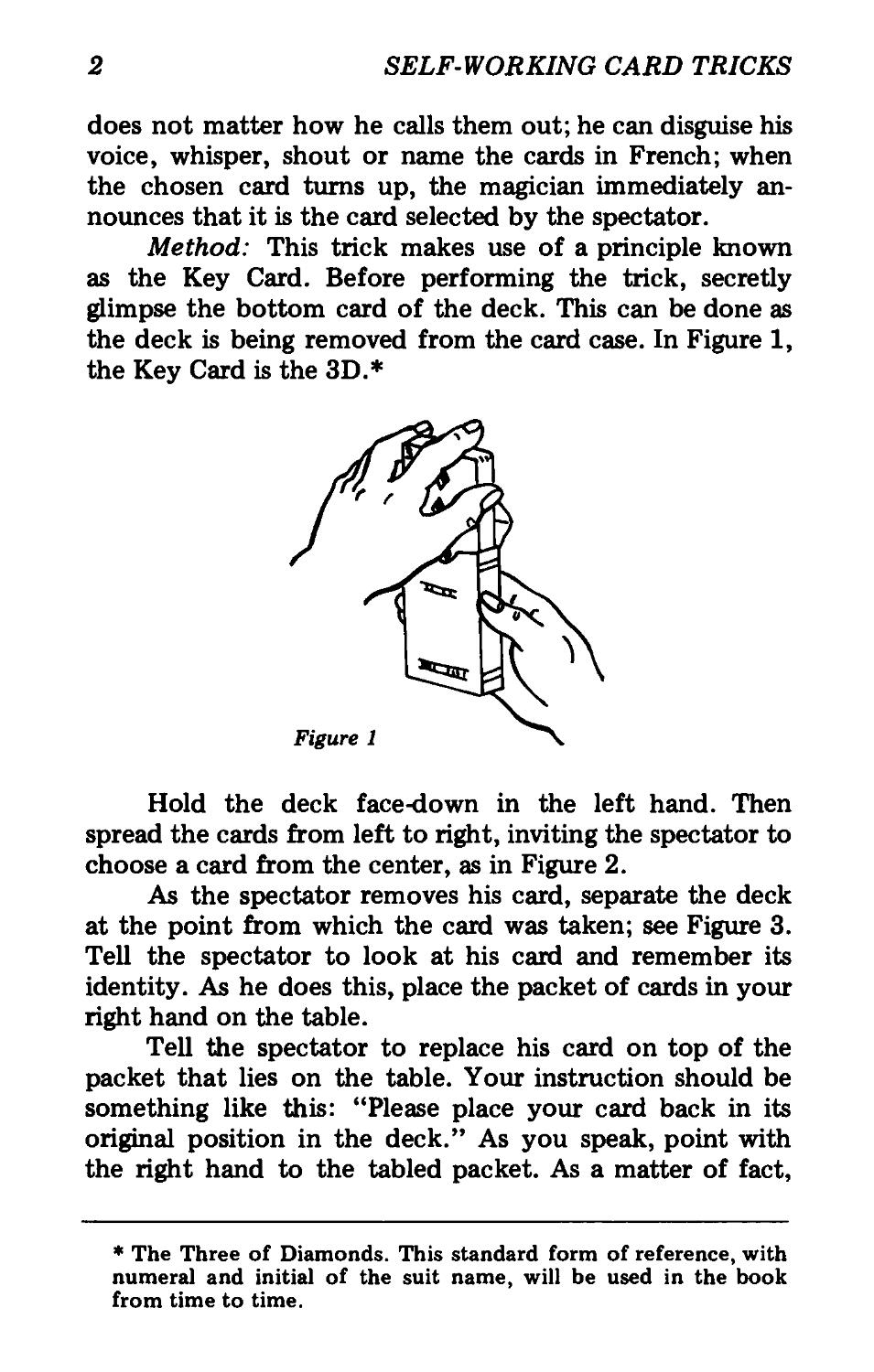
the deck is being removed from the card case. In Figure 1,
the Key Card is the 3D.*
Figure 1
Hold the deck face-down in the left hand. Then
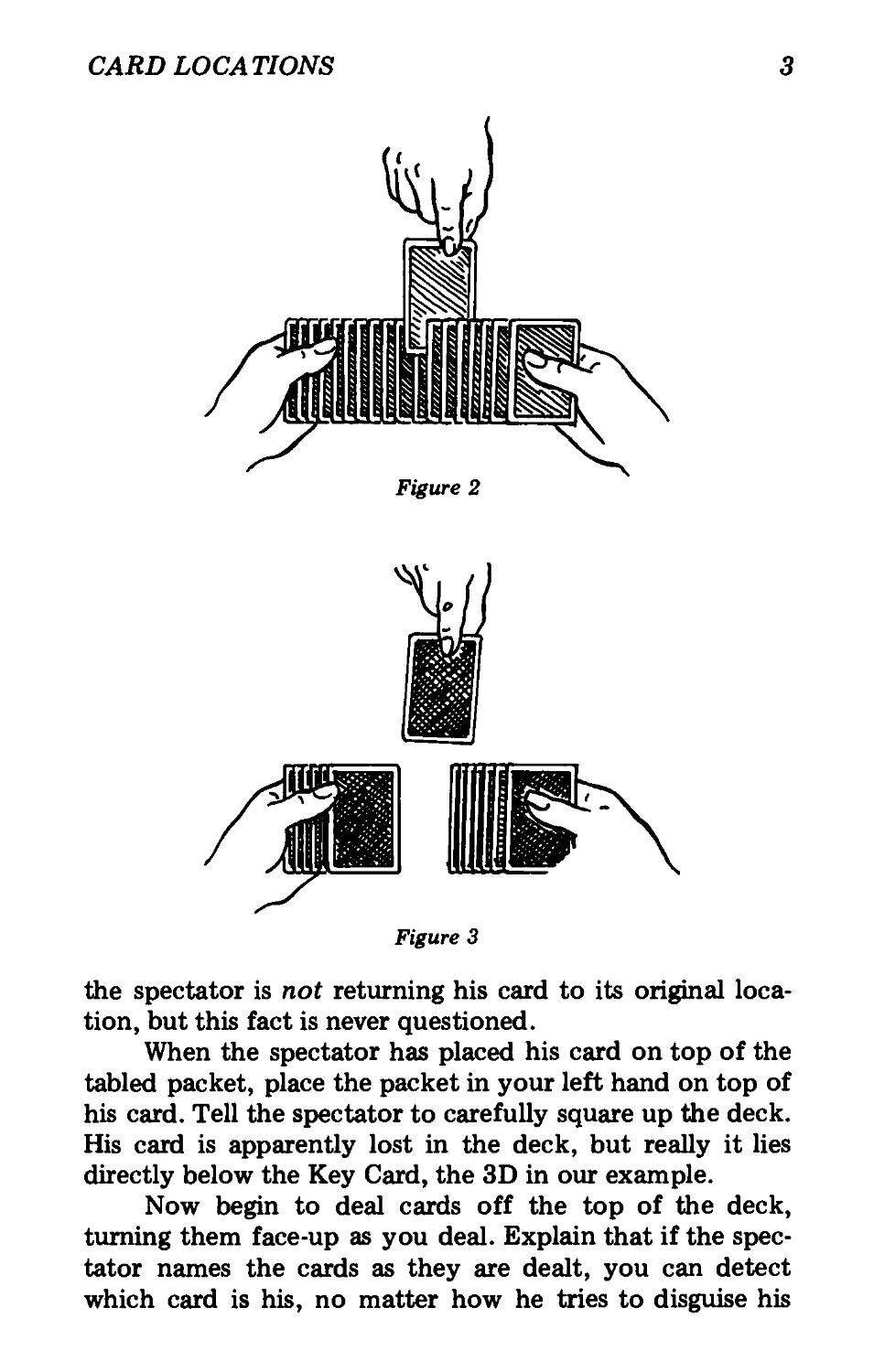
spread the cards from left to right, inviting the spectator to
choose a card from the center, as in Figure 2.
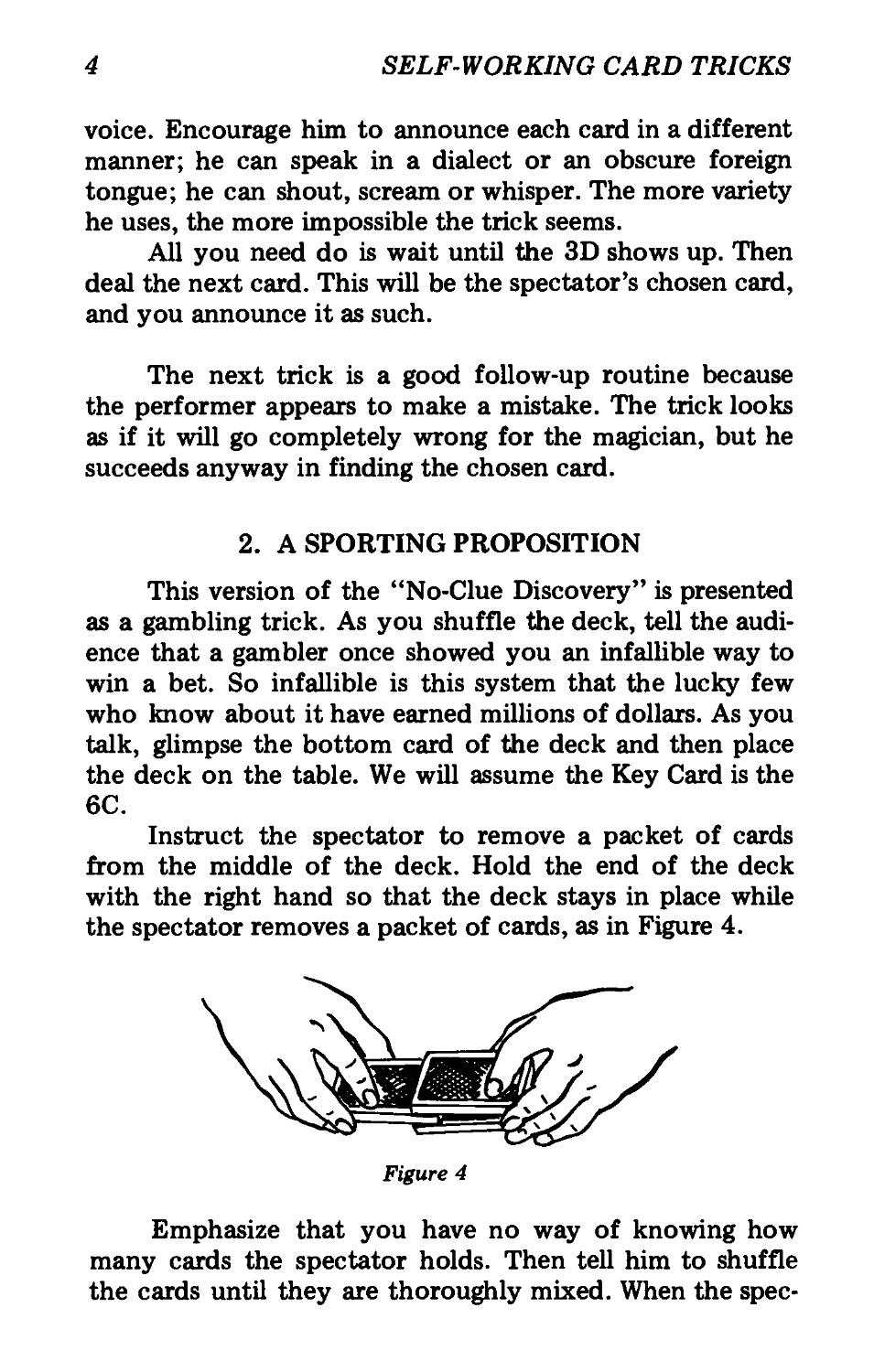
As the spectator removes his card, separate the deck
at the point from which the card was taken; see Figure 3.
Tell the spectator to look at his card and remember its
identity. As he does this, place the packet of cards in your
right hand on the table.
Tell the spectator to replace his card on top of the
packet that lies on the table. Your instruction should be
something like this: "Please place your card back in its
original position in the deck." As you speak, point with
the right hand to the tabled packet. As a matter of fact,
* The Three of Diamonds. This standard form of reference, with
numeral and initial of the suit name, will be used in the book
from time to time.
CARD LOCA TIONS
3
Figure 2
Figure 3
the spectator is not returning his card to its originalloca-
tion, but this fact is never questioned.
When the spectator has placed his card on top of the
tabled packet, place the packet in your left hand on top of
his card. Tell the spectator to carefully square up the deck.
His card is apparently lost in the deck, but really it lies
directly below the Key Card, the 3D in our example.
Now begin to deal cards off the top of the deck,
turning them face-up as you deal. Explain that if the spec-
tator names the cards as they are dealt, you can detect
which card is his, no matter how he tries to disguise his
4
SELF-WORKING CARD TRICKS
voice. Encourage him to announce each card in a different
manner; he can speak in a dialect or an obscure foreign
tongue; he can shout, scream or whisper. The more variety
he uses, the more impossible the trick seems.
All you need do is wait until the 3D shows up. Then
deal the next card. This will be the spectator's chosen card,
and you announce it as such.
The next trick is a good follow-up routine because
the performer appears to make a mistake. The trick looks
as if it will go completely wrong for the magician, but he
succeeds anyway in finding the chosen card.
2. A SPORTING PROPOSITION
This version of the "No-Clue Discovery" is presented
as a gambling trick. As you shuffle the deck, tell the audi-
ence that a gambler once showed you an infallible way to
win a bet. So infallible is this system that the lucky few
who know about it have earned millions of dollars. As you
talk, glimpse the bottom card of the deck and then place
the deck on the table. We will assume the Key Card is the
6C.
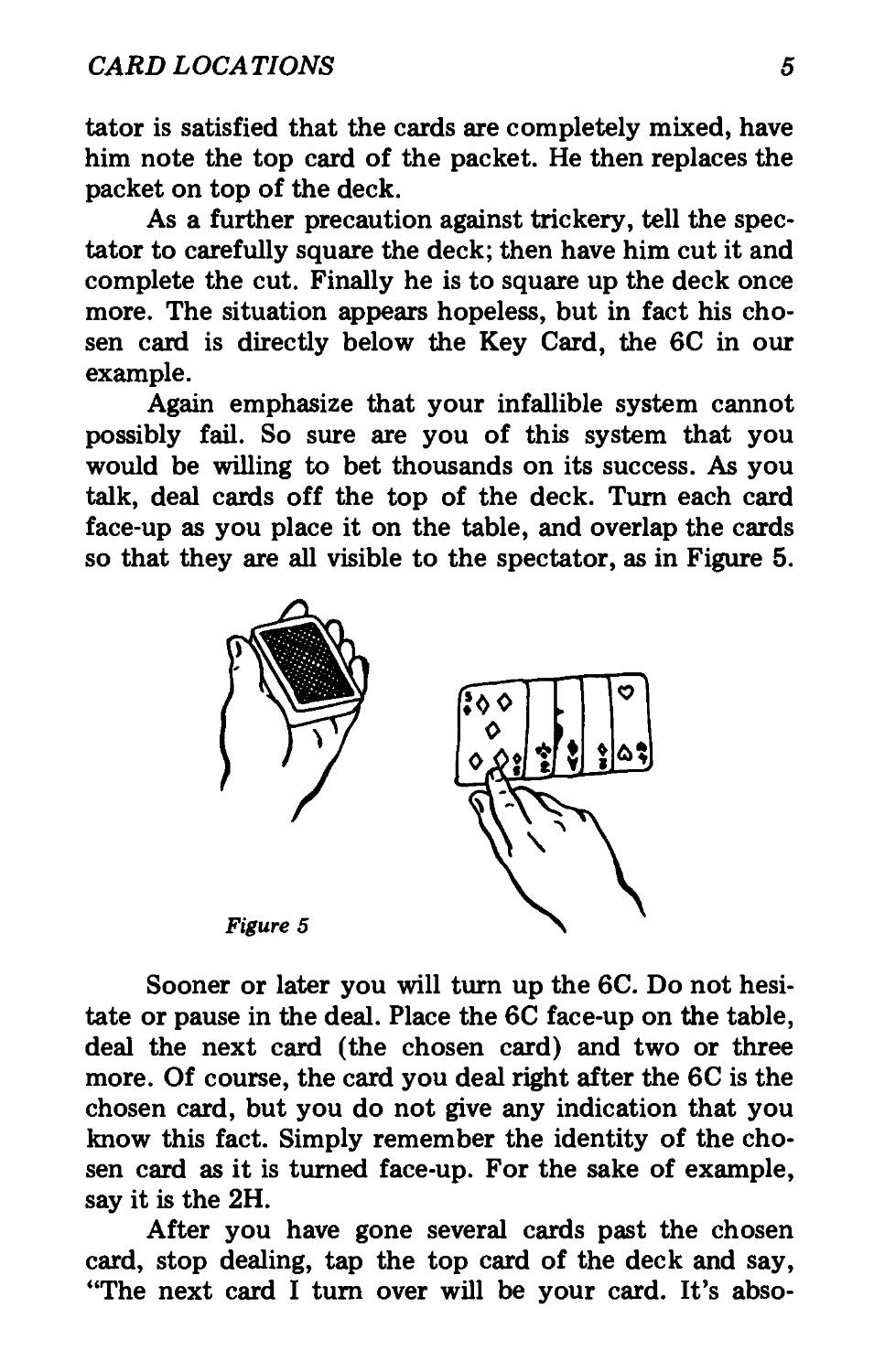
Instruct the spectator to remove a packet of cards
from the middle of the deck. Hold the end of the deck
with the right hand so that the deck stays in place while
the spectator removes a packet of cards, as in Figure 4.
Figure 4
Emphasize that you have no way of knowing how
many cards the spectator holds. Then tell him to shuffle
the cards until they are thoroughly mixed. When the spec-
CARD LOCA TIONS
5
tator is satisfied that the cards are completely mixed, have
him note the top card of the packet. He then replaces the
packet on top of the deck.
As a further precaution against trickery, tell the spec-
tator to carefully square the deck; then have him cut it and
complete the cut. Finally he is to square up the deck once
more. The situation appears hopeless, but in fact his cho-
sen card is directly below the Key Card, the 6C in our
example.
Again emphasize that your infallible system cannot
possibly fail. So sure are you of this system that you
would be willing to bet thousands on its success. As you
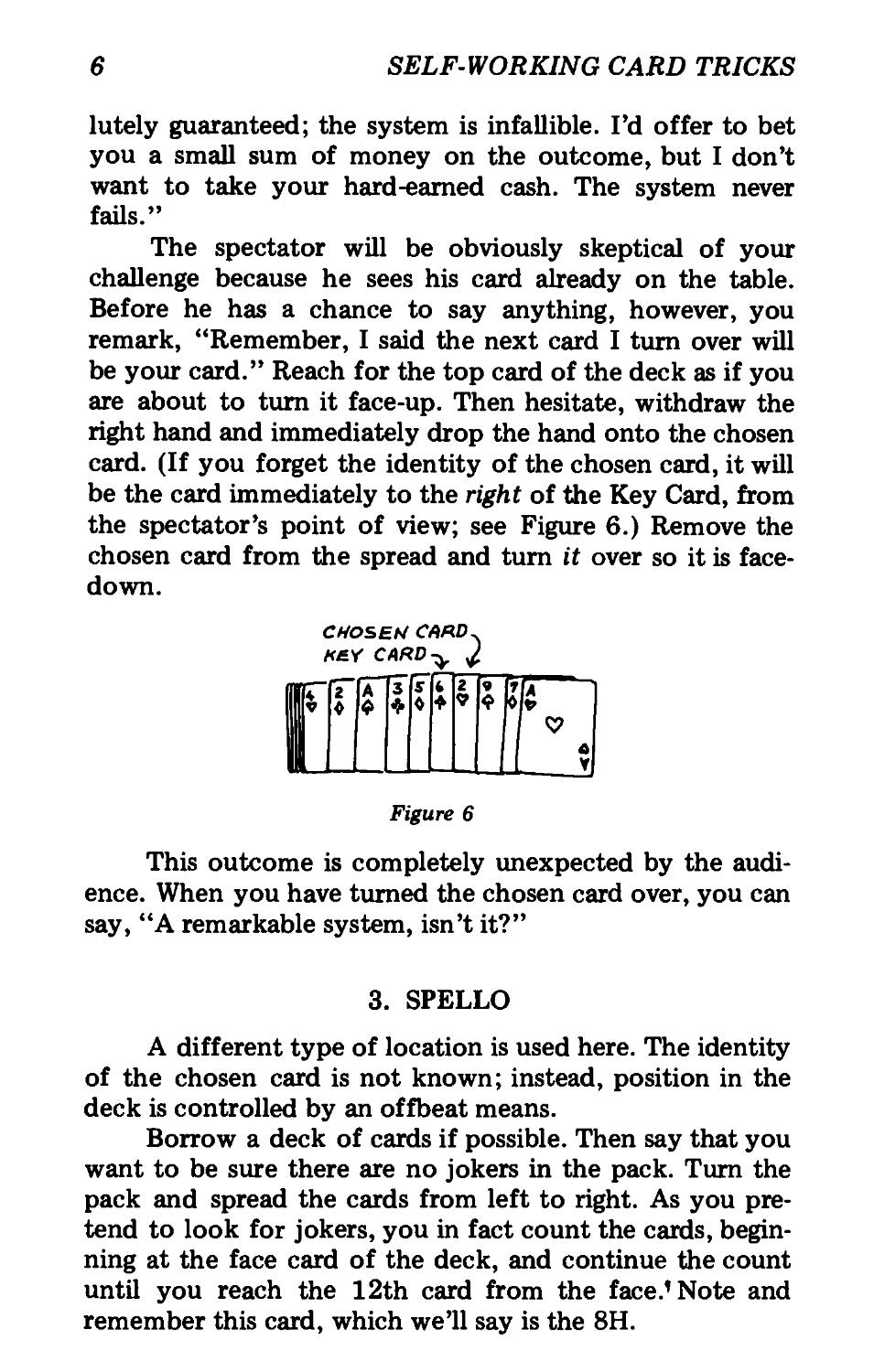
talk, deal cards off the top of the deck. Turn each card
face-up as you place it on the table, and overlap the cards
so that they are all visible to the spectator, as in Figure 5.
Figure 5
o
Sooner or later you will turn up the 6C. Do not hesi-
tate or pause in the deal. Place the 6C face-up on the table,
deal the next card (the chosen card) and two or three
more. Of course, the card you deal right after the 6C is the
chosen card, but you do not give any indication that you
know this fact. Simply remember the identity of the cho-
sen card as it is turned face-up. For the sake of example,
say it is the 2H.
After you have gone several cards past the chosen
card, stop dealing, tap the top card of the deck and say,
"The next card I turn over will be your card. It's abso-
6
SELF- WORKING CARD TRICKS
lutely guaranteed; the system is infallible. I'd offer to bet
you a small sum of money on the outcome, but I don't
want to take your hard-earned cash. The system never
fails. "
The spectator will be obviously skeptical of your
challenge because he sees his card already on the table.
Before he has a chance to say anything, however, you
remark, "Remember, I said the next card I turn over will
be your card." Reach for the top card of the deck as if you
are about to turn it face-up. Then hesitate, withdraw the
right hand and immediately drop the hand onto the chosen
card. (If you forget the identity of the chosen card, it will
be the card immediately to the right of the Key Card, from
the spectator's point of view; see Figure 6.) Remove the
chosen card from the spread and turn it over so it is face-
down.
CHOSEN CARD)
I<E.Y CARD '"
2 A 3 S , 2 9 :
+ +<:1 'i'
<::7
0
y
Figure 6
This outcome is completely unexpected by the audi-
ence. When you have turned the chosen card over, you can
say, "A remarkable system, isn't it?"
3. SPELLO
A different type of location is used here. The identity
of the chosen card is not known; instead, position in the
deck is controlled by an offbeat means.
Borrow a deck of cards if possible. Then say that you
want to be sure there are no jokers in the pack. Turn the
pack and spread the cards from left to right. As you pre-
tend to look for jokers, you in fact count the cards, begin-
ning at the face card of the deck, and continue the count
until you reach the 12th card from the face.' Note and
remember this card, which we'll say is the 8H.
CARD LOCA TIONS
7
Tell the spectator you would like to write a predic-
tion about the card he is going to select. Pick up a business
card and on the blank side write, "This Must Be It." Pick
up the deck, fan it and insert the business card directly in
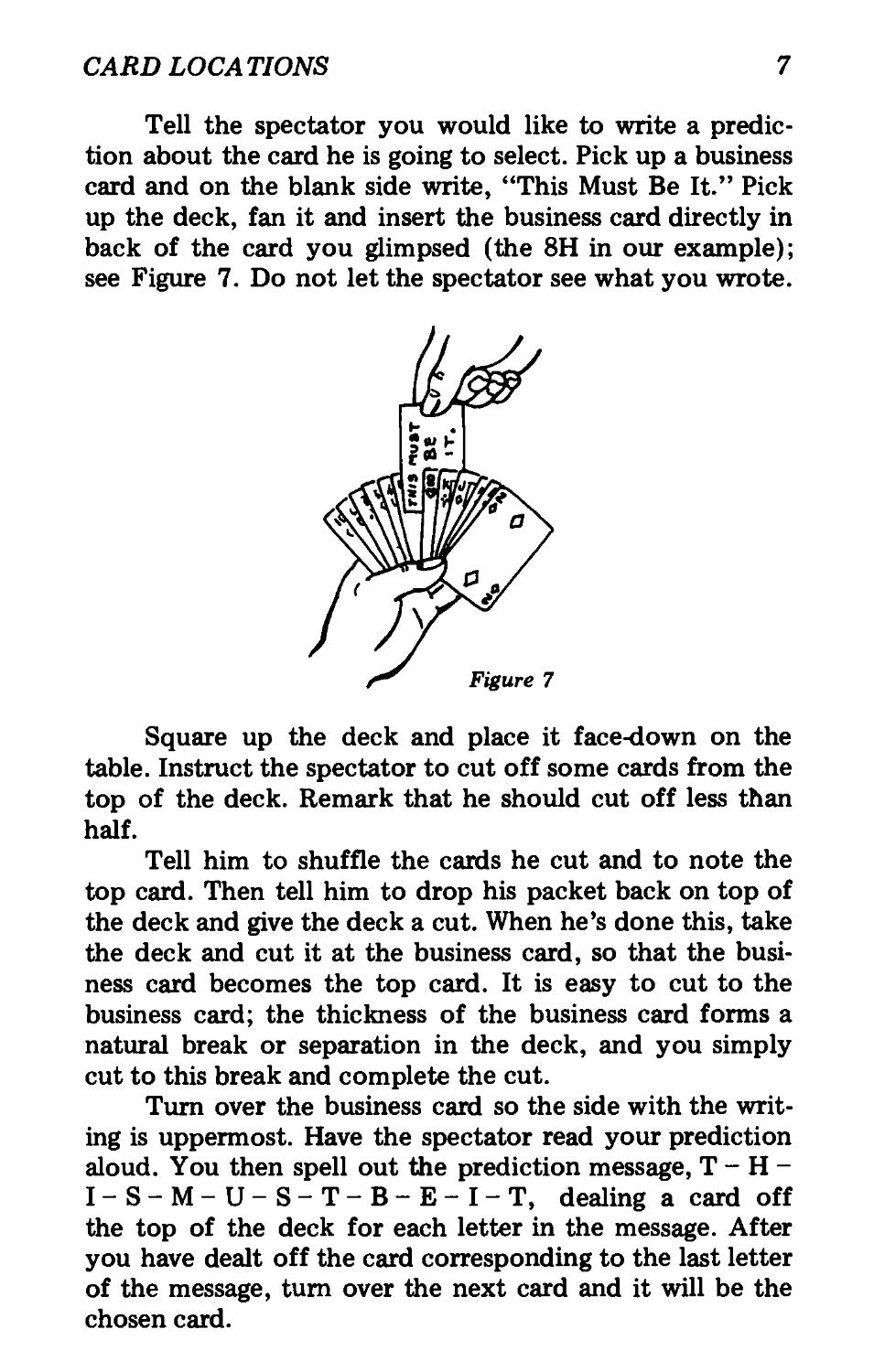
back of the card you glimpsed (the 8H in our example);
see Figure 7. Do not let the spectator see what you wrote.
Figure 7
Square up the deck and place it face-down on the
table. Instruct the spectator to cut off some cards from the
top of the deck. Remark that he should cut off less than
half.
Tell him to shuffle the cards he cut and to note the
top card. Then tell him to drop his packet back on top of
the deck and give the deck a cut. When he's done this, take
the deck and cut it at the business card, so that the busi-
ness card becomes the top card. It is easy to cut to the
business card; the thickness of the business card forms a
natural break or separation in the deck, and you simply
cut to this break and complete the cut.
Turn over the business card so the side with the writ-
ing is uppermost. Have the spectator read your prediction
aloud. You then spell out the prediction message, T - H -
I-S-M-U-S-T-B-E-I-T, dealing a card off
the top of the deck for each letter in the message. After
you have dealt off the card corresponding to the last letter
of the message, turn over the next card and it will be the
chosen card.
8
SELF-WORKING CARD TRICKS
4. THE LAZY MAGICIAN
In this trick the spectator does most of the work. It
was a favorite of the stage magician Blackstone, who often
presented it by having several spectators invited up on
stage to participate. You can do the trick with as many as
five spectators, the procedure being the same in each case.
For the present, we will assume you are going to present it
to just one spectator.
Tell him that sometimes you can spot someone who
has the talent to be a magician and that he looks like the
type who could be an expert with cards. As you talk,
remove ten cards from the top of a freely shuffled deck
and hand these to the spectator.
Say that in this trick he is going to do all the hard
work. Direct him to shuffle the packet. Then have him
look over the cards and decide on one. When he has chosen
one, tell him to remember its position from the top of the
packet. To take a specific example, assume that when he
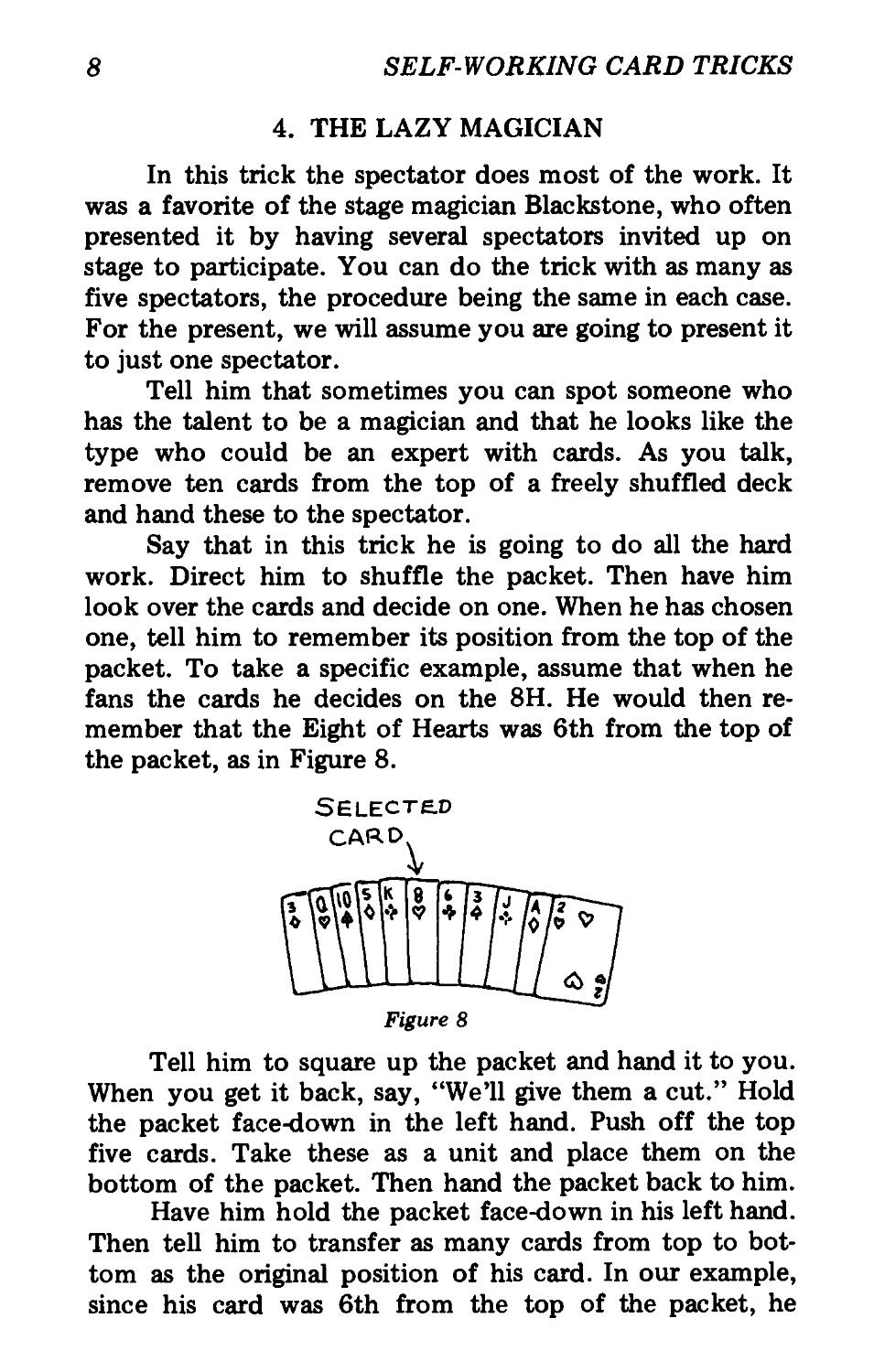
fans the cards he decides on the 8H. He would then re-
member that the Eight of Hearts was 6th from the top of
the packet, as in Figure 8.
Figure 8
Tell him to square up the packet and hand it to you.
When you get it back, say, "We'll give them a cut." Hold
the packet face-down in the left hand. Push off the top
five cards. Take these as a unit and place them on the
bottom of the packet. Then hand the packet back to him.
Have him hold the packet face-down in his left hand.
Then tell him to transfer as many cards from top to bot-
tom as the original position of his card. In our example,
since his card was 6th from the top of the packet, he
CARD LOCA TIONS
9
would transfer 6 cards, one at a time, from the top to the
bottom of the packet.
Now say, "All you have to do is use the elimination
shuffle to eliminate every card except the one you
picked." The elimination shuffle works like this: he trans-
fers the top card of the packet to the bottom of the pack-
et. Then he takes the next card and places it on the table.
He places the next card under the packet and the next
onto the table. He continues this elimination shuffle
(called an under/down shuffle by magicians because the
first card goes under the packet, the next card down on
the table, the next card under the packet, etc.) until he has
one card remaining in his hand.
Ask him to name the card he chose. He'll say it was
the 8H. Have him turn over the card and it is indeed the
8H. Congratulate him on being an outstanding magician.
5. TRAPPED
This is an instance where two magical effects take
place, one right after the other, without any moves or
sleights. As the audience sees it, the magician openly places
the Ace of Spades face-up adjacent to a chosen card, and
then cuts the deck. He snaps his fingers and spreads the
cards to reveal that the Ace of Spades has changed magi-
cally to the Ace of Clubs. The deck is squared up and
respread. Now it is seen that both of the black Aces are
face-up with a face-down card between them. When this
card is removed from the deck, it proves to be the chosen
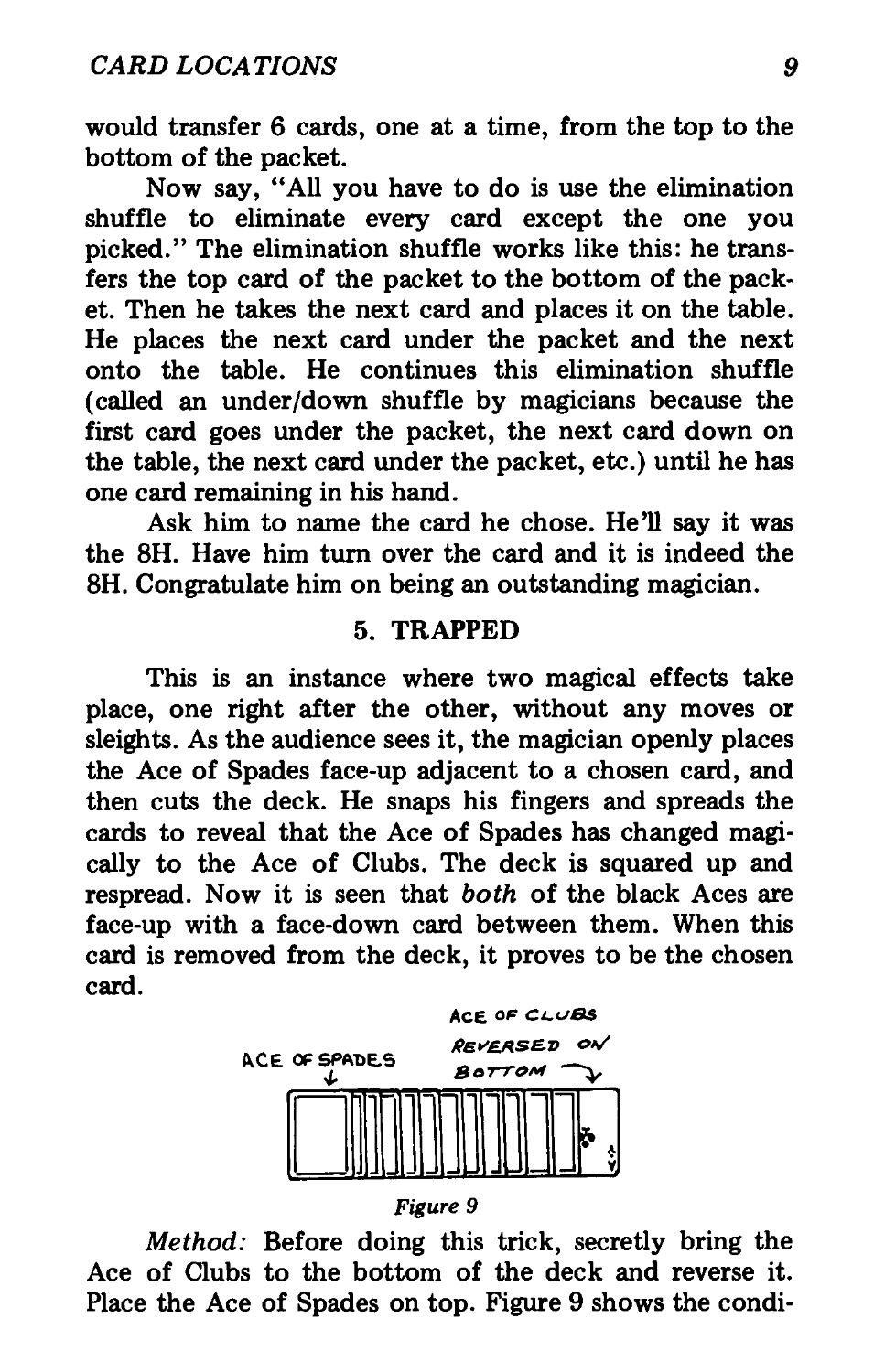
card.
I>.CE OF SPA'DE.S
.J..
ACE OF CL.vSS
NSII'E.RSE.7) 0"1'
BoTTO,,",
D ]j ]] J ] J "
v
Figure 9
Method: Before doing this trick, secretly bring the
Ace of Clubs to the bottom of the deck and reverse it.
Place the Ace of Spades on top. Figure 9 shows the condi-
10
SELF- WORKING CARD TRICKS
tion of the deck at this point, though you do not of course
reveal the presence of the reversed Ace of Clubs to the
audience.
Remove the top card and place it face-up on the ta-
ble. Say that the Ace of Spades will aid you in an interest-
ing demonstration of magic. Spread the cards and have the
spectator remove one. Square up the deck and place it
face-down on the table. Then have the spectator place his
card face-down on the table. Place the deck on the top of
his card. You then place the Ace of Spades face-up on top
of the deck.
Give the deck a cut and complete the cut. Then place
the deck in the left hand and spread the cards to the right
until you come to the first reversed Ace. It will be the Ace
of Clubs. Do not spread the cards any further at this point
because you do not want to accidentally expose the Ace of
Spades. When you get to the Ace of Clubs, say, "The Ace
of Spades has changed to the other black Ace."
Square up the deck. Say, "Now let's see if we can get
both of the black Aces to turn face-up." Snap the fingers
and then spread the deck face-down on the table. The two
black Aces will be face-up in the center of the deck with a
face-down card between them. Have the chosen card
named. Then remove the card between the black Aces and
show that the Aces trapped the spectator's card.
6. WHISPERING JOKER
The Joker is inserted face-up into a face-down packet.
The cards on either side of the Joker are remembered by
two spectators. Then the cards are shuffled and the Joker
removed. Placing half the packet in each jacket pocket, the
magician asks the Joker to whisper to him the name of
each chosen card, and also how to find it.
Pretending to hear an instruction from the Joker, the
magician reaches into each jacket pocket and removes the
chosen cards.
CARD LOCA TIONS
11
Method: This trick, developed by Charles Jordan, ex-
ploits a little-known principle in a clever way. You will
need a packet of 20 cards plus the Joker. Have the packet
shuffled and placed face-down on the table. Ask a specta-
tor to turn the Joker face-up and insert it anywhere in the
packet.
Then tell him to pick up the packet, fan the cards so
he can see the faces, and remember the card just to the left
of the Joker. Have a second spectator remember the card
just to the right of the Joker.
When they have done this, take the packet back (the
face-up Joker is still in it) and perform the following shuf-
fle. Hold the packet face-down in the left hand and slide
the top card to the right. Then slide the next card to the
right, but slide it up also so it is upjogged. Slide the third
card directly to the right, but upjog the fourth card. Con-
tinue in this way, upjogging every other card, until you've
gone through the packet. Then separate the upper group of
cards from the lower group, placing the upper group on
top of the lower group.
Repeat this shuffle exactly as described above. When
you have finished, pretend to remember that the reversed
or face-up Joker is still in the packet. Remarking that you
won't need the Joker, run through the cards until you spot
the Joker, then cut the packet at that point so the Joker is
on top. Place the Joker face-up on the table.
Have someone cut off about half of the packet from
the top and drop it in your left jacket pocket. The other
half of the packet is dropped into your right jacket pocket.
Pretend to get "whispered" information from the
Joker as to the location and identity of the chosen cards.
Actually one of the chosen cards is in the left pocket,
exactly five down from the top, while the other chosen
card is in the right pocket, exactly five cards up from the
bottom. All you need to do is reach into each pocket and
remove the proper card.
IMPROMPTU
CARD ROUTIN€S
Audiences are invariably impressed by the fact that
the magician can work with any deck handed to him, with-
out the need for special apparatus or elaborate setting-up
procedures. Many of the tricks in this book fit the im-
promptu category, and some, like "Ultra Coincidence"
(No. 27) and "Mental Miracle" (No. 67), can be built up as
unfathomable mysteries.
The tricks in this chapter were collected together be-
cause they are strictly impromptu and thoroughly tested
before audiences for maximum impact. Although they are
easy to perform, you will get much more credit for magical
powers if you pretend that great skill is involved. At least
half of the secret of acquiring a reputation in magic is
knowing how to act while presenting the trick.
7. ANY DECK, ANY TIME
Although a trick of honorable ancestry, this card lo-
cation still rates as one of the most impressive in the entire
literature on the subject. In describing it here, I will give a
step-by-step procedure that should make it easy for any-
one to follow, and at the same time avoid ambiguities that
might otherwise mislead the reader.
Any deck is used. Tell a spectator to cut it into three
piles. The exact number in each pile is not important, but
the piles should be approximately equal in size.
While you turn your back, ask him to pick a pile,
shuffle it and note the top card. Then tell him to turn the
12
IMPROMPTU CARD ROUTINES
13
pile face-up and place it on top of either of the two other
piles on the table. When he has done this, have him place
the remaining pile face-down on top of all.
The condition of the deck now is that there is a face-
up pile of cards sandwiched between two face-down piles.
Tell the spectator to carefully square up the deck. Then
have him cut off half of the deck and shuffle it into the
other half.
Tell him to square the deck after the shuffle and give
the deck a cut. At this point the spectator himself can look
through the cards and verify that face-up and face-down
cards are randomly mixed throughout the deck.
Take the deck from him and turn it over. Run the
cards from hand to hand. You will notice that small groups
of face-up and face-down cards appear at random in the
deck. But you will also note something that the spectator
will never spot; there is a long run of face-up cards in the
deck, longer than any other run.
As you study the cards, pretending to look for his
card, cut the deck so all of this long run of face-up cards
has been brought to the face of the deck nearest you. Now
beginning at the face of the deck, run the cards from left
to right until you come to the last face-up card in this long
run. The next card (a face-down card) will be the specta-
tor's card. Reveal it as dramatically as you can.
8. MENT AL MATES
Two shuffled decks are used. One is red-backed, the
other blue-backed. Both may be borrowed and both are
shuffled by the spectator. The two red Aces are removed
from the red-backed deck, turned face-up, and inserted
back into the deck so they are on either side of a face-
down card. No one knows the identity of this face-down
card between the red Aces.
The magician now removes the two red Aces from the
blue deck and places them on either side of a face-down
14
SELF-WORKING CARD TRICKS
card from that deck. Both decks are handed to the specta-
tor. He removes the card between the red Aces in one deck
and finds this card to be the Ten of Spades. Then he
removes the random card between the red Aces in the
other deck and finds that it too is the Ten of Spades.
What makes this trick so impressive is the fact that it
is performed under the most stringent test conditions, us-
ing borrowed, shuffled cards.
Method: Borrow two decks and have them well
mixed by the spectator. Ask him to remove the red Aces
from the red deck. Then have him shuffle the deck once
more, just to be certain he has not accidentally seen any
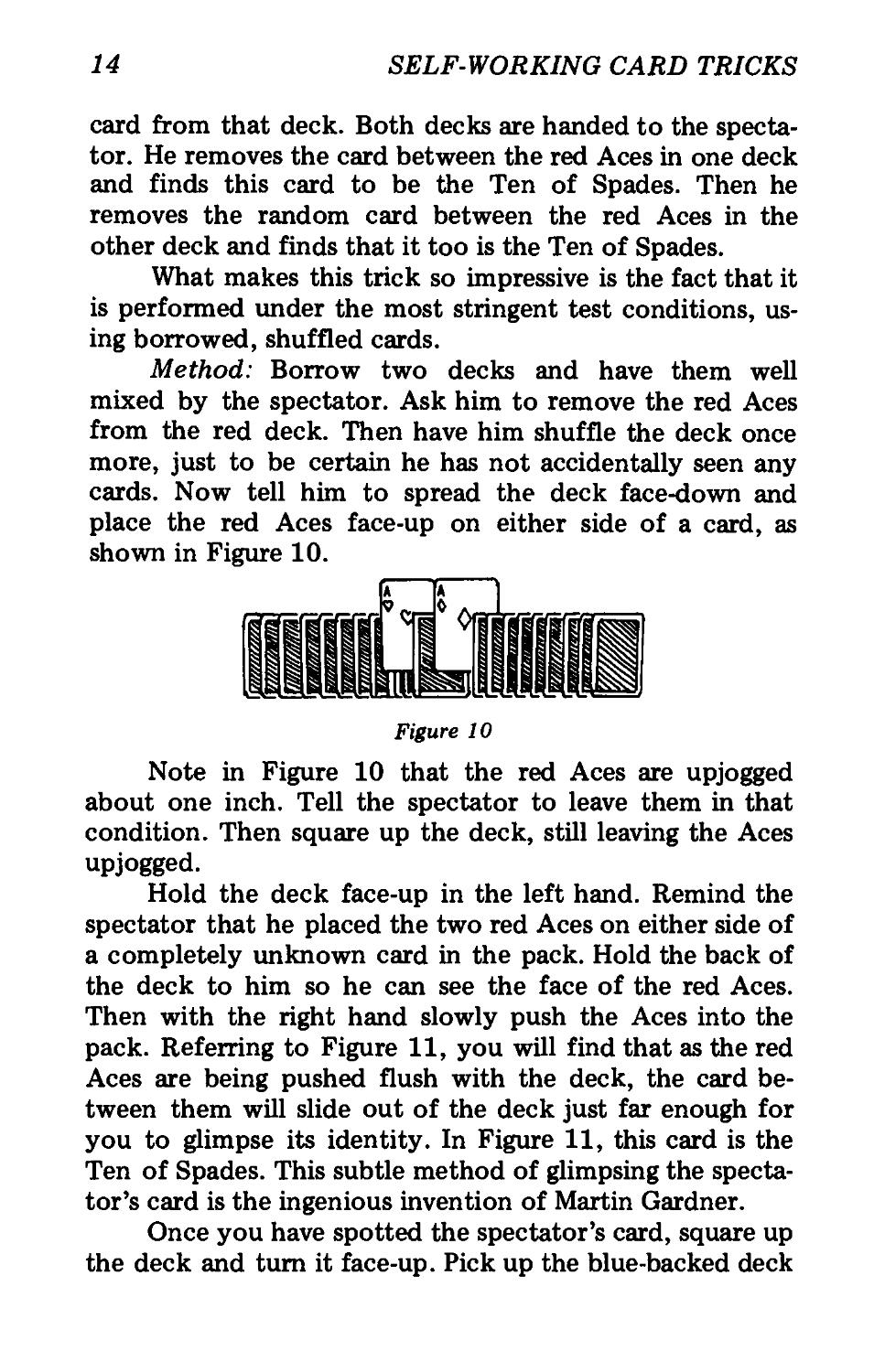
cards. Now tell him to spread the deck face-down and
place the red Aces face-up on either side of a card, as
shown in Figure 10.
_mrrD
Figure 10
Note in Figure 10 that the red Aces are upjogged
about one inch. Tell the spectator to leave them in that
condition. Then square up the deck, still leaving the Aces
upjogged.
Hold the deck face-up in the left hand. Remind the
spectator that he placed the two red Aces on either side of
a completely unknown card in the pack. Hold the back of
the deck to him so he can see the face of the red Aces.
Then with the right hand slowly push the Aces into the
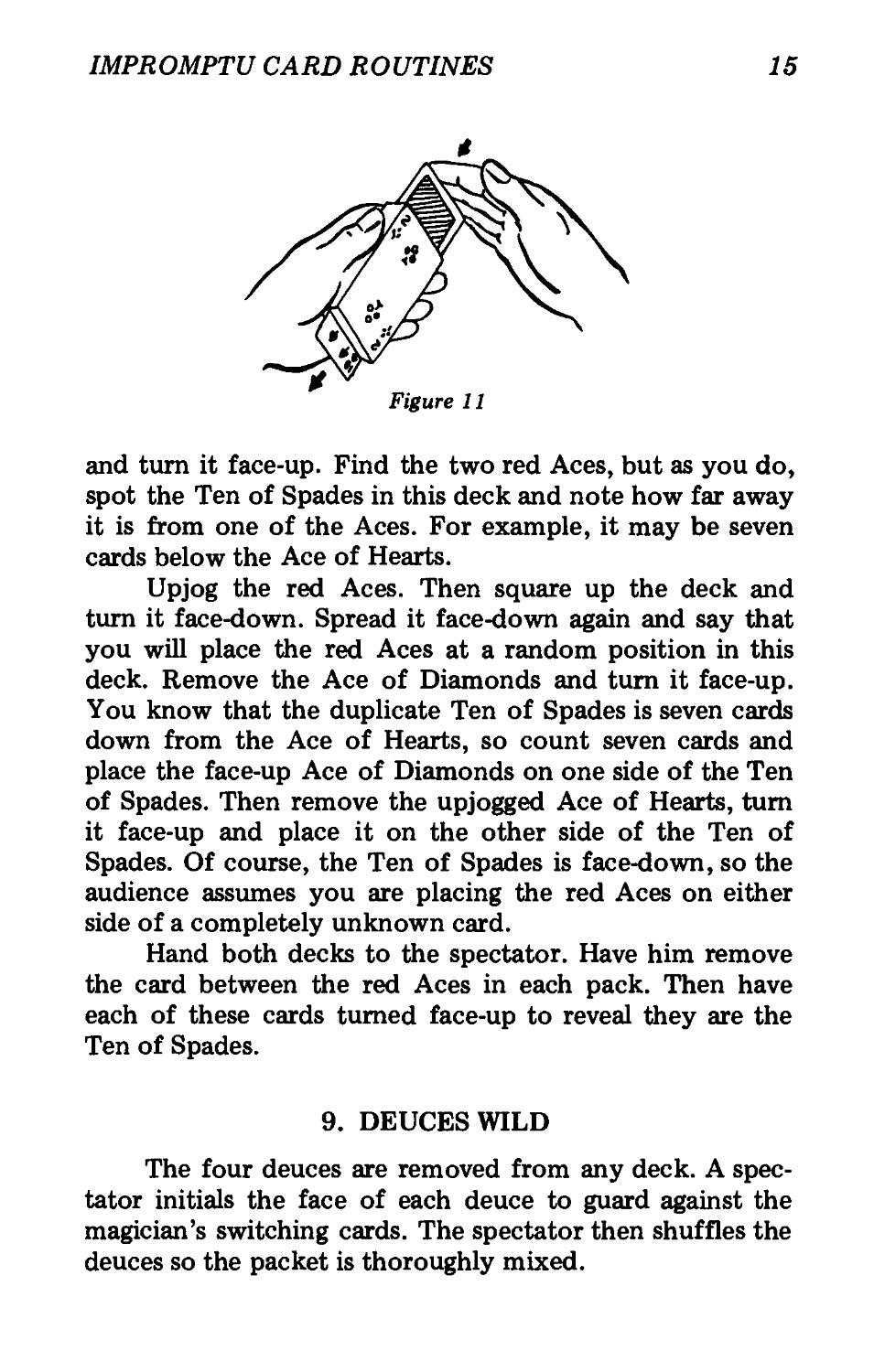
pack. Referring to Figure 11, you will find that as the red
Aces are being pushed flush with the deck, the card be-
tween them will slide out of the deck just far enough for
you to glimpse its identity. In Figure 11, this card is the
Ten of Spades. This subtle method of glimpsing the specta-
tor's card is the ingenious invention of Martin Gardner.
Once you have spotted the spectator's card, square up
the deck and turn it face-up. Pick up the blue-backed deck
IMPROMPTU CARD ROUTINES
15
,
Figure 11
and turn it face-up. Find the two red Aces, but as you do,
spot the Ten of Spades in this deck and note how far away
it is from one of the Aces. For example, it may be seven
cards below the Ace of Hearts.
Upjog the red Aces. Then square up the deck and
turn it face-down. Spread it face-down again and say that
you will place the red Aces at a random position in this
deck. Remove the Ace of Diamonds and turn it face-up.
You know that the duplicate Ten of Spades is seven cards
down from the Ace of Hearts, so count seven cards and
place the face-up Ace of Diamonds on one side of the Ten
of Spades. Then remove the upjogged Ace of Hearts, turn
it face-up and place it on the other side of the Ten of
Spades. Of course, the Ten of Spades is face-down, so the
audience assumes you are placing the red Aces on either
side of a completely unknown card.
Hand both decks to the spectator. Have him remove
the card between the red Aces in each pack. Then have
each of these cards turned face-up to reveal they are the
Ten of Spades.
9. DEUCES WILD
The four deuces are removed from any deck. A spec-
tator initials the face of each deuce to guard against the
magician's switching cards. The spectator then shuffles the
deuces so the packet is thoroughly mixed.
16
SELF-WORKING CARD TRICKS
He chooses a deuce from the packet, returns it to the
packet, and further shuffles the packet. The deuces are
then handed to the magician. Without fail, the magician
names the deuce chosen by the spectator.
The trick is repeated immediately, and once again the
magician correctly identifies the deuce chosen by the spec-
tator.
Method: Proceed as written above by having the
spectator remove the four deuces from the deck. Ask him
to write his initials across the middle of each deuce. Then
he is to gather the deuces one on top of the next, turn
them face-down and mix them.
Take them from him. Spread them face-down be-
tween the hands and have him choose one. While he looks
at it, square up the remainder of the packet. The secret
comes into play at this point. Simply turn the packet
around end for end. All attention is on the spectator at
this point, so your action of turning the packet around is
not noticed.
Have the chosen deuce returned to the packet. Then
hand the packet to the spectator and have him mix the
cards. When he's done this, take back the packet and hold
it so that you alone can see the faces of the cards. On three
of the deuces the spectator's initials will be right-side-up.
On the fourth deuce the initials will be upside down. This
will be the chosen deuce. Of course, the reason why the
initials run one way on three of the cards and the opposite
way on the chosen card is that you turned the packet
around end for end after the chosen card was removed
from the packet.
Once you know the identity of the chosen deuce,
reveal it as impressively as possible. Do not remove the
chosen deuce from the packet or otherwise tamper with
the packet. Assuming that the chosen deuce was the Two
of Hearts, for example, name this deuce as the chosen one,
turn the packet face-down and immediately offer to repeat
the trick.
Again spread the cards and have a deuce selected. As
IMPROMPTU CARD ROUTINES
17
it is being shown to the audience, square up the packet and
turn it end for end. Have the chosen deuce returned to the
packet. Then invite the spectator to mix up the cards.
When he is satisfied that they are well mixed, take
back the packet and fan it so you alone can see the faces.
Look for the Two of Hearts. The initials will point right
side up or upside down. It does not matter which, but
make sure you know which way the initials point. Then
simply look for the other deuce in the packet that has the
initials pointing the same way. There will be only one
other such deuce and it will be the deuce chosen the sec-
ond time.
There is one exception. If the Two of Hearts points
the same way as the other three deuces, you know that the
second time the spectator again chose the Two of Hearts.
When you reveal the card the second time, make the most
of this astounding coincidence.
10. RAPID TRANSIT
Transpositions are those tricks where two or more
cards change places. Generally a good deal of skill is re-
quired, but the following trick, devised by J. W. Sarles and
the author, accomplishes the transposition without skill.
Have a borrowed deck shuffled. While it is being shuf-
fled, secretly note the bottom card. We will say this card is
the King of Hearts. Assuming the spectator is sitting across
the table from you, ask him to remove his favorite Ace and
place it on top of the deck. His favorite Ace may be the
Ace of Spades. When he's placed it on top of the pack, ask
-him to note and remember the bottom card of the deck
also. After he's done this, tell him to hand you the deck
under the table.
Grasp the deck from above by the near ends, more or
less as shown in Figure 4. Tell the spectator to remember
the identity of his favorite Ace. As you talk, secretly turn
the right hand over so it is palm-up. This also reverses the
deck.
18
SELF-WORKING CARD TRICKS
Tell the spectator to remove his favorite Ace from the
top of the deck. He reaches under the table and removes
what he thinks is the top card. But since you turned the
deck over, he has removed the bottom card (in our exam-
pie, the King of Hearts).
Once he's removed the card, you turn the right hand
palm-down again. Tell him to insert the Ace into the cen-
ter of the deck. When he has pushed the card into the
center, secretly turn the deck over again so it is face-up
under the table.
Now tell him to remove the bottom card and hold it
in his hand. He removes what he thinks is the bottom card.
Take the deck and place it face-down on the table. Then
reach under the table and take the card from the spectator,
remarking, "I want to see what card I'm going to work
with to find your favorite Ace."
When you take the card from him, pretend to look at
it. Say, "All right, the King of Hearts." Here you name the
card you secretly glimpsed on the bottom of the deck at
the beginning of the trick. Place the card back under the
table. The right hand then raps against the tabletop from
below. It then comes up into view, holding the card face-
down. Turn it over to show it has changed into the specta-
tor's favorite Ace.
For the finish, have him spread the deck face-down
on the table. He should be surprised to discover that the
King of Hearts is now reversed in the center of the deck.
You may wonder why, at the beginning of the trick,
the spectator was asked to place his favorite Ace on top,
since the trick would obviously work just as well with any
two cards. The reason is that since he is being asked to
remember two cards, you want to make it as easy as pos-
sible for him. Thus you ask him to place his favorite Ace
or his lucky Ace on top of the deck. Since this card is
easily remembered, the spectator will find it no trouble to
also remember the bottom card of the deck.
You can also have him initial each card with a pencil
at the beginning of the routine. To the average layman,
IMPROMPTU CARD ROUTINES
19
initialed cards eliminate such trickery as duplicate cards.
But of course it makes no difference in this trick whether
the cards are initialed or not.
11. Z-RA Y
Using any shuffled deck, the magician writes a mystic
symbol on the face of a card. A spectator then initials the
face of this card. While the magician turns his back, the
spectator places the mystic card anywhere in the deck. The
magician then turns around. He explains that the mystic
symbol confers an eyeless vision known as z-rays to the
person who drew the symbol.
To demonstrate that this is so, the magician slowly
deals cards off the top of the deck. At some point he
stops. When the next card is turned up, it proves to be the
card bearing the mystic symbol. Remember that this is
done with any borrowed, shuffled deck handed to you,
and there is positively no preparation. The cards are bor-
rowed and the trick immediately commences exactly as
written. Further, it may be repeated instantly.
Figure 12
Method: Take the borrowed, shuffled deck and hold
it face-down in your left hand. Follow the handling care-
fully because it is designed to direct audience attention
away from the secret. Explain that mystic symbols some-
times have a power of their own which they can convey to
those skilled in the art of magic. To illustrate, turn the top
card of the deck face-up and place it on top of the deck.
The card may be the Two of Hearts. Note in Figure
12 that the Two of Hearts is not placed squarely on top of
20
SELF-WORKING CARD TRICKS
the deck but is backjogged slightly. Borrow a pencil. Say
that you will inscribe the symbol for eyeless vision on the
face of the card. Inscribe a mystic-seeming symbol like the
one shown in Figure 12. But as soon as you finish drawing
the symbol, place a tiny dot on the white border of the
next card, exactly as shown in Figure 12. This method of
secretly marking a card is credited to Glen Gravatt.
The throw-off comes in at this point. The tiny dot is
visible to no one but yourself, so do not be afraid that
anyone will spot it. Hand the pencil to the spectator and
tell him to place his initials on the face of the Two of
Hearts, as this sometimes strengthens the spell. Do not
adjust the Two of Hearts or try to hide the secret pencil-
dot. This draws attention to the cards and is exactly what
you want to avoid.
After the spectator has initialed the Two of Hearts,
turn this card face-down on top of the deck. Place the
deck face-down on the table. Ask the spectator to deal
cards off the top into a heap on the table. He deals a card
at a time, beginning with the top card (the Two of Hearts)
and continues the deal for as long as he likes. When he
stops dealing, tell him to take the dealt packet and place it
back on top of the deck. The card bearing the mystic
symbol is thus buried somewhere in the deck.
When he's carefully squared up the deck, take it from
him and begin dealing cards off the top one at a time.
Sooner or later you will spot the card bearing your pencil
dot. Deal this card onto the tabled heap. Then pause dra-
matically and turn up the next card. It will be the Two of
Hearts.
If you wish to repeat this routine, pick up the tabled
packet and replace it on top of the deck. Then place the
Two of Hearts face-down on top of the deck. The trick can
now be repeated exactly as described above.
IMPROMPTU CARD ROUTINES
21
12. MATCHING MATCHES
This trick and the next one illustrate how the same
effect can be brought about in different ways. This version
is based on an ingenious idea of Jack Avis.
Besides the deck of cards, you will need a packet of
matches that contains 13 matches, and another that con-
tains eight matches. The number in each packet is not
important just as long as the number of matches in both
packets total 21.
Tear out the matches from both packets and combine
them in a heap on the table. Have someone shuffle and cut
a deck of cards. Then, while your back is turned, have this
spectator remove any number of matches from the group,
count them and place them out of sight in his pocket.
Invite a second spectator to count the remaining matches,
and then conceal them in his pocket. Thus the first specta-
tor may have 14 matches and the second spectator seven
matches.
Explain to spectator "A" that you are going to deal
cards, one at a time, off the top of the deck. He is to
remember the card that falls in a position corresponding to
the number of matches he holds. In our example he would
remember the 14th card you deal.
Deal cards one at a time off the top of the deck into a
face-up heap on the table. Continue the deal until you
have dealt at least 18 cards. Ask spectator "A" if he re-
members his card. Then square up the face-up heap, turn it
over and replace it on top of the deck.
Now ask spectator "B" to remember a card corre-
sponding to the number of matches he holds. In the above
example he would remember the 7th card you deal. As
before, deal off the top of the deck a card at a time,
dealing the cards one on top of each other in a face-up
heap. After you've dealt 18 cards pick up the face-up heap,
turn it face-down and replace it on top of the deck.
Explain to the audience that although you don't
know either card, you will attempt to adjust the positions
22
SELF-WORKING CARD TRICKS
of both cards without looking at them and without know-
ing which card each spectator is thinking of. Place the deck
under the table or behind the back. Pretend to adjust cer-
tain cards but in fact do nothing.
Bring the deck into view and deal the top ten cards
into a heap on the table. Place the balance of the deck
alongside the ten-card packet. Explain that you are going
to deal cards off the top of both packets. When either
spectator sees his card, he is to call stop. If you are lucky,
both cards will turn up at exactly the same instant.
All that remains is to deal cards off the top of each
packet. If you handled the trick exactly as described, the
thought-of cards will turn up simultaneously.
13. THE MAGIC 13
This trick is the creation of Sam Schwartz. It pro-
duces the same type of effect as in the above routine, but
takes a different path to achieve the end result.
Explain that the number 13 possesses properties both
lucky and unlucky, both common and mysterious. To il-
lustrate one of the mysterious properties, have someone
deal 13 cards from the top of any shuffled deck. While you
turn your back, have this fellow remove a portion of the
13-card packet and hand the balance of the packet to an-
other spectator.
Each spectator counts the cards he holds and remem-
bers the number. Let's say that spectator "A" remembers
that he has 5 cards, and spectator "B" remembers that he
has 8 cards. Of course the magician is unaware of how
many cards each person holds.
Ask that "A's" cards be placed face-down on the ta-
ble. Then have "B's" cards placed face-down on top of
"A's" cards. Request either spectator to give the 13-card
packet a good shuffle just to make sure the cards are well
mixed. Then take the packet and deal the cards one at a
time off the top into a face-up heap. Ask "A" and "B" to
remember the card at the position corresponding to the
IMPROMPTU CARD ROUTINES
23
number each person has in mind. In this case, "A" would
remember the 5th card you deal and "B" would remember
the 8th card you deal.
When you've dealt all 13 cards into a face-up heap,
turn the heap face-down and then deal the packet into two
face-down heaps, alternating a card to each heap, dealing
first to the left, then to the right, then to the left, then to
the right, etc. When you finish dealing the 13 cards, you
will have a heap of seven cards on the left, a heap of six
cards on the right.
Turn the left-hand heap (the one with seven cards)
face-up. Simultaneously deal cards off the top of each
heap. When one spectator sees his card being dealt off the
face-up heap, he is to call stop. When he does, show that
the corresponding card you've just dealt off the face-down
heap is the other spectator's chosen card.
POK€R D€ALS
The lure of gambling is universal. You will even find
that when you have done a few card tricks for friends that
at least one person is certain to remark that he would not
want to play cards with you.
This chapter treats a number of poker deals, two
methods of revealing the Aces, a demonstration of cheat-
ing at Bridge, and closes with a trick that packs a double
punch; not only does the magician instantly change a
Straight to a Royal Flush, he shows in a surprising way
how the switch was accomplished.
As a rule the more technical gambling tricks appeal
only to people who gamble. For that reason, and because
many people are not fully acquainted with the more intri-
cate aspects of gambling and odds, the tricks in this chap-
ter were selected because they do not demand special
knowledge of gambling. The routines are easy to follow
and seem to demonstrate dazzling skill with the paste-
boards.
Not included in this chapter are tricks using dice as
well as cards. But you will find such tricks elsewhere in the
book-"Fate #1" (No. 40), "Fate #2" (No. 41), "Blind
Dice #1" (No. 43) and "Blind Dice #2" (No. 44)-and
with very little effort you can work them into gambling
demonstrations to show how thieves and hustlers exert
mental control over dice as well as cards.
24
POKER DEALS
25
14. LESSON IN LARCENY
This trick of Roy Walton's and the next routine, "Au-
tomatic Poker," illustrate how radically different methods
can be exploited to bring about similar effects. In this case
the spectator is given a packet of cards and is told to deal
five of them to himself. He can take any five, and when he
does he will be surprised to discover that he's dealt himself
a Straight!
Preparation is simple. Before starting the trick, ar-
range to have the 9H - 8S - 7D - 6C & 5D on top of the
deck in that order from the top down. Thus, the top card
of the deck will be the 9H. Place the deck in its case until
ready to perform.
Offer to teach the spectator to become a card sharper
in just a few minutes. Remove the deck from its case and
openly run through the cards, taking out the 5H - 6S -
7H - 8C - 9D. Arrange them in numerical order with the
five as the top card of the packet and the 9D as the bot-
tom card.
Fan the five cards and show them to the spectator.
Then square them up and drop the packet onto the table.
Remark that you will use five more cards, and as you say
this, deal the top five cards of the deck onto the packet
that lies on the table.
The balance of the deck is placed aside. Hand the
spectator the ten-card packet. Tell him to cut it and com-
plete the cut. Have him do this several times so no one
could possibly know the order of any cards in the packet.
Then tell him that a good card sharper can of course deal
off the top or the bottom as the occasion demands. Natu-
rally the spectator cannot be expected to perform a per-
fect bottom deal, but you will allow him the option of
taking either the top or the bottom card.
Tell the spectator to take five cards for himself. Em-
phasize that he can take some cards from the top and some
from the bottom, or he can take all five cards from the
top, or all five from the bottom, or he may decide not to
26
SELF-WORKING CARD TRICKS
bottom deal at all. In this last case, if he decides to deal
honestly, he would simply deal out two poker hands in the
conventional fashion.
Regardless of which way he decides to deal, he will
always get a Straight. While he looks at his cards, drop
your hand on top of the deck and comment, "I wouldn't
want to play cards with you."
15. AUTOMATIC POKER
In recent times the demonstration of dealing the win-
ning hand at poker has developed in an unexpected direc-
tion; nowadays the magician can allow the spectator the
opportunity to pick cards completely at random, and still
guarantee that he will get a pat hand. Not only that, the
magician can even predict ahead of time exactly which
kind of poker hand the spectator will get. Finally the spec-
tator deals the magician an even better hand!
As the audience sees it, the magician writes a predic-
tion and drops it into a glass so it is on view at all times.
He then allows the spectator a completely random choice
of cards from a packet of different cards. The spectator
can take any five cards he desires-there is absolutely no
restriction on his choice of cards. He might end up with a
King-high Straight. The prediction is opened and it is
found that the magician predicted the spectator would
choose exactly that, a King-high Straight. Then the magi-
cian shows his own hand and it is an Ace-high Straight!
A simple set-up does all the work. Beforehand, stack
the top 11 cards as follows from the top down: KD - 10S
- 10H - JC - JD - QS - QC - 9H - 9C - AH - KH. Place
this packet face-down on top of the face-down deck. The
top card of the assembled deck is the KD.
Tell the spectator you'd like to show him something
you learned from a gambler. Push over the top cards of the
deck, silently counting them until you have pushed over
11 cards. Take these 11 cards into the right hand. The left
hand then places the rest of the deck on the table, and the
POKER DEALS
27
packet of 11 cards is returned to the left hand. Do not call
attention to the number of cards in the packet.
Explain that you will use five pairs of cards, all differ-
ent. With the left thumb push the top two cards over to
the right. These two cards are taken by the right hand and
shown to the spectator. The pair will consist of a King and
a Ten. Do not reverse the order of the cards when you take
them into the right hand. Simply take them, show them to
the spectator and replace them on the bottom of the pack-
et. If done correctly, the bottom card of the packet will
now be the 10S.
Repeat with each of the next four pairs of cards. As
you do, point out that each pair contains different cards.
Tell the spectator that he is going to have the opportunity
to pick his own hand. But to illustrate the power of sub-
liminal suggestion, you claim that you can determine
ahead of time exactly which kind of hand he will get-in
other words, two pair, a Flush, one pair, or any other
combination.
On a slip of paper write, "You will deal yourself a
King-high Straight." Fold the paper in half and in half
again and drop it in a glass so it is on display and obviously
isolated from any tampering that magicians are always ac-
cused of using.
Now take the top pair of cards in the right hand. Ask
the spectator to choose one card of the pair. Both cards
are of course face-down and you do not allow the specta-
tor to see the faces of the cards. He picks a card and places
it face-down before him. You then take the remaining card
of the pair and place it under the packet.
Repeat this procedure with the next four pairs of
cards. Each time the spectator gets a free choice of which
card in the pair he wants, and each time you place the
remaining card under the packet.
When the spectator has five cards, drop the remainder
of the packet on top of the deck. Let the spectator turn
his hand over and arrange it to show that he has a King-
high Straight. Let him open the prediction and verify that
28
SELF-WORKING CARD TRICKS
you predicted exactly which hand he would get.
Then say, "You made only one mistake. The five
cards you left me with make an even better hand." Deal
the top five cards off the deck and turn them over to show
that you beat him with an Ace-high Straight.
16. NAMING THE ACES
The spectator shuffles the deck. Then the magician
says he can guess the suit of the first Ace that the specta-
tor will deal. The magician names the Ace of Hearts. The
spectator deals cards off the top of the deck until he
comes to the first Ace. It is the Ace of Hearts.
The Ace of Hearts is placed aside. The spectator as-
sembles the deck and gives it another shuffle. Challenging
the odds, the magician offers to repeat the trick and cor-
rectly guess the suit of the first Ace that will turn up on
this round, saying it will be the Ace of Spades. The specta-
tor deals the cards one at a time off the top. When he turns
up the first Ace, it is indeed the Ace of Spades.
"There are two Aces left in the deck," the magician
says. "I'll bet you turn up the Ace of Clubs before you get
to the Ace of Diamonds. " The spectator deals cards one at
a time off the top of the deck, and sure enough the Ace of
Clubs turns up before the Ace of Diamonds.
Note that the entire trick takes place with the cards
in the spectator's hands, and further that he shuffles the
deck repeatedly, making it a challenging feat and one that
will be of special interest to any spectator interested in
seeing the laws of chance overcome.
Method: Arrange the four Aces on top of the deck in
Hearts, Spades, Clubs, Diamonds order. Then remove any
three cards from the center of the deck and place these on
top of the Aces. This is the only preparation.
Hand the deck to someone who plays cards and can
be counted on to give the deck a good, even riffle shuffle.
Generally he will be a card player or someone interested in
gambling, so he will find this demonstration of particular
interest.
POKER DEALS
29
Tell him that you've made a study of the laws of
probability and think you can outwit the odds. Have the
spectator give the deck a riffle shuffle. Then say that you
will ask him to turn cards face-up one at a time off the top
of the deck and that the first Ace he turns up (here you
pretend to make a mental calculation) will be the Ace of
Hearts.
The spectator deals cards onto the table until he gets
to the first Ace. It will be the Ace of Hearts. Have him
place this card aside. Then tell him to pick up the dealt
cards and replace them face-down on top of the deck.
Thus far the demonstration has proven nothing; you could
have an infallible system as you claim, or you could be
merely lucky.
Instruct the spectator to cut off the top half of the
deck and riffle shuffle it into the bottom half. This is quite
impressive because after the second shuffle the audience
thinks the deck is really well mixed.
Remark that according to your system, the first Ace
he will turn up this time should be the Ace of Spades. The
spectator deals cards one at a time off the top of the deck.
The first Ace he comes to will indeed be the Ace of
Spades.
Right at this point say, "There are two Aces left in
the deck. It's even money, but I'm so sure of my system,
I'll bet a million to one that of the remaining two Aces in
the deck, you'll turn up the Ace of Clubs Ill'st."
Let the spectator continue dealing until he comes to
an Ace. It will be the Ace of Clubs.
17. THE THREE-JACKS DEAL
This routine resulted from collaboration between Lin
Searles, the brilliant West Coast magician, and the author.
Although based on an old theme, the handling has been
streamlined and a logical finish added to the basic routine.
The effect is that you deal two hands of cards, one
hand to yourself and one to the spectator. Each hand con-
sists of three cards. On the first round the spectator gets a
30
SELF- WORKING CARD TRICKS
10-high Straight. The hands are dropped on top of the
deck and you immediately deal two hands again. This time
the spectator gets a Straight but it has improved and is
now a Jack-high Straight.
The deal is repeated several times and each time, al-
though there is no shuffling, cutting or "stacking" of the
deck, the spectator's hand keeps getting better and better.
On the final deal he gets an Ace-high Straight, the highest
possible Straight. You remark that you hate to lose, and
turn over your hand to reveal three Jacks.
Method: A simple set-up and a bit of handling does
all the work. The nine-card stack, from the top of the deck
down, is as follows: 9 - K - 8 - J - 10 - Q - J - A - J.
The set-up is relatively easy to obtain since suits are not
important in this routine. The handling is as follows:
1. Patter about the fact that what is called beginner's
luck is no myth but a scientific fact. Ask someone who has
never played cards to sit opposite you at the table. Explain
that you will demonstrate how beginner's luck operates in
a real card game.
2. Deal two hands of three cards each, dealing in the
conventional manner, alternating a card between the play-
er and yourself. When each player has three cards, place
the deck down.
3. Turn up the beginner's hand and show that it con-
tains a Straight consisting of an Eight, Nine and Ten. Re-
mark that a Straight is an excellent hand in any game of
Poker. The fact that the spectator got the Straight the very
first deal is merely proof that beginner's luck is working
for him.
4. Place the beginner's hand face-down on top of
yours and place the combined packet on top of the deck.
5. Now repeat Steps 2 and 3 above. Turn up the
beginner's hand and show that he has a better Straight,
consisting of the Nine, Ten and Jack.
6. Repeat Step 4 in gathering the hands and return-
ing them to the top of the deck.
7. Deal out a new round and show that the begin-
POKER DEALS
31
ner's Straight has improved again, consisting now of a Ten,
Jack and Queen.
8. Gather the hands as described in Step 4 and deal
out two hands again. Now the beginner has a Straight con-
sisting of the Jack, Queen and King. It is here, while all
attention is on the spectator's hand, that the secret maneu-
ver is performed. As you point to the spectator's poker
hand, simply drop the deck on the dealer's hand. Pay no
attention to this secret maneuver. Continue to call atten-
tion to the remarkable luck experienced by the beginner.
9. Pick up the beginner's hand, turn it face-down and
drop it on top of the deck. Immediately deal out two
hands again. Before you turn up the beginner's hand, ask
him if he has a hunch as to what his hand will consist of
this time. Since his hand has been improving right along,
he will make the logical guess, saying that this time he
expects an Ace-high Straight.
10. Turn his hand face-up and show that he does
indeed have an Ace-high Straight, the highest Straight he
can be dealt, consisting of the Queen, King and Ace.
11. Then remark that you hate to lose. Turn up your
hand and show that you have dealt yourself three of a
kind, specifically, three Jacks.
Note that even if someone should suspect the possi-
bility of your switching cards in Step 8, there is a throw-
off in Step 10 because two of the three cards dealt to the
spectator in the previous hand will show up in the hand
again in Step 10. This would seem to rule out the possibil-
ity of any kind of switch, thus making the appearance of
the three Jacks in your hand that much more surprising.
18. CUITING THE ACES
Many of the more spectacular methods of cutting to
the Aces require a degree of skill and knowledge that is
outside the range of the present book, but the following
trick achieves a similar end without the need for great
manipulative ability. The trick embodies a double climax
32
SELF-WORKING CARD TRICKS
in that the spectator succeeds in locating the four Kings,
with the magician then locating the four Aces.
Arrange beforehand to have the four Kings on the
bottom of the deck with the four Aces in back of them.
Ask the spectator to cut the deck into four approximately
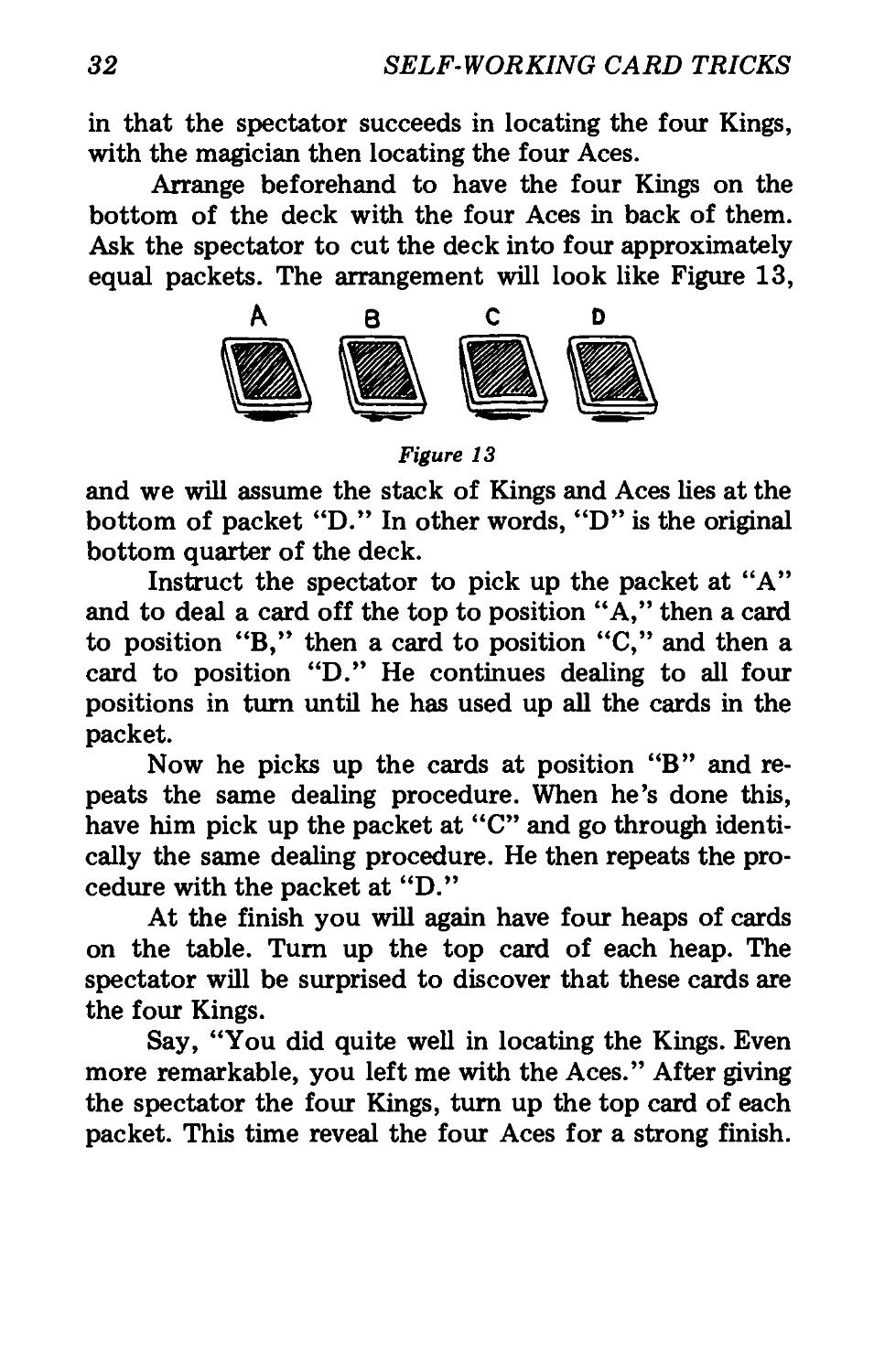
equal packets. The arrangement will look like Figure 13,
A e C 0
-
Figure 13
and we will assume the stack of Kings and Aces lies at the
bottom of packet "D." In other words, "D" is the original
bottom quarter of the deck.
Instruct the spectator to pick up the packet at "A"
and to deal a card off the top to position "A," then a card
to position "B," then a card to position "C," and then a
card to position "D." He continues dealing to all four
positions in turn until he has used up all the cards in the
packet.
Now he picks up the cards at position "B" and re-
peats the same dealing procedure. When he's done this,
have him pick up the packet at "c" and go through identi-
cally the same dealing procedure. He then repeats the pro-
cedure with the packet at "D."
At the finish you will again have four heaps of cards
on the table. Turn up the top card of each heap. The
spectator will be surprised to discover that these cards are
the four Kings.
Say, "You did quite well in locating the Kings. Even
more remarkable, you left me with the Aces." After giving
the spectator the four Kings, turn up the top card of each
packet. This time reveal the four Aces for a strong finish.
POKER DEALS
19. THE BRIDGE HUSTLER
33
Card experts can exert almost total control over a
deck of cards during the process of shuffling and cutting
the deck in preparation for a game of bridge. Insiders who
hustle bridge tournaments know so many ways of cheating
at the game that it is virtually impossible to devise suffi-
cient safeguards against their methods. The following is a
simplified method of demonstrating how bridge cheats ply
their trade.
It is necessary first to set up the deck. The deck will
later be shuffled, so it will appear that all possibility of a
set-up is impossible. The set-up is accomplished like this:
first remove all of the Clubs from the deck and place them
aside. Then stack the remaining cards in the order Hearts-
Spades-Diamonds-Hearts-Spades-Diamonds, and so on, the
basic Hearts-Spades-Diamonds cycle repeated throughout
the deck.
When you have stacked the Hearts, Spades and Dia-
monds as outlined above, drop the clubs on top of the
deck. Place the deck in its case and you are ready to begin.
To set the stage, it is necessary to get the conversa-
tion around to the game of bridge, and how, at every
tournament, there is talk of cheating. Offer to explain how
the bridge hustler works. As you talk, remove the deck
from the case.
Fan the cards so you can see the faces. Push off the
top thirteen cards (the Clubs) and take them with one
hand. Riffle shuffle them into the balance of the deck and
square up the pack. Hand the deck to anyone for a fair
cut. Say, "First they give the deck a good shuffle and a
cut. But unknown to those present, the hustler has one
suit marked. Let's say it's Clubs."
Run through the deck and toss out the Clubs as you
come to them. Place the Club packet on the table in front
of you. "Therefore," you continue, "he knows when a
Club is coming up and he can second deal or bottom deal
to make sure he gets a pat hand."
34
SELF-WORKING CARD TRICKS
Pass the remainder of the deck to a spectator for a
final cut. Then tell him to deal the deck into three hands
to represent the other three hands in a bridge game.
"But the bridge expert doesn't need to hustle. By
means of the shuffles and cuts I illustrated just now, al-
though they look fair, the bridge expert has complete con-
trol over the cards. He doesn't even have to deal."
By this time the spectator will have dealt out the
three bridge hands. Turn over each to show a truly amaz-
ing result; one hand contains all Hearts, the next all
Spades, and the last all Diamonds.
20. ACES UP
At the conclusion of some previous trick using the
four Aces, drop the Aces on top of the deck, and then
relate a story of how a gambler got challenged when he
tried to cheat in a game.
First, you explain, he had to stack the Aces. When
you say this, deal the top four cards into a face-down row
on the table. Then deal a card onto each Ace and then deal
another card onto each Ace. At this point you have four
heaps of cards on the table, and each heap contains three
cards with an Ace on the bottom of each heap.
Gather the four heaps together by placing the heap at
the far left on top of the next heap, then this combined
heap onto the next, and finally this combined heap onto
the last heap.
"While the gambler was stacking the cards, one of the
other players became suspicious and took the cards. Just
to see if the gambler stacked the Aces, this fellow decided
to deal out four hands." Deal four hands of cards, dealing
from left to right, until you've again dealt four heaps of
three cards each.
"When the suspicious player looked at the hands, he
was satisfied that the gambler didn't stack the Aces." Turn
each hand up and show that each contains only one Ace.
POKER DEALS
35
Then turn each hand face-down in place. Gather the hands
from left to right, exactly as described above.
"The gambler asked what the suspicious player hoped
to find. The player said he thought the Aces were being
stacked." Deal out four hands again. When you've done
this, pick up the last hand you dealt, the one at the far
right, and turn it face-up. Show the three cards and say,
"The gambler remarked that he wasn't stacking the Aces
to fall into his hand."
Replace the three cards face-down in their original
position on the table. Then gather the hands from left to
right just as you did before. "The gambler didn't have to
stack the Aces because he was keeping them on top where
he could switch them in when he needed them." Deal the
top four cards face-up onto the table to reveal the four
Aces.
21. POKER EXPERT OUTDONE
The creation of Sam Schwartz, this trick is so con-
structed that it appears as if you are possessed of the un-
canny ability to instantly change a mediocre poker hand
into a Royal Flush. But the trick is self-working, and even
better, contains an unexpected kicker that elevates it to
the miracle class.
We will assume you are using a red-backed deck. Re-
move the Ace of Hearts, King of Spades, Queen of Spades,
Jack of Spades and Ten of Spades. Arrange these five cards
in Ace-King-Queen-Jack-Ten order from top to bottom.
Then remove the Ace of Spades from a blue-backed deck
and place it face-down on top of the face-down packet.
This complete packet of six cards is placed in your jacket
pocket along with the cased red-backed deck until you are
ready to perform.
To properly present the trick, first remove the red-
backed deck from the pocket and perform a few tricks.
Then remark that you would like to relate a story to the
audience involving a friend of yours who played poker. In
36
SELF-WORKING CARD TRICKS
polite circles he would be called a good card handler, but
the truth was that he cheated. For example, you say, one
night he dealt himself this hand.
Now reach into your pocket, remove the six-card
packet and hold it face-up in the left hand. Be careful not
to flash the back of the packet. Say, "Using underhanded
methods of cheating, he dealt himself a rather good hand,
Ace-high Straight." Remove the Ten from the face of the
packet with the right hand and turn it over. Say, "Natu-
rally he used marked cards, as you can clearly see. That's
how he got this black Ten . . . ."
Keeping the Ten face-up, transfer it to the back of
the packet. This brings the Jack of Spades into view. You
continue by saying, ". . . and this black Jack. . . ." Take
the face-up Jack with the right hand and transfer it to the
back of the packet.
". . . A black Queen . . . ." Transfer the Queen to the
back of the packet, keeping it face-up as you did with the
other cards. ". . . A black King. . . ." Transfer the black
King from the face to the back of the packet.
". . . And a red Ace." Stop right here so the audience
sees the Ace of Hearts on the face of the packet. Then turn
the packet over end for end and place it face-down in the
left hand. Say, "He wasn't satisfied with a mere Ace-high
Straight." Take the Ace of Hearts off the bottom of the
packet, turn it face-up and place it face-up on top of the
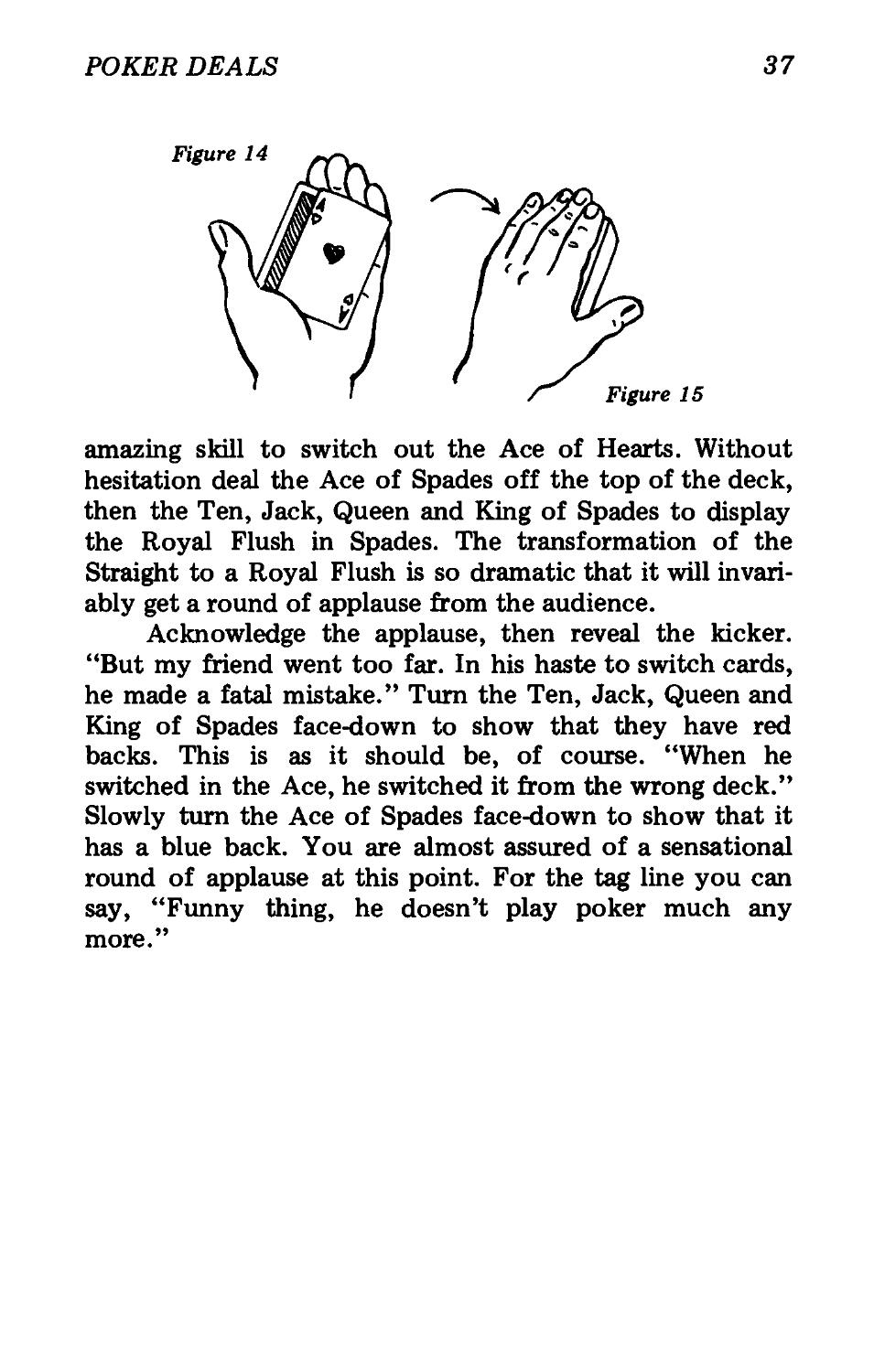
face-down packet. The position of the cards in the left
hand is shown in Figure 14. The left hand is palm-up,
fingers together as indicated.
"So by using palming, switches and other methods
too unethical to discuss in front of a nice audience like
this, he switched the Straight for an unbeatable poker
hand."
As you say this, the left hand is swiftly turned palm-
down and it slaps its cards onto the top of the face-down
deck, as in Figure 15.
Take the left hand away. An Ace of Spades will show
face-up. To the average spectator it will look as if you used
POKER DEALS
Figure 14
37
Figure 15
amazing skill to switch out the Ace of Hearts. Without
hesitation deal the Ace of Spades off the top of the deck,
then the Ten, Jack, Queen and King of Spades to display
the Royal Flush in Spades. The transformation of the
Straight to a Royal Flush is so dramatic that it will invari-
ably get a round of applause from the audience.
Acknowledge the applause, then reveal the kicker.
"But my friend went too far. In his haste to switch cards,
he made a fatal mistake." Turn the Ten, Jack, Queen and
King of Spades face-down to show that they have red
backs. This is as it should be, of course. "When he
switched in the Ace, he switched it from the wrong deck."
Slowly turn the Ace of Spades face-down to show that it
has a blue back. You are almost assured of a sensational
round of applause at this point. For the tag line you can
say, "Funny thing, he doesn't play poker much any
more. "
COINCID€NC€ TRICKS
The coincidence trick is one where the magician and a
spectator each happen to choose the same card. In a varia-
tion of the basic premise, the trick can end with two dif-
ferent cards found in the same position in two different
decks. Both aspects of this basic theme will be discussed in
this chapter. It should be emphasized that the coincidence
effect is one of the strongest in card magic. Since such
tricks involve the simultaneous revelation of two cards
rather than one, any thought of manipulation or control
on the magician's part appears to be completely out of the
question.
22. DO AS I DO
Under the heading of the "Do as I Do" trick is a type
of card effect using two decks of contrasting back design
or color. If you own a set of bridge cards, you will find
that the backs of the decks are different colors. For this
trick we will assume that one deck is red-backed and the
other deck blue-backed. Since such contrasting decks are
usually available when people get together to play bridge,
this type of card effect is particularly suitable after an
evening of bridge.
The following routine is the basic or classic form of
the two-deck card trick, in which it turns out that the
magician and the spectator choose the same card under
seemingly impossible conditions.
The spectator uses the red-backed deck while the ma-
gician uses the blue-backed deck. Explain to the spectator
38
COINCIDENCE TRICKS
39
that if each of you handles his deck in the same way, each
of you should arrive at the same conclusion. Emphasize
that the spectator is to do exactly what you do.
The magician shuffles his pack. The spectator does
likewise. Each person then cuts his own deck. As you
square up your deck, glimpse the bottom card. This be-
comes your Key Card. Of course the glimpse is done se-
cretly.
Now exchange decks with the spectator. He has the
blue-backed deck and you have the red-backed deck. Hold
the deck in the left hand. Have the spectator do likewise
with his pack. Then each of you reaches into the center of
his respective deck and removes a card. Tell the spectator
to look at his card. You pretend to look at your card.
Each person places his selected card on top of his
own deck. Then each person cuts his own deck and com-
pletes the cut. Now you exchange decks again. The specta-
tor gets back the red-backed deck and you get the blue-
backed deck. Each person turns his- own deck face-up so
that he alone can see the faces of the cards. Each person
then removes his card from the deck he holds. In fact,
what you do is locate your original Key Card. Take the
card immediately below it and place this card face-down
on the table. The spectator does likewise with his deck.
Say, "If we both did the same thing, we should both
arrive at the same result." Have the spectator turn over his
card so the audience can see it. Then turn over your card.
Under the strictest test conditions, using two borrowed
well-shuffled decks, it is seen that both you and the specta-
tor have chosen exactly the same card, an amazing coin-
cidence.
23. THE ONE-DECK VERSION
There may be times when two contrasting decks are
not available. If you wish to present the basic effect with a
single deck, the following method will fill the bill.
Before presenting the trick, remove two cards of the
40
SELF-WORKING CARD TRICKS
same value and color, say the 4D and the 4H, and place
them on the bottom of the deck. When ready to present
the trick, place the deck face-down on the table. Ask the
spectator to cut off the top half and keep that half for
himself. You take the bottom half.
It is assumed that you are seated at the table across
from the spectator. Each person places his half of the deck
under the table. Tell the spectator to remove any card
from his packet and hand it under the table to you. As
soon as he gives you the card, place it on top of your
packet. Then immediately ask, "Did you get a good look
at your card?" He will say no. Remove the bottom card of
your packet and hand it to him. Tell him to look at it and
hand it back to you.
Take the card (it will be a red Four) and place it
face-up in the middle of your face-down packet. Now re-
move the bottom card of your packet and hand it under
the table to the spectator. Tell him to turn it face-up and
place it in the middle of his face-down packet.
When this has been done, both packets are placed
face-down to show that the reversed card in the center of
each is a red Four.
24. CHILD'S PLAY
In this trick you have two spectators pick cards. The
cards are different, but they end up in the same position in
two separate packets.
From a well-shuffled deck a spectator is asked to deal
two equal heaps of cards. It makes no difference how
many cards are dealt so long as each heap contains the
same number of cards.
We'll refer to the heaps as "A" and "B" as shown in
Figure 16. Ask the spectator to pick up heap "A," shuffle
the cards and then note the face (bottom) card of the
packet and return the packet to the table in a face-down
condition.
Another spectator is asked to remove a few cards
COINCIDENCE TRICKS
41
A B
a.
Figure 16
from heap "B," mix the cards and note the face card of
the small group. He then places this small group on top of
heap "A."
The combined heap at "A" is then dropped on top of
whatever cards remain at "B," and the complete packet
squared. Now ask for the number of cards originally dealt
into either heap. If 12 cards were originally dealt into each
heap, deal 12 cards off the combined packet and place the
dealt packet at "A."
The undealt portion is turned face-up and placed on
the table at position "B." Explain to the audience that
because the spectators chose cards in a similar way, they
tend to act in sympathy. This is another way of saying that
if two people handle cards in the same way, the outcome
should be the same.
Deal cards simultaneously from both heaps. When
one of the chosen cards shows up as it is dealt from the
face-up heap, the spectator who selected this card is re-
quested to call stop. Pause dramatically, then turn over the
card you just dealt from the other heap. It will be the
other spectator's chosen card.
25. UNSEEN POWERS
Although stemming from a straightforward premise,
this routine of J. Stewart Smith's uses a deceptively simple
method to bring about a very strong coincidence effect. As
a preliminary to the trick, have the four deuces on top of
the deck in any order. Place the deck face-down on the
table. Ask the spectator to cut the deck into two heaps,
42
SELF-WORKING CARD TRICKS
which we'll call "A" and "B." Assume that heap "A" is
the original top half of the deck.
Pick up heap "A" and place it face-down in the left
hand. Deal the top five cards off the top, tossing them out
onto the table in different spots. The dealing should look
haphazard, but in fact remember where you deal the fifth
card.
Place heap "A" beside heap "B" again. Then pick up
the last card you dealt, turn it face-up and hand it to the
spectator. Tell him to tap each of the other four cards
scattered on the table, and to stop on one card. When he
decides on a card, leave that card on the table. Gather the
remaining cards and place them on top of heap" A. " Then
take the card the spectator used to tap the other cards, and
place this on heap "A." The only single card on the table
at this point is the one chosen by the spectator.
Tell him to turn heap "B" face-up. Have him insert
his card face-down in the middle of heap "B." Then tell
him to hold heap "B" for safekeeping. When he has done
this, and his card is securely hidden in the middle of heap
"B," pick up heap "A" and say that you too will choose a
card. Spread heap "A" face-up between your hands, so
that only you can see the faces of these cards. You know
that the spectator chose a deuce, but as yet you don't
know which one.
As you spread the cards with the faces toward you,
note which deuce is missing. Then pick the deuce of the
same color and remove it from the packet. For example, if
you note that the Two of Diamonds is missing, pick the
other red Two, the Two of Hearts, and remove it from the
packet.
Close up the packet and turn it face-up. Place your
card face-down in the center of this packet. Then have the
spectator turn both packets face-down and spread them
out. In each packet there will be a face-up card, and each
will be a red Two.
COINCIDENCE TRICKS
43
26. DOUBLE DISCLOSURE
The only thing needed in this version of the two-deck
card trick is a pack of 52 cards. Two spectators participate.
The magician never touches the deck, yet the two freely
chosen cards end up at identical positions in two separate
packets.
So that each spectator has the same number of cards
to work with, request the spectator holding the deck to
deal off 26 cards and give them to the second spectator.
When this has been done, each spectator holds exactly half
the deck.
Request each spectator to shuffle his own cards. Then
have each person remember the top card of his half of the
deck. One half is then placed on top of the other half of
the pack. The assembled deck is then given a cut and the
cut completed. The deck may be cut several times to in-
sure that no one could possibly know the location of any
card.
When the spectator is satisfied that no one knows any
card in the deck, he counts 26 cards off the top of the
deck, counting them one at a time into a heap on the
table. He then places the balance of the deck on the table.
One of the packets is chosen, and this packet is turned
face-up.
Each spectator takes a packet. They simultaneously
deal cards from the top of their respective packets (of
course the spectator with the face-up packet is dealing
cards off the face of his packet, while the spectator with
the face-down packet is dealing off the top of his packet).
When either spectator sees his card being dealt from the
face-up heap, he calls stop. The card just dealt from the
other heap is turned over and it proves to be the second
spectator's chosen card.
44
SELF-WORKING CARD TRICKS
27. ULTRA COINCIDENCE
We'll close this chapter with one of the most amazing
versions of the two-deck card trick, created by Martin
Gardner. A double matching effect is achieved by the most
economical means possible.
Two decks are used, one red-backed and one blue-
backed. The spectator is asked to pick either deck. Assume
he picks the red-backed deck. He shuffles this deck while
you shuffle the blue-backed deck. Glance at the bottom
card of his deck after he has finished shuffling. (If you are
unable to do this, remember the bottom card of your deck
and trade decks with him before starting.)
We will assume that the card on the bottom of his
deck, the one you glimpsed, is the 3H. Instruct the specta-
tor to remove any card from his deck and place it on top
of his deck. You pretend to do the same with your pack.
Actually you look for the 3H and place it on top of your
deck.
Tell him to place his deck behind his back, cut the
deck and complete the cut. You place your deck behind
your back and pretend to do the same thing. Actually you
do nothing. The 3H is still on top of your deck.
Exchange decks with the spectator. Then have him
look through the pack given to him and find his chosen
card. You look through the deck he gave you and pretend
to look for your card. Actually you look for the Three of
Hearts. When you find it, cut it to the top of the pack.
Now remove the top card of your deck and place it
face-down on the table. Place the deck to the left of it.
Instruct the spectator to place his chosen card face-down
on the table and his deck to the left of it. Say to him, "It's
easy for me to learn the name of your card. All I have to
do is look at the top card of my deck."
Turn up the top card of your deck. Then turn over
his chosen card and show that both have matched, as in
Figure 1 7.
"Of course you can learn the name of my card by
following the same procedure," the magician adds.
COINCIDENCE TRICKS
45
<I
()f:)
Figure 17
The top card of the spectator's deck is turned face-
up. Then the magician's chosen card is turned face-up, and
both cards are found to be identical!
Other variations of this classic trick include develop-
ments where the bottom card of the spectator's deck is
found to match the bottom card of the magician's deck.
However, it has been the author's experience that the
double climax described above is strong enough to make it
one of the most outstanding card effects you will perform.
M€NTAL MAGIC
WITH CARDS
Interest in paranormal feats has always been high, and
because of the upsurge of interest in magic generally, there
has been a dramatic increase in the attention shown
toward mentalism. The mentalist has one thing going for
him that the magician does not; whereas tricks are gener-
ally accepted as clever sleight-of-hand, mentalism is as-
sumed to be real magic. Thus, if you present a mental
effect as a demonstration of supernormal ability, the audi-
ence will not look for sleight-of-hand because they assume
there is none to be found anyway.
The present chapter and the one titled "Test Condi-
tions" exploit themes in the area of mental magic, telepa-
thy, prophecy, direct mind control, and so on. Presented
as demonstrations or experiments in the unknown, they
will be accepted as real magic by almost any audience.
28. THE CARD REVEALED
Before performing this trick, note the top and bot-
tom card of the deck. We will say the top card is the Four
of Spades and the bottom card the Jack of Clubs. Hand
the deck to the spectator and turn your back.
Ask him to think of a number from 1 to 13. He deals
that many cards off the top of the deck, notes the last card
dealt, and replaces the dealt packet on top of the pack.
Then he gives the deck a cut and completes the cut.
Take back the deck and run through the cards with
the faces toward you. Spot the two Key Cards (the Four
46
MENTAL MAGIC WITH CARDS
47
of Spades and Jack of Clubs in our example). Count the
number of cards between them and add 1 to this number.
The result may be 8. This tells you that the spectator
originally thought of the number 8.
Now cut the deck so that the Key Card that was
originally on the bottom is back on the bottom of the
pack. Again using our example, the Jack of Clubs, the
original bottom card, would be cut to the bottom of the
deck. This leaves the spectator's chosen card on top of the
pack, but you do not reveal this fact yet.
Since the spectator thought of the number 8, look
through the pack, remove two Eights and place them face-
down on the table side by side. Say to the spectator, "I
can't decide what number you were thinking of, but I'm
almost certain it was one of the numbers represented on
these cards. Fate will guide us to the right choice."
Have the spectator pass his hand over each card and
finally decide on one. Pick up the other one and bury it in
the deck. Then ask him for his thought-of number. It will
be 8. Have him turn over the card he chose and it too will
be an 8-spot.
Then ask, "Now we come to the hard part. What card
did you choose?" After the spectator names it, turn over
the top card of the deck and it will be his chosen card.
This routine was a favorite of J. W. Sarles, and it is his
presentation which is described.
29. THE HAUNTED NAME
"Centuries ago a man named Johan Junius, mistaken-
ly believed to be possessed by demons, was burned at the
stake. His name became associated with mystic phenom-
ena, and his initials still possess strange powers." With this
as background, you perform the following demonstration.
Have the deck shuffled and cut. When you take it back,
glimpse the bottom card. Place the deck on your out-
stretched palm. Have a spectator remove a group of cards
from the middle of the deck, shuffle them and place them
48
SELF- WORKING CARD TRICKS
on top of the deck. Then ask the spectator to write a large
"J" on the back of the top card, to indicate the initial of
Johan Junius' first name.
When he has done this, ask him to cut the deck and
complete the cut. Invite him to cut the deck several more
times. Taking back the deck, spread it face-up on the table
from left to right. Spot your Key Card, the original bot-
tom card you glimpsed. Then remove the card immediately
to the right of this card and mark a large "J" on its face to
indicate the last initial in the name Johan Junius.
Return this card to the deck, square the deck and give
it several cuts. Have the spectator spread the deck face-
down on the table. Let him remove the card bearing the
"J" that he wrote. When he turns this card face-up, he
finds the "J" that you wrote!
30. THOUGHT SPELLER
A spectator is given a packet of cards and asked to
merely think of one of the cards and then mentally spell
out the name of the card. The packet is replaced on top of
the deck and the deck dropped into the magician's pocket.
Turning to another spectator, the magician asks that
person to merely think of his or her lucky number. The
magician removes cards from his pocket one at a time
while the spectator mentally counts to his number. When
he reaches the number, he calls stop.
The magician removes the next card from his pocket
(a spectator can even do it since there is no secret move
made) and the first spectator's thought-of card is discov-
ered. Thus, a card merely thought of by one party is found
at a number merely thought of by another party!
Method: The secret is simple but well concealed. On
top of the deck is a small stack of cards. From the top
down the stack reads: Five of Diamonds, Three of Dia-
monds, Six of Clubs, Ten of Spades, Eight of Clubs, Queen
of Hearts.
Remove this packet of six cards from the top of the
MENTAL MAGIC WITH CARDS
49
deck without disturbing the order of the set-up. Hand the
packet to the spectator. While your back is turned, he fans
the cards so he can see the faces, and he thinks of any card
in the packet. When he has done this, have him close up
the packet, turn it face-down and hold it in his left hand.
Now instruct him to mentally spell out his card, but
as he does so, he is to transfer a card at a time from top to
bottom of the packet, transferring one card for each letter.
If he thought of the Three of Diamonds, for example, he
would spell T - H - R - E - E - D - I - A - M - 0 - N -
D - S, transferring a card for each letter from the top to
the bottom of the packet.
When he has done this, have him drop the packet
back on top of the deck and square the deck. Take the
deck and place it in your pocket. Unknown to all those
present, the thought-of card is now on top of the deck. It
would be too obvious to merely reach into the pocket and
produce the thought-of card, so you disguise the revelation
in the following way.
Ask another spectator to think of his or her favorite
number. Explain that you will remove cards one at a time
from the pocket; the spectator is to stop you when you
have counted out a number of cards equal to the favorite
number.
Reach into the pocket and begin removing cards one
at a time from the bottom of the deck, placing each on the
table. Continue removing cards until the spectator calls
stop. Then remove the top card of the deck, bring it out of
the pocket and show it to be the chosen card.
31. THE DUPLEX MIND
The secret to the success of most tricks lies in the
degree of mystery evoked during the routine. Of them-
selves, cards are everyday objects and therefore lack mystic
or mysterious properties. But you can still use cards in a
dramatic context by introducing a mystic-seeming amulet
or odd coin. Such objects can be picked up at a modest
50
SELF-WORKING CARD TRICKS
sum from antique shops or stores catering to coin collec-
tors. The following routine demonstrates how an amulet
can be made to seem the center of attention of the mys-
tery, whereas, in fact, its presence in terms of method is
mere window-dressing.
Before beginning the routine, arrange to have the Ace
of Clubs on top of the deck and the Ace of Spades on the
bottom. Any two cards can be used, but it is easy to
remember the black Aces.
N ow remove the amulet from your pocket and patter
about its psychometric properties, its ability to focus
thoughts and anything else you can think of that will add
to the air of mystery.
Turn your back. Ask spectator "A" to cut off about
half of the deck and turn it face-up on the table. Have him
note the card he cut to.
In Figure 18, spectator "A" would note the face card
of the packet on the left, in this case the Three of Dia.
monds.
m
A
.
B
Figure 18
Ask another spectator to look at the top card of the
other half of the deck (packet "B" in Figure 18) and re-
place this card face-down on top of Packet "B."
Now ask spectator "B" to shuffle the face-up half of
the deck into the face-down half. When he has riffle-
shuffled the two halves together, tell him to give the deck
a cut and complete the cut.
Turn around and face the audience. Pick up the amu-
let and remark, "While you were selecting cards, the amu-
let acted as silent observer to your actions. Though it can-
not speak, it remembers what it saw and can sometimes
convey this information to me. "
Spread the deck on the table from left to right. The
MENTAL MAGIC WITH CARDS
51
audience will see a completely random mixture of face-up
and face-down cards. Hold the amulet at the fingertips and
pass it over the spread of cards. When you spot the Ace of
Clubs, note the first face-up card to the left of it. This will
be the first spectator's card. Do not hesitate or give any
indication that you know the chosen card. Instead, shake
your head and say, "I'm picking up a faint vibration. Per-
haps it will work better if we turn the deck the other
way. "
Note that you already know the first spectator's card
but you delay revealing this fact. Instead you act just the
opposite, as if you do not know the card and hope you'll
have better luck with the deck facing the other way. Scoop
up the deck, turn it over, and spread it on the table from
left to right.
As you slowly move the amulet over the cards, spot
the position of the Ace of Spades. The first face-up card to
the right of this Ace will be the card chosen by the second
spectator. When your hand passes over this card, allow the
amulet to fall onto the deck. Say, "The amulet was drawn
to the Nine of Clubs (or whatever the second spectator's
card happens to be). Did either of you choose that card?"
One of the spectators will acknowledge that he chose
the Nine of Clubs. At this point hand the amulet to the
other spectator and say, "The impression of your card is
still weak. Perhaps you did not direct your full concentra-
tion to your card. Hold the amulet while you concentrate
on the card."
Give him a few seconds to concentrate, then take
back the amulet and hold it on your outstretched palm.
Nod and say, "I'm beginning to see the card now. A red
card, wasn't it?" You then go on to name the first specta-
tor's card.
32. PRE-FIGURED
This is another example of the "Lazy Magician"
theme discussed elsewhere in this book. In this case, how-
52
SELF- WORKING CARD TRICKS
ever, the spectator does all the work and succeeds in re-
vealing the identity of two cards.
Tell the spectator that you are going to think of a
card whose identity he is to ;eveallater. Run through the
deck and remove any 3-spot, say the Three of Spades. Do
not let the spectator see the card you chose; after you
remove it from the deck, place it face-down in the center
of the table.
Now hand him the deck and tell him to think of a
card also. It can be any card except a picture card. When
he has removed his card, place the deck aside and hand the
spectator a pencil and pad of paper.
Instruct him to write down on the pad the value of
his chosen card. Then instruct him to double this number.
If he chose the 9C for instance, he would write the number
18 on the pad. Tell him to add 2 to the result, multiply the
total by 5, and subtract 7 from the final number.
He announces the final number, which might be 93.
Then turn over his card to reveal that it is a 9, and turn
over your card to show that it is a 3, exactly matching the
final number.
33. THREE ON A MATCH
This trick starts out as a serious demonstration of
mind-reading under relatively strict test conditions, but
then it takes an unexpected turn with an amusing finish.
Tell the audience you would like the assistance of
three spectators for an experiment in telepathy. As the
three assisting spectators step forward, pick up the deck
and spread the cards so that only you can see the faces.
Remove seven red cards and place them face-down in a
heap on the table. Then remove a black card and place it
face-down on top of the heap.
Place the deck to one side as it will not be needed.
Then pick up the eight-card packet and hand it to the first
spectator. Explain that he and the other two spectators
will choose cards by a purely random procedure. With the
MENTAL MAGIC WITH CARDS
53
cards in his own hands, he places the top card on the
bottom of the packet, the next card onto the table, the
next card under the packet, and so on, until he has one
card remaining in his hand.
Tell him to look at and remember this card. He t en
places it face-down on top of the packet that lies on the
table. The cards are squared and this eight-card packet
given to the second spectator. He uses the same elimina-
tion shuffle to arrive at a random selection. When he has
noted his card, he drops it on top of the tabled packet.
The packet is passed to the third spectator. He too
uses the same elimination shuffle to arrive at his selection.
When he has noted his card, he places it on top of the
packet. Then he picks up the packet and gives it a good
mixing so that no one knows any of the cards.
Play up the fact that you have not touched the cards
from start to finish. Explain that you will now try to find
the three chosen cards by purely telepathic means. All that
is required, you add, is concentration and the ability to
find those cards which appear to stand out from the
others.
The spectator holding the packet is asked to deal the
cards into a face-up row on the table. When he has dealt
out all eight cards, say, "Now all I have to do is find those
cards which seem different from the others." The situation
should get a laugh because there is one and only one card
which is different from the rest-the lone black card in the
midst of a packet of red cards. At first pretend you do not
notice this rather odd situation. Then slowly push the one
black card out and place the balance of the packet aside.
Act puzzled that there is only one such card. Then
have each of the three spectators name his card. They
should be surprised to discover that each of them chose
the same card, and in all three cases it was the lone black
card!
54
SELF-WORKING CARD TRICKS
34. COMPUTER MIND
Years ago Bob Hummer devised a card effect in which
the magician was able to reveal a card merely thought of
by a spectator. As time went by a number of clever im-
provements were suggested to the original trick. The fol-
lowing version, devised by Ray Grismer, is one of the best.
As mentioned, this is a method of determining a card
merely thought of by a spectator. To perform it you must
secretly note the bottom card of the deck and the card
second from the top.
When this preparation has been accomplished, give
the deck to the spectator and tell him to think of any card.
Turn your back and tell him that if he thought of a Club
or a Heart, he is to deal one card onto the table and drop
the deck on top. If the thought-of card was a Spade or a
Diamond, he does not deal any cards. Remember this first
step as "Round One."
N ow tell the spectator that if his card was red to deal
two cards onto the table. If his card was black, he is to
deal three cards. When this has been done, he is to drop
the deck onto the cards he dealt onto the table and care-
fully square up the deck. Remember this as "Round Two."
Now tell the spectator to deal onto the table a num-
ber of cards equal to the value of the thought-of card.
When he has done this, he drops the deck onto the tabled
packet and again carefully squares up all cards.
Take the deck from the spectator at this point. Turn
it face-up and run the cards singly from left to right so you
can see the faces. Recall that in the beginning of the trick
you secretly glimpsed the bottom card and the card second
from the top. Beginning at the face of the deck, push cards
over to the right. Mentally count the number of cards you
have to deal before you reach the first Key Card (the
original bottom card of the deck). Then count the number
of cards between the first and the second Key Cards. This
is all the information you need to reveal the identity of the
spectator's thought-of card.
MENTAL MAGIC WITH CARDS
55
The number of cards between the Key Cards gives
you the suit of the thought-of card as follows:
Clubs 3 cards
Hearts 2 cards
Spades 1 card
Diamonds no cards
Now that you know the suit, you can determine the
value of the thought-of card. If the thought-of card was a
Club or a Heart, the number of cards before the first Key
Card is the value of the thought-of card.
On the other hand, if the thought-of card was a Spade
or a Diamond, subtract one from the number of cards
before the first Key, and this is the identity of the specta-
tor's thought-of card.
35. THE STOP TRICK
The secret to this trick, credited to Annemann, was at
one time sold in a manuscript costing $50. In effect a
spectator's card is found by means of a number merely
thought of by another spectator.
The top 13 cards of the deck are stacked. From the
top down the set-up is K - Q - J - 10 - 9 - 8 - 7 - 6 - 5
- 4 - 3 - 2 - A. The King is the top card of the deck. Re-
move the Joker from the deck, turn it face-up and place it
on the bottom of the deck.
To perform the trick, spread the deck between the
hands and have a card chosen from the center of the deck.
While the spectator shows the card to the others present,
secretly count off thirteen cards from the top of the deck.
Lift these cards off as a packet and have the spectator's
card returned. Then place this packet on top of his card.
Square up the deck. Then cut the deck and complete the
cut. Tell him that his card will be found by means of a
number thought of by another spectator. As you talk, ca-
sually cut the deck two or three times. Then pretend to
notice that there is a card accidentally reversed in the
56
SELF-WORKING CARD TRICKS
deck. Spread the deck until you come to the face-up Jok-
er. Cut the deck at that point so the Joker is the top card.
Remove it from the deck, saying, "The Joker shouldn't be
in the deck anyway."
Now have someone think of a number from 1 to 10.
Ask him to name his number. If it is 9, slowly count nine
cards off the top of the deck. Ask him if he wants the last
card you counted or the next one on top of the deck. If he
says the next one, turn that card face-up. Whatever num-
ber shows on this card, count that many cards further into
the deck. The last card you count will be the chosen card.
36. SENSITIVE FINGERTIPS
In this routine, the invention of Jack Avis, the magi-
cian is given a shuffled deck of cards behind his back.
Without looking at any cards, and by means of his super-
sensitive fingertips, the magician is able to "read" the val-
ues of the cards one at a time while they are behind his
back. In a final test, the magician reveals the names of two
more cards while the deck is in the spectator's hands.
Figure 19
Method: Six cards are secretly removed from the
deck and hidden under the belt in back. These six cards
will be the AC - 4H - 7S - 10D - 8S - KC, in that order
from top to bottom. Figure 19 shows how they are clipped
under the belt. They may also be held in place with a large
MENTAL MAGIC WITH CARDS
57
paper clip, or kept in the back pocket, but for ease of
handling, it is recommended that the packet be clipped
under the belt as shown.
Have the balance of the deck shuffled by the specta-
tor. Take it behind your back. Remove the packet from
under the belt and add it to the top of the deck. Tell the
audience about your supersensitive fingertips. Pretend to
rub the fingers on the top card of the deck. Say, "This
feels like an Ace, possibly a black Ace. Yes, it's the Ace of
Clubs." Bring out the top card and show that it is the Ace
of Clubs.
Repeat the same procedure for the second card, nam-
ing the Four of Hearts, then bringing it out and tossing it
onto the table. For the third card, do not name the Seven
of Spades. Name the Eight of Spades, but bring out the
Seven of Spades. Quickly flash the face of this card, but do
not give the audience time to study the face.
Tell the spectator you will try a more difficult feat.
Have him cut the deck and complete the cut. Now pick up
the face-down Seven of Spades, call it the Eight of Spades
again, and put it on top of the deck. Then have the specta-
tor cut the deck and complete the cut to bury this card.
Now tell him to step away and remove the card on
either side of the Eight of Spades. When he has done this,
pretend to concentrate, and then reveal that these cards
are the Ten of Diamonds and the King of Clubs.
37. THINK OF AN ACE
Beforehand arrange the Aces in the deck as follows:
the Ace of Clubs about 10th down from the top, the Ace
of Hearts about 20th from the top, the Ace of Spades 30th
from the top and the Ace of Diamonds 40th from the top.
When ready to present the routine, hand the specta-
tor the deck and remark on the fact that the Aces, because
they represent the highest cards in the deck, have a fascina-
tion about them that other cards do not have. To illus-
trate, ask the spectator to think of an Ace. Tell him to fan
58
SELF-WORKING CARD TRICKS
the cards so he can see the faces, find the thought-of Ace,
and upjog it slightly so he can see the face of the card.
As you talk, walk away from the spectator so your
back is turned to him. Remove another deck from your
pocket and say that you too will think of an Ace. Just as
you say this, turn and face the spectator, and note the
approximate position of the upjogged Ace in his deck. Of
course you will see only the backs of the cards in his deck,
but with very little practice you should be able to judge
immediately whether his thought-of card protrudes from
the deck near the top (in which case it would be the Ace
of Clubs), nearer to the center (the Ace of Hearts), about
two-thirds of the way down from the top (the Ace of
Spades) or near the bottom (the Ace of Diamonds).
While this may sound difficult at first reading, it is an
easy knack to pick up. In time you will be able to judge
the approximate location of the upjogged Ace by the mer-
est glance. Thus, the audience will never remember that
you turned back to look at all.
Once you have spotted the position of the upjogged
Ace, and hence know its identity, turn your back to the
spectator. Run through your deck and remove the same
Ace. Hold it over your head, with the back of the card to
the spectator.
Have him remove his card from his own deck. Both of
you then show your chosen Ace to the audience, and it is
seen that the Aces are identical. In performing this trick
you will find that a curious "aftereffect" develops. When
describing the trick later on, people will forget that the
choice was restricted to the four Aces; instead they will
swear that the fellow from the audience chose any card
and that you matched it in some miraculous manner.
38. POCKET PREDICTION
This is an adaptation of a first-rate trick credited to
Rufus Steele. Tell the spectator that you will try to predict
a card he is going to choose. To make sure there is no
MENTAL MAGIC WITH CARDS
59
tampering with the prediction, tell him that you will give
him the card to hold.
Taking a borrowed, well-shuffled deck from the spec-
tator, turn the cards face-up so that you alone can see the
faces. Spot the top card of the deck. We will say it is a
9-spot. Silently count in to the 9th card from the face of
the deck, and note this card. It may be the Five of Spades.
Find the "twin" of the Five of Spades, in other
words, the other black Five. Remove this card from the
deck and hand it face-down to the spectator as your pre-
diction. Tell him to place it in his pocket for safekeeping.
Now turn the deck face-up and begin dealing cards
one at a time off the face into a face-up heap on the table.
Continue dealing until you have dealt past the Five of
Spades, then say to the spectator, "Call stop at any time."
When he calls stop, pick up the face-up packet from
the table, turn it face-down and place it in front of the
spectator. Tell him that he will choose a card from this
packet.
Now turn the balance of the deck face-down in your
hand and begin dealing cards off the top. Tell the spectator
to call stop at any time. When he does, pick up the tabled
packet you have just dealt, turn it face-up and point to the
face card of the packet. Say to the spectator, "This card is
a 9-spot, so count down to the 9th card in your packet."
The spectator counts to the 9th card and turns it
face-up. It will be the Five of Spades. "You chose a black
Five," you remark. "Now check this against the prediction
card I gave you before we began the trick."
The spectator removes the prediction card from his
pocket and finds that it is the other black Five, a perfect
match.
39. PSYCHIC MAGNET
Tell a spectator that certain cards have an affinity for
certain objects. For example, you say, the Two of Spades
is magnetic and is easily attracted by a magnet. To illus-
60
SELF-WORKING CARD TRICKS
trate, you hold a deck of cards in your hand, and throw a
handkerchief over the deck. A borrowed pencil, suitably
charged by a psychic field, is held over the deck, and the
Two of Spades immediately rises out of the deck, clinging
to the pencil as if it were in fact responding to some kind
of magnetic field. All objects may be borrowed, and all
may be left with the spectator at the finish of the demon-
stration.
Method: Shuffle and cut the deck. As you square up
the cards, glimpse the top card of the deck. If it is the Two
of Spades, then this is the card you mention as being pecu-
liarly susceptible to psychic magnetism.
Hand someone a pencil. Tell him to gaze at it and
imagine it is a solid ferrite magnet. As he does this, cover
the deck with a handkerchief. A light silk handkerchief
works best, but a cotton or linen handkerchief is also suit-
able.
Take the pencil and hold it over the deck. Touch the
top of the deck with it. Do not be in a hurry to perform
the trick. The longer you delay, the more "genuine" the
experiment appears. After trying it two or three times
without success, hand the pencil back to the spectator and
ask him and one or two other spectators to concentrate
harder on making the pencil magnetic. While attention is
directed to the spectators and the pencil, secretly moisten
the tip of your right little finger.
Take the pencil again and place it on top of the deck.
Then, behind the cover afforded by the silk, push the little
finger against the handkerchief so it comes in contact with
the top card of the deck. Then lift the right hand slowly,
all the while maintaining pressure, and the card will "rise"
out of the deck as if magnetically attracted to the pencil;
see Figure 20. The key to making this a convincing demon-
stration of psychic magnetism is to focus all attention on
the pencil and not on the cards.
MENTAL MAGIC WITH CARDS
61
Figure 20
40. FATE #1
Cards and dice are articles common to many gambling
games, yet they are seldom used together in the same
game. The reason (you explain) is that when used in con-
junction with one another, they produce strange, some-
times unexpected results. To demonstrate, you use two
dice and a deck of cards. The dice can be shaken in a
leather dice cup if such an item is available, but otherwise
the two dice may be shaken in a teacup or other opaque
container.
The spectator shakes the dice and tosses them out
onto the table. Whatever number shows up on the dice, the
spectator deals that many cards from the top of the deck
into a packet on the table.
The spectator then turns either die over and notes the
new top number. Whatever it is, the spectator counts that
many additional cards off the deck and onto the packet
already on the table. The deck itself is placed aside at this
point.
Calling attention to the other die, the one not turned
over, the magician calls out the top number and requests
62
SELF- WORKING CARD TRICKS
that the spectator count that many cards off the top of the
packet into a separate heap on the table.
There are two small packets of cards on the table.
"Isn't it odd," the magician remarks, "that the random
throw of the dice gave you just the right cards needed to
open a game of draw poker?" So saying, he turns over the
top card of each small packet, revealing a pair of Jacks!
Method: Beforehand, arrange two black Jacks so
they are 6th and 7th from the top of the deck. Then
simply proceed as described above. Regardless of the num-
bers thrown by the spectator, the end result will always be
a pair of Jacks.
41. FATE #2
This is a different version of the above trick. The
patter story is the same. The spectator rolls two dice and
totals the top numbers. Whatever the total, he counts that
many cards off the top of the deck into a face-down heap
on the table.
The spectator then covers one of the dice with the
cup. This leaves the other die in view. Direct the spectator
to turn this die over so the bottom number is now on top.
Have him note the new number and deal this many addi-
tional cards onto the packet already on the table.
Remark on the fact that the spectator rolled a com-
pletely random number with the two dice. Point out also
that one die is still hidden under the cup, its identity
known only to the spectator. "But such is the sympathy
that exists between cards and dice," you add, "that one
card was fated to be dealt."
Turn up the top card of the packet on the table. It
will be a Five. Then have the cup lifted from the die. The
top number on the die is also seen to be a Five, a perfect
match.
Method: Arrange the Ace, Two, Three, Four, Five,
Six in mixed suits on top of the deck in numerical order,
Ace at the top, Six on the bottom. With this packet on top
MENTAL MAGIC WITH CARDS
63
of the deck, you proceed with the trick exactly as written
above. It will always turn out that the last card the specta-
tor deals matches in value the top face of the die hidden
under the cup.
42. DOUBLE PROPHET
Two cards chosen in the fairest possible manner with
the deck in the spectator's own hands are found to match
two predictions written by the performer and sealed in
envelopes before the demonstration began.
To make the predictions as impressive as possible,
write on a slip of paper, "You will pick the 8H and
also. . . ." Don't complete the prediction. Instead, fold it
in half, drop it in an envelope, seal the envelope and mail it
to yourself. On a second slip of paper, write ". . . and also
the Queen of Clubs." Fold this prediction in half, drop it
into a separate envelope, seal the envelope and mail it to
yourself.
You will thus have two sealed envelopes, each con-
taining part of the double prediction, and each clearly
sealed and officially dated prior to the evening you intend
to perform the trick.
m . J I
4-
EfGJ..IT OF H'EARr.s
I I
Figure 21
On the night you do the trick, secretly perform the
following preparation. Place the Eight of Hearts on top of
the deck and the Queen of Clubs on the bottom. Then
turn the bottom half of the deck around so it is face to
face with the top half of the deck. Figure 21 shows the
condition of the deck and the relative position of the two
prediction cards at this point.
64
SELF-WORKING CARD TRICKS
To perform the trick, hand the deck to the spectator
and tell him to place it behind his back. The top card of
the deck is the face-down Eight of Hearts at this point.
With the deck behind his back the spectator is in-
structed to lift off about a quarter of the deck and turn it
face up on top of the pack. When he has done this, tell him
to lift off about two-thirds of the deck and turn it over
onto the balance of the deck. When he's done this, take
the deck from him.
Spread the cards from left to right, saying that you
will use the last face-down card near the top of the deck
and the first face-down card near the center of the deck.
As you begin spreading the deck you will first come across
a group of face-down cards. Run through these until you
come to the last face-down card in the top group. Upjog
this card. It is shown as "A" in Figure 22.
Figure 22
A
You will next encounter a group of face-up cards.
Push these to the right until you come to the first face-
down card of the next group. Upjog this card. It is shown
as "B" in Figure 22. Square up the deck and remove the
two upjogged cards. Then call attention to the two sealed
envelopes that you previously placed on the table. Have
the first one read aloud. Then explain that the second
prediction came in the mail a day after the first. Have the
second envelope opened and the prediction read aloud. It
is seen that both of the chosen cards have been correctly
predicted.
If you want to make the predictions more impressive,
bum each prediction slip around the edges and sign each,
"Beelzebub." You can later explain that while it is true
MENTAL MAGIC WITH CARDS
65
Beelzebub is referred to as the prince of demons, he is also
a good golfer (a 3 handicap), and rather talented at writing
predictions when he is not out on the golf course raising-
er, heck. You then proceed with the above trick.
T€ST CONDITIONS
Like the last chapter, this chapter deals with mental
effects, but there is a difference. Here we will consider
those routines which are done under seemingly rigid test
conditions, where-even if the spectator suspects the possi-
bility of chicanery-it would appear impossible for the
demonstration to succeed.
43. BLIND DICE #1
The first part of this routine is adapted from a trick
associated with Kuda Bux. The second part ("Blind Dice
#2") is a variation suggested by the author. Needed is any
deck of cards and dice, two for the first part, three for the
second.
Have the deck thoroughly shuffled and cut by the
spectator. Remove two dice from your pocket and toss
them onto the table. While you turn around or leave the
room, the spectator rolls the two dice and adds together
the two top numbers. If these are, for example, a 6 and a
3, the spectator would remember the total 9. Then one of
the dice is turned over and the new number added to the
total. Thus, if the new number were a 4, the total thus far
would be 13. Finally, the spectator picks up this same die
and rolls it. Whatever number comes up is added; if the
number that came up were a 5, the grand total would be
18.
The spectator then notes a card at a corresponding
66
TEST CONDITIONS
67
position down in the deck. In our example, the spectator
would note the 18th card from the top of the deck.
The magician turns around, picks up the deck and
immediately finds the chosen card.
Method: When you turn around to take the deck,
glance at the two dice on the table. Mentally add their
numbers together, then add 7 to the result. This automati-
cally tells you the location of the spectator's card in the
deck. In our case you would arrive at a total of 18, and
would go on to remove the 18th card from the top of the
deck. If the audience asks to see the trick again, proceed
with the following variation.
44. BLIND DICE #2
Add a third die to the two dice on the table, saying
that this will make it a bit harder. Turn your back. The
spectator rolls the three dice and adds together the top
faces. Then any two dice are turned over and the new
numbers on top added to the remembered total. Finally,
one of these two dice is pocketed by the spectator. The
other die of the two dice is thrown at random, and the
number thrown on this die is added to give the spectator a
grand total which he alone knows.
He looks at a card at a position from the top of the
deck which corresponds to the grand total. The magician,
who may be out of the room until this point, takes the
deck and instantly finds the chosen card.
Method: When you take the deck from the spectator,
glance at the two dice on the table. Add together the
numbers on top of the two dice. Then add 14 to this to
arrive at a grand total. Whatever this total is, it tells you
the location of the chosen card in the deck. Thus, if the
total is 20, you know the spectator's chosen card is 20th
from the top of the deck.
The trick is puzzling because only two of the dice are
seen, the third die being hidden in the spectator's pocket.
68
SELF- WORKING CARD TRICKS
Although the trick is automatic in operation, do not make
it look too easy; pretend to have difficulty getting the
proper mental impression, hesitate, change your mind,
then finally decide on the right card.
45. HOCUS-POCUS
Three small packets of cards are dealt onto the table.
While the magician turns his back, a spectator chooses any
one of the packets, shuffles it, mentally decides on one
card in the packet, and then shuffles the packet again.
This packet is sandwiched between the other two
packets to make sure the mentally chosen card is really
buried. Neither the magician nor the spectator knows
where the thought-of card is, and of course the magician
has no idea of the identity of the thought-of card.
The spectator is asked to deal five heaps of cards
from the packet. He is to continue dealing a card to each
heap until he has dealt out all of the cards in the packet.
Then, while the magician still keeps his back turned, the
spectator locates the heap that contains his mentally cho-
sen card, and places this heap in his jacket pocket.
For the first time the magician turns around and faces
the spectator. Reviewing the impossibly strict conditions,
including the fact that the spectator has shuffled, cut and
thought of a card without the magician ever seeing or
touching the cards, the magician says he will try to find
the spectator's chosen card by a telepathic process known
as psychometry. With this process the magician will seek to
find the one card in the spectator's pocket which the spec-
tator himself has chosen as his own card.
The magician reaches into the spectator's pocket and
immediately withdraws the thought-of card!
Method: This trick, the invention of Eddie Joseph,
can be built up to a feat of remarkable powers because the
magician in fact never touches the cards nor does he have
the slightest idea which card was chosen by the spectator.
The key to its success is in the casualness of the han-
TEST CONDITIONS
69
dling. You must make it appear that your initial handling
of the cards is unimportant. Presented as such, the specta-
tor will promptly forget that the magician ever touched
the cards.
When the shuffled deck is handed to you, deal or
push off a bunch of cards. It should look like a random
number of cards, but in fact the packet must contain five
cards exactly. Place this packet on the table. Remove an-
other packet of five cards and drop them on the table.
Then remove a final packet of five cards and place them on
the table. At this point there will be three heaps of cards
on the table, each containing five cards. Again, it must be
stressed that you should not appear to be counting the
cards or handling them with precision. It must look as if
you are dropping three bunches of cards on the table.
From this point on you turn your back and do not
handle the cards again. Ask the spectator to pick up one of
the packets and shuffle it. Then ask him to look at one of
the cards in the packet and remember it. A strong point
now is that you ask him to shuffle the packet again so that
even he does not know the location of his chosen card.
Tell him to place his packet between the other two
packets. Then ask him to deal five heaps of cards. He deals
in the conventional way, from left to right, dealing a card
at a time to each heap until he has dealt all 15 cards. When
he has finished dealing, he will have five heaps on the
table, each containing three cards.
Ask him to find the heap containing his thought-of
card, and to place this heap in his jacket pocket. When he
has done this (your back has been turned all this time),
turn around and review the proceedings thus far, emphasiz-
ing that you never touched the cards.
Reach into the spectator's pocket and simply take the
center card of the packet of three. Remove it from the
spectator's pocket and dramatically reveal it as the selected
card.
70
SELF-WORKING CARD TRICKS
46. OUT OF SIGHT
A spectator chooses a card and places it in his pocket.
He then shuffles the deck and hands it to the magician.
The magician drops the deck into his own pocket and
without looking at the cards, he removes one from the
deck. The spectator shows the card he chose-the 5D for
example. The magician then shows the card he selected
while the deck was in his pocket-it is the 5H, the other
red Five.
Method: Before the trick begins, place one of the red
Fives in your jacket pocket. Then position the other red
Five so it lies 10th from the top of the deck. This prepara-
tion is done secretly, as you do not want the audience to
be aware of this setting-up procedure.
When ready to perform the trick, place the deck face-
down in the left hand. Ask the spectator for a number
between 10 and 20. Say he names 17. Slowly count 17
cards off the top, one at a time, dealing them into a pile on
the table.
After you have dealt the 17 cards, say to the specta-
tor, "To make this even more random, we'll use the two
digits in the number 17. Taking 1 and 7, we add them
together and arrive at a total of 8." As you talk, pick up
the packet of cards you dealt onto the table and replace
them on top of the deck. Then deal 8 cards off the top one
at a time. Give the 8th card to the spectator and tell him
to place it in his pocket for safekeeping.
Instruct the spectator to assemble the deck and shuf-
fle it thoroughly. Then take the deck from him and drop it
in your jacket pocket, that is, the pocket which contains
the red Five. Pretend to concentrate for a minute, as if
trying to fathom the card in the spectator's pocket.
Remove three or four cards from the deck one at a
time, and toss them out onto the table. Each time shake
your head and say, "No, that's not the one I want." Pause
dramatically and say, "I think the next one will be it."
Remove the red Five from the pocket and hold it face-
TEST CONDITIONS
71
down in the hand. Have the spectator remove his chosen
card and show it to the audience. Remark that he chose a
red Five. Then turn your card over to show that you chose
the other red Five.
47. LONG DISTANCE
Astonishing as it may seem, it is possible to perform
card tricks over the telephone. This means that the magi-
cian, calling from a house that may be a town or a state
away from the spectator, can reveal a card chosen by the
spectator under conditions that are the most stringent
imaginable; not only is the magician away from the deck
when the card is being chosen, he may be hundreds or
thousands of miles away!
Credit for devising the basic idea of a telephone trick
is given to John Northern Hilliard. Over the years many
clever minds have devised methods of performing a trick
over the telephone. The following presentation, suggested
by Audley Walsh, is one of the most impressive.
Call up a friend and explain that you would like to
try a test in telepathy over the telephone. Ask him to bring
a deck of cards to the phone. When he has done this, ask
him to cut the deck into two approximately equal piles.
Then ask him to choose one of the piles and discard
the other. He is to shuffle the chosen pile thoroughly.
Then tell him to count the cards in this pile.
He will arrive at a two-digit number for his total, but
caution him not to tell you the number. Instead, he is to
mentally add together the two digits. Then he is to discard
from his selected pile the same number of cards as the
total of the two digits.
Instruct him to think of a number from 1 to 10,
remove that number of cards from the chosen pile, and
place them in his pocket. When he has done this, have him
count down in the remainder of his selected pile to the
same thought-of number and remember the identity of the
card that lies at that position in the pile.
72
SELF-WORKING CARD TRICKS
N ow for the first time you ask him for some informa-
tion. Tell him to hold his selected pile face-down in his left
hand, deal cards one at a time off the top, and name them
out loud to you. When he has read off all the cards, you
immediately name the card he chose. Then as a topper you
tell him the number of cards he has concealed in his
pocket.
The method is easy and is never suspected. Before
you call the spectator, bring a pad and pencil to the tele-
phone. Instruct the spectator in the handling of the cards
exactly as described above. When you reach the point
where the spectator begins calling out the names of the
cards one at a time, jot them down in a vertical column on
the pad.
When he's finished calling out the cards, count the
number of cards listed on your pad. Whatever this number
is, subtract it from 18. If your result is, for example, 6,
then the spectator's chosen card is the 6th one from the
beginning of your list, and further, the spectator has ex-
actly six cards in his pocket!
On rare occasions you will find that the spectator will
call out more than 18 cards. If he does, then your factor
becomes 27; subtract the number of cards he calls out
from 27. Then proceed with the remainder of the trick
exactly as written above.
48. THE PHONE MIRACLE
This version of the telephone trick was devised by
J. G. Thompson, Jr., the brilliant magician/mentalist. If
you have performed the preceding trick, "Long Distance,"
for friends, and are asked at a later date to do the trick
again, Mr. Thompson's routine is ideal. It rests on an en-
tirely different premise and will therefore be even more
baffling to audiences.
Call up a friend and have him bring a deck of cards to
the phone. Ask him to cut off about one quarter of the
deck, count the cards in the packet he cut off and deal
TEST CONDITIONS
73
from the packet two piles of cards: one pile is to contain
the same number of cards as the first digit of the total and
the second pile is to contain the same number of cards as
the second digit of the total.
For example, if he cut off a packet of 14 cards, he
would deal one card into the first pile and four cards into
the second pile. When he has done this, ask him to shuffle
the remaining cards in the packet he cut off the deck and
look at the bottom card of this packet. This will be his
c}losen card. He then replaces the packet on top of the
deck.
Finally, he is to gather up the two small piles he dealt
(in our example the small piles consist of one card and
four cards, respectively) and place them on the bottom of
the deck.
Now have a second spectator come to the phone. Tell
him to transfer the top card to the bottom of the deck.
This signals the deck that you are ready for the thought
experiment. Tell him to think of a number between 10 and
20, but not to tell you what it is. Whatever number he has
thought of, he is to deal that many cards off the top of the
deck into a pile on the table. When this has been done, ask
him to place the balance of the deck aside, as it will not be
used.
This spectator adds together the two digits of the
mentally chosen number. Whatever the result, he deals that
many cards off the packet and places them aside. Then
from the remainder of the packet he deals the top three
cards in a row on the table. Tell him to name the three
cards, calling them either from left to right or from right
to left, but without telling you which way he is calling
them.
Despite the fact that you do not know either number,
that you do not ask any questions and that you do not
even know if the deck itself is complete, you proceed im-
mediately to name the card chosen by the first spectator.
The secret is remarkably simple. Of the three cards
dealt by the second spectator, the center card will always
74
SELF- WORKING CARD TRICKS
be the chosen card. Thus it does not matter whether the
spectator calls out the cards from left to right or right to
left; the second card he calls out must be the chosen card
in either case.
49. A CARD AND A NUMBER
Properly performed, this is an unfathomable card
mystery. The only requirement is that a deck of 52 cards
must be used. The effect is one where a card randomly
selected by one spectator is made to appear at a position in
the deck freely designated by another spectator.
Ask spectator "A" to give the deck several shuffles
and cuts. Then ask him to think of a number between 1
and 10. Tell him to remove that many cards from the deck
and conceal them in his pocket. In other words, if he
thought of the number 6, he would remove six cards from
the deck and place them in his pocket.
Then have spectator "A" note the card that lies at the
corresponding position from the top of the deck. In our
example, spectator "A" would note the card that lies 6th
from the top of the pack. All of this is done while the
magician has his back turned or is out of the room. He has
no idea of the number chosen by spectator "A" and it is
this fact which makes the trick so puzzling.
Now explain that you want someone else to name a
number. To make certain this number is nowhere near
spectator "A's" number, you ask that this number be be-
tween 25 and 40. Say that the number 32 is called out.
Tell the audience that you will attempt the impossi-
ble by placing "A's" card at a position exactly 32 from the
top of the deck. You will do this even though you do not
know "A's" card or where it lies. And further, you will do
it without looking at the cards.
Place the deck behind your back. Starting at the next
number after the one called out, you count cards off the
top one at a time, transferring each card to the bottom of
the deck. You continue counting until you reach the num-
TEST CONDITIONS
75
ber 52. In our example, the number called out was 32.
You will thus begin your count on the number 33. Trans-
fer cards from top to bottom one at a time, each card
corresponding to a number as you count from 33 to 52.
When you have done this, bring the deck back out
into view. Again ask for the number called out. Since it is
32 in our example, count cards off the top of the pack,
beginning at 1 and continuing until you reach 32. Turn up
the last card dealt and it will be the card noted by specta-
tor "A. "
50. MAGIC BY PROXY
In this version of the telephone trick, you do not
need to make a call. In fact, the telephone is never lifted
from the receiver. As the audience sees it, a card is chosen
and replaced in the deck. You, the magician, never touch
the deck. Then, without lifting the phone from the re-
ceiver, you dial the number of a psychic friend. You ex-
plain that he can receive telephone messages by direct
mind reading, a fact which is naturally reflected in a mi-
nuscule phone bill at the end of each month.
After you dial his number, you wait about a minute.
Then the telephone rings. It rings exactly twice and then
stops. A few more seconds go by. The phone begins ringing
again. This time it rings three times and then stops.
Turning to the spectator who holds the deck, you
say, "The phone rang twice and then three times. This
indicates the number 23. Would you count down to the
23rd card in the deck?" The spectator does, and is aston-
ished to find his card at exactly that position in the deck.
Method: The entire working of the trick depends on
two things; the first is a brilliant placement idea of Gerald
Kosky's and the second is nothing more than a little dis-
cussion, before performing the trick, with your friend who
is going to play the part of the psychic.
This is how it works. Tell your friend that at ten
o'clock on such-and-such a night you are going to perform
76
SELF-WORKING CARD TRICKS
this trick. He is to ring you at about ten after ten, let the
phone ring twice and then hang up. He is then to dial you
back immediately, let the phone ring exactly three times
and again hang up.
That is all he needs to know. On the appointed eve-
ning, at ten o'clock, you mention that you would like to
perform an experiment in extrasensory perception. Ask for
the loan of a deck of cards. It must contain 52 cards.
You do not touch the deck at any time. Ask a specta-
tor to shuffle the deck. Then tell him to remove a small
number of cards--up to 15 cards-count them and drop
them in his pocket.
Then tell him to count down from the top of the
deck to the same number and remember the card at that
number. When he has done this, tell him that there is a
certain card in the deck that acts as the mystic link be-
tween the spectator's mind and the psychic's. Ask the
spectator to deal off the top card, name it and place it on
the bottom of the deck.
He is to continue dealing cards off the top one at a
time, naming them and placing them on the bottom until
you tell him to stop. You pretend to be listening for a
particular card, but in fact you mentally count the number
of cards he deals and call stop when he has dealt exactly
29 cards from top to bottom.
When he has called out the 29th card-say the Five of
Clubs-and placed it on the bottom, suddenly call stop and
add, "That's it, the Five of Clubs! All right, we have the
psychic link. I can call my friend."
Go to the phone, but do not lift the phone from the
cradle. Simply dial any number. Glance at your watch so
that you can gauge how close it is to ten after ten. You can
stall a bit if you still have a few minutes to wait before
your psychic friend calls you back. In any event, at ten
after ten the phone will ring twice and then stop. There
will be a slight pause; then the phone rings three times and
stops.
Ask the spectator to look at the 23rd card from the
TEST CONDITIONS
77
top of the deck. Since you never touched the cards, he will
be amazed that his card is exactly 23 from the top. Prop-
erly performed, this is as dramatic a demonstration of te-
lepathy as you could wish for.
51. SIGNED, SEALED AND DELIVERED
If you know in advance that you will have a chance
to perform a few magic tricks at an office party, banquet
or any other social function scheduled at least a week in
the future, you can take advantage of the occasion to per-
form a sealed prediction feat that appears to have no solu-
tion except genuine telepathy.
Before the evening of the banquet, write on a piece of
paper, "The chosen card will be the Seven of Spades."
Fold the prediction and seal it in a small envelope. Seal
this envelope in a larger envelope. Finally, write a note to
the banquet chairman, saying, "On the night of - [fill
in the correct date] , please bring the enclosed sealed pre-
diction to the banquet. You may also wish to bring your
own deck of cards, because at that time I shall try an
experiment in clairvoyance, and wish to observe the strict-
est test conditions."
Place the sealed prediction and the note to the chair-
man in an envelope and send the envelope to him. You can
call him ahead of time to alert him to the package he is
going to receive. Merely ask for his cooperation in keeping
the prediction in a well-guarded place until the night of the
banquet, to prevent any suspicion of tampering.
On the evening of the banquet, borrow a deck of
cards or use one of your own. Have it well shuffled by
anyone in the audience. Then take it back and state that
you want to be certain the deck does not contain a Joker.
Look through the pack for Jokers. In fact, you are looking
for the Seven of Spades. Cut the 7S to the top of the deck.
If you spot any Jokers in the pack, discard them, but this
point is unimportant; your reason for looking through the
deck is to get the 7S to the top.
78
SELF-WORKING CARD TRICKS
N ow hand the face-down deck to the banquet chair-
man. Ask him to lift off a portion of cards from the top,
turn this portion face-up, and place it (still face-up) onto
the balance of the deck. When he has done this, ask him to
turn the entire deck over, and to spread it from left to
right on the table.
Instruct him to remove the first face-down card in the
middle of the deck. This will be the face-down card direct-
ly to the left of the face-up portion of the deck. Have him
show this card to all those present. The card will be the
Seven of Spades, an outcome guaranteed by the handling.
Then have him open the prediction envelope and read
aloud the prediction, verifying that you were 100% cor-
rect.
The ingenious method used here to force the Seven of
Spades was developed by Lin Searles, and has many appli-
cations in card work.
STRANG€ S€CR€TS
When an extra card is added to a deck, this card is
known in magical parlance as a Stranger Card. The extra
card mayor may not have the same back pattern as the
deck it is being added to, depending on the application. It
is an easy matter to obtain such cards. When buying a
deck, simply purchase a second deck of cards which has
the same back pattern. You may want to buy two such
extra decks, one with the same back pattern and the same
color, and one with the same back pattern but with a
contrasting-color back. Thus equipped, you will be ready
to perform any of the tricks described in this chapter.
52. IMPOSSIBLE LOCATION
The value of a Stranger Card in a card effect is such
that it can elevate an otherwise ordinary trick into the
miracle category. The following is such an effect; you lo-
cate a chosen card under difficult conditions, then proceed
to repeat the trick, locating the same card under impossi-
ble conditions.
Run through the deck you plan to use and remove
any card, say the Nine of Hearts. Place this card in your
right jacket pocket. Then remove the duplicate Nine of
Hearts from another pack and position this card 10th in
from the face of the deck you plan to use. This deck is
placed in its case and dropped into the left-hand jacket
pocket until you are ready to perform the trick. Note that
if the deck you plan to use is blue-backed the duplicate 9H
you placed 10th from the face should be red-backed.
79
80
SELF- WORKING CARD TRICKS
To set the stage for the trick, get the conversation
around to methods used by card sharpers and the fact that
many of them have developed sensitive fingertips to the
point where they can locate certain cards in the deck mere-
ly by sense of touch alone.
Remove the deck from its case and place it face up on
the table. Ask a spectator to give you a number between
10 and 20. He might name 15. You then deal 15 cards off
the face of the face-up deck into a heap on the table.
Then tell him that in order to make the number com-
pletely arbitrary, you will randomize his number. Pick up
the packet you just dealt onto the table and replace it
face-up onto the face of the deck. Then say that the num-
ber 15 contains two digits, a 1 and a 5. Adding these
together, you arrive at the number 6.
Deal 6 cards off the face of the deck. Ask the specta-
tor to remember the last card dealt (it will be the 9H).
Then drop the balance of the deck onto the cards that lie
on the table.
f
Figure 23
Still keeping the cards face-up, invite the spectator to
shuffle the deck several times. When he has done this, take
back the deck and turn it face-down. Hold the deck so it is
vertical to the floor, with the faces of the cards toward the
audience. Say that you will try to find his card without
looking at the faces of any card in the deck. As you talk,
spread the cards from left to right between the hands.
Only you can see the backs of the cards, and when you
come upon the Stranger Card it will be readily visible, as in
Figure 23.
STRANGE SECRETS
81
Pause for dramatic effect, then remove the Stranger
Card from the deck and ask if you were correct. The audi-
ence will say yes. Still keeping the face of the Stranger
Card toward the audience, place this card onto the face or
bottom of the deck. Square up the deck and drop it into
your left jacket pocket. Then, as an afterthought, say to
the audience, "Let me show you that again, under even
more impossible conditions." Remove the deck from the
pocket but leave the Stranger Card behind in the pocket.
Have the spectator shuffle and cut the deck. Then
have him divide it into five or six packets. Pretend to study
the packets. Finally pick up one packet and drop it into
your right jacket pocket. Say that you'll try to find the
Nine of Hearts this time without even looking at any cards.
Reach into your right jacket pocket and remove the Nine
of Hearts previously placed there. Withdraw it from the
pocket and bow to the applause.
53. SLIM CHANCE
This is a prediction trick with a twist. The magician's
prediction appears to be wrong, but then it is discovered
that the prediction was correct and in an unexpected man-
ner.
Preparation consists in having the Stranger Card on
the bottom of the deck. For this trick it is best to use a
blue-backed deck. The Stranger Card is red-backed, and
will be the 9S.
On the prediction slip write, "You will choose a red
card." Fold the slip in half and then in quarters and drop it
onto the table.
Now have the spectator cut some cards off the top of
the deck as shown in Figure 24. We will assume that the
packet he has cut off goes to position "A" on the table.
The balance of the deck (the original bottom portion of
the deck) is shown in position "B" in Figure 24.
Now tell him to turn the top card of packet "B"
face-up and place it still face-up on top of packet "A,"
82
SELF-WORKING CARD TRICKS
B Figure 24
saying that this will mark the place where he cut. When he
has done this, have him place packet "B" on top of packet
"A. "
Take the assembled deck from him and spread it face-
up on the table from left to right. Point to the location of
the reversed card and say, "We'll use the card directly
above the reversed card." Remove the card above the re-
versed card and show it as the 9S. Have the spectator
remember this card. Then return it to the deck. Finally,
remove the reversed card and place it face-up on the face
of the deck.
Say, "Remember that I wrote a prediction before you
chose the Nine of Spades." Have the prediction opened
and read aloud. It says, "You will choose a red card."
When the spectator has finished reading the prediction,
frown and ask, "Is that all I wrote?" The prediction is
obviously wrong since the spectator chose a black card.
Then snap your fingers and say, "Of course. Now I
remember what I had in mind. When I said you would
choose a red card, I was referring to the back of the card."
Spread the deck face-down on the table. In the entire
spread of the blue deck the audience sees a single red-
backed card. It is removed, turned face-up, and proves to
be the spectator's chosen card, the Nine of Spades.
54. THE BLUE PHANTOM
This routine of Roy Walton's cleverly exploits the use
of a Stranger Card. Note here that the intervention of the
STRANGE SECRETS
83
Stranger Card is delayed so as to bring about a strong
finish in an amusing and unexpected manner.
A red-backed deck is used. Remove any card from the
deck-say the Ten of Diamonds-and place it aside, as it is
not used in this trick. Then remove the duplicate Ten of
Diamonds from a blue-backed deck and place it 15 in from
the face of the red-backed deck. You are now ready to
perform the trick.
Place the pack face-down on the table. Invite specta-
tor "A" to remove a few cards from the top, adding that
he should remove fewer than a dozen cards. When he has
done this, turn the pack face-up and replace it on the
table. Ask spectator "B" to remove fewer than a dozen
cards from the face of the deck.
Each spectator now holds a random number of cards.
Ask spectator "A" to count the cards he has and to re-
member the total. Then tell him to remember a card at the
same number from the face as his remembered total. In
other words, if he has seven cards, he would remember the
7th card you deal.
Deal cards one at a time off the face of the deck into
a tabled heap. Stop the deal when you've dealt 14 cards
onto the table. Spectator "A" has noted and remembered
a card as described above. Pick up the 14-card packet and
replace it on the face of the deck.
Ask spectator "B" to count his cards. He too is to
note a card in a corresponding position as you deal from
the face of the deck. Thus, if he holds five cards, he would
remember the 5th card you deal. In fact, you deal 14 cards
off the face of the deck, dealing one card at a time onto a
heap on the table. When you've dealt 14 cards, turn the
deck face-down and replace it in your left hand. Then pick
up the tabled packet of 14 cards, turn it face-down and
place it on top of the deck.
Take spectator "A's" cards and place them face-down
on top of the deck. Then take spectator "B's" cards and
place them face-down on the table. Drop the deck on top
of "B's" cards and square up the complete deck.
84
SELF-WORKING CARD TRICKS
N ow spread the pack face-up on the table and run
your finger along the cards from top to face until you
reach the 15th card from the top. This is spectator "A's"
card. Push it out of the deck and ask spectator "A" to
verify that this is indeed the card he noted.
When he admits that this is the card, you say, "Actu-
ally, anyone could find the cards without even looking at
their faces. The reason is that one card will give a stronger
impression than the others. It will always stand out."
Turn the pack face-down and spread the deck across
the table. The single blue-backed card in the otherwise
red-backed deck will stand out like a beacon. Remove the
blue-backed card and turn it face-up to reveal that it is
indeed spectator "B's" card.
55. IT'S IN THE BAG
A card is chosen and returned to the deck. The deck
is then dropped into an empty paper bag. As an after-
thought, the magician drops the card case into the bag
also. He then twists the mouth of the bag and asks the
spectator to shake the bag to give the cards a good mixing.
"y ou will now see," the performer announces, "a
demonstration of fabulous skill, dedication and good
looks." He reaches into the bag, claiming that he can in-
stantly find the chosen card. Immediately his hand is with-
drawn, and in it is the card case. He acts puzzled for a
moment, then opens the case and finds the chosen card
INSIDE the card case!
Method: Although easy to do, this trick can have a
strong impact on the audience because of the completely
unexpected manner in which you find the chosen card. If
the deck you are using is blue-backed, note the top card,
which we will say is the Eight of Diamonds, and find the
duplicate Eight of Diamonds in a deck of matching back
design and color. Place the duplicate Eight of Diamonds in
your right jacket pocket. Place the deck back into its case
with the original Eight of Diamonds still on top.
When you are ready to perform a few card tricks,
STRANGE SECRETS
85
remove the deck from the card case, but leave the Eight of
Diamonds behind in the card case. Then tuck the flap .1
the case in so that the card case is closed. Do this in a
nonchalant manner, calling no attention to it. When the
card case is closed, perform a few tricks with the deck to
impress upon the audience that the deck is unprepared and
quite ordinary.
To perform "It's in the Bag," proceed as follows.
Invite a spectator to shuffle and cut the deck. Then take it
back from him and drop it into your right jacket pocket.
Position the deck in the pocket so that the duplicate Eight
of Diamonds already in the pocket will end up as the face
or bottom card of the deck.
Ask a spectator to think of a number from 1 to 20.
Then remove cards from the top of your deck and place
them face-down onto the table. Count aloud as you do
this. When you reach the spectator's number, have him call
stop. Then remove the next card-but in fact you remove
the Eight of Diamonds from the bottom of the deck-and
show him this card. Tell him to remember it.
Replace the Eight of Diamonds in the pocket. Make
sure it goes back on the bottom of the deck. Then remove
the deck from the pocket, but leave the Eight of Diamonds
behind. Assemble the entire deck and drop it into a bor-
rowed paper bag. (If a bag is not readily available, you can
use a large handkerchief or a scarf to hold the pack.) Al-
most as an afterthought, pick up the card case and drop it
into the bag, saying, "We might as well get everything in
that will fit."
Twist the mouth of the bag and let a spectator shake
it to mix the cards. Remark that you will reach into the
bag and instantly remove the chosen card. Open the mouth
of the bag, reach in and immediately remove the card case.
Act puzzled for a moment, saying, "I was certain you
picked a thinner card." Then snap your fingers as if re-
membering where the card might be. Open the flap of the
card case and remove the Eight of Diamonds. Say to the
assisting spectator, "You shook the bag so hard, you shook
the chosen card right into the card case."
R€V€LATIONS
The card expert who desires to entertain as well as
baffle his audience knows that the key to an entertaining
card effect lies almost entirely in the novel way a chosen
card is revealed. The tricks in this chapter were selected
with this end in mind; each is an entertaining and amusing
way of revealing a chosen card.
56. THE 3th OF CLUBS
This trick, a variation of a routine marketed some
years ago, is a most unusual way of revealing a chosen
card. Prior to the performance, place the Seven of Clubs
on top of the deck. This is the major preparation. To
present the trick, run through the cards, saying you will
remove a prediction card. Slip the prediction card (the
Three of Clubs) into the card case for safekeeping.
Then ask the spectator for the first name of anyone
close to him. He might say "Jane." Spell J - A - N - E,
dealing a card off the top of the deck for each letter.
Explain to the spectator that you want him to spell to a
card in the same way. Pick up the cards you have just dealt
onto the table and replace them on top of the deck.
The spectator takes the deck, spells J - A - N - E,
dealing a card off the top for each letter, and looks at the
last card he dealt. This card will be the Seven of Clubs, but
of course you pretend you do not know the name of the
card.
After he has looked at his card, tell him that your
86
REVELA TIONS
87
prediction inside the card case will be the same suit as his
card and exactly half the value. If he reflects on this for a
second, he will realize the impossibility of your claim;
since he chose the 7C, your prediction, in order for it to be
exactly half the value of his card, would have to be the 3 1 h
of Clubs.
Ask him to name his card. He does, and you act a bit
taken aback, as if you too realize your predicament. Then
say, "As a matter of fact, I did place the Three and a half
of Clubs in the card case." Reach into the card case and
remove the 3C. Then tip the card case up, allowing a half
dollar to slide out. Say, "There it is, the three. . . and a
half. "
Of course it should be clear that you secretly placed
the half dollar in the card case prior to performing the
trick.
57. THE GEIGER COUNTER CARD TRICK
This amusing and bewildering card trick perfectly ex-
emplifies how a novel premise can be used to bring about
an effect so different that it is certain to be remembered
by audiences. Any deck is used.
Explain to the audience that when cards are handled
by the audience, the energy level of the cards will increase.
You further explain that certain cards, like the Ace of
Spades, are sensitive to these energy changes and can de-
tect them in much the same way that a geiger counter
detects radiation.
Run through the deck and toss out the Ace of
Spades. As you do, have ample opportunity to remember
the top card of the deck.
Place the deck face-down on the table. Invite a spec-
tator to cut off about half the deck and invite him to pick
up the top half. Then have him remove a card from that
half, drop it on top of the packet and cut the packet to
lose the chosen card. Then have him drop this half of the
deck on top of the other half, and give the complete deck
88
SELF-WORKING CARD TRICKS
another cut to further insure that the chosen card is com-
pletely lost in the pack.
Take the deck, turn it face-up and spread it on the
table from right to left. Place your left hand on the card at
the extreme left of the spread. Simply rest the hand on
this card to keep it in place. With the right hand take the
Ace of Spades and run it from left to right across the
spread so that the lower index corner slides along the cards
as shown in Figure 25. As the hand moves from left to
o 0
.
Figure 25
right (in the direction of the arrow), the index corner of
the Ace clicks along from card to card; if done at a moder-
ate speed, the series of clicks that is produced sounds sur-
prisingly like the clicks that are produced by a geiger
counter or scintillation counter.
If the right hand grips the Ace tightly, the clicks are
loud and sharp. If the right hand relaxes its grip, the clicks
become softer. This is the key to the mystery. When you
spread the deck face-up on the table, spot the Locator
Card (the one you glimpsed as being the top card of the
deck). The card just to the right of it is the spectator's
card.
Starting with the Ace of Spades at the far left side of
the spread, hold it loosely in the right hand and run the
card from left to right. When you get near the chosen card,
increase pressure slightly on the Ace of Spades and the
clicks will become noticeably louder. Repeat this action
several times, finally homing in on the area around the Key
Card. Then bring the Ace of Spades to a stop when it is
resting directly on the spectator's chosen card. Name the
REVELA TIONS
89
chosen card and have the spectator confirm that he did
indeed choose this card.
This clever and baffling trick was devised by John
Cornelius and is a variation of a trick developed by Jerry
Andrus.
58. OPPOSITES ATI'RACT
This novel routine uses the four Kings and the four
Queens. Explaining that the old saying, "Opposites at-
tract," holds true even with playing cards, the magician has
the spectator choose four cards from the packet of eight.
When the cards are paired, it is found that the spectator
has successfully paired each King with a Queen.
Method: Any deck may be used. Tell the audience
that you will use the Kings and Queens. Hold the deck so
that only you can see the faces. Run through the cards and
remove the four Kings, placing each face-down into a com-
mon heap on the table. Then remove the four Queens and
place these onto the Kings. You must get across the idea
that you are removing Kings and Queens randomly as you
come to them. Thus, as you remove each of them, you
might say something like, "Here's a Queen, and here's a
King. . . here's another King, etc."
UPJOGG'ED CARDS
{, ,l, -l.
Figure 26
Spread the cards on the table from left to right so
they overlap. Then ask the spectator to pull any four cards
out of the spread. He should pull each out about halfway.
There is no restriction on his choice. He can choose any
four cards. The four cards he may decide on are shown as
the upjogged cards in Figure 26.
90
SELF- WORKING CARD TRICKS
When he has decided on four cards, carefully square
the packet, still keeping his cards out jogged. Then strip out
the four upjogged cards as a block and place this packet
face-down on the table. Pick up the remaining four cards
and say, "I want to be sure there are four cards in each
group. I don't want to miss any." Count these four cards
onto the table, one card on top of the next, thus reversing
their order.
You now have two packets on the table, each face-
down. Pick up the top card of each group. Comment again
about how opposites attract. Then turn these two cards
over together to show a King and a Queen. Repeat with
each of the next three pairs of cards, and in each case you
will find a King paired with a Queen.
59. 60 SECONDS FLAT
A card that is freely chosen by a spectator is returned
to the deck, whereupon the chosen card vanishes com-
pletely from the deck and penetrates the tabletop. It takes
exactly 60 seconds for the chosen card to work its way
through the tabletop. At the end of that time, when it has
dropped through, it is caught in the middle of the deck in
a face-up or reversed condition.
A skeptical spectator may wish to sign the card at the
beginning of the routine just to insure that you are not
using trick cards, but in fact the deck is ordinary.
Method: Before beginning the trick, secretly reverse
the bottom card of the deck. We will assume this card is
the Jack of Diamonds. With the deck face-down in the left
hand, the bottom card is the face-up Jack of Diamonds.
Naturally the audience is unaware of the presence of this
reversed card.
Spread the cards from hand to hand and have one
chosen. We'll say it is the Ace of Hearts. The card may be
signed. Place it face-down on the table. Then place the
deck face-down on top of this card. Press down on top of
the deck with the right forefinger, saying that this will
REVELA TIONS
91
cause the spectator's card to leave the deck and slowly
penetrate the table.
Remarking that it takes exactly 60 seconds for the
chosen card to make its way through the tabletop, you add
that this is just enough time to show the audience that the
card really has vanished from the deck. Pick up the deck
and place it into the left hand.
Push off the top ten or twelve cards, turn them face-
up and show that the signed Ace of Hearts is not among
them. Place this group of cards face-up on the table. Drop
the face-down deck on top of these cards.
Pick up the deck and return it to the left hand. Push
off another dozen or so cards from the top of the deck and
show the Ace of Hearts is not among them either. Place
this group face-up on the table. Then drop the face-down
deck onto this group.
Repeat the above process of taking cards off the top,
showing them and placing them face-up on the bottom of
the deck until the Jack of Diamonds shows up. Stop at this
point, because the audience will assume that they have
seen the face of every card in the deck, and that the signed
Ace has truly vanished.
Keeping the deck face-up, cut it and complete the
cut. Say to the audience, "Your card should be just about
completely through the tabletop. Maybe I can catch it as it
falls through."
Place the face-up deck under the table and rap it up
against the tabletop. Bring the deck up into view and
spread it face-up on the table. There will be one face-down
card in the center, and when it is turned over it will be the
spectator's signed card.
60. PERSONALITY
Tell the spectator that many people believe in the
practice of numerology. It is well known that everyone has
a certain unique number associated with his or her charac-
ter. Then add, "I would say, for instance, that you are an
92
SELF-WORKING CARD TRICKS
honest, decent person. These qualities are denoted by the
numbers 5 and 3. Therefore, if my guess is correct, you are
a 5-3 personality."
Hand the spectator a small packet of cards and tell
him to place them behind his back. Say, "Let's see if I'm
right. Shuffle the cards I've given you. Then turn the top
card of the packet face-up, and turn the bottom card of
the packet face-up. Shuffle the cards after you've done
this. "
Repeat the above process as often as the spectator
likes. Each time he reverses the top and bottom card, and
then gives the packet a shuffle. When he has finished, have
him bring out the packet and spread it on the table. Five
cards will point one way and three cards the other, exactly
as you stated.
Method: This trick was created by Bob Hummer. Be-
fore doing it, count off eight cards and place them in your
jacket pocket. When they are in the pocket, secretly turn
the bottom card of the packet over so it is reversed.
When ready to perform the trick, explain how person-
ality traits are determined by numbers. Tell the spectator
that he looks like a 5-3 personality. Then remove the
packet from the pocket and hand it to him behind his
back.
Have him follow the procedure outlined above for
reversing pairs of cards and shuffling the packet. After he
has done this several times, he brings the packet out into
view and finds that five cards face one way and three the
other. On rare occasions you will find one card facing one
way and seven the other; should this happen, simply re-
mark, "I was wrong. You're one of a kind."
61. JUMPING JOKER
This is possibly one of the most dramatic ways of
revealing a chosen card. After the card is returned to the
center of the deck, the magician snaps the end of the deck.
The Joker literally jumps out of the deck, and right next
REVELATIONS
93
to it is found the chosen card.
There is some slight preparation but it is worth it
because of the extremely visual nature of the effect. Re-
move the Joker from the deck and tear off the lower right
quarter as shown in Figure 27. Discard the lower quarter,
as it is not needed. Now turn the Joker over side-for-side
and drop the deck on top of it. The Joker thus becomes
the bottom card of the face-down deck, and the missing
corner is at the lower left.
Spread the deck and have a card chosen. Tell the
spectator to replace it on top of the deck. Then cut the
deck at about the middle and complete the cut to lose the
chosen card.
Thus far all is fair. Tell the audience that through
years of dedication, self-denial, etc., you've managed to
teach the Joker to find cards for you. All you have to do,
in fact, is riffle the deck and the Joker will pop up immedi-
ately at the right location.
As you talk, bevel the deck slightly so it looks like
Figure 28. Then grasp it at the lower left comer by the left
thumb on top, first finger below.
The right fingers now riffle the outer or upper right
comer of the deck, the portion marked "X" in Figure 28.
The riffle is begun at the face of the face-down deck and
works toward the back. The riffle is done quickly, with a
snap of the fingers. A few minutes' practice will be enough
to acquire the knack of doing this.
f a"..
J( -.
E
1\
Figure 27
Figure 28
Odd as it may seem on reading this, the Joker will
indeed pop up out of the center of the pack, as shown in
Figure 29. If you have never seen it before, it is a startling
sight.
94
SELF-WORKING CARD TRICKS
When the Joker has popped up into view, lower the
deck so the backs of the cards are visible to the audience.
The right hand then lifts up the Joker plus the cards above
it and places these momentarily in the right jacket pocket.
The right hand then turns over the top card of the deck
and it is the chosen card.
The reason for placing the top half plus the Joker
into the pocket is that you want to unload the Joker be-
fore the audience gets a chance to examine it. Leave the
Joker in the pocket as you bring out the rest of the packet
from the pocket. Shuffle this packet into the balance of
the deck. If someone wants to examine the deck at this
point, just make sure you have a regular Joker in the deck
for them to find.
The idea of causing a tom-corner card to pop up out
of the deck as described above is not new, but its use in
the location of a chosen card is novel and sure to make an
impact on the audience.
62. CALCULATOR CARDS
This is a comedy effect suggested by Richard Himber
in which a spectator's card is "calculated" to be exactly six
and three quarters from the top of the deck. Oddly
enough, the calculation does prove to be exact.
Figure 3 0
B
.
...
I. I,
. i
Preparation is easy. Take a Joker and tear out a quar-
ter of it. You can use the same Joker that was used in the
"Jumping Joker" effect. The tom Joker is placed on the
bottom of the deck. Above it are six more cards, then the
face-up Two of Clubs, then the balance of the deck. The
complete set-up is shown in Figure 30.
REVELA TIONS
95
When ready to present the trick, have a spectator
choose a card from the middle of the deck. Square the
deck and have the chosen card replaced on top, then cut
the deck and complete the cut.
State that you use a certain Calculator Card that is
absolutely infallible. Run the cards from hand to hand
until you come to the face-up Two of Clubs. Cut the Two
of Clubs to the top of the deck. Then place the deuce
face-up on the table.
Say, "It's all quite simple. Taking the value of the
Two of Clubs, its relative location in the deck, the time of
day and the logarithm of my license plate number, we
arrive at a magic number, in this case-mmmm, exactly six
and three quarters. "
With a self-satisfied look, you conclude, "In other
words, your card is exactly six and three quarters down in
the deck. Amazing, isn't it?" The spectator, having never
heard of a card being six and three quarters down in the
deck, will be less than impressed, let alone amazed.
Slowly and dramatically you deal cards off the top,
calling out, "1 . . . 2 . . ." and so on, until you arrive at the
card just before the tom Joker, which you count as 6.
After dealing this card, deal the Joker, saying, "And three
quarters, making a total of six and three quarters." While
the audience laughs at the gag, turn over the next card and
show it is the chosen card.
63. PROCESS OF ELIMINATION
A novel and offbeat way of revealing a previously
chosen card, this is based on what is known as the "plung-
er principle," credited to Jack McMillan.
A small amount of preparation is required. Arrange
the 2S - 3S - 4S - 5S on top of the deck in that order, the
2S being the top card. With this done beforehand, you are
now ready to present the trick. Spread the pack face-down
between the hands and invite a spectator to choose a card
96
SELF- WORKING CARD TRICKS
from the middle. He can take any card except the top four
cards of the deck.
When he chooses a card, square up the deck and place
it on the table face-down. Have him drop his chosen card
on top of the deck. Then have him cut the deck and com-
plete the cut. Take the deck from him, turn it face-up so
that you can see the faces, and run through the pack until
you come to the 5S. You then upjog every other card
beginning at the 5S and working back toward the top of
the deck until you have five cards upjogged. Figure 31
shows the first four cards being upjogged. You will upjog
one more at the left according to the above procedure.
Figure 31
:
Call attention to the fact that the face card of the
upjogged packet is the Five of Spades. Then say, "We'll
find your card by a process of elimination."
Place the right forefinger on top of the upjogged
packet and push down as indicated in Figure 32. Because
of the plunger action of the interlaced cards, the upper
packet slides in flush with the deck; at the same time
another packet will be forced out the bottom of the deck,
as in Figure 33. As soon as it appears, say, "We've elimi-
nated the Five and now we have a Four." Now push up on
the lower packet so that it slides in flush with the deck.
The result of this action is to force a smaller packet out
from the top of the deck with a Three showing.
Push this packet down flush with the deck. A still
smaller packet will be forced down and out of the bottom
of the pack with a Two showing. Finally push this small
packet up so it is flush with the deck. This time a single
card will slide up and out of the top of the pack and it will
be the card chosen by the spectator.
REVELA TIONS
Figure 32
97
Figure 33
A few notes on the handling. In order for this trick to
work smoothly the cards cannot be sticky or overly worn.
If you find that the trick does not work the first few times
you try it, chances are that you are not exerting enough
pressure on the deck with the left hand. This is not to
imply that the trick is difficult or unreliable in working.
Once you acquaint yourself with the basic principle you'll
find that the trick works easily and infallibly.
64. THE JOKER KNOWS
In this subtle routine, the creation of Theodore Anne-
mann, the magician uses the All-Knowing, All-Seeing, etc.,
Joker to find the selected card. The omnipotent Joker
does not do as well as advertised, and after repeatedly
failing to find the chosen card, it changes into the chosen
card itself. The fact that this happens with the Joker in the
spectator's hands when the change occurs adds much to
the mystery.
Without the knowledge of the audience, you start
with the Joker on the bottom of the pack. Spread the
cards and have one chosen. Square up the deck, and place
it on the table. Have the spectator drop his card on top,
and then cut the deck to lose his card somewhere in the
middle.
Take the deck and announce that you will use the
All-Knowing, All-Seeing, And Other Favorable Qualities
98
SELF- WORKING CARD TRICKS
Too Numerous To Mention, Joker. Turn the deck face-up
and look over the faces of the cards until you spot the
Joker. However, you do not remove the Joker from the
deck. Instead, you remove the card directly below it. With-
out revealing the face of this card to the audience but
implying it is the Joker, place it face-down on the table (it
is the chosen card).
Place the deck face-up on the table. Ask a spectator
to insert the face-down "Joker" (really the chosen card)
into the face-up pack at any point. When he's done this,
spread the deck face-up on the table. Point to the face-
down card and announce, "The Joker has infallibly found
your card. It is of course the card directly above the Infal-
lible Joker." The spectator will tell you that the card
above the supposed Joker is not his.
"Of course I meant the card immediately below the
Infallible Joker." No, the spectator says, that is not it
either. Act disappointed and say, "When I think of how
much I paid for this Joker. . . ." You then remember some-
thing. "Just out of curiosity, what card did you choose?"
The spectator might say the Eight of Spades. You reply,
"Yes, that was the one card the Joker couldn't find. When
someone picks the Eight of Spades, here's what happens."
Remove the face-down card (the supposed Joker) from the
deck and snap your fingers over it. Then have the spectator
turn it over to reveal that it has changed to his chosen
card, the Eight of Spades.
65. THE CONTROLLED CUT
Here you teach a spectator how to cut the deck in
such a way that he has complete control over the cards. If,
for example, he cuts to a 7-spot, a previously chosen card
is found exactly 7 down from the top of the deck.
Secretly remove all 13 Hearts from the deck. Arrange
them in order from Ace to King, with the Ace at the face
or bottom of the packet and the King on top. Place the
packet face-down on the table and then drop the face-
REVELA TIONS
99
down deck on top of the packet. Case the deck until you
plan to perform this trick.
To present the routine, remove the deck from its case
and then spread the cards and have one chosen from the
middle. Square up the deck and place it on the table.
Instruct the spectator to drop his card on top and then cut
the deck to lose the chosen card.
It is at this point that a bit of acting comes into play.
Pretend to notice something about the way he cut the
deck. Have him cut the deck again and complete the cut.
Ask him tp do it once more, then once again and complete
the cut. Ask him to do it once more, then once again. Each
time you appear to notice something of particular interest
about the way he cuts the deck. Remark that he has a light
touch with the cards, exactly what is needed in controlled
cuts.
Turn the deck face-up and have him cut the deck and
complete the cut. Congratulate him, but add that he
should use a lighter touch. Have him cut the deck again,
and continue the process of encouragement. He cuts the
deck again and again until a Heart shows up at the face of
the deck. Stop him at this point and tell him he has done
remarkably well. If the face card is the Seven of Hearts,
call attention to its value. Then turn the deck face-down.
Have the spectator deal off seven cards. The last card he
deals will be his chosen card.
By way of a reference, I do not know the exact
source of the principle used here, but believe Al Baker
should be credited with the basic premise.
MIRACL€S WITH CARDS
If you have studied and mastered the tricks in the
preceding pages, and have had an opportunity to try them
out on friends, then you will have developed a certain
self-confidence in the presentation of card effects. This
means that you will be ready to tackle the tricks in this
final chapter; they require a bit more study, a bit more
attention to detail, but the end result should be worth it;
in all cases, if properly presented, these card routines seem
to lie beyond rational explanation.
Some, like "Quick as a Wink" (No. 72) and "Topsy-
Turvy" (No. 71), are visually startling. Others, like the "0.
Henry Card Trick" (No. 69; a favorite of J. W. Sarles),
pack a double climax that the audience will not quickly
forget. They are not meant to be presented one after an-
other. Rather, you should intersperse these stronger rou-
tines with quick tricks like Locations and Poker Deals.
66. FOLLOW THE LEADER
This classic effect dates back to the time of Robert-
Houdin. There are many elaborate ways of bringing about
the basic trick, some of them requiring sophisticated
sleight-of-hand ability. The following is a simple method
that achieves the desired end without sleight-of-hand. It is
a variation of a method suggested by J. W. Sarles.
Invite a spectator to remove three red cards and three
black cards from the deck. When he has done this, instruct
him to arrange the cards so the colors alternate red-black-
100
MIRACLES WITH CARDS
101
red-black-red-black from the top down. It is important to
let the spectator alternate the colors so he is certain there
has been no hanky-panky at this stage of the trick.
Take the packet from him and hold it face-up in the
left hand. As you say "Remember that the colors alter-
nate," take the first card into the right hand. This is the
face card of the face-up packet. As you take it, say
"Black." Then take the next card on top of it. Say "Red"
as you take it. Then place this pair of cards in back of the
packet.
For the second pair the handling is slightly different.
Push the face card to the right and say "Black." Then push
the next card to the right and say "Red." Take this pair of
cards with the right hand and place them behind the
packet. Note that here you do not reverse the order of the
two cards as they are taken into the right hand.
For the third and final pair of cards, take the first one
into the right hand and say "Black." Then take the next
card on top of it and say "Red." Place this pair of cards in
back of the packet.
Turn the packet face-down and replace it in the left
hand. Now deal from left to right, dealing the cards into
two heaps, alternating the deal so the first card goes into
the left heap, the next into the right heap, the next into
the left heap, etc. As you deal, say, "Black, red, black, red,
black, red," making it clear to the audience that all the
blacks are in the left heap, all the reds in the right heap.
Turn up the top card of each heap and place it above
its own heap. Call these "Leader Cards." As shown in Fig-
ure 34, the black Leader Card may be the Five of Spades.
The red Leader Card will be the Six of Hearts.
Say, "The black cards are all on the left and the red
cards are on the right. Let's exchange the Leader Cards."
Pick up the 5S and the 6H, exchange them, and place the
5S still face-up but in front of the right packet. Place the
face-up 6H in front of the left packet.
"If we exchange the Leader Cards like that, the colors
will follow the leaders." Pick up the top card of each
102
Figure 34
SELF-WORKING CARD TRICKS
4I I:7Q
+ \) Q
...: OQ
..
face-down packet. Do not exchange them. Simply rub or
touch the face-down card in the left hand on the red
Leader Card and turn it face-up to show it has become red.
Then touch the card in the right hand to the 5S, turn it
over and show that this card has suddenly become black.
The situation at this point is shown in Figure 35.
Place these face-up cards on top of their respective
Leader Cards; in Figure 35 you would place the 4D face-up
onto the 6H and the 2C face-up onto the 5S.
'<::1 <:I
o
c:. 0;
.. ..
+
. .
Figure 35
Then say, "We can exchange the other cards and it
will still work." Now openly exchange the two face-down
cards. Pick up the one on the left, snap it face-up and show
that it has changed into a red card. Then turn over the one
at the right and show it has suddenly changed to a black
card.
MIRACLES WITH CARDS
103
67. MENTAL MIRACLE
To perform this seemingly miraculous feat, no special
preparation or dexterity is called for. You can use any
borrowed deck, and the trick is performed as soon as the
deck is made available. While you turn your back, the
spectator sitting across from you shuffles and cuts the
deck. He then hands the deck under the table to you.
From this point on, the deck is kept out of sight under the
table. The mentalist (that is, you) spreads the deck and has
the spectator select any card. The spectator returns this
card anywhere in the deck and immediately takes the deck
and shuffles it.
Noone knows where the chosen card is, and from
this point on the mentalist never touches the deck again.
When the spectator is satisfied that the deck is well shuf-
fled, he deals cards off the top one at a time and hands
them under the table to the mentalist. As each card is
taken, the mentalist concentrates for a moment, then
shakes his head and says, "No, this isn't it." Each card is
then placed face-down onto the table.
At some point the mentalist will be handed the card
chosen by the spectator. When he gets it, he concentrates
as before, then he says, "Yes, I think this is it. A black
card, wasn't it? The Four of Spades?"
Remember that the deck is borrowed, and is shuffled
and cut by the spectator before and after he chooses a
card. Also, once the chosen card is returned to the deck,
the spectator keeps the deck, and he may shuffle it at any
time thereafter. This feat is strong enough to fool even
well-versed magicians. Properly built up, it can become a
feature mental effect for anyone who knows the secret.
Method: As is the case with many of the most im-
pressive tricks, this one rests on a simple premise. After the
deck is shuffled and handed to you under the table, invite
a spectator to remove any card. After he does, simply turn
the deck over. This is done secretly, and since the deck is
under the table, no one is aware of what you did.
104
SELF- WORKING CARD TRICKS
The selected card is returned to the deck. Naturally
the spectator, after looking at his card, returns it face-
down into the deck, thinking that the deck itself is face-
down. But in fact he is returning the card face-down to a
face-up deck, so his card is automatically reversed in the
pack. Once his card has been returned, turn the deck over
so it is face-down, and immediately hand it under the table
to the spectator for shuffling.
When he is satisfied that the deck is well mixed, ask
him to give you cards one at a time off the top. The deck
remains under the table. The spectator hands you the first
card. Take it, pretend to concentrate, then shake your
head and bring the card up and toss it onto the table. The
card is face-down when the spectator gives it to you, and
remains face-down when you bring it up from under the
table.
But there will come a point where the card handed to
you by the spectator is face-up. You will know this as soon
as you begin to bring the card up from under the table, but
before the card can be seen by the spectator. A very slight
downward glance will allow you to see the face of this
card. Place it back under the table as you say, "Wait a
minute. I think this may be it. You chose a black card,
didn't you?" Then go on to name the card. Turn it face-
down, bring it up from under the table and slowly turn it
over to reveal it to be the chosen card.
The basic premise of this effect was devised by Jo-
seph Dunninger, the eminent mentalist. The method is the
author's variation of an idea suggested by Clayton Rawson.
68. TWINS
Two decks are used. Each deck is shuffled by the
spectator and each deck is placed in a handkerchief. Tak-
ing a Joker in each hand, the magician slides each Joker
under the handkerchief containing a deck. When the first
Joker is removed, it has changed to the Four of Spades.
MIRACLES WITH CARDS
105
When the second Joker is removed from under the other
handkerchief, it too has changed to the Four of Spades!
Method: You will need one red-backed deck and one
blue-backed deck. Each deck must contain a Joker at the
beginning. That is the only preparation, an easy matter to
arrange even if using borrowed decks.
Explain to the audience that you will use just the two
Jokers. Run through the blue-backed deck and remove the
Joker. Let the audience plainly see the face of the Joker,
then turn the Joker face-down and place it on the table.
Hand the blue-backed deck to a spectator for shuffling.
Take back the blue-backed deck after it is well mixed
and wrap it in a handkerchief. The handkerchief should be
cotton or linen, preferably white, because as you wrap up
the deck it is necessary to glimpse the bottom card of the
deck through the handkerchief. Generally, a white hand-
kerchief is translucent enough to allow you to glimpse the
bottom card through a thickness of the cloth (this method
of glimpsing a card was suggested by Nate Leipsig). We'll
say the glimpsed card is the Four of Spades.
Now say that you will remove the Joker from the
red-backed deck. Run through this deck and pretend to
remove the Joker. But in fact remove the Four of Spades
and place it face-down on the table without the audience
seeing the face of the card. Immediately hand the red-
backed deck out for shuffling. Then have the spectator
wrap it loosely in a second handkerchief.
Pick up the blue-backed Joker in one hand and the
supposed red-backed Joker in the other. Say to the audi-
ence that you will slip each card back into its own deck
momentarily. Remind the audience that the decks were
shuffled and cut after you removed the Jokers, so you
could not possibly know a single card in either deck.
Slip the blue-backed Joker under the handkerchief
around the blue-backed deck and slide the Joker into that
pack. Remove the face card of the blue-backed deck (the
Four of Spades in our example) and bring this card out
from under the handkerchief in a face-down condition.
106
SELF- WORKING CARD TRICKS
Then place the red-backed card-the supposed other
Joker-under the handkerchief wrapped around the red-
backed deck. Pause for a moment, then remove this same
card.
Turn over the blue-backed card and show that the
Joker has changed to the Four of Spades. Then turn over
the red-backed card and show that it too has changed to
the Four of Spades.
69. O. HENRY CARD TRICK
One of the strongest types of card magic you can do
is the trick which has a double ending. Thus, you perform
a trick and bring it to a successful conclusion. Just when
the audience thinks the trick is over, you then reveal a
further climax even more startling than the original. The
following is an example of the genre: you start out by
performing a prediction trick, but then the trick takes a
strange turn.
Required are 20 black cards and a single red card. We
will say the red card is the Queen of Hearts. Place this card
10th from the top of the packet of black cards.
Place the packet on the table in a face-down condi-
tion. While you turn your back, ask a spectator to remove
a small packet of cards from the top. He can remove from
one to ten cards. Tell him to secretly count the cards and
hide them in his jacket pocket.
Pretend to concentrate for a moment. Then jot down
a prediction on a slip of paper. The prediction reads, "You
will choose the Queen of Hearts." Fold the prediction slip
in half and in half again. Give it to a spectator to hold,
specifying that they hold it at their fingertips so the pre-
diction is in view at all times.
N ow pick up the balance of the packet on the table.
Deal cards singly off the top into a face-down row on the
table, dealing from right to left, until you have dealt a
total of ten cards.
Ask the spectator how many cards he hid in his
MIRACLES WITH CARDS
107
pocket, explaining that whatever the number, you will use
this number to locate a card in a fair and random manner.
Let us say he placed six cards in his pocket. Instruct him
to count to the sixth card, beginning at the left end of the
row and counting from left to right. When he's done this,
he turns up the next card to the right. In our example it
will be the Queen of Hearts.
The spectator entrusted with the prediction now
opens the prediction slip and reads aloud that you cor-
rectly predicted the Queen of Hearts would be chosen.
The trick appears to be over. Have the spectator add
his pocketed cards to those on the table. All cards are
face-down at this point except the Queen of Hearts, but
you pretend to notice something. Pause for a moment as if
studying the cards. Then say, "That's odd. Not only did
you pick the card I predicted, but you picked the only red
card in the entire packet." As you say this, turn up
bunches of cards until the entire packet is face-up and
spread out on the table, revealing that every card is black
except the chosen card.
The key to success in tricks of this type (as in all card
magic) is the ability to act convincingly. You must give the
impression that the entire point of the trick is a prediction.
The second climax, where it is discovered that the specta-
tor chose the only red card in a large packet of blacks,
then comes as a baffling finish.
70. ASTRO TWINS
In this amusing and puzzling trick, cards are chosen
by two spectators and the chosen cards placed face-down
on the table, side by side. Now the spectators change
places. When the cards are turned up it is seen that they
have acted in sympathy and they too have changed places.
Method: For maximum dramatic impact, you should
have the two spectators seated directly across the table
from you. We'll say spectator "A" is the spectator to your
left and spectator "B" is the spectator to your right.
108
SELF- WORKING CARD TRICKS
Tell them you will use a small batch of cards. You
apparently take a haphazard number of cards off the top
of the deck but in fact take exactly 20 cards.
Hand the packet to spectator "A." Ask him to fan
the cards so he can see the faces. Then have him note a
card and its position from the top. Thus he might note the
Five of Diamonds, which might be 10th from the top.
He squares the packet and hands it to spectator "B."
This spectator then fans the cards and also notes a card
and its position. He might note the Queen of Spades, 12th
from the top.
Take back the packet from spectator "B." When you
get the packet, say to the audience, "Let's see how many
cards we have." Deal cards off the top of the packet into a
heap on the table. Continue the deal until all cards have
been dealt. Then, saying, "We have exactly 20 cards," re-
place the packet in the left hand and casually transfer the
top card to the bottom of the packet.
Ask each party for his number (position from the
top). Add them together. The total will be either more or
less than 20 (and on rare occasions exactly 20). If the total
is more than 20, say, "We'll need that many more cards to
bring up our total." In our case the total of the two num-
bers will be 10 plus 12, or 22. Thus, to bring the total up
to 22, you must deal two cards off the top of the deck
onto the packet. Now the packet contains 22 cards.
(If the total is less than 20, say, "In this case we
won't need all these cards." Remove as many cards as
necessary to make the number of cards in the packet equal
to the total of the spectators' numbers. To take an exam-
ple, suppose spectator "A's" card was 5th from the top
and "B's" card was 9th. The total of these two numbers is
14. Thus, you would remove six cards from the top of the
20-card packet and discard them. This reduces the packet
so it now contains exactly 14 cards.)
Remind the audience that you have no idea which
card was chosen by whom. All you know is the location of
each card. Count down in the packet to the number named
MIRACLES WITH CARDS
109
by spectator "A" and place the card at that position face-
down in front of him. Continue the count until you reach
the other spectator's number and place the card at that
number in front of him.
"All we've done so far," you say, "is give each of you
your card back. But let me show you something odd.
Would you get out of your chairs and change places?"
Spectators "A" and "B" change places. For the unex-
pected finish you show that the chosen cards have acted in
sympathy and have also changed places; instead of "A's"
card being in front of spectator "B" and vice-versa, "A's"
card is in front of "A" once again, and "B's" card is in
front of "B!"
A note might be appropriate regarding those few
cases where "A's" number, when added to "B's" number,
totals exactly 20. In these instances you do not add cards
to your packet nor remove cards from the packet. Simply
use the 20-card packet as is.
Also, in the above example you counted down to
"A's" card first. This is because "A's" number was smaller
than "B 's." In all cases you count first to the smaller of
the two numbers and place that card before the appropri-
ate spectator. Then continue the count to the larger of the
two numbers and place the card at that number before the
other spectator. The rest of the trick is as written.
71. TOPSY-TURVY
Here the spectator brings about the magical reversal
of two chosen cards with the deck in his own hands. The
deck may be borrowed, as it is unprepared. The trick itself
requires no skill.
Take the deck and spread it face-up on the table. Tell
the spectator that you could have him pick a card with the
deck face-up, but that you would rather have his choice be
a completely random one. As you talk, note the card that
lies second from the bottom or face of the deck. In Figure
36 this card is the 5S.
110
SELF- WORKING CARD TRICKS
Figure 36
II I1III I O 0
"!
II I "
NorE. THIS
t:'4 D
.t
Square up the deck and turn it face-down. Invite the
spectator to lift off about half the deck and place his cards
behind his back. You then take the remainder of the deck
(the bottom half) and place it behind your back.
Instruct the spectator to select a card at random from
his half of the deck. You pretend to do likewise, but what
you really do is to remove the bottom card, turn it over
and replace it on the bottom of the packet. Then turn the
second card from the bottom over in place. Finally, turn
the entire packet over. The end result is shown in Figure
37. The previously noted card, the 5S in our example, is
now the second card from the top of your packet.
IVE. OF' SPADE.S
Figure 37
You and the spectator bring your respective packets
out in front. Tell him to look at the card he randomly
chose. Then take his card and insert it face-down into the
center of your packet. Remove the top card of your
packet, pretend to look at it, and have the spectator bury
it in the middle of his half of the deck.
When this has been done, tell him that he might be
able to find his own card by a random process known as
Transverse Deflection (this is gibberish, but it sounds im-
pressive). Hand him your half behind his back. As your
packet is placed behind his back, turn the packet over
before he takes it. Then tell him to hold the packet at right
MIRACLES WITH CARDS
111
angles to the floor and to give it a sudden sharp twist so it
is parallel to the floor.
Take the packet back from him. Spread the cards and
show that the sudden sharp movement caused his card to
turn face up in the deck. Remove his card and drop it onto
the table. Then drop your packet (still face-down) onto his
packet and square the deck. Hand him the entire deck
behind his back and ask if he might try by the same pro-
cess to find your card (here you simply name the card you
glimpsed at the beginning of the trick), the Five of Spades.
When he has gone through the Transverse Deflection
business, have him bring the deck into view and to spread
the cards between his hands. He does and finds the Five of
Spades has mysteriously turned face-up in the deck.
72. QUICK AS A WINK
This brilliant trick was originated by Reinhard Muller.
The effect is direct and quite startling: a chosen card,
hopelessly lost in the deck, suddenly appears between two
Aces. The following handling is in part based on an ap-
proach described by Harvey Rosenthal.
Before the trick begins, secretly remove the two black
Aces from the deck, turn them face-up and place them
under the top card of the deck. The set-up thus looks like
Figure 38.
Figure 38
A A I
.. 'f
Place the deck on the table. Ask a spectator to cut off
about half and to place the cut portion (the top half of the
deck) off to one side for the moment.
Have him pick up the bottom half of the deck, shuf-
fle it and note a card. Then direct him to place his card on
top of the top half of the deck. Finally, he is to give his
112
SELF-WORKING CARD TRICKS
packet of cards one more shuffle and then drop this packet
on top of the chosen card. After he has done this, tell him
to carefully square the deck.
Tell him that before the trick commenced, you re-
versed the black Aces in the pack. As you talk, run the
cards from hand to hand until you come to the reversed
Aces. Cut the pack at this point and complete the cut so
the Aces are the top cards of the pack (the spectator's
chosen card is second from the bottom at this point).
Deal the two black Aces onto the table. Remark that
these two cards will help you find the spectator's card.
Then add, "I hope your card isn't on the top or bottom."
When you say this, remove the bottom card, show it and
place it in the center of the deck. Then remove the top
card, show it and place it into the center of the pack. The
spectator will agree that neither of these cards is his.
N ow place the Ace of Clubs on top of the pack. Then
grasp the deck from above with the right hand. The left
hand places the Ace of Spades on the bottom of the pack,
but this Ace is jogged or positioned to the left as indicated
in Figure 39. The left hand now grasps the deck again as
indicated in Figure 40. Note that both Aces are visible to
the audience at this point.
Figure 39
Figure 40
The grip of the left hand is important. Note in Figure
41 that the left first finger rests on the Ace of Spades,
whereas the left middle finger rests on the bottom card of
the deck. This bottom card, the 5H in Figure 41, is the
spectator's chosen card. The left thumb, of course, rests
securely on the top card of the deck, the Ace of Clubs.
MIRACLES WITH CARDS
113
The left hand now throws the deck into the right,
using a sharp throwing motion. The left thumb holds back
the Ace of Clubs, while the fingers beneath the deck hold
back the Ace of Spades and the spectator's card. The deck
is caught by the right hand.
Figure 41
"
01."
v
Figure 42
The result of the above action leaves the two black
Aces in the left hand with the chosen card between them,
as in Figure 42. Try it a few times and you will find it a
startling visual effect.