/







Текст
                    People make our name
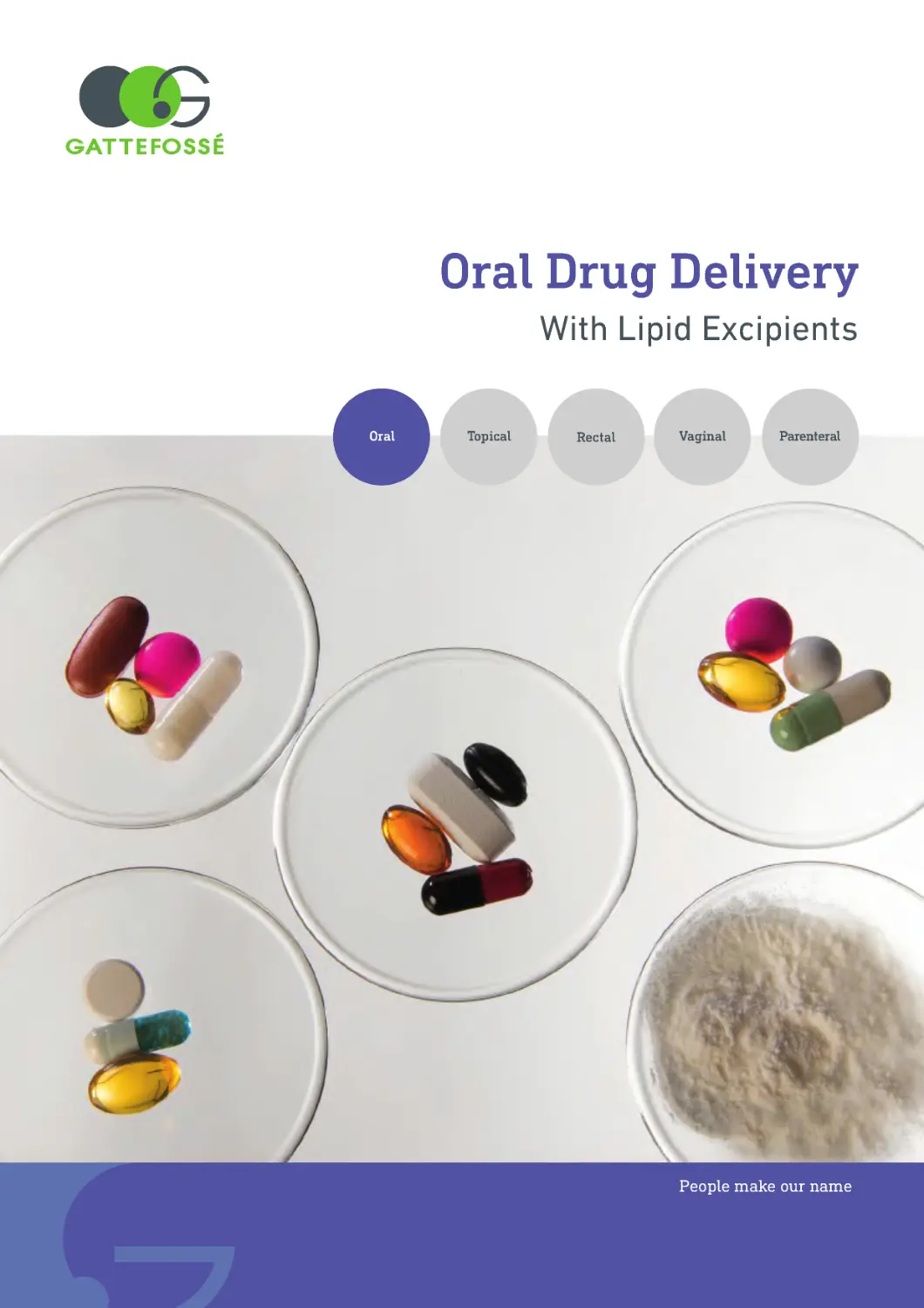
Oral Drug Delivery
With Lipid Excipients
Topical
Oral
Parenteral
Vaginal
Rectal

ABOUT GATTEFOSSÉ
Gattefossé is a leading provider of excipients and
formulation solutions to healthcare industries
worldwide. Our company history - of over 140 years -
is built on a commitment to our customers to deliver
the highest quality products and technical support.
In parallel to developing innovative formulation
applications, Gattefossé has worked diligently to
guarantee the pharmaceutical qualification of its
excipients.
GATTEFOSSÉ EXCIPIENTS
The lipids and fatty acids used in the production of
Gattefossé excipients are derived strictly from raw
materials of vegetable origin.
Excipients are obtained by the esterification of fatty
acids with alcohols - glycerol, polyglycerol, propylene
glycol and polyethylene glycol - and by the alcoholysis
of vegetable oils and fats with glycerol, polyethylene
glycol and propylene glycol.
Expertise in oleo-chemistry has enabled the
development of a range of functional excipients with
different thermal, rheological and textural properties
and a wide spectrum of solubility characteristics.
ORAL DRUG DELIVERY
Our functional excipients are designed to meet
the most pressing formulation challenges in drug
development. Challenges which include API solubility,
permeability and low bioavailability; modified drug
release; protection of sensitive API and taste-
masking. In manufacturing, lipid excipients provide
benefits in tablet lubrication and their versatility
means they can be used in numerous processing
techniques providing scope for innovation.
ABBREVIATIONS
API: Active Pharmaceutical Ingredient; Ch.P.: Chinese
Pharmacopoeia; EP: European Pharmacopœia;
HLB: Hydrophilic Lipophilic Balance; JPE: Japanese
Pharmaceutical Excipients; LFCS: Lipid Formulation
Classification System Consortium; USP-NF: US
Pharmacopœia-National Formulary; S(M)EDDS: Self
(Micro) Emulsifying Drug Delivery System

Excipients for solubilization and bioavailability enhancement
6
Excipients for sustained drug release
4
Excipients for taste-masking and API protection
8
Excipients as lubricants for tablets and capsules
10
Technical support
11
Contents

4
Modulating drug release by the formation of a matrix tablet is a popular approach since it provides
dosage form flexibility and drug delivery efficacy. Matrices can be made by simple physical
blending of ingredients followed by direct compression or by the formation of a solid dispersion
and subsequent transformation into a dosage form.
Excipients have a proven history of use in simple sustained release (SR) matrix tablets and in
more complex drug delivery systems such as dual API release systems, pulsed, timed and delayed
release systems.
Modulation of drug release to achieve the target profile is readily achieved with glyceride matrices
by modifying basic formulation and processing parameters. Lipophilic matrices are insoluble in
aqueous systems, they do not swell, and diffusion is the principle mechanism of drug release.
High melting point, low HLB excipients have excellent plastic properties and matrix tablets can be
produced by numerous standard processing techniques (see table 1). In addition, these excipients
are chemically inert, neutral in flavor and odorless. They are compatible with standard excipients,
including polymers for coating. However, coating is not always necessary.
Biopharmaceutical and manufacturing advantages including:
+
+
+
+
+
Straightforward modulation of drug release profile
Effective solutions for highly water soluble, short half-life APIs
Resistance to pH changes and hydroalcoholic environment
Non-hydroscopic matrix for improved stability on storage
Solvent-free processing for cleaner and greener manufacturing
Excipients for sustained drug release

5
Table 1: Excipients for sustained drug release
Products
Chemical description
Form
HLB
Melting
point (°C)
(capillary tube)
Drop
point (°C)
(Mettler)
Techniques
Compritol® 888
Glycerol dibehenate EP
Glyceryl dibehenate NF
Glyceryl behenate Ch.P.
Powder*
Pellets
2
65.0-77.0
69.0 -74 .0
Direct compression
Wet granulation
Solid dispersion/
granulation
Extrusion (melt/partial
melt)
Spray cooling/prilling
Melt coating
Precirol® ATO 5
Glycerol distearate
(type I) EP
Glyceryl distearate NF
Powder*
2
50.0-60.0
53.0 -57 .0
Extrusion (melt/partial
melt)
Melt coating
Spray cooling/prilling
Capsule molding
GeleolTM Mono and
Diglycerides NF
Glycerol monostearate
40-55 (type I) EP
Mono and
diglycerides NF
Pellets
3
54.0-64.0
54.5 -64 .5
Extrusion (melt/partial
melt)
Melt coating
Capsule molding
* Powder mean particle diameter 50 μm
Download our brochure on sustained release

6
Excipients for solubilization and
bioavailability enhancement
Self emulsifying drug delivery systems provide an effective approach for poorly water soluble,
lipophilic APIs. Surfactive, dispersible and oily excipients are known to improve oral bioavailability
by a number of mechanisms including:
• Enabling higher drug loading by increasing the wettability/solubility of API in the formulation
• Maintaining the API in a solubilized state in gastro-intestinal fluid promoting increased
absorption
• Facilitating selective absorption of certain APIs via the lymphatic transport system.
Gattefossé excipients can be used in self (micro) emulsifying formulations (SEDDS/SMEDDS),
comprising single or multiple excipients. They cover a wide HLB range from 1 to 12 and deliver
different properties in formulations (Tables 2 and 3).
• Higher HLB surfactants are frequently combined with water insoluble surfactants, oily vehicles
and co-solvents
• Lower HLB water dispersible surfactants are formulated with higher HLB water dispersible
surfactants.
Products
Functionality
LFCS
Solubility in water
HLB
Gelucire® 48/16
Water soluble surfactant
Type IV, micellar
Transparent micellar
solution
12
Gelucire® 44/14
Labrasol® ALF
Water dispersible surfactant
Type III fine emulsion/
microemulsion
Translucent
dispersion
10-12
Labrafil® (s)
Wetting agent
Type II formulation
Coarse emulsion
Milky dispersion
7-9
Capryol® (s)
LauroglycolTM FCC
Water insoluble surfactant Use in Type II/III
Dispersion
5-6
LauroglycolTM 90
Plurol® Oleique CC 497
Water insoluble surfactant Use in Type II/III
Insoluble
2-4
Maisine® CC
PeceolTM
Oily phase
Use in Type I
Insoluble
1
Further practical information can be found in our Formulation Guidelines:
Developing Lipid based Formulations for Oral Bioavailability Enhancement
Table 2: Gattefossé solubilizers and Lipid-based Formulation Classification System (LFCS)

7
Products
Chemical description
HLB
Functionality
Gelucire® 48/16
Macrogol stearate (type I) EP
Polyoxyl stearate (type I) NF
12
Water soluble surfactant
Labrasol® ALF
Caprylocaproyl macrogol-8 glycerides EP
Caprylocaproyl polyoxyl-8 glycerides NF
12
Water dispersible surfactant
Gelucire® 44/14
Lauroyl macrogol-32 glycerides EP
Lauroyl polyoxyl-32 glycerides NF
11
Gelucire® 50/13
Stearoyl macrogol-32 glycerides EP
Stearoyl polyoxyl-32 glycerides NF
11
Labrafil® M 1944 CS
Oleoyl macrogol-6 glycerides EP
Oleoyl polyoxyl-6 glycerides NF
9
Labrafil® M 2125 CS
Linoleoyl macrogol-6 glycerides EP
Linoleoyl polyoxyl-6 glycerides NF
9
Labrafil® M 2130 CS
Lauroyl macrogol-6 glycerides EP
Lauroyl polyoxyl-6 glycerides NF
9
Capryol® PGMC
Propylene glycol monocaprylate
(type I) NF
6
Water insoluble surfactant
Capryol® 90
Propylene glycol monocaprylate
(type II) NF
5
LauroglycolTM FCC
Propylene glycol monolaurate
(type I) EP/NF
5
LauroglycolTM 90
Propylene glycol monolaurate
(type II) EP/NF
3
Plurol® Oleique CC 497
Polyglyceryl-3 dioleate NF
3
Maisine® CC
Glycerol monolinoleate EP
Glyceryl monolinoleate NF
1
Oily vehicle
PeceolTM
Glycerol monooleate (type 40) EP
Glyceryl monooleate (type 40) NF
1
LabrafacTM PG
Propylene glycol dicaprylocaprate EP
Propylene glycol dicaprylate/dicaprate NF
1
LabrafacTM Lipophile WL 1349
Triglycerides medium-chain EP
Medium chain triglycerides NF
Medium chain fatty acid triglyceride JPE
1
Transcutol® HP
Highly purified diethylene glycol
monoethyl ether EP/NF
/
Co-solvent
Table 3: Excipients for solubility and bioavailability enhancement

8
Excipients for taste-masking and API
protection
Certain excipients have excellent thermoplastic properties ideal for use in melt processes to deliver
taste-masking and protect sensitive drug compounds.
High shear coating
A standard high shear mixer, without external heating or cooling, and a simple binary formulation
consisting of 80% API and 20% Precirol® ATO 5 are used.
During mixing, friction is generated which induces sufficient heat to partially melt the lipid
excipient. The molten excipient coats the drug particles and, upon cooling, solidifies, covering the
drug particles and masking the unpleasant taste.
Hot melt coating
Molten excipient is sprayed on to solid drug particles in a fluid bed coating device. The lipid
excipient produces a thin, homogeneous film coating which delivers improved tablet compaction
and resolves API taste and compatibility problems. The process is quick, solvent-free and no drying
step is required.
Excipients are compatible with flavoring agents, polymers, plasticizers and surfactants. For
example, the combination of Compritol® 888 ATO with 20% Labrasol® ALF in a lipid film coating
delivers API protection and can modulate drug dissolution properties.
The coated API can be used in tablets, hard and soft gelatine capsules and sachets.
Melt granulation
Excipients are used as binders to form liquid bridges with the powder particles (API and other
ingredients) forming small granules under high shear mixing. Granules can be transformed into
spheronized pellets by controlling the mixing conditions. Thermoplastic lipid excipients are typically
used between 15% and 25% w/w depending on the fineness of the powder mixture. The process is
simple (one-step) and solvent-free.
Excipients enable high drug loading 85% theoretically and up to 66% experimentally reported in the
literature. Lipid granules and pellets can be used in tableting and capsule filling.
The choice of excipient depends on the formulation objective, please see table 4.
For more information on the use of our excipients in melt processes
please ask your local Gattefossé representative

9
Table 4: Excipients for taste masking and API protection
Products
Chemical description
Form
HLB
Melting
point (°C)
(capillary tube)
Drop
point (°C)
(Mettler)
Techniques
Taste Masking
Precirol® ATO 5
Glycerol distearate
(type I) EP
Glyceryl distearate NF
Powder*
2
50.0-60.0
53.0 -57.0
Hot melt coating
Melt granulation
Extrusion (melt/
partial melt)
GeleolTM Mono and
Diglycerides NF
Glycerol monostearate
40-55 (type I) EP
Mono and diglycerides NF
Pellets
3
54.0-64.0
54.5 -64.5
Melt granulation
Extrusion (melt/
partial melt)
API protection / API compatibility
Compritol® 888 ATO
Glycerol dibehenate EP
Glyceryl dibehenate NF
Glyceryl behenate Ch.P.
Powder*
2
65.0-77.0
69.0 -74.0
Hot melt coating
Melt granulation
Extrusion (melt/
partial melt)
Gelucire® 43/01
Hard fat
EP/NF/JPE
Pellets
1
/
42.5 -46.0 Capsule molding
* Powder mean particle diameter 50 μm

10
Excipients as lubricants for tablets
and capsules
Effective lubrication in tablet and capsule production has a major impact on manufacturing and the
quality of the final dosage form in terms of the appearance and content homogeneity.
Gattefossé lubricants are often used to resolve problems associated with poor powder properties
and being chemically inert, they are compatible with all types of active pharmaceutical ingredient
and additional excipients.
Fine powder excipients of well-defined and controlled particle size deliver superior ingredient
homogeneity and content uniformity for tabletting and capsule filling.
Lubricant performance is independent of mixing time and speed, making tablet and capsule
manufacturing more straightforward.
• Compritol® 888 ATO is recommended for tabletting as it provides effective lubrication without
compromising tablet properties. For dispersible tablets Compritol® HD 5 is recommended.
• Precirol® ATO 5 offers excellent anti-friction properties and is ideal for capsule filling.
Products
Chemical description
Form
HLB
Drop point (°C)
(Mettler)
Tablet lubricant
Compritol® 888 ATO
Glycerol dibehenate EP
Glyceryl dibehenate NF
Glyceryl behenate Ch.P.
Powder*
2
69.0 -74 .0
Compritol® HD5 ATO
Behenoyl polyoxyl-8 glycerides NF
Powder*
5
60.0 -67 .0
Capsule lubricant
Precirol® ATO 5
Glycerol distearate (type I) EP
Glyceryl distearate NF
Powder*
2
53.0 -57 .0
* Powder mean particle diameter 50 μm
Table 5: Gattefossé excipients for tablet and capsule lubrication
Download our brochure on lubricants

11
Technical support
Our applications laboratories in France, India, China and USA are at your service to provide technical
support and formulation feasibility assessment.
We have many years of experience of formulating with our products with both experimental and
model drugs. We are committed to answering your questions on formulation, regulatory, safety,
scale-up issues and precedence of use as quickly and as comprehensively as we can.
We can reduce your development time by providing straightforward formulation guidelines for oral,
dermal, rectal and vaginal dosage forms as well as access to extensive databases comprising
hundreds of validated placebo or model API formulations.
If you need practical laboratory assistance, the services we are able to offer include solubility
screening, basic formulation development, texture optimisation and sensorial analysis.
Capryol®, Compritol®, Gelucire®, Labrafil®, Labrasol®, Maisine®, Plurol ®, Precirol®, Transcutol® are registered trademarks of Gattefossé.
The information included in this brochure is presented in good faith and we believe that it is correct, but no warranty as to accuracy of results or fitness for a particular use is given, nor is freedom from
patent infringement to be inferred. It is offered solely for your consideration, investigation and verification. The user shall determine under his responsibility, the use and the security conditions of the
information, and will remain the only one responsible in case of damageable consequences. Before using a Gattefossé product, or any other product mentioned in this literature, read, understand and follow
the information contained in most recent Material Safety Data sheet.
For more information, please contact your local Gattefossé representative

O
R
A
L
D
R
U
G
D
E
L
I
V
E
R
Y
-
G
B
-
7
8
H
V
-
7
(
2
0
2
5
B
E
)
2
0
2
0
www.gattefosse.com
Corporate Headquarters
36 chemin de Genas - CS 70070 - 69804 Saint-Priest Cedex - France
+(33)472229800
People make our name