/


Теги: общее школьное образование общеобразовательная школа универсальные и общие библиографии языки мира
ISBN: 978-5-04-164199-3



Текст
ИНОСТРАННЫЙ
ЯЗЫК
ГРАММАТИКА
для школьников
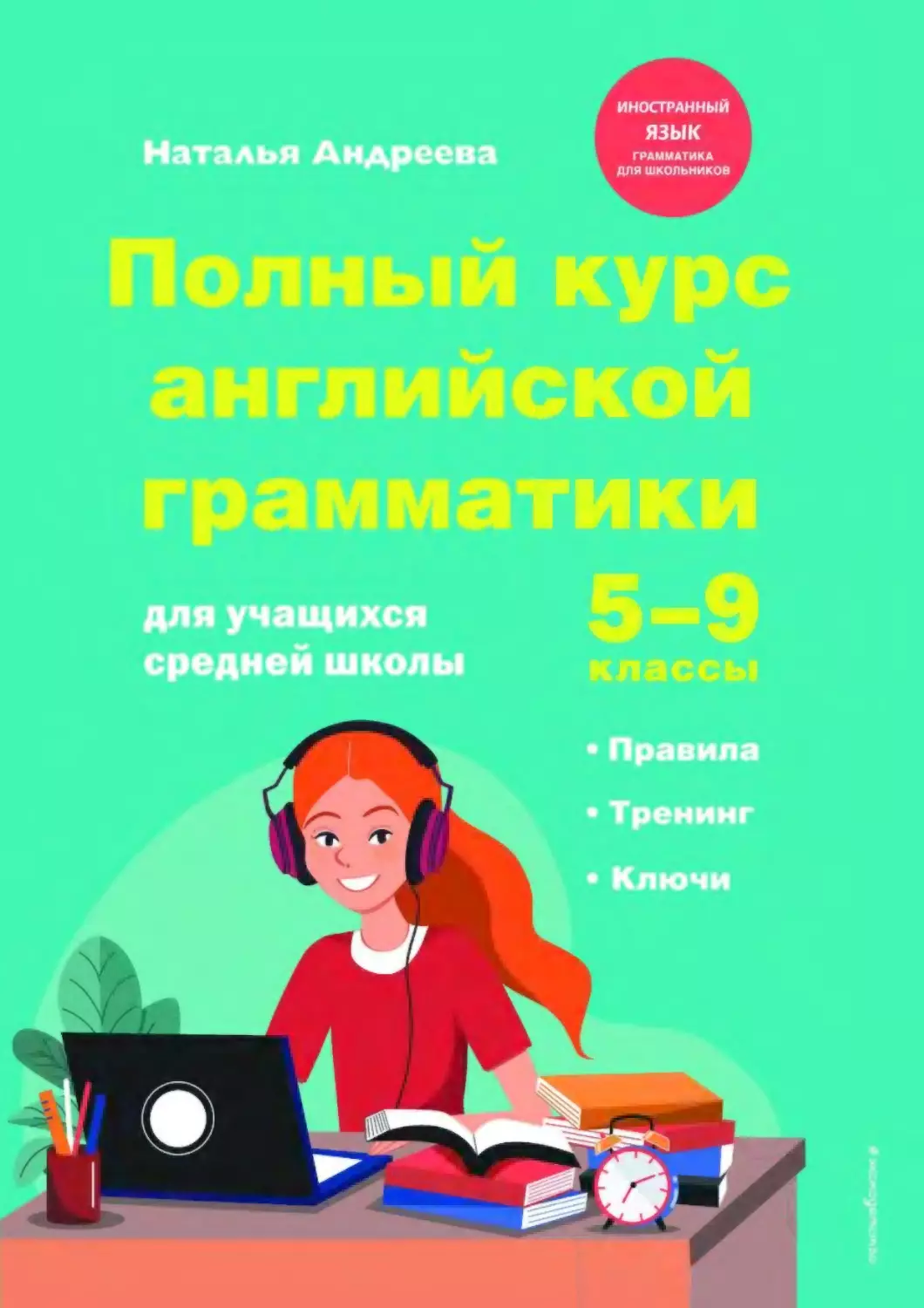
Наталья Андреева
Полный курс
английской
грамматики
для учащихся
средней
школы
классы
# ЭКСМО^ёГПСГПВО
Москва
2024
Андреева, Наталья.
А65 Полный курс английской грамматики для учащихся средней
школы. 5-9 классы / Н. Андреева. — Москва Эксмо, 2024 —
416 с. — (Иностранный язык Грамматика для школьников).
ISBN 978-5-04-164199-3
В книге содержатся все гемы английской грамма гики, которые проходят
в общеобразовательной средней школе Это уникальное справочное пособие
поможет учащимся освоить и повторить 63 грамматические темы и структури-
ровать свои знания об английской грамматике Многочисленные и разнообраз-
ные упражнения позволят сразу же применить знания на практике и довести до
автоматизма навык выбора и составления грамматических конструкций и их при-
менения в речи В конце книги приводятся ответы к упражнениям что позволит
использовать пособие для самостоятельного повторения грамматических тем
и поиска ответов на возникающие в ходе обучения вопросы
Пособие предназначено для учащихся средней школы, изучающих англий-
ский в классе или дома, с родителями или преподавателем. Оно станет эффек-
тивным дополнением любого учебного курса
УДК 373.5:011.111
ББК 81.2Анг л-922
© Н. Андреева, текст, О Попович, иллюстрации, 2024
ISBN 978-5-04-164199-3 ©Оформление ООО-Издательство-Эксмо-, 2024
See прем закидоны. или гюОл* ое чаегь не чалят torn ежтхгеухмамк воспсхмэвфэ»*» • агтокт^хляюш нпя «лмамггесжой форчв
» «ка* фолхолми. эвпмем > ламмгь Эв<М дорадоцки кзи «аким-днбо иным оккоОоч, е также можмьэоммж » побан ммФораминонмоА
СМттАме без ГХМуМйМКЙ рг*уЭ*Шв>ИНв Of ИДОГфМ. Мл-гИ ННЙ» K-ftrtt МЛН <W WpTH СмГЛЖСИЯ
изда ww киляета»mimcdhww и 4л«ч*т глегm&hw н гражданскуюогдагргдаммрепч
Справочное издание
Д"к средне- школьно,- о во ?ра< г j
Аныктамалык басылым
Oora мектеп жасына армалган
иностранный язык, грамматика для школьников
Андреева Наталья
полный курс английской грамматики для учащихся средней школы
5-9 классы
Огветстьенные редакторы Е Выипицкая.
С Чернецов-Рождественский
Редактор Л Шмелева
Выпускающий редактор В казмалы
Художественный редактор Н. Кривошта
технический редактор Л Зотова
Дизайн обложки Н Кривоила
Иллюстрации О. Попович
||« л„^есг
Хочешь стать
автором «Эксмон?
(орыс тгл!нде)
Во ежеутреннем оформлении блока текста использованы иллюстрации
Konstantin Shabalin, Vector Tradition, Antonina Maslova, Anton Starikov, svtc,
Claudio Dwizia. VittoriaChe Graeme Shannon / Shutterstock com
Соответствует техническому регламенту TP ТС 007/2011
KO TP 007/2011 техникалык, регламентам, талаптарына сейкес келед
Страна происхождения; Российская Федерация
Шыг арылган ел). Ресей Федерациясы
ООО -иадатжлы т*э Зажало
123308,Рахитг Моею»уж Зорге, д 1.стр 1,х2Ц.каО.2013 Тал 8(495)4) 1-68-86
Мотт рвцв- wwmИ*ттг>ru E-tnat <т»оФйэто щ
емории. •Изддгеяьсгео•-Эксмо ЖШК
123308 Риге*. Мкгеу «дгесы. Эдо «ашмх 1 1-киьл*. 20мбах ЗДЭ*«а&
Тел:В1495)411-68-66 Homepage-.ммжФзтсми Е-таКиГо4Молю/и.
TayWfa'TM
ItarapHVi-MaraiM* mnwixM^ki
ННтермст-ммвзтот wwwbuofc24.la
Нмгертгет лреан wwwb>*24 kj
Икгоргер • Ркпубгеку Кмжтсген ТОО • РДЦ Агемть-
Кдыкспн №лу6лпосы4 мгсрпауш *4*1-Алматы* ЖШС.
Д*стрибыо"ср и проит-шпм» по трмыу гре«во* «а гросопажо
V РЖлуСгеаа* Квмжпх ТОО 442U A*4nw-
Дастрибахнор хам Квмггев ftcnyCrewacwaaa амыге-д*—-утр
мбылпау жжинляп «г -**ДЦ Алииы> ЖШС
eksmo.ru
Официальный
ИНТ»рН4Г-М«43*Н
мздагельстм «Эамо
Arevfwa.. ДрыброасюЛ в». З*-.ливр 6. офис I
Тад. в(727) 351 -SW'eirW E-m- «ОС-AMwty»«fc*n*oМ
Ондамтм о прдгеа^кдакии соитгетстмы г*до<я«сйп>о«> РФ
о твжмчосюы роипгрошнит ыгем>полу<мп> га сайге Издагагесгаа Эааж
www4fc^nGAv4«*t**60n
ТвЮ^жидрГГщу туриш РФдоч*ыкмн 1С*ЛгЖГгмСж;Т»у
гурагы ыммеггецл «*м адрес бойьмиамуп1бомиал ьцру/Ькаполл^агМсаваге
Сергифиигпаута мм
Дата изготовления / Подписано в печать 17.06 2024
Формат 60<84/я. Гарнитура -Pragmatica-
Печать офсет пая Бумага офсетная Усл печ.л 48,53
Тираж экз Заказ
Contents
Содержание
1 The noun: definition, types of nouns, gender
Имя существительное: определение, категории существительных, род ................6
2 Countable and uncountable nouns
Исчисляемые и неисчисляемые имена существительные.......................... ... 10
3 Singular and plural of nouns
Единственное и множественное число имен существительных - - 18
4 Possessive case of nouns, of-phrase
Выражение принадлежности чего либо кому-либо....................................24
5 Compound nouns (noun + noun)
Составные существительные
(структура «существительное + существительное»)........................................28
6 Articles: general meaning
Артикли общие сведения......................................................... 30
7 The indefinite article а/ап
Неопределенный артикль а/ап............................................ 32
8 The definite article the
Определенный артикль the............................................... 38
9 Zero article Some and any before nouns
Нулевой артикль.
Some и any перед существительными.................. . .............................. 44
10 Articles with proper names (geographical names)
Артикли с именами собственными (географические названия)........................50
11 Articles: difficult cases
Трудные случаи употребления артиклей ........ . ................................. 56
12 Much, many a lot of. A few and few, a little and little
Как выразить понятия «много», «мало>-.......................................... 62
13 Each, every, all. Either, neither, both. Either... or... Neither... nor... Both., and. 66
14 The verb, definition, types of verbs, verb forms.
Regular and irregular verbs
Глагол определение, виды глаголол, формы глаголов.
Правильные и неправильные глаголы......................................................72
15 Be
Глагол be ....................... ... ... 78
16 Have and have got
Глагол have. Форма have got.............................,.......................88
17 Present simple
Простое настоящее время ............ . ... 92
18 Past simple. Used to
Простое прошедшее время Used to для описания
регулярных действий в прошлом.........................................................100
19 Future simple
будущее простое время......................................................... 108
20 Imperatives
Повелительное наклонение.......................................................114
21 Be going to
Be going to для описания будущих запланированных действий............ ... .118
Contents
22 Present continuous
Настоящее продолженное время . ... ..................................122
23 Past continuous
Прошедшее продолженное время................................................... 128
24 Future continuous
Будущее продолженное время..........................................................132
25 Present perfect simple
Настоящее совершенное время.........................................................136
26 Past perfect simple
Прошедшее совершенное время . ..............................................144
27 Future perfect simple
Будущее совершенное время......................................................... 150
28 Present perfect continuous
Настоящее совершенное продолженное время........................................... 154
29 Future in the past
Будущее в прошедшем.................................................................158
30 The passive
Страдательный залог.................................................................160
31 Сап
Модальный глагол сап для обозначения способности
или возможности совершить действие...............................................172
32 Сои id
Модальный глагол could для выражения способности
или возможное! и совершить действие в прошлом, совета и просьбы 180
33 Must
Модальный глагол must для выражения необходимости
совершить действие........................................ ...................188
34 Have го
Have го для выражения необходимости совершить действие..............................194
35 May and might
Модальные глаголы may и might для выражения возможности
совершения действия в будущем и предположения ... ... . 200
36 Should
Модальный глагол should ........................................................ 206
37 Need
Модальный глагол need. .......................................................... 212
38 Would
Модальный глагол would. .......................................................... 214
39 Shall and will
Модальные глаголы shall и will. . ..................................................216
40 Conditional structures
Условные предложения ... ... .... ... . 220
41 I wish ...
Конструкция c wish..................................................................228
42 Reported speech
Косвенная речь..................................................................... 234
43 The gerund (-mg form)
Герундий (форма на -ing} ........................................................... . 242
44 The infinitive
Инфинитив, или неопределенная форма глагола.........................................250
45 Complex object with the infinitive
Сложное дополнение с инфинитивом . .......... ............. ... 254
46 The participle
Причастие................................................................................258
47 Phrasal verbs
Фразовые глаголы....................................................................... 262
48 The pronoun: general information Personal, possessive
and demonstrative pronouns
Местоимение: общие сведения. Личные, притяжательные
и указательные месгоимения............................................................... . 266
49 Reflexive and indefinite pronouns
Возвратные и неопределенные местоимения .................................................270
50 The adjective. Grading and non-grading adjectives. Wurd order.
Adjectives ending in -/ng and -ed
Имя прилагательное. Качественные и относительные прилагательные
Порядок следования прилагательных. Прилагательные на -ing и -ed...................... . 276
51 Comparison of adjectives
Степени сравнения прилагательных..................................................... 280
52 Comparisons
Сравнительные обороты ................................................................ 284
53 The adverb Adverbs of manner. Comparative and superlative adverbs
Наречие Наречия образа действия Степени сравнения............................... . . 288
54 Adverbs of time, adverbs of frequency
Наречия времени, наречия частоты действия ...............................................294
55 Adverb position
Место наречий в предложении .............................................................298
56 Too arid enough
Наречия too и enough.....................................................................302
57 Cardinal and ordinal numbers. Large numbers. Dates
Количественные и порядковые числительные Большие числа. Даты.............................306
58 Prepositions of place and movement
Предлоги места и направления......................................................... 310
59 Prepositions of time
Предлоги времени.........................................................................316
60 There ...
Конструкция с there ................... .................................................322
61 Introductory it
It в качестве формального подлежащего....................................................326
62 Word order
Порядок слов в предложении ..............................................................330
63 Questions
Типы вопросительных предложений......................................................... 334
Irregular verbs
Список неправильных глаголов...............................................................342
Key to exercises
Ответы к упражнениям. . ................................................................ 345
1 The noun: definition,
types of nouns, gender
Имя существительное: определение,
категории существительных, род
Имя существительное обозначает предмет, отвечает на вопрос what? (что?) или
who? (кто?).
Имя существительное нарицательное
(common noun) относит предмет к клас-
су однородных предметен- boy, apple,
mouse, river, day, star, country, idea, life,
rice, sand, etc
Имя существительное собственное
(proper noun) выделяет предмет из ряда
однородных предметов: John, Granny
Smith, Jerry, the Thames, Monday, the
Sun, Switzerland, etc.
Hannah
Имена существительные собственные пишутся с большой буквы.
1) имена и фамилии людей George Harrison
2) названия дней недели, месяцев, праздников Sunday, August. Christmas
3) географические названия the United Kingdom, Europe, the Pacific Ocean, Moscow
4) названия гостиниц, кораблей, кинотеатров the Ritz Hotel, the Titanic, the Odeon
5) названия национальностей, языков, релший Russian, Japanese, Christian
6) звания и обращения к людям Mr Lennon, Professor Webb
7) первая буква в знаменательных словах в назва- ниях книг, картин, фильмов, пьес, журналов, газет и т. д. V Gone with the Wind, Cat on a Hot Tin Roof, the Times
Gender of nouns Род имен существительных
В английском языке нет грамматического понятия рода. т. е. нет специальных окончаний
для прилагательных или глаголов для их согласования с существительным в роде, как в
русском языке. я ходила — 1 went он ходил — he went оно шло — it went интересный фильм — interesting film интересная книга — interesting book интересное предложение — interesting offer
Чтобы указать на биологический пол, используют следующие средства
Местоимения ne (он), she (она), it (он, она, оно) Местоимения he и she обозначают людей. Местоимение it указы- вает на неодушевленные предметы. mother, sister, girl, Zoe. Mrs Smith = she father, brother, boy. David, Mr Johnson = he bed, cat, milk, pencil, school, wood, idea, music = it Хозяева домашних животных очень часто используют he и she. когда говорят о своих любимцах Go and find the cat and feed her Точно так же. используя местоимения he и she, можно говорить об игрушках. This baby doll comes with her own blanket and bottle.
1) Слова teacher, doctor, student, neighbour, friend, stranger, author, writer , mayor могут заменяться местоимениями he или she в зависимости от смысла 2) Чтобы заменить существительное на местоимение в случае, когда пол человека неиз- вестен, можно действовать двумя способами. А) Использовать he or she. him or her, his or her: If a student is ill, he or she must send a medical certificate to the school office. Б) Использовать местоимения they, them, their: If a student is ill, they must send their medical certificate to the school office
Суффиксы -er, ess, -ine actor — actress, hero — heroine, host — hostess, steward — stewardess, waiter — waitress widower — widow, lion — lioness, tiger — tigress
| В последнее время слова steward / stewardess все чаще заменяют словосоче- [ . танием flight attendant
Лексические средства monk — nun, billy goat — nanny goat, bull — cuw, diake — duck
Часто, если нужно обозначить пол животного, используют местоимения he и she she-wolf — волчица he-wolf — волк she-bear — медведица he-beai — медведь
| В последнее время избегают употреблять слова, в составе которых есть суще-
ствительное man или какое-либо указание на пол. и заменяют их на слова, в ко-
торых нет указания на биологический пол.
mankind — humanity
fireman — firefighter
chairman — chairperson
foreman — supervisor
waitei / waitress — server
policeman / policewoman — police officer
steward / stewardess — flight attendant
The noun: definition, types of nouns, gender
Прописная или строчная9 Запиши правильно
1) brother brother.....
2) john .-Ши,. . .
3) тагу ................
4) city . ...
5) pans ................
6) new york
7) chnstrnas
8) the titanic
9) sunday . .....
lOjtuesday .............
11) day................
12) desert..............
13) the Sahara .........
14) russian
15) africa .............
16) octobei ____________
17) london .............
18) liver ..............
19) aunt ....
20) autumn .............
21) season..............
22) november ...........
23) ocean
24) the Indian ocean . .
25) bicycle....... .....
26) the times ..........
27) the ritz ...........
28) the odeon . . .
29) paul davis..........
30) july ...............
31) sea ................
32) the black sea ......
33) wait disney
34) islam ..............
35) musician .........
36) german .............
37) the hudson river ...
38) uncle harry........
Замени существигельные соотвегсгвующим местоимением
1) a toy |Т....... 2) a neighbour he, she _ 3) а Woman
he..... 5) a tourist ....., 6) a widow ........
39) country ............
40) lussia
41) britain .............
42) english
43) Chinese..............
44) professor brown
45) the alps . .
46) england .............
47) everest .............
48) lake ................
49) lake geneva .........
50) mrs hamilton.........
51) captain cook ......
52) bear ................
53) religion ............
54) winter ..............
55) professor swan ......
56) easter ..............
57) mr smith
she , 4) a boy
, 7) a widower .........,
11) a singer ......,
14) a clown .......,
18) a stranger
21) a lioness...........
......, 25) a wizard
......, 28) a teacher
8) a dancer
, 9) a girl
IO) a man
12) a police officer
......... 13) a flight attendant ......
15) a student
, 16) a cat
17) a dog
........, 19) a friend........20) a hostess........,
22) a prince ........23) a parent .... .... 24) a witch
......... 26) a businesswoman ........ 27) a hero
.........., 29) a doll ............. 30) a chairperson ., 31) a waiter
..........32) a client., 33) a patient .............................., 34) a cousin.
35) an author.36) a cage.37) a bouse....................38) a queen
.......... 39) a pupil .......... 40) a policeman ...., 41) a stewardess
.........42) a tiger.43) a president.................., 44) a heroine..........
45) an actress 46) a host.47) a waitress ..........., 48) a bride
.......... 49) a mayor.50) a monk..........., 51) an actor...
52) a bird .......... 53) a book ........... 54) a server .......... 55) a pen
Подбери слова, обозначающие противоположный пол.
1) a man ...9 woman 8) a widow 15) a boy .. ...
2) a king ... 9) a groom 16) a wife . .
3) a son 10) a lady 17) a stewardess
4) a nephew .. . 11) a waiter 18) a father
5)a nun 12) a heroine ... . 19) an actor
6) a sister 13) an aunt 20)a duke
7) a lion 14) a tigress . 21) a policeman
Напиши по-английски.
1 Лорд Фаркуад был злой и жестокий Он мечтал стань королем. 2. Принцесса
Фиона ждала своего принца Она жила в замке, охраняемом драконом. 3 Крест-
ной матерью Золушки была добрая фея Она помогла Золушке поехать на ко-
ролевский бал 4 Принц влюбился в Золушку Он обошел все королевство в
поисках девушки 5 Гарри Поттер был волшебником Он отправился в школу
Хогвартс, чтобы учиться магии. 6. Львы живут группами, которые называются
прайдами. В прайде обычно пять или шесть львиц, их детеныши и один или два
льва. 7. Сестра моего мужа — председатель юродского собрания. 8 Пожарные
часто рискуют своей жизнью, чтобы спасти других людей и остановить пожар
9 На невесте было элегантное платье из атласа цвета слоновой кости, жених
был в черном смокинге. 10 Председатель собрания объявил пятнадцатими-
нутный перерыв 11. Бортпроводники предложили пассажирам напитки и обед.
12 До сентября 2022 года королевой Соединенного королевства Великобрита-
нии и Северной Ирландии была Елизавета II, однако ее муж не являлся королем.
Он был герцогом Эдинбургским. 13. Она была знаменитой балериной. Ее муж
тоже был артистом балета. 14 Где наш несносный кот? Он снова не ловит мы-
шей1 15 Его благотворительная деятельность превратила его в нечто вроде
местного героя 16. Героиню мультфильма '«Русалочка» зовут Ариэль 17. Поли-
цейский арестовал подозреваемого на месте преступления 18. Сьюзен всегда
была прекрасной хозяйкой 19. Жила-была бедная вдова, и была у нее красавица
дочь 20 Монах — член религиозной группы людей, которые живут тихой жизнью
вдали от общества, обычно в монастыре. 21. У моей мамы день рождения в сен-
тябре 22. Обычно каждый понедельник я начинаю новую жизнь. 23. Она одна из
самых высокооплачиваемых актрис в Голливуде, 24. Официант вежливо улыбнул-
ся, когда вручал мне мой счет. 25. Миссис Вудс избрали мэром городка 26 Од-
нажды давным-давно жил-был кролик по имени Джон. Он жил один и чувствовал
себя одиноким 27 Кто твой любимый актер9 — Джонни Депп 28 Она вошла
в комнату и потребовала позвать управляющего отелем 29 Джоан Роулинг —
чрезвычайно популярный британский автор. Она написала серию из семи книг
о Гарри Поттере 30 Эта женщина — одна из героинь Второй мировой войны.
2 Countable and uncountable
nouns
Исчисляемые и неисчисляемые имена
существительн ые
Countable nouns Исчисляемые существительные Uncountable nouns Неисчисляемые существительные
Исчисляемые существительные — это на- звания отдельных предметов (людей, жи- вотных. чещей. понятий). Их можно пере- считать. a boy — two boys, a (Jog — three dogs, a ta- ble — four tables, a pioblem — ten problems Неисчисляемые существительные — это названия веществ, жидкостей, продуктов, абстрактных понятий, болезней, погодных явлений, которые воспринимаются как не- кая единая масса без определенных гра- ниц. Их невозможно пересчитать. snow, water, cheese, love, flu, gold, thunder ?
Особенности использования в речи
Countable nouns Исчисляемые существительные Uncountable nouns Неисчисляемые существительные
Исчисляемые существительные могут ис- пользоваться в единственном и множе- ственном числе. a vegetable — vegetables, an idea — ideas What is your name? (ед. ч.) What are the names of these flowers9 (мн ч.) Неисчисляемые существительные в основ- ном употребляются в единственном чис- ле и согласуются с глаголами в единствен- ном числе The weather was good at the start of the week
С исчисляемыми существительными мо- гут употребляться неопределенный (а / ап), определенный (the) и нулевой артикли 1 have a cat. The cat s name is Fluffy. 1 like cats С неисчисляемыми сущесгвигельными упот- ребляются определенный (the) и нулевой артикли Неопределенный артикль с ними не используется The bread is fresh There's nothing better than fresh bread
С исчисляемыми существительными для описания понятий -«много мало» использу- ют many, few. Were there many cars on the load? There were few people at the concert. С неисчисляемыми существительными для описания понятий «много, мало» использу- ют much, little. 1 don’t earn much mgnsy. 1 have very little timS-
Some часто используется с исчисляемыми существительными во множественном числе, указывает, что число предметов неизвест- но или неважно. 1 have some bananas- Would you like one? Some часто используется с неисчисляемыми существительными, указывает на некоторое точно неопределяемое количество. Here s some ngw§ you might be interested in. 1 have some bread- We can make sandwiches.
How many используется с исчисляемыми существительными, чтобы задать вопрос о количестве (сколько?). ^How many students aie there in your class9 How much используется с неисчисляемы- ми существительными, чтобы задать во- прос о количестве (сколько9). How much money do you need9
Неисчисляемые существительные
/ Materials / Вещество glass, iron, metal, paper, plastic, sand, wood, etc. существительные, обознача- ющие предметы, сделанные из этих материалов, являются исчисляемыми: a glass — стакан, an iron — утюг, a paper — газета
Food / Продукты butter, cheese, coffee, fruit, porridge, tea, toast, etc. 1) vegetable(s), bean(s), pea(s), grape(s) — исчисляемые су- ществительные, 2) названия напитков могут становиться исчисляемыми Could I have two coffees9
Abstract nouns / Абстрактные понятия experience, hate, life, love, pity, Thought, time, etc эти слова могут употребляться и как неисчисляемые (с бо- лее общим значением), и как исчисляемые (с более кон- кретным значением): Life is complicated. Не had a really difficult life
Illnesses / Болезни backache, earache, flu, measles, pneumonia, tooth- ache, stomach ache. etc. a cold, a sore throat, a head- acne — исчисляемые суще- ствительные
Weather words / Слова, описывающие погоду snow, lightning, thunder, ram, weather, sleet, hail, etc
| Некоторые слова являются неисчисляемыми ; одном значении и исчисляемыми
в другом
>_____________________________________________________________________________
Например, слочо country в значении «страна» является исчисляемым, а в значении «ди-
кая местность вдали от города'" — неисчисляомым.
I don’t know what lite in a foreign country will be like
My parents live in wild country far fiom big cities.
Выражение in the country имеет значение «за городом, в малонаселенной местности».
Слово hair в значении «волосы» является неисчисляемым, а в значении «волосок» — ис-
числяемым
Her hail is long and shiny.
There are a few thin hairs on his head.
Иногда изучающим английский сложно понять, является ли то или иное существитель-
ное неисчисляемым Предлагаем вам запомнить некоторое количество часто используе-
мых в речи неисчисляемых существительных:
accommodation — жилье
advice — совет
chess — шахматы
chewing gum — жевательная резинка
equipment — оборудование
furniture — мебель
hair — волосы
information — сведения
knowledge — знания
lightning — молния
luck — удача
luggage — багаж
money — деньги
news — новости
permission — разрешение
progress — успехи
research — исследования
»ubbish — мусор
thunder — гром
traffic — дорожное движение
toast — поджаренный хлеб
travel — путешествие
weather — погода
work — труд
Can I give you some advice9 — I never listen to adyiQe. — You can ask your father for advi.ce. —
I always ignore my father’s advice. — Then let me give you a piece of advice. — My advice is to
go by train. — I went there on the advice of my friend. — Teachers give good advice to parents
about managing difficult behaviour.
Советуем вам также обращаться к хорошему словарю если вы не знаете, является ли то
или иное существительное исчисляемым либо неисчисляемым Пометки в словаре (и —
uncountable, с — countable), а также примеры использования слов в речи помогут вам не
допускать досадных ошибок.
Как сосчитать
неисчисляемые существительные
Неисчисляемые существительные можно сделать исчисляемыми, если перед ними упо-
требить фразу a piece of или подобные.
a carton of milk
a glass of water
three loaves of bread
a cup of tea
a piece of cheese
two kilos of rice
a lew lumps of sugar
a slice of cake
a bar of chocolate
a flash of lightning
three items of luggage
a sum of money
three sticks of chewing gum
a bowl of soup
a bag of flour
a bottle of lemonade
, является слово исчисляемым (с) или неисчисляемым (и),
1)snow U 13) furniture 25)tea 37) chewing gum
2) pasta 14) toothpaste 26)love 38) information
3) water 15) advice 27) life _ 39) lightning
4) tooth 16)journey 28) fad 40) progress
5) luck 17) travel 29) storm 41) equipment
6) fruit 18) suitcase 30) money 42) vegetable
7) porridge 19) newspaper 31) bread 43) knowledge
8) news 20) luggage 32) thunder 44) weather
9) flu 21) toothbrush 33) health [_ 45) sandwich
10)sand 22) fun 34) idea 46) problem
11) wine 23} homework 35) clock 47)research
12) music 24) friendship 36) forest 48) toast
Запиши а/ап перед существительным. Если а / ап не употребляется перед словом,
поставь прочерк.
1) .a ball 8) ... juice 15) . headache
2) .— bread 9).. pen 16)... furniture
3) . . tomato 10) ... . wood 17) ... ... luggage
4) news 11) ... milk 18) ... information
5) ... money 12) ... . salt 19) .... homework
6) piano 13) ... . grape 20) ... happiness
7) watch 14)... gate 21)... advice
Вставь г. пропуски а/ап или some
1) .....a... banana 17) child 33) .. .. . sand
2) some water 18) sledge 34) ... journey
3) dogs 19) echo 35) .. . headache
4) books 20) clocks 36) .. news
5) milk 21) stories 37) .. sugar
6) pencil 22) .. .. girl 38) .. person
7) information 23) mouse 39) .. fun
8) juice 24) mice 40) ... . . advice
9) grapes 25) knowledge 41) . people
10) . boys 26) ... . bean 42) ., . grape
11) bread 27) progress 43) ... potato
12) eggs 28) ... . rice 44) . keys
13) toast 29) vegetables 45) .. .... chocolate
14) children 30) fruit 46) ... strawberry
15) piece 31) coffee 47) .. elephant
16) money 32) peas 48) .. .. . research
Соедини слова в рамках так, чтобы получить словосочетания
A bog of flour, a bar of wood.
bag, bar, bottle, bowl, carton, cup. glass, item, jar, jug, kilo, loaf, lump, mug. piece,
sheet, slice, stick
bread, butter, cake, cereal, cheese, chewing gum. chocolate, cocoa, coffee, flour,
furniture, ham, honey, jam, juice, lemonade, luggage, milk, paper, porridge, soup,
sugar, tea, toast, water, wood, yogurt
(J) Напиши по-английски.
1) ломтик сыра ..................
2) бутылка молока ...............
3) чашка чая ....................
4) стакан воды .
5) плитка шоколада ..............
6) кусок пирога .................
7) лист бумаги ..................
8) кусочек ветчины . ...........
9) кусочек поджаренного хлеба
10) тарелка супа .................
11) стаканчик йогурта ............
12) кувшин сока ... . .........
13) ба гон хлеба .................
14) литр бензина .................
15) банка меда ...................
16) кружка какао .................
6 Выбери и подчеркни правильную форму глагола в скобках.
1 Chess (has /have) always been my favourite game since childhood. 2 A lot of
useful information (was / were) provided by him 3. Knowledge (are / is) a powerful
instrument. 4 The lightning (have / has) damaged the plane’s instruments, they aren’t
giving any data. 5 I think grey hair on a man (looks / look) very nice 6 Her luggage
(were/ was) piled up next to the car 7 Money (is/ are) a good servant but it (are/is)
a bad master. 8 His practical advice always (helps / help) me m a difficult situation
9 No news (are / is) good news. 10 Technological progress (has / have) been so
fast in the last few years. 11. His research (have / has) produced unexpected lesults
12. Travel (makes /make) oui life bright and inspiring.
7 ) Вставь в пропуски some или a / an.
1 Father gave me..... good advice. 2. Can I have......toast and jam for breakfast9
3. Could you pass me.......slice of bread? 4 Would you like stick of chewing
gum? 5. The price of.......litre of unleaded petrol has risen. 6. We have just bought
.. .. . new furniture for the bedroom 7 I read .......interesting piece of information
in the newspaper. 8 Agnes was struck by......... flash of lightning when she was eight.
9 I bought......... new luggage for my trip. 10 Here is ....... piece of news that may
interest you. 11. They are doing ......research on the language of dolphins. 12. He
had terrible headache 13 It seems I've caught ................... cold I have ........
sore throat and . .. running nose 14 Can you lend me . money9 15. Could
you pour ........ juice into the jug9 16 There was ......... terrible clap of thunder.
17 We need sausage and bread to make sandwiches.
8 Much or many, little or few9
1 They were unable to provide ............ information 2 There wasn’t.............. sand in the
sandpit 3. There are ..........mistakes in this essay 4. A1 that time of night, there is..........
traffic on the roads 5 We don’t have very . books in our home library. 6 How
children do you have? 7. You don’t need ............ money to be happy. 8 We have ................
sugar left. We don’t have enough for the cake. 9. I haven’t been having luck recently
10 He wanted to buy the house but it cost too................. money. 11 We have very.............
money. We can’t buy everything we want, 12 Nobody knew about the exhibition. Very
. . ... people visited it. 13. I’m not making .... .... progress with my project 14, The gallery
is not worth visiting. .. pictures are any good 15 Please hurry up There's.........................................time
left. 16 I’ve got so.......... work to do. 17. Do you add .......................salt in your food9 18 Did you
make ... photos at the party9 19 films are worth watching 20 There was.....................
doubt in my mind. I knew what to do 21. There seem to be ... tourists around this year.
22 .. people understand the difference.
9 Вставь артикль a / an, где необходимо
1 . Each pane of . glass costs several hundred pounds 2 She poured herself
.... tall glass of.... mineral water 3 The door is made of........ bulletproof
iron. 4 Do you know how to use...................................... iron (утюг)? 5. The delicious smell of .
freshly-made coffee came from the kitchen, 6. Could you bring me . cup of
coffee? 7. We sat in the shade of the tree, sipping ..... tea and eating scones.
8 Could I have two cups of coffee and tea, please9 9 She writes on
paper because she hates computers. 10. The Sun is daily British paper.
11 I have.......terrible toothache. 12 The noise was giving ner...... headache.
13 He is a person who really loves ....... life 14 He had ........ long and happy
life 15. Don’t hurry, there’s plenty of....time. 16 She left.......short time ago.
17 There was . . pity in hei voice. 18 It’s.............. pity that you can’t stay longer.
19 She has........ curly dark hair. 20 You have .... blonde hair on the jacket.
21 Let me give you . . piece of advice 22 That’s................. great news 23 We
need to buy .......... new furniture. 24 The doctor says she is making ,. good
progress
IO Составь предложения с фразами Would you like a / an ...? и Would you like
some ...?, используя слова в рамке
Образец: Would you like a piece of cake? Would you like some tea?
piece of cake, slice of ham, tea, coffee, apple, orange, water, juice, biscuits,
chocolate, cake, bread, toast, cup of coffee, mug of tea, cheese, mashed potatoes,
soup, porridge, carton of yogurt, chewing gum, milk, bowl of soup, lemonade, glass
of lemonade, lump of sugar, stick of chewing gum, piece of chocolate, slice of
bread, honey, jam, butter, salt, pinch of salt, chicken
Дополни предложения словами из рамки
furniture, progress, luck. news, advtee, work, information, luggage, research,
accommodation, traffic, lightning, knowledge, chewing gum, rubbish, hair,
equipment, weather, money, permission, tiavel, chess
1. I need some adY'5e on which computer to buy, 2. She has long dark..........
3 Your local council can provide ..... on sports facilities in your area. 4 We don’t
have much..........— only two suitcases and a bag 5. The room will look bigger if we
i earrange the ..........6 It will be a good opportunity for you to gam . . and
experience 7. We hope to see some real ............... by December. 8 Hotel..............
is included in the price of your holiday 9 It's difficult to find in the present
economic situation. 10 If you want to leave early, you have to ask for.......... 11. The
pass allows unlimited.......... on all public transport in the city. 12. It was a stroke
of ........ that we found the hotel before dark. 13, The man was struck by...............
and killed. 14 Take care when using old electrical ................. 15 My lathei plays
as a hobby. 16 I’ve got........ stuck on my shoe 17 There was heavy
....... on the roads this morning. 18 We spent very much ................... redecorating
the house. 19 That’s the best............................................................I’ve heard for a long time! 20. They are doing
some ...... into the origin of the universe. 21. Fair............. was forecast for the
following day 22 The streets were littered with ...........
Напиши по-английски
1. В холодильнике мало продуктов 2. У тебя много свободного времени? 3. У меня
дома мало мебели. 4 На улице не много снега 5. Путешествия стоят не очень боль-
ших денег. 6. Мои новости стоит послушать. 7 Moiy я дать тебе совет? 8 Ее во-
лосы были длинные и красивые. 9. У тебя длинный волос на рукаве 10 Жизнь есть
жизнь 11 У него была трудная жизнь. 12 Дайте мне. пожалуйста, две чашки чая и
чашку кофе 13. Дай мне, пожалуйста, молока и меда. 14 Ваза сделана из стекла
15. Она налила в высокий стакан немного сока 16 Россия — огромная страна
17. Он любит жить в дикой местности. 18. Знания из различных областей очень
важны в наше время 19 Мы сейчас проводим мало исследований в этой области.
20. У студентов мало выбора в этом вопросе 21 Вчера у него было очень мало
времени 22. На дороге сейчас мало транспорта 23 Мы не достигли значитель-
ных успехов 24 я прочитала очень интересную информацию в газете. 25, У нас
мало информации по этому делу. 26. Мои родители живут за городом. 27 Хочешь
кусочек nnpoia? 28 Я могу предложить тебе тост с джемом. 29 Мы увидели мол-
нию и потом услышали удар грома. 30 Вчера я купила духи, платье и пару туфель
31. Я хочу написать письмо Мне нужны бумага и ручка. 32 Этот стол сделан из
дерева. 33 У него было мало багажа — только один чемодан и сумка 34 Я за-
была утром вынести мусор. 35. Мы собираемся купить новую мебель 36. Хотите
немного риса и курицу? 37 Вечером он почитал книгу и послушал музыку. 38 По-
жалуйста, откройте окно, чтобы впустить воздух.
3 Singular and plural of nouns
Единственное и множественное число
имен существительных
Большинство существительных имеют два числа, единственное (singular) и множе-
ственное (plural)
Как образовать форму множественного числа
Форма множественного числа большинства существительных образуется с помощью
окончаний -s или -es.
существительное в ед. ч.
f Singular Единственное число окончание -s Plural Множественное число
car, boy. bee, cat, key, orange, bridge -s cars, boys, bees, cats, keys, oranges, bridges
существительные, оканчивающиеся е ед. ч.
на звуки [sj [z] [JI UJI (-s,-ss, -х, -z, -sh, -ch),
а также некоторые слова, оканчивающиеся на -о
Singular Единственное число окончание -es Plural Множественное число
bus, box, quiz, brush, coach, watch -es buses, boxes, quizzes, brushes, coaches, watches
tomato, potato -es tomatoes, potatoes
Исключения radios, zoos, pianos, photos. j
Как произносить окончание -s/-es
И Is] [iz]
После гласных и звонких согласных звуков кроме И [3] И5] После глухих согласных звуков кроме [s] [_П [tj] После звуков [s] [z] [J] [3] ld3]
bananas, toys, trees, dogs, monkeys, potatoes, trains, lids, sobs, leaves, figs, puz- zles, drums, needles, pins books, hats, lips, socks, stu- dents, rates, snakes, ships, dwarfs laces, kisses, noises, roses, bushes, garages, benches, pages, oranges j
Особые случаи образования множественного числа
Существительные, оканчивающиеся на согласную + у
Singular Единственное число у- ► i + -es Plural Множественное число
fly, country, city, copy, lily, dictionary, story У~< ► i + -es flies, countries, cities, copies, lilies, dictionaries, stories
4 HO: boys, days, monkeys, toys, valleys, так как перед у стоит гласная буква. 7
Существительные, оканчивающиеся на -f / -fe
Singular Единственное число -f/-fe-* v + -es Plural Множественное числе
leaf, shelf -f -> v +-es ; leaves, shelves
Исключения, roofs, chiefs, handkerchiefs.
knife, wife -fe -► v +-es knives, wives
Слова dwarf, hoof имеют две формы множественного числа: dwarfs/dwaives, hoofs/hooves.
Формы множественного числа существительных,
которые нужно запомнить
/ Singular Единственное число Plural Множественное число
man men
woman women I'wimin]
child children
person people
foot feet
goose geese [gi:s]
mouse mice
tooth teeth
ox oxen J
Существительные, не меняющие форму
во множественном числе
Singular Единственное число Plural Множественное число A
sheep sheep
fish fish
fruit fruit
deer deer
dice (кубик для игры) dice
data (данные, факты) data У
Сравни: A young sheep is called a lamb. Some sheep were grazing in the fields
Существительные, имеющие одинаковые формы
единственного и множественного числа
У Singular Единственное число Plural Множественное число
\ series (серия, курс) crossroads (перекресток) species (род, вид) headquarters (штаб-квартира) works (завод, мастерская) means (средство) series crossroads species headquarters works means /
Сравни: Television is an important me_an§ of communication.
We need to find some other means of transportation.
Существительные, имеющие только форму
множественного числа
1 Существительные police (полиция), cattle (крупный рогатый скот) согласуются с гла-
голами во множественном числе.
The oohee have arrived at the scene of the crime.
Cattle were domesticated in Neolithic times
2. Существительные, обозначающие парные предметы, согласуются с глаголами в Фор-
ме множественного числа и заменяются местоимениями во множественном числе:
binoculars (бинокль), glasses (очки), jeans (джинсы), scales (весы), scissors (ножницы),
shorts (шорты), trousers (брюки)
Where are my glasses? I can’t see them anywhere
These scissors don’t cut very well.
3 Некоторые другие существительные: arms (оружие), clothes (одежда), congratulations
(поздравляю!, букв, - поздравления), contents (содержание), customs (таможня), goods
(товары), manners (поведение), the Middle Ages (Средние века), oats (овес), outskirts
(окрестности), regards (to smb) (привет (кому-л.), remains (руины), savings (сбереже-
ния), surroundings (окружение), thanks (благодарность), troops (войска), etc.
My clothes are wet through! — Why don’t you take them off?
Sincere thanks go to my mum.
Существительные, имеющие только
форму единственного числа
Неисчисляемые существительные (названия веществ, жидкостей, продуктов, абстракт-
ных понятий, болезней, погодных явлений) имеют только форму единственного числа.
Перед ними не используются числительные, артикль а/ап, местоимения many/few.
Эги существительные согласуются с глаголами в единственном числе, перед ними мо-
гут стоять определенный и нулевой артикли, притяжательные местоимения и местоиме-
ния some/much/little, а также существительные в притяжательном падеже. (Подробно
о неисчисляемых существительных см, с. 10.)
Stained gJass is a valuable material. Fly is a very dangerous illness
As time goes on I love this city more and mote. I have toast for breakfast
Существительные, которые вызывают трудности
у русскоязычных учащихся
Эти слова в английском языке имеют форму и единственного, и множественного числа
a gate — gates (ворота) a watch — watches (наручные часы}
a clock — clocks (настенные часы) a sledge — sledges (санки)
В русском языке эти существительные употребляются во множественном числе.
Сравни. Му watch has stopped. How many watches do you have0
The clock is wrong How many clocks are there on the tower?
We walked through a wooden gate into the field.
All the gates in the castle were closed.
1 } Образуй форму множественного числа существительных,
реп ..........P.?.ns ...... toy gate
dog .................. umbrella ................... doctor ......................
snake ................ place....................... pipe ........................
orange................ lip ........................ eye..........................
race.................. phone ...................... mouth .......................
monkey . ... day ............................ ear .........................
book................ brow ......................... exercise ....................
skirt ................ car ........................ nose.........................
house ................ ship........................ leg .........................
sponge ............... piece....................... sledge ......................
case .... tree ................. knee ........................
brother .............. test ....................... finger...................
zebra ................ star ....................... toe .........................
artist ............... kite palace
face.................. tiger ...................... building ....................
rose.................. hoise ...................... street ......................
bridge cage ................. gaiage ....................
desk ................. bed ........................ cnair........................
table ................ nest ....................... suit.........................
step ................. wardrobe .. mirror..................
pilot ................ watch ...................... hand ........................
2 ) Распредели существительные во множественном числе из упражнения 1 по колон-
'— кам в соответствии с правилами чтения окончания -s/-es
[z] [S] [iz]
pens, snakes, □ranges,
3 . Образуй форму множественного числа существительных,
man ................. woman .............. goose .........., mouse .......... tooth
.......... fish .........., deer ......... , data .........., child ....... ,
person............foot............ox.............sheep ...........fruit
dice..........., louse .... ...
4 ' Образуй форму множественного числа существительных
bench benches story ................ zoo
brush................. dress....................... dwarf.......................
class................. fairy .................... chief
fly................... beach....................... photo ......................
quiz ............. ... tomato . ................... match ................. ...
watch ................ baby ....................... potato .....................
bush ................. volcano .................... breach......................
church ............... knife....................... shelf.......................
city ................. party ...................... tapestry ...................
glass ................ cross . halt
scarf................. sky ........................ branch......................
berry ................ flash....................... crash
sandwich ............. bus....................... wolf..........................
wife . . country handkerchief. ........
body.................. fox ........................ clock ......................
piano ................ radio ... .................. zero .....
dish ................. leaf ....................... pass .......................
roof ................. tax ........................ torch ......................
family ............... cry ........................ coach ......................
life.................. box ........................ boss........................
thief ............... echo ....................... rush .......................
5 Сформулируй правила образования форм множественного числа для всех групп су-
ществительных. встретившихся тебе и упражнении 4
6 Дополни ряды существительных, оканчивающихся на указанные звуки. Образуй фор-
му множественного числа.
singular + -s
orange — oranges,
|ZI noise — noises,
r,i face — faces.
singular + -es
j bush — bushes,
church — churches,
r,i bus — buses, fax — taxes.
watch, dish, lox, place, exercise, suitcase, house, class, cause, box, sponge, rose,
bench, tiench, sledge, fridge, flash, brush, torch, nose, range, bruise, glass, race,
bridge
( 7 ) Запиши эти предложения во множественном числе, сделал все необходимые изме-
х нения.
Образец: This is/lt’s my key These are my keys
1 It's a new dictionary. 2. There is a fish in the pond. 3. There is a deer in the forest
4 The child is playing in the garden. 5. He is an elderly person 6 There was a mouse
in the hole 7. This is a rare butterfly 3. He is a fisherman 9 The sheep is grazing
in the field 10 This is a wild goose. 11 This woman is from Germany 12 The berry
is delicious 13 His foot was red and swollen 14 I had a tooth out at the dentist’s
yesterday. 15 He is as strong as an ox. 16 We need a dice to play the game 17. This
is her knife. 18 An elf is a creature with magic powers. 19 The leaf was all yellow.
20 The roof needs to be repaired 21. There was a bench in the park. 22 The bush
was in blossom 23 An orange grows on an orange tree. 24. The quiz was difficult
25 A firefighter is a person who makes fires stop burning.
4 8 ) Выбери нужную форму глагола в скобках
1 Му watch (has/have) ............ stopped. 2. How much (does/do)...........the
sledge cost9 3. How many clocks (ts/ate) . there in your house9 4. The
gates of the castle (was/were) .......... closed 5. Sheep (was/were) ...........
grazing in the field. 6 Some fruit (is/are) . . very expensive 7 The adult male
deer (/s/are) ........ . . called a stag and (has/have) ......... antlers growing from
its head 8. Little tropical fish (is/are) .... . usually kept in a glass aquarium.
9 The dice (was/were) .......... thrown and the game started. 10. AH this data
(is/are) . stored on the servers in London 11. A young sheep (is/are)
.........called a lamb. 12 These data (was/were) ......... collected by various
researchers 13 A fish (move/moves) . by using its tail and fins. 14 Deer
usually (live/lives) ............. in forests and (eat/eats) .. grass and leaves.
15 Two dice (is/are)..........needed to play this game
9^) Напиши по-английски.
1 Мужчины часто увлекаются автогонками 2 Женщины в Британии впервые
получили право голоса в 1918 году. 3. Сколько у тебя детей? 4. Ребенком я не
ел овощи. 5. Фрукты полезны для здоровья. 6. Некоторые люди держат мышей,
крыс, змей и даже свиней в качестве домашних животных. 7. В этом лесу много
оленей 8 В его пруду плавают маленькие тропические рыбки 9 Мой дедушка
когда-то выращивал овец в Австралии 10. У Джона была черная овечка, он очень
ее любил. 11 На реке живут дикие гуси. 12 Я весь день провела на ногах и чув-
ствую себя усталой. 13. У меня мозоль (a blister) на правой ноге. 14 Билл был
симпатичным молодым человеком. 15 Его жена — красивая молодая женщина
16 Гусь — это тица, похожая на большую утку, с длинной шеей. 17. Ты когда-
нибудь видел оленя в лесу? 18. Мне только что нырвали зуб у зубного нрача.
19 У бобров очень острые зубы 20 Ешь много свежих фруктов и овощей
4 Possessive case of nouns,
of-phrase
Выражение принадлежности
чего-либо кому-либо
Для выражения принадлежности чего-либо одушевленному существительному исполь-
зуется притяжательный падеж (possessive case).
Как образуется
Singular / Единственное число
Plural / Множественное число
одушевленное существительное
в ед. ч. + ’s
одушевленное существительное
в мн. ч. + ’
Ann’s cat
the boy’s car
my brother’s bag
the tiger’s tail
my parents’ house
the boys’ bikes
the sisters’ dresses
the lions’ cages
Если существительное оканчивается на
s, для выражения принадлежности мож-
но поставить только апостроф Dickens’
novels, Socrates’ ideas. Ho ’s в данном
случае более распространено: Tess’s
friends, Burns’s poems.
Можно добавлять апостроф к целой фразе-
the woman next door’s husband
Henry and Angie’s children
Henry the Eighth’s six wives
the Smiths’ new car
У существительных, имеющих особую форму множественного числа, притяжательный
падеж образуется одинаковым способом для единственного и множественного числа.
Singular / Единственное число
Plural / Множественное число
одушевленное существительное
в ед. ч. + ’s
одушевленное существительное
в мн. ч. + ’s
the mouse’s hole
the child’s toys
the man’s suitcase
the woman’s hat
the mice’s cheese
the children’s parrot
men’s shirts
women’s dresses
______________________)
Как произносится
[Z] [s] [iz]
После i ласных и звонких соглас- ных звуков кроме [z] [5] [dj] После глухих согласных звуков кроме [s] (Л [tf] После звуков [ь] [z] [f] [5] [tj] [d5]
Dave’s, Ann's, Mrs King's, boy’s, women’s, tnend's, doctor’s, fi- nger’s, dog's Kate's, Pete’s, Mr Smith’s, president’s, student’s, parrot’s Alex’s, Liz's, Burns’s. Alice’s, fox's. George’s, Tess’s, James’s, Butch's ?
В некоторых случаях во фразах опускается второе существительное. Это происходит.
1) когда смысл фразы очевиден;
Whose coat is that9 — Helen's.
2) когда говорят о магазине, кинотеатре, компании, церкви, клинике или доме. При этом
в названиях магазинов и компаний часто опускают сам апостроф
I bought this dress at Harrods. Mary is at the hairdresser’s.
They got married at St Joseph's. I have an appointment at the dentist's.
We went to John s last night Why don’t you go to the doctor's?
Of-ph rase
В подавляющем большинстве случаев для обозначения принадлежности чего-либо не-
одушевленному предмету используют структуру с предлогом of.
the roof of the house
the gates of the castle
the wall of the building
the top of the page
the name of the street
the sights of Scotland
the spire of the town hall
the chairman of the government
the surface of the moon
Есть несколько категорий неодушевленных существительных, с которыми можно употреб-
лять притяжательный падеж.
названия стран, городов, месяцев, дней недели Scotland's climate, London’s museums, last л January's election, future Monday’s meeting, yesterday’s news
Слова city, town, country, Earth, moon, sun, world the city's responsibility, the town's main featuies, the country's capital city, the moon’s orbit, the sun’s rays, the earth's surface, the world s most beautiful countries
названия организаций или групп людей company’s management, government’s deci- sion. committee's meeting
Слова, обозначающие время V a day’s journey, twenty minutes' delay, an hour's flight, half hour's walk >
1 ) Что нужно записать в словах, чтобы выразить принадлежность ’s или ’?
1) my . mother's. bag; 2) ту beds; 3) the teacher...... car; 4) the
teachers. . room: 5) her parents . flat; 6) my brother., . car: 7) his sister.....bike;
8) the policeman., gun; 9) the children.... parrot; 10) Bess voice; 11) her aunt.. ..
ring: 12) the ladies... room; 13) the bear... cubs, 14) the elephant.....tusks; 15) the
men. ... trouseis; 16) the child . . toy tram; 17) the man .. hat; 18) the rabbit......
hole; 19) my friends. . children; 20) the woman dress; 21) Mr Phelps. office;
22) women novels; 23) the birds. . nest; 24) the lawyers. . duties; 25) the dog
kennel; 26) the cats.... food: 27) my grandparents.. house; 28) the actors.... lives;
29) the tiger .... paws; 30) the cat kittens. 31) Dickens novels; 32) Gulliver. ,.
travels; 33) Burns ... poems
2 Заполни пропуски в предложениях, чтобы выразить принадлежность
1. Му (friend) . fnehd's,. cat is called Fluffy. 2 My (brother) .......room is big
and light. 3 His (grandparents) ........... house is made of wood 4 Our (teacher)
.................. car is yellow. 5. These are (children) . .. books. 6 My (parents)
...........................................................garden is very beautiful 7 Her (sister).dog is clever. 8 The
(child) ... parrot is funny. 9. The (girl).............. doll can talk. 10 Her
(students)...............marks aie quite high. 11. His (friends) ... dog is called
Jip. 12 People can buy (men) ........... clothes in that shop. 13. My (cousin)
jokes are not amusing sometimes 14 The (bears) ............. cubs are
born in winter. 15. The (elephants). ... tusks are very expensive. 16 The book
by Lewis Carroll is called “(Alice)..... Adventures in Wonderland". 17 Do you
like (Dickens)........ novels9 18 We met at (Alex) .........house 19. (Charles)
.......... hooby is playing golf. 20 The (country) ....... new government has
proved to be very effective.
Замени следующие фразы на выражения с притяжательным падежом, где необходимо
1) the toys of my sons ......
2) the advice of my friends .........
3) a poem by Pushkin ................
4) the rays of the sun
5) a member of the committee
6) a magazine for men ...............
7) the news ot yesterday
8) a holiday for a month
9) the paws ot the lion .............
10) the walls of the building
11) a school for girls ...............
12) the countryside of England
13) the castle of Edmbuigh
14) the oceans of the world .........
15) the government of the country
16) the climate of Russia . . ..
Напиши, кто кому кем приходится в этой семье.
Mr and Mrs Green are married. They have a daughter called Ann and a son called
Andy Ann is married to Paul. Ann and Paul have a son. His name is Dave Andy is
married to Kate. Kate and Andy have a daughter. Her name is Jane.
Используй слова mother, father, husband, wife, uncle, aunt, daughter, son,
nephew, niece.
Mrs Green is Jane's grandmother.
5 ) Составь фразы из данных существительных
the lions cage, the name of the village,
1) the lions / cage, 2) the village / name, 3) our neighbours / car, 4) my brother / teddy
bear, 5) the children / toy planes. 6) the men / bikes, 7) the torch / light, 8) the
day / end. 9) my brother / boat, 10) the cats / food, 11) the film / middle.
12) Great Britain / capital, 13) my sisters / toys, 14) my sister / pencils, 15) the
government I decision, 16) the book / cover. 17) women I clothes, 18) the car I door,
19) the streets / Moscow. 20) the committee / meeting, 21) the mouse / tail, 22) my
grandfather I glasses, 23) the chair / back, 24) the rabbit I hole, 25) the moon / orbit
6 . Переформулируй предложения так, чтобы использовать существительные в пригя-
—У жательном падеже, где это необходимо.
1 The keys belong to Professor White These are Professor White's keys 2 We heard
the sound of broken glass 3. I like the poems written by Robert Burns 4 A holiday
for two weeks will do you good. 5 She knows much about the history of the world.
6 The town hall is in the centie of the city 7. The marks of my childien are really
good 8 The gates of the palace were closed 9 There was a photograph on the
cover of the book. Ю A colourful mobile moved above the bed of the baby. 11.1 had
a seat at the end ol the class 12 The news we’ve got today is wonderful
7 J Напиши по-английски.
1. Это дом моих родителей 2 Это чемодан моего отца 3, Я забыла название этого
городка. 4 Мне понравилась обложка книги. 5 Решение комитета было сомнитель-
ным 6 Это игрушки моих детей 7 Конец недели был очень утомительным 8 Рабо-
та адвоката очень интересная. 9 Ты знаешь телефонный номер Кейт9 10 Ты знаешь
причину этой проблемы? 11. Поверхность Луны покрыта кратерами. 12. У них на фор-
ме эмблема школы. 13. Ты читал сегодняшнюю газету9 14. Ты любишь стихи Бернса?
15. Решение России по этому вопросу было неожиданным 16 Спинка стула была не-
достаточно высокая 17 Последние лучи солнца сияли на траве. 18 Их предложение
включает 20-дневный оплачиваемый отпуск один раз в году 19 Преступник выбежал
на крышу здания 20 Видел бы ты лицо Бесс, когда я сообщил ей новости 21 Я не
смогу встретиться с тобой завтра. У меня прием у стоматолога. 22. Как насчет ужи-
на у Чарльза дома сегодня вечером? 23. Ты видел новую машину Смитов9 24 Клет-
ку львов недавно тщательно вычистили. 25. Чей это дом9 — Тома и Энн 26 Они
боролись за права женщин. 27. Парк далеко отсюда? — Полчаса ходьбы. 28. Муж-
ские рубашки продаются в другом отделе. 29 Ты мог бы дать мне адрес Алекса?
30 Кейт целое утро провела в парикмахерской. 31 Это комната Джеймса? — Нет,
это комната моей сестры. 32 Вы можете показать мне программу на следующую
неделю? 33. Климат России считается довольно суровым. 34. На стенах его комнаты
было много картин 35 Ты положил корм в миску собаки? 36. Все друзья Тесс были
на вечеринке 37 Куда вы поставили чемодан этого мужчины9 38. Муж нашей со-
седки работает в городском комитете по торговле 39 Сад моих дедушки и бабуш-
ки — это уникальное место. 40 Сходи в аптеку и купи это лекарство, пожалуйста
5 Compound nouns (noun + noun)
Составные существительные
(структура «существительное + существительное»)
Составные существительные — это два существительных, использующихся вместе и об-
разующих единую структуру. Первое существительное выполняет функцию определения
и описывает второе существительное подобно прилагательному. Структура очень рас-
пространена в английском языке.
games console — игровая консоль bus stop — автобусная остановка
toothbrush — зубная щетка shoe shop — обувной магазин
Первое существительное обычно стоит в единственном числе, даже если подразумева-
ется предмет во множественном числе.
trouser pocket — карман на брюках bookcase — книжный шкаф
ticket office — билетная касса picture book — книга с картинками
Иногда первое существительное может стоять во множественном числе.
sales department — отдел продаж Princes Street — улица Принцев
Как пишутся
Нет четко определенных правил написания составных существительных Они могут пи-
саться раздельно, слитно или соединяться дефисом Если вы сомневаетесь в написании
слова, консультируйтесь в хорошем словаре.
ticket office sunglasses horse-riding
pet shop bathroom ice-skater
town hall teapot water-skier
horse race toothache car-sharing
Более двух существительных в структуре
Перед последним существительным могут стоять два и более существительных, описы-
вающих его
road accident investigation — расследование дорожной аварии
oil production costs — затраты на производство нефти
town hall building renovation — ремонт здания городского собрания
Обратите внимание, что перевод на русский язык мы начинаем с конца фразы и после-
довательно переходим к ее началу.
Множественное число составных существительных
Чтобы образовать множественное число составных существительных, последнее суще-
ствительное в структуре принимает форму множественного числа.
That girl in a blue cotton dress is my sister. She has got a lot of cotton dresses in her
wardrobe
’ 1 Напиши по-английски
1) зубная паста .........................................................
2) кухонный стол ........................................................
3) солнечные очки
4) книжный шкаф .........................................................
5) футболист ............................................................
6) велогонка ............................................................
7) сеть ресторанов ......................................................
8) зубная боль . .. ............ ...
9) настольный теннис.....................................................
10) зимние каникулы.... ................................. .............
11) ванная . .
12) автобусная остановка ................................................
13) игровая площадка ....................................................
14) одноклассник ........................................................
. 2 Вставь пропущенные составные существительные.
games console, cycle race, restaurant chains, armchair, silk dress, birthday parties,
sports centre, tloweroeds, traffic jam, ticket office, city council, bookcase,
wool sweater, han dresser, picture book, coffee table, bus stop
1. I buy tickets at the............... 2.............. are convenient when you want to
have a quick meal. 3. My son spends a lot of time playing on his.........................4 On
Sundays I go to the ..... to play tennis. 5 I like cycling and l always take part in a
..............6 There is a sofa, an................a television and a round ........... in
my living room. 7 .are always fun 8 He spent a lot of money to buy flowers
and make his.............. attractive. 9. My husband is a membei of the .....................
10 Passengers can get on and off the bus only at the........... 11 I got stuck in a
........... and was late for work. 12. I found this book in nis........... 13. There
are a lot of pictures in a 14 1 can’t wear a ., it makes me itch
15. She looked attractive in her new red ............16. A is a person
whose job is to cut, wash and shape hair.
3 J Напиши по-английски.
1. У меня сильная головная боль 2 У тебя есть лишняя зубная щетка9 3. В его
комнате стоял книжный шкаф. 4 Завяжи, пожалуйста, шнурки. Энди 5 Мы с тру-
дом пробирались через сильную снежную бурю. 6 Она хочет стать балериной
7 Ты мог бы купить ошейник для собаки в зоомагазине9 8 Купи десять банок
еды для кошек, пожалуйста. 9 Я не знаю, сработает ли это У меня нет хрусталь-
ного шара. 10 Я купил два билета на самолет на завтра 11. Все собрания и
мероприятия проводятся в актовом зале на третьем этаже. 12. Государственное
агентство новостей сообщило, что ro время бури погибли три человека. 13 Ава-
рия на дороге произошла в четыре часа пополудни. 14. Пожалуйста, пристегните
ремни безопасности 15, Перед гостиницей есть автобусная остановка. 16 По-
чему ты не носишь солнечные очки9 17. Она наполнила заварочный чайник ки-
пятком 18 Где ты обычно проводишь зимние каникулы9
6 Articles: general meaning
Артикли: общие сведения
В английском языке различают три артикля, неопределенный a/an (indefinite article),
определенный the (definite article) и нулевой (отсутствие артикля перед словим) (zero
article).
Артикль ставится перед существительным или перед группой слов, которые определя-
ют существительное (например, если перед существительным стоит прилагательное, то
артикль ставится перед словосочетанием «прилагательное + существительное»).
a plan a detailed plan the apple ч3!' S&L’fc "!> V/ JDo Уои llke aPP|es? ) / • 1 ' a more derailed plan @ 41 Ax the big apple Do you need help? J Л. k xj-jl
General meaning of articles
Общий смысл употребления артиклей
Артикли указывают, известны ли предмет/предметы, о которых говорит человек, его со-
беседнику. Если предмет известен им обоим, ставится артикль the. Если предмет неиз-
вестен ни говорящему, ни слушающему, то используется артикль а/ап (с исчисляемыми
существительными в единственном числе) или нулевой артикль (с существительными
о множественном числе или с неисчисляемыми существительными).
Артикли употребляются перед существительными для того, чтобы определенным обра-
зом классифицировать, «определить» предмет, который они обозначают В основном
артикли указывают, является ли тот или иной предмет особенным или одним из ряда
однородных предметов, или обозначает весь класс предметов
Артикль а/ап может иметь следующие значения:
1) один из группы людей или предметов:
She is a nurse It is a book.
2) каждый, любой;
A non is a dangeious animal.
3) один, одна. одно.
I can type 50 words a minute.
Артикль the может обозначать
1) тот предмет или предметы, которые упоминались ранее;
I have a car The cat is black
2) тот предмет или предметы, которые имеются в виду в данной ситуации;
Tell Mary the story about Romeo and Juliet The girls over there are my friends
3) тот предмет или предметы, которые являются единственными в данной ситуации.
Kate is in the kitchen Close the window, please Where are the children9
Нулевой артикль часто имеет значение обобщения, когда существительное без артикля
обозначает всех представителей данного класса предметов
Life is complicated Children must go to school. This building is made of stone.
Прямого соответствия в русском языке артикли не имеют.
7 The indefinite article a /an
Неопределенный артикль а/ап
Неопределенный артикль а/ап употребляется перед исчисляемыми существительны-
ми в единственном числе. (См. также темы на с. 10, 30.)
Неопределенный артикль показывает, что мы называем один предмет из класса ему
подобных. Значение неопределенного артикля чаще всего можно передать фразой
«'ОДИН из».
This is a book.
I hope it’s an interesting book.
It’s a very comfortable armchair.
Мы говорим об одной из множества
книг, нам неизвестно о ней ничего, что
выделило бы ее ряда подобных Мы на-
деемся, что это одна из большого коли-
чества интересных книг
Мы относим кресло к определенной ка-
тегории. Прилагательное comfortable
не выделяет кресло из ряда подобных, а
только описывает его.
а или ап?
Артикль а ставится перед словами, начи-
нающимися с согласных звуков
a boy, a pat. a pet, a tree, a mouse, a nest,
э Qhair, a girl, a hotel, a person, a theory,
a thick caipet, a blue whale, a red apple.
Первый звук [jJ в словах является соглас-
ным — a uniform, a unit, a useful book.
Артикль ап ставится перед словами, начи-
нающимися с гласных звуков:
an a.ctor, an apple, an ggg. an electric саг,
an idea, an Irishman, an рак, an Qld sailor,
an umbrella, an ugly duckling.
В некоторых словах первом [h] не произ-
носится — an hour, an hourly bus.
Неопределенный артикль часто используется в предложении с существительными
1) в роли подлежащего после оборота there is/there was/there will be There was a big hotel in the town. There will be a comfortable park near the river next year.
?) в роли подлежащею в значении «всякий, любой». A whale is a sea animal A competent teacher should know what to do in this situation.
3) в роли именной части составного именного сказуемого I'm a teacher. His motner was a clever woman. It’s a good idea.
4) в роли прямого дополнения He has a dog and a cat. You've made a mistake.
5) в восклицательных предложениях после what и such V What a beautiful day! That's such a good film! HO What nonsense! What luck! (с неисчис- пяемыми существительными a/an не исполь- зуется) J
Существительные во множественном числе и неисчисляемые существительные с не-
определенным артиклем не используются. В данном случае чаще всего использует-
ся нулевой артикль (т. е. артикль отсутствует) или слова some и any. (Подробнее см.
с 44.)
There were unknown people in the room. There are some new hotels in our town.
Her dress was made of cotton. Is there any milk in the fridge9
Некоторые устойчивые словосочетания
с неопределенным артиклем
a little + noun — небольшое количество чего-л.
be a hit with smb — понравиться кому-л
give il a rest — прекратить говорить или делать что-л. раздражающее
have a go at doing smth — попробовать сделать что-л
catch a cold — простудиться
have a headache — иметь голивную боль
make a success ol smth — преуспеть в чем-л
give smb a lift — подвезти кого-либо на машине
a long / short time ago — давно / недавно
have / take a look at smb / smth — взглянуть на кого-л / что-л.
be at a loss — быть в растерянности
ride a horse / pony / camel — ехать верхом на лошади / пони / верблюде
take a walk — пойти на прогулку
make a mistake — сделать ошибку
have a good time — веселиться
at a time — за один раз, в одно и то же время
have a snack — поесть, перекусить
have a try — попробовать
а или an1 * * * * * * * 9
an apple - 0 green apple horse -.......dark horse
... artist — great artist ...ice cream —.......vanilla ice cream
album —.....new album .... idea — , interesting idea
airport —...international airport island —......uninhabited island
actor —.....famous actor ... icicle —.....long icicle
... . egg — ...... hard-boiled egg orange —......tasty orange
elephant — .... white elephant ...officer — .... naval officer
...email — mysterious email ...orbit — elliptical orbit
.. . event—.... social event . opera—... . classical opera
evening —.... enjoyable evening umbrella — .... folding umbrella
host —......hospitable host utensil — ... , useful utensil
...hour —........ unearthly hour uniform —....military uniform
hospital — . general hospital ... use —. good use
language —......foreign language . problem — .... economic problem
Поставь неопределенный артикль a / an
1 My father is artist. 2 Earth is . planet. 3. The Sun is . star. 4 Mozart is
outstanding Austrian composer 5. A beetle is ... insect with . . hardback 6 Arose
is... . amazing flower. 7. A skyscraper is.very high building 8 The Nile is .river
in Africa 9 A penguin is bird which cannot fly 10 A carrot is .. useful vegetable.
11 Albert Einstein is . .. world-famous physicist. 12. My mother is good driver.
13 Would you like to become doctor? 14. John Kennedy was American
president. 15 Ray Bradbury is . science-fiction writer. 16 My aunl is . qualified
nurse 17 Lambada is Brazilian dance which became very popular in the eighties
18. Snakes and Laddeis is....popuiai children's game
Подбери подходящие определения
lake, feeling, berry, tree, continent, musical instrument, animal, flower,
capital city, mountain, fish, tool, fruit, river, bird, vegetable
1. A beetroot is Q. vegetable. 2 A cherry is 3- A piano is
4. London is...............5. An axe is ................6. A nightingale is .. ...........
7. An oak is................8 A tulip is ..............9. A pike is.............. 10. The
Baikal is . ............ 11. The Volga is 12 A deer is
13. Everest is......... . . 14 Antarctica is ................. 15. Love is..........
16 An apple is ..........
1.4) Поставь артикль a / an, где необходимо.
1. Once upon a time there lived ... girl named Olivia 2 There was good news in
his letter 3 There is.... big supermarket not far from my house 4. There was .......
mistake in her test. 5. Theie will be new sports centre in out town, 6. Is there ...
lift in the building? 7. There was money in his bag. 8. There is little progress
in his investigation 9 There will be special celebration for her homecoming.
10. There was . practical advice in her wedding speech 11, There was .. quiet
knock at the door. 12 I’m sure there will be..important information in her message.
13 There were , comfortable armchairs in the living room 14 There is ...... food in
the cupboaids. 15 There will be tall trees in my gaiden some day 16. There was
. astonishment in her eyes 17 There was........fear and ..... hatred in his voice.
18 Will there be .. . car park near your house9 19 Theie are .... useful grammar
hints in this book. 20. Was there band at his birthday party? 21. There was . .
gold and diamonds in the chest. 22 There were . . tears in her eyes 23. There is.................
lack of knowledge about the tax system. 24. There were...serious reasons behind her
departure. 25. There is . wide range of choices open to you. 26. There was . clap
of thunder and then it started to rain. 27. Will there be. New Year party at school?
28. There are ... . rare treasures in the museum. 29. There will be .victoiy parade
on the ninth of May. 30 There is ... good bookshop not far from here
5 ) Поставь артикль a / an, где необходимо.
1. I want to ask you . .. question. 2 Would you like to learn.foreign language? 3. My
parents bought . bicycle for me as ... birthday present 4. She was wearing ......................
light straw hat with .. .. red flowers on it. 5. It was silly of you to go out in the bright sun
without sunglasses 6 He gathered some wood to build . fire. 7. There was once
. giant who lived in ... oak wood 8 The house was built ot wood and faced with
.. brick 9. We had to climb over .....high wall to get into the garden. 10 He lived in
...room with only two chairs, ...bed and .. table. 11. Mike is having ......party at
his place tonight 12 Yesterday I met John on my way to ......................school. 13 There is.
exhibition of works by .... famous Russian artist at the gallery 14 In your place I would
keep my purse in sate place 15. She owns big shoe shop in Central Street.
16 I have ... nice house in the country. 17. They've produced . new generation of
. computers which are much more powerful than earlier models. 18 Lionel works
for ... computer company. 19 We live in . ... old house 20 Can you ride......horse9
21 He sang ... beautiful love song 22 The country elected . new president in
2020. 23. I felt ill — I had.running nose and ... sore throat. 24 Would you like to have
. .. pet? 25.1 had .bad dream last night. 26. What's wrong with you? Do you have.................
headache? 27 Do you collect .. . . coins? 28. I stuck.stamp on the envelope. 29. Do
you have......picture of your children? 30. Do you need___visa to visit Egypt? 31 I don’t
have ... camera with me. I can’t take . .. photo of that beautiful old building.
6 Поставь неопределенный артикль, где необходимо.
1 lawyer is...person who gives advice to people about the law. 2. The family
hired....very good lawyer. 3 .....doctor must like people. 4 Do....doctors prescribe
too many antibiotics nowadays? 5. He started his working life as .. . engineer but
later became . teacher 6. There is . growing need for.. qualified teachers ot
English. 7 What he wanted most was to be racing driver 8, Police have warned
drivers to take care in the icy conditions 9 She is experienced and careful
driver. 10. He has his own plane and pilot’s licence. 11. Of the four million people
who have become........vegetarians in this country, nearly three million are women.
12 You’re . . vegetarian Why do you eat fish then? 13 Can you call yourself . .
theatregoer? 14 As a big crowd of . .. theatregoers gathered, the performers started
the show 15. She walks the dog for ... . hour every afternoon 16 He is paid well but
he often works......long hours. 17. He is_____friend of the family. 18 We have been
...friends lor years 19 students are not allowed to bring..........mobile phones
in to the test 20 He was ... student at the University of Columbia 21 He is
second-year student at the College of Art 22 He is.....nice person, but he is not
the right man for this job. 23. Most of her friends are .... famous people. 24. I’ll be
away for .... month from mid-Septernber to mid-October. 25. They haven’t been in
contact with me tor . months. 26. I’m fond of .... wild flowers. 27 The plant has
.. . beautiful bright red flower. 28 She works in . flower shop in the town centre.
29 He opened.......chain of.....electrical snops ten years ago. 30 He planted....
orange tree in his garden 31 Vitamin C is found in...oranges.
7^) Напиши по-английски.
1. В городе есть университет и исследовательский центр. 2 В ее глазах был ис-
пуг и боль. 3. Поблизости от твоего дома будет детская площадка? 4. В оркестре
была скрипка и виолончель. 5. На выставке были издательства и типографии.
6 В моем кошельке были деньги. 7 Завтра будет контрольная9 8 В его словах
есть отличный совет 9. В его доме будут детские голоса, я уверена. 10 В га-
зете плохие новости 11 Будут ли успехи в ее расследовании9 12 В его ответе
были основные факты 13 В городе есть театр и библиотеки 14 На заседании
есть члены городского совета. 15. На заседании комиссии был член парламен-
та. 16. будет вечеринка в честь празднования его пятидесятилетнего юбилея.
17. В его комнате на стене огромный телевизор. 18. На небе была летающая та-
релка? 19 Весной на клумбе в ее саду тюльпаны и нарциссы. 20 В его саду
была одна особенная ель 21. На его лице было удивление. 22 В пещере были
сокровища 23 В лесу есть гномы, феи и эльфы. 24. Во дворце есть чудовище и
его слуги 25. В нашем городе скоро будут прекрасные дороги. 26 В ее глазах
были слезы отчаяния 27. в нашем университете есть уникальные преподавате-
ли 28 Завтра будет дождь? 29. Завтра будет солнечная погода во всех частях
страны 30. Недалеко от моего дома есть новая станция метро,
8 Напиши по-английски.
1 Кит — это крупное морское животное 2. Если человек вегетарианец, он не ест
мясо и рыбу 3 Эльф — это воображаемое существо, которое часто изображают
маленьким человечком с заостренными ушками. 4 Ученик не должен опаздывать
в школу 5. Врач должен быть очень терпеливым 6. Учитель должен любить детей.
7. Следователь должен быть внимательным к деталям 8 Водитель должен знать
все правила дорожно! о движения. 9. Тигр — это крупное дикое животное из семей-
ства кошачьих. 10. Человек должен быть вежливым и уважительным по отношению к
другим людям 11 Свекла — это полезный для здоровья овощ 12 Дом — это зда-
ние, где живут люди 13 Флейта — это музыкальный инструмент. 14 Музыкант —
это человек, который играет на музыкальном инструменте или пишет музыку
9 , Напиши по-английски.
1. Моя мама сначала была учительницей, а потом стала директором школы.
2. Его отец был профессором экономики в Кембридже. 3. Мой брат хотел быть
летчиком, но из-за болезни ему пришлось стать диспетчером 4 Моя сестра
играет на скрипке Она музыкант в оркестре 5. Я не верю ему. Он лжец. 6. Ею
новый друг действительно отличный парень. 7 Страна выбрала нового прези-
дента в 2022 году 8 Моя тетя — медсестра. Она работает в больнице 9 Эве-
рест — это гора в Гималаях. 10 Лев Толстой — это известный на весь мир пи-
сатель 11. Этот человек — член парламента. 12 Мой папа — внимательный
водитель. 13. Твоя сестра — замечательный человек. 14 Амазонка — это река
в Южной Америке. 15. Москва — красивый город. 16 Я бы хотела стать врачом
Это благородная профессия 17. Ты бы хотел стать инженером9 18 Он кажется
приятным человеком 19 Кажется, что она умная женщина 20. Любимое живот-
ное моего отца — дельфин. 21 Роберт — хороший друг. 22 Она из маленького
городка на Волге. 23 Левитан — это известный на весь мир русский художник
24 Мой брат — отличный пловец. 25 Господин Блэк — состоятельный человек.
26 Как я могу стать членом клуба? 27. Эю не попугай. Это волнистый попугай-
чик. 28 Эта книга — настоящий шедевр. 29 Я не очень хороший повар. 30 Мой
папа — очень занятой человек. 31. «Крокус» — это дорогой ресторан. Мы неча-
сто ходим туда 32. Я шеф-поьар Я работаю в мексиканском ресторане.
1 U । Напиши по-английски.
1. Мы увидели разряд молнии и услышали удар грома 2. Я хочу изучать какой-
нибудь иностранный язык. 3 Мне нужно получить водительские права 4 Они
открыли новый книжный магазин в центре города. 5 Я хочу задать вам вопрос.
Можно? 6 Папа собирается купить новую машину 7 Мы будем н отпуске не-
делю. 8. Я выгуливаю собаку в течение часа утром и вечером 9 Она посадила
розовый куст в своем саду 10 Больше всего он хотел стать ученым 11 Мы по-
строили новый загородный дом Он из кирпича 12 Я заболела У меня насморк
и кашель. 13. Мы видели вчера летающую тарелку — Это потрясающая новость!
14 Ты не можешь приносить мобильный телефон на урок. 15 Ты бы хотел иметь
дома попугая? 16 Они умеют ездить верхом на лошади? 17 Можно мне немного
молока? 18 Фильм понравился молодой аудитории. 19. Прекрати! Ты жалуешься
весь день! 20 Мы хотим попробовать закончить наш проект сегодня. 21, Если вы
будете стоять под дождем, вы простудитесь. 22 У мамы была сильная головная
боль. 23. Она была полна решимости преуспеть в своем бизнесе. 24 Я подвезу
тебя на машине до станции метро. 25 Ученые думают, что когда-то давно на
Марсе была вода. 26. Взгляни, пожалуйста, в окно и посмотри, кто там у ворот.
27 Я в растерянности и не знаю, что делать дальше 28 Было понятно, что рань-
ше она никогда не ездила верхом на лошади. 29 Вечером мы прогулялись вдоль
реки. 30 Ты делаешь большую ошибку Ты пожалеешь об этом 31. Вы хорошо
провели мремя в Таиланде? 32. Он может заниматься тремя делами одновре-
менно. 33 Сегодня у меня был только легкий перекус 34 Почему бы тебе не
попробовать поступить в университет?
1 1 напиши по-английски.
1. Какой прекрасный день! 2. Эго было такое красивое платье1 3 Это такой хо-
роший фильм! 4 У тебя такая маленькая комнатка! 5 Это такая прекрасная но-
вость! 6. Какой замечательный человек! 7. Она такой прекрасный учитель! 8 Ка-
кая грустная история! 9 Если это такой секрет, зачем ты мне его рассказала9
10. Он такой прекрасный врач! 11 Какая удача! 12 Какая чепуха! 13. Что за день!
8 The definite article the
Определенный артикль the
Определенный артикль the может употребляться перед любым нарицательным суще-
свительным (исчисляемым и неисчисляемым) е единственном или множественном
числе
Определенный артикль перед существительным показывает, что предмет речи знаком и
говорящему, и слушающему (См схему на с. 31 )
Определенный артикль часто используется в речи, когда предмет, обозначенный суще-
ствительным-
1) известен слушающему (читающему) из предыдущего опыта;
There is a book on the bookshelf The book belonged
to my father.
(предмет упомянут ранее и, следовательно, известен
слушающему)
2) является единственным в данной ситуации;
A man came into the room and shut the door
(комната и дверь - единственные в этой ситуации)
3) является уникальным в своем роде (the sun, the moon,
the Earth, the univeise, the environment, the world, the
horizon, the sky, the ground, etc.).
It was a nice morning The sun was shining and the sky
was blue.
(солнце и небо — предметы, единственные в своем
роде во всех ситуациях)
Некоторые правила использования артикля the
Определенный артикль употребляется, если у существительного имеется какое-либо
ограничивающее его смысл определение Это могут быть
1) порядковые числительные We are having chicken for the first course 2) прилагательные в превосходной форме She was the best tennis player of her generation
3) слова only, same, very, main, right,
wrong, final, etc.
Our children go to the same school as
theirs.
He is the very person I need
We were the only people in the museum.
4) фразы с предлогами (особенно часто
встречаются фразы с предлогом of)
the love Q_f a mother for her child
the music of the 1980s
the students щ his class
the person in front of me
the president of the Russian Federation
the pictures on the walls
5) придаточные определительные предложения
The train now standing jit Platform 3 is the 6 o’clock to Brighton
The man who lives next door is the teacher of Spanish
She picked up the book that she had left on the desk.
1 а или the? Употреби нужный артикль.
1. There is good hotel in our town . hotel is situated in centre of town.
2 We are staying at.....cheap hotel near station. 3. I took taxi back to ..............
hotel 4 ....hotel offers good facilities. 5 He owns . big hotel 6 We checked into
hotel, then went for...walk along ... beach. 7. It’s . .. best hotel I’ve ever stayed
in 8 It’s ... family-run hotel with . relaxed atmosphere 9. There’s .... hotel about
two miles from here. 10 We arranged to meet in ... lounge ot ........hotel. 11. Where
can I park . ... car? 12 It s very expensive to have .. . car these days. 13 I decided to
buy .. . second-hand car 14 I’ll wait for you in . . car 15. Her husband was driving
carat time of accident 16 red car hit van coming in opposite
direction 17 She took ., seat at . . end of . table 18 I’d like to book table
tor dinner tonight 19. Will you help me to set. .. table? 20 We found . empty table
at. back of. .. restaurant. 21. Well take ... . corner table near . window, please.
22 We turned box upside down and used it as . . table. 23 plant has....................
beautiful bright red flower. 24....fallen tree was blocking ... . road 25. . cat got
stuck up in .... tree 26 They were sitting under.... tree sipping tea. 27 .. bird built
its nest in small fir tree. 28. We sat under tree for shade. 29. ... air was so
still that not even . .. leaves ot ... old willow tree were moving 30 young boy
climbed into ... apple tree and shook branches so that ... fruit tell down.
2 1 а или the2 * * * * 7 * Употреби нужный артикль.
1. During eclipse........moon passed between........sun and .... Earth 2 What time
does..... moon rise? 3 Let's go and sit out in ..... sun 4. . .. clouds finally parted
and .... sun came out. 5. This hat will keep....sun out of your eyes. 6 We all know
that. earth ievolves around ... sun. 7 Meteorites often burn up in.......atmosphere
before they reach .. .. Earth. 8. There are lots of theones about how ... earth began.
9 . earth was shaking and people rushed out ot their houses in panic. 10. Can you
see those birds high up in .. .. sky9 11, . . stars twinkled in.. clear sky. 12 Sirius
is . . brightest slar in...sky 13.......star of . . show is.....young French singer.
14 Could there be intelligent life elsewhere in....universe? 15 As far as we know,
universe was created in Big Bang, 16 .........book describes some of ... myths
about....origin of.. .. universe. 17. Do you think those are rain clouds on.horizon?
18 ....captain scanned......horizon tor any sign of other boats 19. Flat countryside
stretched to .... horizon in all directions. 20. He watched sun climb over . . .
horizon 21. government should do more to protect . environment. 22.
label identifies .. products that are least harmful to .... environment, 23 Certain
chemicals have been banned because of their damaging effect on .. .. environment.
24. We won’t invest in any company that pollutes ,. environment. 25 I sat down on
. ground. 26 She was lying on ground
Употреби нужный артикль
1 It was.... first time they had ever met 2. She decided to buy .. house at .......
first opportunity 3. Your salary will be paid on , .. third week of each calendar month.
4 He’s in ..... third year of economics at Edinburgh university. 5 His office is on ..
fifth floor of ... . building. 6. Are you sure this is . best way ot doing it? 7. What’s
... . quickest way to get to their house9 8 Some of... . best wines come from France
9 The Volga is longest river in Europe. 10. That’s ........ funniest story I’ve ever
heard 11 She is ...... loveliest girl in . world. 12. He’s just become ..... fastest
runner in . marathon. 13. That was......hardest exam I’ve ever taken, 14 They have
lived in ... same house for ten years 15. She’s still .. . same fun-loving peison that
I knew at college 16. They both said .. .. same thing 17 Liz ana Zoe look more or
less . same age 18 That's very thing he needs 19 It happens at . . very
beginning of book. 20. Education is at ... very top of our list of priorities. 21
construction site is in . very heart of .. city 22. .. only way he can express
himself is through painting. 23. That’s...only possible explanation I can find. 24. Be
careful crossing .. mam road 25. Reception is in .... main building 26........ mam
thing is to stay calm. 27 Do you know ..... right answer? 28 Wnat’s .... right way
to do this9 29 He was driving on .... wrong side of....road. 30. Sorry, I must have
dialed .. wrong number. 31. You are holding ... . camera ... wrong way up. 32 We
caught . last bus home. 33 . last point is very important 34 .. last time I saw
her was in March 35 I think you will be satisfied with . . final product
Употреби нужный артикль
1. My father always sits at . ... head ol . .. table. 2 I'd like to book .. table for
dinner tomght. 3. To lay . . table means to put . plates, knives, etc. on it for
meal 4 Could you please help me to clear . table? 5 Close ... door behind you.
please 6 door to her bedroom opened 7 Each bedrot >m has..........door onto
terrace 8 Answer . door, please. Somebody has rung bell 9 Is it all right it I
open . .. window? 10 She saw me standing at window. 11 shop windows are
wonderful around Christmas time. 12. Through window she saw .. .. figure coming
up.... path. 13. Can we swim in river? 14 How are we going to get across........
river? 15. Let’s go down to river at sunset 16. There’s . bridge across
river. 17. They quickly climbed over .. wall and ran oft. 18 .Trojans brought... .
Wooden Horse within walls. 19 There was wall separating the two gardens
20 On .. wall hung .... valuable old painting. 21 . .. church is .. only ancient
building in ..city 22. . town hall was huge building 23 ..........architects have
presented .... design of ... new office building 24 building was destroyed by
fire. 25. .. police entered .. . building by . . side door. 26 Ann painted . picture
of my dog 27. It’s .. picture of . country village 28 picture shows . family
in their country house. 29 I can't see you in ., .. picture 30 picture appeared in
. local paper
5 ) Употреби нужный артикль
1 furniture in ... room was made of redwood. 2. Look at .. diagram on
page 15. 3 . pictures on . walls were very old and valuable. 4 . . woman on
horseback is my mother 5. . information on ... internet isn’t always reliable. 6 . .
tootsteps on ground led to front gate. 7................ key in lock wasn't mine
8 .. woman in ... car looked familiar to me 9 AH .... paintings in ....... collection
are on display at ...... museum. 10. ... plants in . ... gaiden should be watered
twice a week. 11. .. man with gun was moving towards me 12 ................... girl with
.. . book under her arm approached .. . door. 13 . boy with dark hair looked
vaguely familiar. 14 tall man with .. faint smile on his lace was . . complete
stranger. 15 road in front of her stretched tor miles. 16. car in front of me
stopped suddenly and I had to brake. 17. ... garden in front of their house was very
big and tidy. 18 . hotel near airport is rather good 19........... house near......
beach has . . bad reputation. 20 . . children near.. . entrance were ready to leave.
21 sound ot voices died away and . ... house was quiet again. 22................ love of
woman for her child is endless and unconditional. 23. book tells ... story ot
their friendship 24 Napoleon was defeated at . .. battle ol Waterloo. 25. In the UK,
Parliament consists of House of Commons and House of Lords 26 . guard
doq behind fence was barking furiously 27. He lived in house in .... small
street behind . . railway station. 28 Sne parks her car in . . street 29. We drove
through .... tunnel. 30 Take .. . second turn on .... right after..... bridge. 31 Visit
photo gallery on our website to see pictures from.....event.
6 Употреби нужный артикль.
1 The Volvo belongs to . man living next door. 2. I don't know...woman wailing
in...corridor. 3 girl playing in garden is my sister A . people who called
yesteiday want to buy . . house. 5 . postman who brought... letter had already
left 6 I have never seen — boy sitting in front of you 7. .... film, which won several
awards, was about .... life of Gandhi. 8 house which overlooks ....... lake costs
more 9. I want to speak to . person who deals with my account. 10 Who was
guy I saw you with last night? 11. He wants to see .. . surgeon wno first performed
... operation. 12. We haven't met ... people that live next door. 13. Just think of
...things that happened to us since we moved here. 14. Have you forgotten about
.. money that I lent you last week? 15. Do you remember..incident that changed
our lives? 16 I've been thinking about questions which you asked me last week.
17. He was . teacher in . college where Zoe was studying 18 This is . reason
why .. vaccination needs repeating every yeai. 19 Is this girl you told me about?
20 . . people who live in that house are really friendly. 21.town where I was born
is small and drowsy. 22. Is this . place where it happened6 * * 9 23. Did you like ... .
meal we had last night? 24 . funny thing is that it never happened again, 25.
books which I put on . top shelf belong to me.
Напиши по-англииски
1 Я живу в маленьком домике за городом Дом построен из дерева 2 Мы ку-
пили новую машину на прошлой неделе. Машина большая. 3. я съела бутерброд
на завтрак. Бутерброд был вкусный. А Мы жили в гостинице у моря Отель был
очень удобный. 5. Возле нашего столика сидел мужчина Мужчине было около
пятидесяти лет. 6. Где кошка9 — Она на коврике у камина. 7 Она вошла в дом
и закрыла за собой дверь 8 Мы пошли прогуляться вдоль реки 9 Он чзял
такси, чтобы добраться до вокзала 10 Я должен сначала пойти в банк, а по-
том на почту, чтобы получить посылку. 11 Выключи, пожалуйста, свет в комна-
те 12 Я хочу поговорить с управляющим рестораном Мне не понравилась еда.
13 Моя сестра работает в центре города 14 Мой брат сейчас в армии. 15. Нора
заболела Ей нужно пойти к врачу. 16 Солнце — это звезда. 17 Земля враща-
ется вокруг Солнца. Луна вращается вокруг Земли 18 Мы посмотрели вверх на
небо и увидели самолет. 19. Мы должны делать больше, чтобы защитить окру-
жающую среду от загрязнения 20. Он упал на землю и начал плакать от боли.
21 Есть ли где-либо во Вселенной разумная жизнь9
Напиши по-английски.
1 Наша квартира на втором этаже. 2 Всегда интересно, когда посещаешь страну
впервые. 3 Я уже в третий раз побывал с Африке. 4. Какая самая высокая гора
в мире9 5. Мы успели на последний автобус домой. 6. Это был лучший отпуск
|< моей жизни. 7 Вчера мы были в самом дорогом ресторане в городе 8 Вче-
ра был самый жаркий день в году 9 Самая ранняя возможная дата, которую я
могу предложить, это четвертое мая 10. На этой фотографии он пятый во вто-
ром ряду. 11. Это была единственная возможность увидеть шедевр. 12. Они оба
сказали одну и ту же вещь 13 Это именно та вещь, которая мне нужна. 14 Будь
осторожен, когда переходишь главную дорогу. 15 Это шаг в правильном на-
правлении 16. Он пел машину по неправильной стороне дороги. 17. Я только что
прочитал финальную главу книги. 18. Он директор нашей компании. 19 Ты видел
картины на стенах его комнаты? Это картины Моне' 20 Ученики в его классе чсе
выше учителя 21 Машина г.переди меня внезапно остановилась. 22 Гостини-
ца возле аэропорта была довольно хорошая. 23 Птичка в клетке очень красиво
пела 24 Мальчик с темными волосами показался мне знакомым. 25. Человек за
столом выглядел усталым 26 Девушка, которая разговаривает с моим отцом. —
моя сестра 27. У соседей, которые живут рядом, шестеро детей. 28 Я думаю
о вопросе, который ты задал мне вчера. 29 Только подумай о тех вещах, ко-
торые могут произойти с тобой. 30 Кто была та девушка, с которой я видела
тебя вчера? 31. Я очень люблю юродок, в котором родился. 32 Кто тот человек
г черном пальто и шляпе? 33. Не трогай книги, которые стоят на верхней полке
34 Где почтальон, который принес все эти письма9 35. Мне понравился дом.
окна которого выходят на море.
9 Zero article.
Some and any before nouns
Нулевой артикль.
Some и any перед существительными
Перед существительными во множественном числе и неисчисляемыми существитель-
ными часто не стоит никакой артикль, можно также сказать, что перед ними употребля-
ется нулевой артикль Отсутствие артикля перед этими существительными означает,
что говорящий называет данный предмет или вещество как класс, как некие общее по-
нятие, имея в виду вообще всех представителей данной категории
He's afraid of dogs
The monument is made of stone
Если перед существительным во множественном числе или неисчисляемым существи-
тельным стоит определенный артикль the, это означает, что говорящий и слушающий
знают, о каких конкретно людях, предметах или веществе идет речь
Children must go to school.
(вообще все дети на земле должны
ходить 8 школу)
Where are the children9 — They are at school.
(собеседники знают, о каких конкретно детях
идет речь)
Существительные во множественном числе и неисчисляемые существительные не упо-
требляются с неопределенным артиклем а/ап Так как неопределенный артикль имеет
значение «один из» (см с. 31, 32), становится понятным, что он не может стоять перед
существительным во множественном числе, а также перед неисчисляемыми существи-
тельными, которые воспринимаются носителями английского как некая единая масса,
не разделимая на отдельные предметы.
Some и any перед существительными
Вместо нулевого артикля перед существительными во множественном числе и неисчисля-
емыми существительными можно использовать some и any
Some используется в основном в утвердительных предложениях, any — в вопроситель-
ных и отрицательных
ТХлТ Жди / Il“I A / There are some children in the playground There aren’t any children in the playground. / ji-Дц __ uil 1 ; J К г.' 'ЗПУВмИ Aie there any interesting books in the libraiy? Э Й51 There is some money in my wallet. \7 'У & e* There isn’t any coffee in the jar. Is there any good news m the paper9
Разница в использовании нулевого артикля и some / any
Her принципиальной разницы в использовании нулевого артикля и слов some/any пе-
ред неисчисляемыми существительными и существительными во множественном числе.
— I’ve bought (some) bread,
— We don't need (any) bread.
We’ve got a lot of bread.
— Are there (any) people in front of the building9
— There are (some) people in front of the building
Some в вопросах
Мы используем some в предложениях и просьбах, сформулированных в виде вопроса,
когда ожидаем услышать в ответ «да».
Would you like some tea?
Could I have some water, please9
Do you have some books that I could borrow?
1 Напиши, что ты любишь и что не любишь Используй слова в рамке
Образец: I like rock music, I don't like jazz
classsical music, tests, milk, tea. grapefruit juice, exams, modern ballet, meat, fish,
chicken, football, tennis, ice hockey, chemistry, history, Maths, roses, cold weather,
hot weather, big cities, small towns, computer games, museums, parties,
cooked vegetables, housework, school
2 I Напиши, чего ты боишься Используй слова в рамке.
Образец I'm afraid of mice
dogs, wi‘d animals, spiders, insects, exams, strange people, lifts, skyscrapers, lightning,
thunder, heavy ram, heavy traffic, infectious diseases, hunger, criminals, fire,
draughts [drafts]
3 Какой артикль следует употребить в предложениях: определенный или нулевой9
1. apples are good for our health. 2 Look at th? apples in the vase They are so
big! 3. Most snack foods are high in....salt. 4 Pass . .. salt, please! 5 , .. doctors
have made some tests to find out what's wrong with him. 6 . doctors usually work
long hours. 7 He has a big old car that eats up..... petrol. 8 I don’t drink . tea.
9 This film is not suitable for.children 10 He was looking at children playing
peacefully in the garden. 11. Our school is looking for.. qualified teachers of English.
12 We like ....teachers who work at our school. 13 We had a nice meal yesteiday.
meat was especially good. 14 . vegetarians don’t eat ... meat 15.........stone
tell into . watei with a plop. 16 Most of the houses are built of...stone 17.......
water is a liquid without ... . coloui, smell or taste which is used foi drinking, washing,
etc. 18 Do you paint in . oils or . . watercolours? 19 Fry the potatoes in
sunflower oil. 20 We don’t eat . . fish very often. We prefer meat.
4 the или zero article9
1 people want . good food and.......freshwater 2. Do you know . people who
live next door? 3 Does...food taste good? 4 The child fell into ... water. 5.. ... books
here belong to me. 6. I never buy . paperback books 7 women live longer than
men. 8. In tne end ot the lecture you will have the opportunity to ask .. questions.
9 . questions in the test weren’t difficult. Ю I like to eat .... soup for lunch.
11 Did you like ... soup I cooked yesterday for dinner9 12 Do you take sugar
in your coffee? 13. Can you pass . sugar, please? 14 Do you collect ... . stamps?
15 Where are .. . stamps you bought at the post office? 16. She’s got. ... blue eyes
and long blonde hair. 17 He’s afraid ot mice 18 I’m interested in rock
music. 19 You need patience to work with.........children 20 We took . children
to the amusement park.
5 Употреби выделенные в предложениях существительные во множественном числе.
1. There is a good cafe in Palm Street. There are some good cafes in Palm Street
2. There is a museum in our town. 3 There is a shop not far from my house. 4. There is
a park in the city centre 5. There is a child m the park. 6. There is a picture on the wall.
7. There was a cat in the house. 8. There was a fish in the fishbowl. 9 There was a chair
in the room. 10 There was an oak in the garden. 11 There was a toy under the bed.
6 Задай вопрос
1. I have matches. Do you have any matches9 2. I have meat in the fridge. 3. I have
dogs in my country house 4. I have roses in my garden. 5 I have pictures in my flat
6. I have interesting books at home 7 We have plants in the classroom. 8 We have
trampolines in the park. 9. My cat has kittens. 10 My grandmother wears glasses.
11 My brother has children.
7 J Скажи, что это не так.
1 There are some people in the cinema There aren't any people in the cinema.
2 There are some good hotels in the town 3. There were some children in the
classroom. 4 There were some cats in the house 5. Theie are some important
documents in the safe. 6. There are some clouds in the sky 7 There were some
people on tne beach, 8. There were some rare animals in tne zoo 9 There are some
clever students in his class. 10. There were some funny stories in the book.
’ 8 J1 Вставь в предложения some или any
1, Would you like . ... coffee9 2. Can I have mineral water, please?
3 . It was night. There weren’t.....people in the street 4 Have you got.........
i nteresting hooks in your home library? 5 Are there ....... fish in the fishbowl?
6 is there . . good news in his letter9 7 We’ve got.............................. interesting
information for you. 8. Can I offer you____ .. brown rice and meatballs? 9 You've
made good progress in English. 10 I need ......... . advice from a
professional lawyer. 11. Are there.........children’s films in the cinema9 12 Were
there ......... dogs in your grandparents’ house? 13. Have you got ............
money in your purse9 14. Would you like ..........pie and juice9 15 There isn’t
..........bread at home. 16 Do we have ............cheese or butter? 17. Can you
go to the shop and buy.............................milk and eggs? 18 There isn’t .lemonade
in the fridge, Could you buy.........? 19 There aren’t.......... amusement parks
in our town 20 Do you have ..........information that I could use in my report9
f 9 } Вставь some или any, где необходимо.
1, I’ve got.........money in the account. 2. Can you lend me.,, . money?
3 . I need . . new shoes Are there ............... good shoe shops near here?
4 Would you like . cheese? 5 Did you have . . breakfast today?
6 I'd like ........ information about hotels in St. Petersburg. 7. Do you have
information about train times? 8 The city council should be able to help
families who don’t have.........accommodation. 9 We’ll try to find ............
suitable accommodation tor you 10 I’ve just had ......... good news 11 Can
you share ...... ... news with me? 12. I hope to see ......... real progress by
February 13. Is James making progress in his recovery? 14 I’ve got
. old Beatles' records. 15. I'll ask if he's got ... matches on him.
16 Could you pour me .... tea9 17. We don’t have..............fresh vegetables,
only frozen broccoli. 18 Would you like vegetables as a side dish9 19 I’ll
take vegetables and a piece of meat 20. Is there....... fresh fish in
the nearest grocery? 21, Can I offer you ...... fish and mashed potatoes?
{"10 Выбери правильный вариант и подчеркни его.
1. I know a lot about (history / the history). 2. I’m interested in (the politics / politics).
3. I don’t know much about (the art/art) 4. I don’t like (cold water /the cold water).
5. We went for a swim m the sea (water / the water) was warm 6 I play (basket-
ball / the basketball) 7. Where's (butter / the butter)? — It s in the fridge 8. I don’t
like (butter / the butter) I never eat it. 9. Every person must have (friends / the
friends). 10 I don’t often go to (the parties / parties). 11 My father is good at taking
(photographs / the photographs). 12 Would you like to see (photographs / the pho-
togtaphs) my lather took at the party9 13 (money/ the money) is a bad master, but
it is a good servant. 14 Where is (money / the money) I put on the table yesterday?
15 (vegetables / the vegetables) are good for your health
11 Напиши по-английски
1. Я не люблю холодную погоду 2. Погода сегодня не очень хорошая 3. Вчера
я купалась в реке Вода была холодная. 4 Можешь дать мне воды? 5 Я боюсь па-
уков и молнию 6 Ты видел молнию минуту назад9 Она была очень яркая 7. Чело-
век должен иметь друзей. 8 Друзья, которые у меня были, уехали из этого город-
ка. 9 Мне нравятся люди, с которыми я работаю. 10 Я боюсь незнакомых людей.
11 У нее зеленые глаза и длинные темные волосы 12. Ты слушаешь классиче-
скую музыку9 13 Мне не понравилась музыка, которую я услышал. 14 Сахар не
очень полезен для зубов 15 Передай, пожалуйста, сахар 16 Я люблю слушать
рок-музыку. 17. Отель, в котором мы остановились, был очень хороший 18 Ве-
гетарианцы не едят мясо. 19. Мясо, которое ты вчера приготовила, было очень
вкусным. 20 Мы поговорили с врачами, которые лечили нашу дочь. 21 Врачам
обычно платят больше, чем учителям 22 Пожалуйста, достань книги с верхней
полки. 23 Очень важно читать книги. 24 Женщины живут дольше мужчин. 25 Где
дети? — Они в школе 26 Дети должны ходить в школу 27 Где мне получить ин-
формацию об этой школе? 28 Есть ли у вас информация, которая мне необходи-
ма? 29 Мой брат коллекционирует машинки 30 Где машинки, которые я вчера
купил9 31. Деньги играют важную роль в жизни людей 32 Где деньги, которые
я вчера получила? 33. Обычно мы пишем контрольные работы в конце четверги.
34 Вопросы в контрольной работе были очень сложные.
1 2 Напиши по-английски
1. Ты можешь одолжить мне денег до завтра? 2 У меня нет денег на счету. 3. Осто-
рожнее с этой вазой — я заплатил за нее хорошие деньги. 4 На этой улице ночью нет
движения машин. 5 В это время дня здесь всегда сильное движение. 6. Мир суще-
ствует во времени и пространстве. 7 У меня нет сейчас времени для тебя. 8 Джейн
работала здесь некоторое время 9 В баке есть бензин9 10 У нас кончился бензин
11 Нам нужен бензин, чтобы добраться до ближайшей заправки 12. Есть ли у вас
вопросы? 13. У нас нет вопросов. Все понятно. 14 Хотите воды? 15. У нас нет ми-
неральной воды 16. В доме есть горячая и холодная вода 17. В саду много цветов,
но совсем нет роз. 18 Я высадила розы в своем саду. 19. Больше всего я люблю
розы. 20 Можно мне картофельное пюре и рыбу? 21.6 твоем аквариуме есть рыб-
ки9 22 Рыба с жареной картошкой — традиционное британское блюдо. 23 Мы мо-
жем предоставить сведения о спортивных сооружениях в вашем районе. 24. У меня
есть сведения об этом проекте 25 Есть ли у вас какие-нибудь сведения об этой ди-
ете? 26 Здесь есть поблизости хорошие магазины9 27 В газете есть хорошие ново-
сти? 28 Была ночь. На улице не было людей. 29 У тебя есть успехи н английском9
30 У нас дома есть хлеб и молоко? 31. На небе нет облаков 32. В кинотеатре
есть какие-нибудь фильмы для детей? 33 В моей квартире нет картин на стенах.
34 У нас для вас есть интересная информация.
10 Articles with proper names
(geographical names)
Артикли с именами собственными
(географические названия)
Артикли обычно не употребляются с именами собственными.
Не is Michael Madison Не is from Great Britain
He lives in York His house is in Main Street.
He has a dog called Rex.
Употребление артиклей с географическими названиями
World geography/Мировая география
Определенный артикль the употребляется с названиями: Артикль не употребляется с названиями:
1) океанов, морей, рек, озер, каналов, те- чений: the Atlantic Ocean, the Red Sea. the Volga, the Baikal (но Lake Baikal), the English Channel, the Suez Canal, the Gulf Stream 1) заливов: San Francisco Вау (но. the Bay of San Francisco), Naples Bay (но: the Bay of Naples)
2) горных цепей, групп островов, полу- островов the Alps, the Himalayas, the West Indies, the British Isles, the Florida Peninsula 2) отдельных горных вершин, отдельных островов Mont Blanc, Everest. Kiliman- jaro, Snowdon, Great Britain, Jamaica, Madagascar, Cuba
3) пустынь: the Sahara (Desert), the Nevada (Desert), the Kalahari (Desert), the Kara- kum (Desert) 3) континентов, стран, городов, отдельных штатов, графств, земель, провинций и т. д Europe, Africa. Russia. China, Mos- cow. Washington, Texas, Yorkshire, Cham- pagne Исключения: the Netherlands, the Hague Если в название страны входит нарица- тельное существительное lepublic. state, union, kingdom, etc, перед ним стоит определенный артикль, the Russian Fed- eration, the United Kingdom, the People's Republic ot China
4) частей света: the north, the south, the east, the west 4) частей света, если имеется t виду на- правление движения Which way is south9
Town geography/ГОродская география
Названия the Zero article
1) улиц, площадей, районов, переулков, парков Исключения the Strand, the Mall, the Haymarket (улицы в Лондоне) Fleet Street, Tverskaya Street, Fifth Avenue. Red Square, Leicester Square. Manhat- tan. Westminster, Drury Lane, Hyde Park. Central Park
2)театров. кинотеатров, кон- цертных залов, музеев, га- лереи, дворцов гостиниц, знаменитых зданий, мостов the Metropolitan Opera, the Bolshoi Theatre, the Royal Albeit Hall, the Odeon, the Kodak, the Hermitage Muse- um. the National Gallery, the Winter Palace, the Taj Mahal, the Palace ot Westminster, the Grand Hotel, the Ritz, the Empire State Building, the Kremlin, the Golden Gate Bridge Если первое слово в назва- нии — имя человека или название места, то артикль обычно не ставится. Carne- gie Hall. Buckingham Palace, Trump Tower, Westminster Bridge
3) университетов, аэропор- тов, станций, вокзалов Ho the University ot Lon- don, the University ot Cali- fornia. the Sorbonne Moscow State University, Ken- nedy Airport, Vnukovo Airport. Paddington Station, Grand Central Terminal
Л) памятников, набережных the Nelson Monument, the Pushkin Monument, the Chelsea Embankment, the Al- bert Embankment
5) церквей, соборов мона- стырей Ho: the Cathedral Church ot the Blessed Virgin Mary Westminster Abbey, St Paul’s Cathedral, Trinity Church, Salisbury Cathedral, Christ- church Priory
6) газет, кораблей, извест- ных i юездов the Guardian, the Times, the Titanic, tne Beagle, the Vic- tory, the Orient Express
7) организаций, учреждений the United Nations Organi- sation, the BBC. the Senate, the Conservative Party, the Communist Patty Названия компаний, авиа- линий обычно используются без артикля Nike, British Air- ways У
Поставь артикль the, где необходимо
1) . Moscow
2) , USA
3) UK
4) . Russia
5) .. Buckinghamshire
6) .... Georgia
7) .. Fiance
8) ... Bavaria
9) Netherlands
10) . Great Britain
11) . .. Russian Federation
12) .. London
13), Hague
14) ... Europe
15) Indian Ocean
16) English Channel
17) .. Red Sea
18) ... Thames
19) ... Lake Balaton
20) .... Labrador Current
21) Amazon River
22) Tahoe
23) .. . Himalayas
24) ... Mount Everest
25) .... Elbrus
26) Gull of Mexico
27) . Andes
28) British Isles
29) .. . Madagascar
30) .. Philippines
31) .. Antarctica
32) .. Falkland Islands
33) . Sahara
34) . Afnca
35) Gobi Desert
36) ... Kamchatka Peninsula
37) ... Asia
38) ... Yamal Peninsula
39) . . Arctic Ocean
40) . . Black Sea
41) ... Mississippi
42) ... Persian Gulf
43) .... Gulf Stream
44) . Panama Canal
45) . Bahamas
46) ... Urals
47) ... Argentine Republic
48) ... Brazil
49) ... New Zealand
50) .... Tasman Sea
51) Canbeira
52) . . Buenos Aires
53) .... Alps
54) ... Mont Blanc
55) ... Lake Ontario
56) . Red Square
57) .... Kremlin
58) . .. Tverskaya Street
59) ... Oxford Street
60) .... Fifth Avenue
61) . Mall
62) . Grosvenor Square
63) Soho
64) ... Leicester Square
65) .... Zaryadye Park
66) ... Malyi Theatre
67) .... Odeon
68) . Broadway Theatre
69) . . Summer Garden
70) . . St Paul’s Cathedral
71) .. . Leipzig Opera
72) British Museum
73) . Uffizi Gallery
74) .. . Pushkin Museum
75) . Gogol Monument
76) Nelson’s Column
77) Winter Palace
78) St Mary’s Church
79) Louvre Palace
80) .... Downton Abbey
81) .. Rouen Cathedral
82) . Luxor Temple
83) Bundestag
84) Labour Party
85) State Duma
86) . Sunday Times
87) . Washington Post
88) Central Hotel
89) ... Trump Tower
90) . Lakhta Centre
91) Trade Fair Tower
92) . Bosphorus Bridge
93) . . Crimean E-ridge
94) .... Varyag
95) . Aurora
96) Nevskiy Express
97) Red Arrow Tram
98) . Channel One
99) ... Rossrya Channel
100) BBC
101) .. Adidas
102) . Puma
103) . British Airways
104) Delta Air Lines
105) . . Pulkovo Airport
2 ) Поставь артикль the. где необходимо
1. . Egypt is a country in . north of Africa 2 Cairo is the capital of ....
Egypt 3 Pacific Ocean is between Asia and America 4 Amazon and
Nile are the longest rivers in the world. 5. ... London is the capital of .. United
Kingdom of Great Britain and Northern Ireland. 6 United Stales of America is a
country in . North America 7......Turkey lies in .. Southeastern Europe and .
Western Asia. 8 . Caribbean Sea is a sea in Atlantic Ocean. It is bounded by
Mexico and Central America to ... west, to .... north by .. Greater Antilles starting
with .. Cuba, to east by Lesser Antilles, and to . south by the north coast
of.. South America 9 . Panama Canal is an artificial waterway in . Panama that
connects . Atlantic Ocean with . Pacific Ocean. 10 Suez Canal is an artificial
waterway in .. Egypt, connecting Mediterranean Sea to .... Red Sea and dividing
Africa and ... Asia. 11. . Rocky Mountains, also known as Rockies, are a
major mountain range in North America 12 . Ural Mountains, or simply ... Urals,
are a mountain range that runs from north to south through .... western Russia, from
the coast of Arctic Ocean to Ural River and . northwestern Kazakhstan The
mountain range forms part of the natural border between the continents of ... Europe
and .... Asia 13 . Canary Islands, also known informally as .... Canaries, is a chain
of islands in Atlantic Ocean. They belong to Spam. 14. Greater Antilles is a
group of islands in Caribbean Sea including Cuba, Hispaniola. .. Puerto
Rico,.. Jamaica, ana Cayman Islands 15. Mont Blanc is the highest mountain
in Alps rising 4,808 metres above sea level It is the second-highest mountain
in . Europe, after .. Mount Elbrus. 16. Desert climate is found m the deserts of
North Africa such as Sahara Desert. ... Libyan Desert or Nubian Desert.
17 .... China, officially . . People’s Republic of China, is a country in .... East Asia The
country is divided mlo 23 provinces, five autonomous regions, four direct-controlled
municipalities (.. Beijing, ...Tianjin, . Shanghai, and . Chongqing) and two special
administrative regions of . . Hong Kong and Macau 18 France, officially
French Republic, is a country located in ... Western Europe, consisting of metropolitan
France and several overseas territories The metropolitan area of France extends from
Rhine to Atlantic Ocean and from .... Mediterranean Sea to .... English Channel
and . North Sea. 19. .... France borders . Belgium, Luxembourg and Germany
to ... northeast, Switzerland, Monaco and Italy to ... east. Andorra and Spam to
... south. 20 Argentina, officially .... Argentine Republic, is a country located in the
southern part of . South America. The state is divided into twenty-three provinces
and one autonomous city Buenos Aires. Argentina claims sovereignty over a part
of Antarctica.. Falkland Islands, and South Sandwich Islands 21. Nile has
traditionally been considered longer, but in 2007 and 2008 some scientists claimed
that. Amazon is longer. 22 United Kingdom ol Great Britain and Northern Ireland
is a sovereign country in .... north-western Europe.United Kingdom is surrounded
by Atlantic Ocean, with North Sea to east, .... English Channel to .... south
and Celtic Sea to .. south-west
3 j Поставь артикль the, где необходимо
1 , Red Square is one of the oldest and largest squares in .. Moscow, the capital
of Russia It adjoins the eastern walls ot Kremlin It is a famous city landmark,
with iconic buildings such as Saint Basil’s Cathedral.. Lenin’s Mausoleum and
... GUM department store .... Tverskaya Street begins to the northwest of the square
behind the building of .. State Historical Museum, and to the southeast is the so-
called Basilius slope, which leads to .. Moskva River 2 Piccadilly Circus is a
road junction and public space of .... London's West End in .. City of Westminster.
It was built in 1819 to connect ... Regent Streel with ... Piccadilly 3. London
Underground is a rapid transportation system seiving . Greater London and some
parts of the adjacent counties of. .. Buckinghamshire.Essex and . Hertfordshire
in .... United Kingdom. 4. . Central Park is an urban park in ... New York City located
between ... Upper West and Upper East Sides of . Manhattan. 5. Hyde Park is
a major park in Central London It is the largest of four Royal Parks that form a
chain from the entrance of. .. Kensington Palace through .... Kensington Gardens and
Hyde Park, via . Hyde Park Corner and Green Park past the mam entrance
to . Buckingham Palace. The park is divided by Serpentine and Long Water
lakes. 6 Metropolitan Museum of Art is one of the world’s most comprehensive
art museums, with nearly 2 million works of art. Popular permanent exhibitions include
Egyptian An and Medieval Art 7 Visitors to American Museum of Natural
Histoiy won’t want to miss Hayden Planetarium and Butterfly Conservatory,
which features hundreds of live butterflies in a heated environment that feels like an
oasis in winter. 8. Theatre Royal Drury Lane that we see today was built in 1812,
opening on 10th October with a production ot. . Hamlet. It is the only theatie in
London to have two royal boxes in the auditorium. 9 . Old Vic, originally named
Royal Coburg Theatre, was designed in 1818 by Rudolph Cabanel, where it stands
now south-east of Waterloo Station. Its name was later changed to . Royal Victoria
Theatre before it was rebuilt and renamed ... Royal Victoria Hall in 1880 10
United Nations is an international organisation founded in 1945. All UN Member
States are members of . .. General Assembly. States are admitted to membership by
a decision of . . General Assembly upon the recommendation of . Security Council.
11 . World Wildlife Fund claims that its mission is to conserve nature and reduce the
most pressing threats to the diversity ot lite on .... Earth. 12 British Broadcasting
Corporation (BBC) is a public service broadcaster, headquartered at . Broadcasting
House in . . Westminster, . . London It is the world’s oldest national broadcaster.
13... Orient Express was a long-distance passenger train service created in 1883 The
route and rolling stock of Orient Express changed many times. The two city names
most prominently associated with Orient Express are . Pans and Istanbul.
14 Moscow State University is a coeducational and research institution located in
Moscow. It was founded in 1755 by Mikhail Lomonosov. ... St Petersburg State
University and Moscow State Univeisity engage in friendly rivalry over the title of
Russia's oldest university
4 ) Поставь артикль the. где необходимо
1 . In the mid-1520s, the Spanish adventurer Francisco Pizarro began to explore
west coast of . South America. He had heard tales of .... Inca Empire and its
gold and silver treasure In about 1527, Pizarro and a few of his followers landed
near the Inca city of.... Tumbes on north coast of Peru Pizarro saw enough
treasure at . Tumbes to convince him that the legends about the Inca were true.
He returned in 1532 with about 180 men, who were later joined by other Spanish
troops. By the end of 1533, the Spanish had easily conquered most of .... Peru,
including the fabulous city of . Cusco, the Inca capital. In 1535, Pizarro founded
Lima, which became the centre of . Spanish government in . South America.
By 1550 Spam ruled most of . Central and . South America and West Indies.
Fleets of Spanish galleons carried gold and silver across ... Atlantic Ocean to
Europe.
2 In the year 1831 Charles Darwin set out on an exploratory voyage in Beagle,
heading for ... South America. The voyage lasted five years and during this time
Darwin kept careful notes of everything he saw, in particular the strange animal
hfe on .. . Galapagos Islands, oft .... western coast of ... Ecuador. Upon his return
horn the voyage, Darwin turned over all the specimens he had brought back to
experts in . . Cambridge and . . London. In . South America he had found fossils
of extinct armadillos that were similar but not identical to the living animals he had
seen On November 24 1859 Darwin published his theories in a book called On the
Origin ot Species
3 . Peter the Great became tsar of ... Russia in 1696. He resolved to use his energy
to make ... Russia a strong and modern state Peter travelled widely in ... Western
Europe, to learn about the latest progressive systems In 1703 he started building
.... St. Petersburg beside - . River Neva. Many beautiful palaces, parks, churches
and museums were built in the difficult marshy conditions, among them ... Winter
Palace.......Si Isaac’s Cathedral. . Summer Garden,... Kunstkamera. .. Admnalty
Building and others
4 On 7 December, 1941, there was a surprise attack by Japanese air force on the
navy base of. United States at . Pearl Harbor in .... Hawaii Although the attack
crippled . US Navy in .... Pacific Ocean, it also drew the Americans into World
War II . USA declared war on .... Japan on December 8. 1941.........Japan joined
.. Germany and .... Italy to form the Axis alliance. After... Pead Harbor, Japanese
forces quickly took control ot much of .. . Southeast Asia, including . . Singapore.
. Burma and .. Philippines
5 St Paul’s Cathedral is one ot .... London s, if not .... England’s most famous
landmarks. It is also one ot the most impressive cathedrals in . Europe Se1 on the
highest point in . City of London...Ludgate Hill, the current cathedral was built
in the late 1600s by Sir Christopher Wren. Alongside one of the most impressive
cathedral domes that you’ll ever see. you can enter.. Crypt, . Whispering Gallery
and . Stone and Golden Galleries, which ofler some of the best views of ... City
ot London.
Articles: difficult cases
Трудные случаи употребления артиклей
school, university, college, work, home, hospital, bed, town, sea, church, prison, court
Zero article
Когда эти существительные обозначают
обобщенное понятие о каком-либо месте,
|де можно получить образование, лечение,
работу, сон, место для жизни, наказание
за преступление и т. д., артикль не упо-
требляется.
We met at college. (Мы встретились, когда
учились в колледже )
Jane is in hospital. (Джейн на лечении
в больнице )
I spent years moving from town to town.
(Я годами переезжал из города в город.)
I’m tired — Гт going to bed. (Я устала,
я ложусь спать.)
Не was sent to prison for 5 years. (Его
посадили в тюрьму на 5 лет)
Не left home at sixteen. (Он ушел из дома,
когда ему было 16 лет.)
the или а
Когда эти существительные обозначают
конкретные места, здания, помещения,
используется определенный (the) или не-
определенный tai артикль. Правила ис-
пользования этих артиклей подчиняются
общим правилам использования опреде-
ленного и неопределенного артиклей
и предложении. (См. с. 32, 38.)
ГН meet you at the college. (Я встречу тебя
у здания колледжа.)
This is a four-year college, (есть описатель-
ное определение перед словом college)
I left my coat in the hospital when I was
visiting Jane (Я забыл пальто в больнице,
когда навещал Джейн.)
There is a new hospital in our town
How many people live in the town? (Сколько
людей живет в этом юроде9)
I live in a small town.
Make the bed, will you? (Застели свою
кровать, ладно?)
We need a room with a single bed.
There were disturbances in the prison.
(В тюрьме произошли беспорядки.)
He was sent to a hign-security prison.
The children were upset when he sold the
family home. (Дети были расстроены, когда
он продал родовой дом )
We had a happy home.
Запомни предложные сочетания с данными существительными:
go to school / university / college — учиться в школе / университете / колледже
be at / in / from school / university / college
go to / into hospital / bed / prison be / get out of hospital / bed / prison
go / get to work go / get to town be at home go to sea leave lor work be at / out of / off work arrive at / leave work be in town go to / into church be at church go / leave home from home (из дома) be at sea travel by sea
bus, car, bicycle, train, boat, plane
Zero article the или a
Когда эти существительные обознача- ют обобщенное понятие различных нидов транспорта, используемых для передвиже- ния куда-либо, артикль не употребляется. Когда имеется u виду конкретный пред- мет, используется определенный (the) или неопределенный (а) артикль. (Правила употребления определенного и неопреде- ленного артиклей см на с. 32, 38 )
Shall we walk or go by bus? 1 like to travel by train. She left by plane to Berlin. Does the bus go to Trafalgar Square9 He left me with no car and no money for a bus. He boarded the train in Atlantic City 1 was on the platform waiting for a train. The plane took of! an hour late. Can you fly a plane? j
Запомни предложные сочетания с данными существительными:
go by bus, car, tram, metro, plane, boat
be / get on the bus / plane / tram / boat be / travel on the metro / undei ground / tube
day, night, morning, afternoon, evening, dawn, sunrise, dusk,
twilight, sunset, noon, midnight
Zero article a/an the
Обычно данные существи- тельные являются неисчис- ляемыми и употребляются без артикля Неопределенный артикль употребляется, если есть описательное определе- ние. Определенный артикль упо- требляется, если есть какая- либо лимитирующая ситу- ация или контекст
It is morning. Night fell. 1 woke up before dawn We went for a walk at twilight. Owls sleep by day and hunt ai night. Have you trad a busy day9 It was a dark winter night. We had a lazy morning at home You deserve an afternoon Off. We got the news on the morning of the wedding. This happened on the night of 11 June. We spent the long sunny afternoon sitting by the pool.
1 Запомни предложные сочетания с этими существительными
। at / by night at dusk / twilight / midnight at I before sunrise I dawn / sunset by day / noon
। from dawn till dusk from morning till night
I
। during the day / night / afternoon, in / during (the) daytime, at night / night-time
।
। in the morning, in the afternoon, in the evening, in the night, in the twilight
। on the morning / day / alternoon / evening / night ot smth
the media, the press, the radio, the cinema, the theatre, the circus, television
Когда мы говорим о средствах массовой информации или видах развлечения, мы ис-
пользуем определенный артикль. Television используется без артикля.
I’d like to work in television The radio announced that the prime minister attended the factory
in Khabarovsk, The case has been widely reported in the press This is a story that the media
refuses to cover. We took the children to the circus How often do you go Io the theatre?
phone, letter, mail, post
Когда мы говорим об этих предметах как средствах связи, то чаще всего используется
нулевой артикль. Если имеется в виду конкретный физический предмет, то используют-
ся the или а (в соответствии с правилами их употребления в речи)
Zero article the или a
I'll send it to you by post You will be notified by letter J/Ve like to do business by phone I sat down to open the post I received a letter from her. Can someone answer the phone?
; Запомни предложные сочетания с данными существительными.
! by phone / post / mail I letter in the post / mail on / over the phone
Если имеется в виду электронная почта, то чаще всего артикль не употребляется.
Check regularly foi new mail You’ve got mail I have already checked my mail
man, woman
\__________________________/
В обобщающем значении слова употребляются в единственном числе без артикля
Man and woman are created equal.
Названия дней недели, месяцев, времен года
1. Названия дней недели и месяцев употребляются в основном без артикля
I saw nim on Friday. Where did you go last Saturday7
He was away in June. We’re moving next September
2. Названия воемен года можно использовать без артикля или с определенным арти-
клем без какой-либо разницы в значении
Moscow is lovely in (the) spring. I like (the) autumn best.
Если имеется в e иду какое-то определенное время года, используется артикль the
We worked from home in the summer of 2021
Названия музыкальных инструментов
Названия музыкальных инструментов обычно употребляются в единственном числе с
артиклем the
Do you play the piano9 Сравни. There was a piano in the room.
Названия болезней
Обычно существительные, обозначающие названия болезней, используются без ар-
тикля.
I’ve got toothache again Have you had pneumonia recently1 * * * * * * * 9
В некоторых случаях используется артикль а / an: a cold, a neadache. a fever
The иногда используется с такими названиями, как (the) flu, (the) measles. Но можно
обойтись и без артикля.
The whole family has the flu She’s got flu
Названия частей тела
Говоря о частях тела, обычно используют притяжательные местоимения.
She fell off the bicycle and broke her arm. I’ve got a pain in my throat.
Double expressions
Во фразах, где два существительных очень тесно связаны друг с другом по смыслу,
обычно не используется артикль, особенно если перед фразой имеется предлог
1 (with) knife and fork arm in arm •
tiom top to bottom inch by inch ।
। from dawn tilt dusk day after day !
on land and sea husband and wife J
from time to time night and day
by word ol mouth step by step ;
She crawled forward inch by inch The news spread by word of mouth
They lived together as husband and wife for years
1 ) Поставь нужный артикль: zero article, a/an или the
1. When do you usually finish .. work? 2. He completed . work just before the
weekend 3 I’m going to . school today to talk to your teacher 4 What did you
learn at school today? 5 We have .... new school not tar from our home, 6 This
is children’s hospital 7 Jim had an accident and had to go to........hospital. 8 I’m
going to .... hospital to visit my brother. 9. There’s an interesting painting in ...
church 10. Do your parents go to .. . church9 11 There’s ......... ancient church in
our town. 12. Heidi wants to go to....university when she leaves......school. 13 Is
there . .. university in this town? 14 He studied at...... University of Glasgow. 15. It's
late. We must go ... home 16 We want to buy . summei home 17. The region
is . .. home of many wild flowers. 18 She lay on ...... bed crying. 19 There was . .. .
bed and two chairs in the room. 20. I'll put the children to bed. 21. I live in . ...
small town 22 Mum is in ...... town doing some shopping 23. ........ nearest town is
ten kilometres away from here.
2 1 Поставь нужный артикль вместо пропуска.
1. We can travel to St. Petersbuig by .... train or we can rent.... car. 2. I want to
catch . ... night train to Lipetsk. 3. How did you come? — By . .. car. 4. Where can
I park . car? 5 We met on .... tram ten years ago 6 We travelled by .... plane
from Mexico City 7 Some passengers got oft plane in Dublin 8 She looked up
as . . plane flew overhead 9 He got on ...... bicycle and rode off. 10 You should
never ride . bicycle without lights at night. 11. I go to school by .. . bicycle. 12 Are
you travelling by____boat or by air? 13...... boat sank after it had struck the rock.
14 He was at seam .. open boat for three days. 15. My parents go to work by .. .
metro 16. Let's travel to the airpod on . metro 17 I always seem to get lost m
...underground. 18 I always travel by........underground in Moscow.
3 ) Поставь нужный артикль: zero article, a / an или the
1. I prefer tea in morning 2. We spent ........... morning doing some sightseeing.
3 It was . . beautiful morning, with not a cloud m the sky 4 I’ll see you on ... .
Saturday morning. 5. She came very tired after ...... hard day at the office. 6 The
ca fe is only open during day. 7 By . . day she is a nurse and by . night she
sings in a club. 8. We spent..... day gardening 9 These animals only come out at
...n ight. 10. Does your baby still wake in . ... night? 11 Where did you spend
night? 12. Why are you calling at this time of. . night4 * * * * 9 13 She spent sleepless
night. 14 Where were you on . afternoon of July 5? 15. Heavy snow arrived during
. afternoon 16 It was .. sunny afternoon. 17. She walks the dog tor an hour
.. .. every afternoon. 18 What do you usually do m.....evening? 19 I’ll see you . .
tomonow evening 20 It was the best way to end ... evening. 21 We spent
evening walking around the town. 22 They start work at........ dawn. 23. It’s almost
. dawn. 24 The plane took off, leaving Moscow behind in ........ blue-grey dawn.
25. We walked along the beach at. .... sunset 26 We sat on the beach watching......
spectacular sunset 27. I saw a dark figure in ....twilight. 28 They both slept until
. .. noon. 29 We should be there by......noon. 30 It was after ... midnight when
we got home 31 I told you to be home oy midnight.
4 Поставь нужный артикль вместо пропуска.
1. The issue has been much discussed m......media 2 We must support freedom ot
. . press 3 I listen to .... radio on my way to work. 4 Did you hear the interview
with her on.....radio? 5 Can you turn......radio off? 6 These plays were broadcast
on television. 7 Arm has worked in .. television since she left college 8 Is
there anything good on.....television tonight? 9 We often go to.....cinema 10 Her
lectures about . .. cinema were very interesting 11 The town no longer has ....
cinema. 12 I'd rather go to ... theatre than watch a video. 13. She made her career
in..... theatre
5 ) Поставь нужный артикль вместо пропуска.
1, Has . post arrived yet9 2. My letter was probably lost in post 3. If you don’t
want to lake it there, you can just send it by . post 4 post comes twice daily
5 We do our business by.......mail. 6. Check regularly for....... new mail. 7 You have
...mail. 8 I got ... letter from the bank this morning 9 I folded . .. letter and put
it in an envelope 10 You will receive a reply by..... letter. 11. Could you answer...
phone? 12. Wo speak on........phone twice a week. 13. There is a S30 fine if caugnt
holding .. . phone while driving 14 They like to do business by......phone.
6 1 Поставь нужный артикль вместо пропуска.
1. It s ... Monday today, isn’t it? 2 Let’s meet on .......... Friday. 3 I went to
St. Petersburg on .. Thursday and came back ............. following Monday 4 He is
arriving on . Friday. 5. Our next meeting is on the 5th, which is . . Tuesday 6. His
birthday is in , . January. 7. We are going skiing .... next March. 8. I arrived at the
end of , May 9 Do you know the flowers that bloom in autumn9 10 He was
born in .... summer of 2010 11......... spring came early that year 12 Their house
can be very cold in.....winter 13. Birds eat weed seeds during.......winter. 14 We
like to travel in .. autumn when there are fewer tourists 15 We have breakfast on
the balcony in .. summer. 16 That year it was .... hot dry summer. 17 I think you
tend to eat more in winter 18 It’s been .... very wet spring 19. The nightingale,
like most birds, breeds in....spring.
7 ) Поставь нужный артикль вместо пропуска.
1. She practises .. violin every day. 2 ..... cello has ... fuller sound than ....
violin. 3. We’re buying...new piano. 4 I’m learning to play . . piano 5. She plays
... guitar in a band 6. Many jazz trios consist of ................... piano,.guitar and double
bass. 7 I have ..................................................... terrible toothache. 8. She caught . cold at school. 9 I’ve
got .. . headache 10 He was suffering from . chronic bronchitis (brorj kaitis]
11 Symptoms include diarrhea [.daia'ria] and vomiting. 12. The whole family
has ....flu. 13. All our children have had ... . measles ['miizlz]. 14. He's got_____
headache and . . slight fever. 15 Aspirin should help reduce . . .. fever.
8 I Что нужно записать вместо пропуска?
1. She took the child in.. arms 2 I hurt. . . knee when I tell 3 He broke . ... leg
playing football. 4. She felt the cold water go down .. throat. 5 She had a large
diamond on the ring finger ot .... left hand 6 Do you sleep on . back or on..........
front9 7. I've been on .... feet all day ano I’m very tired. 8. An their toys are made by
hand 9 You have to hold . hand when we cross the road. 10 I could feel . .. .
heart pounding as I went to collect the prize. 11. Put this hat on to keep head
warm. 12 He closed eyes and went to sleep
A few and few, a little and little
Как выразить понятия «много», «мало»
Much, many, a lot of/Много
much many
1. Используется с неисчисляемыми суще- ствительными much water, much time, much money, much traffic, mucn information, much snow, much lood, much fuel 1. Используется с исчисляемыми суще- ствительными во множественном числе many books, many people, many presents, many trees, many children, many companies, many traditions, many friends
2. Используется в вопросительных и отри- цательных предложениях Не использу- ется в утвердительных предложениях. We don’t have much luggage There isn’t much information yet. Is there much food in the fridge? How much money have you got on you? 2. Используется в вопросительных и отри- цательных предложениях Крайне редко используется в утвердительных предло- жениях (в основном в официальной речи). Did you buy many books yesterday? We don’t know many people here. I've got many friends. (Лучше сказать: I’ve got a lot ot friends.)
3 He используется в ут вердительных пред- ложениях 3 В утвердительных предложениях в разго- ворной речи предпочтительнее использо- вать дру| ие слова в значении «много».
a lot of, lots of
4 В утвердительных предложениях и с исчисляемыми,, и с неисчисляемыми существи- тельными в значении «много» лучше использовать следующие слова a lot of, lots ot (звучит более разговорно). A lot of people are coming to the meeting. There are a lot of books in his library. Usually he drinks black coffee with lots of sugar. She eats lots of fruit- 1 went shopping and spent a lot of money What a lot of presents!
5. A lot of, lots of без ограничений используются в вопросительных и отрицательных предложениях и с исчисляемыми, и с нсисчисляемыми существительными Are there a lot of good players in your 1 can't talk to you now. 1 don't have a lot chess club? of time Have you eaten lots of chocolate? There weren’t a lot of people in the street Were there a lot ot mistakes in his test9 We don't do a lot of travelling these days
A few and few, a little and little/Немного, мало
a tew, few a little, little
1 A few употребляется с исчисляемыми существительными во множественном числе We stayed a few days in St Petersburg and visited the museums. 1 A little используется с неисчисляемыми существительными. Could you give me some coffee and a little milk9 With a little luck you might win a prize
2 A few означает «несколько, небольшое количество». 1 need to buy a few things foi the party 2 A little означает «немного, некоторое ко- личество». She saves a little money every month.
3 Few используется с исчисляемыми су- ществительными Few people live there now 3 Little употребляется с неисчисляемыми существит ел ьн ы ми. Little progress has been made
4 Few имеет отрицательное значение, обозначает «мали> . Сравни There were a few mistakes in his test, (было несколько) There weie few mistakes in his test (почти не было) 4 Little имеет отрицательное значение, обозначает «мало». Сравни — Have you got any money9 — Yes. a little (Немного есть.) — Have you got any money? — No, very little (Почти ничего нет.)
5. Quite a few означает «довольно много-". I’ve been there quite a few times. Quite э tew people are going to come 5 Little by little означает «постепенно». Little by little the snow disappeared. His English is improving little by little.
Поставь перед существительными much или many
1) time 12) . .. 13) .... .... clothes , buildings 23) . 24) reforms .. . years
2) traffic
3) fruit 14) .... .... chairs 25) . water
4) vegetables 15).... .... snow 26) days
5) people 16) ... clouds 27) . sugar
6) students 17) work 28) mistakes
7) animals 18) .... .. children 29) . . information
8) things 19) ... .... luggage 30) . words
9) money 20) . .. .... cars 31) . opportunities
10) food 21) .. . noise 32) progress
H) coffee 22) ... .... fuel 33) countries
Much, many, a lot ot. A tew and few, a lithe and little
2 Вставь в предложения much или many
1 Was there muc^ traffic in the morning? 2 Were there people at the party?
3 Did you buy . fond? 4 I haven’t got . .... money with me 5 We haven’t got
apple trees in the garden. 6 There aren't ........... students in this school. 7. There
wasn’t.... snow last winter. 8 Du you drink......water? 9. I haven't seen George for
years. 10. There aren’t....books in our school library 11. Are there .. hotels
in tne town? 12. Hurry up' We haven’t got ....time. 13. Do you have........luggage?
14. Do you have paintings in your collection? 15 Are there shops in your
sheet? 16. Were there .....fans at the stadium? 17. I didn’t take ....photos during
the journey. 18.1 don’t have . patience left. 19. We don’t have .. petrol Is there
a petrol station near here? 20 Do you have ......friends1 * * * * * * * 9 21 Have you travelled to
....countries? 22 Were there ........ mistakes in her test9 23. He doesn't have ...
clothes 24. Was there ........................................................ noise outside al night? 25 We don't nave. reliable
information about the government’s plans. 26. It's not .. fun when you have to work
on Saturdays. 27 All areas of the country won’1 have . . rain tonight. 28. Don’t make
so noise. 29. You shouldn’t take so___________sugar. 30. There weren’t... ... children
at the parly 31 We didn't see . . cars in the car park. 32 There aren't....tourists
around this year 33 There isn’t.....tea left. Could you buy some? 34 There weren’t
... . passengers on tne train. It was almost empty.
3 ) Закончи предложения, используя a lot of и слова в рамке.
interesting places, information, food and drink, luggage, books, tea, local people, public
transport, time, fruit and vegetables, milk, different countries, rain, traffic, wild animals,
money, fun, dust, things, accidents
1 We can make a decision We have ° .'Df ггПсП9П.. 2. We enjoyed our journey
across India. We saw .......................3. I enjoy reading I have .............
..at home 4 Don’t hurry. We have ......................... 5. Can you find a
trolley? We have....................... 6 l travel a lot I have seen .
.7 He's lived here for a long time He knows ....... 8. It took
me a long time to get here. There was........................on the road 9 You can
easily get to any point of the town There’s....... . 10 We have a busy
day today. There are ...................... that we must do 11. Wny are there so
many packages ot tea in your flat? — I drink 12 Your fridge
is stocked with food’ — I've bought ....................... for the party. 13. Have
you got much money with you? — I’ve got..................... ...... 14 The road is
dangerous There are ....................... 15 We had a wonderful holiday We had
...................... 16. Our diet is rich in vitamins. We eat....................
17 II seems you haven’t tidied your room for a long time. There’s ...............
.....everywhere. 18. Last summer was very wet There was...........................
19 Theie are . ................ in Moscow Zoo 20 Did you buy milk? — No,
I didn’t. Theie’s................in the sloieroom.
4 : Вставь a little или a few в предложения Переведи предложения на русский язык
1. Не speaks Chinese very well. He lived in China for .9..f.evV. years 2 When did Nick
go away? — .......... days ago 3. Can I ask you ............ questions? 4 Can I nave
....... milk in my coflee? 5. We asked the readers some questions. Now we've got
.......replies. 6. I have.......money with me. I'll pay for the lunch. 7 We re going
away for .......................weeks 8 Eveiybody needs . luck 9 Who did you invite to
your party? —.......friends of mine. 10. I took .......very good photos when I was
on holiday in India 11. I don’t want to eat, I'll just have . water 12. My friend
speaks .. .. French. 13. I speak...........words of German. 14 I’m busy now I have
to do things 15. After...............time she got up and left. 16 What did you have
for breakfast? — We drank some tea and ate ........ bread. 17. This sauce needs
.... salt. 18 With.........training you could pass the test very well. 19 Can I have
....... sugar? 20 There are ....... pieces of cake left over. Would you like one?
21 We have.........................problems with the new computer.
5 1 Вставь little или few в предложения. Переведи предложения на русский язык
1. They have very money. 2. There seems................hope of going to Italy next
summer. 3 Only .. . visitors attended the exhibition 4 Very........ things in this
world are worth having 5 l'm not happy about it but I have . choice. 6. We
have . . . complaints. 7...... people smoke these days 8 There was . .
doubt in my mind. 9. There’s ....... time left. Hurry up! 10. ..... progress has
been made. 11 There are ... mistakes in hei test. 12 people live m the
village now. 13 I drink ...... coffee. I don’t like it. 14. There was much rain and
....... sun last summer. 15. There has been .......... change since the morning.
16 She's got ..................................................decent clothes. 17 .members of the committee attend
the meetings.
6 Напиши по-английски
1. Я люблю читать. У меня много книг. 2. Мне сегодня нужно сделать очень мно-
го вещей. 3 Вы были но многих странах мира? 4 Ученики задали много вопро-
сов? 5 У нас мало багажа. Нам не нужна тележка. 6. У нас дома мало еды. Ты
можешь что-нибудь купить? 7 У меня сейчас есть немного свободного времени
Можем поговорить. 8 В автобусе было мало людей. Он был почти пуст. 9. Я кла-
ду мало сахара в кофе. 10 В юроде есть несколько хороших гостиниц 11 Про-
шлой зимой было не много снега. 12 Прошлым летом было мною дождей9
13 Много людей пришли на вечеринку9 14 Я не видела Зою много лет 15, Я бы
выпила немного поды 16 У них очень мало денег. 17. Мне нужно сделать не-
сколько телефонных звонков 18. У меня очень мало друзей. 19 Я немного го-
ворю по-испански. 20 У меня сегодня мало работы. Я могу уйти домой порань-
ше 21. В его сочинении было мало ошибок. 22. В комнате был стол и несколько
стульев. 23 Ты сделал много снимков во время поездки? 24 Утром было много
транспорта на дороге?
13 Each, every, all. Either,
neither, both. Either... or...
Neither... nor... Both... and...
Each и every в значении «каждый» используются перед существительным в единствен-
ном числе и согласуются с последующим глаголом тоже в единственном числе В дан-
ном значении в большинстве случаев они используются наравне.
I enjoyed each / every moment of our trip to the mountains.
Each / every new day is different.
Each / every child received a special gift
Разница в значении и употреблении
each и every
1, Each используется, когда мы говорим отдельно о каждом человеке или пред- мете из группы Each team won two gold medals You must read each answer caietully. Each person is unique Each day that passed was more restless. 2 Every используется, когда мы говорим обобщенно о людях или предметах из группы. В данном значении every ближе по значению к all (все). Every child has the right to go to school. We talked to every student in the class. I can remember every detail of our conversation.
3 Each используется, koi да говорят о двух и более предметах, every — когда гово- рят о трех и более предметах She had an earring in each ear. (Нельзя сказать: She had an earring in every ear j She had a ring on every finger. 4 Every используется, когда говорят о пе- риодичности происходящего- every day, every ten minutes, every third day, etc. The buses go every fifteen minutes. We had to stop every mile. He has every third day off The committee meets every month.
5. Each может относиться к подлежащему Если подлежащее выражено существительным
или местоимением во множественном числе, то глагол будет тоже во множественном
числе.
We are each right m a different way The plans each have some advantages and
disadvantages. They each have their own cat. The answers each are worth 20 points.
<___________________________________________________________________________________7
Структуры c each и every
Мы используем структуры each of, each one of, every one of (в значении «каждый из»)
с последующим существительным во множественном числе. Однако структура со-
гласуется с глаголом в единственном числе.
Each (one) of the students has his or her place in the library
Every one of their songs was a hit
All / Bee 1 All относится к трем и более предметам ГП take all thiee books. HO I’ll take both books 2 . АП чаще всего употребляется перед неисчисляемыми существительнь тельными во множественном числе They have given up all hope. All children love tarry tales 3 All может употребляться перед существительными в единственном « обозначают предметы, которые естественным образом делятся на ч; week, family, way, etc, all day long, all my family, all the way 4 После all могут стоять. 1) определенный артикль; 2) притяжательное 3) указательное местоимение; 4) числительное. All the children were present. They lost all their money. All this food must be eaten today. Ail 31 students passed tne test. 5 Артикль the не употребляется после all, если all относится ко всему тов без исключения и имеет значение «все целиком». All information about it is confidential. All children are talented. 6 . Артикль the также не употребляется после all во фразах, обозначаю промежуток (day, week, night, year, summer, etc ) I spent all day doing nothing The party went on all night. We’ve worked Either, neither, both 1 Either, neither, both используются в ситуациях, koi да предоставляетсг предметов Either означает «одно или другое», «одно из двух». Neither означает «ни то. ни другое», «ни одно из двух». Both означает «оба», «и то. и другое». > ksY 1Г 1 * М г — You can choose either dress. They are both very nice < * FT'f — 1 like neither of them. TY\ \ » \ ' P J 2 . Either и neither употребляются перед существительным в единственн You can park on either side of the street Neither answer is correct 3 Both употребляется перед существительным «о множественном числе Both my parents are doctors. Both childien are at school. ми и сущесгви- исле, если они юти: day, night, э местоимение; классу предме- щих временной hard all year. т выбор из двух ом числе.
1 either of us
J neither of you
! both of them
4
1 either of tnese people
J neither ot iour teachers
! both of the cars
4 * *
4 . Отрицательная конструкция c either означает то же, что утвердительная конструкция
с neither
I don’t see either of them. = I see neither of them.
5 Both не употребляется в отрицательном предложении. Вместо both используется
either или neither.
There weren’t any people on either side of the road. (Нельзя сказать: Htete weten 1
мiry peofrk? on both 'toes -of t1te оnitI )
Neither of them is here. (Нельзя сказать: Both of them are not here.)
6 Структуры either of, neither of, both of стоят перед местоимением во множествен-
ном числе или перед фразой «артикль / притяжательное или указательное местоиме-
ние + существительное во множественном числе».
Eithei of us can speak English.
Neither of ygy can go away now
Both of them were present.
Either of the childten can come witn us
Neither of these people is coming to the party.
Both of my friends deserve to win the race.
Either... or... Neither... nor...
Both... and...
1 Either... or... означает «и то, и другое», neither... nor... означает «ни то, ни другое».
Фразы используются для сравнения возможностей выбора.
2 . После either... or..., neither... nor... употребляются существительные, местоимения,
глаголы или целые предложения
I didn’t like either the sandwich or the soup.
Either he couldn’t come or he didn’t want to
Neither my parents nor my brother is coming
She could neither paint nor draw.
3 Both... and-., по смыслу противоположно фразе neither... nor... и означает «то и
другое» при выборе из двух предметов
I want to go both to France and Italy.
I invited both my relations and my friends.
4 , Если either... or..., neither... nor... предлагают выбор из двух существительных, то
глагол после них согласуется в числе со вторым существительным
Eithei a taolet or a computer is needed for the course
Neither my friend noi my parents were happy.
Neither the TV sets nor tne DVD player actually works
Either my brother or my parents are coming
1 ) Вставь в предложения each или every
1 . Each . student must write an essay and answer 20 questions. 2............ team
has 10 players. 3.........sentence in English must have a verb. 4. We go to the
country....... weekend 5 I will answer.......... question 6. I could hear .........
word she said. 7 She had a ring on finger. 8 .................side ot a square has
the same length 9 seat on the tram was taken 10. We enjoyed .
minute of our stay. 11 He knows..........student in the school 12 There’s a tram
to Podolsk ......... hour. 13 At the beginning of the game .......... player has four
cards. 14 .... flat m the building has a balcony. 15 .........room in her house
was different 16. . time I hear this song I feel happy 17 Hannah read ...
book in the library. 18 She's got two earrings in............ear. 19 ..........group must
make a snort presentation about their project. 20 We spent four days in the country
and.........day we went to the forest 21 The house has lour bedrooms...................with
wonderful views of the mountains. 22. There are meetings.... month to discuss
everyday matters. 23. Do you go to.... of the meetings? 24 of the houses
is surrounded by a low wooden lence. 25. Try to answer . ___question of the test.
26 .... writer wants to write a bestseller. 27 ...... cook needs good knives.
28 ......user has their own password 29. Do you want red or green apples? — I’ll
take half a kilo of.....30. Read the texts and answer the questions about....
of them 31 I always read article in the magazine 32 He had .... reason
to be angry. 2
2 1 Вставь в предложения every или all
1. I've spent... al' . the money I had with me 2. I know . person present at the
party. 3........studenl in our class passed the test. 4 I’m going away for a holiday.
I’ll be away .. week. 5. ............ countries have a national anthem 6 I was at
home.........day yesteiday. I didn’t go out. 7. I have lunch in this cafd.....day.
8 house in the street is a two-storey building. 9. ____ the houses in the
town look alike Ю . ... summer they have a holiday in the mountains. 11. We’ve
spent .... summer by the sea. 12 It snowed morning yesterday. 13 Cars
were coming from .. ... directions. 14. He has worked hard..........year 15 We go
to Egypt on holiday . .. . yeat 16. We watch news on TV evening 17. On
Monday we watched TV .... evening. 18 Greg wins ................time when we play
chess 19 I was looking for my phone and it was in my pocket ... . the time
20 tickets cost 500 roubles. 21 ................my friends go to university. 22 The
party went on night and some of the neighbours complained. 23 They have
parties . night 24 She brought gifts lor ............. my family. 25.........ticket
will have the name of a purchaser 26 one ol my friends is ready to help me.
27 My friends and I play football........day in the park 28 There are buses into
town ...____thirty minutes
I 3 J Вставь в предложения either, neither или both
1. Here are two photos. You can keep e|ther Of them. 2. There are two types of final
test. You can choose...... .of them 3 I saw two new films last week. I liked
films very much. 4. We watched a loutball match yesterday. . teams played very
well. 5 The shop assistant showed two dresses to me I didn’t like . of them
That's why I bought ... . of them 6. Hannah has two sisters . . . of them are
married. 7 Nick has two brothers........ of them is married 8 I have two cakes.
Which one do you wantI * * * * * * * 9 —. II doesn’t matter which one 9 At first I worked
in an office and later in a shop......job was interesting. 10 I have two children.
... kids are very clever 11 There aie two possible ways to do the task You can
choose.........of them. 12. Zoe and Tina didn’t know the time because ..........of
them had a watch. 13. We didn't like the match we saw yesterday ....... team played
well 14 Which coat do you prefer, the red one or the blue one? — I don’t like......
of them. 15. We went away for two days. The weather was awful It rained ...........
days. 16 I want to buy one of these jackets. Which is better? — Personally, I don’t
like ... __jacket 17. We’ve got two TVs, but........... works properly. 18 We have
two candidates for tne job........candidates are very good. We can choose..........
of them. 19 You can get there by bus or by train In ....... case it will take an hour.
20 Which one would you choose9 —........... They are both terrible
‘ 4 I Переформулируй предложения, используя neither... nor....
1. My mother didn’t go to university and my father didn't go to university Neither
my mother nor my father went To university 2 Ann doesn’t speak English and Nell
doesn't speak English 3 I don’t know what happened to Tom and l don’t care 4 Kate
didn't see what had happened and Sue didn’t see what had happened 5. Sheryl
wasn't present at the meeting and Dick wasn't present 6 Their house isn’t big and it
isn’t small. 7. I don’t eat meat and my husband doesn’t eat meat. We are vegetarians.
8. My sister hasn’t been to the Maldives ['maddiivzj and I haven't been there. 9. The
prime minister didn't speak tor the economic reform and he didn’t speak against it.
I 5 : Переформулируй предложения, используя either... or....
1. She can be Czech [tjek] and she can be Slovak ['slaovaskj It’s one of the two.
She is either Czech or Slovak. 2 Is her name Lucy9 Or is it Nell9 It’s one of the
two 3 I’m going to buy a red dress or a green dress I haven't decided yet 4 We
can go to Tver by train or we can rent a car — whichever you prefer. 5 We can go to
the cinema today or we can go there tomorrow — whichever you choose 6 You can
come witn us or you can stay at home alone — whichever you prefer. 7. We can eat
now or we can eat after the show — it's up to you 8 We can drive to the airport or we
can get a taxi — whichever you choose. 9 You can stay with me oi you can stay with
my paients. It’s one of the two.
6 ) Переформулируй предложения, используя both... and....
1 Nick stayed at home. So did Bess. Both Nick ond Bess stayed at home 2. Sue
was late. So was Sarah 3 Jenny is away on holiday So is Jack 4 Zoe lives in
St. Petersburg. So does her sister. 5. The plant grows m Australia. It also grows m
New Zealand. 6. It seemed obvious and at the same time incredible. 7. The results
of the expeiiment are very impressive and at the same time they are alarming 8 He
played hockey when he was a student and he also played basketball 9 She was
embarrassed and she was shocked by his behaviour 10. Mi Green agreed to conclude
the agreement So did Mr Smith.
7 J Напиши по-английски.
1. Я знаю каждого игрока этой команды. 2. Каждый правильный ответ стоит
двадцать баллов 3 У каждого из нас есть своя машина А Каждый день был
другим. 5. Команда выиграла каждую игру в этом сезоне. 6 Я хожу в бассейн
каждый день 7 У каждого цветка свой цвет и запах. 8 Я наслаждался каждой
минутой отдыха. 9 Я звонил ему три или четыре раза, но каждый раз ответа не
было. 10. Он знает имя каждого ребенка н школе. 11 Он весь день привел дома.
12. Когда мы были в отпуске, мы проводили каждый день на пляже. 13 Мне не
нравится погода здесь. Все время идет дождь. 14 Я устала. Я тяжело работала
весь год 15. Мы ездим на море каждый год. 16 Он не сказал ни слова за весь
вечер 17 Каждый вечер мы гуляем в парке. 18 Автобус приезжает каждые пят-
надцать минут 19 Ответьте на все вопросы теста 20 Записывайте ответ на каж-
дый г опрос на отдельном листке бумаги. 21. Обе школы очень хорошие. 22 Вы
можете выбрать любую школу 23. Ни одна школа не является новой, 24 Мои
родители оба из Москвы 25. Ни папа, ни мама не учились в университете 26. Ее
сестра говорит то ли по-испански, то ли по-итальянски 27. И у Стива, и у Ника
рыжие волосы 28. Ни один из них не является ирландцем 29. Ты можешь купить
любую из двух машин 30. Обе машины очень быстрые. 31. Ни одна из них не
является дорогой. 32 Мы обе устали — и я, и моя сестра 33. Ни я, ни мой брат
не сдали экзамен на вождение. 34 Мой папа был и усталым, и голодным, ког-
да пришел домой. 35 Его зовут либо Дик, либо Ник Я точно не помню. 36 Вы
будете томатный сок или яблочный? — Любой На самом деле мне все равно
37 Все ученики были на уроке 38 Она прочитала каждую книгу в библиотеке
39 Все люди, кого ты пригласила, пришли на вечеринку 40 Ни я, ни мой друг
никогда не были во Владивостоке. 41. Мы можем поехать гуда либо на автобусе,
либо на поезде В любом случае это займет полчаса 42. Никто из них не знал
правильный ответ 43 3 каждой руке он держал большую кружку кофе 44 Дер-
жи обе руки на руле все нремя 45. У меня двое близких друзей. Любой из них
поможет мне, если потребуется. 46. Никто из них не согласился на это пред-
ложение. 47. У всех стран есть государственный флаг. 48. У каждой страны есть
। осударственный гимн 49 Каждый человек уникален 50 У каждого темного об-
лака есть светлая сторона.
14 The verb: definition, types
of verbs, verb forms.
Regular and irregular verbs
Глагол: определение,
виды глаголов, формы глаголов.
Правильные и неправильные глаголы
Глагол — это часть речи, которая обозначает действие или состояние лица или пред-
мета
Types of verbs
Виды глаголов
Глаголы могут быть смысловыми (main verbs), вспомо1ательными (auxiliary verbs), связ-
ками (linking verbs) и модальными (modal verbs).
Смысловые (полнозначные) глаголы описывают действия или состояния В предло-
жении они могут быть простым сказуемым.
We go to school from Monday till Friday, I love books
Peter plays tennis every Saturday. She has two cats
Вспомогательные глаголы и глаголы-связки не имеют самостоятельного значения Вспо-
могательные глаголы входят в состаг' глагольных форм, например, будущего времени,
форм группы Perfect, отрицательной и вопросительной форм и других.
I have already heard the news. We will see him tomorrow.
Did you go Io school yesterday? He didn’t pass his exam.
Глаголы-связки используются только в составном именном сказуемом
The weather is fine today She didn’t appear surprised at the news
It became cold in the room. I’m starting to get tired
Модальные глаголы — особая группа глаголов, которые имеют сходные признаки.
1 , Модальные глаголы не обозначают ни действия, ни состояния. Они выражают воз-
можность, вероятность, долженствование, необходимость, обязанность, просьбу,
разрешение произвести действие, выраженное инфинитивом смыслового глагола.
Не could read when he was foui. That may be true.
I must get the kids from school. You should stop worrying about it
2 Модальные глаголы не являются полнозначными и не могут самостоятельно употреб-
ляться в роли сказуемою. Они употребляются только в составе составного сказуемо-
го и всегда с инфинитивом смыслового глагола
I would like a sandwich and a cup of tea. I can run last.
3 Инфинитив после модальных глаголов can, could, may, might, must, will, would, shall,
should употребляется без частицы to. Ought является исключением, после него инфи-
нитив используется с to
They ought to apologise We ought to go.
4 Модальные глаголы не присоединяют окончание -з для образования формы 3-го лица
единст венного числа настоящего времени Им не требуется вспомогательный глагол
do для образования вопросительной и отрицательной форм.
She can swim very well. Can you swim? He can’t swim.
5 . У модальных глаголов нет форм инфинитина и причастия. Они не образуют форм про-
шедшего и будущего времени Если нужно использовать эти формы, употребляются
формы, замещающие модальные глаголы.
can — be able may — be allowed must — be obliged, have to
Will you be able to come? He wasn’t allowed to stay out late. Did she have to pay a fine? J
6 . Глагол need в некоторых своих формах может использоваться как модальный (лагол.
Подробнее см. с. 212
7 . Глагол have to может использоваться как модальный глагол. Подробнее см с. 194
Transitive and intransitive verbs
Переходные и непереходные глаголы
Некоторые глаюлы сочетаются с существительными, которые являются объектами дей-
ствия этих глаголон, т е принимают на себя действие глаголов. Эти существительные
являются в предложении дополнениями Такие глаголы называются переходными.
subject verb object
Jean < wrote a long letter
subject verb object
1 \ like books
Некоторые глаголы никогда не употребляются с дополнениями. Эти глаголы называются
непереходными.
subject verb
The train arrived.
Иногда один и тот же глагол может быть переходным и непереходным.
subject verb object
She V stopped the cai.
subject verb
She stopped.
Некоторые глаголы употребляются одновременно с двумя дополнениями с прямым
и косвенным.
subject verb direct object indirect object
She gave the letter to me.
subject verb direct object indirect object
She 4 gave me the letter.
О порядке следования прямого и косвенного дополнения см раздел Word order, с. 330.
Finite and non-finite verb forms
Личные и неличные формы глагола
Глагол в английском языке имеет личные (finite) и неличные (non-finite) формы
Личные формы глагола могул выражать лицо (1-е, 2-е или 3-е), число (ед. ч и мн. ч.),
время (настоящее, прошедшее, будущее), вид (простой или длительный), залог (дей-
ствительный или страдательный), наклонение (изъявительное, сослагательное, повели-
тельное). Личные формы глагола используются как сказуемые
Неличные формы глагола — инфинитив, герундий и причастие — не имеют лица, числа,
времени и наклонения Они не могут быть в предложении простым сказуемым
Regular and irregular verbs
Правильные и неправильные глаголы
Выделяют три главные формы глагола, которые важны для понимания термина «пра-
вильные и неправильные глаголы». Этими формами являются инфинитив (infinitive),
форма простого прошедшего времени (simple past) и причастие прошедшего вре-
мени (past participle).
Основной формой глагола (base form) является инфинитив. Инфинитив отвечает на во-
прос что делать? и не относит действие к какому-либо времени. Он просто называет
действие, drink — пить, до — идти, study — учиться, play — играть
Эту форму называют основной, потому что именно с этой формой производят различ-
ные действия (добавляют окончание, изменяют корневую гласную), чтобы образовать
новые глагольные формы
По тому, как глаголы образуют форму простого прошедшего времени (simple past) и при-
частие прошедшего времени (past participle), их подразделяют на правильные (tegular
verbs) и неправильные (irregular verbs).
Правильные глаголы — это такие глаголы, которые образуют формы простого про-
шедшего времени и причастия прошедшего времени с помощью окончаний -ed/-d. Та-
ких глаголов в английском языке большинство
I Обрати внимание, что у правильных глаголоь формы простого прошедшего иреме-
. ни и причастия прошедшего времени совпадают.
( Simple past Past participle Как ' бразуются
I played you smiled Ire helped she loved it worked we lived they talked cooked meat toasted sandwich best-loved song cleaned room finished book washed cups emptied bottle V + -ed/-d V — основная форма глагола (инфинитив без частицы to)
Правила правописания правильных глаголов
в simple past и форме past participle
Глаголы, оканчивающиеся на согласную + у, меняют у на ie + -d Глаголы, которые оканчиваются на е, добавляют -d Если в инфинитиве Л 1 гласная + 1 согласная, согласная удваивается + -ed
marry — married study — studied carry — carried HO play — played (a — гласная) live — lived arrive — arrived love — loved skate — skated plan — planned stop — stopped rub — rubbed hep — hupped
Правила чтения глагольных окончаний 'ed/-d
Основная форма глаголов оканчивается на гласные и звонкие согласные -ed/-d читается Id] Основная форма глаголов оканчивается на глухие согласные -ed/-d читается [г] Основная форма глаголов оканчивается на [I] и [d] ~ed/~d читается [id]
carried, smifed, planned cooked, helped, danced visited, ended, painted J
Неправильные глаголы — это глаголы, которые образуют Формы простого прошедшего
времени и причастия прошедшего времени особым образом. Эти формы нужно заучить наи-
зусть (см таблицу на с. 342) У неправильных глаголов формы simple past и past participle
могут совпадать, а могут и не совпадать. Неправильные глаголы — ограниченная по числен-
ности группа глаголов, их очень часто используют в речи, поэтому знать их просто необхо-
димо
Для облегчения запоминания форм неправильных глаголов их иногда объединяют е
группы по схожести звучания и заучивают наизусть. Например:
bend — bent — bent — сгибать(ся) lend — lent — lent — давать t займы send — sent — sent — посылать spell — spelt — spelt — писать no буквам spend — spent — spent — тратить (деньги) bring — brought — brought — приносить catch — caught — caught — ловить fight — fought — fought — драться teach — taught — taught — учить think — thought — thought — думать
break — broke — bioken — ломать
choose — chose — chosen — выбирать
freeze — froze — frozen — замерзать
steal — stole — stolen — красть
wake — woke — woken — будить
blow — blew — blown — дуть (о ветре)
fly — flew — flown — летать
giow — grew — grown — расти
know — knew — known — знать
throw — threw — thrown — бросать
Можно также объединить в одну группу неправильные глаголы, которые остаются неиз-
менными во всех трех формах-
burst — burst — burst — лопаться cost — cost — cost — стоить (о цене) cut — cut — cut — резать hit — nit — hit — ударять hurt — hurt — hurt — причинять боль let — let — let — позволять put — put — put — класть set — set — set — устанавливать shut — shut — shut — закрывать(ся) split — split — split — разделять(ся)
Распредели глаголы в две колонки. Значение незнакомых слов узнай в словаре
Regular verbs Правильные глаголы Irregular verbs Неправильные глаголы
appear — появляться awake — просыпаться
: appear, arrive, ask, awake, be, beat- become begin, blow, bieak, bring, brush, build, burn,
bury, buy, carry, catch, check, choose, clean, climb, collect, come. cook. cost, cut, dance,
dig, do. draw, drink, drive, dust, eat, empty, end, enjoy, enter, fall. feel, fight, find, finish, fly,
; forget, fulfil, get. give, go, grow, happen, hate, have, heai, help, hide, hold, hop. hope, hurt,
invite, keep, kiss, know, laugh, lay. leave, let, he (лежать), lie (лгать), like, listen, live, look,
lose, love, make, marry, meet. move, paint, pay, plan, play, put, read, repau, return, ride,
ring, rub, run, rush, say, see. sell, send, sing, sit, skate, ski, skip, sleep, smile, speak, spend,
stand, stop, strike, study, swim, take, talk, taste, teach, tell, think, throw, tidy, tiavel, try, turn,
understand, visit, wake, walk, want, wash, watch, wear, win, work, write
2 У правильных глаголов из упражнения 1 образуй форму простого прошедшего вре-
мени Распредели глаголы по колонкам
-d ed -ied двойная согласная + -ed
arrived appeared buried hopped
Вставь в пропуски глаголы в форме past simple и узнай, что делали вчера члены этой
семьи.
1. Му father washed (wash) his car yesterday. 2 My mother ................ (tidy) the
bedrooms and...........(cook) dinner. 3. My elder brother Nick...(paint)
the fence and then ........ (walk) the dog 4. My younger sister ........
(dust) the bedrooms and the living room and then ............. (clean) the windows.
5 . I ......... (water) the plants and then ............ (study) for a Maths test.
6 My little brother .......... (play) with his toys. 7 in the evening, my brother
and I ........... (decide) to visit our grandparents. 8 My grandmother ............
(listen) to some old records. 9 My grandfather..............(work) in the garden.
10 He (plant) some beautiful flowers 11. We (help) granddad
in the garden and then............(repair) granny’s bicycle. 12. Later we..........
(watch) our favourite show on television and ... (talk) about it. 13 Our
grandparents . . . (ask) us to come and mend their fence someday 14 We
............(promise) to do that. 15. My brother and I..........(arrive) home late.
16 Our mother........... (smile) and ........... (kiss) us good night.
Запиши недостающие формы глаголов
Infinitive Simple past Past participle infinitive Simple past Past participle
was, were left
become he
begin lost
brought made
built met
buy pay
catch put
chosen read
come run
did said
drunk see
ate sent
fall sang
found Sit
fly slept
forgotten spoke
get spend
gave stood
gone swam
have take
heard taught
hidden told
keep think
knew understand
laid written
Вставь в пропуски глаголы в фирме pasI participle и узнай, что уже произошло.
1. Somebody has........... (break) the window 2. I have..............(make) some
tea. 3. Have you ........... (tell) her the news? 4 I know Mary, but I have never
(see) her husband 5. Has he ever ... . (drive) a sports cai1 * * * * * * * 9 6 We
have (know) them for years 7. Has she ever.........(run) a marathon9
8 I have nevei (ride) a horse 9. Have you .. . ...(do) your homework
yet? 10 We have already (learn) the grammar rules 11 She hasn’t
......... (find) her keys 12. Nick has.......... (go) away tor a week’s holiday.
13 Have they ever............ (eat) ostrich meat? 14 They have never...........
(swim) in the ocean. 15. I have .........(forget) to congratulate Granny. 16 We
haven’t ............ (hear) the new opera yet. 17. Have you ................ (take) a
shower yet? 18 Where is Ann? — She has already .................. (leave) 19 I have
...........(cut) my finger. It’s bleeding. 20 Zoe has............(lose) her umbrella
Глагол be
Be — Present Simple
Affirmative Утвердительная форма Negative ' Отрицательная форма
Long forms Полная форма Short forms Краткая форма Long forms Полная форма Short forms Краткая форма
1 ат I’m 1 am not I’m not
you аге you’re you are not you aren’t
he is he’s he is not he isn’t
she is she's she is not she isn’t
it is it’s it is not it isn’t
we are we’re we are not we aren’t
you are you’re you are not you aren’t
they are they’re they are not they aren’t
Yes/No questions Общий вопрос Short answers Краткий ответ В кратких утвердительных ответах (с yes) никогда не используются краткие формы глагола be — Aie you here alone? — Yes. 1 am — Is he at home9 — Yes, he is. — Are you hungry9 — Yes, we are.
Am 1 happy? Yes. । am. No, I’m not.
s < she -it - > funny? Yes, he/she/it is. No, he/she/it isn’t
Are < < rwe1 you they^ ► angry? Yes. we/you/they are. No, we/you/they aren’t.
Глагол be обозначает «быть, находиться, являться». Глагол be может выполнять в пред-
ложении функцию полноценного сказуемого или глагола-связки. В составном именном
сказуемом после глагола be могут употребляться существительные, прилагательные,
числительные, причастия
1 am afraid of mice. 78 0 \ © i/»* \ He is a doctor. He is thirty-six
The dog is clever.
The toys are broken.
С помощью форм глагола be можно.
1) назвать имя
I am Dan She is Jill
2) назвать возраст
I am thirteen. He is sixty-tour.
3) назвать профессию
He is a farmer They aie doctors
4) назвать национальность и страну рождения
We are Russian. I’m from Britain
5) охарактеризовать кого-либо или что-либо
They are friendly. It is nice
6) описать состояние
She is hungry. They are lucky. I am afraid of dogs.
7) описать родственные связи и семейное положение
She is my sister. We are husband and wife. He is married. They are divorced.
8) описать предпочтения и интересы
Му favourite colour is blue. They are interested in politics.
9) назвать время и описать погоду
It is 11 o’clock. It is cold outside. You are late. I am on time.
10) сказать, где кто-то или что-то находится
The keys are on the table She isn’t at home. He is on the list for the operation.
Основная сложность для русскоязычных учащихся при употреблении глагола be состо-
ит в том, что в русском языке в настоящем времени мы не используем глагол-связку
«быть» в предложениях.
Сравните:
Он врач
He is a doctor.
Ему 40 лет.
He is forty
Он русский
He is Russian.
Он мой друг.
He is my friend
| Глагол be является самодостаточным — ему не нужен вспомогательный глагол do
• образования отрицательной и вопросительной форм.
— Am I late?
— No, you aren’t. You’re on time.
Единственная форма, при образовании которой глаголу be требуется вспомогательный
глагол, это отрицательная форма повелительного наклонения
Don’t be afraid. Don’t be stupid Don’t be a fool.
Составь предложения из данных слов
1. Sally / а / friend / good / is Sally is a good friend, 2. is / St. Petersburg / big / а / city
З а / from / I I small / am / town / on the Volga. 4 is / a / he / talented / artist.
5. the / apples I tasty / are / very 6 а/ she / doctor / is / in / hospital / a.
7. are / they / pilots. 8 cat / is / a / Smokey / playful 9. the / bag / yellow / is.
10. blue / whale / the / is / biggest / the / on / the / Earth / animal. 11. are / close /
they / relatives. 12, is / a / rich / he / person. 13. am / I / of / afraid / the I dark.
14. books I interesting I the I are. 15. are / children / the I hungry. 16 beautiful / life / is.
17. am / tired / I. 18 is / he / home / at, 19 nurse / she / is / a 20 open /
the / is / door. 21. are / good / we / swimmers. 22 diamonds / expensive / are.
23. mother / is / my / nurse / a. 24 nice / the / is / today / weather.
25. Mr Elack / old / is / an / man 26 heavy / the / are / bags.
Заполни пропуски подходящей формой глагола be в present simple
1, Her name is Lily. 2. She twenty-six. 3. She ......... Italian, 4 Bob
Lily's friend. 5 He thirty 6 He . .. . from Great Britain 7. They
now in Italy 8. They . in a restaurant 9 They .hungry 10 They
married. 11 They . . friendly. 12.1......... Mary 13.1._________ twenty 14 I............
Russian. 15. I ...... afraid ot dogs 16. I.......late for work. 17 We..........sister
and brother. 18. We .......... interested in music 19 We ............ teachers. 20 We
. on time. 21 We . .. lucky, 22. My hands ............ cold 23 The weather
.. . . hot today 24 My favourite colour.......green 25 I . at work now
Используй краткую форму глагола be.,
1. I am Tina I'm Tina. 2 I am a student. 3. He is Alex 4 He is a student, too. 5 We
are sister and brother. 6. We are twins. 7 I am English and he is English too. 8 We
are from Norfolk. 9. It is a small town in the north of England 10. I have a father. He
is an engineer 11.1 have a mother. She is a shop assistant. 12 We have a cat It is
fat and funny. 13 Its name is Smokey
Напиши о себе.
1 I........(name) 4 1 ......(job) 7 My mother......... (job)
2. I ......(age) 5. My father..............(job) 8 She ............ (age)
3. I.......(from) 6 He . (age) 9. My pet ..... . (animal)
Замени полную форму глагола be на краткую
1. I am not a doctor. I am a teacher. I'm not a doctor, I’m a teacher. 2. They are not
our neighbours. They are our friends. 3 It is not a pariot. It is a budgie. 4. You are
not on time today You are late. 5 That is not your key. That is my key, 6 We are not
hungry. We are thirsty. 7. You are not just my friends. You are my best friends. 8. She
is not only beautiful. She is very clever. 9. He is not lucky. He is not on the list for
the operation. 10. It is not warm today. It is rather cold. 11. I am not American I am
British.
6 ) Напиши, что это не так Используй краткую форму глагола be.
1. I am hungry Гт not hungry 2. He is thirsty. 3. She is lucky 4 The dog is clever.
5 The door is closed. 6 They are at home 7 We are late 8. You are tired 9 I am a
good swimmer 10 He is a doctor. 11. She is from Lipetsk. 12. The ring is expensive
13. They are interested in football 14 We aie at school. 15. You are angry. 16 lam
afraid of dogs. 17 He is old. 18. She is a nurse. 19. The chair is comfortable. 20 They
are good tennis players. 21 We are rich. 22 You are cold 23 I am a teacher 24 Tony
is a lazy boy. 25. They are old 26 You aie British.
7 j Составь предложения из слов Запиши предложения с полной и краткой формой
глагола be.
1. I / not be / busy I am not busy I m not busy. 2. I / not be / at / home. 3 we / not
be / sad. 4 you / not be / tall 5. he / not be / rich. 6 she / not be / on / the list.
7 it I not be / thick 8 it / not be / funny 9 they / not be / interested / in music.
10 it / nol be / cold. 11 I / not be / a teacher. 12 we / not be / friends. 13 they I not
be I Australian 14 ne / not be / marned. 15. she / not be / twenty-one. 16. it / not
be / on / the table 17. they / not be / at school 18 I / not be / hungry 19. we / not
be I on holiday 20 he / not be / ill
8 i He согласись с утверждением.
1. It's hot today. It isnt hot today 2 It’s windy outside. 3. I'm at home now. 4 You
are hungry. 5. My sister and I are good swimmers. 6. I’m tired and sleepy. 7 You’re
interested in football. 8 She is a good tennis player. 9. Your hands are cold. 10 The
weather’s nice today. It’s warm and sunny. 11. I’m late lor school today. 12. We’re
good al Mathematics 13 The children are at school. 14 My brother and I are afraid of
mice 15. You’re an old person. 16 Ben and Nick are friends. 17 I’m thirsty 18 He’s
Spanish. 19. They’re from China. 2G She's a doctor.
9 1 Вставь нужную форму глагола be: am / am not, is / is not, are / are not.
1. I am from London, I am British. 2. We .......... (+) from Sydney, we ......... (-)
American. 3 You........... (+) from Poland, you........(-) German. 4 He...........(+)
Spanish, he ......... (+) from Madrid. 5. I ......... (+) from Moscow, I ........ (+)
Russian. 6 She .........(-) Italian, she ......(+) from Belgrade 7. They.........(-)
English, they ...(+) from Edinburgh 8 We...............(+) French, we .. ..(+)trom
Paris. 9. You.........(-) Australian, you.......(+) from Toronto. 10 He...........(+)
Belgian, he ......... (-) French 11. She .......... (-) Irish, she ...... (+) Welsh.
12 They . ........(+) from Chicago, they are.........(-) Canadian. 13 It .........(-)
cold today, it ......(+) warm, 14 The children ........... (+) at school now, they
........(-) at home 15. They (-) married, they (+) divorced. 16. He
........ (+) busy today, he...........(-) free. 17 The necklace (-) cheap, it
...........................................................................(+) expensive. 18. She.....................................................(-) lazy, she .......................................(+) hard-working 19. He
............................................................................ (+) good at History, he ... . . (+) interested in it 20 The book. (+)
thick, it .. (-) thin 21. He ............................................... (-) short, he .. . (+) tall.
fl О ’ Прочитай и реши, какая форма глагола be в present simple требуется в предложении:
У1вердительная или отрицательная Запиши ее в пропуске
1. The weather is cold and wet today. Take an umbiella with you. 2. Liz and I....
friends. We go everywhere together. 3 Mary.......... interested in sports She likes
reading books 4 You .......... late again! — No............ I ...... early 5. The
suitcase . heavy. Can you help me to carry it? 6. The suitcase...........heavy.
You can easily carry it yourself. 7 Buzz......ill. He .....at school. He . .
at home in bed. 8. The children.........at school. They ....... in the swimming
pool. They .. . good swimmers. 9 Oh, the cake is so tasty! — It’s because my
mother and I ....... interested in cooking. We good cooks 10. I ........
very happy about the children doing then homework so late 11 You .......... lucky
to have such a sister She always helps you 12. My brother and I ......... good at
Mathematics We always get bad marks in Maths tests. 13. ! am at work. I
at home 14 I can tell by your accent that you English. You are American
15 He.........afraid ot dogs He . . . fond of dogs 16 Your hands.............cold.
You should put on your gloves. 17 I can’t buy this ring It ...... very expensive.
18 I don’t want to take a swim in this river. I ....a good swimmer.
ill) Составь попросы из данных слов
1 Dolly / your name I is? Is vour name Dolly? 2 you / are / British?
3 from I London / you I are? 4. are / twenty-eight / you? 5 a dancer I are / you?
6. Sieve / his name / is? 7 your friend / he / is? 8 a police officer / is / ne? 9 in
hospital / Steve / is? 10. ill / is / he? 11.1/ late / am? 12. on the list / I / am?
13 I / right / am9 14. thirsty / is / the dog9 15 is / hungry I the cat? 16. open / the
door / is? 17 the shoes / are / new9 18 sharp / are / the scissors? 19 the
trousers / black / are? 20. you / are / at home? 21 well / your parents / are? 22 in
music / you / interested / are9 23 yellow / his car / is9 24 on time / we / are? 25. on
duty / are I they / today? 26. comfortable / are / you?
' 1 2 Дай краткий ответ на вопросы упражнения 11. Ответ может быть положительным или
отрицательным Напиши два варианта отрицательного ответа
Образец: Is your name Dolly9 — Yes it is. / No, it isn't (No, its not.)
13 Зставь а пропуски нужную форму глагола be е present simple
1. Is he a taxi drivei? 2......I on time? 3 ..... . you at home9 4 ... she
happy? 5 we wrong9 6. he married9 7 your bicycle new?
8 .. .. I right9 9 we funny? 10............ the cat hungry? 11........
she mistaken? 12 you cold? 13 they friendly9 14 .... he
sixty-four? 15........ I late9 16...........we on the list? 17........... you our
neighbour? 18 ...she divorced? 19. .........the dog thiisty? 20 .........they
at home9 21........... you afraid ot dogs? 22 ......... he at work? 23........she
tired9 24 ... you busy at the moment9 25............... they interested in tennis?
26 the weather nice today?
14j Прочитай ответы. Какие были вопросы9
1 (name) Is your name Ted?
2 (well)_______________________________
3 . (late)_____________________________
4 (interested in music)
5 (hungry)_____________________________
6 . (dancer)___________________________
7 (ill) _______________________________
8 (married)____________________________
9 (thirty-one)_________________________
10 (Australian)__________________________
11 (friendly)____________________________
12 (cold)________________________________
13 . (afraid)____________________________
14 (busy) _______________________________
15 . (wrong)_____________________________
16 . (hot)_______________________________
17 (new)_________________________________
18 (at home)_____________________________
19 (bus driver)__________________________
Напиши.
1 No, it’s not. My name is Fred.
2 Yes. I am I’m quite all right.
3. No, you aren’t You are on time.
4. Yes, they are. They're inteiested in
classical music.
5 No, Гт not Гт thirsty
6 No, she’s not She is a singer.
7. Yes, he is. He's in hospital.
8 No, he isn’t. He is single.
9. Yes, I am. It's my birthday today
10 No, we're not We’re American
11 . Yes, they are They are the friendliest
dogs in the world
12 No, it isn’t. It’s very hot outside
13 No, I'm not Гт not afraid ol dogs
14 Yes. we are We’re at work.
15 . No, you’re not. You're right.
16 . No, it isn’t. It’s cold today
17 . Yes. they are Tne chairs are just from
the shop
18 No, she isn’t Lily is away.
19 . No, he isn’t. He is a taxi driver.
15 ) Дай краткий ответ на каждый вопрос: сначала положительный, затем отрицательный.
1. Is he a student? — Yes, he is. No. he is not. / No, he isn't. 2. Is your name Rick?
3 Are you eighteen9 4. Is she ill9 5 Are you hungry? 6 Are they at home9 7 Is it hot
today? 8 Are you Canadian? 9 Are your children interested in sport? 10 Are your
friends from New York9 11. is tennis your favourite sport9 12 Is the leachei in the
classroom? 13. Are you cold? 14. Is your house tar from here? 15. Is the story funny9
16 Are the jeans new? 17 Are we on the list9 18. Is your father well? 19 Are you
busy9 20 Are you mairied9
16 | Уточни информацию.
1 His name is Nick Is his name Rick9 — No it isn’t — Is h«s name Nick? —
Yes, it is. 2 Jenny is his sister 3 They are twins 4 Nick is twenty-two. 5 They are
from Washington DC. 6 They are American 7. Jenny is married 8 Nick is a student.
9. Jenny is interested in art. 10. Nick is at home. 11. Nick is afraid of dogs. 12. Jenny
is ill. 13. Jenny is in hospital. 14 Nick is away on holiday 15. Jenny is happy 16. Ann
is a teacher
17J Напиши по-английски
1, Меня зовут Майкл Джонсон. Майкл — мое имя Джонсон — моя фамилия.
2 Мне 25 лет. 3. Я футболист. 4. Я британец. 5 Я из Ливерпуля. 6 Я женат.
7. Мой отец летчик 8 Ему 50 лет. 9 Моя мама учительница. 10 Ей 47 лет.
11 Они оба интересуются футболом. 12. Мою сестру зовут Лиза. 13 Ей 20 лет.
14 Она студентка университета. 15 Она красивая и добрая 16. Ее любимый вид
спорта — плавание. 17. Она прекрасно готовит. 18 Мы друзья. 19 Моя собака
добрая и смешная 20 Ее зовут Черныш. (Blackie) 21 Я интересуюсь современ-
ным искусством 22 Я боюсь насекомых. 23. Я сейчас на работе. 24 Моя мама
сейчас дома. 25. Я хороший пловец 26. Моя бабушка болеет. 27 Она сейчас в
больнице 28 Мой дедушка старенький. 29. Он пенсионер. 30 Мы большая се-
мья. 31. Она боится темноты. 32. Платье красное. 33. Туфли дорогие. 34, Это
трудолюбивые дети
18 Напиши по-английски
1. Я не Ник, я Дик 2 Я не занята. Я свободна. 3 Мы не женаты Мы в разводе.
4 Мы не американцы Мы канадцы 5. Ты не боишься собак 6. Ты не сердишься.
Ты расстроен (upset) 7. Вы не богаты 8. Мы не устали. 9 Он не хочет пить. Он
хочет есть. 10, Ему не холодно. 11 Она не мой друг 12, Ей не жарко Ей холод-
но 13. Кот не толстый. 14 Сумка не тяжелая 15. Они не врачи Они медсестры.
16 Они не опоздали. 17. Канада не маленькая страна. 18 Сегодня не холодно.
Сегодня тепло 19 На улице не солнечно. 20 Лиза не интересуется спортом Она
интересуется музыкой. 21. Швейцария не большая страна. 22. Я не очень хоро-
ший пловец 23. Она не очень хорошо готовит. 24 Мы любим современную ли-
тературу 25. Ее любимый цвет не синий 26 Ему не тридцать лет. Ему тридцать
пять 27 Они не дома. Они в отпуске. 28 Футбол не мой любимый вид спорта.
29 Наша семья не большая. 30 Магазин не далеко от моего дома 31. Кольцо
не дорогое Оно дешевое. 32. Он не силен в математике 33 Я не из Бразилии.
Я из Аргентины. 34 Ребенок не ленивый 35. Это не лучшее время для отпуска
19 Напиши по-английски.
1. Его зовут Энди? 2. Он врач? 3. Он женат? 4 Она сейчас дома? 5 Ее машина
красная? 6 Она устала? 7. Ты голодна9 8 Ты хочешь пить? 9 1ы интересуешься
музыкой? 10 Я опоздал9 11 Я в списке9 12 Я права? 13. Мы ошибаемся? 14 Мы
хорошие повара9 15 Эти собаки дружелюбные9 16 Они готовы9 17. Они хоро-
шие друзья? 18 Вы боитесь собак9 19. Вы из Британии9 20 Вы дома? 21 Он
непрап9 22. Она на работе? 23 Они заняты? 24 Вы устали9 25 Мы вовремя?
26 Его семья большая? 27 Она любит музыку? 28. Твой любимый цвет черный?
29. Они сейчас свободны? 30 Ваше хобби — это теннис? 31. Сегодня холодно?
32. Сейчас двенадцать часов9 33. У тебя все хорошо? 34. Мария болеет? 35. Она
и больнице? 36 Алекс женат? 37. Анна разведена? 38. Ты сейчас один? 39 Вы
счастливы? 40. Платье красивое9
Wh-questions Специальные вопросы
аопросительное слово Сказуемое Подлежащее Другие члены предложения
Wnat What time/colour, etc. When Where Why How How old/tar, etc. How many/rnuch Whose job/room, etc. \ — am I
is he/she/it
are we/you/they
20 Заполни пропуски подходящей формой глагола be з present simple.
1 Where are you now? 2. Why __________ he at home? 3. How old ... . . she?
4 Where . you from? 5. Whose room .... it? 6. Why ................. you late?
7 What time ....... it9 8 What colour ...... this dress? 9 What ...... her
name? 10 When...........your birthday? 11. What .......your favourite colours?
12 What........his hobby? 13 What..........your plans for the future? 14 Where
.......the nearest bus stop? 15. Why .......they so popular? 16. Where......
she at the moment? 17 How tar .............................................. it to your school? 18 How . your
mother? 19. What........the matter with you? 20. How much .........the tickets9
21 How many people there in the room? 22 Whose jacket ... . that9
23 Whose glasses.......... those9 24. When . . . the next meeting due? 25. Wnat
.......your proolem? 26 Why .......... she alone? 27 Where ....... his room?
28 Why .. you afraid of mice9
21 1 Напиши по-английски.
1. Как тебя зовут? 2. Где твоя комната? 3 Почему вы сейчас здесь? 4 Где они
в данный момент? 5. Как далеко до станции метро? 6 Сколько тебе лет? 7. Ког-
да твой день рождения9 8 Чьи эти джинсы9 9 Как у тебя дела? 10 Какое твое
любимое блюдо9 11. Почему кольцо такое дорогое9 12 Сколько стоит билет9
13. Почему они такие сердитые? 14 Сколько времени9 15. Какие у тебя планы на
будущее9 16 Когда будет следующая встреча9 17 Почему она одна9 18. Сколько
учеников в классе? 19. Почему она боится мышей? 20 Как дела у твоей мамы?
221 Напиши по-английски.
1. Не будь глупым 2 Не будь грустным 3 Не будь смешным (ridiculous) 4. Не
будьте сердитым. 5. Не будь ленивым. 6. Не будь <тдин. 7 Не опаздывай в школу
8 Не бойся эту собаку, 9 Не расстраивайся. 10 Не будь дураком. 11 Не будьте
несправедливыми, (unfair) 12 Не стыдитесь этого. 13. Не будь грубым. 14 Не
будь высокомерной (arrogant) 15. Не будь жестоким, (cruel) 16. Не будь трусом
(coward) 17 Не будь таким жадным (greedy)
Be — Past Simple
Affirmative Утвердительная форма Negative Отрицательная форма
Long forms Полная форма Long forms Полная форма Short forms Краткая форма
И she it J > was LI she it J / was not L] she / it J ► wasn’t
we ~ you they. were we " you they. ' were not we you they. weren’t
Yes/No questions Общий вопрос Snort answers Краткий ответ ,, \ В кратких утвердительных ответах (с yes) никогда не используются краткие фор- мы глагола be — Were you here alone? — Yes, 1 was. — Was he at home? — Yes, he was. — Were you hungry? — Yes, we were. >
Was < — -r —* «_ ► happy? Yes, 1/he/she/it was No, l/he/she/it wasn’t
Were V Hi >• angry? Yes, we/you/they were. No, we/you/they weren’t.
Wh-questions
Специальные вопросы
Вопросительное слово Сказуемое Подлежащее Другие члены предложения
What What time/colour, etc When Where Why How How old/lai, ere. How many/much Whose job/room, etc. was l/he/she/it ?
were we/you/they
При употреблении глагола be л пришедшем времени у русскоязычных учащихся не воз-
никает проблем, так как мы тоже используем глаюл «был, были» ь предложениях.
Сравните1
I was alone я была одна.
Не was a doctor. Он был врачом.
They were happy Они были счастливы
23 ) Вставь в предложения was или were.
1. Joe and Nick....... in the cinema, 2. Sarah........ at the party last night. 3. Liz
25 years old and Nick .... 30 years old when they first met. 4. My parents
al the theatre yesterday. 5. Why.......you late yesterday9 6 The weather
....... nice last weekend. 7. Where ... . Joanne and Pete last week9 8. Terry
.at work yesterday. 9 She very tired yesterday 10 Where .
Hannah last week? 11. Why . they angiy yesterday? 12. I didn’t buy those shoes.
They very expensive. 13. I ............. at home last night. 14 Where ... . you
last night? 15........your exam difficult? 16 It .....late when we finally arrived
17 .......you happy to see him? 18 the hotel comfortable? 19 ...the
rooms clean? 20. I ill last week. 21...............you ill last week? 22. This time
last year I.....in Egypt. 23. This time last year we........in India 24 He .......
nervous before the exam. 25 .. . .. the weather nice when you..........on holiday?
26 Nick.........late for work yesterday 27 The children..... in bed when I came
home 28 you afraid of dogs when you a child? 29. The children
. hungry after the journey. 30 . you tired yesterday9
24 1 Вставь в предложения was, were или wasn’t, weren’t.
1. The weather........nice when we .........on holiday It.......warm and sunny
2. The hotel .. . bad. Our room ......... small and it... clean 3 I ...........
at home last nignl. I..............at the theatre. 4 Zoe ... at school last week. She
........ ill 5 The test . difficult. It . . quite easy 6. The children
late for schooi this morning. They .......... on time. 7 My friends........... afraid of
dogs. They liked them very much. 8 I............ at Steve's party. I stayed at home.
9 I.........happy to see him. He is my only friend. 10. She............ happy to see her.
She's never liked her 11.1 liked the show. It.............. fantastic. 12 I didn’t like his
jokes They .. . tunny
25 1 Составь вопросы из слов и глаголов was, were. Ответь на вопросы
1 Jack / where / last week? Where was Jack last week? — He was on holiday.
2 you / late I for school I yesterday / why? 3. Linda / where I last year / on
holiday? 4 the weather / like / what / last month? 5. your mother / happy / why /
yesterday? 6. she I dogs / afraid of? 7. difficult / the test? 8 Kate and Sue / last
weekend / at the party? 9 angry / your father I last night / why? 10. your new
jacket / how much? 11 how much I your new shoes? 12 al the cinema / your
friends / yesterday9 13 interesting / the film9 14 you / last night / why / so
hungry9 15 closed / yesterday / the banks / why? 16 it / last summer / hot? 17 so
tired / you / yesterday I why? 18 the children / where I in the summer? 19 they / in the
country / at the seaside / or? 20 you / at 10 o'clock I where I last Monday morning?
21. a doctor I your grandfather? 22 at home / you / yesterday? 23. satisfied / the
teacheis / with / his progress I at school? 24. your sister / last night / at the concert?
25. alone / the children / yesterday / at home?
Глагол have. Форма have got
Глагол have может использоваться
1) как смысловой глагол е значении «иметь что-либо, обладать чем-либо»;
2) как вспомогательный глагол при образовании форм группы Perfect:
I have done my homework. Now I'm free.
When we came he had already gone away
l have been learning English for five years
Has he ever been to India9
She hasn’t passed her driving test.
Подробнее об использовании have в группе времен Perfect см. с. 136, 144, 150, 154.
Глагол have является неправильным глаголом. Его основные формы
Infinitive Past simple Past participle -mg form
\ have had had having
Глагол have в present simple
/ Affirmative Утверждение Negative Отрицание Yes/No questions Общий вопрос
1 1 we I 1 1 we 1 Ш
you f have vou f do no1 (6on’t) have у J Do < you > have?
they J they J I they J
he "1 he "1 Г he -1
she > has she > does not (doesn’t) have Does < she > have?
it J it J L it J
k У
Глагол have в past simple
Affirmative Утверждение Negative Отрицание Yes/No questions Общий вопрос
1 ” we you they \ had he she it J 1 ’ we you they : did not (didn't) have he she it J " 1 n we you Did : they 1 have? he she u 't j /
Глагол have в future simple
Affirmative У1 верждение Negative Отрицание Yes/No questions Общий вопрос
i " we you they he she it ' will have 1 " we you they he she il . will not (won’t) have Will < " 1 " we you they he she . « - > have? >
Have got
Выражение have got имеет значение «иметь что-либо, обладать чем-либо» и является
полным синонимом глагола have
I’ve got a friend. = I have a friend
| Have got употребляется только в настоящем времени (present simple) и является
разговорным вариантом глагола have в британском английском.
Affirmative Утверждение Negative Отрицание Yes/No questions Общий вопрос
1 1 wo you they J he "1 she it J > have got ► has got Jel you they J he ~ she it _ > have not (haven’t) got > has not (hasn’t) got Have < Has i you L they J ra got? > got?
LJ прошедшем и будущем времени используется только глагол have
I've got a car I had a car five years ago. I will have a car some day.
He's got a headache He had a headache yesterday. You won't have a headache if you take
this medicine
В следующих выражениях можно употребить только глагол have
f breakfast/lunch/dinner/a cup of tea/a snack/a sandwich
a bath/a shower/a swim/a holiday/a nice tirne/a paity
an experience/an accident/a drearn/trouble/fun/difticulty
a rest/a look/а chat/a swim/a good flight
Have может использоваться по временах группы Continuous.
We were having lunch when Fred came.
Pat is on holiday now She is having a good time
I. 1y В каких случаях в предложениях можно использовать наравне have и have got.
а в каких только have?
1.1 have/have aot а cat. 2 Excuse me can I have a look at the book? 3 We.......
a house in the country 4 I usually a sandwich for lunch 5 I a
new bicycle 6. In the morning he usually ........a cup of cotfee 7. I..........
some money 8 We are going to the party. —...............a nice time! 9 We always
..............a chat about the kids when we meet. 10. I..... a terrible headache.
11.1 ....................................................... some sandwiches. Would you like one? 12. My mother .a
car 13 Usually we .. . .. .. dinner at 8 o’clock, I4. Hannah .......long black
hair. 15. He..........a new watch. It's very expensive. 16. If you ......... an
accident, call the police. 17 Usually he.........a shower in the morning. 18. We
a computet of the latest model. 19 We always ...... ... a patty at the
end of summer 20 You look tired. You should ........... a rest 21 I .........
enough time now. We can ...........a talk. 22 Let’s ........ a quick swim before
breakfast. 23. I.........an extra pen. I can give it to you.
I 2 ) Дополни предложения в отрицательной форме, используя have или have got. Обрати
внимание, что предложения могут быть в настоящем, прошедшем или будущем вре-
мени.
1. I couldn’t read the book. I didn’t have my glasses. 2. We didn’t pay for the tickets.
We............. any money. 3. I............a car. I travel by public transport. 4 Look!
They can't get into the house Piobably they ........ ...a key. 5. My parents are ill.
We.............a party next Saturday. 6. I'm too tned. I............a bath. I’ll have a
shower and go to bed 7 We couldn't visit Zoe We .................. enough time. 8 We
got wet through because we ................ an umbrella. 9 I can’t take any photos.
I .......... a camera with me. 10 My grandfather . a computer because
he has poor eyesight. 11 She can’t change the bulb in the lamp. She ..................
a ladder 12 The car is completely new You difficulty with the engine.
13 He .............a holiday next year. He has already taken all possible holidays
this year. 14 I .. a job. I’m looking for it. 15. Our house ......... central
heating. We heat the house by coal 16 He can’1 work in this position. He..............
practical experience 17 We............ fun at Pete’s party. It was boring 18 I’m sure
you ............ any trouble with the test. You are so clever! 19. They........... a
car when they were living in Brussels. 20 Ann .............. a family. She is all alone.
21. I ........... a bicycle when I was a child, because my parents couldn’t afford
it. 22. He ........... a stamp foi the letter, that's why he didn’t post it. 23. Usually
I .......... a big breakfast at home. I only have a cup ol tea. 24 Sne................
a sense of humour. This is her mam diawback. 25 We a picnic last
Saturday. It was raining the whole day. 26 I had a terrible headache yesterday That’s
why I..........any coffee
Дополни вопросы, используя have или have got Обрати внимание, что предложения
могут быть в настоящем или прошедшем времени.
1. Did you have a computer when you were a child? 2 Excuse me, .....you .... a
pen that I could borrow? 3 You look fantastic! .you ....a nice holiday? 4 Why
are you holding your head like this9 . . you.a headache? 5. I want to talk to you
right now..... you . .. the time? 6 On our way back it started to ram —...you
. an umbrella9 7 .. he enough time to answer all the questions when he
was doing the test? 8 We went to Sarah s party at the weekend —.. you tun?
9 When ... they . dinner yesterday? 10. he a car9 11. Our plane has
just arrived. —...you .. . a good flight? 12 What time they usually lunch?
13. ...he a bath yesterday evening? 14 What’s wrong with your car?........ you
an accident9 15 . she usually..a sandwich and coffee for breakfast in the
morning? 16 .... you — a busy day yesterday? 17. .. .. you____a dog9 18 I want
to post a letter you . a stamp9 19 be any experience lor the job?
20 you a swim every day? 21............. they . a party last Saturday9
Напиши по-английски.
1 У меня есть собака и кошка, 2. У него нет машины. Он ездит на метро и авто-
бусе 3. У нее много друзей. 4 Мы не можем поехать в отпуск. У нас нет денег.
5 У тебя болит голова? 6 Ты прекрасно выглядишь! Ты была в отпуске? 7. У на-
ших друзей сегодня вечеринка. Мы приглашены. — Желаю хорошо провести вре-
мя! 8. Я не смогла закончить тест вчера. У меня было недостаточно времени
9 Я очень устала Я приму душ и пойду спать 10 Ты выглядишь усталой По-
чему бы тебе не отдохнуть? 11 Зо сколько вы обычно ужинаете? 12. У меня не
было велосипеда в детстве. 13 Пять лет назад у нас не было дома за городом
14 У него был плотный завтрак утром? 15 У нее не было часов, она не знала, ко-
торый час. 16. У тебя будет отпуск через месяц? 17 Погода прекрасная! Давайте
поплаваем 18 Когда он ехал к Тому, он попал в аварию 19 У нее были труд-
ности с поисками работы? 20. Он встретил друга по дороге домой и поболтал
с ним 21 У него сейчас есть время, чтобы поговорить со мной? 22 Ваш полет
прошел хорошо? 23. Взгляни на эту картину. Она замечательная 24 Когда я шла
домой, пошел дождь. Я промокла, так как у меня не было зонта. 25 Обычно он
ест сэндвич на обед 26 У него была собака, когда он был ребенком 27 У моей
бабушки нет компьютера. У нее плохое зрение 28 У него болит зуб Можешь
дать ему болеутоляющее? 29 У нее длинные черные волосы и голубые глаза.
30 У него нет ни одного гюлоска на голове Он лысый 31. У меня завтра бу-
дет тяжелый день У меня не будет свободного времени 32 Ты вчера прини-
мала ванну9 33 Мы не будем ничего есть на завтрак Мы просто ныпьем кофе
34 Мы вчера вернулись из отпуска — Вы хорошо провели время? 35. Она не
может войги в дом. У нее нет ключа 36 Он ничего не сказал своему отцу. У него
не было мужества 37 В какое время он обычно обедает? 38 У меня не было
машины, так как у меня не было прав
Present simple
Простое настоящее время
Affirmative Утвердительная форма Negative Отрицательная форма
Long forms Полная форма Short lorms Краткая форма Long forms Полная форма Short forms Краткая форма
1 1 you we they_ 90 , stay study look No short lorms ' 1 you they J do not piay i do not write do not hurt у do not mix 1 don't visit you don’t eat we don’t spend they don’t plan
he she it J does has works he she it J does not watch > ooes not wash does not do he doesn’t stop she doesn’t grow it doesn’t help
1/we/you/they V he/she/it V-s or V-es Полная форма, do/does not + V Краткая форма: don’t/doesn’t + V
V — основная форма глагола (инфинитив без частицы to)
Yes/No questions Общий вопрос Short answers Краткий ответ
Do i —i I > > like? Yes. 1/you/we/they do. No, l/you/we/they don’t.
Does < LTj > work? Yes, he/she/it does. No, he/she/it doesn’t.
Do/Does + подлежащее + V9 V — основная форма глагола (инфинитив без частицы to)
Wh-questions Специальные вопросы
вопросительное слово Вспомогательный глагол Подлежащее Смысловой глагол
What (что) What + noun (какой) What kind of + noun Where Why When Whom Whose + noun (чей) do 1/we/you/they like? want? collect? go? play? get up? see? read? Etc. J
does he/she/it
1 Мы используем present simple для описания действий, которые происходят регуляр-
но. В предложениях с present simple часто используют слова, которые указывают на
периодичность действия, always, often, never, every day/week/montn/year, every
moming/evening/night, usually, sometimes, on Sundays/Mondays, at weekends,
once/twice/three times a week/month/year и т. д
I usually walk to school.
My father and mother always go to work by car.
My brother often gets to the university by bus.
2 Present simple используется также для описания общеизвестных истин и объектив-
ных фактов, не зависящих от воли говорящего.
Helen is twelve years old.
She has brown hair and brown eyes.
She wears school uniform.
when she gets a bad mark she always says:
“We all make mistakes.”
3 Present simple используется с глаголами, которые не употребляются ви временах
группы Continuous. (См. с. 124.)
А) Глаголы, описывающие мыслительную деятельность, общение и эмоциональное
состояние: (dis)agree. appear, believe, doubt, hate, imagine, know, (dis)like, love, look
(= seem), mean, prefer, promise, realise, remember, seem, suppose, surprise, think,
understand, want, wish.
He doesn’t remember my phone number. I really like weekends Do you believe her?
I don’t imagine my life without the children now. I prefer rock music to jazz.
Б) Глаголы, описывающие чувственное восприятие: feel, near, see, smell, sound, taste
What does the perfume smell like? Hei voice sounds strange on the phone Do you
feel any pain in your back3 * * * * * 9
В) Другие глаголы be, belong, consist, contain, depend, foiget. include, matter, need,
own, possess.
Does tnis table belong in the kitcnen? The group consists ot ten members. I never
forget a face It doesn’t matter
Правила правописания глагольных форм с окончанием -s/-es
1 Для образования формы 3-го лица единственного числа простого настоящего времени
большинства глаголов к основе глагола прибавляют окончание -s: V + -s.
like — likes, play — plays, find — finds, visit — visits, come — comes, love — loves, etc.
2. Если основная форма глагола заканчи-
вается на chs s, sh, х, а также на букву
о, то при образовании формы 3-го лица
единственного числа к глаголу присо-
единяется окончание -es: kiss — kiss-
es, wash — washes, catch — catches,
mix — mixes, go — goes. Запомните
произношение формы 3-го лица ед ч.
глаюла do: does |Jaz].
3. Если основная форма глагола заканчи-
вается на согласную + у. то при обра-
зовании формы 3-го лица единственно-
го числа у глагола буква у меняется на
i и присоединяется окончание -es: hur-
ry — hurries, try — tries, carry — carries
Ho: play — plays, stay — stays так как
букве у предшествует гласная.
Образуй форму 3-го лица простого настоящего времени данных глаголов. Распреде-
ли их в соответствующие колонки.
answer, become, brush, carry, catch, cry, deny, do, dry, fetch, fix, fly, follow, go, get, hurry,
impress, kiss, know, like, make, mairy. match, miss, mix, play, possess, promise, lead,
relax, run, say. see. start, stay, study, take, touch, try. walk, wash, watch, wish, write
-s -es -ies
answers brushes carries
Вставь . предложения глагол в present simple t- правильной форме.
1. I live [live) in Russia 2 My friend John lives (live) in New Zealand. 3 My mother
usually (get up) early 4 My lather .... .. (come) from St Petersburg.
5 I ....... (go) to the swimming pool twice a week. 6. My father ............ (work) in
a bank 7. My mother .......... (not work). 8 I usually . . (walk) to school 9 My
triend.......(gef) to school by metro 10 My sister...........(not go) to school. She is
only four. 11 My grandparents ...(live) in the country. 12. My granny.....(like)
gardening 13 My granddad.........(read) a lot of books. 14 My grandparents....
(not go) abroad 15 My father (speak) Iwo foreign languages. 16 My aunt
.......(not speak) any foreign language. 17. We usually .. ... (wear) school uniform.
18 We.........(not have) lunch at school 19 We usually ...........(go) to the seaside
tor summer holidays. 20. My mother......... (play) the piano 21. My father..... (not
play) any musical instrument. 22. My brother ....... (like) to play computer games.
23 I ......(not play) computer games 24. I.......... (not speak) French or German
3 1 Объясни употребление present simple в следующих предложениях
1. I go to school every weekday 2 The earth takes approximately 365 days to go
round the sun. 3. Our children start school at the age of seven 4 We usually have
dinner at 7 o’clock in rhe evening. 5 Doctors treat patients in hospitals. 6. We live in
Russia. 7 Water occupies 70% of the earth’s surface 8 My father gets to work by
metro. 9 He usually goes away at weekends 10. Bananas don’t grow in cold climates
11 I always get to school on time.
4 > Используя слова в рамке и опираясь на рисунок, напиши, чем обычно занимается Джон.
play tennis, до to school, сю homework, watch television, listen to music, take photos,
eat fruit, paint pictures, read books on art and history, play the guitar, collect stamps,
study French, do boxing
Образец- John ploys tennis on Mondays and Fridays
Задай вопросы о том, что делает Джон, и спроси друга/подругу, делает ли он/она
то же самое
Образец: Does John play Tennis? Do you play tennis?
Напиши, делаешь ли ты то же. что и Джон. Делает ли Джон то же, что и ты?
Образец; I don't play tennis, I play football. John doesn't play football.
Используя слова r рамке, опиши то, чего ты обычно не делаешь и что делаешь.
Образец: I dont (usually) get up at 6 о clock. (Usually) I get up at 7 o'clock.
get up at 6 o’clock, do morning exercises, have porridge tor breakfast, leave tor school
at 7 o’clock, get to school at half past 7, have eight lessons, do karate [ka'raiti],
collect coms, paint pictures, read books on history, eat fish, go to bed at 12 o'clock,
play chess, study Chinese, swirn in cold water, have lunch at school
8 1 Составь вопросы в pi esent simple, чтобы задать их своему зарубежному другу
1. where/you/live? Where do you live? 2 you/go/to school9 Do you go to
school? 3 what school/you/go to9 4 how many/lessons/you/usually/have?
5. usually/when/you/do homework? 6 what/you/do/atter school/usually?
7. you/collect/coins? 8 what/you/collect9 9 you/like/music? 10 what kind
of music/you/like9 11. you/play/any musical instrument9 12 what/your moth-
er/do? 13. what/your father/do? 14 where/your mother/work? 15. where/your
lather/come from? 16. you/have/a brother or a sister? 17. they/go/to school?
18 you/do/any sport? 19 whal $port/you/do? 20 you/read/books9 21. what
books/you/like to read? 22 you/study/any foreign language? 23. you/waich tele-
vision? 24. what/you/usually/watch/on TV9 25 what/you/do/in your free time?
26 you/have/a friend9 27 where/he (she)/live?
9 ’ На основе вопросов упражнения 8 расскажи о своем друге/своей подруге.
Образец: ЛЛу friend's name is , Не/She lives in , Etc.
1 fi Теперь расскажи о себе.
Образец: Му name is I live in Etc.
11 вставь в предложения do, does, don’t, doesn’t.
1. What do you do9 — I’m a teacher. 2 Where . you study? 3. Whore...........
you live9 4. you speak Japanese? — Yes, I . 5 .. you collect
badges? — No, I .6. What ... .............you collect9 7........you read a lot9 —
Yes. I...... 8 What books . .. your mother read? 9 you know what the
word “trust” means9 — Sorry, I . know 10 I .............like apples, I like oranges.
11. Where........your father come from9 12... your mother speak French? — No,
she.........13..........your father wash the dishes? — Yes, he......... 14.
your sister read a lot of books? — No, she .15. you help your parents
about the house? 16. What...........your sister/brother do about the house? 17...........
your brother/sister take the dog for a walk? — No, he/she ... . 18 . your
sister/brotner go to school9 — No, she/he 19 you usually spend your
summer holidays at the seaside? — No. we........... 20. Where..........you usually go
tor your winter holidays? 21 . your mother work9 — Yes, she . .. 22. What
.. . your father do9 23 I ... have lunch at school, I have lunch at home. 24 My
sistei .... . play the piano, she plays the violin. 25 I ......... take a shower in the
morning, I have a bath in the evening. 26 Where........ you usually go on your holiday?
27 ...........your friend go to the country on his/her holiday? 28 My friend...........go
to the seaside on his/her holiday. He/She usually goes to the country 29 We...............
usually go to the country at weekends, we stay in the town. 30 When . ........you usually
get up? 31...........you get to school by bus? 32............. your friend usually walk to
school? 33 How............your father get lo work9
12 Мальчик рассказывает об обычном дне своей мамы Выбери нужные глаголы из рам-
ки и вставь их в текст в правильной форме.
work (х 2), listen, brush, drink, take, walk, buy. talk, come, help, cook. eat. leave, get up,
read, have, go (x 2), go back, do. finish, wash, watch
Mum (1) wcrks in a bank in London. Every morning sne (2) early. She (3).............
a warm shower and (4) her teeth Mum (5) ......... scrambled eggs and (6)
.......coffee for breakfast. Then she usually (7) . . breakfast for the whole family.
Mum (8) . for work at 8 o’clock. She usually (9) . to the railway station Mum
always (10)....... a book on the tram. She (11)............to her office at 9 o'clock and
(12 ) .... . .. until midday. She (13) ..... lunch in the nearest caf6 and (14)........
to work Mum (15).........work at 5 o’clock and (16) . . .. to the train On het way
from the station she (17) ..... the shopping and (18) ......something tasty to eat
After dinner she (19) .... the dishes and then (20t.....television or (21).......
to music. Usually Mum (22).......me with my homework, then we (23) .........about
all important matters. Mum (24)......to bed at 11 o’clock.
13.1 Опиши обычный день своей мамы/свиего папы.
get up, wash in warm/cold water, brush one's teeth, make breakfast have cereal for :
breakfast leave tor work, get to work by bus/car/metro, come to work at ... o'clock, have
lunch, finish work, do the shopping, come home, take a short rest, cook dinner, wash the :
dishes, tidy the kitchen, nelp me with my homework, read a book, watch television, listen to
music, take the dog for a walk, feed the cat, take a shower, go to bed
14) Ответь на вопросы и составь рассказ о своем обычном дне
1. What time do you usually get up9 2. Do you wash your face with warm or cold
water9 3. What do you usually have for breakfast? 4 Do you walk to school or go
there by bus? 5. How long does it take you to get to school? 6. How many lessons do
you usually have? 7 Do you have lunch at school? 8 What time do you usually coine
home from school? 9 What do you usually do after schoul? 10 Do you take a walk
after school oi in the evening9 11, Do you have any extra activities after school?
12. Do you do sport or go to a musical school? 13 When do you usually do your
homework? 14. How long does it take you to do homework? 15 When do you usually
have dinner? 16 Does your mother usually make dinner? 17 What do you usually eat
for dinner? 18 Do you help your parents to wash up or tidy the kitchen after dinner?
19 Do you take a bath or have a shower in the evening? 20. Do you watch television
or read a book in the evening? 21 What do you usually do in the evening? 22. Do
you usually discuss important things with your parents? 23 Do you take your dog for
a walk or feed the cat? 24 When do you go to bed?
15 . Напиши, что ты обычно делаешь или не делаешь Что делает или не делает твой
друг?
Образец. I always keep off the grass AAy friend never Talks loudly in public places
keep off the grass
take vitamins in winter
hold the door for those who follow me
wash hands with soap
help elder people
help my parents about the house
switch oft my mobile at the theatre
take cate ot my cat/dog
talk loudly in public places
pick rare flowers
break tree branches
do harm to natuie
interrupt people
leave rubbish in the streets
speak to the strangers
do harm to animals
16 Прочитай текст про слонов Употреби глагол в скобках в форме present simple
The African elephant is (be) the largest animal on land. It
....... [weigh) about seven tonnes and (grow)
five metres high. African elephants (live) mostly in
national parks to protect them from people who
(hunt) them for their tusks. The elephant .... (have)
enormous ears. Their ears (reach) the length of
one and a half metres. Elephants (use) them as a
tan and........(make) the air around cooler. Ine elephant
. . (be) a mammal ['maemal]. Elephants . (give)
birth to their babies and .. . . .. (feed) them on milk. A baby
elephant.......(drink) up to eighty litres of milk daily.
17 ) Напиши по-английски.
1. Земля вращается вокруг солнца 2. Вода кипит при 100 градусах Цельсия.
3. Мы носим школьную форму. А Солнце встает на востоке, а заходит на западе.
5. Вода занимает 70% поверхности земли, 6 Учителя дают уроки детям в школе.
7. Медсестры ухаживают за пациентами в больницах 8. Рис не растет л холод-
ном климате. 9 Белые медведи живут в Арктике 10 Пчелы делают мед. 11. Ве-
гетарианцы не едят мясо и рыбу 12. Лжецы обычно не говорят правду 13 Река
Волга впадает в Каспийское море. 14. Олимпийские игры проходят один раз в
четыре года. 15 Опасное вождение является причиной многих аварий 16 Наше
здоровье всегда влияет на наше настроение. 17. Кофе растет в теплых странах.
18 Люди держат собак в качестве домашних любимцев. Они также используют
собак для того, чтобы охотиться на животных или сторожить вещи. 19. Магази-
ны открываются каждый день в 9 часов утра, а закрываются в 8 часов вечера.
20 Интернет соединяет компьютеры по всему миру и позволяет людям обмени-
ваться информацией. 21 6 России дети начинают учиться в школе в 7 лет, а за-
канчивают ее в 18 лет. 22 Птицы улетают на юг зимой.
18 1 Напиши по-английски.
1 Я живу в России 2 Я учусь в школе 3. У меня темные волосы и зеленые гла-
за 4 Я люблю школу. 5 Обычно у меня шесть уроков каждый день. 6 Я не обе-
даю в школе, я обедаю дома 7. После школы я выгуливаю свою собаку и потом
делаю уроки 8 Мой брат Павел играет в компьютерные игры, а я нет. 9 Я играю
на гитаре и пою. 10. Я хожу в танцевальную студию и учусь танцевать. 11. Я учу
французский язык. 12 Моя мама работает в больнице. 13. Моя мама любит му-
зыку, чтение и животных. 14. Она не любит дождь и футбол. 15. Мой лапа водит
автобус. 16 Он любит хоккей и путешествия 17 Обычно летом мы ездим в от-
пуск к морю. 18 Оставшуюся часть каникул мы с братом проводим за городом у
дедушки и бабушки. 19. Мы проводим мною времени на свежем воздухе, гуляем
в лесу, купаемся в реке, заг ораем и читаем 20 Мы помогаем бабушке и дедуш-
ке по дому и в саду 21. Обычно за городом мы не смотрим телевизор и не игра-
ем в компьютерные игры 22 Моя подруга Зоя живет с родителями во Фран-
ции 23. Ее родители работают в университете Парижа. 24. Летом они не едут к
морю, они приезжают в отпуск в Россию 25. Обычно мы пишем друг другу со-
общения и письма по электронной почте, делимся фотографиями 26 Во время
каникул мы встречаемся, ходим в парки и музеи, посещаем театры и выставки.
27 Обычно Зоя много фотографирует 28 Она играет на гитаре и хорошо поет
29. Мы с Зоей много читаем, а потом обсуждаем книги. 30 Мы с Зоей часто
ходим в кино и смотрим там фильмы про животных 31. Зоя не любит летать на
самолете, обычно она путешествует на поезде.
19 Напиши по-английски.
1. Ты учишься в школе9 2 Во сколько ты встаешь по утрам9 3 Твоя мама рабо-
тает? 4 Где работает твой папа? 5. Твой папа готовит тебе завтрак? 6 Как ты
добираешься до школы9 7 Твоя мама ездит на работу на автобусе? 8 Сколь-
ко уроков у тебя каждый день? 9. Какие предметы ты изучаешь в школе? 10. Ты
идешь домой после школы9 11. Что ты обычно делаешь дома? 12. Ты идешь вы-
гуливать собаку или делаешь уроки? 13 Твои родители мною читают? 14 Ты
играешь в компьютерные игры9 15 Какие фильмы ты обычно смотришь по
телевизору9 16. Когда вы обычно ужинаете? 17. Ты принимаешь душ вечером
или утром? 18. Ты поздно ложишься спать? 19. Твоя семья много путешеству-
ет? 20 Куда вы обычно едете в отпуск летом9 21. Твои бабушка и дедушка жи-
вут за городом9 22 Ты помогаешь родителям по дому? 23 Что ты делаешь по
дому? 24 У тебя есть брат или сестра? 25 Твой брат/твоя сестра учится в шко-
ле9 26 Твой брат/твоя сестра обычно ходит в школу пешком? 27. Какие ино-
странные языки учит твой брат/твоя сестра9 28 Твой брат /твоя сестра занима-
ется каким-нибудь видом спорта? 29 Каким видом спорта он/она занимается?
30 Почему он/она часто ходит в музеи и на выставки? 31, Где твой брат/твоя
сестра обычно проводит зимние каникулы? 32 Твой брат/твоя сестра слушает
музыку? 33. Какую музыку предпочитает твой брат/твоя сестра?
18 Past simple. Used to
Простое прошедшее время.
Used to для описания
регулярных действий в прошлом
Regular verbs
Правильные глаголы
Affirmative Утвердительная форма Negative Отрицательная форма
1 played you helped he smiled she danced it worked we kissed you visited ч they lived V + -ed/-d V — основная форма глагола (инфинитив) 1 did not (= didn't) play you did not (= didn’t) help he did not (= didn’t) smile she did not (= didn’t) dance ii did not (- didn’t) work we did not (= didn’t) kiss you did not (= didn't) visit they did not (= didn't) live Полная форма did not + V Краткая форма didn’t + V V — основная форма глагола (инфинитив) >
Правила правописания правильных глаголов в past simple
'' Глаголы заканчиваются на согласную + у > у меняется на / + -ed Глаголы заканчиваются на е * V + -d У глагола в основе 1 гласная + 1 согласная ► согласная удваивается + -ed
carry — carried, study — studied Ho st.ay — stayed (a — L гласная) smile — smiled live — lived, dance - danced plan — planned, rub — rubbed, stop — stopped
Правила чтения окончаний -ed/-d глаголов в past simple
Если основная форма глагола оканчивается на гласный или звонкий согласный звук. - ed/d читается [d] Если основная форма глагола оканчивается на глухой согласный звук, ed/-d читается It] Если основная форма глагола оканчивается на [t] и [d], -ed/-d читается |id]
smiled, carried helped, danced visited, ended
Irregular verbs
Неправильные глаголы
Неправильные глаголы в простом прошедшем времени (past simple) имеют особую
форму Ее надо запомнить В словарях обычно даются списки неправильных глаголов
в трех формах. Форма простого прошедшего времени дается в таких списках второй,
поэтому ее часто называют «вторая форма глагола--. Неправильные глаголы являются
наиболее употребительными глаголами в английском языке, поэтому их формы обяза-
тельно надо выучить наизусть Учить советуем сразу три формы, так как третья фор-
ма участвует г образовании времен группы Perfect, которые очень популярны ь речи.
См. список неправильных глаголов на с 342
Affirmative Утвердительная форма Negative Отрицательная форма
1 went you wrote he ran she swam it said we spent you bought they taught v2 (форма прошедшего времени, или вторая форма глагола) 1 did not (= didn't) go you did not (= didn’t) write he did not (= didn’t) run she did not (= didn't) swim it did not (= didn’t) say we did not (= didn’t) spend you did not (= didn't) buy they did not (= didn’t) teach Полная форма did not V Краткая форма didn’t V V — основная форма глагола (инфинитив, без частицы to)
1 Past simple (простое прошедшее время) используется для описания действий, кото-
рые начались и закончились в прошлом.
2. Очень часто в предложениях с past simple указывается время, когда действие про-
изошло. На время совершения действия в прошлом указывают слива
yesterday — вчера
last week — на прошлой неделе
last month — л прошлом месяце
last year — г- прошлом году
last Monday — в прошлый понедельник
last night — прошлой ночью
in 2020 (two thousand twenty) — в 2020 г.
five minutes ago — пять минут назад
two hours ago — два часа назад
three days ago — три дня назад
a week ago — неделю назад
a month ago — месяц назад
two years ago — два года назад
long ago — давно
We went to the theatre last Sunday.
We saw “The Nutcracker”, a famous ballet by Tchaikovski.
The performance was wonderful «
Yes/No questions Общий вопрос Short answers Краткий ответ
Did г study? Did you go? Did he cook? Did she spend? Did it work9 Did we get? Did you visit? Did they become9 Yes. 1 did./No. 1 didn’t. Yes, you did./No, you didn’t. Yes, he did./No, he didn’t. Yes, she did./No, she didn’t. Yes, it did./No, it didn’t. Yes. we did./No, we didn’t. Yes, you did./No, you didn’t. Yes. they did./No, they didn’t.
Did + подлежащее + V? V — основная форма глагола (инфинитив без частицы to) V
Образуй форму past simple правильных глаголов
Образец, answer — answered.
answer, appear, arrive, ask, brush, bury, carry, check, clean, climb, close, collect, cook,
dance, decide, develop, dress, dust, empty, enjoy, enter, finish, follow, fulfil, happen, hate,
help, hop, hope, invite, join, kiss, laugh, like, listen, live, look, love, marry, move, open, paint,
park. plan. play, prefer, quarrel, return, rub, rush, skate, ski, skip, smile, stay, stop, study,
support, talk, taste, tidy, travel, try. turn, use. visit, walk, want. wash, watch, work
Распредели образованные формы глаголов по соответствующим колонкам
-d -ed -ied двойная согласная
arrived answered buried fulfilled
-.ставь в 1екст глаюлы в форме past simple и узнай, как прошли выходные в семье Лизы
Hello, my name is Lisa My grandpatents live in the country in their house.
At the weekend we (1) went (go) to visit them. On Saturday we (2)....... (get up)
at 7 o’clock in the morning and (3) ....... (have) a light breakfast At 7.30 we (4)
.......(leave) home and (5).........(start) our journey In an hour we (6)
(get) to out grandparents' house. The weather (7)....... . (be) beautiful and we (8)
.... ... (decide) to take a walk in the woods We (9) .. (see) a hedgehog there
and (10) (pick) a lot of mushrooms. We (11) (spend) two hours in
the woods and (12)..........(take) some funny photos. Then we (13) ......... (come
back) home and (14).........(eat) lunch.
Alter lunch we (15) ......... (help) our grandparents in the garden Mother (16)
. . (water) the flowers, father (17)...............(mow) the lawn, my elder brother
(18) ... (chop) some wood for the fire and I (19) .........(weed) the vegetable
garden. In the evening we (20)............ (go) fishing. I (21) ...... (catch) five fish
and my brother (22) ......... (catch) ten!
On Sunday we (23) ........... (swim) in the river, (24) .... (play) volleyball on
the beach and (25) . . .. (watch) the ducks and geese on the nearby farm.
Unfortunately, on the way back my brother (26) ............. (stumble) on the rock. He
(27).........(fall down) and (28) . .. (hurt) hrs foot. Stupid!
We (29) ........... (arrive) home at 10 o’clock. I (30) .............. (wash) my face, (31)
....... (brush) my teeth and (32) . . (go) to bed. We (33)........(have) a
wonderful weekend!
Задай 10 общих вопросов о том, что происходило на выходных в доме бабушки и
дедушки Лизы (см. упр 3). Дай краткий ответ.
Образец: Dtd they go to see their grandparents in the country? — Yes, they did.
Did they decide to take a walk along the river? — No. they didn't.
/ WH-questions Специальные вопросы
Did you go? Did you go?
When Who Wheie How did you go? did you go with? did you go? did you go? What time Why What How many times did you go? did you go? did you go for? did you go?
5 Задай специальные вопросы, уточняющие некоторые детали поездки Лизы за город
(см. упр 3).
1. Lisa went to see het grandparents at the weekend (when) When did Liso go to
see her grandparents? 2. Lisa went to the country with her brother and parents, (who
with) 3 Lisa got up at 7 o’clock (what time) 4 They got to the grandpaients' house
by car, (how) 5. Lisa picked a lot ot mushiooms in the woods, (where) 6. Lisa saw
a hedgehog in the woods, (what) 7 Lisa worked in the garden on Saturday, (when)
8 Lisa’s brother caught ten fish, (how many) 9 Usa’s brother hurt his foot (how)
10 On Sunday, Lisa and hei brother swam in the river, (when) 11. They watched the
ducks and geese on the nearby tarm. (where) 12. Lisa had lunch after the walk in the
woods, (what) 13 Lisa helped her giandpaients in the garden, (how) 14 Lisa played
volleyball on the beach (who witn) 15 Lisa’s father mowed the lawn from 2 o'clock
till 4 o’clock, (how long) 16 Lisa's mother watered the flowers in the garden, (what)
17 They took a walk in the woods, (where) 18 Lisa’s brother stumbled on the rock on
the way back to the house, (what on) 19 Lisa weeded the vegetable gaiden (what)
20 Lisa visited her grandpaients’ house, (whose house)
6 ) Напиши, Ч7О Лиза не делала этого Напиши краткое и полное предложение.
1. Lisa went to see her friends at the weekend No, she didn’t. She didn’t go to see her
friends 2. Lisa got up at 6 o’clock 3. They arrived at the grandparents' house in two
hours. 4. Then they walked along the river. 5 They picked a lot of raspberries in the woods
6. They saw a fox in the woods. 7 They stayed tor an hour in the woods. 8 They took
some tunny videos. 9 They had breakfast after the walk in the woods 10 They helped
their grandpaients about the house. 11. Lisa’s mother watered the trees. 12 Lisa weeded
the flowerbeds 13 Lisa's father planted some rose bushes. 14 Usa's brother fixed his
bike. 15. In the evening, Lisa and her brother stayed m the house. 16. Lisa caught a trog.
17. On Sunday, Usa swam in the lake 18. Then they went boating, 19. They played tennis
on the beach. 20 They watched the horses and goats on the nearby farm. 21. On the
way back Usa’s brother stumbled on the log 22 He fell down and hurt his arm. 23. They
came back home at 9 o’clock. 24. Then Usa did her homework. 25. Usa took a shower.
26 She wrote a message to hei friend. 27. Lisa sent some photos to her friend
нставь в текст глаголы в Форме past simple и узнай о некоторых великих открытиях
прошлого.
1. An American inventor, Thomas Alva Edison (1) invented (invent) the first workable
electric lamp in 1879, On October 21, 1879 Edison (2) ................. (create) a lamp
with a carbonised thread. The lamp (3)...........(burn) steadily for two days. In the
late 1800s electric lamps (4) .........(begin) to replace gas lamps.
2 The Dutchman Antonie van Leeuwenhoek ['a:ntam va:n 'leivanhu:k] (5)
(live) in the I7tn century He (6)........(start) using glass lenses in the microscope
and (7) ......... (examine) the world around him. In the 1670s he (8) .. .
(make) his first microscope with a very little lens This (9) ...... (allow) him to
be the first person to see microscopic life such as bacteria and living blood ceils.
3 The first aeroplane flight (10) ....... (take place) in the USA on December 17,
1903 Orville ('d:viI] Wnght and his brother Wilbur (11) ........... (design) and
(12) (build) the plane loi this flight. Orville (13) ..... (operate) the
aircraft named Flyer. He (14) ...... (travel) 120 feet (36,5 metres) through the
air in 12 seconds Wilbur (15) .......... [manage) to fly 175 feet (53,5 metres) in
12 seconds straight after this
4 The Egyptians (16) .......... (make) the first books about 4,000 years ago. They
(17).........(take) flattened layers of papyrus [pa'patras] stems to make sheets.
The ancient libraries (18) .......(be) collections of rolled papyrus sheets Books
as we know them today (19) ..... (appear) in the Middle Ages Ivan Fedoiov
(20) (print) the first Cyrillic book in 1564
5, Galileo (21).......(develop) telescopes for astronomical observation in 1609, The
largest of his telescopes (22) . . (be) only about 120 cm long and (23)..............
(have) an objective diameter of 5 cm. Galileo (24) .......... (use) his telescope to
explore the valleys and mountains ot the Moon and the phases of Venus Newton
(25).........(invent) the reflecting telescope in 1668 He (26) ...........(become)
the first person to use a telescope to see the satellites orbiting the planet Jupiter
8 Составь вопросы из слов. Дай ответ полным предложением.
1. Wnen/Edison/invent/the electric lamp8 9 When did Edison invent the electric
lamp? 2 What lamps/the electric lamps/replace7 3 How many days/the lamp
with a carbonised thread/burn? 4 What country/Antonie van Leeuwenhoek/live
in7 5. What for/Anlonie van Leeuwenhoek/use/glass lenses/m the microscope?
6, When/he/make/his first microscope/with a very little lens7 7. What/Anionie van
Leeuwenhoek/see/in his microscope7 8 Wnere/the first aeroplane flight/take place?
9 How/the Wright brothers/name/the first plane? 10 How tar/the first plane/travel/in
the air? 11. When/the first books/appear? 12. What plant/the Egyptians/take/to
make books? 13 Where/lvan Fedorov/print/the first Cyrillic book? 14 What/Galileo/
explore/with his telescope7 15 When/ Newton /invent /the reflecting telescope?
9 ) Составь предложения из данных слов, используя форму past simple, и узнай, что де-
лали вчера члены этой семьи
1. l/get up/ax 7 о clock/yesterday I got up ot 7 oclock yesterday 2 l/not
wash/my face/with cold water. I didnt wash my face with cold water
3. My mother/open the wmdow/and/do her morning exercises 4 She/not
eat/porridge/for breakfast. 5 She/eat/cereals and milk. 6 My father/ieave for
work/at 8 o'clock. 7 l/not take/a bus. 8 l/walk/to school. 9 My parents/take
tne tiain/to get to work. 10. My mother/listen to music/on the tram. 11. She/not
read/a newspaper. 12 My father/read/a book/on his way/to work. 13. My
mother/have lunch/at 12 o’clock. 14 My father/not have/lunch 15 In the English
lesson/we/read a text/learn a new grammar rule/and/translate from Russian into
English 16 We/not learn/any new words 17 My father/finish/work/at 6 o'clock
18 My mother/not go/shopping. 19. She/come back/home/and/cook dinner.
20. l/do/my homework/after school 21 l/not go/to the swimming pool. 22. l/not
feel/well, 23. My father/walk the dog/before dinner 24. My brother/spend/the
day/m the kindergarten. 25 He/play/with his toys/in the evening, 26 He/not
watch/caitoons/on TV 27. We/eat/vegetables and mealballs/tor dinner
28 We/not eat/tish and chips 29 My mother/have a bath/before going to sleep
30. l/go to bed/at 10 o'clock.
10 Задай вопросы и уточни, делали ли они то, что написан< в предложениях упражнения 9
Образец: Did you get up at 7 o'clock yesterday?
11 1 Задай специальные вопросы, уточняющие информацию из упражнения 9 Используй
вопросительные слова when, what, how, where, why
Образец- When did you get up yesterday?
1 2 1 Напиши, чего они не делали
1 I was very busy yesterday, and I didn't phone (nor phone} my parents 2 Nick fell
ill yesterday He ....... (not come) to school. 3. The weather was bad last week
We (not go) to the country 4 Granny felt bad yesterday. She .................(not
cook) dinner. 5. The book was dull. I ........ (not tike) it. 6 Zoe was in a hurry.
She . (not stop) to talk to us. 7. His jokes weren’t funny. We............(not
laugh). 8 It rained yesterday. My parents ........ (not water) the flowers in the
garden. 9. I arrived too late at the station on Monday. I .... (nor catch) the last
bus home. 10 Gianddad played chess with his friend yesterday. He ........... (not
watch) television. 11. She was in a bad mood last week. She.......... (not talk) to
anybody. 12. Last night they went out tor a walk. They........ (not stay) at home
13 Yesterday I had a bath. I........(nor take) a shower 14 In his youth he played
the guitar. He ........ (not play) the piano 15. She had good eyesight last year.
She . .. (not wear) glasses.
13 J Напиши по-английски
1 Вчера я провела день как обычно 2 Я вс г ала в 7 часов и умылась. 3 Потом я
оделась и позавтракала 4. Вчера я не делала зарядку, у меня не было иремени.
5 Я вышла из дома в 8 часов 6 Я не поехала на автобусе, я пошла в школу пешком.
7 Зчера у нас было шесть уроков. 8 Мы с подругой пообедали в школе 9. Мы не
пошли в бассейн, мы пошли гулять в парке 10 В парке мы покатались на качелях
и понаблюдали за птицами 11. Я вернулась домой в три часа 12 Я не хотела есть.
Я только выпила чай с пирогом. 13. Затем мы с братом покормили кота и вывели
нашу собаку на прогулку. 14. Мы сделали домашнее задание и прибрались в комна-
те. 15 Мы не готовили ужин. Бабушка сделала это. Но мы помогали ей. 16 Вб часов
родители вернулись с работы 17 Они немного отдохнули и поговорили с нами о
школе. 18. 6 7 часов мы поужинали. 19. Мы ели салат и рыбу. 20 Мы не ели пирог.
21. После ужина я читала книгу 22 Мой брат не читал книгу. 23 Он hi рал в компью-
терную игру. 24 Папа и мама помыли посуду и смотрели телевизор. 25. Я приняла
душ и пишла спать. 26 Мама не принимала душ. она принимала ванну
14 ) Напиши по-английски.
1. Ты ездила на море в прошлом году? 2. Вы вчера смотрели телевизор? 3 Они
ходили вчера в кино9 4 Она работала в больнице три года назад9 5 Он играл на
скрипке в детстве? 6 Ты вчера видела его в школе9 7 Мы слушали эту оперу два
года назад? 8 Вы вчера выучили новые грамматические правила? 9 Она в вы-
ходные делала домашнюю работу? 10. Он вымыл вчера посуду? 11 Ты обсудил
этот вопрос вчера вечером с родителями9 12 Вы в прошлом месяце навеща-
ли дедушку и бабушку? 13. Она вчера умывалась холодной водой? 14 Он нчера
принимал душ? 15. Вы в прошлом году сажали деревья в саду? 16. Ты сдал экза-
мен по вождению на прошлой неделе? 17 Они вчера ели мясо на ужин9 18 Он
стал врачом после университета? 19 Она слышала вчера новости9 20 Мы дела-
ли ремонт в квартире три года назад? 21. Я убиралась вчера в комнате? 22. Вы
переводили с русского на английский вчера на уроке?
15 Напиши по-английски.
1. Во сколько вы встали вчера? 2. Кого он встретил по дороге в школу9 3. Куда
мы ездили л прошлом году на каникулах? 4 Почему ты плохо спал вчера ночью?
5. Что они смотрели по телевизору? 6. Сколько друзей он пригласил нчера на
вечеринку? 7 Чей дом вы ремонтировали в прошлом году? 8 Что мы ели на за-
втрак? 9. Когда ты мидел его последний раз? 10. Где он провел свой отпуск?
11 Как они добрались до дома родителей на прошлой неделе? 12, Кому я вчера
послала сообщение? 13 Сколько уроков у тебя было в четверг9 14. Вчера было
жарко. Почему на ней было надето пальто? 15, Какую картину вы купили в про-
шлом году9 16 Когда ты посещал музей последний раз9 17 Чей телефон они
нашли в парке? 18 Во сколько мы вчера звонили родителям?
Used to для описания регулярных действий в прошлом
Used to употребляется для описания действий, которые регулярно происходили в про-
шлом но в настоящем уже не имеют места На русский язык это словосочетание пере-
। одится как «бывало, когда-то, имел(а) обыкновение что-то делать».
I used to go sailing on the lake in summer,
We don t go to the cinema as often as we used to.
16Прочитай, что рассказывал о себе Марк 10 лет назад Опиши, что он имел обыкнове-
4 У ние делать, используя used to
Образец: Mark used to have a lot of friends.
I have a lot of friends
I don't drink coffee
I don’t smoke
I travel a lot
I live in London
I don't eat broccol
I'm a driver.
I go to a lot of parties
I don't have a cat
17) Поинтересуйся, какие у Марка были привычки раньше.
Образец bid Mark use to have many friends?
18 * 1 2 * * Напиши по-английски.
1 Я имел обыкновение ходить в школу пешком, но теперь я езжу на скутере
2 Когда-то он жил за городом, а теперь живет в Москве 3 Это то, что когда-то
нсегда говорил мой отец. 4. У нее была привычка носить вещи своей матери
5. Я не очень-то любил его, когда мы ходили в школу 6 У тебя koi да-то были
длинные волосы9 7 Когда-то летом мы ходили под парусом на озере 8. Когда-
то она работала в крупной страховой компании. 9 Когда-то мы много играли
в теннис. 10 Когда-то она очень любила танцевать, но больше она не танцует.
11 Раньше ты имел обыкновение довольно часто навещать меня. 12 Когда мы
были моложе, мы не имели обыкновения пить много кофе. 13 В те времена люди
имели обыкновение писать намного больше писем 14 Моя бабушка когда-то
пекла вкусный яблочный пирог. 15. У тебя раньше была привычка ходить в бас-
сейн каждый день9 16 Раньше я ел мясо, а сейчас я вегешрианец. 17. У него
раньше не было привычки проводить каждый вечер вне дома. 18 Раньше она
была намного толще 19. Мы раньше пробегали по три километра каждое утро.
20 Он когда-то работал водителем автобуса9
19 Future simple
Будущее простое время
Affirmative Утвердительная форма Negative Отрицательная форма
Long forms Полная форма Snort forms Краткая форма Long forms Полная форма Short forms Краткая форма
1 you he she it we you they_ ‘ will < open answer become take work support get _ join I’ll open you’ll answer he’ll become she’ll take it’ll work we’ll support you’ll get they’ll join 1 you he she it we you they. ) will not close find forget work stop spend use ask i won’t close you won’t find he won’t forget she won’t work it won’t stop we won’t spend you won’t use they won’t ask
l/he/she/it/we/you/they will + V Полная форма; will not + V Краткая форма: won’t + V
V - основная форма глагола (инфинитив без частицы to) J
Yes/ No questions Общий вопрос Short answers Краткий ответ
Will I become? Will you try? Will he go? Will she stop? Will it begin? Will we visit? will you play? Will they spend? Yes, 1 will./No, 1 won’t. Yes, you will./No, you won’t. Yes, he will./No, he won’t. Yes. she will./No. she won’t. Yes. it will./No. it won’t. Yes, we will./No, we won’t. Yes, you will./No, you won’t. Yes, they will./No, they won’t.
Will + подлежащее + V9
V — основная форма глагола (инфинитии без частицы to)
1 Future simple используют для описания действий, которые произойду! или не про-
изойдут в будущем.
We won’t use petrol cars in the future
We will have only electric cars.
2 Очень часто future simple используется в предложениях после слов hope, expect,
think, wonder, be afraid, be sure, probably. В данном случае future simple имеет
значение предположения или предсказания
. I hope the bus will arrive in time
3 Future simple используется, когда решение о том, что действие или событие про-
изойдет, принимается говорящим в момент речи, а не планируется заранее
I will wash the dishes ]
4 В предложениях с future simple часто используются следующие обстоятельства вре-
мени, указывающие на будущее: tomorrow (завтра), the day after tomorrow (после-
завтра), next week/month/year (на следующей неделе/ к следующем месяце/году),
one of these days = some day (когда-нибудь), soon (скоро), as soon as possible (как
можно скорее), in an hour (через час), in a tew minutes/days/months (через не-
сколько минут/дней/месяцев), by + moment ot time (к такому-то времени),
They will come tomoriow
Will you finish the job in thtee weeks?
Some day I'll tell her all my secrets.
By this time next week we’ll be in London.
) Что произойдет или не произойдет в будущем2 * * * * * * 9 Вставь в предложения глаголы
в форме future simple.
1, Samantha will до away (go away) on her holiday this summer. 2 I think she ...
(travel) aiound Mexico 3. Rick (take Dart) in the London Maiathon this
year 4. I’m sure he (win) the race 5. Don’t buy this ice cream. The
children . ....... (not like) its flavour. 6. Nick ......... (marry) his girlfriend
soon. 7 I’m afraid Mary ., .. . (not go) swimming tonight. She’s got a cold.
8 My brother.......... (be late) for school again. 9. I hope my friends..........
(have) a great holiday in Spam this summer, 10 You .......... (like) the dress I’ve
just bought in the sales 11 My parents (stay) at home tonight. 12 They
................ . (not go out) to eat in a restauiant 13 I’m sure Bob.(pass) his
driving test next month. 14. Dad .... . (go) to bed befoie midnight again 15. He
..............................................................(watch) a football match on TV tonight. 16 I. . (choose) steak and
vegetables for my lunch this time. 17 Greg....................(not eat) meat for his dinner.
18 He..........(eat) something light like vegetable salad. 19 Granny...........
(not make) dinner for us tonight. 20 She ............ (go) to the cinema with her
friend. 21 I..........(take) the children to the theatre tomorrow 22. Tne Moscow
Arts Theatre . . (give) a perfoimance ot “Seagull” by Chekhov tomorrow.
23. Fred .......... (not be) at the party next Sunday. 24 We .......... (visit) oui
grandparents at the weekend 25. The children .. .... (not go) to the summei
camp this year. 26. I ...... (write) you a postcard from China 27. I'm sure he
.............. (not answer) my phone call 28. She ...... (not spend) her holiday
in the mountains this year. 29. They ... .. (not go) to the shops next week.
30. I....................................................(plant) some new rose bushes in my garden next spring
2 * Прочитай описание ситуации Запиши, что обычно говорят в таких случаях, исполь-
зуя future simple и фразу I think.
1. It is hot in the room. You decide to open the window You say. I think Г11 open the
window 2 It is late at night, you feel tired You decide to go to bed 3 It is Friday. You
decide to do your homework on Saturday 4 You see your mother carrying a neavy
shopping bag. You decide to help her. 5. It is cold outside You decide to put the warm
clothes on. 6. You open the fridge and see you don’t have enough food You decide
to go to the shop. 7. You realise that you haven’t wished your grandmolhei a happy
birthday. You decide to call her. 8 Your father wants to give you a lift in his car but you
decide to walk to school 9 Your friend invites you to go to the cinema You want to
stay at home Ю You don't want to miss the train. You decide to take a taxi. 11 Your
parents ask you to help about the house. You decide to do the washing-up 12. You
want to go to the swimming pool. You decide to go there tonight. 13 You want to play
tennis with your friend You decide to play at the weekend.
3 ’ Дополни предложения словами will или won’t
1 Will it snow tomorrow? — I hope it won't snow 2. How old you be next
year? — I........ be fourteen. 3 ........ you go the country for the weekend? —
No. we ..........The forecast says it......... rain at the weekend 4 .......you
be back before dark? — I think I . . ......5. I hope I see him tomorrow
6 It is Saturday tomorrow I , . go to school. I ........... stay at home and play
computer games. 7 Tell me when you ...........come to Moscow and I . . . show
you around. 8 May I ask tor a cup of tea4 * 6 * * 9 — Sure. I .go ano put the kettle
on. 9 .....you meet me at the airport tomorrow? — No, I . ..... I ........ be
busy until 3 pm. 10 i ....... invite tne doctor for you What time .......be most
convenient for you9 11 The doctor.......... come at 3 o’clock you be at
home by that time? — No, I ........... I ....... arrive at 4 o'clock 12 I
wait for you at the entrance Please don't be late I ....... be able to wait for you
long. — I........try to come on time. 13 Don't gu outside. It’s raining heavily You
get wet. — OK. I think we.........stay inside and wait until the rain stops.
14 It ........ be easy to find another good teacher. That is why we ... offer
Miss Gieen a salary increase. 15 The actors . perform the play during the
next theatre festival. 16. You ... miss the train if you hurry. 17.......you join
us foi dinner? — I don’t think I ..... 18. They.........lend us any more money.
19 Wait a minute., I.....call a taxi for you. — Please don’t co it. I..... cycle
home through the park 20 Please put a warm coat on. I’m afraid you catch
a cold. — i don't think I ........ I'm used to the cold. 21. I think they . get
used to getting up early 22 Did you phone Zoe yesterday9 — No. I completely forgot
I .... do it right now 23 I ...... be in Scotland tomorrow I ............ see my
parents and my friends. 24. . you buy an ice cream tor me9 — No, I..............
You’ve got a sore throat. 25 I’m sure he . pass his driving test 26 I don’t think
she get a driving licence
4 ! Узнай, произойдут ли эти события в будущем Составь вопросы из слов, используя
future simple
1. Maiy/hke/the present/l’ve bought/for her? Will Mary like the present I’ve bought
for her? 2 he/pass/his exam/this summer? 3 they/visit/their parents/at the
weekend? 4 you/come/to the party/next week? 5. you/go/to the restaurant/tonight?
6 she/go/tu school/tomorrow? 7 they/take/the children/to the zoo/next Sunday?
8 he/take part/in figure skating competition/next season? 9 you/join/the
sports club? 10 you/call/a taxi? 11 we/buy/any/lottery tickets/next week?
12 she/take/piano lessons/next year? 13. the children/spend/next summer/in the
countiy? 14. he/fmish/the race9 15 she/wm/the singing competition? 16 we/go/to
the shops/at the weekend9 17 you/go/to oed/early/tonight9 18 they/go/to
the cinema/with us9 19 it/rain/tomorrow9 20 it/snow/heavily/next winter9
21. he/become/a football coach? 22. she/like/this coat? 23 they/cook/dinner/to-
morrow? 24 you/try on/lhe shoes? 25 you / play chess/with me? 26. they/repair/my
car/soon?
! 5 / Попроси собеседника сделать для тебя кое-что в данной ситуации
1. Му dress is all crumpled you/iron/the dress/for me? Will you iron the dress for
me? 2 I’m going away for my holiday you/water/the plants/m/my flat? 3 I would
like to sit in my armchair and read a book, you/bring/me/my glasses/and/the book?
4. I’m veiy cold and tired, you/make/a cup of tea/for me? 5. I can't lock the door.
I don’t know where my keys are you / help/ me /find / the keys? 6 Your room is very dirty,
you/tidy/the room? 7. The kitchen is in a mess you/wash/thedishes/and/sweep/the
floor? 8 There are so many weeds in the garden you/weed/the flowerbed9 9. The
lawn looks untidy, you/mow/the lawn/at the weekend? 10. We don’t have any
food in the fridge, you/go/to/the shop/and/buy/some food9 11. I will arrive at
Sheremetyevo airport at 3 pm tomorrow you/meet/me/at/the airport9 12. There's
a draught in here you/shut/the door? 13. I would like to eat something tasty,
you/cook/an apple pie/tomorrow9 14 I can’t concentrate with all that noise going
on. you/be quiet/please? 15. It’s late and I’m very tired I can't walk to the station,
you/give/me/a lift/to/the station? 16. I don't have time to go to the post office,
you/send/this letter/for me/please? 17. I have written an essay, you/check/the
essay/for/possible mistakes? 18 I forgot my purse at home you/lend/me/soine
money9 19 I’ve heard you are good at repairing things, you/fix/my bike/please9
20 It’s very stuffy in the room, you/open/the window?
6 Эти люди принимают быстрые решения о будущих действиях, исходя из сложившей-
ся сигуации. Вставь в предложения глаголы в форме future simple и узнай, что это за
решения
1. It’s raining hard We wen t go (go) for a walk in the park. We wiIII we ll stay (stay) at
home 2 We don’t have any milk. We ............. {not have) cereals for breakfast.
We ................(have) bacon and eggs. 3. Zoe................. (leave) work at
6 pm today She .................(not stay) late 4 The weather is terrible I....
. (not walk) to work I....................(take) a taxi. 5 It's snowing My father
..........................................(not......................................drive) to work He.(go) by bus. 6 Mum is tired.
She ...................................................... (not make) dinner. She .. .. (ask) Dad to make
it. 7 Alice doesn’t feel well. She ............ (not go) to school. Sne .
.......(call) the doctor 8 I’m tired. I ...........(not walk) the dog I .
....... (ask) my brother to take the dog tor a walk 9. It’s Saturday today. Nick
. (not do) his homework He (do) it tomorrow. 10. It's
sunny. Mary ...................... (not take) an umbrella She . (wear)
her sunglasses 11. The water in the sea is quite cold We...............(not go)
swimming We ................. (he) in the sun. l2 Greg has got a sore throat He
................ (not eat) ice cream. He ........... (dunk) hot tea. 13 Sarah
is a vegan She................................................ (not have) anything with meat She .
(eat) fruit and vegetables. 14 The weather is nice. We . .... (not stay) at
home. We................. (go) hiking in the hills. 15 I forgot my sandwich at home.
I...............(buy) one at the cafe on my way to work
Напиши по-английски
1. Я думаю, что летом мы поедем в отпуск к морю. 2. Дети не поедут в лет-
ний лагерь следующим летом 3. Я не думаю, что он решит эту головоломку.
4 Я надеюсь, что скоро сдам экзамен. 5. Папа не поедет на работу на машине
6 Мама пойдет на работу пешком. 7. Я думаю, Зоя не будет вечером гото-
вить ужин. 8 Она пойдет с другом ужинать в ресторан 9. Мы не ляжем спать
рано сегодня 10 Мы будем смотреть последний фильм компании <>Дисней».
11 Я сегодня очень устала. Сделаешь мне чай? 12. На улице идет дождь. Под-
везешь меня до поезда? 13. Уже очень поздно. Вызовешь мне такси? 14 Дома
нет продуктов. Купишь молока и хлеба? 15. У меня сегодня много дел. От-
ведешь сына в школу? 16 У меня очень мало времени. Приготовишь мне за-
втрак? 17 В комнате жарко. Откроешь окно? 18 Я не могу решить задачу. По-
можешь мне? 19 У меня сломался велосипед. Починишь его? 20 Я плохо себя
чувствую. Погуляешь с собакой? 21. Я забыла дома свой бутерброд. Куплю
себе бутерброд в кафе. 22 У мамы сегодня день рождения. Мы купим ей по-
дарок. 23 Дома нечего есть. Папа купит пиццу на вынос 24. На улице дождь
Я возьму с собой зонт. 25. Маме понравились эги туфли. Она купит их, 26 Уже
поздно Я не пойду пешком через парк 27. Это будет долгая поездка на по-
езде Я возьму с собой книгу. 28 На дороге пробка. Я пойду пешком и школу
29 Идет сильный снег. Мы не поедем на машине на работу. Мы воспользуемся
метро 30 Я устала. Я не буду готовить ужин. 31. Завтра будет жарко Я надену
солнечные очки и шляпу от солнца 32. Завтра будет дождь Я не пойду гулять
Я останусь дома. 33 Я думаю, в выходные я пойду в кино Перед началом се-
анса я куплю себе чашку кофе и бутерброд
Напиши по-английски.
1. Маме понравится подарок? 2 Сьюзен пригласит своих друзей на день рожде-
ния? 3 Ник будет принимать участие в соревнованиях по бегу? 4 Завтра будет
дождь9 5. Мы выиграем к лотерею на следующей неделе? 6 Дети пойдут завтра
в школу? 7 Он придет завтра на вечеринку по случаю дня рождения? 8 Она бу-
дет брать уроки танцев в следующем году? 9 Бабушка с дедушкой приедут к нам
на выходные9 10 Мама будет вечером готовить ужин9 11. Мы пойдем в зоопарк
в следующее воскресенье? 12. Джордж сдаст экзамен на водительские пра-
ва? 13. Вы поедете в Италию следующим летом9 14 Вы присоединитесь к нам
за обедом? 15 Майкл вступит в спортивный клуб? 16 Мы пойдем в ресторан?
17 Ты одолжишь мне немного денег? 18 Ты станешь знаменитым музыкантом?
19 Мама вызовет мне врача9 20 Вы пойдете в магазин? 21 С кем ты будешь
играть в шахматы9 22 Где ты купишь билеты в кино9 23 Что случится завтра?
24 Кого Алиса пригласит на вечеринку по случаю дня рождения? 25. Почему ты
не пойдешь завтра в кино? 26. Каким будет предстоящий день? 27. Что ты бу-
дешь делать после школы завтра? 28 Как ты будешь платить за кост юм9 29 Как
он доберется завтра до работы? 30. Что ты будешь есть на завтрак9
20 Imperatives
Повелительное наклонение
1. Повелительное наклонение используется, чтобы отдать кому-либо приказ, дать ин-
струкцию, выразить просьбу или предостережение, дать совет или указание, выска-
зать кому-либо пожелание
Affirmative Утвердительная форма Negative Отрицательная форма
Be quiet Come up to the blackboard, please. Have a nice day. Don’t be late Don’t worry. Don’t do that again.
V — основная форма глагола don’t V (V — основная форма глагола)
Форма повелительного наклонения совпадает с основной формой глагола — инфинитивом без частицы to. Глагол be наравне со всеми остальными глаголами и в отличие от всех остальных своих форм использует вспомогательный глагол do not (don’t) для образонания от- рицательной формы повелительного накло- нения (см раздел «Глагол be-», с 78). У
2. Обычно фраза и повелительном наклонении
обращена к собеседнику, т. е. ко второму лицу.
Look left before you start crossing the street.
3. Чтобы дать приказ, инструкцию, указание или выразить пожелание, присьбу или пре-
достережение для 1-го и 3-го лица единственного и множественного числа (т. е. себе,
нам, ей, ему, им), в английском языке используется глагол let.
1st person 3rd person
Let me think. Let us (let’s) go out Let's not go out. Let him stay. Let her go Let them do it themselves.
| Обрати внимание, чго предложения в повелительном наклонении звучат в англий-
. ском языке очень категорично, даже грубо Чтобы смягчить приказ, используют
слово please Help me. please. Часто для выражения просьб в английском язы-
ке используют структуры со словами could, would: Could you open the window?
Would you come with us°
_____________________________________________________________________________।
Отметь, какие из предложений употреблены п present simple, а какие в imperative
1 Go to bed
2 I go to school every day.
3 We usually eat our dinner at 7 pm.
4 Eat youi dinner.
5 . I read a book a day.
6 Read this book.
7 . Give me your pen.
8 I always give people a second chance
9 We stall work at 9 am
10 Start doing exercise 5.
11 Listen! What’s that noise?
12 I always listen caiefully to my parents
Прочитай и переведи эти объявления. Где можно их увидеть или услышать?
1 Push 2 Pull. 3 Beware of the dog. 4 Do not walk on the grass 5 Keep off the
grass 6 Do not lean out of the window 7 Do not lean on the door. 8 Enter your PIN
code. 9 Wait. Your transaction is processing. Ю Fasten the seat belts. 11 Mind the
doors. 12. The phone number is unavailable. Call back later. 13 Keep your town tidy.
14 Keep left. 15 Stay in shape.
Напиши предложения в отрицательной форме.
1. Give the letter to your mother. Don't give the letter To your mother 2 Take the
first turn lelt. 3. Go past the theatre 4 Come with me. 5 Read this book. 6 Turn
right at the next crossioads 7 Stay here. 8 Get up 9 Eat your sandwich. 10. Help
him 11. Touch it. 12 Close the door. 13 Open the window 14. Put the book into
the bookcase 15 Be there alone 16 Lean out of the window. 17. Walk on the grass
18 Wail tor me 19 Listen to him 20 Play the drum 21 Be sure 22 Keep silent
23. Say something. 24 Try to find her. 25 Look at her.
Что бы твой папа или твоя мама сказали в этой ситуации9
1 You are often late Don t be late. 2. You often tell lies to your parents. 3. You don’t tell
the truth to your parents sometimes. 4, You don’t get up early enough in the morning
5 You don’t eat your breakfast. 6. You don’t go to bed. 7 You play computer games
all day long. 8 You don’t do your homework. 9. You watch television late in the night
10 You don’t help your grandparents about the house 11. You play the guitai loudly
12. You don’t brush your teeth twice a day. 13. You don’t take your dog for a walk.
14 You don’t feed your cat. 15 You often quarrel witli your sistei/brother. 16 You
don’t take a shower in the evening. 17 You don’t play with your little sister/brother.
18 You don't tidy up your room. 19. You don’t water the plants. 20 You don’1 go for
a walk with your parents.
Посмотри на план Напиши, как добраться до того или иного здания
Образец: Токе the first turn left. The swimming pool is on the right
swimming pool
park
gas station
church
hospital
supermarket
hotel
stadium
bus stop
school
theatre
6 Напиши по-английски.
1. Подойди сюда и посмотри, что ты сделал 2 Уходи, я не хочу с тобой разго-
варивать 3. Я еще не готова. Подожди меня, пожалуйста. 4 Пожалуйста, будь
потише. Я работаю 5. Будь осторожнее. Не упади. 6 Пожалуйста, не уходи. По-
будь со мной. 7. Пожалуйста, будьте вовремя (be here on time) He опаздывайте.
8 Хорошего дня. 9 Наслаждайтесь поездкой 10 Войдите 11 Не пейте воду из-
под крана 12 Не покупай это платье Оно тебе не идет 13 Не забудь мне позво-
нить 14 На перекрестке поверните налево. 15. Пройдите мимо театра и остано-
витесь. 16. Поезжай туда на автобусе. Это удобно. 17. Не шуми. Ребенок спит.
18 Будь счастлив. 19. Не беспокойся 20 Не будь таким беззаботным (careless)
21. Посмотри на ситуацию с другой стороны. 22 Дай мне второй шанс. 23 Не
будь таким ленивым. 24. Приходи на нашу вечеринку. 25 Никогда не сдавайся.
Предложи сделать что-нибудь другое. Используй let's и слова в скобках
1 Would you like to go to the cinema? (stay at home) Let s not go to The cinema Let's
stay at home. 2. Do you want to go right now9 (wait a little) 3 Would you like to take
a taxi9 (walk) 4. Shall we have lunch in a cate? (go to a fast-tood restaurant) 5. Do
you want to go to the Crimea by plane9 (buy tickets to the tram) 6. Shall we listen to
music? (watch television) 7. Shall I open the window9 (switch on the air conditioner)
8. Shall we phone Gianddad? (visit him) 9. Du you want me to turn on the light? (pull
back the curtains) 10 Shall we go to bed? (go out) 11. Would you like to have meat
foi dinner9 (have fish) 12 Would you like to go to Spain for your holiday? (go to Italy)
13 Do you want to have a walk? (play a board game) 14. Shall we wait for him? (go
now) 15. Shall we go out? (have dinner at home) 16 Shall I close the window? (put on
warm clothes) 17 Would you like to play tennis9 (have a swim) 18 Would you like to
listen to music9 (watch a film) 19 Shall we go by bus? (take a taxi) 20 Shall we buy
a kitten for our grandson? (buy a puppy)
Напиши по-английски
1 Дай мне подумать. 2 Отпусти его 3 Пусть она останется здесь. 4 Давай я
тебе помогу. 5. Пусть он откроет дверь. 6. Пусть она поедет в отпуск одна. 7. Да-
вай я подниму эти коробки наверх, (get those boxes up) 3 Давай я сделаю это
сам 9. Пусть он напишет мне письмо. 10 Пусть она позвонит бабушке 11 Пусть
он подготовит отчет к среде (make a report) 12 Пусть она примет решение как
можно быстрее. 13 Пусть они повеселятся 14 Пусть они поплещутся в бассей-
не часок-другой, (splash around in the pool) 15 Пусть они закончат эту работу.
16 Пусть они расслабятся. 17 Не дай им расстроить себя, (upset) 18 Не дай им
запугать себя. 19. Пусть они подготовятся к экзамену. 20 Пусть они пообедают.
21 Не отпускайте его. 22. Не дайте ей здесь остаться. 23. Давайте пойдем на
пляж 24. Давайте начнем собрание 25. Давайте не скажем ей, что произошло
26 Давайте рассмотрим его предложение в деталях (review his offer in detail)
27. Позвольте мне закончить. 28 Давайте не пойдем сегодня гулять Очень хо-
лодно 29 Давайте не поедем на автобусе. Они обычно переполнены. 30 Давай-
те не пойдем никуда сегодня вечером Останемся дома и посмотрим телевизор.
31 Давайте не будем есть рыбу на ужин. 32. Давайте испечем пирог. 33 Пусть
она приготовит сегодня обед сама. 34 Пусть он позвонит дедушке сегодня вече-
ром 35 Давайте не будем сегодня работать в саду 36 Давайте пригласим дру-
зей и устроим вечеринку. 37. Дай мне отдохнуть. 38 Дай мне пройти. 39 Раз-
реши мне дать тебе совет 40 Пусть эго тебя не беспокоит, (worry) 41 Пусть он
заработает деньги сам 42. Пусть он останется дома и вызовет врача 43 Пусть
пойдет дождь 44 Пусть пойдет снег. 45. Давайте не будем спорить 46. Давайте
рассмотрим нее возможности (consider possibilities) 47. Давайте посетим Юж-
ный полюс. 48. Давайте не будем смотреть этот ужасный мультфильм.
Be going to для описания
будущих запланированных действий
+ 1 ат you зге he/she/it is we are they are r going to ( drive write take read play I’m ", you’re he/she/it’s we’re they’re 1 going to ( drive write take read play
V - основная форма 1 am he/she/it is —— “ you/we/they are-'"' глагола (инфинитив) ^«-going to + V
— 1 am not you are not he/she/it is not we are not they are not i going to ( stop buy walk have look I’m not "j you aren’t he/she/it isn’t we aren’t they aren’t ► going to < stop buy walk have look
V - основная форма I’m not he/she/it isn’t — you/we/they aren't-*" глагола (инфинитив) —-= - going to + V
? Am 1 Are you Is he/she/it Are we Are they ► going to < watch9 fly? sell? drive? drink?
V - основная форма АП1 1 - - Is he/she/it Are we/you/they —' глагола (инфинитив) going to + V /
1, Be going to употребляется для выражения действия, которое кто-либо запланировал
и намеревается совершить.
I’m going to apply to a college after school.
She isn’t going to take her driving test next week. She says she isn’t ready yet.
Are you going to attend theii wedding next month? — No, I’m not. I’m going away for holiday.
| Обрати внимание, что во фразе be going to go вторая часть (to до) опускается,
чтобы избежать ненужного повторения.
2 Be going to употребляется также, если какое-либо действие уже начинается или мы
видим, что оно вот-вот должно произойти
it is dark and cloudy It’s going to rain.
Look! The child is going to fall.
3 Главное отличие be going to от future simple (will + infinitive) состоит в том, что future
simple имеет значение необоснованного предсказания, в то время как be going to
обозначает обдуманное заранее, запланированное действие либо действие, признаки
которого уже видны.
One day I will be rich
I’m going to become rich.
It’s going to be hot today
It will he warm and sunny tomorrow
1 , Напиши, что они собираются делать в этих ситуациях Используй краткие формы
глагола be
1. Dad has turned on the television, (watch a football match) He’s going to watch
a football match. 2. Mr Bell has turned on the radio in his car. (listen to the news)
3. Nick has opened the fridge, (get the ham and cheese and make some sandwiches)
4 Amanda has gone to her room, (do her homework) 5. Jenny has taken her suitcase.
(pack her things) 6 Jack has opened his wardiobe. (get his shirt and trousers) 7. Zoe
has put the dishes into the sink, (do the washmg-up) 8. Jip (the dog) has gone into the
garden, (chase the neighbour's cat) 9. Mt Green has gone to the garage, (repair his
bike) 10 Mrs Beil has bought some flour, eggs and milk, (make a cake) 11 Amanda
has opened her textbook, (learn the new grammar rules) 12 Grandma and Granddad
have gone to the shop, (buy meat and vegetables for dinner) 13 My friends have
gone to the swimming pool (take a swim) 14 Mum and Dad have gone to the cate.
(have lunch) 15 Mr Black has filled the bucket with water, (wash his car) 16 Rick has
gone to his bedroom, (sleep) 17 Sarah and Nina have gone to the park, (play tennis)
18 Lily has just got up. (wash her face and brush her teeth) 19 Mrs Bell has taken
a book, (read on the train) 20. John and Nell have prepared some paint and brushes.
(paint the fence) 21 Nick has taken his holiday at work (fly to the Caribbean Sea)
22. Jenny and Rick have lost their cat. (look for it in the street) 23. Kate and Pam have
got toothache, (visit the dentist) 24 it’s Wendy’s birthday next Sunday, (have a party
and invite all her friends)
2 Составь вопросы на основе предложений упражнения 1.
Образец: Is your father going to watch a football match on television?
3 _ Они еще не сделали это. но собираются сделать. Ответь на вопросы. Используй be
going to (в краткой форме) и слова в скобках
1 Have you washed the dishes? (later) — Not yet I'm going to wash the dishes
later 2. Have you done your homework? (in the evening) 3. Has Dad washed the car?
(this afternoon) 4. Has Mum cooked dinner? (later) 5. Have they had lunch? (soon)
6. Has Nick seen the new Disney film? (tomorrow) 7 Have you phoned Grandma?
(after dinner) 8 Have they visited the new exhibition? (at the weekend) 9. Have you
read his new novel? (later) 10. Have you tasted the cake? (after breakfast) 11. Have
you packed the suitcase? (this afternoon) 12 Has John taken his exam? (tomorrow)
13 Has Jenny done the shopping? (after lunch) 14 Has Nell tidied her bedroom?
(later) 15 Have your neighbours moved to another house? (next week) 16. Has Cecil
booked the plane tickets? (tomorrow) 17. Have you travelled to Argentina? (next
month) 18. Has your sister applied for a new job? (soon) 19. Has your father bought
a new car? (the day after tomorrow) 20 Have you answered this letter? (tonight)
21 Have you laid the table for breakfast? (soon)
4 ) Чего они не собираются делать9 Напиши, используя not be going to.
1. Sharon/make/a cake/tonight Sharon isn't going to make о cake tonight.
2. l/visit/my aunt/in the Cnmea/in September 3 We/sell/our house/in the country
4 My father/watch/television/tonight. 5. My mother/drive/to work/tomorrow.
6 Rick/play tennis/tomorrow. 7 They/spend/the summer holidays/at the lake.
8 Harry/study/German. 9. You/visit/your friends 10 I/climb/Everest. 11. We/buy/
a new car 12. Helen/apply/for/a new job 13. They/have dinnei/at home/tonight
14 My father/wear/а suit and tie/tomonow. 15. l/pay/this bill
5 ) Составь вопросы из слов, используя be going to.
1 Claire/study/Maths/at the University? Is Claire going ft study Maths ot
the University? 2 we/eat/pizza/tonight9 3. you/travel/aiound Chma/this
summer? 4 your friends/play football/at the weekend? 5 Nick/eat/frogs’ legs/
again? 6 Maty and Jack/visit/Egypt/this spring9 7. Uly/finish/her work/in
the evening? 8 Chloe/buy/a new car? 9 you/stay/in a four-star hotel?
10 Grandma/cook/meat/for dinner? 11 Sally/watch/a new Disney film/tonight?
12 Greg/see/the doctor? 13 you/make/an appointment/with/your dentist? 14. your
sister/start/a new language course9 15. Phil/clean/his room? 16. May/walk/the
dog/tonight9
6 ) Задай вопросы, используя be going to и слова в скобках.
1. Your friend has booked a plane ticket, (where / travel) Where is he going to travel?
2. Your sister is going to a party tonight, (what/wear) 3. Your father has won some
money in the lottery, (what/do with it) 4. Your father has bought a pony, (where/keep it)
5 Your friend wants to organise a party, (who/invite to the party) 6 Your grandparents
have decided to sell their country house (why/seii it) 7. Your father has decided to
go to work by bus (what bus/take) 3 Youi friend has bought a puppy, (how/call it)
9 Your friend is going to take a week's holiday, (where/spend it) 10 Your parents
have decided to paint the house, (what colour/paint it) 11. Your brother wants to meet
his friends tonight, (where/meet)
7 J Напиши по-английски
1. Я собираюсь научиться водить машину 2 Мы собираемся поехать в отпуск
через неделю 3. Ты собираешься сдавать завтра экзамен? 4. Вы собираетесь
добираться на работу на электричке? 5. Алекс собирается искать другую работу
6 Мои родители собираются отремонтировать загородный дом летом 7 Смо-
три! Сейчас пойдет дождь. 8. Ребенок вот-вот упадет. 9 Мы не собираемся учить
китайский в школе 10. Ты собираешься покупать сестре подарок? 11. Вы со-
бираетесь смотреть сегодня этот фильм9 12. Джек не собирается готовить се-
годня ужин. 13. Анна не собирается идти на вечеринку в субботу. 14. Они не со-
бираются красить завтра забор 15. Смотри! Она собирается играть на гитаре и
петь. 16. Смотри! Они собираются нырнуть со скалы. 17. Она собирается поехать
и Египет осенью9 18 Он не собирается звонить ей и извиняться.
Present continuous
Настоящее продолженное время
Affirmative Утвердительная форма Negative Отрицательная форма
Long forms Полная форма Short forms Краткая форма Long forms Полная форма Short forms Краткая форма
1 am reading he "1 she > is working it J we "1 you > are looking they J I’m swimming he "1 she >’s listening it J we "I you > 're talking theyj 1 am not writing he 1 she > is not playing it J we 5 you > are not cooking they J I’m not teaching he 1 she > isn’t playing it J we "1 you > aren’t going theyj
личные / am \ формы be is Ji- V-mg глагола \are / личные / am формы be! <s глагола \ are / + not + V-ing
V-ing — инфинитив глагола + окончание -ing
Ч_______________________________________________________________________________________7
Yes/No questions Общий вопрос Short answers Краткий ответ
Am 1 reading? Yes, 1 am. / No, i am not (= No, 1 tn not)
pel Is < she > walking? 1 it J Yes, he/she/it is. No, he/she/it is not (= No, he/she/it isn’t)
Г we 1 Are < you > having? Lthey J Yes, we/you/they are No, we/you/they are not (= No. we/you/they aren’t.)
Am/Is/Are + подлежащее + V-ing? В кратких утвердительных ответах никогда не ис- пользуются сокращенные формы глагола be, толь- ко полные Yes, 1 am Yes, we are. Yes, it is
Правила правописания глагольных форм
с окончанием -тд
У глаголов, основная форма которых за- У глаголов, в основе которых за одной
канчиваегся на -е при присоединении гласной следует одна согласная, при при-
окончания -тд е опускается: соединении окончания -тд эта согласная
write — writing, have — having. удваивается
HO be — being. put — putting, dig — digging. У
1 Мы используем present continuous для описания действий, которые происходят сей-
час, в данный момент. Часто в предложениях с present continuous употребляются сло-
ва now, at the moment.
— Where is Mandy?
— She is taking Jip tor a walk.
— What is the cat doing9
— It is sleeping beside the heater.
2 Present continuous используется также для описания действия, которое происходит
в течение некоторого продолжительного периода времени в настоящем- до момен-
та речи, в момент речи и после момента речи Часто в таких предложениях употреб-
ляются слова at present, this/next week/month/year, on Sunday/Monday/...,
these days, soon.
My mother is writing a new book at present.
My father is visiting his parents in the country
this week.
3 Мы используем present continuous для описания действий, запланированных на бу-
дущее, когда известны их время и место. Часто в предложениях в этом значении упо-
требляются глаголы движения: go, leave, come, take, move, arrive, start, travel, etc.
— Are you having a holiday next summer?
— Sure!
— What are you going to do?
— We are travelling round China
4 Есть глаголы, которые не употребляются во временах группы Continuous. Это.
Глаголы, описывающие эмоциональное состояние, чувственное восприятие и мыслительную деятельность hate, (dis)like, love, prefer, want, wish, feel, hear, see. smell, sound, taste, believe, doubt, imagine, know, realise, remember, suppose, think, understand
Глаюлы. описывающие общение и реак- цию при общении (dis)agree, appear, astonish, deny, impress, look (= seem), mean, promise, seem, surprise
Другие глаголы be. belong, consist, contain, depend, include, involve, lack, matter, need, own. possess >
( 1 Дополни предложения правильной формой глагола be.
1. I am having breakfast now 2. I .. eating porridge. 3. My mother .... also
having breakfast. 4 She ...... eating a sandwich. 5. My father ........ drinking
coffee 6 My sister ......doing her homework now 7. She studying Malhs.
8. My friends...... sitting at their desks in the classroom 9. They writing in
then exercise books. 10 They ....... listening to the explanations ol the teacher.
11 My sister and I . playing tennis 12 We having a good time 13 My
grandmother and mother .... making lunch. 14 Granny . cooking soup. 15 My
mother .......trying fish and potatoes. 16 I .. making an apple pie 17 I
playing the guitar. 18 My brothei ......... singing a new song. 19, I.........listening to
him. 20 It.......... taming at the moment 21. The sun ... . shining. 22. The clouds
gathering in the sky 23. The wind. blowing. 24 I ... going to school.
25 I..................................... carrying an umbrella with me
2 Напиши, что они не делают этого Запиши предложения из упражнения 1 н отрица-
— тельной форме (в полной и краткой форме).
Образец: Му me then is пот havmjg breakfast. My mother isn't having oreckfasT
3 Составь предложения из слов Употреби глаголы в форме present continuous.
1 Alan/sit/on/the sofa Alon is sitting on the sofa 2 Zoe/not play/with/her
toys. Zoe isn't playing with her toys 3. Amanda/learn/some/new/grammar
rules. 4 Nick/take/his dog/for a walk. 5 Mother/write/a letter/to/her sister.
6 Father/wash/his car 7. It/rain 8 It/not snow 9 Granny/nol take/a walk/in/the
garden. 10. Granny/watch/television. 11. Granddad/not work/in/the garden.
12 Granddad/read/a newspaper. 13 Alice and Cathy/not cycle 14 The girls/make/
a cake. 15 Tom and George/not play/football. 16 The boys/swim/in/the river.
17. Adam/du/his homework. 18 Alice/not talk/on/the phone. 19 Mother/not sleep.
20 She/read/a book 21 Father/not visit/his parents. 22. He/stay/in/a hotel/on/the
riverside. 23 The sun/not shine 24 The wind/blow, 25 The girls/have/a walk/in/the
park. 26 The friends/not listen/to/music. 27. Mother/not cook. 28 She/take/a rest.
29 Sam and Rick/not play/a computer game. 30 They/have/lunch 31 She/not
wrife/an essay 32 We/take/a boat trip/on/the river. 33. The kids/play/on/the swing.
34. l/not drink/cola 35 My brother/draw/а picture.
4 ) Составь вопросы из слов Употреби глаголы в форме present continuous
1. The dog/run Is the dog running? 2. The cat/sleep9 3 The girls/talk/over/the
phone9 4. The boys/play/tootball/m/the stadium9 5. Your grandparents/watch/
television9 6 Your friends/swim/in/the river9 7 They/lie/m/the sun9 8 l/help/my
mother/about/the house? 9 l/piant/the roses/m/the garden? 10 l/have/break-
tast? 11 l/play/tenms9 12. We/go/to/the seaside? 13 We/help/our parents/about/
the house? 14. We/cycle/in/the park9 15 Bill/study/for/the English test?
16 Mai у/pack/her suitcase9 17 Jenny/water/the flowers? 18 Tornand Jack/dust/the
furniture? 19 Samantha and Lily/tidy/the kitchen9 20 The people/wait/for/a
bus/at/the bus slop? 21 The wind/blow? 22. The sun/shine? 23. You/take/
a shower? 24 You/play/the guitar? 25. You/look/out of/the window9 26. Ted/paint/
a picture? 27. Nick/nde/a bicycle? 28. They/work/in/the garden? 29 l/wear/
a shirt/and/blue jeans? 30 Your parents/do/the shopping? 31. You/drive/in/a taxi?
32 They/make/an apple pie9 33 We/fix/the bicycle9 34 Terry/visit/the National
Gallery? 35. You/take part/in/the swimming competition?
WH-questions
Специальные вопросы
вопросительное слово личные формы глагола be подлежащее V-ing
What am 1 doing?
When he leaving?
Where is she staying?
Why it working?
Who we looking at9
Why you wearing jeans'5 * 7 * * 10
How are they feeling now?
What (+ noun) rehearsing?
5 ) Составь специальные вопросы из слон
1. What/the children/do? What ore the children doing? 2 Where/your
parents/go? 3 When/they/leave/for their holiday? 4 Wny/Nick/look/at us?
5. Where/we/travel/at the weekend9 6 What/Nell/cook/for dinner? 7. Why/the
clock/not work9 8. When/they/go/to Japan? 9 Who/you/play tennis/with?
10 Why/he/not listen/to me? 11. What/l/plan to do? 12. When/they/come/to stay/
with us? 13. Where/your parents/stay/in England9 14 Why/your sister/wear/
a swimsuit? 15. Who/he/talk on the phone/to? 16 What/we/wait for9 17 Where/
they/work/today9 18 Why/the plane/not take off9 19. Why/those people/
laugh? 20 What/she/laugh at? 21. Why/you/not eat/the sandwiches? 22. Where/we/
drive/today? 23 Who/you/write/a letter/to? 24. Why/they/do/this job? 25. Who/
she/smg/that song/with? 26 Why/you/nol wear/your/school uniform? 27 Wnat/I/
do/this/for? 28. When/he/take/his exam/in English? 29 What Ьоок/she/read/now9
6 ’ Джек делает уроки, и ему нужна помощь. Используй глаголы в правильной форме
Jack I (1) .. . (learn) some new grammar rules. I need help. Where is Mum9
Bess: She (2).............. (make) dinner She is very busy.
Jack And where is our brother?
Bess: He is out He (3) ...........(take) Jip for a walk.
Jack Are you busy. Bess9
Bess: Yes, I (4) . ... (write) a letter to my friend. It’s urgent.
Jack What (5) Gtanny . . .(do)?
Bess: She (6).............. (visit) her friend today.
Jack What about Granddad? (7).............. he..........(watch) television?
Bess No. he isn’t. He (8)_______. .. (sleep)
Jack Can Dad help me?
Bess. I’m afraid he can t He (9) ..........(wash) his car in the yard
Jack But it (10)...........(ram)'.
7 Посмотри на записи и дневнике папы Анны Он собирается на неделю в Петербург.
Какие у него планы на неделю9 Используй нужные глаголы из его дневника в пра-
вильной форме.
Sunday j Go to St Petersburg by Sapsan
Monday i Meet my friends in a cafe. Visit the Hermitage
Tuesday Take a boat Trip щ The rivers and canals
Wednesday i Watch a football match m the Zenith arena
Thursday Go up the Lakhta Centre Building
Friday j Take a walk round the park in PeTerhof
Saturday j Fly back home
Ann’s father (1) .. . . to St. Petersburg on Sunday morning at 9 o’clock. On Monday
he (2) his friends in a cafe on Nevski prospect, then together they (3).........
the Hermitage On Tuesday he (4) .....a boat trip in the numerous rivers and canals
of the city. On Wednesday evening he and his friend Nick (5). a football march
in the Zenith arena. On Thursday they (6)..up the Lakhta Centre Building to get
a bird’s-eye view of the city. On Friday he (7).round the park in Peterhof. Then
on Saturday morning he (8)....back home.
8 Это твои записи в дневнике о планах на неделю. Напиши, чго гы будешь делать каж-
дый день.
Образец On Sunday I'm
Sun Help Mum abouT The house Thur Visit the exhibition at the gallery
Mon Study for the English test Fri Go tc the swimming pool
Tue Visit Aunt Mary in The hospital Sat Meet my friends in the park
Wed Tidy my room
9 I Напиши по-английски.
1. Я сейчас завтракаю. 2. Я ем овсяную кашу 3. Мама сейчас пьет чай. 4 Мой
брат сейчас не принимает душ Он чистит зубы 5 Моя сестра сейчас идет
в школу. 6 Моя мама сегодня не идет на работу. 7 Мой папа сейчас слуша-
ет музыку. 8 Мои друзья сейчас играют в музыкальной группе. 9. Они сейчас
не поют. 10 Мои одноклассники сейчас делают уроки. 11. Они не пишут сей-
час контрольную работу. 12 Мы сейчас обедаем. 13 Мы не едим сейчас рыбу.
14 Мы с сестрой сейчас плаваем в бассейне. 15. Наши друзья сейчас готовят
вишневый пирог. 16. Они не следуют рецепту в кулинарной книге. 17. Мой брат
сейчас смотрит телевизор. 18 Он не играет в компьютерную игру на планшете.
19 Они сейчас обедают? 20 бы сейчас отдыхаете? 21. Твой брат сейчас раз-
говаривает по телефону? 22 Твоя мама сейчас принимает ванну? 23 Мы сейчас
едем на вокзал9 24. Я улетаю с вами в отпуск? 25 Твои родители сейчас рабо-
тают в саду9 26. Ты сейчас учишь новые слова? 27 Вы сейчас читаете эту книгу9
28 Твой папа сейчас сажает розы в саду9 29 Твоя мама сейчас поливает цветы
на клумбах? 30. Мы сейчас занимаемся математикой9 31 Я встречаюсь сегодня
с вами? 32 На что вы смотрите? 33. Почему ты смеешься? 34 С кем ты сейчас
играешь в теннис? 35. Куда он сейчас летит? 36 Где они сейчас путешествуют9
37 Ко1да она встречается со своими друзьями9 38 Koi да мы поедем кататься
на лодке? 39 Что сейчас делают твои родители? 40 Почему на ней надето паль-
то9 41 Чего вы ждете? 42 Koi да ты уходишь?
10 Напиши по-английски
1 Я выйду из дома в 8 часов в понедельник. 2. На выходные мы поедем за го-
род. 3 В воскресенье они встречаются с друзьями в кафе. 4 На следующей не-
деле он улетает в Англию 5. Скоро они посетят новую тыставку в Третьяковской
галерее. 6 Куда ты поедешь следующим летом? 7 Я путешествую по Африке
следующим летом 8. Куда мы поедем в отпуск? 9 Мы скоро предпринимаем по-
ездку в Южную Америку 10 Мы начнем конференцию в 10 часов утра. 11 С кем
ты приедешь в гости к родителям? 12. Я приеду со своим другом 13. Мы не
поедем на поезде в этот раз 14 Мы полетим на самолете 15. Вы идете в поне-
дельник г кино? 16. Нет, не идем Мы идем в театр. 17. Ты убираешься в комнате
в среду? 18. Я помогаю маме по дому в субботу. 19 Мама готовит обед сегод-
ня? 20 Она сегодня не делает пирог. 21. Вы идете на концерт вечером? 22 Они
не принимают сегодня участия в представлении. 23 Я в воскресенье иду к дяде
в больницу 24. В среду мы смотрим футбольный матч на стадионе. 25 Мы оста-
навливаемся в этом отеле на этот раз? 26. Вы приезжаете к нам на следующей
неделе? 27. Я еду с вами за город завтра? 28. Они сдают экзамен по вождению
сегодня после полудня 29 Он организует вечеринку по случаю дня рождения
и субботу9 30 Во сколько начинается вечеринка9 31 Сколько гостей придет на
вечеринку? 32. Где ты закупаешь напитки для вечеринки? 33 Кто готовит еду для
вечеринки? 34. Сегодня я улетаю обратно домой.
Jo Past continuous
Прошедшее продолженное время
Affirmative Утвердительная форма Negative Отрицательная форма
Long forms Short forms Long forms Полная форма Short forms Краткая форма
Полная форма Краткая форма
1 1 [washing up he I J working she ( listening it J raining we I I'watching you \were dreading they} | running No short forms 1 "I he । she i it J we you they was not ( J- were not doing living talking snowing hooking playing [driving 1 ] he I j > wasn’t < she f ’t J we "I you У weren’t < they] writing riding sleeping eating [wearing going [carrying
l/he/she/it was + V-ing we/you/they were + V-ing l/he/she/it was not (wasn’t) + V-ing we/you/they were not (weren’t) + V-ing
V-ing — инфинитип глагола + окончание -ing
k_____________________________________________________________________________/
Yes/No questions Обший вопрос Short answers Краткий ответ
Г 1 1 1 hp [ Was < _ У walking? 1 it J f we 1 Were < you ; playing? [they J Yes, l/he/she/it was. No, l/he/she/it was not. (= No, l/he/she/it wasn’t.) Yes, we/you/they were. No, we/you/they were not. (= No. we/you/they weren’t.)
Was/Were + подлежащее + V-ing'’ В кратких утвердительных огнетах используются только полные формы глагола be:
v Yes, l/he/she/it was. Yes, we/you/they were.
1. Мы используем past continuous для описания
незаконченных действий, происходивших в опре-
деленный момент в прошлом.
Му father was working at 2 o’clock last night.
My sister and I were sleeping.
2 Часто для определения точного момен-
та в прошлом используются слова at ...
o'clock yesterday/last Friday /last night,
etc. Для этой цели может также упощеб-
ляться придаточное предложение времени
в past simple.
— What were you doing at 7 о clock
yesterday9
— I was doing my homework when my
mother came, home.
3 Past continuous используется также для описания продолжительного действия, кото-
рое происходило в определенный период времени в прошлом.
I was studying at the university when we first met.
He was writing a new book at that period.
It was raining the whole day yesterday, so we didn't go out.
4 В английском языке имеются глаголы, которые не используются в группе чремен
Continuous Их нужно запомнить. Это’
- глаголы, описывающие эмоциональное состояние, чувственное восприятие и мыс-
лительную деятельность — hate, (dis)like, love, prefer, want, wish , feel, hear, see,
smell, sound, taste, believe, doubt, imagine, know, realise, remember, suppose,
think, understand;
- глаголы, описывающие общение и реакцию при общении — (dis)agree, appear,
astonish, deny, impress, look (= seem), mean, promise, seem, surprise;
-другие глаголы — be, belong, consist, contain, depend, include, involve, lack,
matter, need, own, possess.
WH-questions Специальные вопросы
вопросительное слово формы глагола be i в Past Simple подлежащее V-ing
1 doing?
What he watching?
Where was she staying?
Why it working?
How
Wliv we sleeping?
were you playing?
Who they going with?
^1
1 ' Напиши, что они делали вчера в определенные моменты, Составь предложения из
слов, используя past continuous.
1, l/walk to school/at 8 o’clock yesterday morning. I was walking to school at
8 o'clock yesterday morning 2 He/have breakfast/at halt past seven. 3. We/play
tennis/at ten thirty. 4 They/wait for a bus/at 6 o’clock in tne evening 5. My
sister/cycle/in the park/at 3 o’clock. 6 My mother/take a shower/at 10 o’clock in
the evening. 7. John/walk the dog/at 4 o’clock. 8 We/watch/a new Disney film/at
8 o’clock in the evening. 9 My brother/do his homework/at 9 o’clock. 10 l/talk/on
the phone/at 7 o'clock, 11. They/cook dmner/at 6 in the evening. 12. We/work in
the gaiden/at 11 in the morning 13. My father/drmk coffee/at 6 in the evening.
14 l/read/a book/at 10 o’clock in the evening
2 Узнай, делали ли они следующие вещи вчера в 3 часа дня Дай краткий ответ.
1. Jack/have lunch? Was Jack having lunch? — Yes, he was. Or. No, he wasn't.
2 Nma/take a shower? (-) 3, Pete and Phil/play football9 (+) 4. Sarah and Lily/talk over
the phone? (+) 5 Alex/do his homework? (+) 6. your classmates/study tor the English
test? (-) 7 your brother/wash the dishes? (-) 8 your sister/watch television? (+)
9, Mother/cook dinner9 (-) Ю Father/write an e-mail? (+) 11, Granny/sleep? (-)
12. Granddad/walk the dog? (+) 13. Aunt Mary/read a detective story? (-) 14. Uncle
George/work in the garden? (+) 15 Zoe/clean her room? (+) 16 your parents/go to
work? (-) 17 your grandparents/have tea? (+)
3 Задай вопросы, чтобы выяснить детали событий, происходивших вчера с этими
' людьми, koi да гы их увидел(а).
1. what/he/look at? What was he looking at? 2. why/she/wear a black dress?
3, where/they/go? 4 what/the childien/do? 5. why/he/hoid/a bunch ot
flowers? 6. where/they/have a walk? 7 who to/she/talk on the phone9 8, whose
portrait/he/paint? 9. how/they/work/on the project? 10 what/she/make/for lunch?
11. who with/he/play tennis? 12 whose door/you/knock at? 13. why/you/read
aloud? 14 whose room/she/clean?
4 ) Вставь в текст глаголы в форме past continuous и узнай, что дети делали на дне рож-
дения, когда туда пришел Гарри.
Му name is Harry. On Saturday evening Jack had a birthday party, When I came to his
place I saw my friends there. They (1) were doing (do) different things Jack (2).................................
. (unwrap) his presents. Samantha and Jill (3) .......... (dance). Stella
(4)...................(look) at them and (5)....................(cheer) them up. Nick (6)
.................. (play) the guitar Ann (7) (sing). Mary (8)
..........................................................................(listen) to them, Zoe. George and Pete (9).(eat) the birthday
cake. Jackie and Rick (10) ..................................................... (drink) lemonade. Anthony (11) .
(take) photos of the guests. Some children (12) (set off)
fireworks in the back garden. Everybody (13)........................(have) fun
( 5 1 Задай вопросы о том. что делали дети на вечеринке, когда пришел Гарри См упр 4.
Образец: Was Jack unwrapping his presents?
6 . Напиши, что делали эти люди в определенные моменты в прошлом
1. Jill was walking (walk) to school when she saw an accident. 2 Harry
(drive) his motorcycle when a cat jumped out on the road 3 My friends
(have) a picnic when it started to ram. 4. I.......(hang) the clothes on the line
when the line broke, 5. My mother .........(cook) dinner when she cut her finger.
6 My father.......... (paint) the fence when he spilled the paint. 7 We . .....
(go up) in the lift when the lift stopped. 8 I (play) a computer game
when the phone rang. 9 The boys ........... (play) football when tneir bail broke
tne window. 10 My grandparents ............(watch) television when the hgnts went
out. 11. Cathy .........(look out) of the window when she saw a shadow in the
dark. 12 My brother...........(walk) the dog when the storm began. 13. My sister
........ (do) her homework when mum came home from work 14 My granddad
........(water) the flowerbeds when he heaid a strange noise
(^7^) Напиши по-английски.
1. Вчера в 8 утра я шла в школу 2. Мой брат в это время еще спал. 3 Моя мама
в это время ехала на поезде на работу. 4. Мой папа в это время завтракал.
5 В суббогу в три часа я гуляла в парке. 6 Мой друг в эю время катался на вело-
сипеде. 7 Моя мама сидела в это время на скамейке и читала книгу. 8 Папа не
гулял с нами в парке в это время. 9. Он в это время ремонтировал свою машину.
10 Мой брат вчера вечером в восемь часов не смотрел телевизор. 11. Он играл
в компьютерную игру 12 Мои друзья t воскресенье днем ловили рыбу. 13. Они
в это время не собирали грибы 14 Я ехала вчера в 10 зечера в лифте, ког-
да он остановился, 15. Прошлой ночью в 3 часа он не спал. 16 Он смотрел из
окна, когда увидел падающую звезду. 17 Вчера после завтрака она мыла по-
суду, когда зазвонил телефон 18 Папа ехал вчера ущом на машине на рабо-
ту, когда машина сломалась 19. Мы были вчера днем в парке на пикнике, когда
начался дождь 20 Вчера утром мальчики играли в футбол, когда мячом раз-
били окно у соседей. 21. Я не гуляла вчера вечером с собакой, я готовилась
к контрольной. 22 В чем они были одеты вчера, когда ты встретил их? 23. Она
вчера делала уроки, когда вы пришли? 24 Что она делала, когда вы пришли?
25. Что он рисовал вчера в парке, когда ты его видела9 26 Они вчера занима-
лись английским в 4 часа? 27 Что вы красили вчера утром? 28 Вчера утром вы
красили дом или забор9 29 Вчера вечером он ехал на машине или на мотоци-
кле9 30. Зачем они вчера искали в библиотеке эти книги, когда мы туда приш-
ли? 31. Почему вы вчера вечером не готовились к контрольной по математике9
32 Она вчера слушала новости в 10 часов утра? 33 Где вы вчера гуляли, когда
пошел дождь9 34. Почему вчера в два часа он не писал контрольную работу9
35 Вчера вечером в 6 часов светило солнце?
Future continuous
Будущее продолженное время
Affirmative Утвердительная форма Negative Отрицательная фирма
Long forms Полная форма Short forms Краткая форма Long forms Полная форма Shott forms Краткая форма
1 ' you ne she it we you they will be having using staying taking working playing visiting doing I’ll be having you’ll be using he’ll be staying she’ll be taking it’ll be working we’ll be playing you’ll be visiting they’ll be doing 1 you he she it we you they twill not be < closing looking lying talking going singing digging asking i won’t be closing you won’t be looking he won’t be lying she won’t be talking it won’t be going we won’t be singing you won’t be digging they won’t be asking
l/he/she/it/we/you/they will be + V-ing Полная форма will not be + V-ing Краткая форма: won’t be + VJng
V-ing — инфинитив глагола + окончание -ing
Yes/No guestions Общий вопрос Short answers Краткий ответ
Will 1 be having? Will you be using? Will he be staying? Will she be taking? Will it be working? Will we be playing? Will you be swimming? Will they be doing? Yes, i will. / No, 1 won’t. Yes, you will. / No you won’t. Yes, he will. / No, he won’t. Yes, she will. / No, she won’t. Yes, it will. / No, it won’t. Yes. we will. / No, we won’t. Yes. you will. / No, you won’t. Yes, they will. / No, they won’t.
Will + подлежащее + be V-ing?
1 Мы используем future continuous для описания действия, которое будет происходить
в определенный момент или в течение продолжительного времени в будущем.
This time tomorrow I’ll be lying on a beach in the Crimea.
We’ll be living in the country for the next two months.
2. Для описания момента в будущем используются фразы:
at... o’clock tomorrow this time tomorrow/next week/next month, etc.
between 7 and 8 tomorrow for the next two/three weeks/months/years
from the 5th till the 12th of January in two/five/ten years’ time
Также можно использовать придаточные времени: while he is away, while she is on
holiday, etc.
1 J Вставь в предложения глаголы в форме future continuous Напиши полную и краткую
формы Future Continuous.
1. I will be wotchinq/ГП be watching (watch) the film at 8 o’clock tonight. 2. This time
next week we . .. (swim) in the Black Sea 3 They.....(have) dinnei between
seven and eight tonight. 4. She .....(work) in her office at 10 o’clock tomorrow
morning. 5. I......(take) a shower at 9 o'clock in the evening. 6. He ......(have)
breakfast at 8 o'clock tomorrow. 7. She ......(read) a book at 7 o’clock tomorrow
evening. 8 They . . . (fly) to Rome this time tomorrow. 9 I ...... (he) in the
sun on a beach this time tomorrow. Ю We ............(do) this project for the next
three months. 11. They .... (not stay) at the Fisherman Hotel this time next week
12 We ........(not travel) aiound Europe for the next six months 13 He
(not play) tennis at 3 о clock tomorrow. 14 She ....... (not work) between two
and four tomorrow. 15 I .... (not do) the same job in five years’ time. 16 They
. .. . (not watch) the football match at eight o'clock tomorrow. 17 He ...(not
pass) the supermaiket on his way to the office this time tomoriow morning. 18 She
(not ride) her bicycle at nine o’clock this evening. 19 We (not at-
tend) the wedding party this time tomorrow. 20. I....... (not drive) my car for the
next three months 21 He ........(write) a new novel in the coming months. 22 She
.......(paint) her bedroom the whole day tomorrow 23, Liverpool ... . (have)
a match against Blackburn this time next week. 24 She .................... (look) for a new job
next month.
2 ) Задай вопросы, используя future continuous.
1. you/stay/at the Ritz Hotel/from the 7th/till the 11th/of March2 * 4 * * * * 9 Will you be staying
at The Ritz Hotel from The 7th till rhe 11th of March? 2 he/work/at the project/
for/the next two months9 3 she/watch/her favourite seriai/1or/the nexl two weeks?
4 they/lie in the sun/on a beach/this time/tomorrow9 5 you/travel/on the train/
at 3 o'clock/tomorrow? 6. he/play football/for/this team/for/the next two years?
7 she/have lunch/between 1 and 2/tomorrow9 8 you/meet/them/at 7 o’clock/
tomorrow evening? 9 he/travel/around Peru/this time/for the next two weeks? 10. she/
shop/in Pans/this time/on Saturday? 11. they/discuss/the difficult points/for two
hours/at tomorrow's seminar? 12 you/wear/your new dress/for tomorrow's party9
13. she/watch/her favourite programme/from 7/till 8 o’clock/tornorrow? 14 he/write/
to her/while/she/is away? 15. you/wait/for him/while/he/is/in the army9 16. they/
still/walk home/in/two hours' time? 17. he/take/his/driving test/this time/tomor-
row? 18 she/decorate/her toom/for the party/at 3 o’clock/tornorrow? 19 you/
answer/my questions/at the exam/this time/tomorrow? 20. they/ work/in the
office/at 5 pm/tomorruw? 21. you/wear/your mother’s pearl necklace/for/the party?
22. she/meet/her fnends/at 7 o’clock/tornorrow evening? 23 they/visit/her/in the
hospital/between 7 and 8/tomorrow? 24 you/think/about her/while/she/is away?
25. he/move/to/a new fiat/this time tomorrow9
Умеешь ли ты различать видовременные формы глагола9 Поставь галочку в нужном
месте. Объясни значение и употребление данных форм
1 ГН be talking to him tor the next two hours.
2 . I'm talking to Grandma on the phone.
3 I've Deen talking to her for over an hour.
4 We'ie swimming in the warm Red Sea and having a nice holiday
5 . We'll De swimming in the sea this time tomorrow.
6 . We’ve Deen swimming since morning
7 . She’s been living in China since childhood.
8 She is living in China now.
9 She’ll be living in China for the next three years.
10 . Summer will soon be drawing to an end.
11 They ve Deen trying to put an end to the rumours.
12 The performance is drawing to an end.
13 He’s playing hockey tor Washington Capitals.
14 He’s been playing toi Washington Capitals for ten years.
15 . He'll be playing for Washington Capitals tor the coming two years.
Ответь на вопросы.
1. What will you be doing this time tomorrow? 2 What will you be wearing at tomorrow’s
party? 3. What will you be watching on TV between 7 and 8 tonight? 4. Wnat will you
be discussing for the next two hours at the meeting? 5. Will you still be doing your
homework at 7 o’clock tomorrow? 6. Will your grandmother be watching her favourite
programme on TV at 8 o’clock tomorrow9 7. Will your mother be shopping on Sunday
morning? 8 Will your father be working tomorrow at 3 o’clock? 9 Will you be meeting
your friends tomorrow at 6 o'clock? 10 Will you be having breakfast at 8 tomorrow
morning9 11 Will you be using your car this evening9 12 Will you be passing the
chemist’s on your way to work tomorrow9 13 What time will you be visiting your
parents tomorrow? 14. How long will you be staying at the Lion Hotel next week?
15. Will your mother be doing the same job in live years* time? 16 How long will you
be redecorating your flat9 17. Will you be writing an essay for the next three hours?
18 What time will your father be playing tennis tomorrow? 19 How long will you be
travelling round Japan? 20. Will you be seeing Alex tomorrow?
( 5 1 Напиши по-английски
1 Завтра в это время мы будем любоваться видами Крыма 2 Завтра с часа до
двух она будет обедать. Не звони ей. 3. Я буду смотреть свой любимый сериал
с семи до восьми вечера. 4 Он будет завтра играть в футбол с двух до четы-
рех. 5 Завтра на занятии мы будем писать контрольную работу, 6. Мы будем
ждать вас в семь часов у входа в театр. Не опаздывайте! 7 Они все еще будут
идти пешком домой через два часа. 8. Завтра в это время ты будешь отвечать
на мои вопросы на экзамене 9 Он будет делать ту же работу через десять лет.
10 Я уверен, что через год она все еще будет делать ремонт в доме 11 Боюсь,
он будет искать работу долгое время 12 Завтра они будут переезжать в другой
дом 13 Завтра с двух до трех у нее будет урок игры на пианино 14. Мы будем
навещать его в больнице завтра с трех до четырех. 15 Завтра в это время она
будет встречаться со своими друзьями 16 Я буду писать свою научную работу
до конца недели 17. Завтра в это время мы будем купаться в море 18. Он бу-
дет писать новый роман в предстоящем году. 19. Она будет г новом платье на
завтрашней вечеринке. 20 Я буду чигать эту книгу, пока буду ехать на поезде
21 Она будет писать мне письма, пока будет в отпуске в Индии.
б ) Напиши по-английски
1. Мы не будем завтра обедать в три часа. Приходи к нам. 2. Он не будет спать
завтра в девять часов. Можешь ему позвонить 3. Она не будет завтра работать
над книгой. Ей нужен отдых. 4 Они не будут жить в этом отеле еще неделю.
5 Я не буду писать ему письма, пока он в отъезде. 6 Мы не будем путешество-
вать по Италии этим летом. 7. Он не будет завтра работать в офисе с десяти до
двенадцати 8. Она не будет играть за эту баскетбольную команду в следующем
году. 9 Они не будут жить в Швейцарии еще год 10 Мы не будем завтра в это
время смотреть телевизор. 11. Он не будет ее ждать вечно (for ages). 12 Мы не
будем присутствовать (attend) на завтрашней вечеринке 13. Я не буду ничего
обсуждать с ним завтра. 14. Он не наденет завтра костюм и галстук. 15 Они не
будут готовиться к экзамену завтра вечером.
7 ! Напиши по-английски
1 Ты будешь еще здесь работать через год? 2 Он будет завтра с двух до трех
принимать участие п дискуссии9 3 Она будет завтра проходить мимо моего дома
по дороге на работу? 4 Они будут путешествовать по Египту в это время через
год? 5. Мы будем ходить в новую школу в наступающем году? 6. Ты будешь зав-
тра сдава!ь экзамен в три часа? 7 Он будет отвеча!ь на вопросы журналистов
завтра с трех до четырех? 8 Завтра в это время она будет лететь на самоле-
те в Рим? 9 Они будут жить за городом следующие три месяца? Ю Вы будете
ждать его еще два года? 11 Завтра на вечеринке на ней буде1 надето красное
платье? 12 Он будет писать ей, пока ее не будет? 13. Вы будете обедать завтра
в три часа? 14 Ты будешь завтра вечером всгречагься с партнерами? 15 Завтра
в эго время они будут ехать на поезде9
Present perfect simple
Настоящее совершенное время
/ Affirmative Утвердительная форма Negative Отрицательная форма
Long forms Полная форма Short forms Краткая форма Long forms Полная форма Short forms Краткая форма
1 "I you have finished we ' have seen theyj i’ve written you’ve played we’ve bought they’ve used 1 ] you I have not finished we ' have not seen they J i haven’t tried you haven’t eaten we haven’t spent they haven’t planned
he 1 . 1 has washed she . I has done it J he’s lost she’s lived it’s gone he 1 has not washed , has not done it J he hasn’t stopped she hasn’t grown it hasn’t helped
l/we/you/they have + past participle he/she/it has + past participle Полная форма have/has not + past participle Краткая форма: haven’t/hasn’t + past participle
Past participle правильных глаголов V + -ed/-d (V — основная форма глагола (инфинитив) Past participle неправильных глаголов — особая Форма, ее следует заучить по таблице форм на с. 342. < У
1, Мы используем настоящее совершенное время present perfect simple для описания
завершенного действия, которое имеет видимый результаг в настоящем.
Mother has cooked an apple pie.
Father has washed the dishes
Nick and Jenny have made the salad
Tom has broken his toy train.
Неважно, когда, где и при каких обстоятельствах произошло действие в прошлом,
главное, что это действие имеет влияние на настоящее.
Yes/No questions Общий вопрос Short answers Краткий ответ
Have l/you/we/they passed9 Has he/she/it/ stopped9 Yes, l/you/we/they have / No. l/you/we/they haven’t Yes, he/she/il has / No, he/she/it hasn’t
Have/Has + подлежащее + past participle? L
Часто в предложениях с present perfect simple используются слова already, just, yet.
Already и just употребляются в утвердительных предложениях. Already значит «уже»,
just обозначает «только что» Already и just ставятся в середине предложения, между
глаголом have/has и причастием прошедшего времени (past participle)
I have already done my homework I can go for a walk
Zoe has just passed her driving test. She is happy
Yet употребляется в отрицательных и вопросительных предложениях. Yet ставится
в конце предложения
— It’s Granny's birthday today. Have you phoned
her yet?
— No, I haven’t done it yet.
(12/
APRIL
2 Present perfect simple используется для описания действий, выражающих предше-
ствующий опыт. Часто в таких предложениях используются слова always, never, ever.
Tom and Jack have been to Moscow. They have been
to Red Square and have seen the Spasskaya Towei.
They have always wanted to visit Moscow,
3 Present perfect simple используется для описания действия, которое началось в про-
шлом. длилось в течение какого-то времени и все еще продолжается в настоящем
В данном значении present perfect simple употребляется с предлогами for (обозначает
«в течение такого-то времени») и since (обозначает «начиная с гакого-то момента»).
— How long have you had your new bike, Nell? z
— I’ve had it since June. Now it’s August, so \
I’ve had it for two months eT ’ ' ’ k
1 ) Соедини действие в прошлом и его результат в настоящем
1 . I have washed my hands.
2 Meg has been on holiday
3 Ted hasn't eaten anything today.
4 . We haven’t done our homework.
5 . You haven't combed your hair
6 I’ve lost my key.
7 . She’s caught a cold
8 Nick has passed his driving test.
9 I’ve bought a coal for you.
10 Somebody has taken my tablet (планшет).
11 They haven’t seen my friend.
a. He can drive a car now.
b We can’t go out.
c They are clean.
d, Try the coat on, please.
e They don’t know how he looks like.
f. I can't get into my flat.
g. He’s very hungry.
h. She’s got a temperatuie,
i. I can’t find it.
j. She has a suntan (загар).
к You look untidy.
2 ' Образуй форму present perfect simple следующих глаголов Используй форму
*-z в словосочетаниях с местоимениями I, we. you, he, she, it, they
Образец: I hove put, he has tried, we hove spent, you have gone, she has bought, etc.
answer, ask, be. become, begin, break, brush, buy, catch, clean, climb, close, come,
cook, cross, cut, do, drink, drive, dry, eat, empty, fall, find, finish, fly, forget, get, give,
happen, have, hear, know, live, lose, make, meet, move, pass, phone, play, read, repair,
• nde, see, sell, stop, swim, take, tell, tidy, travel, use, visit, walk, want, wash, watch,
wear, win, work, write
3 Составь предложения из слов, используя глаголы в форме present perfect simple
Запиши, как эти действия влияют на настоящее
1. I/cut/just/fmger. I have just cut my finger Do you have a bandage? 2. He/not
read/the book/yet He hasn't read the book yet. He doesn't know what it is about
3. We/not see/the film/yet. 4 The clock/stop. 5. You/climb/already/ Mount Elbrus.
6 She/fly/already/in a helicopter. 7. They/not tidy/the fiat/yet. 8 l/come/just/in
time 9 We/not miss/the tram/yet. 10 She/buy/already/tickets to the the-
atre. 11. The rain/not stop/yet. I2 He/have/a bad dream 13. You/break/the
window. 14. They/spend/all the money. 15, l/not write/а letter/to my friend.
16. We/wash/already/the dishes. 17. He/catch/ten fish. I8. She/cook/an ap-
ple pie. 19 It/become/dark/outside. 20 You/not make/the chocolate pud-
ding/yet. 21. They/do/already/homework. 22 l/phone/alieady/my grandpar-
ents. 23 We/clean /the windows 24 He/take/the dog/for a walk 25 She/not
set/the table/yet 26 They/put/the food/into the fridge. 27. You/not have/a bath.
28 He/feed/the dog 29.1/read/already/her new book. 30 We/not move/to a new
flat 31 She/renovate/just/her house. 32 You/visit/already/the Pushkin Museum.
33. Не/go out/just, 34 The concert/not begin/yet. 35. They/meet/many interesting
people. 36. l/pass/the English test. 37 We/find/the lost key. 38. You/take/a cat/
from an animal shelter. 39. Не/not repair/his bike/yet. 40 She/lose/her keys
4 . Спроси, сделали ли дети эти веши Дай краткий ответ на вопросы
1. Mary/do homework Has Mary done her homework yet? — Yes, she has /
No( she hasn't 2. Nick/wash his hands (+) 3 Meg/take the dog tor a walk (-)
4. Ted/comb his hair (+) 5 Jake and Bill/fix the bicycle (+) 6. Jenny/wash up the
dishes (-) 7 Amanda and JiH/cook dinner (-) 8 Mike/tidy up the room (+) 9 Kate
and Sue/make a pie (+) 10. John/empty the rubbish bin (-) 11 Zoe and Terry/set
the table for dinner (-) 12 Bill/prepare for the Maths test (+) 13 Ann/water the
plants (-) 14 Мах/brush his teeth (+) 15. Tom/cut the bread (-) 16. Nma/make the
salad (+) 17. Sid/clean his shoes (-) 18 Lily/pack the suitcase (+) 19 Harry and
Bons/buy the food (+) 20 Bess/read the new book (-) 21. Hannah/see the new
Disney animation (+) 22 Greg/paint the fence (-) 23 Jenny/leave foi school (+)
24 Jeriy and Luke/hear the news (-) 25. Nancy and Jack/visit the new exhibition (+)
5 В этих предложениях пропущены already или yet. Вставь эти слова в нужное месю
в предложениях.
1. Has he heard the news? Has he heard the news yet? — Yes, his mother has
told him about it Yes, his mother has already told him about it, 2. Have you
done your homework? — No, I haven't done it. 3 Has it stopped raining6 * * 9 4 It has
stopped snowing. We can go out 5. Nina has made an apple pie Have you tasted
it? 6 Have tne children left for school9 — Yes, they have left 7. Have they seen
the new Disney film9 — No, they haven't seen it. But they have bought the tickets
to the cinema. 8 Has she visited the new exhibition? — No, she hasn't had time.
9. Has the lesson started? — Yes, it has started. 10. Have they come back from
London? 11. The teacher hasn’t checked the students' tests. 12. We have cleaned
the house 13. I have paid my monthly bills. 14 Would you like a cup of coffee? —
No, thanks. I’ve had coffee. 15 Have they got married? — No, they haven’t. But
they have prepared everything for the wedding 16 Have you had breakfast? — Yes.
I have eaten a sandwich and drunk a cup of tea. 17 Harry has crashed his new
car 18. Have the children gone to bed9 — No. they haven’t. They haven’t brushed
their teeth. 19 The tourists haven’t visited the Hermitage, but they have been to the
Russian Museum 20 Has your friend spoken to you9 — Yes, we have discussed
everything 21. Has your brother played the new computer game9 — No, he hasn’t
seen it. 22 I have bought Christmas presents and cards 23 Have you passed your
driving test? — Yes. I have passed it. 24 Has the plane taken off? 25 We have
cooked dinner. 26 Have you done the spring cleaning? — Yes, we have washed all
the windows and tidied up all the rooms.
6 ' Опиши пять дел, которые ты уже сделал(а), и пять дел, которые ты еще не успел(а)
сделать.
Образец: I have ilready washed the dishes.
I haven't taken the dog for о walk yet
кот список дел. которые должна была сделать Аманда Изучи его и напиши, что она
уже сделала, а что еще нет.
Образец: Amanda has already washed the vegetables. She hasn't tidied the room yet.
wash the vegetables v
slice the cucumbers v
set the table X
chop the tomatoes Z
do homework v
cook the fish X
prepare for the English test V
phone her grandparents V
help her brother with his homework X
make the salad X
water the plants X
do the washing-up V
dust the furniture X
dry the dishes v
sweep the floor x
clear the table after cooking X
watch her favourite serial V
take the dog for a walk X
feed the cat Z
tidy the bedroom X
Напиши, кто где был и что там видел.
Образец: Zoe has been to Egypt. She has seen the Pyramids.
Zoe
Nick
Mar k and Ted
Ann
Sam and Kate
Max
Rick
Bill and Mary
Debby
Lily ana Nell
Pete
Ron
Ellie
My parents
My friends
Bella
Egypt, the Pyramids
France, the Eiflel Tower ['aifl 'taua]
the USA. the Statue of Liberty
China, the Great Wall of China
England, the Houses of Parliament
India, the Taj Mahal ['tends ma'ha:l]
Italy, the Colosseum [.kola'siam]
Scotland, Edinburgh [‘edtnbaraj Castle
Russia, the Kremlin
Germany, the Museum Island
Tunisia Ltju:’nizia], the ruins of Carthage ['ka:Oids]
the Netherlands, the blooming tulip fields
Japan, Mount Fuji ['fuzdji]
Spam, the Alhambra lael'hcembra] Palace
Florida, Disney World Resort
Vatican ['vaetikan] City, St Peter's Basilica [ba'zilika]
Задай вопросы о том, кто где был и что видел (см упр 8} Дай краткий ответ
Образец: Has Zoe been to Egypt? Has she seen the Pyramids? — Yes, she has.
Has Zoe been to China? Has she Seen the Great Wall of China? —
No, she hasn’t
Have Mark and Ted been to the USA? Have they seen the Statue
of Liberty? — Yes, they have.
10 Составь вопросы из данных слов в форме present perfect simple. Дай краткий ответ.
1. you/see/ever/a scorpion ['slo:pian]? Hove you ever seen о scorpion? — Yes,
I have. Oi No, I haven't 2 he/eat/ever/frogs9 3 she/drink/ever/coconut
milk? 4 I/drive/ever/a tractor? 5. we/hunt/ever/a wolf9 6 you/iorget/ever/your
friend’s birthday9 7 she/swim/ever/in the ocean9 8 he/tly/ever/in a helicop-
ter? 9. they/ride/ever/a camel? 10 we/catch/ever/a shark? 11. you/go/on
a cruise/ round the Caribbean [,kaeri'bi:an]9 12 she/have/ever/a bad dream?
13 I/see/ever/a ghost9 14 he/read/ever/ап American comic? 15. they/be/evei/to
Easter Island? 16 you/climb/ever/Mount Kilimanjaro [,maunt kilimandscrrau]?
17. she/visit/ever/the Hermitage Museum? 18. he/paint/ever/a picture? 19 you/
wnte/ever/a poem? 20. l/run/ever/a marathon [ тжгэбэп]9 21. you/meet/ever/
a film star?
Напиши, что из этого ты и твой друг никогда не делали
Образец I have never been to Brazil. My friend has never been to Brazil
1 be to Brazil [bra'zil]
2 be late tor school
3 see a snake
10 . ride a horse
11 meet an Olympic champion
12 eat snails
4. drive a motorbike
5. have dance ressons
6. do karate [ka'ra:ti]
7 travel round the world
8 break an arm/a leg
9. climb Elbrus
13 go to Disney World
14 fall oft a bicycle
15 . learn Chinese
16 play the guitar
17 run a marathon
18 visit Peru [pa'rui]
12; Ответь на вопросы, используя слова в скобках в форме present perfect simple.
1. Where is Pete? (go to school) He has gone to school 2. Why are you so sad9 (hear
some bad news) 3 Why can’t you buy a ticket to tne cinema? (spend all my money)
4. Why can't she enter her house? (lose the key) 5. Where are your parents? (fly to
Sochi tor the weekend) 6 Why is Ann in hospital9 (catch the flu) 7. Why is Nick so
happy? (find a new job) 8 Is Mary at home? (drive to work today) 9 Why don’t you
call me by my first name? (forget your name again) 10 Where is John? (take the
dog for a walk in the park) 11 Why did you buy so many new books yesterday9 (be-
come a member of the book club) 12 Where is Debbie? (not see her today) 13. Do
you like Paris? (never visit Paris) 14 Why is Hannah crying? (break her computer)
15 Why is there lots of food in the fridge9 (тит/be to the supermarket) 16. Can
I have my book back? (l/not read it) 17 Can I ride my bike again, Dad? (l/not mend
it) 18 Why is the car so clean9 (Mum/wash it) 19. Is dinner ready9 (l/not make it yet)
20 Do you know him? (l/know him for years) 21 is she your friend? (be friends for
years)
WH-questions
Специальные вопросы
Вопросительное СЛОВО Вспомогательный глагол Подлежащее Past participle смыслового глагола
What (что) What + noun (какой) Whose + noun (чей) Where Why How ^Who(m) have has 1 we you they he she it done? read? drawn? been? gone away? managed? seen? Etc
13 . Составь вопросы из слов. Используй форму present perfect simple.
1. how many times/you/be/to St. Petersburg? How many times have you
been to St, Petersburg? 2 where/he/be/on holidays? 3. why/she/miss/the
dance lesson? 4 what for/they/do/this? 5 who/you/talk to/on the phone?
6 who/we/see/at the birthday party? 7 where/she/put/her suitcase? 8 who
with/he/play tennis? 9. where/l/lose/my keys? 10 why/you/foiget/about your
friend's birthday? 11. what/we/eat/for lunch? 12. how/she/pass/the driving test?
13 where/they/plant/the trees? 14. who/1/just/meet/at the door? 15. what/
you/see/during your journey? 16. now/he/get/to our house? 17. why/tney/do/such
a bad thing? 18 why/sne/go/there/alone? 19 how many times/you/nde/a pony?
20 what museum/they/visit? 21. why/the train/stop? 22 where/he/live/for two
years? 23. how/you/break/your arm? 24 whose bag/we/find/in the street? 25. who
tor/she/buy/the present? 26. how/they/organise/such a party? 27 why/the
time/fly/so fast? 28 what dreams/you/fulfil? 29 how many times/we/read/this
book? 30. where/she/take/so much money? 31 how many times/you/visit/Paris?
14 г Напиши по-английски.
1. Где ты был все это время? 2 Зачем он это сделал? 3 Как ей удалось про-
брагься н дом? 4 Где они были все это время? 5. Почему вы не сказали мне
ничего об этом? 6. Что мы уже сделали по проекту? 7 Чье лицо ты нарисовал на
этом рисунке? 8 Зачем я поехал в этот дом один? 9 Почему он никогда не ходил
в театр? 10 В каком городе вы жили все это время? 11. Как он провел свой от-
пуск? 12. Почему она >.ышла так поспешно? 13. Чью машину гы отремонтировал?
14 Где мы видели этого человека? 15. С кем он уехал за границу? 16. Почему вы
не посмотрели этот фильм? 17 Как она забралась на эту лестницу? 18 Сколько
ты заплатил за эту игрушку? 19. Зачем мы купили этот дом? 20 Как вы научи-
лись играть на гитаре? 21 Чьи веши она выбросила? 22 В какой гостинице он
был последние две недели? 23 Почему ты не сделал домашнее задание? 24 Как
она порезала палец? 25 Зачем вы послали ей эго сообщение? 26 Сколько раз
ты бывала в Петербург е? 27. Почему она пошла в парк одна?
15; Напиши по-английски.
1 Ты уже видел этот фильм? — Да 2 Он уже сдал экзамен? — Нет, 3. Джек уже
вернулся из школы. 4 Мои часы только что остановились 5 Вы уже слышали
новости? — Да. мама нам рассказала только что. 6. Я только что начал учить ки-
тайский язык. 7 Он уже прочитал эту книгу. Он только что вернул ее мне 8. Она
всегда жила в этом городе. Она никогда его не покидала. 9 Твой брат уже за-
кончил школу9 — Еще нет 10 Мы уже купили билеты в кино. 11. Я уже купил
подарок для мамы. 12. Ты смотрел этот фильм? — Да 13. Учитель дал вам не-
обходимые указания9 — Нет. 14 Она уже пообедала. 15 Мы только что вышли
из дома 16. Он потерял ключи. 17 Ты уже сделал рисунок для конкурса. 18 Вы
сегодня что-то ели9 — Нет 19 Они уже поднялись на Эльбрус 20 Твой браг
когда-нибудь летал на самолете? 21 Моя сестра научилась плавать этим летом
22 Вы уже написали новую книгу? — Да. 23 Я только что встретил своих ста-
рых друзей. Мы давно не видели друг друга 24, Бабушка уже приготовила ужин
25 Урок еще не начался 26. Ты уже позавтракал9 — Да. Я съел кашу и выпил
чай 27 Учительница уже проверила наши контрольные работы? — Нет 28 Мы
только что приехали из Америки. 29. Они уже ходили на выставку в Третьяков-
скую галерею? — Да. 30 Поезд уже ушел? — Да Мы на него опоздали 31. Вы
уже упаковали чемоданы? — Нет. 32. Я уже полила цветы и вывела собаку на
прогулку 33 Папа уже нымыл свою машину9 — Да. 34 Мы уже сделали домаш-
нее задание
16 Напиши по-английски.
1 Ты когда-нибудь бывала в Лондоне? — Нет. 2 Он когда-нибудь видел пира-
миды в Египте? — Да Он был гам уже три раза 3 Вы когда-нибудь водили ма-
шину? — Да. 4 Она когда-нибудь читала Достоевского? — Да. Она прочитала
все его книги 5. Я никогда не писала поздравительных открыток на Рождество.
6 Я всегда мечтала полететь на вертолете. 7. Ты когда-нибудь забирался на вы-
сокую гору? 8 Вы когда-нибудь учили японский? — Нет. 9. Я учу японский уже
5 лет. 10 Твои родители когда-нибудь наказывали тебя? — Her. 11. Ты что-нибудь
ел сегодня9 12. Моя сестра испекла вишневый пирог. 13 Мы никогда не жили за
городом. 14. Кто написал музыку к этому фильму? 15. Погода не изменилась за
эту неделю 16. Здесь когда-нибудь шел снег? 17. Здесь никогда не было дождя
зимой 18 Я никогда не останавливалась в этой гостинице. 19 Вы когда-нибудь
плавали в океане? — Нет. 20. Она всегда заботилась о своих домашних живот-
ных 21. Твои родители когда-нибудь обсуждали с тобой твои проблемы9 — Да.
Они всегда гак делали 22. Мы никогда не слышали эгу оперу 23. Вы всегда так
говорили. 24. Я всегда звонила бабушке и просила ее совета. 25. Он никогда
не играл на скрипке. Он играл на виолончели. 26. Они всегда ужинали поздно
вечером. 27. Мы всегда проводили летние каникулы за городом в доме бабуш-
ки и дедушки 28. Вы когда-нибудь встречали таких прекрасных людей? — Нет.
29 Я всегда хотела стать врачом 30. Он никогда не делал домашнее задание
сразу после школы
Past perfect simple
Прошедшее совершенное время
Affirmative Утвердительная форма Negative Отрицательная форма
Long forms Полная форма Short forms Краткая форма Long forms Полная форма Short forms Краткая форма
1 had spent you had done he had taken she had lived it had worked we had met you had gone they had seen I’d written you’d worn he’d tried she’d got it’d proved we’d won you’d had they’d been 1 had not lost you had not played he had not made she had not waited it had not stopped we had not begun you had not caught they had not crossed 1 hadn’t stayed you hadn’t eaten he hadn’t bought she hadn’t grown it hadn’t helped we hadn't planned you hadn’t written they hadn’t felt
Полная форма had + past participle Краткая форма ’d + past participle Полная форма had not + past participle Краткая форма; hadn’t + past participle
Past participle правильных глаголов- V < -ed/-d (V — основная форма глагола (инфинитив) Past participle неправильных глаголов — особая форма, ее следует заучить по таблице форм на с. 342
1, Мы используем past perfect simple, чтобы
описать действие в прошлом, которое про-
изошло раньше, чем другое действие в про-
шлом
Не had forgotten his money at home, so he
couldn’t buy a ticket to the cinema.
Past
Прошлое
2 Часто past perfect simple употребляется в предложениях co словами because, so,
after.
He couldn’t buy a ticket to the cinema because he’d forgotten his money.
He’d forgotten his money, so he couldn’t buy a ticket to the cinema.
Afte r his friend had lent him some money, he bought a ticket to the cinema.
3 Мы также используем past perfect simple,
чтобы описать прошлое действие, которое за-
вершилось к определенному моменту в про-
шлом Момент в прошлом может описываться
придаточным предложением времени в past
simple (when we came, by the time we came,
etc.).
When he got home, everybody had gone to bed.
Yes/No questions
Общий вопрос
Had
I spent1 * * * * * * * 9
you done9
he taken?
she lived?
it worked9
we met9
you gone?
they seen?
Yest <
you
he
she
it
we
you
they
Had + подлежащее + past participle?
t had
had not /
hadn’t
No, <
Short answers
Краткий ответ
you
he
she
it
we
you
they
1 1 Прочитай предложения и объясни употребление в них времен.
1 The police officer asked me why I had parked the car in front of the house 2. She
left because she had done her work. 3. When we came to the concert it had already
finished. 4 When the taxi arrived they had already packed their suitcases 5. He couldn’t
understand what had happened. 6. Did you realise what you had done wrong9 7. We
couldn't watch television because the television set had broken 8 After she had turned
on the radio in the car, she heard the terrible news. 9 I realised that I had lost my
phone. 10. We didn’t get to the exhibition because it had already closed 11. After he
had won a gold medal in the Olympics, he quit professional sport. 12 She looked out
of the window and saw that the rain had stopped. 13 Had you switched the lights off
before you came out? 14. I didn’t pass the exam because I had mace a few serious
mistakes.
В каких предложениях использована форма past perfect simple3 * * * * * 9 Если глагол не в past
perfect simple, зачеркни букву в клеточке, если гла1 ол в past perfect simple, оставь букву
незачеркнугой. Если ты правильн! > выполнишь задание, то сможешь ответить на вопрос.
What is the name of a famous Ancient Greek who is considered tn oe the greatest
mathematician of ancient history?
Has she become a doctor?
He hadn’t met him before
Had she lost her key9
He has been writing an essay since morning.
We had had dinner.
The children have gone to bed.
He hadn’t been to Spam.
Had they gone away9
She hasn’t seen the Pyramids
I had seen him before
I hadn’t taken a shower.
Have they been living there long9
They had lent us some money.
They haven’t been playing tennis.
Had they forgotten to come9
She has already read the book
I have been working there for 10 years
We had spent all the money
3 Вставь в предложения глаголы i форме past perfect simple.
1 I didn’t go to school because I had fallen(fall) ill 2 He ... (lose) his key,
so he didn't get into his house 3. She came home after they ....................(have)
dinner. 4 When they got to the cinema, the film ........already..........(finish). 5. By
the time Zoe came to the party everybody...........already ... . ... (go) home 6 After
we ........... . (leave) school we studied at the university 7. The bath overflowed
because Nina ................ (not turn off) the tap 8 John ................ (hurt)
his toe, so ne couldn’t play football 9 When the police arrived, the robbers ...
already.........(get away). 10 By the time we met he (become) a
film star. 11. My mother was worried because I....................(not reply) her phone
call. 12 My friends got sunburned after tney.................. (forget) to put on some
sun cream. 13. My father was very hungry because he (not have) any
lunch 14. They................... (not revise) for the test, so they didn’t pass it 15. After
my little brother .................(eat) four portions ot ice cream, he tell ill. 16, By the
time the rock band broke up they ... .... (become) world-famous. 17 After
I ......... ... . .. (upgiade) my computer, it began to work better.
Составь вопросы из слов. Используй глаголы в форме past perfect simple
1. they/spend/aH their money? Had they spent all them money? 2. he/become/a
pilot? 3 she/be/to France9 4 they/finish/school9 5 he/go away/on holiday9
6. she/study/for the test9 7. we/see/a ghost9 8. l/break/my arm9 9. they/have/lunch9
10. he/forget/his money? 11 she/lose/the key? 12 they/do/their homework9
13. you/meet/my friends/before? 14. we/call/the police? 15. l/go/to the dentist?
16. he/reply/to my letter? 17 she/write/an essay9 18 they/play/tennis? 19. we/
see/the film? 20 l/phone/my parents? 21. he/begin/work/on the project9 22 she/
catch/the bus/to town? 23. they/dnve/to work9 24 we/stop/the car/at the traffic
lights? 25 l/cross/the road/at the zebra crossing9 26. he/arrive/late/at work?
27. she/find/her bag9 28 you/walk/to school9 29 they/fly/on the plane/before?
30. we/airange/the party/quickly? 31. the robbers/break/into/your/house? 32. he/
sell/the house9 33. she/buy/the coat? 34. you/miss/the tram? 35. they/take part/
in/the performance9 36 we/visit/Scotland/before9 37 he/stay/at home9 38 she/
postpone/the appointment/wrth her doctor? 39 l/leave/the house/by that time9
40. you/bring/the childien/to/the party?
Определи, какое из двух событий произошло раньше, и составь предложение в past
perfect simple Используй слова в Скобках.
1 Jane fell ill. She didn’t go to the party (because) Jane didn't go to the party because
she hud fallen ill. 2. I went to the police station. Someone stole my bike, (because) 3. My
mother lost her key She couldn’t get into the house (because) 4 Granny hung the clothes
on the washing rope to dry The rope broke, (after) 5 Granddad watered the flowers in the
garden. II started to rain, (after) 6 Nick forgot his money He couldn’t buy a ticket to the
cinema, (because) 7. Mrs Gieen broke her glasses. She couldn’t read a book, (because)
8. The lights went out. We couldn’t watch television, (after) 9. The clock struck twelve We
saw a ghost m the corridors of the castle, (after) 10 Maiy fell oft the bike She broke her
arm. (because) 11.1 put on the brakes A child ran out into the road (because) 12 Mr Bell
bought a restaurant He became rich, (after) 13. John couldn’t play basketball He hurt
his finger, (because) 14. We were hungry We didn't have any breakfast (because)
15. I failed the English test. I didn’t study tor the test properly (because) 16 They
went to prison. They robbed the bank, (after) 17. Zoe met her friend. Her friend came
back from her holiday (after) 18. They came by bus. Their car broke down, (because)
19 Granny got warm. She closed the window (after) 20 Ted lost hrs |0b. He moved to
another town (after) 21 Claire left the shop She spent all her money, (after) 22 I began
to take the medicine I consulted the doctor (after) 23. I was happy. I passed the exam
(because) 24 We came to the station The tram left, (after) 25 The flat was dirty You
didn’t clean it. (because) 26. We arrived at the theatre. The performance started, (after)
27. He got a Nobei Prize. He made an important discovery in nuclear physics, (after)
28. She graduated from University. She started working in a bank, (after) 29 I was
astonished at his appearance. I didn’t expect him to come, (because) 30 We missed the
last bus We had to take a taxi (because)
6 ' Прочитай описание ситуации Составь предложение из слов, используя past perfect
simple.
1. The house was quiet when I got home in the night Everybody/go/to bed. Everybody
hod gone to bed 2 Pete came to Ann’s place She wasn’t there She/go/out.
3. I wanted to go to work by car I couldn’t start it The car/break down 4 Sue
offered Nick a sandwich and coffee. He didn’t want to eat. He/already/have/lunch.
5. Lily invited Zoe to a concert. Zoe couldn’t come. She/arrange/an appointment/at
the dentist’s. 6. I came home from my holiday The house was dirty Nobody/clean
it/for two previous weeks. 7 John entered tne room. There was a stranger in the
room. John/never/see/him/before 8. Harry was on the plane The children sitting
next to him were afraid to fly. They/never/fly/in a plane/before 9. Mary didn't pass
her driving test. She/make/a few/serious/mistakes/dunng/the test. 10. Ted came
up to the door and couldn’t open it. He/lose/his/key. 11. Tony came to the cinema
but couldn’t buy a ticket. He/forget/his money/at home. 12. We arrived late at the
cinema. The film/already/begin 13 Mary came to the station She was late lor the
train The train/already/leave. 14. Alex looked out of the window The weather was
beautiful The ram/stop. 15 I had a plane ticket to France I couldn’t fly away, l/not
receive/a visa. 16. On the 11th of September 2001 the world heard the breaking
news. The terrorists/strike/the twin towers/of/the World Trade Centre. 17 The
secret service arrested an American agent. He/make/a fatal mistake.
7 ) Задай вопросы к предложениям упражнения 6
Образец: Had everybody gone to bed when you got home?
8 ' Дай краткий ответ на вопросы упражнения 7.
Образец Yes, we /they /he /she /it had Or No, we/they/he/she/it hodnt
9 Ответь на вопросы, используя слова в скобках. Действуй по образцу.
1. Did you go to the Crimea last year? (the year before) No we didn't We had gone
to the Cnmea the year before 2 Did your grandparents live in the country last
summer? (the summer before) 3 Did you visit your aunt last Sunday9 * * * * * * 16 (the Sunday
before) 4. Did he go to the concert last week9 (the week before) 5. Did she fly to
St. Petersburg last weekend9 (the weekend before) 6 Did you pass your driving test
yesterday9 (the day before) 7 Did you see a new film last night? (the night before)
8. Did he take a day off last Monday9 (the Monday before) 9 Did Zoe have a birthday
party last week? (the week before) 10 Did they eat out at a restaurant yesterday
evening9 (the evening before) 11 Did you lose your passport last month9 (the month
before) 12. Did we visit tne exhibition last Friday? (the Friday before) 13. Did Granny
make this pie yesterday9 (the day before) 14 Did she receive this e-mail last week?
(the week before) 15- Did he meet his friends last Saturday night? (the night before)
16 Did you buy the car last year? (the year before) 17. Did you first meet this man
a year ago? (two years before) 18. Did you have an appontment with the dentist last
month9 (two months before) 19. Did he have a history class yesterday? (two days
before)
10 Напиши по-английски
1 Я не пошел в кино, потому что не купил билет. 2 Мы очень пожалели, что
купили эту квартиру. 3 Когда они пришли в кино, фильм уже начался 4 Дом
был чистый, так как он помыл полы и протер пыль на мебели. 5 Она вышла из
дома и вспомнила, что не выключила (unplug) утюг 6 Они уехали после того, как
уже произошла авария. 7 Я не смогла принять участие во встрече, потому что
заболела. 8 Когда мы пришли домой, все уже отправились спать. 9 Он помыл
машину до того, как пошел дождь 10 Она не смогла купить книги, потому что
забыла дома деньги. 11. Они обсуждали информацию, которую нашли в Интер-
нете. 12 Он сказал, что уже отправил письмо по электронной почте 13. Я ска-
зала, что только что вернулась из Южной Америки 14 Она сказала, что никогда
не бывала на Карибских островах. 15. Мы узнали, что книга стала бестселлером
16. Я пошла в отделение полиции, потому что кто-то ограбил наш дом 17. Он
был очень рад, что сдал экзамен на получение водительских прав 18. После того
как она потеряла работу, ина переехала я другой город. 19 Мы были расстрое-
ны, после того как разбили нашу машину. 20 Они прибыли на вокзал, после того
как поезд уехал. 21. Он подарил ей букет из роз, которые нырастил сам. 22. Она
стала учителем, после тоги как окончила университет. 23. Мы позвинили в по-
лицию. так как кто-то украл нашу машину. 24. Я не смог войти в дом, потому что
потерял ключ. 25 Он внезапно вспомнил, что не выключил компьютер 26. Она
не поехала в США, потому что не получила визу 27 Когда такси прибыло, мы
уже упаковали чемоданы. 28 Когда урок закончился, они уже закончили писать
контрольную работу. 29. Я не узнал ее, потому что не видел ее несколько лет.
30 Дождь прекратился, и погода была прекрасная.
11 Напиши по-английски
1. Дождь начался до того, как пришли гости? 2. Вы увидели привидение до того,
как часы пробили полночь? 3. Они упаковали вещи до того, как прибыла машина?
4 Она окончила университет до того, как иышла замуж? 5. Он построил дом до
того, как женился9 6 Мы написали контрольную работу до того, как закончился
урок? 7. Снег закончился до того, как грабители проникли в лом9 8 Вы позвони-
ли в полицию до того, как грабители покинули квартиру? 9. Она сломала руку до
того, как попала в аварию9 10 Мы пришли на концерт до того, как он начался9
11 Папа полил цветы до того, как начался дождь? 12 Они приехали на вокзал
до того, как поезд ушел? 13 Вы припарковали машину в том месте до того, как
появился полицейский? 14. У него зазвонил телефон до того, как закончилось
представление? 15. Она продала дом до того, как случилось то происшествие?
16 Они убрались з доме до того, как приехали родственники? 17. Мама успела
позавтракать до того, как ушла на работу? 18 Он поставил машину в гараж до
того, как уехал в отпуск9 19 Вы ходили р этот ресторан до того, как он закрыл-
ся? 20. Дети ходили кататься на коньках до того, как каток растаял?
Future perfect simple
Будущее совершенное время
r Affirmative Утвердительная форма Negative Отрицательная форма
Long forms Полная форма Short forms Краткая форма Long forms Полная форма Short forms Краткая форма
1 ’ you he sne it we you they will have 4 done spent gone taken played used tried Jeft I’ll have done you’ll have spent he’ll have gone she'll have taken it'll have played we’ll have used you’ll have tried they’ll have left 1 ' you he she it we you they will not have done spent gone taken played used tried left 1 won't have done you won’t have spent he won’t have gone she won’t have taken it won’t have played we won’t have used you won’t have tried they won’t have left
will have (’ll have) + past participle Полная форма: will not have + past participle Краткая форма- won’t have + past participle
Past paiticiple правильных глаголов; V + -ed/-d (V — основная форма глагола (инфинитив)
Past participle неправильных глаголов — форму следует заучить по таблице форм на с 342
Yes/No questions Общий вопрос Short answers Краткий ответ
Will 1 have done? Will you have spent? Will he have gone? Will she have taken? Will it have played? Will we have used? Will you have tried? Will they have left? Yes, 1 will. / No, 1 won’t. Yes, you will. / No, you won’t. Yes, he will. / No, he won’t Yes, she will. / No she won’t. Yes, it will. / No, it won’t. Yes. we will. / No. we won’t. Yes, you will. / No. you won’t. Yes, they will. / No, they won’t
Will + подлежав tee + have + past participle9
1. Мы используем future perfect simple,
чтобы рассказать о событиях, которые
будут завершены к определенному мо-
менту в будущем
By the middle of December she will
have saved 5000 roubles She will have
bought presents for her family by the 31st
of December.
2 Часто в предложениях с future perfect simple используется предлог by + указание
времени, к которому случится то или иное событие
by next month by the end of March by Monday by 11 o’clock
by then by this time next year by tomorrow by 2030
Момент в будущем может описываться придаточным предложением времени в present
simple (by the time we arrive, by the time she comes, etc.).
1 ) Огметь, какими видовременными формами являются данные словосочетания
Present perfect simple Past perfect simple Future perfect simple
1) he will have left
2) you had bought
3) it will have stopped
4) he has finished
5) it will have saved
6) she had forgotten
7) we will have spent
8) they have spoken
9) it had begun
10)1 have lost
11) she will have written
12) you have missed
13) we had tried
14) you will have arrived
15) he had gone
16) it has continued
17) they will have drawn
18) we have worked
19) I had put
20) she has done
21) she will have finished
22) it will have worked
23) they had begun
( 2 J Эти дет и каждую неделю получают карманные деньги, начиная с сентября Часть де-
нег дети тратят, остальные копят. Сколько денег им удастся скопить к определенно-
му моменту? Сколько денег они потратят к этому ремени?
saves spends А А А А А а А А A >€?ТЕМвЕй e A A A A A A A A A ocroeeu О
S«i Mon Toe Wed Thu Fri Sot Suh Mon Tue Wed Thu Fri S«’
1 2 3 4 5 6 7 1 2 3 4 5
Zoe $10 $8 8 9 10 11 12 13 14 6 7 8 9 10 11 12
15 18 17 18 19 20 21 13 14 15 16 17 18 19
22 23 24 25 26 27 28 20 21 22 23 24 25 26
Nina $13 $7 29 30 27 28 29 30 31
А А А А А А А A A
NOVEMBER Л DtCtMBSR 4
Bill $15 $10 Sun Mon Tue Wed Thu Fri 5ot Sun Mon Tue Wea Thu Fn Sai
1 2 1 2 3 4 5 6 7
3 4 5 6 7 8 9 8 9 10 11 12 13 14
Rob $12 $9 10 11 12 13 14 15 16 15 16 17 18 19 20 21
17 le 19 ?e 21 22 23 22 23 24 25 26 27 28
24 25 26 27 28 29 30 29 30 31
1 How much will Zoe have saved by the end of October9
2 How much will she have spent by the middle of November?
3 How much pocket money will Nina have saved by the end of September?
4 How much money will she have spent by the middle of October?
5 How much money will Bill have saved by the beginning of December?
6 How much will he have spent by the end of November?
7 How much pocket money will Rob have saved by the end of October?
8 How much will he have spent by the middle ot December?
9 . Who will nave saved the most by the end of November?
10 Who will have spent the most by the end of November?
Что будет сделано к определенному моменту в будущем? Используй глаголы в скоб-
ках в форме future perfect simple
1. Nick will have left (leave) his house for school by 8 o'clock tomorrow. 2 Tammy
.................(finish) her lunch by 1 o’clock. 3. Tom................(start) work
by 10 o'clock in the morning 4 Zoe ..................................... (arrive) home by 6 о clock.
5. The meeting ..................(finish) by 11 o’clock 6 He..................(live)
in Moscow for three years soon. 7 The film .................... (start) by 7 o'clock.
8 Grandma ......................(cook) dinner by 6 o’clock. 9 Dad ..................
(wash) his car by 12 o'clock. 10 Mum ....................... (paint) her bedroom by
tomorrow. 11 Granddad . .. (find) his glasses by the time the film starts.
12 By the end of his trip Bill ...............(travel) more than 3.000 kilometres.
13 By the end of the week she (stay) in the hotel for three
weeks. 14 Rick ..................(watch) the football match by the time we arrive
15 I (read) the book by tomorrow 16 Lily (do) her
homework by 6 o'clock
4 ' Составь вопросы из слон и форме future perfect simple
1 Dan/walk/the dog/by/the time/his parents/arrive/home? Will Dan hove walked
the dog by the time his parents arrive home? 2 you/water/the garden/by
10 o'clock? 3 you/live/in/this place/for/25 years/next year? 4 Sue/arnve/
home/by 7 o’clock/in/the evening? 5 Patrick/get/his driving licence/by summer6 * * 9 * * * * 14
6 they/buy/a new house/by next year? 7 you/renovate/your flat/by April? 8 Dan/
finish/work/by 6 o'clock? 9. the tram/leave/by/the time/you/reach/the station?
10 you/start/working/on/the project/by next week? 11. they/be/in China/for/exactly
three years/next Monday? 12. you/read/the book/by tomorrow9 13. Ann/clean/the
flat/by 3 o’clock? 14 Bob/write/his science paper/by/the beginning/of next week?
15 they/pass/the exain/by 5 o’clock?
5 J Напиши по-английски
1. Я доберусь до Новосибирска к завтрашнему утру 2 Мы прибудем в аэро-
порт к 10 утра. 3 Они сделают уроки к 6 часам вечера. 4 Она уйдет из дома
к 8.30 утра 5 Они получат аттестаты к концу следующего месяца 6. Я сдам
все экзамены к концу недели. 7 Надеюсь, вы поужинаете к 8 часам вечера.
8 Ты забудешь обо зсем этом к концу года 9 Мы упакуем чемоданы к ьечеру.
10 Он покинет страну к тому времени. 11. Она проедет полстраны к середине
месяца. 12. Они закончат обсуждение его доклада к 4 часам. 13 Ты потратишь
все свои деньги к вечеру 14 Вы пробудете в этом отеле четыре дня к субботе
15. Я посмотрю этот фильм в ближайшие два часа. 16. Завтра к этому времени
мы переедем в другой дом 17 Она выздоровеет к концу недели 18 К декабрю
он накопит достаточно денег. 19. К концу года они получат нужные документы.
20 Собрание закончится к 4 часам. 21 Она найдет новую работу к концу месяца.
22 В следующем декабре они будут жить в этой стране три года
6 I Напиши по-английски
1 Ты уйдешь из дома на работу к этому времени9 2 Вы получите водитель-
ское удостонерение к концу следующей недели? 3 Он начнет работу над книгой
к следующему месяцу0 4. Он придет на работу к 9 часам9 5. Они закончат обед
к 2 часам? 6 В следующем году ты будешь жить гт Испании уже 5 лет? 7 Ты
проведешь за городом три месяца к сентябрю? 8. Ты соберешь (build up) свою
коллекцию к следующему году9 9 Вы отремонтируете дом к апрелю? 10 Он по-
красит забор к воскресенью9 11 Они построят дом к следующему году? 12. Она
прочитает книгу к воскресенью9 13. Вы сдадите экзамен к 2 часам завтра?
14 Ты найдешь эти документы к суббоге? 15 Вы прибудете на вокзал к 7 ча-
сам9 16 Они польют растения к 10 часам утра? 17. Бабушка приготовит обед
к часу дня? 18. Мама уберется в квартире к 12 часам? 19. Папа вымоет машину
к вечеру? 20. Ты напишешь контрольную работу к концу урока? 21 Вы упакуе-
те вещи к концу этой недели? 22. Вы накопите достаточно денег к следующему
месяцу9
Present perfect continuous
Настоящее совершенное
продолженное время
Affirmative Утвердительная форма Negative Отрицательная фирма
Long forms Полная форма Short forms Краткая форма Long forms Полная форма Short forms Краткая форма
1 1 you nave / been ' I doing they J I’ve been talking you’ve been eating we’ve been going they’ve been using 1 you We they. have not ‘ been doing 1 haven’t been living you haven’t been losing we haven't been selling they haven’t been flying
he 1 has she • been it J doin9 he’s been trying she’s been playing it’s been working he she it J . has not been doing he hasn’t been studying she hasn't been taking it hasn’t been breaking
l/we/you/tney have been + V-ing he/she/it has been + V-ing Полная форма, have/has not been + V-ing Краткая форма: haven’t/hasn’t been + V-ing
V + -ing = V-ing (V — основная форма глагола (инфинитив без частицы to) L
к_____________________________________________________________________________7
1, Мы используем present perfect continuous для описания действий, которые нача-
лись в прошлом и продолжались вплоть до настоящего момента, Описываемые дей-
ствия могут закончиться к настоящему моменту, а могут еще продолжаться
Mother has been shopping, Now she is at home with the bags full of nice things.
(j have been washing up)
I have been doing iny homework.
I have just finished it.
(What have you Deen
^1 have been playing wirh my toys^) ( Smokey has' been sleeping J
Ted has been preparing for
the History test, He is still
studying.
2 Часто в предложениях с present perfect continuous используются предлоги for
и since. For означает «в течение такого-то времени», since имеет значение «начиная
с такого-то времени».
lor ч период времени since + начало периода времени
tor two hours — в течение 2 часов for a month/year — в течение месяца/года for the last two days/weeks/years — в тече- ние последних двух дней/недель/лег for ten days/months/years — в течение 10 дней/ месяцев/лег since 5 o'clock — с 5 часов since yesterday — со вчерашнего дня since last Friday — с прошлой пятницы since April/June — с апреля/июня since 2020 — с 2020 года
Smokey has been sleeping since 12 o'clock.
Smokey has been sleeping for three hours
Yes/No questions Общий вопрос Short answers Краткий ответ
Have I [11 you we I they J * been doing? Yes, l/you/we/tney have No, 1/you/we/they haven’t.
Has 4 he she it J > been doing? Yes, he/she/it has No. he/she/it hasn’t.
Have/Has + подлежащее + been V-ing? J
WH-questions Специальные вопросы
Since when have I l/you/we/they been waiting? been doing? been living? been working? Etc.
How long has he/she/it
1 , Образуй форму present perfect continuous следующих глаголок Используй форму
в словосочетаниях с местоимениями I, we. you, he, she, it, they
Образец. I have been running, he has been trying, we have been spending, you
have been going, she has been telling, etc.
i ask, beat, blow, break, brush, build, call, clean, climb, close, cook, cross, cry, cut,
develop, do, di ink, drive dust, eat, feed, fight, fly, freeze, glide, grow, happen, hide,
hold, keep, live, learn, make, meet, move, pay, phone, play, read, repair, ride, ring, say,
sell. send, shake, shine, sing, sit, sleep, sweep, teach, think, travel, throw, use. visit,
walk, wash, watch, wear, work, write
2 Составь из данных слов предложения в форме present perfect continuous.
1 l/play tennis/smce childhood. I have been playing tennis since childhood.
2. The castle/stand/on the rock/for 700 years. 3 My mother/clean/the
flat/since morning. 4 My father/wash/the car/for two hours. 5 Ted/do/his
homework/tor three hours. 6 My grandparents/watch/television/since 6 o'clock.
7. Fluffy/sleep/smce ten o'clock. 8 Nick and Derek/play football/sinee lunchtime.
9. The people/wait/tor a bus/for half an hour. 10. Zoe/practise/the piano/for an
hour 11 The boys/cycle/for two hours 12 l/do/the washmg-up/since breakfast.
13 We/hve/in Moscow/for ten years. 14. My sister/study/English/for two years.
15 Nina and Amanda/do figure skating/for three years. 16 l/read/this book/for
a week 17. They/pack/their things/for a month 18. Terry/learn/new/grammar
rules/for an hour 19 My brother/take/guitar lessons/for a year. 20 My friends/
think/about/joinmg the club/for a week 21 We/look for/the keys/smee midday.
22 They/write/the test/tor two hours.
3 Ответь письменно на вопросы.
1. How long have you been learning English? 2 How long has he been playing
football? 3 How long has sne been living in this house? 4 How long nave Ted and
John been doing karate? 5. How long have you been going to your present school?
6. How long has Kate been reading tins book? 7. How long has Pete been drawing
a picture? 8 How long have your parents been working in the garden? 9 How long
have your grandparents been watching television9 10. How long has Nick been doing
his homework? 11 How long have you been doing this exercise? 12 How long has
Jack been fixing his bike? 13. How long have they been fishing? 14. Since when has
Tom been painting the fence? 15. Since when have Jip and Fluffy been sleeping?
16 Since when has Jane been taking a shower? 17 Since when have we been doing
the shopping9 18 Since when has your brother been walking the dog? 19. Since when
have your friends been studying for the History test9 20. Since when has your father
been washing the dishes? 21. Since when have you been swimming in the swimming
pool? 22. Since when has your mother been cooking lunch? 23 Since when have we
been watching the film9 24 Since when has he been washing his car9 25 Since when
have you been staying in the hotel?
4 ' Напиши, что они делают, в течение какого времени или с какого момента они это
делают.
1 mother/water the flowers Му mother has been watering the flowers since morning
Или. My mother has been watering the flowers for two hours. 2 Bill and Cathy/play
tennis 3. Granny/iron the dress 4 my parents/pack the suitcase 5. Smokey/sleep
6. Nick and Kate/tidy the flat 7. Granddad/work in the garden 8 it/rain 9. l/learn
English 10 my friends/cycle 11. Mary/talk to her friend on the phone 12 Zoe/lie
in the sun 13. we/wait for a bus 14. my father/pamt the house 15. I/write an essay
16 my uncle/sell computers 17 my granddad/fix the fence 18 we/live in Moscow
19 my grandmother/weed the flowerbed 20 my brother/mow the lawn 21. Uncle
George/chop the wood 22. Mis Biown/sit on the bench 23. the children/play in
the sandpit 24. my sister/nde a bicycle 25. Jip/chase the neighbours’ cat 26. the
bird/sing in the tree 27. Aunt Maiy and mum/have tea
5 Составь вопросы из слов. Используй форму present perfect continuous.
1. since when/you/play hockey9 Since when have you been playing hockey?
2 how long/he/live/in the Crimea? 3. since when/you/stay/in this hotel?
4 how long/she/learn Chinese9 5 since when/they/swim/in the sea? 6. how
long/you/practise/for your piano exam? 7. since when/we/work/in the garden?
8 how long/1/wait/for a taxi9 9 since when/he/look tor/а job? 10 how
long/we/tidy/the house? 11. since when/she/walk/in the woods? 12. how long/the
baby/sleep? 13 since when/he/fix/his car? 14 how long/you/watch/the football
match? 15 since when/they/do judo f’dsuidau]? 16. how long/l/do/my homework?
6 ) Напиши по-английски.
1. Я делаю уроки уже три часа 2 Мы живем в этом городе пять лет. 3 Моя се-
стра играет на Скрипке с полудня. 4 Вы красите забор уже три дня. 5 Дождь
идет со вчерашнего дня 6. Они ждут автобус полчаса. 7 Я ищу ключи с вос-
кресенья. 8. Том смотрит телевизор весь день, (all day) 9 Я учу английский че-
тыре года. 10 Моя мама принимает эти лекарства в течение пяти лет. 11. Мои
родители упаковывают вещи уже месяц. 12. Соня говорит по телефону уже два
часа. 13. Мой брат водит машину десять лет. 14 Снег идет уже три часа. 15 Мы
готовимся к экзамену два дня 16 Она убирается в доме три часа. 17 Папа кра-
сит забор неделю. 18 Они делают покупки л магазине с обеда. 19. Ребенок спит
уже два часа. 20 Как давно ты учишь английский? 21. С какого времени вы жи-
вете за городом9 22 Как давно ты ездишь на мотоцикле9 23. С каких пор она
ищет работу? 24 Как давно идет снег? 25 С каких пор они живут в этом доме?
26 Сколько твоя мама говорит по телефону9 27 Как давно ты учишься в этой
школе? 28 Как давно ты ждешь поезда? 29 С каких пор она носит спортивную
одежду9 30 С каких пор они ходят в театр9 31. Как давно вы посещаете этого
врача? 32. С каких пор ты берешь уроки танцев9 33 С каких пор вы участвуете
и этих соревнованиях9 34. Как давно она ремонтирует свой дом?
29 Future in the past
Будущее в прошедшем
Когда мы говорим о прошлом, нам иногда нужно описать какое-либо действие или со-
бытие. которое должно было произойти в будущем с точки зрения момента в прошлом.
Действие является «будущим» по отношению к прошедшей ситуации.
I thought at that moment that he would certainly come.
Я думала в гот момент, что он обязательно придет.
Не always knew that he would be successful.
Он всегда знал., что будет успешным.
I was told that my car would be fixed Dy now.
Мне сказали, что машину починят к этому
времени
В русском языке мы в этой ситуации используем будущее время, а в английском упо-
требляется форма future in the past
При образовании future in the past можно использовать глагол would или конструкцию
was/were going to.
Affirmative Утвердительная форма Negative Отрицательная форма Yes/No questions Общий вопрос
1 / we/you/they would + V he/she/it would + V 1/we/you/they would not + V he/she/it would not + V Would l/we/you/they V? Would he/she/it V>
we/you/they were going to V 1/he/she/it was going to V we/you/they were not going to V l/he/she/it was not going to V Were we/you/they going to V° Was 1/he/she/iT going to V?
V — основная форма глагола (инфинитив) L
She said she was going to post the letter herself
Она сказала, что отправит письмо по почте сама.
I thought he was not going to come
Я думала, что он не придет.
I knew that they were going to have a party.
Я знала, что они будут устраивать вечеринку.
Were you going to say something before I interrupted you?
Вы собирались что-то сказать, перед тем как я вас прервала'7
1 j Вставь в предложения глаголы из скобок в форме future in tne pas! (would + V)
Переведи предложения на русский язык.
1. They said their tram would arrive (arrive) at 20 15. 2 She thought that Peter
(be) late, but he arrived on time. 3 We decided that we ...... (not
buy) a new dog 4 I thought tnat Zoe ...............(not come) to the party. 5 She
always knew that Mary and Greg..............(get) married. 6 Have you ever thought
that you ............ (become) a tirefighter? 7. I was told that my food . ...(be)
delivered at 8 o'clock. 8 We heard that you...........(take part) in the conference.
9 I thought that you .... .... (wash) the dishes 10. He said he (have)
dinner with us on Friday night 11. They thought they ................ (go) away tor
holiday at the weekend. 12. I thought I ........... (get) a new computer tor my
birthday
2 I Вставь в предложения глаголы из скобок в форме future in the past (was/were going
to + V). Переведи предложения на русский язык.
1. I thought that she was going to take (take) her driving lest on Monday 2. He said
they...........(organise) a Christmas party in their country house 3 She said her
sister...........(leave) her work. 4 l knew he ...........(buy) a new car. 5 I was
told that he ......... (write) a new book 6. He never thought that his brother
........... (become) a sailor. 7 We heard that you .............. (do) some spring
cleaning. 8. Sorry, I didn’t think you........................... (say) something else. 9 We thought
he............(be) late, but he is right on time. Ю They thought she..........(take
part) in the beauty contest, but she refused 11. We didn’t know that they.........
(visit) then parents on Sunday 12. I heard you ... . (look) tor a new place
to live.
3 ) Напиши по-английски
1. Я никогда не думала, что он станет великим ученым. 2 Мы слышали, что вся
семья собирается покинуть страну. 3 Он думал, что она легко сдаст экзамен.
4 Она сказала, что ее самолет прилетит в 3 часа. 5. Они сказали, что собирают-
ся купить дом за городом 6 Вы слышали, что он собирается участвовать в со-
ревнованиях9 7. Ты когда-нибудь думала, что он пойдет учиться в университет9
8 Я не думала, что гы скажешь это вслух 9 Он сказал, что собирается органи-
зовать вечеринку на день рождения в кафе. 10 Они решили, что не поедут в от-
пуск на море 11 Мы знали, что все закончится хорошо I2 Они сказали, что не
привезут еду во вторник. 13. Они думали, что она опоздает на поезд 14 Она ду-
мала, что успеет на последний автобус. 15 Он думал, что скоро закончи) работу.
16 Я знала, что они поженятся и будут счастливы. 17. Она сказала, чю собира-
ется писать новую книгу. 18 Ты знала, что они собираются за границу летом?
19 Мы думали, что он собирается подарить ей дороюй подарок
OU The passive
Страдательный залог
The simple passive
Страдательный залог: простые формы
Pi esent simple passive Past simple passive Future simple passive
+ 1 am called he/she/it is saved we/you/they are tested l/he/she/it was forgotten we/you/they were tola l/he/she/it\ will be found we/you/they z
— 1 am not sent he/she/it is not given we/you/they are not put l/he/she/it was not taken we/you/they were not made l/he/she/it \ will not be used we/you/they
L Am 1 taught7 Is he/she/it caught? Are we/you/they hurt9 Was l/he/she/it allowed9 Were we/you/they washed? z l/he/she/it-^ Will be closed? 4 we/you/they
Страдательный залог образуется с помощью форм глагола be и причастия прошед-
шего времени: be (в различных формах лица, числа и времени) + past participle.
Past participle правильных глаголов образуется с помощью окончания -d/-ed} добав-
ленного к основной форме глагола (washed, used, added, called, tested, asked, played,
etc ). Past participle неправильных глаголов образуется особым образом, эту форму
нужно заучить наизусть, см таблицу на с 342
Object / Дополнение
Действительный залог: Не invited many people to his birthday parly.
Subject / Подлежащее
Страдательный залог Many people were invited to his birthday party
1. Страдательный залог используется, koi да неизвестно или неважно, кто произвел дей-
ствие В этом случае главным становится объект, на который направлено действие
The house was built in the 20th century. It was
made of wood and richly decorated with carving.
The house is much admired by visitors.
2. Если нужно сказать, кем произведено действие, используется предлог by
More than 100 buildings were designed in Moscow by Matvei Kazakov, a famous Russian
architect Among them are the old building of Moscow University, Peter I's travelling palace
on Leningradski prospect and many others.
3 Если нужно сказать, с помощью чего произведе-
но действие, используется предло! with
Vladivostok and Russian Island are joined
together with the Russkiy Budge The bridge
is built across the Eastern Bosphorus strait.
The budge was completed in July 2012, and in
September 2012 it was officially given its name.
4. Употребление и значение временных форм в пас-
сивных конструкциях совпадает с соответствующи-
ми временными формами в активном залоге.
A Present simple passive описывает обычные, ре-
гулярно происходящие действия или объектив
ные факты и ситуации.
The Olympic torch is lit at Olympia in Greece.
Then the Olympic Torch Relay starts during which
the Olympic torch is passed from one runner to
anolhei The relay lasts for a few months and is
ended with the lighting of the Olympic cauldron
['кэ: Id rani in the central stadium of the Games.
Б. Past simple passive описывает действия и
ситуации, которые были начаты и закончены
в прошлом
The Tower ot London was founded in 1066
during the Norman Conquest The Wrnte Tower,
which gives the castle its name, was built by
William tne Conqueror in 1078, The castle was
also used as a prison lor high-ranking convicts.
В Future simple passive используется для
описания действий, которые будут произве-
дены в будущем
The dancing classes will be held on Monday,
January 13th. The classes will be taught
by Joaquin Cort6s, a famous Flamenco
dancer. Flamenco will be performed to the
accompaniment ot guitars.
1 Образуй следующие формы страдательного залога данных глаголоч present simple
passive, past simple passive, future simple passive.
Образец: I am offered, he is offered, we are offered, they are offered, I was
offered, he was offered, you were offered, it was offered, we were
offered, I will be offered, she will be offered, they will be offered,
you will be offered
ask, bring, call, catch, close, destroy, discuss, find, follow, forget, give, grow, huit,
keep, make, pay, put, save, see. sell, send, show, stop, surprise, take, teach, tell, test,
use, wash, watch
2 Составь предложения из слов в форме present simple passive.
1. English/speak/everywhere. English >s spoken everywhere 2.Thepicture/pamt/by/a
famous artist. 3. I/call/Willy/by/my family. 4 Sne/surprise/by/the news.
5, He/ofter/a good job. 6 We/give/a second cnance. 7. Many trees/cut down/every
year 8 Many animals/kill/by/the fires/in the forests 9 . l/give/a high rating/by/my
teachers. 10. This furniture/make/of wood 11. We/confuse/by/his behaviour.
12 You/pay/a very good salary. 13. Many wild plants/use/to make/medicines.
14. Large parts/of forests/destroy/every year. 15.Thewood/fromRussia/sell/tomany
countries 16 The cutlery/make/of stainless steel 17. The novel/write/by/a popular
author. 18 The house/decorate/with lights. 19. These shoes/make/m Italy.
20 Ouves/grow/in Spain, Italy and Greece. 21. l/impress/by/the results. 22 We/
invite/to/the party. 23 Little children/not allow/to watch/the film 24 The invitations/to
the party/send out 25. The piant/fuel/by/natural gas. 26 The information/
provide/by/the press agency. 27 A visit/fo the gallery/include/in the tour.
28 The potatoes/wash/and/peel 29 The child/find/safe and well. 30. English
grammar /study/by/many people
3 ' Запиши предложения в форме past simple passive.
I prepared everything for the party. Everything was prepared for the party, I decorated
my room with lights and balloons. I put up some posters on the walls. I booked a DJ.
Somebody told me that he played really good music. My parents ordered food and
drinks at tne nearest cafe I sent out the invitations to my friends. I cleaned the rooms,
washed the floors and dusted the furniture. I took my dog and cal to the neighbours.
I earned the carpet to the storage room. I brought some extra chairs to my room My
mother provided me with a packet of napkins and a table cloth. I bought some single-
use dishes, forks and glasses. My paients allowed me to use their stereo system.
I invited all my friends to the party
4 i Представь, что нечеринка по случаю дня рождения еще впереди (см упр. 3) Запи-
ши текст л фирме future simple passive. Используй в начале предложений фразы. Гт
sure. I think. I hope. I expect, probably
Образец: Гт sure that everything will be prepared for the party.
5 ) Вставь в текст глаголы в форме present simple passive или past simple passive и узнай
некоторые факты о строительстве Санкт-Петербурга
1(1) was born (bear) in Si Petersburg. St Petersburg (2) ...............(name)
after St Peter , one of the twelve apostles. The construction of the city (3).....
..........(start) on Hare Island in 1703 The foundation stones of the Peter and Paul
fortress on Hare Island (4) .... (lay) by Peter the Great himself. Hare
Island (5) (separate) from the central part of St. Petersburg by
the Neva River. Hare Island is the site of Saints Peter and Paul Cathedral where many
members of the House of Romanov (6) . . . ..... (bury).
Peter I decided to build the first stone city in Russia The city (7)..............
(ouild) by peasants from all over Russia The construction of stone buildings (8)
................... (restrict) by Peter I in whole Russia so that stonemasons1
could come and help to build the new city. Besides many brickworks2 (9) ..........
(found) around Petersburg to provide construction with brick. The rich
people (10).....................(order) to build stone buildings for themselves only
in St. Petersburg at their own expense. In 1712 the capital (11)..................
(move) by Peter I from Moscow to St Petersburg.
The city (12) often (call) the Russian Venice due to its many
water canals. Its architecture (13) ..... strongly..........(influence) by Western
culture because many architects, engineers, scientists, shipbuilders and businessmen
from European countries (14) (hire) in the 18th century for the
construction and development of the city.
The historic centre o1 St Petersburg and related monuments (15). . ....
(include) into the UNESCO World Heritage Sites list. St. Petersburg (16) .........
. (consider) to be one of the most beautiful cities in the world.
6 ' Задай специальные вопросы по тексту упражнения 5 в форме страдательного залога.
Используй данные ниже вопросительные слова и глаголы.
1. Where ..........................(bear)? Where was he/she born? 2. After which
saint ...................... (name)0 3 Where ........................ (start)0 4 When
.................... (start)? 5. Who ....................(lay) by? 6. By what river
.......................................................... (separate)? 7. Where........................................................................... (bury)0 8 Who
................................................................ (build) by? 9. Why ............................................ (restrict)? 10 What
................................................................(found) for? 11 Why .. ...(order to build stone
buildings only in St Petersburg)0 12 When ................................................ (move)0 13 How
.................._ (call)0 14. What ____________________________ (influence) by? 15. What
____________________________________________________________ (hire) for? 16 Into what list _ (include)0
17 What......................(consider)?
1 stonemason ['staunmeisn) — каменщик
2 brickworks rbrikw3:ks] — кирпичный завод
*-.ставь в предложения глаголы в форме present simple passive или past simple passive
и узнай о некоторых русских игрушках, зданиях и приспособлениях.
1 . The Russian oven is a unique type of oven that first appealed in the early 15th
century The Russian oven (1) . . usually . (place) in the centre of the
izba, a traditional Russian house It (2).............(use) both for cooking and
domestic heating. It (3) ....... specially.........(design) to keep heat tor long
periods of time. This (4)..................(achieve) by channeling the smoke and
hot air through a complex labyrinth of passages and warming the bricks from which
the oven (5) ..................(construct) The process of cooking in a traditional
Russian oven (6) .................. (call) “languor”1 2 — holding dishes tor a long
period of time at a steady temperatuie.
2 Cathedral ot the Intercession of the Most Holy Theotokos* on the Moat3 (7) . . .
widely .. (know) as Saint Basil’s Cathedral. Some historians believe that it (8)
............... (design) by Postnik Yakovlev on the order of Ivan IV of Russia (Ivan
the Terrible), It (9)
(build) on Red Squaie in Moscow in 1555-
1561 to commemorate the capture of Kazan. The unique feature of Saint Basil's
Cathedral is that it is a complex ot multiple churches which (10)..............
(put) together. The original building known as Trinity Cathedral contained eight side
churches that (11)...................(cover) with onion domes4. They (12) ........
. . . (arrange) around the ninth, central church with a tented roof5 *. The tenth
church (13) .............. (erect) in 1588 over the grave ot the venerated1 local
saint Vassily (Basil). The cathedral (14) . . . .. . (shape) like the flame of
a bonfire rising into the sky This design has no analogues elsewhere in the world.
and it (15)
seldom
(reproduce) in Russian architecture
3 The Bird of Happiness is a traditional North Russian wooden toy. It
(16)
(carve) in the shape ot a bird It (17)
(invent) by the Pomors, the inhabitants of the White and Barents Sea
coastline The Bird of Happiness (18)
(make) without
any glue, by elaborate7 carving of thin petals tor the bird s wings and
tail and then using a special method of spreading and curving them.
Similar methods (19)
also
(use) in other products of
the North Russian handicraft. The bird (20)
(make) of pine, fir, or Siberian cedar. It (21)
usually .....
...... (hang)
somewhere high inside a house, guarding the family well-being
1 languor [Isegga] — томление
2 Cathedral of the Intercession of the Most Holy Theotokos [Oi'ote,kosj — Храм По-
крова Пресвятой Богородицы
3 moat [maul] — ров
4 onion dome — купол ь виде луковицы
5 tented roof — шатровая крыша
veneiated [’venareitad] — почитаемый
7 elaboiate li’laebarat] — сложный, замысловатый, филигранный
8 1 Ответь на вопросы полным предложением.
1. Where was the Russian oven usually placed in the house9 2 What was the Russian
oven used for? 3, What was the Russian oven constructed from? 4. How is the
process of cooking in the Russian oven called? 5. Who was Saint Basil's Cathedral
designed by9 6. When and where was the cathedral built? 7 How many churches are
put together in the complex of Saint Basil's Cathedral? 8 How were the roofs of the
side churches shaped? 9 How was the roof of the central church shaped9 10 When
was the tenth church of the ensemble erected0 11. In what shape is the toy carved?
12 Who was the toy invented by9 13 How is the Bird of Happiness made? 14 What
kind of wood is the toy usually made of? 15. Where is it placed in a house9 16 What
is guarded by the Bird of Happiness9
9 i Составь утвердительные, отрицательные и Е-опросительные предложения из слов,
используя форму future simple passive
1. Our house/renovate/next year Our house will be renovated next year 2. The
president’s speech/translate/into English. 3. The new turniture/buy/after the
renovation 4 We/meet/at the airport. 5. The contract/sign/in the nearest future
6 The car/repair/as soon as possible. 7 The lecture/deliver/by/Professor Lee.
8 The football match/televise/live/on Channel 1. 9. The traffic/direct/by/a police
officer / in case ol an accident. 10 The shop/close/at 8 o'clock. 11. His anger/not
direct/against you. 12. This rubbish/not recycle 13 The doors/of the house/not
lock/at Christmas eve. 14. Tne truth/about this cnme/not discover 15 Electricity
pnces/not raise/in January. 16 This buildmg/not use/as a prison 17 The
packages/not dehver/m time. 18 The pictures/not display/at the Tretyakov Galleiy.
19 Dangerous chemicals/not keep/at the school laboratory. 20 The flowers/not
plant/here. 21. Chmese/speak/all over the world/soon? 22. Doctor Green/otter/a
job/at the hospital9 23. You/surpnse/by/the news9 24 They/invite/to/the birthday
party? 25. The tlat/decoraie/by/this designer? 26 Youi manuscript/type/on the
computer/or/wnte/in hand9 27. The delicate clothes/wash/by hand? 28 The new
software/install/on the computer? 29 She/warn/about/the dangers of sunbathing?
30 The book/publish/next year?
10 1 Дети на каникулах дают обещания родителям о том, что будет сделано летом. Ис-
пользуй слова в рамке.
Образец; The flowerbeds will be watered.
to water the flowerbeds, to paint the benches, to mend the bike, to weed the vegetable
; garden, to renovate the boat, to plant the trees, to cut the bushes, to repair the
playground, to install the swing, to mow the grass, to clear the garden shed, to feed the
dog, to build a kennel for the dog, to fix the fence, to chop the wood, to make some
paths in the garden, to fertilise the plants
11 ) Напиши по-английски.
1. Этот свитер сделан из шерсти 2. На английском языке говорят во всем мире.
3. Оливки выращивают в странах Средиземноморья (the Mediterranean) 4. Эти
снега еще не оплачены 5. Сообщения посылаются ей каждый день 6 Строи-
тельство домов здесь запрещено. 7 Дома на этой улице построены из дере-
ва 8 Картины обычно вешают на стены 9 Нее подготовлено к празднованию
10 Эти слова пишутся по-разному. 11. Животные не защищены от лесных по-
жаров 12. Эти туфли сделаны не из кожи. 13. Я не удивлена этими новостями.
14 Эти растения обычно не выращивают в саду 15 Домашние задания не де-
лаются сразу после школы. 16. Портреты обычно не пишутся художниками по
памяти. 17. Законы не меняют без серьезных причин. 18 Деревня отделена от
дороги рекой. 19 Детям обычно не разрешают ходить гулять одним. 20. Эти
машины не производятся в Японии. 21. Блузка сделана из хлопка? 22 Завтрак
подан в столовой? 23 Здания спроектированы в классическом стиле? 24 Меня
слышно в той части зала? 25. Вы удивлены результатами? 26. Дом отапливается
печкой? 27 Цветочные клумбы попиты? 28 Чемодан собран? 29 Церковь вид-
на отсюда? 30. Велосипед починен? 31 Как пишется это слово? 32 Где говорят
на русском языке? 33 Когда проводятся соревнования? 34 Почему им обычно
дают такое легкое задание? 35. Какой иностранный язык изучают в этой школе?
36 Где opi авизуется праздник?
1 2 Напиши по-английски.
1. Эта ошибка была сделана давно 2. Санкт-Петербург и Липецк были осно-
ваны в 1703 году. 3 Первый автомобиль с бензиновым двигателем был изо-
бретен в Германии в XIX веке. 4 Антарктида была открыта 28 января 1820 года
экспедицией русских моряков. 5. Экспедиция возглавлялась Михаилом Ла-
заревым и Фаддеем Беллинсгаузеном 6. В 1947 году амурский тигр был за-
несен в Красную книгу. 7. Кремль из красного кирпича был построен в конце
XV века. 8. R 1712 году столица России была перенесена Петром I из Москвы
в Петербург. 9 Петром Чайковским были написаны 11 опер. 10. Балеты «Щел-
кунчик» и «Спящая красавица» были впервые поставлены в Мариинском театре
в Санкт-Петербурге. 11. После аварии пострадавшие были доставлены в боль-
ницу. 12 Зимние Олимпийские игры 2 раза проводились в Японии. 13 Сенат-
ский дворец в Кремле и старое здание Московского университета были спроек-
тированы знаменитым русским архитектором Матвеем Казаковым 14 К концу
XIX нека бизоны были уничтожены на территории США 15. Первый искусствен-
ный спутник Земли был запущен в Советском Союзе в 1957 году 16 Амери-
ка была открыта Христофором Колумбом в 1492 году 17 Львом Толстым было
написано 7 романов Самыми известными считаются -'Война и мир», «Анна Ка-
ренина», «Воскресение». 18. Сибирские земли были присоединены к Русско-
му государству в XVII веке. 19 Московский зоопарк был открыт п 1864 году на
Пресненских прудах Он был основан по инициативе профессоров Московского
университета
13. 1 Напиши по-английски.
1 Приспособления не были опробованы перед применением, 2 Шоколад не
был съеден детьми. 3. Задания не были выполнены вовремя. 4 Посылка не
была доставлена ему. 5 Дома не были построены согласно плану. 6. Земля не
была огорожена забором 7 Картины не были выставлены в галерее. 8. Город
не был сожжен дотла 9 Эти леса не были спасены людьми. 10 Его не вызва-
ли к директору школы 11. Эти растения были использованы при изготовлении
лекарств? 12 Этот дом был уничтожен пожаром? 13 Эти картины были напи-
саны Малевичем? 14 Эта мебель была сделана из дерева? 15 Эти стулья были
куплены на гаражной распродаже? 16. Это кольцо было продано на аукционе?
17 Эти животные были занесены в Красную книгу? 18 Чай был разлит по чаш-
кам9 19 Розы были высажены в саду7 20 Липы были срублены в прошлом году7
21 Где и когда был основан Петербург? 22 Почему вчера были отменены за-
нятия? 23 Как был организован концерт вчера? 24 Какая книга была сразу же
раскуплена в магазине?
14 Напиши по-английски
1. Этот куст будет посажен возле ворот. 2. Клубника будет выращиваться в те-
плице 3. Новые самолеты будут производиться на этом заводе 4 Песок будет
добываться недалеко отсюда. 5. Немецкий язык будет преподаваться в следу-
ющем году как второй иностранный 6 На этой улице откроют новый магазин
7 В следующем году здание больницы будет отремонтировано. 8. Уроки будут
сделаны к вечеру 9. Эта опера будет поставлена в Большом театре. 10. Му-
зыка к фильму будет скоро написана. 11 Квартира не будет отремонтирована
через три месяца 12 Машина не будет починена в срок. 13. Я уверен, экзамен
на права не будет им сдан. 14 Я надеюсь, в парке не будут проводить соревно-
вания по стрельбе. 15. Вероятно, уроки танцев не будут перенесены на следу-
ющую неделю. 16. Я думаю, роман не будет написан автором к маю 17 Боюсь,
выставка не будет открыта в сентябре. 18. Вероятно, причина заболевания не
будет точно установлена 19 Боюсь, это здание не будет построено в следую-
щем году. 20. Я уверена, обед не будет приготовлен к 2 часам 21. Дрова будут
нарублены к вечеру? 22. Мясо будет пожарено на плите? 23. Шоколад будет
добавлен в крем для торта? 24 Картина будет повешена на стену? 25 Часы
на башне будут починены? 26 Посылки будут доставлены к среде? 27 Балет
будет поставлен в Большом театре? 28 Вода для питья будет профильтрова-
на? 29. Амурский тигр будет спасен от уничтожения? 30. Пожар будет скоро
потушен7 31. Где будет заложен новый город? 32. Когда будет написан мой
портрет? 33. Почему будут отложены соревнования по бегу? 34 Сколько исто-
рических зданий будет восстановлено в следующем году7 35 Какие фильмы
будут выбраны для фестиваля7 36 Из чего будет производиться это лекарство?
37 Как будет организован экзамен7 38 Кому будет посвящено это стихотворе-
ние7 39. Кем будет проводиться испытание нового самолета? 40 С кем будет
обсуждаться этот вопрос?
The perfect passive
Страдательный залог: перфектные формы
Present perfect passive Past perfect passive Future perfect passive
+ 1 1 we I you ( theyj he 1 she > it J have been sent has been saved 1 he she it we you they had been used 1 ne she it we you theyJ will have been taken
— 1 1 we I you [ they J he 1 she / it J have not been sent has not been saved 1 he she it we you they had not been used 1 he sne it we you they_ ► will not have been put
? Have Has f 1 \ you [they^ Г he ", 1 she L't J i been sent? been saved? Had ’1 ' he she r we you they been used? Will . ‘1 he she it we you they L J . have been fixed? )
A Present perfect passive используется, чтобы описать действия в прошлом, которые
оказывают влияние на события в настоящем Сравните использование present perfect
passive и past simple passive
The bench was painted yesterday.
The bench has been painted.
Don't sit down on it
Б Past perfect passive используется, чтобы описать события в прошлом, которые про-
изошли ранее другого события в прошлом
Nobody told us yesterday that the meeting
had been cancelled.
В- Future perfect passive используется, чтобы описать события, которые будут законче-
ны к определенному моменту в будущем
15 Образуй следующие формы страдательного залога данных глаголов present perfect
passive, past perfect passive, future perfect passive.
образец I have been caught, she has been caught, we have been caught, it has
been caught, They have been caught, I had been caught, he had been
caught, you had been caught, it had been caught, we had been caught,
I will have been caught, she will have been caught, they will have
been caught, you will have been caught
beat, break, choose, cut, drive, feed, fix, forgive, hide, hold, keep, know,
leave, look at, lose. meet, paint, phone, provide, replace, serve, shake,
steal, strike, throw, touch, turn, wake
16 Составь предложения из слов н форме present perfect passive.
1. The flat/just/renovate. The flat has just been renovated 2. The ceiling/paint/blue
3 Tne wallpaper/replace 4 The floor/covei/with/oil 5 The winaows/repair. 6. The
system of education/improve/by/the government. 7. The teachers’ salary/increase
8 The annual paid leave/extend/to three months 9 Health insurance/provide.
10 Breakfast/serve/m the dining hall 11. The breakfast things/clear away/and/wash
up 12 Early breakfast/cook 13 The meeting/open/by/the head teacher’s speech.
14 The ceremony/attend/by/a hundred people. 15. The meeting/hold/in a school
hall 16 The opening ceremony/postpone 17. The meeting/address/by/three
speakers. 18. The phone call/make/from/the hotel lobby.
1 7 Посмотри на рисунки и скажи, что было сделано на даче. Используй present perfect
passive Используй слова в рамке
Образец: The site has been cleaned.
to clean the site, to knock down the garden shed, to repair the roof, to fix the fence,
to plant some trees, to make a flowerbed, to put a bench, to erect a lamppost, to paint
the house, to replace the window, to build a kennel for the dog, to tile the path from the
house to the gate, to put up a littei bin, to extend the children’s area
1 8 Закончи предложения, используя past perfect passive и слова в скобках.
1 The room looked tidy It had been cleaned (clean). 2. We couldn’t sit down on
the bench It ......... (paint) 3. She couldn’t enter the room It ...... (lock) by
somebody. 4 We didn’t have dinner at 7 o'clock. It....... (not cook). 5. She didn’t
go to the party. She . (not invite). 6 He didn’t get to the concert It...........
(postpone). 7 I didn’t receive the letter. It ..... (send) to the wrong address.
8 We didn’t stay at that hotel All the rooms ... (book). 9. I couldn't eat at that
restaurant yesterday. All the tables......(reserve) 10 We saw a tree lying across
the road. It .... .... (plow down) in the storm. 11 My car disappeared yesteiday.
I think it......(steal). 12. She didn’t find her umbrella yesterday It ......(take)
by somebody. 13. We didn't see the lootball game yesterday. It .........(move) for
the next week 14 She couldn't fly away yesterday. All the flights ....... (cancel).
15. My father got a higher salary yesterday. He..........(promote). 16 He couldn’t
waik. He .... (injure) in an accident.
19 1 Закончи предложения, используя future perfect passive и слова в скобках
1. You can take your car at 6 pm. It will have been fixed (fix) by then 2 \Ne must
buy tiie tickets right now. otherwise every ticket.... (sell) before the end of the
day. 3. Hurry up or all the good seats......(take) before we come. 4 Please call
the restaurant now or all the tables (leserve) by the evening. 5 I promise
that all these letters ....(send) by tomorrow. 6, Do you think the house .
(build) by the end of the year? 7. I'm sure our flat ....(renovate) by the end of
next month. 8. Wait for an hour. The dinner...... (cook) by then 9 Your room isn’t
ready yet. It ......(clean) by 3 o'clock. 10 The road is in bad condition. Do you
trunk it ........ (repair) by May9 11. I'm doing my homework It ................ (do) by
5 pm. 12. Tne police are looking for the robbers. I’m sure they...............(arrest) by
tornoriow 13. The computer is broken. I’m sure it...(fix) by next week.
20 Напиши по-английски.
1 Мой компьютер еще не подключен к Интернету. 2. Мой телефон украден Я не
могу позвонить 3 Смотри, комната уже прибрана. 4 Я не пойду на вечеринку.
Я не приглашена 5. Рубашка выглажена, можешь ее надеть. 6 Машина вымыта.
Можем ехать 7 Смотри, окно кем-то разбито 8 Смотри, новые окна вставлены.
9 Не садись на скамейку. Она покрашена недавно 10. Мы не можем постирать
белье. Стиральная машина не починена 11 Мы не можем переехать в новый
дом Он еще не построен 12 Я не могу кататься на велосипеде. Он еще не от-
ремонтирован 13 Счета еще не оплачены
21J Напиши по-английски
1 . Я вчера была на концерте Билеты были куплены заранее 2. Мы не попа-
ли в воскресенье на футбольный матч Он был отменен 3 Сьюзен упала вче-
ра на скользком полу, потому что он был отполирован, (polish) 4 Они поехали
в ту часть Антарктиды, которая еще не была исследована 5. Нас вчера никто
не предупредил, что лекция была перенесена на следующее воскресенье. 6 Он
был рад, что его собака была уже найдена. 7 Цветы засохли, так как не были
вовремя политы. 8. Я не попробовала торт на дне рождения, так как он был уже
съеден. 9 Я не купила вчера книгу, так как она была уже распродана 10. Мы не
попали в ресторан, так как нее столики были зарезервированы.
22 Напиши по-английски.
1 Все будет подготовлено для вечеринки к субботе 2 Отчет будет закончен к кон-
цу недели. 3. Машина будет отремонтирована к завтрашнему дню 4. Приглашения
будут отправлены до завтра 5 Поторопись, а то все хорошие места будут заня-
ты 6 Подождите немного. Ваш номер уберут к двум часам 7. Ваша квартира бу-
дет отремонтирована к концу лета 8. Не --олнуйся! Пирог будет испечен к началу
праздника 9. Приходите завтра К этому времени все необходимое оборудование
будет доставлено. 10 Тесты будут проверены к завтрашнему дню.
Сап
Модальный глагол сап
для обозначения способности или
возможности совершить действие
Affirmative Утвердительная форма l/we 1 you he/she/it/they j ► can [ sing read [play
l/he/she/it/we/you/they can V V — инфинитив глагола без частицы to
Negative Отрицательная форма l/we you he/she/it/they Г drive ► cannot (can’t) < swim [dance
l/he/she/it/we/you/they cannot (can’t) V V — инфинитив глагола без частицы to
Question Вопросительная форма Can < ’ l/we you he/she/it/they ] write? help9 nde9
Can l/he/she/it/we/you/they V? V — инфинитив глагола без частицы to
Сап является модальным глаголом 1) он употребляется только с инфинитивом смыс-
лового глагола без частицы to; 2) в форме 3-го лица единственного числа он не при-
соединяет окончание -s; 3) при образовании вопросительной и отрицательной форм не
используется вспомогательный глагол do.
1 Сап обозначает физическую или умственную способность совершать действие, соот-
ветствует русскому «уметь»
I сап drive a tractor. They cannot run fast Can he cook?
2 Сап используется, чтобы описать объективную возможность совершить действие, со-
ответствует русскому «мочь»
Sorry, I can’t speak to you now. Can you call back tomorrow9
3 Can выражает просьбу, разрешение, запрещение совершить действие
Can I go out tonight? — Yes, you can. You can take the car if you want.
We can’t wear jeans at work.
/ \
I Обрати внимание, что глагол can/can’t является самым распространенным спо-
собом выразить просьбу, дать разрешение или запретить делать что-либо
i в английском языке,____________________________________________________________
4 Сап используется, чтобы предложить сделать что-либо.
We can eat in a cafe if you like. I can take the car to the mechanic it necessaiy.
5 Can выражает недоверие, изумление, сомнение
Can he be serious? It can’t he true!
Сап с глаголами see, hear, smell, taste, feel, imagine,
remember, understand
Can часто используется с данными глаголами, при этом он не вносит никакого дополни-
тельного смысла: I can see — я вижу, we can hear — мы слышим, you can understand —
ты понимаешь и т. д
Can you hear your mother going up the stairs? = Do you heat your mother going up the stairs?
Where are you? I can’t see you = I don’t see you
We can’t understand these instructions. = We don’t understand these instructions.
Can и be able to
Be able to обозначает «быть в состоянии сделать что-либо» и в данном значении сло-
восочетание равно модальному глаголу сап в значении «мочь, уметь». Be able to может
употребляться в настоящем, прошедшем и будущем времени.
Affirmative Утвердительная форма Negative Отрицательная форма Yes/No question Общий вопрос
1 am able to become he/she/it is (’s) able to give we 7 [go you >are (’re) able to<ea^ theyj [get 1 am not (I’m not) able to become he/she/it is not (isn’t) able to give we -| <-go you 1 are not (aren’t) 1 eat they J ab,e t0 [ get Am । able to become? Is he/she/it able to give9 [ we 1 [go9 Are < you > able to < eat? 1 theyj [ get?
he/ she/ it was able we j 1 you > were able to < theyj 1 Гrun [go help eat .yet 1 was not (wasn’t he/she/P/ able to we . were not (weren’t) Vou / able to theyj Jgo [run ' sell eat _ get Was< Were 1 . able he/she/itJ to fwe 1 , । J { able I < you > . < they/ ° i 1 go9 [run? help? eat? get?
1 he/she/it wo you they ? will be able to run eat go get help 1 I he/she/it we you । they will not (won’t) be able to ’ run eat go get help Wili( 1 j he/she/it | we you | they J be able to ’run9 eat? go9 get9 help?
Сап — это самый распространенный способ выразить возможность или способность со-
вершить действие Be able to употребляется в тех случаях, когда сап использовать не-
возможно, например, в будущем времени или временах группы Perfect.
She won’t be able to go to school tomorrow
Will he be able to cope with this work?
He’s never been able to admit his mistakes.
Разница между can и be able to при употреблении в настоящем времени заключается в
том, что словосочетание be able to употребляется в более формальных ситуациях.
I’m not able to give you this information, (более официально)
I cannot give you this information, (менее официально)
Об особенностях использования could и was / were able to см. раздел "Could” на с. 184
Допиши недостающие предложения.
I can speak English. T cannot speak English I can't speak English
1 can ride a horse.
He cannot drive a motorcycle
She can’t swim.
We can run fast.
You cannot read Chinese
They can’t lift the box.
1 can play the piano.
We cannot sing
You can't skate.
He can study well.
Sne cannot dive
They can’t dance a waltz.
1 can cook pizza.
He cannot sail a yacht
We can’t spend this money.
She can climb mountains.
You cannot draw
They can’t spoil well
1 can speak French
We cannot fly a kite.
She can’t write in English.
.He can jump high.
1 cannot become a doctor
They can’t take us home
1 can go there atone.
You cannot use a computer.
Поинтересуйся, могут ли они делать это. Составь вопросы, используя сап и данные
слова
1. Nick/play tennis. Can Nick play tennis? 2 Your brother/speak Spanish?
3 Sarah/draw9 4 Your mother/drive a car9 5 Steve/nde a horse9 6. Your
sister/run fast9 7. Jack/lift that box? 8 Mary and Pete/drve? 9 Jenny/play
the guitai? 10 Your fnends/swim? 11 Mike/catch a fish? 12 Your father/sail a
yacht9 13 The children/read English? 14. You/write in Japanese? 15 Lynn/skate?
16 Alex/smg9 17. Sue/chmb a tree? 18 Paul/hit the ball9 19 Ben and Nell/play
badminton? 20 Your little sister/count to a thousand? 21. You/do jigsaw puzzles?
22 Your mothei/cook pasta9 23. The teacher/answer the question? 24. Your
father/move the armchair? 25. They/ski9 26 You/tix my bike? 27. Your brother/use
a computer9 28 Your sister/play computer games? 29 You/communicate effectively?
30 He/translate/from Russian into English9 31 Your father/dnve a lorry?
3 ) Составь как можно больше предложений, используя слова.
1 lift heavy things.
We You They He She Nick can ride a motorcycle, drive a tractor. swim fast. write in Chinese sail a yacht play chess.
My sister cannot cook roast beet.
Sharon can’t play the violin
My parents My friends My classmates Mary and Dick My brother My father catch a big fish. jump over the wall, run a marathon. speak Japanese. do Sudoku puzzles read and speak German.
4 . Что ты умеешь делать? Напиши пять предложений Что гы умеешь делать хорошо?
Напиши пять предложений. Что гы не умеешь делать9 Напиши пять предложений
Образец I con swim а kilometre I con ski very well. I can t sail c yacht.
5 ) Вставь в предложения сап или can’t.
1. I’ve caughl a cold. I can't come to your birthday party. 2 Her suitcase is very heavy.
She. . . cany it 3. Nick got this job because he effectively communicate
with people 4. We like the room. We ......see the sea from the window. 5. You are
speaking very quietly. I ...... hear you 6 I’m sorry, I . . move the armchair.
It’s very heavy. 7 The box isn’t heavy. They . . .. easily lift it. 8 Where have
you put my glasses? I .. ... find them. 9. Nick has got a lot ot work to do. He
... .. . go to the concert. 10 Sue is ill. She .....visit the exhibition. 11. Are you
in a hurry? — I have plenty of time. I..... wait. 12. He teels sick. He .......eat
anything. 13. I would like to see you on Friday — I’m busy on Friday, but I ......
meet you on Saturday evening. 14 I would like to speak to Doctor Brown — Sorry, he
........speak to you now. he’s got someone with him. 15. They..........work with all
this noise going on 16 You . tiavel from London to New York in six hours these
days 17 You . buy tickets fiom the Tourist Information Office 18 Is Friday
afternoon convenient for your appointment with the dentist9 — Yes, perfect. I.....
come at 3 pm. 19 I want to buy some stamps — You............. get stamps from tne
local newsagents. 20 I want you to do this. — I........promise anything, but I'll do
what I........ 21. Will you come to the meeting9 — I’m sorry, I......... attend the
meeting. I have an appointment.
6 1 Попроси разрешения сделать это Ответь разрешением или отказом.
1. l/use/your calculator? Can I use .your calculaTDr’..—Vou can take it if
you need Or: Na, you can't I need it myself 2 he/take part/in/the running
competition? 3 l/spend/this money/on clothes? 4 we/sit/in/the first row?
5 l/bnng/my sister/to/your birthday party? 6 we/consult/Dr Green? 7. he/go
out/and/play/with/the other kids? 8 we/take/your car/tonight? 9. l/have/anoth-
er/slice of cake9 10 they/read/this book9 11. she/wear/that dress/and/a silver
necklace/lor/the party? 12 we/come поте/later than usual? 13 he/paint/your
portrait9 14 she/park/her car/there? 15. I/phone/you/in the evening9
7 ) Вырази удивление и недоверие
1. This car is so expensive! — Can it be so expensive9 It can't be so expensive
It doesn't look like a premium class model 2. Look at the time — it is already
late 3. This is our last lesson this term. 4 Look’ Thal is Mary ovet there 5 He is
quite serious. 6 Mr Brown is my boss. 7. She is a fashion model 8 He speaks five
languages. 9. He is a film star. 10 It’s cold outside 11 This is my new house. 12. They
are already here. 13. She is a har. 14. The President is in the Far Easl. 15. He is a
chef [fef] at the Astoria [a'so:ria] restaurant 16 They organise a classical conceit in
January
8 Напиши по-английски.
1. Я умею говорить по-английски 2 Он умеет хорошо плавать и нырять. 3 Она
умеет быстро бегать. 4 Мы умеем играть в теннис. 5 Дети умеют пользоваться
компьютером 6 Ты умеешь убедительно врать. 7 Я умею ездить верхом на ло-
шади. 8 Он умеет читать и писать, хотя ему всего пять лет. 9. Она умеет играть
на пианино. 10 Мы умеем танцевать вальс. 11 Они легко могут ответить на этот
вопрос. 12 Ты хорошо умеешь готовить. 13 Вы многие вещи умеете делать пре-
восходно. 14 Я не умею играть в шахматы. 15 Он не умеет общаться с людьми.
16 Она не умеет копить деньги. 17 Ты не умеешь лазить по деревьям 18. Вы не
умеете хорошо петь 19 Они не умеют быстро и эффективно работать 20 Я не
умею говорить по-китайски 21 Он не умеет кататься на коньках 22 Она не уме-
ет готовить курицу 23. Они не умеют ловить крупную рыбу. 24 Я не умею задер-
живать дыхание и нырять. 25 Ты не умеешь врать 26 Вы не умеете быть хоро-
шими друзьями. 27. Мы не умеем собирать грибы. 28. Ты умеешь пользоваться
Интернетом? 29 Он умеет говорить по-немецки9 30 Она умеет быстро печатать?
31 Они умеют играть на каких-либо музыкальных инструментах? 32. Вы умеете
рисовать9 33. Ты умеешь водить машину? 34 Он умеет управлять яхтой? 35 Она
умеет управлять мотоциклом? 36. Они умеют танцевать танго? 37 Вы умеете
ездить верхом на лошади? 38 Ты умеешь быстро бегать9 39 Он умеет играть
на гитаре? 40. Она умеет играть в теннис? 41. Они умеют чинить велосипеды9
42 Вы умеете строить дома? 43 Ты умеешь дрессировать собак9 44 Он умеет
ладить с детьми? 45. Она умеет шить?
Напиши по-английски
1 Ты можешь переходить улицу, когда горит зеленый свет. 2 Я могу попросить
помощи у родителей 3 Аы можете пообедать в кафе 4 Мы можем поехать за
город вместе на машине. 5 Он может купить билеты в Информационном цен-
тре. 6. Она может работать медсестрой в больнице. 7 Они могут купить новую
машину. 8 Я могу сдать этот экзамен. 9 Ты можешь жить в этой комнате. Она
пустует. 10. Мы можем увидеть солнечное затмение сегодня 11 Я не могу прий-
ти сейчас Я занята 12 Мы не можем встретиться с вами. Уже поздно. 13 Ты не
можешь пойти на выставку Она закрыта 14 Вы не можете уйти сейчас в отпуск.
У нас много работы 15. Он не может пойти в бассейн. Он болеет. 16 Она не
может смотреть телевизор Он сломался 17 Они не могут оплатить счета. У них
нет денег. 18 я не могу подвезти гебя до Meipo. Я тороплюсь. 19 Мы не мо-
жем прийти вовремя сегодня. На дороге пробка. 20 Он не может сказать прав-
ду. 21 Ты можешь добраться до работы за час9 22. Я могу здесь перейти улицу9
23 Он может ехать на этом участке дороги со скоростью 90 километров в час9
24. Вы можете сдать экзамен завтра? 25. Он может припарковать здесь машину9
26. Она может поговорить с доктором Брауном? 27. Они могут сдавать экзамены
онлайн? 28. Ты можешь видеть море из окна своего номера? 29 У вас есть вре-
мя9 Вы можете немного подождать9 30 Ты можешь изменить свое отношение
к этому человеку? 31 Я могу перезвонить вам завгра?
Напиши по-английски
1 Я могу воспользоваться нашим телефоном? — Да конечно, можете 2 Вы мо-
жете закрыть дверь и открыть окно9 3 Ты можешь сделать радио тише? — Да.
конечно 4 Он может помочь мне припарковать машину9 5 Она может переве-
сти с английского это письмо для меня9 6 Они могли бы починить мою машину9
7 Ты можешь посидеть сегодня с нашим ребенком? 8 Я могу взять у вас эту
книгу почитать9 9. Вы можете приготовить мне чашку чая? 10 Он мог бы устано-
вить новую программу на моем компьютере9 11 Вы могли бы шуметь поменьше9
Я работаю. 12. Неужели это правда? 13. Неужели уже так поздно? 14 Неужели
эти бриллианты фальшивые? 15 Неужели эта картина подделка9 16, Неужели он
сейчас в Москве9 17. Неужели она верит ему? 18 Неужели эта машина такая
дорогая? 19. Неужели это наш последний урок в этой четверти9 20. Неужели эта
1-сгреча гак важна? 21. Неужели этот человек твой начальник? 22, Разве можно
ее осуждать9 23 Это не может быть Анна Она же сейчас в Москве 24 Не могу
поверить в эту чепуху! 25. Это не может быть правдой1 26 Он не может быть на-
столько глуп! 27 Она не может быть такой наивной! 28 Это не может быть его
подарком! 29. Не может быть так холодно на улице! 30 Не может быть, чтобы он
был в Петербурге! 31. Не может быть, чтобы она была шеф-поваром в рестора-
не! 32 Не может быть, чтобы компьютер был не в порядке! 33. Не может быть,
чтобы он говорил на пяти языках! 34. Не может быть, чтобы эта картина была
такая дорог ая'
1 1 Составь предложения из данных слой, используя be able to в будущем времени
1, we/hope/we/be able to/get visas/ол time/and/до/to Spam. We hope we will
be able to get visas on time and go tc Spain 2 l/not thmk/they/be able to/take
part/m/the marathon. 3 l/be sure/he/bo able to/come/to/the party/next Sun-
day. 4 we/hope/she/be able to/perform/her duties/at work. 5 l/think/he/be
able to/cope/with/the work. 6 we/be sure/she/be able to/admit/her mistakes.
7. l/hope/he/be able to/phone/me/in the morning. 8. we/hope/we/be able
to/see/the sea/from/the window/of/the room. 9 he/thmk/he/be able to/afford/
a new car/m/a couple/of months. 10 l/hope/l/be able to/get to sleep/quick-
ly 11. l/think/my grandlather/be able to/take care/of himself. 12. l/hope/you/be
able to/give/me/more information/on/the subject 13 we/not be sure/she/be
able to/sing/like/a puma donna 14 l/be sure/the childien/be able to/read and
write/soon. 15. we/hope/he/be able to/find out/the tiuth/about/what/hap-
pened 16 l/hope/you/be able to/buy/whatever/you/want 17 l/not think/he/be
able to/work/with/all/this noise 18 l/not be sure/she/be able/to sleep/in/the
daytime 19. we/not be sure/they/be able to/afford/an expensive/apartment.
20 l/hope/she/be able to/see/his/best/character uaits. 21 l/not thmk/she/be
able to/come/to/the school/and/talk/to/the teacher 22 he/hope/she/be able
to/leave/hospital/soon. 23. l/be able to/get more information/on/the project.
24 they/be able to/dance/the tango/professionally/in a year. 25. tne child/be
able to/swim/well/next year. 26 we/be able to/afford/a new/apartment/in/a cou-
ple/of/months.
1 2 1 Поинтересуйся, смогут ли они это сделать в будущем. Составь вопросы, используя
be able to в будущем времени.
1 you/be able to/fimsh/your homework/by 6 o'clock? Will you be able to fin-
ish your homework by 6 o'clock? 2. they/be able to/find/our house? 3 he/be
able to/pay/the electricity bill9 4 they/be able to/spend/their ho(iday/at/the sea-
side? 5. he/be able to/get/tickets/to/the concert? 6 they/be able to/catch/the
8 30 tram? 7 your grandmother/be able to/cook/Christmas dinner? 8 he/be able
to/cope/with/the work? 9. you/be able to/ phone/me/tomorrow? 10. you/be able
to/come/to/the birthday party/оп Sunday? 11. she/he able to/learn French/in/two
months9 12. you/be able to/eat/a healthy diet? 13. you/be able to/get/some
sleep/after/work? 14. you/be able to/get/any/additional/intormation? 15. he/be
able to/prepare/a meal/for/himself9 16. she/be able to/carry out/her/duties/at
work9 17 he/ever/be able to/admit/his mistakes? 18 she/be able to/walk/af-
ter/the accident9 19 they/be able to/speak/good Chinese/after/school?
20 you/be able to/fall asleep? 21. you/be able to/play chess/well9 22 you/be
able to/help/me/to move house9 23. they/be able to/perform/the contract?
24 she/be able to/buy/such/an expensive/dress? 25. he/be able 1o/run/a maia-
thon? 26. she/be able to/do/a 20-minute workout/every morning? 27 you/be able
to/take/photos/at/the parly9
13 Напиши по-английски, используя глагол сап
1. Не кричи Я прекрасно тебя слышу. 2. Ты видишь тот знак на дороге? 3. Я чув-
ствую комок в горле (a lump in my throat). 4. Мы слышим музыку. 5. Включи, по-
жалуйста, свет, чтобы я могла тебя нидеть. 6 Я понимаю, что мальчики часто
дерутся. 7 Он чувствует, что у него высокая температура. 8 Я чувствую вкус
чеснока в этом рагу (stew). 9 Я не чувствую вкуса из-за простуды (with this cold)
10 Мы чувствуем сладкий запах теплого шоколада. 11. Ты чувствуешь запах
газа? 12 Ты чувствуешь сквозняк, дующий из-под двери? 13 Я смутно помню
бабушку и дедушку. 14. Ты можешь сейчас вспомнить ее имя? 15. Мы понимаем
его нежелание говорить о том, что случилось. 16 Ты понимаешь эту инструк-
цию? 17. Я не представляю себе более неприятного человека 18. Она теперь
не представляет своей жизни без детей. 19. Я ничего не слышу. 20 Вы хорошо
меня видите9 21. Ты чувствуешь вкус мяты в мороженом? 22. Ты чувствуешь за-
пах гари? 23 Я чувствую сильную боль в руке 24 Я не помню свой первый день
в школе, 25. Я не понимаю тебя
14 ) Напиши по-английски, используя be able to р нужной форме.
1 Я думаю, я смогу проспать часов 10 2 Скоро он сможет говорить на пяти
иностранных языках. 3. Она сдаст экзамен по вождению и сможет водить маши-
ну 4 Я надеюсь, что смогу понять его. 5. Она будет заниматься йогой и сможет
стоять на голове. 6 Я думаю, мы сможем встретиться в воскресенье. 7 Скоро
она сможет хорошо петь. 8 Он сможет сделать домашнее задание е суббогу.
9 Надеюсь, я скоро смогу хороши играть в теннис 10 Я уверен, она сможет
найти своих родственников 11 Надеюсь, они смогут убедить Пола пойти на кон-
церт 12 Ей удастся связаться с Анной в офисе (contact) 13 В воскресенье вы
сможете погулять в лесу и пойти на рыбалку. 14 В следующем году ты сможешь
хорошо играть на пианино. 15. Завтра будет прекрасная погода, и ты сможешь
сделать хорошие снимки. 16. Я не смогу пойти завтра на вечеринку 17 Он не
сможет ускользнуть от полиции 18 Она не сможет поговорить С руководителем
19 Они не смогут пойти в отпуск летом. 20 Вы не сможете сдать экзамен по
вождению 21 Ты не сможешь спать днем 22 Я не смогу завтра пойти по мага-
зинам. 23 Мы не сможем поехать за город на машине 24. Он не сможет купить
квартиру побольше 25 Она не сможет получить визу до отъезда. 26 Ты смо-
жешь завтра купить продукты? 27 Они смогут прийти к нему на день рождения?
28 Он сможет купить цветы для мамы? 29 Она сможет не согласиться с ру-
ководителем? 30 Мы сможем соблюдать здоровый образ жизни? 31 Ты смо-
жешь поговорить с ней серьезно? 32 Вы сможете сделать то, что необходимо?
33 Он сможет поспорить с ней? 34 Она сможет справиться с этой проблемой?
35 Ты сможешь позаботиться о себе? 36 Они смогут увидеть что-то хорошее
и его идеях9 37 Мы сможем выиграть этот матч9 38 Он сможет выполнить эту
работу? 39 Она сможет уснуть при гаком шуме? 40 Вы сможете прийти завтра?
41. Вы сможете достать три билета на концерт?
Could
Модальный глагол could для выражения
способности или возможности совершить
действие в прошлом, совета и просьбы
Affirmative Утвердительная форма l/we "I Г see you > could < read he/she/it/they J [play
Negative Отрицательная форма l/we "1 fstop you • could not (couldn’t) < зесоте he/she/it/they J [get
Question Вопросительная форма Г l/we I go? Could < you > help9 [ he / she / it/ they j ask?
Could является формой прошедшего времени глагола сап в значениях 1) умственной
или физической способности совершить действие, 2) объекгивной возможности со-
вершить действие На русский язык глагол может переводиться как <*мог, могла, могли,
умел, умела, умели».
Could является модальным глаголом: 1) он употребляется только с инфинитивом смыс-
лового глагола без частицы to: 2) при образовании вопросительной и отрицательной
форм не используется вспомогательный глагол did.
Could выражает
1) физическую или умственную способность совершать действие в прошлом;
I could read when I was five.
He couldn’t drive a car when he was fourteen.
Could they help you9
2) просьбу сделать что-либо;
The doorbell is ringing, Could you open the door?
Could I use your phone? Mme isn’t working
Просьба, выраженная с помощью глагола could, является более вежливой по сравне-
нию с той, что выражена с помощью глагола сап
3) предложение или вежливый совет сделать что-либо,
I want to speak bettei English. — You could practise every day.
Do you have any plans tor the weekend9 — We could go to the Water Paik and have a swim.
Совет, выраженный с помощью could, является более мягким по сравнению с тем,
что выражен глаголом should
4) имевшуюся в прошлом возможность совершить действие.
Му father could become a pilot.
She walked away before I could say anything.
Напиши, что ты умел и что не умел делать, когда тебе было 7 лет Используй слона
в рамке.
Образец: I could read when I was seven. I couldn't drive a car
read, swim, play football, drive a car, cook a meal, dive, draw, use a computer, play the
guitar, run fast, ride a bike, use the telephone, write, count to a hundied, climb tiees, ride
a horse, speak English, fly a kite, fisn, take photos, sing beautifully, dance, ski, skate, climb
mountains, use a calculator, take care of the plants, build a sandcastle
2 Поинтересуйся у друга/подруги, что он/она умел(а) делать, когда ему/ей было 7 лет.
Образец1 Could you read when you were seven?
3 Что невозможно было сделать в этих ситуациях? Допиши предложения.
1 It was very cold yesterday morning, so I couldnt Take a swim (take a swim) in the
river. 2. It was raining the whole day yesterday, so my father ............. (wash)
his car. 3 We had a lot ol homework on Saturday, so we ................(go) cycling
4 Nick helped his parents about the house at the weekend, si? he..................
(play) football with his friends. 5 My sister did the shopping foi Mum yesterday, so
she ................. (watch) her favourite film on TV 6 My brother and I helped
Granny about the garden yesterday, so we (visit) oui friends. 7. I had
little time yesterday, so I ...........(study) for my Maths test 8 Peter lorgot
his money at home, so he .............. (buy) an ice cream. 9. Ann didn’t have a
ticket to the circus, so she ............. (see) the show 10 The bus broke down
yesterday, so my father................(get) to work on time 11.1 didn't run fast
during the competition, so I..............(win) the race 12. Gianadad’s suitcase
was so heavy, that John .................. (carry) it. 13. Zoe was only twelve last
year, so she................(drive) a car. 14 Jenny lost her key yesterday, so she
................(get into) her house. 15 My brother broke his leg last week, so he
................(dance) at his friend's birthday party. 16 Mum had terrible toothache
yesterday, so she .. .. (eat) anything 17. Lights went out yesterday
evening, so Dad ...................(work) on the computer, 18 Amanda forgot her
camera at home, so she ... (take) photos during her voyage around the
Mediterranean. 19 Granny cut her finger yesterday, so she .................(cook)
meals. 20. George didn’t study hard, so he ... . .. (pass) his Maths exam
21 The weather was nasty last weekend, so we . . . (have) a picnic in the
park. 22. It was so noisy at the party, that we . . — (hear) ourselves speak
Составь пять предложений о том, что невозможно было сделать, и почему это было
невозможно
Образец: Му Mum couldn't drive to work yesterday, because it was snowing
heavily the whole day
5 1 Попроси собеседника сделать для тебя кое-что Используй образец и слова в рамке
Образец Could you help me, please?
help me, answer my question, carry my suitcase, drive me to the station, call a taxi for
me, water the plants while I'm away, lend me some money, give me a lift, take the dog
for a walk, feed my cat while I’m on holiday, go to the post office and send this letter,
make a cup of tea tor me, open the window, switch off the lights, shut the door, bring
my glasses, find my key on the floor, call the doctor, wash the dishes, buy some milk,
fix my bike, play the piano foi me
6 Предложи выход из данных ситуаций. Используй фразы из рамки
Образец- Му sister doesn’t speak English well. — She could find an English teacher
1 My sister doesn t speak Eiftjiibh weH
2 My brother lost nis job at the cafe
3. I lost my pen.
4. I don’t have a friend
5 I'm planning to cook a quick dinner.
6. My brother wants to go to China
7 My sister wants to learn playing the guitar.
8. I want to go out tonight.
9. I'm very tired.
10. Greg looks stressed and tired
11 I have tei rible toothache
take lessons with a teacher
work in the supermarket
visit Bejing ['bei d3irj]
go out more
consult your dentist
go to bed early
take a holiday and go to the seaside
make some pasta and grate some cheese
go to the cinema or to a concert
buy a new pen
7 I Что можно предложить сделать в данной ситуации? Составь предложения из слов,
используя could + infinitive.
1. The weather is nice today. We/have a walk/in/the park We could have a walk in
the park 2. My English teacher speaks too quickly during the lesson. You/ask/him/to
speak/more slowly 3. Our flat is too small for my family. You/buy/a bigger flat.
4. What shall we do at ttie weekend7 * 9 We/spend/time/in/the new/theme park. 5. My
sister wants to speak better English. Siie/practise/English/every day 6 My mother is
angry with me You/say/you aie sorry/and/buy/some flowers/for her. 7 My brother
doesn’t know what to do when he finishes school. He/apply/to a university. 8 My
grandmother can’t sleep at night She/read/a book/or/watch/television. 9 My aunt
doesn’t have a job right now. She/look/online/tor/a new job. 10. I don’t like taking
the metro. You/learn/to drive/a car. 11.1 haven’t bought a present tor my grandfather.
You/go/to/the store/and/buy/something unusual 12 I’m feeling really hungry.
You/buy/somethmg/at/a fast-lood restaurant 13. I left my phone at your place.
We/go back/and/get/it. 14. My sister tailed her driving test. She/take/it/again/in
a month 15. I can’t wake up in the morning. You/buy/an alaim clock
8 ' Напиши по-английски.
1 я умел читать, когда мне было пять лет. 2. Она умела плавать, когда ей было
три года 3. Они умели писать, когда им было шесть лет. 4 Он умел водить маши-
ну, когда ему было четырнадцать. 5 Мы умели играть н шахматы, koi да нам было
по семь лег. 6 Вы умели читать и писать по-английски, когда вам было семь лет.
7 Она умела говорить no-niальянски в детстве 8 Мы умели лазать по деревьям,
когда были детьми. 9 Он умел хорошо свистеть, когда был ребенком 10. Ты хо-
рошо танцевал, когда тебе было десять лет. 11. Я не умела готовить, когда мне
было двенадцать лет 12 Он не умел чинить вещи, когда был ребенком Он умел
их только ломать. 13. Мы не умели хорошо петь, когда были детьми. 14 Она не
умела вежливо разговаривать с людьми, когда была подростком, 15 Они не уме-
ли ухаживать за животными на ферме, когда были молодыми 16. Ты не умел
танцевать, когда мы учились г школе. 17. Я не умел ладить с людьми, когда мне
было четырнадцать лет. 18 Мы не могли узнать правду, когда мы были детьми.
19 Он ничего не мог есть вчера. 20 Она не могла прийти к нам домой вчера.
21 Вы не могли вчера видеть его в школе. 22 Ты не мог победить в турнире по
шахматам. 23. Я не могла позвонить ему вчера. 24. Мы не могли встретить их
в аэропорту 25. Вы не могли слышать эту песню по радио 26. Я не занималась
усердно и не могла сдагь экзамен по физике
9 Напиши по-английски
1 Ты умел нырять, когда тебе было семь лет9 2 Вы умели плавать, когда были
ребенком? 3 Он мог провалить экзамен по математике? 4 Она умела ухаживать
за растениями в детстве? 5 Ты умела ездить на велосипеде, когда тебе было
семь лет9 6 Ты умел пользоваться компьютером в детстве? 7. Вы умели в дет-
стве говорить по-английски? 8 Он умел рисовать, когда был ребенком9 9 Она
умела петь, koi да была подростком? 10 Они умели готовить, когда были детьми?
11 Ты мог бы сделать для меня чашку кофе9 12 Вы могли бы подвезти нас до
работы? 13. Ты могла бы прочитать сообщение в моем телефоне? 14 Вы мо1ли
бы сходить в магазин и купить продукты? 15. Ты мог бы быть более вежливым?
16. Вы могли бы заказать для нас билеты на самолет? 17. Ты могла бы открыть
дверь9 18 Вы могли бы помочь мне нести этот чемодан? 19 Ты мог бы ответить на
телефонный звонок? 20 Вы могли бы написать мой портрет? 21. Погода прекрас-
ная. Мы могли бы пойти погулять вдоль реки. 22 Он так тихо говорит. — Ты мог-
ла бы попросить его говорить громче. 23 Я сегодня так устала. — Вы могли бы
лечь спать пораньше. 24 Он выглядит утомленным. — Он мог бы пойти в отпуск
на неделю 25 Сегодня так много снега, и трудно вести машину — Мы могли бы
поехать на работу на метро. 26 У нас нет хлеба и яиц. — Я могла бы сходить в ма-
газин и нее купить. 27. У мамы сегодня день рождения. — Мы могли бы купить ей
подарок. 28. Я очень голодна. — Мы могли бы сходить в кафе 29. Он плохо себя
чувствует. — Он мог бы вызвать врача 30 Моя сестра потеряла работу. — Она
могла бы пойти работать в ближайший супермаркет.
Особенности использования could и was/were able to
Модальный глагол could используется для обозначения способности произвести дей-
ствие в прошлом, только если инфинитив смыслового глагола обозначает длительное
действие или долгосрочное умение: could swim, could read and write in English, could
drive a car.
Если же смысловой глагол обозначает какое-то единичное действие, единичный случай
в прошлом, то возможность или способность произвести это действие обозначается
фразой was/were able to do smth
Affirmative
Утвердительная
форма
k_______________
They were able to get to the top of
the mountain.
x
}.. . Г come
was able to < .
[ ye
we | Г speak
you ' were able to buy
they J I go
___________________________________/
Denis played tennis very well yesterday but
Half was able to beat him in the end.
Данное правило относится только к утвердительным Формам глагола could В отрица-
тельной форме could используется без ограничений.
They couldn’t get to the top of the mountain.
Denis played well but he couldn’t beat Ralf.
Could с глаголами see, hear, smell, taste, feel, remember,
understand, speak
Could с данными глаголами используется без каких-либо ограничений в утвердитель-
ной, отрицательной и вопросительной формах. — независимо от того, подразумевается
длительное или единичное действие.
Не could hear very well then. He could hear the sound of traffic in the street.
She could remember people’s faces, but not their names. She could hardly remember
where she had parked her car.
10 Ответь на вопросы, используя was/were able to
1 Did you have any difficulty finding their house9 — Not really They had given us
good directions and we were able to find it 2 Did you finish your homework9 —
Yes. Nobody disturbed me, so I . .. . ..................... 3. Did the robbers get
away? — Yes. The police didn’t come in time and they ..............................
4 Did the dwellers of the house escape from the fire? — Yes The fire spread quickly,
but eveiybody...........................5. Did you get to the top of the mountain9 —
Yes It was very difficult, but wc ....... 6 Did they persuade Tom
to come to the party? — Yes. He didn’t want to come at first, but they ... .
.........7. Did you talk to Ann on the phone? — Yes. When I first phoned her, she
was out, but I ........................ later. 8 Did the man rescue the boy from
drowning9 — Yes. The boy fell into the river, but the man..........................
9 Did Jane beat Nelly in the game of tennis9 — Yes. Nelly played very well, but in
the end Jane ... 10 Did you take any photographs at the
party? — Yes I brought my camera with me and................................11 Did
you find the wallet? — Yes. We looked everywhere and in the end we . ............
12 Did you buy the bicycle? — Yes. I saved some money and .....
.................. 13. Did she go to the conceit? — Yes She bought the tickets at
the last minute and 14 Did you read the book9 — Yes
I took the book with me and . on the tram 15 Did he pay the
bills9 — Yes. He received a royalty payment and ....
11 Вставь в предложения was/were able to или could.
1. The weather was nasty, but we were able to get to the top of the mountain.
2 When I was young, I could easily get to the top of any tiee 3. He solve
any mathematical problem when he went to school. 4. He did his best and
solve all his problems 5 At first we didn't like each other but in the end we .. .
become friends, 6. She was a sociable child and . make friends with any kid
7 Our teachei ...... explain difficult things and make everything clear. 8 After
the accident he .......explain everything to the police 9 They trained a lot and
... run a marathon last autumn. 10 She .. .......... run very fast when she was
a child. 11 He ........................................... play football very well when he was a teenager. 12 The
weather was good yesterday and they........play a game of football. 13. He was a
brilliant detective and ........solve any crime 14 Scotland Yard ..............solve that
complicated case. 15. I ...........contact him by telephone yesterday. 16 I ...............
always contact my parents for advice and support when I was young 17 Sne saved
some money and buy a bigger flat. 18 He was a rich man and . Duy
everything he wanted 19 He had Ins camera with him and take a lot of photos
at the party 20 My father gave me a professional camera as a present and I
take very good photos. 21. She.......... swim veiy well when she was only four years
old 22. He ...... . swim a mile yesterday. 23 My sister . ... cook dinner for the
whole family yesterday. 24. I........cook well in my youth.
1 2 Ответь на вопросы, используя could или was/were able to
1. Did you speak to Phil on the phone9 — Yes. He didn’t answer at first. But I was able
to talk (talk) to him in the end 2 Did you find their house? — Yes. They gave us good
directions, and we . .. (find) it quickly. 3. Did you find her house9 — No I found
her street but I ...........(not find) her house 4 Did you finish your homework? —
Yes, there was nobody at home, and I......... (finish) it quite early. 5. Did he come
to school on time? — Yes. He was running all the way and he ..................(come) on
time 6 Did you buy any milk? — Yes. The first shop I went to didn’t have any milk,
but I . . (buy) some in another shop 7. Did they persuade Nick to take part in
the show? — Yes. At first he didn’t want to, but al last they .. . (persuade) him.
8. You look tired. What happened? — Our neighbours had a noisy party and I...............
(not sleep) last night. 9. Did they rescue anyone from the fire? — Yes. The fire spread
quickly but the firefighters ......... (rescue) everybody. 10 Did you understand
everything he said? — Yes I listened very carefully and I .............. (understand) him.
11 Did they help you? — Yes. It was difficult for them but they (help) me at
last. 12 Did he eat anything yesterday? — No He was sick and he . .....(not eat)
anything 13 Did you meet your mother at the station? — Yes. I didn’t have much time
but I ......(get) to tne station and meet her. 14 Were they in a hurry? — Yes They
. (not wait) a minute. 15 Did he win the race? — Yes He tried haid and in the
end he ....... (win) it 16. What was wrong with Jane yesterday9 — She had hurt
her toot and (not walk) 17 Did you find the key yesterday? — No We looked
everywhere but we (not find) it. 18 Did you phone Mary yesterday? — Yes.
I phoned her seveial times but she was busy and .........(not answei) me. 19- Did
you see anybody in the garden last night9 — Yes I looked out of the window and
. _____(see) a figure in the dark. 20. Did you travel to Brazil last summer? — No,
I didn’t, i . (not get) a visa 21 Did the robbers get away from the house9 —
No. The police came quickly and they .. . (not get away) 22 Did you take any
photos at the party? — No I foigot my camera at home and I .........(not take) any
pictures. 23, Did she recognise him? — Yes. She .. .. . . . (remember) his face, but
not his name 24 Was there anybody in the house? — Yes. I...........(hear) voices in
the kitchen 25. Did they see her during the concert? — Yes They .........(see) her
in the crowd of fans 26 Did you understand his instructions? — He was speaking
indistinctly and I......hardly (understand) him. 27 What did the perfume smell
like? — I .......(smell) tuberose and gardenia, 28. What did you smell when you
entered the house? — I had a running nose, and I ... (not smell) anything.
29 Did you understand ner woids? — No I .......... (not understand) a word of her
story 30 What did you see? — There was thick fog and I....... (not see) anything.
31 Drd you like the soup? — No, I didn’t I (taste) garlic in the soup 32 Did
your grandmother speak any foreign language9 — My grandmother was an educated
woman, She..........(speak) four languages. 33 Did you phone her office? — Yes,
I did She was out. but I...... (speak) with her assistant. 34 How did you like the
taste of ice cream? — It was so cold that I ... . (not taste) anything.
13,1 Напиши по-английски.
1 я вчера играла хорошо и смогла победить Анну в теннисном матче. 2 Ты на-
шла вчера дом своей подруги7 — Да Она дала мне четкие указания, и я смогла
найти ее дом. 3. Вчера был сильный туман, и мы ничего не видели на дороге.
4 Он вчера повредил ногу и не мог идти. 5. Я умел делать хорошие фотогра-
фии в юности 6 Я взяла с собой вчера фотоаппарат и смогла сделать несколь-
ко хороших снимков 7. Он отлично ездил на велосипеде, когда был ребенком
8. Вчера пошел снег, и он не смог поехать на работу на велосипеде. 9 Рань-
ше она могла покупать все, что хотела 10 Она смогла купить себе машину в
кредит. 11. Мои родители смогли встретить нас на вокзале 12 В прошлом они
могли встречаться с друзьями каждую неделю. 13 Все смогли спастись из огня.
14 Мужчина смог спасти девочку из реки 15. Они не смогли попасть на восьми-
часовой автобус. 16 Я не смогла сдать экзамен на водительские права 17. Вы
смогли найти ключ и попасть в дом9 18 Они смогли получить визу и улететь в
Австралию9 19 Он вчера смог приготовить обед для всей семьи? 20 Он умел
готовить, когда был молодым9 21. Она вчера смогла что-нибудь съесть9 22 В
молодости она могла есть все, что хотела. 23. Ты смогла вчера уснуть в таком
шуме? 24 в молодости я мог спать при любом шуме 25. Вы смогли вчера сде-
лать домашнее задание? 26 Он смог ^чера прийти вовремя на работу9 27. Она
вчера смогла сходить в магазин и купить все необходимое9 28 Ты смогла вчера
сходить на выставку9 29. В молодости он мог путешествовать где угодно 30 Он
смог обыграть Джона в шахматной партии? 31 Он умел играть в шахматы в дет-
стве9 32. Вы смогли узнать правду? 33. Мы не смогли узнать правду. 34. Им уда-
лось забраться на гору вчера9 35 Им не удалось добраться до вершины горы
36 Вы смогли попасть на вечеринку к другу? 37. Мы не смогли поехать на море
прошлым летом 38 Она вчера смогла забрать детей из школы? 39 Она не смог-
ла проводить сына в школу вчера.
14 Напиши по-английски.
1. Он говорил тихо, и я не слышал его, 2 Она искала его, но не видела в толпе
3 Я не видела ничего из-за дыма. 4. Он слышал голоса на кухне. 5, Он чувство-
вал теплое солнце на спине 6 Мы чувствовали сквозняк из-под двери. 7. Зоя
почувствовала его присутствие, до того как увидела его. 8. Он почувствовал
вкус лимона в пироге 9 Они смогли попробовать разные сорта сыра на фер-
ме. 10 Я почувствовал запах мяты в ее дыхании. 11. Выпал снег, и мы могли
чувствовать запах зимы. 12. Я не чувствовала запахов, потому что у меня была
ужасная простуда 13 Он не помнил ее лица 14 Она помнила слова всех его
песен. 15. Я смутно помнила своих бабушку и дедушку 16. Он не понимал, о чем
она говорила 17 Я понимал его беспокойство по поводу операции. 18 Мы не
могли понять, что она имеет и виду. 19. Он не мог представить свою жизнь без
нее 20 Она могла ясно представить себе эту сцену в офисе 21 Я представляла
себе выражение ужаса на лице моей мамы.
Must
Модальный глагол must rjisl выражения
необходимости совершить действие
/ Affirmative Утвердительная форма l/we you he/she/it/they _ » must j "do go eat
l/he/she/it/we/you/they must V V — инфинитив глагола без частицы to
Negative Отрицательная форма l/we ' you he/she/it/they ► must not (mustn’t) "drive be .cry
l/he/she/it/we/you/they must not (mustn’t) V V — инфинитив глагола без частицы to
Question Вопросительная форма Must / "l/we you he/she/it/they 1 write? > work7 I stay7
Must l/he/she/it/we/you/they V? V — инфинитив глагола без частицы to
Must является модальным глаголом 1) он употребляется только с инфинитивом смыс-
лового глагола без частицы to; 2) в форме 3-го лица единственного числа он не при-
соединяет окончание -s; 3) при образовании вопросительной и отрицательной форм не
используется вспомогательный глагол do
1, Глагол must выражает необходимость или обязанность совершить какое-либо дей-
ствие
I’m hungry I must eat something,
The flat is dirty. We must tidy it.
I’m very tired f must get some sleep.
You must cook the meat thoroughly.
I must ar rive at school at 8.30 every day.
2. Глагол must используется, когда мы говорим о настоящем или будущем времени, Must
не используется, когда мы говорим о прошедшем времени. В этом случае употреб-
ляется словосочетание have to do smth. (Подробнее см раздел “Have to”, с. 194 )
You must go now. It is already late (настоящее)
We must get up ear ly tomorrow, (будущее)
I had to work at the weekend (прошедшее)
3. В отрицательной форме mustn’t глагол must используется только для того, чтобы вы-
разить запрещение Соответствует русскому «нельзя».
You mustn’t use mobile phones during the lesson. 4 \
4 Если нужно сказать, что нет необходимости делать что-либо, используется needn’t +
infinitive или don’t have to + infinitive
It’s Sunday today. You needn’t get up early. = You don’t have to get up early.
We have plenty of time We needn’t hurry. = We don’t have to hurry.
Must I tidy the room? — No, you needn’t. It's clean.
5 . Глагол must можно заменить словосочетанием have to в значении «необходимо сде-
лать что-либо». Have to часто используется в ситуациях, когда must употребить не-
возможно, например в прошедшем времени или во временах группы Perfect.
Did you have to get up early last Sunday?
Have you ever had to get up that early?
6 Иногда have to употребляется и в настоящем, и в будущем времени, когда, казалось
бы, возможно использовать глагол must. Разница в использовании must и have to е
данном случае заключается в том, что must говорят в ситуациях, когда вы сами реша-
ете, что необходимо сделать что-либо, a have to говорят, когда внешние обстоятель-
ства диктуют необходимость какого-либо действия.
I must go and get the kids from school.
I have to go right now if I want to catch the 19.30 train
It’s already late. I must go. = I have to go. (Говорящий сам решает, какой глагол умест-
нее ь данной ситуации является ли позднее время для него внешним обстоятель-
ством или он сам ощущает необходимость идти домой.)
1 2 'ставь в предложения must или mustn’t.
1 You must keep it a secret 2 You mustn t tell anyone my secret. 3 You ... hurry
it you want to get to work on time 4 You be late for school It's against the
rules. 5. You ..... do something to settle the problem. 6 You........ ignore the
problem. It’ll only make the things worse. 7. He is a really nice person. You...
meet him. 8 Don't make so much noise We........... wake Granddad. 9. I haven’t
spoken to Mary for ages. I . .. ... phone her tonight. 10 Stop! You ... walk
on the grass. 11. You go fishing in that river It's prohibited 12. We haven’t
got much time We ........ hurry 13. We don’t have any food at home We
go shopping tonight. 14. I ......get up early tomorrow. I have plenty of things to
do. 15 You ........ cross the road in this place. There's no zebra crossing here.
16. Parents ....... teach their children to cross the road safely. 17. She .....
walk in the park alone in the dark. It’s quite dangerous. 18 He ....... be careful
while driving on the icy road. 19 It’s late. I go home. 20. Tne children.........
touch that switch with wet hands It’s very dangerous. 21 You .........forget what
I told you. It’s important. 22 You . . eat so much. You are on a diet. 23 If you
have a pet, you . .. look after it carefully. 24. You .......... be patient with the
children 25 You take care of the children.
2 Вставь в предложения must или needn’t.
1. We have plenty of food. We needn't go shopping 2 We don't have much time. We
must hurry. 3. The weather is beautiful. You .. take an umbrella 4 Look, it’s
going to rain You ...... . take an umbrella with you. 5. There’s a reliable transport
network in Moscow You ... . buy a car. 6. I spend so much time to get to work
and back I........... buy a car. 7. The fitness centre is not tar from here You
take a taxi to get there. 8 There are a lot ot people on the metro in the rush hour
You .......take a taxi to feel comfortable on your way to work. 9 Apartments are
very expensive now You stay at a hotel. 10 We have a spare bedroom, You
.......stay at a hotel You can stay at our place. 11. You ---phone me in the
morning. I’ll tell you what to do next 12 It’s much more convenient to communicate
with them via e-mail. You .................................... . phone them. 13. The meeting starts at 7 p.m.
Everyone .. ... come on time. 14. It's Saturday today We . work. 15. It's
8.30 already. He......leave tor work at once 16 We expect another visitor today.
We......... prepare tor the appointment 17 They are going to stay at a hotel. They
. .. . take their sleeping bags. 18. I think tne views will be fantastic. You......
take the camera witn you. 19. Parents . . help their children with their problems.
20 It’s very warm outside We take our coats with us 21 I have already
washed the dishes You . do the washing-up. 22 He . . . come if he
doesn’t want to. 23. It’s very dirty in youi bedroom. You...tidy up. 24 I’m very
tired. I .......get some sleep. 25, You ... . . cook the meat thoroughly. 26. You
........stop at the ted light 27 They . ........pass the driving test to get the driving
licence 28 You ..................................wash the bed linen. I have already done it.
3 Что необходимо и что нельзя делать в этих ситуациях9 Выбери нужную Форму из
скобок и запиши ее
1 You mustn't (must/mustn’t) smoke in tne office. 2 You (must/mustn’t)
cross tne road when the traffic light snows green 3 You.....(must/mustn’t) use
mobile pnones during tne performance. 4 You.......(must/mustn’t) make any noise
during the lesson. 5. You ...... (must/mustn’t) ride bicycles on the road. 6. You
.......(must/mustn’t) be over 18 to read this book. 7. You ... (must/mustn’t)
go fishing in the national park. 8. You. . . (must/mustn’t) always rinse your hair
thoroughly. 9 When you see the notice "No self-service” you ....(must/mustn’t)
serve yourself. You .. . ... . (must/mustn’t) ask for assistance. 10. When you see the
notice “Knock and wait" you ......(must/mustn’t) wait for a reply before entering
11 You .... (must/mustn’t) work on the computer for more than half an hour at
school 12. You . (must/mustn’t) wash these clothes in hot water. They may
shrink.
4 ) Составь правила поведения в школе. Напиши семь предложений о том, что делать
необходимо, и семь предложений о том, что делать нельзя
MUST MUSTN’T
Children must come to school 15 minutes before the lessons Children mustn't be late for school
5 Прочитай предложения и объясни значение употребленных модальных глаголов
1. I musl work hard. I have a family 2. My children must get the best education. 3 Do
we have to finish this today? — Yes, you must. 4 You must rest, or you won’t recover
from your operation. 5 He must take this medicine three times a day. 6. You must
not use a calculator during the exam. 7 She must not go back to work until she feels
better. 8 You must not park in front of the entrance 9 You must not say things like
that 10 Luggage must not be left unattended. 11. I have to go to St Petersburg
tomorrow on business. 12 My father is ill, so we had to change our plans. 13 We
have to take the car to the garage this morning. 14. What time do you have to be at
the station? 15. You don’t have to come if you don't want to. 16 You needn’t worry.
17 He need not take the exam 18. You needn't take off your shoes. 19 No one need
know about it.
6 J Вставь в предложения must или had to,
1, It’s late- I must go now. 2 I was very hungry, I hod to eat something 3 It’s a
fantastic book You..........read it 4 There were no buses We.............take a taxi.
5, I don't have time to talk to you now I ......... hurry. 6. He ........ get up early
yesterday. He had a lot of things to do 7. She was very busy last week She............
work every evening 8 The restaurant is usually busy in the evening We
reserve a table 9 I don’t usually work on Saturdays, but last Saturday I .......work.
10 He went to work by metro yesterday. The tram was full and he .............stand all
the way 11. It’s Grandma s birthday today. You . . . phone her and wish her a
happy biithday 12. She left home latei than usual yesterday and..............run to get
to work on time. 13 I'm thirsty. I....... drink some water 14. I want to know what
happened You . tell me 15. Why are you late9 — I .................wait hall an hour
tor a bus. 16. We can’t wait any longer. We ........make a decision. 17. It’s mum’s
birthday today. I buy her a present. 18 You can’t always get everything
immediately. You........be patient 19 We need to buy some food. We ..........goto
the supermarket. 20 Your hands are dirty. You..........wash them. 21 John left work
early yesterday. He ... go to the dentist. 22 You ...........hurry or you’ll be late.
23 Last night she became ill suddenly. She..........call a doctor 24 They couldn’t
repair the car themselves. They.........lake it to the mechanic 25. I don’t want you
to tell this to anyone. You ______keep it a secret. 26 She drove through a red light
and.........pay a fine 27. He lost hrs job and.........look for another job 28 It's
already 1 p m. I........ go and get tne kids from school 29 You .. . finish the
project today We can’t wart any longer. 30 Yesterday I ......... leave early to collect
the children from school 31 Our grandmother didn’t feel well and we .. ......be very
careful not to upset her. 32 If you want to use his computer, you ........ask him
first. 33 You....... stop when you see tne red lignt. 34 I’m so tired. I.......gel
some sleep 35 Jackie tell ill and they . change their plans.
7 ) Напиши по-английски.
1. Ты должна торопиться, если не хочешь опоздать. 2. Вы должны помочь мне.
3. Он должен позвонить своей маме и все ей рассказать. 4 Мы должны наве-
стить бабушку и дедушку. 5. Завтра я должен встать очень рано, чтобы успеть на
самолет. 6 Уже два часа. Она должна забрать детей из школы 7 У меня болит
зуб. Я должна пойти к стоматологу 8 Они должны получать только хорошие от-
метки в школе. 9 Мы должны торопиться Уже поздно 10. Это замечательный
фильм. Ты должен его посмотреть. 11. Дети не должны использовать его ком-
пьютер 12 Вы не должны опаздывать на работу. 13. Я не должен долго разго-
варивать по телефону. 14 Он не должен ловить рыбу здесь 15. Она не должна
ходить по траве. 16 Они не должны рвать эти цветы. 17. Ты не должен никому
показывать это сообщение. 18 Вы не должны переходить здесь улицу. 19 Он
не должен заходить без стука. 20. Она не должна ходить гулять одна поздно ве-
чером. 21. Вы не должны здесь плавать 22 Вы не должны парковаться перед
входом в здание
8 Напиши по-английски
1. У нас полно еды. Нам не нужно идти в магазин. 2 Холодильник пуст. Ты дол-
жен идти в магазин. 3. Времени много. Она не должна торопиться. 4. На улице
жарко. Вы должны взять очки и шляпы. 5. Не нужно мыть посуду. У нас есть посу-
домоечная машина 6 Родители должны помогать детям с домашним заданием
7 Нет необходимости менять постельное белье. Я уже эю сделала 8. Ты должен
сдать экзамен по вождению, чтобы получить права. 9. Нет необходимости брать
спальные мешки. Мы остановимся в гостинице. 10 Нет необходимости беспо-
коиться о нем. У него все хорошо. 11 Вы должны убраться в доме. 12. Нет не-
обходимости убираться сегодня. 13. Ему нет необходимости приходить, если он
не хочет. 14 Вы должны позвонить ей и извиниться. 15 Ты должен закончить эту
работу сеюдня 16 Она должна сдать этот экзамен, чтобы поступить в универ-
ситет. 17 Вы должны надеть пальто. На улице холодно. 18 У нас нет необходи-
мости уходить так рано 19 Уже поздно. Мне нужно уходить 20 Ты не должен
говорить ему все. 21 У тебя нет необходимости идти к врачу. Повреждение не-
серьезное. 22 Ты должна позвонить бабушке и дедушке Они волнуются 23. На
уроке нужно сохранять тишину и внимательно слушать учителя. 24. На работу
нужно приходить вовремя 25 Нет необходимости уезжать Погода наладилась
26 Вы не должны говорить подобные вещи.
9 ) Напиши по-английски.
1. Я был голоден. Я должен был поесть. 2 Я хочу пить Мне нужно попить воды.
3. Он очень устал Ему нужно поспать. 4. Было уже поздно. Ему нужно было идти
домой. 5 На прошлой неделе было много работы Ей приходилось задерживать-
ся каждый день 6. В этом ресторане все1да много людей. Ты должен заранее
бронировать стол. 7 Она должна приходить в школу вовремя 8 Мы должны
сейчас его поддержать 9. Я опоздал, потому что пришлось полчаса ждать ав-
тобус. 10. Ей пришлось сказать правду 11. Нам пришлось вчера рано встать,
чтобы успеть на поезд 12 Мы должны много работать. Мы хотим купить маши-
ну 13 Ты должен сохранить это в секрете. 14. Нет необходимости рассказывать
ему. Он уже все знает. 15 Не нужно стучаться — просто заходи 16 Мне не нуж-
но уходить рано. Я могу остаться до семи часов. 17. Я должен был выйти рано,
чтобы успеть на автобус в город. 18 Мы должны были убраться в загородном
доме после зимы. 19 Она должна была заплатить штраф? 20 Тебе нужно ухо-
дить9 21 Ему нужно искать новую работу? 22 Ей нужно идти к врачу9 23. Нам
не пришлось долго ждать. 24 Вам необходимо бороться за свои права. 25. Вам
нужно работать по выходным? 26. Нам нужно заплатить прямо сейчас? 27. Ему
не нужно сдавать экзамен летом 28 Тебе не нужно показывать свой паспорт.
29 Тебе нужно забрать детей из школы? 30 Нам не нужно спрашивать у нею
разрешения 31 Я рада, что нам не нужно вставать завтра рано утром.
Have to
Have to для выражения необходимости
совершить действие
Present
Affirmative Утвердительная форма 1/we/you/they have to he/she/it has to work go
Negative Отрицательная форма l/we/you/they don’t have to he/she/it doesn’t have to wear eat
Question Вопросительная форма Do l/we/you/they have to Does he/she/it have to wait? read9
Past
Affirmative Утвердительная форма l/we "J you he/she/it/they J had to stay speak do
Negative Отрицательная форма l/we you he/she/it/they _ ► didn’t have to pay tell ask
Question Вопросительная форма Did < ’ l/we "I you > have to _ he/she/it/they J stop? meet? make?
Future
Affirmative Утвердительная форма l/we you he/she/it/they will have to spend write take
Negative Отрицательная форма l/we you he/she/it/they will not (won’t) have to see get buy
Question Вопросительная форма Г l/we 1 Will ' you ? have to |_ he/she/it/they J visit? play? show?
1 , Have to выражает необходимость совершить действие. На русский язык переводится
как «должен, необходимо» сделать что-либо В данном значении have to приравнивает-
ся к глаголу must. Must и have to ио многих ситуациях являются взаимозаменяемыми.
They must finish this work today. = They have to finish this work today.
It's a fantastic book! You must read it. = You have to read it.
It’s already late. I must go home. = I have to go home.
2 Must чаще используется в тех случаях, когда го-
ворящий хочет выразить свое собственное отно-
шение к действию и сказать, что он лично счита-
ет данное действие необходимым.
Jill isn’t well. She must call the doctor.
(мнение говорящего)
Have to предпочитают использовать, когда нужно подчеркнуть, что действие необхо-
димо совершить ^следствие каких-либо внешних обстоятельств
Jill won’t come to work tomorrow.
She has to go to the dentist.
(объективный факт)
3 . Have to используется как эквивалент глагола must в тех случаях, koi да must упо-
требить невозможно, например, в прошедшем времени или во временах группы
Perfect
It was Sunday yesteiday. We didn’t have to get up early.
I have never had to pay a fine.
Will you have to go there alone?
— Why are you packing your suitcase9
— i have to go to Si Petersburg tomorrow.
I have to travel a lot in my job.
— It’s a pity I can’t go with you. I must finish
my work.
1 / Вставь в предложения have to или has to
1. He has poor eyesight. He has to wear glasses 2 We .......... wear uniform at
school. 3 At the end of each term all the students ..... write a test 4 My mother
is writing a scientific paper. She read a lot of books. 5. My parents don’t
speak English well. You...... speak slowly to them. 6. Jim often goes on business
trips He ....... travel a lot in his job. 7 In football each team . kick the ball
into the other team's goal. 8 Nick gets up early every day He ....... be at work
at 8 о clock. 9 it's a very good film. You . .. see it 10 My giandmother isn’t
well She........go to the doctor. 11 Samantha eats too much She stop
if she wants to stay healthy. 12. Greg is a very nice person. You really......................................meet
him. 13 I want to help you. You . tell me what is wiong with you. 14 I can’t
accompany Bill to school He ....... walk to school alone 15 We can’t park our car
here for nothing We ....... pay 16. The bus will arrive in ten minutes You
wait 17. It’s late I ....... go home. 18 My brother lives alone. He cook
meals for himself.
( 2 ) Скажи, что нет необходимости это делать
1. Why do you want to leave? You don’t have to leave 2 Why is John going out?
................. 3. Why аге they working overtime? ................. 4 Why is
Paul waiting?......................................................... .5 Why aie we going to meet him? ... .. .
6. Why is Jane eating that cold soup9 .. ... ...... 7 Why do you want to stay at
home?.................. 8. Why is Zoe in a hurry?................9 Why are you
talking to the policeman? . . . 10. Why does she use that old computer?
................. 11 Why are they writing the test?............... 12. Why is Nell
speaking in a low voice?.......................................... 13. Why are you paying in cash9..............
....... 14 Why is Dan reading that book? ....15 Why are you taking
the medicine three times a day? ................ 16 Why are you knocking at the
door? ... . 17 Why is he doing this task alone9 ...
3 1 Составь вопросы из слов.
1. you/have to/get up/early/every day9 Do you have to get up early every day?
2. he/have to/go/to/the dentist9 Does he have to qc to the dentist? 3. they/have
to/walk/a mile/toget/to/thestation?4 you/haveto/discuss/the problem/with/your
parents? 5 she/have to/go/to/the supermarket/to buy/food9 6 you/have
to/go/home/now? 7 Sam/have to/answer/seven questions/uut of/ten/in/the
test? 8 you/have to/hit/the ball/over/the net/in tennis9 9 Nell/have to/read/
a lot oi books/before/her exams? 10. you/have to/wear/glasses? 11 the tram/have
1o/stop/at Bologoye/on/the way/to/St. Petersburg9 12. you/have to/walk/
home/alone/every evening? 13 he/have to/buy/the car/on credit9 14 tney/have
to/tidy/the flat/every weekend? 15. she/have to/spend/her holiday/in the country?
16. l/have to/pay/the electricity bill/right now9
( 4 J Составь вопросы к предложениям Используй вопросительные слова в скобках
1. Mum has to get up early tomorrow (what time) What time does she have to
get up? 2 Zoe has to go away lor some time, (where) 3 We have to wait toi our
lecturer each time, (how long) 4 Nick has to spend a lot ot money each month, (how
much) 5. They have to do some very important project, (what project) 6. We have to
leave the party, (why) 7 Sue has to go to the doctor, (when) 8 I have to help my
students, (how) 9. Bill has to travel a lot in his job. (where) 10 We have to pay for the
car park (now much) 11 Jack has to take a test, (what test)
5 J Вставь в предложения must или have to
1. I won’t be at work this afternoon. I have to go to the doctor. 2. There are no buses.
We .... wait for some time. 3 Jill starts work at 8 о clock. She . . get up
at 6.30 4 Nick isn't well He doesn’t want to go to the doctor. I think he . . go.
5 I can see you are tired. You stop working and get some rest 6 On the
terms of the agieement we ......... pay all the money at once. 7. The film is very
interesting I think you......see it , 8 We .... travel by the 7.30 tram every day
to get to work on time. 9. I think he eats too much chocolate He......stop doing
this. 10. I can see that something has happened to you. You......tell me what is
wrong, i want to help 11. Paul wants to buy a new car. He....work hard. 12. I’m
so tired. I get some sleep 13 You can’t park your car here for nothing. You
pay 14 The child is hungry He . eat something. 15 It’s 2pm You
... ... go and get the kids from school 16 Before entering the room you..........
knock and wait tor the answer
6 ) Вставь в предложения have to в форме прошедшего времени в утвердительной, от-
— рицательной или вопросительной форме
1. She had to pay a fine for going through the red light. 2 We .............. wait
long, the bus came in a few minutes 3. It was Sunday yesterday. I...................
get up early 4. I had terrible toothache yesterday. I .................... go to the
dentist. 5 Wiry....... they ........leave the party early yesterday? 6 ........ you
........ wait long at the bus stop yesterday? 7 She ................... learn to cook
when her parents died 8 He....................................................pay the bills himself. His elder sister
always helped him 9 you................ study Maths at the university9 10
he . ... pay extra for a single room when he was on holiday? 11. Why ............
you . spend your last winter holidays at home9 12 How much time
they....... wait at the bus stop yesterday morning? 13. He ... spend
a lot of money to pay his debt. 14 She ..................take a driving test to get
a driving licence. 15. You .............leave early yesterday 16 Why ......you
.. . look for a new job? 17. Where ....... they ......stay? 18 The people
................ fight for their rights. 19. We ..............work last weekend.
20 She.....................do the project alone. 21 ....... you ....... go there
alone? 22 He . go to hospital for treatment 23 We ..................
do something in this situation 24 What conditions you................. accept9
*-.073(36 в предложения have to в форме будущего времени в утвердительной или во-
просительной форме
1. I can’t accompany you to the theatre. You will have to go alone. 2. He
work hard if he wants to buy a new car. 3 We can't find work in this place. We
................. move to another town. 4 you work next Sunday?
5..........................................................they. leave tomorrow? 6. I..work pait-tirne when
I go to university. 7 they . ... live in the university campus next year? 8 It
she wants to work freelance, she.............. leave her job- 9. What time ....
she....... get up tomorrow? 10 She ....................wait outside until the meeting
is over 11 ...... you...........pay a fine? 12. You..................knock and wait.
13. You ................ think logically about your feais. 14. You ..............
stop him from going there 15. he ..................look tor a new job9 16.
she.........go on a business trip? 17. You.................tell him the truth. 18. He
.................pay more attention to his appeaiance 19 You. . . stick
to a low-fat diet if you want to keep fit. 20 She............. . get up early if she
wants to catch the plane 21 They................... marry in the end. 22 ........you
obey his orders? 23. They . . , leave the country immediately.
24 We ............ do some things which ate quite painful. 25 They
....... read a lot of books to pass the exam. 26. He ...................... work day
and night to make a caieer. 27 You ............................................... agree to our plans. 28 We
.................queue up for an hour tor the tickets 29. You ... make
compromises in any relationship 30 I . take a taxi to get to the airport
on time. 31. . . they ... study French at school next year?
5сгавь ь предложения don’t/doesn’t/didn’t have to + infinitive.
1. Sue is rich She doesn't have to work. 2. The car park is free. You .................
pay to park your car. 3. It was Sunday yesterday. We.................... get up early.
4 . I went to the bank yesterday There was no queue, and i ... wait.
5 We have plenty of time We . ... hurry 6 He doesn’t have a dress code
at work He wear a suit and tie 7 There’s a lift in the building, you
..................climb the stairs 8 She has a few things to do but she.................
do them right now. 9 The woman was hurt in tne accident but she ................go
to hospital. 10, It was Saturday yesterday, I . go to work 11 The bus
came quickly We . ............wait long 12. Ann has a lot of food in the fridge. She
...............go shopping. 13 He repaired his car himself. He .... take it
to the mechanic now 14 I have good eyesight I ....................... wear glasses. 15. It's
raining heavily. It’s good we ............go out today. 16 When Sue comes, she
can enter at once She.............. wait. 17. He can stay here as long as he wants.
He . ... leave 18. You ................... meet them at the station They
are already here. 19. Sally has an easy job. She.............. work hard. 20 You
can pay with a card. You ..............take cash with you 21. He worked close to
his house. He .................travel far to get to work 22. It isn’t late. You....
....... ... go home yet
9 ) Напиши по-английски.
1. Мне приходится носить очки. 2. Тебе приходится тратить много времени,
чтобы добраться до работы 3 Вам приходится упорно учиться, чтобы полу-
чать хорошие отметки. 4 Нам приходится долго ждать автобус по утрам. 5. Ему
приходится очень много работать 6. Ей приходится много готовить. 7. Им при-
ходится парковать машину далеко от места работы. 8 Ему приходится каждый
месяц оплачивать счета. 9 Тебе не приходится работать день и ночь. 10 Вам
не приходится вставать рано утром 11 Нам не приходится часто встречаться
с этим человеком. 12. Ему не приходится чинить свою машину самому 13. Ей не
приходится задерживаться на работе. 14. Мне не приходится ходить в магазин
каждый день. 15 Нам не приходится работать сверхурочно 16 Тебе приходит-
ся пешком добираться до школы? 17. Вам приходится рано уходить на работу?
Т8 Ему приходится часто ездить в командировки? 19 Им приходится делать это
каждый день? 20 Ей приходится работать по ночам9 21 Ему приходится много
работать? 22 Тебе приходится одной заботиться о детях9 23. Вам приходится
HOMOI ать ему9
10 Напиши по-английски
1 Мне пришлось мною заниматься, чтобы сдать экзамены. 2. Нам пришлось по-
кинуть страну 3 Ему пришлось пойти работать после окончания школы 4 Ей при-
шлось подчиняться его правилам 5. Нам пришлось позвонить ему и извиниться
6. Ей пришлось пойти к врачу. 7. Им пришлось продать снои дом и уехать, 8. Мне
не пришлось снова сдавать экзамен. 9. Нам не пришлось обращаться в больни-
цу. 10 Ему не пришлось переезжать в другой юрод 11 Им не пришлось стоять
в очереди 12 Ей не пришлось долго ждать поезда 13. Тебе пришлось солгать
ему9 14 Почему вам пришлось так рано покинуть вечеринку9 15 Куда ему при-
шлось переехать9 16. Где ей пришлось встретиться с ним? 17. Во сколько им при-
шлось вчера встать? 18 Вам пришлось потратить много денег? 19 Ему пришлось
вызвать такси9 20 К кому им пришлось обратиться за помощью?
11 ) Напиши по-английски
1. Мне придется завтра уехать. 2 Вам придется завтра рано встать. 3. Нам при-
дется потратить много денег на ремонт 4 Ему придется завтра идти в школу
одному 5 Ей придется позвонить подруге и все ей рассказать. 6. Им придется
извиниться 7 Мне не придется идти домой поздно вечером одной. 8. Нам не
придется говорить неправду. 9 Вам не придется так много работать. 10. Тебе
не придется ездить так далеко до работы. 11. Ему не придется уезжать из го-
рода. 12. Ей не придется долго ждать ответа 13. Мне придется завтра готовить
ужин9 14 Тебе придется соблюдать диету? 15. Ему придется бросить работу9
16 Ей придется покинуть страну? 17 Им придется делать этот проект? 18. Тебе
придется заплатить штраф? 19. Нам придется завтра рано встать? 20 Вам при-
дется задержаться завтра на работе9
оЭ May and might
Модальные глаголы may и might
для выражения возможности совершения
действия в будущем и предположения
Affirmative Утвердительная форма l/we 1 you he/sne/it/they J i may might Г be do [know
Negative Отрицательная форма l/we you he/she/it/they may not ► might not < (mightn’t) stop become l get
Question Вопросительная форма May Г '“ 1 Might he/she/it/they J come in? use9 leave?
Мау и might являются модальными глаголами 1) они употребляются только с инфи-
нитивом смысловою глагола без частицы to 2) они не присоединяют окончание -s
в 3-м лице единственного числа настоящего времени; 3) они не используют вспомога-
тельный глагол do при образовании вопросительной и отрицательной форм-
1 Мау и might используют, когда хотят описать возможность совершения действия в бу-
дущем. На русском языке это значение можно передать словами «возможно, вероятно».
Might в данном значении обозначает меньшую уверенность говорящего н том, что
действие произойдет.
I may gu to the Crimea this summer (вы уверены в этом примерно на 50%)
Alex might come with me. (вы уверены в этом примерно на 30%)
2 Мау и might используют для того, чтобы выразить предположение. На русском языке
данному значению соответствуют фразы «может быть, возможно».
John might phone If he does, ask him to ring again latei:
Might в данном значении указывает на то, что говорящий менее уверен в своих пред-
положениях, чем при использовании глагола may
3 Если вы хотите задать вопрос о вероятности действия в будущем, may и might не ис-
пользуются
Do you think you will go to the Crimea this summer9
Do you think Alex will go with you?
4 May и might используют, когда хотят попросить разрешения совершить действие.
В данном значении may звучит более официально, чем сап или could
Might крайне редко используется для того, чтобы попросить разрешения что-либо
сделать Просьба с might звучит еще более вежливо и официально, чем просьба, вы-
раженная с помощью глагола may
Might I use your phone9
I wonder if I might call you in the morning9
5 May и may not используют, чтобы дать разрешение в ответ на просьбу или отказать.
f
| May выражает гораздо большую уверенность в том, что событие произойдет, чем
* might- Выбор зависит только от говорящего.
<_________________________________________________________________________________
1 Напиши, что это. возможно, произойдет в будущем. Используй may или might
1. I may go to the cinema tonight Or: I might go to the cinema tonight 2. He
come to our party at the weekend. 3. We .... see her tomorrow at Tim's place.
4 She........forget to phone you. 5 They be late for work tomorrow.
6. It....... snow today. 7. I.......... go to China for my holiday. 8 We . . . go
fishing early in the morning. 9 He........... get a new job soon. 10 She.............. buy
a new car 11. They take a taxi to get to the station, 12 It.................... ram soon.
13 I ..... come home late tonight. 14 He ....... come for dinner tomorrow.
15 We .......have time to go out at the weekend. 16 She.go to the country
tor her holiday. 17 They . .. . gotoNewZealandsoon.18.lt... be a problem
foi them to get enough money. 19. I . ... fly to Cyprus tomorrow. 20. We....
attend the meeting. 21. I see you tomorrow 22 His words . upset his
mothei 23. Then idea.......work. 24 She .........go and stay with her parents.
25 We . need your help. 26 I........... change my mind. 27. It ......happen
in the futuie. 28. The explosion...cause a gas leak. 29. You.......get there
in time if you hurry 30 You.....accompany me if you want.
2 Вырази предположение. Перефразируй предложения, используя may/may not или
might/might not.
1 Perhaps Nick is ill. Nick may be ill. Or: Nick might oe ill 2 Perhaps it is too late.
3 Perhaps Sue will be able to help you. 4. Perhaps the bus will arrive in ten minutes.
5. Perhaps Tom is in the office. 6 Perhaps Grandma will cook dinner. 7. Perhaps I will
go to the dentist tomorrow. 8 Perhaps I will airive at the station in time 9 Perhaps
Alice wants to be alone. 10 Perhaps it is true. 11 Perhaps she knows him 12 Perhaps
I will arrive home early 13 Perhaps Greg is asleep. 14. Perhaps Bill will lend me some
money. 15. Perhaps Zoe is at the meeting. 16. Perhaps Jill will wait for me at the
entrance. 17. Perhaps this is Tom’s book. 18 Perhaps I will see you before I leave.
19 Perhaps they will like the place. 20 Perhaps he will go to St. Petersburg next
week. 21 Perhaps she won’t like the idea 22 Perhaps he won't come to the party.
23. Perhaps they won’t gi away for the holiday. 24 Perhaps I won’t go to university
after school. 25. Perhaps we won’t take part in the competition. 26. Perhaps I won't
be able tu play tennis on Saturday. 27 Perhaps she won’t be able to pay the debt.
28 Perhaps he won't agree to their conditions 29. Perhaps they won't buy the house.
30 Perhaps I won't pass the test. 31. Perhaps it won't ram tomorrow 32 Perhaps
it won't snow next week. 33. Perhaps we won't sell our car 34. Perhaps she won't
become my boss. 35. Perhaps he won’t need our help. 36. Perhaps they won’t be
late 37 Perhaps I won’t miss the 7 30 tram. 38 Perhaps we won’t stay at the hotel.
39 Perhaps his plan won’t work. 40. Perhaps she won’t iecognise me
3 Вставь в предложения may not или mightn’t.
1 It may not be true. Or: It mightn’t be true. 2. He........... know the truth.
3 She have enough money with her 4 We..................be in the
office tomorrow. 5. They ............. want to stay at that hotel 6 I...........
go away for the holiday. 7 They.................work in the office tomorrow. 8. He
want to see her 9 She come to your birthday party.
10 They......................................................go out tonight. 11. I . go to the cinema
tonight. 12 Youi plan .............. work. 13 We ................ go shopping
tomorrow 14 He.................... become a popular actor. 15 She . ............
be busy today. 16 I go to work tomorrow. 17. They.................
wait tor us 18 She want to see me. 19 He ... want to
be alone. 20 We cook dinner today.
4 I Ответь на вопросы, используя предложенные слова, а также may или might.
1. Where is my phone? I can't find it. — It/be/in/your bag It might be in your
bag Or. It may be in your bag. 2 We can't find Sue anywhere Where is she5 * * * 9 —
She/be/shopping. 3 I’m looking for Nick Du you know where he is9 — He/be
late/for work. 4 Who is Ted talking to? — I don’t know. It/be/his brother 5. Are you
taking an umbrella with you? — Yes. It/rain/today. 6. Where can I find Miss Brown? —
She/be/in/her office 7 Why is John sitting in his room? — He/want/to be/alone
8 What is Jane doing in the kitchen? — She/want/to cook/dinner. 9- What are your
plans lor tonight9 — We/go/to/the cinema 10 Are you going away lor the holidays? —
l/go/to/Egypt 11 Are you going there alone9 — Alex/come/with/me 12. What are
you going to do at the weekend? — We/go/to/the water park/and/take/a swim.
5 ) Ответь на вопросы, используя may или might и слова в скобках Употребите в огве-
те также такие фразы: I’m not sure, I don’t know, I haven’t made up my mind yet,
I haven’t decided yet.
1. When will you tidy your room? (tomorrow) — I'm not sure. I might do it tomorrow.
2 When will you buy a new cai? (next year) 3. Where will you meet John? (at the
train station) 4 Will you come to my party? (if I feel well) 5. How will you get to work?
(my mother/give me a lift) 6 What will you do tonight? (go to the cinema) 7 When
will you phone Sue? (tomorrow) 8 Who will you see at the party? (Karen) 9 Will you
cook dinner tomorrow? (Mum/make it) 10. Where will you go on holiday this year?
(to Italy) 11. What will you buy at the shopping mall9 (new jeans) 12 Will you tell your
parents about your problems? (later) 13. When will you come back home? (later than
usual) 14. Who will be able to help me9 (Jane) 15. When will you invite me to dinner?
(next Sunday) 16 Where will the meeting take place on Friday? (in the assembly nail)
17 What is Tom going to do when he leaves school? (go to university) 18 What are
you doing this weekend? (go to the country) 19 When is Grandma coming to see us?
(on Sunday) 20 Where are you going to put this armchair? (tn the living room)
6 Попроси разрешения сделать это, используя may. Дай разрешение или откажи
1. You want to pul on television May I put television on? — Of course you may Or:
N-., you may not. 2 You want to invite ten friends to your birthday party. 3. You want
to open the window. 4. You want to go to the cinema tonight. 5. You want to take your
brother's motorcycle. 6. You want to have more pocket money 7. You want to watch
television until midnight 8 You want to go out for a walk. 9. You want to go to the
Crimea tor your holiday. 10. You want to buy new sneakers. 11. You want to go to the
water park on Sunday 12. You want to buy a new video game 13. You want to read
a new book by Pelevin. 14 You want to get a puppy as a present for your birthday.
15. You want to go shopping with your mother. 16. You want to join a sports club.
17. You want to use your classmate's phone. 18. You want to go to St. Petersbuig with
your class. 19. You want to spend the weekend at the beach with your friends 20 You
are late for the lesson and want to entei the classroom 21 You want to borrow ten
books at the library at one time 22 You want to take another piece ol cake. 23 You
want to leave work early today. 24. You want to use your friend’s printer. 25 You want
to spend the weekend at your friend's place.
7 J Напиши по-английски
1. Возможно, дети сейчас на улице 2. Возможно, на улице тепло 3. Возможно,
родители сейчас дома 4 Возможно, он сейчас занят 5. Возможно, она хочет
побыть одна. 6 Возможно, они болеют 7 Возможно, она в отпуске 8 Возмож-
но, он на работе 9. Возможно, это ее брат 10. Возможно, это несчастный слу-
чай. 11. Возможно, она не дома сейчас. 12 Возможно, он не хочет ее видеть.
13. Возможно, они не говорят правду 14 Возможно, это неправда. 15. Возмож-
но, Том не на работе 16. Возможно, они не ждут нас. 17 Возможно, она не знает
правду. I8 Возможно, у них недостаточно денег. 19 Возможно, она несчастна.
20. Возможно, он не устал.
8 Напиши по-английски.
1. Возможно, я поеду легом на Байкал 2 Возможно, моя подруга поедет со мной.
3. Возможно, я приберусь в комнате в выходные. 4 Возможно, мы поедем за
город а выходные. 5. Возможно, он сдаст экзамены летом. 6. Возможно, он по-
ступит в университет. 7. Возможно, они станут богатыми и знаменитыми. 8 Воз-
можно, он придет на нашу вечеринку, 9 Возможно, я смогу вам помочь 10 Воз-
можно, мы пойдем в фитнес-центр вечером 11. Возможно, мы встретим их в
кино 12 Возможно, собрание состоится в актовом зале 13 Возможно, скоро
пойдет дождь. 14 Возможно, он подождет нас у входа. 15 Возможно, она скоро
получит водительские права. 16 Возможно, мы скоро их увидим 17 Возможно,
скоро пойдет criei. 18 Возможно, я буду работать в этой компании. I9 Возмож-
но, мы навестим родителей в субботу. 20 Возможно, они купят собаку.
Напиши по-английски
1. возможно, мы не увидим его. 2 возможно, она не придет сегодня. 3 Воз-
можно. они не станут известными на весь мир 4, Возможно, он не поедет п от-
пуск. 5 Возможно, собрание не состоится. 6 Возможно, дождя сегодня не бу-
дет. 7 Возможно, мы не опоздаем на поезд 8 Возможно, Петя не придет на
вечеринку к Анне 9 возможно, он не выиграет в лотерею. 10 Возможно, она не
придет завтра на работу. 11. Возможно, мы не поедем в Турцию весной 12 Воз-
можно, они не смогут довезти нас до вокзала. 13 Возможно, я не смогу нам
помочь. 14. Возможно, она не станет подниматься в гору. 15. Возможно, он не
переедет в другой город. 16. Возможно, он не купит новую машину 17 Возмож-
но, завтра не будет снега. 18 Возможно, она не захочет его видегь. 19 Воз-
можно, мы не станем их приглашать к себе домой. 20. Возможно, их план не
сработает. 21 Возможно, она не найдет новую работу. 22 Возможно, дети не
заболеют. 23. Возможно, он не продаст дом 24 Возможно, мы никогда не уви-
дим этот прекрасный фильм Федерико Феллини. 25. Возможно, она не станет
знаменитой актрисой. 26. Возможно, принц не полюбит Золушку. 27 Возможно,
мы не попробуем это блюдо. 28. Возможно, он не получит Нобелевскую премию.
Напиши по-английски.
1 Можно войти? — Конечно, можно 2. Можно я приду завтра? — Нет, нельзя.
3 Можно мне сдать экзамен осенью? — Да, можно. 4 Можно мне взять эту кни-
гу? — Да, можно 5 Можно мне включить телевизор? — Нет, нельзя Ребенок
спит. 6 Можно мне пойти вечером в кино? — Нет, нельзя. У тебя много домаш-
ней работы. 7 Можно мне завтра прийти позже? — Да. можно. 8 Можно зайти
к вам вечером? — Да, приходите 9 Можно мне взять еще один кусочек пиро-
га9 — Да. конечно! 10 Можно мне поехать в отпуск ьместе с вами? — Нет Мы
уезжаем далеко 11 Можно мне позвонить с вашего телефона? — Да, пожалуй-
ста. 12 Можно воспользоваться вашим калькулятором? — Да, можно. 13. Мож-
но мне припарковать здесь машину? — Нет, нельзя. Это место для сотрудников.
14 Можно мне увидеть результаты теста9 — Нет, это против правил. 15 Мож-
но мне взять вашу ручку? — Да. конечно 16 Можно мне пригласить всех сво-
их друзей на день рождения? — нет, их слишком много. 17. Можно мне завтра
пойти в школу одному? — Да, можно. 18 Можно ему взять твою машину зав-
тра9 — Нет, она мне самому нужна. 19. Можно воспользоваться бассейном? —
Вы можете пользоваться им с 6 до 8 часов угра бесплатно. 20 Можно им пойти
завтра е зоопарк? — Нет Зоопарк закрыт завтра, Он могут пойти гуда послезав-
тра. 21 Можно мне включить свет9 — Да, можно 22. Можно ему написать тест
завтра? — Да, можно. 23 Можно им уйти пораньше? — Нет, нельзя 24 Можно я
заведу собаку? — Нет, у меня аллергия на собачью шерсть 25. Можно нам пойти
в театр вечером? — Да, можно 26 Можно мне посадить в саду розы? — Да. по-
жалуйста. 27 Можно мне остаться у друга на выходные? — Да, можно, если его
родители не против.
36 Should
Модальный глагол should
/ Affirmative Утвердительная форма Negative Отрицательная форма
1 Г sray you play he/she/it 1 try we go you write they stop 1 1 stay you play he/she/it . .. , . . .. ... try ' should not (shouldn’t} we ' ' go you write they stop
l/he/she/it/you/we/they should V l/he/she/it/you/we/they should not (shouldn’t) V
V — основная форма глагола (инфинитив без частицы to)
Yes/No questions Общий вопрос Short answers Краткий ответ
‘i go9 you help9 ... he/she/it work? Should < ' we get9 you come? _ they use? "1 you . he/she/it . Yes, { should. i we you I they - 1 you .. he/she/it . . . No, < shouldn’t, we you _ they
Should l/he/she/it/you/we/they V9 V — основная форма глагола (инфинитив без частицы to) 1 J
Глагол should является модальным:
1) он используется только с инфинитивом смыслового глагола, инфинитив употребляет-
ся без частицы to.
2) глагол в форме 3-го лица единственного числа настоящего времени не присоединяет
окончание -s;
3) образование вопросительной и отрицательной форм происходит без вспомогатель-
ного глагола do
1 Мы используем should для того, чтобы сказать, как тому или иному человеку следует
поступить и что является для него/нее правильным в данной ситуации
Helen goes to bed late. She should go to Sam shouldn’t spend nis pocket money
bed earlier. on sweets and chocolates.
2. Глагол should используется для того, чтобы спросить совет или дать его кому-либо.
— Should we invite Bous to the party?
— I don’t think we should
You should put some pictures on the walls
of your house
3. Глагол should часто используется с фразами I think, I don’t think, Do you think ...?
I think he should be more careful and wear a helmet.
I don’t think you should apply for this job
Do you think I should look foi another job4 * * * * 9
4. Глаюл should часто используют с глаголами suggest, propose, recommend, insist,
demand.
She insisted that he should wear a suit and bow tie.
The doctor recommended that I should eat more fruit
The head teacher suggested that bright children should take their exams early.
They proposed that we should change the name ot the company
The teacher demanded that we should turn off our phones.
1 ,J Напиши, ню следует делать в данных ситуациях. Используй should или shouldn’t.
1. Sarah gets up late She shouldn't get up late She should get up earlier. 2. Nick
comes to school late 3 Gregory eats too much 4. Ann doesn't study English every
day. 5. Alan doesn’t practise swimming every day 6 Mary never uses a dictionary.
7. Alec doesn’t help his parents about the house 8 Susan behaves badly. 9 Jenny
doesn’t water the plants regularly 10 John pulls his cat’s tail. 11 My little brother
draws on the walls. 12. Zoe doesn’t study grammar regularly 13. Rick wastes his time
on unimportant things 14 Ann goes to bed late 15 Sibyl doesn’t read books. 16 Harry
watches a lot of television. 17. Alex rarely visits his grandparents 18 Amanda buys
things she doesn’t need 19. Max spends all his pocket money on sweets. 20. Melanie
is rude to her parents and teachers.
2 Что следует и чего не следует делать учителям и ученикам? Составь 10 предложений
г с should и 10 предложений с shouldn’t Используй предложенные выражения.
Образец Children should be polite to teachers and each other.
Teachers shouldn't shout in the class.
behave badly in class, listen to the teacher, do their homework, play games on the :
telephone, be careful what they say, ooey their parents, be fair tu his/her students,
watch a lot ol television, waste time doing nothing, read books, come to school late,
leave the classroom clean, give their students a lot of homework, have longer holidays, :
tidy their bedrooms, let his/her students eat in the classroom, study hard during the
lesson, practise wilting every day, go to bed late, fight with other students
3 , Составь предложения, используя should и shouldn’t, а также слова в скобках.
1. Lily has got a cold, (stay at home, go out) Lily should stay at home She shouldn't
gc out 2 John s arm hurts (play volleyball, rest for a few days) 3 Ann must get up
early tomorrow, (go to bed early, stay up late) 4. Sarah has got a lot of homework.
(watch television, start doing her homework as soon as possible) 5 Sally doesn’t want
to have lunch, (eat healthy food, eat a lot of sweets) 6 It’s raining. George is ready to
leave for school, (take a bus. walk to school) 7 Nick can'1 do his Maths homework.
(ask Dad to help him, copy from his friend) 8 Maty looks unhealthy, (eat a lot ot fruit
and vegetables, get enough sleep) 9 Fred is going to take his driving test, (take extra
driving lessons, waste time doing nothing) 10. John looks tired, (work late at nights,
take a week off) 11 Zoe’s bedioom looks dirty (tidy the bedroom, make a mess in
the bedioom) 12 People destroy large parts of rainforests every year, (cut down the
trees, protect wildlife) 13. Fred is going tu have an English test, (study for the test,
fool around) 14 My younger brothers are always fighting, (struggle physically, settle
their conflicts peacefully) 15 Mandy has gained weight, (avoid stressful situations, eat
healthy food and exercise regularly) 16. Steve often gets into road accidents, (drive
carefully, exceed the speed limit)
Что следует делать, чтобы быть здоровым? Прочитай текст и вставь should + infinitive
или shouldn’t + infinitive.
What you should do to stay healthy
You (1) should do (do) lots of things to stay healthy. First of all you (2) .... (eat)
healthy foods and drink plenty ot water You (3) ........... (try) to eat a mixture of
different foods, fruit and vegetables, fish and meat, dairy products and whole grains. You
(4) ........ (eat) buns and cakes, sweets and chocolate You (5) .. ............ (drink)
1-2 litres of water (or five glasses) a day. That is in addition to other drinks like tea
or coffee Water keeps your body at the correct temperature and removes toxins You
(6).........(take) unhealthy fizzy drinks and juice, which are high in calories. You (7)
... . (eat) before you go to bed because eating at night can cause a disturbed sleep.
You also (8) ........(do) lots of exercise. Several different physical activities can work
all your muscles and keep you from getting bored. You (9) ........... (spend) a lot of
time outdoors, the fresh air helps to lighten the mood and makes the stress disappear
Sleeping properly is very important for your health! You (10) ...........(get) enough
sleep You (11) . ... (stay) up late. When you sleep, your body pioduces cells that
fight infection and stress. When you sleep well, you can be more active all day
You (12) (keep) youiself clean, too You (13) (wash) your hands
uften, especially after visiting the bathroom at home or using the restrooms in a public
place You (14) ..........(forget) to wash your hands before meals. You (15) .. .
(take) a shower every day — it is really a good idea You (16) . .............. (visit) your
dentist regularly for cleanings and to catch any problems before they become serious.
You (17) ... (think) positively A simple positive twist on a situation can turn an
obstacle into an opportunity Art can improve your enjoyment of life and your health.
You (18) .........(listen to) music,.........(dance),...........(participate) in theatre or
(make) youi own art.
Staying healthy can help people to feel happier and stronger.
Составь для себя список правил здорового образа жизни
Образец: I should get enough sleep. I shouldn't stay up late.
What you should do What you shouldn’t do
ger enough sleep eat healthy food drink plenty of water do lots of exercise keep myself clean spend a lot of time outdoors visit my dentist regularly stay up late eat buns and cakes take tizzy drinks lie on the couch and watch television forget to wash my hands before meals stay indoors at the weekend ignore my doctor's recommendations
6 Какой совет можно дать в данной ситуации8 9 Используй should + infinitive или
shouldn’t + infinitive.
1 It s dark and cold outside, (take a taxi, walk home) You should take a taxi. You
shouldnt walk home. 2. Nick looks tired and stressed (take a holiday, stay at work
late) 3. Eess is veiy tired, (go to bed early, work so much) 4. It’s very cold in the room.
(close the window, take off your sweaters) 5. It’s very hot in the room (open the win-
dow, take off your sweaters) 6 Lily feels ill. (call the doctor, go to work) 7 Petei has
poor marks at school, (work hard, waste time doing nothing) 8 Ann has got an allergy.
(buy herself a dog. take antihistamine [,aenti‘histami:n] pills) 9 Kevin wants to go to
Brazil foi his holiday (save some money for the holiday, buy things he doesn ‘t need)
10 Steve has got a big family, (visit his parents more often, spend so much time with
his friends) 11 Susan has gamed weight (eat late at night, eat healthy food) 12 Alice
doesn’t nave many friends, (go out and meet people, stay alone at home) 13 I sleep
badly at night, (take a oath before bed. drink coffee in the late evening) 14. The hotel
is very expensive for us. (stay there, find another one) 15 Alex likes driving his sports
car. (wear a seat belt, drive too fast)
7 J Ты не знаешь, как поступить в данной ситуации Спроси совет
1. You don’t know how to get to the airport, (take a taxi) do you think I should take a
taxi? 2 You and your friend are at the patty It’s late (go home) 3. You and your friend
are at the shop. You are trying on a coat, (buy) 4. You are going to organise a birthday
party, (invite all my friends) 5 You don’t feel well, (go to the doctor) 6 Your mother
looks tired (take a day off) 7. Your father can’t drive (learn to drive) 8 You have got
very long hair, (have my hair cut) 9 It’s hot outside You want to go out. (wear sun-
glasses and a sun hat) 10 You haven't seen the new Warner Brothers film, (watch the
film) 11. There’s a new exhibition in the museum, (visit the exhibition) 12 You want to
go to Egypt and see the great pyramids and ancient temples, (take a trip to Egypt and
visit Cairo ['kairau) and Luxor ['Ixkso:])
8 Задай вопросы о том, что следует сделать, используя Do you think l/we/he/she/they
should ... ? и данные слова.
Образец: Do you think we should apologise9
apologise, be more careful, stay at home and call the doctor, wait a little longer, :
: come home straight after school, get more sleep, take a week off, study the contract
thoroughly, tell the truth, take the bus, write an e-mail, speak frankly with smb, meet
next week, do homework in the afternoon, help one's friend, be rude to people, apply
for the job, buy a bigger flat, go to see one s parents, renovate the house, take extra
driving lessons, lend smb money, ask smb for help, go out more, visit the new gallery,
become friends with smb, learn to play the guitar, learn German, follow the instructions, i
eat more fruit and vegetables, read more books
9 ) Напиши по-английски.
1. Тебе следует приходить в школу вовремя 2 Ему следует раньше вставать
утром 3 Ей следует делать утром зарядку 4 Нам следует меньше есть вечером
5 Им следует помогать родителям по дому. 6. Вам следует поливать растения
регулярно 7 Мне следует обратиться к врачу как можно скорее. 8 Тебе следует
учиться усердно. 9 Ему следует заниматься английским каждый день. 10 Нам
следует раньше ложиться спать. 11 Им следует читать много книг. 12 Мне сле-
дует купить более удобную обувь. 13. Ему следует позвонить ей и извиниться.
14 Нам следует пить больше воды. 15 Тебе следует быть вежливым с учите-
лями. 16. Ей следует встречаться с друзьями чаще. 17 Вам следует выводить
собаку на прогулку дважды в день. 18. Тебе не следует быть грубым с людьми.
19 Ему не следует опаздывать в школу 20 Ей не следует тратить деньги на не-
нужные вещи. 21. Нам не следует доверять чужим людям. 22. Им не следует
ехать в Централ ьно-Афри канскую Республику 23 Вам не следует слушать его
советы 24 Мне не следует много смотреть телевизор. 25 Тебе не следует по-
купать такое дорогое пальто 26 Ему не следует задавать детям так много до-
машних заданий. 27. Нам не следует игнорировать рекомендации врача. 28 Нам
не следует покупать собаку, у дочери аллергия на собачью шерсть. 29 Им не
следует пить сладкие газированные напитки. 30. Ей не следует носить тяжелые
сумки 31. Им не следует верить его словам.
10 Напиши по-английски
1. Ты думаешь, мне следует вызвать такси9 2 Ты думаешь, ей не следует ехать
за город одной? 3. Вы думаете, ему следует заняться спортом? 4 Вы думаете,
нам не следует вместе ходить развлекаться? 5. Ты думаешь, мне не следует по-
купать это платье9 6 Ты думаешь, ей следует научиться говорить по-английски
7. Вы думаете, ему не следует подавать заявление на эту работу9 8 Вы думае-
те, нам следует ходить в походы в горы? 9 Ты думаешь, мне следует научиться
играть на гитаре9 10. Ты думаешь, ей не следует встречаться с этим парнем9
11 Ты думаешь, ему следует проводить больше времени с семьей9 12. Вы ду-
маете, нам следует поступать в университет? 13. Вы думаете, им следует копить
деньги? 14, Вы думаете, ей не следует полагаться на него? 15. Ты думаешь, ему
следует пойти служить в армию9 16. Ты думаешь, ему не следует брать с друзей
пример? 17. Следует ли нам пригласить всех друзей на вечеринку? 18 Следу-
ет ли мне пойти к зубному врачу9 19 Следует ли тебе сдать экзамен леюм9
20 Следует ли ему назначить встречу с адвокатом9 21 Следует ли ей выходить
за него замуж? 22 Следует ли вам ходить гулять поздно вечером9 23. Следу-
ет ли им покупать загородный дом? 24 Следует ли мне бросить эту работу?
25 Следует ли нам есть больше овощей? 26. Следует ли тебе ехать за границу
сейчас? 27. Следует ли вам заниматься хоккеем? 28 Следует ли ему проводить
больше времени на свежем воздухе9 29 Следует ли ей ложиться спать раньше?
30. Следует ли им встретить вас на вокзале?
Need
Модальный глагол need
В подавляющем большинстве случаев глагол need используется как полноценный гла-
гол в значении «являться необходимым». Это означает, что
1) инфинитив смыслового глагола после глагола need употребпяется с частицей to,
You need to ask John about it.
2) в 3-м лице единственного числа настоящего времени к глаголу прибавляется оконча-
ние -s.
She needs more time to recover from her illness,
3) для образования вопросительной и отрицательной форм используется вспомогатель-
ный глагол do
I don’t need your comments, thank you.
Does he really need his own computer9
Need может использоваться как модальный глагол (инфинитив смыслового глагола
после need употребляется без частицы to. в 3-м лице единственного числа настоящего
времени к глаголу не прибавляется окончание -s. для образования вопросительной и
отрицательной форм не используется вспомогательный глагол do), но в ограниченном
количестве случаев.
1 Need используется как модальный глагол, когда нужно сказать, что нет необходимо-
сти совершать действие или что эта необходимость ничтожно мала.
You needn’t ask Rick — he knows nothing about it
She need bring only sheets of paper.
if he wants anything, he need only ask.
2 . Глагол need может иногда использоваться как модальный глагол, чтобы задать во-
прос о необходимости с< (вершить действие
Need you pay so much? Need she really go there9
/ \
| Обрати внимание, что практически единственной часто используемой формой
need как модального глагола является отрицательная форма needn’t в значении
«нет необходимости» делать что-либо.
Утвердительная и вопросительная форма модального глагола need звучат очень офици-
ально. В значении «необходимо сделать что-либо» в утвердительной и вопросительной
формах чаще употребляется need как полнозначный глагол
1 ) Что не нужно делать в этих ситуациях9 Напиши
1. I can take you to the station. You needn't токе (take) a taxi 2 We have a lot of
time We (hurry) 3 The meeting starts at 11 am You (come) early
4. Everything will be fine, You......(worry). 5. We have understood the instruction.
You ........(explain) anything, 6. If you go to Thailand, you ........(have) a visa.
7. If he feels unwell, he (go) to work. 3 We aie friends You . . (be) so
formal 9, He is a rich man. He.........(buy) things on credit. 10 He is a pensioner.
He (work) any more. 11 I can understand the situation You..................(tell) me
the details. 12 If you feel stressed and tired, you should go away for a tew days. You
....... (go) to the doctor. 13. I can gwe you this book to read. You...... . (buy) it.
14. It's raining heavily. Dad .............................................(wash) his cai. 15 The fridge is full of food We
..................(go) shopping. 16 You should invite only your close friends to the party. You
......... (invite) all your friends. 17. The battery is full. You . (recharge) your
phone, 18 I have paid her bills Sne , . . (do) it. 19 She can use our computer.
She . . . (buy) her own computer 20. You ...................................... (go) there alone I can
accompany you 21. He (stay) at a hotel. He can stay at our place 22 He
. (mention) this to his father He already knows everything. 23. You .........
(have) your hair cut It isn't long yet 24- You (ask) him. He knows nothing
i^2 J Напиши по-английски
1 Тебе не нужно просить у него денег. Я сама одолжу тебе деньги. 2. Ему не
нужно покупать эту машину Мы отдадим ему свою. 3 Ей не нужно оплачивать
этот счет. Он неправильный. 4 Нам не нужно заканчивать работу сегодня. У нас
еще есть время 5 Тебе не нужно брать такси Я довезу тебя. 6 Нам не нужна
виза, чтобы путешествовать по Карибским островам 7. Мне не нужно много вре-
мени, чтобы сделать домашнее задание 8. Нам не нужно бронировать билеты
заранее. Мы можем купить их прямо в музее. 9. Ей не нужно мыть окна. Мама их
уже помыла. 10 Ему не нужно покупать себе компьютер. Он может воспользо-
ваться нашим 11. Тебе не нужно звонить ей. Я расскажу тебе все сам, 12 Вам
не нужно волноваться. Все будет хорошо 13. Тебе не нужно рассказывать об
этом подробно Я уже все знаю. 14 Нам не нужно оставаться здесь на ночь Мы
можем провести ночь в отеле. 15 Тебе не нужно платить за вход в этот музей.
Вход бесплатный. 16. Не нужно смеяться над людьми. Следующим можешь быть
ты сам (It can be your turn next.) 17 He нужно мыть посуду. У нас есть посудо-
моечная машина. 18 Тебе не нужно готовить обед на завтра. Бабушка уже все
приготовила. 19. Не нужно снимать обувь. Мы так не делаем. 20. Не нужно тра-
тить много денег на подарки Главное — показать свою заботу 21 Не нужно тра-
тить время на эту тему. Ее не будет на экзамене. 22 Не нужно хранить эти кон-
сервы холодильнике. Они для долгосрочного хранения. 23. Не нужно покупать
эти книги. Они все есть в библиотеке. 24 Не нужно меня ждать. Ложись спагь.
25 Не нужно покупать так много еды Нас всего двое 26. Не нужно говорить ей
об этом. Она все знает.
Модальный глагол would
Would может использоваться как модальный глагол.
Это означает, что.
1) инфинитив после него используется без частицы 1о;
। would rathei come with you.
2) ин не присоединяет окончание -s в 3-м лице единственною числа настоящего времени;
Не would hate to miss the show.
3) для образования вопросительной и отрицательной форм не используется вспомога-
тельный глагол do
Would you like some cake?
1 Would используется для того, чтобы выразить вежливую просьбу
Would you please open the window9
It’s stuffy in the room,
2 Would употребляется для того, чтобы предложить что-либо собеседнику
Would you like a cup of coffee9
Would you like another piece of cake?
3 , Словосочетание would rather + infinitive имеет значение «предпочитать делать что-
либо»
Affirmative
Утвердительная форма
I would rather stay /до/come /see /бе, etc
I’d rather start/use/get/leave/turn, etc.
Negative
Отрицательная форма
I would rather not stay/have/go/watcn, etc
I’d rather not have/eat/get/watch/do. etc.
Question
вопросительная форма
Would you rather stay/have/play/call/become?
I’d rather get a taxi than wait lor the bus
I’d rather not have any mushrooms.
Would you rather finish it tomorrow?
Предложи это собеседнику, используя Would you like и слова в рамке
Образец Would, you „Iike a sandwich?
a sandwich, a cup of tea, a piece ol cake, something to eat, a drink, more bread, some
water, a glass of juice, a cup of coffee, some cheese, a chocolate, an apple, an ice
cream, some more potatoes, another piece of meat, a magazine to read
Попроси сделать это. Используй would и предложенные слова.
Образец. Would you lend me some money, please?
; lend me some money, bring me the menu, show me another pair of shoes, give me
a piece of advice, help me with the luggage, make a cup ot coffee for me, open the
window, close the door, help me find a new job, lend me this book to read, move the
chair nearer to the window, call a taxi lor me. be quiet, turn down the radio, lend me
your camera, help me move the piano, answer the doorbell, have dinner with me on
Sunday, give me a kitten as a present, sell me that painting take the dog for a walk,
give me a lift, lend me your umbrella
Что ты скажешь в данных ситуациях? Используй Would you like to ... ?
1 You want to go shopping tomorrow You offer your friend to go witn you Would you
like to go shopping with me tomorrow? 2 You want to go to the water park at the
weekend You offer your friend to join you 3 You want to play tennis next Sunday
You offer your friend to play too. 4. You want to go to the cinema tonight You offer
your friend to go with you. 5 You want to invite your parents to dinner tomorrow You
offer your filend to come to dinner to your place too. 6 You have an extra ticket for a
concert next week. You invite your friend to come to the concert with you. 7 You want
to go out tonight. You offer your friends to spend time with you 8 You want to spend
a day at tne beach on Saturday. You offer your friend to go witn you. 9 You want to
have a picnic in the park next week You invite your friend to come with you. 10 You
have read an interesting book. You offer your fiiend to read it.
4 ) Напиши по-английски
1. Хотите чашечку кофе9 2. Хотите почитать новый журнал? 3. Хотите еще немно-
го картофеля? 4 Хотите стакан апельсинового сока? 5. Хочешь конфету? 6. Хо-
чешь кусочек пирога? 7. Хочешь бутерброд9 8 Хотите воды9 9 Хочешь пойти со
мной в зоопарк9 10 Хочешь почитать новую книгу Пелевина? 11. Хочешь прове-
сти день на пляже? 12, Хотите поужинать со мной на следующей неделе? 13 Хо-
тите выйти развлечься сегодня вечером9 14 Хотите поиграть завтра в футбол?
15. Хочешь пойти погулять в парке? 16 Хотите купить эту картину? 17. Вы мог-
ли бы подвезти меня до станции? 18 Ты мог бы помочь мне найти новую рабо-
ту? 19 Вы могли бы вызвать для меня такси? 20 Ты мог бы сделать мне чашку
кофе? 21 Вы могли бы одолжить мне немного денег?
Shall and will
Модальные глаголы shall и will
Shall и will являются модальными глаголами.
Эш глаголы
1) употребляются с инфинитивом смыслового глагола без частицы to
2) не присоединяют окончание -s в 3-м лице единственного числа настоящего времени;
3) не используют вспомогательный глагол do для образования отрицательной и вопро-
сительной форм
Will употребляется для образования форм будущего времени (см разделы Future
Simple, с. 108, Future Continuous, с. 132, Future Perfect Simple, c 150) Will употребляет-
ся co всеми лицами для образования форм будущего времени (l/we will do, you will do,
he/she/it/they will do).
Shall может использоваться для образования форм будущего времени только с 1-м ли-
цом в единсгвенним и множественном числе (I shall do, we shall do).
В современном английском shall употребляется очень редко для образования форм бу-
дущего времени, предпочтение отдается глаголу will
Will
/-----------------------
Affirmative
Утвердительная форма
Negative
Отрицательная форма
Question
Вопросительная форма
I.______________________
l/we
you
he/she/it/they
l/we
you
he/she/it/they
apologise
do
start
l/we
you
he/she/it/they
have9
send9
come?
1 Will используется, чтобы сказать, что кто-либо хочет или не хочет сделать что-либо.
Who can help me9 — I will. They won't lend us any more money.
2 Will обозначает твердое намерение, обещание или угрозу.
I will take up tennis next year. I’ll kill her for telling everyone my secret.
Call Nick and apologise — No, I won’t.
3 Форма won’t может обозначать отказ выполнять действие.
। won’t go there. The cai won’t start.
4 Will используется, чтобы предложить или попросить сделать что-либо
Will you have some more cake? Will you open the door for me?
Would в данном значении является более вежливой формой.
Would you like some more cake9 Would you open the door for me?
Shall
Affirmative Утвердительная форма shall J 1 (’») 1 do . go
Negative Отрицательная форма Le J shall not (shan’t) * ' be apologise
Question Вопросительная форма v Shall 1 1 read? _ we j stay?
1 Shall используется для образоиания форм будущего времени только в 1-м лице един-
ственного и множественного числа
I shall go home.
We shall do it tomorrow.
This time next week I shall be in the Ciimea.
We shan’t be gone long.
В данном значении глагол shall практически не употребляется в современном ан-
глийском и считается устаревшим
2 Shall используется когда мы спрашиваем совета или просим указания о том, что сле-
дует делать дальше.
Wnat shall we do9
Shall I read out loud9
Shall I send you the book?
Where shall we go this weekend?
Shall I come with you?
How shall we manage while you are away?
3 Shall используется, чтобы предложить кому-либо сделать что-либо.
Shall we have some coffee9
Shall we go out for lunch?
'-ставь в предложения will или shall. Обрати внимание, что в некотооых случаях воз-
можны оба варианта.
1. It’s hot in the room I think I will/shall/ II open the window. 2. I can give you
a lift. — Thank you but I........ take a walk home. 3 We don’t have any bread —
I , , go to the shop and gel some 4 Where are they going tor their holiday9 —
I think they..........go to the seaside. 5. Are you going to the concert tomorrow9 —
I think we.............be there. 6. Would you like water or juice? — I.........have
a glass of juice, please. 7. Bye! Have a nice holiday! — Thanks We ............give
you a call 8 Are you going swimming tomorrow morning? — I ................ probably
take a swim if the weather is nice 9 Is your father going to meet Alice and Jill at the
airport? — He meet them at the entrance. Ю Did she give you back your
camera? — She ...........give it to me tomorrow. 11.1 don’t know now to use the
computer. — My brother....... . . teach you 12. They are too tired to walk home.
I think they .......get a taxi. 13. Is she going to the cinema with you? — No.
I think, she ....... stay at home. 14 Aie they going out tomorrow evening? —
They .......... probably go to the restaurant. 15. Do you want me to wash up
the dishes? — No, I tnink I ........ manage. 16 Do you want to have a game
of chess? — No, thank you. I’m tired I think I ...... go to bed. 17 Are they
working tomorrow9 — Yes, they are They .... finish their project tomorrow
18 We are hungry. I hope we.........have something to eat. 19. Did you phone
your mother? — No I do it right now 20 What would you like to eat? —
We . . . have pasta and cneese 21 I have left the door open. I go
and close it. 22 We hope we............see you tomorrow 23. I’m busy right now
I... .... .. explain everything later.
Спроси, что тебе,'вам делать дальше, или предложи свою помощь. Используй пред-
ложенные слова.
1. go on/l/reading? Shall I до on reading? 2 take a waik/we/in the park?
3. help/l/to lift/you/that box? 4 slay/we/at home? 5. send/the book/we/by post9
6. what/we/this weekend/do? 7. I/myself/buy/the present? 8 call/her/1/tomor-
row? 9. l/the wmdow/close? 10. go out/we/for dinner/tonight? 11 open/l/the
door/for you? 12 answer/your/question/l? 13. we/the information centre/con-
tact? 14. bring/l/a larger coat/you? 15. It’s getting late, go/we/home? 16- l/all my
friends/invite/to my buthday party? 17 come/1/with you? 18 the test/we/complete?
19 phone/l/the police? 20. cail/the doctoi/l? 21. dinner/we/have9 22. pour/some
more coffee/1/you? 23. where/meet/we? 24 where/we/go/next weekend?
25 how/l/without you/manage? 26 where/we/stay/for the night? 27. make/break-
fast/for you/l? 28 l/with her/discuss/the problem? 29 we/let/go away/him?
30. plant/we/m the garden/some roses9
3 ' Предложи кому-либо что-либп или попроси кого-либо что-либо сделать. Используй
предложенные слова
1. Гт cold close/the wmdow/you? Will you close the window? 2. you/be
quiet/please9 3. you/me/help? 4 please/listen/to me/you? 5 some-
one/me/tell/what is going on/here? 6 have/you/a cup of tea9 7 stay/you/for
dinner/tonight9 8. buy/this ring/you/for me? 9. attend/you/the meeting/please?
10 you/me/give/a lift9 11. you/her/phone number/me/give? 12 you/ask/your-
self/her/about it? 13. join/for a cup of coffee/you/us? 14 you/for a while/come
in? 15. have/you/some more cake? 16. give/to Nick/you/tne book9 17 you/bemg
rude/stop? 18 you/with me/come? I don't want to go there alone. 19. visit/you/my
parents9 20 play/with me/а game of chess/you? 21 go/to the dentist/you/with
him? 22. accompany/you/me/to the party? 23 some money/you/lend/me?
24. meet/me/at the airport/you9 25 buy/you/some fruit and vegetables9
4 ) Напиши несколько новогодних обещаний. Что ты твердо намерен(а) сделать н следу-
ющем году?
1 I will help my parents about the house. 6
2 . I will do my homework all by myself. 7.
3 I will take the dog for a walk every morning. 8
4 I will eat only healthy food. 9
5 . I will do 20 minutes of exercise every day. 10.
5 ! Напиши по-английски.
1. Я буду заниматься теннисом каждые выходные 2. Я буду мыть посуду по ве-
черам. 3 Я буду убираться в своей комнате раз в неделю 4 Я буду заботиться
о нашей кошке 5. Я буду всюду приходить вовремя. 6 Я буду честной со своими
друзьями. 7 Я буду помогать бабушке и дедушке в саду 8 Я буду регулярно по-
ливать цветы. 9 Я буду учить французский язык. 10. Я буду рано ложиться спать.
11 Я не пойду завтра на его вечеринку I2 Машина не заводится. 13 Я не буду
делать это 14 Я не буду пить молоко. 15. Так не пойдет. Ты опоздал уже в тре-
тий раз на этой неделе 16. Будешь еще кусочек пирога9 17. Ты пойдешь со
мной на прогулку? 18 Холодно. Закрой, пожалуйста, окно 19 Подвези меня до
дома, пожалуйста. 20 Одолжи мне денег, пожалуйста. 21 Зайди к нам на ми-
нуточку. 22. Передай, пожалуйста, Пете эту книгу. 23 Послушай меня, пожалуй-
ста 24. Дай мне его адрес, пожалуйста. 25. Открой для меня дверь, пожалуй-
ста 26 Мне продолжать писать контрольную? 27 Где мы встречаемся? 28. Как
я буду обходиться без тебя, пока тебя нет? 29. Куда мы поедем на выходные?
30. Мне позвонить ей завтра9 31. Мне пригласить Анну и Ника на день рожде-
ния? 32 Мне помочь тебе донести эту коробку? 33 Нам остаться дома9 34 Мо-
жет, пойдем куда-нибудь пообедаем9 35 Что нам теперь делать? 36 Тебя под-
везти? 37. Вам налить еще чаю?
Conditional structures
Условные предложения
Структуры, которые содержат описание какого-либо условия для совершения действия,
носят название Conditionals.
В английском языке есть четыре типа условных структур, каждая из которых имеет
свое значение и свои правила использования видоьременных форм глагола.
Zero Conditional
Условное придаточное предложение Главное предложение
if + present simple present simple J
If the weather is nice, I always walk to school.
L-j предложении описываются обычные «ре-
альные» условия; каждый раз, когда выпол-
няется какое-то условие, происходит опре-
деленное событие Выбор видовременных
форм подчиняется обычным «регулярным»
правилам использования времен в англий-
ском языке. Например, когда описывается
обычное, регулярно происходящее дей-
ствие, используется Present Simple (см
пример выше)
First Conditional (Type One Conditional)
/— Условное придаточное предложение Главное предложение
L if + present simple will/won't + V V — инфинитив глагола без частицы to
If you don’t hurry, you’ll miss your school bus
If you miss the bus, you’ll have to walk to school.
В предложении описываются возможные послед-
С1вия действий, которые с высокой вероятностью
могут произойти или не произойти в будущем.
Говорящий описывает условие и его последствия
как зполне реальные: если произойдет одно, то
произойдет и другое
Second Conditional (Type Two Conditional)
Условное придаточное предложение Главное предложение
if + past simple would/wouldn't + V
if + past simple could/might + V
ч V — инфинитив глагола без частицы to
Обратите внимание, что глагол was часто используется в форме were в условном пред-
ложении If I were you, I would tell her everything.
If I had more pockel money, I would buy a bike.
В предложении описываются маловероятные со-
бытия, которые могли бы произойти в настоя-
щем и которые могли бы повлечь за собой какие-
то другие наши действия. Мы сами считаем, что
эти события и наши действия вряд ли произойдут,
и используем прошедшее время и глагол would,
чтобы как бы «передвинуть» эти события из ре-
альности в воображаемый мир
Third Conditional (Type Three Conditional)
Условное придаточное предложение Главное предложение
if + past perfect would/wouldn’t have + past participle
if + past pei feet could/might have + past participle
past participle правильных глаголив — V + -d/-ed past participle неправильных глаголов — особая форма, ее нужно запомнить (см. с. 342)
If I had listened to my mum, I would have taken
an umbrella with me and wouldn’t have got wet.
В предложении описываются ситуации в про-
шлом, которые не произошли или были невоз-
можны.
Правила пунктуации
Если предложение с it предшествует главному, то после него ставится запятая.
It you had come earlier, I wouldn’t have worried.
Если главное предложение стоит впереди, условное предложение с if не отделяется от
него запятой
I could have won tne race if I had run faster.
Zero Conditional
Соедини начало и конец сложного условного предложения
Образец: If you touch something hot, you get burned
touch something hot
lie in the sun '—-~
eat too much
do a lot ot sport
travel a lot
not do your homework
heat metal
not get enough sleep
watch too much television
heat water to 100°C
not eat enough fruit and vegetables
pour oil into water
get tit
get bad marks
get burned
get sunburned
turn to steam
learn about other countries
get tat
sutfei fiom vitamin deficiency
float on the surface
expand
get nervous
get a headache
Type One Conditional
2 Составь предложения, используя предложенные словосочетания и местоимения.
1. we/not hurry, miss the bus If we don't hurry we'll miss the bus 2. we/miss the
bus, be late for work 3. you/work hard, pass the exam 4. you/not take an umbrella,
get wet 5 you/not take your medicine, not get better 6 you/not brush your teeth,
get toothache 7 you/lose your key, not be able to get into your house 8 we/go to
the country, go fishing 9. it/not rain, we/go cycling 10 have time, phone Grandma
11 you/make many mistakes in the test, gel a bad mark 12 l/do my homework
quickly, we/go to the cinema 13 l/have enough money, buy a new computer
14 l/help my mum about the house, get extra pocket money 15. you/not wear a
coat, feel cold 16 we/miss the last bus, have to walk home 17 I/get a ticket, go to
the concert 18. l/not feel well tomorrow, stay at home 19 you/pass the driving test,
get a driving licence 20. you/fail the exam, not get a certificate
3 1 Закончи предложения.
1 If you don’t hurry, you .....................(miss the train). If you dont hurry,
you'll miss the train. 2 I’ll tell him the truth if he ...................(ask). 3 If
it stops raining, we .......................(go swimming). 4 We ll visit our friends
if we (have time) 5. It you don’t switch oft television, your
mother ..................... (he angry). 6. I'll phone you if I ......................
(have enough time) 7. If the weather is fine, we (take a walk
in the park) 8 We II stay at home if it ...................... (ram). 9 If everything
goes well, we ....... .............. (go away for our holiday). 10. You'll get tired if
you . ....................(not get enough sleep) 11. If she learns the truth, she
.....................(be surprised).
Употреби правильную форму глаголон в скобках
1. If you (not brush) your teeth twice a day. you (have) toothache If you don't brush
your teeth twice о day, you'll hove toothache 2. If we (not come) on time, Mum (be)
angry. 3 We (be) glad if you (come) to out party 4. I (give) you the book to read if
I (buy) it. 5. The birds (tly) away if they (see) you. 6 If you (work) on the computer too
much, your eyes (hurt) 7, If he (not take) this medicine, he (not get) well. 8 He (not
pass) the exam if he (not work) hard. 9 She (work) in our company it she (move) to
Moscow 10 If it (rain), we (not go) for a walk. 11. If you (get) up very early, you (see)
the sunrise 12 We (not get) wet if we (take) an umbrella 13. You (not be) able to
do your homework if you (be) inattentive. 14. If you (not invite) Ann to the party, she
(get) hurt. 15 If you (not save up), you (not be) able to go to the seaside for holiday.
16 You (fall) ill if you (not take) enough vitamins 17. We (be) late if we (not hurry).
18 If you (eat) too much chocolate, you (have; bad teeth 19 If you (not keep; your
promise, your friends (not respect) you. 20. Your grandparents (be) happy if you (vis-
it) them on Sunday. 21. Your life (be) easier if you (do) everything in time.
Type Two Conditional
Что бы ты сделал(а) в этих ситуациях? Выбери один вариант ответа и составь пред-
ложение
1 . It you had more pocket money
a) buy a bike; b) go to the concert: c) organise a party
If I had more pocket money, I would organise a party
2 . If you saw a ghost
a) scream; b) try to speak to it; c) hide in a safe place
3 If you found a bag full of money
a) take it to the police: b) spend it; c) try to find its owner
4 If you were alone on a desert island
a) explore it. b) build a boat, c) cry
5 If you saw your friend on television
a) record it; b) switch the TV set off; c) tell everybody about it
6 . It you saw a crocodile in your bath
a) phone the zoo; b) run away: c) do nothing
7 If you met a famous actor in the street
a) say hello; b) take a picture of him/her; c) speak to him/her
8 If you heard a loud noise in the night
a) get up and look: b) go to sleep again; c) call the police
9 . It you got a computer as a prize
a) be glad, b) sell it; c) give it to someone in your family
10 If you saw a flying saucer in the sky
a) photograph it; b) tell your friends; c) try to contact it
6 ) Закончи предложения.
1. I’d buy the house if it................... (be a little bigger). I'd buy the house
if it were a little bigger. 2 The dress would be nicer if it .......................
(be of some other colour). 3. Lite wouldn’t be so boring it you.....................
(have an interesting hobby). 4 We would invite all our friends to the party if we
.. .. ... ... . .. .. (earn enough money). 5 I would live in the countiy if I ......
.............. (have conveniences in my cottage). 6 We would go out more if we
......................(have free time). 7 If I could tiavel everywhere. I...........
(be happier) 8. If he had more money, he....................... (buy a bigger
flat) 9. If I had nothing to do. I................... (get bored) 10 If you bought
a car, you ........................ (travel more). 11. If you put some pictures on the
walls, your house ........................(look nicer). 12. If I saw a spider in my bed,
I................... (get scared). 13. He would help Ann if she................
(ask him). 14 If she cut het hair short, she.................................. (look more attrac-
tive) 15. He would be delighted if she....................... (come to see him)
Составь предложения, используя Type 2 Conditional.
1 have an elder brother, play computer games with him If I hod an elder brother,
I would play computer games with him 2 find some money in the street, take it
to the police 3 have a dog, feed it, take it tor a walk 4 spill orange juice on my
Maths homework, be in despair 5. the lights suddenly go out. light a candle 6. get
lost in a strange town, try to find a police officer 7 move to another town, be glad
8 live on a tropical island, play with the monkeys 9. have more pocket money, buy a
new computer game 10 live in the country, go fishing every day 11. write a book, be
proud of it 12. be a shame, miss the beginning ot the concert 13 be a tool, accept
their proposal 14 be nice, meet me at the airport 15 work hard, pass all your exams
(в) Употреби правильную форму глаголов в скобках.
1 It I (Know) her phone number, I (tell) you If I knew her phone number, I would
tell you, 2. If we (not take) an umbrella, we (get) wet 3 She (not be) happy if she
(live) in the country. 4. He (be) desperate if he (not find) a job. 5. It she (meet) him,
she (tell) him the truth. 6. I (help) you if I (can). 7. I (travel) more if I (have) a car.
8. If we (have) time, we (go) to the cinema. 9. If he (have) money, he (lend) you
some. Ю We (buy) a new house if we (have) more money 11 I (buy) the diess if it
(not be) so expensive 12 I (work) in the gaiden if it (not rain) 13. If he (have) a key.
he (get) into the house 14 She (not be) so hungry if she (have) something to eat
15. If he (know) a foreign language, he (get) a better job 16 If you (try) harder, you
(achieve) considerable success. 17 If I (not have) so much to do. we (go out) today.
18.1 (show) you the route it I (have) a map. 19 We (go) swimming if it (not be) so
cold. 20. If you (stay) at this hotel, you (be) satisfied. 21. If she (take) the job, she
(get) a bigger salary 22. If he (know) the answer, he (give) it 23 You (not be) late if
you (get up) earlier. 24. You (not have) any problems with Maths if you (study) haid.
Type Three Conditional
9 ) Прочитай о событиях. Составь предложения, используя Туре 3 Conditional.
1. Sarah fell oft a staircase. She broke her leg. If Sarah hadn't fallen off a staircase,
she wouldn’t have broken her leg 2. Nick tripped over the threshold. He hurt his knee
3 Jack walked into a lamppost He bumped his head 4 Lucy didn’t look where she
was going. She tripped down the stairs. 5. Mum fell off a ladder. She broke her arm.
6. Dad slipped on the wet floor. He twisted his ankle. 7 Aunt Rosie wasn’t careful
while ironing. She burned her hand. 8 My dad didn’t drive carefully. He crashed his
car 9. Megan forgot her umbrella at home She got wet through 10 Grandma wasn’t
careful while cutting the bread. She cut her finger. 11.1 didn’t have time I didn't go
to see my grandma.
10 I Употреби правильную форму глагола в скобках.
1. If I (see) a cai accident, I (phone) for an ambulance If I had seen a car accident;
I would have phoned for an ambulance 2 If I (notice) that man steal something in the
snop, I (tell) a shop assistant. 3 It I (play chess) better, I (win) the chess tournament.
4 If I (know) you weie in hospital, I (go) to visit you 5. If I (see) you in the street,
I (come) up to you to say hello 6 I (go) out last night if I (not be) so tired. 7 I (take)
some pictures of that wonderful ancient castle if I (have) a camera with me 8 I (eat)
something if I (be) hungry. 9. I (meet) Harry at the parly last night if I (go) there.
10 If I (catch) the bus, I (not be) late for work. 11 It (be) quicker if I (walk) to school.
12 if my parents (lend) me some money, I (buy) that car. 13. If Mary (not be wear-
ing) a seat belt, she (be injured) in the accident. 14. If you (have) breakfast, you (not
be) so hungry 15 I (wake) up Jim if I (know) that he had to get up early. 16 I (buy)
some food if I (go) to the shop. 17 He (not teel) sick if he (not eat) so much. 18 If
she (study) narder, she (get) a better paid |ob 19. I (not be) so tired if I (go) to bed
earlier last night. 20 The fence (look) nicer if I (paint) it green. 21 I (tell) you her
address if I (know) it.
1 1 ' Измени предложения, используя Type 3 Conditional.
1. We didn't know Chinese. We didn't understand the notice If we had known Chinese,
we would have understood the notice 2. I didn’t go to the party last Saturday. I had
to work. 3. My parents didn’t have time. Ttiey didn’t go to the cinema 4 She didn’t
buy the car. She didn’t have enough money. 5 My granddad didn’t have a computer.
He didn’t learn to use it. 6. His phone was unavailable We didn’t send him a message
7 She didn’t have any hobby. She watched television all the time. 8 He wasn't
attentive. He made a lot of mistakes in the test. 9. I didn’t have a good English teacher.
I had problems with my English. 10 They didn’t know about the meeting. They didn’t
come. 11.1 didn’t know about her problems. I didn’t help her 12 You didn't offer me
the job. I didn't do it. 13 He didn’t know English. He didn’t lead the book. 14. We
didn’t go to Egypt We didn’t see the pyramids and the Nile.
1 2 Напиши по-английски, используя Zero Conditional.
1 Если погода хорошая, мы всегда идем на прогулку 2 Если идет дождь, мы
остаемся дома. 3. Если воду нагреть до ЮО градусов Цельсия, она превращает-
ся в пар. 4 Если ухаживаешь за садом, он становится красивым 5. Если много
читаешь, то знаешь много интересного. 6. Если принимаешь витамины, чувству-
ешь себя гораздо лучше 7. Если смотреть на солнце без очков, глаза начинают
болеть 8 Если температура опускается ниже нуля, вода замерзает. 9 Если иг-
норируешь проблему, ситуация ухудшается 10 Если любишь человека, всегда
ему помогаешь. 11. Если у тебя есть машина, мною путешествуешь. 12. Если
кто-то звонит по телефону ночью, я обычно не отвечаю 13 Если я мало сплю,
у меня обычно болит голова. 14 Если меня кто-либо обижает, я расстраиваюсь.
15. Если светит солнце, настроение улучшается 16 Если путешествуешь по
миру, жизнь становится намного интереснее
13 ) Напиши по-английски, используя Туре 1 Conditional.
1. Если я получу эту работу, я буду счастлива. 2. Если он придет на собрание,
мы обсудим ситуацию. 3 Если они придут на вечеринку, все обрадуются 4 Если
я увижу ее, я расскажу ей о твоей просьбе. 5. Если у меня заболит зуб, я пойду
к сюмаюлогу. 6 Если дождь прекратится, дети пойдут гулять 7 Если он прова-
лит экзамен, то будет сдавать его осенью 8. Если она не будет упорно работать,
она не купит себе квартиру 9 Если мы переедем в другой город, я найду себе
новую работу. 10 Если он забудет о своем обещании, я не прощу его. 11. Если
ты будешь гак много есть, растолстеешь. 12 Если она не будет принимать ле-
карство. болезнь будет прогрессировать. 13. Если ты не будешь копить деньги,
то не купишь новый компьютер. 14. Если ты не пойдешь сейчас спать, у тебя
разболится голова 15. Если ты не сделаешь домашнее задание, то получишь
плохую отметку. 16. Если ты не напомнишь ему о подарке, он забудет его купить.
17. Если она не сдаст экзамены, то не получит аттестат. 18 Если он не получит
водительское удостоверение, то не сможет водить машину 19 Если не пойдет
дождь, нам придется поливать клумбы 20 Если завтра ты не встанешь вовремя,
то опоздаешь на поезд 21. Я пойду с тобой, если ты пообещаешь не идти бы-
стро. 22. Если я буду хорошо себя чувствовать, я пойду завтра в школу. 23. Если
я увижу Зою, я передам ей привет от тебя. 24. Если он продаст эту картину, то
получит миллион рублей. 25. Если мы будем защищать природу, у нас будет чи-
стый воздух и вода.
14 Напиши по-английски, используя Туре 2 Conditional,
1. Если бы у меня сейчас были деньги, я бы купила дом за городом 2. Если бы
у меня сейчас был фотоаппарат, я бы запечатлела этот прекрасный вид 3. Если
бы у меня сейчас было время, я бы поехала в отпуск. 4 Если бы сейчас было
лето, было бы тепло. 5. Если бы я был голоден, я бы поел. 6. Если бы он любил
свою семью, он бы заботился о ней 7 Если бы он был умным человеком, он бы
не говорил таких слов 8. Если бы сейчас было много снега, мы бы пошли катать-
ся на лыжах. 9. Если бы я так не устала сегодня, я бы пошла в театр 10 Если бы
сейчас не было дождя, я бы работала в саду 11 Я бы сказала тебе номер его
телефона, если бы знала его 12 Он бы не стал продавать картину, даже если
бы ему предложили миллион долларов 13 Она бы не стала с ним разговаривать
сейчас, если бы встретила его 14 Если бы дедушка был жив. он бы не одобрил
твоих действий. 15. Мы бы купили эту квартиру, если бы у нас было достаточ-
но денег 16 Они бы не стали смотреть этот фильм, если бы он был скучным
17 Я бы не стала кричать, если бы увидела крысу в комнате. 18. Они бы пошли
к этому врачу, если бы знали его. 19 Я бы купила это пальто, если бы оно не
было таким дорогим. 20. Если бы лею не было таким дождливым, мы бы прово-
дили больше нремени на воздухе. 21 Если бы я заболела, я бы осталась дома и
чызвала бы врача 22. Если бы Нелли была более внимательна на уроках, ее ре-
зультаты были бы лучше. 23. Если бы тебя сейчас видела бабушка, она была бы
счастлива. 24 Если бы он лгал, мы бы прекратили с ним общаться. 25. Если бы
утром не было так много транспорта, мы бы ездили на работу на машине. 26 Он
бы путешествовал больше, если бы у него была машина 27. Если бы я увидел,
что незнакомец заходит в наш дом, я бы позвонил в полицию
15 Напиши по-английски, используя Туре 3 Conditional.
1. Если бы он бросил тогда курить, его здоровье было бы значительно крепче
2. Если бы мы тогда согласились переехать в другой город, у нас был бы соб-
ственный дом 3- Если бы у меня тогда были деньги, я бы одолжила ему 4 Если
бы я сделала уроки заранее, смогла бы пойти в кино 5. Если бы ночью был снег,
то были бы пробки на дорогах. 6 Если бы ты встала раньше, то не опоздала бы
на поезд. 7 Если бы мы тогда встретили его, то поговорили бы с ним 8 Если
бы я не пошел тогда на эту вечеринку, мы бы никогда не встретились. 9 Если
бы он не упал с велосипеда, то не сломал бы руку 10. Если бы мы покрасили
дом в другой цвет, он бы выглядел лучше 11 Если бы мы не повесили картины
на стены, комната бы выглядела уныло. 12. Если бы он смотрел куда идет, то не
врезался бы в столб. 13 Если бы они вовремя не обнаружили пожар, то не спас-
ли бы людей. 14 Мы бы не поехали в Рим, если бы не накопили достаточно де-
нег. 15 Если бы она ела много -вощей и фруктов, го не страдала бы от нехватки
витаминов. 16 Мы бы не поставили машину в гараж, если бы не похолодало.
17 Мы бы пришли вовремя, если бы поезд не опоздал. 18. Она бы не поверила
ему, если бы он ко1да-либо солгал ей. 19. Я бы не пошла в магазин, если бы
мама меня не попросила об этом. 20. Мы бы не выполнили этот проект, если бы
не спланировали свою работу. 21 Он бы не получил хорошую отметку, если бы
сделал много ошибок. 22. Я бы пришел домой раньше, если бы мама мне позво-
нила. 23 Если бы ты сказал заранее, я бы приготовила ужин. 24. Если бы новая
система безопасности работала как надо, это происшествие не случилось бы
25 Если бы она пожаловалась, мы бы ей помогли 26 Если бы он предупредил
нас заранее, мы бы не попали в такую ситуацию. 27. Если бы собака не залаяла,
мы бы не знали, что в саду кто-то был.
41 i wish ...
Конструкция c wish
Конструкция c wish описывает ситуацию в настоящем или в прошлом, о которой мы со-
жалеем и которую мы бы хотели изменить.
wish + past simple
Данная конструкция описывает ситуацию в настоящем: мы сожалеем о том, что проис-
ходит, и выражаем желание, которое еще может исполниться
I wish I had enough money to buy I
a new computer game. <
В данной структуре глагол be используется r форме were после I, he, she, it, как в ус-
ловном предложении
I wish I were a bit taller. I wish he were here tonight I wish it were summer now
В британском варианте английскою языка чаще используется форма was после I, he,
she, it. Использование were в британском английском в данной структуре типично для
официального общения
I wish I was a bit taller. I wish he was here tonight I wish it was summer now
wish + past perfect
Эта конструкция описывает ситуацию в прошлом мы сожалеем о том, что произошло,
и высказываем желание, которое уже не может исполниться
wish I hadn’t eaten so much cake,
don’t feel well.
wish + could/would
Структура описывает наше сожаление и даже раздражение от того, что вещи таковы, каковы
они есть, и наши надежды на то, что, возможно, случится или не случится в будущем.
wish + could используется, когда мы описываем действие, которое, мы надеемся, мо-
жем осуществить сами
I wish l could fix the car somehow. J
f We wish we could buy a new car
wish + would используется, когда мы раздражены действием, которое кто-либо совер-
шает, и когда мы высказываем желание, чтобы кто-либо не делал что-либо неприятное
сейчас или в будущем.
I wish he would stop playing the drums
I wish he wouldn’t play the drums ever
again.
1 ) Прочитай описание ситуации Что бы хотелось в ней изменить? Используй предло-
жения с wish
1. It’s laming hard outside I wish it werent raining so hard outside. 2. It's very cold
today 3. My brother is playing computer games all the time 4 He never tells the
truth. 5. I don’t have a computer. 6. She doesn't know Italian. 7. We don't know where
they are. 8 He earns little money, 9 She doesn't like cooking. 10 I have to go now
11 The weather is bad. 12. There are a lot of people on the tram. 13. I don't know
his phone number 14 You are late today. 15. My sister is wearing black all the time.
16 Nick lives in a small flat, 17 It snows a lot here. 18 The beach is dirty. 19 You
always have so much work to do 20 I don’t live m the country. 21. He doesn’t have
a dog. 22 I don’t have a country house 23 My grandparents aren't alive. 24 My
parents live tar from me 25 It’s raining, and I don’t have an umbrella.
2 . Прочитай о том. что произошло Что бы хотелось изменить9 Используй предложения
с wish
1. We didn’t go to the party last night. I wish we hod gone to the party lost night.
2. He told me a he. 3 My father bought a used car. 4 I was late tor work yesterday.
5. We missed the tram yesterday. 6 He left the party early 7 My mother was angry
with me. 8 We didn’t go to the concert last Sunday 9. I didn't listen to him carefully
10. He didn’t warn me about the problem. 11. She didn’t pass her driving test.
12. The weather was miserable last month. 13. The teacher didn’t check our tests.
14 My brother didn’t fix my computer. 15. We didn’t buy that house many years ago.
16 I went to bed late last night. 17. I didn’t go out with my friends last Satuiday.
18 He didn’t study hard last term 19 He got bad marks at school. 20 We didn’t
see a comet last night. 21 Sne didn t buy that dress last week. 22. I didn’t visit my
grandparents last year 23 I didn't repair my bicycle yesterday 24 I didn't know that
Sarah was ill 25 He ate too much cake yesterday evening
3 Вырази желание, чтобы ситуация изменилась Используй структуру wish + would.
1 The telephone is ringing. I wish the telephone would stop ringing 2 He doesn’t
often come to see me 3. My mother can’t find a full-time job 4 My brother can’t
stop playing computer games. 5. My grandma doesn’t have a good memory 6 My
friend can’t buy a new car. 7 Nina can’t come to the party. 8 Nobody can answer the
telephone 9 Your friends always drop litter in the slreet. 10 Her boss refuses to give
her less work. 11. Jenny rarely cleans her room. 12. John wants to leave the party.
13 My friend doesn’t drive carefully 14 My fnend never looks al me when I’m trying
to talk to him. 15. She doesn’t let anyone else talk during the meeting. 16 My father
doesn't put his laundry in the basket and leaves it all over the bedroom floor. 17. You
never call me and let me know when you're going to be late. 18 You are making so
much noise. Please stop it 19. I want Luke to go away. He is embarrassing everyone.
4 Вырази желание изменить ситуацию. Используй структуру wish + could.
1. I won’t be able to enter university this year. I wish I could enter university This
year. 2 It’s impossible for us to move to some warmer country in the nearest future
3 It’s impossible 1or me to learn Chinese in two months. 4 I can't buy a new dress
for the party I don’t have enough money. 5 We can’t find the lost key. 6. We can't go
to the concert with our friends in tne evening. 7 I can’t learn to play the violin. I don’t
have an eai tor music. 8. I can’1 go to the seaside this year. 9 I’m afraid I won’t pass
my driving test next Sunday. Ю We can’t buy this book. It's not on sale. 11. I can't
phone him and tell him the good news. I don’t know his phone number. 12 I’m afraid
I won’t be able to run the Moscow marathon this year 13. I can’t become a doctor.
14 I'm afraid that I will never see him again 15 We can't fix the toaster ourselves.
16 I can’t tell him the truth. 17. I want to buy a new car but I don’t have enough
money 18. I’m afraid we won’t be able to go out tonight.
5 ) Употреби правильную форму глагола в скобках (wish + past simple, wish + past
perfect, wish + would/could).
1. I wish you were (be) here with us now 2 We wish he (come) to the party
last night 3 We all wish we........ (go; home soon 4 He wishes he ......... (have)
more time tor his hobby. 5. She wishes she......(have) more time tor painting when
she was a child 6 They wish he . .. . (stop) smoking soon 7 I wish I
(do) it myself 8 I wish I . (do) it long ago 9 l wish I ................ (do) it one
day 10 We wish you always.............(tell) us the truth. 11. We wish he .........
(tell) us the truth then. 12 We wish you........(tell) us the truth one day. 13. I wish
I (live) in the country now 14 1 wish I _______(take) my camera with me
last night. 15 I wish it.......(stop) raining soon. 16 They wish their son.........
(visit) them more often. 17. They wish their daughter...... (buy) that house earlier.
18. We wish this moment ... ... (last) forever 19 I wish you.......... (pay) moie
attention to your children. 20 We wish he...........(draw) our attention to the weak
points of the plan then. 21 They wish she . . (catch) his attention in future.
22. I wish you ... .. (come) through the kitchen with your dirty boots on 23.1 wish
I ..........(speak) English like a native speaker 24 I wish Gary.........(visit) his
grandma in the hospital 25 He wishes he............(study) law instead ot languages
when he was at university. 26 She wishes she .......... (know) Lily was in hospital.
She would have gone to see her. 27 The weather was cold when we were on holiday
I wish it........ (be) waimer. 28 The bus is overcrowded I wish there .
(not be) so many people 29 He now wishes he ............. (not try) to fix the washing
machine himself 30. I wish I .... (have to) get up early every day 31.1 wish you
........(not tell) me how the film ends You've spoilt it for me. 32 She wishes she
........(say) that. She has upset everybody
6 Напиши предложения, начинающиеся с I wish в соответствии с ситуацией.
1. I didn’t know that Lucy was coming I wish I had known Lucy was coming. 2. I don’t
know Alice’s address and I regret this. 3. It snows a lot this year. It's inconvenient.
4 I want to go out but it is raining I want the rain to stop 5 There are a lot of people
on the bus. It's stuffy and hot. 6 The phone has been ringing for three minutes. I want
somebody to lift the receiver. 7. I regret that I didn’t learn to play a musical instrument
when I was a child. 8 I've painted the house brown. Now I think it doesn’t look nice.
9.1 want to take some photos during the walk but I didn’t take my camera. Ю I’m very
tired. I want to have a holiday and be on the beach. 11.1 want to buy a new computer
but I don’t have enough money. 12.1 want to be a film star. 13. It’s very cold outside
today but I have to go to school. 14. I want to go on a round-the-world voyage but it
is very expensive 15. I have a headache and my brother is playing the guitar. I want
him not to make so much noise 16. I want to listen to a record but I don’t know how
to use the record player.
7 J Напиши по-английски
1, Я бы хотел, чтобы они сейчас были с нами 2 Мы бы хотели, чтобы сейчас мы
были в отпуске на море. 3. Она бы хотела, чтобы сейчас было лето А Он бы хо-
тел, чтобы сейчас не было дождя 5. Они бы хотели, чтобы вода в реке была те-
плее. 6 Я бы хотел, чтобы я был умнее 7 Они бы хотели, чтобы у них не было
так много работы. 8 Я бы хотел знать, как пользоваться этой стереосистемой
9 Мы бы хотели, чтобы он зарабатывал больше денег 10 Мы бы хотели, чтобы
наши соседи были более дружелюбны. 11. Нам бы хотелось, чтобы погода сейчас
была солнечная. 12. Ему бы хотелось, чтобы сегодня не был понедельник. 13 Им
бы хотелось, чтобы у нее была другая работа. 14 Мы бы хотели, чтобы поюда не
была такой изменчивой. 15. Ей бы хотелось, чтобы сейчас не было так поздно.
16. Многие бы хотели, чтобы жизнь не была такой непредсказуемой. 17. Мне бы
хотелось, чтобы у меня было меньше проблем 18 Ему бы хотелось, чтобы у него
было больше свободного времени. 19 Мне бы хотелось, чтобы люди были добрее
друг к другу. 20 Ему бы хотелось, чтобы у него была возможность учить иностран-
ные языки 21 Ей бы хотелось, чтобы у нее была квартира побольше 22 Им бы
хотелось жить в теплой стране 23 Нам бы хотелось, чтобы наш сын жил в нашем
доме 24 Мне бы хотелось, чтобы я знал об этом больше 25. Ему бы хотелось,
чтобы он был выше ростом 26. Ей бы хотелось, чтобы она была похожа на модель
на показах моды 27 Им бы хотелось, чтобы все их любили и уважали. 28 Нам бы
хотелось, чтобы она вышла замуж 29 Мне бы хотелось, чтобы комната была бо-
лее уютная 30 Они бы хотели, чтобы здесь не так часто шли дожди. 31. Ей бы хо-
телось, чтобы жизнь была справедливой. 32. Ему бы хотелось, чтобы все было хо-
рошо. 33. Им бы хотелось, чтобы в автобусе не было так много народа. 34. Нам бы
хотелось, чтобы дискуссия была честной и открытой. 35. Мне бы хотелось, чтобы
в доме было больше картин. 36 Ей бы хотелось, чтобы она была сейчас на пляже
около моря 37. Ему бы хотелось, чтобы она сегодня не опаздывала 38 Мне бы
хотелось быть кинозвездой 39. Нам бы хотелось, чтобы здесь не было так много
снега 40 Им бы хотелось, чтобы их работа была интереснее.
8 1 Напиши по-английски.
1 Жаль, что я не выучила китайский, когда была молодой. 2 Он жалеет, что не
пошел вчера с вами на концерт 3 Она жалеет, что не извинилась вчера. 4 Мы
жалеем, что не поехали в отпуск на море тем летом 5. Я жалею, что не помогла
тебе тогда 6. Мы жалеем, что уделяли своим родителям мало внимания, когда
они были живы. 7. Они жалеют, что пришли домой так поздно вчера. 8 Он жалеет,
что лег спать поздно вчера вечером. 9 Мы жалеем, что не перестали спорить тог-
да с родителями 10 Она жалеет, что съела так много сладкого торта вчера на ве-
черинке. 11 Я жалею, что не переехала за город прошлым летом 12 Мы жалеем,
что не посетили эту выставку в прошлом году. 13. Он жалеет, что так мало читал
в детстве. 14 Она жалеет, что не научилась в молодости водить машину 15. Они
жалеют, что перестали посещать уроки танцев. 16. Я жалею, что вчера не попро-
бовала эти блюдо. 17. Мы жалеем, что не получили высшее образование. 18 Он
жалеет, что не купил тогда эюг дом. 19 Она жалеет, что не вызвала тогда врача
20. Я жалею, что не пошел тогда к стоматологу 21. Они жалеют, что не участво-
вали в Лондонском марафоне два года назад 22. Он жалеет, что не работал так
упорно в прошлом месяце. 23. Она жалеет, что не приняла вчера таблетку от го-
ловной боли 24 Мы жалеем, что лето прошло так быстро 25 Я жалею, что у меня
было мало времени для исследований. 26 Он жалеет, что не научился играть на
гитаре, когда был моложе. 27. Мы жалеем, что не поехали в кругосветное путеше-
ствие, когда была возможность. 28. Она жалеет, что не взяла с собой н поездку
фотоаппарат. 29 Мы жалеем, что он пришел на вечеринку 30 Они жалеют, что
не пошли на премьеру в Большой театр. 31 Я жалею, что не осталась тогда дома
32 Он жалеет, что не знал, что в гости приедут родители. 33 Она жалеет, что про-
изнесла эти жестокие слова 34. Я жалею, что ты рассказал мне, чем закончится
книга. 35. Мы жалеем, что попытались чинить тостер сами
Напиши по-английски
1. Я хочу, чтобы он ушел с вечеринки как можно быстрее. 2. Мы не хотим, чтобы он
в будущем женился на этой девушке 3. Мы хотим, чтобы дождь закончился поско-
рее. 4 Я хочу, чтобы ты прекратил спорить со мной как можно быстрее 5. Мы хо-
тим, чтобы он в будущем бросил курить. 6 Я хочу, чтобы врач пришел поскорее
7. Мы хотим, чтобы климат изменился в лучшую сторону. 8. Я хочу, чтобы она ушла
с этой работы поскорее. 9 Я хочу, чтобы ты е будущем больше уделял внимания
детям 10 Я хочу, чтобы снег быстрее растаял. 11 Мы хотим, чтобы родители при-
ехали жить к нам в будущем. 12 Мы хотим, чтобы он переехал в другой город по-
скорее 13. Я хочу, чтобы он быстрее познакомил меня со своими родителями.
14 Я хочу, чтобы я могла купить машину. 15 Я хочу, чтобы я стал руководителем
отдела. 16 Мы хотим, чтобы мы могли им помочь как можно быстрее 17. Я хочу,
чтобы у меня в будущем была большая квартира. 18. Она бы хотела в будущем жить
в более теплой стране. 19. Я хочу, чтобы завтра я чувствовала себя лучше 20 Он
хотел бы поскорее увидеть своих родителей. 21 Они бы хотели играть в футбол
на большом поле как можно скорее. 22. Она хотела бы поехать в Рим следующей
осенью 23. Он бы хотел пригласить всех своих друзей на вечеринку по поводу дня
рождения. 24. Они бы хотели посетить Эрмитаж и Русский музей на следующей не-
деле 25. Я бы хотела, чтобы в будущем я могла читать книги на французском и не-
мецком языках 26 Мы бы хотели пойти с друзьями на концерт сегодня вечером.
27 Я хочу, чтобы ты не разбрасывал свои вещи по полу в спальне. 28. Он бы хотел,
чтобы погода стала лучше. 29 Я бы хотела, чтобы он не шел через весь дом в гряз-
ной обуви. 30 Она бы хотела, чтобы он клал свои грязные вещи (laundry) в корзину
и ванной. 31. Они бы хотели, чтобы дети прекратили бегать и шуметь.
Reported speech
Косвенная речь
Есть два способа передачи чужой речи:
Прямая речь Косвенная речь
Jenny What did Alex say? Jenny What did Alex say?
Nick He said, “1 don’t want to go to the Nick: He said that he didn’t want to go to
cinema.” v the cinema. J
Когда мы используем прямую речь, мы передаем чужие слова без каких-либо измене-
ний Прямая речь заключается г. кавычки
Когда мы используем косвенную речь, мы производим некоторые изменения в чужих словах.
Изменения, происходящие при использовании косвенной речи
1, Личные и притяжательные местоимения меняются в соответствии со смыслом пред-
ложения
Прямая речь Косвенная речь
She says, “I’m a teacher.” He says, “1 have your pen.” She says that she is a teacher . ; He says that he has my pen -J
2 Слова here, now, this и некоторые другие не употребляются в косвенной речи. Они
изменяются следующим образом:
Прямая речь Косвенная речь Прямая речь ’ Косвенная речь
this these now ago —> that, the —those the - then —> before today tomorrow yesterday -f—► that day i—► the next day - 7the day before
3. Если слова автора стоят в прошедшем времени (said, told, asked, wondered, etc.), то про-
исходят следующие изменения в видовременных формах глаголов в косвенной речи;
Прямая речь Косвенная речь Прямая речь s Косвенная речь
present simple present continuous past simple present perfect future simple * past simple -> past continuous -► past perfect > past perfect -► future in the past can may must —► could —> might —> had to J
Прямая речь Косвенная речь
Jill said, “I’m reading.” Rill said, “1 have already seen this film ” Ann asked "What language can you speak?” led asked, "Will you go to the cinema?" b Jill said that she was reading Rill said that he nad seen the film Ann asked me what language 1 could speak. Ted asked me if 1 would go to the cinema. J
Косвенная повествовательная речь
Если в прямой речи о чем-то рассказывается (повествуется), то косвенная речь обычно
вводится сливами say или tell Косвенная речь может вводиться союзом that или при-
соединяться к главному предложению без союза.
Не said that he wanted Io go home. Или He said he wanted to go home.
Say и tell
Оба глагола могут вводить косвенную речь, но только глагол tell используется с допол-
нением без предлога (сказать кому-либо — tell somebody), а глагол say используется
с дополнением с предлогом (сказать кому-либо — say to somebody). Глагол say может
^водить и прямую, и косвенную речь
Прямая речь Косвенная речь
She said, “ГП tell you a story/ Не said. “I can swim a mile.’ She said that she would tell me a story. He told me that he could swim a mile
Косвенную речь помимо глаголов say и tell могут вводить следующие слона
add, advise, ask, comment, explain, inform, observe, offer, order, promise, recommend,
refuse, remark, reply, think, warn, wonder
Косвенные вопросы
1 Косвенные вопросы чаще всего вводятся словом ask и присоединяются к главному
предложению союзами if, whether, what, when, where, how, why.
He asked me it I wanted to go to the party.
She wondered why Mi Gladstone was so angry.
2 В косвенном вопросе подлежащее стоит перед сказуемым (то есть соблюдается пря-
мой порядок слов, как в повествовательном предложении)
She asked me what I was doing.
I wondered how they felt.
3 . Если в прямом вопросе нет вопросительного слоьа. косвенный вопрос вводится сло-
вами if или whether
Косвенные приказы и просьбы
В косвенной речи приказы и просьбы передаются следующим образом
1) глагол ставится в форме инфинитива;
2) слова автора содержат слова ask, order, tell (в значении «велеть, приказать»).
Прямая речь Косвенная речь
He says, He says, Come to the blackboard, please.” "Go there immediately!” He asks me to come to the blackboard. He orders me to go there without delay J
1 Измени следующие предложения, используя косвенную речь
1. Му friend says. “I want to go to the park to play tootball ” My friend says that he
wants to go to the park to play football. 2 My grandmother always says, “It’s never
too late to learn." 3. My mum says, “You must help your sister with her homework."
4. Zoe says, “I haven't found a job in this town." 5 My dad says, “I can’t help you,
I’m busy ” 6 My sister says, “I’m reading a book.” 7. My friend says, “I don’t want to
watch TV.” 8 Ben says, “I have already heaid the news.” 9 Jenny says, “I will visit my
grandparents in summer ” 10 The teacher says, “You may come in ” 11. Nell says,
“I know the rules.”
2 l Измени следующие предложения, используя косвенную речь.
1. Jill said, “I don't often go to the theatre.” Jill said that she didn't often go to the
theatre 2. My brother said, “I won't go to school tomorrow because I’ve fallen lit.”
3. Zoe said, “I’ve lost my phone.” 4, Ann said, “I didn’t feel well yesterday.” 5 Bess
said, "I can’t go to the party.” 6. Lily said, “I'm learning German.” 7 Mum said, “I'm
very busy now. I can’t help you." 8. Dick said, "I'm going to buy a new car.” 9. My
friend said, “I don’t have a key and can’t enter my house.” 10 My grandparents said.
"We must find someone to help us about the house.” 11. Emma said. “I’m not hungry.”
12 Bill said, “I don’t want to go to the concert.” 13. Jenny said, “The party was dull.”
14 Mark said, “I'll send you a postcard from Spam.” 15. Greg said, "We can go to the
cinema together.” 16 My mum said, 'You must visit Granny. She is ill.” 17 Dad said.
“I'm going to wash my car ” 18 Nell said, “I will help you.” 19 My sister said, “I go to
the swimming pool twice a week.” 20. Rick said, “I’m having breakfast ” 21. Mum said,
"I take this bus to get to work every day.” 22, The man said, “You can take my pen.”
23. Ann said, “I haven’t seen Andy today.” 24. The police said, “The thieves have stolen
jewellery and paintings from your home.” 25 He said, “My parents arrived yesterday ”
26 She said, “We'll be in time.” 27. Sarah said, "We are staying in Pans.” 28. Fred
said, “We’ll be leaving soon.” 29. They said, We have spent all the money ” 30. I said,
“I will send this letter for you.” 31. She said, “Alex joined us for lunch yesterday.”
32 He said, “I can run fast.” 33 Molly said, “I must go and get the kids from school ”
34 She said. “I haven’t finished my work.” 35 The teacher said. “I know every student
in the school ” 36 Mum said, ’We enjoyed every minute of our stay.”
3 . Измени следующие предложения, используя косвенную речь.
1. Му friend explained, “I’m not taking part in this competition.” 2. My father remarked,
“I'm late for woik.” 3 He replied, “I don’t want to help Bill.” 4 Zoe complained, “I’ve
never neen to New York.” 5 Ned added. “I sent tne e-mail three days ago.” 6 The
police officer warned, 'You’ll have to pay the fine tomorrow.” 7 My sister added, “We
visited the gallery yesterday." 8 The man promised. You'll get the parcel on time "
9. Dick warned, “I’ll be home late today.” 10 The tourist agent promised, ‘You’ll enjoy
your stay at this hotel.” 11. My brother explained, “I’m doing my homework. I can’t go
out." 12. John remarked, “Sue has passed her exams ”
Ты встретил(а) своего друга/свою подругу. Он/она рассказал(а) тебе много инте-
ресных вещей Перескажи все это своему брату/своей сестре.
1 I'm living in St. Petersburg
7 I like your haircut
6 I saw the new Disney film
yesterday.
4 I dont know where Ann
is living
I'm learning French.
13. I have to help my mum
with the baby.
14 I'll go to the birthday
party tomorrow.
2 My mum has had a babyj
3. My father works m a hospital
5 I haven’t seen Pete recently 8 * 10
9 My parents have given me
a dog as a birthday present
11. I can speak a little Italian.
12. I may visit my grandparents
in Kislovodsk in summer,
15. You can come and stay at our place
16. I'll tell my parents I saw you
8 I'm going on a holiday to the seaside in June
5 1 Измени предложения, используя косвенные вопросы.
1. The drivei asks, "Do you want to go to tne town centre?” 2. The receptionist asks,
“Can I help you?” 3. She asks, “Do you walk to school?” 4 He asks, “Have you been
here before7” 5 They ask. “Are you going away for your holiday?” 6 She asks, “Have
you spent the money7” 7 He asks, “Did you go to the dentist yesterday7” 8 They
ask, “Are you hungry?” 9 She asks, “Is he satisfied with the results of the test?”
10 He asks, “Did Ann visit her grandparents at the weekend?” 11 She asks, “Is Paul
reading?" 12. The waiter asks, “Are you ready to order?” 13 Mum asks me, “How do
you feel?” 14 My parents ask me, “Where is the money?” 15. He asks me, “What will
you do now?” 16 My sister asks, "When did you last see Nell?” 17 Dad asks, "Why
were you late yesterday?” 18 The teacher asks, “Who broke the window7” 19 The
student asks, “What is the highest mountain in the world7” 20. My friend asks, “Why
did you do this?" 21 The man asks, “How can I get to the station?” 22 He asks, "What
languages do you speak?” 23 She asks, “When did you come home yesteiday?"
6 Измени предложения, используя косвенные вопросы
1 Не asked, "What is Nell going to do?” 2 She asked, “How old are you?” 3 Bill asked.
"Where are you going to spend your holidays?" 4 She asked him, "What is your name?”
5 The boy asked his sister, Why are you angry with me?” 6 He asked. ‘ Where are they
staying?” 7. They asked, 'What’s the matter?" 8 He asked, Wheie have you been?"
9 The doctor asked. “How are you feeling today9” 10 He asked me, "What languages
do you study9” 11. She asked them, What were you doing there?" 12. My friend asked
me, "Why did you leave early yesterday?” 13 The visitor asked, “Who is the manager
of the company?" 14 My mother asked me, ‘Why did you go there alone9” 15. The
students asked, "What is the biggest animal on the planet?" 16 The teacher asked,
"Who helped you with your homework?'1 17. My sister asked him, "Why did you he to
me?” 18 My friend asked, “When did you see the film?” 19 The tourist asked, “How
can I get to Red Square?” 20. He asked, “Why have you done this?” 21. The teacher
asked, "Who is absent?” 22. She asked, “How long will it take to get there by bus?”
23. He asked me. "What will you tell your mothei about the accident?” 24. She asked,
“Wnere will you be next week?” 25. He asked, “How much water do you need?" 26. She
asked, "What time is it?” 27 They asked us, “Where do you live?” 28. The police asked
me, “When did you last see him?” 29. He asked, “Why do you keep saying this?” 30. She
asked, Who is that woman?" 31. We asked her, “How many children do you have9"
32 They asked, “How did you get here so quickly9” 7 * * 10
7 ) Измени предложения, используя косвенные вопросы.
1, Не asked, “Have you finished doing your homework?” 2. He asked her, “Will you marry
me?” 3 Tney asked us. "Will you go to the country in summer?” 4. My mother asked
me. "Will you take your exams in June?” 5. My father asked, “Can you come home early
today?" 6 My friend asked, “Do you have to stay at home at the weekend?” 7. They asked
us, “Do you want to come to our party9” 8 My grandma asked me. ‘Will you visit me on
Sunday9” 9 My friend asked me, “Are you going to work during your summer holidays?”
10 The waiter asked us, 'Will you pay cash?” 11 The tourists asked the guide. "Will we
visit Pushkin Museum?" 12. She asked me, "Are you all right?" 13. She asked, Will you
tell John about me?" 14. He asked, 'Will you take up this job?” 15. They asked, "Have
you been to the doctor?" 16, He asked. “Is it sunny outside?” 17. She asked. “Have you
passed your driving test?" 18 They asked, "Has he finished the work?" 19 Ann asked. “Is
he a doctor?” 20 She asked him. “Are you Nick s brother?” 21. Granddad asked me. “Do
you like to play football?” 22 She asked me, "Do you speak Spanish?” 23 We asked him,
“Can you swim a mile?" 24. She asked, “Are you having breakfast9” 25 They asked, “Are
you playing tennis?” 26. Murn asked me. “Are you trying to deceive me?” 27. He asked
her, “Can you come tomorrow9” 28 Nick asked, “Have you been to Rome?" 29. Sue
asked me, "Do you go to the theatre regularly9” 30 He asked me, "Do you walk to work?”
31 Maiy asked him, "Can you drive?” 32. She asked me, “Do you like cooking9” 33. He
asked me. "Have you seen our new house?”
Друг/подруга при встрече задал(а) тебе много нопросон Перескажи родителям,
о чем он(а) тебя спросила(а)
1. Where will you spenc
summer holidays?
5 bid you visit the new
exhibition at Pushkin
Museum yesterday?
6. What languages are you learning?
2. Will you go to Pete’s
birthday on Sunday?
3. Are you gomg to learn
to drive?
4 Have you seen Ann
recently?
What de you enjoy doing?]
11 Where is Ann living now?
12 How many students are in
your class?
7. bo you like your new Maths teacher?
9. When are your summer holidays
going to Start?
10 How much does your phone
cost?
13 bo you hove a dog?
14 What books do you like to read?
15 Why do you like classical music5
Перефразируй предложения, используя косвенные просьбы
1. Му mum said, “Please come on time,” My mum asked me to come on time, 2. The
girl said, “Help me to carry this bag, please.” 3 The teacher said to his students,
“Do the test on page 33.” 4 The manager said to us, “Please attend the meeting
tomorrow ” 5. Eric said to Debbie, “Marry me." 6 The shop assistant said to the
customer, “Leave the shop, please.” 7. The police said. “Contact us, please.” 8 The
boy said to the teacher, "Give me some English lessons, please ” 9 My grandmother
said, “Open the window, please ’’ 10. The man said, “Can you call the manager of
the hotel9” 11 My brother said, “Can I use your car, Dad9” 12 The woman said.
“Don’t close the door, please ” 13 My mum said. “Please don’t go to the concert
alone.” 14 The teacher said to his students, “Please don’t talk.” 15. Ann said, “Don’t
make a noise, please ” 16, Bill said, “Don’t play the drum, please.” 17 My sister said,
“Don’t be late "18 Jack said, "Don’t stay at this hotel ” 19. My friend said. "Don’t tell
anybody my secret.” 20 Dad said, “Don’t forget to call Grandma.’’
10 Перефразируй предложения, используя косвенные приказы.
1 The teacher said, ‘Be quiet." The teocher told the students to be quiet. 2 The
teacher said to us, "Don’t talk during the lesson,” 3. The officer ordered the soldiers, “Fire!”
4 The judge ordered the managers ot the company, "Pay compensation to your former
workers.” 5. The government ordered the police. "Make investigation into the accident.”
6 The teacher said to us, “Sit down and get ready for the lesson.” 7 The teachei said
to the student, “Leave the classroom immediately!” 8 My mum said, “Stay at home and
do your homework.” 9 My dad said, “Help your grandmother about the house,” 10 My
brother said, “Feed the dog and take it for a walk.” 11. The teacher said, “Finish writing
the test.” 12 The teacher said. “Don’t chew in class.” 13 My father said, "Don't take
anything on my table." 14 Bill said, “Don’t ask me any questions " 15 Zoe said, “Don’t
give Dick any money." 16 My mum said, “Don’t be rude to me.” 17. My dad sard, “Don’t
take my motorbike.’’ 18 Lily said. “Don't eat anything here.” 19 Grandma said, “Don’t
make a mess in your room.” 20 My mum said, “Tidy your room.”
11 Напиши по-английски
1, Он говорит, что находится дома. 2 Она говорит, что завтракает 3 Они го-
ворят, что не сердятся на нас. 4 Бабушка говорит, что нам нужно есть больше
овощей и фруктов 5. Мои друг говорит, что я умею принимать непростые реше-
ния. 6 Он говорит, что не пойдет к Анне на день рождения. 7. Она тенорит, что
не знает этого человека 8 Они говорят, что не пользуются этим компьютером.
9 Он говорит, что никогда не видел этот фильм. 10 Мои друзья говорят, что по-
года на морском побережье изменчива.
1 2, Напиши по-английски.
1. Она сказала, что ездит в школу на велосипеде. 2 Он сказал, что пишет историче-
ский роман. 3 Она сказала, что уже прочитала эту книгу 4 Он сказал, что два дня
назад видел своего друга. 5. Они сказали, что их родители всегда соглашались с
ними 6 Мама сказала, что не может поехать с нами за город 7. Мой друг сказал,
что должен помогать своему брату с уроками 8 Они сказали, что не поедут никуда
в отпуск н этом юду. 9 Он сказал, что ему не нужны деньги. 10. Они сказали, что
никогда не бывали в Аргентине 11. Он сказал, что завтра не будет дождя. 12 Она
сказала, что чувствует себя намного лучше. 13. Он сказал, что изучает английский
и итальянский языки. 14 Они сказали, что не хотят видеть этого человека. 15. Мой
друг сказал, что живет в Томске 16 Она сказала, что не собирается переезжать в
Новосибирск 17. Он сказал, что заплатит наличными 18. Они сказали, что не будут
сдавать экзамены в июне. 19 Мама сказала, что уже давно не видела свою подругу.
20 Мой друг сказал, что не выходил вчера из дома.
13 Напиши по-английски.
1 Я хочу знать, как вас зовут. 2. Скажите мне, сколько ему лет 3 Никто не знает,
откуда он родом. 4 Полиция хочет знать, как он зарабатывает на жизнь 5, Мо-
жешь мне сказать, где он живет? 6 Расскажи ему, когда ты видела свою подругу
в последний раз. 7. Я не понимаю, как тебе может нравиться этот человек. 8 Ее
друзья не знают, какое у нее любимое занятие. 9. Мой руководитель интересу-
ется, когда я собираюсь взять отпуск. 10. Я не понимаю, почему он написал мне
письмо.
14 ) Напиши по-английски
1. Он спросил, живу ли я все еще в Петербурге. 2 Она спросила, находимся
ли мы сейчас в Москве 3 Они спросили, хочу ли я есть 4 Мамэ спросила,
пойду ли я на концерт. 5. Папа спросил, могу ли я помочь ему отремонтировать
машину. 6. Мой брат спросил, ходил ли я к стоматологу. 7. Сестра спросила,
буду ли я покупать новый мобильный телефон 8 Бабушка спросила, сдала ли я
экзамен по вождению. 9 Дедушка спросил, приеду ли я навестить его. 10 Они
спросили, пойдем ли мы гулять в парк. 11. Он спросил, когда я переехала в эту
квартиру 12 Она спросила, где мы купили эту мебель 13 Полиция поинтере-
совалась, откуда мы приехали. 14 Мама спросила, сколько денег я потратила
в отпуске. 15 Они спросили нас, что случилось. I6. Мы спросили, почему она
не написала нам. 17. Она спросила, сколько стоит мой мобильный телефон.
18 Они спросили, кто звонил мне ночью 19 Он спросил, какие иностранные
языки я изучаю.
15 Напиши по-английски
1. Он попросил меня не шуметь. 2 Она попросила его прийти пораньше 3. Мама
попросила нас не покупать много продуктов. 4 Папа попросил его убраться
в комнате. 5 Учитель попросил учеников сохранять тишину. 6 Соседи попро-
сили нас не устраивать шумные вечеринки 7. Бабушка попросила меня помочь
ей по дому 3 Дедушка попросил меня не ездить быстро на мотоцикле. 9 Мои
родители попросили меня навестить их в выходные 10 Она попросила меня
одолжить ей денег. 11 Он попросил нас не беспокоить его 12 Папа попросил
меня не трогать ничего на его столе 13. Мама попросила меня покормить соба-
ку 14. Учительница попросила его выйти из класса.
16 Напиши по-английски
1. Полицейский приказал мне остановиться 2 Мама велела мне выключить ком-
пьютер и идти спать. 3. Учитель велел нам сделать задание письменно. 4. Папа
велел мне не говорить ничего бабушке и дедушке. 5. Учительница велела мне
подойти к доске. 6 Родители велели нам остановиться в доме у наших друзей.
7. Мама велела мне лечь спать пораньше 8. Доктор велел ему не курить и боль-
ше отдыхать. 9 Охранник велел мне не парковать машину около дома 10 Папа
велел мне не тратить много денег на компьютерные игры 11 Родители велели
нам не открывать дверь незнакомым людям 12 Он велел мне не ходить на вече-
ринку к Пете 13. Папа велел мне не смотреть телевизор поздно ночью. 14 Учи-
тель велел ученикам не пользоваться мобильными телефонами в школе. 15 Ро-
дители велели мне навестить бабушку и дедушку в выходные
The gerund (-ing form)
Герундий (форма на -ing)
Герундий — это неличная форма глагола, которая образуется от инфинитива глагола
с помощью окончания -ing: swimming, going, crying, doing, reading, playing, digging, etc.
Поэтому герундий иногда называют «формой глагола с окончанием -ing (-ing form)».
Правила правописания глаголов с окончанием -ing см в разделе Present Continuous на
с 122.
Герундий сочетает в себе признаки существительного (в предложении может быть под-
лежащим или дополнением, может использоваться с артиклем и местоимением) и гла-
гола (герундий может быть простым, перфектным, пассивным и перфектно-пассивным),
Герундий называет действие: swimming — плавание, drawing — рисование, running —
бег, reading — чтение, cooking — приготовление еды, fishing — рыбная ловля
Часто герундий называют отглагольным существительным Когда герундий выполня-
ет в предложении роль подлежащего или дополнения, его всегда можно перевести на
русский именем существительным, даже если оно звучит не слишком благозвучно.
Сложность для русскоязычных учащихся в понимании и использовании герундия заклю-
чается в том, что в русском языке нет прямого соответствия данному грамматическому
явлению Герундий на русском языке может передаваться:
1) отглагольным существительным.
Swimming is good tor your health — Плавание полезно для твоего здоровья.
Гт tired of talking to you. — Я устала от разговора с тобой.
2) глаголом или деепричастием.
Му mother enjoys cooking. — Моя мама любит готовить.
Не sat without saying anything. — Он сидел, ничего не говоря.
Формы герундия
Simple gerund Perfect gerund Passive gerund 4 Perfect passive gerund
V + -ing having + past participle being + past participle having been + past participle
going, doing, flying, etc. having done, having spent, having asked, etc being lost, being invited, being left, etc having been done, having been shaken, etc -J
Самой употребительной формой является простой герундий (simple gerund).
Конструкции с герундием
V + V-ing
Герундий употребляется после следующих глаголов-
admit discuss teel like go mind put off
avoid dislike finish imagine miss risk
(can't) help enjoy forgive involve postpone spend (time/money)
consider excuse give up keep (on) practise suggest
После следующих глаголов можно использовать и герундий, и инфинитив
begin hate neglect
can t bear intend prefei
can’t stand like propose
continue love start
Разницы в значении при употреблении герундия и инфинитива после этих глаголов
практически нет Инфинитив подчеркивает выбор говорящего, герундий делает акцент
на действии, процессе.
3, После некоторых глаголов можно употреблять и герундий, и инфинитив, но значение
фраз будет совершенно различным
go on + geiund — продолжать делать что-л.
go on + inf. — перейти к чему-л. в дальнейшем
stop + gerund — прекратить делать что-либо
stop + inf — остановиться, чтобы сделать что-л,
try + gerund — предпринять усилие
try + mt. — попробовать сделать что-л,
mean + geiund — значить что-л.
mean + inf. — намереваться сделать что-л.
forget/remember + gerund — забывать/помнить сделать что-л. в прошлом
forget/remember + inf. — забывать/помнить сделать что-л. в будущем
regret + gerund — сожалеть о чем-либо сделанном в прошлом
regret + inf — сожалеть о чем-л (при сообщении о плохих новостях)
want + geiund — нуждаться в чем-л.
want + inf — хотеть сделать что-л
need + gerund — нуждаться в чем-л
need + inf. — необходим^ сделать что-л.
1 ) Образуй герундий от глаголов
answer, argue, be, buy. collect, cry, deny, discuss, do, get, go, have, know, lie, leave,
= look, ram, run, see, shop, snow, stop, swim, take, talk, think, tie, travel, visit, waste.
wear, write, work
2 ) Найди и подчеркни герундий в предложениях Переведи на русский язык
1 Swimming is good for you. 2 I hate packing. 3 Seeing is believing 4. My hobby is
painting. 5. I enjoy travelling. 6 The running of a latge household is not easy. 7 He's
just finished repairing his car. 8. I avoid going shopping on Saturdays 9. I can’t
imagine my sitting and doing nothing. 10. Nick denies breaking the window. 11. I’ve
given up trying to help her 12 I leel like playing a game of tennis — want to come7
13 The children spent the afternoon playing with their new toys 14 Do you mind
my opening the window? 15. She hardly missed hitting him, 16 Have you considered
starting your own business? 17 Your written English is very good but you need to
practise speaking it. 18 Forgive my asking, but how much did you pay for your bag7
19 I suggested going in my car. 20 Why does everyone keep saying this?
3 . Опиши эги занятия. Какие они? Используй предложенные прилагательные.
Образец. Climbing is dangerous Jogging is boring.
swimming, skiing, cycling, jogging, dancing, climbing, singing, walking, riding a horse
fishing, listening to music, doing homework, having a picnic, going shopping, reading
books, watching TV cooking, taking photos, playing foolball, visiting museums, going
to the theatre, lying in the sun on a beach, doing sports, hanging around with friends
easy, difficult, cool, exciting, interesting, fantastic, boring, dangerous, disgusting, tiring,
thrilling, great, brilliant, terrific, fascinating, dull, frightening, challenging, hard
Что они любят или не любят делать? Вставь в предложения герундий (-ing form), об-
разованный от глаголов в скобках.
1. Jenny enjoys listening (listen) to music 2 Sne likes . (listen) to rap 3 Nick hates
... (clean) his room 4. Sue is a person who hates . (make) mistakes. 5. Tom enjoys
... (play) football with his friends in the park. 6. Mary prefers ... (cycle) to school. 7. My
dad prefers ... (drive) to work. 8. Peggy dislikes ... (go) shopping with her parents.
9 Zoe dislikes . . (play) tennis with het elder brother. 10 All people love . (swim)
when it's hot 11. Doug loves .. (read) books and .. (go) to the theatie 12. Meg
doesn’t like (do) sports. 13 She prefers (have) a picnic and (lie) on the giass
under a tree on a hoi summer day. 14 Steve doesn’t like .. (jog) in the park.
5 ) Поинтересуйся, что они любят/не любят, предпочитают делать Используй герундий.
1. Do you enjoy cooking (cook)? 2 Does Shelly like (go) to the cinema in her free
time? 3 Does Colin love . (dance)9 4 What do you prefer. .. (do) in your free time?
5 What does Sue love ... (do) at weekends? 6 Do you enjoy .. (visit) museums?
7. Do you prefer... (go) sightseeing or... (lie) on the beach when you are on holiday?
8 Do you really enjoy . . (take) photos? 9. Does your friend prefer ... (play) tennis or
football? 10 Do you like ... (cycle)? 11 Does your mother enjoy ... (sew)? 12. Do you
prefer .. (swim) in the river or in the sea? 13. Does your friend love . (do) sports?
14 Why do you like ... (climb)9
Напиши, что ты любишь/не любишь, обожаешь, предпочитаешь или ненавидишь де-
лать. Используй словосочетания like/not like/enjoy/love/prefer/hate + gerund.
Напиши по три предложения с каждым глаголом
Образец: I enjoy swimming in the river on a hot day. I don't like watching horror
films I hate walking in the rain I love dancing and listening to music.
7 ) Напиши, что любит/не любит, обожает, предпочитает или ненанидит делать твой
друг или подруга
Образец Му friend likes staying at home. He enjoys drawing comics. He doesn't
I ike doing sports. He .loves fishing and hates going shopping He prefers
reading books or watching cartoons
8 go + V-ing обозначает -.заниматься каким-либо видом спорта или какой-либо деятель-
ностью», let’s go + V-ing обозначает приглашение к совместному действию Составь
предложения, вставив пропущенный герундий. Переведи предложения на русский язык.
1 Nick goes cycling /сус/е) at weekends. 2. Jenny goes.....(swim) twice a week.
3 My mum goes .. (dance) to the dance studio every weekend. 4 My friend
goes.......(ride) a horse in the park near his house. 5 My father goes .
(jog) every morning. 6 My grandfather goes ........ (fish) every Saturday 7. My
mum and I go ...... (shop) every weekend 8 My friends go .......... (sail) every
day when they are on holiday on the lake. 9. My grandparents go .... . ... (walk) on
the beach eveiy evening 10 My friends go ... . (ski) every day in winter. 11. Lets
go . (play) football in the park on Saturday. 12 Let’s go ..........(snorkel) next
Sunday 13 Let’s go . .... (dive) into the river to cool off. 14. Let’s go.......
(cycle) in the afternoon 15 Let’s go .....(sightsee) to London tomorrow 16. It’s
so hot! Let’s go . . __(swim). 17. Let s go ........(run) along the river 18 Let s
go.........(walk) in the park.
9 ) Продолжи предложения, используя герундий и слова в скобках
1 Do you mind Turning down the radio (turn down the radio)? 2. Try to avoid
(make rash decisions) 3. He can’t help . (think about the matter) 4 Have you
considered (sell the house)? 5. Excuse my (be late) 6 She denies
........(know anything about the problem). 7. I dislike ......(be away from the
family). 8. They enjoy........................................(play football). 9 Do you prefer.(go out for a
meal tonight)9 10 We all felt like . (celebrate) 11 Forgive my .(inter-
rupt), but I don’t agree with you 12, Be quiet1 He hasn’t finished (speak).
13 You ought to give up ........ (eat at night). 14. Can you imagine ......(get
so much money)? 15. Wny does everybody keep ............... (say that nonsense)9
16 Would you like to go .. (shop with us)? 17 Piactise.............(speak En-
glish every day) 18 They risked (lose their house). 19 I spent the whole
day ....... (clean the house). 20 He suggested .............(meet at the entrance).
21 We discussed ........... (buy a new car). 22 She delayed ........... (tell him the
news). 23. He admitted ... . (make a mistake). 24. The job involves.............(trav-
el around the country). 25 I can’t put off.. . (go to the doctor any longer).
10 Составь предложения, используя конструкцию V + V-ing и слепа в рамках
avoid, forgive, mind, risk, dislike, give up, practise can’t stand, enjoy, can’t help,
put oft, spend time/rnoney, teel like, keep, deny, suggest
speak to her, use technical terms, travel in the night, drive in the dark, be alone, argue
about politics, cook Italian food, go on holiday, go to the theatre, go for a swim, leave
immediately, burs! into tears ask, interrupt, be late, jog, try to persuade him to change,
laugh, think about her, look at him, take the pills, forget to phone her, tell what to do,
stay in your house, open the window, go there alone, play the violin, speak English, drive
in various weather conditions, talk to him, go to the doctor, tell her the news, steal the
money, know anything about the mattei, break the rules, lose everything, go to prison,
fall ill, see her every day, wait so long, be alone, hike m the hills, swim in the water
park, try to learn Japanese, renovate the flat, make costumes for the party, educate the
childien, buy a new computer, go to an Italian restaurant, meet at the entrance
Образец: I disHke arguing about pelгг.сs I couldn't help looking at him bo you mind
my staying m your housed We spent 50 thousand roubles just painting
the house I want to avoid speaking to them until I've got more details.
11 Употреби в предложениях герундий или инфинитив Помни, что инфинитив подчео-
кивает выбор говорящего, а герундий подчеркивает само действие, процесс
1 I have always hated.............(speak} in public. 2 I hate..............(interrupt) you but
we must go 3 I like .. .. (cook) Italian dishes. 4 We have a lot of apples in the
garden. I like .......(make) jam every year. 5. They don’t like.........(sit) there for
too long. 6 He liked . ... (sit) in the garden in the evening. 7. I love....... (trav-
el). 8. She would love .. (start) her own business 9 I prefer.................. (leave)
immediately. 10 I prefer ........ (not think) about it. 11 I prefer........ (tell) the
truth. 12. He prefers ........(work) on his own 13. I like......... (go out) with my
friends 14 He likes .......... (sleep) late at weekends. 15 He hates..........(lose)
any game. 16 Molly hates . (do) nothing 17. My dad loves ......................(drive)
his car. 18 I love .......... (dance). 19 She started ......... (laugh). 20 It started
........ (rain). 21. They started ........ (build) tne house in July 22. I have just
started ............................................ (write) the letter 23 The leaves have started (fall) oft the
trees. 24 The traffic has started (move) more freely 25. She continued
... ...(type) while she spoke. 26 The ram continued .... (pour) down all day
27 I propose.........(go) to the cinema. 28 I propose...........(tell) them the truth.
29. I don’t intend . . ..(stay) long 30 I never intended.......... (hurt) you. 3t We
intend (go) to Italy next year. 32. I didn't intend (come) to Scotland
to work.
1 2 ) Зставь в предложения герундий или инфинитив в зависимости от смысла предложе-
ния. См. пункт 3 на с 244
1. Do the first section ot the test, and then go on to do (do) the next 2 I must go on
keeping (keep) to the diet 3. Please go on ... (read). 4 He said nothing and went on ...
(work). 5. The book goes on ... (describe) his experiences in the army. 6 After school
she went on (study) at the university. 7 That phone never slops . . (ring). 8. Please
stop ... (cry) and tell me what’s wrong 9 We stopped in front of the cathedral . .
(take) pictures. 10 He stopped ... (talk) to his friend. 11. I don’t remember ... (sign)
the contract. 12 Did you remember (do) the shopping9 13. Remember .. (buy)
some bread. 14 Do you remember . (meet) Nick? 15. He never remembered ...
(lock) the door when he went out. 16 I remember ... (see) him an hour ago 17. He
tried (open) the window but couldn’t 18 Try . (use) a different medicine 19 She
tried (call) him but there was no answer. 20 She tried . (smile) through her tears.
21 I forgot . (ask) him for his phone number. 22 I'll never forget... (hear) this piece
of music for the first time. 23. Dad is always forgetting ... (take) his pills. 24. |’|| never
forget ... (meet) her. 25. She regrets ... (leave) school at 15 — it was a mistake.
26 We regret (tell) you that we are unable to help 27 The dishes want . (wash).
28 The bill wants . (pay). 29 She wants . (see) her relatives. 30 He wants .(go)
to University after school. 31. She'll need ... (take) the test again. 32 The bathroom
needs (clean) 33 Your hair needs (cut)
13 ) Напиши по-английски.
1. Плавание полезно для здоривья. 2. Езда на велосипеде — хорошее физиче-
ское упражнение 3 Подъем на гору — довольно опасное занятие 4 Бег трус-
цой в парке — это скучно 5 Занятия спортом хороши в любом возрасте 6 Я
люблю танцевать 7. Я не люблю лежать на пляже в отпуске. 8. Я предпочитаю
осматривать достопримечательности во время отпуска 9. Я ненавижу убирать-
ся в своей комнате 10 Я обожаю готовить итальянскую еду 11 Моя бабушка
наслаждается просмотром старых фильмов. 12. Моя мама ненавидит паковать
чемоданы 13. Мой брат не любит слушать джаз 14 Мои друзья предпочитают
устраивать пикник в парке в жаркий летний день. 15. Ты любишь фотографиро-
вать? 16 Твой друг любит ходить в кино9 17. Твоя подруга любит пегь9 18 Что
ты предпочитаешь делать в свободное время? 19 Твоя мама предпочитает хо-
дить на работу пешком? 20 Твоя бабушка любит готовить? 21. Твой папа пред-
почитает чинить машину сам9 22 Ты любишь смотреть телевизор? 23 Твое хоб-
би — это коллекционирование марок? 24 Курение опасно для здоровья? 25. Ты
любишь читать детективы?
14 I Напиши по-английски.
1 Он всегда избегает смотреть людям в глаза. 2 Она избегает останавливать-
ся в гостиницах во время путешествий 3 Мне хочется (feel like) поехать летом
к морю 4 Ей хотелось расплакаться 5 Нам всем хотелось праздновать. 6. Про-
стите, что прерываю, но нам пора идти. 7. Простите, что указываю, но вы до-
пустили здесь ошибку. 8 Простиге мое опоздание, на дороге была пробка.
9 Ты закончил делать домашнее задание9 10 Тише! Лектор еще не закончил
говорить- 11. Где Маша9 — Она только что закончила одеваться 12 Ты закон-
чил читать эту книгу9 13. Ты должен бросить курить. 14 Ей следует прекратить
давать ненужные советы. 15 Он должен прекратить занимать деньги у друзей.
16. Она бросила писать пьесы. 17 Очень жарко! Давай пойдем плавать. 18. Да-
вай пройдемся по магазинам 19. Было так смешно. Я не могла не рассмеять-
ся 20 Я не могу не думать об этом происшествии 21. Продолжайте улыбаться!
22 Почему все продолжают это говорить? 23 Дела продолжают ухудшаться
15; Напиши по-английски
1. Вы не возражаете против того, чтобы повторить это снова? 2. Ты не возра-
жаешь против того, чтобы вести мою машину? Я очень устала. 3 Вы не воз-
ражаете, если я задам вопрос9 4. Наш письменный английский хорош, но вам
стоит попрактиковаться в устной речи. 5 Она практиковалась в игре на пианино
каждый день. 6 Он постоянно откладывает поход к стоматологу 7. Почему вы
отложили подготовку к соревнованиям? 8 Я отложил разговор с ним по этому
поводу. 9. Он рисковал потерять дом во время кризиса. 10. Вы рискуете разо-
риться 11 Я не выношу, когда слышу ее голос. 12 Не выношу, когда мне хо-
лодно. 13 Я стоял и смотрел на него. 14 Мы постояли и поговорили несколько
минут 15. Люди стояли и ждали на остановке автобус. 16 Учитель тратит много
времени на подготовку хорошего урока 17. Он потратил годы, ничего не делая.
18 Она потратила много денег, пытаясь развить свой бизнес. 19 Мы потратили
много денег, обучая детей. 20. Я предлагаю поехать на моей машине. 21. Что ты
предлагаешь сделать? 22. Я предлагаю обсудить это на собрании.
16 Напиши по-английски.
1. Прекратите разговаривать во время урока 2. Этот телефон никогда не пре-
кращает звонить. 3. Прекрати плакать и скажи, что случилось 4 Она останови-
лась, чтобы поприветствовать миссис Хадсон 5. Береги себя и не забывай пи-
сать 6 Я забыла спросить у него номер телефона. 7 Дети, не забудьте сдать
свои сочинения. 8. Никогда не забуду, как впервые увидела этот фильм. 9 Он
не мог забыть, как услышал эту музыку в детстве 10 Я не помню, что подпи-
сывала этот договор. 11. Он не помнил, что когда-либо видел этого человека
12. Ты помнишь, что нужно сходить в магазин? 13. Она вспомнила, что должна
вернуть книгу преподавателю? 14. Я помню, что видел его фотографии, когда
был ребенком 15. Не помню, чтобы он когда-либо брал выходной на работе.
16 Помни, что должен мне позвонить, когда приедешь. 17 Он ничего не сказал,
просто продолжал работать 18 Продолжайте читать 19 Далее книга описывает
его жизнь в Нью-Йорке 20 После университета она перешла к работе в шко-
ле. 21 Мы больше не можем продолжать так жить — нам нужно купить кьартиру
побольше 22. Мне нужно помыть руки 23 Ему нужно получить дальнейшее об-
разование 24. Комнату нужно убрать. 25 Рубашку нужно постирать 26. Что ты
хочешь делать завтра9 27. Я хочу посмотреть этот новый фильм. 28 Он хотел
пойти домой. 29 Эти растения требуется поливать ежедневно. 30. Блюдо требу-
ется остудить в течение нескольких минут. 31. Кухонный шкаф требуется разо-
брать 32 Велосипед требуется починить
The infinitive
Инфинитив,
или неопределенная форма глагола
Инфинитив, или неопределенная форма глагола, — это начальная форма глагола, кото-
рая отвечает на вопросы что делать? что сделать?
Инфинитив очень редко используется сам по себе, но принимает активное участие в об-
разовании многих глагольных форм и конструкций.
Инфинитив используется в двух формах:
1) 1-я форма — инфинитив с частицей го (to play, to go, to do, to spend, to run, etc.). Эта
форма носит название «полный инфинитив»;
2) 2-я форма — инфинитив без частицы to (play, go, do, spend, run, etc.). Эта форма на-
зывается «базовый, или простой, инфинитив».
Часто в учебниках по грамматике неопределенную форму глагола обозначают буквой V
Виды инфинитива
Simple infinitive
/— (to) V not (to) V
L (to) be, not (to) be (to) do. not (to) do I want to be happy. Try not to be late You’d better be on time ->
Continuous infinitive
f (to) be V-ing not (to) be V-ing
k (to) be sitting not (to) be sitting It’s nice to be sitting here. Tins time tomorrow I'll be swimming in the sea.
Perfect infinitive
(to) have + past participle not (to) have + past participle
(to) have finished not (to) have finished It’s good to have finished the work. Yuu could have done it earlier.
Passive infinitive
(to) be + past participle not (to) be + past participle
(to) be done There's a lot of work to be done today
not (to) be done The window must be repaired immediately
Инфинитив без частицы to используется:
1) после вспомогательных глаголов do, does, did, shall, will, should, would для образо-
вания различных глагольных форм (например, вопросительной и отрицательной форм
present simple, всех форм future simple и future in the past и других форм);
Do you speak English? I don’t usually get up early, Did you go to the seaside last summer?
He will come home at 5 o’clock tomorrow. Shall I read?
She said she would take part in the discussion.
2) после модальных глаголов (кроме ought to, have to) и модальных фраз You’d better...
и I'd rather... ;
Can you show me this dress? You may come in. All children must go to school.
You’d better leave now. I’d rather stay at home.
3) после глаголов чувственного восприятия hear, see, feel, notice, watch в предложе-
ниях co сложным дополнением (см раздел «Сложное дополнение», с. 254);
I heard him play the piano yesterday Did you see him leave9
We watched the bus disappear in the distance.
4) после глаголов принуждения let (позволять) и make (заставлять) в предложениях со
сложным дополнением (см раздел «Сложное дополнение-, с 254).
Don't let him upset you. I’ll make you do this
Инфинитив с частицей to используется:
1) после глаголов, описывающих планы на будущее, желание или чувства Это такие гла-
голы, как"
afford decide intend promise
agree deserve learn refuse
aim fail manage threaten
arrange forget offer wait
attempt hope plan want
Don’t forget to buy some biead
We managed to get to the station in time
I've decided not to buy a new car.
2) после глаголов seem, appear, pretend, claim, tend;
They seem to know what they are doing.
He pretended to be asleep
I don’t claim to be an expert.
3) после глаголов ask, decide, know, remember, forget, explain, learn, understand,
wonder + вопросительные слова (what, where, how).
Can you explain how to use the washing machine9
Have you decided where to go for youi holidays?
He asked what to do next.
Закончи предложения, используя предложенные глаголы в правильной форме инфи-
нитива.
1. Не offered to ger (get) me a taxi. 2. She agreed..... (help) us. 3 They refused
........(leave) the house 4 She's decided . (take up) the job 5 He plans
(go) to college next year. 6 We've arranged .. (visit) our grandparents
on Sunday morning 7. Dad hopes........... (retiie) next year. 8 I aim ... (arrive)
at 5 o'clock. 9 He learnt ........(play) the piano when he was five 10. The team
didn't deserve........(win). 11. We couldn’t afford.......(go) abroad last summer.
12 Please don’t forget ........ (write) me while you are away. 13 I will attempt
........(answer) all your questions 14 How did you manage...............(persuade)
him? 15 They failed..................................................... (get) to the airport m time 16 He promised
(cook) dinner tonight 17. We intend ........(stay) in Rome for two weeks 18 The
conflict threatened... . . (spread) to other countries. 19. I can’t wait .... (see)
him again 20 I don’t want ________(talk) about it.
( 2 j Вставь перед инфинитивом частицу to, если необходимо.
1. We must ......... go home 2 They refused go home. 3. He planned
go home at 6 o’clock. 4. You may ... go home now 5. Shall I...............
go home? 6 I have.......... go home. 7. I decided ........go home alone 8 She
agreed . . . talk to him 9 Will you ........... talk to him tomorrow? 10 You must
........talk to him 11. We arranged talk to him together. 12. I can't..............
talk to him. 13 Don’t forget ......................................................talk to him. 14 You’d better .talk to him
yourself. 15. He promised .. help them, 16. Can you.............. help us? 17 You
must... help her 18 You’d belter...............help him 19 Ttiey decided ..
help him. 20. Did they agree help us9 21. Why did she refuse . .
help us9
3 J Продолжи предложения, используя инфинитив с частицей to или без частицы to.
1. Му dream is to become (become) an actor 2 All I need now is . . ... (sleep).
3. He is clever enough ........ (not believe) her. 4 We have nothing......... (do)
tonight. 5. It's too late.....(start) a new project. 6. He is lucky....(have) such
a nice flat 7. It was impossible.......(sleep) because of the noise 8. I’m too tired
............(cook) dinner 9 Try .....(learn) his phone number 10. We didn’t want
. (go) to the party 11 You must . (tell) me what has happened 12 He
can..................................(speak) tour languages. 13. She promised.(call) me every week.
14. I learnt (play) the piano when I was six. 15. We planned . (stay)
at the hotel for a week 16. On cold mornings the car always refuses ..... (start).
17 We can’t afford.........(buy) a house. 18 Did she arrange ........ (meet) at the
cinema? 19 He offered ........(take) us to the airport. 20 I decided........(travel)
to India 21 May I .........(come) in? 22 You’d better......................... (come) home earlier.
23 I’d rather ........ (not go) to the meeting. 24 The plant cannot ............... (sur-
vive) in a cold climate 25 They hope . (visit) us next year. 26 Shall I............
(come) tomorrow? 27 Will you . (go) to school tomorrow9
( 4 ) Составь предложения из слов
1 she/seem/be happy. She seems to be happy 2 he/appear/be worried/about/his
son, 3 it/seem/be/a real solution/to/the problem. 4 they/pretend/be interested/
m/the discussion. 5. the car/appear/be broken. 6 you/seem/know/a lot of/people
7. l/tend/wear/dark/colours. 8. they/appear/have/nothing/in common. 9 the book/
pretend/be/a great work/ot literature 10 he/prelend/enjoy/modetn art. 11. she/
seem/be nervous. 12 women/tend/live/longer/than/men. 13 he/tend/agree/with/
my/point of view. 14. she/claim/be/an expert. 15. tne organisation/claim/represent/
20,000 people. I6. he/claim/have/many/mterests and hobbies.
5 ! Закончи предложения, используя вопросительные слова what/where/how и один
из глаюлов в рамке.
behave, change, dance, do find, get, go, operate, put, ride, say, spell,
stay, translate, use
1. I don’t know how to get to the station 2. We asked Ann's nouse
3 Can you show ................... The computer? 4. Have you decided . . .
for your holidays9 5 He didn't know ................for the night 6 She
didn’t understand................next. 7. Do you remembei ................ her
name? 8 Do you understand..................the armchair9 9. You can never forget
a bicycle 10 She explained to the children . at
school. 11. Today we will learn ..a tango. 12. I don’t know .
....... this word. 13. Can you explain .............. this machine? 14 He was
astonished He didn’t know .................................. 15. She asked him .
batteries in the remote control
l^6j) Напиши по-английски
1 Я решила поехать за город на выходные 2 Он согласился помочь нам. 3. Она
предложила организовать нашу встречу. 4 Мы договорились (arrange) поиграть
в футбол в субботу. 5 Он пообещал не опаздывать. 6 Нам нужно идти. Мы не
хотим опоздать на поезд. 7. Он надеялся получить хорошую отметку на экзаме-
не. 8 Мы ждем, чтобы сесть на самолет 9. Они планируют переехать в новую
квартиру 10 Он отказался обсуждать с нами этот вопрос, (the matter) 11. Я за-
был спросить у него номер его телефона. 12. Она может позволить себе запла-
тить за себя. 13. Он научился читать, когда ему было пять лет. 14. Она попыта-
лась объяснить семье свое поведение. 15 Они предприняли попытку скрыться
16 Я никогда не намеревался обидеть тебя. 17. Мы намереваемся прибыть туда
в шесть часо.> 18 Как тебе удалось убедить его? 19. Нам не удалось (fail) выпол-
нить свое обещание (keep promise) 20 Я заслуживаю быть счастливой 21 Он
угрожает выдать наш секрет. 22. Он казался счастливым 23 Она, казалось, не
замечала меня. 24 Он притворился, что спит. 25 Он склонен не говорить об
этом 26 Он утверждает, что невиновен. 27. Нэм удалось закончить работу во-
время. 28. Она вегетарианка, поэтому она отказывается есть мясо
45 Complex object
with the infinitive
Сложное дополнение с инфинитивом
в английском языке есть несколько групп глаголов, после которых употребляется слож-
ное дополнение. Сложное дополнение состоит из существительного или местоимения
в обьектном падеже (см. с. 266) и инфинитива глагола с частицей to или без нее
verb + object + (to) infinitive
We want you to become a doctor.
complex object
Сложное дополнение с инфинитивом с частицей to употребляется после
1) глаголов, выражающих предпочтение want, wish, expect, would like, would prefer,
would love, would hate,
Would you like me to come earlier tomorrow?
We didn’t expect her to refuse our offer.
I would prefer you not to go there.
2) глаголов, обозначающих умственную деятельность, know, think, believe, understand;
We know her to be a good doctor.
I believe him to be the best violinist in the world.
3) глаголов, выражающих просьбу и убеждение tell, advise, recommend, ask, beg,
encourage, persuade, teach, remind, warn, invite, get
He told me to wait for him.
We persuaded Susan to come to the party.
Can yon get anybody to help me?
Mun? always reminds me to wash the dishes
4) глаголов, обозначающих разрешение allow, forbid, permit, order, force, enable,
help.
She doesn’t allow me to use her computer.
They ordered him to leave tire room.
Can you help me to lift those boxes?
We forced him to be polite to us.
Сложное дополнение с инфинитивом без частицы to употребляется после.
1) глаголов восприятия see, heat, notice, feel, watch;
Did you see her cross tne street?
I didn’t hear you go up the stairs.
I watched him get into a taxi.
2) глаголов принуждения: let, make.
The police officei made Sue stop.
Her parents didn't let me до out alone
1 } Употреби частицу to перед инфинитивом, если необходимо.
1. We want you to come to our paity 2 I saw him enter the building 3, Do
you want me ...... help you2 * * * * * * 9 4 I would like you stay with us 5 Did you hear
him ...... go out? 6. I don’t wish her... come to our place. 7. She would hate
him......see her in despair. 8 Would you like me ......cook dinner? 9 We noticed
them .........whisper in the room. Ю We expect them.......... announce about their
wedding 11. They know her ...... be honest 12 We believe competition
be a good thing 13. She recommended me .. book the flight early. 14 They
watched the bus ...disappear into the distance. 15 The doctor advised me . .. .
take vitamins. 16 Experienced teachers always encourage children ...... think for
themselves. 17 I tell something ..... crawl up my arm. 18 He told me ...... go
home. 19. You should ask your friend .....give you some advice. 20 Let the world
............ go round you 21. Ho begged her..come back 22. The teacher allowed
us .......................................... finish the test 23 My parents forbade me .. .. tell anybody about the
accident. 24 She always makes me ... laugh 25 The security system will not
permit you .. . enter without the correct password 26 How did you persuade her
not ..... mention their names? 27 My father taught me ......... swim when I was
five. 28 Did you see her talk to him? 29 Please remind me ... . send this
letter. 30- My sister warned me not . trust him 31 They heard you play
the piano. 32 He invited me gi) to Paris with him 33 The programme enables
older people . study at college. 34 We noticed her .. wear an expensive
nng 35. The officer ordered the soldiers .. . fire 36 They forced him . . tell
the truth. 37 I watched my brother.... . play a computer game. 38 He got hrs sister
...... help him with his homework. 39 This dress makes me . . look fat 40 Let
me....help you with that.
2 ) Закончи предложения, используя complex object и слова в скобках.
1. We heard .. (she, leave, the house) We heard her leave the house 2 I saw (he,
speak, to her) 3. She noticed ... (they, quarrel, with their neighbouis). 4. We watched
... (the fish, swim, in the aquarium). 5. I felt.. (the spider, crawl up, my arm). 6 They
saw .. (I, cross, the street). 7. I heard ... (he, call, my name). 8 He noticed ... (some
strangers, enter, the neighbours' house). 9 We watched ... (the football team, lose,
the game). 10. She noticed ... (the kids, play, in the tree house). 11. He telt... (some-
body, touch, his shoulder) 12 She saw .. (we, decorate, the Christmas tree). 13. He
heard ... (they, sing, the school anthem, in the assembly hall). 14 Tney watched ...
(she, disappear, into the dark). 15 We noticed ... (they, enter, the room). 16 We felt
.. (the ground, shake, under our feet). 17 He saw (the car, drive, past the house)
18 I heard (someone, call, my name) 19 We noticed (the man. look, at her)
20 She watched (he. get, into a taxi). 21 I felt (somebody, breathe, on my
neck). 22 We noticed ... (a man. climb, over the fence) 23. They saw . (I, talk, over
the phone). 24 | heard (the dog, bark, outside). 25 Sam watched (his son.
build, a sandcastle, on the beach). 26 I lelt .. (somebody, pull, me. by the atm).
3 Закончи предложения, используя complex object и слова в скобках
1 His words made .. (I, feel embarrassed). His words made me feel embarrassed.
2. He made ... (I, laugh, at the joke). 3. The suit makes (he, look, important).
4 She made (he, change, his mind) 5 They made (she, feel, extremely wel-
come) 6, His mother made . (he, apologise) 7. They made ... (we. accept, their
terms) 8 He never made .. (she. stay, at home) 9 His words often make ... (she,
cry) 10 The smell ol fish makes .. (I, feel ill) 11. They made . (we, work, twelve
hours a day). 12. Did he make (you, tell a he)? 13. Did the teacher make . (you,
learn, the rules, by heart)5 * * * 9 * 11 14 You can’t make ... (we. betray, our country) 15 We let
.. (the kids, watch television, late in the night) We let the kids watch television late
in the night 16 Will you let... (I, go, to the football match)? 17 His mother let... (he.
have, a dog) 18 Will they let .. (she, choose, her future profession)? 19 Don't let . .
(they, upset, you) 20, We can’t let ... (he, leave, the country). 21. My parents didn’t
let .. (I. go, to the party). 22. I can’t let . . (you. drive, my car). 23. I decided to let .
(my hair, grow long). 24 Don’t let... (these problems, worry, you) 25, Don’t give him
money, let ... (he. earn, it). 26. Let .. (I, help, you. with your homework). 27. Let . .
(we, have your report, by Friday) 28. Please let (she, finish, her speech).
4 Закончи предложения, используя complex object и слова в скобках
1. Do you want ... (I, go, with you)9 Do you want me to qc with you? 2. Does he
want .. (you, lend, him, some money)? 3. Would you like ... (I, close, the window)?
4 Would you like . (he, explain, h/s words)9 5 Do you want (she. repeat, het
question)9 6 We expect... (the prices, rise, sharply). 7. Do you expect.. (I, believe,
you)9 8 We didn’t expect... (it, ram). 9. She asked ... (the stuoents, leave the room).
10 He asked ... (sne. marry, him). 11. Would you prefer... (I, stay)9 12. I would prefer
... (he, go away) 13. He wished .. (she, go away) 14. She wished .. (we. disappear,
from her life) 15 Can you help ... (I, move, the table)9 16 He helped ... (she, carry,
the suitcase, to the taxi).
5 Закончи предложения, используя complex object и слива в скобках.
1. Му mother told ... (I, phone, Grandma) My mother told me to phone Grandma
2 The police officer ordered (we. stop). 3 My father forced (he. tell the truth).
4 My parents persuaded . . (she, come, to our party). 5. She doesn’t allow ... (they,
smoke, in the house). 6 Please remind . (I, buy, some milk and bread). 7 Did you
warn ... (she, not believe, anything, he says). 8 Having a car enables .. (you, travel
more) 9 Who taught (he, read)? 10 Did he invite (she. come, to the party)?
11 The lawyer advised , . (we. not say. anything, to the police) 12 I don’t recommend
. (you, stay, in that hotel). 13 My parents encouraged .. (I, become, a scientist).
14. The law permits ... (mothers, take time, off work). 15. You’ll never get . (he, un-
derstand, you). 16 I told ... (he, sit down, and, wait). 17. The sign on the road told
(the drivers, slow down).
6 Напиши по-английски
1 Я видел, что он перешел улицу 2. Мы слышали, что она играла на пианино
в соседней комнате 3 Он заметил, что мы вышли из дома 4. Она наблюдала,
как я делал домашнее задание. 5. Я почувствовала, как он положил мне руку на
плечо. 6 Ты видела, что он проехал мимо меня? 7 Он слышал, что я разгова-
ривала по телефону8 9 * * 12 8 Вы заметили, что он взял деныи9 9 Они наблюдали,
как мы танцевали в клубе? 10 Она почувствовала, как по ее руке прополз жук9
11 Он заставил меня плакать. 12 Офицер таможни (customs officer) заставил
его открыть свой чемодан 13 Жаркая погода заставила нас почувствовать себя
плохо. 14. Они заставили нас ждать в течение двух часов. 15. Полицейский за-
ставил ее остановиться. 16 Пусть он делает все, что хочет, 17. Пусть она идет,
куда хочет. 18. Мы разрешили детям смотреть мультфильмы допоздна. 19 Она
не позволила мне прочитать письмо 20 Позволь мне объяснить тебе это прави-
ло еще раз
7 ) Напиши по-английски
1 Я бы хотела, чтобы он мне помог. 2. Он хочет, чтобы она осталась в его доме.
3 Они бы хотели, чтобы мы навестили их 4. Мы хотим, чтобы он пошел с нами
в театр 5 Ты бы хотел, чтобы она ушла? 6. Вы бы хотели, чтобы мы приняли это
предложение9 7 Он хочет, чтобы ты поступил в университет9 8 Они хотят, чтобы
я стал врачом9 9 Я бы предпочла, чтобы он пошел с нами на вечеринку 10 Мы
бы предпочли, чтобы она пришла раньше. 11 Она попросила меня отправить
письма как можно быстрее 12. Я прошу вас не опаздывать. 13. Он просил тебя
позвонить бабушке и дедушке9 14. Мы ожидаем, что путешествие будет удач-
ным. 15. Он не ожидал, что она навестит его н больнице. 16 Они не ожидают,
что мы опоздаем 17. Он ожидал, что она поедет в отпуск одна? 18 Ты можешь
помочь маме поднять эти коробки? 19 Она помогла ему сделать домашнее за-
дание. 20. Он поможет мне передвинуть шкаф в угол?
8 Напиши по-английски.
1. Мой папа разрешил мне пользоваться его компьютером 2 Мама велела мне
сходить в магазин и купить хлеба 3 Офицер таможни приказал нам открыть
наши сумки 4 Папа напомнил нам, чтобы мы позвонили бабушке. 5. Она пре-
дупредила его, чтобы он не трогал ничего на ее столе 6 Родители заставили
его извиниться 7 Я пригласила своего друга остановиться в моем доме. 8 Мы
уговорили его не ходить одному ночью через парк. 9. Моя бабушка научила нас
читать и писать, когда мы были детьми 10 Он посоветовал мне не участвовать
в этом собрании 11 Мои друзья рекомендовали мне сходить на этот концерт.
12 Его родители воодушевили его. чтобы он учился лучше. 13 Папа запретил
мне ездить на его машине. 14 Родители велели мне навестить бабушку в боль-
нице. 15. Брат научил меня ездить на велосипеде 16. Полицейский приказал
ему ныйти из машины. 17. Она принудила его быть вежливым с ней
The participle
Причастие
Причастие — это часть речи, которая сочетает е себе признаки глагола и прилагательного.
Причастие обозначает признак глагола по действию (writing — пишущий, written — написан-
ный) В английском языке различают два вида причастия: present participle и past participle
Present participle V + -ing (V - основная форма глагола) ask + -ing = asking write + -ing = wilting (буква e «базовой форме глагола опускается) dig + -ing = digging (если в базовой форме одна согласная следу- ет за одной гласной, согласная удваивается)
Past participle Правильные глаголы
V +-d/-ed (V - основная форма глагола) ask + ed = asked use + -d = used play + -ed = played visit + -ed = visited join + -ed = joined tire + d = tired
Неправильные глаголы
Форма образуется особым об- разом, ее нужно запомнить (см таблицу форм неправиль- ных глаголов на с 342). beaten, cut, done, spent, written, etc _ J
Хотя сами названия present participle (причастие настоящего времени) и past participle
(причастие прошедшего времени), казалось бы. предполагают, что основное различие
причастий должно состоять в отнесении явлений к разным временным категориям, на
самом деле они различаются залогом Present participle имеет значение признака ак-
тивного действия (т. е действительного залога): tiring — приносящий усталость,
smiling — улыбающийся, interesting — вызывающий интерес, exciting — волнующий,
boring — навевающий тоску. Past participle передает значение признака пассивного дей-
С1вия (т. е. страдательного залога): done — сделанный, written — написанный, bored —
утомленный, interested — заинтересованный, tired — уставший.
An excited crowd ol people gathered
around the children.
Present participle
1 . Present participle в сочетании с вспомо-
гательным глаголом be употребляется
для образования оидсвременных форм
группы Continuous.
Не is playing with the children in the garden
They have been playing since morning.
2 В сочетании с существительным present
participle может выполнять роль опреде-
ления
It was a boring performance.
It was a tiring lourney.
3 Present participle может выполнять в пред-
ложении роль обстоятельства
She went out shutting the door behind her
Past participle
1 Past participle в сочетании с вспомого-
тельным глаголом have участвует в обра-
зовании всех перфектных видовременных
форм, а в сочетании с вспомогательным
глаголом be употребляется для образо-
вания форм страдательного залога
I've broken my waich (Present perfect)
The lock was broken. (Past passive)
2 В сочетании с существительным past
participle может выполнять роль опреде-
ления.
There were broken toys all ovei the floor.
You should give your tired muscles a chance
to recover._____________________________
3 Past participle может быть обстоятель-
ством в предложении.
If invited, she will certainly come
have something done
Фраза подразумевает, чго кто-то другой выполняет нужное вам действие.
I want to have my hair cut.
I had my coat cleaned.
want to have it done immediately1
[ We need to have our car repaired.
The participle
! 1 J Какие из выделенных слов являются причастием настоящего времени (present
participle)? Подчеркни их. Какой частью речи являются остальные выделенные слова9
1.1 looked up from my book and saw Ann's smiling face 2 She was smiling happily
3. Mary stopped smiling and frowned. 4 He is a good man, a caring father and a
considerate neighbour. 5 She was sitting at her desk. 6. He liked sitting in a cafe
in the morning. 7 He was constantly breaking the speed limit 8 We heard the
sound of breaking glass. 9. His mother scolded him for breaking her favourite vase.
10 Eventually someone spoke, breaking the silence 11 I've had a very tiring day
12 I think this job is extremely tiring 13. The children spent the afternoon playing
with their new toys 14 The children were playing on the lawn. 15 Nick needed
a good wash after playing in the garden. 16 Г11 try to find some present at the shop
but I’m not promising anything. 17. They won the award for the most promising
band of the year. 18 Her school report described her as a very promising student.
19 It was a really exciting match. 20. This is an exciting opportunity tor me. 21. Our
son has problems with his reading and writing at school 22. She was busily writing
in a notebook. 23. Do you have any writing paper?
( 2 J Образуй present participle и past participle от глаголов в рамке. Переведи их на рус-
ский язык
amuse, beat, bite, blow, bore, break, cut, disappoint, close, drown, excite, fall, finish, :
fly, frighten, go. giow, hide, hurt, interest, make, please, prepare, scare, shine, shock, i
spoil, surprise, swim, terrify, tire, wake, worry, write
’ 3 Быбери правильное причастие из предложенных в скобках.
1. The money.............(spent/spending) on educating children will be refunded.
2. Do you know where they keep.............(spent/spending) nuclear fuel9 3 There
was an ...........(amused/amusing) look on his face. 4. She writes very.............
(amused/amusing) stories. 5. There was a . .. (bored/boring) expression
on her face 6. The film was dull and incredibly ..... ......(boied/boring). 7 She
was sitting at her ..........(written/writing) desk. 8 We had .. .... (written/
writing) instructions what to do next. 9. He had a lot of ............ (interested/
interesting) things to say 10 I'm very ................ (interested/interesting) in
histoiy. 11. She looked at him with (terrified/terrifying) eyes. 12. It was
a . ..........(tenitied/territying) experience 13. The children used the cave as
then ........... (hidden/hiding) place 14 The repoiter was wearing a ...............
(hidden/hiding) camera. 15 The ................. (disappointed/disappomting) fans
left his web chat 16 The team has had a ............... (disappointed/disappomting)
start to the season. 17. This is an........ (excited/exciting) opportunity for me.
18. An........... (excited/exciting) crowd ol people gathered around me.
4 ) Ответь на ^опросы. используя структуру have smth done и слова в скобках
1 Why did Steve take his car to the garage9 (repair) He wants to have it repaired
2 Why did Sarah go to the hairdiesser’s9 (cut) 3 Why did you lake your coat to the
cleaner’s? (clean) 4 Why did you take your watch to the watchmaker9 (fix) 5. Why
is there a person on Jane’s loot? (tepair) 6. Why did you give your camera to that
person? (take my photo) 7. Why did you call a decorator? (paint the house) 8 What
are those people doing in Jill’s house9 (install central heating) 9 What are you doing
at the tailor’s? (make a suit) 10. What are those workmen doing in your garden? (build
a greenhouse) 11 What are you doing here? (pierce my ears) 12. Why is Nick so
upset? (steal his car)
5 Напиши по-английски
1. Она выглядит встревоженной. — У нее угнали машину. 2. Общественный
транспорт утром обычно переполнен. 3 Я увидела его улыбающееся лицо в тол-
пе. 4 Это волнительное время для всех нас. 5 Она замужем9 — Нет, она раз-
ведена б Никто из пассажиров не был сильно травмирован. 7. Возбужденная
толпа фанатов ждала певца 8 Это очень тревожная ситуация 9 Фильм был та-
кой унылый, что я заснул. 10 День был холодный и мокрый, и детям было скуч-
но. 11 Он сидел в углу и выглядел как испуганный ребенок. 12. Мысль была
пугающей. 13 Я была удивлена, что она приехала одна 14 Он дал довольно
удивительный ответ. 15. Я очень устал и очень хочу спагь 16 У меня был из-
матывающий день 17 Здание называется «падающая башня». 18 Поваленное
дерево лежало поперек дороги. 19 Он был доволен результатами эксперимен-
та. 20. Это было удовлетворительное решение проблемы 21 Он мой предан-
ный друг. 22 Кусочки разбитого стекла были разбросаны по полу. 23. Горячие
новости: потерявшийся ребенок найден живым и невредимым 24 У тебя есть
бумага для письма? 25. У нас завтра будет письменный тест. 26. Вы ошибаетесь.
Мы очень заинтересованы в образовании наших детей. 27. Всегда интересно по-
слушать мнение других людей. 28 Мы услышали звук разбивающегося стекла.
29 Мы были глубоко разочарованы результатом. 30 Какой разочаровывающий
результат! 31 Когда мы пришли, мы увидели закрытую дверь их дома 32. Они
приняли участие в заключительной церемонии Олимпийских игр 33 Мы огмеча-
ем растущую потребность посетителей в более быстром обслуживании 34 Мне
не нравится видеть взрослого мужчину в слезах
6 ) Напиши по-английски
1. Тебе нужно подстричься. 2 Я хочу, чтобы почистили пальто 3 Тебе следует
провести сервисное обслуживание автомобиля 4 Нам нужно починить крышу
5 Тебе следует покрасить стены в белый цвет 6 Нам починили забор 7. Он
проколол уши и теперь носит серьги. 8 Мне вчера починили часы, и теперь они
не спешат. 9 Нам построили бассейн в саду. 10 Ему сшили костюм для свадь-
бы 11. Нам вчера установили газовое отопление.
Phrasal verbs
Фразовые глаголы
Фразовые глаголы — это глаголы, состоящие из нескольких слов. В состав фразового
глагола обычно входит смысловой глагол и предлог или наречие Предлог/наречие
п составе фразового глагола называют частицей (particle). Такие частицы всегда стоят
после глагола.
/------------------------------------------------------
verb + particle (preposition/adverb) = phrasal verb
\______________________________________________________
phiasal veib phrasal verb
He gets up early every day / verb particle The tram got in late. X it verb particle
Он встает рано каждый день. Поезд прибыл с опозданием
Иногда в состав фразового глагола входят сразу и частица, и еще один предлог вместе.
Это «трехчленные фразовые глаголы».
phiasai verb phiasal verb
She’s never got on with her sister. / * v verb particle preposition Let's get down to business / t \ verb particle preposition
Она никогда не ладила со своей сестрой Давайте займемся делом
Как можно заметить, после присоединения частицы (предлога/наречия) к глаголу его
значение меняется При присоединении разных предлогов и наречий или того и другого
вместе к одному и тому же глаголу можно получить великое множество разнообразных
значений данного глагола
В большинстве случаен значение глагола меняется настолько сильно, что это значение
невозможно сложить из значений входящих во Фразовый глагол составных частей. Фра-
зовые глаголы нужно учить наизусть — и их состав, и значение.
При использовании в разных видовременных формах у фразовых глаголов изменению
подвергается только глагол. Предлог/наречие, входящие в состав фразового глагола,
не изменяются
stay up — не спать допоздна
—
Present simple Не often stays up late.
Past simple We stayed up half the night talking
Future simple I must finish the work, so I will stay up late today.
Imperative I'll be late home so don’t stay up waiting for me
Present participle I don’t want you staying up late
Разделяемые и неразделяемые
фразовые глаголы
Если к фразовому глаголу относится дополнение, то оно может стоять как после него
так и между глаголом и предлогом/наречием. входящими в состав фразового глагола.
Данное правило касается только разделяемых фразовых глаголов
object object
Не turned on the light. He turned the light on.
Но если дополнение выражено местоимением, оно может стоять только между глаголом
и предлогом/наречием, входящими в состав фразового глагола
Don't wake up the baby. Don’t wake thejbaby up. Don't wake him up.
Put on ygyr shoes. Put your shoes on. Put them on.
Can yon hand out the books? Can you hand the books out? Can you hand them out?
Если фразовый глагол является неразделяемым, то дополнение ставится после него,
и неважно, чем оно выражено — существительным или местоимением
Нельзя сказать:
yd We got on the wrong bus.
Z! He came across his old photos X He-сше- ht$ etel-jPhotos across
yj You'll have to do without mv help.
Трехчленные фразовые глаголы н большинстве своем являются неразделяемыми
We ran out of petrol. У нас закончился бензин. She likes to keep up with the latest fashions. Она любит идти в ногу с последней модой You should look out for pickpockets. Вы должны опасаться карманных воров < 'z- о® /$\ -ШУ .f , L* М- Л *- ) Hold on a minute. 1 can smell something burning. She looks up to her mother. Она восхищается своей магерью We ll have to cut back on spending Нам придется сократить расходы 1 can’t get out of this habit. Я не могу отделаться от этой привычки. The tire brigade arrived and put the fire out
Phrasal verbs
1 Вставь в предложения один из предложенных в рамке фразовых глаголов в нужной
форме.
close down — закрываться (о бизнесе), clear up — проясняться (о not оде),
turn up — появляться, приходить, take oft — взлетать (о самолете), fall Behind —
отставать, show off — похваляться, красоваться, break down — ломаться,
get up — вставать, просыпаться, drop out — прекращать участие в чем-л.,
come back — возвращаться, move in — переезжать в новый дом.
grow up — вырастать, turn (a)round — оборачиваться, hold on — ждать,
get on — садиться на транспорт, fall over — падать
1 We arranged to meet with Ann after school but she didn’t turn up 2 I took
part in the chess tournament last weekend but I .. alter the first game.
3 There used to be a cafd aiound the corner but it......... last month 4 Our
new neighbours ............ yesterday 5. He likes to............ how well he
speaks German 6. She was ill for two weeks and .. the class. 7. Their car
. . on the way to the railway station and they missed the train. 8 My mother
..........early every day 9 The bus was overcrowded We couldn't..........
10 The plane.............two hours late 11 Someone in the crowd called out my
name and I............ 12. We are leaving tomorrow and..........on Saturday.
13 . It is cloudy today. I hope it will ...tomorrow. 14 Can I talk to Mary? —
Please ....... a minute. I’ll see it she's heie. 15 The fence . . . during
the storm yesteiday 16. Their children have .. .. . and left home.
2 ) Ты можешь записать эти предложения в трех вариантах Заполни таблицу.
Throw awoy That сох Throw that box away Throw it.Qway
1 1 put on my coat and left.
2 Grandma took her glasses off.
3. They handed out the exam papers
4 He turned the гзаю down.
5 Give back my key. please
6. Nobody picked the phone up.
7. 1 looked up the word in tne dictionary
8. She turned the lights off.
9 1 want to try on these shoes
10 Fill the form in.
Вставь фразовые глаголы в рамке в предложения в нужной форме
look out of — выглядывать из, get away with — уйти безнаказанным
get back from - возвращаться из, go back to — возвращаться к чему-л.,
cut down on — сократить потребление чего-л., drop out of — бросать (какое-л.
занятие), run out of — заканчиваться (о запасах), get on with — ладить с кем-л.,
look out tor — пытаться наити что-л./кого-л., look up to — равняться на кого-л.,
keep up with — успевать за кем-л., run away from — избегать чего-л.,
: look forward to — ждать с нетерпением чего-л., get down to — приступить к чему-л
1 . She walks so fast that I can never keep up with her 2 He is proud of his father.
He has always . him. 3. We shouldn’t lose time. Let's . . business 4. You must
make some decision. You can’t just . the problem 5 We’re really seeing you
again. 6. I want to lose weight. I’m trying to . ... sugar 7 We have milk. Could
you buy some? 8. He doesn’t...... his daughter. They are on bad terms. 9. You can’t
do something bad and just.....it. 10 You should . . spelling mistakes in your work
11 She . ..the window ano saw a big car in front of the house. 12 We . . Italy
yesterday. 13 It’s time to . work. We must finish the project. 14. He...school at
fourteen. He didn’t yet any education.
Образуй фразовые глаголы из данных ниже слов и вставь их в предложения. Ориен-
тируйся на значение глагола в скобках.
get. break, turn, give, fall, come, throw, break, go
on, through, up. in. away, down, back, off
1 We should get off (выйти) at the next stop, 2. She paused for a minute and then
. (продолжила) 3 Could you (сделать громче) the radio9 4 We can
(справляться) perfectly well without her. 5 It's cold in the room. I’ll .. . . (включу) the
heating. 6. You can’t just.(прерывать разговор) when people are talking. 7 We
have . . (пережили) a very difficult time. 8. Protesters ... . (прорвались через) the
police lines. 9 .(давай быстрее)! It seems were going to be late. 10 New Year's
Day.....(выпадает на какой-л. день) a Sunday this year. 11 The ship ... (разбил-
ся) on the rocks during the storm. 12 Please.(выключи) the television before you
go to bed. 13. He ... (отдал) most ot his money to charity. 14. She stumbled and
... (упала). 15 My parents usually ...(уезжают) for the summer. 16 The lift was
......................................(спускался вниз) when the fire alarm sounded 17. The girt.(расстроилась)
and cried when she got a bad mark. 18 She entered the room and.....(сбросила)
ner wet coat. 19 The burglars (пробрались внутрь) through the open window.
20 The government cannot .. . . (поддаваться) to terrorists’ demands 21 After ten
minutes trying to guess the answer I .(сдался) 22 Do you want to . ,. (зайти)
for a cup of tea9 23 Don’t .... (выбрасывай) that vase I want to take it. 24 You
.. . (вернулся) very late last night. 25 We only ... . (вернулись домой) from our tup
yesterday. 26. Could you — (вернуть) my pen to me?
The pronoun: general
information. Personal, possessive
and demonstrative pronouns
Местоимение: общие сведения.
Личные, притяжательные
и указательные местоимения
Местоимение — часть речи, которая может заменить в предложении имя существитель-
ное или имя прилагательное Местоимение не называет предмет или признак, оно от-
сылает нас к предмету или признаку, упомянутому ранее.
What does Mary do? — She’s a dentist.
Where’s your car9 — It's in the gaiage
I have a straw hat! — I want to have such hat, too.
В английском языке есть следующие группы местоимений: личные, притяжательные, ука-
зательные, вопросительные, неопределенные, отрицательные, возвратные, относительные.
Personal pronouns
Личные местоимения
f Число Лицо Именительный падеж S Объектный падеж
Единственное 1-е 1/я me/мне. меня
2-е you/ты you/тебе, тебя
3-е he/он she/она it/он. она, оно (о предметах и животных} him/ему, его her/ей, ее it/ему, ей, ею. ее
Множественное 1-е we/мы us/нам,нас
2-е you/ВЫ you/вам,вас
3-е they/они them/им, их
Личные местоимения в именительном падеже обычно являются подлежащим в предло-
жении, их часто называют subject pronouns Личные местоимения в объектном падеже
в предложении выполняют роль дополнения, их называют object pronouns
Местоимение I всегда пишется с большой буквы.
Местоимение you может обозначать одного или нескольких людей, к которым обраща-
ется говорящий. Оно всегда согласуется с глаголом во множественном числе.
You are wrong! — Ты неправ./сЗы неправы
В предложениях «Это я. Это мы. Это он Это она. Это они» личные местоимения употре-
бляются в форме объектного падежа
Who is there? — It’s me / It s us / It’s him / It’s her / It’s them
Предметы и животные обозначаются местоимением it Если имеется в зиду домашнее
животное, пол которого известен, можно употребить местоимения he, she
Take the dog foi a walk and feed him.
Possessive pronouns
Притяжательные местоимения
Притяжательные местоимения отвечают на вопрос whose (чей? чья9 чье9 чьи9).
Числе Лицо Обычная форма Абсолютная форма
Единственное 1-е ту/мой mine
2-е уоиг/твой yours
3-е his/его his
her/ee hers
its/его, ее its
Множественное 1-е our/наш ours
2-е your/ваш yours
L 3-е their/их theirs У
Притяжательное местоимение в обычной форме употребляется, когда за ним следует
существительное
7 his is my car and that is your gar.
После местоимения в абсолютной Форме существительные не употребляются Местои-
мение в абсолютной форме употребляется, когда хотят избежать повторения одного и
того же существительного
She wanted the dress like mine
Is that bo< >k yours9
Обратите внимание на фразы:
She is a friend of mine. Is he a friend of yours9
Demonstrative pronouns
Указательные местоимения
c Единственное ЧИСЛО this/этот, эта. это that/тот, та. то
Множественное число these/эти those/те
V Указывает на то, что близко к говорящему в пространстве и времени Указывает на то, что далеко от говорящего в пространстве и времени
За указательным местоимением обычно следует существительное Если нужно избежать
повторения, вместо существительного после слов this, that можно сказать слово one,
после слов these, those — слово ones.
— Show me that pair of shoes, please.
— Do you mean that one?
These shoes don't fit Show me those ones, please.
1 Замени подчеркнутые слова на соответствующие местоимения
1. What does vout sister do? What does she do? 2 My fathei takes me to school
every day. 3. My brother lives in the Crimea 4 My father and I went fishing yesterday.
5. Ann and Pete are going to the cinema tonight 6 The dog is in the garden. 7. Zoe is
coming from China tomorrow 8 Nick was a perfect gentleman. 9 My glasses were on
the table a minute ago 10. John and. Liz went for a walk. 11. Mv husband and I have
moved to the Urals. 12. The cat is called Bo. 13 Mrs Lennon >s a doctor. 14 These
books are going onto the top shelf.
2 Выбери правильный вариант местоимения из предложенных в скобках и запиши его.
1. They (they/them) are very nice people. 2. I haven’t seen.......(they/them)
lately 3 I don’t know where ........... (they/them) are 4 What do ............
(they/them) want? 5. I’ve lost my keys. I can’t find.....(they/them) anywhere.
6 It's ........(they/them). 7. .. (they/them) aie heie at last. 8 If your
sister is around, bring ..... (she/her) to the paity too 9 The teacher gave
.......(she/her) a pen and a piece of paper. 10 .(she/her) is a beautiful
girl. 11.................................... (she/her) was ill so I sent . (she/her) some flowers
to cheer...........(she/her) up 12 .. ... (she/her) wants to find Rosie and
talk to . . . (she/her) about this 13 Thank you for driving..........(we/us)
to the station. 14. Many of ... (we/us) disagree with the changes that are
happening 15...............(we/us) really appreciate all the help you gave.........
(we/us) yesteiday 16 . (we/us) asked the lecturei some more questions.
17. The teacher asked............ (we/us) to sit down. 18 .......(we/us) were
ready to start the meeting. 19. Where's Steve? I haven’t seen ........(he/him)
for ages. 20 Did you give .......(he/him) his present yesterday? 21...........
(he/him) has one son and (he/him) loves (he/him) very much.
22 (he/him) had completely changed — I didn’t recognise ................
(he/him). 23 If I criticise..........(he/him), ............. (he/him) starts shouting.
24 ......(l/me) would like a coffee. 25. Who's there? — It's...... ... (l/me).
26 ...........(l/me) wasn't invited to the paily 27. Give it to............. (l/me).
please 28 He’s taller than...........(l/me). 29 Don’t shout at................(l/me).
30 He and .............(l/me) are old friends. 31. My mother and .............(l/me)
went shopping yesteiday 32............... (l/me) think, you’re wrong. 33..........
(l/me) spent the whole summer in our country house 34 Thal must be
(she/her) at last. 35 You can wait lor.. . (she/her) here. .. . (sne/her)
will come in a minute. 36.......... (he/him) took the children with .......
(he/him). 37. It s.......(he/him). 38 Did you eat all ot .....(they/them)?
39 What are you going to do with those matches? Give....... (they/them) to me.
40. Tell....... (they/them) the news. 41 She gave ..........(we/us) a picture
as a present. 42............ (we/us) will take the dog with .......... (we/us).
43. Hello, it’s ... .... (we/us) back again.
1 3 ) Замени притяжательное местоимение в обычной форме на притяжательное местои-
мение в абсолютной форме.
1. She is one of .my relatives. She is a relative of mine 2. He invited some of his
friends to the party. 3 This is Hannah. She is one of my friends. 4 I’ve never liked her
cousin from the East Coast. 5 One of your friends called when you were out. 6. It’s
tneii favourite game. 7. That girl has taken some of our books. 8 That boy is one ol
his students 9. I’ve lost my pen. — You can take one of my pens. 10. I've got some
of your, things. 11.1 think she is one.of their gelations. 12 This is one,of her sons.
13 Pete is one of our cousins. 14. Our house is very similar to their house. 15. He
introduced us to some of his colleagues.
। 4 ' Используй в предложениях притяжательное местоимение в абсолютной форме.
1 Whose bag is this? It’s his (he) 2 Sarah and I both have red hair but .. . (she)
is lighter than....(I). 3. Is that book ...(you)? 4 These are Zoe’s kids..........
(we) are upstairs. 5. The children with fair hair are ...... (they). 6 The car was ... ....
(he) 7 She wanted to buy the dress like .(I). 8 Tneir house is very similai to
(we). 9. My han is thinner than ................................. (you). 10 He took my hand in ....
(he) 11 My eyes met . ... (she) 12. That little house with a big tree outside is.
(they). 13. Your son is the same age as....(I) 14 Is this pen . (you)? 15. Do
you know if this coat is...(he)9 16 There’s a big difference between his character
and . . . (she). 17 Our school uniform is much nicer than...... (they).
5 1 Вставь e пропуски нужные указательные местоимения.
1 Who is.......girl by the window? 2 How much are ..... shoes? 3 ..........books
are too heavy for me to carry. 4. Harry, ..... is Hannah. 5. Look at ....... man
over there. 6. How much are . . . oranges at the back9 7. Wnich dress do you
want9 . . one or........... one9 8 Is......your bag? 9. I think you’ll find ... ...
shoes more comfortable than.......ones. 10. Do you like....... picture on the wall
in the far end ot the room? 11...... is the book you asked tor. 12 I’ve brought
photograph to show you 13. Look, I bought gloves m Italy 14
is Karen’s car, over there 15 Do you know who ... women at the table are?
1 6 ' Напиши по-английски
1 У меня нет ручки. Можно я возьму твою9 2 Это не ваша ошибка, а наша. 3. Его
машина на стоянке А где же моя? 4 У него не было с собой телефона, и она
дала ему свой. 5 Это не моя проблема, а твоя. 6 Как вы думаете, тот дом их?
7 Наш дом больше, чем ваш. 8. Эги деньги его 9 Он мой друг. 10 Их машина
меньше нашей. 11. Это одна из их любимых игр. 12. Мне никогда не нравил-
ся этот ваш кузен. 13 Звонил твой друг, пока тебя не было. 14. Он пригласил
в кафе несколько своих друзей. 15. Я видел ее родителей, но я не видел его ро-
дителей. 16 Вот та красная машина моя. 17. Вот та чашка, по-видимому, твоя.
18 Те люди в дальнем углу комнаты — его родители
Reflexive and indefinite
pronouns
Возвратные и неопределенные местоимения
Reflexive pronouns
Возвратные местоимения
Singular Единственное число Plural Множественное число
Object pronouns Местоимения в объектном падеже Reflexive pronouns Возвратные местоимения Object pronouns местоимения в объектном падеже Reflexive pronouns Возвратные местоимения
те myself us ourselves
you yourself you yourselves
him her Ut himself herself itself them themselves
1 Возвратные местоимения указывают, что предмет, являющийся подлежащим в пред-
ложении, сам совершает действие. В этом значении чаще всего местоимение пере-
водится на русский язык словами «сам. сама. само. сами».
ГП speak to hei myself. Я сама с ней поговорю
Не always does his homework himself. Он всегда сам делает домашнее задание
2 . Возвратные местоимения также употребляются, чтобы сказать, что предмет, являю-
щийся подлежащим в предложении, сам совершает действие и испытывает его воз-
действие на себе Чтобы передать это значение на русском языке, используют слово
«себя» или к глаголу добавляют частицу -сь, -ся
Did the children behave themselves7 Дети хорошо себя вели7
Be careful with that knife or you’ll cut yourself.
Будь осторожнее с ножом, иначе порежешься
Трудность для русскоязычных учащихся представляют глаголы, которые в русском языке
являются возвратными, а в английском нет. Это такие глаголы, как wash, shave, dress,
meet, relax, concentrate, feel, hurry, etc
He shaves every morning. Он бреется каждое утро.
Did you wake during the night? Ты просыпалась ночью?
We go to bed at the same time every night. Мы ложимся спать в одно и го же время каж-
дый день.
indefinite pronouns
Неопределенные местоимения
Неопределенные местоимения используются, чтобы обозначить человека/группу лю-
дей или предмет/группу предметов, не называя их Это такие местоимения, как
somebody/someone (кто-то), something (что-то), anybody/anyone (всякий, лю-
бой), anything (всё, что угодно), everybody/everyone (каждый, все), everything (всё),
nobody/no one (никто), nothing (ничто)
something, somebody (someone) anything, anybody (anyone) nothing, nobody (no one)
Утвердительные предложения There's something sharp m my shoe, Somebody rang while you were out. There's someone outside the house. 1 can give you anything you want Anybody is welcome to join the club. Anyone can go to the party Anything в утвердитель- ном предложении озна- чает «все. что угодно», а anybody/anyone означает -всякий, любой».
Вопросительные предложения Would you like something to drink? Can 1 have something to eat9 Something употребляет- ся в вопросах, если вы предлагаете или проси- те что-либо. Is there anything I can do to help9 Do you know anybody at the party? Has anyone seen my glasses? Anything в вопроси- тельном предложении означает «что-либо», а anybody/anyone означа- ет «кто-либо».
Отрицательные предложения 1 don’t know anything about computers. 1 didn’t know anybody at the party. 1 haven't spoken to any- one all day. В отрицательных предложениях anything означает «ничто», any- body/anyone означает «никто». There's nothing you can do to help Nobody knew what to say. No one was at home. Так как в английском предложении может быть только одно отрицание а nothing, nobody, no one имеют отрицательное значение, нет необходи- мости в употреблении в предложении отрицатель- ной формы глагола
Неопределенные местоимения согласуются с глаголами в единственном числе
Something has happened. Is anybody home? Nobody was inteiested in the talk. Everything
is all right.
/ everything — всё everybody (everyone) — все, каждый человек
Утвердительные предложения She seemed to have everything Everybody knows Mary.
Вопросительные предложения Is everything all right? Did you ask everybody? J
1 . Вставь нужные возвратные местоимения в предложения: myself/himself/herself/
yourself, etc
1, He cut himself when he was shaving in the morning 2 I was starting to enjoy
3 Did you hurt ...............? 4 She burned ................ on the
stove 5. He expresses .............. mostly fully in his paintings 6. All our officeis
are trained to defend ............against knife attacks 7. I don’t think the children
are enjoying . very much at school. 8 We found in a very
difficult situation 9 I’m going to karate lessons to learn how to defend .. .
10 May I have another piece of cake2 * * * * * * 9 — Ot course! Help .111 Children,
I’ll give you a little time to get.........comfortable 12. We kept.................
awake by telling stories to each other 13 He had prepared tor this
important meeting. 14 Amanda had locked ........ ... in the bathroom 15. Did the
children enjoy ....at the party? 16 I’m going to pour .........another
cup of tea. 17. We promised . ... a good holiday this year. 18 John, control
............I 19. Don’t worry about grandma — she can look after...............
20 Can he afford to buy.......................................................a new car? 21. She kept telling .. . that
nothing was wrong 22. They asked ................... where they had gone wrong.
23 Children, do you blame .............. tor what happened? 24 Do you sometimes
talk to............?
2 Вставь на место пропуска возвратное местоимение (myself/yourself/himself, etc )
—z или местоимение в объектном падеже (me/you/him, etc.).
1. I’ve got a problem. Can you help me9 2 She was worried that I might hurt myself.
3. We went to get ............... something to eat. 4 We took some money with
.............in case we need it. 5. Be careful with that knife or you’ll cut.......
6. You did everything wrong Гт ashamed ot..................7. Tell your parents that
it wasn’t their fault. They shouldn’t blame .. . 8 When they come to visit
us, they always bring their daughter with .............. 9 He saw .................
in tne shop window. Ю If you see Harry, give ................ my love 11 It your
sister’s around, bring.............to the party. 12 She bought............... a new
coat 13. Don’t blame ..............for what happened. 14. I’ll take the book with
15 I caught sight of......... in the mirror. 16 My dear guests,
enjoy .............’ 17. Can I sit next to .............? 18 Our grandma gave
some biscuits. 19 We will defend with all our strength.
20 Wait a minute. I'll make the tea for........ 21 What a nice dress’ Did you
make it ........... .? 22 She was worried that I might hurt ................. 23. It
might rain. I’ll take an umbrella with . . .24 You must have some respect
for . 25 Don t forget to take youi phone with ------------ 26 They
had been saving up to buy .......... .... , a house 27 They’ve taken then families
with , ...........28 We’ll take the dog with..................29. It was so noisy that we
couldn't hear ..............speak.
3 Вставь в предложения возвратные местоимения, только если это необходимо.
1. Не has to shave X twice a day. 2. They wei e starting to enjoy themselves.
3. Be careful with that knife, don’t cut 4 I'd like to wash ...........
before dinner 5. Just lelax and enjoy the film. 6 I dressed
quickly and left for school. 7. He entered the room and introduced......... 8. She
fell down from the bicycle and hurt .. 9 Maybe we’II meet............ . again
sometime. 10 They tried to concentrate .......... on their job but couldn’t. 11. What's
wrong with your arm? — I burned............on the not trying pan. 12 Are you feeling
comfortable9 13 If you want another drink, just help.14 They
woke up and found .....................................................in hospital. 15 We sometimes have difficulty expressing
............. 16 He should be ashamed ot.....for telling such lies. 17. I got
out of the swimming pool and dried...........with a towel. 18 She needs to be able
to defend............ 19. Does the computer turn........... off? 20 I wasn’t very
well yesterday but I feel.........mucfi better today.
4 ) Напиши по-английски.
1. У меня был прекрасный отпуск, я хорошо провела время 2. Он встал, умылся
и позавтракал 3 Мальчик упал, но. к счастью, не поранился сильно. 4 Ты всегда
носишься везде. Почему бы тебе не присесть и не расслабиться? 5. Мы очутились
в крайне неприятной ситуации 6 Можно мне еще кусочек пирога9 — Да, конеч-
но, угощайтесь. 7. Дети, проходите, пожалуйста, в комнату и устраивайтесь по-
удобнее 8 Сегодня утром дети оделись очень быстро. 9 Осторожно’ Плита горя-
чая, не обожгись. 10 Кто эти люди9 — Они не представились 11 Ему приходится
бриться дважды в день 12 Она чувствовала себя там неловко. 13 Я не поняла,
что ты имел е виду Тебе нужно выражаться яснее 14 Где вы встречаетесь9 — Мы
еще не договорились 15 Она должна уметь защищаться в любой опасной ситу-
ации 16 Он вышел из реки и вытерся полотенцем 17 Вчера твоим родителям
было нехорошо Они чувствуют себя лучше сегодня? 18. Эю не их вина. Они не
должны винить себя 19 Что у тебя с пальцем? — Я порезалась ножом вчера вече-
ром 29 Твой компьютер выключается сам? 21 Возьми с собой деньги Они могут
тебе пригодиться. 22 Они пытались делать уроки, но не могли сконцентрировать-
ся 23 Какая прекрасная картина! — Я написала ее сама. 24 Кто починил маши-
ну? — Папа починил ее сам 25. Тебе должно быть стыдно, что ты рассказываешь
такие небылицы! 26. Я сама поговорю с учителем. 27. Мы часто думали о том,
чтобы сходить туда самим 28. Сделай это сам’ — У меня нет времени 29 Рас-
полагайтесь удобнее и хорошо проводите время. 30 Врач сам сказал нам это.
31. Она должна гордиться собой 32 Анна и Ник заплатили за ужин сами. 33 Че-
рез несколько месяцев молодая птица сможет прокормить себя 34 Я собираюсь
налить себе чашку чая 35. Мы делаем это для себя 36 Позаботьтесь о себе
37. Не строй из себя дурака. 38 Книга Пита в основном о нем самом. 39 Она по-
смотрела на себя в зеркало 40 Они хотели купить себе дом.
( 5 ) Переведи предложения на русский язык, обращая внимание на употребление не-
4 х определенных местоимений.
1. Don’t just stand there Do something! 2. I can feel that something has happened
to my brother. 3, There's something about this house that frightens me 4 Give me
something to eat, please. 5 Would you like something to drink? 6 There’s somebody
in the room. 7. Somebody told me he lives near here. 8 Someone has left their
bag behind. 9 Never judge someone by the way they look. 10. I heard somebody
go upstairs after midnight. 11. Is there anything I can do to help? 12, Let me know
if anylhmg happens, won’t you? 13. Did you notice anylhing slrange about him?
14 She said I could order anything on the menu. 15 If you remember anything at all,
please call the police 16. I’m so hungry, I’ll eat anything. 17 Has anyone got a spare
pen? 18 Did anyone see you? 19 Is anybody there9 20. I didn’t know anybody at the
party 21 Hardly anyone came to the party 22. I forbid anyone to touch my computer.
23. We were told to speak to no one 24 No one was at home. 25 Nobody ever
goes to see her 26. No one remembered his name. 27. I saw nooody in the garden
yesterday. 28. Nothing happens quickly. 29 I did nothing. You can’t blame me.
30 Nothing can make me change my mind. 31 Theie’s nothing in the drawer —
I took eveiything out. 32 Everybody knows the truth 33 Everything is going well at
the moment. 34 At night everything looks different 35 She knew everybody in the
school 36 Everyone has a right to basic freedoms.
I 6 _ вставь в пропуски somebody/somcone или something. Помни, что somebody чаще
употребляется в разговорной речи. Someone более характерно для формального об-
щения и письменной речи.
1. There’s.....in the next room. Can you go and see who it is9 2 told me
her phone number 3. There’s ...... unpleasant in his appearance. 4 ....in the
fridge smells bad 5. There’s coming to the gate. Could you please open it9
6....... has happened to upset her but we don’t know what it is. 7 I don’t need
the paper. You could give it to .. else. 8 Is there .. .. you would like to eat?
9 Can I offer you ....tr drink? 10 Never judge ..... by the way they look. 11.1
know ... who gives English lessons. 12......has made a big mistake 13
tang while you were out of the office 14 ...has forgotten their umbrella behind.
15 I’m hungry I want..... to eat 16 1 noticed ..... on the floor.
( 7 у Вставь в пропуски anybody/anyone или anything. Помни, что anybody чаще встреча-
ется в разговорной речи, a anyone в письменной речи и при официальном общении.
1. There isn’t.... at the door 2. Гт not hungry. I don’t want .... to eat. 3. If
has any questions, I’ll be glad to answer them. 4. Just let me know if you need
... 5 Is ... home? 6 Has......... got earphones? 7. . .in tne hotel can
use the pool. 8 I don’t know who speaks Mongolian. 9 Is there . I can
do for you? 10 He was too surprised to say .. 11.1 didn’t know..... at the
party. 12. She didn’t want .... to interfere in her work 13. He didn’t know .
about computers till he started this job. 14 Did you notice ... strange about her?
15 There’s never . . woi th watching on TV. 16 Can you see .... in the dark9
встань в пропуски nobody/no one или nothing. Помни, что nobody чаше встречается
в разговорной речи, a no one - при более формальном общении
1 came to visit те while I was in hospital 2. I could say to cheer her up
3 knew where we were 4 I have to tell you 5 At first I thought there
was in the room. 6 There’s we can do for you. 7 ..................told me that she
was ill. 8...... made a single sound. 9 There’s......to do in your town. 10 ......
tells me anything 11.1 could see in the dark 12 I saw . .. in the office all
morning 13. I phoned yesterday but........answered. 14 l hope that ... . comes in
without identification 15. What did you do? - I did ...
9 ’ Вставь в пропуски everybody/everyone или everything.
1 Children can buy they want. 2 Her name was Elizabeth but .. called
her Bess. 3 .. . tastes so good in this restaurant. 4 Theie’s no one in the office
Where is........9 5. My family means .....to me 6. has a chance to win in
the game 7 ........ brought their partner to the party. 8 The police questioned...
in the room. 9 . knows the truth. 10 Have you asked ...........about the accident?
11 He seemed to have .......... - good job, family, money, intelligence 12. Is...........
ready for the party? 13. . .. .... has a chance to get a good mark. 14. Is .......... all
right? 15 All your clothes are clean (washed.. .. yesterday
10 Вставь в предложения подходящие по смыслу неопределенные местоимения.
1. There’s ... I want to tell you. 2 We’re so different, we don’t have ..... in
common. 3 I’m hungry. Can I have........to eat9 4. Is there ...I can do to help?
- No, there isn’t .... you can do. 5. Ann and Mike do together. 6 ..........
rang while you were out. 7...... was ready for the New Year party. 8. We could
hear .... knocking at the door. 9. I can't help you. You’ll have to ask . else.
10 There was...... hiding in that car. 11...... knows Zoe. 12. knew what
to say. 13.....was present at the lesson. 14. Theie’s.....to blame but yourself
15 I have . new to tell you 16. Is there . who can help me9 17 Are there
enough cakes for......9 18 . .is welcome to join the club. 19 I did ...I’m
not going to apologise. 20 ..... moved....... said anything. 21 Has .. got a
spare pen? 22 At first I thought tnere was in the room, 23 It is hard to find
... ... who can do this job. 24 .. has to follow the rules.
11 l Напиши по-английски
1- Ничто меня не остановит, 2. я ничего не видел в темноте. 3. Дома никого не
было 4 Я никого там не встретила. 5. ^се начали хлопать 6 Каждый ошибается.
7. У тебя есть еда на всю неделю. Я вчера всё приготовила. 8. Ты можешь купить
все, что захочешь. 9 Полиция опросила всех в здании 10 Кто-нибудь помогает
маме с мытьем посуды? 11 Она не знала никою на вечеринке 12. Любой может
прийти на вечеринку 13. Я могу что-то сделать, чтобы помочь? 14. Трудно най-
ти кого-либо, кто плохо думает о нем 15. Дай мне знать, если что-то случится,
ладно9 16 Я знаю кое-кого, кто может помочь. 17 Мы слышали, как кто-то играл
на гитаре в соседней комнате. 18 Могу я предложить вам что-нибудь выпить?
19 Я хочу что-нибудь поесть. 20 Кто-то рассказал ей о несчастном случае
21 Там кто-то у двери Можешь ее открыть?
The adjective. Grading and
non-grading adjectives. Word order.
Adjectives ending in -ing and -ed
Имя прилагательное.
Качественные и относительные прилагательные.
Порядок следования прилагательных.
Прилагательные на -ing и -ed
Имя прилагательное обозначает признак предмета, отвечает на вопрос what? (какой?
какая9 какое? какие?). Обычно прилагательное стоит перед существительным, кото-
рое г-но описывает, и в предложении является определением Артикль, если он нужен,
ставится перед словосочетанием «прилагательное + существительное».
а/the clever dog, а/the nice girl, а/the good book, а/the polite boy, an/the English dictionary
1 . Форма прилагательных не изменяется по родам и числам
Не is a tall man. It is a tall building. She is a tall woman. They are tall trees.
2 , Прилагательные могут стоять после глаголов-связок (be, seem, look (выглядеть),
appear (казаться), become, get (становиться), leel, taste, smell, sound), входя в состав
сказуемого.
I feel unhappy. You look tired. The weather is horrible. It got dark.
3 Есть группа прилагательных, которые не могут стоять перед существительными и
употребляются только после глаголов-связок. Это такие прилагательные, как afraid,
afloat, alike, alive, asleep, awake, glad, ill.
He is afraid ot thunderstorms. I feel ill Are you asleep?
The police officer found a frightened child in the house. (Нельзя сказать atratd-chHd.)
Качественные и относительные прилагательные
У качественных прилагательных это самое качество может проявляться в большей
или меньшей степени Они могут образовывать степени сравнения и сочетаться с на-
речиями степени В английском языке они называются grading adjectives.
This book is extremely interesting. This book is even more interesting. This is the most
interesting book in the world.
Относительные прилагательные (non-grading adjectives) обозначают какое-либо
качество в максимальной степени невозможно быть более или менее британским или
уникальным Эти прилагательные не образуют степеней сравнения Они сочетаются с
наречиями, которые подчеркивают максимальную степень качества.
It was a completely unique opportunity She had an absolutely British sense of humour.
Порядок следования нескольких прилагательных
Перед существительным могут располагаться несколько прилагательных. Порядок их
следования друг за другом определяе)ся таким правилом чем более независимым от
мнения людей является прилагательное, тем ближе оно стоит к существительному.
Opinion Мнение Size Размер Shape форма Age Возраст Colour Цвет Origin Принадлеж- ность Material Материал Purpose Предназна- чение
а tall modern glass and concrete building
old red leather dancing shoes
а little round wooden coffee table
а beautiful new Italian dress
а big green woollen sweater
а recent national educational reform -J
The + adjective
Данное сочетание описывает группы людей какого-то социального положения или на-
ходящихся в определенном физическом состоянии
the blind — слепые, the deaf — глухие, tne dead — умершие, the handicapped — инва-
лиды, the injured — пострадавшие, the mentally ill — психически больные, the old — по-
жилые. the young — молодежь, the poor — бедные, the rich — богатые, the jobless —
безработные, the unemployed — безработные
Сочетание the + adjective описывает группу людей, а не одного человека, поэтому со-
гласуется с глаголом но множественном числе.
After the accident the injured were taken to hospital. The unemployed are losing hope.
Прилагательные, оканчивающиеся на -ing и -ed
Прилагательные, оканчивающиеся на -ing, имеют значение «оказывающий эффект». При-
лагательные, оканчивающиеся на -ed, имеют значение «испытывающий эффект на себе».
/< W 1 The holiday was relaxing. 1 was relaxed during the holiday MJ?; The lecture was interesting. She was interested by the lecture.
I 1 J В каком порядке должны стоять прилагательные перед существительным9
Образец a wooden nice new house — a nice new wooden house,
a glass round beautiful coffee table, a young handsome tall man, a summer cotton
blue dress, a black tat big cat, a little lovely old town, a stone ugly ancient castle,
a metal black small box, blonde long beautiful hair, round green bright eyes, an Italian
oil old painting, a long tree-lined wide avenue, a new jersey long dress, a beautiful
silver unusual ring, a funny straw yellow hat, an American old interesting film, a storm
black big cloud, a pale thin long face, a winter cold early morning, a sea light cool
breeze, a summer stuffy hot day, a national educational recent reform, an leather
brown old belt, a woollen old big red sweater, a brown little tunny monkey, a Persian
nice furry cat, a modern glass and concrete tall building, a warm little cosy room,
a noisy city wide road
i 2 j Выбери и запиши правильное слово из данных в скобках
1 You look great (greatly/great). 2 The garden looks ............... (niceiy/nice).
3. Your sister looks .......... (happy/happily). 4 She was smiling
(happy/happily). 5. Doesn’t it seem ............. (obviously/obvious)? 6. You seem
.......... (tired/tiredly). 7. She shook her head ............ (tiredly/tired). 8. Your
friend seems very ........................................... (nicely/nice) 9. They spoke to us very.
(nice/nicely) 10 He appeared ...............(calm/calmly) 11. Everything appeared
.......... (normal/normally) at first 12. She appears ............. (brief/briefly) in
the new Bond film 13 The most important rule in life is always to appear . ... ...
(confident/confidently). 14. He smiled . .. (confident/confidently) at the
cameras. 15. it became .............................................(clear/clearly) that something had gone wrong
16 Please speak ..........(clear/clearly). 17 It was becoming ....... (cold/coldly),
su we lit the fire. 18. “That's your problem," she replied ... (cold/coldly). 19. It’s
getting ... (dark/darkly). We must go home. 20 “Don’t come any closer!” he
said .......... (dark/darkly) 21. She's upstairs getting ........ (ready/readily).
22 They agreed (ready/readily) to his help. 23. I never feel
(safe/safely) when he is driving. 24 I feel..........(happy/happily) now 25 We all
arrived (safe/safely). 26 This soup tastes . . (strange/strangely)
27. The peaches taste ............ (delicious/deliciously). 28 She’s been acting
(strange/strangely) lately 29 The house smelt ............(fresh/freshly)
and...........(clean/cleanly). 30 He had a.............(fresh/freshly) ironed shirt on.
31 Your proposal sounds ............(interesting/interestingly). 32. His voice sounded
..........(strange/strangely) on the phone. 33 His explanation sounds.................................
(leasonable/teasonably) to me. 34. The people became.................................. (angry/angrily).
35. He reacted ............ (angry/angnly) to my words 36 It was raining and we
all got............ (wet/wetly) 37 It’s getting , (hot/hotiy). 38 My arm is
becoming.............(painful/painfully) 39 He banged his knee..............(painful/
painfully) against the desk.
3 ' Выбери и запиши правильную фирму прилагательного из предложенных
1. Her exam results were disoppomtinq (disappointing/disappointed). 2. We were
.........(disappointing/disappointed) by the hotel when we got there. 3. The news
is really ,. (shocking/shocked). 4 I was (shockmg/shocked) when
I heard the news, 5. I was........(surprising/surprised) at how quickly she agreed.
6 It’s not ........(surprising/suiprised) that our team lost. 7. It will be .....
(interesting/interested) to see what happens. 8. Ho is very ...... (interesting/
interested) in history 9. The film was dull and .. . . (boring/bored). 10 She
was ......... (boring/bored) with her lite in a small town. 11. I find swimming
very .. . .. (relaxed/relaxing) 12 She looked completely .. .. (relaxed/
relaxing). 13. Shopping can be veiy ... ...... (tirmg/tired). 14. I’m too .......
(tiring/tired) even to think. 15 I was..... (depressed/depressing) by my lack
of progress. 16 Looking for a job can be very ........... (depressed/depressmg)
17. It is .......(satisfied/satisfying) to play a game really well 18 She’s never
......... (satisfied/satisfying) with what she’s got. 19 This is an..............
(excited/exciting) opportunity tor me 20 I’m really ............................. (excited/exciting) about
the opportunity to work with him. 21. Her most.......... (annoying/annoyed) habit
was eating with her mouth open. 22 I was a little .......... (annoying/annoyed)
about the whole thing 23 She writes very.........(amusmg/amused) short stones.
24 We were all .........(amusmg/amused) at his stories.
4 ) Напиши по-английски.
1 Вы выглядите замечательно1 2. Ваша квартира ьыглядит уютно. 3. Это кажется
очевидным, не так ли? 4 Ты кажешься сбитым с юлку (confused). 5 Ты должен
всегда выглядеть уверенным в себе (confident) 6. Она не казалась удивленной
этими новостями 7 Небо стало темным 8 Она разозлилась. 9. Он стал подо-
зрительным (suspicious). 10. Становится холодно. 11. Она готовится к экзамену
12 Я чувствую себя счастливым 13. Он все еще чувствует себя немного сла-
бым после операции. 14 Суп на вкус очень странный. 15. Обед был вкусным
16 В доме пахло чистотой и свежестью. 17 Ее духи сладко пахнут 18 Ее голос
звучал странно по телефону 19 Твое объяснение звучит разумно 20 Вы чув-
ствуете себя удобно?
5 ) Напиши по-английски.
1. Она любит свою работу, но та часто бывает утомительной. 2 Моя мама вы-
глядела уставшей. 3. Это путешествие будет волнующим приключением для нее.
4. Она очень взволнована предстоящей поездкой во Францию. 5 Мой папа ин-
тересуется историей России. 6 Будет интересно послушать их мнение о пробле-
ме. 7. Работа Анны очень скучная. 8 Стиву начала надоедать эта игра 9. Книга
была разочарованием 10. Мы были разочарованы этой книгой. 11 Было удиви-
тельно увидеть его там 12 Я буду удивлена, если он доберется сюда вовремя.
13 После отпуска Билл вьилядел расслабленным 14 Ты должна принять дол(ую
расслабляющую ванну
Comparison of adjectives
Степени сравнения прилагательных
Есть два способа образования степеней сравнения прилагательных; с помощью суф-
фиксов -ег и -est и с помощью слов more/less и most/least.
Прилагательные Adjective Сравнительная степень Compai ative 1 Превосходная степень Superlative
Односложные и некоторые двусложные прилагательное + -ег longer, simpler прилагательное + -est longest, simplest
Трехсложные и более длинные more/less + прилагательное more/less difficult most/least + прилагательное most/least difficult
Особенности образования степеней сравнения
односложных прилагательных
Adjective Comparative Superlative
long fast longer faster longest fastest односложное прилагательное + -er, -est
late large later larger latest largest у прилагательных, оканчивающихся на -е, одна буква е опускается
thin big hot thinner bigger hotter thinnest biggest hottest в прилагательном одна гласная + одна соглас- ная —*• со1ласная удваивается
Особенности образования степеней сравнения
двусложных прилагательных
Adjective Comparative Superlative
happy easy lazy happier easier lazjer happiest easiest laziest если прилагательное оканчивается на -у, у меняется на i + -er, -est
clevei cleverer more/less clever clevei est most/least clever у многих двусложных при- лагательных степени срак- нения можно образовать двумя способами: с помо- шью суффиксов -er, -est и слов more, most
stupid stupider more/less stupid stupidest most/least stupid
polite politer more/less polite politest most/least polite
simple simpler more/less simple simplest most/least simple
tired boring useful painless more/less tired more/less boring more/less useful more/less painless most/least tired most/least boring most/least useful most/least painless двусложные прилагательные на -ed, -ing, -ful, -less образуют степени сравнения только с помощью more, most
Особенности образования степеней сравнения прилагательных,
состоящих из трех и более слогов
Adjective Comparative Superlative
practical dangerous more/less practical more/less dangerous most/least practical most/least dangerous
unhappy unhappier more/less unhappy unhappiest most/least unhappy длинные прилагательные с приставкой un-, проги- воположные по значению прилагательным, оканчи- вающимся на -у. обра- зуют степени сравнения двумя способами
untidy untidier more/less untidy untidiest most/least untidy
uneasy uneasier more/less uneasy un easiest most/least uneasy
Прилагательные, образующие степени сравнения
не по правилам
Adjective Comparative Superlative
good better best
bad worse worst
far farther/further farthest/turthest farther/further используют- ся. koi да говорят о рассто- янии; further используется также в значении «дополни- тельный»
old oider/elder oldest/eldest elder, eldest используются, когда говорят о старшин- ст ве среди членов семьи
many more most
much more most
little less least
tew fewer/ less fewest/least less, least используются пе- ред неисчисляемыми суще- ствительными. fewer, fewest стоят перед существитель- ными во мн. ч.
Their house is on the farther/further shore of the lake. Foi further information call this number.
My elder/older sister is a doctor. Government should take care of the older people.
My eldest/oldest son has just got married- He is the oldest student in his class.
He earns less money than his wife. I’ve got fewer problems than I used to have.
I think he does the least work in the office. You will get an excellent mark if you have the
fewest mistakes in your test.
Прочитай и переведи предложения Объясни употребление и правописание степе-
ней сравнения прилагательных
1 All these stars are brighter than our sun (Все эти звезды ярче нашего солнца.
bright + -er = brighter. Прилагательное сравнительной степени.) 2. She is the
nicest woman I’ve ever seen. (Она самая прекрасная женщина, которую я ког-
да-либо встречал, nice ,+...-est..~ nicest. Прилагательное превосходной степе-
ни. У прилагательных, оканчивающихся на -г, одна буква е опускается.) 3 It
was the hottest August on record 4 The lobster’s claws are bigger than human
hands. 5 The earliest possible date I can make is the third of September. 6 She has
become even prettier than before 7. He is the cleverest person in the world. 8. He
is more clever at Maths 9 The road soon became narrower 10 You can cross the
river here. It is the shallowest at this point. 11 She was more excited about the trip
than her brother. 12 My new job is much less stressful. 13 This is the most boring
play I’ve ever seen. 14, These chemicals are more dangerous to humans. 15. This
is the most comfortable bed I've slept in 16 The kids were less untidy when they
were younger 17. This was the most uneasy situation in my life. 18 I've never seen
a worse film 19 Mike is the best player in the team. 20. Further details are available
from the office. 21. Is that her at the further end ot the room? 22. Light from the
farthest stars takes three thousand million yeais to reach the earth 23. The elder
son works on a farm. 24 Iran is one of the oldest countries in the world. 25. There
seem to be fewer tourists around this year. 26 The player with the fewest points
wins 27. We must try to spend less money. 28 He did the least work of any of us.
29 Would you like some more food? 30 I like most vegetables
Образуй степени сравнения прилагательных.
tall taller,.tallest.................
dark . .
cheap ...............................
quiet ...............................
wise ................................
nice ............. ..................
early ...............................
famous ..............................
tat .................................
hot .................................
small................................
hard .... .........
funny ...............................
big .................................
bad .................................
little ..............................
polite ..............................
happy ...............................
simple ..............................
sweet ...............................
difficult ..........................
clever .............................
good ...............................
old.................................
stupid .............................
narrow ............................
far ... .... ..... ......... ......
much ..............................
few .........
expensive ..........................
dangerous ..........................
many ...............................
untidy
comfortable
easy .......................... ...
unhappy ...........................
high
important .........................
serious ............................
(^3^ Употреби прилагательное в скобках в правильной форме
1 Your house is so big' Mine is much smaller (small) 2 The climate on earth is getting
(warm) 3 Mat is the (good) student m his class. 4 She is the
................. (young) in her group. 5. It was the.(bad) experience in her life.
6 For.................................................(far) information please contact the tourist centre. 7. He lives on
the .. ...... (far) shore of the lake 8. Edinburgh was the ... ... .... (far) point of
our journey. 9 Children rushed to hide in the.........(far) corners of the garden
10. The weather got (bad) during the day. 11 The meal couldn't have been
......... (good). 12 It's much ....... (easy) to travel if you speak a foreign
language. 13 He was the ............(unhappy) person I've evei seen. 14 It’s the
world s..........(big) computer company. 15. It’s getting ......... (hard) to ear n
enough to pay the bills. 16. Ann is my .........(old) daughter 17. His ...........
(old) brother goes to the same school. 18. This is tne......(old) castle in Europe.
19 We are all getting ........(old) 20 It is now . . (expensive) to live in
a big city. 21 We want to make the room......... (comfortable) tor you 22 It is one
of the (dangerous) places in the world. 23. It is the world's....(long)
bridge. 24 He is..... . (short) than his brother, 25. Fug and ice make the roads
. (dangerous). 26 This is the ........(interesting) book I’ve ever read
4 J Напиши по-английски.
1 Мой день рождения — самый замечательный день в году 2. Это самое вкус-
ное мясо, которое я когда-либо ел. 3 Книга — лучший подарок 4 Мэт — самый
умный ученик в классе. 5. Это самая серьезная ошибка в моей жизни. 6. Он са-
мый опытный игрок в команде. 7. Зоя — моя старшая сестра. 8. Бруно — мой
старший сын 9 Дальнейшую информацию можно узнать по телефону 10 Вла-
дивосток — самый дальний пункт путешествия 11 Он самый старый учитель
н школе. 12 Это был худший день в моей жизни. 13. Он самый высокий ученик
в школе. 14 Туда легче добраться на машине 15. Он стал более неопрятным,
когда перестал ходить на работу. 16 Более важно приходить на работу вовремя
17 Мои дети — это самая важная часть моей жизни. 18 Она живет з худших ус-
ловиях, чем мы думали. 19. Это самая лучшая новость на сегодня. 20 Он стоял
близко к окну, чтобы получить лучший обзор. 21. Она самый ответственный че-
ловек в мире. 22 Сегодня самый жаркий день в году. 23. Есть звезды, которые
являются более горячими, чем солнце. 24. Хороший нож — самая полезная вещь
на кухне 25 Какое из этих двух блюд более вкусное9 26 Английская грамма-
тика — мое самое слабое место 27 Наша новая машина больше и лучше, чем
старая 28 Это самое меньшее, что я могу для вас сделать 29 Русский язык
более трудный, чем английский 30 Австралия — самый маленький континент,
но самый большой остров в мире. 31 Метро — самый удобный вид транспорта
в городе. 32 У нее сейчас более длинные нолосы. 33 Роберт умнее своею стар-
шего брата 34 Он хочет получить на экзамене оценки получше, чем в прошлом
году.
Comparisons
Сравнительные обороты
При сравнении двух предметов используется оборот:
сравнительная степень (comparative) 4 than
Venus is smaller jban Earth. My car is more comfortable than yours
При сравнении предмета с целой группой, которой этот предмет принадлежит, употреб-
ляется превосходная степень (superlative).
Meicury is the smallest planet in the Solar system.
They say Mercedes is the most comfortable car.
' the ... the ... )
Структура используется для того, чтобы показать, как изменяется предмет высказыва-
ния или результат какого либо дейстлия.
.TtJg
The
the
older I get, the happier I am.
harder I work in the garden,
more beautiful my flowers become
Как образуется
the 4 comparative 4 subject 4 verb, the 4 comparative 4 subject 4 verb j
The older you get, the quicker the time goes.
В разговорной речи часто используется краткая форма этой структуры: the ... the ...
How do you like your coffee? — The stronger the better.
Can I bring my friend along? — Sure! The more the merrier.
В предложении co сравнительным оборотом при обозначении того, с кем сравнивают,
используется косвенное местоимение (object pionoun).
Не is older than me/him/her.
You are more experienced than us/thern.
Возможно также использование личных местоимений, но только в сочетании с глаголом.
Не can sing better than I can I get up earlier than he does.
Double comparatives
Сравнительная степень может повторяться в предложении дважды с союзом and чтобы
усилить и подчеркнуть происходящие изменения,
The weather is getting colder and colder. The car was going faster and faster.
У многосложных прилагательных в этом случае повторяется слово more.
The situation becomes more and more dangerous. The plan seems more and more doubtful
as ... as, not as/so ... as
Структуры используются, чтобы показать, что люди или предметы в чем-то одинаковы
или различаются
as + adjective + as not as/so + adjective + as
He is as clever as his father. Is it as good as you expected4 * * * * 9 He is as old as me v She wasn’t as/so friendly as her brother. This bus isn’t as/so crowded as the previous one The film wasn’t as/so good as the book. J
Структура not so ... as употребляется только в отрицательных предложениях
Усиление значения прилагательных
1 Значение качественных прилагательных можно усилить с помощью наречий very,
extremely, particularly, quite, rather, fairly, really, pretty, a bit. Эти наречия назы-
ваются наречиями степени — degiee adverbs.
The situation is very serious. She is an extremely popular actress The task was not
particularly difficult. His invention is quite incredible. He’s been rather upset. This
is a fairly common problem That's a really good idea. The film was pretty good. That
was a bit stupid.
2 . Чтобы усилить значение сравнительной степени, используют слова a lot, much, far,
even, rather, slightly, a bit.
I’m feeling a lot better today. She was much prettier than her sister This car is far
better than tne old one. She’s become even more popular since then. The problem is
rather more complicated than we expected. He’s slightly/a bit taller than his brother.
3 Для усиления значения превосходной степени используют слова easily, by far, one of.
He is easily the most experienced teacher in the school She is by far the smartest
student in the class. EMI is one of the largest record companies in the world
4 Значение относительных прилагательных можно подчеркнуть с помощью наречий,
имеющих значение 1) «абсолютно, целиком» или 2) «почти целиком»:
1) absolutely, completely, utterly, wholly, totally, entirely, perfectly, thoioughly;
2) nearly, essentially, piactically, mostly, mainly, almost, largely, virtually
Our holiday was totally awful. The performance was thoroughly perfect.
The twins are virtually identical. It's practically impossible to tell one from the other.
1 Запиши прилагательные, данные в скобках, в нужной форме
1. A smaller (small) number of students passed the test than I had expected. 2 Sam is
(tall) than Nick. 3. An elephant is................ . (large) than a rhino 4 Greece
is.......... (not) than Norway. 5. School is ..........(close) to my house than to
John’s. 6 My bedroom is.............(My) than my brother’s. 7. A plane is..........
(fast) than a tram 8 This exercise is . (easy; than the pi evious one 9. This
film is . ......(funny) than the one we saw yesterday. 10 I’m..............(happy)
now than ever before. 11 A taxi is ..........(comfortable) than a bus. 12 Spiders
are ......... (frightening) than ants 13 This girl is ...........(beautiful) than
that one 14 This book is ........... (interesting) than that one 15. My new job is
.........(tiring) than the previous one. 16 This road is .........(dangerous) than
that one. 17. Maths is............................................(difficult) than history. 18 Her life is.(ex-
citing) than mine. 19 The lake is . (shallow) than the sea. 20 My dog is
......... (friendly) than my neighbour’s. 21. My kids aie . (quiet) than
theirs. 22 This question is ... .......................................(simple) than the previous one 23 Tne film
was........... (boring) than we had expected. 24 The pie is ..........(tasty) than
I imagined 25. Honey is . ... (sweet) than sugar. 26. It is .......(warm) in
Pans than in London.
Употреби местоимения в нужной форме.
1. Не is older than me (I). 2 She is faster than (he). 3 We are more
experienced than.......... (they). 4 They are more friendly/friendher than
(we). 5 He is quicker than .......... (she). 6 My friend is more angry/angner
than . . .. (I). 7. She is taller than . . . (he) 8 They are unhappier than
.. ...... . (we) 9 We are quielei/moie quiet than ... (they) 10. He is
stronger than (I) 11. I am younger than.........(she). 12 I am cleverer
than.......... . (they). 13. She is busier than ...(he)
Соедини части предложений.
Образец: The naughtier the children ore The angrier the teacher gets
1 The naughtier the children are
2 The harder I tram
3 The older we get
4 The louder the music is
5 . The older you get
6 The bigger the diamond is
7 . The stronger the tea is
8 The more people come
9 The better the weather is
10 The longer the night is
11 . The stranger things happen
12 The biggei bag you will take
A. the wiser we become
В the better it tastes
C. the stronger I become
D the merrier the party will be.
E. the more time we spend outdoors.
F. the more expected the dawn is.
G the angrier the teacher gets.
H. the more exciting the situation gets.
I the quicker the time goes.
J the more things you will buy.
K. tne more irritated he becomes.
L the more precious it is.
4 ' Употреби в предложениях as или than
1. He'll soon be . talk as his father. 2. She is younger me. 3 I can’t
run..........fast as you. 4 Her skin is........... soft as a baby’s. 5. Rome is older
London. 6 I don’t read.....many books as you. 7. She is more tired
today.......................................she was yesterday 8 Germany is smaller.France. 9 It is not
. good as it used to be 10 My fingers are...... cold as ice 11 Will today
be ..........hot as yesteiday? 12 My brother isn’t ........ tall as our father. 13. It is
much colder today ... it was yesterday. 14 Your room is bigger . mine
15. My room isn’t...........messy as yours. 16 He isn’t.........popular as he used
to be 17. She isn’t.........clever as she thinks. 18 He can’t run..........fast as he
used to 19 The weather this summer is better ... . it was last summer. 20. The
box isn’t .........heavy as I thought it would be 21 These shoes aren’t ............
comfortable as my old ones. 22 The second test wasn’t........... easy as the first
one 23 My new job is less exciting ... the previous one. 24 The film isn’t
..........good as the book 25. The bus isn’t ..........crowded as the train. 26 Fruit
is more useful .................................. cake 27 The girl was . . frightened as her mother.
28. I was more excited about the tup.......... my brother. 29. The price was higher
..........we had expected. 30 The journey took longer........... we had expected.
31 не always spends more money.................................. George does.
5 ) Напиши по-английски.
1. Меркурий меньше Земли. 2. Венера такая же по размеру, как Земля. 3. Мой
брат такой же высокий, как наш папа. 4. Моя подруга моложе меня. 5 Он не та-
кой умный, как она. 6 Афины старше, чем Рим 7 Моя собака более дружелюб-
ная, чем у соседей. 8 В твоей комнате больше беспорядка, чем в моей (messy)
9 Самолет быстрее поезда. 10. Я старше своей подруги 11 в этом году лето
не такое жаркое, как в прошлом году 12 Твои руки холодные как лед 13 Моя
новая работа не такая увлекательная, как предыдущая, 14 Моя новая рабо-
та менее утомительная, чем предыдущая 15. Он не такой умный, как думает.
16 Фильм не так хорош, как книга 17. Поезд не такой переполненный, как авто-
бус. 18 Мальчик был напуган больше, чем его мама. 19 Она больше встревоже-
на, чем он. 20 Чем лучше погода, тем человек счастливее 21. Чем более опасен
аттракцион в парке (ride in the amusement park), тем более он привлекателен.
22 Поездка была не такая увлекательная, как мы предполагали 23 Чем крепче
чай, тем он вкуснее. 24 Чем эффективнее лекарство, тем оно дороже. 25. Чем
более успешным он становится, тем более завистливой становится она. 26. Чем
быстрее машина, гем более она опасна 27. Чем более непослушны (naughty)
дети, гем более сердитой становится мама. 28 Чем крепче кофе, тем он горше
29 Чем дольше ночь, тем желаннее рассвет. 30. Чем старше скрипка, тем она
ценнее 31 Мед слаще сахара 32 Пьеса была скучнее, чем я думал 33 Замок
был не такой древний, как я ожидала 34 Чем старше человек становится, гем
больше он ценит жизнь. 35 Актриса выглядит моложе, чем на экране телевизо-
ра. 36. Это задание не такое трудное, как предыдущее.
53 The adverb. Adverbs of manner.
Comparative and superlative
adverbs
Наречие. Наречия образа действия.
Степени сравнения
Наречие обозначает признак действия, предмета или другого признака, отвечает на во-
просы in what way? (каким образом9), when? (когда?), in what degree? (в какой степе-
ни?), how often? (как часто9).
Различают наречия образа действия (adverbs ot manner), наречия времени (adverbs
of time), наречия степени (adverbs of degree), наречия частоты действия (adverbs of
frequency)
Adverbs of manner
Наречия образа действия
Наречия образа действия описывают признак действия, slowly, noisily, caiefully, easily, etc.
Большинство наречий образа действия образуются от прилагательных с помощью суф-
фикса -1у.
adjective + -1у
quiet —> quietly different —► differently sudden -► suddenly
slow -> slowly usual —> usually careful —► carefully
Правила правописания наречий
Прилагательные заканчиваются на -у: у меняется на i + -1у Прилагательные заканчиваются на -Ie: e меняется на у
easy — easily; busy — busily; heavy — heavily simple — simply able — ably
Обычно наречия образа действия характеризуют глаголы и следуют за глаголом, к ко-
торому относятся
Му sister plays the piano beautifully. The traffic is busy. Please drive carefully.
He went quickly out of the room "Don’t do that!” she shouted angrtly.
Наречия, совпадающие по форме с прилагательными
Adjective Adverb
good well наречие и прилагательное образованы от разных основ
fast hard late long low straight well fast hard late long low straight well наречие по форме совпадает с прилагательным
early early прилагательные на -1у не присоединяют суффикс, чтобы стать наречиями J
Наречия, имеющие две разные по значению формы
/" Наречие/Adverb Примеры/Examples
easy — спокойно; осторожно easily — легко, непринужденно Take it easy. Easy with that chair — one of its legs is loose! He can do it easily.
fine — хорошо finely — тонко, точно I'm doing fine The car has a finely tuned engine
free — бесплатно freely — свободно Childien aie admitted free in the museum. You can speak freely.
hard — упорно, напряженно hardly — едва 1 studied hard foi the exam 1 could hardly work.
late — поздно lately — в последнее время I‘m working late today. Have you been doing anything interesting lately?
loud — шумно, громко loudly — громко Why do you play that music so loud? She screamed loudly.
pretty — довольно, достаточно prettily — мило The idea sounds pretty cool. The rooms were prettily furnished
sharp — точно, ровно sharply — остро, резко Please be here at 5 o'clock sharp She looked at him shaiply
tight — крепко tightly — плотно He held me tight Her eyes were tightly closed.
wide — настежь widely — широко The door was wide open, The idea is now widely accepted. -J
Степени сравнения наречий
more/less + adverb = comparative adverb
most/least + adverb = superlative adverb
Наречие Adverb Сравнительная степень Comparative Превосходная степень Superlative
slowly seriously quickly more/less slowly more/less seriously more/less quickly most/least slowly most/least seriously most/least quickly
Наречия, образующие степени сравнения не по правилам
Наречие Adverb Сравнительная степень Comparative Превосходная степень Superlative
well badly much little 4 better worse more less best worst most least
Наречия, совпадающие по форме с прилагательным (early, fast, hard, etc.), образуют
степени сравнения с помощью суффиксов -er, -est.
Му friend always arrives at work earlier than me. Our boss arrives at work the earliest.
I 1 J Образуй наречия от прилагательных, данных ниже
slow slowly____________ complete
quick .......... ...... special ...................
quiet.................. good ........................
usual ...... . ...... fast ........................
careful safe .................
sudden ...... sad . .
easy .................. loud ........................
busy .. .......... long ...............
absolute .............. angry .......................
simple ................ straight.....................
beautiful ............. nervous .....................
early.................. hard ........................
serious ............... reasonable ..................
perfect
patient ...............
slight ................
regular ......... .....
terrible ..............
normal
low ...................
enormous . ..... ..
lazy ..................
happy .................
heavy .................
wide ..................
hungry.................
2 Вставь ь предложение наречие, образованное от прилагательного в скобках.
1 it normally (normal) takes 20 minutes to get there 2. Please could you speak
.........(slow)9 3. The last few weeks have gone .......(quick) 4 I can come
. . (early) tomorrow 5 How long does the journey.........(usual) take?
6. Have you been here ........(long)? 7. She trained ...... (hard) twice a day.
8 ......(simple) add hot water and stir. 9 "I'm sorry,” she said . . (quiet).
10 She was too tired to walk ............... (straight). 11. He was ............. (busy)
repairing his bike. 12 Don't drive so.............(fast). 13 She sat..............(patient)
waiting for her turn. 14. The plane flew ............(low) over the town. 15. I_____________
(sudden) felt dizzy. 16. She screamed very .......... (loud). 17 We tried to discuss
the matter..........(calm) and............ (teasonable). 18. Smoking can .
(serious) damage your health. 19 The team work ..................... (good) together.
20 Please listen ..........(careful) to the teacher. 21 My father smiled
(sad) and shook his head. 22. The cat stretched . .. (lazy) 23 And they all
lived..........(happy) ever after. 24 They stared ...........(hungry) at the display
of food 25 The girls laughed . (nervous). 26 She fell ..................(heavy) on
herback 27. I agree with you .......... (complete). 28. We came ....... ., .(special)
to see you. 29 My mother plays the piano ......................... (beautiful). 30 The plane
landed . (safe) 31. The concert didn’t last .... (long). 32 You must
act...........(fast). 33 It was raining .......... . (hard). 34. The sun sank...............
(low). 35. I was so tired I went .... (straight) to bed 36 He has to work
........... (late) tomorrow. 37 People spoke..................(good) of him. 38. He woke
up............................................................. (eaily) that morning. 39 The children were playing .(noisy) in
the garden. 40 She dresses............ (stylish) and lives in a ........(beautiful)
decorated Victorian house.
3 Выбери правильный вариант наречия из предложенных в скобках и запиши его
1 The elderly travel free (free/freely) on public transport. 2 You can speak ....
(free/freely) 3, Just three more questions and you can breathe.........(easy/easily)
4 To her surprise the key turned . . (easy/easiiy) in the lock. 5 Add one onion
(fine/tinely) chopped. 6. My car is working.............(fine/finely). 7. The
traffic is moving quite.........(free/freely) this morning. 8. We got into the museum
(free/freely). 9 Keep the windows ... . (tight/tightly) closed. 10 You
must hold on............(tight/tightly) to the railing. 11 The door opened .............
(wide/widely) and people came out 12. The newspaper is ................. (wide/widely)
read. 13. The government has been ................. (sharp/snarply) criticised lately
14 Were leaving at 5 o'clock . ... (sharp/sharply). 15 She spoke very
......... (loud/loudly). 16 She screamed ................... (loud/loudly) enough to
wake everybody. 17. It’s.....................................(pretty/prettily) hard to explain. 18 She laughed
. . . (pretty 'prettily) 19, Have you seen her ....................(late/lately)? 20 Can
I stay up............(late/lately) tonight9 21. You must work................(hard/hardly)
to get a better result 22 We ........(hard/hardly) know each other.
4 Напиши по-английски.
1. Время прошло очень быстро 2. Она постоянно работает, чтобы получить луч-
шие результаты. 3 Анна и Филипп счастливо женаты вот уже 10 лет 4 Я при-
мерила палы о, и оно подошло (fit) мне идеально 5 Я хочу купить компьютер, но
в данный момент это совершенно невозможно 6 Патрик свободно говорит по-
немецки и по-испански 7. Водитель машины был серьезно травмирован 8. Она
всегда очень тихо говорит. 9. Пожалуйста, веди машину аккуратнее. 10 Он зло
посмотрел на меня, когда я прервал его. 11. На вечеринке все были ярко одеты
12. Дены и надежна заперты в ящике. 13. Она терпелива ждала меня в коридо-
ре 14. Я ужасно скучаю пи нему. 15 Они весело болтали за завтраком 16. Он
просто игнорирует мои вопросы 17 Я приготовила ужин специально для тебя
18 Она печально покачала головой. 19 Он нервно улыбнулся 20 Она просну-
лась и лениво потянулась. 21. Моя сестра стильно одевается
5 ) Напиши по-английски.
1. Я упорно старался вспомнить ее имя, но не смог. 2. Я едва мог видеть ее
в темноте. 3 Ты слишком быстро ездишь на машине 4 Ты можешь взять это
платье Я его почти не носила. 5 Я устала, потому что упорно работала 6 Не
иди так быстро, пожалуйста. 7. Ее сердце билось очень быстро 8 Дети растут
так быстро I- наше время 9 Я поздно нетала 10 Дневное заседание началось
поздно 11. Они работали допоздна, чтобы закончить отчет 12 Я не видел его
в последнее время. 13. Они очень хорошо играли на турнире. 14. Все дети хо-
рошо себя вели. 15. Конференция была очень хорошо организована. 16. Говори
громче Я едва слышу тебя. 17. Выпрямите руки, пожалуйста. 18. Продолжайте
идти прямо еще два километра. 19 Самолег ле1ел очень низко над городом.
6 ) Заполни таблицу Запиши недостающие формы наречий в сравнительной и превос-
ходной степени
Adverb Comparative Superlative
quickly more quickly most quickly
slowly more slowly
fast fastest
easily
early
badly
gently
deeply
well
hard
neatly
carefully
low
late no superlative
straight
much
little
long
regularly J
7 ) Закончи предложения, используя сравнительную степень наречий, данных в скобках.
1 Wash the fruit more Thoroughly (thoroughly) before use 2. Breathe
(deeply) if you feel dizzy. 3 The sun sank ............. (low) towards the horizon.
4 Can you stietch your arms (straight)7 * 9 5 The new soap will clean your
face......... (gently). 6 You should worry ............. (much) about your weight.
7. He must save up.............(much) if he wants to buy a new bike 8. This washing
powder washes your clothes (well) than any other washing powder.
9, These pills will cure your cold........(quickly) than any other medicine 10. Try
to spend............(little) when you go shopping. 11. You should come to school
...............(early). 12. Please listen to the teacher.......(attentively) during the
lesson. 13. Your brother should learn to drive . ... (carefully). 14 You must
train .........(hard) if you want to win. 15 I can’t talk to you now Can you call
back........... (late)? 16. She sings even ............ (badly) than I could imagine.
17. I’m too tired. I can’t go any ___(fast). 18. Now with the new software you
can make any changes in the document .......(easily)
8 Это список новогодних обещаний. Закончи предложения, используя наречия в рамке
в сравнительной степени.
regularly, carefully, little, hard, early, well, thoroughly, neatly,
quickly, much, quietly
1. I will listen to the teacher 2. I will talk ......in the lessons 3 I will
do my homework..............4. I will write.........5. I will tram..........for the
school volleyball team. 6. I will go to bed ... 7. I will tidy my room ...........
8. I will behave .... at school. 9 I will play my music ..... 101 will help
my patents............ 11 I will work ........for the exams
9 Напиши по-английски.
1. Пожалуйста, веди машину более осторожно 2 Врач обследовал пациента са-
мым внимательным образом 3 Ты можешь идти быстрее? Мы уже опаздываем.
4 Он всегда работал самым быстрым и эффективным способом 5. Тебе необ-
ходимо подумать о будущей карьере более серьезно 6 Она восприняла новость
самым серьезным образом. 7 Следует мыть фрукты более тщательно. 8 Мы
обыскали дом самым тщательным образом, но не нашли кольцо 9. Ты должен
изучить эту тему более тщательно. 10 Мы прошлись по отчету самым тщатель-
ным образом, но нигде не нашли этой информации. 11. Она складывает свою
одежду более аккуратно, чем он 12 Письмо было написано максимально акку-
ратно 13. В тот вечер она пела прекраснее, чем когда-либо до этого. 14 Она
одевается максимально красиво. 15 Мы тратим больше, чем можем себе по-
зволить 16. Сегодня прекрасный день Мы должны воспользоваться им по мак-
симуму 17 Что тебе понравилось в книге больше всего9 18. Компания должна
сократить расходы, чтобы конкурировать более эффективно 19 Нам нужны еще
три компьютера, чтобы работать наиболее эффективно. 20. Ты должен внима-
тельнее слушать учителя на уроке. 21. Ты должен выбрать подарок для него са-
мым тщательным образом, 22 Мы должны работать упорнее. 23. В последнее
время она тренировалась самым упорным образом дважды в день. 24. Я не могу
вести машину быстрее 25. Вчера он вел машину быстрее всех. 26 Ты можешь
нагнуться ниже? 27 Уровень воды в реке упал до самого низкого. 28. Эта коман-
да работает имеете лучше. 29. Они сыграли лучше всех на турнире 30 Я сделал
это не очень хорошо, но он сделал хуже, чем я 31. На вечеринке он был одет
хуже всех. 32. Я сейчас читаю намного меньше, чем раньше 33. Он всегда по-
является именно тогда, когда его меньше всего ждешь 34 Это был ответ, кото-
рый она хотела услышать меньше всего. 35. Если ты закончишь раньше, можешь
идти домой. 36. Если ты придешь раньше, у тебя будет больше времени. 37. Она
всегда приходит на работу раньше всех. 38. Лучшие комнаты достанутся тем,
кто оформит заказ раньше всех. 39. Группа будет встречаться более регулярно.
40 Он вел себя хуже всех классе. 41. Это время подходит мне для перелета
больше всего.
54 Adverbs of time,
adverbs of frequency
Наречия времени, наречия частоты действия
Adverbs of time
Наречия времени
Наречия времени указывают на то, когда точно случилось или должно случиться какое-
либо действие. Они также показывают, что действие находится в процессе совершения.
Наречия времени отвечают на вопрос when? (когда?). Это такие наречия, как today,
yesterday, tomorrow, in August/January, last year/month/night, afterwards, already,
now, still, soon, last, finally, before, eventually.
Часто наречия времени занимают место в начале предложения.
Today I'm having dinner at home In February we went to the Crimea
Yesterday I got back from my holiday. Last summer we went to see our parents.
Tomorrow Гт leaving foi Paris. Afterwards we sat in the garden and talked.
Если нужно сделать акцент на времени совершения действия, наречие времени ста-
вится в конце предложения
He’ll be back tomorrow. You should have told me so before.
She phoned to say she d oe home soon. There are tar too many people already.
I’m not hungry now. When did you see him lastВ 9
Наречия finally, eventually, already, soon, now, still, last могут стоять и в середине
предложения
The girls soon became friends. Our flight eventually left ttiree hours late.
I saw him last in Moscow two years ago Many people now use a smartphone.
Наречия just, already, yet, still
Наречия используются, чтобы описать действия, которые либо происходят сейчас,
в данный момент, либо завершились только что, в самом недавнем прошлом.
Наречие времени just имеет значения 1) «только что, недавно» и 2) «прямо сейчас, как раз».
1) She has just been telling us about her trip to the Urals.
2) I’m just finishing my work over the book.
— Where are you? The cab has just arrived
— I'll be down in a minute I'm just packing my suitcase
В первом значении наречие является маркером времен группы Perfect. Во втором зна-
чении just часто используется в предложениях с временами группы Continuous.
Наречия already и yet часто используются в предложениях с временами группы Perfect.
Affirmative/ Утвердительные предложения Already обозначает действие, ко- торое завершилось только что, может быть, раньше, чем ожи- далось, Переводится на русский язык как «уже». The concert has already begun.
Question/ Вопросительные предложения Yet используется, чтобы узнать, произошло ли ожидавшееся дей- ствие Has she found herself a place to hve yet9
Negative/ Отрицательные предложения Наречие yet обозначает, что дей- ствие, которое ожидалось, не про- изошло. They haven’t arrived yet. J
Наречие still имеет значение <всё ещё» и сигнализирует о том, что действие не закончи-
лось и продолжается в данный момент.
Is tt still raining? i still haven't finished wilting my essay
Наречия just, already, still стоят перед глаголом, занимают место в середине предло-
жения. Наречие yet стоит обычно в конце предложения.
Adverbs of frequency
Наречия частоты действия
Наречия частоты действия показывают, как часто происходит то или иное действие На-
речия частоты действия отвечают на вопрос how olten? (как часто?). Спектр значений
таких наречий очень широк от указания на действия, которые происходят постоянно
(always), до обозначения действий, которые не происходят вовсе (never).
always often frequently usually regularly sometimes occasionally rarely hardly ever never —
Наречия частоты действия ставятся перед глаголами.
I always take a shower in the evening We rarely see each other now. Let us never forget them.
Эти же наречия ставятся после глагола be.
It is always cold in the Arctic. He is never late for work
Чаще всего слова usually, normally, often, frequently, sometimes, occasionally ставят-
ся в середине предложения, но могут встречаться и в начале, и в конце предложения
Для более точного описания частоты действия используются следующие словосочетания
every day/Wednesday/week/month/year Monday/Thursday mornings/evenings/nights
once/twice a day/week/month/year three/foui/ten times a day/week/month/year
Словосочетания, описывающие частоту действия, ставятся в конце предложения.
She goes to the gym or’ Monday nights. We always have dinner at 7 pm every evening.
Если вы хотите задать вопрос о том. как часто происходит действие, вы используете
how often. Если вы хотите задать вопрос о периоде, дне или времени, когда это дей-
С1вие происходит, вы используете слово when.
How often do you go away on holiday? — I usually go away twice a year.
When do you usually go away9 — I usually go away in winter and in autumn-
1 ) Поставь наречие места на нужное место е предложении Поясни свой выбор
1 I’ve got a piano lesson later (today). 2. I work late as usual (today) 3 I’m having dinner
with Sue (tomoirow). 4 They’re arriving (tomorrow). 5. We went to the zoo (yesterday).
6. I saw her (yesterday). 7. I'm starting my new job (in May). 8 We re taking a holiday (in
July) 9 The company made a profit of S350 million (last year). 10 We went to see our
grandmother (last Saturday). 11. I'd met him once (before). 12 You should have told me
so (before). 13 I’ll be back (soon). 14 Where are you living (now)9 15 The performance
stalled half an hour late (finally) 16 She hopes to become a doctor (eventually) 17 If
you need help next week (still), please contact me 18 We went out to the restaurant (last
night) 19. She was sorry lor what she’d said (afterwards). 20. I saw her in Moscow two
years ago (last). 21 She’ll be here (soon) 22. We got home at midnight (finally) 23. Did
you hear the storm (last night)9 24 I’m not hungry (now)
2 Прочитай ответы на вопросы. Напиши предложения с always, never, often, etc.
1. Do you get up early? — No, never. I never get up early 2 Do you ever play
tennis? — Yes, sometimes. 3. Does John go to bed early? — Yes, always 4. Does Ann
ever go swimming? — Seldom. 5. Do your parents go to the cinema? — Yes, often
6 Does your mother ever shout at you? — No, never. 7. Do you do your homework m
the evening? — Yes, usually. 8 Do your parents go out in the evenings? — Sometimes.
9. Are you ever late for school? — Rarely 10. Does your sister talk over the phone for
hours? — Yes, often. 11. Does your father drink coffee in the morning? — Yes, always.
12 Do you ever play chess? — No, never. 13. Do you have dinner at 7 o'clock? —
Yes, usually. 14 Do you watch television in the evening? — Yes, sometimes. 15. Have
you ever been to Egypt? — No, never. 16. Do you go shopping with your parents? —
Yes. sometimes 17 Do you eat fish9 — Yes, often.
3 Вставь наречия в скобках в предложения и запиши их.
1 Do you go to the same school9 (still) Do you still go to The same school? 2. Mike
has done his homework, (already) 3. I haven't received a message from him. (yet) 4. I've
heard the news (just) 5. We got there early but Zoe had left (already) 6. She has told
about her trip to Brazil (just) 7. We don’t need to start, (yet) 8 He s very young and has
a lot to learn, (still) 9 Have you eaten? (yet) 10 There's time to change your mind, (still)
11 I've eaten, (already) 12 Is he waiting for a reply9 (still) 13. I haven’t spoken to her.
(yet) 14. Has he found himself a place to live9 (yet) 15. She had got into the bath when the
phone rang, (just) 16 I asked her to come to the exhibition but she had seen it, (already)
17. I was writing when the exam finished, (still) 18 I’ve been waiting an hour, (already)
19 I went to the new club that has opened (just) 20. I can’t come now. I’m putting the
children to bed. (just) 21 Hello there1 We were talking about you. (just)
4 ) Поставь наречие в нужное место в предложении.
adverb + verb be + adverb verb + adverb + verb
1 . I drink tea in the morning, (always) I always drink tea in the morning 2. It is
cold here in winter (usually) It is usually cold here in winter. 3, I will remember
you. (always) I will always remember you 4 It doesn’t ram here, (often) 5. How do
you get to school9 (usually) 6 Mum has started a new job. (just) 7 What do you
have for breaklast? (usually) 8 Have you been to India? (ever) 9 I will forget you.
(never) 10 Do your parents go out at weekends? (often) 11 I can reach him on the
phone, (never) 12 I’ve taken the dog tor a walk, (already) 13 I’ve been to New York
(never) 14 Zoe works on Saturdays, (sometimes) 15. We see each other now. (rarely)
16 I see him in town, (occasionally) 17 He hardly washes the dishes (ever) 18 I get
home about 3 o’clock, (usually) 19. You help me. (never) 20 We see each other at
work, (often) 21. He arrives at 9.00 (always) 22. She goes to the theatre, (seldom)
23. She has a chance to win. (still) 24 I’m home by 6 o’clock, (usually) 2b. She is
tired, (never) 26. He is in a bad mood, (sometimes) 27 Your ideas are welcome
(always) 28 People are what you would like them to be. (seldom) 29. lam late for
school, (often) 30 If you are in Moscow, come and see us. (ever) 31. Het hair was
damp from her walk in the rain (still) 32. The food is on the table, (already) 33 It was
a silly mistake, (just)
5 } Напиши по-английски
1. Моя мама никогда не пьет кофе по утрам. 2 Я никогда не бываю дома днем
3 Мы никогда не бывали в Китае. 4 Мы всегда ходим в кино вместе 5 Он всег-
да встает рано 6 Я всегда буду помнить тебя 7 Мы часто ходим в бассейн по
воскресеньям 8 Он часто опаздывает на работу. 9 Здесь не часто идет снег.
10 Мы иногда навещаем родителей. 11. Он иногда грустит. 12. Ты когда-нибудь
устаешь? 13 Вы когда-нибудь видели северное сияние (the Northern Lights)?
14 Она редко выходит куда-либо по вечерам 15. У меня редко выпадает воз-
можность сходить в театр. 16 Редко когда вам придется ждать более часа.
17 Сегодня у меня урок английского позже, чем обычно. 18 Сегодня мы наве-
щаем бабушку 19 Я видела ее вчера 20. Вчера я звонил им, чтобы узнать, когда
они приезжают. 21. Завтра Джон прилетает из Лондона. 22. Я ужинаю с ним зав-
тра. 23 В конце концов она извинилась. 24 В конце концов план был утвержден.
25 Я поем что-нибудь позже, я не голодна сейчас. 26. Сейчас она работает в из-
дательстве. 27. Я встречал его прежде один раз, 28 Не беспокойся Скоро мы
будем дома. 29 Скоро они будут здесь 30 Когда ты видел ее последний раз?
31 Они уже уехали из страны 32. Ты уже устал? Не могу поверить! 33 Я еще
не видел его 34 Ты уже слышал новости? 35 Мы все еще убирались в доме,
когда начали прибывать гости 36. Анна все еще учится в колледже9 37. Я как
раз собирался задать тебе тот же самый вопрос 38 Мама только что ушла по
магазинам 39 Он еще не закончил свой отчет. 40. Он уже продал свою машину9
□О Adverb position
Место наречий в предложении
1 Наречие не занимает место между глаголом и относящимся к нему дополнением
Обычно порядок следования таков:
r наречие + глагол + дополнение 1 don’t often see my parents
или
глагол -ir дополнение + наречие 1 don't cook meat very often.
L J
2 Наречие может занимать место в начале, в середине и в конце предложения.
1) В начале предложения обычно стоят
а) наречия, связывающие различные части высказывания (connecting adverbs):
then, next, suddenly, besides, anyway, however;
Suddenly the window opened.
However, he went to work
Next, I heard the sound ot voices
Then, the lights went out
б) наречия, выражающие оценку или мнение (comment adverbs); fortunately,
surprisingly, stupidly, unfortunately, etc.;
Fortunately, those times have passed
Surprisingly, she agreed straight away.
Stupidly, I foigot to bring my copy of the test.
в) наречия, выражающие уверенность: maybe, perhaps;
Perhaps the most important question hasn't been asked.
Maybe he’ll come, maybe he won’t
г) наречия места here, there;
Here comes your bus.
There goes out tram
There she is. Here we are
д) наречия времени и частоты действия могут стоять в начале предложения, когда
не сделан акцент на времени или частоте действия (подробнее см. раздел «На-
речия времени, наречия частоты действия», с. 294)
Today I’m going away on holiday.
Usually my mother gets up early.
In June they got married.
Sometimes i go to work by car.
2) В середине предложения обычно стоят:
а) наречия частоты действия* always, ever, usually, normally, often, frequently,
sometimes, occasionally, seldom, rarely, never,
I always go to the swimming pool on Sundays.
She doesn’t normally arrive until ten.
б) наречия, выражающие уверенность: probably, certainly, definitely, clearly, obviously;
He has definitely decided to go to Spam.
She was obviously very upset
и) наречия степени, имеющие значение «целиком* или «почти целиком»: completely,
totally, almost, mainly, etc. (см. раздел «Усиление значения прилагательных», с. 285).
She is nearly as tall as her father.
It was almost 7 o’clock when he left
Середина предложения — это место перед смысловым глаголим, после глагола
be, после вспомогательного глагола
3) В конце предложения обычно стоят:
а) наречия образа действия angrily, happily, slowly, badly, noisily, quietly, hard,
fast, etc.;
She tore up the letter angrily.
б) наречия места upstairs, around, here, in Moscow, to bed, out of the window,
etc.;
I jumped out of bed and ran downstairs.
в) наречия времени и наречия частоты действия (подробнее см раздел «Наречия
времени, наречия частоты действия», с 292).
We remained friends foi years afterwards.
She buys a new dress every week.
I see him in town occasionally.
Порядок следования нескольких наречий
в предложении
Если в предложении используются несколько наречий, они обычно стоят в такой после-
довательности:
1 наречие образа дейст вия (how?)
2 . наречие места (where?)
3 наречие времени (when?)
Не trained hard in the gym yesterday.
Let's go to the seaside in autumn.
He played the violin brilliantly in the concert hall last night.
A gioup of children played noisily in the garden on Sunday morning.
They were riding their bikes happily in the park after school.
1 Найди в предложениях глагол, относящееся к нему дополнение и наречие Объясни,
почему они стоят именно в таком порядке.
1. We watch (глагол) television (дополнение) every day (наречие). Watch
television — группа «глагол ♦ дополнение» не разделяется наречием Наре-
чие частоты действия обычно ставится в конце предложения 2 I speak English
veiy well 3 I like Chinese food very much 4 We invited all our friends to the party.
5 I started a new job last week. 6 I bought a present lor my mum yesterday. 7. Do
you know Moscow well? 8 I play tennis at weekends. 9 He always makes the same
mistake. 10 My mum never wears black clothes 11. My sister doves a car very
carefully. 12. Grandma shook her head sadly 13. He needs the money really badly
14 I can easily find any information on the subject. 15 She speaks English fluently
2 Расставь слона в нужном порядке и запиши предложения.
1. angiily/looked/she/at me 2. well/work/the team/together 3. quite often/see/
l/her 4 always/Pat/gardening/has loved 5. cook/the onions/first, the mush-
rooms/add/then 6.1/the sound otvoices/heard/next7 grasped/Hugh/suddenly/my
hand 8 l/next week/will be away/anyway 9 not/your fault/besides/it/is 10. went/to
work/he/however/and/to concentrate/tned 11. have passed/those days/fortunate-
ly 12 agreed/he/surprisingly/straight away 13 agreed/l/stupidly/him/to lend/the
money 14 will come/maybe/she 15. he/perhaps/about/has forgotten/the meet-
ing 16 your/here/upportunity/is 17. are/you/there 18. the bus/here/comes
19 the phone/there/goes 20. he/today/to come/is going 21. they/m Febru-
ary/for their holiday/are going away 22 l/just/a sandwich/have/usually/for
lunch 23 have/we/a picnic/sometimes/m/the park 24 always/cold/it/is/m/this
room 25. spells/always/he/wrong/my name 26. you/ever/to St. Petersburg/have
been? 27 milk/don’t dnnk/often/l 28. plan/ahead/normally/l/one or two days
29 run/the buses/frequently/on weekdays 30. writes/she/to rne/sometimes
31. occasionally/we/after school/play/football 32 to the theatre/he/goes/sel-
dom 33 see/rarely/we/now/each other 34 never/have been/l/to Australia
35 about/home/usually/6 o'clock/he/gets 36. will be/piobably/l/late/home
37 a fnend/she/certainly/had/called Phil 38 you/have decided/definitely/to go/to
Ireland? 39. very/upset/he/obviously/was 40 was/6 o clock/almost/it 41 com-
pletely/1/with you/agree 42. go/tu bed/mamiy/around midnight/l 43. quick-
ly/he/upstairs/ran 44 have/they/on the Volga/a house 45. went/to Egypt/last
year/we/on holiday 46 we/before/have never/met 47. remained/we/for
years/friends/afterwards 48 go/every day/l/to the gym 49. busy/you/next Sun-
day/are? 50 spent/in the country/we/a pleasant day 51. met/on the way home/l/
a friend 52. enjoyed/very much/everybody/the party 53 shouldn’t/you/so late/
go to bed 54 to the party/went/Iasi night/we 55. walk/every morning/1/to school
3 Расставь наречия в предложении в правильном порядке: сначала наречие образа
действия, потом наречие места, потом наречие времени.
1. Му grandparents have been living (since April, m the country). My prandporents hove
been living in The country since April. 2. She spent her holiday ..................
(last summer, in Turkey, all alone). 3. Thiee million tourists visit the national park
...................(every year, in the Baikal region). 4 We're going...............
(next week, to the seaside). 5. We do most of our shopping ........................
(at large supermarkets, on Saturdays) 6. I saw her .................... (on Friday,
at the party, last). 7.1 get..............(every morning, by bus, to school) 8 We
took the children . . . ... ... (at the weekend, to the circus). 9 My father drives
.................. (every day, to work). 10 I met a friend of mine
(yesterday, on my way home) 11 Make sure you’re (by 9 o'clock,
here). 12 We arrived ..................... (early, at the railway station). 13 We
play tennis (after school, in the park). 14 He spoke about the
environmental problems in the lecture ............ .. ,. (al Moscow university, last
week). 15. I got a lift................(after work, yesteroay. home)
4 Напиши по-английски.
1. Каждое утро папа провожает меня в школу. 2 Мы провели вчера целый день
в парке 3. Каждый год миллионы туристов посещают резиденцию Деда Мороза.
4 Каждый год мы проводим лето в домике на озере. 5. Я встретила его вчера
вечером на вечеринке 6 В выходные мы с детьми ходили в кино. 7. Он читал
вчера лекцию в университете. 0 Мы прибыли в аэропорт довольно рано 9 Папа
ездит на работу на машине каждый день 10 Ты должен быть здесь завтра
к Ю часам 11. Обычно я выхожу из дома в школу в 8 часов утра. 12 Иногда по-
сле школы мы с друзьями играем в футбол в парке. 13. В мае мы едем в отпуск
на море. 14 Завтра он возвращается из Индии. 15. Внезапно дверь открылась,
и она вошла в комнату 16 К счастью, мы добрались до дома до дождя 17 Воз-
можно, он не хотел задавать этот вопрос на лекции 18 Я никогда не помню
название этой улицы. 19. Обычно она не встает рано во время отпуска. 20 Я из-
редка вижу его в городе по выходным. 21. У меня редко есть время смотреть те-
левизор 22 Я не часто вижу ее здесь. 23 Мы чуть не опоздали на поезд вчера
24 Он абсолютно игнорировал нас на вечеринке. 25 Мы переезжаем в следу-
ющем месяце. 26 Я видела Тома в парке три дня назад 27. Мы не собираемся
сегодня вечером н кино- 28 Я отнес ее чемоданы наверх. 29. Ты точно собира-
ешься навестить его? 30 Я чуть не забыла про его день рождения. 31. Она вчера
прекрасно пела у меня на вечеринке. 32 Возможно, мы поедем в выходные за
юрод. 33. Вскоре после этого мы нашли ребенка в парке 34 Здесь нико(да ни-
чего не происходит 35. Он нечасто пьет кофе утром 36 Я чуть не упала, когда
каталась на велосипеде. 37 Дети катались на велосипедах в парке после школы.
Too and enough
Наречия too и enough
Too стоит перед прилагательным или наречием и имеет значение «слишком».
too + adjective/adverb
loo cole
Pete always talks t« loudly.
The cars are moving too slowly.
too рю
Far и much могут использоваться перед too для усиления его значения.
The ring is far too expensive.
The jacket is much 1oo big for him.
Enough стоит после прилагательного или наречия и имеет значение ^достаточно».
adjective/adverb + enough
The water seems warm enough tor her. He hadn’t trained hard enough for the competition.
Enough может использоваться перед существительными, чтобы указать на достаточное
количество чего-либо.
Are you sure you’ve made enough copies9 We have enough food for a week.
too/enough + infinitive
It s too early to go to bed.
He is old enough to go to school
1 Закончи предложения. Используй too в нужном месте со словом в скобках
1, Please turn down the radio. It’s too loud (loud), 2 He can’t work. He's (tired).
3 I can't walk all the way to the house. It's (far). 4. Please slow down. You’re driving
(fast). 5 I can’t lift the box. It's (heavy). 6 l don’t want to go out today It’s (hot)
outside. 7.1 couldn't find a seat lor myself on the tram. It was (crowded). 8. We couldn't
play tennis yesterday Tne net was (tow). 9 Please be careful. You're standing (close)
to the fire. 10 I don't hear you. You’re speaking (quietly) 11.1 thought the film would
never end. It was (long). 12 I couldn't do the exercise. It was (difficult). 13. I can’t
talk to you now. I’m (busy) 14 Don’t go out al night. It’s (dangerous) 15 Don’t
phone her now. It's (late). 16. I couldn’t say anything when I saw them I was (sur-
prised). 17, They couldn’t get married. They were (young). 18, Don’t buy anything in
this shop. It’s (expensive) 19 I’m not going to bed yet. It’s (early). 20 I couldn’t live
in that house. It was (damp) 21. You can’1 wear these shoes. They're (big) for you.
22 I can't drink the tea. It’s (sweet) 23. We couldn’t swim in the lake. It was (cold).
24 I think you work (hard), 25. This house is (small) for a large family. 26. The dress
is (tight) foi me Could you bring a bigger one? 27 Accidents like this happen (often)
nowadays 28 Some patients had to wait (long) for an appointment. 29 You shouldn’t
let your childien watch this film. It's (scary) for seven-year-old kids 30 It happened
(quickly), so I just didn’t see it,
2 Закончи предложения Используй enough в нужном месте со словом в скобках.
1, They were old enough (old) to get married 2 The music isn't (loud). Can you turn
it up9 3. I can't put all my things in this suitcase It isn't (big) 4 I don't want to buy
this coat It isn’t (warm) for our winters 5 Is your English (good) to understand the
lecturer? 6. Don't buy these trousers. They aren't (long). 7 I can't get the book from
the top shelf I’m not (tall) 8 He can t lift that armchair. He isn’t (strong). 9. The water
in the river isn't (warm) for me to take a swim. 10 I don't want to go to bed. I'm not
(tired) 11 I left home (early) to get to work in time 12. The knife isn’t (sharp) to cut
the cucumbers finely. 13. The flat isn’t (big) for our family. 14. She’s (old) to decide
for herself. 15. They've been in this business (long) to know what they're doing. 16 Is
he (old) to watch this film? 17 We didn’t play (well) to win the game. 18 The rope
isn’t (long). Take another one. 19. She didn’t run (quickly) to be the first in the race.
20. You haven't trained (hard). That’s why you lost. 21, He's (tall) to change the bulb
without getting on a chair 22 He is (old) to know the truth. 23. Is this bookcase (big)
tor all these books9 24. Is the ride (sate) for a 5-yeat-old9 25. Is the film (interesting)
to spend time on it9 26. Is he (rich) to buy a castle in Europe? 27 Our teacher isn’t
(strict) 28 Would you be (good) to take my suitcase upstairs for me? 29, She told
me the news and I was (stupid) to believe her. 30 He told me I hadn’t been working
(hard) 31. Three days later Susan was (well) to leave hospital. 32. The road isn’t
(wide) tor two cars to pass each other
Поставь enough в нужное место в предложении
1 De we have enough bread to make sandwiches9 2 There aren’t chairs for everybody
to sit down. 3 I don’t have money to buy a new car. 4 She doesn’t nave experience
to get this job 5. Do we have forks and knives for everyone? 6. There wasn’t room
for me to stretch my legs out 7 I had time to finish the report. 8 Are there textbooks
for the class? 9 Did you buy food9 10 I’ve got work to do at the moment 11 There
isn't contact between teachers and parents. 12 Are there pencils for all the children?
13 I didn’t have sleep last night. 14. Do we have tomatoes for a salad? 15 Is there
room for me in your car? 16 I didn’t have clothes to last a week. 17 Don’t ask me to
do it. I’ve got problems as it is. 18. There'll be time to relax when you finish your work.
19. They had courage to fight for what they believed in. 20 I don't have time to talk to
you at the moment 21. We have wood to build a house
Напиши по-английски
1. Я не слышу тебя. Ты говоришь слишком тихо. 2 Он был достаточно образо-
ван. чтобы работать в исследовательском центре. 3. У нас достаточно еды на
выходные? 4 Никто не мог подвинуть шкаф Он был слишком тяжелый 5. Он бе-
жал недостаточно быстро, чтобы победить на соревнованиях 6 Ты сделал до-
статочно экземпляров теста? 7. У нас будет достаточно времени, чтобы посетить
все музеи города 8 Они слишком молоды, чтобы жениться. 9 У нее было не-
достаточно опыта, чтобы получить эту работу. 10 У нас достаточно тарелок для
всех гостей? 11 Вода слишком холодная. Я не пойду купаться. 12 Квартира до-
статочно большая для нашей семьи. 13 В твоей машине достаточно места для
меня и моего чемодана? 14 Сегодня слишком жарко. Я не хочу никуда выходить.
15 Он достаточно бегло говорит по-английски. 16 У меня недостаточно денег,
чтобы поехать в отпуск. 17 Я не могла поднять коробку Она была слишком
большая 18 Туфли были достаточно удобные 19 Этот аттракцион достаточно
безопасный для пятилетнего ребенка? 20 Автобус был слишком переполнен.
Я не сел п него 21 Наш учитель недостаточно строг. 22 У нее было достаточно
времени, чтобы закончить проект. 23. Он слишком самоуверенный. 24 Это паль-
то недостаточно теплое. 25. У него достаточно мужества, чтобы признать ошиб-
ку 26. Она слишком молода, чтобы смотреть этот фильм. 27. Он водит машину
достаточно осторожно. 28. У нас достаточно краски для комнаты9 29 Машины
двигаются слишком медленно. Мы можем опоздать на поезд. 30 Они в этом
бизнесе уже достаточно давно 31 У него достаточно работы в данный момент.
32 Куртка слишком тонкая. Не покупай ее 33. Он тренировался недостаточно,
чтобы победить. 34. У него недостаточно терпения. 35 Мы слишком заняты сей-
час. Мы не можем приехать. 36. Книга была недостаточно интересная Я не до-
читал ее до конца. 37 В его комнате недостаточно света. 38 Он слишком слаб
после операции 39 Я вышла из дома достаточно рано, чтобы добраться до ра-
боты вовремя 40 У вас достаточно друзей, которые могут вам помочь? 41 Это
платье слишком маленькое для меня.
57 Cardinal and ordinal numbers.
Large numbers. Dates
Количественные и порядковые числительные.
Большие числа. Даты
Количественные числительные (cardinal numbers) обозначают количество предме-
тов и отвечают на вопрос how many? (сколько?).
1 one 6 SIX 11 eleven 16 sixteen 21 twenty-one 60 sixty
2 two 7 seven 12 twelve 17 seventeen 22 twenty-two 70 seventy
3 three 8 eight 13 thirteen 18 eighteen 30 thirty 80 eighty
4 four 9 nine 14 fourteen 19 nineteen 40 forty 90 ninety
5 five 10 ten 15 fifteen 20 twenty 50 fifty 100 one hundred -J
Large numbers
Большие числа
100 one hundred (a hundred) 1,300 one thousand three hundred
101 one hundred and one 1,545 one thousand, five hundred and forty-five
122 one hundred and twenty-two 1.000.000 one million (a million)
200 two honored 1,200.000 one million, two hundred thousand
300 three hundred 1,734,308 one million, seven hundred and thirty-four thousand, three hundred and eight
1,000 one thousand (a thousand) 80.000 000 eighty million J
В английском языке, начиная с тысячи, ставят запятые при записи чисел, отделяя по три
разряда чисел друг от друга: 300 — three hundred, 7,000 — seven thousand. 50,000,000 —
titty million
Слова hundred, thousand, million всегда используются в единственном числе, без окон-
чания -S.
Ноль (0) можно назвать несколькими способами:, zero [’ziarau], oh [эи], nought [no:t].
Phone numbers
Телефонные номера
Числительные в телефонном номере называют последовательно по одному;
379 65 84 three seven nine six five eight four.
Два одинаковых числительных подряд называют так:
77 — seven seven, seventy-seven, double seven.
Три одинаковых числительных подряд называют так-
444 — four four four, treble lour, triple four, four double four.
Порядковые числительные (ordinal numbers) обозначают порядок предметов при счете.
' 1st first 7th seventh 13th thirteenth 19 th nineteenth 40th fortieth 100th one-hundredth
2nd second 8th eighth 14th fourteenth 20th twentieth 50th fiftieth 101st one hundred and first
3rd third 9th ninth 15th fifteenth 21st twenty-first 60th sixtieth 102nd one hundred and second
4th fourth 10th tenth 16th sixteen 22 nd twenty-second 70th seventieth 103rd one hundred and third
5th fifth 11th eleventh 17th seventeenth 23rd twenty-third 80th eightieth 200th two-hundredth
6th sixth 12th twelfth 18th eighteenth 30th thirtieth 90th ninetieth 245th two hundred and forty- fifth У
| Обрати внимание на порядок слов во фразах при употреблении количественных и
порядковых числительных.
Page twenty-three, раде 23, the twenty-third page, the 23rd page.
Room fourteen, room 14, the fourteenth room, the 14th room.______________
Dates
Обозначение дат
В британском английском используют порядковые числительные для записи и произ-
несения дат.
Her birthday is on the 11th of April (the eleventh of April).
Her birthday is on April the 11th (April the eleventh).
В американском английском число пишут после названия месяца, для записи использу-
ют количественное числительное, а произносят порядковое:
Her birthday is on April 11 (April eleventh)
Decimals
Десятичные дроби
Десятичные дроби в английском записываются с точкой после целого числа, в отли-
чие от русского языка, где мы ставим запятую. Точка в десятичной дроби называется
по-английски point. Все цифры после точки произносятся последовательно по отдель-
ности.
0.5 — zero point five (nought point five — так говорят только в Соединенном Королевстве)
2.8 — two point eight
7 39 — seven point three nine
Fractions
Дроби
Цифры в числителе произносятся как количественные числительные, а цифры в знаме-
нателе — как порядковые числительные.
’/, — a half ’/4 — a quarter
'/3 — a third 4/ь — four fifths
21/4 — two and a quarter B9/^ — eight and nine tenths
Cardinal and ordinal numbers. Large numbers. Dates
1 Употреби правильную форму числительного в скобках
1. Do exercise three (3) on page two hundred and forty-six (246) 2 He lives on the
twelfth (12) floor. 3. It’s ...... (11) o’clock. 4 My birthday is on ...........
(11) of February. 5. Your room number is .........(759). 6 The temperature today
is ..........(35) degrees above zero. 7. He bought a fiat on...... (5) Avenue.
8 Do you know where (42) Street is? 9 . (200) students were
present at the lecture. 10 . (5.000,000) people took part in the manifestation.
11 It was the city's . ........ (1000) anniversary last weekend 12 Please do
exercise . (9) on page .......... (331) orally. 13. We celebrate the New
Yeai’s Day on...........(1) of January. 14.............(2) is company...........
(3) is a crowd. 15. You have a mistake in..........(4) sentence. 16. The Defenders
of Motherland Day is on .......... (23) of February. 17. We celebrate Victory Day
on ... ........ (9) of May. 18. There are ........... (21) students in this group.
19 He has an office on.............(58) floor of the Federation Tower. 20. Tnere are
(1.000) years in a millennium
2 Запиши числительные словами
1. 117 one hundred and seventeen 2 245 3. 1.357 4 58.579 5. 371,482 6 3,582,927
7. 65 300,101 8 580.001.012 9 905,573,001 10 1st 11 2nd 12. 3rd 13 4th 14 5th
15. 8th 16 9th 17 20th 18. 40th 19 52nd 20 185th 21. 200th 22 1001st
3 Употреби артикль, где необходимо
1. It was......first time they had ever met. 2. Do...... exercise one on ........
page thirty-two 3. My birthday is on ... first of May 4 She was second
to arrive. 5. Take... second turning to the left. 6. They have.....second home
in the Crimea. 7 I accepted the offer without ..... second thought. 8. My office
is on ..... third flooi 9 The story is told in ...... third person 10 He finished
...... third in the race. 11. Was she pleased about getting that job? — She was on
. cloud nine! 12 I got tickets for ....... first night of “Macbeth”. 13. She is only
five-year old girl. 14. He deceived me once already — I won’t give him . .
second chance. 15. They discovered paintings dating from ... sixteenth century
16. There were ....... two world wars in ..... twentieth century. 17...... two
and .......seven is ... nine. 18 We can offer you only........... one-bedroomed
apaitment, 19 We moved to Moscow when I was.............three. 20 I have ........
three-month contract with the company. 21. People arrived in.....twos and
threes. 22. Henry ...... Eighth had ...... six wives. 23. Water freezes at .....
zero degrees Celsius. 24 Last weekend temperatures reached ........forty degiees.
25. China is ..... secund biggest importer of oil 26. I can’t read your writing — is
it...... five? 27 We’ll have a celebration on .....twenty-fifth anniversary of the
company.
Ответь письменно нэ вопросы Пиши числительные словами
1. What is the date today9 It's The fourth of September today 2. What was the
date yesterday? 3 What is tne air temperature today? 4 What is your phone number?
5 Write the date of your birthday. 6 When was your mother/father born9 7 Write the
dates of your grandmother’s and grandlather’s birthday. 8 When did you first go to
school? 9 What is your lucky number? 10 How many years are there in a millennium?
In a century? 11 What is the normal temperature of a healthy person9 12 How many
centimetres are there in an inch? 13 How many kilometres are there in a mile?
14 When do people see the New Year in? 15. When do we celebrate the international
Women's Day? 16 What is your address?
Напиши по-английски. Пиши числигельные словами.
1. 875 учеников учатся н нашей школе 2. Около 23 000 студентов учатся в этом
университете. 3. В первом классе учатся 32 ученика. 4 На втором курсе учатся
176 студентов 5. Прочитайте правило на странице 115 и сделайте упражнение
16 на странице 206. 6 Моя бабушка отметила в этом году свою 65-летнюю го-
довщину 7. 31 декабря мы встречаем Новый год 8 Эта картина была продана
за 137 миллионов фунтов 9 27 тысяч человек приняли участие в манифестации
10. На сьемки фильма было потрачено 250 миллионов долларов. 11 Больной
находится в палате № 35. 12 У нею офис на 123 этаже башни «Федерация».
13 Бурдж-Халифа в Дубае (Burj Khalifa in Dubai) — это небоскреб высотой 828
метров. В нем 163 этажа. 14 Второе по высоте здание — это Шанхайская баш-
ня (Shanghai Tower) в Китае. Его высота 632 метра, в нем 128 этажей. 15. Тре-
тье по высоте здание — Королевская часовая башня Абрадж аль-Бейт в Мекке
(Abraj Al Bait in Mecca). Ее высота 601 метр. 16. Вам нужно повернуть направо
на первом повороте. 17 12 апреля у моей мамы день рождения. 18 Вашему
учителю тридцать лет? — Нет, ему сорок 19 Население Российской Федера-
ции составляет около 150 миллионое! человек. 20 Население Китая составляет
1 442 965 000 человек. 21 В Индии живет 1 414 843 757 человек. 22 Населе-
ние Ватикана (the Vatican) всего лишь 825 человек. 23 Россия находится на 9-м
месте по численности населения. 24. Россия первая страна в мире по размеру
территории. 25. Школа № 1748 находится на 16-й Парковой улице. 26. Ты гово-
рила мне это уже сто раз* — Если нужно будет, я скажу это и в тысячу двадцать
пятый раз. 27 Я на седьмом небе от счастья 28 Я получила пятерку на экза-
мене. 29. Двое — это компания, а трое — это толпа. 30. Ты дашь ему второй
шанс? 31. Не могу разобрать твой почерк — вот это двойка? 32. Пирамиде Хе-
опса (Хуфу) примерно 4500 лет 33 Этот аттракцион подойдет для пятилетнего
ребенка? 34 Лекция будет продолжаться полтора часа, потом будет 10-минут-
ный перерыв. 35. 5, 4. 3, 2, 1, 0 — поехали1 (off we go) 36. Прошлой ночью было
минус десять градусов 37. Миллион пишется с шестью нулями 38 Она была
третьей на соревнованиях. 39. Она может истратить сотню долларов на платье,
не задумываясь. 40 Завод продал свой миллионный автомобиль.
Prepositions of place
and movement
Предлоги места и направления
IN
предмет окружен co всех сторон
in the woods/in the garden/in the city/in
the village/in Russia/in the water/in the sky
in the room/in the house/in the car/in the taxi
in the shop/in the hall/in the box/in one’s hand
предмет находится
в линии схожих предметов
предмет находится «внутри» другого предмета
определенной геометрической формы
in the queue/in the row
in the line/in the street
ON
С------------------------------------
предмет находится на поверхности
предмет находится на какой-либо
длинной линии (дорога, река, побережье)
on the table/on the chair/on the floor
on the ceiling/on the groirnd/on the grass
on the page/on rhe notice board
on the road/on the way
on the river/on the lake/on the sea
on the coast/on the beach
предмет «прикреплен» к чему-либо
предмет находится
на каком-либо виде транспорта
apples on the tree/а flower on the bush
a ring on the finger/a handle on the door
on the horse/on the bus/on the ship/on the tram
on the plane/on the bike/on the motorcycle
AT
перед названиями мест, которые осознаются
как точка, место встречи, пункт
перед названиями зданий, когда важно
мероприятие, которое там происходит
at the desk/at the bus stop
at tne next corner/at the end ot the street
at the hotel/at reception/at home/at work
at tne restaurant/at the cafe
at the theatre/at tne cinema
at the club
—
перед названиями школ и университетов
перед названиями групповых мероприятий
at Moscow University/at the British School
of Art/at college
at the lecture/at the meeting/at the confer-
ence/at the match/at the party/concert
перед указанием адреса, чьего-либо дома или определенного места с глаголом arrive 1) in (a counrty or town) 2) at (othei places)
Не lives at 25 Green Street. Jane is at the hairdiesser‘s We arrived in England/London yesterday What time did you arrive at work yesterday7 4
ACROSS/OVER/4EPE3, ПО
OVER/ЧЕРЕЗ, НАД
(если речь идет о высоких предметах,
over предпочтительнее)
Where's the nearest bridge across/over the river?
Не climbed over the wall.
ACROSS/ЧЕРЕЗ, ПО
(если речь идет о плоских предметах, acioss
предпочтительнее)
ALONG/ВДОЛЬ
She was walking across the road.
We walked along the street in silence
1 Ответь на вопросы письменно Используй слова в скобках
1, Where is Mum9 (kitchen) She is in The kitchen 2 Where are my shoes? (box)
3 Where is the box with my shoes9 (waidrobe) 4 Where are the children9 (garden)
5. Where is Sue now? (Mexico) 6, Where is my pen? (pencil case) 7. Where is my
phone? (your bag) 8 Where does Zoe work? (shop) 9. Where does Henry work? (car
factoiy) 10 Where do you live9 (three-bedroom house) 11. Wheie did you leave your
gloves9 (taxi) 12. Where is the bit d9 (sky) 13. Where do you keep your fish? (pond)
14 Wheie do you prefer swimming9 (sea) 15. Where did you take a walk? (woods)
2 Вставь нужный предлог: in, on, at.
1. Please sil on your chan and get ready for the lesson. 2. There were a lot of books
the shelves ....... his bedroom. 3 I was waiting ............ the bus stop. 4 The
children all stood .. . a line 5. There was a beautiful vase with flowers the
table 6. How long were you the queue? 7. She parks her car....................the street.
8 The house is ......... a veiy busy road 9. There was a big tree ........... the corner
of Hill Street. 10 Yesterday I spent the whole day sitting .. the desk. 11. AU the
passengers travelling ..... that train had to get off. 12. There were hundreds of
roses......the bush. 13. I’ve left the keys ...reception. 14 We spent the summer
. the seaside. 15 We stayed . a friendly family-run hotel. 16. There were
many cherries . . the tree 17 She was wearing a ring ... hei middle finger.
18 We watched the boys ..... their bikes. 19. There's a nice caf6 . the end
of the street 20 Tell me who everyone is the photo 21. He was sitting
the finest horse you could ever see. 22. She looked at her face . the mirror.
23 They stooped .... a fast-food restaurant .... the way to the concert 24. We
saw dozens of tourists sunbathing .. the beach. 25. What can we see ... the
picture? 26 There are two restaurants the ship 27 I haven’t seen a film . , . .
the cinema tor nearly two years. 28 The children always work hard ... . school.
29. The note was pinned . the notice boaid. 30. The photograph was ............the
top of the front page of every newspaper. 31. There were 200 people present........
the meeting. 32. I was a birthday party last Saturday. 33 Let s have a party
..... my house 34. There was a boat..........the river. 35. I found him sitting
the ground. 36 We sat .. a row . . the back of the room. 37. It was lovely and
cool..... the water 38. She didn’t know what a life .... a foreign country would be
like. 39. I will arrive ... Moscow tomorrow 40 The train arrived ..... the station
twenty minutes late 41 They also performed .... a concert in St Petersburg iast
week. 42 She plays........the local tennis club. 43 I would ratner stay . ... home
and watch TV 44 Don’t sit . ... the grass It’s wet 45 There wasn’t a single cloud
.....the sky 46. We live.......a big city. 47 We arrived Tver later that day.
48. Four police officers suddenly arrived their house. 49. There were no vacant
seats .... ... the plane. 50. His eldei brother studies .. . .. Moscow University.
( 3 } Вставь нужный предлог above, under, behind, between, in front ot, opposite, near, by
1. Harry went out and shut the door ...... (позади) him 2. There’s a bus stop just
...... (напротив) the cinema. 3. She started talking to the man ........ (впереди)
her. 4, She hid .................................................................... (под) the bed 5. The hotel is .. (рядом) the airport
6 The helicopter was flying .....(над) the building. 7 The town lies halfway
(между) Moscow and St. Petersburg. 8 A small child stood silently (возле)
her side. 9 She stood........(под) a tree to avoid getting wet. 10 Do you live.....
(рядом) here? 11. These people live in the apartment.......(над) mine. 12. The car
. (впереди) me stopped suddenly 13. Who is that girl standing........(позади)
John? 14 There’s a house ........(возле) the river. 15 I sat........(напротив) him
during the meal. 16 The paper had fallen down........(между) the desk and the wall.
4 . Вставь нужный предлог to, into, out of, across, over, along, through, rounds
~ down, up.
1 I was on the way........ (к) the station. 2 The burglar got...... (a) the house
...... (через) the window. 3. They walked slowly . . (вдоль) the bank of the
nver 4. A smile spread ....... (no) her face. 5. I got ...... (из) bed 6. The local
authorities built a bridge ......(через) the river. 7. I got off my bike and walked
.. . ... (вверх) the hill 8 We travelled .. .. (по, вокруг) the country 9 Someone
pushed him and he fell ......(вниз) the stairs 10. I walked.......(через) the road.
11 . He jumped . .. (через) the gate. 12 They walked slowly --------- (через) the
woods. 13. You can walk from here.......(к, до) the school in ten minutes 14. Cars
were parked . (вдоль) the road 15. She went ............... (из) the room silently.
16 She climbed........ (вьерх) the steps. 17 The earth moves..........(вокруг) the
sun. 18 Teats ran (вниз, no) her face 19 She dived ... (в) the water
•ч 5 ) Напиши по-английски.
1 Я прочитал об этом в газете 2. Египет — большая страна в Африке 3 Оставь
ключ в замке. 4 Замочи брюки в теплой воде. 5. Что у тебя в руке? 6. Вы еде-
те на машине? 7 Кто на этой фотографии9 8 Они стояли в длинной очереди
9 Встреча состоится в конференц-зале. 10. На стенах комнаты было много кар-
тин. 11. Не ходи по траве 12 Вчера по дороге домой я встретил друга. 13 На
озере было несколько лодок 14 Сделайте упражнение 3 на странице 26 15 Он
жил в маленьком городке на южном побережье Англии. 16. Что гы сделал с той
ручкой на двери? 17 Ты приезжаешь сюда на автобусе9 18. Все они сидели за
столом, когда я пришел. 19 Мы itceifla останавливаемся в этом отеле, когда
мы в отпуске 20 Мы были в театре прошлым вечером 21 Он учится в Британ-
ской школе дизайна. 22 С кем она танцевала на вечеринке прошлым вечером9
23 Она живет на Цветочной улице, дом 32 24 Я встретила ее на почте. 25 Мы
приехали з Италию неделю назад 26 Поезд прибыл на станцию с трехминутным
опозданием
Prepositions of time
Предлоги времени
AT
at + clock time (точное время)
at + weekend (BrE)
— What did you do at the weekend9
— I spent the weekend working in the garden.
at 6 o’clock
at lunch time
at dawn/sunrise
at dusk/sunset
What time did your plane arrive?
(в вопросе предлог at опускается)
ON
on + particular day (определенный день)
CHRISTMAS^
PARTY»
’ • О Act <. c>
My birthday is on the 11th of August.
ч We can meet on Sunday________________
We’re having a patty on Christmas Day
What are you doing on Easter Monday9
on the morning / day/evening/night of smth . A He was born on the night of January 21
We met him on the morning of our arrival. On the day of her wedding sire was the happiest girl in the world
IN
in + part ot day (время суток)
in + week/month/season/year/century
w
1 2 3 4 5 6
7 8 9 10 11 12 13
14 15 16 17 18 19 20
21 22 23 24 25 26 27
28 29 30 31
in the morning/evening/afternoon
I prefer tea in the morning.
in August/summer/2022/the 2lst century
We like to travel in autumn.
r\
| Если есть уточнение, какой конкретно день/утро/вечер имеются в виду, или есть
их описание, то используется предлог on on MQOdSY morning, on Tuesday evening,
on Sunday afternoon; on a ogld morning in winter
4_____________________>
IN/ЧЕРЕЗ, ЗА
FROM... TO—/С... ДО... UNTIL/ДО
from 9 a.m. to 6 p.m./ from 2001 to 2015, etc. until Friday/January/ 5 o’clock/he comes, etc.
The museum is open from Tuesday to Sunday. I work from Monday to Friday. I’m interested in the peiiod from the 1950s to now LeTs wait until the rain stops. 1 was at home until 3 o'clock. 1 stayed there until he arrived.
SINCE/ С ТЕХ ПОР KAK
FOR/ В ТЕЧЕНИЕ, НА
Z- since + a time in the past for + a period of time
since Sunday/2021/ for ten days/a week/two months/
we arrived, etc. the weekend, etc.
She’s been in hospital since Monday. Robinson Crusoe lived on a desert island for 28 years.
My parents have been married since 2005 I’m going away for three days.
Everything has changed since last spring Wait tnere for a while J
BEFORE/ДО AFTER/ПОСЛЕ
before + noun/ V-ing/ number /before you leave after + noun/V-ing/ number/after they went
You should always wash your hands before meals. You should say goodbye before leaving I went tor a i un before breakfast They arrived shortly after five, After writing the book she became famous. She is leaving the school after 20 years as head teacher.
DURING/ВОВРЕМЯ WHILE/ПОКА
during + noun while + verb
Please don't speak during the lesson. Wnile I was in Italy I saw many interesting sights.
He works during the night and sleeps by day. I did my homework while you were cooking.
During the summer all the hotels are full i Someone called while you were out. • -J
NO PREPOSITION OF TIME
ОТСУТСТВИЕ ПРЕДЛОГОВ ВРЕМЕНИ
He используются предлоги времени
1) в словосочетаниях со словами next, last, this, that, one, each, every, some, all;
See you next Monday. I was at the party last night
Come any time. Let's meet some day.
2) перед словами yesterday, the day before yesterday, tomorrow, the day after
tomorrow;
What are you doing the day after tomorrow? We were ar the cinema yesterday.
3) в вопросах, начинающихся словами what/which + time/day/week, etc.
What time does the lesson start? Which year did you say he was born?
' 1 } Вставь один из предлогов at, in, on
1 Monday 13...... 11.30
2 the morning 14 . .the end of the day
3 Sunday afternoon 15. the 20th century
4 7 o'clock 16 half past four
5 night 17......lunch time
6 the 27th of June 18 the 22nd of May
7 . September 19 .....Wednesday
8 the weekend 20......December
9 summer 21........ Easter
10 Christmas 22 Tuesday morning
11 2022 23 .....a hot summer day
12 Friday night 24. 2012
2 J Вставь один из предлоюр. (at, in, on) там, где необходимо
1. Shall we go to the cinema on Friday9 2 We re going to the Ciimea . .. next
Saturday 3. We leave ...... the day after tomorrow. 4 it gets cold .. night.
5 I slept really badly... last night. 6 Let’s go out....Saturday night. 7 What
did you do ....the weekend? 8 We’re going climbing.......next weekend. 9 I go
to the gym ..... every day. 10. We're going away.... a few days. 11.1 saw her
again.. the next day 12 They left .......the day befoie yesteiday 13 I met het
.....a sunny day ...... June 14 They left for Spam .. .. this morning. 15. Our
group meets . .. Tuesday mornings 16 I always go for a walk . . the morning
17. We met..... 10 o’clock ......the morning. 18 ГП be back .. . a moment.
19 We’re busy .......the moment. 20 ...what time do you get up? 21 You can
come . . .. any time. 22. Nick and Hannah arrived the same time 23. There’s
less traffic this time of day 24 She came .. 10 o’clock. 25. We left....
midnight. 26 The train arrives . midday 27. In Russia most people don’t work
......Christmas 28. We have a party New Year’s Eve. 29. The first man flew
into space..... 12 April 1961 30 She went to a dancing class ... . last Sunday
31. I hope we'll meet Sunday 32 We went to the Ciimea . Saturday and
came back ... . the following Wednesday. 33. Our next holiday is . Easter
34 Let’s meet .. some other time. 35. Remember to call me . this evening
36 Come over . Thursday evening 37 Mosquitoes usually bite the early
evening 38. There was a terrible storm..the evening of June 15. 39. I’ll see you
.....tomorrow evening 40 What do you usually do .... the evening9 41. Please
be patient. I’ll be ready ... an hour 42 My parents got married 2010.43.lt
was the most terrible war . the 20th century. 44. I learnt to drive a month.
3 Вставь один из предлогов: from ... to ..., until, before, after.
1. The museum is open from 10 a.m. to 6 p m Tuesday to Sunday. 2 We lived
in Greece . 2016 2021 3. I go to school Monday Friday.
4 She's usually in her office 9 00 6 00 5 I’m interested in the period
the 1940s . . ..the early 1960s. 6. Hannah worked as a teacher....... 2001
2017. 7. He’s going on a business trip tomorrow He’ll be away ... . Saturday
8 Yesterday I was reading a book.......3 o’clock. Then I went for a walk. 9. Let’s wait
..... he comes 10 How long will you be away? —........... Wednesday. 11. You can’t
go out ....................................................you’ve finished this task 12 Shouldn’t we wait _ Gieg is here?
13 When he starts working he won’t stop_____ the work is done 14 The painting will
be on exhibition . .. the end of the month. 15 You'll have to wait . .. your next
birthday for a new computer. 16 He worked as a journalist ...... 2020 17 We lived
in Japan 2019 Then we came back to Moscow 18 Please wait they call
your name. 19. Parents are responsible tor their children.......they are 18 20 He
arrived ..... me 21. Leave your keys at leception . departure 22 They
went away for a holiday the day ....... yesterday. 23. You should always wash your
hands ........ meals. 24 .... leaving she said goodbye to each of them. 25 Does
anyone want to say anything...... we make a decision? 26 He went lor a run ...........
breakfast. 27 The message arrived everyone had gone home 28 We went for
a swim........ lunch. 29. She left the school.... 20 years as head teacher 30 Phil
was born just ... they moved to London 31. She keeps on working, day
day. week week 32 They arrived shortly 5 33 I always go home
school. 34 ...... an hour I went home. 35. She became famous worldwide
publishing the book.
4 Вставь один из предлогон during, while.
1. Listen to the teacher carefully during the lesson. 2 Please remain seated ......
the concert. 3. He fell asleep ... . the film. 4 Don't speak .....the meal. 5. They
couldn’t go to town ... the winter. 6 We saw them once .............. our stay in
Edinburgh 7 Owls hunt........the night and sleep by day. 8 The air pollution in the
city gets worse the summer. 9 The students must work hard ...................the year
if they want to pass their exams. 10 The city’s centre is quite lively . . the day.
11 He was killed ........ the war. 12 my visit to the national park I learned a
lot about the nature of East Siberia. 13 He met his old friends .. . he was staying
there 14. He hurl his knee........he was playing tennis. 15. Could you look aftei the
children ....I cook lunch? 16 I did my homework............you were drying your hair.
17. I heard her come........we were having dinner. 18 I found these photos............
I was cleaning out my writing desk. 19 All my flowers withered...... I was on holiday.
20. . ...I was waiting at the bus slop, three buses went by in the opposite direction.
21. You can go swimming .. . I’m having lunch. 22 We can get your shoes mended
. you wait 23. Ann called you were out.
5 ) Вставь один из предлогов since, for.
1. We have lived in Moscow since 2015. 2. We've been living here for ten years. 3. My
parents lived in China , five years 4 Mary and Don have been married...............
ten years. 5. Where have you been? I’ve been waiting for you .. .. .. half an hour.
6 They have lived in this house . 2001 7 I have lived in this flat I was
ten years old. 8 I haven’t seen Zoe Monday Where is she? 9. Next week I’m
going to St. Petersburg........three days 10 How long have you known Pete? —
we went to school togethei. 11. They have been working at the project.......
last February 12. I’ve been thinking about this problem ..... last week 13. We’ve
known each other ....... twenty years. 14. She’s been ofl school ...... Tuesday
15. I haven’t eaten anything.. breakfast. 16. I’ve been learning English .. .... five
years. 17 I've been learning English..... my second year at schcul. 18. He hasn’t
played tennis years. 19 I’m going to lie down .... . an hour 20 Everything
has changed so much ......... last year. 21. I’ve known Pete ..... he was born.
22 I haven’t seen Karen the last two yeais.
6 ) Напиши по-английски.
1. Я родился в 2014 году 2. Мой день рождения 14 июля 3 Весной мы часто хо-
дим гулять в парк. 4. В сентябре родители возвращаются в город из дома за горо-
дом. 5. Я всегда завтракаю по уграм 6 Вечером мы ужинаем все вместе. 7. В вос-
кресенье днем мы с Зоей идем в театр. 8 Ты уезжаешь на выходные9 9. Чю ты
делал в прошлые выходные9 10. В следующий понедельник мы уезжаем в отпуск.
11. Я приду через 5 минут 12 Я могу прочитать эту книгу за день 13 Увидимся
через несколько дней 14 Он работает ночью, а днем спит. 15 В данный момент
я занята. 16. На Рождество мы едем к родителям. 17 В конце месяца у меня эк-
замены. 18 Пока! Увидимся в воскресенье. 19 Ты должен прийти в семь часов.
20. В XX веке были две мировые войны 21 Мы встречаемся в обеденное вре-
мя 22. Я увидела его в парке прохладным осенним угром 23 Школа открыта
с 8 утра до 8 вечера. 24 Они живут за городом с мая по сентябрь. 25 Давайте
подождем, пока он придет. 26 Ее не будет до среды. 27 До 5 часов я делала
уроки. 28 Всегда мой руки перед едой. 29 Перед тем как уйти, он попрощался.
30 Я ходила плавать после завтрака. 31. Помой руки после тою. как потрогал со-
баку. 32 Они пообедали после того, как сделали покупки. 33. Они уехали в путе-
шествие на год. 34 Он прожил в этом доме двадцать лет. 35. Мы играли в теннис
два часа 36. Я год прожила одна 37. Я знаю его с тех пор, как мы ходили вме-
сте г школу. 38. Он в больнице с пятницы. 39. Я учу английский с того момента,
как пошла в школу 40 Будьте внимательными во иремя урока. 41 Не разговари-
вай во время еды. 42. Мы коротко поговорили, пока спускались вниз на лифте.
43. Веди себя хорошо, пока родителей нет дома 44 Во сколько начинается урок?
45. В каком году ты родился? 46 Ты можешь приходить в любое время 47 Давай
встретимся в какой-нибудь день на следующей неделе 48 Позавчера мы были
в кино. 49. Что ты собираешься делать послезавтра?
bU There ...
Конструкция c there
Конструкция “there is/are, there was/were, there will be, there is/are going to
be” используется, чтобы сказать о наличии чего-либо или кого-либо в определенном
месте.
Present simple Past simple Future
There is a new school in our street. There are many schools in 01 ji town There was a lot of traffic yesterday. There were a lot of cars on the roads. There will be a meeting in the assembly hall tomorrow There is going to be a special guest at the meeting. There are going to be import- ant announcements at the meeting.
There is используется с не- исчисляемыми существи- тельными и исчисляемыми существительными в ед ч. There аге используется с существительными но мн. ч There was используется с неисчисляемыми суще- ствительными и исчисляе- мыми существительными в ед. ч. There were используется с существительными во мн. ч. There will be использует- ся с существительными и в единственном, и во множе- ственном числе. There is going to be ис- пользуется с существитель- ными в ед. ч. There are going to be ис- пользуется с существитель- ными в мн. ч.
Если в предложении за конструкцией с there идут два существительных в разном числе, то глагол согласуется с существительным, которое следует за конструкцией первым There was a table and four chairs in the room. There were пщру students and a teachei in the classroom. V. J
There are a lot of people ат the party. There
is singing and dancing. There are balloons
and streamers There is food and drinks on
the table There will be a lot of rubbish to
clean afterwards.
1 } Вставь is или are, was или were в предложения Выбери один из предложенных ва-
риантов в скобках.
1 There is (is/are) a new park near oui house now 2. There . . (is/are) someone
on the phone tor you. 3 I took out my wallet but there . ... (was/were) no money in
it. 4 I looked into the fridge but there .. . . (was/were) no food left. 5 There . .
(was/were) a pioblem with finding a date for the meeting. 6 There (is/are)
some new shops in our street 7 When we got to the cinema there . (was/were)
a long queue outside 8 I couldn’t get on the bus. There ...... (was/were) a lot
ot people inside. 9. They live on a busy road Theie.....(is/are) a lot of noise
10. There ....(was/were) a lot ot snow last winter. 11. The weather is fine today.
There .... (is/are) a lot of dog walkers in the park. 12 There .(was/were)
many visitors at the museum yesterday. 13. There.....(is/are) a new cafe around
the corner. 14. Look1 There . . . (is/are) two people waiting for you at the entrance.
15 Yesterday when I was driving home there . . (was/ were) an accident. 16. There
(is/are) no doubt that he is right. 17. Suddenly there . (was/were) a
loud bang. 18. There .... . (was/were) twelve teams taking pai t in the competition.
19 There...... (was/were) a poor widow who had a beautilul daughter 20 There
. (was/were) a lot of funny little pictures on the walls of his room. 21. There
.. .. (ts/are) a document on your desk You must sign it. 22 There....(is/are)
three new students in my class. 23 We couldn’t find a place in the car park. There
. (was/were) lots of cars. 24 There . (is/are) a spider in the bathroom.
I’m afraid ot it 25. Theie ....(is/are) a lol of talk about education reform now
26 There......(is/are) so much salt in the soup that I can’t eat it 27 Look! There
....(is/are) a lot of clouds in the sky. It looks like rain
2 is или are? Напиши.
1. There......going to be a party at Pete’s place next Saturday 2. There..going
to be a final test in Maths tomorrow 3. There going to be a lot of exhibitions at
the museum next year. 4. There . . . going to be entrance exams at the university
next week. 5 There .... going to be a workout before the competition 6. There
going to be a fire drill in the school tomorrow. 7. There . going to be
clowns and jugglers in the show 8 There ..... going to be twelve performances
during the concert tour. 9 There.....going to be a fair in the park at the weekend.
10. There.....going to be rides and all types of entertainment at the fair. 11. There
. going to be a chess tournament at the local club next Sunday. 12. There .
going to be prizes for the winners in the tournament 13. There ............ going to be
significant changes in the system of education. 14 There ............ going to be a lot
of interesting discussion at the committee tomorrow. 15 There ......... going to be
celebrations to mark the 50th anniversaiy of the school.
There ...
3 Составь предложения из слов Начинай предложения фразами- I think, I’m sure,
I hope, Pm afraid.
1, be/there/wiN/enough/for/food/the guests I'm sure there will be enough food for
the quests 2 good/there/be/weather/will/tomorrow 3. fireworks/be/there/will/the
celebration/after 4 a lot of/there/noise/Ье/at the party/will 5. will/lots of lit-
ter/there/after/be/the party 6. interesting/there/discussion/an/will/tomorrow/be
7. be/a/sale/big/will/in/there/next week/the shopping centre 8 will/a/per-
formance/there/live/be/on Saturday 9. a lot of/next wmter/there/snow/be/will
10. visitois/be/at/there/a lot of/the forthcoming/wiil/exhibition 11. will/ram/m/all
parts/tomorrow/there/be/of/the country
Negative/Отрицательная форма
Present Simple Past Simple Future
There isn’t a cloud in the sky. There is no wind outside There aren’t any people wait- ing outside./There are no people waiting outside. There wasn’t a sound in the house. There was no ram There weren't any lights in the room./There were no lights in the loom. Theie won’t be a test tomor- row.
There isn’t going to be a meeting There aren’t going to be any changes in policy
4 Напиши, что это не так.
1, There is a student in the room. There isn’t a student in the room. 2. There is
a meeting in the conference hall 3. There are some books on the desk 4 There are
some bikes near the entrance 5. There is sun outside. 6. There is moon in the sky
tonight. 7 There was a whisper in the silence. 8 There was a dog in front of the
gate 9 There were some cars on the road. 10. There were some shops in the street.
11 There was thunder and lightning yesterday. 12. There was good weather last week.
13 There will be a chess tournament tomorrow 14. There will be a bnthday party at
the weekend 15. There is going to be a driving test next week. 16. There is going to
be a fair at the weekend. 17. There are going to be new ways of teaching 18. There
are going to be celebrations on the 50tn anniversary of the school.
Yes/No questions/Общий вопрос
Present Simple Past Simple Future
Is there room foi me in the car9 Are there any new books in the library9 Was there a picture on the wall9 Were there any flights to China9 Will there be a party tomor- row?
Is there going to be a tour to Egypt? Are there going to be any new performances at the theatre? J
5 } Составь вопросы из слов
1. there/а park/near here/is? Is there a park near here? 2 is/there/tonight/moon9
3. in the sky/theie/clouds/are9 4. much/here/snow/there/in winter/is? 5. there/in
the hall/people/are/waitmg96, there/acinema/near heie/is97 any money/there/in
the wailet/is? 8 any bread/there/at home/is? 9. traffic problems/are/in the
city/there? 10 in the classroom/there/students/are9 11. there/any questions/are?
12. much rain/there/last summer/was9 13. on TV/was/any good film/there/yester-
day? 14 at the party/enough food/there/was9 15. there/new books/were/in the li-
brary? 16 clowns/were/at the circus/there/yesterday? 17 in the museum/were/vis-
itors/there/yesterday9 18 many cars/on the road/there/in the early morning/were9
19 there/а party/was/at Ann’s place/last weekend? 20. any fish/theie/were/in the
fish tank? 21. an accident/there/on the road/was? 22 there/many people/were/at
the party9 23. will/be/a meeting/there/tomorrow? 24 a fire drill/will/be/there/this
week? 25 a new school/there/in your street/will/be9 26 a Maths test/will/be/to-
morrow/there? 27. will/be/any good news/there/today? 28 there/room tor
me/wili/be/in your car? 29- next year/there/new membeis/will/be/in the club?
30 a tour around lndia/will/be/tnere/next summer?
6 ' Напиши по-английски
1 В нашей школе много учителей. 2 В нашем классе 25 учеников. 3 У нас в шко-
ле есть большой спортивный зал. 4 В школе есть новый актовый зал 5. Завтра
в актовом зале будет школьное собрание 6 На собрании будут ученики и учи-
теля 7 В школе будут новые методы обучения 8 У нас в классе будет новый
ученик. 9. Около дома вчера был какой-то незнакомец. Ю Много учащихся было
на лекции вчера. 11 Вчера не было дождя 12 В комнате было мало света.
13 У входа в школу не было людей 14 С утра в парке не было людей с собака-
ми. 15. В ею кошельке было недостаточно денег. 16. На дороге было мало ма-
шин 17 В его доме много картин 18 В этом музее обширная коллекция картин.
19 На небе не было звезд. 20. Смотри, на улице нет ветра. 21 В этом классе
будет новый учитель9 22 В выходные в парке будет ярмарка9 23. и этом аквари-
уме будут рыбки? 24 На следующей неделе будет контрольная по английскому?
25 В музее планируется новая выставка в следующем месяце9 26 В следующем
году планируется празднование 30-летнего юбилея школы? 27 В следующей
четверти в школьном расписании планируются изменения9 28 В конце праздно-
вания планируется фейерверк? 29 На следующей неделе планируется встреча
школьного комитета9 30 Не было никаких причин верить ему. 31 В комнате не
было мебели. 32 В отеле нет свободных номеров 33. На стоянке сейчас нет ма-
шин 34. На вечеринке было недостаточно еды и напитков 35. На этой улице нет
магазинов. 36 В его шкафу не было одежды 37 На полу комнаты был огромный
ковер 38 В саду много красивых растений. 39, Перед домом большая машина.
40 Вокруг школы много деревьев и кустов
Introductory it
It в качестве формального подлежащего
Когда в предложении нет явно выраженного подлежащего, используют it в качестве
формального подлежащего Чаще всего it употребляют в предложениях, где говорится
о времени, датах, расстоянии и погоде.
— What time is it?
— It’s 5 o'clock
— What is the weather like9
— How tai is it to your house fiom the metro station9
— It’s three hundred metres
— What date is it9
— It’s the 16th.
Также it в качестве формального подлежащего употребляют в предложениях, начинающихся
фразами, it’s important, it's difficult, it's dangerous, it's unlikely, it’s true, it’s a pity, etc.
It’s difficult/important/useful/good, etc. + to + infinitive (infinitive clause)
It's dangerous to ride on the icy road.
It's good to see you again.
It s difficult to read your writing.
It’s true/funny/a shame, etc. + that clause
It s likely that the weather will be hot today
Is it true that he's leaving?
It’s a pity that you didn’t tell me earlier.
( 1 ) Вставь в предложения it is/it’s (утвердительное предложение) или is it (вопроси-
тельное предложение).
1 I must go now very late. 2. What time ? —..................... 3 o’clock. 3 What
day 9 Wednesday? — No, Thursday. 4. How tar
from your house to the train station? — ......about one kilometre 5. ........far
from home to the sports club9 — No......... ten-minutes' walk. 6. Pete's
birthday today Did you wish him a happy birthday9 7 Would you like to walk to the
cinema9 — I don’t know How tar ........ 9 8 What date........ today? —..........
the 21 st of January today. 9. .. .... time to go if we want to catch the last bus.
10 .... 11 o’clock. .... time to go to bed. 11. How far ...... from Moscow
to St. Peteisburg? 12 . .....a long way from heie to the park? 13 We can’t walk to
the theatre too far from here 14 I don’t walk to the station usually
a long way from our house to the station. 15 How far........from here to the city
centre? —....... 5 kilometres
' 2 ) Узнай, как далеко от одного пункта до другого. Ответь на вопросы.
1. your house —school How far is it from your house to school9 — It's
five-minutes' walk./It's about two kilometres. 2. Moscow ► Vladivostok
3 home ► the swimming pool 4. hotel —> the centre of the city 5 the
country house —*. the river bank 6 the metro station —> your school 7. your
house----> the tram station 8 the airport-----► the hotel 9 your village-----► the
nearest town 10 Australia----> the South Pole 11. your school —> the park
3 ' Соедини фразы в рамках, чтобы получились предложения
Образец: It's nice to see you again.
It’s easy safe expensive impossible nice difficult dangerous good wonderful teinble useful interesting to see you again walk in the park in the dark, travel around the world. get up early. follow a low-fat diet. get there before eight talk to you after all this time, witness an accident. keep money in the bank. live in Monte Carlo, get a job in this company, be on holiday
4 ) Опиши погоду Какая она сегодня6 7 * 9 * * * * * is Какая была вчера9 Какая будет завтра9
1. sunny/yesterday It was sunny yesterday 2 windy/today 3. hot/tomorrow
4 cold/today 5. cloudy/yesterday 6 warm/today 7 foggy/yesterday 8. nice/today
9, fine/tomorrow 10 beautiful/yesterday 11. snowy/today 12. clear/yesterday
13 wet/tomorrow
Соедини фразы в рамках, чтобы получились предложения
Образец. It's true that he has left the country.
it's true essential likely a pity a shame unlikely strange good wonderful terrible interesting funny that he will refuse to go with us. you have some experience for this job. he has left the countiy. she will arrive before eight. you can all come to our place get there before eight. you have come to the party we haven’t heard from her. he disappears wnen there’s work to be done, you mention that. you can’t stay any longer. she wasn’t here to see it.
6 Вставь в пропуски there или it
1.........is a cat6 aiound the corner . is quite nice. 2 is unlikely
that he'll arrive on time........ is always a reason lor his being late. 3......... is
a car park near our house............is a sate place. 4...........is a very difficult day
today .........is much to be done 5 is a wonderful day today....... is
no rain. 6 . is a girl picking grapes in the picture ......is a famous painting
7.......... is snow outside and.......... is veiy cold. 8 was a budgie in the
cage .......... was yellow. 9.......... is a letter on the desk............ is for you.
10.........is a good comedy on TV tonight............is about teenagers. 11...........
was a si rong wind yesterday Besides was very cloudy 12 was a lot
ol ram last summer ... was very we1. 13. is always a glimmer of hope
........ is better to be optimistic. 14.........is no money in my account..............
is bad. 15......... is Sunday today............. is so much to do about the house.
16 ........is a new sports centre in our street............is not far from our house.
17 .........is night ..........is no one in the street 18 .....is winter...........is
cold .........is a lot of snow in the streets. 19 ...........is summer . is hot.
........ is sun in the sky 20 ........... is spring.......... is warm............ is a light
wino blowing. 21 ..... is 8 o’clock m the evening.........is time for dinner. What
is . .. .... . lor dinner today9
Напиши по-английски
1 Сколько сейчас времени9 2 Сейчас два часа. Время обедать 3 Сейчас 7 утра.
Время вставать. 4 Сейчас 10 часов вечера Время ложиться спать. 5. Уже позд-
но Пора идти домой 6. Сейчас рано Пусть дети еще поспят. 7 Утро На улице
еще темно. 8. Вечер Лето. На улице тепло. 9 Ночь. На улице никого. 10. Какой
сегодня день9 — Сегодня пятница 11 Сегодня суббота? — Нет. Сегодня воскре-
сенье 12. Зима Декабрь. На улице много снега Очень холодно. 13. Лето. Июль
Середина лета, Очень жарко. 14 Осень, Октябрь. Прохладно и сыро 15. Весна.
Апрель. Тепло и солнечно. 16. Какая погода сегодня? — Сегодня ветрено и про-
хладно Похоже, будет дождь 17 Сегодня будет хорошая погода? — Нет. Се-
годня будет облачно и холодно Очевидно, будет снег. 18 Сегодня прекрасная
погода В парке много людей, гуляющих с собаками 19. Сегодня туманный день
В такой день опасно ехать на машине 20 В нашем городе новая школа — Она
далеко от вашего дома? — Нет, в пяти минутах ходьбы. 21 Как далеко от твоего
дома до автобусной остановки? 22. Отсюда до станции метро довольно далеко
23 Как далеко от Петербурга до Финского залива? 24. От Москвы до Петербур-
га 634 километра. 25 От Москвы до Владивостока 6417 километров. 26 Хочешь
пройти пешком от метро до театра? — Это далеко9 — Двадцать минут пеш-
ком — Эго долг ий путь 27 Как далеко до парка? — Это недалеко Около одного
километра.
Напиши по-английски
1 Хорошо быть молодым. 2. Прекрасно быть здоровым и сильным 3 Вежливым
быть легко. 4. Здорово быть полезным людям. 5. Интересно путешествовать по
свету. 6. Полезнг заниматься спортом 7 Трудно вставать рано утром. 8. Невоз-
можно соблюдать диету долгое время 9 Проигрывать матч ужасно 10 Страшно
видеть, как пожар уничтожает дом. 11. Страшно думать, что эго может случиться
снова. 12. Вести машину по скользкой дороге опасно. 13. Приятно видеть тебя
снова. 14. Жить в Лондоне дорого. 15. Ужасно видеть его в таком состоянии.
16. Платить картой безопасно. 17. Выло хорошо тебя навестить. 18. Было захва-
тывающе наблюдать за конкурсом красоты. 19 Было необходимо идти к врачу.
20. Трудно принимать такие решения 21. Хорошо, что ты дома 22 Непохоже,
что она собирается извиняться 23. Похоже, что мы скоро переедем в новую
квартиру 24 Это правда, что она потеряла работу9 25 Жаль, что его не было
там. 26. Жаль, что она сейчас болеет 27. Забавно, что это случилось именно
в тот момент. 28. Странно, что мы давно не видели соседей. 29 Прекрасно, что
вы смогли прийти на этот концерт. 30 Существенно, чтобы цены оставались
низкими. 31. Непохоже, что она придет вовремя 32 Похоже, мы увидим Анну
на вечеринке 33. Жаль, что дети проводят так мало вэемени на свежем воздухе
в наше время 34 Жаль, что мероприятие было отменено. 35, Прекрасно, что
скоро мы уезжаем в отпуск 36 Это правда, что Роуз и Гарри скоро поженятся?
bZ Word order
Порядок слов в предложении
1. В угвердительном предложении обычно соблюдается так называемый «прямой по-
рядок* слов в предложении, прямой порядок слов — это следование сказуемого за
подлежащим.
subject подлежащее - - predicate сказуемое - objects oi complements дополнения или часть составного именного сказуемого
Peter smiled
I like tock music.
Не gave me э bunch of flowers
Zoe IS a teacher.
2. Если существительное характеризуется прилагательным, это прилагательное ставит-
ся перед существительным Артикли, если они нужны, ставятся перед словосочетани-
ем «прилагательное + существительное».
article артикль + adjective прилагательное + noun существительное
an interesting book
a wooden table
sunny weatner
difficult tests
v J
О порядке расстановки нескольких прилагательных перед существительным см. с. 277.
3. Если в предложении есть прямое и косвенное дополнение, то порядок их следования
такой:
indirect object without
subject predicate a preposition direct object
подлежащее т сказуемое i косвенное дополнение “• прямое дополнение
без предлога
He left his daughter all his money
We sent our teacher some flowers. У
Или такой:
subject подлежащее predicate сказуемое direct object прямое дополнение indirect object with a preposition косвенное дополнение с предлогом
He left all his money to his daughter.
We 4. sent some fioweis to our teacher J
4 Наречия, которые в предложении являются обстоятельством, могут занимать место
в начале, в середине или в конце предложения Середина предложения для наре-
чия — это обязательно место рядом с глаголом,
Suddenly we heard a loud bang All those things weie probably true
The car was going very fast. She had never seen so much snow
Главное, что нужно помнить при постановке наречия, это то, что оно не стапится меж-
ду глаголом и относящимся к нему дополнением
Не does his homework all by himself. (HeboesMby htmseH-hts-homework.)
Подробно о правилах постановки наречий в предложении см, с, 298
5. В отрицательном предложении частица not ставится после вспомогательного глагола.
Не did not (didn't) come to the paity.
Так как глагол be, а также модальные глаголы не нуждаются во вспомогательных гла-
голах при образовании отрицательной формы, частица not ставится сразу после них
Не was not (wasn’t) at the paity. He could not (couldn’t) come to the party.
6 При образовании вопросительного предложения порядок слов обычно такой:
auxiliary verb вспомогательный глагол subject подлежащее main verb смысловой глагол the rest of the sentence оставшаяся часть предложения
Did he come to the party?
Have you seen him at the party?
Does he speak English?
Are they coming to the party? -J
Глагол be образовывает вопросительную форму без вспомогательных глаголов
predicate сказуемое - H subject подлежащее the rest ot the sentence оставшаяся часть предложения
Are the children at school0
Is your sister a doctor? -Z
Порядок слов, при котором сказуемое или ею часть стоит перед подлежащим, назы-
вается обратным, или инверсией
7 Обратный порядок слов используется не только при образовании вопросительного
предложения, но и для того, чтобы сделать предложение более эмоциональным. Та-
кие предложения могут начинаться со слов never, little, then, not once, here, there, now
и др-
Never m my life have I seen such a beautiful view. Here comes the bus.
Little did he know her There was once a beautiful girl.
Word order
1 Расставь слова в предложении в правильном порядке
1. Ann/to school/trom Monday/goes/to Friday Ann .goes to school from
Monday to Friday 2 drinks/every morning/coffee/my father. 3. l/the dog/after
school/usually/take/for a walk. 4 gets up/my mother/every morning/early
5. spend/in the country/my grandpaients/the summer/normally. 6 takes/in the
morning/my brother/sometimes/a swim/in the river. 7. never/me/you/with my
homework/help. 8. is/in the world/our teacher/the best teacher. 9 nice/is/to see
you/it/again. 10. elder sister/m a hospital/my/works. 11, dnve/fast/don’t/so.
12 my mother/black clothes/wears/often. 13 go/late/don’t/thiougn the park/at
night. 14. this/don't/coat/buy 15. become/doesn’t/you/the coat
2 Расставь слива в предложении е правильном порядке
1 stopped/the car/suddenly The car stopped suddenly 2. slowly/l/opened/the door
3 bought/last week/we/a new cai. 4. very much/the party/enjoyed/we 5. Hannah
and I/to the cinema/last weekend/went. 6 lelt/at school/l/my umbrella/yesterday.
7 on Suriday/in the park/they/a picnic/had 8. this morning/a beautiful bird/saw/in
the garden/1. 9 in the marathon/this year/took part/five thousand people.
10 took/my father/to school/me/thrs morning 11. at the airport/arrived/early/we.
12 finished/quickly/Peter/his work 13. to the party/invited/a lot of people/we.
14 the rules/l/to them/explained/of the game 15 every day/went/they/to the
beach.
3 Расставь слова в предложении в правильном порядке
1. yesterday/go/didn’t/my sister/to school. Му sister didn't go To school yesterday,
2 eat/l/fish/don't. 3 didri’t/he/to help/try/us. 4. speak/Paul/German/doesn’t/
very well 5 very much/like/my mother/doesn’t/football 6. go/yesterday/didn’t/
we/to the cinema 7. isn't/at Maths/ту brother/good. 8 at home/weren’t/last
mght/you. 9. not ready/your questions/l’m/to answer 10 hungry/wasn’t/he 11. to
see/aren’t/me/glad/they. 12 wererft/his jokes/funny. 13 to buy/they/aren’t/this
house/gomg. 14 this mistake/to make/not дотд/Гт/апу more. 15. doesn't/she/
here/live.
4 I Расставь слова в предложении в правильном порядке.
1. you/do/all evening/did/your homework? bid you do your homework all
evening? 2 like/you/do/cooking4 * 6 * * 9 3 take/to school/you/do/the children/usually?
4 tomorrow evening/they/to the theatre/are/gomg? 5 glad/are/to see/you/me?
6 born/he/m Moscow/was9 7. last weekend/did/to the party/he/go? 8 rock music/
like/you/do? 9 in Italy/you/this dress/did/buy? 10 enjoy/their holiday/they/did/in
France9 11. his friends/meet/did/at the airport/he9 12. a doctor/your grandfa-
ther/was? 13. ready/you/are/to go? 14. you/go/usually/do/to bed/early? 15. see/
Zoe/did /at school/ you /yesterday9
5 ) Вставь слова в скобках в нужное место в предложении
1 I will remember you (always) I will always remember you 2. They have been to
Argentina (never) 3. Peter is late for school (often) 4 It doesn’t ram here, (often)
5. Do they go to work by car? (usually) 6. Where is Nick9 — He has gone out. (just)
7 Has she been to Cyprus? (ever) 8 Where is John? — He is in bed. (still) 9. She
looks sad (sometimes) 10 We watch television at home, (rarely) 11. It is very cold
here in winter, (usually) 12 Where are your parents? — They nave gone to work,
(already) 13 Hannah is polite, (always) 14 It is hot in this part ot the country, (rarely)
15. He is tired, (never) 16 He doesn’t go to the cinema, (usually) 17. We will go to
the party tomorrow (probably) 18 Aie you going away for your holiday next week9
(definitely) 19 I can remember her name (never) 20. He can’t cook. He can't boil
an egg (even) 21. I don’t take sugar in my coffee (usually) 22 We go to concerts,
(hardly ever) 23. Where is Mike? — I don’t know. He's in the office these days (hardly
ever) 24 She fell as she was going upstairs (almost) 25 It was 6 o’clock when he
left (almost)
6 } Поставь дополнения и обстоятельства в нужном порядке в предложениях.
1. I walk (every morning, to school). I walk to school every morning 2. They invited
(to the party; a lot of people) 3. I don't like (very much; jazz) 4. The car was going
(through a red light; fast). 5. He ate (hrs breakfast: quickly). 6. Sue was (an hour ago,
at home) 7 Would you like to come round (after school; to my house)? 8 Did they
spend (in the country; the whole summer)? 9. Did you wish (to your granddad; a happy
birthday)9 10 Did you wish (a happy birthday; him)? 11 Did you go (last year; to
Egypt)? 12 Has he found himself (yet; a place to live)? 13. You won't find (anywhere
in Moscow; a better doctor). 14. We don’t watch (television; often; at home) 15 They
didn’t ask (any questions, me; last night). 16. We didn’t take (to the zoo; on Sunday,
the children). 17 They haven't been (tor a long time; in this town). 18 You shouldn't go
(to bed; so late). 19 Do you clean (eveiy weekend; the house)? 20 The car slopped
(in front ot our house; suddenly). 21. We can’t go (tonight; to the theatre). 22 Are
you staying (opposite the park; in the hotel)? 23. We walked (today; around the town;
the whole day) 24 We can’t stay (here: for a long time) 25 Does Nick speak (very
well: German)9 26. Did you learn (today; at school; a lot of new things)? 27. You won’t
win (easily; the game). 28. I didn’t see (at the party; last Saturday; you). 29. I found
(yesterday: at the bookshop; a lot of interesting books). 30 Please write (at the top ot
the page; your name).
7 . Обьясни обратный порядок слоз в угверди1ельных предложениях
1. Here comes the bus. 2. Here is the money I promised you. 3. There used to
be a cinema here. 4 There goes the phone 5. Never have I seen such a horrible
thing. 6 Never before has she looked so stylish 7 Little did he know what she was
capable of. 8 Not once did he offer his help 9. Seldom does one hear a politician
say “sorry”. 10. I opened the door and there stood Pam, all covered in mud 11. Nut
till I got home did I realise my wallet was missing.
Questions
Типы вопросительных предложений
Yes/No questions
Общий вопрос
Общий вопрос — эго вопрос, на который можно ответить либо «да*, либо «нет».
Всем смысловым глаголам необходим
вспомогательный глагол для образова-
ния вопроса. Вспомогательный глагол ста-
вится на первое место в вопросительном
предложении, перед подлежащим
1 . В простом настоящем времени (present
simple) это глагол do/does
Do you like books?
Does he go to school?
2 н простом прошедшем времени (past
simple) эго глагол did
Did you travel to Lake Baikal last summer?
3 В перфектных временах (present perfect
simple, past perfect simple, present perfect
continuous, past perfect continuous) это
глагол have/has/had.
Have you ever been to Vladivostok?
Had she found her dog by the time he came?
Has she been waiting for you tot an hour?
Had they been driving for six hours before
they airived home?
Глаголам be, have got и модальным гла-
голам вспомогательный глагол не нужен
для образования вопроса. Эти глаголы
в нужной форме сами занимают первое
место вопросительном предложении,
1 Вопросы и простом настоящем времени
(piesent simple):
Is he a teacher?
Are you at home?
Have you got a pet4 * * * В 9
Has he got a sister?
Can you come with me?
May I come in?
Should I call the doctor?
Need I read the whole book today?
2 Вопросы в простом прошедшем времени
(past simple):
Was he at the theatre yesteiday9
Were you at home all day long?
Could you read when you were five9
3 . В простом прошедшем времени have got
не используется В значении «иметь» упо-
требляется глагол have, которому требу-
ется вспомогательный глагол did для об-
разования вопросительной формы.
Did you have a camera with you?
4 В будущем времени (future simple, future continuous, future perfect) вспомогательным
глаголом является will
Will they go to the country next summer?
Wil) you be at school tomorrow9 — Yes, I will.
Will she be staying at the hotel till tne 8th of March?
Will he have painted the house by Saturday?
<_________________________________________________________________________________>
В общих вопросах на первом месте всегда стоит глагол либо вспомогательный, либо
be, have got, либо модальный глагол (если позволяют особенности его значения и упо-
требления).
Wh-questions
Специальный вопрос
Специальный вопрос задается тогда, когда мы хотим выяснить детали происходящего
когда происходит действие, где, почему, сколько времени, при каких обстоятельствах
На специальный вопрос нельзя ответить «да» или «нет».
В специальных вопросах на первом месте всегда стоит вопросительное слово who.
what, where, when, why, how. which, how much, how olten. Далее вопрос строится так же,
как общий вопрос
Question words
Вопросительные слова
who — кого, кому which — который из
what — что, какой how — как
where — 1 де how much / how many — сколько
when — когда how often — как часто
why — почему how far — как далеко
whose — чей how long — как долго
whom — кого, кому (употребляется в официальной речи, при формальном общении)
Do you go to school? к J V
Who did you see at school?
What do you do after school?
What kind of music do you like?
Where were you yesterday9
When did he come home9
Why are you here today9
How could you do this?
Which colour do you like, green or yellow?
How much money have you got9
rlOW ГПаПу иООКЪ How tar uio you uuy. is it from here9 ^*^*^*~ Jr ‘ > r
How often How long do you go to the swimming pool9 have you been staying at this hotel? J
Question tags
Разделительный вопрос
Когда мы хотим получить подтверждение своему высказыванию, мы используем
разделительный вопрос. Разделительный вопрос состоит из двух частей: из высказывания
в утвердительной или отрицательной форме и вопроса к нему Вопрос к высказыванию,
который отделен от него запятой, носит название tag — хвостик.
1. Если высказывание утвердительное, то
вопрос в конце — отрицательный
The weather is nice, isn’t it? You were in
the Crimea last weekend, weren’t you?
You always have breakfast at 8 o’clock,
don’t you? You’ve already met John, ha-
ven’t you5 * 7 * 9
3. Если в высказывании употреблены гла-
голы be, have got, некоторые модаль-
ные глаголы (например, can, could,
would, should и др ), эти же глаголы по-
вторяются в вопросе в конце и в той же
временной форме, в которой они стоят в
основном высказывании.
The children weren’t at school, were
they9 She’s got a cat, hasn’t she9
You can swim, can’t you9 You’d like to go
away on holiday wouldn't you9
They could sell the house, couldn’t they9
He should be here by now. shouldn’t he?
I needn’t go there, need I9
2. Если высказывание отрицательное, то
вопрос в конце — утвердительный.
Tim doesn’t eat oranges, does he? You
have never seen my brother, have you?
They didn't go to the park yesterday, did
they? He is never late for school, is he?
4 Если в высказывании употреблены
смысловые глаголы, в вопросе ис-
пользуются вспомогательные глаголы
do (present and past simple) или have
(present and past perfect) в той же вре-
менной форме, что и смысловой глагол
в высказывании
She always walks to school, doesn't she?
You didn’t go to the cinema, did you9
You haven’t seen this film, have you9 He’s
been working since yesterday, hasn’t he?
He had arrived before his parents came
back, hadn’t he?
5 Обратите внимание на форму вопроса после I ат и I am not. В первом случае в вопросе
будет aren’t I, во вторим случае — am I.
I’m late, aren’t I? I’m not asking too much, am I?
6. Если разделительный вопрос следует за высказыванием в повелительном наклонении,
то в вопросе используется глагол will
Phone me this evening, will you? Don’t be late tonight, will you?
Если в высказывании используется let’s, в вопросе ставится shall.
Let’s have some lunch now, shall we?
7 Разделительные вопросы всегда заканчиваются местоимениями I, you, he, she, it, we,
they, которые соотносятся с подлежащим в высказывании.
The Hermitage is in St Petersburg, isn’t it9 Your parents live in the country, don't they9
Если высказывание начинается c there, разделительный вопрос заканчивается также
there
There wasn’t any money in your wallet, was there9
Subject and object questions
Вопросы к подлежащему и дополнению
Подлежащее (subject) — главный член предложения, который обозначает того, кто со-
вершает действие, и отвечает на вопрос who? (кто?) или what? (что9).
subject subject
i saw my friend on my way home yesterday The whale is the biggest animal in the sea
Когда мы задаем вопрос о том, кто или что совершает действие, мы ставим вопрос к под-
лежащему. Вопрос к подлежащему отличается от всех других типов вопросов
1 Вопрос к подлежащему начинается с вопросительного слова who или what
Who does the cooking in your family?
What is the biggest building in the world?
2 На втором месте в вопросе стоит глагол.
А) В настоящем времени глагол употреб- ляется в форме 3-го лица ед ч R pi esent simple вспомогательный глагол do/does не используется. Who comes with me? What is your name? Who is swimming in the pool9 What is going to happen next9 What has happened9 Who hasn’t done it9 Б) В past simple вспомогательный глагол did не используется. Смысловой глагол стоит в past simple. Who gave you this present9 What helped you to understand it? В past continuous глагол be использует- ся в форме ед ч. Who was playmg the piano yesterday at 5 o’clock9
В) Глагол have got не использует вспомо- гательный глагол для образования во- проса Who has got a new car? Г) Модальные глаголы не нуждаются во вспомогательном глаголе при образова- нии вопросительного предложения. Who can help me9
3. Ответ на вопрос к подлежащему часто дае1ся в краткой форме На первом месте сто-
ит подлежащее, затем следует сказуемое, выраженное вспомогательным глаголом,
глаюлами be, have got или модальным глаголом.
Who takes the dog for a walk in your family9 — My mum does.
What is the biggest animal on land9 — The elephant is.
Дополнение (object) — второстепенный член предложения, который обозначает пред-
мет, на который направлено дейстгие.
subject duect object indirect object
We sent a bunch of flowers to. our mum.
Вопрос к дополнению строится как обычный специальный вопрос. (Подробнее см. с. 335.)
вопросительное слово вспомогательный глагол подлежащее СМЫСЛОВОЙ глагол оставшаяся часть предложения
Who (То whom) did you send a bunch ol flowers to?
What X. did you send to your mum?
V________________________________________- _________i______________________________________/
<___________________________________________________________________________________________________/
Закончи разделительные вопросы.
1 It's a nice day today isn t it? 2 We aren't late..? 3 She is beautiful.......?
4 His car is very fast.........? 5, You are ready to go. . . 9 6. You aren’t hungry,
.................? 7. He isn’t stupid, .9 8 I’m too excited, .........9 9 I’m not late,
. 9 10 I’m on time. 9 11. They are friendly, 9 12 It isn’t cold
outside...................................................................? 13. She's going away on her holiday, .? 14. They are going
to this party, ........? 15. You aren’t going to buy a dog..........? 16. There’s still a
lot to do..........9 17 There are a lot of people at the theatre..............? 18 There
isn’t much left...,....? 19. There aren’t any visitors at the museum...........9 20 He
was tired,.........? 21. She wasn’t frightened, ....... ? 22 We weren’t invited to the
party............? 23. Those were our neighbours, ........ .. 9 24 I was too impatient,
........? 25 There wasn’t any opportunity for further discussion,............. 9 26 There
were some new students in your class..........................................? 27 There was a lot of food at the
party.........?
Закончи разделительные вопросы.
1 Tom doesn't know Sue..........? 2. Lucy speaks two foreign languages........?
3 They don’t often go out. . . 9 4 You like rock music....... 9 5 He tried to
help them........ 9 6 They didn’t go to the party yesterday........? 7 You don’t
speak Chinese..........? 8 You won’t be late.........? 9. He won’t mind if you
come..........9 Ю They will be here soon, .........9 11. We saw him for the first
time yesterday,......? 12. She dion’t know where he was......... ? 13. Don't drop
that vase........? 14 Let’s go out tonight.........9 15 Don't be late..........?
16. Let's go to bed..........9 17. She hasn’t cooked dinner yet .........? 18. I have
done everything right, ........ ? 19 He has seen her today, ...........? 20 She has
lost her keys again......... 9 21 We have finished the work in time. . ....? 22 The
children have done their homework, ........? 23 We nave never been to France,
........? 24 We hadn’t met him before..........? 25 They had lost all their money,
? 26 You will have done the work by tomorrow............ 9 27 He hadn’t been
there before..........? 28. She has had her hair cut....?
Закончи разделительные вопросы
1. You can’t speak Italian......? 2 He can come to our place, ........ 9 3 She
couldn’t hear what they were saying, . . .. .... ? 4 . You couldn’t get on the bus,.?
5 He could call her,..... . 9 6. We could write a letter to him. .....? 7 You should
be more careful........ ? 8 We should call him and apologise.............? 9. He should
stop worrying about it,...... 9 10. You wouldn't tell anyone.........? 11. He wouldn’t
change his opinion............9 12 We needn’t go there at once..............? 13. He
needn't spend a lot of money on presents. . .. ----? 14 You'd like to pay by credit
card........? 15. We can’t ask him about it, .......... 9 16. I needn't take off my
shoes, ....... ?
Прочитай описание ситуации и задай разделительный вопрос, который подходит для
этой ситуации. Ты можешь использовать слова в скобках.
1 У тебя назначен прием у г:рача в 3 часа дня. Ты приходишь в поликлинику
без 5 минут три и хочешь убедиться, что ты не опоздал(а). (be late) Гт not latet
am I? 2 Утром гы выглядываешь в окно и видишь, что день прекрасный и по-
года отличная, (beautiful day, fine weather) 3. Ты хочешь купить новые кроссов-
ки. но смотришь на ценник и думаешь, что они стоят слишком дорого (ехрет
sive) 4 Твой сосед паркует у дома новую машину. Ты предполагаешь, что она
довольно быстрая (new car, fast саг) 5. Ты примеряешь куртку в магазине, но
тебе кажется, что она тебе не подходит, она тебе велика (to suit smb, too big)
6 Ты видишь, как семья друга загружает чемоданы в такси Ты предполагаешь,
что они едут в отпуск, (be going away for their holiday) 7 У бабушки сегодня день
рождения Мама хочет убедиться, что гы уже поздравил(а) ее (wish smb a happy
birthday) 8. Ты идешь по старой лестнице и говоришь, что она не кажется тебе
надежной (seem safe) 9 Ты пригласил(а) друга/подругу на вечеринку по случаю
дня рождения в воскресенье и хочешь убедиться, что он/она придет, (come to
ту birthday party) 10. Ты поделился секретом с другом/подругой и хочешь убе-
диться, что он/она никому ничего не скажет (tell smb a secret) 11 Друг опоздал
на твою вечеринку и ты предполагаешь, что он опоздал, потому что на дороге
было много машин и он попал в пробку, (a lot of traffic, be stuck in a traffic jam)
12 Мама говорит, что тебе следует ложиться спать, и надеется, что ей не нужно
повторять это дважды, (до to bed, repeat smth twice)
Напиши по-английски
1. Погода замечательная, не правда ли9 2. Довольно жарко на улице, не так ли?
3 Эмма — одаренный ребенок, не так ли9 4 Не опаздывай, ладно9 5. Они уста-
ли, не правда ли? 6 На улице не мною машин, не так ли? 7. Джек не был в от-
пуске в прошлом месяце, не правда ли? 8. Они не были на вечеринке вчера, не
так ли? 9 В музее было много посетителей, ведь так9 10 Вы не были голодны-
ми, не правда ли9 11 У тебя ведь есть с собой телефон, не правда ли9 12. Ты
не слушал меня, не так ли? 13 Они собираются навестить нас, не правда ли9
14 Ты ведь никому ничего не расскажешь, не так ли9 15 Я была слишком не-
терпелива, не так ли? 16 Я не опоздала, не правда ли9 17 Вы не видели их се-
годня, не правда ли? 18 Он никогда не встречал ее ранее, так ведь? 19 Не ходи
туда сейчас, ладно9 20 Давай пойдем в кино, ладно? 21. Она не могла его вчера
видеть, не так ли9 22. Ему не следует приходить, не правда ли9 23. Лекция была
неинтересная, правда9 24. Ты же не собираешься сегодня никуда идти, правда?
25 Он придет завтра, не так ли? 26 Она не опоздает в школу, так ведь9 27. Он
встретит ее завтра на вокзале, не правда ли? 28. Они не поедут за границу, не
так ли9 29 Он никогда не был в Америке, не правда ли? 30 Она ведь иидела его
раньше, правда? 31 Они ведь не потеряли работу, не так ли? 32 Он опять забо-
лел, не правда ли9 33 Он не будет против, если мы придем, не так ли9
6 Узнай, кто это сделал или что произошло
1 Somebody broke the vase. Who broke the vase? 2. Something happened yesterday.
3 Somebody has stolen my wallet. 4 Somebody wants to see you. 5. Somebody is
waiting tor you at the entrance. 6. Something woke me up in the night. 7. Somebody
washed up the dishes 8 Something fell oft the tree 9 Something in this place
frightens me 10 Something is wrong with the TV. 11. Something should be done.
12 Somebody told me about the accident. 13. Somebody is coming. 14 Somebody
wants to talk to you. 15. Something in the cupboard smells bad 16 Something has
worried him at work in the morning. 17. Somebody in the office will know what to do.
18 Somebody has seen it happen. 19 Somebody has made breakfast.
7 ) Составь вопросы к подлежащему из предложенных слов
1. you / who/met/at the station? Who met you at the staBon? 2. at school/what/yester-
day/ happened? 3 favourite/is/your/what/song? 4. writer/is/favourite/who/your?
5. hves/who/this house/m? 6 going on/what/here/is? 7. broke/who/the window?
8 woke up/you/what/in the night? 9 tell off/the roof/what? 10. came/who/me/to
see9 11. has seen/who/the accident? 12. is/the biggest/what/building/in the world?
13. the social event/what/of the year/is going/to be? 14 organised/between the
teachers and students/who/the meeting9
8 Поставь вопросы к подлежащему и дополнению в этих предложениях.
1 Nick had lunch with Joanne yesterday Who had lunch with Joonne? Who did Nick
have lunch with9 2. Ann called the bank. 3. My aunt took her son to the doctor. 4. The
students do tests every month. 5. My parents like to listen to rock music, 6. Zoe plays
tennis with Joe every weekend. 7. My father reads a newspapei on his way to work.
8 My grandparents watch television every evening 9 Samantha cooked an apple
pie yesterday 10 Our team has finished the project in time 11. My father usually
repairs the car himself. 12 We spent a lot of money on the presents for Christmas.
13. Cavemen had to hunt wild animals lor food. 14. Hannah promised to do her
homework after lunch 15 My friend got a new computer as a present. 16 Liz has
found a much betier job 17 Lily was wearing a beautiful silvery dress
9 Задай вопросы к выделенным словам
1. The weather was bad. What was bad? 2. The car stopped suddenly. 3. The door
closed behind him. 4. The dog caused the accident on the road. 5. Change doesn’t
happen overnight. 6. The concert is still going on 7. Something happened to me
yesterday 8 A lively discussion followed his report. 9 Sorting out the papers is
going to be a long job. 10 The vase fell on the floor 11. Dark storm clouds gathered
in the sky 12 The bad weather ruined our trip. 13. The road ends in front of his
house 14 Suddenly strange things stai ted happening 15 His voice became almost
inaudible. 16. Tall pine trees hid his house from our view. 17. The biggest animal on
land is the elephant.
10 Дай краткий ответ на вопросы упражнения 9
Образец. 1. The weather was
1 1 Выясните недостающую информацию.
1. I was talking to ........ on tne phone Who were you talking to? 2 I needed
some help . offered it to me 3. I met . on my way home yesterday.
4 .. told me the news. 5 They stole . and got away with it. 6 .. ... ...
washed up the dishes. 7 ............. took me to school yesterday. 8. Jane bought
9 Steve likes to eat 10 ......is my favourite song 11
is my best friend 12 won in the game of chess yesterday 13 After the
match we visiteo......... 14. ... organised a birthday party for Kate. 15 Kate
got.........at the exam yesterday. 16 ..........gave me a bike as a birthday present.
17. Mum gave me ......... as a present 18.1 went to lunch with-----------19. ........
went to the cinema with me, 20. My father told me .. . yesterday. 21. I lost my
............ yesterday.
12 Напиши по-английски
1. Кто ходил вчера на вечеринку к Кейт? 2 Кого вы видели вчера на вечеринке?
3. Кто разбил окно в классе? 4 Что вчера случилось и школе? 5. Что там упа-
ло с полки9 Посмотри, пожалуйста. 6 Кто вчера был на собрании9 7. Кто помог
тебе нести багаж? 8. Что разбудило тебя ночью9 9 Что ты получила от родителей
и подарок на день рождения? 10 Кто подарил тебе эти часы9 11 Кто выиграл
вчера в матче9 12 Кого обыграла вчера наша команда9 13. Кто потерял зонт?
14 Что обозначает это слово? 15. У кого есть ключ от дома9 16. Что Анна купи-
ла недавно9 17. Что здесь происходит? 18. Кто был свидетелем аварии9 19 Кто
хочет меня видеть? 20. Кто сейчас только что вошел в дом? 21. Кто это сделал?
22 Кто закончил контрольную работу? 23 Что вы вчера писали в школе? 24 Кто
знает ответ на этот вопрос? 25 Кто придет на собрание завтра? 26. Что вы об-
суждали вчера на собрании9 27. Что ты любишь есть? 28. Кто тебе нравится?
29 Кто жил в этом доме двадцать лет назад? 30 Кто сейчас живет в твоей квар-
тире9 31 С кем ты вчера обедала? 32 Кто вчера вымыл посуду? 33 Кто твой лю-
бимый писатель? 34 Кто сочинил эту музыку9 35. Какое самое большое морское
животное? 36 Какая у тебя любимая книга? 37 Что ты любишь делать по выход-
ным9 38 Кто там идет по дорожке в саду? 39 Кто там поет в соседней комнате9
40 На каком музыкальном инструменте он играет? 41. На что ты потратила все
свои деньги9 42 Кому ты отдала свою собаку, пока была в отпуске? 43 Кто от-
водит детей в школу? 44. Кого ты встретила вчера после школы? 45 Кто ходил
зчера на выставку в музей? 46 Что ты видела вчера на выставке? 47 Кто спас
его жизнь9 48 Кого она благодарила за помощь9 49 Кто полил цветы9 50 Кто
приготовил ужин? 51. Кто все эти люди? 52 Кто получил эту работу? 53 Кого гы
собираешься пригласить на вечеринку? 54. С кем гы хочешь поговорить?
Irregular verbs
Список неправильных глаголов
Base form Основная форма Past simple Форма прошедшего времени Past participle Причастие прошедшего времени Meaning Значение
be was, were been быть, находиться
bear bote born выносить, переносить
beat beat beaten побеждать
become became become становиться
begin began begun начинать(ся)
bend bent bent сгибать(ся)
bite bit bitten кусать(ся)
blow blew blown дуть
break broke broken ломать(ся)
bring brought brought приносить
build built built строить
burn burnt burnt гореть
burst burst burst взрывать(ся)
buy bought bought покупать
catch caught caught ловить
choose chose chosen выбирать
come came come приходить
cost cost cost стоить, иметь цену
cut cut cut резать
dig dug dug копать
do did done делать
draw drew drawn рисовать; тащить(ся)
dream dreamt [dremt] dreamed [dri:md] dreamt [dremt] dreamed [dri:md] зидеть сон; мечтать
drink drank drunk ПИ1ь
drive drove driven ездить на машине, водить машину
eat ate eaten есть, кушать
fall fell fallen падать
leed fed fed кормить
teei felt felt чувствовать
fight fought fought бороться
find found found находить
[fly flew flown летать
Z1 Ease form Основная форма Past simple Форма прошедшего времени Pasi participle Причастие прошедшего времени Meaning Значение
forbid foi hade forbidden запрещать
forget forgot forgotten забывать
forgive forgave forgiven прощать
freeze froze frozen замерзать
yet got got получать
give gave given давать
go went gone идти
grow grew grown расти
hang hung hung висеть
have had had иметь
hear heard [hs:d] heard fhstdl слышать
hide hid hidden прятать(ся)
hit hit hit ударить(ся)
hold held held держать
hurt hurt hurt причинять боль; болеть
keep kept kept хранить
know knew known знать
lay laid laid класть
learn learnt/learned learnt/learned учить что-либо
leave left left оставлять
lend lent lent давать ззаймы
let lei let позволять, разрешать
lie lay lain лежать
light lit/lighted lit/lighted зажигать
lose lost lost терять
make made made делать
mean meant Iment] meant [ment] значить
meet met met встречать(ся)
pay paid paid платить
read read |red] read [red] читать
ride rode ridden ехать на чем-либо верхом
ring rang rung ЗВОНИТЬ
rise rose risen подниматься
IUII ran run бежать
say said [sed| said [seo] говорить, сказать
see saw seen видеть
Irregular verbs
Kase form Основная форма Past simple Форма прошедшего времени Past participle Причастие прошедшего времени 4 Meaning Значение
sell sold sold продавать
send sent sent посылать
set set set устанавливать
shake shook shaken трясти(сь)
shine shone Uon] shone Lfonj сиять, светить(ся)
shoot shot shot стрелять
show showed shown показывать
shut shut shut закрывать, захлопывать
sing sang sung петь
sink sank sunk тонуть
sit sat sat сидеть
sleep slept slept спать
slide slid slid скользить
smelt smelt/smelled smelt/smelled пахнуть, чувствовать запах
speak spoke spoken говорить
spell spelt/spelled spelt/spelled писать/произносить по буквам
spend spent spent проводить (время)
spoil spoilt/spoiled spoilt/spoiled портить
spread [spred] spread Ispred] spread [spied] распространять(ся)
stand stood stood стоять
steal stole stolen воровать
strike struck struck бить, ударять
swim swam swum плавать
take took taken брать
teach taught taught учить кого-либо
tell told told говорить
think thought thought думать
throw threw thrown бросать, кидать
understand understood understood понимать
wake woke woken будить
wear wore worn носить (об одежде)
win won won побеждать
write wrote written писать
Key to exercises
Ответы к упражнениям
1 The noun: definition, types of nouns, gender
Имя существительное: определение, категории существительных, род
1. 3) Магу 4) city 5) Pans 6) Nev/ York 7) Christmas 8) tne Titanic 9) Sunday 10} Tuesday 11) day
12) desert 13) the Sahara 14) Russian 15) Africa 16) October 17) London 18) nver 19) aunt
20) autumn 21) season 22) November 23) ocean 24) Paul Davis 25) bicycle 26) the Times
27) the Ritz 28) the Odeon 29) the Indian Ocean 30) July 31) sea 32) the Black Sea 33) Walt
Disney 34) Islam 35) musician 36) German 37) the Hudson Rivei 38) Uncle Hany 39) country
40) Russia 41) Britain 42) English 43) Chinese 44) Professor Brown 45) the Alps 46) England
47) Everest 48) lake 49) Lake Geneva 50) Mrs Hamilton 51) Captain Cook 52) bear 53) religion
54) winter 55) Professor Swan 56) Easter 57) Mr Smith
2, 5) he, she 6) she 7) he 8) he, she 9) she 10) he 11) he, she 12) he, she 13) he, she 14) he,
she 15) he, she 16) it, he, she 17) it, he, she 18) he she 19) he. she 20) she 21) she. it 22) he
23) he she 24) she 25) he 26) she 27) he 28) he, she 29) it, he, she 30) he. she 31) he 32) he,
she 33) he, she 34) he. she 35) he, she 36) it 37) it 38) she 39) he. she 40) he 41) she 42) it, he
43) ne, she 44) she 45) she 46) he 47) she 48) she 49) he, she 50) he 51) he 52) it 53) it 54) he
(в значении «официант»), she (в значении «официантка»), it (в значении «сервер») 55) it
3. 2) a queen 3) a daughter 4) a niece 5) a monk 6) a brother 7) a lioness 8) a widower 9) a bride
10) a gentleman 11) a waitress 12) a hero 13) an uncle 14) a tiger 15) a girl 16) a husband
17) a steward 18) a mother 19) an actress 20) a duchess 21) a policewoman
4. 1. Loid Farquaad was evil and cruel. He dreamed of becoming a king 2 Princess Fiona was
waiting for a prince She lived in a castle guaided by a diagon. 3. A good fairy was Cinderella’s
godmother. She helped Cinderella to go to the royal ball. 4. The prince fell in love with Cinderella.
He walked around his kingdom looking for the girl 5 Harry Potter was a wizard He went 1o Hog-
warts School to learn wizardry 6. Lions live in gtoups called prides. There are five or six lionesses
in a pride, their cubs and one or two lions 7 My husband's sister is a chan person of the town as-
sembly. 8. Firefighters often risk their lives to save other people’s lives and to stop the fire 9 The
bride wore an elegant dress of ivory satin, the groom was in a black dinner jacket. 10 The chair-
person announced a fifteen-minute break in the meeting. 11. The flight attendants oflered drinks
and lunch to the passengers. 12. Elizabeth II was the Queen ot the United Kingdom of Great Brit-
ain and Northern Ireland until Septembei 2022. However, her husband was not a king. He was
the Duke of Edinburgh ['edinbra] 13. She was a famous ballerina [,Ьае1э'Н:пэ]. Her husband was
a ballet dancer too 14 Where is our awful cat9 He doesn’t catch mice again1 15. His charity work
has made him something of a local hero. 16 The nerome of Tne Little Mermaid cartoon is called
Aiiel 17 A policeman arrested the suspect at the scene of the crime 18 Susan has always been
the perfect hostess. 19. Theie once was a pooi widow who had a beautiful daughtei. 20 A monk
is a member of a religious group who live a quiet life apart from society, usually in a monastery.
21. My mother’s birthday is in September 22. I usually start a new life every Monday. 23. She is
one ol the highest-paid actresses in Hollywood 24 The waiter smiled politely as he handed me
my bill 25 Mrs Woods was elected mayor of the town. 26 Once upon a time there lived a rabbit
called Jotin. He lived alone and felt lonely. 27 Who is your favourite actor? — Johnny Depp is.
28 She entered the room and demanded to call the manager of the hotel. 29 Joanne Rowling is
an extremely popular British writer. She wiote a seven-volume series of books about Harry Potter.
30 This woman is one ot the heroines of the Second World War.
2 Countable and uncountable nouns
Исчисляемые и неисчисляемые имена существительные
1. 2) и 3) и 4) с 5) и 6) и 7) и 8) и 9) и 10} и 11) и 12) и 13) и 14) и 15) и 16) с 17) и 18) с 19) с
20) и 21) с 22) и 23) и 24) и 25) и 26) и 27) и 28) с 29) с 30) и 31) и 32) и 33) и 34) с 35) с
36) с 37) и 38) и 39) и 40) и 41) и 42) с 43) и 44) и 45) с 46) с 47) и 48) и
2. 3) а 4) - 5) — 6) а 7) а 8) — 9) а 10) - 11) — 12) — 13) а 14) а 15) а 16) - 17) — 18) — 19) -
20) - 21) -
3. 3) some 4) some 5) some 6) a 7) some 8) some 9) some 10) some 11) some 12) some
13) some 14) some 15) a 16) some 17) a 18) a 19) an 20) some 21) some 22) a 23) a 24) some
25) some 26) a 27) some 28) some 29) some 30) some 31) some 32) some 33) some 34) a
35) a 36) some 37) some 38) a 39) some 40) some 41) some 42) a 43) a 44) some 45) some
46) a 47) an 48) some
5. 1) a piece/slice of cheese 2) a bottle ot milk 3) a cup ot tea 4) a glass of water 5) a bar of choc-
olate 6) a piece of cake 7) a sheet of papei 8) a slice of ham 9) a piece of toast 10) a bowl of
soup 11) a carton of yoguit 12) a jug ot juice 13) a loaf ol bread 14) a litre of petrol 15) a jar of
honey 16) a mug of cocoa
6. 1) has 2) was 3) is 4) has 5) looks 6) was 7) is, is 8) helps 9) is 10) has 11) has 12) makes
7. 1. some 2 some 3. a 4 a 5. a 6 some 7 an 8. a 9 some 10 a 11. some 12 a 13. a. a. a
I4 some 15 some 16. a 17 some
8. 1. much 2 much 3 few 4 little 5 many 6 many 7. much 8 liltle 9 much 10. much 11 little
12. few 13. much 14 few 15 little 16. much 17. much 18. many 19. few 20 little 21 few 22 few
9. 1. - 2. a, - 3 - 4. an 5. - 6 a 7 - 8 a 9 - 10 a 11. - 12 a 13. - 14. a 15. - 16 a
17. — 18 a 19 — 20. a 21. a 22 — 23. — 24. —
11. 2. han 3. information 4 luggage 5. furniture 6 knowledge 7 progress 8 accommodation
9. work I0. permission 11 travel 12 luck 13. lightning 14 equipment 15 chess 16 chewing
gum 17 traffic 18 money 19 news 20. research 21 weather 22 rubbish
12. 1. There is little food in the fridge 2. Do you have much tree time? 3 There is little furniture in my
house 4 There isn’t much snow in the street. 5. Travel doesn’t cost much money. 6 My news
is worth listening to 7 Can I give you a piece of advice/some advice? 8. Her hair was long and
beautiful 9 You have a long hair on the sleeve. 10. Ute is lite 11 He had a difficult life 12 Could
you give me two cups of tea and a coffee, please9 13 Give me some milk and noney, please
14. The vase is made of glass. 15. She poured some juice into a tall glass. 16 Russia is a huge
country. 17 He likes to live in wild country. 18 Knowledge Irom different areas is very import-
ant nowadays. 19. We are doing little research in this area. 20 The students don't have much
choice in this matter. 21. He had very little time yesterday 22 There’s little traffic on the road
now 23. We haven’t made much progress 24. I've read very interesting information in the paper
25 We've got little information on the matter. 26 My parents live in the country. 27 Would you
like a slice of cake? 28 I can offer you toast with jam. 29 We saw a flash of lightning and then
heard a clap of thunder. 30 Yesterday I bought perfume, a dress and a pair ol shoes. 31. I want
to write a letter. I need a pen and papei 32 The table is made ot wood. 33. He had little lug-
gage — only one suitcase and a bag 34 I forgot to put rubbish out in the morning 35. We are
going to buy new furniture. 36 Would you like some rice and chicken? 37. In the evening he read
the book and listened to music 38. Please open the window to let some air in
3) Singular and plural ot nouns
Единственное и множественное число имен существительных
7. 1 These are new dictionaries. 2. There are fish in the pond 3. There are deer in the forest 4 The
children are playing m the garden. 5. They are elderly people 6 There were mice in the hole.
7 These are rare butterflies. 8 They are fishermen. 9. The sheep are grazing in the field. 10. These
aie wild geese. 11 These women are from Germany. 12 The berries are delicious. 13 His feet
were red and swollen. 14 I had two teeth out at the dentist s yesterday. 15 They are as strong as
oxen. 16 We need two dice to play the game. 17. These are her knives. 18 Elves are creatures
with magic powers. 19. The leaves were all yellow. 20 The tools need to be repaired. 21. There
were benches in the park. 22. The bushes were in blossom 23 Oranges grow on orange trees.
24 The quizzes were difficult. 25. Firefighters are people who make fires stop burning.
8. 1. has 2. does 3 are 4 were 5. were 6. are 7 is, has 8 are 9. was 10 is 11 is 12. were
13. moves 14 live, eat 15. are
9. 1. Men are often keen on/fond of car races. 2 Women first got the vote in Britain m 1918. 3 How
many children do you have? 4. As a child I didn’t eat vegetables. 5 Fruit are useful for health.
6 Some people keep mice, rats, snakes and even pigs as pets. 7 There is a lot of deer in the forest.
8 Little tropical fish swim in his pond 9 My grandfather once raised sheep in Australia 10. John
had a black sheep, he liked it very much. 11. There are wild geese on the river. 12 I’ve been on my
feet all day and I feel tired. 13. I have a blister on my right foot. 14 Bill was a good-looking young
man. 15. His wife is a beautiful young woman. 16 A goose is a bird like a big duck with a long
neck 17. Have you ever seen a deer in the foiest? 18 I’ve just had a tooth out at the dentist's.
19 Beavers have sharp teeth 20. Eat plenty/а lot of fresh fruit and vegetables.
4 Possessive case of nouns, of-phrase
Выражение принадлежности чего-либо кому-либо
1. 3) teacher’s 4) teachers’ 5) parents’ 6) brother’s 7) sister’s 8) policeman’s 9) children’s 10) Bess's
11) aunt s 12) ladies’ 13) bear’s 14) elephant’s 15) men’s 16) child's 17) man’s 18) rabbit’s
19) friends’ 20) woman s 21) Mi Phelps's 22) women’s 23) birds’ 24) lawyers’ 25) dog’s 26) cats’
27) grandparents’ 28) actors’ 29) tiger's 30) cat’s 31) Dickens's 32) Gulliver’s 33) Burns's
2. 2. brother’s 3. grandparents’ 4 teacher's 5 children’s 6 parents' 7 sister’s 8 child's 9 girl’s
10 students’ 11 friends' 12 men's 13 cousin's 14. bears’ 15. elephants’ 16. Alice s 17 Dick-
ens’s 18 Alex’s 19- Charles's 20 country’s
3. 1) my sons' toys 2) my friends’ advice 3) Pushkin's poem 4) the sun's rays 5) a committee's
member 6) men's magazine 7) yesterday’s news 8) a month's holiday 9) the lion's paws 10) —
11) a girls’ school 12) England’s countryside 13) Edinburgh's castle 14) the world’s oceans
15) the country's government 16) Russia’s climate
5. 3) our neighbours' car 4) my brother’s teddy bear 5) the children s toy planes 6) the men’s
bikes 7) the light ot the torch 8) the day's end 9) my brother’s boat 10) the cats' food 11) the
middle ot the film 12) Great Britain’s capital 13) my sisters’ toys 14) my sister's pencils 15) the
government s decision 16) the covet of the book 17} women s clothes 18) the door of the car
19) Moscow’s streets 20) the committee's meeting 21) the mouse's tail 22) my grandfather's
glasses 23) the back of the chair 24) the rabbit's hole 25) the moon's orbit
6. 2. — 3 I like Robert Burns’s poems. 4. A two weeks' holiday will do you good 5 She knows
much about the world's history. 6 The town hall is in the city’s centre. 7. My children’s marks
are really good. 8 — 9 — 10. A colourful mobile moved above the baby's bed. 11. — 12. To-
day's news ts wonderful.
7. 1. This is my parents'house 2 This is my father's suitcase 3.1 forgot the town’s name 4 I liked
the cover of the book 5 The committee s decision was doubtful. 6 These are my children's
toys 7 The week’s end was very tiring 8. Lawyer’s work is very interesting. 9 Do you know
Kate’s phone number? 10. Do you know the reason of the problem? 11 The moon's surface is
covered with craters. 12 They have the school’s emblem on the uniform 13. Have you read to-
day s newspaper? 14. Do you like Burns's poems? 15. Russia's decision on the matter was un-
expected 16. The back ot the chair wasn’t high enough 17. The last of the sun's rays shone on
the grass 18. Then offer includes 20 days' paid holiday a year. 19 The criminal ran out onto the
roof of the building. 20 You should have seen the look on Bess's face when I told her the news!
21. I won’t be able to meet you tomorrow I have an appointment at the dentist s. 22 What
about dinner at Charles’s tonight? 23 Have you seen the Smiths’ new car? 24 The lions' cage
has been recently thoroughly cleaned 25 Whose house is that? — Tom and Ann’s. 26 They
fought for women's rights. 27. Is the park far from here9 — It's half hour’s walk. 28 Men’s
shirts are sold in anothei department 29 Could you give me Alex’s address9 30 Kate spent the
whole morning at the hairdresser's. 31 Is that James's room? — No, it’s my sister's. 32. Can
you show the next week’s programme to me9 33 Russia’s climate is considered to be quite
severe. 34 There were a lot of pictures on the walls ot his room. 35. Have you put the food
mto the dog’s bowl? 36. All Tess’s friends were pi esent at the party. 37 Where have you put
that man's suitcase9 38 Our neighbour’s husband works in the town's trade committee 39 My
grandparents’ garden is a unique place 40- Go to tne chemist’s ana buy the medicine, please
5 1 Compound nouns (noun + noun)
Составные существительные (структура «существительное •+ существительное»)
1.1) toothpaste 2) kitchen table 3) sunglasses 4) bookcase 5) football player 6) cycle race
7) restaurant chain 8) toothache 9) table tennis 10) winter holidays 11) bathroom 12) bus stop
13) playground 14) classmate
2. 1. ticket office 2. restaurant chains 3 games console 4. sports centre 5. cycle race 6 arm-
chair, coffee table 7. birthday parties 8 flowerbeds 9. city council 10. bus stop 11. traffic |am
12. bookcase 13. picture book 14 wool sweater 15 silk dress 16 hairdresser
3. 1. I've got a severe headache. 2 Do you have a spare toothbrush? 3. There was a bookcase
in his room 4 Please tie up your shoelaces. Andy 5. We fought our way through a terrible
snowstorm. 6 She wants to be a ballet dancei. 7. Could you buy a dog collai in a pet shop?
8 Buy ten tins of cat food, please 9 I don’t know if it will work — I don't have a crystal ball
10 I bought two plane tickets for tomorrow. 11 All meetings and social events are held in the
assembly room on the thud floor. 12 State news agency reported that three people were killed
in the storm. 13 The road accident happened at 4 p m. 14 Please fasten your sear belts.
15 There’s a bus stop in front of the hotel 16 Why don't you wear your sunglasses? 17 She
filled the teapot with boiling water. 18 Wheie do you usually spend your winter holidays?
7) The indefinite article a/an
Неопределенный артикль а/ап
3. 2. a berry 3 a musical instrument 4 a capital city 5. a tool 6 a bird 7. a tree 8. a flower 9 a fish
10 a lake 11 a river 12 an animal 13 a mountain 14 a continent 15. a feeling 16 a fruit
4. 1. a 2. — 3 a 4. a 5. a 6 a 7. — 8. - 9. a 10 — 11. a 12. — 13. — 14 — 15. — 16. —
17. - 18. a 19 - 20 a 21. - 22 - 23 - 24. - 25. a 26. a 27 a 28. - 29 a 30. a
5. 1. a 2. a 3 a. a 4 a, — 5. — 6 a 7. a. an 8. —, — 9. a 10 a, a. a 11. a 12. — 13 an, a 14. a
15. a 16 a 17 a. - 18. a 19 an 20. a 21. a 22 a 23 a, a 24. a 25. a 26 a 27. - 28 a 29 a
30 a 31. a. a
6. 1 a, a 2 a 3. a 4 — 5 an, a 6 a, — 7 a 8 — 9. an 10. a 11. — 12. a 13 a 14 — 15 an 16 — 17 a
18 - 19 —, - 20. a 21. a 22 a 23 - 24. a 25 — 26. - 27. a 28 a 29 a. - 30 an 31 —
7. 1. There is a university and a research centre in the town. 2. There was fear and pain in her eyes.
3. Will there be a playground near your house? 4 There was a violin and a cello in the orchestra.
5. There were publishing houses and printeis at the exhibition. 6. There was money in my wallet
7 Will there be a test toinoirow9 8 There is good advice in his words 9 I'm sure there will be chil-
dren's voices in his house 10 There is bad news in tne paper 11 Will there be progress in her in-
vestigation9 12 There were basic facts in his answer. 13 There is a theatre and libraries in the town.
14 There are city council members at the meeting. 15 There was a member of parliament at the
committee meeting. 16. There will be a paity in celebration of his fiftieth anniversary. 17. There is
a huge television on the wall of his room. 18 Was theie a flying saucer in the sky? 19. There aie tulips
and daffodils on the flowerbed in her garden m spring 20 There was a special fir tree in his garden.
21 There was astonishment on his face. 22 There were treasures in the cave 23. There are gnomes,
fairies and elves in the wood 24. There is a beast and his servants in the palace. 25. There will be
excellent roads in our town soon. 26. There were tears of despaii in hei eyes 27 There are unique
teachers in our university. 28 Will there be rain tomorrow? 29 There will be sunny weather in all parts
of the country tomorrow 30. There is a new metro station not tar from my house
8. 1. A whale is a large sea animal. 2. If a person is a vegetarian they don’t eat meat or fish. 3 An
elf is an imaginary being often depicted as a small person with pointed ears. 4 A student mustn't
be late tor school 5 A doctor must be very patient 6. A teacher must love children, 7 A detec-
tive must be attentive to details 8. A driver must know all the traffic rules 9. A tiger is a large
wild animal of the cat family. 10 A person must be polite and respectful towards other people
11. A beetroot is a nealtny vegetable. 12 A house is a budding wheie people live. 13. A flute is
a musical instrument. 14 A musician is a peison who plays a musical instrument or writes music
9. 1. My mother was a teacher first, then she became a head teacher. 2 His fathei was a professor
of economics at Cambridge. 3. My btothei wanted to be a pilot but because of his illness he had
to become an air traffic controller. 4 My sister plays the violin. She is a musician in the orchestra.
5. I don’t believe him. He is a liar. 6. His new friend is a really nice guy. 7 The country elected
a new president in 2022 8 My aunt is a nurse. Sne works in a hospital. 9 Everest is a mountain
in the Himalayas. 10 Leo Tolstoi is a world famous writer. 11. This person is a member of parlia-
ment. 12. My father is a careful driver. 13. Your sister is a lovely person. 14 The Amazon is a river
in South America. 15. Moscow is a beautiful city. 16. I would like to become a doctor. It is a noble
profession. 17 Would you like to be an engineer? 18 He seems to be a nice person. 19 She
seems to be a smart woman. 20 My father’s favourite animal is a dolphin 21. Robert is a good
friend. 22. She comes from a small town on the Volga. 23 Levitan is a world famous Russian
artist 24 My biother is a good swimmer 25 Mr Black is a wealthy man 26 How can I become
a member of the club9 27. This is not a parrot. It is a budgie. 28 This book is a real masterpiece.
29 I’m not a good cook. 30 My father is a very busy man. 31. Crocus is an expensive restaurant.
We don’t often go there. 32 I’m a chef. I work in a Mexican restaurant
10. 1 We saw a flash of lightning and heard a clap ot thunder 2. I want to learn a foreign language
3. I need to get a driver's licence. 4. They opened a new bookshop in the town centre. 5. I want to
ask you a question. May I9 6. Dad is going to buy a new car. 7 We’ll be away on holiday tor a week.
8 I take the dog for a walk for an hour in the morning and in the evening. 9 She planted a rose
bush in her garden. 10 Mos1 ot all he wanted to become a scientist. 11. We have a new country
house built. It is made of brick 12 I ve fallen ill. I have a running nose and a cough. 13. Yester-
day we saw a flying saucer. — This is fantastic news! 14 You can’t take your mobile phone to the
lesson. 15. Would you like to keep a parrot at home9 16 Can they ride a horse? 17. Can I have a
little milk9 18 The film has become a hit with the young audience 19 Give it a rest! You've been
complaining all day! 20. We want to have a go at finishing our project today. 21 If you stay out m
the ram you’ll catch a cold 22. Mother had a terrible headache. 23 She was determined to make a
success of her business 24 I’ll give you a lift to the station. 25. Scientists think there was water on
Mars a long time ago. 26 Have a look out of the window and see who’s there at the gate, please.
27 I'm at a loss what to do next 28 It was clear she had never ridden a horse before. 29 We took
a walk along the river in the evening. 30. You are making a big mistake. You’ll be sorry about it.
31. Did you have a good time in Thailand? 32 He can do three things al a time 33. I've only had a
light snack today 34 Why don’t you have a try at entering a university9
11. 1 What a beautiful day! 2 It was such a beautiful dress! 3 It is such a nice film! 4 You’ve got
such a small room! 5 This is such a good piece ot news! 6 What a lovely person! 7 He is such
a wonderful teacher! 8 What a sad story! 9. It it's such a secret, why did you tell me? 10 He is
such a remarkable doctor! 11 What luck! 12. What nonsense! 13 What a day!
8)The definite article the
~ Определенный артикль the
1. 1 a, the. the, the 2 a, the 3 a, the 4 the 5. a 6. the, a, the 7 the 8 a, a 9. a 10. the, the
11 the 12 a 13 a 14 the 15 the, the, the 16. the, a, the 17 a. the. the 18 a 19 the 20. an,
the, the 21. the. the 22 the, a 23. the, a 24. a, the 25. the. a 26 the 27 the. a 28 a 29 the.
the, the 30. a, the, the, the
2. 1. the, the, the, the 2. the 3. the 4. the, the 5. the 6 the, the 7 the, the 8. the 9 the 10 the
11 the. the 12 the, the 13 the. the, a 14 the 15 the, the 16. the, the. the, the 17. the 18 the,
the 19 the 20 the, the 21 the. the 22 the, the, the 23 the 24. the 25. the 26 the
3. 1 the 2 the, the 3 the 4. the 5 the, the 6. the 7 the 8 the 9. the 10 the II. the. the 12. the, the
13 the 14 the 15. the 16 the 17. the 18 the 19 the, the 20 the 21 the. the, the 22 the 23 the.
24 the 25. the 26. the 27. the 28 the 29 the, the 30 the 31 the, the 32. the 33. the 34. the 35. the
4. 1. the, the 2 a 3. the, the, a 4 the 5. the 6 the 7 a, the 8. the, the 9. the 10 the 11. the 12. the,
a, the 13 the 14 the 15. the 16- a. the 17 the 18 the, the, the 19 a 20 the. a 21 the, the, the
22 the. a 23. the. the, a 24 the 25. the, the, the 26 a 27 a, a 28 the. the 29. the 30. the, the
5. 1. the, the 2. the 3. the, the 4 the 5. the, the 6 the, the. the 7 the, the 8 the. the 9. the, the,
the 10. the, the 11 the, a 12 the. a. the 13. the 14 the, a, a 15. the 16 the 17. the 18 the, the
19. the, the, a 20. the, the 21 the, the 22 the, a 23. the. the 24 the 25 the, the 26 the, the
27 a, a, the 28 the 29 the 30 the, the, the 31. the. the
6. 1 the 2 the, the 3 the, 1he 4 the, the 5. the, the 6 the 7 the. the 8. the, the 9 the 10. the
11 the, the 12 the 13. the 14 the 15. the 16 the 17 a, the 18 the, the 19 the 20. the 21 the
22 the 23 the 24 the 25. the, the
7. 1 I live in a small house in the country. The house is made of wood. 2 We bought a new car
last week. The car is big 3. I had a sandwich foi breakfast. The sandwich was delicious. 4, We
lived in a hotel by the sea The hotel was comfortable 5. There was a man sitting near our table.
The man was about fifty years old. 6 Where is the cat9 — It is on the mat near the fire. 7 She
entered the house and closed the door. 8. We went lor a walk along the river. 9. He took a taxi
to get Io the railway station. 10. I must go first to the bank and then to the post to get the parcel
11. Turn ott tne light in the room, please. 12.1 would like to talk to the manager of the restaurant.
I didn’t like the meal. 13 My sister works in the centre of the city. 14 My brother is in the army
now. 15. Norah has fallen ill. She must go to the doctor. 16. The sun is a star. 17. The earth goes
round the sun, the moon goes round the earth- 18 We looked up in the sky and saw a plane
19. We must do more to protect the environment from pollution. 20 He fell to the ground and
started ciying from pain. 21. Is there intelligent lite anywhere in the universe9
8. 1. Our flat is on the second floor. 2. It's always exciting to visit a country for the first time. 3. It’s
the third time I've been to Africa 4 What is the highest mountain in the world? 5. We caught the
last bus home 6 It was the best holiday in my life 7 Yesterday we were in the most expensive
restaurant in the town. 8 It was the hottest day of the year yesterday. 9 The earliest possible
date I can propose is the fourth of May. 10 He is the fifth in the second row in this phoio. 11. It
was the only opportunity to see the masterpiece. 12 They both said the same thing 13. That's
the very thing I need. 14 Be careful when you cross the main road 15 This is a step in the right
direction. 16 He was driving on the wrong side ot the road 17. I’ve just read the final chapter ot
the book 18 He is the director of our company 19 Have you seen the pictures on tne walls of
his room? They are the paintings of Monet’ 20. The students in his class are all taller than the
teacher. 21. The car in front ot me stopped suddenly 22 The hotel near the airport was rather
good 23 The bird in the cage was singing beautifully. 24. The boy with dark hair seemed fa-
miliar to me. 25. The man at the table looked tired. 26 The girl speaking with my father is my
sister. 27. The neighbours living next door have six children 28 I’m thinking about the question
you asked me yesterday 29 Just think about the things which may happen to you. 30 Who
was the girl I saw you with yesterday? 31. I love the town where I was born. 32. Who is the man
wearing a black coat and hat? 33. Don’t touch the books on the top shelf, 34 Where is the
postman who brought all these letters? 35. I liked the house which overlooks the sea.
9 Zero article. Some and any before nouns
Нулевой артикль. Some и any перед существительными
3. 3. - 4 tne 5. the 6.-7 — 8 — 9. - 10 the 11 — 12 the 13 the 14 —, — 15. the, the
16. — 17 —, — 18. -, — 19 the 20 —, —
4. 1. —, —, — 2 the 3. the 4. the 5 the 6 — 7. —, — 8 — 9 the 10 — 11 the 12 — 13, the
14 — 15. the 16 —, - 17. - 18. - 19- -, — 20 the
8. 1. some 2. some 3. any 4. any 5. any 6 any 7. some 8 some 9 some 10 some 11. any 12 any
13. any 14 some 15. any 16 any 17, some 18. any some 19 any 20. any
9. 1. some 2. some 3 some, any 4 some 5 any 6. some 7. any 8. any 9 some Ю some 11 any
12. some 13 any 14 some 15, any 16. some 17 any 18. some 19. some 20 any 21. some
10. 2. politics 3. art 4 cold water 5. the water 6 basketball 7 the butler 8, butter 9 friends
10. parties 11. photographs 12. the photographs 13 money 14. the money 15 vegetables
11. 1. I don’t like cold weather. 2 The weather isn’t any good today. 3. Yesterday I had a swim in
the river. The water was cold. 4. Could you give me some water? 5. I'm afraid ol spiders and
lightning. 6 Did you see the lightning a minute ago9 It was very bright 7. A person must have
friends 8 The friends that I had had left the town 9. I like the people I work with. 10. I’m afraid
of strangers. 11 She has green eyes and long dark hair. 12 Do you listen to classical music?
13.1 didn’t like the music that I had heard. 14 Sugar isn’t good for teeth. 15. Pass me the sug-
ar, please 16. I like to listen to rock music, 17 The tiotel we stayed at was very good. 18. Veg-
etarians don’t eat meat. 19. The meat you cooked yesterday was delicious. 20. We talked to the
doctors that treated our daughter. 21. Doctors are usually paid more than teachers. 22. Get the
books from the top shelf, please. 23 It's very important to read books 24 Women live longer
tnan men. 25. Where are the children? — They are at school 26. Children must go to school.
27 Where can I get information about this school9 28 Do you have the information I need9
29 My brother collects toy cars. 30 Where are the toy cars I bought yesterday9 31. Money
plays an important role in people's life. 32 Where is the money I got yesterday? 33. Usually we
write tests at the end ot the term. 34 Tire questions in the test were vei у difficult
12. 1. Can you lend me some money until tomorrow9 2. I don't have any money in my account.
3 Be careful with that vase — I paid good money for it. 4 There isn’t any tiaffic in this street at
nignt- 5. There’s always neavy traffic a1 this time of day. 6- The world exists in time and space.
7 I don't have any time lor you right now 8 Jane has worked here for some time 9 Is there
any petrol in the tank? 10 We've run out of petrol. 11. We need some petrol to get to the near-
est petrol station. 12 Do you have any questions? 13. We don’t have any questions. Everything
is clear. 14 Would you like some water9 15. We don’t have any mineral water. 16 There is hot
and cold running water in the house. 17. There ate many flowers in the garden, but theie aren’t
any roses. 18. I’ve planted some roses in my gaiden 19 I like roses most of all. 20. Can I have
some mashed potatoes and fish? 21 Are there any fish in your fishbowl9 22 Fish and chips
is a traditional British dish. 23. We can provide information on sports facilities in your area.
24 I have some information about this project 25 Have you got any information on the diet?
26 Are there any good shops near here9 27. Is there any good news in the paper? 28 It was
night. There weren’t any people in the street. 29 Have you got any progress in English? 30. Do
we have any bread and milk at home? 31 There aren’t any clouds in the sky. 32 Are there any
children's films at the cinema? 33 There aren't any pictures on the walls of my flat. 34 We've
got some interesting information for you.
JO' Articles with proper names (geographical names)
Артикли с именами собственными (географические названия)
1. 1) - 2) the 3) the 4) - 5) - 6) — 7) - 8) — 9) the 10) — 11) the 12) - 13) the I4) - 15) the
16) the 17) the 18) the 19) - 20) the 21) the 22) the 23) the 24) — 25) — 26) the 27) the
28) the 29) - 30) the 31) - 32) the 33) the 34) - 35) the 36) tne 37) - 38) the 39) the 40) tne
41) the 42) the 43) the 44) the 45) the 46) the 47) the 48) - 49) - 50) the 51) — 52) - 53) the
54) — 55) — 56) — 57) the 58) — 59) — 60) - 61) the 62) — 63) — 64) — 65) the 66) the
67) the 68) the 69) the 70) - 71) the 72) the 73) the 74) the 75) - 76) — 77) the 78) - 79) the
80) — 81) - 82) the 83) the 84) the 85) the 86) the 87) the 88) the 89) - 90) the 91) the
92) the 93) the 94) the 95) the 96) the 97) the 98) - 99) - 100) the 101) — 102) — 103) —
104) - 105) -
2. 1 —, the. — 2 —, — 3 the, —, — 4. the, the 5. —. the 6 the, — 7. —, —, — 8. the, the, —, —, the.
the, the, —, the. the. the, — 9. the, —, the. the 10 the, —, the, the, —, — 11 the, the, — 12 the,
the, —, the, the, —, —, — 13 the. the. the, — 14 the, the, —, —, ——, the 15. —, the. —, — 16. —,
the, the. the 17. —, the, —, —, —, —, —, —18. —, the. —, the. the. the, the. the 19 —, —, the.
the, the 20 the, —, —, —, the. the 21. the. the 22. the. —, the, the, the. the. the, the. the, the
3. 1. —, —, —, the. —, the. —, the. the 2. —, —, the. —, — 3. the, —, —, —, —, the 4. —, —,
the, — 5. —, —, —, —, —, —, —, —. the, the 6. the, —, — 7. the, the. the 8. the, —, — 9 the,
the, —, the. the 10 the. the. the. the 11 the. — 12 the, —, —, — 13 the. the, the, —, —
4. 1 the, —, the, —, the. —, —, —, —, —, the, —, —, —, the, the, — 2 the. —, the,
the, —, —, —, — 3 —, —, —, —. the, the, —, the. the, the 4 the, the. —, —, the, the, —,
the, —, —, —, —, —, —, —, —, the 5 —, —, —, —, the. —, the. the. the. the
11) Articles: difficult cases
Трудные случаи употребления артиклей
1. 1. — 2. the 3 the 4. — 5. а 6. а 7. — 8 the 9 the Ю — 11 an 12. —, — 13 a 14 the 15 —
16. a 17. the 18. the 19. a 20 - 21 a 22. — 23. the
2. 1. —, a 2. the 3 —4 the 5 a 6. — 7. the 8. a 9. the 10. a 11. — 12. — 13 the 14. an 15 —
16 the 17 the 18 the
3. 1. the 2 the 3. a 4. — 5. a 6 the 7. —, — 8 the 9. — 10 the 11 the 12. — 13 a 14 the 15 the 16. a
17 — 18 the 19. — 20 an 21 the 22 — 23 — 24 a 25. — 26 a 27 the 28. — 29 — 30 — 31 —
4. 1 the 2 the 3 the 4 the 5. the 6 -7.-8 — 9 the 10 the 11 a 12 the 13 the
5. 1. the 2 the 3. - 4. the 5. — 6. - 7. - 8. a 9. the 10 — 11. the 12 the 13. a 14 -
6. 1. - 2 - 3 —, the 4. — 5. a 6. - 7 -8.-9, -/the 10 the 11 - 12 -/the 13. the 14. —/
the 15. —/the 16 a 17 —/the 18 a 19 —/the
7. 1 the 2. a, a. a 3. a 4 the 5 the 6 a 7 — 8. a 9 а Ю — 11. — 12 the 13. the 14 a. a 15. the
8. 1. her 2. my 3. his 4. her 5. her 6 your, your 7 my 8 — 9 my 10 my 11. your 12, his
12 Much, many, a lot of. A few and few, a little and little
Как выразить поняли» «много», «мало»
1. 2) much traffic 3) much fruit 4) many vegetables 5) many people 6) many students 7) many ani-
mals 8) many things 9) much money 10) much food 11) much coffee 12) many clothes 13) many
buildings 14) many chairs 15) much snow 16) many clouds 17) much work 18) many children
19) much luggage 20) many cars 21) much noise 22) much fuel 23) many reforms 24) many
years 25) much water 26) many days 27) much sugar 28) many mistakes 29) much information
30) many words 31) many opportunities 32) much progress 33) many countries
2. 2 many 3 much 4 much 5. many 6 many 7, much 8 much 9. many 10. many 11 many
12 much 13. much 14, many 15 many 16. many 17 many 18 much 19 much 20. many
21 many 22. many 23. many 24 much 25 much 26. much 27. much 28 much 29. much
30. many 31. many 32 many 33 much 34 many
3. 2 a lot of interesting places 3. a lot of books 4 a lot of time 5. a lot of luggage 6. a lot of
different countries 7 a lot of local people 8 a lot of traffic 9 a lot of public transport 10. a lot
of things 11 a lot of tea 12. a lot of food and dunk 13. a lot o1 money 14 a lot of accidents
15 a lot of fun 16 a lot of fruit and vegetables 17 a lot ot dust 18 a lot of ram 19 a lot of wild
animals 20. a lot of milk
4. 2. a tew 3 a few 4. a little 5. a few 6, a little 7 a lew 8. a little 9. a few 10. a few 11 a little 12 a little
13. a few 14 a few 15 a little 16. a little 17, a little 18. a little 19 a little 20- a few 21. a few
5. 2. little 3 few 4 few 5. little 6 few 7 few 8. little 9 little 10. little 11. few 12 few 13 little 14. lit-
tle 15. little 16 few 17. few
6. 1. I like reading I have a lot of books 2. I nave a lot of things io do today. 3. Have you been
to many countries of the world? 4, Have the students asked many questions? 5. We have little
luggage We don’t need a trolley 6 We have little food at home. Can you buy something to eat?
7. I have a little free time now We can talk 8 There were few people in the bus. It was almost
empty 9 I take little sugar in my coffee. 10 There are a few good hotels in the town 11 There
was little snow last winter. 12 Was there much ram last summer? 13 Have many people come
to the party9 14 I haven’t seen Zoe tor many years 15 I would drink a little water. 16 They
have very little money. 17. I have to make a few telephone calls. 18 I have veiy few friends.
19. I speak a little Spanish 20. I have little work today. I can go home early 21. There were
few mistakes in his essay. 22 There was a table and a tew chairs in the room. 23, Did you take
many photos during the journey? 24. Was there much traffic in the morning?
113 Each, every, all. Either, neither, both. Either... or...
Neither... nor... Both... and...
1. 2 each 3. every 4 every 5 each 6 every 7 every 8 each 9 every 10 every 11 every 12 ev-
ery 13 each 14 each 15. each 16. every 17 every 18. each 19. each 20 each 21. each
22 every 23 each 24 each 25. every 26. every 27 every 28. eveiy 29 each 30 each
31. every 32 every
2. 2. every 3. every 4. all 5. all 6. all 7 every 8 eveiy 9 all 10. eveiy 11 all 12. all 13. all 14. all
15. every 16 every 17 ail 18 every 19 all 20 all 21. all 22 all 23 eveiy 24 all 25. every 26. ev-
ery 27. every 28 every
3. 2 either 3. both 4. both 5 either, neither 6 both 7 neither 8. eithei 9. neither 10. both 11. either
12. neither 13 neither 14 either 15 both 16. either 17. neither 1» both, eithei 19 eithei 20 neither
4. 2. Neither Ann nor Nell speaks English. 3. I neither know nor care what happened to Tom.
4 Neither Kate nor Sue saw what had happened. 5. Neither Sheryl nor Dick was present at the
meeting 6 Their house is neither big noi small 7 Neither I nor my husband eats meat 8 Nei-
ther my sister nor I have ever been to the Maldives 9 The prime minister spoke neither for nor
against tne economic refoim.
5. 2. Her name is either Lucy or Nell. 3. I'm going to buy either a red dress or a green one. 4 We
can either go to Tver by train or rent a car. 5 We can go to the cinema either today oi tomorrow.
6 You can eithei come with us or stay at home 7 We can eat either now or after the show
8 We can either drive to the airport or get a taxi. 9 You can stay either with me or with my
parents.
6. 2. Both Sue and Sarah were late 3. Both Jenny and Jack are away on holiday 4 Both Zoe and
her sister live in St Petersburg 5. The plant grows both in Australia and in New Zealand. 6. It
seemed both obvious and incredible 7. The results oi the experiment are both veiy impressive
and alarming. 8 Wnen he was a stirdent he played both hockey and basketball. 9. She was
both embarrassed and shocked by his behaviour. 10. Both Mr Green and Mi Smith agreed to
conclude the agreement.
7. 1. I know every player of the team. 2 Each true answer is worth 20 points. 3 We each have
our own car. 4 Each day was different. 5. The team has won every game this season 6 I go
to swimming pool every day 7. Each flower has its own colour and smell. 8. I enjoyed every
minute ot my holiday. 9. I phoned him three or four times but each time there was no tepiy
10 He knows the name of every kid in the school 11. He spent all day at home 12. When we
were on holiday, we spent every day on the beach. 13 I don’t like the weather here. It rains
all the time. И I’m tired. I've been working hard all year. 15 We go to the seaside every year.
16 He didn't say a word all evening. 17 We take a walk in the park every evening. 18. The
bus comes every fifteen minutes. 19 Answer all questions ot the test 20 Write your an-
swer to each question on a separate sheet of paper 21 Both schools are very good. 22 You
can choose either school. 23. Neithei school is new 24 Both my parents are from Moscow
25 Neither my father nor my mother went to university. 26 Her sister speaks either Spanish
or Italian. 27 Both Steve and Nick have red hair. 28. Neithei of them is Irish. 29. You can buy
either car. 30 Both cars are very fast 31 Neither of them is expensive 32. Both my sister
and I were tiied 33. Neither my brother nor I passed the driving test 34 Mv father was both
tired and hungry when he got home 35. His name is eithei Dick or Nick. I don’t remember
exactly 36 Would you like tomato juice or apple juice? — Either. I really don’t mind. 37 All
students were present at the lesson. 38 She read every book in the library. 39. All the people
you invited have come to the party. 40 Neither I nor my friend has ever been to Vladivostok
41. We can go theie either by bus or by tram In either case it will take halt an hour. 42 Nei-
ther of them knew the light answer. 43. He was holding a large mug of coffee in each hand.
44 Keep both hands on the wheel at all times. 45. I have two close fnends. Either ot them
will help me if necessary 46 Neither of them agreed to the proposal 47 All countries have
a national flag 48. Every country has a national anthem. 49. Each person is unique. 50. Every
dark cloud has a silver lining.
.14 The verb: definition, types of verbs, verb forms.
Regular and irregular verbs
Глагол: определение, виды глаголов, формы глаголов.
Правильные и неправильные глаголы
1. Правильные глаголы arrive, ask, biush, bury, carry, check, clean, climb, culled, cook,
dance, dust, empty, end. enjoy, enter, finish, fulfil, happen, hate, help, hop, hope, invite, kiss,
laugh, lie (лгать), like, listen, live, look, love, marry, move, paint, plan, play, repair, retuin,
rub, rush, skate, ski, skip, smile, stop, study, talk, taste, tidy, travel, try, turn, visit, walk, want,
wash, watch, work
Неправильные глаголы be, beat, become, begin, blow, bieak, bring, build, burn, buy, catch,
choose, come, cost, cut, dig, do, draw, drink, drive, eat, fall, feel, fight, find, fly, forget, get,
give, go, grow, have, hear, hide, hold, hurt, keep. know. lay. leave, let, lie (лежать), lose, make,
meet, pay, put, read, ride, ring, run, say, see. sell, send, sing, sit, sleep, speak, spend, stand,
strike, swim, take, teach, tell, think, throw, understand, wake, wear, win, write
-d -ed -ted двойная согласная + -ed
danced, hated, hoped, invited, lied (/пал), liked, lived, loved, moved. skated, smiled, tasted asked, brushed, checked, cleaned, climbed, collected, cooked, dusted, ended, enjoyed, entered, finished, happened, helped, kissed, laughed, listened, looked, painted, played, repaired, returned, rushed, skied, talked, turned, visited, walked, wanted, washed, watched, worked buried, carried, emptied, married, studied, tidied, tried fulfilled, hopped, planned, rubbed, skipped, stopped, travelled
3. 2. tidied, cooked 3. painted, walked 4 dusted, cleaned 5 watered, studied 6. played 7 decided
8. listened 9. worked Ю planted 11 helped, repaired 12 watched, talked 13 asked 14. prom-
ised 15. arrived 16. smiled, kissed
Infinitive Simple past Past participle Infinitive Simple past Past participle
be was, were been leave left left
become became become lie lay lain
begin began begun lose lost lost
bring brought brought make made marie
build built built meet met met
buy bought bought pay paid pairi
catch caught caught put put put
choose chose chosen read read read
come came come run ran run
do did done say said said
drink diank drunk see saw seen
eat ate eaten send sent sent
tall fell fallen smg sang sung
find found round sit sat sat
fly flew flown sleep slept slept
foiget foigot forgotten speak spoke spoken
get gol got spend spent spent
give gave given stand stood stood
go went gone swim swam swum
have had had take took taken
hear heard heaid teach taught taught
hide hid hidden tell told told
keep kept kept think thought thought
know knew known understand understood under stood
lay laid laid write wrote written
5. 1. broken 2. made 3 told 4 seen 5 driven 6 known 7. run 8. ridden 9. done 10 learnt 11. found
12 gone I3 eaten 14. swum 15 forgotten 16 heard 17 taken 18 left 19 cut 20. lost
(15) Be
Глагол be
1. 2. St. Petersburg is a big city 3. I am from a small town on the Volga. 4 He is a talented artist.
5. The apples are very tasty. 6 She is a doctor tn a hospital 7 They are pilots 8 Smokey is a play-
ful cat. 9. The bag is yellow 10. The blue whale is the biggest animal on the Earth. 11. They are
close relatives. 12. He is a rich peison. 13. I am afraid ot the dark. 14 The books are interesting
15 The children are hungry. 16 Ute is beautiful. 17.1 am tired. 18 He is at home 19. She is a nurse
20 The door is open. 21 We are good swimmers. 22 Diamonds are expensive. 23 My mother is
a nurse 24. The weather is nice today. 25 Mi Black is an old man 26 The bags are heavy
2. 2 is 3. is 4. is 5. is 6. is 7. are 8. are 9. are 10 ate 11. aie 12. am 13. am 14 am 15. am 16. am
17. are 18 are 19. are 20. are 21 are 22. are 23 is 24 is 25 am
3. 2 I'm 3-He’s 4 He’s 5. We’re 6. We’re 7 Гт 8 We're 9-It’s 10 He’s 11. She's 12. It’s 13 name s
5. 2 They aren’t, they’re 3. It isn’t, it’s 4 You aren’t, you're 5 That isn’t, that's 6 We aren't, we're
7. You aren't, you’re 8 She isn’t, she’s 9. He isn’t, he isn't 10 It isn’t, it’s 11. I'm not, I'm
6. 2 isn’t 3. isn’t 4. isn’t 5. isn’t 6. aren’t 7. aren’t 8. aren’t 9. Гт not 10 isn’t 11 isn’t 12 isn’t
13 aren’t 14 aren't 15 aren't 16 I’m not 17. isn't 18 isn't 19 isn’t 20 aren't 21 aren’t 22. ar-
en't 23. I’m not 24 isn’t 25. aren’t 26. aren’t
7. 2. I am not (I’m not) at home 3 We are not (aien’t) sad 4 You are not (aren't) tall 5. He is not
(isn’t) rich. 6. She is not (isn’t) on the list 7 It is not (isn’t) thick. 8- It is not (isn’t) funny. 9 They
are not (aren't) interested in music. 10 It is not (isn’t) cold. 11. I am not (I'm not) a teacher.
12 We are not (aren’t) friends. 13 They are not (aren’t) Australian. 14 He is not (isn’t) married.
15 She is not (isn’t) twenty-one 16. It is not (isn’t) on the table 17 They are not (aren’t) at
school. 18 I am not (I’m not) hungry 19 We are not (aien’t) on holiday 20 He is not (isn't) ill
8. 2. It isn’t windy outside. 3. I'm not at home now. 4. You are not hungry. 5. My sister and I are not good
swimmers. 6. I'm not tired and sleepy. 7 You aren’t interested in football 8. She is not a good tennis
player. 9 Youi hands are not cold Ю The weather isn’t nice today. It isn’t warm and sunny 11. I’m
not late for school today 12. We aren’t good at Mathematics. 13 The childien are not at school.
14 My brother and I are not aliaid ot mice. 15 You aren’t an old person 16 Ben and Nick are not
friends. 17. I'm not thirsty 18 He isn’t Spanish. 19 They aren't from China. 20 She isn't a doctor.
9. 2. are, are not 3 are, are not 4. is, is 5 am, am 6 is not, is 7 are not, are 8. are. are 9 are not,
are 10. is, is not 11. is not, is 12 are, are not 13. is not, is 14 are. are not 15. are not. are 16. is,
is not 17 is not, is 18 is not, is 19 is, is 20. is, is not 21. is not, is
10. 2 are 3 is not (isn’t) 4 are, I am not (I’m not), am (I'm) 5 is 6. is not (isn't) 7 is, is not
(isn't), is (he’s) 8 are not (aren’t), a<e (they’re), are (they're) 9 are. are (we’re) 10 am not
(I'm not) 11. are (you're) 12. are not (aren’t) 13. am not (I'm not) 14 are not (aren’t) 15. is not
(isn't), is 16 are 17. it is (it's) 18. am not (I'm not)
11. 2. Are you Bntish? 3 Ate you from London? 4. Aie you twenty-eight? 5. Aie you a dancer? 6. Is
his name Steve? 7 Is he your friend’’ 8. Is he a police officer? 9 Is Steve in hospital? 10 Is he ill?
11. Am I late? 12 Am I on the list? 13. Am I light? 14 Is the dog thiisty9 15 Is the cat hungry? 16 Is
the dour open? 17. Are the shoes new9 18 Are the scissors sharp9 I9 Are the trousers black?
20. Are you at home9 21 Are your parents well? 22 Are you interested in music? 23 is his car yel-
low? 24 Are we on time? 25 Are they on duty today9 26 Are you comfortable?
13. 2 Am 3. Are 4 Is 5 Are 6 Is 7. Is 8 Am 9 Are 10 Is 11 Is 12 Are 13 Are 14. Is 15. Am 16 Are
17 Are 18. Is 19. Is 20 Are 21 Are 22 Is 23. Is 24 Are 25. Aie 26 Is
14. 2. Aie you well? 3 Are we late? 4 Are they interested in music? 5 Are you hungry? 6. Is she
a dancer? 7 Is he ill? 8 Is he married? 9. Are you thirty-one9 10. Are you Australian? 11 Are
the dogs friendly? 12. Is it cold outside9 13. Are you afraid of dogs? 14 Are you busy9 15 Am
I wrong9 16 Is it hot today? 17 Are the chairs new? 18. Is Lily at home9 19 Is he a bus driver9
15. 2 Yes, it is. No, it is not (isn’t). 3. Yes. I am. No, I am not (I’m not). 4. Yes. she is. No, she
is not (isn't). 5. Yes. I am. No. I am not (I’m not) 6 Yes. they are. No. they are not (aren’t).
7 Yes, it is. No, it is not (isn't) 8 Yes, I am. No, I am not (Гт not) 9 Yes, they are. No. they
are not (aren’t). 10. Yes, they are. No. they ate not (aren't). 11. Yes, it is. No, it is not (isn't).
12 Yes, he/she is. No, he/she is not (isn’t) 13. Yes, I am No, I am not (I’m not). 14 Yes. it is.
No, it is not (isn’t) 15. Yes, it is. No, it is not (isn’t). 16 Yes, they are No, they are not (aren’t).
17. Yes, you are. No, you are not (aren’t). 18 Yes. he is. No. he is not (isn’t). 19- Yes, I arn. No.
I am not (I'm not). 20 Yes. I am No, I am not (I’m not).
16. 2 Is Jenny his friend? — No, she isn’t. — Is Jenny his sister? — Yes. she is. 3. Are they cousins? —
No, they aren't. — Are they twins? — Yes, they are. 4 Is Nick twenty-one? — No, he isn’t. — Is he
twenty-two? — Yes, he is 5. Aie they from Chicago? — No. they aren’t. — Are they from Washing-
ton DC? — Yes, they ate. 6. Ate they British? — No. they aren’t. — Aie they American? — Yes. they
are 7. Is Jenny single? — No, sire isn’t. — Is Jenny married? — Yes, she is 8 Is Nick a teach-
er? — No, he isn’t. — Is Nick a student? — Yes, ne is. 9. Is Jenny interested in music9 — No, she
isn’t. — Is Jenny inleiested in art? — Yes, she is. 10. Is Nick at school? — No. he isn’t. — Is Nick at
home9 — Yes. he is 11. Is Nick afraid of spiders? — No, he isn't. — Is Nick afraid ot dogs? — Yes,
he is. 12 Is Jenny well? — No. she isn’t. — Is Jenny ill? — Yes, she is. 13. Is Jenny at home? — No,
she isn’t. — Is Jenny in hospital? — Yes, she is 14 Is Nick at work? — No, he isn’t. — Is Nick away
on holiday? — Yes, ne is. 15 Is Jenny sad9 — No, she isn’t — Is Jenny happy? — Yes, she is. 16 Is
Ann a doctor? — No, she isn’t. — Is Ann a teachei9 — Yes. she is.
17. 1. My name is Michael Johnson. Michael is my name Johnson is my surname. 2. I am
(I’m) twenty-five. 3 I’m a football player. 4 I’m British 5 I’m from Liverpool. 6. I’m married.
7. My father is a pilot 8 He is (he’s) fifty. 9 My mothei is a teachei 10 She is (she s) for-
ty-seven. 11. They are (they’re) both mteiested in football. 12. My sister’s name is Lisa.
13 She's twenty 14 She’s a university student 15 She's beautiful and kind. 16 Her favourite
sport is swimming. 17 She’s good at cooking. 18 We are (we re) friends. 19 My dog is kind
and tunny. 20 Its name is Blackie. 21 I'm interested in modern art 22 I’m afraid of insects.
23. I'm at work now 24. My mother is at home now. 25 I’m a good swimmer. 26. My grano-
mothei is ill. 27 She’s in hospital now. 28 My grandfather is old. 29 He is a pensioner. 30- We
are (we’re) a big family 31. She’s afraid of the dark. 32. The dress is red. 33. The shoes are
expensive. 34 These are hard-working children
18. 1. I'm not Nick, I’m Dick. 2 I’m not busy, I’m free. 3 We aren’t married We’re divorced. 4 We
aren't American. We’re Canadian. 5. You aren’t afraid of dogs. 6 You aren’t angry. You’re up-
set 7 You aren’t rich, f We aren't tired 9 He isn’t thirsty. He’s hungry 10 He isn't cold.
11. She isn’t my friend 12. She isn’t hot She's cold. 13 The cat isn’t tai. 14 The bag isn't
heavy. 15. They aren’t doctors They're nurses. 16 They aren’t late 17 Canada isn’t a small
country 18 It isn’t cold today It’s warm today 19. It isn’t sunny outside. 20. Lisa isn’t interest-
ed in sports. She's interested in music 21 Switzerland isn’t a big countiy 22. I’m not a good
swimmer. 23 She isn’t good at cooking 24 We're fond of modern literature 25. Her favourite
colour isn't blue 26 He isn't thirty He's thirty-five. 27 They aren't at home. They're on holi-
day. 28. Football isn't my favourite spoil. 29 Oui family isn’t big. 30- The shop isn't far from
my house 31. The ring isn’t expensive. It’s cheap 32. He isn’t good at Maths. 33 I’m not from
Brazil. I’m from Argentina. 34 The child isn’t lazy 35. It isn’t the best time to have holiday.
19- 1. Is his name Andy? 2 Is he a doctor? 3. Is he married9 4. Is she at home now9 5. Is her
car red? 6. Is she tired? 7. Aie you hungry? 8 Aie you thirsty? 9 Are you interested in mu-
sic9 10- Am I late? 11. Am I on the list? 12. Am I right9 13. Are we mistaken? 14 Are we good
cooks9 15. Are the dogs fiiendly? 16 Are they ready? 17 Are they good friends? 18. Are you
afraid of dogs? 19 Are you from Biitain? 20 Are you at home9 21 Is he wrong? 22 Is she at
work? 23 Are they busy? 24 Are you tned9 25. Are we on time? 26. Is his family big? 27. Is
she fond of music? 28 Is black your favourite colour? 29. Are they free now? 30 Is tennis your
hobby9 31. Is it cold today9 32 Is it 12 o’clock now9 33- Is everything all right with you9 34 Is
Mary ill9 35. Is she in hospital? 36. Is Alex married? 37 Is Ann divorced9 38. Are you alone
now? 39 Are you happy9 40 Is the dress beautiful?
20. 2. is 3 is 4 are 5. is 6 are 7. is 8. is 9. is 10 is 11 are 12 is 13. are 14 is 15. are 16. is 17 is
18 is 19. is 20. are 21. are 22. is 23. are 24 is 25. is 26. is 27. is 28. ate
21. 1 What is your name9 2 Where is your room9 3 Why are you here now? 4 Where are they at
the moment? 5. How far is it to the metro station? 6. How old are you? 7 When is your birthday?
8. Whose jeans are these? 9 How are you? 10. What is your favourite dish? 11 Why is the ring so
expensive? 12 How much is the ticket? 13 Why are they so angry? 14 What time is it9 15. What
are your plans for the future? 16 When is the next meeting? 17 Why is she alone? 18 How many
students are there in the class9 19 Why is she afraid of mice9 20 How is your mother?
22. 1. Don’t be silly 2 Don’t be sad 3 Don't be ridiculous. 4. Don’t be angry. 5. Don’t be lazy.
6 Don’t be alone 7 Don't be late for school 8 Don’t be afraid of the dog 9 Don’t be up-
set 10 Don't be a fool. 11 Don’t be unfair. 12. Don't be ashamed of it 13 Don’t be rude.
14. Don’t be arrogant. 15. Don't be cruel 16. Don’t be a coward 17. Don’t be so greedy
23. 1. were 2 was 3. was, was 4 were 5, were 6 was 7. were 8. was 9. was 1C was 11- were
12 were 13. was 14 were 15. was 16 was 17. were 18 was 19 were 20 was 21. were 22 was
23 were 24 was 25 was, were 26 was 27 were 28 were, were 29 were 30 were
24. 1. was, were, was 2 was. was. wasn’t 3 wasn't, was or: was, wasn’t 4. wasn’t, was 5. wasn’t,
was 6 weren’t, were 7. weren't 8 wasn’t 9. was 10. wasn't 11 was 12. weren’t
25. 2. Why weie you late for school yesterday7 3. Where was Linda on holiday last year? 4 What
was the weather like last month7 5 Why was your mother nappy yesterday? 6 Was she afraid
ot dogs? 7 Was the test difficult? 8 Were Kate and Sue at the party last weekend? 9 Why
was your father angry last night? 10. How much was your new jacket? 11. How much were
your new shoes? 12 Were your friends at the cinema yesterday7 13 Was the film interesting?
14. Why were you so hungry last night? 15 Why were the banks closed yesterday7 16. Was
it hot last summer? 17. Why were you so tired yesterday7 18. Where were the children in the
summer? 19. Were they in the country or at the seaside? 20 Where were you at 10 o’clock
last Monday morning? 21 Was your grandfather a doctor? 22 Were you at home yesterday7
23 Were the teacners satisfied with his progress at school7 24 Was your sister at the concert
last night? 25 Were the children alone at home yesterday?
J6 Have and have got
Глагол have. Форма have got
1.3 . have/have got 4 have 5 have/have got 6 has 7 have/have got 8 have 9. have Ю. have/have
got 11 have/have got 12. has/has got 13. have 14 has/has got 15. has/has got 16. have 17. has
18 have/have got 19 have 20 have 21 have/have got. have 22 have 23 have/have got
2. 2. didn’t have 3 don’t have/haven’t got 4 don’t have/haven’t got 5 won’t have 6. won't have
7 didn’t have 8 didn’t have 9 don't have/haven’t got 10. doesn’t have/hasn’t got 11. doesn't
have/hasn't got 12. won’t have 13- won’t have 14 don't have/haven’t got 15. doesn’t
have/hasn’t got 16. doesn’t have/hasn’t got 17 didn’t have 18. won't have 19 had / didn't
nave 20. doesn’t have/hasn’t got 21. didn’t have 22 didn’t have 23 don't nave 24. doesn’t
have/hasn’t got 25. didn't have 26. didn't have
3. 2 Do you have ... / Have you got7 3 Did you have . ? 4. Do you have ... / Have you got? 5 Do
you have ... / Have you got? 6 Did you have ? 7 Did he have .7 8. Did you have .. ? 9. When
did they have ...? 10 Does he have ../Has he got .. ? 11 Did you have ...? 12 What time do
they usually nave 7 13 Did he have .. ? 14 uid you have 7 15 Does she usually have . 7
16 Did you have .? 17. Do you have.../Have you got ...? 18. Do you have.../Have you got. ?
19 Does he have .. ? 20 Do you have ...? 21. Did they have ?
4. 1.1 have/l've got a dog and a cat. 2. He doesn't have/hasn't got a cai. He travels by metro and
by bus. 3 She has/she's got many friends 4 We can’t go on holiday. We don't have/haven’t
got any money 5 Do you have/Have you got a headache7 6. You look great! Did you have
a holiday? 7. Our friends have a party tonight. We aie invited. — Have a nice time! 8. I couldn't
complete the test yesterday. I didn’t have enough time 9. I'm very tired I’ll have a shower and
go to bed 10 You look tired Why don’t you have a rest? 11 What time do you usually have
dinner? 12. I didn’t have a bicycle when I was a child. 13 We didn't have a house in the country
five yeais ago 14 Did he have a big bieakfast in the morning? 15. She didn’t have a watch, so
she didn’t know the time. 16. Will you have a holiday in a month7 17. The weather is fine. Let’s
have a swim 18 When he was going to Tom's place he had an accident. 19 Did she have any
difficulty finding a |0b? 20 He met a friend of his on his way home and had a chat with him.
21. Does he have/Has he got time to talk to me now? 22 Did you have a good flight7 23 Have
a look at the painting. It's wonderful. 24 When I was going home it started to rain. I got wet as
I didn't have an umbrella. 25 Usually he has a sandwich tor lunch. 26. He had a dog when he
was a child. 27 My grandmother doesn't have/hasn't got a computer. She has poor eyesight
28 He has/he’s got toothache. Can you give him a painkiller? 29 She has/she’s got long black
hair and blue eyes 30 He doesn’t have/hasn't got a hair on his head He is bald 31. I’ll have
a difficult day tomorrow. I won’t have any free time 32. Did you have a bath yesterday? 33. We
won’t have anything for breakfast. We’ll just have coffee 34. Yesterday we came back from hol-
iday — Did you have a nice time? 35 She can't enter the house She doesn't have/hasn’t got
a key 36. He didn’t say anything to his father He didn’t have courage. 37 What time does he
usually have lunch7 38 I didn't have a car as I didn't have a driving licence
171 Present simple
Простое настоящее время
A s es ies
becomes, follows, gets, knows, likes, makes, plays, promises, reads, runs. says. sees, starts, stays, takes, walks, wntes catches, does, fetches, fixes, goes, impresses kisses, matches, misses, mixes, possesses, relaxes, touches, washes, watches, wishes cues, denies, dues, flies, hurries, marries, studies, tries
2. 3 gets up 4. comes 5. go 6. works 7. doesn’t work 8. walk 9 gets 10 doesn't go 11 live
12 likes 13. reads 14 don't go 15. speaks 16 doesn’t speak 17. wear 13. don't have 19 go
20 plays 21 doesn't play 22 likes 23 don’t play 24 don't speak
4. John goes to school from Monday till Friday He does ins homework after school. He watches
television in the evening He listens to music He takes photos. He eats plenty of fruit He paints
pictures He reads hooks on art and history. He plays the guitar. He collects stamps He studies
French He does boxing.
5. Does John go to school? Do you go to school9 Does John do his homework9 Do you do your
homework9 Does John/Do you watch television9 Does John/Do you listen to music9 Does
John/Do you take photos9 Does John/Do you eat fruit9 Does John/Do you paint pictures?
Does John/Do you read books on art and history? Does John/Do you play the guitar? Does
John/Do you collect stamps? Does John / Do you study French? Does John/Do you do boxing9
7. в скобках дан возможный вариант oreei a. I don’t usually do morning exercises. (Usually I do exer-
cises after school.) I don’t usually have porridge for breaklast. (Usually I have a sandwich for break-
fast.) I don’t usually leave for school at 7 o’clock. (Usually I leave for school at 8 o'clock ) I don’t
usually get to school at halt past seven. (Usually I get to school at eight fifteen.) I don't usually have
eight lessons. (Usually I have six lessons.) I don’t do karate. (I do boxing.) I don’t collect stamps.
(I collect toy cars.) I don't paint pictures. (I make model planes.) I don’t read books on history. (I read
books on art and design.) I don’t usually eat fish. (Usually I eat meat and vegetables.) I don’t usu-
ally go to bed at 12 o'clock. (Usually I go to bed at 10 o'clock ) I don't play chess. (I play computer
games.) I don't study Chinese. (I study Geiman.) I don't usually swim in cold water. (Usually I swim in
warm water) I don’t usually have lunch at school. (Usually I have lunch at home.)
8. 3. What school do you go to? 4 How many lessons do you usually have? 5 When do you usually
do your homework? 6 What do you usually do after school? 7. Do you collect coms? 8 What
do you collect9 9 Do you like music9 10 What kind of music do you like? 11. Do you play any
musical instrument? 12. What does your mother do? 13 What does your father do? 14 Where
does your mother work? 15. Where does your father come from9 16. Do you have a brother or
a sister9 17 Do they go to school9 18 Do you do any sport9 19 What sport do you do? 20. Do
you read books? 21. What books do you like to read? 22 Do you study any foreign language9
23 Do you watch television? 24 What do you usually watch on TV? 25. What do you do in your
free time? 26 Do you have a friend9 27 Where does he (she) hve9
11. 2 do 3 do 4 do, do 5 do. don't 6 do 7 do, do 8 does 9 do, don't 10 don't 11 does
12 does, doesn’t 13 does, does 14. does, doesn't 15 do 16. does 17. does, doesn't 18 does,
doesn’t 19 do, don’t 20 do 21. does, does 22. does 23. don't 24. doesn’t 25 don’t 26. do
27 does 28. doesn’t 29 don't 30 do 31 do 32 does 33 does
12. 2) gets up 3) takes 4) brushes 5) eats 6) drinks 7) cooks 8) leaves 9) walks 10) reads 11) comes
12) works 13) has 14) goes back 15) finishes 16) goes 17) does 18) buys 19) washes 20) watch-
es 21) listens 22) helps 23) talk 24) goes
16. weighs, grows, live, hunt, has. reach, use, make, is, give, feed, drinks
17.. 1 The Earth goes round the sun. 2. Water boils at 100’C (one hundred degrees Celsius ['sei s i as J).
3. We wear school uniform. 4 The sun rises in the east and goes down in the west. 5. Water
occupies 70% (seventy percent) of the Earth s surface. 6 Teachers give lessons to students
at school 7. Nurses take care ot patients m hospitals 8 Rice doesn’t giow in cold climate.
9 Polar bears live in the Arctic. 10 Bees make honey. 11 Vegetarians don’t eat meat or fish.
12 Liars don’t usually tell the truth 13 Tire Volga flows into the Caspian Sea. 14 The Olympic
Games take place every four years 15. Dangerous driving is the reason of many accidents.
16. Our health always influences our mood 17. Coffee grows in warm countries. 18 People
keep dogs as pets They also use dogs Io hunt animals and guard things 19 Shops open
every day at 9 o’clock in the morning and close at 8 о clock in the evening 20. The intemet
connects computers around the world and allows people exchange information. 21 Children m
Russia start school at seven and finish it at eighteen 22. Birds fly to the south in winter.
18. 1.1 live in Russia. 2.1 go to school. 3. I have dark hair and green eyes. 4 I like school. 5. Usu-
ally I have six lessons every day 6. I don't have lunch at school. I have lunch at home. 7. After
school I take the dog for a walk and then I do my homework. 8 My brother Paul plays com-
puter games but I don't. 9 I play the guitar and sing. 10 I go to a dance studio and learn
to dance 11. I study French 12 My mother works in a hospital. 13 My mother likes music,
reading and animals 14 She doesn’t like rain and football. 15 My father drives a bus. 16. He
likes ice hockey and travelling 17. In summei we usually go to the seaside on holiday 18. My
brother and I spend the rest ot our holidays at our grandparents’ in the country. 19 We spend
a lot of time outdoors, walk in the forest, swim in the river, lie in the sun and read. 20 We help
our grandparents about the house and about the garden. 21 Usually we don’t watch television
or play computei games in the country. 22 My friend Zoe lives with her parents in France.
23 Her parents work in the university of Pans. 24 In summer they don’t go to the seaside,
they come to Russia for their holiday. 25. Usually we write messages and emails to each other,
and share photos 26. We meet during our holidays, go to parks and museums, visit theatres
and exhibitions 27 Usually Zoe takes a lot ot photos 28 She plays the guitar and sings well.
29. Zoe and I read a lot. Then we discuss the books. 30 Zoe and I often go to the cinema and
watch films about animals. 31. Zoe doesn’t like to travel by plane, usually she travels by train.
19. 1 Do you go to school? 2 When do you get up in the morning? 3 Does your mother work?
4 Where does your father work9 5. Does youi lather make bieakfast for you? 6 How oo you get
to school? 7. Does your mother travel to work by bus? 8 How many lessons a day do you have?
9 What subjects do you study at school9 10. Do you go home after school? 11. What do you
usually do at home? 12. Do you take the dog for a walk or do your homework? 13. Do your par-
ents read a lot? 14 Do you play computer games? 15. What films do you usually watch on TV9
16- When do you usually have dinner? 17 Do you take a shower in the evening or in tne morn-
ing? 18. Do you go Io bed late? 19. Does your family travel a lot? 20. Where do you usually go
fur your holiday in summei ? 21. Du your grandparents live in the countiy? 22. Do you help your
parents about the house? 23 What do you do about the nouse? 24 Do you have a brother or
a sister? 25 Does your brother/sister go to school9 26 Does your brother/sister usually walk to
school? 27. What toieign languages does your brother/sister learn? 28. Does youi brothei/sister
do any sport? 29 What sport does he/she do9 30 Why does he/she often go to museums and
exhibitions? 31. Where does your brother/sister usually spend his/her winter holidays? 32 Does
your brother/sister listen to music? 33. What music does your brother/sistei prefer?
Простое прошедшее время. Used to для описания регулярных действий в прошлом
-d -ed -ied двойная согласная + -ed
closed, danced, decided hated, hoped, invited, liked, lived, loved, moved, skated, smiled, tasted, used appeared, asked, brushed, checked, cleaned, climbed, collected, cooked, developed, dressed, dusted, enjoyed, entered, finished, followed, happened, helped, joined, kissed, laugned, listened, looked, opened, painted, parked, played, returned, rushed, skied, stayed, sup- ported, talked, turned, visited, walked, wanted, washed, watched, worked cauied. emptied, married, studied. tidied, tried hopped, planned, pieleired. quarrelled, rubbed, skipped, stopped, travelled
3. 2) got up 3) had 4) left 5) started 6) got 7) was 8) decided 9) saw 10) picked 11) spent 12) took
13) came back 14) ate 15) helped 16) watered 17) mowed 18) chopped 19) weeded 20) went
21) caught 22) caught 23) swam 24) played 25) watched 26) stumbled 27) fell down 28) hurt
29) ai rived 30) washed 31) brushed 32) went 33) had
5. 2. Wlio did Usa go to the country with9 3 What time did Lisa get up? 4. How did they get to their
grandparents' house? 5- Where did Usa pick mushrooms? 6 What did Lisa see in the woods9
7 When did Lisa work m the garden9 8 How many fish did Lisa’s brother catch9 9 How did
Lisa’s brother hurt his foot9 Ю When did Lisa and her brother swim in tne river9 11. Where did
they watch the ducks and geese? 12, What did Usa do after the walk in the woods? 13 How did
Lisa help het grandparents9 14. Who did Usa play volleyball with9 15 How long did Lisa’s father
mow the lawn9 16. What did Lisa’s mother water in the gaiden9 17. Where did they take a walk9
18 What did Lisa's brother stumole on? 19 What did Usa weed? 20 Whose house did Lisa visit?
6. 2 No, she didn't. Usa didn't get up at 6 o’clock. 3 No, they didn’t. They didn’t arrive at the grand-
parents' house in two hours. 4 No, they didn’t. They didn’t walk along the river. 5. No, they didn't.
They didn’t pick raspberries in the woods 6 No, they didn’t. They didn’t see a fox in the woods.
7. No, they didn’t They didn't stay for an hour in the woods 8 No, they didn’t. They didn’t take
any videos. 9 No, they didn't. They didn’t have breakfast after the walk. 10. No, they didn't. They
didn’t help their grandparents about the house 11 No. she didn’t Usa's mother didn’t water the
trees. 12. No. she didn’t. Lisa didn’t weed the floweibeds. 13 No. he didn’t. Lisa's father didn’t
plant any rose bushes 14 No. he didn’t. Lisa’s brother didn’t fix his bike 15 No. they didn’t. Lisa
and her brother didn't stay in the house in the evening 16 No, she didn’t. Lisa didn't catch a frog.
17. No, she didn't. On Sunday, Lisa didn’t swim in the lake 18. No, they didn’t. They didn’t go
boating 19 No, they didn’t. They didn’t play tennis on the beach. 20 No, they didn’t They didn’t
watch the horses and goats on the nearby farm. 21. No, he didn't. Lisa's brother didn't stumble
on the log on the way back. 22 No, he didn't. He didn't hurt his arm. 23. No, they didn’t. They
didn’t come back home at 9 o’clock 24 No, she didn’t. Lisa didn’t do her homework. 25. No,
she didn’t. Lisa didn’t take a shower 26 No, she didn’t. She didn’t write a message to her friend
27 No, she didn’t. Lisa didn’t send any photos to her friend.
7. 2) created 3) burned 4) began 5) lived 6) started 7) examined 8) made 9) allowed 10) took
place 11) designed 12) built 13) operated 14) travelled 15) managed 16) made 17) took 18) were
19) appealed 20} printed 21) developed 22) was 23) had 24) used 25) invented 26) became
8. 2 What lamps did the electric lamps replace9 3. How many days did the lamp with a carbonised
thread burn? 4 What country did Antonie van Leeuwenhoek live in? 5. What did Antonie van Leeu-
wenhoek use glass lenses in the microscope foi? 6 When did he make his first microscope with
a very little lens9 7 Wliat did Antonie van Leeuwenhoek see in his micioscope9 8 Where did the
first aeroplane flight take place? 9. How did the Wright brothers name the first plane? 10. How far
did the first plane travel in the air? 11 When did the first books appear? 12 What plant did the
Egyptians take to make books? 13 Wheie did Ivan Fedorov print the first Cyrillic book? 14. What
did Galileo explore with his telescope9 15. When did Newton invent the reflecting telescope?
9. 3 My mother opened the window and did her morning exercises. 4. She didn’t eat porridge for
breakfast 5 She ale ceieals and milk. 6. My father left for work al 8 o'clock. 7 I didn’t take a bus.
8 I walked to school. 9 My patents took the tram to get to work. 10 My mother listened to music
on the train. 11. She didn’t lead a newspaper. 12 My father read a book on his way to woik. 13 My
mother had lunch at 12 o'clock. 14. My lather didn't have lunch 15 In the English lesson we read
a text, learnt a new grammar rule arid translated from Russian into English. 16 We didn’t learn any
new words. 17 My fatnei finished work at 6 o’clock. 18 My mother didn't go shopping. 19 She
came back home and cooked dinner. 2u I did my homework after school. 21 I didn’t go to the swim-
ming pool 22.1 didn’t feel well 23 My father walked the dog before dinner 24 My brother spent the
day in the kindergarten. 25 He played with his toys in the evening. 26 He didn’t watch cartoons on
TV 27 We ate vegetables and meatballs for dinner. 28 We didn’t eat fish and chips. 29. My mother
had a bath before going to sleep 30 I went to bed at 10 o’clock.
12. 2. didn’t come 3. didn’t go 4 didn't cook 5. didn’t like 6 didn't stop 7 didn't laugh 8 didn’t
water 9 didn't catch 10 didn’t watch 11 didn’t talk 12 didn't stay 13 didn’t take 14. didn’t
play 15. didn't wear
13. 1. Yesterday I spent the day as usual. 2 I got up at 7 o’clock and washed my face. 3. Then
I got dressed and had breakfast- 4 Yesterday I didn't do morning exercises, I didn't have time
tor it. 5. I left home al 8 o’clock 6. I didn't go by bus. I walked to school 7. Yesterday we
had six lessons. 8 My friend and I had lunch at school 9 We didn’t go to the swimming pool,
we took a walk in the park. 10 In the park, we had a go on the swing and watched the birds.
11 I came back home at 3 o'clock. 12 I wasn't hungry I only diank some tea and had some
pie 13. Then my brother and I fed the cat and took our doq tor a walk 14. We did our home-
work and tidied the room. 15. We didn't cook dinner. Our giandmother did But we helped her.
16. At 6 o'clock our patents came back from work. 17. They had a rest ant then we talked
about school 18 We had dinner at 7 o’clock 19 We ate salad and fish 20 We didn’t eat any
pie. 21 After dinner I read the book. 22 My brother didn’t read a book. 23 He played a com-
puter game 24 Dad and Mum washed the dishes and watched television 25 I took a shower
and went to bed 26 Mum didn’t take a snower. she took a bath
14 1. Did you go to the seaside last year9 2. Did you watch television yesterday9 3 Did they go to
the cinema yesterday9 4 Did she work in a hospital three years ago9 5. Did he play the violin
in his childhood9 6. Did you see him in the school yesterday9 7 Did we listen to the opera two
years ago9 8. Did you learn the new grammar rules yesterday? 9 Did she do her homework at
the weekend? 10 Did he wash the dishes yesterday? 11 Did you discuss the matter with your
parents yesterday evening? 12. Did you visit your grandparents last month? 13. Did she wash
with cold water yesterday? 14 Did he take a shower yesterday? 15, Did you plant the trees in
the garden last year? 16 Did you pass the driving test last week? 17 Did they eat meat tor
dinner yesterday? 18 Did he become a doctor after univei sity9 19 Did she hear the news yes-
teiday9 20. Did we renovate the flat three years ago? 21. Did I tidy the room yesterday? 22. Did
you translate from Russian into English at the lesson yesterday?
15, 1. What time did you get up yesterday9 2 Who did he meet on his way to school9 3. Where did
we go for holidays last year9 4 Why did you sleep badly last night9 5 What did they watch on
TV9 6 How many friends did he invite to the party9 7 Whose house did you renovate last year?
8 What did we have tor breakfast? 9 When did you see him last9 10 Where did he spend his
holiday9 11 How did they get to their parents’ house last week? 12 Who did I send the message
yesterday? 13 How many lessons did you have on Thursday9 14. It was hot yesterday. Wiry did she
have a coat on? 15. What picture did you buy last yeai? 16. When did you visit the museum last?
17 Whose telephone did they find rn the park9 18 What time did we call our parents yesterday?
16. He used to live in London. He used to travel a lot. He used to play the guitar He didn’t use to
eat broccoli He didn’t use to have a cat He used to be a driver He used to go to a lot of par-
ties. He used to be very lazy. He didn't use to smoke He didn't use to drink coflee. He used
to go to bed early.
17. Did he use to live in London? Did he use to travel much? Did he use to play the guitar? Did tie
use to eat broccoli? Did he use to have a cat9 Did ne use to be a driver? Did he use to go to
many parties9 Did he use to be lazy? Did he use to smoke? Did he use to drink coffee9 Did he
use to go to bed early9
18. 1 I used to walk to school, but now I ride a scooter. 2 He used to live in the country, but
now he lives in Moscow 3. That's what my lather always used to say 4. She used to wear her
mother’s clothes. 5. I didn’t use to like him when we were at school. 6 Did you use to have
long hair? 7. We used to go sailing on the lake in summer. 8. She used to work in a large in-
surance company 9 We used to play a lot of tennis. 10 She used to love dancing, but she
doesn’t dance any more. 11. You used to come and see me quite often. 12 When we were
younger, we didn’t use to drink so much coffee. 13 In those days people used to write a lot
more letters. 14 My giandmother used to make a tasty apple pie 15. Did you use to go to
the swimming pool every day? 16, I used to eat meat, but now I’m a vegetarian. 17 He didn’t
use to go out every night. 18 She used to be much fatter. 19 We used to run three kilometres
every morning 20 Did he use to be a bus drivei9
19 Future simple
Будущее простое время
1. 2 will travel/she’ll travel 3. will take pait 4 will win/he’ll win 5. won’t like 6. will marry 7 won’t
go 8 will be late 9. will have 10. will like/you’ll like 11. will stay 12 won’t go out 13 will pass
14 will go 15 will watch/he’ll watch 16. will choose/l’l choose 17 won’t eat 18 will eat/he’ll eat
19. won't make 20. will go/she’ll go 21 will take/ГП take 22 will give 23 won’t be 24 will visit/
we'll visit 25. won't go 26 will write/l’ll wiite 27. won't answer 28 won’t spend 29 won’t go
30 will plant/ГП plant
2. 2 I think I'll to go to bed 3. I think I'll do my homework on Saturday. 4 I think I’ll help my moth-
er to carry the bag. 5. I think I'll put the warm clothes on. 6 I think I'll go to rhe shop and buy
some food. 7. I think I’ll call my grandmother and wish hei a happy birthday. 8, I think I’ll walk
to school 9 I think I’ll stay at home. 10 I think I'll take a taxi to the station. 11. I think ГП do the
washing-up 12 I think I’ll go to the swimming pool tonight. 13. I think I'll play tennis with my
friend at the weekend
3. 2 will, will/l’ll 3. will, won't, will 4 will, will 5. will 6 won’t, will/l’ll 7. will/you’ll, will/l’ll 8. will/l’ll 9. will,
won’t, will/l’ll 10 will/l’ll, will 11. will, will, won’t, will/l’ll 12 will/ГП, won't, will/l’ll 13. will/you’ll, will/
we’ll 14, won't, will/we'll 15 will 16. will/you’ll 17. Will, will 18 won't 19 will/l’ll. will/l’ll. 20. will/you’ll,
will 21. will/they’ll 22. will/l’ll 23. will/l’ll, will/l’ll 24. Will, won't 25. will/he’ll 26. will/she’ll
4. 2. Will he pass his exam this summer9 3. Will they visit their parents at the weekend? 4 Will you come
to the patty next week? 5 Will you go to the restaurant tonight? 6. Will she go to school tomorrow?
7. Will they take the children to the zoo next Sunday? 8. Will he take part in figure skating competition
next season? 9. Will you join the sports club9 10. Will you call a taxi? 11 Will we buy any lottery tickets
next week? 12. Will she take piano lessons next year? 13 Will the children spend next summer in the
country? 14 Will he finish the race? 15 Will she win the singing competition? 16 Will we go to the
shops at the weekend? 17. Will you go to bed early tonight? 18 Will they go to the cinema with us9
19 Will it ram tomorrow? 20 Will it snow heavily next wintei9 21 Will he become a football coach9
22. Will she like this coat9 23 Will they cook dinner tomorrow9 24. Will you try on the shoes? 25. Will
you play chess with me9 26- Will they repair my car soon9
5, 2 Will you water the plants in my flat9 3. Will you bring me my glasses and the nook? 4 Will you
make a cup of tea for me9 5 Will you help me find the keys? 6 Wilt you tidy the room? 7. Will
you wash the dishes and sweep the floor9 8. Will you weed the flowerbed9 9 Will you mow the
lawn at the weekend? 10. Will you go to the shop and buy some loud? 11. Will you meet me at
the airport? 12. Wnl you shut the door? 13. Will you cook an apple pie tomorrow9 14 Will you
be quiet, please9 15. Will you give me a lift to the station? 16 Will you send this letter for me,
please9 17. Will you check the essay for possible mistakes? 18. Will you lend me some money?
19 Will you fix my bike, please9 20. Will you open the window9
6. 2 won’t have, will/we'll have 3. will leave, won't stay 4 won’t walk, will/l’ll take 5. won’t drive,
will/he’ll go 6 won't make, will/she'll ask 7 won’t go, will/sne'H call 8 won’t walk, will/l’ll ask
9. won’t do. will/he’ll do 10. won't lake, will/she'll wear 11 won't go. will/we’ll lie 12. won’t eat,
will/he'll drink 13. won't have, will/she’ll eat 14. won't stay will/we’ll go 15. will/l’ll buy
7. 1. I think we'll go to tile seaside for our holiday in summer. 2 The children won’t go to the summer
camp next summer. 3 I don’t think he’ll solve the puzzle 4 I hope I'll pass the exam soon. 5. Dad
won’t drive to work 6 Mum will walk to work. 7 I think Zoe won't cook dinner in the evening 8. She’ll
go out for dinner to the restaurant with her friend 9. We won't go to bed early today. 10 We ll watch
the latest Disney film 11 I’m very tired today Will you make some tea for me? 12 It is raining outside
Will you give me a lift to the train? 13. It's very late. Will you call a taxi for me? 14 There isn't any food
at home Will you buy some milk and bread? 15. I have a lot of things to do today. Will you take the
son to school9 16 I’ve got very little time. Will you make breakfast for me? 17. It’s hot in the room.
Will you open the window'? 18. I can’t solve the problem Will you help me? 19 My bike has bioken.
Will you fix it? 20. I feel bad. Will you take the dog for a walk9 21 I forgot my sandwich at home I’ll
buy a sandwich at a cafe. 22 It's Mum’s birthday today. We'll buy a present for her. 23 There’s noth-
ing to eat at home. Daa will buy a pizza to take away. 24 It’s raining outside. I’ll take an umbrella with
me. 25 Mum liked the shoes. She'll buy them 26 It’s already late I won’t walk thiough the park.
27. It'll be a long ride on the train. I’ll take a book with me. 28. There's a traffic jam. I’ll walk to school.
29 It’s snowing heavily We won’t drive to work. We'll go by metro 30 I'm tired I won't cook dinner.
31. It'll be hot tomorrow. I’ll put on the sunglasses and a sun hat 32 There will be rain tomorrow.
I won’t go for a walk. I’ll stay at home. 33.1 think I'll go to the стета at the weekend Before the film
I’ll buy a cup of coffee and a sandwich
8. 1. Will mum like the present? 2 Will Susan invite her friends to the party9 3. Will Nick take part in the
race9 4 Will there be ram tomorrow? 5. Will we win in the lottery next week9 6. Will the children go
to school tomorrow? 7. Will he come to the birthday paity tomorrow9 8 Will she take dance lessons
next year? 9 Will the grandparents come to our place at the weekend? 10 Will mum cook dinner in
the evening? 11 Will we go to the zoo next Sunday? 12 Will George pass his driving test? 13. Will you
go Io Italy next summer? 14 Will you join us for dinner? 15 Will Michael join the spoits cluo9 16 Will
we go to the restaurant? 17. Will you lend me some money? 18. Will you become a famous musician?
19 Will mum call a doctoi for me9 20. Will you go to the shop? 21 Who will you play chess with?
22. Where will you buy tickets to the cinema? 23. What will happen tomoirow9 24 Who will Alice invite
to her birthday party? 25. Wiry won't you go to the cinema tomoriow9 26. What will the next day be
like? 27. What will you do tomorrow after school? 28 How will you pay foi the suit9 29 How will he
get to work tomorrow? 30 What will you have for breaklast9
201 Imperatives
Повелительное наклонение
1.1. Impeiatwe 2 Present simple 3 Present simple 4 Imperative 5. Present simple 6 Imperative
7. Imperative 8 Present simple 9. Present simple 10. Imperative 11. Impeiative 12. Present simple
3. 2 Don't take the first turn left 3 Don't go past the theatre. 4 Don’t go with me. 5. Don’t read
this book. 6 Don’t turn right at the next crossroads. 7. Don’t stay here. 8 Don’t get up. 9 Don’t
eat your sandwich. 10 Don’t help him 11 Don't touch it. 12. Don’t close the door. 13 Don't
open the window. 14 Don’t put the book into the bookcase. 15. Don’t be there atone. 16 Don’t
lean out of the window. 17 Don't walk on the grass 18. Don’t wait for me 19. Don’t listen to
him. 20 Don’t play the drum. 21 Don’t be sure. 22 Don't keep silent. 23 Don’t say anything
24 Don’t try to find her 25. Don’t look at her
4. 2 Don't tell lies to us. 3. Always tel! the truth to your patents. 4. Get up early enough, please
5 Eat your breakfast, please. 6 Go to bed. please 7. Don’t play computer games all day long.
8 Do your homework, please 9 Don't watch television late in the night. 10 Help your grandpar-
ents about the house. 11. Don’t play the guitar loudly. 12 Brush your teeth twice a day. 13. Take
the dog tor a walk, please 14 Feed the cat. 15 Don’t quarrel with your sister/brother 16. Take
a shower in the evening. 17. Play with your little sister/brother, please 18. Tidy up your loom
19 Water the plants. 20. Go for a walk with us, please
6. 1. Come here and look what you have done. 2. Go away I don't want to talk to you 3 I'm not
ready yet Wait for me, please 4 Please be quiet I'm working. 5. Be careful Don’t tall down.
6 Don’t go away, please. Stay with me 7. Be here on time, please Don’t be late 8 Have
a nice day. 9. Enjoy your trip. 10. Come in. 11. Don’t drink water from the tap. 12. Don’t buy this
dress. It doesn't become you. 13. Don't forget to call me. I4 Turn left at the crossroads. 15 Go
past the theatre and stop 16 Take the bus to get there. It's convenient. 17 Don’t make a noise.
The baby is sleeping. 18. Be happy. 19 Don't worry. 20 Don’t be so careless 21. Take a look at
the situation from the other side 22 Give me a second chance 23 Don't be so lazy 24 Come
to out party 25. Nevei give up (Never surrender.)
7. 2 Let’s not go ngnt now Let’s wait a little 3 Let's not take a taxi Let’s walk 4 Let's not have lunch
in a cafe. Let's go to a fast-food restauiant. 5. Let s not go to the Crimea by plane. Let's buy tickets
to the train. 6 Let’s not listen to music Let's watch television 7. Let's not open the window. Let’s
switch on the air conditioner. 8 Let’s not phone Granddad. Let’s visit him, 9 Let’s not turn on the
light. Let’s pull back the curtains. 10 Let's not go to bed. Let s go out 11. Let's not have meat for
dinner Let s have fish 12 Let's not go to Spain for our holiday Let's go to Italy. 13 Let’s not have
a walk. Let s play a board game. 14. Let’s not wait for him Let’s go now. 15. Let's not go out. Let's
have dinner at home. 16 Let’s not close the window Let’s put on warm clothes. 17. Let’s not play
tennis. Let's nave a swim. 18 Let’s not listen to music. Let’s watch a film. i9 Let's not go by bus
Let’s take a taxi. 20 Let's not buy a kitten for our grandson. Let’s buy a puppy.
8. 1 Let me think. 2 Let him go 3. Let tier stay here 4 Let me help you. 5. Let him open the
door 6 Let her go away tor holiday alone 7 Let me get those boxes up 8 Let me do it myself.
9 Let him write me a letter 10. Let hei phone Granny. 11 Let him make a report by Wednesday.
12 Lei her make a decision as soon as possible. 13 Let them have fun. 14 Let them splash
around in the pool for an hour or two. 15 Let them finish this work 16. Let them relax 17. Don’t
let them upset you. 18. Don’t let them scare you. 19 Let them get ready for the exam. 20. Let
them have lunch. 21. Don’t let him go 22 Don’t let her stay here 23 Let’s go to the beach.
24 Let’s start the meeting. 25. Let’s not tell her what has happened 26 Let s review his otter
in detail 27. Let me finish 28. Let's not go for a walk today. It's very cold. 29 Let's not go by
bus. They are usually overcrowded 30 Let s not go out tonight Let’s stay at home and watch
television. 31 Let’s not eat fish tor dinner. 32 Let’s make a pie. 33 Let her make lunch herself
today 34 Let him phone granddad tonight 35. Let's not work in the garden today 36 Let's
invite our friends and organise a party. 37. Let me have a rest. 38 Let me pass 39 Let me give
you some advice 40 Let it not worry you. 41 Let him earn money himself, 42 Let him stay at
home and call a doctor 43 Let it ram. 44 Let it snow. 45- Let's not argue 46 Let's consider all
possibilities. 47 Let’s go to the South Pole 48 Let's not watch this terrible cartoon
21 Be going to
Be going to для описания будущих запланированных действий
1. 2 He’s going to listen to the news 3 He's going to get the ham and cheese and make some
sandwiches 4. She's going to do her homework. 5 She's going to pack her things. 6. He’s going
to get Ins shirt and trousers from the wardrobe. 7 She’s going to do the washing-up. 8. He's go-
ing to chase the neighbour’s cat. 9 He’s going to repair his bike Ю She’s going to make a cake.
11. She's going to leam the new grammar rules. 12. They’re going to buy meat and vegetables lor
dinner. 13. They’re going to take a swim. 14. They’re going to have lunch. 15. He's going to wash
his car 16 He's going to sleep. 17 They're going to ptay tennis 18 She’s going Io wash her face
and brush her teeth 19 Sne’s going to read the book on the tram. 20. They're going to paint the
fence. 21. He's going to fly to the Caiibbean Sea 22 They’re going to look for it in the street.
23 They're going to visit the dentist 24 She's going to have a party and invite all her friends
3. 2. I’m going to do my homework in the evening. 3. He’s going to wash the car this afternoon.
4 She's going to cook dinner later 5 They’re going to have lunch soon 6 He's going to see
the new film tomorrow. 7 I'm going to phone Grandma after dinner. 8. They're going to visit it at
the weekend 9 I’m going to read it later 10. I’m going to taste it after breakfast. 11 I’m going
to pack it this afternoon. 12 He’s going to take it tomorrow 13 She’s going to do the shopping
after lunch. 14. She’s going to tidy her bedroom later. 15. They’re going to move to another house
next week. 16. She’s going to book the tickets tomorrow. 17. I’m going to tiavel to Argentina next
month. 18. She’s going to apply tor a new job soon. 19 He’s going to buy a new car the day after
tomorrow. 20. Гт going to answer this letter tonight 21 I’m going to lay the table soon.
4. 2 I’m not going to visil my aunt in tne Crimea in September. 3. We aren't going to sell our house
in tne country. 4 My father isn’t going to watch television tonight. 5. My mother isn’t going to
drive to work tomorrow. 6. Rick isn’t gomg to play tennis tomorrow. 7. They aren't going to spend
the summer holidays at the lake 8 Harry isn’t going to study German. 9. You aren’t going to visit
your friends. 10 I'm not going to climb Everest. 11. We aren’t going to buy a new car. 12 Helen
isn't going to apply for a new job 13. They aren't going to have dinnei at home tonight. 14 My
father isn’t going to wear a suit and tie tomorrow 15 I'm not going to pay this bill
5. 2. Are we going to eat pizza tonight? 3 Are you going to travel around China this summer?
4 Are your friends going to play football at the weekend? 5 Is Nick going to eat frogs' legs
agam? 6 Are Maiy and Jack going to visit Egypt this spring9 7 Is Lily going to finish her work in
the evening? 8 Is Chloe going to buy a new car? 9. Are you going to stay in a four-star hotel9
10 Is Grandma going to cook meat foi dinner? 11. Is Sally going to watch a new Disney film
tonight9 12 Is Gieg going to see the doctor? 13. Are you going to make an appointment with
your dentist? 14, Is your sister going to start a new language couise? 15. Is Phil going to clean
his room9 16 Is May going to walk the dog tonight9
6. 2. What is she going to wear? 3. What is he going to do with it? 4. Where is he going to keep
it9 5 Wno is he going to invite to the paity? 6 Why are they going to sell it? 7 What bus is he
going to take9 8. How is he going to cal! it? 9 Where is he going to spend it? 10 What colour
are they going to pamt it? 11 Where are they going to meet?
7. 1. I’m going to leam to drive a cai 2 We’re going away on holiday in a week. 3. Are you going to
take the exam tomorrow? 4 Aie you going to get to work by train? 5 Alex is going to look for an-
other jod 6 Му parents are going to renovate their country house in summer. 7 Look? It's going to
iain. 8 The child is going to fall 9 We aren’t going to study Chinese at school 10 Are you going to
buy a piesent tor your sister9 11. Are you going to watch the film today9 12. Jack isn't going to cook
dinner tonight. 13. Ann isn't going to the party on Saturday. 14 They aren’t going to paint the fence
tomorrow. 15. Look! She’s going to play the guitar and sing. 16 Look! They're going to dive from the
diff. 17. Is she going to Egypt in autumn? 18 He isn’t going to phone her and apologise.
Z?) Present continuous
Настоящее продолженное время
1. 2. am 3. is 4. is 5. is 6 is 7. is 8. aie 9. are 10. aie 11 are 12 aie 13. are 14. is 15. is 16. am
17. am 18 is 19. am 20. is 21 is 22 are 23. is 24. am 25. am
3. 3. Amanda is learning some new grammai rules 4 Nick is taking his dog for a walk. 5. Mother
is wiitmg a letter to her sister. 6 Father is washing his car. 7. It is raining. 8. It isn't snowing.
9 Granny isn’t taking a walk in the garden 10. Granny is watching television. 11. Granddad isn’t
working in the garden 12 Granddad is reading a newspaper 13 Alice and Cathy aren't cycling.
14 The girls are making a cake 15. Tom and George aren't playing football 16. The boys are
swimming in the river. 17 Adam is doing his homework. 18. Alice isn’t talking on the phone.
19. Mother isn’t sleeping 20 She is reading a book. 21. Father isn't visiting his parents. 22. He is
staying in a hotel on the riverside 23. The sun isn’t shining. 24 The wind is blowing. 25 The girls
are having a walk in the park. 26 The friends aren’t listening to music 27. Mothei isn’t cooking.
28 She is taking a rest. 29 Sam and Rick aren't playing a computer game. 30 They are having
lunch. 31. She isn’t writing an essay. 32 We are taking a boat trip on the river, 33, The kids are
playing on the swing 34. I'm not drinking cola 35 My biother is drawing a picture
4. 2. Is the cat sleeping? 3. Are the girls talking over the phone? 4 Are the boys playing football in
the stadium9 5, Are your grandparents watching television? 6 Are your friends swimming m the
river9 7 Are they lying in the sun? 8 Am I helping my mother about the house? 9. Am I planting
the roses in tne garden9 10 Am I having bieaktast9 11 Am I playing tennis9 12 Are we going
to the seaside9 13. Are we helping our parents about the house9 14. Are we cycling in the park9
15 Is Bill studying for the English test? 16 Is Mary packing her suitcase9 17. Is Jenny watering
the flowers9 18. Are Tom and Jack dusting the furniture9 19 Are Samantha and Lily tidying the
kitchen? 20. Are the people waiting for a bus at the bus stop? 21. Is the wind blowing? 22. Is the
sun shining? 23. Aie you taking a shower9 24 Are you playing the guitar? 25 Are you looking out
of the window? 26 is Ted painting a picture? 27 Is Nick riding a bicycle9 28. Are they working in
the garden9 29. Am I wearing a shirt and blue jeans? 30 Are your parents doing the shopping?
31 Aie you driving in a taxi9 32 Are they making an apple pie? 33 Are we fixing the bicycle9
34 Is Terry visiting the National Gallery? 35. Ate you taking part in the swimming competition?
5. 2. Where are your parents going9 3. When are they leaving lor their holiday? 4 Why is Nick look-
ing at us? 5. Where are we travelling at the weekend? 6. What is Nell cooking for dinner? 7. Why
is the clock not working? 8 When are they going to Japan? 9. Who ate you playing tennis with?
10 Why is he not listening to me? 11 What am I planning to do9 12 When are they coming to
stay with us? 13. Where are your parents staying in England? 14 Why is your sister wearing
a swimsuit? 15. Who is he talking on the phone to? 16. What are we waiting for? 17. Where are
they working today? 18 Why is the plane not taking off? 19. Why are those people laughing?
20 What is she laughing at9 21 Why are you not eating the sandwiches? 22. Where are we driv-
ing today? 23. Who aie you writing a letter to? 24 Why are they doing this job? 25 Who is she
singing that song with? 26. Why are you not wearing your school uniform9 27. What am I doing
this for? 28. When is he taking his exam in English? 29 What book is she reading now9
6. 1) am learning 2) is making 3) is taking 4) am writing 5) is (Granny) doing 6) is visiting 7) is
(he) watching 8) is sleeping 9) is washing 10) is raining
7. 1) is going 2) is meeting 3) are visiting 4) is taking 5) are watching 6) are going 7) is taking
8) is flying
8. On Sunday I’m helping Mum about the house. On Monday I’m studying tor the English test On
Tuesday I’m visiting Aunt Mary in the hospital. On Wednesday I’m tidying my room On Thursday
I’m visiting the exhibition at the gallery. On Friday I'm going to tne swimming pool On Saturday
I’m meeting my friends m the park.
9. 1. I'm having breakfast now. 2 I’m eating porridge 3. Mum is drinking tea now. 4 My brother isn't
taking a shower now He's brushing his teeth. 5 My sister is walking to school now. 6 My mother
isn't going to work today. 7. My father is listening to music now. 8. My friends aie playing m a mu-
sic band now 9 They aren't singing now. 10 My classmates are doing homework now. 11. They
aren’t writing a test now. 12. We are having lunch now. I3 We aren't eating fish now. 14 My sister
and I are having a swim in the swimming pool now 15. Our friends are making a cherry pie now.
16. They aien’t following the recipe in the cooking book. 17 My brother is watching television now.
18 He isn't playing a computer game on tne tablet 19 Are they having lunch now9 20. Are you
having a rest now9 21 Is your brother talking on the telephone now9 22 Is your mother taking
a bath now9 23 Are we going to the railway station now? 24. Am I flying away for holiday with you?
25 Are your parents working in tire garden now? 26 Are you learning the new words now? 27 Are
you reading the book now? 28 Is your father planting the roses in the garden now? 29. Is your
mother watering the flowers on the flowerbeds now9 30, Are we doing the maths now? 31. Am
I meeting you today? 32. What are you looking at? 33. Why are you laughing? 34 Who are you
now playmg tennis with? 35 Wheie is he flying now? 36 Where are they travelling now? 37. When
is she meeting her friends? 38. When are we going boating? 39 What are your parents doing
now? 40 Why is she wearing a coat? 41. What are you waiting tor9 42. When are you leaving?
10. 1. I’m leaving home at 8 o'clock on Monday 2 We're going to the country for the weekend.
3. They’re meeting their friends in a cate on Sunday. 4 He's flying to England next week.
5 They’re soon visiting the new exhibition at the Tretyakov Gallery 6 Where are you going
next summer? 7 I’m travelling around Africa next summer. 8 Where are we going for holi-
day? S. We’re taking a journey to South America soon 10 We’re starting the conference at 10
o’clock in the morning. 11 Who are you going to visit youi parents with? 12. I’m coming with
my friend. 13 We aren’t going by train this time. 14 We’re going by plane. 15 Are you going
to the cinema on Monday? 16 No, we aien’t We’re going to the theatre. 17 Are you tidying
up your room on Wednesday? 18 I'm helping my mum about the house on Saturday. 19 Is
Mum cooking lunch today9 20 She isn’t making a pie today 21, Are you going to the concert
tonight? 22. They aren’t taking part in the performance today. 23 I’m going to visit my uncle
in the hospital on Sunday. 24 We’re watching a lootball match in the stadium on Wednesday.
25. Are we staying at this hotel this time? 26 Are you coming to visit us next week9 27 Am
I going with you to the country tomorrow? 28 They're taking their driving test today in the af-
ternoon. 29. Is he organising a birthday party on Saturday9 30 What time is the party starting?
31 How many guests are coming to the party? 32 Where are you buying drinks for the party?
33 Who is cooking food for the party? 34. I’m flying back home today.
23 Past continuous
Прошедшее продолженное время
1.2 He was having breakfast at half past seven. 3. We were playing tennis at ten thirty. 4 They
were waiting for a bus at 6 o’clock in the evening 5 My sister was cycling in the park at
3 o'clock 6 My mother was taking a shower al 10 o'clock in the evening 7 John was walk-
ing the dog at 4 o'clock 8. We were watching a new Disney film at 8 o'clock in the evening.
9 My brother was doing his homework at 9 o'clock 10 I was talking on the phone at 7 o’clock.
11. They were cooking dinner at 6 in the evening, 12. We were working in the garden at 11 in
the morning 13 My father was drinking coffee at 6 in the evening 14 I was reading a book at
Ю o’clock in the evening.
2. 2 Was Nina taking a shower? — No, she wasn't. 3. Were Pete and Phil playing football? — Yes,
they were 4 Were Saratr and Lily talking over the phone? — Yes, they were. 5 Was Alex doing
his homework? — Yes, he was. 6. Were your classmates studying for the English test? — No,
they weren't. 7. Was your brother washing the dishes9 — No, he wasn't 8 Was your sister
watching television? — Yes, she was 9 Was Mother cooking dinner9 — No, she wasn't. 10 Was
Father writing an e-mail? — Yes, he was. 11. Was Granny sleeping? — No. she wasn’t. 12. Was
Granddad walking the dog? — Yes, he was 13 Was Aunt Mary leading a detective story? — No,
she wasn’t. 14 Was Uncle George working in the garden? — Yes, he was 15 Was Zoe cleaning
her room? — Yes, she was. 16 Were your parents going to work? — No, they weren't 17 Were
your grandparents having tea9 — Yes, they were.
3. 2 Why was she wearing a black dress? 3 Where were they going? 4. What were the children do-
ing'’ 5 Why was he holding a bunch of flowers9 6. Where were they having a walk? 7 Who was she
talking on the phone to? 8 Whose portrait was he painting? 9. How were they working on the project?
10 What was she making tor lunch? 11 Who was he playing tennis with9 12 Whose door were you
knocking at9 13 Why were you reading aloud9 14 Whose room was she cleaning9
4. 2) was unwrapping 3) were dancing 4) was looking 5) cheering 6) was playing 7) was singing 8) was
listening 9) were eating 10) were drinking 11) was taking 12) were setting off 13) was having
6. 2 was driving 3. were having 4 was hanging 5 was cooking 6 was painting 7 were going up
8 was playing 9 were playing 10 were watching 11 was looking out 12 was walking 13. was
doing 14 was watering
7. 1 Yesterday at 8 o’clock I was walking to school. 2 My brother was still sleeping at that time 3 My
mother was going to work by tram at that time 4 My father was having breakfast at that time
5 I was walking in the park at 3 o’clock on Saturday 6. My friend was riding a bike at that time.
7 My mother was sitting on the bench and reading a book at that time. 8. Dad wasn’t walking in
the park with us at that time. 9 He was fixing his car at that time 10 My brothei wasn't watching
television at •'< o'clock yesterday evening 11 He was playing a computer game 12 My friends were
fishing on Sunday afternoon. 13. They weren't picking mushiooms at that time 14. I was going up
in the lift at 10 о clock yesterday evening when the lift stopped 15 He wasn’t sleeping at 3 o'clock
last night. 16. He was looking out of the window when he saw a falling star. 17 She was washing
up the dishes after breakfast yesterday when the telephone rang 18 Dad was driving to work yes-
terday morning when the car broke 19 We were having a picnic m the park yesterday afternoon
when it started to rain 20 The boys were playing football yesterday morning when they broke the
neighbours’ window by the ball. 21 I wasn't taking the dog for a walk yesterday evening, I was
preparing tor the test. 22 What were they wearing yesteiday when you met them9 23 Was she
doing her homewoi k when you came? 24 What was she doing when you came9 25. What was he
drawing in the park when you saw him? 26 Were they having an English lesson at 4 o'clock yester-
day? 27. What were you painting yesterday morning? 28 Were you painting the house or the fence
yesterday morning9 29. Was he driving a car or a motorcycle yesterday evening9 30 Why were
they looking these books in the library when we came there9 31 Why weren’t you preparing for the
Maths test yesterday evening9 32 Was she listening to the news at 10 in the morning yesterday?
33. Where were you having a walk yesterday when the rain started? 34. Why wasn’t he doing the
test at 2 o'clock yesterday? 35 Was the sun shining at 6 o’clock yesterday evening?
24, Future continuous
Будущее продолженное время
1. 2 we will be swimming/we’ll be swimming 3 they will be having/they’II be having 4. she will be
working/she’ll be working 5. I will be taking/ГП be taking 6. he will be having/he’ll oe having
7. she will be readmg/she’ll be reading 8 they will oe flying/they'll be flying 9 I will be lying/I’ll be
lying 10 we will be doing/we’ll be doing 11 they will not be staying/they won't be staying 12. we
will not be travelling/we won't be travelling 13. he will not be playing/he won’t be playing 14 she
will not be working/she won’t be working 15 I will not be domg/l won't be doing 16 they will not
be watching/they won't be watching 17 he will not be passing/he won't be passing 18 she will
not be riding/she won't be tiding 19. we will not be attending /we won’t oe attending 20. I will not
be drivmg/l won’t be driving 21. ne will be wnting/he’H be writing 22 she will be pamting/she'li
be painting 23. Liverpool will be having 24. she will be iooking/she’ll be looking
2. 2 Will he be working at the project for the next two months9 3 Will she be watching her favourite se-
rial for the next two weeks? 4. Will they be lying in the sun on a beach this time tomorrow9 5 Will you
be travelling on the train at 3 o’clock tomorrow9 6. Will he be playing football for this team for the next
two years9 7 Will sne be having lunch from 1 to 2 tomorrow? 8. Will you be meeting them at 7 o'clock
tomorrow evening? 9. Will he be travelling aiound Peru this time next week? 10 Will she be shopping
in Paiis this time on Saturday9 11. Will they be discussing the difficult points at tomorrow s seminar?
12. Will you be wearing your new dress for tomorrow's party? 13 Will she be watching hei favourite
programme from 7 till 8 o'clock tomorrow? 14 Will he be writing to her while she is away? 15. Will
you be waiting for him while he is in the army? 16 Will they still be walking home in two hours’ time?
17 Will he be taking his driving test this time tomorrow? 18. Will she be decorating her room for the
paity at 3 o'clock tomorrow9 19 Will you be answering my questions at the exam this time tomorrow?
20 Will they be working in the office at 5 pm tomorrow? 21 Will you be wearing your mother’s pearl
necklace for the party? 22 Will she be meeting her friends at 7 o'clock tomorrow evening? 23. Will
they be visiting her in the hospital between seven and eight tomorrow? 24 Will you be thinking about
her while she is away? 25. Will he be moving to a new fiat this time tomorrow?
3. Present continuous — 2. 4. 8, 12, 13
Present perfect continuous — 3. 6, 7, 11, 14
Future continuous — 1, 5, 9, 10, 15
5. 1. We will be admiring the sights of the Crimea this time tomorrow. 2 She will be having lunch
from 1 to 2 o'clock tomorrow. Don't call her. 3. I will be watching my favourite serial from 7 to
8 o'clock in the evening. 4. He will be playing football from 2 to 4 o'clock tomorrow. 5. We will
be writing a test in the lesson tomorrow. 6 We will be waiting for you at 7 o’clock at the en-
trance of the theatre Don’t be late 7 They will still be walking home in two hours. 8 You will
be answering my questions at the exam this time tomorrow. 9. He will be doing the same job in
ten years’ time. IO I’m sure that she will still be renovating the house in a year. 11. I'm afraid he
will be looking for a job for a long time. 12 They will be moving house tomorrow. 13. She will be
having a piano lesson from 2 to 3 o’clock tomorrow, 14 We will be visiting him in tne hospital
from 3 to 4 o'clock tomorrow. 15 She will be meeting her friends this time tomorrow 16. I will
be writing a scientific paper till the end of the week. 17 We will be swimming in the sea this time
tomorrow. 18 He will be writing a new novel in the coming year. 19 She will be wearing a new
diess at tomorrow’s party. 20. I will be reading the book while I’m on the train. 21. She will be
writing letters to me while sne is on holiday in India.
6. 1. We won't be having lunch at 3 o’clock tomorrow Come to our place. 2. He won’t be sleeping
at 9 o'clock tomorrow You can call him. 3. She won’t be working on the book tomorrow She
needs some rest. 4 They won’t be staying at this hotel for another week 5. I won't be writing
letteis to him while he is away. 6 We won’t be travelling around Italy this summer. 7. He won’t be
working in the office from 10 to 12 o’clock tomorrow. 8 She won't be playing for this basketball
team in the coming year 9. They won't be living in Switzerland for another year 10. We won't be
watching television this time tomorrow. 11 He won’t be waiting for her for ages. 12 We won’t be
attending tomorrow's party. 13 I won't be discussing anything with him tomorrow. 14 He won’t
be wearing a suit and tie tomorrow. 15 They won’t be preparing lor the exain tomorrow evening.
7. 1 Will you be working here in a year9 2 Will he be taking part in the discussion from 2 to 3 o’clock
tomorrow? 3. Will she be passing my house on hei way to work tomorrow? 4. Will they be trav-
elling around Egypt this time next year? 5 Will we be going to a new school in the coming year9
6 Will you be taking your exam at 3 o'clock tomorrow9 7 Will he be answering the journalists'
questions from 3 to 4 o'clock tomorrow? 8 Will she be flying to Rome this time tomorrow9 9. Will
they be living in the country for the next three months? 10 Will you be waiting for nim for another
two years? 11. Will she be wearing a red dress at the party tomorrow? 12 Will he be wilting to her
while she is away? 13. Will you be having lunch at 3 o’clock tomorrow9 14 Will you be meeting
your partners tomorrow evening? 15 Will they be riding in the train this time tomorrow?
*25) Present perfect simple
Настоящее совершенное время
1. 2j 3g 4b 5k 6f 7h 8a 9d 10i 11 e
3. 3. We haven’t seen the film yet. 4 The clock has stopped. 5. You have already climbed Mount
Elbrus 6 She has already flown in a helicopter. 7 They haven’t tidied the flat yet 8. I have
come just in time. 9 We haven't missed the train yet 10 She has already bought tickets to the
theatre 11. The rain hasn’t stopped yet 12 He has had a bad dream. 13 You have broken the
window 14. They have spent all the money. 15 I haven’t written a letter to my friend. 16 We
have already washed the dishes 17. He has caught ten fish 18. She has cooked an apple pie.
19 It has become dark outside. 20 You haven't made tne chocolate pudding yet. 21. They have
already done their homework 22. I have already phoned my grandparents. 23. We have cleaned
the windows. 24 He has taken the dog for a walk 25 She hasn't set the table yet. 26. They
have put the food into the fridge. 27 You haven’t had a bath. 28. He has fed the dog 29. I have
already read her new book. 30 We haven’t moved to a new flat. 31 She has just renovated her
house. 32 You have already visited the Pushkin Museum. 33 He has just gone out. 34 The
concert hasn't begun yet 35 They have met many interesting people 36 I have passed the
English test. 37 We have found tne lost key 38 You have taken a cat from an animal shelter.
39 He hasn't repaired his bike yet. 40 She has lost her keys.
4. 2 Has Nick washed his hands yet9 — Yes, he has. 3. Has Meg taken the dog for a walk9 — No,
she hasn't. 4 Has Ted combed his hair? — Yes, he has 5. Have Jake and Bill fixed the bicy-
cle? — Yes, ttiey have 6. Has Jenny washed up the dishes? — No, she hasn't. 7. Have Arnanda
and Jill cooked dinner? — No, they haven’t. 8 Has Mike tidied up the room? — Yes, he has.
9 Have Kate and Sue made a pie? — Yes, they have. 10 Has John emptied the rubbish bin? —
No, he hasn’t. 11. Have Zoe and Terry set the table for dinner? — No, they haven’t. 12 Has Bill
prepared for the Maths test9 — Yes, he has. 13 Has Ann watered the plants? — No, she hasn’t
14 Has Max brushed his teeth? — Yes. he has 15 Has Tom cut the biead9 — No. he hasn’t.
16. Has Nina made the salad? — Yes, she has 17. Has Sid cleaned his shoes9 — No, he hasn’t
18 Has Lily packed the suitcase? — Yes. sne has 19 Have Harry and Boris bought the food9 —
Yes, they have 20 Has Bess read the new book? — No. she hasn't. 21 Has Hannah seen the
new Disney animation9 — Yes, she has 22. Has Greg painted the fence9 — No, he hasn’t.
23 Has Jenny left for school? — Yes, she has. 24. Have Jerry and Luke heard the news9 — No,
they haven't. 25 Have Nancy and Jack visited the new exhibition? — Yes, they have.
5. 2. Have you done your homework yet? — No, I haven’t done it yet 3. Has it stopped raining
yet? 4 It has alieady stopped snowing. 5 Nina has already made an apple pie Have you tast-
ed it yet? 6 Have the children left lor school yet9 — Yes, they have already left 7. Have they
seen the new Disney film yet? — No, they haven’t seen it yet But they have already bought the
tickets to the cinema 8 Has she visited the new exhibition yet9 — No, she hasn't had time yet
9 Has ihe lesson started yet? — Yes, it has already started 10. Have they come back from Lon-
don yet? 11. The teacher hasn’t checked the students' tests yet. 12 We have already cleaned
the house. 13. I have already paid my monthly bills 14 I’ve already had coffee 15 Have they
got married yet? — No, they haven’t Hut they have alieady prepaied everything for the wed-
ding. 16 Have you had breakfast yet9 — Yes, I have already eaten a sandwich and drunk a cup
of tea 17 Harry has already crashed his new car. 18 Have the children gone to bed yet? — No,
they haven’t. They haven’t brushed their teeth yet. 19 The tourists haven’t visited the Hermit-
age yet. but they have alieady been to the Russian Museum. 20 Has your friend spoken to you
yet9 — Yes, we have already discussed everything. 21, Has your brother played the new com-
puter game yet? — No, he hasn’t seen it yet 22 I have already bought Christmas presents and
cards 23. Have you passed your driving test yet? — Yes. I have already passed it 24 Has the
plane taken oft yet? 25. We have already cooked dinner. 26. Have you done the spring cleaning
yet9 — Yes, we have already washed all the windows and tidied up all the rooms.
7. Amanda has already sliced the cucumbers. She hasn't set the table yet. Amanda has already
chopped the tomatoes. She has already done her homework. Amanda hasn’t cooked the fish yet.
She has already prepared for the English test. Amanda has already phoned her grandparents. She
hasn’t helped her brother with his homework yet. Amanda hasn't made the salad yet. She hasn't
watered the plants yet. Amanda nas already done the washing-up. She hasn’t dusted the furniture
yel Amanda has already dried the dishes. She hasn’t swept the floor yel. Amanda hasn’t cleared
the table after cooking yet Amanda has already watched her favourite serial. She hasn't taken the
dog for a walk yet. She has already fed the cat. Amanda hasn’t tidied the bedroom yet.
8. Nick has been to France He has seen the Eiffel Towet Mark and Ted have been to the USA Tney
have seen the Statue of Liberty. Ann has been to China. She has seen the Great Wall of China.
Sam and Kate have been to England. They have seen the Houses of Parliament Max has been
to India. He has seen the Taj Mahal. Rick has been to Italy. He has seen the Colosseum. Bill and
Mary have been to Scotland They have seen Edinburgh Castle Debby has been to Russia She
has seen the Kiemlm. Lily and Nell have been to Germany. Tney have seen the Museum Island
Pete has been to Tunisia He has seen the ruins of Carthage. Ron has been to the Netherlands. He
has seen the blooming tulip fields Ellie has been to Japan Sne has seen Mount Fuji My parents
have been to Spain. They have seen the Alhambra Palace. My triends have been to Florida They
have seen Disney World Resort Bella has been to Vatican City. She has seen St Peter's basilica
Ю. 2. Has he ever eaten frogs9 — Yes, he has./No he hasn't. 3 Has she ever drunk coconut
milk? — Yes. she has./No, she hasn’t. 4, Have I ever driven a tractor? — Yes, I have./No,
I haven’t. 5- Have we ever hunted a wolf? — Yes, we have./No, we haven’t 6. Have you ever
forgotten your friend's biithday? — Yes. I have./No, I haven’t 7. Has she ever swum in the
ocean? — Yes, she has./Nu, she hasn't 8. Has he ever flown in a helicopter? — Yes, he has./
No, he hasn’t 9. Have they ever ridden a camel? — Yes, they have./No, they haven’t. 10 Have
we ever caught a shark9 — Yes, we have /No. we haven’t 11 Have you ever gone on a cruise
round the Caribbean9 — Yes. I have./No, I haven’t 12 Has she ever had a bad dream? — Yes,
she has./No, she hasn’t. 13 Have I ever seen a ghost9 — Yes, I have./No. I haven’t. 14 Has
he ever read an American comic9 — Yes, he has 'No, he hasn't. 15. Have they ever been to
Easter Island? — Yes, they have./No, they haven’t. 16. Have you ever climbed Mount Kilimanja-
ro? — Yes, I have./No, I haven’t 17. Has she ever visited the Hermitage Museum9 — Yes. she
has./No, she hasn’t. 18 Has he ever painted a picture9 —Yes, he has./No, he hasn’t. 19 Have
you ever written a poem9 — Yes, I have./No, I haven’t. 20 Have I ever run a marathon9 - Yes.
I have./No, I haven’t 21. Have you ever met a film stai? — Yes, I have./No. I haven’t.
11. 2. I have/My friend has never been late for school 3 I have/My friend nas never seen a snake.
4.1 have/My friend has nevei driven a motorbike. 5 I have/My friend has never had dance lessons.
6 I have/My friend has never done karate. 7.1 have'My friend has never travelled round the world.
8 I have nevei broken my arm. My friend nas never broken nis/her leg 9. I have/My friend has
never climbed Elbrus. 10 I have/My friend has never ridden a horse 11. I have/My friend has never
met an Olympic champion 12 I have/My friend has never eaten snails. 13. I have/My friend has
never gone to Disney World 14.1 have/My friend has never fallen off a bicycle. 15. I have/My friend
has never learnt Chinese. 16.1 have/My friend has never played the guitar 17.1 have/My friend has
never run a marathon. 18 I have/My friend has never visited Peru.
12. 2. I have heard some bad news. 3 I have spent all my money. 4 She has lost the key 5 They
have flown to Sochi for the weekend 6 She has caught the flu 7 He has found a new job.
8 She has driven to work today. 9 I have forgotten your name again. Ю He has taken the
dog for a walk in the park. 11. I have become a member of the book club 12 I haven’t seen
her today 13. I have never visited Paris. 14 She has broken her computer 15. Mum has been
to the supermarket 16 I haven’t read it. 17 I haven't mended it. 18 Mum has washed it.
19 I haven’t made it yet. 20 I've known him lor years. 21. We've been friends foi years.
13. 2. Where has he been on holidays9 3 Why has she missed the dance lesson? 4 What have
they done this lor? 5. Who have you talked to on the phone? 6 Who have we seen at the birth-
day party? 7 Where has she put her suitcase9 8. Who has he played tennis with? 9 Where
have I lost my keys? 10 Why have you forgotten about your friend's birthday? 11 What have
we eaten for lunch? 12 How has she passed the driving test? 13. Where have they planted
the trees? 14 Who have I just mel at the door? 15 What have you seen during your journey9
16. How has he got to our house? 17. Why have they done such a bad thing? 18 Why has she
gone there alone? 19 How many times have you ridden a pony9 20 What museum have they
visited9 21. Why has the tram stopped? 22 Where has he lived for two years? 23. How have
you broken your aim? 24 Whose bag have we found in the street? 25 Who has she bought the
present for9 26. How have they organised such a party9 27 Why has tne time flown so fast?
28. What dreams have you fulfilled9 29. How many times have we read this book? 30 Where
has she taken so much money9 31 How many times have you visited Pans?
14. 1. Where have you been all this time? 2 What has he done this for9 3. How has she managed
to get into the house9 4. Where have they been all this time? 5. Why haven't you told me
anything about it9 6 What have we done on the project yet9 7 Wnose face have you drawn
in the picture? 8 Why have I gone to the house alone? 9 Why has he never gone to the the-
atre9 10. What town have you lived all this tune in? 11 How has he spent his holiday9 12 Why
has she left in such a hurry? 13 Whose car have you fixed9 14 Where have we seen this
man? 15 Who has he gone abroad with9 16 Why haven’t you seen this film? 17 How has she
climbed that staircase9 18 How much have you paid for the toy9 19 Wnal have we bought this
house for? 20. How have you learnt to play the guitar? 21. Whose things has she thrown away?
22. What hotel has he stayed at for the last two weeks? 23 Why haven't you done your home-
work9 24. How has she cut her finger? 25- What have you sent her this message for9 26 How
many times have you been to Si. Petersburg? 27. Why has she gone to the park alone?
15. 1 Have you seen this film yet? — Yes, I have. 2. Has he passed the exam? — No, tie hasn’t.
3 Jack has already come back from school 4 My watch has just stopped 5. Have you heard
the news yet? — Yes. Mum has just told us 6 I have just started learning Chinese 7. He has
already read the book He lias just returned it to me. 8 She has already lived in this town.
She has never left it 9 Has your brother left school? — Not yet. Ю we have already bought
tickets to the cinema. 11. I have already bought a piesent lor my mum. 12. Have you seen
this film? — Yes, I have 13 Has the teacher given you the necessary directions? — No, he
hasn’t. 14. She has already had lunch. 15 We have just left the house 16 He has lost the
keys 17 You have already drawn the picture for the competition. 18 Have you had anything
to eat today9 — No, we haven’t. 19 They have already climbed Elbrus. 20 Has your brother
ever flown in a plane9 21. My sister has learnt to swim this summer 22. Have you written the
new book yet9 — Yes, I have 23. I have just met my old friends. We haven’t seen each other
tor a long time 24. Grandma has already cooked dinner. 25. The lesson hasn’t started yet
26. Have you had breakfast yet9 — Yes, I have. I’ve eaten some porridge and drunk some
tea. 27 Has the teacher checked our tests yet? — No, she hasn’t. 28. We have just come
from America. 29 Have they visited the exhibition in the Tretyakov Gallery? — Yes, they have.
30 Has the train left yet? — Yes. it has We have missed it. 31 Have you packed the suitcases
yet? — No. we haven't 32 I have already watered the plants and taken the dog for a walk.
33. Has Dad washed his car yet? — Yes, he has 34 We have already done our homework.
16. 1 Have you ever been to London? — No. I haven’t 2. Has he ever seen the pyramids in Egypt9 —
Yes, he has. He's been there three times. 3. Have you ever driven a car? — Yes, I have. 4 Has
she evei read any books by Dostoevski9 — Yes. she has. She has read all his books. 5. I have
never wiitten greetings cards at Christmas. 6. I have always dreamt oi flying in a helicopter.
7. Have you ever climbed a high mountain? 8 Have you ever learnt Japanese9 — No, I haven’t.
9 I have learnt Japanese for 5 years already. 10 Have your parents ever punished you? — No,
they haven't 11. Have you eaten anything today0 12 My sister has made a cherry pre. 13. We
have never lived in the country 14 Who has written music 1or this film? 15 The weather hasn’t
changed during this week 16 Has it evei snowed here? 17. There has never been rain here in
winter. 18. I have never stayed m this hotel 19 Have you ever swum in the ocean9 — No, I hav-
en’t. 20 She has always taken care ot her pets. 21. Have your paients ever discussed your prob-
lems with you? — Yes, they have. They have always done so 22. We have never heard this op-
era 23 You have always said so. 24 I have always phoned Grandma and asked her for advice
25 He has never played the violin. He has played the cello. 26 Ttiey have always had dinner late
in the evening 27. We have alv/ays spent our summer holidays in the country at our grandpar-
ents' house 28 Have you ever met such nice people9 — No, I haven’t. 29.1 have always wanted
to become a doctor. 30. He has never done his homework right after school.
26) Past perfect simple
Прошедшее совершенное время
2. ARCHIMEDES
3. 2 had iust 3. had had 4. had already finished 5. had already gone 6 had left 7. hadn’t turned
off 8. had hurt 9. had already got away Ю had become 11 hadn't replied 12 had forgotten
13 hadn'1 had 14 hadn’t revised 15 had eaten 16. had become 17 had upgraded
4. 2 Had he become a pilot9 3 Had she been Io France? 4 Had they finished school9 5. Had he
gone away on holiday9 6 Had she studied for the test? 7 Had we seen a ghost? 8 Had I bro-
ken my arm? 9 Had they had lunch? 10 Had he forgotten his money? 11. Had she lost the key?
12 Had they done their homewoik? 13. Had you met iny friends before9 14 Had we called the
police? 15 Had I gone to the dentist? 16 Had he replied to my letter? 17 Had she written an
essay9 18 Had they played tennis? 19. Had we seen the film? 20. Had I phoned my parents?
21. Had he begun work on the project? 22 Had she caught the bus to town? 23 Had they driven
to work9 24 Had we stopped the car at the traffic lights? 25 Had I crossed the toad at the zebra
crossing? 26 Had he arrived late at work? 27 Had she found her bag9 28. Had you walked to
school? 29 Had they flown on the plane before? 30 Had we arranged the party quickly? 31. Had
the robbers broken into your house9 32 Had he sold the house9 33. Had she bought the coat?
34. Had you missed the tiam? 35. Had they taken part in the performance? 36 Had we visited
Scotland before? 37 Had he stayed at home? 38 Had she postponed the appointment with her
doctor? 39 Had I leit the house by that time9 40. Had you brought the children to tne party9
5. 2. I went to the police station because someone had stolen my bike 3. My mother couldn't get
into the house because she had lost her key. 4 The rope broke after Granny had hung the clothes
on the washing rope to dry. 5. It staited to rain aflei Granddad had watered the flowers in the
garden 6 Nick couldn’t buy a ticket to the cinema because he had forgotten nis money. 7. Mrs
Green couldn’t read a book because she had broken hei glasses 8 We couldn’t watch television
after the lights had gone out. 9 We saw a ghost in the corridors ot the castle after the clock
had struck twelve 10 Mary broke her arm because she had fallen off the bike. 11. I put on the
brakes because a child had run out into the road. 12 Mr Bell became rich after he had bought
a restaurant. 13 John couldn’t play basketball because he had hurt his finger 14. We were hungry
because we hadn’t had any breakfast. 15. I failed the English test because I hadn’t studied for
it properly. 16. They went to prison after they had robbed the bank 17 Zoe met her friend after
she had coine back from tier holiday 18 They came by bus because their car had broken down.
19 Granny got warm after she had closed the window. 20 Ted moved to another town after he
had lost his job 21. Claire left the shop after she had spent all her money. 22. I began to take
the medicine after I had consulted the doctor. 23. I was happy because I had passed the exam.
24 We came to the station after the tram had left 25. The flat was dirty because you hadn't
cleaned it. 26. We arrived at the theatre after tne performance had started 27. He got a Nobel
Prize after he had made an important discovery in nuclear physics 28 She started working in a
bank after she had graduated from University. 29 I was astonished at his appearance because
I hadn't expected him to come 30. We had to take a taxi because we had missed the last bus.
6. 2. She had gone out 3 Tne car had broken down. 4 He had already had lunch. 5. She had
arranged an appointment at the dentist’s. 6 Nobody had cleaned it for two previous weeks.
7 John had never seen him before. 8 They had never flown in a plane before 9. She had
made a few serious mistakes during the test. 10 He had lost his key 11. He had forgotten his
money at home 12. The film had already begun. 13 The train had already left. 14 The ram had
stopped. 15. I hadn’t received a visa. 16 The terrorists had struck the twin towers of the World
Trade Centre. 17 He had made a fatal mistake.
7. 2. Had Arm gone out before Pete came to her place9 3 Had the car broken down? 4 Had Nick
had lunch before Sue offered him a sandwich and coffee9 5 Had Zoe arranged an appoint-
ment at the dentist1 s before Lny invited her to a concert? 6 Had anybody cleaned the house
before you came home from your holiday? 7. Had John ever seen the stranger before? 8. Had
the children flown m a plane evei before? 9 Had Mary made any serious mistakes during the
test9 10 Had Ted lost his key? 11 Had Tony forgotten his money at home? 12 Had the film
begun before you arrived at the cinema? 13. Had the train left before Mary came to the station?
14 Had the rain stopped when Alex looked out of the window? 15 Had you received a visa to
France9 16 Had the terrorists struck the twin towers of the World Trade Centre? 17 Had the
American agent made a fatal mistake before the secret service arrested him?
9. 2 No, they didn’t. They had lived in the country the summer before 3 No, I didn’t I had visited
hei the Sunday before. 4 No. he didn't He had gone to the concert the week before 5. No,
she didn’t. She had flown to St. Petersburg the weekend before. 6 No, I didn’t. I had passed
the driving test the day before 7. No. I didn’t. I had seen the film the night before. 8 No, he
didn’t. He had taken a day off the Monday before 9 No, she didn’t. She had had het bir thday
party the week before. 10 No, they didn’t They had eaten out at a restaurant the evening be-
fore. 11 No. I didn’t. I had lost my passport the month before. 12 No. we didn’t. We had vis-
ited the exhibition the Friday before 13- No, she didn’t. She had made the pie the day before
14 No, she didn’t She had received this e-mail the week before. 15. No, he didn't. He had met
his friends the night before 16 No, I didn’t I had bought it the year before 17 No. I didn't
I had met this man two years before. 18 No, I didn’t. I had had an appointment with the dentist
two months before. 19. No, he didn’t. He had had a history class two days befoie.
10. 1 I didn't go to the cinema because I hadn’t bought the ticket. 2. We regretted very mucli
that we had bought the flat. 3. When they came to the cinema the film had already begun.
4 Tire house was clean because he had washed the floor and dusted the furniture. 5 She left
the house and remembered that she hadn't unplugged the iron. 6 They left after the accident
had already happened 7. I couldn’t take part in the meeting because I had fallen ill. 8 When
we came home eveiybody has already gone to bed 9 He had washed tne car befoie the lain
started. Ю She couldn’t buy the books because she had left money at home 11 They were
discussing the information they had found on the internet. 12. He said that he had already sent
the letter by e-mail. 13. I said that I had just come back from South America. 14 She said that
she had never oeen to the Caribbean Islands. 15 We learnt that the book had become a best-
seller. 16 I went to the police station because somebody had robbed jui house 17, He was
glad that he had passed tne driving test. 18 She moved to another town after she had lost her
job 19 We were upset after we had crashed our car 20. They arrived at the station after the
train had left. 21. He gave her a bunch of roses which he had grown himself. 22 Sne became
a teacher after she had graduated from university. 23 We called the police because somebody
had stolen our car. 24. I couldn't enter the house because I had lost the key. 25. He suddenly
remembered that he hadn't switched off the computer 26 She didn’t go to the USA because
she hadn’t got a visa. 27 When the taxi arrived we had already packed the suitcases. 28 When
the lesson was over they had already finished writing the test. 29 I didn't recognise her because
I hadn’t seen tier tor several years 30 The rain had stopped and the weather was beautiful.
11. 1. Had the ram begun before the guests arrived9 2 Had you seen a ghost before the clock
struck midnight? 3. Had they packed the things before the taxi arrived? 4. Had she graduat-
ed from university before she got married? 5. Had he built the house before he got married?
6 Had we written the test before the lesson was over? 7. Had the snow stopped before the
robbers got into the house? 8 Had you called the police before the robbers left the flat9 9. Had
she broken her arm before she had an accident? Ю Had we come to the concert before it
started9 11. Had Dad watered the flowers before the rain started? 12 Had they arrived at the
station before the tram left? 13. Had you parked the car in that place before the police officer
appeared? 14 Had his telephone rung before the performance ended9 15 Had she sold the
house before that incident happened9 16. Had they cleaned the house before their relations
came? 17 Had Mum managed to have breakfast before she left tor work9 18 Had he put the
car into the garage before he went away for holiday9 19. Had you gone to me restaurant before
it closed down? 20 Had the children gone skating before the skating rink melted?
27} Future perfect simple
Будущее совершенное время
1. Resent perfect simple — 4, 8, 10, 12, 16, 18, 20
Past perfect simple — 2, 6, 9, 13, 15, 19, 23
Future perfect simple — 1, 3, 5, 7, 11, 14, 17, 21, 22
3. 2. will have finished 3. will have started 4. will have arrived 5. will have finished 6. will have lived 7. will
have started 8. will have cooked 9. will have washed 10. will have painted 11. will have found 12. will
have travelled 13 will have stayed 14. will have watched 15 will have read 16 will have done
4. 2. Will you have watered the garden by 10 o’clock? 3. Will you have lived in this place for 25 years
next year9 4. Will Sue have arrived home by 7 o'clock in the evening? 5 Will Patrick have got his
dnving licence by summer9 6 Will they have bought a new house by next year? 7 Will you have ren-
ovated your flat by April? 8. Will Dan have finished work by 6 o'clock9 9 Will the train have left by the
time you reach the station9 10. Will you have started working on the projed by next week9 11. Will
they have been in China for exactly three years next Monday? 12. Will you have read the book by to-
moriow9 13 Will Ann have cleaned the flat by 3 o'clock9 14 Wnl Bob have written his science paper
by the beginning of next week? 15. Will they have passed the exam by 5 o'clock?
5. 1 I will have reached Novosibirsk by tomorrow morning 2. We will have arrived at the airport
by 10 o’clock 3. They will have done their homework by 6 o'clock in the evening 4 She will
have leit the house by 8 30 in the morning. 5. They will have got the certificates by the end of
next month 6 I will have passed all exams by the end of the week 7 I hope you will have had
dinner by 8'clock in the evening 8 You will have forgotten about this all by the end of the year.
9 We will have packed the suitcases by the evening 10 He will have left the country by that
time 11 She will have travelled halt of the country by the middle of the month 12 They will
have finished the discussion ot his report by 4 o'clock. 13 Yuu will have spent all your money by
the evening. 14 You will nave stayed at this hotel for four days by Saturday. 15 I will have seen
the film in the next two hours. 16. We will have moved to another house by this time tomorrow.
17 She will have recovered by the end of the week 18 He will have saved enough money by
December. 19 They will have got the necessar y documents by the end of the year. 20. The
meeting will have finished by 4 o'clock, 21. She will have found a new job by the end of the
month 22. They will have lived in the country for three years next December.
6. 1. Will you have left for work by This time? 2 Will you have got your driving licence by the end of
next week? 3. Will he have started working on his book by next month9 4 Will he have come to
work by 9 o’clock? 5 Will they have finished lunch by 2 o'clock? 6 Will you have lived in Spain for
5 years next year9 7. Will you have spent three months in the country by September? 8 Will you
have built up your collection by next year? 9. Will you have renovated your house by April? 10. Will
he have painted the fence by Sunday? 11 Will they have built the house by next year? 12 Will she
have read the book by Sunday? 13. Will you have passed the exam by 2 o'clock tomorrow9 14 Will
you have found these documents by Saturday9 15. Will you have arrived at the station by 7 o'clock?
16 Will they have watered the plants by 10 o’clock in the morning? 17 Will Grandma have cooked
lunch by 1 o’clock9 18 Will Mum have cleaned the flat by 12 o’clock9 19 Will Dad have washed the
car by the evening9 20 Will you have written the test by the end of the lesson9 21 Will you have
packed the things by tne end of the week? 22. Will you have saved enough money by next month?
28: Present perfect continuous
Настоящее совершенное продолженное время
2. 2 The castle has been standing on the rock for 700 years, 3. My mother has been cleaning
the flat since morning. 4 My father has been washing the car tor two hours. 5 Ted has been
doing nis homework for three hours 6 My grandparents have been watching television since
6 o'clock. 7 Fluffy has been sleeping since 10 o'clock 8 Nick and Derek have been playing
football since lunchtime. 9 The people have been waiting for a bus for half an hour 10 Zoe has
been practising the piano for an hour. 11. The boys have been cycling for two hours 12 I have
been doing the washing-up since breakfast 13 We have been living in Moscow for ten years.
14 My sister has been studying English for two years 15 Nina and Amanda have been doing
figure skating tor three years. 16 I have been reading this book for a week 17 They have been
packing their things for a month 18. Terry has been learning new grammar rules tor an hour.
19. My brother has been taking guitar lessons tor a year. 20. My friends have been thinking
about joining the club tor a week. 21. We have been looking for the keys since midday. 22. They
have been writing the test for two hours.
4. (в скобках дан возможный вариант ответа) 2 Bill and Cathy have been playing tennis (since
morning/for two hours). 3. Granny has been ironing the dress (since 2 o’clock/for an hour).
4. My parents have been packing the suitcase (for three hours/smce midday). 5. Smokey has
been sleeping (since after noon/for three hours) 6 Nick and Kate have been tidying the flat
(since morning/for two hours) 7 Granddad has been working in the garden (for thiee hours/
since lunch) 8 It has been raining (since night/for the whole day). 9 I have been learning En-
glish (for two years/since primary school). 10 My friends have been cycling (since breakfast/
tor two hours). 11 Mary has been talking to her friend on the phone (tor two hours/smce 2
o'clock). 12 Zoe has been lying in the sun (since 10 o'clock/for two hours). 13 We have been
waiting for a bus (tor halt an hour/smce 8'clock). 14 My father has been painting the house (tor
a week/smce morning) 15. I have been writing an essay (tor two days/smce morning), 16 My
unde has been selling computers (for ten years/smce he left school) 17 My granddad nas
been fixing the fence (for a week/smce Sunday), 18. We have been living in Moscow (for ten
years/smce 2021). 19 My grandmother has been weeding the flowerbed (since midday/for two
hours) 20. Му brother has been mowing the lawn (since breaktast/for three hours) 21 Uncle
George has been chopping the wood (foi an hour/smce 3 o'clock). 22. Mrs Brown has been sit-
ting on the bench (for half an hour/since 12 o’clock). 23 The children have been playing in the
sandpit (for an hour/since lunch). 24 My sister has been riding a bicycle (lor two hours/smce
10 o'clock). 25 Jip nas been chasing the neighbours' cat (for tne whole day/smce morning)
26 The bird has been singing in the tree (for the whole night/since morning). 27. Aunt Mary and
mum have been having tea (for half an hour/since 4 o’clock)
5. 2 How long has he been living in the Crimea9 3. Since when have you been staying in this ho-
tel? 4 How long has she been learning Chinese? 5 Since when have they been swimming in
the sea? 6, How long have you been practising for your piano exam? 7. Since when have we
been working in the garden? 8. How long have I been waiting for a taxi? 9 Since when has he
been looking for a job9 10. How long have we been tidying the house? 11 Since when has she
been walking in the woods9 12 How long has the baby been sleeping? 13. Since when has he
been fixing his cai? 14 How long have you been watching the football match9 15. Since when
have they been doing judo? 16 How long have I been doing my homework9
6. 1. I have been doing my homework for three hours already. 2. We have been living in this town
for five years. 3. My sister has been playing the violin since midday. 4 You have been paint-
ing the fence for three days already 5. It has been raining since yesterday 6 They have been
waiting for a bus for half an houi. 7 I have been looking for the keys since Sunday 8 Tom has
been watching television all day. 9 I have been learning English for tour years. 10 My mother
has been taking this medicine for five years. 11. My parents have been packing the things for
a month already. 12. Sonya has been talking on the phone foi two hours already. 13 My brother
has been driving a car for ten years. 14 It has been snowing lor three hours already 15 We
have been preparing for the exam for two days 16 She has been cleaning the house for three
hours. 17 Dad has been painting the fence for a week. 18. They have been doing the shop-
ping since lunch 19. The baby has been sleeping for two hours. 20 How long have you been
learning English? 21 Since when have you been living in the countiy? 22 How long have you
been riding a motorcycle? 23 Since when has she been looking for a job? 24 How long has
it been snowing? 25 Since when have they been living in this house9 26 How long has your
mother been talking on the phone? 27. How long have you been going to this school? 28. How
long have you been waiting for the train? 29 Since when has she been wearing sport clothes9
30 Since when have they been going to the theatre? 31. How long have you been visiting this
doctor9 32 Since when have you been taking dance lessons? 33. Since when have you been
taking part in the competition9 34 How long has she been renovating her house?
29J Future in the past
Будущее в прошедшем
1. 2 would be 3 wouldn’t buy 4 wouldn’t come 5 would get 6 would become 7. would be
8 would take part 9 would wash 10 would have 11 would go 12. would get
2. 2. were going to organise 3 was going to leave 4 was going to buy 5. was going to write 6 was
going to become 7 were going to do 8. were going to say 9. was going to be 10. was going to
take part 11. were going to visit 12 were going to look
3. 1. I’ve never thought he would become a great scientist 2 We heard that the whole family was
going to leave the countiy. 3 He thought that she would easily pass the exam 4 She said that
her plane would arrive at 3 o’clock 5 They said that they were going to buy a house in the
country. 6 Did you hear that he was going to take part in the competition9 7. Have you ever
thought that he would go to univeisity9 8 I’ve never thought that you would say this aloud.
9 He said that he was going to organise a birthday party at a cafb. 10 They decided that they
wouldn't go to the seaside for the holiday. 11 We knew that everything would end well. 12 They
said that they wouldn't bring food on Tuesday 13 They thought that she would miss the tram
14 She thought that she would catch the last bus. 15. He thought that he would finish the work
soon. 16 I knew that they would get married and be happy. 17. She said that she was going to
wnte a new book 18 Did you know that they were going abroad in summer? 19. We thought
that he was going to give het an expensive present
'30- The passive
Страдательный залог
2. 2. The picture is painted by a famous artist. 3 I am called Willy by my family. 4. She is surprised
by the news 5. He is offered a good job. 6 We are given a second chance. 7. Many trees are
cut down every year 8 Many animals are killed by the fires in the forests 9 I am given a high
rating by my teachers. 10 This furniture is made of wood 11 We are confused by his behaviour.
12. You are раю a very good salary. 13. Many wild plants are used to make medicines. 14 Large
parts of forests are destroyed every year 15 The wood from Russia is sold to many countries
16. The cutlery is made of stainless steel. 17 The novel is wiitten by a popular author. 18 The
house is decorated with lights. 19 These shoes are made in Italy. 20 Olives are giown in Spain,
Italy and Greece 21 I am impressed by the results 22. We are invited to the party 23 Little
children are not allowed to watch the film. 24. The invitations to the party are sent out. 25 The
plant is fuelled by natural gas. 26. The infoi mation is piovided by the press agency. 27. A visit
to the gallery is included in the tour. 28 The potatoes are washed and peeled. 29 The child is
found sate and well 30. English grammar is studied by many people.
3. My room was decorated with lights and balloons. Some posteis were put up on the walls. A DJ was
booked. I was told that he played really good music Food and drinks were ordered at the near-
est cafd The invitations were sent out to my friends The rooms were cleaned, the floors were
washed and the furniture was dusted My dog and cat were taken to the neighbours The carpet
was carried to the storage room Some extra chairs were brought to my room I was provided with
a packet of napkins and a table cloth Some single-use dishes, forks and glasses were bought.
I was allowed to use my parents’ stereo system Ail my friends were invited to the party.
4. I think my room will be decorated with lights and balloons. Probably some posters will be put up
on the walls I hope a DJ will be booked I hope that really good music will be played. I think food
and drinks will be ordered at the nearest cafe. Invitations will be sent out to my friends I expect
that the rooms will be cleaned, the floors will be washed and the furniture will be dusted. I think
my dog and cal will be taken to the neighoours. Probably the carpet will be carried to the storage
room. I expect that some extia chairs will be brought to my room I think I will be provided with
a packet of napkins and a table cloth Some single-use dishes, forks and glasses will be bought.
I hope I will be allowed to use my parents’ stereo system. All my friends will be invited Io the party.
5. 2) was named 3) was started 4) were laid 5) is separated 6) are buried 7) was built 8) was re-
stricted 9) were founded 10) were ordered 11) was moved 12) is often called 13) was strongly
influenced 14) were hired 15) are included 16) is consideied
6. 2 After which saint was the city named9 3 Wnere was the construction of St Petersburg start-
ed9 4 When was the construction started? 5 Who were the foundation stones of the Peter and
Paul fortress on Hare Island laid by? 6 By what river is Hare Island separated from the central
part oi St Petersburg? 7 Wnere are many members oi the House ot Romanov buried9 8 Who
was St. Petersburg built by9 9 Why was the construction of stone buildings restricted in whole
Russia by Peter I? 10. What were many bnckworks around Petersburg founded for? 11 Why
were the rich people ordeied to build stone buildings only in St Petersburg9 12. Wnen was the
capital moved from Moscow to St. Petersburg? 13. How is St. Peteisburg often called? 14 What
culture is the architecture of St. Petersburg strongly influenced by? 15 What were many archi-
tects, engineers, scientists, shipbuilders and businessmen from European countries hired tor?
16. Into what list is St Petersburg included? 17 What is St. Peteisburg considered to be?
7. 1. 1) was usually placed 2) was used 3) was specially designed 4) was achieved 5) was con-
structed 6) is called 2. 7) is widely known 8) was designed 9) was built Ю) are put 11) were
coveted 12) were arranged 13) was erected 14) is shaped 15) was seldom tepioduced 3. 16) is
carved 17) was invented 18) is made 19) are also used 20) is usually made 21) is hung
9. 2 The president’s speech will be translated into English 3 The new furniture will be bought af-
ter the lenovation. 4. We will be met at the aiiport 5. The contract will be signed in the nearest
future. 6 The car will be repaired as soon as possible 7 The lecture will be delivered by Profes-
sor Lee 8. The football match will be televised live on Channel 1. 9 The traffic will be directed
by a police officer in case of an accident. 10 The shop will be closed at 8 o'clock 11 His anger
will not (won’t) be directed against you 12. This rubbish will not (won't) be recycled 13 Tne
doors of the house will not (won’t) be locked at Christmas eve. 14. The truth about this crime
will not (won’t) be discovered 15. Electricity prices will not (won’t) be raised in January. 16 This
building will not (won't) be used as a prison. 17 The packages will not (won’t) be delivered
in time 18 The pictures will not (won’t) be displayed at the Tretyakov Gallery. 19 Dangerous
chemicals will not (won't) be kept at the school laboratory. 20 The flowers will not (won’t) be
planted here 21. Will Chinese be spoken all over the world soon? 22 Will Doctor Green be
ottered a job at the hospital9 23 Will you be surprised by the news9 24 Will they be invited to
the birthday party? 25. Will the flat be decorated by this designer? 26. Will your manuscript be
typed on the computer or written in hand? 27 Will the delicate clothes be washed by hand9
28 Will the new software be installed on the computer? 29. Will she be warned about the dan-
gers of sunbathing? 30 Will the book be published next year?
10. The benches will be painted, The bike will be mended The vegetable garden will be weeded.
The boat will be renovated. The trees will be planted. The bushes will be cut The playground
will be repaired. The swing will be installed. The grass will be mown. The garden shed will be
cleared The dog will be fed. A kennel for the dog will be built. The fence will be fixed. The
wood will be chopped. Some paths in the garden will be made. The plants will be fertilised
11. 1 This sweater rs made ot wool. 2 English is spoken all over the world. 3. Olives are grown
in the countries of the Mediterranean 4 These bills aren't paid yet 5. Messages are sent
to hei every day 6 The construction of the houses is forbidden here 7 The houses in this
street are built ot wood 8 Pictures are usually hung on the walls 9 Everything is prepared tor
the celebration. 10. The words are written differently 11 Animals are not defended from forest
fires. 12 These shoes are not made of leather. 13 I’m not surprised by the news 14 These
plants aren’t usually grown in the garden 15. Homework isn’t usually done right after school.
16, Portraits aren’t usually painted by artists from memory. 17 Laws aren’t changed without
sei ions reasons 18. The village is separated from the road by the river, 19. Children aren't
usually allowed to go for a walk alone 20 These cars aren't made in Japan 21. Is the blouse
made of cotton? 22. Is breakfast served in the dining room? 23. Are the buildings designed in
the classical style9 24 Am I heard in that part of the auditorium [.oidi'tarriam]? 25 Are you
surprised by the results? 26. Is the house heated by an oven? 27 Are the flowerbeds watered?
28 Is the suitcase packed9 29 Is the church seen from here? 30 Is the bike fixed? 31. How
is the word written? 32, Where is Russian spoken? 33. When is the competition held? 34. Why
are they usually given such an easy task? 35 What foreign language is studied in this school?
36 Where is the celebration organised9
12. 1 The mistake was made long ago. 2 St Petersburg and Lipetsk were founded m 1703 3 The
first car with a petrol engine was invented in Germany in the 19th century. 4 Antarctica was
discovered on January 28, 1820 by the expedition of Russian sailors 5. The expedition was
headed by Mikhail Lazarev and Thaddeus Bellingshausen 6 In 1947 the Amur tiger was in-
cluded into the endangered species list. 7. The red-brick Kremlin was built in the end of the
15th century. 8 In 1712 the capital of Russia was moved from Moscow to St Peteisburg by
Peter I. 9 Eleven operas were composed by Pyotr Tchaikovsky 10 The ballets "Nutcracker"
and "Sleeping Beauty'1 were first staged in the Maiunsky Theatre in St. Petersburg 11. After the
accident the injured were taken to hospital. 12 The winter Olympic Games were twice held in
Japan. 13. The Senate Palace in the Kremlin and the old building of Moscow University were
designed by Matvei Kazakov, a famous Russian architect. 14 By the end ot the 19th ceinury
all bisons were destroyed on the territory of the USA 15 The Earth’s first artificial satellite was
launched in the Soviet Union in 1957. 16 America was discovered by Christophet Columbus
in 1492 17 Seven novels were written by Leo Tolstoy. "Wai and Peace”, “Anna Karenina" and
“The Resurrect-on” are considered to be his most famous novels. 18 The Siberian territories
were joined to the Russian state in the 17th century 19. The Moscow zoo was opened in 1864
on the Presnya ponds. It was founded on the initiative of the professors of Moscow University
13. 1. The devices weren’t tested before use 2 The chocolate wasn’t eaten by the children 3 The
tasks weren’t performed in time. 4 The paicel wasn’t delivered to him. 5. The houses weren’t
built according to the plan 6 The territory wasn’t surrounded by a fence. 7 The paintings
weren't displayed in the gallery. 8 The town wasn’t burnt down to ashes 9 These forests
weren’t saved by people 10 He wasn’t called to the head teacher. 11 Were these plants used
in the production of medicines? 12. Was the house destroyed by the fire9 13 Were these pic-
tures painted by Malevich? 14. Was this furniture made of wood? 15 Were these chairs bought
at the garage sale? 16. Was this ring sold al auction9 17. Were these animals included into the
tne endangered species list? 18 Was the tea poured into the cups? 19 Were the roses planted
in the gaiden? 20. Weie the limes cut down last year? 21 Where and when was St. Petersburg
founded9 22 Why were tne lessons cancelled yesterday9 23 How was the concert organised
yesterday? 24 Which book was sold out at once in the bookshoo?
14. 1. This bush will be planted near the gate. 2. Strawben ies will be grown in the greenhouse 3. The
new planes will be produced at this plant. 4 Sand will be obtained not far from here. 5. German
will be taught as a second foreign language next year. 6. A new shop will be opened in this street
7 The hospital will be renovated next year. 8 The homework will be done by the evening. 9 This op-
era will be staged in the Bolshoi Theatre 10 Music for the film will soon be written. 11. The flat won’t
be renovated in three months, 12 The car won’t be fixed in time. 13 I'm sure that the driving test
won’t be passed by him. 14 I hope that shooting competition won't be held in the park. 15. Probably
the dance lessons won’t be postponed until next week. 16 I think the novel won’t be written by tne
author by May. 17 I’m afraid the exhibition won't be opened in September. 18 Piobably the cause
of the illness won’t be determined for sure. 19. I’m afraid the building won’t be constructed next
year 20 I’m sure lunch won't be cooked by 2 o’clock 21 Will filewood be chopped by the evening9
22 Will the meat be fried on the cooker? 23 Will chocolate be added to the cream for the cake9
24 Will the painting be hung on the wall? 25. Will the clock on the tower be repaired? 26 Will the
parcels be delivered by Wednesday? 27 Will the ballet be staged in the Bolshoi Theatre? 28 Will the
dunking water be filtered? 29 Will the Amur tiger be saved from destruction? 30 Will the fire be put
out soon9 31. Where will the new town be founded? 32. When will my portrait be painted? 33. Why
will the race competition be postponed9 34 How many historic buildings will be reconstructed next
year? 35 What films will be chosen for the festival? 36 What will the medicine be produced from?
37 How will the exam be organised? 38 Who will the poem be dedicated to? 39. Who will the testing
of the new plane be conducted by? 40 Who will the question be discussed with?
16. 2 The ceiling has been painted blue. 3. The wallpaper has been replaced 4 The floor has
been covered with oil. 5 The windows have been repaired. 6. The system of education has
been improved by the government 7 The teachers' salary has been increased 8 The an-
nual paid leave has been extended to three months. 9 Health insurance has been provided.
10 Breakfast has been served in the dining hall. 11 The breakfast things have been cleared
away and washed up. 12. Early breakfast has been cooked 13 The meeting has been opened
by the head teacher’s speech 14 The ceremony has been attended by a hundred people.
15. The meeting has been held in a school hall. 16. The opening ceremony has been post-
poned 17 The meeting has been addressed by three speakers. 18. The phone call has been
made from the hotel lobby.
18. 2. it had been painted. 3 It had been locked by somebody 4 It hadn’t been cooked. 5. She
hadn’t been invited. 6. It had been postponed. 7 It had been sent to the wrong address. 8 All
the rooms had been booked. 9. All the tables had been reserved 10 It had been blown down
in the storm 11 I think it had been stolen 12. It had been taken by somebody 13 It had been
moved tor the next week. 14 All the flights had been cancelled 15. He had been promoted.
16. He had been injured in an accident.
19. 2 will nave been sold 3 will have been taken 4 will have been reserved 5. will have been sent
6. will have been built 7. will have been renovated 8 will have been cooked 9 will have been
cleaned 10 will have been repaired 11. will have been done 12 will have been arrested 13 will
have been fixed
20. 1 My computer hasn’t been connected to the Internet yet 2. My phone has been stolen.
I can't make a call. 3 Look! The room has been cleaned 4. I’m not going to the party. I hav-
en’t been invited 5. The shirt has been ironed You may put it on 6 The car has been washed
We can go 7. Look! The window has been broken by somebody 8 Look! Tne new windows
have been installed 9. Don’t sit on the bench It has been painted recently. 10. We can’t wash
the linen The washing machine hasn’t been fixed 11. We can't move to the new house It
hasn’t been built yet 12 I can’t ride the bicycle It hasn’t been repaired yet 13. The bills ha-
ven’t been paid yet
21. 1 I was at the concert yesterday. The tickets had been bought betorehand 2 We didn’t get to
the football match on Sunday. It had been cancelled 3 Susan fell down on the slippery floor
yesterday because it had been polished 4 They went to that part of tne Antarctic which hadn’t
been explored yet. 5 Nobody told us yesterday that the lecture had been postponed until next
Sunday 6 He was glad that his dog had been already found 7. The flowers dried up as they
hadn't been watered in time. 8. I didn’t taste the cake at the birthday party as it had already
been eaten up 9 I didn't buy the book yesterday as it had already been sold out 10 We
didn’t get to the restaurant as all the tables had been ieserved.
22. 1. Everything will have been prepared for the party by Saturday. 2. The report wdl have been
finished by the end of the week 3. The car will have been fixed by tomorrow. 4 The invitations
will have been sent by tomorrow 5 Hurry up or all the good seats will have been taken. 6 Wait
a little Your room will have been cleaned by 2 o'clock. 7. Your flat will have been lenovated by
the end of the summer. 8 Don't worry. The cake will have been made by the beginning of the
celebration. 9. Come tomorrow, please All the necessary equipment will have been delivered
by then. 10 The tests will have been checked by tomorrow.
( 3l) Can
Модальный глагол can для обозначения способности
или возможности совершить действие
2. 2 Can your brother speak Spanish9 3. Can Sarah draw9 4 Can your mother drive a car? 5 Can
Steve ride a horse? 6. Can your sister run fast9 7 Can Jack lift that box9 8 Can Mary and Pete
dive9 9 Can Jenny play the guitar9 10 Can your friends swim9 11. Can Mike catch a fish? 12 Can
your father sail a yacht9 13 Can the children read English9 14 Can you write in Japanese9 15 Can
Lynn skate? 16 Can Alex sing? 17. Can Sue climb a tiee? 18. Can Paul hit the ball? 19 Can Ben and
Nell play badminton9 20. Can your little sister count to a thousand? 21 Can you do jigsaw puzzles9
22 Can your mother cook pasta? 23. Can the teacher answer the question? 24 Can your father
move the armchair? 25. Can they ski? 26. Can you fix my bike9 27 Can your biother use a com-
puter? 28 Can your sister play computer games9 29 Can you communicate effectively? 30 Can he
translate from Russian into English? 31. Can your fathei drive a lorry?
5. 2 can’t 3 can 4 can 5. can’t 6. can’t 7 can 8 can’t 9. can’t 10 can't 11 can 12 can't 13 can
14 can’t 15. can't 16. can 17. can 18. can 19. can 20 can't, can 21. can’t
6. 2 Can he take part in the running competition9 3 Can I spend this money on clothes? 4 Can
we sit in the first row? 5 Can I bring my sister to your birthday party9 6 Can we consult Dr
Green? 7. Can he go out and play with the other kids? 8. Can we take your car tonight? 9. Can
I have another slice of cake9 10 Can they read this book? 11. Can she wear that dress and
a silver necklace tor the party? 12 Can we come home later than usual? 13 Can he paint your
portrait9 14 Can stie park tier car there9 15 Can I phone you in the evening?
7. В скобках дан возможный вариант ответа. 2 Can it be so late? It can’t be so late. (The time
has just flown by ) 3 Can it be our last lesson this term? It can’t be our last lesson this term!
(I thought there would be at least one more lesson this term.) 4 Can it be Mary over there9 It
can't be Mary! (She's away on holiday in Turkey.) 5. Can he be serious? He can’t be serious!
(I've nevei thought he would be able to sell his family house.) 6. Can Mr Brown be your boss?
Mr Brown can't be your boss! (He is much younger than you!) 7. Can she be a fashion model?
She can’t be a fashion model1 (She's small, with a rather plump figure.) 8. Can he speak five
languages9 He can’t speak five languages! (He’s never been a quick language learner.) 9 Can
he be a film star? He can't be a film star! (I've never seen a single film with him in a star-
ring role.) Ю Can it be cold outside9 It can’t be cold outside! (The forecast said there would
be waim sunny weather today.) 11. Can it be your new house9 It can’t be your new house! (It
doesn't look like a family nest.) 12. Can they be heie? They can’t be here! (I talked to them on
the phone halt an hour ago.) 13 Can she be a liar9 She can’t be a liar! (She has always been
a reliable person.) 14 Can the President be in the Far East? The President can’t be in the Far
East. (He took part m the economic foium yesterday.) 15. Can he be a chef at the Astona restau-
rant? He can’t be a chef at the Astoria restaurant! (He’s never been good at cooking.) 16 Can
they organise a classical concert in January7 They can’t organise a classical concert in January!
(They said they would organise a concert in March.)
8. 1. I can speak English 2. He can swim and dive well. 3 She can run fast, 4 We can play ten-
nis 5. The children can use a computer. 6 You can lie convincingly 7 I can ride a horse. 8. He
can read and write though he is only five. 9 She can play the piano. 10 We can dance a waltz
11 They can easily answer this question. 12 You can cook well 13. You can do many things per-
fectly 14. I can’t play chess 15. He can’t communicate with people. 16. She can’t save money
17 You can’t climb trees 18 You can’t sing well 19 They can't work quickly and effectively.
20. I can’t speak Chinese. 21. He can’t skate. 22. She can’t cook chicken. 23. They can t catch
a Dig fish 24 I can’t hold my breath and dive 25 You can’t tell lies 26. You can’t be good
friends 27. We can't pick mushrooms. 28 Can you use the Internet? 29 Can he speak Ger-
man? 30 Can she type quickly? 31. Can they play any musical instruments'7 32. Can you draw?
33. Can you drive a car? 34. Can he sail a yacht? 35. Can she drive a motorcycle? 36 Can they
dance the tango? 37. Can you ride a horse9 38. Can you run fast? 39. Can he play the guitar9
40 Can she play tennis? 41 Can they fix bikes? 42 Can you build houses? 43 Can you tame
dogs? 44 Can he get on with children? 45 Can she sew?
9. 1. You can cross the street when a green traffic light is on 2 I can ask my parents tor help 3 You
can have lunch at a cate. 4. We can go to the country by cat together. 5 He can buy the tickets
in the Information Centre. 6 She can work as a nurse in a hospital. 7 They can buy a new car.
8 I can pass the exam 9. You can live in this raom It is empty. 10 We can see an eclipse of the
sun today 11. I can’t come now I’m busy. 12 We can’t meet you. It’s late 13 You can’t go to
the exhibition It’s closed. 14 You can’t have holiday now We have a lot of work 15. He can’t go
to the swimming pool. He's ill 16 She can’t watcn television. It’s broken. 17 They can’t pay the
bills They don’t have money. 18 I can’t take you to the metro station I'm in a hurry 19. We can't
come in time today There’s a traffic jam on the road. 20 He can’t tell the truth. 21 Can you get
to work in one hour? 22. Can I cross the street here9 23. Can he drive at a speed of 90 kilome-
tres an hour on this part of the road9 24. Can you lake the exam tomorrow? 25 Can he park his
car here? 26. Can she talk to Doctor Brown? 27 Can they take exams online? 28 Can you see
the sea from the window in your room? 29 Do you have time? Can you wait a little9 30 Can you
change your attitude to this person? 31. Can I call you back tomorrow?
10. 1. Can I use youi phone? — Of course you can. 2. Can you close the dooi and open tne win-
dow? 3. Can you turn down the radio? — Yes. sure. 4. Can he help me to park the car? 5 Can
she translate the letter tram English for me9 6 Can they fix my car9 7. Can you babysit our
child today9 8. Can I borrow this book from you to read9 9 Can you make a cup of tea for me9
10. Can he install a new program on my computer? 11 Can you make less noise? I’m working.
12. Can it be true9 13 Can it be so late9 14. Can these diamonds be false9 15 Can this painting
be a take9 16. Can he be in Moscow now? 17. Can she believe him? 18. Can this car be so ex-
pensive9 19 Can it be our last lesson this term9 20 Can this meeting be so important9 21. Can
this person be your boss9 22. Can anybody blame her? 23 It can’t be Ann She's in Moscow
right now. 24 I can’t believe this nonsense 25. It can't be true. 26. He can’t be so silly. 27. She
can’t be so naive [nai'iiv] 28. It can't be his present. 29. It can’t be so cold outside 30 He
can’t be in St. Petersburg 31. She can’t be a chet in a restaurant. 32. The computer can’t be out
of order. 33. He can’t speak five languages. 34. This painting can’t be so expensive
11. 2. I don’t think they will be able to take part in the marathon 3 I’m sure he will be able to
come to the party next Sunday. 4. We hope she will be able to perform her duties at work.
5. I think he will be able to cope with the work 6 We are sure she will be able to admit her
mistakes 7 I hope he will be able to phone me in the morning. 8 We hope we will be able to
seo the soa from the window of the room. 9. He thinks he will be able to afford a new car in
a couple ol months 10. I hope I will be able to get to sleep quickly. 11. I think my grandfather
will be able to take care of himself. 12 I hope you will be able to give me more information on
tne subject. 13 We are not sure she will be able to sing like a puma donna, 14 I m sure the
children will be able to read and write soon 15. We hope he will be able to find out the truth
about what happened 16 I hope you will be able to buy whatever you want 17 I don’t think he
will be able to work with all this noise. 18. I’m not sure she will be able to sleep in the daytime.
19. We are not sure they will be able to afford an expensive apartment. 20 I hope she will be
able to see ms best character traits. 21. I don’t think she will be able to come to the school
and talk to the teacher. 22. He hopes she will be able to leave hospital soon. 23. I will be able
to get more information on the project. 24. They will be able to dance the tango professionally
in a year 25. The child wdl be able to swirn well next year. 26 We will be able to affoid a new
apartment in a couple of months
12. 2. Will they be able to find our house? 3. Will he be able to pay the electricity bill? 4 Will they
be able to spend tneir holiday at the seaside9 5 Will he be able to get tickets to the concert?
6 Will they be able to catch the 8 30 train? 7. Will your grandmother be able to cook Christmas
dinner? 8 Will he be able to cope with the work? 9. Will you be able to phone me tomorrow?
10 Will you be able to come to the birthday party on Sunday? 11 Will she be able to learn
French in two months? 12 Will you be able to eat a healthy diet? 13. Will you be able to get
some sleep aftei work? 14 Will you be able to get any additional information? 15. Will he be
able to prepare a meal tor himself? 16 Will she be able to carry out her duties at work? 17. Will
he ever be able to admit his mistakes9 18. Will she be able to walk after the accident? 19 Will
they be able to speak good Cmnese alter school9 20 Will you be able to fall asleep? 21 Will
you be able to play chess well? 22 Will you be able to help me to move house? 23 Will they
be able to perform the contract? 24 Will she be able 1o buy such an expensive diess9 25 Will
he be able to run a marathon? 26 Will she be able to do a 20-mmute workout every morning?
27. Will you be able to take photos at the party?
13. 1. Don’t shout. I can hear you well. 2 Can you see that sign on the road9 3 I can feel a lump
in my throat. 4 We can hear the music. 5. Turn on the light, please, so that I can see you
6 I can understand that boys often fight 7 He can feel that he has a high tempeiature 8 lean
taste garlic in the stew. 9 I don’t taste anything with this cold 10. We can smell sweet warm
chocolate 11 Can you smell gas? 12. Can you feel the draught coming from under the door?
13. I can dimly remember my grandpaients 14 Can you remember het name now? 15. We
can understand his reluctance to talk about what happened. 16 Can you understand this man-
ual? 17. I can’t imagine a more unpleasant person 18 She can’t imagine her lite without the
children now. 19 I can t hear anything. 20 Can you see me clearly? 21 Can you taste mint in
the ice cream? 22 Can you smell something burning9 23 I can feel a sharp pain in my hand
24 I can't remember my first day at school. 25 I can’t understand you.
14. 1. I think I will be able to sleep for 10 hours 2 He will be able to speak five foreign languag-
es soon 3 Sne will pass her driving test and will be able to drive a car 4 I hope I will be
able to understand him 5. She will do yoga and will be able to stand on her head 6 I think
we will be able to meet on Sunday. 7. She will be able to sing well soon 8 He will be able
to do his homework on Saturday. 9 I hope I will be able to play tennis well soon. 10 I'm
sure she will be able to find her relations. 11. I hope they will be able to convince Paul to
go to the concert. 12 She will be able to contact Ann in the office 13 You will be able to
have a walk in the forest and go fishing on Sunday. 14 You will be able to play the piano well
next year. 15. The weather will be fine tomorrow and you will be able to take good photos.
16. I won’t be able to go to the party tomorrow. 17 He won't be able to escape from the
police 18 She won’t be atjle to talk to the boss. 19. They won’t be able to go on holiday in
summer 20 You won t be able to pass your driving test 21 You won’t be able to sleep in
the daytime 22 I won’t be able to go shopping tomorrow 23 We won’t be able to go to the
country by car 24. He won’t be able to buy a bigger fiat 25 She won’t be able to get a visa
before departure 26. Will you be able to buy some food tomorrow9 27 Will they be able to
come to his buthday party? 28 Will he be able tu buy some flowers tor Mum? 29. Will she be
able not to agree with the boss9 30 Will we be able tu keep a healthy style of life9 31. Will
you be able to talk to her seriously9 32. Will you be able to do what is necessary? 33. Will
he be able to argue with her? 34 Will she be able to cope with this problem9 35 Will you be
able to take care of yourself9 36 Will they be able to see anything good in his ideas? 37. Will
we be able to win the match9 38 Will he be able to do the work? 39. Will she be able to tall
asleep with all this noise? 40 Will you be able to come tomorrow9 41. Will you be able to get
three tickets to the concert?
32' Could
Модальный глагол could для выражения способности
или возможности совершить действие в прошлом, совета и просьбы
3. 2 couldn't wash 3, couldn’t go 4. couldn’t play 5. couldn’l watch 6. couldn’t visit 7 couldn’t study
8 couldn’t buy 9. couldn’t see 10. couldn’t get 1i couldn’t win 12. couldn’t carry 13 couldn’t
drive 14. couldn’t get into 15. couldn’t dance 16. couldn’t eat 17 couldn’t work 18 couldn't take
19 couldn’l cook 20. couldn’t pass 21. couldn't have 22 couldn’t hear
6. 2 He could work in the supermarket 3. You could buy a new pen. 4. You could go out more
5. You could make some pasta and grate some cheese. 6 He could visit Bejmg. 7 She could
take lessons with a teactier 8 You could go to the cinema or to a concert 9 You could go
to bed early 10 He could take a holiday and go to the seaside. 11 You could consult your
dentist.
7. 2. You could ask him to speak more slowly. 3 You could buy a bigger flat 4 We could spend
time in the new theme park. 5. She could piactise English every day. 6 You could say you
are sorry and buy some flowers for her. 7. He could apply to a university. 8 She could read
a book or watch television. 9 She could look online foi a new job. 10 You could learn to drive
a car. 11. You could go to the store and buy something unusual. 12 You could buy something at
a tast-tood restaurant 13. We could go back and get it. 14 She could take it again in a month.
15, You could buy an alaim clock.
8. 11 could read when I was five years old 2 She could swim when she was three years old.
3. They could write when they were six 4. He could drive when he was fourteen. 5 We could
play chess when we were seven 6 You could read ana write in English when you were seven
7 She could speak Italian in her childhood. 8 We could climb trees when we were kids. 9. He
could whistle very well when he was a child 10 You could dance well when you were ten
11. I couldn’t cook when I was twelve 12 He couldn’t fix things when ne was a kid He could
only break them. 13. We couldn’t sing well when we were kids. 14 She couldn't talk politely to
people when she was a teenager. 15. They couldn’t take care of the animals on the farm when
tney were young. 16 You couldn’t dance when we went to school. 17 I couldn't gel on well
with people when I was fourteen. 18 We couldn't learn the truth when we were kids. 19 He
couldn’t eat anything yesterday. 20 She couldn't come to oui place yesterday. 21 You couldn’t
see him at school yesterday. 22 You couldn’t win the chess tournament. 23 I couldn't phone
him yesterday. 24 We couldn’t meet them at the airport. 25 You couldn't hear this song on the
tadio 26. I didn't study hard and couldn’t pass my physics exam.
9. 1 Could you dive when you were seven? 2 Could you swim when you were a kid9 3 Could
he fail his Maths exam? 4 Could she take care of plants in hei childhood? 5. Could you ride
a bicycle when you were seven? 6 Could you use a computer in your childhood9 7 Could you
speak English in your childhood9 8 Could he draw when he was a kid9 9 Could she sing when
she was a teenager9 10 Could they cook when they were kids? 11 Could you make a cup
ot coffee foi me9 12 Could you give us a lilt to work? 13. Could you read a message in my
phone9 14 Could you go to the shop and buy some food9 15 Could you be politer? 16 Could
you book the plane tickets for us? 17. Could you open the door? 18. Could you help me to
carry the suitcase? 19 Could you answer the phone? 20. Could you paint my portrait? 21 The
weather is nice. We could take a walk along the river. 22 He speaks so quietly. — You could
ask him to speak louder 23. I'm so tired today. — You could go to bed early. 24 He looks
exhausted. — He could take a week’s holiday. 25 There’s so much snow today. It’s difficult to
drive a car. — We could go to work by metro. 26 We don’t have any bread or eggs. — I could
go to the shop and buy everything. 27 It’s mother’s birthday today — We could buy a present
for her. 28 I'm very hungry. — We could go to the cafe 29 He feels ill — He could call a doc-
tor. 30. My sister has lost her job — She could work in the nearest supermarket.
10. 2. was able to finish it 3. were able to get away 4. was able to escape 5. wete able to get to the
top 6 were able to persuade him 7 was able to talk to her 8. was able to rescue him 9, was
able to beat her 10 was able to take some photos 11 were able to find it 12 was able to buy
a bike 13 was able to go I4 was able to read it 15 was able to pay them
11. 3. could 4 was able to 5. were able to 6 could 7 could 8 was able to 9 were able to IO could
11. could 12 were able to 13 could 14. was able to 15. was able to 16 could 17. was able to
18 could 19 was able to 20. could 21 could 22 was able to 23. was able to 24 could
12. 2 were able to find 3. couldn’t find 4. was able to finish 5 was able to come 6 was able to
buy 7. were able to persuade 8. couldn't sleep 9 were able to rescue 10. was able to under-
stand 11. were able to help 12 couldn’t eat 13 was able to get 14. couldn't wait 15 was able
to win 16 couldn't walk 17 couldn’t find 18 couldn’t answer 19. was able to see 20 couldn’t
get 21. couldn't get away 22 couldn't take 23. could remember 24. could hear 25. could
see 26 could hardly understand 27. could smell 28. couldn’t smell 29 couldn't understand
30 couldn’t see 31. could taste 32 could speak 33 was able to speak 34 couldn’t taste
13. 1. Yesterday I played well and was able to beat Ann in the tennis match. 2 Did you find your
friend’s house yesterday? — Yes, I did She had given me good directions and I was able to find
her house. 3 There was thick fog yesterday and we couldn’t see anything on the road. 4. He
hurt his leg yesterday and couldn’t walk. 5 I could take good photos in my youth. 6 I took my
camera with me yesterday and was able to take some good photos. 7. He could ride a bicycle
well when he was a kid. 8 It started to snow yesterday and he couldn’t go to work by bicycle.
9 She could buy everything she wanted back in the day. 10 She was able to buy a car on
credit 11 My patents were able to meet us at the station. 12. In the past they could meet their
friends every week 13. Eveiyone was able to escape from tire 14 The man was able to res-
cue the girl from drowning in the river. 15 They couldn’t catch the 8 o’clock bus. 16. I couldn’t
pass my driving test. 17 Were you able to find the key and get into the house? 18 Were they
able to get a visa and fly to Australia? 19. Was he able to cook lunch for the whole family yes-
terday9 20. Could he cook when he was young9 21. Was she able to eat anything yesterday?
22 She could eat anything she wanted in her youth. 23 Were you able to fall asleep with all
that noise yesterday? 24 In my youth, I could sleep with any noise around 25 Were you able
to do your homework yesterday9 26 Was he able to come to work on time9 27 Was she able
to go to the shop and buy all the necessary things9 28 Were you able to go to the exhibition
yesterday? 29 In his youth, he could travel anywhere. 30 Was he able to beat John in the
game of chess9 3i, Could he play chess in his childhood? 32 Were you able to learn the truth9
33 We couldn't learn the truth 34 Were they able to get to the top of the mountain yesterday?
35 They couldn’t get to the top of the mountain. 36 Were you able to get to your friend’s par-
ty9 37 We couldn't go to the seaside last summer 38 Was she able to take the children from
school yesterday? 39 She couldn’t accompany her son to school yesterday
14. 1. He spoke quietly and I couldn’t hear him 2 She looked for him but couldn’t see him in
the crowd. 3. I could see nothing because of the smoke 4. He could hear voices in the kitch-
en. 5. He could feel the warm sun on his back 6. We could feel the draught from under the
door. 7. Zoe could feel his presence before she saw him. 8 He could taste lemon in the pie.
9. They could taste different types of cheese on the farm. 10. I could smell mint on her breath.
11. Snow fell arid we could smell winter 12. I couldn’t smell because I had a bad cold 13 He
couldn't remembei her face 14. She could remember the words to all of his songs. 15.1 could
dimly remember my grandparents. 16 He couldn’t understand what she was talking about.
17. I could understand his concern about the operation 18. We couldn’t understand what she
meant 19 He couldn’t imagine his lite without hei. 20 She could clearly imagine tne scene in
the office 21 I could imagine the look of horror on my mother's face
@ Must
Модальный глагол must для выражения необходимости совершить действие
1.3 must 4 mustn't 5. must 6 mustn’t 7. must 8 mustn’t 9 must 10 mustn’t 11. mustn’t 12 must
13 must 14. must 15 mustn’t 16 must 17 mustn’t 18 must 19 must 20. mustn’t 21 mustn't
22 mustn't 23. must 24 must 25. must
2. 3 needn’t 4. must 5. needn’t 6 must 7 needn't 8. must 9. must 10 needn’t 11. must 12. needn’t
13. must 14 needn't 15 must 16, must 17. needn’t 18. must 19. must 20. needn’t 21. needn’t
22. needn’t 23. must 24. must 25. must 26 must 27. must 28 needn’t
3. 2 must 3 mustn’t 4 mustn’t 5. mustn't 6. must 7. mustn’t 8 must 9 mustn’t, must 10. must
11, mustn't 12 mustn’t
6. 3. must 4 had to 5. must 6 had to 7. had to 8. must 9 had to 10 had to 11. must 12 had to
13. must 14 must 15. had to 16. must 17 must 18 must 19 must 20. must 21. had to 22 must
23. had to 24 had to 25. must 26. had to 27. had to 28 must 29 must 30. had to 31. had to
32. must 33 must 34 must 35. had to
7. 1. You must hurry if you don’t want to be late 2. You must help me. 3. He must call his mother
and tell her everything. 4 We must visit our grandparents 5, I must get up early tomorrow to
catch tne plane, 6 It's 2 o’clock. She must get the children from school 7. I’ve got toothache
I must go to the dentist’s. 8. They must get only good marks at school, 9. We must hurry. It’s
late. 10 It’s a fantastic film You must see it 11 The children mustn't use nis computer. 12 You
mustn't be late foi work 13. I mustn’t talk ovei the phone for long. 14 He mustn't fish here.
15. She mustn’t walk on the grass. 16. They mustn’t pick these flowers. 17 You mustn’t show
this message to anyone 18 You mustn't cross the street here 19 He mustn't enter without
knocking 20 She mustn't go foi a walk alone late in the evening 21 You mustn’t swim here.
22. You mustn't park your car in front of the entrance.
8. 1. We've got a lot of food. We needn’t go to the shop. 2. The fridge is empty. You must go to the
shop 3 There's plenty of time She needn't hurry, 4 it’s hot outside. You must take sunglasses
and sun hats with you. 5 You needn’t wash up the dishes We've got a dishwashing machine.
6 Parents must help their children with homework. 7 You needn’t change the linen I’ve already
done it. 8 You must pass your driving test to get a driving licence 9. We needn’t take our
sleeping bags with us. We ll stay at a hotel. 10 You needn't worry about him. Eveiythmg is fine
with him 11 You must tidy up the house. 12 You needn't tidy up today 13 He needn't come if
he doesn’t want to. 14 You must phone her ana apologise. 15 You must finish the work today
16 She must pass this exam to enter university. 17. You must put on the coat. It's cold outside.
18 We needn’t leave so early 19 It’s late. I have to/must go. 20 You mustn't tell him every-
thing. 21. You needn't go to the doctor. The injury isn’t serious. 22. You must phone your grand-
parents. They are worried. 23. You must keep silent and listen carefully to the teacher during the
lesson 24 You must come to work on time. 25 You needn't go away. The weather has changed
tor the better. 26. You mustn’t say things like that
9. 1. I was hungry. I had to eat something. 2 I'm thirsty. I must drink some water. 3 He’s tired He
must get some sleep. 4 it was late. He had to go home. 5 There was a lot of work last week.
She had to stay late at work every day. 6 There are always a lot of visitors m the restaurant.
You must book the table beforehand. 7. She must come to school on time 8. We must support
him now 9 I’m late because I had to wait for a bus tor half an hour. 10. She had to tell the
truth. 11 We had to get up early yesterday to catch the train. 12. We must work hard. We want
to buy a car. 13 You must keep it a secret 14. You needn’t tell him anything. He already knows
everything. I5 You don't have to knock — just walk in. 16 I don't have to leave early. I can stay
till 7 o'clock. 17. I had to leave early to catch the bus to town. 18 We had to tidy up our coun-
try house after the winter. 19 Did she have to pay a fine? 20 Do you have to go? 21. Does he
have to look foi a new job? 22. Does she have to go to the doctor? 23 We didn’t have to wait
for long 24 You have to fignt for your rights 25 Do you have to work af weekends9 26 Do we
have to pay right now? 27. He doesn’t have to take an exam in summer. 28 You don’t have to
show your passport. 29 Do you have to collect the children from school? 30 We don’t nave to
ask him for permission 31. I’m glad we don't have to get up early tomorrow.
34 Have to
Have to для иыражения необходимости совершить действие
1. 2. have to 3. have to 4, has to 5. have to 6. has to 7 has to 8 has to 9 have to 10. has to
11. has to 12. have to 13 have to 14 has to 15 have to 16. have to 17. have to 18 has to
2. 2. He doesn’t have to go out 3. They don’t have to work overtime. 4. He doesn't have to wait.
5. We don’t have to meet him. 6. She doesn’t have to eat it 7 You don’t have to stay at home.
8 She doesn’t have to hurry 9. You don’t have to talk to him. 10 She doesn’t have to use it.
11. Tney don’t have to write it. 12 Sne doesn’t have to speak in a low voice 13. You don’t have
to pay in cash. 14. He doesn't have to read it. 15. You don’t have to take the medicine three
times a day 16. You don’t have to knock. 17 He doesn’t have to do it alone.
3. 3 Do they have to walk a mile to get to the station? 4 Do you have to discuss the problem with
your parents? 5 Does she have to go to the supermarket to buy food9 6 Do you have to go
home now’ 7 Does Sam have to answer seven questions out of ten in the test? 8 Do you have
to hit the ball over the net in tennis9 9 Does Nell have to read many books before her exams?
10 Do you have to wear glasses9 11 Does the tram have to stop at Bologoye on the way to St
Petersburg9 12. Do you have to walk home alone every evening? 13. Does he nave to buy the
car on credit9 14 Do they have to tidy the flat every weekend9 15, Does she have to spend her
holiday in the country9 16. Do I have to pay the electricity bill right now9
4. 2. Where does she have to go to? 3 How long do you have to wait for your lecturer? 4 How
much money does he have to spend each month9 5 What pioject do they have to do9 6 Why
do you have to leave the party? 7 When does she have to go to the doctor? 8. How do you have
to help your students? 9 Where does he have to tiavel? 10. How much do you have to pay for
the car park? 11 What test does Jack have to take?
5. 2 have to 3. has to 4 must 5. must 6. have to 7. must 8 have to 9 must 10. must 11. has to
12 must 13 must/have to 14. must 15. must 16. must
6. 2. didn't have to 3. didn't have to 4. had to 5 did they have to 6 Did you have to 7 had to
8 didn't have to 9 Did you have to 10. Did he have to 11 did you have to 12 did they have
to 13 had to 14 had to 15 didn't have to 16 did you have to 17 did they have to 18. had to
19 had to 20 had to 21 Did you have to 22 had to 23. had to 24 did you have to
7. 2 will have to 3 will have to 4. Will you have to 5 Will they have to 6 will have to 7 Will they
have to 8. will have to 9 will she have to 10 will have to 11. Will you have to 12 will have to
13. will have to 14 will have to 15 Will ne nave to 16 Will she have to 17 will have to 18 will
have to 19- will have to 20 will have to 21. will have to 22 Will you have to 23. will have to
24 will have to 25 will have to 26. will have to 27. will have to 28 will have to 29. will have to
30. will have to 31 Will they have to
8. 2 don't have to 3. didn’t have to 4 didn't nave to 5. don't have to 6. doesn't have to 7 don’t
have to 8 doesn’t have to 9 didn’t have to 10 didn't have to 11 didn t nave to 12. doesn't have
to 13 didn't have to 14. don't have to 15. don’t have to 16. doesn't have to 17 doesn’t have to
18 don’t have to 19 doesn’t have to 20 don’t have to 21, didn’t have to 22 don't have to
9. 1 I have to wear glasses 2. You have to spend a lot of time to get to work. 3. You have to study
hard to gel good marks 4 We have to wait for a bus a long time in the morning. 5 He has to
work very much. 6, She has to cook a lot. 7. They have to park the car far from wor k. 8, He has
to pay the bills every month. 9. You don't have to work day and night. IO You don’t have to get
up early. 11 We don't have to meet this person often. 12 He doesn’t have to fix his car himself.
13. She doesn’t have to stay late at work. 14. I don't have to go shopping every day 15. We
don’t have to work overtime 16 Do you have to walk to school9 17 Do you have to leave early
tor work9 18 Does ne have io travel on business often9 19, Do they have to do it every day9
20 Does she have to work at night? 21. Does he have to work a lot? 22 Do you have to take
care ot the children alone9 23 Do you nave to help him9
10. 1 I had to study hard to pass the exams. 2. We had to leave the country. 3 He had to start
working after school 4 She had to obey his rules 5 We had to phone hnn and apologise
6 She had to go to the doctor. 7 They had to sell their house and leave 8 I didn't have to
take the exam again. 9 We didn't have to go to hospital. 10 He didn’t have to move to anoth-
er town. 11 They didn’t have to stand in the queue. 12 She didn’t have to wait for the train
a long time 13. Did you have to tell him a lie? 14 Why did you have to leave the party so early?
15. Where did he have to move? 16. Where did she have to meet him? 17 What time did they
have to get up yesteraay? 18 Did you have to spend much money? 19 Did he have to call
a taxi9 20 Who did they have to turn for help to?
11. 1 I will have to leave tomorrow 2 You will have to get up early tomorrow. 3. We will have to
spend a lot of money on renovation. 4. He will have to go to school alone tomorrow 5 She
will have to phone her friend and tell her everything. 6. They will have to apologise. 7 I won’t
have to go home alone late in the evening. 8 We won’t have to tell a lie 9 You won’t have to
work so much. 10. You won’t have to travel to work so tar. 11. He won’t have to leave the town
12 She won't have to wait for the answer a long time 13 Will I have to make dinner tomorrow?
14 Will you have to go on a diet? 15. Will he have to give up work? 16 Will she have to leave
the country9 17 Will they nave to do this project9 18 Will you have to pay a fine? 19. Will we
have to get up early tomorrow? 20 Will you have to stay late at work tomorrow9
35 May and might
' ' Модальные глаголы may и might для выражения возможности
совершения действия в будущем и предположения
1. Во всех предложениях можно использовать и may, и might. Все зависит от того, какую
степень уверенности вы хотите выразить Если вы уверены на 50%, используйте may. Если
вы уверены на 30%, используйте might.
2. 2. It may be/might be too late 3. Sue may/might be able to help you. 4 The bus may/might
arrive in ten minutes, 5. Tom inay/might be in the office. 6 Grandma may/might cook dinner.
7. I may/might go to the dentist tomorrow. 8 I may/might arrive at the station in time. 9. Alice
may/might want to be alone. 10. It may/might be true 11. She may/might know him. 12 I may/
might arrive home early 13 Greg may/might be asleep 14 Bill may/might lend me some mon-
ey. 15. Zoe may/might be at the meeting 16 Jill may/might wait for me at the entrance 17. This
may/might be Tom’s book. 18 I may/might see you before I leave. 19 They may/might like
the place 20 He may/might go to St. Petersburg next week 21. She may not/mightn’t like the
idea. 22. He may not/mightn't come to the party. 23 They may not/mightn’t go away for the
holiday. 24 I may not/mightn’t go to university aftei school. 25 We may not/mightn’t take part
in the competition. 26 I may not/mightn't be able to play tennis on Saturday 27. She may not/
mightn’t be able to pay the debt, 28 He may not/mightn't agree to their conditions 29 They
may not/mightn’t buy the house. 30. I may not/mightn’t pass the test 31. It may not/mightn’t
rain tomorrow 32 It may not/mightn’t snow next week 33 We may not/mightn’t sell our car.
34. She may not/mightn't become my boss. 35 He may not/mightn’t need our help. 36 They
may not/mightn’t be late, 37 I may not/mightn’t miss the 7 30 train. 38 We may not/mightn’t
stay at the hotel. 39 His plan may not/mightn't work 40 She may not/mightn't recognise me
3. Во всех предложениях можно использовать и may not, и mightn’t. Все зависит от того,
какую степень уверенности вы хотите выразить. Если вы уверены на 50%, используйте
may not. Если вы уверены на 30%, используйте mightn’t.
4. 2 She may/might be shopping 3. He may/might be late for work 4 It may/might be his broth-
er. 5. It may/might rain today. 6 She may/might be in her office 7 He may/might want to be
alone 8. She may/might want to cook dinner. 9 We may/might go to the cinema 10 I may/
might go to Egypt 11 Alex may/might come with me 12. We may/mignt go to tne water park
and take a swim.
5. 2 We may/might buy it next year. 3. I may/might meet turn at the train station 4 I may/might
come it I feel well. 5 My mother may/might give me a lift. 6 I may/might go to the cinema.
7. I may/might phone her tomorrow 8 I may/might see Karen 9 Mum may/might make it.
10. We may/might go to Italy 11. I may/might buy new jeans 12 I may/might tell them later.
13 I may/might come back later than usual 14 Jane may/might be able to help me. 15. I may/
might invite you next Sunday 16. It may/might take place in the assembly hall. 17. He may/
might go to university. 18 We may/might go to the country. 19 She may/might come on Sun-
day 20 I may/might put it in the living room.
6. 2 May I invite ten friends to my birthday party? 3. May I open the window? 4 May I go to the
cinema tonight9 5 May I take your motorcycle9 6 May I have more pocket money9 7 May
I watch television until midnight? 8 May I go out for a walk? 9 May I go to the Ciimea for my
holiday? I0 May I buy new sneakers? 11. May I go to the water park on Sunday? 12. May I buy
a new video game9 13 May I read a new book by Pelevin? 14. May I have a puppy as a pres-
ent for my birthday? 15. May I go shopping with you, Mum? 16. May I join your sports club?
17 May I use your phone9 18 May I go to St. Petersburg with my class? 19 May I spend the
weekend at the beach with my friends9 20. May I come in? 21. May I borrow ten books at one
time? 22 May I have another piece ot cake9 23. May I leave work early today? 24 May I use
your printer9 25 May I spend the weekend at my friend’s place9
7. 1. The children may/might be outside. 2, It may/might be warm outside. 3. The parents may/
might be at home now 4 He may/might be busy now. 5 Sne may/might want to be alone
6. They may/might be ill. 7 She may/might be on holiday. 8 He may/might be at work. 9. He
may/might be her brother. 10. This may/might be an accident 11. She may not/mightn't be at
home now. 12 He may not/mightn’t want to see her 13 They may not/mightn’t tell the truth
14 This may nol/mightn't be true. 15. Tom may not/mightn't be at work. 16. They may not/
mightn't be waiting for us 17 She may not/mightn't know the tiuth. 18. They may not/mightn’t
have enough money. 19 She may not/mightn't be happy 20 He may not/mightn't be tired.
8 .1.1 may/might go to Lake Baikal in summer 2 My triend may/might go with me 3. I may/might
tidy up the room ar the weekend. 4 We may/might go to the country at the weekend 5. He
may/might take the exams in summer. 6 He may/might enter university. 7. They may/might
become rich and tamous. 8 He may/might come to our party 9 I may/might be able to help
you. 10 We may/might go to the fitness centre in the evening 11 We may/might meet them at
the cinema 12 The meeting may/might take place in the assembly hall. 13 There may/might
be tain soon. 14 He may/might wait for us at the entrance 15 She may/might get the driving
licence soon. 16. We may/might see them soon. 17 There may/might be snow soon. 18. I may/
might work in this company 19 We may/might visit our parents on Saturday 20 They may/
might buy a dog.
9 - 1 We may not/mightn't see him 2 She may not/mightn’t come today 3. They may not/mightn’t
become internationally famous. 4. He may not/mightn’t go away on holiday. 5. The meeting may
not/mightn’t take place. 6. There may not/mightn’t be ram today. 7. We may not/mightn’t miss
the train. 8 Pete may not/migntn't come to Ann’s party. 9 He may not/mightn’t win in tne lot-
tery. 10. She may not/mightn’t come to work tomorrow. 11. We may not/mightn’t go to Turkey tn
spring 12 They may not/mightn’t take us to the station. 13 I may not/mightn’t be able to help
you. 14 She may not/mightn't climb the mountain. 15 He may not/mightn’t move to another
town 16 He may not/mightn’t buy a new car. 17 There may not/mightn’t be snow tomorrow
18. She may not/mightn’t want to see him 19 We may not/mightn’t invite them to our house.
20 Their plan may not/mightn't work 21 She may not/mightn't find a new job 22 The children
may not/mightn’t fall ill. 23 He may not/mightn't sell the house 24 We may/might never see
this wonderful film by Federico Felliini. 25- She may not/mightn't become a famous actress.
26 The Prince may not/mightn’t fall in love with Cinderella. 27 We may not/mightn’t taste this
dish 28 He may not/mightn’t get the Nobel Piize.
10 . 1 May I come in? — Ot course you may 2 May I come tomorrow9 — No, you may not 3. May
I take the exam in autumn9 — Yes, you may. 4 May I take this book9 — Yes, you may 5 May
I turn on the television? — No, you may nut The baby is sleeping 6 May I go to the cinema
tonight9 — No. you may not You’ve got a lot of homework to do. 7 May I come later tomor-
row? — Yes, you may. 8 May I call on you in the evening? — Yes, you may. 9 May I have
another piece of cake? — Of course you may! 10 May I go away on holiday with you9 — No,
you may not We’re going far. 11. May I make a call from your phone? — Yes, you may 12 May
I use your calculator? — Yes, you may. 13. May I park my car here? — No, you may not This
is a place for the staff members 14. May I see the results ot the test? — No, you may not. It’s
against the rules 15 May I take your pen9 — Yes, of course. 16. May I invite all my friends to
my birthday party? — No, you may not There are too many friends of yours 17 May I go to
school alone tomorrow9 — Yes, you may. 18. May he take your car tomorrow9 — No, he may
not I need it myself. 19 May I use the swimming pool? — You may use it from 6 to 8 o’clock
m the morning tree ol charge. 20 May they go to the zoo tomorrow9 — No. they may not
The zoo is closed tomorrow. They may go there the day after tomorrow. 21 May I turn on the
lights? — Yes. you may 22 May he write the test tomorrow? — Yes, he may. 23. May they
leave early? — No, they may not. 24 May I have a dog9 — No, you may not I’ve got an allergy
to dogs’ hair. 25 May we go to the theatre tonight9 — Yes, you may. 26 May I plant roses in
the garden? — Yes. you may 27 May I stay at my friend’s place for the weekend? — Yes. you
may, if his parents aren’t against it
@ Should
Модальный глагол should
1. 2 He shouldn’t come to school late. He should come to school on time. 3. He shouldn't eat too
much He should eat less. 4. She should study English every day. 5. He should practise swim-
ming every day. 6 She should use a dictionary. 7 He should help his parents about the house.
8 Sne shouldn’t behave badly. 9 She should water the plants regularly 10 He shouldn’t pull
his cat’s tail. 11. He shouldn’t draw on the walls 12 She should study grammar regular ly. 13 He
shouldn’t waste his time on unimportant things 14 She shouldn't go to bed late She should
go to bed on time 15. She should read books 16 He shouldn't watch much television. 17 He
should visit his grandparents more often 18 She shouldn’t buy things she doesn’t need. 19 He
shouldn't spend all his pocket money on sweets. 20 She shouldn’t be rude to her parents and
teachers. She should be polite.
3. 2 He shouldn’t play volleyball- He should rest for a tew days. 3 She should go to bed early. She
shouldn’t stay up late. 4 She shouldn't watch television. She should start doing her homework
as soon as possible 5. She should eat healthy food. She shouldn’t eat a lot of sweets 6 He
shouldn't walk to school He should take a bus 7. He should ask Dad to help him He shouldn’t
copy from his friend. 8 She should eat a lot of fruit and vegetables She should get enough
sleep 9 He should take extra driving lessons. He shouldn’t waste time doing nothing. 10. He
shouldn’t work late at nights. He should take a week off 11 She should tidy the bedroom. She
shouldn’t make a mess in the bedroom 12 They shouldn’t cut down the trees. They should
protect wildlife. 13. He should study for the test He shouldn’t fool around. 14 They shouldn't
struggle physically They should settle their conflicts peacefully 15 She should avoid stressful
situations. She should eat healthy food and exercise regularly. 16. He should drive carefully. He
shouldn’t exceed the speed limit.
4. 2) should eat 3) should try 4) shouldn’t eat 5) should drink. 6) shouldn’t take 7) shouldn’t eat
8) should do 9) should spend IO) should get 11) shouldn't stay 12) should keep 13) should
wash 14) shouldn’t forget 15) should take 16) should visit 17) should think 18) should listen to
19) dance 20) participate 21) make
6. 2. He should take a holiday. He shouldn’t stay at work late. 3. She should go to bed early. She
shouldn't work so much 4 You should close the window. You shouldn’t take off your sweaters.
5 You should open the window You should take off your sweaters 6 She should call the doc-
tor. She shouldn't go to work. 7. He should work hard. He shouldn’t waste time doing nothing.
8. She shouldn't buy herselt a dog She should take antihistamine pills. 9. He should save some
money for the holiday. He shouldn't buy things he doesn't need. 10 He should visit his parents
more often He shouldn't spend so much time with his friends. 11 She shouldn't eat late at
night. She should eat healthy food 12 She should go out and meet people She shouldn't stay
alone at home. 13 Yuu should take a bath before bed You shouldn’t drink coffee in the late
evening 14 We shouldn’t stay there. We should find another one 15 He should wear a seat
belt. He shouldn't drive too fast.
7. 2 Do you think we should go home9 3 Dt. you think I should buy the coat9 4. Do you think
I should invite all my friends9 5 Do you think I should go to the doctor? 6 Do you think she
should take a cay off? 7 Do you think he should learn to drive? 8 Do you think I should have
my hair cut? 9. Do you think I should wear sunglasses and a sun hat9 10 Do you think I should
watch the film? 11 Do you think I should visit the exhibition? 12 Do you think I should take a trip
to Egypt and visit Cairo and Luxor ?
9. 1. You should come to school on tune. 2 He should get up earlier in the morning. 3. She should
do morning exercises. 4. We should eat less in the evening 5. They should help their parents
about the house 6. You should water the plants regularly. 7. I should go to the doctor as soon
as possible 8 You should study hard. 9 He should learn English every day 10 We should go
to bed earlier. 11. They should read a lot of books. 12. I should buy more comfortable shoes.
13. He should phone her and apologise 14 We should drink more water. 15. You should be
polite to the teachers 16 She should meet her friends more often 17. You should take the
dog foi a walk twice a day 18 You shouldn’t be rude to people. 19 He shouldn’t be late tor
school 20 She shouldn’t spend money on things she doesn’t need. 21. We shouldn’t trust
strangers. 22. They shouldn’t go to the Central African Republic. 23. You shouldn’t listen to his
advice 24 I shouldn’t watch a lot of television. 25. You shouldn’t buy such an expensive coat.
26. He shouldn’t give so much homework to the children 27. We shouldn’t ignore the doc-
tor’s recommendations. 28 We shouldn’t buy a dog, Our daughter has got an allergy to dogs'
hair. 29 They shouldn’t drink sweet fizzy drinks 30. She shouldn’t carry heavy bags 31. They
shouldn’t believe his words.
10. 1. Do you think I should call a taxi3 4 * 6 * * 9 2 Do you think she shouldn’t go to the country alone? 3. Do
you think he should do some spoit? 4 Do you think we shouldn't go out together? 5. Do you
think I shouldn’t buy this dress9 6 Do you think she should learn to speak English9 7 Do you
think he shouldn’t apply for this job? 8 Do you think we should go hiking in the mountains9
9 Do you think I should learn to play the guitar? 10 Do you think she shouldn’t go out with this
guy? 11 Do you think he should spend more time with the family? 12 Do you think we should
entet university? 13 Do you think they should save money? 14. Do you think she shouldn't count
on him? 15. Do you think he should join the army? 16 Do you think he shouldn’t follow his
friends’ example9 17 Should we invite ail our friends to the party9 18 Should I go to the den-
tist9 19. Should you take the exam in summer9 20 Should he appoint a meeting with the lawyer?
21. Should she marry him9 22 Should you go for a walk late in the evening9 23. Should they buy
a country house? 24. Should I give up this job? 25. Should we eat more vegetables? 26 Should
you go abroad now9 27 Should you do ice hockey? 28 Should he spend more time outdoors?
29 Should she go to bed earlier? 3b Should they meet you at the station?
37) Need
Модальный глагол need
1. 2 needn't hurry 3 needn’t come 4 needn’t worry 5 needn’t explain 6. needn't have 7. needn’t
go 8 needn’t be 9 needn’t buy 10. needn't work 11. needn't tell 12 needn't go 13. needn’t
buy 14 needn’t wash 15 needn't go 16 needn't invite 17 needn’t recharge 18 needn’t
do 19. needn’t buy 20 needn't go 21 needn’t stay 22 needn’t mention 23. needn't have
24 needn't ask
2. 1. You needn't ask him to give you money. I'll lend you some money myself. 2. He needn’t buy this
car. We ll give him our car. 3 She needn'1 pay this bill. It’s wrong. 4. We needn't finish the work
today. We still have some time. 5. You needn’t take a taxi. I’ll give you a lift. 6 We needn’t have
a visa to travel round the Caribbean Islands. 7. I needn't spend much time to do my homework.
8. We needn’t book tickets beforehand We can buy them right at the museum 9 She needn’t
wash the windows Mum has alieady washed them. 10 He needn’t buy a computer. He can use
ours. 11 You needn’t phone hei. I’ll tell you everything myself. 12. You needn’t worry. Everything
will be fine. 13 You needn’t tell about it in detail I already know everything 14 We needn’t stay
here tor the night. We can spend the night in a hotel. 15 You needn’t pay for entering the mu-
seum. Entrance is free 16. You needn’t laugh at other people. It can be your turn next 17. You
needn't wash the dishes. We’ve got a dishwashing machine 18 You needn’t cook lunch tor to-
morrow Grandma has already made everything. 19 You needn’t take off your shoes We don’t
do so 20 You needn’t spend much money on piesents The mam thing is to show that you care.
21 You needn’t spend time on this topic. It’s not going to be in the exam. 22 You needn’t keep
the cans m the fridge They are for long-term storage. 23 You needn't buy these books They are
all in 1he library. 24 You needn’t wait for me. Go to bed 25 You needn't buy so much food There
are only two of us 26 You needn’t tell her about it. She knows everything.
38) Would
Модальный глагол would
3. 2 Would you like to go to the watei park with me at the weekend9 3 Would you like to play
tennis with me next Sunday? 4. Would you like to go to the cinema with me tonight? 5 Would
you like to come to dinner to my place tomorrow9 6. Would you like to go to the concert with me
next week? 7 Would you like to go out with me tonight? 8 Would you like to spend a day at the
beach with me on Saturday? 9 Would you like to have a picnic with me in the park next week9
10 Would you tike to read this book9
4. 1. Would you like a cup ol coffee9 2 Would you like to read the new magazine? 3 Would you
like some more potatoes9 4. Would you like a glass of orange juice? 5 Would you like a sweet?
6. Would you like a piece of cake? 7 Would you like a sandwich? 8. Would you like some water?
9. Would you like to go to the zoo with me? 10 Would you like to read a new book by Pele-
vin? 11. Would you like to spend a day at the beach9 12 Would you like to have dinner with me
next week9 13 Would you like to go out tonight9 14 Would you like to play football tomorrow9
15. Would you like to take a walk in the park? 16 Would you like to buy this painting? 17 Would
you give me a lift to the station? 18. Would you help me to find a new job? 19. Would you call
a taxi for me9 20 Would you make a cup of coffee for me9 21 Would you lend me some money?
39. ! Shall and will
Модальные глаголы shall и will
1. 2. will/shall/'ll 3. will/shall/’ll 4. will/’ll 5 will/shall/’ll 6. will/shall/’ll 7 will/shall/’ll 8. will/shall/’ll
9 will/’ll 10 will/’ll 11 will 12. will/’ll 13 will/’ll 14 will/’ll 15 will/shall/’ll 16. will/shall/’ll 17. will/’ll
18 will/shall/’ll 19 will/shall/’ll 20. will/shall/’ll 21 will/shall/’ll 22 will/shall/’ll 23 will/shall/’ll
2. 2 Shall we take a walk in the park? 3. Shall I help you to lift that box? 4 Shall we stay al home9
5 Shall we send the book by post9 6 Wnat shall we do this weekend? 7. Shall I buy the pres-
ent myself? 8 Shall I call het tomorrow? 9. Shall I close the window? 10. Shall we go out lor
dinner tonight9 11. Shall I open the door for you? 12 Snail I answer your question 9 13. Shall
we contact the information centre9 14. Shall I bring you a larger coat? 15. Shall we go home?
16 Shall I invite all rny friends to my birthday party? 17 Shall I come with you? 18 Shall we
complete the test? 19. Shall I phone the police? 20 Shall I call the doctor? 21 Shall we have
dinner? 22 Shall I pour you some more coffee9 23. Where shall we meet? 24 Where shall we
go next weekend9 25 How shall I manage without you? 26 Where shall we stay for the night9
27. Shall I make breakfast for you? 28. Shall I discuss the pioblem with her? 29 Shall we let him
go away? 30 Shall we plant some roses m the garden9
3. 2. Will you be quiet, please? 3 Will you help me? 4 Will you listen to me, please9 5. Will some-
one tell me what is going on here? 6 Will you nave a cup of tea? 7 Will you stay tor dinner
tonight? 8 Will you buy this ring for me? 9 Will you attend the meeting, please? 10 Will you
give me a lift9 11 Will you give me her phone number? 12. Will you ask her about it yourself?
13 Will you join us for a cup ol coffee? 14 Will you come in for a while? 15 Will you have some
more cake? 16. Will you give the book to Nick? 17. Will you stop being rude? 18. Will you come
with me9 19 Will you visit my parents9 20 Will you play a game of chess with me? 21 Will you
go to the dentist with him? 22 Will you accompany me to the paity? 23. Will you lend me some
money? 24. Will you meet me at the airport? 25. Will you buy some fruit and vegetables9
5. 1. I will do tennis every weekend. 2. I will wash the dishes in the evenings 3 I will tidy my loom
once a week 4. I will take care of our cat. 5. I will be everywhere on time 6 I will be honest
with my friends 7. I will help my grandparents in the garden. 8 I will water the flowers regularly.
9 I will learn French. 10. I will go to bed early. 11. I won’t go to his party tomorrow. 12. The car
won’t start 13 1 won’t do it 14. I won’t drink milk 15. It won’t do This is tne third time you’ve
been late this week. 16. Will you have another piece of cake? 17 Will you go for a walk with me9
18 It s cold Wnl you open tne window, please9 19. Will you give me a lift home, please? 20 Will
you lend me some money, please? 21 Will you come in for a while9 22. Will you give the book
to Pete, please? 23 Will you listen to me, please? 24 Will you give me his address, please?
25 Will you open tne door for me, please? 26 Shall I continue writing the test9 27 Where shall
we meet? 28. How shall I manage without you while you're away? 29 Wheie shall we go tor the
weekend? 30 Shall I phone her tomorrow? 31. Shall I invite Ann and Nick to my birthday party9
32 Shall I help you to carry this box9 33 Shall we stay at home9 34 Shall we go out tor lunch?
35. What shall we do now° 36. Shall I give you a lift? 37. Shall I pour you some more tea9
.40: Conditional structures
Условные предложения
1. if you do a lot of sport, you get fit. II you lie m the sun, you get sunburned If you don’t do your
homework, you get bad marks. If you eat too much, you get 1at If you travel a lot, you leain
about other countries. If you heat water to 100'C, it turns to steam. If you heat metal, it expands,
if you don’t get enough sleep, you get nervous. If you don't eat enough fruit and vegetables,
you suffer from vitamin deficiency. If you watch too much television, you get a headache if you
pour oil into water, it floats on the surface.
2. 2. If we miss the bus, we’ll be late for work. 3 If you work hard, you’ll pass the exam. 4 If you
don’t take an umbrella, you’ll get wet 5 If you don’t take your medicine, you won’t get better 6 If
you don’t brush your teeth, you’ll get toothache. 7 If you lose your key, you won’t be able to get
into your house. 8 If we go to the country, we’ll go fishing. 9 If it doesn't rain, we’ll go cycling.
IC- If I have time, I’ll phone Grandma 11. If you make many mistakes in the test you'll get a bad
mark. 12 If I do my homework quickly, we'll go to the cinema. 13 If I have enough money, I’ll
buy a new computer. 14 If I help my mum about the house, I’ll get extra pocket money 15. If you
don’t wear a coat, you’ll feel cold 16 If we miss the last bus, we’ll have to walk home 17. It I get
a ticket, I’ll go to the concert. 18. If I don’t feel well tomorrow, I’ll stay at home. 19. If you pass the
driving test, you'll get a driving licence 20 If you fail the exam, you won't get a certificate.
3. 2 I’ll tell him the truth if he asks. 3. If it stops raining, we’ll go swimming. 4 We ll visit our friends
if we have time. 5. If you don’t switch off television, your mother will be angry 6 I'll phone you it
I have enough time. 7 If the weather is fine, we ll take a walk in the park. 8 We’ll stay at home
if it rains 9. If everything goes well, we’ll go away for our holiday. 10 You’ll get tired if you don’t
get enough sleep 11. If she learns the truth, she’ll be surprised.
4. 2. If we don’t come on time, Mum will be angiy. 3. We’ll be glad if you come to our party. 4 I’ll
give you the book to read it I buy it. 5. The birds will fly away it they see you 6 If you work on
the computet too much, your eyes will hurt. 7. If he doesn't take this medicine, he won’t get well.
8 He won’t pass the exam if he doesn’t work hard. 9 She’ll work in our company it she moves to
Moscow. 10 If it tains, we won’t go for a walk. 11. If you get up very early, you’ll see the sunrise.
12 We won't get wet if we take an umbrella 13 You won't be able to do your homework if you
are inattentive. 14 If you don't invite Ann to the party, she’ll get hurt. 15. If you don’t save up. you
won’t be able to go to the seaside for holiday. 16 You'll fall ill if you don’t take enough vitamins.
17. We’ll be late if we don’t hurry. 18 It you eat too much chocolate, you’ll have bad teeth. 19. It
you don’t keep your promise, your friends won’t respect you 20 Your grandparents will be happy
if you visit them on Sunday 21. Your life will be easier if you do everything in time
6. 2. The dress would be nicer it it were of some other colour. 3. Life wouldn't be so boring if you had
an interesting hobby. 4 We would invite all our friends to the party if we earned enough money.
5 I would live in the country if I had conveniences in my cottage. 6 We would go out more if we had
free time 7 If I could travel everywhere, I would be happier 8. If he had more money he would buy
a bigger flat. 9 If I had nothing to do. I would get bored 10 If you bought a car, you would travel
more. 11. If you put some pictures on the walls, your house would look nicer 12 If I saw a spider m
my bed. I would get scared 13 He would help Ann if she asked him 14 If she cut her hair shoit.
she would look more attractive. 15 He would be delighted if she came to see him
7. 2 If I found some money m the street, I would take it to the police 3. If I had a dog, I would feed
it and take it for a walk 4 If I spilled orange iuice on my maths homework, I would be in de-
spair 5 If the lights suddenly went out, I would light a candle. 6 If I got lost in a stiange town,
I would try to find a police officer. 7. It I moved to another town, I would be glad. 8 И I lived
on a tropical island, I would play with the monkeys 9 If I had more pocket money, I would buy
a new computer game 10 If I lived in tne country, I would go fishing every day 11 If I wrote
a book, I would be proud of it. 12 It would be a shame if I missed the beginning of the concert.
13 I would be a fool if I accepted their proposal 14 It would be nice if you met me at the air-
port 15 If you worked hard, you would pass all your exams.
8. 2 If we didn’t take an umbrella, we would get wet 3 She wouldn’t be happy if she lived in the coun-
try. 4. He would be desperate it he didn’t find a job. 5 If she met him, she would tell him the truth.
6. I would help you if I could. 7. I would travel mote if I had a cat. 8. It we had time, we would go to
the cinema. 9. If he had money, he would lend you some. 10 We would buy a new house if we had
more money. 11.1 would buy the dress if it weren’t so expensive 12- I would work in the garden if it
didn’t ram. 13. If he had a key, he would get into the house 14 She wouldn’t be so hungry if she had
something to eat 15. If he knew a foreign language, he would get a better job. 16. If you tned harder,
you would achieve considerable success. 17 If I didn't have so much to do, we would go out today.
18 I would show you the route if I had a map 19. We would go swimming if it weren’t so cold 20 If
you stayed at this hotel, you would be satisfied. 21. If she took the job, she would get a bigger sala-
ry. 22, If he knew the answer, he would give it, 23 You wouldn't oe late if you got up earlier. 24 You
wouldn't have any problems with Maths if you studied hard
9. 2 If Nick hadn’t tripped over the thieshold, he wouldn’t have hurt his knee. 3 If Jack hadn’t
walked into a lamppost, he wouldn't have bumped his head 4 If Lucy had looked where she
was going, she wouldn’t have tripped down the staus. 5 It Mum hadn’t fallen off a ladder, she
wouldn’t have broken her arm. 6, If Dad hadn't slipped on the wet floor, he wouldn't have twist-
ed his ankle 7 If Aunt Rosie had been careful while ironing, she wouldn’t have burned her
hand. 8 If my dad had driven carefully, he wouldn’t have crashed his car 9. II Megan hadn’t
forgotten her umbrella at home, she wouldn’t have got wet thiough. 10 If Grandma had been
careful while cutting the biead, she wouldn’t have cut her finger. 11. If I had had time, I would
have gone to see my grandma
10. 2 If I had noticed that man steal something in the shop, I would have told a shop assistant. 3. If
I had played chess better, I would have won the chess tournament. 4 If I had known you were in
hospital, I would nave gone to visit you. 5. It i nad seen you in the street, I would have come up
to you to say hello, 6, I would have gone out last night if I hadn’t been so tired 7 I would have
taken some pictures of that wonderful ancient castle if I had had a camera with me. 8. I would
have eaten something if I had been hungry 9. I would have met Hany at the paity last night if
I had gone there. 10. If I had caught the bus, I wouldn’t have been late for work 11 It would
have been quicker if I had walked to school. 12 If my parents had lent me some money, I would
have bought that car. 13. If Mary hadn’t been wearing a seat belt, she would have been injured
in the accident. 14, If you had had breakfast, you wouldn’t have been so hungry. 15 I would have
woken up Jim it I had known that he had to get up early. 16. I would have bought some food if
I had gone to the shop 17 He wouldn’t nave felt sick if he hadn’t eaten so much 18 If she had
studied harder, she would have got a better oaid job. 19 I wouldn’t have been so tired if I had
gone to bed earlier last night. 20. The fence would have looked nicer if I had painted it green.
21. I would have told you her address if I had known it.
11. 2. I would have gone to the party last Saturday if I hadn’t had to work. 3. If my parents had had
time, they would have gone to the cinema. 4 She would have bought the car if she had had
enough money 5 If my granddad had had a computei he would have learnt to use it 6 If his
phone had been available, we would have sent him a message 7 If she had had any hobby,
she wouldn’t have watched television all the time. 8. If he had been attentive, he wouldn’t have
made many mistakes in the test 9 If I had had a good English teacher, I wouldn’t have had
problems with my English 10 If they had known about the meeting, they would have come.
11. If I had known about her problems, I would have helped her. 12. If you had offered me the
job, I would have done it. 13. If he had known English, he would have read the book 14 If we
had gone to Egypt we would have seen the pyramids and the Nile.
12. 1. If the weather is nice, we always go for a walk. 2. If it rains, we stay at home. 3. If you heat
water to 100 C (one hundred degrees Celsius), it turns into steam. 4. If you take caie of your
garden, it becomes beautiful 5 It you read much, you know a lot of interesting things 6 If
you take vitamins, you feel much better. 7. If you look at the sun without sunglasses, your
eyes hurt. 8. If the temperature drops below zero, water freezes. 9. If you ignore the problem,
the situation deteriorates. 10 If you like a person, you always help them 11 If you have a car,
you travel a lot, 12 If anybody calls during the night, I don't usually answer. 13. It I sleep little,
I usually have a headache. 14 If anybody hurts me, I feel unhappy 15 If the sun shines, your
mood lifts 16 It you travel round the world, your life becomes much more interesting.
13. 1 If I get this job, I’ll be happy. 2. It he comes to the meeting, we’ll discuss the situation. 3. If
they come to the party, everybody will be glad. 4 If I see her, I’ll tell her about your request. 5. If
my tooth starts aching, I’ll go to the dentist 6 If the rain stops, the children will go for a walk.
7. If he tails his exam, he'll take it in autumn. 8. If she doesn’t work hard, she won’t buy a flat.
9. If we move to another town. I'll find a new job. Ю If he forgets his promise, I won’t forgive
him. 11 If you eat so much, you'll get fat 12. If she doesn’t take the medicine, her illness will
progress. 13. It you don’t save money, you won’t buy a new computer. 14 If you don't go to bed
now. you'll get a headache 15. If you don't do your homework, you’ll get a bad mark. 16. It you
don’t remind him about fhe present, he’ll forget to buy it 17 If she doesn’t pass her exams, she
won’t get the certificate 18. If he doesn’t get the driving licence, he won’t be able to drive a car.
19 If there’s no ram. we’ll nave to water the flowerbeds 20. If you don’t get up on time tomor-
row, you’ll miss the tram. 21. I’ll go with you if you promise not to walk fast 22 If I feel well. I’ll
go to school tomorrow. 23. If I see Zoe, I’ll give her your regards 24. If he sells this painting, he’ll
gel one million roubles. 25. It we protect nature, we’ll nave clean air and water.
14. 1 If I had money now, I would buy a country house. 2. If I had a camera now, I would lake
a photo of this beautiful view. 3 If I had time now, I would go away on holiday. 4 If it were sum-
mer now. it would be waim. 5. If I were hungry, I would have something to eat 6 If he liked
his family, he would take care of it 7 If he were a clever person, he wouldn’t say those words
8 If there was a lot of snow now. we would go skiing 9 If I weren’t so tired today, I would go
to the theatre 10 If if weren’t raining now, I would work in the garden. 11 i would tell you his
phone numbei it I knew it. 12 He wouldn’t sell the painting even if they offered him a million
dollars. 13. She wouldn’t talk to him now if she met him. 14. If your grandfather were alive, he
wouldn’t approve of your actions. 15 We would buy tnis flat if we had enough money 16 Tney
wouldn't watch the film if it were boring. 17 I wouldn’t start shouting if I saw a rat in the room.
18. They would go to that doctor if they knew him. 19 I would buy the coat if it weren't so ex-
pensive. 20. If the summer weren’t so rainy, we would spend more time outdoors. 21. If I fell
ill, I would stay at home and cal! a doctor 22. If Nelly were more careful during the lessons,
her results would be better. 23. If your giandmother could see you now, she would be happy.
24. If he lied, we would stop communicating with him. 25. If there weren't so much traffic in the
morning, we would go to work by car 26 He would travel more if he had a car. 27 If I saw a
strangei enter our house. I would call the police
15. 1 If he had given up smoking then, his health would have been much better 2 If we had agreed
to move to another town then, we would have had our own house 3. If I had had money then,
I would have lent him some. 4 If I had done my homework beforehand, I could have gone to
the cinema. 5. If there had been snow in the night, there would have been jams on the roads.
6 If you had got up earlier, you wouldn't have missed the tiam. 7. If we had met him then, we
would have talked to him 8. It I hadn't gone to that party then, we would have never met 9 If
he hadn’t fallen off tire bike, he wouldn’t have broken his arm. 10. If we had painted the house
in another colour, it would have looked better, 11. If we hadn’t put the pictures on the wails, the
room would have looked dull. 12 If he had looked where he was going, he wouldn’t have bumped
into the lamppost. 13. If they hadn't discovered the tire on time, they wouldn’t have saved the
people. 14. We wouldn't have travelled to Rome if we hadn’t saved enough money 15. If she had
eaten plenty ol vegetables and fruit, she wouldn’t have suffered from vitamin deficiency 16. We
wouldn't have put the car into the garage it it hadn't become cold. 17. We would have come on
lime if the train hadn’t been late. 18 She wouldn't have believed him if he had ever told her a lie
19. I wouldn’t have gone to the shop if my mother hadn’t asked me to go 20 We wouldn't have
done the project if we hadn't planned our work. 21 He wouldn’t have got a good mark it he had
done a lot of mistakes. 22. I would have come home earlier if my mother had phoned me. 23. If
you had told me beforehand, I would have made dinner. 24 If the new safety system had worked
properly, the accident wouldn't have occurred 25 If she had complained, we would have helped
her. 26 If he had warned us betoiehand. we wouldn't have got in that situation. 27. If the dog
hadn't barked, we wouldn’t have known there was someone in the garden.
41; / wish ...
' Конструкция c wish
1. 2. I wish it weren't so cold today 3. I wish my brother weien't playing compulei games all the
time. 4 I wish he always told the truth. 5. I wish I had a computer. 6 She wishes she knew
Italian. 7 We wish we knew where they are 8 He wishes he earned a lot of money 9 Sire
wishes she liked cooking. 10. I wish I didn’t have to go now. 11. I wish tne weathei weie bet-
ter 12. I wish there weren’t so many people on the train. 13 I wish I knew his phone number
14 I wish you weren't late today. 15 I wish my sister weren’t wearing black all the time. 16 Nick
wishes he lived in a bigger flat 17. I wish it didn't snow so much 18 I wish the beach weren’t
so dirty 19. I wish you didn't have so much work to do, 20. I wish I lived in the country. 21 He
wishes he had a dog. 22. I wish I had a country house. 23. I wish my grandparents were alive
24 I wish my parents lived not far from me 26 I wish I had an umbrella.
2. 2 I wish he hadn't told me a lie. 3.1 wish he hadn't bought a used car 4. I wish I hadn’t been late
foi work. 5. I wish we hadn’t missed The tram 6 I wish he nadn’t left so early 7. I wish my mother
hadn't been angry with me, 8 I wish we had gone to the concert. 9 I wish I had listened to him
carefully. 10. I wish he had warned me about the problem. 11. I wish she had passed her driving
test. 12. I wish the weather hadn’t been so miserable 13. I wish the teacher had checked our
tests 14 I wish my brother had fixed my computer. 15 I wish we had bought that house. 16.1 wish
I had gone to bed early. 17 I wish I had gone out with my friends 18. I wish he had studied hard.
19 I wish he hadn’t got bad marks at school. 20 I wish we had seen a comet. 21. I wish she had
bought that dress. 22 I wish I had visited my grandparents. 23 I wish I had repaired my bicycle.
24 I wish I had known that she was ill. 25 He wishes he hadn’t eaten so much cake
3. 2 I wish he would come to see me more often. 3. I wish my mother would find a full-time job.
4. I wish my brother would stop playing computer games. 5 I wish my grandma would have a
good memoiy. 6 I wish my friend would buy a new car. 7. I wish Nina would come to the party.
8 I wish somebody would answer the telephone 9 I wish your friends would stop dropping
litter in the street, 10 I wish hei boss would give hei less work. 11. I wish Jenny would clean
her room. 12 I wish John wouldn’t leave the party. 13. I wish my friend would diive carefully.
14 I wish he would look at me when I'm trying to talk to him. 15.1 wish she would let other peo-
ple talk during the meeting. 16. I wish he would put his laundry m the basket. I wish he wouldn’t
leave it all ovei the bedroom floor. 17. I wish you would call me to let me know when you’re go-
ing to be late 18 I wish you would stop making so much noise. 19 I wish Luke would go away
4. 2 We wish we could move to some warmer country in the nearest future. 3. I wish I could learn
Chinese in two months 4 I wish I could have enough money to buy a new dress for the party
5 We wish we could find the lost key 6 We wish we could go to the concert with our friends
7 I wish I could learn to play the violin 8 I wish I could go to the seaside this year. 9 I wish
I could pass my driving test next Sunday. 10 I wish we could buy this book. 11 I wish I could
phone him and tell him the good news 12. I wish I could run the Moscow marathon this year.
13. I wish I could become a doctor. 14 I wish I could see him again one day. 15 I wish we could
fix the toaster ourselves. 16. I wish I could tell him the truth. 17. I wish I could buy a new car.
18 I wish we could go out tonight.
5. 2 had come 3. could go 4. had 5. had had 6 would stop 7. did 8. had done 9 could do
10 told 11. had told 12 would tell 13 lived 14 had taken 15. would stop 16 visited 17. had
bought 18 would last 19 paid 20. had drawn 21. would catch 22 wouldn't come 23. could
speak 24 would visit 25. had studied 26. had known 27. had been 28. were not 29, hadn’t tried
30 didn't have to 31 hadn’t told 32 hadn’t said
6. 2. I wish I knew Alice's address. 3. I wish it didn't snow so much. 4 I wish it would stop rain-
ing. 5. I wish there weren’t so many people on the bus. I wish it weren’t so stuffy and hot.
6 I wish somebody would answer the phone. 7. I wish I had learned to play a musical instru-
ment 8. I wish I had painted the house some other colour. 9 I wish I had taken my camera.
10 I wish I had a holiday and were on the beach. 11. I wish I had enough money to buy a new
computer. I wish I could buy a new computer. 12. I wish I were a film star. 13, I wish it weren’t
so cold I wish I didn’t have to go to school. 14 I wish the voyage weren’t so expensive I wish
I could go on a round-the-world tour. 15 I wish my brother would stop playing the guitar. I wish
he wouldn’t make so much noise, 16 I wish I knew how to use the record player.
7. 1 I wish they were with us now 2 We wish we were on holiday at the seaside now 3 She wishes
it were summer now 4 He wishes it weren't raining now. 5 They wish the water in the river were
warmer. 6.1 wish I were cleverer. 7. They wish they didn’t have so much work. 8. I wish I knew how
to use this stereo. 9 We wish he earned more money. 10 We wish our neighbours were friendlier.
11. We wish the weatner were sunny 12. He wishes it weren’t Monday today. 13. They wish she
had some other job. 14 We wish the weather weren’t so changeable 15. She wishes it weren’t
so late now. 16. Many people wish life weren’t so unpredictable. 17, I wish I had fewer problems.
18 He wishes he had more free time. 19. I wish people were kinder to each other 20 He wishes
he had an opportunity to learn foreign languages. 21 She wishes she had a biggei flat 22 They
wish they lived in a warm country. 23 We wish our son lived at our place, 24 I wish I knew more
about that. 25 He wishes he were taller. 26 She wishes she looked like a fashion model. 27 They
wish everybody liked and respected them. 28 We wish she got married 29.1 wish this room were
cosier. 30 They wish it didn’t rain so much here. 31 She wishes life were fair. 32 He wishes ev-
erything were good 33 They wish theie weren’t so many people on the bus. 34. We wish the dis-
cussion were fair and open. 35.1 wish theie were more pictures in the house 36 She wishes she
were on the beach neat the sea now. 37 He wishes she weren’t late today. 38 I wish I were a film
star 39 We wish there weren’t so much snow here 40 They wish their job were more interesting.
8. 1.1 wish I had learnt Chinese when I was young. 2 He wishes he had gone to the concert with you
yesterday 3 She wishes she had apologized yesterday 4 We wish we had gone to the seaside
on holiday that summer. 5. I wish I had helped you then, 6. We wish we had paid more attention
to our parents when they were alive 7 They wish they had come home earlier yesterday. 8. He
wishes he had gone to bed early last night. 9 We wish we had stopped arguing with our parents
then. 10. She wishes she hadn't eaten so much sweet cake at the party yesterday. 11. I wish I had
moved to the country last summer. 12. We wish we had visited that exhibition last year 13. He
wishes he had read more in his childhood 14 She wishes she had learnt to drive in her youth.
15 They wish they hadn't stopped going to the dance lessons. 16 I wish I had tasted that dish
yesterday, 17 We wisn we had got a university education. 18 He washes he had bought that house
then 19 She wishes she had called a doctor then 20. I wish I had gone to the dentist then.
21 They wish they had taken part in the London Marathon two years ago. 22. He wishes he had
worked hard last month. 23. She wishes she had taken a pill to ease her headache. 24. We wish
the summer hadn’t passed so quickly. 25. I wish I had had more time lot my research. 26 He
wishes he had learned to play the guitar when he was younger. 27 We wish we had gone on a
round-the-world voyage when it was possible 28. She wishes she had taken her camera on the
trip 29. We wish he hadn't come to the party. 30 They wish they had gone to the first night in the
Bolshoi Theatre. 31. I wish I had stayed at home then 32. He wishes he had known that his par-
ents were going to come. 33. She wishes she hadn’t said those cruel woids. 34. I wish you hadn’t
told how the book ends 35 We wish we hadn’t tried to fix the toaster ourselves
9. I. I wish he would leave the party as soon as possible. 2 We wish he wouldn't marry that girl in
the future. 3 We wish the rain would stop soon. 4 I wish you would stop arguing with me as soon
as possible. 5. We wish he would give up smoking in the future. 6 I wish the doctoi would come
soon. 7 We wish the climate would change for the better 8. I wish she would leave that job soon
9.1 wish you would pay more attention to the children in the future. 10 I wish the snow would melt
down soon. 11 We wish our patents would come to live at oui place in the future. 12. We wish he
would move to another town soon. 13.1 wish he would introduce me to his patents soon 14 I wish
I could buy a cat. 15. I wish I could become manager of the department. 16. We wish we could
help them as soon as possible. 17. I wish I could have a big flat in the future I8 She wishes she
could live in a warmer country in the future. 19 I wish I could feel belter tomorrow. 20. He wishes
he couid see his parents soon 21. They wish they could play football on a big field as soon as
possible. 22 Sne wishes she could go to Rome next autumn. 23 He wishes he could invite all
his friends to the birthday party 24 They wish they could visit the Hermitage and the Russian
Museum next week 25 I wish I could read books in French and in German in the future. 26 We
wish we could go to the concert with our friends this evening. 27. I wish you wouldn’t scattei your
things all over the floor in the bedroom. 28. He wishes the weather would be better. 29- I wish he
wouldn’t go through the house with his dirty shoes on. 30 She wishes he would put his laundry
in the basket in the bathroom. 31. They wish the children would stop running and making noise.
42 Reported speech
Косвенная речь
1. 2 My grandmother always says that it is never too late to learn 3 My mum says that I must
help my sister with her homework 4 Zoe says that she hasn’t found a job in the town 5 My
dad says that he can’t help me because he is busy. 6 My sister says that she is reading a book
7. My friend says that he/she doesn’t want to watch TV 8 Ben says that he has already heard
the news. 9 Jenny says that she will visit hei grandparents next summer 10. The teacher says
that I may come in. 11. Nell says that she knows the rules.
2. 2. My brother said that he wouldn’t go to school the next day because he had fallen ill. 3. Zoe said
that she had lost her phone 4 Ann said that she hadn’t felt well the day before 5 Bess said that
she couldn't go to the party. 6. Lily said that she was learning German 7. Mum said that she was
very busy then and couldn’t help me. 8. Dick said that he was going to buy a new car 9. My friend
said that he/sne didn’t have a key and couldn’t entei his/hei house, 10 My grandparents said that
they had to find someone to help them about the house. 11. Emma said that she wasn’t hungry.
12. Bill said that he didn’t want to go to the concert. 13 Jenny said that the parly had been dull.
14 Mark said that he would send me a postcard from Spain. 15 Greg said that we could go to the
cinema together. 16 My mum said that I had to visit Granny as she was ill. 17. Dad said that he
was going to wash his car. 18 Nell said that she would help me. 19 My sister said that she went
to the swimming pool twice a week 20. Rick said that he was having breakfast. 21 Mum said that
she took that bus to get to work every day. 22. The man said that I could take his pen 23. Ann
said that she hadn't seen Andy that day 24. The police said that the thieves had stolen jewellery
and paintings from my/our home 25 He said that his parents had an ived the day before. 26. She
said that they would be in time 27 Sarah said that they were staying in Paris. 28 Fred said that
they would be leaving in a short time 29. They said that they had spent all their money. 30. I said
that I would send that letter tor you. 31 She said that Alex had joined them for lunch the day be-
fore 32 He said that he could run fast. 33 Molly said that she had to go and get the kids from
school 34 She said that she hadn’t finished her work. 35 The teacher said that she/he knew
every student in the school. 36 Mum said that they had enjoyed every minute ot their stay.
3. 1. My friend explained that he/she wasn't taking part in that competition 2 My father remarked
that he was late for work. 3. He replied that he didn’t want to help Bill. 4. Zoe complained that
she had never been to New York 5 Ned added that he had sent the e-mail three days before
6. The police officer warned that I would have to pay the fine the next day. 7. My sister added
that they had visited the gallery the day before 8 The man promised that I would get the parcel
on time 9 Dick warned that he would be home late that day. 10 The tourist agent promised
that we would enjoy our stay at that hotel. 11. My brother explained that he was doing his home-
work and couldn’t go out. 12 John remarked that Sue had passed her exams.
4. 1. She/He said that she/he was living in St. Petersburg 2 She/He said that her/his mum had
had a baby 3. She/He said that her/his fathei worked in a hospital. 4 She/He said that she/he
didn't know where Ann was living. 5. She/He said that she/he hadn't seen Pete in the past few
days 6 She/He said that she/he had seen the new Disney film the day before 7 She/He said
that she/he liked my haircut. 8 She/He said that she/he was going on a holiday to the seaside
next June. 9 She/He said that her/his parents had given her/him a dog as a birthday present.
10 She/He said that she/he was learning French. 11 She/He said that she/he could speak
a little Italian. 12. She/He said that she/he might visit her/his grandparents in Kislovodsk next
summer. 13 She/He said that she/he had to help her/his mum with the baby. 14. She/He said
that she/he would go to the birthday party the next day. 15 Sne/He said tnat I could come and
stay at then place. 16. She/He said that she/he would tell her/his parents she/he had seen me.
5. 1. The driver asks if I want to go to the town centre. 2 Tne receptionist asks if he/she can help
me. 3. She asks if I walk to school. 4. He asks if I have been there before. 5. They ask if we are
going away for our holiday 6 She asks if I have spent the money. 7 He asks if I went to the
dentist the day before. 8. They ask if we are hungry. 9 She asks if he is satisfied with the results
of the test. 10 He asks if Ann visited her grandparents at the previous weekend 11 She asks if
Paul is reading. 12 The waiter asks if we are ready to order. 13 Mum asks me how I feel 14 My
parents ask me where the money is 15. He asks me what i will do then 16 My sister asks when
I last saw Nell. 17. Dad asks why we were late the day before. 18. The teacher asks who broke
the window 19 The student asks what the highest mountain in the world is. 20 My friend asks
why I did that 21 The man asks how ne can get to the station. 22. He asks what languages
I speak. 23. She asks when I came home the day befoie.
6. 1. He asked what Nell was going to do 2 She asked how old I was 3 Bill asked where I was
going to spend my holidays 4 She asked him what his name was 5. The boy asked his sister
why she was angry with him. 6. He asked where they were staying. 7 They asked what the mat-
ter was. 8. He asked where I had been 9 The doctor asked how I was feeling that day 10. He
asked me what languages I studied 11 She asked them what they were doing theie 12 My
friend asked me why I had left early the day before. 13 The visitor asked who the managei of
the company was 14 My mother asked me why I had gone there alone. 15 The students asked
what the biggest animal on the planet was 16. The teacher asked who had helped me with my
homework 17 My sister asked him why he had lied to her. 18. My friend asked when I had seen
the film 19. The tourist asked now he/she could get to Red Square 20 He asked why I had
done that 21. The teacher asked who was absent. 22 Sne asked how long it would take to get
there by bus. 23 He asked me what I would tell my mother about the accident. 24 She asked
where I would be the following week. 25 He asked how much water I needed. 26 She asked
what time it was. 27- They asked us where we lived 28 The police asked me when I saw him
last. 29. He asked why I kept saying That 30 She asked who that woman was. 31 We asked her
how many children she had. 32 They asked how I had got there so quickly.
7. 1 Не asked if I had finished doing my homework. 2 He asked her if she would mairy him. 3. They
asked us if we would go to the count) у next summer. 4 My mother asked me if I would take my ex-
ams next June. 5 My father asked if I could come home early that day. 6. My friend asked if I had to
stay at home at the weekend. 7. They asked us it we wanted to come to their party 8 My grandma
asked me if I would visit her next Sunday 9. My friend asked me if I was going to work during my
summer holidays 10 The waiter asked us if we would pay cash 11 The tourists asked the guide if
they would visit Pushkin Museum, 12 She asked me if I was all right. 13 She asked if I would tell
John about het. 14. He asked rf I would take up that job, 15 They asked it I had been to the doctor.
16 He asked if it was sunny outside 17 Sne asked if I had passed my driving test. 18 They asked
if he had finished the work. 19. Ann asked if he was a doctoi. 20 She asked him if he was Nick’s
brother. 21. Granddad asked me if I liked to play football, 22 She asked me if I spoke Spanish.
23 We asked him if he could swim a mile 24 She asked if I was having breakfast. 25 They asked
if we were playing tennis. 26 Mum asked me it I was trying to deceive her. 27 He asked her if she
could come the next day 28. Nick asked if I had been to Rome. 29 Sue asked me if I went to the
theatre regularly. 30 He asked me if I walked to work 31 Mary asked him if he could drive 32 She
asked me if I liked cooking. 33. He asked me if I had seen their new house.
8. 1 He/She asked where I would spend my summer holidays 2 He/She asked if I would go to Pete’s
birthday next Sunday 3 He/She asked if I was going to learn to drive 4. He/She asked if I had seen
Ann in the past few days. 5 He/She asked if I had visited the new exhibition at Pushkin Museum
the day before. 6. He/She asked what languages I was learning. 7. He/She asked if I liked our new
Maths teacher 8. He/She asked what I enioyed doing. 9 He/She asked when my summer holidays
were going to start. 10 He/She asked how much my phone cost. 11. He/She asked where Ann was
living then. 12 He/She asked how many students were in my class 13 He/She asked if I had a dog.
14, He/She asked wnat books I liked to read. 15. He/She asked why I liked classical music
9. 2 The gid asked me to help her to carry that bag 3. The teacher asked his students to do the
test on page 33, 4. The manager asked us to attend the meeting tne next day. 5. Enc asked
Debbie to marry him. 6 The shop assistant asked the customer to leave the stiop. 7. The po-
lice asked us to contact them 8. The boy asked the teacher to give him some English lessons
9 My grandmother asked me to open the window 10. The man asked me to call the manager
of the hotel. 11 My brother asked our father to use his car. 12 The woman asked not to close
the door. 13 My mum asked me not to go to the concert alone. 14 The teacher asked his
students not to talk 15 Ann asked not to make a noise 16 Bill asked not to play the drum
17 My sister asked me not to be late 18. Jack asked us not to stay at that hotel 19 My friend
asked me not to tell anybody his/her secret 20 Dad asked not to foiget to call Grandma.
10. 2 The teacher told us not to talk during the lesson 3 The officer ordered the soldiers to tire.
4 The judge ordered the managers of the company to pay compensation to their former work-
ers. 5. The government ordered the police to make investigation into the accident. 6. The teacn-
ei told us to sit uuwn and get ready foi the lesson. 7. The teachei told the student to leave the
classroom without delay 8 My mum told me to stay at home and do my homework. 9 My dad
told me to help my grandmothei about the house 10. My brother told me to feed the dog and
take it tor a walk 11. The teacher told us to finish writing the test 12 The teacher told us not
to chew in class. 13 My father told me not to take anything on his table 14, Bill told me nol to
ask him any questions. 15. Zoe told not to give Dick any money. 16 My mum told me not to be
rude to her. 17. My dad told me not to take his motorbike. 18 Lily told not to eat anything there
19. Grandma told me not to make a mess in my room 20 My mum told me to tidy my room.
11-1 He says that tie is at home 2 She says that she is having breakfast. 3. They say that they
aren’t angry with us. 4 Giandma says that we have to eat more vegetables and fruit. 5. My
fnend says that I can take difficult decisions. 6. He says that he won’t go to Ann’s birthday
party. 7. She says that she doesn’t know that person 8. They say that they don’t use that
computer. 9 He says that he has never seen that film. 10. My friends say that the weather at
the seaside is changeable.
12. 1. She said that she got to school by bike. 2. He said that he was writing a historical novel. 3. She
said that she had already read that book 4, He said that he had seen his friend two days oefore
5. They said that their parents had always agreed with them 6 Mum said that she couldn 't go to
the country with us. 7 My friend said that he had to help his brother with his homework. 8. They
said that they wouldn’t go away for holiday that year. 9 He said that he didn’t need any money.
10 They said that they had nevei been to Argentina. 11. He said that there wouldn’t be ram the
next day. 12 She said that she felt much better 13 He said that he was learning English and
Italian. 14. They said that they didn't want to see that person. 15 My friend said that he lived in
Tomsk. 16 She said that she wasn’t gumg to move to Novosibirsk. 17 He said that he would pay
cash. 18. They said that they wouldn’t take then exams in June. 19 Mum said that she hadn’t seen
her friend tor long. 20 My friend sard that he hadn’t left his home the day before.
13. 1.1 want to know what your name is 2 Tell me how old he is. 3 Nobody knows where he is
fiom. 4 The police want to know how he earns his living. 5. Can you tell me where he lives?
6. Tell him when you last saw your friend. 7. I don’t understand how you can like that person.
8 Her friends don’t know wnat her hobby is 9 My boss wonders when I’m going to take my
holiday 10 I don’t understand why he has written a letter to me
14. 1 He asked if I was still living in St Petersburg 2 She asked if we were in Moscow then
3. They asked if I was hungry 4 Mum asked if I would go to the concert 5 Dad asked it
I could help him to repair the car. 6 My brother asked if I had visited the dentist. 7 My sister
asked me if I would buy a new mobile phone. 8. Grandma asked me if I had passed my driv-
ing test 9 Granddad asked me if I would come to visit him. 10 They asked if we would go
for a walk in the park. il. He asked when I had moved to that flat. 12 Sne asked where we
had bought that furniture 13. The police asked where we had come from. 14 Mum asked how
much money I had spent during my holiday 15. They asked us what had happened. 16. We
asked why she hadn't written to us. 17. She asked how much my mobile phone cost. 18. They
asked who nad phoned me in the night. 19 He asked what foreign languages I was learning.
15. 1. He asked me not to make a noise 2 She asked him to come early 3 Mum asked us not
to buy much food. 4 Dad asked him to tidy his room. 5. The teacher asked the students to
keep quiet. 6. Our neighbours asked us not to organise noisy parties 7 Grandma asked me
to help her about the house 8 Granddad asked me not to drive my motorbike fast 9 My
parents asked me to visit them at the weekend 10 She asked me to lend her some money.
11 He asked us not to disturb him 12. Dad asked me not to touch anything on his table.
13. Mum asked me to feed the dog. 14 The teacher asked him to leave the class.
16. 1. The police officer ordered me to stop 2 Mum told me to switch oft the computer and go
to bed 3. The teacher told us to do the task in writing 4 Dad told me not to tell anything to
my grandparents. 5. The teacher told me to come up to the blackboard 6. Our parents told
us to stay at our ti «ends' place. 7 Mum told me to go to bed early 8 The doctor told him not
to smoke and to rest more 9 The guard told me not to park the car in front of tne house
10 Dad told me not to spend much money on computer games. 11 Our parents told us not to
open the door to strange people 12. He told me not to go to Pele’s parry 13 Dad told me not
to watch television late in the night 14 The teacher told tne students not to use mobile phones
at school. 15 My parents told me to visit my grandparents at the weekend
43} The gerund (-ing form)
Герундий (форма на -ing)
4. 2. listening 3 cleaning 4. making 5. playing 6. cycling 7. driving 8. going 9 playing 10 swim-
ming 11. reading, going 12 doing 13 having, lying 14 logging
5. 2 going 3 dancing 4 doing 5 doing 6 visiting 7. going, lying 8 taking 9 playing 10 cycling
11. sewing L'sauirjJ 12. swimming 13. doing 14. climbing
8. 2 swimming 3. dancing 4. riding 5. jogging 6 fishing 7. shopping 8 sailing 9. walking 10 skiing
11. playing 12. snorkelling [ snoikalinJ (ныряние с трубкой) 13. diving 14. cycling 15. sightsee-
ing 16 swimming 17. running 18 walking
9. 2. making iash decisions. 3. thinking about the matter. 4 selling the house 5 being late 6 knowing any-
thing about the problem 7 being away from the family 8 playing football 9 going out for a meal tonight
10 celebrating 11, interrupting 12. speaking 13. eating at night 14 getting so much money 15. saying that
nonsense 16. shopping with us 17. speaking English every day 18 losing their house 19 cleaning the
house 20 meeting ai the entrance 21 buying a new car 22 telling him the news 23. making a mistake
24 travelling around the country 25. going to the doctor any longei
12. 3 reading 4 working 5. to describe 6 to study 7. ringing 8. crying 9. to take 10 to talk 11. sign-
ing 12. to do 13 to buy 14. meeting 15 to lock 16 seeing 17 to open 18 using 19. calling
20 to smile 21. Io ask 22. hearing 23. to take 24. meeting 25 leaving 26. to fell 27. washing
28 paying 29 to see 30. to go 31. to take 32. cleaning 33. cutting
13. 1. Swimming is useful for your health. 2. Cycling is good exercise 3 Climbing is quite dan-
geious. 4 Jugging in the park is boring 5. Doing spoils is good at any age. 6. I like dancing
7. I don’t like lying on the beach during my holiday. 8. I prefer going sightseeing during my
holiday. 9 I hate tidying my room. 10 I love cooking Italian food. 11 My grandmother enjoys
watching old films 12 My mother hates packing suitcases 13 My brother doesn’t like listen-
ing to jazz. 14. My friends prefer having a picnic in the park on a hot sunny day 15 Do you
like taking photos9 16. Does your friend like going to the cinema9 17 Does your friend like
singing? 18 What do you prefer doing in your free time? 19 Does your mother prefer walking
to work9 20 Does your grandmother enjoy cooking9 21. Does your tatner prefer mending his
car himself9 22 Do you like watching television9 23 Is collecting stamps your hobby? 24. Is
smoking dangerous for health? 25 Do you like reading detective stories9
14. 1. He always avoids looking people in the eyes. 2 She avoids staying in hotels when travelling.
3. I feel like going to the seaside in the summer. 4 She felt like bursting into tears. 5 We all
felt like celebrating. 6 Sorry for interrupting but we must go 7. Excuse/Forgive my pointing
this out but you’ve made a mistake here. 8 Excuse/Forgive my being late, there was a traf-
fic jam on the road. 9 Have you finished doing your homework? 10. Be quiet! The lecturer
hasn’t finished speaking yet. 11 Where is Masha? — She has just finished dressing. 12. Have
you finished reading the book9 13. You ought to give up smoking. 14 She should stop giving
unnecessary advice. 15. He must stop borrowing money from his friends 16 She gave up
writing plays 17 It’s very hot. Let's go swimming. 18 Let's go shopping. 19 It was so funny.
I couldn’t help breaking into laugh. 20 I can’t help thinking about the accident 21. Keep smil-
ing! 22 Wliy does everyone keep saying that9 23 Things keep getting woise.
15. 1 Do you mind repeating that again? 2. Do you mind driving my car? I’m pretty tired. 3. Do you
mind my asking? 4 Your written English is good, but you should practise speaking it. 5 She prac-
tised playing the piano every day. 6 He constantly puts off going to the dentist. 7 Why have you
put off preparing foi the competition? 8. I've put off talking to him about this. 9 He risked losing his
house during the crisis. Ю You risk going bankrupt. 11 I can’t stand hearing her voice. 12. I can't
stand being cold. 13 I stood looking at him. 14 We stood talking for a few minutes. 15. The people
stood waiting for a bus at the bus stop. 16 The teacher spends a lot of time planning a good les-
son. 17. He spent years doing nothing, 18 She spent a lot of money trying to develop her business.
19. We spent a lot of money educating our children 20 I suggest going in my car. 21. What do you
suggest doing? 22. I suggest discussing the matter at the meeting
16. 1 Stop talking during the lesson. 2 This phone never stops ringing. 3 Stop crying and tell me
what’s wrong 4 She stopped to greet Mrs Hudson. 5 Take care and don’t toiget to write. 6. I foigot
to ask him for hts phone number. 7 Children, don't forget to hand in your essays 8 I’ll never forget
seeing that film toi the first time 9. He couldn’t forget hearing that piece ot music in his childhood.
10 I don’t remember signing the contract. 11. He didn’t remember ever seeing this man 12 Do
you remember to do the shopping? 13. Did she remembei to give the book back to the teacher?
14. I remember seeing photos of him when I was a child. 15 I don’t remembei his taking a single
day off work 16. Remember to call me when you arrive. 17. He said nothing but just went on work-
ing. 18 Go on leading. 19. The book goes on to describe his life in New York. 20 After the university
she went on to work at school 21 We can’t go on living like this — we need to buy a bigger flat.
22 I need to wash my hands. 23 He needs to get furthei education. 24 The room needs cleaning
25 The shirt needs washing. 26 What do you want to do tomorrow? 27 I want to see the new film.
28. He wanted to go home. 29 The plants want watering daily. 30 The dish wants cooling for a tew
minutes. 31 The cupboard wants clearing out. 32 The bicycle wants repairing
44 1 The infinitive
Инфинитив, или неопределенная форма глагола
1. 2 to help 3 to leave 4 to take 5 to go 6. to visit 7. to letire 8 to arrive 9 to play 10. to win
11 to go 12. to write 13 to answer 14 to persuade 15 to get 16. to cook 17 to stay 18 to
spread 19 to see 20. to talk
2. 1. - 2. to 3. to 4 -5 - 6. to 7. to 8. to 9 — 10 — 11 to 12. — 13. to 14 - 15. to 16 -
17 — 18. — 19 to 20. to 21. to
3. 2. to sleep 3 not to believe 4. to do 5. to start 6 to have 7. Io sleep 8 to cook 9 to learn 10. to
go 11. tell 12. speak 13. to call 14 to play 15 to stay 16 to start 17 to buy 18 to meet 19 to
take 20 to travel 21 come 22 come 23 not go 24 survive 25. to visit 26 come 7 go
4. 2. He appears to be worried about his son. 3. It seems to be a real solution to the problem.
4. They pretend to be interested in the discussion. 5 The car appears to be broken. 6 You
seem to know a lot ot people 7.1 tend to wear dark colours. 8 They appear to have nothing in
common. 9 The book pretends to be a great work of literature 10. He pretends to enjoy mod-
ern art. 11. She seems to be nervous 12. Women tend to live longer than men 13. He tends
to agree with my point oi view. 14 She claims to be an expert. 15 The organisation claims to
represent 20,000 people 16. He claims to have many interests and hobbies.
5. 2. We asked how to find Ann's house. 3. Can you show how to use the computer? 4 Have you
decided where to go for your holidays? 5. He didn’t know where to stay tor the night. 6 She didn’t
understand what to do next. 7. Do you remembei how to spell her name? 8. Do you understand
where to put the armchair? 9 You can nevei forget how to ride a bicycle. 10. She explained to the
children how to behave al school 11. Today we will learn how to dance a tango. 12 I don’t know
how to translate this word 13 Can you explain how to operate this machine9 14 He was astonished.
He didn’t know what to say 15. She asked him how to change batteries in the remote control.
6. 1. I decided to go to the country for the weekend. 2 He agreed to help us. 3. She offered to
organise our meeting. 4 We arranged to play football on Saturday. 5. He promised not to be
late 6 We have to go We don’t want to miss the train 7. He hoped to get a good mark at the
exam. 8 We are waiting to board the plane. 9. They plan to move to a new flat. 10 He refused
to discuss the matter with us. 11 I forgot to ask him for his phone number. 12. She can afford
to pay for herself 13 He learnt to read when he was five years old. 14. She tried to explain
her behaviour Io her family 15 They made an attempt to escape. 16 I never intended to of-
fend you 17 We intend to get tirere at 6 o’clock 18. How did you manage to persuade him?
19. We tailed to keep the promise 20 I deseive to be happy 21 He threatens to reveal our
secret 22. He seemed to be happy. 23 She appeared not to notice me. 24 He pretended to
be asleep. 25 He tends riot to talk about it. 26. He claims to be innocent. 27 We managed to
finish the work on time. 28. She is a vegetarian, that’s why she refuses to eat meat.
45) Complex object with the infinitive (verb + object + to ...)
Сложное дополнение с инфинитивом
1. 2. — 3. to 4. to 5 — 6. to 7. to 8. to 9. — 10. to 11. to 12 to 13. to 14 - 15 to 16. to 17 —
18 to 19 to 20. - 21 to 22 to 23 to 24. - 25. to 26. to 27 to 28 — 29. to 30. to 31. —
32. to 33. to 34. — 35. to 36. to 37. - 38. to 39 — 40. —
2. 2 I saw him speak to her 3 She noticed them quarrel with their neighbours 4 We watched the
fish swim in the aquatium. 5. I felt the spider crawl up my arm. 6 They saw me cross the street.
7. I heard him call my name. 8 He noticed some strangers enter the neighbours' house 9 We
watched the football team lose the game 10 She noticed the kids play in the tree house 11 He
felt somebody touch Ins shoulder. 12 She saw us decorate the Christmas tree. 13. He heard them
sing the school anthem in the assembly hail 14 They watched hei disappear into the dark 15 We
noticed them enter the room. 16, We felt the ground shake under our feet. 17. He saw the car drive
past the house. 18 I heard someone call my name. 19 We noticed the man look at her. 20 She
watched him get into a taxi. 21 I felt somebody breathe on my neck. 22 We noticed a man climb
over the fence 23. They saw me talk over the phone. 24 I heard the dog bark outside 25. Sam
watched his son build a sandcastle on the beach 26. I felt somebody pull me by the arm
3. 2 He made me laugh at the joke. 3. The suit makes him look important. 4 She made him
change his mind. 5. They made her feel extremely welcome. 6. His mother made him apologise.
7 They made us accept their terms 8 He never made her stay at home 9 His words often
make her ciy. 10 The smell of fish makes me feel ill 11 They made us work twelve hours a day
12 Did he make you tell a lie9 13. Did the teacher make you learn the rules by heart9 14 You
can’t make us betray our country. 16 Will you let me go to the football match? 17. His mother let
him have a dog 18 Will they let her choose her future profession9 19. Don’t let them upset you.
20 We can’t let him leave the country 21 My parents didn’t let me go to the party 22. I can't
let you drive my car. 23 I decided to let my hair grow long. 24 Don’t let these problems worry
you 25 Don’t give him money, let him earn it. 26 Let me help you with your homework. 27 Let
us have your report by Friday. 28 Please let her finish her speech
4. 2 Does he want you to lend him some money? 3. Would you like me to close the window9
4, Would you like him to explain his words9 5. Do you want her to repeat her question9 6 We
expect the prices to rise sharply. 7. Do you expect me to believe you? 8 We didn’t expect it to
rain. 9. She asked the students to leave the room. 10 He asked her to marry him. 11 Would
you prefer me to stay9 12. I would prefer him to go away. 13. He wished her to go away. 14 She
wished us to disappear from her lite 15. Can you help me to move the table? 16 He helped her
to carry the suitcase to the taxi.
5. 2 The police officer ordered us to stop 3. My fattier forced him to tell the truth 4 My parents
persuaded her to come to our party. 5. She doesn’t allow them to smoke in the house. 6 Please
remind me to buy some milk and bread 7. Did you warn her not to believe anything he says.
8. Having a car enables you to travel more. 9 Who taught him to read? 10 Did he invite her to
come to the party? 11 The lawyer advised us not to say anything to the police. 12 I don’t rec-
ommend you to stay in that hotel. 13. My parents encouraged me to become a scientist. 14 The
law permits mothers to take time off work 15 You’ll never get him to understand you. 16 I told
him to sit down and wait. 17 The sign on the road told the drivers to slow down
6. 1 I saw him cross the street. 2 We heard her play the piano in the next room. 3. He noticed us
leave the house. 4. She watched me do my homework 5. I felt him put his hand on my shoul-
der. 6 Did you see him drive past me9 7 Did he hear me talk over the phone9 8 Did you notice
him take the money9 9 Did they watch us dance in the club? 10 Did she feel a bug crawl up
her arm9 11. He made me cry 12 The customs officer made him open his suitcase. 13 The hot
weather made us feel bad 14. They made us wait for two hours. 15 The police officer made
her stop 16 Let him do whatever he wants 17. Let her go wherever she wants. 18 We let the
children watch cartoons till late at night 19 She didn't let me read that letter. 20. Let me explain
the rule to you once more
7. 1.1 would like him to help me 2 He wants hei to stay at his place. 3. They would like us to visit
them 4 We want him to go to the theatre with us 5 Would you like her to go away9 6 Would
you like us to accept the offer9 7 Does he want you to enter university9 8. Do tney want me to
become a doctor? 9. I prefer him to go to the party with us 10 We prefer her to come earlier.
11. She asked me to post the letters as soon as possible. 12. I ask you not to be late. 13 Did
he ask you to call your grandparents? 14 We expect the journey tn be successful 15 He didn’t
expect her to visit him in the hospital. 16. They don’t expect us to be late 17 Did he expect her
to go on her holiday alone9 18 Can you help Mum to lift those boxes9 19 She helped him to do
his homework. 20 Will he help me to move the wardrobe into tne corner?
8. 1 My father let me use his computer. 2 Mum told me to go to the shop and buy some biead.
3 The customs officer ordered us to open our bags 4 Dad reminded us to call Grandma. 5. She
warned him not to touch anything on her table. 6. His patents made him apologise. 7. I invited
my friend to stay at my place. 8 We persuaded him not to walk alone through the park in the
night. 9 My grandmother taught us to read and write when we were kids. 10 He advised me
not to take part in the meeting 11. My friends recommended me to go to that concert. 12 His
parents inspired him to study better. 13. Dad forbade me to drive his car. 14 My parents told
me to visit Grandma in the hospital. 15 My brother taught me to ride a bicycle 16 The police
officer oidered him to leave the car. 17. She forced him to be polite to her.
46: The participle
Причастие
1. Present participle: предложения 1, 2. 4. 5, 7, 8, 10, 11, 12, 13. 14. 16, 17, 18 19. 20, 22, 23
Gerund: предложения 3, 6, 9, 15, 21
3. 1. spent 2 spent 3. amused 4 amusing 5. bored 6 boring 7 writing 8 written 9 interesting
10 interested 11. terrified 12 terrifying 13. hiding 14 hidden 15 disappointed 16 disappointing
17 exciting 18 excited
4. 2 She wants to have her hair cut 3 I want to have it cleaned. 4 I want to have it fixed 5. She
wants to have it repaired. 6. I want to have my photo taken. 7. I want to have the house painted.
8 She wants to have central heating installed 9. I want to have a suit made. 10. I want to have
a greenhouse built 11 I want to have my ears pierced 12. He had his car stolen.
5. 1. She looks worried — She had her car stolen. 2. Public transport is usually overcrowded in
the morning 3 I saw his smiling face in the crowd 4. it’s an exciting time for all ot us 5 is she
married9 — No, she is divorced 6 None of the passengers were badly hurt. 7. An excited crowd
of fans waited for the singer. 8. It’s a very worrying situation 9. The film was so boring that I fell
asleep. 10 It was a cold, wet day and the children were bored. 11 He was sitting in the corner
arid looked like a frightened child. 12. The thought was frightening. 13. I was surprised that she
had come alone. 14. He gave a quite surprising answer 15. I'm very tired and I want to sleep very
much 16. I’ve had a very tiring day. 17. The building is called “a falling tower” 18 A fallen tree
was lying across the road. 19. He was satisfied with the results of the experiment. 20 It was a sat-
isfying solution to the problem. 21. He is my devoted friend 22. Pieces ot broken glass were scat-
tered on the floor. 23 Breaking news: the missing child has been found safe and well 24 Do you
have any writing paper9 25 We are going to have a written test tomorrow 26. You are mistaken
We are very much interested in our children's education. 27. It’s always interesting to hear other
people’s point of view. 28 We heard the sound of bieakmg glass 29. We were deeply disappoint-
ed about the result. 30 What a disappointing result! 31 When we came we saw the closed door
of their house. 32. They took part in the closing ceremony of the Olympic Games 33. We note
the customers' growing demand tor quicker seivice. 34 I don’t like to see a grown man in tears.
6. 1. You must have your hair cut 2 I want to have the coat cleaned. 3. You should have your car
serviced 4 We need to have our roof repaired. 5. You should have the walls painted white. 6 We
had our fence fixed. 7 He had his ears pierced and now he is wearing earrings 8 I had my watch
repaired yesterday and now it is not fast 9 We have had a swimming pool built in the garden
IO He has had a suit made for his wedding 11 We had gas heating installed yesterday.
47 Phrasal verbs
Фразовые глаголы
1. 2 dropped out 3 closed down 4. moved in 5. show off 6. fell behind 7. broke down 8 gets up 9 get
on 10 took off 11. turned aiound 12. coming back 13. cleat up 14. hold on 15 fell over 16. grown up
3. 2. looked up to 3 get down to 4 run away from 5 looking forward to 6 cut down on 7 run out
of 8 get on with 9 get away with 10 look ouf tor 11. looked out of 12 got back from 13. go
back to 14 dropped out of
4. 2. went on 3 turn up 4 get on 5 turn on 6. break in 7. come through 8 broke through 9. come
on Ю falls on 11 bioke up 12 turn off 13. gave away 14 fell down 15. go away 16 going down
17. broke down 18 threw off 19 got in 20 give in 21. gave up 22 come in 23. throw away
24. came back 25. got back 26. give back
48 The pronoun: general information.
Personal, possessive and demonstrative pronouns
Местоимение: общие сведения.
Личные, притяжательные и указательные местоимения
1. 2 he 3 he 4 we 5 they 6 it 7 she К he 9 they 10 tney 11 we 12 it 13 she 14 they
2. 2 them 3. they 4. they 5. them 6. them 7 they 8 hei 9 her 10. she 11 she, her, her 12 she,
her 13 us 14 us 15. we. us 16 we 17. us 18 we 19 him 20 him 21 he, he, him 22. he, him
23. him, he 24 I 25. me 26 I 27. me 28. me 29 me 30 I 31 I 32. I 33. I 34. het 35. her, she
36. he, him 37. him 38 them 39. them 40. them 41 us 42. we. us 43. us
3. 2. He invited some friends ot his to the party. 3. She is a friend of mine. 4. I ve never liked the
cousin of hers from the East Coast 5 A friend of yours called when you were out. 6 It’s a fa-
vourite game of theirs. 7. That girl has taken some books of ours. 8 That boy is a student ot
his 9 I’ve lost my pen — You can take mine 10. I’ve got some things of yours. 11 I think she
is a relation of theirs. 12 This is a son ot hers. 13 Pete is a cousin of ours 14. Our house is very
similar to theirs 15. He introduced us to some colleagues of his
4. 2. hers, mine 3. yours 4 ours 5 theirs 6. his 7. mine 8 outs 9 yours 10 his 11. hers 12. theirs
13 mine 14 yours 15. his 16. hers 17. theirs
5. 1. that 2. those 3. these 4 this 5 that 6. those 7. this, that 8 this 9 these, those 10. that
11. this 12 this 13 these 14. that 15 those
6. 1. I don’t have a pen May I take yours? 2. It’s not your mistake, it’s ours. 3. His car is in the car
park And where is mine9 4 He didn’t have a phone with him and she gave him hers 5 It's not
my problem, it’s yours 6 Do you think that house is theirs? 7. Our house is bigger than yours
8 This money is his. 9 He is a friend of mine 10 Their car is smaller than ours. 11 It’s a fa-
vourite game ot theirs. 12. I’ve never liked that cousin of yours 13. A friend of yours called when
you were out 14. He invited to tne cafe some friends of his. 15 I saw nei parents Out I didn’t
see any parents of his. 16. That red car is mine. 17. That cup is evidently yours. 18 Those peo-
ple in the far end of the room are his parents.
49 Reflexive and indefinite pronouns
Возвратные и неопределенные местоимения
1. 2. myself 3 yourself 4 herself 5. himself 6. themselves 7. themselves 8 ourselves 9 myself
10 yourself 11 yourselves 12 ourselves 13. himself 14. herself 15. themselves 16. myself 17 our-
selves 18. yourself 19 herself 20 himself 21. herself 22 themselves 23 yourselves 24 yourself
2. 3 ourselves 4 us 5 yourself 6 you 7 themselves 8 them 9 himself 10 him 11. her 12 herself
13. yourself 14 me 15. myself 16. yourselves 17. you 18 us 19 ourselves 20 myself 21 your-
self 22 myself 23. me 24 yourself 25. you 26. themselves 27 them 28 us 29 ourselves
3. 3 yourself 4 X 5. X 6 X 7. himself 8 herself 9 X 10 X 11. myself 12. X 13. yourself 14. them-
selves 15. ourselves 16 himself 17, myself 18. herself 19 itself 20 X
4. 1. I had a gteat holiday I enjoyed myself very much. 2. He got up. washed and had break-
fast. 3. The boy tell down but fortunately he didn’t hurt himself badly. 4 You’re always rushing
around. Why don't you sit down and relax9 5 We found ourselves in a very unpleasant situation.
6. Can I have another piece of cake? — Yes. of course. Help yourself. 7 Children, please enter
the room and make yourselves comfortable 8 The children dressed very quickly in the morning
today. 9. Be careful! The stove is hot. Don't burn yourself. 10. Who aie these people? — They
didn't introduce themselves. 11. He has to shave twice a day. 12. She felt uncomfortable there.
13. I didn’t understand what you meant, You should express yourself better. 14 Where are you
going to meet9 — We haven’t arranged it yet. 15. She must be able to defend herself in any
dangerous situation. 16 He got out of the river and dried himself with a towel, 17 Yesterday
your parents weren’t well. Do they feel better today9 18 It isn’t their fault. They shouldn't Ыате
themselves. 19. What’s wrong with your finger9 — I cut myself with a knife yesterday. 20 Does
your computer turn itself off? 21 Take some money with you. You may need it. 22. They tried
to do their homework but they couldn’t concentrate 23. What a beautiful picture! — I painted
it myself 24 Who repaired the car? — Dad repaired it himself. 25. You should be ashamed ot
yourself for telling such lies 26. I’ll speak to the teacher myself 27 We've often thought of
going there ourselves 28 Do it yourself! — I don’t have time. 29 Make yourselves comfortable
and enjoy yourselves1 30 The doctor said so to us himself 31. She must be proud of herself.
32 Ann ano Nick paid for the dinner tnemselves 33 In several months the young bird will be
able to feed itself. 34 I’m going to pour myself a cup of tea 35 We are doing this for ourselves
36 Take care of yourselves 37 Don’t make a tool of yourself 38 Pete’s book is mostly about
himself 39 She looked at herself in the mirror. 40 They wanted to buy themselves a house.
6. 1. somebody 2. somebody 3. something 4 something 5. somebody 6 something 7 somebody
8. something 9. something 10 someone 11. someone 12. somebody 13 someone 14. someone
15. something 16 something
7. 1. anybody 2. anything 3. anyone 4 anything 5. anybody 6 anyone 7 anyone 8. anybody 9 any-
thing 10. anything 11. anybody 12 anybody 13. anything 14. anything 15. anything 16. anything
8. 1 nobody 2 nothing 3. nobody 4 nothing 5. no one 6 nothing 7 no one 8 no one 9. nothing
10 nobody 11. nothing 12 nooody 13 nobody 14 no one 15. nothing
9. 1 everything 2. everyone 3. everything 4. everybody 5 everything 6 everyone 7 everybody
8 everyone 9 everybody 10. everybody 11. everything 12 everything 13 everyone 14 every-
thing 15 everything
10. 1 something 2. anything 3. something 4 anything, anything 5. everything 6 somebody 7. ev-
erything 8. someone 9. someone 10 somebody 11 everybody 12. nobody 13 everybody
14. nobody 15. nothing 16 anybody 17 everyone 18 anybody 19 nothing 2C no one, no one
21. anyone 22. no one 23. anyone 24 everyone
11. 1 Nothing will stop me. 2 I saw nothing in the dark. 3. There was nobody at home 4 I met no
one there. 5 Everyone started to clap 6 Everybody makes mistakes 7 You’ve got food for the
whole week. I cooked everything yesterday. 8 You can buy everything you want. 9 The police
questioned everyone in the building 10 Is anyone helping Mum with the washing up9 11. She
didn't know anybody at the party. 12 Anybody can come to the party. 13 Can I do anything to
help7 14 It's hard to find anyone who thinks badly of him 15. Let me know if anything happens,
won't you7 16. I know someone who can help. 17. We heard somebody play the guitar in the next
room. 18 Can I ofiei you something to drink7 19 I want to eat something. ?0 Somebody told
hei about the accident. 21. There’s someone at the door. Could you open it7
50 The adjective. Grading and non-grading adjectives. Word order.
Adjectives ending in -ing and -ed
Имя прилагательное. Качественные и относительные прилагательные.
Порядок следования прилагательных. Прилагательные на -ing и -ed
1. a beautiful round glass cotfee table, a handsome tall young man, a blue cotton summer dress, a big
fat black cat, a lovely little old town, an ugly ancient stone castle, a small black metal box, beautiful
long blonde hair, bright round gieen eyes, an old Italian oil painting, a long wide tree-lined avenue,
a long new jersey dress, an unusual beautiful silver ring, a funny yellow straw hat. an interesting old
American film, a big black storm cloud, a long thin pale face, a cold early winter morning, a cool light
sea breeze, a hot stuffy summer day, a recent national educational reform, an old brown leather belt,
a big old red woollen sweater, a funny little brown monkey, a nice furry Persian cat. a tall modern
glass and concrete building, a cosy little wann room, a wide noisy city road
2. 2. nice 3 happy 4. happily 5. obvious 6 tired 7. tiredly 8 nice 9. nicely IO. calm 11. normal
12. briefly 13. confident 14 confidently 15 clear 16 clearly 17 cold 18 coldly 19 dark 20. dark-
ly 21. ready 22. readily 23 sate 24 happy 25 safely 26. strange 27 delicious 28 strange-
ly 29 fresh, clean 30 freshly 31 interesting 32 strange 33. reasonable 34. angry 35. angrily
36 wet 37 hot 38 painful 39 painfully
3. 2 disappointed 3. shocking 4 shocked 5. surprised 6 surprising 7 interesting 8 interested 9 bor-
ing 10. bored 11. relaxing 12 relaxed 13. tiring 14 tired 15. depressed 16. depressing 17. satisfying
18 satisfied 19. exciting 20. excited 21 annoying 22 annoyed 23. amusing 24 amused
4. 1. You look wonderful! 2 Your flat looks cosy 3. It seems evident, doesn't it? 4 You look con-
tused. 5. You should always appear confident. 6 She didn't appear surprised at the news.
7 The sky became dark. 8. Sne became angry, 9. He became suspicious Ю It is getting cold
11 She is getting ready for the exam. 12. I feel happy. 13 He is still feeling a little weak after the
operation 14 The soup tastes very strange. 15. Dinnei tasted delicious. 16. The house smelt
clean and fiesh 17. Her perfume smells sweet. 18 Her voice sounded strange on the phone.
19. Your explanation sounds reasonable. 20 Are you feeling comfortable7
5. 1. She enjoys her job but it’s often tiring 2 My mother looked tired. 3. The trip will be an ex-
citing adventure tor her 4 She is really excited about her forthcoming trip to France. 5. My
father is interested in the history of Russia. 6. It would be interesting to hear their views on the
pioblem 7. Ann’s job is very boring 8 Steve was getting bored with the game. 9 The book was
disappointing. 10 We were disappointed with the book 11. It was surprising to see him there.
12. I’ll be suiprised if he gets here on time. 13. After his holiday Bill looked relaxed. 14 You
should take a long relaxing bath.
51- Comparison of adjectives
Степени сравнения прилагательных
2. dark, darker, darkest; cheap, cheaper, cheapest; quiet, quieter, quietest; wise, wiser, wisest;
nice nicer, nicest early, earlier, earliest, famous, more famous, most famous; fat, fatter, fattest;
hot, hotter, hottest: small, smaller, smallest; hard, harder, hardest; funny, funnier, funniest; big,
bigger, biggest; bad, worse, worst; little, less, least; polite, politer, politest or. more polite, most
polite; happy, happier, happiest; simple, simpler, simplest or more simple, most simple; sweet,
sweeter, sweetest; difficult, more difficult, most difficult, clever, cleverer, cleverest or: more clev-
er, most clever; good, better, best, old, older/eidei, oldest/eldest, stupid, stupider, stupidest or:
more stupid, most stupid; narrow, narrower, narrowest; far, farther, farthest or. further, furthest;
much, more, most; lew fewer, fewest; expensive, more expensive, most expensive; dangerous,
more dangeious, most dangerous, many, more, most; untidy, untidier, untidiest; comfortable,
more comtoi table, most comfortable; easy, easier, easiest: unhappy, unhappier, unhappiest or:
more unhappy, most unhappy; high, higher, highest; important, more important, most important;
serious, more serious, most seiious
3. 2. warmer 3 best 4. youngest 5. worst 6. further 7 farthest/furthest 8 farthest/furthest 9 far-
thest/furthest 10 worse 11 better 12 easier 13 unhappiest/most unhappy 14 biggest 15 hard-
ег 16 eldest 17 elder 18 oldest 19. older 20. more expensive 21 more comfortable 22. most
dangerous 23 longest 24 shorter 25 more dangerous 26 most interesting
4. 1. My birthday is the most wonderful day of the year. 2 This is the tastiest meat I have ever
eaten 3 A book is the best present 4 Matt is the cleverest student in the class 5. This is the
most serious mistake in my life 6 He is the most experienced player in the team. 7. Zoe is my
eldei sistei. 8 Bruno is my eldest son. 9 You can obtain fuither mfoimation over tne phone-
10 Vladivostok is the furthest point ot the journey. 11. He is the oldest teacher in the school.
12 It was the worst day of my life. 13. He is the tallest student m the school. 14 It s easiei to
get there by car. 15 He has become untidiei when he stopped going to work. 16 It’s more im-
portant to come to work on time 17 My children are the most important part ot my life. 18 She
is living in worse conditions than we thought. 19 It’s the best news for today. 20. He stood near
the window to get a bettei view 21. She is the most responsible person in the wodd. 22. It’s
the hottest day of the year today. 23. There ate stars which are hotter than the sun. 24 A good
knife is the most useful thing in a kitchen 25. Which of these two dishes is tastier9 26 English
grammar — is my weakest point. 27. Our new car is bigger and bettei than the old one. 28. It’s
the least thing that I can do for you 29 Russian is moie difficult than English. 30 Australia is
the smallest continent, but it is the largest island in the world 31. The underground is the most
comfortable kind of transport. 32. She has got longer hair now. 33 Robert is cleveier than his
elder brother 34 не wants to get better marks at the exam than last year.
52J Comparisons
Сравнительные обороты
1. 2 taller 3 larger 4. hotter 5. closer 6 tidier 7 faster 8. easier 9. funnier 10. happier 11. more
comfortable 12 more frightening 13. more beautiful 14 more interesting 15 more tiring 16. more
dangerous 17. more difficult 18 more exciting 19 shallower 20. friendlier 21. quieter 22 sim-
pler/more simple 23. more boring 24 tastier 25. sweeter 26. warmer
2. 2. him 3. them 4 us 5 her 6. me 7. him 8 us 9 them 10. me 11 her 12, them 13. him
3. 2. C 3 A 4. К 5. I 6 L 7. В 8. Lr 9. E 10. F 11. H 12 J
4. 1 as 2. than 3, as 4. as 5. than 6. as 7. than 8 than 9. as 10. as 11. as 12. as 13 than 14. than
15. as 16. as 17. as 18. as 19 than 20. as 21. as 22. as 23. than 24. as 25. as 26. than 27. as
28 than 29 than 30 than 31. than
5. 1. Mercury is smaller than Earth. 2 Venus is as large in size as Earth. 3. My brother is as tall as
our father. 4 My friend is younger than me. 5. He isn’t as clever as her. 6. Athens is older than
Rome. 7 My dog is friendlier than my neighbours’ 8 Your room is messier than mine 9 The
plane is faster than the train. 10 I’m older than my friend 11. Tins summer isn't as hot as last
summer. 12. Your hands are as cold as ice. 13. My new job isn’t as exciting as the previous one.
14 My new job is less tiring than the previous one 15. He isn’t as clever as he thinks 16 The
trim isn't as good as the book. 17. Tne train isn't as crowded as the bus 18. The boy was fright-
ened more than his mother. 19 She’s more worried than him. 20- The better the weather is.
the happier the person is. 21 The more dangerous the ride in the amusement park is, the more
attractive it is. 22 The journey wasn't as exciting as we had expected. 23 The stronger the
tea is, the tastier it is. 24 The more effective the medicine is, the more expensive it is 25 The
more successful he gets, the more envious she becomes. 26. The faster the car is, the more
dangerous it is. 27 The naughtier the children are, the angrier their mother gets 28 The stron-
ger the coffee is, the mote bitter it is 29. The longer the night is, the more expected the dawn
is 30 The older tne violin is. the more valuable it is 31 Honey is sweeter than sugar 32 The
play was more boiing than I had thought. 33. The castle wasn't as ancient as I had expected.
34 The older the person gets, the more they value their life. 35. The actress looks younger than
on TV 36. This task isn't as difficult as the previous one
53,) The adverb. Adverbs ot manner. Comparative and superlative adverbs
Наречие. Наречия образа действия. Степени сравнения
1. quickly, quietly, usually, carefully, suddenly, easy/easily, busily, absolutely, simply, beautifully,
early, seriously, completely, specially, well, fast, safely, sadly, loud/loudly, long, angrily, straight,
nervously, hard/hardly, reasonably, perfectly, patiently, slightly, regularly, terribly, normally, low,
enormously, lazily, happily, heavily, widely, hungrily
2. 2 slowly 3 quickly 4 early 5 usually 6. long 7 hard 8 simply 9 quietly 10 straight 11. busily
12 fast 13 patiently 14 low 15. suddenly 16 loudly 17 calmly, reasonably 18 seriously 19 well
20 carefully 21. sadly 22 lazily 23. happily 24 hungrily 25. nervously 26. heavily 27. completely
28 specially 29. beautifully 30 safely 3i long 32 fast 33 hard 34 low 35 straight 36 late
37. well 38. early 39 noisily 40 stylishly, beautifully
3. 2. freely 3. easy 4 easily 5. finely 6. fine 7. freely 8. free 9. tightly 10 tight 11 wide 12 widely
13. sharply 14 sharp 15. loudly 16 loud 17. pretty 18. prettily 19. lately 20. late 21. haid 22 hardly
4. 1. The time passed very quickly. 2 She works continuously to get better results. 3 Ann and
Phillip have been happily married for ten years already 4 I tried on the coat and it fitted me
perfectly. 5. I’d like to buy a computer but it’s completely impossible at the moment 6. Pat-
rick speaks German and Spanish fluently 7. The driver of the car was seriously injured. 8 She
always speaks very quietly. 9 Please drive the car carefully. 10 He looked at me angrily when
I interrupted him. 11 Everybody at the pa'ty was colourfully dressed. 12. The money is safely
locked in the drawer 13. She was patiently waiting lor me in the corridor. 14 I miss him terribly.
15. They chatted merrily at breakfast. 16 He simply ignores my questions 17 I’ve cooked din-
ner specially tor you. 18 She shook her head sadly 19 He smiled nervously 20. She woke up
and stretched lazily. 21. My sister dresses stylishly.
5. 1. I tried hard to remember her name but I couldn’t. 2. I could haidly see her in the dark. 3. You
drive the car too fast. 4 You can take the dress. I've hardly worn it. 5. I’m tired because I’ve
been working hard 6 Don’t walk so fast, please 7 Her heart was beating very fast. 8 Children
grow up so fast these days 9. I got up late. 10 The afternoon meeting started late 11 They
worked late into the night lo finish the report 12 I haven’t seen him lately 13 They played very
well in the tournament. 14. The kids all behaved well. 15 The conference was very well organ-
ised 16 Speak louder. I can hardly heat you, 17 Stretch your arms straight, please. 18 Keep
on straight for two kilometres 19 The plane was flying very low over the town.
6. most slowly, faster, more easily, most easily, earlier, earliest, worse, worst, more gently, most
gently, more deeply, most deeply, better, best, harder, hardest, more neatly, most neatly, more
carefully, most carefully, lower, lowest, later, straighter, straightest, more, most, less, least, lon-
ger, longest, more regularly, most regularly
7. 2. more deeply 3. lower 4 straighter 5. mote gently 6. more 7. more 8. better 9. more quickly
10 less 11. earlier 12 more attentively 13. more carefully 14 harder 15. later 16 woise 17. fast-
er 18 more easily
8. 1. more carefully 2. less 3. more quickly 4 more neatly 5. harder 6 earlier 7 more thoroughly
8 more quietly 9. more regularly 10 more 11. better
9. 1. Please drive the car more carefully. 2 The doctor examined the patient most carefully. 3. Can
you walk faster? We are already late 4 He has always worked most quickly and effectively
5. You must think about your future career more seriously. 6 She took the news most seriously.
7. You should wash the fruit more thoroughly, 8 We searched the house mos1 thoroughly but
didn’t find the ring. 9 You must study the matter more carefully 10 We went through the report
most carefully but we didn’t find this information anywhere. 11, She folds her clothes more neat-
ly than him 12 The letter was written most neatly 13. She was singing more beautifully than
ever before that night. 14 She dresses most beautifully 15 We spend more than we can affoid.
16 It’s a fine day today. We must make the most of it. 17. What did you like in the book most9
18. The company must reduce its spending to compete more effectively. 19 We need three more
computers to work most effectively. 20. You must listen to the teacher more carefully during the
lesson 21 You must choose a piesent lor him most carefully. 22 We must work haidei. 23 She
has trained hardest twice a day lately 24. I can’t drive the car faster. 25 Yesterday he was driv-
ing the car fastest 26. Can you bend lower9 27. The level of water in the river dropped lowest.
28 The team are working together better 29. They played best in the tournament. 30 I didn’t
do it well but he did it worse than me. 31. He was diessed woise than everybody at the party.
32. Now l read much less than I used to. 33. He always appears just then when you wait foi him
least 34 It was the answer which she wanted to hear least 35 If you finish earlier, you may go
home 36. If you come earlier, you will have more time. 37 She always comes to work earliest.
38 The best rooms will go to those who will make the booking earliest. 39 The group will meet
more regularly. 40 He behaved worst in the class. 41 This time fits me most for the flight.
Adverbs of time, adverbs of frequency
Наречия времени, наречия частоты действия
1. 1 I've got a piano lesson later today. 2. I work late as usual today / Today I work late as usu-
al 3. I’m having dinner with Sue tomorrow. / Tomonow I'm having dinner with Sue 4 They’re
arriving tomorrow. 5. Yesterday we went to the zoo./We went to the zoo yesterday. 6. I saw her
yesterday. 7. I'm starting my new job in May. / In May I’m starting my new job. 8 We’re taking
a holiday in July 9 The company made a profit of $350 million last year / Last year the com-
pany made a profit of $350 million. 10 We went to see out grandmother last Saturday. I Last
Satuiday we went to see our grandmother. 11. I’d met him once before. 12. You should have told
me so before. 13. I’ll soon be back. / I’ll be back soon. 14 Where are you living now9 15. The
performance finally started half an hour late 16 She hopes to become a doctor eventually.
17. If you still need help next week, please contact me. 18. We went out to the restaurant last
night. / Last night we went out to tne restaurant 19 Afterwards she was sorry for what she’d
said. 20. I saw hei Ias1 in Moscow two years ago. / I last saw her in Moscow two years ago.
21 She’ll soon be here / She'll be here soon. 22 We finally got home at midnight 23 Did you
hear the storm last night? 24. Гт not hungry now
2. 2 I sometimes play tennis. / I play tennis sometimes. 3. John always goes to bed early. 4 Ann
seldom goes swimming 5. My parents often go to the cinema. 6 My mother never shouts at
me 7 I usually do my homework in the evening. 8 My parents sometimes go out in the eve-
nings. 9 I’m rarely late for school. 10. My sister often talks over the phone tor hours. 11. My
father always drinks coffee in the morning. 12. I never play chess. 13. I usually have dinner
at 7 o’clock. 14 I sometimes watch television in the evening 15. I’ve never been to Egypt.
16. I sometimes go shopping with my parents. 17. I often eat fish.
3. 2 Mike has already done his homework 3. I haven't received a message from him yet 4 I’ve
just heard the news. 5 We got there early but Zoe had already left. 6 She has just told about
hei trip to Brazil. 7 We don't need to start yet 8 He’s still very young and has a lot to learn.
9 Have you eaten yet? Ю There’s still time to change your mind 11 I’ve already eaten. 12 Is
he still waiting tor a reply9 13 I haven’t spoken to hei yet 14 Has he found himself a place to
live yet? 15. She had just got into the bath when the phone rang 16. I asked hei to come to
the exhibition but she had already seen it. 17. I was still writing when the exam finished. 18 I’ve
been waiting an hour already. 19 I went to the new club that has just opened 20 I’m just put-
ting tne children to bed. 21 We were just talking about you.
4. 4 It doesn’t often rain here. 5. How do you usually get to school? 6 Mum has just started
a new job. 7. What do you usually have for bieakfast9 8 Have you ever been to India? 9. I will
never forget you. 10 Do your parents often go out at weekends? 11. I can never teach him on
the phone 12. I have already taken the dog for a walk 13. I’ve never been to Nev/York. 14 Zoe
sometimes works on Saturdays. 15. We rarely see each other now 16. I occasionally see him
in town. 17 He hardly ever washes the dishes 18 I usually get home about 3 o’clock. 19. You
never help me 20 We often see each other at work. 21 He always arrives at 9 00. 22 She sel-
dom goes to the theatre 23 She still has a chance to win 24 I'm usually home by 6 o’clock
25 Sire is never tired. 26 He is sometimes in a bad mood 27 Yuur ideas are always welcome.
28 People are seldom what you would like them tu be. 29 I am often late for school. 30 If you
are ever in Moscow, come and see us. 31. Her hair was still damp from her walk in the rain.
32 The food is already on the table. 33. It was just a silly mistake.
5. 1. My mother never drinks coffee in the morning. 2. I’m never at home during the day. 3. We’ve
never been to China. 4. We always go to the cinema together. 5. He always gets up early 6.1 will
always remember you. 7 We often go to the swimming pool on Sundays. 8 He is often late for
work. 9 It doesn't often snow here. 10 We sometimes visit our parents. 11 He is sometimes
sad. 12 Do you ever get tired9 13 Have you ever seen the Northern Lights9 14 She hardly
ever goes out in the evening. 15. I rarely get a chance to go to the theatre. 16 You will rarely
have to wait longer than an hour. 17. I've got an English lesson later than usual today 18. Today
we re going to visit Grandma 19 I saw her yesterday 20 Yesterday I rang them to check when
they were arriving 21. Tomorrow John is coming from London. 22. I’m having dinner with him
tomorrow 23 She finally apologised 24 The plan has been finally approved. 25 I’ll eat some-
thing later, I’m not hungiy now. 26 Now she is working in a publishing house. 27. I’d met him
once before. 28. Don’t worry. We'll be home soon. 29. They’ll soon be here. 30 When did you
last see her? / When did you see her last? 31. They have already left the country. 32. Are you
tired already9 I can’t believe it. 33 I haven't seen him yet 34 Have you heard the news yet?
35 We were still cleaning the house when the guests started to arrive 36 Is Ann still in college9
37. I was jusl going to ask you the same question. 38 Mum has jus1 gone down to the shops.
39 He nasn’t finished his report yet. 40 Has he sold his car yet?
55 Adverb position
Место наречий в предложении
2. 1. She looked at me angrily. 2 The team work well together. 3. I see her quite often. 4 Pat has
always loved gardening 5 First, cook the onions, then, add the mushrooms. 6 Next, I heard
the sound ol voices. 7 Suddenly Hugh grasped my hand 8 Anyway, I’ll be away next week.
9 Besides, it’s not your fault 10 However, he went to work and tued to concentrate, 11 Fortu-
nately, those days have passed. 12 Surprisingly, he agreed straight away. 13 Stupidly I agreed
to lend him the money 14 Maybe she’ll come 15. Perhaps he’s forgotten about the meet-
ing. 16. Here is your opportunity. 17. There you are! 18 Here comes the bus 19 There goes
the phone. 20 Today he's going to come. 21 In February they're going away for their holiday.
22 Usually I have just a sandwich for lunch. 23. Sometimes we have a picnic in the park. 24 It
is always cold in this room 25. He always spells my name wrong. 26 Have you ever been to
St. Petersburg? 27. I don’t often drink milk. 28 I normally plan one or two days ahead. 29 The
buses run frequently on weekdays. 30 She sometimes writes to me. 31 We occasionally play
football after school. 32. He seldom goes to the theatre 33 We rarely see each other now
34, I’ve never been to Australia. 35 He usually gets home about 6 o’clock 36. I’ll probably be
home late 37 She certainly had a friend called Phil. 38 Have you definitely decided to go to
Ireland9 39 He was obviously very upset. 40 It was almost 6 o'clock 41. I completely agree
with you. 42 I mainly go to bed aiound midnight. 43 He quickly ran upstairs. 44. They have
a house on the Volga 45. We went to Egypt on holiday last year. 46. We have never met before.
47. We remained friends for years afterwards. 48. I go to the gym every day. 49. Are you busy
next Sunday? 5C We spent a pleasant day in the country. 51. I met a friend on the way home.
52 Everybody enjoyed the party very much 53. You shouldn’t go to bed so late. 54 We went to
the party last night 55. I walk to school every morning
3. 2 She spent her holiday all alone in Turkey last summer. 3 Three million tourists visit the nation-
al park in the Baikal region every year. 4 We’re going to the seaside next week 5. We do most
ot our shopping at large supermarkets on Saturdays. 6 I saw her last at the paily on Friday.
7. I get to school by bus every morning 8 We took the children to the circus al the weekend
9 My fattier drives to work every day. 10 I met a friend ot mine on my way home yesterday
11. Make sure you’re here by 9 o’clock 12 We arrived at the railway station early. 13 We play
tennis in tne park after school 14. He spoke about the environmental problems in the lecture at
Moscow university last week. 15 I got a lift home after work yesterday.
4. 1. My father takes me to school every morning. 2 We spent the whole day in the park yester-
day 3. Millions of tourists visit Father Frost's residence every year. 4 We spend summer in the
house at the lake every year. 5. I met him at the party yesterday. 6. We went to the cinema with
the children at the weekend 7 He gave a lecture at the university yesterday. 8 We arrived at
the airport quite early. 9 My father drives to work every day. 10 You must be here by 10 o’clock
tomorrow. 11. Usually I leave home for school at 8 о clock in the morning. 12. Sometimes my
friends and I play football in the park after school 13 in May we go away for our holiday to the
seaside. 14 Tomorrow he’s coming back from India. 15. Suddenly the door opened and she en-
tered the room. 16 Fortunately, we got home before the ram 17 Perhaps he didn't want to ask
the question at the lecture. 18. I can never remember the name ot the street. 19 She doesn’t
usually get up early on her holiday 20. I see him occasionally m town at weekends 21 I rarely
have time to watch television 22. i don’t often see her here 23- We nearly missed the train yes-
terday 24 He totally ignored us at the party. 25 We are moving nouse next month 26 I saw
Tom in the park three days ago. 27 We aren’t going to the cinema this evening 28 I carried her
bags upstairs. 29 Are you definitely going to visit him? 30. I almost forgot his birthday 31. She
sang beautifully at my patty yesterday. 32 We’ll probably go to the country at the weekend
33. Soon afterwards, we found the child in the park. 34 Nothing ever happens here. 35. He
doesn’t often drink coffee in the morning 36. I almost fell when I was riding a bike 37, The
children were riding their bikes in the park after school
56) Too and enough
Наречия too и enough
1. 2. He's too tired 3. It’s too far. 4 You re driving to, > fast 5. It's too heavy 6 It’s too hot outside
7 It was too ciowded. 8 The net was too low 9 You're standing too close to the fire. 10. You’re
speaking too quietly. 11 it was too long 12 It was too difficult 13 I'm too busy 14 It’s too dan-
gerous. 15. It’s too late 16 I was too surprised. 17. They were too young 18 It’s too expensive.
19 It’s too early. 20. It was too damp. 21. They're too big tor you. 22. It’s too sweet. 23. It was
too cold 24. I think you work too hard. 25. This house is too small for a large family. 26 The
dress is too tight for me 27. Accidents like this happen too often nowadays. 28 Some patients
had to wait too long for an appointment 29 It’s too scary for seven-year-old kids 30. It hap-
pened too quickly, so I just didn’t see it.
2. 2. The music isn’t loud enough 3 It isn’t big enough. 4. It isn’t warm enough for our winters.
5. Is your English good enough to understand the lecturer9 6 They aren’t long enough 7. I’m
not tall enough 8. He isn’t strong enough 9 The water m the river isn’t warm enough tor me
to take a swim. 10. I’m not tired enough 11. I left home early enough to get to work in time.
12. The knife isn't sharp enough to cut the cucumbers finely 13. The flat isn’t big enough tor
our family 14 She's old enough to decide for herself 15 They've been in this business long
enough to know what they’re doing. 16 Is he old enough to watch this film9 17. We didn’t play
well enough to win the game. 18 The rope isn’t long enough 19. She didn't run quickly enough
to be the first in the race 20. You haven’t trained hard enough 21 He's tail enough to change
the bulb without getting on a chair. 22. He is old enough to know the truth. 23. Is this bookcase
big enough for all these books9 24. Is the nde safe enough tor a 5-year-old? 25. Is the film in-
teresting enough to spend time on it? 26. Is he rich enough to buy a castle in Europe9 27 Our
teacher isn’t strict enough 28 Would you be good enough to take my suitcase upstairs for me?
29 She told me the news and I was stupid enough to believe hei. 30. He told me I hadn’t been
working hard enough. 31. Three days later Susan was well enough to leave hospital. 32. The
road isn’t wide enough tor two cars to pass each other
3. 2 There aren't enough chairs for everybody to sit down. 3. I don’t have enough money to buy
a new cai. 4 She doesn't have enough experience to ger this job 5 Do we have enough forks
and knives for everyone? 6. There wasn’t enough room for me to stretch my legs out 7 I had
enough time to finish the repott. 8 Are there enough textbooks for the class? 9. Did you buy
enough food9 10. I’ve got enough work to do at the moment. 11 There isn't enough contact
between teachers and patents 12. Are there enough pencils for all the children9 13. I didn’t
have enough sleep last night 14 Do we have enough tomatoes for a salad9 15 Is there enough
room for me in your car? 16. I didn’t have enough clothes to last a week 17. Don’t ask me to
do it. I’ve got enough problems as it is. 18 There’ll be enough time to relax when you finish your
work. i9. They had enough courage to fight for what they believed in. 20. I don't have enough
time to talk to you at the moment. 21 We have enough wood to build a house.
4. 1. I don't hear you You’re speaking too quietly. 2. He was educated enough to work in a re-
search centre 3 Do we have enough food for the weekend9 4 Nobody could move the ward-
robe. It was too heavy. 5 He didn’t run fast enough to win the race 6 Have you made enough
copies of the test9 7. We’ll have enough time to visit all the museums in the town 8 They are
too young to get married. 9 She didn’t have enough experience to get the job. 10. Do we have
enough plates for all the guests9 11 The water is too cold. I won’t go swimming 12 The flat is
big enough for our family 13. Is there enough room in your car for me and my suitcase? 14 It’s
1oo hot today. I don’t want to go out. 15. He speaks English fluently enough. 16 I don't have
enough money to go away on holiday. 17 I couldn't lift the box. It was too big. 18 The shoes
were comfortable enough 19 Is this nde safe enough for a five-year-old kid? 20. The bus was
too crowded. I didn’t get on it. 21 Our teacher isn’t strict enough. 22. She nad enough time
to finish the project. 23. He is too self-assured 24. This coat isn’t warm enough 25 He’s got
enough courage to admit his mistake 26. She is too young to watch this film. 27. He drives
the car caiefully enough. 28 Do we have enough paint for the room9 29. The cars are moving
too slowly. We can miss the tram. 30. They've been long enough in this business. 31 He's got
enough work at the moment. 32 The jacket is too thin. Don’t buy it. 33 He didn’t train enough
to win 34. He doesn’t have enough patience. 35. We’re too busy now. We can’t come. 36 The
book wasn't interesting enough I didn’t read it to the end 37 There isn't enough light in his
room. 38 He is too weak after the operation. 39.1 left home early enough to get to work in time.
40 Do you have enough friends who can help you7 41 The dress is too small for me
57 - Cardinal and ordinal numbers. Large numbers. Dates
Количественные и порядковые числительные. Большие числа. Даты
1.3. It’s eleven o'clock. 4. Му birthday is on the eleventh of Febiuaiy. 5. Your room number is
seven hundred and fifty-nine 6 The temperature today is thirty-five degrees above zero. 7 He
bought a flat on Fifth Avenue. 8 Do you know where Forty-second Street is? 9 Two hundred
students weie present at the lecture. 10 Five million people took part m the manifestation.
11. It was the city’s thousandth anniveisary last weekend 12 Please do exercise nine on page
three hundred ana thirty-one oially. 13 We celebrate the New Year’s Day on the first of January.
14 Two is company, three is a crowd. 15. You have a mistake in the fourth sentence. 16. The
Defenders of Motherland Day is on the twenty-third of February 17 We celebrate Victory Day
on the ninth of May. 18 There are twenty-one students in this group. 19 He has an office on
the fifty-eighth floor ot the Federation Towei. 20 There are one thousand years in a millennium.
2. 2 two hundred and forty-five 3. one thousand, three hundred and fifty-seven 4 fifty-eight thou-
sand, five hundred and seventy-nine 5- three hundred and seventy-one thousand, four hundred
and eighty-two 6 three million, five hundred and eighty-two thousand, nine hundred and twen-
ty-seven 7 sixty-five million, three hundred thousand, one hundred and one 8 five hundred
and eighty million, one thousand, twelve 9 nine hundred and five million, five hundred and sev-
enty-three thousand, one 10. first 11. second 12 third 13. fourth 14. filth 15. eighth 16. ninth
17. twentieth 18 fortieth 19. fifty-second 20 one hundred and eighty-fifth 21. two hundredth
22 one thousand first
3. 1 the 2 — 3. the 4 the 5. a 6 a 7 a 8 the 9 the 10. — 11 — 12. the 13. a 14 a 15 the 16. —,
the 17 -, - 18 a 19 - 20 a 21 -, - 22. the. - 23. - 24 - 25. the 26. a 27. the
5. 1. There are eight hundred and seventy-five students in our school 2 There are about twen-
ty-three thousand students in the university 3 There are thirty-two students in the first form.
4. There are one hundred and seventy-six students in the second year. 5. Read the rule on page
one hundred and fifteen and do exeicise sixteen on page two hundred and six. 6 My grand-
mother celebrated her sixty-fifth anniversary this yeai 7 We see the New Year in on the thir-
ty-first of December 8. The painting was sold 1or one hundred and thirty-seven million pounds
9 Twenty-seven thousand people took part in the manifestation 10 Two hundred and fifty mil-
lion dollars were spent to shoot the film. 11 The patient is in ward thirty-five. 12 He’s got an
office on the one hundred and twenty-third floor of Fedeiation Towei 13 Burj Khalifa in Dubai is
a skyscraper eight hundred and twenty-eight metres high. It’s got one hundred and sixty-three
floors. 14. The second highest building is Shanghai Tower in China. It is six hundred and thir-
ty-two metres hign It’s got one hundred and twenty-eight floors. 15 The third highest building
is the Royal Clock Towei Abraj Al Bait in Mecca. It is six hundred and one metres high 16 You
should take a first turning to the right. 17 My rnothei has got a birthday on the twelfth of April
18 Is your teachei thirty years old9 — No, he is forty. 19. The population of the Russian Fed-
eration is about one hundred and fifty million people. 20 The population of China is one billion,
tour hundred and forty-two million, nine hundred and sixty-five thousand people 21 There are
one billion, tour hundred and fourteen million, eight hundred and forty-three thousand, seven
hundred and tilty-seven people in India 22 The population of the Vatican is only eight hun-
dred and twenty-five people. 23 Russia is in the ninth position by population. 24 Russia is the
first countiy in the world by territory. 25. School number one thousand, seven hundred and
forty-eight is situated on Sixteenth Parkovaya Street. 26 You have already told me this one hun-
dred times’ — I’ll tell you this for the one thousand twenty-fifth time if needed. 27. I’m on cloud
nine 28. I got a five m the exam 29. Two is a company, three is a crowd. 30 Will you give him
a second chance9 31. I can’t read your writing — is it a two? 32. The Pyiamid ot Khufu is about
tour thousand five hundred years old 33. Does this ride suit a five-year-old kid? 34. The lec-
ture will last for an houi and a half, then there will be a ten-minute break. 35 Five, four, three,
1wo. one, zero — off we go! 36 It was ten degrees below zero last night 37 A million is written
with six noughts 38 She was third in the competition 39. She can spend a hundred dollars on
a dress without a second thought 40 The factory has sold its millionth car.
58 : Prepositions of place and movement
Предлоги места и направления
1. 2 They аге in the box 3 It is in the wardrobe. 4 They are in the garden 5 She is in Mexico.
6 It is in the pencil case. 7 It is in your bag. 8. She works in a shop 9. He works in a car facto-
ry. 10 We live in a three-bedroom house. 11.1 left them in a taxi. 12. It is in the sky. 13 We keep
them m the pond 14 I prefer swimming in the sea. 15 We took a walk in the woods
2. 2 on, in 3. at 4 in 5. on 6 in 7. in 8 on 9 on 10. at 11. on 12 on 13 at 14. at 15. at 16 on
17. on 18. on 19 at 20. in 21. on 22 in 23 at, on 24 on 25. in 26. on 27 in 2E at 29. on 30 at
31 at 32 at 33. in 34 on 35. on 36. in, at 37. in 38 in 39. in 40. al 41 at 42. in 43. at 44 on
45 in 46 in 47 in 45. at 49 on 50. at
3. 1. behind 2 opposite 3 in front of 4 under 5 near 6 above 7 between 8 by 9 under 10. near
11 above 12. in front of 13. behind 14. by 15. opposite 16. between
4. 1 to 2 into, through 3 along 4. across 5. out of 6. ovei 7. up 8. round 9. down 10. across
11 over 12 through 13 to 14 along 15. out of 16 up 17 round 18. down 19 into
5. 1. I read about it in the paper 2 Egypt is a big country in Africa 3 Leave the key in the lock.
4. Soak the trousers in warm water. 5 What is there in your hand9 6 Are you going in the car?
7. Who is in this photo? 8 They were standing in a long queue. 9. The meeting will take place in
the conference hall 10. There were many pictures on the walls of the room 11 Don’t walk on the
grass. 12 Yesterday on the way home I met a friend ol mine. 13 There were a number of boats on
the lake 14 Do exercise 3 on page 26 15 He lived in a small town on the south coast of England.
16 What have you done with that handle on the door? 17. Do you come here on the bus? 18. They
were all sitting at the table when I came 19 We always stay at this hotel when we're on holiday.
20 We were at the theatre last night. 21 He studies at the British school of design. 22 Who was
she dancing with at the paity last night? 23 She lives at 32 Flower Street. 24. I met her at the
post office 25. We arrived in Italy a week ago 26 The tram arrived at the station 3 minutes late.
59 . Prepositions of time
Предлоги времени
1. 1 on Monday 2. in the morning 3. on Sunday afternoon 4 at 7 o'clock 5. at night 6 on the
27th ot June 7 in September 8 at the weekend 9 in summer 10 at Christmas 11 in 2022
12 on Friday night 13 at 11 30 14 at the end of tne day 15 in the 20th century 16 at half past
tour 17 at lunch time I8 on the 22nd ot May 19. on Wednesday 20 in December 21. at Easter
22 on Tuesday morning 23 on a hot summer day 24 in 2012
2. 2. — 3. — 4. at 5. — 6. on 7 at 8 — 9 — 10. in 11. — 12 — 13 on, in 14. — 15. on 16 in
17 at. in 18 in 19 at 20 — 21 — 22 at 23 at 24 at 25 at 26 at 27 at 28 on 29. on 30 —
31. on 32 on, — 33. at 34. — 35. — 36 on 37 in 38 on 39. — 40. in 41 in 42. in 43 in 44. in
3. 2 from, to 3. from, to 4. from, to 5. from, to 6. from, to 7 until 8. until 9. until 10 until 11. un-
til 12 until 13 until 14 until 15. until 16. until 17. until 18 until 19 until 20 before 21 before
22 before 23 before 24 before 25. before 26 before 27. after 28 before/aftei 29 after 30. af-
ter 31 after, after 32. before/aftei 33. after 34 after 35. after
4. 2. during 3. during 4. during 5 during 6. during 7. during 8. during 9 during 10. during 11. during
12 during 13 while 14 while 15. while 16 while 17 while 18 wnile 19 while 20 while 21 while
22 while 23 while
5. 3. tor 4 for 5. for 6 since 7 since 8. since 9. for 10. since 11. since 12. since 13. tor 14 since
15. since 16. for 17. since 18. for 19. foi 20 since 21. since 22 for
6- 1 ! was born in 2014. 2. My birthday is on the 14th of July. 3. In spring we often go for a walk to
the park. 4. In September my parents come back to town from our house in the country. 5 I al-
ways have breakfast in the morning. 6. In the evening we have dinner all together. 7. Zoe and
I are going to the theatre on Sunday afternoon. 8 Are you going away at the weekend? 9. What
did you do last weekend9 10 Next Monday we are going away on holiday. 11. I’ll come in 5
minutes. 12. I can read this book in a day. 13 I'll see you in a few days 14 He works at night
and sleeps by day 15. I’m busy at the moment. 16 We re visiting our parents at Christmas.
17. I have exams at the end of the month. 16 Bye! See you on Sunday 19 You must come at
7 о clock 20 There were two world wars in the 20th century. 21. We are meeting at lunch time.
22. I saw him in the park on a cool autumn day 23. The school is open from 8 in the morning
to 8 in the evening 24 They live in the country from May to September. 25 Let’s wait until
he comes. 26 She’ll be away until Wednesday 27 I was doing my homework until 5 o'clock
28 Always wash your hands before meals. 29 He said goodbye before leaving 30 I went tor
a swim after breaklast. 31 Wash your hands after touching the dog 32 They had lunch after
they did the shopping 33 They have gone travelling for a year. 34. He has lived in the house
for twenty years. 35 We played tennis lor two hours. 36 I lived alone tor a year. 37 I’ve known
him since we went to school together. 38 He has been in hospital since Friday. 39. I’ve been
learning English since I started going to school. 40 Be careful during the lesson 41. Don’t
speak during the meal. 42 We had a short talk while we were going down in the lift 43 Behave
yourself while your parents are away. 44 What time does the lesson start? 45. Winch yeai were
you born9 46 You can come any time 47 Let’s meet some day next week, 48 We were at the
cinema the day before yesterday 49 What are you going to do the day after tomorrow?
60 There ...
“ Конструкция c there
1. 2. is 3. was 4 was 5 was 6. aie 7. was 8 were 9 is Ю. was 11. are 12 were 13 is 14 are 15 was
16. is 17 was 18 were 19 was 20. weie 21. is 22. are 23, were 24 is 25. is 26. is 27 are
2. 1. is 2 is 3. are 4. are 5 is 6. is 7 are 8. are 9 is 10 are 11. is 12 are 13 are 14. is 15 are
3. В скобках указан возможный вариант начала предложения. 2. (I think) there will be good
weather tomorrow. 3 (I hope) there will be fireworks after the celebration 4 (I’m afraid) there
will be a lot ot noise at the party. 5 (I’m sure) there will be lots of litter after the party.
6. (I think) there will be an interesting discussion tomorrow 7. (I hope) there will be a big sale
in tne shopping centre next week 8 (I’m sure) tnere will be a live performance on Saturday
9 (I’m afraid) there will be a lot of snow next winter. 10 (I think) theie will be a lot of visitors at
the forthcoming exhibition. 11. (I’m afraid) there will be rain in all parts of the country tomorrow
4. 2 There isn’t a/There is no meeting in the conference hall. 3 There aren't any/There are no books
on the desk. 4 There aren’t any/There are no bikes near the entrance. 5 There isn’t/There is no
sun outside 6. There isn’t/There is no moon in the sky tonight. 7. There wasn't a/There was no
whisper in the silence. 8. There wasn’t a/There was no dog in front of the gate. 9. There weren't
any/There were no cars on the road. 10 There weren't any/Theie were no shops in the street.
11. Tnere wasn’t/There was no thunder and lightning yesterday. 12 There wasn’t/There was no
good weather last week. 13. There won't be/There isn’t going to be a chess tournament tomoirow.
14. There won’t be/There isn’t going to be a birthday party at the weekend 15. There won’t be/
There isn’t going to be a driving test next week. 16 There won't be/There isn't going to be a fair
at the weekend. 17 There aren’t going to be/Theie won't be any new ways of teaching. 18. There
aren’t going to be/There won’t be any celebrations on the 50th anniveisary of the school.
5. 2 Is there moon tonight9 3 Are there clouds in the sky9 4. Is there much snow here in winter?
5. Are theie people waiting in the hall? 6. Is there a cinema near here? 7. Is there any money in
the wallet? 8 Is there any bread at home? 9. Are there traffic problems in the city9 10 Are there
students in the classroom9 11. Are there any questions? 12. Was there much ram last summer?
13. Was there any good film on TV yesterday9 14 Was there enough food at the party? 15 Were
there new books in the library? 16 Were there clowns at the circus yesterday9 17. Were there
visitors in the museum yesterday9 18. Were There many cats on the road un the early morning?
19. Was there a party al Ann's place last weekend9 20 Were there any fish in the fish tank9
21 Was there an accident on the road? 22 Were there many people at the party9 23. Will there
be a meeting tomoirow? 24 Will there be a tire drill this week9 25. Will there be a new school
in your street? 26. WHI there be a maths test tomorrow9 27 Will there be any good news today?
28. Will there be room for me in your car? 29 Will there be new members in the club next year?
30 Will there be a toui around India next summer?
6. 1. There are a lot of teachers in our school 2. There are twenty-five students in our class. 3 There
is a big gym in our school. 4. There is a new assembly hall in the school. 5. There will be a school
meeting in the assembly hall tomorrow. 6. There will be students and teacheis at the meeting.
7. There will be new methods of teaching at school 8 There will be a new student in our class.
9 There was a stranger near our house yesterday. 10 There were many students at the lecture
yesterday. 11 There was no rain yesterday /There wasn’t ram yesterday. 12. Theie was little light
in the room 13. There were no people at the school entrance./There weren't any people at the
school entrance I4. There weren't any dog walkers in the park in the morning /There were no
dog walkers in the park in the morning. 15. There wasn't enough money in his wallet. 16 There
were tew cars on the road 17 There are a lot of paintings in his house. 18 There is an exten-
sive collection of paintings in this museum 19 There were no stars in the sky /There weren’t any
stars in the sky. 20 Look, theie is no wind outside. 21. Will there be a new teacher in this class?
22 Will there be a fair in the park at the weekend0 23. Will there be fish in this fish tank9 24. Will
theie be a test in English next week? 25. Is there going to be a new exhibition in the museum
next month? 26 Are theie going to be any celebrations on the 30th anniversary of the school
next year? 27. Are there going to be any changes in the school timetable next term? 28 Are there
going to be fireworks in the end of the celebrations? 29. Is there going to be a school commit-
tee meeting next week? 30 There weren’t any reasons to believe him./There were no reasons to
believe him 31 There was no furniture in tne room. 32 There are no vacant rooms in the hotel.
33. There are no cars in the car park now. 34 There wasn't enough food and drinks at the party.
35 There are no shops in this street./There aren’t any shops in this street. 36. There weren't any
clothes in his wardrobe./Theie wete no clothes in his wardrobe. 37. There was a huge caipet on
the flooi ot the loom. 38. There are a lot of beautiful plants in the garden 39 There is a big car in
front of the nouse 40 There are a lot ot trees ana bushes around the school
6Г Introductory it
It в качестве формального подлежащего
1. 1 It’s very late. 2 What time is it? — It’s 3 o'clock. 3. What day is it? Is it Wednesday? — No, it's
Thursday. 4 How tar is it from your house to the train station? — It’s about one kilometre. 5. Is it far
from home to the sports club9 — No. it’s ten-minutes' walk 6 It’s Pete's birthday today. 7. How far
is it? 8 What date is it today9 — It s tne 21st of January today. 9. It’s time to go it we want to catch
the last bus 10 It’s 11 o’clock It’s time to go to bed. 11 How fai is it from Moscow to St Peters-
burg? 12 Is it a long way from here to the park? 13 It's too far from here 14. It's a long way from
our house to the station. 15. How tar is it from here to the city centre? — It's 5 kilometres
4. 2 It’s windy today. 3 It will be hot tomorrow. 4. It’s cold today 5. It was cloudy yesterday 6. It's
waim today 7 It was foggy yesterday. 8 It’s nice today. 9 It will be tine tomorrow. 10. It was
beautiful yesterday. 11. It's snowy today. 12 It was clear yesterday. 13. It will be wet tomorrow.
6. 1 there, it 2. it, there 3. there, it 4 it. there 5 it, there 6 there, it 7 there, it 8 there, it 9 there,
it 10. there, it 11. there, it 12 there, it 13 theie, it 14 there, it 15 it, there 16 there, it 17. it,
there 18. it, it, there 19. it, it, there 20 it, it. there 21. it. it, there
7. 1. What time is it now? 2. It s 2 o’clock. It’s lunchtime. 3. It’s 7 o'clock. It’s time to get up
4 It’s 10 o'clock in the evening It's time to go to bed 5. It's already late. It's time to go home.
6. it’s early now Let the children sleep 7 it's morning It’s still dark outside. 8. It’s evening.
It’s summer. It’s warm outside 9 It's night There's no one in the street 10 What day is it to-
day? — It’s Friday today. 11 Is it Saturday today? — No, it isn’t It's Sunday today. 12 It’s win-
ter. It's December. There’s a lot of snow in the street It’s very cold. 13. It's summer. It's July. It’s
the middle ol the summer. It’s very hot 14. It’s autumn It's October. It's cool and wet 15. It’s
spring. It's April. It’s warm and sunny 16 What's the weather like today9 — It's windy and cool
today. It looks like ram 17 Will tne weather he fine today9 — No. It will be cloudy and cold to-
day Obviously, there will be snow 18 The weatner is nice today There are many people in the
park walking their dogs. 19. It’s a foggy day today. It's dangerous to drive a car on such a day
20 There’s a new school in our town. — Is it far from your house? — No, it’s five-minutes’
walk 21. How far is it from your house to the bus slop9 22 It's quite far from here to the metro
station 23. How far is it from St. Petersburg to the Gulf of Finland9 24. It’s 634 kilometres from
Moscow to St Petersburg. 25 It’s 6,417 kilometres from Moscow to Vladivostok 26 Would you
like to walk from the metro station to the theatre? — Is it far? — It’s twenty-minutes’ walk. — It’s
a long way 27 How far is it to the park? — It isn’t far. It’s about one kilometre.
8. 1. It's good to be young. 2 It s wonderful to be healthy and strong. 3. It’s easy to be polite. 4 It’s
cool to be useful to people 5 It's interesting to travel around the world. 6. It’s healthy to do
sports. 7. It’s difficult to get up early in the morning. 8. It’s impossible to follow a diet tor a long
time 9 It's awful to lose a match 10 It's frightening to see how the fire destroys the building.
11. It’s frightening to think it can happen again. 12. It's dangerous to drive a car on a slippery
road 13. It’s nice to see you again 14. It’s expensive to live m London 15. It’s terrible to see
him in such a state. 16 It’s safe to pay by card. 17 It was good to visit you. 18 It was thi tiling to
watch the beauty contest 19 It was necessary to go to the doctor. 20 It’s difficult to take such
decisions. 21 It’s good you are home. 22. It’s unlikely she’s going to apologise. 23. It's likely
we are going to move to a new flat soon. 24 Is it true that she has lost her job? 25. It's a pity
he wasn't there 26 It's a pity she is ill now 27 It’s funny that it happened just at that moment
28. It's stiange that we haven’t seen our neighbours tor a long time 29. It’s wonderful that you
could come to the concert 30 It's essential that the prices remain low. 31. It’s unlikely that she
will arrive on time 32 It’s likely that we’ll see Ann at the party. 33. It's a pity that children spend so
little time outside nowadays. 34 It’s a sharne that the event was cancelled. 35. It’s wonderful that
we are going away on holiday soon. 36. Is it true that Rose and Harry are getting married soon9
62' Word order
Порядок слое в предложении
1. 2 Му father drinks coffee every morning. 3. I usually take the dog for a walk after school 4 My
mother gets up early every morning 5 My grandparents normally spend the summer in the
country. 6 My brother sometimes takes a swim in the river in the morning 7 You never help
me with my homework 8 Our teacher is the best teacher in the world 9 It is nice to see you
again. 10 My elder sister works in a hospital. 11. Don’t drive so fast. 12. My mother often wears
black clothes. 13. Don't go through the park late at night. 14 Don't buy this coat. 15. The coat
doesn't become you.
2. 2. I opened the door slowly./l slowly opened the dooi 3. We bought a new car last week 4. We
enjoyed the party very much 5 Hannah and I went to the cinema last weekend 6 I left my um-
brella at school yesteiday 7 They had a picnic in the park on Sunday. 8. I saw a beautiful bird
m the garden this morning 9. Five thousand people took part in the marathon this year 10 My
father took me to school this morning 11. We arrived at the airport early. 12 Peter finished his
work quickly 13 We invited a lot of people to the party 14. I explained the rules ol the game to
them. 15. Every day they went to the beach /They went to the beach every day.
3. 2 I don't eat fish 3. He didn't try to help us. 4. Paul doesn’t speak German very well. 5. My mother
doesn’t like football very much. 6. We didn’t go to the cinema yesterday. 7. My brother isn't good at
Maths 8 You weren’t at home last night 9. I'm not leady to answei your questions 10. He wasn’t
hungry. 11 They aren’t glad to see me 12 His jokes weren't funny 13 They aren’t going to buy this
house 14 I’m not going to make this mistake any more. 15. She doesn’t live here.
4. 2 Do you like cooking9 3 Do you usually take the children to school9 4 Are they going to the
theatre tomorrow evening? 5 Are you glad to see me? 6 Was he born in Moscow? 7 Did he go
to the party last weekend? 8 Do you like rock music? 9 Did you buy this dress in Italy9 10 Did
they enjoy their holiday in France? 11. Did he meet his friends at the airport? 12. Was your
grandfather a doctor? 13. Are you ready to go? 14. Do you usually go to bed early9 15. Did you
see Zoe at school yesterday?/ Did Zoe see you at school yesterday?
5. 2 They have never been to Argentina 3. Peter is often late for school 4 It doesn’t often rain
here. 5 Du they usually go to work by car? 6 He has just gone out 7. Has she ever been to Cy-
prus9 8. He is still in bed. 9 She sometimes looks sad 10 We raiely watch television at home.
11 It is usually very cold here in winter. 12 Tney have already gone to work 13. Hannah is al-
ways polite. 14. It is rarely hot in this part ot the country. 15 He is never tired. 16 He doesn’t
usually go to the cinema. 17. We will probably go to the party tomorrow 18 Are you definitely
going away for your holiday next week9 19. I can never remember her name 20 He can’t even
boil an egg. 21. I don't usually take sugar in my coffee 22 We hardly ever go to concerts.
23 He’s hardly ever in the office these days. 24 She almost fell as she was going upstairs.
25 It was almost 6 o'clock when he left
6. 2. They invited a lot of people to the party 3.1 don't like jazz very much. 4 The car was going fast
through a red light 5. He ate his breakfast quickly. 6 Sue was at home an hour ago. 7 Would you
like to come round to my house after school? 8 Did they spend the whole summer in the coun-
try? 9 Did you wish a happy birthday to your granddad? 10 Did you wish him a happy birthday9
11. Did you go to Egypt last yeai? 12 Has he found himself a place to live yet? 13. You won’t find
a better doctor anywhere in Moscow. 14 We don't often watch television at home 15. They didn’t
ask me any questions last night. 16 We didn’t take the children to the zoo on Sunday 17 They
haven't been in this town tor a long time. 18. You shouldn’t go to bed so late. 19 Do you clean
the house every weekend? 20 The car stopped suddenly in front ot our house. 21 We can't go
to the theatre tonight 22 Are you staying in the hotel opposite the park? 23 We walked around
the town the whole day today. 24 We can't stay here for a long time. 25 Does Nick speak Ger-
man very well? 26. Did you learn a lot of new things at school today? 27. You won’t win the game
easily 28 I didn’t see you at the parly last Saturday. 29 I found a lot of interesting books at the
bookshop yesterday. 30 Please write your name at the top uf the page.
63 Questions
Типы вопросительных предложений
1. 2 aie we 3 isn’t she 4. isn’t it 5. aren’t you 6 ate you 7 is he 8 aren’t I 9 am I 10 aren’t I
11 aren't they 12 is it 13 isn’t she 14 aren’t they 15. are you 16 isn’t there 17. aren't there
18 is there 19 are theie 20. wasn’t he 21. was she 22 were we 23 weien’t they 24 wasn’t I
25 was there 26 weren't there 27 wasn’t there
2. 1. does he 2. doesn’t she 3. do they 4 don’t you 5. didn’t he 6 did they 7 do you 8. will you
9 will he 10 won’t they 11. didn't we 12 did she 13 will you 14 shall we 15 will you 16. shall we
17. has she 18 haven’t I 19 hasn’t he 20 hasn’t she 21 haven’t we 22 haven’t they 23. have
we 24 had we 25. hadn’t they 26 won’t you 27 had he 28. hasn't she
3. 1 can you 2. can’t he 3 could she 4 could you 5. couldn't he 6 couldn’t we 7 shouldn’t you
8 shouldn’t we 9 shouldn't he 10 would you 11. would he 12 need we 13 need he 14 wouldn't
you 15 can we 16 need I
4. 2 The day is beautiful, isn't it9 The weather is fine, isn’t it9 3. The trainers are too expensive,
aren’t they? 4 Our neighbour's got a new car, hasn't he? It is very fast, isn’t it? 5 The jacket
doesn’t suit me, does it? It’s too big for me, isn’t it? 6 My friend's family are going away tor
their holiday, aren’t they9 7. You have wished your giandma a happy birthday, haven’t you?
8 This old staircase doesn’t seem sate, does it9 9 You will come to my birthday party on Sun-
day, won’t you? 10 You won’t tell anybody my secret, will you9 11 There was a lot of traffic on
the road, wasn’t there9 You were stuck m a traffic jam, weren’t you9 12 You should go to bed,
shouldn’t you? I needn't repeat it twice, need I9
5. 1 The weather is fine, isn’t it? 2 It's lather hot outside, isn’t it? 3. Emma is a gifted child, isn’t
she9 4 Don't be late, will you? 5. They are tired, aren't they9 6. There aren’t many cars in the
street, are there? 7. Jack wasn't on leave last month, was he? 3. They weren’t at the party yes-
terday, were they9 9 There were a lot of visitors in the museum weien't there? 10 You weren’t
hungry, were you? 11 You've got a phone with you. haven’t you? 12 You didn't listen to me, did
you9 13. They're going to visit us. aren’t they? 14 You won’t tell anything to anybody, will you9
15. I was too impatient, wasn’t I? 16 I’m not late, am I? 17 You haven’t seen them today, have
you? 18 He hadn’t met her before, had he9 19 Don’t go there now, will you9 20. Let s go to
the cinema, shall we9 21 She couldn’t see him yesterday, could she? 22 He shouldn’t come,
should he? 23 The lecture wasn’t inteiestmg, was it? 24 You aien’t going out today, are you?
25 He'll come tomoirow, won’t he? 26 Sne won’t be late for school, will she? 27 He’ll meet
hei at the station tomorrow, won’t ne9 28 They won’t go abroad, will they9 29 He's never been
to America, hasn't he9 30 She had seen him before, hadn’t she9 31. They haven't lost the job.
have they9 32 He has fallen ill again, hasn’t he9 33 He won’t be against if we come, will he9
6. 2 What happened yesterday9 3 Who has stolen my wallet9 4 Who wants to see me? 5 Who is wait-
ing for me at the entrance? 6 What woke you up in the night? 7. Who washed up the dishes? 8. What
fell off the tree? 9. What frightens you in this place9 10 What is wiong with the TV9 11 What should
be done? 12 Who told you about the accident9 13. Who is coming? 14 Who wants to talk to me?
15. What smells bad in the cupboard? 16 What has worried him at work in the morning9 17. Who in
the office will know what to do? 18 Who has seen it happen? 19. Who has made bieakfast?
7. 2. What happened at school yesterday9 3 What is your favourite song9 4 Who is your favourite
writer? 5. Who lives in this house? 6 What is going on here? 7. Who broke the window? 8. What
woke you up in the night? 9 What fell off the roof9 10 Who came to see me9 11 Who has seen
the accident? 12 What is the biggest building in the world9 13 What is going to be the social
event of the year9 14 Who organised the meeting between the teachers and students9
8. 2 Who called the bank? Who did Ann call? 3. Who took the boy to the doctor? Who did your aunt
take her son to9 4 Who does tests eveiy month9 What do the students do every month9 5 Who likes
to listen to rock music? What music do your parents like to listen to? 6 Who plays tennis with Joe
every weekend? Who does Zoe play tennis with every weekend9 7 Who reads a newspaper on their
way to work9 What does your father read on his way to work? 8 Who watch television every evening9
What do your grandparents watch every evening9 9. Who cooked an apple pie yesterday? What did
Samantha cook yesterday? 10 Who has finished the project in time? What has your team finished in
time9 11 Who repairs the car9 What does your father usually repair himself9 12 Who spent a lot ot
money on the presents for Christmas? What did you spend a lol of money on? 13. Who had to hunt
wild animals for food? What did cavemen have to hunt for food? 14. Who promised to do homework
after lunch? What did Hannah promise to do after lunch9 15. Who got a new computer as a present9
What did your friend get as a present9 16. Who has found a better job? What has Liz found9 17 Who
was wearing a beautiful silvery dress? What was Lily wearing?
9. 2 What stopped suddenly? 3 What closed behind him? 4 Who caused the accident on the
road9 5 What doesn’t happen overnight9 6 What is still going on? 7. What happened to you
yesterday9 8 What followed his report? 9 What is going to be a long job? 10. What fell on the
floor? 11. What gathered in the sky? 12 What ruined your trip? 13 What ends in front of his
house9 14 Wnat started happening suddenly? 15 What became almost inaudible? 16 What hid
his house from our view? 17. What is the biggest animal on land?
10. 2. The car did 3. The door did 4. The dug did. 5. Change doesn’t. 6. The concert is. 7. Some-
thing did. 8. A discussion did 9 Sorting out the papers is. 10. The vase did. 11. Storm clouds
did 12 The bad weather did 13. The road does. 14 Strange things did 15 His voice did
16. Tall pine tiees did. 17. The elephant is
11. 2. Who offered help to you? 3 Who did you meet on your way home yesterday? 4 Who told you
the news? 5. What did they steal? 6 Who washed up the dishes? 7 Who took you to school
yesterday? 8 What did Jane buy? 9 What does Steve like to eat? 10. What is your favourite
song? 11. Who is your best friend? 12 Who won in the game of chess yesterday? 13 Who/What
did you visit after the match9 14 Who organised a birthday party for Kate9 15. What did Kate
get at the exam yesterday? 16 Who gave you a bike as a birthday present? 17 What did Mum
give you as a present? 18 Who did you go to lunch with? 19 Who went to the cinema with
you? 20 What did your father told you yesterday? 21. What did you lose yesterday9
12. 1. Who went to Kate's party yesterday9 2 Who did you see at the party yesterday9 3 Who
broke the window in the classroom9 4 what happened in the school yesterday9 5. What fell
off the shelf? Have a look, please. 6 Who was at the meeting yesterday? 7 Who helped you to
carry the luggage? 8 What woke you up in the night? 9 What did you get as a birthday present
from your parents? Ю Who gave you this watch as a present9 11. Who won the match yester-
day? 12. Wno did our team beat yesterday? 13 Who lost the umbrella? 14 Wnat does this word
mean? 15 Who’s got the key from the house9 16 What has Ann bought recently? 17 What is
going on here9 18 Who witnessed the accident9 19 Who wants to see me9 20 Who has just
entered the house? 21. Who has done it9 22. Who nas finished the test9 23. Wnat did you write
at school yesterday? 24. Who knows the answer to the question? 25. Who will come to the
meeting tomorrow? 26 What did you discuss at the meeting yesterday9 27. What do you like to
eat? 28 Who do you like9 29 Who lived in this house twenty years ago9 30 Who lives in your
flat now? 31 Who did you have lunch witn yesterday? 32. Who washed the dishes yesterday9
33 Who is your favourite writer? 34 Who composed this music9 35 What is the largest animal
in the sea? 36 What is your favourite book? 37 What do you like to do at weekends? 38 Who
is walking along the path in the garden? 39 Who is singing in the next room? 40 What musical
instrument does he play? 41 What did you spend all your money on? 42. Who did you give your
dog to while you weie on holiday9 43. Who takes the kids to school? 44. Who did you meet
after school yesterday9 45. Who went to the exhibition in the museum yesteiday? 46 What did
you see at the exhibition yesterday? 47 Who saved his life9 48 Who did she thank for help9
49 Who watered the flowers? 50 Who cooked dinner? 51. Who are all these people? 52 Who
got the job? 53. Who are you going to invite to the party? 54. Who do you want to talk to?
о
о
10
Пособие поможет школьникам,
изучающим английский язык:
• легко освоить и пов г*
• довести до авюм.нитлс навьи выбор л
и составления грамматических форм:
* научитьг- употреблять ip '
структуры в ре^Иг
• совершенствоваться в переводе с русского
на ан! пиис -ни выб
и грамматические конструкции.
Это универсальное справочное
и тренировочное пособие может быть
использовано в рамках любого учебного
курса английского языка в средней школе.
Грамматика для тех,
кто хочет отлично говорить
на английском!
ИНОСТРАННЫЙ
ЯЗЫК
ГРАММАТИКА Д
для школьников П