/




Текст
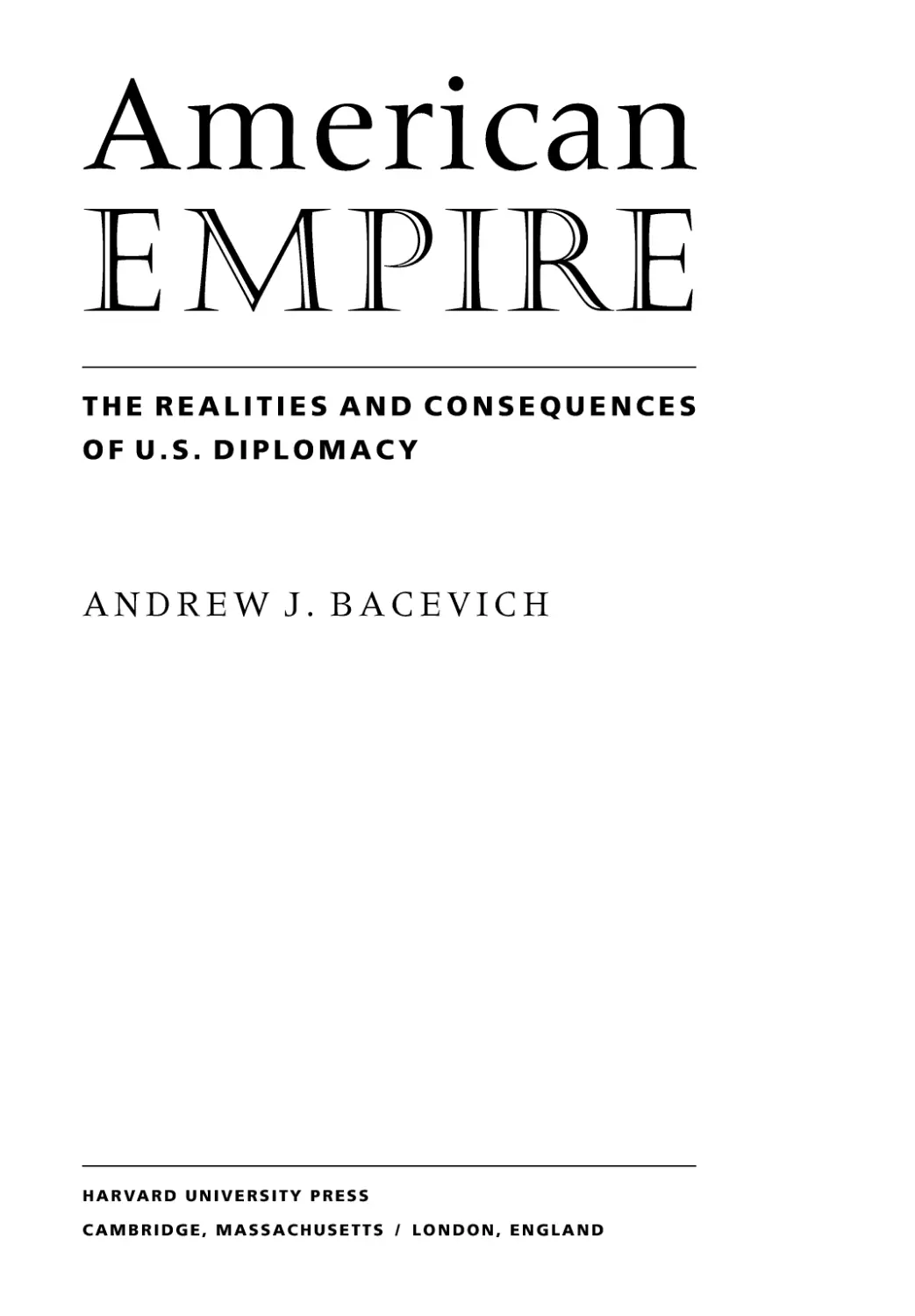
Alllerican
THE REALITIES AND CONSEQUENCES
OF U.S. DIPLOMACY
ANDREW J. BACEVICH
HARVARD UNIVERSITY PRESS
CAMBRIDGE, MASSACHUSETTS I LONDON, ENGLAND
Copyright @ 2002 by the President and Fellows of Harvard College
All rights reserved
Printed in the United States of America
Fifth printing, 2003
Library of Congress Cataloging-in-Publication Data
Bacevich, A. J.
American empire: the realities and consequences of U.S. diplomacy /
Andrew J. Bacevich.
p. cm.
Includes bibliographical references and index.
ISBN 0-674-00940-1 (cloth)
ISBN 0-674-01375-1 (pbk.)
1. United States-Foreign relations. 2. United States-Foreign relations-
Philosophy. 1. Title.
E 183.7 .B284 2002
327.73-dc21
2002068740
CONTENTS
Preface
. .
VII
Introduction 1
1 The Myth of the Reluctant Superpower 7
2 Globalization and Its Conceits 32
3 Policy by Default 55
4 Strategy of Openness 79
5 Full Spectrum Dominance 117
6 Gunboats and Gurkhas 141
7 Rise of the Proconsuls 167
8 DIfferent Drummers, Same Drum 198
9 War for the Imperium 225
Notes 247
Acknowledgments 297
Index 299
To my mother
and
to the memory
of my father
PREFACE
DESPITE THE PASSING of a decade since its end, few Americans
who lived through the Cold War view it as mere history. Especially
for those born in the late 1940s and early 1 950s, reaching maturity
in the 1960s and 1970s, the controversies roiling those decades-
McCarthyism and communist subversion, the nuclear arms race and
the rise of the military-industrial complex, the Cuban missile crisis
and Vietnam, the assassination of one president and the toppling of
another-remain indelibly part of "our times."
Those events not only shaped the consciousness of successive gen-
erations but also divided members of those generations into opposing
camps: right and left, hawks and doves, anticommunists and anti-
anticommunists, the uptight and the hip, the credulous and the skep-
tical. Underlying this split was a fundamental disagreement regarding
the Cold War itself. One group accepted the orthodox interpreta-
tion that U.S. policies were necessary to defend the free world from
communist aggression, actual or potential. The other group saw the
American preoccupation with communism, at home and abroad, as
unhealthy and probably unnecessary.
By upbringing, education, and youthful occupation, I identify with
the former group. As a serving military officer, I accepted the view
that American power provided the essential check upon those who
conspired against freedom. Compared to the comprehensive horrors
perpetrated by the regimes it opposed, the sins attributed to the
United States during the Cold War-Washington's complicity with
unsavory dictators, the conspiracies to overthrow unfriendly regimes,
the mindless invasion at the Bay of Pigs, and the assassination of
South Vietnamese president Ngo Dinh Diem-seemed venial. I never
saw Fidel or Che, Mao or Ho as agents of liberation and human
fulfillment. Nor do I see reason to modify my view on these matters
today.
And yet: in the years after the dismantling of the Berlin Wall-the
event that validated U.S. exertions across the previous half-century-
American statecraft seemingly jumped its traces. Whereas before
viii \ PRE FA C E
1989 U.S. foreign policy appeared in the main realistic, with the
stated objectives of diplomacy quite limited-to protect our home-
land, to preserve our values, to defend our closest allies-in the 1990s
those objectives aimed at nothing short of a full-scale transformation
of the international order. Whereas during the Cold War Americans
had justified the maintenance of a great military establishment as a
necessary (but presumably temporary) departure from the Founders'
republican vision, they now flaunted their nation's status as the
world's only superpower.
I was by no means alone in being troubled by these developments;
others of the conservative and "realist" persuasion expressed dismay
at the policies pursued by the administrations of George H. W. Bush
and Bill Clinton. The explanations fashioned by these critics differed
in their particulars. Yet tacitly at least, they tended to share two as-
sumptions. First, they took for granted that the events of 1989-
when the Soviet Union effectively called off the Cold War-marked a
culmination: at that moment, the United States had fulfilled its strate-
gic purpose. In this reading, the breaching of the Berlin Wall rendered
obsolete the policies that had guided American statesmen for decades.
By extension, the overriding imperative facing the current generation
of statesmen was to devise a new policy, one as coherent in design
and as prudent in conception as the strategy that in achieving success
had outlived its usefulness. The 1990s, therefore, challenged the ar-
chitects of American statecraft to think anew and offered an opportu-
nity for creativity not seen since the immediate aftermath of World
War II.
Second, these observers generally agreed that first Bush and then
Clinton muffed that opportunity. American activity in the interna-
tional arena during the 1990s-as measured by summits convened,
agreements signed, interventions undertaken-was ceaseless, but
critics interpreted that activity as aimless flailing about, as evidence of
a strategic void.
At first glance plausible, this interpretation struck me as increas-
ingly unpersuasive as the events of the decade unfolded. Examining
more closely the clichés to which political leaders reflexively resorted
when explaining foreign policy, I began to see them for what they
were: coded messages deeply rooted in American history and as
such freighted with meaning. When describing America's role in the
PRE FA C E / ix
world, leaders like George H. W. Bush and Bill Clinton believed that
they spoke great truths.
The difficulty lay in extracting from the ritualistic allusions to free-
dom, world peace, and global leadership the hard reality embedded
within. For that I needed a key. Once I found it-and viewed the
events of the 1990s through the interpretive framework that it of-
fered-the conventional notion that American statecraft in the 1990s
amounted to little more than confused and capricious improvisa-
tion collapsed. Linking American words to American actions, the key
revealed a pattern and offered evidence of a coherent grand strat-
egy conceived many decades earlier and now adapted to the circum-
stances of the post-Cold War era.
The strategy is a problematic one, and the scope of the project is
nothing short of stupendous. Related to that project are large pruden-
tial questions (about feasibility and cost) and even larger moral ones
(about justification and consequences) that remain unanswered, in-
deed, all but unexamined. (Pretending that the United States really
doesn't have a strategy offers one way of dodging those questions.)
This book offers a critical interpretation of American statecraft in
the 1990s. It invites readers to reexamine what they "know" regard-
ing the guiding principles and underlying purposes of U.S. foreign
policy-because what they think they know is becoming increasingly
irrelevant. It advances the proposition that the partisan debate over
U.S. policy-for the past decade little more than a pseudodebate-has
reached a dead end. It proposes a reconciliation with a couple of pa-
triot-heretics whose long-discredited ideas anticipated the snares and
pitfalls awaiting a democracy playing the role of sole superpower. To
Americans frightened or bewildered by the events of September 11
and their aftermath, it posits at least one answer to the question
"How did we get here?"
We did not of deliberate choice undertake these new tasks which shall trans-
form us . . . All the world knows the surprising circumstances which thrust
them upon us came. . . as if part of a great preconceived plan. . . The whole
world had already become a single vicinage; each part had become neighbor
to all the rest. No nation could live any longer to itself. . . [It has become] the
duty of the United States to playa part, and a leading part at that, in the
opening and transformation of the East. . . The East is to be opened and
transformed whether we will or no; the standards of the West are to be
imposed upon it; nations and peoples which have stood still the centuries
through. . . [will be] made part of the universal world of commerce and of
ideas. . . It is our peculiar duty. . . to moderate the process in the interests of
liberty. . . This we shall do . . . by giving them, in the spirit of service, a govern-
ment and rule which shall moralize them by being itself moral.
Woodrow Wilson, October 1900
If we have to use force, it is because we are America.
We are the indispensable nation.
Madeleine Albright, February 1998
INTRODUCTION
THI S BOO I( I S a venture in contemporary history, an effort to place
in perspective developments that in some respects are not yet fully re-
solved. Its subject is u.s. foreign policy during the administrations
of George H. W. Bush and Bill Clinton, with a coda encompassing
George W. Bush's first year as president.
During this period, members of the foreign policy elite, breathing
deeply the intoxicating vapors released during the annus mirabilis of
1989, concluded that history stood poised at a turning point. Bill
Clinton interpreted the end of the Cold War as signifying "the fullness
of time" -a scriptural allusion to the moment when God chose to
transform history.l The collapse of communism and the triumph of
liberal democratic capitalism offered similar prospects for transforma-
tion, this time through human rather than divine agency.
As the bloody twentieth century drew to a close, God's promise of
peace on earth remained unfulfilled; it was now incumbent upon the
United States, having ascended to the status of sole superpower, to
complete God's work-or, as members of a largely secularized elite
preferred it, to guide history toward its intended destination.
President Clinton and his secretary of state Madeleine Albright
were explicit on this point: the United States had emerged at the
dawn of the new millennium as the "indispensable nation" endowed
by providence with unique responsibilities and obligations. 2 Republi-
can leaders employed different language but endorsed the sentiment.
Average citizens, though attending only fitfully to the world beyond
America's borders, tacitly agreed. In their eyes, the advantages accru-
ing to the world's only superpower promised to be substantial. The
costs of sustaining that position appeared minimal. Except among a
crabbed minority on the far right and far left, a concept of the United
States shaping a new global order in its own image evoked more satis-
faction than complaint.
Existing alongside this broad acceptance of America's transcendent
mission and transcendent status was a second and paradoxical asser-
1
2 \ AMERICAN EMPIRE
tion: that once the Cold War ended actual u.s. policy languished in
permanent disarray. That the United States found itself after 1989 be-
reft of strategy became part of the next decade's conventional wis-
dom. What passed for policy amounted, it was said, to little more
than improvisation and crisis management. "There is an absence of
any grand design," lamented the diplomatic historian John Lewis
Gaddis. Gaddis and other observers could discern no overarching
conception that explained u.s. behavior. There was no Big Idea. The
only consistent pattern Gaddis could detect was" one of responding to
crises. There's a kind of incrementalism and ad-hocism to things."3
Pundits, talking heads, editorial writers, politicians, and mere inter-
ested citizens without number echoed this view.
As early as April 1992, a Democratic aspirant to the White House, a
southerner with only the flimsiest foreign policy credentials, took
the incumbent president to task for failing "to articulate clear goals
for American foreign policy." Governor Bill Clinton complained that
"George Bush has invoked a new world order without enunciating a
new American purpose."4 Eight years later the partisan tables had
turned, but the critique remained unaltered. During his two terms as
president, Bill Clinton had "pursued a feckless, photo-op foreign pol-
icy," charged John McCain, the influential Republican senator from
Arizona. The Democrats had made "little or no effort to define a co-
herent plan for United States engagement in the world."5 Clinton had
failed to establish an "overarching intellectual framework" for policy,
wrote Richard Haass, who had served in the Bush White House. 6
The result, according to Robert Zoellick, another veteran of the elder
Bush's foreign policy team, had been "ad hockery and case-by-case
actions lacking in strategy."7
In short, according to the conventional wisdom at least, the record
of American statecraft in the 1 990s was one of opportunity wasted.
At the very moment when the United States should have acted with
purpose and resolve, policymakers dawdled and diddled.
This book takes issue with that view. Since the end of the Cold War
the United States has in fact adhered to a well-defined grand strategy.
To be sure, given the exigencies of politics in the real world, that ad-
herence has been less than perfect. From time to time, considerations
unrelated to strategy-the influence of domestic politics prominent
among them-caused the ship of state to tack to port, then to star-
INTRODUCTION / 3
board, and then back again. Yet to interpret this zigzag pattern as
indicative of confusion is to sell short those charged with the ship's
navigation. Those who chart America's course do so with a clearly
defined purpose in mind.
That purpose is to preserve and, where both feasible and conducive
to u.s. interests, to expand an American imperium. Central to this
strategy is a commitment to global openness-removing barriers that
inhibit the movement of goods, capital, ideas, and people. Its ultimate
objective is the creation of an open and integrated international order
based on the principles of democratic capitalism, with the United
States as the ultimate guarantor of order and enforcer of norms.
In the eyes of American policymakers, an open world that adheres
to the principles of free enterprise is a precondition for continued
American prosperity. An open world that is friendly to liberal values
seemingly assures American security. The operative "signs of the
times" -both technological and cultural-fuel expectations that the
world is indeed moving, inexorably and irreversibly, toward greater
openness. Should events belie either of those expectations, the
United States will employ its dominant military power to thwart any
conceivable challenge to its preeminence.
From the perspective of its architects, this "strategy of openness" is
benign in its intent and enlightened in its impact. On this point, the
views of those subjected to the Pax Americana vary. Many accept it,
with greater or lesser degrees of enthusiasm, as preferable to any
plausible alternative. Some accept it grudgingly; for the moment at
least, they have little choice but to do so. Others denounce U.S. hege-
mony as a variant of imperialism, distinctive in form but nonetheless
relying on repression and exploitation. Whether through direct or in-
direct action, they resist. Quelling that resistance mandates the use of
force. As a result, not only the nurturing of military power but also its
expenditure become integral to U.S. strategy.
This book argues that the strategy of openness derives directly
from U.S. principles and practices elaborated and implemented dur-
ing and even before the Cold War. Rather than marking the culmina-
tion of U.S. strategy, the collapse of the Berlin Wall simply inaugu-
rated its latest phase.
In short, this book finds continuity where others see discontinuity
and identifies purpose and structure where others see incoherence.
4 \ AMERICAN EMPIRE
This book also explains why most Americans remain oblivious to
this strategy-why the notion that throughout the 1990s Republicans
and Democrats alike were making things up as they went along re-
ceived ready acceptance, with observers dismissing as mere rhetoric
official explanations of the principles guiding American policy. The
culprit, in this instance, is an abiding preference for averting our eyes
from the unflagging self-interest and large ambitions underlying all
u.s. policy.
Thus, for example, do we enshrine the Cold War as a crusade
against the evil of communism. The Cold War was that, but it was
never only that. To conceive of u.s. grand strategy from the late
1940s through the 1980s as "containment" -with no purpose apart
from resisting the spread of Soviet power-is not wrong, but it is in-
complete. More to the point, such a cramped conception of Cold War
strategy actively impedes our understanding of current u.s. policy.
No strategy worthy of the name is exclusively passive or defensive
in orientation. Evidence that from the outset of the Cold War the
United States sought something more than simply to check the spread
of evil was available all along, recognized by a few, largely ignored by
the majority. Lord Ismay's famous description of the North Atlantic
Treaty Organization's several founding purposes captures the point:
the alliance was formed in 1949 to keep the Russians out, the Ameri-
cans in, and the Germans down. Of course, Ismay's was a British per-
spective; an American might have inserted after the preposition "in"
the phrase "and on top." For the United States viewed NATO not only
as a bulwark against Soviet aggression but as an instrument to pro-
mote Europe's political and economic transformation while cement-
ing the advantageous position that America had secured in Europe as
a result of victory in World War II. A politically integrated Europe
open to American enterprise and dependent upon the United States
for its security suited Washington just fine.
In short, U.S. grand strategy during the Cold War required not only
containing communism but also taking active measures to open up
the world politically, culturally, and, above all, economically-which
is precisely what policymakers said they intended to do. Consider
a speech made at Monticello on July 4, 1947, by President Harry S
Truman. Addressing a crowd gathered around the east portico of
Thomas Jefferson's home, Truman described America's purpose as
world peace, "not peace in our time-but peace for all time." The bal-
INTRODUCTION / 5
ance of his presentation constituted a blueprint for fostering that
peace.
That blueprint contained no reference to containing communism.
Indeed, although his administration was even then putting the fin-
ishing touches on its strategy of containment-Mr. X's essay unveil-
ing "The Sources of Soviet Conduct" had just appeared on the na-
tion,s newsstands-the president never mentioned the Soviet Union
by name. Only twice did he refer even obliquely to the I(remlin, chid-
ing Soviet leaders for opposing U.S.-sponsored reconstruction efforts
on the "fallacious" grounds that "this would mean interference by
some nations in the internal affairs of others."
Looking beyond the essentially negative objective of restraining
communism, the strategy sketched out at Monticello outlined a com-
prehensive vision for constructing a new international order. That vi-
sion had two main features. The first Truman described as the great
lesson of the recently concluded world war, namely, that "nations are
interdependent and that recognition of our dependence upon one an-
other is essential for life, liberty, and the pursuit of happiness of all
mankind." The second was that peace is indivisible. "So long as the
basic rights of men are denied in any substantial portion of the earth,"
the president declared, "men everywhere must live in fear of their
own rights and their own security."
Recognition of the interdependence of nations and the indivisi-
bility of peace demanded the removal of barriers between nations.
Truman called for the "full exchange of knowledge, ideas, and infor-
mation among the peoples of the earth, and maximum freedom in
international travel and communication." He expressed support for
"economic and financial policies to support a world economy rather
than separate nationalistic economies." Crucial to this end were on-
going efforts to reduce tariffs and to create what Truman referred to
as an International Trade Organization.
The responsibility of the United States was to take the lead in re-
moving such barriers. In this effort, technologies in which the United
States enjoyed a pronounced advantage would playa key role, elimi-
nating obstacles that traditionally separated nations. "We have the
mechanical facilities-the radio, television, airplanes-for the crea-
tion of a worldwide culture," a prospect that the president clearly
welcomed. 8
As Truman's Independence Day oratory suggests, from the earliest
6 \ AMERICAN EMPIRE
days of the Cold War the United States entertained a strategic vision
that looked well beyond the imperative of defending the free world
against communist aggression. More was required to fulfill that vision
than the defeat of the Soviet Union and the demise of Marxism-Le-
nlnlsm.
The collapse of communism at the end of the 1980s offered an un-
precedented opportunity to fulfill Truman's vision. In the ensuing
decade the architects of U. S. policy consciously set out to make the
most of that opportunity. Seeking to perpetuate American preemi-
nence and to foster an international order conducive to U.S. interests,
the administrations of George H. W. Bush and Bill Clinton revived the
project that Truman had sketched in July 1947. Whereas the orien-
tation of U.S. policy had been primarily defensive, it now became
largely offensive. This shift in emphasis did not imply that Americans
had developed a sudden hankering for conquest or old-fashioned
empire. In fact the overall objective remained unchanged from Tru-
man's day.
Though garnished with neologistic flourishes intended to convey
a sense of freshness or originality, the politicoeconomic concept to
which the United States adheres today has not changed in a century:
the familiar quest for an "open world," the overriding imperative
of commercial integration, confidence that technology endows the
United States with a privileged position in that order, and the expec-
tation that American military might will preserve order and enforce
the rules.
Those policies reflect a single-minded determination to extend and
perpetuate American political, economic, and cultural hegemony-
usually referred to as "leadership" -on a global scale. The chapters
that follow describe the strategy of openness whereby the United
States since the Cold War has pursued that purpose.
Our point of departure, however, lies earlier, in the writings of two
long-deceased and largely discredited scholars, one now regarded as a
proponent of so-called isolationism, the other as an ardent critic of
U.S. foreign policy from what purported to be the radical left. Each in
his own day got the very biggest question dead wrong. But together
they developed a distinctive angle of vision that exposed the under-
pinnings of American statecraft. That perspective is their legacy, one
that is today more valuable than ever.
CHAPTER 1
THE MYTH OF
THE RELUCTANT
SUPERPOWER
Of course, our whole national history has been one of expansion.
Theodore Roosevelt, December 1899
"SOME NATIONS ACHIEVE GREATNESS," observed the histo-
rian Ernest May; "the United States had greatness thrust upon it."l
Rendered forty years ago at the very acme of the Cold War, May's
judgment referred specifically to the events culminating in the great
outward thrust of 1898 and America's dramatic emergence on the
world stage. Yet it also encapsulates the story of America's rise to
power the way Americans themselves prefer to tell it.
Above all, May's pithy remark directs attention not to purpose but
to posture: greatness was not sought; it just happened. In this view,
American policy is a response to external factors. The United States
does not act in accordance with some predetermined logic; it reacts to
circumstances. Although the events of 1898 accelerated its ascent to
world power, the United States-unlike other nations-achieved pre-
eminence not by consciously seeking it but simply as an unintended
consequence of actions taken either in self -defense or on behalf of
others.
Thus, in 1898 Americans chose war only when the continuing
depredations of Spain's General Valeriano ("Butcher") Weyler in
Cuba had become intolerable. When in 1914 the "Great War" began,
the United States remained neutral, intervening only in response to
Germany's violation of U.S. neutral rights. Even then, in contrast to
every other belligerent, the United States fought for altruistic pur-
poses, seeking to end war itself and to make the world safe for democ-
racy. Similarly, when a new European war began in 1939, Americans
7
8 \ AMERICAN EMPIRE
again stayed on the sidelines until provoked by Japan's surprise at-
tack at Pearl Harbor to enter the conflict and to embark on another
crusade for democracy.
This pattern of evil spurring the United States into action persisted
into the postwar era. Hence American engagement in the Cold War
marked, in Arthur Schlesinger's classic formulation, "the brave and
essential response of free men to Communist aggression."2 Even after
the Cold War, distant events continued to compel the United States to
exert-and perforce to expand-its power. In 1990, Iraqi aggression
threatening the West's access to Persian Gulf oil obliged the United
States once again to respond. As the century drew to a close, events
came full circle: Americans found themselves going to war on behalf
of a tiny province in Serbia, the brutality of Slobodan Milosevié in
I(osovo having become as intolerable as that of General Weyler in
Cuba a century before.
Few scholars specializing in American diplomatic history today ac-
cept such an outline of twentieth century U.S. foreign policy. But in
practice, the myth of the "reluctant superpower"-Americans assert-
ing themselves only under duress and then always for the noblest
purposes-reigns today as the master narrative explaining (and justi-
fying) the nation's exercise of global power.
The myth survives in the post-Cold War era less because it is true
than because it is useful. Its utility stems in large part from the fact
tha t it comes complete with its own cast of stock characters. Its heroes
are "internationalists," wise, responsible, and broad-minded in out-
look. Opposing the internationalist project is a motley crew of nar-
row-minded, provincial, and frequently bigoted cranks, known col-
lectively as "isolationists." For leading politicians and members of the
foreign policy establishment, endlessly recounting the international-
ist struggle offers the preferred method of inoculating successive gen-
erations of citizens ostensibly susceptible to the isolationist virus.
The myth of the reluctant superpower serves other purposes as
well. Aspirants to the inner circle of national politics testify to the nar-
rative as a means of signaling their trustworthiness and reliability.
Here, for example, is a thumbnail sketch of postwar history offered by
presidential hopeful Bill Clinton in December 1 991 :
I was born nearly a half century ago, at the dawn of the Cold War, a
time of great change, enormous opportunity, and uncertain peril. At a
THE MYTH OF THE RELUCTANT SUPERPOWER / 9
time when Americans wanted nothing more than to come home and
resume their lives of peace and quiet, our country had to summon the
will for a new kind of war-containing an expansionist and hostile
Soviet Union which vowed to bury us. We had to find ways to rebuild
the economies of Europe and Asia, encourage a worldwide movement
toward independence, and vindicate our nation's principles in the
world against yet another totalitarian challenge to liberal democracy.
Thanks to the unstinting courage and sacrifice of the American people,
we were able to win that Cold War. 3
In such a rendering of the tale, "we" acted as one; doubts, divisions,
disappointments disappear. By reciting this sanitized version of the
postwar era, Clinton not only affirmed its essential truth but also situ-
ated himself among those who fought the good fight against totalitar-
ianism on behalf of democracy.
The myth of the reluctant superpower also curbs any inclination to
consider anew the purposes served by America's now unquestioned
global dominance. In a post-Cold War world, does the paradigm of
America having "greatness thrust upon it" retain its explanatory
power? If so, with the United States now clearly on the top of the
heap, who or what is doing the thrusting? These questions go un-
asked. Foreign policy" debate," such as it is, confines itself to matters
of tactics: Are the sanctions working? Will bombing alone suffice?
How could we have been surprised? As if by default, the hallowed
precepts of liberal internationalism perdure.
That those precepts imply a conception for marrying instruments
of national power to broad policy objectives serving concrete Ameri-
can interests goes unmentioned and all but unnoticed. Instead politi-
cians, abetted by the media, offer political theater: Republicans berate
a Democratic president for failing to articulate a foreign policy "vi-
sion"; given the chance, Democrats return the favor. Lost amidst the
posturing is the extent to which both parties and virtually the entire
foreign policy elite tacitly share a common vision and conform in
practice to a strategic consensus of long standing.
On two occasions during the century of America's rise to global
preeminence, critics mounted a vigorous challenge to that consensus.
First during the decade leading up to World War II and subsequently
during the protracted crisis centered on the Vietnam War, dissenters
10 \ AMERICAN EMPIRE
subjected the myth of the reluctant superpower to sustained assault.
They began by rejecting the premise that America's foreign policies
were a function of developments beyond its borders. They argued in-
stead that those policies-commercial relationships, decisions for war
and peace, the designation of others as "friends" or "enemies"-
derived from influences closer to home. Underlying those specific de-
cisions and actions and endowing them with an overall unity was a
particular worldview rooted in calculations of political and economic
self - interest.
These dissenters viewed those policies as wrongheaded, undemo-
cratic, unnecessary, even dangerous. They formulated their own al-
ternative to the myth of the reluctant superpower and campaigned
energetically to convert the American people to that alternative.
In each instance, events discredited that alternative, an outcome
for which Americans should be grateful. For the critique mounted in
the 1930s discounted the threat posed by Adolf Hitler. Had it pre-
vailed, Nazi Germany might well have escaped destruction. For their
part, the dissenters who appeared during the Cold War, while acutely
sensitive to America's flaws, were seemingly oblivious to the defects
of communism and to the danger posed by Soviet power. Had they
succeeded, the Cold War might have had a different and less satisfac-
tory outcome.
The failing to which these critics were prone was astigmatism. 4
They were blind to inconvenient facts (usually pertaining to Ameri-
can adversaries) to which others attributed paramount importance.
Meanwhile, they assigned great significance to matters (typically per-
taining to America's own behavior) that others viewed as inconse-
quential or benign. Obsessed with unearthing the inner logic of U.S.
policy, they called attention to a different set of inconvenient facts
that the defenders of liberal internationalism preferred to overlook.
In short, their efforts yielded hitherto undiscovered insights into the
origins, motives, and actual conduct of U.S. foreign policy, insights
that discomfited those dedicated to preserving the mythic rendition of
America's ascent to global power.
Neither the course of World War II nor the outcome of the Cold
War has invalidated those insights. Indeed, as a point of departure for
examining U.S. policy in the post-Cold War era-notable for the ab-
sence of any adversary remotely comparable to Hitler's Reich or Sta-
lin's Soviet Union-views deriving from the premise that external
THE MYTH OF THE RELUCTANT SUPERPOWER / 11
factors have never adequately explained American behavior deserve
respectful consideration.
The chief proponents of these heresies-rejected in their own day,
relevant to our own-were the American historians Charles A. Beard
and William Appleman Williams.
Through the first half of the twentieth century, Charles A. Beard
(1874-1948) was by common agreement the most influential histo-
rian in America. 5 Widely ranging in his interests, boldly original in in-
terpretation, politically progressive, personally courageous, and as-
tonishingly prolific, Beard could wield his pen as "either shillelagh or
stiletto" and was equally adept at writing for academics, policy profes-
sionals, or the general public. 6 From the publication of his controver-
sial Economic Interpretation of the Constitution of the United States before
World War I until his death, he remained a towering figure in Ameri-
can intellectual life, frequently the source and subject of controversy
and seldom outside of the public eye.
Raised in I(nightstown, Indiana, in middle-class comfort, Beard at-
tended a Quaker school and then DePauw University, graduating in
1898. Over the next four years he studied at Oxford, where he was
instrumental in the founding of Ruskin College, a school to provide
educational opportunities for members of the British working class.
In 1902 Beard returned to the United States and enrolled at Columbia
University, earning his doctorate two years later. He immediately ac-
cepted an offer to join Columbia's history department, then among
the country's most distinguished.
Beard taught at Columbia until 1917, resigning in protest against
the firing of a colleague who opposed U.S. entry into the European
war. Retreating to his dairy farm in Connecticut, he remained there-
after an independent scholar and commentator on events of the day. 7
Over the course of his career, Beard published forty-two volumes of
history and political science and coauthored another thirty-five. His
masterful overview of U. S. history, The Rise of American Civilization,
written with his wife, Mary R. Beard, became a bestseller and a Book-
of-the-Month Club selection. His histories alone sold 11.3 million
copies during his lifetime. 8 Beard's articles and reviews-numbering
in the hundreds-appeared in virtually all the leading scholarly and
general-circulation journals of his day.
Yet by the time of his death Beard's reputation stood, in the words
12 \ AM E R I CAN EM PI R E
of another prominent scholar, as "an imposing ruin in the landscape
of American historiography." His views on foreign policy-the subject
that preoccupied Beard beginning in the 1930s-amounted to a "tat-
tered shambles," of interest only to crackpots and conspiracy theo-
rists. 9 Long an outspoken advocate of reform, Beard found himself in
the last decade of his life denounced as an apologist for fascism, in the
words of Lewis Mumford "a passive-no, active-abettor of tyranny,
sadism, and human defilement."lo
If by the end of Beard's life his reputation lay in ruins, it was be-
cause Beard himself put a torch to the edifice. In an extraordinary act
of professional self-immolation, he closed out his career by denounc-
ing as fraudulent the text most crucial to sustaining the myth of the
reluctant superpower: the orthodox account of u.s. entry into World
War I!.
In two scathing volumes-American Foreign Policy in the Making
(1946) and President Roosevelt and the Coming of the War, 1941 (1948)-
Beard accused Franklin Roosevelt of outright deception in his con-
duct of foreign affairs. Running in 1940 for an unprecedented third
term, FDR had famously declared, "I have said this before, but I shall
say it again and again and again: Your boys are not going to be sent
into any foreign wars." In doing so, Roosevelt, in Beard's view, had
made a solemn covenant with the American people.!l Without miss-
ing a beat, the president then proceeded to violate that covenant. In-
deed, according to Beard, even as he was promising to keep the coun-
tryout of the war, Roosevelt was conniving to maneuver the United
States into it.
Historians today admit to a modicum of truth in Beard's charge.!2
Roosevelt's lack of candor, notably in misrepresenting u.s. naval in-
volvement in Great Britain's battle against the U-boat threat, is well
documented. But in the war's immediate aftermath-and with inter-
nationalists rousing Americans to support another great crusade, this
time against communism-Beard's attack was not just impolitic; it
was impermissible. By indicting the recently deceased Roosevelt, he
forfeited whatever authority and credibility he had accrued over sev-
eral decades of research and writing. Refusing to recant the isolation-
ist creed, Beard consigned himself to the status of miscreant, guilty
not only of scholarly malpractice but of having committed an unfor-
givable act of civic blasphemy.
THE MYTH OF THE RELUCTANT SUPERPOWER / 13
Beginning his career in the camp of left-leaning heterodoxy, reach-
ing in midlife the heights of respectability and influence, Beard in his
dotage had seemingly fallen into the embrace of the disreputable
right. However, Beard's intellectual journey proceeded from the cen-
ter out-from the inner workings of the republic at its founding to
America's external relations as it approached maturity. Coming to
maturity himself in the heyday of Progressivism, Beard was stirred by
the social ills afflicting that era, by-products of the laissez-faire atti-
tudes that had with brutal efficiency propelled the United States into
the forefront of industrialized nations. As a result, he initially devoted
his attention to domestic concerns: How had such a society come into
existence? What explained the distribution of wealth and power
within it?
Beard approached his task by examining the past through the lens
of political economy. His first major book, Economic Origins of the Con-
stitution, scandalized patriotic-minded defenders of historical ortho-
doxy by arguing that the Framers had pursued their task less under
the spell of the high ideals of 1 776 than with their eyes trained on the
main chance. 13 Encouraging commerce and manufactures, protecting
private property, establishing financial instruments essential for eco-
nomic development-these were the issues that preoccupied those
participating in the secret deliberations in Philadelphia-issues in
which they themselves had a large personal stake. The product of
their labors preserved that stake. "The Constitution," Beard con-
cluded, "was essentially an economic document based upon the con-
cept that the fundamental rights of property are anterior to govern-
ment and morally beyond the reach of popular majorities."14
Beard's characterization of politics as a bargaining process aimed at
satisfying the disparate interests of economic elites informed much of
his subsequent writing. Thus, the metanarrative of The Rise of Ameri-
can Civilization portrays U. S. history as a dialectic between the agrar-
ian ideal of Thomas Jefferson and the capitalist vision of Alexander
Hamilton. For Beard, the Civil War became the pivotal event in the
history of the republic, resolving that competition and thus opening
the way for the next stage in the nation's development. At root, this
"second American Revolution" was not a dispute over slavery, Union,
or states' rights, but a contest between two irreconcilable economic
systems, each pushing to expand and facing inevitable decline if de-
14 \ AMERICAN EMPIRE
nied the opportunity to do so. On the one side was the burgeoning
"industrial vortex" of the North, on the other a plantation economy
confined to "a limited territory with incompetent labor on soil of
diminishing fertility."15 Appomattox settled the issue once and for
all. Although in destroying slavery the North's victory brought some
modest benefit to those freed from bondage, the real winners were
rapacious captains of industry in the North and, to a lesser extent, the
South. The result was the Gilded Age, a paroxysm of creativity, plun-
der, and excess that gave rise to the nation into which Beard was
born.
Preoccupied until the 1930s with recasting u.S. history in terms of
class conflict, Beard relegated foreign policy to the status of after-
thought. Foreign policy derived from domestic policy. Its primary
purpose was to advance commercial interests. Writing before u.S. en-
try into World War I, Beard acknowledged the American tradition of
"splendid isolation," only to dismiss it as fiction. Whatever its preten-
sions to distancing itself from the rest of the world, he noted, "at no
time has the United States refused to defend American commercial
enterprise in any part of the globe." From the very outset, the United
States had "been a world power, as far as has been necessary."16
American participation in World War I alerted Beard to the hazards
implicit in commercial diplomacy. Although Beard supported U.S. en-
try into the war as necessary to check German militarism, his enlist-
ment in Wilson's internationalist crusade proved short-livedJ7 No
sooner had the guns fallen silent than the debacle of the Paris peace
conference and the release of documents from German and Russian
archives began raising doubts that the war had been, as advertised, a
war of German aggression that threatened the survival of democracy.
In short order, skeptical journalists and historians were advancing ar-
guments that undercut the official interpretation of America's own
role in the war. Specifically, these revisionists challenged the notion
that the United States had remained genuinely neutral during 1914-
1 91 7 and that in entering the war it fought to advance democratic
ideals. IS Discounting Wilson's high -sounding rhetoric, revisionists
characterized U.S. wartime policies as self-serving, reflecting an ea-
gerness to cash in on Europe's misfortune. A phony neutrality per-
mitted a massive trade in arms with the Allies, propped up by Ameri-
can loans. The result at home was large profits for bankers and arms
merchants and a general economic boom, sustainable only so long as
THE MYTH OF THE RELUCTANT SUPERPOWER / 15
the slaughter on the western front continued. By 1 91 7 those policies
culminated in intervention at the behest of Wall Street tycoons who
would face ruin if Great Britain and France lost the war. Once in the
war, Wilson's idealistic posturing notwithstanding, the U. S. govern-
ment turned a blind eye to secret deals and became complicit in Allied
schemes of imperial aggrandizement.
Throughout the 1920s the revisionists piled up evidence and ar-
gued their case. Like many other scholars, Beard eventually found
that case persuasive. With perhaps the majority of Americans, he
concluded by 1930 that u.S. entry into the war had been a mistake
and that Wilson's peddling of the elixir of internationalism had been
tantamount to fraud. This conclusion transformed his thinking about
American statecraft.
Looking back from the 1920s at u.S. foreign policies well before
1914, Beard now discerned the outlines of a more complex and sinis-
ter dynamic. In the decades following the Civil War, he wrote, "as the
domestic market was saturated and capital heaped up for investment,
the pressure for the expansion of the American commercial empire
rose with corresponding speed." 19 Henceforth, sustaining American
prosperity under existing political arrangements would require the
unimpeded growth of trade and investment abroad. Here for Beard
was the master key that unlocked the inner secrets of American state-
craft. It not only explained why the United States had gone to war in
1898 and in 1917, but also revealed more fully the nexus between
politics and diplomacy: American leaders chose intervention abroad
in order to dodge politically difficult decisions at home-decisions
that might call into question the constitutional framework that guar-
anteed the privileges of the propertied classes.
Asked once to describe his own ideal for America, Beard re-
sponded: "It is a workers' republic."20 For Beard and other progres-
sives, World War I had quashed their hopes for creating that repub-
lic-a society more genuinely democratic, more equitable, and more
humane. The onset of the Great Depression barely a decade later only
highlighted the consequences of that earlier failure. But economic
crisis also suggested the possibility of reviving that effort. Thus, when
Franklin Roosevelt, wrapping himself in the mantle of progressivism,
won the presidency in 1932, Beard enthusiastically endorsed FDR's
promise of a New Deal.
Yet wariness tempered that enthusiasm. Disillusionment at Wil-
16 \ AMERICAN EMPIRE
son's hands heightened Beard's concern that Roosevelt might lack the
courage to make good on his bold promises. He feared that, in the
manner of past administrations, FDR might opt for adventurism
abroad to evade the imperative of change at home. That way, in
Beard's view, pointed toward a repetition of the error of imperialism
as in 1898 and, worse, the disaster of all-out war as in 1917. Ominous
developments overseas in the early 1930s-Japan's incursion into
Manchuria and Hitler's coming to power in Germany-suggested that
a president seeking to dodge the need for structural change at home
could easily find a pretext for finding solutions to the country's ills
elsewhere.
Throughout the 1930s Beard devoted his formidable talents to
averting such an eventuality. In a torrent of books, pamphlets, and
articles, he warned against being dragged into problems that were
Asia's or Europe's, but not America's. He labored furiously to alert his
fellow citizens to the folly-and the danger-of reviving Woodrow
Wilson's project. He insisted that if the United States did go to war, it
should at least do so democratically, not as a result of backroom
machinations by a handful of politicians.
In advancing these arguments, Beard was fully alive to current
trends toward interdependence. "Nations are no longer isolated enti-
ties represented by rulers who may make or break official intercourse
at will," he acknowledged in 1930. "Underlying the whole fabric of
modern civilization is a network of physical, economic, social, and
cultural connections. Railways, steamships, telegraphs, cables, and
wireless communications unite homes, offices, industries, and farms
in a universal web."21
Beard had flirted briefly with the notion that this universal web
might spell the obsolescence of war. But the depression convinced
him otherwise. Despite "growing interdependence," he concluded in
1934, "the tendency of nations to engage in armed conflicts has not
disappeared. "22
By 1934 the possibility of renewed war on a large scale, whether in
Asia or Europe or both, was becoming self-evident. Beard's reading
of American history over the preceding half-century convinced him
that, barring a major recasting of its foreign policy, the United States
would almost inevitably find itself drawn into such a war, with dire
consequences. But reorienting U.S. policy was unlikely unless Ameri-
THE MYTH OF THE RELUCTANT SUPERPOWER / 17
cans confronted the underlying assumptions and principles that for
decades had determined u.s. behavior toward the world beyond its
borders. Beard took it upon himself to instruct his fellow citizens ac-
cordingly.
His own interpretation of American statecraft derived from his
belief in two controlling maxims: that foreign and domestic policy
"were parts of the same thing" and that "nations are governed by
their interests as their statesmen conceive these interests. "23 In the
case of the United States-whose chief business, after all, was busi-
ness-economic considerations ranked foremost among the factors
determining how policymakers defined those interests.
Industrialists, bankers, and farmers-and their advocates in Wash-
ington-had long since concluded that the domestic market alone
would not satisfy their own or the nation's requirements. They be-
lieved, wrote Beard, that "American industry, under the regime of
technology, is producing more commodities than the American peo-
ple can use or consume, and the 'surplus' must be exported." The
same applied to capital and the products of American agriculture.
Influential members of these constituencies believed that failure to
secure outlets for these surpluses would have (and in the 1930s was
having) ruinous consequences, not only obliterating individual for-
tunes and causing widespread economic hardship but also threaten-
ing the social order. 24
For these" adepts at the center of things," therefore, the essence of
statecraft was not the once-in-a-generation crisis that obliged a Mc-
I(inley or a Wilson to choose between war and peace. What really
mattered were the long stretches between wars, when the attention
of the press and public lay elsewhere. That was when the adepts, left
alone, addressed the issues that really counted. Reduced to its essen-
tials, U. S. foreign policy was an either/or proposition: "a question of
commercial expansion or stagnation and decay; world power or eco-
nomic decline."25
Viewed in this light, exporting economic surpluses-the "industri-
alist way of escape" -constituted the overriding national interest. It
was not simply a matter of making money-although it included that,
of course-but of preserving long-standing arrangements for allocat-
ing power and privilege within American society. According to Beard,
efforts to protect that interest ran like "a powerful motif through state
18 \ AMERICAN EMPIRE
papers from the inauguration of President McI(inley to the retire-
ment of President Hoover."26 For all the peculiarities in style and
temper distinguishing McI(inley from Theodore Roosevelt, William
Howard Taft from Wilson, or Warren G. Harding from Calvin Coo-
lidge, each of those presidents had adhered to a common strategy.
Though cloaked in professions of America's aversion to old-fashioned
imperialism and its hopes for world peace, the centerpiece of that
strategy was economic expansionism. Implementing that strategy in-
volved "pushing and holding open doors in all parts of the world with
all the engines of government ranging from polite coercion to the use
of arms."27 Only by opening the world to American trade and invest-
ment could the United States flourish and ensure the permanence of
its existing domestic order.
Beard faulted this strategy on five separate counts. First, he ridi-
culed dreams of endless economic expansion as illusory. There simply
was "no way of securing ever-expanding outlets abroad for the ever-
expanding potentials of great technology by any system of foreign ex-
change and trade promotion. "28
Second, the more insistently the United States pressed in its deter-
mination to open the world, Beard believed, the greater the opposi-
tion it was likely to encounter. He cautioned against the American
tendency to see the world as "something mechanical, on a plane sur-
face." Such an oversimplified view led to "the exclusion of the na-
tional cultures-ideas, loyalties, passions, political traditions, the de-
velopment and clash of races and nations" that were the very stuff of
history. The contrary claims of internationalists notwithstanding, the
world was not completely malleable. Others would not obligingly
conform to American preferences. To insist otherwise was to court
perpetual conflict. 29
Third, in provoking resistance, the effort to open doors for Ameri-
can trade and investment abroad also opened the door, Beard feared,
to militarism at home. To overcome that resistance the United States
would find itself increasingly resorting to force. Indeed, the officer
corps stood ready with arguments explaining the need to expand U.S.
military capabilities. But any nation "compelled to devote immense
energies and a large part of its annual wealth production to wars, to
preparation for wars, and to paying for past wars" risked becoming
Sparta, its civil and cultural institutions transformed into "the ser-
vants of military purposes and the military mind. "30
THE MYTH OF THE RELUCTANT SUPERPOWER / 19
Fourth, by Beard's estimate, American political culture and the
composition of American society were ill suited to such an expan-
sionist strategy. Divided ethnically and religiously, celebrating indi-
vidual liberty and self-gratification, and "without the cement of a
long-established monarchy, State Church, or fixed landed aristoc-
racy," Americans lacked the cohesion, the habits of self-abnegation,
and reflexive deference to authority. That is, they possessed few of
the qualities suggesting an aptitude for arduous and protracted cam-
paigns to rearrange the international order. America's inherent vir-
tues were not those of imperial Rome or imperial Britain. 31
Fifth, and above all, Beard insisted that the preoccupation with
opening doors misconstrued the nation's true interests. To be sure,
"the supreme interest of the United States" properly included a com-
mitment to providing all Americans with a decent standard of living.
But the desideratum of economic growth did not trump all other con-
siderations. The nation's true interests required statesmen to pursue
economic objectives in a way "conducive to the promotion of individ-
ual and social virtues within the frame of national security."32 In Beard's
view, the importance of this final point was paramount. To pursue the
nation's material well-being by venturing beyond the frame of na-
tional security-by engaging in frequent interventions abroad or in
wars not involving national survival-was to court overextension,
exhaustion, and collapse. Furthermore, the "frame" of American se-
curity, in Beard's view, was not difficult to identify. Defined by the
two great oceans that set the New World apart, it coincided with the
limits of the Western Hemisphere.
To those who believed that the United States could not prosper
without access to European and Asian markets, Beard pointed to the
underdeveloped condition of America's own vast internal market.
The periodic economic woes besetting the United States stemmed not
from a lack of aggregate wealth, resources, productive capacity, or
population. The problem, he believed, was that an insufficient pro-
portion of that population functioned as effective consumers. But for
that problem, a by-product of an inequitable distribution of wealth,
there existed a simple remedy: redistribution.
Beard generally viewed moral and humanitarian arguments on be-
half of internationalism as mere camouflage. But to those given to the
"theological assertion" that God had anointed "American law, order,
civilization, and flag" to serve as his agents, he replied by calling at-
20 \ AMERICAN EMPIRE
tention to the country's callous neglect of its own poor. America's own
boundaries contained more than enough human tragedy and misfor-
tune to absorb the energies of citizens eager to uplift the downtrod-
den. Citing the plight of several million African Americans, Beard
suggested that "Those who are deeply moved in the virtuous sense
implied by 'the White Man's burden' can. . . find extensive outlets for
their moral urges at home," thus postponing any requirement "for ac-
quiring by force additional congeries of 'brown brothers."'33 To the
extent that the United States did have obligations to the rest of hu-
mankind, it would be more likely to fulfill those obligations by setting
an example than by imposing its values on others.
As an alternative to opening doors abroad, Beard proposed that the
United States "substitute an intensive cultivation of its own garden
for a wasteful, quixotic, and ineffectual extension of interests beyond
the reach of competent military and naval defense."34 Such an under-
taking did not imply severing all connections with the world at large.
However, it would emphasize self-reliance and economic self-suf-
ficiency, thereby maximizing American freedom of action.
In 1935 Beard laid out this argument in The Open Door at Home, his
most comprehensive foreign policy statement to date. But if Beard
hoped to win over government policymakers, he was sadly disap-
pointed. 35 By the end of Roosevelt's first term, Beard realized that the
New Deal was essentially a salvage operation. Once he understood
that FDR was intent on preserving democratic capitalism, Beard con-
cluded that the president was unlikely to break with the open-door
strategy of his predecessors, like them looking abroad for solutions to
America's problems at home. 36
At no time during the decade leading up to World War II did Beard
portray the looming crises in Europe and Asia primarily in moral
terms. In his view, no great power was innocent. No victim was com-
pletely without fault. No disgruntled nation was without some legiti-
mate grievance-usually dusted off whenever it became expedient to
challenge the status quo. Surveying the worsening political situation
in 1936, with Hitler denouncing the Versailles Treaty and reoccu-
pying the Rhineland, Beard refused to see a composition in black-
and-white: "greed, lust and ambition in Europe and Asia do not seem
to be confined to Italy, Germany and Japan," he cautioned; "nor does
good seem to be monopolized by Great Britain, France and Russia."37
THE MYTH OF THE RELUCTANT SUPERPOWER / 21
Ambiguity shrouded the motives and actions of states-including
those of the United States.
In a series of essays published in 1936, Beard warned Americans
against seeing international politics as the handiwork of nefarious in-
dividuals. "War is not the work of a demon," he insisted. "It is our
very own work, for which we prepare, wittingly or not,"-meaning
that statesmen responded to the demands or expectations of the pop-
ulations they governed. 38 Americans possessed the power-if they
would recognize it-to prevent the nation from sliding toward an-
other Armageddon.
By early 1937, with German rearmament well under way and
Spain's civil war fixing the attention of American elites, Beard sensed
that FDR himself was showing signs of becoming "intoxicated by
moral exuberance."39 By summer's end-with Japan now fully en-
gaged in a war to conquer China-he concluded that Roosevelt had
"made it manifest that he still follows the creed that the United States
must do good all around the world. That creed will plunge him into
war," Beard predicted. 40 Roosevelt's call that autumn for an interna-
tional effort to "quarantine" aggressors confirmed those fears.
With mounting urgency, Beard both denied that foreign quarrels
had a moral basis or that involvement in those quarrels would pro-
duce anything but disaster for America. In professing their devotion
to peace, Britain and France sought primarily to guarantee their "pos-
session of all that they have gathered up in the way of empire by
methods not entirely different from those recently employed, let us
say, by Italy in Ethiopia." Beard mocked those calling for "another
preposterous crusade for democracy on the battle- fields of Europe."
To Americans who believed that in failing to stem aggression abroad
the United States was "shirking" its responsibilities, he again invited
attention to problems festering in their own backyard. "[A]nybody
who feels hot with morals and is affected with delicate sensibilities
can find enough to do at home," he wrote on the eve of the Anschluss,
"considering the misery of the 10,000,000 unemployed, the tramps,
the beggars, the sharecroppers, tenants and field hands right here at
our door." How could a nation that had manifestly failed to get its
own house in order "have the effrontery to assume that we can solve
the problems of Asia and Europe, encrusted in the blood-rust of fifty
centuries?"41 "The very essence of statecraft, at home and abroad,"
22 \ AM E R I CAN EM PI R E
Beard warned as Hitler dismembered Czechoslovakia in the spring of
1939, "is a sense for the limitations of power and for the conse-
quences that may flow from the exercise of power. . . As a matter of
cold fact-men, guns, ships, and equipment-the United States can-
not 'whip creation' and police it. "42
Beard had placed himself at the forefront of a grassroots move-
ment opposing U.S. intervention in the war that now loomed on
the immediate horizon. For their efforts, Beard and his allies were
savaged as "isolationists," a caricature that has ever since proven of
incalculable value to proponents of American globalism. But the iso-
lationists gave as good as they got.
Even the Wehrmacht's invasion of Poland in September 1939 did
not shake Beard's conviction that this was not America's war. If any-
thing, the reverse was true. As Roosevelt responded to German mili-
tary successes by edging ever closer to direct American involvement,
Beard continued to insist that flaws within the American system
of political economy, not distant security threats, determined U.S.
policy.
In a last-ditch effort to make the case for restraint and self-
sufficiency, Beard in 1940 reiterated his arguments in A Foreign Policy
for America, emphasizing that "foreign and domestic policies are in-
separable parts of the same thing."43 Reviving Wilsonian arguments
about America's grandiose obligations to the rest of the world, FDR
was taking the United States into the war to compensate for the inad-
equacies of his own New Deal. Thus, when Roosevelt vowed in the
fall of 1 940 that American boys would not be fighting in another for-
eign war, Beard knew-at least to his own satisfaction-that the presi-
dent's promise was a cynical political gesture that he had no intention
of honoring. 44
Thirteen months later-a period that saw the passage of Lend-
Lease, the tightening of sanctions against Tokyo, offers of military
support to China and the Soviet Union, and the launching of an un-
declared naval war in the Atlantic-Japan bombed Pearl Harbor. The
argument about whether or not the United States would avoid in-
volvement in another world war abruptly ended. Brooding and em-
bittered, disregarding his expressed belief that war is not the work of
demons, Beard proceeded to construct his own "devil theory" to ex-
plain American intervention, with Franklin Roosevelt standing in for
THE MYTH OF THE RELUCTANT SUPERPOWER / 23
Satan. After the war, at precisely the moment-the onset of the Cold
War-when the myth of Roosevelt as heroic "soldier of freedom"
stood at its zenith, he charged FDR with dishonesty and deception
and with hijacking the Constitution. Critics rightly lambasted Beard's
two books on u.S. entry into World War II as tendentious and mean-
spirited. On Hitler, Roosevelt had been right, and Beard's 1940 pre-
scription for u.S. foreign policy would have been a disaster.
Yet six decades later, with the United States now a globe-straddling
colossus-but with peace nowhere to be seen-it becomes apparent
that although he had missed one large truth, Beard had hit upon oth-
ers. Resurrecting those other truths provides an essential point of de-
parture for understanding American statecraft today.
Like Beard, William Appleman Williams (1921-1990) was a mid-
westerner; but there any similarity in upbringing ends. 45 Williams
was born and raised in Atlantic, a small town in rural Iowa. After his
father was killed when the boy was eight, his mother left him tempo-
rarily in her parents' care, enrolled in college, earned a degree, and
eventually returned home to reclaim care of her only child and to
work as a schoolteacher. Williams later portrayed his mother as an
exemplar of self-reliance and strong-willed individualism and his
hometown as the embodiment of "community."46 After high school,
Williams spent a year at I(emper Military Academy on a basketball
scholarship and won an appointment to the u.S. Naval Academy.
Commissioned in 1944, Williams served until the war's end in the
Pacific.
In 1947 Williams left the Navy to study history at the University of
Wisconsin, an institution famous, among other things, for its "notori-
ous loyalty" to the teachings of Charles Beard. 47 An assignment in
Corpus Christi, Texas, just after the war, exposing him to racial segre-
gation and the embryonic civil rights movement, had begun his polit-
ical awakening. In short order, the heady progressivism of Madison
completed his transformation into a self-described radical.
At Wisconsin, Williams earned a doctorate in U.S. diplomatic his-
tory. His first book, American-Russian Relations, 1781-1947, published
in 1952, implicitly questioned orthodox views of the Cold War's ori-
gins, much as Beard had questioned the conventional wisdom about
American entry into World War II. After a series of short teaching ap-
24 \ AM E R I CAN E M PI R E
pointments elsewhere, Williams returned to Wisconsin in 1957 and
quickly established himself in the front rank of American historians.
Politically, he was also among the most controversial. Williams be-
came the founding father and abiding inspiration of the "Wisconsin
School" of revisionist history that examined the underside of u.S. for-
eign policy and found there an American variant of imperialism. With
events in Cuba and then Vietnam lending added salience to his views,
he gained access to noted journals of opinion such as Commentary, The
Nation, and the New York Review of Books. On campus, he was a wildly
popular teacher. During this period he published his two most influ-
ential works, The Tragedy of American Diplomacy (1959) and The Con-
tours of American History (1 961).
Though an avowed man of the left, by the mid-1960s Williams
found himself increasingly out of sympathy with the political views of
the Vietnam-era student radicals, among whom he had achieved the
status of icon. He considered the antics of the counterculture to be
childish and self-indulgent. He found the sexual revolution to be re-
pugnant. In 1968, exhausted and with his personal life careening out
of control, he fled Madison for the Pacific coast, where he remained
until his death. Although he continued to write, he had little to offer
except self-parody. Aside from a one-year term as president of the
Organization of American Historians in 1980, his final years were
largely reclusive.
In his writings, Williams freely acknowledged his debt to Beard at a
time when Beard's professional reputation was hitting rock bottom.
Insights taken from Beard-that foreign policy "is intimately con-
nected with domestic affairs," that "empires are not built in fits of
absent-mindedness," and that expansion "complicates and deepens"
rather than resolves problems-provided the foundation of his own
critique of u.S. history.48
Williams endorsed Beard's view that expansionism was integral to
the American story. Rather than tracing the expansionist impulse to
the rival visions of Jefferson and Hamilton, however, Williams saw it
as an expression of a struggle for America's very soul. The crucial
question was not whether American society would be predominantly
rural or urban, or whether citizens would earn their livelihood as
virtuous agrarians or as merchants, craftsmen, and factory workers.
Rather, the central question was whether Americans would descend
THE MYTH OF THE RELUCTANT SUPERPOWER / 25
into shallow, grasping materialism or keep faith with the intentions of
the Founders to create a "Christian commonwealth."49 As Williams
saw it, Americans faced a choice. They could either give themselves
over to the pursuit of hedonistic and ultimately dehumanizing indi-
vidualism, or they could accept "the demands and the self-discipline
of living with other human beings in a truly responsible, humane
fashion."50 An expanding frontier and an expanding economy de-
ferred the day of reckoning. Thus, the weltanschauung guiding
American politics was a simple one: "problems are solved by growth
or further expansion." As a result, according to Williams, a "charming
but ruthless faith in infinite progress fueled by endless growth" be-
came central to the American way of life. But the closing of the fron-
tier by the 1890s and the onset of severe economic crisis in the same
decade obliged Americans to look farther afield. Henceforth, expan-
sion abroad "provided the sine qua non of domestic prosperity and so-
cial peace." 51
But the United States pursued expansion abroad in a way that re-
flected particular American interests and values. After a brief, unsatis-
factory experiment with old-fashioned empire in the wake of the
Spanish-American War, American leaders abandoned efforts to as-
semble an array of distant possessions as the preferred means of sus-
taining economic growth. Given the costs of pacification, administra-
tion, and defense, colonies offered a poor return on the dollar. In
addition, the nation's own revolutionary heritage and its traditional
anti-imperial sympathies were at odds with the notion of U.S. sol-
diers subduing alien populations. The challenge confronting Ameri-
can leaders was to formulate policies that provided the benefits of
empire without its burdens. In that regard, what mattered was not
ownership or even administrative control but commercial access.
To secure that access, American leaders devised a supple and
highly innovative strategy that Williams dubbed "Open Door imperi-
alism." The famous Open Door Notes issued by Secretary of State
John Hay in 1899 and 1900 both inaugurated this shift in strategy
and provided its definitive expression. The Open Door Notes declared
America's interest in preserving China's territorial integrity and in
claiming for the United States the same privileges enjoyed in China
by the European powers and Japan. Nominally, Hay's diplomatic ini-
tiative amounted to a brief on behalf of fairness. Williams saw it as
26 \ AMERICAN EMPIRE
much more. Underlying Hay's appeal to permit U.s. access to China's
market were expectations that, given half a chance, Americans would
reap more than their fair share of the benefits. An ostensibly level
playing field actually tilted in favor of American enterprise. 52 In short,
the policy of the open door was" a classic strategy of non -colonial im-
perial expansion." Moreover, the policy devised for China applied
equally well to other regions of the world. Hence, concluded Wil-
liams, for decades to follow "the history of the Open Door Notes be-
came the history of American foreign relations. "53
In Williams' view, the architects of the open -door policy did not
foist it on the masses. They had no need to: Americans embraced the
policy as their own, because it encompassed aspirations that extended
well beyond the economic realm. Bundled into the concept of open-
ness were several other values. A world open to American enterprise
and influence was a world conducive not only to economic opportu-
nity but also to political liberty. In the eyes of most Americans, ac-
cording to Williams, the two were linked inextricably. "Expanding
the marketplace enlarged the area of freedom. Expanding the area of
freedom enlarged the marketplace."54 Openness became a precondi-
tion of freedom and democracy. It implied stability and security. (Re-
sistance to openness evidenced untrustworthiness if not outright an-
tagonism. )
America's own commitment to openness testified to its own be-
nign intentions-and therefore justified American exertions on be-
half of an open world. Openness was not simply a cover for exploi-
tation. "Most imperialists believed that an American empire would
be humanitarian, and most humanitarians believed that doing good
would be good for business."55
The dogma of openness became a component of American ideol-
ogy, the principle upon which the world should be organized, the ba-
sis for a broad national consensus on foreign policy, and a rationale
for mustering and employing American power. In essence, wrote Wil-
liams, the open -door policy legitimated "the endless expansion of the
American frontier in the name of self-determination, progress, and
peace. "56
Williams laid the template of the open door upon the major events
of the twentieth century and pronounced the fit to be precise. In do-
ing so he turned the myth of the reluctant superpower on its head. In
taking the United States into World War I, Woodrow Wilson had re-
THE MYTH OF THE RELUCTANT SUPERPOWER / 27
vealed "the Imperialism of Idealism," a crusade to graft American val-
ues onto the entire world and to thwart all others-such as Lenin-
who fancied themselves engaged in an analogous undertaking. The
isolationism reputed to characterize American diplomacy during the
interwar period was, according to Williams, little more than "legend."
World War II-commonly viewed as a conflict thrust upon the United
States and fought against aggression-became, in Williams' view, "the
War for the American Frontier." But it was in interpreting the war's
aftermath in light of the open door that Williams showed himself at
his most audacious.
The war's end, wrote Williams, left Americans "casually confident
that their earlier visions of Manifest Destiny were materializing as the
reality of the present." Viewing the atomic bomb as a "self-starting
magic lamp," they looked forward to the arrival of "their long-sought
City on the Hill in the form of a de facto American Century embracing
the globe." The officials who directed U.S. foreign policy took it for
granted that "such benevolent Americanization of the world would
bring peace and plenty without the moral embarrassment and admin-
istrative distractions of old-fashioned empires."57
Josef Stalin, however, entertained aspirations of his own. Refusing
to open the devastated Soviet nation to the outside world, suspi-
cious of Western eagerness to rebuild Germany, and determined to
establish a protective buffer of compliant satellites, the Soviet dictator
marked himself in the eyes of American policymakers as not only su-
premely ungrateful but also dangerous. His acquisition of the atomic
bomb in 1 949 confirmed his hostile intentions. Soviet military power
now posed a threat without precedent. When other political move-
ments, armed insurgents, and revolutionaries in Europe, Asia, and
even the Western Hemisphere proclaimed fealty to socialism and
looked to the I(remlin for support, officials in Washington concluded
that the United States was facing a global conspiracy.
Williams rejected the orthodox view that fastened blame for start-
ing the Cold War squarely on Moscow. Soviet behavior, he believed,
could plausibly be explained as defensive in nature. It was the United
States more than the Soviet Union that was bent on exploiting victory
in 1945 to expand its influence, an effort consistent with America's
long-term strategy of shaping a world order receptive to its own val-
ues and conducive to its own prosperity.
This version of the Cold War's origins all but ignored the character
28 \ AMERICAN EMPIRE
of the Soviet regime. The abuse of human rights, denial of freedom,
and absence of democracy in the communist world did not figure
prominently in Williams' narrative. Purges, mass starvation, the
wholesale displacement of populations, and the system of prison
camps that Aleksandr Solzhenitsyn labeled the Gulag Archipelago
likewise received short shrift. Though careful not to defend commu-
nism as such, Williams could find no useful moral distinction be-
tween one side of the Iron Curtain and the other. "There is, and al-
ways has been," he observed in 1962, "good and evil in the United
States, in the Soviet Union, in Nigeria, in Cuba, and on down the
list."58
Williams' iconoclasm and polemical style were tailor-made for the
1960s. Discovering that the age of Eisenhower had been an era of
repressive conformity, the products of Middle America who filled
his classroom and the readers who devoured his books delighted in
the zest with which Williams skewered sacred cows. Ostentatiously
contrarian, he presented Abraham Lincoln not as the Great Emanci-
pator martyred for the nation's sins but as the dark prince of cap-
italism. At a time when most Americans held Herbert Hoover person-
ally responsible for the Great Depression, Williams celebrated the
thirty-first president as a courageous visionary.59 Favorable allusions
to I(arl Marx and Fidel Castro conveyed a frisson of bravura and inso-
lence.
The decade's unfolding events-with the body count from assassi-
nation climbing, domestic turmoil on the rise, and Vietnam becoming
the war without apparent end-transformed Williams, in the eyes of
his admirers, from gadfly to seer. His critique seemed not only pro-
vocative but true; open-door imperialism made sense of develop-
ments that otherwise seemed senseless. Above all, Williams' insis-
tence that America's never-ending quest for new frontiers invited the
ultimate disaster-lithe frontier was now the rim of hell, and the in-
ferno was radioactive" -lent urgency to the efforts of those promot-
ing radical change. 60
Beard's attempt to legitimize a revisionist perspective on the ori-
gins of World War II had destroyed his reputation. In contrast, Wil-
liams' challenge to Cold War orthodoxy became both fashionable and
immensely influential. The Wisconsin school did for all of U.S. diplo-
matic history what the revisionists of the interwar period had done
THE MYTH OF THE RELUCTANT SUPERPOWER / 29
for American entry into World War 1. The new revisionists threatened
the internationalist consensus undergirding postwar u.s. policy, and
with it popular support for the ongoing crusade against communism.
That prospect outraged and dismayed defenders of orthodoxy, both
inside and outside the academy, among them the historian Arthur
Schlesinger Jr., who was determined to "blow the whistle before the
current outburst of revisionism regarding the origins of the cold war
goes much further."61 As in Beard's day, politics and scholarship had
become inextricable.
What alternative did Williams offer to a strategy of continuous ex-
pansionism? With the rest of the world "clearly moving toward" a
"true human community based far more on social property than
upon private property," he wanted the United States to hop onto the
bandwagon. The only real challenge left to Americans was "to create
the first democratic socialism in the world."62 But for all his apparent
radicalism, the specific remedy he offered reflected a deep-seated
conservatism-and was even more improbable than Beard's plea for
Americans to tend their own garden while Nazi Germany was over-
running most of Europe.
For Williams, democratic socialism was indistinguishable from At-
lantic, Iowa, in the 1930s. Above all, socialism meant community.
Williams yearned to recover the remembered-or idealized-life of a
small boy growing up in the American heartland, watched over by
hardworking plain folk, who were neither corrupted by great wealth
nor afflicted with extreme poverty. To revive that world, he believed,
required an experiment in radical decentralization. 63 The radical his-
torian's alternative to empire was to dismantle the Union of fifty
states, "breaking the Leviathan into community-sized elements."64
Williams' advocacy of national dismemberment generated no dis-
cernible interest. By the end of the 1970s, his own growing disillu-
sionment with the left had displaced nostalgia. 65 Apart from its oppo-
sition to the Vietnam War, the New Left had failed to develop a
coherent program and had sunk into irrelevance.
In the last years of Williams' life, his grim warnings of Armageddon
sounded increasingly preposterous. 66 The Cold War did reach a de-
nouement, but it did so quietly. The Soviet empire rather than the
American-led free world cracked up, and the United States reached a
new apogee of power and self-confidence. By the time of his death,
30 \ AMERICAN EMPIRE
although Williams still commanded a following in faculty lounges,
most Americans probably credited Ronald Reagan with possessing a
surer-or at least more accurate-instinct for history.
Yet if the quiet passing of the Cold War demolished Williams' credi-
bility as prophet and polemicist, it also made it easier to assess his
scholarly legacy with dispassion. As with the master, so, too, with the
disciple: lodged within the ruin of the enterprise Williams inspired
lies much to inform our understanding of the present.
When Williams insisted in 1 971 that "The issue is the nature and
dynamic of the American empire, not the validity of Lenin's thesis,"
he was wrong. 67 If in 1971 Lenin's thesis did not qualify as the only is-
sue, it certainly ranked as a very important one. Three decades later,
with events having resoundingly exposed communism's failings, "the
nature and dynamic" of American power has indeed become the
question.
From Williams' efforts to understand American power, four note-
worthy points survive. The first is that during the twentieth century
the United States came to playa role that cannot be understood ex-
cept as a variant of empire. That notion, employed in the midst of the
Cold War more as an epithet than as an explanation, became by the
1990s almost a statement of the obvious. In the aftermath of the Cold
War, references to an American empire or to American hegemony,
which formerly came with barbs attached, were no longer fighting
words. Though still avoided by government officials, such terms in-
filtrated the lexicon of everyday discourse about U.S. foreign policy.
As even Schlesinger, Williams' particular nemesis, conceded, "who
can doubt that there is an American empire?-an 'informal' empire,
not colonial in polity, but still richly equipped with imperial para-
phernalia: troops, ships, planes, bases, proconsuls, local collaborators,
all spread around the luckless planet. "68
A second element of Williams' legacy was to render untenable
claims that this informal empire "just grew like Topsy," coming into
existence as an accident of nature or an unintended consequence of
events beyond American contro1. 69 Williams showed that the Ameri-
can empire emerged out of a particular worldview and reflected a co-
herent strategy to which the American people gave their support.
Third, Williams identified key elements of that American strategy.
Building on insights first developed by Beard, he unearthed the as-
THE MYTH OF THE RELUCTANT SUPERPOWER / 31
sumptions underlying the doctrine of liberal internationalism, ex-
plained its logic, identified its purposes, and divined its implications.
He showed that the essential aim of liberal internationalism was to
open the world to American enterprise. He revealed the conviction,
widely shared among successive generations of American statesmen,
that only an open world could permit the American system of politi-
cal economy to function effectively while also assuring u.s. national
security.
Finally, Williams understood that in practice, the only sure way to
guarantee openness was through the exercise of dominant power.
Openness adapted the logic of empire to suit the needs of democratic
capitalism.
Whereas Beard first identified the underlying logic of American
expansionism, Williams went a step further, urging Americans to
contemplate the implications of their imperium. "Assume empire is
necessary," he wrote; "what is the optimum size of the empire; and
what are the proper-meaning moral as well as pragmatic-means of
structuring, controlling, and defending the empire so that it will in
practice produce welfare and democracy for the largest number of the
imperial population? "70
As the United States embarked upon a new century, those ques-
tions returned to the fore.
CHAPTER 2
GLOBALIZATION
AND ITS CONCEITS
[H]ow near one to the other is every part of the world. Modern inventions
have brought into close relation widely separated peoples and made them
better acquainted. . . distances have been effaced. . . The world's products
are being exchanged as never before. . . Isolation is no longer possible or de-
sirable.
William McKinley, September 1901
WHEN PRESIDENT BILL CLINTON, speaking in the presence
of President Jiang Zemin at a 1 997 White House press conference,
chastised the Chinese government for being on the "wrong side of
history," he treated his listeners to a quintessentially American mo-
ment.! Standing at the epicenter of American power and authority,
the president surveyed the vast panorama of the past and rendered
judgment. In doing so, he was exercising a prerogative unique to this
nation at this time.
Set aside the fact that the politician offering this sweeping pro-
nouncement embodied a generation whose historical horizon barely
extended to Chuck Berry and black-and-white television. Overlook
the fact that few such presidential declarations are spontaneous, that
Clinton's rebuke-ostensibly on behalf of democracy and human
rights-was quite likely a calculated attempt to deflect criticism for
wining and dining a bona fide despot in the White House. What-
ever the messenger's motives, Mr. Clinton's utterance captured-and
seemed to validate-the grand political postulate of the age.
The president's point, of course, was not simply that Jiang and his
misguided collaborators were fighting a battle that they were destined
to lose. Rather, it was that the United States had planted itself
squarely on the right side of the historical divide. Indeed, as Clinton
32
GLOBALIZATION AND ITS CONCEITS / 33
later explained with all the certainty and fervor of an old Marxist-
Leninist ideologue, America itself had come to define "the right side
of history."2 It had blazed the trail that others followed. Progressive,
forward-looking, divining the spirit of the age, America epitomized
the destination toward which all humanity is inevitably traveling.
For proof, one need look no further than the outcome of the twen-
tieth century's epic political struggles. In the end, war, revolution,
insurgency, and international conspiracies pursued with totalitarian
ruthlessness never really came close to displacing the American sys-
tem, with its blend of individual freedom, popular government, and
market economics. Rivals who once advanced counterclaims to hav-
ing unlocked the secrets of history all fell by the wayside, their pre-
tensions exposed as empty. Having vanquished all challengers, the
juggernaut of liberalism rolled triumphantly on. No real alternative
to that system existed: that, indeed, was Clinton's message to Jiang
Zemin-and is contemporary America's message to the world.
The mission of the United States at the beginning of the new mil-
lennium was to coax others into acknowledging the direction in
which historical forces pointed, to commend nations moving in con-
cert with those forces, to chide those slow to get with the program. As
Clinton told reporters a year later, explaining the rationale for his
own trip to China, "one of the things I have to do is . . . to create for
them a new and different historical reality." Reshaping China's view
of the past would enable the government in Beijing to "feel more
confident in doing what I believe is the morally right thing to do."3
As Americans, Secretary of State Madeleine Albright once re-
marked, "we have our own duty to be authors of history."4 But this
confidence that the United States at the dawn of a new millennium
possessed the capacity not simply to discern but to direct history was
not unique to President Clinton and members of his administration.
Democrats and Republicans may cross swords about the feasibility of
ballistic missile defense. They may differ on the wisdom of interven-
ing in ethnic conflicts and may disagree about the danger posed by
global warming. But these amount to little more than quibbles over
operational details. When it comes to fundamentals undergirding
U. S. foreign policy, consensus reigns on all but the extreme left and
right. That consensus is so deep-seated that its terms have become all
but self-evident, its premises asserted rather than demonstrated.
34 \ AM E R I CAN E M PI R E
In 1999, for example, Condoleezza Rice, a Republican national se-
curity specialist, echoed President Clinton's judgment about Amer-
ica's role, employing precisely the same rhetorical formulation. The
collapse of the Soviet Union and triumph of capitalism, in her view,
demonstrated incontrovertibly that the United States had deciphered
history's intent. Outlining the foreign policy challenges of the twenty-
first century, Rice suggested that the essential question was whether
or not the United States was" going to accept responsibility for being
on the right side of history." If the nation failed to do so, missed op-
portunities would result and new threats to U.S. security emerge. In
that event, she predicted that Americans two or three decades hence
would be asking "why we were on the right side of history, and did
not take care of this." 5
In an essay published early in the run-up to the 2000 presidential
campaign, Rice offered a purportedly Republican perspective on the
post-Cold War world. "Dramatic changes in information technology
and the growth of 'knowledge-based' industries [have] altered the
very basis of economic dynamism," she wrote, "accelerating already
noticeable trends in economic interaction that often circumvented
and ignored state boundaries." The United States had "emerged as
both the principal benefactor of these simultaneous revolutions and
their beneficiary." She detected "powerful secular trends" that were
"moving the world toward economic openness and-more un-
evenly-democracy and individual liberty. Some states have one foot
on the train and one foot off." Yet this much was clear: "the United
States and its allies are on the right side of history."6
The assumptions, the reasoning, the expectations all could have
come from any Democratic or, for that matter, almost any of the os-
tensibly nonpartisan pundits, scholars, and analysts who make up the
foreign policy establishment. Rice's "dramatic changes" referred to
the information revolution. The accelerating economic interaction
she cited was a reference to globalization. That the United States was
principal instigator and leading beneficiary of these twin phenomena
and that together they heralded a more open world had become the
conventional wisdom of the 1990s. In an essay intended to explain
how Republicans and Democrats differed on foreign policy, Rice dem-
onstrated how much they had in common.
The information revolution and globalization did not constitute
GLOBALIZATION AND ITS CONCEITS / 35
the substance of the foreign policy consensus, which predated by sev-
eral decades the invention of the personal computer and the Internet.
But together they enabled the keepers of that consensus to adapt it to
an era in which the traditional rationale for American globalism-the
existence of an overriding threat to the nation's very existence-no
longer pertained. In the aftermath of the Cold War, the clichés of the
information age imparted a gloss of novelty to what was in fact a
time-honored approach to policy.
Lending those clichés added weight was the widely accepted view
that the events of 1989 marked a sharp break in world history. For
decades, the Soviet-American competition had dominated and de-
fined international politics. The resolution of that competition was
said to have changed everything. "With the collapse of the Soviet
Union, a new era in world history began."7 When a centrist like Sena-
tor Richard Lugar, a stalwart Indiana Republican, expresses such sen-
timents, we know that they have become uncontroversial.
By implication, endgame in the Cold War signified the fulfillment
of the strategy devised by Harry Truman, George Marshall, and Dean
Acheson and refined by their successors. Containment had achieved
its purpose and, having done so, had become obsolete. For special-
ists in international relations, 1989 became "Year Zero." When Mad-
eleine Albright dismissed works of scholarship written prior to that
year-"They are about as useful now as archeology; they are ancient
history"-she endorsed this notion. 8 Such a perspective suited Al-
bright's claim of participating in the Clinton administration's ostensi-
bly grand reconceptualization of American foreign policy. 9
But it did more than that: sealing the Cold War in amber struck
preemptively against potential revisionism. For policymakers, the
postwar decades retained utility chiefly as a vehicle for reminding
Americans that statesmanship required boldness, courage, and perse-
verance-and deference to those in positions of authority. To inter-
pret the Cold War as anything other than a heroic struggle on behalf
of liberty-for example, to view it through the optic of U. S. policies
since 1989-could jeopardize that freedom. Depicting 1989 as an un-
bridgeable divide-with a new era on one side and "ancient history"
on the other-minimized that danger.
Yet the new era was not new simply because the Soviet threat
36 \ AMERICAN EMPIRE
had vanished. The defining characteristics of the era just begun were
daunting complexity and profound change proceeding at a dizzying
pace. By the 1990s it turned out that, at least by comparison, the Cold
War had been a period of remarkable clarity and predictability.
"It was easy when we could simply point to the Soviet Union and
say that what we had to do was to contain Soviet expansion," Secre-
tary of State Warren Christopher reflected early in President Clinton's
first term. IO Clinton himself reportedly expressed nostalgia for the
Cold War's comparative simplicity. General Henry Shelton, chairman
of the Joint Chiefs of Staff during Clinton's second term, concurred.
Reminiscing about the Cold War, he recalled: "Life was simpler back
then. We lived in a black-and-white world. We knew who the good
guys were and who the bad guys were. 'Us' and 'them' were easy
concepts. "11
Not so during the era following the Cold War. Surveying the world
from the vantage of the 1990s, Christopher's successor, Madeleine
Albright, remarked, "what we have out there is basically a much
more complicated world." In that new world, Albright continued,
"protecting our territory is a more complex issue than before. Pro-
tecting our citizens is more complicated. . . And then our way of life.
Our way of life is extremely complicated and depends on a global
economy, depends on not having drugs, depends on not having more
refugees than this country can handle, disease coming in." As a result
of such concerns, statecraft had become "a much more complex issue
than it was at the beginning of the century."12
This complexity stemmed in part from the tempo of events, which
by common assent was quickening. "The pulse of the planet has ac-
celerated dramatically and with it the pace of change in human
events."13 Anthony Lake, national security adviser in Clinton's first
term, spoke those words in 1993. But the conviction that change was
occurring more rapidly was not peculiar to Democrats or liberals or
members of a particular administration. It was one of those things
that observers of world affairs simply knew to be true.
By common assent, the leading agent of change was the informa-
tion revolution. According to Secretary of Defense William Cohen, a
Republican serving a Democratic president, "a worldwide transition
from military industrial economies reliant upon government capital
to information-based economies reliant on intellectual capital" had
GLOBALIZATION AND ITS CONCEITS / 37
commenced. "It's a trend, of course, that's now transforming virtually
every aspect of our life the world over."14 The "of course" was Cohen's
way of acknowledging that he was merely expressing views self-evi-
dent to anyone claiming to be in the know.
As a result of the information revolution, distance had collapsed.
According to President Clinton, "the world is growing smaller and
smaller." Distance was losing its traditional significance. In the infor-
mation age, remarked Madeleine Albright, "the idea of an ocean as
protection is as obsolete as a castle moat." Everything was connected
and everything was near at hand. "Technology is actually miniaturiz-
ing the globe," said Secretary Cohen. "I like to say that the globe is not
much bigger than that ball that is spinning on the finger of science. If
you think about it, the vast oceans have been reduced to ponds."
Lands across the sea "are now almost as close as neighboring coun-
tries today. And it only takes a nanosecond for someone's voice or im-
age to be transported to another country, so nothing is done in isola-
tion today. "15
The capacity to transmit and receive information in nanoseconds
fostered the process of integration called globalization. But more than
mere information was moving. Technological innovation and political
principles, tastes and fashions all rode the electronic rails of the infor-
mation age. More and more people were crossing borders in pursuit
of opportunity, education, and pleasure (or mischief). The volume of
goods being exchanged internationally continued to swell, as did the
transnational flow of capital. As a result, declared Samuel R. Berger,
Lake's successor as national security adviser, "we have experienced
the emergence of a global economy and a cultural and intellectual
global village."16 As depicted by its proponents, globalization was not
an emerging reality. It had become reality.
With its connotations of technological triumphalism, unprece-
dented affluence, and the implacable advance of democratic cap-
italism, globalization supplanted "Power to the People" as the pre-
ferred maxim of the baby boomers who set the agenda of American
society. As depicted by its many boosters in and out of government,
globalization was a force of nature, transforming politics and eco-
nomics alike. No one made the point more succinctly than Thomas L.
Friedman, foreign affairs columnist of the New York Times. "Globaliza-
tion," he wrote, "is not just a trend, not just a phenomenon, not just
38 \ AMERICAN EMPIRE
an economic fad. It is the international system that has replaced the
cold-war system."17
Friedman's views received a ringing endorsement from the Oval
Office. Globalization, Bill Clinton declared, was "the central reality of
our time," a revolution "that is tearing down barriers and building
new networks among nations and among individuals."Is The imagery
of globalization and information technology demolishing barriers was
one to which White House speechwriters during the Clinton era re-
turned time and again. Describing globalization on another occasion,
President Clinton waxed eloquent about the "worldwide changes in
how people work, live, and relate to each other," characterizing them
as "the fastest, and perhaps, the most profound in history." As a result
of those changes, "The blocks, the barriers, the borders that defined
the world for our parents and grandparents are giving way, with the
help of a new generation of extraordinary technology. Every day mil-
lions of people use laptops, modems, CD ROMS and satellites to send
ideas, products, and money all across the planet in seconds."19
The post-Cold War era thus acquired a distinctive identity: it was
the Age of Globalization. For any nation or group to imagine that it
could impede or deflect this transformation was the height of folly.
According to Berger, "you can't stop globalization and you can't stop
global integration." Or, more emphatically still: "we cannot turn back
the tides of globalization any more than I(ing I(nute [sic] could turn
back the tides."20 Emphasizing that "the train of globalization cannot
be reversed," President Clinton went on to explain the implications of
what he called globalization's "inexorable logic": henceforth "every-
thing, from the strength of our economy to the safety of our cities, to
the health of our people, depends on events not only within our bor-
ders, but half a world away."21 Again, the idea was not unique to a
particular administration or party. Brent Scowcroft, the elder Presi-
dent Bush's national security adviser, agreed: "America has never
been more dependent on the outside world for its well-being and that
dependency is steadily growing."22
As such remarks suggest, American enthusiasm for globalization
stemmed in part from the conviction in Washington that removing
blocks, barriers, and borders served urgent American interests. "You
know, we're going to do very, very well, as the world becomes more
interdependent," President Clinton assured a student audience at the
end of his second term. 23
GLOBALIZATION AND ITS CONCEITS / 39
But if globalization, in the first instance, was an economic phe-
nomenon, it was not only that. Its political, social, and cultural impli-
cations were no less profound. Though in an immediate sense about
profit, globalization ultimately was about power. On the surface it
promised a new economic order that would benefit all. Beneath the
surface it implied a reconfiguring of the international political order
as well. Globalization established the rules for the latest heat in the
long-standing contest to decide which nation-and whose values-
would predominate. 24 Writing in 1995, Speaker of the House Newt
Gingrich depicted the stakes in precisely this way. If Americans seized
the opportunity offered by globalization, they would bequeath to
their children "a country unmatched in wealth, power, and opportu-
nity." If they squandered that opportunity, they would "at best have a
lower standard of living and at worst find that another country has
moved into the new era so decisively that it can dominate us. "25
Given the zero-sum basis of that competition, u.S. officials were
understandably chary about discussing it too openly. But they did
concede that globalization had a political dimension. According to
President Clinton, "Globalization is empowering people with infor-
mation, everywhere." The inevitable result was political liberaliza-
tion: "The more people know, the more opinions they're going to
have; the more democracy spreads. "26 "In the new century," Clinton
suggested, "liberty will spread by cell phone and cable modem." This
connection between the information revolution, globalization, and
political liberalization figured frequently in discussions of China,
widely viewed as the most likely challenger to American preemi-
nence. Why were China's party leaders reluctant to conform to "the
right side of history"? President Clinton offered a ready answer:
"They realize that if they open China's market to global competition,
they risk unleashing forces beyond their control," including a "greater
demand for freedom."27 But the new technology had doomed Bei-
jing's old guard. If the fall of the Berlin Wall had not marked the of-
ficial "end of history," then the creation of the Internet certainly had,
at least in the estimate of enthusiasts. As Thomas Friedman gushed,
"Globalization means the spread of free- market capitalism to virtually
every country in the world. "28
American policymakers were likewise reticent about discussing
another facet of globalization: their confidence that the United States
"owned" it. A central feature of the new era is that "I(nowledge, more
40 \ AM E R I CAN E M PI R E
than ever before, is power," wrote Joseph S. Nye and William A.
Owens, former high-ranking Pentagon officials. "The one country
that can best lead the information revolution will be more powerful
than any other. For the foreseeable future, that country is the United
States."29 On that score, reasoned Samuel Berger, the United States
was the nation "best placed to benefit from globalization. "30
But the meaning of "power" in the age of globalization was becom-
ing increasingly diffuse. Nearly twenty years ago, Theodore Levitt, an
early prophet of globalization, wrote that the emergence of a global
market foretold "a general drift toward the homogenization of the
world." According to Levitt, "nothing confirms this as much as the
success of McDonald's from the Champs Elysées to the Ginza, of
Coca-Cola in Bahrain and Pepsi-Cola in Moscow, and of rock music,
Greek salad, Hollywood movies, Revlon cosmetics, Sony televisions,
and Levi's jeans everywhere." "Different cultural preferences, na-
tional tastes and standards, and business institutions," Levitt con-
cluded, "are vestiges of the past. "31
In practice, as Levitt's list of brand names suggests, homogeniza-
tion meant Americanization. As Friedman observed, "Globalization-
is- U.S."32 In a sense, the wonders of the digital age offered to the
1990s what the atomic bomb seemingly provided to the late 1940s:
the technological means of ordering the world while fostering the
spread of American values and assuring continuing U.S. preemi-
nence.
To proponents of globalization, it was evident that the United
States created the technology, provided the medium of exchange-in
a global economy, American dollars and American English reign su-
preme-and prescribed the lifestyle to which the universal consumer
aspired. The "global theme park" that Benjamin R. Barber labeled
McWorld took its cues from American pop culture and showcased the
latest handiwork of Hollywood, Madison Avenue, and Silicon Valley.
According to Bill Gates, chairman of Microsoft, U.S.-based companies
held positions of leadership "in almost every technology that will be
a part of building the broadband infrastructure: microprocessors, soft-
ware, entertainment, personal computers, set-top boxes, and net-
work-switching equipment." When President Clinton announced
that "We clearly have it within our means. . . to lift billions and bil-
GLOBALIZATION AND ITS CONCEITS / 41
lions of people around the world into the global middle class," the
barely disguised subtext was one that most Americans find reassur-
ing: globalization meant that "they" would become more and more
like "us. "33
As Clinton's remark suggests, globalization promised the creation
of wealth on a scale hitherto unimaginable. Tapping this potential for
a continuously expanding economic pie-benefiting all nations, but
the United States most of all-became for American officials an abid-
ing preoccupation. As Clinton phrased it, "we must never lose sight of
what the fundamental problem is-we need. . . more growth in this
world today." 34
This preoccupation with growth-never absent from U.S. foreign
policy, and by the 1990s even more explicit-meant that political
economy took its place alongside (and in some respects supplanted)
security as the paramount national interest. Traditional distinctions
between the nation's physical security and its economic well-being
were among the barriers that globalization swept aside. According to
the emerging conventional wisdom, in the post-Cold War era "na-
tional economic interests should not be considered 'secondary' or
subordinated to traditional security interests." "Broadly construed,"
national security henceforth included "both economic and geo-
political concerns."35
Even before Bill Clinton's inauguration in January 1993 and prior
to his own confirmation as secretary of state, Warren Christopher was
telling the Senate Foreign Relations Committee that among the three
pillars of the new administration's approach to foreign policy, eco-
nomic growth ranked first. 36 Clinton's creation of a National Eco-
nomic Council (NEC) as a counterpart to the National Security Coun-
cil at the outset of his first term testified to this reordering of
priorities. According to Robert Rubin, who chaired the NEC before
becoming treasury secretary, "the big change" introduced by Clinton's
approach was that "the economic component of any problem gets on
the table at the same time as other issues." In practice, the economic
component meant expanding trade, gaining access for capital, and
protecting property rights. As Mickey I(antor, chief trade negotiator
during the first Clinton administration, proclaimed, "Trade and inter-
national economics have joined the foreign-policy table." I(antor de-
42 \ AM E R I CAN E M PI R E
scribed Clinton as "the first president to really make trade the bridge
between foreign and domestic policy. "37
In terms of historical accuracy, I(antor's claim of a Clinton adminis-
tration "first" was bogus. Economic and commercial considerations
had loomed large in American statecraft since the colonial era. 38 But
as an indication of how policymakers viewed foreign policy after the
Cold War his remark was revealing and important.
As depicted by those policymakers, a world transformed by the
forces of globalization would allow little room for power politics and
coercion. In a globalized world, concepts such as spheres of influence
and balance of power-always viewed by most Americans as sus-
pect-would lose their validity. War itself would face obsolescence.
Instead, a web of efficient and well-regulated networks would bind
nations together in a common pursuit of prosperity. Trade and invest-
ment would flourish, to the benefit of all. Economic development, in
turn, would foster liberal ideals and a thirst for freedom. Popular
government would spread, and, as Albright stated, "we know that
democracy is a parent to peace." Democracies behaved themselves.
They were, wrote Deputy Secretary of State Strobe Talbott, "demon-
strably more likely to maintain their international commitments, less
likely to engage in terrorism or wreak environmental damage, and
less likely to make war on each other."39 Peace-loving democracies, in
turn, were ideally suited to collaborate in pursuit of sustained eco-
nomic growth. The ultimate promise of globalization was of peace,
prosperity, and democracy, all reinforcing one another in a self - per-
petua ting cycle.
This vision of a globalized world was replete with irony. On the one
hand, those charged with responsibility for u.S. foreign policy por-
trayed a world in flux. The world that they depicted was experienc-
ing changes unprecedented in speed and scope. The world in which
they themselves had come to adulthood-defining wealth in terms of
heavy industry, dependent on fossil fuels, preoccupied with power
politics, and drenched in blood-was fast disappearing. A radically
different order was emerging, indeed, was already at hand. That new
order promised to be immensely complex, stemming in part from the
fact that rapid, technology-driven change had now become a defining
feature of life.
On the other hand, members of the foreign policy elite and high-
G LOB All Z AT ION AND ITS CON eEl T S / 43
ranking u.s. officials expressed confidence that they had divined the
inner dynamic of this new order. They had discerned the means to
tame it, to guide it, and to make it work for Americans and all others.
On that score, they professed to have no doubts. They offered no ca-
veats or qualifications. In this increasingly complex world, the for-
mula for utopia turned out to be surprisingly straightforward. Thus,
for example, Secretary Cohen identified just "two axioms" that the
United States needed to impress on others. The first was that" democ-
racy means stability." The second-and here Cohen cited a recent
book that "reminded us that democracies do not fight one another"-
was that "stability grounded in democracy is a precondition for en-
during success in the global economy."40 Q.E.D.
Thus, globalization presented the United States with a combina-
tion of imperative and opportunity. Framing-and in some respects
complicating-the American response to this phenomenon were the
"Three Nos" of contemporary U.S. foreign policy.
Belief in the uniqueness of the American experiment is deeply em-
bedded in the nation's psyche. The United States is not only different.
It possesses special responsibilities. "We Americans are the peculiar
chosen people-the Israel of our time," wrote Herman Melville in
1850. "We bear the ark of the liberties of the world."41 A century and
a half later, this insistence that the United States, a great power unlike
any other, retains a special mission to the world survived undimin-
ished.
The three nos-no to power politics, to war, and to limits-sus-
tained the myth of American exceptionalism into the post-Cold War
era. At the same time, they imbued public discourse related to Amer-
ica's role in the world and U.S. policies abroad with an element of
surrealism. Certain obvious truths remained unuttered. Other dubi-
ous propositions got repeated endlessly and went unchallenged.
The first of the three nos-to power politics-might also be known
as the Wolfowitz Indiscretion. During the administration of George
H. W. Bush, Paul Wolfowitz, a highly regarded national security spe-
cialist, served as undersecretary of defense for policy, the third-rank-
ing civilian official in the Department of Defense. Among his other
duties, Wolfowitz was responsible for coordinating the annual review
of the Defense Planning Guidance (DPG), one of the documents
44 \ AMERICAN EMPIRE
forming the basis of the Pentagon's system of planning, program-
ming, and budgeting. In "normal" times, interest in the DPG did not
extend much beyond the Pentagon. Changes from one year to the
next tended to be incremental. Although it might redistribute service
budget shares ever so slightly or determine the fate of some contro-
versial new weapon system, the latest DPG could be counted on to
leave overall strategy largely intact.
Wolfowitz understood that the early 1990s were not normal times.
The Cold War had ended, and the apparent success of Operation
Desert Storm had elevated American power and prestige to unparal-
leled heights. Believing the moment ripe for a full-fledged overhaul
of national security strategy, Wolfowitz seized the opportunity. As he
saw it, the annual review of the DPG, usually a matter of intramural
concern, offered an ideal means of prodding not just the military but
the entire national security establishment into reassessing American
strategy.
For Wolfowitz, rethinking strategy required a frank acknowledg-
ment of actually existing power relationships combined with an un-
sentimental appraisal of long-term u.S. interests. The draft DPG pre-
pared under his supervision offered both. The central reality of the
new era was American preeminence. At the moment, plausible chal-
lenges to that preeminence did not exist. The paramount interest of
the United States was to perpetuate that situation.
Accordingly, the document that Wolfowitz drafted in the wake of
the Persian Gulf War called for U.S. strategy to focus henceforth on
"convincing potential competitors that they need not aspire to a
greater role or pursue a more aggressive posture to protect their legiti-
mate interests." Properly conceived, American policies would "suf-
ficiently account for the interests of the advanced industrial nations
to discourage them from challenging our leadership or seeking to
overturn the established political and economic order." Beyond such
efforts to co-opt the willing, however, it was also incumbent upon the
United States to "maintain the mechanisms for deterring potential
competitors from even aspiring to a larger regional or global role."42
Though couched in measured language-"mechanisms" was a eu-
phemism for superior military power, for example-the draft DPG
was in effect a blueprint for permanent American global hegemony.
Which was precisely the problem. Wolfowitz's DPG abandoned
GLOBALIZATION AND ITS CONCEITS / 45
any pretence of reluctance about being a superpower. Worse, it im-
plied a radical departure from the conception of international politics
embedded in Woodrow Wilson's Fourteen Points, Franklin Roose-
velt's Four Freedoms, or John F. I(ennedy's unconditional promise
"to assure the survival and success of liberty." That was the language
of American statecraft. The draft DPG's candor-with the interaction
of power and interests eclipsing universal ideals as the grammar of
statecraft-had a decidedly alien ring. That such an approach might
have found favor in nineteenth-century Paris or Berlin was per-
haps to be expected, but it would not in twentieth-century Washing-
ton, D.C.
Predictably, in March 1992 Wolfowitz's draft, then circulating for
comment within the executive branch, leaked to the press. Once pub-
lic, it encountered furious criticism, fueled in part by the fact that it
was an election year. Critics professed shock that u.s. officials would
conceive of America's role in such terms. Though more colorful than
most, the comments of Senator Alan Cranston captured the essential
point. The Democrat from California derided the Bush administration
for proposing to make the United States "the one, the only main
honcho on the world block, the global Big Enchilada."43 Such a goal
was arrogant, foolhardy, and, most of all, un-American.
Embarrassed, the Bush administration quickly disowned Wolfo-
witz's handiwork, depicting it as the musings of an insignificant
lower-tier appointee acting without official sanction. When an ap-
proved Defense Planning Guidance did eventually emerge, it had
been purged of all offending references suggesting big enchilada-like
aspirations. The resulting document, published in the very month
that Bush left office, contented itself with vague references to pre-
serving the "strategic depth won at such great pains" during the Cold
War but emphasizing the U.S. preference for acting in concert with its
allies. 44
Wolfowitz had been indiscreet. He had openly suggested that cal-
culations of power and self-interest rather than altruism and high
ideals provided the proper basis for framing strategy. For his candor,
Wolfowitz himself was roundly denounced. But an important lesson
had been learned. No other responsible official in the Bush adminis-
tration-or in the successive administrations of Bill Clinton and the
younger Bush-repeated his mistake. The calculus of power that is
46 \ AM E R I CAN E M PI R E
inherent in the very nature of politics did not disappear, but it re-
mained hidden from public view. In the new unipolar moment, the
function of foreign policy discourse was not to inform Americans or
to promote a serious dialogue about the implications of global preem-
inence. Rather, its purpose was to reassure the public that the promo-
tion of peace, democracy, and human rights and the punishment of
evil-doers-not the pursuit of self-interest-defined the essence of
American diplomacy. To the extent that interests figured at all, policy-
makers typically insisted that American interests and American ideals
were congruent. Opening markets abroad might serve u.s. economic
interests-but the real aim was to promote liberalization and democ-
racy. Military intervention in the Balkans might be necessary to sus-
tain American claims to leadership in Europe-but it was advancing
the cause of human rights that really explained u.s. actions.
The second of the three nos-the no to war-found expression in
Albright's Rule. A prominent player in American diplomacy through-
out most of the 1990s, first as u.s. ambassador to the United Nations
and then as secretary of state, Madeleine Albright may in the end be
best remembered for her vigorous advocacy of the expansive use of
American military power.
If the American-led success in the Persian Gulf War of 1990-91
made u.s. military superiority manifest to all, it also left the impres-
sion that the United States would, as a matter of course, use its mili-
tary power selectively and with restraint. Certainly, that was the clear
preference of the military itself, led by a generation of officers whose
views on the appropriate use of force stemmed directly from their
searing Vietnam experiences twenty or more years earlier. Foremost
among those officers was General Colin Powell, the telegenic, politi-
cally savvy, and immensely influential officer who from 1989 to 1993
served as chairman of the Joint Chiefs of Staff. Powell believed pas-
sionately in the Weinberger Doctrine-criteria governing the use of
force enunciated by Secretary of Defense Caspar Weinberger in
1984. 45
The purpose of the Weinberger Doctrine was not to facilitate but to
inhibit. It established a set of demanding preconditions for commit-
ting u.S. forces abroad. Intervention should occur only when vital
national interests were at stake. When the United States did inter-
vene, it should do so "wholeheartedly, and with the clear intention of
GLOBALIZATION AND ITS CONCEITS / 47
winning." Clearly defined political and military objectives should
guide any campaign. No administration should order u.s. troops into
harm's way without "some reasonable assurance" of popular and
congressional support. Last but not least, the United States should
never use force except as a last resort. 46
In effect, Weinberger codified the military's own lessons of Viet-
nam. As the Defense Department's senior civilian official, he fixed his
personal seal of approval to a set of propositions that his soldiers
viewed as immutable truths. Indeed, the purpose of the Weinberger
Doctrine was less to promote the efficacious employment of Ameri-
can power than to preclude any possible repetition of the disaster that
had befallen the military in Southeast Asia.
Several years later, when the Bush administration responded to
Saddam Hussein's invasion of I(uwait by dispatching U.S. troops to
the Arabian Peninsula, key officials went out of their way to show
that there would be no repetition of the errors that had led to disaster
in Vietnam. There would be no micromanagement, no political med-
dling, no half-measures, and no quagmire. 47 In that sense, the Gulf
crisis of 1990-91 became a test case for the Weinberger Doctrine. Se-
nior civilians, beginning with President Bush, and senior military of-
ficers, led by Powell, made a concerted effort to portray Desert Shield
and Desert Storm as military campaigns designed and conducted with
Weinberger's admonitions in mind.
That the war ended in military victory, cheaply and quickly won,
seemingly validated Weinberger's approach. As principal steward of
that approach and chief military architect of victory, Powell himself
acquired enormous additional standing with the public and the press,
so much so that in the media the Weinberger Doctrine was promptly
eclipsed by a nearly identical Powell Doctrine. That Powell's own fre-
quently expressed convictions-above all a belief in overwhelming
force employed decisively on behalf of vital interests-would hence-
forth constitute "the American way of war" seemed all but self-evi-
dent. Indeed, the Bush administration's subsequent reluctance to in-
tervene in the horrific civil war in Bosnia testified to the authority of
the Powell Doctrine and of Powell himself.
Madeleine Albright would have none of that. At the outset of the
Clinton administration, she chided Powell for his reluctance to em-
ploy American military prowess to sort out the problems besetting
48 \ AM E R I CAN E M PI R E
various hot spots in the Balkans, the Horn of Africa, and the Carib-
bean. "What's the point of having this superb military that you're al-
ways talking about," she wanted to know, "if we can't use it?"48
Such a seemingly cavalier willingness to put G.L's in harm's way
infuriated Powell. But the view that Albright expressed was not
merely her own. As others have noted, the end of the Cold War and
victory in the Gulf triggered a remarkable ornithological reversal in
which old hawks became dovish and doves of impeccable pedigree
suddenly evinced fiercely hawkish inclinations. 49 Albright exempli-
fied this transformation: in the heady aftermath of Operation Desert
Storm there was abroad in the land a growing inclination to employ
American military power as a swift sword to set things right.
But eagerness to "use" the military did not imply eagerness for
war. On the contrary, in professing their devotion to peace, Albright
and her colleagues in the Clinton administration were no less sincere
than their Cold War-era predecessors. Yet in seeking to establish the
basis for that peace, the temptation to capitalize on America's strong
suit-military striking power-became well-nigh irresistible.
For Albright, an appetite for coercion was not to be confused with
being bellicose or with courting full-scale armed conflict. Attempting
(without success) to drum up popular support for punishing Iraq dur-
ing one of the periodic u.S. showdowns with Saddam Hussein, she
made the point explicitly. Critics who worried that then-pending air
attacks might plunge the United States into a messy, protracted strug-
gle just didn't get it. "We're talking about using military force, but we
are not talking about a war," Albright snapped during a presentation
to university students in February 1998. "I think that is an important
distinction." Throughout the sundry military enterprises of the 1990s
-some as modest as single salvo of cruise missiles, others as exten-
sive as bombing campaigns lasting weeks or even months-American
officials clung resolutely to this distinction. The cause of peace and
justice might from time to time impel the United States to use force;
but peace-loving Americans did not make war on others: that was
Albright's Rule.
Indeed, Albright's distinction between force and war became cen-
tral to U.S. foreign policy in the age of globalization. War typically in-
volves suffering, bloodshed, loss on a large scale. Waging war implies
national sacrifice. War gives birth to unintended and unforeseen con-
GLOBALIZATION AND ITS CONCEITS / 49
sequences. The horrific record of the preceding century suggested
that war by its very nature was uncontrollable. Time and again,
statesmen presuming to bend war to their own designs-most nota-
bly in 1914 and 1939, but also in 1965-instead cast their own nation
and others into the abyss.
Force, as conceived by Albright's Rule, obviated such concerns.
Henceforth, military power was not to be unleashed; it was doled out
in precisely measured increments. The use of force against carefully
selected targets-preferably inanimate objects-precluded the pros-
pect of slaughter. By capitalizing upon advanced technology to de-
liver ordnance from afar, targeting opponents presumed to have little
or no capacity to retaliate, the United States minimized the risk to its
own forces. Expending American military power for limited and care-
fully (indeed, often publicly) delineated purposes while avoiding the
prospect of anything resembling" combat" all but eliminated uncer-
tain ty.
Colin Powell retired from active military service before the end of
1993. In short order, the Clinton administration also eased into retire-
ment the doctrine associated with the general's name. Albright's Rule
prevailed and spurred innovative thinking about the proper relation-
ship between diplomacy and military power. Powell's own successors
found such thinking increasingly congenial to the Pentagon's inter-
ests. Shedding old inhibitions, Americans became more comfortable
with the use of force. Hardly noted, U. S. foreign policy became in-
creasingly militarized.
The last of the three nos-the no to limits-might also be known as
Tarnoff's Taboo, in honor of Peter Tarnoff, who served Clinton as
undersecretary of state for political affairs. In the spring of 1993, with
the Clinton administration still getting its footing in foreign affairs,
Tarnoff hosted a handful of reporters for breakfast at the State Depart-
ment. The purpose of the event was to provide selected journalists
with an appreciation of the new administration's evolving approach
to foreign policy. Tarnoff intended that his remarks be not for attribu-
tion. To his considerable chagrin, and the administration's embarrass-
ment, they became front-page news.
The newspaper reports that appeared-citing the remarks of an
unnamed senior official-conveyed the impression that the George
McGovern wing of the Democratic party circa 1972 had seized control
50 \ AMERICAN EMPIRE
of the State Department. The official-soon revealed to be Tarnoff-
seemingly made a point of lowering expectations that u.S. diplomacy
was likely to accomplish very much. "We simply don't have the lever-
age, we don't have the influence, we don't have the inclination to use
military force, we certainly don't have the money to bring to bear the
kind of pressure which will produce positive results anytime soon."50
To dismayed critics, such sentiments suggested timidity and faint-
heartedness.
Like Wolfowitz just a year earlier, Tarnoff seemed to cast doubt on
America's claims to uniqueness. Wolfowitz had erred in basing his
Defense Planning Guidance on the premise that when it came to for-
eign policy the United States, like any other nation, should take con-
siderations of power and interest into prime account. Tarnoff made a
similar error by implying that in assessing what it could realistically
accomplish in the world the United States, like any other nation,
needed to recognize the very real limits of its capabilities. Like
Wolfowitz, Tarnoff had committed heresy and found himself roundly
chastised as a result.
As quickly as the Bush White House had abandoned its undersec-
retary of defense for policy, the Clinton White House disowned its
undersecretary of state for political affairs. Tarnoff's boss, Secretary
of State Warren Christopher, took immediate action to correct the
unfortunate impression left by his subordinate's remarks. Within
twenty-four hours, he used the occasion of a previously scheduled
speech to make the point that the foreign policy ambitions of the
Clinton administration were anything but puny. In describing Amer-
ica's role, Christopher employed variants of the terms lead and leader-
ship no less than twenty times. 51
The controversy that Tarnoff unwittingly stirred up soon blew
over. Yet, as had Wolfowitz, he taught an important lesson. America's
claim to global leadership was sacrosanct. Never again would any
high-ranking official express doubts on that score. Henceforth,
Tarnoff's Taboo remained inviolate.
Indeed, apart from Tarnoff's egregious misstep, in their apprecia-
tion of America's proper role in the world, Democrats and Republi-
cans spoke with impressive unanimity: there existed no substitute for
U.S. leadership. The one thing that could derail the prospects for cre-
GLOBALIZATION AND ITS CONCEITS / 51
ating peace and prosperity in the age of globalization would be for the
American people to succumb to the temptations of isolationism, as
they were reputedly wont to do.
According to Brent Scowcroft, who had served two Republican
presidents as national security adviser, American leadership remained
"the indispensable ingredient in fashioning a stable world order." No
other nation, combination of nations, or international institution
could do the job. They were all too inept, too weak, or too parochial.
"Whether we like it or not," Scowcroft observed, "the u.s. alone can
provide that leadership." For Americans to fail in their obligation to
lead, in Scowcroft's view, was to court disaster. "Left to its own de-
vices, history will sooner or later serve up another nasty surprise."
Jack I(emp, Republican vice-presidential candidate in 1996, agreed.
"Quite simply, America must lead," he remarked. Newt Gingrich
went even further. "Unless we accept our role as world leader, our
planet will eventually be a dark and bloody place," predicted the
speaker of the U.s. House of Representatives. "No other nation is in a
position to assume our mantle." President George H. W. Bush's view,
expressed in the concluding paragraph of his foreign policy memoir,
was that "If the United States does not lead, there will be no leader-
ship." 52
The opinions expressed by Scowcroft, I(emp, Gingrich, and the el-
der President Bush not only commanded support throughout their
own party. They also corresponded with the Democratic conviction
that "the United States has an absolutely inescapable obligation to
lead."53 Thus, according to Strobe Talbott, "If we do not provide inter-
national leadership, then there is no other country that can or will
step in and lead in our place as a constructive, positive influence."
Addressing an audience of cadets at West Point, Vice President Al
Gore seconded that motion: "America's destiny is to lead, not retreat,"
he said. "We will not be daunted. We will not be deterred" until
the "great worldwide march to democracy" reaches its goal. Cribbing
a phrase favored by Madeleine Albright, Bill Clinton declared
definitively that" America remains the indispensable nation."54
Others not only want the United States to lead; they are counting
on it. As Gingrich wrote, "No country has ever had the potential to
lead the entire human race the way America does today. No country
has ever had as many people of as many different backgrounds call on
52 \ AMERICAN EMPIRE
it as we do today. No country has ever had as many neighbors who
suspect, distrust, and, in some cases, hate one another call on it to
help achieve peace and help transform conflict into community. No
country has ever had as many former dictatorships call on it for ad-
vice about how to create free government, free markets, and a mili-
tary that can operate within the rule of law and under civilian con-
trol."55
The nations of the world feared one thing only: that the American
people might flinch from fulfilling their obligations and turn their
backs on the world. According to I(emp, "if the people of the world
could vote by secret ballot, they would rej ect the idea of giving their
own representatives power at the expense of the United States. They
are seriously looking up to us . . . for guidance in how to make the
coming century one of harmony and prosperity. . . Mankind did not
struggle over all these millennia to see America-the nation of na-
tions-finally get to the top, only to find it pulling the ladder up and
resolving to keep the rest of the world in its place, underfoot and out-
side our borders." As the last, best hope of mankind, the United States
"cannot afford to let the future take care of itself. "56
What precisely does "leadership" entail? As employed in contem-
porary discourse about U.S. foreign policy, this most important term
came to be freighted with multiple meanings. Leadership imposed ob-
ligations, and it bestowed prerogatives. As the world's sole remaining
superpower, the United States shouldered the former and enjoyed
the latter. America was not simply one sovereign nation among
many. Leadership connotes relationships based on deference and re-
spect. It confers authority. It justifies the acquisition of immense
power. Wielded by others, that power might appear threatening, but
in the leader's hands it is by definition benign. The leader does not ex-
ploit or dominate but acts on behalf of purposes that look beyond
mere self-interest. "Much of our energy at the State Department," ex-
plained Madeleine Albright, "is spent encouraging foreign govern-
ments to act for what we perceive to be the common good."57 Leader-
ship suggests an ability to rally others in a worthy cause. But the
leader may-at times, must-act unilaterally when consensus proves
elusive. Leadership implies influence-the ability to affect events
without the necessity of actually expending power. But absent regu-
lar reminders of the leader's willingness and capacity to act, influence
GLOBALIZATION AND ITS CONCEITS / 53
becomes a wasting asset. So reputation and credibility matter. As a re-
sult, leadership is never passive. Nor do the matters within its pur-
view have fixed limits; indeed, they are infinitely expansible. "Ameri-
can leadership is not divisible," Samuel R. Berger avers. 58 If the
United States fails to lead here, then its capacity to lead there-and
eventually everywhere-may be called into question. The credibility
of American leadership ranks among the greatest of the nation's as-
sets and must continually be reaffirmed.
Ultimately, leadership requires vision and power. At the dawn of
the Cold War, in perhaps the most famous essay on U.S. foreign pol-
icy ever written, the diplomat George I(ennan expressed gratitude to
providence for granting to Americans "the responsibilities of moral
and political leadership that history plainly intended them to bear."59
When I(ennan wrote those words in 1947, the awesome power of the
atomic bomb, possessed by the United States alone, seemed to offer
proof positive that providence had singled out America to usher his-
tory toward its preordained destination.
Far sooner than many analysts expected, the United States lost its
nuclear monopoly. Similarly, from time to time in the decades that
followed events challenged I(ennan's confident assertion regarding
history's intentions. But in the 1990s, with the Cold War safely won
and American power greater than ever, I(ennan's successors in the
foreign policy establishment embraced his conviction with a ven-
geance. Indeed, they asserted claims going beyond I(ennan's own.
The providential gift of leadership, they contended, endowed the
United States with a unique capacity to decipher history and an ines-
capable responsibility to bring it to fruition.
Supporting that conviction was a belief that the international envi-
ronment offered a moment of unprecedented opportunity. The tran-
sition from the Cold War to the age of globalization had created an
environment peculiarly malleable-and therefore receptive as never
before to America's universal message of liberty, democracy, and mar-
ket economics. Globalization had become the new magic lamp. Now
was the time, therefore, to make good on America's obligation to se-
cure the adoption of those values everywhere, offering" our creative,
entrepreneurial society with more and more personal freedom" as
the model for the rest of the world to adopt. 60 That the continuing
success of democratic capitalism at home depended upon the creation
54 \ AM E R I CAN E M PI R E
of an integrated world order conducive to private enterprise simply
lent to the enterprise an acute urgency. For the world's well-being
and its own, the United States had to seize that opportunity before it
vanished. Charles Beard's trenchant observation, made with regard to
an earlier era, applied precisely to Americans in the aftermath of the
Cold War: "The structure of their ideas and the structure of their in-
terests coincided with impressive exactness. "61
Reinhold Niebuhr was right. Americans-at least those Americans
charged with framing the nation's basic policies-do view themselves
as "tutors of mankind in its pilgrimage to perfection. "62 In that sense,
the advent of the age of globalization permitted the United States to
return to its true vocation. Yet as Niebuhr fretted, that vocation
is fraught with hazards, political, strategic, and, above all, moral.
Niebuhr's contemporary George I(ennan himself recognized those
perils-or at least came to that recognition over time. But the avail-
able evidence indicates that I(ennan's successors in the post-Cold
War era remained oblivious to them.
CHAPTER 3
POLICY BY DEFAULT
Whether the United States shall actually acquire territorial possessions, shall
set up captain generalships and garrisons, [or] whether they shall adopt the
middle ground of protecting sovereignties nominally independent. . . is a
matter of detail. . . [What matters] is that the United States shall assert their
right to free markets in all the old countries which are being opened to the
surplus resources of the capitalistic countries and thereby given the benefits
of modern civilization.
Charles A. Conant, September 1898
IN ADAPTING U.S. FOREIGN POLICY to the end of the Cold
War, the contribution of the first Bush administration was tentative
and incomplete. A president demonstrably uncomfortable with what
he called "the vision thing" was not well equipped to rearticulate the
basis of U.S. strategy in the midst of seemingly unprecedented
change.! Moreover, the president surrounded himself with advisers
who mirrored his own strengths and limitations. Deeply imbued with
the habits of the Cold War, they did not easily shed those habits, re-
gardless of the developments that were all too obviously shattering a
status quo with which they had grown comfortable. Yet in ways that
Bush himself hardly recognized, his administration began the process
of modifying (not abandoning) long-standing premises of U.S. policy
to changing conditions, handing off this effort to his successor, who
would complete it.
Having schooled himself over a period of decades in the arcane
skills required to be a great Cold War president, George Bush had the
luck to become chief executive just as those skills became obsoles-
cent. Taking possession of the Oval Office in January 1989, Bush was
the equivalent of an ace typewriter repairer issued his master me-
chanic certificate just as the age of personal computing was dawning.
The men forming the inner circle of Bush's foreign policy and na-
55
56 \ AMERICAN EMPIRE
tional security counselors-Brent Scowcroft, Secretary of Defense
Richard Cheney, and Secretary of State James Baker-came out of
the same mold. Scowcroft, a retired Air Force general chosen by Bush
to be national security adviser, had already completed one tour in
that post during the administration of President Gerald Ford. Cheney,
a former member of Congress, had served with Scowcroft during the
Ford years as White House chief of staff. Baker-who of the three
claimed the most intimate relationship with Bush-was likewise a
veteran of the Ford administration. But Baker had come fully into his
own during Ronald Reagan's two terms, achieving prominence first
as White House chief of staff and then as secretary of the treasury.
The Bush team lacked the hard ideological edge of the administra-
tion it replaced. Whereas a viscerally anticommunist, archconserva-
tive temperament had suffused the Reagan White House, the quality
shared by Bush's senior appointees was pragmatism. Scowcroft,
Cheney, and Baker-like Bush himself-were proven commodities,
respected for their prudence and judiciousness. As seasoned Cold
Warriors, they were intimately familiar with a clearly defined prob-
lem set governed by well-established rules: superpower summitry
and alliance management, credible deterrence coupled with arms
control, constant probing for marginal advantage at the expense of
the Soviet adversary-all undertaken with one eye fixed on the over-
riding imperative of avoiding any misstep that might destabilize East-
West relations. On matters of high policy, Bush and his advisers were
not given to risk-taking or to flights of fancy. They were stewards not
visionaries, technocrats not philosophers. Touting his qualifications to
serve as secretary of state, James Baker-describing himself with evi-
dent pride as "more a man of action than of reflection" -claimed sim-
ply that he brought to Foggy Bottom "the necessary political and
negotiating skills to perform credibly."2 What precisely was to be ne-
gotiated was, by implication, all but understood, requiring neither ex-
planation nor consideration. Baker's long memoir of his tenure in the
State Department reflects that assumption: it offers detailed accounts
of innumerable trips and high-level meetings, laced with anecdotes
but devoid of all but the most superficial reflection.
"Coming into office with a relatively open and flexible frame of
mind," wrote Baker, "I think I was ready to roll with the changes
better than others might have been."3 This inclination in the midst of
POLICY BY DEFAULT / 57
upheaval to "roll with the changes" defined the Bush approach to for-
eign policy. Rolling with change did not imply passivity. But it did
suggest a preference for established routines. When President Bush
soon after his inauguration directed the National Security Council to
undertake a full-scale review of u.S. national security policies, he em-
phasized that "I do not expect this review to invent a new defense
strategy for a new world." Existing fundamentals remained sound. 4
When events rendered particular routines patently irrelevant, the
Bush administration improvised, frequently demonstrating consider-
able skill in the process. But Bush and his advisers never found a way
to repackage American strategy in a way that took into account the
rapidly changing circumstances triggered by the events of 1 989.
In short, Bush and his team could never quite bring themselves to
let go of the Cold War paradigm that they had for so long viewed
as sacrosanct. Even when so much was in flux, old habits proved al-
most impossible to break. Consider Brent Scowcroft's reaction to the
breakup of the Soviet Union in December 1991. Contemplating the
implications of this event, arguably the most portentous in the latter
half of the twentieth century, Bush's national security adviser con-
fined himself to calculating how it might "serve to dilute the size of [a
nuclear] attack we might face."5
To be sure, facilitating the transition from one era to the next is a
necessary and difficult task. In guiding the bitter Soviet-American
competition to a quiet dénouement, Bush and his advisers could take
justifiable pride. The administration's signature achievement-secur-
ing Germany's unification within NATO in 1990-erected safeguards
against any possible recurrence of the "German problem" and paved
the way for the United States to remain the dominant power in Eu-
rope. This was a triumph of statesmanship afterward too casually
taken for granted. 6
Yet veterans of the Bush team tried to claim credit for more than
just ushering out a dying era. By their own account, they also acted as
midwives to the new.
They staked that claim above all on the administration's handling
of the Persian Gulf crisis of 1 990-91, the episode of which Bush
himself was clearly proudest. A World Transformed, the foreign policy
memoir coauthored by Bush and Scowcroft, makes the point. All but
ignoring other significant events-such as the U. S. invasion of Pan-
58 \ AMERICAN EMPIRE
ama to overthrow Manuel Noriega and American policy toward
China after the massacre in Tiananmen Square-the authors largely
confined their attention to two topics: reaching endgame with the So-
viets and responding to Iraq's invasion of I(uwait. As if to emphasize
their belief that little else really mattered, their composite account
ends abruptly in December 1 991 with the collapse of the Soviet
Union. Bush and Scowcroft thereby ignore altogether the administra-
tion's final fourteen months, a period including the Bosnian civil war,
U.S. intervention in Somalia, negotiation of the North American Free
Trade Agreement, and further jousting with Saddam Hussein.
Their focus on making the case that the Bush presidency produced
a global transformation led Bush and Scowcroft to interpret the end
of the Cold War and the liberation of I(uwait as events of comparable
importance. Indeed, they depicted the two as melding into a single
coherent whole. From the outset of the Gulf crisis, wrote Bush, "we
had started self -consciously to view our actions as setting a precedent
for the approaching post-Cold War world."7 That precedent would, in
the administration's view, imprint onto the era just dawning several
grand truths extrapolated from the era coming to a close.
If properly handled, the Gulf crisis would first of all affirm that sta-
bility remained the international system's paramount value. Prompt
and unerring punishment of Iraqi aggression would restore the ad-
monitory relevance of Munich. Second, expeditious handling of the
Gulf crisis would permit the United States to show that it had fully ab-
sorbed and digested the lessons of its own recent past, especially those
stemming from the Vietnam War. As the United States embarked
upon the post-Cold War era, it would leave behind the inhibitions
induced by past failures. Third, ousting Saddam Hussein's army from
I(uwait would showcase the capabilities and competence of the U.S.
military. In addition to justifying the hugely expensive defense
buildup of the preceding decade, such a campaign would demon-
strate the utility of American military power, now outside the context
of the Cold War. Among other things, such a demonstration would
preempt anticipated calls for drastic cuts in defense spending, thereby
making it possible to preserve the military primacy that the United
States had sought to maintain throughout the postwar era. Finally,
the Gulf crisis would validate America's continuing capacity to exer-
cise global leadership-thereby giving the lie to forecasts, then much
POLICY BY DEFAULT / 59
in fashion, that the United States faced imminent decline, its standing
soon to be eclipsed by economic powerhouses like Japan or a just-
reunified Germany.8
All these depended on a decisive victory at reasonable cost by the
United States and its coalition partners. In the event, the success
achieved by Operation Desert Storm met-and indeed surpassed-
expectations for such a victory. In liberating I(uwait, the Bush admin-
istration seemingly made a clean sweep. Iraqi aggression was turned
back. As the president himself proclaimed, the United States had
"kicked the Vietnam syndrome." "The troops" performed splendidly,
not only earning public adulation but also squelching any inclination
to make the end of the Cold War an occasion for haphazard demobili-
zation. Rather, after Desert Storm, the United States tacitly commit-
ted itself to maintaining its military dominance in perpetuity. Finally,
Desert Storm put paid to vaporous predictions that Japan or Germany
might soon overtake America. The United States emerged from the
war as the acknowledged" sole superpower," with challengers to that
title nowhere in sight. 9
The war's dramatic outcome created a moment seemingly preg-
nant with possibilities. Addressing a joint session of Congress in the
immediate aftermath, President Bush spoke of "a new world coming
into view" and outlined the prospects for a "new world order."l0 Yet
few of the Gulf War dividends anticipated by the president and most
other observers actually materialized. In the end, the precedents os-
tensibly established by the triumph in the desert did not count for all
that much.
Part of the problem stemmed from a misreading of the war's sig-
nificance, both military and political. As a feat of arms, the American-
led victory in Desert Storm just might qualify as the most overblown
achievement since the U.S. Navy, nearly a century before, handily
dispatched a rickety Spanish fleet in Manila Bay. Like Admiral
Dewey's storied victory, Desert Storm appears in retrospect far less
momentous than it seemed at first blush while giving rise to out-
comes far different from and more problematic than those anticipated
when the smoke of battle first cleared. Above all-and contrary to ex-
pectations-the liberation of I(uwait, like the naval action off Manila,
ended up being decidedly peripheral to the era that it inaugurated.
Dewey's success confronted the administration of William McI(in-
60 \ AM E R I CAN E M PI R E
ley with an unexpected question: what should the United States do
about the Philippines? McI(inley's answer-annexation and an effort
to uplift "little brown brother" -led in short order to a protracted,
costly, and at times ugly pacification campaign and handed the Amer-
ican military planners a strategic dilemma-how to defend this dis-
tant possession-with which they wrestled unsuccessfully for four
decades. In short, Dewey's victory gave birth to more problems than
benefits.!l
Something of the same can be said of Desert Storm. This late-twen-
tieth -century equivalent of a "splendid little war" was by no means
without positive effects: the desert campaign broke Iraqi military
power, dealt a setback to Saddam Hussein's efforts to acquire weap-
ons of mass destruction, and secured Western access to Persian Gulf
oil. But few of the expected second-order benefits actually accrued.
Indeed, the war's legacy proved to be both less and more than adver-
tised.
Among other things, the Gulf War itself was less novel than it first
appeared. To dazzled onlookers the advanced weaponry employed
conveyed the impression of revolutionary advances in military art.
But Desert Storm was less a trial run for a new style of war-a harbin-
ger of the so-called Revolution in Military Affairs-than a final dem-
onstration of methods dating to World War 1. The liberation of I(u-
wait provided the concluding reel in a long-running serial, a final,
picture-perfect display of mechanized industrial-age warfare as it had
evolved over the larger part of a century.
That the show was a spectacular one is beyond dispute. Whether
Desert Storm possessed any salience beyond the particular setting of a
fight in the Arabian desert against an unwieldy and poorly led Soviet-
style army was not necessarily self -evident. On that score, however,
Bush himself had no doubts. He expected that exhibiting American
military might in the Gulf would have a broad salutary effect. "I
would think because of what has happened," he remarked just after
Desert Storm, "we won't have to use U.S. forces around the world. I
think when we say something is objectively correct. . . people are go-
ing to listen." 12
As events would prove, however, some people did not listen-
or, in listening, drew different conclusions. The Somali warlord Mo-
hamed Farah Aidid, the megalomaniacal Serb nationalist Slobodan
POLICY BY DEFAULT / 61
Milosevié, and the radical Islamic terrorist Osama bin Laden, for ex-
ample, evaluated the performance of American legions in the Gulf
much as the Filipino nationalist Emilio Aguinaldo had assessed Ad-
miral Dewey's squadron floating in Manila Bay: American military
power was impressive, certainly, and hardly to be ignored; but its ex-
istence did not necessarily preclude effective resistance to u.s. policy.
In 1898 Aguinaldo was willing to bet that it did not. The result was
the long and bloody Philippine Insurrection, to which American au-
thorities responded with more repression than uplift. Although u.s.
forces eventually put down the Filipino uprising, they quickly found
that the majestic white warships embodying America's emergence as
a great power were of little use in the effort. Establishing u.s. author-
ity in the islands demanded methods that were primitive and brutal.
"Civilize ' em with a I(rag" -a reference to the I(rag -J orgenson rifle
carried by American infantrymen-became the operative slogan for
the bloody campaign that ensued.
In the 1990s, Aidid, Milosevié, and bin Laden, each in his own
way, made a bet similar to Aguinaldo's. And once again the ultramod-
ern symbols of American power, so effective in the circumstances of
Operation Desert Storm, proved to be of limited utility.
In terms of its political significance, too, the Persian Gulf War failed
to live up to expectations. In truth, Bush's hoped-for "new world"
wasn't really very new at all; it was pretty much like the old one, al-
beit with Cold War-induced tensions and dangers removed. But the
easing of those tensions proved to be a mixed blessing. To an extent
too little appreciated at the time, the Cold War had imposed a mea-
sure of discipline on the international system. The end of the Soviet-
American rivalry-and especially the demise of the Soviet Union
itself-released long-pent-up centrifugal forces. Rather than a new
world order, the result was a world of increased disorder infecting ar-
eas of acute sensitivity. Although Saddam Hussein's reckless invasion
of I(uwait was among the first manifestations of this disorder, it was
by no means the last.
In short, although in some quarters the demonstration of Ameri-
can prowess in Operation Desert Storm inspired awe and deference,
elsewhere it did not. For those unwilling to abide by the rules of
George Bush's vaguely defined new order, the "lessons" of the Per-
sian Gulf War suggested not overwhelming American strength but
62 \ AM E R I CAN E M PI R E
vulnerabilities they might be able to exploit. Among those potential
vulnerabilities, three stood out: expectations that high technology
would provide u.s. forces with a decisive edge, skittishness about en-
gaging in intense combat in close quarters, and lack of ruthlessness.
As a result, contrary to Bush's expressed expectations, in the after-
math of the Gulf War the United States found itself employing its mil-
itary forces more frequently rather than less. "The troops" shouldered
a plethora of new missions in strange and distant places. Although
critics associated this increased willingness to use force with Bush's
successor, the phenomenon most emphatically began while Bush oc-
cupied the White House. It was President Bush who in 1991 commit-
ted the United States to protecting Iraqi I(urds and Shiites from the
depredations of Saddam Hussein-a commitment leading to the cre-
ation of quasipermanent "no-fly zones" patrolled by U.S. aircraft over
northern and southern Iraq. The following year it was Bush who sent
American troops into Somalia, a humanitarian intervention of un-
precedented scope and ambition. And it was Bush who in the waning
days of his administration inaugurated the practice-soon to become
routine-of using pinprick air attacks against Iraq to express displea-
sure with Saddam Hussein. 13
So the war touted as setting powerful precedents ended up setting
next to none. Even at his moment of supreme triumph, Bush himself
seemingly had an inkling of what the future might hold. Recording in
his diary on February 28, 1991, the congratulations of his subordi-
nates as Operation Desert Storm wound down, Bush noted uneasily
that he himself was experiencing "no feeling of euphoria." The presi-
dent sensed that victory had left much unresolved. "It hasn't been a
clean end," he wrote with evident disappointment; "there is no bat-
tleship Missouri surrender. This is what's missing to make this akin to
WWII, to separate I(uwait from I(orea and Vietnam. . ."14
Of course, the same could also be said of the end of the Cold War.
In that regard, too, there had been no formal surrender and no final
accounting. The collapse of the Soviet empire resolved some very
large questions and left others dangling. It also created daunting new
challenges. Rooted intellectually in a world created by the crises of
the 1940s, Bush was simply not up to the task of explaining how
those less than clean ends-eastern Europe throwing off the yoke of
communism, followed by the disintegration of the Soviet Union-
connected seamlessly to the next chapter in an unfolding narrative.
POLICY BY DEFAULT / 63
To be fair, it is not clear that any of Bush's Cold War predecessors
would have done any better had the Soviet empire collapsed on their
watch. Yet when it came to articulating a new rationale for u.S. strat-
egy, apart from the clumsily conceived and hastily disowned Wolfo-
witz Indiscretion, Bush and his team made little effort even to try. So
the president was left to mouth platitudes. Given the troubling reality
of post-Desert Storm developments in the Soviet Union, the Balkans,
and the Horn of Africa-which belied expectations of a "new world
coming into view" and to which the Bush administration responded
with manifest reluctance or not at all-phrasemaking alone was not
good enough. The "new world order" soon enough became a staple of
jokes on late night talk shows.
The impression took hold that Bush possessed neither the histori-
cal imagination nor the moral sensibility to comprehend all that the
fall of the Berlin Wall signified. Speaking from the "bully pulpit," he
failed to convey any real sense of conviction. His administration's in-
volvement in four highly controversial incidents only cemented this
. .
ImpressIon.
The first occurred during the run-up to Operation Desert Storm. In
the months following Saddam Hussein's forcible absorption of I(uwait
into Iraq in August 1990, as U.S. forces flowed into Saudi Arabia,
Americans assessed the stakes in the Persian Gulf and debated
whether those stakes were worth fighting for. Neither defending the
Saudi monarchy nor restoring the emir of I(uwait to his throne-both
regimes unsympathetic to Western notions of democracy and human
rights-qualified as likely to advance the cause of freedom. With the
Cold War now essentially over, Iraqi aggression, unlike other Middle
East crises of recent memory, did not represent a continuation of the
Soviet-American competition by other means. There was no evidence
that the I(remlin was in any way complicit in Saddam's actions. Nor
was the U.S. economy directly dependent on oil imported from I(u-
wait. Most Persian Gulf oil went to Western Europe, where eagerness
to fight for the emir was muted at best, and to Japan, where it was
nonexistent.
Bush's announcement in early November that he was ordering
the deployment of additional troops to create an "offensive option"
roused the skeptics even further. Admiral William J. Crowe, Colin
Powell's predecessor as chairman of the Joint Chiefs of Staff, was
among those warning that "the U.S. initiating hostilities could well
64 \ AM E R I CAN E M PI R E
exacerbate" Middle East tensions and calling on the Bush administra-
tion to "give sanctions a fair chance." 15 Zbigniew Brzezinski, the nor-
mally hawkish national security adviser to President Jimmy Carter,
concurred. He testified that the interests at stake in the Gulf were nei-
ther vital nor urgent and that any war would be "highly counterpro-
ductive" -inflaming the Arab world, roiling Middle Eastern politics,
and alienating America's European allies. 16 Opinion polls showed that
public approval of the president's handling of the Persian Gulf crisis
had plummeted some thirty points since the beginning of the crisis in
August. 17 Was restoring the independence of I(uwait worth the bones
of even a single American grenadier?
The following month Secretary of State James Baker inserted him-
self into the middle of this debate, taking it upon himself to bring
things "down to the level of the average American citizen." Even if
the gas that Americans pumped into their automobiles did not come
from the Persian Gulf, Baker could explain why I(uwait was worth
fighting for. "If you want to sum it up in one word," he remarked suc-
cin ctl y, "it's job s . " 18
Whatever the accuracy of that assessment-and it was not entirely
off the mark-Baker's formulation did not go down well with either
the administration's supporters or its critics. "Blood for jobs" pos-
sessed none of the grandeur that Americans expected as a justifica-
tion for sending u.S. troops into harm's way. Although Bush himself
labored to invest the crusade to dislodge Saddam's forces from I(uwait
with a sense of high purpose, the damage was done. His secretary of
state had left the indelible impression that the calculations underlying
administration policy in the Persian Gulf were merely crassJ9
The second incident, occurring in the immediate aftermath of the
infamous massacre in Beijing's Tiananmen Square, actually predated
Baker's misstep regarding the Gulf conflict, but it did not become
public knowledge until several months later. Beginning in mid-April
1989, Tiananmen had been the site of popular demonstrations, with
ever-growing numbers of Chinese, many of them students, denounc-
ing the regime and demanding freedom and democracy for the Chi-
nese people. The events in Beijing inspired similar demonstrations
in cities across China, posing a threat to the Communist party's hold
on power. In May, in an effort to reassert its authority, the now thor-
oughly alarmed government declared martial law. When that ac-
POLICY BY DEFAULT / 65
tion had no noticeable effect, the government upped the ante. On
the night of June 3 heavily armed units of the People's Liberation
Army-their actions broadcast live around the world-swept into the
square and brutally suppressed the ongoing demonstration. Several
hundred protesters-the exact number remains unknown-were
killed outright. The crackdown in Tiananmen proper was followed by
a wave of harassment, arrests, show trials, and imprisonment that
crushed the prodemocracy movement. 20
The Tiananmen incident created a furor in the United States. Influ-
ential voices in the media and Congress demanded that China be se-
verely punished. Bush's own inclination was to condemn the crack-
down publicly and to impose relatively mild sanctions on Beijing
while working behind the scenes to limit damage to the Sino-Ameri-
can ties cultivated by every president since Richard Nixon. This was
not any easy tightrope to walk. As Bush noted in his diary on June
20, "I'm sending signals to China that we want the relationship to
stay intact, but it's hard when they're executing people, and we have
to respond."21 Chief among the signals that Bush sent was a personal
letter to Deng Xiaoping in which the president all but apologized to
the Chinese leader for the actions that the United States had taken. 22
Despite the fact that the administration had publicly declared a ban
on "high level exchanges of government officials with the People's
Republic of China," Bush proposed to send a secret emissary to Bei-
jing. 23 Deng accepted Bush's offer, and before dawn on June 30 Scow-
croft and Deputy Secretary of State Lawence Eagleburger took off in
an unmarked U.S. Air Force cargo plane bound for China.
In Beijing Scowcroft and Eagleburger conducted a series of cordial
meetings with Deng and other senior Chinese officials. By his own ac-
count, Scowcroft told the Chinese that the sanctions being imposed
on Beijing were intended for domestic consumption, describing them
as part of an effort to "cope" with the uproar that Tiananmen had un-
leashed. "That is the crux of the problem President Bush now faces,"
he told Deng. 24 In essence, Scowcroft assured the Chinese leadership
that that the events in Tiananmen Square need not jeopardize the
underlying Sino-American relationship.
By July 3 the two American officials had returned home, con-
vinced that their mission had succeeded on two counts: they had con-
veyed the president's reassurances to Beijing, and they had eluded
66 \ AM E R I CAN E M PI R E
discovery by the media. But even the best-kept secret has a limited
life span. In this instance, it would not survive the year. In December
1989 Bush dispatched Scowcroft and Eagleburger on a second mis-
sion to Beijing. This one was not clandestine and became a public-re-
lations calamity, famous for the photographs of a smiling Scowcroft
exchanging toasts with the "Butchers of Beijing." Immediately after
this second mission, word leaked of the earlier trip, undertaken less
than a month after the Tiananmen massacre itself. The outcry was as
loud as it was predictable. 25 Americans now knew what the govern-
ment in Beijing had known since July: when it came to human rights,
the Bush administration all along had not really meant what it had
been saying; restoring Sino-American relations to business-as- usual
took priority.
The perpetrator of the third gaffe was President Bush himself and
occurred during his appearance before the Ukrainian Supreme Soviet
in August 1 991. Two years after Soviet satellites in eastern Europe
had broken free of I(remlin control, non-Russian components of the
Soviet Union itself-chief among them Ukraine and the three Baltic
republics-were themselves now vying for independence. For dec-
ades American leaders had decried the fate of these" captive nations."
Throughout the Cold War, calls for their liberation had been a staple
of U.S. policy.
Just arrived in I(iev from his latest tête-à-tête with Soviet leader
Mikhail Gorbachev, Bush used his visit to throw cold water on any
such hopes. He cautioned his listeners-ardent nationalists-that
"freedom is not the same as independence." In remarks seemingly de-
signed to discredit Ukrainian politicians eager to break away from
the I(remlin, the president warned that" Americans will not support
those who seek independence in order to replace a far-off tyranny
with a local despotism. They will not aid those who promote a sui-
cidal nationalism based upon ethnic hatred. "26
In the media, Bush's presentation became known as his "Chicken
I(iev" speech. The label stuck. Whether intentionally or not, the pres-
ident's remarks, which managed to be both strident and opaque, sug-
gested an American preference for propping up the existing order
even at the expense of denying the aspirations of peoples hitherto
categorized as oppressed. From the administration's perspective, the
status quo promised to be more lucrative. "Business is attracted to
POLICY BY DEFAULT / 67
larger markets," Scowcroft explained to reporters accompanying
Bush. "Therefore, a reversal of that in the Soviet Union would not en-
hance business. "27
In the eyes of his critics, Bush's remarks seemed to indicate that
the United States was abandoning principle, cynically tilting in favor
of propping up an old, discredited, and bankrupt regime. 28 According
to the conservative columnist William Safire, for example, the Ameri-
can president had "lectured Ukrainians against self -determination,
foolishly placing Washington on the side of Moscow centralism and
against the tide of history."29 Expectations of profit had trumped the
imperatives of freedom.
The final incident-and of the four the most damning-concerned
Bosnia. During the Cold War, the vast majority of Americans had nei-
ther heard of nor cared about Bosnia-Herzegovina, one of the repub-
lics constituting the Yugoslav federation. But in June of 1991, with
the secession of Slovenia and Croatia, that federation began to un-
ravel. One consequence was a vicious civil war in Bosnia itself, pitting
Bosnian Muslims, Croats, and Serbs against one another. Inspired by
ethnic chauvinism and goaded by unscrupulous politicians, the com-
batants in this conflict perpetrated atrocities not seen in Europe since
World War II. Bosnia's Muslims got the worst of it. In hopes of incor-
porating portions of Bosnia-Herzegovina into a Greater Serbia, Bos-
nian Serbs engaged in a conscious policy of "ethnic cleansing," killing
or uprooting the Muslim population and laying siege to Sarajevo, site
of a breakaway Bosnian government. 30
Among American progressives Bosnia quickly achieved the status
of a cause. Bosnia became to the early 1990s what Spain had been
during the mid-1930s: a horrific war in its own right but one
freighted with moral and political significance transcending the issue
immediately at hand. Like Spain, Bosnia symbolized a much larger
struggle. Whereas Spain had served as a proxy for the contest be-
tween communism and the dark forces of fascism, Bosnia pitted the
hopes for humane, secular multiculturalism against the dark forces of
ethnic intolerance infused with religious fervor. Through the artful
selection and arrangement of facts, Bosnia, like Spain, became a com-
pelling morality play.31
As Sarajevo rose to the status of Madrid or Guernica, Bush and his
advisers were caught flat-footed. At least initially, Bush and his advis-
68 \ AM E R I CAN E M PI R E
ers saw Yugoslavia as a distraction, a problem to be contained and
managed lest it divert attention from more important priorities such
as Russia and the Persian Gulf. As a result, the administration's initial
inclination was to define Bosnia as a European problem for the Euro-
pean Community to handle. A widely quoted remark by James Baker
captured the essence of the administration's initial response to the
breakup of Yugoslavia. With developments in Bosnia-Herzegovina re-
calling to some observers the events of the Holocaust, the secretary of
state, speaking in the vernacular of his native Texas, insisted: "We
don't have a dog in this fight. "32
As to the proper U. S. role, the idea was to give the appearance of
doing something while minimizing any actual commitment. In 1936
Franklin Roosevelt had with notable fanfare embargoed all arms
shipments to Spain-an action that had the unintended consequence
of working to the disadvantage of the Republican cause. 33 Similarly,
in September 1991 Bush threw u.S. support behind a United Nations
Security Council resolution prohibiting arms shipments to Bosnia-
an action that had the unintended but predictable consequence of
placing the Bosnian Muslims at a military disadvantage. As a practical
matter, with Europe and the United Nations floundering in their ef-
forts to restore peace to Yugoslavia, the effect of the embargo was to
favor one of the "dogs" in the fight, namely, the Serbs, widely per-
ceived to be the chief perpetrators of evil. On top of "blood for jobs"
in the Persian Gulf, Scowcroft toasting the Butchers of Beijing, and
Bush's Chicken I(iev blunder, the administration's Bosnia policy
seemingly provided further proof that the reigning architects of U.S.
foreign policy were morally obtuse.
That impression stuck. Meanwhile, the impression that Bush and
his team had demonstrated great skill in managing the Persian Gulf
War-in the immediate aftermath of Desert Storm a sentiment all but
universally held-did not. As year followed year with an unrepentant
Saddam Hussein still in power, the war's outcome no longer appeared
as decisive as it had in 1991. Expectations that the end of the Cold
War, combined with victory in the Gulf, would give rise to a new
world order likewise came to seem risible. With the passage of time,
sustaining claims that the Bush administration had transformed the
world became increasingly difficult.
POLICY BY DEFAULT / 69
Yet just as it would be a mistake to allow the elder Bush to dictate
his own administration's foreign policy epitaph, it is foolhardy to as-
sess the administration simply on the extent to which its own claims
have or have not stood up. Giving George Bush his due requires look-
ing beyond the handful of episodes that the former president himself
claimed as the proper basis for evaluating his foreign policy legacy.
The actual theme of that legacy-revealed by words and actions
that do not get highlighted in memoirs-is one of continuity, not of
transformation. To an extent that neither he nor his saxophone-play-
ing successor are wont to acknowledge, Bush sounded many of the
notes that Bill Clinton subsequently wove into a finished composition
and rehearsed endlessly through two terms as president.
The first hint that the end of the Cold War was unlikely to live up
to its advance billing as opening up a new age requiring a completely
new American strategy came even before Saddam Hussein invaded
I(uwait. Indeed, it came within weeks of the fall of the Berlin Wall.
George Bush inaugurated this ostensibly new era by doing precisely
what American presidents had been doing regularly for the better
part of a century-using u.s. military power to dictate political condi-
tions in the Caribbean Basin.
In Bush's case, the target was Panama. More specifically, it was
Manuel Noriega, an unsavory former Central Intelligence Agency as-
set who controlled Panama's security establishment and as Panama's
de facto dictator had turned that country into a hub of drug traf-
ficking and money laundering. More recently, Noriega had taken to
harassing American soldiers and their family members stationed in
Panama. Thugs in Noriega's employ had murdered one u.s. military
officer and had assaulted the wife of another, outraging Bush. More
oblique efforts to remove Noriega having failed, Bush and his advisers
decided in December 1989 that it was time for direct action.
In the early hours of December 20, U.S. forces already stationed
in Panama, reinforced by units flying in from bases in the United
States-a total of 26,000 troops-launched an attack against the Pan-
ama Defense Forces and pro-Noriega paramilitary units. Within hours
they destroyed or disarmed their opponents, deposed the Panama-
nian strongman, and installed as president Guillermo Endara, winner
of an election that Noriega had annulled the previous May. Twenty-
three American soldiers were killed along with several hundred Pan-
70 \ AM E R I CAN EM PI R E
amanians. Although Noriega himself eluded capture for an embar-
rassingly long time, the operation was a classic assertion of a great
power's prerogative to police its sphere of influence. 34
Throughout months of planning, the code name for this opera-
tion had been "Blue Spoon." Just prior to execution the Pentagon
relabeled it "Operation Just Cause. " No doubt Bush believed that his
cause was just. But then so had every other president, from McI(inley
through Reagan, who had ordered comparable military operations
throughout the Caribbean.
That tradition had originated in 1898, when, in the wake of
Dewey's moment of glory, the United States forcibly ejected Spain
from Cuba and seized Puerto Rico. It continued through the early
decades of the twentieth century as the United States forced Colom-
bia to relinquish Panama (thereby acquiring the right to build a canal
through the isthmus) and sent U.S. forces-in some instances, on
multiple occasions-into Cuba, Mexico, Nicaragua, Haiti, and the Do-
minican Republic. The stated rationale for these exercises in gunboat
diplomacy, ordered by Republican and Democratic presidents alike,
varied. But whether intended to protect American lives and property,
to advance the prospects of democracy, or to foreclose the possibility
of European meddling in the New World, the cause was, from a U.S.
perspective, always just.
After a brief lapse during the period leading up to and during
World War II, American interventionism in and around the Carib-
bean resumed. Whether using U.S. forces, covert means, or proxies,
from the 1950s through the 1980s the United States intervened in
Guatemala, Cuba, the Dominican Republic, Grenada, Nicaragua, and
EI Salvador. The announced rationale for military action changed, re-
flecting the ideological preoccupations of the Cold War. But whether
it was Eisenhower destabilizing leftist regimes, I(ennedy scheming to
overthrow Fidel Castro, or Reagan sending U.S. soldiers and marines
to rescue American medical students, presidential confidence in the
righteousness of U.S. actions and in the American prerogative to in-
tervene remained constant.
Operation Just Cause carried this tradition into the post-Cold War
era. Bush's successor would build on that precedent, undertaking
his own Caribbean intervention. More significantly, both Bush and
Clinton expanded on the established practice of employing military
POLICY BY DEFAULT / 71
power in the familiar confines of the "American Lake"; they now
used u. s. forces to punish misbehavior and quell disorder in regions
well beyond the Western Hemisphere.
In one of the first books to examine the events leading up to Oper-
ation Just Cause, the journalist Bob Woodward captured the essential
point. Bush's actions in Panama showed that "The military was not
going to playa smaller role in the new world, as some expected." In-
deed, the scope of responsibilities assigned to American soldiers grew.
In the years following Operation Just Cause, u.s. military power be-
came not less important but more. As Woodward presciently ob-
served, "It was moving to center stage."35 Bush's own use of the mili-
tary contributed mightily to that outcome.
Bush's contribution to preserving the essential continuity of u.s.
policy across the historical divide of 1989 extended beyond his use of
force. In fact, all but buried in the dross of Bush's public papers are
bits and pieces of the argument that Bill Clinton subsequently em-
ployed to justify American globalism, even after the original rationale
for globalism-the existence of overriding threats to national secu-
rity-had vanished. Adhering to the patterns of American statecraft
first identified by Charles Beard and William Appleman Williams,
Bush (the self-proclaimed conservative) cited and endorsed principles
that Clinton (a supposed liberal) fashioned into a coherent descrip-
tion of the post-Cold War order and America's place in that order. In-
deed, the basic ideas that Bush's successor would employ to recali-
brate u.s. strategy were already in wide circulation during Bush's
own presidency. All that was needed-and this was the one thing that
Bush and his advisers were singularly ill equipped to provide-was
packaging.
That Bush and Clinton spoke in the same terms highlights the per-
spective common to the two administrations-a fact that is frequently
overlooked because of the tendency to confuse partisan posturing
with genuine policy differences. Except in moments of extreme
emergency (and even then, largely for tactical purposes), political op-
ponents will seldom pass up the opportunity to score points at any
president's expense. The belief that politics stops at the water's edge
warms patriotic hearts, but throughout u.s. history it has been
largely a fiction. Whatever slight restraining influence this hoary no-
72 \ AM E R I CAN E M PI R E
tion might once have exercised was swept away by Vietnam. Since
the Nixon - I(issinger era, sharp, categorical, and unremitting criticism
of each successive administration's foreign policy has become the
norm, one unaffected by the end of the Cold War. Congressional
opponents backed by like-minded ideologues castigate the president
(whoever he happens to be) for being shortsighted, feckless, and
timid-or of pandering to domestic interests. That was true of Demo-
crats during the Bush presidency and of Republicans during Clinton's.
For its part, the administration responds in kind, charging its critics
with acting in bad faith and claiming that the occupant of the Oval
Office alone acts for motives that rise above mere politics. Accepting
this continuous volley of charge and countercharge at face value,
journalists and historians frame the story of u. S. foreign policy ac-
cordingly, treating each administration as a discrete entity and em-
phasizing its claims to distinctiveness.
The result is to undervalue the evidence of continuity between ad-
ministrations and, indeed, between historical eras. Yet when it comes
to the fundamentals of u.S. policy, those continuities loom large. In
foreign policy as elsewhere, the Clinton administration excelled not
in creating something genuinely new but in gathering up ideas al-
ready in circulation and imparting to them a gloss of originality or
freshness. In practice, Clinton and his advisers drew on basic ideas
that Bush and his team had already put in play and that, indeed,
formed the received wisdom of American statecraft accumulated
across a century or more.
In that regard, five ideas stand out-each one embraced by Bush,
each figuring in Clinton's rearticulation of u.S. strategy: the identi-
fication of interdependence as the dominant reality of international
politics; a commitment to advancing the cause of global openness; an
emphasis on free trade and investment as central to that strategy and
a prerequisite for prosperity at home; a belief in the necessity of
American hegemony-while avoiding any actual use of that term;
and frequent reference to the bugbear of "isolationism" as a means of
disciplining public opinion and maintaining deference to the execu-
tive branch in all matters pertaining to foreign relations.
To be sure, Bush was never the huckster for globalization that
Clinton would become and indeed evinced little awareness of that
concept. In Bush's public papers, for example, the term globalization
POLICY BY DEFAULT / 73
appears only three times. 36 But Bush did promote the notion that the
dramatic advances in information technology that were creating an
increasingly connected world had significant implications for politics,
both domestic and international. Addressing the United Nations Gen-
eral Assembly in the aftermath of the failed Soviet coup of August
1991, for example, Bush celebrated the fact that "In many parts of the
world technology has overwhelmed tyranny, proving that the age
of information can become the age of liberation."37 Bush also an-
ticipated Clinton (and echoed the views of American statesmen
throughout the preceding century) in declaring that U.S. prosperity
was dependent on economic conditions abroad. Reviewing what he
called "some implications of the global economy" while campaigning
for reelection in 1992, Bush declared: "When growth slows abroad
. . . our own growth slows as well." Bush believed that" America will
only grow in the next century if we can compete globally in every
part of the world. So we must seize every opportunity to open new
markets. "38
Indeed, openness was the key quality that Bush intended U.S. pol-
icy to promulgate. "I see a world of open borders, open trade and,
most importantly, open minds," he enthused to the General Assembly
in 1990. 39 Always, when it came to openness, expanding U.S. access
to markets abroad was the first order of business. Opening the world's
markets would allow the United States to do well even as it did good.
Leaving a meeting of the G-7 leading industrial powers in 1 991, Bush
proclaimed himself "more determined than ever to press for open
markets, free and fair trade around the world, and open investment
opportunities everywhere. This isn't to benefit solely the United
States, and yes, we would benefit, but it is to benefit every single
country that participates in achieving these goals."40 Bush did more
than just talk about openness. He pressed for it. In 1992 his adminis-
tration successfully negotiated the North American Free Trade Agree-
ment (NAFTA) with Canada and Mexico. The Bush administration
also played a key role in founding the Asia Pacific Economic Coopera-
tion (APEC) forum, which Clinton subsequently exploited in pursuit
of U.S. commercial objectives in the Far East.
In Bush's view, the benefits of openness extended beyond the
realm of economics. International commerce was as much about poli-
tics as about profit. Commerce, according to Bush, means "the ex-
74 \ AMERICAN EMPIRE
change of goods and ideas that foster free markets, free governments,
and ultimately freedom itself."41 In an age of interdependence, do-
mestic prosperity and world peace were becoming inextricably
linked. Describing what he called his "Agenda for American Re-
newal" in 1992, the president told his listeners: "The most important
thing that I've tried to say [is that], 'It's one global economy.' We are
in this now together, linking international trade to opportunity for
the American worker, linking international trade and global peace
and security to prosperity for every American job holder."42 By impli-
cation, in an open, interdependent world where peace, prosperity,
and security were all intertwined, the scope of u.s. interests was lim-
itless. There was nothing that did not matter.
Openness did not imply that no one was in charge. On that point,
Bush entertained no doubts whatsoever: an open world was one over
which the United States would necessarily preside. In their foreign
policy memoir, the president and his national security adviser made
that point explicitly. After the Persian Gulf War, Bush and Scowcroft
had concluded that "It was important to reach out to the rest of the
world," but, they noted candidly, it was "even more important to
keep the strings of control tightly in our hands."43
Though not acknowledged with similar candor, control from time
to time meant coercion, actual or implied. The key was to adapt the
existing instruments of coercion to make them relevant to the tasks
now at hand. Although the transition of the u.s. military from a
war fighting establishment into a global constabulary occurred during
the Clinton years, Bush gave impetus to that process. u.s. interven-
tion in southeastern Turkey and northern Iraq to protect the I(urds
and in Somalia in response to famine-ordered by Bush in 1991 and
1992 respectively-initiated the trend toward what the Pentagon was
soon calling Operations Other Than War (OOTW). Neither bureau-
cratic euphemism nor a preference for benign-sounding operational
code names like Provide Comfort and Provide Hope concealed the
fact that in the wake of the Persian Gulf War the role of America's
armed forces increasingly resembled that of a quasi-imperial police
force.
Much the same could be said with reference to NATO, the U.S.-led
alliance that was the jewel in the crown of Cold War security struc-
tures. The collapse of the Soviet empire might have suggested that
POLICY BY DEFAULT / 75
NATO had accomplished the purpose for which it had been created,
permitting u.s. troops to come home and allowing Europe to attend
to its defense without American assistance. Not so: the completion of
one mission meant instead that NATO needed to find another. The ac-
tual conversion of NATO from a defensive alliance into a vehicle for
projecting power "out of area" occurred during the Clinton presi-
dency. But here, too, Bush put the wheels in motion. As the Soviet
threat receded, it was Bush who discovered that "NATO is not simply
a military pact joined only to face a common threat." Rather, he
declared, the larger purpose of the North Atlantic partnership was
actually to "enrich our peoples, create new opportunities, and fuel
growth." Pursuing those expanded goals required the alliance to rein-
vent itself. "There is no question that NATO will change," Bush in-
toned. Central to that change was the creation of "highly mobile,
multinational forces, greatly reduced in size but unmatched in hu-
man and technological quality," enabling the alliance to venture far-
ther afield. That the United States would exercise a dominant voice in
determining the use of those forces went without saying. 44 Bush's
successor went far toward making that vision a reality.
What was the threat against which the U.S. military and allies
would "defend" -with the meaning of that word now broadened to
include elimination through offensive action? Bush also anticipated
his successor in enumerating a laundry list of dangers, most of them
having existed throughout the Cold War but after 1989 identified as
increasingly acute. Among these dangers were narcotrafficking, ter-
rorism, and the proliferation of weapons of mass destruction. 45
But to judge by Bush's frequent remarks on national security, the
most worrisome danger facing the United States lay not abroad but
at home. As would be the case with Clinton, Bush professed to be
mightily concerned that Americans after the Cold War would again
succumb to the temptation to which he believed they were peculiarly
susceptible: turning inward and ignoring the rest of the world.
No cause was more important than that of saving his fellow citi-
zens from that error. Decrying the danger of isolationism became a
frequent theme of the president's speeches. Bush denounced those
who would "retreat into an isolationist cocoon." He railed against
those "on the right and left [who] are working right now to breathe
life into those old flat-Earth theories of protectionism, of isolation-
76 \ AMERICAN EMPIRE
ism." He even resorted to unvarnished demagoguery. At ceremonies
marking the fiftieth anniversary of Pearl Harbor, the president de-
clared that "isolationism flew escort for the very bombers that at-
tacked our men 50 years ago," thereby finding the millions who be-
fore December 7, 1941, opposed u.s. entry into World War II guilty
not simply of bad judgment but of treason. 46
For Bush, the parallels between the end of the Cold War and the
aftermath of the two world wars were self-evident. "As in 1919 and
1945, we face no enemy menacing our security," he remarked at
Pearl Harbor. "And yet we stand here today on the site of a tragedy
spawned by isolationism. And we must learn, and this time avoid, the
dangers of today's isolationism and its economic accomplice, protec-
tionism. To do otherwise, to believe that turning our backs on the
world would improve our lot here at home, is to ignore the tragic les-
sons of the 20th century."47
There were in fact few indications that the American people after
the Cold War were inclined to "turn their backs on the world"-few,
indeed, that they had ever done so throughout their history.48 But by
reviving this shopworn refrain-and by portraying every foreign pol-
icy issue as a test of whether Americans would stay the course or
shirk their duty to the world-Bush used isolationism as a calculated
device for shoring up popular and congressional deference to the ex-
ecutive branch. Bill Clinton would do likewise.
"The present international scene," George Bush reflected in retire-
ment, "is about as much a blank slate as history ever provides."49 That
insight, at once plausible and wildly misleading, lies at the heart of
Bush's shortcomings as a statesman.
To the extent that conditions beyond America's borders deter-
mined u.s. policy, events such as German unification, the collapse of
the Soviet Union, and the liberation of I(uwait might have seemed to
wipe clean the slate of history. But in attempting to fathom the impli-
cations of these developments, Bush and his advisers had little to go
on. The resources that they drew on in approaching that world con-
sisted of a handful of canonical lessons from World War II and the
early Cold War: Munich, Pearl Harbor, Yalta, and Vietnam, with Tru-
man's ill-fated decision to advance north of the 38th Parallel after
Inchon and I(ennedy's two Cuban crises as important addenda. Only
POll C Y BY DE FA U L T / 77
when a particular event could be made to "fit" some part of Bush's
modest repertoire-as when Saddam Hussein in the role of Adolf Hit-
ler invaded I(uwait, standing in for Poland-could the administration
fashion a reasonably sound response. When confronting events with-
out obvious parallel during the 1940s, 1950s, and 1960s-the Bal-
kans providing the most telling example-the president and his ad-
visers found themselves at a loss. Hesitation and half-measures were
the result. To the extent that the post-Cold War world did constitute a
blank slate, Bush was singularly ill equipped to write upon it.
But to the extent that the true wellsprings of American statecraft
lie within the United States itself, the events of 1989-1993 did not
make an end to history. From this point of view, even to declare that a
"new world order" was at hand was to sow confusion, making it dif-
ficult to recognize all that had not changed: first, that U.S. foreign pol-
icy remained above all an expression of domestically generated im-
peratives; second, that economic expansionism abroad, best achieved
by opening the world to trade and foreign investment, was a precon-
dition of America's own well-being and therefore the centerpiece of
U.S. strategy; and third, that the cause of peace was best served by the
United States' occupying a position of unquestioned global preemi-
nence. The events of 1989 and thereafter had altered none of these
firmly held convictions.
In short, the end of the Cold War left U.S. interests and the weltan-
schauung informing those interests intact. In some vague, inchoate
sense, Bush understood that, as his rambling foreign policy speeches
suggest. But Bush was not up to the task of transferring old wine into
new bottles decorated with handsome new labels. It would be left to
his successor to do that.
According to the oddsmakers, George Bush's victory in Desert
Storm all but clinched his own election to a second term. When vot-
ers in November 1992 handed him instead a humiliating rejection,
analysts attributed the outcome to Bush's mishandling of domestic is-
sues and, above all, to a slack economy. In large part, no doubt, that
analysis is correct. But Bush's defeat also reflected dissatisfaction with
his handling of foreign policy. Defending his decision to send
Scowcroft and Eagleburger to Beijing in the immediate aftermath of
Tiananmen Square, the president had remarked in December 1989
that if the" American people don't like it, I expect they'll get some-
78 \ AMERICAN EMPIRE
body else to take my job."50 Bush and his advisers did fail, egregiously
so, to provide a satisfactory explanation for their China policy. But
their failure was larger than that. It lay in their fumbling inability to
articulate a plausible rationale for the exercise of u.s. power in a
post-Cold War world. To provide that rationale the American people
did indeed find somebody else to do Bush's job.
CHAPTER 4
STRATEGY OF OPENNESS
Fate has written our policy for us; the trade of the world must and shall
be ours. . . And American law, American order, American civilization, and
the American flag will plant themselves on shores hitherto bloody and be-
nighted, but by those agencies of God henceforth to be made beautiful and
bright.
Albert Beveridge, Apri I 1898
AMERICA' S STRATEGY OF OPENNE S S, in place for more than a
century, derives from twin convictions widely held by members of
the political elite and the foreign policy establishment. The first con-
viction is that robust and continuing economic growth is an impera-
tive, absolute and unconditional. The aggregate wealth and sheer
affluence of American society may be the greatest that the world has
ever seen, but they do not suffice. In the aftermath of the Cold War,
the famed slogan devised by James Carville during the 1992 Clinton-
Gore campaign has enshrined itself as an inviolable rule of national
politics: "It's the economy, stupid." According to Carville's Law, of-
ficeholders who allow the economy to stagnate get sent packing.
Those who can plausibly claim credit for fostering prosperity, what-
ever their other misdeeds or indiscretions, win forgiveness-and re-
election.
But the imperative of economic growth is not simply a matter of
electoral politics. It also grows out of far-reaching changes in the na-
tion's culture.
During the half-century following World War II, the bonds of
American civic identity noticeably frayed. In his detailed and persua-
sive assessment of American community, Robert Putnam described
the broad trend toward civic disengagement and the mounting sense
of social isolation, both accelerating as the "long civic generation"
that fought World War II began passing from the scene.! As one
79
80 \ AM E R I CAN E M PI R E
consequence of the resulting "democratic malaise" -the term is
Christopher Lasch's-the once robust plant of American citizenship
withered. 2 Apart from a requirement to pay taxes, personal responsi-
bilities demanded of the larger community during the 1990s were nil.
Even in national elections, the majority of eligible voters could not
motivate themselves to go to the polls.3
As for the ancient republican tradition that citizenship entailed a
duty to contribute to the nation's defense, it got left behind on the
near side of President Clinton's famous bridge to the twenty-first cen-
tury. To the extent that some vestige of patriotism survived into the
post-Cold War era, it did so as nostalgia, sentimentality, martial exhi-
bitionism, and a readily exploitable source of entertainment. The
moviegoers who thronged to Saving Private Ryan stood in awe of the
"greatest generation," which had surmounted the Great Depression
and won World War II. But they evinced little intention of modeling
themselves after that generation and could not conceive of making
comparable sacrifices on behalf of country.4 The core values of the
"bourgeois bohemians," constituting according to David Brooks the
new establishment and defining the sensibility of the age, were indi-
vidualism and freedom-chiefly their own personal freedom. Their
missions were consumption and self-actualization. They exhibited lit-
tle interest in enlisting in great crusades-especially if doing so threat-
ened to crimp their lifestyle. 5
In a society in which citizens were joined to one another by little
except a fetish for shopping, professional sports, and celebrities along
with a ravenous appetite for pop culture, prosperity became a precon-
dition for preserving domestic harmony. Arguing on behalf of a popu-
list vision of an engaged, independent, self-reliant citizenry, an acer-
bic critic like Lasch might rail against luxury as morally repugnant,
insisting that "a democratic society cannot allow unlimited accumula-
tion." But in reality the prospect of unlimited accumulation had long
since become the lubricant that kept the system functioning. A boom-
ing economy alleviated, or at least kept at bay, social and political dys-
function. Any interruption in economic growth could induce friction,
stoke discontent, and bring to the surface old resentments, confront-
ing elected officials with problems for which they possessed no
readily available solutions. Lasch may well have been correct in
charging that "the reduction of the citizen to a consumer" produces a
STRATEGY OF OPENNESS / 81
hollowed-out American democracy.6 But by the 1990s no one knew
how to undo the damage without risking a massive conflagration.
A second aspect of cultural change complicated the problem even
further, namely, the growing confusion over whether and to what ex-
tent the United States qualified any longer as a "nation." Even before
the Cold War had ended, in progressive quarters especially, a faint
odor of disrepute had enveloped the very concept of nationhood. To
the extent that nationalism implied a homogeneous outlook, values
shared by the members of one group and distinguishing that group
from all others, it was suspect. Among the enlightened, terms such as
nationalist or nationalistic were understood as sinister code words sug-
gesting suffocating conformity if not the threat of violence against
those not qualifying for tribal membership or those violating its code. 7
By the end of the twentieth century, nationalism-still on display in
places such as the former Yugoslavia and the Middle East-had be-
come synonymous with bigotry and atavism.
Within recent memory, the proposition that the United States pos-
sessed its own distinctive national identity had been noncontrover-
sial. That the project launched in 1776 had created a distinctively
American "new man" was taken for granted. That as a result the
United States differed from France or Japan as much as each differed
from the other was all but self-evident. Indeed, documenting and cel-
ebrating those differences became a point of pride. Serious people-
H. L. Mencken, Vernon L. Parrington, and, of course, the Beards-
wrote thick, influential books limning the characteristics of "The
American Language," exploring the "Main Currents of American
Thought," and tracing "The Rise of American Civilization." Specialists
surveyed the literature, art, music, and architecture produced on na-
tive grounds and saw there the outlines of a unique and vibrant
American culture. 8
The chief ornaments of that culture and their very distinctiveness
offered cause for celebration: they testified to the peculiar genius of
the American people. Indeed, a common American culture encom-
passed the character, ideals, and aspirations of all who lived in the
United States, however recent and whatever the circumstances of
their arrival. At least so the mythology of the melting pot prevailing
through the first half of the twentieth century asserted.
In the second half of that century, serious people devoted them-
82 \ AM E R I CAN E M PI R E
selves to debunking that notion and to demolishing the mythology
of a common culture. From its outset, the Cold War that began at
midcentury was a conflict fought on two fronts at once: a political and
military struggle abroad and a political and cultural struggle at home.
By the end of the twentieth century it was apparent that the side that
had won abroad had lost at home-and vice versa. In the external
conflict, the forces of democratic capitalism, led by the United States,
vanquished the forces of Marxism-Leninism, embodied by the Soviet
Union. But in the internal conflict, the cultural left prevailed, not by
destroying the right but by compromising it irredeemably. The coun-
terculture of the 1960s had by the 1990s effectively become the dom-
inant culture. As Eugene Genovese has explained, the débacle of
1989 may have "exposed the false premises on which the Left has
proceeded, but it has done so at a time in which the Right is embrac-
ing many of those premises, notably, personal liberation and radical
egalitarianism." Or, as Gertrude Himmelfarb, reflecting the chagrin of
many Cold Warriors, has observed: "Having been spared the class rev-
olution that Marx predicted, we have succumbed to the cultural revo-
lution. "9
That cultural revolution invalidated the old notion of the Ameri-
can melting pot and replaced it with the creed of America as multicul-
tural mosaic. As Michael Lind rightly noted, multiculturalism became
not simply a proposal or a possibility but "the de facto orthodoxy of
the present American regime."l0 According to the terms of that ortho-
doxy, the United States was called upon to become a country embrac-
ing no particular culture but one in which all cultures, values, and be-
liefs might enjoy equal standing. (In this context, President Clinton
professed to be troubled by the concept of "tolerance," since it seemed
to imply "that there's a dominant culture putting up with a subordi-
nate one.")ll No longer was the basis of society the individual created
in the image of God and possessed of inalienable rights. Rather it was
the group, its identity and interests determined by considerations of
race, class, ethnicity, gender, or sexual orientation.
In such a society anything smacking of enforced conformity was
bad; "diversity" by definition was good. Indeed, diversity bestowed le-
gitimacy. Thus, in the workplace, the media, the arts, the university,
and throughout modern American politics, a commitment to "inclu-
siveness" became obligatory. Obeisance to diversity signaled that one
STRATEGY OF OPENNESS / 83
acknowledged (and repudiated) the error of viewing Americans as a
people deriving a common identity from heterosexual white Prot-
estant males whose forebears had arrived from northern and western
Europe. To embrace multiculturalism was to renounce the old habit
of "privileging" White Anglo-Saxon Protestant conventions (and hy-
pocrisies). By default, the preeminent American value became recog-
nizing the equal legitimacy of all values, all artistic traditions, all
moral codes, all religions, and all "lifestyles." When Vice President Al
Gore translated the motto E pluribus unum as "out of one, many," he
committed a famous gaffeJ2 But his faulty translation captured quite
nicely the emerging zeitgeist.
The terms of that zeitgeist complicated the crafting of u.S. foreign
policy during the 1990s. In the midst of continuing cultural fragmen-
tation, accurately discerning an overarching common interest be-
came problematic. Mobilizing national power in pursuit of those in-
terests posed a daunting challenge. The past practice of conceding
such matters to the purview of the repressive "white patriarchy"
whose authority cultural revolutionaries aimed to overthrow obvi-
ously would not do.
The notorious Whitney Museum Biennial of 1993 illustrated the
point. To "absolve themselves" of cultural imperialism, visitors enter-
ing this exhibit of cutting-edge art were obliged to don buttons that
read "I can't imagine wanting to be white."13 But when it came to po-
litical, diplomatic, or military affairs, the traditional face of power was
both white and male. A culture war seeking to discredit the white pa-
triarchy found itself also compelled to discredit or transform the insti-
tutions that the patriarchy had created and over which it held sway.
The commissioning of female fighter pilots and black generals and
the appointment of gay ambassadors and of Madeleine Albright and
Colin Powell as successive secretaries of state were all touted as mile-
stones in this effort to chip away at the dominance that straight white
males enjoyed in the world of power. But however notable they may
have been in a personal sense, these achievements were largely be-
side the point: in practice, the individuals involved proved to be far
more likely to be transformed by their institutions than they were to
become agents of fundamental institutional change.
Creating a policy elite that "looks like America" might appease
some proponents of cultural change, but it would not remedy the un-
84 \ AM E R I CAN E M PI R E
derlying problem with which the culture war has confronted policy-
makers: in practice, the abandonment of a common culture points to-
ward the loss of collective purpose, especially if pursuing that purpose
might entail sacrifice or loss.
To the curators who mounted the Whitney Biennial, their exhibit
was a bracing expression of a larger enterprise to challenge limits, cel-
ebrate the marginalized, and settle scores with groups and institutions
that had been the source of repression. To its critics, the show offered
irrefutable evidence that that project was giving rise to a vulgar, de-
based, and narcissistic cultureJ4 But the concern here is not with ar-
tistic merit. Rather, it is that in its disdain for national mythology, its
rejection of the very concept of truth, and its embrace of "skeptical
relativism," that project of which the Biennial is representative re-
casts America as an entity that no one in his right mind would view as
worth dying for. I5
In short, multiculturalism and value-free, nonjudgmental toler-
ance combined with an ever-widening definition of personal auton-
omy had produced indifference to the fate of the nation. In the wake
of the cultural revolution, apart from providing an excuse for fire-
works, quaint parades, and long holiday weekends, authentic patrio-
tism had become absurd. By the 1990s Memorial Day was no more
about revering those who had made the supreme sacrifice than
Christmas was about recalling the birth of Jesus Christ. The common
folk, bobbing along behind the tsunami of cultural change, may not
have fully comprehended all that was transpiring. But the inhabitants
of faculty clubs, board rooms, and editorial offices-that is, the privi-
leged minority of citizens actually in the know-certainly did. I6
For the would-be statesman, the implications were clear: an ever-
expanding pie satisfying ever more expansive appetites was the only
"crusade" likely to command widespread and durable popular enthu-
siasm. Political rhetoric might still swell with stirring Wilsonian allu-
sions to democracy, peace, and freedom, but these amounted to little
more than window dressing. They were not words entailing any obli-
gation to act. Pressing for ever more material comforts and pleasures
with ever fewer restraints on the sovereign self: this defined the clos-
est thing to a national purpose. The condition might prove reversible,
but by the 1990s at least the American people no longer held in com-
mon any higher purpose.
STRATEGY OF OPENNESS / 85
Old-line liberals and neoconservatives devoted to the spread of de-
mocracy worldwide or passionately committed to the protection of
human rights and eager to expend serious national resources on be-
half of those goals bridled at such an assertion. They insisted that
American power had always served larger and grander purposes and
that it must continue to do so. "Our mission is the advance of free-
dom," proclaimed Michael Ledeen, expressing sentiments common
in this camp.I7
In American political discourse today, such views are still accorded
a place of honor, much as many a Bible remains prominently dis-
played even in households whose members have long since aban-
doned the church. The familiar language of idealism reassured Amer-
icans that they had not yet sold their souls. The homage regularly
paid by senior officials to hallowed ideals was a way of asserting that
self-interest alone did not explain u.s. policy and that in its willing-
ness to take moral considerations into account the United States dif-
fered from every other great power in history. But homage should not
be confused with influence. When it came to motivating the majority
of Americans to throw their support behind a course of action, it was
the rare policymaker who counted on Wilsonian ideals to carry
the day.
In addition to ever-increasing prosperity as the surviving residue
of national purpose, a second conviction underlay the strategy of
openness. The nation's political leaders and their economic advisers
concluded that by itself the internal American market was insuf-
ficient to sustain the necessary level of economic growth.
Reiterating views that Beard and Williams attributed to prior
generations, u.s. officials in the 1990s-especially members of the
Clinton administration-concluded that American prosperity was
unsustainable absent access to an ever-expanding array of lucrative
new outlets for trade and investment. According to Warren Christo-
pher, "We've passed the point where we can sustain prosperity on
sales just within the United States."18 Given the limitations of the
internal market, expansion abroad became essential. Speaking with
characteristic directness, Samuel R. Berger said that "we have to con-
tinue to open markets" for one very obvious reason: "because that's
where the customers are. . . We have a mature market-we have to
86 \ AM E R I CAN E M PI R E
expand, we have to grow." Madeleine Albright agreed: "our own
prosperity depends on having partners that are open to our exports,
investments, and ideas." Or, most succinctly, "Growth at home de-
pends upon growth abroad." Those particular words are Bill Clin-
ton's, but the sentiment is one that both Democrats and Republicans
have endorsed: if the United States is to expand economically, it has
no choice but to look abroad. 19
That said, the strategy of openness is not merely an avaricious
scheme for increasing market share, of interest chiefly to entrepre-
neurs, plutocrats, and their tribunes in the Department of Commerce
or the Office of the United States Trade Representative. In the age of
globalization, economic considerations have become inseparable
from those of national security. "Trade," according to Lawrence H.
Summers, secretary of the treasury in Clinton's second term, "is the
pursuit of peace by other means."20 Both peace and prosperity require
order. Both demand adherence to particular norms: respect for pri-
vate property, financial transparency, and some semblance of checks
on corruption. In that sense the strategy of openness encompasses
and integrates a wide range of interests, both tangible and intangible.
It is not simply the business of agencies concerned with economic or
commercial policy. Architects of the strategy are just as likely to work
in the State Department and the Pentagon. Indeed, they are as likely
to work in Congress as in the executive branch and in the private sec-
tor as in government.
Although the strategy of openness implies expansion, it does not
qualify as "imperialistic," at least in the conventional sense of the
term. It is, for example, strongly averse to acquiring territory or colo-
nies. But the strategy does seek to consolidate and even enlarge a par-
ticular conception of global order. More specifically, it seeks to make
permanent the favored position that the United States enjoys as victor
in two world wars and the Cold War, the furtive hegemony to which
most Americans purport to be oblivious, but that others recognize as
the dominant reality of contemporary international politics.
Thus, rather than a departure from past practice, the strategy of
openness marks the fulfillment of that practice. Despite claims of nov-
elty by its proponents, especially in the Clinton era, it is as much con-
cerned with completing a project long under way as it is with striking
out in some altogether new direction. Long before the Cold War
STRATEGY OF OPENNESS / 87
ended, John Lukács noted with remarkable acuity that "If we judge
events by their consequences, the great world revolutionary was Wil-
son rather than Lenin."21 The strategy of openness returns to the rev-
olutionary project that President Woodrow Wilson outlined during
and immediately after World War I: bringing the world as a whole
into conformity with American principles and American policies. 22
The prevailing conception of America's role in world affairs does
not easily admit to that of an engine of revolution. During the turbu-
lent half-century from 1940 to 1990, the orthodox narrative charac-
terized u.s. policy as an effort to thwart revolution, whether from the
extreme right or the extreme left. Others attempted to overturn the
existing international order; responding reluctantly to their provoca-
tions, the United States acted to preserve that order. Thus, during
World War II the United States led a great effort to turn back German
and Japanese aggression and restore peace. At the outset of the Cold
War it rallied others to contain Soviet efforts to export Marxism - Le-
ninism and to prevent the outbreak of a third world war. Conveying
the impression that America's strategic orientation was defensive, the
orthodox narrative served a useful purpose, endowing contemporary
history with a powerful moral logic. Nor was the narrative wrong. It
was, however, incomplete and therefore misleading.
To characterize any strategy as either defensive or offensive is to
misconstrue the competitive nature of politics. Any strategy worthy
of the name aims to protect important interests. But it does much
more. It also aims to advance important goals. It attempts to limit ef-
forts by competitors to increase their power. It also attempts to ac-
quire power. It seeks to gain advantages, not only over adversaries
but also at the expense of nominal allies. All these points apply to U.S.
foreign policy throughout several decades of Cold War. As Ronald
Steel has observed, it becomes clear in retrospect that containment
and expansion formed the "twin anchors" of U.S. policy: "contain-
ment of Soviet territorial temptations through military and eco-
nomic power; expansion through alliances, bases, investments, and
bribes."23 Yet until 1989 the anchor of expansionism remained largely
hidden from view, concealed by incessant warnings about the omni-
present danger of communist aggression and the insistence of Ameri-
can political leaders that the imperative of defending freedom in the
face of that danger provided the justification for U.S. policy.
88 \ AM E R I CAN E M PI R E
By the end of the 1980s, with the Soviet empire now in a state of
advanced decay, the ostensible threat posed by communism had be-
come downright implausible. Containment-and seemingly, there-
fore, u.S. strategy itself-had outlived its usefulness. By the early
1990s, the irrelevance of guarding against communist aggression sug-
gested the emergence of a policy vacuum, setting off a heated compe-
tition to devise a new strategic paradigm. Throughout the first decade
following the end of the Cold War, the quest for the one Big Idea (or
sound bite) to supersede containment continued unabated.
From the outset, that quest has been a phony one, as much an ex-
ercise in political theater as a genuine search for policy. Though sel-
dom acknowledged as such, an operative strategic paradigm exists
and claims broad bipartisan support.
The Big Idea guiding u.S. strategy is openness: the removal of bar-
riers to the movement of goods, capital, people, and ideas, thereby
fostering an integrated international order conducive to American in-
terests, governed by American norms, regulated by American power,
and, above all, satisfying the expectations of the American people for
ever-greater abundance. The open world that describes the ultimate
aim of u.S. strategy revives an approach to policy identified years ago
by Beard and Williams and once subsumed within containment.
The strategy of openness may not be able to resolve all the anoma-
lies or untangle all the contradictions of American policy since the fall
of the Berlin Wall. Alone, it cannot explain why the United States in
1992 made a grand gesture on behalf of starving Somalis and then in
1994 callously ignored Rwandans suffering a far worse fate. Absent a
larger context, it cannot explain why the United States began the
1990s insisting that the Balkans were a European not an American
problem and ended the decade by exaggerating the plight of I(osovar
Albanians to create a pretext for launching a war against Yugoslavia.
At the end of the day, no single factor can account for every detail of
U.S. policy abroad, in all its fits and starts. Certainly, one should never
discount the extent to which pandering to a particular domestic con-
stituency, the jockeying of opposing political parties or of rival gov-
ernment bureaucracies, or the yearning of a lame-duck president to
leave a "legacy" may explain a particular initiative. But in the long
view, and to a greater extent than any other factor, the pursuit of
openness defines the essential azimuth of U.S. policy, a course set
more than a century ago and followed ever since.
STRATEGY OF OPENNESS / 89
As his résumé attests, George Bush fashioned a career out of being
a Cold Warrior, a career culminating in 1988 with his election as pres-
ident. The abrupt end of the Cold War a year into his presidency
caught Bush by surprise. Rummaging through his own personal ex-
perience and his understanding of u.s. history for an explanation of
what would come next, the president came up with useful if familiar
odds and ends: the importance of American leadership backed by mil-
itary strength, the efficacy of market principles, the value of free
trade, and, of course, the evils of isolationism. But Bush failed to mold
these elements into a fully realized explanation of where history was
headed now that communism had failed and the Soviet Union had
ceased to be America's archenemy.
As a candidate for president, Bill Clinton liked to play up his own
connection with and appreciation for the long struggle against com-
munism. "I am literally a child of the Cold War," he proclaimed on the
stump.24 In reality, Clinton's immediate, personal engagement with
the Cold War was negligible. During the watershed decade that began
in the mid-1960s, he had not gone to Vietnam, where he might have
risked being killed. Nor had he taken the equally honorable path of
actively resisting the war, which carried the risk of prison. Rather,
Clinton artfully steered a course that enabled him to avoid military
service while preserving his "viability" for a career in politics. 25
In truth, the Cold War did not figure prominently in Clinton's
worldview and possessed little relevance to his conception of politics.
By 1992 this proved to be a real advantage. However dubious his cre-
dentials as a Cold Warrior, Clinton possessed one essential quality
that George Bush lacked and that was more germane to the task at
hand: he was a careful student of the forces transforming American
society and the world at large.
In addition, of course, Clinton was a naturally gifted politician-
glib, energetic, infinitely flexible in his principles, a man of outsized
appetites for attention and power. Unencumbered by Cold War bag-
gage and possessing a far surer grasp of how culture and technology
were changing the United States, the nominally inexperienced
Clinton arrived in the White House far better equipped than his
predecessor to articulate a persuasive rationale for U.S. strategy. He
scooped up Bush's odds and ends, appropriated a few ingredients
picked up from the marketplace of fashionable ideas, and kneaded
the result into something that-before his first term ended-he could
90 \ AM E R I CAN E M PI R E
proudly claim was very much his own creation. As an exercise in
statesmanship, the result had more to do with style than with sub-
stance. Clinton imparted the appearance of freshness to notions that,
coming from Bush, had seemed insipid or shopworn. But the accom-
plishment was a noteworthy one.
The process was by no means without misstep. Clinton and his
lieutenants committed egregious errors in judgment-the most disas-
trous being the experiment with "nation-building" in Somalia that
produced a war against Mohamed Farah Aidid and culminated by Oc-
tober 1993 in a costly defeat. They discarded ideas that either misfired
or simply failed to catch fire-the ill-conceived concept of "assertive
multilateralism" chief among them. 26 Over time the president's stra-
tegic vision both sharpened and became more expansive. But it ended
up precisely where anyone familiar with the writings of Charles
Beard and William Appleman Williams would have expected. In
short, in his embrace of openness, Clinton did not invent something
new to supplant a Cold War strategy that had outlived its usefulness;
instead, he renovated and revived a strategy that predated the Cold
War by several decades.
Upon entering the White House, Clinton by all accounts was not
especially well schooled in specific foreign policy issues. 27 But as a
politician he had absorbed one great truth that had eluded George
Bush, namely, that U.S. diplomacy is intimately and inextricably
linked to domestic concerns. American statecraft is not, in the first in-
stance, about "them"; it is about "us."
Indeed, Clinton fancied that he himself was the first to divine this
truth, laying down the axiom early in his campaign for the presidency
that "foreign and domestic policy are inseparable in today's world."
Five years later, toward the end of his first term, Clinton still pro-
fessed to be impressed by the significance of this discovery. "Some-
thing I need to take on even more," he told reporters, "is trying to fig-
ure out a way to make the American people believe. . . that there's no
longer an easy dividing line between foreign policy and domestic pol-
icy, that the world we're living in doesn't permit that luxury any
more. "28
If Clinton had unearthed the taproot of U.S. policy, he was hardly
the first to have done so. As early as 1935, Charles A. Beard had ob-
STRATEGY OF OPENNESS / 91
served that for the United States "foreign policy and domestic policy
are aspects of the same thing."29 In 1957 William Appleman Williams
endorsed that view, arguing that "domestic and foreign policy are two
sides of the same coin."30 Thus when candidate Clinton announced
his discovery in 1 991, it was not as original as he imagined it to be.
But it was a crucial insight from which much else flowed.
Clinton defeated George Bush in 1992 by convincing a plurality of
voting citizens that the country had stagnated economically and that
Republicans were bereft of ideas about how to stimulate recovery.
Once elected, Clinton vowed that he would "focus like a laser beam"
on alleviating the nation's economic woes. 31
That priority directly shaped the administration's initial diplomatic
gambits. From the outset, foreign policy and economic policy became
all but interchangeable. Secretary of State Warren Christopher
bragged that the Clinton team had "placed economic policy at the
heart of our foreign policy. "32 Indeed, in ticking off the administra-
tion,s foreign policy priorities, Christopher ranked economic interests
first. This was to be the administration's hallmark, setting its approach
to diplomacy apart from its immediate predecessors'. To the extent
that America's relations with the rest of the world could contribute to
pulling the nation's economy out of the doldrums, they mattered. To
the extent that a particular foreign policy issue did not promise near-
term economic benefit, it was unlikely to attract more than lip ser-
vice. 33
This principle directly informed the administration's handling of
those foreign policy issues-Bosnia and China-on which Clinton
during the campaign had attacked George Bush. In both cases, candi-
date Clinton portrayed himself as someone who would put moral and
humanitarian concerns first. Whereas Bush had resisted calls for the
United States to intervene in the Balkans, Clinton insisted that he
would act forcefully, using American air power if necessary to lift the
siege of Sarajevo and put a stop to further ethnic cleansing. 34 While
Bush in the aftermath of Tiananmen Square had labored to salvage
relations with Beijing and in June 1992 renewed China's Most Fa-
vored Nation (MFN) trade status, Clinton ripped his opponent for
"coddling dictators" and subordinating human rights and democratic
values to trade. 35 This, Clinton vowed, he would never do.
Once in office, the new president jettisoned these views.
92 \ AM E R I CAN EM PI R E
With regard to Bosnia, Clinton in the spring of 1993 flirted ever so
briefly with an option known as "lift-and-strike." Acting in concert
with its major European allies, the United States proposed to lift the
arms embargo that had the practical effect of working to the dis-
advantage of the Bosnian Muslims, the principal victims of ethnic
cleansing, and to the benefit of the Bosnian Serbs, the principal per-
petrators. With the embargo removed, the Muslims could arm them-
selves and have at least a chance of putting up a meaningful defense.
A more balanced military situation might eventually foster conditions
conducive to a political settlement. At the same time, the United
States and its allies would stand ready to launch air strikes to punish
the Bosnian Serbs if they used the embargo's removal as a pretext for
stepping up the level of violence. (Military involvement apart from
air strikes was out of the question: the Pentagon adamantly opposed
placing U.S. troops on the ground, and Clinton was not inclined to
challenge the military on that score.)
In May 1993 Clinton sent Secretary of State Warren Christopher
on a mission to European capitols to brief allied leaders on the Ameri-
can plan. As Christopher admits in his memoir, his instructions were
to take a "conciliatory approach" with the allies, commending "lift-
and -strike" to their consideration and "asking for their support. "36
The administration was unwilling to contemplate unilateral U.S. ac-
tion. Nor was it willing to ride roughshod over European sensibili-
ties, especially given the presence on the ground in Bosnia of lightly
armed (and hence vulnerable) peacekeepers from several European
nations.
But the Europeans had no stomach for involving themselves in a
shooting war. Given the administration's tepid enthusiasm for its own
proposal, withholding support seemed unlikely to entail real penal-
ties. So Great Britain, France, Germany, and Russia all joined in cate-
gorically rejecting Christopher's proposal. "Lift-and-strike" was dead
on arrival.
Humiliated, the secretary of state abandoned his mission. By the
time he arrived back in Washington, he found that his boss, too, had
lost whatever limited appetite he might have had for involving him-
self in the Balkan imbroglio. Thus, as Christopher delicately phrased
it, for the next two years the Clinton administration's efforts to re-
solve the Bosnian crisis "proceeded fitfully. "37 More accurately,
STRATEGY OF OPENNESS / 93
Clinton bought into his predecessor's policy of inaction. With the ad-
ministration focused on economic recovery at home, for the moment,
at least, Bosnia did not qualify for serious attention.
Something of the same occurred regarding China. There, however,
the additional influence of economic considerations made Clinton's
turnabout seem more craven.
Clinton launched his China policy on an exalted note. In the
United States, public discussion of U.S.-China relations centered on
the question of trade. The annual renewal of China's MFN status pro-
vided an occasion for critics to vent their dissatisfaction with Beijing,
especially on the matter of human rights. In May 1993 Clinton made
it clear where he stood on this controversy when with considerable
fanfare-Chinese dissidents attended the Oval Office ceremony-he
issued an executive order that made the linkage between trade with
China and human rights his administration's policy.
While extending China's trading privileges for another year,
Clinton's executive order stipulated specific measures that Beijing
needed to take to qualify for any subsequent extension. If a year
hence Beijing failed to meet the standards that Washington had es-
tablished-loosening emigration restrictions, curbing the use of
prison labor, releasing dissidents, and permitting international radio
and television broadcasts, for example-the United States would
punish China by revoking its MFN status. 38
Clinton's executive order enraged the government in Beijing,
which refused to play along. Over the months that followed, China
made no discernible effort to meet any of the standards that Clinton
had set. As if to emphasize their defiance, when Secretary Chris-
topher made his first official visit to Beijing in the spring of 1994,
China's leaders made a point of launching a crackdown on pro-
democracy dissidents. In meetings with the secretary of state, Premier
Li Peng and Foreign Minister Qian Qichen laughed off his warning
that China's behavior was placing MFN in jeopardy. They taunted
Christopher-who had headed the panel formed to investigate the
1992 Los Angeles riots-by suggesting that the United States attend
to its own human rights problems. 39
At home Clinton's executive order also irked U.S. corporate execu-
tives whose firms had a growing stake in the China market. They, in
turn, mobilized congressional support and dissenters within Clinton's
94 \ AM E R I CAN E M PI R E
own administration in a campaign to sever the link between commer-
cial relations and human rights. 40
Well before Clinton's June 1994 deadline, the failure of his get-
tough policy had become evident. Whatever spotty improvements in
China's human rights record optimists might detect, even Warren
Christopher had to admit that progress was "not nearly enough to
meet the standards we had announced."41
Faced with the prospect of forfeiting $40 billion in trade annu-
ally-an amount that was increasing rapidly-while getting nothing
in return, Clinton caved. On May 26, 1994, he renewed China's MFN
status without qualification and announced that u.s. policy toward
China would henceforth "take a new path." The essential element of
that path, as Christopher explained in a speech the following day, was
"a comprehensive u.s. strategy of engagement" aiming "to integrate
China into the global community."42 In plain language, the United
States would henceforth downplay human rights and emphasize
commercial interests. Like his predecessor, Clinton had found it expe-
dient, for the moment at least, to cozy up to the dictators in Beijing.
No one possessed a clearer understanding of where this new path
pointed than did Clinton's enterprising secretary of commerce, Ron-
ald H. Brown. Hardly had the shift in policy been announced than
Brown was organizing a major trade mission to China. With u.s.
executives in tow, the commerce secretary was soon off to Beijing,
where he closed $ 5 billion in deals, thereby imparting substance to
the concept of comprehensive engagement. Addressing a business
audience in Beijing, Brown all but apologized for the temerity of his
colleagues who had found fault with China's domestic policies. De-
claring that "China's long history is deserving of respect and even def-
erence that she has not always received," he emphasized that the
United States was now sending "substantive signals that we regard
China as a commercial ally and partner." "Once divided by ideology,"
he continued, eliminating in a phrase any differences between demo-
cratic capitalism and communism, "we are now drawn together by
shared economic interests."43
In the eyes of his critics, Clinton's failure to make good on his cam-
paign promises concerning Bosnia and China amounted to prima fa-
cie evidence that his administration was either weak, incompetent, or
callow-or all three. It is more accurate to say that Clinton's turn-
STRATEGY OF OPENNESS / 95
about on Bosnia and China manifested the shifting priorities of a
team making the transition from campaigning to governing (while,
inevitably, also continuing to campaign). As long as the u.s. economy
was still limping along, ethnic cleansing in distant lands did not really
matter. When faced with a choice between access to a market of par-
ticular promise and support for human rights, all other things being
equal, human rights would have to give way. The inelegance with
which the administration engineered these policy reversals may have
caused it unnecessary embarrassment. But the outcome was in ac-
cord with a logic both hardheaded and realistic: foreign policy served
domestic interests, and in 1993 the overriding domestic imperative
was clearly to spur economic recovery.
In a negative sense, the foreign policy priorities of the new admin-
istration had required an abandonment of campaign commitments
regarding Bosnia and China. In a positive sense, those priorities re-
quired a full-court press to gain greater access to foreign markets for
American goods and capital. What Christopher referred to as "the
new centrality of economic policy in our foreign policy" manifested
itself as an all-out effort to remove obstacles to foreign trade and
investment. 44 This the administration proceeded to pursue with a
globe-straddling gusto reminiscent of jingoes like Albert Beveridge
nearly a century before.
President Clinton himself offered a preview of the administration's
intentions in a speech delivered at American University barely a
month after he took office. Shamelessly comparing his purpose to
that of John F. I(ennedy, who in a notable 1963 appearance at the
same podium had described the quest for world peace as the foremost
challenge of his day, Clinton announced that the paramount chal-
lenge of his day was asserting mastery over the emerging global econ-
omy. According to the president, it no longer made sense to talk
about a domestic policy or a domestic economy. The United States
was "woven inextricably into the fabric of a global economy," he said.
"Capital clearly has become global. . . Products have clearly become
more global . . . Services have become global . . . Most important of
all, information has become global and has become king of the global
economy." The implications were clear: American enterprise needed
to operate on a global scale or it would stagnate and fail. "The truth of
96 \ AM E R I CAN E M PI R E
our age is this and must be this," Clinton declared: "Open and com-
petitive commerce will enrich us as a nation." As a result, it had
become "time for us to make trade a priority element of American se-
curity." The president promised a comprehensive trade policy that
would "open other nations' markets" and "establish clear and en-
forceable rules on which to expand trade." Openness would benefit
the entire world, economically and politically, but it would benefit
the United States most of all. 45
This was not simply idle talk. In his remarks at American Univer-
sity, the president singled out the North American Free Trade Agree-
ment (NAFTA) as an example of the policies that promised to ignite
growth. Creating a common market encompassing Canada, Mexico,
and the United States, NAFTA was actually the handiwork of the
Bush administration. But Bush's clock ran out before he gained the
congressional approval needed to put the agreement into effect. Se-
curing that approval became in Clinton's first year in office a major
foreign policy priority.
Doing so obliged Clinton to ignore a clamor of opposition from or-
ganized labor and environmentalists, prominent among the constitu-
encies that had elected him. When in November 1993 the president,
relying largely on Republican votes, secured the necessary imple-
menting legislation, he was more than justified in claiming that he
had won a significant victory. Henry I(issinger touted NAFTA as "the
first and crucial step" in the creation of a new architecture for U.S.
foreign policy.46 Clinton made it the cornerstone of his strategy.
The fact that NAFTA subsequently failed the job-creating expecta-
tions of its supporters is to a large extent beside the point. NAFTA was
important as both signal and precedent. It showed that an administra-
tion of so-called New Democrats was no less friendly to corporate in-
terests than its Republican predecessors had been. Furthermore, pas-
sage of NAFTA marked just the beginning of a campaign to remove
barriers to trade and investment. In support of the administration's
effort to open up the world, U.S. trade negotiators trolled the world in
search of deals. By 1996, proud references to having signed "200-
plus" trade agreements became a staple of administration rhetoric. 47
(By 2000 the number had jumped to over 300.)48 Clinton's trade pol-
icy focused particularly on improving U.S. access to especially promis-
ing "emerging markets"-Mexico, Brazil, Turkey, China, and South
STRATEGY OF OPENNESS / 97
Africa, for example-proj ected to absorb within a decade $1.5 trillion
in investments for airport expansion and telecommunications infra-
structure alone. 49
More important still was the creation of the World Trade Organiza-
tion (WTO), promising worldwide reductions in trade barriers and
guarantees of access and equitability. As with NAFTA, gaining con-
gressional approval of the WTO found the White House making com-
mon cause with Republicans. But the role of the WTO's chief sales-
man was one in which Clinton enthusiastically cast himself. "It
creates hundreds of thousands of high-paying American jobs," he
proclaimed. "It slashes tariffs on manufactured and agricultural
goods. It protects intellectual property. It's the largest international
tax cut in history. Most importantly, this agreement requires all trad-
ing nations to play by the same rules. And since the United States has
the most productive and competitive economy in the world, that is
good news for our workers and our future." Removing barriers to
trade and investment would benefit every participating economy, but
the United States most of all. That became Clinton's constant refrain:
"We are building prosperity at home by opening markets abroad."50
Not surprisingly, when the nation's economic performance im-
proved dramatically, the administration was quick to credit its own
policies as the chief cause. Americans found the claim to be at least
plausible. In 1996 a country increasingly giddy with prosperity deci-
sively elected Clinton to a second term. By 1998, with Clinton em-
broiled in sexual scandal, opinion surveys showed that the American
public-whatever its reservations about the president's character-
rated him the most successful foreign policy president of the entire
postwar era. 51 But that success was measured almost entirely in eco-
nomic terms. Beginning in 1998, a federal budget that had been in
the red every year since 1969 was producing a substantial and grow-
ing surplus. 52 By the summer of 2000 the administration was claim-
ing credit for having increased U.S. exports by 36 percent since the
WTO's creation and for having created 22 million new jobs. The un-
employment rate fell to 4.0 percent, the lowest the country had seen
in three decades. During the Clinton presidency, average hourly earn-
ings had jumped nearly 30 percent. 53 Politically, the administration's
emphasis on economic expansionism abroad had been a thundering
success.
98 \ AM E R I CAN EM PI R E
But did NAFTA, the WTO, and a passel of bilateral trade agree-
ments really constitute a genuine basis for grand strategy? Any seri-
0us strategy must necessarily satisfy political and security needs as
well as economic ones. Grand strategy implies a coherent vision for
organizing and deploying power in pursuit of the state's larger pur-
poses. In a democracy, it must give at least passing attention to moral
considerations. Was not the Clinton administration-perpetrator of
egregious flip-flops on Bosnia and China, suspected of being soft on
defense and uncomfortable with the use of force-guilty of giving
short shrift to noneconomic concerns in its headlong effort to restore
a popular sense of well-being? Was the Clinton "strategy" not little
more than a crass scheme to guarantee the president's reelection?
From the outset, senior administration officials invested consider-
able energy in attempting to show that such was not the case-that
seizing a dominant position in the globalizing economy translated di-
rectly into political preeminence and offered the best guarantee of
u.s. national security. Especially noteworthy in that regard was a
much-publicized speech by Anthony Lake, the president's national
security adviser, at Johns Hopkins University on September 21, 1993.
If Clinton at American University had offered a blueprint for master-
ing the global economy, Lake at Johns Hopkins provided the most
comprehensive explanation to date of how the administration's eco-
nomic priorities formed one component of a subtle and sophisticated
grand strategy.
The title of Lake's remarks conveyed his thesis: "From Contain-
ment to Enlargement."54 Though couched in caveats and carefully
avoiding the Wolfowitz Indiscretion, Lake's speech outlined a star-
tlingly ambitious project. It was, in essence, a proclamation that the
defensive phase of U.s. strategy, never intended to be more than tem-
porary, had now officially ended. Changing circumstances dictated a
more proactive, enterprising approach. Expressed in military terms,
the United States in defeating communism had won a great battle.
The moment was now at hand to exploit that success to achieve the
final victory.
Lake began his presentation by identifying several large "facts"
shaping the Clinton administration's worldview. First, freedom had
prevailed. As a consequence, democracy and "market economics"
(Lake resolutely avoided the term capitalism) were on the march. Sec-
ond, the United States had emerged without question as the world's
STRATEGY OF OPENNESS / 99
dominant power, economically and militarily and as the model of
a "dynamic, multiethnic society." Third, the information revolution
was accelerating the pace of global change. One notable result of that
revolution was to create "new and diverse ways for us to exert our in-
fluence."
For the United States, these conditions were ripe with opportunity.
The final triumph of democratic capitalism had become a reasonable
prospect. Completing the process of aligning other nations with the
United States ideologically-or, as Lake phrased it, securing the "en-
1argement of the world's community of free nations"-had become
the proper goal of U.S. policy. Success would make for a world that
was "more humane and peaceful." Not incidentally, it would also
make the United States "more secure, prosperous, and influential." It
would-although Lake did not state this outright-preserve and rein-
force American preeminence.
On the one hand, the spread of democratic capitalism loomed as all
but inevitable. On the other hand, the process was likely to be frus-
trated unless the United States exercised leadership commensurate
with the position to which it had ascended. But leadership did not, in
Lake's understanding, imply a futile and exhausting crusade in pur-
suit of grandiose ideals. The national security adviser emphasized that
the fundamental purpose of pursuing a strategy of enlargement was
to serve concrete U.S. interests. The Clinton administration was not
proposing a full-throated Wilsonian revival. 55 The United States was
not to become a global relief agency. Humanitarianism for its own
sake would be the exception not the rule. Referring specifically to So-
malia and Bosnia, Lake insisted that "they do not by themselves de-
fine our broader strategy in the world." Nor did enlargement imply
that the administration was automatically reclassifying every non-
democratic country as an enemy; Lake went out of his way to em-
phasize that the United States would "befriend and even defend
non-democratic states" when doing so served American interests. A
handful of holdouts-Lake called them "backlash" states-resisted
the inevitable tide of history. As long as such nations remained recal-
citrant-by way of example, Lake cited Iran and Iraq-it was incum-
bent upon the United States "to isolate them diplomatically, militarily,
economically, and technologically." Sooner or later they would see
the light-or be swept into the dustbin of history.
With regard to the feasibility of this scheme, Lake professed to be
100 \ AM E R I CAN E M PI R E
less concerned about any tricks the backlash states might have up
their sleeves than about the capacity of the American people to see
the project through. Raising the old hobgoblin of isolationism, he
worried about the growing influence of "those in both parties who
would have us retreat within the isolated shell we occupied in the
1920s and 1930s." He therefore enjoined internationalists of all
stripes to set aside their differences over specific policies long enough
to thwart this internal threat to American engagement with the out-
side world.
Lake's was a masterly performance incorporating and updating a
variety of familiar themes. But the speech was as instructive for what
it left out as for what it included. For starters, it left little room for pol-
itics, at least as that term is conventionally understood. Implicit in
Lake's strategy of enlargement was a conception of international poli-
tics that was nothing if not revolutionary. At the end of a century in
which various causes, most of them bad, had inspired men to slaugh-
ter one another with unprecedented ferocity, Lake seemed to imply
that there was really nothing left to fight about. History had decided
the big questions. Given the necessary u.s. leadership, globalization
would combine with the widening community of democratic cap-
italist nations to supersede power politics and create what Lake de-
scribed as "virtuous circles of international economic action." Coop-
erative economic interaction was now replacing antagonistic political
competition.
And should that cooperation on occasion break down, the United
States would retain the prerogative of setting things right. Absent
from Lake's presentation was any reference to two goals that had long
been at the center of the liberal internationalist agenda: worldwide
disarmament and the creation of an effective global collective security
organization. Both had figured prominently among Wilson's famous
Fourteen Points. Both had regularly received lip service from u.s. ad-
ministrations ever since. Neither figured in Lake's strategy of enlarge-
ment. It was not difficult to see why: to pursue disarmament would
forfeit the ultimate expression of American authority. Similarly, to re-
vert to the original conception of the United Nations would necessar-
ily diminish American freedom of action. Lake could not say so di-
rectly, but his strategy of enlargement required that the United States
retain its position of unquestioned military superiority and its ability
STRATEGY OF OPENNESS / 101
to act unilaterally. They were essential to expanding and perpetuating
the Pax Americana, which was the strategy's unspoken purpose.
For all its brilliance, Lake's exposition of the Clinton administra-
tion's strategy of enlargement was incomplete. Apart from reciting
a handful of clichés, he had not spelled out how the United States
would bring others into conformity with the principles he described
as "both American and universal." What was the operative mecha-
nism? Nor had he provided a clear picture of precisely how the pro-
gressively enlarging community of democratic capitalist nations
would function. How would it be organized and regulated?
In the months that followed, Lake's colleagues-and the president
himself-expanded on and embroidered the themes that he had
enunciated (although the term enlargement was soon dropped). As
the U.S. economic recovery took hold, those representations became
more forceful and direct. Once Clinton won reelection in 1 996 and
replaced his national security team-the lawyerly Christopher, the
unassuming Lake, and William Perry, the technocratic secretary of
defense-administration officials became positively buoyant in ex-
pressing their conviction that they had crafted a strategy ideally
suited to the age of globalization.
Senior administration officials returned time and again to the same
point: the means to the end that Lake had described-the key to
exploiting the potential of globalization, ensuring the spread of dem-
0cratic capitalism, and perpetuating American dominance-was
"openness. "
The New York Times might characterize the program as "peace
through trade," but it was much more than that. 56 The key opportu-
nity created by the end of the Cold War, Christopher explained, was
"to shape a more secure world of open societies and open markets. "57
Christopher's successor, Madeleine Albright, was even more em-
phatic: "the driving force behind economic growth," she declared, "is
openness-open markets, open investment, open communications
and open trade." Indeed, without openness, growth would cease. Ac-
cording to Albright, "the health of the global economy will depend on
maintaining and expanding the commitment to open trade, open
markets, and open books." Without openness, the revival of old con-
flicts became possible. Therefore, "across the globe," U. S. policy was
102 \ AMERICAN EMPIRE
"emphasizing the value of open markets, open investments, open
communications and open trade."58 The drive for openness, declared
Samuel R. Berger, who had served as Lake's deputy and then suc-
ceeded him as national security adviser, was "the President's strategy
for harnessing the forces of globalization for the benefit of the people
of the United States and the world." By the end of his second term
Clinton had made himself, in the words of an admiring editorial in
the Boston Globe, "the pied piper of capitalism," traveling the world to
extol the virtues of openness as the means to achieve global pros-
perity.59
But the creation of an open world was not in the first instance a
program of global uplift. Globalization is not social work. The pursuit
of openness is first of all about Americans' doing well; that an open
world might also benefit others qualifies at best as incidental. An
open global order in which American enterprise enjoys free rein and
in which American values, tastes, and lifestyle enjoy pride of place is
a world in which the United States remains preeminent. Clinton and
his advisers understood this.
Pursuing the goal of openness in the 1990s did not oblige the
United States to exert itself on all fronts with equal energy. Priorities
were necessary. To maintain a semblance of balance between means
and ends, the Clinton administration sought, as Lake himself indi-
cated, to "focus our efforts where we have the most leverage." The
idea was to attend first to regions "that affect our strategic interests."6o
In a rough if imprecise way, U.S. policy priorities in the first decade
after the Cold War reflected this determination to match the level of
commitment to the interests at stake and the prospects of achieving
success.
Where significant interests coincided with substantial American le-
verage, the United States could be counted on to make a major effort.
Europe offers a prime example. There the strategy of openness de-
manded that the United States promote continuing progress toward
European integration and prevent any erosion in the credibility of
Washington's claims that despite its location on the opposite side of
the Atlantic Ocean the United States was Europe's leading power. The
foremost Cold War-era expression of those claims-NATO-offered
the most readily available vehicle for enhancing both the depth and
breadth of European openness. But with the fall of the Berlin Wall
STRATEGY OF OPENNESS / 103
and the collapse of communism, NATO had achieved the purpose for
which it had been created: deterring or, if need be, defending against
Soviet aggression. NATO's obsolescence prompted the United States
to launch a major effort to "reinvent" the alliance-an effort that
George Bush first conceived but that the Clinton administration
adopted as its own. By 1997 that effort had produced a precedent-set-
ting eastward expansion. NATO invited three former Warsaw Pact
states-Poland, Hungary, and the Czech Republic-to join the alli-
ance, with President Clinton vowing that "the first new members will
not be the last. "61
As if with a flick of the cartographer's pen, the cluster of nations
that for decades had constituted "Eastern Europe"-and by impli-
cation had represented the antithesis of "Western Europe"-were
redesignated. They now became "Central Europe," situated in the
very heart of the continent, poised to be incorporated into "the West,"
in which it turned out they had always truly belonged. Short of Rus-
sia itself, there was to be no predetermined limit on how far NATO-
and, by implication, American influence in Europe-might expand.
But NATO's reinvention implied more than simply adding new
members. Having outlived its usefulness as a defensive alliance,
NATO needed a new purpose, ideally one based on a broader defini-
tion of security and more proactive in its orientation. The problem to
which a new NATO needed to respond, said Bill Clinton, was "creep-
ing instability"-shadowy, hydra-headed, posing a threat as much
political as military.62 This problem obliged the alliance to develop
new capabilities. In place of large, mechanized formations, long its
mainstay, the alliance required smaller, lighter, more mobile units.
Those units should be configured and trained for a wide variety of
contingencies to include peacekeeping, peace enforcement, and hu-
manitarian relief. Creeping instability also required that the alliance
be willing to venture "out of area," exerting its influence beyond its
territorial limits. But from an American perspective, all of this had to
be accomplished in a way that preserved for the United States its lead-
ing role in the alliance. Thus, for example, American enthusiasm for
reinventing NATO did not extend to such notions as appointing a Eu-
ropean to the post of Supreme Allied Commander Europe (SACEUR).
NATO's top-ranking military officer had always been and would re-
main a U.S. officer.
At the Washington Summit, convened in April 1999 on the fiftieth
104 \ AM E R I CAN E M PI R E
anniversary of NATO's founding, the alliance unveiled a "new strate-
gic concept" responding to those requirements. 63 Whether coinciden-
tally or not, as NATO's leaders convened their anniversary conclave
the alliance itself was actively engaged in a major demonstration of
the new concept-a war against Yugoslavia.
Operation Allied Force was actually NATO's second Balkan war
of the 1990s. The first, Operation Deliberate Force, in August and
September 1995, had been a brief bombing campaign-carried out
largely by u.S. aircraft-directed against Bosnian Serb forces with the
expressed intent of establishing some basis for a negotiated end to the
Bosnian civil war. The same Bill Clinton who had flinched from using
force in Bosnia in 1993 now embraced both an experiment in coer-
cive diplomacy and the open-ended military occupation of Bosnia ar-
ranged during U.S.-sponsored peace talks in Dayton, Ohio. Clinton
reversed course in 1995 not, as claimed, to put a stop to ethnic cleans-
ing or in response to claims of conscience, but to preempt threats to
the cohesion of NATO and the credibility of American power, each
called into question by events in Bosnia. 64 In short, it was not Bosnia
itself that counted, but Europe and U.S. leadership in Europe.
Much the same can be said with regard to the much larger military
enterprise launched in connection with I(osovo in March 1999. As-
sertions that the United States and its allies acted in response to mas-
sive Serb repression of I(osovar Albanians simply cannot survive close
scrutiny. Operation Allied Force was neither planned nor conducted
to alleviate the plight of the I(osovars. When Slobodan Milosevié used
the start of the bombing as a pretext to intensify Serb persecution of
the I(osovars, that point became abundantly clear: NATO persisted in
a bombing campaign that neither stopped nor even retarded Serb ef-
forts to empty the province of Muslims. To the extent that General
Wesley Clark, the SACEUR, modified the script of his original cam-
paign plan, he did so not by providing protection to the victims of
Serb repression but by victimizing Serb civilians. 65
Indeed, some members of the Clinton administration actively
sought a showdown with Slobodan Milosevié: Secretary of State
Madeleine Albright designed the so-called Rambouillet peace confer-
ence in February and March 1 999 so as to ensure that the Yugoslav
president would reject any negotiated settlement of the I(osovo is-
sue. 66 Effective diplomacy would have precluded NATO action. But
STRATEGY OF OPENNESS / 105
military action was what the United States wanted: a demonstration
of what a new, more muscular alliance under U.S. direction could ac-
complish in thwarting" creeping instability." The intent of Operation
Allied Force was to provide an object lesson to any European state
fancying that it was exempt from the rules of the post-Cold War era.
It was not I(osovo that counted, but affirming the dominant position
of the United States in a Europe that was unified, integrated, and
open. As Clinton himself explained on March 23, 1999, just before
the start of the bombing campaign, "if we're going to have a strong
economic relationship that includes our ability to sell around the
world, Europe has got to be a key. . . That's what this I(osovo thing is
all about. "67
When it came to measuring the success of the strategy of openness
in Europe, NATO's two Balkan military interventions-each resulting
in a semipermanent U.S. troop commitment-signified little. Military
intervention was simply part of the inevitable price of doing busi-
ness. The essence of that strategy was business and American political
clout. Viewed within the frame of reference of U.S. policymakers,
other indicators counted for much more than peacekeeping missions
in Bosnia and I(osovo as evidence of what openness had wrought in
Europe. For these policymakers, the real payoff lay in the fact that
U.S. investment in Europe increased sevenfold between 1994 and
1998 and that trade between the United States and the European
Union also rose handsomely, to $450 billion per year. 68 There was also
the knowledge, vividly demonstrated in the skies over I(osovo, that
Europe in the first decade after the Cold War had become more not
less dependent upon the United States for its security. As European
nations after 1989 cut their defense budgets, they forfeited all but the
most modest military capabilities; as NATO ventured out of area, U.S.
domination of the alliance became all the greater-to American
policymakers a welcome development.
Europe was by no means the only region where interests com-
bined with leverage to create the conditions guaranteeing sustained
U.S. attention. Japan and South I(orea, Russia and China, the
"emerging markets" of Latin America and Southeast Asia, and, of
course, the North American continent: each in its own way offered
fertile ground in which the United States could plant the seeds of
greater openness. The specific approach-particularly the emphasis
106 \ AM E R I CAN E M PI R E
placed on u.s. military power-varied from case to case, specific po-
licies being tailored to local circumstances. But in each of these
cases, u.s. policymakers nursed expectations that opening countries
through trade, investment, and technology transfers would result in
immediate benefits to the United States while in the longer term-
thanks to globalization and the information revolution-fostering po-
liticalliberalization. When it came to China, President Clinton even
specified the threshold of interaction that would cause the dam to
burst. "When over 100 million people in China can get on the Net,"
he announced in May 2000, "it will be impossible to maintain a
closed political and economic system. "69
In regions where u.s. interests were substantial but not matched
by comparable leverage, policymakers opted for a less direct and
more patient approach. American policy in the oil-rich Middle East il-
lustrates the point. In 1991 Operation Desert Storm boosted the
United States in the Persian Gulf to a position of unrivaled influence.
But that influence rarely extended beyond matters related to military
security. Any heavy-handed attempt to "break down barriers," es-
pecially if infringing upon culture and the political authority of
entrenched elites, was too likely to backfire. The economic conse-
quences of a bungled effort-a possible cutoff in the flow of oil-were
unacceptable. Thus Washington-prior to September 11, 2001, at
least-concluded that opening the Arab world was something that
could wait for another day. In the torrent of high-sounding rhetoric
churned out by the White House and the State Department, "Arab
democracy" was seldom mentioned.
Diffidence did not imply a hands-off approach. Instead, through
arms sales, advisory programs, frequent exercises, military-to-mili-
tary contacts, and the continuing presence of u.S. forces-signified
most prominently by the enforcement of the no-fly zones over Iraq-
the United States sought to preserve the favored position it had won
by liberating I(uwait. After 1 991, U. S. troops garrisoned the Persian
Gulf not to pry the region open to American enterprise and American
values but to prop up the status quo. But only temporarily: in due
course, the opportunity to open the Arab world would present itself. 70
For if, as members of the American policy elite insisted with near
unanimity, democracy, market principles, and globalization were in-
deed sweeping the world, then existing regimes in key states like
STRATEGY OF OPENNESS / 107
Egypt and Saudi Arabia were living on borrowed time. When it be-
came expedient to do so, senior u.S. officials could be expected to un-
veil all the truths that the White House and the State Department had
for many years chosen to soft-pedal or ignore: that these regimes
were deeply corrupt, denied civil liberties, engaged in wholesale vio-
lations of human rights, and resolutely opposed anything even re-
motely resembling popular rule. When they went, few members of
the American foreign policy establishment would lament their de-
mise. Virtually all would applaud the "opening" of the region to dem-
ocratic capitalism that would presumably ensue. In the meantime,
with the West as a whole maintaining its access to (relatively) cheap
oil while the United States enjoyed the (sometimes lucrative) advan-
tages that accrued from being chief guarantor of the developed
world's energy lifeline, it was considered impolitic to speak openly of
such things.7 1
Finally, where interests were slight, the United States seldom both-
ered even to make the effort to assert any substantial leverage . Amer-
ican policy toward Africa illustrates the point. Offering only the most
modest near-term prospects for trade and investment, sub-Saharan
Africa consistently ranks dead last in U.S. strategic priorities. The
Bush's administration seemingly quixotic intervention in Somalia in
1992 suggested a departure from that pattern. But the Clinton admin-
istration, bruised by its defeat in Mogadishu the following year, soon
turned its back on Africa. As evinced most vividly by the administra-
tion's studied inaction during the Rwandan genocide of 1994, the
usual order of things had been restored.
In the wake of Rwanda, Africa qualified for presidential apologies
and symbolic gestures but little effective action. In March 1998
Clinton made a highly publicized six-nation, eleven-day tour of the
continent during which he expressed regret for "the sin of neglect
and ignorance" that the United States had committed in its treatment
of Africa, particularly during the Cold War. The president announced
that it was "time for Americans to put a new Africa on our map" and
for the United States to forge a new beginning in its relations with the
peoples of that continent. 72
The centerpiece of that new beginning, according to Susan E. Rice,
assistant secretary of state for African affairs during the Clinton years,
was a promise "to accelerate Africa's integration into the global econ-
108 \ AM E R I CAN E M PI R E
omy." Expropriating the standard imagery of American economic ex-
pansionism, Rice portrayed Africa as the "last frontier for u.s. export-
ers and investors." The frontier that beckoned had in fact already
been staked out by others. With the continent "still largely the prov-
ince of our European and Asian competitors," taming it required that
American business find ways to displace the competition, thereby
gaining access to an indigenous population that commercial-minded
u.s. officials referred to as "Africa's 700 million consumers." In-
creased u.s. economic penetration of Africa would benefit both
Americans and Africans. For the United States, it meant the promise
of jobs. For Africa, it meant development. "As economic growth
spreads, as entrepreneurial talent is unleashed, and basic needs are
satisfied," Rice promised, "democracy and respect for human rights
will also lay down deep roots in Africa. "73
In May 2000 the Clinton administration's Africa initiative assumed
material form as the Africa Growth and Opportunity Act, designed to
promote trade and investment. In President Clinton's view, this legis-
lation cemented a "genuine partnership" between the United States
and the nations of sub-Saharan Africa, "based on not what we can do
for them, not what we can do about them, but on what we can do
with them to build democracy together."74 Taken at face value, such
expansive language might suggest that in U.S. efforts to create an
open, integrated world, Africa had achieved a standing comparable to
that traditionally enjoyed by other parts of the world that com-
manded American attention.
Such was by no means the case. To be sure, the Africa Growth and
Opportunity Act held out the prospect of Africa's someday taking its
place in the global system that the United States aspires to organize.
But with Africa currently accounting for a minuscule 1 percent of to-
tal U.S. trade, that moment is not now. The legislation was at best a
promissory note, to be redeemed at Washington's convenience. 75 It
did not imply any immediate commitment or obligation to eradicate
the problems impeding African development. To put it bluntly, condi-
tions that in the Balkans or the Persian Gulf the United States found
intolerable were in Africa merely unfortunate.
Hence, when it came to specific cases, action did not match rheto-
ric. In domestic American politics, to find out who and what really
counts, you follow the money. When it comes to U.S. strategy, the
S T R AT E G Y 0 FOP EN N E S S / 109
applicable rule is to follow the military. The presence of American
troops and the willingness to employ u.s. military muscle offer the
best measure of what policymakers actually value.
As a practical matter, even in the White House the old map of Af-
rica remained in place-a map depicting a slough of ethnic violence,
extreme poverty, and daunting social problems, all presided over by
brutal and venal kleptocrats. Expectations that the continent might
make significant progress toward peace and prosperity at any time in
the foreseeable future were simply unrealistic. Actual u.s. policy re-
flected that sober assessment. Consider, for example, how the Clinton
administration-ostensibly chastened by its moral failure in Rwanda
and vowing never again to avert its gaze from massive suffering and
injustice-responded to a large, yet not atypical, African catastrophe:
the civil war in Sudan.
Sudan's internal crisis predated the end of the Cold War. 76 At the
time of the president's heralded visit to Africa in 1998, the civil war
was entering its sixteenth year. During that period, according to the
State Department's own estimates, fighting between the secessionist
South-mostly African and either Christian or animist-and the gov-
ernment-controlled North-mostly Arab and Muslim-had killed
two million Sudanese and created another four million internal refu-
gees. In its efforts to suppress the Sudan People's Liberation Move-
ment, the Islamist government in I(hartoum as a matter of policy
engaged in widespread torture, routinely bombed civilian villages,
forcibly conscripted children into the army, and coerced non-Muslims
to convert to Islam. In the words of the State Department human
rights report, Sudanese security forces "beat refugees, raped women,
and reportedly harassed and detained persons on the basis of their re-
ligion. "77 Christians, in particular, were singled out for abuse, with
government forces desecrating churches and destroying Christian
schools. Slavery and other trafficking in human beings flourished. In
the scale of humanitarian catastrophes, Sudan in the 1990s ranked as
high as Somalia and Bosnia and well ahead of Panama, "I(urdistan,"
and Haiti, where conditions had compelled Presidents Bush and
Clinton to intervene.
In the eyes of the Bush and Clinton administrations, Sudan never
qualified for even remotely comparable attention. In Bush's foreign
policy memoir the entire continent of Africa receives not a single
110 \ AMERICAN EMPIRE
mention. Before Clinton's Africa trip the u.s. response to the Suda-
nese civil war consisted of little more than conscience-salving ges-
tures. State Department officials regularly condemned the behavior
of the Sudanese government, affirmed u.S. support for international
efforts to isolate I(hartoum, and funneled money through the United
Nations and other nongovernmental organizations to support Opera-
tion Lifeline Sudan, a program aimed at alleviating the suffering of
the war's innocent victims. During the 1990s the United States con-
tributed more than a billion dollars to that effort.7 8 But U.S. support
for Lifeline Sudan did nothing to address the cause of that suffering
and may have actually prolonged the conflict. To draw an analogy
with the 1940s, it was the moral equivalent of mailing relief supplies
to those imprisoned in ghettos and concentration camps while re-
fraining from entering the war against Germany.
To be sure, on November 4, 1997, President Clinton issued an ex-
ecutive order finding that the Sudanese government posed "an un-
usual and extraordinary threat to the national security and foreign
policy of the United States." The president then proceeded to declare
"a national emergency" to deal with that threat. But the sum total of
the government's response to that emergency was to impose eco-
nomic sanctions on Sudan. 79 Advertised as stringent and comprehen-
sive, the sanctions did not live up to their billing. The fine print per-
mitted most of the few existing American activities in Sudan to
continue unimpeded. In a veiled reference to Sudan's oil reserves, the
new policy even left the door open to continued commercial rela-
tions, promising that trade in a select "few cases" would be considered
on "a case-by-case basis."80 Although senior American officials in-
sisted that it was U.S. policy "to isolate the Government of Sudan and
to pressure it to change fundamentally its behavior," the pressure ac-
tually applied seldom rose above expressions of moral outrage. 81
Only once in the 1990s-and then very briefly-did military
power figure in the relationship between the United States and Su-
dan. On August 20, 1998, a handful of cruise missiles launched by
U.S. Navy warships demolished the Al Shifa pharmaceutical factory
in I(hartoum. Yet this surprise American military action was com-
pletely unrelated to developments inside Sudan. Rather, the action
came in response to the bombing earlier that month of U.S. diplo-
matic missions in I(enya and Tanzania that had left twelve Americans
STRATEGY OF OPENNESS / III
and several hundred Africans dead and many more injured. "Our tar-
get was terror," President Clinton told the American people in an-
nouncing the attack. 82
In fact neither the Sudanese government nor the privately owned
pharmaceutical factory was directly implicated in the embassy bomb-
ings. u.S. officials attributed responsibility for those attacks to the Is-
lamic radical Osama bin Laden, thought to be hiding in Afghanistan.
But Washington had long accused Sudan of offering safe haven to
other terrorists (although in 1 996 it had expelled bin Laden), 83 and
u.S. intelligence agencies suspected that the Al Shifa plant was being
used surreptitiously to produce Empta, a compound necessary for the
production of nerve gas. The real purpose of leveling Al Shifa was less
retaliatory than preemptive, the first shot in a campaign to deny
would - be terrorists access to weapons of mass destruction. 84
The fact that the Clinton administration chose Sudan as the place
to make a statement about terrorism did not mean that it had reeval-
uated that nation's importance. On the contrary, no sooner did the
United States complete its attack on Al Shifa than it forgot Sudan,
once again averting its gaze from the ongoing civil war. But the story
did not end there. Subsequent investigation by highly reputable
American scientists provided compelling evidence that Al Shifa had
never been used to produce Empta. 85 The factory had in fact been
what it had appeared to be: a facility producing desperately needed
pharmaceuticals for an impoverished Third World population. That
the United States had used armed force not on behalf of the long-
suffering Sudanese but to destroy the country's sole producer of
pharmaceuticals said more about Africa's actual standing in American
eyes than did the assurances of friendship and sympathy cascading
out of the White House and the State Department.
Two years after President Clinton's trip to Africa, Richard Hol-
brooke, the U.S. permanent representative to the United Nations, was
hard at work trying "to put to rest the canard that Africa doesn't mat-
ter."86 But the canard keeps coming back. It does so not because
U.S. policymakers are racists who value the lives of white Europeans
above those of black Africans, but because Africa doesn't pay, at least
not in comparison with other regions of the world. Even a major
commitment to opening Africa would be unlikely to contribute much
to U.S. economic well-being or American political clout-and such an
112 \ AM E R I CAN EM PI R E
effort would necessarily come at the expense of other areas possess-
ing greater immediate promise. Viewed strictly in accordance with
the logic of the strategy of openness-and despite earnest professions
by u.s. officials to the contrary-American indifference to Africa
makes sense.
In the global age, Bill Clinton liked to observe, "we can no longer
choose not to know. We can only choose not to act, or to act. "87 As the
Clinton era drew to a close, Assistant Secretary of State Susan Rice
made a brief visit to Sudan. Having listened to the firsthand testimony
of Sudanese just freed from bondage, she declared: "The u.S. will
never tolerate slavery and will never rest until the suffering you and
many others have experienced is ended." Rice then pledged $150,000
[sic] in u.S. aid to "provide southern Sudan with access to informa-
tion technology" and departed. 88 When it came to Sudan-and much
of the rest of sub-Saharan Africa-the United States, adhering to its
strategic priorities, chose not to act. 89
Perhaps confusing hope with reality, Madeleine Albright in 1 998
proclaimed that the strategy of openness had succeeded: "what we've
done is kind of opened the whole system Up."90 But to Albright and
other architects of u.S. policy an open system did not imply one in
which anarchy prevailed. The rewards of openness rightly belonged
to the most innovative, energetic, and competitive, not to those most
adept at deception and fraud. "Experience tells us," Albright ex-
plained, "that there will always be some who will seek to take ad-
vantage by denying access to our products, pirating our copyrighted
goods, or underpricing us through sweatshop labor." According to the
secretary of state, "maintaining the equity of the system" required
continuous vigilance against such intolerable practices. 91
In short, an open system still had to be a system. It required order,
stability, predictability. As President Clinton remarked in the wake of
the Asian economic collapse of 1998, "The global economy simply
cannot live with the kinds of vast and systematic disruptions that
have occurred over the past year. "92
Even as it worked to open up the global system, the United States
claimed for itself the prerogative of detailing the rules governing that
system. Citing the United States as the model that others should emu-
late, the president instructed the annual meeting of the International
STRATEGY OF OPENNESS / 113
Monetary Fund and the World Bank: "No nation can avoid the neces-
sity of an open, transparent, properly regulated financial system; an
honest, effective tax system; and laws that protect investment. "93 In
ticking off the prerequisites for economic soundness, Clinton stressed
that "this is not an American agenda. These are the imperatives of the
global marketplace."94 As always, American policies and principles
were universal in application. The imperatives of the marketplace
were just that: mandatory and inescapable. As the president ex-
plained to an audience of Russian students in 1998, "There is no way
out of playing by the rules of the international economy if you wish
to be a part of it. "95
To the extent that these rules prevailed, globalization would foster
what Albright termed a "process of constructive integration."96 Out
of that process a new international order would emerge. Consistent
with the fashion of the 1990s, the preferred metaphor for describing
that order was a web or network-fluid, without formal hierarchy,
lacking a fixed structure, yet all the more supple and resilient as a
result.
At the very center of that network, situated so as to playa com-
manding role, would be the United States. Describing her vision of
the emerging global network, Albright declared that" America's place
is at the center of this system." The United States is the "dynamic hub
of the global economy. "97 Clinton himself insisted that "We have to be
at the center of every vital global network." Such a central position,
according to the president, "dramatically increases our leverage to
work with people for peace, for human rights and for stability. "98
The smooth functioning of the global network would, in the eyes
of American statesmen, serve the interests of all. It followed, there-
fore, that most states would willingly submit to its discipline. In the
event that the occasional dissenter might flout the rules and pose a
hazard to the system, the United States with the assistance of like-
minded allies would mete out the appropriate punishment and bring
that violator back into conformity with the prescribed norms.
According to Secretary Albright, "however one states it, at this
stage the United States is kind of the organizing principal of the inter-
national system."99 It is not a misreading of Albright's intent to amend
her statement just slightly: she and other senior officials were con-
vinced that having shouldered the responsibilities of the world's orga-
114 \ AMERICAN EMPIRE
nizing principal, it was incumbent upon the United States to play that
role in perpetuity.
Just as George H. W. Bush had warned against a rising tide of isola-
tionism, just as Anthony Lake in sounding the trumpet for enlarge-
ment singled out would-be isolationists for censure, so, too, other
representatives of the Clinton administration preemptively fastened
to critics of its policies this most damning of labels. Characterizing the
United States as "a large country that has traditionally looked in-
ward," Secretary of the Treasury Lawrence H. Summers lamented the
ostensible American tendency to oscillate disastrously "between iso-
lationism and global engagement." According to Vice President Al
Gore, those who opposed the drive for openness spoke with "the
shrill voices of isolation." When it came to entertaining dissent, pro-
ponents of American indispensability during the 1 990s-Republicans
and Democrats alike-were an intolerant lot. To question the strategy
of openness invited charges of provincialism, expediency, and a level
of partisanship bordering on treason. "These new isolationists," Gore
charged, "seek nothing less than to impede President Clinton's ability
to defend American interests and values."loo
"We want 'enlargement' of both our values and our Pizza Huts,"
Thomas Friedman has written. "We want the world to follow our lead
and become democratic and capitalistic, with a Web site in every pot,
a Pepsi on every lip, Microsoft Windows on every computer and with
everyone, everywhere, pumping their own gas."lOl And, Friedman
might have added, we want all of that on the cheap and with a clear
conSCIence.
Across a century or more, an underlying consistency has informed
the fundamentals of U.S. policy. Among other things, how the United
States views itself in relation to the rest of the world has not changed.
The end of the Cold War did not constitute a great discontinuity. The
new era reputed to have commenced in 1989 does not necessarily dif-
fer as markedly from what had gone before as American policy-
makers profess to believe. It is all a matter of what story one wishes to
tell. For those who conceive of the twentieth century as an epic politi-
cal and moral drama in which liberalism (or freedom or democracy)
succeeded at staggering cost in beating back challengers from the to-
talitarian left and right, the century ended in 1989. For those who
STRATEGY OF OPENNESS / 115
conceive of that century as the epic geopolitical drama in which the
rising colossus of the New World eliminated or eclipsed all other com-
petitors for global dominance, the events of 1989 are a mere historical
blip, and the" American century" continues. The first narrative is true
but retains little direct relevance for the world we now inhabit. The
second narrative is also true-and it offers the additional advantage of
possessing enormous relevance. It is all a matter of perspective.
Proclaiming to the United States Senate in January 1917 that
American principles and policies were those of all mankind, Wood-
row Wilson went on to propose that the nations of the world should
"with one accord adopt the doctrine of President Monroe as the doc-
trine of the world." Universalizing this quintessentially American pol-
icy, he continued, meant that henceforth "no nation should seek to
extend its polity over any other nation or people." The result of mak-
ing the Monroe Doctrine the doctrine of all humankind would be
"that every people should be left free to determine its own polity, its
own way of development, unhindered, unthreatened, unafraid, the
little along with the great and powerful." 102
Who could doubt that in uttering these words, Wilson, a man of
high ideals whose devotion to the cause of peace was unwavering,
spoke with conviction and from the heart? But outside the Senate
chamber, at least in some quarters, a different perspective prevailed.
According to that perspective, even within the Western Hemisphere
the impact of the Monroe Doctrine was other than benign. Even dur-
ing Wilson's own presidency, it served not as a guarantee that all na-
tions would be permitted to determine their destiny unhindered, un-
threatened, and unafraid, but as a mechanism for ordering relations
between the strong and the weak according to terms dictated by the
strong. By the time of Wilson's presidency, the Monroe Doctrine had
evolved into a rationale for U.S. military intervention and the expan-
sion of American power. Eager to see democracy prevail in the Carib-
bean (and unwilling to tolerate anything that smacked of radicalism
or instability), Wilson sent U.S. troops into Haiti in 1915. Just weeks
before his January 1917 speech, U.S. troops occupied the Dominican
Republic. In each instance, the American stay proved to be a pro-
tracted one; in neither country did democracy flower as a result.
Confident that he could shape the course of the Mexican Revolution
and eager to teach others to "elect good men," Wilson had also med-
116 \ AMERICAN EMPIRE
dIed incessantly in Mexican internal affairs and dispatched military
expeditions into Mexico in 1914 and 1916.1 03 His quest to make the
revolution more democratic and more humane failed utterly. Wilson
succeeded only in poisoning U.S.-Mexican relations for decades to
come. Yet in the president's own view, all these actions were well in-
tentioned, and none was inconsistent with the doctrine of President
Monroe.
In their urge to implement American principles and policies on a
global scale, today's advocates of an open world are Wilson's heirs.
Like Wilson, they categorically reject the notion that others might
construe U.S. aspirations as imperialistic. They insist that the United
States, uniquely among the great powers of history, employs its
power to act on behalf of the common good. They profess to believe
that the cause of openness is the cause of peace and development, de-
mocracy and human rights.
To compare the sincerity of those professions and Wilson's would
be presumptuous. But it is neither presumptuous nor unfair to note
the consequences that followed from Wilson's own convictions. It is
precisely when those who tout American indispensability mean what
they say that the danger of hubris looms large.
CHAPTER 5
FULL SPECTRUM
DOMINANCE
There is a homely adage which runs, "Speak softly and carry a big stick; you
will go far." If the American nation will speak softly and yet build and keep at
a pitch of the highest training a thoroughly efficient navy, the Monroe Doc-
trine will go far.
Theodore Roosevelt, Apri I 1903
IN THE AGE OF GLOBALIZATION, world peace-if by that term
we mean international harmony and an end to war and violence-re-
mains elusive. From the 1930s through the 1980s Americans were in-
structed that first fascists and then communists denied the peoples of
the world the peace to which they aspired. Yet no sooner had the
United States prevailed in the twentieth century's great ideological
competition than a whole new set of obstacles to peace materialized.
No one in the public arena-no president or secretary of state, no as-
pirant for national leadership, none of the journalists in their self-
assigned role as the nation's truth tellers-ventured to explain why
such an epic victory should have advanced the cause of peace mini-
mally, if at all. Certainly no one dared to suggest that the very notion
of world peace might all along have been a chimera. On the contrary,
throughout the 1990s professions of America's commitment to peace
issued with regularity from the mouths of U.S. officials. Peace lies just
ahead, over the horizon. If we only persist, it will be ours. But for the
moment, alas, the world remains a dangerous place.
Indeed, at the very heart of the strategy of openness lay a paradox:
to the extent that the United States was succeeding in creating an
open world, one consequence was to make Americans less rather
than more secure. "The very openness of our borders and technol-
ogy," explained Bill Clinton, "also makes us vulnerable in new
117
118 \ AMERICAN EMPIRE
ways."l Dismantling barriers and easing the movement of people,
capital, and commodities were making the United States more sus-
ceptible to attack by those not yet persuaded of the inevitability of
the world's being remade in America's image. Nor was there any
surefire way of insulating Americans from harm: "Twenty-first-cen-
tury threats know no boundaries."2 Coined by Madeleine Albright
but echoed by others, this aphorism neatly captures the downside of
globalization, even for its erstwhile beneficiaries.
In the global age, Americans were more vulnerable because the
threats menacing the nation assumed more varied and more lethal
forms. Henceforth, according to Albright, "we must plot our defense
not against a single powerful threat, as during the Cold War, but
against a viper's nest of perils."3 The potency of those threats derived
not from any ideological appeal-all alternatives to democratic cap-
italism having by common assent been exhausted-but from the
same technological forces imbuing the new era with such promise.
Thus, "the central reality of our time is that the advent of globaliza-
tion and the revolution in information technology have magnified
both the creative and the destructive potential of every individual,
tribe, and nation on our planet." In combination with the openness
that the United States sought to foster, this destructive potential was
"making us more vulnerable to problems that arise half a world away:
to terror, to ethnic, racial, and religious conflicts; to weapons of mass
destruction, drug trafficking, and other organized crime."4 Those par-
ticular remarks are President Clinton's but in the age of globalization
such sentiments had long since become conventional wisdom. Tech-
nology was in the saddle and drove mankind. But in propelling
Americans toward utopia, it hurtled down a path strewn with hazards
of its own devising.
Not only were the threats of the post-Cold War era more numer-
ous. They were also more dire. Consider, for example, terrorism,
which Bill Clinton designated "the enemy of our generation. "5 Terror-
ism, of course, long predated the 1990s. Furthermore, as measured by
the State Department's annual report on global terrorism, interna-
tional terrorist activity declined substantially after the end of the Cold
War. After reaching a peak of 665 incidents worldwide in 1987, the
number of attacks per year dropped sharply. During the 1990s, in
comparison with the previous decade, the average number of terror-
FULL SPECTRUM DOMINANCE / 119
ist attacks dropped by 29 percent. 6 In 2000, 423 incidents occurred.
Of those, fewer than half were directed at Americans or u.s. facilities,
and the preponderance of those actions targeted property and caused
no casualties. Of attacks during 2000 that the State Department clas-
sified as anti-American, well over 80 percent were attributable to Co-
lombian guerrillas periodically cutting an oil pipeline owned by a Cal-
ifornia-based multinational corporation. During the eight years of the
Clinton presidency, the number of Americans killed each year as a re-
sult of international terrorism averaged fewer than fourteen. 7 In the
1990s terror did pose a danger to Americans and their interests; but
then so, too, did lightning and food poisoning.
Yet senior U. S. officials conveyed a quite different impression, dis-
counting the trends suggested by their own data. Numbers didn't tell
the real story. Indeed, the State Department coordinator for counter-
terrorism insisted that when it came to measuring terrorism "we
shouldn't place too much emphasis on statistics."8 Rather than data,
officials pointed to a small number of incidents-the World Trade
Center (1993), Oklahoma City (1995), I(hobar Towers (1996), U.S.
embassies in I(enya and Tanzania (1998), the USS Cole (2000)-as ev-
idence that terrorism was on the rise and becoming ever more deadly.
An incident hardly less significant than attacks occurring on Ameri-
can soil or targeting Americans abroad, in this view, was the Aum
Shin Rikyo cult's release of sarin gas in the Tokyo subway system in
March 1 995, apparently signaling a willingness by terrorists world-
wide to employ weapons of mass destruction.
Extrapolating from these incidents, senior officials in the Clinton
administration conjured up a diabolical new terrorism. In the age of
globalization, the face of terrorism was that of deranged but calculat-
ing primitives like the Unabomber or of maniacal, well-heeled ex-
tremists like Osama bin Laden-the two sharing little apart from their
determination to derail the American project to refashion the world.
Exploiting the openness of the emerging global order both as a source
for increasingly lethal weapons and as a medium in which to perfect
sophisticated techniques of attack and evasion, these so-called ulti-
mate terrorists could, according to the official view, acquire the capa-
bility to wreak havoc on a scale hitherto unimaginable.
If armed with biological weapons, such terrorists could bring the
world's only superpower to its knees. Appearing on national televi-
120 \ AMERICAN EMPIRE
sion, Secretary of Defense William Cohen warned of anthrax-wield-
ing fanatics who in a single stroke kill half the residents of the na-
tion's capital and paralyze the federal government. Depicting the
"grave New World of terrorism" in an op-ed published in the Washing-
ton Post, Cohen painted a lurid picture of a surprise biological attack in
which a lethal pathogen carried "across hemispheres in hours" in-
fected "unsuspecting thousands," with devastating results. "Hospitals
would become warehouses for the dead and dying. A plague more
monstrous than anything we have experienced could spread with
all the irrevocability of ink on tissue paper. Ancient scourges would
quickly become modern nightmares." The question confronting
Americans, insisted Cohen, was not if such an incident would occur,
but when. 9 This belief that Americans faced the near-certain prospect
of a devastating biological assault was not unique to Cohen. Report-
edly influenced by his reading of The Cobra Event, a thriller about ter-
rorists unleashing a deadly toxin in New York City, Bill Clinton him-
self confessed that worrying about a possible biological attack against
the United States "keeps me awake at night."Io
But biological attack was not the only concern. A veteran of
Clinton's National Security Council warned of the prospect of a small
nuclear device vaporizing the Empire State Building, contaminating
the eastern seaboard with radiation, and leaving as many as 200,000
people dead.!1 Meanwhile Richard A. Clarke, White House terrorism
czar during the Clinton years, pointed to the danger of an "electronic
Pearl Harbor," a coordinated cyber attack on the nation's critical com-
puter networks. Such an attack could well succeed in "shutting down
911 systems, shutting down telephone networks, and transportation
systems. You black out a city, people die. Black out lots of cities, lots of
people die. It's as bad as being attacked by bombs."12
As Clarke's remarks suggested, compounding the danger of terror-
ist attack was that America's wholehearted embrace of the informa-
tion revolution seemingly rendered its critical infrastructure more
fragile and more exposed. To cripple an information -centered society,
an adversary need not destroy its army, demolish its factories, or level
its cities. All that was required was disabling the crucial bit of circuitry
or corrupting the right software program, something that even bright
Filipino schoolboys could apparently do as a lark. In a world of inter-
locking, mutually dependent networks, the points of potential vul-
FULL SPECTRUM DOMINANCE / 121
nerability became infinite. President Clinton speculated on the ease
with which "terrorists, criminals, and hostile regimes could invade
and paralyze these vital systems, disrupting commerce, threatening
health, weakening our capacity to function in a crisis."13 According to
John Deutch, then serving as director of central intelligence, "Virtu-
ally any 'bad actor' can acquire the hardware and software to attack
information-based infrastructures."14 The challenge of mounting an
effective defense increased accordingly.
By stipulating that American well-being depended not simply on
developments at home but on the functioning of a global economy
and on global adherence to certain norms, the architects of u.s. pol-
icy expanded the scope of concerns falling under the rubric of secu-
rity. At the outset of the Cold War, concluding that the traditional
term national defense no longer sufficed to describe the full range and
purpose of American politico-military activities, policymakers opted
for the term national security as a replacement. Over time the chief at-
tribute of that expression would prove to be its elasticity. Even in the
heyday of the anticommunist crusade, American officials would have
been hard pressed to make the case that preserving the existence of
the Republic of Vietnam was essential to this nation's "defense." But
when leaders of the I(ennedy and Johnson administrations argued
with a straight face that South Vietnam was a vital u.S. "national se-
curity" interest, most Americans went obligingly along.
With the end of the Cold War, that elasticity once again proved in-
valuable. In the age of globalization, the definition of national secu-
rity became ever more capacious. Trade became a full-fledged na-
tional security issue. So, too, did offshore money laundering and the
price of oil, along with refugees, environmental degradation, large-
scale violations of human rights, drug cartels, and computer hackers.
By the close of Bill Clinton's second term, with his administration
classifying climate change and the spread of AIDS as imminent
threats to American well-being, it had become apparent that the
range of security concerns to which the United States must attend in
a global era was virtually without limit. I5
Clearly, openness was the chief culprit exacerbating these various
threats. But the option of curbing the threats by curbing openness it-
self-reinstituting controls on the movement of goods, capital, peo-
ple, and ideas-never received consideration. For all of the dire pre-
122 \ AMERICAN EMPIRE
dictions coming out of Washington, Americans-conditioned to see
disaster as something that happened "there," not "here" -didn't re-
ally believe that the homeland was vulnerable to attack. I6 In the
1990s it was self-evident that, for the moment at least, the benefits of
openness outweighed the risks. Besides, what was the alternative?
With the United States vulnerable as never before, with globaliza-
tion breeding nefarious new threats, with security taking on added
dimensions, it was perhaps un surprising that American attitudes re-
garding the role of military power also changed profoundly. In the
decade after the Soviet Union imploded, the military component of
U.S. policy became more not less important. As one respected analyst
noted approvingly, "The bedrock of America's global leadership is
military might."17 But it was more than that: almost without anyone's
noticing, military power became a central element in what little re-
mained of an American national identity.
Recalling the outward thrust of 1898 to Cuba and the Philippines,
George I(ennan observed that "the American people of that day . . .
simply liked the smell of empire." A century later it could be said that
Americans had come to savor their possession of armed might. Is
Among a people who had once disdained military pomp and who
kept a watchful eye on soldiers as potential instruments of oppres-
sion, the idea of being the world's only superpower found great fa-
vor.1 9 That the United States ought to retain that status permanently
was taken for granted across the spectrum of respectable opinion.
This represented a sea change in traditional American attitudes. In-
deed, even as the United States rose to great-power status, Americans
were of two minds about military matters. Antimilitarism informed
the nation's founding. In American eyes, one of the factors distin-
guishing the New World from the Old was an aversion to war and to
the wasteful and bloody military competition that was a by-product
of Europe's preoccupation with power politics. Among the Founders,
the belief that standing armies were antithetical to liberty was an arti-
cle of faith. In the nineteenth century, Americans associated mili-
tary professionalism with an elitism that did not sit well with a self-
consciously democratic populace. When it came to national defense,
Americans placed their trust not in the long-service regular but in
Ralph Waldo Emerson's celebrated "embattled farmer"-the citizen-
soldier. 20
FULL SPECTRUM DOMINANCE / 123
None of this meant that Americans, in practice, were given to
pacifism. If anything, the reverse was true. Only through the sus-
tained application of violence did they win their independence from
Great Britain. In the decades following, Americans showed little re-
luctance to employ force. 21 They ruthlessly removed and pacified the
indigenous peoples of North America, forced open markets abroad,
conquered vast expanses of the West and Southwest, crushed an ef-
fort by several states to secede from the Union, and seized a far-flung
maritime empire stretching to the western Pacific. Waiving the osten-
sible prohibition against mixing soldiers and politics, they routinely
rewarded war heroes by elevating them to the presidency.
Out of this mix of antimilitarism punctuated by recurring outbursts
of bellicosity there emerged a distinctive approach to military policy.
From the Revolution through World War II, the United States ad-
hered to that approach-finally abandoning it with the end of the
Cold War.
In "normal" times, it became standard American practice to rely on
standing forces of modest size and capabilities. Immune from imme-
diate attack by a rival great power, the United States configured its
minuscule regular army less as a "warfighting" force than as an ad-
junct to national development. Similarly, the Navy made itself useful
less by preparing to fight large-scale fleet engagements than by sup-
porting the nation's burgeoning commercial interests. Americans in
general consigned both services to the margins of national life, both
physically and psychologically. Throughout the nineteenth century,
during the long intervals between real wars, the U.S. Army and U.S.
Navy proved themselves to be eminently useful without the officer
corps of either service being especially influential beyond the narrow
confines of its assigned tasks. 22
With the onset of emergency, whether real or contrived, all this in-
stantly changed. Whether pursuing its "manifest destiny," responding
to the crisis of secession, freeing Cubans from the yoke of colonial op-
pression, or setting out to make the world safe for democracy, the
United States spared no effort to raise on a crash basis a mighty host
of citizen -soldiers. Sheer mass rather than tactical finesse tended to be
the distinguishing characteristic of the resulting force, but against
Mexico, the Confederacy, Spain, and a Germany nearing the end of
its rope in 1918, that force sufficed to get the job done.
Yet as soon as the crisis ended, with citizen -soldiers clamoring to go
124 \ AMERICAN EMPIRE
home, the military establishment reverted almost overnight to its pre-
war configuration. Thus, during the Civil War the u.s. Army went
from 17,000 regulars in 1861 to a force of over a million (mostly vol-
unteers) by 1865. Just one year after Appomattox, only 57,000 sol-
diers remained, with that number soon reduced to an anemic stand-
ing force of 25,000 until the next emergency arose in 1898. The
experience of World War II was similar. From a peacetime establish-
ment of 334,000 long-service regulars in 1939, the u.s. armed ser-
vices mushroomed into a force of 12 million by V-J Day. Within a year
the services had been slashed by 75 percent and rendered combat in-
effective. 23 Victorious American armies did not demobilize; they dis-
integrated.
The practice was enormously wasteful, not only fiscally but even
more so in terms of losses sustained when the battlefield rather than
the training ground became the medium where soldiers learned to
fight, officers to lead, and political leaders to distinguish competent
generals from the incompetent. But the American preference for ex-
temporizing citizen armies offered compensating advantages. By
keeping peacetime military expenditures low, it minimized the bur-
den imposed on citizens and freed resources for other national priori-
ties. By keeping the officer corps on a short leash, it served as a check
against incipient militarism. Above all, by sustaining the view that in
a republic military power, like political authority, derived from the
people, it kept faith with the ideological legacy of the Revolution. Dis-
dainful of European reliance on large conscript armies, deference to a
quasi -aristocratic officer elite, and the surrender of control over mili-
tary policy to cultlike general staffs, the United States affirmed the
mythology of American exceptionalism: as in all other respects, when
it came to military affairs America was a power unlike any other. 24
A residue of these sentiments persisted well into the Cold War.
Although the protracted standoff against communism obliged the
United States to maintain a force of unprecedented size (sustained
through the 1960s by a peacetime draft), doing so did not necessarily
signify the conscious abandonment of traditional practice. At least in
theory, the Cold War constituted an emergency, not a permanent
condition. In the interim, wise heads kept a watchful eye out for signs
that the United States might inadvertently assume the attributes of a
"garrison state." In his Farewell Address of January 1961, President
FULL SPECTRUM DOMINANCE / 125
Dwight D. Eisenhower, himself a five-star general, testified elo-
quently to his conviction that cultivating military power was at odds
with the nation's true ideals. Perilous times might compel the United
States to erect a vast "military-industrial complex," yet the necessity
of doing so did not negate the risk to American democracy. By impli-
cation, Eisenhower seemed to suggest that if and when the Cold War
ended, the United States would do well to revert to military nor-
malcy.25
Forty years after Eisenhower spoke, his fears would have struck
most Americans as quaint and his wariness about excessive military
influence as verging on paranoia. In truth, when the Cold War finally
did end, few even paused to contemplate Ike's concerns. After the
Berlin Wall fell, there occurred no national debate about the proper
role of military power as a component of U.S. policy and as an ele-
ment in American life. To the extent that any inclination to entertain
such a debate existed, the euphoria generated by Operation Desert
Storm smothered it.
"Today," announced National Security Adviser Samuel R. Berger
at the much ballyhooed dawn of a new millennium, "just about ev-
erybody believes we need a strong military to protect our interests in
a world of continuing if shifting dangers."26 In a speech largely de-
voted to unrelated matters it was a throwaway line. But Berger's re-
mark about U.S. military power was a revealing one. It was, for the
most part, true. To the extent that it was not true, Berger erred on the
side of understatement, which made it more remarkable still.
On at least three counts Berger's evaluation was too modest. First,
his "just about everybody" included literally everybody-at least
within the circle of those whose opinions counted in the world of
national politics and policy. In the aftermath of the Cold War, the
principle that the United States required great military strength com-
manded universal assent in Washington. To dissent from that position
was to place oneself beyond the bounds of respectable opinion. By
the 1990s the dovish McGovernite wing of the Democratic party was
dead; and the so-called Republican Revolution of 1994 did little or
nothing to revive right-wing skepticism of military spending associ-
ated with the defunct Taft wing of the G.O.P. Only a self-professed
maverick like Patrick J. Buchanan dared to question the necessity of
126 \ AMERICAN EMPIRE
continuing to maintain the panoply of military commitments forged
during the Cold War. But Buchanan's temerity in even raising the is-
sue provided ammunition to critics eager to prove that he had taken
leave of his senses. 27
Second, the prevailing consensus regarding American military
power is not simply that the United States needs a "strong military."
Rather, it is that the United States must possess military capabilities
enabling it to prevail over any conceivable combination of adversar-
ies. In the early part of the last century, Great Britain as the world's
dominant naval power adhered to a two-power rule-as a matter of
policy maintaining a fleet large enough to defeat the next two largest
navies combined. In support of its strategy of openness, the United
States implicitly adheres to an N + 1 rule, where N equals the sum of
the military capabilities of all nations who may make common cause
against the United States. In a moment of exuberance, Berger de-
clared in 1999 that U.S. "military expenditures now are larger than
[those of] all other countries combined."28 Although the claim was
not precisely accurate, it captured the reigning spirit of the 1990s:
Americans took it for granted that if annual U.S. defense expendi-
tures might not literally exceed those of all other nations they would
surpass those of all the other major military powers combined. 29 After
the Cold War, the measure of adequacy was no longer simply military
strength; it had become military supremacy, a position endorsed by
liberals as well as conservatives, Democrats as well as Republicans.
Third, the purpose of using the U.S. military in support of the strat-
egy of openness is not simply to "protect our interests," but to pro-
mote those interests actively and to do so on a global scale. In the
aftermath of World War II the cabinet-level War and Navy Depart-
ments were subsumed in a new unified Department of Defense. Half
a century later that department's blandly reassuring name-suggest-
ing a strictly tutelary function-had long since become anachronistic.
Although terms like protect and defend remained part of the lexicon
that U.S. officials employed to describe the activities of American sol-
diers, they were at best inadequate and at worst misleading.
"For more than 50 years we were constrained by a bipolar rivalry
with a superpower adversary," observed General John M. Shalikash-
vili, chairman of the Joint Chiefs of Staff, in 1997. "To deal with such
a world, we relied on a strategy of containment and designed our mil-
FULL SPECTRUM DOMINANCE / 127
itary forces to react in case the strategy failed. "30 Shalikashvili was not
alone in understanding that the end of the Cold War removed those
constraints. The thrust of the programs in which the u.s. military en-
gaged in the decade following the fall of the Berlin Wall was no longer
passive or reactive. The "strategy of engagement" to which the Penta-
gon committed itself aimed explicitly to "shape the international en-
vironment" in ways that accommodated u.s. interests. 31 The United
States employed military power not merely in response to a crisis or
to signs that a crisis was brewing. It did so to reassure, anticipate, in-
timidate, preempt, influence, guide, and control. And it did so rou-
tinely and continuously. In the age of globalization, the Department
of Defense completed its transformation into a Department of Power
proj ection.
In regions that figure as critical to the strategy of openness, the
projection of power manifested itself in the form of permanent pres-
ence. Thus, a decade after the end of the Cold War rendered Europe
whole, the United States maintained a garrison of 100,000 troops
there. A force of similar size, stationed chiefly in I(orea and Japan,
outposted the Asia-Pacific region. In both instances the Pentagon
showed every inclination of maintaining these forward-deployed gar-
risons regardless of any change in the local situation, political or oth-
erwise. When Secretary of Defense Cohen, discussing the imperative
of modernizing the armed services, declared that "everything's on the
table for discussion," he pointedly made an exception for forward -de-
ployed forces: "we're going to keep 1 00,000 people in the Asia Pacific
region so that's off the table; and we're going to keep 1 00,000 people
in Europe so that's off the table."32 One legacy of the Persian Gulf War
was to add yet a third standing requirement. A decade after the war
concluded, approximately 23,000 American troops remained in that
region as well, a commitment showing every likelihood of being of
indefinite duration.
Elsewhere, that is to say in regions of emerging or lesser immediate
importance, the United States projected military power in pulses of
limited duration. These took the form of training exercises, ship visits,
officer exchanges, and the deployment of "mobile training teams."
The reach and diversity of activities sponsored by the Department of
Defense became those of an empire on which the sun never sets. "We
have people on the seas, people in foreign countries, all over the
128 \ AMERICAN EMPIRE
world, on every continent," President Bill Clinton enthused in 1999.
"We are everywhere."33 Paratroopers from the 82d Airborne Division
jumping into I(azakhstan in multilateral peacekeeping exercises; u.s.
Marines splashing ashore to "practice interoperability" with Croatian
amphibious forces; American warships calling at Aden; Green Berets
putting Colombian and Nigerian recruits through their paces or train-
ing Uzbeks in the steppes of the former Soviet Union; Warsaw Pact
veterans studying at the George C. Marshall Center in Garmisch, Ger-
many; the transfer of Abrams tanks to Egypt, Apache attack helicop-
ters to Turkey, and F-16 fighter jets to Thailand: all these comprised
elements of a comprehensive program designed, in the words of Sec-
retary of Defense William Perry, to "build openness and trust between
nations. "34 But in this context, too, openness was indistinguishable
from American leverage and influence. 35
These, then, formed the three premises of U.S. military policy after
the Cold War: a broad (if unratified) consensus regarding the inher-
ent desirability of military power; a commitment to maintaining U.S.
global military supremacy in perpetuity; and support for maximizing
the utility of U.S. military might by pursuing an ambitious, activist
agenda. But to those three can be added a fourth, which Berger did
not touch upon: an appreciation of the ultimate purpose of U.S. mili-
tary engagement. That purpose is to maintain international order,
thereby enabling the processes of globalization to continue and the
American people to reap its rewards. As Secretary of Defense William
Cohen explained, "economists and soldiers share the same interests
in stability." By tapping American military power, "we are able to
shape the environment in ways that are advantageous to us and that
are stabilizing to the areas where we are forward deployed, thereby
helping to promote investment and prosperity." The logic was all but
self -evident: "when you have stability, you have at least the opportu-
nity to enjoy prosperity because investment flows. . . When they find
a secure environment, they will invest." Or put simply, "business fol-
lows the flag. "36
None of this implied an expectation that in shaping the environ-
ment the U.S. military would forcibly impose its will on others.
Rather, American policymakers entertained the expectation that the
indisputable fact of U.S. military dominance would speak for itself,
without the necessity of actually resorting to out-and-out coercion.
FULL SPECTRUM DOMINANCE / 129
By its very existence, American military power would deter adversar-
ies and comfort friends and allies. The chief rationale for maintaining
the forward deployment of u.s. forces long after the Soviet threat had
evaporated was not to engage in combat operations, but "to shape
people's opinions about us in ways that are favorable to us," Secre-
tary of Defense Cohen explained; "when people see us, they see our
power, they see our professionalism, they see our patriotism, and
they say that's a country that we want to be with."37
In practice, a foreign military presence offended some even as it
reassured others. Certainly, the United States had found this to be
true throughout the postwar period. Long after they recovered from
World War II, nations such as Germany and Japan continued to host
large U.S. garrisons, thereby minimizing the defense burden imposed
upon their own people. In return for guaranteeing the security of its
allies, the United States assumed a privileged position politically-en-
joying a preponderance of influence in what was ostensibly a part-
nership of "equals." To elites on both sides, the benefits of this bargain
were self-evident. For those outside elite circles, the evidence was not
always so clear. At critical junctures of the Cold War-notably the
Vietnam War and the Reagan presidency-the presence of G.L's in-
spired not a desire to "be with" the United States but an active opposi-
tion, ranging from mass demonstrations to bombings, aimed at pres-
suring the Americans to go home.
The post-Cold War designation of American troops as agents of
"engagement" produced a similarly mixed reaction. Some nations,
such as I(uwait, did not even bother to disguise their eagerness to
become, militarily at least, an American client. Elsewhere the U.S.
military presence inspired a negative reaction that one critic has char-
acterized as "imperial blowback."38 In Japan, the misconduct of indi-
vidual American service personnel (especially in preying on young
Japanese women), aircraft noise, and complaints about the cumula-
tive environmental impact of decades of military exercises provoked
widespread protest, most passionately expressed by the residents of
Okinawa, longtime home to a U.S. Marine division. 39
In the Persian Gulf, an American military presence of more recent
vintage produced a more lethal form of "blowback," manifested in a
series of attacks directed against U.S. personnel in the region. Attrib-
uted by U.S. officials to the Saudi renegade Osama bin Laden, these
130 \ AMERICAN EMPIRE
attacks scored a series of impressive tactical successes. In November
1995 a car bomb near a u.s. facility in Riyadh killed five American
advisers assigned to the Saudi Arabian National Guard. In June 1996
an even more devastating attack in Dhahran destroyed a high-rise be-
ing used as an American barracks. The I(hobar Towers bombing left
19 airmen dead and over 270 wounded. In the waning days of the
Clinton era, an attack on the USS Cole calling for fuel at Aden left a
billion-dollar warship crippled and 17 American sailors dead. Shaping
the environment was not without its costs.
So the end of the Cold War did not see u.S. forces returning home
to stand down. There was no return to normalcy. To the contrary: the
security environment created as a by-product of globalization con-
fronted soldiers with daunting new challenges. It saddled them with
weighty new responsibilities that went well beyond standing in readi-
ness to fight and win the nation's wars. Complicating efforts to ful-
fill those responsibilities were widespread expectations that soldiers
would do so less through the actual use of force than by demonstrat-
ing such indubitable superiority that fighting itself would become
largely unnecessary. As copywriters touting America's need for a
"revolutionary" new jet fighter proclaimed, u.S. military dominance
"will give potential adversaries a single option: Peace." American mil-
itary superiority, gushed another ad, would not only destroy the en-
emy; it would prove "equally adept at destroying an enemy's desire to
fight, long before there is a war. "40 What sort of military would be re-
quired to fulfill this very tall order?
The reality, however unwelcome in some quarters, was that the
military establishment inherited from the Cold War was not espe-
cially well suited for this new era. That establishment had been de-
signed to defend the free world against the vast mechanized legions of
the Warsaw Pact. In the 1990s, with communism a dead letter, fears
of World War III dissipating, and prospects of major conventional
conflict after Operation Desert Storm remote, such a military looked
increasingly like a magnificent but superannuated artifact. Indeed,
with American troops being pressed into service as guarantors of in-
ternational good behavior, some observers (though at first only a
handful of soldiers) were concluding that post-Cold War conditions
were rendering obsolete the military machine painstakingly rebuilt in
the aftermath of Vietnam.
FULL SPECTRUM DOMINANCE / 131
William Cohen dubbed it the "superpower paradox." u.s. suprem-
acy in the realm of conventional warfare-the military's preferred
style of combat-would not by itself keep would-be troublemakers in
their place. Recognition of u.s. conventional superiority served only
to redirect their efforts, prompting adversaries to avoid America's
strong suit and "to increasingly pursue unconventional or asymmet-
ric methods of warfare." As a result, a proven ability to close with
and destroy an enemy force composed of tanks and planes-amply
affirmed in the Persian Gulf-no longer sufficed. Henceforth, u.s.
forces needed to be capable of much more. In a global age, Cohen de-
clared, "our soldiers, sailors, airmen, and Marines, all our services,
must be trained to do everything. "41
This clearly asked a lot. But there was more: before training Ameri-
can military men and women to do everything, the Pentagon needed
to ensure that soldiers had the equipment, force structure, and doc-
trine suited for a wider role. Above all, the Pentagon needed a con-
ceptual template for converting the u.s. military into an instrument
suited to the opportunities, challenges, and expectations of the age of
globalization.
The Pentagon responded to this requirement by articulating what
it called its " Joint Vision." This plan for restructuring the U. S. armed
forces appeared first in 1996 as Joint Vision 2010 and subsequently in
revised form as Joint Vision 2020. Bearing the imprimatur of the chair-
man of the Joint Chiefs of Staff and warmly endorsed by successive
secretaries of defense, both documents evoked a common theme, of-
fering an authoritative blueprint for maintaining and expanding u.s.
military supremacy. Toward that end, both promised the creation of a
force "persuasive in peace, decisive in war, [and] preeminent in any
form of conflict." 42
At root, the expectation that the United States could sustain broad-
gauged military preeminence rested on a specific understanding of
the role that technology-in particular information technology-has
come to play in modern warfare. That role was purported to be a deci-
sive one. There was little in the Pentagon's Joint Vision to suggest that
American soldiers were necessarily tougher than their adversaries.
Nor were they braver or more eager to die for their cause. But they
did possess a clear digital edge, and that, in the twenty-first century,
was expected to make all the difference. Indeed, permeating both
Joint Vision 2010 and its successor was a confidence that information
132 \ AMERICAN EMPIRE
technology had endowed the United States with a unique capacity to
alter the very nature of war.
Thus, according to Joint Vision 2010, information -age capabilities-
stealth, precision strike, multispectral sensors, automated command
and control-could be counted on to mitigate (if not quite eliminate)
the fog and friction that throughout history have made combat the
province of uncertainty and chance. As a consequence, warfare
would become more "transparent." American commanders at all ech-
elons would acquire a more comprehensive and accurate picture of
the battlefield, enabling them to make better decisions and to act
more quickly than the opposition. Massing forces in anticipation of
launching an operation would become a thing of the past, technology
making it possible to achieve the effects of mass-concentrated com-
bat power-without the actual necessity of physically gathering
forces in one place. Complex actions that had once unfolded sequen-
tially would now occur simultaneously. Weapons effectiveness would
increase by "an order of magnitude." Employing "fewer platforms
and less ordnance," commanders would achieve their objectives
"more rapidly and with reduced risk" to friendly forces and to non-
combatants. The enemy's appreciation of superior U.S. capabilities
might even obviate any need actually to employ the American arse-
nal, since "the presence or anticipated presence of a decisive force
might well cause an enemy to surrender after minimal resistance."
Alternatively, rather than relying on the threat of physical destruc-
tion, American commanders "in the arena of information operations"
might employ "nonkinetic weapons" to disabuse the enemy of the
least inclination to fight even before the contest had actually begun. 43
"Seamless integration," "enhanced connectivity," "fused, all-
source, real-time intelligence," "high fidelity target acquisition," "ac-
celerated operational tempo," "asymmetric leverage," "total asset
visibility," "dominant battlespace awareness," "near-simultaneous
sensor- to-shooter data flow": the language employed to detail the
Joint Vision testified to its full-throated technological romanticism. 44
At the heart of that vision lay this conviction: that exploiting the po-
tential of the information revolution would enable U.S. forces, acting
unilaterally or with allies, to overcome any conceivable adversary
across the entire range of military operations, including conventional
or unconventional wars and "those ambiguous situations residing be-
FULL SPECTRUM DOMINANCE / 133
tween peace and war."45 According to Secretary Cohen, "Technology
now gives the United States an opportunity that no other military has
ever had: the ability to see through the fog of war more clearly and to
strike precisely over long distances. This is what we call the revolu-
tion in military affairs. It means fighting with more stealth and sur-
prise. It means achieving greater effectiveness with less risk."46
In short, having assessed the security implications of globaliza-
tion-a process ostensibly making the world more complicated and
more dangerous than ever before-the United States after the Cold
War committed itself to establishing a level of military mastery with-
out historical precedent. In magnitude and scope, the dominance to
which the Pentagon aspired dwarfed that which American soldiers
had imagined was in their grasp a half-century before when in sole
possession of the atomic bomb. It far exceeded that achieved by impe-
rial Rome or by France in the era of Bonaparte. The ambitions of the
German General Staff in its heyday-launching the Schlieffen Plan in
1914 or Operation Barbarossa in 1941-appeared puny by compari-
son. Swift, unerring, implacable, and invincible, U.S. forces aimed to
achieve something approaching omnipotence: "Full Spectrum Domi-
nance."47
The Pentagon's extraordinarily ambitious Joint Vision tells one
story of U.S. military policy in the wake of the Cold War. Actual prog-
ress made toward fulfilling those ambitions reveals quite another
story-with the differences between the two defining the gap be-
tween the military capabilities that the strategy of openness ostensi-
bly required and those that the services have been able (or willing) to
mount.
The grandeur of America's post-Cold War military aspirations
seemed to imply that the defense establishment as it existed in 1 991
had to change, not in a small but in a large way. Not surprisingly,
therefore, throughout the ensuing decade testimony by senior de-
fense officials and documents issued by the Department of Defense
alluded time and again to the imperative of "transforming" the armed
services. 48
For soldiers and civilians responsible for national security policy,
"transformation" in the 1990s became the equivalent of campaign
finance reform in political quarters: endlessly discussed and effusively
134 \ AMERICAN EMPIRE
endorsed, yet at the end of the day producing results more cosmetic
than substantive. The pattern first emerged during the administration
of the elder President Bush with the unveiling of the "Base Force,"
the handiwork of General Colin Powell, then at the height of his in-
fluence as chairman of the Joint Chiefs of Staff. But the aim of the
Base Force was less to get a head start on military reform than to pre-
empt calls for a "peace dividend" -suggesting the possibility of draco-
nian cuts in defense spending. To avert that threat, in a remarkable
maneuver Powell arrogated to the Joint Staff the principal responsi-
bility for determining the shape of armed services. "I was determined
to have the Joint Chiefs drive the military strategy train," Powell later
explained, "rather than having military reorganization schemes
shoved down our throat."49
With this aim in mind, planners on Powell's Joint Staff stipulated
that henceforth a cornerstone of u.S. national security posture
should be to maintain the ability to fight two "nearly simultaneous"
Desert Storm-size wars (now styled "major regional conflicts," or
MRCs). That two-MRC requirement provided the basis for sizing the
armed services and a rationale for setting clear limits on how far the
existing military force structure could be reduced.
As a candidate for president, then -Governor Bill Clinton criticized
the Bush administration's plans for military reform as timid. Claim-
ing-not without reason-that the Base Force merely perpetuated a
Cold War-era military, Clinton called for radical surgery. "We must
restructure our military forces for a new era," he insisted in December
1991, promising that his administration would make defense reform
a priority. 50 For Clinton's first secretary of defense, Les Aspin, redeem-
ing that pledge became his first order of business. Less than a year af-
ter Clinton's inauguration, Aspin unveiled the administration's plan
to do just that and proclaimed with evident satisfaction: "Well, con-
sider it done."51
What was actually done amounted to precious little. On the basis
of a much-hyped "Bottom-Up Review"-which began by affirm-
ing Powell's two-MRC standard-the Clinton administration insisted
that expected technological "enhancements" would enable the Pen-
tagon to do more with less. This finding provided the necessary jus-
tification for making additional cuts, amounting to 200,000 troops,
beyond those exacted by the Base Force. Yet Aspin's claims notwith-
FULL SPECTRUM DOMINANCE / 135
standing, the defense establishment that emerged (and remained in
place through the rest of the decade )-an Army of ten divisions, a
Navy of twelve carrier battle groups, an Air Force of thirteen active
fighter wings-was hardly distinguishable from the Cold War mili-
tary, scaled down in size by roughly one- third. 52 It was, indeed, "Base
Force lite."53
As it had during the Bush administration, the military itself man-
aged to deflect Clinton from the issues that serious defense reform
entailed. Despite its name, the Bottom-Up Review became in the end
an exercise in forestalling large-scale change, an intramural fight be-
tween each of the services, backed by their respective political and
corporate champions, over how to distribute cuts in force structure
to achieve a predetermined reduction in overall defense spending.
As such, more fundamental questions-what role those services
ought to play and how, accordingly, they should be organized and
equipped-largely escaped scrutiny.
No one was more determined to keep those questions off limits
and to preserve the status quo than Powell himself. The Joint Chiefs
chairman signaled as much during the press briefing at which he and
Aspin detailed the results of the Bottom-Up Review. Powell prefaced
his remarks by treating the reporters in attendance to "a little bit of a
tutorial" about the American military's identity. "Notwithstanding all
of the changes that have taken place in the world," he reminded
them, "we have a value system and a culture system within the
armed forces of the United States. We have this mission: to fight and
win the nation's wars. That's what we do. . . . We're warriors."54
Values, culture, and the traditional raison d'être of soldiering-these
constituted the crown jewels of the military profession and remained
nonnegotiable. The Bottom-Up Review might have cost Powell-
who had risen to the top not as a warrior but as an unusually astute
political general-an additional increment of troops. But that was a
small price to pay in comparison to what he achieved: he successfully
thwarted efforts to tamper with the things that really counted.
The evident limitations of the Bottom-Up Review-along with
Powell's own impending departure from active duty-served only to
goad those committed to serious defense reform into redoubling their
efforts. As a result, the remainder of the decade saw sundry other
high-profile, blue-ribbon efforts intended to provide a catalyst for
136 \ AMERICAN EMPIRE
transformation: a Commission on Roles and Missions in 1994, a Qua-
drennial Defense Review in 1997, a National Defense Panel that same
year, and a Commission on National Security/21st Century, a three-
year effort headed by former Senators Gary Hart and Warren
Rudman that issued its preliminary findings in 1999. Each effort
highlighted the radically changed security environment produced by
the age of globalization. Each emphasized the limitations of the mili-
tary establishment inherited from the Cold War when it came to deal-
ing with that environment. With progressively greater enthusiasm,
each trumpeted the imperative of transforming that establishment by
marrying digital technology to military planning and operations to
bring about a full-fledged "revolution in military affairs" (RMA).
Whatever hopes inspired these efforts, the substantive results were
universally disappointing. Implicit in the calls for an information-
driven RMA was a willingness to entertain fundamental institutional
change-in Pentagon parlance, to break rice bowls. Revolutionizing
the military necessarily called into question long -standing and highly
cherished service conventions. It meant overturning hitherto sacro-
sanct agreements on roles, missions, and budget share that had for
decades provided a firebreak against destructive interservice rivalry. It
threw open for renegotiation the whole array of privileges, preroga-
tives, and responsibilities distinguishing military professionals from
their civilian counterparts. Not least of all, changing the military to
conform to the reigning imperatives of the digital age redefined com-
bat and in doing so changed what it meant to be a "warrior."
Those whose status and self-image derived from the traditional tes-
tosterone-laced conception of soldiering could not be expected to
welcome this prospect. After all, everything that information -age in-
stitutions profess to be, a traditionally configured military is not. In-
formation-age organizations are flat and fluid. Their culture is osten-
tatiously informal and individualistic. They neither acknowledge nor
covet a history. They are relentlessly result oriented. In contrast, tra-
ditional military organizations are rigidly hierarchical and highly bu-
reaucratized. Their culture centers on the twin concepts of deference
and paternalism, reflecting a highly stratified class system-an officer
elite on top, an enlisted "workforce" beneath-that predates the In-
dustrial Revolution. Military institutions cherish history. They are
bound by the past and defer to its ostensible lessons. Among soldiers,
FULL SPECTRUM DOMINANCE / 137
especially in peacetime, form and process count as much as sub-
stance.
The RMA posed a clear and present danger to the military as a way
of life. 55 However much a global strategy in an era of globalization
seemingly called for reorganizing the services according to the dic-
tates of the information age, doing so came only at the cost of forfeit-
ing much of what lent to a soldier's life its peculiar savor. Few senior
officers, viewing themselves as stewards of their service and their pro-
fession, proved willing to pay that price. 56 In this regard, Powell, the
protector of military culture and values, possessed a surer grasp of
what soldiers cared about than did his successors, whose Joint Vision
suggested a willingness to toss tradition overboard if the pursuit of
Full Spectrum Dominance should require it.
Thus, during the first decade after the Cold War a gaping disparity
emerged between the rhetoric and the reality of u.S. military policy.
On the surface, the services proclaimed their fealty to the transforma-
tion project. Beneath the surface, meanwhile, each labored to stymie
reform and to salvage as large a share of the existing force-an in-
dustrial-age military based on mechanized divisions, carrier battle
groups, and manned jet aircraft-as it possibly could. To a very large
extent-notwithstanding assurances by civilian officials nominally in
charge that the Department of Defense fully embraced the RMA-
this effort succeeded. 57 Thus, by decade's end a trenchant observer of
u.S. national security affairs described the Pentagon as an institution
mired in the past in which "inertia overwhelms the impulse to
change." A decade after the fall of the Berlin Wall, wrote Eliot A. Co-
hen, American strategy still clung to "a Cold War-derived under-
standing of military power." The services persisted in purchasing
hardware "suited for war in Europe with the defunct Soviet Union."
The Pentagon continued to rely on command arrangements dating
back to World War II and a personnel and recruitment system created
during Vietnam. 58 Despite the lip service paid to jointness, senior mili-
tary leaders refused even to consider eliminating the redundancies
that had been the price of negotiating a truce in the interservice bat-
tles that had erupted as the Cold War was just beginning.
As a result, the military establishment of 2000-after a decade of
so-called transformation-was organizationally all but indistinguish-
able from the military establishment of 1950. It continued, for exam-
138 \ AMERICAN EMPIRE
pIe, to maintain four distinct "air forces," with the Army, the Navy,
and the Marine Corps each maintaining fleets of aircraft on a par with
the air arm of any other major power. 59 It also continued to field two
distinct and formidable land armies, with the u.s. Marine Corps,
169,800 strong, larger than the entire army of Great Britain, France,
or Italy. With its three potent and deployable combat divisions, the
Marine Corps also offered considerably more muscle. 60
Nor had the services themselves changed noticeably in the way
they were internally organized and equipped. "What's wrong with
this picture?" Cohen asked as the year 2000 came to a close.
Last year, the u.s. military looked something like this: it had
1,380,000 troops, a budget of some $279 billion, and featured 10 ac-
tive Army and three active Marine Corps divisions, about 20 active
and reserve air wings, and 11 active aircraft carriers. Its forces drove
M-l tanks, flew F-15 and F-16 fighters and F-117 bombers, and sailed
Nimitz-class carriers. They were organized into unified and specified
commands, governed primarily by the Goldwater-Nichols Department
of Defense Reorganization Act of 1986.
Ten years earlier-with the Soviet Union still standing and the Gulf
War soon to begin-the picture was strangely similar. The U.S. mili-
tary had slightly over two million troops. With a budget of $382.5 bil-
lion (in today's dollars), it had 18 active Army and 3 active Marine
Corps divisions, 36 active and reserve air wings, and 14 carriers. Its
troops drove M-l tanks, flew F-15 and F-16 fighters and F-117 bomb-
ers, and sailed Nimitz-class carriers. They too were organized into uni-
fied and specified commands, governed primarily by the Goldwater-
Nichols Act. 61
For all the windy talk of reform and restructuring, the defenders of
the status quo had carried the day.
But that victory proved to be a pyrrhic one. By the beginning of
the third millennium, the United States was well on its way toward
concocting a self-induced crisis in national security policy. On the one
hand, members of the policy elite agreed that the age of globalization
had given birth to dangerous new threats and had thrust upon the
United States expanded responsibilities. These twin developments de-
manded a quantum leap in U.S. military capabilities, in both breadth
FULL SPECTRUM DOMINANCE / 139
and depth. American soldiers needed to expand their repertoire and
to perform every routine within that repertoire all but flawlessly. For
a society gripped with enthusiasm for the wonders of a digitized
world, information technology offered a tantalizing prospect for ef-
fecting that quantum leap, revolutionizing military affairs just as it
was ostensibly revolutionizing every other facet of human existence.
On the other hand, despite their own genuine infatuation with
technology, few soldiers were willing to embrace that revolution if
doing so required them to forfeit their autonomy, prerogatives, and
cultural distinctiveness. In documents like Joint Vision 2010, the armed
services embraced the "revolution in military affairs" and then did ev-
erything in their power to subvert, retard, or limit that revolution.
By the end of the 1990s this military schizophrenia had contrib-
uted to an ever-increasing deficit separating perceived national secu-
rity requirements and the capabilities that u.s. forces could actually
bring to bear. At a moment when to the rest of the world American
military dominance was greater than ever, the notion took hold
within the United States that the u.s. position was rapidly deteriorat-
ing. Respected scholars were publishing books lamenting American
"military weakness" and warning that the situation in which the
United States found itself bore striking similarities to that of Great
Britain between the world wars, slumbering while Hitler rose to
power. 62
The brass and their supporters attributed the problem to a "strat-
egy-force mismatch."63 The most generously endowed military in the
entire world concluded that it had been subsisting on half-rations and
called for more money.64 Meanwhile, as the campaign for the 2000
presidential elections heated up, Republican and Democratic con-
tenders alike promised that if elected they would boost defense
spending. In doing so they were merely following the polls. Accord-
ing to surveys conducted by the Gallup Organization, the percentage
of Americans persuaded that the United States was spending too little
on defense grew steadily in the decade following the end of the Cold
War, from 9 percent in 1990 to 40 percent in August 2000. 65
For his part, the Republican nominee and eventual victor, Gover-
nor George W. Bush, revived the plaintive call for reform that Bill
Clinton had sounded nearly a decade before. "Our military is still or-
ganized more for cold war threats than for the challenges of the new
140 \ AM E R I CAN E M PI R E
century-for industrial-age operations, rather than information -age
battles," Bush complained. "The last seven years have been wasted in
inertia and idle talk." If elected, Bush pledged, he would "begin creat-
ing the military of the next century." Shortly before his inauguration
he promised to initiate a "bottom - to- top review" of the military es-
tablishment. 66
Thus did the debate over military reform come full circle. A decade
after the end of the Cold War, efforts to reconfigure the u.S. military
for the age of globalization remained unfulfilled. Within each of the
individual services, opposition to those efforts by purists committed
to the traditional warrior ideal and to the notion that the soldier's role
was to fight and win the nation's wars, neither more nor less, showed
no signs of diminishing. The Full Spectrum Dominance ostensibly re-
quired to achieve America's global vision remained a pipe dream.
CHAPTER 6
GUNBOATS AND
GURKHAS
All that we desire is to see all neighboring countries stable, orderly, and pros-
perous. Any country whose people conduct themselves well can count upon
our hearty friendliness. . . if it keeps order and pays its obligations, then it
need fear no interference from the United States. Brutal wrongdoing, or an
impotence which results in a general loosening of the ties of civilized society,
may finally require intervention by some civilized nation, and. . . the United
States cannot ignore this duty.
Theodore Roosevelt, May 1904
ON MAR C H 28, 1999, the New York Times Magazine featured as its
cover story an essay by the newspaper's star foreign affairs columnist,
Thomas L. Friedman. The article offered a preview of Friedman's
soon-to-be-published book, The Lexus and the Olive Tree, a treatise pro-
moting globalization. Instead of featuring a computer or some other
familiar symbol of the information age, the cover illustration pre-
sented a photograph of a clenched fist, brightly painted with the Stars
and Stripes. The image captured the central point of Friedman's self-
described "manifesto for the fast world": "the emerging global order
needs an enforcer. That's America's new burden."l
Appearing the very week that the United States and its NATO allies
had initiated hostilities against Yugoslavia, Friedman's message could
hardly have been more timely. Touted as an effort to prevent the eth-
nic cleansing of I(osovo by Serb forces acting under the orders of
Slobodan Milosevié, Operation Allied Force seemingly testified to
America's willingness to step up to its responsibilities. In the eyes of
its architects, Allied Force was to be a brief, straightforward affair,
more an exercise in muscle flexing than a war as such. A short, eco-
nomical demonstration of allied (and especially American) air power
141
142 \ AM E R I CAN E M PI R E
would end a hitherto intractable diplomatic standoff and produce a
tidy outcome: the restoration of peace, the preservation of a multieth-
nic, multicultural I(osovo, and, ultimately, progress toward democ-
racy.
Events soon exposed such expectations as naïve. By the time the
pummeling of Yugoslavia ended eleven weeks later, giving way to an
occupation of I(osovo during which allied forces tacitly presided over
a process of reverse ethnic cleansing, Americans received an object
lesson in just how daunting the role of global enforcer was likely
to be. Viewed in retrospect, the manifestly fraudulent terms under
which the campaign commenced, the constraints under which it pro-
ceeded, and the military, diplomatic, and moral complications en-
countered along the way all suggested that Operation Allied Force
qualified as a true watershed.
Yet if Americans sensed vaguely that I(osovo had been a defining
event, few placed it in its larger context. In fact u.s. involvement in a
war for the Balkans marked the culmination of a decadelong process
in which u.s. foreign policy became increasingly militarized. As Mad-
eleine Albright noted, it was incumbent upon "the indispensable na-
tion to see what we can do to make the world safer for our children
and grandchildren, and for those people around the world who fol-
low the rules."2 Making a safe world required the use of force to en-
sure adherence to those rules. In pursuit of this requirement, actual
U. S. military practice diverged ever further from published U. S. na-
tional security strategy and official u.s. military doctrine. I(osovo
showed how wide the gap between policy and practice had become.
The contradictions that enabled tiny Yugoslavia to frustrate the
world's only superpower and its allies for so many weeks are rooted
in changing American views about the role of military power. Con-
trary to the expectations expressed by George Bush following the Per-
sian Gulf War, Bush's successor hesitated only briefly before conclud-
ing that the mere possession of superior military power would not
suffice to advance the cause of global openness. As a result, not force
held in abeyance but force expended became a hallmark of u.s. pol-
icy in the 1990s. The two terms of President Bill Clinton produced an
unprecedented level of military activism. A blue-ribbon commission
appointed to assess future national security policy reported in 1999
that "since the end of the Cold War, the United States has embarked
GUNBOATS AND GURKHAS / 143
upon nearly four dozen military interventions. . . as opposed to only
16 during the entire period of the Cold War."3
The road to I(osovo began in the Persian Gulf, where the seem-
ingly easy triumph of 1 991 fostered heightened expectations regard-
ing the utility of military power, especially the high-tech capabilities
on which the United States enjoyed a near monopoly. But the road to
I(osovo also ran through Mogadishu, benighted capital of impover-
ished Somalia.
Somalia was the tar baby that George Bush bequeathed to his suc-
cessor. 4 When Bush, already a lame duck, intervened in Somalia in
December 1992, he promised that U.S. troops would complete their
mission and withdraw by inauguration day. When January 20 arrived
with 25,000 American soldiers and marines still in Somalia and the
projected UN follow-on force nowhere to be seen, few informed ob-
servers were surprised. If there was any surprise, it was the alacrity
with which Bill Clinton embraced George Bush's gift.
The Bush administration's declared purpose for going into Somalia
had been to create a secure environment enabling humanitarian re-
lief organizations to deliver food and other assistance to a stricken
population. 5 Lulled by the apparent ease with which Operation Re-
store Hope began, Clinton expanded the mission. 6 Rather than simply
feeding the starving, the United States sought to broker a solution to
Somalia's long-running civil war-a proximate cause of the famine
afflicting the country-and to rebuild Somali civic and political insti-
tutions. Albright described the undertaking as "an unprecedented en-
terprise aimed at nothing less than the restoration of an entire coun-
try as a proud, functioning and viable member of the community of
nations. "7
The United States turned to the United Nations as the vehicle
through which to rehabilitate the failed state. When the official U.S.
mission ended amid pomp, ceremony, and photo opportunities in
May 1993, the follow-on entity, dubbed UNOSOM II, though ostensi-
bly a UN enterprise, remained at its core a U.S. military undertaking,
headed by Jonathan Howe, a retired four-star admiral. Though nomi-
nally reporting to UN Secretary General Boutros Boutros-Ghali,
Howe had been handpicked for the job by the White House and took
his orders from Washington. And although Lieutenant General Cevik
144 \ AMERICAN EMPIRE
Bir, a Turk, exercised formal command of UNOSOM II's military con-
tingent, the u.s. Army provided his deputy, Major General Thomas
Montgomery. The peacekeeping force over which Bir presided was a
motley one, drawn from two dozen armies, many of them indiffer-
ently trained and equipped. To the extent that UNOSOM II retained
any serious fighting capabilities, they were concentrated in a so-called
Quick Reaction Force (QRF), a brigade-sized reserve consisting en-
tirely of u.s. troops. General Bir's authority did not extend to the
QRF, which deployed only on the orders of Montgomery, his subordi-
nate.
UNOSOM Irs expanded mission put the United Nations and the
United States at cross-purposes with tribal factions vying for control
of Somalia's carcass. The warlords who controlled these factions were
willing to acquiesce in a foreign military presence as long as the out-
siders confined their activities to succoring the afflicted. But they
viewed as unacceptable any effort to meddle in Somali politics. Chief
among those warlords was Mohamed Farah Aidid, a wily former mili-
tary officer, who was determined that he, not Admiral Howe, would
dictate Somalia's fate.
In early June Aidid effectively declared war on UNOSOM II. On
June 5 militiamen from Aidid's Somali National Alliance (SNA)
backed by an angry stone-throwing crowd attacked a contingent of
Pakistani peacekeepers, killing twenty-four. This was the opening
shot in a protracted urban insurgency. Soon thereafter Howe placed a
$25,000 bounty on Aidid and issued a warrant for his arrest.
Mogadishu became a battleground. When UNOSOM's peacekeep-
ers ventured out from their compound at the defunct international
airport on the city's outskirts, they encountered harassment, demon-
strations, mob actions, and ambushes initiated by command-deto-
nated mines. The burden of responding inevitably fell on the QRF.
Through June and July Montgomery orchestrated multiple opera-
tions that sought to decapitate the insurgency by capturing or killing
Aidid. This effort produced a series of clashes with escalating casual-
ties on both sides but failed to net the Somali leader himself. In their
frustration, the Americans became increasingly indiscriminate in
their use of firepower-raking Somali crowds with automatic cannon
fire from attack helicopters, for example. 8 Aidid skillfully exploited
the rising Somali casualties-many of them women and children-to
GUNBOATS AND GURKHAS / 145
foment anger against UNOSOM II and especially the United States
and to burnish his own image as a patriotic freedom fighter. 9 By mid-
summer control of Mogadishu teetered in the balance. Howe and
Montgomery were clamoring for reinforcements.
Faced with a rapidly deteriorating situation, the Clinton adminis-
tration upped the ante. Without fanfare and without consulting Con-
gress, on August 22 the administration ordered a contingent of elite
special operations forces designated Task Force Ranger to deploy to
Somalia. In terms of training, equipment, and capabilities, these were
the best of the best. But Task Force Ranger failed, spectacularly.
Reflecting its unique status (and confirming that the war against
Aidid was Washington's, not the UN's), Task Force Ranger reported
through U.S. channels, completely divorced from UNOSOM II. The
reinforcements operated not only beyond Bir's purview but also be-
yond Montgomery's. Such casual disregard for the principle of unity
of command provided a measure of the Pentagon's confidence that
the rangers would make short work of their prey.lO
But unity of command was only one of the principles of war that
Task Force Ranger proceeded to violate. Two others were security and
surprise. Once settled at Mogadishu International, the task force com-
mander, Major General William Garrison, mounted the first in a se-
ries of daylight raids aimed at nabbing Aidid and his chief lieutenants.
The raids followed a set pattern: responding to intelligence reports, a
team of rangers would clamber aboard Blackhawk helicopters, fly
to the target area in downtown Mogadishu, rappel to the ground, de-
tain likely SNA suspects, and hustle them into an arriving convoy of
trucks that whisked captives and captors alike back to the relative
safety of the airfield. Garrison's first effort failed; the intelligence had
been faulty. In the weeks that followed he tried five more times, ad-
hering in each case to the same basic plan. Although rangers captured
some lesser SNA leaders, Aidid eluded them.
At midafternoon on October 3 Garrison launched his seventh at-
tempt. This time Aidid, now well schooled in the U.S. modus ope-
randi, was waiting and turned the tables on his adversary.!l The hunt-
ers became the hunted. Using short-range antitank weapons, SNA
militiamen shot down three Blackhawks and damaged three other
helicopters. The rangers' precisely synchronized plan collapsed. On
the ground, a host of well-armed and angry Somalis surrounded the
146 \ AM E R I CAN E M PI R E
rangers. Well-placed roadblocks and skillfully executed ambushes
boxed in the convoy, preventing an extraction.
A fierce firefight ensued, lasting well into the night.1 2 While u.s.
helicopter gunships pounded the Somalis besieging the rangers, back
at the airfield Montgomery worked feverishly to cobble together a re-
lief force. Only at midnight did the QRF arrive on the scene, riding in
Malaysian personnel carriers and escorted by a handful of aging Paki-
stani tanks. By the time the action ended, eighteen Americans were
dead and seventy-eight wounded. A badly injured American pilot
was being held captive. Television networks around the world broad-
cast videotape showing the mutilated remains of a dead G.!. being
dragged through the streets.
When news of the fire fight detonated in Washington, poisonous
fallout blanketed the capital. The media played the story to the hilt,
second-guessing the entire ten-month Somalia intervention. Mem-
bers of Congress professed outrage and demanded explanations. Pub-
lic opinion, at first favorably disposed toward Operation Restore Hope
and then all but oblivious to its continuation, now seemed likely to
hold the Clinton administration accountable for what had become a
bloody mess. The search for scapegoats was on.
For the White House, a small war almost casually begun had be-
come a first-class political crisis, all the more embarrassing when the
military, eager to divert attention from its own miscues, leaked word
that just weeks before the administration had denied Montgomery's
request for additional heavy armor. Critics were quick to suggest that
with American-crewed Abrams tanks and Bradley fighting vehicles,
Montgomery just might have been able to rescue the trapped rang-
ers. 13 Having denied his generals the resources they needed to fight,
Bill Clinton stood accused of being complicit in recklessly sending
young Americans to their deaths.
Exhibiting a well-developed instinct for self-preservation, the ad-
ministration shifted into full damage-control mode. Clinton's aides let
it be known that responsibility for hatching the war on Aidid lay not
with Washington but with the UN. It was really Boutros Boutros-
Ghali's war. To placate a Congress demanding someone's head, the
president offered that of his secretary of defense. Soon thereafter Les
Aspin resigned, his political career ended. Clinton also collaborated
with Pentagon efforts to portray the botched operation as actually a
GUNBOATS AND GURKHAS / 147
victory. Above all, he cut his losses-terminating all efforts to get
Aidid, withdrawing Task Force Ranger, confining the remaining
American troops to the airfield, and declaring his attention to termi-
nate the u.s. presence in Somalia altogether.
The unhappy demise of Operation Restore Hope exerted a pro-
found and lasting influence on subsequent u.S. military policy. For
the rest of the 1990s and into the twenty-first century, whenever of-
ficial Washington addressed questions pertaining to the use of force,
the "lessons" of Mogadishu loomed in the background, shaping the
options considered and the decisions made.
From its drubbing in Somalia the Clinton administration drew four
related cautionary lessons. First, information age or no, ground com-
bat, especially ground combat in cities, entailed a high degree of risk
and uncertainty. To send u.S. troops into a sprawling, unfamiliar ur-
ban jungle teeming with noncombatants, where even distinguishing
adversaries from mere bystanders offered a daunting challenge, was
to forfeit the American technological edge that had made war in the
skies or in the open deserts seemingly such a sure thing. A fight in
close quarters against a well-armed foe willing to die in large numbers
did not favor the United States.
Second, the events leading up to the firefight showed that the u.S.
military's image of infallibility, which the Pentagon had so carefully
nurtured since the Persian Gulf War, was illusory. When it came
to proximate causes, defeat at the hands of General Aidid stemmed
above all from faulty decisions made by military professionals-
among them Howe, Montgomery, and Garrison-although it re-
mained impolitic for an administration headed by a Vietnam-era draft
dodger to say so publicly. The Bay of Pigs taught John F. I(ennedy to
take military claims of expertise with a grain of salt; Mogadishu pro-
vided Bill Clinton-who viewed JFI( as his role model-with a com-
parable education.
The immediate aftermath of October 3 also taught Clinton that
when things went wrong in the field, the first instinct of senior mili-
tary officers was to unload responsibility onto someone else, prefera-
blya civilian. At the very top, the tradition of officers as apolitical and
obedient servants of the state had long since become something of a
fiction. When the going got tough, the military's inclination was not
148 \ AM E R I CAN E M PI R E
to rally to a beleaguered commander-in-chief but to sell him down
the river-as they believed themselves to have been sold out in Viet-
nam. 14
Finally, Mogadishu showed that in situations in which something
less than vital national interests were at stake, u.s. casualties had be-
come all but unacceptableJ5 The loss of even a small number of
American soldiers in action constituted prima facie evidence of an en-
terprise gone inexplicably awry and not worth pursuing further. To
persist in a policy that required soldiers to die was to invite a danger-
ous political backlash.
Fight only in settings that play to American strengths. I(eep a
watchful eye on military leaders. Give the officer corps no cause to
obstruct or complain. Above all, avoid casualties. These were the axi-
oms that for the remainder of the 1990s guided policymakers as they
attempted to extract a greater measure of political utility from Ameri-
can military might. Out of these lessons of Mogadishu there emerged
a distinctive new approach to employing u.s. military power-a Clin-
ton doctrine for the use of force.
The essence of that doctrine, refined over the next several years,
manifested itself in a reliance on gunboats and Gurkhas. The new
doctrine did not quite amount to a new American "way of war"; after
all, globalization had supposedly rendered war as such pointless and
obsolete. But it created a basis for making a military establishment
still wedded to the belief that it existed to "fight and win the nation's
wars" relevant to actually existing grand strategy. The Clinton doc-
trine bent the military to the imperatives of maintaining the momen-
tum toward greater openness, enforcing the rules to which a global-
ized world ought to adhere, and fending off doubts regarding the u.s.
claim to world leadership. And it did so while taking into account the
reigning cultural and domestic political sensibilities of postmodern
America. The results were not always completely salutary. The mere
effort generated formidable opposition from institutions and individ-
uals resistant to change. But on balance civilian policymakers got
most of what they wanted.
The Clinton administration found a modern equivalent of old-
fashioned" gunboats" in cruise missiles and aircraft armed with preci-
sion-guided munitions. It employed these weapons routinely when-
ever it wished to coerce, cajole, or punish adversaries who violated
GUNBOATS AND GURKHAS / 149
the norms putatively governing the open world or to counter any im-
pression that the United States lacked determination and resolve.
Launched from surface ships or submarines operating "over the hori-
zon" or from B-52 bombers flying beyond the range of enemy air de-
fenses, cruise missiles offered the United States the ability to reach
out and hit large fixed installations virtually anywhere. Better still,
the use of cruise missiles effectively reduced the likelihood of U.S. ca-
sualties to zero. Piloted aircraft operating from carriers or fixed bases
entailed slightly greater risk, but also offered greater flexibility. In
practice, by giving respectful attention to an opponent's anti-air capa-
bilities and through the judicious use of "stealth" and standoff capa-
bilities for the most difficult missions, air commanders could get U.S.
strike aircraft in and out of most environments safely. Together, the
panoply of manned and unmanned weapons composing its air arse-
nal enabled the United States to customize the impact it wished to
make-a big bang or a small one, a campaign or a onetime shot.
A hundred years before, when the United States first strode onto
the world stage, the U.S. Navy had been the preeminent service.
"It was at once imperially efficient and domestically clean," William
Appleman Williams observed, "meaning it could deliver fire power
abroad without threatening the domestic political process."16 A cen-
tury later, America's long-range striking forces ascended to that role,
possessing a combination of imperial efficiency and domestic political
acceptability that Admiral Dewey would have envied.
Even before the debacle of Mogadishu, Bill Clinton had begun ex-
perimenting with this approach. On June 26, 1993, in retaliation for
an alleged plot to assassinate former President Bush and in order to
affirm U.S. opposition to terrorism, he ordered an attack on an Iraqi
intelligence headquarters. Twenty-three cruise missiles, each mount-
ing a warhead with eight hundred pounds of explosives, winged their
way to downtown Baghdad, twenty of them finding the target area. I7
The attack, which the president characterized as "a firm and com-
mensurate response" to Iraq's provocation, was a milestone in Clin-
ton's young presidency, marking the first time he had ordered U.S.
forces into action. Is The White House advertised it as a powerful indi-
cation of the president's intent to stand firm against Saddam Hussein.
Despite some carping on the right that Clinton had let Saddam off too
lightly and on the left that Washington had acted unilaterally, with
stray missiles causing a handful of Iraqi civilian casualties, the opera-
150 \ AMERICAN EMPIRE
tion met with general acclaim.1 9 Congress offered more commenda-
tions than complaints, press reaction was largely favorable, and the
military, which to that point had treated the new commander-in-
chief with a dislike bordering on contempt, accommodated itself to
Clinton's directives without complaint.
Similarly, in September 1996, after Saddam sent his troops against
I(urdish dissidents in Irbil, their sanctuary in northern Iraq, President
Clinton-not so incidentally in the midst of campaigning for reelec-
tion-felt the urge to "do something." Ever since George Bush had
committed u.S. troops to Operation Provide Comfort in the immedi-
ate aftermath of Desert Storm, the United States had held itself re-
sponsible for shielding the I(urds from Saddam's wrath. 20 To deflect
charges of inaction in the face of an egregious Iraqi misbehavior-but
unwilling to risk a real showdown-Clinton again called out the gun-
boats. In Operation Desert Strike, B-52 bombers and U.S. Navy war-
ships hurled a total of forty-four missiles that battered Iraqi air de-
fense sites and command -and -control facilities in the desert to the
north and south of Baghdad. The operation ended virtually as soon as
it began, without loose ends or complications. As measured by U.S.
losses, Desert Strike was flawlessly planned and executed. "Our mis-
siles sent the following message to Saddam Hussein," the president
announced. "When you abuse your own people or threaten your
neighbors you must pay a price."21 Critics derided the attack as mili-
tarily insignificant and devoid of value to the I(urds; but by this point
any action aimed at the Iraqi dictator's hold on power commanded
near-automatic public assent. 22 The administration touted Desert
Strike as further evidence that those who flouted the international
community's norms of behavior did so at their peril.
Iraqi diplomats and more than a few Western human rights orga-
nizations charged the United States itself with violating international
norms, particularly in refusing to ease the crushing economic sanc-
tions imposed on Iraq in 1990. Through the 1990s those sanctions ex-
erted little discernible impact on Saddam or his Ba'athist regime. But
evidence indicated that the Iraqi people were suffering grievously.23
Senior Clinton administration officials denied any American respon-
sibility for the impact of sanctions. 24 Any suggestions that U.S. efforts
to isolate Saddam and contain Iraq were themselves of questionable
legitimacy met with adamant rejection.
GUNBOATS AND GURKHAS / 151
Perpetuating Saddam's status as an international pariah was essen-
tial for keeping the proximate (if no longer especially formidable)
Iraqi military threat in check. But it was important for a second rea-
son as well. Absent the continuing imperative of containing Iraq mili-
tarily, the immediate rationale for stationing u.s. forces in the Persian
Gulf would evaporate. Without the flow of American troops rotating
through Gulf nations for exercises or operations, without the pres-
ence of powerful naval forces in nearby waters, Washington's claim of
having assumed the mantle of protector and arbiter for the entire re-
gion would lack authority.
Issuing periodic reminders that the outlaw regime was in Baghdad
not Washington was a task made to order for gunboat diplomacy.
Thus, in the fall of 1998, when Saddam, after years of jousting, ex-
pelled UN weapons inspectors charged with dismantling Iraq's nu-
clear, chemical, and biological weapons programs, Bill Clinton (facing
impeachment) again resorted to force.
In duration and intensity, Operation Desert Fox, initiated on De-
cember 16, marked a significant escalation over previous attacks, ris-
ing almost to the level of a bona fide campaign. Yet Desert Fox, char-
acterized by administration officials as "serious and sustained," was
by no means intended to lay Iraq prostrate or remove Saddam from
power. Senior officials indicated that the operation's objective was at
most to "diminish" or "degrade" Iraqi capabilities, especially those re-
lated to developing weapons of mass destruction or ballistic missiles. 25
Over the course of four days, u.s. forces (with assistance from the
Royal Air Force) blasted ninety-seven targets, among them weapons
research facilities, barracks housing the Republican Guard, an oil re-
finery, and seven of Saddam's palaces. u.s. combat aircraft flew more
than 600 sorties. American warships launched some 330 cruise mis-
siles, with B-52s delivering another 90. 26 No American or British air-
craft were lost. No allied personnel were killed or wounded. Press re-
action was largely upbeat and supportive. 27 When the action ended,
Secretary of Defense William S. Cohen declared it a success: Iraqi ef-
forts to develop a new missile had been "set back by at least a year."
The senior u.s. military commander in the Persian Gulf went so far as
to claim that this latest bombing had left Saddam Hussein "shaken"
and "desperate."2s
Operation Desert Fox failed to persuade Saddam to permit the re-
152 \ AMERICAN EMPIRE
turn of UN weapons inspectors, however. Indeed, this latest bombing
seemingly left the Iraqi dictator all the more defiant. No sooner had
the attack concluded than Baghdad announced that it no longer rec-
ognized the no-fly zones established as part of the post-Desert Storm
effort to contain Saddam Hussein. 29 On December 28, 1998, surface-
to-air missiles unleashed at coalition aircraft patrolling northern Iraq
inaugurated a more aggressive Iraqi policy of contesting the no-fly
zones. Three U.S. Air Force F-15Es responded immediately, attacking
a radar unit and SAM-3 missile battery with precision-guided bombs.
This encounter initiated what soon became an ongoing sequence of
tit-for-tat actions in both the northern and southern zones. Iraqi air
defenders began firing on intruding coalition aircraft or "painting"
them with radar. From time to time Iraqi fighters dashed into for-
bidden airspace. U.S. (and sometimes British) aircraft responded by
bombing some element of Iraq's air defense system-a radar, missile
site, gun emplacement, or command -and -control facility. 30
An inconclusive war of attrition resulted, likened by one com-
mander to "a parole officer living in a house with a convicted crimi-
nal."31 In a single twelve-month period, for example, crews support-
ing Operation Northern Watch out of Incirlik, Turkey, flew over 5,000
sorties during which they attacked some 225 targets. Operation
Southern Watch, conducted from bases in Saudi Arabia and I(uwait
and from carriers in the Persian Gulf, sustained an even greater level
of effort; between December 1998 and the end of the Clinton presi-
dency, Southern Watch aircraft reported coming under fire by Iraqi
missiles or antiaircraft guns some 670 times. 32 This contest, unique in
the annals of air combat, persisted through the remaining two years
of the Clinton administration, with one air strike occurring in its final
hours. In all during 1999 and 2000, U.S. forces expended some two
thousand bombs and missiles against Iraqi targets. 33 Chiefly as a result
of the fact that Iraqi gunners failed to down a single coalition aircraft,
the entire campaign proceeded largely unreported by the media and
all but completely ignored by the public. 34 Operationally, the results
achieved were negligible. In the eyes of American clients in the Per-
sian Gulf, however, the persistent sparring with Saddam affirmed the
continuing need for a robust U.S. military presence in the region. 35
Iraq was not the only adversary to feel the sting of U.S. air attack.
When terrorist bombs in August 1998 devastated American embas-
GUNBOATS AND GURKHAS / 153
sies in I(enya and Tanzania, causing horrific casualties, early indica-
tions pointed to Osama bin Laden as the likely mastermind. Eager to
show that he was taking terrorism seriously but leery of expending
the level of effort needed actually to track down bin Laden himself,
President Clinton stuck to his gunboats: on his orders, the u.s. Navy
loosed missiles targeting reputed terrorist training camps in Afghani-
stan and the aforementioned pharmaceutical factory in I(hartoum.
As portrayed by u.s. officials, the significance of this operation-to
which the Pentagon assigned the grandiloquent codename Infinite
Reach-was twofold. Previously the United States had classified ter-
ror as a criminal matter, falling under the jurisdiction of the police
and courts. The attack on bin Laden's camps signaled a major shift in
policy: fighting terror was now the Pentagon's responsibility as well.
Furthermore, the attack on I(hartoum indicated that in bringing its
military power to bear on terror, the u.s. intended to take a proactive
approach. The aim was not only to retaliate but, whenever possible,
to preempt. Henceforth the United States would fight terror not de-
fensively but offensively.36 Although bin Laden escaped harm and
continued thereafter to enjoy Afghan protection, the Clinton team
rated Infinite Reach a resounding success, further evidence of its abil-
ity to use force effectively and yet judiciously.
As measured by the post-Mogadishu criteria of success, it had
been. Like the administration's other ventures in gunboat diplomacy,
the "fight," if it could be called that, occurred on American terms,
with the u.s. military exploiting the high-tech long-range strike ca-
pabilities that were its strong suit. Unlike real war, in which interac-
tion between adversaries is fraught with uncertainty, operations such
as Infinite Reach all but eliminated the possibility of an opponent's
pulling any surprises: from start to finish, the initiative remained with
the United States. The attack illustrated one of gunboat diplomacy's
central advantages: the president himself with his chief lieutenants
could dictate minute adjustments in targets, timing, and weaponry, as
if controlling events by rheostat from the Oval Office. Carefully cir-
cumscribed in time and space, the operation minimized the likelihood
of American miscues. Infinite Reach amounted to little more than a
targeting exercise. The responsibilities allotted to operational com-
manders did not extend beyond the technical task of putting ord-
nance on predesignated aim points. In contrast to the ill-fated cam-
154 \ AM E R I CAN E M PI R E
paign to get General Aidid, such narrow terms of reference served as a
check against the possibility that some freelancing military subordi-
nate might hand policymakers back in Washington more than they
had bargained for. Furthermore, because the strike posed little risk to
the forces conducting it, the Pentagon was happy to go along: there
were no leaks to newspapers signaling the military's unhappiness
with an upcoming operation and no inertia to overcome on the part
of commanders in the field. Finally and perhaps most importantly,
Infinite Reach came off without any u.s. losses. Press and public
evinced only passing interest. As a story, Infinite Reach had no "legs."
Like each of the other episodes in neo-gunboat diplomacy re-
counted above, Infinite Reach showed that when it came to using
force, presidential authority verged on the absolute. 37 Thanks to the
combined efforts of first George Bush and then Bill Clinton, preroga-
tives developed in earlier times under different circumstances trans-
ferred neatly to the post-Cold War era. The White House might,
according to its preferences, notify or "consult" select members of
Congress before acting. But the legislative branch played no mean-
ingful role in deciding when and where u.s. forces went into action.
Thus did a chief executive with a free hand to wield American mili-
tary might emerge as an essential adjunct to the larger strategy of
openness.
But the Clinton administration's preference for gunboat diplomacy
did more than affirm precedents regarding the freedom of action
claimed by the commander-in-chief. It gave birth to a new paradigm
in which the United States employed coercion in particular ways and
for particular purposes. During the 1990s Bill Clinton made long-
range precision air strikes an emblem of American statecraft.
Viewed individually, each of these operations might seem like
small beer. Collectively, however, Infinite Reach and the repetitive at-
tacks on Iraq signified a radical departure from past practice. The
principles governing the conduct of Infinite Reach as a response to
the ostensibly deadly global contagion of international terrorism rep-
resented the inverse of those that had informed the combined
bomber offensive mounted to destroy Nazism. As evidence of u.s. de-
termination to bring Saddam Hussein to heel, the endless policing of
the no- fly zones was the polar opposite of the sustained, unrelenting
air assault that had opened Desert Storm. If history offered a pre cur-
GUNBOATS AND GURKHAS / 155
sor to the use of air power during the Clinton era, it was Lyndon
Johnson's bombing of North Vietnam, informed by vintage-1960s
strategic theories positing the calibrated application of force to pun-
ish, draw lines, signal, and negotiate. The abject failure of Operation
Rolling Thunder had discredited those theories, seemingly forever.
Now, for good or ill, they were back.
Above all, as a result of the Clinton administration's penchant for
relying on missiles to spank and to scold, Americans became inured to
the use of air power as an instrument of so-called coercive diplomacy.
As bombing became routine, it also became noncontroversial. With
the United States conferring upon itself wide latitude to wield its pre-
ferred military instrument, the American people and even American
elites gave their tacit assent to a new Clinton doctrine governing the
use of force. By the end of the decade the air weapon, as one senior
military officer proclaimed, had "become the instrument of choice in
America's foreign policy."38 None questioned the truth of that asser-
tio n.
But if air power was the preferred instrument, it was by no means
the only one. As a practical matter, there were some things that gun-
boats couldn't do. Where air power didn't fit the bill, policymakers
devised other techniques to enforce the rules. As a result, the military
legacy of the Clinton era possessed more than a single strand.
Historically, empires have relied on colonial troops or mercenaries
to ease the burden of imperial policing. This practice serves two pur-
poses. First, it husbands national energies for more productive pur-
suits: generating the wealth on which the empire's long-term viability
depends. Second, it reduces the sacrifices exacted of the home front,
thereby propping up popular support for the imperial project. Simi-
larly, in their efforts to advance the cause of global integration and to
sustain U.S. preeminence, the architects of the strategy of openness
sought to keep the yoke of empire as light as possible. By the end of
the 1990s the United States was devoting less than 3 percent of its
gross national product to defense, the lowest proportion since the eve
of World War 11. 39 In the distribution of total federal outlays, national
security expenditures had for decades formed the largest single cate-
gory. After the Cold War that was no longer the case; defense outlays
lagged behind both social security and "non-defense discretionary"
156 \ AMERICAN EMPIRE
expenditures. 4o By the end of the 1990s Americans were spending
more each year on liquor, tobacco, and dining out than they were on
national defense. 41
Equally significant, if seldom remarked upon, with fewer than one
in every two hundred Americans in uniform, the proportion of the
population in active military service had fallen to its lowest level since
1940. 42 Those who served did so strictly as a matter of personal
choice, the state after Vietnam having forfeited its ability to compel
citizens to participate in defending their country. For those making
that choice, service in the armed forces also became appreciably less
dangerous. During the 1990s fewer American military personnel lost
their lives as a result of hostile action than in any decade since the
1930s. 43
In 1961 Americans had thrilled to John I(ennedy's charge to ask
themselves what they could do for their country. Forty years later the
implicit answer to I(ennedy's question had become: as little as possi-
ble. Americans had acquired a taste for global leadership, but one that
they wished to satisfy without blood, sweat, and tears and at a mini-
mal cost in treasure.
Thus, when it seemed likely that the cause of openness might re-
quire real sacrifice, policymakers worked to ensure that someone
other than an American soldier ventured into the line of fire. In 1900
the passionate promoter of empire Senator Albert J. Beveridge had
beseeched his listeners to "Pray God the time may never come when
mammon and the love of ease will so debase our blood that we will
fear to shed it for the flag and its imperial destiny."44 A century later
something approaching that condition pertained. Postmodern Ameri-
cans were not oblivious to the benefits of hegemony, but by the
1990s, for increasing numbers of citizens, military service had be-
come an unacceptable imposition, and the prospect of laying down
one's life for the flag and the cause that it represented had come to
seem absurd.
As a result, when there was real fighting to be done or truly ardu-
ous tasks to be undertaken, the United States evinced a preference for
having others shoulder the burden. The aftermath of the Cold War
(and especially the aftermath of Mogadishu) found the United States
relying increasingly on "Gurkhas"-foreign armies or other proxies-
to perform missions entailing substantial risk of large-scale casualties.
GUNBOATS AND GURKHAS / 157
This reliance on third parties did not mean that the United States ab-
dicated any involvement in situations likely to involve ground com-
bat. Just as Queen Victoria's Gurkhas were raised, trained, equipped,
and paid by the Crown, so too the United States assisted, sometimes
quite generously, those acting on its behalf. But to the maximum ex-
tent possible, it came to expect that these surrogates would do the
dirty work. 45
The assistance offered varied with the circumstances. At times the
United States provided specialized support to otherwise competent al-
lied forces possessing only a limited capacity to deploy and sustain
themselves. Operation Stabilize in East Timor exemplified this ap-
proach. Ever since Indonesia had forcibly annexed East Timor in
1975, that region had seethed with violent resistance to the central
government in Jakarta. In a referendum conducted in August 1999,
an overwhelming majority of East Timorese voted against remaining
as part of Indonesia and in favor of complete independence. In retali-
ation, the Indonesian army, working hand in hand with nationalist
militias, mounted a campaign of terror in and around the East
Timorese capital of Dilhi. This action elicited sharp criticism abroad
and raised questions about Indonesia's already precarious political vi-
ability. But more than Indonesia's fate was at stake. In the estimate of
most American observers, its disintegration would directly threaten
prospects of a stable and economically open East Asia. Determined to
stem Indonesia's slide into chaos but wary of shouldering another po-
tentially long-term peacekeeping commitment, Washington sought a
partner willing to take the lead in restoring order to East Timor, with
U. S. forces playing an essential backup role. 46 The government of
Australia dutifully volunteered.
The result was the International Force for East Timor (INTERFET),
which went into action in September 1999. Commanded by an Aus-
tralian general officer, with Australia contributing the largest contin-
gent of troops, INTERFET quickly deployed to East Timor, obliged
Indonesian regulars to withdraw, and restored order. 47 It was a hand-
some piece of work for which Canberra could rightly claim the lion's
share of credit. But Operation Stabilize would never have got off the
ground had Washington not provided communications, intelligence,
transportation, and logistics. Roughly 5,000 U.S. troops supported the
mission-though for the most part at some remove from the action
158 \ AMERICAN EMPIRE
on the ground. Only 250 G.L's actually went ashore in East Timor. In
February 2000, its mission complete, INTERFET handed over its re-
sponsibilities to the United Nations. By making available what the se-
nior U.s. officer involved called America's "unique capabilities," the
Clinton administration had subcontracted out a situation that might
otherwise have obliged the United States to choose between remain-
ing passive in the face of impending disaster and assuming unwanted
new obligations. 48 For his part, Australian Prime Minister John
Howard was so taken with the partnership that he proposed what
came to be called the Howard Doctrine, under which Australia as a
matter of policy would serve as America's "deputy sheriff" in main-
taining East Asian stability.49
In other situations the Gurkha option involved the use of Ameri-
can expertise and material to upgrade otherwise substandard foreign
armies, equipping those forces to handle tasks supportive of U. S. in-
terests. The Africa Crisis Response Initiative, an effort to improve the
peacemaking capabilities of select African militaries, illustrates this
approach.
The lessons of Mogadishu had erected insurmountable barriers to
the commitment of American combat troops to the sub-Sahara. At
the same time, the United States found it increasingly awkward to ig-
nore altogether the violence wracking that continent. The sad story of
Sierra Leone offered a case in point. Throughout the Clinton era this
small West African country was beset by a savage civil war, barbaric
even by the breathtaking standards of the twentieth century. To cow
the population, the rebel Revolutionary United Front (RUF) em-
ployed tactics that included raping young girls, forcing children to ex-
ecute their own parents, and chopping off the limbs of anyone it
viewed unfavorably. 50 Washington's initial response to these outrages
was to seek a solution through traditional diplomacy. But although
President Clinton's special envoy to Africa, the Reverend Jesse Jack-
son, helped broker the so-called Lome peace accord in March 2000,
ending the civil war at the cost of legitimizing the RUF, that agree-
ment collapsed within two months of being signed. 51 The RUF went
back on the rampage. Only the arrival in Freetown of a British para-
troop battalion acting in the best no-nonsense tradition of "the thin
red line" restored a semblance of order.
Chagrined by its diplomatic failure, the Clinton administration
GUNBOATS AND GURKHAS / 159
went in search of Gurkhas to help maintain that order for the long
term. The result was Operation Focus Relief, an initiative involving
the deployment to Nigeria of several hundred Green Berets from the
Third Special Forces Group to train and equip units from Nigeria,
Ghana, and Senegal for subsequent deployment to Sierra Leone. 52
The United States outfitted the African troops with uniforms, hel-
mets, and canteens and with weapons such as AI(-47 assault rifles
and mortars. U.S. trainers then put each battalion through a ten-
week course of instruction encompassing everything from basic
marksmanship to lectures on human rights. 53 The cost of the entire
program to the United States was a modest $50 million. Whether the
peacekeepers would actually succeed in ending the perpetual cycle of
violence in Sierra Leone remained to be seen, but Focus Relief at least
provided a partial response to charges that hypocritical Americans
continued to turn a blind eye to Africa's plight.
In Colombia, a country wracked by civil war and the source of
nearly all the cocaine and much of the heroin flooding into the
United States, the State and Defense Departments collaborated on a
train-and-equip program conceived on a still grander scale. They also
flirted with more direct operational involvement, albeit through in-
dividuals not directly employed by the U.S. government. Drug traf-
ficking, of course, ranked alongside terror among the threats that
seemingly flourished as international borders gave way to openness.
Secretary of State Madeleine Albright judged it a "global plague."54
To maintain popular support for globalization, the U.S. government
needed to demonstrate its capacity to cope with its downside; hence
the imperative of stemming the tide of illegal drugs entering the
United States from abroad. Earlier efforts, at times employing draco-
nian measures, to eliminate cultivation of coca in Peru and Bolivia
had enjoyed a measure of success. But the result was a proportional
increase in the size of the coca crop in neighboring Colombia, which
became the hemispheric leader in all aspects of cocaine production
and export. 55 By the latter part of the 1990s Colombia had become
the paramount test of whether the United States could shut down the
drug trade at its source.
Colombia's drug trade was linked inextricably with Colombia's
decades-old civil war. The rebels seeking to overthrow the govern-
ment financed their operations by trafficking in cocaine and heroin.
160 \ AMERICAN EMPIRE
So, too, did the right-wing paramilitaries that emerged as confidence
in the government's ability to defeat the guerrillas waned. For this
reason, drug trafficking had long since become more than a police
problem. It was also a military one. In Colombia a war on drugs
would involve a bona fide war. But according to the dictates of post-
Mogadishu national security policy, someone other than American
soldiers would wage that war. To crush this threat to openness, the
United States much preferred to work through third parties.
Thus, when Colombia's President Andres Pastrana (with U.S. en-
couragement) conceived Plan Colombia, an ambitious effort to nego-
tiate an end to the civil war, suppress the drug trade, revive Colom-
bia's economy, and reconstitute its civic institutions, the Clinton
administration promised wholehearted American support. 56 In real-
ity, however, the United States confined its support to those aspects of
the plan that responded to pressing American interests, namely, un-
derwriting the creation of more effective instruments to cut off the
northward flow of illegal drugs. President Pastrana calculated the
total cost of implementing Plan Colombia at $ 7 . 5 billion, $ 3.5 billion
of which he hoped to raise from foreign donors. In the summer of
2000 the Clinton administration, with congressional approval, came
through with a $1.3 billion package of assistance, to be expended
over two years. 57 Designed in large part by Barry McCaffrey, director
of the Office of National Drug Control Policy and a retired U.S. Army
general, that package earmarked American aid for specific purposes,
with the vast preponderance going to improve the drug interdiction
capabilities of Colombian security forces. In other words, although
Washington paid lip service to President Pastrana's hopes of ending a
debilitating civil war and salvaging Colombian democracy, when it
came to action, 80 percent of U.S. aid went to countering the one as-
pect of the Colombian imbroglio that threatened openness. 58
McCaffrey's plan had several facets. U.S. military advisers would
assist Colombian officers in designing a comprehensive counterdrug
campaign. They would outfit the Colombian army with several dozen
helicopters to provide the mobility needed to penetrate the outback,
especially the Department of Putumayo, the sprawling, rebel-con-
trolled province in southern Colombia that had become to cocaine
what Silicon Valley was to software. But mobility alone would not
suffice. Attacking drug traffickers in Putumayo required military
GUNBOATS AND GURKHAS / 161
units to provide security so that the Colombian national police could
dismantle the infrastructure of cocaine production and processing.
Sending u.S. troops into guerrilla-infested Putumayo was, of course,
out of the question. Instead the Clinton administration funded the
creation within the Colombian army of a special counternarcotics
combat force: these were McCaffrey's Gurkhas. In April 1999 troops
from the u.S. Army Seventh Special Forces Group began training the
first of several Colombian battalions to carry America's war on drugs
into Putumayo.59 To those anxious lest the United States somehow
become slowly enmeshed in another endless jungle counterinsur-
gency, McCaffrey offered assurances that "the blood shed will be [that
of] the Colombians."6o
But the u.S. role in Colombia went beyond mere advising, equip-
ping, and training. Under the terms of McCaffrey's plan, Washington
also underwrote an aggressive program of using aerial-delivered her-
bicides to eradicate coca and opium poppy cultivation. In addition
McCaffrey promised to improve the quality of intelligence available
to Colombian security forces, crucial to operations in Putumayo but
also to efforts by the Colombian air force to intercept the finished
product in transit to its market. In these areas, too, American involve-
ment was pronounced, with the terms of that involvement illustrat-
ing a variant of the Gurkha option-the reliance on government con-
tractors in lieu of soldiers to perform select military functions.
As part of U.S. support for Plan Colombia, for example, civilian pi-
lots employed by the Virginia-based firm DynCorp flew the crop-
dusters spraying coca and opium poppy fields. They also piloted the
helicopters ferrying Colombian troops into action. Other pilots from
the Aviation Development Corporation, a company operating out of
Maxwell Air Force Base in Montgomery, Alabama, and AirScan,
based in Florida, crewed surveillance planes tracking airborne drug-
runners. Another contractor with close ties to the Pentagon, Military
Professional Resources Inc. (MPRI), assumed responsibility for train-
ing officers of the Colombian army and national police force. 61
From the point of view of U.S. policymakers, contracting these
functions out to profit-motivated private firms offered at least four
benefits. First, it enabled the Department of Defense to comply with
a congressionally mandated ceiling of 500 U.S. military personnel
in Colombia. Second, with the existing U.S. force structure already
162 \ AMERICAN EMPIRE
taxed by other engagement-related requirements, the use of contrac-
tors kept the Colombia mission from becoming excessively burden-
some. Third, because contractors do not submit to the sort of congres-
sional oversight typical of a normal government agency, it allowed
u.s. activities in Colombia to proceed with a minimum of outside
scrutiny. Fourth, having contractors fill most of the risky aviation-re-
lated positions provided some insurance against politically sensitive
military casualties. The loss of even a couple of u.s. soldiers could
overturn an entire policy. The loss of a couple of civilians would
hardly qualify as newsworthy.62 A critic identified a possible fifth
benefit: "Privatization is another way to reward the alumni"; most of
the firms awarded federal contracts for military activities were run by
retired senior u.s. officers. 63
In another era, the former career professionals now cashing in on
expertise acquired in service to nation would have been known as
mercenaries or soldiers of fortune. In the decade following the Cold
War, hiring out as a military trainer or operator lost the raffish or dis-
reputable associations implied by those terms. For one thing, when
ex-military pilots flew counterdrug missions in places like Colombia
or Peru, they did so with the enthusiastic endorsement of u.s. au-
thorities. These men viewed themselves not as swashbucklers but as
business executives, delivering hard-to-find services and being com-
pensated accordingly.
Nor was the use of contractors to outsource military functions con-
fined to Andean drug wars. In the aftermath of the u.s. military in-
tervention in Haiti, for example, the Clinton administration turned to
DynCorp to create a new police force there. MPRI landed contracts to
train armies in Angola and Liberia. 64 In Saudi Arabia, u.s. firms es-
sentially enjoyed a virtual monopoly on military training. Saudi ma-
rines trained under the tutelage of Booz-Allen & Hamilton. Science
Applications International Corporation (SAIC) trained the navy and
Vinnell the Saudi national guard. All three are U.S.-based firms that
prosper largely on the basis of government contracts. 65
In the 1990s, for increasing numbers of former u.S. military of-
ficers, the privatization of war offered opportunities for a lucrative
second career. For policymakers, meanwhile, privatizing war offered
a way to tap a reservoir of American military expertise (purchased at
considerable taxpayer expense) as a cost-effective, practical alterna-
GUNBOATS AND GURKHAS / 163
tive to uniformed u.s. forces. 66 When it came to imperial policing,
hired guns could do things that remained off -limits to soldiers.
u.s. policymakers did not by any means view the gunboat and
Gurkha options as mutually exclusive. On occasion they found it ex-
pedient to combine the two. When, for example, after great hesita-
tion and with considerable trepidation, the Clinton administration in
1995 decided to intervene militarily in Bosnia, the United States (and
its NATO allies) prevailed by synchronizing a modest air campaign
with a ground offensive conducted by a contractor-supported foreign
army. The result was a seemingly effortless victory.
The Bosnian crisis had frustrated and embarrassed both European
and American statesmen since its beginnings in 1991. As a candidate
for president, Bill Clinton had criticized George Bush's reluctance to
act decisively in Bosnia. Once elected, he proved no more eager than
his predecessor to embroil himself in the Balkans. But as the flow of
refugees out of Bosnia continued, the death toll grew, and reports of
atrocities, most attributed to the Bosnian Serbs, piled up, pressure
mounted on Clinton to do more than just support high-minded UN
resolutions.
For the United States, the interests at stake were not merely hu-
manitarian. Bosnia called into question the relevance of NATO and,
by extension, U.S. claims to leadership in Europe. It also called into
question hopes for a world in which ethnic and religious tolerance
was the rule rather than the exception-a corollary of openness. By
1995 the Clinton administration's standard line-that peace would
come to Bosnia only when the warring parties chose peace, that a
military solution did not exist-had worn thin. 67 With Richard Hol-
brooke, an influential Democrat, declaring in a widely noted article in
Foreign Affairs that Bosnia was "the greatest collective security failure
of the West since the 1930s," inaction was becoming untenable, both
politically and diplomatically. 68
Beginning in April 1993, U.S. and other NATO aircraft had en-
forced a no-fly zone over Bosnia. Operation Deny Flight-over
100,000 sorties by combat aircraft-had had minimal practical effect.
In August of that year NATO began threatening air strikes to punish
Bosnian Serbs (aided and abetted by the Serb government in Bel-
grade) for violating various UN directives, most notably by laying
164 \ AM E R I CAN E M PI R E
siege to Sarajevo. Starting in April 1994, NATO aircraft conducted oc-
casional strikes against Serb targets. But these sporadic, small-scale
attacks only temporarily blunted the Serb assault on the Bosnian
Muslims. In July the Serbs gruesomely demonstrated their disregard
for the international community, slaughtering thousands in an as-
sault on Srebrenica, a supposed UN "safe haven. "69
On August 28, 1995, a mortar round that ripped through Sara-
jevo's Mrkale marketplace proved to be the last straw. The killing of
thirty-seven shoppers finally prodded the Clinton administration to
act. The result was Operation Deliberate Force, a program of air
strikes-more potent than anything seen thus far-intended to co-
erce the Bosnian Serb leadership into acceding to U.S. and European
demands to negotiate an end to the civil war. NATO's bombing com-
menced on August 30 and continued until September 14. The opera-
tion involved 290 aircraft-most of them American-in more than
3,500 sorties delivering 1,026 pieces of ordnance against 48 targets.
The entire operation amounted to approximately a single day's effort
during Desert Storm. 70
But it seemed to work. As subsequently portrayed by air power en-
thusiasts, Operation Deliberate Force created the conditions for the
peace talks that began in November 1995 and soon yielded the
Dayton peace accords.7 1 Thus, at the public level, this first Balkan in-
tervention seemed to offer an especially efficient (if, arguably, long-
overdue) demonstration of what the well-conceived use of gunboat
diplomacy could accomplish. But the real story was more complicated
and more interesting.
For it was not air power alone that persuaded the Bosnian Serbs
and their accomplices in Belgrade that the jig was up. Just weeks be-
fore Operation Deliberate Force began, the Croat army-the third
party in the Bosnian civil war-launched Operation Storm, a power-
ful ground offensive aimed at freeing the I<rajina region from Serb
control. This operation-which proceeded with tacit U.S. approval-
handed the Bosnian Serb army its first real setback since the struggle
for Bosnia had begun. 72 Slobodan Milosevié, president of what re-
mained of Yugoslavia and self-professed patron of Serb nationalism,
did not lift a hand to assist his Bosnian Serb brethren. In short, even
before NATO launched its air campaign, the I<rajina offensive tipped
the military balance against the Bosnian Serbs. When the victorious
Croats proceeded to implement their own program of ethnic cleans-
GUNBOATS AND GURKHAS / 165
ing against the I<rajina Serbs, Washington turned a blind eye. A Croat
failure to abide by the niceties of the laws of war was no cause to rein
in their army, since, as one u.S. diplomat noted at the time, "We
'hired' these guys to be our junkyard dogs."73
Hired and trained, he might have said. For although the move was
little noted at the time, in September 1994 the State and Defense De-
partments had approved arrangements under which the ubiquitous
MPRI-headed by a cadre of recently retired u.S. military officers-
undertook a crash program to modernize the Croat army. Operation
Storm was widely seen as their handiwork. Observers of Operation
Storm credited hitherto-unsophisticated Croat formations with using
"typical American combined-arms tactics, including integrated air, ar-
tillery, and infantry movements, as well as maneuver warfare tar-
geted against Serbian command, control, and communications sys-
tems. "74 The Serbs didn't stand a chance.
The next month, at the urging of Richard Holbrooke, now the chief
u.S. envoy in Bosnia, the Croat offensive resumed, reinforced by
units of the Bosnian Muslim army (soon to become another MPRI cli-
ent).7 5 The peace talks culminating in the Dayton accords followed.7 6
From the perspective of a gratified Clinton administration, MPRI had
"effectively acted as a mechanism of u.S. policy in the Balkans at less
cost and lower political risk than that incurred if the u.S. military
were directly involved"-the very essence of the Gurkha concept. 77
The bombs delivered by NATO aircrews had certainly helped bring
the Bosnian Serbs to terms. But the effectiveness of Deliberate Force
derived in large measure from the fact that it occurred in tandem with
equally effective American-advised proxies on the ground-a combi-
nation of gunboats and Gurkhas to enforce the rules.
Viewed in isolation, the u.S. military response to each of these
wildly disparate situations suggested an administration flying by the
seat of its pants, relying on improvisation rather than principle. That
perception was not entirely without merit. If by its actions the
Clinton administration showed that it had discarded the Weinberger-
Powell guidelines for using force, neither the president nor any of his
chief lieutenants made any apparent effort to articulate a replace-
ment. There was no particular speech or authoritative document pro-
mulgating an official Clinton doctrine.
But over time, beginning with Mogadishu and proceeding through
166 \ AMERICAN EMPIRE
each of the episodes recounted above, unmistakable patterns
emerged. When it came to employing its military power, the United
States after the Cold War followed particular routines. There were
lines beyond which American policymakers refused, except in extre-
mis, to venture. Preferences repeatedly exercised became something
like habits. By the end of the 1990s, habits hardened into a de facto
doctrine for how the United States would fulfill its self-assigned re-
sponsibilities as star-spangled global enforcer. 78 Altogether, it quali-
fied as an extraordinary achievement, the true centerpiece of Bill
Clinton's legacy as commander-in-chief.
CHAPTER 7
RISE OF THE
PROCONSULS
The American soldier is different from all other soldiers of all other countries
since the world began. . . he is the advance guard of liberty and justice, of law
and order, and of peace and happiness.
Elihu Root, October 1899
A GREATER RELIANCE ON COERCION as an instrument of pol-
icy offered only one manifestation of the increasing militarization of
American statecraft after the Cold War. Equally striking was the ten-
dency of serving officers to displace civilians in implementing foreign
policy. At the very top, civilians might remain the architects of overall
strategy, but just beneath them the military provided the engineers
who converted design into reality. The emergence of a new class
of uniformed proconsuls presiding over vast quasi-imperial domains
was only one development among many making the 1990s arguably
the most portentous and troubling period in the history of U. S. civil-
military relations.
The note of apparent civil-military reconciliation on which the
decade began proved ephemeral. Before the 1990s ended, evidence of
civil- military dysfunction had become increasingly difficult to ignore.
Meanwhile, events had exposed the limitations of the proconsular
system-and of America's reliance on gunboats and Gurkhas to police
the world.
"Nearly a decade after its conclusion the Persian Gulf war is al-
ready looking like a footnote to American history." This appraisal of
Operation Desert Storm, offered by Frank Rich of the New York Times,
managed to be at once accurate and wildly off the mark. l To be sure,
with the passage of time, the many millions who participated vicari-
167
168 \ AMERICAN EMPIRE
ously in the campaign to liberate I(uwait tended to remember it less
as a serious armed conflict than as visually spectacular melodrama-
almost a precursor to "reality TV." On this score certainly, Rich was
correct.
Furthermore, few of the anticipated benefits of victory, seemingly
so decisive as to be without precedent in the annals of military his-
tory, actually materialized. A decade after the war, a defiant Saddam
remained firmly in power. Peace in the Middle East remained elusive.
Evidence that this demonstration of u.s. military prowess had ex-
erted a calming effect internationally was slight, further substantiat-
ing Rich's view that expectations raised by the triumph in the desert
remained unfulfilled.
Nor was that all. Closer to home, Operation Desert Storm fostered
hopes that u.s. civil-military relations, ruptured by the Vietnam War
and never fully repaired, might at last be restored to health. Ever
since Vietnam, American military leaders and their civilian masters
had viewed each other at best warily and at worst with barely dis-
guised suspicion and mistrust. More broadly, Vietnam had created a
gulf separating the armed services from American society as a whole.
While the Reagan administration, by disposition hypernationalistic
and by choice munificent in its defense spending, made headway to-
ward restoring civil-military comity, in the collective mindset of the
officer corps the basic problem remained. 2
For members of that officer corps, the Persian Gulf War in a single
stroke healed psychic wounds that had festered for a generation. In
the eyes of many military professionals, chief among them General
Colin Powell, chairman of the Joint Chiefs of Staff, the manner in
which the United States conducted and concluded the war and the
way that Americans generally responded to the crisis exorcised the
demons of Vietnam. Thanks to Operation Desert Storm, Powell be-
lieved, "the American people fell in love again with their armed
forces."3 Indeed, references to "the troops" -a term for which politi-
cians, pundits, and network anchors all took a sudden liking-con-
veyed a not-so-subtle shift in attitude toward soldiers, suggesting a
level of empathy, respect, and even affection absent and even un-
imaginable since the late 1960s. Buoyed by their sense of having
achieved a remarkable battlefield victory, soldiers accepted these ex-
pressions of appreciation and regard as their due-indeed, as long
overdue. 4
RISE OF THE PROCONSULS / 169
Events soon revealed most of this to be illusory. Rather than point-
ing toward a lasting relationship, America's love affair with the troops
proved to be no more than a passing infatuation. Barely had the last
parade celebrating the exploits of Gulf War veterans ended when ten-
sions began to surface. When naval aviators, many of them fresh
from flying combat missions over Iraq, gathered in Las Vegas in Sep-
tember 1 991 for the annual convention cum frat party of the Tailhook
Association, their drunken antics-particularly their abusive treat-
ment of women-touched off a full-scale war over American military
culture. 5 A seemingly never-ending series of headline-grabbing scan-
dals followed, each reinforcing impressions that on matters relating to
gender the military was radically out of step with American society. In
a prank at the u.S. Naval Academy, midshipmen chained a female
classmate to a urinal, one among several incidents suggesting a perva-
sive institutional hostility to women. 6 At Aberdeen Proving Ground,
lubricious u.S. Army drill sergeants were found to have routinely
granted preferential treatment to female trainees in return for sex-a
story generating months of lurid media coverage.7 The nation's first-
ever female B-52 pilot achieved momentary fame by alleging that she
was being run out of the Air Force for engaging in the sort of sexual
exploits that in a male would have been winked at if not celebrated. 8
Faced with credible public allegations that its own senior enlisted sol-
dier had repeatedly harassed female subordinates, a mortified Army
leadership had little choice but to haul him before a court martia1. 9
The military's evident problem with sex was not confined to those
for whom a youthful libido might offer some excuse, however lame.
Parting the veil that in other times had shrouded flag officers from
public scrutiny, an inquisitive press discovered that a penchant for
sexual shenanigans extended into the upper reaches of the military
hierarchy. One retired Army general found himself recalled to active
duty to stand charges of misconduct that centered on sleeping with
the wives of his own subordinates; he pleaded guilty.!o The first
woman ever to wear the three stars of a u.S. Army lieutenant general
made the front pages by accusing a fellow general officer of pawing
her in her own Pentagon office; his career ended forthwith.!l The
four-star admiral commanding all u.S. forces in the Pacific lost his job
for remarks violating the canons of political correctness-with subse-
quent investigations revealing that he was also misusing government
resources to romance a female officer on his own staff. l2 Another
170 \ AM E R I CAN EM PI R E
four-star officer, nominated to become chairman of the Joint Chiefs,
saw his candidacy collapse once it became publicly known that he
had years before engaged in an extramarital affair. 13
The gender bind-pressure from the outside to "get it" regarding
women and from the inside to preserve the military's traditional cul-
ture-could be a viseJ4 Admiral Mike Boorda, who as chief of naval
operations inherited the unhappy assignment of cleaning up the mess
left by Tailhook, found those pressures unbearable. Assailed by critics
for appeasing politicians at the expense of the service's core values,
Boorda cracked. Standing in the backyard of his quarters at the Wash-
ington Navy Yard one sunny afternoon in May 1996, he put a pistol
to his chest and killed himself. 15
Whatever pummeling the services endured on matters regarding
gender, when it came to the even more combustible issue of sexual
orientation, they gave back as good as they got. Whether gays should
be permitted to serve openly in the military emerged as the other hot-
button issue in the civil-military culture war of the 1990s. In late
1992 President-elect Bill Clinton naively fired the first salvo in that
battle when he let it be known that once inaugurated he intended to
follow through on a promise he had made on the campaign trail: just
as Harry Truman had issued an executive order ending racial segrega-
tion in the military, he would issue a similar order banning discrimi-
nation against gays and lesbians.
Clinton's remark unleashed a fusillade of protest from the officer
corps-propelled in part by a visceral dislike for the "dope-smoking,
skirt-chasing, draft-dodging" individual just elected to the post of
commander-in-chiefJ6 General Colin Powell spoke openly against
the proposal. Press reports hinted that other members of the Joint
Chiefs were prepared to resign in protest if Clinton went ahead with
his planJ 7 Serving officers published irate op-eds, one in the Wash-
ington Post reviving Douglas MacArthur's contention that the officer
corps "swears allegiance to the Constitution, not to the commander in
chief." Any service chief failing to oppose the president on gays would
undermine "his moral authority over his subordinates," Majors David
S. Jonas and Hagen W. Frank warned, and would forfeit "the loyalty
of his subordinates." Even more pointedly, the two marines warned
that the president himself "should also be concerned about that loy-
alty," which evidently depended on his discharging his duties in ways
the services themselves deemed appropriate. IS
RISE OF THE PROCONSULS / 171
Only the brokering of the widely derided "don't ask, don't tell"
policy averted an even greater crisis. But the awkward compromise
that temporarily settled the controversy over gays did little to allay
the sense-reinforced by subsequent events-that in the aftermath of
the Gulf War civilian control of the military, the bedrock of civil-mili-
tary relations in a democracy, was badly eroded. Since the end of the
Vietnam War, the officer corps had become increasingly conservative
in its outlook and Republican in its political sympathiesJ9 Sensitive to
this shift in sentiment, politicians took to treating the military like just
another interest group, especially at election time. The Republican
party encouraged this trend, wooing the military with as much care
as Democrats devoted to courting African Americans or public school
teachers. 20 The ideal of the soldier as self -effacing servant of the state
guided by an austere military professional ethic no longer explained
the actual behavior of increasingly partisan officers who did not con-
sider themselves bound by the once-hallowed tradition of remaining
aloof from politics.
In short, the officer corps of the 1990s not only possessed convic-
tions; its members intended to act on them. The new military leader-
ship embodied by Colin Powell-wise in the ways of Washington,
cozy with the media, disdaining the provincialism of the typical just-
in-from-the-hustings elected official-no longer acknowledged an
obligation to restrict itself to proffering advice and then quietly fol-
lowing orders. Nor did it see any need to limit its attention to matters
falling within the military sphere, the boundaries of which in any
case were increasingly difficult to discern. On an ever-widening ar-
ray of foreign policy issues-where the United States should engage,
how, and for what purposes-the military functioned as an indepen-
dent and powerful policy advocate that civilian officials ignored at
their peril. 21 In the interagency policy coordination process, officers
assigned to the Joint Staff represented the collective wisdom (and in-
terests) of the uniformed military. Staffers from the Office of the Sec-
retary of Defense represented the views of the secretary and his lieu-
tenants. That the former would necessarily conform to the latter was
not a foregone conclusion. When the outcome of the internal policy
debate went contrary to the military's wishes, the generals found
ways to make their unhappiness known. 22
To be sure, as with some high-profile political marriages, the par-
ties to the civil-military relationship adhered to the formal conven-
1 72 \ AM E R I CAN E M PI R E
tions of fealty and mutual regard. Outsiders found this reassuring.
The cognoscenti understood the reality beneath the surface. Politi-
cians pretended to issue orders, and soldiers pretended to accept them
unquestioningly, but both were reciting lines scripted in advance
through a delicate process of negotiation. Whether this meant that
the military was careening "Out of Control," as one famous essay sug-
gested, or whether the "American Military Coup of 2012" beckoned,
as another speculated, comfortable assumptions that civilian control
of the military was an absolute no longer held true (and perhaps
never had) .23 In the post-Cold War era, the terrain where civilian in-
terests, values, and fears intersected with those of the military be-
came fiercely contested.
At the mass level, the problem was not so much one of Vietnam-
era alienation-according to opinion polls, the military commanded
widespread popular respect and admiration-but of growing public
indifference. 24 Increasingly, the high regard that middle-class Ameri-
cans accorded to those volunteering for military service was akin to
that which American Catholics felt for fellow believers who embraced
the celibacy of religious life: a choice worthy of the highest respect, it
was also peculiar to the point of being unfathomable. For most peo-
ple, that choice was one that they preferred to see someone else's son
or daughter make. 25
At the elite level, meanwhile, it was not indifference that prevailed
but friction, frequently exacerbated by the sheer ignorance of civilian
leaders. As the generation that had fought World War II and I(orea
passed from the scene, the number of political leaders possessing
firsthand experience in soldiering dwindled. President Bill Clinton
and his national security team exemplified this trend. 26 As this reser-
voir of firsthand experience dried up, the inclination of civilian elites
to educate themselves in military matters did not experience a corre-
sponding increase. In short, as one legacy of the Persian Gulf War,
civil-military relations fell once again into disrepair, approaching if
not quite attaining their post-Vietnam low. 27 Certainly in this regard,
the war deserved recognition as more than a mere footnote.
Never acknowledged officially, civil-military tension persisted
throughout the Clinton era. 28 Official Washington seemingly took the
view that the best way to treat the disease was to ignore the symp-
RISE OF THE PROCONSULS / 173
toms. In fact, continuing civil-military turmoil measurably loosened
the bonds of civilian control. Seizing upon this opening, a select
group of senior officers used it as an opportunity to accrue unprece-
dented additional authority in matters involving the formulation and
implementation of u.S. foreign policy. These officers acted with the
acquiescence if not the outright encouragement of their political mas-
ters. The emergence of a new class of military viceroys stemmed in
part from the ineffectiveness of civilian agencies charged with making
policy, above all the State Department, and from unintended and un-
foreseen consequences of defense reforms implemented in the latter
part of the Cold War. But transcending these two factors was a third:
the military's growing influence in matters relating to foreign policy
reflected the underlying logic of American grand strategy and the role
of military power in advancing the prospects of openness and integra-
tio n.
The defense reform at issue was the Goldwater-Nichols Depart-
ment of Defense Reorganization Act, a landmark measure passed
with bipartisan support over Pentagon objections in 1986. 29 Among
the several purposes of this legislation, two stand out. First, in an ef-
fort to sharpen the quality of professional military advice provided to
the president and secretary of defense, Goldwater-Nichols designated
the chairman of the Joint Chiefs of Staff as their sole military adviser
and gave the chairman exclusive control of the Joint Staff. This had
the effect of elevating the chairman's profile at the expense of the ser-
vice chiefs. Heretofore the chairman had stood as first among equals;
henceforth, if he chose to use the prerogatives of his office to the full-
est, he was the boss. Second, the legislation sought to enhance the
prerogatives of the commanders-in-chief of the various unified and
specified commands-the "warfighting" CINCs. The intent here was
to ensure that the priorities of those charged with implementing war
plans received due attention back in Washington. Heretofore, the
theater CINC charged with defending I(orea or Western Europe had
been beholden to the chiefs of the different services. Now the so-
called warfighters wielded equal or even greater clout.
The full implications of this effort to reshuffle the locus of military
authority did not become apparent for several years. In some re-
spects, when the results did appear, they differed from what the fram-
ers of Goldwater-Nichols intended. Finding that a powerful JCS
174 \ AMERICAN EMPIRE
chairman could be as much an obstacle as an asset, civilian policy-
makers consciously sought ways to reduce that obstacle-to make it a
pebble instead of a roadblock. Meanwhile, at a time when policy-
makers professed to believe that war as such was going out of fashion,
while finding military power more useful than ever before, the CINCs
began to define their role as something much more than warfighting.
Colin Powell was not the first post-Goldwater-Nichols chairman,
but he was the first incumbent to exploit that legislation to its full po-
tential. Credited (rightly or not) with having performed brilliantly
during the successive interventions in Panama and the Persian Gulf,
Powell by 1992 had become easily the most powerful JCS chairman
in the history of that office. By the time Bill Clinton became presi-
dent, the photogenic general was widely regarded as the second-most
influential figure in Washington, held in high esteem by the public at
large and considered prime timber for virtually any office to which he
might aspire. In the early days of the Clinton administration, Powell
used that clout to complicate the president's life appreciably, opposing
the commander-in-chief on gays, attempting to "drive the military
strategy train," and maneuvering to avert direct u.s. military involve-
ment in the Balkans. 30
For the Clinton administration, the expiration of Powell's term in
the fall of 1993 came as a godsend. Powell's retirement from active
duty offered a ready-made opportunity to relieve the president of
having to accommodate a JCS chairman enjoying the status of semi-
autonomous potentate. The solution: choose a successor possessing
none of his qualities, thereby reducing the likelihood that he would
exercise comparable influence. Thus, each of the two officers Clinton
appointed to the post of JCS chairman-General John Shalikashvili
(1993-1997) and General Henry Shelton (1997-2001 )-represented
a sort of anti-Powell. Each embodied the personal qualities of the
good soldier-diligence, honesty, and devotion to duty. But neither
manifested anything remotely like Powell's charisma, political savvy,
and gift for manipulating the media. These decent but uncompelling
men were made to order for a White House that had put up with
about as much military obstructionism as it was willing to tolerate.
The Clinton administration found Powell's two successors far more
accommodating. 31
The selection of a pliable JCS chairman removed impediments to
RISE OF THE PROCONSULS / 175
the strategy of openness. But it did not necessarily ensure the vigor-
ous implementation of that strategy. Implementation became the spe-
cial niche of the regional CINCs. During the 1990s there were four of
these officers who really counted, each presiding over vast swathes of
earth, sky, and water. Headquartered in Pearl Harbor, Hawaii, the
commander-in-chief of United States Pacific Command (CINCPAC)
held sway over all of the Pacific Ocean and East Asia. In Stuttgart,
Germany, the commander-in-chief of United States European Com-
mand (CINCEUR)-dual-hatted as supreme commander of all NATO
forces, or SACEUR-was responsible for Europe, most of Africa, and
portions of the Middle East, including Israel. The commander-in-chief
of United States Central Command (CINCENT), headquartered in
Tampa, Florida, kept watch over the remainder of the Middle East-
including the strategically sensitive Persian Gulf, Central Asia, and
the Horn of Africa. Finally, charged with responsibility for Central
and South America and the Caribbean was the commander-in-chief
of United States Southern Command (CINCSOUTH), recently de-
camped to Miami after decades in the now defunct Panama Canal
Zone.
General Anthony C. Zinni, an outspoken marine who served as
CINCENT in the late 1990s, likened the post-Cold War role of re-
gional CINC to that of a proconsul of the Roman empire. 32 The com-
parison was an apt one. In the post-Cold War era-a time of perme-
able boundaries and blurred distinctions-political, diplomatic, and
military concerns were becoming so mixed up together as to appear
indistinguishable. When it came to advancing global U.S. interests in
such a milieu, the first order of business was not campaign plan-
ning-preparing for the next Desert Storm-but governance. "I look
longingly at the foreign affairs intelligentsia, but no one is addressing
the cosmic issue; everyone's going tactical," complained CINCPAC
Admiral Dennis C. Blair to a reporter. "What's the United States going
to do with its superpowerhood? It drives me crazy."33 To astute mili-
tary officers like Zinni and Blair, it was readily apparent that no one
was better positioned to fill this perceived void in cosmic thinking
than the four-star regional commanders.
As Zinni himself acknowledged, his conception of soldiers crossing
into the realm of statecraft was by no means novel. In the immediate
aftermath of World War II, for example, the practice of assigning se-
176 \ AMERICAN EMPIRE
nior officers broad political-military responsibilities had for a time be-
come commonplace. In Tokyo, Douglas MacArthur ruled as an Amer-
ican mikado, assigning to his own person something of the divine
status previously reserved for the occupant of the Chrysanthemum
Throne. In occupied Germany, General Lucius Clay's term as military
governor elevated a heretofore faceless Army bureaucrat to national
and even international prominence. Other senior officers served
tours as ambassadors or filled important posts in the Department of
State. 34 Rising above all the rest as the emblematic soldier-statesman
of the day was General of the Army George C. Marshall. No sooner
did Marshall step down as Army chief of staff than President Truman
was pressing him into service, first as envoy to China and then as sec-
retary of state during a crucial period of the early Cold War.
Aside from the record of the immediate postwar era, the American
proconsular tradition had origins more immediately relevant to post-
Cold War conditions. Nearly a century before Zinni became CIN-
CENT, Leonard Wood, a military surgeon who emerged from the
Spanish-American War as a general officer, had been among the first
to shake free of soldierly inhibitions against straying beyond strictly
military concerns. In 1898 the United States had won a great mari-
time empire. The task confronting the nation, Wood believed, in line
with the most enlightened political thinking of his day, was not sim-
ply to sit on that empire but to transform it. Remade in America's im-
age, the constituent parts of that empire would become stable, pros-
perous, and thus profitable. That the Army ought to playa leading
role in this process meshed nicely with Wood's convictions and with
his own very large ambitions. First as military governor of Cuba, then
as governor of the Philippines' Moro Province, and ultimately as gov-
ernor-general of all the Philippines, he threw himself into making
good on that vision. 35 In so doing, Wood became the prototype of the
senior commander as proconsul, inspiring a generation of protégés
and acolytes. 36
The new proconsuls of the post-Cold War era-including, along
with the regional CINCs, Admiral Howe in Somalia and General
McCaffrey waging America's "war on drugs"-approached their re-
sponsibilities very much in the spirit of Leonard Wood. They under-
stood, as did Wood in his day, that the undertaking on which the
United States had embarked was open-ended. At the beginning of the
R I S E 0 F THE PRO CON S U L S / 1 77
twentieth century, men like Wood, Theodore Roosevelt, and Elihu
Root were convinced that Cubans were ill fitted for genuine indepen-
dence; for decades if not generations to come, Cuba would require tu-
telage that the United States alone was fit to provide. A hundred
years later their successors in the policy elite could not envision Euro-
peans or Asians managing their own affairs absent the supervision of
a watchful and benevolent United States.
Just as victory in 1898 transformed the Caribbean into an Ameri-
can lake, so too victory in 1989 brought the entire globe within the
purview of the United States; henceforth American interests knew no
bounds. To a marine like Zinni, familiar with the role that predeces-
sors like Smedley Butler had played in policing the Caribbean during
the interwar period, the historical parallel was all but inescapable. 37
"It's going to be back to the future," Zinni predicted, finding in the
post-Cold War environment "some strong similarities to the Carib-
bean region of the 1920s and 1930s-unstable countries being driven
by uncaring dictators to the point of collapse and total failure." Now,
on a wider scale, instability and misbehavior were prompting "the Big
Guy with the most formidable presence in the area" to intervene.
When presidents did decide to act, they did as Theodore Roosevelt,
Taft, Wilson, and Coolidge had done, turning to the present-day
equivalents of Leonard Wood and Smedley Butler "to deal with each
messy situation and pull everything together."38
In more traditional military precincts, the notion that the CINC's
proper role was to sort out innumerable messy situations rather than
to stand in readiness for a single major combat contingency met with
considerable resistance. The officer corps contained many for whom
"warfighting" remained the essence of their calling. In order to gain
some doctrinal cover to justify shifting attention and resources else-
where, the CINCs became enthusiastic proponents of what the Penta-
gon was calling "engagement," conducted regionally under their own
auspIces.
Among American officers, it had long been an article of faith that
peacetime interaction with foreign military establishments-the pan-
oply of visits, exercises, training missions, and educational exchanges
lumped together under the tag "mil-to-mil contacts"-produced posi-
tive policy outcomes. With friends, mil-to-mil contacts enhanced mu-
tual understanding, built trust, facilitated interoperability, and spread
178 \ AMERICAN EMPIRE
the gospel of American military professionalism. With potential ad-
versaries, such contacts offered a way to divine enemy strengths and
weaknesses. Within the services, these propositions were self-evi-
dent. 39 During the 1990s the CINCs parlayed the military's abiding
faith in these truths with the administration's eagerness to pursue
openness into making themselves the kingpins of regional strategy.
When it came to playing the role of foreign policy powerbrokers,
the CINCs had three things going for them. First, as a matter of
course, each approached matters from a regional rather than a bilat-
eral perspective; in the management of empire, it is regions, not indi-
vidual nations, that count. Second, each CINC could call upon a huge
staff, filled with eager and industrious officers for whom planning
and coordination were akin to breathing; all that was needed was to
redirect those energies from combat contingencies to engagement. 40
Third, to translate ideas into action, the CINCs had resources vastly
greater than those possessed by other government agencies such as
the State Department. Those resources included not just military as-
sets-carrier battle groups or fighter squadrons-but executive jets,
instantly available secure communications, retinues of attentive
aides, and lavish budgets for discretionary spending that no mere am-
bassador dared even to dream of.41
As engagement supplanted preparation for war as the focus of ac-
tivity, the language employed to describe the purpose of these com-
mands softened accordingly. CINCs' testimony before Congress began
to sound increasingly like that of a progressive-minded assistant sec-
retary of state. Here is how General Peter Pace of the u.S. Marine
Corps described the five objectives-presumably listed in order of pri-
ority-constituting his "vision" for United States Southern Com-
mand:
Promote and support stable democracies.
Promote and support respect for human rights and adherence to the
rule of law.
Assist Partner Nations to modernize and train their security forces.
Sustain and strengthen multilateral security cooperation.
Cooperate with regional forces to detect, monitor, and reduce the
transit of illegal drugs.
For its part, U.S. Pacific Command's self-described aspiration was to
be "an active player, partner, and beneficiary in pursuit of a secure,
R I S E 0 F THE PRO CON S U L S / 1 79
prosperous, and democratic Asia-Pacific community." u.s. European
Command, meanwhile, committed itself to "two fundamental princi-
ples." The first aimed at "building strong relationships based on trust
and cooperation" with nations throughout its area of responsibility
while also "addressing the systematic problems facing much of the
African continent." The second sought to capitalize on "a unique con-
vergence of historical, economic, and diplomatic forces" in order to
playa leading role "in guiding Europe, the Middle East, and Africa to-
wards democracy, prosperity, and stability for the coming decades."42
Not every CINC's "vision" came across as quite so high-minded-
the word democracy was notably absent from Central Command's
strategy-but all conveyed a sense of having chucked old-fashioned
concepts of power. 43 Such concepts were, after all, the very antithesis
of the strategy of openness. Pondering the future, for example, Admi-
ral Blair dismissed predictions of "a multi-polar world of emerging
states vying with each other, building forces to threaten and bargain,
shifting alliances and seeking to build their own power." This, he said,
had been "the world of Bismarck and 19th Century Europe"-by im-
plication, a world long gone and never to be revived. For his part,
Blair favored an "alternative approach. . . where states are trying to
build security communities, concentrating upon shared interests in
peaceful development, and actively promoting diplomacy and negoti-
ation to resolve disagreements."44 The role of CINCPAC was to usher
that happy world into existence.
Yet if their goals seemed effusive and fuzzy, the means used by re-
gional commander-in-chiefs to pursue them were anything but. To
achieve the objectives of his command, each CINC drew up a compre-
hensive and detailed theater engagement plan, a compendium of ac-
tivities specifically tailored to achieve u.S. policy objectives through-
out his area of responsibility. Taking as a given the efficacy of military
activities as the means of influence, each plan described a program of
ship visits, training assistance initiatives, multilateral exercises (usu-
ally with a humanitarian or peacekeeping motif), conferences, semi-
nars, and officer exchanges. 45
Complementing these activities was the nearly constant travel by
the CINC himself to nurture personal relations with regional military
counterparts but also, and perhaps more importantly, with kings,
presidents, and foreign ministers. Nor did CINCs hesitate to speak
over the heads of these officials to reach out to a wider audience. For
180 \ AM E R I CAN EM PI R E
example, during the nine months from the fall of 2000 to the summer
of 2001, Blair pitched his vision for the Asia-Pacific region at press
conferences or "media roundtables" in Russia, Singapore, Thailand,
Japan, South I(orea, Malaysia, New Zealand, Australia, India, and the
Philippines. 46 Within their "CINC-doms," these four-star commanders
became easily the most visible and arguably the most influential rep-
resentatives of American power.
A CINC's take on his region was not necessarily congruent with
views prevailing back in the State Department, the Pentagon, or even
the White House. The willingness of a Zinni or Blair to express views
at odds with those of their nominal superiors offered one measure of
their growing autonomy. When the Clinton administration declared
its support for efforts to overthrow Saddam Hussein, Zinni publicly
dismissed the idea as a stupid one. According to Zinni, an angry Sam-
uel R. Berger confronted him, demanding: "What gives you the right
to say that?" "Well," the general replied, "the First Amendment. "47
When Blair found himself in disagreement with the State Depart-
ment over demands that he sever all contacts with the Indonesian
army in retaliation for its running rampant in East Timor in 1998, a
nasty bureaucratic row ensued. In the end, the CINC's preferences-
not those of the u.S. ambassador to Indonesia-prevailed. 48 To work
around a foreign policy apparatus that the CINCs found to be unre-
sponsive and overly cautious, the operative principle was to act first
and seek permission later. General Wesley I(. Clark, who served first
as CINCSOUTH and subsequently as CINCEUR and SACEUR, de-
scribed his approach this way: "Never ask 'Mother, may I,' unless you
know the answer."49 A decade after the Cold War, the four-star com-
manders who managed the far reaches of America's global imperium
felt less and less inclined to ask. 50
In October 1998 Admiral Thomas J. Lopez, commander-in-chief of
u.S. Naval Forces, Europe, arrived in Algiers for an official visit-one
of countless such trips conducted annually by senior American com-
manders to various countries abroad. During Lopez's brief stay, units
of the u.S. and Algerian navies collaborated in small-scale maneu-
vers, the first such maritime exercise since Algeria gained its indepen-
dence in 1962. The Navy intended this initial contact to inaugurate an
ongoing partnership between the military forces of the two nations,
whose official relations had never been other than cool. A reporter
RISE OF THE PROCONSULS / 181
covering this event for the Washington Post noted in passing that the
Lopez mission fitted nicely within a larger trend. The Clinton admin-
istration was turning "increasingly to the u.s. military to initiate or
lead its diplomacy in areas where the civilian foreign policy apparatus
lacks access or resources." In seeking an opening with Algeria, the
Navy was simply "repeating a role it has played in improving bilateral
relations with China, Russia, Ukraine, Yemen, Mexico, Chile and Bul-
garia, to name a few."51
In 1998, the passing mention of tiny Yemen as one nation among
many that had drawn the attention of U.s. military diplomatists at-
tracted scant notice. Less than two years later, with an American war-
ship lying crippled by a terrorist bomb at the Port of Aden, Yemen be-
came, however briefly, a hot topic. In the brouhaha that followed, it
became evident that the USS Cole had not called for fuel at Aden be-
cause it had no other alternative; it had done so because such a visit
supported General Anthony Zinni's ongoing attempts to "engage" Ye-
men, a state with a long record of harboring terrorists. 52 Yet in all the
investigation, analysis, and second -guessing that ensued, virtually no
one questioned either the propriety of having military commanders
formulate regional policy under the guise of "engagement" or their
qualifications for doing so. The absence of attention to these ques-
tions was telling: by the end of the 1990s a militarized foreign policy
was something that most Americans took for granted. 53
In fact a much larger episode more than a year before the Cole inci-
dent-the eleven-week war for I(osovo, followed by the U.S.-led oc-
cupation of that province-should have raised large doubts about the
strategic competence of proconsuls. With Somalia, I(osovo marks a
defining moment in the military history of the Clinton era. The two
events bracket the evolution of military practice during the first post-
Cold War presidency. In 1993 miscalculation had led to a humiliating
policy failure. In 1999 the war for I(osovo also involved miscalcula-
tions. But in this case the end of the campaign approximated success,
achieved by relentless bombing of the people of Serbia. The conduct
of Operation Allied Force offered the fullest expression of how the
United States had absorbed and codified the lessons learned at painful
cost six years before. But I(osovo also offered the fullest illustration of
the limitations and complications inherent in the system that the
United States had evolved for employing its military might.
At the time, journalists dubbed I(osovo "Madeleine's War," and in-
182 \ AMERICAN EMPIRE
deed in some respects it was. Particularly in her ham-handed man-
agement of the Rambouillet "peace talks," the u.s. secretary of state
deserved credit for making the conflict unavoidable. But I(osovo
qualifies in equal measure as a "proconsul's war," with the proconsul
in this case being General Wesley I(. Clark, then serving both as chief
of United States European Command and as NATO's supreme allied
commander.
Unlike Zinni, Clark did not use explicitly imperial language to
characterize his role. Rather, he described himself as occupying "the
cockpit of strategic command," uniquely situated at the nexus of po-
litical and military concerns and obliged to tend to both. 54 As events
would show, it was a position whose responsibilities he was unable to
fulfill.
Clark had been among the first after the Persian Gulf War to sus-
pect that war fighting looked increasingly like a dead end. 55 In 1994,
as a fresh-minted lieutenant general he was appointed Richard Hol-
brooke's chief military deputy and served in that capacity throughout
the negotiations culminating in the Dayton peace accords. By Clark's
account, the experience was akin to a religious conversion. Hol-
brooke's moral certainty and sense of purpose, his refusal to allow
mere history to impede action, and his obsessive courtship of the me-
dia (and the benefits deriving therefrom) all left an indelible impres-
sion. Above all, there was Holbrooke's breezy confidence that "using
military power to back diplomacy"-threatening air strikes to coerce
political adversaries-would end a seemingly intractable conflict.
Holbrooke's success in bringing peace to Bosnia convinced Clark
that the received wisdom about proper uses of American military
power was obsolete. Henceforth, in the right circumstances and un-
der the right leadership, U.s. military power could and should do
much more than simply "fight and win the nation's wars."56 From the
moment Clark became SACEUR in July 1997, I(osovo beckoned as a
comparable opportunity.
To Clark and to senior officials of the Clinton administration, the
chief obstacle to peace in the Balkans was Slobodan Milosevié, the
ultranationalist Serb and president of what remained of Yugoslavia.
During his service with Holbrooke, Clark had met with Milosevié on
many occasions. As a result, he was supremely confident that he
knew what made the Serb president tick. Clark "had learned his
RISE OF THE PROCONSULS / 183
fear"-the prospect of attack by American air power. In his capacity
as a strategic commander, he intended to exploit that fear, maneuver-
ing Milosevié into ending his repression of the I(osovar Albanians
while also coaxing him to embrace democracy-the only sure way to
guarantee Balkan stability.57
Well before NATO initiated Operation Allied Force in March 1999,
Clark was hard at work selling his "strategic vision" to Washington.
Modeling his tactics after Holbrooke's in Bosnia, Clark favored what
he called a "carrot and stick approach." The stick-the threat of
bombing-would bring Milosevié to the negotiating table. The carrot
would come once serious talks were under way: Clark wanted "subtly
to embed in the negotiations measures to promote the return of de-
mocracy to Serbia. "58
Officials in Washington questioned some of the large assumptions
underlying this thinking. Skeptical about the efficacy of threats alone
to intimidate Milosevié, General Joseph Ralston, an Air Force officer
and vice-chairman of the Joint Chiefs of Staff, asked Clark: "What are
we going to do if the air threat doesn't deter him?" As recorded in
Clark's memoir, the following colloquy ensued:
"Well, it will work," I said. "I know him as well as anyone. And it gives
the diplomats the leverage they need."
"OK, but let's just say it doesn't. What will we do?" he asked.
"Well, then we'll bomb. We'll have to follow through," I said.
"And what if the bombing doesn't work?"
"I think that's unlikely, but in that event, I guess we'd have to do
something on the ground, directed at Kosovo."
"And if that doesn't work?" he persisted.
"Well, then we keep going. But I think you have to work at the
front end of the policy, on how to make it effective. Besides, I know
Milosevié; he doesn't want to get bombed."59
In the event, the threat of bombing failed either to cow Milosevié
or to persuade him of the benefits of liberal democracy. Yet at the be-
ginning of March 1999, with the plight of the I(osovars worsening,
patience with Milosevié in Washington and Brussels wearing thin,
and the Rambouillet talks deadlocked, Clark professed optimism. "I
can't believe that Milosevié won't sign, when the crunch comes," he
184 \ AM E R I CAN E M PI R E
told Deputy Secretary of State Strobe Talbott. "He always holds out.
He has to be leaned on very hard. But he will come around."60
But Milosevié did not come around. Not for the last time, the stra-
tegic commander underestimated his quarry. There remained no es-
cape from the war that Clark had promised to avoid, a war now
fought not on behalf of the suffering I(osovars, but to preserve NATO.
"We've put NATO's credibility on the line," Clark reminded Albright.
"We have to follow through and make it work. There's no real alter-
native now."61 So on March 24, 1999, Operation Allied Force com-
menced.
Inexplicably, although NATO and u.S. staffs had spent months
drafting, reviewing, and refining plans for an air campaign against
Serbia, when hostilities began Clark seemingly had little conception
of how the alliance would overcome its adversary. Granted, the oper-
ational problem was not a simple one. Concern for American public
opinion and allied solidarity alike mandated that Clark adhere to
President Clinton's announcement, at the outset of the campaign, ex-
plicitly ruling out the use of u.S. ground combat troops.62 Clark
would fight his war using gunboats (and perhaps Gurkhas), with the
Clinton administration and allied governments hoping for a quick
victory achieved with a minimum of carnage. 63
Yet even given these constraints, Clark's approach defied logic. For
public consumption, at a press conference packed with television
cameras and journalists gathered from around the world, the su-
preme commander announced that NATO was going to "systemati-
cally attack, disrupt, degrade, devastate, and ultimately destroy" Yu-
goslavia,s military and security forces, unless Milosevié complied with
the demands of the international community.64 Clark's rhetoric rein-
forced public expectations that he would bring things rapidly to a
conclusion.
Away from the glare of the cameras, Clark sounded a different and
far more cautious note. In issuing instructions to his chief subordi-
nates on the eve of hostilities, he specified three "measures of merit"
that would guide Operation Allied Force. First: avoid the loss of allied
aircraft. Second: "impact the Yugoslavian military and police activities
on the ground as rapidly and effectively as possible." Third: "protect
our ground forces"-meaning the peacekeepers, some of them Amer-
icans, already deployed elsewhere in the Balkans. 65
RISE OF THE PROCONSULS / 185
Two of Clark's measures of merit focused not on achieving objec-
tives but on preventing bad things from happening. The third was
ambiguous: in operational terms what did it mean to "impact. . . ac-
tivities on the ground"? And how would doing so achieve the political
aims sought by Washington and Brussels?
Clark's measures of merit made sense only in the context of an
additional key assumption, unspoken, unacknowledged, but widely
held in the American camp: that Milosevié was nothing but bluff;
faced with the slightest demonstration of allied resolve, he would
fold. 66 In short, as envisioned by Clark, the contest for I(osovo would
involve only two moves, one by each side: NATO would bomb a few
targets, and Yugoslavia would capitulate. "Get real, Mr. President,"
Clark had chided Milosevié during a contentious meeting in Belgrade
the previous fall. "You don't want to be bombed."67 As the first NATO
combat aircraft lifted off for Serbia months later, Clark still believed
that he had his adversary pegged: Milosevié didn't want to get
bombed.
In short order it became clear that Clark-though not he alone-
had miscalculated. A defiant Milosevié did not fold. The first several
days' bombing succeeded only in stoking the fires of Serb nationalism
and in providing Belgrade with the excuse to accelerate its ethnic
cleansing of I(osovo. Ethnic Albanian refugees poured out of I(osovo
into neighboring Macedonia and Albania, a development that caught
NATO flatfooted. 68 Despite this evidence of a full-fledged war, high
officials in Washington continued to characterize the operation as a
"humanitarian intervention," launched in response to Serb-perpe-
trated genocide. 69
His own bluff called, Clark needed to make good on his threat to
disrupt, degrade, devastate, and destroy Milosevié's army. But the 366
aircraft assembled for Allied Force-the majority provided by
the United States-proved inadequate to the task. Hampered by bad
weather and difficult terrain, deprived of lucrative targets as Serb
units dispersed or hid in I(osovar villages, allied aircrews proved un-
able even to impede Yugoslav operations on the ground, much less to
destroy the forces conducting them. Given the overriding priority as-
signed to minimizing the risk to allied pilots-reinforced by the early
loss of an F-II 7 stealth fighter to hostile fire-NATO pressed its at-
tacks with less than all-out vigor or effectiveness. Clark's own senior
186 \ AM E R I CAN EM PI R E
air commanders, notably Lieutenant General Michael C. Short, be-
lieved that "the massive and laborious tank plinking effort in I(osovo
was in many ways a waste of airpower."7o
Speaking from the Oval Office on March 24, Bill Clinton had an-
nounced to the nation that NATO's goal was "to protect thousands
of innocent people in I(osovo from a mounting military offensive."
Within two days Clark was disowning the president's policy. In an in-
terview he insisted: "It was always understood from the outset that
there was no way we were going to stop these paramilitary forces
who were going in there and murdering civilians in these villages."71
Having blundered into an open-ended conflict against an unpre-
dictable, surprisingly defiant foe and with the future of NATO hang-
ing in the balance, the United States found itself face to face with the
limitations of the Clinton doctrine. Unlike the periodic post-Gulf War
confrontations with Saddam Hussein or the retaliation for the terror-
ist attacks on the U.S. embassies in Africa, in this instance the United
States could not lob a few pieces of ordnance, declare the operation a
success, and call it quits. Nor, apart from the remnants of the I(osovo
Liberation Army (I(LA)-a battered and unsavory insurgent group
known to be engaged in drug trafficking and terror-were there any
readily available proxies to throw into the fray.72 Simply trying harder
was not an option: as the number of refugees streaming out of 1(0-
sovo mounted with each passing day, the inadequacy of the initial
limited bombing became obvious. 73
Clark's job was to find a way out of this predicament. In practice,
only two alternatives existed. One course of action was to acknowl-
edge that the war actually was a war and to prosecute it accordingly.
Doing so implied bringing the full weight of allied military power to
bear on Milosevié to force him to submit-destroying his army, in-
vading his territory, and, if need be, occupying his capital. In practice,
of course, "allied power" meant for the most part American power.
Liberating I(osovo would entail serious fighting and held the al-
most certain prospect of U.S. casualties. But the Clinton administra-
tion-however misleadingly-had justified intervention primarily on
humanitarian grounds, and Mogadishu had seemingly showed that
Americans would not accept casualties incurred during humanitarian
operations. Furthermore, organizing such a large-scale campaign
would make it difficult to sustain the grand conceit of the global age,
namely that war itself had become obsolete.
RISE OF THE PROCONSULS / 187
The second course of action called for NATO to forgo any goals of
liberation while intensifying and recasting its bombing campaign.
Even as it expressed continuing sympathy for the plight of the I(oso-
vars and maintained a pretense of going after Yugoslav forces in the
field, the alliance would shift the weight of its air effort to Serbia
proper. Targeting government facilities, communications networks,
the electrical grid, oil refineries, factories, and infrastructure, allied
aircrews would wreak whatever level of havoc was required to con-
vince Milosevié that he had had enough. Put simply, instead of
searching ineffectually for Serb forces scattered among the villages of
I(osovo, NATO would go after downtown Belgrade. People might die
as a result, but few if any of them would be wearing the uniform of a
NATO nation. Furthermore, by averting the necessity of fighting on
the ground, this approach would help sustain the tissue-thin fiction
that this latest Balkan unpleasantness was not really a war, but simply
an action by the "international community" to enforce the rules of a
global age.
Yet Clark opted for the first alternative. By the beginning of April,
the general who had long touted Milosevié's susceptibility to a little
bit of bombing was pressing Washington and Brussels to begin con-
sidering a possible invasion by ground forces. As a first step in that di-
rection, he urged the immediate deployment of AH-64 Apache attack
helicopters and rocket artillery-stationed in Germany and already
assigned to his own u.S. European Command. In Clark's view, the
firepower of these potent weapons would exact a heavy toll on Yugo-
slav formations operating in I(osovo. 74 If there was some risk in-
volved, he was willing to take it.
Militarily, Clark's preferred course of action qualified as at least
plausible. Morally, it was eminently defensible. But politically, it was
a nonstarter. Having become a proponent of possible ground opera-
tions, America's proconsul in Europe revealed himself in Washing-
ton's eyes to be a naïf and a liability. With that, the jackals began to
converge.
As SACEUR, Clark expected to be accorded the respect and defer-
ence due to a supranational military figure. As the successor to su-
preme commanders like Eisenhower, Alfred M. Gruenther, and
Lauris Norstad, whose influence at least approached that implied by
their magniloquent title, Clark expected, especially in the midst of
hostilities, to exercise real command authority over the forces at his
188 \ AM E R I CAN EM PI R E
disposal. If nothing else, as a regional CINC in the midst of a sticky
situation, he expected that the longstanding American tradition of
backing field commanders to the hilt would guarantee him the full
support of his fellow four-stars back in the Pentagon.
He was disappointed on all counts. To his political masters in
Washington, Clark's support for a proposition so wildly at odds with
the president's stated policy was unacceptable. Moreover, they were
adamant that the White House and the Pentagon would make the
key decisions. Nor were Clark's military peers in the Pentagon sympa-
thetic: an advocate of using "military power to back diplomacy" had
stumbled into a full-fledged shooting war-in their view an unneces-
sary one. Now Clark seemed determined to make things worse by en-
meshing u.s. forces in a ground campaign of unknown cost and du-
ration. They were determined to prevent him from doing so.
In essence, Washington opted for the lesser evil: a strategic bomb-
ing campaign to bring the Serb regime and, if need be, the Serb nation
to its knees. Clark got more combat aircraft-as many as he could
handle.7 5 But the upper echelons of the Clinton administration and
the uniformed military remained dead set against ground troops.
Against this united front, Clark's dogged insistence that he needed at-
tack helicopters assumed increased importance, symbolic as well as
substantive. The Apaches became the expression of Washington's de-
termination not to budge from the terms of the Clinton doctrine. At
the same time, the argument over the Apaches was also an argument
over who was running the war. It was a visible test of the SACEUR's
authority, or lack thereof.
With a notable absence of enthusiasm, President Clinton on April 4
approved in principle Clark's request to commit an AH-64 battalion.
But as is frequently the case with contentious issues in Washington,
that" decision" actually decided nothing. Within the bureaucracy, in-
tense guerrilla warfare ensued. The u.S. Army in particular did every-
thing in its power to prevent the attack helicopters from actually go-
ing into action. In response to manufactured security concerns, the
Army insisted on beefing up Task Force Hawk, as it came to be called,
with a dozen seventy-ton Abrams tanks and forty-two Bradley fight-
ing vehicles. To support the Apaches, the Army added thirty-seven
other helicopters-Blackhawks and Chinooks. A larger, heavier force
took longer to assemble, longer to deploy, and was more difficult to
RISE OF THE PROCONSULS / 189
support. In all, protecting and sustaining a mere twenty-four attack
helicopters ended up requiring 6,200 troops and 26,000 tons of
equipment, to include 1 90 containers of ammunition and enough
spare parts to support twice the number of aircraft actually deployed.
Moving this mammoth task force to its designated staging area in Al-
bania consumed 550 C-17 sorties. The cost to American taxpayers
was an eye-popping $480 million. 76
Even then, when Task Force Hawk finally arrived at its base in
Rinas, Albania, the Army insisted that the Apache crews, nominally
combat ready, undergo a lengthy period of training and rehearsals be-
fore being committed. Behind the scenes, Army Chief of Staff General
Dennis Reimer was querying Clark's subordinates on whether the
Apaches were really necessary-in effect, subverting the chain of
command. 77 Meanwhile, two Apaches crashed in training accidents
with the loss of two pilots-giving Task Force Hawk's opponents all
the ammunition they needed to insure that it never engaged the en-
emy. The eleven-week war ended without a single Apache's firing a
shot in anger. The episode shattered the supreme commander's pre-
tensions to supremacy, even in his own realm.
Task Force Hawk was only one of many slights that Clark was
obliged to endure. Apart from one phone call wishing him a happy
Easter, he found himself walled off from direct contact with his com-
mander-in-chief. Clark's performance during NATO press confer-
ences irked Secretary of Defense William Cohen to the point that he
ordered the SACEUR-using Shelton as his messenger boy-to "Get
your f _ _ _ ing face off the TV. No more briefings, period. "78 Particu-
1arly galling to Clark were Washington's efforts to exclude him from
any meeting of allied political leaders in which the war might figure
as a topic. 79
Similarly, as the air campaign both intensified and shifted its focus,
Clark found even his control over ongoing operations eroding. Rather
than a theater commander, he became hardly more than a kibitzer.
Actual command authority fragmented, with General Short one of
the beneficiaries. Convinced from the outset that the way to defeat
Milosevié was to turn out the lights of Belgrade, Short reoriented the
air campaign accordingly. In effect, Short began taking his cues from
other senior Air Force officers rather than from Clark. 80 Meanwhile,
in a throwback to Vietnam days, senior political leaders began intrud-
190 \ AM E R I CAN E M PI R E
ing into tactical minutiae: according to the Washington Post, "Generals
raced across the Potomac River with satchels of targets to get the
White House to approve the next night's work."8l
By the first week of June, strategic bombing-that is, attacks de-
signed to inflict maximum pain on the Serb economy and the Serb
people-began to take its toll. Since mid-May 85 percent of Serbs had
been without electric power. 82 Russia, the closest thing that Serbia
could claim as a meaningful ally, signaled Belgrade that it was time to
quit. 83 For its part, NATO quietly backed off from elements of the
Rambouillet formula that Serbs had found most offensive. 84 A resur-
gent I(LA, with indirect American encouragement and support, be-
gan operating out of base camps in Albania to harass Yugoslav units
in I(osovo proper. 85 By no means least of all, British Prime Minister
Tony Blair, most hawkish of NATO's European leaders, was on the
verge of going public with plans to invade I(osovo, if need be without
the Americans. 86 And the White House announced that Bill Clinton
had invited the Joint Chiefs of Staff to consult-the president's first
session with the J C S since the hostilities had begun. According to
press reports, the purpose of the meeting was to provide cover for
Clinton to announce that he, too, now accepted the necessity of pre-
paring a ground option. 87
At this juncture, Milosevié indicated through intermediaries that
Yugoslavia sought an end to the hostilities. Over a period of several
days, after much wrangling, Yugoslav and NATO officers signed off on
an agreement paving the way for the introduction "in I(osovo under
UN auspices of effective international civil and security presences."88
Implicit in this stilted phrasing was that the peacekeeping operation
would not be exclusively a NATO one, a major concession to the
Serbs. Prominent among the non-NATO nations scheduled to partici-
pate was Russia.
On June 9-after seventy-eight days, just over 38,000 sorties, and
the expenditure of 28,236 weapons amounting to 12,000 tons of mu-
nitions-the bombing ceased. 89 In the days that followed, Serb forces,
showing surprisingly little wear and tear, affected an orderly, at times
almost impudent, withdrawal from I(osovo. 90 As the Serbs departed,
the lead elements of I(FOR, the NATO-led peacekeeping force, en-
tered the province. The deployment became the occasion of Clark's
final and most public humiliation.
RISE OF THE PROCONSULS / 191
Clark's plan for occupying I(osovo divided the province into five
sectors, each assigned to a NATO member nation. Irked at the pros-
pect of its own contingent's reporting to a subordinate NATO com-
mander, Moscow took matters into its own hands: it would get its
own troops into I(osovo first and carve out a distinctive Russian sec-
tor. 91 With that end in mind, the Russian peacekeeping brigade in
Bosnia dispatched a small armored column toward Pristina with or-
ders to seize the main provincial airport there. If Russian troops could
gain control of the airport, others could pile on to reinforce, present-
ing the allies with a fait accompli.
Viewing Moscow's move as a "strategic challenge" to NATO, Clark
ordered the commander of I(FOR, Lieutenant General Sir Michael
Jackson, to beat the Russians to Pristina by whatever means neces-
sary.92 When the Russians won the race anyway, Clark ordered Jack-
son to block the runways to prevent the arrival of reinforcements.
Jackson bluntly refused. "I'm not starting World War III for you," the
British general told Clark in an emotional outburst that captured the
attention of the press. 93 More telling, however, is Clark's own account
of the exchange. Jackson asked by what authority Clark was issuing
his order.
"By my authority, as SACEUR."
"You don't have that authority."
That Jackson spoke the truth soon became evident even to Clark:
wary of a confrontation that could derail the ongoing occupation, se-
nior Pentagon officials, starting with Shelton, sided with the British
three-star against the American four-star. 94 There would be no block-
ing of runways. As a gauge of Clark's impoverished standing as
SACEUR, a more telling incident could scarcely be conceived. The
proconsul had been hung out to dry.
In its public assessment of Operation Allied Force, Washington
chose not to dwell on such unseemly details. It preferred a simple,
clean-scrubbed tale. NATO's bombing campaign had been an unmiti-
gated triumph. The peacekeeping operation just commencing would
be no less successful. "I can report to the American people that we
have achieved a victory for a safer world, for our democratic values,
and for a stronger America," proclaimed Bill Clinton; "in I(osovo we
did the right thing. We did it the right way. And we will finish the
192 \ AM E R I CAN EM PI R E
job."95 In fact, the outcome of the first proconsul's war was decidedly
mixed.
On the one hand, for situations requiring the expenditure of u.s.
military power in more than just penny packets, Operation Allied
Force provided a model for how to fight. If in the post-Cold War era
the ideal conflict is one in which no Americans get hurt and every
American gets rich, then the war for I(osovo, in its own perverse way,
approached perfection. In the end, the United States and its allies pre-
vailed-albeit over a pint-sized nation whose entire gross national
product amounted to one-sixteenth of the Pentagon's budget-with-
out losing a single soldier killed in action. 96 During the air campaign,
critics had lambasted the Clinton administration for its lackluster con-
duct of the war. But this amounted to just so much hot air. As long as
there were no body bags coming home, the administration's actual
control of policy was never seriously called into question.
No less noteworthy, the war came and went without causing Wall
Street more than passing anxiety. Indeed, Operation Allied Force co-
incided with a stock rally of epic proportions. During the first week
the Dow Jones industrial average closed above 10,000 points for the
first time; barely a month later, with the bombs still falling, it sur-
passed 11,000. Never during U.S. involvement in a war had American
stock portfolios fattened so generously and so quickly. President Clin-
ton himself received scant credit for his Balkan victory-his standing
in the polls actually dropped a bit-but he had seemingly stumbled
onto a formula enabling the United States to fight wars without en-
gaging the passions of the American people. 97 For a self-indulgent de-
mocracy in a postheroic age eager to maintain its global preeminence
but disinclined to sacrifice, such a formula was likely to find future
application.
The legal and political consequences of Operation Allied Force
were more problematic. 98 With regard to international law, the inter-
vention qualified in at least two respects as a precedent-setting event.
In going to war over Belgrade's treatment of I(osovo, the United
States and its allies demolished any lingering notion about the claims
of sovereignty rendering internal matters off-limits to outsiders. Rus-
sia and China numbered among the nations viewing that precedent
with alarm. 99
In addition, although NATO had justified its resort to force as an
RISE OF THE PROCONSULS / 193
action undertaken on behalf of the entire "international community,"
the body normally considered to represent that community had by no
means given its approval. Indeed, given its inability to get the United
Nations to authorize intervention-in the Security Council neither
Russia nor China would concur-the alliance had in fact arrogated to
itself the authority to act. That the world's only superpower could
henceforth use a regional organization that it dominated to legitimate
its own use of force did not find universal favor.
Politically, the war left relations between Washington and Moscow
strained and between Washington and Beijing on the verge of a com-
plete rupture-largely as a result of an errant U.S. bomb that pulver-
ized the Chinese embassy in Belgrade on May 7, 1999. The successful
conclusion of the war also did little to enhance NATO's own solidar-
ity. Although nominally the alliance had demonstrated a hitherto-
untapped capacity to venture "out of area" and even "out of charter,"
in the eyes of many observers, the war's chief lesson was never, ever
to risk another such enterprise. A second such stressful event could
well mean NATO's dissolution.
To make matters worse, with Operation Allied Force having dem-
onstrated anew how far allied military capabilities lagged behind
those of the United States, the European Union began talk of creating
a separate defense identity, enabling it, if necessary, to act indepen-
dently. Whether Europe possessed either the collective political will
or the resources to reconfigure and modernize its forces remained to
be seen, but the mere prospect did not bode well for American claims
to leadership on that continent.
But all of this was as nothing in comparison with I(osovo's moral
and ethical implications. Indeed, on these matters, the events during
and after the conflict left a long skein of confusion trailing in their
wake. Problems began at the moment of the war's conception. The
United States and its allies publicly justified intervention as a neces-
sary response to the horrors of ethnic cleansing. But once the shoot-
ing began, they took no meaningful action to protect the I(osovar Al-
banians, whose plight actually worsened as NATO proceeded with its
attack. It was as if America actually had entered World War II to save
the Jews and then still abandoned them to their fate.
Throughout the campaign, the American aversion to casualties re-
mained acute. Combined with an unbridled infatuation with tech-
194 \ AM E R I CAN E M PI R E
nology, this preoccupation yielded morally insidious effects. With air-
men recycling old theories of strategic bombing, now larded with
expansive assurances that precision weapons released from afar could
achieve remarkable results at minimal risk to Americans, the princi-
ple of noncombatant immunity received short shrift.
The essence of war is a bloody interaction. Traditionally armies in-
teract with-that is, wage war against-other armies. But in I(osovo
the u.s. government was, for all practical purposes, unwilling to
countenance the loss of a single American soldier. Since making war
on the Serb army meant putting soldiers in harm's way-whether by
sending troops in on the ground or flying aircraft at lower operating
altitudes-every American in a position of authority (except Clark)
understood the necessity of recalibrating the terms of the interaction.
In essence, the United States needed to wage war in ways that de-
prived the enemy of any real opportunity to shoot back. The role as-
signed to military forces in Allied Force was not to fight battles but to
deliver ordnance.
Thus did it become expedient to target the Serb political and eco-
nomic infrastructure, and inevitably Serb civilians. This shift in priori-
ties showed in the results achieved. In contrast to their predecessors
during Operation Desert Storm, the aircrews who conducted Opera-
tion Allied Force showed themselves markedly less efficient in killing
enemy soldiers and more efficient in killing noncombatants. lOo To
some observers, such an outcome was anathema. Others-fired with
the conviction that the cause was just-disagreed. In any war, accord-
ing to David Rieff, a journalist of progressive bent, regrettable inci-
dents occurred: "you send your F-IS to help the I(osovars and what it
does is it blows up a bunch of children in a hospital. It is inevitable.
That's what war is. We've made a lot of claims for ourselves, for our
societies and for our moral aspirations. But without force or the
threat of force, they're hollow ideas."lol
The disparity between professions of humanitarian concern and
the actual results achieved also pervaded the peacekeeping phase of
the operation. For I(FOR, Clark laid down four new "measures of
merit," chief among them a requirement to "stop any crimes of re-
venge or Serb ethnic cleansing."102 In the event, I(osovar refugees re-
turned home thirsting for revenge and wasted little time slaking that
thirst. A savage process of reverse ethnic cleansing ensued, which
I(FOR did little to impede .103 Expectations that a I(osovo purged of its
RISE OF THE PROCONSULS / 195
ethnic Serb minority might become placid did not materialize. De-
spite having agreed to disarm, a resurgent I(LA began agitating vio-
lently to unify all nearby ethnic Albanians into a "Greater I(osovo."
Albanian insurgents infiltrated into Serbia and Macedonia, triggering
border skirmishes that I(FOR found itself attempting ever so gingerly
to suppress. 104
In the meantime, cautious American commanders in I(osovo kept
their well-armed troops battened down in Camp Bondsteel, a sprawl-
ing, heavily defended base soon to be equipped with gymnasiums,
recreation centers, and a shopping-malI-style food court.1 05 Unlike in
Bosnia, no one even pretended that the mission would end anytime
soon: the troops settled in for a protracted stay. And whatever Clark's
stated intent, the paramount concern for each U.S. unit that rotated
through I(osovo, outweighing every other consideration, became
"force protection," keeping the troops from harm.
Whatever the moral justifications for plunging Belgrade into dark-
ness and for turning a blind eye as the persecuted turned on the per-
secutors in I(osovo, these developments left the very concept of a mil-
itary professional ethic reeling. Even the most sympathetic observer
was hard pressed to find in the allied assault on Serbia or in the
peacekeeping efforts that followed evidence of gallantry or derring-
do or fraternal self -sacrifice-any of the virtues that warring nations
cite to imbue an otherwise squalid business with a modicum of dig-
nity. Critics, viewing these events from afar rather than, say, from the
cockpit of a fighter-bomber streaking across the night sky toward Bel-
grade, expressed concern that present-day soldiers appeared less ea-
ger to die for their country than earlier generations had been. Less
than a decade after the high-water mark of Desert Storm, American
military professionalism, they lamented, showed unmistakable signs
of decay.lo6
The debates provoked by these moral and ethical complications
raised issues of profound importance to a democratic and, in many
respects, God-fearing society. For those fancying that a star-spangled
fist ought to enforce the rules of a globalized world, the moral compli-
cations lying in wait appeared formidable. Yet at the political center of
things, these concerns barely registered. At the center, the war's ar-
chitects understood that from the outset Operation Allied Force had
never actually been about doing the right thing in the right way. Its
196 \ AM E R I CAN E M PI R E
purpose had been to sustain American primacy on a continent of vital
importance to the United States, one that had advanced the furthest
toward the openness and integration defining the ultimate goal of
American grand strategy. The United States fought over I(osovo not
to protect I(osovars but to forestall the intolerable prospect of Eu-
rope's backsliding.
Viewed from this perspective, the workmanlike demolition of Ser-
bia might not qualify as a feat worthy of comparison with Gettysburg
or the Normandy invasion, but it was what a great power did to fend
off perceived threats to its preeminence. If Operation Allied Force did
not rise to the level of a great moral victory, it was a necessary strate-
gic one, an example of the work that goes along with running an
empire.
Within the foreign policy elite, the relevant lessons of I(osovo con-
cerned not issues of conscience but practical matters. By the end of
the 1990s it became apparent to even the most enthusiastic booster
of globalization and of American "leadership" that the enterprise to
which the United States had committed itself was proving to be an ar-
duous one. If the forces of globalization might one day perhaps ren-
der beggar-thy-neighbor politics obsolete, that day had certainly not
yet arrived. Whatever the hopes that one day all the nations of the
world would converge on the ideals of pluralistic democratic liberal-
ism, for the moment at least, ethnic identity and cultural particular-
ism remained ferociously and disconcertingly alive.
Furthermore, if the United States undoubtedly ranked as the great-
est military power the world had ever seen, its capacity to overawe
fell far short of being absolute. I(eeping America's armed might in re-
serve would not suffice; using it necessarily entailed new obligations
and commitments and in some quarters stoked greater opposition.
With American citizens evincing little eagerness to shoulder the bur-
dens of empire (while accepting its benefits as their due), innovative
methods of imperial management were needed. The alternative-al-
lowing the nation's own cultural maladies to circumscribe the exer-
cise of American power-was simply unacceptable. If, in the particu-
lar case of I(osovo, the American proconsul had failed to fulfill his
responsibilities, then the appointment of a more responsive and capa-
ble replacement was in order.
At the end of the 1990s, with the United States at the zenith of its
RISE OF THE PROCONSULS / 197
influence, I(osovo served as a reminder that the obstacles to openness
remained formidable. Overcoming those obstacles was proving less
easy than Bill Clinton and Madeleine Albright had expected. Yet de-
spite periodic posturing about America's imminent slide back into iso-
lationism, virtually no member of the policy elite dissented from the
proposition that the United States had little choice strategically but to
press on. The anticipated consequences of doing otherwise-greater
disorder abroad, diminished prosperity at home, and, inevitably, ret-
ribution at the ballot box-were simply too awful to contemplate.
The consensus in favor of "global leadership" remained firm.
On June 2, with the outcome of Operation Allied Force still at is-
sue, but with patience wearing thin and criticism of the administra-
tion's handling of the crisis approaching flood stage, President Clin-
ton's national security adviser, Samuel R. Berger, summoned a group
of "wise men" to the White House. To counter the perception that the
president lacked the mettle to see things through, Berger outlined for
his listeners "four irreducible facts": "One, we will win. Period. Full
stop. There is no alternative. Second, winning means what we said it
means. Third, the air campaign is having a serious impact. Four, the
president has said he has not ruled out any option. So go back to one.
We will win."lo7
The national security adviser did not speak idly. In Europe, NATO
aircrews ratcheted up the punishment visited upon the Serbs. In
Washington, the White House girded itself for the prospect of mount-
ing an invasion. There would be no backing down. At the end of the
day, the United States would do whatever was necessary to win.
Berger's crisp presentation serves as a fitting end point for an os-
tensibly humanitarian intervention that willy-nilly transformed itself
into a full-fledged shooting war. But it serves just as well to capture
the irreducible bottom line of U.S. grand strategy during the 1990s.
Faced with opposition and under duress, the United States would do
whatever was necessary to achieve its purposes. Period. Full stop.
CHAPTER 8
DIFFERENT DRUMMERS?
SAME DRUM
The United States will hold the key, unlocking the gates of commerce of the
world, closing them to war. If we have fighting to do, it will be fighting to
keep the peace.
The editors, Harper's Magazine, 1893
IN THE AFTERMATH OF WORLD WAR II, the pivotal year for
u.s. foreign policy was not 1947, the year of "Mr. X," the Truman
Doctrine, and the Marshall Plan. Nor was it 1949, when the abrupt
end of the American nuclear monopoly, followed just weeks later by
the "loss" of China, left Washington reeling. Nor was it 1950, the year
of National Security Council Resolution 68 and the I(orean interven-
tion, which together committed the United States to a massive pro-
gram of rearmament. Rather, the defining moment occurred in 1953.
In January of that year, Republicans, after a long and frustrating
absence from power, reclaimed the White House and in doing so reas-
serted control of U.S. foreign policy. For years the G.O.P. had been
charging that on the paramount issue of the day-responding to the
threat of communism-the Truman administration had been pu-
sillanimous and inept. According to Republicans, the Democrats'
strategy of containment amounted to acquiescence and accommoda-
tion-a "negative, futile, and immoral policy" that "abandons count-
less human beings to a despotism and godless terrorism."l Such a pol-
icy was altogether unworthy of a great nation such as the United
States.
Throughout the 1952 presidential campaign, the Republican can-
didate, General Dwight D. Eisenhower, along with the party's chief
foreign policy spokesman, John Foster Dulles, hinted at a radically
different approach. An Eisenhower administration would seek ways
to "roll back" communism. The United States would exert itself to lib-
198
D IFF ERE NT DR U M MER S, SAM E DR U M / 199
erate "captive nations." Referring to those countries on the far side
of the Iron Curtain, candidate Eisenhower told cheering supporters:
"The American conscience can never know peace until these people
are restored again to being masters of their own fate." To enable that
conscience to rest easy, Dulles spoke of finding ways to "split the sat-
ellite states away from the control of a few men in Moscow."2
That was what the electorate heard on the campaign trail. Pri-
vately, Eisenhower (if not Dulles) harbored somewhat different
views. A pragmatic and prudent statesman, Ike did not seriously en-
tertain a great crusade to dismantle the Soviet empire. He thought
that the real danger facing the United States was the risk of exhaust-
ing itself through overextension. He favored lowering the U. S. profile
abroad and reducing commitments. He even flirted with the idea of
phasing American troops out of Europe. 3
Once in office, Eisenhower neither followed through on his cam-
paign rhetoric nor acted on his own inclinations. There would be no
rollback or withdrawal. Instead, the new administration opted by and
large for the status quo. There might be a modest course correction
but no course change.
Once in power, Republicans embraced the fundamental logic of
the strategy that the Democrats had devised. Eisenhower affirmed the
commitments the Truman administration had made to defend Eu-
rope, Japan, South I(orea, and Taiwan. In doing so he paid his prede-
cessor a very large if backhanded compliment. More important, he in-
vested U.S. national security strategy with a continuity that it would
retain-except briefly following Vietnam-through a succession of
administrations, Republican and Democratic.
In a similar sense, 2001 proved to be the pivotal moment that fixed
the azimuth of U.S. policy in the emerging global era. The transfer of
power from Bill Clinton to George W. Bush was the moment when
Republicans, after a long and frustrating absence from power, after
years of complaining about pusillanimity and ineptness, got their
chance to reorient American foreign policy. Indeed, they came into
office promising to do so. In the event, however, they ended up af-
firming the basic course set by Democrats-and in doing so reaf-
firmed the consensus underlying U.S. strategy.
At least since the time of Woodrow Wilson's futile crusade for the
League of Nations, public discourse about U.S. foreign policy has con-
200 \ AM E R I CAN EM PI R E
tained strong elements of theater. In communicating to a wider pub-
lic, the foreign policy elite prefers oversimplification, clichés, and cari-
cature to candor, nuance, or complexity. The end of the Cold War has,
if anything, reinforced this tendency.
The quadrennial competition for the White House-and the role
foreign policy plays as a prop in that contest-offers a case in point.
Through tacit agreement, the two major parties approach the contest
for the presidency less as an opportunity for assessing U. S. policies
abroad than for striking poses-a hallowed and inviolable bit of polit-
ical kabuki. The parts are prescribed, the players know their roles,
and everyone sticks to the script. The purpose of this ritual is not to
undertake any serious assessment or critique of American statecraft
but to sustain the fiction that in the forthcoming balloting the differ-
ences separating the candidates are large and the stakes high.
Thus as a factor determining the outcome of the presidential elec-
tion of 2000, pitting Vice President Al Gore against Texas governor
George W. Bush, foreign policy barely registered. Whatever claims
may be made about that election, it was in no way a referendum on
the foreign policies of the Clinton era. Neither candidate made more
than passing mention of the subject.
But each ventured into the electoral arena armed with his own
prescribed set of sound bites. When, during the second of the three
presidential debates, the moderator charged the two candidates with
identifying the "guiding principles" of u.s. foreign policy, he was, in
effect, cueing them to perform. Governor Bush, coached to play the
role of hardheaded realist, duly recited: "The first question is what's
in the best interests of the United States." The vice president-don-
ning the mantle of the enlightened progressive-demurred: "I see it
as a question of values."4
Thus did the candidates pretend to differ. After the fact, partisans
in both camps pretended that those differences actually mattered.
Journalists chimed in with commentary pretending to spin out the
weighty implications. 5
After the campaign ends, the posturing continues. But for the vic-
tor, the purpose changes: the intent is no longer to emphasize differ-
ence but to blur it. Once safely elected, but even before his inaugura-
tion, Bush was declaring his conviction that "American values always
are at the center of our foreign policy."6
In fact, comparing the actual views of Bush and Gore, or more gen-
DIFFERENT DRUMMERS, SAME DRUM / 201
erally comparing the views of Democratic foreign policy experts with
those of their Republican counterparts during the campaign was akin
to comparing the primetime programming of competing television
networks. Some differences existed: after all, people actually make a
living contrasting the finer points of the sitcoms on NBC with those
broadcast on CBS. But enumerating those differences doesn't go very
far toward identifying the true nature of the enterprise known as
commercial television.
Similarly, some people actually make a living parsing the differ-
ences between where Democrats and Republicans stand on foreign
policy-indeed, ideologues and those for whom the Washington Belt-
way defines the epicenter of the universe have an abiding interest in
portraying those differences as acute. But whatever the satisfactions
of that effort in terms of scoring partisan points or hyping "the news,"
it really doesn't get you very far toward understanding the essential
nature of u.S. foreign policy. Indeed, it obscures more than it illumi-
nates.
During the very long campaign, Governor Bush expounded on
America's role in the world in only two speeches, one elucidating his
vision for foreign policy and the other devoted specifically to national
security. Afterward spokesmen for the Bush camp awarded their can-
didate the highest marks for depth, breadth, and originality. But with
a handful of exceptions, the views expressed by candidate Bush dif-
fered little from those expressed by candidate Clinton in 1992 or by
President Clinton in the years that followed.
Speaking on foreign policy at the Ronald Reagan Presidential Li-
brary, for example, Governor Bush explicitly, though without ac-
knowledging the source, endorsed the Clintonesque teleology that
"our nation is on the right side of history."7 He also put his imprima-
tur on openness in statecraft, offering to his listeners "a vision in
which people and capital and information can move freely, creating
bonds of progress, ties of culture and momentum toward democracy."
Like Clinton, Bush rejected the possibility that some might construe
the role of the United States in presiding over such an open world as
somehow imperial. "America has never been an empire," he declared
with more fervor than accuracy. Indeed, "We may be the only great
power in history that had the chance, and refused-preferring great-
ness to power, and justice to glory."
Like Clinton, Bush proudly identified himself as a free trader. Like
202 \ AMERICAN EMPIRE
Clinton, he accepted as fact the correlation between free trade and
political liberalization. "The case for trade is not just monetary, but
moral," he enthused. "Economic freedom creates habits of liberty.
And habits of liberty create expectations of democracy." Like Clinton
and his lieutenants, Bush identified (or pretended to identify) the
foremost threat to this vision of an open, prosperous, and democratic
world as an American penchant for inattention: "America's first
temptation is withdrawal-to build a proud tower of protectionism
and isolation." Should the United States succumb to the temptation,
the inevitable result would be "a stagnant America and a savage
world." Bush shared Clinton's conviction regarding America's indis-
pensability.
So what was it about Bush's version of internationalism that-as
the title of his remarks promised-made it "distinctly American"?
Certainly, Bush's enumeration of what he called the nation's "endur-
ing national interests" did little to make any such distinctions appar-
ent. The litany of interests that the governor recited could have been
lifted directly from any stock foreign policy speech by Bill Clinton or
Al Gore during the previous eight years: to work closely with allies, to
promote democracy and trade, to prevent the spread of weapons of
mass destruction, and to "defend America's interests in the Persian
Gulf and advance peace in the Middle East, based upon a secure
Israel. "
To the extent that Bush held out expectations of anything novel,
he promised a new tone, a new approach toward China, and a new
emphasis on missile defense. The tone would be one of diffidence,
backing off from the preachiness and bombast to which the Clinton
administration had been prone. "We propose our principles," re-
marked Bush; "we must not impose our culture." The United States
would exercise global leadership with "modesty" and "humility,"
meaning among other things that it would carefully consult with and
cultivate its allies, who, Bush emphasized, were "partners, not satel-
lites."
On China, Bush recycled the critique of administration policy that
Clinton had used when attacking Bush's father in 1992. The Demo-
crats had been too soft on China. Taking aim at Clinton's increasingly
benign view of the People's Republic, Bush begged to differ: "China is
a competitor, not a strategic partner."
DIFFERENT DRUMMERS, SAME DRUM / 203
On national and theater missile defenses, Bush pledged unambigu-
ously: "If I am commander-in-chief, we will develop and deploy
them." Bush assured his listeners that missile defenses would be di-
rected not against Russia or China, but against "rogue nations,"
thereby adopting the Clinton administration's own formula for char-
acterizing states such as Iran, Iraq, and North I(orea.
In his speech on national security, Bush expanded on his commit-
ment to missile defense while addressing additional themes. He began
by affirming his belief in u.s. global leadership and his commitment
to openness and integration. A world "shaped by American courage,
power and wisdom now echoes with American ideals."s Through a
century of struggle, the United States had secured the triumph of "a
vision of freedom and individual dignity-nurtured by free markets,
spread by information technology, [and] carried to the world by free
trade." The challenge facing the United States now was to use its
power-notably its military power-to consolidate that victory in the
face of the "unconventional and invisible threats of new technologies
and old hatreds." Chief among them were "car bombers and pluto-
nium merchants and cyber terrorists and unbalanced dictators"-the
same roster of threats that Clinton had so relentlessly promoted as
America's new enemies. Indeed, most of the sentiments that Bush
expressed could have been lifted directly from the Web site of the
Clinton White House.
In addition to missile defenses, the national security program that
Bush sketched had two components. The Texas governor promised to
"renew the bond of trust between the American president and the
American military" -an allusion to the rocky civil-military relations
that had prevailed during the Clinton era. And he vowed to "begin
creating the military of the next century," -repeating the promise of
Pentagon reform that Clinton had made in 1 992 and that, eight years
later, remained largely unfulfilled.
With regard to rebuilding trust, Bush promised soldiers a pay raise
and made sympathetic if vague references to the services' being over-
stretched and underfunded. 9 Taking a swipe at the Clinton adminis-
tration's penchant for peacekeeping, he vowed to put an end to
"open-ended deployments and unclear military missions." Spe-
cifically, finding ways to "allow an orderly and timely withdrawal
from places like I(osovo and Bosnia" would become a high priority
204 \ AM E R I CAN E M PI R E
for a Bush administration. This, of course, was not in any way to be
confused with a step toward isolationism.
When it came to creating a new military, Bush signed onto the
very same "revolution in military affairs" that Pentagon documents
proclaimed to be at hand but that the services had energetically re-
sisted. To judge by Bush's words, after years of "inertia and idle talk,"
he would make short work of that resistance. The time was long past
to get on with transforming a military establishment still geared "for
industrial age operations, rather than for information age battles."
Once in office, Bush said,
I will begin an immediate, comprehensive strategy review of our mili-
tary-the structure of its forces, the state of its strategy, the priorities of
its procurement-conducted by a leadership team under the Secretary
of Defense. I will give the Secretary a broad mandate-to challenge
the status quo and envision a new architecture of American defense
for decades to come. . . . The real goal is to move beyond marginal im-
provements-to replace existing programs with new technologies and
new strategies. To use this window of opportunity to skip a generation
of technology.
Clearly, Bush expected that as commander-in-chief he would pos-
sess the authority to effect such broad institutional change. But then
so had Bill Clinton.
A vow of humility, more careful nurturing of allied relationships, a
tougher line on China, a restoration of civil-military harmony, an-
other stab at reconfiguring the u.s. military: these few items-plus
missile defense-were the best that the Bush team could come up
with to distinguish its intended approach from that which had pre-
vailed during the eight years of Clinton-Gore. For any observer not
fired by partisan passions, the list, with the exception of missile de-
fense, did not exactly rise to the level of a sweeping change. In short,
the treatment of foreign policy during the 2000 presidential campaign
testified not to division but to a fundamental similarity of outlook, at
least as far as Republicans and Democrats were concerned. lO
On December 16, 2000, the curtain began to fall on the Clinton era
of u.s. foreign policy. On that date George W. Bush, having prevailed
in a bruising postelection battle that had left many still questioning
DIFFERENT DRUMMERS, SAME DRUM / 205
the legitimacy of his claim to the presidency, announced that he was
appointing General Colin L. Powell to be his secretary of state. Given
Bush's own gossamer-thin foreign policy credentials, the announce-
ment generated interest unusual even for such a senior post: it
seemed clear that whoever headed the State Department would be
the new administration's real foreign policy guru. Indeed, it was hard
to imagine that Powell-former national security adviser, former
chairman of the Joint Chiefs of Staff, bona fide national hero-would
have accepted the offer without some assurance that he would in-
deed be the vicar of U. S. foreign policy. From the press and leaders of
both political parties, the appointment elicited almost unanimous ap-
proval.
But Powell was only the first in a series of gilt-edged appointments
as Bush assembled a national security team rich in experience and
proven ability. Donald Rumsfeld, a brusque politician turned corpo-
rate executive who had served as secretary of defense under Gerald
Ford, accepted Bush's invitation to serve a second tour in that post.
Condoleezza Rice, widely respected for her service as a National Secu-
rity Council staffer in the first Bush administration, now became na-
tional security adviser in the second. Paul Wolfowitz, perpetrator of
the Wolfowitz Indiscretion, returned to Defense as Rumsfeld's dep-
uty. Richard Armitage, another tough-minded veteran of the Defense
Department under the elder Bush, became number two at State. For
the post of u.S. trade representative, the new president chose Robert
Zoellick, another key figure in his father's administration. And, of
course, in the phlegmatic Dick Cheney, secretary of defense from
1989 to 1993, Bush had a vice president who was uniquely well
equipped to assist him in navigating the thicket of international poli-
tics. If that wasn't enough, in a pinch the president could always con-
suIt his father.
During the eight years in the wilderness that began in January
1993, those now returning to power had numbered among the most
vociferous critics of Clinton's foreign policy. In 1998 Rumsfeld, Wolf-
owitz, and Armitage, for example, sent President Clinton a letter de-
nouncing the policy of containing Iraq as flaccid and insisting that re-
moving Saddam Hussein from power was now "the only acceptable
strategy."Il Rumsfeld chaired a commission that made headlines by
accusing the administration of underestimating the looming ballistic-
206 \ AM E R I CAN EM PI R E
missile threat and calling for the early deployment of missile defenses.
During the campaign, several served as surrogates or advisers to the
candidate. Rice, Wolfowitz, and Zoellick had been frequent visitors at
the governor's mansion in Austin. At the invitation of Foreign Affairs,
Rice and Zoellick contributed essays purporting to limn the distinctive
principles of Republican statecraft. Armitage drafted Bush's address
on national security policy. Whatever Bush's own limitations as a
would-be statesman, he was at least surrounding himself with
"adults" -comfortable with the exercise of power, guided by a clear
purpose, and willing to make the tough calls. These were people who
understood strategy and were adept at synchronizing the instruments
of power to serve the national interest. Among those who had long
since concluded that the policies of the Clinton era never rose beyond
boosterism and improvisation, the character of the Bush team created
expectations of major improvement.
Yet as Bush took office and his chief advisers made the transition
from critics to policymakers, a remarkable thing occurred: the policies
that in the Clinton years they had found sadly wanting acquired hith-
erto- unnoticed virtues. As a result, the actions of the new administra-
tion during its first months showed far greater evidence of continuity
than of change. Like Eisenhower in 1953, George W. Bush in 2001 by
and large embraced the policies of his predecessor. As in 1953, Re-
publicans vigorously denied that such was the case, and Democrats
found it expedient to minimize the similarities. But those similarities
far outweighed the differences. As a result, although the rhetoric
changed, the overarching grand strategy-aimed at creating an open
and integrated international order dominated by the United States-
emerged from the transfer of power intact. This was the case prior to
September 11, 2001. And it continued to be the case after that date.
Consider, for example, the Bush administration's approach to the
use of force. Throughout eight years during which Democrats con-
trolled the White House, few things raised greater ire among Repub-
licans than Bill Clinton's ineffectual employment of U.S. military
power. Attracting particular ridicule was Clinton's penchant for pin-
prick air attacks that Democrats depicted as demonstrations of tough-
ness and resolve.
Nowhere was this Clinton doctrine more in evidence than in the
DIFFERENT DRUMMERS, SAME DRUM / 207
u.s. effort to contain Saddam Hussein-the tens of thousands of sor-
ties flown and the hundreds of targets attacked pursuant to enforcing
the no-fly zones over northern and southern Iraq. Republicans were
correct in asserting that the impact of these efforts on Saddam and
his regime had been worse than nil. Indeed, the attacks had embold-
ened Saddam to mount ever-more-audacious acts of defiance-hence
the Republican agitation for a policy aimed at "regime change" in
Baghdad.
During the run-up to the 2000 election, Bush and his surrogates
let it be known that, if elected, they would jettison the amateurish
Clinton doctrine. When it came to using force, George W. Bush would
exhibit the prudence and sound judgment that had been a hallmark
of his father's administration. By implication, a second Bush presi-
dency would revive some variant of the Powell Doctrine, using u.s.
military power only when vital American interests were at stake and
then doing so overwhelmingly and decisively. Bush's appointment of
General Powell as secretary of state seemingly affirmed this intention.
After January 2001, Iraqi behavior became more defiant still. Iraqi
attempts to down patrolling coalition aircraft became more deter-
mined. Intrusions of Iraqi combat aircraft into the no-fly zones (and
even into I(uwaiti and Saudi airspace) increased in frequency. It was
as if, with a Bush reclaiming the White House, Saddam Hussein was
eager to renew the contest that he had lost ten years earlier, recover-
ing at the son's expense some of what he had lost at the father's
hands. Whatever Saddam's actual intentions, if a new, tougher u.s.
policy was in the offing, the Iraqi dictator was providing a convenient
pretext to inaugurate it.
But it soon became clear that there would be no new policy, at
least not anytime soon. In his confirmation hearings the hawkish
Wolfowitz confessed to a Senate committee that if there was any fea-
sible way to remove Saddam from power, "I haven't seen it yet."12
Overnight, the term regime change vanished from the lexicon of the
Bush camp.
On February 16, 2001, barely three weeks after Bush's inaugura-
tion and a full decade after Operation Desert Storm, the White House
announced with much to-do that the new commander-in-chief had
sent u.S. forces into action against Iraq: a handful of warplanes had
bombed a handful of targets "near" Baghdad. The proximity to Bagh-
208 \ AM E R I CAN EM PI R E
dad was crucial to portraying Bush's bombing as somehow different
from Clinton's, which had tended to avoid the Iraqi capital. But the
effort was unpersuasive: the reality was that under the new adminis-
tration the policy of tit-for-tat bombing continued. In explaining his
decision to bomb Iraq, President Bush took pains to emphasize that
doing so had long since become simply "routine."13 Indeed, the Feb-
ruary 16 attack was neither the first nor the last to occur on Bush's
watch. 14
As a practical matter, the Bush administration's feeble assaults on
Iraq-like the equally feeble attacks of the Clinton administration
that began in December 1998-achieved nothing apart from enabling
American pilots to continue their endless patrols. Insisting that those
patrols formed "part of a strategy," President Bush vowed that until
that strategy changed "we will continue to enforce the no-fly zone."
Reporters present for these remarks politely refrained from pressing
Bush to explain exactly what that strategy might be.1 5
Within short order the answer to that question became clear: with
only the slightest of modifications, Bush adopted the previous admin-
istration's policy of containing Iraq. During Secretary Powell's first
trip to the Persian Gulf, tough talk about removing Saddam from
power was notable by its absence. Instead, Powell touted the adminis-
tration's plans for "retooling" the sanctions regime established during
the presidency of the elder George Bush and adopted by Bill Clinton.
Although Saddam over the past decade had shown extraordinary skill
in undermining that regime, Powell promised that a new set of un-
specified "smart sanctions" would deny Baghdad access to arms and
militarily relevant technology, keeping Saddam from causing further
mischief while easing the hardships of the long-suffering Iraqi peo-
ple. 16 Yet stripped of the flourishes intended to convey a sense of nov-
elty, the smart-sanctions policy at its core amounted to little more
than a promise to try harder. When smart sanctions met opposition in
the UN Security Council, that term, too, disappeared. Nothing re-
mained except more patrols in the no-fly zones, more Iraqi "provo-
cations," and more U.S. and British retaliatory air strikes, with negli-
gible impact. 17 Thus, in the apt judgment of the Washington Post, did
the Bush administration find itself "adopting the same Iraq policy
pursued in recent years by the Clinton administration-a policy Pres-
ident Bush and his top aides repeatedly and vociferously con-
demned. "18
DIFFERENT DRUMMERS, SAME DRUM / 209
On a variety of other issues, the Bush administration spent its first
weeks tacking away from the positions taken during the campaign
to distinguish Governor Bush from his opponent, back toward the
course charted by the Clinton administration. "We really don't need
to have the 82nd Airborne escorting kids to kindergarten" in Bosnia
and I(osovo, Condoleezza Rice had sniffed during the campaign.1 9
Would the new administration act promptly to return u.s. forces to
their true vocation as warfighters and leave peacekeeping to others,
as Bush and others repeatedly hinted? Not really: soon after his inau-
guration President Bush announced that he had no immediate plans
to withdraw u.s. troops from the Balkans and promised NATO that
any changes would occur only after thoroughgoing allied consulta-
tion-a signal for nervous Europeans to rest easy. As Secretary Powell
assured the allies during his first visit to NATO, "We went in together,
we will come out together."20 Indeed, in August 2001 Bush ordered
U. S. troops to take on additional peacekeeping responsibilities, join-
ing other NATO troops for Operation Essential Harvest, an effort to
disarm ethnic Albanian guerrillas in Macedonia. 21
Would the new administration reverse the Clinton policy of show-
ering North I(orea with blandishments whenever Pyongyang hinted
darkly about acquiring nuclear weapons? Not according to Powell,
who announced in early March that the new administration would
"pick up where President Clinton and his administration left off. "22
Washington stood ready to resume talks with Pyongyang, without
preconditions.
Did Colombia look like another liberal Democratic quagmire in the
making, with Clinton's $1.3 billion program of military aid the first
step toward plunging the United States into an intractable civil war?
Perhaps, but Republicans were not going to take the rap for "losing"
Colombia or for conceding defeat in the war on drugs. The Bush ad-
ministration not only affirmed the existing u.S. commitment to that
war but deepened and broadened it. Powell's State Department un-
veiled a new Andean Regional Initiative promising an additional
$882 million in u.S. aid, half of it security assistance. Beneficiaries in-
cluded not only Colombia but also Bolivia, Brazil, Ecuador, Panama,
Peru, and Venezuela-this despite the absence of any evidence that
ongoing u.S. support for Plan Colombia was producing positive re-
sults. 23
Even when it came to China, the Bush administration's bark
210 \ AMERICAN EMPIRE
proved to be worse than its bite. When, on April 1, 2001, a Chinese
fighter jet collided with a u.s. Navy EP- 3 reconnaissance aircraft off
China's coast, Bush and his advisers faced their first serious foreign
policy crisis. The damaged u.s. spy plane made an emergency landing
at a Chinese air base on Hainan Island. The twenty-four American
crewmembers ended up in the custody of Chinese officials. And the
administration faced its first opportunity, however unsolicited, to
show how it intended to deal with China as a "strategic competitor."
Yet after a brief outburst of saber-rattling, the administration went
wobbly, opting for conciliation over the risks of confrontation. Dia-
10gue took precedent over noisy public posturing. Beijing demanded
an apology. Washington replied that an apology was out of the ques-
tion, after which u.s. officials spent days offering expressions of "re-
gret" and "sorrow."24 Secretary of State Powell praised the People's
Liberation Army for providing the u.s. detainees with "clean and
well-lit" quarters and catered meals and (the former general's ulti-
mate tribute) for treating the Americans regardless of rank as if they
were officers. 25 When the widow of the Chinese pilot who lost his life
in this incident wrote a letter chiding Bush for not caring, the presi-
dent immediately penned a mollifying reply. The closest the adminis-
tration came to dropping the hammer on Beijing was to hint that it
might call off the president's upcoming visit or oppose China's bid to
host the summer Olympics.
In an immediate sense, conciliation bore fruit. Recognizing that
the pronouncements coming out of Washington met almost any
definition of an apology, the Chinese released the crew and eventu-
ally returned the aircraft. But success came at a cost. Bush provided
Beijing with compelling evidence that whatever his administration's
professed concerns about human rights, the regional balance of
power, or even the security of Taiwan, the United States would go to
any lengths to "preserve the relationship." Why? Because Americans
had too much at stake economically to permit the relationship to be
ruptured-a conclusion that the Clinton administration had reached
years earlier and that the Bush administration now tacitly endorsed.
As an unnamed u.S. diplomat remarked in explaining why the
United States was unable to take a more forceful stance, "we'd be
hurting American carmakers and banks and workers as much as we'd
be hurting the Chinese."26 To protect carmakers and banks-and the
DIFFERENT DRUMMERS, SAME DRUM / 211
consumers now accustomed to gorging themselves on cheap Chinese
imports-the Bush administration found it expedient to placate its
erstwhile "strategic competitor."
Indeed, by the end of July the administration jettisoned that term,
toO. 27 It turned out that no single label could adequately capture a
multifaceted relationship. Opting for more anodyne language, Gen-
eral Powell took to characterizing China as "another nation that has a
proud tradition and history and a system that is different from ours.
And let's have discussions with that system."28 Whatever the merits of
mollification (not to say appeasement) as a basis of policy, it stood
in marked contrast with the pugnacious "get tough" attitude that
the Bush team had brought into office. Like Clinton-if even more
quickly-Bush had flip-flopped on China.
When it came to transforming u.s. military forces, the new Bush
administration found itself foundering on the same shoals on which
military reform in the Clinton era had run aground. As promised,
shortly after his inauguration President Bush did indeed issue his sec-
retary of defense a broad mandate to undertake such a transforma-
tion. 29 Secretary Rumsfeld immediately launched a much-ballyhooed
"strategic review" -and promptly encountered a swarm of opposition
that all but discredited the initiative even before it reached any con-
clusions.
Rumsfeld faced two problems: limited fiscal latitude and fierce in-
ternal resistance. Once the president secured passage of a $1.35 tril-
lion tax cut (his top domestic priority) and with the administration
vowing to make good on its promise to field a ballistic-missile defense
system (for the G.O.P., a quasi-theological requirement), little money
was left to fund large-scale defense modernization. Transformation
would require major investment in research and development and in
the procurement of expensive new weapons systems, amounting to
tens of billions of dollars per year. But the White House budget office
balked at requesting more than a symbolic increase in the overall
level of defense spending-$18.5 billion rather than the $90 billion
that the top brass insisted the services required. 30 During the 1990s
Republicans had frequently lamented that a superpower with global
responsibilities was willing to devote only 3 percent of its gross do-
mestic product to defense. Offered the chance in 2001 to make their
case for a greater share, they punted. For Republicans and Democrats
212 \ AM E R I CAN EM PI R E
alike, the economics of national security had seemingly come to rest
on an iron rule: worldwide military superiority, yes, but maintained
with minimal exertion and sacrifice by the American taxpayer.
Nor was the military itself inclined to sacrifice on behalf of trans-
formation. The alternative to a generous budget increase was to free
up resources for modernization by cutting existing (and deeply cher-
ished) forces such as mechanized divisions and carrier battle groups.
This option military leaders refused to consider. 31 By the summer of
2001, not only was Rumsfeld's review process in evident disarray;
the civil-military fissures so evident during the 1990s-and attributed
to the ostensibly antimilitary sensibilities of the Clintonites-reap-
peared. Senior military officers were miffed with the Bush team on
two counts: first, for failing to deliver on the implied promise of a
maj or increase in defense spending; second, for giving short shrift to
the military's views during the review process. Voicing a widely held
opinion, one recently retired four-star general detected signs of "a
strong sense of alienation between the uniformed leadership and
the civilians. "32 An officer corps that largely voted Republican had
expected better. With the generals publicly hammering away at a
"strategy-to-force structure imbalance that has to be corrected," the
struggle over control of u.S. national security policy was nakedly dis-
played. 33 Here, too, the continuity with the Clinton era was striking.
But tallying up evidence of continuity did not sell newspapers. Nor
did it offer a useful theme for political adversaries eager to score
points at Bush's expense. As a result, the media and Democrats alike
labored to make the case that the initial foreign policy moves of the
new administration marked an abrupt departure.
Thus, already by the summer of 2001, Bush stood accused, if not
convicted, of adopting a policy of high-handed unilateralism. Critics
scolded Bush for not listening well. Instead of fixing the "ugly-Ameri-
can problem" the president had professed to worry about, he was ex-
acerbating it, in effect abandoning the timeless principles of liberal
internationalism. Others accused Bush of flirting with isolationism.
Richard Gephardt, Democrat from Missouri and the House minority
leader, reprimanded the administration for pursuing "go-it-alone pol-
icies."34 Tom Daschle, the majority leader of the Senate, worried that
as a result of Bush's cavalier treatment of key allies, "instead of assert-
ing our leadership, we are abdicating it." According to Daschle, if the
DIFFERENT DRUMMERS, SAME DRUM / 213
United States showed a continuing disdain for the concerns of others,
"our allies may be tempted to treat us as a dispensable nation."35 The
media were only too happy to amplify this charge. 36
But the evidence offered to support the charge was largely con-
trived. To substantiate their indictment, Bush's critics pointed to a
half-dozen international agreements or would-be agreements that his
administration abandoned during its first months in office. These in-
cluded the Comprehensive Test Ban Treaty, which the Senate had al-
ready rejected during the Clinton presidency; a protocol verifying
compliance with a biological weapons convention, which Madeleine
Albright had allowed to languish for years without action; and a
treaty creating an International Criminal Court, negotiated in 1998
but signed by an unenthusiastic Bill Clinton only on December 31,
2000, when securing ratification would be someone else's problem. 37
More egregious still, in the eyes of Bush's critics, was the adminis-
tration's rejection of the I(yoto Protocol, designed to reduce the emis-
sion of greenhouse gases. But in this move the Bush administration
was guilty of no more than acknowledging openly what had already
become evident during the Clinton years: the U.S. Senate would re-
ject any environmental treaty that threatened to affect adversely
prospects for U.S. economic growth. By a margin of ninety-five to
zero, the Senate had already signaled its opposition to the terms of
the I(yoto accord. Unwilling to expend political capital for a lost
cause, President Clinton had never even bothered to submit it for
ratification. Bush only pulled the plug on an agreement that faced
implacable congressional opposition. 38
In short, the accusations of a new unilateralism were largely fan-
ciful. As one shrewd observer wrote in response to Gephardt's and
Daschle's charges: "The music may sound slightly different, but
whether the issue has been Iraq, China, defense spending, or trade,
the Bush team has answered the fundamental questions of our day in
very nearly the same way as its Democratic predecessor. Republicans
may prefer to bomb Iraq in the daytime, Democrats in the evening. . .
But that's about the sum of their differences in 2001."39
How are we to explain the fact that George W. Bush, the professed
conservative, chose in most cases to hew to the course set by Bill
Clinton, the paladin of liberalism?
Several plausible explanations exist. The first and most obvious is
214 \ AMERICAN EMPIRE
the different perspective that results from assuming the mantle of
power. Advocacy when free of responsibility is one thing; action
when one will be held to account for the consequences is something
quite different. Employed as a basis for actual decisions, campaign
rhetoric is as likely to produce disaster as sound policy.
A realistic appraisal of the facts on the ground provides a second
possible explanation for similarities between Bush's approach and
Clinton's, not only on Iraq but on other issues. The inauguration of
a new president left those facts unchanged-facts that when faced
head-on became constraints. In the case of Iraq, for example, the facts
relevant to the prospects of removing Saddam from power included
the strength of the security apparatus sustaining the dictator's grip on
power, the apparent haplessness of the Iraqi opposition, the limited
appetite of Americans for another large-scale armed conflict in the
Persian Gulf, and the cost-benefit calculus that was already persuad-
ing other nations that the time had come to cut a deal with Bagh-
dad. None of these suggested that toppling Saddam was going to be
easy. Indeed, if regime change had been a simple matter, Bill Clinton
would long since have disposed of the noxious Iraqi dictator. Just as
Clinton, after berating the elder Bush for coddling China, discovered
once in office the merits of "engagement," so, too, the younger Bush,
after denouncing Clinton for being soft on Saddam, now found prac-
tical alternatives to containment to be few and risky.
But there is a third explanation for continuity between Clinton
and Bush, one looking beyond the specifics of policy toward Iraq or
China or the Balkans. To an extent that neither partisan support-
ers nor members of the chattering classes were inclined to concede,
when it came to foreign policy George W. Bush and Bill Clinton
thought alike. As leading members of the Bush team moved into the
White House, the State Department, and the Pentagon, they brought
with them a worldview that did not differ significantly from the
worldview of the officials they displaced. Bush (and his advisers) and
Clinton (and his advisers) conceived of America's proper role in a
post-Cold War world in nearly identical terms. They found the same
intimate connection between u.S. foreign policy and America's do-
mestic well-being. They shared an identical belief in the importance
of u.S. military supremacy. They embraced the same myths about the
DIFFERENT DRUMMERS, SAME DRUM / 215
past. They voiced similar expectations for the future, ascribing the
shape of that future to the same set of factors. To a remarkable extent,
they agreed on the basic aims that should inform u.s. policy and the
principles that should guide its conduct. Even when overlooking or
ignoring inconvenient facts, Bush and Clinton shared the same blind
spots.
Both Bush and Clinton subscribed to the consensus defining u.s.
foreign policy in the global age. Across the entire spectrum of opinion
deemed respectable-that consensus by 2001 enjoyed nearly abso-
lute acceptance. It defined the parameters within which the debate
about policy took place and provided the language shaping foreign
policy discourse. It established priorities and defined options. It fo-
cused, disciplined, and excluded. As such, it subsumed labels such as
"liberal" and "conservative," at least as those terms had come to be
understood. It rendered moot old distinctions between realists and
idealists, nationalists and internationalists. To be sure, not every ad-
herent to that consensus agreed on every detail; but on those things
that mattered most, agreement was well-nigh unanimous.
This consensus constituted the substructure of post-Cold War u.s.
foreign policy, refurbishing the consensus that had prevailed since
1945. So pervasive as to be all but taken for granted, so authoritative
as to be virtually immune to challenge, the renewal of this consensus
formed the true centerpiece of the foreign policy legacy emerging af-
ter 1989.
In addition to the Three Nos-to overt power politics, to war as
such, and to limits, each of which conveyed directly into the new
century-the consensus consisted of four distinctive but related im-
peratives. Each had been prefigured during the presidency of the el-
der George Bush. Each had been ostentatiously displayed in the poli-
cies of the Clinton era. Each received explicit affirmation during the
initial months of the presidency of George W. Bush.
First was the imperative of America's mission as the vanguard of history,
transforming the global order and, in doing so, perpetuating its own domi-
nance. The Republicans returning to power were no less adamant
than the Democrats they displaced: history has a discernible direction
and destination. Furthermore, the United States, alone among all the
216 \ AMERICAN EMPIRE
nations of the world, has discerned and manifests history's purpose.
For George W. Bush as for Bill Clinton, it was simply self-evident that
the United States defined "the right side of history."4o
The end toward which history tended under the tutelage of the
United States was similarly self-evident. That end was freedom,
achieved through the spread of democratic capitalism and embodied
in the American Way of Life. (As that way of life mutated, so, too,
needless to say, did the meaning of freedom.) The United States, de-
clared Colin Powell, had become "the motive force for freedom and
democracy in the world." As such, America's unique responsibility
was to assist others toward history's ultimate destination. Of neces-
sity, therefore, America "stands ready to help any country wishing to
join the democratic world; any country that puts the [rule of] law in
place and begins to live by that rule, any country that seeks peace and
prosperity and a place in the sun." Acknowledging the enormity of
the task, Powell noted that "there is no country on earth that is not
touched by America . . . We are attached by a thousand cords to the
world at large, to its teeming cities, to its remotest regions, to its oldest
civilizations, to its newest cries for freedom. This means that we have
an interest in every place on this earth; that we need to lead, to guide,
to help in every country that has a desire to be free, open and pros-
perous."41
The point is not that sentiments such as Powell's qualified as fresh
or original. On the contrary, it is precisely to the extent that they ex-
pressed a commonplace view regarding America's role in the world
that they demand attention. What Powell and others in the Bush ad-
ministration believed did not differ an iota from anything that Bill
Clinton and Madeleine Albright had uttered in their loftiest expres-
sions of Wilsonian exuberance. Republicans and Democrats shared
the conviction that providence has summoned America to make the
world over again.
Second was the imperative of openness and integration, given impetus by
globalization but guided by the United States. Well before the 1990s, the
United States had committed itself to creating an international order
open to free enterprise and above all open to American enterprise.
Bill Clinton's genius was to seize upon globalization as the phenome-
non that was not only bringing global openness within reach but also
endowed it with a sense of inevitability. The new Bush administration
concurred, without reservation.
DIFFERENT DRUMMERS, SAME DRUM / 217
As a retired general serving on the boards of high-tech corpora-
tions, Powell had himself come face to face with what Clinton had
been preaching. There he discovered that the "information and tech-
nology revolutions . . . are reshaping the world as we know it, de-
stroying political boundaries and all kinds of other boundaries as we
are able to move information and capital data around the world at the
speed of light. "42
Removing boundaries fostered free trade, to which George W.
Bush, like his father before him and like Bill Clinton, evinced a stead-
fast devotion. With his immediate predecessors, Bush attributed to
trade benefits extending beyond mere commercial opportunity. "Free
trade brings greater political and personal freedom," he told the Con-
gress shortly after his inauguration. Or, as he put it on another occa-
sion, "the expectation of freedom is fed by free markets and expanded
by free trade, and carried across borders by the Internet."43
This became a theme that members of the new Bush team repeat-
edly sounded from the administration's earliest days. According to
Powell, "accelerating trade and strengthening democratic institutions
go together. They are one and the same." Arguing on behalf of "a new
consensus to promote open markets and trade for decades to come,"
Robert Zoellick reiterated the point: "free trade is about freedom. Eco-
nomic freedom creates habits of liberty, and habits of liberty create
expectations of democracy."44
Sweeping aside barriers that had once impeded the movement
of goods, capital, ideas, and culture, globalization created boundless
new opportunities for the creation of wealth. But Bush and his chief
subordinates shared the expectation that globalization also imprinted
onto its beneficiaries the expectations and sensibilities of the nation
acting as the project's chief sponsor, namely the United States. A
world opened up by the forces of globalization would not only be
more affluent; it would also be freer, as Americans define freedom. It
would be more democratic, as Americans understand democracy. It
would be more peaceful, as Americans themselves were a peaceful
people.
Not surprisingly, therefore, the administration's very first initiative
in economic statecraft focused on building on previous progress to-
ward openness, seeking to extend NAFTA to the entire Western
Hemisphere. At the Summit of the Americas in April 2001 George W.
Bush vowed to complete the work of integrating the hemisphere eco-
218 \ AMERICAN EMPIRE
nomically by proposing a Free Trade Agreement of the Americas
(FTAA) .45
Similarly, Bush used his first trip across the Atlantic as an opportu-
nity to affirm continuing u.S. support for efforts to "build an open
Europe." With that in mind, he declared his support for the further
expansion of NATO "eastward and southward." Using a formulation
identical with Bill Clinton's, Bush indicated that with regard to bring-
ing additional members into the alliance, "The question of 'when'
may still be up for debate. . . The question of 'whether' should not
be." As to which nations might qualify for membership, the president
was positively buoyant "I believe in NATO membership for all of Eu-
rope's democracies" that sought it, he remarked, suggesting that even
Ukraine might well find a place in the Western alliance. 46
But the creation of an open world was not just about encouraging
democracy. Thus, according to Secretary Powell, the immediate bene-
fit of the FTAA would be to enable Americans "to sell American
goods, technology, and services without obstacles or restrictions
within a single market of over 800 million people, with a combined
income of $11 trillion."47 An open global order in which American
enterprise enjoyed free rein and in which American values, tastes,
and lifestyle enjoyed pride of place was a world that would benefit
the United States most of all. As Raymond Aron had observed more
than a quarter-century earlier, "A world without frontiers is a situa-
tion in which the strongest capitalism prevails. "48 Clinton and his ad-
visers knew this. So did their successors.
Third was the imperative of American "global leadership " expressed by
maintaining u.s. preeminence in each of the world's strategically significant
regions. Only the most devout disciple of Adam Smith would count on
the market's "invisible hand" to keep order in a globalized world. If
there was one point on which the entire political class-elected and
appointed officials, the bureaucracy, the military, policy analysts, and
the media-agreed with near unanimity after the Cold War, it was
that only the United States could play this role. Clinton, of course, re-
peatedly affirmed his belief in America's indispensability. For Bush
and his team as well this was an article of faith.
What the Clinton administration never could bring itself to ac-
knowledge openly was that leadership was really a codeword, one
whose use honored the cherished American tradition according to
DIFFERENT DRUMMERS, SAME DRUM / 219
which the United States is not and cannot be an empire, but that ob-
fuscates more than it explains. Leadership had become a euphemism.
In their official pronouncements, members of the new Bush ad-
ministration like their predecessors adhered to the time-honored
practice of describing America's role obliquely-the memory of Wolf-
owitz's Indiscretion reminding them of the consequences of doing
otherwise. But unofficially, they knew the score. In a speech made
shortly after the 2000 election, Richard Haass-soon to become direc-
tor of policy planning in Powell's State Department-went so far as to
call on Americans to lire-conceive their global role from one of a tra-
ditional nation-state to an imperial power." (Haass hastened to add:
"An imperial foreign policy is not to be confused with imperialism.")
The imperial foreign policy that Haass advocated was one that sought
"to organize the world along certain principles," creating an "infor-
mal" empire governed in such a way that "coercion and the use of
force would normally be a last resort."49
In one sense, leadership meant lighting the way, with America
functioning, in the words of Secretary Powell, as the first "universal
nation," offering to others a "model of what is possible." In this re-
gard, the United States was called upon to be "a place where people of
every background and distinction can live in . . . the kind of peace and
harmony that God meant for all His children," thereby showing oth-
ers how to do likewise. 50
But as Powell himself acknowledged, this "uplifting concept" was
"not always easy to translate into reality, especially far from our
shores." For that reason, the U.S. claim to global leadership rested not
simply on the appeal of its values, but on its power. In the final analy-
sis, according to George W. Bush, "the advance of freedom depends
on American strength." 51 Most of his fellow citizens had long since
been conditioned to accept this claim as self -evident.
In other words, leadership required more than setting an example
for all God's children. The Pax Americana that Bush inherited from
Bill Clinton derived from one very large but indisputable fact: over
the previous century, the United States had achieved by force of arms
a dominant position in four distinct regions of critical geopolitical and
economic importance. Thanks to NATO, the United States remained
in 2001 the leading power in Europe, even as the Cold War, the os-
tensible rationale for that alliance, faded into memory. With its com-
220 \ AMERICAN EMPIRE
mitment of 100,000 troops in East Asia-a commitment viewed as
permanent despite a lapse of three decades since the last significant
armed conflict there-the United States was also the leading power in
the Pacific. With its various bases and garrisons established in and
around the Persian Gulf subsequent to the war with Iraq, it was the
guarantor of order and stability in that region as well. And that didn't
even count America's sway over the Western Hemisphere, unques-
tioned for a century.
This breadth of American mastery, greater than that of the British
Empire in its heyday, marked the United States after the Cold War as
unique in the annals of great powers. But with that level of mastery
achieved, there could be no pulling back. To surrender American pri-
macy in any of the four regions might suggest a loss of nerve or an
erosion of strength, planting among would-be adversaries the belief
that the time was ripe to mount a challenge.
From Washington's perspective, preventing any such challenge
from materializing in the first place ranked as the primary measure of
strategic effectiveness. One of the top priorities of U.S. policy, accord-
ing to Condoleezza Rice, was to insure that "no hegemon can rise to
threaten stability."52 A globalized world had room for only a single
hegemon, and as far as American elites were concerned that role was
already filled.
Fourth was the imperative of military supremacy, maintained in perpetu-
ity and projected globally. The image of post-Cold War America-even
at the apex of its power and influence-besieged by ominous "new
threats" was very much the handiwork of the Clinton years. Yet the
Bush administration adopted the idea as its own, the new president
affirming his conviction that the United States had entered an era in
which challenges to national security were becoming "more wide-
spread and less certain." Among the "new and different threats,
sometimes hard to define and defend against" about which the presi-
dent worried were "terrorism, information warfare, the spread of
weapons of mass destruction and the means to deliver them."53 Bor-
rowing from the Clinton administration, Bush cited the great danger
posed by "rogue nations," the "rogue" label obviating any need to
evaluate the political motivation or actual capabilities of states placed
in this category. 54 For Bush as for Clinton, the utopia implicit in the
vision of a globalized world was a precarious one.
DIFFERENT DRUMMERS, SAME DRUM / 221
Protecting Americans from these "new threats" required coercive
power. When Bush remarked amidst the boilerplate of a speech made
on the occasion of the launching of the aircraft carrier USS Ronald
Reagan that "we must have a military second to none," the com-
ment raised few if any eyebrows. 55 But it should have: it has been
decades since the formulation "second to none" described the yard-
stick by which officials in Washington measured the adequacy of u.s.
military might. More accurately, in the aftermath of the Cold War the
officials responsible for national security policy were committed to
maintaining military capabilities in excess of those possessed by any
combination of nations that the United States might plausibly find it-
self facing.
On this score, too, as Republicans took back control of the White
House, the elite consensus remained firm. In mainstream American
politics at the beginning of the twenty-first century, there existed
nothing even remotely resembling an antimilitary party. Nor did ei-
ther national party contain a significant antimilitary wing or faction.
Indeed, in all of American public life it was difficult to think of a sin-
gle prominent figure who found fault with the prospect of the United
States' remaining the world's sole military superpower until the end
of time. 56 Thus, in his attack on Bush's policies, when Senator Daschle
noted in passing that U.S. "military expenditures now are larger than
those of all other countries combined," he spoke not in a spirit of criti-
cism or amazement or even pride. 57 Rather, he was simply taking
note of something that he and most other Americans had come to
view as part of the natural order, like Hollywood's worldwide domi-
nation of the motion picture industry or the globe-straddling omni-
presence of American fast-food franchises.
However fierce the debate over defense policy and defense reform
might be, no one in a position of authority-civilian or military, Dem-
ocrat or Republican-disputed this basic proposition. To the extent
that disagreement existed, it concerned how best to secure U.S. mili-
tary dominance for the long term while satisfying other consider-
ations such as minimizing the burden on a tax-averse and increas-
ingly service-averse electorate.
Furthermore, faced with any threat, the American inclination, by
instinct and tradition, was to take the fight to the adversary, whoever
and wherever that adversary may be. The American "way of war"
222 \ AMERICAN EMPIRE
had long favored the offensive. As the martial exploits of Clinton era
amply demonstrated, this aspect of the American military tradition
survived intact into the global era. As a result, the u.s. military estab-
lishment entered the twenty-first century designed less to "provide
for the common defense" than to project power. It was optimized not
to defend the Eastern Seaboard but to crack heads in East Asia, to
protect not the breadbasket of the Midwest but the energy resources
of the Middle East. If anything, the passing of the Cold War placed an
even greater premium on the ability of the United States to move
powerful forces quickly and efficiently to any part of the globe. When
officials of the new Bush administration discussed the need to create
"a future force that is at once more agile, more lethal, and more rap-
idly deployable," they were signaling their understanding that power
projection abroad remained the preferred mode of employing U.S.
forces. 58 But they were also reciting the same litany of attributes that
the Clinton administration had identified as essential for global inter-
ventionism.
Given a military establishment tailored for offensive operations,
the most effective way to defend the open order (and to sustain con-
ditions conducive to economic growth) was to expand its perimeter.
This project, too, accorded with the preferences of George W. Bush
and his team. Aiming "to keep wars as small and as far away as possi-
ble," the Bush administration pursued" a policy that tries to protect
those zones of peace that we've created in the world, and to try to ex-
tend them."59 Achieving that goal implied an activist posture. It also
meant that the United States needed to preserve its capacity to decide
when and where to strike. Freedom of action became an imperative.
It was in this context that ballistic-missile defense-advertised in
early 2001 as the signature initiative of the Bush-Cheney-Rumsfeld
Pentagon-deserved to be understood. The new administration's en-
thusiasm for national missile defense did not signify an abandonment
of Clinton's paradigm regarding the proper role of U.S. forces; if any-
thing, it affirmed that paradigm.
The true purpose of missile defense was not to permit the United
States to withdraw behind the ramparts of Fortress America. It was
not a step toward isolationism. Rather, in the eyes of its advocates,
ballistic-missile defense facilitated the effective projection of U.S. mil-
DIFFERENT DRUMMERS, SAME DRUM / 223
itary power abroad. As Condoleezza Rice explained, the United States
needed to possess whatever it took to "be certain to prevent blackmail
to the United States and our allies, because if the United States is
blackmailable, it is not capable of acting with freedom of action. "60 By
erecting a missile defense system (assuming that the system actually
worked), the United States would be insuring itself against blackmail.
By insulating the homeland from reprisal-albeit from only a single
type of threat-ballistic missile defenses underwrote the capacity and
willingness of the United States to employ its military might to
"shape" the environment elsewhere. In short, as Lawrence F. I(aplan,
writing in the New Republic, correctly discerned, "Missile defense isn't
really meant to protect America. It's a tool for global dominance."61
Credit the Bush administration with having a more realistic apprecia-
tion of the military tools that dominance requires. But do not credit it
with amending the larger purpose to which Bush's immediate prede-
cessors had already begun to put those tools.
Throughout his career as an eminently successful military profes-
sional, and especially during his tenure as chairman of the Joint
Chiefs of Staff, Colin Powell acquired a well-earned reputation for be-
ing cautious and circumspect. Even as he insisted that he was merely
a simple soldier, Powell epitomized the qualities of a surefooted
Washington operator, skillfully gauging the prevailing political winds,
cultivating influential friends, never overreaching, and always taking
care to cover his flanks. But when President-elect Bush introduced
Powell in December 2000 as his nominee to be secretary of state, the
retired four-star general chose that occasion to reveal a Wilsonian in-
ner self that he had previously repressed. At the dawn of the twenty-
first century, he announced, "the world marches to new drummers,
drummers of democracy and the free enterprise system." The collapse
of communism followed by the collapse of boundaries as a result of
globalization was revolutionizing the world. "And at the center of this
revolution," Powell declared, "America stands. . . "62
Yet if in Washington a new set of drummers had picked up the
sticks, the rhythms they would tap out during their first months in
power bore more than passing resemblance to those favored by their
predecessors. Those rhythms-looking toward the creation of an
224 \ AMERICAN EMPIRE
open and integrated world over which the United States would pre-
side, for its own well-being and that of others-would have been
readily familiar to Harry Truman a half-century earlier. From one ad-
ministration to the next and one era to the next, those tapping out
the drumbeat of American statecraft shared much the same vision. In
this communion of basic convictions and this consistency of purpose
lay much of the genius of U.S. grand strategy.
CHAPTER 9
WAR FOR THE IMPERIUM
These are American principles, American policies. We could stand for no
other. And they are also the principles and policies of forward-looking men
and women everywhere, of every modern nation, of every enlightened com-
munity. They are the principles of mankind and must prevail.
Woodrow Wilson, January 1917
SURVEYING THE WORLD IN MAY 2001, Colin Powell found it
"hard to avoid a permanent state of optimism and glee." The secre-
tary of state attributed his outlook to the fact that "the red and blue
sides of that old map that I used to worry about so much are gone."
Instead of a world divided into opposing camps, "we have this mar-
velous kaleidoscope of a world trying to find its place."l For mem-
bers of the young Bush administration charged with responsibility for
American statecraft, the future looked rosy indeed.
Then came the horrific events of September 11, 2001, when every-
thing, it was said, changed. Much did change. Among other things,
Powell himself immediately rang down the curtain on the brief post-
Cold War era. 2 In an instant the world was again divided into two op-
posing and irreconcilable camps.
In one respect at least, public discourse about U.S. policy also
changed: with the devastating attack on the World Trade Center and
the Pentagon, U.S. officials no longer sought euphemisms for the
word wa0 as they had throughout the 1990s. On the contrary, Presi-
dent Bush and senior members of his administration went out of their
way to emphasize not only that the United States was indeed at war,
but that the conflict was certain to be ugly, costly, and protracted, last-
ing for years if not decades. Before September 11, the conventional
wisdom had been that globalization was fast making war obsolete; af-
ter September 11, the conventional wisdom was that globalization
was making war an all but permanent and inescapable part of life in
the twenty-first century.
225
226 \ AMERICAN EMPIRE
Bush administration officials identified the adversary in this war as
"terror." But the war against terror was not America's alone. "This is
the world's fight," President Bush told Congress and the nation. "This
is civilization's fight." As a result, every nation, every movement, ev-
ery political group had to choose. "Either you are with us or you are
with the terrorists," Bush warned. 3 The president who had worried
about American arrogance was now issuing ultimatums; thus had
September 11 altered the tenor of American diplomacy.
Commentators rushed to compare the surprise attack of Septem-
ber 11, 2001, with the surprise attack of December 7, 1941. But the
struggle in which the United States suddenly found itself, according
to senior officials, promised to be unlike any that the nation had pre-
viously faced. War itself had supposedly changed. Donald Rumsfeld
warned that militarily, the United States was sailing into uncharted
waters. "What we're engaged in is something that is very, very differ-
ent from World War II, I(orea, Vietnam, the Gulf War, I(osovo, Bos-
nia, the kinds of things that people think of when they use the word
'war' or 'campaign' or 'conflict.'''4 Rumsfeld spiked lingering Republi-
can hopes that the Bush administration might revive the Weinberger-
Powell doctrine, with its emphasis on clearly defined limited objec-
tives and the use of overwhelming power to achieve crisp, decisive
outcomes. The war against terror was not that kind of war. The de-
fense secretary admonished Americans to "forget about' exit strate-
gies'; we're looking at a sustained engagement that carries no dead-
lines. We have no fixed rules about how to deploy our troops."5
All of that said, some things did not change after September 11,
chief among them the essentials of U.S. policy. During the 1990s the
strategy of openness had encountered sporadic resistance. But that
resistance-an earlier attack on the World Trade Center, the bombing
of American embassies and barracks abroad, the disabling of the USS
Cole-had never quite risen above the level of nuisance. Now-as var-
ious policymakers had been predicting-the openness that had been
the lodestar of U.S. grand strategy had facilitated an act of mass mur-
der on American soil, planned by Osama bin Laden and carried out
by his al Qaeda network. Yet rather than prompting members of
the Bush administration to reevaluate their commitment to an open
world, the disaster of September 11 energized them to press on. There
was seemingly no alternative. Once again the reluctant superpower
found itself called upon to act.
WAR FOR THE IMPERIUM / 227
In short, the war that began on September 11, 2001, was a war to
preserve and to advance the strategy of openness. Indeed, if anything,
al Qaeda's attack on the American homeland eased constraints that
during the previous decade had inhibited u.S. officials in their pursuit
of greater openness (and expanded American hegemony).
Out of the wreckage of the World Trade Center and the Pentagon
there emerged great strategic opportunity-for those with the wit to
seize it. As Rumsfeld was quick to discern, September 11 created "the
kind of opportunities that World War II offered, to refashion the
world."6 As had been the case after December 7, 1 941, the chance to
retaliate carried with it the chance to rectify. Thus, the code name
that the Pentagon initially chose for its war against al Qaeda-
scrapped only after complaints that it verged on being blasphemous-
was Operation Infinite Justice. Woodrow Wilson would have ap-
proved.
On September 14 the Congress handed President Bush a broad
mandate to use" all necessary and appropriate force" against the per-
petrators of the September 11 attack or anyone who had assisted
them. 7 The vote fell just a single vote shy of unanimous. 8 Six days
later, in what would easily be the most important speech of his presi-
dency, George W. Bush appeared before a joint session of Congress to
explain what he intended to do with that mandate.
Speaking with confidence, conviction, and surprising eloquence,
Bush put paid to lingering doubts about the legitimacy of his presi-
dency. His performance was nothing short of masterly, delighting his
supporters and silencing, at least for a time, his critics. The moment
had seemingly found the man.
Yet however much the atmospherics surrounding such an occasion
matter-and they matter a great deal-the words that Bush spoke
counted for still more. Not since the end of the Cold War more than a
decade earlier had an American leader offered an explanation of for-
eign policy principles and priorities that enjoyed a half-life longer
than a couple of news cycles. Bush's speech outlining his war on ter-
rorism qualified as the first foreign policy statement since the end of
the Cold War with a chance of taking its place alongside Washington's
Farewell Address, the Monroe Doctrine, Roosevelt's Corollary, and
Wilson's Fourteen Points as a sacred text of American statecraft.
Or perhaps a closer analogue lies in Harry S Truman's appearance
228 \ AMERICAN EMPIRE
before a joint session of Congress on March 12, 1947. On that occa-
sion the thirty-third president enunciated what came to be known as
the Truman Doctrine, for decades thereafter a cornerstone of u.s.
policy. On September 20, 2001, the forty-third president enunciated
an equally expansive Bush Doctrine, potentially one of the most in-
fluential of the twenty-first century.
Truman's appearance before Congress had been prompted by a fal-
tering British Empire's decision to pull out of southeastern Europe
and the Near East. This withdrawal threatened to create a strategic
vacuum, requiring immediate u.S. action lest communists turn it to
their advantage. Truman came to the Capitol to persuade Congress to
assume the burden that Britain had laid down, shoring up the belea-
guered governments of Greece and Turkey. But to enlist the support
of skeptical and tightfisted legislators the president had been advised
that he first needed to "scare hell out of the American people," coun-
sel that he took to heart.
Thus, Truman framed the issue at hand not as a regional problem
but as a global challenge. History, he told the Congress, had reached a
turning point, one at which "nearly every nation must choose be-
tween alternative ways of life." Alas, in too many cases nations were
not at liberty to choose of their own volition. Militant minorities, "ex-
ploiting human want and misery" and abetted by foreign subversives,
were foisting upon such nations the yoke of totalitarianism. Left un-
checked, subversion would yield a growing number of regimes rely-
ing on "terror and oppression, a controlled press and radio, fixed elec-
tions, and the suppression of personal freedoms" to keep themselves
in power. The United States alone could stem this tide. Henceforth,
Truman declared, "it must be the policy of the United States to sup-
port free peoples who are resisting attempted subjugation by armed
minorities or by outside pressures."9
In the hands of his successors, the Truman Doctrine became a
blank check for intervention. Over the next four decades, America's
putative obligation to "support free peoples" (some of them in prac-
tice not very free) provided political and moral cover for actions overt
and covert, wise and foolish, successful and unsuccessful, virtually
everywhere.
Substituting "terror" for "armed minorities," George W. Bush's
speech on September 20 bore similar earmarks and soon showed
WAR FOR THE IMPERIUM / 229
signs of giving birth to a comparable legacy. Whether Bush any more
than Truman consciously set out to create such a legacy is beside the
point. In calling for war not just against al Qaeda but against ter-
ror everywhere, Bush succeeded in articulating something that had
eluded policymakers since the collapse of the Soviet Union deprived
the United States of a readily identifiable enemy: a compelling ratio-
nale for a sustained and proactive use of American power on a global
scale justified as a necessary protective measure.
Truman had depicted a planet split into two camps: the free world
against totalitarianism. Bush portrayed "the civilized world" as pitted
against a terrorist network intent on "remaking the world-and im-
posing its radical beliefs on people everywhere."lo Echoing Truman,
Bush insisted that history had reached a turning point at which all
nations had to choose. Neutrality was not an option.
As in 1947, so, too, in 2001 the stakes were of the highest order. In
making the case for the doctrine that would bear his name, Truman
alluded to freedom-free peoples, free institutions, liberty, and the
like-eighteen times. Bush's presentation contained fourteen such al-
lusions. According to Bush, the events of September 11 showed that
"freedom itself is under attack."
Casting the U.S. response to that attack not simply in terms of
justifiable retaliation for an act of mass murder but as a necessity to
preserve freedom itself imbued Bush's speech with added salience.
Although its meaning is both continually shifting and fiercely con-
tested, freedom-not equality, not social justice, not the common
good-has long since become the ultimate American value. In politi-
cal discourse, it functions as the ultimate code word. Defining the war
against terror as a war on behalf of freedom served the administra-
tion's purposes in three important ways.
First, it enabled Bush to affirm American innocence-not only in
the sense that those killed on September 11 were blameless but more
broadly, in the sense that the nation's role in the world could not be
understood except as benign. "Why do they hate us?" the president
asked rhetorically. "They hate our freedoms," he replied, "our free-
dom of religion, our freedom of speech, our freedom to vote and as-
semble and disagree with each other." In offering this litany of values
as the only explanation for "why they hate us," Bush relieved himself
(and his fellow citizens) of any obligation to reassess the global impact
230 \ AMERICAN EMPIRE
of U. S. power, political, economic, or cultural. In doing so the presi-
dent revalidated a longstanding national preference for discounting
the perceptions of others-including allies-who viewed America's
influence abroad as occasionally problematic and at times simply
wrongheaded.
Second, sounding the theme of freedom enabled Bush to link the
first war of the twenty-first century to the great wars of the past. Al-
luding to the perpetrators of the September 11 attack, the president
declared: "We have seen their kind before. They are the heirs of all
the murderous ideologies of the twentieth century. . . . they follow
the path of fascism, and Nazism, and totalitarianism. And they will
follow that path all the way to where it ends: in history's unmarked
grave of discarded lies."
The president did not need to remind his listeners that the dangers
posed by those murderous ideologies had prompted the reluctant su-
perpower to assert itself in the first place, or that it was the mobiliza-
tion of American might against the likes of Germany, Japan, and the
Soviet Union that had hastened the demise of the ideologies they em-
bodied.
A new war on behalf of freedom and against evil akin to Nazism
relegitimated the exercise of American power both now, in response
to the crisis at hand, and until terror had been eradicated and the ob-
jectives of American strategy achieved.
Third, engagement in such a war removed the fetters that had hob-
bled the United States since the demise of its latest ideological com-
petitor. The most important of those constraints related to the use of
force. As we have noted, after the Cold War military power emerged
as never before as the preferred instrument of American statecraft.
But absent an adversary on a par with Nazi Germany or the Soviet
Union, neither George H. W. Bush nor Bill Clinton had devised a sat-
isfactory explanation for why the United States was called upon to
send its military forces hither and yon with such frequency. Even
though American military might dwarfed that of any and all potential
adversaries, policymakers during the 1990s had never really enjoyed
a free hand in employing that advantage to maximum benefit, espe-
cially in places far from home.
The Clinton administration justified its penchant for intervention
by claiming that it acted in response to claims of conscience. But ordi-
WAR FOR THE IMPERIUM / 231
nary citizens evinced precious little willingness to succor the afflicted
in faraway lands if doing so posed the slightest risk to u.s. troops. As a
result, during the 1990s the greatest military power in history found
itself constrained by self-imposed shackles, chief among them an
obsession with avoiding casualties. That the experiments in peace-
making and peacekeeping dotting the 1990s so often resulted in semi-
permanent commitments of questionable efficacy only increased
popular skepticism.
Bush's declaration of war on terror made it possible for policy-
makers to reclaim the freedom of action provided by the Truman
Doctrine. The calculations defining tolerable risk changed consider-
ably. Anyone qualifying for the label "terrorist" now became a bona
fide target (although the United States intended to reserve for itself
the final say on which terrorists were really terrorists) .11 As one astute
commentator noted, the advantage of defining the war as one against
such an amorphous adversary was that "if things go well it creates an
opportunity to take care of other items on the agenda." 12
Furthermore, defining the adversary as "terror" made it easier to
deflect public attention from evidence suggesting that it was Amer-
ica's quasi-imperial role that was provoking resistance-and would
continue to do so. In truth, as Daniel Pipes has correctly noted, terror
is a tactic, not an enemyJ3 But by insisting that its quarrel was with
terror-rather than, for example, with radical Islam-the United
States obscured the political roots of the confrontation. U.S. officials
dismissed as irrelevant the fact that Osama bin Laden's actions (how-
ever contemptible) represented an expression of strongly held con-
victions: a deep-seated resentment of the U.S. military presence in
the Persian Gulf and a determination to remove that presence by
whatever means necessary.14
In the weeks following the terrorist attack on New York and Wash-
ington, a rift about how best to proceed appeared at the highest levels
of the Bush administration. Should the United States embark upon
what the president in an unscripted moment referred to as a "cru-
sade" against evildoers everywhere? Or should it confine itself to
eliminating those directly responsible for launching a vicious attack
on American soil? In the near term, the advocates of the narrow ap-
proach prevailed. When Operation Enduring Freedom began on Oc-
tober 7,2001, the United States explicitly singled out al Qaeda for de-
232 \ AMERICAN EMPIRE
struction along with the Taliban regime that had offered bin Laden
sanctuary in Afghanistan. Yet u.s. officials also hinted that the offen-
sive in Afghanistan was only the initial phase of a broader, multipart
campaign-carefully refraining from specifying what phase two or
phase three might entail. It turned out that the president had not re-
jected the idea of a crusade; he had merely deferred it while keeping
all options open. I5
Whenever it did become opportune to move on to the next phase,
proponents of action could be counted on to cite the Bush Doctrine to
bolster their case. But the doctrine promulgated on September 20 was
likely to prove useful to advocates of intervention even after Bush
had left office. As White House spokesman Ari Fleischer put it, the
United States now asserted as a matter of policy that it had "the right
to defend itself wherever it is necessary."16 The campaign in Afghani-
stan marked the first shot in America's war on terror, but it was un-
likely to be the last. The Bush Doctrine, like the Truman Doctrine that
it superseded, offered policymakers a sheaf of promissory notes to be
redeemed at their convenience.1 7
Bush's war against terror and for freedom was at its core a war on
behalf of the American project of creating an open and integrated
world. IS The president and others in his administration understood
that the events of September 11 posed large questions about the proj-
ect's cost and feasibility and about the capacity of American power to
sustain it. In the aftermath they wasted no time in putting those
questions to rest, affirming the administration's steadfast support for
greater openness. "Terrorists want to turn the openness of the global
economy against itself," Bush told Asian leaders gathered in Shanghai
in October 2001. "We must not let them." Bush rejected any thought
of compromising openness as a way to enhance security. There could
be no trade-off; both were essential.1 9 In the wake of September 11,
administration officials restated their belief in the dogma of open-
ness-that in the long run removing barriers promised not vulnera-
bility but utopia. A prerequisite for prosperity at home, an open eco-
nomic order, wrote Secretary of State Powell, "reinforces democracy,
growth, and the free flow of ideas" in the world at large. 2o Openness
remained" America's trump card," proclaimed Robert Zoellick, thir-
teen days after al Qaeda's attack. "Openness to goods, to services, to
WAR FOR THE IMPERIUM / 233
capital, to people, to ideas" enabled the United States to "draw on the
best that the world has to offer." Neither Zoellick nor the administra-
tion he represented would agree to "erecting new barriers and closing
old borders. "21 In the war against terror, trade itself was a weapon.
"We will defeat them," Bush told a gathering of business executives,
"by expanding and encouraging world trade."22 From offstage, former
President Bill Clinton, sounding nearly identical themes, chimed in. 23
Just as September 11 did not change America's strategic purpose,
neither did it change the Pentagon's methods for employing force to
advance that purpose. Granted, whereas Bill Clinton had used force
to spank and scold, George Bush sought to achieve decisive results.
Yet in the war against terror, the Clinton-era reliance on gunboats
and Gurkhas survived intact.
Although the war that Bush declared was global in scope-involv-
ing a host of actions to round up al Qaeda members and to cut off
their sources of financial support-the war that Americans could ac-
tually see in phase one was confined to Afghanistan, al Qaeda's main
operating base. Although Secretary Rumsfeld pronounced the war
one in which "fixed rules" did not apply, in practice the military bu-
reaucracies that conduct wars cannot function without rules. If politi-
cal leaders do not provide the rules, the generals find them else-
where, typically by adverting to the familiar. In short, they tend to
fight the war at hand-whatever its character-by adhering to rou-
tines that seemed to work the last time out.
This was certainly true in the Afghan War of 2001. As it unfolded,
Operation Enduring Freedom resembled Bill Clinton's Operation
Allied Force far more than it did George H. W. Bush's Operation
Desert Storm. The centerpiece of the U.S. effort was a measured air
campaign, with operational objectives that were in tension if not sim-
ply incompatible. As the bombing commenced, Rumsfeld announced:
"The effect we hope to achieve through the raids . . . is to create con-
ditions for sustained anti-terrorist and humanitarian relief operations
in Afghanistan," as if dealing death and destruction and doing good
works were on a par. 24 Along with bombs, the U.S. Air Force dropped
rations and other relief supplies (with mixed results), hoping to coun-
ter perceptions that the United States was venting its wrath on the
much-abused Afghan people. 25
But even as Pentagon briefers characterized the air campaign as
234 \ AMERICAN EMPIRE
"sustained" and "intensifying," the initial level of effort fell well short
even of that against the Serbs in 1999, averaging fewer than a hun-
dred combat sorties per day.26 Further complicating the problem was
the fact that such a backward, war-ravaged country offered a dearth
of meaningful targets. President Bush scoffed at using" $2 million dol-
lar missiles to hit a $10 dollar tent that's empty."27 Yet a reliance on
high-tech air power meant on occasion doing just that.
To prosecute its war in Afghanistan, the Pentagon showed little en-
thusiasm for going beyond the use of air power. 28 Although the Bush
team did not explicitly forswear the use of ground troops as Clinton
had done regarding I(osovo, it made no preparations to take the fight
directly to the Taliban except with small contingents of special opera-
tions forces. Through the first month of the campaign, overt action by
U. S. forces in (as opposed to above) Afghanistan was confined to a
single raid by about a hundred Army Rangers, as inconsequential as it
was brief.29 Even the grievous wounds that the nation sustained on
September 11 seemingly did not outweigh a now-pronounced reluc-
tance to close with the enemy, even one as primitive and ill equipped
as the Taliban.
By the time the bombing was entering its third week, u.S. forces
had gained air supremacy against all-but-nonexistent Afghan air de-
fenses, but not much else. Signs of real progress were few. At the Pen-
tagon's daily press briefing, the chief spokesman for the Joint Staff
was paying tribute to the Taliban as "tough warriors" and admitting
that he was "a bit surprised at how doggedly they're hanging on." De-
feating the Taliban was going to require a "long, long campaign," he
predicted. 30
At this juncture, to avert a stalemate, the United States turned
again to Gurkhas. As had been the case in I(osovo, those actually
available to play the role of proxies were an unsavory lot. The main
internal opposition, known as the Northern Alliance, had itself ruled
Afghanistan until forcibly driven from power by the Taliban in 1996.
During its years in power the Alliance's philosophy of governance
had more closely resembled Al Capone's than Thomas Jefferson's.
The Alliance made Afghanistan the world leader in the production of
opium and heroin. 31 Since being driven from I(abul, fractious Alli-
ance warlords had fought ineffectually among themselves and against
the Taliban to no particular end. Now, under U.S. auspices, they were
about to become "freedom fighters. "32
WAR FOR THE IMPERIUM / 235
Cozying Up to the Northern Alliance had another downside as
well: doing so might well strain u.s. relations with Pakistan. Before
September 11, that newly rediscovered ally had been the Taliban's
chief benefactor and adamantly opposed returning the Northern Alli-
ance to power. For public consumption, therefore, the United States
made a show of keeping the Alliance at arm's length. As late as No-
vember 4, General Tommy Franks, the commander-in-chief of U.S.
Central Command, was still insisting that "we have not sought to-to
prompt or to direct their activities. "33
In fact, by that date small teams of American and British comman-
dos and CIA operatives were already in Afghanistan offering their
services to anti - Taliban resistance leaders in a variety of roles-ad-
viser, coach, quartermaster, paymaster, intelligence liaison, and,
above all, facilitator of American firepower. 34 The operative concept,
as one CENTCOM officer acknowledged, now became one of "getting
Afghan to fight Afghan," with U.S. air power helping one side. 35
At first Northern Alliance commanders professed to be unim-
pressed with U.S. air strikes. 36 By early November, with heavy B-52
bombers now unloading on frontline Taliban forces, they revised that
assessment. 37 Hitherto reluctant units of the Northern Alliance finally
began to march. 38 When they did so, the "tough warriors" crumbled.
On November 9 the key Taliban stronghold of Mazar-e Sharif fell.
Four days later Northern Alliance forces entered the capital of I(abul,
all but unopposed. After a brief siege, other U.S.-supported anti- Tali-
ban factions seized I(andahar, headquarters of Taliban leader Mullah
Mohammed Omar. 39 "We've got a first-world air force connected to
a fourth-world army-B-I bombers and guys on horses," Secretary
Powell exulted, in explaining the sudden turn of events, "and what
we have done in the last five weeks is sort of connect these twO."40
Two months after Enduring Freedom began, with a new Afghan
coalition government installed in I(abul, little was seemingly left but
mopping up. Pentagon officials toyed with-and then rejected-the
idea of sending U. S. ground troops in for the kill. Instead, they left
that task to anti- Taliban fighters backed by U.S. air power to root bin
Laden's main army out of its mountain redoubts, killing, capturing, or
dispersing al Qaeda fighters-and perhaps assisting in their escape. 41
General Franks observed at one point that at the end of the day it was
"the people on the ground [who] make the determination of who
wins and who loses."42 As Operation Enduring Freedom wound
236 \ AMERICAN EMPIRE
down, the people on the ground were mostly Afghans whose inter-
ests, now that the Taliban had been deposed, did not necessarily coin-
cide with those of the United States. At year's end, the whereabouts
of Mullah Mohammed Omar and Osama bin Laden remained un-
known, casting a shadow over what otherwise appeared to be an im-
pressive victory.
In gaining that victory, the United States lost a bare handful of
American soldiers in enemy action. 43 Sympathetic observers were
quick to credit the Bush administration with devising an innovative
formula for using U.S. military power. 44 More accurately, as one skep-
tic noted, Operation Enduring Freedom was "I(osovo Redux." As in
I(osovo, the idea was to have" American pilots bombing from 15,000
feet, while our local allies . . . do the fighting on the ground" -albeit
with U.S. special forces as invaluable intermediaries. It was a war won
"not with American blood and guts" but with "the blood and guts of
the Northern Alliance, helped by copious quantities of American ord-
nance and a handful of American advisers."45
The task allotted to America's own warriors, explained one U.S.
Navy carrier pilot just returned from the war, was "to club 'em like
baby seals. . . and then come home."46 Inevitably some of those
clubbed were noncombatants; unofficial estimates of Afghan civilian
deaths resulting from Enduring Freedom ranged between 1,000 and
4,000. The Pentagon saw little to be gained from tallying the number
of Afghan civilians killed or maimed by American bombs. 47 In truth,
the question was not one that interested Americans generally. In this
regard, too, the war in Afghanistan bore the imprint of U.S. military
practice as it had evolved during the previous decade.
Wars-even successful wars-leave loose ends. Almost inevitably,
Operation Enduring Freedom saddled the United States with new
commitments and obligations. Having as a candidate derided his pre-
decessor's experiments in "nation-building," President Bush after
September 11 declared that Americans had an abiding interest in the
well-being of the long-suffering Afghan people. 48 By the end of De-
cember he was telling reporters that he expected U. S. troops to be
staying in Afghanistan for "quite a long period of time."49
At the war's outset, Washington sought and gained access to oper-
ating bases in Pakistan, Uzbekistan, and Turkmenistan, vital for con-
ducting the air campaign. But foreign support for U.S. military opera-
WAR FOR THE IMPERIUM / 237
tions came with strings attached. American officials found themselves
obliged to pay court to the strongmen governing Afghanistan's neigh-
bors. 50 Washington also embraced Pakistan's military regime, lifting
sanctions imposed when the generals had seized power (overthrow-
ing a democratically elected government) and offering a handsome
package of economic aid and security assistance. 51 Uzbekistan report-
edly got promises that the United States would come to its defense if it
was attacked. 52 Having secured a foothold in Central Asia during Op-
eration Enduring Freedom, the Pentagon showed little inclination to
surrender it once the fighting stopped. As had so frequently been the
case after earlier conflicts, direct U.S. military involvement in the re-
gion was unlikely to end anytime soon. 53 In effect, Central Asia was
now joining Europe, East Asia, the Persian Gulf, and the Western
Hemisphere as a region in which the United States assumed the privi-
leges-and shouldered the burdens-of primacy.
Back home, meanwhile, the attack of September 11 evoked an
enormous surge of patriotism. Overnight, homes, businesses, college
dormitories, automobiles, and pickup trucks sprouted flags. The Stars
and Stripes became the season's number-one fashion accessory, ap-
pearing on T-shirts, sweaters, tattoos, buttons, rhinestone-encrusted
stickpins, and various other gewgaws. For the moment, at least,
overtly expressing love of country was back in style. The relative mer-
its of "America the Beautiful" and" God Bless America" as anthems
became a subject of considerable discussion-"The Star-Spangled
Banner" being oft sung but as ever not much loved. 54
But it was a curious patriotism-doubtless heartfelt, but arguably
wider than it was deep. As the United States embarked upon its global
war against terror, political leaders carefully refrained from demand-
ing much of individual Americans. Apart from expressions of national
unity (boosting this president's popularity as the Gulf War had
boosted his father's), not very much was offered. The president or-
dered modest numbers of national guardsmen to active duty-far
fewer than in 1990-but most citizen -soldiers called to the colors
were assigned duties no more hazardous than providing backup secu-
rity inside airport terminals. 55 The primary responsibility of the aver-
age citizen for the duration of the emergency remained what it had
been in more peaceful times: to be an engine of consumption. The
238 \ AMERICAN EMPIRE
Bush administration called on Americans to get out and spend, en-
ergetically, for the sake of the nation's economic well-being. 56 "Get on
board," urged the president. "Fly and enjoy America's great destina-
tion spots. Get down to Disney World in Florida. Take your families
and enjoy life."57 (Perhaps tellingly, among traditional patriotic songs,
"The Battle Hymn of the Republic" with its explicit summons to sacri-
fice-"as He died to make men holy, let us die to make men free"-
did not enjoy a post-September 11 popular revival.)
Meanwhile, those serving in uniform were lionized. Cops, fire-
fighters, and soldiers momentarily eclipsed Hollywood celebrities and
professional athletes as American heroes. Whether any of this signi-
fied a permanent change in the prevailing culture remained to be
seen. Certainly, the war on terror did not send youngsters stampeding
to their local armed forces recruiting stations. 58 Indeed, less than a
month after the September 11 attack, the New York Times declared
that pop culture was already back in the saddle. 59
Without question, September 11 reinforced the post-Cold War
consensus for maintaining unquestioned military superiority. As
events in Afghanistan unfolded, the Congress voted by huge margins
the largest increase in defense spending in a decade. 60 The war on ter-
ror also lent further impetus to the militarization of American policy.
In the State Department, retired general Colin Powell designated re-
tired general Anthony Zinni, former proconsul, as his envoy to restart
the Israeli-Palestinian peace process. 61 President Bush chose another
retired general as his national coordinator on counterterrorism. 62 Not
to be outdone, former governor Tom Ridge, the first chief of home-
land security, appointed a retired four-star admiral to serve as his dep-
uty.63 Still another retired general became the State Department's am-
bassador at large for counterterrorism. 64 Meanwhile the four regional
CINCs made the case for adding Treasury and FBI agents to their
staffs. Viewing this as a bid to give each proconsul his own "miniature
Washington -style bureaucracy," some observers in the nation's cap-
ital worried that further expanding the power of the CINCs would
"ultimately undercut the defense secretary's authority."65 But public
interest in the issue was close to nil.
Speaking in December 2001, three months after September 11
and ten years after the final collapse of the Soviet Union, President
Bush vowed that "America will lead the world to peace."66 Given
WAR FOR THE IMPERIUM / 239
the events of the preceding decade, given in particular the events of
Bush's first year in office, it was a brave prediction.
By even the most optimistic calculation, world peace was likely to
be a long time coming. September 11 and its aftermath brought Bush
face to face with disconcerting realities that during the 1990s his two
predecessors had either missed or wished away. The assault on two
great symbols of American economic and military power demolished
expectations that in an increasingly open world the American home-
land might remain a safe haven. In doing so it also swept aside illu-
sions that the United States could enjoy the benefits deriving from the
exercise of what it called global leadership without cost and without
sacrifice. In pursuit of its strategy of openness the United States faced
the prospect of opposition greater in scope, intensity, and duration
than any national leader had been willing to acknowledge, despite
the absence of any great-power adversary comparable to the Soviet
Union. Although Bush and his lieutenants might continue to reiter-
ate their conviction that greater openness married to American
power would lead unerringly to the ultimate triumph of democratic
capitalism, evidence that the way ahead was strewn with landmines
had now become incontrovertible.
Indeed, apart from the death and devastation wreaked at the
World Trade Center and the Pentagon, the most disturbing aspect of
the entire episode was the reaction that September 11 evoked abroad.
In some quarters-notably across much of the vast Islamic world-
the terrorist attack became cause for wild celebration. 67 In the eyes of
many millions, Osama bin Laden's act affirmed his status as an illus-
trious hero. Elsewhere, despite official expressions of sympathy and
support, there was evidence of quiet satisfaction that Americans were
at long last getting their comeuppance. 68
Through an impressive demonstration of military might, George
Bush (helped by the strong-arm tactics of allies who suppressed anti-
U.S. sentiment) for the moment at least quelled those who took de-
light in America's anguish. But coercion does not win hearts and
minds; at best, it temporarily stays the hand. Only the foolhardy
would imagine that the Afghan War of 2001 had made an end to ha-
tred, envy, fear, and resentment directed at the United States.
Terror posed a particular threat to openness-essential for Ameri-
can economic expansion and, for that reason, the principle according
to which the United States intended to organize the international or-
240 \ AM E R I CAN E M PI R E
der. But even a decisive victory over global terror, however that vic-
tory might be defined, was unlikely to fulfill the president's expecta-
tions of world peace. Terror, after all, was not the source of opposition
to the United States, but only one especially malignant expression of
that opposition. Given the record of the previous decade (not to men-
tion the previous century), the pursuit of ever-greater openness was
likely to encounter further resistance, if not from Islamic radicals,
then from other states or movements or individuals persuaded (not
without reason) that globalization was "just a shorthand for a new
world dominated by Americans" and unhappy with that prospect. 69
Some of that resistance was likely to come from groups opposed
not to globalization as such but intent simply on grabbing a bigger
share of the loot. Although Americans take it as a given that the
United States should benefit disproportionately from the spoils that
economic openness throws up in such profusion, to others the logic
of this arrangement is not self-evident. They scheme to uncover
shortcuts for transferring wealth from American pockets to their
own. They flout the rules, trafficking in drugs, organizing sophisti-
cated international criminal cartels, and pirating American products
and technologies.
Others resist because they are unpersuaded by the hypothesis that
openness renders power politics obsolete, that henceforth nations can
best fulfill their aspirations not through old-fashioned competition,
but through collaborative engagement in a globalized (and American-
dominated) economy. This prospect is not without appeal to nations
physically and morally depleted by the cataclysms of the twentieth
century and now content with their lot-notably, the once-great
powers of Europe. But others, less satisfied with the hand that history
has dealt them-China, Russia, and India, for example-beg to differ.
A third category of opposition-displayed daily in places like the
West Bank-includes those who reject universalism of any stripe and
cling ferociously to their own particularistic vision. Not for these
groups the tolerant pluralism and easygoing multiculturalism that is
the ultimate promise of an open world. Refusing to condone any
blurring of distinctions between "us" and "them," they persist in be-
lieving that identity is sacred, indelible, and rooted in place, that own-
ership of a particular plot of land remains as in ancient times a cause
worth fighting and even dying for.
WAR FOR THE IMPERIUM / 241
Constituting one final category of opposition are those who ad-
vance a distinctive view of history's purpose and their own distinctive
claims to truth. Critics speaking on behalf of such groups assert that
American values have less to do with authentic freedom than with a
culture that they depict as vulgar and meretricious, where not simply
debased and dehumanizing-more Miramax, Madonna, and Eminem
than Martin Luther I(ing.7 O They are determined to prevent that cul-
ture from overwhelming their own.
This was part of Osama bin Laden's professed agenda, in attempt-
ing to purge the land of the Prophet of occupying soldiers from the
West. Yet the refusal to endorse the universality of reigning American
values finds favor in more reputable quarters as well. Highly regarded
individuals, with impeccable credentials as proponents of democracy
and human rights, question whether moral relativism, radical indi-
vidualism, and conspicuous consumption constitute a formula guar-
anteeing the fulfillment of mankind's deepest aspirations. "If there is
no ultimate truth to guide and direct political activity," John Paul II
has pointedly observed, "then ideas and convictions can easily be ma-
nipulated for reasons of power." Uncoupled from truth, the pursuit of
liberty as the ultimate value points toward a self-absorbed "culture of
death." "As history demonstrates," the pope warned, "a democracy
without values easily turns into open or thinly disguised totalitarian-
ism. "71 Even if expressed peacefully, the resistance that such a culture
incites is likely to be fierce and unrelenting, thereby encouraging,
even if inadvertently, those willing to employ violence in what they
see as a similar cause.
To cope with this resistance-expressed either as instability or as a
refusal to abide by the norms governing an open world-American
policymakers, even as they proclaim their peaceful intentions, will re-
sort to force. That at least is the conclusion suggested by the record of
U.s. actions throughout the 1990s. During that decade, whether by
choice or by default, but with increasing frequency, in an ever-widen-
ing array of circumstances, and across an ever-greater expanse,
America's reliance on military power to set things right reached new
heights. During his first year in office, George W. Bush affirmed this
reliance on military action and promised if anything to widen its
scope. The nation's defensive perimeter now encompasses the globe.
This penchant for projecting military power, with policymakers
242 \ AM E R I CAN E M PI R E
counting on technology and willing surrogates to insulate Americans
as much as possible from the direct effects of fighting, implies new ob-
ligations, expanded requirements to police and protect, and fresh op-
portunities to "shape the environment." Those charged with satis-
fying America's burgeoning security requirements will take little
comfort from mere military superiority, even at an unprecedented
level. As of September 11, 2001, finding a satisfactory answer to the
old question "How much is enough?" became more elusive. As long
as memories of that date remain fresh, anyone judging existing mili-
tary capabilities to be "not enough" will receive a sympathetic hear-
ing. The result is less likely to be a world genuinely at peace than a
Pax Americana, periodically challenged in ways large and small and
maintained by force of American arms.
"America is not to be Rome or Britain," insisted a testy Charles
Beard, writing on the eve of war in 1939. "It is to be America."72
Beard was certain that a second world war, like its predecessor two
decades earlier, would be at root a contest for empire. If the United
States allowed itself to be drawn into such a conflict, it would surely
succumb to the imperial temptation, forfeiting, perhaps forever, its
true vocation as the Great Republic.
A half-century later, in 1989, any American recalling the now all-
but-forgotten historian's fears probably considered them to have been
overwrought and misplaced. After all, World War II turned out to be
the paradigmatic "good war" in which the United States played a
leading role in vanquishing monstrous evil. If doing so had obliged it
to collaborate with another comparably evil regime, then by the end
of the 1980s, with the Soviet empire disintegrating and the Soviet
Union facing imminent collapse, the United States had atoned for its
error by prevailing over that monster as well.
By the early 1990s America had swept the field. From nearly a
century of struggle it emerged victorious, becoming unarguably the
greatest power in all recorded history. At the very zenith of American
strength and influence most citizens still comforted themselves with
the belief that as the sole superpower the United States was nothing
like Rome or Britain. In its relations with the world at large, as in so
many other respects, theirs remained a different, exceptional, indeed,
unique nation.
WAR FOR THE IMP E R I U M / 243
During the Cold War itself, a few dissenters following in Beard's
footsteps had dared to question this proposition. They suggested that
the exercise of American power throughout the twentieth century
could not be fully understood except as a deliberate project aimed at
accruing wealth and influence and military might. To persist in pre-
tending otherwise was to indulge in what William Appleman Wil-
liams termed a "grand illusion," "the charming belief that the United
States could reap the rewards of empire without paying the costs of
empire and without admitting that it was an empire."73
As long as the Soviet-American rivalry persisted, critics like Wil-
liams never got very far. Whatever the scholarly merits of the argu-
ment they advanced, the grand illusion survived, if only because
throughout the long decades of the Cold War it served a useful pur-
pose. The conviction that America was not Rome imparted to U.S.
policy a compelling moral resonance. That the United States was
leading (not imposing itself upon) the free world for the sole purpose
of defending democracy, liberty, and world peace (rather than out of
any sordid, self-aggrandizing motives) helped to affirm the legitimacy
of what was an arduous and interminable struggle.
Events in the very first decade following the Cold War-beginning
with armed intervention to secure the energy-rich Persian Gulf in
1990 and ending with the horrific events of September 11, 2001-
made the grand illusion increasingly difficult to sustain. Indeed, as
the Cold War has receded into the past, the conceit that America is by
its very nature innocent of imperial pretensions has become not only
untenable but also counterproductive: it impedes efforts to gauge re-
alistically the challenges facing the United States as a liberal democ-
racy intent on presiding over a global order in which American values
and American power enjoy pride of place.
That effort is unlikely to succeed except through protracted and
strenuous exertions, if at all. In short, although the United States has
not created an empire in any formal sense-what would be the point
of doing so?-it has most definitely acquired an imperial problem.
This is the dirty little secret to which the elder George Bush, Bill
Clinton, and George W. Bush each in turn refused to own up.
Holding sway in not one but several regions of pivotal geopolitical
importance, disdaining the legitimacy of political economic principles
other than its own, declaring the existing order to be sacrosanct, as-
244 \ AM E R I CAN EM PI R E
serting unquestioned military supremacy with a globally deployed
force configured not for self-defense but for coercion: these are the
actions of a nation engaged in the governance of empire. Continuing
to pretend otherwise-in the words of Reinhold Niebuhr, "frantically
avoiding recognition of the imperialism which we in fact exercise"-
won't make America's imperial problem any easier to manage and
certainly won't make it go away.74
The reality that Beard feared has come to pass: like it or not, Amer-
ica today is Rome, committed irreversibly to the maintenance and,
where feasible, expansion of an empire that differs from every other
empire in history. This is hardly a matter for celebration; but neither
is there any purpose served by denying the facts.
Governing any empire is a political, economic, and military under-
taking; but it is a moral one as well. Along with principles, it demands
foresight, consistency, and self-awareness. Scaling imperial ambitions
to fit imperial assets; balancing means and ends; distinguishing be-
tween minor annoyances and large threats and between the genu-
inely essential and the merely desirable, coordinating near- term goals
with long-term interests, fostering military strength without forfeit-
ing political responsibility, navigating between the rocks of timidity
and the shoals of hubris, reconciling what is necessary with what is
right: all pose daunting challenges for any great power. But for a
postmodern, postindustrial, postheroic democracy bent on remaking
the world in its own image they pose greater challenges still.
The question that urgently demands attention-the question that
Americans can no longer afford to dodge-is not whether the United
States has become an imperial power. The question is what sort of
empire they intend theirs to be. For policymakers to persist in pre-
tending otherwise-to indulge in myths of American innocence or
fantasies about unlocking the secrets of history-is to increase the
likelihood that the answers they come up with will be wrong. That
way lies not just the demise of the American empire but great danger
for what used to be known as the American republic.
NOTES
INTRODUCTION
1. Bill Clinton, "Remarks at the World Trade Organization in Geneva, Swit-
zerland," May 18, 1998. The phrase derives from St. Paul's letter to the
Galatians 4:4. In the KIng James Version of the Bible, the text reads: "When
the fulness of the time was come, God sent forth his Son, made of a woman,
made under the law."
Absent any reference to a specific printed source, all quotations from
statements and documents of the Clinton administration were taken from
the White House Web site (www.whitehouse.gov). Since January 20, 2001,
the Clinton White House Web site has been electronically archived at the
Web site of the National Archives and Records Administration (www.
clinton.nara.gov) .
2. Bill Clinton, "American Security in a Changing World," George Washington
University, August 5, 1996.
3. Quoted in John F. Harris, "Despite 'Lessons,' Clinton Still Seen Lacking
Strategy," Washington Post, March 27, 1999, p. AIS. A scholarly assessment
of Clinton's diplomatic legacy, published even before he had left office,
skewered the president for being "indecisive, incoherent, contradictory,
confused, lacking in vision and purpose"; Emily O. Goldman and Larry
Berman, "Engaging the World: First Impressions of the Clinton Foreign Pol-
icy Legacy," in The Clinton Legacy, ed. Colin Campbell and Bert A. Rockman
(New York, 2000), p. 226.
4. Bill Clinton, "Remarks Prepared for Delivery, Foreign Policy Association,"
April 1, 1992; copy in the author's possession.
5. Quoted in Jane Perlez, "For 8 Years, a Strained Relationship with the Mili-
tary," New York Times, December 28, 2000, p. A13.
6. Richard N. Haass, "The Squandered Presidency," Foreign Affairs 79 (May/
June 2000): 139.
7. Quoted in Elaine Sciolino, "A Gore Adviser Who Basks in the Shadows,"
New York Times, April 25, 2000, p. AI.
8. "Independence Day Address Delivered at the Home of Thomas Jefferson,"
in Public Papers of the Presidents of the United States: Harry S. Truman, January 1
to December 31, 1947 (Washington, D.C.: Government Printing Office, 1963),
pp. 323-326.
1. THE MYTH OF THE RELUCTANT SUPERPOWER
1. Ernest R. May, Imperial Democracy: The Emergence of America as a Great Power
(New York, 1961), p. 270. May's epigram derives from Shakespeare's
245
246 \ NOT EST 0 P AGE S 8 - 1 4
TWelfth Night, act II, scene 5: "Some are born great, some achieve greatness,
and some have greatness thrust upon them."
2. Arthur Schlesinger Jr., "Origins of the Cold War," Foreign Affairs 46 (October
1967):23.
3. Bill Clinton, "A New Covenant for America," Georgetown University, De-
cember 12, 1991; copy in the author's possession.
4. Peter Novick, That Noble Dream (Cambridge, 1988), p. 453.
5. The literature examining Beard's life and work is extensive. The most recent
account is Clyde W. Barrow, More than a Historian: The Political and Economic
Thought of Charles A. Beard (New Brunswick, N.J., 2000). Other important
sources include Bernard C. Borning, The Political and Social Thought of Charles
A. Beard (Seattle, 1962); H. W. Brands, What America Owes the World (New
York, 1998), pp. 109-143; Thomas C. I(ennedy, Charles A. Beard and Ameri-
can Foreign Policy (Gainesville, Fla., 1975); Richard Hofstadter, The Progressive
Historians (New York, 1968), pp. 167-346; and Ronald Radosh, Prophets on
the Right (New York, 1975), pp. 17-65.
6. Eric F. Goldman, Rendezvous with Destiny (New York, 1953), p. 153.
7. The lack of a faculty appointment did not reduce his standing within the
academy. During the interwar period he served as president of the Ameri-
can Historical Association and later of the American Political Science Asso-
ciation.
8. Barrow, More than a Historian, pp. I, 7.
9. Hofstadter, The Progressive Historians, p. 344.
10. Mumford's comment appeared in a letter to the editor of the Saturday Review
of Literature; quoted in Novick, That Noble Dream, p. 292. See also Radosh,
Prophets on the Right, p. 39.
11. Charles A. Beard, President Roosevelt and the Coming of the War 1941 (New Ha-
ven, 1948), pp. 3, 8.
12. David M. I(ennedy, Freedom from Fear: The American People in Depression and
War, 1929-1945 (New York, 1999), pp. 448-449, 480-481, 491, 497-498.
I(ennedy's prize-winning and resolutely mainstream history provides a pos-
itive overall assessment of FDR's achievements as national leader and world
statesman. But even he finds that Roosevelt's conduct leading up to U.S.
entry into war was characterized by "dissembling," "deviousness," and re-
peated efforts to mislead and manipulate the American people.
13. Barrow, More than a Historian, pp. 4-6.
14. Charles A. Beard, An Economic Interpretation of the Constitution of the United
States (New York, 1913), p. 324.
15. Charles A. Beard and Mary R. Beard, The Rise of American Civilization, vol. 2
(New York, 1930), pp. 4, 6-7.
16. Charles A. Beard, American Government and Politics, rev. ed. (New York,
1914), p. 331.
NOTES TO PAGES 14-21 / 247
17. George T. Blakey, Historians on the Homefront (Lexington, Ky., 1970), pp. 12-
13, 16,52.
18. For a general account of World War I revisionism that describes the evolu-
tion of Beard's views on the subject, see Warren 1. Cohen, The American Revi-
sionists (Chicago, 1967), esp. pp. 123-141.
19. Beard and Beard, The Rise of American Civilization, 2: 344-345.
20. Quoted in Barrow, More than a Historian, p. 20.
21. Charles A. Beard and William Beard, The American Leviathan (New York,
1930), p. 701.
22. Charles A. Beard, The Nature of the Social Sciences in Relation to Objectives of In-
struction (New York, 1934),p.153.
23. Charles A. Beard and Mary R. Beard, America in Midpassage, vol. 1 (New
York, 1939), p. 381; Charles A. Beard, The Open Door at Home (New York,
1935), p. 301.
24. Beard, The Open Door at Home, p. 37.
25. Ibid., p. 38.
26. Ibid., pp. 36, 38.
27. Ibid., p. vii.
28. Ibid., p. 66.
29. Ibid., pp. 125-126.
30. Ibid., p. 241. Beard surveyed war's adverse impact on civil liberties in "Pre-
paredness: An American Issue," Current History 42 (May 1935): 179-186.
31. Beard, The Open Door at Home, p. 202.
32. Ibid., p. 210.
33. Ibid., pp. 47,55-56.
34. Ibid., p. vii.
35. Radosh, Prophets on the Right, p. 24.
36. The prospect of U.S. involvement in another foreign war made it all the
more important to trim the chief executive's prerogatives. With Europe by
the mid-1930s already edging toward crisis, Beard endorsed the several
neutrality acts passed between 1935 and 1937 to prevent any recurrence of
the events of 1914-191 7 that found the United States professing neutral-
ity while actually supporting the Allies. Erecting these legislative barriers
would, he hoped, "keep the power to make war in Congress, where it be-
longs under the Constitution, and of right"; Charles A. Beard, "Heat and
Light on Neutrality," New Republic 86 (February 12, 1936): 9.
37. Charles A. Beard, "In Time of Peace Prepare for War," New Republic 86
(March 18, 1936): 158.
38. Charles A. Beard, The Devil Theory of War (1936; reprint, New York, 1963),
p. 29. This book reprints in revised form the essays that appeared in the New
Republic that same year.
248 \ NOT EST 0 P AGE S 2 1 - 2 8
39. Charles A. Beard, '''Going Ahead' with Roosevelt," Events 1 (January
1937): 12.
40. Charles A. Beard, "Dr. Beard's Rejoinder," Events 2 (September 1937): 164.
41. Charles A. Beard, "Collective Security: A Reply to Mr. Browder," New Re-
public 93 (February 2, 1938): 357-359.
42. Charles A. Beard, "We're Blundering into War," American Mercury 46 (April
1939): 398.
43. Charles A. Beard, A Foreign Policy for America (New York, 1940), p. 11.
44. Charles A. Beard, "War with Japan," Events 8 (November 1940): 323.
45. The standard biography is Paul M. Buhle and Edward Rice-Maxim, William
Appleman Williams: The Tragedy of Empire (New York, 1995). In summarizing
the details of Williams' life I have drawn largely on their account.
46. "An Interview with William Appleman Williams," Radical History Review 22
(Winter 1979-80): 65-66.
4 7. Buhle and Rice- Maxim, William Appleman Williams, p. 36.
48. William Appleman Williams, "Charles Austin Beard: The Intellectual as
Tory-Radical," in American Radicals: Some Problems and Personalities, ed.
Harvey Goldberg (New York, 1957), p. 305. See also William Appleman
Williams, The Contours of American History (1961; reprint, New York, 1966),
pp. 454, 463-464.
49. John Patrick Diggins, The Rise and Fall of the American Left (New York, 1992),
p. 223.
50. William A. Williams, "A Proposal to Put the American Back into American
Socialism," New Politics 1 (Spring 1962): 41.
51. William Appleman Williams, "On the Restoration of Brooks Adams," Science
and Society 20 (Summer 1956): 248; idem, Empire as a Way of Life (New York,
1980), p. 113; idem, Contours of American History, p. 355.
52. Williams, The Great Evasion, p. 42.
53. William Appleman Williams, The Tragedy of American Diplomacy, rev. ed.
(New York, 1972), pp. 50, 52.
54. William A. Williams, America Confronts a Revolutionary World, 1776-1976
(New York, 1976), p. 43.
55. William A. Williams, "The President and His Critics," The Nation 196 (March
16, 1963): 227. Elsewhere Williams wrote that "the American empire has
not been the result of evil intentions or irrational behavior. It was created
by men who knew precisely what they were doing because they considered
it necessary for their own welfare and desirable for the well-being of oth-
ers"; "A Natural History of the American Empire," Canadian Dimension 4
(March-April 1967): 12.
56. Williams, Empire as a Way of Life, p. 128.
57. Williams, Contours of American History, p. 17.
58. Williams," A Proposal," p. 44.
NOTES TO PAGES 28-31 / 249
59. William Appleman Williams, "What This Country Needs. . . ," New York Re-
view of Books, November 5, 1970, pp. 8-10.
60. William Appleman Williams, "The Frontier Thesis and American Foreign
Policy," Pacific Historical Review 24 (November 1955): 395.
61. Arthur Schlesinger Jr., letter to the editor, New York Review of Books, October
20, 1966, p. 37.
62. Williams, Contours of American History, pp. 487-488.
63. "An Interview with William Appleman Williams," Radical History Review 22
(Winter 1979-80): 72.
64. William A. Williams, "How Can the Left Be Relevant?" Current 109 (August
1969): 22, a reprint of an essay published in Liberation in June 1969. Wil-
liams was never quite the wild -eyed radical he pretended to be. His writing,
observes Eugene Genovese, "breathes a spirit of Puritanism-of discipline,
civic responsibility, self-restraint and a respect for order-and it breathes a
profound respect for those traditions and sensibilities which have sustained
men for centuries and which cannot on mere prejudice and without evi-
dence be dismissed as obstacles to freedom"; Eugene D. Genovese, "William
Appleman Williams on Marx and America," Studies on the Left 6 (January-
February 1966): 85. In another era, Williams might have declared himself a
principled conservative, defending the social fabric against the assault of
unbridled individualism, disdaining crass materialism, and wary of over-
weening institutional power and the dangers of militarism. Living in an era
when conservatism had fallen into disrepute, he remained only a fellow
traveler, so far in the closet that few on the right saw Williams for the po-
tential ally that he was.
65. On the nostalgic and implicitly conservative strain in Williams' thought, see
Ronald Radosh, "Remembering William Appleman Williams," Heterodoxy 4
(May/June 1996): 17; Richard A. Melanson, "The Social and Political
Thought of William Appleman Williams," Western Political Quarterly 31 (Sep-
tember 1978): 400; and Clifford Solway, "Turning History Upside Down,"
Saturday Review, June 20, 1970, p. 62.
66. As early as 1956 Williams had already concluded that "the expansionist phi-
losophy of history has carried the United States to the last round-up where
a nation confronts itself. America's moment of truth is here and now"; Wil-
liam Appleman Williams, "Challenge to American Radicalism," Frontier 7
(June 1956): 6.
67. William Appleman Williams, "America II," Partisan Review 38 (January
1971): 77.
68. Arthur M. Schlesinger Jr., The Cycles of American History (Boston, 1986),
p. 14l.
69. William Appleman Williams, "Conclusion," in From Colony to Empire, ed.
Williams (New York, 1972), p. 476.
70. Williams, Empire as a Way of Life, p. 213.
250 \ NOTES TO PAGES 32-37
2. GLOBALIZATION AND ITS CONCEITS
1. Bill Clinton, "Press Conference by President Clinton and President Jiang
Zemin," Washington, D.C., October 29, 1997.
2. "We Can Build a Good Positive Partnership" (excerpts from President Clin-
ton's news conference in Hong KDng), Washington Post, July 4, 1998, p. A21.
By way of comparison, recall the words Nikita K hrushchev flung at the cap-
italist world in 1956: "Whether you like it or not, history is on our side. We
will bury you."
3. "Interview of the President with Radio Free Asia," June 24, 1998.
4. Madeleine I(. Albright, "Commencement Address," Harvard University,
June 5, 1997. Unless specified otherwise, all quotations from State Depart-
ment officials come from the department's Web site at www.state.gov.
5. Condoleezza Rice, "American Foreign Policy in the 21 st Century," Los An-
geles World Affairs Council, January 15, 1999, www.lawac.org/speech/rice.
html.
6. Condoleezza Rice, "Promoting the National Interest," Foreign Affairs 79
(January/February 2000): 45-46.
7. Richard Lugar, "World Leadership in the New Millennium," Common-
wealth Club of San Francisco, January 20, 2000, www.senate.gov/'""'-'lugar/
000120.htm. Also reflecting the conventional wisdom was Lugar's belief
that the end of the Cold War had left the United States "unchallenged in its
primacy" and had endowed it with" enormous opportunities . . . to shape
the world in ways that enhance U.S. security and prosperity."
8. Madeleine I(. Albright, "The United States and the United Nations: Con-
frontation or Consensus," Council on Foreign Relations, New York, January
26, 1995.
9. Madeleine I(. Albright, "The Testing of American Foreign Policy," Foreign Af-
fairs 77 (November-December 1998): 50. The allusion is to Dean Acheson's
deservedly famous memoir, Present at the Creation (New York, 1969).
10. Warren Christopher, In the Stream of History (Stanford, Calif., 1998), p. 42.
The quotation is from a presentation to the Chicago Council on Foreign Re-
lations on March 22, 1993.
11. General Henry H. Shelton, "Remarks at the U.S. Naval Academy Gradua-
tion, Class of 2000," Annapolis, May 24, 2000. Unless otherwise noted, all
quotations of senior military officers and defense officials come from the
Defense Department's Web site at www.defenselink.mil.
12. Madeleine I(. Albright, "Remarks and Q & A Session at Howard University,"
April 14, 1998.
13. Anthony Lake, "From Containment to Enlargement," Paul H. Nitze School
of Advanced International Studies, Washington, D.C., September 21, 1993.
14. William S. Cohen, "Remarks to International Institute for Strategic
Studies," San Diego, September 9, 1999.
NOTES TO PAGES 37-40 / 251
15. Bill Clinton, "A Foreign Policy for the Global Age," University of Nebraska
at I(earney, December 8, 2000; Madeleine I(. Albright, "Address to the Mil-
waukee Business Community," October 2, 1998; William S. Cohen, "U.S.
Must Remain Active in Post-Cold War Foreign Affairs," Foreign Policy As-
sociation, New York City, April 2, 1998.
16. Samuel R. Berger, "Challenges Approaching the 21 st Century," Woodrow
Wilson Center for Scholars, Washington, D.C., June 18, 1996.
17. Thomas L. Friedman, "A Manifesto for the Fast World," New York Times Mag-
azine, March 28, 1999, p. 42.
18. Bill Clinton, "The State of the Union," New York Times (Internet edition),
January 28, 2000. Berger has likewise identified globalization as "the cen-
tral phenomenon of our time"; Samuel Berger, "Remarks to the National
Press Club," Washington, D.C., January 7, 2000.
19. William Jefferson Clinton, "American Security in a Changing World,"
George Washington University, August 5, 1996. See also idem, "Remarks by
the President at World Economic Forum," Davos, Switzerland, January 29,
2000. At Davos Clinton told his well-heeled listeners that globalization is
"tearing down doors and building up networks between nations and indi-
viduals, between economics and cultures."
20. Sandy Berger, "Press Briefing," Rio de Janeiro, October 15, 1997.
21. Clinton, "Foreign Policy for the Global Age," December 8, 2000; idem, "Re-
marks on Foreign Policy," February 26, 1999.
22. Brent Scowcroft, "Who Can Harness History? Only the U.S.," New York
Times, July 2, 1993, p. A15.
23. Clinton, "Foreign Policy for the Global Age," December 8, 2000.
24. As James W. Ceasar has remarked, the usefulness of globalization as a term
employed in political discourse derives in some measure from its capacity
"to soften or obscure the reality of power relationships"; "The Great Divide:
American Interventionism and Its Opponents," in Present Danger: Crisis and
Opportunity in American Foreign and Defense Policy, ed. Robert I(agan and Wil-
liam I(ristol (San Francisco, 2000), p. 4l.
25. Newt Gingrich, To Renew America (New York, 1995), pp. 7-8.
26. Clinton, "Remarks at World Economic Forum," January 29, 2000.
27. Bill Clinton, "Remarks on China," Paul H. Nitze School for Advanced Inter-
national Studies, March 8, 2000.
28. Friedman, "Manifesto for the Fast World," p. 42.
29. Joseph S. Nye Jr. and William A. Owens, "America's Information Edge,"
Foreign Affairs 75 (Marchi April 1996 ): 20. Nye served as an assistant secre-
tary of defense in the Clinton administration. Owens was a career naval of-
ficer whose final assignment was vice-chairman of the Joint Chiefs of Staff.
30. Samuel R. Berger, "A Foreign Policy for the Global Age," Georgetown Uni-
versity, October 19, 2000.
252 \ NOTES TO PAGES 40-47
31. Theodore Levitt, "The Globalization of Markets," Harvard Business Review 61
(May-June 1983): 93, 96.
32. Friedman, "Manifesto for the Fast World," p. 43.
33. Benjamin R. Barber, Jihad vs. McWorld (New York, 1995), p. 4; Bill Gates
with Nathan Myhrvold and Peter Rinearson, The Road Ahead, rev. ed. (New
York, 1996), p. 266; Bill Clinton, "Remarks by the President to the Council
on Foreign Relations," New York City, September 14, 1998.
34. Bill Clinton, "Remarks by the President to Opening Ceremony of the 1998
International Monetary Fund/World Bank Annual Meeting," Washington,
D.C., October 6, 1998.
35. W. Bowman Cutter, Joan Spero, and Laura D'Andrea Tyson, "New World,
New Deal," Foreign Affairs 79 (March/ April 2000) : 82. The authors served in
the Clinton administration as, respectively, deputy assistant to the president
for economic policy; undersecretary of state for economic, business, and ag-
ricultural affairs; and chair of the Council of Economic Advisers.
36. Christopher, In the Stream of History, pp. 24, 29. The text reprints Christo-
pher's testimony before the Senate Foreign Relations Committee on Janu-
ary 13, 1993.
37. Rubin and KBntor quoted in Steven Erlanger and David E. Sanger, "On
Global Stage, Clinton's Pragmatic Turn," New York Times, July 29, 1996,
p. A16.
38. According to Alfred E. Eckes Jr., "From colonial times the 'Spirit of Com-
merce' has inspired and shaped America's relations with the world"; Open-
ing America's Market: u.S. Foreign Trade Policy since 1776 (Chapel Hill, N.C.,
1995),p.I.
39. Madeleine I(. Albright, "Confirmation Hearing," Senate Foreign Relations
Committee, January 8, 1997; Strobe Talbott, "Democracy and the National
Interest," Foreign Affairs 75 (November/December 1996): 49.
40. William S. Cohen, "Presentation to the Annual Bernard Brodie Lecture,"
University of California at Los Angeles, October 28, 1998.
41. Herman Melville, White Jacket (New York, 1850), chap. 36.
42. Patrick E. Tyler, "U.S. Strategy Plan Calls for Insuring No Rivals Develop,"
New York Times, March 8, 1992, p. 1.
43. Barton Gellman, "Aim of Defense Plan Supported by Bush," Washington
Post, March 12, 1992, p. A18.
44. Dick Cheney, "Defense Strategy for the 1990s: The Regional Defense Strat-
egy," Washington, D.C., January 1993, p. 1.
45. Not so incidentally, Powell in 1984 had served as Weinberger's military as-
sistant.
46. Richard Halloran, "The U.S. Will Not Drift into a Latin War, Weinberger
Says," New York Times, November 29, 1984, p. AI.
47. George Bush and Brent Scowcroft, A World Transformed (New York, 1998),
p. 354.
NOTES TO PAGES 48-57 / 253
48. Colin L. Powell, My American Journey (New York, 1995), p. 576.
49. Eliot A. Cohen, "The Mystique of U.S. Air Power," Foreign Affairs 73 (Janu-
ary/February 1994): 110.
50. Martin Fletcher, "White House Denies U.S. Will Withdraw from Leadership
Role," New York Times, May 27, 1993.
51. Christopher, In the Stream of History, p. 40.
52. Scowcroft, "Who Can Harness History?" p. A15; Jack K emp, "Why America
Must Lead," Los Angeles World Affairs Council, February 23, 1998; Ging-
rich, To Renew America, p. 66; Bush and Scowcroft, A World Transformed,
p. 566.
53. Clinton, "Remarks to Council on Foreign Relations," September 14, 1998.
54. Strobe Talbott, "American Eagle or Ostrich," Milwaukee Town Hall Meet-
ing, September 12, 1995; Al Gore, "Vice President's Remarks at West Point,
U.S. Military Academy," October 17, 1995; William Jefferson Clinton,
"American Security in a Changing World," George Washington University,
August 5, 1996.
55. Gingrich, To Renew America, p. 187.
56. I(emp, "Why America Must Lead," February 23, 1998.
57. Albright, "Testing of American Foreign Policy," p. 50.
58. Samuel R. Berger, "NSC 50th Anniversary Symposium," Washington, D.C.,
October 31, 1997.
59. X [George F. I(ennan], "The Sources of Soviet Conduct," reprinted in The
American Encounter: The United States and the Making of the Modern World, ed.
James F. Hoge Jr. and Fareed Zakaria (New York, 1997), p. 169. The essay
originally appeared in the July 1 947 issue of Foreign Affairs.
60. Clinton, "Foreign Policy for a Global Age," December 8, 2000.
61. Charles A. Beard and Mary R. Beard, America in Midpassage, vol. 1 (New
York, 1939), p. 395.
62. Reinhold Niebuhr, The Irony of American History (New York, 1952), p. 71.
3. POLICY BY DEFAULT
1. George Bush and Brent Scowcroft, A World Transformed (New York, 1998),
pp. 16-17; David Allan Mayers, Wars and Peace: The Future Americans Envi-
sioned, 1861-1991 (New York, 1998), p. 119.
2. James A. Baker III, The Politics of Diplomacy (New York, 1995), pp. xiii, 18.
3. Ibid., p. 40.
4. George Bush, National Security Review 12: "Review of National Defense
Strategy," March 3, 1989. The George Bush Presidential Library and Mu-
seum at Texas A & M University has posted all of George H. W. Bush's public
papers on its Web site at http://bushlibrary.tamu.edu.
5. Bush and Scowcroft, A World Transformed, p. 544.
254 \ NOTES TO PAG ES 57-65
6. On German unification, the authoritative account is Philip Zelikow and
Condoleezza Rice, Germany Unified and Europe Transformed (Cambridge,
Mass., 1995).
7. Bush and Scowcroft, A World Transformed, p. 400.
8. See, for example, Paul K ennedy, The Rise and Fall of the Great Powers (New
York, 1987), chap. 8.
9. Japan and Germany had a role to play, but it was the unglamorous one of
picking up the tab. Along with Saudi Arabia and I(uwait, they paid billions
of dollars to reimburse the members of the coalition-chiefly the United
States-for costs incurred in fighting the war.
10. George Bush, "Address before a Joint Session of the Congress on the Cessa-
tion of the Persian Gulf Conflict," March 6, 1991.
11. Mayers, Wars and Peace, p. 36.
12. George Bush, "The President's News Conference on the Persian Gulf Con-
flict," March 1, 1991.
13. Paul Lewis, "Raid on Iraq; U.S. Is Broadening Enforcement Role," New York
Times, January 17, 1993, p. A8.
14. Bush and Scowcroft, A World Transformed, p. 487. The ellipsis appears in the
original.
15. William J. Crowe Jr., "Give Sanctions a Chance," testimony before the Sen-
ate Armed Services Committee, November 28, 1990, reprinted in The Gulf
War Reader, ed. Micah L. Sifry and Christopher Cerf (New York, 1991),
pp.234-237.
16. Zbigniew Brzezinski, "The Drift to War," testimony before the Senate For-
eign Relations Committee, December 5, 1990, reprinted in Sifrey and Ced,
The Gulf War Reader, pp. 251-254.
17. Bob Woodward, The Commanders (New York, 1991), p. 325.
18. Baker, The Politics of Diplomacy, p. 336. The quotation is from a press confer-
ence that Baker gave on November 13, 1990.
19. The administration's policy toward Iraq following the Persian Gulf War re-
inforced this impression. Having declared Saddam Hussein to be a latter-day
Hitler, Bush suppressed any inclination to haul the Iraqi dictator into the
dock or even to remove him from power. When Saddam's domestic oppo-
nents attempted to overthrow him, Bush did nothing. The United States
stood by while Saddam brutally crushed the Iraqi opposition. On this point
see, for example, Charles I(rauthammer, "Tiananmen II," Washington Post,
April 5, 1991, p. A19.
20. For an excellent summary of the events at Tiananmen and their aftermath,
see James Mann, About Face (New York, 1999), pp. 175-209.
21. Bush and Scowcroft, A World Transformed, p. 102.
22. As if distancing himself from the modest sanctions that his own govern-
ment had imposed on China after Tiananmen, Bush assured Deng that "the
NOTES TO PAGES 65-70 / 255
actions that I took as President of the United States could not be avoided. As
you know, the clamor for stronger action remains intense. I have resisted
that clamor, making clear that I did not want to see destroyed this relation-
ship that you and I have worked hard to build. I explained to the American
people that I did not want to unfairly burden the Chinese people through
economic sanctions." The text of Bush's letter to Deng is reprinted in ibid.,
pp. 100-102.
23. Mann, About Face, p. 206.
24. Bush and Scowcroft, A World Transformed, p. 108.
25. See, for example, Ann Devroy and David Hoffman, "White House Reveals
Earlier China Mission," Washington Post, December 19, 1989, p. AI; Stephen
K urkjian and John Mashek, "Bush Advisers Visited Beijing after Massacre,"
Boston Globe, December 19, 1989, p. 3; and Thomas Oliphant, "Bush's China
Card," Boston Globe, December 15,1989, p. 27.
26. George Bush, "Remarks to the Supreme Soviet of the Republic of the
Ukraine in KIev, Soviet Union," August 1, 199I.
27. Linda Diebel, "Bush Taps into Symbolism of Ukrainian Freedom," Toronto
Star, August 4, 1991, p. HI.
28. Brent Scowcroft insists that the speech was misinterpreted, that Bush's ac-
tual intent was to plead on behalf of reform, democracy, and tolerance;
Bush and Scowcroft, A World Transformed, pp. 515-516.
29. William Safire, "Soviet Disunion, Baltic Courage Led to Yeltsin's Moscow
Stand," Detroit Free Press, August 30, 1991, p. 9A.
30. For a dispassionate and comprehensive account of the Bosnian civil war see
Steven L. Burg and Paul S. Shoup, The War in Bosnia-Herzegovina (Armonk,
N.Y., 1999). On the dissolution of Yugoslavia and the origins of the Bosnian
civil war, see especially pp. 62-120.
31. For a recent account that captures the moral significance attributed to the
Spanish Civil War-lithe only political cause which, even in retrospect, ap-
pears as pure and compelling as it did in 1936" -see Eric Hobsbawm, The
Age of Extremes (New York, 1994), pp. 156-16I.
32. Laura Silber and Allan Little, Yugoslavia: Death of a Nation, rev. ed. (London,
1996), p. 20I.
33. The Spanish Civil War broke out in July 1936. Although existing U.S. neu-
trality legislation did not apply to civil wars, Roosevelt called for Americans
to observe a "moral embargo" and to refrain from providing assistance to ei-
ther side. When that proved insufficient, Roosevelt asked Congress for addi-
tionallegislation that would prohibit munitions shipments to any party in-
volved in the Spanish war. Congress passed that legislation with only a
single dissenting vote in January 1937. For a brief account, see James Mac-
Gregor Burns, Roosevelt: The Lion and the Fox (New York, 1956), pp. 355-356.
34. The standard account of the U.S. invasion of Panama is Thomas Donnelly,
Margaret Roth, and Caleb Baker, Operation Just Cause (New York, 1991).
256 \ NOTES TO PAGES 71-80
35. Woodward, The Commanders, p. 32.
36. An electronic search of Bush's public papers yielded a single reference to
globalization on three occasions: April 23 and September 13 and 14, 1992.
37. George Bush, "Address to the 46th Session of the United Nations General
Assembly," New York City, September 23, 1991.
38. George Bush, "Remarks and a Question-and-Answer Session with the Eco-
nomic Club of Detroit in Michigan," September 10, 1992.
39. George Bush, "Address before the 45th Session of the United Nations Gen-
eral Assembly," New York City, October 1, 1990.
40. George Bush, "Remarks at the Greek-American Chamber of Commerce,"
Athens, Greece, July 19, 1991.
41. George Bush, "Remarks at the Opening of the AmeriFlora '92 Exposition in
Columbus, Ohio," April 20, 1992.
42. Bush, "Remarks and Question-and-Answer Session with Economic Club of
Detroit," September 10, 1992.
43. Bush and Scowcroft, A World Transformed, p. 491.
44. George Bush, "Remarks at a Luncheon Hosted by Prime Minister Ruud
Lubbers in The Hague," November 9, 1991.
45. George Bush, "Remarks and a Question-and-Answer Session at a Luncheon
Hosted by the Commonwealth Club in San Francisco, California," February
7, 1990.
46. George Bush, "Remarks at the Bush-Quayle Fundraising Dinner," Houston,
October 31, 1991; idem, "Remarks to the American Enterprise Institute,"
Washington, D.C., December 4, 1991; idem, "Remarks to World War II Vet-
erans and Families," Honolulu, December 7, 1991.
47. Bush, "Remarks to World War II Veterans and Families," December 7, 1991.
48. On the latter point see Walter A. MacDougall, Promised Land, Crusader State
(Boston, 1997), pp. 39-40.
49. Bush and Scowcroft, A World Transformed, p. 566.
50. Quoted in Ann Devroy, "Bush Defends Sending Secret Mission to China,"
Washington Post, December 22, 1989, p. A27.
4. STRATEGY OF OPENNESS
1. Robert D. Putnam, Bowling Alone (New York, 2000), pp. 247-276.
2. Christopher Lasch, The Revolt of the Elites and the Betrayal of Democracy (New
York, 1995), pp. 3-22.
3. In 1996, 49 percent of the voting-age population cast a ballot for president.
From the beginning of World War II through the 1960s, the average turnout
in presidential elections had been 59.1 percent; in the 1970s and 1980s it
had averaged 53; U.S. Census Bureau, "Participation in Elections for Presi-
NOTES TO PAGES 80-84 / 257
dent and U.S. House of Representatives: 1932-1998," in Statistical Abstract of
the United States: 1999 (Washington, D.C., 1999), p. 301.
4. A nation of over 270 million today finds itself increasingly hard pressed to
recruit the 200,000 qualified volunteers needed annually to sustain its mili-
tary forces. For further discussion of this point, see Andrew J. Bacevich,
"Losing Private Ryan," National Review 51 (August 9, 1999): 32-34.
5. David Brooks, Bobos in Paradise: The New Upper Class and How They Got There
(New York, 2000).
6. Lasch, Revolt of the Elites, pp. 22, 82.
7. Michael Lind, The Next American Nation (New York, 1995), pp. 6-7.
8. For a comprehensive survey, see Michael I(ammen, Mystic Chords of Memory
(New York, 1991), pp. 299-527.
9. Eugene D. Genovese, The Southern Tradition (Cambridge, Mass., 1994),
p. 38; Gertrude Himmelfarb, One Nation, Two Cultures (New York, 1999),
p. 118.
10. Lind, Next American Nation, p. 97.
11. Bill Clinton, "A Foreign Policy for the Global Age," University of Nebraska
at I(earney, December 8, 2000.
12. Al Gore, "Remarks by the Vice President in Foreign Policy Speech," Mil-
waukee, January 6, 1994.
13. Paul Richard, "Scrawling in the Margins: New York's Whitney Biennial
Spits in the Face of Convention," Washington Post, March 4, 1993, p. C 1. For
another incisive critique of the 1993 Whitney Biennial, see Christopher
I(night, "Crushed by Its Good Intentions," Los Angeles Times, March 10,
1993, p. F1.
14. The "works" on display at the Whitney Biennial included performance art-
ists who would do a "native dance" or display their genitals, depending
upon the amount of money offered, to make a political statement about the
marginalization of Native Americans; large gnawed blocks of chocolate and
lard intended to make a political statement about bulimia; numerous pho-
tographs of the nude male backside to make a political statement about ho-
mosexuality; an array of gilded gym shoes to make a political statement
about the plight of young African-American men; and red telephones with
instructions to diaI1-900-DESIRES providing the listener (for a fee) the op-
portunity to hear a woman discuss biracial sex.
15. The term skeptical relativism is that of Pope John Paul II, from his 1991 en-
cyclical Centesimus Annus.
16. See, for example, the analysis of the United States Commission on National
Security /21 st Century, New World Coming: American Security in the 21st Century
(Washington, D.C., 1999), p. 127, arguing that "multicultural fragmenta-
tion, . . . shifts in generational attitudes, [and] the decline in overt manifes-
tations of national identification" are contributing to "a serious undermin-
ing of American identity and national will."
258 \ NOTES TO PAGES 85-89
17. Michael Ledeen, Freedom Betrayed: How America Led a Global Democratic Revo-
lution, Won the Cold War, and Walked Away (Washington, D.C., 1996), p. 147.
In a similar vein, see Joshua Muravchik, The Imperative of American Leader-
ship: A Challenge to Neo-Isolationism (Washington, D.C., 1996), pp. 1, 35, 173,
181.
18. Steven Erlanger and David E. Sanger, "On Global Stage, Clinton's Pragmatic
Turn," New York Times, July 29, 1996, p. A16. Economists agreed. Jeffrey
Garten, undersecretary of commerce for international trade from 1993 to
1995 before returning to academe as dean of the Yale School of Manage-
ment, wrote in 1997 that absent increasing access to foreign markets, "The
country can no longer generate enough growth, jobs, profits, and savings
from domestic sources." Enough for what? Garten does not say. Jeffrey E.
Garten, "Business and Foreign Policy," Foreign Affairs 76 (May/June
1997):69.
19. Sandy Berger, "Press Briefing," Rio de Janeiro, October 15, 1997; Madeleine
I<. Albright, "Confirmation Hearing," Senate Foreign Relations Committee,
January 8, 1997; Bill Clinton, "Remarks by the President to the Council on
Foreign Relations," New York, September 14, 1998. This putative correla-
tion between trade and economic growth was not merely the stuff of
speeches. It was integral to official U.S. national security strategy. By 1998
published strategy would state categorically that "we must expand our in-
ternational trade to sustain economic growth at home"; William J. Clinton,
A National Security Strategy for a New Century (Washington, D.C., 1998), p. 29.
20. Lawrence H. Summers, "Globalization That Works for People," Democratic
Leadership Annual Conference, Washington, D.C., October 14, 1999, www.
ustreas.gov /press/releases/ps 154.htm.
21. John Lukács, The Passing of the Modern Age (New York, 1970), p. 22.
22. For a superb essay describing the essential continuity of U.S. grand strategy
in the twentieth century and the economic considerations shaping that
strategy, see Benjamin C. Schwarz, "The Arcana of Empire and the Di-
lemma of American National Security," Salmagundi 101-102 (Winter-
Spring 1994): 182-211.
23. Ronald Steel, Temptations of a Superpower (Cambridge, Mass., 1995), p. 22.
For a similar argument that containment alone did not describe U.S. strat-
egy during the Cold War, see William I<ristol and Robert I<agan, "Introduc-
tion: National Interest and Global Responsibility," in Present Dangers: Crisis
and Opportunity in American Foreign and Defense Policy, ed. Robert I<agan and
William I<ristol (San Francisco, 2000), p. 12.
24. Bill Clinton, "Remarks Prepared for Delivery," Foreign Policy Association,
New York, April 1, 1992.
25. Clinton had explained his strategy in a letter to Colonel Eugene Holmes, di-
rector of the Reserve Officer Training Corps (ROTC) program at the Univer-
sity of Arkansas, in 1969. The complete text of the letter is available in "The
NOTES TO PAGES 90-95 / 259
1992 Campaign: A Letter by Clinton on his Draft Deferment," New York
Times, February 13, 1992, p. A25.
26. R. Jeffrey Smith and Julia Preston, "U.S. Plans Wider Role in U.N. Peace-
keeping," Washington Post, June 18, 1993, p. AI. Largely the handiwork of
Madeleine Albright, then serving as U.S. ambassador to the United Nations,
"assertive multilateralism" envisioned expanded American support to
peacemaking missions with the United States working through interna-
tional organizations, especially a reformed and strengthened UN, rather
than unilaterally. The concept emerged during the summer of 1993 and did
not survive the collapse of peacemaking efforts in Somalia that fall. For a
detailed explanation of the concept see Madeleine Albright, Testimony be-
fore the Terrorism, Narcotics, and Operations Subcommittee of the Senate
Foreign Relations Committee, June 9, 1993, Federal News Service, accessed
through LEXIS-NEXIS, August 28, 2000.
27. William G. Hyland, Clinton's World: Remaking American Foreign Policy (West-
port, Conn., 1999), p. 67.
28. Bill Clinton, "A New Covenant for American Security," Georgetown Uni-
versity, December 12, 1991; Clinton quoted in Steven Erlanger and David E.
Sanger, "On Global Stage, Clinton's Pragmatic Turn," New York Times, July
29, 1996, p. A16.
29. Charles A. Beard, The Open Door at Home (New York, 1935), p. 301.
30. William Appleman Williams, "The Nature of Peace," Monthly Review 9 (July-
August 1957): 112.
31. Thomas L. Friedman, "The Transition: Plans and Policies," New York Times,
November 6, 1992, p. AI.
32. Warren Christopher, "Statement before the Senate Foreign Relations Com-
mittee," November 3, 1993.
33. There existed a handful of exceptions to this generalization, Russia and Is-
rael being the foremost.
34. Richard C. Holbrooke, To End a War (New York, 1999), pp. 41-42.
35. CBS News Transcripts, "Campaign '92: Presidential Debate," October 11, 1992.
36. Christopher, In the Stream of History, p. 346.
37. Ibid., p. 347.
38. James Mann, About Face (New York, 1999), pp. 281-284.
39. Christopher, In the Stream of History, p. 154.
40. Mann,AboutFaæ,pp.285-288,294-297.
41. Christopher, In the Stream of History, p. 153.
42. Ibid.,p.160.
43. David Holley, "In China, Brown Cites Success on Trade, Rights," Los Angeles
Times, August 31, 1994, p. AI.
44. Christopher, "Statement before Senate Foreign Relations Committee," No-
vember 3, 1993.
260 \ NOTES TO PAGES 96-102
45. Bill Clinton, "President Clinton's Speech at American University," February
26, 1993.
46. Henry KIssinger, "NAFTA Will Fuel Latin Revolution in Government, Com-
merce," Houston Chronicle, July 25, 1993, p. 5.
47. Bill Clinton, "Remarks by the President to the People of Detroit," October
22, 1996.
48. Bill Clinton, "Remarks by the President at Democratic Leadership Council
Retreat," Franklin Delano Roosevelt Presidential Library, Hyde Park, N.Y.,
May 21, 2000.
49. Garten, "Business and Foreign Policy," p. 70. From 1993 through 1995,
Garten served as undersecretary of commerce for international trade.
50. Bill Clinton, "Remarks by President Clinton, Sen. Dole, Sen. Moynihan,
Sen. Packwood, and Ambassador I(antor," Washington, D.C., November 23,
1994; idem, "Remarks to the People of Detroit," October 22, 1996.
51. John E. Rielly, ed., American Public Opinion and u.s. Foreign Policy 1999 (Chi-
cago, 1999), p. 35.
52. Office of Management and Budget, http://w3access.gpo.gov/usbudget!
fy2001, accessed August 22, 2000.
53. United States Trade Representative, "The WTO and U.S. Economic
Growth," March 2, 2000, http://www.ustr.gov/new/wtofact2.html. Through
1999, U.S. exports in goods and services had jumped by over 50 percent
during the Clinton era, from $617 billion to $956 billion. Imports had al-
most doubled, from $652 billion to $1.2 trillion. Data are from the Interna-
tional Trade Administration of the Department of Commerce, www. ita.
doc.gov, accessed on August 22, 2000. Labor and wage statistics are from
the Bureau of Labor Statistics, Department of Labor, http://stats.bls.gov/
blshome.htm, accessed August 22, 2000.
54. Anthony Lake, "From Containment to Enlargement," Johns Hopkins Uni-
versity, September 21, 1993.
55. In a contemporaneous interview, Lake described his approach as "pragmatic
neo- Wilsonianism" -in his mind, evidently, an important distinction;
Thomas L. Friedman, "Clinton's Foreign Policy: Top Adviser Speaks Up,"
New York Times, October 31, 1993, p. 8.
56. "Clinton's Three Big Objectives Include Peace through Trade," New York
Times, July 29, 1996, p. Al 7.
57. Warren Christopher, "Leadership for the Next American Century," John F.
I(ennedy School of Government, January 18, 1996.
58. Madeleine 1(. Albright, "International Economic Leadership: I(eeping
America on the Right Track for the 21st Century," Institute for International
Economics, Washington, D.C., September 18, 1998; idem, "Address to the
10th Annual George C. Marshall Lecture," Vancouver, Wash., October 30,
1998; idem, "Address to the Milwaukee Business Community," October 2,
1998.
NOTES TO PAGES 102-107 / 261
59. Berger, "Press Briefing," October 15,1997; "A Pied Piper in Hanoi," Boston
Globe, November 18, 2000, p. A16. The Globe editorial was written on the
occasion of Clinton's end-of-term visit to Vietnam. It described the presi-
dent's "bravura address" at Hanoi's National University as "irresistible" and
concluded that if Vietnam's leaders would take his advice "to open the
country to foreign capital and globalization," then Clinton, who had "al-
ready done his part for prosperity in America," would be remembered" as
the president who did the most to undo communism in Vietnam."
60. Lake, "From Containment to Enlargement," September 21, 1993.
61. Bill Clinton, "Statement by the President on NATO Expansion," Washing-
ton, D.C., May 14, 1997.
62. Bill Clinton, "Remarks by the President at Intervention for the North Atlan-
tic Council Summit," Brussels, January 10, 1994.
63. Office of the Press Secretary, The White House, "NATO Summit: The New
Strategic Concept," April 24, 1999.
64. Steven L. Burg and Paul S. Shoup, The War in Bosnia-Herzegovina (Armonk,
N.Y., 1999), pp. 384, 412.
65. Robert Fisk, "Was It Rescue or Revenge?" The Independent (London), June
21,1999, p. 5.
66. Ivo H. Daalder and Michael E. O'Hanlon, Winning Ugly: NATO's War to Save
I(osovo (Washington, D.C., 2000), p. 85.
67. Bill Clinton, "Remarks by the President to AFSCME Biennial Convention,"
Washington, D.C., March 23, 1999.
68. "Press Briefing by National Security Adviser Samuel Berger and National
Economic Adviser Gene Sperling," Washington, D.C., May 25, 2000.
69. Bill Clinton, "Remarks by the President at the U.S. Coast Guard Academy's
119th Commencement," New London, Conn., May 17, 2000.
70. In the Maghreb, preliminary efforts to open the Arab world were already
under way. In April 1999 the Clinton administration launched its "U.S.-
North Africa Economic Partnership." According to Stuart Eizenstat, a senior
Treasury Department official and point man for this policy, the aim was to
prod Algeria, Tunisia, and Morocco "to open up their economies." The
Eizenstat initiative sought "to provide the kind of investment climate
through deregulation, through privatization, through transparent procure-
ment rules, [and] through protecting intellectual property, that will enable
us to encourage successfully U.S. companies to invest"; Stuart Eizenstat in-
terview with Doris McMillon on Worldnet's "Dialogue," June 14, 1999.
71. As noted earlier, the strategy of openness cannot explain every facet of
post-Cold War U.S. foreign policy. American support for Israel and the ob-
session of U.S. policymakers with the Middle East peace process provide
two striking examples of commitments at best tangentially related to open-
ness. The very genuine (but not necessarily irreversible) U.S. commitment
to Israel is a reminder of the extent to which domestic politics, history, reli-
gious conviction, and a sense of moral obligation also affect policy. The
262 \ NOTES TO PAG ES 107-111
never-ending maneuverings related to the peace process offer a reminder of
how bureaucratic habit and the vanity of politicians yearning to win a No-
bel Peace Prize can warp policy. That said, the assumptions underlying the
peace process-that national identity is atavistic, that Arabs and Jews are
basically alike, that the road to peace lies not through partition and separa-
tion but through reconciliation and integration-are all consistent with the
American vision of an open world.
72. Bill Clinton, "Remarks by the President to the Community of KIsowera
Schoo!," Mukono, Uganda, March 24, 1998; idem, "Remarks by the Presi-
dent to the People of Ghana," Accra, March 23, 1998.
73. Susan E. Rice, "Address before the Morehouse College Andrew Young Cen-
ter for International Relations," Atlanta, March 2 5, 1999. See also idem,
"U.S. and Africa in the 21st Century," World Affairs Council, Seattle, No-
vember 9, 1999.
74. Bill Clinton, "Remarks by the President at Bill Signing of Trade and Devel-
opment Act of 2000," Washington, D.C., May 18, 2000.
75. In some respects, the level of U.S. engagement in Africa decreased in the
1990s. For example, the amount of aid provided to South Africa decreased
from $210 million in 1994 to $47 million in 1999. Among the twenty-four
most industrialized nations, by the end of the 1990s the United States
ranked last in its economic aid to Africa; K urt Shillinger, "Carter, Others say
U.S. has Faltered in Africa," Boston Globe, December 8, 1999, p. A2.
76. For a concise account of Sudan and its recent history, see Ann Mosely
Lesch, The Sudan-Contested National Identities (Bloomington, Ind., 1998).
77. U.S. Department of State, Bureau of Democracy, Human Rights, and Labor,
1999 Country Reports on Human Rights Practices: Sudan (Washington, D.C.,
February 25, 2000).
78. The figure on U.S. aid comes from Madeleine I(. Albright, "Message from
Secretary Albright to the Sudan Summit," Washington, D.C., November 9,
1999. A cynic might suggest that the chief objective of this aid effort is to
purchase the acquiescence of humanitarian relief organizations in a policy
otherwise characterized by inaction.
79. William J. Clinton, Executive Order pursuant to section 204(b) of the Inter-
national Emergency Economic Powers Act, 50 U.S.C. 1703 (b), November
4, 1997.
80. Statement by the Press Secretary, The White House, "Sudan: Declaration of
Emergency and Imposition of Sanctions, " November 4, 1 997.
81. Susan E. Rice, "Statement before the Subcommittees on Africa and on In-
ternational Operations and Human Rights of the House International Rela-
tions Committee," Washington, D.C., July 29, 1998. See also Albright,
"Message to the Sudan Summit," November 9, 1999.
82. Bill Clinton, "Address to the Nation by the President," Washington, D.C.,
August 20, 1998.
NOTES TO PAGES 111-113 / 263
83. K enneth R. McK une, "Sudan and Terrorism," Testimony before the Sub-
committee on Africa, Senate Foreign Relations Committee, Washington,
D.C., May 15, 1997. McK une was the State Department's acting coordina-
tor for counterterrorism.
84. William S. Cohen, "We Are Ready to Act Again," Washington Post, August
23, 1998, p. C 1.
85. James Risen and David Johnston, "Experts Find No Arms Chemicals at
Bombed Sudan Plant," New York Times, February 9, 1999, p. AS.
86. Richard C. Holbrooke, "Statement during the Open Meeting on the Month
of Africa," New York City, January 31, 2000.
87. William J. Clinton, "Opening Remarks at the National Summit on Africa,"
Washington Convention Center, Washington, D.C., February 17, 2000.
88. Andrew England, "U.S. Pledges to Ease Suffering in Sudan," Boston Globe,
November 21, 2000, p. A8.
89. Explaining why the United States had limited itself to a largely consultative
role in addressing the conflicts raging in Sudan, the Congo, Sierra Leone,
Angola, and elsewhere, Samuel R. Berger explained that it was U.S. policy
"to help Africans find African solutions to African conflicts." Such dif-
fidence and self-restraint does not inhibit the U. S. from acting in regions
such as Europe and the Persian Gulf, which command real strategic impor-
tance. Samuel R. Berger, "Remarks by Samuel R. Berger," Africare Dinner,
Washington, D.C., September 27, 1999.
90. Madeleine I(. Albright, "Remarks and Q & A Session," Howard University,
April 14, 1998.
91. Albright, "Confirmation Hearing," Senate Foreign Relations Committee,
January 8, 1997.
92. Bill Clinton, "Remarks by the President to Opening Ceremony of the 1998
International Monetary Fund/World Bank Annual Meeting," Washington,
D.C., October 6, 1998.
93. Ibid.
94. Bill Clinton, "Remarks by the President to the Next Generation of Russian
Leaders, Moscow University of International Relations," September 1,
1998.
95. Ibid.
96. Madeleine I(. Albright, "Statement before the Senate Foreign Relations
Committee," Washington, D.C., February 10, 1998.
97. Ibid.; Albright, "Confirmation Hearing," Senate Foreign Relations Commit-
tee, January 8, 1997.
98. Bill Clinton, "The State of the Union," New York Times (Internet edition),
January 28, 2000; "Clinton's Three Big Objectives Include Peace through
Trade," New York Times, July 29, 1996, p. A17. This article consists of ex-
cerpts from an interview with President Clinton conducted on July 8, 1 996.
264 \ NOT EST 0 P AGE S 1 1 3 -1 2 0
99. Albright, "Remarks and Q & A Session," Howard University, April 14, 1998.
100. Summers, "Globalization That Works for People"; Al Gore, "Remarks Pre-
pared for Delivery by Vice President Al Gore, K ennan Institute/U.S.-Russia
Business Council," Washington, D.C., October 19, 1995.
101. Thomas L. Friedman, "A Manifesto for the Fast World," New York Times Mag-
azine, March 28, 1999, p. 43.
102. Woodrow Wilson, "An Address to the Senate," January 22, 1917, in The Pa-
pers of Woodrow Wilson, ed. Arthur S. Link et al., vol. 40 (Princeton, 1982),
p.539.
103. For a concise account of Wilson and Mexico, see Mark T. Gilderhus, Diplo-
macy and Revolution: U.S.-Mexican Relations under Wilson and Carranza (Tucson,
1977) .
5. FULL SPECTRUM DOMINANCE
1. Bill Clinton, "Remarks by the President at the U.S. Coast Guard Academy's
119th Commencement," New London, Conn., May 17, 2000. See also
idem, "Helping Write 21 st Century International Rules," National Defense
University, January 29, 1998, www.defenselink.mil/speeches/ 1998/di1305.
html.
2. Madeleine I(. Albright, "Remarks and Q & A Session," Howard University,
April 14, 1998.
3. Madeleine I(. Albright, "Address to the Milwaukee Business Community,"
Milwaukee, October 2, 1998.
4. Clinton, "Remarks at U.S. Coast Guard Academy Commencement," May
17, 2000.
5. Bill Clinton, "Remarks by the President on I(eeping America Secure for the
21st Century," National Academy of Sciences, Washington, D.C., January
22, 1999.
6. An average of 537 per year for 1981-1990; an average of 381 per year for
1991-2000; U.S. Department of State, Patterns of Global Terrorism, 2000
(April 2001 ), http://www.state.gov/s/ct/rls/pgtrpt/2000.
7. Ibid.
8. Ambassador Philip Wilcox, "Special Briefing on the Release of Patterns of
Global Terrorism, 1996," April 30, 1997.
9. William S. Cohen, "Preparing for a Grave New World," Washington Post, July
26, 1999, p. A19.
10. Judith Miller and William J. Broad, "Clinton Describes Terrorism Threat for
21st Century," New York Times, January 22, 1999, p. AI; William J. Broad
and Judith Miller, "Germ Defense Plan in Peril as Its Flaws Are Revealed,"
New York Times, August 7, 1998, p. AI.
NOTES TO PAGES 120-123 / 265
11. Jessica Stern, The Ultimate Terrorist (Cambridge, Mass., 1999), pp. 1-2.
12. Tim Weiner, "The Man Who Protects America from Terrorism," New York
Times, February 1, 1999, p. A3.
13. Bill Clinton, "Remarks by the President of the United States at the United
States Naval Academy Commencement," Annapolis, May 22, 1998.
14. John Deutch, "Off-Line: At War with Info-Terrorists," The Observer (Lon-
don), July 7, 1996, p. 7. The article reprints Deutch's testimony before the
U.S. Senate Government Affairs Committee on June 25, 1996.
15. Al Gore, "Remarks as Prepared for Delivery by Vice President Al Gore,
United Nations Security Council Opening Session," January 10, 2000, New
York; Bill Clinton, "A Foreign Policy for a Global Age," University of Ne-
braska at K earney, December 8, 2000. Samuel Berger, national security ad-
viser during Clinton's second term, went even further, declaring that the
administration had "made the fight against deadly infectious diseases a na-
tional security priority," not limiting that fight to any particular group of
diseases or region; Samuel R. Berger, "A Foreign Policy for the Global Age,"
Foreign Affairs 79 (November/December 2000): 32.
16. One wonders if even the policymakers believed. Although the Clinton ad-
ministration warned of an anthrax attack at home, its policy focused almost
entirely on protecting U.S. soldiers deploying abroad. Even on that count,
the administration's efforts were problematic. See Andrew J. Bacevich,
"Bad Medicine for Biological Terror," Orbis 44 (Spring 2000): 221-236.
17. Joshua Muravchik, The Imperative of American Leadership: A Challenge to Neo-
Isolationism (Washington, D.C., 1996), p. 135.
18. George F. I(ennan, American Diplomacy, 1900-1950 (Chicago, 1951), p. 17.
19. For polling data supporting this assertion, see Gallup Organization, "Being
Number One Militarily Is Important to Americans, but Defense Not among
Most Important Issues in Election," September 27, 2000, www.gallup.com/
poll/releases/pr00092 7.asp.
20. Walter Millis, Arms and Men: A Study in American Military History (New York,
1956), pp. 13-53. Though dated, Millis' account remains a classic narrative
of the evolution of U.S. military policy and practice. Millis begins his book
by quoting Emerson's "Hymn Sung at the Completion of the Battle Monu-
ment, Concord," written in 1837.
21. Through 1993 U.S. forces deployed abroad other than for war or for normal
peacetime activities a total of 234 times, a number that excludes most of the
militarily active Clinton administration. See Congressional Research Ser-
vice, "Instances of Use of United States Forces Abroad, 1798-1993," Octo-
ber 7, 1993, http://www.history.navy.mil/wars/foabroad.htm.
22. The standard history of the U.S. Army is Russell F. Weigley, A History of the
United States Army, rev. ed. (Bloomington, Ind., 1984). Narrative accounts of
the U.S. Navy are far more numerous. Among the most recent is Nathan
Miller, The U.S. Navy: A History, 3d ed. (Annapolis, 1997).
266 \ NOTES TO PAG ES 124-128
23. U.S. Department of Defense, DaD Selected Manpower Statistics, FY91 (Wash-
ington, D.C., 1991), pp. 55-56, 59.
24. For a bracing defense of traditional U.S. military policy, making the case for
the superior effectiveness of citizen armies, see Victor Davis Hanson, The
Soul of Battle (New York, 1999), pts. II and III.
25. Michael S. Sherry, In the Shadow of War (New Haven, 1995), pp. 188-205,
233-236.
26. Samuel R. Berger, "American Leadership in the 21st Century," National
Press Club, Washington, D.C., January 6, 2000.
27. Buchanan makes his case for reducing U.S. military commitments in A Re-
public, Not an Empire (Washington, D.C., 1999).
28. Samuel R. Berger, "American Power: Hegemony, Isolationism, or Engage-
ment," Council on Foreign Relations, New York, October 21, 1999.
29. In 1998, for example, the U.S. defense budget stood at $266 billion. The
combined defense spending of the United KIngdom, France, Germany, Italy,
Israel, Japan, Russia, and China was $269 billion; International Institute for
Strategic Studies, The Military Balance (London, 1999), pp. 300-305.
30. Report of the Quadrennial Defense Review (Washington, D.C., May 1997),
see. X.
31. William J. Clinton, A National Strategy for a New Century (Washington, D.C.,
1998), p. 8.
32. William S. Cohen, "U.S. Must Remain Active in Post-Cold War Foreign Af-
fairs," Foreign Policy Association, New York, April 2, 1998.
33. Bill Clinton, "Remarks by the President to the Economic Club of Detroit,"
Cobo Conference Center, January 8, 1 999.
34. William J. Perry, "Defense in an Age of Hope," Foreign Affairs 7 5 (N ovem-
ber/December 1996): 69. See also news release, Office of the Assistant Sec-
retary of Defense (Public Affairs), "U.S. Forces Travel to Croatia for Am-
phibious Exercise," September 12, 2000; C. J. Chivers, "Long before War,
Green Berets Built Military Ties to Uzbekistan," New York Times, October 25,
2001, p. AI. In its edition of September 11, 2000, the New York Times fea-
tured a photograph of American paratroopers from the 82d Airborne Divi-
sion, dropping from a C -1 7 transport into K azakhstan. No article accompa-
nied the photograph, the rationale for a U.S. military presence in Central
Asia apparently being self -explanatory.
35. The dominant position to which the United States ascended in the interna-
tional arms trade offers another striking example of how wielding Ameri-
can military clout became noncontroversial. Following the end of the Cold
War, the U.S. share of the global arms trade roughly doubled, so that, mea-
sured by value, the United States now sells half of all the weapons sold
worldwide. In 1999, for example, that amounted to $26.2 billion in weap-
ons sold abroad. Trailing the United States, which controlled 49.1 percent of
the market in 1999, were the United KIngdom with 18.7 percent, France
NOTES TO PAGES 128-133 / 267
with 12.4 percent, and Russia with 6.6 percent. Whether the effects of this
flourishing trade in arms on international security were good, bad, or indif-
ferent was an issue in which neither political elites nor the national media
showed much interest. Like U.S. military dominance in general, American
dominance of the international arms market was simply accepted as a fact
of life. For details, see International Institute for Strategic Studies, The Mili-
tary Balance, 2000-2001 (London, 2000), pp. 288-289. For an update includ-
ing data from 2000, see Thom Shanker, "Global Arms Sales Rise Again, and
the U.S. Leads the Pack," New York Times, August 20,2001, p. A3.
36. William S. Cohen, "Security in a Grave New World," Council on Foreign
Relations, New York, September 14, 1998; idem, "Economic Strategy Insti-
tute Global Forum," Washington, D.C., May 15, 2000; idem, "International
Community Still Relies on U.S. Leadership," Wehrkunde Conference, Ger-
many, February 8, 1998; idem, "World Economic Forum," Washington,
D.C., May 24, 2000. For further discussion of this theme, see Cohen, "Eco-
nomic Strategy Institute Global Forum," May 15, 2000.
37. Cohen, "U.S. Must Remain Active in Post-Cold War Foreign Affairs," April
2, 1998.
38. Chalmers Johnson, Blowback: The Costs and Consequences of American Empire
(New York, 2000), p. 11.
39. Ibid., pp. 34-64.
40. The cited text appears in ads for the F-22-dubbed "the anti-war plane"-
placed in major newspapers by the consortium of Lockheed Martin, Boeing,
and Pratt & Whitney. See Washington Post, March 18, 1997, p. A14, and April
22, 1997, p. A4.
41. William S. Cohen, "Remarks to International Institute for Strategic
Studies," San Diego, September 9, 1999; idem, "Economic Strategy Institute
Global Forum," May 15, 2000.
42. General John M. Shalikashvili, Joint Vision 2010 (Washington, D.C., 1996),
p. 2.
43. Ibid., pp. 13, 18,27,29.
44. Ibid., passim; see also Jim Garamone, "Joint Forces Command to Test Revo-
lutionary Combat Concept," Armed Forces Information Service, May 8,
2000, http://www.defenselink.mil/cgi-bin/dlprint.
45. General Henry M. Shelton, Joint Vision 2020 (Washington, D.C., 2000), p. 8.
Included among the missions in this category are peacekeeping, peace en-
forcement, humanitarian relief operations, and "support to domestic au-
thorities. "
46. Cohen, "Security in a Grave New World," September 14, 1998.
47. Shalikashvili, Joint Vision 2010, p. 2.
48. William S. Cohen, "New Defense Strategy: Shape, Respond, and Repair,"
testimony before the Senate Armed Services Committee, February 3, 1998.
268 \ NOTES TO PAG ES 134-138
"Our vision can be characterized in one word: transformation," Cohen told
the senators.
49. Colin L. Powell, My American Journey (New York, 1995), p. 437.
50. Bill Clinton, "A New Covenant for American Security," Georgetown Uni-
versity, December 12, 1991.
51. Secretary of Defense Les Aspin, "New Force for a New Era: How the Clinton
Administration Is Reshaping American Defense," Georgetown University,
September 2, 1993, Federal News Service.
52. Secretary of Defense Les Aspin, "FY94 Budget for the Department of De-
fense," testimony before the Senate Appropriations Committee, September
14, 1993, Federal Document Clearing House.
53. Donald I(agan and Frederick W. I(agan, While America Sleeps: Self-Delusion,
Military Weakness, and the Threat to Peace Today (New York, 2000), p. 303.
54. General Colin Powell, "Department of Defense News Conference," The
Pentagon, Washington, D.C., September 1, 1993.
55. For several cases in point, see Thomas E. Ricks and Anne Marie Squeo, "The
Price of Power: Why the Pentagon Is Often Slow to Pursue Promising New
Weapons," Wall Street Journal, October 19, 1999, p. AI.
56. On this point, for the views of one frustrated RMA advocate, a four-star ad-
miral, see Bill Owens with Ed Offley, Lifting the Fog of War (New York, 2000),
pp. 150-177.
57. For an insightful account of how traditional service identity creates barriers
to innovation, see Ricks and Squeo, "The Price of Power."
58. Eliot A. Cohen, "Defending America in the Twenty-first Century," Foreign
Affairs 79 (November/December 2000): 40-42. For a more extended treat-
ment of this theme, see William Greider, Fortress America: The American Mili-
tary and the Consequences of Peace (New York, 1998).
59. In 2000 the U.S. Army's inventory of aircraft numbered over 5,300, a num-
ber that included 292 fixed-wing aircraft and 1,502 attack helicopters. The
Navy and Marine Corps had another 1,456 combat aircraft and 543 armed
helicopters. The entire Royal Air Force mustered a total of 429 aircraft; In-
ternational Institute for Strategic Studies, The Military Balance, 2000-2001,
pp. 26, 28, 82.
60. In 2000 the total strength of the British army was 114,000, the French army
169,300, and the Italian army 153,000; ibid., pp. 29,58,67,80.
61. Cohen, "Defending America in the Twenty-first Century," p. 40. Nor did the
component parts change much despite all the talk of revolution. The U.S.
Army's "Division XXI" became almost a parody of institutional inertia. Be-
ginning with an organization of approximately 15,000 soldiers organized
into three maneuver brigades along with one brigade of helicopters and one
of field artillery, the Army invested years of effort to come up with a new
design that consisted of approximately 15,000 soldiers organized into three
maneuver brigades along with one brigade of helicopters and one of field
artillery. Both the old and the new divisions relied chiefly on Ml Abrams
NOTES TO PAGES 139-143 / 269
tanks and M2 Bradley Fighting Vehicles. For an effort to depict this as a rad-
ical breakthrough see Military Review 78 (May-June 1998).
62. KBgan and K agan, While America Sleeps.
63. General Henry H. Shelton, "Remarks at the Fletcher Conference 2000,"
Arlington, Va., November 16, 2000.
64. Steven Lee Myers, "Military Chief Seeks Money, Saying Forces Are
Strapped," New York Times, December 15, 2000, p. A22.
65. Gallup Organization, "Gallup Poll Topics: A-Z (Military and National De-
fense)," www.gallup.com/poll/indicators/indmilitary.asp. Gallup also found
that the percentage of Americans believing that the United States spent "too
much" on defense had steadily declined, from 50 percent in 1990 to 20 per-
cent in 2000. This Gallup Report included polling completed during August
24-27, 2000.
66. Frank Bruni, "Bush Vows Money and Support for Military," New York Times,
September 24, 1999, p. A22; Eric Schmitt and Steven Lee Myers, "Bush
Courts K ey Lawmakers for Support on Defense Goals," New York Times, Jan-
uary 9, 2001, p. AI.
6. GUNBOATS AND GURI(HAS
1. Thomas L. Friedman, "A Manifesto for the Fast World," New York Times Mag-
azine, March 28, 1999, p. 40. The credit for the cover photo describes it as
"Freedom's Fist."
2. Madeleine Albright, "Remarks at Town Hall Meeting," Ohio State Univer-
sity, February 18, 1998.
3. U.S. Commission on National Security/21st Century, New World Coming: The
United States Commission on National Security/21st Century (Washington, D.C.,
1999), p. 128.
4. For a useful participant's account of the entire Somalia episode, see John L.
Hirsch and Robert B. Oakley, Somalia and Operation Restore Hope: Reflections on
Peacemaking and Peacekeeping (Washington, D.C., 1995).
5. Bush emphasized the limits of the mission in remarks directed to the Somali
people: "We do not plan to dictate political outcomes. We respect your sov-
ereignty and independence. . . . We come to your country for one reason
only, to enable the starving to be fed"; "President Bush's Speech to the Na-
tion, December 4, 1992," Foreign Policy Bulletin, January-April 1993, p. 22.
6. The uniformed military shared the view that Operation Restore Hope had
gone swimmingly well. Testifying before a Senate committee, Rear Admiral
Mike W. Cramer, director of Current Intelligence (J-2) in the Office of the
J oint Chiefs of Staff, assured senators that "there has been none-no-
zero-organized resistance to either U. S. forces or the coalition forces by
any of the major factions"; U.S. Senate, Committee on Armed Forces, Joint
Chiefs of Staff Briefing on Current Military Operations in Somalia, Iraq, and Yugo-
270 \ NOTES TO PAG ES 143-148
slavia, January 29, 1993 (Washington, D.C.: Government Printing Office,
1993) .
7. Quoted in Julia Preston, "U.N. Establishes Force for Somalia; All but 9,000
U.S. Troops to Leave by May," Washington Post, March 26, 1993, p. A13.
8. An after-action report by a U.S. Army aviation unit touted the utility of the
"20mm gun in flex mode [as a] great crowd breaker"; Task Force Raven,
"Operation Continue Hope, 27 Aug 93-9 Jan 94, Lessons Learned," filed
with Oral History Interview RHIT-C-347, August 20, 1994, U.S. Army Cen-
ter for Military History, Washington, D.C. See also Captain Charles P. Ferry,
"Mogadishu, October 1993," Infantry 84 (November-December 1994): 37.
9. Total Somali casualties during the insurgency remain unknown. One senior
U.S. officer estimated that between 6,000 and 10,000 Somalis-two-thirds
of them women and children-were killed in clashes with peacekeepers;
Eric Schmitt, "Somali War Casualties May Be 10,000," New York Times, De-
cember 8, 1993, p. A14.
10. According to one journalist who reported on Somalia, "The American com-
mand believed the Somalis to be intellectually primitive, culturally shallow,
and militarily craven"; Jonathan Stevenson, Losing Mogadishu (Annapolis,
1995), p. 115.
11. Ibid., p. 94.
12. For the Pentagon's account of the action on October 3, see the testimony by
Lieutenant General John Sheehan and Rear Admiral Mike Cramer, Hearings
before the Committee on Armed Services, United States Senate, October 4, 1993
(Washington, D.C.: Government Printing Office, 1994), pp. 37-64. For a
bestselling narrative, see Mark Bowden, Black Hawk Down: A Story of Modern
War (New York, 1999).
13. The best analysis of the operation, the so-called Warner-Levin Report, de-
bunks the notion that armor would have made any difference. The report
"Review of the Circumstances Surrounding the Ranger Raid on October 3-
4, 1993 in Mogadishu, Somalia," dated September 29, 1995, was prepared
by Senators John Warner and Carl Levin.
14. The Pentagon's response to the genocide in Rwanda the following year em-
phasized its willingness to obstruct or undermine policies not to its liking.
When the killing began in Rwanda in May 1994, an administration badly
burned by Mogadishu had no intention of risking a major involvement of
U.S. troops. But to make at least a show of concern, President Clinton of-
fered to provide out of U.S. stocks in Europe several dozen armored person-
nel carriers to outfit an intervention force being assembled under UN aus-
pices. The UN requested the vehicles on May 16. On May 27 the Clinton
administration agreed to fulfill that request. Nearly two months elapsed be-
fore U.S. aircraft actually delivered them to Africa. The Pentagon had spent
the ensuing weeks haggling with UN officials over the terms of the lease.
Among other things, the Pentagon was insistent that the vehicles be flown
(not shipped) to the United States once they were no longer required.
NOTES TO PAGES 148-150 / 271
When the vehicles did finally arrive-without the machine guns and radios
and therefore unusable-the genocide had run its course. There is no ques-
tion that if the Pentagon had wanted this operation to move forward, it
would have been completed in a matter of days. See Donatella Lorch,
"Bodies from Rwanda Cast a Pall on Lakeside Villages in Uganda," New York
Times, May 28, 1994, p. 1; Julia Preston, "U.N. Rwanda Force Beset by
Shortages, Disputes," Washington Post, June 8, 1994, p. A27; Michael R.
Gordon, "U.N.'s Rwanda Deployment Slowed by Lack of Vehicles," New
York Times, June 9, 1994, p. AI0; Michael R. Gordon, "U.S. to Supply 60 Ve-
hicles for U.N. Troops in Rwanda," New York Times, June 16, 1994, p. A12;
Richard Dowden, "U.S. Tardiness 'Made Genocide Easier,'" The Independent
(London), August 4, 1994, p. 14.
15. Some analysts questioned whether the public's sensitivity to casualties was
real or only apparent. For example, see Peter D. Feaver and Christopher
Gelpi, "A Look at . . . Casualty Aversion," Washington Post, November 7,
1999, p. B3. No one disputed that policymakers believed it to be real and
acted accordingly. As did the officer corps itself: the traditional responsibility
of leaders to care for their soldiers mutated into a new imperative in which
mission accomplishment took a back seat to casualty avoidance. "I tell my
men every day there is nothing there worth one of them dying for" was the
not atypical comment offered by one young officer regarding his service in
Bosnia. "Because minimizing-really prohibiting-casualties is the top-pri-
ority mission I have been given by my battalion commander"; Tom Bow-
man, "Debating a No-Casualty Order," Boston Globe, April 9, 2000, p. A2l.
16. William Appleman Williams, Empire as a Way of Life (New York, 1980),
p. 127.
17. The June 1993 cruise missile attack was by no means the first post-Desert
Storm punitive strike against Iraq. The Bush administration had also
launched small-scale attacks, the most recent just days before George H. W.
Bush left office. On January 17, 1993, forty-five Tomahawk cruise missiles
attacked a nuclear fabrication plant in Zaafaraniyah, south of Baghdad. The
following day coalition aircraft attacked components of the Iraqi air defense
system in the southern no-fly zone. See Paul Lewis, "Raid on Iraq; U.S. Is
Broadening Enforcement Role," New York Times, January 18, 1993, p. A8;
Paul 1<. White, Crises after the Storm (Washington, D.C., 1999), pp. 23-24.
18. Bill Clinton, "Remarks by the President in Address to Nation," Washington,
D.C., June 26, 1993.
19. For criticism of the operation from opposite ends of the political spectrum,
see Charles I<rauthammer, "Baghdad Bungle," Washington Post, July 9,
1993, p. A21; and Alexander Cockburn, "An Attack as American as Apple
Pie," Los Angeles Times, June 29, 1993, p. B7.
20. American devotion to I<urdish well-being was less than absolute. Though
committed to protecting the I<urds from Saddam, the United States turned a
blind eye to periodic Turkish incursions into northern Iraq intended to pre-
vent the revival of a I<urdish insurrection that had previously threatened
272 \ NOT EST 0 P AGE S 1 5 0 -1 52
Turkey. Only by allowing the Turks free rein against the K urds could the
United States secure continued use of the Turkish air base from which U.S.
forces operated to protect the K urds from Iraq; Jonathan S. Landay, "Tur-
key's Leader Poses Hard Test for Clinton," Christian Science Monitor, April 18,
1995, p. 3.
21. Bill Clinton, "Statement by the President," September 3, 1996.
22. One enthusiastic commentator observed that "the president's limber trigger
finger is making it hard for the yahoo right to keep portraying him, as it
loves to do, as 'President Sissy'''; Tom Teepen, "No 'President Sissy' for
U.S.," Cleveland Plain Dealer, September 18, 1996, p. 2C.
23. International Committee of the Red Cross, Iraq: A Decade of Sanctions (De-
cember, 14, 1999), www.icrc.org.This report describes the sharp rise in in-
fant mortality and malnourishment, the collapse of the public health sys-
tem, and the limited availability of drinkable water, sewage treatment, and
electric power in Iraq during the decade since sanctions were imposed in
1990.
24. Jack I(eller, "Iraqis' Wrath Intensifies with Their Suffering," USA Today, Jan-
uary 18, 1999, p. 12A.
25. William S. Cohen, "DoD News Briefing," Washington, D.C., December 16,
1998.
26. White, Crises after the Storm, pp. 58-60.
27. For a critical assessment of press coverage, see Seth Ackerman, "Bombs
Away!" In These Times 2 3 (February 7, 1999): 8.
28. Cohen, "DoD News Briefing," December 19, 1998; Linda D. I(ozaryn, "Zinni
Says Saddam's 'Shaken, Desperate,'" Armed Forces Information Service,
January 21, 1999.
29. The northern no-fly zone encompassed Iraqi territory north of the 36th par-
allel. Initially, the southern no-fly zone encompassed all of Iraq south of the
32d parallel. In September 1996, at the time of the Irbil incursion, the zone
was extended northward to the 3 3d parallel. When first implemented, Brit-
ish and French combat aircraft joined U.S. aircraft in enforcing the zones.
On December 15, 1998, French forces suspended their participation.
30. White, Crises after the Storm, pp. 61-65.
31. Brigadier General David A. Deptula, quoted in John T. Correll, "Northern
Watch," Air Force Magazine, February 2000, p. 32. Deptula commanded U.S.
forces policing the northern no-fly zone. Needless to say, U.S. officials ar-
gued that hostilities with Iraq did not constitute war as such. "We are not at
war with Iraq," remarked Under Secretary of State Thomas Pickering seven
months into the campaign, preferring the phrase" state of animosity"; Lisa
Hoffman, "Chess Game Continues above Iraq," Chicago Sun-Times, July 13,
1999, p. 23.
32. For details on Operation Northern Watch see the excellent Web site of the
Federation of American Scientists, www.fas.org/man/dod-l 0 1 / ops/north-
NOTES TO PAGES 152-156 / 273
ern_watch.htm. On Operation Southern Watch, see http://www.fas.org/
manl dod -1011 opsl southern_ watch.htm.
33. "Six KIlled in Air Raid, Baghdad Says," Boston Sunday Globe, January 21,
2001, p. A4; International Institute for Strategic Studies, Strategic Survey
2000-2001 (London, 2000), "Strategic Geography 2000/2001," p. v.
34. To reduce the prospect of public attention even further, the United States
went to extraordinary lengths to keep the number of Iraqi noncombatant
casualties low, even using inert warheads on very expensive precision
guided munitions; Steven Lee Myers, "Defter Weapon against Iraqis: Con-
crete Warhead," New York Times, October 7, 1999, p. AI.
35. In a maritime equivalent of the no-fly zones, U.S. Navy surface ships also
enforced an embargo on Iraq intended to prevent Saddam Hussein from il-
legally exporting oil and from importing prohibited goods. This effort, too,
was largely meaningless, since Saddam found other ways to circumvent the
economic sanctions-for example, through illicit trading with neighbors
such as Turkey and Jordan.
36. Bill Clinton, "Address to the Nation by the President," August 20, 1998;
William S. Cohen, "We Are Ready to Act Again," Washington Post, August
23, 1998, p. C 1.
37. According to South KDrean sources, in what would have been an even
more spectacular demonstration of gunboat diplomacy, the Clinton ad-
ministration also came very close to bombing North KDrea. In June 1994
a U.S. carrier task force off KDrea's east coast was reportedly poised to
launch strikes aimed at destroying North KDrea's suspected nuclear weap-
ons development facility at Yongbyon. In an urgent last-minute appeal to
the White House, South KDrean President KIm Young-Sam reportedly
talked Bill Clinton into calling off the attack; Agence France Press, "South
KDrea Stopped U.S. Strike on North KDrea: Former President," May 24,
2000.
38. Major General Charles Wald, "Dueling Doctrines: The New American Way
of War," Center for Strategic and International Studies, Washington, D.C.,
June 25, 1998, quoted in White, Crises after the Storm, p. 83. Wald was direc-
tor of strategic plans for the U.S. Air Force.
39. U.S. Census Bureau, Statistical Abstract of the United States: 2000, table 565,
www.census.gov/prod/www/statistical-abstract-us.html.
40. Budget of the United States Government, Fiscal Year 2000, http:\ \w3.access.gpo.
gov 1 usbudgetl fy2 000 Imaindown.html.
41. U.S. Department of Labor, Bureau of Labor Statistics, Consumer Expenditures
in 1999 (May 2001), table A, http:\\stats.bls.gov/csxhome.htm.
42. Census Bureau, Statistical Abstract, 2000, tables 1 and 577; Allan R. Millett
and Peter Maslowski, For the Common Defense, rev. ed. (New York, 1994),
app. B, p. 655.
43. Only the 1980s came close. But the death toll resulting from the Beirut
bombing of 1983 alone almost equaled the losses incurred as a result of hos-
274 \ NOTES TO PAG ES 156-158
tile acts during all of the 1990s. See "The Toll: Losing Troops," New York
Times, June 4, 1999, p. A17. During the 1990s the number of American sol-
diers committing suicide (2,058) exceeded the number killed in action by a
factor of eight; Census Bureau, Statistical Abstract, 2000, table 582.
44. Quoted in Mark Sullivan, 1/ Our Times": The United States, 1900-1925, vol. 1
(New York, 1926), p. 48.
45. Of all the post-Mogadishu occasions on which the Clinton administration
employed force, only the intervention in Haiti in 1994 conformed to nei-
ther the gunboat nor the Gurkha paradigm. As planned, Operation Uphold
Democracy would have involved sending large numbers of U.S. ground
troops into combat. Although the invading forces would undoubtedly have
made quick work of Haiti's feeble security forces, the campaign could well
have involved real fighting and real casualties. Only the fact that the ruling
junta in Port-au-Prince at the eleventh hour capitulated in the face of direct
U.S. threats averted that prospect. U.S. forces arrived, to great fanfare re-
stored Jean Bertrand Aristide to the presidency, made a brief stab at solv-
ing some of Haiti's underlying problems, and then left, having achieved
next to nothing. For a vividly written and highly critical account, see Bob
Shacochis, The Immaculate Invasion (New York, 1999). Uphold Democracy
merits attention less as an illustration of any "new" strategy than as testi-
mony to the continuing vitality of a centurylong tradition of U.S. armed in-
tervention in the Caribbean. By dispatching U.S. troops to occupy Haiti, Bill
Clinton added his name to the long list of predecessors-Republicans and
Democrats, conservatives and liberals, "isolationists" and internationalists-
stretching back to William McKInley, who found disorder or defiance in or
near the Caribbean Basin intolerable. A tabulation of overt and covert U.S.
armed intervention in the Caribbean over the past one hundred years
would include William McKInley (Cuba and Puerto Rico); Theodore Roose-
velt (Panama, the Dominican Republic, and Cuba); William Howard Taft
(Nicaragua); Woodrow Wilson (Mexico, Haiti, the Dominican Republic);
Calvin Coolidge (Nicaragua); Dwight D. Eisenhower (Guatemala); John F.
I(ennedy (Cuba); Lyndon B. Johnson (the Dominican Republic); Ronald
Reagan (Grenada, Nicaragua, El Salvador); George Bush (Panama); and Bill
Clinton (Haiti). The strategy of openness does not oblige the United States
to surrender its long-standing prerogative to police the" American Lake."
Clinton's intervention in Haiti indicated that the lake remained closed to
outsiders.
46. Bill Clinton, "Remarks by the President upon Departing from Auckland,
New Zealand," September 14, 1999.
47. Australia provided 4,500 troops out of 7,500 deployed; International Insti-
tute for Strategic Studies, "The East Timor Crisis," Strategic Comments 5 (Oc-
tober 1999): l.
48. Jan Wesner Childs, "U.S. Forces in East Timor Change Command," Pacific
Stars and Stripes, February 1, 2000, http://www.fas.org/man/dod-l0l/ops/
2000/000201- timor-edtu.htm.
NOTES TO PAGES 158-161 / 275
49. David Watts, "Howard's 'Sheriff' Role Angers Asians," The Times (London),
September 27, 1999.
50. For a concise account of Sierra Leone's history and recent travails, see John
L. Hirsch, Sierra Leone: Diamonds and the Struggle for Democracy (Boulder,
2001). Hirsch served from 1995 to 1998 as U.S. ambassador in Freetown.
51. Ryan Lizza, "Where Angels Fear to Tread," New Republic 223 (July 24,
2000): 22-27; William Reno, "The Failure of Peacekeeping in Sierra Leone,"
Current History 100 (May 2001): 219-225.
52. Jane Perlez, "U.S. to Send G.L's to Train Africans for Sierra Leone," New
York Times, August 9, 2000, p. AI.
53. Ivan Watson, "Green Berets Train Nigerian Troops to Quell Rebel Violence
in Sierra Leone," San Francisco Chronicle, January 26, 2001, p. A12.
54. Madeleine I(. Albright, "Press Briefing: International Narcotics Control
Strategy Report, 1996," Washington, D.C., February 28, 1997.
55. According to a 1997 State Department report, the United States "made solid
gains against the drug trade in 1996." The solid gains were an 18 percent re-
duction in coca production in Peru and a 12 percent reduction in Bolivia,
which the report went on to acknowledge "was more than offset by a 32
percent increase in both coca cultivation and potential coca leaf production
in Colombia"; U.S. Department of State, "International Narcotics Control
Strategy Report, 1996," Washington, D.C., March 1997.
56. The U.S. role in drafting Plan Colombia is suggested by the fact that when
the plan first appeared in September 1999, it was written in English; a
Spanish -language version appeared only months later; Tina Rosenberg,
"The Great Cocaine Quagmire," Rolling Stone, April 12, 2001, p. 52.
57. In 1995 Colombia had received $30 million in security assistance from the
United States. By 2000 only Israel and Egypt surpassed Colombia in the
amount of U.S. military aid; John Donnelly and Richard Chacon, "Worlds
Apart," Boston Globe, February 22, 2000, p. A6.
58. For a detailed description of U.S. security assistance in support of Plan
Colombia, see Center for International Policy, "Colombia," http://www.
ciponline.org/facts/co.htm, June 22, 2001. The Colombian military has a
notoriously poor human rights record. U.S. officials vowed that human
rights considerations would be central to U.S. support for Plan Colombia. In
fact, in August 2000 President Clinton issued a waiver indicating that assis-
tance to the Colombian security forces would not be contingent on their re-
spect for human rights; William J. Clinton, memorandum for the Secretary
of State, "Presidential Determination on Waiver of Certification under Sec-
tion 3201 'Conditions on Assistance for Colombia,' in Title III, Chapter 2 of
the Emergency Supplemental Act, FY 2000, as Enacted in Public Law 106-
246, August 23, 2000."
59. Training of the first battalion, which began more than a year before Con-
gress approved the $1.3 billion package in July 2000, was paid for out of
Pentagon discretionary funds. The United States trained three battalions in
276 \ NOTES TO PAGES 161-164
all, the last completing the program in May 2001; Center for International
Policy, "Colombia."
60. John Donnelly and Richard Chacon, "Worlds Apart," Boston Globe, February
22, 2000, p. A6. The brackets are in the original text. The Clinton adminis-
tration adamantly insisted that Colombia would not be another Vietnam. It
said that the United States was supporting the Colombian army's attacks on
drug trafficking, not its war on rebel groups such as the Revolutionary
Armed Forces of Colombia (FARC) and the National Liberation Army
(ELN). Yet with the United States freely admitting that rebel groups were in
the drug business and at least one senior official acknowledging that "if the
guerrillas are armed and protecting the drug trafficking, they are part of a
counter- narcotics operation," the distinction between the two was a fine
one. Under Secretary of State Thomas R. Pickering, "Under Secretary Pick-
ering on His Trip to Colombia," Washington, D.C., November 27, 2000.
61. Julian Borger and Martin Hodgson, "A Plane Is Shot Down and the U.S.
Proxy War on Drug Barons Unravels," The Guardian (London), June 2,
2001, http://www.guardian.co.uk/Archive/Article/0,4273,4197028,00.
html.
62. In 1992 three DynCorp employees were killed flying counternarcotics mis-
sions in Peru. In 1998 two more died when their crop-duster crashed in Co-
lombia. In neither case did the incident provoke more than a passing ripple
of interest. Sam Dillon, "Peru Rebels Say They Downed U.S. Chopper," Mi-
ami Herald, January 20, 1992, p. All; "U.S. Pilots Die in Colombia," New
York Times, July 29, 1998, p. A2.
63. I(en Silverstein, "Privatizing War," The Nation 265 (July 28-August 4,
1997): 12.
64. MPRI also numbered among the private-sector security firms that played a
part in protecting the diamond mines of war-wracked Sierra Leone; Hirsch,
Sierra Leone, p. 66.
65. Silverstein, "Privatizing War," pp. 15-16.
66. David Shearer, Private Armies and Military Intervention, Adelphi Paper 316
(London: Oxford University Press, 1998), p. 62.
67. As late as June 1995 the president clung to this position. See Bill Clinton,
"Remarks by the President in Town Hall Meeting," Billings, Mont., June 1,
1995: "All that [military intervention] would do is get a lot of Americans
killed and not achieve the objective."
68. Quoted in Richard Holbrooke, To End a War (New York, 1999), p. 21.
69. Steven L. Burg and Paul L. Shoup, The War in Bosnia-Herzegovina (Armonk,
N.Y., 1999), pp. 324-325.
70. Robert C. Owen, "The Balkans Air Campaign Study: Part 2," Airpower Jour-
nal 11 (Fall 1997), www.airpower.maxwell.af.mil/airchronicles/apj/apj97 /
fa197 /fa197 .html. Colonel Owen, a senior faculty member of the Air War
College, was the principal coordinator of the U.S. Air Force official report on
Operation Deliberate Force. This article, along with Part 1, appearing in the
NOTES TO PAG ES 164-169 / 277
summer 1997 issue of Airpower Journal, provides an unclassified summary
of that report.
71. Benjamin S. Lambeth, The Transformation of American Air Power (Ithaca, N.Y.,
2000), pp. 174-178, titled "Operation Deliberate Force Scores a Win."
72. Burg and Shoup, The War in Bosnia-Herzegovina, p. 327.
73. Holbrooke, To End a War, p. 73.
74. Thomas I(. Adams, "The New Mercenaries and the Privatization of Con-
flict," Parameters 29 (Summer 1999) 109-110; Shearer, Private Armies and
Military Intervention, pp. 58-61.
75. Holbrooke, To End a War, p. 160.
76. Only at this juncture did the administration evince willingness to commit
U.S. ground troops. In December 1995 a robust contingent of 20,000 G.Ls
led a large NATO force into Bosnia to supervise the peace, with an explicit
presidential promise to terminate the mission in one year. Even then, a risk-
averse administration and a military leadership suspicious of anything that
even smacked of "nation-building" ordered the Americans to operate under
the narrowest conceivable terms of reference. Bosnia would not become
another Somalia. Bill Clinton, "Statement by the President," Washington,
D.C., November 27, 1995.
77. Shearer, Private Armies and Military Intervention, p. 62.
78. For more on this theme, see Eliot A. Cohen, "I(osovo and the New Ameri-
can Way of War," in War over I(osovo: Politics and Strategy in a Global Age, ed.
Andrew J. Bacevich and Eliot A. Cohen (New York, 2001), pp. 38-62.
7. RISE OF THE PROCONSULS
1. Frank Rich, "The Age of the Mediathon," New York Times Magazine, October
29, 2000, p. 58. For an evaluation of the Persian Gulf War's large if prob-
lematic legacy, see Andrew J. Bacevich, "A Less than Splendid Little War,"
Wilson Quarterly 25 (Winter 2001): 83-94.
2. For an interpretive overview of U.S. civil-military relations, see Andrew J.
Bacevich, "Neglected Trinity: I(osovo and the Transformation of U.S. Civil-
Military Relations," in War over I(osovo: Politics and Strategy in a Global Age, ed.
Andrew J. Bacevich and Eliot A. Cohen (New York, 2001), pp. 155-188.
3. Colin Powell, My American Journey (New York, 1995), p. 532.
4. Some officers found these expressions of regard less than persuasive. Gen-
eral Wesley I(. Clark's view was that after Desert Storm" Americans tried to
make up with their armed forces"; Clark, Waging Modern War (New York,
2001), p. 18 (emphasis added).
5. For a detailed account of Tailhook, see Office of the Inspector General,
Department of Defense, The Tailhook Report (New York, 1993), especially
pp. 37-74.
6. David Singband, "Hazing Persists at Military Academies, Report Says," Cleve-
land Plain Dealer, November 22, 1992, p. 8A.
278 \ NOTES TO PAGES 169-171
7. The marines would experience similar problems with training units at Fort
Leonard Wood, Missouri; James Dao, "A Sexual Harassment Scandal Con-
fronts the Marines," New York Times, April 25, 2001, p. A13.
8. See I(elly Flinn, Proud to Be: My Life, the Air Force, the Controversy (New York,
1997) .
9. For a book-length assessment of the military and gender by a journalist crit-
ical of what she perceives as a feminized force, see Stephanie Gutmann, The
J<-inder, Gentler Military: Can America's Gender-Neutral Fighting Force Still Win
Wars? (New York, 2000).
10. Laurence M. Cruz, "General Fined for Having Affairs," Boston Globe, March
18, 1999, p. A17. Two admirals were also disciplined and reduced in rank
for charges relating to adulterous relationships; Frank Bruni, "Adultery
Alone Often Fails to Prompt a Military Prosecution," New York Times, De-
cember 18, 1998, p. 29.
11. Christopher Marquis, "General Seeks to Retire as Charges Are Supported,"
New York Times, July 8, 2000, p. A9.
12. In remarks to the press, the admiral had wondered aloud why some U.S.
marines accused of raping a young Okinawan girl had not availed them-
selves of the services of a prostitute instead; John Diamond, "Admiral's Re-
lationship with Officer Assailed," Chicago Sun-Times, October 16, 1996, p. 28.
13. Dana Priest, "Controversy Erupts over General Ralston," Washington Post,
June 6, 1997, p. AI.
14. For an example of the latter, see the savage attack on the Navy's senior lead-
ers by Naval Academy graduate, highly decorated marine combat veteran,
and former secretary of the navy James H. Webb, "The Navy Adrift," Wash-
ington Post, April 28, 1996, p. C7. Webb accused members of the Navy's lead-
ership of being "guilty of the ultimate disloyalty: To save or advance their
careers, they [have] abandoned the very ideals of their profession to curry
favor with politicians."
15. Peter Boyer, "Admiral Boorda's War," New Yorker, September 16, 1996,
pp. 68-86.
16. The characterization is that of Major General Harold Campbell speaking at a
U.S. Air Force banquet in the Netherlands on May 24, 1993; Michael R.
Gordon, "General Ousted for Derisive Remarks about President," New York
Times, June 19, 1993, p. 9.
17. The press coverage generated by this controversy was massive. But see, for
example, John H. Cushman Jr., "Top Military Officers Object to Lifting Ho-
mosexual Ban," New York Times, November 14, 1992, p. 9.
18. David S. Jonas and Hagen W. Frank, "Basic Military Leadership," Washing-
ton Post, April 4, 1993, p. C7.
19. Thomas E. Ricks, "Military Is Becoming More Conservative, Study Says,"
Wall Street Journal, November 11, 1997, p. A20; Adam Clymer, "Sharp Di-
vergence Found in Views of Military and Civilians, New York Times, Septem-
NOT EST 0 P AGE S 1 71 -1 72 / 279
ber 9, 1999, p. A15. The authoritative study is Peter D. Feaver and Richard
H. I(ohn, eds., Soldiers and Civilians: The Civil-Military Gap and American Na-
tional Security (Cambridge, Mass., 2001).
20. At its national convention in 1996 the Republican party went to great
lengths to cement its identity as the "military party." See Andrew J. Bace-
vich and Richard H. I(ohn, "The Grand Army of the Republicans," New Re-
public 217 (December 8, 1997): 22-25. In addition, the party directed adver-
tising campaigns at military voters that accused the commander-in-chief
and the vice president of having" damaged our military's readiness and hurt
troop morale," after which "they even bragged about it." See the ad "I(ee-
ping the Commitment: Republicans Reverse Years of Military Neglect," paid
for by the Republican National Committee, appearing in the Air Force Times,
December 13, 1999, p. 57.
21. For something of a milestone in this regard, see Charles G. Boyd, "America
Prolongs the War in Bosnia," New York Times, August 9, 1995, p. A19. Boyd
was an Air Force four-star general who had just stepped down from his po-
sition as deputy commander-in-chief of United States European Command.
His Times op-ed-published in longer form as an essay in Foreign Affairs-
offered an extended critique of the Clinton administration's Balkan policy
and made the case for the military's preferred policy of noninvolvement.
22. See, for example, Bill Gertz, Betrayal: How the Clinton Administration Under-
mined American Security (Washington, D.C., 1999), a bestseller written by a
journalist who is a favored recipient of classified documents leaked by the
Pentagon.
23. Richard H. I(ohn, "Out of Control: The Crisis in Civil-Military Relations,"
National Interest 35 (Spring 1994): 3-17; Charles J. Dunlap Jr., "The Origins
of the American Military Coup of 2012," Parameters 22 (Winter 1992-93):
2-20. But see also idem, "Welcome to the Junta: The Erosion of Civilian
Control of the U.S. Military," Wake Forest Law Review 29 (1994): 341-392;
A. J. Bacevich, "Clinton's Military Problem-and Ours," National Review 45
(December 13, 1993): 36-40; idem, "Civilian Control: A Useful Fiction?"
JFQ: Joint Force Quarterly 6 (Autumn/Winter 1994-95): 80-83.
24. Andrew J. Bacevich, "Losing Private Ryan," National Review 51 (August 9,
1999): 32-34.
25. By 1999, for example, the U.S. Army was spending $11,000 to enlist a sin-
gle recruit-costs per capita far greater than in the private sector-and yet
still came up 6,300 soldiers short for the year; Andrea Stone, "Paying High
Price for Preparedness," USA Today, October 22, 1999, p. 18A. The other ser-
vices also encountered recruiting challenges to varying degrees, the marines
less so than the Navy and Air Force. All made major increases in the re-
sources devoted to recruiting, in terms of advertising dollars, enlistment bo-
nuses, and personnel devoted to recruiting. See Greg Jaffe, "The Military
Wages Uphill Battle to Find the Willing and Able," Wall Street Journal, Sep-
tember 23, 1999, p. AI.
280 \ NOT EST 0 P AGE S 1 7 2 -1 7 7
26. Among Clinton's top advisers, only Vice President Al Gore had served on
active duty.
27. For an essay that attributes civil-military friction to the interplay of institu-
tional stress induced by change in three dimensions-culture, technology,
and strategy-see Andrew J. Bacevich, "Tradition Abandoned: America's
Military in a New Era," National Interest 48 (Summer 1997): 16-25.
28. Jane Perlez, "For 8 Years, a Strained Relationship with the Military," New
York Times, December 28, 2000, p. A13.
29. For a concise discussion of the legislation and the controversies surrounding
its creation, see John White clay Chambers II, ed., The Oxford Companion to
American Military History (New York, 1999), p. 300.
30. Powell, My American Journey, pp. 437, 558-559.
31. In this regard, Goldwater-Nichols proved to be a boon, however inadver-
tently. Formerly, a president hell-bent on using the military to implement
some new initiative had felt obliged to solicit the support of all the chiefs;
now he had to persuade only a single officer. As for the chiefs of the individ-
ual services, having been cut out of the decisionmaking loop they found
themselves able to do little other than to leak their dissatisfaction to the
press. See David Fulgham, "Military Chiefs Miffed by Lack of Oversight,"
Aviation Week and Space Technology, October 12, 1998, pp. 22-23.
32. Anthony Zinni, remarks at "The Commanders," conference sponsored by
the United States Naval Institute, Cantigny, Ill., March 9, 2000.
33. Dana Priest, "A Four Star Foreign Policy? U.S. Commanders Wield Rising
Clout, Autonomy," Washington Post, September 28, 2000, p. AI. This is part
one of an insightful three-part series published under the heading "The Pro-
consuls." Parts two and three appeared on the following two days.
34. For example, Admiral Raymond Spruance, the victor at Midway, became
U.S. ambassador to the Philippines. Lieutenant General Walter Bedell
Smith, Eisenhower's chief of staff in the European theater of operations,
subsequently served as U.S. ambassador to Moscow and as undersecretary
of state.
35. The most complete account of Wood's life is Hermann Hagedorn's uncritical
two-volume Leonard Wood: A Biography (New York, 1931).
36. On the relationship between Wood and one such protégé, see A. J.
Bacevich, Diplomat in I{haki: Major General Frank Ross McCoy and u.S. Foreign
Policy, 1898-1949 (Lawrence, I(ans., 1989).
37. On the adventures of the U.S. Marine Corps as "State Department troops"
policing the Caribbean, see Allan R. Millett, Semper Fidelis: The History of the
United States Marine Corps (New York, 1980), pp. 147-211. On Butler, who
at the end of his career declared, "I was a racketeer, a gangster for cap-
italism," see "Smedley Butler on Interventionism," http://www.fas.org/
man/smedley.htm.
38. Anthony Zinni, "A Commander's Reflections," U.S. Naval Institute, March
9, 2000, www.proceedings.org/proceedings/articlesOO/prozinni.htm.
NOTES TO PAGES 178-180 / 281
39. Typical are the comments of Admiral Dennis C. Blair, commander-in-chief
of United States Pacific Command: "foreign officers who attend American
military colleges develop an understanding of the value of professional
armed forces, removed from politics and subordinate to civilian govern-
ment authority. They come to appreciate that reliance on force to resolve
internal disputes rather than political accommodation and economic devel-
opment, stokes the fires of rebellion and drives away investments needed
for national growth. They also acquire a deeper appreciation of America's
interest in maintaining international security so all may prosper." "State-
ment of Admiral Dennis C. Blair, U.S. Navy, Commander in Chief, United
States Pacific Command, before the Senate Armed Services Committee on
Fiscal Year 2002 Posture Statement, 27 March 2001," www.pacom.mil/
speeches/sst2001/010327blairtestimonySASC.pdf, accessed July 9,2001.
40. The staffs of U.S. European Command, Central Command, and Pacific
Command each exceed in size the Executive Office of the President. At
Southern Command, the smallest of the four, the staff consists of approxi-
mately 1,100; Priest, "A Four Star Foreign Policy?"
41. Between 1990 and 2000 the combined budgets of the four regional CINCs
rose from $190 million to $381 million, with figures adjusted for inflation;
ibid.
42. Peter Pace, "Testimony of Gen. Peter Pace, commander-in-chief, U.S.
Southern Command," Senate Armed Services Committee, March 27,2001,
www. ciponline.org/colombia/032701.htm, accessed July 8, 2001; www.
pacom. mil/about/pacom.htm, accessed July 9, 2001; www.eucom.mil/
strategy/summary.htm, accessed July 9,2001.
43. www.centcom.mil/theater_strat/theater_strat.htm. accessed July 9, 2001.
44. Dennis C. Blair, "Remarks by Admiral Dennis C. Blair at the World Affairs
Council," Anchorage, Alaska, June 25, 2000, www.pacom.mil/speeches/
sst2000/WORLD.htm, accessed July 9, 2001.
45. U.S. European Command and U.S. Pacific Command each had their own
campuses for instructing foreign officers and defense officials: the George C.
Marshall Center for Security Studies in Garmisch, Germany, and the Asia-
Pacific Center for Security Studies in Hawaii. The Department of Defense
operated three more of these "regional security centers" in the United
States: the Center for Hemispheric Studies (focused on the Western Hemi-
sphere), the Africa Center for Strategic Studies, and the NESA Center for
Strategic Studies (focused on the Near East and South Asia).
46. www.pacom.mil/speeches/speeches.htm. accessed July 9, 2001.
47. Priest," A Four Star Foreign Policy?"
48. Dana Priest, "Tension and Teamwork in Indonesia," Washington Post, Sep-
tember 30, 2000, p. AI.
49. Priest," A Four Star Foreign Policy?" Clark's approach echoed that of Gen-
eral Powell, who recorded that early in his career he had embraced the pre-
282 \ NOTES TO PAG ES 180-184
cept "you don't know what you can get away with until you try"; Powell,
My American Journey, p. 167.
50. What do you call the soldiers who do a proconsul's bidding? Terms tradi-
tionally favored by Americans, such as Minutemen, doughboys, G.L's, or
even "the troops," no longer quite capture their essence. In a moment of
candor, General Henry Shelton may have supplied the answer when he re-
ferred to the members of the post-Cold War armed services as "new centu-
rions"; General Henry Shelton, "Military Priorities and Challenges," De-
fense Orientation Conference Association Annual Meeting," October 4,
2000.
51. Dana Priest, "With Military, U. S. Makes an Overture to Algeria," Washington
Post, November 12, 1998, p. 1.
52. At the actual time of the attack on the Cole, Zinni was no longer com-
mander-in-chief of U.S. Central Command, having just retired.
53. There were exceptions, among them the journalist William Pfaff. See, for
example, his "The Praetorian Guard, " National Interest 62 (Winter 2000-01):
57-64, which objects to the distortion of U.S. foreign policy through exces-
sive military influence.
54. Clark, Waging Modern War, p. xxxi.
55. Clark credits himself with devising the key principles that would form the
basis of the Weinberger (and subsequently Weinberger-Powell) doctrine. He
quotes himself as a young lieutenant colonel working in the Pentagon tell-
ing then-Brigadier General Colin Powell, "Isn't the most important thing
never to commit U.S. troops again unless we're going to win? No more
gradualism and holding back like in Vietnam, but go in with overwhelming
force?"; ibid., p. 7.
56. Ibid., pp. 55, 60, 65-66, 68.
57. Ibid., pp. 68, Ill, 129.
58. Ibid., pp. 117, 128.
59. Ibid., p. 119.
60. Ibid., p. 1 70.
61. Ibid., p. 1 71.
62. Bill Clinton, "Address by the President to the Nation," Washington, D.C.,
March 24, 1999.
63. "I don't see this as a long-term operation," Secretary Albright remarked in a
televised interview on the first evening of the war; Madeleine Albright, "In-
terview on PBS Newshour with Jim Lehrer," Washington, D.C., March 24,
1999. The prevailing assumption was that the air campaign would last a
handful of days at most.
64. Though considerably embroidered, Clark's promise echoed-no doubt in-
tentionally-General Powell's famous statement at the beginning of Opera-
tion Desert Storm about the fate awaiting the Iraqi army: "First, we're going
NOTES TO PAGES 184-189 / 283
to cut it off, and then we're going to kill it"; Powell, My American Journey,
p. 509.
65. Clark, Waging Modern War, p. 183. At least one subordinate heard them dif-
ferently. According to Lieutenant General Michael C. Short, Clark's senior
air commander, SACEUR's three measures of merit were (1) protect NATO
ground forces in the region, (2) maintain alliance unity, and (3) avoid the
loss of aircraft or pilots; John A. Tirpak, "Short's View of the Air Campaign,"
Air Force 82 (September 1999), www.afa.org/magazine/watch/0999watch.
html.
66. Ivo H. Daalder and Michael E. O'Hanlon, Winning Ugly: NATO's War to Save
I(osovo (Washington, D.C., 2000), pp. 91-96.
67. Clark, Waging Modern War, p. 148.
68. Daalder and O'Hanlon, Winning Ugly, pp. 108-115. In all there would be
some 850,000 refugees.
69. Francis X. Clines, "NATO Hunting for Serb Forces; U.S. Reports Signs of
'Genocide,'" New York Times, March 30, 1999, p. AI.
70. Tirpak, "Short's View of the Air Campaign." "Tank plinking" referred to the
use of combat aircraft to destroy individual combat vehicles on the ground.
71. Bill Clinton, "Address by the President to the Nation," Washington, D.C.,
March 24, 1999; Clark quoted in William M. Arkin, "Operation Allied
Force: 'The Most Precise Application of Air Power in History'," in Bacevich
and Cohen, War over I(osovo, p. 9. By his own account, Clark continued
throughout the war to prod his air commanders to do a better job of pro-
tecting the I(osovars. It is not clear that their efforts on that score were ever
more than halfhearted. See Clark, Waging Modern War, pp. 210, 216, 237,
241-242, 245; Michael C. Short, "Testimony before the Armed Services
Committee," U.S. Senate, October 21, 1999, www.senate.gov/armed_ser-
vices/hearings/ 1999/ c991 021.htm.
72. On the I(LA's background, see Gary T. Dempsey and Roger W. Fontaine,
Fool's Errands (Washington, D.C., 2001), pp. 138-139.
73. Defense Department spokesman I(enneth Bacon acknowledged on March
30, 1999, that "right now, it is difficult to say that we have prevented one
act of brutality at this stage"; quoted in Eric Schmitt, "Bad Weather Ham-
pers Bombers' Effectiveness, U.S. Says," New York Times, March 31, 1999,
p. All.
74. Clark, Waging Modern War, p. 220.
75. By the end of the campaign NATO had committed 829 aircraft to Operation
Allied Force; Arkin, "Operation Allied Force," p. 21.
76. On the unhappy saga of Task Force Hawk, see Michael G. Vickers, "Revolu-
tion Deferred: I(osovo and the Transformation of War," in Bacevich and Co-
hen, War over I(osovo, pp. 197-198.
77. Clark, Waging Modern War, pp. 278-279.
78. Ibid., pp. 240, 273. The dashes appear in the original text.
284 \ NOT EST 0 P AGE S 1 8 9 -1 92
79. Ibid., pp. 262-263.
80. Ibid., pp. 245, 424; Arkin, "Operation Allied Force," pp. 11, 28-29.
81. Dana Priest, "United NATO Front Was Divided Within," Washington Post,
September 21, 1999, p. AI.
82. Arkin, "Operation Allied Force," p. 18.
83. Daalder and O'Hanlon, Winning Ugly, p. 1 71.
84. For example, at Rambouillet the draft agreement had given NATO peace-
keepers unlimited access to all of Yugoslavia. Now NATO indicated that it
would be satisfied to confine its forces to I(osovo.
85. Clark, Waging Modern War, pp. 327-329, 332-337; Daalder and O'Hanlon,
Winning Ugly, pp. 151-153; Tom Walker and Aidan Laverty, "CIA Aided
I(osovo Guerrilla Army," Sunday Times (London), March 12, 2000.
86. Steven Erlanger, "NATO Was Closer to Ground War in I(osovo than Is
Widely Realized," New York Times, November 7, 1999, p. 6.
87. Jane Perlez, "Clinton and the Joint Chiefs to Discuss Ground Invasion," New
York Times, June 2, 1999, p. A12.
88. For the text of the agreement, see Daalder and O'Hanlon, Winning Ugly,
pp.267-272.
89. Arkin, "Operation Allied Force," p. 21. The United States provided the ma-
jority of the aircraft participating in Operation Allied Force, including virtu-
ally all of those that could effectively deliver precision munitions. Overall,
U.S. combat aircraft delivered 83 percent of all munitions dropped on
I(osovo and Serbia.
90. The New York Times reported that "as the Serbs pulled out over 11 days,
NATO commanders counted 220 tanks, 300 armored personnel carriers and
308 artillery batteries along with hundreds of other vehicles and all manner
of military equipment loaded on trucks"; Steven Lee Myers, "Damage to
Serb Military Less than Expected," New York Times, June 28, 1999, p. A8.
That Yugoslav forces departed in such apparently good shape triggered an
ongoing controversy about the effectiveness of NATO bombing. Clark in-
sisted that Serb forces had suffered grievously. Others challenged that view.
See, for example, William Drozdiak, "NATO's Clark Rebuts Critics of Yugo-
slavia Air War," Boston Globe, September 18, 1999, p. All; John Barry and
Evan Thomas, "The I(osovo Cover-Up," Newsweek, May 15, 2000, p. 22.
91. Robert G. I(aiser and David Hoffman, "Russia Had Bigger Plan in I(osovo,"
Washington Post, June 25, 1999, p. AI.
92. Clark, Waging Modern War, p. 385.
93. Bradley Graham, "NATO Insubordination in I(osovo Is Recalled; General's
Orders Disregarded, Shelton Says," Washington Post, September 10, 1999,
p. A33.
94. Clark, Waging Modern War, pp. 394-399.
95. Bill Clinton, "Address to the Nation," June 10, 1999, Federal Document
Clearing House.
NOTES TO PAGES 192-199 / 285
96. In addition to fifteen pilotless aircraft, NATO did lose two jet fighters, both
belonging to the U.S. Air Force, to hostile fire. In both cases the pilot was
successfully recovered; International Institute for Strategic Studies, The Mili-
tary Balance, 1999-2000 (London, 1999), pp. 20, 102.
97. John M. Broder, "Laurels Elude President as Public Judges a War," New York
Times, June 22, 1999, p. A22.
98. For a thoughtful exploration of moral issues raised by the war, see Alberto
R. ColI, "I(osovo and the Moral Burdens of Power," in Bacevich and Cohen,
War over I(osovo, pp. 124-154.
99. In 2001 Russia and China signed a "treaty of friendship and cooperation,"
widely viewed as a strategic partnership directed against the United States.
The treaty specified that both sides would "uphold recognized principles
and norms of international law against any actions aimed at exerting pres-
sure or interfering, under pretext, with the internal affairs of the sovereign
states." This was a clear allusion to the sort of interference that both parties
had viewed as so objectionable in I(osovo; "In the Treaty's Words: 'Interna-
tional Stability,'" New York Times, July 16, 2001, p. A8.
100. William M. Arkin, "How 'Smart' Was This War Really," June 13, 1999,
www.msnbc.com/news/279214.asp. According to Human Rights Watch,
NATO's bombing campaign killed at least 500 civilians; Human Rights
Watch, "Civilian Deaths in the NATO Air Campaign," February 2000, www.
hrw.org/reports/2000/nato/ .
101. Interview with Margot Adler, "All Things Considered," National Public Ra-
dio, June 29, 1999.
102. Clark, Waging Modern War, p. 371.
103. Scott Glover, "Revenge Attacks Fill Police Blotter in Postwar I(osovo," Los
Angeles Times, July 28, 1999, p. AI; Robert Fisk, "Serbs Murdered by the
Hundred since 'Liberation,'" The Independent (London), November 24, 1999,
p. 15.
104. Dempsey and Fontaine, Fool's Errands, pp. 144-148.
105. R. Jeffrey Smith, "A GI's Home Is His Fortress," Washington Post, October 5,
1999, p. All.
106. Don M. Snider, John A. Nag!, and Tony Pfaff, Army Professionalism, the Mili-
tary Ethic, and Officership in the 21st Century (Carlisle Barracks, Pa., 1999); Don
M. Snider and Gayle L. Watkins, "The Future of Army Professionalism: A
Need for Renewal and Redefinition," Parameters 30 (Autumn 2000): 9.
107. Erlanger, "NATO Was Closer to Ground War."
8. DIFFERENT DRUMMERS, SAME DRUM
1. The language, from the 1952 Republican party platform, is quoted in John
Lewis Gaddis, Strategies of Containment (New York, 1982), p. 128.
2. Herbert S. Parmet, Eisenhower and the American Crusades (New York, 1972),
pp. 123-125.
286 \ NOTES TO PAG ES 199-205
3. Robert R. Bowie and Richard H. Immerman, Waging Peace: How Eisenhower
Shaped an Enduring Cold War Strategy (New York, 1998), pp. 186, 191.
4. "Vice President Gore and Governor Bush Participate in Second Presidential
Debate Sponsored by the Presidential Debate Commission," October 11,
2000, Federal Document Clearing House Political Transcripts, accessed on
LEXIS- NEXIS, August 6, 2001.
5. See, for example, James Traub, "W's World," New York Times Magazine, Janu-
ary 14, 2001.
6. "Excerpted remarks of Bush, Powell," Boston Sunday Globe, December 17,
2000, p. A53.
7. This quotation and those that follow are extracted from George W. Bush, "A
Distinctly American Internationalism, " November 19, 1999, Simi Valley,
Calif., www.georgebush.com/speeches/foreignpolicy/foreignpolicy.asp.ac-
cessed December 11, 1999.
8. This quotation and those that follow are extracted from George W. Bush,
"A Period of Consequences," September 23, 1999, Charleston, S.C., www.
georgebush.com/speeches/defense/citadel.asp, accessed February 9, 2000.
9. The Bush campaign promised to increase defense spending by $45 billion
over ten years-an increase of 1.5 percent. The Gore campaign promised an
increase of $100 billion over the same period; Robert Suro, "Gore, Bush De-
fense Plans Short of Military Demands," Washington Post, October 28, 2000,
p. All.
10. To find the semblance of debate about U.S. foreign policy it was necessary to
look beyond the two parties holding a monopoly on political power in
America. In the 2000 presidential campaign, the candidate of the Green
party, Ralph Nader, and especially the candidate of the Reform party, Pat-
rick J. Buchanan, advanced critiques of what they perceived-accurately-
to be a deeply rooted consensus pervading the political establishment. Of
the two, Buchanan's views were the more comprehensive. To lay the basis
for his latest run for the presidency, Buchanan had written two books on
U.S. foreign policy. In The Great Betrayal (Boston, 1998), he unleashed a fu-
rious broadside against free trade and the prevailing nostrums of U.S. inter-
national economic policy. In the sequel, A Republic, Not an Empire, he offered
a critique of liberal internationalism more generally. Buchanan's preferred
approach to policy, which he styled "enlightened nationalism," contained
large elements of populism laced with more than a tincture of nativism. Yet
Buchanan was almost alone in posing critical questions about U.S. military
adventurism in the 1990s, in calling attention to the plight of Americans pe-
nalized by the process of globalization, and in acknowledging the quasi-
imperial basis of U.S. grand strategy. For his views, he was pilloried by the
press and roundly denounced by mainstream Republicans and Democrats
alike. See Patrick J. Buchanan, A Republic, Not an Empire: Reclaiming Amer-
ica's Destiny (Washington, D.C., 1999), especially pp. 3-42 and 325-356.
11. Quoted in "Forging a New Iraq Policy," Washington Post, March 4, 2001.
NOTES TO PAGES 207-210 / 287
Wolfowitz independently made the case for a policy of overthrowing
Saddam. See Paul Wolfowitz, "Bring Saddam Down," Ottawa Citizen, No-
vember 25, 1998, p. A19.
12. Testimony of Paul Wolfowitz, "Nomination of Paul Wolfowitz to Be Deputy
Secretary of Defense," Senate Armed Services Committee, February 27,
2001, accessed on LEXIS-NEXIS, March 2, 2001.
13. James Dao and Steven Lee Myers, "U.S. and British Jets Strike Air-Defense
Centers in Iraq," New York Times, February 17, 2001, p. AI.
14. See, for example, Jane Perlez, "Allies Bomb Iraqi Air Defenses in Biggest At-
tack in 6 Months," New York Times, August 11, 2001, p. A6.
15. "In the President's Words on the Bombing: 'It's a Routine Mission,'" New
York Times, February 17, 2001, p. A4.
16. Jane Perlez, "Powell Goes on the Road and Scores Some Points," New York
Times, March 2, 2001, p. A6.
17. Craig R. Quigley, "DoD News Briefing," July 31, 2001, http://www.
defenselink.mil/news/ Ju1200 1 /t0731200 1_t731 dasd.html; Thomas E. Ricks
and Vernon Loeb, "Rumsfeld: Iraq Has Rebuilt Defenses," Washington Post,
August 4, 2001, p. A7; Robert Burns, "U.S. Fighters Bomb Iraq Site in Retal-
iatory Site," Boston Globe, August 8, 2001, p. A8.
18. "Forging a New Iraq Policy," Washington Post, March 4, 2001.
19. Quoted in Michael R. Gordon, "Bush Would Stop U.S. Peacekeeping in Bal-
kan Fights," New York Times, October 21, 2000, p. AI.
20. Quoted in Alan Sipress, "Powell Vows to Consult Allies on K ey Issues,"
Washington Post, February 28, 2001, p. A22.
21. Donald G. McNeil Jr., "NATO Conditionally Approves Troops for Macedo-
nia," New York Times, August 22,2001, p. A3.
22. Quoted in David R. Sands, "Mixed Signals Sent on Evolving Bush Foreign
Policy," Washington Times, March 9, 2001, p. AI. See also Colin L. Powell,
"Remarks with Minister of Foreign Affairs and Trade Han Seung Soo," Se-
oul, KDrea, July 27, 2001 Unless otherwise noted, all quotations by Colin
Powell as secretary of state can by found at www.state.gov.
23. R. Rand Beers et al., "On the Record Briefing: Andean Regional Initiative,"
Department of State, Washington, D.C., May 16, 2001, http://www.state.
gov/g/inllnarc/prsrl/index.cfm?docid=2925, accessed August 9, 2001. On
the progress achieved as a result of the Clinton administration's efforts, see
Christopher Marquis, "America Gets Candid about What Colombia Needs,"
New York Times, February 25, 2001, p. wkl; and Juan Forero, "Foundations
for Disaster," ibid., p. wk5; see also Christopher Marquis, "U.S. Finds That
Coca Cultivation Is Shifting to Colombia," New York Times, March 2, 2001,
Internet edition, accessed March 2, 2001.
24. "Letter from Ambassador Prueher to Chinese Foreign Minister of Foreign
Affairs Tang," April 11, 2001, http://www.whitehouse.gov/news/releases/
2001/04/20010411-1.html.
288 \ NOTES TO PAG ES 210-213
25. Colin L. Powell, "On the Record Press Briefing (China)," April 6, 200I.
26. David E. Sanger, "Collision with China: The Overview," New York Times,
April 10, 2001, p. AI.
27. Colin L. Powell, "Press Briefing Enroute to Canberra, Australia," July 29,
200I.
28. Colin L. Powell, "Interview by Judy Woodruff of CNN," August 1, 200I.
29. Thomas E. Ricks, "Pentagon Study May Bring Big Shake-Up," Washington
Post, February 9,2001, p. AI.
30. Steven Lee Myers and James Dao, "Bush Plans Modest Increase for the Pen-
tagon," New York Times, February 1, 2001, Internet edition, accessed Febru-
ary 1, 200 I.
31. James Dao and Thorn Shanker, "Military Agenda Appears at Risk," New York
Times, June 3, 2001, p. AI; Thorn Shanker, "Rumsfeld Says Plans for Mili-
tary Transformation Are Limited," New York Times, August 18, 2001, p. A8.
32. Thomas E. Ricks, "Review Fractures Pentagon," Washington Post, July 14,
2001, p. AI; Thomas E. Ricks, "For Rumsfeld, Many Roadblocks," Washing-
ton Post, August 7, 2001, p. AI. The quotation is from General Anthony
Zinni.
33. Thorn Shanker, "Rumsfeld Is Facing a Deadline in Effort to Reshape the Mil-
itary," New York Times, August 9, 2001, p. AI. The quotation is from General
Richard B. Myers, vice chairman of the Joint Chiefs of Staff.
34. Richard A. Gephardt, "The Future of Trans-Atlantic Relations: Collabora-
tion or Confrontation?" Carnegie Endowment for International Peace,
Washington, D.C., August 2, 2001, www.ceip.org/files/events/gephardt_
transcript.asp.
35. Tom Daschle, "A New Century of American Leadership," Woodrow Wilson
International Center for Scholars, Washington, D.C., August 9, 2001, www.
senate.gov /daschle/pressroom/speeches/200 lA09615.html.
36. In August 2001, for example, the New York Times and the Washington Post de-
voted major same-day coverage to an opinion poll purporting to show pub-
lic dissatisfaction in Great Britain, France, Italy, and Germany with Bush's
foreign policies. By implication, U.S. policies that failed to meet with the
approval of public opinion abroad were, by definition, defective; Adam
Clymer, "Surveys Find European Public Critical of Bush Policies," New York
Times, August 16, 2001, p. A6; I(eith B. Richburg, "Europeans Object to
Bush Approach on Foreign Policy," Washington Post, August 16, 2001,
p. A17.
37. Barbara Hatch Rosenberg, "Allergic Reaction: Washington's Response to the
BWC Protocol," Arms Control Today, July/August 2001, http://www.arms
control.org/ act/200 1_07-08/rosenbergjul_augO l.asp; Thomas E. Ricks,
"U.S. Signs Treaty on War Crimes Tribunal," Washington Post, January 1,
2001 , p. AI. If Somalia had been a "gift" that the elder Bush bequeathed to
Clinton, then the International Criminal Court was among the gifts that
Clinton handed to Bush's son.
NOTES TO PAGES 213-220 / 289
38. Eric Schmitt, "Global Warming: Congress, the KIbbitzer at the Climate Ta-
ble, Waits for Its Turn," New York Times, December 1, 1997, p. F6; James
Bennet, "Warm Globe, Hot Politics," New York Times, December 11, 1997,
p. AI; John M. Broder, "Clinton Adamant on 3d World Role in Climate Ac-
cord," New York Times, December 12, 1997, p. AI.
39. Lawrence F. KBplan, "On Foreign Policy, Democrats Court European
Voters," Wall Street Journal, August 16, 2001, p. A14.
40. Condoleezza Rice, "Condoleezza Rice Delivers Remarks on Foreign Policy
Issues," Federal Document Clearing House Political Transcripts, November
16, 2000, accessed on LEXIS-NEXIS, March 14, 2001.
41. Colin L. Powell, "Remarks at Confirmation Hearing," Senate Foreign Rela-
tions Committee, Washington, D.C., January 17, 2001.
42. "Excerpted Remarks of Bush, Powell," Boston Sunday Globe, December 17,
2000, p. AS 3.
43. George W. Bush, "Address of the President to the Joint Session of Con-
gress," Washington, D.C., February 27,2001; idem, "Remarks by the Presi-
dent at Christening Ceremony for the USS Ronald Reagan," Newport News,
Va., March 4, 2001. Unless otherwise noted, all statements by President
George W. Bush can be found at www.whitehouse.gov.
44. Colin L. Powell, "Remarks at Council of the Americas' 31 st Washington
Conference, Washington, D.C., May 7, 2001; Robert Zoellick, "President
Bush's Trade Agenda," testimony before the House Ways and Means Com-
mittee, March 7,2001, Federal News Service.
45. David E. Sanger, "Bush Links Trade with Democracy at Quebec Talks," New
York Times, April 21, 2001, p. 1.
46. "Bush's Vision: 'We Will Not Trade Away the Fate of Free European Peo-
ples,'" New York Times, June 16, 2001, p. A8.
47. Colin L. Powell, "The Work of a Hemisphere," New York Times, April 19,
2001, p. A25.
48. Raymond Aron, The Imperial Republic: The United States and the World, 1945-
1973 (Englewood Cliffs, N.J., 1974), p. 176.
49. Richard N. Haass, "Imperial America," paper presented at the Atlanta Con-
ference, November 11, 2000, www.brook.edu/views/articles/haass/2000
imperial.htm, accessed October 22, 2001.
50. Colin L. Powell, "Third Annual I(ahlil Gibran Spirit of Humanity Awards
Gala," Arab American Institute Foundation, Washington, D.C., May 5,
2001.
51. Bush, "Remarks at Christening Ceremony for USS Ronald Reagan," March 4,
2001.
52. Interview by Haim Zaltzman, "The Future of Foreign Policy," Hoover Digest,
no. 4 (1999), Hoover Institution, hoover/stanford.edu/publications/digest!
994/rice.html.
290 \ NOT EST 0 P AGE S 2 2 0 - 2 2 7
53. George W. Bush, "Remarks by the President to Central Intelligence Em-
ployees," CIA Headquarters, Langley, Va., March 20, 2001.
54. George W. Bush, "Address of the President to the Joint Session of Con-
gress," February 27, 2001.
55. Bush, "Remarks at Christening Ceremony for USS Ronald Reagan," March 4,
2001.
56. Some might cite Patrick Buchanan as an exception. But Buchanan received
less than 1 percent of the vote in the 2000 presidential election.
57. Daschle, "New Century of American Leadership," August 9, 2001.
58. Wolfowitz, "Nomination to Be Deputy Secretary of Defense," February 27,
2001.
59. Ibid.
60. Rice, "Remarks on Foreign Policy Issues," November 16, 2000.
61. Cover text, New Republic 224 (March 12, 2001).
62. "Excerpted Remarks of Bush, Powell."
9. WAR FOR THE IMPERIUM
1. Colin L. Powell, "Remarks at Council of the Americas' 31 st Washington
Conference," Washington, D.C., May 7,2001.
2. Patrick E. Tyler, "Russia and U.S. Optimistic on Defense Issues," New York
Times, October 19,2001, p. AI.
3. George W. Bush, "President Bush's Address to a Joint Session of Congress
and the American People," September 20, 2001.
4. Donald H. Rumsfeld, "DoD News Briefing-Secretary Rumsfeld," Septem-
ber 20, 2001. Unless otherwise noted, all quotations from Donald H. Rums-
feld and other senior defense officials or military officers can be found at
www.defenselink.mil.
5. Donald H. Rumsfeld, "A New KInd of War," New York Times, September 27,
2001. Even defining victory in such a war posed a daunting challenge. One
of Rumsfeld's first efforts to do so produced the following: "I say that victory
is persuading the American people and the rest of the world that this is not
a quick matter that is going to be over in a month or a year or even five
years"; quoted in Thomas E. Ricks and Steven Mufson, "In War on Terror-
ism, Unseen Fronts May Be Crucial," Washington Post, September 23, 2001,
p. A3.
6. "Secretary Rumsfeld Interview with the New York Times," October 12,
2001.
7. "Text of Joint Resolution Allowing Military Action," New York Times, Sep-
tember 15, 2001, p. A16.
8. In the Senate the vote was 98-0. In the House of Representatives, it was
420-1, with California Democrat Barbara J. Lee casting the sole dissenting
vote.
NOTES TO PAGES 228-233 / 291
9. "President Harry S. Truman's Address before a Joint Session of Congress,
March 12, 1947," The Avalon Project at the Yale Law School, www.yale.
edu/lawweb/avalon/trudoc.htm, accessed October 3, 200l.
10. Bush, "Address to Joint Session of Congress and American People," Sep-
tember 20, 200l.
11. On this point see Nicholas D. KTistof, "Our Friends the Terrorists," New York
Times, December 21,2001, p. A39.
12. Michael KInsley, "Defining Terrorism," Washington Post, October 5, 2001,
p. A3 7 .
13. Daniel Pipes, "What Bush Got Right-and Wrong," Jerusalem Post, Septem-
ber 26, 200 l.
14. In a videotape released on October 7, 2001, Osama bin Laden vowed to
continue his war against the United States until" all the army of infidels de-
part the land of Muhammad," referring to the U. S. military presence in
Saudi Arabia; "Bin Laden's Statement: 'The Sword Fell,'" New York Times,
October 8, 2001, p. B7.
15. As early as October 8, 2001, the United States notified the UN Security
Council that "we may find that our self-defense requires further actions
with respect to other organizations and other states" -seen as hinting at a
wider war; Irwin Arieff, "U.S. Warns It May Target Others," Boston Globe,
October 9,2001, p. A7.
16. Quoted in ibid.
17. Even before the outcome of the Afghanistan campaign had become clear,
influential leaders were calling for the United States to turn next on Iraq
and to overthrow Saddam Hussein. Such a decision would mark a water-
shed. From a U.S. perspective, the situation in Iraq after the Persian Gulf
War had been unsatisfactory. But it had not been intolerable. After Septem-
ber 11, the United States flirted for the first time since 1898 with a "war of
choice" -undertaking a war not because war had been thrust upon it but
simply because it chose to do so. See Elaine Sciolino and Patrick E. Tyler,
"Some Pentagon Officials and Advisers Seek to Oust Iraq's Leader in War's
Next Phase," New York Times, October 12, 2001, p. B6. See also Joe Lieber-
man, "After bin Laden, We Must Target Saddam," Wall Street Journal, Octo-
ber 29, 2001, p. A22. A Democratic senator from Connecticut, Lieberman
was Al Gore's running mate in 2000.
18. Robert B. Zoellick, "Countering Terror with Trade," Washington Post, Sep-
tember 20,2001, p. A35.
19. Quoted in David E. Sanger, "Bush Calls World Economy Goal of Attacks on
U.S.," New York Times, October 21,2001, p. A8.
20. Colin Powell, "Put Trade on the Fast Track," Wall Street Journal, October 16,
2001, p. A26.
21. Robert B. Zoellick, "American Trade Leadership: What Is at Stake," Institute
for International Economics, Washington, D.C., September 24, 2001, www.
iie.com/papers/zoellickl 00 l.pdf.
292 \ NOTES TO PAGES 233-234
22. George W. Bush, "Remarks by the President at the California Business Asso-
ciation Breakfast," Sacramento, October 17, 200I.
23. In a speech delivered on November 7, 2001, Clinton reiterated his view that
"the lines between foreign and domestic policy are becoming meaningless,
distinctions without a difference." Because of the impact of globalization
and the information revolution, "the barriers of nation[al] borders don't
count for much anymore." But opening up the world had a "dark side."
"You cannot collapse walls, collapse differences and spread information
without making yourself more vulnerable to forces of destruction. You can-
not claim the benefits of this new world without becoming more vulnerable
at home." Still, there was no turning back: "there's no way for us to put the
Genie back in the bottle. . . It's not like we can reverse the world we live
in." Therefore, "We've got to win the fight we're in" -a fight that in Clin-
ton's view required also making an end to global poverty, spreading democ-
racy, ending the AIDs epidemic, solving the problem of global warming, and
getting "rid of our arrogant self-righteousness." "Remarks as delivered by
President William Jefferson Clinton," Georgetown University, November 7,
2001, www.georgetown.edu/ admin/publicaffairs/protocol_events/ events/
clinton_glfll070I.htm, accessed November 14, 200I.
24. Donald H. Rumsfeld, "Statement of the Secretary of Defense," October 7,
200I.
25. Amy Waldman, "Food Drops Go Awry, Damaging Several Homes," New
York Times, November 21, 2001, p. B2; between October 7 and December
13,2001, when the operation ended, U.S. Air Force C-17 cargo aircraft fly-
ing from Germany dropped 2,423,700 Humanitarian Daily Rations into Af-
ghanistan; "Humanitarian Situation in Afghanistan," www.whitehouse.
gov/afac/, accessed December 31, 200I.
26. William M. Arkin, "A Week of Air War," wash ingtonpost. com, October 14,
2001, accessed October 15, 200I.
27. Quoted in Michael R. Gordon, Eric Schmitt, and Thom Shanker, "Scarcity of
Afghanistan Targets Prompts U.S. to Change Strategy," New York Times, Sep-
tember 19, 2001, p. AI.
28. A month into the war, the total number of U.S. troops committed to Opera-
tion Enduring Freedom was approximately 50,000, or less than 4 percent of
the total active force; Michael Gordon, "A Month in a Difficult Battlefield:
Assessing U.S. War Strategy," New York Times, November 8, 2001, p. B4.
29. Eric Schmitt and Steven Lee Myers, "More Than 100 G.L's in Afghan
Ground Raid," New York Times, October 20, 2001, p. AI.
30. Rear Admiral John D. Stufflebeem, "DoD News Briefing-Rear Adm.
Stufflebeem," October 24, 200I.
31. Department of State, Bureau of International Narcotics and Law Enforce-
ment Affairs, "Narcotics Control Report" (2000), http://www.state.gov/g/
inllrls/nrcrpt/2000/index; Human Rights Watch, "Afghanistan: Crisis of Im-
punity" (July 2001), see. II, http://www.hrw.org/reports/2001/afghan2/.
NOTES TO PAGES 234-236 / 293
32. At a secret meeting in Uzbekistan on October 30, 2001, General Tommy
Franks, CENTCOM commander-in-chief, reportedly promised General Mo-
hammed Fahim, the Northern Alliance defense minister, that the U.S.
would put American air power at the service of Alliance troops; Michael
I(ranish, "Turning the Tide in Afghanistan," Boston Globe, December 31,
2001, p. AI.
33. George Stephanopoulos, interview with General Tommy Franks, "This
Week with Sam Donaldson and Cokie Roberts," ABC News, November 4,
2001.
34. Bob Woodward, "Secret CIA Units Playa Central Combat Role," Washington
Post, November 18, 2001, p. AI.
35. Quoted in William A. Arkin, "Dropping 15,000 Pounds of Frustration," Los
Angeles Times, December 15, 2001, www.latimes.com/news/nationwide/na-
tion/la-121501arkin.story, accessed December 15, 2001.
36. See, for example, Allan Cullison and Robert S. Greenberger, "Head of Af-
ghanistan's Northern Alliance Voices Complaint about U.S. Airstrikes," Wall
Street Journal, October 15, 2001, p. A26.
37. Steve Mufson and William Branigin, "U.S. Sets Stage for Offensive," Wash-
ington Post, November 2,2001, p. AI.
38. I(eith B. Richburg and William Branigin, "Attacks from Out of the Blue,"
Washington Post, November 18, 2001, p. A24.
39. I(andahar fell not to the Northern Alliance but to an ethnically distinctive
group of anti- Taliban fighters whom U.S. officials styled the Southern Alli-
ance.
40. Quoted in Patrick E. Tyler, "Powell Says Muslim Nations Should Be Peace-
keepers in I(abul; 3 Offer Troops," New York Times, November 13, 2001,
p. B4.
41. Michael R. Gordon, "Gains and Limits in New Low-Risk War," New York
Times, December 29,2001, p. AI; Patrick Healy, "Ex-Taliban Hide Their His-
tories to Rejoin Society," Boston Sunday Globe, December 30, 2001, p. AI.
42. Stephanopoulos, interview with General Franks.
43. Through the end of 2001, only one American was lost as a result of hostile
action-a CIA operative; during that period there were three U.S. military
combat deaths. All were the result of friendly fire-U.S. troops killed by
stray American bombs.
44. James Webb, "A New Doctrine for New Wars," Wall Street Journal, Novem-
ber 30,2001, p. A14.
45. Max Boot, "This Victory May Haunt Us," Wall Street Journal, November 14,
2001, p. A22. In late November the first substantial contingent of U.S.
ground troops arrived in Afghanistan, a Marine Expeditionary Unit. But the
mission assigned to the marines was not to attack the Taliban or al Qaeda,
but to establish a camp in which to secure prisoners handed over by anti-
Taliban commanders.
294 \ NOT EST 0 P AGE S 2 3 6 - 2 3 8
46. Quoted in Robert Schlesinger, "As Darkness Fell, Fighter Pilots Took Off,"
Boston Globe, December 24, 2001, p. A6.
47. Michael Evans, "'Precision Weapons' Fail to Prevent Civilian Mass Casu-
alties," The Times (London), January 2, 2002, Web edition, http://www.
thetimes.co.uk/article/0,,3-2002000258,00.html. The Pentagon refused to
make any estimate of the number of noncombatants killed; K evin Canfield,
"No Winners in Battle to Gauge Cost of War," Hartford Courant, December
26,2001, p. AI.
48. George W. Bush, "Remarks by the President to State Department Em-
ployees," Washington, D.C., October 4, 2001.
49. Quoted in Vernon Loeb, "U.S. Forces to Stay in Afghanistan for a While,
Bush Says," Washington Post, December 29, 2001, p. A8.
50. C. J. Chivers, "General Gives Uzbek Leader Warm Words and Spotlight,"
New York Times, October 31,2001, p. B3.
51. The United States arranged for Pakistan to receive $600 million in cash from
the International Monetary Fund along with a $300 million line of credit.
Efforts to reschedule Pakistan's external debt were also initiated; Michael
I(ranish, "Turning the Tide in Afghanistan," Boston Globe, December 31,
2001, p. AI.
52. Guy Chazan and Steve LeVine, "U.S. Indicates New Military Partnership
with Uzbekistan," Wall Street Journal, October 15, 2001, p. A16. Uzbek presi-
dent Islam I(arimov agreed to the stationing of 1,000 U.S. troops at a mili-
tary base in I(hanabad.
53. I(amran I(han and John Pomfret, "Pakistan Extends U.S. Access," Boston
Globe, December 4,2001, p. A4I. This article reported that the government
of Pakistan had turned over to the U. S. military a large air base in
Jacobabad, 300 miles north of I(arachi. American plans for upgrading the
base, for example the construction of air-conditioned barracks for U.S.
troops, suggested something other than a brief stay.
54. Ellen Goodman, "We Need a New Anthem," Boston Globe, October 18, 2001,
p. All; Clifford Pugh and Charles Ward, "Comfort in Times of Tragedy,"
Houston Chronicle, December 9,2001, p. 8.
55. Between September 11 and the end of the year, fewer than 62,000 reserv-
ists were federalized; DoD news release, "National Guard and Reserve Mo-
bilized as of Jan. 2," January 2, 2002, http://www.defenselink.mil/news/
Jan2002 /bO 1 022002_bt002-02 .html.
56. Robert B. Reich, "How Did Spending Become Our Patriotic Duty?" Washing-
ton Post, September 23,2001, p. BI.
57. George W. Bush, "Remarks by the President to Airline Employees, O'Hare
International Airport," Chicago, September 27, 200I.
58. Tony Perry, "Lots of Interest, Little Action at Recruiting Office," Los Angeles
Times, October 26, 2001, p. A17. According to this, the four military services
reported no increase in enlistments in the wake of September 11.
NOTES TO PAGES 238-244 / 295
59. Rick Lyman and Bill Carter, "In Little Time, Pop Culture Is Almost Back to
Normal," New York Times, October 4, 2001, p. AI.
60. Helen Dewar, "Defense Bill Passes; Base Closings Delayed," Washington Post,
December 14, 2001, p. A43. The 2002 defense budget, which passed the
House of Representatives by a vote of 382-40 and the Senate by 96-2, in-
creased defense spending by $ 3 3 billion to a total of $ 343.3 billion. Presi-
dent Bush signed the legislation into law. Meanwhile, the services signaled
their implacable determination to resist external pressures to "transform"
themselves. Thomas E. Ricks, "Bull's-Eye War: Pinpoint Bombing Shifts
Role of G.I. Joe," Washington Post, December 2,2001, p. AI.
61. Eric Schmitt, "Envoy Forges Bonds and Reaps Benefits," New York Times,
November 28,2001, p. AI0. Schmitt described Zinni as a commander who
had "pushed the bounds of convention in redefining the U.S. military's role
in the post-cold war world and in understanding the global context in
which it had to operate."
62. Elizabeth Becker, "Bush Chooses Retired General as His National Coun-
terterrorism Coordinator," New York Times, October 1, 2001, p. B6. The indi-
vidual was General Wayne Downing, U.S. Army (retired).
63. "Admiral Is New Domestic Security Aide," New York Times, October 22,
2001, p. B7. The individual was Admiral Charles Stevenson Abbot, U.S.
Navy (retired).
64. Erik Eckholm, "U.S. Official Praises China for Its Cooperation in Rooting
Out bin Laden's Terror Network," New York Times, December 7, 2001, p. B5.
The individual was Frank Taylor.
65. Eric Schmitt, "4 Commanders Seek Staff Role for F.B.I.," New York Times,
November 20, 2001, p. AI.
66. George W. Bush, "Remarks by the President at the Citadel," December 11,
2001, Charleston, S.C.
67. Peter Ford, "Why Do They Hate Us?" Christian Science Monitor, September 27,
2001,p.I.
68. See, for example, Charlotte Raven, "A Bully with a Bloody Nose Is Still a
Bully," The Guardian (London), September 18, 2001, p. 18
69. Michael Wines, "A World Seeking Security Is Told There's Just One Shield,"
New York Times, July 22, 2001, see. 4, p. 1.
70. The view is not entirely without merit. See A. J. Bacevich, "Exporting the
Culture Wars," Crisis 15 (March 1997): 23-26.
71. John Paul II, "Centesimus Annus: On the Hundredth Anniversary of 'Re-
rum Novarum,'" 1991, available on the Vatican Web site (www.vatican.va).
72. Charles A. Beard, Giddy Minds and Foreign Quarrels (New York, 1939), p. 87.
73. William Appleman Williams, Empire as a Way of Life (New York, 1980),
p. 1 70.
74. Reinhold Niebuhr, Reinhold Niebuhr on Politics (New York, 1960), p. 294.
ACKNOWLEDGMENTS
Writers accrue debts, and mine are many. My first is to Eliot A. Co-
hen. When I most needed it, Eliot extended his hand in friendship. He
gave me a start. He opened the doors that led to opportunities large
and small. What I owe him cannot be repaid.
For taking on a chance on a rookie academic, a retread from an-
other line of work, and for believing that the dilemmas of American
global hegemony might offer a fruitful field of inquiry, I am grateful
to Nadia Schadlow and Marin Strmecki and to the Smith Richardson
Foundation.
At Boston University, my colleagues in the Colloquium on U.S.
Foreign Policy challenged and stimulated my thinking about Amer-
ica's role in the post-Cold War world. I have shamelessly borrowed
their insights and continue to profit from our ongoing conversation.
John Silber, Jon Westling, and Dennis Berkey, leaders of a great
university, honored me by giving me the opportunity to be part of
an exciting enterprise. I thank my friend and department chairman
Erik Goldstein for creating an environment that encourages both
high professional standards and a spirit of collegiality. And I thank
Claudine Husainy, our departmental administrator, for keeping the
trains running on time-and making it look easy. Within the Center
for International Relations, Jain Yu and Emily Thompson assisted in
myriad ways large and small, always cheerfully and always compe-
tently. They run the show and make me look good.
I have benefited greatly from the students who have enrolled in
the Seminar on Post-Cold War U.S. Foreign Policy, which served as a
testing ground for my own ideas. In particular, I want to thank Greg
Metzger, who served in exemplary fashion as my research assistant
and whose own work on American isolationism informed my think-
ing about that much-abused and much-misunderstood subject. In the
final stages, Adam Ratner pitched in ably and enthusiastically.
I am also grateful to my fellow "civ-mil paranoids"-especially
Eliot Cohen, Tom Donnelly, Peter Feaver, Tom I(eaney, Dick I(ohn,
Tom Ricks, and Mike Vickers-for allowing me to participate in their
297
298 \ ACKNOWLE DG M ENTS
continuing dialogue about civil-military relations in this country. We
may yet succeed in persuading others that the topic is a sadly-per-
haps dangerously-neglected one.
Friends who generously reviewed earlier drafts and in doing so
saved me from innumerable gaffes include David Mayers, Richard H.
I(ohn, Chris Gray, and Nick Rizopoulos. Responsibility for any errors
that remain is mine alone.
At Harvard University Press, Jeff I(ehoe phoned one day out of the
blue and asked if I had thought about writing a book. To my amaze-
ment and delight, a contract materialized. When Jeff moved on,
I(athleen McDermott picked up the project and saw it seamlessly
through to completion. Ann Hawthorne edited the entire manuscript
with immense sensitivity and skill. Editors don't come any better.
I thank I(ate, who, like her older sisters and older brother, has with
great generosity of spirit put up with a father distracted by matters of
far less importance than being her dad.
Finally-and above all-I thank Nancy, who in the fourth decade
of our marriage remains as always the apple of my eye.
Walpole, Massachusetts
July 2002
Afghanistan, u.s. intervention (Opera-
tion Enduring Freedom), 231, 233-236
Africa Crisis Response Initiative, 158
Africa Growth and Opportunity Act, 108
AirScan, 161
Albright, Madeleine, 1, 51, 83, 197, 213,
216; quoted, 33, 35, 36,42,48,52,86,
101-102,112,113,118,142,143,159;
Albright's Rule, 46-49, 225; and
Kosovo, 104-105, 181-182, 184; on
America's global role, 113; on Somalia,
143
Andean Regional Initiative, 209
Armitage, Richard, 205, 206
Aron, Raymond, 218
Asia Pacific Economic Cooperation
(APEC) forum, 73
Aspen, Les, 134, 146
Aviation Development Corporation, 161
Baker, James, 56; on Persian Gulf crisis,
64; on crisis in Bosnia, 68
ballistic missile defense, 203, 222-223
Barber, Benjamin R., 40
Base Force, 134
Beard, Charles A., 11-23,24,30-31,54,
71,81,85,88,90,242,243,244;early
life and career, 11-12; major writings,
12-16, 20, 22; critique of u.S. foreign
policy, 17-20
Beard, Mary R., 11, 81
Berger, Samuel R., 37, 38, 40, 53, 85,
102, 125, 126, 180, 197
Beveridge, Albert, 79, 95, 156
Blair, Dennis C., 175, 179, 180
Boorda, Mike, 170
Booz-Allen & Hamilton, 162
Bosnia, 67-68; u.S. intervention (Opera-
tion Deliberate Force), 104, 164-165,
209
Bottom-Up Review, 134-135
Brooks, David, 80
Brown, Ronald H., 94
IN D EX
Brzezinski, Zbigniew, 64
Buchanan, Patrick J., 125
Bush, George H. W., 1, 142, 143, 149,
163, 233, 243; quoted, 51, 57, 58, 59,
60, 66, 73, 74, 75-76, 77-78; as Cold
War president, 55-57; and Persian Gulf
War, 58-61; use of force, 62, 154; and
China, 64-66; "Chicken Kiev" speech,
66; and Bosnia, 67-68; and Panama,
69-71; anticipating policies of Bill
Clinton, 72-77; on globalization, 72-
73; on openness, 73-74; on NATO ex-
pansion, 74-75; on isolationism, 75-
76; and Africa, 109-110
Bush, George W., 1, 199, 213, 243;
quoted, 139-140, 200, 202, 203, 204,
208,217,218,221,226,229-230,232,
233, 234, 236, 238; on defense reform,
139-140, 203-204; as presidential can-
didate, 200-204; on ballistic missile de-
fense, 203, 222-223; selection of se-
nior foreign policy advisers, 205-206;
use of force, 207-208, 233-235; and
Iraq, 207-208; and China, 209-211;
and North Korea, 209; use of u.S.
troops for peacekeeping, 209; foreign
policy principles, 214-223; post-Sep-
tember 11 address to Congress, 228-
230; war on terror, 233-237; and Cen-
tral Asia, 236-237
Butler, Smedley, 177
Carville, James, 79
Cheney, Richard, 56, 205
Christopher, Warren, 36,41,50,85,91,
92,93-94, 101
civil-military relations, U.S., 168-172,
203,212
Clark, Wesley K., 104, 180; and Opera-
tion Allied Force, 182-195
Clarke, Richard A., 120
Clinton, Bill, 1, 2, 102, 139, 197, 199,
213,214,216,218,219,233,243;
299
300 \ IN D EX
Clinton, Bill (continued)
quoted, 8-9, 32, 33, 35, 38, 39, 41, 51,
82,86,89,95-96, 105, 107, 112, 113,
117,120,121,127-128,134,149,150,
186,191-192,211; bridge to twenty-
first century, 80; personal qualities,
89-90; linkage of foreign and domestic
policy, 90-91; and Bosnia, 91-93, 104,
163-165; and China, 91, 93-95; on
economic growth, 91; speech at Amer-
ican University, 95-96; trade policy,
96-97; on NATO expansion and trans-
formation, 102-104; and Kosovo, 104-
105, 181-195; and Persian Gulf, 106-
107; and Africa, 107-112; and Sudan,
109-112; on threats to U.S. security,
117-122; on U.S. military power, 127-
128; on defense reform, 134; military
activism, 142-166; and Somalia, 143-
147; and Iraq, 149-152; and Sierra Le-
one, 158-159; and Colombia, 159-
162; relations with military, 170-172
Cohen, Eliot A., 137, 138
Cohen, William, 36, 43, 120, 127, 128,
129, 131, 133, 151, 189
Commission on National Security / 21 st
Century, 136
Commission on Roles and Missions,
136
Comprehensive Test Ban Treaty, 213
Conant, Charles A., 55
consensus, U.S. foreign policy, 43-54,
215-224
Cranston, Alan, 45
Crowe, William J., 63
Daschle, Tom, 212-213, 221
Deutch, John, 121
DynCorp, 161, 162
Eagleburger, Lawrence, 65-66, 77
Eisenhower, Dwight D., 124-125, 187,
198-199,206
Emerson, Ralph Waldo, 122
EP-3 ("spy plane") incident, 210-211
Frank, Hagen W., 170
Franks, Tommy, 235
Free Trade Agreement of the Americas,
218
Friedman, Thomas, 37, 39, 40, 114, 141
Gaddis, John Lewis, 2
Garrison, William, 145, 147
Gates, Bill, 40
Genovese, Eugene, 82
Gephardt, Richard, 212
Gingrich, Newt, 39, 51-52
globalization, 34, 37-43, 72-73, 100,
217; and security threats, 117-122
Goldwater-Nichols Department of De-
fense Reorganization Act, 173
Gore, AI, 51, 83, 114; as presidential can-
didate, 200
Haass, Richard, 2, 219
Hart, Gary, 136
Himmelfarb, Gertrude, 82
Holbrooke, Richard, Ill, 163, 182
Howe, Jonathan, 143, 147, 176
identity, American national, 81-83,237-
238
information revolution, 34, 36-37
International Criminal Court, 213
International Force for East Timor
(INTERFET), 157-158
internationalism, 8, 9,31,212
isolationism, 8, 22, 27, 52, 75-76, 100,
114, 197, 202, 212
Jackson, Jesse, 158
Jackson, Michael, 191
John Paul II, 241
Jonas, David S., 170
Kantor, Mickey, 41
Kaplan, Lawrence E, 223
Kemp, Jack, 51, 52
Kennan, George, 53, 54,122
Kennedy, John E, 45,95, 147, 156
Kissinger, Henry, 96
Kosovo, U.S. intervention (Operation
Allied Force), 104, 141-143, 181-195,
209, 236; controversy over Apache he-
licopters, 187-189; shift in bombing
strategy, 189-190; campaign evalu-
ated, 191-195
Kosovo Liberation Army (KLA), 186,
190,195
Kyoto Protocol, 2 13
Lake, Anthony, 36, 101, 114; speech at
Johns Hopkins University, 98-101
Lasch, Christopher, 80
leadership, U.s. global, 51-54,218-220
Ledeen, Michael, 85
Levitt, Theodore, 40
Lind, Michael, 82
Lopez, Thomas J., 180-181
Lugar, Richard, 35
Lukács, John, 87
May, Ernest, 7
McCaffrey, Barry, 160-161, 176
McCain, John, 2
McKinley, William, 32, 59-60
Melville, Herman, 43
Mencken, H. L., 81
military policy, U.S., 122-125; post-Cold
War, 125-130; global deployment of
U.s. forces, 127, 220; as source of "im-
perial blowback," 129-130; defense re-
form efforts, 130-138,211-212; use of
force, 141-166; casualty aversion, 148,
156; preference for air power, 148-
155,233-234,236; reliance onprox-
ies, 155-165,234-236; reliance onpri-
vate contractors, 161-162; status of
J oint Chiefs of Staff chairman, 173-
174; role of regional commanders-in-
chiefs (CINCs), 174-180, 238; impera-
tive of maintaining U.s. supremacy,
220-223
Military Professional Resources Inc.
(MPRI), 161, 162, 165
Monroe Doctrine, 115-116, 117, 227
Montgomery, Thomas, 144, 146, 147
Mumford, Lewis, 12
National Defense Panel, 136
new world order, 59, 63
Niebuhr, Reinhold, 54, 244
no-fly zones, 62, 106, 152, 207
INDEX / 301
North American Free Trade Agreement
(NAFTA), 73, 96-97, 217
North Atlantic Treaty Organization
(NATO), 57, 219; expansion, 75, 218;
in Kosovo war, 184-193
Nye, Joseph S., 40
Operation Deny Flight, 163
Operation Desert Fox, 151
Operation Desert Storm, 59, 60-62, 233
Operation Desert Strike, 150
Operation Essential Harvest, 209
Operation Focus Relief, 159
Operation Infinite Justice, 227
Operation Infinite Reach, 153
Operation Lifeline Sudan, 110
Operation Northern Watch, 152
Operation Provide Comfort, 150
Operation Southern Watch, 152
Operation Stabilize, 157-158
Operation Storm, 164-165
Owens, William A., 40
Pace, Peter, 178
Panama, U.S. intervention (Operation
Just Cause), 58, 69-71
Parrington, Vernon L., 81
Perry, William, 101, 128
Persian Gulf War (1990-91), 57-62, 63-
64, 154, 167-168
Pipes, Daniel, 231
Plan Colombia, 160-161,209
Powell, Colin: as Joint Chiefs of Staff
chairman, 46, 49, 168, 170, 171, 174;
Powell Doctrine, 47, 165, 226; as sec-
retary of state, 83, 205, 208, 209, 210,
216,217,218,219,223,225,232,
235; on defense reform, 134-135,
137
Putnam, Robert, 79
Quadrennial Defense Review, 136
Ralston, Joseph, 183
Reimer, Dennis, 189
revisionism, historical, 14-15,28-29,35
revolution in military affairs, 60, 131-
133,136-140,204,211-212
302 \ IN D EX
Rice, Condoleezza, 34, 205, 206, 209,
220,223
Rice, Susan E., 107-108, 112
Rich, Frank, 167-168
Ridge, Tom, 238
Rieff, David, 194
Roosevelt, Franklin D., 12, 15-16,45
Roosevelt Theodore, 7,117,141,177
Root, Elihu, 167, 177
Rubin, Robert, 41
Rudman, Warren, 136
Rumsfeld, Donald, 205; and defense re-
form, 211-212; and war on terror, 226,
227,233
Satire, William, 67
Schlesinger, Arthur, 8, 30
Science Applications International Cor-
poration (SAIC), 162
Scowcroft, Brent, 38, 51, 56, 57, 67, 74;
and China, 65-66, 77
Shalikashvili, John, 126, 174
Shelton,Henr 36,174,189,191
Short, Michael C., 186, 189
Somalia, U.S. intervention (Operation
Restore Hope), 74, 143-147; lessons
learned, 147-148
Steel, Ronald, 87
strategy of engagement, 127-128
strategy of openness, 3,6,18,26,31,73-
74,86-88,206,216-218,232-233
Sudan, U.S. policy toward, 109-112
Summers, Lawrence H., 86, 114
Tailhook Association, 169, 170
Talbott, Strobe, 42, 184
Tarnoff, Peter, 49-50; Tarnoff's Taboo,
49-50
Task Force Hawk, 187-189
Task Force Ranger, 145-146
terrorism, 118-121, 130; attack of Sep-
tember 11, 2001, 225-226
Tiananmen Square massacre, 58, 64-66
Truman, Harry S, 4-5, 170, 224; Truman
Doctrine, 227-228
Weinberger, Caspar, 46-47; Weinberger
Doctrine, 46-47, 165, 226
Whitney Museum Biennial, 83-84
Williams, William Appleman, 11, 23-31,
71,85,88,90,91, 149,243; life and
career, 23-24; major writings, 23-24;
critique of U.S. foreign policy, 24-28
Wilson, Woodrow, 14,45,87, 115-116,
199,225,227
Wolfowitz, Paul, 43, 206, 207; Wolfowitz
Indiscretion, 43-46,63,98-101,205,
219
Wood,Leonard,176-177
Woodward, Bob, 71
World Trade Organization (WTO), 97
Zinni, Anthony C., 175-177, 180, 181,
238
ZoellickRobert2,205,206,232-233