/






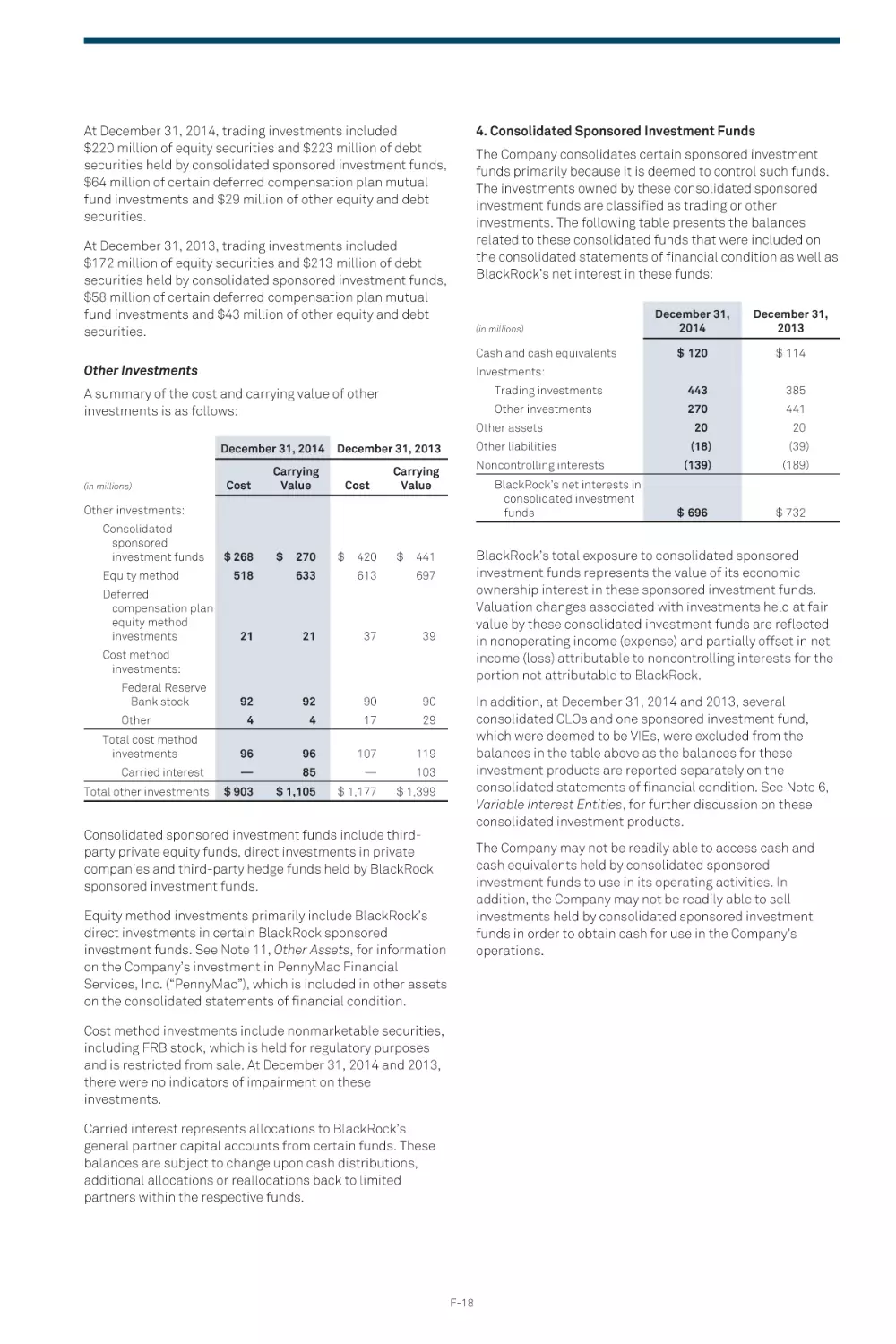




Текст
2014 ANNUAL REPORT
TRUSTED TO MANAGE
MORE MONEY THAN
ANY OTHER INVESTMENT
FIRM IN THE WORLD
We built BlackRock on:
—
Superior investment
performance
—
Relentless client focus
—
A Differentiated
investment platform
—
Global and
local strength
—
Risk Management
& Aladdin
®
Statement on cover is based on $4.65 trillion of
assets under management as of 12/31/14.
As the world of investing grows
increasingly complex, our goal remains
the same: to deliver superior value
to our clients, our shareholders and
our employees.
BlackRock has the world’s foremost
combination of investment strategies,
risk management capabilities and
client-first culture to create the right
solutions for our clients and to perform
in all market environments.
this is why BlackRock is trusted to
manage more money than any other
investment firm in the world.
supeRIoR Investment
peRfoRmance
—
Our primary responsibility
is to generate superior
investment performance
on behalf of our clients.
taxable active
fixed Income
91%
tax-exempt active
fixed Income
70%
scientific
active equity
fundamental
active equity
35B
$
% of assets aBove BenchmaRk
oR peeR medIan foR 3-yeaR peRIod
86%
In actIve
net Inflows
In 2014
48%
0
20
40
delIveRIng supeRIoR Investment peRfoRmance foR ouR clIents
BlackRock is positioned to leverage our
deep local and global knowledge of markets,
intellectual capital and best practices across
teams to generate alpha in active portfolios
and manage tracking error in index portfolios.
Our 120 investment teams in 15 countries
all share a common operating system and
performance culture.
Our investment platform is built upon distinct
teams with autonomous investment processes
that manage a wide range of portfolios across
the risk/return spectrum. Our investment teams
benefit from having fundamental, model-based
and index investment strategies managed on a
single platform. Fundamental teams use tools
developed by model-based teams, and modelbased teams have access to insights developed
by fundamental teams — both of which are
enhanced by our index capabilities and insights.
2
Bl ackRock, Inc. 2014 annual RepoRt
We have a cultural principle that great investors,
with their own investment processes, perform
better when they have structured mechanisms to
share thoughts, perspectives and information.
The expertise of our investment professionals
is supported by the global resources and
capabilities of Aladdin, our proprietary risk and
investment management platform, the BlackRock
Investment Institute, which harnesses the vast
intellectual output of our investment teams
through a global knowledge-sharing platform,
and our Risk and Quantitative Analysis team,
which performs intricate risk management
and quantitative analysis across all portfolio
investment activities.
We strive to earn and maintain our clients’
trust, by seeking to deliver superior investment
performance in the portfolios we manage.
60
80
100
—
Our team-based approach
to portfolio management
enables us to address our
clients’ investment objectives and challenges, while
rigorously managing risk in
their portfolios.
98%
of Index equit y and
fixed income assets
Within or Above
Tolerance
—
Our culture of knowledge
sharing and collective
intelligence enhances
our ability to exceed our
clients’ performance
expectations.
146B
$
in Index
Net Inflows
in 2014
for 3-year period
Bl ackRock, Inc. 2014 Annual Report
3
Relentless clIent focus
—
We are a fiduciary
to our clients.
Their interests
always come first.
manage
4.7t
$
of assets
4,000+
InstItutIonal clIent
RelatIonshIps
on Behalf of clIents
focused on secuRIng Bet teR fInancIal futuRes foR ouR clIents
BlackRock serves a diverse range of clients,
from global institutions to intermediaries
to individual investors, all of whom trust
BlackRock to help secure better financial
futures for themselves or those they serve.
Our specialized client teams are experts in
the investment needs and challenges of our
clients. They engage in consistent dialogue
with clients, providing insights and advice on
markets and industry events, and look across
BlackRock’s diverse investment platform to
4
Bl ackRock, Inc. 2014 annual RepoRt
create the best combination of strategies
to help clients achieve their desired investment outcomes.
As a fiduciary, we represent each client fairly
and equally and take a leadership role in
advocating for their best interests. We work
on behalf of clients to promote financial
reform that increases transparency, protects
investors and facilitates responsible growth
of capital markets.
—
It is our mission to drive
results for our clients,
protecting and enhancing
the value of the assets
they entrust to us.
clIents In
100+
countRIes
—
We deliver an unmatched
client experience, based
on understanding each
client’s specific investment
objectives and tailoring
multifaceted solutions.
Retail
long-teRm Base fees
By clIent t ype
35%
30%
Institutional
35%
iShares®
Bl ackRock, Inc. 2014 annual RepoR t
5
a dIffeRentIated
Investment platfoRm
—
BlackRock is the only asset
manager to offer active and
index capabilities globally
and at scale, on a single
platform — across equity,
fixed income, multi-asset,
alternatives and cash.
equity
fixed Income
56
%
32
alternatives
multi-asset
%
long-teRm assets By asset cl ass
a full Range of Investment solutIons
BlackRock offers clients a full range of
investment solutions across asset classes
and geographies, extensive market intelligence and industry-leading risk management
and analytic capabilities. Our investment
management teams span Alpha and Beta
Strategies, including equity and fixed income,
Multi-Asset Strategies, Alternative Strategies
and Trading & Liquidity Strategies.
6
Bl ackRock, Inc. 2014 annual RepoRt
As the nature of our clients’ investment challenges
changes, so does the nature of the solutions
they require. Increasingly, a single investment
product, asset class or style does not provide a
sufficient long-term solution. The breadth
and diversity of BlackRock’s platform enables
us to work closely with our clients to create
the most appropriate blend of solutions to solve
their most difficult investment challenges.
9 3
%
%
—
Our platform diversification
enables us to create
the most appropriate
blend of investment
strategies for our clients
to achieve their desired
investment outcomes.
1,900+
Investment
pRofessIonals
woRldwIde
—
Investment solutions
across the platform are
supported by unparalleled
technology and risk
management through
Aladdin and our Risk &
Quantitative Analysis team.
RetaIl and iSHARES ®
pRoducts
each geneRatIng
$1B+ In net Inflows
43
In 2013
56
In 2014
Bl ackRock, Inc. 2014 annual RepoR t
7
gloBal & local stRength
—
BlackRock has a
broad global footprint,
supporting a global
investment platform
and local relationships
with clients.
41
gloBal long-teRm aum
countRIes
wIth clIents foR whom
we manage at least
1B
$
In assets
americas
$2,652B
emea
asia-pacific
$1,314B
$367B
gloBal Reach and local expeRtIse
BlackRock provides global and local strength
to our clients, with offices in more than
30 countries and nearly 70 cities across the
Americas, Europe, Asia-Pacific, the Middle
East and Africa, and clients in more than
100 countries. Our global footprint is designed
to deliver consistent, exceptional service
across regions while supporting the localized
needs of our clients.
8
Bl ackRock, Inc. 2014 annual RepoRt
We seek to maximize investment opportunities
for our clients through the combination of
our on-the-ground presence and our ability to
provide the industry’s broadest set of global and
local investment solutions. BlackRock’s global
investment and distribution infrastructure
positions us to capitalize on the future growth
and development of the world’s capital markets.
Our scale gives us the flexibility to innovate and
adapt the global and local nature of our platform
to best serve our clients’ changing needs.
—
Our deep understanding
of local markets, industries
and regulatory dynamics
positions us to maximize
investment opportunities
for clients in more than
100 countries.
12,000+
employees
gloBally
—
Our unifying technology
system, Aladdin, powers
global interconnectivity
for clients and employees
so that all phases of
the investment process
run seamlessly.
employees By RegIon
53%
19%
americas
asiapacific
28%
emea
Bl ackRock, Inc. 2014 annual RepoR t
9
RIsk management & ALADDIN
—
BlackRock assesses and
manages risk through
a dedicated team of
independent risk management professionals and
an ever-evolving Aladdin
technology platform.
AL ADDIN used By
clIents In
47
countRIes
20,000+
useRs
of AL ADDIN
technology
set tIng the standaRd foR effectIve RIsk management & technology
BlackRock sets the standard for risk management, analytics and investment technology.
Our risk management philosophy is based on the
notion of maintaining a culture of constructive
challenge. BlackRock’s independent risk
management professionals partner with investment, operational and technology professionals
to share subject matter expertise and timely
information on portfolio and enterprise risk.
Their goal is to ensure deliberate, diversified
and scaled risk-taking in our clients’ portfolios,
while also ensuring that the firm operates
safely and reliably.
Our Aladdin investment platform is an unmatched operating and central nervous system
for investment and risk managers, which unites
the information, people and technology needed
to manage money on a single platform. We
created Aladdin specifically to help manage
risk and track results in our clients’ portfolios,
10
Bl ackRock, Inc. 2014 annual RepoRt
including investment, operational, liquidity and
counterparty risks. Aladdin helps to facilitate
better decision-making, more effective risk
management and more efficient trading on behalf
of BlackRock’s asset management clients.
In addition, many institutions rely on Aladdin to
analyze and manage their own assets.
Aladdin powers collective intelligence by
providing tools to help investment managers
communicate better, see clearer, work smarter,
move faster and scale further. Aladdin serves
as a common language across functions and
geographies; provides timely and accurate
insight into holdings, exposures and risks; places
key information at our fingertips for effective
investment and risk management decisions;
and gives investment management professionals
the ability to process data and orders with
consistency, efficiency and speed.
—
Aladdin combines
sophisticated risk
analytics with comprehensive portfolio
management, trading
and operations tools.
—
Aladdin supports the firm
and its clients through
informed decision-making,
effective risk management,
efficient trading and
operational scale.
AL ADDIN BusIness Revenue
poweRed By
2014
$474m
2013
2012
$433m
1,000+
developeRs
$384m
Bl ackRock, Inc. 2014 annual RepoR t
11
We are One
BlackRock
12
Bl ackRock, Inc. 2014 Annual Report
We are passionate about performance
We are a fiduciary to our clients
We are innovators
At BlackRock, we work together to help millions of
investors around the world build better financial futures.
We operate our business with a fiduciary mind-set —
which means putting our clients’ interests first. Their trust
and confidence in us is our most valuable asset.
Our people take emotional ownership over what they do and
are intensely focused on performing at the highest levels
on behalf of stakeholders — including clients, shareholders
and fellow employees. They are dedicated to continuous
innovation in order to bring the best of BlackRock to our
clients. Introducing new and innovative approaches across
all dimensions of our business has been a foundational
component of our ability to deliver for our clients, and we
believe there is always room for improvement and new ideas.
We also challenge ourselves — and each other —
to collectively raise our game and insist on the highest
ethical standards. We set high standards for talent
and employ a deliberate process to develop our people,
in order to best serve our clients and shareholders.
It is the strength of our next generation of leaders that
will drive BlackRock’s future success.
Bl ackRock, Inc. 2014 Annual Repor t
13
Financial Highlights
2014
($mm, except share data)
$
Revenue
2013
11,081
$
2012
10,180
$
9,337
Net income attributable to BLK, GAAP
3,294
2,932
2,458
Net income attributable to BLK, as adjusted
3,310
2,882
2,438
Operating income, as adjusted
4,563
4,024
3,574
Operating margin, as adjusted
42.9%
41.4%
40.4%
Per Share
$
Diluted earnings, GAAP
19.25
Diluted earnings, as adjusted
Dividends declared
$
$
$
13.79
16.58
13.68
7.72
6.72
6.00
171,112,261
Diluted weighted-average common shares
Total AUM (end of period)
16.87
19.34
173,828,902
4,651,895
$
178,017,679
4,324,088
$
3,791,588
Drivers of Shareholder Value
Long-Term
Organic
AUM Growth
Operating
Margin,
as Adjusted
Capital
Management
Share Repurchases:
$1.5B $1.0B $1.0B
Earnings
Per Share,
as Adjusted
Dividends Per Share:
4.5%
42.9%
$7.72
13%
CAGR
19%
CAGR
$19.34
41.4%
40.4%
$16.58
$6.72
3.4%
$13.68
$6.00
-0.1%
2012
2013
2014
2012
2013
2014
2012
2013
2014
Please review the Important Notes on page 23 for information on certain non-GAAP figures shown above
and through page 22, as well as for source information on other data points on pages 2 through 22.
14
Bl ackRock, Inc. 2014 Annual Report
2012
2013
2014
l auRence d. fInk Chairman and Chief Executive Officer
my fellow shaReholdeRs:
for 26 years, BlackRock has dedicated itself to helping clients build
better financial futures. today, those clients trust us to manage
more money than any other investment firm in the world. and we
believe that BlackRock’s differentiated offering — combining a full
range of active and index strategies with a strong risk management
culture — has never been more essential than it is now.
Financial, technological and social changes are remaking
the global economy and the way capital flows through it.
Divergence is increasing, as nations around the world follow
different trajectories in economic growth, monetary policy,
asset prices and currency valuations. Central bank actions,
political events and disruption in the energy market are driving
volatility in global financial markets while also creating the
potential for new risks. Technology is changing the way we live
and spend. And longevity is driving demographic upheaval.
Since our founding in 1988, BlackRock has never wavered
in acting as a fiduciary for our clients. This year’s annual
report explores how BlackRock continues to fulfill that
mission — and lay a foundation for long-term growth —
by continuing to build a strong and agile platform that can
anticipate change and adapt ahead of a shifting economic
and financial landscape, without compromising our
relentless focus on risk management and performance
for our clients.
$1 trillion in iShares assets under management and generating
the highest institutional flows we’ve seen since 2009.
2014 revenue was $11.1 billion, with operating income, as
adjusted, of $4.6 billion, up 9% and 13%, respectively, versus
2013. Earnings per share, as adjusted, rose 17% year over
year, and since 2007 (the final year of pre-crisis earnings),
BlackRock has grown earnings per share, as adjusted, by 142%,
versus 76% for the S&P 500 and 9% for the S&P Financials.
confRontIng change
At BlackRock, we are constantly looking at the world —
and at ourselves — to assess whether our products, our
services and our strategies can meet the challenges that
tomorrow will present. The disruptions that occurred or
crystallized in 2014 — in technology, financial markets, and
longevity and retirement — are having a major impact on
how we and our clients live, work and invest.
A Divergent World
2014 Results: delIveRIng shaReholdeR value
By meetIng clIent needs
Our 2014 results demonstrate the strength of BlackRock’s
global investment platform backed by Aladdin analytics, risk
management and advisory capabilities — which continue
to differentiate BlackRock and allow us to generate consistent
organic asset and revenue growth for our shareholders.
Overall, BlackRock generated long-term net inflows of
$181 billion, and more than $200 billion of overall net inflows
when taking into account our cash management business.
And we hit several major milestones in the year, including
crossing $500 billion in retail assets under management,
Today’s investors are faced with a diverse set of challenges
roiling global markets. Interest rates remain at historically
low (or even negative) levels, central bank policy continues
to outweigh market fundamentals, currency volatility has
spiked and we are seeing dramatic shifts in oil prices.
The Federal Reserve is setting the stage for higher interest
rates in the U.S., but the low-for-long theme remains
pervasive. The European Central Bank, by contrast, is
pursuing quantitative easing, pushing European bond yields
into negative territory. Given the lack of effective fiscal policy
by governments, the European Central Bank’s steps will be
critical in buying Europe the time it needs to heal and grow.
Bl ackRock, Inc. 2014 annual RepoR t
15
However, while these actions are keeping borrowing costs
low, they are also impacting how investors are saving for
the future, forcing them to take increasing risk as core bond
allocations are insufficient to meet the growing liability
burdens of pension funds, insurers and retirees.
Politicians, central bankers and regulators have rightly
identified asset-price bubbles as a serious source of risk,
yet the unintended consequences of aggressive monetary
policy are the biggest driver of such bubbles today. Yieldstarved investors attempting to meet future liabilities are
turning to lower-rated credits and longer-duration assets.
Not only is this driving prices ever higher in certain asset
categories, but it is also contributing to greater portfolio
concentration in more volatile areas of the market than
historical norms.
The situation is worsening every day, as the pool of funds
in search of returns grows larger. To meet the needs of
longer lives and soaring healthcare costs, for example,
companies are stepping up contributions to their pension
funds. For the same reasons, individuals are adding to
their defined contribution accounts. And insurers are writing
new policies, whose premiums need to be invested to meet
future liabilities. Today’s pre-retirees in particular face a stark
set of choices: put their cash in the bank at a near-zero or
negative yield, search in vain for a capital-starved insurer who
can provide a guaranteed income product, or step further
out onto the risk curve at a time when they should be seeking
income rather than capital appreciation.
This mix of growing assets and shrinking yields is creating
a dangerous imbalance. Yet monetary policy makers seem
insufficiently attuned to the conundrum their actions are
creating for investors: reach for yield and continue to fuel
an expanding bubble, or remain on the sidelines and watch
unfunded liabilities grow unchecked. This increasingly
desperate search for yield is now the greatest source of
prudential risk in the financial system — and one that central
bankers and regulators ignore at our collective peril if they
hope to truly reduce risk in the system.
In addition to their impact on interest rates and risk markets,
divergent monetary policies also are creating volatile
Our Global Executive Committee
Pictured
left to right:
Laurence D. Fink
Chairman & Chief Executive Officer
Charles S. Hallac
Co-President
Kenneth F. Kroner
Global Head of Multi-Asset Strategies, Head and
Chief Investment Officer of Scientific Active Equity
Gary S. Shedlin
Chief Financial Officer
Kendrick R. Wilson III
Vice Chairman
Barbara G. Novick
Vice Chairman
Quintin R. Price
Global Head of Alpha Strategies
16
Bl ackRock, Inc. 2014 Annual Report
Jeffrey A. Smith
Global Head of Human Resources
Derek N. Stein
Global Head of Business Operations & Technology
Philipp Hildebrand
Vice Chairman
Bennett W. Golub
Chief Risk Officer
Bl ackRock, Inc. 2014 Annual Repor t
conditions in currency markets. The specter of a U.S. rate
hike has exerted upward pressure on the dollar, while the
euro is exhibiting extraordinary weakness.
Since peaking in the early 2000s, the U.S. dollar index
weakened by more than 40% through the financial crisis in
2008, helping to form a critical piece of the foundation for the
U.S. to increase global competitiveness and emerge from
recession. Since last July, the dollar has given back much
of that competitive advantage, strengthening by 25% versus
a basket of global currencies over only a matter of months
as divergent economic conditions and central bank actions
have sent currency markets into one of the most volatile
periods on record.
And while first the yen and more recently the euro have
made headlines, emerging market currencies have in some
cases experienced an even greater impact — with the value
of the Brazilian real falling by more than half in the past
four years (and more than 30% since just mid-2014) and the
Mexican peso sitting at an all-time low versus the U.S. dollar.
These shifts will have a marked influence on global capital
flows and investment, and correctly identifying winners
and losers will materially influence portfolio returns.
In particular, the relative valuation of the U.S. dollar is now
having a rapid and material impact on U.S. companies and
their ability to compete in a global market. While the U.S.
economy as a whole is not overly exposed to exports, many
of our largest and most influential companies are. We believe
that this will lead to an erosion in confidence on the part
of CEOs, with the potential to slow both investment decisions
and future growth in the U.S.
In addition to divergent monetary policy and shifting exchange
rates, the new paradigm for oil prices will contribute to
continued volatility.
Cheap oil will act as a sizable tax cut for the global economy,
potentially leading to a major redistribution of wealth. But
the effects will not be uniform: high-cost energy production
economies are experiencing headwinds; countries like
the U.S., China and India are experiencing the benefits of
stimulus; and countries that have seen currency devaluation
mark k. wiedman
Global Head of iShares
Ryan stork
Head of Asia-Pacific
salim Ramji
Global Head of Corporate Strategy
Robert l. goldstein
Chief Operating Officer and Head of BlackRock Solutions
linda g. Robinson
Global Head of Marketing & Communications
amy l. schioldager
Global Head of Beta Strategies
matthew j. mallow
General Counsel
david j. Blumer
Head of Europe, Middle East & Africa
mark s. mccombe
Global Head of BlackRock’s Institutional Client Business
and Chairman of BlackRock Alternative Investors
Robert w. fairbairn
Global Head of Retail & iShares
j. Richard kushel
Chief Product Officer and Head of Strategic Product Management
Robert s. kapito
President
Bl ackRock, Inc. 2014 annual RepoR t
17
in recent months are experiencing more modest gains.
More shocks can be expected as production decisions and
the demand side seek equilibrium, but ultimately lower
energy prices should benefit the global economy.
workers and new entrants to the job market. And in a
global economy, the pressure to educate and train a skilled
workforce has never been more intense.
Technological Transformations
Automation is not the only challenge workers are grappling with
in a changing world. They must also confront one of the
defining social and economic challenges of our age: preparing
for longer lives.
In the 1990s, the world spoke of change driven by information
technology as occurring at “Internet speed.” Today, the
snowballing effects of technology are making that pace
seem glacial by comparison.
One example of how technology fosters rapid market
transformation is the abrupt rise of the “sharing economy” —
companies such as Uber, ZipCar or China’s Kuaidi.
Convenience is the obvious benefit of services such as these,
but over time they will also influence major consumer spending
decisions, and in turn, capital flows. Low-cost taxi options or
car-sharing services, for example, are making car ownership
less necessary. Home-rental services like Airbnb are eating
into hotel revenues and simultaneously turning homes into
income-generating assets. Crowdfunding and peer-to-peer
lending are providing entirely new avenues for raising capital.
While the long-term effects of these trends are difficult
to predict, there is no question that the sharing economy is
reshaping the way capital moves through the system.
These popular new consumer technologies attract a great
deal of attention, but technology’s impact on such traditional
sectors of the economy as energy, agriculture and manufacturing is perhaps even more profound. The recent fall in
oil prices was driven in large part by technology, as new
exploration and extraction technologies accelerated supply
ahead of demand. In response, the number of oil rigs
operating in the U.S. has fallen by nearly half in just the past
four months, yet output continues to rise as larger and
higher-yielding shale wells drive record production. U.S.
crude inventories are now at their highest seasonal levels in
80 years, sparking concerns about storage capacity.
In the agricultural sector, Dow Chemical recently developed
a new technology improving how fertilizer bonds with soil.
Although this development has received far less attention
than Uber or fracking, its potential long-term impact is
just as significant, and perhaps even greater. This innovation
will reduce nitrogen leaching, dramatically lessening the
environmental impact of agriculture. Farmers will apply
fertilizer less frequently, increasing productivity and ultimately
creating efficiencies for end consumers.
Technology also remains a critical factor in our own industry,
speeding and democratizing access to information, enabling
investors to react to sudden shifts in the markets driven
by divergence and technology and creating demand for a
higher quality client experience.
Perhaps no area is more affected by technology today than
jobs. Factories are increasingly staffed by robots, not
laborers. Drones may soon deliver our packages or even our
meals. As automation drives extraordinary increases in
productivity, millions of workers globally are being displaced,
with the burden falling disproportionately on lower-skilled
18
Bl ackRock, Inc. 2014 annual RepoRt
Longevity and Retirement
The effects of longevity are multifaceted. Longevity will
reshape the job market, as younger workers find it more and
more difficult to enter the workforce. It will dramatically alter
the nature and cost of healthcare, as the number of highcost patients grows. But most of all, longevity will require
people and governments across the world to take a new
approach to retirement — to encourage, or even mandate,
widespread savings.
Longer lifespans mean a greater savings burden, and the world
is woefully underprepared. According to BlackRock’s Global
Investor Pulse Survey, 69% of investors globally worry they
won’t be able to live comfortably in retirement.
The cost of living longer is coinciding with divergent economic
prospects, low yields and modest growth. Adding to the
problem, people all over the world are underinvested — if
they are invested at all — while governments face diverse
policy challenges.
Nations with overly generous pension plans risk not being
able to fulfill their obligations. Those with no support for their
retirees could face immense poverty, a growing drain on
resources and civil unrest. Even nations in the middle, like the
U.S., have millions of people underinvested and overly
dependent on Social Security — which was not designed
to support widespread longevity. Countries that meet this
daunting challenge head-on will come to lead the next
century. Countries that shrink from it do so at great risk.
InvestIng In the fIRm’s futuRe
Twenty-six years ago, we founded BlackRock with the
belief that even in an established industry like fixed income
investing, we could succeed with a new approach — a
dedication to assessing risk and an obsession with building
the best technology to help us do it. In the ensuing years,
we combined our depth of analysis, driven by technological
innovation, with an ever-widening range of long-term
solutions to provide more and more clients a reason to
come to BlackRock.
It worked because we have never stopped innovating. We have
always looked for ways to invest in improving our technology,
our approach to risk management and our ability to meet our
clients’ needs. At the core is a recognition that we cannot
coast on reputation, past successes or size, but must engage
in an ongoing process of reinvention.
Today, in the face of the many obstacles making our clients’
near- and long-term investment objectives more complex,
we continue to look every day for new ways to invest in the firm
to better meet their needs.
Investing in a Diverse Global Platform
Our work to diversify our platform is especially critical
in today’s investment landscape where a single investment
product, asset class or style is increasingly insufficient.
The need to anticipate and develop investment solutions
in the face of changing client needs is why BlackRock’s
business model is deliberately equipped with such a wide
range of capabilities.
Our investment in expanding our global reach and investment
solutions for clients is reflected in the increasingly diverse
flows into our products, both in terms of asset class and
geography. In 2014, we saw net inflows of $52 billion in equity,
$96 billion in fixed income, $29 billion in multi-asset and
$4 billion in alternatives; $35 billion in active and $146 billion
in index; $55 billion in Retail, $101 billion in iShares and
$25 billion in Institutional. We had net inflows of more than
$1 billion in 13 countries in 2014, and we now manage more
than $1 billion in assets for clients in each of 41 countries.
Clients are capitalizing not just on our wide range of invest
ments and solutions, but also on the investment advice
and thought leadership generated by our portfolio managers,
the BlackRock Investment Institute and our Financial Markets
Advisory team. The BlackRock Investment Institute provides
a platform for BlackRock’s investment teams to exchange
ideas, debate investment topics and share expertise, keeping
our investment professionals connected and informed
and serving as a key source of advice for professional
investors worldwide. Our Financial Markets Advisory team
partners with sophisticated financial institutions and
government entities on their most complex balance sheet,
risk and governance challenges to provide impartial and
actionable advice, which has been increasingly sought-after
in an ever-shifting political and regulatory environment.
One of our investment offerings that we have continued to
grow in recent years is alternatives, including infrastructure —
with options from energy to transportation and more —
giving clients increased access to inflation protection,
diversification, the potential for capital appreciation and
long-duration returns. These investments are sorely
needed — estimates have put the global infrastructure
funding gap as high as $1 trillion per year, leading to massive
amounts of lost growth. The American Society of Civil
Engineers has estimated that by 2020, “aging and unreliable”
infrastructure will cost American businesses $1.2 trillion.
In 2014, BlackRock closed our second renewable power
infrastructure fund, positioning us as one of the leading global
renewables platforms in the industry — and providing power
to more than 100,000 households. BlackRock’s Infrastructure
Investment Group also works to promote improved publicprivate partnerships, which jointly increase opportunities for
investors and help governments access much-needed
sources of capital. In March 2015, BlackRock teamed with
Pemex, Mexico’s national oil company, in a landmark publicprivate infrastructure partnership, the first since a series of
historic energy reforms were approved in Mexico in 2013.
The partnership will finance two natural gas pipelines critical
to Mexico’s continued economic growth. These initiatives
show how infrastructure can offer long-term benefits to both
investors and the economies where they spur economic
growth and job creation.
Investing in Performance
We recognize that even the most comprehensive solutions
will be insufficient without strong and consistent investment
performance. And since the financial crisis, we have made
significant investments in improving performance that are now
bearing fruit.
We began by restructuring much of our active fixed income
business, and these investments in performance are now
driving significant results for clients. With 91% of taxable fixed
income assets above benchmark or peer median for the
3-year period, BlackRock saw $28 billion in active fixed income
net inflows in 2014, contributing to $96 billion of total fixed
income net inflows for the year. These flows spanned a variety
of sub-asset classes, including unconstrained, high yield
and core bond, reflecting the stability, breadth and strong
performance of our fixed income franchise.
Our scientific active equity platform, where we have made
significant enhancements to our investment processes over
recent years, has delivered outstanding performance, with
97% of assets above benchmark or peer median over the last
five years.
And we continue to make progress on the reinvigoration
and globalization of our fundamental active equity
business. We’ve streamlined our investment process and
recruited top-quality managers to add to our existing
talent base. We are seeing good progress from the steps
we’ve taken to improve investment performance, although
we still have work to do to meet both our own and our
clients’ expectations.
The strength in performance across our platform is reinforced
by our team-based approach to portfolio management.
We do not have a single centralized CIO, a house view or any
one person setting investment strategy across our platform.
Our process encourages our teams to stay connected and
embrace collective intelligence, through the BlackRock
Investment Institute and Aladdin, while enabling them to
make independent portfolio construction decisions to meet
clients’ objectives.
We’re also investing to ensure we have the best offerings
across the full range of active and index products to meet
our clients’ needs. To that end, we continue to improve and
broaden our iShares offering by focusing on product use
and client segments. As adoption spreads, our client base is
becoming more diverse, and iShares are being utilized as core
investments, precision exposures and financial instruments.
Our iShares business — which drove $101 billion of net
new business in 2014 — now represents 22% of total AUM.
We are aggressively targeting growth in the fixed income ETF
market, in which BlackRock was the global leader in flows in
2014, and which we believe is the next frontier for ETFs.
We also are challenging ourselves to be even more nimble in
Bl ackRock, Inc. 2014 Annual Report
19
being first to market with products that meet new investment
themes of interest to our clients.
Investing in Technology
At the heart of BlackRock’s philosophy since our earliest days
is the belief that technology and risk management are
critical to understanding and managing assets, regardless
of investor profile, timeframe or asset class.
That belief drove our decision in 2000 to make Aladdin available
to institutional investors through BlackRock Solutions,
combining sophisticated risk analytics with comprehensive
portfolio management, trading and operations tools
on a single platform to power informed decision-making,
effective risk management, efficient trading and operational scale.
Aladdin provides a unique competitive advantage for BlackRock,
transforming our internal risk management system —
a substantial cost for most companies — into a revenuegenerating business. Aladdin’s growing value as a third-party
platform positions BlackRock to invest a consistent and
growing stream of profits into improving our technology and
expanding our offerings, powering a constant upgrade
cycle for the Aladdin community and driving network-effect
benefits for our clients and our shareholders.
We also are seeing increased global adoption of Aladdin
technology, as investors around the world are looking to
consolidate multiple legacy systems and establish a common
technology language. In 2014, we added our first Aladdin
client based in Latin America, and we now have clients
actively using Aladdin in 47 countries around the world.
For all of the increased use of technology in the financial world
in recent years, much of the industry’s most sophisticated
and valuable technology has remained accessible only to the
largest investors and market participants.
We believe these same tools can benefit retail investors, and
we are investing to leverage BlackRock’s Aladdin technology
more broadly to help financial advisors and consumers
begin to directly take advantage of our investment and risk
management capabilities.
BoaRd of dIRectoRs
Pictured
left to right:
mathis cabiallavetta
Vice Chairman of the Board
Swiss Re Ltd.
Robert s. kapito
President
BlackRock, Inc.
william s. demchak
President and Chief Executive Officer
The PNC Financial Services Group, Inc.
pamela daley
Former Senior Vice President of Corporate
Business Development
General Electric Company
jessica einhorn
Former Dean
Paul H. Nitze School of Advanced International
Studies (SAIS) at The Johns Hopkins University
fabrizio freda
President and Chief Executive Officer
The Estée Lauder Companies Inc.
20
Bl ackRock, Inc. 2014 annual RepoRt
murry s. gerber
Former Executive Chairman and Chief Executive Officer
EQT Corporation
david h. komansky
Former Chairman and Chief Executive Officer
Merrill Lynch & Co., Inc.
Technology has not only shaped the way BlackRock serves
clients and views risk management — it also drives the
way we build investment solutions. Technology and data
science are enabling BlackRock to combine our fundamental investment expertise with the best of scientific and
index investing to create innovative investment strategies
for clients — expanding the concepts of model-based
investing and smart beta and thinking beyond established
product categories.
And this ability to leverage “Big Data” translates across the
BlackRock organization — data mining from our scientific
active equity team can help our fundamental equity portfolio
managers gain additional insights into sentiment and
pricing trends, while fundamental managers can help modelbased teams to pinpoint investment themes and weight
inputs more appropriately.
Investing in New Solutions for Retirement
A new paradigm for longevity requires a new approach to
saving for the future, and we’re responding with a consumerfocused effort to reorient investors’ ideas of how to save
Sir Deryck Maughan
Former Senior Advisor
Kohlberg Kravis Roberts & Co. L.P.
Cheryl D. Mills
Founder and Chief Executive Officer
BlackIvy Group
Thomas H. O’Brien*
Former Chairman and Chief Executive Officer
The PNC Financial Services Group, Inc.
Marco Antonio Slim Domit
Chairman
Grupo Financiero Inbursa
*Lead Independent Director
effectively. At the center of our efforts is a push to shift focus
away from the “nest egg” and to a more important measure:
retirement income.
Instead of aiming for a lump sum — which is a tangible
goal but not particularly helpful in planning for the future —
our mission is to help investors translate their current savings
into their income each year in retirement. As part of these
efforts, we have developed CoRI®, a groundbreaking set of
indices to help investors estimate the cost of annual
retirement income. We will work closely with investors and
their financial advisors on ways to close the gap between
where they are today and the income they really need: by
saving more, working longer or investing differently.
Retirement is at the core of what we do — two-thirds of the
assets we manage are related to retirement — and this
initiative is built on BlackRock’s unique and wide-ranging
capabilities: our technology and portfolio construction
expertise; an unrivaled product set in our full range of active
and index vehicles; and our unmatched risk-based technology,
including Aladdin’s risk analytics and the CoRI indices.
Ivan G. Seidenberg
Former Chairman and
Chief Executive Officer
Verizon Communications, Inc.
John S. Varley
Former Chief Executive
Barclays PLC
Susan L. Wagner
Former Vice Chairman
BlackRock, Inc.
Not pictured:
Abdlatif Y. Al-Hamad
Director General
and Chairman
Arab Fund for Economic
and Social Development
James Grosfeld
Former Chairman and
Chief Executive Officer
Pulte Homes, Inc.
Laurence D. Fink
Chairman and Chief Executive Officer
BlackRock, Inc.
Bl ackRock, Inc. 2014 Annual Repor t
21
We believe that our leadership on the retirement challenge
will not only serve investors, but also put us at the center of
the most sizable opportunity in our industry, as we continue
to cement our position in the market as a trusted source of
advice and long-term solutions.
Investing in New Approaches to Social Responsibility
An increasing number of investors are looking for investment
strategies that advance not only financial outcomes, but
social outcomes as well. While the roots of this movement
can be traced back many years, the frequency and complexity
of these mandates are increasing.
BlackRock offers a range of investment strategies that
incorporate environmental or social considerations, and
currently manages more than $225 billion in strategies
designed to align clients’ portfolios with their social and
environmental objectives and values, including recent
launches like CRBN, our Low Carbon iShares ETF. And, this
year, BlackRock has unified its approach to elevate investing
through the launch of BlackRock Impact, a dedicated platform
that enables investors to target specific, measurable social
or environmental objectives in addition to their financial goals.
Investing in Our People
Building a strong and diverse leadership bench is critical to
ensuring that we have the talent we need for BlackRock’s
next quarter-century. That is why we are making significant
investments in talent across the firm. We have invested
in the development of leaders at all levels, whether they are
just graduating college or in the midst of a successful career.
Each year, the Board of Directors devotes significant time
to identify the firm’s top talent and assess how to develop
them into the firm’s future leaders. At our September Board
meeting, we reviewed more than 300 individuals to assess
the highest and best use of our top talent. The leadership
changes we announced in the second quarter of 2014 —
which moved senior leaders into new roles and locations to
create new challenges and broader perspectives — are
an example of these efforts and are already driving growth
for the firm and improving our daily operations.
We are constantly working to improve diversity at BlackRock,
from the Board of Directors to the trading floor. Our Human
Capital Committee, comprised of 47 senior leaders around the
world, drives our Talent and Diversity Agenda and looks for
ways for the firm to continuously improve its efforts. More
than 60% of our employees participate in one of our employee
networks, such as our Women’s Initiative Network, Veteran’s
Network or Multicultural Network.
Simply put, we believe that teams with a diversity of experience,
backgrounds and perspectives make better decisions and drive
more innovation than homogenous teams. We take a broad
perspective on our diversity efforts, applying our approach
around the world, within the context of each region in our footprint. We believe our success as a company depends on our
ability to develop leaders with both a global perspective and a
deep understanding of the local markets in which they operate.
22
Bl ackRock, Inc. 2014 Annual Report
BUILDING ON BLACKROCK
This annual report highlights how the platform we’ve created
over time translates into long-term value for clients and
shareholders even in the face of global market upheaval.
But it also gives us a chance to look toward the future.
BlackRock has stayed ahead of the competition over time
by thinking long term: building the technology, talent and
investment solutions that our clients and shareholders
can build on, and that will pay dividends for decades, not
just quarters.
Planning for the long term is in our DNA. It’s a philosophy
that guides us as both stewards for our shareholders and
investors on behalf of our clients. It’s why we publicly
encourage companies to build long-term value. It’s why we
are constantly reviewing and reshaping our product offerings.
It’s why we increasingly invest in upgrading Aladdin to adjust
for changing markets. And it’s why we are always looking
to recruit and develop people who understand not just what
the world is — but what it will be, and why.
As we look to BlackRock’s future, I want to thank our
clients for their continued trust, our shareholders for their
continued support and our employees for their unwavering
dedication to serving our clients. I also want to recognize
our Board of Directors. October marked our 15th anniversary
as a public company, and over the years, our Board has
been instrumental in helping guide BlackRock’s leadership
team in developing strategies for future growth. Each Board
member brings a unique background and perspective to
the table, and I am grateful for both their individual and
collective wisdom, expert guidance and tireless commitment
to a better BlackRock.
Financial, technological and social transformations present
a host of challenges for our clients and our business, and
I am confident that BlackRock is equipped to meet those
challenges head-on. The combination of active and index
strategies on a single global platform across asset classes —
supported by a strong risk management philosophy and
infrastructure, technology, investment advice and a fiduciary
culture — sets BlackRock apart from other firms in the
financial services industry.
The power of the platform we have built is why BlackRock
is trusted to manage more money than any other investment
firm in the world — and why we will remain relentless in our
focus to reward the trust you and investors around the globe
have placed in us, as we continue to build for the future.
Sincerely,
Laurence D. Fink
Chairman and Chief Executive Officer
ImpoRtant notes
opInIons
Opinions expressed through page 22 are those of
BlackRock, Inc. as of March 2015 and are subject to change.
Bl ackRock data poInts
All data through page 22 reflect full-year 2014 results or
as of December 31, 2014, unless otherwise noted. 2014
organic growth is defined as full-year net flows divided by
assets under management (AUM) for the entire firm, a
particular segment or particular product as of December
31, 2013. Long-term product offerings include active and
passive strategies across equity, fixed income, multiasset and alternatives, and exclude AUM and flows from
the cash management and advisory businesses.
ga ap and as adjusted Results
See pages 31-33 of the Financial Section for explanation
of the use of Non-GAAP Financial Measures.
peRfoRmance notes
Past performance is not indicative of future results.
Investing involves risk, including possible loss of principal.
Except as specified, the performance information shown
is as of December 31, 2014, and is based on preliminary
data available at that time. The performance data shown
reflects information for all actively and passively managed
equity and fixed income accounts, including U.S.
registered investment companies, European domiciled
retail funds and separate accounts for which performance
data is available, including performance data for highnet-worth accounts available as of November 30, 2014.
The performance data does not include accounts terminated prior to December 31, 2014, and accounts for
which data has not yet been verified. If such accounts
had been included, the performance data provided may
have substantially differed from that shown.
Performance comparisons shown are gross of fees
for U.S. retail, institutional and high-net-worth separate
accounts as well as EMEA institutional separate accounts,
and net of fees for European domiciled retail funds.
The performance tracking shown for institutional index
accounts is based on gross-of-fee performance and
includes all institutional accounts and all iShares funds
globally using an index strategy. AUM information is
based on AUM available as of December 31, 2014, for each
account or fund in the asset class shown without adjustment for overlapping management of the same account
or fund. Fund performance reflects the reinvestment of
dividends and distributions.
Source of performance information and peer medians is
BlackRock, Inc. and is based in part on data from Lipper
Inc. for U.S. funds and Morningstar, Inc. for non-U.S. funds.
Bl ackRock, Inc. 2014 annual RepoR t
23
The following contains information from BlackRock’s Form 10-K as filed on February 27, 2015.
BlackRock, Inc.
Form 10-K
Table of Contents
PART I
1
Item 1
Business
17
Item 1A
Risk Factors
24
Item 1B
Unresolved Staff Comments
24
Item 2
Properties
24
Item 3
Legal Proceedings
25
Item 4
Mine Safety Disclosures
PART II
25 Item 5
Market for Registrant’s Common Equity, Related Stockholder Matters
and Issuer Purchases of Equity Securities
26
Item 6
Selected Financial Data
28
Item 7
Management’s Discussion and Analysis of Financial Condition and Results of Operations
54
Item 7A
Quantitative and Qualitative Disclosures about Market Risk
55
Item 8
Financial Statements and Supplemental Data
55
Item 9
Changes in and Disagreements with Accountants on Accounting and Financial Disclosure
55
Item 9A Controls and Procedures
58
Item 9B Other Information
PART III
58
Item 10
Directors, Executive Officers and Corporate Governance
58
Item 11
Executive Compensation
58 Item 12
Security Ownership of Certain Beneficial Owners and Management
and Related Stockholder Matters
58
Item 13
Certain Relationships and Related Transactions, and Director Independence
58
Item 14
Principal Accountant Fees and Services
PART IV
58
Item 15
62
24
Exhibits and Financial Statement Schedules
Signatures
Bl ackRock, Inc. 2014 Annual Report
Bl ackRock, Inc. 2014 Annual Repor t
PART I
Item 1. Business
Management seeks to achieve attractive returns for
stockholders over time by, among other things, capitalizing
on the following factors:
OVE RVIE W
• the Company’s focus on strong performance providing
alpha for active products and limited or no tracking error
for index products;
BlackRock, Inc. (together, with its subsidiaries, unless the
context otherwise indicates, “BlackRock” or the “Company”)
is a leading publicly traded investment management firm
with $4.652 trillion of assets under management (“AUM”) at
December 31, 2014. With employees in more than 30
countries who serve clients in over 100 countries across the
globe, BlackRock provides a broad range of investment and
risk management services to institutional and retail clients
worldwide.
• the Company’s global reach and commitment to best
practices around the world, with approximately 48% of
employees outside the United States supporting local
investment capabilities and serving clients, and
approximately 43% of total AUM managed for clients
domiciled outside the United States;
• the Company’s diversified active and index product
offerings, which enhance its ability to offer a variety of
traditional and alternative investment products across
the risk spectrum and to tailor single- and multi-asset
investment solutions to address specific client needs;
Our diverse platform of active (alpha) and index (beta)
investment strategies across asset classes enables the
Company to tailor investment outcomes and asset allocation
solutions for clients. Our product offerings include singleand multi-asset class portfolios investing in equities, fixed
income, alternatives and money market instruments.
Products are offered directly and through intermediaries in a
variety of vehicles, including open-end and closed-end
mutual funds, iShares® exchange-traded funds (“ETFs”),
separate accounts, collective investment funds and other
pooled investment vehicles. We also offer our BlackRock
Solutions® (“BRS”) investment and risk management
technology platform, Aladdin®, risk analytics and advisory
services and solutions to a broad base of institutional
investors. The Company is highly regulated and serves its
clients as a fiduciary. We do not engage in proprietary
trading activities that could conflict with the interests of our
clients.
• the Company’s differentiated client relationships and
fiduciary focus, which enable effective positioning toward
changing client needs and macro trends including the
secular shift to passive investing and ETFs, a focus on
income and retirement, and barbelling of risk using index
and active products, including alternatives; and
• the Company’s longstanding commitment to risk
management and the continued development of, and
increased interest in, BRS products and services.
BlackRock operates in a global marketplace characterized
by a high degree of market volatility and economic
uncertainty, factors that can significantly affect earnings
and stockholder returns in any given period.
BlackRock serves a diverse mix of institutional and retail
clients across the globe. Clients include tax-exempt
institutions, such as defined benefit and defined
contribution pension plans, charities, foundations and
endowments; official institutions, such as central banks,
sovereign wealth funds, supranationals and other
government entities; taxable institutions, including
insurance companies, financial institutions, corporations
and third-party fund sponsors, and retail investors.
The Company’s ability to increase revenue, earnings and
stockholder value over time is predicated on its ability to
generate new business, including business in BRS products
and services. New business efforts are dependent on
BlackRock’s ability to achieve clients’ investment objectives
in a manner consistent with their risk preferences and to
deliver excellent client service. All of these efforts require
the commitment and contributions of BlackRock employees.
Accordingly, the ability to attract, develop and retain
talented professionals is critical to the Company’s long-term
success.
BlackRock maintains a significant global sales and
marketing presence that is focused on establishing and
maintaining retail and institutional investment management
relationships by marketing its services to investors directly
and through financial professionals and pension
consultants, and establishing third-party distribution
relationships.
BlackRock is an independent, publicly traded company, with
no single majority shareholder and over two-thirds of its
Board of Directors consisting of independent directors. At
December 31, 2014, The PNC Financial Services Group, Inc.
(“PNC”) held 21.0% of BlackRock’s voting common stock and
22.0% of BlackRock’s capital stock, which includes
outstanding common stock and nonvoting preferred stock.
1
FIN A N C IA L H IGH L IGH TS
5-Year
CAGR(4)
2014
2013
2012
2011
2010
Total revenue
$ 11,081
$ 10,180
$ 9,337
$ 9,081
$ 8,612
19%
Operating income
$ 4,474
$ 3,857
$ 3,524
$ 3,249
$ 2,998
28%
(in millions, except per share data)
40.4%
Operating margin
$
Nonoperating income (expense)(1)
37.9%
(49)
$
97
37.7%
$
35.8%
8%
34.8%
(36)
$ (116)
$
n/a
36
Net income attributable to BlackRock, Inc.
$ 3,294
$ 2,932
$ 2,458
$ 2,337
$ 2,063
30%
Diluted earnings per common share
$ 19.25
$ 16.87
$ 13.79
$ 12.37
$ 10.55
26%
(in millions, except per share data)
2014
2013
2012
2011
2010
$4,563
$4,024
$ 3,574
$ 3,392
$ 3,167
5-Year
CAGR(4)
As adjusted(2):
Operating income
42.9%
Operating margin(2)
Nonoperating income (expense)(1)
$
(56)
Net income attributable to BlackRock, Inc. (3)
$3,310
Diluted earnings per common share(3)
$19.34
41.4%
$
7
40.4%
$
39.7%
24%
2%
39.3%
n/a
(42)
$ (113)
$
25
$2,882
$ 2,438
$ 2,239
$ 2,139
27%
$16.58
$ 13.68
$ 11.85
$ 10.94
22%
n/a — not applicable
(1) Net of net income (loss) attributable to noncontrolling interests (“NCI”) (redeemable and nonredeemable).
(2) BlackRock reports its financial results in accordance with accounting principles generally accepted in the United States (“GAAP”); however,
management believes evaluating the Company’s ongoing operating results may be enhanced if investors have additional non-GAAP financial
measures.
See Item 7, Management’s Discussion and Analysis of Financial Condition and Results of Operations — Non-GAAP Financial Measures, for further
information on non-GAAP financial measures and for as adjusted items for 2014, 2013 and 2012. In 2011, operating income, as adjusted, included
U.K. lease exit costs which represent costs to exit two locations in London and restructuring charges. In 2010, operating income, as adjusted,
excluded certain expenses incurred related to the integration of the acquisition of Barclays Global Investors (“BGI”). In 2011 and 2010, the portion of
compensation expense associated with certain long-term incentive plans (“LTIP”) funded, or to be funded, through share distributions to participants
of BlackRock stock held by PNC has been excluded because it ultimately does not impact BlackRock’s book value. Compensation expense associated
with appreciation (depreciation) on investments related to certain BlackRock deferred compensation plans has been excluded as returns on
investments set aside for these plans, which substantially offset this expense, are reported in nonoperating income (expense).
(3) Net income attributable to BlackRock, Inc., as adjusted, and diluted earnings per common share, as adjusted exclude the after-tax impact of the
items listed above and also include the effect on deferred income tax expense attributable to changes in corporate income tax rates as a result of
income tax law changes and a state tax election.
(4) Percentage represents compounded annual growth rate (“CAGR”) over a five-year period (2009-2014).
ASSETS UNDER MANAGEMENT
The Company’s AUM by product type for the years 2010 through 2014 is presented below.
December 31,
(in millions)
Equity
Fixed income
Multi-asset
Alternatives
Long-term
5-Year
CAGR(1)
2014
2013
2012
2011
2010
$ 2,451,111
$ 2,317,695
$ 1,845,501
$ 1,560,106
$ 1,694,467
1,393,653
1,242,186
1,259,322
1,247,722
1,141,324
6%
377,837
341,214
267,748
225,170
185,587
22%
10%
111,240
111,114
109,795
104,948
109,738
2%
4,333,841
4,012,209
3,482,366
3,137,946
3,131,116
9%
296,353
275,554
263,743
254,665
279,175
(3)%
Advisory
21,701
36,325
45,479
120,070
150,677
(33)%
Total
$ 4,651,895
$ 4,324,088
$ 3,791,588
$ 3,512,681
$ 3,560,968
Cash management
(1) Percentage represents CAGR over a five-year period (2009-2014).
2
7%
Component changes in AUM by product type for the five years ended December 31, 2014 are presented below.
December 31,
2009
Net Inflows
(Outflows)
Adjustment/
Acquisition(1)
$ 1,536,055
$ 270,872
$ (125,860)
1,055,627
82,232
(14,270)
Multi-asset
142,029
156,003
9,499
Alternatives
102,101
(11,759)
(in millions)
Equity
Fixed income
Long-term
Cash management
2,835,812
349,277
Advisory
161,167
Total
$ 3,346,256
497,348
FX Impact
December 31,
2014
831,522
$ (61,478)
$ 2,451,111
297,702
(27,638)
1,393,653
6%
83,397
(13,091)
377,837
22%
18,956
4,298
(2,356)
111,240
2%
(111,675)
1,216,919
(104,563)
4,333,841
(5,914)
3,182
(6,669)
296,353
(3)%
(33)%
(43,523)
(137,078)
$ 316,747
Market
Change
$
(10)
1,136
(3,514)
21,701
$ (117,599)
$ 1,221,237
$ (114,746)
$ 4,651,895
5-Year
CAGR
10%
9%
7%
(1) Amounts include acquisition adjustments and reclassification of certain AUM acquired from BGI in December 2009. Amounts also include AUM
acquired from Swiss Re Private Equity Partners (“SRPEP”) in September 2012, Claymore Investments, Inc. (“Claymore”) in March 2012, Credit Suisse’s
ETF franchise (“Credit Suisse ETF Transaction”) in July 2013 and MGPA in October 2013, and other reclassifications to conform to current period
combined AUM policy and presentation. Amounts also include BGI merger-related outflows due to manager concentration considerations prior to the
third quarter of 2011 and outflows from scientific active equity performance prior to the second quarter of 2011. As a result of client investment
manager concentration limits and the scientific active equity performance, outflows were expected to occur for a period of time subsequent to the
close of the transaction.
proprietary Aladdin investment system as well as risk
management, outsourcing and advisory services, to
institutional investors under the BRS name. Revenue for
these services may be based on several criteria including
value of positions, number of users, accomplishment of
specific deliverables or other objectives.
AUM represents the broad ranges of financial assets we
manage for clients on a discretionary basis pursuant to
investment management agreements that are expected to
continue for at least 12 months. In general, reported AUM
reflects the valuation methodology that corresponds to the
basis used for billing (for example, net asset value). Reported
AUM does not include assets for which we provide risk
management or other forms of nondiscretionary advice, or
assets that we are retained to manage on a short-term,
temporary basis.
At December 31, 2014, total AUM was $4.652 trillion,
representing a CAGR of 7% over the last five years. AUM
growth during the period was achieved through the
combination of net market valuation gains, net new business
and acquisitions, including Claymore and SRPEP, which
added $13.7 billion of AUM in 2012, and Credit Suisse and
MGPA, which collectively added $26.9 billion of AUM in 2013.
Our AUM mix encompasses a broadly diversified product
range, as described below.
Investment management fees are typically expressed as a
percentage of AUM. We also earn performance fees on
certain portfolios relative to an agreed-upon benchmark or
return hurdle. On some products, we also may earn
securities lending fees. In addition, BlackRock offers its
The Company considers the categorization of its AUM by client type, product type, investment style and client region useful to
understanding its business. The following discussion of the Company’s AUM will be organized as follows:
Client Type
Product Type
Client Region
‘ Retail
‘ Equity
‘ Americas
‘ iShares
‘ Fixed Income
‘ Europe, the Middle East and Africa (“EMEA”)
‘ Institutional
‘ Multi-asset
‘ Asia-Pacific
‘ Alternatives
‘ Cash Management
C L IE N T TYPE
facilitates strong teamwork globally across both functions
and regions in order to enhance our ability to leverage best
practices to serve our clients and continue to develop our
talent. Specifically, our investments functions are split into
five distinct strategies: Alpha, Beta, Multi-Asset,
Alternatives and Trading/Liquidity.
Our organizational structure was designed to ensure that
strong investment performance is our highest priority, and
that we best align with our clients’ needs to capitalize on
broader industry trends. Furthermore, our structure
3
institutions, including insurance companies, financial
institutions, corporations and third-party fund sponsors,
and retail investors. iShares is presented as a separate
client type below, with investments in iShares by institutions
and retail clients excluded from figures and discussions in
their respective sections below.
We serve a diverse mix of institutional and retail clients
across the globe. Clients include tax-exempt institutions,
such as defined benefit and defined contribution pension
plans, charities, foundations and endowments; official
institutions, such as central banks, sovereign wealth funds,
supranationals and other government entities; taxable
AUM by investment style and client type at December 31, 2014 is presented below.
Retail
(in millions)
Active
iShares
$ 494,455
Non-ETF Index
—
$
959,160
Total
$ 1,453,615
39,874
—
1,816,124
1,855,998
—
1,024,228
—
1,024,228
534,329
1,024,228
2,775,284
4,333,841
41,841
—
254,512
296,353
—
—
21,701
21,701
$ 576,170
$ 1,024,228
$ 3,051,497
$ 4,651,895
iShares
Long-term
Cash management
Advisory
Total AUM
$
Institutional
Retail
billion, or 82%, of retail long-term AUM at year-end, with the
remainder invested in private investment funds and
separately managed accounts (“SMAs”). The majority
(93%) of long-term retail AUM is invested in active products,
although this is impacted by iShares being shown
separately. Retail represented 12% of long-term AUM at
December 31, 2014 and 35% of long-term base fees for
2014.
BlackRock serves retail investors globally through a wide
array of vehicles across the active and passive spectrum,
including separate accounts, open-end and closed-end
funds, unit trusts and private investment funds. Retail
investors are served principally through intermediaries,
including broker-dealers, banks, trust companies, insurance
companies and independent financial advisors. Clients
invest primarily in mutual funds, which totaled $440.2
Component changes in retail AUM for 2014 are presented below.
(in millions)
December 31,
2013
Net Inflows
Market
Change
FX
Impact
December 31,
2014
$ 203,035
$ 1,582
$ 1,831
$(6,003)
$ 200,445
Fixed income
151,475
36,995
3,698
(2,348)
189,820
Multi-asset class
117,054
13,366
(4,080)
(999)
125,341
16,213
3,001
152
(643)
18,723
$ 487,777
$ 54,944
$ 1,601
$(9,993)
$ 534,329
Equity
Alternatives
Total Retail
performance-related redemptions from U.S. large cap
equities, but we continue to make progress on the
reinvigoration and globalization of our fundamental
active equity business.
The retail client base is diversified geographically, with 71%
of long-term AUM managed for investors based in the
Americas, 23% in EMEA and 6% in Asia-Pacific at year-end
2014.
• International retail long-term net inflows of $23.4
billion, representing 15% organic growth, were positive
across major regions and diversified across asset
classes. Fixed income products generated net inflows of
$13.7 billion, led by short duration and unconstrained
strategies as investors looked to manage duration and
generate yield in their portfolios. Multi-asset class net
inflows of $6.7 billion were driven by flows into the
cross-border versions of our Global Allocation and
Multi-Asset Income funds. Equity net inflows of $2.6
billion reflected strong flows into index mutual funds,
partially offset by outflows from our European Equities
suite, due to macro headwinds as European market
sentiment declined.
• U.S. retail long-term net inflows of $31.6 billion, or 10%
organic growth, were led by fixed income inflows of
$23.3 billion. Fixed income net inflows were diversified
across exposures and products, with strong flows into
our unconstrained, high yield and core bond offerings.
Multi-asset class net inflows of $6.7 billion were driven
by demand for our Multi-Asset Income fund, which had
$5.0 billion of net inflows. Our suite of retail alternatives
mutual funds continued to gain traction, raising $2.7
billion of net inflows, and we remain committed to
broadening the distribution of alternatives funds to
bring institutional-quality alternatives products to retail
investors. Net inflows across fixed income, multi-asset
class and alternatives were partially offset by equity net
outflows of $1.0 billion, driven by historical
4
iShares
iShares is the leading ETF provider in the world, with $1.0 trillion of AUM at December 31, 2014 and was the top asset gatherer
globally in 20141 with $100.6 billion of net inflows for an organic growth rate of 11%. Equity net inflows of $59.6 billion were
driven by flows into the Core Series and into funds with broad U.S. equity market exposures, partially offset by outflows from
emerging markets products. Fixed income net inflows of $40.0 billion were diversified across exposures and product lines, with
European-listed iShares raising $16.6 billion, or 41%, of fixed income net inflows. iShares multi-asset class and alternatives
funds contributed a combined $1.0 billion of net inflows, primarily into commodities. iShares represented 24% of long-term
AUM at December 31, 2014 and 35% of long-term base fees for 2014.
Component changes in iShares AUM for 2014 are presented below.
(in millions)
December 31,
2013
Net
Inflows
Market
Change
FX
Impact
$ 718,135
$ 59,626
$ 26,517
$(14,211)
178,835
40,007
4,905
(6,076)
Equity
Fixed income
$
790,067
217,671
1,310
439
37
(13)
1,773
16,092
529
(1,722)
(182)
14,717
$ 914,372
$ 100,601
$(20,482)
$ 1,024,228
Multi-asset class
Alternatives(1)
Total iShares
December 31,
2014
$ 29,737
(1) Amounts include commodity iShares.
• International iShares AUM ended at $272.2 billion with
robust net new business of $20.0 billion led by fixed
income net inflows of $17.0 billion, primarily into yieldfocused categories including investment grade
corporate and emerging markets debt.2 In 2014, we
expanded our international presence and offerings
among buy-and-hold investors through the launches of
Core Series product lines in Canada and Europe.
Our broad iShares product range offers investors a precise,
transparent and efficient way to tap market returns and gain
access to a full range of asset classes and global markets
that have been difficult for many investors to access, as well
as the liquidity required to make adjustments to their
exposures quickly and cost-efficiently.
• U.S. iShares AUM ended at $752.0 billion with $80.6 billion
of net inflows driven by strong demand for U.S. equities as
well as a diverse range of fixed income products.2 During
the fourth quarter of 2012, we debuted the Core Series in
the United States and in 2014 we doubled the range by
adding 10 funds, as buy-and-hold investors increasingly
turn to iShares to efficiently construct larger portions of
their portfolios. The U.S. Core Series again demonstrated
solid results in its second full year, raising $25.7 billion in
net inflows, primarily in U.S. equity and U.S. aggregate
bond exposures.
Institutional
BlackRock’s institutional AUM is well diversified by both
product and region, and we serve institutional investors on
six continents in sub-categories including: pensions,
endowments and foundations, official institutions, and
financial institutions.
1
Source: BlackRock; Bloomberg
2
Regional iShares amounts based on jurisdiction of product, not
underlying client
Component changes in Institutional AUM for 2014 are presented below.
(in millions)
December 31, 2013
Net Inflows
(Outflows)
Market
Change
FX
Impact
December 31, 2014
Active:
138,726
$ (18,648)
9,935
$ (4,870)
Fixed income
505,109
(6,943)
34,062
(13,638)
518,590
Multi-asset class
Equity
$
$
$
125,143
215,276
15,835
23,435
(11,633)
242,913
Alternatives
73,299
(664)
1,494
(1,615)
72,514
Active subtotal
932,410
(10,420)
68,926
(31,756)
959,160
1,257,799
9,860
102,549
(34,752)
1,335,456
406,767
26,347
56,086
(21,628)
467,572
Multi-asset class
7,574
(735)
1,652
(681)
7,810
Alternatives
5,510
656
(693)
(187)
5,286
1,677,650
36,128
159,594
(57,248)
1,816,124
$ 2,610,060
$ 25,708
$ 228,520
$(89,004)
$ 2,775,284
Index:
Equity
Fixed income
Index subtotal
Total Institutional
5
Institutional active AUM ended 2014 at $959.2 billion, up
$26.8 billion, or 3%, since year-end 2013. Institutional active
represented 22% of long-term AUM and 20% of long-term
base fees. Growth in AUM reflected continued strength in
multi-asset class products with net inflows of $15.8 billion
largely from defined contribution plans into target date
offerings. Multi-asset class net inflows were offset by equity
net outflows of $18.6 billion, with 63% of outflows coming
from fundamental strategies. Fixed income net outflows of
$6.9 billion were primarily due to several large client-specific
asset allocation decisions and corporate actions such as
client acquisitions. These events offset positive momentum
in credit mandates. Alternatives net outflows of $0.7 billion
included $3.1 billion of return of capital; excluding return of
capital, alternatives net inflows of $2.4 billion were led by
inflows into hedge fund and private equity solutions.
institutional AUM managed for defined benefit, defined
contribution and other pension plans for corporations,
governments and unions at December 31, 2014. The
market landscape is shifting from defined benefit to
defined contribution, driving strong flows in our defined
contribution channel, which had $29.3 billion of longterm net inflows for the year, or 6% organic growth,
driven by continued demand for our LifePath® targetdate suite. We ended 2014 with $599.2 billion in defined
contribution AUM, and remain well positioned to
capitalize on the on-going evolution of the defined
contribution market and demand for outcome-oriented
investments. An additional $55.6 billion, or 2% of longterm institutional AUM, was managed for other taxexempt investors, including charities, foundations and
endowments.
Institutional index AUM totaled $1.816 trillion at
December 31, 2014, reflecting net inflows of $36.1 billion.
Flows were led by fixed income with net inflows of
$26.3 billion, primarily into local currency, U.S. targeted
duration and global bond mandates, reflecting solutionsbased LDI activity and portfolio rebalancing. Equities saw net
inflows of $9.9 billion, primarily into global mandates, as
clients increasingly looked to use passive vehicles for broad
macro exposure. Institutional index represented 42% of
long-term AUM at December 31, 2014 and accounted for
10% of long-term base fees for 2014.
• Official Institutions. We also managed $228.8 billion, or
8%, of long-term institutional AUM for official
institutions, including central banks, sovereign wealth
funds, supranationals, multilateral entities and
government ministries and agencies at year-end 2014.
These clients often require specialized investment
advice, the use of customized benchmarks and training
support.
• Financial and Other Institutions. BlackRock is a top
independent manager of assets for insurance
companies, which accounted for $233.7 billion, or 8%,
of institutional long-term AUM at year-end 2014. Assets
managed for other taxable institutions, including
corporations, banks and third-party fund sponsors for
which we provide sub-advisory services, totaled
$379.9 billion, or 14%, of long-term institutional AUM
at year-end.
The Company’s institutional clients consist of the following:
• Pensions, Foundations and Endowments. BlackRock is
among the largest managers of pension plan assets in
the world with $1.877 trillion, or 68%, of long-term
PR O D UC T TYPE
Component changes in AUM by product type and investment style for 2014 are presented below.
December 31, 2013
(in millions)
Net Inflows
(Outflows)
Market
Change
FX
Impact
December 31, 2014
Equity:
$
Active
iShares
Non-ETF index
Equity subtotal
317,262
$ (24,882)
718,135
59,626
26,517
(14,211)
790,067
1,282,298
17,676
104,448
(36,180)
1,368,242
2,317,695
52,420
140,832
(59,836)
2,451,111
$
9,867
$
(9,445)
$
292,802
Fixed income:
Active
652,209
27,694
36,942
(15,521)
701,324
iShares
178,835
40,007
4,905
(6,076)
217,671
Non-ETF index
411,142
28,705
56,904
(22,093)
474,658
1,242,186
96,406
98,751
(43,690)
1,393,653
341,214
28,905
21,044
(13,326)
377,837
Core
85,026
3,061
1,808
(1,889)
88,006
Currency and commodities
26,088
461
(2,577)
(738)
23,234
Fixed income subtotal
Multi-asset class
Alternatives:
Alternatives subtotal
Long-term
Cash management
Advisory
Total AUM
111,114
3,522
4,012,209
181,253
(769)
259,858
(2,627)
111,240
(119,479)
4,333,841
296,353
275,554
25,696
715
(5,612)
36,325
(13,173)
1,109
(2,560)
21,701
$ 261,682
$(127,651)
$ 4,651,895
$ 4,324,088
$ 193,776
6
tied to international markets, including emerging markets,
which tend to have higher fee rates than similar U.S. equity
strategies. Accordingly, fluctuations in international equity
markets, which do not consistently move in tandem with U.S.
markets, may have a greater impact on BlackRock’s effective
equity fee rates and revenues.
Long-term product offerings include active and index
strategies. Our active strategies seek to earn attractive
returns in excess of a market benchmark or performance
hurdle while maintaining an appropriate risk profile. We offer
two types of active strategies: those that rely primarily on
fundamental research and those that utilize primarily
quantitative models to drive portfolio construction. In
contrast, index strategies seek to closely track the returns of
a corresponding index, generally by investing in substantially
the same underlying securities within the index or in a
subset of those securities selected to approximate a similar
risk and return profile of the index. Index strategies include
both our non-ETF index products and iShares ETFs.
Fixed Income
Fixed income AUM ended 2014 at $1.394 trillion, increasing
$151.5 billion, or 12%, from December 31, 2013. The
increase in AUM reflected $96.4 billion in net new business
and $55.1 billion in net market appreciation and foreign
exchange movements. In 2014, net new business was
diversified across fixed income offerings, with strong flows
into our unconstrained, total return and high yield products.
Flagship funds in these product areas include our
unconstrained Strategic Income Opportunities and Fixed
Income Global Opportunities funds, with net inflows of $13.3
billion and $4.2 billion, respectively; our Total Return fund
with net inflows of $2.1 billion; and our High Yield Bond fund
with net inflows of $2.1 billion. Fixed income net inflows
were positive across investment styles, with iShares, nonETF index, and active net inflows of $40.0 billion, $28.7
billion and $27.7 billion, respectively.
Although many clients use both active and index strategies,
the application of these strategies may differ. For example,
clients may use index products to gain exposure to a market
or asset class. In addition, institutional non-ETF index
assignments tend to be very large (multi-billion dollars) and
typically reflect low fee rates. This has the potential to
exaggerate the significance of net flows in institutional index
products on BlackRock’s revenues and earnings.
Equity
Year-end 2014 equity AUM of $2.451 trillion increased by
$133.4 billion, or 6%, from the end of 2013 due to net new
business of $52.4 billion and net market appreciation and
foreign exchange movements of $81.0 billion. Net inflows
were driven by $59.6 billion and $17.7 billion into iShares and
non-ETF index accounts, respectively. Index inflows were
offset by active net outflows of $24.9 billion, with outflows of
$18.0 billion and $6.9 billion from fundamental and scientific
active equity products, respectively.
Multi-Asset Class
BlackRock’s multi-asset class team manages a variety of
balanced funds and bespoke mandates for a diversified
client base that leverages our broad investment expertise in
global equities, currencies, bonds and commodities, and our
extensive risk management capabilities. Investment
solutions might include a combination of long-only portfolios
and alternative investments as well as tactical asset
allocation overlays.
BlackRock’s effective fee rates fluctuate due to changes in
AUM mix. Approximately half of BlackRock’s equity AUM is
Component changes in multi-asset class AUM for 2014 are presented below.
(in millions)
Asset allocation and balanced
Target date/risk
Fiduciary
Multi-asset
December 31, 2013
Net Inflows
(Outflows)
$ 169,604
111,408
60,202
$ 18,387
10,992
(474)
$
$ 341,214
$ 28,905
$ 21,044
Market Change
(827)
7,083
14,788
FX Impact
December 31, 2014
$ (4,132)
(872)
(8,322)
$ 183,032
128,611
66,194
$ (13,326)
$ 377,837
• Target date and target risk products grew 10%
organically in 2014. Institutional investors represented
90% of target date and target risk AUM, with defined
contribution plans accounting for over 80% of AUM. The
remaining 10% of target date and target risk AUM
consisted of retail client investments. Flows were driven
by defined contribution investments in our LifePath and
LifePath Retirement Income® offerings. LifePath
products utilize a proprietary asset allocation model
that seeks to balance risk and return over an
investment horizon based on the investor’s expected
retirement timing.
Flows reflected ongoing institutional demand for our
solutions-based advice with $15.1 billion, or 52%, of net
inflows coming from institutional clients. Defined contribution
plans of institutional clients remained a significant driver of
flows, and contributed $12.8 billion to institutional multiasset class net new business in 2014, primarily into target
date and target risk product offerings. Retail net inflows of
$13.4 billion were driven by particular demand for our MultiAsset Income fund, which raised $6.3 billion in 2014.
The Company’s multi-asset strategies include the following:
• Asset allocation and balanced products represented
48% of multi-asset class AUM at year-end, with growth
in AUM driven by net new business of $18.4 billion.
These strategies combine equity, fixed income and
alternative components for investors seeking a tailored
solution relative to a specific benchmark and within a
risk budget. In certain cases, these strategies seek to
minimize downside risk through diversification,
derivatives strategies and tactical asset allocation
decisions. Flagship products in this category include our
Global Allocation and Multi-Asset Income suites.
• Fiduciary management services are complex mandates
in which pension plan sponsors or endowments and
foundations retain BlackRock to assume responsibility
for some or all aspects of plan management. These
customized services require strong partnership with the
clients’ investment staff and trustees in order to tailor
investment strategies to meet client-specific risk
budgets and return objectives.
7
and currency and commodities. Core includes hedge funds,
hedge fund and private equity solutions (funds of funds),
opportunistic private equity and credit, real estate and
infrastructure offerings. The products offered under the BAI
umbrella are described below.
Alternatives
BlackRock Alternative Investors (“BAI”) focuses on sourcing
and managing high-alpha investments with lower correlation
to public markets and developing a holistic approach to
address client needs in alternatives investing. Our
alternatives products fall into two main categories — core
Component changes in alternatives AUM for 2014 are presented below.
December 31,
2013
(in millions)
Net Inflows
(Outflows)
Market change
FX impact
December 31,
2014
Memo
Return of
Capital(1)
Core:
Alternative Solutions
$
131
$
378
$
25
$
(6)
$
528
$
—
Hedge Funds:
Direct Hedge Fund Strategies
31,525
1,539
(28)
(1,040)
31,996
—
Hedge Fund Solutions
16,941
1,981
756
(95)
19,583
(229)
48,466
3,520
728
(1,135)
51,579
(229)
11,895
732
(92)
(195)
12,340
(565)
522
249
31
—
802
(247)
12,417
981
(61)
(195)
13,142
(812)
23,407
(2,031)
1,177
(552)
22,001
(2,370)
605
213
(61)
(1)
756
Real Assets Subtotal
24,012
(1,818)
1,116
(553)
22,757
(2,370)
Core Subtotal
85,026
3,061
1,808
(1,889)
88,006
(3,411)
26,088
461
(738)
23,234
—
$ 111,114
$ 3,522
$ 111,240
$ (3,411)
Hedge Funds Subtotal
Illiquid and Opportunistic:
Private Equity Solutions
Opportunistic Private Equity and
Credit Strategies
Illiquid and Opportunistic
Subtotal
Real Assets:
Real Estate
Infrastructure
Currency and commodities
Alternatives
(2,577)
$ (769)
$ (2,627)
(1) Return of capital is included in outflows.
• Hedge Funds net inflows of $3.5 billion were led by net
inflows of $2.0 billion into hedge fund solutions, our
funds of hedge funds offering. Direct hedge fund net
inflows of $1.5 billion were driven by net inflows of $2.7
billion into liquid alternative mutual funds, paced by our
zero-duration liquid Global Long/Short Credit and
market-neutral Global Long/Short Equity funds. Direct
hedge fund AUM includes a variety of single- and
multi-strategy offerings.
We continued to see momentum across our alternatives
business, particularly within our retail platform, which now
stands at $18.7 billion in AUM, and in illiquid alternatives
where we raised $5.8 billion of new commitments in 2014
across a variety of strategies, including private equity and
hedge fund solutions, opportunistic credit, renewable power,
and infrastructure debt. At year-end, we had $8.9 billion of
unfunded commitments, which are expected to be deployed
in future years; these commitments are not included in AUM
until they are invested.
• Illiquid and Opportunistic AUM included $12.3 billion in
private equity solutions and $0.8 billion in opportunistic
private equity and credit offerings. Net inflows of $1.0
billion were predominantly into private equity solutions.
We believe that as alternatives become more conventional
and investors adapt their asset allocation strategies to best
meet their investment objectives, they will further increase
their use of alternative investments to complement core
holdings, and as a top 10 alternative provider3 our highly
diversified $111.2 billion alternatives franchise is well
positioned to meet growing demand from both institutional
and retail investors.
• Real Assets AUM totaled $22.8 billion, down $1.3 billion,
or 5%, reflecting $1.8 billion in client net redemptions
and distributions and $0.6 billion in portfolio valuation
gains. The decline in AUM was primarily due to $2.4
billion of capital returned to investors.
Core.
Currency and Commodities.
• Alternative Solutions represent holistic, multidimensional alternatives mandates that bring together
a range of alternative assets and strategies in a single
operationally efficient and cost-effective portfolio
solution. In 2014, alternative solutions portfolios raised
$0.4 billion of net inflows and $0.9 billion of
commitments.
AUM in currency and commodities declined 11% from yearend 2013, reflecting portfolio valuation declines of $3.3
billion. Currency and commodities products include a range
of active and passive products. Our iShares commodities
products represented $14.7 billion of AUM, and are not
eligible for performance fees.
3
8
Source: Towers Watson, July 2014
to U.S. money market funds. In Europe, we continue to be a
market leader highlighted by our implementation of the
reverse distribution mechanism in our euro funds when
faced with negative rates.
Cash Management
Cash management AUM totaled $296.4 billion at
December 31, 2014, of which $109.7 billion was in prime
strategies, up $20.8 billion, or 8%, from year-end 2013. Cash
management products include taxable and tax-exempt
money market funds and customized separate accounts.
Portfolios are denominated in U.S. dollar, Canadian dollar,
Australian dollar, euro or British pound. We generated net
inflows of $25.7 billion during 2014, a period marked by a
near zero interest rate environment. We provided new
solutions and choices for our clients to meet their existing
cash investment needs and are actively repositioning and
streamlining our product lineup to meet the future
requirements of clients given announced regulatory changes
CLI ENT R EGI O N
Our footprints in the Americas, EMEA and Asia-Pacific
regions reflect strong relationships with intermediaries and
an established ability to deliver our global investment
expertise in funds and other products tailored to local
regulations and requirements.
AUM by product type and client region at December 31, 2014 is presented below.
Americas
(in millions)
$ 1,583,532
EMEA
Total
655,985
$ 211,594
$ 2,451,111
Fixed income
774,296
502,324
117,033
1,393,653
Multi-asset class
237,436
119,353
21,048
377,837
56,668
36,817
17,755
111,240
2,651,932
1,314,479
367,430
4,333,841
199,887
92,795
3,671
296,353
15,534
6,167
—
21,701
$ 2,867,353
$ 1,413,441
$ 371,101
$ 4,651,895
Equity
Alternatives
Long-term
Cash management
Advisory
Total
$
Asia-Pacific
Component changes in AUM by client region for 2014 are presented below.
(in millions)
December 31, 2013
Net Inflows
Market Change
FX Impact
December 31, 2014
Americas
$ 2,655,529
$ 109,142
$ 114,734
$ (12,052)
$ 2,867,353
1,335,777
53,935
114,446
(90,717)
1,413,441
332,782
30,699
32,502
(24,882)
371,101
$ 4,324,088
$ 193,776
$ 261,682
$(127,651)
$ 4,651,895
EMEA
Asia-Pacific
Total
Americas.
strong solutions-based LDI activity. Our offerings include
fund families in the United Kingdom, the Netherlands,
Luxembourg and Dublin and iShares listed on stock
exchanges throughout Europe as well as separate accounts
and pooled investment products.
Long-term net new business of $107.3 billion was positive
across all asset classes, with net inflows of $46.2 billion,
$38.9 billion, $20.5 billion and $1.7 billion in fixed income,
equity, multi-asset class and alternatives products,
respectively. During the year, we served clients through
offices in 32 states in the United States as well as Canada,
Mexico, Brazil, Chile, Colombia and Spain.
Asia-Pacific.
Clients in the Asia-Pacific region are served through offices in
Japan, Australia, Hong Kong, Malaysia, Singapore, Taiwan,
Korea and China, and a joint venture in India. Long-term net
new business of $31.9 billion was driven by fixed income,
equity and multi-asset class net inflows of $14.4 billion,
$12.5 billion and $5.4 billion, respectively, partially offset by
alternatives net outflows of $0.4 billion.
EMEA.
During the year, clients awarded us long-term net new
business of $42.0 billion, including inflows from investors in
23 countries across the region. EMEA net new business was
led by fixed income net inflows of $43.1 billion, reflecting
9
IN VE STM E NT PE RFOR MANCE
management advisory services; interactive fixed income
analytics through our web-based calculator, AnSer®; middle
and back office outsourcing services; and investment
accounting. BRS’ Financial Markets Advisory (“FMA”) group
provides services such as valuation and risk assessment of
illiquid assets, portfolio restructuring, workouts and
dispositions of distressed assets and financial and balance
sheet strategies, for a wide range of global clients.
Investment performance across active and passive products
as of December 31, 2014 was as follows:
One-year
period
Three-year
period
Five-year
period
Fixed Income:
Actively managed products
above benchmark or peer
median
Taxable
72%
91%
87%
Tax-exempt
57%
70%
74%
98%
98%
98%
Index products within or
above tolerance
BRS record revenues of $635 million were up 10% year-overyear. Our Aladdin business, which represented 75% of BRS
revenue for the year, continues to benefit from trends
favoring global investment platform consolidation and multiasset risk solutions. Aladdin business assignments are
typically long-term contracts that provide significant
recurring revenue.
Equity:
Actively managed products
above benchmark or peer
median
Fundamental
37%
48%
41%
Scientific
85%
86%
97%
94%
98%
97%
Index products within or
above tolerance
Our FMA group continued to post strong revenues, even as
the business transitions from a “crisis management”
emphasis to a more institutionalized advisory business
model, with a strong focus on helping clients navigate and
implement requirements for the evolving regulatory
environment. Advisory AUM decreased 40% to $21.7 billion,
driven by $13.2 billion of planned client distributions
reflecting our continued success in disposing of assets for
clients at, or above, targeted levels.
Product Performance Notes. Past performance is not
indicative of future results. Except as specified, the
performance information shown is as of December 31, 2014
and is based on preliminary data available at that time. The
performance data shown reflects information for all actively
and passively managed equity and fixed income accounts,
including U.S. registered investment companies, Europeandomiciled retail funds and separate accounts for which
performance data is available, including performance data
for high net worth accounts available as of November 30,
2014. The performance data does not include accounts
terminated prior to December 31, 2014 and accounts for
which data has not yet been verified. If such accounts had
been included, the performance data provided may have
substantially differed from that shown.
At year-end, BRS served clients, including banks, insurance
companies, official institutions, pension funds, asset
managers and other institutional investors across North
America, Europe, Asia and Australia.
SECUR I TI ES LENDI NG
Securities lending is managed by a dedicated team,
supported by quantitative analysis, proprietary technology
and disciplined risk management. The cash management
team invests the cash we receive as collateral for securities
on loan in other portfolios. Fees for securities lending can be
structured as a share of earnings and/or as a management
fee based on a percentage of the value of the cash collateral.
The value of the securities on loan and the revenue earned is
captured in the corresponding asset class being managed.
The value of the collateral is not included in AUM.
Performance comparisons shown are gross-of-fees for U.S.
retail, institutional and high net worth separate accounts as
well as EMEA institutional separate accounts, and net-offee for European domiciled retail funds. The performance
tracking shown for institutional index accounts is based on
gross-of-fee performance and includes all institutional
accounts and all iShares funds globally using an index
strategy. AUM information is based on AUM available as of
December 31, 2014 for each account or fund in the asset
class shown without adjustment for overlapping
management of the same account or fund. Fund
performance reflects the reinvestment of dividends and
distributions.
Outstanding loan balances ended the year at approximately
$187 billion, up from $156 billion at year-end 2013. Liability
spreads declined from 2013 levels, as the proportion of
“special collateral,” securities commanding premium lending
fees, declined due to low idiosyncratic risk, low single stock
volatility and lack of M&A activity.
BlackRock employs a conservative investment style for cash
and securities lending collateral that emphasizes quality,
liquidity and interest rate risk management. Disciplined risk
management, including a rigorous credit surveillance
process, is an integral part of the investment process.
BlackRock’s Cash Management Credit Committee has
established risk limits, such as aggregate issuer exposure
limits and maturity limits, across many of the products
BlackRock manages, including over all of its cash
management products. In the ordinary course of our
business, there may be instances when a portfolio may
exceed an internal risk limit or when an internal risk limit
may be changed. No such instances, individually or in the
aggregate, have been material to the Company. To the extent
that daily evaluation/reporting of the profile of the portfolios
Source of performance information and peer medians is
BlackRock, Inc. and is based in part on data from Lipper Inc.
for U.S. funds and Morningstar, Inc. for non-U.S. funds.
B L A C KROC K SOL U TIO NS
BRS offers investment management technology systems,
risk management services and advisory services on a fee
basis. Aladdin is our proprietary technology platform, which
serves as the risk management system for both BlackRock
and a growing number of sophisticated institutional
investors around the world. BRS also offers comprehensive
risk reporting capabilities via the Green Package® and risk
10
R EGULA TI O N
identifies that a limit has been exceeded, the relevant
portfolio will be adjusted. To the extent a portfolio manager
would like to obtain a temporary waiver of a risk limit, the
portfolio manager must obtain approval from the credit
research team, which is independent from the cash
management portfolio managers. While a risk limit may be
waived, such temporary waivers are infrequent.
Virtually all aspects of BlackRock’s business are subject to
various laws and regulations around the world, some of
which are summarized below. These laws and regulations
are primarily intended to protect investment advisory clients,
investors in registered and unregistered investment
companies, trust customers of BlackRock Institutional Trust
Company, N.A. (“BTC”), PNC and its bank subsidiaries and
their customers and the financial system. Under these laws
and regulations, agencies that regulate investment advisers,
investment funds and bank holding companies and other
individuals and entities have broad administrative powers,
including the power to limit, restrict or prohibit the regulated
entity or person from carrying on business if it fails to comply
with such laws and regulations. Possible sanctions for
significant compliance failures include the suspension of
individual employees, limitations on engaging in certain lines
of business for specified periods of time, revocation of
investment adviser and other registrations, censures and
fines both for individuals and the Company.
RISK & QUA N TITA TIVE A N A L YSIS
Across all asset classes, in addition to the efforts of the
portfolio management teams, the Risk & Quantitative
Analysis (“RQA”) group at BlackRock draws on extensive
analytical systems and proprietary and third-party data to
identify, measure and manage a wide range of risks. RQA
provides risk management advice and independent risk
oversight of the investment management processes,
identifies and helps manage counterparty and operational
risks, coordinates standards for firm wide investment
performance measurement and determines risk
management-related analytical and information
requirements. Where appropriate, RQA will work with
portfolio managers and developers to facilitate the
development or improvement of risk models and analytics.
The rules governing the regulation of financial institutions
and their holding companies and subsidiaries are very
detailed and technical. Accordingly, the discussion below is
general in nature, does not purport to be complete and is
current only as of the date of this report.
COMPETITION
BlackRock competes with investment management firms,
mutual fund complexes, insurance companies, banks,
brokerage firms and other financial institutions that offer
products that are similar to, or alternatives to, those offered
by BlackRock. In order to grow its business, BlackRock must
be able to compete effectively for AUM. Key competitive
factors include investment performance track records, the
efficient delivery of beta for index products, investment style
and discipline, client service and brand name recognition.
Historically, the Company has competed principally on the
basis of its long-term investment performance track record,
its investment process, its risk management and analytic
capabilities and the quality of its client service.
GLO B AL R EGULA TO R Y R EF O R M
BlackRock is subject to numerous regulatory reform
initiatives around the world. Any such initiative, or any new
laws or regulations or changes in enforcement of existing
laws or regulations, could materially and adversely impact
the scope or profitability of BlackRock’s business activities,
lead to business disruptions, require BlackRock to change
certain business practices and expose BlackRock to
additional costs (including compliance and legal costs), as
well as reputational harm. BlackRock’s profitability also
could be materially and adversely affected by modification of
the rules and regulations that impact the business and
financial communities in general, including changes to the
laws governing taxation, antitrust regulation and electronic
commerce.
GEOGRA PH IC IN FORMA TION
At December 31, 2014, BlackRock served clients in more
than 100 countries across the globe, including the United
States, the United Kingdom and Japan. See Note 22,
Segment Information, contained in Part II, Item 8 of this filing
for more information.
Dodd-Frank Wall Street Reform and Consumer Protection Act
In July 2010, the Dodd-Frank Wall Street Reform and
Consumer Protection Act (the “DFA”) was signed into law in
the United States. The DFA is expansive in scope and
requires the adoption of extensive regulations and numerous
regulatory decisions, many of which have been adopted. As
the impact of these rules will become evident over time, it is
not yet possible to predict the ultimate effects that the DFA,
or subsequent implementing regulations and decisions, will
have upon BlackRock’s business, financial condition, and
results of operations.
EMPLOYEES
At December 31, 2014, BlackRock had a total of
approximately 12,200 employees, including approximately
5,800 located in offices outside the United States.
Consistent with our commitment to continually expand and
enhance our talent base to support our clients, we added
approximately 800 employees during the year, including in
strategic focus areas.
11
(non-municipal) and retail money market funds, except that
retail money market funds must comply with liquidity fees
and redemption gate requirements. The potential impact of
the rules that affect the structure of the funds, which have a
two-year compliance period, on BlackRock’s business
remains untested; they may, however, reduce the
attractiveness of certain money market funds to investors.
Systemically Important Financial Institution Review
Under the DFA, BlackRock could be designated a
systemically important financial institution (“SIFI”) and
become subject to direct supervision by the Board of
Governors of the Federal Reserve System (the “Federal
Reserve”). On July 31, 2014, the Financial Stability Oversight
Council (“FSOC”) principals directed the staff to undertake a
more focused analysis of industry-wide products and
activities to assess potential risks associated with the asset
management industry, and on December 18, 2014 the FSOC
issued a Request for Information related to this analysis.
Regulation of Derivatives
The SEC, the Internal Revenue Service (“IRS”) and the
Commodity Futures Trading Commission (“CFTC”) each
continue to review the use of futures, swaps and other
derivatives by mutual funds. Such reviews could result in
regulations that further limit the use of such products by
mutual funds. If adopted, these limitations could require
BlackRock to change certain mutual fund business practices
or to register additional entities with the CFTC, which could
result in additional costs and/or restrictions. BlackRock also
reports certain information about a number of its private
funds to the SEC and certain information about a number of
its commodity pools to the CFTC, under systemic risk
reporting requirements adopted by both agencies. These
reporting obligations have required, and will continue to
require, investments in people and systems to assure timely
and accurate reporting.
In addition, on January 8, 2014, the Financial Stability Board
(“FSB”) and the International Organisation of Securities
Commissions (“IOSCO”) issued a consultative document on
proposed methodologies to identify nonbank/noninsurance
global systemically important financial institutions (“GSIFI”). A second FSB-IOSCO consultation is expected to be
released in the near future.
If BlackRock were designated a SIFI or G-SIFI, it could
become subject to enhanced prudential, capital, supervisory
and other requirements, such as risk-based capital
requirements, leverage limits, liquidity requirements,
resolution plan and credit exposure report requirements,
concentration limits, a contingent capital requirement,
enhanced public disclosures, short-term debt limits and
overall risk management requirements. Requirements such
as these, which were designed to regulate banking
institutions, would likely need to be modified to be
applicable to an asset manager such as BlackRock. No
proposals have been made indicating how such measures
would be adapted for asset managers.
Further, the full implementation of regulations under the
DFA relating to regulation of swaps and derivatives will
impact the manner in which BlackRock-advised funds and
accounts use and trade swaps and other derivatives,
increasing the costs of derivatives trading for BlackRock’s
clients. For example, CFTC, and eventually SEC rules and
regulations applicable to offshore funds, accounts and
counterparties will require BlackRock to build and
implement new compliance monitoring procedures to
address the enhanced level of oversight to which it will be
subject. These rule changes also introduce new
requirements for centrally clearing certain swap, and
eventually security-based swap, transactions and for
executing certain swap, and eventually security-based swap,
transactions on or through CFTC or SEC-registered trading
venues. Jurisdictions outside the United States in which
BlackRock operates also have adopted and implemented, or
are in the process of considering, adopting or implementing
more pervasive regulation of many elements of the financial
services industry, which could further impact BlackRock and
the broader markets. This includes the implementation of
mandated central clearing of swaps in the European Union
(“EU”) and the implementation of trade reporting,
documentation, central clearing and other requirements in
various jurisdictions globally.
Securities and Exchange Commission Review of Asset
Managers
BlackRock’s business may also be impacted by Securities
and Exchange Commission (“SEC”) regulatory initiatives. For
example, on December 11, 2014 the Chair of the SEC
announced that she is recommending that the SEC enhance
its oversight of asset managers by (i) expanding and
updating data requirements with which asset managers
must comply, (ii) improving fund level controls, including
those related to liquidity levels and the nature of specific
instruments and (iii) ensuring that asset management firms
have appropriate transition plans in place to deal with
market stress events or situations where an investment
adviser is no longer able to serve its clients. Although these
recommendations have not yet resulted in any proposed
rules, any additional SEC oversight or the introduction of any
new reporting, disclosure or control requirements could
expose BlackRock to additional compliance costs and may
require the Company to change how it operates its business.
Regulation of ETFs
Globally, regulators are examining the potential risks in ETFs
and may impose additional regulations on ETFs. Depending
on the outcome of this analysis, these products may be
restricted in some ways and may require BlackRock to incur
additional compliance expenses, which may adversely affect
the Company’s business.
Money Market Fund Reform
In July 2014, the SEC adopted rule amendments designed to
reform the regulatory structure governing money market
funds and to address the perceived systemic risks that such
funds present. The new rules require institutional prime and
institutional municipal money market funds to employ a
floating net asset value method of pricing, which allows the
daily share prices of these funds to fluctuate along with
changes in the market-based value of fund assets. The rules
also provide for new tools for the funds’ boards designed to
address liquidity shocks, including liquidity fees and
redemption gates. The rules do not apply to government
Benchmark Reform
The IOSCO published principles for regulatory oversight of
financial benchmarks in 2013, with standards applying to
methodologies for benchmark calculation, and transparency
and governance issues in the benchmarking process; some
national and regional regulators are currently reviewing how
12
The SFT regulation aims to improve the transparency
surrounding SFTs and limit the perceived risks of SFTs by,
among other things, requiring central reporting of SFTs,
requiring disclosure of SFTs to investors and imposing
minimum requirements relating to the difference in prices at
which a market maker can buy and sell a security in SFTs. If
the recent scrutiny of securities lending practices results in
new regulatory requirements or reporting obligations,
BlackRock may be required to modify its securities lending
activities or introduce additional compliance measures,
which will subject the Company to additional expenses.
to apply these principles, with a draft European Regulation
published in September 2013. Similarly, in July 2014, the
FSB published a report aimed at reforming major interest
rate benchmarks. These regulations may result in business
disruptions, which could adversely impact the value of
assets in which asset managers, including BlackRock, have
invested directly or on behalf of their clients. To the extent
the regulations strictly control the activities of financial
services firms, could make it more difficult for BlackRock to
conduct certain businesses.
Taxation
Volcker Rule
BlackRock’s global business may be impacted by the Foreign
Account Tax Compliance Act (“FATCA”), which was enacted in
2010 and introduced expansive new investor onboarding,
withholding and reporting rules aimed at ensuring U.S.
persons with financial assets outside of the United States
pay appropriate taxes. In many instances, however, the
precise nature of what needs to be implemented will be
governed by bilateral Intergovernmental Agreements (“IGAs”)
between the United States and the countries in which
BlackRock does business. While many of these IGAs have
been put into place, others have yet to be concluded. The
FATCA rules will impact both U.S. and non-U.S. funds and
subject BlackRock to extensive additional administrative
burdens. The Organization for Economic Co-operation and
Development has also recently launched a base erosion and
profit shifting (“BEPS”) proposal that aims to rationalize tax
treatment across jurisdictions. If the BEPS proposal becomes
the subject of legislative action in the format proposed, it
could have unintended taxation consequences for collective
investment vehicles and the Company’s tax position, which
could adversely affect BlackRock’s financial condition.
Provisions of the DFA referred to as the “Volcker Rule” place
limitations on the ability of banks and their subsidiaries to
engage in proprietary trading and to invest in and transact
with certain private investment funds, including hedge
funds, private equity funds and funds of funds (collectively
“covered funds”). Because the Federal Reserve currently
treats BlackRock as a nonbank subsidiary of PNC, BlackRock
may be required to conform its activities to the requirements
of the Volcker Rule. The Volcker Rule’s restrictions would,
among other things, limit BlackRock’s ability to invest in
covered funds and require BlackRock to remove its name
from the names of its covered funds, which could subject the
Company to additional expense. The Volcker Rule may also
require BlackRock to sell certain seed and co-investments
that it holds in covered funds, potentially at a discount to
existing carrying value, depending on market conditions. The
Volcker Rule may also reduce the level of market making and
liquidity activities of several of BlackRock’s trading
counterparties, which may adversely impact the liquidity
and, in some cases, the pricing of various financial
instruments in which BlackRock client accounts invest. For a
further discussion of the Volcker Rule, see “Item 1A — Risk
Factors — Legal and Regulatory Risks.”
In addition, certain individual EU Member States, such as
France and Italy, have enacted national financial transaction
taxes (“FTTs”). There has also been renewed momentum by
several other Member States to introduce FTTs, which would
impose taxation on a broad range of financial instrument
and derivatives transactions. In general, any tax on
securities and derivatives transactions would impact
investors and would likely have a negative impact on the
liquidity of the securities and derivatives markets, could
diminish the attractiveness of certain types of products that
we manage in those countries and could cause clients to
shift assets away from such products. An FTT could
significantly increase the operational costs of our entering
into, on behalf of our clients, securities and derivatives
transactions that would be subjected to an FTT, which could
adversely impact our financial results and clients’
performance results.
Markets in Financial Instrument Directives
BlackRock is also subject to numerous regulatory reform
initiatives in Europe. For example, after the United Kingdom
and other European jurisdictions in which BlackRock has a
presence implemented the Markets in Financial Instruments
Directive (“MiFID”) rules (described more particularly under
“— European Regulation” below) into national legislation,
these jurisdictions recently began the additional process of
implementing MiFID 2 and a new Markets in Financial
Instruments Regulation. MiFID 2 builds upon many of the
initiatives introduced through MiFID, which focused
primarily on equities, to encourage trading across all asset
classes to migrate on to open and transparent markets.
MiFID 2, which will come into full effect in January 2017, will
be implemented through a number of more detailed
directives, regulations and technical standards to be made
by the European Commission and by the European
Securities and Markets Authority (“ESMA”). It is expected
that MiFID 2 will have significant and wide-ranging impacts
on EU securities and derivatives markets. In particular, there
will be (i) enhanced governance and investor protection
standards, (ii) prescriptive rules on portfolio management
firms’ ability to receive and pay for investment research
relating to all asset classes, (iii) enhanced regulation of
algorithmic trading, (iv) the movement of trading in certain
shares and derivatives on to regulated execution venues,
(v) the extension of pre- and post-trade transparency
requirements to wider categories of financial instruments,
(vi) restrictions on the use of so-called dark pool trading,
(vii) the creation of a new type of trading venue called the
BlackRock’s business could also be impacted to the extent
there are other changes to tax laws. For example, the
administration recently announced its proposed U.S. federal
budget, which called for new industry fees for financial
firms. To the extent such fees are adopted and found to
apply to BlackRock, they could adversely affect the
Company’s financial results.
Regulation of Securities Lending
In its 2014 Annual Report, the FSOC identified securities
lending indemnification by asset managers as a potential
systemic risk that required further review and monitoring. In
addition, in January 2015, the European Parliament
published its draft report on the European Commission’s
proposal for a European regulation on the reporting and
transparency of securities financing transactions (“SFT”).
13
nonmonetary benefits from fund managers. These rules, if
implemented, may lead to changes to the fees and
commissions BlackRock is able to charge to its clients, as
well as to its client servicing and distribution models.
Organized Trading Facility for non-equity financial
instruments, (viii) commodity derivative position limits and
reporting requirements, (ix) a move away from vertical silos
in execution, clearing and settlement, (x) an enhanced role
for ESMA in supervising EU securities and derivatives
markets and (xi) new requirements regarding non-EU
investment firms’ access to EU financial markets.
Implementation of these measures will have direct and
indirect impacts on the Company and its subsidiaries and
may require significant changes to client servicing models.
EX I STI NG U. S. REGUL A TI O N - OV ER V I EW
BlackRock and certain of its U.S. subsidiaries are currently
subject to extensive regulation, primarily at the federal level,
by the SEC, the Department of Labor (the “DOL”), the Federal
Reserve, the Office of the Comptroller of the Currency
(“OCC”), the Financial Industry Regulatory Authority
(“FINRA”), the National Futures Association (“NFA”), the
CFTC and other government agencies and regulatory bodies.
Certain of BlackRock’s U.S. subsidiaries are also subject to
various anti-terrorist financing, privacy, anti-money
laundering regulations and economic sanctions laws and
regulations established by various agencies.
Alternative Investment Fund Managers Directive
BlackRock’s European business is impacted by the EU
Alternative Investment Fund Managers Directive (“AIFMD”),
which became effective on July 21, 2011. The AIFMD
regulates managers of, and service providers to, a broad
range of alternative investment funds (“AIFs”) domiciled
within and (depending on the precise circumstances) outside
the EU. The AIFMD also regulates the marketing of all AIFs
inside the European Economic Area (“EEA”). The AIFMD is
being implemented in stages, which run through 2018.
Compliance with the AIFMD’s requirements restrict
alternative investment fund marketing and impose
additional compliance and disclosure obligations regarding
remuneration, capital requirements, leverage, valuation,
stakes in EU companies, depositaries, the domicile of
custodians and liquidity management on BlackRock. These
new compliance and disclosure obligations and the
associated risk management and reporting requirements
will subject BlackRock to additional expenses.
The Investment Advisers Act of 1940 (the “Advisers Act”)
imposes numerous obligations on registered investment
advisers such as BlackRock, including record-keeping,
operational and marketing requirements, disclosure
obligations and prohibitions on fraudulent activities. The
Investment Company Act of 1940 (the “Investment Company
Act”) imposes stringent governance, compliance,
operational, disclosure and related obligations on registered
investment companies and their investment advisers and
distributors, such as BlackRock. The SEC is authorized to
institute proceedings and impose sanctions for violations of
the Advisers Act and the Investment Company Act, ranging
from fines and censure to termination of an investment
adviser’s registration. Investment advisers also are subject
to certain state securities laws and regulations. Noncompliance with the Advisers Act, the Investment Company
Act or other federal and state securities laws and
regulations could result in investigations, sanctions,
disgorgement, fines and reputational damage.
Undertakings for Collective Investment in Transferable
Securities
The EU has also adopted directives on the coordination of
laws, regulations and administrative provisions relating to
undertakings for collective investment in transferable
securities (“UCITS”) as regards depositary functions,
remuneration policies and sanctions. The latest initiative in
this area, UCITS V, which became effective in September
2014, seeks to align the depositary regime, remuneration
rules and sanctioning powers of regulators under the UCITS
Directive with the requirements of the AIFMD. UCITS V is
required to be adopted in the national law of each EU
member state during the second quarter of 2016. Similarly,
in August 2014 ESMA revised the guidelines it
initially published in 2012 on ETFs and other UCITS funds.
The guidelines introduced new collateral management
requirements for UCITS funds concerning collateral received
in the context of derivatives using Efficient Portfolio
Management (“EPM”) techniques (including securities
lending) and over-the-counter derivative transactions. These
rules, which are now in effect, required BlackRock to make a
series of changes to its collateral management
arrangements applicable to the EPM of its UCITS fund
ranges. Compliance with the UCITS directives will cause
BlackRock to incur additional expenses associated with new
risk management and reporting requirements.
BlackRock’s trading and investment activities for client
accounts are regulated under the Securities Exchange Act of
1934 (the “Exchange Act”), as well as the rules of various
U.S. and non-U.S. securities exchanges and self-regulatory
organizations, including laws governing trading on inside
information, market manipulation and a broad number of
technical requirements (e.g., short sale limits, volume
limitations and reporting obligations) and market regulation
policies in the United States and globally. Violation of any of
these laws and regulations could result in restrictions on the
Company’s activities and damage its reputation.
Furthermore, the SEC has recently promulgated new rules
that give effect to a section of the DFA that requires
municipal advisors (as that term is defined in the statute) to
register with the SEC. The new rules require entities that
provide certain types of advice to, or on behalf of, or solicit
municipal entities or certain other persons, to register with
the SEC and the Municipal Securities Rulemaking Board
(“MSRB”) as municipal advisors, thereby subjecting those
entities to new or additional regulation by the SEC and
MSRB. BlackRock has registered one of its subsidiaries,
BTC, as a municipal advisor under these new rules.
Extension of Retail Distribution Review
BlackRock must also comply with newly implemented retail
distribution rules aimed at enhancing consumer protections,
overhauling mutual fund fee structures and increasing
professionalism in the retail investment sector. The rules
were originally introduced in the United Kingdom and have
since been introduced in other jurisdictions where
BlackRock operates. Similarly, MiFID 2 will contain a ban on
certain advisers recovering commissions and other
BlackRock manages a variety of private pools of capital,
including hedge funds, funds of hedge funds, private equity
funds, collateralized debt obligations (“CDOs”), collateralized
loan obligations (“CLOs”), real estate funds, collective
investment trusts, managed futures funds and hybrid funds.
Congress, regulators, tax authorities and others continue to
explore, on their own and in response to demands from the
14
requirements, which in some cases are more restrictive than
those BlackRock faces under applicable securities laws.
BlackRock may also invest in investment companies and
private investment funds to which it provides advisory,
administrative or other services, only to the extent
consistent with applicable law and regulatory
interpretations. Based on the Federal Reserve’s position that
BlackRock is a nonbank subsidiary of PNC, the Federal
Reserve has broad powers to approve, deny or refuse to act
upon applications or notices for BlackRock to conduct new
activities, acquire or divest businesses or assets, or
reconfigure existing operations, and there are limits on the
ability of bank subsidiaries of PNC to extend credit to or
conduct other transactions with BlackRock or its funds. PNC
and its subsidiaries are also subject to examination by
various banking regulators, which results in examination
reports and ratings that may adversely impact the conduct
and growth of BlackRock’s businesses. Furthermore, the
Federal Reserve has broad enforcement authority over
nonbank subsidiaries, including the power to prohibit them
from conducting any activity that, in the Federal Reserve’s
opinion, is unauthorized or constitutes an unsafe or unsound
practice. The Federal Reserve may also impose substantial
fines and other penalties for violations of applicable banking
laws, regulations and orders. The DFA strengthened the
Federal Reserve’s supervisory and enforcement authority
over a bank holding company’s nonbank subsidiaries.
investment community and the public, increased regulation
related to private pools of capital, including changes with
respect to investor eligibility, certain limitations on trading
activities, record-keeping and reporting, the scope of antifraud protections, safekeeping of client assets and a variety
of other matters. BlackRock may be materially and adversely
affected by new legislation, rule-making or changes in the
interpretation or enforcement of existing rules and
regulations imposed by various regulators.
Certain BlackRock subsidiaries are subject to the Employee
Retirement Income Security Act of 1974 (“ERISA”), and to
regulations promulgated thereunder by the DOL, insofar as
they act as a “fiduciary” under ERISA with respect to benefit
plan clients. ERISA and applicable provisions of the Internal
Revenue Code impose certain duties on persons who are
fiduciaries under ERISA, prohibit certain transactions
involving ERISA plan clients and impose excise taxes for
violations of these prohibitions, mandate certain required
periodic reporting and disclosures and require BlackRock to
carry bonds ensuring against losses caused by fraud or
dishonesty. ERISA also imposes additional compliance,
reporting and operational requirements on BlackRock that
otherwise are not applicable to non-benefit plan clients.
BlackRock has seven subsidiaries that are registered as
commodity pool operators (“CPOs”) and/or commodity
trading advisors with the CFTC and are members of the NFA.
Additional BlackRock entities may need to register as a CPO
or commodity trading advisor as a result of recently enacted
regulatory changes by the CFTC. The CFTC and NFA each
administer a comparable regulatory system covering futures
contracts and various other financial instruments, including
swaps as a result of the DFA, in which certain BlackRock
clients may invest. Two of BlackRock’s other subsidiaries,
BlackRock Investments, LLC (“BRIL”) and BlackRock
Execution Services, are registered with the SEC as brokerdealers and are member-firms of FINRA. Each broker-dealer
has a membership agreement with FINRA that limits the
scope of such broker-dealer’s permitted activities. BRIL is
also an approved person with the New York Stock Exchange
(“NYSE”) and a member of the MSRB, subject to MSRB rules.
Any failure of PNC to maintain its status as a financial
holding company could result in substantial limitations on
certain BlackRock activities and its growth. Such a change of
status could be caused by any failure of PNC or one of PNC’s
bank subsidiaries to remain “well capitalized” and “well
managed,” by any examination downgrade of one of PNC’s
bank subsidiaries, or by any failure of one of PNC’s bank
subsidiaries to maintain a satisfactory rating under the
Community Reinvestment Act.
One of BlackRock’s subsidiaries, BTC, is organized as a
limited purpose national trust company that does not accept
deposits or make commercial loans and which is a member
of the Federal Reserve System. Accordingly, BTC is examined
and supervised by the OCC and is subject to various banking
laws and regulations enforced by the OCC, such as capital
adequacy, regulations governing fiduciaries, conflicts of
interest, self-dealing, and anti-money laundering laws and
regulations. BTC is also subject to various Federal Reserve
regulations applicable to member institutions, such as
regulations restricting transactions with affiliates. Many of
these laws and regulations are meant for the protection of
BTC’s customers and not BTC, BlackRock and its affiliates,
or BlackRock’s stockholders.
U.S. Banking Regulation
PNC is a bank holding company and regulated as a “financial
holding company” by the Federal Reserve under the Bank
Holding Company Act of 1956 (the “BHC Act”). As described
in “Item 1-Business”, PNC owns approximately 22% of
BlackRock’s capital stock. Based on the Federal Reserve’s
interpretation of the BHC Act, the Federal Reserve currently
takes the position that this ownership interest causes
BlackRock to be treated as a nonbank subsidiary of PNC for
purposes of the BHC Act, thereby subjecting BlackRock to
banking regulation, including the supervision and regulation
of the Federal Reserve and to most banking laws,
regulations and orders that apply to PNC, including the
Volcker Rule. The supervision and regulation of PNC and its
subsidiaries under applicable banking laws is intended
primarily for the protection of its banking subsidiaries, its
depositors, the Deposit Insurance Fund of the Federal
Deposit Insurance Corporation, and the financial system as a
whole, rather than for the protection of stockholders,
creditors or clients of PNC or BlackRock. BlackRock may also
be subject to foreign laws and supervision that could affect
its business.
EX ISTIN G IN TERN A TION A L REGUL A TION —
O V ER V I EW
BlackRock’s international operations are subject to the laws
and regulations of a number of international jurisdictions, as
well as oversight by numerous regulatory agencies and
bodies in those jurisdictions. In some instances, they are
also affected by U.S. laws and regulations that have extraterritorial application.
Below is a summary of certain international regulatory
standards to which BlackRock is subject. It is not meant to be
comprehensive as there are parallel legal and regulatory
arrangements in force in many jurisdictions where
BlackRock’s subsidiaries conduct business.
BlackRock generally may conduct only activities that are
authorized for a financial holding company under the BHC
Act. Investment management is an authorized activity, but
must be conducted within applicable regulatory
15
Concerning Investment Trusts and Investment Corporations.
These laws are administered and enforced by the Japanese
Financial Services Agency (the “JFSA”), which establishes
standards for compliance, including capital adequacy and
financial soundness requirements, customer protection
requirements and conduct of business rules. The JFSA is
empowered to conduct administrative proceedings that can
result in censure, fine, the issuance of cease and desist
orders or the suspension or revocation of registrations and
licenses granted under the FIEL. This Japanese subsidiary
also holds a license for real estate brokerage activity which
subjects it to the regulations set forth in the Real Estate
Brokerage Business Act.
Of note among the various other international regulations to
which BlackRock is subject, are the extensive and
increasingly stringent regulatory reporting requirements
that necessitate the monitoring and reporting of issuer
exposure levels (thresholds) across the holdings of managed
funds and accounts and those of the Company.
European Regulation
The Financial Conduct Authority (“FCA”) currently regulates
certain BlackRock subsidiaries in the United Kingdom. It also
regulates those U.K. subsidiaries’ branches established in
other European countries and the U.K. branches of certain of
BlackRock’s U.S. subsidiaries. In addition, the Prudential
Regulation Authority (the “PRA”) regulates one BlackRock
U.K. subsidiary. Authorization by the FCA and the PRA is
required to conduct certain financial services related
business in the United Kingdom under the Financial Services
and Markets Act 2000. The FCA’s rules adopted under that
Act govern the majority of a firm’s capital resources
requirements, senior management arrangements, conduct
of business, interaction with clients, and systems and
controls, whereas the rules of the PRA focus solely on the
prudential requirements that apply to the Company’s U.K.regulated insurance subsidiary. The FCA supervises the
Company’s U.K.-regulated subsidiaries through a
combination of proactive engagement, event-driven and
reactive supervision and thematic based reviews in order to
monitor the Company’s compliance with regulatory
requirements. Breaches of the FCA’s rules may result in a
wide range of disciplinary actions against the Company’s
U.K.-regulated subsidiaries and/or its employees.
In Australia, BlackRock’s subsidiaries are subject to various
Australian federal and state laws and certain subsidiaries
are regulated by the Australian Securities and Investments
Commission (“ASIC”). ASIC regulates companies and
financial services in Australia and is responsible for
promoting investor, creditor and consumer protection.
Failure to comply with applicable law and regulations could
result in the cancellation, suspension or variation of the
regulated subsidiaries licenses in Australia.
The activities of certain BlackRock subsidiaries in Hong Kong
are subject to the Securities and Futures Ordinance (the
“SFO”) which governs the securities and futures markets and
regulates, among others, offers of investments to the public
and provides for the licensing of intermediaries. The SFO is
administered by the Securities and Futures Commission (the
“SFC”). The SFC is also empowered under the SFO to
establish standards for compliance as well as codes and
guidelines. The relevant BlackRock subsidiaries and the
employees conducting any of the regulated activities
specified in the SFO are required to be licensed with the SFC,
and are subject to the rules, codes and guidelines issued by
the SFC. Failure to comply with the applicable laws,
regulations, codes and guidelines issued by the SFC could
result in the suspension or revocations of the licenses
granted by the SFC.
In addition, the Company’s U.K.-regulated subsidiaries and
other European subsidiaries and branches, must comply
with the pan-European regulatory regime established by
MiFID, which became effective on November 1, 2007 and
regulates the provision of investment services and activities
throughout the wider EEA. MiFID, the scope of which is being
enhanced through MiFID 2 which is described more
particularly under “— Global Regulatory Reform” above, sets
out detailed requirements governing the organization and
conduct of business of investment firms and regulated
markets. It also includes pre- and post-trade transparency
requirements for equity markets and extensive transaction
reporting requirements. Certain BlackRock entities must
also comply with the U.K.’s Consolidated Life Directive and
Insurance Mediation Directive. In addition, relevant entities
must comply with revised obligations on capital resources
for banks and certain investment firms (the Capital
Requirements Directive), which became effective in January
2014. These include requirements not only on capital, but
address matters of governance and remuneration as well.
The obligations introduced through these directives will have
a direct effect on some of BlackRock’s European operations.
BlackRock’s operations in Taiwan are regulated by the
Taiwan Financial Supervisory Commission, which is
responsible for regulating securities markets (including the
Taiwan Stock Exchange and the Taiwan Futures Exchange),
the banking industry and the insurance sector. Other
financial regulators oversee BlackRock subsidiaries,
branches, and representative offices across the Asia Pacific
region, including in Singapore and South Korea. Regulators
in these jurisdictions have authority with respect to financial
services including, among other things, the authority to grant
or cancel required licenses or registrations. In addition,
these regulators may subject certain BlackRock subsidiaries
to net capital requirements.
A V A IL A B L E IN F O R M A T IO N
BlackRock’s EU-regulated subsidiaries are additionally
subject to an EU regulation on OTC derivatives, central
counterparties and trade repositories, which was adopted in
August 2012 and which requires (i) the central clearing of
standardized OTC derivatives, (ii) the application of riskmitigation techniques to non-centrally cleared OTC
derivatives and (iii) the reporting of all derivative contracts
from February 2014.
BlackRock files annual, quarterly and current reports, proxy
statements and all amendments to these reports and other
information with the SEC. BlackRock makes available freeof-charge, on or through its website at http://
www.blackrock.com, the Company’s Annual Reports on Form
10-K, Quarterly Reports on Form 10-Q, Current Reports on
Form 8-K, proxy statements and all amendments to those
filings, as soon as reasonably practicable after such material
is electronically filed with or furnished to the SEC. The
Company also makes available on its website the charters
for the Audit Committee, Management Development and
Compensation Committee, Nominating and Governance
Regulation in the Asia-Pacific Region
In Japan, a BlackRock subsidiary is subject to the Financial
Instruments and Exchange Law (the “FIEL”) and the Law
16
BlackRock’s investment advisory contracts may be
terminated or may not be renewed by clients and the
liquidation of certain funds may be accelerated at the
option of investors.
Committee and Risk Committee of the Board of Directors, its
Code of Business Conduct and Ethics, its Code of Ethics for
Chief Executive and Senior Financial Officers and its
Corporate Governance Guidelines. Further, BlackRock will
provide, without charge, upon written request, a copy of the
Company’s Annual Reports on Form 10-K, Quarterly Reports
on Form 10-Q, Current Reports on Form 8-K, proxy
statements and all amendments to those filings as well as
the committee charters, its Code of Business Conduct and
Ethics, its Code of Ethics for Chief Executive and Senior
Financial Officers and its Corporate Governance Guidelines.
Requests for copies should be addressed to Investor
Relations, BlackRock, Inc., 55 East 52nd Street, New York,
New York 10055. Investors may read and copy any document
BlackRock files at the SEC’s Public Reference Room at 100 F
Street N.E., Washington, D.C. 20549. Please call 1-800-SEC0330 for further information on the operation of the Public
Reference Room. Reports, proxy statements and other
information regarding issuers that file electronically with the
SEC, including BlackRock’s filings, are also available to the
public from the SEC’s website at http://www.sec.gov.
BlackRock derives a substantial portion of its revenue from
its investment advisory business. The advisory or
management contracts BlackRock has entered into with its
clients, including the agreements that govern many of
BlackRock’s investment funds, provide investors or, in some
cases, the independent directors of private investment
funds, with significant latitude to terminate such contracts,
withdraw funds or liquidate funds by simple majority vote
with limited notice or penalty, or to remove BlackRock as the
funds’ investment advisor (or equivalent). BlackRock also
manages its U.S. mutual funds, closed-end and exchangetraded funds under management contracts that must be
renewed and approved annually by the funds’ respective
boards of directors, a majority of whom are independent
from the Company. If a number of BlackRock’s clients
terminate their contracts, remove BlackRock from advisory
roles, liquidate funds or fail to renew management contracts
on favorable terms, the fees or carried interest BlackRock
earns could be reduced, which may cause its AUM, revenue
and earnings to decline.
Item 1A. Risk Factors
As a leading investment management firm, risk is an
inherent part of BlackRock’s business. Global markets, by
their nature, are prone to uncertainty and subject
participants to a variety of risks. While BlackRock devotes
significant resources across all of its operations to identify,
measure, monitor, manage and analyze market, operating
and compliance risks, BlackRock’s business, financial
condition, operating results and nonoperating results could
be materially adversely affected and the Company’s stock
price could decline as a result of any of these risks and
uncertainties, including the ones discussed below.
Increased competition may cause BlackRock’s AUM,
revenue and earnings to decline.
The investment management industry is highly competitive
and has relatively low barriers to entry. BlackRock competes
based on a number of factors including: investment
performance, the level of fees charged, the quality and
diversity of services and products provided, name
recognition and reputation, and the ability to develop new
investment strategies and products to meet the changing
needs of investors. Increased competition on the basis of
any of these factors, including competition leading to fee
reductions on existing or future new business, could cause
the Company’s AUM, revenue and earnings to decline.
MARKET AND C OMPETITION RISKS
Changes in the value levels of equity, debt, real estate,
commodities, currency or other asset markets could cause
assets under management (“AUM”), revenue and earnings
to decline.
The impairment or failure of other financial institutions
may cause BlackRock’s AUM, revenue and earnings to
decline.
BlackRock’s investment management revenue is primarily
comprised of fees based on a percentage of the value of
AUM and, in some cases, performance fees which are
normally expressed as a percentage of returns to the client.
Numerous factors, including price movements in the equity,
debt or currency markets, or in the price of real estate,
commodities or alternative investments in which BlackRock
invests, could cause:
BlackRock’s investment management activities expose the
products and accounts it manages to many different
industries and counterparties, including brokers and dealers,
commercial and investment banks, clearing organizations,
mutual and hedge funds, and other institutional clients.
Transactions with counterparties expose the products and
accounts BlackRock manages to credit risk in the event the
applicable counterparty defaults. Although BlackRock
regularly assesses risks posed by its counterparties, such
counterparties may be subject to sudden swings in the
financial and credit markets that may impair their ability to
perform or they may otherwise fail to meet their obligations
to BlackRock. Any such impairment or failure could negatively
impact the performance of products or accounts managed by
BlackRock, which could lead to the loss of clients and may
cause BlackRock’s AUM, revenue and earnings to decline.
• the value of AUM, or the returns BlackRock realizes on
AUM, to decrease;
• the withdrawal of funds from BlackRock’s products in
favor of products offered by competitors;
• the rebalancing of assets into BlackRock products that
yield lower fees;
• an impairment to the value of intangible assets and
goodwill; or
The failure or negative performance of products offered by
competitors may cause AUM in similar BlackRock products
to decline irrespective of BlackRock’s performance.
• a decrease in the value of seed or co-investment
capital.
The occurrence of any of these events may cause the
Company’s AUM, revenue and earnings to decline.
Many competitors offer similar products to those offered by
BlackRock and the failure or negative performance of
competitors’ products could lead to a loss of confidence in
similar BlackRock products, irrespective of the performance
17
of such products. Any loss of confidence in a product type
could lead to withdrawals, redemptions and liquidity issues
in such products, which may cause the Company’s AUM,
revenue and earnings to decline.
and hedging activities and product valuations. Any errors in
the underlying models or model assumptions could have
unanticipated and adverse consequences on BlackRock’s
business and reputation.
Changes in the value of seed and co-investments that
BlackRock owns could affect our nonoperating income and
could increase the volatility of our earnings.
TECH NO LO GY A ND OP ER A TIO NA L R ISK S
A failure in BlackRock’s operational systems or
infrastructure, including business continuity plans, could
disrupt operations, damage the Company’s reputation and
may cause BlackRock’s AUM, revenue and earnings to
decline.
At December 31, 2014, BlackRock’s net economic investment
exposure of approximately $1.3 billion in its investments (see
“Item 7 — Management’s Discussion and Analysis of
Financial Condition and Results of Operations-Investments”)
primarily resulted from co-investments and seed
investments in its sponsored investment funds. Movements
in the equity, debt or currency markets, or in the price of real
estate, commodities or alternative investments, could lower
the value of these investments, increase the volatility of
BlackRock’s earnings and may cause earnings to decline.
BlackRock’s infrastructure, including its technological
capacity, data centers, and office space, is vital to the
competitiveness of its business. Moreover a significant
portion of BlackRock’s critical business operations are
concentrated in a limited number of geographic areas,
including San Francisco, New York, London and Gurgaon.
The failure to maintain an infrastructure commensurate with
the size and scope of BlackRock’s business, or the
occurrence of a business outage or event outside
BlackRock’s control, including a major earthquake,
hurricane, fire, terrorist act, pandemic or other catastrophic
event in any location at which BlackRock maintains a major
presence, could materially impact operations, result in
disruption to the business or impede its growth.
Notwithstanding BlackRock’s efforts to ensure business
continuity, if it fails to keep business continuity plans up-todate or if such plans, including secure back-up facilities and
systems and the availability of back-up employees, are
improperly implemented or deployed during a disruption, the
Company’s ability to operate could be adversely impacted
which could cause AUM, revenue and earnings to decline or
could impact the Company’s ability to comply with regulatory
obligations leading to reputational harm, regulatory fines
and sanctions.
R IS K S RE L ATE D TO I NVEST MENT PER F O R MANC E
Poor investment performance could lead to the loss of
clients and may cause AUM, revenue and earnings to
decline.
The Company’s management believes that investment
performance, including the efficient delivery of beta for
passively managed products, is one of the most important
factors for the growth and retention of AUM. Poor
investment performance relative to applicable portfolio
benchmarks or to competitors could cause AUM, revenue
and earnings to decline as a result of:
• client withdrawals in favor of better performing
products;
• the diminishing ability to attract additional funds from
existing and new clients;
Failure to implement effective information and cyber
security policies, procedures and capabilities could disrupt
operations and cause financial losses that may cause
BlackRock’s AUM, revenue and earnings to decline.
• the Company earning minimal or no performance fees;
• an impairment to the value of intangible assets and
goodwill; or
BlackRock is dependent on the effectiveness of the
information and cyber security policies, procedures and
capabilities it maintains to protect its computer and
telecommunications systems and the data that reside on or
are transmitted through them. An externally caused
information security incident, such as a hacker attack, virus
or worm, or an internally caused issue, such as failure to
control access to sensitive systems, could materially
interrupt business operations or cause disclosure or
modification of sensitive or confidential client or competitive
information and could result in material financial loss, loss
of competitive position, regulatory actions, breach of client
contracts, reputational harm or legal liability, which, in turn,
could cause BlackRock’s AUM, revenue and earnings to
decline.
• a decrease in investment returns on seed and coinvestment capital.
Performance fees may increase volatility of both revenue
and earnings.
A portion of BlackRock’s revenue is derived from
performance fees on investment and risk management
advisory assignments. Performance fees represented
$550 million, or 5%, of total revenue for the year ended
December 31, 2014. Generally, the Company is entitled to a
performance fee only if the agreement pursuant to which it
is managing the assets provides for one and if returns on the
related portfolio exceed agreed-upon periodic or cumulative
return targets. If these targets are not exceeded, a
performance fee for that period will not be earned and, if
targets are based on cumulative returns, the Company may
not earn performance fees in future periods, which could
cause AUM, revenue and earnings to decline.
Failure to maintain Aladdin’s competitive position in a
dynamic market for risk analytics could lead to a loss of
clients and could impede BlackRock’s productivity and
growth.
Failure to identify errors in the quantitative models
BlackRock utilizes to manage its business could adversely
impact product performance and client relationships.
The sophisticated risk analytics that BlackRock provides via
the Aladdin technology platform to support investment
advisory and BRS clients are a key element to BlackRock’s
competitive success. BlackRock relies on its ability, as well
as the ability of a number of third parties who provide it with
various types of data and software, to maintain a robust and
BlackRock employs various quantitative models to support
its investment decisions and allocations, including those
related to risk assessment, portfolio management, trading
18
Failure to maintain adequate corporate and contingent
liquidity may cause BlackRock’s AUM, liquidity and
earnings to decline, as well as harm its prospects for
growth.
secure technological framework to maximize the benefit of
the Aladdin platform. The failure of these third parties to
provide such data or software could result in operational
difficulties and adversely impact BlackRock’s ability to
provide services to its investment advisory and BRS clients.
In addition, there can be no assurance that the Company will
be able to continue to deliver a competitive product in a
dynamic market for risk analytics or be able to effectively
protect and enforce its intellectual property rights in these
systems and processes.
BlackRock’s ability to meet anticipated cash needs depends
upon a number of factors, including its ability to maintain
and grow AUM, its creditworthiness and operating cash
flows. Failure to maintain adequate liquidity could lead to
unanticipated costs and force BlackRock to revise existing
strategic and business initiatives. BlackRock’s access to
equity and debt markets and its ability to issue public or
private debt, or secure lines of credit or commercial paper
back-up lines, on reasonable terms may be limited by
adverse market conditions, a reduction in its long- or shortterm credit ratings as well as changes in government
regulations, including tax and interest rates. Failure to
obtain funds and/or financing, or any adverse change to the
cost of obtaining such funds and/or financing, could cause
BlackRock’s AUM, revenue and earnings to decline, curtail
its operations and limit or impede its prospects for growth.
Operating risks associated with BlackRock’s securities
lending program may result in client losses, and in certain
circumstances, potential financial liabilities for the
Company.
BlackRock lends securities to banks and broker-dealers on
behalf of certain of its clients. In these securities lending
transactions, the borrower is required to provide and
maintain collateral at or above regulatory minimums.
Securities on loan are marked to market daily to determine if
the borrower is required to pledge additional collateral.
BlackRock must manage this process and is charged with
mitigating the associated operational risks. The failure of the
Company’s controls to mitigate such operational risks could
result in financial losses for the Company’s clients that
participate in its securities lending programs (separate from
the risks of collateral investments). Additionally, in certain
circumstances, the Company could potentially be held liable
for the failure to manage any such risks.
Fraud, or the circumvention of controls and risk
management policies, could have an adverse effect on
BlackRock’s reputation, which may cause the Company’s
AUM, revenue and earnings to decline.
Although BlackRock has adopted a comprehensive risk
management process and continues to enhance various
controls, procedures, policies and systems to monitor and
manage risks, it cannot assure that such controls,
procedures, policies and systems will successfully identify
and manage internal and external risks to its businesses.
BlackRock is subject to the risk that its employees,
contractors or other third parties may deliberately seek to
circumvent established controls to commit fraud or act in
ways that are inconsistent with the Company’s controls,
policies and procedures. Persistent or repeated attempts
involving fraud, conflicts of interests or circumvention of
policies and controls could have an adverse effect on
BlackRock’s reputation, which could cause costly regulatory
inquiries and may cause the Company’s AUM, revenue and
earnings to decline.
BlackRock indemnifies certain securities lending clients
for specified losses as a result of a borrower default.
BlackRock indemnifies certain of its securities lending
clients for specified losses that might occur upon the default
of a borrower. These indemnities are designed to cover a
client’s potential shortfall where the value of the collateral
pledged by a defaulting borrower in connection with a
securities lending agreement is less than the amount
needed to repurchase the securities loaned to such a
defaulting borrower. Where the collateral is in the form of
cash, the indemnities BlackRock provides do not guarantee,
assume or otherwise insure the investment performance or
return of any cash collateral vehicle into which that cash
collateral is invested. The amount of securities on loan as of
December 31, 2014 and subject to indemnification was
$145.7 billion. BlackRock held, as agent, cash and securities
totaling $155.8 billion as collateral for indemnified securities
on loan at December 31, 2014. Significant borrower defaults
coupled with collateral shortfalls could result in material
liabilities under these indemnities, which may cause the
Company’s AUM, revenue and earnings to decline.
BlackRock may be unable to develop new products and
services and the development of new products and
services may expose BlackRock to additional costs or
operational risk.
BlackRock’s financial performance depends, in part, on its
ability to develop, market and manage new investment
products and services. The development and introduction of
new products and services requires continued innovative
efforts on the part of BlackRock and may require significant
time and resources as well as ongoing support and
investment. Substantial risk and uncertainties are
associated with the introduction of new products and
services, including the implementation of new and
appropriate operational controls and procedures, shifting
client and market preferences, the introduction of
competing products or services and compliance with
regulatory requirements. A failure to continue to innovate to
introduce new products and services or to successfully
manage the risks associated with such products and
services may cause BlackRock’s costs to fluctuate, which
may cause its AUM, revenue and earnings to decline.
BlackRock’s decision to provide support to particular
products from time to time, or the inability to provide
support, may cause AUM, revenue and earnings to decline.
BlackRock may, at its option, from time to time support
investment products through capital or other credit support.
Such support may utilize capital and liquidity that would
otherwise be available for other corporate purposes. Losses
on such support, as well as regulatory restrictions on our
ability to provide such support or the failure to have available
or devote sufficient capital or liquidity to support products,
may cause AUM, revenue and earnings to decline.
19
R I SK S R ELA TED TO BLACK R O CK ’ S KEY V ENDO R
A N D DISTRIBUTION REL A TION SH IPS
The failure to recruit and retain employees and develop
and implement effective executive succession could lead
to the loss of clients and may cause AUM, revenue and
earnings to decline.
The failure of a key vendor to BlackRock to fulfill its
obligations could have a material adverse effect on
BlackRock’s reputation or business, which may cause the
Company’s AUM, revenue and earnings to decline.
BlackRock’s success is largely dependent on the talents and
efforts of its highly skilled workforce and the Company’s
ability to plan for the future long-term growth of the business
by identifying and developing those employees who can
ultimately transition into key roles within BlackRock. The
market for qualified fund managers, investment analysts,
financial advisers and other professionals is competitive, and
factors that affect BlackRock’s ability to attract and retain
such employees include the Company’s reputation, the
compensation and benefits it provides, and its commitment
to effectively managing executive succession, including the
development and training of qualified individuals. In addition,
a percentage of the deferred compensation that BlackRock
pays to its employees is tied to the Company’s share price. As
such, if BlackRock’s share price were to decrease materially,
the retention value of such deferred compensation would
decrease. There can be no assurance that the Company will
continue to be successful in its efforts to recruit and retain
employees and effectively manage executive succession. If
BlackRock is unable to attract and retain talented
individuals, or if it fails to effectively manage executive
succession, the Company’s ability to compete effectively and
retain its existing clients may be materially impacted.
BlackRock depends on a number of key vendors for various
fund administration, accounting, custody, risk analytics,
market data, market indices and transfer agent roles and
other distribution and operational needs. The failure or
inability of BlackRock to diversify its sources for key services
or the failure of any key vendor to fulfill its obligations could
lead to operational and regulatory issues for the Company,
including with respect to certain of its products, which could
result in reputational harm and may cause BlackRock’s
AUM, revenue and earnings to decline.
Any disruption to the Company’s distribution channels may
cause BlackRock’s AUM, revenue and earnings to decline.
BlackRock relies on a number of third parties to provide
distribution, portfolio administration and servicing for
certain BlackRock investment management products and
services through their various distribution channels. In
particular, BlackRock entered into a global distribution
agreement with Bank of America/Merrill Lynch in 2006,
which is subject to renegotiation at the end of 2016.
BlackRock’s ability to maintain strong relationships with its
distributors is material to the Company’s future
performance. If BlackRock is unable to distribute its
products and services successfully, if it experiences an
increase in distribution-related costs, or if it is unable to
replace or renew existing distribution arrangements,
BlackRock’s AUM, revenue and earnings may decline.
Future inorganic transactions may harm the Company’s
competitive or financial position if they are not successful.
BlackRock employs a variety of organic and inorganic
strategies intended to enhance earnings, increase product
offerings, access new clients and expand into new
geographies. Inorganic strategies have included hiring
smaller-sized investment teams, and acquiring investment
management businesses and other small and medium-sized
companies. Inorganic transactions involve a number of
financial, accounting, tax, regulatory and operational
challenges and uncertainties, including in some cases the
assumption of pre-existing liabilities. Any failure to identify
and mitigate these risks through due diligence and
indemnification provisions could adversely impact
BlackRock’s reputation, may cause its AUM, revenue and
earnings to decline, and may harm the Company’s
competitive position in the investment management
industry. Moreover, there can be no assurances that
BlackRock will be able to successfully integrate or realize
the intended benefits from future inorganic transactions.
LEGAL A ND R EGULATO R Y R I SK S
BlackRock is subject to extensive and pervasive regulation
around the world.
BlackRock’s business is subject to extensive regulation around
the world. These regulations subject BlackRock’s business
activities to a pervasive array of increasingly detailed
operational requirements, compliance with which is costly,
time-consuming and complex. BlackRock may be adversely
affected by its failure to comply with current laws and
regulations or by changes in the interpretation or enforcement
of existing laws and regulations. Challenges associated with
interpreting regulations issued in numerous countries in a
globally consistent manner may add to such risks, if regulators
in different jurisdictions have inconsistent views or provide only
limited regulatory guidance. In particular, violation of applicable
laws or regulations could result in fines, temporary or
permanent prohibition of certain activities, reputational harm
and related client terminations, suspensions of employees or
revocation of their licenses, suspension or termination of
investment adviser, broker-dealer or other registrations, or
suspension or termination of bank charter or other sanctions,
which could have a material adverse effect on BlackRock’s
reputation or business and may cause the Company’s AUM,
revenue and earnings to decline. For a more extensive
discussion of the laws, regulations and regulators to which
BlackRock is subject, see “Item 1 – Business – Regulation.”
Operating in international markets increases BlackRock’s
operational, regulatory and other risks.
As a result of BlackRock’s extensive international
operations, the Company faces associated operational,
regulatory, reputational, political and foreign exchange rate
risks, many of which are outside of the Company’s control.
The failure of the Company’s systems of internal control to
mitigate such risks, or of its operating infrastructure to
support its global activities, could result in operational
failures and regulatory fines or sanctions, which could cause
the Company’s AUM, revenue and earnings to decline.
Regulatory reforms in the United States and internationally
expose BlackRock and its clients to increasing regulatory
scrutiny.
In recent years a number of proposals for regulatory reform
have been introduced and it is expected that the level of
20
• Money market mutual fund reform: Approximately 3% of
BlackRock’s AUM as of December 31, 2014, consisted of
assets in U.S. money market funds, of which
institutional prime or institutional municipal money
market funds (including offshore funds that feed into
such money market funds) comprised approximately
2%. In July 2014, the SEC adopted rule amendments
designed to reform the regulatory structure governing
money market funds and to address the perceived
systemic risks that such funds present. The new rules
require institutional prime and institutional municipal
money market funds to employ a floating net asset
value method of pricing, which allows the daily share
prices of these funds to fluctuate along with changes in
the market-based value of fund assets. The rules also
provide for new tools for the funds’ boards designed to
address liquidity shocks, including liquidity fees and
redemption gates. The rules do not apply to government
(non-municipal) and retail money market funds, except
that retail money market funds must comply with
liquidity fees and redemption gate requirements. The
potential impact of the rules that affect the structure of
the funds, which have a two-year compliance period, on
BlackRock’s business remains untested; they may,
however, reduce the attractiveness of certain money
market funds to investors.
regulatory scrutiny to which BlackRock is subject will
continue to increase. See “Item 1 – Business – Regulation.” A
number of regulatory reforms that have been proposed may
require BlackRock to alter its business or operating
activities, which could be time-consuming and costly and
which may impede the Company’s growth and may cause
AUM, revenue and earnings to decline. Regulatory reform
may also impact BlackRock’s banking, insurance company
and pension fund clients, which could cause them to change
their investment strategies or allocations in manners that
may be adverse to BlackRock. Key regulatory reforms that
may impact the Company include:
• Designation as a systemically important financial
institution: Under the DFA, the Federal Reserve is
charged with establishing enhanced regulatory
requirements for nonbank financial institutions which
have been designated as “systemically important” by
the FSOC. In addition, the FSB and IOSCO have issued a
consultative document on proposed methodologies to
identify nonbank/noninsurance G-SIFIs. Although
BlackRock has not been designated as a SIFI or G-SIFI,
if it is designated as such in the future, it is likely to
become subject to enhanced prudential, capital,
supervisory and other requirements. Requirements
such as these, which were designed to regulate banking
institutions, would need to be modified to be applicable
to an asset manager such as BlackRock. No proposals
have been made indicating how such measures would
be adapted for asset managers.
• Regulation of swaps and derivatives: The
implementation of DFA regulations, similar regulations
in the EU and other global jurisdictions relating to
swaps and derivatives could impact the manner in
which BlackRock-advised funds and accounts use and
trade swaps and other derivatives, increasing the costs
of derivatives trading for BlackRock’s clients. Various
global rules and regulations applicable to the use of
financial products by funds, accounts and
counterparties that have been adopted or proposed will
require BlackRock to build and implement new
compliance monitoring procedures to address the
enhanced level of oversight to which it and its clients
will be subject. These rules will also introduce new
central clearing requirements for certain swap
transactions and will require that certain swaps be
executed only on or through electronic trading venues
(as opposed to over the phone or other execution
methods), with which BlackRock will have to comply.
The new rules and regulations may produce regulatory
inconsistencies in global derivatives trading rules and
will increase the operational and legal risks with which
BlackRock will have to contend.
• The Volcker Rule: Provisions of the DFA referred to as
the “Volcker Rule” created a new section of the BHC Act
that places limitations on the ability of banks and their
subsidiaries to engage in proprietary trading and to
invest in and transact with certain private investment
funds, including hedge funds, private equity funds and
funds of funds (collectively “covered funds”). Complying
with the Volcker Rule may reduce the level of market
making and liquidity activities of several of BlackRock’s
trading counterparties, which may adversely impact the
liquidity and, in some cases, the pricing of various
financial instruments in which BlackRock client
accounts invest. Because the Federal Reserve currently
treats BlackRock as a nonbank subsidiary of PNC,
BlackRock may be required to conform its activities to
the requirements of the Volcker Rule. On December 18,
2014, the Federal Reserve announced a second
extension to the Volcker Rule conformance period,
giving banking entities until July 21, 2016, to conform
investments in and relationships with covered funds
and foreign funds that were in place prior to
December 31, 2013 (“legacy covered funds”). The
Federal Reserve also announced its intention to act in
the future to grant banking entities an additional oneyear extension of the conformance period until July 21,
2017, to conform ownership interests in and
relationships with these legacy covered funds. The
Volcker Rule’s restrictions would, among other things,
limit BlackRock’s ability to invest in covered funds and
require BlackRock to remove its name from the names
of its covered funds. The Volcker Rule may also require
BlackRock to sell certain seed and co-investments that
it holds in covered funds, potentially at a discount to
existing carrying value, depending on market
conditions.
• Increased international regulatory scrutiny: In addition to
the extensive scrutiny BlackRock faces from U.S.-based
regulators, the Company and its subsidiaries are also
subject to the authority of numerous governmental and
regulatory bodies globally, in particular in Europe and
the Asia-Pacific region. These regulators have imposed
numerous regulations, guidelines and standards on the
activities of BlackRock and its subsidiaries covering a
variety of areas, including capital resources
requirements, marketing activities, client and investor
protections, senior management arrangements and
enhanced system and control requirements. In the event
that BlackRock or any of its subsidiaries fails to comply
with these often complex guidelines, regulations and
standards, the regulators have broad powers to suspend
or revoke any licenses they may have granted and/or to
impose sanctions or fines.
21
As BlackRock’s business continues to grow, the Company
must routinely address conflicts of interest, as well as the
perception of conflicts of interest, between itself and its
clients or employees. In addition, the SEC and other
regulators have increased their scrutiny of potential
conflicts. BlackRock has procedures and controls in place
that are designed to detect and address these issues.
However, appropriately dealing with conflicts of interest is
complex and if the Company fails, or appears to fail, to
appropriately deal with any conflict of interest, it may face
reputational damage, litigation, regulatory proceedings, or
penalties or other sanctions, any of which may cause
BlackRock’s AUM, revenue and earnings to decline.
• European Union Directives: In the aftermath of the
financial crisis, the European Commission (“EC”)
initiated a plan for EU financial reform, including a
number of consultations and initiatives intended to
improve retail investor protections, which the EC
reflected in new or updated Directives and regulations.
The resulting review of MiFID, introduction of AIFMD,
the introduction of MiFID 2 and the revision of the UCITS
Directive have increased the compliance, disclosure and
other obligations BlackRock faces in the European
Economic Area. Once fully implemented, these
Directives will have significant and wide-ranging
impacts on EU securities and derivatives markets,
which will directly and indirectly impact BlackRock’s
EU-regulated subsidiaries and other group companies.
BlackRock is subject to banking regulations that may limit
its business activities.
• Extension of Retail Distribution Review rules to new
markets: BlackRock must also comply with newly
implemented retail distribution rules aimed at
enhancing consumer protections, overhauling mutual
fund fee structures and increasing professionalism in
the retail investment sector. The rules were originally
introduced in the United Kingdom and have since been
introduced in other jurisdictions where BlackRock
operates. Similarly, MiFID 2 will contain a ban on certain
advisers recovering commissions and other
nonmonetary benefits from fund managers. These
rules, if implemented, may lead to changes to the fees
and commissions BlackRock is able to charge to its
clients, as well as to its client servicing and distribution
models.
As described in “Item 1-Business-Regulation”, PNC owns
approximately 22% of BlackRock’s capital stock. Based on
the Federal Reserve’s interpretation of the BHC Act, the
Federal Reserve currently takes the position that this
ownership interest causes BlackRock to be treated as a
nonbank subsidiary of PNC for purposes of the BHC Act,
thereby subjecting BlackRock to banking regulation,
including the supervision and regulation of the Federal
Reserve. Such banking regulation limits the activities and
the types of businesses that a nonbank subsidiary may
conduct. The Federal Reserve has broad enforcement
authority over nonbank subsidiaries, including the power to
prohibit them from conducting any activity that, in the
Federal Reserve’s opinion, is unauthorized or constitutes an
unsafe or unsound practice, and to impose substantial fines
and other penalties for violations. PNC is regulated as a
“financial holding company” under the BHC Act, which allows
PNC and BlackRock to engage in a much broader set of
activities than would otherwise be permitted under the BHC
Act; any failure of PNC to maintain its status as a financial
holding company could result in substantial limitations on
certain BlackRock activities and its growth. In addition to
being subject to capital requirements established by the
OCC, BlackRock’s trust bank subsidiary, which is organized
as a national bank, is separately subject to banking
regulation by the OCC. The OCC has broad enforcement
authority over BlackRock’s trust bank subsidiary. Being
subject to banking regulation may put BlackRock at a
competitive disadvantage because most of its competitors
are not subject to these limitations.
Legal proceedings could cause the Company’s AUM,
revenue and earnings to decline.
BlackRock is subject to a number of sources of potential
legal liability and the Company, certain of the investment
funds it manages and certain of its subsidiaries and
employees have been named as defendants in various legal
actions, including arbitrations, class actions and other
litigation arising in connection with BlackRock’s activities.
Certain of BlackRock’s subsidiaries and employees are also
subject to periodic examination, special inquiries and
potential proceedings by regulatory authorities, including
the SEC, OCC, DOL, CFTC and FCA. Similarly, from time to
time, BlackRock receives subpoenas or other requests for
information from various U.S. and non-U.S. governmental
and regulatory authorities in connection with certain
industry-wide, company-specific or other investigations or
proceedings. These examinations, inquiries and
proceedings, have in the past and could in the future, if
compliance failures or other violations are found, cause the
relevant regulator to institute proceedings and impose
sanctions for violations. Any such action may also result in
litigation by investors in BlackRock’s funds, other BlackRock
clients or by BlackRock’s shareholders, which could harm
the Company’s reputation and may cause its AUM, revenue
and earnings to decline, potentially harm the investment
returns of the applicable fund, or result in the Company
being liable to the funds for damages.
Failure to comply with ownership reporting requirements
could result in harm to BlackRock’s reputation and may
cause its AUM, revenue and earnings to decline.
Of note among the various international regulations to which
BlackRock is subject, are the extensive and increasingly
stringent regulatory reporting requirements that necessitate
the monitoring and reporting of issuer exposure levels
(thresholds) across the holdings of managed funds and
accounts and those of the Company. The specific triggers
and the reporting methods that these threshold filings entail
vary significantly by regulator and across jurisdictions.
BlackRock continues to invest in technology, training and its
employees to enhance its monitoring and reporting functions
and improve the timeliness and accuracy of its disclosures.
Despite these investments, the complexity of the various
threshold reporting requirements combined with the
breadth of the assets managed by the Company and high
volume of securities trading have caused errors and
omissions to occur in the past, and pose a risk that errors or
omissions will occasionally occur in the future. Any such
errors may expose BlackRock to monetary penalties, which
In addition, when clients retain BlackRock to manage their
assets or provide them with products or services, they
typically specify contractual requirements or guidelines that
BlackRock must observe in the provision of its services. A
failure to comply with these guidelines or requirements
could expose BlackRock to lawsuits, harm its reputation or
cause clients to withdraw assets or terminate contracts, any
of which could cause the Company’s AUM, revenue and
earnings to decline.
22
with BlackRock. As a consequence, if the shares held by PNC
constitute a substantial portion of the outstanding voting
shares, matters submitted to a stockholder vote that require a
majority or a plurality of votes for approval, including elections
of directors, will have a substantial number of shares voted in
accordance with the determination of the BlackRock Board of
Directors. This arrangement has the effect of concentrating a
significant block of voting control over BlackRock in its Board of
Directors, whether or not stockholders agree with any
particular determination of the Board.
could, have an adverse effect on BlackRock’s reputation and
may cause its AUM, revenue and earnings to decline.
New tax legislation or changes in U.S. and foreign tax laws
and regulations or challenges to BlackRock’s historical
taxation practices may adversely affect BlackRock’s
effective tax rate, business and overall financial condition.
BlackRock’s businesses may be affected by new tax legislation
or regulations, or the modification of existing tax laws and
regulations, by U.S. or non-U.S. authorities. In particular, FATCA
has introduced expansive new investor onboarding, withholding
and reporting rules aimed at ensuring U.S. persons with
financial assets outside of the United States pay appropriate
taxes. The FATCA rules will impact both U.S. and non-U.S. funds
and subject BlackRock to extensive additional administrative
burdens. Similarly, there has been renewed momentum by
several EU Member States to introduce an FTT, which would
impose taxation on a broad range of financial instrument and
derivatives transactions. If introduced as proposed, FTTs could
have an adverse effect on BlackRock’s financial results and on
clients’ performance results. In addition, the Organization for
Economic Co-operation and Development recently launched a
base erosion and profit shifting proposal that aims to rationalize
tax treatment across jurisdictions. If the BEPS proposal
becomes the subject of legislative action in the format proposed
it could have unintended taxation consequences for collective
investment vehicles and the Company’s tax position, which
could adversely affect BlackRock’s financial condition.
As discussed in our proxy statement, pursuant to our
stockholder agreement with PNC, the following may not be
done without prior approval of all of the independent
directors, or at least two-thirds of the directors, then in
office:
• appointment of a new Chief Executive Officer of
BlackRock;
• any merger, issuance of shares or similar transaction in
which beneficial ownership of a majority of the total
voting power of BlackRock capital stock would be held
by persons different than those currently holding such
majority of the total voting power, or any sale of all or
substantially all assets of BlackRock;
• any acquisition of any person or business which has a
consolidated net income after taxes for its preceding
fiscal year that equals or exceeds 20% of BlackRock’s
consolidated net income after taxes for its preceding
fiscal year if such acquisition involves the current or
potential issuance of BlackRock capital stock
constituting more than 10% of the total voting power of
BlackRock capital stock issued and outstanding
immediately after completion of such acquisition;
The Company also manages significant assets in products and
accounts that have specific tax and after-tax related
objectives, which could be adversely impacted by changes in
tax policy, particularly with respect to U.S. municipal income,
U.S. individual income tax rate on qualified dividends and,
globally, alternative products. Additionally, any new legislation,
modification or interpretation of tax laws could impact
BlackRock’s corporate tax position. The application of complex
tax regulations involves numerous uncertainties and in the
normal course of business, U.S. and non-U.S. tax authorities
may review and challenge BlackRock’s historical tax positions.
These challenges may result in adjustments to BlackRock’s tax
position, or impact the timing or amount of, taxable income,
deductions or other tax allocations, which may adversely affect
BlackRock’s effective tax rate and overall financial condition.
• any acquisition of any person or business constituting a
line of business that is materially different from the
lines of business BlackRock and its controlled affiliates
are engaged in at that time if such acquisition involves
consideration in excess of 10% of the total assets of
BlackRock on a consolidated basis;
• except for repurchases otherwise permitted under the
stockholder agreement, any repurchase by BlackRock
or any subsidiary of shares of BlackRock capital stock
such that after giving effect to such repurchase
BlackRock and its subsidiaries shall have repurchased
more than 10% of the total voting power of BlackRock
capital stock within the 12-month period ending on the
date of such repurchase;
R ISKS RE L ATE D T O BLACKR O CK’S SI GNI F I CA NT
S H ARE H OL D E R
PNC owns a large portion of BlackRock’s capital stock.
Future sales of our common stock in the public market by
the Company or PNC could adversely affect the trading
price of our common stock.
• any amendment to BlackRock’s certificate of
incorporation or bylaws; or
• any matter requiring stockholder approval pursuant to
the rules of the NYSE.
As of December 31, 2014, PNC owned 22% of the Company’s
capital stock. Sales of a substantial number of shares of our
common stock in the public market, or the perception that
these sales might occur, could cause the market price of our
common stock to decline.
Additionally, BlackRock may not enter into any of the
following transactions without the prior approval of PNC:
PNC has agreed to vote as a stockholder in accordance
with the recommendation of BlackRock’s Board of
Directors, and certain actions will require special board
approval or the prior approval of PNC.
• any sale of any subsidiary of BlackRock, the annualized
revenue of which, together with the annualized revenue
of any other subsidiaries disposed of within the same
year, are more than 20% of the annualized revenue of
BlackRock for the preceding fiscal year on a
consolidated basis;
As discussed in our proxy statement, PNC has agreed to
vote all of its voting shares in accordance with the
recommendation of BlackRock’s Board of Directors in
accordance with the provisions of its stockholder agreement
• for so long as BlackRock is a subsidiary of PNC for
purposes of the BHC Act, entering into any business or
activity that is prohibited for any such subsidiary under
the BHC Act;
23
Consob alleges that Mr. Bolton, on behalf of certain
BlackRock clients, sold, or influenced the sale of,
approximately 10.7 million shares of Saipem using material,
non-public information thereby avoiding client losses of over
€ 114.5 million. The EET’s sale of Saipem shares occurred
between January 25 and January 29, 2013, and Saipem
announced negative news following the market close on
January 29, 2013. While BlackRock is not charged in the
proceeding, it may be liable for the actions of its employee.
• any amendment of any provision of a stockholder
agreement between BlackRock and any stockholder
beneficially owning greater than 20% of BlackRock
capital stock that would be viewed by a reasonable
person as being adverse to PNC or materially more
favorable to the rights of any stockholder beneficially
owning greater than 20% of BlackRock capital stock
than to PNC;
• any amendment, modification, repeal or waiver of
BlackRock’s certificate of incorporation or bylaws that
would be viewed by a reasonable person as being
adverse to the rights of PNC or more favorable to the
rights of any stockholder beneficially owning greater
than 20% of BlackRock capital stock, or any settlement
or consent in a regulatory enforcement matter that
would be reasonably likely to cause PNC or any of its
affiliates to suffer regulatory disqualification,
suspension of registration or license or other material
adverse regulatory consequences; or
BlackRock conducted a thorough investigation and found no
evidence to support the allegations. As a result of the
investigation, BlackRock believes that the sale of Saipem
shares was made as a fiduciary based on publicly available
information that was widely disseminated in the
marketplace, including negative publicity and a third-party
analyst research report reducing earnings estimates, which
was issued to the market before trading on January 25, 2013.
Consob also alleges that BlackRock declined to provide
Consob with information and was an obstacle to Consob’s
investigation. BlackRock believes it has fully cooperated with
Consob, and it will continue to do so.
• a voluntary bankruptcy or similar filing by BlackRock.
Item 1B. Unresolved Staff
Comments
While under Italian law the potential penalty could be greater
than the loss actually avoided, BlackRock believes that
Mr. Bolton ultimately will not be found liable and, as a result,
neither Mr. Bolton nor BlackRock will incur any penalty.
The Company has no unresolved comments from the SEC
staff relating to BlackRock’s periodic or current reports filed
with the SEC pursuant to the Exchange Act.
SEC Enforcement Matter
In June 2012, BlackRock Advisors, LLC (“BlackRock
Advisors”), a subsidiary of BlackRock, announced that its
then-employee Daniel J. Rice III would, among other things,
no longer serve as a portfolio manager for the BlackRock
Energy & Resources Portfolio in order to address any
perception of a potential conflict of interest as a result of his
personal investments and involvement in a family business,
Rice Energy LP and related entities. BlackRock Advisors
further announced that Mr. Rice would retire from
BlackRock Advisors, which he did in December 2012.
Item 2. Properties
BlackRock’s principal office, which is leased, is located
at 55 East 52nd Street, New York, New York. BlackRock
leases additional office space in New York City at 40 East
52nd Street and throughout the world, including Boston,
Chicago, Edinburgh, Gurgaon (India), Hong Kong, London,
Melbourne, Munich, Princeton (New Jersey), San Francisco,
Seattle, Singapore, Sydney, Taipei and Tokyo. The Company
also owns an 84,500 square foot office building in
Wilmington (Delaware).
The staff of the U.S. Securities and Exchange Commission
(“SEC”) commenced an investigation into this matter in
2012. On June 17, 2014, BlackRock Advisors received a
written “Wells Notice” from the SEC staff indicating the
staff’s preliminary determination to recommend to the
Commission that the SEC file an action against BlackRock
Advisors.
Item 3. Legal Proceedings
From time to time, BlackRock receives subpoenas or other
requests for information from various U.S. federal, state
governmental and domestic and international regulatory
authorities in connection with certain industry-wide or other
investigations or proceedings. It is BlackRock’s policy to
cooperate fully with such inquiries. The Company and certain
of its subsidiaries have been named as defendants in various
legal actions, including arbitrations and other litigation
arising in connection with BlackRock’s activities. Additionally,
certain BlackRock-sponsored investment funds that the
Company manages are subject to lawsuits, any of which
potentially could harm the investment returns of the
applicable fund or result in the Company being liable to the
funds for any resulting damages.
BlackRock Advisors has reached an agreement with the SEC
staff, subject to approval by the Commission, to resolve the
investigation. No assurance can be given that the settlement
will be accepted by the Commission. The Company does not
expect the agreement with the SEC staff to have a material
adverse effect on the Company’s financial results or
operations.
All Legal Proceedings
Management, after consultation with legal counsel, currently
does not anticipate that the aggregate liability, if any, arising
out of regulatory matters or lawsuits will have a material
effect on BlackRock’s results of operations, financial
position, or cash flows. However, there is no assurance as to
whether any such pending or threatened matters will have a
material effect on BlackRock’s results of operations, financial
position or cash flows in any future reporting period. Due to
uncertainties surrounding the outcome of these matters,
management cannot reasonably estimate the possible loss or
range of loss that may arise from these matters.
Italian Securities Regulator Proceeding
The Italian securities regulator, Commissione Nazionale per
le Societa e la Borsa (“Consob”), initiated a civil proceeding
on January 3, 2014 against Nigel Bolton, a portfolio manager
and head of BlackRock Investment Management (UK)
Limited’s European Equity Team (“EET”), in connection with
the sale of shares in the Italian oil and gas services company
Saipem, SpA in January 2013.
24
Item 4. Mine Safety Disclosures
The following table sets forth for the periods indicated the
high and low reported sale prices, period-end closing prices
for the common stock and dividends declared per share for
the common stock as reported on the NYSE:
Not applicable.
Common Stock
Price Ranges
PART II
Item 5. Market for Registrant’s
Common Equity, Related
Stockholder Matters and Issuer
Purchases of Equity Securities
BlackRock’s common stock is listed on the NYSE and is
traded under the symbol “BLK”. At the close of business on
January 31, 2015, there were 293 common stockholders of
record. Common stockholders include institutional or
omnibus accounts that hold common stock for multiple
underlying investors.
Cash
Dividend
Declared
High
Low
Closing
Price
2014
First Quarter
Second Quarter
Third Quarter
Fourth Quarter
$ 323.89
$ 319.85
$ 336.47
$ 364.40
$ 286.39
$ 293.71
$ 301.10
$ 303.91
$ 314.48
$ 319.60
$ 328.32
$ 357.56
$ 1.93
$ 1.93
$ 1.93
$ 1.93
2013
First Quarter
Second Quarter
Third Quarter
Fourth Quarter
$
$
$
$
$
$
$
$
$
$
$
$
$ 1.68
$ 1.68
$ 1.68
$ 1.68
258.70
291.69
286.62
316.47
212.77
245.30
255.26
262.75
256.88
256.85
270.62
316.47
BlackRock’s closing common stock price as of February 26, 2015
was $375.02.
DIVIDENDS
On January 14, 2015, the Board of Directors approved
BlackRock’s quarterly dividend of $2.18 to be paid on
March 24, 2015 to stockholders of record at the close of
business on March 6, 2015.
PNC receives dividends on shares of nonvoting participating
preferred stock, which are equivalent to the dividends
received by common stockholders.
IS SU E R PU RC HASES OF E Q UI T Y SECUR I T I ES
During the three months ended December 31, 2014, the Company made the following purchases of its common stock, which is
registered pursuant to Section 12(b) of the Exchange Act.
Total
Number of
Shares
Purchased
Average
Price Paid
per Share
Total Number of
Shares Purchased
as Part of Publicly
Announced Plans
or Programs
Maximum
Number of
Shares that
May Yet Be
Purchased
Under the
Plans or
Programs(1)
October 1, 2014 through October 31, 2014
275,496(2)
$ 322.87
273,317
3,822,099
November 1, 2014 through November 30, 2014
412,392(2)
$ 349.79
411,970
3,410,129
December 1, 2014 through December 31, 2014
65,410(2)
$ 356.69
49,662
3,360,467
$ 340.54
734,949
753,298
Total
(1) In January 2015, the Board of Directors approved an increase in the availability of shares that may be repurchased under the Company’s existing
share repurchase program to allow for the repurchase of up to a total of 9.4 million additional shares of BlackRock common stock with no stated
expiration date.
(2) Includes purchases made by the Company primarily to satisfy income tax withholding obligations of employees and members of the Company’s Board
of Directors related to the vesting of certain restricted stock or restricted stock unit awards and purchases made by the Company as part of the
publicly announced share repurchase program.
25
Item 6. Selected Financial Data
The selected financial data presented below has been derived in part from, and should be read in conjunction with, the
consolidated financial statements of BlackRock and Item 7, Management’s Discussion and Analysis of Financial Condition and
Results of Operations included in this Form 10-K.
Year ended December 31,
2014
2013
2012
2011
2010
$ 6,994
$ 6,260
$ 5,501
$ 5,431
$ 5,025
4,087
3,920
3,836
3,650
3,587
11,081
10,180
9,337
9,081
8,612
(in millions, except per share data)
Income statement data:
Revenue
Related parties(1)
Other third parties
Total revenue
Expense
—
—
—
32
—
6,607
6,323
5,813
5,800
5,614
Total expenses
6,607
6,323
5,813
5,832
5,614
Operating income
4,474
3,857
3,524
3,249
2,998
116
(54)
(114)
23
Restructuring charges
Other operating expenses
Total nonoperating income (expense)
(79)
Income before income taxes
4,395
3,973
3,470
3,135
3,021
Income tax expense
1,131
1,022
1,030
796
971
3,264
2,951
2,440
2,339
2,050
19
(18)
2
(13)
$ 3,294
$ 2,932
$ 2,458
$ 2,337
$ 2,063
Basic earnings
$ 19.58
$ 17.23
$ 14.03
$ 12.56
$ 10.67
Diluted earnings
$ 19.25
$ 16.87
$ 13.79
$ 12.37
$ 10.55
Book value(3)
$ 164.06
$ 156.69
$ 148.20
$ 140.07
$ 136.09
Cash dividends declared and paid per share
$
$
$
$
$
Net income
(30)
Less: Net income (loss) attributable to noncontrolling interests
Net income attributable to BlackRock, Inc.
Per share data:(2)
7.72
6.72
6.00
5.50
4.00
(1) BlackRock’s related party revenue includes fees for services provided to registered investment companies that it manages, which include mutual
funds and exchange-traded funds, as a result of the Company’s advisory relationship. In addition, equity method investments are considered related
parties due to the Company’s influence over the financial and operating policies of the investee. See Note 16 to the consolidated financial statements
for more information on related parties.
(2) Participating preferred stock is considered to be a common stock equivalent for purposes of earnings per share calculations.
(3) Total BlackRock stockholders’ equity, excluding appropriated retained earnings, divided by total common and preferred shares outstanding at
December 31 of the respective year-end.
26
December 31,
2014
(in millions)
2013
2012
2011
2010
Balance sheet data:
Cash and cash equivalents
$
Goodwill and intangible assets, net
Total assets(1)
5,723
$
4,390
$
4,606
$
3,506
$
3,367
30,305
30,481
30,312
30,148
30,317
239,808
219,873
200,451
179,896
178,459
161,287
155,113
134,768
118,871
121,137
33,654
21,788
23,021
20,918
17,638
3,787
2,714
2,813
2,006
Less:
Separate account assets(2)
Collateral held under securities lending
agreements(2)
Consolidated investment vehicles(3)
Adjusted total assets
Short-term borrowings
$
1,610
41,080
$
40,258
$
39,849
$
38,101
$
38,074
—
$
—
$
100
$
100
$
100
$
—
—
—
—
67
4,938
4,939
5,687
4,690
3,192
Convertible debentures
Long-term borrowings
Total borrowings
$
4,938
$
4,939
$
5,787
$
4,790
$
3,359
Total BlackRock, Inc. stockholders’ equity
$
27,366
$
26,460
$
25,403
$
25,048
$
26,094
$
292,802
$
317,262
$
287,215
$
275,156
$
334,532
Assets under management:
Equity:
Active
790,067
718,135
534,648
419,651
448,160
Non-ETF index
1,368,242
1,282,298
1,023,638
865,299
911,775
Equity subtotal
2,451,111
2,317,695
1,845,501
1,560,106
1,694,467
Active
701,324
652,209
656,331
614,804
592,303
iShares
217,671
178,835
192,852
153,802
123,091
Non-ETF index
474,658
411,142
410,139
479,116
425,930
1,393,653
1,242,186
1,259,322
1,247,722
1,141,324
377,837
341,214
267,748
225,170
185,587
iShares
Fixed income:
Fixed income subtotal
Multi-asset
Alternatives:
Core
88,006
85,026
68,367
63,647
63,603
Currency and commodities(4)
23,234
26,088
41,428
41,301
46,135
111,240
111,114
109,795
104,948
109,738
4,333,841
4,012,209
3,482,366
3,137,946
3,131,116
296,353
275,554
263,743
254,665
279,175
21,701
36,325
45,479
120,070
150,677
$ 4,651,895
$ 4,324,088
$ 3,791,588
$ 3,512,681
$ 3,560,968
Alternatives subtotal
Long-term
Cash management
Advisory(5)
Total
(1) Includes separate account assets that are segregated funds held for purposes of funding individual and group pension contracts and collateral held
under securities lending agreements related to these assets that have equal and offsetting amounts recorded in liabilities and ultimately do not
impact BlackRock’s stockholders’ equity or cash flows.
(2) Equal and offsetting amounts, related to separate account assets and collateral held under securities lending agreements, are recorded in liabilities.
(3) Includes assets held by consolidated variable interest entities and consolidated sponsored investments funds.
(4) Amounts include commodity iShares.
(5) Advisory AUM represents long-term portfolio liquidation assignments.
27
Item 7. Management’s Discussion
and Analysis of Financial Condition
and Results of Operations
impact of future acquisitions or divestitures; (6) the
unfavorable resolution of legal proceedings; (7) the extent
and timing of any share repurchases; (8) the impact, extent
and timing of technological changes and the adequacy of
intellectual property, information and cyber security
protection; (9) the impact of legislative and regulatory
actions and reforms, including the Dodd-Frank Wall Street
Reform and Consumer Protection Act, and regulatory,
supervisory or enforcement actions of government agencies
relating to BlackRock or The PNC Financial Services Group,
Inc. (“PNC”); (10) terrorist activities, international hostilities
and natural disasters, which may adversely affect the
general economy, domestic and local financial and capital
markets, specific industries or BlackRock; (11) the ability to
attract and retain highly talented professionals;
(12) fluctuations in the carrying value of BlackRock’s
economic investments; (13) the impact of changes to tax
legislation, including income, payroll and transaction taxes,
and taxation on products or transactions, which could affect
the value proposition to clients and, generally, the tax
position of the Company; (14) BlackRock’s success in
maintaining the distribution of its products; (15) the impact
of BlackRock electing to provide support to its products from
time to time and any potential liabilities related to securities
lending or other indemnification obligations; and (16) the
impact of problems at other financial institutions or the
failure or negative performance of products at other
financial institutions.
F OR W ARD-L OOKIN G ST AT EMENT S
This report, and other statements that BlackRock may make,
may contain forward-looking statements within the meaning
of the Private Securities Litigation Reform Act, with respect
to BlackRock’s future financial or business performance,
strategies or expectations. Forward-looking statements are
typically identified by words or phrases such as “trend,”
“potential,” “opportunity,” “pipeline,” “believe,”
“comfortable,” “expect,” “anticipate,” “current,” “intention,”
“estimate,” “position,” “assume,” “outlook,” “continue,”
“remain,” “maintain,” “sustain,” “seek,” “achieve,” and
similar expressions, or future or conditional verbs such as
“will,” “would,” “should,” “could,” “may” and similar
expressions.
BlackRock cautions that forward-looking statements are
subject to numerous assumptions, risks and uncertainties,
which change over time. Forward-looking statements speak
only as of the date they are made, and BlackRock assumes
no duty to and does not undertake to update forward-looking
statements. Actual results could differ materially from those
anticipated in forward-looking statements and future
results could differ materially from historical performance.
In addition to risk factors previously disclosed in BlackRock’s
Securities and Exchange Commission (“SEC”) reports and
those identified elsewhere in this report, the following
factors, among others, could cause actual results to differ
materially from forward-looking statements or historical
performance: (1) the introduction, withdrawal, success and
timing of business initiatives and strategies; (2) changes and
volatility in political, economic or industry conditions, the
interest rate environment, foreign exchange rates or
financial and capital markets, which could result in changes
in demand for products or services or in the value of assets
under management (“AUM”); (3) the relative and absolute
investment performance of BlackRock’s investment
products; (4) the impact of increased competition; (5) the
O V ER V I EW
BlackRock, Inc. (together, with its subsidiaries, unless the
context otherwise indicates, “BlackRock” or the “Company”)
is a leading publicly traded investment management firm
with $4.652 trillion of AUM at December 31, 2014. With
approximately 12,200 employees in more than 30 countries,
BlackRock provides a broad range of investment and risk
management services to institutional and retail clients
worldwide.
For further information see Note 1, Introduction and Basis of
Presentation, in the notes to the consolidated financial
statements beginning on page F-1 of this Form 10-K.
28
E XE C U TIVE SU MMAR Y
2014
(in millions, except per share data)
2013
2012
GAAP basis:
$
Total revenue
11,081
$
6,607
Total expense
$
Operating income
4,474
Nonoperating income (expense), less net income (loss) attributable to noncontrolling
interests(1)
Income tax expense
$
Net income attributable to BlackRock
$
9,337
3,857
$
3,524
5,813
37.9%
37.7%
(49)
97
(36)
(1,131)
(1,022)
(1,030)
3,294
$
100.0%
% attributable to common shares
$
6,323
40.4%
Operating margin
10,180
2,932
$
2,458
100.0%
99.9%
Net income attributable to common shares
$
3,294
$
2,932
$
2,455
Diluted earnings per common share
$
19.25
$
16.87
$
13.79
25.6%
Effective tax rate
25.8%
29.5%
As adjusted(2):
$
Total revenue
11,081
$
6,518
Total expense
$
Operating income
4,563
Nonoperating income (expense), less net income (loss) attributable to noncontrolling
interests(1)
Income tax expense
$
$
3,574
5,763
40.4%
(56)
7
(42)
(1,149)
(1,094)
Net income attributable to common shares
$
3,310
$
Diluted earnings per common share
$
19.34
$
$
100.0%
2,882
$
2,438
2,882
$
2,435
16.58
$
13.68
100.0%
26.6%
Effective tax rate
4,024
(1,197)
3,310
% attributable to common shares
9,337
41.4%
$
Net income attributable to BlackRock
$
6,156
42.9%
Operating margin
10,180
99.9%
28.5%
31.0%
Other:
$
Assets under management (end of period)
4,651,895
$
171,112,261
Diluted weighted-average common shares outstanding(3)
166,921,863
Common and preferred shares outstanding (end of period)
4,324,088
$
173,828,902
3,791,588
178,017,679
168,724,763
171,215,729
Book value per share(4)
$
164.06
$
156.69
$
148.20
Cash dividends declared and paid per share
$
7.72
$
6.72
$
6.00
(1) Net of net income (loss) attributable to noncontrolling interests (“NCI”) (redeemable and nonredeemable).
(2) As adjusted items are described in more detail in Non-GAAP Financial Measures.
(3) Nonvoting participating preferred shares are considered to be common stock equivalents for purposes of determining basic and diluted earnings per
share calculations. In addition, unvested restricted stock units (“RSUs”) that contain nonforfeitable rights to dividends are not included for 2012 as
they were deemed to be participating securities in accordance with accounting principles generally accepted in the United States (“GAAP”). Upon
vesting of the participating RSUs, the shares were added to the weighted-average shares outstanding that resulted in an increase to the percentage
of net income attributable to common shares. The Company’s remaining participating securities vested in January 2013.
(4) Total BlackRock stockholders’ equity, excluding an appropriated retained deficit of $19 million for 2014 and appropriated retained earnings of $22 million
and $29 million for 2013 and 2012, respectively, divided by total common and preferred shares outstanding at December 31 of the respective year-end.
2 01 4 C OMPARE D WI T H 2013
Nonoperating income (expense), less net income (loss)
attributable to NCI, decreased $146 million from 2013. The
prior year included a $39 million noncash, nonoperating pretax gain related to the carrying value of the Company’s equity
method investment as a result of an initial public offering of
PennyMac Financial Services, Inc. (the “PennyMac IPO”). In
addition, in 2013, the Company made a charitable contribution
of approximately six million units of the Company’s investment
in PennyMac to a donor advised fund (the “Charitable
Contribution”). In connection with the Charitable Contribution,
the Company also recorded a noncash, nonoperating pre-tax
gain of $80 million related to the contributed investment. The
decrease in nonoperating income (expense) also reflected net
lower returns on the co-investment and seed portfolio and
higher interest expense resulting from a long-term debt
issuance in March 2014, partially offset by the positive impact
of the monetization of a nonstrategic, opportunistic private
equity investment during 2014.
GAAP. Operating income of $4,474 million increased
$617 million from 2013, reflecting growth in base fees and
BlackRock Solutions and advisory revenue, partially offset by
higher expense. The Company’s 2014 expense reflected
higher revenue-related expense, including compensation
and direct fund expense. Expense for 2014 also included a
$50 million reduction of an indemnification asset recorded in
general and administration expense (offset by a $50 million
tax benefit—see Income Tax Expense within Discussion of
Financial Results for more information) and $11 million of
closed-end fund launch costs. The 2013 expense included
$124 million of expense related to the Charitable
Contribution described below and $18 million of closed-end
fund launch costs.
29
Income tax expense of $1,131 million included $94 million of
tax benefits, including the $50 million tax benefit mentioned
above. Income tax expense for 2014 and 2013 reflected the
revaluation of deferred income tax liabilities related to
intangible assets and goodwill. Income tax expense for 2014
included a $9 million net noncash tax benefit arising
primarily from state and local income tax changes and a $73
million net tax benefit related to several favorable
nonrecurring items. Income tax expense for 2013 included a
$69 million noncash tax benefit, primarily related to
legislation enacted in the United Kingdom and state and
local income tax changes. In addition, 2013 income tax
expense included a tax benefit of approximately $48 million
recognized in connection with the Charitable Contribution, a
tax benefit of approximately $29 million, primarily due to the
realization of tax loss carryforwards, and benefits from
certain nonrecurring items.
nonrecurring items. Earnings per diluted common share rose
$3.08, or 22%, compared with 2012 due to higher net income
and the benefit of share repurchases.
Earnings per diluted common share rose $2.38, or 14%, from
2013 due to higher net income and the benefit of share
repurchases.
See Non-GAAP Financial Measures for further information on
as adjusted items.
As Adjusted. Operating income of $4,024 million and
operating margin of 41.4% increased $450 million and 100
basis points, respectively, from 2012. The current year results
included the previously mentioned $39 million pre-tax
nonoperating gain related to the PennyMac IPO. Income tax
expense included a tax benefit of approximately $29 million,
primarily due to the realization of tax loss carryforwards, and
benefits from certain nonrecurring items and excluded the
$69 million net noncash benefit in 2013 and the $30 million
net noncash benefit in 2012 described above. Earnings per
diluted common share rose $2.90, or 21%, from 2012. The
financial impact related to the Charitable Contribution has
been excluded from as adjusted results for 2013.
For further discussion of BlackRock’s revenue, expense,
nonoperating results and income tax expense, see
Discussion of Financial Results herein.
As Adjusted. Operating income of $4,563 million and
operating margin of 42.9% increased $539 million and 150
basis points, respectively, from 2013. The current year
results excluded a $50 million general and administrative
expense related to the reduction of an indemnification asset.
The 2014 income tax expense included a $73 million net tax
benefit and excluded a $50 million tax benefit associated
with the reduction of the same indemnification asset and $9
million of net noncash benefits described above. The 2013
results excluded the financial impact of the Charitable
Contribution, but included the $39 million pre-tax
nonoperating gain related to the PennyMac IPO. The 2013
income tax expense included a tax benefit of approximately
$29 million and benefits from certain nonrecurring items and
excluded the $69 million net noncash benefit, described
above. Earnings per diluted common share rose $2.76, or
17%, from 2013.
BUSINESS OUTLOOK
BlackRock’s highly diversified multi-product platform was
created to meet the needs of its clients in all market
environments. BlackRock is positioned to provide active and
index investment solutions across asset classes and
geographies and leverage BlackRock Solutions’ world-class
risk management, analytics and advisory capabilities on
behalf of clients. BlackRock serves a diverse mix of
institutional and retail clients across the globe, including
investors in iShares ETFs, maintaining differentiated client
relationships and a fiduciary focus.
BlackRock’s Retail strategy is focused on an outcomeoriented approach to creating client solutions, including
active, index and alternative products, and enhanced
distribution. In the United States, BlackRock is leveraging its
integrated wholesaler force to further penetrate wirehouse
distribution platforms and gain share amongst registered
investment advisors. Internationally, BlackRock continues to
diversify the range of investment solutions available to
clients, penetrate new distribution channels and capitalize
on regulatory change impacting retrocession arrangements.
2 0 1 3 C OMPARE D WIT H 2012
GAAP. Operating income of $3,857 million increased
$333 million from 2012, reflecting growth in base fees,
strong performance fees and higher BlackRock Solutions
and advisory revenue, partially offset by higher expenses,
primarily due to the previously mentioned $124 million
expense related to the Charitable Contribution and higher
revenue-related expense. Operating income in 2012 included
a $30 million charge related to a contribution to certain of
the Company’s bank-managed short-term investment funds
(“STIFs”). Nonoperating income (expense), less net income
(loss) attributable to NCI, increased $133 million due to the
$39 million pre-tax gain related to the PennyMac IPO and the
$80 million related to the Charitable Contribution and higher
net positive marks on investments during 2013 compared
with 2012. Income tax expense included a $69 million net
noncash benefit for 2013 and a $30 million net noncash
benefit for 2012. The net noncash benefits for both periods
primarily related to the revaluation of certain deferred
income tax liabilities, including legislation enacted in the
United Kingdom and domestic state and local income tax
changes. In addition, 2013 income tax expense included a
tax benefit of approximately $48 million recognized in
connection with the Charitable Contribution, a tax benefit of
approximately $29 million, primarily due to the realization of
tax loss carryforwards and benefits from certain
iShares growth strategy is centered on increasing global
iShares market share and driving global market expansion.
BlackRock will seek to achieve these goals by pursuing
global growth themes in client and product segments
including core investments, financial instruments and
precision exposures.
BlackRock believes Institutional results will be driven by
strength in specialty areas, including Defined Contribution,
Financial Institutions, Official Institutions and Foundations,
Family Offices and Endowments; deepening client
relationships through effective cross-selling efforts;
enhancing BlackRock’s solutions-oriented approach and
leveraging BlackRock Solutions’ analytical and risk
management expertise.
Assuming a stable market environment, BlackRock
anticipates that organic growth, coupled with the benefits of
scale, should result in increasing operating margins over
time.
30
investors have additional non-GAAP financial measures.
Management reviews non-GAAP financial measures to
assess ongoing operations and, for the reasons described
below, considers them to be effective indicators, for both
management and investors, of BlackRock’s financial
performance over time. BlackRock’s management does not
advocate that investors consider such non-GAAP financial
measures in isolation from, or as a substitute for, financial
information prepared in accordance with GAAP.
BlackRock believes that earnings growth and shareholder
returns should also be positively impacted by the Company’s
commitment to a consistent and predictable capital
management strategy.
N O N - G A A P F IN A N C IA L ME A S U R E S
BlackRock reports its financial results in accordance with
GAAP; however, management believes evaluating the
Company’s ongoing operating results may be enhanced if
Computations for all periods are derived from the consolidated statements of income as follows:
(1) Operating income, as adjusted, and operating margin, as adjusted:
Operating income, as adjusted, equals operating income, GAAP basis, excluding certain items management deems nonrecurring,
recurring infrequently or transactions that ultimately will not impact BlackRock’s book value. Management believes operating
income, as adjusted, and operating margin, as adjusted, are effective indicators of BlackRock’s financial performance over time
and, therefore, provide useful disclosure to investors.
2014
2013
2012
$ 4,474
$ 3,857
$ 3,524
PNC LTIP funding obligation
32
33
22
Reduction of indemnification asset
50
—
—
Charitable Contribution
—
124
—
U.K. lease exit costs
—
—
(8)
Contribution to STIFs
—
—
30
(in millions)
Operating income, GAAP basis
Non-GAAP expense adjustments:
7
10
6
4,563
4,024
3,574
10
16
22
1
2
3
Operating income used for operating margin measurement
$ 4,574
$ 4,042
$ 3,599
Revenue, GAAP basis
$ 11,081
$ 10,180
$ 9,337
(364)
(353)
(364)
(56)
(52)
(55)
$ 9,775
$ 8,918
Compensation expense related to appreciation (depreciation) on deferred compensation plans
Operating income, as adjusted
Closed-end fund launch costs
Closed-end fund launch commissions
Non-GAAP adjustments:
Distribution and servicing costs
Amortization of deferred sales commissions
$ 10,661
Revenue used for operating margin measurement
Operating margin, GAAP basis
40.4%
37.9%
37.7%
Operating margin, as adjusted
42.9%
41.4%
40.4%
• Operating income, as adjusted, includes non-GAAP
expense adjustments. The portion of compensation
expense associated with certain long-term incentive
plans (“LTIP”) funded, or to be funded, through share
distributions to participants of BlackRock stock held by
PNC has been excluded because it ultimately does not
impact BlackRock’s book value. In 2014, general and
administration expense relating to the reduction of an
indemnification asset has been excluded since it is
directly offset by a tax benefit of the same amount and,
consequently, does not impact BlackRock’s book value.
In 2013, the $124 million expense related to the
Charitable Contribution has been excluded from
operating income, as adjusted, due to its nonrecurring
nature and because the noncash, nonoperating pre-tax
gain of $80 million directly related to the contributed
PennyMac investment is reported in nonoperating
income (expense). The U.K. lease exit amount in 2012
represents an adjustment related to the estimated
lease exit costs initially recorded in 2011 and
the contribution to STIFs represents a contribution to
certain of the Company’s bank-managed STIFs. Both
the U.K. lease exit amount and contribution to STIFs
have been excluded from operating income, as adjusted
due to their nonrecurring nature. Compensation
expense associated with appreciation (depreciation) on
investments related to certain BlackRock deferred
compensation plans has been excluded as returns on
investments set aside for these plans, which
substantially offset this expense, are reported in
nonoperating income (expense).
Management believes operating income exclusive of
these items is a useful measure in evaluating
BlackRock’s operating performance and helps enhance
the comparability of this information for the reporting
periods presented.
• Operating margin, as adjusted, allows BlackRock to
compare performance from period to period by
adjusting for items that may not recur, recur
infrequently or may have an economic offset in
nonoperating income (expense). BlackRock also uses
operating margin, as adjusted, to monitor corporate
performance and efficiency and as a benchmark to
compare its performance with other companies.
Management uses both GAAP and non-GAAP financial
31
measures in evaluating BlackRock’s financial
performance. The non-GAAP measure by itself may
pose limitations because it does not include all of
BlackRock’s revenue and expense.
included in nonoperating income (expense), less net income
(loss) attributable to NCI, as adjusted, to offset returns on
investments set aside for these plans, which are reported in
nonoperating income (expense), GAAP basis.
Operating income used for measuring operating margin,
as adjusted, is equal to operating income, as adjusted,
excluding the impact of closed-end fund launch costs
and related commissions. Management believes the
exclusion of such costs and related commissions is
useful because these costs can fluctuate considerably
and revenue associated with the expenditure of these
costs will not fully impact BlackRock’s results until
future periods.
Management believes nonoperating income (expense), less
net income (loss) attributable to NCI, as adjusted, provides
comparability of information among reporting periods and is
an effective measure for reviewing BlackRock’s
nonoperating contribution to results. As compensation
expense associated with (appreciation) depreciation on
investments related to certain deferred compensation plans,
which is included in operating income, substantially offsets
the gain (loss) on the investments set aside for these plans,
management believes nonoperating income (expense), less
net income (loss) attributable to NCI, as adjusted, provides a
useful measure, for both management and investors, of
BlackRock’s nonoperating results that impact book value.
During 2013, the noncash, nonoperating pre-tax gain of
$80 million related to the contributed PennyMac investment
has been excluded from nonoperating income (expense), less
net income (loss) attributable to NCI, as adjusted due to its
nonrecurring nature and because the more than offsetting
associated Charitable Contribution expense of $124 million
is reported in operating income.
Revenue used for operating margin, as adjusted,
excludes distribution and servicing costs paid to related
parties and other third parties. Management believes
the exclusion of such costs is useful because it creates
consistency in the treatment for certain contracts for
similar services, which due to the terms of the
contracts, are accounted for under GAAP on a net basis
within investment advisory, administration fees and
securities lending revenue. Amortization of deferred
sales commissions is excluded from revenue used for
operating margin measurement, as adjusted, because
such costs, over time, substantially offset distribution
fee revenue the Company earns. For each of these
items, BlackRock excludes from revenue used for
operating margin, as adjusted, the costs related to each
of these items as a proxy for such offsetting revenue.
(2) Nonoperating income (expense), less net income (loss)
attributable to NCI, as adjusted,
Nonoperating income (expense), less net income (loss)
attributable to NCI, as adjusted, equals nonoperating
income (expense), GAAP basis, less net income (loss)
attributable to NCI, adjusted for compensation expense
associated with (appreciation) depreciation on investments
related to certain BlackRock deferred compensation
plans. The compensation expense offset is recorded in
operating income. This compensation expense has been
(in millions)
2014
2013
2012
Nonoperating income (expense),
GAAP basis
$ (79)
$ 116
$ (54)
Less: Net income (loss) attributable
to NCI
(30)
19
(18)
Nonoperating income (expense), net of
NCI
(49)
97
(36)
Gain related to Charitable
Contribution
—
(80)
—
Compensation expense related to
(appreciation) depreciation on
deferred compensation plans
(7)
(10)
(6)
7
$ (42)
Nonoperating income (expense), less
net income (loss) attributable to NCI,
as adjusted
$ (56)
$
(3) Net income attributable to BlackRock, as adjusted:
Management believes net income attributable to BlackRock, Inc., as adjusted, and diluted earnings per common share, as
adjusted, are useful measures of BlackRock’s profitability and financial performance. Net income attributable to BlackRock,
Inc., as adjusted, equals net income attributable to BlackRock, Inc., GAAP basis, adjusted for significant nonrecurring items,
charges that ultimately will not impact BlackRock’s book value or certain tax items that do not impact cash flow.
(in millions, except per share data)
Net income attributable to BlackRock, GAAP basis
2014
2013
2012
$ 3,294
$ 2,932
$2,458
Non-GAAP adjustments, net of tax:
PNC LTIP funding obligation
25
23
14
Income tax matters
(9)
(69)
(50)
Amount related to the Charitable Contribution
—
(4)
—
U.K. lease exit costs
—
—
(5)
Contribution to STIFs
—
—
21
Net income attributable to BlackRock, as adjusted
$ 3,310
$ 2,882
$2,438
Allocation of net income, as adjusted, to common shares(4)
$ 3,310
$ 2,882
$2,435
171.1
173.8
178.0
Diluted earnings per common share, GAAP basis(5)
$ 19.25
$ 16.87
$13.79
Diluted earnings per common share, as adjusted(5)
$ 19.34
$ 16.58
$13.68
Diluted weighted-average common shares outstanding(5)
See aforementioned discussion regarding operating income, as adjusted, and operating margin, as adjusted, for information
on the PNC LTIP funding obligation, Charitable Contribution, U.K. lease exit costs and contribution to STIFs.
32
For each period presented, the non-GAAP adjustments, including the PNC LTIP funding obligation, U.K. lease exit costs and
contribution to STIFs were tax effected at the respective blended rates applicable to the adjustments. Amounts for 2013
included a tax benefit of approximately $48 million recognized in connection with the Charitable Contribution. The tax benefit
has been excluded from net income attributable to BlackRock, Inc., as adjusted due to the nonrecurring nature of the
Charitable Contribution.
Non-GAAP adjustments for 2014, 2013 and 2012 reflected the revaluation of deferred income tax liabilities related to intangible
assets and/or goodwill. The amount for 2014 included a $9 million net noncash tax benefit arising primarily from state and local
income tax changes. The amount for 2013 included a $69 million noncash tax benefit, primarily related to legislation enacted in
the United Kingdom and state and local income tax changes. The amount for 2012 included a $50 million noncash tax benefit,
primarily related to the effect of legislation enacted in the United Kingdom and the state and local income tax effect resulting
from changes in the Company’s organizational structure. Such amounts for 2014, 2013 and 2012 have been excluded from as
adjusted results as they will not have a cash flow impact and to ensure comparability among periods presented.
(4) Amounts for 2012 exclude net income attributable to participating securities (see below).
(5) Nonvoting participating preferred stock is considered to be a common stock equivalent for purposes of determining basic
and diluted earnings per share calculations.
Prior to 2013, certain unvested RSUs were not included in diluted weighted-average common shares outstanding as they
were deemed participating securities. Average outstanding participating securities were 0.2 million in 2012. For further
information, see Note 21, Earnings per Share, to the consolidated financial statements.
Assets Under Management
AUM for reporting purposes generally is based upon how investment advisory and administration fees are calculated for each
portfolio. Net asset values, total assets, committed assets or other measures may be used to determine portfolio AUM.
AUM and Net Inflows (Outflows) by Client Type
AUM
2014
(in millions)
$
Retail
iShares
534,329
Net Inflows (Outflows)
2013
$
487,777
1,024,228
914,372
2012
$
2014
2013
2012(1)
403,484
$ 54,944
$ 38,804
$ 11,556
752,706
100,601
63,971
85,167
Institutional:
959,160
932,410
884,695
(10,420)
(928)
(24,046)
1,816,124
1,677,650
1,441,481
36,128
15,266
(75,142)
Institutional subtotal
2,775,284
2,610,060
2,326,176
25,708
14,338
(99,188)
Long-term
4,333,841
4,012,209
3,482,366
181,253
117,113
(2,465)
296,353
275,554
263,743
25,696
10,056
5,048
21,701
36,325
45,479
(13,173)
(7,442)
(74,540)
$ 4,651,895
$ 4,324,088
$ 3,791,588
Active
Index
Cash management
Advisory(2)
Total
$ 193,776
$ 119,727
$ (71,957)
AUM and Net Inflows (Outflows) by Product Type
AUM
(in millions)
Equity
Fixed income
Multi-asset
Net Inflows (Outflows)
2014
2013
2012
2014
2013
2012(1)
$ 2,451,111
$ 2,317,695
$ 1,845,501
$ 52,420
$ 69,257
$ 54,016
1,393,653
1,242,186
1,259,322
96,406
11,508
(66,829)
377,837
341,214
267,748
28,905
42,298
15,817
Alternatives
Core
88,006
85,026
68,367
3,061
2,703
(3,922)
Currency and commodities(3)
23,234
26,088
41,428
461
(8,653)
(1,547)
Subtotal
Long-term
Cash management
Advisory(2)
Total
111,240
111,114
109,795
3,522
4,333,841
4,012,209
3,482,366
181,253
117,113
296,353
275,554
263,743
25,696
10,056
5,048
21,701
36,325
45,479
(13,173)
(7,442)
(74,540)
$ 4,651,895
$ 4,324,088
$ 3,791,588
$ 193,776
(5,950)
$ 119,727
(1) Amounts include the effect of two single client low-fee institutional index fixed income outflows of $36.0 billion and $74.2 billion.
(2) Advisory AUM represents long-term portfolio liquidation assignments. Outflows include planned client distributions.
(3) Amounts include commodity iShares.
33
(5,469)
(2,465)
$ (71,957)
The following table presents the component changes in BlackRock’s AUM for 2014, 2013 and 2012.
December 31,
(in millions)
Beginning assets under management
Net inflows (outflows)
Long-term(1)
Cash management
Advisory(2)
Total net inflows (outflows)
Acquisitions(3)
Market change
FX impact(4)
Total change
Ending assets under management
2014
2013
2012
$ 4,324,088
$ 3,791,588
$ 3,512,681
181,253
25,696
(13,173)
117,113
10,056
(7,442)
(2,465)
5,048
(74,540)
193,776
—
261,682
(127,651)
119,727
26,932
398,707
(12,866)
(71,957)
13,742
321,377
15,745
327,807
532,500
278,907
$ 4,651,895
$ 4,324,088
$ 3,791,588
(1) In 2012, amounts include the effect of two single client low-fee institutional index fixed income outflows of $36.0 billion and $74.2 billion.
(2) Advisory AUM represents long-term portfolio liquidation assignments. Outflows include planned client distributions.
(3) Amounts include AUM acquired from the Company’s acquisition of MGPA in October 2013 of $11.0 billion, the Credit Suisse ETF franchise in July 2013
(the “Credit Suisse ETF Transaction”) of $16.0 billion, the Swiss Re Private Equity Partners acquisition (the “SRPEP Transaction”) in September 2012
of $6.2 billion and the Claymore Investments, Inc. acquisition (the “Claymore Transaction”) in March 2012 of $7.6 billion.
(4) Foreign exchange reflects the impact of converting non-U.S. dollar denominated AUM into U.S. dollars for reporting purposes.
BlackRock has historically grown aggregate AUM through organic growth and acquisitions. Management believes that the
Company will be able to continue to grow AUM by focusing on strong investment performance, efficient delivery of beta for
index products, client service, developing new products and optimizing distribution capabilities.
Component Changes in AUM for 2014
The following table presents the component changes in AUM by client type and product for 2014.
(in millions)
Retail:
Equity
Fixed income
Multi-asset
Alternatives
Retail subtotal
iShares:
Equity
Fixed income
Multi-asset
Alternatives
iShares subtotal
Institutional:
Active:
Equity
Fixed income
Multi-asset
Alternatives
December 31,
2013
$
203,035
151,475
117,054
16,213
Net
inflows
(outflows)
$
1,582
36,995
13,366
3,001
Market
change
$
1,831
3,698
(4,080)
152
FX
impact(1)
$
(6,003)
(2,348)
(999)
(643)
Full Year
Average
AUM(2)
December 31,
2014
$
200,445
189,820
125,341
18,723
$
207,280
170,490
123,619
18,487
487,777
54,944
1,601
(9,993)
534,329
519,876
718,135
178,835
1,310
16,092
59,626
40,007
439
529
26,517
4,905
37
(1,722)
(14,211)
(6,076)
(13)
(182)
790,067
217,671
1,773
14,717
751,830
199,410
1,535
16,453
914,372
100,601
29,737
(20,482)
1,024,228
969,228
138,726
505,109
215,276
73,299
(18,648)
(6,943)
15,835
(664)
9,935
34,062
23,435
1,494
(4,870)
(13,638)
(11,633)
(1,615)
125,143
518,590
242,913
72,514
131,779
515,411
233,729
73,075
Active subtotal
Index:
Equity
Fixed income
Multi-asset
Alternatives
932,410
(10,420)
68,926
(31,756)
959,160
953,994
1,257,799
406,767
7,574
5,510
9,860
26,347
(735)
656
102,549
56,086
1,652
(693)
(34,752)
(21,628)
(681)
(187)
1,335,456
467,572
7,810
5,286
1,305,930
440,047
7,001
6,061
1,759,039
Index subtotal
1,677,650
36,128
159,594
(57,248)
1,816,124
Institutional subtotal
2,610,060
25,708
228,520
(89,004)
2,775,284
2,713,033
Long-term
4,012,209
181,253
259,858
(119,479)
4,333,841
$ 4,202,137
715
1,109
(5,612)
(2,560)
296,353
21,701
$ 261,682
$ (127,651)
$ 4,651,895
Cash management
Advisory(3)
Total
275,554
36,325
$ 4,324,088
25,696
(13,173)
$ 193,776
(1) Foreign exchange reflects the impact of converting non-U.S. dollar denominated AUM into U.S. dollars for reporting purposes.
(2) Average AUM is calculated as the average of the month-end spot AUM amounts for the trailing thirteen months.
(3) Advisory AUM represents long-term portfolio liquidation assignments.
34
The following table presents component changes in AUM by product for 2014.
(in millions)
Net
December 31, inflows
2013
(outflows)
Market
change
FX
impact(1)
Full Year
Average
AUM(2)
December 31,
2014
Equity:
Active
$
59,626
26,517
(14,211)
790,067
751,830
1,282,298
17,676
104,448
(36,180)
1,368,242
1,334,438
2,317,695
52,420
140,832
(59,836)
2,451,111
2,396,819
Active
652,209
27,694
36,942
(15,521)
701,324
680,078
iShares
178,835
40,007
4,905
(6,076)
217,671
199,410
Non-ETF index
411,142
28,705
56,904
(22,093)
474,658
445,870
1,242,186
96,406
98,751
(43,690)
1,393,653
1,325,358
341,214
28,905
21,044
(13,326)
377,837
365,884
Core
85,026
3,061
1,808
(1,889)
88,006
87,689
Currency and commodities(3)
26,088
461
(2,577)
(738)
23,234
26,387
111,114
3,522
(769)
(2,627)
111,240
114,076
4,012,209
181,253
(119,479)
4,333,841
$ 4,202,137
Equity subtotal
(9,445)
292,802
$ (24,882) $
718,135
Non-ETF index
9,867 $
$
317,262
iShares
$
310,551
Fixed income:
Fixed income subtotal
Multi-asset
Alternatives:
Alternatives subtotal
Long-term
Cash management
Advisory(4)
Total
259,858
275,554
25,696
715
(5,612)
296,353
36,325
(13,173)
1,109
(2,560)
21,701
$ 4,324,088
$ 193,776 $ 261,682 $ (127,651) $ 4,651,895
(1) Foreign exchange reflects the impact of converting non-U.S. dollar denominated AUM into U.S. dollars for reporting purposes.
(2) Average AUM is calculated as the average of the month-end spot AUM amounts for the trailing thirteen months.
(3) Amounts include commodity iShares.
(4) Advisory AUM represents long-term portfolio liquidation assignments.
higher U.S. equity markets, and appreciation of $98.8 billion
and $21.0 billion in fixed income and multi-asset products,
respectively, across the majority of strategies.
AUM increased $327.8 billion, or 8%, to $4.652 trillion at
December 31, 2014 from $4.324 trillion at December 31,
2013. The increase in AUM was driven by net market
appreciation of $261.7 billion and net inflows of $193.8
billion, partially offset by foreign exchange movements.
AUM decreased $127.7 billion from foreign exchange
movements, primarily resulting from the strengthening of
the U.S. dollar against the euro, the British pound and the
Japanese yen.
Net market appreciation of $261.7 billion included
$140.8 billion of growth in equity products primarily due to
35
Component Changes in AUM for 2013
The following table presents the component changes in AUM by client type and product for 2013.
(in millions)
Net
December 31, inflows
2012
(outflows) Adjustments(1) Acquisitions(2)
Market
change
Full Year
Average
AUM(4)
FX
December 31,
impact(3)
2013
Retail:
Equity
164,748
$
$
—
$ 20,743 $
837
203,035
$ 13,066
14,197
3,897
—
(5,338)
294
151,475
143,929
Multi-asset
90,626
14,821
2,663
—
9,039
(95)
117,054
102,276
Alternatives
9,685
6,145
—
136
136
111
16,213
12,585
403,484
38,804
19,626
136
24,580
1,147
487,777
432,676
Equity
534,648
74,119
—
13,021
95,335
1,012
718,135
620,113
Fixed income
192,852
(7,450)
—
1,294
(8,477)
616
178,835
186,264
Multi-asset
869
355
—
—
96
(10)
1,310
1,115
Alternatives
24,337
(3,053)
—
1,645
(6,863)
26
16,092
20,084
Retail subtotal
$
$
3,641
138,425
Fixed income
$
173,886
iShares:
752,706
63,971
—
15,960
80,091
1,644
914,372
827,576
Equity
129,024
(16,504)
—
—
27,930
(1,724)
138,726
131,254
Fixed income
518,102
(3,560)
—
—
(6,247)
(3,186)
505,109
504,769
Multi-asset
166,708
28,955
3,335
—
14,193
2,085
215,276
184,958
Alternatives
70,861
(9,819)
—
10,836
2,593
(1,172)
73,299
68,364
Active subtotal
884,695
(928)
3,335
10,836
38,469
(3,997)
932,410
889,345
iShares subtotal
Institutional:
Active:
Index:
1,017,081
8,001
(18,238)
—
260,333
(9,378)
1,257,799
1,145,499
409,943
8,321
(4,723)
—
(4,840)
(1,934)
406,767
405,502
Multi-asset
9,545
(1,833)
—
—
476
(614)
7,574
8,913
Alternatives
4,912
777
—
—
(259)
80
5,510
5,440
1,441,481
15,266
(22,961)
—
255,710
(11,846)
1,677,650
1,565,354
Equity
Fixed income
Index subtotal
Institutional subtotal
Long-term
Cash management
Advisory(5)
Total
2,326,176
14,338
(19,626)
10,836
294,179
(15,843)
2,610,060
2,454,699
3,482,366
117,113
—
26,932
398,850
(13,052)
4,012,209
$ 3,714,951
263,743
10,056
—
—
395
1,360
275,554
45,479
(7,442)
—
—
(538)
(1,174)
36,325
—
$ 26,932
$ 3,791,588
$ 119,727
$
$ 398,707 $(12,866) $ 4,324,088
(1) Amounts include $19.6 billion of AUM related to fund ranges reclassed from institutional to retail and $6.0 billion of AUM reclassed from non-ETF
index equity and fixed income to multi-asset.
(2) Amounts represent $16.0 billion of AUM acquired in the Credit Suisse ETF Transaction in July 2013 and $11.0 billion of AUM acquired in the MGPA
acquisition in October 2013.
(3) Foreign exchange reflects the impact of converting non-U.S. dollar denominated AUM into U.S. dollars for reporting purposes.
(4) Average AUM is calculated as the average of the month-end spot AUM amounts for the trailing thirteen months.
(5) Advisory AUM represents long-term portfolio liquidation assignments. Outflows include planned client distributions.
36
The following table presents component changes in AUM by product for 2013.
(in millions)
Net
December 31, inflows
2012
(outflows) Adjustments(1) Acquisitions(2)
Market
change
Full Year
Average
AUM(4)
FX
December 31,
impact(3)
2013
Equity:
Active
287,215
$ (15,377)
534,648
74,119
1,023,638
10,515
1,845,501
69,257
Active
656,331
10,443
—
—
iShares
192,852
(7,450)
—
1,294
Non-ETF index
410,139
8,515
(826)
1,259,322
11,508
(826)
267,748
42,298
5,998
Core
68,367
2,703
Currency and
commodities(5)
41,428
iShares
Non-ETF index
Equity subtotal
$
$
—
$
—
$ 46,530 $ (1,106)
$
317,262
$
295,776
13,021
95,335
1,012
718,135
620,113
(5,172)
—
262,476
(9,159)
1,282,298
1,154,863
(5,172)
13,021
404,341
(9,253)
2,317,695
2,070,752
(11,584)
(2,981)
652,209
648,143
(8,477)
616
178,835
186,264
—
(4,841)
(1,845)
411,142
406,057
1,294
(24,902)
(4,210)
1,242,186
1,240,464
—
23,804
1,366
341,214
297,262
—
10,972
3,012
(28)
85,026
73,827
(8,653)
—
1,645
(7,405)
(927)
26,088
32,646
(5,950)
—
Fixed income:
Fixed income
subtotal
Multi-asset
Alternatives:
Alternatives
subtotal
Long-term
Cash management
Advisory(6)
Total
—
12,617
3,482,366
109,795
117,113
—
26,932
263,743
10,056
—
—
395
1,360
275,554
45,479
(7,442)
—
—
(538)
(1,174)
36,325
—
$ 26,932
$ 3,791,588
$ 119,727
$
(4,393)
398,850
(955)
111,114
106,473
(13,052)
4,012,209
$ 3,714,951
$ 398,707 $ (12,866) $ 4,324,088
(1) Amounts include $6.0 billion of AUM reclassed from non-ETF index equity and fixed income to multi-asset.
(2) Amounts represent $16.0 billion of AUM acquired in the Credit Suisse ETF Transaction in July 2013 and $11.0 billion of AUM acquired in the MGPA
acquisition in October 2013.
(3) Foreign exchange reflects the impact of converting non-U.S. dollar denominated AUM into U.S. dollars for reporting purposes.
(4) Average AUM is calculated as the average of the month-end spot AUM amounts for the trailing thirteen months.
(5) Advisory AUM represents long-term portfolio liquidation assignments. Outflows include planned client distributions.
(6) Amounts include commodity iShares.
and net inflows or outflows. Net inflows or outflows
represent the sum of new client assets, additional fundings
from existing clients (including dividend reinvestment),
withdrawals of assets from, and termination of, client
accounts and distributions to investors representing return
of capital and return on investments to investors. Market
appreciation or depreciation includes current income earned
on, and changes in the fair value of, securities held in client
accounts. Foreign exchange translation reflects the impact
of converting non-U.S. dollar denominated AUM into U.S.
dollars for reporting purposes.
AUM increased $532.5 billion, or 14%, to $4.324 trillion at
December 31, 2013 from $3.792 trillion at December 31,
2012. The increase in AUM was driven by net market
appreciation of $398.7 billion, net inflows of $119.7 billion
and acquired AUM related to the MGPA acquisition and the
Credit Suisse ETF Transaction, partially offset by foreign
exchange movements.
Net market appreciation of $398.7 billion included
$404.3 billion from equity products, primarily due to positive
movements in U.S. and global equity markets.
The $12.9 billion decrease in AUM from foreign exchange
movements was due to the strengthening of the U.S. dollar,
primarily against the Japanese yen and the Canadian dollar,
partially offset by the weakening of the U.S. dollar against
the British pound and the euro.
BlackRock also earns revenue by lending securities on behalf of
clients to highly rated banks and broker-dealers. The securities
loaned are secured by collateral in the form of cash or
securities, with minimum collateral generally ranging from
approximately 102% to 112% of the value of the loaned
securities. Generally, the revenue earned is shared between
BlackRock and the funds or accounts managed by the Company
from which the securities are borrowed. Historically, securities
lending revenue in the second quarter exceeds the other
quarters during the year driven by higher seasonal demand.
DISCUSSION OF FINANCIAL RESUL TS
Introduction
BlackRock derives a substantial portion of its revenue from
investment advisory and administration fees, which are
recognized as the services are performed. Such fees are
primarily based on predetermined percentages of the
market value of AUM or percentages of committed capital
during investment periods of certain alternative products
and are affected by changes in AUM, including market
appreciation or depreciation, foreign exchange translation
Investment advisory agreements for certain separate
accounts and investment funds provide for performance
fees based upon relative and/or absolute investment
performance, in addition to base fees based on AUM.
Investment advisory performance fees generally are earned
after a given period of time and when investment
performance exceeds a contractual threshold. As such, the
37
• Distribution and servicing costs, which are primarily
AUM driven, include payments made to Merrill Lynchaffiliated entities under a global distribution agreement,
to PNC and Barclays, as well as other third parties,
primarily associated with obtaining and retaining client
investments in certain BlackRock products.
timing of recognition of performance fees may increase the
volatility of BlackRock’s revenue and earnings. The
magnitude of performance fees can fluctuate quarterly due
to the timing of carried interest recognition on alternative
products; however the third and fourth quarters have a
greater number of nonalternative products with
performance measurement periods that end on either
September 30 or December 31.
• Direct fund expense primarily consist of third-party
nonadvisory expense incurred by BlackRock related to
certain funds for the use of index trademarks, reference
data for indices, custodial services, fund
administration, fund accounting, transfer agent
services, shareholder reporting services, legal expense,
audit and tax services as well as other fund-related
expense directly attributable to the nonadvisory
operations of the fund. These expenses may vary over
time with fluctuations in AUM, number of shareholder
accounts, or other attributes directly related to volume
of business.
BlackRock provides a variety of risk management,
investment analytic and investment system and advisory
services to financial institutions, pension funds, asset
managers, foundations, consultants, mutual fund sponsors,
real estate investment trusts and government agencies.
These services are provided under the brand name
BlackRock Solutions and include a wide array of risk
management services, valuation services related to illiquid
securities, disposition and workout assignments (including
long-term portfolio liquidation assignments), strategic
planning and execution, and enterprise investment system
outsourcing to clients. The Company’s Aladdin® operating
platform serves as the investment/risk solutions system for
BlackRock and other institutional investors. Fees earned for
BlackRock Solutions and advisory services are determined
using some, or all, of the following methods: (i) percentages
of various attributes of advisory AUM or value of positions on
the Aladdin platform, (ii) fixed fees and (iii) performance fees
if contractual thresholds are met.
• General and administration expense includes marketing
and promotional, occupancy and office-related costs,
portfolio services (including clearing expense related to
transition management services), technology,
professional services, communications, closed-end
fund launch costs and other general and administration
expense, including the impact of foreign currency
remeasurement.
Approximately 75% of the Company’s revenue is generated
in U.S. dollars. The Company’s revenue and expense
generated in foreign currencies (primarily the euro and
British pound) are impacted by foreign exchange rates. Any
effect of foreign exchange rate change on revenue is partially
offset by a change in expense driven by the Company’s
considerable non-dollar expense base related to its
operations outside the United States.
BlackRock builds upon its leadership position to meet the
growing need for investment and risk management
solutions. Through its scale and diversity of products, it is
able to provide its clients with customized solutions
including fiduciary outsourcing for liability-driven
investments and overlay strategies for pension plan
sponsors, balance sheet management and related services
for insurance companies and target date and target return
funds, as well as asset allocation portfolios, for retail
investors. BlackRock is also able to service these clients via
its Aladdin platform to provide risk management and other
outsourcing services for institutional investors and custom
and tailored solutions to address complex risk exposures.
Nonoperating income (expense) includes the effect of
changes in the valuations on investments (excluding
available-for-sale investments) and earnings on equity
method investments as well as interest and dividend income
and interest expense. Other comprehensive income includes
changes in valuations related to available-for-sale
investments. BlackRock primarily holds seed and coinvestments in sponsored investment products that invest in
a variety of asset classes, including private equity, hedge
funds and real estate. Investments generally are made for
co-investment purposes, to establish a performance track
record, to hedge exposure to certain deferred compensation
plans or for regulatory purposes, including Federal Reserve
Bank stock. BlackRock does not engage in proprietary
trading activities that could conflict with the interests of its
clients.
The Company earns fees for transition management services
primarily comprised of commissions from acting as a brokerdealer in connection with buying and selling securities on
behalf of its customers. Commissions related to transition
management services are recorded on a trade-date basis as
securities transactions occur.
The Company also earns revenue related to certain strategic
investments accounted for as equity method investments.
Operating expense reflects employee compensation and
benefits, distribution and servicing costs, amortization of
deferred sales commissions, direct fund expense, general
and administration expense and amortization of finite-lived
intangible assets.
In addition, nonoperating income (expense) includes the
impact of changes in the valuations of consolidated
sponsored investment funds and consolidated collateralized
loan obligations (“CLOs”). The portion of nonoperating
income (expense) not attributable to BlackRock is allocated
to NCI on the consolidated statements of income.
• Employee compensation and benefits expense includes
salaries, commissions, temporary help, deferred and
incentive compensation, employer payroll taxes,
severance and related benefit costs.
38
Revenue
The following table presents the Company’s revenue for 2014, 2013 and 2012.
2014
2013
2012
$ 1,844
$ 1,741
$ 1,753
2,705
2,390
1,941
677
594
552
5,226
4,725
4,246
(in millions)
Investment advisory, administration fees and securities lending revenue:
Equity:
Active
iShares
Non-ETF index
Equity subtotal
Fixed income:
1,396
1,269
1,182
iShares
484
464
441
Non-ETF index
260
238
229
Active
Fixed income subtotal
Multi-asset
2,140
1,971
1,852
1,204
1,039
957
638
576
525
89
107
131
727
683
656
9,297
8,418
7,711
292
321
361
9,589
8,739
8,072
Alternatives:
Core
Currency and commodities
Alternatives subtotal
Long-term
Cash management
Total base fees
Investment advisory performance fees:
111
91
88
Fixed income
31
25
48
Multi-asset
32
24
15
Alternatives
376
421
312
Equity
Total
BlackRock Solutions and advisory
550
561
463
635
577
518
70
73
71
Other revenue
237
230
213
Total revenue
$ 11,081
$ 10,180
$ 9,337
Distribution fees
The table below lists the asset type mix of investment advisory, administration fees and securities lending revenue (collectively
“base fees”) and mix of average AUM by asset class:
Mix of Base Fees
2014
2013
Mix of Average AUM by Asset Class(1)
2012
2014
2013
2012
Equity:
Active
18%
20%
22%
7%
7%
8%
iShares
28%
26%
23%
17%
16%
13%
Non-ETF index
7%
7%
7%
30%
29%
26%
Equity subtotal
53%
53%
52%
54%
52%
47%
18%
Fixed income:
15%
15%
15%
15%
16%
iShares
5%
5%
5%
4%
5%
5%
Non-ETF index
3%
3%
3%
10%
10%
13%
23%
23%
23%
29%
31%
36%
13%
12%
12%
8%
7%
7%
Core
7%
7%
7%
2%
2%
2%
Currency and commodities
1%
1%
2%
1%
1%
1%
8%
8%
9%
3%
3%
3%
97%
96%
96%
94%
93%
93%
Active
Fixed income subtotal
Multi-asset
Alternatives:
Alternatives subtotal
Long-term
Cash management
Total excluding Advisory AUM
3%
4%
4%
6%
7%
7%
100%
100%
100%
100%
100%
100%
(1) Average AUM is calculated as the average of the month-end spot AUM amounts for the trailing thirteen months.
39
2014 Compared with 2013
Investment advisory, administration fees and securities
lending revenue of $8,739 million for 2013 increased
$667 million from $8,072 million in 2012 due to growth in
long-term average AUM. Securities lending fees decreased
$63 million from 2012 to $447 million in 2013 driven by lower
spreads consistent with industry trends, partially offset by
an increase in average balances of securities on loan.
Revenue increased $901 million, or 9%, from 2013, reflecting
growth in markets, long-term net inflows and strength in
BlackRock Solutions and advisory revenue.
Investment advisory, administration fees and securities
lending revenue of $9,589 million for 2014 increased
$850 million from $8,739 million in 2013 due to higher longterm average AUM, reflecting organic growth and market
appreciation. Securities lending fees increased $30 million
from 2013 to $477 million in 2014.
Investment advisory performance fees were $561 million in
2013 compared with $463 million in 2012, primarily
reflecting higher fees from alternative products, including
fund of funds and single-strategy hedge funds. Both years
reflected significant fees from the liquidation of
opportunistic funds.
BlackRock Solutions and advisory revenue in 2014 totaled
$635 million compared with $577 million in 2013. The
current year reflected higher revenue from Aladdin
mandates and higher revenue from advisory assignments.
BlackRock Solutions and advisory revenue included $474
million in Aladdin business revenue compared with $433
million in 2013.
BlackRock Solutions and advisory revenue in 2013 totaled
$577 million compared with $518 million in 2012. The
amount for 2013 reflected a $49 million increase in Aladdin
business revenue to $433 million and higher advisory
assignments revenue.
Other revenue increased $17 million, largely reflecting higher
transition management service fees and higher earnings
from certain strategic investments.
2013 Compared with 2012
Revenue increased $843 million, or 9%, from 2012, reflecting
growth in markets, long-term net inflows and strength in
performance fees and BlackRock Solutions and advisory
revenue.
40
Expense
The following table presents the Company’s expenses for 2014, 2013 and 2012.
2014
2013
2012
$ 3,829
$ 3,560
$ 3,287
364
353
364
56
52
55
748
657
591
Marketing and promotional
413
409
384
Occupancy and office related
267
277
248
Portfolio services
215
203
196
Technology
164
160
150
Professional services
126
128
114
Communications
39
37
39
Regulatory, filing and license fees
36
31
17
Closed-end fund launch costs
10
16
22
Charitable Contribution
—
124
—
Reduction of indemnification asset
50
—
—
133
155
189
1,453
1,540
1,359
157
161
157
$ 6,607
$ 6,323
$ 5,813
32
33
22
7
10
6
39
43
28
(in millions)
Expense, GAAP:
Employee compensation and benefits
Distribution and servicing costs
Amortization of deferred sales commissions
Direct fund expense
General and administration:
Other general and administration
Total general and administration expense
Amortization of intangible assets
Total expense, GAAP
Less non-GAAP expense adjustments:
Employee compensation and benefits:
PNC LTIP funding obligation
Compensation expense related to appreciation (depreciation) on deferred compensation plans
Subtotal
General and administration:
Reduction of indemnification asset
50
—
—
Charitable Contribution
—
124
—
U.K. lease exit costs
—
—
(8)
Contribution to STIFs
—
—
30
Subtotal
Total non-GAAP expense adjustments
50
124
22
89
167
50
3,790
3,517
3,259
364
353
364
56
52
55
748
657
591
1,403
1,416
1,337
157
161
157
$ 6,518
$ 6,156
$ 5,763
Expense, as adjusted:
Employee compensation and benefits
Distribution and servicing costs
Amortization of deferred sales commissions
Direct fund expense
General and administration
Amortization of intangible assets
Total expense, as adjusted
2014 Compared with 2013
Distribution and servicing costs totaled $364 million in 2014
compared with $353 million in 2013. These costs included
payments to Bank of America/Merrill Lynch under a global
distribution agreement and payments to PNC, as well as
other third parties, primarily associated with the distribution
and servicing of client investments in certain BlackRock
products. Distribution and servicing costs for 2014 and 2013
included $183 million and $184 million, respectively,
attributable to Bank of America/Merrill Lynch.
GAAP. Expense increased $284 million, or 4%, from 2013,
primarily reflecting higher revenue-related expenses,
including compensation and direct fund expense and a $50
million reduction of an indemnification asset. Expense for
2013 included the $124 million expense related to the
Charitable Contribution.
Employee compensation and benefits expense increased
$269 million, or 8%, to $3,829 million in 2014 from
$3,560 million in 2013, reflecting higher headcount and
higher incentive compensation driven by higher operating
income. Employees at December 31, 2014 totaled
approximately 12,200 compared with approximately 11,400
at December 31, 2013.
Direct fund expense increased $91 million, reflecting higher
average AUM, primarily related to iShares, where BlackRock
pays certain nonadvisory expense of the funds.
General and administration expense decreased $87 million,
primarily due to the $124 million related to the Charitable
41
Contribution incurred in 2013 and foreign currency
remeasurement, partially offset by the $50 million reduction
of an indemnification asset.
General and administration expense increased $181 million,
largely driven by the $124 million expense related to the
Charitable Contribution, higher marketing and promotional
costs and various lease exit costs. The full year 2012
included a one-time $30 million contribution to STIFs.
As Adjusted. Expense, as adjusted, increased $362 million,
or 6%, to $6,518 million in 2014 from $6,156 million in 2013.
The increase in total expense, as adjusted, is primarily
attributable to higher employee compensation and benefits
and direct fund expense. Amounts related to the reduction of
the indemnification asset and the Charitable Contribution
have been excluded from as adjusted results.
As Adjusted. Expense, as adjusted, increased $393 million,
or 7%, to $6,156 million in 2013 from $5,763 million in 2012.
The increase in total expense, as adjusted, is primarily
attributable to higher employee compensation and benefits,
direct fund expense and general and administration
expense.
2013 Compared with 2012
NO NO P ER ATING R ESULTS
GAAP. Expense increased $510 million, or 9%, from 2012,
primarily reflecting higher revenue-related expense and the
$124 million expense related to the Charitable Contribution.
Nonoperating income (expense), less net income (loss)
attributable to NCI for 2014, 2013 and 2012 was as follows:
Employee compensation and benefits expense increased
$273 million, or 8%, to $3,560 million in 2013 from
$3,287 million in 2012, reflecting higher headcount and
higher incentive compensation driven by higher operating
income, including higher performance fees. Employees at
December 31, 2013 totaled approximately 11,400 compared
with approximately 10,500 at December 31, 2012.
(in millions)
2014
2013
2012
Nonoperating income (expense),
GAAP basis
$ (79)
$ 116
$ (54)
(30)
19
(18)
Less: Net income (loss) attributable
to NCI(1)
(49)
97
(36)
Gain related to the Charitable
Contribution
—
(80)
—
Compensation expense related to
(appreciation) depreciation on
deferred compensation plans
(7)
(10)
(6)
7
$ (42)
Nonoperating income
Distribution and servicing costs totaled $353 million in 2013
compared with $364 million in 2012. These costs included
payments to Bank of America/Merrill Lynch under a global
distribution agreement and payments to PNC, as well as
other third parties, primarily associated with the distribution
and servicing of client investments in certain BlackRock
products. Distribution and servicing costs for 2013 and 2012
included $184 million and $195 million, respectively,
attributable to Bank of America/Merrill Lynch.
(expense)(2)
Nonoperating income (expense), as
adjusted(2)
$ (56)
$
(1) Amounts included losses of $41 million and $38 million attributable
to consolidated variable interest entities (“VIEs”) for 2014 and 2012,
respectively. During 2013, the Company did not record any
nonoperating income (loss) or net income (loss) attributable to VIEs
on the consolidated statements of income.
Direct fund expense increased $66 million, reflecting higher
average AUM, primarily related to iShares, where BlackRock
pays certain nonadvisory expense of the funds.
(2) Net of net income (loss) attributable to NCI.
42
The components of nonoperating income (expense), less net income (loss) attributable to NCI for 2014, 2013 and 2012 were as
follows:
(in millions)
Net gain (loss) on
2014
2013
2012
$ 36
investments(1)
$ 69
$ 52
Real estate
16
24
14
Distressed credit/mortgage funds/opportunistic funds
34
40
69
Hedge funds/funds of hedge funds
21
25
20
7
16
(2)
147
157
137
Private equity
Other investments(2)
Subtotal
Gain related to the PennyMac IPO
—
39
—
Gain related to the Charitable Contribution
—
80
—
7
10
6
154
286
143
Investments related to deferred compensation plans
Total net gain (loss) on investments
29
22
36
Interest expense
(232)
(211)
(215)
Net interest expense
(203)
(189)
(179)
(49)
—
97
(80)
(36)
—
Interest and dividend income
Total nonoperating income (expense)(1)
Gain related to the Charitable Contribution
(7)
Compensation expense related to (appreciation) depreciation on deferred compensation plans
$ (56)
Nonoperating income (expense), as adjusted(1)
(10)
(6)
7
$ (42)
$
(1) Net of net income (loss) attributable to NCI.
(2) Amount included net gains (losses) related to equity and fixed income investments, and BlackRock’s seed capital hedging program.
2014 Compared with 2013
2013 Compared with 2012
Net gains on investments of $154 million in 2014 decreased
$132 million from 2013. Net gains on investments in 2013
included the noncash, nonoperating pre-tax gain of $80
million related to the Charitable Contribution and the $39
million pre-tax gain related to the PennyMac IPO. Net gains
on investments in 2014 included the positive impact of the
monetization of a nonstrategic, opportunistic private equity
investment.
Net gains on investments of $286 million in 2013 increased
$143 million from 2012 due to the $39 million pre-tax gain
related to the PennyMac IPO and the $80 million pre-tax gain
related to the Charitable Contribution and higher net positive
marks.
Net interest expense increased $14 million from 2013
primarily due to higher interest expense resulting from a
long-term debt issuance in March 2014.
For further information on the Company’s long-term debt,
see Liquidity and Capital Resources herein.
Net interest expense increased $10 million from 2012
primarily due to lower dividend income.
Income Tax Expense
GAAP
As adjusted
2014
2013
2012
2014
2013
2012
Income before income taxes(1)
$ 4,425
$ 3,954
$ 3,488
$ 4,507
$ 4,031
$ 3,532
Income tax expense
$ 1,131
$ 1,022
$ 1,030
$ 1,197
$ 1,149
$ 1,094
(in millions)
25.6%
Effective tax rate
25.8%
29.5%
26.6%
28.5%
31.0%
(1) Net of net income (loss) attributable to NCI.
2014. The GAAP effective tax rate of 25.6% for 2014
reflected the revaluation of deferred income tax liabilities
related to intangible assets and goodwill. Income tax
expense for 2014 included a $9 million net noncash benefit
arising primarily from state and local income tax changes,
which has been excluded from as adjusted results as it will
not have a cash flow impact and to ensure comparability
among periods presented.
The Company’s tax rate is affected by tax rates in foreign
jurisdictions and the relative amount of income earned in
those jurisdictions, which the Company expects to be fairly
consistent in the near term. The significant foreign
jurisdictions, which have lower statutory tax rates than the
U.S. federal statutory rate of 35%, include the United
Kingdom, Luxembourg, Canada and the Netherlands. U.S.
income taxes were not provided for certain undistributed
foreign earnings intended to be indefinitely reinvested
outside the United States.
43
The Company presents the as adjusted balance sheet as
additional information to enable investors to exclude certain
assets that have equal and offsetting liabilities or
noncontrolling interests that ultimately do not have an
impact on stockholders’ equity (excluding appropriated
retained earnings related to consolidated collateralized loan
obligations (“CLOs”)) or cash flows. Management views the
as adjusted balance sheet, a non-GAAP financial measure,
as an economic presentation of the Company’s total assets
and liabilities; however, it does not advocate that investors
consider such non-GAAP financial measures in isolation
from, or as a substitute for, financial information prepared in
accordance with GAAP.
In addition, 2014 included a $94 million tax benefit, primarily
due to the resolution of certain outstanding tax matters
related to the acquisition of BGI. In connection with the
acquisition, BlackRock recorded a $50 million
indemnification asset for unrecognized tax benefits. Due to
the resolution of such tax matters in 2014, BlackRock
recorded $50 million of general and administration expense
to reflect the reduction of the indemnification asset and an
offsetting $50 million tax benefit. The $50 million general
and administrative expense and $50 million tax benefit have
been excluded from as adjusted results as there is no impact
on BlackRock’s book value.
The current year also included a $73 million net tax benefit
related to several favorable nonrecurring items.
Separate Account Assets and Liabilities and Separate
Account Collateral Held under Securities Lending Agreements
The as adjusted effective tax rate of 26.6% for 2014 included
the tax benefit of approximately $73 million related to
certain favorable nonrecurring items and excluded the $9
million net noncash benefit and $50 million tax benefit
mentioned above.
Separate account assets are maintained by BlackRock Life
Limited, a wholly owned subsidiary of the Company, which is
a registered life insurance company in the United Kingdom,
and represent segregated assets held for purposes of
funding individual and group pension contracts. The
Company records equal and offsetting separate account
liabilities. The separate account assets are not available to
creditors of the Company and the holders of the pension
contracts have no recourse to the Company’s assets. The net
investment income attributable to separate account assets
accrues directly to the contract owners and is not reported
on the Company’s consolidated statements of income. While
BlackRock has no economic interest in these assets or
liabilities, BlackRock earns an investment advisory fee for
the service of managing these assets on behalf of the
clients.
2013. The GAAP effective tax rate of 25.8% for 2013
reflected a $69 million net noncash benefit primarily related
to the revaluation of certain deferred income tax liabilities
related to intangible assets and goodwill, including the
effect of legislation enacted in the United Kingdom and
domestic state and local income tax changes. In addition,
2013 included a tax benefit of approximately $48 million
recognized in connection with the Charitable Contribution
and a tax benefit of approximately $29 million, primarily due
to the realization of tax loss carryforwards, and benefits
from certain nonrecurring items.
In addition, the Company records on its consolidated
statements of financial condition the separate account
collateral received under BlackRock Life Limited securities
lending arrangements as its own asset in addition to an
equal and offsetting separate account collateral liability for
the obligation to return the collateral. The collateral is not
available to creditors of the Company, and the borrowers
under the securities lending arrangements have no recourse
to the Company’s assets.
The as adjusted effective tax rate of 28.5% for 2013
reflected a tax benefit of approximately $29 million, primarily
due to the realization of tax loss carryforwards, and benefits
from certain nonrecurring items and excluded the $69
million net noncash benefit and the $48 million tax benefit
related to the Charitable Contribution mentioned above.
2012. The GAAP effective tax rate of 29.5% for 2012
reflected a $21 million benefit related to the resolution of
certain outstanding tax positions and a $50 million net
noncash benefit related to the revaluation of certain
deferred income tax liabilities, including the effect of tax
legislation enacted in the United Kingdom and the state and
local income tax effect resulting from changes in the
Company’s organizational structure.
Consolidated VIEs
At December 31, 2014, BlackRock’s consolidated VIEs
included multiple CLOs and one private investment fund. The
assets of these VIEs are not available to creditors of the
Company and the Company has no obligation to settle the
liabilities of the VIEs. While BlackRock has no material
economic interest in these assets or liabilities, BlackRock
earns an investment advisory fee, as well as a potential
performance fee, for the service of managing these assets
on behalf of clients.
The as adjusted effective tax rate of 31.0% for 2012
excluded the $50 million net noncash tax benefit mentioned
above.
B A L A N C E SH E E T O V E R V I E W
As Adjusted Balance Sheet
Consolidated Sponsored Investment Funds
The following table presents a reconciliation of the
consolidated statement of financial condition presented on a
GAAP basis to the consolidated statement of financial
condition, excluding the impact of separate account assets
and separate account collateral held under securities
lending agreements (directly related to lending separate
account securities) and separate account liabilities and
separate account collateral liabilities under securities
lending agreements, consolidated VIEs and consolidated
sponsored investment funds.
The Company consolidates certain sponsored investment
funds primarily because it is deemed to control such
funds. The Company may not be readily able to access cash
and cash equivalents held by consolidated sponsored
investment funds to use in its operating activities. In
addition, the Company may not be readily able to sell
investments held by consolidated sponsored investment
funds in order to obtain cash for use in the Company’s
operations.
44
December 31, 2014
Segregated client assets
generating advisory fees in
which BlackRock has no
economic interest or liability
GAAP
Basis
(in millions)
Separate
Account
Assets/
Collateral
Consolidated
VIEs
Consolidated
Sponsored
Investment
Funds
As
Adjusted
Assets
—
$ 120
$ 5,603
Accounts receivable
2,120
—
—
—
2,120
Investments
1,921
—
—
17
1,904
Assets of consolidated VIEs
3,630
—
3,630
—
—
194,941
194,941
—
—
—
1,168
—
—
20
1,148
209,503
194,941
3,630
157
10,775
30,305
—
—
—
30,305
$ 239,808
$ 194,941
$ 3,630
$ 157
$ 41,080
$
$
$
Cash and cash equivalents
$
Separate account assets and collateral held under
securities lending agreements
Other assets(1)
Subtotal
Goodwill and intangible assets, net
Total assets
5,723
$
—
$
Liabilities
—
$ —
$ 1,865
Accounts payable and accrued liabilities
1,035
—
—
—
1,035
Liabilities of consolidated VIEs
3,634
—
3,634
—
—
Borrowings
4,938
—
—
—
4,938
194,941
194,941
—
—
—
4,989
—
—
—
4,989
Accrued compensation and benefits
Separate account liabilities and collateral liabilities under
securities lending agreements
Deferred income tax liabilities
1,865
—
886
—
—
18
868
212,288
194,941
3,634
18
13,695
27,366
—
(19)
—
27,385
154
—
15
139
—
27,520
—
(4)
139
27,385
$ 239,808
$ 194,941
$ 157
$ 41,080
Other liabilities
Total liabilities
Equity
Total stockholders’ equity(2)
Noncontrolling interests
Total equity
Total liabilities and equity
$ 3,630
(1) Amounts include property and equipment and other assets.
(2) GAAP amount includes $19 million of an appropriated retained deficit related solely to consolidated CLOs in which the Company has no equity
exposure.
December 31, 2013, primarily related to a decrease in
property and equipment due to depreciation and the
reduction of an indemnification asset, partially offset by
higher earnings from certain strategic investments and an
increase in current taxes receivable.
The following discussion summarizes the significant
changes in assets and liabilities on a GAAP basis. Please see
the consolidated statements of financial condition as of
December 31, 2014 and 2013 contained in Part II, Item 8 of
this filing. The discussion does not include changes related
to assets and liabilities that are equal and offsetting and
have no impact on BlackRock’s stockholders’ equity.
Liabilities. Accrued compensation and benefits at
December 31, 2014 increased $118 million from
December 31, 2013, primarily due to 2014 incentive
compensation accruals. Accounts payable and accrued
liabilities at December 31, 2014 decreased $49 million from
December 31, 2013 due to lower unit trust payables
(substantially offset by an decrease in unit trust receivables
recorded within accounts receivable) and a decrease in
current income taxes payable, partially offset by increased
accruals, including direct fund expense.
Assets. Cash and cash equivalents at December 31, 2014 and
2013 included $120 million and $114 million, respectively, of
cash held by consolidated sponsored investment funds (see
Liquidity and Capital Resources for details on the change in
cash and cash equivalents during 2014).
Accounts receivable at December 31, 2014 decreased $127
million from December 31, 2013 due to a decrease in unit
trust receivables (substantially offset by an decrease in unit
trust payables recorded within accounts payable and
accrued liabilities) and lower performance fee receivables.
Investments decreased $230 million from December 31,
2013 (for more information see Investments herein).
Goodwill and intangible assets decreased $176 million from
December 31, 2013, primarily due to $157 million of
amortization of intangible assets. Other assets (including
property, plant and equipment) decreased $49 million from
Net deferred income tax liabilities at December 31, 2014
decreased $96 million, primarily due to the effects of
temporary differences associated with stock compensation,
investment income, and goodwill and intangibles. Other
liabilities decreased $118 million from December 31, 2013,
primarily resulting from a decrease in uncertain tax positions
and a decrease in other operating liabilities.
45
Investments
The Company further presents net “economic” investment
exposure, net of deferred compensation investments and
hedged investments, to reflect another gauge for investors
as the economic impact of investments held pursuant to
deferred compensation arrangements is substantially offset
by a change in compensation expense and the impact of
hedged investments is substantially mitigated by swap
hedges. Carried interest capital allocations are excluded as
there is no impact to BlackRock’s stockholders’ equity until
such amounts are realized as performance fees. Finally, the
Company’s regulatory investment in Federal Reserve Bank
stock, which is not subject to market or interest rate risk, is
excluded from the Company’s net economic investment
exposure.
Investments totaled $1,921 million at December 31, 2014
and $2,151 million at December 31, 2013. Investments
include consolidated investments held by sponsored
investment funds deemed to be controlled by BlackRock.
Management reviews BlackRock’s investments on an
“economic” basis, which eliminates the portion of
investments that does not impact BlackRock’s book value or
net income attributable to BlackRock. BlackRock’s
management does not advocate that investors consider such
non-GAAP financial measures in isolation from, or as a
substitute for, financial information prepared in accordance
with GAAP.
The Company presents total investments, as adjusted, to
enable investors to understand the portion of its
investments that is owned by the Company, net of NCI, as a
gauge to measure the impact of changes in net nonoperating
gain (loss) on investments to net income (loss) attributable
to BlackRock.
(in millions)
Total investments, GAAP
December 31,
2014
December 31,
2013
$ 1,921
$2,151
(713)
Investments held by consolidated sponsored investment funds(1)
Net exposure to consolidated investment funds
Total investments, as adjusted
(826)
696
732
1,904
2,057
Federal Reserve Bank stock
(92)
(90)
Carried interest
(85)
(103)
Deferred compensation investments
Hedged investments
(85)
(97)
(323)
(184)
$ 1,319
Total “economic” investment exposure
$1,583
(1) At December 31, 2014 and 2013, approximately $713 million and $826 million, respectively, of BlackRock’s total GAAP investments were held in
sponsored investment funds that were deemed to be controlled by BlackRock in accordance with GAAP, and, therefore, are consolidated even though
BlackRock may not economically own a majority of such funds.
The following table represents the carrying value of the Company’s economic investment exposure, by asset type, at
December 31, 2014 and 2013:
December 31,
2014
(in millions)
$
Private equity
Real estate
Distressed credit/mortgage funds/opportunistic funds
December 31,
2013
314
$ 328
117
125
61
148
Hedge funds/funds of hedge funds
228
348
Other investments(1)
599
634
$ 1,319
$1,583
Total “economic” investment exposure
(1) Other investments primarily include seed investments in fixed income and equity funds/strategies as well as U.K. government securities held for
regulatory purposes.
As adjusted investment activity for 2014 was as follows:
(in millions)
Investments, as adjusted, December 31, 2013
$ 2,057
Purchases/capital contributions
787
Sales/maturities
(833)
Distributions(1)
(255)
Market valuations/earnings from equity method investments
166
Carried interest capital allocations
(18)
Investments, as adjusted, December 31, 2014
$ 1,904
(1) Amounts include distributions representing return of capital and return on investments.
46
The following table represents investments, as adjusted at December 31, 2014:
(in millions)
Total investments, as adjusted(2)
Quoted
Prices in
Active
Markets for
Identical
Assets
(Level 1)
Significant
Other
Observable
Inputs
(Level 2)
Significant
Unobservable
Inputs
(Level 3)
Other
Investments Not
Held at Fair
Value(1)
Investments at
December 31,
2014
$ 691
$ 470
$ 470
$ 273
$ 1,904
(1) Amount includes investments held at cost or amortized cost, carried interest and certain equity method investments, which include sponsored
investment funds, which are not accounted for under a fair value measure. Certain equity method investees do not account for both their financial
assets and financial liabilities under fair value measures, therefore, the Company’s investment in such equity method investees may not represent
fair value.
(2) Amounts include cash and cash equivalents, other assets and liabilities that are consolidated from non-VIE sponsored investment funds. See Note 5,
Fair Value Disclosures, to the consolidated financial statements contained in Part II, Item 8 of this filing, for total GAAP investments.
L IQ U ID ITY A N D CAPI T AL R ESO UR CES
consolidated sponsored investment funds and CLOs, as a
supplemental non-GAAP measure to assess liquidity and
capital requirements. The Company believes that its cash
flows, excluding the impact of the consolidated sponsored
investment funds and CLOs, provide investors with useful
information on the cash flows of BlackRock relating to its
ability to fund additional operating, investing and financing
activities. BlackRock’s management does not advocate that
investors consider such non-GAAP measures in isolation
from, or as a substitute for, its cash flows presented in
accordance with GAAP.
BlackRock Cash Flows Excluding the Impact of
Consolidated Sponsored Investment Funds and VIEs
BlackRock consolidates certain of its sponsored investment
funds and CLOs, notwithstanding the fact BlackRock may
only have a minority interest, if any, in these funds or CLOs.
As a result, the consolidated statements of cash flows
include the cash flows of consolidated sponsored
investment funds and CLOs. The Company uses an adjusted
cash flow statement, which excludes the impact of
The following table presents a reconciliation of the consolidated statements of cash flows presented on a GAAP basis to the
consolidated statements of cash flows, excluding the impact of the cash flows of consolidated sponsored investment funds
and consolidated VIEs:
(in millions)
Cash and cash equivalents, December 31, 2012
GAAP
Basis
Impact on
Cash Flows
of Consolidated
Sponsored
Investment
Funds
Impact on
Cash Flows
of
Consolidated
VIEs
$ 4,606
$ 133
—
$ 4,473
Cash flows from operating activities
3,642
(137)
286
3,493
Cash flows from investing activities
(483)
39
—
(522)
Cash flows from financing activities
(3,392)
79
(286)
(3,185)
17
—
—
17
Effect of exchange rate changes on cash and cash equivalents
Net change in cash and cash equivalents
Cash and cash equivalents, December 31, 2013
(216)
(19)
$ 4,390
$ 114
$
Cash Flows
Excluding
Impact of
Consolidated
Sponsored
Investment
Funds and VIEs
$
—
(197)
—
$ 4,276
Cash flows from operating activities
3,081
(103)
(431)
Cash flows from investing activities
239
(174)
—
413
(1,855)
283
431
(2,569)
(132)
—
—
Cash flows from financing activities
Effect of exchange rate changes on cash and cash equivalents
3,615
(132)
1,333
6
Cash and cash equivalents, December 31, 2014
$ 5,723
$ 120
Sources of BlackRock’s operating cash primarily include
investment advisory, administration fees and securities
lending revenue, performance fees, revenue from BlackRock
Solutions and advisory products and services, other revenue
and distribution fees. BlackRock uses its cash to pay all
operating expenses, interest and principal on borrowings,
income taxes, dividends on BlackRock’s capital stock,
repurchases of the Company’s stock, capital expenditures
and purchases of co-investments and seed investments.
Cash flows from operating activities, excluding the impact of
consolidated sponsored investment funds and VIEs,
primarily include the receipt of investment advisory and
administration fees, securities lending revenue and other
revenue offset by the payment of operating expenses
incurred in the normal course of business, including yearend incentive compensation accrued for in the prior year.
Net change in cash and cash equivalents
$
—
1,327
—
$ 5,603
Cash inflows from investing activities, excluding the impact
of consolidated sponsored investment funds and VIEs, for
2014 were $413 million and primarily reflected $739 million
47
BlackRock Institutional Trust Company, N.A. (“BTC”) is
chartered as a national bank that does not accept client
deposits and whose powers are limited to trust activities.
BTC provides investment management services, including
investment advisory and securities lending agency services,
to institutional investors and other clients. BTC is subject to
regulatory capital and liquid asset requirements
administered by the Office of the Comptroller of the
Currency.
of net proceeds from sales and maturities of certain
investments and $143 million of distributions of capital from
equity method investees, partially offset by $403 million of
investment purchases.
Cash outflows from financing activities, excluding the impact
of consolidated sponsored investment funds and VIEs, for
2014 were $2.6 billion, primarily resulting from cash
outflows related to $1,344 million of share repurchases,
including $1.0 billion in open market transactions and $344
million of employee tax withholdings related to employee
stock transactions, $1.3 billion of cash dividend payments
and $1.0 billion of repayments of long-term borrowings.
Cash outflows from financing activities were partially offset
by $1.0 billion of proceeds from issuance of long-term
borrowings and $106 million of excess tax benefits from
vested stock-based compensation awards.
At both December 31, 2014 and 2013, the Company was
required to maintain approximately $1.1 billion in net capital
in certain regulated subsidiaries, including BTC, entities
regulated by the Financial Conduct Authority and Prudential
Regulation Authority in the United Kingdom and the
Company’s broker-dealers. At such date, the Company was
in compliance with all applicable regulatory net capital
requirements.
The Company manages its financial condition and funding to
maintain appropriate liquidity for the business. Liquidity
resources at December 31, 2014 and 2013 were as follows:
(in millions)
Cash and cash equivalents
Cash and cash equivalents held
by consolidated sponsored
investment funds(1)
December 31,
2014
December 31,
2013
$ 5,723
$ 4,390
(120)
Short-Term Borrowings
(114)
Subtotal
5,603
4,276
Credit facility — undrawn
3,990
3,990
$ 9,593
$ 8,266
Total liquidity
Undistributed Earnings of Foreign Subsidiaries. As of
December 31, 2014, the Company has not provided for U.S.
federal and state income taxes on approximately $3.9 billion
of undistributed earnings of its foreign subsidiaries. Such
earnings are considered indefinitely reinvested outside the
United States. The Company’s current plans do not
demonstrate a need to repatriate these funds.
2014 Revolving Credit Facility. In March 2011, the Company
entered into a five-year $3.5 billion unsecured revolving credit
facility which was amended in 2013 and 2012. In March 2014,
the Company’s credit facility was further amended to extend
the maturity date to March 2019. The amount of the
aggregate commitment is $3.990 billion (the “2014 credit
facility”). The 2014 credit facility permits the Company to
request up to an additional $1.0 billion of borrowing capacity,
subject to lender credit approval, increasing the overall size
of the 2014 credit facility to an aggregate principal amount
not to exceed $4.990 billion. Interest on borrowings
outstanding accrues at a rate based on the applicable
London Interbank Offered Rate plus a spread. The 2014 credit
facility requires the Company not to exceed a maximum
leverage ratio (ratio of net debt to earnings before interest,
taxes, depreciation and amortization, where net debt equals
total debt less unrestricted cash) of 3 to 1, which was
satisfied with a ratio of less than 1 to 1 at December 31, 2014.
The 2014 credit facility provides back-up liquidity, funds
ongoing working capital for general corporate purposes and
funds various investment opportunities. At December 31,
2014, the Company had no amount outstanding under the
2014 credit facility.
(1) The Company may not be able to access such cash to use in its
operating activities.
Total liquidity increased $1,327 million during 2014,
primarily reflecting cash from operations, partially offset by
cash payments of 2013 year-end incentive awards, share
repurchases of $1.3 billion and cash dividend payments.
A significant portion of the Company’s $1,904 million of total
investments, as adjusted, is illiquid in nature and, as such,
may not be readily convertible to cash.
Share Repurchases. The Company repurchased 3.2 million
common shares in open market-transactions under its share
repurchase program for $1.0 billion during 2014. At
December 31, 2014, there were 3.4 million shares still
authorized to be repurchased.
In January 2015, the Board of Directors approved an
increase in the availability of shares that may be
repurchased under the Company’s existing share repurchase
program to allow for the repurchase of up to a total of
9.4 million additional shares of BlackRock common stock.
Commercial Paper Program. On October 14, 2009, BlackRock
established a commercial paper program (the “CP Program”)
under which the Company could issue unsecured
commercial paper notes (the “CP Notes”) on a private
placement basis up to a maximum aggregate amount
outstanding at any time of $3.0 billion. BlackRock increased
the maximum aggregate amount that could be borrowed
under the CP Program to $3.5 billion in 2011 and to $3.785
billion in 2012. In April 2013, BlackRock increased the
maximum aggregate amount for which the Company could
issue unsecured CP Notes on a private-placement basis up
to a maximum aggregate amount outstanding at any time of
$3.990 billion. The CP Program is currently supported by the
2014 credit facility. At December 31, 2014, BlackRock had no
CP Notes outstanding.
Net Capital Requirements. The Company is required to
maintain net capital in certain regulated subsidiaries within
a number of jurisdictions, which is partially maintained by
retaining cash and cash equivalent investments in those
subsidiaries or jurisdictions. As a result, such subsidiaries of
the Company may be restricted in their ability to transfer
cash between different jurisdictions and to their parents.
Additionally, transfers of cash between international
jurisdictions, including repatriation to the United States,
may have adverse tax consequences that could discourage
such transfers.
48
Long-term Borrowings.
The carrying value of long-term borrowings at December 31, 2014 included the following:
Maturity Amount
(in millions)
1.375% Notes
$
750
750
June 2015
September 2017
1,000
998
December 2019
750
747
May 2021
750
747
June 2022
1,000
997
March 2024
$ 4,950
$ 4,938
700
5.00% Notes
4.25% Notes
3.375% Notes
3.50% Notes
In March 2014, the Company issued $1.0 billion in aggregate
principal amount of 3.50% senior unsecured and
unsubordinated notes maturing in March 2024. During 2014,
the Company repaid $1.0 billion of 3.50% notes at maturity.
$
Maturity
699
6.25% Notes
Total Long-term Borrowings
Carrying Value
For more information on Company’s borrowings, see Note
12, Borrowings, in the notes to the consolidated financial
statements beginning on page F-1 of this Form 10-K.
Contractual Obligations, Commitments and Contingencies
The following table sets forth contractual obligations, commitments and contingencies by year of payment at December 31,
2014:
2015
(in millions)
2016
2017
2018
2019
Thereafter
Total
Contractual obligations and commitments:
Long-term borrowings(1):
Principal
750
$ —
700
$ —
$ 1,000
$ 2,500
$ 4,950
191
186
186
142
142
269
1,116
Operating leases
126
111
112
111
105
613
1,178
Purchase obligations
168
68
11
1
—
—
248
Investment commitments
161
—
—
—
—
—
161
1,396
365
1,009
254
1,247
3,382
7,653
189
189
—
—
—
—
378
5
10
7
19
9
11
61
$ 1,590
$ 564
$ 1,016
$ 273
$ 1,256
$ 3,393
$ 8,092
Interest
Total contractual obligations and commitments
$
$
Contingent obligations:
Contingent distribution obligations
Contingent payments related to business acquisitions(2)
Total contractual obligations, commitments and
contingent obligations(3)
(1) Long-term borrowings exclude the borrowings of consolidated CLOs.
The Company has no obligation to settle the liabilities of these CLOs.
Purchase Obligations. In the ordinary course of business,
BlackRock enters into contracts or purchase obligations with
third parties whereby the third parties provide services to or
on behalf of BlackRock. Purchase obligations included in the
contractual obligations table above represent executory
contracts, which are either noncancelable or cancelable with
a penalty. At December 31, 2014, the Company’s obligations
primarily reflected standard service contracts for portfolio,
market data, office-related services and third-party
marketing and promotional services, and obligations for
equipment. Purchase obligations are recorded on the
Company’s financial statements when services are provided
and, as such, obligations for services not received are not
included in the consolidated statement of financial condition
at December 31, 2014.
(2) The amount of contingent payments reflected for any year represents
the expected payment amounts, using foreign currency exchange
rates as of December 31, 2014, under the terms of the business
acquisition’s agreement. The remaining maximum potential payment
amount related to Credit Suisse ETF Transaction is approximately
$24 million for any year during the next six years. There is no
maximum amount for payments related to the MGPA Transaction.
The fair value of the contingent obligations is not significant to the
consolidated statement of financial condition and is recorded within
other liabilities.
(3) At December 31, 2014, the Company had $334 million of net
unrecognized tax benefits. Due to the uncertainty of timing and
amounts that will ultimately be paid, this amount has been excluded
from the table above.
Operating Leases. The Company leases its primary office
locations under agreements that expire on varying dates
through 2035. In connection with certain lease agreements,
the Company is responsible for escalation payments. The
contractual obligations table above includes only
guaranteed minimum lease payments for such leases and
does not project potential escalation or other lease-related
payments. These leases are classified as operating leases
and, as such, are not recorded as liabilities on the
consolidated statements of financial condition.
Investment Commitments. At December 31, 2014, the
Company had $161 million of various capital commitments to
fund sponsored investment funds, including funds of private
equity funds, real estate funds, infrastructure funds,
opportunistic funds and distressed credit funds. This amount
excludes additional commitments made by consolidated
funds of funds to underlying third-party funds as third-party
noncontrolling interest holders have the legal obligation to
fund the respective commitments of such funds of funds. In
addition to the capital commitments of $161 million, the
49
consolidated financial statements beginning on page F-1 of
this Form 10-K.
Company had approximately $35 million of contingent
commitments for certain funds which have investment
periods that have expired. Generally, the timing of the funding
of these commitments is unknown and the commitments are
callable on demand at any time prior to the expiration of the
commitment. These unfunded commitments are not
recorded on the consolidated statements of financial
condition. These commitments do not include potential
future commitments approved by the Company that are not
yet legally binding. The Company intends to make additional
capital commitments from time to time to fund additional
investment products for, and with, its clients.
On behalf of certain clients, the Company lends securities to
highly rated banks and broker-dealers. In these securities
lending transactions, the borrower is required to provide and
maintain collateral at or above regulatory minimums.
Securities on loan are marked to market daily to determine if
the borrower is required to pledge additional collateral.
BlackRock has issued certain indemnifications to certain
securities lending clients against potential losses resulting
from a borrower’s failure to fulfill its obligations should the
value of the collateral pledged by the borrower at the time
of default be insufficient to cover the borrower’s obligations
under the securities lending agreement. At December 31,
2014, the Company indemnified certain of its clients for their
securities lending loan balances of approximately
$145.7 billion. The Company held, as agent, cash and
securities totaling $155.8 billion as collateral for indemnified
securities on loan at December 31, 2014. The fair value of
these indemnifications was not material at December 31,
2014.
Contingent Distribution Obligations. In November 2010,
BlackRock entered into a second amended and restated
global distribution agreement with Merrill Lynch, which
requires the Company to make payments to Merrill Lynch
contingent upon sales of products and level of AUM
maintained in certain BlackRock products. The initial term of
the agreement remained in effect until January 2014 and
was renewed for one automatic three-year extension.
Contingent Payments Related to Business Acquisitions. In
connection with the Credit Suisse ETF Transaction,
BlackRock is required to make contingent payments annually
to Credit Suisse, subject to achieving specified thresholds
during a seven-year period, subsequent to the 2013
acquisition date. In addition, BlackRock is required to make
contingent payments related to the MGPA Transaction during
a five-year period, subject to achieving specified thresholds,
subsequent to the 2013 acquisition date. The fair value of the
remaining contingent payments at December 31, 2014 is not
significant to the consolidated statement of financial
condition and is included in other liabilities.
While the collateral pledged by a borrower is intended to be
sufficient to offset the borrower’s obligations to return
securities borrowed and any other amounts owing to the
lender under the relevant securities lending agreement, in
the event of a borrower default, the Company can give no
assurance that the collateral pledged by the borrower will be
sufficient to fulfill such obligations. If the amount of such
pledged collateral is not sufficient to fulfill such obligations
to a client for whom the Company has provided
indemnification, BlackRock would be responsible for the
amount of the shortfall. These indemnifications cover only
the collateral shortfall described above, and do not in any
way guarantee, assume or otherwise insure the investment
performance or return of any cash collateral vehicle into
which securities lending cash collateral is invested.
The following items have not been included in the
contractual obligations, commitments and contingencies
table:
Carried Interest Clawback. As a general partner in certain
investment funds, including private equity partnerships and
certain hedge funds, the Company may receive carried
interest cash distributions from the partnerships in
accordance with distribution provisions of the partnership
agreements. The Company may, from time to time, be
required to return all or a portion of such distributions to the
limited partners in the event the limited partners do not
achieve a return as specified in the various partnership
agreements. Therefore, BlackRock records carried interest
subject to such clawback provisions in investments, or cash
to the extent that it is distributed, and as a deferred carried
interest liability on its consolidated statements of financial
condition. Carried interest is realized and recorded as
performance fees on BlackRock’s consolidated statements
of income upon the earlier of the termination of the
investment fund or when the likelihood of clawback is
considered mathematically improbable.
Compensation and Benefit Obligations. The Company has
various compensation and benefit obligations, including
bonuses, commissions and incentive payments payable,
defined contribution plan matching contribution obligations,
and deferred compensation arrangements, that are excluded
from the contractual obligations and commitments table
above. Accrued compensation and benefits at December 31,
2014 totaled $1,865 million and included incentive
compensation of $1,418 million, deferred compensation of
$204 million and other compensation and benefits related
obligations of $243 million. Substantially all of the incentive
compensation liability was paid in the first quarter of 2015,
while the deferred compensation obligations are generally
payable over periods up to five years.
Critical Accounting Policies
The preparation of consolidated financial statements in
conformity with GAAP requires management to make
estimates and assumptions that affect the reported amounts
of assets and liabilities and disclosure of contingent assets
and liabilities at the date of the consolidated financial
statements and the reported amounts of revenue and expense
during the reporting periods. Actual results could differ
significantly from those estimates. Management considers the
following critical accounting policies important to
understanding the consolidated financial statements. For a
summary of these and additional accounting policies see
Note 2, Significant Accounting Policies, in the consolidated
financial statements beginning on page F-1 of this Form 10-K.
Indemnifications. In the ordinary course of business or in
connection with certain acquisition agreements, BlackRock
enters into contracts pursuant to which it may agree to
indemnify third parties in certain circumstances. The terms
of these indemnities vary from contract to contract and the
amount of indemnification liability, if any, cannot be
determined or the likelihood of any liability is considered
remote and, therefore, has not been included in the table
above or recorded in the consolidated statement of financial
condition at December 31, 2014. See further discussion in
Note 13, Commitments and Contingencies, to the
50
Consolidation of Sponsored Investment Funds and
Securitization Products. The accounting method used by
the Company to record its investments depends upon the
influence the Company has over the given investee, the
sponsored investment funds and securitization products
(collectively “investment products”). To the extent that
BlackRock has a controlling financial interest in the
investment product, which generally exists if there is a 50%
or greater voting interest or if partners or members of the
investment products do not have substantive rights,
BlackRock consolidates the investment product.
attributable to BlackRock or its cash flows. Excluding
outstanding management fee receivables, the Company has
no risk of loss related to its involvement with these VIEs.
Consolidation of Voting Rights Entities. To the extent that
BlackRock can exert control over the financial and operating
policies of the investee, which generally exists if there is a
50% or greater voting interest or if partners or members of
certain products do not have substantive rights, BlackRock
consolidates the investee.
The Company, as general partner or managing member of
certain sponsored investment funds, generally is presumed
to control funds that are limited partnerships or limited
liability companies. Pursuant to Accounting Standards
Codification (“ASC”) 810-20, Control of Partnerships and
Similar Entities (“ASC 810-20”), the Company reviews such
investment vehicles to determine if such a presumption can
be overcome by determining whether other nonaffiliated
partners or members of the limited partnership or limited
liability company have the substantive ability to dissolve
(liquidate) the investment vehicle, or otherwise to remove
BlackRock as the general partner or managing member
without cause based on a simple unaffiliated majority vote,
or have other substantive participating rights. If the
investment vehicle is not a VIE and the presumption of
control is not overcome, BlackRock will consolidate the
investment vehicle.
For certain investment products in which a controlling
financial interest is not directly linked to voting interests, an
analysis is performed to determine if the investment product
is a VIE or a voting rights entity.
Consolidation of Variable Interest Entities. Certain
investment products for which a controlling financial
interest is not directly linked to voting interests may be
deemed VIEs. BlackRock reviews factors, including the rights
of the equity holders and obligations of equity holders to
absorb losses or receive expected residual returns, to
determine if the investment product is a VIE. BlackRock
continuously evaluates such factors as facts and
circumstances change to determine if the initial VIE status
determination must be reconsidered. BlackRock is required
to consolidate a VIE when it is deemed to be the primary
beneficiary (“PB”). Significant judgment is required in the
determination of whether the Company is the PB of a VIE. If
the Company is determined to be the PB of a VIE, BlackRock
will consolidate the entity. In order to determine whether the
Company is the PB of a VIE, management must make
significant estimates and assumptions of projected future
cash flows.
See Note 4, Consolidated Sponsored Investment Funds, in
the notes to the consolidated financial statements beginning
on page F-1 of this Form 10-K for amounts included on the
Company’s consolidated financial statements deemed to be
voting rights entities.
Investments
Assumptions made in such analyses may include, but are not
limited to, market prices of securities, market interest rates,
potential credit defaults on individual securities or default
rates on a portfolio of securities, prepayments, realization of
gains, liquidity or marketability of certain securities, discount
rates and the probability of certain other outcomes.
Equity Method Investments. For equity investments where
BlackRock does not control the investee, and where it is not the
PB of a VIE, but can exert significant influence over the financial
and operating policies of the investee, the Company follows the
equity method of accounting. The evaluation of whether the
Company exerts control or significant influence over the
financial and operational policies of its investees requires
significant judgment based on the facts and circumstances
surrounding each individual investment. Factors considered in
these evaluations may include the type of investment, the legal
structure of the investee, the terms and structure of the
investment agreement, including investor voting or other rights,
the terms of BlackRock’s advisory agreement or other
agreements with the investee, any influence BlackRock may
have on the governing board of the investee, the legal rights of
other investors in the entity pursuant to the fund’s operating
documents and the relationship between BlackRock and other
investors in the entity.
In the normal course of business, the Company is the
manager of various types of sponsored investment vehicles,
including collateralized debt obligations (“CDOs”) or CLOs
and sponsored investment funds, which may be considered
VIEs. At December 31, 2014, the Company’s consolidated
VIEs consisted primarily of CLOs.
CLOs. At December 31, 2014, BlackRock was the manager of
over 20 CLOs/CDOs and other securitization entities.
BlackRock was determined to be the PB for certain of these
CLOs, which required BlackRock to consolidate these VIEs.
BlackRock was deemed to be the PB because it has the
power to direct the activities of the CLOs that most
significantly impact the entities’ economic performance and
has the right to receive benefits that potentially could be
significant to the VIE. At December 31, 2014, the Company
had $3,615 million and $3,634 million in assets and
liabilities, respectively, on its consolidated statement of
financial condition related to these consolidated CLOs. The
Company recorded appropriated retained earnings for the
difference between the assets and liabilities of the CLOs
recorded on the consolidated statement of financial
condition as the CLO noteholders ultimately will receive the
benefits or absorb the losses associated with the CLOs’
assets and liabilities. Changes in the fair value of the assets
and liabilities of these CLOs have no impact on net income
BlackRock’s equity method investees that are investment
companies record their underlying investments at fair value.
Therefore, under the equity method of accounting,
BlackRock’s share of the investee’s underlying net income
predominantly represents fair value adjustments in the
investments held by the equity method investees.
BlackRock’s share of the investee’s underlying net income or
loss is based upon the most currently available information
and is recorded as nonoperating income (expense) for
investments in investment companies, or as other revenue
for certain strategic investments, which are recorded in
other assets, since such investees are considered to be an
extension of BlackRock’s core business.
51
included in Level 3. BlackRock’s $528 million of Level 3
investments, or 27% of total GAAP investments at
December 31, 2014, primarily included co-investments in
private equity funds of funds and private equity funds, funds
of hedge funds as well as alternative hedge funds that invest
in distressed credit, opportunistic funds and mortgage
securities and real estate equity products. Many of these
investees are investment companies, which record their
underlying investments at fair value based on fair value
policies established by management of the underlying fund,
which could include BlackRock employees. Fair value
policies at the underlying fund generally require the fund to
utilize pricing/valuation information, including independent
appraisals from third-party sources. However, in some
instances current valuation information, for illiquid
securities or securities in markets that are not active, may
not be available from any third-party source or fund
management may conclude that the valuations that are
available from third-party sources are not reliable. In these
instances, fund management may perform model-based
analytical valuations to value these investments.
At December 31, 2014, the Company had $654 million and
$208 million of equity method investments, including equity
method investments held for deferred compensation,
reflected within investments and other assets, respectively,
and at December 31, 2013, the Company had $736 million
and $163 million of equity method investees reflected in
investments and other assets, respectively.
Impairment of Investments. Management periodically
assesses equity method, available-for-sale, held-tomaturity and cost investments for impairment. If
circumstances indicate that impairment may exist,
investments are evaluated using market values, where
available, or the expected future cash flows of the
investment. If the undiscounted expected future cash flows
are lower than the Company’s carrying value of the
investment, and the impairment is considered other-thantemporary, an impairment charge is recorded in the
consolidated statement of income.
When the fair value of available-for-sale securities is lower
than cost, the Company evaluates the security to determine
whether the impairment is considered “other-thantemporary”. In making this determination for equity
securities, the Company considers, among other factors, the
length of time the security has been in a loss position, the
extent to which the security’s market value is less than cost,
the financial condition and near-term prospects of the
security’s issuer and the Company’s ability and intent to hold
the security for a length of time sufficient to allow for
recovery of such unrealized losses. If the impairment is
considered other-than-temporary, an impairment charge is
recorded in nonoperating income (expense) on the
consolidated statement of income. In making this
determination for debt securities, the Company considers
whether: (1) it has the intent to sell the security; (2) it is more
likely than not that it will be required to sell the security
before recovery; or (3) it expects to recover the entire
amortized cost basis of the security. If the Company does not
intend to sell a security and it is not more likely than not that
it will be required to sell the security, but the security has
suffered a credit loss, the credit loss will be bifurcated from
the total impairment and recorded in earnings with the
remaining portion recorded in accumulated other
comprehensive income.
Changes in Valuation. Changes in value on $1,460 million of
investments will impact the Company’s nonoperating income
(expense), $201 million will impact accumulated other
comprehensive income, $175 million are held at cost or
amortized cost and the remaining $85 million relates to
carried interest, which will not impact nonoperating income
(expense). At December 31, 2014, changes in fair value of
approximately $713 million of such investments within
consolidated sponsored investment funds will impact
BlackRock’s net income (loss) attributable to noncontrolling
interests on the consolidated statements of income.
BlackRock’s net exposure to changes in fair value of such
consolidated sponsored investment funds was $696 million.
Goodwill and Intangible Assets
The value of advisory contracts acquired in business
acquisitions to manage AUM in proprietary open-end
investment funds as well as collective trust funds without a
specified termination date are classified as indefinite-lived
intangible assets. The assignment of indefinite lives to such
investment fund contracts is based upon the assumption
there is no foreseeable limit on the contract period to manage
these funds due to the likelihood of continued renewal at
little or no cost. In addition, trade names/trademarks are
considered indefinite-lived intangibles as they are expected
to generate cash flows indefinitely. Goodwill represents the
cost of a business acquisition in excess of the fair value of the
net assets acquired. In accordance with the applicable
provisions of ASC 350, Intangibles – Goodwill and Other (“ASC
350”), indefinite-lived intangible assets and goodwill are not
amortized. Finite-lived management contracts, which relate
to acquired separate accounts and funds with a specified
termination date, are amortized over their remaining
expected useful lives, which, at December 31, 2014, ranged
from 1 to 10 years with a weighted-average remaining
estimated useful life of 3.8 years.
Evaluation of impairments involves significant assumptions
and management judgments, which could differ from actual
results, and these differences could have a material impact
on the consolidated statements of income.
Fair Value Measurements.
The Company’s assessment of the significance of a
particular input to the fair value measurement according to
the fair value hierarchy (i.e., Level 1, 2 and 3 inputs, as
defined) in its entirety requires judgment and considers
factors specific to the financial instrument. See Note 2,
Significant Accounting Policies, in the consolidated financial
statements beginning on page F-1 of this Form 10-K for
more information on fair value measurements.
Goodwill. The Company assesses its goodwill for impairment
at least annually, considering such factors as the book value
and the market capitalization of the Company. The
impairment assessment performed as of July 31, 2014
indicated no impairment charge was required. The Company
continues to monitor its book value per share compared with
closing prices of its common stock for potential indicators of
impairment. At December 31, 2014, the Company’s common
Level 3 inputs include the most currently available
information, including capital account balances for its
partnership interests in various alternative investments,
which may be adjusted by using the returns of certain
market indices. Certain investments that are valued using
net asset values and are subject to current redemption
restrictions that will not be lifted in the near term are
52
potential interest and penalties related to such unfavorable
outcomes. Actual future tax consequences relating to
uncertain tax positions may be materially different than the
Company’s current estimates. At December 31, 2014,
BlackRock had $379 million of gross unrecognized tax
benefits, of which $283 million, if recognized, would affect
the effective tax rate.
stock closed at $357.56 which exceeded its book value, after
excluding appropriated retained earnings, of approximately
$164.06 per share.
Indefinite-lived and finite-lived intangibles. The Company
performs assessments to determine if any intangible assets
are impaired and whether the indefinite-life and finite-life
classifications are still appropriate. In evaluating whether it is
more likely than not that the fair value of indefinite-lived
intangibles is less than carrying value, BlackRock performed
certain quantitative assessments and assessed various
significant qualitative factors including AUM, revenue basis
points, projected AUM growth rates, operating margins, tax
rates and discount rates. In addition, the Company considered
other factors including: (i) macroeconomic conditions such as a
deterioration in general economic conditions, limitations on
accessing capital, fluctuations in foreign exchange rates, or
other developments in equity and credit markets; (ii) industry
and market considerations such as a deterioration in the
environment in which an entity operates, an increased
competitive environment, a decline in market-dependent
multiples or metrics, a change in the market for an entity’s
services, or regulatory, legal or political developments; and
(iii) entity-specific events, such as a change in management or
key personnel, overall financial performance and litigation that
could affect significant inputs.
Management is required to estimate the timing of the
recognition of deferred tax assets and liabilities, make
assumptions about the future deductibility of deferred
income tax assets and assess deferred income tax liabilities
based on enacted tax rates for the appropriate tax
jurisdictions to determine the amount of such deferred
income tax assets and liabilities. At December 31, 2014, the
Company had deferred tax assets of $10 million and net
deferred tax liabilities of approximately $4,989 million on the
consolidated statement of financial condition. Changes in
deferred tax assets and liabilities may occur in certain
circumstances, including statutory income tax rate changes,
statutory tax law changes, changes in the anticipated timing
of recognition of deferred tax assets and liabilities or
changes in the structure or tax status of the Company.
Company assesses whether a valuation allowance should be
established against its deferred income tax assets based on
consideration of all available evidence, both positive and
negative, using a more likely than not standard. The
assessment considers, among other matters, the nature,
frequency and severity of recent losses, forecast of future
profitability, the duration of statutory carry back and carry
forward periods, the Company’s experience with tax
attributes expiring unused, and tax planning alternatives.
If potential impairment circumstances are considered to
exist, the Company will perform an impairment test, using an
undiscounted cash flow analysis. Actual results could differ
from these cash flow estimates, which could materially
impact the impairment conclusion. If the asset is determined
to be impaired, the difference between the book value of the
asset and its current fair value would be recognized as an
expense in the period in which the impairment occurs.
At December 31, 2014, the Company had recorded a
deferred tax asset of $157 million for unrealized investment
losses; however, no valuation allowance has been
established because the Company expects to hold certain
investments which invest in fixed income securities over a
period sufficient for them to recover their unrealized losses,
and generate future capital gains sufficient to offset the
unrealized capital losses. Based on the weight of available
evidence, it is more likely than not that the deferred tax
asset will be realized. However, changes in circumstance
could cause the Company to revalue its deferred tax
balances with the resulting change impacting the
consolidated statements of income in the period of the
change. Such changes may be material to the Company’s
consolidated financial statements. See Note 20, Income
Taxes, to the consolidated financial statements beginning on
page F-1 of this Form 10-K for further details.
In addition, management judgment is required to estimate
the period over which finite-lived intangible assets will
contribute to the Company’s cash flows and the pattern in
which these assets will be consumed. A change in the
remaining useful life of any of these assets, or the
reclassification of an indefinite-lived intangible asset to a
finite-lived intangible asset, could have a significant impact
on the Company’s amortization expense, which was
$157 million, $161 million and $157 million for 2014, 2013
and 2012, respectively.
In 2014, 2013 and 2012, the Company performed impairment
tests, including evaluating various qualitative factors and
performing certain quantitative assessments in 2014 and
2013. The Company determined that no impairment charges
were required, the classification of indefinite-lived versus
finite-lived intangibles was still appropriate and no changes to
the expected lives of the finite-lived intangibles were required.
The Company continuously monitors various factors, including
AUM, for potential indicators of impairment.
The Company records income taxes based upon its
estimated income tax liability or benefit. The Company’s
actual tax liability or benefit may differ from the estimated
income tax liability or benefit. The Company had current
income taxes receivables of approximately $117 million and
current income taxes payables of $125 million at
December 31, 2014.
Income Taxes. Deferred income tax assets and liabilities are
recognized for future tax consequences attributable to
temporary differences between the financial statement
carrying amounts of existing assets and liabilities and their
respective tax bases using currently enacted tax rates in
effect for the year in which the differences are expected to
reverse. The effect of a change in tax rates on deferred tax
assets and liabilities is recognized in income in the period
that includes the enactment date.
Revenue Recognition. Investment advisory and
administration fees are recognized as the services are
performed. Such fees are primarily based on pre-determined
percentages of the market value of AUM or, in the case of
certain real estate clients, net operating income generated
by the underlying properties. Investment advisory and
administration fees are affected by changes in AUM,
including market appreciation or depreciation, foreign
exchange translation and net inflows or outflows.
Significant management judgment is required in estimating
the ranges of possible outcomes and determining the
probability of favorable or unfavorable tax outcomes and
53
Investment advisory and administration fees for investment
funds are shown net of fees waived pursuant to contractual
expense limitations of the funds or voluntary waivers.
For the years ended 2014, 2013 and 2012, performance fee
revenue totaled $550 million, $561 million and $463 million,
respectively.
The Company contracts with third parties and related parties
for various fund distribution and shareholder servicing to be
performed on behalf of certain funds the Company manages.
Such arrangements generally are priced as a portion of the
management fee paid by the fund. In certain cases, the fund
takes on the primary responsibility for payment for services
such that the Company bears no credit risk to the third party.
The Company accounts for such retrocession arrangements
in accordance with ASC 605-45, Revenue Recognition —
Principal Agent Considerations (“ASC 605-45”), and records
its management fees net of retrocessions. Retrocessions for
2014, 2013 and 2012 were $891 million, $785 million and
$793 million, respectively. The Company has additional
contracts for similar services with third parties, which due to
the terms of the contracts, are recorded as distribution and
servicing costs and thus not netted on the consolidated
statements of income.
Fees earned for BlackRock Solutions, which include advisory
services, are recorded as services are performed or when
completed and are determined using some, or all, of the
following methods: (i) percentages of various attributes of
advisory AUM or value of positions on the Aladdin platform,
(ii) fixed fees and (iii) performance fees if contractual
thresholds are met. Revenue earned on advisory
assignments was comprised of one-time advisory and
portfolio structuring fees and ongoing fees based on AUM of
the respective portfolio assignment. For 2014, 2013 and
2012, BlackRock Solutions and advisory revenue totaled
$635 million, $577 million and $518 million, respectively.
Adjustments to revenue arising from initial estimates
recorded historically have been immaterial since the
majority of BlackRock’s investment advisory and
administration revenue is calculated based on AUM and
since the Company does not record performance revenues
until performance thresholds have been exceeded and the
likelihood of clawback is mathematically improbable.
The Company earns revenue by lending securities on behalf
of clients to highly rated banks and broker-dealers. Revenue
is accounted for on an accrual basis. The securities loaned
are secured by collateral, generally ranging from 102% to
112% of the value of the loaned securities. Generally, the
revenue earned is shared between the Company and the
funds or accounts managed by the Company from which the
securities are borrowed. For 2014, 2013 and 2012, securities
lending revenue totaled $477 million, $447 million and $510
million, respectively, and is recorded in investment advisory,
administration fees and securities lending revenue on the
consolidated statements of income. Investment advisory,
administration fees and securities lending revenue are
reported together as the fees for these services often are
agreed upon with clients as a bundled fee.
R E C E N T DE V E L O P M E N T S
Accounting Developments
For accounting pronouncements that the Company adopted
during 2014 and for recent accounting pronouncements not
yet adopted, see Note 2, Significant Accounting Policies, in
the consolidated financial statements beginning on page F-1
of this Form 10-K.
Item 7a. Quantitative and
Qualitative Disclosures about
Market Risk
The Company receives investment advisory performance
fees or incentive allocations, from certain actively managed
investment funds and certain SMAs. These performance
fees are dependent upon exceeding specified relative or
absolute investment return thresholds. Such fees are
recorded upon completion of the measurement period,
which varies by product or account, and could be monthly,
quarterly, annually or longer.
AUM Market Price Risk. BlackRock’s investment advisory
and administration fees are primarily comprised of fees
based on a percentage of the value of AUM and, in some
cases, performance fees expressed as a percentage of the
returns realized on AUM. At December 31, 2014, the majority
of the Company’s investment advisory and administration
fees were based on average or period end AUM of the
applicable investment funds or separate accounts.
Movements in equity market prices, interest rates/credit
spreads, foreign exchange rates or all three could cause the
value of AUM to decline, which would result in lower
investment advisory and administration fees.
In addition, the Company receives carried interest from
certain alternative investment products upon exceeding
performance thresholds. BlackRock may be required to
return all, or part, of such carried interest depending upon
future performance of these funds. Therefore, BlackRock
records carried interest subject to such clawback provisions
in investments or cash to the extent that it is distributed, on
its consolidated statements of financial condition. Carried
interest is recorded as performance fee revenue upon the
earlier of the termination of the investment fund or when the
likelihood of clawback is considered mathematically
improbable.
Corporate Investments Portfolio Risks. As a leading
investment management firm, BlackRock devotes significant
resources across all of its operations to identifying,
measuring, monitoring, managing and analyzing market and
operating risks, including the management and oversight of
its own investment portfolio. The Board of Directors of the
Company has adopted guidelines for the review of
investments to be made by the Company, requiring, among
other things, that investments be reviewed by certain senior
officers of the Company, and that certain investments may
be referred to the Audit Committee or the Board of Directors,
depending on the circumstances, for approval.
The Company records a deferred carried interest liability to
the extent it receives cash or capital allocations related to
carried interest prior to meeting the revenue recognition
criteria. At December 31, 2014 and 2013, the Company had
$105 million and $108 million, respectively, of deferred
carried interest recorded in other liabilities on the
consolidated statements of financial condition. The ultimate
recognition of performance fee revenue, if any, for these
products is unknown.
54
Other Market Risks. The Company executes forward foreign
currency exchange contracts to mitigate the risk of certain
foreign exchange risk movements. At December 31, 2014,
the Company had outstanding forward foreign currency
exchange contracts with an aggregate notional value of
approximately $201 million.
In the normal course of its business, BlackRock is exposed to
equity market price risk, interest rate/credit spread risk and
foreign exchange rate risk associated with its corporate
investments.
BlackRock has investments primarily in sponsored
investment products that invest in a variety of asset classes,
including real estate, private equity and hedge funds.
Investments generally are made for co-investment purposes,
to establish a performance track record, to hedge exposure
to certain deferred compensation plans or for regulatory
purposes. Currently, the Company has a seed capital
hedging program in which it enters into swaps to hedge
market and interest rate exposure to certain investments. At
December 31, 2014, the Company had outstanding total
return swaps and interest rate swaps with an aggregate
notional value of approximately $238 million and $84 million,
respectively.
Item 8. Financial Statements
and Supplemental Data
The report of the independent registered public accounting
firm and financial statements listed in the accompanying
index are included in Item 15 of this report. See Index to the
consolidated financial statements on page F-1 of this
Form 10-K.
Item 9. Changes in and
Disagreements with Accountants on
Accounting and Financial
Disclosure
At December 31, 2014, approximately $713 million of
BlackRock’s total investments were maintained in
sponsored investment funds deemed to be controlled by
BlackRock in accordance with GAAP and, therefore, are
consolidated even though BlackRock may not own a majority
of such funds. Excluding the impact of the Federal Reserve
Bank stock, carried interest, investments made to hedge
exposure to certain deferred compensation plans and
certain investments that are hedged via the seed capital
hedging program, the Company’s economic exposure to its
investment portfolio is $1,319 million. See Balance Sheet
Overview-Investments in Management’s Discussion and
Analysis of Financial Condition and Results of Operations for
further information on the Company’s investments.
There have been no disagreements on accounting and
financial disclosure matters. BlackRock has not changed
accountants in the two most recent fiscal years.
Item 9a. Controls and Procedures
Disclosure Controls and Procedures. Under the direction of
BlackRock’s Chief Executive Officer and Chief Financial Officer,
BlackRock evaluated the effectiveness of its disclosure
controls and procedures (as such term is defined in Rules 13a15(e) and 15d-15(e) under the Exchange Act) as of the end of
the period covered by this annual report on Form 10-K. Based
on this evaluation, BlackRock’s Chief Executive Officer and
Chief Financial Officer have concluded that BlackRock’s
disclosure controls and procedures were effective.
Equity Market Price Risk. At December 31, 2014, the
Company’s net exposure to equity market price risk in its
investment portfolio was approximately $807 million of the
Company’s total economic investment exposure.
Investments subject to market price risk include private
equity and real estate investments, hedge funds and funds
of funds as well as mutual funds. The Company estimates
that a hypothetical 10% adverse change in market prices
would result in a decrease of approximately $80.7 million in
the carrying value of such investments.
Internal Control Over Financial Reporting. Except for the
application of the updated Internal Control — Integrated
Framework released by the Committee of Sponsoring
Organizations of the Treadway Commission in May 2013,
there were no changes in our internal control over financial
reporting that occurred during the fourth quarter of the
fiscal year ending December 31, 2014 that have materially
affected or are reasonably likely to materially affect our
internal control over financial reporting.
Interest Rate/Credit Spread Risk. At December 31, 2014,
the Company was exposed to interest-rate risk and credit
spread risk as a result of approximately $512 million of
investments in debt securities and sponsored investment
products that invest primarily in debt securities.
Management considered a hypothetical 100 basis point
fluctuation in interest rates or credit spreads and estimates
that the impact of such a fluctuation on these investments,
in the aggregate, would result in a decrease, or increase, of
approximately $4.8 million in the carrying value of such
investments.
Foreign Exchange Rate Risk. As discussed above, the
Company invests in sponsored investment products that
invest in a variety of asset classes. The carrying value of the
total economic investment exposure denominated in foreign
currencies, primarily the pound sterling and euro, was
$139 million at December 31, 2014. A 10% adverse change in
the applicable foreign exchange rates would result in
approximately a $13.9 million decline in the carrying value of
such investments.
55
Management’s Report on Internal Control Over Financial Reporting
Management of BlackRock, Inc. (the “Company”) is responsible for establishing and maintaining effective internal control over
financial reporting. Internal control over financial reporting is defined in Rules 13a-15(f) and 15d-15(f) under the Securities
Exchange Act of 1934, as amended, as a process designed by, or under the supervision of, the Company’s principal executive
and principal financial officers, or persons performing similar functions, and affected by the Company’s board of directors,
management and other personnel, to provide reasonable assurance regarding the reliability of financial reporting and the
preparation of financial statements for external purposes in accordance with accounting principles generally accepted in the
United States of America and includes those policies and procedures that:
• pertain to the maintenance of records that, in reasonable detail accurately and fairly reflect the transactions and
dispositions of the assets of the Company;
• provide reasonable assurance that transactions are recorded as necessary to permit preparation of financial statements
in accordance with accounting principles generally accepted in the United States of America, and that receipts and
expenditures of the Company are being made only in accordance with the authorizations of management and directors of
the Company; and
• provide reasonable assurance regarding prevention or timely detection of unauthorized acquisition, use or disposition of
the Company’s assets that could have a material effect on the financial statements.
Because of the inherent limitations of internal control over financial reporting, including the possibility of collusion or improper
management override of controls, material misstatements due to error or fraud may not be prevented or detected on a timely
basis. Also, projections of any evaluation of effectiveness of the internal control over financial reporting to future periods are
subject to the risks that controls may become inadequate because of changes in conditions, or that the degree of compliance
with the policies or procedures may deteriorate.
Management assessed the effectiveness of the Company’s internal control over financial reporting as of December 31, 2014
based on the criteria established in Internal Control — Integrated Framework (2013) issued by the Committee of Sponsoring
Organizations of the Treadway Commission. Based on this assessment, management concluded that, as of December 31,
2014, the Company’s internal control over financial reporting is effective.
The Company’s independent registered public accounting firm has issued an attestation report on the effectiveness of the
Company’s internal control over financial reporting.
February 27, 2015
56
REPORT OF INDEPENDENT REGISTERED PUBLIC ACCOUNTING FIRM
To the Board of Directors and Stockholders of BlackRock, Inc.:
We have audited the internal control over financial reporting of BlackRock, Inc. and subsidiaries (the “Company”) as of
December 31, 2014, based on criteria established in Internal Control – Integrated Framework (2013) issued by the Committee
of Sponsoring Organizations of the Treadway Commission. The Company’s management is responsible for maintaining
effective internal control over financial reporting and for its assessment of the effectiveness of internal control over financial
reporting, included in the accompanying Management’s Report on Internal Control Over Financial Reporting. Our responsibility
is to express an opinion on the Company’s internal control over financial reporting based on our audit.
We conducted our audit in accordance with the standards of the Public Company Accounting Oversight Board (United States).
Those standards require that we plan and perform the audit to obtain reasonable assurance about whether effective internal
control over financial reporting was maintained in all material respects. Our audit included obtaining an understanding of
internal control over financial reporting, assessing the risk that a material weakness exists, testing and evaluating the design
and operating effectiveness of internal control based on the assessed risk, and performing such other procedures as we
considered necessary in the circumstances. We believe that our audit provides a reasonable basis for our opinion.
A company’s internal control over financial reporting is a process designed by, or under the supervision of, the company’s
principal executive and principal financial officers, or persons performing similar functions, and effected by the company’s
board of directors, management, and other personnel to provide reasonable assurance regarding the reliability of financial
reporting and the preparation of financial statements for external purposes in accordance with generally accepted accounting
principles. A company’s internal control over financial reporting includes those policies and procedures that (1) pertain to the
maintenance of records that, in reasonable detail, accurately and fairly reflect the transactions and dispositions of the assets
of the company; (2) provide reasonable assurance that transactions are recorded as necessary to permit preparation of
financial statements in accordance with generally accepted accounting principles, and that receipts and expenditures of the
company are being made only in accordance with authorizations of management and directors of the company; and (3) provide
reasonable assurance regarding prevention or timely detection of unauthorized acquisition, use, or disposition of the
company’s assets that could have a material effect on the financial statements.
Because of the inherent limitations of internal control over financial reporting, including the possibility of collusion or improper
management override of controls, material misstatements due to error or fraud may not be prevented or detected on a timely
basis. Also, projections of any evaluation of the effectiveness of the internal control over financial reporting to future periods
are subject to the risk that the controls may become inadequate because of changes in conditions, or that the degree of
compliance with the policies or procedures may deteriorate.
In our opinion, the Company maintained, in all material respects, effective internal control over financial reporting as of
December 31, 2014, based on the criteria established in Internal Control – Integrated Framework (2013) issued by the
Committee of Sponsoring Organizations of the Treadway Commission.
We have also audited, in accordance with the standards of the Public Company Accounting Oversight Board (United States),
the consolidated statement of financial condition as of December 31, 2014 and the related consolidated statements of
income, comprehensive income, changes in equity and cash flows for the year then ended of the Company and our report
dated February 27, 2015 expressed an unqualified opinion on those consolidated financial statements.
/s/ Deloitte & Touche LLP
New York, New York
February 27, 2015
57
Item 9b. Other Information
Item 14. Principal Accountant Fees
and Services
The Company is furnishing no other information in this
Form 10-K.
The information regarding BlackRock’s independent auditor
fees and services in the section captioned “Item 4:
Ratification of Appointment of Independent Registered
Public Accounting Firm” of the Proxy Statement is
incorporated herein by reference.
PART III
Item 10. Directors, Executive
Officers and Corporate Governance
PART IV
The information regarding directors and executive officers
set forth under the captions “Item 1: Election of Directors –
Information Concerning the Nominees and Directors” and
“Item 1: Election of Directors – Other Executive Officers” of
the Proxy Statement is incorporated herein by reference.
Item 15. Exhibits and Financial
Statement Schedules
1. Financial Statements
The information regarding compliance with Section 16(a) of
the Exchange Act set forth under the caption “Item 1:
Section 16(a) Beneficial Ownership Reporting Compliance” of
the Proxy Statement is incorporated herein by reference.
The Company’s consolidated financial statements are
included beginning on pages F-1.
The information regarding BlackRock’s Code of Ethics for
Chief Executive and Senior Financial Officers under the
caption “Item 1: Corporate Governance Guidelines and Code
of Business Conduct and Ethics” of the Proxy Statement is
incorporated herein by reference.
Ratio of Earnings to Fixed Charges has been included as
Exhibit 12.1. All other schedules have been omitted because
they are not applicable, not required or the information
required is included in the Company’s consolidated financial
statements or notes thereto.
Item 11. Executive Compensation
3. Exhibit Index
2. Financial Statement Schedules
As used in this exhibit list, “BlackRock” refers to BlackRock,
Inc. (formerly named New BlackRock, Inc. and previously,
New Boise, Inc.) (Commission File No. 001-33099) and “Old
BlackRock” refers to BlackRock Holdco 2, Inc. (formerly
named BlackRock, Inc.) (Commission File No. 001-15305),
which is the predecessor of BlackRock. The following
exhibits are filed as part of this Annual Report on Form 10-K:
The information contained in the sections captioned “Item 1:
Compensation of Executive Officers” and “Item 1: 2014
Director Compensation” of the Proxy Statement is
incorporated herein by reference.
Item 12. Security Ownership of
Certain Beneficial Owners and
Management and Related
Stockholder Matters
Please note that the agreements included as exhibits to this
Form 10-K are included to provide information regarding
their terms and are not intended to provide any other factual
or disclosure information about BlackRock or the other
parties to the agreements. The agreements contain
representations and warranties by each of the parties to the
applicable agreement that have been made solely for the
benefit of the other parties to the applicable agreement and
may not describe the actual state of affairs as of the date
they were made or at any other time.
The information contained in the sections captioned “Item 1:
Ownership of BlackRock Common and Preferred Stock” and
“Equity Compensation Plan Information” of the Proxy
Statement is incorporated herein by reference.
Item 13. Certain Relationships and
Related Transactions, and Director
Independence
The information contained in the sections captioned “Item 1:
Certain Relationships and Related Transactions” and “Item
1: Director Independence” of the Proxy Statement is
incorporated herein by reference.
58
Exhibit
No.
Description
3.1
(1)
Amended and Restated Certificate of Incorporation of BlackRock.
3.2
(2)
Certificate of Amendment to the Amended and Restated Certificate of Incorporation of BlackRock, Inc.
3.3
(3)
Amended and Restated Bylaws of BlackRock.
3.4
(1)
Certificate of Designations of Series A Convertible Participating Preferred Stock of BlackRock.
3.5
(4)
Certificate of Designations of Series B Convertible Participating Preferred Stock of BlackRock.
3.6
(4)
Certificate of Designations of Series C Convertible Participating Preferred Stock of BlackRock.
3.7
(5)
Certificate of Designations of Series D Convertible Participating Preferred Stock of BlackRock.
4.1
(6)
Specimen of Common Stock Certificate.
4.2
(7)
Indenture, dated September 17, 2007, between BlackRock and The Bank of New York, as trustee, relating to senior
debt securities.
4.3
(8)
Form of 6.25% Notes due 2017.
4.4
(9)
Form of 5.00% Notes due 2019.
4.5
(10)
Form of 4.25% Notes due 2021.
4.6
(11)
Form of 1.375% Notes due 2015.
4.7
(11)
Form of 3.375% Notes due 2022.
4.8
(12)
Form of 3.500% Notes due 2024.
10.1 (13)
BlackRock, Inc. Amended and Restated 1999 Stock Award and Incentive Plan. +
10.2 (14)
Amendment No. 1 to the Amended and Restated BlackRock, Inc. 1999 Stock Award and Incentive Plan. +
10.3 (14)
Amendment No. 2 to the Amended and Restated BlackRock, Inc. 1999 Stock Award and Incentive Plan. +
10.4 (15)
Amended and Restated BlackRock, Inc. 1999 Annual Incentive Performance Plan. +
10.5 (16)
Amendment No. 1 to the BlackRock, Inc. Amended and Restated 1999 Annual Incentive Performance Plan.+
10.6 (17)
Form of Restricted Stock Unit Agreement expected to be used in connection with future grants of Restricted Stock
Units under the BlackRock, Inc. 1999 Stock Award and Incentive Plan.+
10.7 (18)
Form of Restricted Stock Unit Agreement expected to be used in connection with future grants of Restricted Stock
Units for long-term incentive awards under the BlackRock, Inc. 1999 Stock Award and Incentive Plan.+
10.8 (1)
Form of Stock Option Agreement expected to be used in connection with future grants of Stock Options under the
BlackRock, Inc. 1999 Stock Award and Incentive Plan.+
10.9 (1)
Form of Restricted Stock Agreement expected to be used in connection with future grants of Restricted Stock
under the BlackRock, Inc. 1999 Stock Award and Incentive Plan.+
10.10(1)
Form of Directors’ Restricted Stock Unit Agreement expected to be used in connection with future grants of
Restricted Stock Units under the BlackRock, Inc. 1999 Stock Award and Incentive Plan.+
10.11(6)
BlackRock, Inc. Voluntary Deferred Compensation Plan, as amended and restated as of January 1, 2005.+
10.12(6)
Registration Rights Agreement, dated as of September 29, 2006, among BlackRock, Merrill Lynch & Co., Inc. and
The PNC Financial Service Group, Inc.
10.13(18)
Share Surrender Agreement, dated October 10, 2002 (the “Share Surrender Agreement”), among Old BlackRock,
PNC Asset Management, Inc. and The PNC Financial Services Group, Inc.+
10.14(19)
First Amendment, dated as of February 15, 2006, to the Share Surrender Agreement.+
10.15(20)
Second Amendment, dated as of June 11, 2007, to the Share Surrender Agreement.+
10.16(4)
Third Amendment, dated as of February 27, 2009, to the Share Surrender Agreement.+
10.17(21)
Fourth Amendment, dated as of August 7, 2012, to the Share Surrender Agreement.+
10.18(22)
Five-Year Revolving Credit Agreement, dated as of March 10, 2011, by and among BlackRock, Inc., certain of its
subsidiaries, Wells Fargo Bank, National Association, as administrative agent, swingline lender, issuing lender and
L/C agent, Sumitomo Mitsui Banking Corporation, as Japanese Yen lender, a group of lenders, Wells Fargo
Securities, LLC, Citigroup Global Markets Inc., Merrill Lynch, Pierce, Fenner & Smith Incorporated, Barclays
Capital, J.P. Morgan Securities LLC and Morgan Stanley Senior Funding, Inc., as joint lead arrangers and joint
bookrunners, Citibank, N.A., as syndication agent and Bank of America, N.A., Barclays Bank PLC, JPMorgan Chase
Bank, N.A. and Morgan Stanley Senior Funding, Inc., as documentation agents.
10.19(23)
Amendment No. 1, dated as of March 30, 2012, by and among BlackRock, Inc., certain of its subsidiaries, Wells
Fargo Bank, National Association, as administrative agent, swingline lender, issuing lender, L/C agent and a
lender, and the banks and other financial institutions referred to therein.
10.20(24)
Amendment No. 2, dated as of March 28, 2013, by and among BlackRock, Inc., certain of its subsidiaries, Wells
Fargo Bank, National Association, as administrative agent, swingline lender, issuing lender, L/C agent and a
lender, and the banks and other financial institutions referred to therein.
10.21(25)
Amendment No. 3, dated as of March 28, 2014, by and among BlackRock, Inc., certain of its subsidiaries, Wells
Fargo Bank, National Association, as administrative agent, swingline lender, issuing lender, L/C agent and a
lender, and the banks and other financial institutions referred to therein.
59
Exhibit No.
Description
10.22
(26)†
Second Amended and Restated Global Distribution Agreement, dated as of November 15, 2010, among
BlackRock and Merrill Lynch & Co., Inc.
10.23
(3)
Amended and Restated Implementation and Stockholder Agreement, dated as of February 27, 2009, between
The PNC Financial Services Group, Inc. and BlackRock.
10.24
(27)
Amendment No. 1, dated as of June 11, 2009, to the Amended and Restated Implementation and Stockholder
Agreement between The PNC Financial Services Group, Inc. and BlackRock.
10.25
(28)
Lease Agreement, dated as of February 17, 2010, among BlackRock Investment Management (UK) Limited and
Mourant & Co Trustees Limited and Mourant Property Trustees Limited as Trustees of the Drapers Gardens
Unit Trust for the lease of Drapers Gardens, 12 Throgmorton Avenue, London, EC2, United Kingdom.
10.26
(29)
Letter Agreement, dated February 12, 2013, between Gary S. Shedlin and BlackRock. +
10.27
Amended and Restated Commercial Paper Dealer Agreement between BlackRock and Barclays Capital Inc.,
dated as of December 23, 2014.
10.28
Amended and Restated Commercial Paper Dealer Agreement between BlackRock and Citigroup Global
Markets Inc., dated as of December 23, 2014.
10.29
Amended and Restated Commercial Paper Dealer Agreement between BlackRock and Merrill Lynch, Pierce,
Fenner & Smith Incorporated, dated as of January 6, 2015.
10.30
Amended and Restated Commercial Paper Dealer Agreement between BlackRock and Credit Suisse Securities
(USA) LLC dated as of January 6, 2015.
12.1
Computation of Ratio of Earnings to Fixed Charges.
21.1
Subsidiaries of Registrant.
23.1
Deloitte & Touche LLP Consent.
31.1
Section 302 Certification of Chief Executive Officer.
31.2
Section 302 Certification of Chief Financial Officer.
32.1
Section 906 Certification of Chief Executive Officer and Chief Financial Officer.
101.INS
XBRL Instance Document.
101.SCH
XBRL Taxonomy Extension Schema Document.
101.CAL
XBRL Taxonomy Extension Calculation Linkbase Document.
101.DEF
XBRL Taxonomy Extension Definition Linkbase Document.
101.LAB
XBRL Taxonomy Extension Label Linkbase Document.
101.PRE
XBRL Taxonomy Extension Presentation Linkbase Document.
(1) Incorporated by reference to BlackRock’s Current Report on Form 8-K filed on October 5, 2006.
(2) Incorporated by reference to BlackRock’s Current Report on Form 8-K filed on May 25, 2012.
(3) Incorporated by reference to BlackRock’s Annual Report on Form 10-K for the year ended December 31, 2012.
(4) Incorporated by reference to BlackRock’s Current Report on Form 8-K filed on February 27, 2009.
(5) Incorporated by reference to BlackRock’s Current Report on Form 8-K filed on December 3, 2009.
(6) Incorporated by reference to BlackRock’s Registration Statement on Form S-8 (Registration No. 333-137708) filed on September 29, 2006.
(7) Incorporated by reference to BlackRock’s Annual Report on Form 10-K for the year ended December 31, 2007.
(8) Incorporated by reference to BlackRock’s Current Report on Form 8-K filed on September 17, 2007.
(9) Incorporated by reference to BlackRock’s Current Report on Form 8-K filed on December 10, 2009.
(10) Incorporated by reference to BlackRock’s Current Report on Form 8-K filed on May 25, 2011.
(11) Incorporated by reference to BlackRock’s Current Report on Form 8-K filed on May 31, 2012.
(12) Incorporated by reference to BlackRock’s Current Report on Form 8-K filed on March 18, 2014.
(13) Incorporated by reference to BlackRock’s Quarterly Report on Form 10-Q for the quarter ended June 30, 2010.
(14) Incorporated by reference to BlackRock’s Registration Statement on Form S-8 (Registration No. 333-197764) filed on July 31, 2014.
(15) Incorporated by reference to Old BlackRock’s Annual Report on Form 10-K for the year ended December 31, 2002.
(16) Incorporated by reference to Old BlackRock’s Current Report on Form 8-K filed on May 24, 2006.
(17) Incorporated by reference to BlackRock’s Annual Report on Form 10-K for the year ended December 31, 2008.
(18) Incorporated by reference to Old BlackRock’s Quarterly Report on Form 10-Q for the quarter ended September 30, 2002.
(19) Incorporated by reference to Old BlackRock’s Current Report on Form 8-K filed on February 22, 2006.
(20) Incorporated by reference to BlackRock’s Current Report on Form 8-K filed on June 15, 2007.
(21) Incorporated by reference to BlackRock’s Quarterly Report on Form 10-Q for the quarter ended June 30, 2012.
(22) Incorporated by reference to BlackRock’s Current Report on Form 8-K/A filed on August 24, 2012.
60
(23) Incorporated by reference to BlackRock’s Current Report on Form 8-K filed on April 4, 2012.
(24) Incorporated by reference to BlackRock’s Current Report on Form 8-K filed on April 3, 2013.
(25) Incorporated by reference to BlackRock’s Current Report on Form 8-K filed on March 28, 2014.
(26) Incorporated by reference to BlackRock’s Current Report on Form 8-K/A filed on August 24, 2012.
(27) Incorporated by reference to BlackRock’s Current Report on Form 8-K filed on June 17, 2009.
(28) Incorporated by reference to BlackRock’s Annual Report on Form 10-K for the year ended December 31, 2009.
(29) Incorporated by reference to BlackRock’s Current Report on Form 8-K filed on February 19, 2013.
+
Denotes compensatory plans or arrangements.
†
Confidential treatment has been granted for certain portions of this exhibit, which portions have been omitted and filed separately with the Securities
and Exchange Commission.
61
SIGNATURES
Pursuant to the requirements of Section 13 or 15(d) of the Securities Exchange Act of 1934, the registrant has duly caused this
report to be signed on its behalf by the undersigned, thereunto duly authorized.
BLACKROCK, INC.
By:
/s/ LAURENCE D. FINK
Laurence D. Fink
Chairman, Chief Executive Officer and Director
February 27, 2015
Each of the officers and directors of BlackRock, Inc. whose signature appears below, in so signing, also makes, constitutes and
appoints Laurence D. Fink, Gary S. Shedlin, Matthew J. Mallow, Daniel R. Waltcher and J. Russell McGranahan, his or her true
and lawful attorneys-in-fact, with full power and substitution, for him or her in any and all capacities, to execute and cause to
be filed with the Securities and Exchange Commission any and all amendments to the Annual Report on Form 10-K, with
exhibits thereto and other documents connected therewith and to perform any acts necessary to be done in order to file such
documents, and hereby ratifies and confirms all that said attorney-in-fact or his or her substitute or substitutes may do or
cause to be done by virtue hereof.
Pursuant to the requirements of the Securities Exchange Act of 1934, this report has been signed below by the following
persons on behalf of the registrant and in the capacities and on the dates indicated.
Signature
/S/ LAURENCE D. FINK
Laurence D. Fink
Title
Date
Chairman, Chief Executive Officer and
Director (Principal Executive Officer)
February 27, 2015
Senior Managing Director and Chief Financial
Officer (Principal Financial Officer)
February 27, 2015
/S/ JOSEPH FELICIANI, JR.
Joseph Feliciani, Jr.
Managing Director and Chief Accounting
Officer (Principal Accounting Officer)
February 27, 2015
/S/ ABDLATIF Y. AL-HAMAD
Director
February 27, 2015
Director
February 27, 2015
Director
February 27, 2015
Director
February 27, 2015
Director
February 27, 2015
Director
February 27, 2015
Director
February 27, 2015
Director
February 27, 2015
Director
February 27, 2015
Director
February 27, 2015
Director
February 27, 2015
Director
February 27, 2015
/S/ GARY SHEDLIN
Gary S. Shedlin
Abdlatif Y. Al-Hamad
/S/ MATHIS CABIALLAVETTA
Mathis Cabiallavetta
/S/ PAMELA DALEY
Pamela Daley
/S/ WILLIAM S. DEMCHAK
William S. Demchak
/S/ JESSICA EINHORN
Jessica Einhorn
/S/ FABRIZIO FREDA
Fabrizio Freda
/S/ MURRY S. GERBER
Murry S. Gerber
/S/ ROBERT S. KAPITO
Robert S. Kapito
/S/ DAVID H. KOMANSKY
David H. Komansky
/S/ SIR DERYCK MAUGHAN
Sir Deryck Maughan
/S/ CHERYL D. MILLS
Cheryl D. Mills
/S/ THOMAS H. O’BRIEN
Thomas H. O’Brien
62
Signature
/S/ IVAN G. SEIDENBERG
Title
Date
Director
February 27, 2015
Director
February 27, 2015
Director
February 27, 2015
Director
February 27, 2015
Ivan G. Seidenberg
/S/ MARCO ANTONIO SLIM DOMIT
Marco Antonio Slim Domit
/S/ JOHN S. VARLEY
John S. Varley
/S/ SUSAN L. WAGNER
Susan L. Wagner
63
INDEX TO FINANCIAL STATEMENTS
Report of Independent Registered Public Accounting Firm
F-2
Consolidated Statements of Financial Condition
F-3
Consolidated Statements of Income
F-4
Consolidated Statements of Comprehensive Income
F-5
Consolidated Statements of Changes in Equity
F-6
Consolidated Statements of Cash Flows
F-9
Notes to the Consolidated Financial Statements
F-10
F-1
REPORT OF INDEPENDENT REGISTERED PUBLIC ACCOUNTING FIRM
To the Board of Directors and Stockholders of BlackRock, Inc.:
We have audited the accompanying consolidated statements of financial condition of BlackRock, Inc. and subsidiaries (the
“Company”) as of December 31, 2014 and 2013, and the related consolidated statements of income, comprehensive income,
changes in equity, and cash flows for each of the three years in the period ended December 31, 2014. These financial
statements are the responsibility of the Company’s management. Our responsibility is to express an opinion on these financial
statements based on our audits.
We conducted our audits in accordance with the standards of the Public Company Accounting Oversight Board (United States).
Those standards require that we plan and perform the audit to obtain reasonable assurance about whether the financial
statements are free of material misstatement. An audit includes examining, on a test basis, evidence supporting the amounts
and disclosures in the financial statements. An audit also includes assessing the accounting principles used and significant
estimates made by management, as well as evaluating the overall financial statement presentation. We believe that our audits
provide a reasonable basis for our opinion.
In our opinion, such consolidated financial statements present fairly, in all material respects, the financial position of
BlackRock, Inc. and subsidiaries at December 31, 2014 and 2013, and the results of their operations and their cash flows for
each of the three years in the period ended December 31, 2014, in conformity with accounting principles generally accepted in
the United States of America.
We have also audited, in accordance with the standards of the Public Company Accounting Oversight Board (United States),
the Company’s internal control over financial reporting as of December 31, 2014, based on criteria established in Internal
Control – Integrated Framework (2013) issued by the Committee of Sponsoring Organizations of the Treadway Commission and
our report dated February 27, 2015 expressed an unqualified opinion on the Company’s internal control over financial
reporting.
/s/ Deloitte & Touche LLP
New York, New York
February 27, 2015
F-2
BlackRock, Inc.
Consolidated Statements of Financial Condition
December 31,
2014
(in millions, except shares and per share data)
December 31,
2013
Assets
$
Cash and cash equivalents
5,723
$
4,390
Accounts receivable
2,120
2,247
Investments
1,921
2,151
Assets of consolidated variable interest entities:
Cash and cash equivalents
Bank loans, other investments and other assets
Separate account assets
Separate account collateral held under securities lending agreements
Property and equipment (net of accumulated depreciation of $587 and $611 at December 31,
2014 and 2013, respectively)
278
161
3,352
2,325
161,287
155,113
33,654
21,788
467
525
Intangible assets (net of accumulated amortization of $1,040 and $1,057 at December 31,
2014 and 2013, respectively)
17,344
17,501
Goodwill
12,961
12,980
701
692
$239,808
$219,873
$
$
Other assets
Total assets
Liabilities
Accrued compensation and benefits
Accounts payable and accrued liabilities
1,865
1,747
1,035
1,084
3,389
2,369
Liabilities of consolidated variable interest entities:
Borrowings
Other liabilities
Borrowings
Separate account liabilities
Separate account collateral liabilities under securities lending agreements
245
74
4,938
4,939
161,287
155,113
33,654
21,788
4,989
5,085
886
1,004
212,288
193,203
35
54
2
2
—
—
—
—
Additional paid-in capital
19,386
19,473
Retained earnings
10,164
8,208
Deferred income tax liabilities
Other liabilities
Total liabilities
Commitments and contingencies (Note 13)
Temporary equity
Redeemable noncontrolling interests
Permanent Equity
BlackRock, Inc. stockholders’ equity
Common stock, $ 0.01 par value;
Shares authorized: 500,000,000 at December 31, 2014 and 2013; Shares issued: 171,252,185 at
December 31, 2014 and 2013; Shares outstanding: 164,786,788 and 166,589,688 at
December 31, 2014 and 2013, respectively;
Series B nonvoting participating preferred stock, $0.01 par value;
Shares authorized: 150,000,000 at December 31, 2014 and 2013; Shares issued and outstanding:
823,188 at December 31, 2014 and 2013;
Series C nonvoting participating preferred stock, $0.01 par value;
Shares authorized: 6,000,000 at December 31, 2014 and 2013; Shares issued and outstanding:
1,311,887 at December 31, 2014 and 2013
Appropriated retained earnings
Accumulated other comprehensive loss
Treasury stock, common, at cost (6,465,397 and 4,662,497 shares held at December 31, 2014 and
2013, respectively)
Total BlackRock, Inc. stockholders’ equity
Nonredeemable noncontrolling interests
Nonredeemable noncontrolling interests of consolidated variable interest entities
Total permanent equity
Total liabilities, temporary equity and permanent equity
See accompanying notes to consolidated financial statements.
F-3
(19)
22
(273)
(35)
(1,894)
(1,210)
27,366
26,460
104
135
15
21
27,485
26,616
$239,808
$219,873
BlackRock, Inc.
Consolidated Statements of Income
Year ended December 31,
2014
(in millions, except shares and per share data)
2013
2012
Revenue
Investment advisory, administration fees and securities lending revenue
$
Related parties
6,738
$
5,991
$
5,292
2,851
2,748
2,780
9,589
8,739
8,072
Investment advisory performance fees
550
561
463
BlackRock Solutions and advisory
635
577
518
70
73
71
237
230
213
11,081
10,180
9,337
3,829
3,560
3,287
364
353
364
56
52
55
748
657
591
1,453
1,540
1,359
157
161
157
Total expense
6,607
6,323
5,813
Operating income
4,474
3,857
3,524
Net gain (loss) on investments
165
305
163
Net gain (loss) on consolidated variable interest entities
(41)
—
(38)
29
22
36
(232)
(211)
(215)
Other third parties
Total investment advisory, administration fees and securities lending revenue
Distribution fees
Other revenue
Total revenue
Expense
Employee compensation and benefits
Distribution and servicing costs
Amortization of deferred sales commissions
Direct fund expenses
General and administration
Amortization of intangible assets
Nonoperating income (expense)
Interest and dividend income
Interest expense
(79)
Total nonoperating income (expense)
116
(54)
3,973
3,470
1,131
1,022
1,030
3,264
2,951
2,440
4,395
Income before income taxes
Income tax expense
Net income
Less:
Net income (loss) attributable to redeemable noncontrolling interests
Net income (loss) attributable to nonredeemable noncontrolling interests
2
(1)
9
(32)
20
(27)
$
3,294
$
2,932
$
2,458
Basic
$
19.58
$
17.23
$
14.03
Diluted
$
19.25
$
16.87
$
13.79
$
7.72
$
6.72
$
6.00
Net income attributable to BlackRock, Inc.
Earnings per share attributable to BlackRock, Inc. common stockholders:
Cash dividends declared and paid per share
Weighted-average common shares outstanding:
Basic
168,225,154
170,185,870
174,961,018
Diluted
171,112,261
173,828,902
178,017,679
See accompanying notes to consolidated financial statements.
F-4
BlackRock, Inc.
Consolidated Statements of Comprehensive Income
Year ended December 31,
(in millions)
Net income
2014
2013
2012
$ 3,264
$ 2,951
$ 2,440
26
Other comprehensive income:
Change in net unrealized gains (losses) from available-for-sale investments, net of tax:
Unrealized holding gains (losses), net of tax(1)
3
4
Less: reclassification adjustment included in net income(1)
8
13
6
(5)
(9)
20
(2)
10
(5)
(231)
23
53
Net change from available-for-sale investments, net of tax
Benefit plans, net(1)
Foreign currency translation adjustments
(238)
Other comprehensive income (loss)
3,026
Comprehensive income
Less: Comprehensive income (loss) attributable to noncontrolling interests
Comprehensive income attributable to BlackRock, Inc.
(30)
$ 3,056
(1) The tax benefit (expense) was not material in 2014, 2013 and 2012.
See accompanying notes to consolidated financial statements.
F-5
24
68
2,975
2,508
19
(18)
$ 2,956
$ 2,526
F-6
(1)
—
Release of common stock from
escrow
Dividends paid
—
—
Other comprehensive income
(loss)
—
—
—
—
—
—
—
—
—
(1,060)
—
—
2,458
$ 29
—
—
—
—
—
—
—
—
—
—
—
(43)
—
$ 72
$ (59)
68
—
—
—
—
—
—
—
—
—
—
—
—
$(127)
$—
—
—
—
—
—
—
—
—
—
—
1
—
—
$ (1)
$(432)
—
—
—
—
(500)
(146)
432
—
—
—
—
—
—
$(218)
$ 25,403
68
—
—
64
(1,500)
(146)
56
7
451
(1,060)
—
(43)
2,458
$ 25,048
$ 155
—
(7)
(33)
—
—
—
—
—
—
—
—
—
11
$ 184
See accompanying notes to consolidated financial statements.
(2) Amounts include $89 million of redemptions and $89 million of net consolidations related to consolidated variable interest entities (“VIEs”).
(1) Amount includes $2 million and $1 million of common stock at December 31, 2012 and 2011, respectively.
$ 19,421 $ 6,444
—
Net consolidations
(deconsolidations) of sponsored
investment funds
December 31, 2012
64
Subscriptions (redemptions/
distributions) — noncontrolling
interest holders
(1,000)
—
(376)
7
Net tax benefit (shortfall) from
stock-based compensation
Shares repurchased
Employee tax withholdings related
to employee stock transactions
Issuance of common shares
related to employee stock
transactions
Merrill Lynch cash capital
contribution
451
—
Allocation of losses of
consolidated collateralized loan
obligations
Stock-based compensation
—
$ 20,276 $ 5,046
Net income
December 31, 2011
(in millions)
$ 27
—
(6)
(10)
—
—
—
—
—
—
—
—
43
(38)
$ 38
$ 25,585
68
(13)
(43)
64
(1,500)
(146)
56
7
451
(1,060)
—
—
2,431
$ 25,270
$ 32
—
(412)
343
—
—
—
—
—
—
—
—
—
9
$ 92
Nonredeemable
Redeemable
Accumulated Common
Noncontrolling
Noncontrolling
Appropriated
Other
Shares Treasury
Total
Nonredeemable Interests of
Total
Interests /
Additional
Paid-in Retained Retained Comprehensive Held in Stock Stockholders’ Noncontrolling Consolidated Permanent Temporary
Income (Loss) Escrow Common
Equity
Interests
VIEs
Equity
Equity(2)
Capital(1) Earnings Earnings
BlackRock, Inc.
Consolidated Statements of Changes in Equity
F-7
—
36
—
—
—
Net tax benefit (shortfall) from stockbased compensation
Subscriptions (redemptions/
distributions) — noncontrolling
interest holders
Net consolidations (deconsolidations) of
sponsored investment funds
Other comprehensive income (loss)
$ 8,208
—
—
—
—
—
—
—
—
(1,168)
—
—
2,932
$ 6,444
$ 22
—
—
—
—
—
—
—
—
—
(3)
(4)
—
$ 29
See accompanying notes to consolidated financial statements.
(1) Amounts include $2 million of common stock at both December 31, 2013 and 2012.
$ 19,475
—
Shares repurchased
December 31, 2013
(429)
Employee tax withholdings related to
employee stock transactions
—
Dividends paid
Issuance of common shares related to
employee stock transactions
—
Allocation of gains (losses) of
consolidated collateralized loan
obligations
447
—
Consolidation of a collateralized loan
obligation
Stock-based compensation
—
$ 19,421
Net income
December 31, 2012
(in millions)
$ (35)
24
—
—
—
—
—
—
—
—
—
—
—
$ (59)
—
—
—
—
(1,000)
(243)
464
1
—
—
—
—
(432)
$ (1,210)
$
$ 26,460
24
—
—
36
(1,000)
(243)
35
448
(1,168)
(3)
(4)
2,932
$ 25,403
$ 135
—
19
(59)
—
—
—
—
—
—
—
—
20
$ 155
$ 21
—
(134)
125
—
—
—
—
—
—
3
—
—
$ 27
$ 26,616
24
(115)
66
36
(1,000)
(243)
35
448
(1,168)
—
(4)
2,952
$ 25,585
$ 54
—
(114)
137
—
—
—
—
—
—
—
—
(1)
$ 32
Nonredeemable
Redeemable
Accumulated
Total
Noncontrolling
Noncontrolling
Appropriated
Other
Treasury BlackRock Nonredeemable Interests of
Total
Interests /
Additional
Paid-in Retained Retained Comprehensive Stock Stockholders’ Noncontrolling Consolidated Permanent Temporary
Income (Loss) Common
Equity
Interests
VIEs
Equity
Equity
Capital(1) Earnings Earnings
BlackRock, Inc.
Consolidated Statements of Changes in Equity
F-8
—
$ 10,164
—
—
—
—
—
—
—
—
(1,338)
—
3,294
$ 8,208
$(19)
—
—
—
—
—
—
—
—
—
(41)
—
$ 22
$(273)
(238)
—
—
—
—
—
—
—
—
—
—
$ (35)
$(1,894)
—
—
—
—
(1,000)
(344)
660
—
—
—
—
$(1,210)
$ 27,366
See accompanying notes to consolidated financial statements.
(238)
—
—
106
(1,000)
(344)
14
453
(1,338)
(41)
3,294
$ 26,460
(2) Amounts include $75 million of redemptions and $75 million of net consolidations related to consolidated VIEs.
(1) Amounts include $2 million of common stock at both December 31, 2014 and 2013.
$ 19,388
—
Other comprehensive income
(loss)
December 31, 2014
—
Net consolidations
(deconsolidations) of
sponsored investment funds
—
106
—
Shares repurchased
Subscriptions (redemptions/
distributions) —
noncontrolling interest
holders
(646)
Employee tax withholdings
related to employee stock
transactions
Net tax benefit (shortfall)
from stock-based
compensation
453
Dividends paid
Issuance of common shares
related to employee stock
transactions
—
—
Allocation of gains (losses) of
consolidated collateralized
loan obligations
Stock-based compensation
—
$ 19,475
Net income
December 31, 2013
(in millions)
$ 104
—
—
(40)
—
—
—
—
—
—
—
9
$ 135
Accumulated
Total
Appropriated
Other
Treasury
BlackRock
Nonredeemable
Additional
Retained
Retained
Comprehensive
Stock
Stockholders’ Noncontrolling
Paid-in
Earnings
Income (Loss) Common
Equity
Interests
Capital(1) Earnings
BlackRock, Inc.
Consolidated Statements of Changes in Equity
$ 15
—
—
(6)
—
—
—
—
—
—
41
(41)
$ 21
$ 27,485
(238)
—
(46)
106
(1,000)
(344)
14
453
(1,338)
—
3,262
$ 26,616
$ 35
—
(269)
248
—
—
—
—
—
—
—
2
$ 54
Nonredeemable
Redeemable
Noncontrolling
Noncontrolling
Interests of
Total
Interests /
Consolidated Permanent
Temporary
VIEs
Equity
Equity(2)
BlackRock, Inc.
Consolidated Statements of Cash Flows
Year ended December 31,
(in millions)
Cash flows from operating activities
Net income
Adjustments to reconcile net income to cash flows from operating activities:
Depreciation and amortization
Amortization of deferred sales commissions
Stock-based compensation
Deferred income tax expense (benefit)
Net (gains) losses on nontrading investments
Purchases of investments within consolidated sponsored investment funds
Proceeds from sales and maturities of investments within consolidated sponsored investment funds
Gain related to PennyMac initial public offering
Gain related to the charitable contribution
Charitable contribution
Assets and liabilities of consolidated VIEs:
Change in cash and cash equivalents
Net (gains) losses within consolidated VIEs
Net (purchases) proceeds within consolidated VIEs
(Earnings) losses from equity method investees
Distributions of earnings from equity method investees
Other adjustments
Changes in operating assets and liabilities:
Accounts receivable
Investments, trading
Other assets
Accrued compensation and benefits
Accounts payable and accrued liabilities
Other liabilities
2014
2013
2012
$ 3,264
$ 2,951
$ 2,440
278
56
453
(104)
(37)
(160)
137
—
—
—
291
52
448
(193)
(73)
(195)
145
(39)
(80)
124
295
55
451
(61)
(43)
(108)
96
—
—
—
168
41
(599)
(158)
57
5
143
—
142
(158)
80
10
(24)
38
(203)
(175)
42
(4)
78
(416)
(1)
101
(69)
(13)
14
(218)
(92)
203
7
80
(292)
(664)
(10)
138
114
155
3,642
2,240
(369)
654
143
(123)
—
(66)
(412)
286
83
(48)
(298)
(94)
(402)
695
73
(215)
(267)
(150)
239
(483)
(266)
3,081
Cash flows from operating activities
Cash flows from investing activities
Purchases of investments
Proceeds from sales and maturities of investments
Distributions of capital from equity method investees
Net consolidations (deconsolidations) of sponsored investment funds
Acquisitions, net of cash acquired
Purchases of property and equipment
Cash flows from investing activities
Cash flows from financing activities
Repayments of short-term borrowings
Repayments of long-term borrowings
Proceeds from long-term borrowings
Cash dividends paid
Proceeds from stock options exercised
Repurchases of common stock
Net proceeds from (repayments of) borrowings by consolidated VIEs
Net (redemptions/distributions paid)/subscriptions received from noncontrolling interest holders
Excess tax benefit from stock-based compensation
Other financing activities
—
(1,000)
997
(1,338)
4
(1,344)
512
202
106
6
(100)
(750)
—
(1,168)
28
(1,243)
(410)
203
41
7
—
(500)
1,495
(1,060)
47
(1,645)
331
300
74
14
Cash flows from financing activities
(1,855)
(3,392)
(944)
(132)
17
70
1,333
4,390
(216)
4,606
1,100
3,506
$ 5,723
$ 4,390
$ 4,606
$ 216
$ 142
$ 1,227
$ 202
$ 102
$ 1,064
$
$
$
201
75
976
$
$
$
378
Effect of exchange rate changes on cash and cash equivalents
Net increase (decrease) in cash and cash equivalents
Cash and cash equivalents, beginning of year
Cash and cash equivalents, end of year
Supplemental disclosure of cash flow information:
Cash paid for:
Interest
Interest on borrowings of consolidated VIEs
Income taxes (net of refunds)
Supplemental schedule of noncash investing and financing transactions:
Issuance of common stock
Increase (decrease) in noncontrolling interests due to net consolidation (deconsolidation) of sponsored investment
funds
Increase (decrease) in borrowings due to consolidation of VIEs
See accompanying notes to consolidated financial statements.
F-9
646
$ (269)
$ 585
429
$ (229)
$ 363
$ (425)
$ 406
BlackRock, Inc.
Notes to the Consolidated Financial
Statements
cash equivalents on the consolidated statements of financial
condition. Cash balances maintained by consolidated
variable interest entities (“VIEs”) are included in assets of
consolidated variable interest entities on the consolidated
statements of financial condition.
1. Introduction and Basis of Presentation
Investments. Investments in Debt and Marketable Equity
Securities. BlackRock classifies debt and marketable equity
investments as trading, available-for-sale, or held-tomaturity based on the Company’s intent to sell the security
or, for a debt security, the Company’s intent and ability to
hold the debt security to maturity.
Business. BlackRock, Inc. (together, with its subsidiaries,
unless the context otherwise indicates, “BlackRock” or the
“Company”) is a leading publicly traded investment
management firm providing a broad range of investment and
risk management services to institutional and retail clients
worldwide.
Trading securities are those investments that are purchased
principally for the purpose of selling them in the near term.
Trading securities are carried at fair value on the
consolidated statements of financial condition with changes
in fair value recorded in nonoperating income (expense) on
the consolidated statements of income in the period of the
change.
BlackRock’s diverse platform of active (alpha) and index
(beta) investment strategies across asset classes enables
the Company to tailor investment outcomes and asset
allocation solutions for clients. Product offerings include
single- and multi-asset class portfolios investing in equities,
fixed income, alternatives and money market instruments.
Products are offered directly and through intermediaries in a
variety of vehicles, including open-end and closed-end
mutual funds, iShares® exchange-traded funds (“ETFs”),
separate accounts, collective investment funds and other
pooled investment vehicles. BlackRock also offers the
BlackRock Solutions® investment and risk management
technology platform, Aladdin®, risk analytics and advisory
services and solutions to a broad base of institutional
investors.
Held-to-maturity debt securities are purchased with the
positive intent and ability to be held to maturity and are
recorded at amortized cost on the consolidated statements
of financial condition.
Available-for-sale securities are those securities that are not
classified as trading or held-to-maturity. Available-for-sale
securities are carried at fair value on the consolidated
statements of financial condition with changes in fair value
recorded in the accumulated other comprehensive income
(loss) component of stockholders’ equity in the period of the
change. Upon the disposition of an available-for-sale
security, the Company reclassifies the gain or loss on the
security from accumulated other comprehensive income
(loss) to nonoperating income (expense) on the consolidated
statements of income.
At December 31, 2014, The PNC Financial Services Group,
Inc. (“PNC”) held 21.0% of the Company’s voting common
stock and 22.0% of the Company’s capital stock, which
includes outstanding common and nonvoting preferred
stock.
Basis of Presentation. These consolidated financial
statements have been prepared in accordance with
accounting principles generally accepted in the United
States (“GAAP”) and include the accounts of the Company
and its controlled subsidiaries. Noncontrolling interests on
the consolidated statements of financial condition
represents the portion of consolidated sponsored
investment funds in which the Company does not have direct
equity ownership. Accounts and transactions between
consolidated entities have been eliminated.
Equity Method. For equity investments where BlackRock
does not control the investee, and where it is not the primary
beneficiary (“PB”) of a VIE, but can exert significant influence
over the financial and operating policies of the investee, the
Company follows the equity method of accounting.
BlackRock’s share of the investee’s underlying net income or
loss is recorded as net gain (loss) on investments within
nonoperating income (expense) and as other revenue for
certain strategic investments since such companies are
considered to be an extension of BlackRock’s core business.
BlackRock’s share of net income of the investee is recorded
based upon the most current information available at the
time, which may precede the date of the consolidated
statement of financial condition. Distributions received from
the investment reduce the Company’s carrying value of the
investee and the cost basis if deemed to be a return of
capital.
The preparation of financial statements in conformity with
GAAP requires management to make estimates and
assumptions that affect the reported amounts of assets and
liabilities and disclosure of contingent assets and liabilities
at the date of the financial statements and the reported
amounts of revenue and expense during the reporting
periods. Actual results could differ from those estimates.
Certain items previously reported have been reclassified to
conform to the current year presentation.
Cost Method. For nonmarketable equity investments where
BlackRock neither controls nor has significant influence over
the investee, the investments are accounted for using the
cost method of accounting. Dividends received from the
investment are recorded as dividend income within
nonoperating income (expense).
2. Significant Accounting Policies
Cash and Cash Equivalents. Cash and cash equivalents
primarily consists of cash, money market funds and shortterm, highly liquid investments with original maturities of
three months or less in which the Company is exposed to
market and credit risk. Cash and cash equivalent balances
that are legally restricted from use by the Company are
recorded in other assets on the consolidated statements of
financial condition. Cash balances maintained by
consolidated sponsored investment funds are not
considered legally restricted and are included in cash and
Impairments of Investments. Management periodically
assesses equity method, available-for-sale, held-tomaturity and cost investments for impairment. If
circumstances indicate that impairment may exist,
investments are evaluated using market values, where
available, or the expected future cash flows of the
F-10
certain products do not have substantive rights, BlackRock
consolidates the investee.
investment. If the undiscounted expected future cash flows
are lower than the Company’s carrying value of the
investment and the Company determines an impairment
exists, an impairment charge is recorded on the
consolidated statement of income.
The Company, as general partner or managing member of
certain sponsored investment funds, generally is presumed
to control funds that are limited partnerships or limited
liability companies. The Company reviews such investment
vehicles to determine if such a presumption can be
overcome by determining whether other nonaffiliated
partners or members of the limited partnership or limited
liability company have the substantive ability to dissolve
(liquidate) the investment vehicle, or to otherwise remove
BlackRock as the general partner or managing member
without cause based on an unaffiliated simple majority vote,
or have other substantive participating rights. If the
presumption of control is not overcome, BlackRock will
consolidate the investment vehicle.
When the fair value of available-for-sale securities is lower
than cost, the Company evaluates the securities to
determine whether the impairment is considered “otherthan-temporary.”
In making this determination for equity securities, the
Company considers, among other factors, the length of time
the security has been in a loss position, the extent to which
the security’s market value is less than cost, the financial
condition and near-term prospects of the security’s issuer
and the Company’s ability and intent to hold the security for
a length of time sufficient to allow for recovery of such
unrealized losses. If the impairment is considered otherthan-temporary, an impairment charge is recorded in
nonoperating income (expense) on the consolidated
statements of income.
Retention of Specialized Accounting Principles. Upon
consolidation of certain sponsored investment funds, the
Company retains the specialized accounting principles of the
underlying funds. All of the underlying investments held by
such consolidated sponsored investment funds are carried
at fair value with corresponding changes in the investments’
fair values reflected in nonoperating income (expense) on the
consolidated statements of income. When the Company no
longer controls these funds due to reduced ownership
percentage or other reasons, the funds are deconsolidated
and accounted for under another accounting method if the
Company still maintains an investment.
In making this determination for debt securities, the
Company considers whether: (1) it has the intent to sell the
security; (2) it is more likely than not that it will be required
to sell the security before recovery; or (3) it expects to
recover the entire amortized cost basis of the security. If the
Company does not intend to sell a security and it is not more
likely than not that it will be required to sell the security but
the security has suffered a credit loss, the credit loss will be
bifurcated from the total impairment and recorded in
earnings with the remaining portion recorded in
accumulated other comprehensive income.
Separate Account Assets and Liabilities. Separate account
assets are maintained by BlackRock Life Limited, a wholly
owned subsidiary of the Company, which is a registered life
insurance company in the United Kingdom, and represent
segregated assets held for purposes of funding individual
and group pension contracts. The life insurance company
does not underwrite any insurance contracts that involve any
insurance risk transfer from the insured to the life insurance
company. The separate account assets primarily include
equity securities, debt securities, money market funds and
derivatives. The separate account assets are not subject to
general claims of the creditors of BlackRock. These separate
account assets and the related equal and offsetting
liabilities are recorded as separate account assets and
separate account liabilities on the consolidated statements
of financial condition.
Consolidation. For investment products in which
BlackRock’s voting interest is less than 50%, an analysis is
performed to determine if the investment product is a VIE or
a voting rights entity.
Consolidation of Variable Interest Entities. Certain investment
products for which a controlling financial interest is achieved
through arrangements that do not involve or are not directly
linked to voting interests are deemed VIEs. BlackRock reviews
factors, including whether the entity has equity that is
sufficient to permit the entity to finance its activities without
additional subordinated support from other parties and the
rights and obligations of the equity holders to receive expected
residual returns or absorb expected losses, to determine if the
investment product is a VIE. BlackRock continuously evaluates
such factors as facts and circumstances change. BlackRock is
required to consolidate a VIE when it is deemed to be the PB.
The net investment income attributable to separate account
assets supporting individual and group pension contracts
accrues directly to the contract owner and is not reported on
the consolidated statements of income. While BlackRock
has no economic interest in these separate account assets
and liabilities, BlackRock earns policy administration and
management fees associated with these products, which are
included in investment advisory, administration fees and
securities lending revenue on the consolidated statements
of income.
The Company uses two methods for determining whether it
is the PB of VIEs in accordance with current accounting
guidance depending on the nature and characteristics of the
VIE. For collateralized loan obligations (“CLOs”), the
Company is deemed to be PB if it has the power to direct
activities of the entity that most significantly impact the
entity’s economic performance and has the obligation to
absorb losses or the right to receive benefits that potentially
could be significant to the VIE. For certain sponsored
investment funds, including money markets, the Company is
deemed to be the PB, if it absorbs the majority of the entity’s
expected losses, receives a majority of the entity’s expected
residual returns, or both.
Separate Account Collateral Assets Held and Liabilities
Under Securities Lending Agreements. The Company
facilitates securities lending arrangements whereby
securities held by separate accounts maintained by
BlackRock Life Limited are lent to third parties under global
master securities lending agreements. In exchange, the
Company receives collateral with minimum values generally
ranging from approximately 102% to 112% of the value of
the securities lent in order to reduce counterparty risk. The
required collateral value is calculated on a daily basis. The
Consolidation of Voting Rights Entities. To the extent that
BlackRock can exert control over the financial and operating
policies of the investee, which generally exists if there is a
50% or greater voting interest or if partners or members of
F-11
following: (i) the assumption that there is no foreseeable
limit on the contract period to manage these products;
(ii) the Company expects to, and has the ability to, continue
to operate these products indefinitely; (iii) the products have
multiple investors and are not reliant on a single investor or
small group of investors for their continued operation;
(iv) current competitive factors and economic conditions do
not indicate a finite life; and (v) there is a high likelihood of
continued renewal based on historical experience. In
addition, trade names/trademarks are considered
indefinite-lived intangible assets when they are expected to
generate cash flows indefinitely.
global master securities lending agreements provide the
Company the right to request additional collateral or, in the
event of borrower default, the right to liquidate collateral.
Under the Company’s securities lending arrangements, the
Company can resell or repledge the collateral and the
borrower can resell or repledge the loaned securities. The
securities lending transactions entered into by the Company
are accompanied by an agreement that entitles the
Company to request the borrower to return the securities at
any time; therefore, these transactions are not reported as
sales.
As a result of the Company’s ability to resell or repledge the
collateral, the Company records on the consolidated
statements of financial condition the cash and noncash
collateral received under these BlackRock Life Limited
securities lending arrangements as its own asset in addition
to an equal and offsetting collateral liability for the
obligation to return the collateral. During 2014 and 2013, the
Company had not resold or repledged any of the collateral
received under these arrangements. At December 31, 2014
and 2013, the fair value of loaned securities held by separate
accounts was approximately $30.6 billion and $19.7 billion,
respectively, and the fair value of the collateral held under
these securities lending agreements was approximately
$33.7 billion and $21.8 billion, respectively.
Indefinite-lived intangible assets and goodwill are not
amortized. Finite-lived management contracts, which relate
to acquired separate accounts and funds with a specified
termination date, are amortized over their remaining useful
lives.
The Company performs assessments to determine if any
intangible assets are potentially impaired and whether the
indefinite-lived and finite-lived classifications are still
appropriate. The carrying value of finite-lived management
contracts and their remaining useful lives are reviewed at
least annually to determine if circumstances exist which
may indicate a potential impairment. The Company performs
such impairment assessments of its intangible assets
including indefinite-lived management contracts and trade
names/trademarks, at least annually, as of July 31st. In
evaluating whether it is more likely than not that the fair
value of indefinite-lived intangibles is less than its carrying
value, BlackRock assesses various significant qualitative
factors, including assets under management (“AUM”),
revenue basis points, projected AUM growth rates, operating
margins, tax rates and discount rates. In addition, the
Company considers other factors, including
(i) macroeconomic conditions such as a deterioration in
general economic conditions, limitations on accessing
capital, fluctuations in foreign exchange rates, or other
developments in equity and credit markets; (ii) industry and
market considerations such as a deterioration in the
environment in which the entity operates, an increased
competitive environment, a decline in market-dependent
multiples or metrics, a change in the market for an entity’s
services, or regulatory, legal or political developments; and
(iii) entity-specific events, such as a change in management
or key personnel, overall financial performance and litigation
that could affect significant inputs used to determine the
fair value of the indefinite-lived intangible asset.
Property and Equipment. Property and equipment are
recorded at cost less accumulated depreciation.
Depreciation is generally determined by cost less any
estimated residual value using the straight-line method over
the estimated useful lives of the various classes of property
and equipment. Leasehold improvements are amortized
using the straight-line method over the shorter of the
estimated useful life or the remaining lease term.
BlackRock develops a variety of risk management,
investment analytic and investment system services for
internal use, utilizing proprietary software that is hosted and
maintained by BlackRock. The Company capitalizes certain
costs incurred in connection with developing or obtaining
software for internal use. Capitalized software costs are
included within property and equipment on the consolidated
statements of financial condition and are amortized,
beginning when the software project is put into production,
over the estimated useful life of the software of
approximately three years.
Goodwill and Intangible Assets. Goodwill represents the
cost of a business acquisition in excess of the fair value of
the net assets acquired. In its assessment of goodwill for
impairment, the Company considers such factors as the
book value and market capitalization of the Company. On a
quarterly basis, the Company considers if triggering events
have occurred that may indicate a potential goodwill
impairment. If a triggering event has occurred, the Company
performs assessments, which may include reviews of
significant valuation assumptions, to determine if goodwill
may be impaired. The Company performs an impairment
assessment of its goodwill at least annually as of July 31st.
If potential impairment circumstances are considered to
exist, the Company will perform an impairment test using an
undiscounted cash flow analysis. Actual results could differ
from these cash flow estimates, which could materially
impact the impairment conclusion. If the asset is determined
to be impaired, the difference between the carrying value of
the asset and its current fair value would be recognized as
an expense in the period in which the impairment occurs.
Noncontrolling Interests. The Company reports
noncontrolling interests as equity, separate from the
parent’s equity, on the consolidated statements of financial
condition. In addition, the Company’s consolidated net
income on the consolidated statements of income includes
the income (loss) attributable to noncontrolling interest
holders of the Company’s consolidated sponsored
investment funds and CLOs. Income (loss) attributable to
noncontrolling interests is not adjusted for income taxes for
Intangible assets are comprised of indefinite-lived intangible
assets and finite-lived intangible assets acquired in a
business acquisition. The value of contracts to manage
assets in proprietary open-end funds and collective trust
funds and certain other commingled products without a
specified termination date is generally classified as
indefinite-lived intangible assets. The assignment of
indefinite lives to such contracts primarily is based upon the
F-12
investment funds and certain separately managed accounts
(“SMAs”). These performance fees are dependent upon
exceeding specified relative or absolute investment return
thresholds. Such fees are recorded upon completion of the
measurement period, which varies by product or account,
and could be monthly, quarterly, annually or longer.
consolidated sponsored investment funds and CLOs that are
treated as pass-through entities for tax purposes.
Classification and Measurement of Redeemable Securities.
The Company includes redeemable noncontrolling interests
related to certain consolidated sponsored investment funds
in temporary equity on the consolidated statements of
financial condition.
In addition, the Company receives carried interest from
certain alternative investment products upon exceeding
performance thresholds. BlackRock may be required to
return all, or part, of such carried interest depending upon
future performance of these funds. Therefore, BlackRock
records carried interest subject to such clawback provisions
in investments or cash, to the extent that it is distributed, on
its consolidated statements of financial condition. Carried
interest is recorded as performance fee revenue upon the
earlier of the termination of the investment fund or when the
likelihood of clawback is considered mathematically
improbable.
Appropriated Retained Earnings. Upon the consolidation of
CLOs, BlackRock records an adjustment to appropriated
retained earnings on the consolidated statements of
financial condition equal to the difference between the fair
value of the CLOs’ assets and the fair value of their liabilities.
Such amounts are recorded as appropriated retained
earnings as the CLO noteholders ultimately will receive the
benefits or absorb the losses associated with the CLOs’
assets and liabilities. The net change in the fair value of the
CLOs’ assets and liabilities is recorded as net income (loss)
attributable to nonredeemable noncontrolling interests and
as a change to appropriated retained earnings.
The Company records a deferred carried interest liability to
the extent it receives cash or capital allocations related to
carried interest prior to meeting the revenue recognition
criteria. At December 31, 2014 and 2013, the Company had
$105 million and $108 million, respectively, of deferred
carried interest recorded in other liabilities on the
consolidated statements of financial condition. The ultimate
recognition of performance fee revenue, if any, for these
products is unknown.
Treasury Stock. The Company records common stock
purchased for treasury at cost. At the date of subsequent
reissuance, the treasury stock account is reduced by the
cost of such stock using the average cost method.
Revenue Recognition
Investment Advisory, Administration Fees and Securities
Lending Revenue. Investment advisory and administration
fees are recognized as the services are performed. Such fees
are primarily based on pre-determined percentages of the
market value of AUM or committed capital. Investment
advisory and administration fees are affected by changes in
AUM, including market appreciation or depreciation, foreign
exchange translation and net inflows or outflows.
Investment advisory and administration fees for investment
funds are shown net of fees waived pursuant to contractual
expense limitations of the funds or voluntary waivers.
BlackRock Solutions and Advisory. BlackRock provides a
variety of risk management, investment analytic, enterprise
investment system and financial markets advisory services
to financial institutions, pension funds, asset managers,
foundations, consultants, mutual fund sponsors, real estate
investment trusts and government agencies. These services
are provided under the brand name BlackRock Solutions and
include a wide array of risk management services, valuation
of illiquid securities, disposition and workout assignments
(including long-term portfolio liquidation assignments),
strategic planning and execution, and enterprise investment
system outsourcing to clients. Fees earned for BlackRock
Solutions and advisory services are recorded as services are
performed and are determined using some, or all, of the
following methods: (i) percentages of various attributes of
advisory AUM or value of positions on the Aladdin platform,
(ii) fixed fees and (iii) performance fees if contractual
thresholds are met. The fees earned for BlackRock Solutions
and advisory services are recorded in BlackRock Solutions
and advisory on the consolidated statements of income.
The Company contracts with third parties and related parties
for various mutual fund distribution and shareholder
servicing to be performed on behalf of certain funds the
Company manages. Such arrangements generally are priced
as a portion of the management fee paid by the fund. In
certain cases, the fund (primarily international funds) takes
on the primary responsibility for payment for services such
that the Company bears no credit risk to the third party. The
Company accounts for such retrocession arrangements in
accordance with Accounting Standards Codification (“ASC”)
605-45, Revenue Recognition – Principal Agent
Considerations, and records its management fees net of
retrocessions. Retrocessions for 2014, 2013 and 2012 were
$891 million, $785 million and $793 million, respectively,
and were reflected net in investment advisory,
administration fees and securities lending revenue on the
consolidated statements of income.
Other Revenue. The Company earns fees for transition
management services comprised of commissions from
acting as an introducing broker-dealer in buying and selling
securities on behalf of the Company’s customers.
Commissions related to transition management services are
recorded on a trade-date basis as securities transactions
occur and are reflected in other revenue on the consolidated
statements of income.
The Company also earns revenue by lending securities as an
agent on behalf of clients, primarily to brokerage
institutions. Revenue is accounted for on an accrual basis.
The revenue earned is shared between the Company and the
funds or other third-party accounts managed by the
Company from which the securities are borrowed.
The Company earns commissions revenue upon the sale of
unit trusts and Class A mutual funds. Revenue is recorded at
the time of the sale of the product.
Other revenue also includes equity method investment
earnings related to certain strategic investments and
marketing fees earned for services to distribute iPath®
products, which are exchange-traded notes issued by
Barclays.
Investment Advisory Performance Fees / Carried Interest. The
Company receives investment advisory performance fees or
incentive allocations from certain actively managed
F-13
Stock-based Compensation. Entities are required to
measure the cost of employee services received in exchange
for an award of equity instruments based on the grant-date
fair value of the award. The compensation cost is recognized
over the period during which an employee is required to
provide service (usually the vesting period) in exchange for
the stock-based award.
the lease term (including rent-free periods) commencing
when the Company obtains the right to control the use of the
leased property.
Foreign Exchange. Monetary assets and liabilities of foreign
subsidiaries having non-U.S. dollar functional currencies are
translated at exchange rates at the date of the consolidated
statements of financial condition. Nonmonetary assets and
liabilities of foreign subsidiaries having non-U.S. dollar
functional currencies are translated at historical exchange
rates. Revenue and expenses are translated at average
exchange rates during the period. Gains or losses resulting
from translating foreign currency financial statements into
U.S. dollars are included in accumulated other
comprehensive income, a separate component of
stockholders’ equity, on the consolidated statements of
financial condition. Gains or losses resulting from foreign
currency transactions are included in general and
administration expense on the consolidated statements of
income. For 2014, 2013 and 2012, the gains (losses) from
foreign currency transactions were immaterial.
The Company measures the grant-date fair value of
restricted stock units (“RSUs”) using the Company’s share
price on the date of grant. For employee share options and
instruments with market conditions, the Company uses
pricing models. If an equity award is modified after the grant
date, incremental compensation cost is recognized for an
amount equal to the excess of the fair value of the modified
award over the fair value of the original award immediately
before the modification. Awards under the Company’s stockbased compensation plans vest over various periods.
Compensation cost is recorded by the Company on a
straight-line basis over the requisite service period for each
separate vesting portion of the award as if the award is, insubstance, multiple awards. Compensation cost is reduced
by the number of awards expected to be forfeited prior to
vesting. Forfeiture estimates generally are derived using
historical forfeiture information, where available, and are
reviewed for reasonableness at least quarterly.
Income Taxes. Deferred income tax assets and liabilities are
recognized for the future tax consequences attributable to
temporary differences between the financial statement
carrying amounts of existing assets and liabilities and their
respective tax bases using currently enacted tax rates in
effect for the year in which the differences are expected to
reverse. The effect of a change in tax rates on deferred
income tax assets and liabilities is recognized on the
consolidated statements of income in the period that
includes the enactment date.
The Company amortizes the grant-date fair value of stockbased compensation awards made to retirement-eligible
employees over the requisite service period. Upon
notification of retirement, the Company accelerates the
unamortized portion of the award over the contractually
required retirement notification period, if applicable.
Management periodically assesses the recoverability of its
deferred income tax assets based upon expected future
earnings, taxable income in prior carryback years, future
deductibility of the asset, changes in applicable tax laws and
other factors. If management determines that it is not more
likely than not that the deferred tax asset will be fully
recoverable in the future, a valuation allowance will be
established for the difference between the asset balance
and the amount expected to be recoverable in the future.
This allowance will result in additional income tax expense.
Further, the Company records its income taxes receivable
and payable based upon its estimated income tax position.
Distribution and Servicing Costs. Distribution and servicing
costs include payments to third parties, primarily associated
with distribution and servicing of client investments in
certain BlackRock products. Distribution and servicing costs
are expensed when incurred.
Amortization of Deferred Sales Commissions. The Company
holds the rights to receive certain cash flows from sponsored
mutual funds sold without a front-end sales charge (“backend load shares”). The carrying value of these deferred
mutual fund commissions is recorded within other assets on
the consolidated statements of financial condition and is
being amortized over periods between one and six years. The
Company receives distribution fees from these funds and
contingent deferred sales commissions (“CDSCs”) upon
shareholder redemption of certain back-end load shares
that are recorded within distribution fees on the
consolidated statements of income. Upon receipt of CDSCs,
the Company records revenue and the remaining
unamortized deferred sales commission is expensed.
Excess tax benefits related to stock-based compensation
are recognized as additional paid-in capital and are reflected
as financing cash flows on the consolidated statements of
cash flows. If the Company does not have additional paid-in
capital credits (cumulative tax benefits recorded to
additional paid-in capital), the Company will record an
expense for any deficit, or shortfall, between the recorded
tax benefit and tax return benefit. At December 31, 2014 and
2013, BlackRock had excess additional paid-in capital
credits to absorb potential future deficits between recorded
tax benefits and tax return benefits.
Direct Fund Expenses. Direct fund expenses, which are
expensed as incurred, primarily consist of third-party
nonadvisory expenses incurred by BlackRock related to
certain funds for the use of certain index trademarks,
reference data for certain indices, custodial services, fund
administration, fund accounting, transfer agent services,
shareholder reporting services, audit and tax services as well
as other fund-related expenses directly attributable to the
nonadvisory operations of the fund.
Earnings per Share (“EPS”). Basic EPS is calculated by
dividing net income applicable to common shareholders by
the weighted-average number of shares outstanding during
the period. Diluted EPS includes the determinants of basic
EPS and common stock equivalents outstanding during the
period. Diluted EPS is computed using the treasury stock
method.
Leases. The Company accounts for its operating leases,
which may include escalation clauses, in accordance with
ASC 840-10, Leases. The Company expenses the lease
payments associated with operating leases evenly during
Due to the similarities in terms between BlackRock’s
nonvoting participating preferred stock and the Company’s
common stock, the Company considers its nonvoting
participating preferred stock to be a common stock
F-14
equivalent) where the Company has the ability to
redeem at the measurement date or within the near
term without redemption restrictions, restricted public
securities valued at a discount, as well as over-thecounter derivatives, including interest and inflation rate
swaps and foreign currency exchange contracts that
have inputs to the valuations that generally can be
corroborated by observable market data.
equivalent for purposes of EPS calculations. As such, the
Company has included the outstanding nonvoting
participating preferred stock in the calculation of average
basic and diluted shares outstanding.
Prior to 2013, the Company calculated EPS pursuant to the
two-class method, which specifies that all outstanding
unvested share-based payment awards that contain rights
to nonforfeitable dividends or dividend equivalents are
considered participating securities and should be included
in the computation of EPS. The Company’s participating
securities consisted of its unvested share-based payment
awards that contained rights to nonforfeitable dividends or
dividend equivalents. The dilutive effect of participating
securities was calculated under the more dilutive of either
the treasury stock method or the two-class method. The
Company’s remaining participating securities vested in
January 2013.
Level 3 Inputs:
Unobservable inputs for the valuation of the asset or
liability, which may include nonbinding broker quotes.
Level 3 assets include investments for which there is
little, if any, market activity. These inputs require
significant management judgment or estimation. Certain
investments that are valued using a NAV (or its
equivalent) and are subject to current redemption
restrictions that will not be lifted in the near term are
included in Level 3.
Business Segments. The Company’s management directs
BlackRock’s operations as one business, the asset
management business. As such, the Company operates in
one business segment as defined in ASC 280-10, Segment
Reporting (“ASC 280-10”).
• Level 3 assets may include general and limited
partnership interests in private equity funds, funds of
private equity funds, real estate funds, hedge funds,
funds of hedge funds, direct private equity investments
held within consolidated funds, bank loans and bonds.
Fair Value Measurements.
• Level 3 liabilities include borrowings of consolidated
CLOs valued based upon nonbinding single-broker
quotes and contingent liabilities related to acquisitions
valued based upon discounted cash flow analysis using
unobservable market data.
Hierarchy of Fair Value Inputs. The Company uses a fair value
hierarchy that prioritizes inputs to valuation techniques
used to measure fair value. The fair value hierarchy gives the
highest priority to quoted prices (unadjusted) in active
markets for identical assets or liabilities and the lowest
priority to unobservable inputs. Assets and liabilities
measured and reported at fair value are classified and
disclosed in one of the following categories:
• Level 3 inputs include BlackRock capital accounts for
its partnership interests in various alternative
investments, including distressed credit hedge funds,
opportunistic funds, real estate and private equity
funds, which may be adjusted by using the returns of
certain market indices.
Level 1 Inputs:
Quoted prices (unadjusted) in active markets for identical
assets or liabilities at the reporting date.
Significance of Inputs. The Company’s assessment of the
significance of a particular input to the fair value
measurement in its entirety requires judgment and
considers factors specific to the financial instrument.
• Level 1 assets may include listed mutual funds
(including those accounted for under the equity method
of accounting as these mutual funds are investment
companies that have publicly available net asset values
(“NAVs”), which in accordance with GAAP, are calculated
under fair value measures and the changes in fair
values are equal to the earnings of such funds), ETFs,
listed equities and certain exchange-traded derivatives.
Valuation Techniques. The fair values of certain Level 3
assets and liabilities were determined using various
methodologies as appropriate, including NAVs of underlying
investments, third-party pricing vendors, broker quotes and
market and income approaches. Such quotes and modeled
prices are evaluated for reasonableness through various
procedures, including due diligence reviews of third-party
pricing vendors, variance analyses, consideration of the
current market environment and other analytical
procedures.
Level 2 Inputs:
Quoted prices for similar assets or liabilities in active
markets; quoted prices for identical or similar assets or
liabilities that are not active; quotes from pricing services
or brokers for which the Company can determine that
orderly transactions took place at the quoted price or that
the inputs used to arrive at the price are observable; and
inputs other than quoted prices that are observable, such
as models or other valuation methodologies. As a
practical expedient, the Company uses the NAV (or its
equivalent) of certain investments as their fair value.
As a practical expedient, the Company uses NAV as the fair
value for certain investments. The inputs to value these
investments may include BlackRock capital accounts for its
partnership interests in various alternative investments,
including distressed credit hedge funds, opportunistic
funds, real estate and private equity funds, which may be
adjusted by using the returns of certain market indices. The
various partnerships generally are investment companies,
which record their underlying investments at fair value
based on fair value policies established by management of
the underlying fund. Fair value policies at the underlying
fund generally require the fund to utilize pricing/valuation
• Level 2 assets may include debt securities, bank loans,
short-term floating-rate notes, asset-backed
securities, securities held within consolidated hedge
funds, certain equity method limited partnership
interests in hedge funds valued based on NAV (or its
F-15
Parent’s Accounting for the Cumulative Translation
Adjustment upon Derecognition of Certain Subsidiaries or
Groups of Assets within a Foreign Entity or of an Investment
in a Foreign Entity (“ASU 2013-05”). ASU 2013-05 addresses
the accounting for the cumulative translation adjustment
when a parent either sells a part or all of its investment in a
foreign entity or no longer holds a controlling financial
interest in a subsidiary or group of assets that is a nonprofit
activity or a business within a foreign entity. The adoption of
ASU 2013-05 on January 1, 2014 was not material to the
consolidated financial statements.
information from third-party sources, including independent
appraisals. However, in some instances, current valuation
information for illiquid securities or securities in markets
that are not active may not be available from any third-party
source or fund management may conclude that the
valuations that are available from third-party sources are
not reliable. In these instances, fund management may
perform model-based analytical valuations that may be used
as an input to value these investments.
A significant number of inputs used to value equity, debt
securities and bank loans is sourced from third-party pricing
vendors. Generally, prices obtained from pricing vendors are
categorized as Level 1 inputs for identical securities traded
in active markets and as Level 2 for other similar securities if
the vendor uses observable inputs in determining the price.
Annually, BlackRock’s internal valuation committee or other
designated groups review both the valuation methodologies,
including the general assumptions and methods used to
value various asset classes, and operational processes with
these vendors. On a quarterly basis, meetings are held with
key vendors to identify any significant changes to the
vendors’ processes.
Investment Company Guidance. In June 2013, the FASB
issued ASU 2013-08, Financial Services – Investment
Companies: Amendments to the Scope, Measurement, and
Disclosure Requirements (“ASU 2013-08”). ASU 2013-08
amends the current criteria for an entity to qualify as an
investment company, creates new disclosure requirements
and amends the measurement criteria for certain interests
in other investment companies. The adoption of ASU 201308 on January 1, 2014 was not material to the consolidated
financial statements.
Presentation of an Unrecognized Tax Benefit. In July 2013,
the FASB issued ASU 2013-11, Presentation of an
Unrecognized Tax Benefit When a Net Operating Loss
Carryforward, a Similar Tax Loss, or a Tax Credit Carryforward
Exists (“ASU 2013-11”). The adoption of ASU 2013-11 on
January 1, 2014 was not material to the consolidated
financial statements.
In addition, quotes obtained from brokers generally are
nonbinding and categorized as Level 3 inputs. However, if
the Company is able to determine that market participants
have transacted for the asset in an orderly manner near the
quoted price or if the Company can determine that the
inputs used by the broker are observable, the quote is
classified as a Level 2 input.
Recent Accounting Pronouncements Not Yet Adopted
Revenue from Contracts with Customers. In May 2014, the
FASB issued ASU 2014-09, Revenue from Contracts with
Customers (“ASU 2014-09”). ASU 2014-09 outlines a single
comprehensive model for entities to use in accounting for
revenue arising from contracts with customers and
supersedes most current revenue recognition guidance,
including industry-specific guidance. The Company is
currently evaluating the impact of adopting ASU 2014-09,
which is effective for the Company on January 1, 2017.
Fair Value Option. The Company applies the fair value option
provisions for eligible assets and liabilities, including bank
loans and borrowings, held by consolidated CLOs to mitigate
accounting mismatches between the carrying value of the
assets and liabilities and to achieve operational
simplification. To the extent there is a difference between
the change in fair value of the assets and liabilities, the
difference is reflected as net income (loss) attributable to
nonredeemable noncontrolling interests on the consolidated
statements of income and offset by a change in appropriated
retained earnings on the consolidated statements of
financial condition.
Amendments to the Consolidation Analysis and Measuring
the Financial Assets and the Financial Liabilities of a
Consolidated Collateralized Financing Entity. In August
2014, the FASB issued ASU 2014-13, Measuring the
Financial Assets and the Financial Liabilities of a
Consolidated Collateralized Financing Entity (“ASU 201413”). ASU 2014-13 provides an entity that consolidates a
collateralized financing entity (“CFE”) that had elected the
fair value option for the financial assets and financial
liabilities of such CFE an alternative to current fair value
measurement guidance. If elected, the Company could
measure both the financial assets and the financial
liabilities of the CFE by using the more observable of the fair
value of the financial assets and the fair value of the
financial liabilities. The election would effectively eliminate
any measurement difference previously recorded as net
income (loss) attributable to nonredeemable noncontrolling
interests and as an adjustment to appropriated retained
earnings.
Derivative Instruments and Hedging Activities. The Company
does not use derivative financial instruments for trading or
speculative purposes. The Company may use derivative
financial instruments primarily for purposes of hedging
exposures to fluctuations in foreign currency exchange rates
of certain assets and liabilities, and market exposures for
certain seed investments. The Company may also use
derivatives within its separate account assets, which are
segregated funds held for purposes of funding individual and
group pension contracts. In addition, certain consolidated
sponsored investment funds may also invest in derivatives
as a part of their investment strategy.
Changes in the fair value of the Company’s derivative
financial instruments are generally recognized in earnings
and, where applicable, are offset by the corresponding gain
or loss on the related foreign-denominated assets or
liabilities or hedged investments, on the consolidated
statements of income.
In February 2015, the FASB issued ASU 2015-02,
Amendments to the Consolidation Analysis (“ASU 2015-02”),
which significantly amends the consolidation analysis
required under current consolidation guidance. The
amendments include changes to: (i) the VIE analysis for
limited partnerships; (ii) the criteria for evaluating whether
fees paid to a decision maker or a service provider are a
variable interest; (iii) the effect of fee arrangements on the
Accounting Pronouncements Adopted in 2014
Cumulative Translation Adjustment. In March 2013, the
FASB issued Accounting Standards Update (“ASU”) 2013-05,
F-16
Available-for-Sale Investments
PB determination; (iv) the effect of related parties on the PB
determination; and (v) the consolidation evaluation for
certain investment funds. This includes a scope exception
for reporting entities with interests in legal entities that are
required to comply with or operate in accordance with
requirements similar to those in Rule 2a-7 of the Investment
Company Act of 1940 for registered money market funds.
A summary of the cost and carrying value of investments
classified as available-for-sale investments is as follows:
Gross Unrealized
(in millions)
December 31, 2014
Equity securities of
sponsored
investment funds
ASU 2014-13 and ASU 2015-02 are effective for the
Company on January 1, 2016, with retrospective or modified
retrospective approach required. ASU 2014-13 permits early
adoption as of the beginning of an annual period. ASU
2015-02 permits early adoption in an interim period with any
adjustments reflected as of the beginning of the fiscal year
that includes that interim period. The Company is currently
evaluating the impact to the consolidated financial
statements of adopting all of the provisions of ASU 2015-02
and ASU 2014-13.
Cost
Gains
Losses
Carrying
Value
$ 205
$5
$ (9)
$ 201
$ 180
$4
$ (4)
$ 180
1
2
—
3
$ 181
$6
$ (4)
$ 183
December 31, 2013
Equity securities of
sponsored
investment funds
Other securities
Total available-for-sale
investments
3. Investments
Available-for-sale investments primarily included seed
investments in BlackRock sponsored mutual funds.
A summary of the carrying value of total investments is as
follows:
A summary of sale activity in available-for-sale securities
during 2014, 2013 and 2012 is shown below.
(in millions)
Available-for-sale investments
December 31,
2014
$
201
December 31,
2013
$
183
79
83
443
385
Other equity and debt
securities
29
43
Deferred compensation
plan mutual funds
64
58
536
486
Consolidated sponsored
investment funds
270
441
Equity method investments
633
697
Held-to-maturity investments
Year ended December 31,
Total trading investments
21
39
Cost method investments(1)
96
119
Total investments
2012
Sales proceeds
$ 155
$ 139
$ 134
$ 14
$ 20
$
(3)
Gross realized losses
$ 11
Net realized gain (loss)
Deferred compensation
plan equity method
investments
Carried interest
2013
Gross realized gains
85
103
1,105
1,399
$ 1,921
$ 2,151
(1)
$ 19
8
(1)
$
7
Held-to-Maturity Investments
The carrying value of held-to-maturity investments was $79
million and $83 million at December 31, 2014 and 2013,
respectively. Held-to-maturity investments included foreign
government debt held for regulatory purposes and the
amortized cost (carrying value) of these investments
approximated fair value. At December 31, 2014, $66 million
of these investments mature in one year or less and $13
million mature after 10 years.
Other investments:
Total other investments
2014
Net realized gain (loss):
Trading investments:
Consolidated sponsored
investment funds
(in millions)
Trading Investments
A summary of the cost and carrying value of trading
investments is as follows:
(1) Amounts primarily include Federal Reserve Bank (“FRB”) Stock.
December 31, 2014 December 31, 2013
At December 31, 2014, the Company consolidated $713
million of investments held by consolidated sponsored
investment funds (excluding VIEs) of which $443 million and
$270 million were classified as trading investments and
other investments, respectively. At December 31, 2013, the
Company consolidated $826 million of investments held by
consolidated sponsored investment funds (excluding VIEs) of
which $385 million and $441 million were classified as
trading investments and other investments, respectively.
Cost
Carrying
Value
Cost
Carrying
Value
Deferred
compensation plan
mutual funds
$ 48
$ 64
$ 49
$ 58
Equity securities/
multi-asset mutual
funds
210
239
174
184
(in millions)
Trading investments:
Debt securities/fixed
income mutual
funds:
F-17
Corporate debt
109
110
128
128
Government debt
100
103
121
116
Asset/mortgage
backed debt
20
20
—
—
Total trading investments $ 487
$ 536
$ 472
$ 486
4. Consolidated Sponsored Investment Funds
At December 31, 2014, trading investments included
$220 million of equity securities and $223 million of debt
securities held by consolidated sponsored investment funds,
$64 million of certain deferred compensation plan mutual
fund investments and $29 million of other equity and debt
securities.
The Company consolidates certain sponsored investment
funds primarily because it is deemed to control such funds.
The investments owned by these consolidated sponsored
investment funds are classified as trading or other
investments. The following table presents the balances
related to these consolidated funds that were included on
the consolidated statements of financial condition as well as
BlackRock’s net interest in these funds:
At December 31, 2013, trading investments included
$172 million of equity securities and $213 million of debt
securities held by consolidated sponsored investment funds,
$58 million of certain deferred compensation plan mutual
fund investments and $43 million of other equity and debt
securities.
(in millions)
Cash and cash equivalents
Other Investments
Equity method
Cost
Carrying
Value
Cost
443
385
270
441
Noncontrolling interests
Carrying
Value
BlackRock’s net interests in
consolidated investment
funds
$ 268
$
270
$
420
$
518
633
613
697
21
21
37
39
Other
92
92
90
90
4
4
17
29
Total cost method
investments
Carried interest
96
96
107
119
—
85
—
Total other investments
103
$ 903
$ 1,105
$ 1,177
$ 1,399
20
20
(18)
(39)
(139)
(189)
$ 696
$ 732
BlackRock’s total exposure to consolidated sponsored
investment funds represents the value of its economic
ownership interest in these sponsored investment funds.
Valuation changes associated with investments held at fair
value by these consolidated investment funds are reflected
in nonoperating income (expense) and partially offset in net
income (loss) attributable to noncontrolling interests for the
portion not attributable to BlackRock.
441
Cost method
investments:
Federal Reserve
Bank stock
$ 114
Trading investments
Other liabilities
December 31, 2013
Other investments:
Deferred
compensation plan
equity method
investments
$ 120
Other investments
Other assets
December 31, 2014
Consolidated
sponsored
investment funds
December 31,
2013
Investments:
A summary of the cost and carrying value of other
investments is as follows:
(in millions)
December 31,
2014
In addition, at December 31, 2014 and 2013, several
consolidated CLOs and one sponsored investment fund,
which were deemed to be VIEs, were excluded from the
balances in the table above as the balances for these
investment products are reported separately on the
consolidated statements of financial condition. See Note 6,
Variable Interest Entities, for further discussion on these
consolidated investment products.
Consolidated sponsored investment funds include thirdparty private equity funds, direct investments in private
companies and third-party hedge funds held by BlackRock
sponsored investment funds.
The Company may not be readily able to access cash and
cash equivalents held by consolidated sponsored
investment funds to use in its operating activities. In
addition, the Company may not be readily able to sell
investments held by consolidated sponsored investment
funds in order to obtain cash for use in the Company’s
operations.
Equity method investments primarily include BlackRock’s
direct investments in certain BlackRock sponsored
investment funds. See Note 11, Other Assets, for information
on the Company’s investment in PennyMac Financial
Services, Inc. (“PennyMac”), which is included in other assets
on the consolidated statements of financial condition.
Cost method investments include nonmarketable securities,
including FRB stock, which is held for regulatory purposes
and is restricted from sale. At December 31, 2014 and 2013,
there were no indicators of impairment on these
investments.
Carried interest represents allocations to BlackRock’s
general partner capital accounts from certain funds. These
balances are subject to change upon cash distributions,
additional allocations or reallocations back to limited
partners within the respective funds.
F-18
5. Fair Value Disclosures
Fair Value Hierarchy
Assets and liabilities measured at fair value on a recurring basis and other assets not held at fair value
December 31, 2014
(in millions)
Quoted Prices in
Active
Markets for
Identical Assets
(Level 1)
Significant Other
Observable Inputs
(Level 2)
Significant
Unobservable
Inputs
(Level 3)
Other Assets
Not Held at Fair
Value(1)
December 31,
2014
Assets:
Investments
Available-for-sale:
Equity securities of sponsored investment
funds
$
Held-to-maturity debt securities
198
$
3
$
—
$
—
—
—
—
79
$
201
79
Trading:
Deferred compensation plan mutual funds
Equity/Multi-asset mutual funds
Debt securities / fixed income mutual
funds
64
—
—
—
64
239
—
—
—
239
11
222
—
—
233
314
222
—
—
536
11
11
248
—
270
Hedge funds / Funds of hedge funds
—
213
64
5
282
Private equity investments
—
—
107
—
107
Real estate funds
—
21
88
8
117
Fixed income mutual funds
29
—
—
—
29
Other
98
—
—
—
98
127
234
259
13
633
Deferred compensation plan equity
method investments
—
—
21
—
21
Cost method investments
—
—
—
96
96
Carried interest
—
—
—
85
85
650
470
528
273
1,921
113,566
46,866
—
855
161,287
30,387
—
—
—
30,387
—
3,267
—
—
3,267
30,387
3,267
—
—
33,654
Total trading
Other investments:
Consolidated sponsored investment funds
private / public equity(2)
Equity method:
Total equity method
Total investments
Separate account assets
Separate account collateral held under securities
lending agreements:
Equity securities
Debt securities
Total separate account collateral held under
securities lending agreements
Assets of consolidated VIEs:
Bank loans and other assets
—
2,958
302
32
3,292
Bonds
—
29
18
—
47
Private / public equity(3)
—
3
10
—
13
—
2,990
330
32
3,352
$ 144,603
$ 53,593
$ 858
$ 1,160
$ 200,214
$
$
$3,389
$
$
Total assets of consolidated VIEs
Total
Liabilities:
Borrowings of consolidated VIEs
Separate account collateral liabilities under
securities lending agreements
Other liabilities(4)
Total
—
—
—
3,389
33,654
30,387
3,267
—
—
—
5
39
—
44
$ 30,387
$ 3,272
$3,428
—
$ 37,087
$
(1) Amounts are comprised of investments held at cost or amortized cost, carried interest and certain equity method investments, which include
sponsored investment funds and other assets, which are not accounted for under a fair value measure. In accordance with GAAP, certain equity
method investees do not account for both their financial assets and liabilities under fair value measures; therefore, the Company’s investment in
such equity method investees may not represent fair value.
(2) Level 3 amounts include $168 million and $80 million of underlying third-party private equity funds and direct investments in private equity
companies held by private equity funds, respectively.
(3) Level 3 amounts include $10 million of underlying third-party private equity funds held by a consolidated private equity fund of fund.
(4) Amounts include a derivative (see Note 7, Derivatives and Hedging, for more information) and contingent liabilities related to the acquisitions of the
Credit Suisse ETF franchise and MGPA (see Note 13, Commitments and Contingencies, for more information).
F-19
Assets and liabilities measured at fair value on a recurring basis and other assets not held at fair value
December 31, 2013
(in millions)
Quoted Prices
in Active
Markets for
Identical Assets
(Level 1)
Significant Other
Observable Inputs
(Level 2)
Significant
Unobservable
Inputs
(Level 3)
Other Assets
Not
Held at Fair
Value(1)
December 31,
2013
Assets:
Investments
Available-for-sale:
Equity securities of sponsored investment
funds
$
180
Other securities
—
Total available-for-sale
Held-to-maturity debt securities
$
—
$
—
3
—
180
3
—
—
$
—
$
180
—
3
—
—
183
—
83
83
Trading:
Deferred compensation plan mutual funds
Equity/Multi-asset mutual funds
Debt securities / fixed income mutual funds
Total trading
58
—
—
—
58
184
—
—
—
184
31
213
—
—
244
273
213
—
—
486
—
135
24
—
159
5
13
223
41
282
5
148
247
41
441
339
Other investments:
Consolidated sponsored investment funds:
Hedge funds / Funds of funds
Private / public equity(2)
Total consolidated sponsored investment
funds
Equity method:
Hedge funds / Funds of hedge funds
—
177
99
63
Private equity investments
—
—
101
—
101
Real estate funds
—
20
98
7
125
113
—
—
—
113
Fixed income mutual funds
Equity/Multi-asset, alternative mutual
funds
19
—
—
—
19
132
197
298
70
697
Deferred compensation plan equity method
investments
—
10
29
—
39
Cost method investments
—
—
—
119
119
Total equity method
Carried interest
Total investments
Separate account assets
—
—
—
103
103
590
571
574
416
2,151
113,382
40,841
—
890
155,113
20,856
—
—
—
20,856
—
932
—
—
932
20,856
932
—
—
21,788
—
39
—
—
39
Separate account collateral held under securities
lending agreements:
Equity securities
Debt securities
Total separate account collateral held under
securities lending agreements
Other assets(3)
Assets of consolidated VIEs:
Bank loans and other assets
—
2,047
129
19
2,195
Bonds
—
71
35
—
106
Private / public equity(4)
—
10
14
—
24
—
2,128
178
19
2,325
$ 134,828
$ 44,511
$ 752
$ 1,325
$ 181,416
$
$
$2,369
$
$
Total assets of consolidated VIEs
Total
Liabilities:
Borrowings of consolidated VIEs
Separate account collateral liabilities under
securities lending agreements
Other liabilities(5)
Total
—
—
—
2,369
20,856
932
—
—
18
4
42
—
64
936
$2,411
—
$ 24,221
$ 20,874
$
$
21,788
(1) Amounts are comprised of investments held at cost or amortized cost, carried interest and certain equity method investments, which include
sponsored investment funds and other assets, which are not accounted for under a fair value measure. Certain equity method investees do not
account for both their financial assets and liabilities under fair value measures; therefore, the Company’s investment in such equity method
investees may not represent fair value.
F-20
(2) Level 3 amounts include $195 million and $28 million of underlying third-party private equity funds and direct investments in private equity
companies held by private equity funds, respectively.
(3) Amount includes company-owned and split-dollar life insurance policies and unrealized gains on forward foreign currency exchange contracts.
(4) Level 3 amounts include $14 million of underlying third-party private equity funds held by a sponsored private equity fund of fund.
(5) Amounts include a derivative (see Note 7, Derivatives and Hedging, for more information), securities sold short within consolidated sponsored
investment funds and contingent liabilities related to the acquisitions of the Credit Suisse ETF franchise and MGPA (see Note 13, Commitments and
Contingencies, for more information).
discounting the expected cash flows to a single present
value amount using current expectations about those future
amounts. Unobservable inputs used in a discounted cash
flow model may include projections of operating
performance generally covering a five-year period and a
terminal value of the private equity direct investment. For
investments utilizing the discounted cash flow valuation
technique, a significant increase (decrease) in the discount
rate, risk premium or discount for lack of marketability in
isolation could result in a significantly lower (higher) fair
value measurement. For investments utilizing the market
comparable companies valuation technique, a significant
increase (decrease) in the EBITDA multiple in isolation could
result in a significantly higher (lower) fair value
measurement.
Level 3 Assets. Level 3 investments of $528 million and
$574 million at December 31, 2014 and 2013, respectively,
primarily related to equity method investments and private
equity funds held by consolidated sponsored investment
funds. Level 3 assets within investments, except for direct
investments in private equity companies held by private
equity funds described below, were primarily valued based
upon NAVs received from internal and third-party fund
managers.
Direct investments in private equity companies held by
private equity funds totaled $80 million and $28 million at
December 31, 2014 and 2013, respectively. Direct
investments in private equity companies may be valued
using the market approach or the income approach, or a
combination thereof, and were valued based on an
assessment of each underlying investment, incorporating
evaluation of additional significant third-party financing,
changes in valuations of comparable peer companies, the
business environment of the companies, market indices,
assumptions relating to appropriate risk adjustments for
nonperformance and legal restrictions on disposition, among
other factors. The fair value derived from the methods used
is evaluated and weighted, as appropriate, considering the
reasonableness of the range of values indicated. Under the
market approach, fair value may be determined by reference
to multiples of market-comparable companies or
transactions, including earnings before interest, taxes,
depreciation and amortization (“EBITDA”) multiples. Under
the income approach, fair value may be determined by
Level 3 assets of consolidated VIEs include bank loans and
bonds valued based on single-broker nonbinding quotes and
direct private equity investments and private equity funds
valued based upon internal as well as third-party fund
managers, which may be adjusted by using the returns of
certain market indices.
Level 3 Liabilities. Level 3 borrowings of consolidated VIEs
include CLO borrowings valued based upon single-broker
nonbinding quotes.
Level 3 other liabilities include contingent liabilities related
to the acquisitions of the Credit Suisse ETF franchise and
MGPA, which were valued based upon discounted cash flow
analyses using unobservable market data inputs.
F-21
Changes in Level 3 Assets and Liabilities Measured at Fair Value on a Recurring Basis for 2014
(in millions)
Realized
Total net
and
unrealized
unrealized
gains
gains
(losses)
(losses) in
Issuances
Transfers Transfers
included
December 31, earnings
Sales and
and other
into
out of December 31,
in
2013
and OCI Purchases maturities settlements(1) Level 3
Level 3
2014
earnings(3)
Assets:
Investments:
Consolidated
sponsored
investment funds:
Hedge funds /
Funds of funds
$
Private equity
24
$—
$ —
$ (23)
223
12
45
(72)
$
(1)
(1)
99
5
19
(19)
(40)
—
$ —
41(2)
—
248
7
—
—
64
5
$ —
$ —
$
Equity method:
Hedge funds /
Funds of hedge
funds
Private equity
investments
101
15
17
—
(26)
—
—
107
15
Real estate funds
98
13
8
(5)
(26)
—
—
88
12
Deferred
compensation plan
equity method
investments
29
—
—
—
(8)
—
—
21
—
574
45
89
(119)
(102)
41
—
528
39
Total Level 3
investments
Assets of consolidated
VIEs:
129
(9)
210
(96)
46
302
(280)
302
Bonds
35
—
—
(17)
—
—
—
18
Private equity
14
1
—
(5)
—
—
—
10
Total Level 3 assets of
consolidated VIEs
178
(8)
210
(118)
46
302
(280)
330
752
$ 37
$ 299
$(237)
$
(56)
$ 343
$(280)
$ 858
$ 2,369
$ 77
$ —
$ —
$ 1,097
$ —
$ —
$3,389
42
(1)
—
—
(4)
—
—
39
$ 2,411
$ 76
$ —
$ —
$ 1,093
$ —
$ —
$3,428
Bank loans
Total Level 3 assets
$
n/a(4)
$ 39
Liabilities:
Borrowings of
consolidated VIEs
Other liabilities
Total Level 3 liabilities
n/a — not applicable
(1) Amount primarily includes distributions from equity method investees and loans and net proceeds from borrowings of consolidated VIEs.
(2) Includes investments previously held at cost.
(3) Earnings attributable to the change in unrealized gains (losses) relating to assets still held at the reporting date.
(4) The net gain (loss) on consolidated VIEs is solely attributable to noncontrolling interests on the consolidated statements of income.
F-22
n/a(4)
n/a
Changes in Level 3 Assets and Liabilities Measured at Fair Value on a Recurring Basis for 2013
(in millions)
Realized
and
unrealized
gains
(losses) in
Issuances Transfers Transfers
December 31, earnings
Sales and
and other
into
out of December 31,
2012
and OCI Purchases maturities settlements(1) Level 3
Level 3
2013
Total net
unrealized
gains
(losses)
included
in
earnings(2)
Assets:
Investments:
Available-for-sale:
Equity securities of
sponsored
investment funds
$
1
$ —
$ —
$ —
$
(1)
$ —
$ —
$
—
$ —
Consolidated
sponsored
investment funds:
Hedge funds /
Funds of funds
Private equity
73
8
12
(19)
(34)
—
(16)
24
4
266
37
16
(82)
—
—
(14)
223
25
161
16
7
(11)
(74)
—
—
99
9
Equity method:
Hedge funds /
Funds of hedge
funds
Private equity
investments
90
21
14
(10)
(14)
—
—
101
21
Real estate funds
88
20
7
—
(17)
—
—
98
20
Deferred
compensation plan
equity method
investments
—
—
—
—
29
—
—
29
—
Total Level 3 investments
679
102
56
(122)
(111)
—
(30)
574
79
Separate account assets:
2
—
—
(2)
—
—
—
—
n/a(3)
129
Assets of consolidated
VIEs:
106
—
109
(60)
16
117
(159)
Bonds
Bank loans
46
1
4
(16)
—
—
—
35
Private equity
22
2
—
(7)
—
—
(3)
14
Funds of hedge funds
—
—
134
—
(134)
—
—
—
174
3
247
(83)
(118)
117
(162)
178
855
$ 105
$303
$(207)
$ (229)
$117
$(192)
$
$ 2,402
$ (14)
$ —
$ —
$ (47)
$ —
$ —
$ 2,369
—
—
—
—
42
—
—
42
$ 2,402
$ (14)
$ —
$ —
(5)
$ —
$ —
$ 2,411
Total Level 3 assets of
consolidated VIEs
Total Level 3 assets
$
752
n/a(4)
$ 79
Liabilities:
Borrowings of
consolidated VIEs
Other liabilities
Total Level 3 liabilities
$
n/a(4)
—
n/a — not applicable
(1) Amounts include distributions from equity method investees, repayments of borrowings of consolidated VIEs, loans and borrowings related to the
consolidation of one additional CLO, elimination of investment related to a deconsolidation of a consolidated VIE and a reclassification of an
investment from a consolidated sponsored investment fund to an equity method investment due to a change in ownership percentage. Amounts also
include the acquisition of deferred compensation plan equity method investments and contingent liabilities related to the acquisitions of Credit
Suisse’s ETF franchise and MGPA.
(2) Earnings attributable to the change in unrealized gains (losses) relating to assets still held at the reporting date.
(3) The net investment income attributable to separate account assets accrues directly to the contract owners and is not reported on the consolidated
statements of income.
(4) The net gain (loss) on consolidated VIEs is solely attributable to noncontrolling interests on the consolidated statements of income.
Transfers in and/or out of Levels. Transfers in and/or out of
levels are reflected when significant inputs, including
market inputs or performance attributes, used for the fair
value measurement become observable/unobservable, or
when the Company determines it has the ability, or no
longer has the ability, to redeem, in the near term, certain
investments that the Company values using a NAV (or a
capital account), or when the carrying value of certain equity
Realized and Unrealized Gains (Losses) for Level 3 Assets and
Liabilities. Realized and unrealized gains (losses) recorded
for Level 3 assets and liabilities are reported in nonoperating
income (expense) on the consolidated statements of income.
A portion of net income (loss) for consolidated sponsored
investments and all of the net income (loss) for consolidated
VIEs are allocated to noncontrolling interests to reflect net
income (loss) not attributable to the Company.
F-23
method investments no longer represents fair value as
determined under valuation methodologies.
one additional CLO and $410 million of repayments of
borrowings of consolidated CLOs.
Assets of Consolidated VIEs. In 2014, there were $280 million
of transfers out of Level 3 to Level 2 related to bank loans. In
addition, in 2014, there were $302 million of transfers into
Level 3 from Level 2 related to bank loans. In 2013, there
were $159 million of transfers out of Level 3 to Level 2
related to bank loans. In addition, in 2013, there were
$117 million of transfers into Level 3 from Level 2 related to
bank loans. These transfers in and out of levels for both 2014
and 2013 were primarily due to availability/unavailability of
observable market inputs, including inputs from pricing
vendors and brokers.
In 2014 and 2013, there were $92 million and $105 million,
respectively, of distributions from equity method investees
categorized in Level 3.
In 2013, other settlements included $134 million related to a
deconsolidation of a consolidated fund of hedge funds,
which was previously classified as a VIE. This fund was
deconsolidated during the second quarter of 2013 due to the
granting of additional substantive rights to unaffiliated
investors of the fund.
In 2013, there was a $28 million reclassification of a Level 3
investment from a consolidated sponsored investment fund
to an equity method investment due to a change in
BlackRock’s ownership percentage.
Significant Issuances and Other Settlements. In 2014, other
settlements included $1,582 million of borrowings due to
consolidation of CLOs and $485 million of repayments of
borrowings of consolidated CLOs. In 2013, other settlements
included $363 million of borrowings due to a consolidation of
In 2013, issuances and other settlements included
$29 million of acquired Level 3 deferred compensation plan
equity method investments.
Disclosures of Fair Value for Financial Instruments Not Held at Fair Value. At December 31, 2014 and 2013, the fair value of the
Company’s financial instruments not held at fair value are categorized in the table below.
December 31, 2014
December 31, 2013
Carrying
Amount
Estimated
Fair Value
Carrying
Amount
Estimated
Fair Value
$ 5,723
$ 5,723
$ 4,390
$ 4,390
2,120
2,120
2,247
2,247
Level 1(3)
278
278
161
161
Level 1(1)
Accounts payable and accrued liabilities
1,035
1,035
1,084
1,084
Level 1(3)
Long-term borrowings
4,938
5,309
4,939
5,284
Level 2(4)
(in millions)
Fair Value
Hierarchy
Financial Assets:
Cash and cash equivalents
Accounts receivable
Cash and cash equivalents of consolidated VIEs
Level 1(1),(2)
Financial Liabilities:
(1) Cash and cash equivalents are carried at either cost or amortized cost, which approximates fair value due to their short-term maturities.
(2) At December 31, 2014 and 2013, approximately $100 million and $64 million, respectively, of money market funds were recorded within cash and
cash equivalents on the consolidated statements of financial condition. Money market funds are valued based on quoted market prices, or $1.00 per
share, which generally is the NAV of the fund.
(3) The carrying amounts of accounts receivable, accounts payable and accrued liabilities approximate fair value due to their short-term nature.
(4) Long-term borrowings are recorded at amortized cost. The fair value of the long-term borrowings, including the current portion of long-term
borrowings, is estimated using market prices at the end of December 2014 and 2013, respectively. See Note 12, Borrowings, for the fair value of each
of the Company’s long-term borrowings.
Investments in Certain Entities that Calculate Net Asset Value Per Share
As a practical expedient to value certain investments that do not have a readily determinable fair value and have attributes of
an investment company, the Company uses NAV as the fair value. The following tables list information regarding all
investments that use a fair value measurement to account for both their financial assets and financial liabilities in their
calculation of a NAV per share (or equivalent).
December 31, 2014
(in millions)
Ref
Fair Value
Total Unfunded
Commitments
(a)
$ 168
$ 22
Redemption
Frequency
Redemption
Notice Period
Consolidated sponsored investment funds:
Private equity funds of funds
n/r
n/r
Equity method:(1)
Hedge funds/funds of hedge funds
Private equity funds
Real estate funds
Deferred compensation plan investments
Monthly (29%)
Quarterly (48%)
n/r (23%) 1 – 90 days
(b)
277
39
(c)
107
61
n/r
n/r
(d)
109
1
Quarterly (19%)
n/r(81%)
(e)
21
5
n/r
n/r
10
1
n/r
n/r
$ 692
$ 129
60 days
Consolidated VIEs:
Private equity fund
(f)
Total
F-24
December 31, 2013
(in millions)
Ref
Fair Value
Total Unfunded
Commitments
(a)
$ 195
$ 23
Redemption
Frequency
Redemption
Notice Period
Consolidated sponsored investment funds:
Private equity funds of funds
Other funds of hedge funds
(g)
155
n/r
n/r
—
Monthly (13%),
Quarterly (78%),
n/r (9%) 30 –90 days
Monthly (55%),
Quarterly (11%)
n/r (34%) 15 –90 days
Equity method:(1)
Hedge funds/funds of hedge funds
Private equity funds
Real estate funds
(b)
276
84
(c)
101
62
n/r
12
Quarterly (17%)
n/r (83%)
(d)
118
Deferred compensation plan investments
(e)
39
7
n/r
60 days
Monthly (8%),
Quarterly (18%)
n/r (74%) 60 –90 days
Consolidated VIEs:
Private equity fund
(f)
Total
14
1
$ 898
$ 189
n/r
n/r
n/r – not redeemable
(1) Comprised of equity method investments, which include investment companies, which account for their financial assets and most financial liabilities
under fair value measures; therefore, the Company’s investment in such equity method investees approximates fair value.
(a) This category includes the underlying third-party private equity funds within consolidated BlackRock sponsored private equity funds of funds. The
fair values of the investments in the third-party funds have been estimated using capital accounts representing the Company’s ownership interest in
each fund in the portfolio as well as other performance inputs. These investments are not subject to redemption; however, for certain funds, the
Company may sell or transfer its interest, which may need approval by the general partner of the underlying funds. Due to the nature of the
investments in this category, the Company reduces its investment by distributions that are received through the realization of the underlying assets
of the funds. It is estimated that the underlying assets of these funds will be liquidated over a weighted-average period of approximately seven years
at both December 31, 2014 and 2013. The total remaining unfunded commitments to other third-party funds were $22 million and $23 million at
December 31, 2014 and 2013, respectively. The Company had contractual obligations to the consolidated funds of $31 million and $30 million at
December 31, 2014 and 2013, respectively.
(b) This category includes hedge funds and funds of hedge funds that invest primarily in equities, fixed income securities, distressed credit,
opportunistic and mortgage instruments and other third-party hedge funds. The fair values of the investments have been estimated using the NAV of
the Company’s ownership interest in partners’ capital. It was estimated that the investments in the funds that are not subject to redemption will be
liquidated over a weighted-average period of approximately two and three years at December 31, 2014 and 2013, respectively.
(c) This category includes several private equity funds that initially invest in nonmarketable securities of private companies, which ultimately may
become public in the future. The fair values of these investments have been estimated using capital accounts representing the Company’s ownership
interest in the funds as well as other performance inputs. The Company’s investment in each fund is not subject to redemption and is normally
returned through distributions as a result of the liquidation of the underlying assets of the private equity funds. It was estimated that the investments
in these funds will be liquidated over a weighted-average period of approximately four years and five years at December 31, 2014 and 2013,
respectively.
(d) This category includes several real estate funds that invest directly in real estate and real estate related assets. The fair values of the investments
have been estimated using capital accounts representing the Company’s ownership interest in the funds. A majority of the Company’s investments
are not subject to redemption or are not currently redeemable and are normally returned through distributions as a result of the liquidation of the
underlying assets of the real estate funds. It is estimated that the investments in these funds not subject to redemptions will be liquidated over a
weighted-average period of approximately seven years at both December 31, 2014 December 31, 2013.
(e) This category includes investments in several real estate funds and certain hedge funds that invest in energy and health science related equity
securities. The fair values of the investments in this category have been estimated using capital accounts representing the Company’s ownership
interest in partners’ capital as well as performance inputs. The investments in hedge funds will be redeemed upon settlement of certain deferred
compensation liabilities. The real estate investments are not subject to redemption; however, distributions as a result of the liquidation of the
underlying assets will be used to settle certain deferred compensation liabilities over time.
(f)
This category includes the underlying third-party private equity funds within one consolidated BlackRock sponsored private equity fund of funds. The
fair values of the investments in the third-party funds have been estimated using capital accounts representing the Company’s ownership interest in
each fund in the portfolio as well as other performance inputs. These investments are not subject to redemption; however, for certain funds the
Company may sell or transfer its interest, which may need approval by the general partner of the underlying third-party funds. Due to the nature of
the investments in this category, the Company reduces its investment by distributions that are received through the realization of the underlying
assets of the funds. It is estimated that the underlying assets of these funds will be liquidated over a weighted-average period of approximately one
year at December 31, 2014 and two years at December 31, 2013. Total remaining unfunded commitments to other third-party funds were not material
at both December 31, 2014 and 2013, which commitments are required to be funded by capital contributions from noncontrolling interest holders.
(g) At December 31, 2013, this category included consolidated funds of hedge funds that invested in multiple strategies to diversify risks. The fair values
of the investments had been estimated using the NAV of the fund’s ownership interest in partners’ capital of each fund in the portfolio. Certain of the
underlying funds could be redeemed as long as there were no restrictions in place. The underlying funds that were currently restricted from
redemptions within one year would become redeemable in approximately 12 to 24 months. This category also included a consolidated offshore feeder
fund that invested in a master fund with multiple alternative investment strategies. The fair value of this investment had been estimated using the
NAV of the master offshore fund held by the feeder fund. The investment was currently subject to restrictions in place by the underlying master fund.
F-25
Fair Value Option. Upon the initial consolidation of certain
CLOs, the Company elected to adopt the fair value option
provisions for eligible assets and liabilities, including bank
loans and borrowings of the CLOs to mitigate accounting
mismatches between the carrying value of the assets and
liabilities and to achieve operational simplification. To the
extent there is a difference between the change in fair value
of the assets and liabilities, the difference will be reflected
as net income (loss) attributable to nonredeemable
noncontrolling interests on the consolidated statements of
income and offset by a change in appropriated retained
earnings on the consolidated statements of financial
condition.
equity or debt securities or enter into derivatives with the
vehicles, each of which are considered variable interests.
The Company enters into these variable interests principally
to address client needs through the launch of such
investment vehicles. The VIEs are primarily financed via
capital contributed by equity and debt holders. The
Company’s involvement in financing the operations of the
VIEs is generally limited to its equity interests.
In order to determine whether the Company is the PB of a
VIE, management must make significant estimates and
assumptions of probable future cash flows of the
VIEs. Assumptions made in such analyses may include, but
are not limited to, market prices of securities, market
interest rates, potential credit defaults on individual
securities or default rates on a portfolio of securities,
prepayments, realization of gains, liquidity or marketability
of certain securities, discount rates and the probability of
certain other outcomes. See Note 2, Significant Accounting
Policies, for more information.
The following table summarizes information related to those
assets and liabilities selected for fair value accounting at
December 31, 2014 and 2013:
(in millions)
December 31,
2014
December 31,
2013
CLO Bank Loans:
Aggregate principal
amounts outstanding
$ 3,338
$ 2,181
3,260
2,176
Fair value
Aggregate unpaid principal
balance in excess of (less
than) fair value
$
78
$
5
Unpaid principal balance of
loans more than 90 days
past due
$
6
$
14
Aggregate fair value of
loans more than 90 days
past due
Aggregate unpaid principal
balance in excess of fair
value for loans more than
90 days past due
2
$
4
Consolidated VIEs. Consolidated VIEs included CLOs in
which BlackRock did not have an investment; however,
BlackRock, as the collateral manager, was deemed to have
both the power to control the activities of the CLOs and the
right to receive benefits that could potentially be significant
to the CLOs. In addition, BlackRock was the PB of one
investment fund because it absorbed the majority of the
variability due to its de-facto related-party relationships
with other partners in the fund. The assets of these VIEs are
not available to creditors of the Company. In addition, the
investors in these VIEs have no recourse to the credit of the
Company. At December 31, 2014 and 2013, the following
balances related to VIEs were recorded on the consolidated
statements of financial condition:
9
$
5
CLO Borrowings:
(in millions)
Aggregate principal
amounts outstanding
$ 3,508
$ 2,455
Assets of consolidated VIEs:
Fair value
$ 3,389
$ 2,369
Cash and cash equivalents
December 31,
2014
$
161
2,176
Bonds
47
106
Other investments and
other assets
45
43
3,352
2,325
(3,389)
(2,369)
(245)
(74)
19
(22)
(15)
(21)
Total bank loans, bonds, other
investments and other assets
During 2014, 2013 and 2012, the change in fair value of the
bank loans and bonds held by the CLOs resulted in a
$69 million, $153 million and $154 million gain, respectively,
which were offset by a $65 million, $117 million and
$166 million loss, respectively, from the change in fair value
of the CLO borrowings.
$
3,260
Bank loans
At December 31, 2014, the principal amounts outstanding of
the borrowings issued by the CLOs mature between 2016
and 2027.
278
December 31,
2013
Liabilities of consolidated VIEs:
Borrowings
Other liabilities
Appropriated retained earnings
Noncontrolling interests of
consolidated VIEs
The net gains (losses) were recorded in net gain (loss) on
consolidated VIEs on the consolidated statements of
income.
Total BlackRock net interests in
consolidated VIEs
$
—
$
—
The Company recorded $41 million, $0 and $38 million of
nonoperating expense and an equal and offsetting loss
attributable to nonredeemable noncontrolling interests
related to consolidated VIEs during 2014, 2013 and 2012,
respectively. At December 31, 2014 and 2013, the weightedaverage maturity of the bank loans and bonds was
approximately 4.9 years and 4.7 years, respectively.
The change in fair value of the assets and liabilities included
interest income and expense, respectively.
6. Variable Interest Entities
In the normal course of business, the Company is the
manager of various types of sponsored investment vehicles,
including collateralized debt obligations (“CDOs”)/CLOs and
sponsored investment funds, which may be considered VIEs.
The Company receives advisory fees and/or other incentiverelated fees for its services and may from time to time own
F-26
Non-Consolidated VIEs. At December 31, 2014 and 2013, the Company’s carrying value of assets and liabilities pertaining to
its variable interests in VIEs and its maximum risk of loss related to VIEs for which it was the sponsor or in which it held a
variable interest, but for which it was not the PB, was as follows:
Variable Interests on the Consolidated
Statement of Financial Condition
(in millions)
At December 31, 2014
Investments
$—
CDOs/CLOs
Advisory
Fee
Receivables
$
2
Other Net
Assets
(Liabilities)
Maximum
Risk of Loss(1)
$ (5)
$ 19
Other sponsored investment funds:
Collective trusts
—
191
—
Other
57
177
(3)
234
$ 57
$ 370
$ (8)
$ 444
$—
$
$ (4)
$ 18
Total
191
At December 31, 2013
CDOs/CLOs
1
Other sponsored investment funds:
Collective trusts
—
184
—
Other
37
137
(6)
174
$ 37
$ 322
$ (10)
$ 376
Total
184
(1) At December 31, 2014 and 2013, BlackRock’s maximum risk of loss associated with these VIEs primarily related to collecting advisory fee receivables
and BlackRock’s investments.
representing the Company’s maximum risk of loss with
respect to the provision of credit protection. The Company
carries the derivative at fair value based on the expected
future cash flows under the arrangement.
The net assets of the above CDOs/CLOs that the Company
does not consolidate were as follows:
CDOs/CLOs
(in billions)
Assets at fair value
Liabilities(1)
Net assets
December 31,
2014
December 31,
2013
$ 1
$ 1
2
2
$ (1)
The fair values of the outstanding derivatives mentioned
above were not material to the consolidated statements of
financial condition at December 31, 2014 and 2013.
The Company executes forward foreign currency exchange
contracts to mitigate the risk of certain foreign exchange
movements. At December 31, 2014, the Company had
outstanding forward foreign currency exchange contracts
with an aggregate notional value of approximately
$201 million. The fair value of the forward foreign currency
exchange contracts at December 31, 2014 was not material
to the consolidated statement of financial condition. At
December 31, 2013, the Company had outstanding forward
foreign currency exchange contracts with an aggregate
notional value of approximately $792 million and a fair value
of approximately $26 million.
$ (1)
(1) Amounts primarily comprised of unpaid principal debt obligations to
CDO/CLO debt holders.
The net assets of other sponsored investment funds that are
nonconsolidated VIEs approximated $1.7 trillion to
$1.8 trillion at December 31, 2014 and $1.6 trillion to
$1.7 trillion at December 31, 2013. Net assets included
approximately $1.4 trillion of collective trusts at both
December 31, 2014 and December 31, 2013. Each collective
trust has been aggregated separately and may include
collective trusts that invest in other collective trusts. The net
assets of these VIEs primarily are comprised of cash and
cash equivalents and investments, partially offset by
liabilities primarily comprised of various accruals for the
sponsored investment vehicles.
Gains (losses) on total return swaps are recorded in
nonoperating income (expense) and were $(26) million,
$(15) million and $(23) million for 2014, 2013 and 2012,
respectively.
Gains (losses) on forward foreign currency exchange
contracts are recorded in other general and administration
expense and were $(26) million for 2013. Gains (losses) were
not material to the consolidated statements of income for
2014 and 2012.
7. Derivatives and Hedging
The Company maintains a program to enter into swaps to
hedge against market price and interest rate exposures with
respect to certain seed investments in sponsored investment
products. At December 31, 2014, the Company had
outstanding total return swaps and interest rate swaps with an
aggregate notional value of approximately $238 million and
$84 million, respectively. At December 31, 2013, the Company
had outstanding total return swaps and interest rate swaps
with an aggregate notional value of approximately $117 million
and $71 million, respectively.
Gains (losses) on the interest rate swaps are recorded in
nonoperating income (expense) and were $(21) million for
2014. Gains (losses) were not material for 2013 and 2012.
The Company consolidates certain sponsored investment
funds, which may utilize derivative instruments as a part of
the funds’ investment strategies. The fair value of such
derivatives at December 31, 2014 and 2013 was not
material. The change in fair value of such derivatives, which
is recorded in nonoperating income (expense), was not
material for 2014, 2013 and 2012.
The Company has entered into a derivative, providing credit
protection to a counterparty of approximately $17 million,
F-27
8. Property and Equipment
9. Goodwill
Property and equipment consists of the following:
Goodwill activity during 2014 and 2013 was as follows:
(in millions)
Estimated useful
life-in years
December 31,
2014
(in millions)
2013
Beginning of year balance
Acquisitions(1)
Property and
equipment:
Building
39
$
17
$
17
End of year balance
Building
improvements
15
14
14
Leasehold
improvements
1-15
478
501
Equipment and
computer
software
3
387
451
Other
transportation
equipment
10
56
56
7
93
93
N/A
9
4
1,054
1,136
587
611
$ 467
$ 525
Furniture and
fixtures
Other
Total
Less: accumulated
depreciation and
amortization
Property and
equipment, net
Goodwill adjustments related to
Quellos and other(2)
2014
2013
$ 12,980
$ 12,910
—
(19)
$ 12,961
73
(3)
$ 12,980
(1) The 2013 amount primarily represents $29 million of goodwill from
the Company’s acquisition of MGPA, an independently managed
private equity real estate investment advisory company primarily in
Asia and Europe, on October 4, 2013 for approximately $66 million
(the “MGPA Transaction”) and $44 million of goodwill from the
Company’s acquisition of Credit Suisse’s ETF franchise on
July 1, 2013 for approximately $273 million (the “Credit Suisse ETF
Transaction”).
(2) The decrease in goodwill during both 2014 and 2013 primarily
resulted from a decline of approximately $20 million related to tax
benefits realized from tax-deductible goodwill in excess of book
goodwill from the acquisition of the fund-of-funds business of
Quellos Group, LLC in October 2007 (the “Quellos Transaction”).
Goodwill related to the Quellos Transaction will continue to be
reduced in future periods by the amount of tax benefits realized from
tax-deductible goodwill in excess of book goodwill from the Quellos
Transaction. The balance of the Quellos tax-deductible goodwill in
excess of book goodwill was approximately $263 million and
$293 million at December 31, 2014 and 2013, respectively.
BlackRock assessed its goodwill for impairment on
July 31, 2014, 2013 and 2012 and considered such factors as
the book value and the market capitalization of the
Company. The impairment assessment indicated no
impairment charges were required. The Company continues
to monitor its book value per share compared with closing
prices of its common stock for potential indicators of
impairment. At December 31, 2014, the Company’s common
stock closed at $357.56, which exceeded its book value,
after excluding appropriated retained earnings, of
approximately $164.06 per share.
N/A – Not Applicable
Qualifying software costs of approximately $45 million,
$35 million and $36 million have been capitalized within
equipment and computer software during 2014, 2013 and
2012, respectively, and are being amortized over an
estimated useful life of three years.
Depreciation and amortization expense was $117 million,
$128 million and $129 million for 2014, 2013 and 2012,
respectively.
F-28
10. Intangible Assets
Intangible assets at December 31, 2014 and 2013 consisted of the following:
Remaining
WeightedAverage
Estimated
Useful Life
Gross Carrying
Amount
Management contracts
N/A
$ 15,579
—
$ 15,579
Trade names / trademarks
N/A
1,403
—
1,403
License
N/A
6
—
6
16,988
—
16,988
354
(in millions)
Accumulated
Amortization
Net Carrying
Amount
At December 31, 2014
Indefinite-lived intangible assets:
Total indefinite-lived intangible assets
$
Finite-lived intangible assets:
Management contracts
3.8
1,390
1,036
Intellectual property
3.6
6
4
2
3.8
1,396
1,040
356
$ 18,384
$ 1,040
$ 17,344
$
Total finite-lived intangible assets
Total intangible assets
At December 31, 2013
Indefinite-lived intangible assets:
Management contracts
N/A
$ 15,582
—
$ 15,582
Trade names / trademarks
N/A
1,403
—
1,403
License
N/A
6
—
6
16,991
—
16,991
507
Total indefinite-lived intangible assets
Finite-lived intangible assets:
Management contracts
4.3
1,561
1,054
Intellectual property
4.6
6
3
3
4.3
1,567
1,057
510
$ 18,558
$ 1,057
$ 17,501
Total finite-lived intangible assets
Total intangible assets
N/A — Not Applicable
for as an equity method investment and is included in other
assets on the consolidated statements of financial
condition. On May 8, 2013, PennyMac became the sole
managing member of PNMAC in connection with an initial
public offering of PennyMac (the “PennyMac IPO”). As a
result of the PennyMac IPO, BlackRock recorded a noncash,
nonoperating pre-tax gain of $39 million related to the
carrying value of its equity method investment.
The impairment tests performed for intangible assets as of
July 31, 2014, 2013 and 2012 indicated no impairment
charges were required.
Estimated amortization expense for finite-lived intangible
assets for each of the five succeeding years is as follows:
(in millions)
Year
Amount
2015
$ 126
2016
91
2017
74
2018
24
2019
22
Subsequent to the PennyMac IPO, the Company contributed
6.1 million units of its PennyMac investment to a new donor
advised fund (the “Charitable Contribution”). The fair value of
the Charitable Contribution was $124 million and is included
in general and administration expense on the consolidated
statements of income for 2013. In connection with the
Charitable Contribution, the Company also recorded a
noncash, nonoperating pre-tax gain of $80 million related to
the contributed investment and a tax benefit of
approximately $48 million for 2013.
Indefinite-Lived Acquired Management Contracts
In July 2013, in connection with the Credit Suisse ETF
Transaction, the Company acquired $231 million of
indefinite-lived management contracts.
The carrying value and fair value of the Company’s interest
(approximately 20% or 16 million shares and units) was
approximately $167 million and $269 million, respectively, at
December 31, 2014 and approximately $127 million and
$273 million, respectively, at December 31, 2013. The fair
value of the Company’s interest reflected the PennyMac
stock price at December 31, 2014 and 2013, respectively (a
Level 1 input).
Finite-Lived Acquired Management Contracts
In October 2013, in connection with the MGPA Transaction,
the Company acquired $29 million of finite-lived
management contracts with a weighted-average estimated
useful life of approximately eight years.
12. Borrowings
11. Other Assets
Short-Term Borrowings
At March 31, 2013, BlackRock held an approximately onethird economic equity interest in Private National Mortgage
Acceptance Company, LLC (“PNMAC”), which is accounted
2014 Revolving Credit Facility. In March 2011, the Company
entered into a five-year $3.5 billion unsecured revolving
F-29
investment opportunities. At December 31, 2014, the
Company had no amount outstanding under the 2014 credit
facility.
credit facility, which was amended in 2013 and 2012. In
March 2014, the Company’s credit facility was further
amended to extend the maturity date to March 2019. The
amount of the aggregate commitment is $3.990 billion (the
“2014 credit facility”). The 2014 credit facility permits the
Company to request up to an additional $1.0 billion of
borrowing capacity, subject to lender credit approval,
increasing the overall size of the 2014 credit facility to an
aggregate principal amount not to exceed $4.990 billion.
Interest on borrowings outstanding accrues at a rate based
on the applicable London Interbank Offered Rate plus a
spread. The 2014 credit facility requires the Company not to
exceed a maximum leverage ratio (ratio of net debt to
earnings before interest, taxes, depreciation and
amortization, where net debt equals total debt less
unrestricted cash) of 3 to 1, which was satisfied with a ratio
of less than 1 to 1 at December 31, 2014. The 2014 credit
facility provides back-up liquidity, funds ongoing working
capital for general corporate purposes and funds various
Commercial Paper Program. On October 14, 2009, BlackRock
established a commercial paper program (the “CP Program”)
under which the Company could issue unsecured
commercial paper notes (the “CP Notes”) on a private
placement basis up to a maximum aggregate amount
outstanding at any time of $3.0 billion. BlackRock increased
the maximum aggregate amount that could be borrowed
under the CP Program to $3.5 billion in 2011 and to $3.785
billion in 2012. In April 2013, BlackRock increased the
maximum aggregate amount for which the Company could
issue unsecured CP Notes on a private-placement basis up
to a maximum aggregate amount outstanding at any time of
$3.990 billion. The CP Program is currently supported by the
2014 credit facility. At December 31, 2014, BlackRock had no
CP Notes outstanding.
Long-Term Borrowings
The carrying value and fair value of long-term borrowings estimated using market prices at December 31, 2014 included the
following:
(in millions)
Maturity Amount
1.375% Notes due 2015
$
Unamortized
Discount
Carrying Value
750
$ —
6.25% Notes due 2017
700
(1)
699
785
5.00% Notes due 2019
1,000
(2)
998
1,134
4.25% Notes due 2021
750
(3)
747
825
3.375% Notes due 2022
750
(3)
747
783
3.50% Notes due 2024
Total Long-term Borrowings
$
750
Fair Value
$
753
1,000
(3)
997
1,029
$ 4,950
$ (12)
$ 4,938
$ 5,309
general corporate purposes. Interest on the 2015 Notes and
the 2022 Notes of approximately $10 million and $25 million
per year, respectively, is payable semi-annually on June 1
and December 1 of each year, which commenced
December 1, 2012. The 2015 Notes and 2022 Notes may be
redeemed prior to maturity at any time in whole or in part at
the option of the Company at a “make-whole” redemption
price. The “make-whole” redemption price represents a
price, subject to the specific terms of the 2015 and 2022
Notes and related indenture, that is the greater of (a) par
value and (b) the present value of future payments that will
not be paid because of an early redemption, which is
discounted at a fixed spread over a comparable Treasury
security. The 2015 Notes and 2022 Notes were issued at a
discount of $5 million that is being amortized over the term
of the notes. The Company incurred approximately $7 million
of debt issuance costs, which are being amortized over the
respective terms of the 2015 Notes and 2022 Notes. At
December 31, 2014, $4 million of unamortized debt issuance
costs was included in other assets on the consolidated
statement of financial condition.
Long-term borrowings at December 31, 2013 had a carrying
value of $4.939 billion and a fair value of $5.284 billion
determined using market prices at the end of
December 2013.
2024 Notes. In March 2014, the Company issued $1.0 billion
in aggregate principal amount of 3.50% senior unsecured
and unsubordinated notes maturing on March 18, 2024 (the
“2024 Notes”). The net proceeds of the 2024 Notes were
used to refinance certain indebtedness which matured in the
fourth quarter of 2014. Interest is payable semi-annually in
arrears on March 18 and September 18 of each year, or
approximately $35 million per year. The 2024 Notes may be
redeemed prior to maturity at any time in whole or in part at
the option of the Company at a “make-whole” redemption
price. The 2024 Notes were issued at a discount of $3 million
that is being amortized over the term of the notes. The
Company incurred approximately $6 million of debt issuance
costs, which are being amortized over the term of the 2024
Notes. At December 31, 2014, $6 million of unamortized debt
issuance costs was included in other assets on the
consolidated statement of financial condition.
2021 Notes. In May 2011, the Company issued $1.5 billion in
aggregate principal amount of unsecured unsubordinated
obligations. These notes were issued as two separate series
of senior debt securities, including $750 million of 4.25%
notes maturing in May 2021 and $750 million of floating rate
notes (“2013 Floating Rate Notes”), which were repaid in May
2013 at maturity. Net proceeds of this offering were used to
fund the repurchase of BlackRock’s Series B Preferred from
affiliates of Merrill Lynch & Co., Inc. (“Merrill Lynch”). Interest
2015 and 2022 Notes. In May 2012, the Company issued
$1.5 billion in aggregate principal amount of unsecured
unsubordinated obligations. These notes were issued as two
separate series of senior debt securities, including
$750 million of 1.375% notes maturing in June 2015 (the
“2015 Notes”) and $750 million of 3.375% notes maturing in
June 2022 (the “2022 Notes”). Net proceeds were used to
fund the repurchase of BlackRock’s common stock and
Series B Preferred from Barclays and affiliates and for
F-30
on the 4.25% notes due in 2021 (“2021 Notes”) is payable
semi-annually on May 24 and November 24 of each year,
which commenced November 24, 2011, and is approximately
$32 million per year. The 2021 Notes may be redeemed prior
to maturity at any time in whole or in part at the option of the
Company at a “make-whole” redemption price. The 2021
Notes were issued at a discount of $4 million. At
December 31, 2014, $3 million of unamortized debt issuance
costs was included in other assets on the consolidated
statement of financial condition and are being amortized
over the remaining term of the 2021 Notes.
agreements that expire through 2035. Future minimum
commitments under these operating leases are as follows:
In May 2011, in conjunction with the issuance of the 2013
Floating Rate Notes, the Company entered into a
$750 million notional interest rate swap maturing in 2013 to
hedge the future cash flows of its obligation at a fixed rate of
1.03%. During the second quarter of 2013, the interest rate
swap matured and the 2013 Floating Rate Notes were fully
repaid.
Thereafter
(in millions)
Year
Amount
2015
$
126
2016
111
2017
112
2018
111
2019
105
Total
613
$ 1,178
Rent expense and certain office equipment expense under
agreements amounted to $132 million, $137 million and
$133 million in 2014, 2013 and 2012, respectively.
Investment Commitments. At December 31, 2014, the
Company had $161 million of various capital commitments
to fund sponsored investment funds, including funds of
private equity funds, real estate funds, infrastructure funds,
opportunistic funds and distressed credit funds. This
amount excludes additional commitments made by
consolidated funds of funds to underlying third-party funds
as third-party noncontrolling interest holders have the legal
obligation to fund the respective commitments of such funds
of funds. In addition to the capital commitments of $161
million, the Company had approximately $35 million of
contingent commitments for certain funds which have
investment periods that have expired. Generally, the timing
of the funding of these commitments is unknown and the
commitments are callable on demand at any time prior to
the expiration of the commitment. These unfunded
commitments are not recorded on the consolidated
statements of financial condition. These commitments do
not include potential future commitments approved by the
Company that are not yet legally binding. The Company
intends to make additional capital commitments from time
to time to fund additional investment products for, and with,
its clients.
2019 Notes. In December 2009, the Company issued $2.5
billion in aggregate principal amount of unsecured and
unsubordinated obligations. These notes were issued as
three separate series of senior debt securities including $0.5
billion of 2.25% notes, which were repaid in December 2012,
$1.0 billion of 3.50% notes, which were repaid in December
2014 at maturity, and $1.0 billion of 5.0% notes maturing in
December 2019 (the “2019 Notes”). Net proceeds of this
offering were used to repay borrowings under the CP
Program, which was used to finance a portion of the
acquisition of Barclays Global Investors (“BGI”) from Barclays
on December 1, 2009 (the “BGI Transaction”), and for general
corporate purposes. Interest on the 2019 Notes of
approximately $50 million per year is payable semi-annually
in arrears on June 10 and December 10 of each year. These
notes may be redeemed prior to maturity at any time in
whole or in part at the option of the Company at a “makewhole” redemption price. These notes were issued
collectively at a discount of $5 million. At December 31,
2014, $3 million of unamortized debt issuance costs was
included in other assets on the consolidated statement of
financial condition and are being amortized over the
remaining term of the 2019 Notes.
Contingencies
2017 Notes. In September 2007, the Company issued
$700 million in aggregate principal amount of 6.25% senior
unsecured and unsubordinated notes maturing on
September 15, 2017 (the “2017 Notes”). A portion of the net
proceeds of the 2017 Notes was used to fund the initial cash
payment for the acquisition of the fund-of-funds business of
Quellos and the remainder was used for general corporate
purposes. Interest is payable semi-annually in arrears on
March 15 and September 15 of each year, or approximately
$44 million per year. The 2017 Notes may be redeemed prior
to maturity at any time in whole or in part at the option of the
Company at a “make-whole” redemption price. The 2017
Notes were issued at a discount of $6 million, which is being
amortized over their ten-year term. The Company incurred
approximately $4 million of debt issuance costs, which are
being amortized over ten years. At December 31, 2014,
$1 million of unamortized debt issuance costs was included
in other assets on the consolidated statement of financial
condition.
Contingent Payments. The Company acts as the portfolio
manager in a series of derivative transactions and has a
maximum potential exposure of $17 million under a
derivative between the Company and counterparty. See
Note 7, Derivatives and Hedging, for further discussion.
Contingent Payments Related to Business Acquisitions. In
connection with the Credit Suisse ETF Transaction,
BlackRock is required to make contingent payments
annually to Credit Suisse, subject to achieving specified
thresholds during a seven-year period, subsequent to the
2013 acquisition date. In addition, BlackRock is required to
make contingent payments related to the MGPA Transaction
during a five-year period, subject to achieving specified
thresholds, subsequent to the 2013 acquisition date. The
fair value of the remaining contingent payments at
December 31, 2014 is not significant to the consolidated
statement of financial condition and is included in other
liabilities.
13. Commitments and Contingencies
Legal Proceedings. From time to time, BlackRock receives
subpoenas or other requests for information from various
U.S. federal, state governmental and domestic and
Operating Lease Commitments
The Company leases its primary office spaces under
F-31
Stock Award and Incentive Plan. Pursuant to the BlackRock,
Inc. 1999 Stock Award and Incentive Plan (the “Award Plan”),
options to purchase shares of the Company’s common stock
at an exercise price not less than the market value of
BlackRock’s common stock on the date of grant in the form
of stock options, restricted stock or RSUs may be granted to
employees and nonemployee directors. A maximum of
34,500,000 shares of common stock were authorized for
issuance under the Award Plan. Of this amount, 9,134,678
shares remain available for future awards at
December 31, 2014. Upon exercise of employee stock
options, the issuance of restricted stock or the vesting of
RSUs, the Company issues shares out of treasury to the
extent available.
international regulatory authorities in connection with
certain industry-wide or other investigations or proceedings.
It is BlackRock’s policy to cooperate fully with such inquiries.
The Company and certain of its subsidiaries have been
named as defendants in various legal actions, including
arbitrations and other litigation arising in connection with
BlackRock’s activities. Additionally, certain BlackRocksponsored investment funds that the Company manages are
subject to lawsuits, any of which potentially could harm the
investment returns of the applicable fund or result in the
Company being liable to the funds for any resulting
damages.
Management, after consultation with legal counsel,
currently does not anticipate that the aggregate liability, if
any, arising out of regulatory matters or lawsuits, will have a
material effect on BlackRock’s results of operations,
financial position, or cash flows. However, there is no
assurance as to whether any such pending or threatened
matters will have a material effect on BlackRock’s results of
operations, financial position or cash flows in any future
reporting period. Due to uncertainties surrounding the
outcome of these matters, management cannot reasonably
estimate the possible loss or range of loss that may arise
from these matters
Restricted Stock and RSUs. Pursuant to the Award Plan,
restricted stock grants and RSUs may be granted to certain
employees. Substantially all restricted stock and RSUs vest
over periods ranging from one to three years and are
expensed using the straight-line method over the requisite
service period for each separately vesting portion of the
award as if the award was, in-substance, multiple awards.
Prior to 2009, the Company awarded restricted stock and
RSUs with nonforfeitable dividend equivalent rights.
Restricted stock and RSUs awarded beginning in 2009 are
not considered participating securities for purposes of
calculating EPS as the dividend equivalents are subject to
forfeiture prior to vesting of the award.
Indemnifications. In the ordinary course of business or in
connection with certain acquisition agreements, BlackRock
enters into contracts pursuant to which it may agree to
indemnify third parties in certain circumstances. The terms
of these indemnities vary from contract to contract and the
amount of indemnification liability, if any, cannot be
determined or the likelihood of any liability is considered
remote. Consequently, no liability has been recorded on the
consolidated statements of financial condition.
Restricted stock and RSU activity for 2014 is summarized
below.
Outstanding at
In connection with securities lending transactions,
BlackRock has issued certain indemnifications to certain
securities lending clients against potential loss resulting
from a borrower’s failure to fulfill its obligations under the
securities lending agreement should the value of the
collateral pledged by the borrower at the time of default be
insufficient to cover the borrower’s obligation under the
securities lending agreement. At December 31, 2014, the
Company indemnified certain of its clients for their
securities lending loan balances of approximately
$145.7 billion. The Company held as agent, cash and
securities totaling $155.8 billion as collateral for indemnified
securities on loan at December 31, 2014. The fair value of
these indemnifications was not material at
December 31, 2014.
December 31, 2013
2012
Long-term incentive plans to be
funded by PNC
$ 421
$ 415
$ 429
Total stock-based compensation
32
33
22
$ 453
$ 448
$ 451
$ 319.48
Converted
(2,593,251)
$ 205.87
(93,929)
$ 241.02
2014(1)
3 ,401,909
$ 257.01
The Company values restricted stock and RSUs at their
grant-date fair value as measured by BlackRock’s common
stock price. The total fair market value of RSUs granted to
employees during 2014, 2013 and 2012 was $472 million,
$390 million and $348 million, respectively. The total fair
market value of RSUs converted to common stock during
2014, 2013 and 2012 was $534 million, $528 million and
$297 million, respectively.
Stock-based compensation:
Restricted stock and RSUs
$ 207.94
1,476,276
(1) At December 31, 2014, approximately 3.2 million awards are
expected to vest and 0.2 million awards have vested but have not
been converted.
Year ended December 31,
2013
4,612,813
December 31,
The components of stock-based compensation expense are
as follows:
2014
Weighted
Average
Grant Date
Fair Value
Granted
Forfeited
14. Stock-Based Compensation
(in millions)
Restricted
Stock and
Units
F-32
Market performance-based RSU activity for 2014 is
summarized below.
At December 31, 2014, the intrinsic value of outstanding
RSUs was $1.2 billion, reflecting a closing stock price of
$357.56 at December 31, 2014.
RSUs granted under the Award Plan primarily related to the
following:
Market
PerformanceBased RSUs
Outstanding at
Year ended December 31,
2014
Awards granted as part
of annual incentive
compensation that
vest ratably over three
years from the date of
grant
2013
December 31, 2013
2012
Granted
Forfeited
1,022,295
1,172,381
1,365,691
—
—
418,038
January 31, 2016
—
370,812
—
January 31, 2017
287,963
—
—
1,310,258
1,543,193
1,783,729
$ 120.80
315,961
$ 195.30
(22,755)
$ 121.13
$ 137.31
(1) At December 31, 2014, approximately 1.4 million awards are
expected to vest and an immaterial amount of awards have vested
and have not been converted.
Awards granted that cliff
vest 100% on:
January 31, 2015
1,132,113
1,425,319
December 31, 2014(1)
Weighted
Average
Grant Date
Fair Value
At December 31, 2014, total unrecognized stock-based
compensation expense related to unvested market
performance-based awards was $99 million. The
unrecognized compensation cost is expected to be
recognized over the remaining weighted-average period of
1.9 years.
In addition the Company also granted RSUs of 166,018,
117,339 and 111,389 during 2014, 2013 and 2012,
respectively.
The grant-date fair value of the awards was $62 million in
2014 and $71 million in both 2013 and 2012. The fair value
was calculated using a Monte Carlo simulation with the
following assumptions:
At December 31, 2014, there was $292 million in total
unrecognized stock-based compensation expense related to
unvested RSUs. The unrecognized compensation cost is
expected to be recognized over the remaining weightedaverage period of 0.9 years.
Grant
Year
In January 2015, the Company granted under the Award Plan
• 952,329 RSUs to employees as part of annual incentive
compensation that vest ratably over three years from
the date of grant;
Risk-Free
Interest
Rate
Performance
Period
Expected
Stock
Volatility
Expected
Dividend
Yield
2012
1.21%
6
33.63%
2.99%
2013
1.05%
6
25.85%
2.89%
2014
2.05%
6
27.40%
2.42%
The Company’s expected stock volatility assumption was
based upon an average of the historical stock price
fluctuations of BlackRock’s common stock and an implied
volatility at the grant date. The dividend yield assumption
was derived using estimated dividends over the expected
term and the stock price at the date of grant. The risk-free
interest rate is based on the U.S. Treasury yield at date of
grant.
• 303,999 RSUs to employees that cliff vest 100% on
January 31, 2018; and
• 262,847 RSUs to employees that cliff vest 100% on
January 31, 2018. The number of shares distributed at
vesting could be higher or lower than the original grant
based on the level of attainment of predetermined
Company performance measures.
Long-Term Incentive Plans Funded by PNC. Under a share
surrender agreement, PNC committed to provide up to
4 million shares of BlackRock stock, held by PNC, to fund
certain BlackRock long-term incentive plans (“LTIP”). The
current share surrender agreement commits PNC to provide
BlackRock series C nonvoting participating preferred stock
to fund the remaining committed shares. As of December 31,
2014, 2.7 million shares had been surrendered by PNC. At
December 31, 2014, the remaining shares committed by PNC
of 1.3 million were available to fund certain future long-term
incentive awards.
Market Performance-based RSUs. Pursuant to the Award
Plan, market performance-based RSUs may be granted to
certain employees. The market performance-based RSUs
require that separate 15%, 25% and 35% share price
appreciation targets be achieved during the six-year term of
the awards. The awards are split into three tranches and
each tranche may vest if the specified target increase in
share price is met. Eligible delivery dates for each tranche
are the fourth, fifth or sixth anniversaries of the grant date.
Certain awards are forfeited if the employee leaves
BlackRock before the vesting date. These awards are
amortized over a service period of four years, which is the
longer of the explicit service period or the period in which the
market target is expected to be met. Market performancebased RSUs are not considered participating securities as
the dividend equivalents are subject to forfeiture prior to
vesting of the award. In 2013 and 2012, the Company
granted 556,581 and 616,117 market performance-based
RSUs, respectively, which will be funded primarily by shares
currently held by PNC (see Long-Term Incentive Plans
Funded by PNC below).
Stock Options. Stock option grants were made to certain
employees pursuant to the Award Plan in 1999 through
2007. Options granted have a ten-year life, vested ratably
over periods ranging from two to five years and became
exercisable upon vesting. The Company has not granted any
stock options subsequent to the January 2007 grant, which
F-33
Other Deferred Compensation Plans. The Company has
additional compensation plans for the purpose of providing
deferred compensation and retention incentives to certain
employees. For these plans, the final value of the deferred
amount to be distributed in cash upon vesting is associated
with investment returns of certain investment funds. The
liabilities for these plans were $126 million and $100 million
at December 31, 2014 and 2013, respectively, and are
reflected in the consolidated statements of financial
condition as accrued compensation and benefits. In January
2015, the Company granted approximately $125 million of
additional deferred compensation that will fluctuate with
investment returns and will vest ratably over three years
from the date of grant.
vested on September 29, 2011. Stock option activity for 2014
is summarized below.
Weighted
average
exercise
price
Outstanding at
Shares
under
option
December 31, 2013
931,758
$ 167.76
Exercised(1)
(25,039)
$ 167.76
906,719
December 31, 2014(1)
$ 167.76
(1) The aggregate intrinsic value of options exercised during 2014, 2013
and 2012 was $4 million, $19 million and $157 million, respectively.
At December 31, 2014, all options were vested.
Stock options outstanding and exercisable at December 31,
2014 were as follows:
Defined Contribution Plans
The Company has several defined contribution plans
primarily in the United States and United Kingdom.
Options Outstanding and Exercisable
Exercise
Prices
Options
Outstanding
Weighted
Average
Remaining
Life
(years)
$ 167.76
906,719
2.09
Weighted
Average
Exercise
Price
$ 167.76
Aggregate
Intrinsic
Value of
Exercisable
Shares(1) (in
Certain of the Company’s U.S. employees participate in a
defined contribution plan (“U.S. Plan”). Employee
contributions of up to 8% of eligible compensation, as
defined by the plan and subject to Internal Revenue Code
(“IRC”) limitations, are matched by the Company at 50% up
to a maximum of $5,000 annually. In addition, the Company
makes an annual retirement contribution to eligible
participants equal to 3-5% of eligible compensation. In
2014, 2013 and 2012, the Company’s expense related to the
U.S. Plan was $67 million, $63 million and $59 million,
respectively.
millions)
$ 172
(1) The aggregate intrinsic value of exercisable shares reflects a closing
stock price of $357.56 at December 31, 2014.
As of December 31, 2014, the Company had no remaining
unrecognized stock-based compensation expense related to
stock options.
BlackRock Investment Management (UK) Limited (“BIM”), a
wholly owned subsidiary of the Company, contributes to a
defined contribution plan for all employees of BIM (“U.K.
Plan”). BIM contributes between 6% and 15% of each
employee’s eligible compensation. In 2014, 2013 and 2012,
the Company’s expense related to this plan was $33 million,
$29 million and $27 million, respectively.
Employee Stock Purchase Plan (“ESPP”). The ESPP allows
eligible employees to purchase the Company’s common
stock at 95% of the fair market value on the last day of each
three-month offering period. The Company does not record
compensation expense related to employees purchasing
shares under the ESPP.
Voluntary Deferred Compensation Plan. The Company
adopted a Voluntary Deferred Compensation Plan (“VDCP”)
that allows participants to elect to defer between 1% and
100% of their annual cash incentive compensation. The
participants must specify a deferral period of up to 10 years
from the year of deferral and additionally, elect a lump sum
distribution or in up to 10 annual installments. The Company
may fund the obligation through the rabbi trust on behalf of
the plan’s participants.
Defined Benefit Plans. The Company has several defined
benefit pension plans primarily in Japan and Germany. All
accrued benefits under the Germany defined benefit plan
are currently frozen and the plan is closed to new
participants. The participant benefits under the Germany
plan will not change with salary increases or additional years
of service. At December 31, 2014 and 2013, the plan assets
for both these plans were approximately $21 million and $22
million, respectively. The underfunded obligations at
December 31, 2014 and 2013 were not material. Benefit
payments for the next five years and in aggregate for the five
years thereafter are not expected to be material.
The rabbi trust established for the VDCP, with assets totaling
$64 million and $65 million at December 31, 2014 and 2013,
respectively, is reflected in investments on the consolidated
statements of financial condition. Such investments are
classified as trading and other investments. The
corresponding liability balance of $78 million and $64 million
at December 31, 2014 and 2013, respectively, is reflected on
the consolidated statements of financial condition as
accrued compensation and benefits. Earnings in the rabbi
trust, including unrealized appreciation or depreciation, are
reflected as nonoperating income (expense) and changes in
the corresponding liability are reflected as employee
compensation and benefits expense on the consolidated
statements of income.
The plan assets for the defined benefit plan in Japan (the
“Japan Plan”) are invested using a total return investment
approach whereby a mix of equity securities, debt securities
and other investments are used to preserve asset values,
diversify risk and achieve the target investment return
benchmark. Investment strategies and asset allocations are
based on consideration of plan liabilities and the funded
status of the plan. Investment performance and asset
allocation are measured and monitored on an ongoing basis.
The current target allocations for the plan assets are 22%
for U.S. and international equity securities, 76% for U.S. and
international fixed income securities and 2% for other. The
table below provides the fair value of the plan assets of the
Japan Plan at December 31, 2014 and 2013 by asset
15. Employee Benefit Plans
Deferred Compensation Plans
F-34
Revenue from Related Parties
category and identifies the level of inputs used to determine
the fair value of assets in each category.
(in millions)
Quoted Prices
in Active
Markets for
Identical Assets
(Level 1)
Revenues for services provided by the Company to these and
other related parties are as follows:
Significant
Other
Observable
Inputs
(Level 2)
Total
Year ended December 31,
(in millions)
Fair value of plan assets
$ 5
—
$—
13
$ 5
13
$ 5
$ 13
$ 18
Barclays and affiliates
$ 6
—
—
13
$ 6
13
Registered investment
companies/equity method
investees
PNC and affiliates
At December 31, 2013
Equity securities
Fixed income securities
Fair value of plan assets
$ 6
$ 13
2013
2012
Investment advisory,
administration fees and
securities lending revenue:
At December 31, 2014
Equity securities
Fixed income securities
2014
Total investment advisory,
administration fees, and
securities lending revenue
$ 19
Investment advisory
performance fees
16. Related Party Transactions
Determination of Related Parties
$
5
$
5
$
4
—
—
5
6,733
5,986
5,283
6,738
5,991
5,292
173
185
120
BlackRock Solutions and
advisory:
PNC. The Company considers PNC, along with its affiliates,
to be related parties based on the level of its ownership of
BlackRock capital stock. At December 31, 2014, PNC owned
approximately 21.0% of the Company’s voting common stock
and held approximately 22.0% of the total capital stock.
PNC and affiliates
7
7
7
Equity method investees
6
11
13
—
5
3
13
23
23
Other
Total BlackRock Solutions and
advisory
Registered Investment Companies and Equity Method
Investments. The Company considers the registered
investment companies that it manages, which include
mutual funds and exchange-traded funds, to be related
parties as a result of the Company’s advisory relationship. In
addition, equity method investments are considered related
parties, due to the Company’s influence over the financial
and operating policies of the investee.
Other revenue:
3
3
3
Barclays and affiliates
—
—
11
Equity method investees
67
58
52
70
61
66
$ 6,994
$ 6,260
$ 5,501
PNC and affiliates
Total other revenue
Total revenue from related
parties
Barclays. The Company considered Barclays, along with its
affiliates, to be related parties, based on its level of capital
stock ownership prior to the secondary offering in May 2012
by Barclays of shares of the Company’s stock. Since May
2012, Barclays has not owned any of the Company’s capital
stock and is no longer considered a related party.
The Company provides investment advisory and
administration services to its open- and closed-end funds
and other commingled or pooled funds and separate
accounts in which related parties invest. In addition,
the Company provides investment advisory and
administration services to Barclays and PNC and its
affiliates for fees based on AUM. Further, the Company
provides risk management services to PNC. The Company
records its investment advisory and administration fees net
of retrocessions.
F-35
Aggregate Expenses for Transactions with Related Parties
restated stockholder agreement with PNC shall terminate
upon the later of (A) the five year anniversary of the amended
and restated stockholder agreement with PNC and (B) the
first date on which PNC and its affiliates beneficially own
less than 5% of the outstanding BlackRock capital stock,
subject to certain other conditions specified therein.
Aggregate expenses included in the consolidated
statements of income for transactions with related parties
are as follows:
Year ended December 31,
(in millions)
2014
2013
2012
Barclays. In connection with the completion of its acquisition
of BGI, BlackRock entered into a Stockholder Agreement,
dated as of December 1, 2009 (the “Barclays Stockholder
Agreement”), with Barclays and Barclays BR Holdings S.à.r.l.
(“BR Holdings”, and together with Barclays, the “Barclays
Parties”). Pursuant to the terms of the Barclays Stockholder
Agreement, the Barclays Parties agreed, among other things,
to certain transfer and voting restrictions with respect to
shares of BlackRock common stock and preferred stock
owned by them and their affiliates, to limits on the ability of
the Barclays Parties and their affiliates to acquire additional
shares of BlackRock common stock and preferred stock and
to certain other restrictions. The Barclays Stockholder
Agreement was terminated on May 29, 2012 in connection
with its sale and capital exchange (see Note 19).
Expenses with related parties:
Distribution and servicing costs
$ 2
$ 2
$ 3
Barclays and affiliates
—
—
1
Total distribution and servicing costs
2
2
4
PNC and affiliates
Direct fund expenses
—
—
4
—
—
4
Barclays and affiliates
—
—
5
Other registered investment
companies
55
50
49
5
—
33
Barclays and affiliates
Total direct fund expenses
General and administration
expenses
Other(1)
Total general and administration
expenses
Total expenses with related parties
60
50
87
$ 62
$ 52
$ 95
In addition, Barclays and certain of its affiliates have been
engaged by the Company to provide the use of certain
indices for certain BlackRock investment funds and for a fee
to provide indemnification to clients related to potential
losses in connection with lending of client securities. For the
five months ended May 31, 2012 fees incurred for these
agreements were $9 million and were recorded within direct
fund expenses and general and administration expenses.
(1) Amount in 2012 included a one-time pre-tax charge of $30 million
related to a contribution to certain of the Company’s bank managed
short-term investment funds.
Certain Agreements and Arrangements with Barclays and
PNC
Receivables and Payables with Related Parties. Due from
related parties, which is included within other assets on the
consolidated statements of financial condition was
$89 million and $74 million at December 31, 2014 and 2013,
respectively, and primarily represented receivables from
certain investment products managed by BlackRock.
Accounts receivable at December 31, 2014 and 2013
included $747 million and $745 million, respectively, related
to receivables from BlackRock mutual funds, including
iShares, for investment advisory and administration
services.
PNC. On February 27, 2009, BlackRock entered into an
amended and restated implementation and stockholder
agreement with PNC, and a third amendment to the share
surrender agreement with PNC. See Note 19, Capital Stock,
for further discussion.
The changes contained in the amended and restated
stockholder agreement with PNC, in relation to the prior
agreement, among other things, (i) revised the definitions of
“Fair Market Value,” “Ownership Cap,” “Ownership
Percentage,” “Ownership Threshold” and “Significant
Stockholder”; and (ii) amended or supplemented certain
other provisions therein to incorporate series B preferred
stock and series C preferred stock, respectively.
Due to related parties, which is included within other
liabilities on the consolidated statements of financial
condition, was $12 million and $13 million at
December 31, 2014 and 2013, respectively, and primarily
represented payables to certain investment products
managed by BlackRock.
The amendment to the share surrender agreement with PNC
provided for the substitution of series C preferred stock for
the shares of common stock subject to the share surrender
agreement.
17. Net Capital Requirements
The Company is required to maintain net capital in certain
regulated subsidiaries within a number of jurisdictions,
which is partially maintained by retaining cash and cash
equivalent investments in those subsidiaries or jurisdictions.
As a result, such subsidiaries of the Company may be
restricted in their ability to transfer cash between different
jurisdictions and to their parents. Additionally, transfers of
cash between international jurisdictions, including
repatriation to the United States, may have adverse tax
consequences that could discourage such transfers.
In June 2009, in connection with the BGI Transaction, certain
additional amendments were made to the amended and
restated stockholder agreement with PNC.
The amended and restated stockholder agreement with PNC
was changed to, among other things, (i) revise the definitions
of “Ownership Cap” and “Ownership Threshold,” (ii) amend or
supplement certain other definitions and provisions therein
to incorporate series D participating preferred stock,
(iii) provide that none of the transfer restriction provisions
set forth in the amended and restated stockholder
agreement with PNC apply to the shares purchased by PNC
as part of the financing for the BGI Transaction, (iv) amend
the provision relating to the composition of BlackRock’s
Board of Directors and (v) provide that the amended and
Banking Regulatory Requirements. BlackRock Institutional
Trust Company, N.A. (“BTC”), a wholly owned subsidiary of
the Company, is chartered as a national bank whose powers
are limited to trust activities. BTC is subject to regulatory
capital requirements administered by the Office of the
F-36
capital amounts and classification are also subject to
qualitative judgments by the regulators about components,
risk weightings and other factors.
Comptroller of the Currency. Failure to meet minimum
capital requirements can initiate certain mandatory and
possibly additional discretionary actions by regulators that,
if undertaken, could have a direct material effect on the
consolidated financial statements. Under the capital
adequacy guidelines and the regulatory framework for
prompt corrective action, BTC must meet specific capital
guidelines that invoke quantitative measures of BTC’s
assets, liabilities, and certain off-balance sheet items as
calculated under the regulatory accounting practices. BTC’s
Quantitative measures established by regulators to ensure
capital adequacy require BTC to maintain a minimum Tier 1
capital and Tier 1 leverage ratio, as well as Tier 1 and total
risk-based capital ratios. Based on BTC’s calculations as of
December 31, 2014 and 2013, it exceeded the applicable
capital adequacy requirements.
For Capital
Adequacy
Purposes
Actual
Amount
(in millions)
To Be Well
Capitalized
Under Prompt
Corrective Action
Provisions
Ratio
Amount
Ratio
Amount
Ratio
December 31, 2014
Total capital (to risk weighted assets)
$ 775
142.0%
$ 44
8.0%
$ 56
10.0%
Tier 1 capital (to risk weighted assets)
$ 775
142.0%
$ 22
4.0%
$ 33
6.0%
Tier 1 capital (to average assets)
$ 775
72.1%
$ 43
4.0%
$ 54
5.0%
Total capital (to risk weighted assets)
$ 660
112.7%
$ 47
8.0%
$ 59
10.0%
Tier 1 capital (to risk weighted assets)
$ 660
112.7%
$ 23
4.0%
$ 35
6.0%
Tier 1 capital (to average assets)
$ 660
63.4%
$ 42
4.0%
$ 52
5.0%
December 31, 2013
Capital Requirements. At both December 31, 2014 and
2013, the Company was required to maintain approximately
$1.1 billion in net capital in certain regulated subsidiaries,
including BTC, entities regulated by the Financial Conduct
Authority and Prudential Regulation Authority in the United
Kingdom, and the Company’s broker-dealers. The Company
was in compliance with all applicable regulatory net capital
requirements.
Broker-dealers. BlackRock Investments, LLC and BlackRock
Execution Services are registered broker-dealers and wholly
owned subsidiaries of BlackRock that are subject to the
Uniform Net Capital requirements under the Securities
Exchange Act of 1934, which requires maintenance of
certain minimum net capital levels.
18. Accumulated Other Comprehensive Income (Loss)
The following table presents changes in AOCI by component for 2014 and 2013:
(in millions)
December 31, 2012
Other comprehensive income (loss) before reclassifications(2)
Amount reclassified from AOCI(2),(3)
Net other comprehensive income (loss) for 2013
December 31, 2013
Unrealized Gains
(Losses) on
Available-for-sale
Investments
Benefit Plans
Foreign
Currency
Translation
Adjustments
Total(1)
$ 16
$ (4)
$ (71)
$ (59)
4
10
23
37
(13)
—
—
(13)
(9)
10
23
24
$ 7
$ 6
$ (48)
$ (35)
Other comprehensive income (loss) before reclassifications(2)
3
(2)
(231)
(230)
Amount reclassified from AOCI(2),(3)
(8)
—
—
(8)
Net other comprehensive income (loss) for 2014
(5)
(2)
(231)
(238)
$ 2
$ 4
$(279)
$(273)
December 31, 2014
(1) All amounts are net of tax.
(2) The tax benefit (expense) was not material for 2014 and 2013.
(3) The pre-tax amount reclassified from AOCI was included in net gain (loss) on investments on the consolidated statements of income.
F-37
19. Capital Stock
purchase 2,621,134 additional shares in the secondary
offering, amounted to 35,210,021 shares, resulting in
Barclays exiting its entire ownership position in BlackRock.
The Company’s authorized common stock and nonvoting
participating preferred stock, $0.01 par value, (“Preferred”)
consisted of the following:
Common Stock
December 31,
2014
December 31,
2013
500,000,000
500,000,000
May 2012 PNC Capital Exchange. In May 2012, PNC
exchanged 2,000,000 shares of Series B Preferred for an
equal number of shares of common stock.
Other Changes. In September and October 2012, 593,786
and 2,594,070 shares of Series B Preferred, respectively,
converted into an equal number of shares of common stock.
Nonvoting Participating
Preferred Stock
Series A Preferred
20,000,000
20,000,000
Series B Preferred
150,000,000
150,000,000
Series C Preferred
6,000,000
6,000,000
Series D Preferred
20,000,000
20,000,000
January 2013 PNC Capital Contribution. In January 2013,
PNC surrendered to BlackRock 205,350 shares of BlackRock
Series C Preferred to fund certain LTIP awards in accordance
with the share surrender agreement between PNC and
BlackRock.
May 2012 Barclays Sale and Capital Exchange. BlackRock
completed the secondary offering of 26,211,335 shares of
common stock held by Barclays at a price of $160.00 per
share, which included 23,211,335 shares of common stock
issued upon the conversion of Series B Preferred by a
subsidiary of Barclays.
Cash Dividends for Common and Preferred Shares / RSUs.
During 2014, 2013 and 2012, the Company paid cash
dividends of $7.72 per share (or $1,338 million), $6.72 per
share (or $1,168 million) and $6.00 per share (or $1,060
million), respectively.
Upon completion of this offering, BlackRock repurchased
6,377,552 shares directly from Barclays outside the publicly
announced share repurchase program at a price of $156.80
per share (consisting of 6,346,036 of Series B Preferred and
31,516 shares of common stock). The total transactions,
including the full exercise of the underwriters’ option to
Share Repurchases. The Company repurchased 3.2 million
common shares in open market-transactions under its share
repurchase program for $1.0 billion during 2014. At
December 31, 2014, there were 3.4 million shares still
authorized to be repurchased.
F-38
F-39
—
Net issuance of common shares related to employee stock
transactions
—
Net issuance of common shares related to employee stock
transactions
171,252,185
—
Shares repurchased
December 31, 2014
171,252,185
December 31, 2013
—
—
Shares repurchased
PNC LTIP capital contribution
171,252,185
December 31, 2012
(3,603)
247,411
Net issuance of common shares related to employee stock
transactions
Release of common shares from escrow
(31,516)
31,159,513
139,880,380
Shares repurchased
Exchange of Series B Preferred for common shares
December 31, 2011
Common
Shares
—
—
—
—
—
—
—
—
3,603
—
—
—
(3,603)
Escrow
Common
Shares
(6,465,397)
1,372,188
(3,175,088)
(4,662,497)
—
1,404,229
(3,689,845)
(2,376,881)
—
1,763,361
(2,726,600)
—
(1,413,642)
Treasury
Common
Shares
Shares Issued
823,188
—
—
823,188
—
—
—
823,188
—
—
(6,346,036)
(31,159,513)
38,328,737
Series B
Preferred
1,311,887
—
—
1,311,887
(205,350)
—
—
1,517,237
—
—
—
—
1,517,237
Series C
Preferred
The Company’s common and preferred shares issued and outstanding and related activity consist of the following:
164,786,788
1,372,188
(3,175,088)
166,589,688
—
1,404,229
(3,689,845)
168,875,304
—
2,010,772
(2,758,116)
31,159,513
138,463,135
Common
Shares
823,188
—
—
823,188
—
—
—
823,188
—
—
(6,346,036)
(31,159,513)
38,328,737
Series B
Preferred
Shares Outstanding
1,311,887
—
—
1,311,887
(205,350)
—
—
1,517,237
—
—
—
—
1,517,237
Series C
Preferred
20. Income Taxes
Income tax expense has been based on the following
components of income before taxes, less net income (loss)
attributable to noncontrolling interests:
The components of income tax expense for 2014, 2013 and
2012, are as follows:
(in millions)
2014
2013
2012
Current income tax expense:
Federal
$
923
Total net current income tax
expense
869
$
54
39
49
307
186
1,235
1,215
1,091
Federal
Foreign
Total net deferred income tax
expense (benefit)
Total income tax expense
(73)
(68)
4
(9)
13
13
(22)
(138)
(78)
(104)
$ 1,131
(193)
(61)
$ 1,022
$ 1,030
2013
2012
Domestic
$ 2,946
$ 2,814
$ 2,690
1,479
1,140
798
$ 4,425
$ 3,954
$ 3,488
Total
The foreign income before taxes includes countries that have
statutory tax rates that are lower than the U.S. federal
statutory tax rate of 35%, such as the United Kingdom,
Luxembourg, Canada and the Netherlands.
Deferred income tax expense
(benefit):
State and local
2014
Foreign
856
258
State and local
Foreign
$
(in millions)
A reconciliation of income tax expense with expected federal income tax expense computed at the applicable federal income
tax rate of 35% is as follows:
2014
(in millions)
$ 1,549
Statutory income tax expense
%
35%
2013
$ 1,383
%
35%
2012
$ 1,221
%
35%
Increase (decrease) in income taxes resulting from:
State and local taxes (net of federal benefit)
51
1
39
1
49
2
Impact of foreign, state, and local tax rate changes on deferred taxes
(4)
—
(69)
(2)
(50)
(2)
(434)
(10)
(329)
(8)
(221)
(5)
(31)
—
(2)
—
31
—
Effect of foreign tax rates
Other
$ 1,131
Income tax expense
Deferred income taxes are provided for the effects of
temporary differences between the tax basis of an asset or
liability and its reported amount in the consolidated financial
statements. These temporary differences result in taxable or
deductible amounts in future years.
December 31,
2014
2013
Compensation and benefits
$
323
$
345
157
99
Loss carryforwards
47
42
Foreign tax credit carryforwards
40
28
Other
253
290
Gross deferred tax assets
820
804
Less: deferred tax valuation allowances
(29)
(48)
Deferred tax assets net of valuation
allowances
791
756
5,616
5,594
Acquired finite-lived intangibles
65
110
Other
89
133
5,770
5,837
Gross deferred tax liabilities
Net deferred tax (liabilities)
$ (4,979)
$ 1,030
30%
The Company had a deferred income tax asset related to
unrealized investment losses of approximately $157 million
and $99 million at December 31, 2014 and 2013,
respectively, reflecting the Company’s conclusion that based
on the weight of available evidence, it is more likely than not
that the deferred tax asset will be realized. U.S. Federal
realized capital losses may be carried back three years and
carried forward five years and offset against realized capital
gains for federal income tax purposes. The Company expects
to hold certain fixed income securities over a period
sufficient for them to recover their unrealized losses, and to
generate future capital gains sufficient to offset the
unrealized capital losses.
Deferred income tax liabilities:
Goodwill and acquired indefinite-lived
intangibles
26%
During 2014, state and local tax changes resulted in a
$4 million net noncash benefit related to the revaluation of
certain deferred income tax liabilities. During 2013, tax
legislation enacted in the United Kingdom and domestic
state tax law changes resulted in a $69 million net noncash
benefit related to the revaluation of certain deferred income
tax liabilities.
Deferred income tax assets:
Unrealized investment losses
$ 1,022
Deferred income tax assets and liabilities are recorded net
when related to the same tax jurisdiction. At
December 31, 2014, the Company recorded on the
consolidated statement of financial condition deferred
income tax assets, within other assets, and deferred income
tax liabilities of $10 million and $4,989 million, respectively.
At December 31, 2013, the Company recorded on the
consolidated statement of financial condition deferred
income tax assets, within other assets, and deferred income
tax liabilities of $4 million and $5,085 million, respectively.
The components of deferred income tax assets and liabilities
are shown below
(in millions)
26%
$ (5,081)
F-40
The Company recognizes interest and penalties related to
income tax matters as a component of income tax expense.
Related to the unrecognized tax benefits noted above, the
Company accrued interest and penalties of $(25) million
during 2014 and in total, as of December 31, 2014, had
recognized a liability for interest and penalties of $44 million.
The Company accrued interest and penalties of $(1) million
during 2013 and in total, as of December 31, 2013, had
recognized a liability for interest and penalties of $68 million.
The Company accrued interest and penalties of $3 million
during 2012 and in total, as of December 31, 2012, had
recognized a liability for interest and penalties of $69 million.
At December 31, 2014 and 2013, the Company had available
state net operating loss carryforwards of $1.2 billion and
$935 million, respectively, which will begin to expire in 2017.
At December 31, 2014 and December 31, 2013, the Company
had foreign net operating loss carryforwards of $137 million
and $109 million, respectively, of which $8 million will begin
to expire in 2017 and the balance will carry forward
indefinitely. At December 31, 2014, the Company had foreign
tax credit carryforwards for income tax purposes of
$40 million which will begin to expire in 2023.
At December 31, 2014 and 2013, the Company had
$29 million and $48 million of valuation allowances for
deferred income tax assets, respectively, recorded on the
consolidated statements of financial condition. The
year-over-year decrease in the valuation allowance primarily
related to the realization of tax loss carryforwards and
certain foreign deferred income tax assets.
BlackRock is subject to U.S. federal income tax, state and
local income tax, and foreign income tax in multiple
jurisdictions. Tax years after 2009 remain open to U.S.
federal income tax examination. The Internal Revenue
Service (“IRS”) completed its examination of BlackRock’s
2008 and 2009 tax years in 2014. In addition, in 2014 the IRS
completed its examination of the BGI group for tax years
2007 through December 1, 2009.
Goodwill recorded in connection with the Quellos
Transaction has been reduced during the period by the
amount of tax benefit realized from tax-deductible goodwill.
See Note 9, Goodwill, for further discussion.
In June 2014, the IRS commenced its examination of
BlackRock’s 2010 through 2012 tax years, and while the
impact on the consolidated financial statements is
undetermined, it is not expected to be material.
Current income taxes are recorded net on the consolidated
statements of financial condition when related to the same
tax jurisdiction. At December 31, 2014, the Company had
current income taxes receivable and payable of $117 million
and $125 million, respectively, recorded in other assets and
accounts payable and accrued liabilities, respectively. At
December 31, 2013, the Company had current income taxes
receivable and payable of $89 million and $168 million,
respectively, recorded in other assets and accounts payable
and accrued liabilities, respectively.
The Company is currently under audit in several state and
local jurisdictions. The significant state and local income tax
examinations are in California for tax years 2009 through
2010, New York State and New York City for tax years 2009
through 2011, and New Jersey for tax years 2007 through
2009. No state and local income tax audits cover years
earlier than 2007. No state and local income tax audits are
expected to result in an assessment material to BlackRock’s
consolidated financial statements.
The Company does not provide deferred taxes on the excess
of the financial reporting over tax basis on its investments in
foreign subsidiaries that are essentially permanent in
duration. The excess totaled $3,871 million and
$3,074 million at December 31, 2014 and 2013, respectively.
The determination of the additional deferred income taxes
on the excess has not been provided because it is not
practicable due to the complexities associated with its
hypothetical calculation.
Her Majesty’s Revenue and Customs’ (“HMRC”) United
Kingdom income tax audit for various U.K. BlackRock
subsidiaries is in progress for tax years 2009 through 2011.
While the impact on the consolidated financial statements is
undetermined, it is not expected to be material.
At December 31, 2014, it is reasonably possible the total
amounts of unrecognized tax benefits will change within the
next twelve months due to completion of tax authorities’
exams or the expiration of statues of limitations.
Management estimates that the existing liability for
uncertain tax positions could decrease by approximately $2
million to $20 million within the next twelve months.
The following tabular reconciliation presents the total
amounts of gross unrecognized tax benefits:
Year ended December 31,
(in millions)
2014
2013
2012
Balance at January 1
$ 467
$ 404
$ 349
21
11
4
Additions for tax positions of prior
years
Reductions for tax positions of prior
years
(24)
(5)
(1)
Additions based on tax positions
related to current year
85
67
69
Lapse of statute of limitations
(2)
—
—
(168)
—
(12)
2
(29)
12
$ 467
$ 404
Settlements
Positions assumed in acquisitions
Balance at December 31
$ 379
21. Earnings Per Share
The following table sets forth the computation of basic and
diluted EPS for 2014 and 2013 under the treasury stock method:
(in millions, except shares and per share
data)
Net income attributable to
BlackRock
2014
$
Basic weighted-average shares
outstanding
Dilutive effect of
nonparticipating RSUs and
stock options
Included in the balance of unrecognized tax benefits at
December 31, 2014, 2013 and 2012, respectively, are
$283 million, $304 million and $250 million of tax benefits
that, if recognized, would affect the effective tax rate.
Total diluted weighted-average
shares outstanding
F-41
3,294
2013
$
2,932
168,225,154
170,185,870
2,887,107
3,643,032
171,112,261
173,828,902
Basic earnings per share
$
19.58
$
17.23
Diluted earnings per share
$
19.25
$
16.87
The following table sets forth the computation of basic and
diluted EPS for 2012 under the two-class method:
The following table illustrates total revenue for 2014, 2013
and 2012 by geographic region. These amounts are
aggregated on a legal entity basis and do not necessarily
reflect where the customer resides.
2012
(in millions, except shares and per share data)
Net income attributable to BlackRock
$
2,458
(in millions)
Less:
Dividends distributed to common shares
Dividends distributed to participating RSUs
1,059
Revenue
2014
2013
2012
1
Americas
$ 7,286
$ 6,829
$ 6,429
3,246
2,832
2,460
549
519
448
$ 11,081
$ 10,180
$ 9,337
Europe
Undistributed net income attributable to
BlackRock
Asia-Pacific
1,398
Percentage of undistributed net income allocated
to common shares(1)
Total revenue
99.9%
Undistributed net income allocated to common
shares
The following table illustrates long-lived assets that consist of
goodwill and property and equipment at December 31, 2014,
2013 and 2012 by geographic region. These amounts are
aggregated on a legal entity basis and do not necessarily
reflect where the asset is physically located.
1,396
Plus:
Common share dividends
1,059
Net income attributable to common shares
$
Basic weighted-average shares outstanding
2,455
174,961,018
(in millions)
Dilutive effect of nonparticipating RSUs and stock
options
3,056,661
Total diluted weighted-average shares
outstanding
Long-lived Assets
Americas
178,017,679
Basic earnings per share
$
14.03
Diluted earnings per share
$
13.79
Europe
Asia-Pacific
Total long-lived assets
(1) Allocation to common stockholders was based on the total of
common shares and participating securities (which represent
unvested RSUs that contain nonforfeitable rights to dividends). For
2012, average outstanding participating securities were 0.2 million.
22. Segment Information
The following table illustrates investment advisory,
administration fees, securities lending revenue and
performance fees, BlackRock Solutions and advisory
revenue, distribution fees and other revenue for 2014, 2013
and 2012.
2014
2013
2012
$ 5,337
$ 4,816
$ 4,334
Fixed income
2,171
1,996
1,900
Multi-asset
1,236
1,063
972
Alternatives
1,103
1,104
968
292
321
361
10,139
9,300
8,535
635
577
518
70
73
71
237
230
213
$ 11,081
$ 10,180
$ 9,337
Equity
Cash management
Total investment advisory,
administration fees,
securities lending
revenue and
performance fees
BlackRock Solutions and
advisory
Distribution fees
Other revenue
Total revenue
2013
2012
$ 13,151
$ 13,204
$ 13,238
194
214
166
83
87
63
$ 13,428
$ 13,505
$ 13,467
Americas primarily is comprised of the United States,
Canada, Brazil, Chile and Mexico, while Europe primarily is
comprised of the United Kingdom. Asia-Pacific is comprised
of Japan, Australia, Singapore, Hong Kong, Taiwan, Korea,
India, Malaysia and China.
There were no anti-dilutive RSUs for 2013. Amounts of antidilutive RSUs for 2014 and 2012 were immaterial. In
addition, there were no anti-dilutive stock options for 2014,
2013 and 2012.
(in millions)
2014
F-42
23. Selected Quarterly Financial Data (unaudited)
(in millions, except shares and per share data)
2014
1st Quarter
2nd Quarter(1),(4)
3rd Quarter(2),(5)
4th Quarter(3)
Revenue
$
2,670
$
2,778
$
2,849
$
2,784
Operating income
$
1,051
$
1,122
$
1,157
$
1,144
Net income
$
744
$
841
$
873
$
806
Net income attributable to BlackRock
$
756
$
808
$
917
$
813
Basic
$
4.47
$
4.79
$
5.46
$
4.86
Diluted
$
4.40
$
4.72
$
5.37
$
4.77
Earnings per share attributable to BlackRock, Inc. common
stockholders:
Weighted-average common shares outstanding:
Basic
169,081,421
168,712,221
167,933,040
Diluted
171,933,803
171,150,153
170,778,766
167,197,844
170,367,445
$
1.93
$
1.93
$
1.93
$
1.93
High
$
323.89
$
319.85
$
336.47
$
364.40
Low
$
286.39
$
293.71
$
301.10
$
303.91
Close
$
314.48
$
319.60
$
328.32
$
357.56
Dividend declared per share
Common stock price per share:
2013
Revenue
$
2,449
$
2,482
$
2,472
$
2,777
Operating income
$
909
$
849
$
966
$
1,133
Net income
$
666
$
706
$
729
$
850
Net income attributable to BlackRock
$
632
$
729
$
730
$
841
Basic
$
3.69
$
4.27
$
4.30
$
4.98
Diluted
$
3.62
$
4.19
$
4.21
$
4.86
Earnings per share attributable to BlackRock, Inc. common
stockholders:
Weighted-average common shares outstanding:
Basic
171,301,800
170,648,731
169,811,633
Diluted
174,561,132
173,873,583
173,371,508
Dividend declared per share
$
1.68
$
1.68
$
1.68
169,010,606
172,999,529
$
1.68
Common stock price per share:
High
$
258.70
$
291.69
$
286.62
$
316.47
Low
$
212.77
$
245.30
$
255.26
$
262.75
Close
$
256.88
$
256.85
$
270.62
$
316.47
(1) The second quarter of 2014 included a $23 million net noncash tax expense, primarily associated with the revaluation of certain deferred income tax
liabilities arising from the state and local tax effect of changes in the Company’s organizational structure. In addition, the second quarter of 2014 benefited
from an improvement in the geographic mix of earnings and included a $34 million net tax benefit related to several favorable nonrecurring items.
(2) The third quarter of 2014 included a $32 million noncash tax benefit, primarily associated with the revaluation of certain deferred income tax
liabilities related to intangible assets and goodwill as a result of domestic state and local tax changes.
In addition, the third quarter of 2014 included a $94 million tax benefit, primarily due to the resolution of certain outstanding tax matters related to
the acquisition of BGI. In connection with the acquisition, BlackRock recorded a $50 million indemnification asset for unrecognized tax benefits. Due
to the resolution of such tax matters, BlackRock recorded $50 million of general and administration expense to reflect the reduction of the
indemnification asset and an offsetting $50 million tax benefit.
(3) The fourth quarter of 2014 benefited from $39 million of nonrecurring tax items.
(4) In the second quarter of 2013 in connection with the PennyMac IPO the Company recorded a noncash, nonoperating pre-tax gain of $39 million related to
the carrying value of its equity method investment. In connection with the Charitable Contribution, the Company recorded an expense of $124 million and a
noncash, nonoperating pre-tax gain of $80 million related to the contributed investment. For further information, see Note 11, Other Assets.
In addition, the second quarter of 2013 included a tax benefit of approximately $57 million recognized in connection with the Charitable Contribution
and a tax benefit of approximately $29 million, primarily due to the realization of tax loss carryforwards.
(5) The third quarter of 2013 included a $64 million net noncash tax benefit primarily related to the revaluation of certain deferred income tax liabilities,
including the effect of legislation enacted in the United Kingdom and domestic state and local income tax changes.
24. Subsequent Events
Dividend Approval. On January 14, 2015, the Board approved
BlackRock’s quarterly dividend of $2.18 to be paid on
March 24, 2015 to stockholders of record on March 6, 2015.
Share Repurchase Approval. In January 2015, the Board of
Directors (the “Board”) approved an increase in the availability of
shares that may be repurchased under the Company’s existing
share repurchase program to allow for the repurchase of up to a
total of 9.4 million additional shares of BlackRock common
stock.
Other. The Company conducted a review for additional
subsequent events and determined that no additional
subsequent events had occurred that would require accrual or
additional disclosures.
F-43
As used in this exhibit list, “BlackRock” refers to BlackRock, Inc. (formerly named New BlackRock, Inc. and previously, New
Boise, Inc.) (Commission File No. 001-33099) and “Old BlackRock” refers to BlackRock Holdco 2, Inc. (formerly named
BlackRock, Inc.) (Commission File No. 001-15305), which is the predecessor of BlackRock. The following exhibits are filed as
part of this Annual Report on Form 10-K:
EXHIBIT INDEX
Please note that the agreements included as exhibits to this Form 10-K are included to provide information regarding
their terms and are not intended to provide any other factual or disclosure information about BlackRock or the other parties to
the agreements. The agreements contain representations and warranties by each of the parties to the applicable agreement
that have been made solely for the benefit of the other parties to the applicable agreement and may not describe the actual
state of affairs as of the date they were made or at any other time.
Exhibit No.
Description
3.1(1)
Amended and Restated Certificate of Incorporation of BlackRock.
3.2(2)
Certificate of Amendment to the Amended and Restated Certificate of Incorporation of BlackRock, Inc.
3.3(3)
Amended and Restated Bylaws of BlackRock.
3.4(1)
Certificate of Designations of Series A Convertible Participating Preferred Stock of BlackRock.
3.5(4)
Certificate of Designations of Series B Convertible Participating Preferred Stock of BlackRock.
3.6(4)
Certificate of Designations of Series C Convertible Participating Preferred Stock of BlackRock.
3.7(5)
Certificate of Designations of Series D Convertible Participating Preferred Stock of BlackRock.
4.1(6)
Specimen of Common Stock Certificate.
4.2(7)
Indenture, dated September 17, 2007, between BlackRock and The Bank of New York, as trustee, relating to
senior debt securities.
4.3(8)
Form of 6.25% Notes due 2017.
4.4(9)
Form of 5.00% Notes due 2019.
4.5(10)
Form of 4.25% Notes due 2021.
4.6(11)
Form of 1.375% Notes due 2015.
4.7(11)
Form of 3.375% Notes due 2022.
4.8(12)
Form of 3.500% Notes due 2024.
10.1(13)
BlackRock, Inc. Amended and Restated 1999 Stock Award and Incentive Plan. +
10.2(14)
Amendment No. 1 to the Amended and Restated BlackRock, Inc. 1999 Stock Award and Incentive Plan. +
10.3(14)
Amendment No. 2 to the Amended and Restated BlackRock, Inc. 1999 Stock Award and Incentive Plan. +
10.4(15)
Amended and Restated BlackRock, Inc. 1999 Annual Incentive Performance Plan. +
10.5(16)
Amendment No. 1 to the BlackRock, Inc. Amended and Restated 1999 Annual Incentive Performance Plan.+
10.6(17)
Form of Restricted Stock Unit Agreement expected to be used in connection with future grants of Restricted
Stock Units under the BlackRock, Inc. 1999 Stock Award and Incentive Plan.+
10.7(18)
Form of Restricted Stock Unit Agreement expected to be used in connection with future grants of Restricted
Stock Units for long-term incentive awards under the BlackRock, Inc. 1999 Stock Award and Incentive Plan.+
10.8(1)
Form of Stock Option Agreement expected to be used in connection with future grants of Stock Options under
the BlackRock, Inc. 1999 Stock Award and Incentive Plan.+
10.9(1)
Form of Restricted Stock Agreement expected to be used in connection with future grants of Restricted Stock
under the BlackRock, Inc. 1999 Stock Award and Incentive Plan.+
10.10(1)
Form of Directors’ Restricted Stock Unit Agreement expected to be used in connection with future grants of
Restricted Stock Units under the BlackRock, Inc. 1999 Stock Award and Incentive Plan.+
10.11(6)
BlackRock, Inc. Voluntary Deferred Compensation Plan, as amended and restated as of January 1, 2005.+
10.12(6)
Registration Rights Agreement, dated as of September 29, 2006, among BlackRock, Merrill Lynch & Co., Inc.
and The PNC Financial Service Group, Inc.
10.13(18)
Share Surrender Agreement, dated October 10, 2002 (the “Share Surrender Agreement”), among Old
BlackRock, PNC Asset Management, Inc. and The PNC Financial Services Group, Inc.+
10.14(19)
First Amendment, dated as of February 15, 2006, to the Share Surrender Agreement.+
10.15(20)
Second Amendment, dated as of June 11, 2007, to the Share Surrender Agreement.+
10.16(4)
Third Amendment, dated as of February 27, 2009, to the Share Surrender Agreement.+
10.17(21)
Fourth Amendment, dated as of August 7, 2012, to the Share Surrender Agreement.+
Exhibit No.
Description
10.18(22)
Five-Year Revolving Credit Agreement, dated as of March 10, 2011, by and among BlackRock, Inc., certain of its
subsidiaries, Wells Fargo Bank, National Association, as administrative agent, swingline lender, issuing lender
and L/C agent, Sumitomo Mitsui Banking Corporation, as Japanese Yen lender, a group of lenders, Wells Fargo
Securities, LLC, Citigroup Global Markets Inc., Merrill Lynch, Pierce, Fenner & Smith Incorporated, Barclays
Capital, J.P. Morgan Securities LLC and Morgan Stanley Senior Funding, Inc., as joint lead arrangers and joint
bookrunners, Citibank, N.A., as syndication agent and Bank of America, N.A., Barclays Bank PLC, JPMorgan
Chase Bank, N.A. and Morgan Stanley Senior Funding, Inc., as documentation agents.
10.19(23)
Amendment No. 1, dated as of March 30, 2012, by and among BlackRock, Inc., certain of its subsidiaries, Wells
Fargo Bank, National Association, as administrative agent, swingline lender, issuing lender, L/C agent and a
lender, and the banks and other financial institutions referred to therein.
10.20(24)
Amendment No. 2, dated as of March 28, 2013, by and among BlackRock, Inc., certain of its subsidiaries, Wells
Fargo Bank, National Association, as administrative agent, swingline lender, issuing lender, L/C agent and a
lender, and the banks and other financial institutions referred to therein.
10.21(25)
Amendment No. 3, dated as of March 28, 2014, by and among BlackRock, Inc., certain of its subsidiaries, Wells
Fargo Bank, National Association, as administrative agent, swingline lender, issuing lender, L/C agent and a
lender, and the banks and other financial institutions referred to therein.
10.22(26)†
Second Amended and Restated Global Distribution Agreement, dated as of November 15, 2010, among
BlackRock and Merrill Lynch & Co., Inc.
10.23(3)
Amended and Restated Implementation and Stockholder Agreement, dated as of February 27, 2009, between
The PNC Financial Services Group, Inc. and BlackRock.
10.24(27)
Amendment No. 1, dated as of June 11, 2009, to the Amended and Restated Implementation and Stockholder
Agreement between The PNC Financial Services Group, Inc. and BlackRock.
10.25(28)
Lease Agreement, dated as of February 17, 2010, among BlackRock Investment Management (UK) Limited and
Mourant & Co Trustees Limited and Mourant Property Trustees Limited as Trustees of the Drapers Gardens
Unit Trust for the lease of Drapers Gardens, 12 Throgmorton Avenue, London, EC2, United Kingdom.
10.26(29)
Letter Agreement, dated February 12, 2013, between Gary S. Shedlin and BlackRock. +
10.27
Amended and Restated Commercial Paper Dealer Agreement between BlackRock and Barclays Capital Inc.,
dated as of December 23, 2014.
10.28
Amended and Restated Commercial Paper Dealer Agreement between BlackRock and Citigroup Global Markets
Inc., dated as of December 23, 2014.
10.29
Amended and Restated Commercial Paper Dealer Agreement between BlackRock and Merrill Lynch, Pierce,
Fenner & Smith Incorporated, dated as of January 6, 2015.
10.30
Amended and Restated Commercial Paper Dealer Agreement between BlackRock and Credit Suisse Securities
(USA) LLC dated as of January 6, 2015.
12.1
Computation of Ratio of Earnings to Fixed Charges.
21.1
Subsidiaries of Registrant.
23.1
Deloitte & Touche LLP Consent.
31.1
Section 302 Certification of Chief Executive Officer.
31.2
Section 302 Certification of Chief Financial Officer.
32.1
Section 906 Certification of Chief Executive Officer and Chief Financial Officer.
101.INS
XBRL Instance Document.
101.SCH
XBRL Taxonomy Extension Schema Document.
101.CAL
XBRL Taxonomy Extension Calculation Linkbase Document.
101.DEF
XBRL Taxonomy Extension Definition Linkbase Document.
101.LAB
XBRL Taxonomy Extension Label Linkbase Document.
101.PRE
XBRL Taxonomy Extension Presentation Linkbase Document.
(1) Incorporated by reference to BlackRock’s Current Report on Form 8-K filed on October 5, 2006.
(2) Incorporated by reference to BlackRock’s Current Report on Form 8-K filed on May 25, 2012.
(3) Incorporated by reference to BlackRock’s Annual Report on Form 10-K for the year ended December 31, 2012.
(4) Incorporated by reference to BlackRock’s Current Report on Form 8-K filed on February 27, 2009.
(5) Incorporated by reference to BlackRock’s Current Report on Form 8-K filed on December 3, 2009.
(6) Incorporated by reference to BlackRock’s Registration Statement on Form S-8 (Registration No. 333-137708) filed on September 29, 2006.
(7) Incorporated by reference to BlackRock’s Annual Report on Form 10-K for the year ended December 31, 2007.
(8) Incorporated by reference to BlackRock’s Current Report on Form 8-K filed on September 17, 2007.
(9) Incorporated by reference to BlackRock’s Current Report on Form 8-K filed on December 10, 2009.
(10) Incorporated by reference to BlackRock’s Current Report on Form 8-K filed on May 25, 2011.
(11) Incorporated by reference to BlackRock’s Current Report on Form 8-K filed on May 31, 2012.
(12) Incorporated by reference to BlackRock’s Current Report on Form 8-K filed on March 18, 2014.
(13) Incorporated by reference to BlackRock’s Quarterly Report on Form 10-Q for the quarter ended June 30, 2010.
(14) Incorporated by reference to BlackRock’s Registration Statement on Form S-8 (Registration No. 333-197764) filed on July 31, 2014.
(15) Incorporated by reference to Old BlackRock’s Annual Report on Form 10-K for the year ended December 31, 2002.
(16) Incorporated by reference to Old BlackRock’s Current Report on Form 8-K filed on May 24, 2006.
(17) Incorporated by reference to BlackRock’s Annual Report on Form 10-K for the year ended December 31, 2008.
(18) Incorporated by reference to Old BlackRock’s Quarterly Report on Form 10-Q for the quarter ended September 30, 2002.
(19) Incorporated by reference to Old BlackRock’s Current Report on Form 8-K filed on February 22, 2006.
(20) Incorporated by reference to BlackRock’s Current Report on Form 8-K filed on June 15, 2007.
(21) Incorporated by reference to BlackRock’s Quarterly Report on Form 10-Q for the quarter ended June 30, 2012.
(22) Incorporated by reference to BlackRock’s Current Report on Form 8-K/A filed on August 24, 2012.
(23) Incorporated by reference to BlackRock’s Current Report on Form 8-K filed on April 4, 2012.
(24) Incorporated by reference to BlackRock’s Current Report on Form 8-K filed on April 3, 2013.
(25) Incorporated by reference to BlackRock’s Current Report on Form 8-K filed on March 28, 2014.
(26) Incorporated by reference to BlackRock’s Current Report on Form 8-K/A filed on August 24, 2012.
(27) Incorporated by reference to BlackRock’s Current Report on Form 8-K filed on June 17, 2009.
(28) Incorporated by reference to BlackRock’s Annual Report on Form 10-K for the year ended December 31, 2009.
(29) Incorporated by reference to BlackRock’s Current Report on Form 8-K filed on February 19, 2013.
+
Denotes compensatory plans or arrangements.
†
Confidential treatment has been granted for certain portions of this exhibit, which portions have been omitted and filed separately with the Securities
and Exchange Commission.
COMMON STOCK INFORMATION
Common Stock Performance Graph
The following graph compares the cumulative total stockholder return on BlackRock’s common stock from December 31, 2009 through
December 31, 2014, as compared with the cumulative total return of the S&P 500 Index and the SNL US Asset Manager Index*. The
graph assumes the investment of $100 in BlackRock’s common stock and in each of the two indices on December 31, 2008 and the
reinvestment of all dividends, if any. The following information has been obtained from sources believed to be reliable, but neither its
accuracy nor its completeness is guaranteed. The performance graph is not necessarily indicative of future investment performance.
Total Return Performance
$200
$180
$160
$140
$120
$100
$80
$60
$40
BlackRock, Inc.
S&P 500 Index
$20
$0
12/31/09
SNL US Asset Manager Index
12/31/10
12/31/11
12/31/12
12/31/13
12/31/14
Period Ending
BlackRock, Inc.
S&P 500 Index
SNL US Asset Manager Index
12/31/09
12/31/10
12/30/11
12/31/12
12/31/13
12/31/14
$100.00
$100.00
$100.00
$ 82.08
$112.78
$112.61
$ 76.76
$112.78
$ 94.88
$ 89.02
$127.90
$118.02
$136.29
$165.76
$176.61
$153.99
$184.64
$180.65
*As of December 31, 2014, the SNL US Asset Manager Index included: Affiliated Managers Group Inc.; AllianceBernstein Holding L.P.;
Apollo Global Mgmt LLC; Ares Mgmt LP; Artisan Partners Asset Mgmt.; Ashford Inc.; BlackRock Inc.; Blackstone Group L.P.; Calamos
Asset Mgmt Inc.; Carlyle Group L.P.; Cohen & Steers Inc.; Diamond Hill Investment Group; Eaton Vance Corp.; Federated Investors Inc.;
Fifth Street Asset Management; Financial Engines Inc.; Fortress Investment Group LLC; Franklin Resources Inc.; GAMCO Investors Inc.;
Hennessy Advisors Inc.; Invesco Ltd.; Janus Capital Group Inc.; KKR & Co. L.P.; Legg Mason Inc.; Manning & Napier; Medley
Management Inc.; NorthStar Asset Management; Oaktree Capital Group LLC; Och-Ziff Capital Mgmt Group; OM Asset Management plc;
Pzena Investment Mgmt Inc.; Resource America Inc.; SEI Investments Co.; Silvercrest Asset Mgmt Group; T. Rowe Price Group Inc.;
U.S. Global Investors Inc.; Value Line Inc.; Virtus Investment Partners; Waddell & Reed Financial Inc.; Westwood Holdings Group Inc.;
WisdomTree Investments Inc.
CORPORATE INFORMATION
Corpor ate Headquarters
BlackRock, Inc.
55 East 52nd Street
New York, NY 10055
(212) 810-5300
Stock Listing
BlackRock, Inc.’s common stock is traded on the
New York Stock Exchange under the symbol BLK.
At the close of business on March 31, 2015, there were
289 common stockholders of record.
Internet Information
Information on BlackRock’s financial results and its
products and services is available on the Internet at
www.blackrock.com.
Financial Information
BlackRock makes available, free of charge, through its
website at www.blackrock.com, under the heading “Investor
Relations,” its Annual Report to Stockholders, Annual
Report on Form 10‑K, Quarterly Reports on Form 10-Q,
Current Reports on Form 8-K, its Proxy Statement and Form
of Proxy and all amendments to those reports as soon as
reasonably practicable after such material is electronically
filed with or furnished to the Securities and Exchange
Commission. The Company has included as Exhibit 31 to its
Annual Report on Form 10-K for fiscal year ended December
31, 2014, with the Securities and Exchange Commission,
certificates of the Chief Executive Officer and Chief
Financial Officer of the Company certifying the quality of
the Company’s public disclosure, and the Company has
submitted to the New York Stock Exchange a certificate of
the Chief Executive Officer of the Company certifying that
he is not aware of any violation by the Company of New York
Stock Exchange corporate governance listing standards.
Design: Sequel, New York
BLACKROCK OFFICES
WORLDWIDE
BlackRock has offices in
more than 30 countries
and a major presence
in key global markets,
including North and
South America, Europe,
Asia, Australia and the
Middle East and Africa.
Americas
Atlanta
Baltimore
Bloomfield Hills
Bogotá
Boston
Chapel Hill
Charlotte
Chicago
Dallas
Houston
Jacksonville
La Jolla
Los Angeles
Mexico City
Miami
Montreal
Deloitte & Touche LLP has provided its consent to the
inclusion of its reports dated February 27, 2015, relating to
the consolidated financial statements of BlackRock, Inc.,
and the effectiveness of BlackRock, Inc.’s internal control
over financial reporting, in the Company’s Annual Report
on Form 10-K for the fiscal year ended December 31, 2014,
which has been filed as Exhibit 23.1 to such report.
Inquiries
BlackRock will provide, free of charge to each stockholder
upon written request, a copy of BlackRock’s Annual
Report to Stockholders, Annual Report on Form 10-K,
Quarterly Reports on Form 10-Q, Current Reports on
Form 8-K, Proxy Statement and Form of Proxy and all
amendments to those reports. Requests for copies should
be addressed to Investor Relations, BlackRock, Inc.,
55 East 52nd Street, New York NY 10055. Requests
may also be directed to (212) 810-5300 or via e-mail to
invrel@blackrock.com. Copies may also be accessed
electronically by means of the SEC’s home page on the
Internet at www.sec.gov. Stockholders and analysts
should contact Investor Relations at (212) 810-5300 or
via e-mail at invrel@blackrock.com.
Dividend Policy
The declaration of and payment of dividends by BlackRock
are subject to the discretion of our Board of Directors.
On January 14, 2015, the Board of Directors approved a
quarterly dividend of $2.18, which was paid on March 24,
2015, to stockholders of record on March 6, 2015.
Registr ar and Tr ansfer Agent
Computershare
480 Washington Boulevard
Jersey City, NJ 07310-1900
(800) 903-8567
New York
Newport Beach
Palm Beach
Philadelphia
Phoenix
Pittsburgh
Princeton
San Francisco
Santiago
São Paulo
Seattle
St. Louis
Toronto
Washington, DC
West Des Moines
Wilmington
EMEA
Amsterdam
Bratislava
Brussels
Cape Town
Copenhagen
Douglas
Dubai
Dublin
Edinburgh
Frankfurt
Geneva
London
Luxembourg
Madrid
Milan
Munich
Paris
Peterborough
St. Helier
Stockholm
Vienna
Warsaw
Zürich
Asia-Pacific
Beijing
Brisbane
Gurgaon
Hong Kong
Kuala Lumpur
Melbourne
Seoul
Shanghai
Singapore
Sydney
Taipei
Tokyo
©2015 BlackRock, Inc. All Rights Reserved. BlackRock, iShares, BlackRock Solutions, Aladdin and LifePath are registered trademarks of
BlackRock, Inc. or its subsidiaries in the United States and elsewhere.
W W W.BL ACKRO CK .C OM